
Sample Client FIDUCIARY INVESTMENT REVIEW. January 15, 2010
|
|
|
- Elmer Floyd
- 9 years ago
- Views:
Transcription
1 Sample Client FIDUCIARY INVESTMENT REVIEW January 5, 2

2 FIDUCIARY INVESTMENT REVIEW Sample Client presented by: Michael E. Morris Director Institutional Consulting Ross, Sinclaire & Associates 7 Walnut Street, Suite 6 Cincinnati, OH 4522 Phone: January 5, 2 CONFIDENTIAL

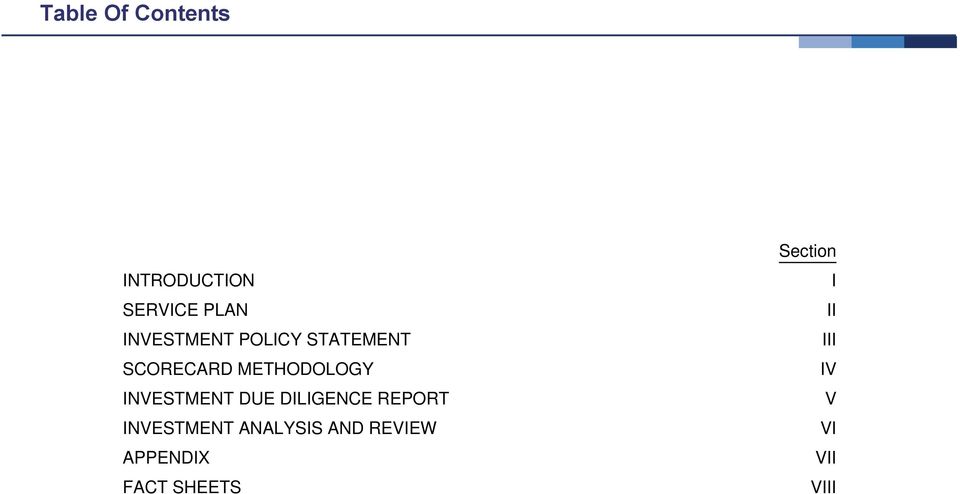
3 Table Of Contents INTRODUCTION SERVICE PLAN INVESTMENT POLICY STATEMENT SCORECARD METHODOLOGY INVESTMENT DUE DILIGENCE REPORT INVESTMENT ANALYSIS AND REVIEW APPENDIX FACT SHEETS Section I II III IV V VI VII VIII
4 ABC Company Service Plan YOUR LOGO HERE Service Description Scheduled Delivery Month Actual Delivery Date History/ Comments Fiduciary Investment Review Market Review, Investment Policy Statement, card Methodology, Fund s and Recommendations February May August November February May 26 August 6 Fiduciary Fitness Program Fiduciary Plan Review Provider Analysis and Benchmarking Employee Communication Newsletters and Memos Report Card, Fiduciary Education, Plan Design Review, Fiduciary Best Practices and administrative compliance review Analysis of incumbent provider costs, services and investments compared to bidding service providers Group employee education meetings Individual employee education meetings Client newsletters for Retirement Committee Employee memos for Plan Participants February 2 N/A N/A Monthly Monthly February N/A N/A Monthly Monthly Last RFP in 27 Other Service Meetings Train new HR assistant N/A August 27 Service Year: 2 Updated: August 6, 2

5 - SAMPLE - [Retirement Plan Name] Investment Policy Statement Part I. THE PLAN The Company sponsors a defined contribution plan (the Plan ) for the benefit of its employees and their designated beneficiaries. The Company will appoint a Committee to serve as the Plan fiduciary. The Plan is intended to provide participating employees long-term accumulation of savings through contributions to individual participant accounts and the earnings thereon. The Plan is a qualified employee benefit plan intended to comply with all applicable federal laws and regulations, including section 4(a) of the Internal Revenue Code of 86, as amended, and the Employee Retirement Income Security Act of 74 (ERISA), as amended. In addition, the Plan is intended to comply with ERISA Section 44(c). The Plan s participants and beneficiaries are expected to have different investment objectives, time horizons and risk tolerances. To meet these varying investment needs, participants and beneficiaries will be able to direct their account balances among a range of investment options to construct diversified portfolios that reasonably span the risk/return spectrum. Participants and beneficiaries alone bear the risk of investment results from the options and their asset allocation. Part II. THE PURPOSE OF THE INVESTMENT POLICY STATEMENT This Investment Policy Statement is intended to assist the Plan s fiduciaries by establishing guidelines for making investment-related decisions in a prudent manner. It outlines the underlying philosophies and processes for the selection, monitoring and evaluation of the investment options offered by the Plan. Specifically, this Investment Policy Statement: Defines the Plan s investment objectives. Defines the roles of those responsible for the Plan s investments. Describes the criteria and procedures for selecting the investment options. Establishes investment procedures, measurement standards and monitoring procedures. Describes corrective actions the committee can take should investment options and investment managers fail to satisfy established objectives. Describes the types of educational materials to be provided to Plan participants and beneficiaries. Describes ways to comply with fiduciary obligations and applicable laws and regulations. This Investment Policy Statement will be reviewed periodically, and, if appropriate, may be amended to reflect changes in the capital markets, plan objectives, or other factors relevant to the Plan. Updated 2/23/2 4k-3 Page of 3

6 - SAMPLE - This Investment Policy Statement (including the criteria for the selection and monitoring of investment options under the Plan) does not apply to employer securities (also known as Company stock) if offered under the Plan. Part III. INVESTMENT OBJECTIVES The Committee will select the Plan s investment options based on criteria deemed relevant, from time to time, by the Committee. These criteria may include, but are not limited to, the following: Maximization of return within reasonable and prudent levels of risk. Provision of returns comparable to returns for similar investment options. Provision of exposure to a wide range of investment opportunities in various asset classes and vehicles. Control administrative and management costs. Provision of appropriate diversification within investment vehicles. Investment manager s adherence to stated investment objectives and style. Part IV. ROLES AND RESPONSIBILITIES Subject to the terms of the Plan document, the Committee is responsible for selecting the trustee(s); hiring the recordkeeper; hiring the investment consultant; selecting the investment options(s), and selecting an investment(s) for default(s) when a participant or beneficiary fails to provide investment direction. The Committee is also responsible for: Establishing and maintaining the Investment Policy Statement. Periodically evaluating the Plan s investment performance and recommending investment option changes. Periodically monitoring the service providers and investment consultant. Periodically monitoring Plan costs. Providing for Plan participant investment education and communication. In executing its responsibilities, the Committee will make decisions solely in the interest of Plan participants and beneficiaries, for the exclusive purpose of providing Plan benefits and defraying reasonable administrative costs. All investments selected by the Committee are intended to meet requirements of ERISA section 44(c). Part V. MONITORING OF SERVICE PROVIDERS Service providers should be monitored on a regular basis or more frequently if applicable. Administrative and/or recordkeeping service providers may be benchmarked against, but not limited to, industry averages and/or other provider quotes. Monitoring for these service providers should include, but not be limited to, the provider s: Investment offerings and services Recordkeeping technology and services Compliance services and support Technology Participant access and communications Total Plan costs Updated 2/23/2 4k-3 Page 2 of 3

7 - SAMPLE - The monitoring of the plan provider(s) is to ensure that total plan costs and services are competitive and reasonable. Investment consultant service providers (plan and participant level) should be monitored regularly and should include, but not be limited to, the provider s: Investment Due Diligence processes Fiduciary guidance and services RPF/Benchmarking scope and services Technology Participant level access, communications and advice (if applicable) Cost Part VI. SELECTION OF INVESTMENT OPTIONS The selection of investment options offered under the Plan is among the Committee s most important responsibilities. Set forth below are the considerations and guidelines employed in fulfilling this fiduciary responsibility. The Plan intends to provide an appropriate range of investment options that may span the risk/return spectrum. Further, the Plan s investment options are intended to allow Plan participants to construct portfolios consistent with their unique individual circumstances, goals, time horizons and tolerance for risk. Major asset classes to be considered may include, but are not limited to: Conservative Investments Cash and liquid investments including, but not limited to, money market, stable value, and guaranteed interest accounts. Income Investments Income oriented investments including, but not limited to, low, medium, and high quality bond funds, with short, intermediate, and/or long term duration. Management styles may be indexed and actively managed international, global, and domestic styles. Equity Investments Funds that invest in equity securities, both domestic and foreign, including, but not limited to, small, medium, and large market capitalization, with value, blend, and growth investment objectives, which may be actively managed or indexed. Asset Allocation Investments Funds or accounts that invest in a combination of conservative, income, and equity investments, fund of funds accounts combining several of the above investments into one or a series of investments, and manager of managers accounts combining several different investment styles and fund managers into one account or a series of accounts. Updated 2/23/2 4k-3 Page 3 of 3
8 - SAMPLE - Other Investments Other appropriate investments in other styles or asset classes offered through vehicles such as commingled trusts, insurance company separate accounts through a group annuity contract, and mutual funds. Notwithstanding the foregoing, the Committee may consider, but is not required, to include in the investment menu any specific investment asset class, option, or style. Default Investment(s) The Investment Committee will evaluate and choose an investment or set of investments to serve as the default investment(s) for the Plan. The default investment(s) will be the designated investment for dollars contributed to the Plan by participants and/or the employer for which the Plan has not received investment direction. The default investment will be selected to comply with the requirements of ERISA section 44(c)(5) and the regulations promulgated thereunder as a qualified default investment alternative ( QDIA ). After determining the desired asset classes, the Committee will evaluate and choose the desired investment option(s) for the Plan s investment menu. If an investment manager (responsible for the management of the underlying investment vehicle, such as a mutual fund, commingled account or separate account) is chosen as the investment option, the following minimum criteria should be considered:. The investment manager should be a bank, insurance company, investment management, mutual fund company or an investment advisor under the Registered Investment Advisors Act of 4; 2. The investment manager should operate in good standing with regulators and clients, with no material pending or concluded legal actions against it; and 3. All relevant quantitative and qualitative information on the fund manager and fund should be made available by the manager and/or vendor. In addition to the minimum criteria above, all investments under consideration should meet the following standards for selection:. Investment performance should be competitive with an appropriate style-specific benchmark and the median return for an appropriate, stylespecific peer group (where appropriate and available, long-term performance of an investment manager may be inferred through the performance of another investment with similar style attributes managed by such investment manager); 2. Specific risk and risk-adjusted return measures should be reviewed by the Committee and be within a reasonable range relative to appropriate, style-specific benchmark and peer group; 3. The investment manager should demonstrate adherence to the stated investment objective, without excess style drift over trailing performance periods; 4. Fees and fee structures should be competitive compared with similar investments reasonably available to the Plan; 5. The investment manager should exhibit attractive qualitative characteristics, including, but not limited to, acceptable manager tenure; and 6. The investment manager should be able to provide performance, holdings, and other relevant information in a timely fashion with specified frequency. Furthermore, investment managers (to be used interchangeably with the term fund throughout the Investment Policy Statement) will be evaluated and selected utilizing an investment manager score card, detailed in Part VII (Investment Monitoring and Reporting). Updated 2/23/2 4k-3 Page 4 of 3

9 - SAMPLE - Finally, any fiduciary warranty or guarantee offered by the service provider will be considered in the investment selection process, but will not supersede the provisions of this Investment Policy Statement. Part VII. INVESTMENT MONITORING AND REPORTING The ongoing monitoring of investments is a regular and disciplined process. Monitoring confirms that the criteria remain satisfied and that an investment option continues to be appropriate. The process of monitoring investment performance relative to specified guidelines will be consistently applied. Frequent change of investments is neither expected nor desired. The Committee will bear in mind any and all political, social, economic or other changes that may potentially require more frequent review and consideration of investments. The following are some, but not all, general factors that may be considered in ongoing monitoring: Current regulatory environment, Current state of capital markets, Performance of investment alternatives, Utilization of accounts by Plan demographic, The prudent applicability of this Investment Policy Statement as written, in light of prevailing facts and circumstances. Monitoring will utilize the same investment selection criteria used in the original selection analysis. Unusual, notable, or extraordinary events will be communicated by the investment manager and/or vendor on a timely basis to the Committee. Examples of such events include portfolio manager or team departure, violation of investment guidelines, material litigation against the investment management firm, or material changes in firm ownership structure and announcements thereof. If overall satisfaction with the investment option is acceptable, no further action is required. If areas of dissatisfaction exist, the investment manager must take steps to remedy the deficiency. If over a reasonable period the manager is unable to resolve the issue, removal of the investment option may result. For supported asset classes, an investment manager score card will be maintained and documented (see addendum) to substantiate acceptable levels of manager performance and appropriate style characteristics. Based upon objective criteria, derived from Modern Portfolio Theory concepts, each fund will receive a score reflecting its overall performance. If a fund fails to meet the criteria standards, as determined by its score, it will be placed on a watch list. (In the event a fund receives a score which is below that of watch list status, or experiences extraordinary circumstances which may render it inappropriate to maintain, it may be considered for removal at the earliest administratively reasonable date.) If this fund continues to remain on watch list for the following three quarters, or four of the following seven quarters, the fund should be considered for possible removal. If the fund meets criteria standards for four consecutive quarters, it may be removed from the watch list. Asset Allocation funds and/or accounts (risk-based or age-based) will be scored and monitored using the previously described guidelines. Unlike other funds which are monitored and scored individually, these funds should be evaluated as a group. Due to the unique importance of these professionally managed and diversified vehicles for participants in the plan, funds or accounts failing to achieve criteria standards will be carefully reviewed before removal from the plan (in the absence of a reasonable alternative). In addition, funds with short time history should be evaluated qualitatively. Updated 2/23/2 4k-3 Page 5 of 3
10 - SAMPLE - Target-Date (age-based) funds or accounts will have strategies that allow the funds or accounts to grow more conservative over time until a certain retirement date or life expectancy date. This roll down process is commonly referred to as a glide path. The glide path associated with a set of target-date funds should be reviewed to make sure it is appropriate, and continues to be appropriate, for the Plan and Plan s participants. Investments where no score is applied due to specialty focus, short time history or other unique circumstances should be reviewed using a qualitative framework. The foregoing investment monitoring criteria shall not, under any circumstances, be taken as definitive, conclusive, or controlling for removal, termination, or continuation of an investment option. All determinations should be made by the Committee, in its sole discretion, taking into consideration all relevant facts and circumstances. The Company retains full responsibility for the offering and monitoring of any self-directed brokerage account(s) and/or company stock offered as an investment option, which will be reviewed periodically as determined by the Company based on criteria determined by the Company. Special considerations should be contemplated and discussed before allowing either as an investment option. Part VIII. MANAGER REMOVAL An investment manager (i.e., fund) may be removed when the Committee has lost confidence in the manager s ability to: Achieve performance, style, allocation, and/or risk objectives. Maintain acceptable qualitative standards (e.g., stable organization, compliance guidelines). If the investment manager has failed to adhere to and/or remedy one or both of the above conditions, the fund should be considered for removal from the plan. Any decision by the Committee to remove such a fund will be made on an individual basis, and will be made based on all the known facts and circumstances, including, but not limited to: The objective analysis (described above) Administrative impact on the plan Timing Employee communication issues The availability of other (potential replacement) managers Underwriting and plan provider limitations Financial considerations (hard and soft dollar fees) Professional or client turnover A material change in the investment process Other relevant factors Considerable judgment should be exercised in the manager removal decision-making process. A manager should be removed using one of the following approaches: Updated 2/23/2 4k-3 Page 6 of 3

11 - SAMPLE - Remove and replace (map assets) with an alternative manager. Freeze the assets managed by the removed manager and direct new assets to an alternative manager. Phase out the manager over a specific time period. Remove the manager and do not provide a replacement manager. Replacement of a removed manager follows the criteria outlined in Part VI (Selection of Investment Options). Part IX. PARTICIPANT EDUCATION AND COMMUNICATION The Plan should communicate to employees that they can direct their own investments and investment changes. Investment communications materials, educational materials, and enrollment support should be available to help Plan participants make educated and informed choices, including:. Periodic enrollment and investment education, through one or more of the following: on-site meetings, phone conference, web conference, Internet, phone (voice-response and live representatives), and written materials; 2. ERISA Section 44(c) disclosure; 3. Summary plan description made available to all participants; 4. General information regarding investment risk, inflation, potential taxation impact, investment earnings, and asset classes; 5. Other investment tools (e.g., investment risk profile questionnaire) to assist participants and beneficiaries in making educated and informed investment decisions; and 6. All additional information required for disclosure by ERISA, the Internal Revenue Code of 86, and all other Federal and state statutes and all regulations promulgated hereunder, and all regulatory guidance provided thereto. Notwithstanding the foregoing, all investment education provided by the Plan and/or Committee, and all communications connected thereto, is not intended, nor shall it be construed, as investment advice to Plan participants. Part X. COORDINATION WITH THE PLAN DOCUMENT Notwithstanding the foregoing, if any term or condition of this Investment Policy Statement conflicts with any section of ERISA or the Internal Revenue Code, or regulations promulgated hereunder, or any term or condition in the Plan document, the terms and conditions of ERISA, the Internal Revenue Code, and the Plan document shall control. Part XI. ERISA 44(c) The Company and the Committee intend for the Plan to comply with ERISA Section 44(c) and the regulations there under. Each participant/beneficiary is provided the opportunity to exercise control and to give instructions over his/her account with a frequency that is appropriate for each investment option and, finally, to choose from a broad range of investment options. Plan fiduciaries are thus relieved from liability for investment performance directly resulting from investment decisions made by Plan participants. Updated 2/23/2 4k-3 Page 7 of 3

12 - SAMPLE - The intention to comply with ERISA Section 44(c), and the regulations promulgated hereunder, will be communicated to employees in writing. Part XII. INVESTMENT INFORMATION AND ADMINISTRATIVE SUPPORT The Committee should require the investment manager and/or service provider (administrator, recordkeeper) to offer the following administrative information and support:. Daily valuation of all investments; 2. Daily access to account information via toll-free number and Internet access; 3. The ability to make investment transfers for both existing and future individual account balances on a daily basis (non-business days and holidays excluded). Certain trading practices may be limited to comply with market timing, excess trading, liquidity driven and/or related policies and procedures of the service provider and/or specific investment options; 4. Participant account investment reports produced no less frequently than annually, with similar information available via the Internet at least quarterly; and 5. Quarterly investment performance updates available for participant review via the Internet. Part XIII. REVIEW PROCEDURES This Investment Policy Statement will be periodically reviewed and amended, if appropriate, at any time and without notice, by action of the Committee. It is not expected that this Investment Policy Statement will change frequently. In particular, short-term changes in the financial markets should not require amendments to this Investment Policy Statement. NOTE: This document provides SAMPLE wording and should be reviewed by legal counsel prior to signing and executing. Name of Plan Fiduciary Signature Date Name of Plan Fiduciary Signature Date Name of Plan Fiduciary Signature Date Updated 2/23/2 4k-3 Page 8 of 3

13 - SAMPLE - ADDENDUM TO PART VII: INVESTMENT MONITORING AND REPORTING card SM System Methodology The card SM System methodology incorporates both quantitative and qualitative factors in evaluating fund managers and their investment strategies. The card SM System is built around pass/fail criteria, on a scale of to (with being the best) and has the ability to measure Active, Passive and Asset Allocation investing strategies. Active and Asset Allocation strategies are evaluated over a five year time period, and Passive strategies are evaluated over a three year time period. Eighty percent of the fund s score is quantitative (made up of eight unique factors), incorporating modern portfolio theory statistics, quadratic optimization analysis, and peer group rankings (among a few of the quantitative factors). The other 2% of the score is qualitative, taking into account things such as manager tenure, the fund s expense ratio relative to the average fund expense ratio in that asset class category, and the fund s strength of statistics (statistical significance). Other criteria that may be considered in the qualitative score includes the viability of the firm managing the assets, management or personnel issues at the firm, and/or whether there has been a change in direction of the fund s stated investment strategy. The following pages detail the specific factors for each type of investing strategies. Combined, these factors are a way of measuring the relative performance, characteristics, behavior and overall appropriateness of a fund for inclusion into a plan as an investment option. General fund guidelines are shown in the card Point System table below. The card Point System is meant to be used in conjunction with our sample Investment Policy Statement, in order to help identify what strategies need to be discussed as a watch-list or removal candidate; what strategies continue to meet some minimum standards and continue to be appropriate; and/or identify new top-ranked strategies for inclusion into a plan. card Point System Good: Acceptable: Watch List: Poor: - Points 7-8 Points 5-6 Points -4 Points Sample card Summary and investment report excerpt Updated 2/23/2 4k-3 Page of 3

14 - SAMPLE - Evaluation Criteria Active strategies are investment strategies where the fund manager is trying to add value and out-perform the market averages (for that style of investing). Typically, these investment strategies have higher associated costs due to the active involvement in the portfolio management process by the fund manager(s). For this type of investment strategy, the card SM System is trying to identify those managers who can add value on a consistent basis within their own style of investing. Quantitative Factors (-8): ) Analysis: s-based analysis to determine the style characteristics of a fund over a period of time. Fund passes if it reflects the appropriate style characteristics. analysis helps ensure proper diversification in the plan. Factors 3% 2) 3) 4) 5) 6) Drift: s-based analysis to determine the behavior of the fund/manager over multiple (rolling) time periods. Fund passes if the fund exhibits a consistent style pattern. consistency is desired so that funds can be effectively monitored within their designated asset class. R-Squared: Measures the % of a fund s returns that are explained by the benchmark. Fund passes with an R2 > 8%. This statistic measures whether the benchmark used in the analysis is appropriate. Risk/: Fund passes if its risk is less than the benchmark or its return is greater than the benchmark. Favorable risk/return characteristics are desired. Up/Down Capture Analysis: Measures the behavior of a fund in up and down markets. Fund passes with an up capture > its down capture. This analysis measures the relative value by the manager in up and down markets. Information Ratio: Measures a funds relative risk and return. Fund passes if ratio is >. This statistic measures the value added above the benchmark, adjusted for risk. Risk/ Factors 3% 7) s ing: Fund passes if its median rank is above the 5 th percentile. 8) Information Ratio ing: Fund passes if its median rank is above the 5 th percentile. This ranking ranks risk adjusted excess return. Qualitative Factors (-): -) Two points may be awarded based on qualitative characteristics of the fund. Primary considerations are given to manager tenure, fund expenses and strength of statistics, however, other significant factors may be considered. It is important to take into account non-quantitative factors, which may impact future performance. ings 2% Qualitative Factors 2% Updated 2/23/2 4k-3 Page of 3

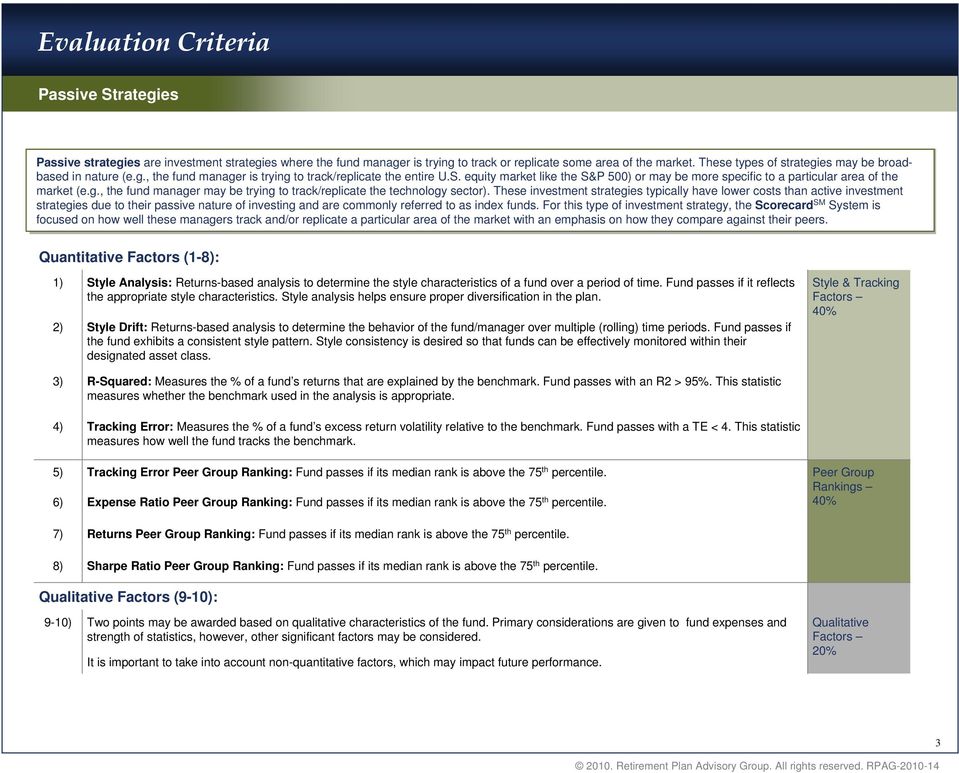
15 - SAMPLE - Evaluation Criteria Passive Strategies Passive strategies are investment strategies where the fund manager is trying to track or replicate some area of the market. These types of strategies may be broadbased in nature (e.g., the fund manager is trying to track/replicate the entire U.S. equity market like the S&P 5) or may be more specific to a particular area of the market (e.g., the fund manager may be trying to track/replicate the technology sector). These investment strategies typically have lower costs than active investment strategies due to their passive nature of investing and are commonly referred to as index funds. For this type of investment strategy, the card SM System is focused on how well these managers track and/or replicate a particular area of the market with an emphasis on how they compare against their peers. Quantitative Factors (-8): ) Analysis: s-based analysis to determine the style characteristics of a fund over a period of time. Fund passes if it reflects the appropriate style characteristics. analysis helps ensure proper diversification in the plan. 2) Drift: s-based analysis to determine the behavior of the fund/manager over multiple (rolling) time periods. Fund passes if the fund exhibits a consistent style pattern. consistency is desired so that funds can be effectively monitored within their designated asset class. & Tracking Factors 4% 3) 4) 5) 6) 7) 8) R-Squared: Measures the % of a fund s returns that are explained by the benchmark. Fund passes with an R2 > 5%. This statistic measures whether the benchmark used in the analysis is appropriate. Tracking Error: Measures the % of a fund s excess return volatility relative to the benchmark. Fund passes with a TE < 4. This statistic measures how well the fund tracks the benchmark. Tracking Error ing: Fund passes if its median rank is above the 75 th percentile. Expense Ratio ing: Fund passes if its median rank is above the 75 th percentile. s ing: Fund passes if its median rank is above the 75 th percentile. Sharpe Ratio ing: Fund passes if its median rank is above the 75 th percentile. ings 4% Qualitative Factors (-): -) Two points may be awarded based on qualitative characteristics of the fund. Primary considerations are given to fund expenses and strength of statistics, however, other significant factors may be considered. It is important to take into account non-quantitative factors, which may impact future performance. Qualitative Factors 2% Updated 2/23/2 4k-3 Page of 3

16 - SAMPLE - Evaluation Criteria Asset Allocation Strategies Asset allocation strategies are investment strategies that invest in a broad array of asset classes that may include U.S. equity, international equity, emerging markets, real estate, fixed income, high yield bonds and cash (to name a few asset classes). These strategies are typically structured in either a risk-based format (the strategies are managed to a level of risk, e.g., conservative or aggressive) or, in an age-based format (these strategies are managed to a retirement date or life expectancy date, typically growing more conservative as that date is approached). For this type of investment strategy, the card SM System is focused on how well these managers can add value from both asset allocation and manager selection. Quantitative Factors (-8): ) Risk Level: The fund s standard deviation is measured against the category it is being analyzed in. The fund passes if it falls within the range for that category. Factors 3% 2) 3) 4) 5) 6) Diversity: Fund passes if it reflects appropriate style diversity (returns-based) among the four major asset classes (Cash, Fixed Income, U.S. & International Equity) for the given category. R-Squared: Measures the % of a fund s returns that are explained by the benchmark. Fund passes with an R2 > %. This statistic measures whether the benchmark used in the analysis is appropriate. Risk/: Fund passes if its risk is less than the benchmark or its return is greater than the benchmark. Favorable risk/return characteristics are desired. Up/Down Capture Analysis: Measures the behavior of a fund in up and down markets. Fund passes with an up capture > its down capture. This analysis measures the relative value by the manager in up and down markets. Information Ratio: Measures a funds relative risk and return. Fund passes if ratio is >. This statistic measures the value added above the benchmark, adjusted for risk. Risk/ Factors 3% 7) s ing: Fund passes if its median rank is above the 5 th percentile. 8) Sharpe Ratio ing: Fund passes if its median rank is above the 5 th percentile. This ranking ranks risk adjusted excess return. Qualitative Factors (-): -) Two points may be awarded based on qualitative characteristics of the fund. Primary considerations are given to manager tenure, fund expenses and strength of statistics, however, other significant factors may be considered. It is important to take into account non-quantitative factors, which may impact future performance. ings 2% Qualitative Factors 2% Updated 2/23/2 4k-3 Page 2 of 3

17 - SAMPLE - Disclosures and Notes Some funds, accounts, or share classes used in the enclosed analysis may not be available for investment. Performance history prior to inception (if applicable) reflects another share class or account reflecting the advisor s historical performance record. Investment objectives and strategies vary among fund, and may not be similar for funds included in the same asset class. Performance data quoted represents past performance and does not guarantee future results. The investment return and principal value of an investment will fluctuate so that an investor s shares, when redeemed, may be worth more or less than their original cost. Current performance may be lower or higher than the performance data quoted. The performance data quoted may not reflect the deduction of additional fees, if applicable. If reflected, additional fees would reduce the performance quoted. Performance data is subject to change without prior notice. Performance of indexes reflects the unmanaged result for the market segment the selected stocks represent. Indexes are unmanaged and not available for direct investment. The information used in the analysis has been taken from sources deemed to be reliable, including, third-party providers such as Markov Processes International, Morningstar, firms who manage the investments, and/or the retirement plan providers who offer the funds. Every reasonable effort has been made to ensure completeness and accuracy; however, the final accuracy of the numbers and information is the responsibility of the investment manager(s) of each fund and/or the retirement plan providers offering these funds. Discrepancies between the figures reported in this analysis, and those reported by the actual investment managers and/or retirement plan providers, may be caused by a variety of factors, including: Inaccurate reporting by the manager/provider; Changes in reporting by the manager/provider from the time this report was prepared to a subsequent retro-active audit and corrected reporting; Differences in fees and share-classes impacting net investment return; and, Scriveners error preparing this report. Fund scores will change as the performance of the funds change and as certain factors measured in the qualitative category change (e.g., manager tenure). Fund scores are not expected to change dramatically from each measured period, however, there is no guarantee this will be the case. s will change depending on the changes in the underlying prespecified card factors. Neither past performance or statistics calculated using past performance are a guarantee of a fund s future performance. Likewise, a fund s score using the card SM System does not guarantee the future performance or style consistency of a fund. The purpose of this report is to assist fiduciaries in selecting and monitoring investment options. A fund s score is meant to be used by the plan sponsor and/or fiduciaries as a tool for selecting the most appropriate fund. Fund selection is at the discretion of the investment fiduciaries, which are either the plan sponsor or the committee appointed to perform that function. Cash Equivalents (e.g., money market fund) and some specialty funds are not scored by the card SM System. The enclosed Investment Due Diligence report and card is not an offer to sell mutual funds. An offer to sell may be made only after the client has received and read the appropriate prospectus. For the most current month-end performance, please contact Retirement Plan Advisory Group at (877) Carefully consider the investment objectives, risk factors and charges and expenses of the investment company before investing. This and other information can be found in the fund s prospectus, which may be obtained by contacting your Investment Advisor/Consultant or Vendor/Provider. Read the prospectus carefully before investing. For a copy of the most recent prospectus, please contact your Investment Advisor/Consultant or Vendor/Provider. The enclosed Investment Due Diligence report, including the card SM System, is intended for plan sponsor and/or institutional use only. The materials are not intended for participant use. Updated 2/23/2 4k-3 Page 3 of 3

18 card SM System Methodology The card SM System methodology incorporates both quantitative and qualitative factors in evaluating fund managers and their investment strategies. The card SM System is built around pass/fail criteria, on a scale of to (with being the best) and has the ability to measure Active, Passive and Asset Allocation investing strategies. Active and Asset Allocation strategies are evaluated over a five year time period, and Passive strategies are evaluated over a three year time period. Eighty percent of the fund s score is quantitative (made up of eight unique factors), incorporating modern portfolio theory statistics, quadratic optimization analysis, and peer group rankings (among a few of the quantitative factors). The other 2% of the score is qualitative, taking into account things such as manager tenure, the fund s expense ratio relative to the average fund expense ratio in that asset class category, and the fund s strength of statistics (statistical significance). Other criteria that may be considered in the qualitative score includes the viability of the firm managing the assets, management or personnel issues at the firm, and/or whether there has been a change in direction of the fund s stated investment strategy. The following pages detail the specific factors for each type of investing strategies. Combined, these factors are a way of measuring the relative performance, characteristics, behavior and overall appropriateness of a fund for inclusion into a plan as an investment option. General fund guidelines are shown in the card Point System table below. The card Point System is meant to be used in conjunction with our sample Investment Policy Statement, in order to help identify what strategies need to be discussed as a watch-list or removal candidate; what strategies continue to meet some minimum standards and continue to be appropriate; and/or identify new top-ranked strategies for inclusion into a plan. card Point System Good: Acceptable: Watch List: Poor: - Points 7-8 Points 5-6 Points -4 Points Sample card Summary and investment report excerpt 2. Retirement Plan Advisory Group. All rights reserved. RPAG-2-4

19 Evaluation Criteria Active strategies are investment strategies where the fund manager is trying to add value and out-perform the market averages (for that style of investing). Typically, these investment strategies have higher associated costs due to the active involvement in the portfolio management process by the fund manager(s). For this type of investment strategy, the card SM System is trying to identify those managers who can add value on a consistent basis within their own style of investing. Quantitative Factors (-8): ) Analysis: s-based analysis to determine the style characteristics of a fund over a period of time. Fund passes if it reflects the appropriate style characteristics. analysis helps ensure proper diversification in the plan. Factors 3% 2) Drift: s-based analysis to determine the behavior of the fund/manager over multiple (rolling) time periods. Fund passes if the fund exhibits a consistent style pattern. consistency is desired so that funds can be effectively monitored within their designated asset class. 3) 4) 5) 6) R-Squared: Measures the % of a fund s returns that are explained by the benchmark. Fund passes with an R2 > 8%. This statistic measures whether the benchmark used in the analysis is appropriate. Risk/: Fund passes if its risk is less than the benchmark or its return is greater than the benchmark. Favorable risk/return characteristics are desired. Up/Down Capture Analysis: Measures the behavior of a fund in up and down markets. Fund passes with an up capture > its down capture. This analysis measures the relative value by the manager in up and down markets. Information Ratio: Measures a funds relative risk and return. Fund passes if ratio is >. This statistic measures the value added above the benchmark, adjusted for risk. Risk/ Factors 3% 7) s ing: Fund passes if its median rank is above the 5 th percentile. 8) Information Ratio ing: Fund passes if its median rank is above the 5 th percentile. This ranking ranks risk adjusted excess return. ings 2% Qualitative Factors (-): -) Two points may be awarded based on qualitative characteristics of the fund. Primary considerations are given to manager tenure, fund expenses and strength of statistics, however, other significant factors may be considered. It is important to take into account non-quantitative factors, which may impact future performance. Qualitative Factors 2% 2. Retirement Plan Advisory Group. All rights reserved. RPAG-2-4 2

20 Evaluation Criteria Passive Strategies Passive strategies are investment strategies where the fund manager is trying to track or replicate some area of the market. These types of strategies may be broadbased in nature (e.g., the fund manager is trying to track/replicate the entire U.S. equity market like the S&P 5) or may be more specific to a particular area of the market (e.g., the fund manager may be trying to track/replicate the technology sector). These investment strategies typically have lower costs than active investment strategies due to their passive nature of investing and are commonly referred to as index funds. For this type of investment strategy, the card SM System is focused on how well these managers track and/or replicate a particular area of the market with an emphasis on how they compare against their peers. Quantitative Factors (-8): ) Analysis: s-based analysis to determine the style characteristics of a fund over a period of time. Fund passes if it reflects the appropriate style characteristics. analysis helps ensure proper diversification in the plan. 2) Drift: s-based analysis to determine the behavior of the fund/manager over multiple (rolling) time periods. Fund passes if the fund exhibits a consistent style pattern. consistency is desired so that funds can be effectively monitored within their designated asset class. & Tracking Factors 4% 3) R-Squared: Measures the % of a fund s returns that are explained by the benchmark. Fund passes with an R2 > 5%. This statistic measures whether the benchmark used in the analysis is appropriate. 4) 5) 6) Tracking Error: Measures the % of a fund s excess return volatility relative to the benchmark. Fund passes with a TE < 4. This statistic measures how well the fund tracks the benchmark. Tracking Error ing: Fund passes if its median rank is above the 75 th percentile. Expense Ratio ing: Fund passes if its median rank is above the 75 th percentile. ings 4% 7) s ing: Fund passes if its median rank is above the 75 th percentile. 8) Sharpe Ratio ing: Fund passes if its median rank is above the 75 th percentile. Qualitative Factors (-): -) Two points may be awarded based on qualitative characteristics of the fund. Primary considerations are given to fund expenses and strength of statistics, however, other significant factors may be considered. It is important to take into account non-quantitative factors, which may impact future performance. Qualitative Factors 2% 2. Retirement Plan Advisory Group. All rights reserved. RPAG-2-4 3
21 Evaluation Criteria Asset Allocation Strategies Asset allocation strategies are investment strategies that invest in a broad array of asset classes that may include U.S. equity, international equity, emerging markets, real estate, fixed income, high yield bonds and cash (to name a few asset classes). These strategies are typically structured in either a risk-based format (the strategies are managed to a level of risk, e.g., conservative or aggressive) or, in an age-based format (these strategies are managed to a retirement date or life expectancy date, typically growing more conservative as that date is approached). For this type of investment strategy, the card SM System is focused on how well these managers can add value from both asset allocation and manager selection. Quantitative Factors (-8): ) Risk Level: The fund s standard deviation is measured against the category it is being analyzed in. The fund passes if it falls within the range for that category. Factors 3% 2) Diversity: Fund passes if it reflects appropriate style diversity (returns-based) among the four major asset classes (Cash, Fixed Income, U.S. & International Equity) for the given category. 3) 4) 5) 6) R-Squared: Measures the % of a fund s returns that are explained by the benchmark. Fund passes with an R2 > %. This statistic measures whether the benchmark used in the analysis is appropriate. Risk/: Fund passes if its risk is less than the benchmark or its return is greater than the benchmark. Favorable risk/return characteristics are desired. Up/Down Capture Analysis: Measures the behavior of a fund in up and down markets. Fund passes with an up capture > its down capture. This analysis measures the relative value by the manager in up and down markets. Information Ratio: Measures a funds relative risk and return. Fund passes if ratio is >. This statistic measures the value added above the benchmark, adjusted for risk. Risk/ Factors 3% 7) s ing: Fund passes if its median rank is above the 5 th percentile. 8) Sharpe Ratio ing: Fund passes if its median rank is above the 5 th percentile. This ranking ranks risk adjusted excess return. ings 2% Qualitative Factors (-): -) Two points may be awarded based on qualitative characteristics of the fund. Primary considerations are given to manager tenure, fund expenses and strength of statistics, however, other significant factors may be considered. It is important to take into account non-quantitative factors, which may impact future performance. Qualitative Factors 2% 2. Retirement Plan Advisory Group. All rights reserved. RPAG-2-4 4
22 Disclosures and Notes Some funds, accounts, or share classes used in the enclosed analysis may not be available for investment. Performance history prior to inception (if applicable) reflects another share class or account reflecting the advisor s historical performance record. Investment objectives and strategies vary among fund, and may not be similar for funds included in the same asset class. Performance data quoted represents past performance and does not guarantee future results. The investment return and principal value of an investment will fluctuate so that an investor s shares, when redeemed, may be worth more or less than their original cost. Current performance may be lower or higher than the performance data quoted. The performance data quoted may not reflect the deduction of additional fees, if applicable. If reflected, additional fees would reduce the performance quoted. Performance data is subject to change without prior notice. Performance of indexes reflects the unmanaged result for the market segment the selected stocks represent. Indexes are unmanaged and not available for direct investment. The information used in the analysis has been taken from sources deemed to be reliable, including, third-party providers such as Markov Processes International, Morningstar, firms who manage the investments, and/or the retirement plan providers who offer the funds. Every reasonable effort has been made to ensure completeness and accuracy; however, the final accuracy of the numbers and information is the responsibility of the investment manager(s) of each fund and/or the retirement plan providers offering these funds. Discrepancies between the figures reported in this analysis, and those reported by the actual investment managers and/or retirement plan providers, may be caused by a variety of factors, including: Inaccurate reporting by the manager/provider; Changes in reporting by the manager/provider from the time this report was prepared to a subsequent retro-active audit and corrected reporting; Differences in fees and share-classes impacting net investment return; and, Scriveners error preparing this report. Fund scores will change as the performance of the funds change and as certain factors measured in the qualitative category change (e.g., manager tenure). Fund scores are not expected to change dramatically from each measured period, however, there is no guarantee this will be the case. s will change depending on the changes in the underlying prespecified card factors. Neither past performance or statistics calculated using past performance are a guarantee of a fund s future performance. Likewise, a fund s score using the card SM System does not guarantee the future performance or style consistency of a fund. The purpose of this report is to assist fiduciaries in selecting and monitoring investment options. A fund s score is meant to be used by the plan sponsor and/or fiduciaries as a tool for selecting the most appropriate fund. Fund selection is at the discretion of the investment fiduciaries, which are either the plan sponsor or the committee appointed to perform that function. Cash Equivalents (e.g., money market fund) and some specialty funds are not scored by the card SM System. The enclosed Investment Due Diligence report and card is not an offer to sell mutual funds. An offer to sell may be made only after the client has received and read the appropriate prospectus. For the most current month-end performance, please contact Retirement Plan Advisory Group at (877) Carefully consider the investment objectives, risk factors and charges and expenses of the investment company before investing. This and other information can be found in the fund s prospectus, which may be obtained by contacting your Investment Advisor/Consultant or Vendor/Provider. Read the prospectus carefully before investing. For a copy of the most recent prospectus, please contact your Investment Advisor/Consultant or Vendor/Provider. The enclosed Investment Due Diligence report, including the card SM System, is intended for plan sponsor and/or institutional use only. The materials are not intended for participant use Retirement Plan Advisory Group. All rights reserved. RPAG-2-4
23 Mid Cap Value Asset Class Review Dec- Asset Class Definition Investment The mid cap value asset class is a sub set of mid cap blend and typically represents value oriented companies with market capitalizations typically between $2 billion and $ billion. Mid cap value securities have relatively low price to book values and lower forecasted long term growth rates. The Russell Mid Cap Value Index contains approximately 5 securities, all of which are also included in the Russell Mid Cap Index. Top ed:. American Century Mid Cap Value Adv card System Risk / Qual. Total Ticker Risk / Up / Info Info Ratio (2pt max) R² Drift Down Ratio American Century Mid Cap Value Adv ACLAX 2 Allianz NFJ Renaissance A PQNAX 3 CONFIDENTIAL - FOR PLAN SPONSOR USE ONLY / NOT FOR PUBLIC USE Created with mpi Stylus. 2 Markov Processes International LLC. All Rights Reserved. Data provided by Morningstar, Inc. The information contained herein: () is proprietary to MPI, Retirement Plan Advisory Group (RPAG), and/or its content providers; (2) may not be copied or distributed; and (3) is not warranted to be accurate, complete or timely. Neither MPI, RPAG nor Morningstar is responsible for any damages or losses arising from any use of this information. Past performance does not guarantee future results. Reporting Date: April, 2
24 Mid Cap Value Analytics Summary Dec- card Factors : Val/Gr : Sml/Lrg Drift R² Risk American Century Mid Cap Value Adv Allianz NFJ Renaissance A T Russell Mid-Cap Value Index NA Up Cap Down Cap Info Ratio IR Qual. Detail Qual. Notes. All statistics calculated over a five year time period. 2. analytics reflect the parameters on a returns-based style map (on a scale of to - for each axis.) Fund passes if it plots out in the appropriate section of the style map, representing the fund's stated style. 3. drift is measured by the style drift score, which is a statistic measuring the rolling style-based analysis for a fund. 4. Risk is measured as the fund's standard deviation of returns. 5. R-squared measures the percentage of the fund's movement that is explained by the fund's benchmark (market). 6. Up/Down capture statistics measure the percentage of performance the fund/strategy is capturing versus the benchmark (market). 7. Information Ratio is a risk adjusted performance statistic measuring relative return over relative risk. 8. Peer group ranking statistics measure the funds median rank versus the applicable peer group universe.. Qualitative Detail: T = Tenure (qualitative score impacted negatively due to low manager tenure); E = Expenses (qualitative score impacted negatively due to higher than average expense ratio); and S = Statistics (qualitative score impacted negatively due to weak/poor strength of statistics). CONFIDENTIAL - FOR PLAN SPONSOR USE ONLY / NOT FOR PUBLIC USE Created with mpi Stylus. 2 Markov Processes International LLC. All Rights Reserved. Data provided by Morningstar, Inc. The information contained herein: () is proprietary to MPI, Retirement Plan Advisory Group (RPAG), and/or its content providers; (2) may not be copied or distributed; and (3) is not warranted to be accurate, complete or timely. Neither MPI, RPAG nor Morningstar is responsible for any damages or losses arising from any use of this information. Past performance does not guarantee future results. Reporting Date: April, 2
25 Mid Cap Value Strategy Information Dec- Summary QTR YTD Yr 3 Yr Ann. 5 Yr Ann. Yr Ann. Since Inception Manager Name Manager Tenure (Years) Fund Inception American Century Mid Cap Value Adv NA 5.46 Phillip N. Davidson /3/24.25 Allianz NFJ Renaissance A Morley D. Campbell.56 4/8/88.2 Russell Mid-Cap Value Index Mid Cap Value Average Expense Ratio Notes. Performance data quoted represents past performance and does not guarantee future results. The investment return and principal value of an investment will fluctuate so that an investor's shares, when redeemed, may be worth more or less than their original cost. Current performance may be lower or higher than the performance data quoted. 2. The performance data quoted may not reflect the deduction of additional fees, if applicable. Additional fees would reduce the performance quoted. 3. Performance data is subject to change without prior notice. Contact Retirement Plan Advisory Group with any questions about this report or for the most current month-end performance at (8) 5-7 CONFIDENTIAL - FOR PLAN SPONSOR USE ONLY / NOT FOR PUBLIC USE Created with mpi Stylus. 2 Markov Processes International LLC. All Rights Reserved. Data provided by Morningstar, Inc. The information contained herein: () is proprietary to MPI, Retirement Plan Advisory Group (RPAG), and/or its content providers; (2) may not be copied or distributed; and (3) is not warranted to be accurate, complete or timely. Neither MPI, RPAG nor Morningstar is responsible for any damages or losses arising from any use of this information. Past performance does not guarantee future results. Reporting Date: April, 2
26 Mid Cap Value Analysis Dec- Average Jan 5 - Dec Drift 36 Month rolling window Jan 5 - Dec Top Value Top Growth Top Value Top Growth Small - Large Mid Value Mid Growth Small - Large Mid Value Mid Growth - Sm Value Sm Growth - Sm Value Sm Growth - Value - Growth - Value - Growth Exposures Jan 5 - Dec Cash Top Value Asset Allocation: Russell 6 Map Top Growth Mid Value Mid Growth Sm Value Sm Growth Drift : Val/Gr : Sml/Lrg American Century Mid Cap Value Adv Allianz NFJ Renaissance A Russell Mid-Cap Value Index Drift CONFIDENTIAL - FOR PLAN SPONSOR USE ONLY / NOT FOR PUBLIC USE Created with mpi Stylus. 2 Markov Processes International LLC. All Rights Reserved. Data provided by Morningstar, Inc. The information contained herein: () is proprietary to MPI, Retirement Plan Advisory Group (RPAG), and/or its content providers; (2) may not be copied or distributed; and (3) is not warranted to be accurate, complete or timely. Neither MPI, RPAG nor Morningstar is responsible for any damages or losses arising from any use of this information. Past performance does not guarantee future results. Reporting Date: April, 2
27 Mid Cap Value Modern Portfolio Theory Statistics Dec- Summary Jan 5 - Dec Standard Deviation Downside Deviation Excess Tracking Error Significance Level Alpha Beta R² R² American Century Mid Cap Value Adv Allianz NFJ Renaissance A Russell Mid-Cap Value Index NA... R-Squared Jan-5 - Dec- Definitions Benchmark R-Squared, % Standard Deviation- The volatility of the fund's returns. Downside Deviation- The volatility of the funds negative returns. Excess - The fund's return above the benchmark. Tracking Error- The volatility of the fund's excess returns. Significance Level- Measures the confidence of the fund's out/under performance. Alpha- The fund's risk adjusted excess return. Beta- The fund's market risk/sensitivity to the market (benchmark). R-Squared- The percentage of the fund's movement that is explained by the market (benchmark) CONFIDENTIAL - FOR PLAN SPONSOR USE ONLY / NOT FOR PUBLIC USE Created with mpi Stylus. 2 Markov Processes International LLC. All Rights Reserved. Data provided by Morningstar, Inc. The information contained herein: () is proprietary to MPI, Retirement Plan Advisory Group (RPAG), and/or its content providers; (2) may not be copied or distributed; and (3) is not warranted to be accurate, complete or timely. Neither MPI, RPAG nor Morningstar is responsible for any damages or losses arising from any use of this information. Past performance does not guarantee future results. Reporting Date: April, 2
28 Mid Cap Value Risk/ Analysis Dec- Risk / Single Computation, Jan 5 - Dec Total Annualized, % Total Annualized StdDev, % Summary Statistics Jan 5 - Dec (%) Std Dev (%) Sharpe Ratio Risk/ American Century Mid Cap Value Adv Allianz NFJ Renaissance A Cash NA NA Russell Mid-Cap Value Index CONFIDENTIAL - FOR PLAN SPONSOR USE ONLY / NOT FOR PUBLIC USE Created with mpi Stylus. 2 Markov Processes International LLC. All Rights Reserved. Data provided by Morningstar, Inc. The information contained herein: () is proprietary to MPI, Retirement Plan Advisory Group (RPAG), and/or its content providers; (2) may not be copied or distributed; and (3) is not warranted to be accurate, complete or timely. Neither MPI, RPAG nor Morningstar is responsible for any damages or losses arising from any use of this information. Past performance does not guarantee future results. Reporting Date: April, 2
29 Mid Cap Value Up/Down Capture Analysis Dec- Up/Down Capture Jan 5 - Dec Rolling Up/Down Capture 36 Month rolling windows, Jan 5 - Dec Up Mkt Capture Ratio, % Up Mkt Capture Ratio, % Down Mkt Capture Ratio, % Down Mkt Capture Ratio, % Summary Statistics Jan 5 - Dec Up Months Down Months Up Market Avg. Down Market Avg. Up Market Capture, % Down Market Capture, % American Century Mid Cap Value Adv Allianz NFJ Renaissance A Russell Mid-Cap Value Index R² Up/Down CONFIDENTIAL - FOR PLAN SPONSOR USE ONLY / NOT FOR PUBLIC USE Created with mpi Stylus. 2 Markov Processes International LLC. All Rights Reserved. Data provided by Morningstar, Inc. The information contained herein: () is proprietary to MPI, Retirement Plan Advisory Group (RPAG), and/or its content providers; (2) may not be copied or distributed; and (3) is not warranted to be accurate, complete or timely. Neither MPI, RPAG nor Morningstar is responsible for any damages or losses arising from any use of this information. Past performance does not guarantee future results. Reporting Date: April, 2
30 Mid Cap Value Relative Risk Analysis Dec- Relative Risk Jan 5 - Dec Rolling Relative Risk 36 Month rolling windows, Jan 5 - Dec Excess Annualized, % Excess Annualized, % Excess Annualized StdDev, % Excess Annualized StdDev, % Summary Statistics Jan 5 - Dec Annualized Annualized Excess, % Excess StdDev, % Information Ratio Significance Level, % American Century Mid Cap Value Adv Allianz NFJ Renaissance A R² Info Ratio CONFIDENTIAL - FOR PLAN SPONSOR USE ONLY / NOT FOR PUBLIC USE Created with mpi Stylus. 2 Markov Processes International LLC. All Rights Reserved. Data provided by Morningstar, Inc. The information contained herein: () is proprietary to MPI, Retirement Plan Advisory Group (RPAG), and/or its content providers; (2) may not be copied or distributed; and (3) is not warranted to be accurate, complete or timely. Neither MPI, RPAG nor Morningstar is responsible for any damages or losses arising from any use of this information. Past performance does not guarantee future results. Reporting Date: April, 2
31 Mid Cap Value ing Dec- Rolling 5 Year 2 quarter rolling windows, Dec 4 - Dec Mid Cap Value Universe 25 Total, % 5 75 Dec 4 Mar 5 Jun 5 Sep 5 Dec 5 Mar 6 Jun 6 Sep 6 Dec 6 Mar 7 Jun 7 Sep 7 Dec 7 Mar 8 Jun 8 Sep 8 Dec 8 Mar Jun Sep Dec Median (5Yr Universe Size: 372) Median Volatility of American Century Mid Cap Value Adv. 3.5 Allianz NFJ Renaissance A Russell Mid-Cap Value Index NA NA NA CONFIDENTIAL - FOR PLAN SPONSOR USE ONLY / NOT FOR PUBLIC USE Created with mpi Stylus. 2 Markov Processes International LLC. All Rights Reserved. Data provided by Morningstar, Inc. The information contained herein: () is proprietary to MPI, Retirement Plan Advisory Group (RPAG), and/or its content providers; (2) may not be copied or distributed; and (3) is not warranted to be accurate, complete or timely. Neither MPI, RPAG nor Morningstar is responsible for any damages or losses arising from any use of this information. Past performance does not guarantee future results. Reporting Date: April, 2
32 Mid Cap Value Information Ratio ing Dec- Rolling 5 Year Information Ratio 2 quarter rolling windows, Dec 4 - Dec Mid Cap Value Universe 25 Excess Inf. Ratio, % 5 75 Dec 4 Mar 5 Jun 5 Sep 5 Dec 5 Mar 6 Jun 6 Sep 6 Dec 6 Mar 7 Jun 7 Sep 7 Dec 7 Mar 8 Jun 8 Sep 8 Dec 8 Mar Jun Sep Dec Summary Statistics (5Yr Universe Size: 372) Dec 4 - Dec Median Volatility of IR American Century Mid Cap Value Adv. 4. Allianz NFJ Renaissance A CONFIDENTIAL - FOR PLAN SPONSOR USE ONLY / NOT FOR PUBLIC USE Created with mpi Stylus. 2 Markov Processes International LLC. All Rights Reserved. Data provided by Morningstar, Inc. The information contained herein: () is proprietary to MPI, Retirement Plan Advisory Group (RPAG), and/or its content providers; (2) may not be copied or distributed; and (3) is not warranted to be accurate, complete or timely. Neither MPI, RPAG nor Morningstar is responsible for any damages or losses arising from any use of this information. Past performance does not guarantee future results. Reporting Date: April, 2
33 Small Cap Blend (Passive) Asset Class Review Dec- Asset Class Definition Investment The small cap blend (passive) asset class includes both growth and value oriented companies with market capitalizations typically between $5 million and $2 billion. The Russell 2 is a sub-set of the smallest companies in the Russell 3, which represents the 3 largest public companies in the U.S. (the Russell 3 is often used as a proxy for the entire U.S. equity market). The Russell 2 Index represents approximately % of the entire U.S. equity market. Top ed Passive Funds:. First American Small Cap Index A card System Ticker Drift Qual. Total TE Expense SR Ratio (2pt max) R² TE First American Small Cap Index A FMDAX 2 CONFIDENTIAL - FOR PLAN SPONSOR USE ONLY / NOT FOR PUBLIC USE Created with mpi Stylus. 2 Markov Processes International LLC. All Rights Reserved. Data provided by Morningstar, Inc. The information contained herein: () is proprietary to MPI, Retirement Plan Advisory Group (RPAG), and/or its content providers; (2) may not be copied or distributed; and (3) is not warranted to be accurate, complete or timely. Neither MPI, RPAG nor Morningstar is responsible for any damages or losses arising from any use of this information. Past performance does not guarantee future results. Reporting Date: April, 2
34 Small Cap Blend (Passive) Analytics Summary Dec- card Factors : Val/Gr : Sml/Lrg Drift R² TE TE Expense First American Small Cap Index A Russell 2 Index SR Qual. Detail Qual. Notes. All statistics calculated over a three year time period. 2. analytics reflect the parameters on a returns-based style map (on a scale of to - for each axis.) Fund passes if it plots out in the appropriate section of the style map, representing the fund's stated style. 3. drift is measured by the style drift score, which is a statistic measuring the rolling style-based analysis for a fund. 4. R-squared measures the percentage of the fund's movement that is explained by the fund's benchmark (market). 5. Tracking error (TE) measures the fund's total annualized excess (return) standard deviation. 6. Peer group ranking statistics measure the fund's 3 year rank. 7. Qualitative Detail: E = Expenses (qualitative score impacted negatively due to fund's higher expense ratio); and S = Statistics (qualitative score impacted negatively due to weak/poor strength of statistics and tracking). CONFIDENTIAL - FOR PLAN SPONSOR USE ONLY / NOT FOR PUBLIC USE Created with mpi Stylus. 2 Markov Processes International LLC. All Rights Reserved. Data provided by Morningstar, Inc. The information contained herein: () is proprietary to MPI, Retirement Plan Advisory Group (RPAG), and/or its content providers; (2) may not be copied or distributed; and (3) is not warranted to be accurate, complete or timely. Neither MPI, RPAG nor Morningstar is responsible for any damages or losses arising from any use of this information. Past performance does not guarantee future results. Reporting Date: April, 2
35 Small Cap Blend (Passive) Strategy Information Dec- Summary QTR YTD Yr 3 Yr Ann. 5 Yr Ann. Yr Ann. Since Inception Manager Name Manager Tenure (Years) Fund Inception First American Small Cap Index A Walter A. French /3/8.35 Russell 2 Index Small Cap Blend Passive Average Expense Ratio Notes. Performance data quoted represents past performance and does not guarantee future results. The investment return and principal value of an investment will fluctuate so that an investor's shares, when redeemed, may be worth more or less than their original cost. Current performance may be lower or higher than the performance data quoted. 2. The performance data quoted may not reflect the deduction of additional fees, if applicable. Additional fees would reduce the performance quoted. 3. Performance data is subject to change without prior notice. Contact Retirement Plan Advisory Group with any questions about this report or for the most current month-end performance at (8) 5-7 CONFIDENTIAL - FOR PLAN SPONSOR USE ONLY / NOT FOR PUBLIC USE Created with mpi Stylus. 2 Markov Processes International LLC. All Rights Reserved. Data provided by Morningstar, Inc. The information contained herein: () is proprietary to MPI, Retirement Plan Advisory Group (RPAG), and/or its content providers; (2) may not be copied or distributed; and (3) is not warranted to be accurate, complete or timely. Neither MPI, RPAG nor Morningstar is responsible for any damages or losses arising from any use of this information. Past performance does not guarantee future results. Reporting Date: April, 2
36 Small Cap Blend (Passive) Analysis Dec- Average Jan-8 - Dec- Drift 24 Month rolling window Jan-8 - Dec- Top Value Top Growth Top Value Top Growth Small - Large Mid Value Mid Growth Small - Large Mid Value Mid Growth - Sm Value Sm Growth - Sm Value Sm Growth - Value - Growth - Value - Growth Exposures Jan-8 - Dec- Cash Top Value Asset Allocation: Russell 6 Map Top Growth Mid Value Mid Growth Sm Value Sm Growth Drift : Val/Gr : Sml/Lrg First American Small Cap Index A Russell 2 Index Drift CONFIDENTIAL - FOR PLAN SPONSOR USE ONLY / NOT FOR PUBLIC USE Created with mpi Stylus. 2 Markov Processes International LLC. All Rights Reserved. Data provided by Morningstar, Inc. The information contained herein: () is proprietary to MPI, Retirement Plan Advisory Group (RPAG), and/or its content providers; (2) may not be copied or distributed; and (3) is not warranted to be accurate, complete or timely. Neither MPI, RPAG nor Morningstar is responsible for any damages or losses arising from any use of this information. Past performance does not guarantee future results. Reporting Date: April, 2
37 Small Cap Blend (Passive) Modern Portfolio Theory Statistics Dec- Summary Jan 7 - Dec Standard Deviation Downside Deviation Excess Alpha Beta R² TE R² TE First American Small Cap Index A Russell 2 Index R-Squared Jan-5 - Dec- Definitions Benchmark R-Squared, % Standard Deviation- The volatility of the fund's returns. Downside Deviation- The volatility of the funds negative returns. Excess - The fund's return above the benchmark. Tracking Error- The volatility of the fund's excess returns. Alpha- The fund's risk adjusted excess return. Beta- The fund's market risk/sensitivity to the market (benchmark). R-Squared- The percentage of the fund's movement that is explained by the market (benchmark) CONFIDENTIAL - FOR PLAN SPONSOR USE ONLY / NOT FOR PUBLIC USE Created with mpi Stylus. 2 Markov Processes International LLC. All Rights Reserved. Data provided by Morningstar, Inc. The information contained herein: () is proprietary to MPI, Retirement Plan Advisory Group (RPAG), and/or its content providers; (2) may not be copied or distributed; and (3) is not warranted to be accurate, complete or timely. Neither MPI, RPAG nor Morningstar is responsible for any damages or losses arising from any use of this information. Past performance does not guarantee future results. Reporting Date: April, 2
38 Small Cap Blend (Passive) ings Dec- Tracking Error Expense Sharpe Ratio Summary Statistics (3Yr Universe Size: 3) Jan-7 - Dec- Tracking Expense Sharpe First American Small Cap Index A CONFIDENTIAL - FOR PLAN SPONSOR USE ONLY / NOT FOR PUBLIC USE Created with mpi Stylus. 2 Markov Processes International LLC. All Rights Reserved. Data provided by Morningstar, Inc. The information contained herein: () is proprietary to MPI, Retirement Plan Advisory Group (RPAG), and/or its content providers; (2) may not be copied or distributed; and (3) is not warranted to be accurate, complete or timely. Neither MPI, RPAG nor Morningstar is responsible for any damages or losses arising from any use of this information. Past performance does not guarantee future results. Reporting Date: April, 2
39 Glossary Alpha Alpha is a measure used to quantify a fund manager s value added. Alpha measures the difference between a portfolio s actual returns and what it mightbeexpectedtodeliverbasedonitslevelofrisk.apositivealphameansthefundhasbeatenexpectationsandimpliesaskillfulmanager.a negative alpha means that the manager failed to match performance with the given risk level. Beta Betaisameasureofriskthatgaugesthesensitivityofamanagertomovementsinthebenchmark(market).Ifthemarketreturnschangebysome amountx,thenthemanagerreturnscanbeexpectedtochangebybetatimesx.abetaofimpliesthatyoucanexpectthemovementofafund s returnseriestomatchthatofthebenchmark.aportfoliowithabetaof2wouldmoveapproximatelytwiceasmuchasthebenchmark. Downside Deviation The downside standard deviation is also referred to as downside risk. The downside standard deviation shows the average size of the deviations(from the mean) when the return is negative. Excess The difference between the returns of a mutual fund and its benchmark. Explained Variance The explained variance measures the variance of the fund that is explained by the benchmark(similar to the R-squared statistic). Information Ratio The information ratio is a measure of the consistency of excess return. The ratio is calculated by taking the annualized excess return over a benchmark (numerator) and dividing it by the standard deviation of excess return(denominator). The result is a measure of the portfolio management s performance against risk and return relative to a benchmark. This is a straightforward way to evaluate the return a fund manager achieves, given the risktheytakeon. Median Medianrankreferstothemidpointoftherangenumbersthatarearrangedinorderofvalue(lowesttohighest). R-squared R-squaredmeasures(onascaleofto)theamountofmovementofafund sreturnthatcanbeexplainedbythatfund sbenchmark.anr-squared of means that all movements of a fund are completely explained by movements in the associated index(benchmark). s Based Analysis sbasedstyleanalysisusesafund sreturnseriestohelpidentifythestyleofthefund.thisisdonebycomparingthosereturnsacrossaspecific time period to a series of index returns of various styles(large Cap Growth, Small Cap Value, etc.) over the same period. Through quadratic optimization,thebestfitstyleiscalculated.oncethebestfitisfound,thefund sstylecanthenbeanalyzedandweightingstowardeachassetclasscan be made.
40 Glossary(continued) Sharpe Ratio A ratio developed by Bill Sharpe to measure risk-adjusted performance. It is calculated by subtracting the risk free rate from the rate of return for a portfolioanddividingtheresultbythestandarddeviationoftheportfolioreturnstomeasurerewardonaperunitofriskbasis.forexampleifabond fundreturns6%andhasastandarddeviationof4%andtheriskfreerateis2%thenthesharperatioforthisfundwillbe.(6-2)/4=. Significance Level The significance level indicates the level of confidence(on a percentage basis) with which the statement the manager s annualized excess return over the benchmark is positive or the manager s annualized excess return over the benchmark is negative, as the case may be, holds true. Standard Deviation Standard deviation of return measures the average deviations of a return series from its mean(average) return. A large standard deviation implies that therehavebeenlargeswingsinthereturnseriesofthemanager.thelargertheswing,themorevolatilethefund sreturnsandhencemoreimplied risk. For smaller swings the opposite is true. Standard deviation helps us analyze risk by revealing how much the return on the fund is deviating. Drift Thetendencyofafundtodeviatefromitsinvestmentstyleovertimeisstyledrift.Thisgenerallyoccursbecauseofachangeinthefund sstrategy,the manager s philosophy or even a portfolio manager change. During the s dotcom boom, for example, many managers regardless of the strategiestheywereinitiallyboundby wereabletojustifybuyingtechstocksfortheirportfolio,inhopesofcapitalizingonthetechboominthemarket at that time. Consequently, their styles drifted from their original strategy. Tracking Error Tracking error refers to the standard deviation of excess returns or the divergence between the return behavior of a portfolio and the return behavior of a benchmark. Tracking error is reported as a standard deviation percentage difference that accounts for the volatility between the return of a fund versus its benchmark. Volatility of Volatilityofrankismeasuredbytakingthemedianofaseriesofnumbers,ortakingtheabsolutevalueofthedistanceofeachindividualnumbertothat median, then finding the median of those distances. Volatility is used because it makes a better companion to the median than the standard deviation. Standard deviation is commonly used when measuring volatility around the mean(average), while volatility of rank is used for medians. Up/Down Capture Theup/downcaptureisameasureofhowwellamanagerwasabletoreplicateorimproveonperiodsofpositivebenchmarkreturns,andhowbadlythe managerwasaffectedbyperiodsofnegativebenchmarkreturns.forexample,ifafundhasanupcaptureof2thatmeansthatthefundgoesup2% whenthebenchmarkmovesup%.thesamefundhasadowncaptureofsothatmeansthefundreturnsa-%whenthebenchmarkreturnsa -%.
41 Asset Class Definitions Large Cap Value (LCV) Category typically represents large capitalization companies who have lower prices in relation to their earnings or book value. Large Cap Growth (LCG) Category typically represents large capitalization companies who have higher prices relative to their earnings or book value, generally due to a higher forecasted or expected growth rate. Large Cap Blend (LCB) Category typically represents large capitalization companies who display both value and growth-like characteristics. Mid Cap Value (MCV) Category typically represents mid-capitalization companies who have lower prices in relation to their earnings or book value. Mid Cap Growth (MCG) Category typically represents mid-capitalization companies who have higher prices relative to their earnings or book value, generally due to a higher forecasted or expected growth rate. Mid Cap Blend (MCB) Category typically represents mid-capitalization companies who display both value and growth-like characteristics. Small Cap Value (SCV) Category typically represents small capitalization companies who have lower prices in relation to their earnings or book value. Small Cap Growth (SCG) Category typically represents small capitalization companies who have higher prices relative to their earnings or book value, generally due to a higher forecasted or expected growth rate. Small Cap Blend (SCB) Category typically represents small capitalization companies who display both value and growth-like characteristics. International Equity (IE) Category typically represents primarily large capitalization foreign companies displaying both value and growth-like characteristics. Emerging Market Equity (EME) Category typically represents foreign companies in countries that are not considered to have fully developed markets or economies. Global Equity (GE) Category typically represents primarily large capitalization domestic and foreign companies displaying both value and growth-like characteristics. The specific share classes or accounts identified above may not be available or chosen by the plan. Share class and account availability is unique to the client's specific circumstances. There may be multiple share classes or accounts available to the client from which to choose. All recommendations are subject to vendor/provider approval before implementation into the plan.
42 Asset Class Definitions Core Fixed Income (CFI) Category typically represents domestic fixed income securities representing a broad array of fixed income securities including government, credit and mortgage backed securities. Global Fixed Income (GFI) Category typically represents a broad array of fixed income securities across many different countries. Intermediate Government (IG) Category typically represents domestic Government or Governmentbacked fixed income securities. U.S. Government TIPS (UGT) Category typically represents treasury inflation protected securities which are Government securities designed to offer inflation protection by adjusting the principal based on changes in the Consumer Price Index. High Yield (HY) Category typically represents below investment grade domestic fixed income securities, which have a higher likelihood of default. REIT (RE) Category typically represents real estate securities traded on a stock exchange. Technology (TEC) Category typically represents a particular segment of the stock market focused on technology related companies. Natural Resources (NR) Category typically represents a particular segment of the stock market focused on natural resource related companies. HealthCare (HC) Category typically represents a particular segment of the stock market focused on healthcare related companies. Communication (COM) Category typically represents a particular segment of the stock market focused on communications related companies. Financial Services (FS) Category typically represents a particular segment of the stock market focused on financial services companies. Utilities (UTI) Category typically represents a particular segment of the stock market focused on utility companies. The specific share classes or accounts identified above may not be available or chosen by the plan. Share class and account availability is unique to the client's specific circumstances. There may be multiple share classes or accounts available to the client from which to choose. All recommendations are subject to vendor/provider approval before implementation into the plan.
43 card ABC Company Large Cap Value Assets Ticker Pioneer Cullen Value A $46,465. CVFCX Large Cap Blend Evergreen Enhanced S&P 5 A $54,654. EVSAX Mid Cap Value Allianz NFJ Renaissance A $4,654. PQNAX Mid Cap Growth BlackRock US Opportunities Inv A $56,465. BMEAX Small Cap Blend Touchstone Small Cap Val Opportunities Z Small Cap Growth $4,654. TSVOX Lord Abbett Developing Growth A $65,465. LAGWX International Equity Thornburg International Value A $4,654. TGVAX Global Equity AIM Global Growth A $65,465. AX Core Fixed Income PIMCO Investment Grade Corp Bd A $465. PBDAX -53.2/ / / / / / /. 5.33/ / 88.4 Drift R Q Risk / 4.36/ /.7./ / / / / / / 6.3 Risk/ Up / Down 8.6/ / / / / 87../ / / / Info Ratio Info Ratio Qual. (2pt max) 2/3/2 2 LCV 2 T LCB 3 MCV 2 MCG 2 6 SCB 2 SCG 2 IE 2 GE 2 8 CFI /3/2 LCV LCB 3 MCV MCG 6 SCB SCG IE 8 GE 7 CFI 6/3/2 LCV LCB 4 MCV MCG 6 SCB SCG IE GE 7 CFI 3/3/2 LCV LCB 3 MCV MCG 7 SCB SCG IE GE 6 CFI
44 card ABC Company Assets Ticker High Yield Putnam High Yield Advantage A $4,654. PHYIX Utilities AllianceBern Utility Income A $654. AUIAX 87.34/ / Drift R Q Risk /.44/ / 6. Risk/ Up / Down 5.4/ / 87.6 Info Ratio Info Ratio Qual. (2pt max) 2/3/2 2 HY 2 UTI /3/2 HY UTI 6/3/2 HY UTI 3/3/2 HY UTI Asset Allocation Portfolio Assets Ticker Average T. Rowe Price Retirement Series $87,48. - Low High CON MOD CON MOD MOD /3/2 /3/2 6/3/2 3/3/2 8 Asset Allocation Strategies Assets Ticker Moderate T. Rowe Price Retirement 25 $65,465. TRRFX T. Rowe Price Retirement Income $654,654. TRRIX Moderate Aggressive T. Rowe Price Retirement 25 $,56. TRRGX T. Rowe Price Retirement 2 $3. TRRAX Aggressive T. Rowe Price Retirement 22 $,32. TRRBX T. Rowe Price Retirement 225 $2,32. TRRHX Risk Level Diversity 57.26/ / / / / /.43 R Risk /.7/ / / / / / 2.6 Risk/ Up / Down 3.3/ / / / 6../ 6.7./ 6.3 Info Ratio SR Ratio Qual. (2pt max) 2/3/2 2 MOD 2 MOD 2 MA 2 MA 2 2 /3/2 MOD MOD MA MA 6/3/2 MOD MOD MA MA 3/3/2 8 MA 8 MOD 8 MA MA
45 card Asset Allocation Portfolio Assets Ticker Average T. Rowe Price Retirement Series $87,48. - ABC Company -- Q Low High CON MOD CON MOD MOD /3/2 /3/2 6/3/2 3/3/2 8 Aggressive Asset Allocation Strategies Assets Ticker T. Rowe Price Retirement 23 $,654. TRRCX T. Rowe Price Retirement 235 $654. TRRJX T. Rowe Price Retirement 24 $65,465. TRRDX Risk Level Diversity 5.32/ / / 2.24 R Risk / 6.47/ / / 2.6 Risk/ Up / Down./ / / 6.7 Info Ratio.56 T. Rowe Price Retirement 245 $4,654. TRRKX SR Ratio Qual. (2pt max) 2/3/ /3/2 6/3/2 3/3/ T. Rowe Price Retirement 25 $654. TRRMX T. Rowe Price Retirement 255 $64. TRRNX Total Assets as of 4//2: $,25,72.
46 Fund History Large Cap Value Pioneer Cullen Value A Large Cap Blend Evergreen Enhanced S&P 5 A Mid Cap Value Allianz NFJ Renaissance A Mid Cap Growth BlackRock US Opportunities Inv A Small Cap Blend Touchstone Small Cap Val Opportunities Z Small Cap Growth Lord Abbett Developing Growth A International Equity Thornburg International Value A Global Equity AIM Global Growth A Core Fixed Income PIMCO Investment Grade Corp Bd A High Yield Putnam High Yield Advantage A Utilities AllianceBern Utility Income A 2/3/2 LCV LCB 3 MCV MCG 6 SCB SCG IE GE 8 CFI HY UTI /3/2 LCV LCB 3 MCV MCG 6 SCB SCG IE 8 GE 7 CFI HY UTI 6/3/2 LCV LCB 4 MCV MCG 6 SCB SCG IE GE 7 CFI HY UTI 3/3/2 LCV LCB 3 MCV MCG 7 SCB SCG IE GE 6 CFI HY UTI 2/3/28 LCV LCB 4 MCV MCG 7 SCB SCG IE GE 7 CFI HY 8 UTI /3/28 LCV LCB 3 MCV MCG 7 SCB SCG IE 7 GE 5 CFI HY UTI 6/3/28 LCV LCB 5 MCV 8 MCG 8 SCB 3/3/28 LCV LCB 3 MCV MCG 8 SCB - - IE 7 GE 7 CFI IE 7 GE CFI
47 Fund History Asset Allocation Strategies Moderate T. Rowe Price Retirement 25 T. Rowe Price Retirement Income Moderate Aggressive T. Rowe Price Retirement 25 T. Rowe Price Retirement 2 Aggressive T. Rowe Price Retirement 22 T. Rowe Price Retirement 225 T. Rowe Price Retirement 23 T. Rowe Price Retirement 235 T. Rowe Price Retirement 24 2/3/2 MOD MOD MA MA /3/2 MOD MOD MA MA 6/3/2 MOD MOD MA MA 3/3/2 8 MA 8 MOD 8 MA MA /3/28 /3/28 6/3/28 3/3/ MOD 7 MC 7 MC 7 MC T. Rowe Price Retirement T. Rowe Price Retirement T. Rowe Price Retirement
48 Box Analysis Value Blend Growth Pioneer Cullen Value A () ($46,465.) Evergreen Enhanced S&P 5 A () ($54,654.) MainStay Large Cap Growth A () Large Allianz NFJ Renaissance A (3) ($4,654.) Thrivent Mid Cap Stock I () BlackRock US Opportunities Inv A () ($56,465.) American Century Mid Cap Value Adv () Mid Victory Small Company Opportunity A () First American Small Cap Index A () Lord Abbett Developing Growth A () ($65,465.) Touchstone Small Cap Val Opportunities Z (6) ($4,654.) Small Green: Funds to add Yellow: Funds to watch list Red: Funds to delete
49 Box Analysis International Global Core Fixed Income Thornburg International Value A () ($4,654.) AIM Global Growth A () ($65,465.) PIMCO Investment Grade Corp Bd A (8) ($465.) Stable Value Specialty Specialty Fixed Income AllianceBern Utility Income A () ($654.) Putnam High Yield Advantage A () ($4,654.) Low Asset Allocation Portfolios Conservative Moderate Conservative Moderate Moderate Aggressive Aggressive T. Rowe Price Retirement 25 T. Rowe Price Retirement 25 T. Rowe Price Retirement 22 () ($65,465.) () ($,56.) () ($,32.) T. Rowe Price Retirement Income () ($654,654.) T. Rowe Price Retirement 2 () ($3.) High T. Rowe Price Retirement 225 () ($2,32.) T. Rowe Price Retirement 23 () ($,654.) T. Rowe Price Retirement 235 () ($654.) T. Rowe Price Retirement 24 () ($65,465.) T. Rowe Price Retirement 245 ($4,654.) T. Rowe Price Retirement 25 ($654.) T. Rowe Price Retirement 255 ($64.) Green: Funds to add Yellow: Funds to watch list Red: Funds to delete
50 Summary of Proposed Changes Large Cap Growth Add: MainStay Large Cap Growth A MainStay Large Cap Growth A Ticker MLAAX 8.77/ 8.25 Drift.32 R Risk / 6.73/ 3.85 Risk/ Up / Down 6.5/ 5.87 Info Ratio.58.5 Info Ratio.5 Qual. (2pt max) 2/3/2 2 LCG /3/2 LCG 6/3/2 LCG 3/3/2 LCG Mid Cap Value Add: Eliminate: American Century Mid Cap Value Adv Allianz NFJ Renaissance A and map assets to American Century Mid Cap Value Adv Risk/ Ticker Drift R 2 Risk / Up / Info Down Ratio American Century Mid Cap Value Adv Allianz NFJ Renaissance A ACLAX Ticker PQNAX -74.5/ / Drift R / 4.72 Risk /./ / Risk/ Up / Down 84.58/ Info Ratio -.6. Info Ratio. 63. Info Ratio 63.5 Qual. (2pt max) 2/3/2 2 Qual. (2pt max) T MCV 2/3/2 3 MCV /3/2 MCV /3/2 3 MCV 6/3/2 MCV 6/3/2 4 MCV 3/3/2 MCV 3/3/2 3 MCV Mid Cap Blend Add: Thrivent Mid Cap Stock I Thrivent Mid Cap Stock I Ticker TMSIX 28.2/ -7. Drift 24.8 R Risk / 8.32/ 3.27 Risk/ Up / Down 5.4/ 3.8 Info Ratio.2 4. Info Ratio 4. Qual. (2pt max) 2/3/2 2 MCB /3/2 MCB 6/3/2 MCB 3/3/2 MCB Small Cap Value Add: Victory Small Company Opportunity A Ticker Victory Small Company Opportunity A SSGSX / -6.5 Drift 7.5 R Risk / 2.6/ 3.72 Risk/ Up / Down 7.24/ Info Ratio Info Ratio 2.5 Qual. (2pt max) 2/3/2 2 SCV /3/2 SCV 6/3/2 SCV 3/3/2 SCV
51 Summary of Proposed Changes Small Cap Blend Add: First American Small Cap Index A Watchlist: Touchstone Small Cap Val Opportunities Z Passive Strategies Ticker First American Small Cap Index A FMDAX Ticker Touchstone Small Cap Val Opportunities Z TSVOX.83/ / Drift.82 Drift.2 R 2. R Tracking Error.33 Risk / 8.55/ -.6 TE 26. Risk/ Up / Down 7.7/ 87. Expense 77. Info Ratio SR Ratio Info Ratio 76.5 Qual. (2pt max) 2/3/2 2 Qual. (2pt max) SCB 2/3/2 2 6 SCB /3/2 6/3/2 3/3/ /3/2 6 SCB 6/3/2 6 SCB 3/3/2 7 SCB Core Fixed Income Watchlist: PIMCO Investment Grade Corp Bd A Ticker PIMCO Investment Grade Corp Bd A PBDAX -5.42/ 88.4 Drift 3.84 R Risk / 6.7/ 6.3 Risk/ Up / Down 47.43/ Info Ratio Info Ratio 4. Qual. (2pt max) 2/3/2 2 8 CFI /3/2 7 CFI 6/3/2 7 CFI 3/3/2 6 CFI
52 Conclusion Watchlist Touchstone Small Cap Val Opportunities Z (6) PIMCO Investment Grade Corp Bd A (8) Eliminate Allianz NFJ Renaissance A (3) and map to American Century Mid Cap Value Adv () Add MainStay Large Cap Growth A () American Century Mid Cap Value Adv () Thrivent Mid Cap Stock I () Victory Small Company Opportunity A () First American Small Cap Index A () Next Step: Implementing fund changes
53 s Analysis Large Cap Value QTR YTD Yr. 3 Yr. Ann. 5 Yr. Ann. Yr. Ann. Since Inception Pioneer Cullen Value A /3/2 Russell Value Index Large Cap Blend Evergreen Enhanced S&P 5 A /28/ Russell Index Mid Cap Value Allianz NFJ Renaissance A /8/88 Russell Mid-Cap Value Index Mid Cap Growth BlackRock US Opportunities Inv A //8 Russell Mid-Cap Growth Index Small Cap Blend Touchstone Small Cap Val Opportunities Z /4/22 Russell 2 Index Small Cap Growth Lord Abbett Developing Growth A //73 Russell 2 Growth Index International Equity Thornburg International Value A /28/8 MSCI EAFE Global Equity Performance as of 2/3/2 AIM Global Growth A /5/4 MSCI The World Index Inception Date Footnotes - Performance data quoted represents past performance and does not guarantee future results. The investment return and principal value of an investment will fluctuate so that an investor s shares, when redeemed, may be worth more or less than their original cost. Current performance may be lower or higher than the performance data quoted. - The performance data quoted may not reflect the deduction of additional fees, if applicable. Additional fees would reduce the performance quoted. - Performance data is subject to change without prior notice. Contact Retirement Plan Advisory Group with any questions about this report or for the most current month-end performance at (8) 5-7
54 s Analysis Core Fixed Income QTR YTD Yr. 3 Yr. Ann. 5 Yr. Ann. Yr. Ann. Since Inception PIMCO Investment Grade Corp Bd A /28/2 BC Aggregate Bond High Yield Putnam High Yield Advantage A /25/86 Credit Suisse HY USD Utilities Performance as of 2/3/2 AllianceBern Utility Income A /8/3 S&P Utilities Sector Inception Date Moderate Asset Allocation Strategies QTR YTD Yr. 3 Yr. Ann. 5 Yr. Ann. Yr. Ann. Since Inception T. Rowe Price Retirement /27/24 Benchmark T. Rowe Price Retirement Income /3/22 Benchmark Moderate Aggressive T. Rowe Price Retirement /27/24 Benchmark T. Rowe Price Retirement /3/22 Benchmark Aggressive T. Rowe Price Retirement /3/22 Benchmark Inception Date Footnotes - Performance data quoted represents past performance and does not guarantee future results. The investment return and principal value of an investment will fluctuate so that an investor s shares, when redeemed, may be worth more or less than their original cost. Current performance may be lower or higher than the performance data quoted. - The performance data quoted may not reflect the deduction of additional fees, if applicable. Additional fees would reduce the performance quoted. - Performance data is subject to change without prior notice. Contact Retirement Plan Advisory Group with any questions about this report or for the most current month-end performance at (8) 5-7
55 s Analysis Aggressive Asset Allocation Strategies QTR YTD Yr. 3 Yr. Ann. 5 Yr. Ann. Yr. Ann. Performance as of 2/3/2 Since Inception T. Rowe Price Retirement /27/24 Benchmark T. Rowe Price Retirement /3/22 Benchmark T. Rowe Price Retirement /27/24 Benchmark T. Rowe Price Retirement /3/22 Benchmark T. Rowe Price Retirement /3/25 No Benchmark Data T. Rowe Price Retirement /2/26 No Benchmark Data T. Rowe Price Retirement /2/26 No Benchmark Data Inception Date Footnotes - Performance data quoted represents past performance and does not guarantee future results. The investment return and principal value of an investment will fluctuate so that an investor s shares, when redeemed, may be worth more or less than their original cost. Current performance may be lower or higher than the performance data quoted. - The performance data quoted may not reflect the deduction of additional fees, if applicable. Additional fees would reduce the performance quoted. - Performance data is subject to change without prior notice. Contact Retirement Plan Advisory Group with any questions about this report or for the most current month-end performance at (8) 5-7
56 Volume VIII, Number III March 2 Retirement Plan Advisory Group Adapts Due Diligence Process to Incorporate ETFs Exchange Traded Funds (ETFs) have begun to make serious inroads into 4(k) plans, causing fiduciaries to question the appropriateness, strengths and challenges of such an investment vehicle. Increased usage of ETFs in 4(k) plans requires due diligence on these investments, which is why Retirement Plan Advisory Group (RPAG) has expanded its card SM System to include the ranking of passive investments. By developing a series of standardized benchmarks and peer groupings, the RPAG investment research team programmed the card s -point system to encompass the unique characteristics of ETFs, thus producing a much-needed tool for 4(k) fiduciaries to qualify and quantify ETFs for fitness in plan portfolios. As primarily passive investments, ETFs are becoming a common form of Index Funds, which differ widely from actively managed retail mutual funds. ETFs are more difficult to quantify on costs (bid/ask spread for buying and selling such investments) because they are traded on an exchange in the same manner as stocks. and tracking play pivotal roles in our [ETF] analysis. We use returns-based optimization analysis to determine actual investment behavior of ETFs, which can perform quite differently than the underlying index, explains Jeff Elvander, CFA, Chief Investment Officer for RPAG. For more information on the scoring of passive investments, please contact your RPAG plan consultant or name@ address.com. DOL Proposes Revamped Investment Advice Regulations Since the Pension Protection Act of 26 (PPA), the Department of Labor (DOL) has published, delayed, and withdrawn final rules regarding investment advice. On February 26, 2 the DOL issued new proposed regulations, which closely mirror the original set of regulations. Following is a brief summary of key concepts: Absent an exemption, provision of individual investment advice may be a prohibited transaction under ERISA section 46 and Internal Revenue Code section 475. Proposed regs provide statutory exemption for eligible investment advice using either a computer model, certified as unbiased, or through an adviser who is compensated on a level-fee basis. General rules applicable to both methods: Advice has been authorized by a plan fiduciary, utilizes generally accepted investment theories, takes fees into account, utilizes age, time horizons, risk tolerance, current investments/assets/sources of income, and investment preferences of participant/beneficiary, and is audited on an annual basis by an independent auditor. o o Computer Model: Must be designed to avoid recommendations that inappropriately distinguish among options within an asset class, utilize objective criteria to provide asset allocation portfolios using all investment options available under the plan (but not necessarily company stock, age-based or risk-based asset allocation funds, or annuity options). The model must have a written certification from an eligible investment expert that it meets these requirements. Fee-Leveling: Advisor may not receive compensation that is based upon which investment option is selected, or the level of asset allocation thereto. Adviser must provide written disclosures including, but not limited to: potential conflicts, past performance/historical rates of return of options in the plan, fees, description of services, a statement that the adviser is acting in a fiduciary capacity, and a statement that participants/beneficiaries may arrange for advice by another unaffiliated adviser. The DOL has requested comments, due May 5 th, before they draft and issue final regulations. Your RPAG consultant will continue to keep you informed of developments as they occur. -over-
57 Retirement Report March 2 Page 2 Survey Says: Plan Sponsors Refocus on Participant Savings in 2 According to a recent survey by Hewitt & Associates, 8% of plan sponsors that suspended or reduced their match in 2 are planning to restore it in 2. The survey (which polled 62 mid to large sized plan sponsors covering 5.7 million participants) also revealed that 6% of plans already offer Automatic Enrollment and 27% more plan to add this feature during the year. 38% of companies surveyed indicated that they intend to implement Automatic Escalation and almost half say they are likely to implement Automatic Rebalancing. Finally, more plans are expected to offer investment advice at the participant level by a qualified independent investment advisor. Other available plan features receiving consideration are the Roth 4(k) option and the possibility to add a retirement annuity solution (which is becoming more popular as the products in the marketplace mature). To learn more about how you can encourage participant savings this year, please contact your RPAG plan consultant or name@ address.com. Common Pitfalls of 4(k) Investment Committees Vanguard s Insights newsletter recently contained a column on best practices with Investment Committees. An interesting portion of the column contained a listing of the seven deadly sins of Investment Committees.. Group Think. Typically, Committee Members want to avoid conflict in meetings and will move in the general direction the group is moving. This is evident in all types of Committees at an organization, not just Investment Committees. 2. Group Polarization. Groups tend to make either more conservative or riskier choices than individual members would have made on their own. Investment Committees can offer a diversity of opinions, but it s important for those opinions to be heard. 3. Overconfidence. Group members often think they are better (at investing) than they actually are. A recent study showed that % of drivers think they are above average when it comes to driving, yet most of us have opinions to the contrary during our daily commutes. The same can be said with investment knowledge. 4. Confirmation Bias. Members will often look for data in meetings that confirms their view of the world, while ignoring other important information. An example could be focusing on investment returns for a fund, without taking into consideration style consistency and volatility of the fund manager. 5. Herding. Sometimes members will decide not to stake a claim or opinion, and instead actually make a decision to not be different than the pack, even if its done on a subconscious level. 6. Action Bias. Sometimes members want to do something, as opposed to doing nothing at all. This has been an issue with the market volatility over the past 8 months and sometimes Committee Members feel they need to take action in lieu of letting the markets settle. 7. Social Loafing. Committees are influenced by size and sometimes members of large Committees will not participate while others, the vocal minority, often end up directing the movements of the Committee. Remember that one of the primary roles of Committee Members is to make decisions that are in the best interests of the participants and their beneficiaries. Any of the above pitfalls could lead a Committee astray from that central mandate. If you have questions about the structure of your Investment Committee, please contact your RPAG plan consultant or name@ address.com. Communication Corner: 4(k) Housekeeping There s nothing like a little spring cleaning! Now is a good time to remind employees to reevaluate their retirement plan in lieu of the past year s economic downturn, whether it be to re-start deferrals or diversify from cash. name@ address.com for copy that you can print and distribute to employees. Retirement Report" is published monthly by Retirement Plan Advisory Group s marketing team. This material is intended for informational purposes only and should not be construed as legal advice and is not intended to replace the advice of a qualified attorney, tax adviser, investment professional or insurance agent. To remove yourself from this list, or to add a colleague, please us at name@ address.com or call (8) -. <Insert Your Securities Disclaimer> (c) 2. Retirement Plan Advisory Group. All rights reserved. 3
58 Pioneer Cullen Value A CVFCX Category: Large Cap Value 2/3/2 Fund Strategy card System Sector Allocation as of /3/2 The investment seeks capital appreciation; current income is a secondary objective. The fund invests primarily in equity securities. It may invest a significant portion of assets in equity securities of medium- and large-capitalization companies. The fund may invest up to 3% of assets in securities of non-u.s. issuers. It may invest up to % of total assets in securities of emerging-market issuers. Fund Information Strategy Asset ($ mm): Share Class Assets ($ mm): Manager: Manager Tenure: Portfolio Statistics Top Holdings (%) Brooks H Cullen Years Alpha*.5 P/E 5.47 Beta*.8 P/B.88 Std Dev 7.45 SEC Yield (%) - R2* 6.4 Turnover. as of date 2/3/2 as of date /3/2 *Best fit index: Russell Value TR USD *3-year statistic: Russell Value TR USD as of /3/2 Microsoft Corporation / MSF 3.38 Covidien, Ltd. / CO 3.4 Oracle Corporation / ORC 3.6 J.P. Morgan Chase & Co. / JP 3.2 3M Company / MM 2. Unilever NV / U 2.5 Walt Disney Company / DI 2. United Technologies / UT 2.85 Boeing Company / B 2.8 Kimberly-Clark Corporation / KM 2.7 % in Top Holdings 3.7 # of Holdings 43 Large Cap Value Pioneer Cullen Value A Pioneer Cullen Value A The card System methodology incorporates both quantitative and qualitative factors into evaluating fund managers and their investment strategies. To be scored, there is a fund history requirement (5 years for active strategies and 3 years for passive strategies). The scoring system is built around pass/fail criteria, on a scale of - (with being the best). 8% of the score is quantitative and 2% is qualitative. For Active and Asset Allocation Strategies, the scorecard factors are weighted 3% to style, 3% to risk/return, 2% to peer group rankings and 2% to qualitative factors (manager tenure, expense ratio relative to category average and strength of statistics). For Passive Strategies the scorecard factors are weighted 4% to style, 4% to peer group rankings and 2% to qualitative factors (expense ratio relative to category average, strength of statistics). For active, asset allocation and passive strategies, other significant factors may be considered into a fund s qualitative score. For further explanation of the card System, please refer to the card Tutorial. Performance Analysis Ticker CVFCX 2/3/2 LCV Pioneer Cullen Value A 4% Russell Value Index Pioneer Cullen Value A Russell Value Index Performance* * Size (funds)* 26% 2% -% -53.2/ 8.65 Drift 4.24 /3/2 LCV R /3/2 LCV Risk / Risk/ Up / Down Qtr YTD Year 3 Year 5 Year Year Since Inception The performance analysis displayed is reflective of past performance. Past performance does not guarantee future results. The investment return and principal value of an investment will fluctuate over time. Current performance may differ from the performance displayed. Investing includes risk, including potential loss of principal. Carefully consider any and all investment objectives, risk factors and charges and expenses before investing. Contact your financial advisor or consultant for fund s current performance and a copy of the most recent prospectus. 4.36/ /3/2 LCV 8.6/ 78. Info Ratio.65 2/3/28 LCV 7.5 /3/28 LCV Info Ratio 2.5 Qual. (2pt max) 6/3/28 LCV 2/3/2 2 LCV 3/3/28 LCV as of 2/3/2 5.78%.%.% -4.68% 2.75% % 4.22%.6%.6% -8.6% -.25% 3.5% % 24.3% 24.3% -7.32%.2% 2.54% *Morningstar : Large Value CVFCX Index Utilities..6 Cons Svcs Hardware Media Bus Ser Software Energy Telecom Financials Healthcare Cons Goods Ind Mat Index: Russell Value Index Asset Allocation (%) as of /3/2 Domestic Eq 6.46 Int'l Equity 22.5 Domestic Bond. Int'l Bond. Convertibles. Preferred. Cash 7.6 Other. Additional Information Net Exp Ratio (%):.8 Gross Exp Ratio (%):.8 Oper Exp Ratio (%):.8 Avg Exp Ratio Morningstar (%):.2 2-b fees (%):.25 Closed - New Inv: No Closed - All Inv: No Min Investment: $ Waiver Amt: - Waiver Exp Date: - Strategy Inception: 7/3/2 Share Class Inception: 7/3/2 2 Retirement Plan Advisory Group. All Rights Reserved. Data provided by Morningstar, Inc. The information contained herein: () is proprietary to Retirement Plan Advisory Group (RPAG), and/or its content providers; (2) may not be copied or distributed; and (3) is not warranted to be accurate, complete or timely. Neither RPAG nor Morningstar is responsible for any damages or losses arising from any use of this information. Past performance does not guarantee future results. For Sponsor use only. Fund fact sheet is not valid without disclaimer page. Reporting Date: 4//2
59 Evergreen Enhanced S&P 5 A EVSAX Category: Large Cap Blend 2/3/2 Fund Strategy card System Sector Allocation as of /3/2 The investment seeks total return greater than that of the S&P 5 index. The fund normally invests at least 8% of assets in common stocks of companies included within the S&P 5 index. It may invest up to 2% of assets in equity securities of companies not included in the S&P 5 index, including foreign stocks, and cash or cash equivalents. Fund Information Strategy Asset ($ mm): 72.3 Share Class Assets ($ mm): Manager: Manager Tenure: Portfolio Statistics Top Holdings (%) William E. Zieff Years Alpha* -.34 P/E 4.33 Beta*.7 P/B 2.2 Std Dev.2 SEC Yield (%) - R2*.42 Turnover 3. as of date 2/3/2 as of date /3/2 *Best fit index: S&P 5 TR *3-year statistic: S&P 5 TR as of /3/2 ExxonMobil Corporation / XO 3.6 International Business Machines Corp / IB 2.38 Johnson & Johnson / JN 2.2 Chevron Corporation / CV.3 J.P. Morgan Chase & Co. / JP. Wells Fargo Company / WF.88 AT&T, Inc. /.87 Pfizer Inc. / PF.83 General Electric Company / G.78 S+P 5 INDEX (Fut).77 % in Top Holdings 2.73 # of Holdings 68 Large Cap Blend Evergreen Enhanced S&P 5 A Evergreen Enhanced S&P 5 A The card System methodology incorporates both quantitative and qualitative factors into evaluating fund managers and their investment strategies. To be scored, there is a fund history requirement (5 years for active strategies and 3 years for passive strategies). The scoring system is built around pass/fail criteria, on a scale of - (with being the best). 8% of the score is quantitative and 2% is qualitative. For Active and Asset Allocation Strategies, the scorecard factors are weighted 3% to style, 3% to risk/return, 2% to peer group rankings and 2% to qualitative factors (manager tenure, expense ratio relative to category average and strength of statistics). For Passive Strategies the scorecard factors are weighted 4% to style, 4% to peer group rankings and 2% to qualitative factors (expense ratio relative to category average, strength of statistics). For active, asset allocation and passive strategies, other significant factors may be considered into a fund s qualitative score. For further explanation of the card System, please refer to the card Tutorial. Performance Analysis Evergreen Enhanced S&P 5 A Russell Index Ticker EVSAX 2/3/2 LCB 3% 8% 5% -7% Evergreen Enhanced S&P 5 A Russell Index Performance* * Size (funds)* -.36/ 2.3 Drift 4.2 /3/2 LCB R 2.8 6/3/2 LCB Risk / Risk/ Up / Down Qtr YTD Year 3 Year 5 Year Year Since Inception The performance analysis displayed is reflective of past performance. Past performance does not guarantee future results. The investment return and principal value of an investment will fluctuate over time. Current performance may differ from the performance displayed. Investing includes risk, including potential loss of principal. Carefully consider any and all investment objectives, risk factors and charges and expenses before investing. Contact your financial advisor or consultant for fund s current performance and a copy of the most recent prospectus. 5.6/.7 3/3/2 LCB 7.67/ 6.7 Info Ratio.7 2/3/28 LCB 42. /3/28 LCB Info Ratio 45. Qual. (2pt max) 6/3/28 LCB 2/3/2 2 LCB 3/3/28 LCB as of 2/3/2 5.55% 23.26% 23.26% -5.64%.7% -.5% 8.% 6.7% 28.43% 28.43% -5.36%.7% -.4% - 5.4% 28.7% 28.7% -5.53%.46%.% *Morningstar : Large Blend EVSAX Index Media Bus Ser Utilities Software Telecom Cons Svcs Ind Mat Cons Goods.77.7 Energy.26.4 Healthcare.4.25 Hardware Financials Index: Russell Index Asset Allocation (%) as of /3/2 Domestic Eq 6.68 Int'l Equity.63 Domestic Bond. Int'l Bond. Convertibles. Preferred. Cash.6 Other. Additional Information Net Exp Ratio (%):. Gross Exp Ratio (%):. Oper Exp Ratio (%):. Avg Exp Ratio Morningstar (%):. 2-b fees (%):.25 Closed - New Inv: No Closed - All Inv: No Min Investment: $5 Waiver Amt: - Waiver Exp Date: - Strategy Inception: 2/28/ Share Class Inception: 2/28/ 2 Retirement Plan Advisory Group. All Rights Reserved. Data provided by Morningstar, Inc. The information contained herein: () is proprietary to Retirement Plan Advisory Group (RPAG), and/or its content providers; (2) may not be copied or distributed; and (3) is not warranted to be accurate, complete or timely. Neither RPAG nor Morningstar is responsible for any damages or losses arising from any use of this information. Past performance does not guarantee future results. For Sponsor use only. Fund fact sheet is not valid without disclaimer page. Reporting Date: 4//2
60 Allianz NFJ Renaissance A PQNAX Category: Mid Cap Value 2/3/2 Fund Strategy card System Sector Allocation as of /3/2 The investment seeks to provide long-term growth of capital and income. The fund primarily invests assets in common stocks of companies that the portfolio managers believe are trading at attractive valuations. It may also invest in other kinds of equity securities, including preferred stocks convertible securities and warrants. The fund may invest up to 25% of assets in non-u.s. securities, including emerging market securities, (without limit in ADRs). It may invest up to 2% of assets in real estate investment trusts (REITs). Fund Information Strategy Asset ($ mm): 8.62 Share Class Assets ($ mm): 37.5 Manager: Manager Tenure: Portfolio Statistics Top Holdings (%) Morley D. Campbell Years Alpha*.24 P/E 3. Beta*.2 P/B.87 Std Dev SEC Yield (%) - R2* 5.86 Turnover 2. as of date 2/3/2 as of date /3/2 *Best fit index: Russell TR USD *3-year statistic: Russell TR USD as of /3/2 Yamana Gold, Inc. / AU.38 CSX Corporation / CS.26 AmerisourceBergen Corporation / AB.23 ONEOK Partners, L.P. / OK. Lan Airlines S.A. ADR / LF. Fresenius Medical Care Corporation ADR / FM.5 American Water Works Co Inc / AW.5 Linn Energy LLC / LIN.5 Harris Corporation / HR.3 Campbell Soup Company / CP.3 % in Top Holdings.6 # of Holdings 7 Mid Cap Value Allianz NFJ Renaissance A Allianz NFJ Renaissance A The card System methodology incorporates both quantitative and qualitative factors into evaluating fund managers and their investment strategies. To be scored, there is a fund history requirement (5 years for active strategies and 3 years for passive strategies). The scoring system is built around pass/fail criteria, on a scale of - (with being the best). 8% of the score is quantitative and 2% is qualitative. For Active and Asset Allocation Strategies, the scorecard factors are weighted 3% to style, 3% to risk/return, 2% to peer group rankings and 2% to qualitative factors (manager tenure, expense ratio relative to category average and strength of statistics). For Passive Strategies the scorecard factors are weighted 4% to style, 4% to peer group rankings and 2% to qualitative factors (expense ratio relative to category average, strength of statistics). For active, asset allocation and passive strategies, other significant factors may be considered into a fund s qualitative score. For further explanation of the card System, please refer to the card Tutorial. Performance Analysis Allianz NFJ Renaissance A Russell Mid-Cap Value Index Allianz NFJ Renaissance A Russell Mid-Cap Value Index Performance* * Size (funds)* Ticker PQNAX 2/3/2 3 MCV 37% 22% 7% -8% -2.7/ 3.4 Drift 5.3 /3/2 3 MCV R /3/2 4 MCV Risk / Risk/ Up / Down Qtr YTD Year 3 Year 5 Year Year Since Inception The performance analysis displayed is reflective of past performance. Past performance does not guarantee future results. The investment return and principal value of an investment will fluctuate over time. Current performance may differ from the performance displayed. Investing includes risk, including potential loss of principal. Carefully consider any and all investment objectives, risk factors and charges and expenses before investing. Contact your financial advisor or consultant for fund s current performance and a copy of the most recent prospectus../ /3/2 3 MCV 84.58/.55 Info Ratio -.6 2/3/28 4 MCV 63. /3/28 3 MCV Info Ratio 63.5 Qual. (2pt max) T 6/3/28 5 MCV 2/3/2 3 MCV 3/3/28 3 MCV as of 2/3/2 7.24% 33.57% 33.57% -5.45% -.82% 7.34% 2.3% 5.2% 34.2% 34.2% -6.62%.8% 7.58% - 5.2% 35.4% 35.4% -5.35%.36% 6.2% *Morningstar : Mid-Cap Value PQNAX Index Hardware.. Telecom Software Media Healthcare Cons Svcs Bus Ser Financials Utilities Energy Ind Mat Cons Goods Index: Russell Mid-Cap Value Index Asset Allocation (%) as of /3/2 Domestic Eq Int'l Equity.2 Domestic Bond. Int'l Bond. Convertibles. Preferred. Cash 2.86 Other. Additional Information Net Exp Ratio (%):.2 Gross Exp Ratio (%):.22 Oper Exp Ratio (%):.27 Avg Exp Ratio Morningstar (%):.38 2-b fees (%):.25 Closed - New Inv: No Closed - All Inv: No Min Investment: - Waiver Amt: - Waiver Exp Date: - Strategy Inception: 4/8/88 Share Class Inception: 2// 2 Retirement Plan Advisory Group. All Rights Reserved. Data provided by Morningstar, Inc. The information contained herein: () is proprietary to Retirement Plan Advisory Group (RPAG), and/or its content providers; (2) may not be copied or distributed; and (3) is not warranted to be accurate, complete or timely. Neither RPAG nor Morningstar is responsible for any damages or losses arising from any use of this information. Past performance does not guarantee future results. For Sponsor use only. Fund fact sheet is not valid without disclaimer page. Reporting Date: 4//2
61 BlackRock US Opportunities Inv A BMEAX Category: Mid Cap Growth 2/3/2 Fund Strategy card System Sector Allocation as of /3/2 The investment seeks long-term capital appreciation. The fund normally invests at least 8% of net assets in equity securities issued by U.S. emerging capitalization companies with relatively earnings growth potential and valuation. It primarily buys common stock but can also invest in preferred stock and securities convertible into common and preferred stock. The fund may invest in shares of companies through initial public offerings (IPOs) and in derivative instruments. Fund Information Strategy Asset ($ mm): Share Class Assets ($ mm): Manager: Manager Tenure: Portfolio Statistics Top Holdings (%) Thomas P. Callan 7 Years Alpha* 3.27 P/E. Beta*. P/B.86 Std Dev 22. SEC Yield (%).23 R2* 5.82 Turnover 66. as of date 2/3/2 as of date /3/2 *Best fit index: S&P MidCap 4 TR *3-year statistic: S&P MidCap 4 TR as of /3/2 Blackrock Liquidity Funds Tempfund Portfolio 3.44 Vertex Pharmaceuticals / VRT.2 Kansas City Southern, Inc. / KS.7 DPL Incorporated / DP.6 Airgas, Inc. / AR.5 Foster Wheeler AG / FWL.2 Express Scripts / ESR.88 Ingersoll-Rand PLC / I.88 Sybase Inc. / S.86 Solutia, Inc. / SO.85 % in Top Holdings.84 # of Holdings 2 Mid Cap Growth BlackRock US Opportunities Inv A BlackRock US Opportunities Inv A The card System methodology incorporates both quantitative and qualitative factors into evaluating fund managers and their investment strategies. To be scored, there is a fund history requirement (5 years for active strategies and 3 years for passive strategies). The scoring system is built around pass/fail criteria, on a scale of - (with being the best). 8% of the score is quantitative and 2% is qualitative. For Active and Asset Allocation Strategies, the scorecard factors are weighted 3% to style, 3% to risk/return, 2% to peer group rankings and 2% to qualitative factors (manager tenure, expense ratio relative to category average and strength of statistics). For Passive Strategies the scorecard factors are weighted 4% to style, 4% to peer group rankings and 2% to qualitative factors (expense ratio relative to category average, strength of statistics). For active, asset allocation and passive strategies, other significant factors may be considered into a fund s qualitative score. For further explanation of the card System, please refer to the card Tutorial. Performance Analysis BlackRock US Opportunities Inv A Ticker BMEAX 2/3/2 MCG 48% 3% Russell Mid-Cap Growth Index 3% BlackRock US Opportunities Inv A Russell Mid-Cap Growth Index Performance* * Size (funds)* -5% 66.34/ Drift. /3/2 MCG R /3/2 MCG Risk / Risk/ Up / Down Qtr YTD Year 3 Year 5 Year Year Since Inception The performance analysis displayed is reflective of past performance. Past performance does not guarantee future results. The investment return and principal value of an investment will fluctuate over time. Current performance may differ from the performance displayed. Investing includes risk, including potential loss of principal. Carefully consider any and all investment objectives, risk factors and charges and expenses before investing. Contact your financial advisor or consultant for fund s current performance and a copy of the most recent prospectus. 8.6/ /3/2 MCG 8.64/ 8.88 Info Ratio. 2/3/28 MCG 3.5 /3/28 MCG Info Ratio 3. Qual. (2pt max) 6/3/28 8 MCG 2/3/2 2 MCG 3/3/28 MCG as of 2/3/2 4.5% 35.6% 35.6% 2.% 7.45%.77% 4.62% 6.6% 46.2% 46.2% -3.8% 2.4% -.52% % 3.% 3.% -3.%.76%.34% *Morningstar : Mid-Cap Growth BMEAX Index Media Telecom Utilities Software Energy Bus Ser 7.4. Healthcare Ind Mat.65.2 Hardware Cons Svcs.. Cons Goods Financials Index: Russell Mid-Cap Growth Index Asset Allocation (%) as of /3/2 Domestic Eq 3.75 Int'l Equity 2.8 Domestic Bond. Int'l Bond. Convertibles. Preferred. Cash 3.44 Other. Additional Information Net Exp Ratio (%):.56 Gross Exp Ratio (%):.76 Oper Exp Ratio (%):.76 Avg Exp Ratio Morningstar (%):.47 2-b fees (%):.25 Closed - New Inv: No Closed - All Inv: No Min Investment: $5 Waiver Amt:.3 Waiver Exp Date: 2//2 Strategy Inception: 5//8 Share Class Inception: 5//8 2 Retirement Plan Advisory Group. All Rights Reserved. Data provided by Morningstar, Inc. The information contained herein: () is proprietary to Retirement Plan Advisory Group (RPAG), and/or its content providers; (2) may not be copied or distributed; and (3) is not warranted to be accurate, complete or timely. Neither RPAG nor Morningstar is responsible for any damages or losses arising from any use of this information. Past performance does not guarantee future results. For Sponsor use only. Fund fact sheet is not valid without disclaimer page. Reporting Date: 4//2
62 Touchstone Small Cap Val Opportunities Z TSVOX Category: Small Cap Blend 2/3/2 Fund Strategy card System Sector Allocation as of /3/2 The investment seeks long-term capital growth. The fund normally invests at least 8% of assets in common stocks of companies with small market capitalizations that have the potential for growth and that appear to be trading below their perceived value. A small capitalization company is one that has a market capitalization that is within the range of market capitalizations represented in the Russell 2 Value index. It invests in securities of companies operating in a broad range of industries. The fund may engage in frequent and active trading of securities. Fund Information Strategy Asset ($ mm): Share Class Assets ($ mm): Manager: Manager Tenure: Portfolio Statistics Top Holdings (%) Thomas J. DiBella 8 Years Alpha* -4.8 P/E 6.3 Beta*.83 P/B.35 Std Dev 2.47 SEC Yield (%) - R2* 4.4 Turnover 25. as of date 2/3/2 as of date /3/2 *Best fit index: Russell 2 TR USD *3-year statistic: Russell 2 TR USD as of /3/2 Brandywine Realty Trust / BD. Dupont Fabros Technology, Inc. / DF.82 RTI International Metals, Inc. / RT.7 Prosperity Bancshares, Inc. / PRS.7 Medicis Pharmaceuticals Corporation A / MR.62 Signature Bank / SBN.62 Golar LNG, Ltd. / GLN.5 Service Corporation International, Inc. / SC.5 VeriFone Holdings, Inc. / PA.56 Treehouse Foods, Inc. / TH.4 % in Top Holdings 6.7 # of Holdings 2 Small Cap Blend Touchstone Small Cap Val Opportunities Z Touchstone Small Cap Val Opportunities Z The card System methodology incorporates both quantitative and qualitative factors into evaluating fund managers and their investment strategies. To be scored, there is a fund history requirement (5 years for active strategies and 3 years for passive strategies). The scoring system is built around pass/fail criteria, on a scale of - (with being the best). 8% of the score is quantitative and 2% is qualitative. For Active and Asset Allocation Strategies, the scorecard factors are weighted 3% to style, 3% to risk/return, 2% to peer group rankings and 2% to qualitative factors (manager tenure, expense ratio relative to category average and strength of statistics). For Passive Strategies the scorecard factors are weighted 4% to style, 4% to peer group rankings and 2% to qualitative factors (expense ratio relative to category average, strength of statistics). For active, asset allocation and passive strategies, other significant factors may be considered into a fund s qualitative score. For further explanation of the card System, please refer to the card Tutorial. Performance Analysis Touchstone Small Cap Val Opportunities Z Russell 2 Index Touchstone Small Cap Val Opportunities Z Russell 2 Index Performance* * Size (funds)* Ticker TSVOX 2/3/2 6 SCB 33% % 4% -% 5.72/ Drift.2 /3/2 6 SCB R /3/2 6 SCB Risk / Risk/ Up / Down Qtr YTD Year 3 Year 5 Year Year Since Inception The performance analysis displayed is reflective of past performance. Past performance does not guarantee future results. The investment return and principal value of an investment will fluctuate over time. Current performance may differ from the performance displayed. Investing includes risk, including potential loss of principal. Carefully consider any and all investment objectives, risk factors and charges and expenses before investing. Contact your financial advisor or consultant for fund s current performance and a copy of the most recent prospectus. 8.55/ -.6 3/3/2 7 SCB 7.7/ 87. Info Ratio /3/28 7 SCB 62. /3/28 7 SCB Info Ratio 76.5 Qual. (2pt max) 6/3/28 8 SCB 2/3/2 2 6 SCB 3/3/28 8 SCB as of 2/3/2 4.45% 8.48% 8.48% -8.3% -.6% % 3.87% 27.7% 27.7% -6.7%.5% 3.5% % 3.8% 3.8% -6.%.47% 5.85% *Morningstar : Small Blend TSVOX Index Media.6. Software Healthcare Energy Utilities Hardware Cons Svcs Cons Goods Telecom Bus Ser Ind Mat Financials Index: Russell 2 Index Asset Allocation (%) as of /3/2 Domestic Eq 3.6 Int'l Equity 5.24 Domestic Bond. Int'l Bond. Convertibles. Preferred. Cash.7 Other. Additional Information Net Exp Ratio (%):.5 Gross Exp Ratio (%):.72 Oper Exp Ratio (%):.74 Avg Exp Ratio Morningstar (%):.53 2-b fees (%):.24 Closed - New Inv: No Closed - All Inv: No Min Investment: $ Waiver Amt:.24 Waiver Exp Date: /3/2 Strategy Inception: 3/4/22 Share Class Inception: 3/4/22 2 Retirement Plan Advisory Group. All Rights Reserved. Data provided by Morningstar, Inc. The information contained herein: () is proprietary to Retirement Plan Advisory Group (RPAG), and/or its content providers; (2) may not be copied or distributed; and (3) is not warranted to be accurate, complete or timely. Neither RPAG nor Morningstar is responsible for any damages or losses arising from any use of this information. Past performance does not guarantee future results. For Sponsor use only. Fund fact sheet is not valid without disclaimer page. Reporting Date: 4//2
63 Lord Abbett Developing Growth A LAGWX Category: Small Cap Growth 2/3/2 Fund Strategy card System Sector Allocation as of /3/2 The investment seeks long-term growth of capital. The fund primarily invests in the common stocks of companies with above-average, long-term growth potential. It normally invests at least 65% of assets in equity securities of small companies, which are defined as companies having market capitalization at the time of purchase that falls within the market capitalization range of companies in the Russell 2 Index.The Fund may invest up to % of its net assets in foreign securities that are primarily traded outside the United States. Fund Information Strategy Asset ($ mm): 5.2 Share Class Assets ($ mm): Manager: Manager Tenure: Portfolio Statistics Top Holdings (%) Thomas O'Halloran 6 Years Alpha* 5. P/E 27.6 Beta*. P/B 3.75 Std Dev SEC Yield (%) - R2*.55 Turnover 8.56 as of date 2/3/2 as of date /3/2 *Best fit index: Morningstar Small Growth TR USD *3-year statistic: Morningstar Small Growth TR USD as of /3/2 EnerNOC, Inc. / ENO.7 Silicon Laboratories, Inc. / SLA.82 NetLogic Microsystems, Inc. / NET.6 VistaPrint, Ltd. / VPR.66 Concur Technologies, Inc. / CNQ.64 Alexion Pharmaceuticals, Inc. / ALX.62 Mercadolibre, Inc. / MEL.55 SuccessFactors, Inc. / SFS.5 Lululemon Athletica, Inc / LUL.48 Lumber Liquidators, Inc. / L.45 % in Top Holdings 6.3 # of Holdings 22 Small Cap Growth Lord Abbett Developing Growth A Lord Abbett Developing Growth A The card System methodology incorporates both quantitative and qualitative factors into evaluating fund managers and their investment strategies. To be scored, there is a fund history requirement (5 years for active strategies and 3 years for passive strategies). The scoring system is built around pass/fail criteria, on a scale of - (with being the best). 8% of the score is quantitative and 2% is qualitative. For Active and Asset Allocation Strategies, the scorecard factors are weighted 3% to style, 3% to risk/return, 2% to peer group rankings and 2% to qualitative factors (manager tenure, expense ratio relative to category average and strength of statistics). For Passive Strategies the scorecard factors are weighted 4% to style, 4% to peer group rankings and 2% to qualitative factors (expense ratio relative to category average, strength of statistics). For active, asset allocation and passive strategies, other significant factors may be considered into a fund s qualitative score. For further explanation of the card System, please refer to the card Tutorial. Performance Analysis Lord Abbett Developing Growth A Russell 2 Growth Index Lord Abbett Developing Growth A Russell 2 Growth Index Performance* * Size (funds)* Ticker LAGWX 2/3/2 SCG 4% 3% 2% -6%.83/ -7.6 Drift 8.38 /3/2 SCG R /3/2 SCG Risk / Risk/ Up / Down Qtr YTD Year 3 Year 5 Year Year Since Inception The performance analysis displayed is reflective of past performance. Past performance does not guarantee future results. The investment return and principal value of an investment will fluctuate over time. Current performance may differ from the performance displayed. Investing includes risk, including potential loss of principal. Carefully consider any and all investment objectives, risk factors and charges and expenses before investing. Contact your financial advisor or consultant for fund s current performance and a copy of the most recent prospectus / 5.6 3/3/2 SCG./ 4.8 Info Ratio.73 2/3/28 SCG 3.5 /3/28 SCG Info Ratio 7. Qual. (2pt max) 6/3/28 2/3/2 2 SCG 3/3/ as of 2/3/2 5.76% 47.3% 47.3%.5% 5.6%.55%.85% 4.4% 34.47% 34.47% -4.%.87% -.37% - 4.7% 35.46% 35.46% -4.8%.37%.6% *Morningstar : Small Growth LAGWX Index Media.8.3 Utilities.73. Energy Telecom Cons Goods Financials Software.87.8 Ind Mat.64. Cons Svcs.3. Bus Ser Healthcare Hardware Index: Russell 2 Growth Index Asset Allocation (%) as of /3/2 Domestic Eq 86.4 Int'l Equity 2.77 Domestic Bond. Int'l Bond. Convertibles. Preferred. Cash.3 Other. Additional Information Net Exp Ratio (%):.28 Gross Exp Ratio (%):.28 Oper Exp Ratio (%):.28 Avg Exp Ratio Morningstar (%):.6 2-b fees (%):.35 Closed - New Inv: No Closed - All Inv: No Min Investment: $25 Waiver Amt: - Waiver Exp Date: - Strategy Inception: //73 Share Class Inception: //73 2 Retirement Plan Advisory Group. All Rights Reserved. Data provided by Morningstar, Inc. The information contained herein: () is proprietary to Retirement Plan Advisory Group (RPAG), and/or its content providers; (2) may not be copied or distributed; and (3) is not warranted to be accurate, complete or timely. Neither RPAG nor Morningstar is responsible for any damages or losses arising from any use of this information. Past performance does not guarantee future results. For Sponsor use only. Fund fact sheet is not valid without disclaimer page. Reporting Date: 4//2
64 Thornburg International Value A TGVAX Category: International Equity 2/3/2 Fund Strategy card System Country Exposure (%) as of /3/2 The investment seeks long-term capital appreciation. The fund normally invests at least 75% of assets in foreign securities or depository receipts of foreign securities. It may invest in developing countries. The fund typically makes equity investments in the following three types of companies: basic value companies with well established businesses whose stock is under valued; Consistent earner companies when they are selling at valuations below historic norms; and Emerging franchises that are in the process of establishing a leading position in a product, service or market expecting growth at an above average rate. Fund Information Strategy Asset ($ mm): Share Class Assets ($ mm): Manager: Manager Tenure: Portfolio Statistics Top Holdings (%) William V. Fries 2 Years Alpha* 2.54 P/E 5.76 Beta*.83 P/B 2.4 Std Dev 22.3 SEC Yield (%) - R2* 5.32 Turnover as of date 2/3/2 as of date /3/2 *Best fit index: MSCI EASEA NR USD *3-year statistic: MSCI EASEA NR USD as of /3/2 Teva Pharmaceutical Industries, Ltd. ADR / TEV 3. Industrial And Commercial Bank Of China Limited 2.68 Komatsu Ltd. / Novo Nordisk A/S / NOVO 2.3 LVMH Moet Hennessy Louis Vuitton / M 2.28 National Bank of Greece / ET 2.24 Hong Kong Exchanges And Clearing 2.2 China Merchants Bank Co.,limited / Nestle / NES 2.8 Petroleo Brasileiro S.A. ADR / PB 2.7 % in Top Holdings # of Holdings 83 International Equity Thornburg International Value A Thornburg International Value A The card System methodology incorporates both quantitative and qualitative factors into evaluating fund managers and their investment strategies. To be scored, there is a fund history requirement (5 years for active strategies and 3 years for passive strategies). The scoring system is built around pass/fail criteria, on a scale of - (with being the best). 8% of the score is quantitative and 2% is qualitative. For Active and Asset Allocation Strategies, the scorecard factors are weighted 3% to style, 3% to risk/return, 2% to peer group rankings and 2% to qualitative factors (manager tenure, expense ratio relative to category average and strength of statistics). For Passive Strategies the scorecard factors are weighted 4% to style, 4% to peer group rankings and 2% to qualitative factors (expense ratio relative to category average, strength of statistics). For active, asset allocation and passive strategies, other significant factors may be considered into a fund s qualitative score. For further explanation of the card System, please refer to the card Tutorial. Performance Analysis Thornburg International Value A MSCI EAFE Thornburg International Value A MSCI EAFE Performance* * Size (funds)* Ticker TGVAX 2/3/2 IE 34% 2% 6% -8% 4.6/. Drift 28.4 /3/2 IE R /3/2 IE Risk / Risk/ Up / Down Qtr YTD Year 3 Year 5 Year Year Since Inception The performance analysis displayed is reflective of past performance. Past performance does not guarantee future results. The investment return and principal value of an investment will fluctuate over time. Current performance may differ from the performance displayed. Investing includes risk, including potential loss of principal. Carefully consider any and all investment objectives, risk factors and charges and expenses before investing. Contact your financial advisor or consultant for fund s current performance and a copy of the most recent prospectus. 8.36/ 7.5 3/3/2 IE.35/ 87. Info Ratio.74 2/3/28 IE 4.5 /3/28 IE Info Ratio 4.5 Qual. (2pt max) 6/3/28 IE 2/3/2 2 IE 3/3/28 IE as of 2/3/2 3.76% 3.43% 3.43% -.83% 7.5% 6.48%.2% 2.22% 32.46% 32.46% -5.57% 4.2%.58% % 3.24% 3.24% -6.5% 3.58%.62% *Morningstar : Foreign Large Blend TGVAX Index Middle East -. Africa.. Australasia.85.2 Latin America Japan US & Canada Asia United Kingdom Europe Index: MSCI EAFE Asset Allocation (%) as of /3/2 Domestic Eq 4.6 Int'l Equity 2.23 Domestic Bond.32 Int'l Bond. Convertibles. Preferred. Cash 2.3 Other. Additional Information Net Exp Ratio (%):.34 Gross Exp Ratio (%):.34 Oper Exp Ratio (%):.36 Avg Exp Ratio Morningstar (%):.4 2-b fees (%):.25 Closed - New Inv: No Closed - All Inv: No Min Investment: $5 Waiver Amt: - Waiver Exp Date: - Strategy Inception: 5/28/8 Share Class Inception: 5/28/8 2 Retirement Plan Advisory Group. All Rights Reserved. Data provided by Morningstar, Inc. The information contained herein: () is proprietary to Retirement Plan Advisory Group (RPAG), and/or its content providers; (2) may not be copied or distributed; and (3) is not warranted to be accurate, complete or timely. Neither RPAG nor Morningstar is responsible for any damages or losses arising from any use of this information. Past performance does not guarantee future results. For Sponsor use only. Fund fact sheet is not valid without disclaimer page. Reporting Date: 4//2
65 AIM Global Growth A AX Category: Global Equity 2/3/2 Fund Strategy card System Country Exposure (%) as of /3/2 The investment seeks long-term growth of capital. The fund normally invests at least 65% of total assets in marketable equity securities of domestic and foreign issuers. It normally invests in the securities of medium- and large-sized growth companies located in at least three countries outside the United States, and usually maintains at least 2% of total assets in U.S. dollardenominated securities. The fund emphasizes investment in companies in developed countries such as the United States, the countries of Western Europe and certain countries in the Pacific Basin. It may also invest up to 2% of total assets in companies located in developing countries. Fund Information Strategy Asset ($ mm): Share Class Assets ($ mm): Manager: Manager Tenure: Portfolio Statistics Top Holdings (%) Clas G. Olsson 2 Years Alpha* -.4 P/E 6.5 Beta*.83 P/B 2.43 Std Dev.3 SEC Yield (%) - R2* 4.72 Turnover 48. as of date 2/3/2 as of date /3/2 *Best fit index: MSCI AC World NR USD *3-year statistic: MSCI AC World NR USD as of /3/2 Teva Pharmaceutical Industries, Ltd. ADR / TEV 3.5 Roche Holding AG / RHHV 2.87 Imperial Tobacco Group PLC / IM 2.7 Anheuser-Busch InBev SA / AHBI 2.5 Johnson & Johnson / JN 2.2 Nestle / NES 2.7 AIM Treasurer's Ser Tr Prem Instl 2.6 AIM STIT Liquid Assets Inst 2.6 Novo Nordisk A/S / NOVO 2.3 BHP Billiton Limited / BHPL 2. % in Top Holdings # of Holdings Global Equity AIM Global Growth A AIM Global Growth A The card System methodology incorporates both quantitative and qualitative factors into evaluating fund managers and their investment strategies. To be scored, there is a fund history requirement (5 years for active strategies and 3 years for passive strategies). The scoring system is built around pass/fail criteria, on a scale of - (with being the best). 8% of the score is quantitative and 2% is qualitative. For Active and Asset Allocation Strategies, the scorecard factors are weighted 3% to style, 3% to risk/return, 2% to peer group rankings and 2% to qualitative factors (manager tenure, expense ratio relative to category average and strength of statistics). For Passive Strategies the scorecard factors are weighted 4% to style, 4% to peer group rankings and 2% to qualitative factors (expense ratio relative to category average, strength of statistics). For active, asset allocation and passive strategies, other significant factors may be considered into a fund s qualitative score. For further explanation of the card System, please refer to the card Tutorial. Performance Analysis AIM Global Growth A MSCI The World Index AIM Global Growth A MSCI The World Index Performance* * Size (funds)* Ticker AX 2/3/2 GE 37% 22% 8% -7% 5.33/ 68.3 Drift /3/2 8 GE R /3/2 GE Risk / Risk/ Up / Down Qtr YTD Year 3 Year 5 Year Year Since Inception The performance analysis displayed is reflective of past performance. Past performance does not guarantee future results. The investment return and principal value of an investment will fluctuate over time. Current performance may differ from the performance displayed. Investing includes risk, including potential loss of principal. Carefully consider any and all investment objectives, risk factors and charges and expenses before investing. Contact your financial advisor or consultant for fund s current performance and a copy of the most recent prospectus. 6.6/ /3/2 GE 8.5/ 5. Info Ratio. 2/3/28 GE 42. /3/28 7 GE Info Ratio 42. Qual. (2pt max) 6/3/28 7 GE 2/3/2 2 GE 3/3/28 7 GE as of 2/3/2 6.43% 2.7% 2.7% -4.23% 3.43% -2.74% 6.% 4.8% 3.7% 3.7% -5.% 2.57%.23% % 35.27% 35.27% -4.38% 2.%.34% *Morningstar : World Stock AX Index Middle East -. Africa.. Latin America.8. Japan Australasia Asia..7 United Kingdom Europe US & Canada Index: MSCI The World Index Asset Allocation (%) as of /3/2 Domestic Eq 27.6 Int'l Equity 67. Domestic Bond. Int'l Bond. Convertibles. Preferred. Cash 4.32 Other. Additional Information Net Exp Ratio (%):.5 Gross Exp Ratio (%):.6 Oper Exp Ratio (%):.6 Avg Exp Ratio Morningstar (%):.54 2-b fees (%):.25 Closed - New Inv: No Closed - All Inv: No Min Investment: $5 Waiver Amt:. Waiver Exp Date: 6/3/2 Strategy Inception: /5/4 Share Class Inception: /5/4 2 Retirement Plan Advisory Group. All Rights Reserved. Data provided by Morningstar, Inc. The information contained herein: () is proprietary to Retirement Plan Advisory Group (RPAG), and/or its content providers; (2) may not be copied or distributed; and (3) is not warranted to be accurate, complete or timely. Neither RPAG nor Morningstar is responsible for any damages or losses arising from any use of this information. Past performance does not guarantee future results. For Sponsor use only. Fund fact sheet is not valid without disclaimer page. Reporting Date: 4//2
66 PIMCO Investment Grade Corp Bd A PBDAX Category: Core Fixed Income 2/3/2 Fund Strategy card System Fixed Income Detail as of 6/3/2 The investment seeks maximum total return consistent with preservation of capital and prudent investment management. The fund normally invests at least 8% of assets in a diversified portfolio of investment-grade corporate fixedincome securities of varying maturities. It invests primarily in investment-grade debt securities, but may invest up to % of total assets in high-yield securities ("junk bonds"). The fund may invest up to 3% of total assets in securities denominated in foreign currencies, and may invest beyond this limit in U.S. dollar-denominated securities of foreign issuers. Core Fixed Income PIMCO Investment Grade Corp Bd A PIMCO Investment Grade Corp Bd A Ticker PBDAX 2/3/2 8 CFI -5.42/ 88.4 Drift 3.84 /3/2 7 CFI R /3/2 7 CFI Risk / 6.7/ 6.3 Risk/ Up / Down 3/3/2 6 CFI 47.43/ Info Ratio.32 2/3/28 7 CFI 22.5 /3/28 5 CFI Info Ratio 4. Qual. (2pt max) 6/3/28 7 CFI 2/3/2 2 8 CFI 3/3/28 CFI Credit Quality (%) Avg Cr Qlty A AAA 3. Avg Cr Qty Date 6/3/2 AA 6. Avg Coupon* 6.45 A 3. Avg Eff Duration* 6.58 BBB 3. Eff Maturity 8.55 BB. Fund Information Strategy Asset ($ mm): Share Class Assets ($ mm): Manager: Manager Tenure: Portfolio Statistics Top Holdings (%) Mark Kiesel 7 Years Alpha* 2.88 P/E - Beta*.5 P/B - Std Dev 8.5 SEC Yield (%) 4.35 R2* 8.84 Turnover 348. as of date 2/3/2 as of date 6/3/2 *Best fit index: BarCap US Credit TR USD *3-year statistic: BarCap US Credit TR USD as of 6/3/2 PIMCO FDS PRIVATE ACCOUNT PORTFOLIO SER 3.62 FNMA 3.43 FNMA 2.3 Zcs Brl R.4%/Cdi 5/6/ Glm.67 Irs Gbp R 6ml/5. 3/8/ Brc.46 Irs Gbp R 6ml/5. 3/8/ Glm.35 Zcs Brl R.67%/Cdi 2/25/ Glm.34 Ngpl Pipeco 7.%.22 Irs Eur R 6me/4. 3/8/ Jpm. Bhp Billiton Fin Usa 6.5%.8 % in Top Holdings. # of Holdings 24 The card System methodology incorporates both quantitative and qualitative factors into evaluating fund managers and their investment strategies. To be scored, there is a fund history requirement (5 years for active strategies and 3 years for passive strategies). The scoring system is built around pass/fail criteria, on a scale of - (with being the best). 8% of the score is quantitative and 2% is qualitative. For Active and Asset Allocation Strategies, the scorecard factors are weighted 3% to style, 3% to risk/return, 2% to peer group rankings and 2% to qualitative factors (manager tenure, expense ratio relative to category average and strength of statistics). For Passive Strategies the scorecard factors are weighted 4% to style, 4% to peer group rankings and 2% to qualitative factors (expense ratio relative to category average, strength of statistics). For active, asset allocation and passive strategies, other significant factors may be considered into a fund s qualitative score. For further explanation of the card System, please refer to the card Tutorial. Performance Analysis PIMCO Investment Grade Corp Bd A BC Aggregate Bond PIMCO Investment Grade Corp Bd A BC Aggregate Bond Performance* * Size (funds)* 2% 3% 6% -% Qtr YTD Year 3 Year 5 Year Year as of 2/3/2 Since Inception 2.42% 8.27% 8.27% 8.6% 6.3% %.2% 5.3% 5.3% 6.4% 4.7% 6.33% -.% 3.7% 3.7% 4.45% 3.84% 5.53% *Morningstar : Intermediate-term Bond The performance analysis displayed is reflective of past performance. Past performance does not guarantee future results. The investment return and principal value of an investment will fluctuate over time. Current performance may differ from the performance displayed. Investing includes risk, including potential loss of principal. Carefully consider any and all investment objectives, risk factors and charges and expenses before investing. Contact your financial advisor or consultant for fund s current performance and a copy of the most recent prospectus. Below B - Not Rated. *denoted in years Asset Allocation (%) as of 6/3/2 Domestic Eq. Int'l Equity. Domestic Bond Int'l Bond 7.4 Convertibles. Preferred.6 Cash 5.3 Other 4.78 Additional Information Net Exp Ratio (%):. Gross Exp Ratio (%):. Oper Exp Ratio (%):. Avg Exp Ratio Morningstar (%):.5 2-b fees (%):.25 Closed - New Inv: No Closed - All Inv: No Min Investment: - Waiver Amt: - Waiver Exp Date: - Strategy Inception: 4/28/2 Share Class Inception: 7/3/24 2 Retirement Plan Advisory Group. All Rights Reserved. Data provided by Morningstar, Inc. The information contained herein: () is proprietary to Retirement Plan Advisory Group (RPAG), and/or its content providers; (2) may not be copied or distributed; and (3) is not warranted to be accurate, complete or timely. Neither RPAG nor Morningstar is responsible for any damages or losses arising from any use of this information. Past performance does not guarantee future results. For Sponsor use only. Fund fact sheet is not valid without disclaimer page. Reporting Date: 4//2
67 Putnam High Yield Advantage A PHYIX Category: High Yield 2/3/2 Fund Strategy card System Fixed Income Detail as of /3/2 The investment seeks high current income and capital appreciation is a secondary consideration. The fund invests in bonds that are obligations of U.S. companies, below investment-grade in quality and have intermediate- to long-term maturities. The fund normally invests at least 8% of net assets in securities rated below investment grade. High Yield Putnam High Yield Advantage A Putnam High Yield Advantage A Ticker PHYIX 2/3/2 HY 87.34/ Drift 4.83 /3/2 HY R /3/2 HY Risk /.44/ 6.2 Risk/ Up / Down 3/3/2 HY 5.4/ 2.28 Info Ratio.8 2/3/28 HY 5.5 /3/28 HY Info Ratio 5. Qual. (2pt max) 6/3/28 2/3/2 2 HY 3/3/ Credit Quality (%) Avg Cr Qlty BB AAA 3.42 Avg Cr Qty Date /3/2 AA. Avg Coupon* 8.3 A.5 Avg Eff Duration* 3.3 BBB.5 Eff Maturity 5.2 BB 3.73 Fund Information Strategy Asset ($ mm): 748. Share Class Assets ($ mm): Manager: Manager Tenure: Portfolio Statistics Top Holdings (%) Paul D. Scanlon 7 Years Alpha* -.2 P/E - Beta*.2 P/B - Std Dev 4.52 SEC Yield (%) - R2*.47 Turnover as of date 2/3/2 as of date /3/2 *Best fit index: Credit Suisse HY USD *3-year statistic: Credit Suisse HY USD as of /3/2 Nrg Engy 7.375%. Freeport-Mcmoran Copper & Gold 8.375%.6 HCA Inc.3%.7 Ford Motor Credit.875%.66 Intelsat.25%.64 Txu Energy T/L B2 L+35.6 Arch Westn Fin 6.75%.57 Sungard Data Sys.25%.54 First Data.55%.53 Chesapeake Engy 7.5%.53 % in Top Holdings 6.73 # of Holdings 567 The card System methodology incorporates both quantitative and qualitative factors into evaluating fund managers and their investment strategies. To be scored, there is a fund history requirement (5 years for active strategies and 3 years for passive strategies). The scoring system is built around pass/fail criteria, on a scale of - (with being the best). 8% of the score is quantitative and 2% is qualitative. For Active and Asset Allocation Strategies, the scorecard factors are weighted 3% to style, 3% to risk/return, 2% to peer group rankings and 2% to qualitative factors (manager tenure, expense ratio relative to category average and strength of statistics). For Passive Strategies the scorecard factors are weighted 4% to style, 4% to peer group rankings and 2% to qualitative factors (expense ratio relative to category average, strength of statistics). For active, asset allocation and passive strategies, other significant factors may be considered into a fund s qualitative score. For further explanation of the card System, please refer to the card Tutorial. Performance Analysis Putnam High Yield Advantage A Credit Suisse HY USD 56% 37% % Putnam High Yield Advantage A Credit Suisse HY USD Performance* * Size (funds)* % Qtr YTD Year 3 Year 5 Year Year as of 2/3/2 Since Inception 5.6% 48.32% 48.32% 5.5% 6.2% 5.% 7.63% 6.24% 54.22% 54.22% 5.33% 5.% 7.7% - 5.6% 46.7% 46.7% 3.8% 4.32% 4.74% *Morningstar : High Yield Bond The performance analysis displayed is reflective of past performance. Past performance does not guarantee future results. The investment return and principal value of an investment will fluctuate over time. Current performance may differ from the performance displayed. Investing includes risk, including potential loss of principal. Carefully consider any and all investment objectives, risk factors and charges and expenses before investing. Contact your financial advisor or consultant for fund s current performance and a copy of the most recent prospectus. Below B - Not Rated.67 *denoted in years Asset Allocation (%) as of /3/2 Domestic Eq. Int'l Equity. Domestic Bond 78.4 Int'l Bond 8.2 Convertibles 2.73 Preferred. Cash 8. Other.87 Additional Information Net Exp Ratio (%):. Gross Exp Ratio (%):.2 Oper Exp Ratio (%):.3 Avg Exp Ratio Morningstar (%):.23 2-b fees (%):.25 Closed - New Inv: No Closed - All Inv: No Min Investment: $ Waiver Amt:.2 Waiver Exp Date: /3/2 Strategy Inception: 3/25/86 Share Class Inception: 3/25/86 2 Retirement Plan Advisory Group. All Rights Reserved. Data provided by Morningstar, Inc. The information contained herein: () is proprietary to Retirement Plan Advisory Group (RPAG), and/or its content providers; (2) may not be copied or distributed; and (3) is not warranted to be accurate, complete or timely. Neither RPAG nor Morningstar is responsible for any damages or losses arising from any use of this information. Past performance does not guarantee future results. For Sponsor use only. Fund fact sheet is not valid without disclaimer page. Reporting Date: 4//2
68 AllianceBern Utility Income A AUIAX Category: Utilities 2/3/2 Fund Strategy card System Sector Allocation as of /3/2 The investment seeks current income and longterm capital appreciation. The fund invests at least 65% of total assets in income-producing equity securities. It invests at least 8% of net assets in securities of companies in the utility industries in both US and non-us companies. The fund may maintain up to 35% of net assets in lower-rated securities. It may invest up to 2% of net assets in equity and fixed-income securities of domestic and non-u.s. corporate and governmental issuers other than utility companies. Fund Information Strategy Asset ($ mm): 67.4 Share Class Assets ($ mm): 6.85 Manager: Manager Tenure: Portfolio Statistics Top Holdings (%) Annie C. Tsao 6 Years Alpha* -.5 P/E 3.2 Beta*.4 P/B.66 Std Dev 7.28 SEC Yield (%) - R2* 8.76 Turnover 4. as of date 2/3/2 as of date /3/2 *Best fit index: Morningstar Sec/Utilities TR USD *3-year statistic: Morningstar Sec/Utilities TR USD as of /3/2 Sempra Energy / SR 4.25 AES Tiete S.A. / GETI 4.2 PG & E Corporation / PC 3. EQT Corp. / EQ 3. CMS Energy Corporation / CM 3.87 Public Service Enterprise Group / PE 3.83 Entergy Corporation / ET 3.78 American Electric Power / AE 3.23 FirstEnergy Corporation / F 3.6 America Movil S.A.B. de C.V. ADR L / AM 2. % in Top Holdings 37.4 # of Holdings 5 Utilities AllianceBern Utility Income A AllianceBern Utility Income A The card System methodology incorporates both quantitative and qualitative factors into evaluating fund managers and their investment strategies. To be scored, there is a fund history requirement (5 years for active strategies and 3 years for passive strategies). The scoring system is built around pass/fail criteria, on a scale of - (with being the best). 8% of the score is quantitative and 2% is qualitative. For Active and Asset Allocation Strategies, the scorecard factors are weighted 3% to style, 3% to risk/return, 2% to peer group rankings and 2% to qualitative factors (manager tenure, expense ratio relative to category average and strength of statistics). For Passive Strategies the scorecard factors are weighted 4% to style, 4% to peer group rankings and 2% to qualitative factors (expense ratio relative to category average, strength of statistics). For active, asset allocation and passive strategies, other significant factors may be considered into a fund s qualitative score. For further explanation of the card System, please refer to the card Tutorial. Performance Analysis AllianceBern Utility Income A S&P Utilities Sector AllianceBern Utility Income A S&P Utilities Sector Performance* * Size (funds)* Ticker AUIAX 2/3/2 UTI % % 3% -5% 58.5/ Drift. /3/2 UTI R /3/2 UTI Risk / Risk/ Up / Down Qtr YTD Year 3 Year 5 Year Year Since Inception The performance analysis displayed is reflective of past performance. Past performance does not guarantee future results. The investment return and principal value of an investment will fluctuate over time. Current performance may differ from the performance displayed. Investing includes risk, including potential loss of principal. Carefully consider any and all investment objectives, risk factors and charges and expenses before investing. Contact your financial advisor or consultant for fund s current performance and a copy of the most recent prospectus. 4.64/ 6. 3/3/2 UTI 8.87/ 87.6 Info Ratio.4 2/3/28 8 UTI 47. /3/28 UTI Info Ratio 42.5 Qual. (2pt max) 6/3/28 2/3/2 2 UTI 3/3/ as of 2/3/2 5.8% 6.35% 6.35% -2.3% 6.% 3.8% 8.5% 7.72% 5.43% 5.43% -4.% 3.66% -2.4% % 7.82% 7.82% -2.38% 5.6% 3.48% *Morningstar : Utilities AUIAX Index Financials. - Cons Goods. - Healthcare. - Software. - Hardware. - Bus Ser. - Cons Svcs.7 - Media.7 - Ind Mat.87 - Telecom Energy Utilities Index: S&P Utilities Sector Asset Allocation (%) as of /3/2 Domestic Eq 75.5 Int'l Equity 23.2 Domestic Bond. Int'l Bond.84 Convertibles. Preferred. Cash. Other. Additional Information Net Exp Ratio (%):.25 Gross Exp Ratio (%):.25 Oper Exp Ratio (%):.53 Avg Exp Ratio Morningstar (%):.42 2-b fees (%):.3 Closed - New Inv: No Closed - All Inv: No Min Investment: $25 Waiver Amt: - Waiver Exp Date: - Strategy Inception: /8/3 Share Class Inception: /8/3 2 Retirement Plan Advisory Group. All Rights Reserved. Data provided by Morningstar, Inc. The information contained herein: () is proprietary to Retirement Plan Advisory Group (RPAG), and/or its content providers; (2) may not be copied or distributed; and (3) is not warranted to be accurate, complete or timely. Neither RPAG nor Morningstar is responsible for any damages or losses arising from any use of this information. Past performance does not guarantee future results. For Sponsor use only. Fund fact sheet is not valid without disclaimer page. Reporting Date: 4//2
69 Thrivent Mid Cap Stock I TMSIX Category: Mid Cap Blend 2/3/2 Fund Strategy card System Sector Allocation as of /3/2 The investment seeks long-term capital growth. The fund normally invests at least 8% of net assets (plus the amount of any borrowing for investment purposes) in mid-sized company stocks. It focuses mainly on the stocks of midsized U.S. companies which have market capitalizations similar to those included in widely known indices such as the S&P Mid-Cap 4 index or the Russell Mid-cap index. Fund Information Strategy Asset ($ mm): Share Class Assets ($ mm): Manager: Manager Tenure: Portfolio Statistics Top Holdings (%) Brian J. Flanagan 6 Years Alpha* -.57 P/E 6.5 Beta*.88 P/B.7 Std Dev 2.5 SEC Yield (%) - R2* 7. Turnover 242. as of date 2/3/2 as of date /3/2 *Best fit index: Morningstar Mid Cap TR USD *3-year statistic: Morningstar Mid Cap TR USD as of /3/2 W.R. Berkley Corporation / WR.84 HCC Insurance Holdings Inc. / HC.82 Compuware Corporation / CPW.7 Albemarle Corporation / AL.62 Atmel Corporation / ATM.45 F5 Networks, Inc. / FFI.4 Crown Holdings, Inc. / CC.35 WMS Industries, Inc. / WM.34 Community Health Systems, Inc. / CY.3 Patterson-UTI Energy, Inc. / PTE.28 % in Top Holdings 5. # of Holdings 32 Mid Cap Blend Thrivent Mid Cap Stock I Thrivent Mid Cap Stock I The card System methodology incorporates both quantitative and qualitative factors into evaluating fund managers and their investment strategies. To be scored, there is a fund history requirement (5 years for active strategies and 3 years for passive strategies). The scoring system is built around pass/fail criteria, on a scale of - (with being the best). 8% of the score is quantitative and 2% is qualitative. For Active and Asset Allocation Strategies, the scorecard factors are weighted 3% to style, 3% to risk/return, 2% to peer group rankings and 2% to qualitative factors (manager tenure, expense ratio relative to category average and strength of statistics). For Passive Strategies the scorecard factors are weighted 4% to style, 4% to peer group rankings and 2% to qualitative factors (expense ratio relative to category average, strength of statistics). For active, asset allocation and passive strategies, other significant factors may be considered into a fund s qualitative score. For further explanation of the card System, please refer to the card Tutorial. Performance Analysis Thrivent Mid Cap Stock I Russell Mid-Cap Index Thrivent Mid Cap Stock I Russell Mid-Cap Index Performance* * Size (funds)* Ticker TMSIX 2/3/2 MCB 42% 26% % -6% 28.2/ -7. Drift 24.8 /3/2 MCB R /3/2 MCB Risk / Risk/ Up / Down Qtr YTD Year 3 Year 5 Year Year Since Inception The performance analysis displayed is reflective of past performance. Past performance does not guarantee future results. The investment return and principal value of an investment will fluctuate over time. Current performance may differ from the performance displayed. Investing includes risk, including potential loss of principal. Carefully consider any and all investment objectives, risk factors and charges and expenses before investing. Contact your financial advisor or consultant for fund s current performance and a copy of the most recent prospectus. 8.32/ /3/2 MCB 5.4/ 3.8 Info Ratio.2 2/3/28 8 MCB 4. /3/28 5 MCB Info Ratio 4. Qual. (2pt max) 6/3/28 5 MCB 2/3/2 2 MCB 3/3/28 7 MCB as of 2/3/2 4.48% 4.3% 4.3% -4.4% 3.27% 4.57% 5.8% 5.2% 4.48% 4.48% -4.5% 2.43% 4.8% - 5.8% 37.3% 37.3% -4.62%.43% 4.24% *Morningstar : Mid-Cap Blend TMSIX Index Media Telecom Software Bus Ser Utilities Energy Cons Svcs Hardware Healthcare Cons Goods Ind Mat Financials Index: Russell Mid-Cap Index Asset Allocation (%) as of /3/2 Domestic Eq 4.62 Int'l Equity.6 Domestic Bond. Int'l Bond. Convertibles. Preferred. Cash 4.6 Other. Additional Information Net Exp Ratio (%):.7 Gross Exp Ratio (%):.7 Oper Exp Ratio (%):.7 Avg Exp Ratio Morningstar (%):.38 2-b fees (%): - Closed - New Inv: No Closed - All Inv: No Min Investment: $ Waiver Amt: - Waiver Exp Date: - Strategy Inception: 6/3/3 Share Class Inception: 2/2/7 2 Retirement Plan Advisory Group. All Rights Reserved. Data provided by Morningstar, Inc. The information contained herein: () is proprietary to Retirement Plan Advisory Group (RPAG), and/or its content providers; (2) may not be copied or distributed; and (3) is not warranted to be accurate, complete or timely. Neither RPAG nor Morningstar is responsible for any damages or losses arising from any use of this information. Past performance does not guarantee future results. For Sponsor use only. Fund fact sheet is not valid without disclaimer page. Reporting Date: 4//2
70 American Century Mid Cap Value Adv ACLAX Category: Mid Cap Value 2/3/2 Fund Strategy card System Sector Allocation as of /3/2 The investment seeks long-term capital growth; income is a secondary consideration. The fund invests at least 8% of assets in securities of companies whose market capitalization is within the range of the Russell 3 index, excluding the largest such companies. Equity securities include common stock, preferred stock, and equity-equivalent securities, such as convertible securities, stock futures contracts or stock index futures contracts. Fund Information Strategy Asset ($ mm): Share Class Assets ($ mm): Manager: Manager Tenure: Portfolio Statistics Top Holdings (%) Phillip N. Davidson 6 Years Alpha* 2.23 P/E 6.58 Beta*.74 P/B.73 Std Dev 2.3 SEC Yield (%) - R2* 4.23 Turnover 73. as of date 2/3/2 as of date /3/2 *Best fit index: Morningstar Mid Value TR USD *3-year statistic: Morningstar Mid Value TR USD as of /3/2 Marsh & McLennan Companies / MM 3.48 Wisconsin Energy Corporation / WE 2.56 Kimberly-Clark Corporation / KM 2.54 Aon Corp. / AO 2.48 ishares Russell Midcap Value Index 2.28 Northern Trust Corporation / NTR 2. Commerce Bancshares, Inc. / CBS 2.3 Lowe's Companies Inc. / LO 2.3 People's United Financial, Inc. / PBC. Waste Management, Inc. / W. % in Top Holdings 23.4 # of Holdings 6 Mid Cap Value American Century Mid Cap Value Adv American Century Mid Cap Value Adv The card System methodology incorporates both quantitative and qualitative factors into evaluating fund managers and their investment strategies. To be scored, there is a fund history requirement (5 years for active strategies and 3 years for passive strategies). The scoring system is built around pass/fail criteria, on a scale of - (with being the best). 8% of the score is quantitative and 2% is qualitative. For Active and Asset Allocation Strategies, the scorecard factors are weighted 3% to style, 3% to risk/return, 2% to peer group rankings and 2% to qualitative factors (manager tenure, expense ratio relative to category average and strength of statistics). For Passive Strategies the scorecard factors are weighted 4% to style, 4% to peer group rankings and 2% to qualitative factors (expense ratio relative to category average, strength of statistics). For active, asset allocation and passive strategies, other significant factors may be considered into a fund s qualitative score. For further explanation of the card System, please refer to the card Tutorial. Performance Analysis American Century Mid Cap Value Adv Russell Mid-Cap Value Index American Century Mid Cap Value Adv Russell Mid-Cap Value Index Performance* * Size (funds)* Ticker ACLAX 2/3/2 MCV 37% 22% 7% -8% -74.5/ -.3 Drift.76 /3/2 MCV R /3/2 MCV Risk / Risk/ Up / Down Qtr YTD Year 3 Year 5 Year Year Since Inception The performance analysis displayed is reflective of past performance. Past performance does not guarantee future results. The investment return and principal value of an investment will fluctuate over time. Current performance may differ from the performance displayed. Investing includes risk, including potential loss of principal. Carefully consider any and all investment objectives, risk factors and charges and expenses before investing. Contact your financial advisor or consultant for fund s current performance and a copy of the most recent prospectus. 6.4/ /3/2 MCV 8.28/ Info Ratio.43 2/3/28. /3/28 Info Ratio. Qual. (2pt max) 6/3/28 2/3/2 2 MCV 3/3/ as of 2/3/2 7.35% 2.7% 2.7% -.5% 4.72% % 5.2% 34.2% 34.2% -6.62%.8% % 35.4% 35.4% -5.35%.36% 6.2% *Morningstar : Mid-Cap Value ACLAX Index Media.6. Software Bus Ser Telecom Hardware Healthcare Energy Cons Svcs Ind Mat Utilities Cons Goods Financials Index: Russell Mid-Cap Value Index Asset Allocation (%) as of /3/2 Domestic Eq 3.78 Int'l Equity 4.2 Domestic Bond. Int'l Bond. Convertibles. Preferred. Cash.4 Other. Additional Information Net Exp Ratio (%):.25 Gross Exp Ratio (%):.25 Oper Exp Ratio (%):.26 Avg Exp Ratio Morningstar (%):.38 2-b fees (%):.25 Closed - New Inv: No Closed - All Inv: No Min Investment: $25 Waiver Amt: - Waiver Exp Date: - Strategy Inception: 3/3/24 Share Class Inception: /3/25 2 Retirement Plan Advisory Group. All Rights Reserved. Data provided by Morningstar, Inc. The information contained herein: () is proprietary to Retirement Plan Advisory Group (RPAG), and/or its content providers; (2) may not be copied or distributed; and (3) is not warranted to be accurate, complete or timely. Neither RPAG nor Morningstar is responsible for any damages or losses arising from any use of this information. Past performance does not guarantee future results. For Sponsor use only. Fund fact sheet is not valid without disclaimer page. Reporting Date: 4//2
71 First American Small Cap Index A FMDAX Category: Small Cap Blend 2/3/2 Fund Strategy card System Sector Allocation as of /3/2 The investment seeks to provide investment results that correspond to the performance of the Russell 2 index. The fund normally invests at least % of assets in securities listed in the Russell 2 index. It attempts to achieve a correlation between the performance of its portfolio and that of the Russell 2 Index of at least 5%, without taking into account expenses of the fund. The fund may also invest in stock index futures contracts, options on stock indices, options on stock index futures and index participation contracts based on the Russell 2 index. Fund Information Strategy Asset ($ mm): 6.26 Share Class Assets ($ mm):.8 Manager: Manager Tenure: Portfolio Statistics Top Holdings (%) Walter A. French Years Alpha* -.33 P/E 6.47 Beta*. P/B.57 Std Dev 25.4 SEC Yield (%) - R2*. Turnover. as of date 2/3/2 as of date /3/2 *Best fit index: Russell 2 TR USD *3-year statistic: Russell 2 TR USD as of /3/2 First American Prime Obligation Z 8.2 Human Genome Sciences / HGS.3 Palm, Inc. / PAL.28 E*Trade Financial Corporation / ETF.26 Perot Systems Corporation / PE.25 Tupperware Brands Corporation / TU.25 Polycom, Inc. / PLC.23 Skyworks Solutions, Inc. / SWK.23 Highwoods Properties / HI.23 Solera Holdings, Inc. / SL.22 % in Top Holdings.46 # of Holdings 22 Passive Strategies Small Cap Blend First American Small Cap Index A Passive Strategies First American Small Cap Index A The card System methodology incorporates both quantitative and qualitative factors into evaluating fund managers and their investment strategies. To be scored, there is a fund history requirement (5 years for active strategies and 3 years for passive strategies). The scoring system is built around pass/fail criteria, on a scale of - (with being the best). 8% of the score is quantitative and 2% is qualitative. For Active and Asset Allocation Strategies, the scorecard factors are weighted 3% to style, 3% to risk/return, 2% to peer group rankings and 2% to qualitative factors (manager tenure, expense ratio relative to category average and strength of statistics). For Passive Strategies the scorecard factors are weighted 4% to style, 4% to peer group rankings and 2% to qualitative factors (expense ratio relative to category average, strength of statistics). For active, asset allocation and passive strategies, other significant factors may be considered into a fund s qualitative score. For further explanation of the card System, please refer to the card Tutorial. Performance Analysis First American Small Cap Index A Russell 2 Index First American Small Cap Index A Russell 2 Index Performance* * Size (funds)* Ticker FMDAX 2/3/2 SCB 33% % 6% -8%.83/ -.3 Drift.82 /3/2 R 2. 6/3/2 Tracking Error Qtr YTD Year 3 Year 5 Year Year Since Inception The performance analysis displayed is reflective of past performance. Past performance does not guarantee future results. The investment return and principal value of an investment will fluctuate over time. Current performance may differ from the performance displayed. Investing includes risk, including potential loss of principal. Carefully consider any and all investment objectives, risk factors and charges and expenses before investing. Contact your financial advisor or consultant for fund s current performance and a copy of the most recent prospectus..33 3/3/2 TE 26. Expense 77. 2/3/ /3/28 SR Ratio 45. Qual. (2pt max) 6/3/28 2/3/2 2 SCB 3/3/ as of 2/3/2 3.66% 26.85% 26.85% -6.3%.% 4.66% 5.5% 3.87% 27.7% 27.7% -6.7%.5% 3.5% % 3.8% 3.8% -6.%.47% 5.85% *Morningstar : Small Blend FMDAX Index Media.. Utilities Energy Telecom Software Hardware Cons Svcs Cons Goods..75 Bus Ser.2.48 Ind Mat Healthcare Financials Index: Russell 2 Index Asset Allocation (%) as of /3/2 Domestic Eq Int'l Equity.32 Domestic Bond. Int'l Bond. Convertibles. Preferred.6 Cash.74 Other.5 Additional Information Net Exp Ratio (%):.82 Gross Exp Ratio (%):.3 Oper Exp Ratio (%):.35 Avg Exp Ratio Morningstar (%):.53 2-b fees (%):.25 Closed - New Inv: No Closed - All Inv: No Min Investment: $25 Waiver Amt:.4 Waiver Exp Date: 2/28/2 Strategy Inception: 2/3/8 Share Class Inception: 2/3/8 2 Retirement Plan Advisory Group. All Rights Reserved. Data provided by Morningstar, Inc. The information contained herein: () is proprietary to Retirement Plan Advisory Group (RPAG), and/or its content providers; (2) may not be copied or distributed; and (3) is not warranted to be accurate, complete or timely. Neither RPAG nor Morningstar is responsible for any damages or losses arising from any use of this information. Past performance does not guarantee future results. For Sponsor use only. Fund fact sheet is not valid without disclaimer page. Reporting Date: 4//2
72 MainStay Large Cap Growth A MLAAX Category: Large Cap Growth 2/3/2 Fund Strategy card System Sector Allocation as of /3/2 The investment seeks long-term growth of capital. The fund invests in companies that have the potential for above-average future earnings growth. It normally invests at least 8% of assets in large-capitalization companies which have a market capitalization in excess of $4. billion and generally are improving their financial returns. Fund Information Strategy Asset ($ mm): Share Class Assets ($ mm): Manager: Manager Tenure: Portfolio Statistics Top Holdings (%) Clark J. Winslow 5 Years Alpha* 3. P/E 23.6 Beta*.3 P/B 2. Std Dev 2.4 SEC Yield (%) - R2* 7.86 Turnover 5. as of date 2/3/2 as of date /3/2 *Best fit index: Morningstar US Growth TR USD *3-year statistic: Morningstar US Growth TR USD as of /3/2 Apple, Inc. / AAP 4.2 Google, Inc. / GOO 3. Medco Health Solutions, Inc. / MH 3.86 Hewlett-Packard Company / HP 3.43 Cognizant Technology Solutions Corporation A / C 3.43 Visa, Inc. / 3.36 Qualcomm, Inc. / QCO 3.26 Cisco Systems, Inc. / CSC 2.78 J.P. Morgan Chase & Co. / JP 2.75 Southwestern Energy Company / SW 2.66 % in Top Holdings # of Holdings 5 Large Cap Growth MainStay Large Cap Growth A MainStay Large Cap Growth A The card System methodology incorporates both quantitative and qualitative factors into evaluating fund managers and their investment strategies. To be scored, there is a fund history requirement (5 years for active strategies and 3 years for passive strategies). The scoring system is built around pass/fail criteria, on a scale of - (with being the best). 8% of the score is quantitative and 2% is qualitative. For Active and Asset Allocation Strategies, the scorecard factors are weighted 3% to style, 3% to risk/return, 2% to peer group rankings and 2% to qualitative factors (manager tenure, expense ratio relative to category average and strength of statistics). For Passive Strategies the scorecard factors are weighted 4% to style, 4% to peer group rankings and 2% to qualitative factors (expense ratio relative to category average, strength of statistics). For active, asset allocation and passive strategies, other significant factors may be considered into a fund s qualitative score. For further explanation of the card System, please refer to the card Tutorial. Performance Analysis MainStay Large Cap Growth A Russell Growth Index Ticker MLAAX MainStay Large Cap Growth A Russell Growth Index Performance* * Size (funds)* 2/3/2 LCG 4% 26% % -5% 8.77/ 8.25 Drift.32 /3/2 LCG R /3/2 LCG Risk / Risk/ Up / Down Qtr YTD Year 3 Year 5 Year Year Since Inception The performance analysis displayed is reflective of past performance. Past performance does not guarantee future results. The investment return and principal value of an investment will fluctuate over time. Current performance may differ from the performance displayed. Investing includes risk, including potential loss of principal. Carefully consider any and all investment objectives, risk factors and charges and expenses before investing. Contact your financial advisor or consultant for fund s current performance and a copy of the most recent prospectus. 6.73/ /3/2 LCG 6.5/ 5.87 Info Ratio.58 2/3/28 LCG.5 /3/28 LCG Info Ratio.5 Qual. (2pt max) 6/3/28 LCG 2/3/2 2 LCG 3/3/28 LCG as of 2/3/2 7.4% 3.4% 3.4%.7% 3.85% -.8% 6.3% 7.4% 37.2% 37.2% -.8%.63% -3.% % 35.68% 35.68% -2.8%.2% -2.% *Morningstar : Large Growth MLAAX Index Media..73 Utilities.. Cons Goods Telecom Ind Mat Healthcare Software Energy.3.46 Financials Bus Ser Cons Svcs Hardware Index: Russell Growth Index Asset Allocation (%) as of /3/2 Domestic Eq 88.3 Int'l Equity 7.5 Domestic Bond. Int'l Bond. Convertibles. Preferred. Cash 3.2 Other. Additional Information Net Exp Ratio (%):.23 Gross Exp Ratio (%):.26 Oper Exp Ratio (%):.2 Avg Exp Ratio Morningstar (%):.34 2-b fees (%):.25 Closed - New Inv: No Closed - All Inv: No Min Investment: $5 Waiver Amt: - Waiver Exp Date: - Strategy Inception: 6/3/5 Share Class Inception: 6/3/5 2 Retirement Plan Advisory Group. All Rights Reserved. Data provided by Morningstar, Inc. The information contained herein: () is proprietary to Retirement Plan Advisory Group (RPAG), and/or its content providers; (2) may not be copied or distributed; and (3) is not warranted to be accurate, complete or timely. Neither RPAG nor Morningstar is responsible for any damages or losses arising from any use of this information. Past performance does not guarantee future results. For Sponsor use only. Fund fact sheet is not valid without disclaimer page. Reporting Date: 4//2
73 Victory Small Company Opportunity A SSGSX Category: Small Cap Value 2/3/2 Fund Strategy card System Sector Allocation as of /3/2 The investment seeks capital appreciation. The fund invests primarily in common stocks of smaller companies that the adviser believes to be undervalued relative to their underlying earnings potential. It normally invests at least 8% of net assets in equity securities of small companies which have market capitalization within the range of companies comprising the Russell 2 index. Fund Information Strategy Asset ($ mm): Share Class Assets ($ mm): Manager: Manager Tenure: Portfolio Statistics Top Holdings (%) Gary H. Miller Years Alpha* 2.28 P/E 4.37 Beta*. P/B.25 Std Dev SEC Yield (%). R2* 7.66 Turnover 75. as of date 2/3/2 as of date /3/2 *Best fit index: Morningstar Small Core TR USD *3-year statistic: Morningstar Small Core TR USD as of /3/2 Advanced Energy Industries, Inc. / AEI.2 Olin Corporation / OL.25 Cato Corporation A / CAT.23 Mariner Energy, Inc. / M.2 Cimarex Energy Company / XE.2 MTS Systems Corporation / MTS. Superior Energy Services, Inc. / SP. SRA International, Inc. / SR.7 RPC, Inc. / RE.5 Zenith National Insurance / ZN.5 % in Top Holdings 2. # of Holdings 3 Small Cap Value Victory Small Company Opportunity A Victory Small Company Opportunity A The card System methodology incorporates both quantitative and qualitative factors into evaluating fund managers and their investment strategies. To be scored, there is a fund history requirement (5 years for active strategies and 3 years for passive strategies). The scoring system is built around pass/fail criteria, on a scale of - (with being the best). 8% of the score is quantitative and 2% is qualitative. For Active and Asset Allocation Strategies, the scorecard factors are weighted 3% to style, 3% to risk/return, 2% to peer group rankings and 2% to qualitative factors (manager tenure, expense ratio relative to category average and strength of statistics). For Passive Strategies the scorecard factors are weighted 4% to style, 4% to peer group rankings and 2% to qualitative factors (expense ratio relative to category average, strength of statistics). For active, asset allocation and passive strategies, other significant factors may be considered into a fund s qualitative score. For further explanation of the card System, please refer to the card Tutorial. Performance Analysis Victory Small Company Opportunity A Russell 2 Value Index Victory Small Company Opportunity A Russell 2 Value Index Performance* * Size (funds)* Ticker SSGSX 2/3/2 SCV 34% % 5% -% / -6.5 Drift 7.5 /3/2 SCV R /3/2 SCV Risk / Risk/ Up / Down Qtr YTD Year 3 Year 5 Year Year Since Inception The performance analysis displayed is reflective of past performance. Past performance does not guarantee future results. The investment return and principal value of an investment will fluctuate over time. Current performance may differ from the performance displayed. Investing includes risk, including potential loss of principal. Carefully consider any and all investment objectives, risk factors and charges and expenses before investing. Contact your financial advisor or consultant for fund s current performance and a copy of the most recent prospectus. 2.6/ /3/2 SCV 7.24/ Info Ratio.7 2/3/28 SCV 4.5 /3/28 SCV Info Ratio 2.5 Qual. (2pt max) 6/3/28 SCV 2/3/2 2 SCV 3/3/28 SCV as of 2/3/2 4.4% 32.87% 32.87% -2.28% 3.72% 7.83% 8.5% 3.63% 2.58% 2.58% -8.22% -.% 8.27% - 4.% 3.32% 3.32% -6.3%.67% 8.64% *Morningstar : Small Value SSGSX Index Media..2 Telecom.84.8 Software Utilities Cons Svcs Healthcare Cons Goods Energy Hardware. 8.4 Ind Mat Financials Bus Ser Index: Russell 2 Value Index Asset Allocation (%) as of /3/2 Domestic Eq 5.48 Int'l Equity.74 Domestic Bond. Int'l Bond. Convertibles. Preferred. Cash 3.78 Other. Additional Information Net Exp Ratio (%):.53 Gross Exp Ratio (%):.53 Oper Exp Ratio (%):.68 Avg Exp Ratio Morningstar (%):.52 2-b fees (%):. Closed - New Inv: No Closed - All Inv: No Min Investment: $25 Waiver Amt:.2 Waiver Exp Date: - Strategy Inception: 8/6/83 Share Class Inception: 3/26/ 2 Retirement Plan Advisory Group. All Rights Reserved. Data provided by Morningstar, Inc. The information contained herein: () is proprietary to Retirement Plan Advisory Group (RPAG), and/or its content providers; (2) may not be copied or distributed; and (3) is not warranted to be accurate, complete or timely. Neither RPAG nor Morningstar is responsible for any damages or losses arising from any use of this information. Past performance does not guarantee future results. For Sponsor use only. Fund fact sheet is not valid without disclaimer page. Reporting Date: 4//2
Retirement Plans Investment Policy Statement
 Retirement Plans Investment Policy Statement Adopted on August 18, 2015 Effective Date: August 1, 2015 INTRODUCTION Central Michigan sponsors a 403(b) and a 457(b) Retirement Plan (the Plans ) for the
Sample Investment Policy Statement
 Sample Investment Policy Statement Part I. THE PLAN The sponsors (The Plan) for the benefit of its employees. The Plan is intended to provide eligible employees with the
INVESTMENT POLICY STATEMENT. Creighton University 403(b) Retirement Plan
 INVESTMENT POLICY STATEMENT For Creighton University 403(b) Retirement Plan November 2008 Cornerstone Advisors Asset Management, Inc. 74 West Broad Street, Suite 340 Bethlehem, PA 18018 TABLE OF CONTENTS
TVA Savings and Deferral Retirement Plan. Investment Policy Statement
 TVA Savings and Deferral Retirement Plan Investment Policy Statement Amended March 16, 2012 TVA Savings and Deferral Retirement Plan Investment Policy Statement The TVA Savings and Deferral Retirement
INVESTMENT POLICY STATEMENT. For. The Animation Guild 401(k) Plan
 INVESTMENT POLICY STATEMENT For The Animation Guild 401(k) Plan Effective TABLE OF CONTENTS Investment Policy Statement Page Purpose...1 Statement of Plan Investment Objectives...2 Roles & Responsibilities...3
Social Security Alternative Retirement Income Security Program for Other Personal Service Employees
 EXHIBIT 1 Social Security Alternative Retirement Income Security Program for Other Personal Service Employees Investment Procedures for Product Selection and Retention TABLE OF CONTENTS I. PURPOSE... 3
Investment Policy Statement
 Investment Policy Statement Prepared on: January 30, 2013 Prepared for: Sample 401k Client 1300 Liberty Ave Pittsburgh PA 15222 Executive Summary Client Name: Sample 401k Client Client Type: Retirement
Defined Contribution Plans Investment Policy Statement
 Defined Contribution Plans Investment Policy Statement Adopted April 29, 2003 Amended June 8, 2004 Amended July 19, 2005 Amended June 17, 2008 Amended September 22, 2009 Amended April 23, 2013 Amended
Statement of Investment Policies and Objectives. University of Rochester Retirement Plan. April 2014
 Statement of Investment Policies and Objectives University of Rochester Retirement Plan April 2014 Contents Purpose 1 Philosophy 2 Delegation of Responsibilities 3 Investment Structure and Investment Option
To have the ability to pay all benefits obligations when requested.
 INVESTMENT POLICY STATEMENT FOR: Alliance Benefit Group Health Savings Account Program I. GENERAL Purpose and Overview The Alliance Benefit Group Health Savings Account Program ( Program ) was established
SAMPLE OF INVESTMENT POLICY STATEMENT
 investment services SAMPLE OF INVESTMENT POLICY STATEMENT FOR THE (PLAN NAME) OUR HISTORY We are TIAA-CREF. We re a full-service financial services organization that has dedicated itself to helping those
Target-Date Funds: The Search for Transparency
 Target-Date Funds: The Search for Transparency Presented by: Joachim Wettermark, Treasurer Salesforce.com, inc. Linda Ruiz-Zaiko, President Financial, Inc. Qualified Default Investment Alternative (QDIA)
PERSI Choice 401(k) Plan Investment Policy
 PERSI Choice 401(k) Plan Investment Policy I. Plan Objective The Public Employee Retirement System of Idaho (PERSI) sponsors the PERSI Choice Plan (the "Choice Plan" or "Plan") for the benefit of its members.
Statement of Investment and Administrative Policies & Procedures. Defined Contribution Pension Plan and RRSP for Nipissing University Employees
 Statement of Investment and Administrative Policies & Procedures Defined Contribution Pension Plan and RRSP for Nipissing University Employees Approved and adopted effective October 2008 Last revised:
Investment Policy Statement University of Texas System Retirement Program
 Office of Employee Benefits Administrative Manual Investment Policy Statement University of Texas System Retirement Program EFFECTIVE DATE: MARCH 1, 2010 REVISION DATE: 840 PURPOSE: To establish the investment
Overview of Services. From Cost Control to Compliance and Counsel to Communication. A proud member of Retirement Plan Advisory Group
 Overview of Services A proud member of Retirement Plan Advisory Group From Cost Control to Compliance and Counsel to Communication Epstein Financial Services. 330 Whitney Avenue, Suite 610 Holyoke, MA
The Master Statement of Investment Policies and Objectives of The Lower Colorado River Authority Retirement Plan and Trust. Amended June 16, 2015
 The Master Statement of Investment Policies and Objectives of The Lower Colorado River Authority Retirement Plan and Trust Amended June 16, 2015 Introduction The Lower Colorado River Authority ( LCRA )
Investment Policy Statement
 Investment Policy Statement Prepared on: February 04, 2013 Prepared for: Sample Individual Client 432 Elm St Chicago IL 60630 Executive Summary Client Name: Sample Individual Client Client Type: Individual
Investment Policy For the 457(b) and 401(a) Deferred Compensation Plans
 SACRAMENTO COUNTY Investment Policy For the 457(b) and 401(a) Deferred Compensation Plans Approved by the Sacramento County Board of Supervisors September 15, 2015 Resolution No. 2015-0686 Table of Contents
AMERICAN REGISTRY OF INTERNET NUMBERS INVESTMENT POLICY STATEMENT January 2014
 AMERICAN REGISTRY OF INTERNET NUMBERS INVESTMENT POLICY STATEMENT January 2014 Introduction This statement of investment policy has been adopted by the Board of Trustees of the American Registry of Internet
University of Washington Investment Policy Statement of the Fund Review Committee
 University of Washington Investment Policy Statement of the Fund Review Committee Approved May 25, 2010 Page 1 University of Washington Investment Policy Statement of the Fund Review Committee Goal of
VRS Investment Policy Statement for the Optional Retirement Plan for Employees of Institutions of Higher Education
 VRS Investment Policy Statement for the Optional Retirement Plan for Employees of Institutions of Higher Education Approved by the Board of Trustees: February 16, 2012 Updated November 14, 2013 This Investment
Swarthmore College. Changes to the 403(b) Retirement Plan. One Hundred Northfield Drive, Windsor, CT 06095 Toll Free: 866.466.9412 www.fiallc.
 Changes to the 403(b) Retirement Plan One Hundred Northfield Drive, Windsor, CT 06095 Toll Free: 866.466.9412 www.fiallc.com This presentation is provided for informational purposes only. It does not and
Target Date Fund Selection: More Than Simply Active vs. Passive
 Target Date Fund Selection: More Than Simply Active vs. Passive White Paper October 2015 Not FDIC Insured May Lose Value No Bank Guarantee INVESTMENT MANAGEMENT Table of Contents Executive Summary 2 Introduction
Proposal for: COMPANY NAME. Presented by: NAME TITLE SAMPLE DATE AFN32087_0209 MUGC7797B
 Proposal for: COMPANY NAME Presented by: NAME TITLE DATE SAMPLE AFN32087_0209 MUGC7797B Mutual of Omaha Retirement Services Proven Retirement Product Expertise Mutual of Omaha s subsidiary companies, United
Asset Management Portfolio Solutions Disciplined Process. Customized Approach. Risk-Based Strategies.
 INSTITUTIONAL TRUST & CUSTODY Asset Management Portfolio Solutions Disciplined Process. Customized Approach. Risk-Based Strategies. As one of the fastest growing investment managers in the nation, U.S.
TARGET DATE COMPASS SM
 TARGET DATE COMPASS SM METHODOLOGY As of April 2015 Any and all information set forth herein and pertaining to the Target Date Compass and all related technology, documentation and know-how ( information
The Well-Tempered Investment Policy Statement
 FIDUCIARY FOCUS: The Well-Tempered Investment Policy Statement This material is an educational discussion of Investment Policy Statements which provides ideas and suggestions on this topic and should not
Fiduciary toolkit for financial professionals
 Fiduciary toolkit for financial professionals For financial advisor use only. Not for distribution to retail investors. Vanguard is your partner to help guide you and your clients in addressing fiduciary
FI360 TOOLKIT. fi360 Fiduciary Score methodology Updated August 13, 2014. Table of Contents
 FI360 TOOLKIT fi360 Fiduciary Score methodology Updated August 13, 2014 Table of Contents 2 2 3 3 4 5 7 8 What is the fi360 Fiduciary Score? Calculating the fi360 Fiduciary Score Calculation timeline Calculating
Charles Carroll Financial Partners, LLC INVESTMENT ADVISORY CONTRACT
 Charles Carroll Financial Partners, LLC INVESTMENT ADVISORY CONTRACT Charles Carroll Financial Partners Investment Advisory Contract 03-13 1 INVESTMENT AGREEMENT The undersigned ( Client ), being duly
Participation Agreement ETF Model Solutions Collective Investment Trust
 Participation Agreement ETF Model Solutions Collective Investment Trust This Participation Agreement (the Agreement ), is made as of the day of, 2014, by Alta Trust Company, a trust company chartered under
Best Practices for Investment Committee Members
 Best Practices for Investment Committee Members Brightscape Erisamyliability.com Eric Weiss, CFP, AIF This paper identifies best practices for 401(k) investment committee members in order to reduce potential
GLOSSARY OF INVESTMENT-RELATED TERMS FOR NATIONAL ELECTRICAL ANNUITY PLAN PARTICIPANTS
 GLOSSARY OF INVESTMENT-RELATED TERMS FOR NATIONAL ELECTRICAL ANNUITY PLAN PARTICIPANTS General Information This Glossary of Investment-Related Terms for National Electrical Annuity Plan Participants (the
Mesirow Financial. Fiduciary Partnership FAQ for Advisors
 Mesirow Financial Fiduciary Partnership FAQ for Advisors Mesirow Financial Fiduciary Partnership FAQ for Advisors i I. Firm Overview 1. Who is Mesirow Financial? 2. Who is the Investment Strategies Group?
The Newport Group s Investment and Fiduciary Consulting practice has
 A Prudent Approach to Evaluating Target Date Funds Julie Leinenbach, CFA, FSA Director of Asset Allocation The Newport Group November 2015 The Newport Group s Investment and Fiduciary Consulting practice
Evaluating Target Date Funds. 2003 2013 Multnomah Group, Inc. All Rights Reserved.
 2003 2013 Multnomah Group, Inc. All Rights Reserved. Scott Cameron, CFA Scott is the Chief Investment Officer for the Multnomah Group and a Founding Principal of the firm. In that role, Scott leads Multnomah
Important Information on Your Investment Options, Fees, and Other Expenses for the JPMorgan Chase 401(k) Savings Plan: Fee Disclosure Notice
 November 2014 Important Information on Your Investment Options, Fees, and Other Expenses for the JPMorgan Chase 401(k) Savings Plan: Fee Disclosure Notice Important: This notice refers to the 401(k) Savings
THE DUE DILIGENCE PROCESS FOR SUB-ADVISED INVESTMENT OPTIONS
 THE DUE DILIGENCE PROCESS FOR SUB-ADVISED INVESTMENT OPTIONS Our proprietary due diligence process provides a rigorous and disciplined framework for identifying, hiring, and retaining premier investment
I.A.M. National 401(k) Plan. Investment Options Summary
 I.A.M. National 401(k) Plan Investment Options Summary The I.A.M. National 401(k) Plan offers a diverse investment lineup to meet the varied needs of our participants. The lineup includes 12 Retirement
RETIREMENT INSIGHTS. Understanding your fiduciary role. A plan sponsor fiduciary guide
 RETIREMENT INSIGHTS Understanding your fiduciary role A plan sponsor fiduciary guide ABOUT Perhaps no one topic in the employee benefits arena has drawn more attention and scrutiny over the last several
Workplace Education Series. Making the Most of Your New Workplace Savings Plan
 Making the Most of Your New Workplace Savings Plan Making the Most of Your New Workplace Savings Plan Guiding you through exciting plan changes ahead Today s agenda: New plan features Steps to prioritizing
A Tool to Help You Manage Your Company Retirement Plan
 Plan Sponsor Fiduciary Guide A Tool to Help You Manage Your Company Retirement Plan RBC Wealth Management, a division of RBC Capital Markets, LLC, Member NYSE/FINRA/SIPC. One of the most important duties
Navigating the Target Date Fund Evaluation Process
 Navigating the Target Date Fund Evaluation Process A Primer for Retirement Plan Sponsors Benjamin J. Smith, CFA Principal, Chief Investment Officer Contents Introduction. Understanding the Core Attributes
Mesirow Financial. Fiduciary Partnership FAQ for Advisors
 Mesirow Financial Fiduciary Partnership FAQ for Advisors Mesirow Financial Fiduciary Partnership FAQ for Advisors i I. Firm Overview 1. Who is Mesirow Financial? 2. Who is the Investment Strategies Group?
Renaissance Charitable Foundation Inc.
 Charitable Foundation Inc. Revised July 2008 I. Statement of Purpose The intent of this is to establish guidelines that will govern the investment activities of ( RCF ) and any Registered Investment Advisor
INVESTMENT POLICY STATEMENT Valued Client
 INVESTMENT POLICY STATEMENT Valued Client August 17, 2010 PREPARED BY: John Ohl Bay Colony Advisors 91 Main St STE 308 Concord, Massachusetts 01742 (978) 369-7200 [email protected] www.baycolonyadvisors.com
Glossary of Investment Terms
 online report consulting group Glossary of Investment Terms glossary of terms actively managed investment Relies on the expertise of a portfolio manager to choose the investment s holdings in an attempt
RETIREMENT PLAN FIDUCIARY GUIDE
 RETIREMENT PLAN FIDUCIARY GUIDE CONGRATULATIONS You re sponsoring a valuable retirement plan for your employees, and BB&T is delighted to assist you in that effort. Employees will appreciate this important
STATEMENT OF POLICY AND INVESTMENT OBJECTIVES. The University of North Carolina at Pembroke Endowment Board. and
 STATEMENT OF POLICY AND INVESTMENT OBJECTIVES The University of North Carolina at Pembroke Endowment Board and The University of North Carolina at Pembroke Foundation, Inc. December 1, 2010 TABLE OF CONTENTS
INVESTMENT TERM GLOSSARY
 A Accrued Interest - Interest that has been earned but not yet credited to a bond or other fixed-income investment, such as a certificate of deposit. Active Management The use of professional investment
Considerations for Plan Sponsors: CUSTOM TARGET DATE STRATEGIES
 PRICE PERSPECTIVE April 2015 Considerations for Plan Sponsors: CUSTOM TARGET DATE STRATEGIES In-depth analysis and insights to inform your decision making. EXECUTIVE SUMMARY Defined contribution plan sponsors
NORTH CAROLINA DEPARTMENT OF STATE TREASURER INVESTMENT MANAGEMENT DIVISION. External Investment Manager and Vehicle Selection Policy and Procedures
 I. Background NORTH CAROLINA DEPARTMENT OF STATE TREASURER INVESTMENT MANAGEMENT DIVISION External Investment Manager and Vehicle Selection Policy and Procedures The North Carolina Retirement Systems include
SmartRetirement Mutual Fund Commentary
 SmartRetirement Mutual Fund Commentary J.P.Morgan Asset Management 3 rd Quarter 2014 Performance Highlights SmartRetirement s Performance Objectives The JPMorgan SmartRetirement Mutual Funds are designed
Log. Present by RPAG Member:
 Log Present by RPAG Member: Robert Greulich Managing Member The Pinnacle Planning Group, LLC (630)684-8562 [email protected] @ 2013 Retirement Plan Advisory Group. All rights
T. Rowe Price Target Retirement 2030 Fund Advisor Class
 T. Rowe Price Target Retirement 2030 Fund Advisor Class Supplement to Summary Prospectus Dated October 1, 2015 Effective February 1, 2016, the T. Rowe Price Mid-Cap Index Fund and the T. Rowe Price Small-Cap
PENSION BENEFIT GUARANTY CORPORATION INVESTMENT POLICY STATEMENT OCTOBER 2015
 PENSION BENEFIT GUARANTY CORPORATION INVESTMENT POLICY STATEMENT OCTOBER 2015 I. INTRODUCTION The Pension Benefit Guaranty Corporation ( PBGC or the Corporation ) is a federal corporation created by the
Please read this important information for Yale University Matching Retirement Plan participants
 Please read this important information for Yale University Matching Retirement Plan participants This notice gives you important information about the default investment funds selected for the Matching
Elimination of the Fidelity Growth & Income Portfolio NUSCO 401k Plan October, 2008
 Elimination of the Fidelity Growth & Income Portfolio NUSCO 401k Plan October, 2008 Dear Participant: The Northeast Utilities 401k Advisory Committee, which routinely reviews investments offered under
JQR Capital Management, LLC INVESTMENT ADVISORY CONTRACT
 JQR Capital Management, LLC INVESTMENT ADVISORY CONTRACT For Version Date: 05/02/2016 The undersigned ( Client ), being duly authorized, has established an account (the Account ) and hereby agrees to engage
Cornerstone Asset Management Services, Inc.
 Asset Management Services, Inc. Client Background Information Form Account Title/Owner: Date of Birth: SSN: Joint Owner: Date of Birth: SSN: Address: For Office Use Only: Received: [ ] Scanned [ ] Emailed
Investment Guidelines for a Donor-Advised Fund
 Investment Guidelines for a Donor-Advised Fund I. Statement of Purpose The intent of the Investment Guidelines is to establish procedures that will govern the investment activities of United Charitable
Your Guide to Investment Changes to the Halliburton Retirement and Savings Plan
 Your Guide to Investment Changes to the Halliburton Retirement and Savings Plan Building Smart Investments New Investment Options Coming in June The Halliburton Retirement and Savings Plan (the Plan )
Prudent Practices for Investment Stewards
 Step 1: Organize Prudent Practices for Investment Stewards Practice 1.1 - The Investment Steward demonstrates an awareness of fiduciary duties and responsibilities. 1.1.1 The Investment Steward complies
Inside the Structure of Defined Contribution/401(k) Plan Fees, 2013: A study assessing the mechanics of the all-in fee
 Conducted by Deloitte Consulting LLP for the Investment Company Institute August 2014 Inside the Structure of Defined Contribution/401(k) Plan Fees, 2013: A study assessing the mechanics of the all-in
Understanding Retirement Plan Fees and Expenses
 Understanding Retirement Plan Fees and Expenses To view this and other EBSA publications, visit the agency s Web site at: www.dol.gov/ebsa. To order publications, contact us electronically at: www.askebsa.dol.gov.
Evaluating Target Date Funds. 2003 2015 Multnomah Group, Inc. All Rights Reserved.
 2003 2015 Multnomah Group, Inc. All Rights Reserved. Scott Cameron, CFA Scott is the Chief Investment Officer for the Multnomah Group and a Founding Principal of the firm. In this role, Scott leads Multnomah
ANDERSON UNIVERSITY INVESTMENT POLICY
 ANDERSON UNIVERSITY INVESTMENT POLICY I. General Investment Objectives A. The primary objective for investment of all funds of the university is to provide an adequate flow of resources sufficient to meet
Unified Managed Accounts An Investor s Guide
 Briefing Unified managed accounts provide a consolidated approach to asset allocation, investment selection, account administration and performance reporting. Unified Managed Accounts An Investor s Guide
Milliman Investment Consulting Services. Clear solutions for your investment needs
 Clear solutions for your investment needs Milliman investment consulting services The current investment environment demands that fiduciaries exercise their responsibilities with the utmost diligence.
FIRM BROCHURE DATED: FEBRUARY 11, 2015 POSITIVE RETIREMENT OUTCOMES, LLC 116 MAIN STREET, SUITE 200 MEDWAY, MA 02053
 Item 1 Cover page FIRM BROCHURE DATED: FEBRUARY 11, 2015 POSITIVE RETIREMENT OUTCOMES, LLC 116 MAIN STREET, SUITE 200 MEDWAY, MA 02053 WWW.POSITIVERETIREMENTOUTCOMES.COM Contact: Brian D. Dillon, President
Diversified Managed Allocations
 Diversified Managed Allocations Multi-strategy portfolios with a focus on flexibility Is this program right for you? DMA is designed for investors who: Want experienced, professional money managers to
New Regulations Under ERISA Refine and Develop Fiduciary Duties Regarding the Investment of Plan Assets
 New Regulations Under ERISA Refine and Develop Fiduciary Duties Regarding the Investment of Plan Assets Maine Employee Benefits Council December 4, 2008 Eric D. Altholz Verrill Dana, LLP Background There
A GUIDE TO RETIREMENT PLAN FEES & EXPENSES
 A GUIDE TO RETIREMENT PLAN FEES & EXPENSES WHITE PAPER DECEMBER 2013 Brian A. Montanez, AIF, CPC PRINCIPAL, MULTNOMAH GROUP Ronald J. Triche, Esq., APM* ASSISTANT GENERAL COUNSEL & DIRECTOR OF GOVERNMENT
How To Manage The Risks Of An Erisa Fiduciary
 Mitigating fiduciary liability for defined contribution plan investment decisions Vanguard commentary June 2013 Executive summary. In recent years, several high-profile class-action lawsuits have alleged
Endowment Policies, Guidelines, and Objectives
 Tower Foundation of San Jose State University Endowment Policies, Guidelines, and Objectives Purpose of the Endowment Policy Statement This statement is issued by the Finance and Investment Committee (the
Raffa Wealth Management s Qualified Plan due diligence process David Burgess, CFA, Senior Investment Manager
 Raffa Wealth Management s Qualified Plan due diligence process David Burgess, CFA, Senior Investment Manager Introduction: Raffa Wealth Management believes that the key to a successful qualified plan are
CLIENT NAME Address City, State ZIP
 TriMarC Wealth Management LLC INVESTMENT ADVISORY CONTRACT CLIENT NAME Address City, State ZIP The undersigned ( Client ), being duly authorized, has established an Account/Relationship (the Account ),
Introduction to Managing a Nonprofit
 Introduction to Managing a Nonprofit Managing and working with nonprofit organizations can be both a challenging and a rewarding experience. Nonprofit organizations are distinct entities with many special
Understanding Your Fiduciary Role
 Understanding Your Fiduciary Role Legal Aspects of Fiduciary Duties Under ERISA for Tax-Exempt Plan Sponsors Mark A. Daniele, Esq. McCarter & English, LLP January 26, 2012 I. ERISA ERISA imposes various
Models of Advisor Fiduciary Responsibility: What Advisors Need to Know
 Models of Advisor Fiduciary Responsibility: What Advisors Need to Know Ashish Shrestha Regional Director This information is provided for registered investment advisors and institutional investors and
Fiduciary Guide. Helping to protect your plan. MetLife Resources
 Fiduciary Guide Helping to protect your plan. MetLife Resources Table of Contents Introduction..........................................................................1 MetLife s Commitment.................................................................
FIDUCIARY ADVISERS KNOW THE FACTS
 FIDUCIARY ADVISERS KNOW THE FACTS There is a significant amount of confusion and misinformation in the marketplace regarding investment advisers ability to relieve plan sponsors of their fiduciary responsibilities
J.H. ELLWOOD & ASSOCIATES, INC. 33 West Monroe, Suite 1850 Chicago, IL 60603 (312) 782-5432 www.ellwoodassociates.com.
 J.H. ELLWOOD & ASSOCIATES, INC. 33 West Monroe, Suite 1850 Chicago, IL 60603 (312) 782-5432 www.ellwoodassociates.com March 31, 2015 This brochure provides information about the qualifications and business
Morningstar Fiduciary Services FAQs
 Morningstar Investment Management Morningstar Fiduciary Services FAQs For Financial Professional and Plan Sponsor Use Only. Not for Public Distribution. Who is Morningstar? Morningstar s mission is to
MISSISSIPPI ORP. Net. Gross Fund. Fund. Fund. Inception. Stability of Principal
 P E R F O R M A N C E U P D A T E MISSISSIPPI ORP Average Annual Total Returns as of: 01/31/2016 (shown in percentages) Mutual funds offered through a retirement plan are investments designed for retirement