
A PRIMER ON THE SECONDARY MORTGAGE MARKET
|
|
|
- Zoe Warner
- 9 years ago
- Views:
Transcription
1 ONE FANEUIL HALL MARKETPLACE BOSTON, MA TEL FAX A PRIMER ON THE SECONDARY MORTGAGE MARKET National Community Development Initiative Meetings New York, NY June 4, 1997 Jean Cummings Denise DiPasquale

2 A PRIMER ON THE RESIDENTIAL MORTGAGE MARKET I. Overview Primary Mortgage Market: Secondary Mortgage Market: Market where borrowers obtain loans from mortgage originators. Market where mortgage loans are bought and sold; relationship between originator and investor. Diagram of Mortgage Market MORTGAGE MARKET ACTORS Mortgage Originators Secondary Market Conduits Investors Depository Institutions Fannie Mae Pension Funds Commercial Banks Freddie Mac Life Insurance Companies Thrifts Ginnie Mae Commercial Banks Private Investment Banks Thrifts Non-Depository Institutions Fannie Mae Mortgage Banks Mortgage Brokers MORTGAGE MARKET PROCESS Depository Hold in Portfolio Institutions Originate Loans Investor Sell whole loans to investor Non-Depository Sell Loan Institutions Secondary Pool loans into Originate Loans Market Mortgage Backed Sell MBS to Conduit Securities investors Issue bonds backed by loans Sell bonds to investors Source: DiPasquale and Wheaton, Urban Economics and Real Estate Markets. Prentice-Hall, Cummings and DiPasquale City Research 1997 Page 1

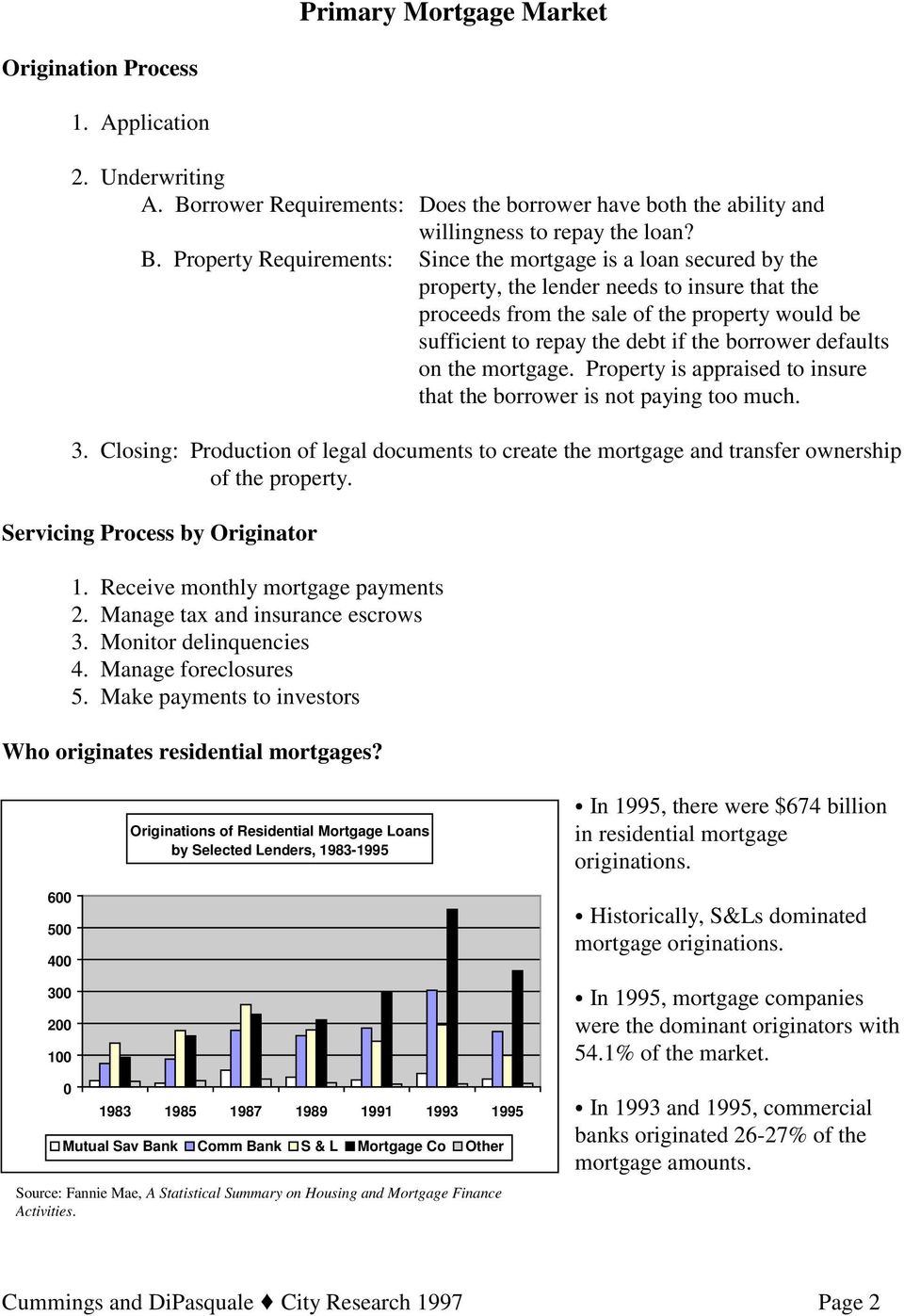
3 Primary Mortgage Market Origination Process 1. Application 2. Underwriting A. Borrower Requirements: Does the borrower have both the ability and willingness to repay the loan? B. Property Requirements: Since the mortgage is a loan secured by the property, the lender needs to insure that the proceeds from the sale of the property would be sufficient to repay the debt if the borrower defaults on the mortgage. Property is appraised to insure that the borrower is not paying too much. 3. Closing: Production of legal documents to create the mortgage and transfer ownership of the property. Servicing Process by Originator 1. Receive monthly mortgage payments 2. Manage tax and insurance escrows 3. Monitor delinquencies 4. Manage foreclosures 5. Make payments to investors Who originates residential mortgages? Originations of Residential Mortgage Loans by Selected Lenders, In 1995, there were $674 billion in residential mortgage originations Mutual Sav Bank Comm Bank S & L Mortgage Co Other Source: Fannie Mae, A Statistical Summary on Housing and Mortgage Finance Activities. Historically, S&Ls dominated mortgage originations. In 1995, mortgage companies were the dominant originators with 54.1% of the market. In 1993 and 1995, commercial banks originated 26-27% of the mortgage amounts. Cummings and DiPasquale City Research 1997 Page 2
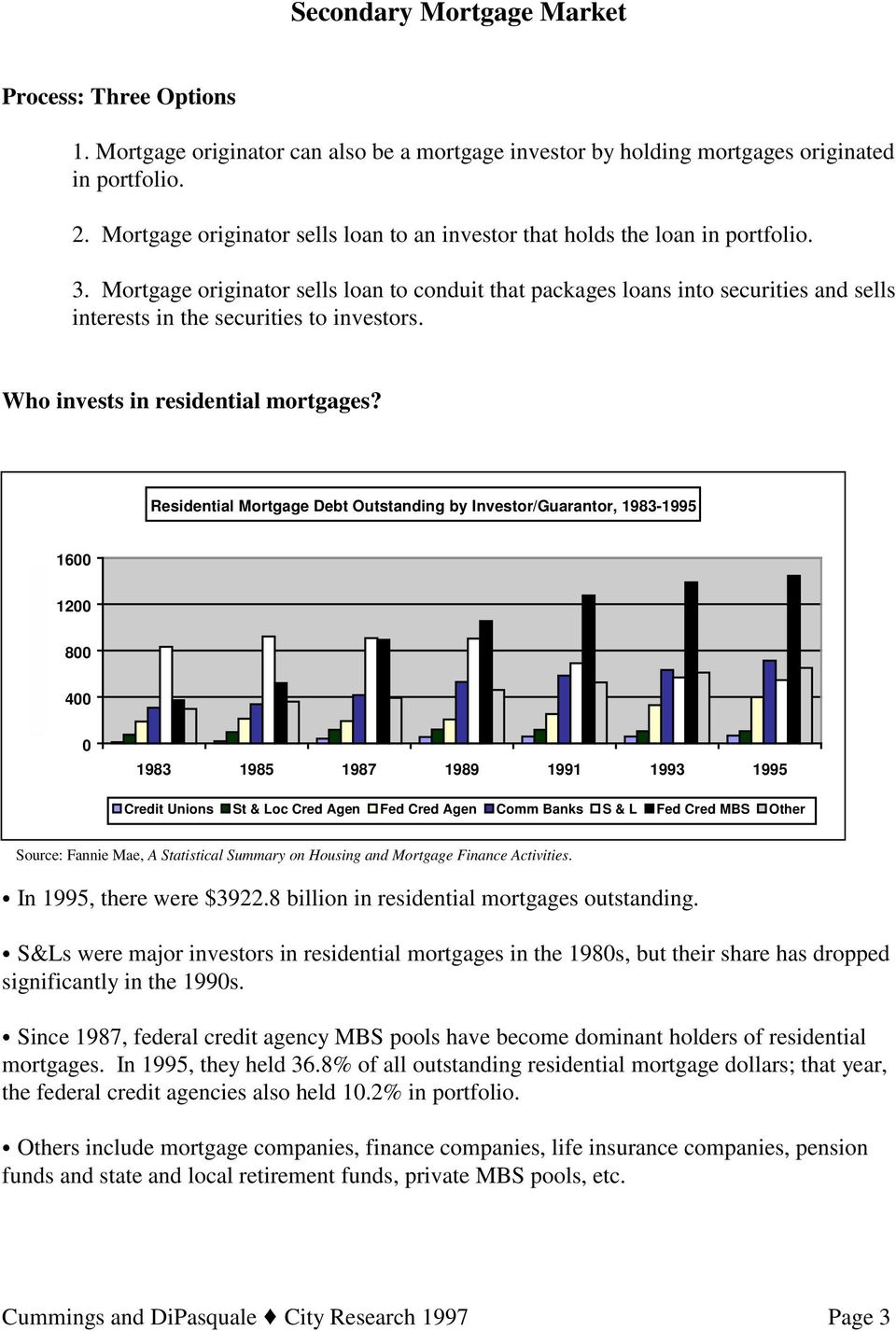
4 Secondary Mortgage Market Process: Three Options 1. Mortgage originator can also be a mortgage investor by holding mortgages originated in portfolio. 2. Mortgage originator sells loan to an investor that holds the loan in portfolio. 3. Mortgage originator sells loan to conduit that packages loans into securities and sells interests in the securities to investors. Who invests in residential mortgages? Residential Mortgage Debt Outstanding by Investor/Guarantor, Credit Unions St & Loc Cred Agen Fed Cred Agen Comm Banks S & L Fed Cred MBS Other Source: Fannie Mae, A Statistical Summary on Housing and Mortgage Finance Activities. In 1995, there were $ billion in residential mortgages outstanding. S&Ls were major investors in residential mortgages in the 1980s, but their share has dropped significantly in the 1990s. Since 1987, federal credit agency MBS pools have become dominant holders of residential mortgages. In 1995, they held 36.8% of all outstanding residential mortgage dollars; that year, the federal credit agencies also held 10.2% in portfolio. Others include mortgage companies, finance companies, life insurance companies, pension funds and state and local retirement funds, private MBS pools, etc. Cummings and DiPasquale City Research 1997 Page 3
5 II. Examining the Secondary Mortgage Market A. Rationale for Secondary Mortgage Market Housing markets are inherently local in nature but financing housing need not be. Mortgage availability should not be a function of local savings; regions that are growing but do not have much savings should be able to get mortgage funding from regions with excess savings. B. Requirements for a Liquid Secondary Mortgage Market 1. Standardization: Mortgages must be a standard commodity regardless of originator. A. Mortgage contracts must meet industry standard. B. Underwriting standards must be similar so that investor knows that mortgages meet an industry standard, regardless of originator. 2. Information about performance and risk: A. Investors require information in order to consider moving into new markets. B. Information must provide basis of comparison for investments in mortgages versus alternative investments. C. Role of the Federal Government in the Secondary Mortgage Market: Building Institutions 1 Federal government role in the operation of the secondary mortgage market began in the 1930s with the creation of Federal Housing Administration (FHA) in FHA was created to encourage homeownership through promoting the 30-year fixed rate mortgage to lenders and investors by insuring these loans. (At the time, the dominant mortgage was a 5 to 7 year balloon.) In 1938, the federal government created the Federal National Mortgage Association (Fannie Mae). Fannie Mae was created to purchase FHA-insured loans. The idea was that mortgage lenders would be more willing to originate the FHA fixed rate mortgage if they did not have to hold them in portfolio. In addition, by selling the mortgages, lenders could fund more mortgages. In 1948, Fannie Mae began purchasing VA mortgages. In 1970, Fannie Mae began purchasing conventional mortgage loans. Fannie Mae s dominant approach was to fund the purchase of mortgages by issuing debt and holding the mortgages in portfolio. 1 See Freddie Mac, A Citizen s Guide to the Secondary Mortgage Market, Cummings and DiPasquale City Research 1997 Page 4

6 In the past 15 years, Fannie Mae has moved much more towards funding mortgage purchases by packaging mortgages into mortgage backed securities (MBS) and selling the securities to investors. In 1968, Fannie Mae was split into two organizations: Fannie Mae, a federally chartered corporation owned by private shareholders, and the Government National Mortgage Association (Ginnie Mae), a government agency housed in the U.S. Department of Housing and Urban Development. Ginnie Mae is responsible for providing a secondary market for FHA/VA loans and other mortgages to support federal housing assistance efforts. Ginnie Mae acts as a conduit that purchases mortgage loans, packages them into securities and sells participation in the securities to investors. Unlike Fannie Mae, Ginnie Mae MBS are guaranteed by the full faith and credit of the U.S. government. The guarantee promises investors that principal and interest due will be paid by Ginnie Mae if not by borrowers. In addition, Ginnie Mae services a portfolio of mortgages owned by the federal government. In 1970, Congress created the Federal Home Loan Mortgage Corporation (Freddie Mac). Freddie Mac was created to provide a secondary mortgage market for conventional mortgages with its focus on providing a secondary market for thrifts. Freddie Mac began with funding from the Federal Home Loan Bank, which served as the central banks for thrifts. Freddie Mac s dominant approach was to purchase mortgages, package them into securities and sell the securities to investors. Historically, Freddie Mac has held very little mortgages in portfolio. D. Today s Mortgage Market: How the Federal Credit Institutions Have Evolved 1. The Institutions FHA FHA promotes affordable homeownership for lower-income households through the provision of mortgage insurance for high loan-to-value loans, decreasing the downpayment required. In 1995, FHA insured 7.1% of the total dollar value of single-family mortgages originated. Over the past two decades, FHA has been the dominant source of mortgage insurance on multifamily mortgages. In the early 1990s, the multifamily programs Cummings and DiPasquale City Research 1997 Page 5

7 Ginnie Mae generated substantial losses resulting in FHA retreating from this market. In recent years, FHA has been working on ways to re-enter the market. In 1995, FHA insured 3.4% of the total dollar value of multifamily mortgages originated, down considerably from the early 1980s when FHA insured close to one-third of multifamily originations. FHA promotes standardization in the mortgage market by setting underwriting standards for the mortgages it insures. Ginnie Mae continues to provide a secondary market for FHA/VA loans by creating a secondary market for its MBS. In 1995, Ginnie Mae s net addition in MBS was $21.4 billion and they had $472.3 billion in MBS outstanding. In 1995, Ginnie Mae purchased 11.1% of single family mortgage originations and 5.7% of multifamily originations. Fannie Mae and Freddie Mac 2 Fannie Mae and Freddie Mac are both federally chartered, private corporations with their stock traded on the New York Stock Exchange. Both firms have Boards of Directors with 18 members, 13 of whom are elected by shareholders and the remaining 5 are appointed by the President of the United States. Both firms purchase single family and multifamily FHA/VA and conventional mortgages to either hold in portfolio or package into mortgage-backed securities to sell to investors. Both are prohibited from originating mortgages. Securities issued by both firms have the guarantee of the issuing firm; there is no federal government guarantee on these securities. In 1995, Fannie Mae held $253.5 billion in mortgages in portfolio and had $513.2 billion in MBS outstanding; Freddie Mac held $106.9 billion in portfolio and had $459 billion in MBS outstanding. The charter acts of both firms impose requirements and provide important benefits to these agencies: Charter Act requirements of Fannie Mae and Freddie Mac: 1. Limits activities to providing a secondary market for residential mortgages. 2 See Freddie Mac, Financing America s Housing: The Vital Role of Freddie Mac, Cummings and DiPasquale City Research 1997 Page 6
8 2. Limits the maximum size of single family mortgages that can be purchased (1996 loan limit was $207,000). 3. Mandates HUD to set annual housing goals. 4. Requires federal monitoring of the corporation s financial condition. Charter Act benefits to Fannie Mae and Freddie Mac: Fannie Mae and Freddie Mac enjoy significant benefits, which give them advantages over other investors, notably: 1. Securities are exempt from registration requirements of the Securities and Exchange Commission. 2. Exempt from state and local income taxes. 3. The Secretary of the U.S. Treasury is authorized to purchase up to $2.25 billion in securities of each firm in order to enhance liquidity. Do Fannie Mae and Freddie Mac Securities Have an Implicit Federal Government Guarantee? There is no explicit guarantee by the federal government of the securities issued by Fannie Mae or Freddie Mac, unlike Ginnie Mae securities. In addition, there is no federal obligation to bail out either corporation if they have financial problems. However, Fannie Mae and Freddie Mac enjoy a substantial benefit because of the widely-held view in the marketplace that in the event of financial problems with either institution the federal government will be there to bail them out. As a result, both firms can borrow at lower rates and their securities carry a AAA rating. E. The Impact on the Market of the Agencies Fannie Mae, Freddie Mac and Ginnie Mae are very large players in the mortgage market. In 1995, there were $3,922.8 billion in residential mortgages outstanding. 46% of that mortgage amount was either held by Fannie Mae and Freddie Mac in portfolio or was in MBS with a guarantee from Fannie Mae, Freddie Mac or Ginnie Mae. In 1995, the three institutions purchased 41% of residential mortgage originations. Cummings and DiPasquale City Research 1997 Page 7

9 What is the economic rationale for supporting Fannie Mae and Freddie Mac? The fundamental aim of government involvement in the provision of a secondary mortgage market is to increase the funding of mortgages through the capital markets, thereby increasing efficiency and ultimately insuring that mortgage credit will be readily available at lower prices. Is there a market failure? An active secondary market requires both standards and information, both of which have attributes of public goods. While the overall market reaps substantial benefits from industry standards and information, no individual firm may have sufficient incentive to produce those standards and information if their production is costly and outweighs the benefits to the individual firm. This is a classic case of market failure where government intervention may be warranted to ensure that these public goods--standards and information--are produced. Have Fannie Mae and Freddie Mac Addressed this Market Failure? The Single Family Market. The traditional focus of the GSEs has been on mortgages for owner-occupied housing. Fannie Mae and Freddie Mac played an important role in developing standards and information in the single family mortgage market. Fannie Mae & Freddie Mac introduced the standard mortgage application in 1973 and the standard mortgage note for all states in These were two important milestones in making mortgages a commodity. Fannie Mae and Freddie Mac mortgage underwriting guidelines are the industry standard. The volume and track record of Fannie Mae & Freddie Mac provide a substantial information base for investors to assess. The Multifamily Market. While their charters cover both single family and multifamily mortgages, Fannie Mae and Freddie Mac contributions to the multifamily mortgage market have been much more limited. Multifamily mortgages are far less standard than single family mortgages. There is little systematic information on the risk and performance of multifamily mortgages for investors to assess. Cummings and DiPasquale City Research 1997 Page 8

10 F. The Multifamily Mortgage Market Who originates multifamily mortgages? Multifamily Mortgage Originations for New and Existing Properties, Mut Sav Bank Comm Bank S&L Life Ins Fed Credit State & Local Credit Mortg Co. Other Source: U.S. Department of Housing and Urban Development, Survey of Mortgage Lending Activity, Annual Tables, table 3. In 1995, there were $39.2 billion of multifamily mortgage originations. In 1985, S&Ls originated 49% of multifamily originations. In 1995, their share was 10%. By 1991, commercial banks were the major originator of multifamily mortgages. In 1995, they were responsible for 59% of the market. Who invests in multifamily mortgages? Multifamily Mortgage Holdings Comm Banks S & L Life Ins Co Fed Cred Agen Mortgage Pools Other Again, S&Ls were major investors, holding 41% of the market in 1987 and 37% in By 1995, their share dropped to 22%. The S&L crisis and the changed risk-based capital requirements of FIRREA in 1989 severely limited the extent to which S&Ls could invest in some mortgages. Source: Board of Governors of the Federal Reserve System. In 1995, 33% of mortgage holdings were held by others, about two-thirds of which were state and local credit agencies. The rest include mortgage companies, retirement and pension funds, credit unions and finance companies, and individuals. Cummings and DiPasquale City Research 1997 Page 9

11 Of the $288 billion in multifamily mortgages outstanding in 1995, 12.3% was either held by Fannie Mae and Freddie Mac in portfolio or was in MBS with a guarantee from Fannie Mae and Freddie Mac. Fannie Mae accounted for 10% and Freddie Mac accounted for 2.3%. Ginnie Mae MBS accounted for an additional 3.8% of multifamily mortgage debt outstanding. In contrast, Fannie Mae, Freddie Mac, and Ginnie Mae portfolio holdings accounted for 48.2% of the $3,634 billion in single family mortgages outstanding. Virtually all single family mortgages originated are purchased in the secondary market. In 1995, 40.5% of multifamily mortgages were purchased in the secondary market. Should Fannie Mae and Freddie Mac Have Greater Multifamily Activity? The multifamily secondary mortgage market is in the early stages of development. There is a clear need for leadership in the multifamily market in creating standards. It could be argued that today there is more of a rationale for government sponsorship of Fannie Mae and Freddie Mac to intervene in the multifamily mortgage market than in the single family market. In many ways, the goals of creating standards and an information base have already been achieved in the single-family market. Cummings and DiPasquale City Research 1997 Page 10
Chapter 10. The Good Old Days. The New Way. Secondary Markets. Depository Lenders in the Primary Market. Nondepository Lenders in the Primary Market
 The Good Old Days Chapter 10 The Secondary Mortgage Market Banks and Savings and Loans made loans and held these loans in portfolio The interest paid on the loan was use to pay interest to the depositors
6/18/2015. Sources of Funds for Residential Mortgages
 Sources of Funds for Residential Mortgages McGraw-Hill/Irwin Copyright 2013 by The McGraw-Hill Companies, Inc. All rights reserved. 11-2 11-3 11-4 Formerly backbone of home mortgage finance Dominated mortgage
HUD s AFFORDABLE LENDING GOALS FOR FANNIE MAE AND FREDDIE MAC
 Issue Brief HUD s AFFORDABLE LENDING GOALS FOR FANNIE MAE AND FREDDIE MAC Fannie Mae and Freddie Mac, government-sponsored enterprises (GSEs) in the secondary mortgage market, are the two largest sources
Answers to Chapter 7 Questions
 Answers to Chapter 7 Questions 1. Mortgage markets are examined separately from bond and stock markets for several reasons. First, mortgages are backed by a specific piece of real property. If the borrower
Mortgages and Mortgage -Backed Securiti curi es ti Mortgage ort gage securitized mortgage- backed securities (MBSs) Primary Pri mary Mortgage Market
 Mortgages and Mortgage-Backed Securities Mortgage Markets Mortgages are loans to individuals or businesses to purchase homes, land, or other real property Many mortgages are securitized Many mortgages
Assumable mortgage: A mortgage that can be transferred from a seller to a buyer. The buyer then takes over payment of an existing loan.
 MORTGAGE GLOSSARY Adjustable Rate Mortgage (ARM): A mortgage loan with payments usually lower than a fixed rate initially, but is subject to changes in interest rates. There are a variety of ARMs that
Overview of Mortgage Lending
 Chapter 1 Overview of Mortgage Lending 1 Chapter Objectives Identify historical events affecting today s mortgage industry. Contrast the primary mortgage market and secondary mortgage market. Identify
Opening Doors For Muslim Families In America
 Fe r d de i M a c We Open Doors Opening Doors For Muslim Families In America Saber Salam Vice President, Freddie Mac April 2002 Introduction The dream of homeownership is at the core of American society.
Unit 1 Overview of the Mortgage Markets
 Unit 1 Overview of the Mortgage Markets Introduction The interaction between the primary and secondary mortgage markets is the foundation of the mortgage lending process and is an essential part of our
Chapter 45. Primary and Secondary Mortgage Markets INTRODUCTION
 Chapter 45 Primary and Secondary Mortgage Markets INTRODUCTION The primary mortgage market brings prospective borrowers (market demand) together with individuals, agencies and entities that have money
MORTGAGE BANKING TERMS
 MORTGAGE BANKING TERMS Acquisition cost: Add-on interest: In a HUD/FHA transaction, the price the borrower paid for the property plus any of the following costs: closing, repairs, or financing (except
Chapter 13: Residential and Commercial Property Financing
 Chapter 13 Outline / Page 1 Chapter 13: Residential and Commercial Property Financing Understanding the Mortgage Concept - secured vs. unsecured debt - mortgage pledge of property to secure a debt (See
A LEADER IN MULTIFAMILY AND HEALTHCARE LENDING
 A LEADER IN MULTIFAMILY AND HEALTHCARE LENDING Greystone will work hard to help you accomplish your financial needs. We will use our creativity, drive and passion to deliver unparalleled business solutions
Q & A with Lykken on Lending Team and Glen Corso
 Blog Talk Radio Show July 12, 2010 Q & A with Lykken on Lending Team and Glen Corso General Questions Q: Throughout the MBA analysis of this legislation the term loan originator is used. Sometimes it seems
Chapter 17. Financial Management and Institutions
 Chapter 17 Financial Management and Institutions 1 2 3 4 Identify the functions performed by a firm s financial managers. Describe the characteristics and functions of money. Identify the various measures
NCSHA Conference Washington, DC. Ted Tozer January 16, 2014
 NCSHA Conference Washington, DC Ted Tozer January 16, 2014 0 Overview U.S. Government-owned corporation within HUD Guarantee Mortgage-Backed Securities (MBS), which raise funding for virtually all loans
Lecture Notes on MONEY, BANKING, AND FINANCIAL MARKETS. Peter N. Ireland Department of Economics Boston College. [email protected]
 Lecture Notes on MONEY, BANKING, AND FINANCIAL MARKETS Peter N. Ireland Department of Economics Boston College [email protected] http://www2.bc.edu/~irelandp/ec261.html Chapter 2: An Overview of the Financial
Mortgage Lending Basics
 Welcome to PMI s On Demand Training Bootcamp Mortgage Lending Basics PRESENTED BY PMI MORTGAGE INSURANCE CO. Introduction to Mortgage Lending Course Overview Mortgage Lending Basics Origination Process
Financing Residential Real Estate: SAFE Comprehensive 20 Hours
 Financing Residential Real Estate: SAFE Comprehensive 20 Hours COURSE ORGANIZATION and DESIGN Roy L. Ponthier, Ph.D., Ed.D., CDEI, DREI Executive Director Module 1: Finance and Investment Mortgage loans
Summary of the Housing and Economic Recovery Act of 2008
 Summary of the Housing and Economic Recovery Act of 2008 On July 30, President Bush signed major housing legislation, HR 3221, the Housing and Economic Recovery Act of 2008. The bill restructures regulation
GLOSSARY COMMONLY USED REAL ESTATE TERMS
 GLOSSARY COMMONLY USED REAL ESTATE TERMS Adjustable-Rate Mortgage (ARM): a mortgage loan with an interest rate that is subject to change and is not fixed at the same level for the life of the loan. These
MORTGAGE BACKED SECURITIES
 MORTGAGE BACKED SECURITIES A Mortgage-Backed Security is created when the issuing Agency purchases a number of investment quality residential home mortgages from various banks, thrifts, or mortgage companies.
Mortgage lending is a profession that requires knowledge of
 1 C h a p t e r 1 An Overview of Mortgage Lending In This Chapter Mortgage lending is a profession that requires knowledge of many disciplines, including real estate, finance, appraisal, and others to
CHAPTER 3: LENDER APPROVAL 7 CFR 3555.51
 3.1 INTRODUCTION CHAPTER 3: LENDER APPROVAL 7 CFR 3555.51 A lender is defined as an entity that originates, services, or holds a loan guaranteed by the Agency. The SFHGLP is not intended to promote risky
Community Investments Vol. 15, Issue 2 Ginnie Mae Project Loans Maintain Affordability
 Community Investments Vol. 15, Issue 2 Ginnie Mae Project Loans Maintain Affordability August 2003 Introduction Multifamily mortgage-backed securities issued by Ginnie Mae offer investors the opportunity
Mortgage-Related Securities
 Raymond James Michael West, CFP, WMS Vice President Investments 101 West Camperdown Way Suite 600 Greenville, SC 29601 864-370-2050 x 4544 864-884-3455 [email protected] www.westwealthmanagement.com
Mortgage Terms Glossary
 Mortgage Terms Glossary Adjustable-Rate Mortgage (ARM) A mortgage where the interest rate is not fixed, but changes during the life of the loan in line with movements in an index rate. You may also see
Making Home Affordable Updated Detailed Program Description
 Making Home Affordable Updated Detailed Program Description The deep contraction in the economy and in the housing market has created devastating consequences for homeowners and communities throughout
An Overview of Fannie Mae s Multifamily Mortgage Business
 An Overview of Fannie Mae s Multifamily Mortgage Business As of May 1, 2012 EXECUTIVE SUMMARY This Overview describes the core components of Fannie Mae s Multifamily Mortgage Business ( Multifamily ).
GLOSSARY OF TERMS. Amortization Repayment of a debt in regular installments of principal and interest, rather than interest only payments
 GLOSSARY OF TERMS Ability to Repay (ATR) The Ability to Repay rule protects consumers from taking on mortgages that exceed their financial means, by mandating the documentation / proof of income and assets.
BORROWER Q&AS. 2. I'm current on my mortgage. Will the Home Affordable Refinance help me?
 MAKING HOME AFFORDABLE BORROWER Q&AS 1. What is Making Home Affordable" all about? Making Home Affordable is part of President Obama's comprehensive strategy to get the housing market back on track. Through
STAFF REPORT: ENHANCING DISCLOSURE IN THE MORTGAGE-BACKED SECURITIES MARKETS
 Department of Office of Federal Housing Securities and Exchange the Treasury Enterprise Oversight Commission STAFF REPORT: ENHANCING DISCLOSURE IN THE MORTGAGE-BACKED SECURITIES MARKETS A Staff Report
Mortgage-backed Securities
 MÄLARDALEN UNIVERSITY PROJECT DEPARTMENT OF MATHEMATICS AND PHYSICS ANALYTICAL FINANCE, MT 1411 TEACHER: JAN RÖMAN 2004-12-16 Mortgage-backed Securities GROUP : CAROLINA OLSSON REBECCA NYGÅRDS-KERS ABSTRACT
Appraiser: a qualified individual who uses his or her experience and knowledge to prepare the appraisal estimate.
 Mortgage Glossary 203(b): FHA program which provides mortgage insurance to protect lenders from default; used to finance the purchase of new or existing one- to four family housing; characterized by low
Sales Associate Course
 Sales Associate Course Chapter Thirteen Types of Mortgages & Sources of Finance Copyright Gold Coast Schools 1 Types of Mortgages FHA - Federal Housing Administration VA - Veterans Administration Conventional
Re: HUD Office of Inspector General (OIG Phoenix Office) Audit - NOVA Home Loans/HFA Programs
 June 8, 2015 Ms. Kathleen Zadareky Deputy Assistant Secretary Office of Single Family Housing U.S. Department of Housing and Urban Development 451 7 th Street, S.W. Washington, DC 20410 Re: HUD Office
Financing Residential Real Estate
 Financing Residential Real Estate Chapter 1: Finance and Investment Borrowing Money to Buy a Home Investments and Returns Types of Investments Ownership Investments Debt Investments Securities Investment
Table of Contents. Table of Contents... 1. Chapter 1 Introduction... 4. 1.1 Goals and Objectives... 4 1.2 Required Review... 5 1.3 Applicability...
 ... 1 Chapter 1 Introduction... 4 1.1 Goals and Objectives... 4 1.2 Required Review... 5 1.3 Applicability... 5 Chapter 2 Accountability and Monitoring... 6 2.1 Internal Controls... 6 2.2 Monitoring Underwriters...
SECOND MIDTERM EXAM EC26102: MONEY, BANKING AND FINANCIAL MARKETS FEBRUARY 25, 2004
 SECOND MIDTERM EXAM EC26102: MONEY, BANKING AND FINANCIAL MARKETS FEBRUARY 25, 2004 This exam has 25 questions on five pages. Before you begin, please check to make sure that your copy has all 25 questions
Federal Housing Finance Agency
 Fourth Quarter 20 FHFA Federal Property Manager's Report This report contains data on foreclosure prevention activity, refinance and MHA program activity of Fannie Mae and Freddie Mac (the Enterprises)
Lesson 13: Applying for a Mortgage Loan
 1 Real Estate Principles of Georgia Lesson 13: Applying for a Mortgage Loan 2 Choosing a Lender Types of lenders Types of lenders include: savings and loans commercial banks savings banks credit unions
APPENDIX IV-10 FORM HUD 1731 - PROSPECTUS GINNIE MAE I MORTGAGE-BACKED SECURITIES (CONSTRUCTION AND PERMANENT LOAN SECURITIES)
 GINNIE MAE 5500.3, REV. 1 APPENDIX IV-10 FORM HUD 1731 - PROSPECTUS GINNIE MAE I MORTGAGE-BACKED SECURITIES (CONSTRUCTION AND PERMANENT LOAN SECURITIES) Applicability: Purpose: Prepared by: Prepared in:
A BRIEF HISTORY OF THE HOUSING GOVERNMENT-SPONSORED ENTERPRISES
 A BRIEF HISTORY OF THE HOUSING GOVERNMENT-SPONSORED ENTERPRISES A Brief History of the Housing Government-Sponsored Enterprises The housing Government-Sponsored Enterprises (GSEs) have a long history.
Glossary of Foreclosure Fairness Mediation Terminology
 Glossary of Foreclosure Fairness Mediation Terminology Adjustable-Rate Mortgage (ARM) Mortgage repaid at the rate of interest that increases or decreases over the life of the loan based on market conditions.
I. Introduction. II. Financial Markets (Direct Finance) A. How the Financial Market Works. B. The Debt Market (Bond Market)
 University of California, Merced EC 121-Money and Banking Chapter 2 Lecture otes Professor Jason Lee I. Introduction In economics, investment is defined as an increase in the capital stock. This is important
Reference: Suggested Technical Correction Language for Return of Accounts Provision
 Mr. Matthew Esposito Assistant Director Financial Accounting Standards Board 401 Merritt 7 P.O. Box 5116 Norwalk, CT 06856-5116 [email protected] Reference: Suggested Technical Correction Language for
Questions and Answers for Borrowers about the. Homeowner Affordability and Stability Plan
 Questions and Answers for Borrowers about the Homeowner Affordability and Stability Plan Borrowers Who Are Current on Their Mortgage Are Asking: 1. What help is available for borrowers who stay current
MULTIFAMILY FINANCE REFORM: MOVING TO A SOLUTION IN 2013
 MULTIFAMILY FINANCE REFORM: MOVING TO A SOLUTION IN 2013 June 24, 2013 Table of Contents Draft for Discussion Only Section Title Page 1 Proposal 3 2 Multifamily Transition 6 3 Appendix 15 Page : 2 Section
An Introduction to Multifamily Agency Mortgage-Backed Securities: Attributes, Issuers and Opportunities. May 2012
 An Introduction to Multifamily Agency Mortgage-Backed Securities: Attributes, Issuers and Opportunities May 2012 Attributes Many economists expect multifamily construction to increase considerably in 2012
Financing Residential Real Estate. Lesson 12: VA-Guaranteed Loans
 Financing Residential Real Estate Lesson 12: VA-Guaranteed Loans Introduction In this lesson we will cover: characteristics of VA loans, eligibility requirements, VA guaranty, VA loan amounts, and underwriting
HOME AFFORDABLE MODIFICATION PROGRAM BASE NET PRESENT VALUE (NPV) MODEL SPECIFICATIONS
 Overview HOME AFFORDABLE MODIFICATION PROGRAM BASE NET PRESENT VALUE (NPV) MODEL SPECIFICATIONS As a part of the Making Home Affordable Program, we are providing standardized guidance and a base net present
GLOSSARY OF INVESTMENT-RELATED TERMS FOR NATIONAL ELECTRICAL ANNUITY PLAN PARTICIPANTS
 GLOSSARY OF INVESTMENT-RELATED TERMS FOR NATIONAL ELECTRICAL ANNUITY PLAN PARTICIPANTS General Information This Glossary of Investment-Related Terms for National Electrical Annuity Plan Participants (the
A COMPARATIVE ANALYSIS OF FHLBANK MEMBER MORTGAGE LENDING
 A COMPARATIVE ANALYSIS OF FHLBANK MEMBER MORTGAGE LENDING February 25, 2005 Marsha J. Courchane Senior Economist Welch Consulting & Darcy Steeg Associate Economist Welch Consulting Abstract Our study uses
V600 Introduction to Mortgage Lending. Robin J Wybenga, CFO, TBA Credit Union [email protected] 231.946.7090
 V600 Introduction to Mortgage Lending Robin J Wybenga, CFO, TBA Credit Union [email protected] 231.946.7090 Introduction Objectives 1. Identify the key benefits your CU gains by offering real estate lending
Statement of. David Hehman President and CEO Federal Home Loan Bank of Cincinnati. Before the. House Financial Services Committee
 Statement of David Hehman President and CEO Federal Home Loan Bank of Cincinnati Before the House Financial Services Committee September 25, 2003 Mr. Chairman, Ranking Member Frank, and Members of the
Securitizing Reperforming Loans into Agency Mortgage Backed Securities: A Program Primer
 Securitizing Reperforming Loans into Agency Mortgage Backed Securities: A Program Primer Fannie Mae recently announced plans to securitize single-family, fixed-rate reperforming loans (RPLs) into Agency
Title XIV - Mortgage Reform and Anti-Predatory Lending Act. Short title: "Mortgage Reform and Anti-Predatory Lending Act"
 Title XIV - Mortgage Reform and Anti-Predatory Lending Act Short title: "Mortgage Reform and Anti-Predatory Lending Act" Subtitles A, B, C, and E are designated as Enumerated Consumer Law under the Bureau
FOR IMMEDIATE RELEASE November 7, 2013 MEDIA CONTACT: Lisa Gagnon 703-903-3385 INVESTOR CONTACT: Robin Phillips 571-382-4732
 FOR IMMEDIATE RELEASE MEDIA CONTACT: Lisa Gagnon 703-903-3385 INVESTOR CONTACT: Robin Phillips 571-382-4732 FREDDIE MAC REPORTS PRE-TAX INCOME OF $6.5 BILLION FOR THIRD QUARTER 2013 Release of Valuation
FHLBanks: The Basics. For more information, visit www.fhlbanks.com.
 FHLBanks: The Basics For more information, visit www.fhlbanks.com. The Federal Home Loan Banks (FHLBanks) are 11 private, wholesale banks regionally based throughout the U.S. They are cooperatively owned
A Presentation On the State of the Real Estate Crisis 1/30/2009
 A Presentation On the State of the Real Estate Crisis 1/30/2009 Presented by Mike Anderson, CRMS President, Essential Mortgage, a Latter & Blum Realtors Company Immediate past president/legislative Chair
Sun West Overview. Privately Held Flexibility to respond to Customers needs. CONFIDENTIAL Sun West Mortgage Company, Inc.
 Sun West Overview Headquartered in Cerritos, California - Sun West has been serving our nationwide client base since 1980. Our diversified loan program experience includes FHA Single Family, FHA Reverse
S. 3085 Responsible Homeowner Refinancing Act of 2012
 CONGRESSIONAL BUDGET OFFICE COST ESTIMATE August 24, 2012 S. 3085 Responsible Homeowner Refinancing Act of 2012 As introduced in the United States Senate on May 10, 2012 SUMMARY The Home Affordable Refinance
Statement of Edward L. Golding Senior Vice President Economics and Policy Freddie Mac
 Statement of Edward L. Golding Senior Vice President Economics and Policy Freddie Mac Hearing of the Philadelphia, PA Chair Warren and members of the, thank you for inviting me to speak today. I am Edward
Principal Lending Manager Education Curriculum Outline 40 Hours
 Principal Lending Manager Education Curriculum Outline 40 Hours Utah Division of Real Estate PO Box 146711 Salt Lake City, UT 84114-6711 Subject Matter Number of Hours 1. General Mortgage Industry Knowledge
Special Purpose Entities (SPEs) and the. Securitization Markets
 Special Purpose Entities (SPEs) and the Securitization Markets Prepared by: The Bond Market Association International Swaps & Derivatives Association Securities Industry Association February 1, 2002 Special
HMBS Overview. Ginnie Mae s Program to Securitize Government Insured Home Equity Conversion Mortgages
 HMBS Overview Ginnie Mae s Program to Securitize Government Insured Home Equity Conversion Mortgages Table of Contents Tab A: Program Overview Tab B: Home Equity Conversion Mortgage (HECM) Trends Tab C:
Government National Mortgage Association
 Prospectus Supplement (To Base Prospectus dated July 1, 2011) [Fixed Rate Collateral] Government National Mortgage Association $35,728,686.00 4.500 Ginnie Mae II Home Equity Conversion Mortgage-Backed
CHAPTER 7: APPLICATION FOR APPROVAL AS A GINNIE MAE ISSUER
 7-1: OVERVIEW OF CHAPTER 7-2: APPLICATION PROCEDURE (A) Application Connection (B) Ginnie Mae Online University This chapter describes the application procedures for requesting approval as a Ginnie Mae
 1 Regional Bank Regional banks specialize in consumer and commercial products within one region of a country, such as a state or within a group of states. A regional bank is smaller than a bank that operates