
Deep Brain Stimulation(DBS)
|
|
|
- Godfrey Hunt
- 9 years ago
- Views:
Transcription
1 Deep Brain Stimulation(DBS) Vancouver General Hospital 899 West 12th Avenue Vancouver BC V5Z 1M9 Tel:

2 What is Deep Brain Stimulation? Deep Brain Stimulation is an operation where an electrode is implanted in the brain and used to modulate the region of the brain causing unwanted symptoms. There are three parts of the system: a. An electrode (or lead) in the desired brain region b. An implantable neural stimulator (INS or pacemaker) placed usually in the chest to power the DBS c. An extension (or wire) connecting the lead to the pacemaker Indications for Surgery 1. Thalamic DBS for: a. Essential (Familial) tremor b. Parkinson s tremor c. Multiple sclerosis (MS) tremor 2. Globus Pallidum DBS for: a. Dystonia. b. Parkinson s Disease with dyskinesia. 3. Subthalamic Nucleus DBS for Parkinson s disease with fluctuating symptoms (i.e. medications produce good movement but wear off before the next dosage kicks in ). 4. Other targets are used for: a. Pain b. Depression c. Epilepsy d. Headache Risks There is a rare chance (<1%) of death or stroke causing severe disability (e.g. paralysis, dementia or coma), and a low chance (5%) of infection or malfunction. Specific risks are unique to each target and must be reviewed with your neurosurgeon. Preparing for Surgery Before Admission 1. Medications Anticoagulants and other medications that thin your blood such as Aspirin, Coumadin (Warfarin), Lovenox (Enoxaparin), Ticlid (Ticlopidine), Plavix (Clopidogrel) and Ginkgo must be discontinued 2 weeks before your surgery. Pradaxa (Dabigatran), Xarelto (Rivaroxaban) and Eliquis (Apixaban) must be discontinued 5 days before your surgery. 2. MRI Scan Inform your neurosurgeon if you have any metal fragments in your body, are claustrophobic or have a pacemaker. These conditions will not permit you to undergo a MRI scan, which is used to localize the target for your surgery. Your neurosurgeon will order a CT scan if an MRI is contraindicated. 3. Music You can bring your favourite music to the operation on a CD. Please leave it with us for future patients. 4. Hair Do not shave your head before surgery. 1 2

3 Admission to Hospital For Subthalamic Nucleus Deep Brain Stimulation: Your surgeon s office will contact you the day before your scheduled surgery to confirm the time to report to the Jim Pattison Pavilion Admitting Department the afternoon before the day of surgery. If you are being admitted on a Monday or a Tuesday following a long weekend, please call the Admitting Department of Vancouver Hospital at after 10:00 a.m. on the day before your operation to find out when you are to come to the hospital on the day of surgery. For Thalamic Deep Brain Stimulation: (Pre-Admission Clinic) You will be admitted to hospital on the day of your operation. Your preparation will take place in the Pre- Admission Clinic before the day of surgery. The Clinic will contact you to arrange your appointment. Your surgeon s office will contact you the day before your scheduled surgery to confirm the time to report to the Jim Pattison Pavilion Admitting Department on the morning of surgery. If you are being admitted on a Monday or a Tuesday following a long weekend, please call the Admitting Department of Vancouver Hospital at after 10:00 a.m. on the day before your operation to find out when you are to come to the hospital on the day of surgery. The Night Before Surgery Whether you are in the hospital or at home, your preparation for surgery the night before is the same. Before going to bed, shower and shampoo with a medicated soap (from pharmacy) that will help prevent infection. Do not eat food or drink alcohol after midnight the night before your surgery. Although you may drink clear fluids after midnight you should not have anything by mouth for the 3 hours before your arrival at the hospital. Clear fluids include apple juice, clear coffee and tea (no cream or sugar), water, jello. Do not drink citrus juice such as orange juice. The Morning of Surgery You will have an intravenous (IV) line started in your arm. This IV line will provide you with fluids that you would normally get from drinking. You will be given all your medications (e.g. blood pressure pills) with a sip of water. You must NOT take your Parkinson s Disease medication after midnight if you are having STN or Pallidum DBS. For Pallidum Deep Brain Stimulation: Ask your surgeon s office if you will be admitted the day before or on the day of surgery and follow instructions above. 3 4

4 The X-Ray Department When it is time for your surgery, hospital escort will take you on a stretcher to the x-ray department where your neurosurgeon will attach a frame securely to your head. The head frame (see photograph) is a metal ring with four posts attached. The purpose of the head frame is to hold your head still and to help the neurosurgeon precisely localize the brain target. Your scalp will be cleaned at four points and injected with a local anaesthetic (freezing). You will feel a pinprick. Once the freezing takes effect, the frame is placed around your head. Four pins will be placed to anchor the head frame to the bone of your head where you were given the freezing. Patients usually feel a tight squeeze for a minute or two and then do not feel the frame. The small pins only go a short distance into the head bone. The lightweight ring will form a circle around your head. You will wear this frame until the end of your surgery. Once the frame is secured, you will have a MRI or CT scan. Following the scan you will be taken to the operating Room. The Operating Room Hospital escort will take you to the Perioperative Care Centre (PCC). A nurse will admit you and you will wait there on the stretcher until the operating room is ready. A family member or friend may wait with you in the PCC. The nurse who will care for you during your operation will take you to the operating room. Your operation will be performed by a neurosurgical Team. This will be Dr. Honey together with one or more Neurosurgical Fellows (qualified neurosurgeons receiving additional training in this type of surgery). You will lie comfortably on the table with your head secured to prevent any movement during surgery. A small patch of hair will be shaved and the area cleansed with antiseptic. Your neurosurgeon will inject local anaesthetic (freezing) into your scalp. Once the freezing has taken effect, a small incision will be made in your scalp and a tiny hole drilled in the bone. You will hear the sound of the drill but you will not experience any pain. Most patients find the drilling stressful (but painless) and it lasts a minute or two. Your neurosurgeon will then lower an electrode down to the target site. You cannot feel this. In order to be certain he is in the precise target location, small pulses of electricity will be sent out of the tip of the electrode. He will then assess the effects of the stimulation, e.g. does the tremor stop or do you see flashing lights? or can you feel tingling or tightness in your face? Once the target is confirmed, the DBS electrode will be implanted in the target site. 5 6

5 Implanting the Neural Stimulator The implantable neural stimulator (INS) will be implanted after placement of the DBS electrode during the second stage of the procedure. You will be given a general anaesthetic and will be deeply asleep. A small pocket under the skin below the collarbone will be made for the INS and a wire from the DBS electrode will be tunneled under the skin of the neck and connected to it. The lead delivers mild electrical pulses to the brain. The extension connects the lead and the INS. The Recovery Room After your operation, you will be taken to the Recovery Room. You will stay there for an average of 1-2 hours. Your blood pressure (BP), pulse, level of consciousness, and motor strength will be monitored. Your nurses will be assessing your motor strength by asking you to do certain tasks such as wiggling your toes, pushing down and pulling back with your feet, and squeezing the nurse s fingers with your hands. Your nurses will check your level of consciousness by asking such questions as: your name, the date, the year, and where you are. They will also check your eyes with a small flashlight to see what size your pupils are and if they react to light. The Nursing Unit From the Recovery Room, you will be taken to the Nursing Unit. Your nurse will admit you and continue to assess you regularly just as in the Recovery Room. 7 The implantable neural stimulator (INS) sits under the skin near the collar DBS implanted in left side of brain to control symptoms on right side of body. Discharge Your neurosurgeon will discharge you within 1-2 days of your surgery. You should not do any strenuous activities for 6 weeks. Swelling of your eyelid on the side of your surgery several days after surgery is common. You will have one or two bandages on the top of your head, one behind your ear and one on your chest. Stitches: DON T TOUCH THEM. Please make an appointment with your family doctor to have the stitches removed 10 days after your surgery. You may wash your hair and bathe or shower the day after the stitches are removed. If you experience fever, chills, sweats or notice any redness, swelling or discharge from your incisions, please call your neurosurgeon s office immediately. 8

6 Follow Up Appointment Your office visit 6-8 weeks after surgery will be coordinated by the DBS Clinic Nurse. Call the DBS Clinic for an appointment at ext Turning on the Stimulator The stimulator is usually turned on 6-8 weeks after surgery once all the swelling from the operation has resolved. Adjustments to the stimulator can be made as necessary to improve control of your symptoms. The timing of the adjustments varies between patients. It may take a few weeks or up to 6 months until the stimulator is fully adjusted. Turning on the stimulator and adjustments to the settings will take place in the DBS Clinic. Commonly Asked Questions 1. Do neurosurgeons routinely perform this operation? Vancouver General Hospital is the only centre in B.C. performing this surgery. The Neurosurgery Team has performed over 400 cases (as of 2012). 2. Do I stop my medication before surgery? a) Anticoagulants and other medications that thin your blood such as Aspirin, Coumadin (Warfarin), Lovenox (Enoxaparin), Ticlid (Ticlopidine), Plavix (Clopidogrel) and Ginkgo must be discontinued 2 weeks before your surgery. Pradaxa (Dabigatran), Xarelto (Rivaroxaban) and Eliquis (Apixaban) must be discontinued 5 days before your surgery. b) Anticoagulants and blood thinners can be restarted two weeks after surgery. c) Parkinson s medication may be stopped the night before surgery. d) Most others medications (e.g. blood pressure) should be continued. Patient Programmer Your stimulator is turned on and off with a remote control device. You will be given the device as well as an information booklet and instructions on how to use it at your first DBS Clinic visit after the surgery. 3. Is the procedure painful? No. The scalp is frozen with local anesthetic and the small hole in the skull should be painless. 4. Will I be awake for the procedure? Yes. During placement of the electrode you will be awake to help the neurosurgeon find exactly the right target. During stage two, placement of the INS, you will be asleep. 5. Is the operation a cure? No. It is designed to control specific symptoms. 6. Does everyone get better? In our last survey of 50 consecutive patients, 90% of patients reported the operation was a success. 9 10

7 7. Will the surgery interfere with other treatments? No, it should not. You must NOT have a MRI after surgery without telling your doctor and the MRI technician. 8. How does the hole(s) in my head heal? They are small, the size of a dime. The hole is filled with a plastic cap to hold the electrode in place. 9. When can I wash or dye my hair? The day after the stitches come out. 10. How big is the Implantable Neural Stimulator? About the size of a pocket watch. The INS for two sided procedures (left and right brain) is bigger. 11. How are the adjustments made to the stimulator? In the DBS Clinic, the nurse or doctor can change the settings through your shirt with a telemetry device. 12. How long will the benefits last? That depends on how fast your disease is changing. The battery will last 2-4 years on average depending on how strong a current is needed to control your symptoms. 13. What about airport security? Tell security you have a pacemaker. They will screen you separately (like the heart pacemaker patients). For more copies, go online at or [email protected] and quote Catalogue No. FM.480.D36 Vancouver Coastal Health, August 2012 The information in this document is intended solely for the person to whom it was given by the health care team.

Pallidotomy and Thalamotomy
 Pallidotomy and Thalamotomy Vancouver General Hospital 899 West 12th Avenue Vancouver BC V5Z 1M9 Tel: 604-875-4111 This booklet will provide information about the following surgical procedures: Pallidotomy
SO, YOU ARE HAVING DBS SURGERY?
 SO, YOU ARE HAVING DBS SURGERY? This resource is for Awake Deep Brain Stimulation (DBS) patients. Welcome to Brigham and Women s Hospital and the Deep Brain Stimulation (DBS) Program Serving patients in
Ultrasound or Computed Tomography. PATIENT GUIDE and PREPARATION. Liver Biopsy
 Ultrasound or Computed Tomography PATIENT GUIDE and PREPARATION Liver Biopsy What is a Liver Biopsy? A Liver Biopsy is a procedure that involves taking a specimen ( a small amount of tissue) from within
Cataract Information for Patients
 Cataract Information for Patients http://www.gov.pe.ca/health and click on Wait Times tab Page 1 What is a Cataract? A cataract is a clouding of the eye s naturally clear lens. When the lens becomes cloudy,
Electroconvulsive Therapy ECT and Your Mental Health
 Electroconvulsive Therapy ECT and Your Mental Health Mental Health and Addictions Program St. Joseph s Healthcare Hamilton Charlton Campus 50 Charlton Avenue East Hamilton, Ontario 905-522-1155 ext. 33684
Preparing for your Surgery:
 Preparing for your Surgery: Information for Patients Undergoing a: UHN Minimally Invasive Radical Hysterectomy Possible removal of one or both ovaries and tubes Possible removal of pelvic lymph nodes Patient
Ultrasound. PATIENT GUIDE and PREPARATION. Thoracentesis
 Ultrasound PATIENT GUIDE and PREPARATION Thoracentesis What is a Thoracentesis? A Thoracentesis is a procedure that involves using a needle to drain fluid from either within the lungs or the surrounding
The degree of liver inflammation or damage (grade) Presence and extent of fatty liver or other metabolic liver diseases
 ilearning about your health Liver Biopsy www.cpmc.org/learning What is a Liver Biopsy? A liver biopsy is a procedure where a specially trained doctor (typically a hepatologist, radiologist, or gastroenterologist)
What You Need to Know About Your Nephrostomy Tube
 What You Need to Know About Your Nephrostomy Tube Information for patients and families UHN Read this information to learn about: what a nephrostomy tube is and why you may need one how to prepare for
FORSTER EYE SURGERY Dr. Geoffrey Whitehouse MBBS(Syd) FRANZCO
 GETTING ORGANISED FOR SURGERY 1. BOOKING INTO THE HOSPITAL Once a date has been set for your surgery, you will need to be booked into the hospital. You will have been supplied with an admission form including
Endovascular Abdominal Aortic Aneurysm Repair Surgery
 Endovascular Abdominal Aortic Aneurysm Repair Surgery You are scheduled for an admission to Cooper University Hospital for Endovascular Abdominal Aortic Aneurysm surgery (EVAR). Please read this handout,
Living With Your Pacemaker
 2012 Living With Your Pacemaker Living With Your Pacemaker The pamphlet will help you learn what your new pacemaker can do for you. The heart s natural pacemaker Your heart s natural pacemaker controls
Electrical Cardioversion
 Electrical Cardioversion This handout will help you get ready for and recover from your electrical cardioversion at the Royal Jubilee Hospital. What is an electrical cardioversion? Electrical cardioversion
Endoscopic Third Ventriculostomy (ETV)
 Endoscopic Third Ventriculostomy (ETV) Information for Patients, Parents and Carers Joanne Kehoe Neurosurgical Nurse Co-ordinator 01 892 1753 Monday to Thursday 8am and 4pm Friday 8am -12pm Main Hospital
Chest Port Port-a-cath
 Patient Education Port-a-cath This handout explains what a chest port is and what to expect when you have one. What is a chest port? Your doctor has asked us to insert a chest port (also called a port-acath)
Going home after an AV Fistula or AV Graft
 Going home after an AV Fistula or AV Graft TGH Information for patients and families During your hospital stay, your surgeon created an: AV Fistula AV Graft Read this booklet to learn: how to care for
Local anaesthesia for your eye operation
 Local anaesthesia for your eye operation Information for patients and families. www.anaesthesia.ie 1 This information leaflet is for anyone expecting to have an eye operation with a local anaesthetic.
CATARACT SURGERY. Date of Surgery QHC# 63
 CATARACT SURGERY Date of Surgery QHC# 63 TABLE OF CONTENTS What is a Cataract?... 3 What Happens During Cataract Surgery?... 4 General Preoperative Instructions... 5 Instilling Eye Drops... 6 Preoperative
PATHWAY TO YOUR PACEMAKER. Patient Information Booklet (Disponible en français)
 PATHWAY TO YOUR PACEMAKER Patient Information Booklet (Disponible en français) PACEMAKER PATIENT PATHWAY WHAT IS A PACEMAKER? A pacemaker is a small device placed under the skin of your chest to help control
You and your doctor will talk about your condition and the treatment that is best for you.
 PATIENT EDUCATION patienteducation.osumc.edu It is normal to have questions about your surgery. This handout gives you information about what will happen to you before, during and after your surgery. If
X-Plain Preparing For Surgery Reference Summary
 X-Plain Preparing For Surgery Reference Summary Introduction More than 25 million surgical procedures are performed each year in the US. This reference summary will help you prepare for surgery. By understanding
Stapedectomy / Stapedotomy / Surgery for Otosclerosis
 Patient information Stapedectomy / Stapedotomy / Surgery for Otosclerosis Ear, Nose and Throat Directorate PIF 230 V6 Your Consultant / Doctor has advised you to have a Stapedectomy / Stapedotomy / Surgery
Discharge Information after a Coronary Angiogram or Coronary Angioplasty/ Stent Procedure
 Discharge Information after a Coronary Angiogram or Coronary Angioplasty/ Stent Procedure FORM # W-00500 June 2014 Discharge Information after a Coronary Angiogram or Coronary Angioplasty/ Stent Procedure
Guidelines for Surgical Patients
 Guidelines for Surgical Patients Guidelines for Surgical Patients We are pleased that you and your physician have selected us to provide your surgical care. Everyone associated with the hospital is dedicated
Liver Transarterial Chemoembolization (TACE) Cancer treatment
 Patient Education Liver Transarterial Chemoembolization (TACE) Cancer treatment This handout explains what liver transarterial chemoembolization (TACE) is and what to expect with this cancer treatment.
Peripherally Inserted Central Catheter
 Peripherally Inserted Central Catheter (PICC) by Patricia Griffin Kellicker, BSN En Español (Spanish Version) Definition A peripherally inserted central catheter is a long, thin tube that is inserted through
CORONARY ARTERY BYPASS GRAFT & HEART VALVE SURGERY
 CORONARY ARTERY BYPASS GRAFT & HEART VALVE SURGERY www.cpmc.org/learning i learning about your health What to Expect During Your Hospital Stay 1 Our Team: Our cardiac surgery specialty team includes nurses,
Your Atrial Fibrillation Catheter Ablation
 UW MEDICINE PATIENT EDUCATION Your Atrial Fibrillation Catheter Ablation How to prepare and what to expect This handout explains how to prepare for your catheter ablation to treat atrial fibrillation.
Anticoagulation in Atrial Fibrillation Patient information
 Anticoagulation in Atrial Fibrillation Patient information RSBAY013 Anticoag A5 V2.indd 1 21/02/2014 17:13 Introduction This leaflet will help you understand your new medicine. Your new medicine is commonly
Local anaesthesia for your eye operation
 Local anaesthesia for your eye operation A short guide for patients and families. This is for anyone expecting to have an eye operation with a local anaesthetic. It does not give detailed information about
You will be having surgery to remove a tumour(s) from your liver.
 Liver surgery You will be having surgery to remove a tumour(s) from your liver. This handout will help you learn about the surgery, how to prepare for surgery and your care after surgery. Surgery can be
Presence and extent of fatty liver or other metabolic liver diseases
 UC San Diego Health System Patient Information Sheet: Liver Biopsy What is a Liver Biopsy? A liver biopsy is a procedure where a qualified doctor (typically a hepatologist, radiologist or gastroenterologist)
After Your Retina Surgery
 2011 After Your Retina Surgery Eye Care Centre Please bring this booklet to the hospital with you on the day of your operation. After Your Retina Surgery After Surgery... 2 Gas or air injection... 2 Managing
Cardiac catheterization Information for patients
 Cardiac catheterization Information for patients You have been scheduled for a cardiac catheterization. Your procedure is scheduled for:. Someone will call you the day before your procedure to tell you
Femoral artery bypass graft (Including femoral crossover graft)
 Femoral artery bypass graft (Including femoral crossover graft) Why do I need the operation? You have a blockage or narrowing of the arteries supplying blood to your leg. This reduces the blood flow to
The science of medicine. The compassion to heal.
 A PATIENT S GUIDE TO ELECTROPHYSIOLOGY STUDIES OF THE HEART The science of medicine. The compassion to heal. This teaching booklet is designed to introduce you to electrophysiology studies of the heart.
All About Your Peripherally Inserted Central Catheter (PICC)
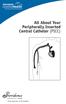 All About Your Peripherally Inserted Central Catheter (PICC) General Information Intravenous (IV) therapy is the delivery of fluid directly into a vein. An intravenous catheter is a hollow tube that is
Yttrium-90 Radiotherapy Treatment for liver tumors
 Patient Education Yttrium-90 Radiotherapy Treatment for liver tumors This handout explains what Yttrium-90 radiotherapy is and what to expect when you have it done. Why do I need this treatment? Your doctors
PACEMAKER PATIENT INFORMATION
 PACEMAKER PATIENT INFORMATION Information Leaflet Your Health. Our Priority. Page 2 of 11 Contents What is a pacemaker? Why do I need a pacemaker? The heart and normal electrical conduction Complete or
Tunnelled haemodialysis catheter
 Liver, Renal & Surgery Tunnelled haemodialysis catheter Information for patients and carers This leaflet explains what a tunnelled haemodialysis catheter is and how it is put in. It also covers the risks
Inferior Vena Cava filter and removal
 Inferior Vena Cava filter and removal What is Inferior Vena Cava Filter Placement and Removal? An inferior vena cava filter placement procedure involves an interventional radiologist (a specialist doctor)
Biliary Drain. What is a biliary drain?
 Biliary Drain What is a biliary drain? A biliary drain is a tube to drain bile from your liver. It is put in by a doctor called an Interventional Radiologist. The tube or catheter is placed through your
Percutaneous Transluminal Angioplasty (PTA) and Stenting For PVS Patients
 Percutaneous Transluminal Angioplasty (PTA) and Stenting For PVS Patients There are two types of blood vessels in the body arteries and veins. Arteries carry blood rich in oxygen from the heart to all
What should I expect before the procedure?
 The British Association of Urological Surgeons 35-43 Lincoln s Inn Fields London WC2A 3PE Phone: Fax: Website: E- mail: +44 (0)20 7869 6950 +44 (0)20 7404 5048 www.baus.org.uk [email protected] PROCEDURE-
The injection contains a local anesthetic for pain control and a steroid to reduce inflammation.
 Caudal Steroid Injection A Caudal Steroid Injection is done to provide pain relief. The injection provides pain relief by reducing swelling and irritation around nerve roots at the base of the spine or
Cardiac Catheterization
 Thank you for choosing Rose Medical Center for your cardiac care. Our goal is to make your stay as comfortable and pleasant as possible. Please let our knowledgeable and friendly staff know if there is
Department of Neurosciences Dorsal Root Ganglion (DRG) Stimulation Information for patients
 Oxford University Hospitals NHS Trust Department of Neurosciences Dorsal Root Ganglion (DRG) Stimulation Information for patients We have recently seen you in clinic as you have had pain for a long period
UW MEDICINE PATIENT EDUCATION. Xofigo Therapy. For metastatic prostate cancer. What is Xofigo? How does it work?
 UW MEDICINE PATIENT EDUCATION Xofigo Therapy For metastatic prostate cancer This handout explains how the drug Xofigo is used to treat metastatic prostate cancer. What is Xofigo? Xofigo is a radioactive
X-Plain Subclavian Inserted Central Catheter (SICC Line) Reference Summary
 X-Plain Subclavian Inserted Central Catheter (SICC Line) Reference Summary Introduction A Subclavian Inserted Central Catheter, or subclavian line, is a long thin hollow tube inserted in a vein under the
Cheekbone (zygoma) and/or eye socket (orbit) fracture surgery
 Ambulatory Care & Local Networks Cheekbone (zygoma) and/or eye socket (orbit) fracture surgery Information for patients You have been treated in the Emergency Department for a broken (fractured) cheekbone
TOWN CENTER ORTHOPAEDIC ASSOCIATES P.C. Labral Tears
 Labral Tears The shoulder is your body s most flexible joint. It is designed to let the arm move in almost any direction. But this flexibility has a price, making the joint prone to injury. The shoulder
This booklet has been designed to give you all the information you need to undergo cataract surgery.
 Eye Unit Cataract Surgery: This booklet has been designed to give you all the information you need to undergo cataract surgery. University Hospitals Coventry and Warwickshire is a teaching hospital and
After Glaucoma Surgery
 2011 After Glaucoma Surgery Eye Care Centre Please bring this booklet to the hospital with you on the day of your operation. After Glaucoma Surgery What is in this booklet? How is the surgery done?...
Percutaneous Abscess Drainage
 Scan for mobile link. Percutaneous Abscess Drainage An abscess is an infected fluid collection within the body. Percutaneous abscess drainage uses imaging guidance to place a thin needle through the skin
YOU AND YOUR ANAESTHETIC
 YOU AND YOUR ANAESTHETIC Information Leaflet Your Health. Our Priority. Page 2 of 8 This leaflet aims to answer some of the questions you may have about your anaesthetic and contains fasting instructions.
Posterior Cervical Decompression
 Posterior Cervical Decompression Spinal Unit Tel: 01473 702032 or 702097 Issue 2: January 2009 Following your recent MRI scan and consultation with your spinal surgeon, you have been diagnosed with a
Having denervation of the renal arteries for treatment of high blood pressure
 Having denervation of the renal arteries for treatment of high blood pressure The aim of this information sheet is to help answer some of the questions you may have about having denervation of the renal
Peripheral Vascular Bypass Surgery
 Name: Peripheral Vascular Bypass Surgery You are about to have the blockages in your peripheral arteries repaired. This handout gives you information about your surgery, what to expect from surgery, how
Total hip replacement
 Patient Information to be retained by patient What is a total hip replacement? In a total hip replacement both the ball (femoral or thigh bone) side of the hip joint and the socket (acetabular or pelvic
GOING HOME AFTER YOUR TAVR PROCEDURE
 GOING HOME AFTER YOUR TAVR PROCEDURE HENRY FORD HOSPITAL CENTER FOR STRUCTURAL HEART DISEASE GOING HOME After your TAVR procedure, you will need help when you go home. It is hard to predict how much help
Tunneled Central Venous Catheter (CVC) Placement
 PATIENT EDUCATION patienteducation.osumc.edu Tunneled Central Venous Catheter (CVC) Placement A tunneled Central Venous Catheter (CVC) is a special type of intravenous (IV) line that is placed into a large
A PATIENT S GUIDE TO CARDIAC CATHETERIZATION
 A PATIENT S GUIDE TO CARDIAC CATHETERIZATION The science of medicine. The compassion to heal. This teaching booklet is designed to introduce you to cardiac catheterization. In the following pages, we will
Prevent Bleeding When Taking Blood Thinners
 PATIENT EDUCATION patienteducation.osumc.edu Prevent Bleeding When Taking Blood Thinners Blood thinners are medicines used to keep harmful blood clots from forming in the body. Blood thinners can also
After Bladder Surgery (TUR-TransUrethral Resection) Discharge Information
 After Bladder Surgery (TUR-TransUrethral Resection) Discharge Information General Information (for either procedure) TUR (Transurethral Resection) Bladder Neck may be done to remove scar tissue blocking
Patient Information and Daily Programme for Patients Having Whipple s Surgery (Pancreatico duodenectomy)
 Patient Information and Daily Programme for Patients Having Whipple s Surgery (Pancreatico duodenectomy) Date of admission Date of surgery Expected Length of Stay in hospital We will aim to discharge you
St. Louis Eye Care Specialists, LLC Andrew N. Blatt, MD
 St. Louis Eye Care Specialists, LLC Andrew N. Blatt, MD 675 Old Ballas Rd. Suite 220 St. Louis, MO 63141 Phone:314-997-EYES Fax: 314-997-3911 Toll Free: 866-869-3937 STRABISMUS SURGERY (Post-Op Strabismus
Colon Cancer Surgery and Recovery. A Guide for Patients and Families
 Colon Cancer Surgery and Recovery A Guide for Patients and Families This Booklet You are receiving this booklet because you will be having surgery shortly. This booklet tells you what to do before, during,
Total Knee Replacement
 Total Knee Replacement Contents Introduction Total Knee Replacement Preparing for surgery Pre-op visit Day of surgery After surgery (In Hospital) After surgery (In Rehab) Exercise Program and Physical
Preoperative Education: CERVICAL SPINE SURGERY
 Preoperative Education: CERVICAL SPINE SURGERY 1 Dear Patient, In order to make your hospital stay as comfortable as possible, we have prepared this informational packet for you designed to outline and
What to Expect While Receiving Radiation Therapy for Prostate Cancer
 What to Expect While Receiving Radiation Therapy for Prostate Cancer Princess Margaret Information for patients who are having radiation therapy Read this pamphlet to learn about: The main steps in planning
Your spinal Anaesthetic
 Your spinal Anaesthetic Information for patients Your spinal anaesthetic This information leaflet explains what to expect when you have an operation with a spinal anaesthetic. It has been written by patients,
ANTERIOR CERVICAL DECOMPRESSION AND FUSION
 ANTERIOR CERVICAL DECOMPRESSION AND FUSION NOTE: PLEASE DO NOT TAKE ANY NON-STEROIDAL ANTI-INFLAMMATORY DRUGS (NSAIDs like Advil, Celebrex, Ibuprofen, Motrin, Vioxx, etc) OR ASPIRIN PRODUCTS FOR 2 WEEKS
Electroconvulsive Therapy (ECT)
 Electroconvulsive Therapy (ECT) What is ECT? Electroconvulsive therapy (ECT) is a physical therapy in which a patient under general anesthetic will have an electrical current passed through his or her
MOHS MICROGRAPHIC SURGERY
 MOHS MICROGRAPHIC SURGERY UMass Memorial Medical Center 55 Lake Avenue North Worcester, MA 01655 (508) 856-1666 Dr. Mary Maloney This booklet is intended to explain Mohs surgery to you. It is not, however,
Gallbladder Surgery with an Incision (Cholecystectomy)
 Gallbladder Surgery with an Incision (Cholecystectomy) It is normal to have questions about your surgery. This handout gives you information about what will happen to you before, during and after your
Spinal Injections. North American Spine Society Public Education Series
 Spinal Injections North American Spine Society Public Education Series What Is a Spinal Injection? Your doctor has suggested that you have a spinal injection to help reduce pain and improve function. This
Total Hip Replacement Surgery Home Care Instructions
 Total Hip Replacement Surgery Home Care Instructions Surgery: Date: Doctor: This handout will review the care you need to follow once you are home. If you have any questions or concerns, please ask your
Total knee replacement
 Patient Information to be retained by patient What is a total knee replacement? In a total knee replacement the cartilage surfaces of the thigh bone (femur) and leg bone (tibia) are replaced. The cartilage
Laparoscopic Cholecystectomy
 Laparoscopic Cholecystectomy Removal of Gall Bladder Page 12 Patient Information Further Information We endeavour to provide an excellent service at all times, but should you have any concerns please,
Eye instructions. Golden Jubilee National Hospital NHS National Waiting Times Centre. Pre operative patient information guide
 Golden Jubilee National Hospital NHS National Waiting Times Centre Eye instructions Pre operative patient information guide Agamemnon Street Clydebank, G81 4DY (: 0141 951 5000 www.nhsgoldenjubilee.co.uk
Arthroscopic subacromial decompression and rotator cuff repair
 Further sources of information http://www.patient.co.uk/showdoc/553/ http://www.shoulderdoc.co.uk/article.asp?section=11 http://www.medic8.com/healthguide/articles/painfulshoulder.html http://www.cks.nhs.uk/patientinformationleaflet/shoulderpainarc/st
Surgery for cervical disc prolapse or cervical osteophyte
 Mr Paul S. D Urso MBBS(Hons), PhD, FRACS Neurosurgeon Provider Nº: 081161DY Epworth Centre Suite 6.1 32 Erin Street Richmond 3121 Tel: 03 9421 5844 Fax: 03 9421 4186 AH: 03 9483 4040 email: [email protected]
Inpatient Surgery Information The Lady Minto Hospital 241 Eighth Street, Cochrane, Ontario P0L 1C0 Phone: 705-272-7200
 Inpatient Surgery Information The Lady Minto Hospital 241 Eighth Street, Cochrane, Ontario P0L 1C0 Phone: 705-272-7200 About Your Care You and your doctor have agreed that you need an operation. Staying
Get the Facts About. Disease
 Get the Facts About TB TUBERCULOSIS Disease What s Inside: 3 PAGE Get the facts, then get the cure 4 PAGE 9 PAGE 12 PAGE Learn how TB is spread Treatment for TB disease Talking to family and friends about
Lumbar or Thoracic Decompression and Fusion
 Lumbar or Thoracic Decompression and Fusion DO NOT TAKE ANY ASPIRIN PRODUCTS OR NON-STEROIDAL ANTI- INFLAMMATORY DRUGS (ie NSAIDs, Advil, Celebrex, Ibuprofen, Motrin, Naprosyn, Aleve, etc) FOR 2 WEEKS
Laparoscopic cholecystectomy. Golden Jubilee National Hospital NHS National Waiting Times Centre. Patient information guide
 Golden Jubilee National Hospital NHS National Waiting Times Centre Laparoscopic cholecystectomy Patient information guide Agamemnon Street Clydebank, G81 4DY (: 0141 951 5000 www.nhsgoldenjubilee.co.uk
What You Need to KnowWhen Taking Anticoagulation Medicine
 What You Need to KnowWhen Taking Anticoagulation Medicine What are anticoagulant medicines? Anticoagulant medicines are a group of medicines that inhibit blood clotting, helping to prevent blood clots.
Treatments to Restore Normal Rhythm
 Treatments to Restore Normal Rhythm In many instances when AF causes significant symptoms or is negatively impacting a patient's health, the major goal of treatment is to restore normal rhythm and prevent
Varicose Veins Operation. Patient information Leaflet
 Varicose Veins Operation Patient information Leaflet 22 nd August 2014 WHAT IS VARICOSE VEIN SURGERY (HIGH LIGATION AND MULTIPLE AVULSIONS) The operation varies from case to case, depending on where the
PATIENT HANDBOOK AND JOURNAL DAY OF SURGERY
 PATIENT HANDBOOK AND JOURNAL DAY OF SURGERY PREPARING YOUR SKIN BEFORE SURGERY PRE-OP HIBICLENS BATHING INSTRUCTIONS: General Information: Because the skin is not sterile, it is important to make sure
General Information about Sleep Studies and What to Expect
 General Information about Sleep Studies and What to Expect Why do I need a sleep study? Your doctor has ordered a sleep study because your doctor is concerned you may have a sleep disorder that is impacting
Oxford Centre for Respiratory Medicine Bronchial-Artery Embolisation Information for patients
 Oxford Centre for Respiratory Medicine Bronchial-Artery Embolisation Information for patients This leaflet tells you about the bronchial-artery embolisation procedure. It explains what is involved and
My Spinal Surgery: Going Home
 My Spinal Surgery: Going Home The Spinal Surgery Team has prepared this insert containing information to help prepare you and your family for going home after your spinal surgery. Please visit the UHN
CONSULTANTS IN PAIN MEDICINE, INC. TELEPHONE (757) 395-6450 FAX (757) 622-2750 INTERNET www.beachpain.com **MEDICATION GUIDELINES PRIOR TO PROCEDURES
 CONSULTANTS IN PAIN MEDICINE, INC. TELEPHONE (757) 395-6450 FAX (757) 622-2750 INTERNET www.beachpain.com MARTIN V.T. TON, MD Please call us at 395-6450 at least 24 hours in advance if you cannot make
Preoperative Education: LUMBAR SPINE SURGERY
 Preoperative Education: LUMBAR SPINE SURGERY 1 Dear Patient, In order to make your hospital stay as comfortable as possible, we have prepared this informational packet for you designed to outline and explain
A Patient Guide to Atrial Fibrillation and Catheter Ablation
 A Patient Guide to Atrial Fibrillation and Catheter Ablation Al-Sabah Arrhythmia Institute 1111 Amsterdam Avenue New York, NY 10025 Phone: 212-523-2400 Fax: 212-523-2571 www.stlukescardiology.org Printed
Carpal Tunnel Release. Relieving Pressure in Your Wrist
 Carpal Tunnel Release Relieving Pressure in Your Wrist Understanding Carpal Tunnel Syndrome Carpal tunnel syndrome (CTS) is a problem that affects the wrist and hand. If you have CTS, tingling and numbness