
State of Alaska Epidemiologic Profile on Substance Use, Abuse and Dependency
|
|
|
- Julie Rich
- 9 years ago
- Views:
Transcription
1 State of Alaska Epidemiologic Profile on Substance Use, Abuse and Dependency 1

2

3 2013 Update State of Alaska Epidemiologic Profile on Substance Use, Abuse and Dependency In Support of the Alaska Strategic Prevention Framework and the Alaska Department of Health and Social Services Section of Prevention and Early Intervention Services Division of Behavioral Health Department of Health and Social Services State of Alaska Suggested Citation: Hull-Jilly DMC, Casto LD. State Epidemiologic Profile on Substance Use, Abuse and Dependency Alaska Department of Health and Social Services. Released November 7, State Epidemiologic Profile on Substance Use, Abuse and Dependency Juneau, AK: Section of Prevention and Early Intervention Services, Division of Behavioral Health, Alaska Department of Health and Social Services. Released November 7, Copyright Information: All material in this document is the public domain and may be reproduced or copied without permission; citation as to source, however, is appreciated. iii

4 Acknowledgements This profile resulted from the collaborative efforts by the Alaska Substance Abuse Epidemiology Workgroup (SEW) members and their respective agencies. Project technical support was provided by Deborah Hull-Jilly (SEW Chairperson/Epidemiologist); Andrew Jessen, Research Analyst-Alaska Vital Statistics; Jesse Metzger, Analyst/Programmer-University of Alaska Anchorage- Behavioral Health Research Center; SEW data providers and the staff of the Department of Health and Social Services, Divisions of Public Health and Behavioral Health. Special thanks to the SEW members and L. Diane Casto, Program Manager, Division of Behavioral Health, Prevention and Early Intervention Services, for making this document possible through her leadership and work as part of the Alaska State Prevention Framework State Incentive Grant. State of Alaska Sean Parnell, Governor Alaska Department of Health and Social Services William Streur, Commissioner Division of Behavioral Health Melissa Witzler Stone, Director Report Prepared by: Deborah Hull-Jilly, MPH Leanne Davis, MSN Sherrie Wilson Hinshaw, MS Reviewed by: L. Diane Casto, MPA Jesse Metzger, PhD Alaska Substance Abuse Epidemiology Workgroup Design and Formatting by: Glenn Harvey Additional information pertaining to the Alaska Strategic Prevention Framework and the Centers for Substance Abuse Prevention is available at the Alaska Division of Behavioral Health website; This publication was supported by SPF SIG Grant #SP15604 from the Substance Abuse and Mental Health Services Administration. Its contents are solely the responsibility of the authors and do not necessarily represent the official views of the Substance Abuse and Mental Health Services Administration. iv
5 Table of Contents List of Tables and Charts...vii Executive Summary...ix How to Use This Document...xii Data Resources-National...xiii Data Resources-State...xiii Data Limitations...xiv Introduction...xvi SECTION ONE: CONSUMPTION...1 Problem Statement: Alcohol Sales and Consumption... 3 Data Analysis... 3 Problem Statement: Illicit Drug Use Data Analysis Problem Statement: Tobacco Use Data Analysis SECTION TWO: CONSEQUENCES Problem Statement: Mortality Data Analysis Problem Statement: Alcohol-Related Consequences Data Analysis Problem Statement: Illicit Drug-Related Consequences Data Analysis Problem Statement: Tobacco Use Data Analysis Problem Statement: Alcohol- and Drug-Related Transportation Crashes Data Analysis Problem Statement: Other Consequences Related to Substance Abuse and Dependency Data Analysis SECTION THREE: INFLUENCES Problem Statement: Influence Leading Up To Substance Use Data Analysis RECOMMENDATIONS APPENDICES Appendix A: Alaska Epidemiological Outcomes Workgroup Membership Appendix B: Data Sources Considered Appendix C: Alaska Epidemiological Outcomes Indicators Considered Appendix D: Major Measures of Alcohol, Illicit Drug, and Tobacco Use, Abuse, and Dependency Appendix E: Alaska Population Data Appendix F: About Alaska v

6 List of Tables and Charts vi Consumption Problem Statement: Alcohol Sales and Consumption Table 1.1. Table 1.2. Table 1.3. Table 1.4. Table 1.5. Table 1.6. Chart 1.1. Trends in Ethanol Consumed Per Capita, Alaska...4 Trends in Alcohol Use Among Youth, by Gender, Alaska YRBS...5 Trends in Alcohol Use Among Adults, by Gender, Alaska BRFSS...9 Trends in Alcohol Use Among Adults, by Age Group, Alaska BRFSS...10 Trends in Alcohol Use Among Adults, by Race and Ethnicity, Alaska BRFSS...11 Trends in Reported Alcohol Use, by Age Group, Alaska NSDUH...13 Trends in Ethanol Consumed Per capita, All Beverages, Alaska...4 Chart 1.2. Communities with Alcohol Restrictions, Alaska, Chart 1.3. Chart 1.4. Trends in Youth Reporting Alcohol Use Before Age 13, by Grade, Alaska YRBS...6 Trends in Youth Reporting Binge Drinking, by Grade, Alaska YRBS...6 Chart 1.5. Percentage of Youth Reporting Lifetime Use of Alcohol, Comparing Traditional and Alternative Schools, by Gender and by Grade, Alaska YRBS, Chart 1.6. Percentage of Youth Reporting Alcohol Use Before Age 13 Comparing Traditional and Alternative Schools, by Gender and by Grade, Alaska YRBS, Chart 1.7. Percent of Youth Reporting Current Alcohol Use, Comparing Traditional and Alternative Schools, by Gender and by Grade, Alaska YRBS, Chart 1.8. Percent of Youth Reporting Current Binge Drinking, Comparing Traditional and Alternative Schools, by Gender and by Grade, Alaska YRBS, Chart 1.9. Trends in Adults Reporting Binge Alcohol Use, by Race and Ethnicity, Alaska BRFSS...12 Chart Trends in Reported Alcohol Use, by Age Group, Alaska NSDUH, Problem Statement: Illicit Drug Use Table 1.7. Table 1.8. Table 1.9. Table Table Chart Trends in Illicit Drug Use Among Youth, by Gender, Alaska YRBS...15 Trends in Illicit Drug Use Among Youth, by Grade, Alaska YRBS...16 Trends in Reported Illicit Drug Use, by Age Group, Alaska NSDUH...21 Trend in Annual Cigarette Sales per Capita, Alaska...23 Trends in Cigarette Use Among Youth, by Gender, Alaska YRBS...25 Trends in Youth Reporting Marijuana Use Before Age 13 Years, Alaska YRBS...17 Chart Percent of Youth Reporting Ever Used Marijuana Use, Alaska YRBS, Comparing Traditional and Alternative Schools, Alaska YRBS, Chart Percent of Youth Reporting Marijuana Use Before Age 13, Alaska YRBS, Comparing Traditional and Alternative Schools, Alaska YRBS, Chart Percent of Youth Reporting Current Marijuana Use, Alaska YRBS, Comparing Traditional and Alternative Schools, Alaska YRBS, Chart Percent of Youth Reporting Ever Used Heroin, Alaska YRBS, Comparing Traditional and Alternative Schools, Alaska YRBS, Chart Percent of Youth Reporting Ever Used Methamphetamine, Alaska YRBS, Comparing Traditional and Alternative Schools, Alaska YRBS, Chart Percent of Youth Reporting Ever Used Ecstasy, Alaska YRBS, Comparing Traditional and Alternative Schools, Alaska YRBS, Chart Percent of Youth Reporting Ever Used Cocaine, Alaska YRBS, Comparing Traditional and Alternative Schools, Alaska YRBS, Chart Chart Percentage of Students Who Have Taken a Prescription Drug (such as OxyContin, Percocet, Vicodin, Codeine, Adderall, Ritalin, or Xanax) Without a Doctor s Prescription One or More Times During Their Life, Comparing Traditional and Alternative Schools, Alaska YRBS, Reported Illicit Drug Use, Dependency or Abuse, by Age Groups, Alaska NSDUH, , Comparing Traditional and Alternative Schools, Alaska YRBS, Chart Reported Illicit Drug Use, Dependency or Abuse, by Age Groups, Alaska NSDUH, Chart Non-Medical Use of Prescription Pain Relievers in the Past Year Among Persons Aged 12 or Older, by Age Group and Alaska, NSDUH, and Problem Statement: Tobacco Use Table Table Table Table Table Trend in Annual Cigarette Sales per Capita, Alaska...23 Trends in Cigarette Use Among Youth, by Gender, Alaska YRBS...25 Trends in Cigarette Use Among Adults, by Gender, Alaska BRFSS,...28 Trends in Cigarette Use Among Adults, by Race and Ethnicity, Alaska BRFSS...29 Trends in Reported Cigarette and Tobacco Products Use, by Age Group, Alaska NSDUH...30 Table Trends in Maternal Smoking by Age Group and Year, Alaska PRAMS, Table 1.16 Percentage of Prenatal Marijuana Use, by Year, Alaska PRAMS, Chart Chart Chart Chart Chart Trends in Current Cigarette Use Among Youth, by Grade, Alaska YRBS...25 Trends in Youth Reporting Current Cigarette Before Age 13, by Grade, Alaska YRBS...26 Percentages of Students Who Smoked a Whole Cigarette for the First Time Before Age 13 Years, Comparing Traditional and Alternative Schools, Alaska YRBS, Percentages of Students Who Smoked Cigarettes on 20 or More of the Past 30 Days, Comparing Traditional and Alternative Schools, Alaska YRBS, Percentage of Students Who Used Chewing Tobacco, Snuff, or Dip on One or More of the Past 30 Days, Comparing Traditional and Alternative Schools, Alaska YRBS, Chart Percentage of Adults Who Are Current Smokers, by Age Group, Alaska BRFSS, Chart Trends in Current Tobacco Use Among Adults, by Race and Ethnicity, Alaska BRFSS...29 Chart Reported Cigarette and Tobacco Products Use, by Age Group, Alaska NSDUH,
7 List of Tables and Charts Consequence Problem Statement: Mortality Table 2.1. All Causes of Death by Age, Gender, and Race, Alaska, Table 2.2. All Causes of Death by Gender and Borough/Census Area, Alaska, Table 2.3. Numbers of Premature Deaths Associated with Substance Abuse, by Leading Cause and Borough/Census Area, Alaska, Table 2.4. Rates of Premature Deaths Associated with Substance Abuse, by Leading Cause and Borough/Census Area, Alaska, Chart 2.1. Ten Leading Causes of Mortality in Alaska, Problem Statement: Alcohol-Related Consequences Table 2.5. Comparison of Alcohol Induced and Chronic Liver Disease and Cirrhosis Deaths Rates, Alaska and U.S., Table 2.6. Alcohol Induced Death by Age, Gender, and Race, Alaska, Table 2.7. Comparison of Unintentional Injury Deaths Rates, Alaska and U.S., Table 2.8. Unintentional Injury Deaths by Age, Gender, and Race, Alaska, Table 2.9. Top Five Hospitalized Injury Causes Associated with Alcohol Use, Occurrence in Alaska, by Gender, ATR Table Hospitalized Injury Associated with Alcohol Use1, Alaska Residents, by Race, and Ethnicity, ATR, Table 2.11 Hospitalized Injury Associated with Alcohol Use, by Region, ATR, Table 2.12 Hospitalized Injury Associated with Alcohol Use, Persons Aged 20 Years and Less, by Region, ATR, Table Table Table 2.15 Trends in Alcohol Related Out-of-School Suspensions, Alaska...48 Trends in Alcohol Related School Expulsions, Alaska...49 Fetal Alcohol Spectrum Disorders by Select Birth Characteristics, Alaska, Table 2.16 Number of Fetal Alcohol Spectrum Disorder Births in Alaska by Maternal Age, Chart 2.2. Number of Deaths Associated With Alcohol Use, by Region, Alaska, Chart 2.3. Alcohol Induced Death and Rates by Borough/Census Area, Alaska, Chart 2.4. Chronic Liver Disease and Cirrhosis Death and Rates by Borough/Census Area, Alaska, Borough/Census Area (# of death, % of statewide total)...43 Chart 2.5. Unintentional Injury Death and Rates1 by Borough/Census Area, Alaska, Chart 2.6. Prevalence of Specific Fetal Alcohol Spectrum Disorders, Alaska, Problem Statement: Illicit Drug-Related Consequences Table Comparison of Drug Induced Deaths Rates, Alaska and U.S., Table Number and Rate of Drug Induced Deaths by Age, Gender, and Race, Alaska, Table 2.19 Top Five Hospitalized Injury Causes Associated with Drug Use, Occurrence in Alaska, by Gender, ATR Table Hospitalized Injury Associated with Drug Use, Alaska Residents, by Race and Ethnicity, ATR Table Hospitalized Injury Associated with Drug Use, by Region, ATR, Chart 2.7. Drug Induced Death and Rates by Borough/Census Area, Alaska, Problem Statement: School Suspensions and Expulsions Due to Illicit Drugs Table Trends in Illicit Drug Related Out-of-School Suspensions, Alaska...55 Table Trends in Illicit Drug Related Out-of-School Expulsions, Alaska...56 Problem Statement: Tobacco Use Related Consequences Table Comparison of Smoking Attributable Deaths Rates to Alcohol Induced, Chronic Liver Disease/Cirrhosis and Drug Induced Death Rates, Alaska and U.S., Table Smoking Attributable Deaths by Age, Gender, and Race, Alaska, Table Number and Percent of Deaths Due to Select Causes Estimated to be Due to Tobacco Use, Alaska, Table Table Table Trends in Motor Vehicle Driving After Drinking Among Youth, by Gender, Alaska YRBS...59 Trends in Motor Vehicle Driving After Drinking Among Youth, by Grade, Alaska YRBS...60 Table Trends of Adults Driving After Drinking Among Adults, by Gender, Alaska BRFSS...61 Table Trends in Drug Related School Expulsions, Alaska, Table Fatalities Due to Alcohol-Related Motor Vehicle Crashes, Alaska FARS...62 Table Citations Issued by Law Enforcement to Motor Vehicles Drivers Involved in Traffic Crashes, by Age Group and Citation, Anchorage and Alaska, Chart 2.8. Chart 2.9. Total Motor Vehicle Crash Fatalities Compared to Alcohol-Related Motor Vehicle Crash Fatalities,Alaska FARS...62 Trends in Blood Alcohol Concentration (BAC) Collected After Fatal Motor Vehicle Crashes, by Highest Driver BAC in Crash, Alaska FARS...63 Chart Recreational Boating Fatalities, Alaska, Chart Recreational Boating Accidents, Fatal Accidents, and Deaths, Alaska, Chart Recreational Boating accidents, injuries and deaths related to alcohol use, Alaska Problem Statement: Other Consequences Related to Substance Abuse and Dependency Table Trends in Reported Youth Sexual Behavior, by Grade, Alaska YRBS...67 Table Comparison of Violent Deaths Rates, Alaska and U.S., Table Suicide Deaths by Age, Gender, and Race, Alaska, Table Trends in Violent Death Associated with Substance Abuse, Alaska VDRS...70 vii

8 List of Tables and Charts Table Table Table Table Fatalities Due to Alcohol-Related Motor Vehicle Crashes, Alaska FARS...72 Trends in Drug Arrest, Adults 18 Years of Age and Older, by Gender, Alaska UCR...73 Trends in Drug Arrests, Youth 17 Years of Age and Under, by Gender, Alaska UCR...74 Substances Used by Referred Juveniles While Under the Influence Per Referral and Intake Data, Alaska DJJ...75 Chart Suicide Deaths and Rates by Borough/Census Area, Alaska, Chart Chart 2.15 Chart 2.16 Chart Trends in Occupational Fatalities Associated with Alcohol and/or Drug Use, Alaska OIS...71 Trends in Violent Crime Associated with Substance Abuse, Alaska UCR...72 Trends in Property Crime Associated with Substance Abuse, Alaska UCR...72 Trends in Drug Offenses, Adults 18 Years of Age and Older, Alaska UCR...73 Chart Trends in Drug Offenses, Youth 17 Years of Age and Under, Alaska UCR...74 Chart Table Table Table Chart Influences Chart 3.1. Chart 3.2. Chart 3.3. Chart 3.4. Chart 3.5. Chart 3.6. Chart 3.7. Chart 3.8. Chart 3.9. Chart Trends in Prescription Medication Seizures, by Dosage Unit, Alaska SDEU...77 Drug and Alcohol Referrals for Juvenile Offenders, Alaska DJJ...75 Drug and Alcohol Referrals for Juvenile Offenders, by Gender, Alaska DJJ...76 Trends in Illicit Drug Related Arrests/Charges, Alaska SDEU...76 Trends in Heroin Seizures, Alaska SDEU...77 Percentage of students whose parent talks with them about what they are doing in school about once or twice a week or less, Comparing Traditional and Alternative Schools, Alaska YRBS, Percentage of students who strongly agree or agree that their teachers really care about them and give them a lot of encouragement, Comparing Traditional and Alternative Schools, Alaska YRBS, Percentage of students who did not go to school on one or more of the past 30 days because they felt they would be unsafe at school or on their way to or from school, Comparing Traditional and Alternative Schools, Alaska YRBS, Percentage of students who had been threatened or injured with a weapon such as a gun, knife, or club on school property one or more times during the past 12 months, Comparing Traditional and Alternative Schools, Alaska YRBS, Percentage of students who were in a physical fight one or more times during the past 12 months, Comparing Traditional and Alternative Schools, Alaska YRBS, Percentage of students who had ever been physically forced to have sexual intercourse when they did not want to, Comparing Traditional and Alternative Schools, Alaska YRBS, Percentage of students who seriously considered attempting suicide during the past 12 months, Comparing Traditional and Alternative Schools, Alaska YRBS, Percentage of students who take part in organized after school, evening, or weekend activities (such as school clubs; community center groups; music, art, or dance lessons; drama; church; or cultural or other supervised activities) on zero days during an average week, Comparing Traditional and Alternative Schools, Alaska YRBS, Percentage of students who said their parents feel their child drinking alcohol regularly is either a little bit wrong or not wrong at all, Comparing Traditional and Alternative Schools, Alaska YRBS, Percentage of students who usually got the alcohol they drank during the past 30 days from someone else whom they gave money to buy it for them or from a family member or someone else giving it to them, Comparing Traditional and Alternative Schools, Alaska YRBS, viii

9 TOC iv EXECUTIVE SUMMARY Executive Summary The Alaska Epidemiologic Profile on Substance Use, Abuse and Dependency is a tool for substance abuse prevention and public health and mental health planners in support of the Substance Abuse and Mental Health Services Administration (SAMHSA) Strategic Prevention Framework State Incentive Grants. To truly show the impact of alcohol, tobacco and other drug use and abuse on the overall health of Alaska, comprehensive information composed of accurate, timely and relevant information is key. The purpose of this profile is to provide a state-level overview that summarizes data from new and established surveillance sources for use in prevention/intervention planning, monitoring, and evaluation and provides recommendations to ensure comparable database field definitions and to improve data collection for future surveillance. Since 1990, the Alaska Department of Health and Social Services has conducted and participated in the surveillance of mortality, morbidity and behavioral health risk factors associated with substance use. Many of these surveillance activities are federally funded of which the findings are combined with other state-based data to assess trends in behavior and lifestyle choices and critical elements of health education and prevention practices. Using the Strategic Prevention Framework developed by the Substance Abuse and Mental Health Services Administration, an epidemiologic workgroup was established to: The resulting descriptive study provides baseline and trend information on substance use, abuse, dependence and consequences thereof. identify, collect and consolidate data pertaining to substance consumption, consequence and influences; analyze and evaluate data systems for long-term use and statistically significant findings; assist in prioritizing outcome measures used by health promotion specialists, prevention program managers, health planners, policymakers and community advocates; and identify constructs needing improved or expanded surveillance. The State Epidemiologic Profile on Substance Use, Abuse and Dependency reports information from on-going statewide surveillance programs such as the Behavioral Risk Factor Surveillance System, the Youth Risk Behavior Survey and the National Survey on Drug Use and Health, that are melded with state-based mortality, morbidity, and justice data. This will allow agencies and organization involved in prevention activities to monitor and evaluate interventions associated with substance use and abuse and related consequences including but not limited to dependency and treatment. In addition, a data directory was initiated for managers and planners to identify potential data sources. This will allow select agencies to monitor the prevalence of behaviors associated with consumption of substances, as well as consequences following substance use, abuse and dependence. This data directory will allow agencies to describe their on-going data collection activities and database structures and communicate current projects related to substance use. ix

10 EXECUTIVE SUMMARY TOC iv Highlights of the profile: Morbidity and Mortality Nine of the 10 leading causes of death in Alaska can be associated with substance abuse as a potential contributing cause of death. Leading causes of premature death and years of potential life lost, such as chronic liver disease, cirrhosis, homicide, suicide, and unintentional injury, were strongly associated with substance abuse. Unintentional injury was the third leading cause of death in Alaska; Alaska s unintentional injury death rate was 1.5 times the U.S. rate (55.2 vs per 100,000 persons). During , males were 2 times more likely than females to die from unintentional injury in Alaska. Alcohol In 2010, ethanol consumption (beer, spirits, and wine) was consistently greater than the nation averages; spirits consumption was nearly 2 times the national average. Of the 108 communities with some alcohol restriction, most had lower rates of serious injury. In 2011, the Youth Risk Behavior Survey (YRBS) results indicated that all grades had lower percentage of students reporting current or binge (episodic) alcohol use, indicating a sustained long-term decline of alcohol use by students. In the National Survey on Drug Use and Health (NSDUH), indicated little change from previous surveys in adult alcohol use; binge (episodic) alcohol use was reported by 23% of adults in Alaska, of which persons aged reported 42% binge alcohol use. Nearly 25% of all hospitalized injury patients had suspected or proven alcohol use injury; of these hospitalizations, assault, falls, motor vehicle, and suicide attempts were the leading injury causes for both males and females. Hospitalized injury associated with alcohol use among persons aged 20 years or less declined 47% (from 193 patient-cases in 2006 to 103 patient cases in 2010). During , 155 recreational boating events with 71 fatalities occurred in Alaska, of which 32% were associated with known alcohol use The number of high school suspensions declined 48% (from 222 in the school year to 116 in the school year). x
11 TOC iv EXECUTIVE SUMMARY Alcohol-related motor vehicle events among Alaska high school youth was significantly lower than the national average in 2011 and lower than in previous years. However, one out of four youth still accompany a driver who had been drinking alcohol. The prevalence of younger drivers aged years with Blood Alcohol Concentration (BAC) above the legal limit was lower than the national average; however the prevalence of drivers aged 35 years and older was significantly higher than the national average. Illicit Drugs In 2011, the YRBS results indicated that 16% of all Alaska youths reported taking prescription drugs without a doctor s prescription. Boroughs in the Southcentral region of Alaska with greater population density and/or boroughs experiencing rapid growth had higher rates of drug induced death. During , 12% of all hospitalized injury patients in Alaska had suspected or proven drug use; of these hospitalizations, the most common cause was suicide attempt (47%). During , prevalence of drug induced death was highest among Alaska Native females aged years. Tobacco During , daily cigarette use decreased significantly among Alaska high school youth from 10.3% to 9.1%, while 23% of adults in Alaska reported cigarette use. During , tobacco attributable death rate in Alaska was times the death rates due to alcohol, drug, and chronic liver disease/ cirrhosis. Alaska Natives had the highest rate of death attributed to smoking (315.1 per 100,000 persons), of which Native males were nearly twice as likely to die from tobacco use as Native females (431.4 vs per 100,000 persons, respectively). Data Improvement Recommendations include: SEW process should be continued to ensure the collection and analysis of information pertaining to substance abuse and related factors are broadly distributed to healthcare providers, public health officials, policymakers, and community advocates. As part of an on-going quality assurance process, state indicators should be evaluated annually and data quality and relevance should be systematically done routinely, not to exceed 5-year intervals, to assure that the most comprehensive information available is used. Continue to identify and assess data gaps, particularly for prescription drug abuse, and working with prescription drug monitoring programs in order to improve information for health care providers, program managers, and policymakers. xi
12 HOW TO USE THIS DOCUMENT TOC iv A drug and alcohol screening should be performed on all intentional and unintentional injury cases processed by the Medical Examiner s office. The screening should include the most commonly abused drugs in Alaska, especially those of greatest public health concern. The Medical Examiner s office should routinely analyze information in their database that includes demographic and quantitative results for all toxicology tests for use by public health and mental health specialists to help evaluate prevention programs and intervention services. Toxicology data from the State Medical Examiner Office should be routinely analyzed for use by public health and mental health specialists to help evaluate prevention activities and intervention services. How to Use This Document The Alaska Epidemiologic Profile on Substance Use, Abuse and Dependency is a tool for use by a broad spectrum of substance abuse prevention specialists and public health planners and program managers in addition to community health and safety personnel and policymakers. The information provides a state-level overview to support efforts related to the Substance Abuse and Mental Health Services Administration (SAMHSA) Strategic Prevention Framework State Incentive Grants (SPF SIG). Data were analyzed by age, gender, race/ethnicity, and high school grade level to produce statistical tables and charts. The analysis results were reported as numbers of events, rates of total population, and rates of specific populations. Due to the impact of small numbers, data providers were requested to submit the most recent 5-year period (e.g., ) available. A combined 5-year period was used whenever possible for rate calculations. Data in this document should not be viewed as all inclusive, but as a summary of information from various sources to help guide researchers, program managers, policymakers, and other interested person(s) to identify data sources for further exploration and in-depth assessment. The following sections present information on the establishment of the Substance Abuse Epidemiology Workgroup (SEW), formerly the Substance Abuse Epidemiologic Outcomes Workgroup (SEOW), their processes to create this document, and several major indicators of Alaska s substance consumption and consequences related to use and dependency. These indicators include measures of alcohol and tobacco sales; self-reported substance abuse consumption behavior (from statewide surveys); and outcomes including morbidity, mortality, treatment, and criminal activity associated with substance abuse and dependency. Each section of the epidemiologic profile begins with a problem statement followed by applicable definitions of data elements, a brief description of the data presented and website address. These data and/or their summary reports also can be accessed using the Data Resource information listed at the front of this report or by clicking on the link embedded in the web document. xii

13 TOC iv HOW TO USE THIS DOCUMENT Data Resources-National Alcohol Epidemiologic Data System. National Institute on Alcohol Abuse and Alcoholism, Division of Epidemiology and Prevention Research, National Institutes of Health. blquick01.htm Behavioral Risk Factor Surveillance System (BRFSS). Centers for Disease Control and Prevention (CDC). United States Census. Fatality Analysis Reporting System (FARS). National Highway Traffic Safety Administration. National Center for Health Statistics (NCHS), Multiple Causes of Death Public Use File. National Survey on Drug Use and Health (NSDUH). Office of Applied Studies, Substance Abuse and Mental Health Services Administration. Substance Abuse and Mental Health Statistics (SAMHS). Office of Applied Studies. Substance Abuse and Mental Health Services Administration. Youth Risk Behavior Surveillance System (YRBSS). Centers for Disease Control and Prevention (CDC). Data Resources-State Alaska Behavioral Risk Factor Surveillance System (BFRSS). Section of Chronic Disease Prevention and Health Promotion, Division of Public Health, Alaska Department of Health and Social Services. gov/dph/chronic/pages/brfss/default.aspx Alaska Bureau of Vital Statistics. Division of Public Health, Alaska Department of Health and Social Services. Pages/default.aspx Alaska Populations Estimates and Overview. Research and Analysis Section, Alaska Department of Labor and Workforce Development. Alaska Pregnancy Risk Assessment Monitoring System (PRAMS). Maternal and Child Health Epidemiology Unit, Section of Women s, Children s and Family Health, Division of Public Health, Alaska Department of Health and Social Services. Alaska Tobacco Facts. Section of Chronic Disease Prevention and Health Promotion, Division of Public Health, Alaska Department of Health and Social Services. xiii
14 HOW TO USE THIS DOCUMENT TOC iv Alaska Uniform Crime Reporting (UCR) Program. Criminal Records and Identification Bureau, Division of Statewide Services, Alaska Department of Public Safety. Alaska Youth Risk Behavior Survey (YRBS). Section of Chronic Disease Prevention and Health Promotion, Division of Public Health, Alaska Department of Health and Social Services. Pages/yrbs/yrbs.aspx No Child Left Behind. Division of Teaching & Learning Support, Alaska Department of Education & Early Development. Juvenile Justice Data. Division of Juvenile Justice, Alaska Department of Health and Social Services. Tobacco Tax Program. Tax Division Programs, Alaska Department of Revenue. Data Limitations This report focused on a five-year data period from to facilitate comparison between datasets and provide a statistically valid statewide assessment of resources. While some data was not available for the entire data period, the most recent datasets were used. Revisions to this report will be completed as data is made available. Data analysis for this profile did not include 2011 ATR data. In 2011, poisonings among adults (aged 18 years and older) due to intentional, self-inflicted, or suicidal overdoses were no longer included in the ATR data collection algorithm. The amended patient criteria (eff. 1/1/2011) for hospitalizations of adults due to poisoning included only work-related poisoning and unintentional inhalation poisoning (e.g., carbon monoxide, ammonia, chlorine gas). Patient criteria for children (age 17 years and younger) were not amended; all hospitalizations of children due to poisoning continued to be entered without interruption. This report adopted the guidelines used by the Alaska Bureau for Vital Statistics for mortality rates. U.S. death rates shown in this report were recomputed based on revised populations that were consistent with the 2010 census levels. These estimates were produced under a collaborative arrangement between the National Center for Health Statistics and the U.S. Census Bureau. Rates were based on the 2010 census counts by age, race, and sex, modified to be consistent with the U.S. Office of Management and Budget racial categories as of 1977 and historical categories for death data. Death rates previously published in Alaska s annual reports prior to 2010 were based on post census population estimates derived from the 2000 census. The crude death rate was used to measure mortality. Since the age composition of the population can greatly influence the crude death rate, age adjustment was used in mortality statistics. Beginning in 2000, the U.S. and the Alaska Bureau of Vital Statistics used the year 2000 standard population for age adjustment. Some data were not available statewide and limited to specific geographical areas. xiv
15 TOC iv HOW TO USE THIS DOCUMENT When data were not available at the borough and census area level, information was presented by regions. Reported race by census area was problematic due to changes in assigning race. Alaska Bureau of Vital Statistic decided not to calculate any rates by race and census area due to this problem. The Alaska BRFSS used both the standard CDC-funded survey instrument as well as a supplemental survey, predominantly funded by the Alaska Tobacco Control Program. The supplemental survey was conducted using standard BRFSS protocols and employs the same marginal weights. This second survey provided additional information on tobacco use in Alaska and augments information on low prevalence chronic diseases such as diabetes and cardiovascular disease. Data summarized by CDC and national organizations did not employ the additional survey and therefore their prevalence rates may differ from those produced by the Alaska Health Survey Laboratory. The Alaska Youth Risk Behavior Surveillance System is composed of a CDCfunded high school sample as well as local school district samples of their high school and middle school students. The statewide sample is intended to be representative of high school students throughout Alaska attending traditional high schools. Alaska has also conducted statewide samples of its alternative high schools for students at risk for not completing high school in a traditional setting and youth incarcerated in correctional facilities. Alaska may present its data in alternate groupings such as by academic achievement and Alaska-specific racial groupings. The YRBS has been administered in Alaska seven times, 1995, 1999, 2003, 2005, 2007 and Weighted (representative) data were collected in 1995, 2003, 2007 and 2009, resulting in published reports. (The 1999 YRBS survey was conducted despite the lack of participation of the Anchorage School District. Although there was adequate participation from the remaining school districts to result in weighted or representative data, it was only representative to student population outside of the Municipality of Anchorage and was therefore not included in this state-level profile.) In 2001, the YRBS was not administered in Alaska; and in 2005, the YRBS did not receive an adequate participation rate to be considered representative of the state. In 2009, Alaska also conducted statewide samples of its alternative high schools for students at risk for not completing high school in a traditional setting and youth incarcerated in correctional facilities. Statewide estimates were based upon datasets returned from CDC that conformed with national data sources such as Youth Online ( gov/youthonline). Alaska presented some data in alternate groupings such as by academic achievement and Alaska-specific racial groupings. xv
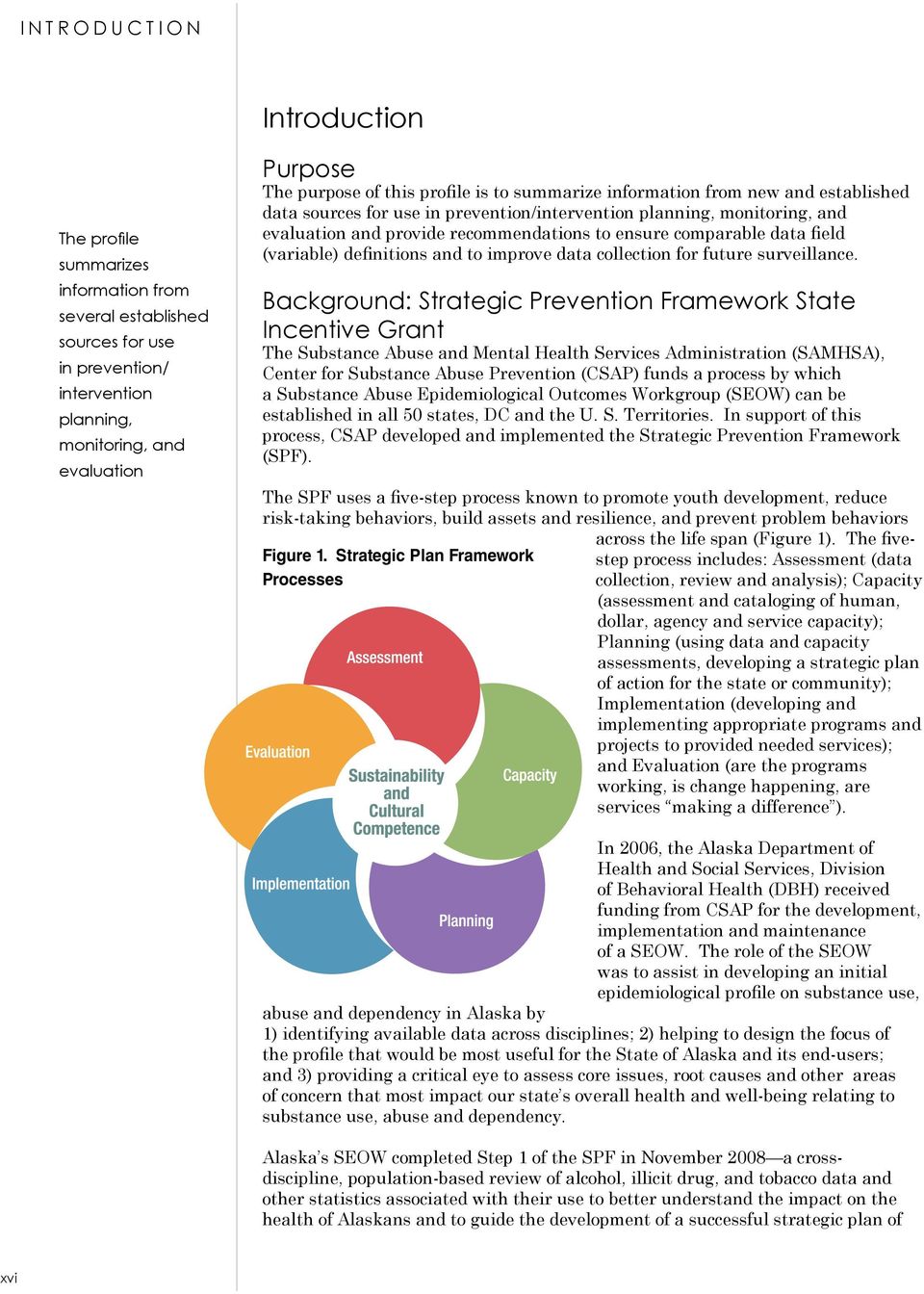
16 INTRODUCTION TOC iv Introduction The profile summarizes information from several established sources for use in prevention/ intervention planning, monitoring, and evaluation Purpose The purpose of this profile is to summarize information from new and established data sources for use in prevention/intervention planning, monitoring, and evaluation and provide recommendations to ensure comparable data field (variable) definitions and to improve data collection for future surveillance. Background: Strategic Prevention Framework State Incentive Grant The Substance Abuse and Mental Health Services Administration (SAMHSA), Center for Substance Abuse Prevention (CSAP) funds a process by which a Substance Abuse Epidemiological Outcomes Workgroup (SEOW) can be established in all 50 states, DC and the U. S. Territories. In support of this process, CSAP developed and implemented the Strategic Prevention Framework (SPF). The SPF uses a five-step process known to promote youth development, reduce risk-taking behaviors, build assets and resilience, and prevent problem behaviors Figure 1. Strategic Plan Framework Processes across the life span (Figure 1). The fivestep process includes: Assessment (data collection, review and analysis); Capacity (assessment and cataloging of human, dollar, agency and service capacity); Planning (using data and capacity assessments, developing a strategic plan of action for the state or community); Implementation (developing and implementing appropriate programs and projects to provided needed services); and Evaluation (are the programs working, is change happening, are services making a difference ). In 2006, the Alaska Department of Health and Social Services, Division of Behavioral Health (DBH) received funding from CSAP for the development, implementation and maintenance of a SEOW. The role of the SEOW was to assist in developing an initial epidemiological profile on substance use, abuse and dependency in Alaska by 1) identifying available data across disciplines; 2) helping to design the focus of the profile that would be most useful for the State of Alaska and its end-users; and 3) providing a critical eye to assess core issues, root causes and other areas of concern that most impact our state s overall health and well-being relating to substance use, abuse and dependency. Alaska s SEOW completed Step 1 of the SPF in November 2008 a crossdiscipline, population-based review of alcohol, illicit drug, and tobacco data and other statistics associated with their use to better understand the impact on the health of Alaskans and to guide the development of a successful strategic plan of xvi
17 TOC iv INTRODUCTION action to prevent and improve these conditions. Following the establishment of the SEOW, the State was able to identify, maintain and improve its ability to identify key data constructs for each type of substance use and its consequences; capture data from new sources for review and inclusion in the State epidemiologic profile; and publish a 5-year data summary. In July 2009, DBH was awarded a SPF State Incentive Grant (SIG) that enabled the State to continue its efforts through the Substance Abuse Epidemiologic Workgroup (SEW) (formerly the SEOW). As an integral part of the SPF SIG process, the SEW, composed of statistical and prevention program experts (Appendix A), established a clear, systematic approach to evaluate surveillance information and new scientifically valid evidence related to substance use, consequences of continued use, abuse and dependency, and protective and risk factors. Having a broad scope of state-level data across multiple professional disciplines pertaining to the aforementioned constructs, it was necessary for the SEW to expand and refine the process initiated by the SEOW. Besides the review of all potential substance-related data, the SEW assessed issues impacting the past, present, and future quality of the data used for the indicators; and scored the overall relevance of data as it related to the constructs. The SEW is responsible for 1) on-going review of substance-related consumption, consequence, and influences data that best described substance use, abuse, dependency and treatment in Alaska; 2) identifying measures for data development to improve substance-related surveillance for future SPF activities; and 3) providing direction and advice on format and content of an annual report titled State Epidemiologic Profile on Substance Use, Abuse, and Dependency. For more information of the selection process, see Appendix G. Profile Overview The following information summarizes select descriptive analyses of individual datasets. Each section of the epidemiologic profile begins with a problem statement followed by applicable definitions of data elements, a brief description of the data presented and website address. These data and/or their summary reports also can be accessed using the Data Resource information listed at the front of this report. xvii
18

19 SECTION 1 CONSUMPTION

20

21 SECTION 1 CONSUMPTION TOC Problem Statement: Alcohol Sales and Consumption The prevalence of alcohol use, heavy drinking, and binge drinking among adults and youth in Alaska have historically been higher than national averages. Trends of alcohol consumption varied among age groups, gender and race. However, Alaska s rate of binge alcohol use was higher than the national average in Alcohol use among youth did not vary significantly from national averages. However, alcohol use was associated with other high risk behaviors including abuse of other substances, sexual activity, behavior resulting in injury, delinquency, and criminal behavior in the majority of cases. Data Analysis Data on alcohol sales and consumption was provided through Alcohol Epidemiologic Data System (AEDS), Youth Risk Behavior Survey (YRBS), Behavioral Risk Factor Surveillance System (BRFSS), and National Survey on Drug Use and Health (NSDUH). Some rates were not available. Limiting factors include low number of observations, insufficient sample size or confidence interval (CI) range that is too broad to obtain reliable results. Most national averages were available for most recent year comparison. This section contains tables and charts with the following abbreviation: DSU - Data Statistically Unreliable. Definition: 1 drink = 1 can of beer, 1 glass of wine, 1 cocktail, 1 bottled wine cooler, or 1 shot of liquor Alcohol Epidemiologic Data System (AEDS)2 Ethanol consumption was consistently greater than national averages for all alcohol-containing beverages. While all alcohol beverages were higher than national statistics, spirits were 1.7 times higher in 2010 (Table 1.1; Chart 1.1). 3
22 TOC SECTION 1 CONSUMPTION Table 1.1. Trends in Ethanol Consumed Per Capita*, Alaska Beverage Type U.S U.S Beer Spirits Wine *Total sales of ethanol in gallons per 10,000 population age 14 years and older AEDS uses a population of persons aged 14 and older to calculate per capita consumption rates. Although age 14 is below the minimum legal age for the purchase of alcoholic beverages throughout the United States, most self-report surveys indicate that many 14-year-olds drink alcoholic beverages. Chart 1.1. Trends in Ethanol Consumed Per Capita, All Beverages, Alaska Ethanol Consumed Per Capita* Alaska U.S. *Total sales of ethanol in gallons per 10,000 population age 14 years and older Currently, 108 communities have some restriction that prohibits alcohol sales and possession. Nearly 75% of communities with alcohol restrictions ban the sale of alcohol (Chart 1.2). Of these communities, most had lower rates of serious injury resulting from assault, motor vehicle collisions and other causes. Dry communities (banning sale importation and possession of alcohol) with a local police presence had a lower age-adjusted rate of serious injury caused by assault. Chart 1.2. Communities with Alcohol Restrictions, Alaska, 2012, N=108 31% 18% 5% 6% Ban sale Sale by specific type of license only Sale by a municipal license only Ban Sale and importation Ban sale, importation and possession 40% 4 *Total sales of ethanol in gallons per 10,000 population age 14 years and older
23 SECTION 1 CONSUMPTION TOC Youth Risk Behavior Survey (YRBS) Alaska Center for Health Data and Statistics Interactive maps and data files may be accessed at: Definitions of alcohol use: Current alcohol use was defined as having one drink within the past 30 days. Heavy alcohol use was defined as having more than two drinks per day for males and one drink per day for females. Binge or episodic heavy alcohol use was defined as having five or more drinks within a couple of hours. The prevalence of alcohol use before 13 years of age, current and binge alcohol use was higher among males, while the prevalence of any alcohol use continued to be slightly higher among females (Table 1.2). However, reports of alcohol use before sexual intercourse has increased marginally for both male and female students compared to preceding surveys but was lower than the 2011 national averages. Overall, the 2011 YRBS results for All Grades were lower than the national averages, indicating a sustained long-term decline of current and episodic alcohol use among youth (Chart 1.3 and Chart 1.4). Table 1.2. Trends in Alcohol Use Among Youth, by Gender, Alaska YRBS U.S Female % Ever Drank Alcohol % Alcohol Before % Current Drinking % Binge Alcohol Use % Drank Alcohol or Used Drugs Before Last Sexual Intercourse % Drank on School Property Male % Ever Drank Alcohol % Alcohol Before % Current Drinking % Binge Alcohol Use % Drank Alcohol or Used Drugs Before Last Sexual Intercourse % Drank on School Property
24 TOC SECTION 1 CONSUMPTION Chart 1.3. Trends in Youth Reporting Alcohol Use Before Age 13, by Grade, Alaska YRBS Chart 1.4. Trends in Youth Reporting Binge Drinking, by Grade, Alaska YRBS Since the initial administration of the YRBS in Alaska (1995), alternative schools serving at-risk students were routinely excluded from traditional statewide YRBS surveys. In 2009, high school (HS) students in Alaska s alternative schools were conducted for the first time. In 2011, students from alternative schools reported significantly higher rates for all alcohol use indicators when compared to their traditional school counterparts. (Chart ). Missing bars on the following graphs indicate an insufficient sample size. 6
25 SECTION 1 CONSUMPTION TOC Chart 1.5. Percentage of Youth Reporting Lifetime Use of Alcohol, Comparing Traditional and Alternative Schools, by Gender and by Grade, Alaska YRBS, 2011 Chart 1.6. Percentage of Youth Reporting Alcohol Use Before Age 13, Comparing Traditional and Alternative Schools, by Gender and by Grade, Alaska YRBS, 2011 Chart 1.7. Percentage of Youth Reporting Current Alcohol Use, Comparing Traditional and Alternative Schools, by Gender and by Grade, Alaska YRBS,
26 TOC SECTION 1 CONSUMPTION Chart 1.8. Percentage of Youth Reporting Current Binge Drinking, Comparing Traditional and Alternative Schools, by Gender and by Grade, Alaska YRBS, 2011 Alcohol use among females remained significantly higher than the 2009 national average. Behavioral risk Factor Surveillance System (BRFSS) Alaska Center for Health Data and Statistics Interactive maps and data files may be accessed at: With the reporting of 2011 BRFSS data, the CDC has officially introduced a new method of sampling (to include cell phone as well as landline phone numbers) and a new weighting methodology referred to as raking. These changes improve the overall representativeness of the BRFSS data. However, in addition to possibly affecting the results, these changes in methods mean changes in the way we use the data. Trend analyses will eventually focus on years of data that include both landline and cell phone respondents, and which are weighted using raking methodology. These new methods are necessary to provide a more accurate reflection of the health behaviors and conditions measured in the BRFSS survey, available at: Definitions of alcohol use: Current alcohol use was defined as having one drink within the past 30 days. Heavy alcohol use was defined as having more than two drinks per day for males and one drink per day for females. Binge alcohol use was defined as having five or more drinks on one occasion for males and four or more drinks for females. Nearly 60% of adults in Alaska reported current alcohol use. Results of reported use (current, heavy, and binge) were variable from year to year. Overall prevalence of alcohol use in Alaska was higher than the nation, of which the current use of alcohol in Alaska increased 5% over the last 5 years. In 2011, current use of alcohol among females increased 8%, while current use among males decreased 3% (Table 1.3). Binge and heavy alcohol use continued to remain higher than the national averages for females and males. 8
27 SECTION 1 CONSUMPTION TOC Table 1.3. Trends in Alcohol Use Among Adults, by Gender, Alaska BRFSS U.S Female % Binge Alcohol Use % Current Alcohol Use % Heavy Alcohol Use Male % Binge Alcohol Use % Current Alcohol Use % Heavy Alcohol Use Total % Binge Alcohol Use % Current Alcohol Use % Heavy Alcohol Use Reports of binge, current, and heavy alcohol use by age group were variable from 2007 to In 2011, the prevalence of alcohol use was higher than national averages for adults 18 years and older. Prevalence of binge alcohol use was higher among adults 18 through 34 years and became less prevalent with each older age group (Table 1.4) 9
28 TOC SECTION 1 CONSUMPTION Table 1.4. Trends in Alcohol Use Among Adults, by Age Group, Alaska BRFSS Alcohol use was most prevalent among White adults followed by Hispanic U.S Ages 18 thru 24 % Binge Alcohol Use % Current Alcohol Use % Heavy Alcohol Use Ages 25 thru 34 % Binge Alcohol Use % Current Alcohol Use % Heavy Alcohol Use Ages 35 thru 44 % Binge Alcohol Use % Current Alcohol Use % Heavy Alcohol Use Ages 45 thru 54 % Binge Alcohol Use % Current Alcohol Use % Heavy Alcohol Use Ages 55 thru 64 % Binge Alcohol Use % Current Alcohol Use % Heavy Alcohol Use Ages 65 and over % Binge Alcohol Use % Current Alcohol Use % Heavy Alcohol Use In 2011, binge alcohol use was reported by 20% of adults in Alaska; prevalence was higher in Alaska than national averages for all race categories except Hispanics and Others. Prevalence of current alcohol use was higher among Blacks followed by Hispanics. Prevalence of heavy alcohol use was higher among Whites and Other. No significant differences were found in reported heavy alcohol use except for an increase among White and Other adults (Table 1.5; Chart 1.9). 10
29 SECTION 1 CONSUMPTION TOC Table 1.5. Trends in Alcohol Use Among Adults, by Race and Ethnicity, Alaska BRFSS U.S U.S Asian / Pacific Islander % Binge Alcohol Use DSU % Current Alcohol Use DSU % Heavy Alcohol Use DSU Black % Binge Alcohol Use DSU 4.9 DSU DSU DSU % Current Alcohol Use DSU 50.7 DSU DSU DSU % Heavy Alcohol Use DSU 2.6 DSU DSU DSU Hispanic % Binge Alcohol Use DSU DSU % Current Alcohol Use DSU DSU % Heavy Alcohol Use DSU DSU American Indian / Alaska Native % Binge Alcohol Use % Current Alcohol Use % Heavy Alcohol Use Other % Binge Alcohol Use % Current Alcohol Use % Heavy Alcohol Use White % Binge Alcohol Use % Current Alcohol Use % Heavy Alcohol Use National Health Interview Survey was used in the absence of US 2011 BRFSS data for Asian/Pacific Islander and American Indian/Alaska Native groups. 11
30 TOC SECTION 1 CONSUMPTION Chart 1.9. Trends in Adults Reporting Binge Alcohol Use, by Race and Ethnicity, Alaska BRFSS National Survey on Drug Use and Health (NSDUH) Definitions of alcohol use: Current alcohol use was defined as any reported use within the past 30 days. Binge alcohol use was defined as having five or more drinks (at the same time or within a couple of hours of each drink) on at least 1 day within the past 30 days. Heavy alcohol use was defined as having five or more drinks on the same occasion (at the same time or within a couple of hours of each drink) on each of 5 or more days in the past 30 days. A person needing but not receiving treatment for an alcohol problem is that the person met the criteria for alcohol dependence or abuse in the past year but did not receive specialty treatment for an alcohol problem in the past year Surveys indicated that reported alcohol use had remained relatively unchanged. In the survey, 12% of Alaskan youth reported alcohol use and 7% of youth reported binge drinking, which is a decrease from survey findings. Because alcohol can be legally purchased at 21 years of age, a lower prevalence among youth was expected. Over the time the survey was conducted in Alaska, there was no difference in report of current alcohol use by adults (ages 18 and older), of which all were higher than national averages (Table 1.6; Chart 1.10) 12
31 SECTION 1 CONSUMPTION TOC Table 1.6. Trends in Reported Alcohol Use, by Age Group, Alaska NSDUH U.S Ages 12 thru 17 % Alcohol Dependency/Abuse % Binge Alcohol Use % Current Alcohol Use % Needing Treatment in Past Year Ages 18 thru 25 % Alcohol Dependency/Abuse % Binge Alcohol Use % Current Alcohol Use % Needing Treatment in Past Year Ages 26 and over % Alcohol Dependency/Abuse % Binge Alcohol Use % Current Alcohol Use % Needing Treatment in Past Year All Ages % Alcohol Dependency/Abuse % Binge Alcohol Use % Current Alcohol Use % Needing Treatment in Past Year Chart Trends in Reported Alcohol Use, by Age Group, Alaska NSDUH, Percent Alcohol Dependence/Abuse Binge Alcohol Use Current Alcohol Use 0 Ages Ages Ages 26 & Over All Ages 13
32 TOC SECTION 1 CONSUMPTION Problem Statement: Illicit Drug Use Illicit drug use, like alcohol use, is a major contributing factor for both intentional and unintentional injury, leading to death or permanent disability. While marijuana use was the most commonly reported drug of abuse, other drugs used include inhalants, hallucinogens, opioids, and misused prescription drugs. Illicit drug use, like alcohol use, is a major contributing factor for both intentional and unintentional injury, leading to death and permanent disability. Data Analysis Data on illicit drug use was provided through the Youth Risk Behavior Survey (YRBS) and National Survey on Drug Use and Health (NSDUH). Some rates were not available. Limiting factors include low number of observations, insufficient sample size or confidence interval (CI) range that is too broad to obtain reliable results. Most national averages were available for most recent year comparison. DSU - Data Statistically Unreliable. Youth Risk Behavior Survey (YRBS) Alaska Center for Health Data and Statistics Interactive maps and data files may be accessed at: Definitions of illicit drug use: Illicit drugs include marijuana or hashish, cocaine (including crack), inhalants, hallucinogens (including phencyclidine [PCP], lysergic acid diethylamide [LSD], and Ecstasy [MDMA]), heroin, or prescriptiontype psychotherapeutics used non-medically, which include stimulants, sedatives, tranquilizers, and pain relievers. Current use was defined as any reported use one or more times in the 30 days preceding the survey. Ever used (lifetime use) was defined as any reported use preceding the survey. In 2011, the prevalence of any lifetime use and current use was higher among males than females for most categories of illicit drugs (Tables 1.7 and 1.8; Chart 1.11). Thirty percent of all Alaska high school students participating in the 2011 survey reported having ever used marijuana (42% males; 40% females). Twentysix percent of Grade 9 students reported ever using marijuana, increasing to 33% for Grades 10 thru 12. The prevalence of inhalant abuse was higher than cocaine, heroin, methamphetamine, ecstasy, and steroids. The prevalence of illicit drug use was higher among Alaska non-native students, while any reported use of marijuana was more likely to be reported by Alaska Native students. In 2011, YRBS began monitoring prescription drugs (OxyContin, Percocet, Vicodin, Codeine, Adderall, Ritalin or Xanax). Sixteen percent of Alaska youths reported using prescription drugs with the highest percentage among 11th graders (19%). There was no significant difference by race. 14
33 SECTION 1 CONSUMPTION TOC Table 1.7. Trends of Illicit Drug Use Among Youth, by Gender, Alaska YRBS U.S Female % Ever Used Cocaine % Ever Used Inhalants % Current Marijuana Use % Marijuana Before % Ever Used Heroin % Ever Used Methamphetamines % Ever Used Ecstasy % Ever Used Injection Drugs % Ever Used Steroids 2.8 DSU DSU 2.9 % Ever Taken Prescription Drugs Without a Doctor s Prescription Male % Ever Used Cocaine % Ever Used Inhalants % Current Marijuana Use % Marijuana Before % Ever Used Heroin % Ever Used Methamphetamines % Ever Used Ecstasy % Ever Used Injection Drugs % Ever Used Steroids 3.7 DSU DSU 4.2 % Ever Taken Prescription Drugs Without a Doctor s Prescription
34 TOC SECTION 1 CONSUMPTION Table 1.8. Trends of Illicit Drug Use Among Youth, by Grade, Alaska YRBS U.S Grade 9 % Ever Used Cocaine % Ever Used Inhalants % Current Marijuana Use % Marijuana Before % Ever Used Heroin % Ever Used Methamphetamines % Ever Used Ecstasy % Ever Used Injection Drugs % Ever Used Steroids 2.5 DSU DSU 4.2 % Ever Taken Prescription Drugs Without a Doctor s Prescription Grade 10 % Ever Used Cocaine % Ever Used Inhalants % Current Marijuana Use % Marijuana Before % Ever Used Heroin % Ever Used Methamphetamines % Ever Used Ecstasy % Ever Used Injection Drugs % Ever Used Steroids 3.4 DSU DSU 3.2 % Ever Taken Prescription Drugs Without a Doctor s Prescription Grade 11 % Ever Used Cocaine % Ever Used Inhalants % Current Marijuana Use % Marijuana Before % Ever Used Heroin % Ever Used Methamphetamines % Ever Used Ecstasy % Ever Used Injection Drugs % Ever Used Steroids 3.8 DSU DSU 3.7 % Ever Taken Prescription Drugs Without a Doctor s Prescription Grade 12 % Ever Used Cocaine % Ever Used Inhalants % Current Marijuana Use % Marijuana Before % Ever Used Heroin % Ever Used Methamphetamines % Ever Used Ecstasy % Ever Used Injection Drugs % Ever Used Steroids 3.0 DSU DSU 2.8 % Ever Taken Prescription Drugs Without a Doctor s Prescription Question was included in 2011 Alaska YRBS only 16 16
35 SECTION 1 CONSUMPTION TOC Chart Trends in Youth Reporting Marijuana Use Before Age 13 Years, by Grade, Alaska YRBS As stated previously, alternative schools serving at-risk students were routinely excluded from traditional statewide YRBS surveys. In 2009, high school (HS) surveys in Alaska s alternative schools were conducted for the first time. Students from alternative schools reported significantly higher rates for all illicit drug use indicators when compared to their traditional school counterparts. In 2011, YRBS reported prescription drug use. The alternative high school students reported a significantly higher use of prescription drug use than those is traditional high schools (Charts ). Missing bars on the following graphs indicate an insufficient sample size. Chart Percent of Youth Reporting Ever Used Marijuana, Comparing Traditional and Alternative Schools, Alaska YRBS,
36 TOC SECTION 1 CONSUMPTION Chart Percent of Youth Reporting Marijuana Use Before Age 13, Comparing Traditional and Alternative Schools, Alaska YRBS, 2011 Chart Percent of Youth Reporting Current Marijuana Use, Comparing Traditional and Alternative Schools, Alaska YRBS, 2011 Chart Percent of Youth Reporting Ever Used Heroin, Comparing Traditional and Alternative Schools, Alaska YRBS,
37 SECTION 1 CONSUMPTION TOC Chart Percent of Youth Reporting Ever Used Methamphetamine, Comparing Traditional and Alternative Schools, Alaska YRBS, 2011 Chart Percent of Youth Reporting Ever Used Ecstasy, Comparing Traditional and Alternative Schools, Alaska YRBS, 2011 Chart Percent of Youth Reporting Ever Used Cocaine, Comparing Traditional and Alternative Schools, Alaska YRBS,
38 TOC SECTION 1 CONSUMPTION Chart 1.19 Percentage of Students Who Have Taken a Prescription Drug (such as OxyContin, Percocet, Vicodin, Codeine, Adderall, Ritalin, or Xanax) Without a Doctor s Prescription One or More Times During Their Life, Comparing Traditional and Alternative Schools, Alaska YRBSS, 2011 Chart Percentage of Students Who Were Offered, Sold, or Given an Illegal Drug by Someone on School Property During the Past 12 Months, Comparing Traditional and Alternative Schools, Alaska YRBS, 2011 National Survey on Drug Use and Health (NSDUH) Definitions of illicit drug use: Illicit drugs include marijuana or hashish, cocaine (including crack), inhalants, hallucinogens (including phencyclidine [PCP], lysergic acid diethylamide [LSD], and Ecstasy [MDMA]), heroin, or prescriptiontype psychotherapeutics used non-medically, which include stimulants, sedatives, tranquilizers, and pain relievers. Current use was defined as any reported use within the past 30 days. A person needing but not receiving treatment for a drug problem is that the 20
39 SECTION 1 CONSUMPTION TOC person met the criteria for drug dependence or abuse in the past year but did not receive specialty treatment for an alcohol problem in the past year. Overall, the NSDUH results for all respondents in Alaska were equal to or higher than national averages. Approximately one-fourth of respondents between the ages of 18 through 25 years reported either current marijuana use or other illicit drug use in survey. Prevalence of non-medicinal use of prescription pain relievers had not significantly changed since 2009, remaining at 11%. Seven percent of this age group reported drug dependence or abuse; 7% reported needing treatment in the past year. (Table 1.9; Chart 1.21 and 1.22). Table 1.9. Trends in Reported Illicit Drug Use, by Age Group, Alaska NSDUH U.S Ages 12 thru 17 % Current Marijuana Use % Current Other Illicit Use % Drug Dependence/Abuse % Needing Treatment in Past Year Ages 18 thru 25 % Current Marijuana Use % Current Other Illicit Use % Drug Dependence/Abuse % Needing Treatment in Past Year Ages 26 and over % Current Marijuana Use % Current Other Illicit Use % Drug Dependence/Abuse % Needing Treatment in Past Year All Ages % Current Marijuana Use % Current Other Illicit Use % Drug Dependence/Abuse % Needing Treatment in Past Year
40 TOC SECTION 1 CONSUMPTION Chart Reported Illicit Drug Use, Dependency or Abuse, by Age Groups, Alaska NSDUH, Chart Non-Medical Use of Prescription Pain Relievers in the Past Year Among Persons Aged 12 or Older, by Age Group and Alaska, NSDUH, and Problem Statement: Tobacco Use Nationally, cigarette use causes an estimated 440,000 deaths, and is responsible for about one in five deaths each year. 1 Accessed August 5, 2013 at Tobacco is the single largest killer of Alaskans, having deadly impact due to direct use and exposure to second-hand smoke. On average, nearly 546 lives per year are lost due to tobacco use with an additional 120 lives lost due to secondhand (environmental) smoke. In 2010, tobacco use costs the state $348 million in direct medical expenditures and an additional $231 million in lost productivity due to tobacco-related deaths. 2 According to the latest report by the Alaska Department of Health and Social Services, tobacco-related deaths in Alaska exceed the combined total of fatal intentional injuries (homicide and suicide) and fatal transportation injuries (motor vehicle, watercraft and aircraft). Alaska Native adults are still twice as likely to smoke as non-native adults. 22
41 SECTION 1 CONSUMPTION TOC 1 CDC, Smoking & Tobacco Use Fact Sheets. Accessed August 5, 2013 at fact_sheets/index.htm. 2 Alaska Department of Health and Social Services, Section of Chronic Disease Prevention and Health Promotion. Alaska Tobacco Fcts, Update Accessed August 5, 2013 at alaska_tobacco_facts.pdf Data Analysis Data on tobacco sales and consumption was provided through the Tobacco Tax Program from the Alaska Department of Revenue. Data on adult and youth smoking habits was largely provided by the BRFSS and the YRBS, respectively. Some rates were not available; limiting factors include low number of observations, insufficient sample size or confidence interval range that is too broad to obtain reliable results. National averages were available for most recent year comparison. In accordance with tobacco regulations, states are required to provide detailed information on progress made in enforcing youth tobacco access laws and to ensure future compliance with the federal SYNAR Amendment prohibiting the sales and distribution of tobacco products to minors. Tobacco and Smoking Surveillance In 1998, a dramatic drop in cigarette sales was noted that corresponded to an increased sales tax on tobacco products. 3 Cigarette sales have continued to diminish; cigarette sales had declined by nearly 30% between 2005 and This trend in cigarette sales (Table 1.10) indicated significant progress regarding tobacco consumption and health education. Tobacco is the single largest killer of Alaskans, having deadly impact due to direct use and exposure to second-hand smoke. Table Trend in Annual Cigarette Sales per Capita, Alaska U.S. 2011* Cigarette Packs Sold Per Adult * US minus Alaska In accordance with tobacco regulation, each state must provide a detailed report on the progress to enforce tobacco laws prohibiting sales to youth. The purpose of the state reports were to provide both Congress and the states with a better understanding of progress and to assist with identifying state-based needs for program enhancement, particularly enforcing retailer compliance. In 2011, Alaska achieved 20% or below compliance established by SYNAR. In 2011 the retailer violation rate was 7.6%.¹ ¹ Youth Risk Behavior Survey (YRBS) Alaska Center for Health Data and Statistics Interactive maps and data files may be accessed at: SAMHSA, FFY2011 Annual Synar Reports, Tobacco Sales to Youth. Accessed August 5, 2013 at Synar-Report.pdf. 23
42 TOC SECTION 1 CONSUMPTION Definitions of tobacco use: Current cigarette/cigar use was defined as reported smoking on at least one day in the 30 days preceding the survey. Daily cigarette use was defined as reported smoking at least one cigarette every day for 30 days. Frequent cigarette use was defined as reported smoking on 20 or more days in the 30 days preceding the survey. Smokeless tobacco use was defined as reported use of chewing tobacco, snuff, or dip on at least one day in the 30 days preceding the survey. Iq mik is a substance made of tobacco and the ash of a fungus (Phellinus igniarius) that grows on birch trees. The practice is prevalent in several regions, particularly the Yukon-Kuskokwim Delta. Overall, daily cigarette use decreased among Alaska high school youth, from 15.7% in 2009 to 14.1% in However, Alaska Native students continued to report cigarette use as much as 15-20% higher than the rate of Non-Native youth. Nearly half of the survey participants reported ever trying cigarettes and 16% reported current use in the past month. While prevalence was higher among female students for current and daily cigarette use in 2011, male students were higher for ever tried smoking, use before 13 years of age, frequent use, as well as cigar and smokeless tobacco use. (Table 1.11; Chart 1.23 and 1.24). Withstanding prominent smoking cessation campaigns, 32% of students who reported current cigarette use did not try to quit smoking in the past year. Nearly 9% of students reported use of smokeless tobacco (chewing tobacco, snuff, or dip) during the past month where prevalence was 2.8 times higher among male students. Not available for this survey was information pertaining to the use of iq mik. 24
43 SECTION 1 CONSUMPTION TOC Table Trends in Cigarette Use Among Youth, by Gender, Alaska YRBS U.S 2011 Female % Ever Tried Cigarettes % Cigarette Before % Current Cigarette Use % Daily Cigarette Use % Frequent Cigarette Use DSU DSU % Cigarette Use on School Property % Current Cigar Use % Smokeless Tobacco Use % Smokeless Tobacco Use on School Property Among Current Smokers, % Who Did Not Try to Quit DSU 46.1 Male % Ever Tried Cigarettes % Cigarette Before % Current Cigarette Use % Daily Cigarette Use % Frequent Cigarette Use DSU DSU % Cigarette Use on School Property % Current Cigar Use % Smokeless Tobacco Use % Smokeless Tobacco Use on School Property Among Current Smokers, % Who Did Not Try to Quit DSU 53.0 Chart Trends in Current Cigarette Use Among Youth, by Grade, Alaska YRBS 25
44 TOC SECTION 1 CONSUMPTION Chart Trends in Youth Reporting Current Cigarette Before Age 13, by Grade, Alaska YRBS As stated previously, alternative schools serving at-risk students have been routinely excluded from traditional statewide YRBS surveys. In 2009, surveys of high school students in Alaska s alternative schools were conducted for the first time. In 2011 students from alternative schools reported significantly higher rates for all tobacco use indicators when compared to their traditional school counterparts (Charts ). Chart Percentages of Students Who Smoked a Whole Cigarette for the First Time Before Age 13 Years, Comparing Traditional and Alternative Schools, Alaska YRBS,
45 SECTION 1 CONSUMPTION TOC Chart Percentages of Students Who Smoked Cigarettes on 20 or More of the Past 30 Days, Comparing Traditional and Alternative Schools, Alaska YRBS, 2011 Chart Percentage of Students Who Used Chewing Tobacco, Snuff, or Dip on One or More of the Past 30 Days, Comparing Traditional and Alternative Schools, Alaska YRBS, 2011 Behavioral Risk Factor Surveillance Survey (BRFSS) Alaska Center for Health Data and Statistics Interactive maps and data files may be accessed at: Definitions of cigarette use: Current cigarette use was defined as any reported use within the past 30 days. Daily cigarette use was defined as smoking at least one cigarette per day within the past 30 days. In 2011, 23% of adults in Alaska reported cigarette use. Prevalence was higher among young adults aged years and males. In 2011, 27.9% of current 27
46 SECTION 1 CONSUMPTION smokers had incomes below the federal poverty level. Of Alaska Natives using smokeless tobacco, nearly half are iq mik users.¹ The prevalence of cigarette use among Blacks was higher than all other racial groups, followed by Alaska Natives. The percentage of Black adults who smoked was nearly twice as high as White adults who smoke (Table 1.12 and 1.13; Chart 1.28 and 1.29). ¹ Table Trends in Cigarette Use Among Adults, by Gender, Alaska BRFSS U.S 2011 Female % Current Cigarette Use % Daily Cigarette Use Male % Current Cigarette Use % Daily Cigarette Use Chart Percentage of Adults Who Are Current Smokers, by Age Group, Alaska BRFSS,
47 SECTION 1 CONSUMPTION Chart Trends in Current Tobacco Use Among Adults, by Race and Ethnicity, Alaska BRFSS White Other Hispanic Black Table Trends in Cigarette Use Among Adults, by Race and Ethnicity, Alaska BRFSS U.S Asian / Pacific Islander % Current Cigarette Use % Daily Cigarette Use Black % Current Cigarette Use % Daily Cigarette Use DSU Hispanic % Current Cigarette Use % Daily Cigarette Use American Indian / Alaska Native % Current Cigarette Use % Daily Cigarette Use Other % Current Cigarette Use % Daily Cigarette Use White % Current Cigarette Use % Daily Cigarette Use US 2011 BRFSS data not available for racial groups 29
48 TOC SECTION 1 CONSUMPTION National Survey on Drug Use and Health (NSDUH) Definitions of tobacco product and cigarette use: Tobacco product includes cigarettes, chewing tobacco, snuff, cigars, and pipe tobacco. Current use was defined as any reported use within the past 30 days. One-quarter of adults in Alaska currently use cigarettes. Forty-six percent of surveyed adults aged years reported current use of tobacco products. The 2011 YRBS survey results indicated at least 19% of students reported current cigarette use, suggesting a greater prevalence of cigarette use among students over 18 years of age (Table 1.14; Chart 1.30). Table Trends in Reported Cigarette and Tobacco Products Use, by Age Group, Alaska NSDUH U.S Ages 12 thru 17 % Current Cigarette Use % Current Tobacco Products Use Ages 18 thru 25 % Current Cigarette Use % Current Tobacco Products Use Ages 26 and over % Current Cigarette Use % Current Tobacco Products Use All Ages % Current Cigarette Use % Current Tobacco Products Use Chart Reported Cigarette and Tobacco Products Use, by Age Group, Alaska NSDUH,
49 SECTION 1 CONSUMPTION TOC Pregnancy Risk Assessment Monitoring System (PRAMS) The Pregnancy Risk Assessment Monitoring System (PRAMS) was developed by CDC as part of its initiative to reduce infant mortality and low birth weight. The PRAMS survey collects state-specific, population-based data on maternal attitudes and experiences before, during, and after pregnancy. Definitions of Tobacco use: Smoking Before Pregnancy was defined as whether the mother smoked during the 3 months before getting pregnant. Smoking During Pregnancy was defined as whether the mother smoked during the last 3 months of pregnancy. Survey findings from 2006 through 2011 indicated an overall increase of smoking before and during pregnancy for every age group except years olds (Table 1.15). Prevalence for smoking before pregnancy was highest for women younger than 20 years. Table Trends in Maternal Smoking, by Age Group and Year, Alaska PRAMS, Age < 20 % Smoking Before Pregnancy % Smoking During Pregnancy Age % Smoking Before Pregnancy % Smoking During Pregnancy Age % Smoking Before Pregnancy % Smoking During Pregnancy Age 35 + % Smoking Before Pregnancy % Smoking During Pregnancy Table 1.16 Percentage of Prenatal Marijuana Use, by Year, Alaska PRAMS, Overall Alaska non-native Alaska Native
50
51 SECTION 2 CONSEQUENCE
52
53 SECTION 2 CONSEQUENCE Problem Statement: Mortality According to the National Institute on Drug Abuse, Drug-related deaths have more than doubled since the early 1980s. There are more deaths, illness, and disabilities from substance abuse than from any other preventable health condition. Today, one in four deaths is attributable to alcohol, tobacco, and illicit drug use. 1 Substance abuse is also a major contributing factor for nonfatal recreational, home, and occupational injuries. This section begins with a brief profile of mortality in Alaska and then focus on mortality rates for causes of death associated with substance abuse. Data were primarily gathered from the Alaska Bureau of Vital Statistics and from other public health surveillance programs. The most recent five-year period was used. Whenever possible, age adjusted death rates were provided to control for the effects of differences in population age distribution. 1 National Institute on Drug Abuse, Medical Consequences of Drug Abuse. Accessed April 29, 2013 at Substance abuse was also a major contributing factor for nonfatal recreational, home, and occupational injuries. Data Analysis Mortality data was provided by the Alaska Bureau of Vital Statistics. All rates were calculated per 100,000 persons. This section contains tables and charts using the following notations for rates: * Rates based on fewer than 20 occurrences are statistically unreliable and should be used with caution. ** Rates based on fewer than 6 occurrences are not reported. Alaska Bureau of Vital Statistics Of the ten leading causes of death in Alaska, all except Alzheimer s disease have been associated with substance abuse as a potential contributing cause of death (Chart 2.1). Chronic liver disease, cirrhosis and diseases of the heart can be strongly associated with alcohol abuse. Chronic lower respiratory disease (chronic obstructive pulmonary disease-copd), diseases of the heart, cerebrovascular disease and many cancers also have strong association with tobacco use. In 2011, unintentional injury was the third leading cause of death in Alaska and shown to have a strong association with alcohol and drug use. Substance abuse was also a major contributing factor for non-fatal recreational, home, and occupational injuries. 35
54 SECTION 2 CONSEQUENCE Chart 2.1. Ten Leading Causes of Mortality in Alaska, Malignant neoplasms Diseases of the heart Unintentional injuries Chronic lower respiratory diseases Cerebrovascular diseases Alzheimer s disease Intentional self-harm (suicide) Diabetes mellitus Influenza and pneumonia Chronic liver disease and cirrhosis RATE 1 1 Rates are per 100,000 population are age-adjusted to the year 2000 US standard population. Source: Alaska Bureau of Vital Statistics, February As expected, the number and rate of death increased with age, and this trend was generalizable across all genders and race aged years. The death rate among males and Alaska Native people was higher. Leading causes (see Appendix D ICD-10 Codes for Cause of Death) of premature death, including chronic liver disease, cirrhosis, homicide, suicide, and unintentional injury, were strongly associated with substance abuse (Table ). Table 2.1. All Causes of Death by Age, Gender, and Race, Alaska, Age 0-24 Age Age 65+ All Ages Deaths Rate 1 Deaths Rate 1 Deaths Rate 1 Deaths Rate 1 Female Asian/Pacific Islander * , Black * , American Indian / Alaska Native , ,941 1,018.2 White , ,595 3, , All Races , ,894 3, , Male Asian/Pacific Islander , Black , American Indian / Alaska Native , , ,295 1,320.7 White , ,805 3, , All Races , ,038 3, , Total Asian/Pacific Islander , Black , American Indian / Alaska Native , ,935 5, ,236 1,159.3 White , ,400 3, , All Races 2 1, , ,932 3, , Rates are per 100,000 population in age groups; all ages rates are age-adjusted to the year 2000 US standard population 2 All Races includes decedents whose race is Unknown.
55 SECTION 2 CONSEQUENCE Table 2.2. All Causes of Death by Gender and Borough/Census Area, Alaska, Total Deaths Age Adjusted Death Rate 1 Male Deaths Male Age Adjusted Death Rate 1 Female Deaths Female Age Adjusted Death Rate 1 Aleutians East Borough * Aleutians West Anchorage 6, , , Bethel , Bristol Bay Borough 37 1, * Denali Borough * * Dillingham 153 1, , Fairbanks North Star Borough 1, , Haines Borough Juneau Borough Kenai Peninsula Borough 1, , Ketchikan Gateway Borough Kodiak Island Borough Lake And Peninsula 65 1, , Matanuska-Susitna Borough 2, , Nome 363 1, , , North Slope Borough 233 1, , , Northwest Arctic Borough , Prince Of Wales-Outer Ketchikan Sitka Borough Skagway-Hoonah-Angoon Southeast Fairbanks , Valdez-Cordova , Wade Hampton 276 1, , , Wrangell-Petersburg , Yakutat Borough * 13 1,372.9* 5 ** Yukon-Koyukuk 254 1, , Alaska 18, , , Rates are per 100,000 population in age groups; all ages rates are age-adjusted to the year 2000 US standard population 37
56 SECTION 2 CONSEQUENCE Table 2.3. Numbers of Premature Deaths Associated with Substance Abuse, by Leading Cause and Borough/Census Area, Alaska, Number of Deaths Health Indicators for Census Areas/Boroughs All Causes of Death Alcohol Induced Drug Induced Unintentional Injury Suicide Homicide Chronic Liver Disease & Cirrhosis Aleutians East Borough Aleutians West Anchorage 6, Bethel Bristol Bay Borough Denali Borough Dillingham Fairbanks North Star Borough 1, Haines Borough Juneau Borough Kenai Peninsula Borough 1, Ketchikan Gateway Borough Kodiak Island Borough Lake And Peninsula Matanuska-Susitna Borough 2, Nome North Slope Borough Northwest Arctic Borough Prince Of Wales-Outer Ketchikan Sitka Borough Skagway-Hoonah-Angoon Southeast Fairbanks Valdez-Cordova Wade Hampton Wrangell-Petersburg Yakutat Borough Yukon-Koyukuk Alaska 18, , Cause of Death: Unintentional Injury Suicide Homicide Chronic Liver Disease & Cirrhosis Alcohol-Induced 1 Drug-Induced 2 ICD-10 Codes V01-X59, Y85-Y86 U03, X60-X84, Y870 U01-U02, X85-Y09, Y871 K70, K73-K74 E244, F10, G312, G621, G721, I426, K292, K70, K852, K860, R780, X45, X65, Y15 D521, D590, D592, D611, D642, E064, E160, E231, E242, E273, E661, F110-F115, F117-F119, F120-F125, F127-F129, F130-F135, F137-F139, F140-F145, F147-F149, F150-F155, F157-F159, F160-F165, F167-F169, F170, F173-F175, F177-F179, F180-F185, F187-F189, F190-F195, F197-F199, G211, G240, G251, G254, G256, G444, G620, G720, I952, J702-J704, L105, L270-L271, M102, M320, M804, M814, M835, M871, R502, R781, R782-R785, X40-X44, X60-X64, X85, Y10-Y14 38
57 SECTION 2 CONSEQUENCE Table 2.4. Rates of Premature Deaths Associated with Substance Abuse, by Leading Cause and Borough/Census Area, Alaska, Age-Adjusted Death Rates 1 Health Indicators for Census Areas/Boroughs All Causes of Death Alcohol Induced Drug Induced Unintentional Injury Suicide Homicide Chronic Liver Disease & Cirrhosis Aleutians East Borough ** ** ** ** ** ** Aleutians West ** ** 53.1* ** ** ** Anchorage Bethel ** * ** Bristol Bay Borough 1,084.4 ** ** 134.1* ** ** ** Denali Borough ** ** ** ** ** ** Dillingham 1, * ** * ** ** Fairbanks North Star Borough Haines Borough ** ** ** ** ** ** Juneau Borough ** 11.7* Kenai Peninsula Borough * 12.0 Ketchikan Gateway Borough * 12.4* ** 16.5* Kodiak Island Borough * 13.4* * ** 11.6* Lake And Peninsula 1, * ** 106.2* ** ** ** Matanuska-Susitna Borough Nome 1, * ** ** ** North Slope Borough 1, * ** * ** ** Northwest Arctic Borough * ** ** ** Prince Of Wales-Outer Ketchikan * ** 56.6* 30.9* ** 20.6* Sitka Borough * 18.3* * ** 15.8* Skagway-Hoonah-Angoon * ** 129.1* ** ** ** Southeast Fairbanks * ** 62.1 ** ** 13.5* Valdez-Cordova * 13.9* * ** 10.6* Wade Hampton 1, * ** * ** Wrangell-Petersburg * 25.4* 64.8* 22.2* ** 19.4* Yakutat Borough 626.6* ** ** ** ** ** ** Yukon-Koyukuk 1, * ** ** 17.9* Alaska Rates are per 100,000 population in age groups; all ages rates are age-adjusted to the year 2000 US standard population Cause of Death: Unintentional Injury Suicide Homicide Chronic Liver Disease & Cirrhosis Alcohol-Induced 1 Drug-Induced 2 ICD-10 Codes V01-X59, Y85-Y86 U03, X60-X84, Y870 U01-U02, X85-Y09, Y871 K70, K73-K74 E244, F10, G312, G621, G721, I426, K292, K70, K852, K860, R780, X45, X65, Y15 D521, D590, D592, D611, D642, E064, E160, E231, E242, E273, E661, F110-F115, F117-F119, F120-F125, F127-F129, F130-F135, F137-F139, F140-F145, F147-F149, F150-F155, F157-F159, F160-F165, F167-F169, F170, F173-F175, F177-F179, F180-F185, F187-F189, F190-F195, F197-F199, G211, G240, G251, G254, G256, G444, G620, G720, I952, J702-J704, L105, L270-L271, M102, M320, M804, M814, M835, M871, R502, R781, R782-R785, X40-X44, X60-X64, X85, Y10-Y14 39
58 SECTION 2 CONSEQUENCE Problem Statement: Alcohol-Related Consequences There are approximately 75,000 deaths attributable to excess alcohol each year in the United States. Chronic liver disease and cirrhosis are often associated with alcoholism and are ranked as the 12th most common cause of death in adults in the United States. The consequences of alcohol abuse are severe in Alaska; Alaska consistently has one of the highest rates of death from alcohol-related causes. Alaska s alcohol-related problems mirror issues experienced in other states domestic/family violence, intentional and unintentional injury, motor vehicle crash, mental illness, crime, poverty, and unemployment. In addition, a variety of medical diseases are associated with alcohol abuse and dependency including diseases of nervous, circulatory, and digestive systems. Data Analysis Mortality data was provided by the Alaska Bureau of Vital Statistics. Injury and other consequential data was provided through the Alaska Trauma Registry, No Child Left Behind-Alaska s Consolidated State Performance Reports, and Fetal Alcohol Syndrome Disorder (FASD) Surveillance System. This section contains tables and charts using the following notations for rates: * Rates based on fewer than 20 occurrences are statistically unreliable and should be used with caution. ** Rates based on fewer than 6 occurrences are not reported. Alaska Bureau of Vital Statistics Overall, males experienced 1.4 times the number and 1.3 times the rate of alcohol induced deaths than females. Alaska Natives experience the highest rate of alcohol induced death. Prevalence of alcohol induced death among Alaska Native females aged years was higher than males. From 2007 to 2011, nearly one of every 13 Alaska Native deaths was an alcohol induced death. Prevalence was higher in rural Alaska (Table 2.5 and 2.6; Chart ). Causes of alcohol induced death included alcohol psychoses, alcohol dependence syndrome, nondependent abuse of alcohol; alcohol induced chronic liver disease and cirrhosis, and alcohol poisoning. Lake and Peninsula borough had the highest rate of alcohol-induced death, followed by Yukon-Kuskokwim and Northwest Arctic boroughs. Prince of Wales-Outer Ketchikan and Wrangell-Petersburg had the highest rates of chronic liver disease and cirrhosis death. Table 2.5. Comparison of Alcohol Induced and Chronic Liver Disease and Cirrhosis Deaths Rates 1, Alaska and U.S., Alaska U.S. Alcohol Induced Deaths Chronic Liver Disease and Cirrhosis Deaths Rates are per 100,000 population in age groups; all ages rates are age-adjusted to the year 2000 US standard population 40
59 SECTION 2 CONSEQUENCE Table 2.6. Alcohol Induced Death by Age, Gender, and Race, Alaska, All Ages Deaths Rate 1 Deaths Rate 1 Deaths Rate 1 Deaths Rate 1 Female Asian/Pacific Islander ** Black ** ** American Indian / Alaska Native 5 ** * White * All Races 2 5 ** Male Asian/Pacific Islander ** 1 ** 5 ** Black ** ** American Indian / Alaska Native 6 4.1* * White 2 ** All Races * Total Asian/Pacific Islander ** 1 ** 5 ** Black ** ** American Indian / Alaska Native * White 2 ** All Races * Rates are per 100,000 population in age groups; all ages rates are age-adjusted to the year 2000 US standard population 2 All Races includes decedents whose race is unknown. Cause of Death: Alcohol-Induced ICD-10 Codes E244, F10, G312, G621, G721, I426, K292, K70, K852, K860, R780, X45, X65, Y15 41
60 SECTION 2 CONSEQUENCE Chart 2.2. Number of Deaths Associated With Alcohol Use, by Region, Alaska, Source: Alaska Bureau of Vital Statistics Last updated on 01/31/2013 Chart 2.3. Alcohol Induced Deaths and Rates 1 by Borough/Census Area, Alaska, Borough/Census Area (# of deaths, % of statewide total) Lake And Peninsula (8, 1.2%) 93.5* Yukon-Koyukuk (18, 2.6%) 55.5* Northwest Arctic Borough (15, 2.2%) 45.4* Dillingham (8, 1.2%) 40.0* Nome (15, 2.2%) 36.5* Prince Of Wales-Outer Ketchikan (12, 1.7%) 36.1* Wade Hampton (9, 1.3%) 31.8* Bethel (22, 3.2%) 29.8 North Slope Borough (12, 1.7%) 26.0* Ketchikan Gateway Borough (18, 2.6%) 24.5* Skagway-Hoonah-Angoon (6, 0.9%) 23.7* Juneau Borough (32, 4.6%) 21.1 Kodiak Island Borough (13, 1.9%) 20.9* Anchorage (295, 42.8%) 20.3 Wrangell-Petersburg (7, 1.0%) 19.6* Alaska (689, 100%) 19.4 Valdez-Cordova (10, 1.5%) 17.2* Sitka Borough (8, 1.2%) 16.0* Kenai Peninsula Borough (49, 7.1%) 15.4 Fairbanks North Star Borough (63, 9.1%) 15.0 Southeast Fairbanks (6, 0.9%) 13.9* Matanuska-Susitna Borough (51, 7.4%) 11.4 Yakutat Borough (0, 0%) ** Haines Borough (3, 0.4%) ** Denali Borough (0, 0%) ** Bristol Bay Borough (1, 0.2%) ** Aleutians West (5, 0.7%) ** Aleutians East Borough (1, 0.2%) ** Rate 1 Rates are per 100,000 population in age groups; all ages rates are age-adjusted to the year 2000 US standard population Source: Alaska Bureau of Vital Statistics Last updated on 01/31/
61 SECTION 2 CONSEQUENCE Chart 2.4. Chronic Liver Disease and Cirrhosis Death and Rates 1 by Borough/ Census Area, Alaska, Borough/Census Area (# of death, % of statewide total) Prince Of Wales-Outer Ketchikan (7, 1.8%) Wrangell-Petersburg (8, 2.1%) Yukon-Koyukuk (6, 1.6%) Ketchikan Gateway Borough (11, 2.9%) Sitka Borough (7, 1.8%) Southeast Fairbanks (6, 1.6%) Anchorage (168, 43.8%) Kenai Peninsula Borough (40, 10.4%) Juneau Borough (19, 5.0%) Kodiak Island Borough (6, 1.6%) Alaska (384, 100%) Fairbanks North Star Borough (42, 10.9%) Valdez-Cordova (6, 1.6%) 20.6* 19.4* 17.9* 16.5* 15.8* 13.5* * 11.6* Matanuska-Susitna Borough (32, 8.3%) 7.9 Yakutat Borough (0, 0%) Wade Hampton (2, 0.5%) Skagway-Hoonah-Angoon (2, 0.5%) Northwest Arctic Borough (1, 0.3%) North Slope Borough (1, 0.3%) Nome (2, 0.5%) Lake And Peninsula (1, 0.3%) Haines Borough (3, 0.8%) Dillingham (3, 0.8%) Denali Borough (0, 0%) Bristol Bay Borough (1, 0.3%) Bethel (5, 1.3%) Aleutians West (5, 1.3%) ** ** ** ** ** ** ** ** ** ** ** ** ** Aleutians East Borough (0, 0%) ** Rates are age-adjusted to the year 2000 US standard population. Source: Alaska Bureau of Vital Statistics, February Rate 43
62 SECTION 2 CONSEQUENCE Unintentional Injury According to the World Health Organization, 32% of all alcohol-attributable deaths were due to unintentional injuries. 1 However, this should be considered an under ascertainment since events may and do include other person(s) that were fatally injured as a result of a person under the influence of alcohol (e.g., driving after drinking, accidental fire). Alaska s unintentional injury death rate was 1.5 times the U.S. rate. During , males were 2.0 times more likely than females to die from unintentional injury in Alaska, where prevalence was highest among males aged 65 years and older. Alaska Natives experienced the highest rate of death due to unintentional injury in contrast to Whites, who experienced the greatest number of deaths. Prevalence was highest among Alaska Native males aged 25 years and older, who experienced times the rate of death of White males. Yukon-Kuskokwim and Dillingham boroughs had the highest rates of unintentional injury, followed by Northwest Arctic and Bristol Bay boroughs (Table 2.7 and 2.8; Chart 2.5). 1 Health Organization...Accessed April 1, 2013 at Assessed April 1, Table 2.7. Comparison of Unintentional Injury Deaths Rates 1, Alaska and U.S., Alaska U.S. Unintentional Injury Deaths Rates are per 100,000 population in age groups; all ages rates are age-adjusted to the year 2000 US standard population. 44
63 SECTION 2 CONSEQUENCE Table 2.8. Unintentional Injury Deaths by Age, Gender, and Race, Alaska, Age 0-24 Age Age 65+ All Ages Deaths Rate 1 Deaths Rate 1 Deaths Rate 1 Deaths Rate 1 Female Asian/Pacific Islander 1 ** * 2 ** * Black 2 ** 2 ** 1 ** 5 ** American Indian / Alaska Native White All Races Male Asian/Pacific Islander * * 3 ** * Black 4 ** * 3 ** American Indian / Alaska Native White All Races , Total Asian/Pacific Islander 7 7.2* * 5 ** Black 6 7.7* ** American Indian / Alaska Native White , All Races , Rates are per 100,000 population in age group; all ages rates are age-adjusted to the year 2000 US standard population. 2 All Races includes decedents whose race is unknown. Cause of Death: Unintentional Injury ICD-10 Codes V01-X59, Y85-Y86 45
64 SECTION 2 CONSEQUENCE Chart 2.5. Unintentional Injury Deaths and Rates 1 by Borough/Census Area, Alaska, Borough/Census Area (# of deaths, % of statewide total) Yukon-Koyukuk (38, 2.2%) Dillingham (31, 1.8%) Northwest Arctic Borough (44, 2.5%) Bristol Bay Borough (8, 0.5%) Skagway-Hoonah-Angoon (16, 0.9%) Wade Hampton (43, 2.5%) Nome (44, 2.5%) North Slope Borough (24, 1.4%) Lake And Peninsula (10, 0.6%) Bethel (71, 4.1%) Wrangell-Petersburg (17, 1.0%) Kenai Peninsula Borough (165, 9.4%) Southeast Fairbanks (20, 1.2%) Valdez-Cordova (27, 1.5%) Prince Of Wales-Outer Ketchikan (11, 0.6%) Sitka Borough (24, 1.4%) Alaska (1752, 100%) Matanuska-Susitna Borough (214, 12.2%) Aleutians West (7, 0.4%) Juneau Borough (75, 4.3%) Anchorage (616, 35.2%) Fairbanks North Star Borough (182, 10.4%) Ketchikan Gateway Borough (24, 1.4%) Kodiak Island Borough (21, 1.2%) Yakutat Borough (4, 0.2%) Haines Borough (5, 0.3%) Denali Borough (1, 0.1%) Aleutians East Borough (5, 0.3%) ** ** ** ** 64.8* * * * 129.1* * Rates are age-adjusted to the year 2000 US standard population. Source: Alaska Bureau of Vital Statistics, February Rate Alaska Trauma Registry (ATR) The high rate of alcohol abuse in Alaska contributed significantly to the rate of serious non-fatal injury. Most national statistics were available only for death. In Alaska, hospitalizations due to injury were reported to the Alaska Trauma Registry (ATR). The information should be considered an under ascertainment of injuries associated with alcohol. Injury resulting from someone else s alcohol involvement, other than the injured person, was not reportable to the registry. For example, a hospitalized injury victim would be reported to the registry (alcohol suspected or proven would be noted); however an intoxicated all-terrain vehicle driver causing the pedestrian-vehicle crash would not be reported to the registry unless the driver was hospitalized for injuries (alcohol suspected or proven would be noted). (See Data Limitation) 46
65 SECTION 2 CONSEQUENCE Table 2.9. Top Five Hospitalized Injury Causes Associated with Alcohol Use 1, Occurrence in Alaska, by Gender, ATR Cause of Injury with Alcohol Male (N=3,701) Cause of Injury with Alcohol Female (N=2,291) Assault 890 (24%) Suicide Attempt 964 (42%) Falls 789 (21%) Falls 520 (23%) Suicide Attempt 615 (17%) Assault 250 (11%) Motor Vehicle 327 (9%) Motor Vehicle 172 (8%) All Terrain Vehicle/Snow Machine 302 (8%) Poisoning 83 (4%) 1Known or suspected use prior to the injury event Table Hospitalized Injury Associated with Alcohol Use 1, Alaska Residents, by Race, and Ethnicity, ATR, Number of Injury Cases Number of Suspected or Proven Alcohol Use by Patient at Time of Injury Percent Suspected or Proven Alcohol Use Rate of Injury (Per 100,000 Persons) Rate of Injury Among Persons with Suspected or Proven Alcohol Use (Per 100,000 Persons) Alaska Natives experienced the highest rate of death due to unintentional injury in contrast to Whites who experienced the greatest number of injury deaths. White 13,279 2,067 16% Black % Asian/Pacific Islander % American Indian / Alaska Native 8,394 3,561 42% 1, or more % 2 2 Other % 2 2 Unknown % 2 2 Total 23,843 5,994 25% Known or suspected use prior to the injury event 2 No population data available 47
66 SECTION 2 CONSEQUENCE Table 2.11 Hospitalized Injury Associated with Alcohol Use 1, by Region, ATR, Region % Reduction Between 2006 and 2010% Anc/MatSu % Gulf Coast % Interior % Northern % Southeast % Southwest % Alaska** 1,221 1,201 1,184 1,102 1,018 17% 1 Known or suspected use prior to the injury event Table 2.12 Hospitalized Injury Associated with Alcohol Use, Persons Aged 20 Years and Less, by Region, ATR, Region % Reduction Between 2006 and 2010% Anc/MatSu % Gulf Coast % Interior % Out-of-School Suspensions and Expulsions Due to Alcohol During the school year through the school year, there were 947 out-of-school suspensions and 26 expulsions from school were related to alcohol, representing 6% of all out-of-school suspensions and expulsions. High school suspension and expulsions for alcohol use occurred more frequently than middle and elementary school (Table 2.13 and 2.14). The number of high school suspensions significantly declined (48%) over the 5-year period. The number of middle school suspensions was variable of the 5-year period, representing 20% of the suspensions (or about 1 in 5). Table Trends in Alcohol Related Out-of-School Suspensions, Alaska N=949 School Year Elementary School Middle School High School Source: Alaska Consolidated State Performance Reports, accessed May 1,
67 SECTION 2 CONSEQUENCE Table Trends in Alcohol Related School Expulsions, Alaska N=26 School Year Elementary School Middle School High School Source: Alaska Consolidated State Performance Reports, accessed May 1, Fetal Alcohol Spectrum Disorders (FASD) The term Fetal Alcohol Spectrum Disorders (FASD) indicates that there are a variety of effects of prenatal alcohol exposure. FASD is not a diagnosis. This definition of FASD is used by national experts representing the Centers for Disease Control and Prevention (CDC); the National Institute on Alcohol Abuse and Alcoholism (NIAAA); the Substance Abuse and Mental Health Services Administration (SAMHSA); Health Canada; and the fields of research, psychiatry, and justice. Although the various FASD are permanent conditions, specific systems may be treatable or manageable; such as the disorder and individual affected. SAMHSA estimates the prevalence of FASD at about 100 per 10,000 live births. Brain damage can occur when alcohol crosses the placenta and damages developing tissues. The result may be mild to severe cognitive impairment, mental retardation, social and emotional problems, learning disabilities, visual impairment, neurobehavioral problems and other structural birth defects. Although other etiologies may lead to similar clinical presentations, prenatal alcohol exposure is by definition the only cause of FASD. Fetal Alcohol Syndrome (FAS) is the most severe. The Division of Public Health, Section of Women s, Children s, and Family Health collects information pertaining to FAS and FASD. Prevalence in Alaska (Table 2.15 and 2.16; Chart 2.6) is provided below. 49
68 SECTION 2 CONSEQUENCE Table 2.15 Fetal Alcohol Spectrum Disorders by Select Birth Characteristics, Alaska, Number Birth Prevalence 1 Gender Female Male Birth Weight Low and Very Low Normal Maternal Race Asian, Pacific Islander 10 * Black Native American, Alaska Native White Maternal Age years years years years Prenatal Care First Trimester Second Trimester Later or None Maternal Tobacco Use Reported Not Reported Prevalence per 10,000 live births. Source: Alaska MCH Data Book, Birth Defects Surveillance Edition, Chart 2.6. Prevalence of Specific Fetal Alcohol Spectrum Disorders, Alaska, Source: Alaska MCH Data Book, Birth Defects Surveillance Edition,
69 SECTION 2 CONSEQUENCE Table 2.16 Number of Fetal Alcohol Spectrum Disorder Births in Alaska by Maternal Age, Maternal Age years years Total FASD Births % 1, % 1,862 Total live births 17, % % 167,960 Source of data: Alaska Birth Defects Registry, 2012 Problem Statement: Illicit Drug-Related Consequences Drug abuse and dependency are among Alaska s most insidious health and social concerns, impacting individuals, families, friends, and communities. This is particularly true in small rural settings where family and friends constitute the entire community. Inhalant abuse by adolescents and young adults is a serious health and social issue in Alaska. In rural Alaska, gasoline is a common inhalant used by adolescents. As with alcohol, drug abuse is associated with domestic/family violence, intentional and unintentional injury, mental illness, crime, poverty, and unemployment. A variety of medical diseases are also associated with drug abuse and dependency including anemia, nutritional and metabolic diseases, and diseases of nervous, respiratory, skin and musculoskeletal systems. Data Analysis Mortality data was provided by the Alaska Bureau of Vital Statistics. Injury and other consequential data was provided through the Alaska Trauma Registry, and Alaska School Districts. This section contains tables and charts using the following notations for rates: * Rates based on fewer than 20 occurrences are statistically unreliable and should be used with caution. ** Rates based on fewer than 6 occurrences are not reported. Alaska Bureau of Vital Statistics Drug induced mortality included deaths from dependent and non-dependent use of drugs; legal and illegal drugs; and poisonings from medically prescribed drugs. It excluded accidents, homicides and other causes indirectly related to drug use. In 2001, the rate of drug induced death began to increase with a more accelerated rise in Alaska Natives, particularly Alaska Native females. During , prevalence of drug induced death was highest among Alaska Native females aged years. Boroughs with greater population density and exhibiting rapid growth had higher rates of drug-induced death than Alaska overall. While the highest rate was in the Southeast borough of Wrangell-Petersburg, fewer than 20 deaths were documented and should be evaluated with caution. (Table 2.17 and 2.18; Chart 2.7). 51
70 SECTION 2 CONSEQUENCE Table Comparison of Drug Induced Deaths Rates 1, Alaska and U.S., Mortality Indicator Alaska U.S. Drug Induced Deaths Rates are per 100,000 population in age groups; all ages rates are age-adjusted to the year 2000 US standard population Table Number and Rate of Drug Induced Deaths by Age, Gender, and Race, Alaska, Age 0-24 Age Age 65+ All Ages Deaths Rate 1 Deaths Rate 1 Deaths Rate 1 Deaths Rate 1 Female Asian/Pacific Islander ** ** Black ** 1 ** 4 ** American Indian / Alaska Native 7 5.1* White * * All Races * Male Asian/Pacific Islander ** ** Black * * American Indian / Alaska Native 7 4.8* ** White * All Races * Total Asian/Pacific Islander ** ** Black * 1 ** * American Indian / Alaska Native * ** White * All Races * Rates are per 100,000 population in age group; all ages rates are age-adjusted to the year 2000 US standard population. 2 All Races includes decedents whose race is unknown. Cause of Death: Drug-Induced 2 ICD-10 Codes D521, D590, D592, D611, D642, E064, E160, E231, E242, E273, E661, F110-F115, F117-F119, F120-F125, F127-F129, F130-F135, F137-F139, F140-F145, F147-F149, F150-F155, F157-F159, F160-F165, F167-F169, F170, F173-F175, F177-F179, F180-F185, F187-F189, F190-F195, F197-F199, G211, G240, G251, G254, G256, G444, G620, G720, I952, J702-J704, L105, L270-L271, M102, M320, M804, M814, M835, M871, R502, R781, R782-R785, X40-X44, X60-X64, X85, Y10-Y14 52
71 SECTION 2 CONSEQUENCE Chart 2.7. Drug Induced Deaths and Rates 1 by Borough/Census Area, Alaska, Borough/Census Area (# of deaths, % of statewide total) Wrangell-Petersburg (7, 1.3%) Sitka Borough (8, 1.5%) Anchorage (257, 49%) Matanuska-Susitna Borough (76, 14.5%) Kenai Peninsula Borough (42, 8%) Alaska (525, 100%) Juneau Borough (23, 4.4%) Valdez-Cordova (7, 1.3%) Kodiak Island Borough (7, 1.3%) Fairbanks North Star Borough (61, 11.6%) Ketchikan Gateway Borough (10, 1.9%) Yukon-Koyukuk (3, 0.6%) Yakutat Borough (0, 0%) Wade Hampton (1, 0.2%) Southeast Fairbanks (3, 0.6%) Skagway-Hoonah-Angoon (0, 0%) Prince Of Wales-Outer Ketchikan (1, 0.2%) Northwest Arctic Borough (1, 0.2%) North Slope Borough (1, 0.2%) Nome (3, 0.6%) Lake And Peninsula (1, 0.2%) Haines Borough (1, 0.2%) Dillingham (4, 0.8%) Denali Borough (0, 0%) Bristol Bay Borough (1, 0.2%) Bethel (5, 1.0%) Aleutians West (1, 0.2%) Aleutians East Borough (1, 0.2%) ** ** ** ** ** ** ** ** ** ** ** ** ** ** ** ** ** 18.3* * 13.4* * 25.4* Rate 1 Rates are per 100,000 population in age groups, age-adjusted to the year 2000 US standard population. Source: Alaska Bureau of Vital Statistics, January Alaska Trauma Registry The high rate of drug abuse in Alaska contributed significantly to the rate of serious non-fatal injury. In Alaska, hospitalizations due to injury were reported to the Alaska Trauma Registry (ATR). The information should be considered an under ascertainment of injuries associated with illegal drug use. Injuries resulting from someone else s drug use that initiated or contributed to an injury were not reportable to the registry. For example, a hospitalized pedestrian hit by snowmobile would be reported to the registry (illegal drug use suspected or proven would be noted); however an individual driving the snowmobile would not be reported to the registry unless the individual is hospitalized for injuries (illegal drug use suspected or proven would be noted). (See Data Limitation) Over one-tenth of all hospitalized injury patients had suspected or proven drug use injuries. Of these hospitalizations, the prevalence was higher among females 53
72 SECTION 2 CONSEQUENCE (55%) than males (45%). This is a significant change in the female injury rate compared to findings for the ATR data. While the distribution was nearly equal among Alaska Natives (46%) and Whites (49%), prevalence was higher among Alaska Natives (Table ), having rates times greater than other race groups for injuries associated with drug use. Table 2.19 Top Five Hospitalized Injury Causes Associated with Drug Use 1, Occurrence in Alaska, by Gender, ATR Cause of Injury with Drugs Male (N=1,305) Cause of Injury with Drugs Female (N=1,595) Suicide Attempt 520 (33%) Suicide Attempt 857 (66%) Assault 278 (17%) Motor Vehicle 126 (10%) Motor Vehicle 210 (13%) Falls 84 (6%) Falls 184 (12%) Assault 82 (6%) All Terrain Vehicle/Snow Machine 117 (7%) Poisoning 33 (2%) *Known or suspected use prior to the injury event Table Hospitalized Injury Associated with Drug Use 1, Alaska Residents, by Race and Ethnicity, ATR Number of Injury Cases Number of Suspected or Proven Drug Use by Patient at Time of Injury Percent Suspected or Proven Drug Use Rate of Injury (Per 100,000 Persons) Rate of Injury Among Persons with Suspected or Proven Drug Use (Per 100,000 Persons) White 13,279 1,331 10% Black % Asian/Pacific Islander % American Indian / Alaska Native 8,394 1,321 16% or more % 2 2 Other % 2 2 Unknown % 2 2 Total 23,843 2,902 12% 2 2 1Known or suspected use prior to the injury event ** No population data available 54
73 SECTION 2 CONSEQUENCE Table Hospitalized Injury Associated with Drug Use, by Region, ATR, Region % Reduction Between 2006 and 2010 Anc/MatSu % Gulf Coast % Interior Northern % Southeast % Southwest % Alaska % 1 While counts were variable, there was no significant change between 2006 and Counts do not include cases where the Region was unknown or not identified. Over one-tenth of all hospitalized injury patients had suspected or proven drug use injuries. School Suspensions and Expulsions Due to Illicit Drugs During the school year through the school year, 2,960 out-of-school suspensions and 158 expulsions from school were related to drugs. High school out-of-school suspensions and expulsions for drug use occurred more frequently than middle and elementary school and occur more frequently than suspensions and expulsions for alcohol (3 to 1 for suspensions and 6 to 1 for expulsions) (Table 2.22 and 2.23). The numbers of high school suspensions have not significantly changed, whereas middle school suspensions increased 23% over the 5-year period. In contrast, expulsions for illicit drugs have significantly declined for both middle school and high school students. Out-of-suspensions for elementary school students were variable over the 5-year period, with one expulsion. Table Trends in Illicit Drug Related Out-of-School Suspensions, Alaska N=2,960 School Year Elementary School Middle School High School ,284 Source: Alaska Consolidated State Performance Reports, accessed May 1,
74 SECTION 2 CONSEQUENCE Table Trends in Illicit Drug Related Out-of-School Expulsions, Alaska N=2,960 School Year Elementary School Middle School High School Source: Alaska Consolidated State Performance Reports, accessed May 1, Problem Statement: Tobacco Use Related Consequences Tobacco use is considered the leading health problem in Alaska. Tobacco is addictive. Smoking causes heart disease and 87% of all lung cancers. Tobacco use has been shown to shorten the lives of Alaskans more than all infectious disease and lead to more deaths than alcohol and drug use. Data Analysis Mortality data was provided by the Alaska Bureau of Vital Statistics. This section contains tables and charts using the following notations for rates: * Rates based on fewer than 20 occurrences are statistically unreliable and should be used with caution. ** Rates based on fewer than 6 occurrences are not reported. Alaska Bureau of Vital Statistics Deaths associated with tobacco use were the most prevalent of all substance related deaths for Alaskans. Nearly one out of seven deaths was attributed as tobacco related. However, the magnitude was most apparent when comparing the number and rates of smoking attributable deaths to the number and rates of alcohol induced deaths, illicit drug induced deaths, and chronic liver disease/ cirrhosis combined (Table 2.24). Alaska Natives had the highest rate of death attributed to smoking, of which Native males are twice as likely to die from tobacco use as Native females (Table 2.25). Causes of death attributable to tobacco use included several types of cancer, cardiovascular disease, respiratory disease, and infant death (Table 2.26). 56
75 SECTION 2 CONSEQUENCE Table Comparison of Smoking Attributable Death Rates 1 to Alcohol Induced, Chronic Liver Disease/Cirrhosis and Drug Induced Death Rates 1, Alaska and U.S., Alaska U.S. Alcohol Induced Deaths Chronic Liver Disease and Cirrhosis Deaths Drug Induced Deaths Smoking Attributable Deaths 2, Rates are per 100,000 population in age groups; all ages rates are age-adjusted to the year 2000 US standard population. Table Smoking Attributable Deaths by Age, Gender, and Race, Alaska, Deaths associated with tobacco use were the most prevalent of all substance related deaths for Alaskans. Age 0-24 Age Age 65+ All Ages 1 Deaths Rate 1 Deaths Rate 1 Deaths Rate 1 Deaths Rate 1 Female Asian/Pacific Islander * * Black * * * American Indian / Alaska Native White All Races , Male Asian/Pacific Islander Black * American Indian / Alaska Native , White , All Races , , Total Asian/Pacific Islander Black American Indian / Alaska Native White , , All Races , , Rates are per 100,000 population in age group; all ages rates are age-adjusted to the year 2000 US standard population. 2 All Races includes decedents whose race is unknown. Source: Alaska Bureau of Vital Statistics. Last updated on 01/31/
76 SECTION 2 CONSEQUENCE Table Number and Percent of Deaths Due to Select Causes Estimated to be Due to Tobacco Use, Alaska, Total Deaths Tobacco- Percent Related Deaths Tobacco Related Deaths Malignant Neoplasms 2,104 1,320 63% Lip, Oral Cavity, Pharynx % Esophagus % Stomach % Pancreas % Larynx % Trachea, Lung, Bronchus 1,264 1,030 81% Cervix Uteri % Kidney and Renal Pelvis % Urinary Bladder % Acute Myeloid Leukemia % Cardiovascular Diseases 4, % Ischemic Heart Disease 1, % Other Heart Disease 1, % Cerebrovascular Disease % Atherosclerosis % Aortic Aneurysm % Other Arterial Disease % Respiratory Diseases 1, % Pneumonia, Influenza % Bronchus, Emphysema % Chronic Airways Obstruction % Infant Deaths % Total 7,344 2,853 39% Source: Alaska Bureau of Vital Statistics, January
77 SECTION 2 CONSEQUENCE Problem Statement: Alcohol- and Drug-Related Transportation Crashes In 2010, Alaska ranked 27th out of the fifty states for motor vehicle deaths. Approximately one out of three fatal motor vehicle crashes were alcohol-related. Data Analysis Data on alcohol- and drug-related transportation risk behavior and associated fatalities was provided through the YRBS, the BRFSS, the Fatality Analysis Reporting System (FARS) and other morbidity data sets. National averages were available for most recent comparisons. Youth Risk Behavior Survey (YRBS) Alaska Center for Health Data and Statistics Interactive maps and data files may be accessed at: Definition of activities associated with drinking and driving: Driving After Drinking was defined as driving a car or other vehicle within the past 30 days when you had been drinking alcohol. Passenger With a Drinking Driver was defined as riding in a car or another vehicle within the past 30 days that was driven by someone who had been drinking alcohol. From 2007 to 2011, the report of drinking prior to operating a motor vehicle declined significantly. Overall, the prevalence of alcohol-related motor vehicle events among Alaska high school youth was below the national average in 2011 and lower than in previous years of the survey. However, one out of five youth still accompanied a driver who had been drinking alcohol. Prevalence of drinking and driving episodes was lower among female high school students. While the prevalence of driving after drinking had been above the national average among Grade 11 in 2009, the survey results were lower than national average in 2011 (Table 2.27 and 2.28). Table Trends in Motor Vehicle Driving After Drinking Among Youth, by Gender, Alaska YRBS U.S Female % Driving After Drinking % Passenger With a Drinking Driver Male % Driving After Drinking % Passenger With a Drinking Driver
78 SECTION 2 CONSEQUENCE Table Trends in Motor Vehicle Driving After Drinking Among Youth, by Grade, Alaska YRBS U.S Grade 9 % Driving After Drinking % Passenger With a Drinking Driver Grade 10 % Driving After Drinking % Passenger With a Drinking Driver Grade 11 % Driving After Drinking % Passenger With a Drinking Driver Grade 12 % Driving After Drinking % Passenger With a Drinking Driver Behavior Risk Factor Surveillance Survey (BRFSS) Alaska Center for Health Data and Statistics Interactive maps and data files may be accesses at: Definition of activities associated with drinking and driving: Driving After Drinking was defined as driving a car or other vehicle within the past 30 days when you had been drinking alcohol. Passenger With a Drinking Driver was defined as riding in a car or another vehicle within the past 30 days that was driven by someone who had been drinking alcohol. The Alaska survey collected information pertaining to driving after drinking on even years. From 2004 to 2010, prevalence of driving after drinking was not significantly different by gender nor by age over the period of the survey (Table 2.29 and 2.30). National averages were not available for this indicator. 60
79 SECTION 2 CONSEQUENCE Table Trends of Adults Driving After Drinking Among Adults, by Gender, Alaska BRFSS Female % Driving After Drinking Male % Driving After Drinking Table Trends in Drug Related School Expulsions, Alaska, Ages 18 thru 24 % Driving After Drinking Ages 15 thru 34 % Driving After Drinking Ages 35 thru 44 % Driving After Drinking Ages 45 thru 64 % Driving After Drinking Ages 65+ % Driving After Drinking Source: Alaska Department of Education & Early Development Fatality Analysis Reporting System (FARS) Definition of activities associated with drinking and driving: Driving under the influence (DUI) or drunk driving was defined as operating a motor vehicle while ones blood alcohol is above the legal limit of 0.08 grams per deciliter (g/dl) (equivalent to 80 mg/dl or 80 mg/100ml) blood alcohol concentration (BAC). Beginning in 2002, Alaska s rate for alcohol-related motor vehicle crashes fell below the national average. Alcohol-related motor vehicle deaths were prevalent but declining. This may be attributed to a number of campaigns promoting safe driving habits and awareness of enforcement action. While there was an increase in the total number of fatalities in motor vehicle crashes in 2011, the proportion of alcohol involvement in these events continued to decline (from 43% in 2007 to 32% in 2011) (Table 2.31; Chart 2.8). 61
80 SECTION 2 CONSEQUENCE Table Fatalities Due to Alcohol-Related Motor Vehicle Crashes, Alaska FARS Year Total Fatal Crashes Total Fatalities Alcohol-Related Fatal Crashes Fatalities Due to Alcohol- Related Crashes Percent Alcohol Related Crashes Percent Alcohol Related Fatalities % 43% % 44% % 41% % 34% 2011* % 32% * These numbers are based on preliminary reports and are therefore subject to change. Chart 2.8. Total Motor Vehicle Crash Fatalities Compared to Alcohol-Related Motor Vehicle Crash Fatalities, Alaska FARS Number of Fatalities Prior to 2009, trends in BAC among drivers involved in fatal motor vehicle crashes were relatively steady. Starting in 2010, the percent of drivers with BAC 0.08 g/dl decreased significantly from 41% in 2009 to 32% in 2011; similarly, the percent of drivers with BAC of g/dl also declined from 48% in 2009 to 36% in 2011 (Chart 2.9 and 2.10). The prevalence of younger drivers aged years with BAC above the legal limit were lower than national; prevalence of drivers aged 35 years and older were significantly higher than national averages. Drinking and driving campaigns and improved law enforcement surveillance of drivers suspected of driving after drinking along with on-sight BAC testing may account for the shift (Chart 2.9; Table 2.32). 62
81 SECTION 2 CONSEQUENCE Chart 2.9. Trends in Blood Alcohol Concentration (BAC) Collected After Fatal Motor Vehicle Crashes, by Highest Driver BAC in Crash, Alaska FARS Percent BAC g/dl Table Citations Issued by Law Enforcement to Motor Vehicles Drivers Involved in Traffic Crashes, by Age Group and Citation, Anchorage and Alaska, Years Years Years 30 Years No. Percent No. Percent No. Percent No. Percent Total Anchorage Alcohol DWI , ,390 Intoxicated Refuse chemical test Refuse Breathalyser test Snow Machine intoxicated Open alcohol Other , , , ,796 Alaska (Excluding Anchorage) Alcohol DWI , ,020 Intoxicated Refuse chemical test Refuse Breathalyser test Snow Machine intoxicated Open alcohol Other , , , ,775 Source: Alaska Court System, accessed March
82 SECTION 2 CONSEQUENCE Drowning and Recreational Boating Fatality Databases Boating in Alaska can be a normal form of daily transportation between home and community. Working industries include commercial fishing, guiding services, and tourism. Boating is also a common recreational activity among 100+ communities on approximately 44,000 miles of coastal shoreline and numerous lakes, streams, and rivers. During , 71 recreational boating accidents with fatalities were documented (Chart 2.10). Chart Recreational Boating Fatalities, Alaska, Source: Alaska Office of Boating Safety. According to the United States Coast Guard, Boating Under the Influence (BUI) increased boat fatalities by approximately 34% each year in the United States. BUI is very similar to a Driving Under the Influence (DUI) offense. Law enforcement officials will look for erratic behavior while operating a boat and will ask the operator to perform a field sobriety test and to take a chemical test. The From 2007 to 2011, 155 recreational boating accidents with 71 fatalities occurred in Alaska, of which 17% of the accidents and one-third of the decedents were associated with known alcohol use (Chart 2.11 and 2.12). The number of incidents related to alcohol use declined between 2007 and 2010, of which no alcohol related incidents were identified in Of the events, 20 of the 71 involved canoes. 64
83 SECTION 2 CONSEQUENCE Chart Recreational Boating Accidents, Fatal Accidents, and Deaths, Alaska, Number Source: Boating Safety Resource Center Chart Recreational Boating Accidents, Injuries and Deaths Related to Alcohol Use, Alaska Number Source: Boating Safety Resource Center 65
84 SECTION 2 CONSEQUENCE Problem Statement: Other Consequences Related to Substance Abuse and Dependency According to the 2011 Annual Drug Report by Alaska Bureau of Alcohol and Drug Enforcement (ABADE), Alaska s current drugs of choice (excluding tobacco) were alcohol, cocaine, heroin, methamphetamine, marijuana, and pharmaceuticals. Areas of growing interest, as seen by law enforcement officials, are 1) methamphetamine use and manufacture and 2) pharmaceutical (hydrocodone and oxycontin/oxydocone) abuse and club drugs. Alcohol and drugs are leading co-contributors to violence, suicide, and injury-related deaths. Data Analysis Data on other consequences related to substance abuse and dependency were provided through the following data providers: YRBS, Alaska Bureau of Vital Statistics (BVS), Alaska Violent Death Reporting System (AKVDRS), Alaska Occupational Surveillance (OIS), Uniform Crime Report (UCR), Alaska Juvenile Justice, Alaska Bureau of Alcohol and Drug Enforcement (ABADE). This section contains tables and charts using the following notations for rates: * Rates based on fewer than 20 occurrences are statistically unreliable and should be used with caution. ** Rates based on fewer than 6 occurrences are not reported. Youth Risk Behavior Survey (YRBS) Alaska Center for Health Data and Statistics Interactive maps and data files may be accessed at: Substance use and teen sexual activity often co-occur (See Section 1 - Consumption). In 2009, CDC-National Center for Chronic Disease Prevention and Health Promotion reported that 46% of high school students reported having sexual intercourse, and 14% of high school students reported having four or more sexual partners. Results from the 2011 Alaska YRBS show that the percent of high school students reporting sexual activity was lower than national averages. Additionally, the percentage of Alaska high school students reporting not using a condom during sexual intercourse was higher than the national average when there were >100 responders. (Table 2.33). 66
85 SECTION 2 CONSEQUENCE Table Trends in Reported Youth Sexual Behavior, by Grade, Alaska YRBS U.S th Grade % Ever Had Sexual Intercourse % Had Sex Before % Had Sex With 4 Partners % Currently Sexually Active Among Sexually Active, % Who Did Not Use a Condom During Last Sexual Intercourse DSU th Grade % Ever Had Sexual Intercourse % Had Sex Before % Had Sex With 4 Partners % Currently Sexually Active Among Sexually Active, % Who Did Not Use a Condom During Last Sexual Intercourse DSU th Grade % Ever Had Sexual Intercourse % Had Sex Before % Had Sex With 4 Partners % Currently Sexually Active Among Sexually Active, % Who Did Not Use a Condom During Last Sexual Intercourse DSU th Grade % Ever Had Sexual Intercourse % Had Sex Before % Had Sex With 4 Partners % Currently Sexually Active Among Sexually Active, % Who Did Not Use a Condom During Last Sexual Intercourse DSU
86 SECTION 2 CONSEQUENCE Alaska Bureau of Vital Statistics Suicide is legally defined as the act of voluntarily and intentionally taking one s own life. Suicide is also closely associated with alcohol use, drug abuse, or both. Alaskans commit suicide at a much greater rate than all other states. Suicide was the fourth leading cause of death among Alaska Natives, where higher rates are found among Native males and in Northern and Southwest regions of Alaska (Table 2.34 and 2.35; Chart 2.13). Table Comparison of Violent Death Rates 1, Alaska and U.S., Alaska U.S. Homicides Suicides Rates are per 100,000 population in age groups; all ages rates are age-adjusted to the year 2000 US standard population. Table Suicide Deaths by Age, Gender, and Race, Alaska, Age Group Age Group Age Group Age Group All Ages Deaths Rate 1 Deaths Rate 1 Deaths Rate 1 Deaths Rate 1 Female Asian/Pacific Islander ** ** Black 2 ** 3 ** ** American Indian / Alaska Native ** White * * All Races * Male Asian/Pacific Islander 2 ** * * Black * * * American Indian / Alaska Native ** White All Races Total Asian/Pacific Islander 2 ** * * Black * * American Indian / Alaska Native ** White All Races Rates are per 100,000 population in age group; all ages rates are age-adjusted to the year 2000 US standard population. 2 All Races includes decedents whose race is unknown. Cause of Death: Suicide ICD-10 Codes U03, X60-X84, Y870 68
87 SECTION 2 CONSEQUENCE Chart Suicide Deaths and Rates 1 by Borough/Census Area, Alaska, Borough/Census Area (# of deaths, % of statewide total) Yukon-Koyukuk (21, 2.8%) Nome (33, 4.3%) Wade Hampton (29, 3.8%) Northwest Arc c Borough (21, 2.8%) Bethel (42, 5.5%) North Slope Borough (15, 2.0%) Ketchikan Gateway Borough (20, 2.6%) Dillingham (7, 0.9%) Sitka Borough (13, 1.7%) Kenai Peninsula Borough (65, 8.6%) Wrangell-Petersburg (7, 0.9%) Alaska (760, 100%) Valdez-Cordova (10, 1.3%) Matanuska-Susitna Borough (84, 11.1%) Kodiak Island Borough (14, 1.8%) Juneau Borough (29, 3.8%) Fairbanks North Star Borough (85, 11.2%) Anchorage (235, 30.9%) Yakutat Borough (2, 0.3%) Southeast Fairbanks (4, 0.5%) Skagway-Hoonah-Angoon (5, 0.7%) Lake And Peninsula (1, 0.1%) Haines Borough (2, 0.3%) Denali Borough (1, 0.1%) Bristol Bay Borough (2, 0.3%) Aleu ans West (4, 0.5%) Aleu ans East Borough (1, 0.1%) ** ** ** ** ** ** ** ** ** 35.1* 30.9* * 28.1* * * * Rate 1 Rates are per 100,000 population in age groups; all ages rates are age-adjusted to the year 2000 US standard population. Source: Alaska Bureau of Vital Statistics, February Alaska Violent Death Reporting System (VDRS) Substance abuse is widely recognized as a major contributing factor to violent crimes, especially domestic, family, and intimate partner violence and sexual assault. The Alaska Violent Death Reporting System (VDRS) is a comprehensive, linked reporting system that collects and centralizes information on violent deaths from a variety of sources, including Bureau of Vital Statistics (death certificates), State Medical Examiner s Office (autopsy report), and law enforcement agencies (investigation reports). The VDRS captures information such as treatment status, diagnoses and toxicology test results. Definition of Violent Death: A death that results from the intentional use of physical force or power, threatened or actual, against oneself, another person, or group. Analysis of the Alaska VDRS data indicated seven out ten victims 69
88 SECTION 2 CONSEQUENCE tested for alcohol and/or drug use (amphetamine, anti-depressants, cocaine, marijuana, opiates, or other drugs considered as evidence) were positive, suggesting that substance use contributed to pre-event circumstances (Table 2.36). Table Trends in Violent Death Associated with Substance Abuse, Alaska VDRS Year Total Number of Victims Identified Number of Victims Suspected of Alcohol Use Number of Victims Tested for Alcohol and/or Drugs Percent of Victims Tested for Alcohol and/or Drugs 56.8% 73.4% 79.3% 44.6% 41.0% Number of Victims Positive for Alcohol and/or Drugs Percent Positive for Alcohol and/or Drugs 71.6% 75.5% 77.4% 84.5% 83.1% *Denominators based on number of tests performed for alcohol, drugs, or both alcohol and drugs. Alaska Occupational Injury Surveillance (OIS) Definitions of associated alcohol and/or drug use prior to occupation-related death: Positive toxicology results for alcohol use or investigation report noting evidence of alcohol and/or drug use prior to death From 2007 to 2011, 5.5% of work-related deaths in Alaska were documented as suspected or proven alcohol and/or drug involvement that contributed to the event circumstances. Although both alcohol and drug involvement with these fatal events peaked in 2010, the overall trend of alcohol and drug involvement was declining. Information presented below were not mutually exclusive, including cases involving both alcohol and drug use (Chart 2.14). 70
89 SECTION 2 CONSEQUENCE Chart Trends in Occupational Fatalities Associated with Alcohol and/or Drug Use, Alaska OIS Percent Percent of with Drugs Use Percent of with Alcohol Use Alaska Uniform Crime Report (UCR) There is a strong association between substance use and crime. The effects dependency and abuse had on the user s behavior, generating violence and other illegal activity, is well documented. The Alaska UCR collects information from law enforcement agencies statewide, however not all agencies participate; approximately 99.3% of population served by these agencies were represented in the 2011 UCR. The crime index is composed of selected offenses used to gauge fluctuations in the overall volume and rate of crime reported to law enforcement. The crime rate compares the incidence of crime to the total reporting agency population. Reported crimes associated with substance abuse are based on crime index offenses that can be monitored over time. Illicit drugs (including prescription drugs) have been linked to the following crimes: homicide, assault, prescription fraud, home invasion thefts and pharmacy robberies. People who are addicted to prescription drugs facilitate their addition by doctor shopping, pharmacy shopping, forgery, and purchasing the drugs via the Internet. Definition of violent and property crimes: All violent crime involves force or threat of force. Property crime is the taking of money or property without force or threat of harm. From 2010 to 2011, the overall crime rate in Alaska had declined. Of all the violent crimes, only aggravated assault was shown to continuously increase from 2007 through 2011, representing 77% of these crimes and 14% of the total crime index offenses. While homicide was the most severe violent offense, it represented <1% of violent crimes. The number of forcible rape, while variable year to year, had not significant changed. By UCR definition, male victims of forcible rape were not included. Of the property crimes, larceny-theft represented 78% of these crimes and 63% of total crime index offenses. The estimated property loss related to larceny/theft was $8,434,135 in (Table 2.37; Chart 2.15 and 2.16). 71
90 SECTION 2 CONSEQUENCE Table Fatalities Due to Alcohol-Related Motor Vehicle Crashes, Alaska FARS Population Total Offenses Violent Crimes Aggravated Assault Homicide Burglary Larceny-Theft Forcible Rape Robbery Crime Index 1.8% -5.2% -2.9% 0.6% -3.1% -7.8% -4.3% -17.8% -2.7% Crime Rate -6.8% -4.5% -2.3% -4.6% -9.4% -6.0% ** -4.4% Note: Negative numbers relate to decrease in crime. Chart 2.15 Trends in Violent Crime Associated with Substance Abuse, Alaska UCR Number Aggravated Assault Forcible Rape Homicide *Male population data not available Chart 2.16 Trends in Property Crime Associated with Substance Abuse, Alaska UCR Number Burglary Robbery
91 SECTION 2 CONSEQUENCE In 2011, 352 juveniles (under 18 years of age) and 1,996 adults (18 years of age and older) were arrested in Alaska for drug offenses (sales, manufacture, and possession. Since 2007, the number of arrests for possession increased, indicating an overall upward trend. Half of these arrests were for drug possession; the most common offense was for marijuana possession. In 2011, the male to female ratio among adult offenders was about 3.5 to 1 for sales/manufacturing and possession (Chart 2.17, Table 2.38). Chart Trends in Drug Offenses, Adults 18 Years of Age and Older, Alaska UCR Drug Sales/ Manufacture Drug Possession Number of Arrests Table Trends in Drug Arrest, Adults 18 Years of Age and Older, by Gender, Alaska UCR Number of Arrests Sales/Manufacturing Females Males ,368 Possession Females ,525 Males ,062 1,266 1,209 5,369 Arrests for drug offenses among juveniles increased 29% from 272 in 2007 to 353 in The arrest pattern among juveniles was similar to those among adults. Nearly 90% of drug arrests were for drug possession in 2011, of which the most common offense was for marijuana possession (87%). In 2011, the number of arrests for drug sales /manufacturing increased 175% (from 8 arrests in 2007 to 22 arrests in 2011), and the ratio of males to females arrested for sales/ manufacturing was nearly 2 to 1. (Chart 2.18, Table 2.39). 73
92 SECTION 2 CONSEQUENCE Chart Trends in Drug Offenses, Youth 17 Years of Age and Under, Alaska UCR Drug Sales/ Manufacture Drug Possession Table Trends in Drug Arrests, Youth 17 Years of Age and Under, by Gender, Alaska UCR Sales/Manufacturing Females Males Possession Females Males ,007 Juvenile Justice Juvenile correction facilities and programs are under the jurisdiction of the Department of Juvenile Justice (DJJ) in the Department of Health and Social Services. The State operates eight juvenile facilities with probation offices throughout the state, directed through four regions. Most juveniles taken into custody were detained for only a short period of time, with cases usually not resulting in long-term confinement. A small number of cases eventually do lead to longer-term institutional treatment. Definitions of delinquent and delinquency referral: A Delinquent was defined as a child who violates the criminal law, or who commits a status offense; also, a person subject to juvenile court proceedings because a statutorily defined event caused by the person was alleged to have occurred while his or her age was below the statutory. A Referral was defined as a request by a law enforcement agency for a response from Alaska Division of Juvenile Justice (DJJ) following the arrest of a juvenile or as a result of the submission of a police investigation report alleging the commission of a crime or violation of a court order. A referral is counted as a single episode or event and may include multiple charges. 74
93 SECTION 2 CONSEQUENCE Of the 2,664 juveniles referred (for all offenses), approximately 13% of the referrals were for drug and alcohol offenses, including misconduct involving a controlled substance; 835 (31%) were considered to be under the influence of one or more substance. This accounted for 1,110 of the 3,859 referrals during Fiscal Year Of those under the influence at referral, approximately 77% were male (Table ). Table Substances Used by Referred Juveniles While Under the Influence Per Referral and Intake Data, Alaska DJJ Substance Present/Suspected # of times cited % of instances Alcohol % Alcohol & Marijuana 1 0.1% Amphetamines % Cocaine % Hashish 1 0.1% Heroin 6 0.5% Imitation Drug 1 0.1% Inhalants 4 0.4% Marijuana % Marijuana & Other 1 0.1% Methamphetamine 4 0.4% Opiates 6 0.5% Opiates & Prescription 2 0.2% Other 6 0.5% Over The Counter % Prescription % Synthetic cannabis % Unknown % Total Cited Substances 1, % Table Drug and Alcohol Referrals for Juvenile Offenders, Alaska DJJ Alcohol and Drug (A&D) Referrals & Offenses for Juvenile Offenders, Alaska DJJ Unduplicated Juveniles Unduplicated A&D Referrals Drug Offenses Alcohol Offenses Total A&D Offenses Average # of A&D Offenses per juvenile FY FY FY FY FY FY
94 SECTION 2 CONSEQUENCE Table Drug and Alcohol Referrals for Juvenile Offenders, by Gender, Alaska DJJ FEMALE MALE TOTAL % MALE of TOTAL FY % FY % FY % FY % FY % FY % Alaska Bureau of Investigation Statewide Drug Enforcement Unit (SDEU) Surveillance of methamphetamine problems in Alaska is conflicted. Reports of charges, arrests and drug labs seized 2005 through 2008 were variable but declining. However, quantities of methamphetamine seized in 2009 indicated a marked increase of its availability in Alaska. According to the SDEU (formerly the Alaska Bureau of Drug and Alcohol Enforcement (ABADE)), Anchorage, Mat-Su, and Kenai Pen insula have the most significant problems with clandestine labs that produce quantities for local sale. Ketchikan, Juneau, and other Southeast Alaska communities have larger quantities imported for distribution of select prescription pain and seizure medications. Oxycontin/Oxycondone also had marked increases. (Table 2.43; Chart 2.19 and 2.20 ).. Table Trends in Illicit Drug Related Arrests/Charges, Alaska SDEU Cocaine Related Charges/Arrests Cocaine Seized (kilos) Heroin Related Charges/Arrests Heroin Seized (Pounds) Marijuana Related Charges/Arrests 1, ,011 1,040 1,211 Marijuana Seized (pounds) Meth Related Charges/Arrests Methamphetamine Seized (pounds) Meth Labs Shut Down Data not available 76
95 SECTION 2 CONSEQUENCE Chart Trends in Prescription Medication Seizures, by Dosage Unit, Alaska SDEU Dosage Units Hydrocodone Chart Trends in Heroin Seizures, Alaska SDEU Pounds Seized
96
97 SECTION 3 INFLUENCES
98
99 SECTION 3 INFLUENCES TOC Problem Statement: Influences For more than fifty years extensive national research focusing on adolescence has demonstrated a strong association between specific social conditions, personal experiences and the use of tobacco, alcohol and other drugs. While most public health agencies monitor substance use (e.g., 30 day use, binge use, ever use) or the consequences of use (e.g., drinking and driving crashes, hospital visits, school suspensions), monitoring influences that impact substance use, such as protective factors and risk factors, will provide insight to factors that can be implemented to prevent initial substance use and subsequent abuse. Data for this section is incomplete. Data collected at this time is not generalizable for Alaska as a whole. Until that is accomplished, this section will continue to be developed and updated as information becomes available. Data Analysis In 2006, a State Epidemiological Outcomes Workgroup (SEOW) Subcommittee was created to review and report on influences on substance use and abuse. The subcommittee was tasked to: 1) identify and prioritize the factors that impact substance use and abuse, and 2) identify existing and recommend new indicators to monitor over time. The subcommittee began with the adolescent population while recognizing the significant need to look at younger and older populations as well. The risk and protective factor national research for adolescent substance use (and other risk behaviors) provided the working foundation. Additional factors were considered that had a strong research base of support. The priority factors were selected based on: 1) strength of the research; 2) relevance to Alaska; and 3) ability of a community /state partnerships to change that factor. To assure a comprehensive review, the subcommittee examined factors across the social domains (family, community, school, and individual). Through this process five protective factors and five risk factors were prioritized Protective Factors Risk Factors 1. Connected to Family 1. Experienced Child Abuse 2. Connected to their Schools 2. Early Initiation of Substances 3. Positive Connection to Other Adults 3. Suicide by a Family Member 4. Engaged in Meaningful Activities 4. Availability of Alcohol and Drugs 5. Social, Emotional and 5. Community Norms and Laws Employability Skills Related to Alcohol and Drug Use In addition, cultural identity or loss of culture was selected as a risk factor that has tremendous influence on one s sense of self and subsequent behavior. For this section, baseline data on elements pertaining to protective and risk factors were provided from the Youth Risk Behavior Survey (YRBS) and presented for both traditional and alternative schools. For more information on the definition for each factor along with other data included in the review, see Appendix H. 81
100 TOC SECTION 3 INFLUENCES Youth Risk Behavior Survey (YRBS) Alaska Center for Health Data and Statistics Interactive maps and data files may be accessed at: As stated previously, alternative schools serving at-risk students have been routinely excluded from traditional statewide YRBS surveys until 2009 when surveys of high school (HS) students in Alaska s alternative schools were conducted for the first time. In 2011 students from alternative schools reported significantly higher rates for most of the following indicators when compared to their traditional school counterparts. Both traditional and alternative school students feel they have communication with their parents about school and with their teachers. Over 70% of the alternative school student believe in both parental involvement and teachers caring. A low percentage of students in Alaska report that they have been threatened in school or afraid to go to school because of violence (Charts ). Chart 3.1. Percentage of students whose parent talks with them about what they are doing in school about once or twice a week or less, Comparing Traditional and Alternative Schools, Alaska YRBS, 2011 Missing bars indicate less than 100 students in the subgroup. 82
101 SECTION 3 INFLUENCES TOC Chart 3.2. Percentage of students who strongly agree or agree that their teachers really care about them and give them a lot of encouragement, Comparing Traditional and Alternative Schools, Alaska YRBS, 2011 Missing bars indicate less than 100 students in the subgroup. Chart 3.3. Percentage of students who did not go to school on one or more of the past 30 days because they felt they would be unsafe at school or on their way to or from school, Comparing Traditional and Alternative Schools, Alaska YRBS,
102 TOC SECTION 3 INFLUENCES Chart 3.4. Percentage of students who had been threatened or injured with a weapon such as a gun, knife, or club on school property one or more times during the past 12 months, Comparing Traditional and Alternative Schools, Alaska YRBS, 2011 Chart 3.5. Percentage of students who were in a physical fight one or more times during the past 12 months, Comparing Traditional and Alternative Schools, Alaska YRBS, 2011 Missing bars indicate less than 100 students in the subgroup. Nearly 23% of females and 13% of males in alternative schools have reported being forced to have sex against their will compared to 11% and 7%, respectively, of their counterparts in traditional schools. Students in the alternative high schools also showed a higher incidence of considering suicide. Sexual violence and sexual activity before age 13 have been shown to lead to destructive behaviors including thoughts of self-harm (Charts ). 84
103 SECTION 3 INFLUENCES TOC Chart 3.6. Percentage of students who had ever been physically forced to have sexual intercourse when they did not want to, Comparing Traditional and Alternative Schools, Alaska YRBS, 2011 Chart 3.7. Percentage of students who seriously considered attempting suicide during the past 12 months, Comparing Traditional and Alternative Schools, Alaska YRBS, A higher percentage of the alternative high school students were not involved in the community than the traditional high school students. Nearly 65% of the alternative high school students are not involved while 45% of the traditional high school students are not involved (Charts 3.8). 85
104 TOC SECTION 3 INFLUENCES Chart 3.8. Percentage of students who take part in organized after school, evening, or weekend activities (such as school clubs; community center groups; music, art, or dance lessons; drama; church; or cultural or other supervised activities) on zero days during an average week, Comparing Traditional and Alternative Schools, Alaska YRBS, 2011 Missing bars indicate less than 100 students in the subgroup. Over 30% of the alternative high school students feel their parents are not concerned with underage drinking while 20% traditional high school students agreed. Nearly one-third of the students in alternative high schools reported having someone buy liquor for them. As grade level increased, students both traditional and alternative schools reported that they are more likely to have someone else buy liquor for them (Charts ). While the law prohibits the sale of alcohol to minors, there was a 14% failure rate for the alcohol sales licensees checked in Chart 3.9. Percentage of students who said their parents feel their child drinking alcohol regularly is either a little bit wrong or not wrong at all, Comparing Traditional and Alternative Schools, Alaska YRBS, 2011 Missing bars indicate less than 100 students in the subgroup. Chart Percentage of students who usually got the alcohol they drank during 86
105 SECTION 3 INFLUENCES TOC Chart Percentage of students who usually got the alcohol they drank during the past 30 days from someone else whom they gave money to buy it for them or from a family member or someone else giving it to them, Comparing Traditional and Alternative Schools, Alaska YRBS,
106
107 RECOMMENDATIONS
108
109 SECTION 4 RECOMMENDATIONS TOC Recommendations to improve knowledge of substance use, dependency, and abuse and its involvement in injuries and fatalities in Alaska While alcohol remains the most heavily used and abused substance in Alaska, other substances including but not limited to illicit drugs are emerging. The SEW process provides an avenue for epidemiologists, research analysts, and data manager to consolidate surveillance information to examine a myriad of health, social, and economic factors and other consequential issues stemming from initial substance use through abuse and dependency and to evaluate current strategies and interventions targeting high populations. In order to assess outcomes of prevention programs and identify and track emerging issues, the following recommendations should be implemented SEW process should be continued to ensure the collection and analysis of information pertaining to substance abuse in a timely fashion and related factors are broadly distributed to healthcare providers, public health officials, policymakers, and community advocates. To improve access to state, regional, and community health data, data stewards and data providers should be encouraged to participate in the Informed Alaskans Initiative supporting Alaska s Indicator-Based Information System and InstantAtlas TM geographic information system. As part of an on-going quality assurance process, state indicators should be evaluated annually and data quality and relevance should be systematically done routinely, not to exceed 5-year intervals, to assure that the most comprehensive information available is used. Continue to identify and assess data gaps, particularly for prescription drug abuse, and working with prescription drug monitoring programs in order to improve information for health care providers, program managers, and policymakers. A drug and alcohol screening should be performed on all intentional and unintentional injury cases processed by the Medical Examiner s office. The screen should include the most commonly abused drugs in Alaska, especially those of greatest public health concern. The Medical Examiner s office should routinely analyze information in their database that includes demographic and quantitative results for all toxicology tests for use by public and mental health specialists to help evaluate prevention programs and intervention services. Toxicology data from the Alaska State Troopers, municipal police departments, the Alaska Department of Corrections, the State Medical Examiner s office and Poison Control should be combined in a comprehensive database to provide the most complete picture of drug abuse information. 91
110
111 APPENDICES
112
113 A APPENDICES TOC IV TOC Appendix A: Alaska Epidemiological Outcomes Workgroup Membership Deborah Hull-Jilly, SEW Chairperson DHSS, Division of Public Health Injury Epidemiologist 3601 C Street, Suite 540 Anchorage, AK [email protected] 907/ Steven Arlow Department of Public Safety AST Commander, Western Alaska 4500 West 50th Ave. Alaska State Troopers Anchorage, AK [email protected] 907/ A Ambrosia Bowlus DHSS, Division of Public Health Alaska Trauma Registry Manager 3601 C Street, Suite 424 Anchorage, AK [email protected] 907/ Randy Burton DHSS, Division of Behavioral Health Research Analyst II P.O. Box Juneau, AK [email protected] 907/ Diane Casto DHSS, Division of Behavioral Health Program Manager PO Box Juneau, AK [email protected] Jessica Craig, MPH Alaska Native Epidemiology Center Alaska Native Tribal Health Consortium Epidemiologist 4000 Ambassador Drive Anchorage, Alaska [email protected] 907/ Bill Herman Alaska Mental Health Trust Authority Senior Trust Program Officer 3745 Community Park Loop, Suite 200 Anchorage, AK [email protected] 907/ Andrew Jessen DHSS, Division of Public Health Research Analyst Bureau of Vital Statistics Alaska Bureau of Vital Statistics P.O. Box Juneau, AK [email protected] 907/ Janet Johnston University of Alaska Anchorage Institute for Circumpolar Health Studies Assistant Professor of Biostatistics DPL 404, 3211 Providence Drive Anchorage, AK [email protected] 907/ Devon Lewis (Staff) DHSS, Division of Behavioral Health SPF SIG Project Assistant Prevention & Early Intervention Services P.O. Box Juneau, AK [email protected]
114 TOC A APPENDICES Susan McDonough DHSS, Division of Juvenile Justice Research Analyst IV Division of Juvenile Justice P.O. Box Juneau, AK [email protected] 907/ Jesse Metzger UAA, Behavioral Health Research & Services Center Research Assistant P.O. Box Anchorage, AK [email protected] 907/ Romy Mohelsky Alaska Native Tribal Health Consortium Division of community Health Services Epidemiologist 3900 Ambassador Drive, Suite 401 Anchorage, Alaska [email protected] 907/ Laurie Orell McDowell Group Project Manager 1400 W. Benson Blvd., Suite 350 Anchorage, Alaska [email protected] 907/ Michael Powell DHSS, Division of Behavior Health Health Program Manager ASAP Program 303 K Street Anchorage, AK [email protected] 907/ Ellen Provost Alaska Native Tribal Epidemiological Center Director 4000 Ambassador Drive Anchorage, AK [email protected] 907/ Alice Rarig DHSS, Division of Public Health Planner IV Health Care Services P.O. Box Juneau, AK [email protected] 907/ Marny Rivera, Ph.D UAA Justice Center Assistant Professor 3211 Providence Drive Anchorage, AK [email protected] 907/ Jim Sellers Alaska Action Research Committee Chairman 4111 Minnesota Drive Anchorage, AK [email protected] 907/ Patrick Sidmore Alaska Mental Health Board Advisory Board on Alcoholism & Drug Abuse Research Analyst 431 N. Franklin, Suite 201 Juneau, AK [email protected] 907/
115 A APPENDICES TOC Jodi Trojan TCC Tribal SPF SIG Tribal SPF Evaluator Tanana Chiefs Conference 122 First Ave., Suite 600 Fairbanks, AK / Charles Utermohle DHSS, Division of Public Health Public Health Specialist II 3601 C Street, Suite 720 Anchorage, AK [email protected] 907/ Bonnie Walters Department of Transportation Transportation Planner I 3132 Channel Dr., MS-2500 Juneau, AK [email protected] 907/ Margaret Young DHSS, Division of Public Health Public Health Specialist 3601 C Street, Suite 358 Anchorage, AK [email protected] 907/
116 TOC B APPENDICES Appendix B: Data and Data Sources Considered Division of Behavioral Health (internal): Alaska s Automated Information Management System (AK AIMS) for client status review (CSR); Alaska Screening Tool; Client Episode Data; DSM IV Medicaid Claims data Quarterly grantee reports (prevention and treatment) Synar tobacco sales enforcement data Alcohol Safety Action Program data (DUI/MC assessments and monitoring data) Alcohol Drug Information Schools data FASD data FAS Knowledge, Attitudes, Beliefs & Behaviors (KABB) Survey Treatment Episode Data Set (TEDS) Division of Behavioral Health (external): National Survey for Drug Use and Health (NSDUH) Uniformed Reporting System (URS) Treatment Episodes Data Set (TEDS) Alcohol and tobacco sales data (revenue) Rural Patient Management System (RPMS) Indian Health Services Division of Public Health: Youth Risk Behavior Survey (YRBS) Behavioral Risk Factor Surveillance System (BRFSS) Pregnancy Risk Assessment Monitoring System (PRAMS) Alaska Birth Defects Registry (ABDR)/Fetal Alcohol Syndrome Surveillance Hospital Discharge data Pre-hospitalization/EMS Poison Control (inhalants, drugs, alcohol) Alaska Occupational Injury Surveillance (OIS) Alaska Trauma Registry (ATR) Alaska Violent Death Reporting System (AKVDRS) Maternal Infant Mortality Review-Child Death Review (MIMR-CDR) Child Fatality Review Team (CFRT) Vital Statistics (ICD-10 coding, birth certificate information, etc.) Alaska Court System: Court Reporting Systems Legacy (rural) and Courtview (urban) Number of people charged with alcohol/drug-related crimes Charge at time of conviction Therapeutic Court data Substance abuse-related crimes University of Alaska (UAA) Justice Center number of arrestees ordered to alcohol assessment Judicial Council 98
117 B APPENDICES TOC Department of Corrections: Title 47 holds (involuntary/protective holds) Trust beneficiaries receiving services in DOC Women s treatment needs study Sex offender data Inmate Profile study Jail diversion data Department of Public Safety: Alaska Public Safety Information Network (APSIN) data Driving under the influence (DUI) arrests Alcohol/drug-related arrests Fatality Analysis Reporting System (FARS) Department of Education and Early Development: Graduation rates School/Student Profiles (every other year) Suspensions, Expulsions and Truancy related to alcohol, tobacco, drugs and violence Division of Juvenile Justice: Juvenile Offender Management Information System (JOMIS), since 2002 DSM IV diagnoses Youth attending substance abuse classes/treatment Alcohol/drug related offenses (by community, demographics) Office of Children s Services: Online Resources for the Children of Alaska (ORCA) Child Protective Service (CPS) cases/requests involving Substance Abuse Child Advocacy Center (CAC) data Miscellaneous Data Sources: Veteran s Administration Information Veteran s Services caseloads Vocational Rehabilitation services by diagnosis Private treatment providers National Council on Alcoholism and Drug Dependence (NCADD) # of referrals to outside providers Alaska Action Research Committee State Suicide Prevention Council/Vital Statistics National Co-Morbidity Study (completed every 10 years) Anchorage Municipality data sets safe cities; detoxification; substance abuse arrests, etc. Government Performances and Results Act (GPRA) data Alaska Injury Prevention Center (suicide follow-back study) National Highway Traffic Safety Administration (DUIs, Underage Drinking, etc.) Crisis Lines Careline Crisis Intervention (Fairbanks) and Providence (Anchorage) 99
118 TOC C APPENDICES Hospital discharge data suicide attempts, discharge data, emergency treatment Screening, Brief Intervention, Referral and Treatment (SBIRT) Cook Inlet Tribal Council and Southcentral Foundation Agency specific client services and outcome data (Akeela, SEARHC, YKHC, etc.) Head Start data School Climate & Connectedness Survey (AK Association of School Boards- AASB) Grading Grown-ups (AASB, with thanks to Becky Judd) Profiles of Student Life, since 1995 by schools (AASB) Domestic Violence Program data University of Alaska Program data (e.g. Justice Center, Center for Human Development, Institute for Circumpolar Health, Center for Substance Abuse) C Appendix C: Alaska Epidemiological Outcomes Indicators Considered ALCOHOL CONSUMPTION INDICATORS Percent of youth lifetime alcohol use Percent reporting 30-Day alcohol use Percent of youth first alcohol before age 13 Percent of youth alcohol on school property Percent of youth age of first use of alcohol Percent reporting binge alcohol use Percent of youth alcohol or drug use before last sexual intercourse Percent reporting alcohol dependency or abuse Percent reporting need of alcohol treatment during the past year Percent of adults reporting heavy alcohol use Percent of adults reporting too much to drink before driving Percent of youth alcohol use during pregnancy Percent of youth alcohol use before pregnancy Percent of adults reporting daily alcohol use by an adult Number of case sales Per capita consumption of all beverages Per capita consumption of ethanol Number of communities with alcohol restrictions Number of alcohol distribution centers Number of sales of alcohol to minors Quantity of alcohol transported to rural Alaska Seized amounts of alcohol illegally transported/sold (bootlegged) SOURCE YRBS YRBS BRFSS NSDUH YRBS YRBS YRBS YRBS BRFSS NSDUH YRBS NSDUH NSDUH BRFSS BRFSS PRAMS BVS PRAMS BRFSS DOR AEDS AEDS AEDS AEDS Alcohol Board DOR DO Public Safety ILLICIT DRUG CONSUMPTION INDICATORS Percent of youth reporting lifetime cocaine use Percent of youth reporting lifetime inhalant use Percent reporting 30-day marijuana use Percent of youth reporting marijuana before age 13 Percent of youth reporting lifetime heroin use SOURCE YRBS YRBS YRBS NSDUH YRBS YRBS 100
119 C APPENDICES TOC Percent of youth reporting lifetime methamphetamine use Percent of youth reporting lifetime ecstasy use Percent of youth reporting lifetime injecting drugs Percent of youth reporting lifetime steroid use Percent reporting 30-day any illicit drug use other than marijuana Percent reporting drug dependency or abuse Percent reporting need drug treatment in the past year Percent reporting lifetime injecting drugs for adults Percent of youth reporting lifetime marijuana use Percent reporting marijuana use during pregnancy Daily drug use for Alaska Driving under the influence of illicit drugs Drug related personnel actions Percent reporting 30-Day inhalant use TOBACCO CONSUMPTION INDICATORS Percent of youth reporting lifetime cigarette use Percent of youth reporting first cigarette before age 13 Percent of youth reporting 30-Day cigarette use Percent reporting daily cigarette use Percent of youth reporting 30-Day frequent cigarette use Percent of youth reporting cigarette use on school property Percent of youth reporting 30-Day cigar use Percent of youth reporting 30-Day smokeless tobacco use Percent of youth reporting smokeless tobacco use on school property Percent of youth reporting smoker who have tried to quit Percent of youth reporting 30-Day heavy cigarette use Percent of youth reporting prescription Use Percent reporting lifetime cigarette use Percent reporting 30-Day tobacco use Percent reporting cigarette use during pregnancy Percent reporting cigarette use before pregnancy Number of cigarette sales per capita Number of sales of smokeless tobacco Number of sales of nicotine replacement products Percent reporting greater than 100 cigarettes smoked Adult Tobacco Survey (ATS) Percent reporting age of first use of cigarettes Percent reporting cigarettes per day smoked Percent reporting 30-Day smoking frequency assessment Percent reporting cigarettes per day smoked Number of clean indoor air acts initiated and passed in Alaska Public Health Traditional Vs Alternative Schools Percentage of Youth Reporting Lifetime Use of Alcohol Percentage of Youth Reporting Alcohol Use Before Age 13 Percent of Youth Reporting Current Alcohol Use Percent of Youth Reporting Current Binge Drinking Percentage of Students Who Used Chewing Tobacco, snuff or Dip on One or More of the Past 30 Days Percentage of Students Who Smoked a Whole Cigarette for the First Time Before Age 13 Years Percentage of Students Who Smoked Cigarettes on 20 or More of the YRBS YRBS YRBS YRBS NSDUH NSDUH NSDUH NSDUH YRBS PRAMS SOURCE YRBS YRBS YRBS BRFSS NSDUH YRBS BRFSS YRBS YRBS YRBS YRBS YRBS YRBS YRBS YRBS BRFSS NSDUH PRAMS BVS PRAMS SETD ATS ATS ATS ATS YRBS YRBS YRBS YRBS YRBS YRBS 101
120 TOC C APPENDICES Past 30 Days Percent of Youth Reporting Lifetime Marijuana Use Percent of Youth Reporting Marijuana Use Before Age 13 Percent of Youth Reporting Current Marijuana Use Percent of Youth Reporting Lifetime Heroin Use Percent of Youth Reporting Lifetime Methamphetamine Use Percent of Youth Reporting Lifetime Ecstasy Use Percent of Youth Reporting Lifetime Cocaine Use Percent of Youth Reporting Current Cocaine Use Percentage of students who were offered, sold, or given an illegal drug by someone on school property during the past 12 months Percentage of students who used marijuana on school property one or more times during the past 30 days YRBS YRBS YRBS YRBS YRBS YRBS YRBS YRBS YRBS YRBS YRBS CONSEQUENCE INDICATORS Number/rate per 100,000 of alcohol induced deaths Number/rate per 100,000 of chronic liver disease / cirrhosis deaths Number/rate per 100,000 of vehicle and traffic deaths Number/rate per 100,000 of deaths due to motor vehicle crashes among children aged 14 and younger Number/rate per 100,000 of injuries due to motor vehicle crashes among children aged 14 and younger Number/rate per 100,000 of unintentional injury death Number/rate per 100,000 of intentional injury death (homicide, suicide) Number/rate of infant death (under 1 year of age) per 1,000 live births Number/rate per 100,000 of homicide deaths Number/rate per 100,000 of suicide deaths Number/rate per 100,000 of undetermined deaths Number/rate per 100,000 of smoking attributable death Number/rate per 100,000 of lung cancer deaths Number/rate per 100,000 of chronic lower respiratory diseases Number/rate per 100,000 of cardiovascular deaths Number/rate per 100,000 of drugs Induced death Number/rate per 100,000 of viral hepatitis death Number/rate per 100,000 of HIV deaths Number/rate per 100,000 of malnutrition deaths Number/rate per 100,000 of accidental firearm deaths Rate of unintentional injuries Number of hospitalized injuries associated with alcohol Number of hospitalized injuries associated with drug use Number/rate of alcohol related school suspensions Number/rate of alcohol related school expulsions Percent reporting driving under the influence of alcohol Percent of youth reporting as passenger with a driver under the influence of alcohol Number/rate of deaths due to alcohol-related motor vehicle crashes Number of deaths due motor vehicle crashes Number of fatal motor vehicle crashes Number/rate per 100,000 of alcohol related fatal motor vehicle crashes Number/rate per 100,000 of alcohol related vehicle deaths SOURCE BVS BVS BVS BVS ATR BVS BVS BVS BVS BVS BVS BVS BVS BVS BVS BVS BVS BVS BVS BVS ATR ATR ATR ADEED ADEED YRBS BRFSS YRBS FARS FARS FARS FARS FARS 102
121 C APPENDICES TOC Number/rate per 100,000 of deaths caused by motor vehicle accidents (inc. pedestrians) Percent of alcohol involved drivers in fatal crashes Number/percentage of injury crashes that are alcohol-related Number/percentage of non-fatal injuries that are alcohol-related Percentage of property damage that is alcohol-related Number of non-fatal injuries caused by motor vehicle crashes Number of DUI arrests Number of state/municipal/community liquor laws Number of arrests for drunkenness Percent of persons aged 12 and older meeting DSM_IV criteria for alcohol abuse or dependence Number of persons receiving treatment for alcohol dependency or alcohol-related & drug dependence disorders from state funded treatment facilities Percent of live births weighing less than 2,500 g. Percent of singleton births weighing less than 2,500 g. Percent of births weighing less than 1,500 g. Percent of singleton births weighting less than 1,500 g. Percent of adults reporting that they have been told they currently have asthma Percent of adults reporting that ever been told they have asthma Number of federal drug seizures - marijuana Number of federal drug seizures - cocaine Number of federal drug seizures - methamphetamine DEA drug violation arrests Number of EMS medical response - drug overdose Number of EMS medical response - alcohol Number of reported AIDs cases 13 years of age and older and annual rates per 100,000 Number of reported AIDs cases and annual rates per 100,001 Number of alcoholic psychoses diagnoses Number of alcoholic dependence diagnoses Number of alcohol related injuries Number of illicit drug related psychosis diagnoses Number of illicit drug related dependence diagnoses Number of illicit drug related injuries in ER populations Number of FASD - Alaska Birth Defects Registry Number of alcohol related arrests and seizures Number of controlled substance arrests/charges - cocaine Number of controlled substance seizures/purchases - cocaine Number of controlled substance arrests/charges - marijuana Number of controlled substance seizures/purchases - marijuana Number of controlled substance arrests/charges - methamphetamine Number of controlled substance seizures/purchases - methamphetamine Number of controlled substance seizures/purchases - clandestine labs Number/rate per 100,000 of drug related vehicle deaths Number of recreational boating accidents per year Number of recreational boating injuries per year Number of recreational boating injuries with alcohol involvement Number of recreational boating accidents with alcohol involvement Number of recreational boating accidents with drug involvement Number of fatal recreational boating accidents per year FARS FARS DOT DOT DOT DOT UCR UCR UCR TEDS TEDS BVS BVS BVS BVS BRFSS BRFSS DEA DEA DEA DEA EMS EMS HIV HIV HDD HDD HDD,ED HDD,ED HDD,ED ED ABDR ABADE ABADE ABADE ABADE ABADE ABADE ABADE ABADE FARS USCG USCG USCG USCG USCG USCG 103
122 TOC C APPENDICES Number of fatal recreational boating accidents with alcohol involvement Number of fatal recreational boating accidents with drug involvement Number of murder, manslaughter reported Number of domestic violence incidents reported Number of domestic violence arrests Number of drug violations arrests Number of controlled substance seizures/purchase - crack cocaine Number of AST cocaine seizures Number of AST cocaine cases Number of controlled substance seizures/purchase - hashish Number of controlled substance seizures/purchase - sinsemilla plants Number of controlled substance seizures/purchase - marijuana plants Number of controlled substance seizures/purchase - ditchweed/wild plants Number of AST marijuana seizure Number of AST marijuana cases Number of AST hashish seizure Number of AST hashish cases Number of AST methamphetamine seizure Number of AST methamphetamine cases Number of AST clandestine labs seizures Number of Alaska K12 alcohol related expulsions Number of Alaska K12 alcohol related suspensions Number of Alaska K12 drug related expulsions Number of Alaska K12 drug related suspensions Number of meth clandestine labs seizures Number of federal drug seizures - labs DEA, State, local Number of treatment facilities in Alaska Number of treatment beds funded by Alaska Number of referral of treatment for illicit drugs Number of referral of treatment for alcohol Number of referred treatment completion for illicit drugs Number of referred treatment completion for alcohol Number of court ordered compliance with treatment for alcohol Number of court ordered compliance with treatment for illicit drugs Number of alcoholic psychoses diagnoses - Tribal Number of alcoholic dependence diagnoses - Tribal Number of alcohol related injuries in ER populations - Tribal Number of illicit drug related psychosis diagnoses - Tribal Number of illicit drug related dependence diagnoses - Tribal Number of illicit drug related injuries in ER populations - Tribal Number of Medicaid paid treatment for alcohol Number of Medicaid paid treatment for drug use Occupational fatalities associated with alcohol use Occupational Fatalities Associated with Drug Use Violent Death Associated with Substance Abuse USCG USCG UCR UCR UCR UCR UCR UCR UCR UCR UCR UCR UCR UCR UCR UCR UCR UCR UCR ASB ASB ASB ASB DPS DPS ABADE AK AIMS AK AIMS AKAIMS AKAIMS AKAIMS AKAIMS ASAP ASAP RPMS RPMS RPMS RPMS RPMS RPMS Medicaid Medicaid OIS OIS VDRS OTHER CONSUMPTION OR CONSEQUENCE ASSOCIATED INDICATORS SOURCE Number/rate per 100,000 of ten leading causes of mortality in AK BVS Number/rate per 100,000 of all death in Alaska BVS Number/rate per 100,000 of child deaths (under 18 years of age) BVS Number of adoptions of children with public child welfare agency involvement BVS Number/rate of teen births 18-19: BVS 104
123 C APPENDICES TOC Number/rate of teen births 15-19: Number/rate of teen births 15-17: Neonatal mortality rate per 1,000 live births Post-neonatal mortality rate per 1,000 live births Perinatal mortality rate per 1,000 live births plus fetal deaths Number of violent crimes reported Number of property crimes reported Number of larcenies reported Number of rapes reported Number of burglaries reported Number of motor vehicle thefts reported Number of murder, manslaughter reported Number of robberies reported Number of aggravated assaults reported Number of rapes arrests Number of robberies arrests Number of aggravated assaults arrests Number of drug manufacture violations Number of drug possession violations Number of alcohol charges for juvenile offenders Number of drug charges for juvenile offenders Number of alcohol referrals for juvenile offenders Number of drug referrals for juvenile offenders Persons incarcerated in juvenile detention facilities: rate per 100,000 Number of substantiated allegations of abuse Percentage of students who had sexual intercourse Percentage of students who had sexual intercourse before age 13 Percentage of students who had sexual intercourse with four or more people during their life Percentage of students who had sexual intercourse with one or more people during the last three months Of students who had sexual intercourse, the percentage who used a condom pills during last sexual intercourse Of students who had sexual intercourse, the percentage who used birth control pills during last sexual intercourse Percentage of students who received grades mostly of D s and F sduring the past 12 months Percentage of children in foster care maltreated by foster care provider Number of children with substantiated allegations of abuse Number of children reported as abused and neglected and referred for investigation per 251) 100,000 children in population, Number of child abuse and neglect facilities Number of children that witness DV Number of children that are maltreatmented Rate of children per 100,000 population who received preventive services Number of offenses against family and children Percentage of high school dropouts BVS KC, BVS BVS, WCFH BVS, WCFH BVS, WCFH UCR UCR UCR UCR UCR UCR UCR UCR UCR UCR UCR UCR UCR UCR DJJ DJJ DJJ DJJ DJJ DJJ, DOL YRBS YRBS YRBS YRBS YRBS YRBS YRBS OCS OCS OCS OCS OCS OCS, DSDS DHSS APSIN ASB Data Gaps: Daily drug use for Alaska Lifetime injecting drugs for adults Percent of persons aged 16+ reporting driving after having smoked marijuana or using other illicit drugs in the past month 105
124 TOC D APPENDICES Percent of women reporting the use of illicit drugs other than marijuana during pregnancy Number of single nighttime crashes per 100,000 populations aged 16 and older Number persons discharged from hospital ER for alcohol related injuries (as per ICD-10 codes) per 100,000 population Alcohol related personnel actions per 100,000 employees Drug-related personnel actions per 100,000 employees Number of persons discharged from hospitals for conditions related to tobacco use (as per ICD-10 codes) per 100,000 populations Number of deaths from each specific cause that is at least fractionally attributable to tobacco, per 100,000 population aged 15+ D Appendix D: ICD-10 Codes for Causes of Death Associated with Substance Abuse Cause of Death ICD-10 Codes Unintentional Injury V01-X59, Y85-Y86 Suicide U03, X60-X84, Y870 Homicide U01-U02, X85-Y09, Y871 Chronic Liver Disease & Cirrhosis K70, K73-K74 Alcohol-Induced E244, F10, G312, G621, G721, I426, K292, K70, K860, R780, X45, X65, Y15 Drug-Induced D521, D590, D592, D611, D642, E064, E160, E231, E242, E273, E661, F110-F115, F117-F119, F120-F125, F127-F129, F130-F135, F137-F139, F140-F145, F147-F149, F150-F155, F157-F159, F160-F165, F167-F169, F170-F175, F177-F179, F180-F185, F187-F189, F190-F195, F197-F199, G211, G240, G251, G254, G256, G444, G620, G720, I952, J702-J704, L105, L270-L271, M102, M320, M804, M814, M835, M871, R781, R782-R785, X40-X44, X60-X64, X85, Y10-Y14 106
125 E APPENDICES TOC Appendix E: Alaska Population Data Table 1. Annual Components of Population Change, Alaska, July 1-June 30 End of Period Population Population Change Average Annual Rate of Change ,716 4, ,980 2,934 7,046-2, ,729 9, ,892 3,075 6,817 2, ,466 7, ,025 3,107 6, ,653 10, ,299 3,060 7,239 2, ,146 7, ,368 3,167 7, ,583 7, ,656 3,163 7, ,169 5, ,065 3,456 7,609-2, ,818 6, ,283 3,523 7,760-1, ,828 11, ,504 3,503 8,001 3, ,146 16, ,192 3,538 7,654 8, ,190 8, ,658 3,728 7, Births Deaths Natural Increase Net Migrants E Source: Alaska Department of labor and Workforce Development, Research and Analysis Section. alaska.gov/research/pop/estimates/pub/popover.pdf Table 2. Profile of General Population and Housing Characteristics, 2010 SEX AND AGE Total population 710, Under 5 years 53, to 9 years 50, to 14 years 50, to 19 years 52, to 24 years 54, to 29 years 55, to 34 years 47, to 39 years 45, to 44 years 47, to 49 years 54, to 54 years 56, to 59 years 49, to 64 years 35, to 69 years 22, to 74 years 13,
126 TOC E APPENDICES 75 to 79 years 8, to 84 years 5, years and over 4, Median age (years) 33.8 ( X ) 16 years and over 544, years and over 522, years and over 491, years and over 74, years and over 54, Male population 369, Under 5 years 27, to 9 years 26, to 14 years 26, to 19 years 27, to 24 years 29, to 29 years 29, to 34 years 24, to 39 years 23, to 44 years 24, to 49 years 28, to 54 years 29, to 59 years 26, to 64 years 19, to 69 years 11, to 74 years 6, to 79 years 4, to 84 years 2, years and over 1, Median age (years) 33.6 ( X ) 16 years and over 284, years and over 273, years and over 256, years and over 37, years and over 26, Female population 340, Under 5 years 26, to 9 years 24, to 14 years 24, to 19 years 24, to 24 years 24, to 29 years 26,
127 E APPENDICES TOC 30 to 34 years 22, to 39 years 22, to 44 years 22, to 49 years 26, to 54 years 27, to 59 years 23, to 64 years 16, to 69 years 10, to 74 years 6, to 79 years 4, to 84 years 3, years and over 3, Median age (years) 34.1 ( X ) 16 years and over 259, years and over 249, years and over 235, years and over 37, years and over 28, RACE Total population 710, One Race 658, White 473, Black or African American 23, American Indian and Alaska Native 104, Asian 38, Asian Indian 1, Chinese 2, Filipino 19, Japanese 1, Korean 4, Vietnamese Other Asian [1] 8, Native Hawaiian and Other Pacific Islander 7, Native Hawaiian Guamanian or Chamorro Samoan 4, Other Pacific Islander [2] 1, Some Other Race 11, Two or More Races 51, White; American Indian and Alaska Native [3] 26, White; Asian [3] 6, White; Black or African American [3] 4, White; Some Other Race [3] 2,
128 TOC E APPENDICES Race alone or in combination with one or more other races: [4] White 518, Black or African American 33, American Indian and Alaska Native 138, Asian 50, Native Hawaiian and Other Pacific Islander 11, Some Other Race 15, HISPANIC OR LATINO Total population 710, Hispanic or Latino (of any race) 39, Mexican 21, Puerto Rican 4, Cuban Other Hispanic or Latino [5] 12, Not Hispanic or Latino 670, HISPANIC OR LATINO AND RACE Total population 710, Hispanic or Latino 39, White alone 18, Black or African American alone 1, American Indian and Alaska Native alone 2, Asian alone Native Hawaiian and Other Pacific Islander alone Some Other Race alone 9, Two or More Races 6, Not Hispanic or Latino 670, White alone 455, Black or African American alone 21, American Indian and Alaska Native alone 102, Asian alone 37, Native Hawaiian and Other Pacific Islander alone 7, Some Other Race alone 1, Two or More Races 45, RELATIONSHIP Total population 710, In households 683, Householder 258, Spouse [6] 127, Child 211, Own child under 18 years 165, Other relatives 37, Under 18 years 16, years and over 4, Nonrelatives 48,
129 E APPENDICES TOC Under 18 years 4, years and over 1, Unmarried partner 22, In group quarters 26, Institutionalized population 6, Male 4, Female 1, Noninstitutionalized population 19, Male 15, Female 4, HOUSEHOLDS BY TYPE Total households 258, Family households (families) [7] 170, With own children under 18 years 85, Husband-wife family 127, With own children under 18 years 58, Male householder, no wife present 15, With own children under 18 years 9, Female householder, no husband present 27, With own children under 18 years 17, Nonfamily households [7] 87, Householder living alone 66, Male 37, years and over 5, Female 28, years and over 8, Households with individuals under 18 years 93, Households with individuals 65 years and over 41, Average household size 2.65 ( X ) Average family size [7] 3.21 ( X ) HOUSING OCCUPANCY Total housing units 306, Occupied housing units 258, Vacant housing units 48, For rent 6, Rented, not occupied For sale only 2, Sold, not occupied 1,
130 TOC E APPENDICES For seasonal, recreational, or occasional use 27, All other vacants 9, Homeowner vacancy rate (percent) [8] 1.7 ( X ) Rental vacancy rate (percent) [9] 6.6 ( X ) HOUSING TENURE Occupied housing units 258, Owner-occupied housing units 162, Population in owner-occupied housing units 448,438 ( X ) Average household size of owner-occupied units 2.76 ( X ) Renter-occupied housing units 95, Population in renter-occupied housing units 235,441 ( X ) Average household size of renter-occupied units 2.47 ( X ) Source: U.S. Census Bureau and the Alaska Department of labor and Workforce Development, Research and Analysis Section. X Not applicable. [1] Other Asian alone, or two or more Asian categories. [2] Other Pacific Islander alone, or two or more Native Hawaiian and Other Pacific Islander categories. 3] One of the four most commonly reported multiple-race combinations nationwide in Census [4] In combination with one or more of the other races listed. The six numbers may add to more than the total population, and the six percentages may add to more than 100 percent because individuals may report more than one race. [5] This category is composed of people whose origins are from the Dominican Republic, Spain, and Spanish-speaking Central or South American countries. It also includes general origin responses such as Latino or Hispanic. [6] Spouse represents spouse of the householder. It does not reflect all spouses in a household. Responses of same-sex spouse were edited during processing to unmarried partner. [7] Family households consist of a householder and one or more other people related to the householder by birth, marriage, or adoption. They do not include same-sex married couples even if the marriage was performed in a state issuing marriage certificates for same-sex couples. Same-sex couple households are included in the family households category if there is at least one additional person related to the householder by birth or adoption. Same-sex couple households with no relatives of the householder present are tabulated in nonfamily households. Nonfamily households consist of people living alone and households which do not have any members related to the householder. [8] The homeowner vacancy rate is the proportion of the homeowner inventory that is vacant for sale. It is computed by dividing the total number of vacant units for sale only by the sum of owner-occupied units, vacant units that are for sale only, and vacant units that have been sold but not yet occupied; and then multiplying by 100. [9] The rental vacancy rate is the proportion of the rental inventory that is vacant for rent. It is computed by dividing the total number of vacant units for rent by the sum of the renter-occupied units, vacant units that are for rent, and vacant units that have been rented but not yet occupied; and then multiplying by 100. Source: U.S. Census Bureau, 2010 Census. Available at: 112
131 F APPENDICES TOC Table 3. Annual Labor force, Employment, and Unemployment for Alaska Calendar Year AK Labor Employment Unemployment Unemployment US Unemployment Force Rate Rate Source: Alaska Department of labor and Workforce Development, Research and Analysis Section. Appendix F: About Alaska 1 F Source: Alaska Department of Labor and Workforce Development, Research and Analysis Section 113
132 TOC F APPENDICES Geography Alaska, the largest State in the Nation, is approximately one-fifth the size of the contiguous United States. Land area within the State comprises 586,412 square miles; water area comprises 86,051 square miles. The State is separated from the contiguous 48 states by 500 miles of Canadian territory; the closest point is in the State of Washington. Alaska is one of the two U.S. States not bordered by another state, Hawaii being the other. Alaska is thus an exclave of the U.S. that is part of the continental U.S. but is not part of the contiguous U.S. When superimposed over the 48 contiguous states, Alaska overlaps Texas, Oklahoma, Kansas, New Mexico, and Colorado; Alaska s westernmost to easternmost points would stretch from San Francisco, California, to Jacksonville, Florida. Distributed across the State are 297 villages, towns, cities with fewer than 2,500 persons, or outside any community; two-thirds of the communities have no road access to other communities or to the State s limited highway network (2100 miles). Alaska is administratively divided into boroughs, as opposed to counties. Whereas some states use a three-tiered system, state/county/ town ship, Alaska only uses two tiers, state/borough. The function is the same. Owing to the state s low population density, most of the land is located in unorganized boroughs which, as the name implies, has no intermediate borough government of its own, but is administered directly by the state government. These unorganized boroughs were divided into 11 census areas beginning in the Climate Alaska has unique climate conditions and seasonal daylight changes. Temperatures can range from as high as 100 F to as low as -80 F. Seasonal daylight in northern communities includes 24 hours of daylight in the summer months to no more than the edge of twilight in the winter. Population While the State population has increased six-fold since 1946 (Figure 4), Alaska population density (excluding Anchorage) is slightly more than one person per square mile. As of July 1, 2011, Alaska has an estimated population of 723,136, which is approximately 0.2% on the national population. Alaska s population has increased 9,090, or 1.3%, from the prior year and an increase of 94,790, or 15.0%, since the year July 1, The population distribution reflects that more than 75% of Alaskans reside in urban areas, including Anchorage (the State s largest city), Fairbanks and Juneau. These urban areas house 51.1% of the State s population. As of July 1, 2011, the Alaska median age was 33.8 years (33.7 years for Alaska males and 34.2 years for Alaska females), which is less than the national median age of 37 years. Of all states, Alaska has the smallest 114
133 G APPENDICES TOC proportion of persons 65 years and over (7.5%). The percentage of the population aged 18 years and over was 73.4%. In 2011, the population comprises several racial groups: 67.9% White; 14.9% Alaska Native/American Indian; 5.6% Asian; 3.6% Black, 1.1% Hawaiian/Pacific Islander, and 7.0% Multi-race. Hispanic ethnicity represents 5.8% of the overall state population. Appendix G: Selection Process for Indicators The importance of having a comprehensive and integrated compilation of data across disciplines is the foundation for determining key constructs that truly show the impact of alcohol, illicit drug use, and tobacco in Alaska. The SPF relationship diagram (Figure 2) illustrates the sequence of events from substance-related problems to the development of public policies, practices, and programs for prevention. Figure 2. SPF Relationship Diagram G Consumption Consequence Policy and Practice As a data driven process for prevention, the first and most critical step is identification of all pertinent information and assessment of its relevance to substance use issues in order to expand our understanding and to clarify contributing factors. While CSAP recommends that the prioritization process focus predominantly on consumption and consequences related to substance abuse, influences are included in the profile, thus covering the three overarching constructs represented by the SPF (Figure 3). Figure 3. Diagram Illustrating the Relationship between Constructs Consumption Influences Consequences 115
134 TOC G APPENDICES Consumption refers to the use patterns of alcohol, illicit drugs, and tobacco such as current, episodic and/or lifetime use. For example, key constructs for consumption must detail drinking behavior (i.e., lifetime, initial age, daily/ monthly habits) or describe the prevalence of other behavioral risk factors (i.e., driving after drinking, sexual activity while under the influence of alcohol or illicit drugs). Economic data regarding sales, transport, and geographic restrictions for purchase and/or possession is also used to conceptualize consumer patterns and the extent of the problem. Consequences of substance use includes mortality, morbidity, and other undesirable events such as social problems, unprotected sex, violence, motor vehicle crashes, physical dependencies, and psychological addiction. Alcoholinduced mortality, drug-induced mortality, and tobacco use related mortality are examples of consequences as a result of substance use. Influences associated with substance use are based on factors leading to initial and chronic substance abuse (pre-, early, chronic, and post-abuse cycles). Influences affecting productivity, security, social connectedness and health could manifest within family and community environments preceding, during, and following substance use. This construct focuses on extensive research that demonstrates a strong association between life domain influences and substance consumption and consequences issues. Factors such as parental modeling, inter personal interaction, and psychosocial and socioeconomic conditions contribute to substance use and other risk-taking behaviors, and, if not included, limit strategic planning and prevention measures. Thus, the influences data is an important part of the SPF process. A data subcommittee was tasked to: 1) identify and prioritize the contributing factors that influence substance use and abuse, and 2) identify existing and recommended new indicators to monitor over time. Information on influences that had strong association with substance consumption or consequences were presented to the advisory group for inclusion in their prioritization deliberations and will be included in future revisions of the epidemiologic profile. Having already identified a broad scope of state-level data across multiple professional disciplines pertaining to alcohol, illicit drug, tobacco use and outcomes highly associated with substance use and abuse, the SEW as a whole reviewed all sources of information either previously used in the epidemiologic profile or identified as a potential future source of information from national and state agencies and other unique data reserves (Appendix B). The purpose of the exercise helped to 1) ensure the continued availability of datasets and 2) evaluate longevity of the measures as useful indicators of substance abuse and prevention activities. The SEW also assessed case definitions for each data indicator as a quality improvement activity to provide best practice recommendations for current and future surveillance. The SEW members then self-assigned themselves to one or more of these three data subcommittees based on professional experience either being directly responsible for collection and analysis of targeted data or being highly familiar with data collection processes and analysis. The subcommittees were tasked with reviewing potential data sources and data indicators (Appendix C); or contacting appropriate source agencies/organizations familiar with the data and requesting 116
135 G APPENDICES TOC updated analysis reports or data subsets for analysis by the SEW support staff. The subcommittees were also tasked with identifying any new information not previously available or excluded due to quality issues. Data providers not currently participating with the SEW were invited to scheduled meetings to describe the data collection process(es), analysis practices and protocols, and any trends and patterns. In addition to identification of potential data sources, the subcommittees up dated a data directory (originally developed 2006 by the SEOW) to function as a roadmap for future program planning in research needs. The directory entries included Time span; initiation of surveillance Consistency of data collection Data definitions Population specificity Long-term retention plan for data Short-term snapshot Barriers/restrictions to data access Data Assessment and Prioritization Process for Consumption and Consequences Indicators The SEW developed a three-step procedure to assess data availability and quality in order to select indicators of greatest need and importance. Step One eliminated any dataset without sufficient scope, i.e., provide generalizable information for Alaska s population for at least 5 years. Step Two evaluated the data relevance and usefulness in order to measure change within at-risk populations. These first two processes provided a refined and robust set of information for statewide prioritization for strategic planning. The third and final step determined the order of prioritization relative to the ability to foster long-term change and improve physical and mental health of Alaska populace. Step One: Data Availability and Quality Evaluation Each indicator within a dataset was scored on a scale of 0 to 2 (Table 1a) for each of five data quality factors: availability, validity, timeliness, consistency, and sensitivity (Table 1b). The sum of these 5 scores, which ranged from 0 to 10, were then averaged. A high score indicated datasets that provided the highest quality information for each of the constructs. Low scores indicated datasets that were not usable to track consumption and consequence issues at a statewide level. Since scores were subjective, standard deviation was calculated for each set of data indicator scores as part of the evaluation process in order to assess consensus among subcommittee members. Average scores under 7 were deemed of low quality. Average scores of 7 plus a standard deviation of <2 were subsequently evaluated for relevance to substance use, abuse, dependency, and treatment issues. 117
136 TOC G APPENDICES Table 1a. Scoring Scale for Phase One: Data Quality 0 Absence of desired quality 1 Lack of quality 2 High level of quality Table 1b. Data Indicator Quality Scoring Criteria Availability Validity Timeliness Consistency Sensitivity The data should be readily available and accessible. The measure must be available in disaggregated form at the age/gender/race level. Is the data available through 2008 or 2009? Is the data currently available for past 5 years or from ? The measure must meet basic criteria for validity. There must be research-based evidence that the indicator accurately measures the specific construct and yields a true snapshot of the phenomenon at the time of the assessment. Does this indicator provide a true representation of what is actually occurring in our population (state-level)? Are we able to get the information in a reasonable amount of time? Are there sporadic delays for getting the information? Are we able to analyze the information in a reasonable amount of time? The measure must be consistent. The method or means of collecting and organizing data should be relatively unchanged over time, such that the method of measurement is the same from time i to i+1. Alternatively, if the method of measure has changed, sound data should exist that determine and allow adjustment for differences resulting from data collection changes. Is the question asked the same way over a period of years? Is the indicator collected the same way over a period of time? The measure must be sufficiently sensitive to detect change over time that might be associated with changes in alcohol, illicit drug, or tobacco use. If we collect this information, will we see a change over the five year period of our grant in the indicator? It is important to note that decisions at this stage were based primarily on professional experience of state data managers and other professionals who work with the data on a regularly basis. However, this assessment made it possible to recognize data issues such as (e.g., data collection lapses, gaps in surveillance, definition changes) impacting the overall quality of the datasets. To truly show the impact of substance use and abuse on the overall health of Alaska, comprehensive information composed of accurate, timely and relevant data is key. The importance of having an integrated compilation of data across disciplines will foster a better understanding of substance use characteristics and circumstances and ensuing advocacy for resources to continue the work of preventing, intervening, treating and providing long-term recovery services. 118
137 G APPENDICES TOC Step Two: Data Relevance During Step 2, individual indicators were scored as low, medium, or high (1, 2, or 3) (Table 2a), based on four relevance factors: severity, magnitude, cultural sensitivity, and changeability (Table 2b). Table 2a. Scoring Scale for Phase Two-Data Relevance 1 Low level of relevance or mostly lacking 2 Moderate level of relevance 3 High level of relevance factor Table 2b. Data Relevance Scoring Criteria Severity Magnitude Cultural Sensitivity Changeability The measure must examine the potential impact or level of outcomes on individuals or society that are associated with substance abuse. How serious is the nature/extent of outcomes associated with substance abuse compared to those of other problems? Is the measure available to quantify severity, such as Years of Potential Life Lost, Quality-Adjusted Life Years, or Disability-Adjusted Life Years? The measure must be described in terms of absolute number (e.g., total number of cases, frequency of occurrence (e.g., percents), or rates (e.g., number of cases per some standard unit). Are incidence and prevalence rates adjusted for population variations (per 100,000 people)? Assessment of cultural sensitivity addresses the difference of the individual, family, or community culture and values and understanding the range of dynamics that result from the interaction of people from different cultures. Is there an ability to adapt individual interventions and programs to fit the cultural context of the individual, family, or community? Assessment of the changeability of substance abuse problems should focus on the feasibility to prevent or control the problem or the consequence(s). Can potential change be measureable in 5 years? Are there opportunities that may affect present or future burden of the measure? Is there scientific evidence about effectiveness of interventions? 119
138 TOC H APPENDICES Scores for each indicator were then placed into the following formula: Relevance Score = (Severity + Magnitude + Cultural Sensitivity) x Changeability This formula allowed each factor to be weighted, of which the last and most criti cal of all factors was the ability to effect change. It was important to recognize that the effectiveness of an intervention may be null or economically or legally unfeasible. If changeability = 0, then the product of the equation equaled zero; the data indicator was eliminated from further evaluation regardless of the score given to the other three relevance factors. The scoring system was adopted and modified from the Wyoming SPF and was similar to the Centers for Disease Control and Prevention s Guide for Establish ing Public health Priorities. Step Three: Prioritization Prioritization was a discovery process involving both the SEW and the Alaska SPF SIG Advisory Council. Following a presentation of the SEW s findings and numeric ranking of data indicators, the Advisory Council provided their collective recommendations on prioritizing substance use constructs. The finalized assess ment and prioritization was incorporated into the State s SPF SIC Strategic Plan, submitted to CSAP. A copy Alaska s approved SPF SIG Strategic Plan for the prevention of substance abuse is available at Pages/Prevention/programs/substanceabuse/default.aspx H Appendix H: Risk and Protective Factor Definitions and their Indicators Indicators of Protection Parent and Family connectedness (bonding) - Family connectedness has several components. Connectedness refers to the feelings of warmth, love and caring children get from their parents. Children who feel support and connection report a high degree of closeness, feelings of being understood, loved, and wanted. A parental presence is related to connection; it refers to a parent being present during key times: before school, after school, dinner, bedtime and doing activities together. A positive parenting style involves high expectations, clear family rules, fair and consistent discipline practices and age appropriate supervision and monitoring of behavior, friends and whereabouts. The Add-Health study found this to be one of the strongest protective factors against all risk behaviors. 1,4,6,8,7,8,11,15, 21, 25 Connection to School - Students feel connected (attached or bonded) to their school based on their feelings about the people at school, both staff and other 120
139 H APPENDICES TOC students. School connectedness is closely related to a caring positive school climate. School connectedness protects adolescents against many health risks, including smoking, alcohol, drug use, and early sexual initiation. Positive school climate and connectedness have been shown to contribute positively to academic 1,6,8,9,10,15,22 26 achievement. Positive Connection to Other Adults - This factor refers to the student s perception that they receive support and caring in relationships with adults, other than family members i.e. neighbors, coaches, teachers, mentors or ministers. As children grow, they become involved in an expanded network of significant relationships. This enlarged network includes many adults who can 1,3,4,5,9,10,11,13a,14, 21,25 provide regular contact, mentoring, support, and guidance. Engagement in Meaningful Activities - This refers to activities involving volunteering and helping others in community or peer-based programs, or service-learning projects. This protective factor is associated with the reduction of several risk-taking behaviors (alcohol, tobacco or drug use, delinquency, antisocial behaviors, teen pregnancy, school suspensions or school dropout). Programs increase skills and positive development when youth are involved in all phases: 2,3,4,6,7,6,8,9,11,15, 25, 28, 27,29 planning, organizing, implementation and evaluation. Social, Emotional and Employability Skills - This refers to the abilities that equip young people to make positive choices, maintain healthy relationships and succeed in life; the skills include: communication, conflict resolution, empathy, resistance, problem solving/decision making and cultural competence. 3,4,5,8,9,11 Indictors of Risk Experienced Child Abuse (neglect, physical, sexual) or other family violence - Research suggests that children or youth who have been physically abused or neglected are more likely than others to commit violent crimes and/or become pregnant. Exposure to high levels of marital and family discord or conflict also appears to increase risk, as does antisocial or delinquent behavior by siblings and peers. 1,6,11,17,20 Early Initiation of the Problem Behavior - The earlier young people begin using drugs, committing crimes, engaging in violent activity, dropping out of school and becoming sexually active, the greater the likelihood that they will have problems with these behaviors later on. For example, research shows that young people who initiate drug use before the age of 15 are at twice the risk of 19. 6,8,18 having drug problems as those who wait until after the age of Availability of Alcohol and other Drugs - The more available alcohol and other drugs are in a community, the higher the risk that young people will use and abuse these substances. The perceived availability of drugs is also associated with greater risk of use. In schools where students believe drugs are more available, a higher rate of drug use occurs. 8,12,18 Indicator Developmental Stage II: Existing measurement system needs further support and refinement. Family history of suicide or attempts Youth who have a suicide among any family member in the past 12 months are at greater risk for attempting suicide. 1,7,11 121
140 TOC H APPENDICES Community Laws and Norms Favorable Toward Alcohol and Drug Use - Community norms (the attitudes and policies a community holds about alcohol/ drug use) are communicated in a variety of ways: through laws and written policies, informal social practices, and through the expectations parents and community members have of young people. (e.g. alcohol taxes, local option or drunk driving laws, perceptions of disapproval) 8,11,12,18 Preservation or Loss of Cultural Identity - Alaska Native and American Indian people may face additional risks associated with alcohol and other drug use. The increased vulnerability may be due to marginalization, stigmatization, and loss or devaluation of language, culture, spiritual and traditional healing practices, and subsistence living. Another problem may be lack of access to culturally appropriate health care. Alaska Native and American Indian communities also experience higher levels of stress due to historical trauma and rapid cultural change. Other ethnic persons or groups may experience similar risk factors. 14,16,19,21 References 1. Resnick, M.D. et al. (1997). Protecting Adolescents from Harm: Findings from the National Longitudinal Study on Adolescent Health. Journal of the American Medical Association, 278 (10), ; National Longitudinal Study of Adolescent Health ( ) Series of Monographs. 2. Child Trends. (2002). Building a better teenager: A summary of what works in adolescent development. Washington, D.C. Child Trends, Inc. 3. Rutter, M. (1985). Resilience in the face of adversity. British Journal of Psychiatry, 147, Werner, E. E., & Smith, R. S. (1992). Overcoming the Odds: High risk children from birth to adulthood. Ithaca, NY: Cornell University Press. 5. Garmezy, N. (1985). Stress resistant children: The search for protective factors in J. E. Stevenson (Ed.), Recent research in developmental psychopathology. Journal of Child psychology and psychiatry book supplement no.4 (pp ). Oxford, England: Pergamon Press. 6. Catalano, R. F. et. al. (1998). Positive youth development in the United States. Retrieved: 7. Borowsky, I. et al. (1999). Suicide Attempts Among American Indian and Alaska Native Youth. Archives Pediatrics Adolescent Medicine Vol Hawkins J D, et al. (1992). Risk and Protective Factors for Alcohol and Other Drug Problems in Adolescence and Early Adulthood: Implications for Substance Abuse Prevention. Psychological Bulletin, 112(1), Scales, P.C. & Leffert, N. (1999). Developmental Assets: A Synthesis of the Scientific Research on Adolescent Development. Minneapolis: Search Institute. 122
141 H APPENDICES TOC 10. Springer, F. (2001). EMT. National Cross-Site Evaluation of High Risk Youth Programs to Address Substance Abuse (CSAP). 11. National Youth Violence Prevention Resource Center. Sponsored by US Department of Health and Human Services. 12. Surgeon General s Call to Action to Prevent Suicide (1999) Department of Health and Human Services. 13. J. Eccles & J.Goodman, eds. (2002). Community Programs to Promote Youth Development. National Research Council and Institute of Medicine. National Academy Press. a) Grossman & Tierney (1998) Big Brothers, Big Sisters Evaluation ; b) Catalano et. al. (1999) Positive Youth Development Programs in the US: Research Findings on Evaluations of Positive Youth Development Programs Segal, B. (1999) Alaska Natives combating substance abuse and related violence through self healing: a report for the people. A report to the Alaska Federation of Natives. The Center for Alcohol and Addiction Studies. The Institute of Circumpolar Health Studies. University of Alaska Anchorage. 15. Bernard, B. (2004) Resiliency What We Have Learned. 16. Berry, J.W. (1985) Acculturation and mental health among circumpolar peoples. Circumpolar Health 84: Boyer, D. & Fine, D., (1992) Sexual Abuse As a Factor Adolescent Pregnancy and Child Maltreatment. Family Planning Perspectives. Vol 24; 1: Hawkins, D., et al. (1993) Communities That Care, curriculum. Developmental Research and Programs, Seattle, WA. 19. Wolsko, C (2007) Stress, coping, and the well being among the Yup ik of the Yukon-Kuskokwim delta, the role of enculturation and acculturation. International Journal of Circumpolar Health, 66 (1). 20. American Medical Association (1992). Family Violence: Adolescents as Victims and Perpetrators. Report I of the Council on Scientific Affairs (A-92). 21. Mohatt, G.et.al. Tied together like a woven hat: Protective pathways to Alaska native sobriety. Harm Reduction Journal 2004,1: McNeely, C. et al. (2002). Promoting School Connectedness: Evidence from the National Longitudinal Study of Adolescent Health. Journal of School Health. Vol 72 no Lonczack, H. et al. (2002). Effects of the Seattle Social Development Project on Sexual Behavior, Pregnancy and Birth and Sexually Transmitted Disease Outcomes by Age 21 Years. Archives Pediatrics and Adolescent Medicine. Vol. 156 No Murphy, D. et al. (2004). Relationships of Brief Measure of Youth Assets to Health Promoting and Risk Behaviors. Journal of Adolescent Health (2004):
142 TOC H APPENDICES 25. Oman, R. et al. (2004). The Potential Protective Effect of Youth Assets on Adolescent Alcohol and Drug Use. American Journal of Public Health Vol. 94, No Whitlock J. (2005) Places to Be Places to Belong. Cornell University 27. Perry, C. (1988) Comparing Peer-Led to Teacher-Led Youth Alcohol Education in Four Countries. Alcohol Health & Research World. Vol. 12; Rickert, V. et al. (1991) Effects of Peer-counseled AIDS Education Program on Knowledge, Attitudes, and Satisfaction of Adolescents Journal of Adolescent Health. Vol 12,: Slap, G., et al. (1991) Human Immunodeficiency Virus Peer Education Program for Adolescent Females. Journal Adolescent Health. Vol
143
144
Utah Statewide. Substance Abuse Epidemiology Profile Report. February, 2010. Prepared by:
 Utah Statewide Substance Abuse Epidemiology Profile Report February, 2010 Prepared by: The State Epidemiological Outcomes Workgroup and Bach Harrison, LLC {This page intentionally left blank.} Table of
OHIO COUNTY. Demographic Data. Adult Behavioral Health Risk Factors: 2007-2011
 Prepared by the Department of Health and Human Resources Bureau for Behavioral Health and Health Facilities OHIO COUNTY February 14 Behavioral Health Epidemiological County Profile Demographic Data Ohio
9. Substance Abuse. pg 166-169: Self-reported alcohol consumption. pg 170-171: Childhood experience of living with someone who used drugs
 9. pg 166-169: Self-reported alcohol consumption pg 170-171: Childhood experience of living with someone who used drugs pg 172-173: Hospitalizations related to alcohol and substance abuse pg 174-179: Accidental
Macomb County Office of Substance Abuse MCOSA. Executive Summary
 Macomb County Office of Substance Abuse MCOSA Executive Summary This report marks the second data profile of alcohol and illicit drugs burden in Macomb County. The first report produced in 2007 detailed
Colorado Substance Use and Recommendations Regarding Marijuana Tax Revenue
 Colorado Substance Use and Recommendations Regarding Marijuana Tax Revenue Substance addiction and abuse is Colorado s most prevalent, complex, costly and untreated public health challenge. It is an issue
The Nebraska Substance Abuse Prevention Strategic Plan
 The Nebraska Substance Abuse Prevention Strategic Plan by The Nebraska Partners in Prevention and the Nebraska Governor s Office March 2008 Table of Contents Page Introduction 3 Assessment 5 Assessing
Behavioral Health Indicators for Tennessee and the United States
 Behavioral Health Indicators for Tennessee and the United States April 2015 Prepared by: Lymari Benitez, Ph.D. and Rachel L. Jones Tennessee Department of Mental Health and Substance Abuse Services Office
Maternal and Child Health Issue Brief
 Maternal and Child Health Issue Brief Why is substance abuse an issue among youth? December 14 8 Substance Abuse among Youth in Colorado Substance abuse among youth is defined as using alcohol, tobacco,
Rural Substance Abuse Partnership (RSAP) State Profile: OKLAHOMA
 Rural Substance Abuse Partnership (RSAP) State Profile: OKLAHOMA Overview: The Rural Substance Abuse Partnership (RSAP), organized with the help of a U.S. Department of Justice, Office of Justice Programs
activity guidelines (59.3 versus 25.9 percent, respectively) and four times as likely to meet muscle-strengthening
 18 HEALTH STATUS HEALTH BEHAVIORS WOMEN S HEALTH USA 13 Adequate Physical Activity* Among Women Aged 18 and Older, by Educational Attainment and Activity Type, 09 11 Source II.1: Centers for Disease Control
Maternal and Child Health Issue Brief
 Maternal and Child Health Issue Brief Substance Abuse among Women of Reproductive Age in Colorado September 14 9 Why is substance abuse an issue among women of reproductive age? Substance abuse poses significant
Underage Drinking. Underage Drinking Statistics
 Underage Drinking Underage drinking is a serious public health problem in the United States. Alcohol is the most widely used substance of abuse among America s youth, and drinking by young people poses
Five-Year Prevention Statewide Strategic Plan
 Five-Year Prevention Statewide Strategic Plan State of Nebraska Department of Health and Human Services Division of Behavioral Health FY13-FY17 Five-Year Substance Abuse Prevention Statewide Strategic
SMOKING TOBACCO: SMOKING
 TOBACCO: SMOKING One in 4 adults in Guam is a smoker. Among youth, 1 in 5 smokes. Guam s smoking rate is higher than most US States and Territories; this has remained unchanged since 2001. T O B A C C
1. Youth Drug Use More than 40% of Maryland high school seniors used an illicit drug in the past year.
 1. Youth Drug Use More than 4% of Maryland high school seniors used an illicit drug in the past year. Any Illicit Drug Alcohol Marijuana Ecstasy Cocaine Percentage of Maryland and U.S. high school seniors
Clarendon Consolidated Independent School District Annual Performance Report (TEC 39.053) School Year 2011/2012
 Clarendon Consolidated Independent School District Annual Performance Report (TEC 39.053) School Year 2011/2012 Part 3: Violent or Criminal incidences occurring on the- Clarendon Elementary Campus: Clarendon
JAMAICA. Recorded adult per capita consumption (age 15+) Last year abstainers
 JAMAICA Recorded adult per capita consumption (age 15+) 6 5 Litres of pure alcohol 4 3 2 Beer Spirits Wine 1 1961 1965 1969 1973 1977 1981 1985 1989 1993 1997 21 Sources: FAO (Food and Agriculture Organization
Louisiana Caring Communities Youth Survey Results for 2008. Results for Black or African American
 Louisiana Caring Communities Youth Survey Results for 8 Results for Black or African American The Louisiana Caring Communities Youth Survey and this report are sponsored by: Louisiana Department of Health
Substance Abuse and Associated Consequences in Nebraska. An Epidemiological Profile
 Substance Abuse and Associated Consequences in Nebraska An Epidemiological Profile December 2007 Substance Abuse and Associated Consequences in Nebraska An Epidemiological Profile Division of Public Health
Epidemiological Profile of Substance Use + Related Factors in Minnesota s American Indian + Alaska Native Communities
 Epidemiological Profile of Substance Use + Related Factors in Minnesota s American Indian + Alaska Native Communities Developed by EpiMachine, LLC on behalf of the Minnesota State Epidemiological Outcomes
Flagship Priority: Mental Health and Substance Abuse
 10 Colorado s winnable battles Flagship Priority: Mental Health and Substance Abuse ELEVATING HEALTH AND ENVIRONMENT Mental and emotional well-being is essential to shaping a state of health for Coloradans.
Alcohol & Drug Use. Among Louisiana Public School Students. Youth Risk Behavior Surveillance Surveys 2011 & School Health Profiles Comparison 2010:
 LOUISIANA Youth Risk Behavior Surveillance Surveys 2011 & School Health Profiles Comparison 2010: Alcohol and Drug Use Among Public School Students Alcohol & Drug Use Introduction The Youth Risk Behavior
Massachusetts Population
 Massachusetts October 2012 POLICY ACADEMY STATE PROFILE Massachusetts Population MASSACHUSETTS POPULATION (IN 1,000S) AGE GROUP Massachusetts is home to more than 6.5 million people. Of these, more than
New Jersey Population
 New Jersey October 2012 POLICY ACADEMY STATE PROFILE New Jersey Population NEW JERSEY POPULATION (IN 1,000S) AGE GROUP New Jersey is home to nearly9 million people. Of these, more than 2.9 million (33.1
AZERBAIJAN. Lower-middle Income Data source: United Nations, data range 1999-2006
 AZERBAIJAN SOCIOECONOMIC CONTEXT Total population 8,406,000 Annual population growth rate 0.6% Population 15+ years 76% Adult literacy rate 98.8% Population in urban areas 52% Income group (World bank)
King County City Health Profile Vashon Island
 King County City Health Profile Vashon Island West Seattle North Highline Burien SeaTac/Tukwila Vashon Island Des Moines/Normandy Park Kent-West East Federal Way Fed Way-Dash Point/Woodmont December, 212
Substance Abuse 2014-2015. Chapter 10: Substance Abuse
 Substance Abuse 214-215 Chapter 1: Substance Abuse 265 214-215 Health of Boston Substance Abuse Substance abuse involves the excessive use of alcohol or illicit substances (e.g., marijuana, cocaine, heroin,
Testimony of. Daliah Heller, PhD, MPH Assistant Commissioner Bureau of Alcohol and Drug Use Prevention, Care and Treatment
 Testimony of Daliah Heller, PhD, MPH Assistant Commissioner Bureau of Alcohol and Drug Use Prevention, Care and Treatment New York City Department of Health and Mental Hygiene before the New York City
An Integrated Substance Abuse Treatment Needs Assessment for Alaska EXECUTIVE SUMMARY FROM FINAL REPORT. Prepared by
 An Integrated Substance Abuse Treatment Needs Assessment for Alaska EXECUTIVE SUMMARY FROM FINAL REPORT Prepared by William McAuliffe, Ph.D. Ryan P. Dunn, B. A. Caroline Zhang, M.A. North Charles Research
Adolescent Mortality. Alaska s adolescent mortality rate is 29% higher than the national rate and almost 1.6 times the Healthy People 2010 target.
 Alaska Maternal and Child Health Data Book 23 15 Adolescent Mortality Nationally, unintentional injury, assault and suicide account for 51% of deaths among adolescents ages 1-14 years in 2. Over the last
Vermont PRAMS Data Brief
 Prenatal Counseling part 3 Alcohol, Tobacco & Drugs This is a report on the Pregnancy Risk Assessment Monitoring System (PRAMS), a survey conducted on a sample of Vermont women with live births since 2001.
TAJIKISTAN. Recorded adult (15+) alcohol consumption by type of alcoholic beverage (in % of pure alcohol), 2005
 TAJIKISTAN SOCIOECONOMIC CONTEXT Total population 6,640,000 Annual population growth rate 1.3% Population 15+ years 61% Adult literacy rate 99.5% Population in urban areas 25% Income group (World bank)
Florida Population POLICY ACADEMY STATE PROFILE. Florida FLORIDA POPULATION (IN 1,000S) AGE GROUP
 Florida December 2012 POLICY ACADEMY STATE PROFILE Florida Population FLORIDA POPULATION (IN 1,000S) AGE GROUP Florida is home to more than 19 million people. Of these, more than 6.9 (36.9 percent) are
Nebraska Young Adult Alcohol Opinion Survey. Summary Report
 Nebraska Young Adult Alcohol Opinion Survey Summary Report October 2010 Nebraska Young Adult Alcohol Opinion Survey Summary Report Division of Public Health Nebraska Department of Health and Human Services
Behavioral Health Barometer. United States, 2013
 Behavioral Health Barometer United States, 2013 Acknowledgments This report was prepared for the Substance Abuse and Mental Health Services Administration (SAMHSA) by RTI International under contract No.
NEW HAMPSHIRE STATE EPIDEMIOLOGICAL PROFILE OF MENTAL, EMOTIONAL AND BEHAVIORAL HEALTH
 NEW HAMPSHIRE STATE EPIDEMIOLOGICAL PROFILE OF MENTAL, EMOTIONAL AND BEHAVIORAL HEALTH Table of Contents Executive Summary Introduction...1 Demographics and Culture Substance Use Services History and
Montana s Comprehensive Needs Assessment for Substance Abuse Prevention
 Montana s Comprehensive Needs Assessment for Substance Abuse Prevention Report for the Strategic Prevention Framework State Incentive Grant October 2009 Written by Steve Seninger, Ph.D. Daphne Herling,
Wisconsin Epidemiological Profile on Alcohol and Other Drug Use, 2012
 Wisconsin Epidemiological Profile on Alcohol and Other Drug Use, 2012 Wisconsin Department of Health Services Prepared by the Office of Health Informatics,, Division of Public Health, in consultation with
Behavioral Health Barometer. United States, 2014
 Behavioral Health Barometer United States, 2014 Acknowledgments This report was prepared for the Substance Abuse and Mental Health Services Administration (SAMHSA) by RTI International under contract No.
Tri-Town Youth Substance Abuse Prevention Coalition. 2013 Adult Perception Survey Report
 Tri-Town Youth Substance Abuse Prevention Coalition 2013 Adult Perception Survey Report Executive Summary INTRODUCTION The Tri-Town Youth Substance Abuse Prevention Coalition conducted its second Adult
Morbidity and Mortality among Adolescents and Young Adults in the United States
 Morbidity and Mortality among Adolescents and Young Adults in the United States AstraZeneca Fact Sheet 2011 Authors Robert Wm. Blum MD, MPH, PhD William H. Gates, Sr. Professor and Chair Farah Qureshi,
Crime in Missouri 2012
 Crime in Missouri MISSOURI STATE HIGHWAY PATROL RESEARCH AND DEVELOPEMENT DIVISION STATISTICAL ANALYSIS CENTER FOREWORD This publication is produced by the Missouri State Highway Patrol, Statistical Analysis
State of Washington Substance Abuse Prevention and Mental Health Promotion
 State of Washington Substance Abuse and Mental Health Promotion Policy Consortium Advising Groups Department of Early Learning Department of Health, & Community Health Department of Social and Health Services
State Health Assessment Health Priority Status Report Update. June 29, 2015 Presented by UIC SPH and IDPH
 State Health Assessment Health Priority Status Report Update June 29, 2015 Presented by UIC SPH and IDPH 1 Health Priority Presentation Objectives 1. Explain context of how this discussion fits into our
Guam Substance Abuse Epidemiological Profile. Profile: High-Risk Out-Of-School Youth
 Guam Substance Abuse Epidemiological Profile Profile: High-Risk Out-Of-School Youth Lead Author: Dr. Annette M. David on behalf of the Guam State Epidemiological Workgroup (SEOW) August 12 ta b l e o f
Statistics on Drug Abuse in Nebraska Youth and ECDHD Youth
 Statistics on Drug Abuse in Nebraska Youth and ECDHD Youth Alcohol and tobacco and marijuana remain the drugs of choice of Nebraska s high school students. Since 2003 the percentage of Nebraska s students
National Adolescent Health Information Center NAHIC NAHIC NAHIC NAHIC NAHIC NAHIC NAHIC NAHIC NAHIC NAHIC NAHIC NAHIC NAHIC NAHIC
 National Adolescent Health Information Center N 2007 Fact A H I C Sheet on Substance : Adolescents & Young Adults Highlights: 4 After an increase in the early 1990s, adolescent substance use has decreased
Key trends nationally and locally in relation to alcohol consumption and alcohol-related harm
 Key trends nationally and locally in relation to alcohol consumption and alcohol-related harm November 2013 1 Executive Summary... 3 National trends in alcohol consumption and alcohol-related harm... 5
4. Substance Abuse. Goal: Reduce substance abuse to protect the health, safety, and quality of life for all, especially children.
 Goal: Reduce substance abuse to protect the health, safety, and quality of life for all, especially children. 1 1a Health Goal for the Year 2010: Reduce substance abuse to protect the health, safety, and
Special Report Substance Abuse and Treatment, State and Federal Prisoners, 1997
 U.S. Department of Justice Office of Justice Programs Bureau of Justice Statistics Special Report Substance Abuse and Treatment, and Prisoners, 1997 January 1999, NCJ 172871 By Christopher J. Mumola BJS
Focus Area 6: Mental Health, Alcohol, and Substance Abuse
 Focus Area : Mental Health and Mental Disorders Alcohol Abuse Substance Abuse Autism Spectrum Disorders Exposure to Trauma 119 WORK GROUP ON MENTAL HEALTH, ALCOHOL, AND SUBSTANCE ABUSE Co-Chairs Barbara
Figure 3.1 Rate of fatal work-related injuries per 100,000 workers, Colorado and the United States, 2001-2008
 Indicator : Fatal Work-Related Injuries Indicator : Fatal-Work Related Injuries Significance Fatal work-related injuries are defined as injuries that occur at work and result in death. Unintentional injuries
Results from the 2013 National Survey on Drug Use and Health: Summary of National Findings
 Results from the 2013 National Survey on Drug Use and Health: Summary of National Findings U.S. DEPARTMENT OF HEALTH AND HUMAN SERVICES Substance Abuse and Mental Health Services Administration Center
Alcohol Facts and Statistics
 Alcohol Facts and Statistics Alcohol Use in the United States: Prevalence of Drinking: In 2012, 87.6 percent of people ages 18 or older reported that they drank alcohol at some point in their lifetime;
Substance Abuse Prevention and Treatment Agency 2013 Epidemiologic Profile
 Substance Abuse Prevention and Treatment Agency 2013 Epidemiologic Profile Nevada Division of Mental Health and Developmental Services Department of Health and Human Services Brian Sandoval, Governor Michael
Substance Abuse Trends in Maine State Epidemiological Profile 2015
 Substance Abuse Trends in Maine State Epidemiological Profile 2015 Produced for Maine Department of Health and Human Services Office of Substance Abuse and Mental Health Services by Hornby Zeller Associates,
Alcohol. HP 2010 Objectives:
 Alcohol Alcohol is one of the most commonly used substances during adolescence. Though underage drinking is against the law, alcohol may be easily accessible to many teens. Binge drinking (defined by the
Substance Abuse Screening
 The Goal of Substance Abuse Screening The goal of substance abuse screening is to identify individuals who have or are at risk for developing alcohol or drug-related problems, and within that group, identify
Substance Abuse Trends in Maine State Epidemiological Profile 2013
 Substance Abuse Trends in Maine State Epidemiological Profile 2013 Produced for Maine Department of Health and Human Services Office of Substance Abuse and Mental Health Services by Hornby Zeller Associates,
California Society of Addiction Medicine (CSAM) Consumer Q&As
 C o n s u m e r Q & A 1 California Society of Addiction Medicine (CSAM) Consumer Q&As Q: Is addiction a disease? A: Addiction is a chronic disorder, like heart disease or diabetes. A chronic disorder is
TABLE OF CONTENTS METHAMPHETAMINE 17-18 OTHER ILLICIT DRUGS 19-20 ARKANSAS SUBSTANCE USE DATA DIRECTORY. 21-40
 TABLE OF CONTENTS EXECUTIVE SUMMARY... 1 KEY MEMBERS OF THE ARKANSAS SPF SIG... 2 HIGHLIGHTS... 3-4 ARKANSAS AT A GLANCE... 5-6 CONSUMPTION AND CONSEQUENCE DATA 7-20 ALCOHOL... 7-9 TOBACCO...10-12 MARIJUANA...13-14
New Mexico Substance Abuse Epidemiology Profile
 New Mexico Substance Abuse Epidemiology Profile Substance Abuse Epidemiology Section Injury and Behavioral Epidemiology Bureau Epidemiology and Response Division New Mexico Department of Health June 2013
Results from the 2010 National Survey on Drug Use and Health: Summary of National Findings
 Results from the 2010 National Survey on Drug Use and Health: Summary of National Findings DISCLAIMER SAMHSA provides links to other Internet sites as a service to its users and is not responsible for
SECTION 3.2: MOTOR VEHICLE TRAFFIC CRASHES
 SECTION 3.2: MOTOR VEHICLE TRAFFIC CRASHES 1,155 Deaths* 4,755 Hospitalizations 103,860 ED Visits *SOURCE: OHIO DEPARTMENT OF HEALTH, VITAL STATISTICS SOURCE: OHIO HOSPITAL ASSOCIATION CHAPTER HIGHLIGHTS:
Moving the Needle. Stephen L. Buka, Jasmina Burdzovic-Andreas, Elizabeth Kretchman, Charles Williams, Paul Florin
 Moving the Needle Using Epidemiologic Methods, Technical Assistance, and Locally-Tailored Prevention Strategies to Achieve Sustainable State-Wide Reductions in Substance Use and Adverse Consequences Stephen
MACOMB COUNTY STRATEGIC PREVENTION FRAMEWORK STATE INCENTIVE GRANT DATA PROFILE
 MACOMB COUNTY STRATEGIC PREVENTION FRAMEWORK STATE INCENTIVE GRANT DATA PROFILE Assessing the Burden of Illicit Drugs and Alcohol Abuse: A Focus on Heroin and Prescription Drug Abuse September 2010 ACKNOWLEDGEMENTS
States In Brief. The National Survey on Drug Use and Health. texas. Prevalence of Illicit Substance 1 and Alcohol Use
 texas States In Brief Substance Abuse and Mental Health Issues At-A-Glance a short Report from the Office of applied studies Prevalence of Illicit Substance 1 and Alcohol Use The National Survey on Drug
Behavioral Health Barometer. Mississippi, 2014
 Behavioral Health Barometer Mississippi, 2014 Acknowledgments This report was prepared for the Substance Abuse and Mental Health Services Administration (SAMHSA) by RTI International under contract No.
Substance Use, Treatment Need and Receipt of Treatment in Minnesota:
 Substance Use, Treatment Need and Receipt of Treatment in Minnesota: Results from Minnesota Student Survey, Minnesota Survey on Adult Substance Use, and Drug and Alcohol Abuse Normative Evaluation System
Strategic Plan for Alcohol and Drug Abuse
 Strategic Plan for Alcohol and Drug Abuse Fiscal Years 2016-2017 1 GARRETT COUNTY, MARYLAND STRATEGIC PLAN FOR ALCOHOL AND DRUG ABUSE Vision: Mission: A safe and drug free Garrett County To assist in promoting
TEENS AND PRESCRIPTION DRUGS An Analysis of Recent Trends on the Emerging Drug Threat
 TEENS AND PRESCRIPTION DRUGS An Analysis of Recent Trends on the Emerging Drug Threat OFFICE OF NATIONAL DRUG CONTROL POLICY EXECUTIVE OFFICE OF THE PRESIDENT FEBRUARY 2007 TABLE OF CONTENTS Introduction
Patterns of Heroin and Other Substance Use in Youth and Young Adults in Suburban Cook County
 Patterns of Heroin and Other Substance Use in Youth and Young Adults in Suburban Cook County 2014 School Nurse Conference Steven M. Seweryn, EdD, MPH April 24, 2014 Learning Objectives To become familiar
Louisiana Statewide. Substance Abuse Epidemiology Profile. December, 2009. Prepared by:
 Louisiana Statewide Substance Abuse Epidemiology Profile 2009 December, 2009 Prepared by: The Substance Abuse Epidemiology Work Group and Bach Harrison, LLC {This page intentionally left blank.} Table
 June 2006 Dear Traffic Safety Partners: The Wisconsin Department of Transportation, Bureau of Transportation Safety is pleased to provide you with a copy of the 2003 Wisconsin Alcohol Traffic Facts book.
Prevention Status Report 2013
 The Prevention Status Reports (PSRs) highlight for all 50 states and the District of Columbia the status of public health policies and practices designed to prevent or reduce important health problems.
Trends in Adult Female Substance Abuse Treatment Admissions Reporting Primary Alcohol Abuse: 1992 to 2007. Alcohol abuse affects millions of
 Treatment Episode Data Set The TEDS Report January 7, 2010 Trends in Adult Female Substance Abuse Treatment Admissions Reporting Primary Alcohol Abuse: 1992 to 2007 In Brief Between 1992 and 2007, the
Wisconsin Epidemiological Profile on Alcohol and Other Drug Use, 2014
 Wisconsin Epidemiological Profile on Alcohol and Other Drug Use, 2014 Wisconsin Department of Health Services Prepared by the Division of Mental Health and Substance Abuse Services, the University of Wisconsin
Indicator 3: Fatal Work-Related Injuries
 Indicator 3: Fatal Work-Related Injuries Significance i Fatal work-related injuries are defined as injuries that occur at work and result in death. Each year, over 4,600 cases of work-related fatalities
ONDCP. Drug Policy Information Clearinghouse FACT SHEET John P. Walters, Director www.whitehousedrugpolicy.gov 1-800-666-3332. Drug-Related Crime
 Executive Office of the President Office of National Drug Control Policy ONDCP March 2000 Drug Policy Information Clearinghouse FACT SHEET John P. Walters, Director www.whitehousedrugpolicy.gov 1-800-666-3332