
Victoria s Implementation Plan
|
|
|
- Marian Ilene Davis
- 10 years ago
- Views:
Transcription
1 Victoria s Implementation Plan SCHEDULE C NATIONAL PARTNERSHIP AGREEMENT ON UNIVERSAL ACCESS TO EARLY CHILDHOOD EDUCATION PART 1: PRELIMINARIES 1. This Implementation Plan is a schedule to the National Partnership Agreement on Universal Access to Early Childhood Education (NP UAECE or National Partnership) 2015 and should be read in conjunction with that Agreement. 2. The objective of the NP UAECE 2015 is to reaffirm the commitment to universal access to quality early childhood education programme(s), with a focus on improved participation of vulnerable and disadvantaged children, and in a manner that meets the needs of children, parents and communities and ensures that cost is not a barrier to participation. PART 2: TERMS OF THIS IMPLEMENTATION PLAN 3. This Implementation Plan will commence as soon as it is agreed between the Commonwealth of Australia, represented by the Minister for Education and Training, and the state of Victoria, represented by the Minister for Families and Children. 4. As a schedule to the NP UAECE 2015, the purpose of this Implementation Plan is to provide the public with an indication of how universal access is intended to be delivered and demonstrate Victoria s capacity to achieve the outcomes of the NP UAECE 2015 by the expiry of the National Partnership. 5. This Implementation Plan supports the national approach to the regulation and quality assessment of education and care services consistent with the National Quality Framework. 6. This Implementation Plan will cease on completion or termination of the NP UAECE 2015, including the processing of final payments against performance benchmarks. 7. This Implementation Plan may be varied by written agreement between the Commonwealth and State Ministers with responsibility for Early Childhood Education under the overarching NP UAECE The Parties to this Implementation Plan do not intend any of the provisions to be legally enforceable. However, that does not lessen the Parties commitment to the plan and its full implementation. 1

2 PART 3: STRATEGY FOR IMPLEMENTATION Project information 9. The NP UAECE 2015 reaffirms the commitment to provide universal access to, and improved participation by, children in quality early childhood education in the year before full-time school, with a focus on vulnerable and disadvantaged children and in a manner that meets the needs of children, parents and communities and ensures that cost is not a barrier to participation. 10. Commonwealth, state and territory governments will collaborate to develop a nationally agreed definition of vulnerable and disadvantaged children over time. This should be progressed through the Early Childhood Policy Group. In Victoria, vulnerable and disadvantaged children are provisionally defined as children living in communities with Socio-Economic Indexes for Areas (SEIFA) in the lowest quintile. 11. The project elements planned are as follows: (a) (b) Maintain universal access to 600 hours of quality early childhood education for children in the year before full-time school, including targeted support for vulnerable and disadvantaged children. Targeted activities focused on increasing participation of Indigenous children. Table 1: Project elements No. Short description Planned start date 1 Maintain universal access Provision of 1 January funding to all preschool provider types to 2015 maintain universal access to 600 hours of quality early childhood education for children in the year before full-time school, including targeted support for vulnerable and disadvantaged children 2 Targeted activities focused on increasing participation of Indigenous children 1 January 2015 Planned Dependent end date on projects 31 Dec 2015 Element 1 of Table 4 31 Dec 2015 Element 1 and 2 of Table Clause 21 (b) of the NP UAECE 2015, requires that jurisdictions address critical gaps in support as identified in the Review of the previous NP UAECE: (a) Victoria currently has a range of grants and programmes which support increased access and participation of vulnerable and disadvantaged children in early childhood education programmes: a. Kindergarten Fee Subsidy enables eligible vulnerable children to access a funded kindergarten programme for 600 hours in the year before school free of charge or at a minimal cost. Eligible children include: i. Children identified as Indigenous; ii. Children/families who hold particular cards or visas (e.g. health care card, pensioner card, refugee visa, humanitarian visa, protection visa, ImmiCard); iii. Children identified on their birth certificate as being a multiple birth child (triplets or more); 2

3 b. Early Start Kindergarten Program enables Indigenous children and children known to child protection to attend a three-year-old kindergarten programme up to 600 hours per year free of charge; c. Early Start Kindergarten Extension Program enables Indigenous children and children known to child protection to access a kindergarten programme in the year before school free of charge if they do not have access to the Kindergarten Fee Subsidy; d. Access to Early Learning Program a targeted service model that aims to build the capacity of education and care services to meet the needs of vulnerable children, to work more effectively with families, and to work more collaboratively with the broader child and family service system; e. Koorie Engagement Support Officers specialist staff who provide information and support to the families of Indigenous children, communities, kindergarten staff and management; f. Preschool Field Officer Program provides assistance to kindergarten service providers to support the access and participation of children with additional needs in kindergarten programmes through the provision of consultative support, resourcing and advice to early childhood teachers; g. Koorie Preschool Assistants Program enhance access and participation of Aboriginal children in kindergarten programmes; h. Indigenous Transition Program supports Indigenous children not currently participating in an early childhood education to prepare for kindergarten in the year before. 13. As required by clause 21 (e) of the NP UAECE 2015, the following strategies are to ensure that funding is directed to support participation in all preschool programmes, regardless of whether programmes are delivered through schools (government and nongovernment), standalone preschools or Long Day Care centres: (a) Kindergarten in Victoria is delivered by a diverse range of service providers. Victoria funds these providers irrespective of the setting. Victoria will continue to fund its providers at the current funding rate 1. Estimated costs 14. The maximum financial contribution to be provided by the Commonwealth for the project to Victoria is $97,371,220 payable in accordance with the performance milestones and benchmarks set out in the National Partnership. All payments are exclusive of GST. 15. The estimated overall budget (exclusive of GST) is set out in Table 2. The budget is indicative only and Victoria retains the flexibility to move funds between components and/or years, as long as outcomes are not affected. The Commonwealth contribution in Table 2 can only be moved between years with the agreement of the Commonwealth. 1 Victoria funds kindergarten services in non-government schools at a lower per capita rate, based on the schools Economic Resource Index rating. While this rate is lower than the standard per capita rate, this funding appropriately supports kindergarten participation as parents have made a choice to enrol their child in a non-government school even though they have the ability to enrol in a community-managed kindergarten or funded long day care centre. 3

4 Table 2: Estimated financial contributions ($ million) **Total Commonwealth contribution $ * $68.2 Total $97.4 * Funding for the six month period to 31 December ** The Commonwealth is using $1.5 million of the allocated $406 million under the NP UAECE 2015 for national data development activities. Note: This table does not include direct child care assistance to parents, by the Commonwealth, to help improve the affordability of Child Care Benefit approved child care services that provide a preschool or kindergarten programme. Program logic 16. The project elements detailed in this Implementation Plan will achieve the outcomes and objectives stated in the National Partnership including for vulnerable and disadvantaged children. 17. The way in which these project elements will achieve the outcomes and objectives set out in the National Partnership are detailed in Table 3 below. Table 3: Program logic Project elements Outputs (services delivered) Outcomes Reform/Project Objectives Responsib ility Element 1 Provide per capita Improving Ensure all Victoria grants and other participation in children have Maintain programme affordable, quality access to, and universal funding early childhood participate in, access Provide targeted education 600 hours of high support for programmes, for quality vulnerable and 600 hours per year kindergarten disadvantaged in the year before programmes children full- time school delivered by an Indigenous, vulnerable and disadvantaged children have access to and participate in affordable, quality early childhood programmes for 600 hours per year in the year before full-time school Cost is not a barrier to participation for children attending kindergarten programmes in the year before full-time school 4 early childhood teacher for children in the year before fulltime school Ensure cost is not a barrier to participation for targeted vulnerable and disadvantaged children.

5 Element 2 Increasing participation of Indigenous children Targeted communications. Increased identification of Ensure all Indigenous Engagement Aboriginal children can strategy working children. access and with local Improved participate in a government and awareness and high quality key services in participation of kindergarten areas of higher Aboriginal programme Aboriginal children in delivered by a populations. kindergarten. qualified early Refocus of Services are childhood Aboriginal Best more culturally teacher for 600 Start to include responsive and hours in the greater emphasis all families are year before on kindergarten better engaged. school. participation. Support for services to strengthen culturally inclusive practices. Improved processes for identification of Aboriginal children. Improved access to free kindergarten for Indigenous children attending long day care. Victoria Risk management 18. The Victorian Department of Education and Training has a risk management plan in place. Risks have been actively identified, entered into a risk log and categorised in terms of impact and likelihood. Victorian Context 19. The continued well-established and highly valued partnership approach with local government and the Municipal Association of Victoria is critical to achievement of the objectives and outcomes set out in the National Partnership in Victoria. 20. Victoria will continue to invest in infrastructure expansion, workforce development and planning initiatives through State funding. 21. In developing this Implementation Plan, consideration has been given to relevant contextual information to aid interpretation: a. the historic community ownership of kindergartens; b. the maturity of the kindergarten system which is operating at close to full capacity (spaces and teachers); 5

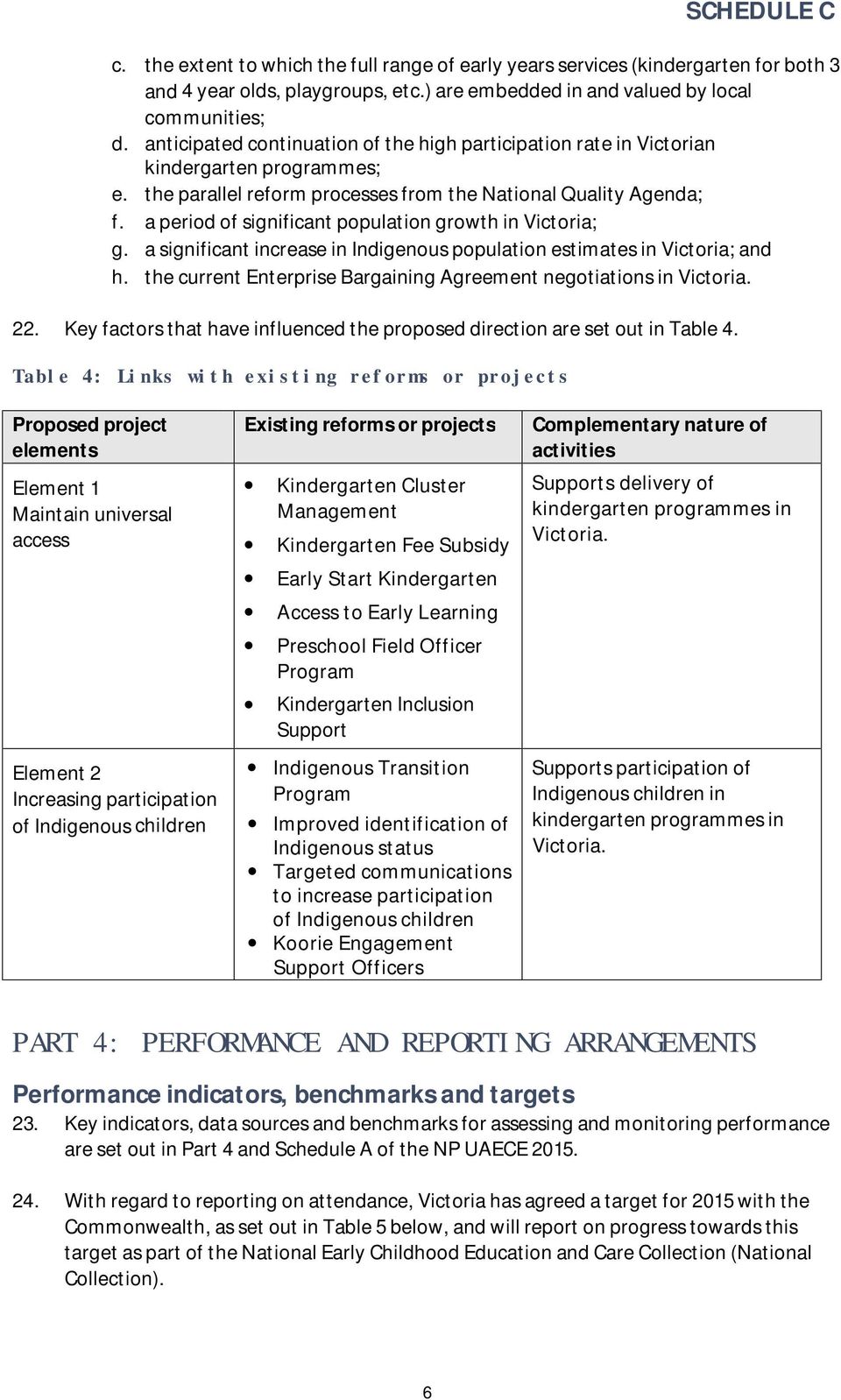
6 c. the extent to which the full range of early years services (kindergarten for both 3 and 4 year olds, playgroups, etc.) are embedded in and valued by local communities; d. anticipated continuation of the high participation rate in Victorian kindergarten programmes; e. the parallel reform processes from the National Quality Agenda; f. a period of significant population growth in Victoria; g. a significant increase in Indigenous population estimates in Victoria; and h. the current Enterprise Bargaining Agreement negotiations in Victoria. 22. Key factors that have influenced the proposed direction are set out in Table 4. Table 4: Links with existing reforms or projects Proposed project elements Existing reforms or projects Complementary nature of activities Element 1 Kindergarten Cluster Supports delivery of Maintain universal Management kindergarten programmes in access Kindergarten Fee Subsidy Victoria. Early Start Kindergarten Access to Early Learning Preschool Field Officer Program Kindergarten Inclusion Support Element 2 Indigenous Transition Supports participation of Increasing participation Program Indigenous children in of Indigenous children Improved identification of kindergarten programmes in Indigenous status Victoria. Targeted communications to increase participation of Indigenous children Koorie Engagement Support Officers PART 4: PERFORMANCE AND REPORTING ARRANGEMENTS Performance indicators, benchmarks and targets 23. Key indicators, data sources and benchmarks for assessing and monitoring performance are set out in Part 4 and Schedule A of the NP UAECE With regard to reporting on attendance, Victoria has agreed a target for 2015 with the Commonwealth, as set out in Table 5 below, and will report on progress towards this target as part of the National Early Childhood Education and Care Collection (National Collection). 6
7 Table 5: Bilaterally agreed attendance target/s Baseline data 2014 Target 2015 Target Nationally Agreed Target 96% 2 90 per cent 90 per cent 90 per cent of enrolled children attending an early childhood education programme to be achieved over time Monitoring and reporting 25. Commonwealth and State based collections or data sources and methodologies, agreed by both the Parties to this Plan, to measure progress against the performance milestones and benchmarks and targets in the NP UAECE 2015, are set out in Schedule A of the NP UAECE These data and performance specifications will be used to report Victoria s performance, except for the supplementary data agreed by the Parties to this Plan in Schedule C.1 of this Plan and any additional data provided in accordance with Clauses 27 and It is recognised the data measures used are a best fit across states and territories that have variable preschool profiles and starting age for preschools and schools. Subject to privacy provisions, the Commonwealth will provide access to relevant data extracted from the Child Care Management System (CCMS) for the purposes of the annual National Early Childhood Education and Care Collection to enable Victoria to effectively monitor and demonstrate its progress against the Performance Indicators. 28. State based collections or data may be used to supplement the National Collection where it is agreed with the Commonwealth for the purposes of reporting and measurement of performance. In addition, States may provide contextual information to aid interpretation should they wish to do so. 29. Supplementary data reports must contain the following details for each Performance Indicator where the method is inconsistent with the Early Childhood Education and Care Minimal Data Set (NMDS): Performance Indicator calculation description (numerator, denominator, computation and presentation) Numerator Information (collection name and population description) Denominator Information (collection name and population description) Calculation Notes (including any information about how the PI is calculated) Methodology Rationale for supplementary data and reporting (including any additional information to explain how and why the specifications for the supplementary data differ from the specifications in the NMDS) National Early Childhood Education and Care Collection. The figures above are calculated by dividing attendance by enrolment. Attendance is the number of children aged 4 and 5 years old as at 1 July of the collection year who are attending a kindergarten programme in the year before school. Enrolment is the number of children aged 4 and 5 years old as at 1 July of the collection year who are enrolled in a kindergarten programme in the year before school. 7

8 Sign off The Parties have confirmed their commitment to this agreement as follows: Signature The Hon Jenny Mikakos MP Victorian Minister for Families and Children Date Signature The Hon Christopher Pyne MP Minister for Education and Training Date 8

9

10 Schedule C.1 Supplementary Data Table 1: Victoria s supplementary data specifications Increase in Aboriginal and/or Torres Strait Islander population estimate The 2011 Census of Population and Housing recorded a large increase in the number of people identifying as Aboriginal and/or Torres Strait Islander (Indigenous) compared to the 2006 Census count. As a result of this, there has been an increased projection of approximately 300 Indigenous children in Victoria 3. Increased efforts by the ABS to encourage Aboriginal people to identify their Indigenous status can explain up to 30 per cent of the increase in Aboriginal population. The Victorian Government Aboriginal Affairs Report 2013 notes analysis by the ABS suggests that 70 per cent of the Aboriginal population increase can be explained by demographic factors (growth), and the majority of the balance due to an increase in the preparedness of Aboriginal people to identify. Despite improvements to Indigenous identification in the ABS Census of Population and Housing, there are widely recognised and continuing problems with the under identification of Aboriginal and Torres Strait Islander people in service level data collections (such as ECEC services). Most face-to-face administrative collections will not have the same resources and trusted anonymity as the ABS Census of Population and Housing and will be subject to a higher level of under-reporting. The ABS information paper, Perspectives on Aboriginal and Torres Strait Islander Identification in Selected Data Collection Context details research that has revealed a number of factors discouraging identification. The paper notes that these factors are intensified in face-to-face data collection situations because identification may be more sensitive in this context and it may be a more confronting context in which to consider disclosing their Indigenous status. The 2014 Victorian Indigenous population projection for four year olds increased from 925 to 1207 with the release of Estimates and Projections, Aboriginal and Torres Strait Islander Australians, 2001 to 2026 in April Based on the evidence above, up to 30 per cent of this apparent growth 85 children or 7 per cent of Victoria s total four year old Indigenous projected population is likely due greater self-identification. Supporting information which illustrates under-reporting of Indigenous status in Victorian kindergarten programmes is provided below. Victorian Aboriginal organisations have reported that some families make a deliberate choice not to identify their Indigenous status to avoid potential discrimination or because they don t want to accept free kindergarten based on their cultural background. Indigenous families with Health Care Cards are able to access a free kindergarten programme without revealing their Indigenous status. 3 Increase calculated on the difference in estimated Victorian ATSI four-year-olds in Experimental Estimates and Projections, Aboriginal and Torres Strait Islander Australians 1991 to 2021 and Estimates and Projections, Aboriginal and Torres Strait Islander Australians, 2001 to 2026 (cat released in 2014) 9

11 As noted in the Australian Institute of Health and Welfare report Taking the next steps: identification of Aboriginal and Torres Strait Islander status in general practice choosing to disclose one s Indigenous status is voluntary. People may or may not be prepared to disclose their Indigenous status depending on the situation; others may be discovering or acknowledging their Indigenous status for the first time. Further evidence that indicates that the lower numbers of children identified as Indigenous in Victorian funded kindergarten services are linked to under-reporting rather than non-attendance is provided below. Action is being taken to increase identification and participation of Indigenous children in funded kindergarten services at enrolment from 2015 onwards to better align kindergarten and Census numbers. This includes: Piloting of a transition program to support Indigenous children not currently in early childhood education to prepare for kindergarten in the year before school. Collaborative work with the Municipal Association of Victoria and local governments to identify and engage Indigenous families with young children. Dedicated work by the DEECD regional Koorie education workforce in identified areas to provide outreach and support for families to access kindergarten. Use of new Kindergarten Information Management system to improve monitoring of Indigenous kindergarten participation at a local scale. Establishment of a targeted, culturally appropriate communications project regarding the value of kindergarten and how to enrol. However, in the short-term, there will be a disparity between numbers of Victorian Indigenous children in Estimates and Projections, Aboriginal and Torres Strait Islander Australians, 2001 to 2026 and those identifying through face-to-face enrolments in kindergartens. Victoria is able to submit supplementary data for any Indigenous children who were enrolled in a kindergarten programme in 2015 but not included in August census. Table 1: Victoria s supplementary data specifications ATSI under- reporting Performance Indicator PI 2 Proportion of children enrolled in the year before fulltime school in quality early childhood education programme(s) Indigenous disaggregation Supplementary data specification Source: Indigenous status update in the Kindergarten Information Management (KIM) system Supplementation Rationale: While efforts by the ABS to encourage Aboriginal people to identify as Indigenous have resulted in a large increase in the population count of Indigenous people, there are continuing problems with the under identification in other data collections undertaken without the same resources and without the trusted anonymity offered by the ABS. Victoria has sent all funded services a request that staff check that children known to be Indigenous are identified correctly in the KIM system and ask families to identify their cultural background if this has not already taken place. Any updates to Indigenous status received after the VIC URL Child file has 10

12 Performance Indicator Supplementary data specification been sent to the ABS will be submitted as supplementary data. Numerator Impact: The additional 4 and 5 year old children in the VIC URL Child file identified as Indigenous in the KIM system by December 2015 to be included in the numerator for this performance indicator. Denominator Impact: Estimated number of Indigenous children aged 4 years (not affected) Impact on other Performance Indicators: This data supplementation will also affect the Indigenous disaggregation of PI 3 and PI 4. Key Definitions: The Kindergarten Information Management (KIM) system is the Victorian Department of Education and Training s (DET) new online web-based system for kindergarten funding applications, data collection, and reporting. Table 2: Victoria s supplementary data specifications Indigenous enrolments not recorded by August census Performance Indicator PI 2 Proportion of children enrolled in the year before fulltime school in quality early childhood education programme(s) Indigenous disaggregation Supplementary data specification Source: Victorian funded kindergarten enrolment data updates Supplementation Rationale: Funding applications and associated enrolment information can be sent to the Victorian Department of Education and Training (DET) up until December for children enrolled throughout the year. Therefore some records for 4 and 5 year old children in kindergarten programmes are not available at the time of the National Collection. These records are not part of the VIC URL Child file and will be provided as supplementary data. Numerator Impact: The additional 4 and 5 year old children identified by December 2015 to be included in the numerator for this performance indicator. Denominator Impact: Estimated number of children aged 4 years (not affected) Impact on other Performance Indicators: This data supplementation will affect all other performance indicators. Under-reporting of Indigenous status in Victorian funded kindergarten services Evidence of under-reporting in Victorian funded enrolment data: Victorian Kindergarten Census data, calculated according to National Partnership Performance Indictor 2, shows 100 per cent of children aged four and five years are 11

13 enrolled in an early education programme delivered by qualified teacher. Preliminary Indigenous figures show a substantially lower proportion of Indigenous children enrolled. This indicates that there are a number of Indigenous children in the Victorian data that are not identifying their Indigenous status. Comparison of Victorian funded kindergarten enrolment data across 2013 and 2014 has shown that identification of Indigenous status is not consistent across years. Children that are identified as Indigenous in 2013 data are not identified in 2014 and vice versa. This indicates under-reporting is an issue for Victoria. Victorian LGA level participation analysis based on child address indicates underreporting of Indigenous status. Several LGAs show a very low ATSI participation which is at odds with the overall participation rate of 100 per cent. A sample of this data is shown below. LGA Indigenous kindergarten participation (prep enrolment denominator) Overall kindergarten participation rate MELTON 25% 99% WYNDHAM 30% 102% BRIMBANK 52% 97% BALLARAT 54% 99% As a comparison the method of identifying Indigenous status in CCMS data, as confirmed by the ABS, leverages existing information recorded in the Commonwealth social benefit system records (e.g. Centrelink) to determine the Indigenous status of the person receiving the CCB (i.e. the child s parent or guardian). The identification of Indigenous status of enrolments in Victorian funded services is required, but can only be recorded if a parent or guardian is willing to identify their child as Indigenous leading to a greater risk of under-reporting. Data limitations/barriers Lack of information Victoria only has access to data from services that receive kindergarten funding. There are approximately 300 long day care services in Victoria that have chosen not to apply for this funding. Lack of access to CCMS data means Victoria has limited knowledge and capacity to influence whether children have access to 600 hours of kindergarten in these services. Indigenous population estimates are only available at state level. The lack of information available about where Indigenous children reside creates difficulties for the implementation of localised strategies for Indigenous participation. 12

NATIONAL PARTNERSHIP AGREEMENT ON UNIVERSAL ACCESS TO EARLY CHILDHOOD EDUCATION
 NATIONAL PARTNERSHIP AGREEMENT ON UNIVERSAL ACCESS TO EARLY CHILDHOOD EDUCATION Council of Australian Governments An agreement between the Commonwealth of Australia and the States and Territories, being:
3 Early childhood education and care
 3 Early childhood education and care CONTENTS 3.1 Profile of ECEC 3.2 3.2 Framework of performance indicators 3.19 3.3 Key performance indicator results 3.22 3.4 Future directions in performance reporting
NATIONAL PARTNERSHIP AGREEMENT ON EARLY CHILDHOOD EDUCATION
 NATIONAL PARTNERSHIP AGREEMENT ON EARLY CHILDHOOD EDUCATION Council of Australian Governments An agreement between the Commonwealth of Australia and the States and Territories, being: the State of New
Universal access to early childhood education Overview
 Universal access to early childhood education Overview 1. Background The Council of Australian Government s National Partnership Agreement on Early Childhood Education was signed in November 2008, with
Early childhood education and care Early childhood education and care
 Early childhood education and care Early childhood education and care Department of Education and Training Annual Report 2014 15 25 Our performance indicators Participation in early childhood education
Early childhood education and care
 Early childhood education and care Introduction This policy brief provides an overview of the national policy and advocacy priorities on early childhood education and care. These include: access to services
NATIONAL PARTNERSHIP AGREEMENT ON TRANSITIONING RESPONSIBILITIES FOR AGED CARE AND DISABILITY SERVICES
 National Partnership Agreement on Transitioning Responsibilities for Aged Care and Disability Services NATIONAL PARTNERSHIP AGREEMENT ON TRANSITIONING RESPONSIBILITIES FOR AGED CARE AND DISABILITY SERVICES
OPERATING & BEST PRACTICE GUIDE
 Guide Independent Schools Queensland Central Governing Body OPERATING & BEST PRACTICE GUIDE FOR MEMBERS OF INDEPENDENT SCHOOLS QUEENSLAND CENTRAL GOVERNING BODY ABOUT INDEPENDENT SCHOOLS QUEENSLAND Independent
Submission to the Productivity Commission Childcare and Early Childhood Learning February 2014. Background. The Montessori Australia Foundation (MAF)
 Submission to the Productivity Commission Childcare and Early Childhood Learning February 2014 Background The Montessori sector is unique, diverse and significant in Australian education, particularly
NATIONAL INFORMATION AGREEMENT ON EARLY CHILDHOOD EDUCATION AND CARE
 NATIONAL INFORMATION AGREEMENT ON EARLY CHILDHOOD EDUCATION AND CARE An agreement between the Authorities of the Australian Government and the States and Territories of Australia, being: the State of New
Overview. Early Childhood Education and Care Grants Program
 Overview Early Program The Early Program Overview is intended to inform the NSW early childhood education and care sector about the funding assistance that is available from the NSW Department of Education
Wannik. Learning Together - Journey to Our Future. Education Strategy for Koorie Students
 Wannik Learning Together - Journey to Our Future Education Strategy for Koorie Students VICTORIA 2008 Published by the Koorie Education Strategy Branch System Policy and Research Division Office for Policy,
Indigenous Education Strategies for Government Schools
 Indigenous Education Strategies for Government Schools Indigenous Education Strategies for Government Schools June 2011 Victorian Auditor-General s Report Telephone 61 3 8601 7000 Facsimile 61 3 8601 7010
Supporting successful transitions. School decision-making tool
 Supporting successful transitions School decision-making tool 150233 Department of Education and Training Supporting successful transitions: School decision-making tool Starting school is an important
Victorian kindergarten policy, procedures and funding criteria 2010 12
 Victorian kindergarten policy, procedures and funding criteria 2010 12 Published for Department of Education and Early Childhood Development Melbourne March 2010 State of Victoria (Department of Education
NATIONAL PARTNERSHIP AGREEMENT ON IMPROVING TEACHER QUALITY
 NATIONAL PARTNERSHIP AGREEMENT ON IMPROVING TEACHER QUALITY Council of Australian Governments An agreement between the Commonwealth of Australia and the States and Territories, being: t t t t t t t t the
An outline of National Standards for Out of home Care
 Department of Families, Housing, Community Services and Indigenous Affairs together with the National Framework Implementation Working Group An outline of National Standards for Out of home Care A Priority
The National Health Plan for Young Australians An action plan to protect and promote the health of children and young people
 The National Health Plan for Young Australians An action plan to protect and promote the health of children and young people Copyright 1997 ISBN 0 642 27200 X This work is copyright. It may be reproduced
NATIONAL STRATEGY FOR FOOD SECURITY IN REMOTE INDIGENOUS COMMUNITIES
 NATIONAL STRATEGY FOR FOOD SECURITY IN REMOTE INDIGENOUS COMMUNITIES Council of Australian Governments A Strategy agreed between: the Commonwealth of Australia and the States and Territories, being: the
NATIONAL PARTNERSHIP AGREEMENT ON REMOTE SERVICE DELIVERY
 NATIONAL PARTNERSHIP AGREEMENT ON REMOTE SERVICE DELIVERY Council of Australian Governments An agreement between the Commonwealth of Australia and the States and Territories, being: t t t t t the State
NATIONAL PARTNERSHIP AGREEMENT ON THE NATIONAL QUALITY AGENDA FOR EARLY CHILDHOOD EDUCATION AND CARE
 NATIONAL PARTNERSHIP AGREEMENT ON THE NATIONAL QUALITY AGENDA FOR EARLY CHILDHOOD EDUCATION AND CARE Council of Australian Governments An agreement between the Commonwealth of Australia and the States
Aboriginal and Torres Strait Islander Education Action Plan 2010 2014
 Aboriginal and Torres Strait Islander Education Action Plan 2010 2014 Ministerial Council for Education, Early Childhood Development and Youth Affairs ACN 007 342 421 PO Box 202 Carlton South Victoria
NATIONAL HEALTHCARE AGREEMENT 2012
 NATIONAL HEALTHCARE AGREEMENT 2012 Council of Australian Governments An agreement between the Commonwealth of Australia and the States and Territories, being: t t t t t t t t the State of New South Wales;
Early Childhood Scholarships for Aboriginal People
 Application Form 2014/15 Early Childhood Scholarships for Aboriginal People Personal Information Title: Family Name: Given Name(s): Date of Birth: / / Gender: Male Female Are you an Australian citizen
Inquiry into educational opportunities for Aboriginal and Torres Strait Islander students Submission 18
 Introduction The National Catholic Education Commission (NCEC) welcomes the opportunity to provide a submission as part of the House of Representatives Standing Committee on Indigenous Affairs inquiry
PROJECT AGREEMENT FOR INDEPENDENT PUBLIC SCHOOLS INITIATIVE
 PROJECT AGREEMENT FOR INDEPENDENT PUBLIC SCHOOLS INITIATIVE An agreement between: - the Commonwealth of Australia; and - the State of South Australia. This project will increase the autonomy of government
Early Childhood Education and Care in Australia. OECD Network on Early Childhood Education and Care 30-31 October 2008
 Early Childhood Education and Care in Australia OECD Network on Early Childhood Education and Care 30-31 October 2008 Current thinking Australia s investment in early education is low compared to the OECD
NATIONAL FRAMEWORK FOR RURAL AND REMOTE EDUCATION
 NATIONAL FRAMEWORK FOR RURAL AND REMOTE EDUCATION DEVELOPED BY THE MCEETYA TASK FORCE ON RURAL AND REMOTE EDUCATION, TRAINING, EMPLOYMENT AND CHILDREN S SERVICES 1 CONTENTS Introduction... 3 Purpose...
Early Childhood Intervention Postgraduate Scholarship Scheme Guidelines for Applicants
 Early Childhood Intervention Postgraduate Scholarship Scheme Guidelines for Applicants Program Information Who can apply for a scholarship? Scholarships are available to support early childhood intervention
Implementation Plan: Development of an asset and financial planning management. Australian Capital Territory
 Implementation Plan: Development of an asset and financial planning management framework for TAMS Australian Capital Territory NATIONAL PARTNERSHIP AGREEMENT TO SUPPORT LOCAL GOVERNMENT AND REGIONAL DEVELOPMENT
6. Supporting diversity
 6. Supporting diversity We acknowledge and pay respect to all the traditional owners of the land we now call Victoria. There were approximately 40 language groups before colonisation that made up the state
Koorie Early Childhood Education Program (KECEP) - Victoria
 Koorie Early Childhood Education Program (KECEP) - Victoria Moira Ross-Rayner Rayner Tracey-Lee Beer Victorian Koorie Early Childhood Education program (KECEP) Sits within the Victorian Department of Education
VICTORIAN IMPLEMENTATION PLAN. Smarter Schools National Partnership Agreements on Literacy and Numeracy Improving Teacher Quality
 VICTORIAN IMPLEMENTATION PLAN Smarter Schools National Partnership Agreements on Literacy and Numeracy Improving Teacher Quality Low Low Socio-Economic Socio-Economic Status Status School School Communities
EDUCATION SERVICES AUSTRALIA (ESA) LETTER OF EXPECTATION JULY 2014 JUNE 2016
 27 April 2015 The Board of Directors Education Services Australia Ltd Level 5, 440 Collins Street Melbourne VIC 3000 Dear Directors EDUCATION SERVICES AUSTRALIA (ESA) LETTER OF EXPECTATION JULY 2014 JUNE
Aboriginal and Torres Strait Islander Health Workers / Practitioners in focus
 Aboriginal and Torres Strait Islander Health Workers / Practitioners in focus i Contents Introduction... 1 What is an Aboriginal and Torres Strait Islander Health Worker?... 2 How are Aboriginal and Torres
Home and Community Care Aboriginal and Torres Strait Islander Service Development Plan 2009 12
 Home and Community Care Aboriginal and Torres Strait Islander Service Development Plan 2009 12 Contents Setting the scene...3 Aims...3 Key issues from statewide consultation...4 Priority areas, outcomes
Kindergarten Cluster Management. Policy Framework
 Kindergarten Cluster Management Policy Framework Contents Executive summary 1 Part 1: Background 3 Introduction of kindergarten cluster management 3 Policy and legislative context 3 Review of kindergarten
Australian Nursing Federation (Victorian Branch)
 Australian Nursing Federation (Victorian Branch) 17 th February 2012 Lisa Fitzpatrick State Secretary Box 12600 A Beckett Street PO Melbourne Victoria Telephone: 03 9275 9333 Fax: 03 9275 9344 www.anfvic.asn.au
Assessing existing funding models for schooling in Australia. Department of Education, Employment and Workplace Relations
 Assessing existing funding models for schooling in Australia Department of Education, Employment and Workplace Relations June 2011 Limitation of our work General use restriction This report is prepared
Department of Education, Training and Employment. Community Learning. Inclusive learning for Queenslanders. Guidelines for funding 2014 15
 Community Learning Inclusive learning for Queenslanders Guidelines for funding 2014 15 140107 Community Learning Inclusive learning for Queenslanders Guidelines for funding 2014 15 Introduction Community
Review of Funding for Schooling
 Review of Funding for Schooling Emerging Issues Paper December 2010 Comments and inquiries Please submit your feedback to the review secretariat at the following address: Email: [email protected]
Early Childhood Development Workforce
 Early Childhood Development Workforce This submission to the Early Childhood Development Workforce Productivity Commission Issues Paper is made on behalf of GoodStart Childcare and specifically seeks to
Key Priority Area 1: Key Direction for Change
 Key Priority Areas Key Priority Area 1: Improving access and reducing inequity Key Direction for Change Primary health care is delivered through an integrated service system which provides more uniform
Private Health Insurance Ombudsman
 Private Health Insurance Ombudsman Reconciliation Action Plan for 2010-2012 Our vision for reconciliation Our vision is that the Private Health Insurance Ombudsman (PHIO) be recognised as the independent
Evaluation Case Study. Kimberley Region Support Centre
 Australian Government Department of Education More Support for Students with Disabilities 2012-2014 Evaluation Case Study Kimberley Region Support Centre MSSD Output 3: Developing support centres Catholic
Foreword. Closing the Gap in Indigenous Health Outcomes. Indigenous Early Childhood Development. Indigenous Economic Participation.
 National Aboriginal and Torres Strait Islander Health Workforce Strategic Framework 2011 2015 Prepared for The Australian Health Ministers Advisory Council by the Aboriginal and Torres Strait Islander
Skilled Occupation List (SOL) 2015-16
 Skilled List (SOL) 2015-16 Tracking Code: 24AKG5 Name Individual * Jocelyne Aldridge Organisation Community Services and Health Industry Skills Council (CS&HISC) What are the industry/industries and ANZSCO
Roles and responsibilities in education
 Roles and responsibilities in education PART A: EARLY CHILDHOOD AND SCHOOLS ISSUES PAPER 4 December 2014 1 Reform of the Federation White Paper Commonwealth of Australia 2014 ISBN 978-1-922098-95-5 (PDF)
australian nursing and midwifery federation
 australian nursing and midwifery federation Submission to the Australian Nursing and Midwifery Council for Consultation Paper 1: Accreditation Standards required for Eligible Midwife Programs February
Implementation Plan for. the Healthy Workers initiative
 Implementation Plan for WESTERN AUSTRALIA Healthy Workers Initiative the Healthy Workers initiative NATIONAL PARTNERSHIP AGREEMENT ON PREVENTIVE HEALTH NOTE: The Australian Government may publish all or
NATIONAL PARTNERSHIP AGREEMENT ON TAFE FEE WAIVERS FOR CHILDCARE QUALIFICATIONS
 NATIONAL PARTNERSHIP AGREEMENT ON TAFE FEE WAIVERS FOR CHILDCARE QUALIFICATIONS Council of Australian Governments An agreement between the Commonwealth of Australia and the States and Territories, being:
Investment Domains Guideline
 Investment Domains Guideline Version: 1.0 Date: 2 September 2014 Version Control History This document was approved by: Name: Position: Unit: Date: Author: PCMR Date: 2 September 2014 Page 2 CONTENTS 1.
Some Text Here. A national quality framework for early childhood education and care
 Some Text Here Productivity Agenda Working Group Education, Skills, Training and Early Childhood Development August 2008 A national quality framework for early childhood education and care A discussion
THE NATIONAL QUALITY FRAMEWORK FOR EARLY CHILDHOOD EDUCATION AND CARE: INFORMATION FOR FAMILIES
 COUNCIL OF AUSTRALIAN GOVERNMENTS 1 THE NATIONAL QUALITY FRAMEWORK FOR EARLY CHILDHOOD EDUCATION AND CARE: INFORMATION FOR FAMILIES Research shows that a child s experience in their first five years sets
Measurement Framework for Schooling in Australia. May 2015
 Measurement Framework for Schooling in Australia May 2015 2015 Australian Curriculum, Assessment and Reporting Authority Address enquiries regarding copyright to: [email protected] or ACARA Level 10, 255
Reconciliation Action Plan
 Refreshed January 2016 Reconciliation Plan 2014 2017 Opportunity through learning Artwork information The Department of Education and Training Reconciliation Tree was created during National Reconciliation
Some Text Here. Policy Overview. Regulation Impact Statement for Early Childhood Education and Care Quality Reforms. July 2009
 Some Text Here Early Childhood Development Steering Committee Policy Overview Regulation Impact Statement for Early Childhood Education and Care Quality Reforms July 2009 1 Introduction The early years
National Disability Insurance Scheme
 A Framework for Information, Linkages and Capacity Building Overview This paper sets out policy parameters for Information, Linkages and Capacity Building (ILC), formerly known as Tier 2, in the National
AEDC User Guide: Schools
 Our Children Our Communities Our Future AEDC User Guide: Schools This AEDC user guide leads schools through the steps they might take when thinking about how to respond to AEDC data for their community.
ACT Auditor-General s Office. Performance Audit Report
 ACT Auditor-General s Office Performance Audit Report Early Childhood Schooling Report No. 3/2012 Education and Training Directorate June 2012 PA 11/03 The Speaker ACT Legislative Assembly Civic Square,
Smart and Skilled: Training provider guide to 2015 prices, fees and subsidies
 Smart and Skilled: Training provider guide to 2015 prices, fees and subsidies NSW DEPARTMENT OF EDUCATION AND COMMUNITIES WWW.TRAINING.NSW.GOV.AU Smart and Skilled: Training provider guide to 2015 prices,
INTERGOVERNMENTAL AGREEMENT FOR THE NATIONAL DISABILITY INSURANCE SCHEME (NDIS) LAUNCH
 INTERGOVERNMENTAL AGREEMENT FOR THE NATIONAL DISABILITY INSURANCE SCHEME (NDIS) LAUNCH Part 1 Preliminaries 1. The Commonwealth of Australia (the Commonwealth) and States and Territories (the States) are
Early Childhood Development Workforce Productivity Commission Issues Paper
 Early Childhood Development Workforce Productivity Commission Issues Paper Submission by KU Children s Services Introduction KU Children s Services is the leading not for profit provider of children s
To apply for the Swinburne Astronomy Online course go to http://astronomy.swinburne.edu.au/sao
 Direct Application form Certificate IV, Diploma, Advanced Diploma, Associate Degree, Degree, Degree (Honours), Pathways Direct, Postgraduate (Coursework) Studies Instructions to applicants Please follow
Proposed overarching principles for National Standards for Out of Home Care
 Working document Development of National Standards for out of home care Over the last ten years, all Australian governments in strong partnership with the non-government sector have increasingly recognised
Outputs and performance measures
 Outputs and performance s This section reports on achievement against the outputs and performance s listed in the Budget Papers (Budget Paper no. 3, chapter 3). Outputs and performance s are listed under
April 2013. Please consider our following comments. www.securirty4women.org.au Page 1 of 6
 Submission to The House of Representatives Standing Committee on Education and Employment Inquiry into the Role of the Technical and Further Education system and its Operation April 2013 economic Security4Women
Blueprint for Education and Early Childhood Development
 Blueprint for Education and Early Childhood Development Every child, every opportunity Every child, every opportunity 02 03 Blueprint for Education and Early Childhood Development Blueprint for Education
Family Day Care Educators
 Obligations and expectations of Family Day Care educators Overview A Family Day Care (FDC) service that is approved under the family assistance law to administer Child Care Benefit (CCB) and Child Care
School Focused Youth Service Supporting the engagement and re-engagement of at risk young people in learning. Guidelines 2013 2015
 School Focused Youth Service Supporting the engagement and re-engagement of at risk young people in learning Guidelines 2013 2015 Published by the Communications Division for Student Inclusion and Engagement
ENGLISH. Second Language. as a GUIDELINES FOR SCHOOLS
 E S L ENGLISH as a Second Language GUIDELINES FOR SCHOOLS ISBN 0731383451 SCIS 1176326 2004 NSW Department of Education and Training Multicultural Programs Unit Level 14, 1 Oxford Street Darlinghurst NSW
NATIONAL AGREEMENT FOR SKILLS AND WORKFORCE DEVELOPMENT
 NATIONAL AGREEMENT FOR SKILLS AND WORKFORCE DEVELOPMENT Council of Australian Governments An agreement between the Commonwealth of Australia and the States and Territories, being: The State of New South
PROJECT AGREEMENT FOR INDEPENDENT PUBLIC SCHOOLS INITIATIVE
 PROJECT AGREEMENT FOR INDEPENDENT PUBLIC SCHOOLS INITIATIVE An agreement between: - the Commonwealth of Australia; and - Victoria. This project will increase the autonomy of government schools in Victoria.
Education and Early Childhood Development Legislation Reform
 Education and Early Childhood Development Legislation Reform Discussion Paper No 3 General Provisions for Education and Early Childhood Development Discussion Paper No 3 State of South Australia, 2008.
PRINCIPLES FOR ACCESSING AND USING PUBLICLY-FUNDED DATA FOR HEALTH RESEARCH
 TARGETED CONSULTATION DRAFT National Health and Medical Research Council PRINCIPLES FOR ACCESSING AND USING PUBLICLY-FUNDED DATA FOR HEALTH RESEARCH Developed by NHMRC s Prevention and Community Health
AITSL is funded by the Australian Government. Guide to the Certification of Highly Accomplished and Lead Teachers in Australia
 AITSL is funded by the Australian Government Guide to the Certification of Highly Accomplished and Lead Teachers in Australia The Australian Institute for Teaching and School Leadership (AITSL) has been
Camps, Sports and Excursions Fund Policy April 2015
 Camps, Sports and Excursions Fund Policy April 2015 Published by the Communications Division for Financial Services Division Department of Education and Training Melbourne April 2015 State of Victoria
Improving ACT Public High Schools and Colleges
 Improving ACT Public High Schools and Colleges A discussion paper to generate ideas Better schools will only come when those in schools dare to have dreams and work to make them a reality Caldwell and