
Report on the Lapse and Mortality Experience of Post-Level Premium Period Term Plans (2014)
|
|
|
- Jeremy Hudson
- 9 years ago
- Views:
Transcription

1 Report on the Lapse and Mortality Experience of Post-Level Premium Period Term Plans (2014) REVISED MAY 2014 SPONSORED BY Society of Actuaries PREPARED BY Derek Kueker, FSA Tim Rozar, FSA, CERA, MAAA Michael Cusumano, FSA Susan Willeat, FSA, MAAA Richard Xu, FSA, Ph.D Society of Actuaries, All Rights Reserved

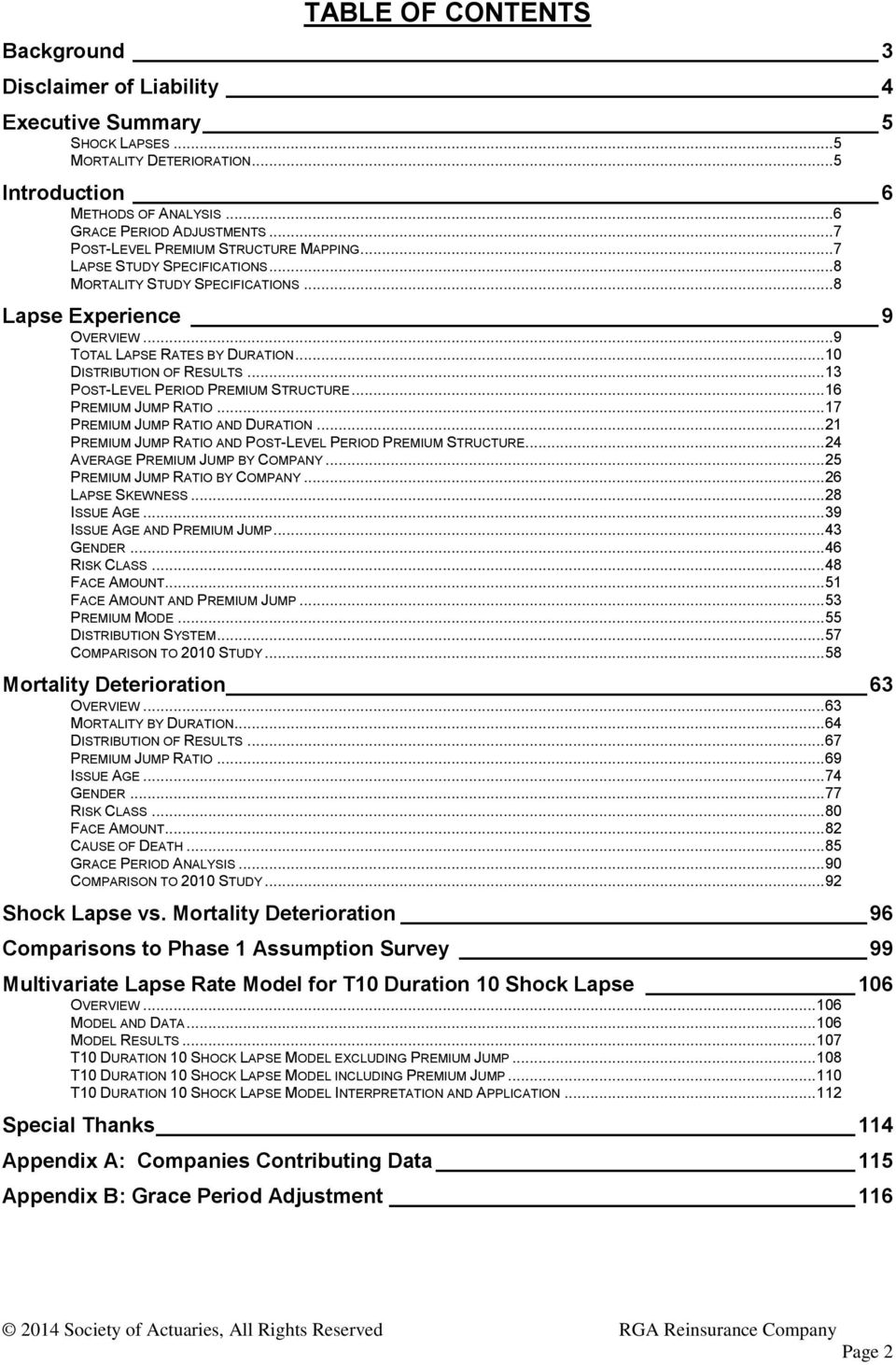
2 TABLE OF CONTENTS Background 3 Disclaimer of Liability 4 Executive Summary 5 SHOCK LAPSES... 5 MORTALITY DETERIORATION... 5 Introduction 6 METHODS OF ANALYSIS... 6 GRACE PERIOD ADJUSTMENTS... 7 POST-LEVEL PREMIUM STRUCTURE MAPPING... 7 LAPSE STUDY SPECIFICATIONS... 8 MORTALITY STUDY SPECIFICATIONS... 8 Lapse Experience 9 OVERVIEW... 9 TOTAL LAPSE RATES BY DURATION DISTRIBUTION OF RESULTS POST-LEVEL PERIOD PREMIUM STRUCTURE PREMIUM JUMP RATIO PREMIUM JUMP RATIO AND DURATION PREMIUM JUMP RATIO AND POST-LEVEL PERIOD PREMIUM STRUCTURE AVERAGE PREMIUM JUMP BY COMPANY PREMIUM JUMP RATIO BY COMPANY LAPSE SKEWNESS ISSUE AGE ISSUE AGE AND PREMIUM JUMP GENDER RISK CLASS FACE AMOUNT FACE AMOUNT AND PREMIUM JUMP PREMIUM MODE DISTRIBUTION SYSTEM COMPARISON TO 2010 STUDY Mortality Deterioration 63 OVERVIEW MORTALITY BY DURATION DISTRIBUTION OF RESULTS PREMIUM JUMP RATIO ISSUE AGE GENDER RISK CLASS FACE AMOUNT CAUSE OF DEATH GRACE PERIOD ANALYSIS COMPARISON TO 2010 STUDY Shock Lapse vs. Mortality Deterioration 96 Comparisons to Phase 1 Assumption Survey 99 Multivariate Lapse Rate Model for T10 Duration 10 Shock Lapse 106 OVERVIEW MODEL AND DATA MODEL RESULTS T10 DURATION 10 SHOCK LAPSE MODEL EXCLUDING PREMIUM JUMP T10 DURATION 10 SHOCK LAPSE MODEL INCLUDING PREMIUM JUMP T10 DURATION 10 SHOCK LAPSE MODEL INTERPRETATION AND APPLICATION Special Thanks 114 Appendix A: Companies Contributing Data 115 Appendix B: Grace Period Adjustment 116 Page 2
3 Background The Society of Actuaries (SOA) engaged RGA Reinsurance Company (RGA) to undertake a research project on level premium term life insurance products with a particular focus on the magnitude and impact of the shock lapse at the end of the level premium period. This project is a follow-up to SOA-sponsored research completed by RGA in October 2009 ( and July 2010 ( As with the research project completed by RGA in 2010, this project was completed in two phases: Phase 1 included a survey of the mortality and lapse assumptions used by actuaries for pricing and modeling level premium term products at the end of This report summarizes the findings from the 41 Phase 1 survey responses received. Phase 2 included a study of the mortality and lapse experience of level premium term policies as they transition out of the level premium period. Participating companies were asked to supply policy level inforce and termination records so that experience results could be analyzed at a granular level including, but not limited to, age, gender, risk class, premium jump, and policy size. In addition, comparisons to the 2010 experience studies were added to the analysis. This report will analyze the results of the Phase 2 study in the following sections: 1) Analysis of shock lapse rate experience; 2) Analysis of post-level period mortality deterioration experience; 3) Comparisons of results between Phase 1 assumption survey and Phase 2 experience study; and 4) A proposed generalized linear model of shock lapse rates. The following major enhancements to the 2010 study include: 1) Increased lapse and mortality credibility; 2) Monthly lapse study to aid in the analysis of lapse skewness; 3) Monthly mortality study to illustrate the impact of the grace period after the shock lapse; 4) Predictive Model on the T10 duration 10 shock lapse; and 5) Analysis of issue age and face amount within a given premium jump. Page 3
4 Disclaimer of Liability This report is intended for use by actuaries familiar with the level premium term product design, underwriting and marketing techniques used by U.S. life insurance companies. The actuary responsible for preparing this report is Derek Kueker, FSA, a qualified actuary. While good faith effort has been made to analyze the reasonableness of each company s data submission, the final report is ultimately reliant on the accuracy of the underlying data. The results provided herein come from a variety of life insurance companies with unique product structures, target markets, underwriting philosophies and distribution methods. As such, these results should not be deemed directly applicable to any particular company or representative of the life insurance industry as a whole. RGA, its directors, officers and employees, disclaim liability for any loss or damage arising or resulting from any error or omission in RGA s analysis and summary of the experience study results or any other information contained herein. The report is to be reviewed and understood as a complete document. This report is published by the SOA and contains information based on input from companies engaged in the U.S. life insurance industry. The information published in this report was developed from actual historical information and does not include any projected information. The opinions expressed and conclusions reached by the authors are their own and do not represent any official position or opinion of the SOA or its members. The SOA makes no representations regarding the accuracy or completeness of the content of this study. It is for informational purposes only. The SOA does not recommend, encourage or endorse any particular use of the information provided in this study. The study should not be construed as professional or financial advice. The SOA makes no warranty, expressed or implied, guarantee or representation whatsoever and assumes no liability or responsibility in connection with the use or misuse of this study. A revision of the study was published in May 2014 to reflect a change to the confidence interval calculation found on page 8 and presented in the charts in the Mortality Deterioration section of the document. Page 4

5 Executive Summary Shock Lapses The aggregate duration 10 shock lapse for all 10-year level term plans (T10) was 60.3% by count although there was a wide range of results by company, product structure, and policy attributes. The median of company-specific shock lapse results was 72.6%. The duration 10 shock lapse was 69.9% for T10 products structured with an annually increasing post-level premium scale with a median shock lapse of 76.4%. For 15-year level term plans (T15), the duration 15 shock lapse was 72. with a median shock lapse of 67.6%. For both products, the initial shock lapse at the end of the level period was followed by a smaller secondary shock lapse in the following duration. Lapse rates tend to grade down in later durations of the post-level period. The policy attribute most highly correlated with shock lapse is the size of the jump in premium from the level period to the post-level period. This is especially significant since more recently issued products experience higher shock lapses due to larger premium jumps after the end of the level period. Shock lapses are higher for older issue ages, even within a given premium jump band. In addition, shock lapse rates are higher for annual premium modes than for monthly premium modes. Lapses within the first year of the post-level period are more heavily skewed toward the beginning of the policy year, indicating a disproportionate amount of off-anniversary lapse activity compared to the level period. Mortality Deterioration The median of company-specific experience for T10 showed duration 11 mortality as 262% of 2008 VBT by count, although there was a wide range of results by company. Mortality deterioration grades down by duration after the initial shock lapse. As with shock lapses, mortality deterioration seems to increase by issue age and by the size of the postlevel period premium jump. These dimensions are important considerations when applying shock lapse and mortality deterioration assumptions for pricing new products. Page 5

6 Introduction The Phase 2 data request was sent along with the Phase 1 survey request. Companies that provided data may or may not have participated during the Phase 1 survey. A list of participants is included in Appendix A (p. 115). Methods of Analysis Participating companies were asked to provide a listing of each inforce and terminated level term policy, including exact issue dates and dates of termination. The collection of data in this manner allowed the researchers to ensure a consistent calculation of experience study exposures across multiple companies. This also enabled cells with relatively small exposure to be aggregated such that total credibility can be improved. This data was used to create a anniversary year lapse study and a calendar year mortality study. The anniversary year method was chosen for the lapse study to account for the skewness of lapses throughout the policy year. Since many lapses occurred on policy anniversaries, a calendar year study would potentially miss much of the anticipated lapse activity at the end of a policy s most recent policy year. Since deaths were generally evenly distributed throughout the policy year, a calendar year method was used for the mortality study to increase the amount of fully completed experience that could be included in the study. Both studies were primarily performed on a policy count basis to help minimize the impact of volatility related to policy size. Results by face amount band are provided to help identify differences in experience at different policy sizes. A process of data validation and cleansing was undertaken with each company s submission. In addition, a summary of each individual company s results was provided back to the data provider. This process helped the researchers ensure that they had a good understanding of the data that had been submitted. In a few cases, this process led to companies providing additional or corrected data. In addition to the information published in this document, additional analysis was completed to look at both experience on business with face amount decreases near the end of the level period as well as conversion experience. Unfortunately, due to data issues and limited credibility, this information was not sufficiently reliable to be included in the document. Page 6

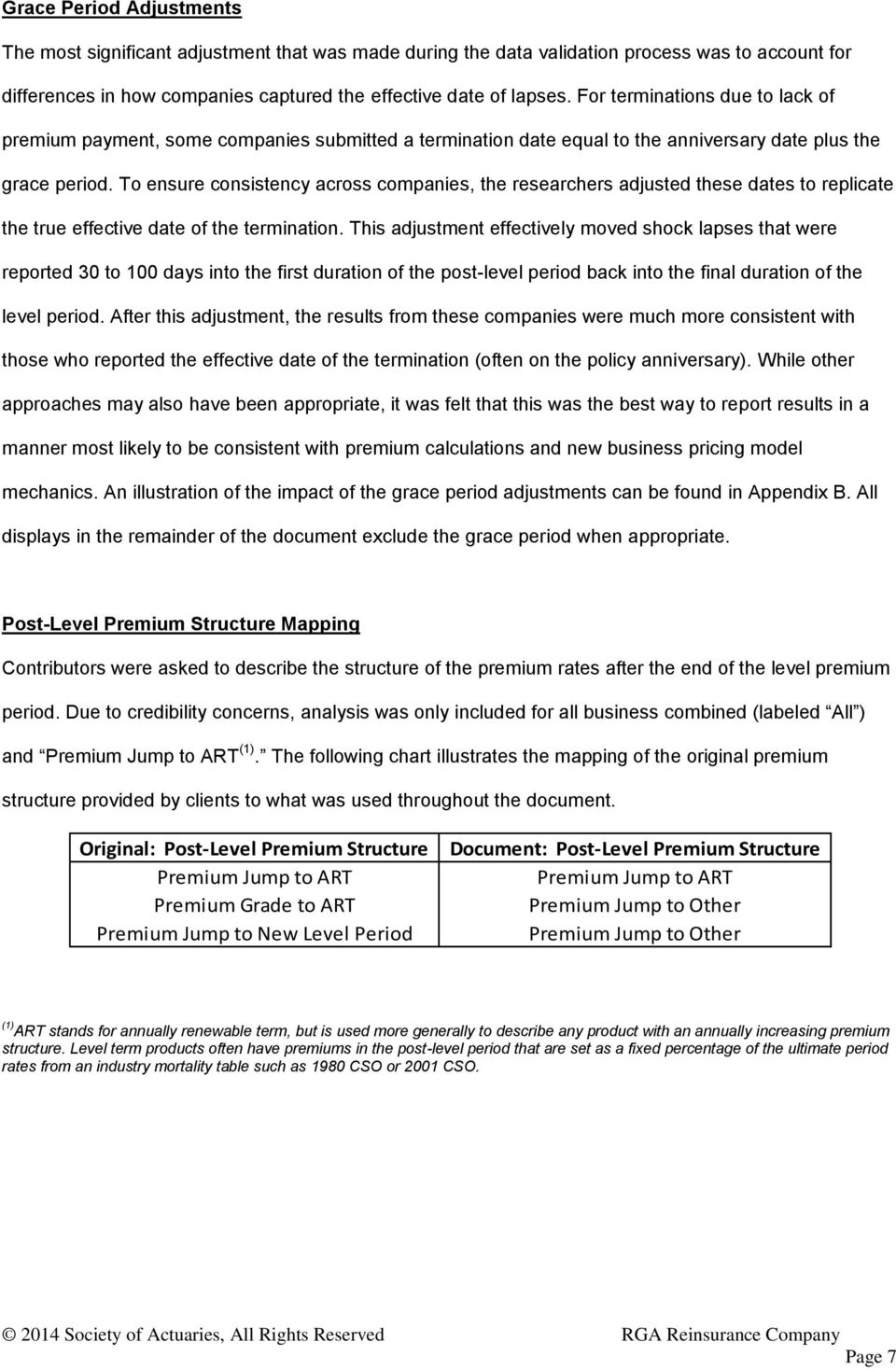
7 Grace Period Adjustments The most significant adjustment that was made during the data validation process was to account for differences in how companies captured the effective date of lapses. For terminations due to lack of premium payment, some companies submitted a termination date equal to the anniversary date plus the grace period. To ensure consistency across companies, the researchers adjusted these dates to replicate the true effective date of the termination. This adjustment effectively moved shock lapses that were reported 30 to 100 days into the first duration of the post-level period back into the final duration of the level period. After this adjustment, the results from these companies were much more consistent with those who reported the effective date of the termination (often on the policy anniversary). While other approaches may also have been appropriate, it was felt that this was the best way to report results in a manner most likely to be consistent with premium calculations and new business pricing model mechanics. An illustration of the impact of the grace period adjustments can be found in Appendix B. All displays in the remainder of the document exclude the grace period when appropriate. Post-Level Premium Structure Mapping Contributors were asked to describe the structure of the premium rates after the end of the level premium period. Due to credibility concerns, analysis was only included for all business combined (labeled All ) and Premium Jump to ART (1). The following chart illustrates the mapping of the original premium structure provided by clients to what was used throughout the document. Original: Post-Level Premium Structure Premium Jump to ART Premium Grade to ART Premium Jump to New Level Period Document: Post-Level Premium Structure Premium Jump to ART Premium Jump to Other Premium Jump to Other (1) ART stands for annually renewable term, but is used more generally to describe any product with an annually increasing premium structure. Level term products often have premiums in the post-level period that are set as a fixed percentage of the ultimate period rates from an industry mortality table such as 1980 CSO or 2001 CSO. Page 7
8 Lapse Study Specifications The lapse study covered policy anniversaries beginning in 2000 to policy anniversaries ending in For the purposes of this study, any voluntary termination was considered a lapse. This includes terminations coded as lapse, surrender, full conversion, term upgrade, and some other miscellaneous values. Exposure was calculated for up to 11 policy years for each policy. Fractional exposure was calculated for policies in the year of death. A full policy year of exposure was credited to policies in the year of lapse. Results were shown by count unless otherwise stated. Mortality Study Specifications The mortality study covered calendar years 2000 through Fractional exposure was calculated for policies in the year of lapse. A full policy year of exposure was credited to policies in the year of death. Expected mortality was calculated using several industry standard tables: SOA , 2001 VBT, and 2008 VBT. Actual/Tabular ratios were calculated as the ratio of the actual number of deaths to the tabular expected number of deaths. Results were shown by count unless otherwise stated. Relative mortality ratios are also provided to compare the post-level period mortality to the level period mortality. These values are calculated as the ratio of 2008 VBT actual/tabular ratio for a given post-level period duration to the 2008 VBT actual/tabular ratio during the last five durations of the level period. A 9 confidence interval is included in many illustrations for mortality by count. The formula used was: Actual Claim Count 1 1 ± * 2008 VBT Tabular (Actual Claim Count) * ( ) Page 8

9 Lapse Experience Overview This section will present lapse experience from participating companies with a primary focus on the shock lapse at the end of the level period. Multiple companies have submitted credible data for T10 products and these results will be shown for all analyzed dimensions. A smaller number of companies contributed T15 experience, so these results will only be shown when the dimensions being analyzed are credible and represent an appropriate cross-section of companies. Five-year level term and 20-year level term plan results will not be provided since there were not multiple companies contributing credible experience for these products. Page 9
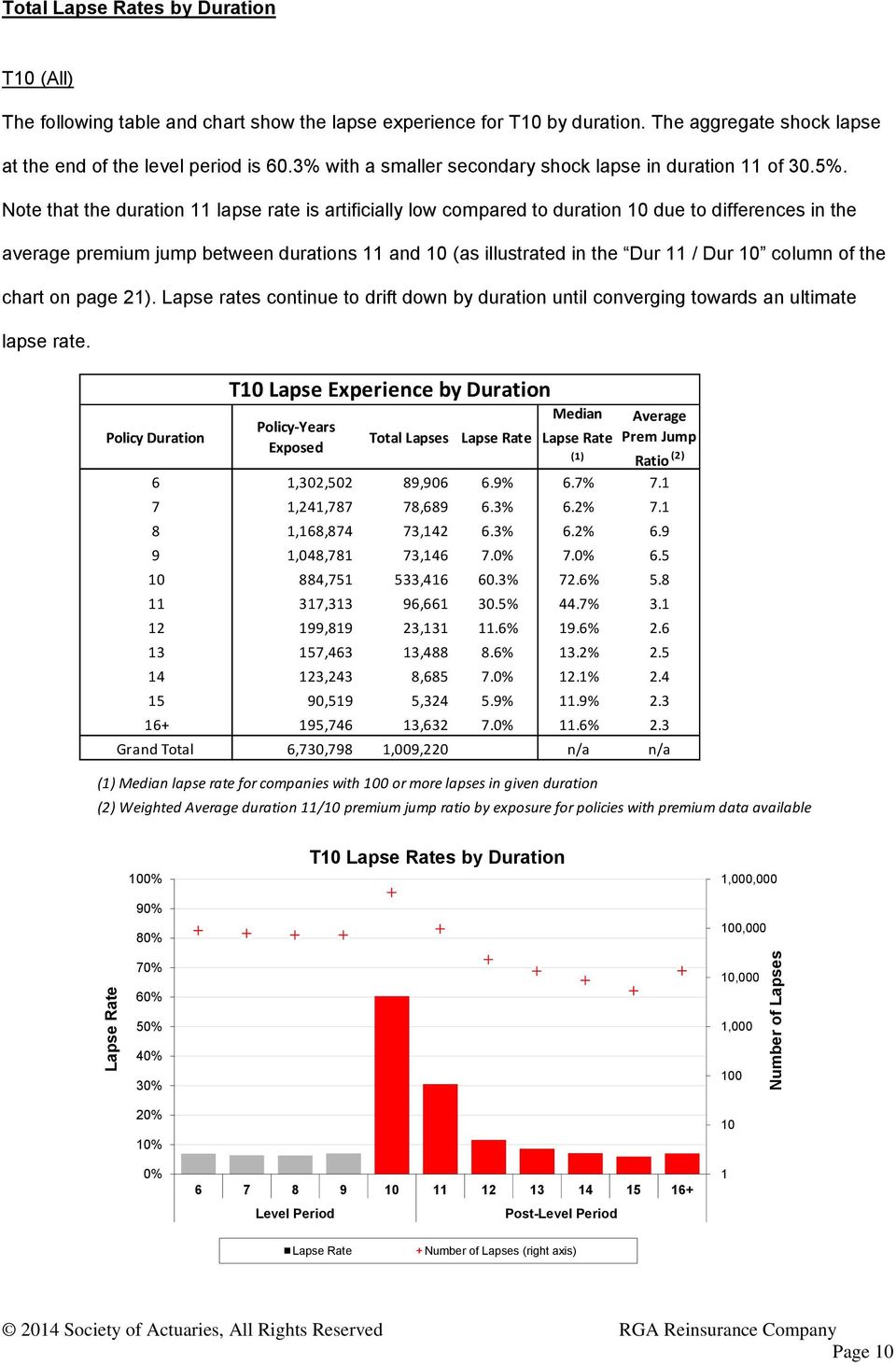
10 Lapse Rate Number of Lapses Total Lapse Rates by Duration T10 (All) The following table and chart show the lapse experience for T10 by duration. The aggregate shock lapse at the end of the level period is 60.3% with a smaller secondary shock lapse in duration 11 of 30.5%. Note that the duration 11 lapse rate is artificially low compared to duration 10 due to differences in the average premium jump between durations 11 and 10 (as illustrated in the Dur 11 / Dur 10 column of the chart on page 21). Lapse rates continue to drift down by duration until converging towards an ultimate lapse rate. Policy Duration T10 Lapse Experience by Duration Policy-Years Total Lapses Lapse Rate Median Lapse Rate (1) Prem Jump Ratio (2) 6 1,302,502 89, % 6.7% ,241,787 78, % 6.2% ,168,874 73, % 6.2% ,048,781 73, , , % 72.6% ,313 96, % 44.7% ,819 23, % 19.6% ,463 13, % 13.2% ,243 8, % ,519 5, % 11.9% ,746 13, % 2.3 Grand Total 6,730,798 1,009,220 n/a n/a (1) Median lapse rate for companies with 100 or more lapses in given duration (2) Weighted duration 11/10 premium jump ratio by exposure for policies with premium data available T10 Lapse Rates by Duration 1,000, , , Level Period Post-Level Period 1, Lapse Rate Number of Lapses (right axis) Page 10
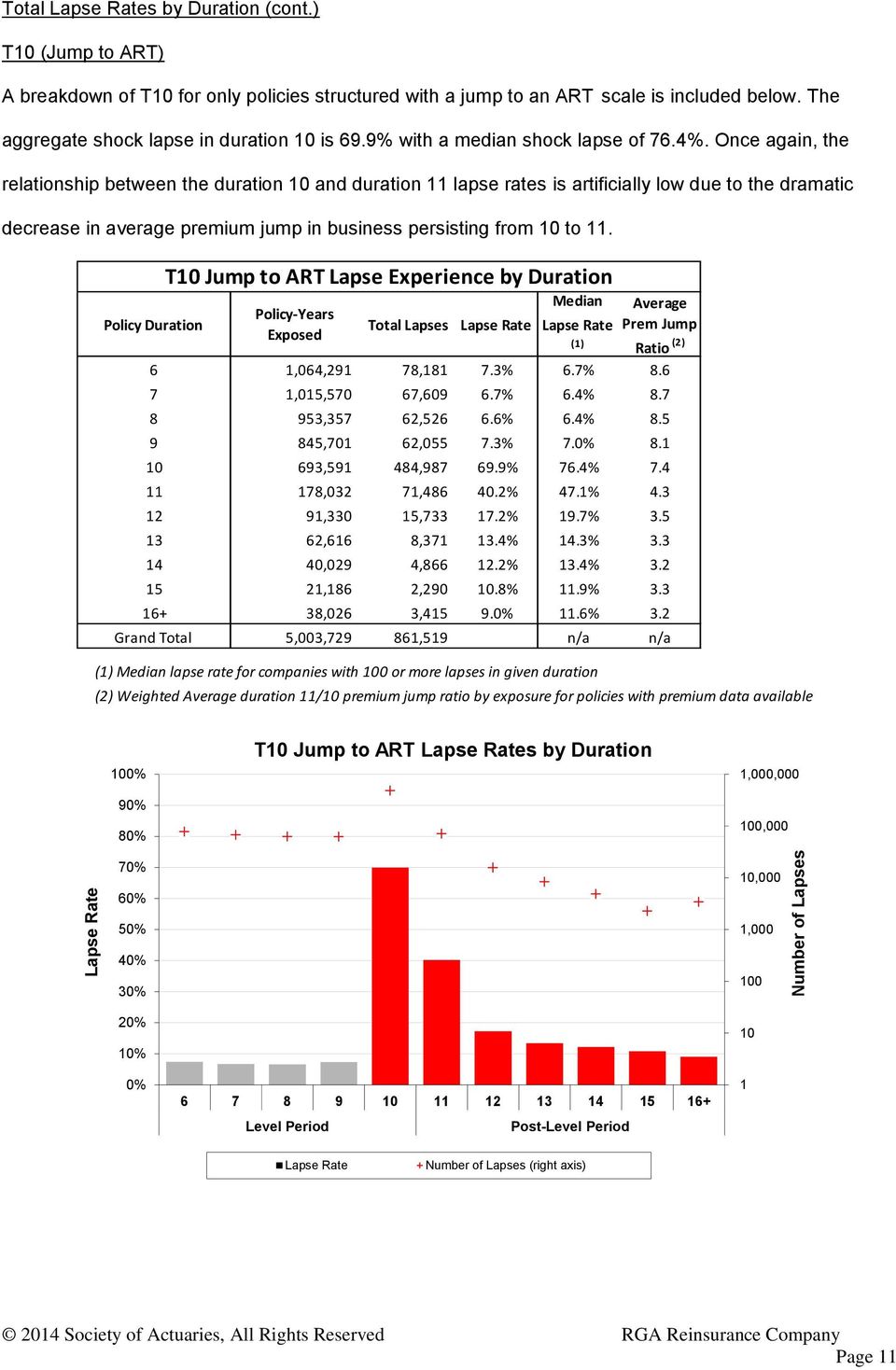
11 Lapse Rate Number of Lapses Total Lapse Rates by Duration (cont.) T10 (Jump to ART) A breakdown of T10 for only policies structured with a jump to an ART scale is included below. The aggregate shock lapse in duration 10 is 69.9% with a median shock lapse of 76.4%. Once again, the relationship between the duration 10 and duration 11 lapse rates is artificially low due to the dramatic decrease in average premium jump in business persisting from 10 to 11. Policy Duration T10 Jump to ART Lapse Experience by Duration Policy-Years Total Lapses Lapse Rate Median Lapse Rate (1) Prem Jump Ratio (2) 6 1,064,291 78, % 6.7% ,015,570 67, % 6.4% ,357 62, % 6.4% ,701 62, % , , % 76.4% ,032 71, % 47.1% ,330 15, % 19.7% ,616 8, % 14.3% ,029 4, % 13.4% ,186 2, % 11.9% ,026 3, % 3.2 Grand Total 5,003, ,519 n/a n/a (1) Median lapse rate for companies with 100 or more lapses in given duration (2) Weighted duration 11/10 premium jump ratio by exposure for policies with premium data available T10 Jump to ART Lapse Rates by Duration 1,000, , , Level Period Post-Level Period 1, Lapse Rate Number of Lapses (right axis) Page 11
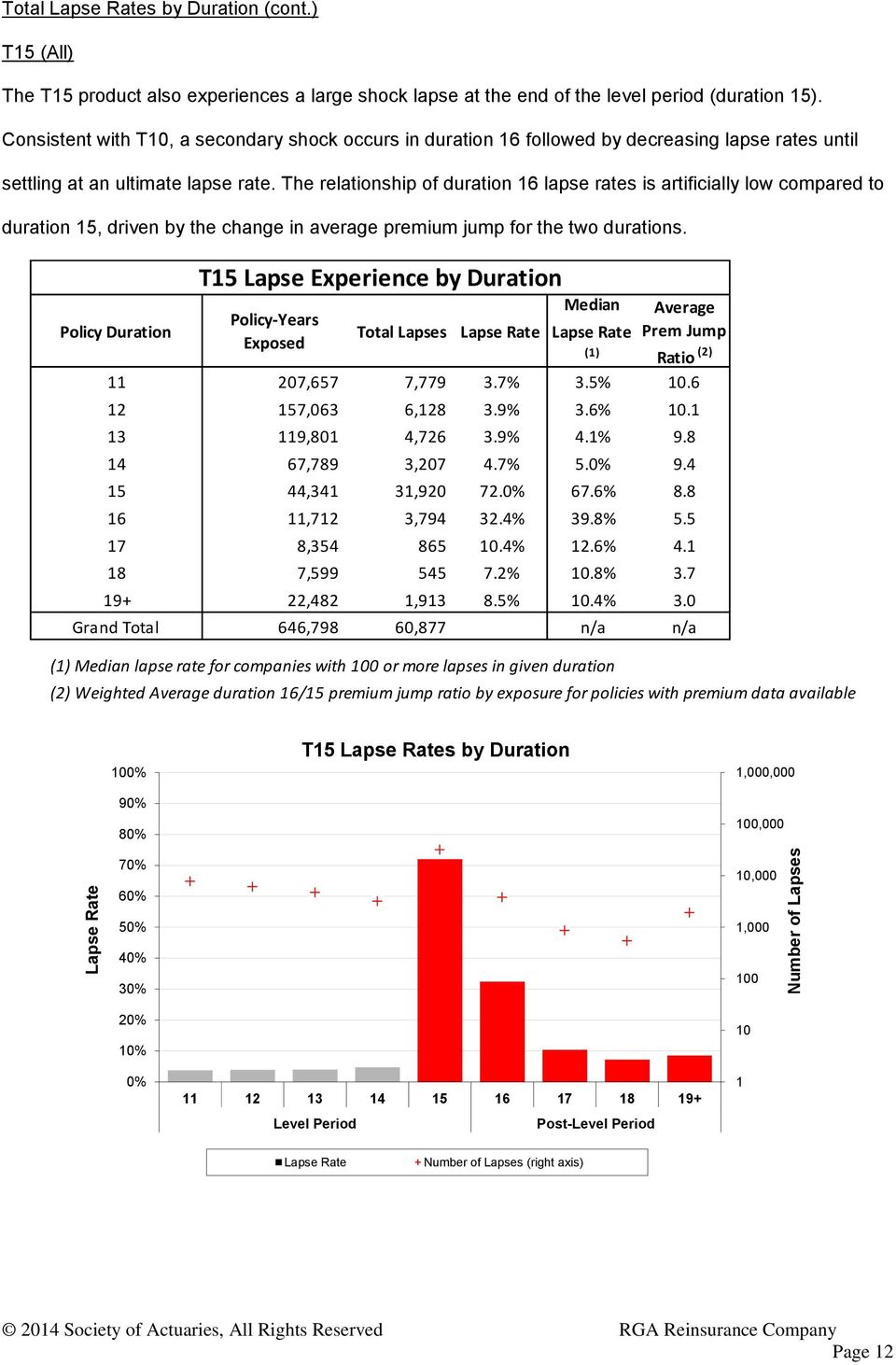
12 Lapse Rate Number of Lapses Total Lapse Rates by Duration (cont.) T15 (All) The T15 product also experiences a large shock lapse at the end of the level period (duration 15). Consistent with T10, a secondary shock occurs in duration 16 followed by decreasing lapse rates until settling at an ultimate lapse rate. The relationship of duration 16 lapse rates is artificially low compared to duration 15, driven by the change in average premium jump for the two durations. Policy Duration T15 Lapse Experience by Duration Policy-Years Total Lapses Lapse Rate Median Lapse Rate (1) Prem Jump Ratio (2) ,657 7, % 3.5% ,063 6, % 3.6% ,801 4, % 4.1% ,789 3, % ,341 31, % ,712 3, % 39.8% , % 12.6% , % 10.8% ,482 1, % 10.4% 3.0 Grand Total 646,798 60,877 n/a n/a (1) Median lapse rate for companies with 100 or more lapses in given duration (2) Weighted duration 16/15 premium jump ratio by exposure for policies with premium data available T15 Lapse Rates by Duration 1,000, , , Level Period Post-Level Period 1, Lapse Rate Number of Lapses (right axis) Page 12
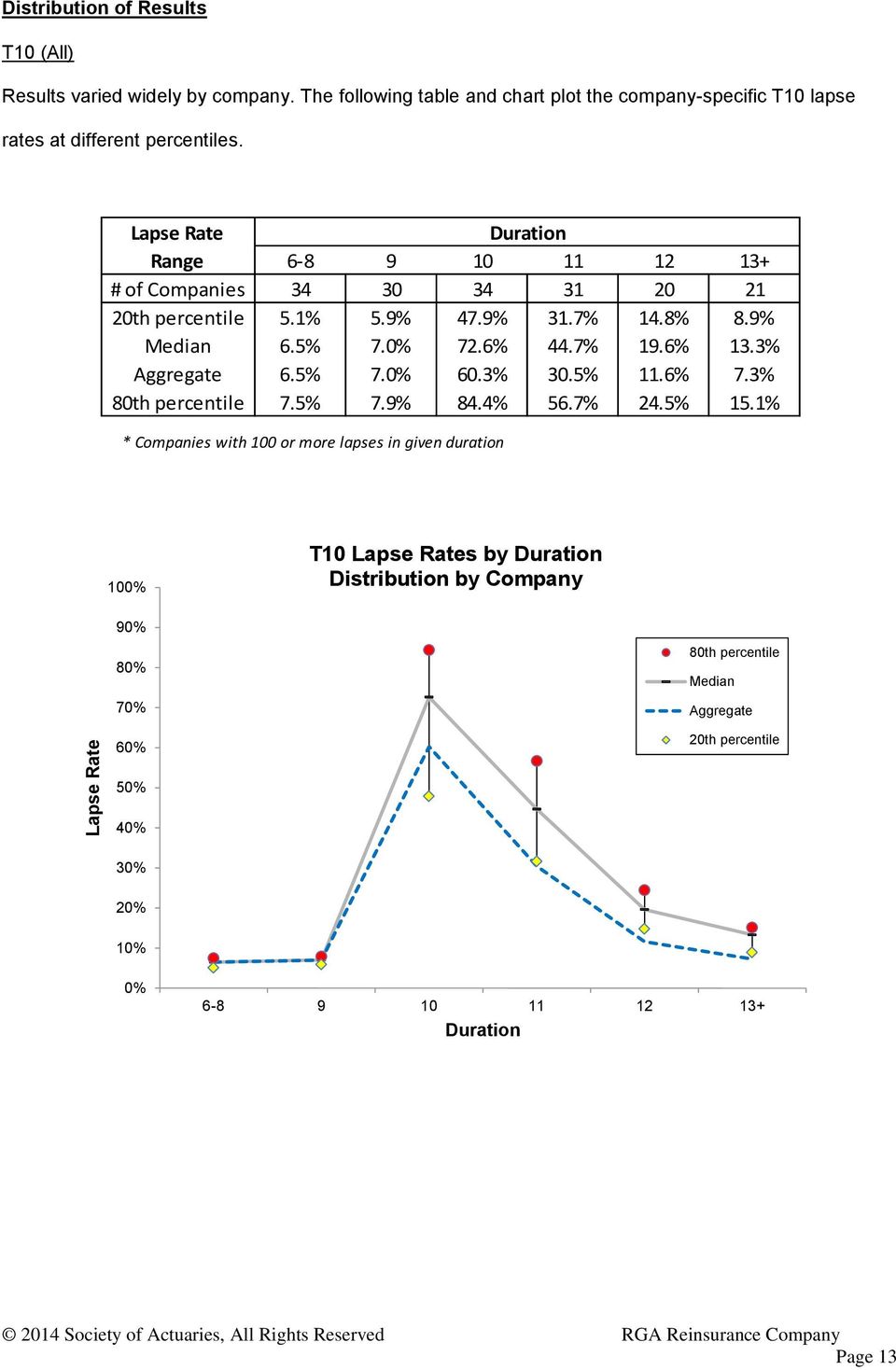
13 Lapse Rate Distribution of Results T10 (All) Results varied widely by company. The following table and chart plot the company-specific T10 lapse rates at different percentiles. Lapse Rate Duration Range # of Companies th percentile 5.1% 5.9% 47.9% 31.7% 14.8% 8.9% Median 6.5% % 44.7% 19.6% 13.3% Aggregate 6.5% % 30.5% 11.6% 7.3% 80th percentile 7.5% 7.9% 84.4% 56.7% 24.5% 15.1% * Companies with 100 or more lapses in given duration 10 T10 Lapse Rates by Duration Distribution by Company th percentile Median Aggregate 20th percentile Duration Page 13
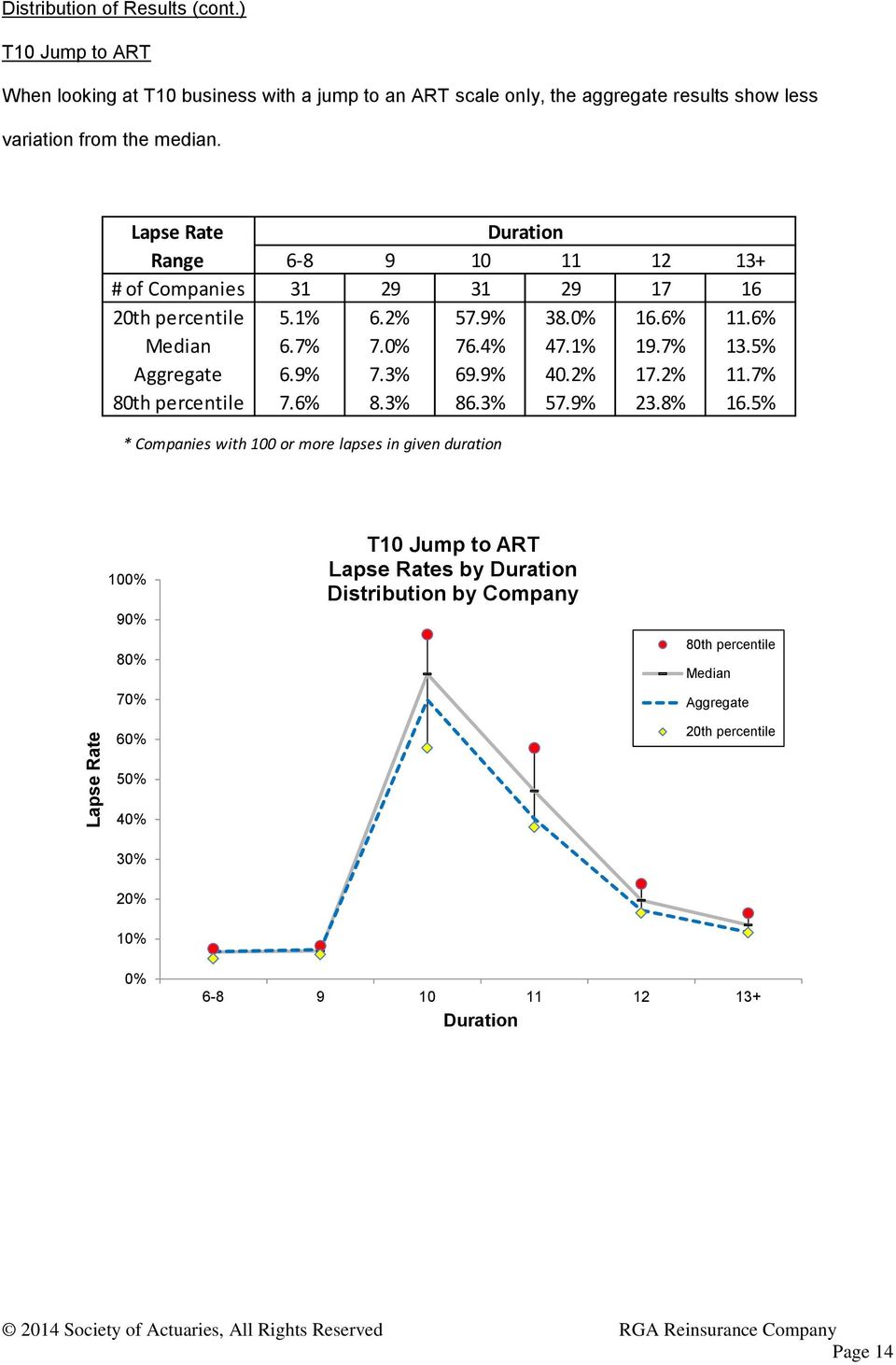
14 Lapse Rate Distribution of Results (cont.) T10 Jump to ART When looking at T10 business with a jump to an ART scale only, the aggregate results show less variation from the median. Lapse Rate Duration Range # of Companies th percentile 5.1% 6.2% 57.9% % 11.6% Median 6.7% % 47.1% 19.7% 13.5% Aggregate 6.9% 7.3% 69.9% 40.2% 17.2% 11.7% 80th percentile 7.6% 8.3% 86.3% 57.9% 23.8% 16.5% * Companies with 100 or more lapses in given duration T10 Jump to ART Lapse Rates by Duration Distribution by Company 80th percentile Median Aggregate 20th percentile Duration Page 14
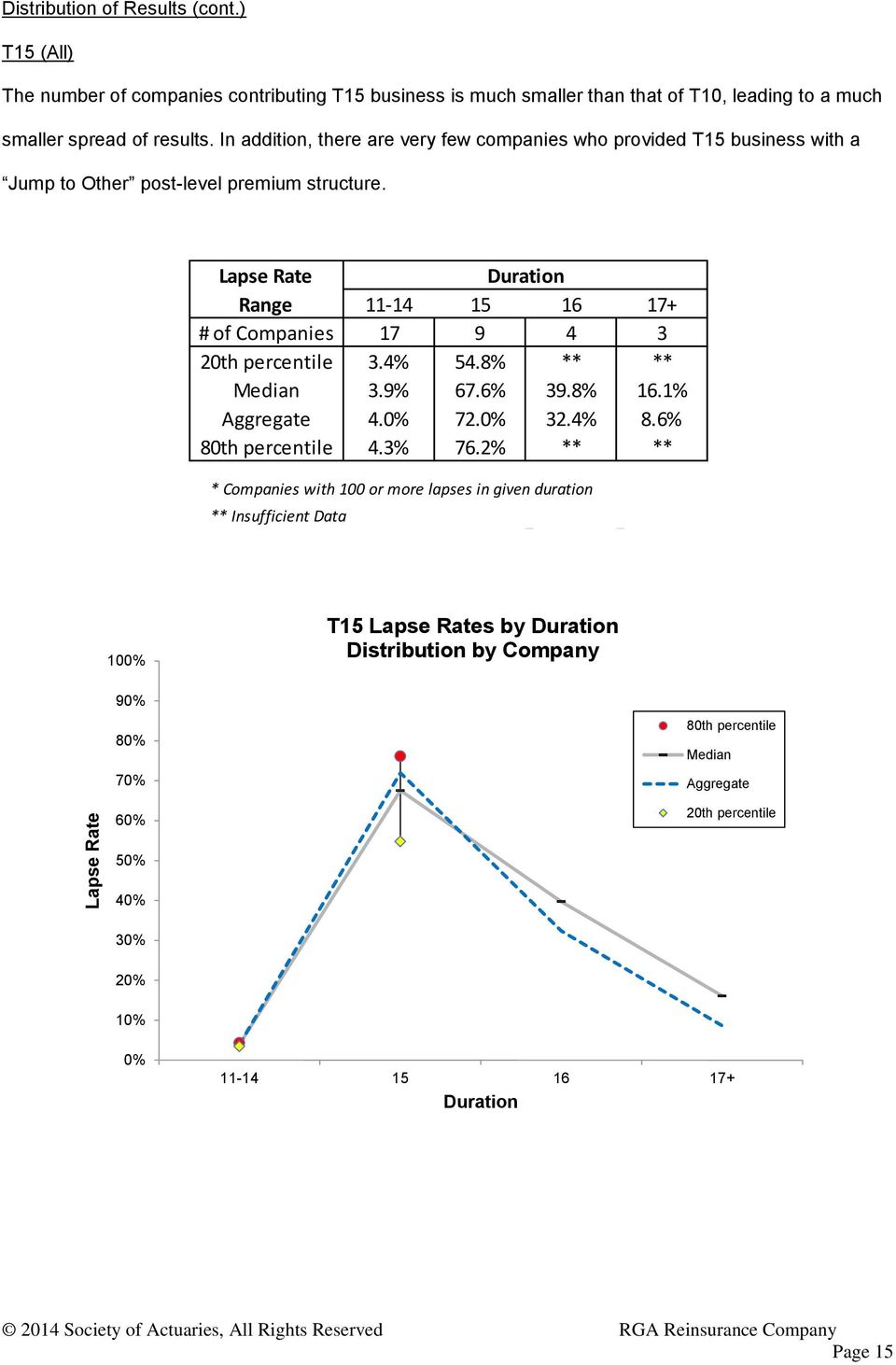
15 Lapse Rate Distribution of Results (cont.) T15 (All) The number of companies contributing T15 business is much smaller than that of T10, leading to a much smaller spread of results. In addition, there are very few companies who provided T15 business with a Jump to Other post-level premium structure. Lapse Rate Duration Range # of Companies th percentile 3.4% 54.8% ** ** Median 3.9% 67.6% 39.8% 16.1% Aggregate % 8.6% 80th percentile 4.3% 76.2% ** ** * Companies with 100 or more lapses in given duration ** Insufficient Data 10 T15 Lapse Rates by Duration Distribution by Company th percentile Median Aggregate 20th percentile Duration Page 15
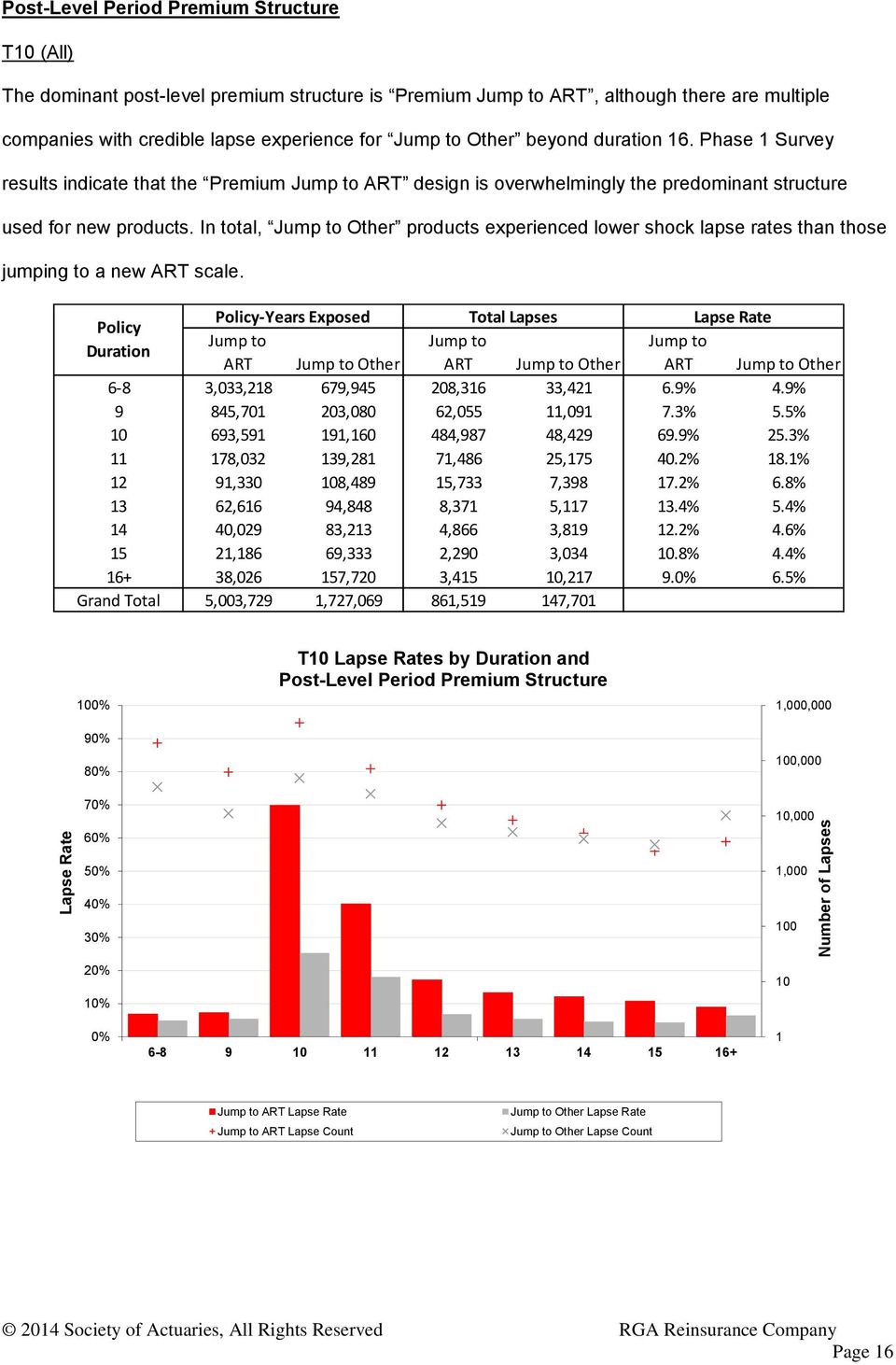
16 Lapse Rate Number of Lapses Post-Level Period Premium Structure T10 (All) The dominant post-level premium structure is Premium Jump to ART, although there are multiple companies with credible lapse experience for Jump to Other beyond duration 16. Phase 1 Survey results indicate that the Premium Jump to ART design is overwhelmingly the predominant structure used for new products. In total, Jump to Other products experienced lower shock lapse rates than those jumping to a new ART scale. Policy-Years Total Lapses Lapse Rate Policy Jump to Jump to Jump to Duration ART Jump to Other ART Jump to Other ART Jump to Other 6-8 3,033, , ,316 33, % 4.9% 9 845, ,080 62,055 11, % 5.5% , , ,987 48, % 25.3% , ,281 71,486 25, % 18.1% 12 91, ,489 15,733 7, % 6.8% 13 62,616 94,848 8,371 5, % 5.4% 14 40,029 83,213 4,866 3, % 4.6% 15 21,186 69,333 2,290 3, % 4.4% , ,720 3,415 10, % Grand Total 5,003,729 1,727, , , T10 Lapse Rates by Duration and Post-Level Period Premium Structure 1,000, ,000 10, , Jump to ART Lapse Rate Jump to ART Lapse Count Jump to Other Lapse Rate Jump to Other Lapse Count Page 16
17 Premium Jump Ratio T10 Since the shock lapse is primarily driven by the dramatic increase in premiums that a policyholder would have to pay to keep his or her policy in force, it stands to reason that policies with larger premium jumps also have larger shock lapses. To study this, the researchers asked participants to supply the level period and post-level period per-thousand premium rates for each policy record. Usable premium data was provided by 30 participating companies, representing approximately 63% of the T10 duration 10 exposure. For each policy, the researchers calculated a Premium Jump Ratio as the ratio of the duration 11 per thousand rate to the duration 10 per thousand rate. The lapse rate experience was then stratified into bands by premium jump ratio. For example, 1.01x 2x in the charts on the following pages represents policies with a duration 11 premium rate between one and two times the premium rate in duration 10. It is clear that policies with lower premium jump ratios experienced significantly lower shock lapses than policies with larger premium jump ratios. This is particularly relevant when considering how to apply the results from this experience study to current pricing. As seen in the Phase 1 survey, a common current practice is to set post-level period premium rates at 20 of 2001 CSO or higher. This would generally lead to much higher premium jumps on average than those policies in this study that have already entered the post-level period. As a result, the researchers expect the shock lapse experience that eventually emerges on recently issued business could be much higher than the aggregated totals from this study suggest. The results on the following pages provide a calculation of the Prem Jump Ratio and the Issue Age. The average premium jump obviously ends up near the midpoint of each premium jump ratio band. As mentioned earlier, issue age is strongly correlated with premium jump ratio. Page 17

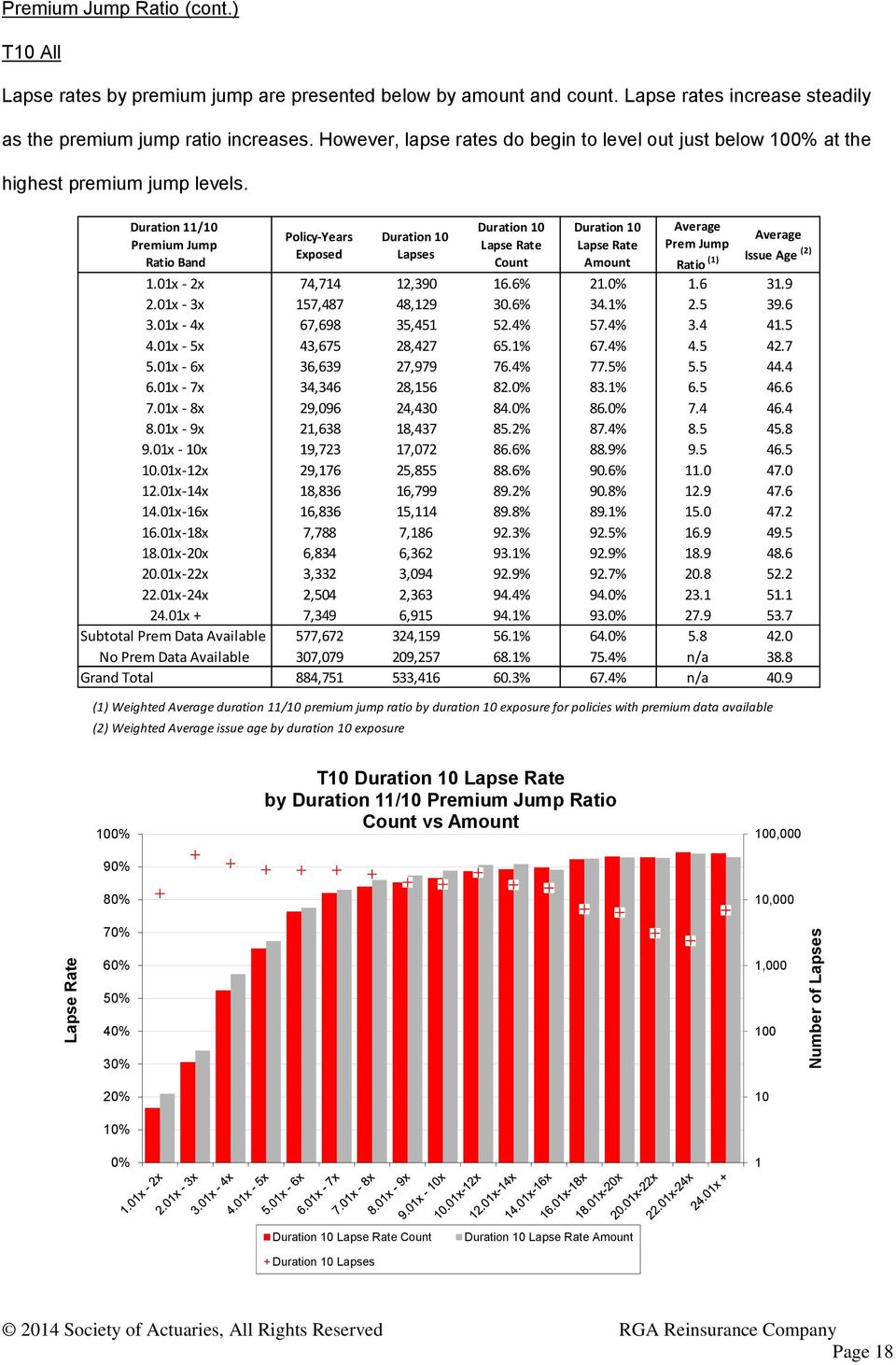
18 Lapse Rate Number of Lapses Premium Jump Ratio (cont.) T10 All Lapse rates by premium jump are presented below by amount and count. Lapse rates increase steadily as the premium jump ratio increases. However, lapse rates do begin to level out just below 10 at the highest premium jump levels. Duration 11/10 Premium Jump Ratio Band Policy-Years Duration 10 Lapses Duration 10 Lapse Rate Count Duration 10 Lapse Rate Amount Prem Jump Ratio (1) Issue Age (2) 1.01x - 2x 74,714 12, % x - 3x 157,487 48, % 34.1% x - 4x 67,698 35, % 57.4% x - 5x 43,675 28, % 67.4% x - 6x 36,639 27, % 77.5% x - 7x 34,346 28, % x - 8x 29,096 24, x - 9x 21,638 18, % 87.4% x - 10x 19,723 17, % 88.9% x-12x 29,176 25, % 90.6% x-14x 18,836 16, % 90.8% x-16x 16,836 15, % 89.1% x-18x 7,788 7, % 92.5% x-20x 6,834 6, % 92.9% x-22x 3,332 3, % 92.7% x-24x 2,504 2, % x + 7,349 6, % Subtotal Prem Data Available 577, , % No Prem Data Available 307, , % 75.4% n/a 38.8 Grand Total 884, , % 67.4% n/a 40.9 (1) Weighted duration 11/10 premium jump ratio by duration 10 exposure for policies with premium data available (2) Weighted issue age by duration 10 exposure T10 Duration 10 Lapse Rate by Duration 11/10 Premium Jump Ratio Count vs Amount 100,000 10, , Duration 11/10 Premium Jump Ratio Duration 10 Lapse Rate Count Duration 10 Lapses Duration 10 Lapse Rate Amount Page 18
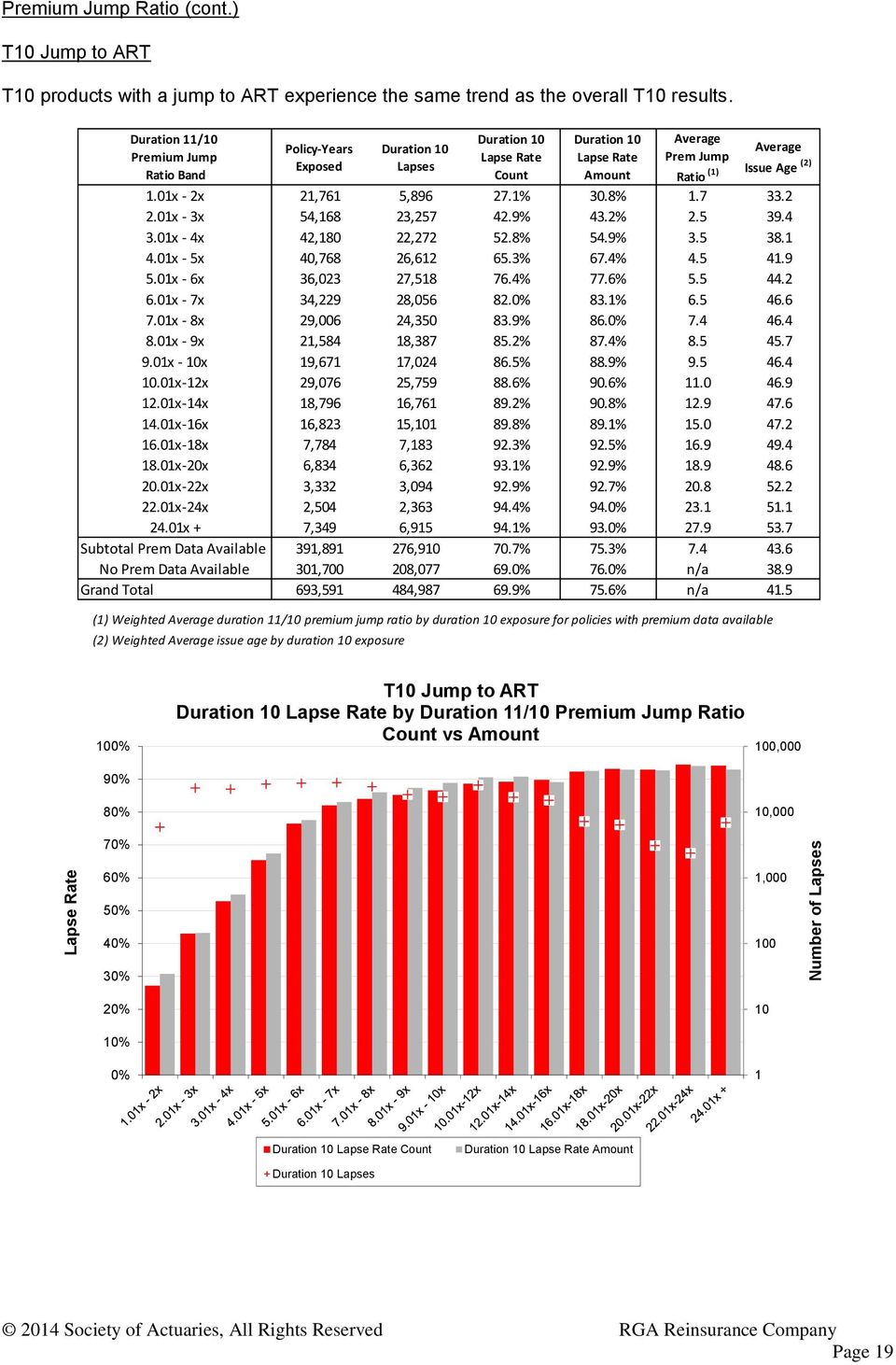
19 Lapse Rate Number of Lapses Premium Jump Ratio (cont.) T10 Jump to ART T10 products with a jump to ART experience the same trend as the overall T10 results. Duration 11/10 Premium Jump Ratio Band Policy-Years Duration 10 Lapses Duration 10 Lapse Rate Count Duration 10 Lapse Rate Amount Prem Jump Ratio (1) Issue Age (2) 1.01x - 2x 21,761 5, % 30.8% x - 3x 54,168 23, % 43.2% x - 4x 42,180 22, % 54.9% x - 5x 40,768 26, % 67.4% x - 6x 36,023 27, % 77.6% x - 7x 34,229 28, % x - 8x 29,006 24, % x - 9x 21,584 18, % 87.4% x - 10x 19,671 17, % 88.9% x-12x 29,076 25, % 90.6% x-14x 18,796 16, % 90.8% x-16x 16,823 15, % 89.1% x-18x 7,784 7, % 92.5% x-20x 6,834 6, % 92.9% x-22x 3,332 3, % 92.7% x-24x 2,504 2, % x + 7,349 6, % Subtotal Prem Data Available 391, , % 75.3% No Prem Data Available 301, , n/a 38.9 Grand Total 693, , % 75.6% n/a 41.5 (1) Weighted duration 11/10 premium jump ratio by duration 10 exposure for policies with premium data available (2) Weighted issue age by duration 10 exposure 10 T10 Jump to ART Duration 10 Lapse Rate by Duration 11/10 Premium Jump Ratio Count vs Amount 100, , , Duration 11/10 Premium Jump Ratio Duration 10 Lapse Rate Count Duration 10 Lapses Duration 10 Lapse Rate Amount Page 19
20 Lapse Rate Number of Lapses Premium Jump Ratio (cont.) T15 (All) The pattern of T15 experience is very similar to that of T10, although the shock lapse appears to be slightly lower at the higher premium jumps. Duration 16/15 Premium Jump Ratio Band Policy-Years Duration 15 Lapses Duration 15 Lapse Rate Count Duration 15 Lapse Rate Amount Prem Jump Ratio (1) Issue Age (2) 1.01x - 3x 2, % 28.4% x - 4x 2,921 1, % 50.7% x - 5x 3,515 2, % x - 6x 4,731 3, % 74.4% x - 7x 5,428 4, % 79.1% x - 8x 3,509 2, % 80.7% x - 9x 2,817 2, % 79.4% x - 10x 2,266 1, % 78.9% x-12x 5,931 4, % 78.9% x-14x 1,984 1, % 83.2% x-16x 2,357 1, % 82.3% x + 4,279 3, % 90.1% Subtotal Prem Data Available 42,425 30, % 76.7% No Prem Data Available 1,917 1, % 63.7% n/a 39.7 Grand Total 44,341 31, % n/a 43.9 (1) Weighted duration 16/15 premium jump ratio by duration 15 exposure for policies with premium data available (2) Weighted issue age by duration 15 exposure T15 Duration 16 Lapse Rate by Duration 16/15 Premium Jump Ratio Count vs Amount 100,000 10, , Duration 11/10 Premium Jump Ratio Duration 15 Lapse Rate Count Duration 15 Lapses Duration 15 Lapse Rate Amount Page 20

21 Premium Jump Ratio and Duration T10 All When comparing the initial premium jump to the lapse rates in durations 10, 11 and 12, there is an increasing trend in lapse rates as the premium jump increases for all three durations. In addition, the relationship of the lapse rate in duration 11 to duration 10 and lapse rate in duration 12 to duration 11 was also analyzed. The two lines illustrated in the chart below show the ratio of lapse rates is relatively level by premium jump. It is important to note the Dur 11 / Dur 10 total of 50.5% is much smaller than the individual premium jump bands, which range from 70.5% to 87.1%, due to more exposure in duration 11 at lower premium jump levels. Duration 11/10 Premium Jump Ratio Band Duration 10 Lapses Duration 11 Lapses Duration 12 Lapses Duration 10 Lapse Rate Duration 11 Lapse Rate Duration 12 Lapse Rate Dur 11 / Dur 10 Dur 12 / Dur 11 Prem Jump Ratio (1) Issue Age (2) 1.01x - 2x 12,390 8,084 3, % 13.4% 7.2% 80.6% 53.9% x - 3x 48,129 23,609 6, % 22.9% 8.6% 74.8% 37.5% x - 4x 35,451 10,905 2, % 37.3% % 40.3% x - 5x 28,427 6,670 1, % 47.2% 19.8% 72.6% 41.9% x - 6x 27,979 4, % 53.9% % 44.5% x - 7x 28,156 3, % 73.2% 43.8% x - 8x 24,430 2, % 27.8% 72.8% 45.5% x - 9x 18,437 1, % 63.3% 28.7% 74.3% 45.3% x - 10x 17,072 1, % 67.9% 37.3% 78.4% 54.9% x-12x 25,855 1, % 70.1% 34.7% 79.1% 49.5% x-14x 16, % % 49.3% x-16x 15, % 74.4% 42.3% 82.9% 56.8% x + 25, % 81.2% 45.7% 87.1% 56.3% Subtotal Prem Data Available 324,159 65,350 15, % % % No Prem Data Available 209,257 31,311 7, % 37.2% 15.9% 54.6% 42.7% n/a 38.8 Grand Total 533,416 96,661 23, % 30.5% 11.6% 50.5% 38. n/a 40.9 (1) Weighted duration 11/10 premium jump ratio by duration 10 exposure for policies with premium data available (2) Weighted issue age by duration 10 exposure T10 Lapse Rate by Duration 11/10 Premium Jump Ratio Duration 10 Lapse Rate Duration 11 Lapse Rate Duration 12 Lapse Rate Duration 11/10 Premium Jump Ratio Dur 11 / Dur 10 Dur 12 / Dur 11 Page 21
22 Premium Jump Ratio and Duration (cont.) T10 Jump to ART For T10 business with a jump to ART, the same trends can be seen when looking at both lapse rates by duration and the ratio of lapse rates between durations. Duration 11/10 Premium Jump Ratio Band Duration 10 Lapses Duration 11 Lapses Duration 12 Lapses Duration 10 Lapse Rate Duration 11 Lapse Rate Duration 12 Lapse Rate Dur 11 / Dur 10 Dur 12 / Dur 11 Prem Jump Ratio (1) Issue Age (2) 1.01x - 2x 5,896 3,020 1, % 21.5% 12.8% 79.5% 59.5% x - 3x 23,257 8,879 2, % 33.1% 15.4% % x - 4x 22,272 7,163 1, % 38.7% 17.3% 73.2% 44.9% x - 5x 26,612 6,248 1, % 47.7% 20.4% 73.1% 42.7% x - 6x 27,518 3, % 53.9% 24.5% 70.5% 45.4% x - 7x 28,056 3, % 27.2% 73.5% 45.1% x - 8x 24,350 2, % 61.5% 28.4% 73.2% 46.3% x - 9x 18,387 1, % 63.5% 29.1% 74.5% 45.9% x - 10x 17,024 1, % 68.1% 37.2% 78.7% 54.7% x-12x 25,759 1, % 70.1% 34.8% 79.1% 49.7% x-14x 16, % 71.1% 35.1% 79.7% 49.4% x-16x 15, % 74.4% 42.3% 82.9% 56.8% x + 25, % 79.9% 47.7% % Subtotal Prem Data Available 276,910 41,120 8, % % 42.9% No Prem Data Available 208,077 30,366 7, % 16.4% % n/a 38.9 Grand Total 484,987 71,486 15, % 40.2% 17.2% 57.4% 42.9% n/a 41.5 (1) Weighted duration 11/10 premium jump ratio by duration 10 exposure for policies with premium data available (2) Weighted issue age by duration 10 exposure 10 T10 Jump to ART Lapse Rate by Duration 11/10 Premium Jump Ratio Duration 10 Lapse Rate Duration 11 Lapse Rate Duration 12 Lapse Rate Duration 11/10 Premium Jump Ratio Dur 11 / Dur 10 Dur 12 / Dur 11 Page 22
23 Premium Jump Ratio and Duration (cont.) T15 (All) Consistent with T10, T15 also experiences increasing lapse rates within each post-level duration when comparing to the premium jump at the end of duration 15. Additionally, the ratio of lapse rates in duration 16 to duration 15 as well as duration 17 to duration 16 also seems to hold a relatively steady pattern, although results are not as credible as T10. Duration 16/15 Premium Jump Ratio Band Duration 15 Lapses Duration 16 Lapses Duration 17 Lapses Duration 15 Lapse Rate Duration 16 Lapse Rate Duration 17 Lapse Rate Dur 16 / Dur 15 Dur 17 / Dur 16 Prem Jump Ratio (1) Issue Age (2) 1.01x - 2x % % 58.3% 52.9% x - 3x % 15.8% 7.2% 51.3% 45.7% x - 4x 1, % 24.3% 6.8% 50.2% 27.9% x - 5x 2, % 34.1% 11.2% 55.1% 32.8% x - 6x 3, % % % x - 7x 4, % 44.4% 20.1% 57.2% 45.2% x - 8x 2, % 42.4% 14.8% x - 9x 2, % 47.9% 21.1% 60.1% 43.9% x - 10x 1, % 53.8% 20.9% 68.4% 38.8% x-12x 4, % 51.2% 24.3% % x-14x 1, % 66.3% * 79.4% * x-16x 1, % 62.1% * 73.9% * x + 3, % 67.5% * 75.9% * Subtotal Prem Data Available 30,851 3, % 32.7% 10.4% 44.9% 31.7% No Prem Data Available 1, % 27.5% 10.3% 49.3% 37.7% n/a 39.7 Grand Total 31,920 3, % 10.4% n/a 43.9 (1) Weighted duration 16/15 premium jump ratio by duration 15 exposure for policies with premium data available (2) Weighted issue age by duration 15 exposure * Insufficient data 10 T15 Lapse Rate by Duration 16/15 Premium Jump Ratio Duration 15 Lapse Rate Duration 16 Lapse Rate Duration 17 Lapse Rate Duration 11/10 Premium Jump Ratio Dur 16 / Dur 15 Dur 17 / Dur 16 Page 23
24 Lapse Rate Number of Lapses Premium Jump Ratio and Post-Level Period Premium Structure T10 (All) Both the Jump to ART and the Jump to Other product designs have shock lapses that generally increase with the size of the premium jump. The products with a Jump to Other experienced lower shock lapses than those that jumped to an ART scale below a 6x jump. Results are relatively thin above a 6x jump for Jump to Other business. It is interesting to note that the average issue age increases significantly as premium jump increases for Jump to Other business compared to business with a jump to ART. The quickly increasing average issue age for Jump to Other is driven primarily by business with a jump to a new level period. For this business, as issue age increases, the premium jump increases more dramatically in order to support the entire new level period. Duration 11/10 Premium Jump Ratio Band Policy-Years Total Lapses Lapse Rate Jump to ART Jump to Other Jump to ART Jump to Other Jump to ART Jump to Other Prem Jump Ratio (1) Jump to Jump to ART Other Issue Age (2) Jump to Jump to ART Other 1.01x - 2x 21,761 52,952 5,896 6, % 12.3% x - 3x 54, ,318 23,257 24, % 24.1% x - 4x 42,180 25,519 22,272 13, % 51.6% x - 5x 40,768 2,907 26,612 1, % 62.4% x - 6x 36, , % 74.8% x - 7x 34, , % x - 8x 29, , % 88.9% x - 9x 21, , % 93.2% x - 10x 19, , % 92.3% x-11x 13, , % 91.9% x - 12x 15, , % 98.4% x+ 63, , % 95.3% Subtotal Data Available 391, , ,910 47, % 25.4% No Prem Data Available 301,700 5, ,077 1, % n/a n/a Grand Total 693, , ,987 48, % 25.3% n/a n/a (1) Weighted duration 11/10 premium jump ratio by duration 10 exposure for policies with premium data available (2) Weighted issue age by duration 10 exposure 10 T10 Duration 10 Lapse Rates by Duration 11/10 Premium Jump Ratio and Post-Level Premium Structure 100, , , x - 2x 2.01x - 3x 3.01x - 4x 4.01x - 5x 5.01x - 6x 6.01x - 7x 7.01x - 8x 8.01x - 9x 9.01x - 10x 10.01x- 11x 11.01x - 12x 12.01x+ 1 Duration 11/10 Premium Jump Ratio Jump to ART Lapse Rate Jump to ART Lapse Count Jump to Other Lapse Rate Jump to Other Lapse Count Page 24
25 Lapse Rate Premium Jump by Company T10 (All) A wide spread of shock lapse results is seen from company to company. This is attributable to a number of company-specific factors including product design, target market, age distribution, and policyholder retention programs. The following chart shows the company-specific duration 10 shock lapse as a function of the average premium jump ratio between durations 10 and 11 for each company that provided premium information. The data below matches well with the previous charts showing lapse rate by premium jump. In general, companies with higher average premium jumps experienced higher shock lapses with some leveling toward the highest jumps. A logarithmic trend line has been added to the graph below only to aid the visual display. 10 T10 Duration 10 Lapse Rates by Premium Jump Ratio Duration 11/10 Premium Jump Ratio for Company Page 25
26 Premium Jump Ratio by Company T10 One possible concern might be that companies are represented disproportionately along different parts of the premium jump ratio spectrum. This is a valid concern given the wide spread of company-specific experience results and the differences between various companies gross premium rates and product structures. To determine whether company mix was creating the trends displayed in the prior pages, each company s specific results were plotted by premium jump ratio. The two graphs on the following page plot company-specific lapse rates at each premium jump level. The first graph requires a minimum of 100 lapses at any given point and the second requires 1,000 lapses at any given point. While there can be significant differences by individual company, the general trend of both graphs is consistent with what has been demonstrated in previous pages. Lapse rates increase very quickly at the lowest premium jumps, begin to level off as jumps begin to increase, and then level off at the highest premium jump levels. Page 26
27 Lapse Rate Lapse Rate Premium Jump Ratio by Company (cont.) T10 (All) 10 T10 Duration 10 Shock Lapse by Premium Ratio and Company (minimum of 100 lapses) Duration 11/10 Premium Jump Ratio 10 T10 Duration 10 Shock Lapse by Premium Ratio and Company (minimum of 1,000 lapses) Duration 11/10 Premium Jump Ratio Page 27
28 Lapse Skewness Similar to the 2010 Post-Level Term study, analysis was completed in order to help quantify how lapses were skewed by month before and after the shock lapse. Results from the Phase 1 Survey for the year of the shock were primarily consistent, with most companies assuming lapses occur at or near the end of the policy year. Results during the post-level period in the survey varied. The below charts, taken from the Phase 1 survey, illustrate these results. Monthly Lapse Skewness During Level Premium Period Response Respondents Lapses are uniformly distributed 18 Lapses occur on premium payment modes 10 Lapses occur at the end of the year 7 Other 4 No response 5 Monthly Lapse Skewness During Year of Shock Lapse Response Respondents Lapses are uniformly distributed 5 Lapses occur on premium payment modes 3 Lapses occur at the end of the year 17 Lapses graded toward end of the year with shock in month No response 7 Monthly Lapse Skewness During Post-Level Period Response Respondents Lapses are uniformly distributed 6 Lapses occur on premium payment modes 7 Lapses occur at the end of the year 9 Lapses skewed to the beginning of L+1, Uniform thereafter 8 No response 14 Page 28
29 Lapse Skewness (cont.) The tables and charts on the following pages show the proportion of T10 lapses within each policy month of lapse. Since the grace period adjustments to lapse dates that were made for some companies, as discussed earlier, could potentially affect this analysis, the results for companies that had grace period adjustments are displayed separately from those without grace period adjustments. The results for these two groups are quite similar, providing additional confirmation of the validity of the adjustments. In total, it is clear that lapses in duration 10 are skewed heavily toward the end of the policy year. The most significant finding, consistent with the 2010 study, is that duration 11 lapses are skewed heavily toward the beginning of the policy year. This is especially important when considering the portion of duration 11 premium that will be collected. To the extent that the distribution of off-anniversary lapses during the post-level period is different from the level period, this should be an important consideration in developing new business pricing assumptions. Page 29
30 Proportion of Lapses Lapse Skewness (cont.) T10 (All) Over 5 of duration 11 lapses occurred in the first three policy months following the policy s 10 th anniversary, compared to less than 25% during the first three months of durations 6-9. The monthly distribution of lapses for durations 12+ is similar to the distribution during durations 6-9. Twice as many lapses occur in month 11 of duration 10 compared to month 11 of durations 6-9 in anticipation of the end of the level period. Grace Period Lapse Month Number of Lapses Proportion of Lapses Adjustment? within Pol Yr Dur 6-9 Dur 10 Dur 11 Dur 12+ Dur 6-9 Dur 10 Dur 11 Dur 12+ Companies 1 16,598 3,647 21,605 4,591 6% 1% 26% 8% WITHOUT 2 15,131 3,278 11,741 3,932 6% 1% 14% 7% Termination 3 23,112 5,128 11,856 5,614 9% 1% 14% 1 Date 4 13,431 3,188 5,406 3,019 5% 1% 6% 5% Adjustments 5 12,923 3,406 4,138 2,937 5% 1% 5% 5% 6 25,273 7,158 6,137 5, % 7% ,483 4,305 2,810 2,644 5% 1% 3% 5% 8 12,642 6,315 2,425 2,569 5% 1% 3% 5% 9 20,200 15,226 2,899 3,792 8% 4% 3% 7% 10 13,503 31,043 2,158 2,711 5% 7% 3% 5% 11 17,034 65,254 2,514 3,572 7% 15% 3% 6% 12 73, ,935 10,958 15,912 29% 65% 13% 28% Total 255, ,883 84,647 56, Companies 1 3, , % 1% 31% 9% WITH 2 3, , % 1% 14% 8% Termination 3 5,256 1,098 1, % 1% 13% 9% Date 4 3, % 1% 6% 6% Adjusted 5 3, % 1% 5% 5% 6 5,683 1, % 6% 9% 7 3, % 1% 3% 4% 8 3,029 1, % 2% 2% 5% 9 5,196 7, % 7% 4% 7% 10 3,323 8, % 7% 3% 6% 11 4,431 23, % 21% 3% 9% 12 15,810 62,449 1,237 1,725 27% 57% 1 23% Total 58, ,533 12,014 7, Grand Total 314, ,416 96,661 64, T10: Lapse Skewness by Month Companies without Grace Period Adjustments Duration Page 30
31 Proportion of Lapses Lapse Skewness (cont.) T10 (All Annual Premium Payment Mode) Premium payment mode is also a fundamental driver of lapse skewness. The following displays cover business that was reported as having an annual premium payment mode. As expected, lapses during the level period are more heavily skewed toward the end of each policy year than for other modes, but a significant portion of duration 11 lapses still occur toward the beginning of the policy year T10: Lapse Skewness by Month Companies without Grace Period Adjustments Annual Premium Payment Mode Duration Page 31
32 Proportion of Lapses Lapse Skewness (cont.) T10 (All Quarterly Premium Payment Mode) The following displays cover business that was reported as having a quarterly premium payment mode. A spike in lapses is evident after each quarterly premium payment with a large shock lapse at the end of duration 10. Consistent with the other displays, duration 11 lapses are skewed toward the beginning of the policy year T10: Lapse Skewness by Month Companies without Grace Period Adjustments Quarterly Premium Payment Mode Duration Page 32
33 Proportion of Lapses Lapse Skewness (cont.) T10 (All Monthly Premium Payment Mode) The following displays cover business that was reported as having a monthly premium payment mode. Lapses during the level period are very evenly distributed throughout the policy year. In duration 10, lapses are skewed toward the end of the policy year with an increase beginning in month 10. In duration 11, lapses are skewed toward the beginning of the policy year T10: Lapse Skewness by Month Companies without Grace Period Adjustments Monthly Premium Payment Mode Duration Page 33
34 Proportion Lapse Skewness (cont.) While the distribution of the number of lapses paints a directionally correct picture of the skewness of lapses by policy month, it is slightly overstated due to the rapidly decreasing exposure associated with extremely high lapse rates. In order to more accurately quantify lapse skewness adjusted for monthly changes in exposure, a monthly lapse study was also completed. This study was a Monthly Anniversary Study, using monthly anniversaries as the exposure period. The following charts compare the lapse skewness by number of lapses to the relative distribution of the monthly lapse rates calculated using this study approach. In the chart below, duration 11 month one had 820 lapses compared to 197 lapses in duration 11 month four, thus the month one segment is 4.2 times larger than the month four segment. Similarly, the duration 11 month one monthly lapse rate was 2.3% compared to 0.6% for duration 11 month four, thus the month one segment is 3.9 times larger than the month four segment. These charts demonstrate that although the decreasing exposure throughout the policy year does influence the skewness, the effect is relatively minor. T10 (All Annual Premium Payment Mode) The difference as a percentage of the total comparing skewness by lapse count and monthly lapse rates is minimal T10: Lapse Skewness Comparison Companies without Grace Period Adjustments Annual Premium Payment Mode Number of Lapses Monthly Lapse Rate Number of Lapses Monthly Lapse Rate Duration 10 Duration Page 34
35 Proportion Lapse Skewness (cont.) T10 (All Monthly Premium Payment Mode) Once again, looking at monthly premium mode business, the differences are minimal. Any differences between the two are due to exposure quickly decreasing in the study due to the very high lapse rates T10: Lapse Skewness Comparison Companies without Grace Period Adjustments Monthly Premium Payment Mode Number of Lapses Monthly Lapse Rate Number of Lapses Monthly Lapse Rate Duration 10 Duration Page 35
36 Proportion Lapse Skewness (cont.) As the previous charts have shown, it appears that some of the policyholders that do not lapse at the end of duration 10 may have some form of buyer s remorse, choosing to lapse the policy early in duration 11. Using the lapse rates from monthly lapse study (described on page 34) in place of lapse count, the duration 11 skewness was analyzed to determine whether certain policy attributes might have an effect on the level of lapses early in Duration 11. T10 (All Annual Premium Payment Mode) When skewness is analyzed by premium jump, there does appear to be an increasing trend in early duration 11 lapses T10 Duration 11: Lapse Skewness by Premium Jump Companies without Grace Period Adjustments Annual Premium Payment Mode x - 2x 2.01x - 3x 3.01x - 4x 4.01x - 5x 5.01x - 6x 6.01x - 7x 7.01x - 8x Duration 11/10 Premium Jump Ratio 8.01x - 9x 9.01x Page 36
37 Proportion Lapse Skewness (cont.) T10 (All Annual Premium Payment Mode) The same increasing trend can be seen as face amount increases, implying that higher premium jumps in terms of dollar amount may cause policyholders to lapse earlier in duration T10 Duration 11: Lapse Skewness by Face Amount Companies without Grace Period Adjustments Annual Premium Payment Mode < $100,000 $100,000 - $249,999 $250,000 - $999,999 $1,000, Face Amount Page 37
38 Proportion Lapse Skewness (cont.) T10 (All Annual Premium Payment Mode) An increasing trend in early duration 11 lapses is also apparent as issue age increases. As mentioned earlier, issue age is highly correlated with premium jump T10 Duration 11: Lapse Skewness by Issue Age Companies without Grace Period Adjustments Annual Premium Payment Mode Issue Age Page 38
39 Lapse Rate Issue Age T10 (All) Shock lapse rates in duration 10 and the secondary shock in duration 11 tend to increase dramatically by increasing issue age, although issue age is also correlated with increasing premium jump ratios. The columns on the right in the following table show the average premium jump ratios (calculated when available) and average issue age for duration 10 exposures. Issue Age Policy- Years Duration 6-9 Duration 10 Duration 11 Duration 12+ Policy- Policy- Policy- Total Lapse Total Lapse Total Lapse Total Years Years Years Lapses Rate Lapses Rate Lapses Rate Lapses ,008 2, ,942 1, , % 41,232 2, % ,033 51, % 108,143 40, % 61,703 13, % 176,935 12, % ,527, , % 312, , % 139,197 41, % 353,707 29, % ,472,212 86, % 270, , % 81,803 28, % 158,156 15, % ,860 53, , , % 23,716 10, % 33,708 3, % ,505 15, ,321 33, % 3,198 1, % 2, % ,684 1, % 5,550 4, % % % Grand Total 4,761, , % 884, , % 317,313 96, % 766,790 64, % (1) Weighted duration 11/10 premium jump ratio by duration 10 exposure for policies with premium data available (2) Weighted issue age by duration 10 exposure Lapse Rate Prem Jump Ratio (1) Issue Age (2) 10 T10 Lapse Rates by Issue Age Issue Age Duration 6-9 Duration 10 Duration 11 Duration 12+ Page 39
40 Lapse Rate Issue Age (cont.) T10 (All) The same general trends of increasing duration 10 shock lapses by issue age hold true when comparing individual company experience. Lapse Rate Issue Age Range # of Companies th percentile 28.7% % 68.5% 78.7% 83.8% Median 50.3% % 85.4% 86.7% 86.7% Aggregate 37.8% 51.9% 65.8% 79.6% 86.7% 87.9% 80th percentile 65.7% 78.6% 84.4% 92.6% 94.3% 95.1% * Companies with 100 or more lapses in given age group 10 T10 Lapse Rates by Issue Age Distribution by Company th percentile Median Aggregate 20th percentile Issue Age Page 40
41 Lapse Rate Issue Age (cont.) T15 (All) Similar trends are seen in the T15 experience compared to the T10 with lapses increasing by issue age. Issue Age Policy- Years Duration Duration 15 Duration 16 Duration 17+ Policy- Policy- Policy- Total Lapse Total Lapse Total Lapse Total Years Years Years Lapses Rate Lapses Rate Lapses Rate Lapses % % % % ,145 1, % 1, % 1, % 5, % ,045 5, % 13,300 8, % 5,291 1, ,030 1, % ,857 8, % 17,985 13, % 3,847 1, ,277 1, % ,009 5, % 8,252 6, % 1, % 2, % ,676 1, % 3,006 2, % % Grand Total 552,310 21, ,341 31, ,712 3, % 38,435 3, % (1) Weighted duration 16/15 premium jump ratio by duration 15 exposure for policies with premium data available (2) Weighted issue age by duration 15 exposure Lapse Rate Prem Jump Ratio (1) Issue Age (2) 10 T15 Lapse Rates by Issue Age Issue Age Duration Duration 15 Duration 16 Duration 17+ Page 41
42 Lapse Rate Issue Age (cont.) T15 (All) Median and aggregate lapse rates are consistent by age, increasing as age increases. Lapse Rate Issue Age Range # of Companies th percentile 51.3% 64.8% 82.4% 83.6% Median 58.4% % 88.2% Aggregate 58.2% 76.4% 83.1% th percentile 60.7% 78.2% 87.9% 91.8% * Companies with 100 or more lapses in given age group 10 T15 Lapse Rates by Issue Age Distribution by Company th percentile 5 4 Median Aggregate 20th percentile Issue Age Page 42
43 Lapse Rate Number of Lapses Issue Age and Premium Jump T10 (All) When looking at the shock lapse by premium jump and issue age, the lapse rate continues to increase by age even within a premium jump band. The largest variances by age within a band are seen at the lowest premium jump band x, partially due to increasing average premium jumps at increasing age bands. When looking at the percentage of those who persist, the largest deviation between the <40 age group and 60+ age group exists at a 9.01x + jump, with <40 seeing nearly three times the percentage of those who persist than 60+ (16.1% vs. 5.4%). Duration 11/10 Premium Jump Ratio Band Issue Age Policy-Years Duration 10 Lapses Duration 10 Lapse Rate Prem Jump Ratio (1) 1.01x - 3x <40 147,002 30, % ,676 20, ,406 8, % ,115 1, % x - 5x <40 48,717 24, % ,007 21, % ,376 14, % ,273 3, % x - 7x <40 20,991 15, % ,836 19, % ,173 16, ,985 5, % x - 9x <40 15,069 11, % ,291 13, % ,813 12, % ,561 4, % x + <40 27,409 23, % ,153 32, % ,025 29, ,792 15, % 17.0 Subtotal Prem Data Available No Prem Data Available Grand Total 577, , % , , % n/a 884, , % n/a (1) Weighted duration 11/10 premium jump ratio by duration 10 exposure for policies with premium data available T10 Duration 10 Lapse Rate by Issue Age and Duration 11/10 Premium Jump Ratio , , , < < < < < x - 3x 3.01x - 5x 5.01x - 7x 7.01x - 9x 9.01x + 1 Duration 10 Lapse Rate Duration 10 Lapses Page 43
44 Lapse Rate Number of Lapses Issue Age and Premium Jump (cont.) T10 (Jump to ART) The largest variances by issue age within a premium jump band are in the x jump band. As the jumps start to increase, the differences by issue age begin to decrease. However, it is once again important to look at the percentage of those who persist. Focusing on the 9.01x + jump again, there are nearly three times the number of persisters in the <40 age band (16.1%) compared to 60+ (5.4%). Duration 11/10 Premium Jump Ratio Band Issue Age Policy-Years Duration 10 Lapses Duration 10 Lapse Rate Prem Jump Ratio (1) 1.01x - 3x <40 45,430 14, ,493 9, % ,015 4, % x - 5x <40 44,197 23, % ,187 15, ,918 7, ,646 2, % x - 7x <40 20,976 15, % ,761 19, % ,558 15, % ,957 5, % x - 9x <40 15,069 11, % ,273 13, % ,751 12, % ,498 4, % x + <40 27,409 23, % ,150 32, % ,001 29, ,610 15, % 17.1 Subtotal Prem Data Available No Prem Data Available Grand Total 391, , % , , n/a 693, , % n/a (1) Weighted duration 11/10 premium jump ratio by duration 10 exposure for policies with premium data available 10 T10 Jump to ART Duration 10 Lapse Rate by Issue Age and Duration 11/10 Premium Jump Ratio 100, , , < < < < < x - 3x 3.01x - 5x 5.01x - 7x 7.01x - 9x 9.01x + 1 Duration 10 Lapse Rate Duration 10 Lapses Page 44
45 Lapse Rate Number of Lapses Issue Age and Premium Jump (cont.) T15 (All) T15 also shows increasing lapse rates within a given premium jump range. Because the results are thin, there does appear to be more variability compared to T10. Duration 16/15 Premium Jump Ratio Band Issue Age Policy-Years Duration 15 Lapses Duration 15 Lapse Rate Prem Jump Ratio (1) 1.01x - 3x <40 2, % % n/a n/a n/a n/a 3.01x - 5x <40 3,168 1, % ,442 1, % % % x - 7x <40 3,066 1, % ,542 3, ,013 1, % % x - 9x <40 1,623 1, % ,118 1, % ,757 1, % % x + <40 3,842 3, % ,958 6, % ,574 3, % ,442 1, % 13.2 Subtotal Prem Data Available No Prem Data Available Grand Total 42,425 30, % 8.8 1,917 1, % n/a 44,341 31, n/a (1) Weighted duration 16/15 premium jump ratio by duration 15 exposure for policies with premium data available T15 Duration 15 Lapse Rate by Issue Age and Duration 16/15 Premium Jump Ratio , , , < < < < < x - 3x 3.01x - 5x 5.01x - 7x 7.01x - 9x 9.01x + 1 Duration 15 Lapse Rate Duration 15 Lapses Page 45
46 Lapse Rate Gender T10 (All) Shock lapses are higher for males than females, although males also have higher average issue ages and premium jump ratios. Issue Age Policy- Years Duration 6-9 Duration 10 Duration 11 Duration 12+ Policy- Policy- Policy- Total Lapse Total Lapse Total Lapse Total Years Years Years Lapses Rate Lapses Rate Lapses Rate Lapses Male 3,079, , % 560, , % 184,475 59, ,661 37, % Female 1,682, , % 324, , % 132,838 37, % 339,129 26, % Grand Total 4,761, , % 884, , % 317,313 96, % 766,790 64, % (1) Weighted duration 11/10 premium jump ratio by duration 10 exposure for policies with premium data available (2) Weighted issue age by duration 10 exposure Lapse Rate Prem Jump Ratio (1) Issue Age (2) 10 T10 Lapse Rates by Gender Male Gender Female Duration 6-9 Duration 10 Duration 11 Duration 12+ Page 46
47 Lapse Rate Gender (cont.) T15 (All) The differential between male and female shock lapses is more pronounced on T15 than T10. Once again, males have a higher average premium jump and average issue age. Issue Age Policy- Years Duration Duration 15 Duration 16 Duration 17+ Policy- Policy- Policy- Total Lapse Total Lapse Total Lapse Total Years Years Years Lapses Rate Lapses Rate Lapses Rate Lapses Male 366,525 14, ,889 22, % 6,802 2, % 20,656 2, % Female 185,785 7, % 14,452 9, % 4,910 1, % 17,779 1, % Grand Total 552,310 21, ,341 31, ,712 3, % 38,435 3, % (1) Weighted duration 16/15 premium jump ratio by duration 15 exposure for policies with premium data available (2) Weighted issue age by duration 15 exposure Lapse Rate Prem Jump Ratio (1) Issue Age (2) 10 T15 Lapse Rates by Gender Male Gender Female Duration Duration 15 Duration 16 Duration 17+ Page 47
48 Risk Class Respondents were asked to provide the underwriting risk class of each policy record. Due to differences in risk class structures and underwriting criteria, it is difficult to aggregate results across companies by risk class. In addition, these data fields presented some challenges from a data quality perspective. The researchers often combined the data as submitted with their independent knowledge of each company s product structures and internal risk class definitions to cleanse and adjust the necessary fields to ensure consistency across companies. Policies were mapped into the following risk classes based on the number of preferred classes and the rank of each risk class within the overall preferred class structure. The mapping used is as follows: Risk Class Super-Preferred NS Preferred NS Non-Preferred NS Undifferentiated NS Preferred SM Non-Preferred SM Undifferentiated SM Description Best class in a three or more NS class structure Best class in a two NS class structure or second class in a three NS class structure or second or third class in a four or more NS class structure Worst class in a three or four NS class structure or fourth or worse in a five or more NS class structure Only one NS class Best class in a two SM class structure or best two classes in a three SM class structure Worst class in a two or three SM class structure Only one SM class Page 48
49 Lapse Rate Risk Class (cont.) T10 (All) Super-preferred classes experience the highest shock lapses. This is correlated with premium jump since the post-level premium rates often do not vary by risk class except non-smoker/smoker. This can be seen in the table below as super-preferred has twice the average premium jump of any other group. Some of the differences across risk classes may also be driven by differences in company-specific experience that are not entirely explained by risk class or premium jump. Risk Class Policy- Years Duration 6-9 Duration 10 Duration 11 Duration 12+ Policy- Policy- Policy- Total Lapse Total Lapse Total Lapse Total Years Years Years Lapses Rate Lapses Rate Lapses Rate Lapses Super-Pref NS 649,299 38, % 93,894 72, % 16,703 7, % 17,242 2, % Preferred NS 1,875, , % 342, , ,938 35, % 189,445 18, % Non-Pref NS 1,185,810 76, % 213, , % 60,187 20, % 90,585 10, % Undiff/Unknown NS 500,979 36, % 129,919 47, % 84,848 19, % 350,678 23, % Preferred SM 154,660 12, % 23,200 16, ,135 2, % 5,542 1, % Non-Pref SM 105,347 9, % 15,799 8, % 5,944 1, , % Undiff/Unknown SM 286,729 23, % 64,085 32, % 30,892 8, % 104,282 8, Unknown/Aggregate 3, % 1, % % 3, % Grand Total 4,761, , % 884, , % 317,313 96, % 766,790 64, % (1) Weighted duration 11/10 premium jump ratio by duration 10 exposure for policies with premium data available (2) Weighted issue age by duration 10 exposure Lapse Rate Prem Jump Ratio (1) Issue Age (2) 10 T10 Lapse Rates by Risk Class Super- Preferred Preferred Non-Preferred Undiff Preferred Non-Preferred Undiff Non-Smoker Smoker Unk/Agg Risk Class Duration 6-9 Duration 10 Duration 11 Duration 12+ Page 49
50 Lapse Rate Risk Class (cont.) T15 (All) Consistent with T10, super-preferred classes see the highest shock lapses of any group. Once again, this is highly correlated with the premium jump. Risk Class Policy- Years Duration Duration 15 Duration 16 Duration 17+ Policy- Policy- Policy- Total Lapse Total Lapse Total Lapse Total Years Years Years Lapses Rate Lapses Rate Lapses Rate Lapses Super-Pref NS 167,224 5, % 9,522 7, % % % Preferred NS 167,624 6, % 16,910 12, % 3,696 1, % 4, % Non-Pref NS 113,161 4, % 9,080 6, % 2, % 1, % Undiff/Unknown NS 58,488 2, % 4,857 2, % 4, % 30,310 2, % Preferred SM 23,697 1, % 2,124 1, % % % Non-Pref SM 6, % % % Undiff/Unknown SM 13, % 1, % % 1, % Unknown/Aggregate 1, % % % % n/a 42.8 Grand Total 552,310 21, ,341 31, ,712 3, % 38,435 3, % (1) Weighted duration 16/15 premium jump ratio by duration 15 exposure for policies with premium data available (2) Weighted issue age by duration 15 exposure Lapse Rate Prem Jump Ratio (1) Issue Age (2) 10 T15 Lapse Rates by Risk Class Super- Preferred Preferred Non-Preferred Undiff Preferred Non-Preferred Undiff Non-Smoker Smoker Unk/Agg Risk Class Duration Duration 15 Duration 16 Duration 17+ Page 50
51 Lapse Rate Face Amount T10 (All) Post-level period lapse rates increase with policy size in all durations. This is correlated with premium jump ratio because companies generally have lower per $1000 level period premium rates at higher face amounts with a post-level period scale that doesn t vary by size band. Additionally, larger face amount policies are generally sold at older issue ages. At the lower face amounts, the policy fee, which is currently excluded from the average premium jump ratio calculation, becomes a larger component of the total premium. Excluding this fee drives up the average premium jump for the lowest face amount bands. Policy Face Amount Policy- Years Duration 6-9 Duration 10 Duration 11 Duration 12+ Policy- Policy- Policy- Total Lapse Total Lapse Total Lapse Total Years Years Years Lapses Rate Lapses Rate Lapses Rate Lapses < $50k 29,705 2, % 8,565 1, , % 40,818 2, % $50k - $99k 240,149 16, ,580 23, % 39,713 7, % 162,623 10, % $100k - $249k 2,248, , % 449, , % 170,727 51, ,868 34, % $250k - $999k 1,867, , % 313, , % 89,145 32, % 142,523 15, % $1 M - $4.9 M 363,094 25, % 49,200 35, % 10,530 4, % 13,775 1, % $5 M + 12,638 1, % 1,451 1, % % Grand Total 4,761, , % 884, , % 317,313 96, % 766,790 64, % (1) Weighted duration 11/10 premium jump ratio by duration 10 exposure for policies with premium data available (2) Weighted issue age by duration 10 exposure Lapse Rate Prem Jump Ratio (1) Issue Age (2) 10 T10 Lapse Rates by Face Amount Band < $50,000 $50,000 - $99,999 $100,000 - $249,999 $250,000 - $999,999 $1,000,000 - $4,999,999 $5,000,000 + Face Amount Duration 6-9 Duration 10 Duration 11 Duration 12+ Page 51
52 Lapse Rate Face Amount (cont.) T15 (All) The correlation between face amount and shock lapse is not as pronounced on T15 compared to T10, although there is still higher shock lapse rates for larger policies. This is due to the higher premium jumps on average for each band. Policy Face Amount Policy- Years Duration Duration 15 Duration 16 Duration 17+ Policy- Policy- Policy- Total Lapse Total Lapse Total Lapse Total Years Years Years Lapses Rate Lapses Rate Lapses Rate Lapses < $50k 3, % % % 2, % $50k - $99k 24, % 1,936 1, % % 4, % $100k - $249k 263,341 9, % 22,767 15, % 6,879 2, % 24,990 2, % $250k - $999k 226,554 9, ,603 12, % 3,064 1, % 5, % $1 M - $4.9 M 33,578 1, ,042 1, % % % $5 M % % Grand Total 552,310 21, ,341 31, ,712 3, % 38,435 3, % (1) Weighted duration 16/15 premium jump ratio by duration 15 exposure for policies with premium data available (2) Weighted issue age by duration 15 exposure Lapse Rate Prem Jump Ratio (1) Issue Age (2) 10 T15 Lapse Rates by Face Amount Band < $50,000 $50,000 - $99,999 $100,000 - $249,999 $250,000 - $999,999 Face Amount $1,000,000 - $4,999,999 $5,000,000 + Duration Duration 15 Duration 16 Duration 17+ Page 52
53 Lapse Rate Number of Lapses Face Amount and Premium Jump T10 (All) The shock lapse not only increases with face amount, it also increases with face amounts within a given premium jump band. Duration 11/10 Premium Jump Ratio Band Policy Face Amount Policy-Years Duration 10 Lapses Duration 10 Lapse Rate Prem Jump Ratio (1) 1.01x - 3x <100k 36,642 7, % k-249k 109,167 26, % k-999k 74,484 22, % 2.2 1M+ 11,906 4, % x - 5x <100k 15,801 7, % k-249k 52,441 28, % k-999k 38,621 24, % 3.9 1M+ 4,511 2, % x - 7x <100k 3,959 3, % k-249k 36,306 28, % k-999k 26,790 21, % 6.0 1M+ 3,930 3, % x - 9x <100k 1,733 1, % k-249k 20,569 17, % k-999k 22,964 19, % 7.9 1M+ 5,469 4, % x + <100k 3,922 3, % k-249k 39,969 35, % k-999k 54,435 48, % M+ 14,052 12, % 14.8 Subtotal Prem Data Available No Prem Data Available Grand Total 577, , % , , % n/a 884, , % n/a (1) Weighted duration 11/10 premium jump ratio by duration 10 exposure for policies with premium data available T10 Duration 10 Lapse Rate by Face Amount and Duration 11/10 Premium Jump Ratio , , , <100k 100k- 250k- 249k 999k 1M+ <100k 100k- 250k- 249k 999k 1M+ <100k 100k- 250k- 249k 999k 1M+ <100k 100k- 250k- 249k 999k 1M+ <100k 100k- 250k- 1M+ 249k 999k 1.01x - 3x 3.01x - 5x 5.01x - 7x 7.01x - 9x 9.01x + 1 Duration 10 Lapse Rate Duration 10 Lapses Page 53
54 Lapse Rate Number of Lapses Face Amount and Premium Jump (cont.) T10 (ART) The increase in shock lapse by face amount within a given premium jump range is less pronounced for business moving to an ART scale. Duration 11/10 Premium Jump Ratio Band Policy Face Amount Policy-Years Duration 10 Lapses Duration 10 Lapse Rate Prem Jump Ratio (1) 1.01x - 3x <100k 7,425 3, % k-249k 30,811 12, % k-999k 32,003 11, % 2.1 1M+ 5,691 2, % x - 5x <100k 10,086 5, % k-249k 44,140 25, % k-999k 26,034 15, % 4.1 1M+ 2,688 1, % x - 7x <100k 3,659 2, k-249k 35,998 28, % k-999k 26,680 21, % 6.0 1M+ 3,915 3, % x - 9x <100k 1,725 1, % k-249k 20,488 16, % k-999k 22,915 19, % 7.9 1M+ 5,463 4, % x + <100k 3,907 3, % k-249k 39,825 35, % k-999k 54,390 48, % M+ 14,047 12, % 14.8 Subtotal Prem Data Available No Prem Data Available Grand Total 391, , % , , n/a 693, , % n/a (1) Weighted duration 11/10 premium jump ratio by duration 10 exposure for policies with premium data available 10 T10 Jump to ART Duration 10 Lapse Rate by Face Amount and Duration 11/10 Premium Jump Ratio 100, , , <100k 100k- 250k- 249k 999k 1M+ <100k 100k- 250k- 249k 999k 1M+ <100k 100k- 250k- 249k 999k 1M+ <100k 100k- 250k- 249k 999k 1M+ <100k 100k- 250k- 1M+ 249k 999k 1.01x - 3x 3.01x - 5x 5.01x - 7x 7.01x - 9x 9.01x + 1 Duration 10 Lapse Rate Duration 10 Lapses Page 54
55 Lapse Rate Premium Mode T10 (All) The initial duration 10 shock lapse seems to decrease with increasing premium payment frequency. This is likely a function of the larger dollar amount increase in premium for the less frequent premium payment options. In addition, both annual and quarterly premium modes have higher average premium jumps, driving lapse rates up. As discussed earlier, the distribution of lapses within the year varies significantly for different premium payment modes. Premium Payment Mode Policy- Years Duration 6-9 Duration 10 Duration 11 Duration 12+ Policy- Policy- Policy- Total Lapse Total Lapse Total Lapse Total Years Years Years Lapses Rate Lapses Rate Lapses Rate Lapses Annual 1,019,062 65, % 193, , ,673 8, % 111,324 9, % Semi-Annual 224,958 15, % 41,310 25, % 13,920 3, % 35,204 3, Quarterly 874,226 65, % 164, , % 52,088 18, % 126,965 12, Monthly 2,131, , % 411, , % 200,973 60, % 483,296 36, % Other/Unkown 512,154 27, % 73,345 57, % 11,660 5, % 10,001 2, % Grand Total 4,761, , % 884, , % 317,313 96, % 766,790 64, % (1) Weighted duration 11/10 premium jump ratio by duration 10 exposure for policies with premium data available (2) Weighted issue age by duration 10 exposure Lapse Rate Prem Jump Ratio (1) Issue Age (2) 10 T10 Lapse Rates by Premium Payment Mode Annual Semi-Annual Quarterly Monthly Premium Payment Mode Duration 6-9 Duration 10 Duration 11 Duration 12+ Page 55
56 Lapse Rate Premium Mode (cont.) T15 (All) Results for T15 also illustrate a decreasing shock lapse by increasing premium frequency. Monthly mode has a significantly smaller average premium jump than the others which helps drive the duration 15 lapse rate down. Premium Payment Mode Policy- Years Duration Duration 15 Duration 16 Duration 17+ Policy- Policy- Policy- Total Lapse Total Lapse Total Lapse Total Years Years Years Lapses Rate Lapses Rate Lapses Rate Lapses Annual 151,882 6, % 15,388 12, , % 7, % Semi-Annual 33,609 1, % 3,130 2, % % % Quarterly 116,238 6, % 13,694 10, ,522 1, % 7, % Monthly 176,278 5, ,391 5, % 5,164 1, % 19,702 1, % Other/Unkown 74,302 2, % 1,739 1, % , Grand Total 552,310 21, ,341 31, ,712 3, % 38,435 3, % (1) Weighted duration 16/15 premium jump ratio by duration 15 exposure for policies with premium data available (2) Weighted issue age by duration 15 exposure Lapse Rate Prem Jump Ratio (1) Issue Age (2) 10 T15 Lapse Rates by Premium Payment Mode Annual Semi-Annual Quarterly Monthly Premium Payment Mode Duration Duration 15 Duration 16 Duration 17+ Page 56
57 Lapse Rate Distribution System T10 (All) Shock lapse rates in duration 10 and the secondary shock in duration 11 vary widely by distribution system. However, this is driven somewhat by higher average issue ages and premium jump ratios. Distribution System Policy- Years Duration 6-9 Duration 10 Duration 11 Duration 12+ Policy- Policy- Policy- Total Lapse Total Lapse Total Lapse Total Years Years Years Lapses Rate Lapses Rate Lapses Rate Lapses Career Agent 1,127,185 78, ,492 83, % 93,414 25, % 162,907 13, % Multiline Exclusive Agent 1,909, , , , % 168,164 48, % 479,807 35, % Personal Producing General Agent 171,864 11, % 30,304 17, % 11,914 3, % 32,790 3, % Independent Life Broker 715,989 43, % 112,809 91, % 18,474 9, % 27,391 5, % Stockbroker/Wirehouse Agent 28,127 1, % 3,992 3, % % 1, % Direct Responce Marketing 34,850 2, ,766 7, % % % Bank or Other Financial Institution 10, % 1,931 1, % % % Other 47,457 2, % 6,901 4, % 1, % % Unknown 716,346 41, % 116,623 87, % 22,813 8, ,278 5, Grand Total 4,761, , % 884, , % 317,313 96, % 766,790 64, % (1) Weighted duration 11/10 premium jump ratio by duration 10 exposure for policies with premium data available (2) Weighted issue age by duration 10 exposure Lapse Rate Prem Jump Ratio (1) Issue Age (2) 10 T10 Lapse Rates by Distribution System Duration 6-9 Duration 10 Duration 11 Duration 12+ Page 57
58 Comparison to 2010 Study Overview Credibility increased significantly in this study compared to the 2010 study. This study now has nearly 700,000 post-level lapses for T10, of which nearly 450,000 contain the premium jump information. T15 also increased significantly over the 2010 study, contributing nearly 40,000 post-level lapses, almost all of which contained premium information Study 2010 Study Change 10-Year Term 15-Year Term Number of Companies w/ Post Level Experience % Post-Level Lapses with Premiums 436,307 87, % Post-Level Lapses without Premiums 258, , % Number of Companies w/ Post Level Experience % Post-Level Lapses with Premiums 37,673 12, % Post-Level Lapses without Premiums 1,364 1, Page 58
59 Lapse Rate Lapse Count Lapse Rate Lapse Count Comparison to 2010 Study (cont.) Premium Jump Ratio T10 The shock lapse in this study is very similar to the prior study. The primary differences include lower lapse rates at premium jumps below 3x as well as lower lapse rates at jumps over 16x. The study is now much more credible at the highest jumps which suggests lapse rates do not hit 10 at these points. T10 Shock Lapse Rate by Duration 11/10 Premium Jump Ratio 10 50, ,000 Number of Lapses (2014) ,000 Number of Lapses (2010) ,000 Lapse Rate (2014) ,000 Lapse Rate (2010) 1.01x - 2x 2.01x - 3x 3.01x - 4x 4.01x - 5x 5.01x - 6x 6.01x - 7x 7.01x- 8x 8.01x - 10x 10.01x - 12x 12.01x - 14x 14.01x - 16x Duration 11/10 Premium Jump Ratio 16.01x - 18x 18.01x - 20x 20.01x x x 22x 24x T10 Jump to ART Shock Lapse Rate by Duration 11/10 Premium Jump Ratio 50, ,000 Number of Lapses (2014) ,000 Number of Lapses (2010) ,000 Lapse Rate (2014) ,000 Lapse Rate (2010) 1.01x - 2x 2.01x - 3x 3.01x - 4x 4.01x - 5x 5.01x - 6x 6.01x - 7x 7.01x- 8x 8.01x - 10x 10.01x - 12x 12.01x - 14x 14.01x - 16x Duration 11/10 Premium Jump Ratio 16.01x - 18x 18.01x - 20x 20.01x x x 22x 24x + 0 Page 59
60 Lapse Rate Lapse Count Comparison to 2010 Study (cont.) Premium Jump Ratio T15 (All) In general, the current study is similar to the prior study for T15; however, credibility has significantly increased. Where the prior study had credible information, results are nearly identical. 10 T15 Shock Lapse Rate by Duration 16/15 Premium Jump Ratio 5, ,500 4,000 Number of Lapses (2014) 7 6 3,500 3,000 Number of Lapses (2010) ,500 2,000 1,500 1, Lapse Rate (2014) Lapse Rate (2010) 1.01x - 2x 2.01x - 3x 3.01x - 4x 4.01x - 5x 5.01x - 6x 6.01x - 7x 7.01x- 8x 8.01x - 10x 10.01x - 12x 12.01x - 14x 14.01x - 16x Duration 16/15 Premium Jump Ratio 16.01x - 18x 18.01x - 20x 20.01x x x 22x 24x + 0 Page 60
61 Lapse Rate Lapse Count Lapse Rate Lapse Count Comparison to 2010 Study (cont.) Total Lapse Rates by Duration T10 By duration, the current study and prior study are very similar. Only minor differences in later durations arise, which is primarily caused by business mix. Also, note the shock at duration 20 in the 10-Yr (All) graph due to the end of the second level term for business that jumped to a new level period. T10 Lapse Rates by Duration , , , , , ,000 Number of Lapses (2014) Number of Lapses (2010) Lapse Rate (2014) Lapse Rate (2010) Duration 0 10 T10 Jump to ART Lapse Rates by Duration 600, , , , , ,000 Number of Lapses (2014) Number of Lapses (2010) Lapse Rate (2014) Lapse Rate (2010) Duration 0 Page 61
62 Lapse Rate Lapse Count Comparison to 2010 Study (cont.) Total Lapse Rates by Duration T15 Consistent with T10, T15 is relatively consistent between the two studies. The most significant change is to the duration 15 shock lapse, with a much higher shock lapse than the previous study. The levels of the new shock are very consistent with that of T10. T15 Lapse Rates by Duration ,000 30,000 25,000 20,000 15,000 Number of Lapses (2014) Number of Lapses (2010) Lapse Rate (2014) ,000 5,000 Lapse Rate (2010) Duration 0 Page 62
63 Mortality Deterioration Overview This section will analyze the mortality experience from participating companies with a particular focus on the increase in mortality between the level period and the post-level period. The mortality increase can be primarily attributed to adverse selection of unhealthy policyholders choosing to persist after a large increase in their premium. A secondary component of mortality deterioration, which becomes increasingly significant for higher shock lapse rates, is attributable to normal mortality from policyholders who intended to lapse but died during the grace period. For T10, 36 companies provided experience that included at least one post-level period death claim, 15 companies provided at least 50 death claims, and eight companies provided at least 100 death claims. For T15, six companies provided experience that included at least one post-level period death claim and three provided at least 50. Because T15 is generally thin, only certain views will be presented. The displays in this section include mortality ratios on three different industry-standard tabular bases: 2008 VBT, 2001 VBT, and SOA In addition to this, a relative ratio is provided, which normalizes the 2008 VBT mortality ratio in the post-level period as a percentage of the ratio for the last five durations of the level period. In this way, the post-level period mortality deterioration can be isolated as a multiple of the mortality during the latter part of the level period. These relative mortality ratios are alternatively referred to as vs LP, Mortality Relative to Durations 6-10, or Mortality Relative to Durations on the displays. There was significantly less anti-selective mortality seen in products with a Jump to Other post-level premium structure. As seen earlier, these products experienced lower shock lapses in total than products jumping up to an ART scale. In order to provide analysis that is most likely to be relevant to the readers of this report, separate displays will be provided for products with a jump to an ART scale. Note, confidence intervals will be shown throughout the mortality deterioration section as error bars in the graphs. These confidence intervals are consistent with the definition in the Introduction on page 8. Page 63
64 Mortality Relative to Durations 6-10 Number of Deaths Mortality by Duration T10 All In total, the post-level period mortality is roughly 159% of the level period (duration 6-10) mortality on an 08VBT basis. For duration 11 alone, the mortality is 232% of the level period. As will be discussed later, there is significant exposure from a small number of companies with a Jump to Other post-level premium product structure and/or with lower than average shock lapses and premium jump ratios. As a result, these aggregated results, while technically accurate, might understate the expected mortality deterioration for most companies especially for more recently issued products. Policy Duration Policy-Years T10 Mortality Experience by Duration Total Deaths Actual/Tabular Mortality Median 08 VBT (1) 08 VBT 01 VBT 7580 vs LP Ratio (2) 6 1,380,348 2,506 91% 66% 45% ,306,769 2, % 45% ,212,026 2,861 92% 66% 48% 102% 93% ,087,295 2,691 86% 61% 46% 96% 91% ,613 2,615 92% 64% 5 102% 92% 6.1 Subtotal ,890,051 13, % 47% 10 91% n/a ,633 1, % 141% 105% 232% 262% , % 99% 74% 165% 159% , % 84% 63% 142% 195% , % 73% 54% 123% , % 74% 55% 127% 184% , % 76% 55% Subtotal 11+ 1,107,024 3, % 94% 7 159% 225% n/a Grand Total 6,997,075 16,722 97% 69% 5 108% 101% n/a (1) Median mortality ratio for companies with 10 or more deaths in given duration (2) Weighted duration 11/10 premium jump ratio by exposure for policies with premium data available Prem Jump 45 T10 Mortality by Duration 10, , Level Period Post-Level Period 1 A/E Mortality Number of Deaths (right axis) Page 64
65 Mortality Relative to Durations 6-10 Number of Deaths Mortality by Duration (cont.) T10 (ART) When isolating the experience for the companies with a Jump to ART product structure, the aggregated mortality deterioration is 227% of the level period on an 08VBT Basis. Duration 11 experience alone is 304% of the level period. Policy Duration T10 Jump to ART Mortality Experience by Duration Policy-Years Total Deaths Actual/Tabular Mortality Median 08 VBT (1) 08 VBT 01 VBT 7580 vs LP Ratio (2) 6 1,130,094 2,312 97% 71% 49% 102% 91% ,068,167 2,449 95% 69% 49% 10 92% ,532 2,627 97% 7 52% 103% 97% ,090 2, % 49% 95% 92% ,270 2,294 95% 67% 52% 10 91% 7.8 Subtotal ,762,152 12,116 95% 68% % n/a , % 198% 151% 304% 335% , % 141% 108% 219% 218% , % 12 93% 189% 236% , % 111% 86% 177% 211% , % 108% 84% 173% 199% , % 105% 79% 167% 159% 3.2 Subtotal ,259 1, % 145% 111% 227% 25 n/a Grand Total 5,191,411 14, % 74% 54% 108% 101% n/a (1) Median mortality ratio for companies with 10 or more deaths in given duration (2) Weighted duration 11/10 premium jump ratio by exposure for policies with premium data available Prem Jump 45 T10 Jump to ART Mortality by Duration 10, , Level Period Post-Level Period 1 A/E Mortality Number of Deaths (right axis) Page 65
66 Mortality Relative to Durations Number of Deaths Mortality by Duration (cont.) T15 (All) In total, post-level mortality relative to durations of the level period is 21 on an 08VBT basis. In addition, duration 16 experience is 344% of the level period. Policy Duration Policy-Years T15 Mortality Experience by Duration Total Deaths Actual/Tabular Mortality Median 08 VBT (1) 08 VBT 01 VBT 7580 vs LP Ratio (2) , % 57% 45% 101% 85% , % 55% 44% 99% 84% , % 54% 44% 99% 79% , % 54% 44% 99% 85% , % 55% 45% 103% 82% 8.7 Subtotal ,570 3,232 83% 55% 44% 10 84% n/a 16 11, % 183% % 243% , % 92% 241% 208% , % 94% 68% 176% 126% , % 91% 67% 165% 139% 3.0 Subtotal , % 114% 82% % n/a Grand Total 753,801 3,676 89% 59% 47% 107% 85% n/a (1) Median mortality ratio for companies with 10 or more deaths in given duration (2) Weighted duration 16/15 premium jump ratio by exposure for policies with premium data available Prem Jump 45 T15 Mortality by Duration 10, , Level Period Post-Level Period 1 A/E Mortality Number of Deaths (right axis) Page 66
67 2008 VBT Mortality Ratio Distribution of Results T10 All As mentioned earlier and as the graph below shows, there is a wide spread of company-specific mortality experience. The following charts show this distribution of any company that provided at least 10 death claims in a given duration. The aggregated mortality increase is much lower than the median of the individual company results. The median levels might give a more realistic representation of the underlying experience VBT Ratio Range Duration # of Companies th percentile 8 148% 135% 116% 118% Median 91% 262% 159% % Aggregate 9 209% 149% 118% 143% 80th percentile 111% 604% 257% 179% 319% * Companies with 10 or more deaths in given duration 80 T10 Mortality Ratios by Duration Distribution by Company 80th percentile Median 60 Aggregate 20th percentile Duration Page 67
68 2008 VBT Mortality Ratio Distribution of Results (cont.) T10 Jump to ART The median results are higher in the post-level period when looking at only business with a jump to ART. The range of results by company is still quite large, however VBT Ratio Range Duration # of Companies th percentile 81% 195% 142% 121% 159% Median 91% 335% 218% 148% 25 Aggregate 95% 287% 208% 168% 215% 80th percentile 113% 787% 287% 196% 377% * Companies with 10 or more deaths in given duration 80 T10 Jump to ART Mortality Ratios by Duration Distribution by Company 80th percentile Median 60 Aggregate 20th percentile Duration Page 68
69 Mortality Relative to Durations 6-10 Number of Deaths Premium Jump Ratio T10 (All) Durations 11+ The lapse rate experience shows a clear link between the size of the jump in premium after the end of the level period and the size of the shock lapse. The next logical question is whether or not this relationship extends to mortality deterioration. The experience results for mortality after the level period illustrate mortality increases significantly as the size of the premium jump increases. Note that for the 1.01x 2x band the mortality in the post-level period came in lower (79%) than during the level period. Given that the shock lapse rate for this band was 16.6% (p. 18), the authors view this result as an aberration that should not be considered indicative of expected future experience. T10 Post-Level Mortality Experience by Premium Jump Ratio Duration 11/10 Premium Jump Policy-Years Total Actual/Tabular Mortality Prem Jump 08 VBT 01 VBT 7580 vs LP Ratio (1) Issue Age (2) Ratio Band Deaths 1.01x - 2x 299, % 54% 38% 79% x - 3x 423,219 1, % 46% 129% x - 4x 78, % 10 84% 188% x - 5x 30, % 92% 182% x - 6x 14, % 164% % x - 7x 8, % % 334% x - 8x 5, % 255% 216% 369% x - 9x 3, % 231% 177% 331% x - 12x 4, % 315% 238% 528% x-15x 1, % 324% 847% x-18x % % 1088% x % 857% 713% 1459% Subtotal Prem Data Available 870,149 2, % 88% 65% 152% No Prem Data Available 236, % 131% 98% 20 n/a 39.0 Grand Total 1,107,024 3, % 94% 7 159% n/a 41.2 (1) Weighted duration 11/10 premium jump ratio by duration 10 exposure for policies with premium data available (2) Weighted issue age by duration 10 exposure T10 Post-Level Mortality Relative to Level Period by Duration 11/10 Premium Jump Ratio , , x - 2x 2.01x - 3x 3.01x - 4x 4.01x - 5x 5.01x - 6x 6.01x - 7x 7.01x - 8x 8.01x - 9x Duration 11/10 Premium Jump Ratio 9.01x - 12x 12.01x- 15x 15.01x- 18x 18.01x + 1 Relative Mortality Ratio Number of Deaths (right axis) Page 69
70 Mortality Relative to Durations 6-10 Number of Deaths Premium Jump Ratio (cont.) T10 (All) Duration 11 Only Mortality for duration 11 only is illustrated below. As expected, mortality is slightly elevated by premium jump compared to durations 11+. As previously noted, the lower than expected duration 11 mortality for the 1.01x 2x premium band is considered an aberration. T10 Duration 11 Mortality Experience by Premium Jump Ratio Duration 11/10 Premium Jump Policy-Years Total Actual/Tabular Mortality Prem Jump 08 VBT 01 VBT 7580 vs LP Ratio (1) Issue Age (2) Ratio Band Deaths 1.01x - 2x 57, % 5 36% 73% x - 3x 93, % 81% 58% 158% x - 4x 24, % 116% 93% 216% x - 5x 10, % 105% 202% x - 6x 5, % 213% % x - 7x 3, % 305% 252% 449% x - 8x 2, % 337% % x - 9x 1, % 332% 257% 464% x - 12x 2, % 388% % x-15x 1, % 595% 438% 1133% x-18x % 716% 539% 1292% x % 931% 781% 1564% Subtotal Prem Data Available 204, % 135% 101% 227% No Prem Data Available 70, % 169% 124% 257% n/a 39.0 Grand Total 274,633 1, % 141% 105% 232% n/a 41.2 (1) Weighted duration 11/10 premium jump ratio by duration 10 exposure for policies with premium data available (2) Weighted issue age by duration 10 exposure T10 Duration 11 Mortality Relative to Level Period by Duration 11/10 Premium Jump Ratio , , x - 2x 2.01x - 3x 3.01x - 4x 4.01x - 5x 5.01x - 6x 6.01x - 7x 7.01x - 8x 8.01x - 9x Duration 11/10 Premium Jump Ratio 9.01x - 12x 12.01x- 15x 15.01x- 18x 18.01x + 1 Relative Mortality Ratio Number of Deaths (right axis) Page 70
71 Mortality Relative to Durations 6-10 Number of Deaths Premium Jump Ratio (cont.) T10 (Jump to ART) Durations 11+ Mortality also increases by premium jump ratio when looking only at the jump to ART products for durations 11+. T10 Jump to ART Post-Level Mortality Experience by Premium Jump Ratio Duration 11/10 Premium Jump Policy-Years Total Actual/Tabular Mortality Prem Jump 08 VBT 01 VBT 7580 vs LP Ratio (1) Issue Age (2) Ratio Band Deaths 1.01x - 2x 49, % 62% 47% 75% x - 3x 64, % 94% 74% 139% x - 4x 42, % 126% 98% 158% x - 5x 27, % 126% 94% 174% x - 6x 13, % 174% 138% 236% x - 7x 7, % 239% 198% 365% x - 8x 5, % 254% 214% 368% x - 9x 3, % 174% 328% x - 12x 4, % 313% 236% 525% x-15x 1, % 837% x-18x % 593% 449% 1061% x % 857% 713% 1459% Subtotal Prem Data Available 221,257 1, % 146% 114% 231% No Prem Data Available 208, % 144% 107% 218% n/a 38.9 Grand Total 429,259 1, % 145% 111% 227% n/a 41.8 (1) Weighted duration 11/10 premium jump ratio by duration 10 exposure for policies with premium data available (2) Weighted issue age by duration 10 exposure 200 T10 Jump to ART Post-Level Mortality Relative to Level Period by Duration 11/10 Premium Jump Ratio 10, , x - 2x 2.01x - 3x 3.01x - 4x 4.01x - 5x 5.01x - 6x 6.01x - 7x 7.01x - 8x 8.01x - 9x Duration 11/10 Premium Jump Ratio 9.01x - 12x 12.01x- 15x 15.01x- 18x 18.01x + 1 Relative Mortality Ratio Number of Deaths (right axis) Page 71
72 Mortality Relative to Durations 6-10 Number of Deaths Premium Jump Ratio (cont.) T10 (Jump to ART) Duration 11 Mortality increases even quicker by premium jump for duration 11 than 11+. In total, duration 11 is 304% of the level period on an 08VBT basis compared to 227% for durations 11+. T10 Jump to ART Duration 11 Mortality Experience by Premium Jump Ratio Duration 11/10 Premium Jump Policy-Years Total Actual/Tabular Mortality Prem Jump 08 VBT 01 VBT 7580 vs LP Ratio (1) Issue Age (2) Ratio Band Deaths 1.01x - 2x 13, % 66% 5 77% x - 3x 23, % 128% 101% 187% x - 4x 14, % 139% 108% 168% x - 5x 9, % 142% 106% 192% x - 6x 5, % 211% 169% 278% x - 7x 3, % 322% 267% 477% x - 8x 2, % 316% 262% 446% x - 9x 1, % 345% 266% 483% x - 12x 2, % 281% 627% x-15x 1, % % 1148% x-18x % 691% % x % 931% 781% 1564% Subtotal Prem Data Available 79, % 162% 321% No Prem Data Available 66, % 129% 267% n/a 38.9 Grand Total 146, % 198% 151% 304% n/a 41.8 (1) Weighted duration 11/10 premium jump ratio by duration 10 exposure for policies with premium data available (2) Weighted issue age by duration 10 exposure 200 T10 Jump to ART Duration 11 Mortality Relative to Level Period by Duration 11/10 Premium Jump Ratio 10, , x - 2x 2.01x - 3x 3.01x - 4x 4.01x - 5x 5.01x - 6x 6.01x - 7x 7.01x - 8x 8.01x - 9x Duration 11/10 Premium Jump Ratio 9.01x - 12x 12.01x- 15x 15.01x- 18x 18.01x + 1 Relative Mortality Ratio Number of Deaths (right axis) Page 72
73 Mortality Relative to Durations Number of Deaths Premium Jump Ratio (cont.) T15 (ALL) T15 also exhibits increasing mortality experience by premium jump on an 08VBT basis. Results are still relatively thin above 12x jumps compared to T10 so it is difficult to conclude whether mortality is as high as T10 at those levels. T15 Post-Level Mortality Experience by Premium Jump Ratio Duration 11/10 Premium Jump Policy-Years Total Actual/Tabular Mortality Ratio Band Deaths 08 VBT 01 VBT 7580 vs LP 1.01x - 2x 10, % 69% 51% x - 3x 18, % 84% 6 432% x - 4x 10, % 85% 65% 431% x - 5x 5, % 11 79% 184% x - 7x 4, % 136% 96% 225% x - 9x 2, % 233% 174% 361% x - 12x 2, % % 331% x % 315% 221% 564% Subtotal Prem Data Available 53, % 113% 82% 209% No Prem Data Available 3, % 126% 89% 225% n/a 42.0 Grand Total 57, % 114% 82% 21 n/a 44.1 (1) Weighted duration 16/15 premium jump ratio by duration 15 exposure for policies with premium data available (2) Weighted issue age by duration 15 exposure Prem Jump Ratio (1) Issue Age (2) T15 Post-Level Mortality Relative to Level Period by Duration 16/15 Premium Jump Ratio , , x - 2x 2.01x - 3x 3.01x - 4x 4.01x - 5x 5.01x - 7x 7.01x - 9x 9.01x - 12x 12.01x + 1 Duration 16/15 Premium Jump Ratio Relative Mortality Ratio Number of Deaths (right axis) Page 73
74 Issue Age T10 (All) Mortality during the post-level period increases by issue age. As expected, premium jump, which is correlated with issue age, also increases as age increases. A corresponding trend was also seen in the shock lapse experience results. Policy-Years Duration 6-10 Total Deaths Issue Age Deaths 08 VBT 01 VBT VBT 01 VBT 7580 vs LP , % 68% 55% 303, % 78% 61% 105% ,891,955 1, % 67% 44% 499, % 81% 57% 117% ,818,971 3,057 92% 61% 43% 241,342 1, % 86% 63% 146% ,106,871 4,091 86% 59% 43% 56, % 103% 79% 196% ,091 4,408 89% 73% 56% 6, % 216% 194% Grand Total 5,890,051 13, % 47% 1,107,024 3, % 94% 7 159% (1) Weighted duration 11/10 premium jump ratio by duration 10 exposure for policies with premium data available (2) Weighted issue age by duration 10 exposure Actual/Tabular Mortality Policy-Years Total Duration 11+ Actual/Tabular Mortality Prem Jump Ratio (1) Issue Age (2) 40 T VBT Mortality Ratios by Issue Age Issue Age Duration 6-10 Duration 11+ Post-Level Relative to Dur 6-10 Page 74
75 Issue Age (cont.) T10 (Jump to ART) Results by issue age for business with a jump to ART also demonstrate increasing mortality by increasing issue age. Policy-Years Total Deaths Issue Age Deaths 08 VBT 01 VBT VBT 01 VBT 7580 vs LP , % 68% 55% 135, % 91% 74% 121% ,485,082 1, % 67% 44% 174, % 106% 73% ,456,538 2,644 98% 65% 46% 90, % 132% % ,072 3,748 92% 64% 47% 23, % 177% 141% 306% ,685 4,320 92% 76% 58% 5, % 223% 358% Grand Total 4,762,152 12,116 95% 68% 5 429,259 1, % 145% 111% 227% (1) Weighted duration 11/10 premium jump ratio by duration 10 exposure for policies with premium data available (2) Weighted issue age by duration 10 exposure Duration 6-10 Duration 11+ Actual/Tabular Mortality Policy-Years Total Actual/Tabular Mortality Prem Jump Ratio (1) Issue Age (2) 40 T10 Jump to ART 2008 VBT Mortality Ratios by Issue Age Issue Age Duration 6-10 Duration 11+ Post-Level Relative to Dur 6-10 Page 75
76 Issue Age (cont.) T15 (All) T15 post-level mortality generally increases by issue age as we saw with T10. Policy-Years Total Deaths Issue Age Deaths 08 VBT 01 VBT VBT 01 VBT 7580 vs LP , % 95% 73% 8, % 86% 62% , % 51% 35% 29, % 88% 62% 189% , % 48% 35% 14, % 96% 69% 211% , % 5 39% 3, % 147% 109% 274% ,446 1, % 58% 1, % 157% 121% 233% Grand Total 696,570 3,232 83% 55% 44% 57, % 114% 82% (1) Weighted duration 16/15 premium jump ratio by duration 15 exposure for policies with premium data available (2) Weighted issue age by duration 15 exposure Duration Duration 16+ Actual/Tabular Mortality Policy-Years Total Actual/Tabular Mortality Prem Jump Ratio (1) Issue Age (2) 40 T VBT Mortality Ratios by Issue Age Issue Age Duration Duration 16+ Post-Level Relative to Dur Page 76
77 Gender T10 (All) Post-level period mortality deterioration for males is slightly higher than females, which is consistent with the shock lapse experience. On average, the premium jump and average issue age is higher for males which helps explain the slight deviation. Gender Policy-Years Total Deaths 08 VBT 01 VBT 7580 Deaths 08 VBT 01 VBT 7580 vs LP Male 3,809,688 10, % 46% 622,192 2, % 97% 7 162% Female 2,080,364 3,026 92% 66% 51% 484,832 1, % 88% 71% 151% Grand Total 5,890,051 13, % 47% 1,107,024 3, % 94% 7 159% (1) Weighted duration 11/10 premium jump ratio by duration 10 exposure for policies with premium data available (2) Weighted issue age by duration 10 exposure Duration 6-10 Duration 11+ Actual/Tabular Mortality Policy-Years Total Actual/Tabular Mortality Prem Jump Ratio (1) Issue Age (2) 35 T VBT Mortality Ratios by Gender Male Gender Female Duration 6-10 Duration 11+ Post-Level Relative to Dur 6-10 Page 77
78 Gender (cont.) T10 (Jump to ART) Results are similar when only looking at Jump to ART products. Slightly higher mortality deterioration for males compared to females can be seen once again. Gender Policy-Years Total Deaths 08 VBT 01 VBT 7580 Deaths 08 VBT 01 VBT 7580 vs LP Male 3,092,154 9,395 94% 68% 49% 242,974 1, % % 231% Female 1,669,998 2,721 96% 69% 55% 186, % 135% 111% 218% Grand Total 4,762,152 12,116 95% 68% 5 429,259 1, % 145% 111% 227% (1) Weighted duration 11/10 premium jump ratio by duration 10 exposure for policies with premium data available (2) Weighted issue age by duration 10 exposure Duration 6-10 Duration 11+ Actual/Tabular Mortality Policy-Years Total Actual/Tabular Mortality Prem Jump Ratio (1) Issue Age (2) 35 T10 Jump to ART 2008 VBT Mortality Ratios by Gender Male Gender Female Duration 6-10 Duration 11+ Post-Level Relative to Dur 6-10 Page 78
79 Gender (cont.) T15 (All) T15 illustrates significant mortality differences between males and females. Mortality is fairly consistent in the level period and the majority of the deviation is occurring in the post-level period. The majority of this difference is due to the mixture of post-level premium structures. A larger portion of males have a Jump to ART which inherently has a larger premium jump and shock lapse on average. Gender Policy-Years Total Deaths 08 VBT 01 VBT 7580 Deaths 08 VBT 01 VBT 7580 vs LP Male 462,003 2,524 82% 55% 43% 30, % 132% 88% 239% Female 234, % 55% 51% 26, % 86% 72% 161% Grand Total 696,570 3,232 83% 55% 44% 57, % 114% 82% (1) Weighted duration 16/15 premium jump ratio by duration 15 exposure for policies with premium data available (2) Weighted issue age by duration 15 exposure Duration Duration 16+ Actual/Tabular Mortality Policy-Years Total Actual/Tabular Mortality Prem Jump Ratio (1) Issue Age (2) 35 T VBT Mortality Ratios by Gender Male Gender Female Duration Duration 16+ Post-Level Relative to Dur Page 79
80 Risk Class The following pages will display mortality results by underwriting risk class. For a description of the mapping process used, see page 48. T10 (All) During the level period, the results by risk class show the expected trend of lower mortality for preferred classes. The distribution of business by risk class is driven by the companies contributing to the study and isn t necessarily representative of the current risk class structures of the broader industry. Specifically, we expect that the products with only one or two NS classes are overrepresented in this study relative to currently issued products. Super-preferred classes (best NS out of three or more NS) have the lowest level period mortality and the highest post-level mortality deterioration. Risk Class Policy-Years Total Deaths 08 VBT 01 VBT 7580 Deaths 08 VBT 01 VBT 7580 vs LP Super-Pref NS 798,673 1,232 69% 47% 32% 33, % 161% 112% 352% Preferred NS 2,294,698 3, % 36% 311, % 78% 52% 154% Non-Pref NS 1,469,025 4, % 72% 48% 154, % 106% 73% Undiff/Unknown NS 649,465 1, % 74% 51% 441, % 87% 58% 132% Preferred SM 184, % 67% 93% 9, % 128% % Non-Pref SM 130, % 89% 123% 13, % 197% 261% 246% Undiff/Unknown SM 357,413 1,260 99% 81% 111% 140, % 102% 137% 139% Unknown/Aggregate 5, % 99% 77% 3, % 133% 104% Grand Total 5,890,051 13, % 47% 1,107,024 3, % 94% 7 159% (1) Weighted duration 11/10 premium jump ratio by duration 10 exposure for policies with premium data available (2) Weighted issue age by duration 10 exposure Duration 6-10 Duration 11+ Actual/Tabular Mortality Policy-Years Total Actual/Tabular Mortality Prem Jump Ratio (1) Issue Age (2) 55 T VBT Mortality Ratios by Risk Class Super- Preferred Preferred Non- Preferred Undiff Preferred Non- Preferred Undiff Non-Smoker Smoker Unk/Agg Risk Class Duration 6-10 Duration 11+ Post-Level Relative to Dur 6-10 Page 80
81 Risk Class (cont.) T10 (Jump to ART) Similar experience is seen when looking just at the jump to ART plans. The Super-preferred NS class has the best mortality in the level period and experiences significantly higher mortality deterioration in the post-level period. Risk Class Policy-Years Total Deaths 08 VBT 01 VBT 7580 Deaths 08 VBT 01 VBT 7580 vs LP Super-Pref NS 667,887 1,170 75% 52% 35% 15, % 222% 161% 444% Preferred NS 1,820,560 3,164 88% , % 135% 91% 236% Non-Pref NS 1,342,844 3, % 74% 5 107, % 142% 99% 205% Undiff/Unknown NS 362,715 1, % 75% 53% 52, % % 243% Preferred SM 182, % 67% 93% 9, % 129% 182% 214% Non-Pref SM 128, % 9 124% 12, % 206% 272% 255% Undiff/Unknown SM 251, % 115% 70, % 131% 166% 172% Unknown/Aggregate 5, % 99% 77% 3, % 133% 103% Grand Total 4,762,152 12,116 95% 68% 5 429,259 1, % 145% 111% 227% (1) Weighted duration 11/10 premium jump ratio by duration 10 exposure for policies with premium data available (2) Weighted issue age by duration 10 exposure Duration 6-10 Duration 11+ Actual/Tabular Mortality Policy-Years Total Actual/Tabular Mortality Prem Jump Ratio (1) Issue Age (2) 55 T10 Jump to ART 2008 VBT Mortality Ratios by Risk Class Super- Preferred Preferred Non-Preferred Undiff Preferred Non-Preferred Undiff Non-Smoker Smoker Unk/Agg Risk Class Duration 6-10 Duration 11+ Post-Level Relative to Dur 6-10 Page 81
82 Face Amount T10 (All) During the level period, the smallest policy sizes often have the highest mortality levels due to fewer underwriting requirements and lower socio-economic conditions. As policy size increases, mortality generally improves, although the mortality is slightly higher above $1 million. While the post-level period does not show any clear trends by policy face amount, the ratio of the postlevel versus the level period does show higher mortality deterioration as face amount increases. Policy-Years Total Deaths Policy Face Amount Deaths 08 VBT 01 VBT VBT 01 VBT 7580 vs LP < $50k 44, % 108% 92% 54, % 114% % $50k - $99k 318,166 1, % 85% 71% 206, % 96% 77% 135% $100k - $249k 2,777,533 6,653 92% 67% 5 587,244 1, % 96% 72% 159% $250k - $999k 2,289,884 4,031 82% 56% 39% 233, % 87% 6 163% $1 M + 460, % 57% 38% 25, % 93% 64% 173% Grand Total 5,890,051 13, % 47% 1,107,024 3, % 94% 7 159% (1) Weighted duration 11/10 premium jump ratio by duration 10 exposure for policies with premium data available (2) Weighted issue age by duration 10 exposure Duration 6-10 Duration 11+ Actual/Tabular Mortality Policy-Years Total Actual/Tabular Mortality Prem Jump Ratio (1) Issue Age (2) 50 T VBT Mortality Ratios by Face Amount Band < $50,000 $50,000 - $99,999 $100,000 - $250,000 - $249,999 $999,999 Face Amount Band Duration 6-10 Duration 11+ Post-Level Relative to Dur 6-10 $1,000,000 + Page 82
83 Face Amount (cont.) T10 (Jump to ART) For the Jump to ART products, similar results are noted in the level period with lower mortality as face amount increases. For the post-level period, higher mortality can be seen as face amount band increases. Policy-Years Total Deaths Policy Face Amount Deaths 08 VBT 01 VBT VBT 01 VBT 7580 vs LP < $50k 42, % 109% 93% 52, % 111% 99% 111% $50k - $99k 164,562 1, % 87% 73% 22, % 141% 207% $100k - $249k 2,304,177 6,127 95% 7 53% 227,914 1, % 148% 113% 232% $250k - $999k 1,874,476 3, % 43% 114, % 138% 98% 232% $1 M + 376, % 41% 11, % 185% 129% Grand Total 4,762,152 12,116 95% 68% 5 429,259 1, % 145% 111% 227% (1) Weighted duration 11/10 premium jump ratio by duration 10 exposure for policies with premium data available (2) Weighted issue age by duration 10 exposure Duration 6-10 Duration 11+ Actual/Tabular Mortality Policy-Years Total Actual/Tabular Mortality Prem Jump Ratio (1) Issue Age (2) 50 T10 Jump to ART 2008 VBT Mortality Ratios by Face Amount Band < $50,000 $50,000 - $99,999 $100,000 - $250,000 - $249,999 $999,999 Face Amount Band Duration 6-10 Duration 11+ Post-Level Relative to Dur 6-10 $1,000,000 + Page 83
84 Face Amount (cont.) T15 (All) T15 experience is similar to T10 Jump to ART, with higher post-level mortality at higher face amounts. However, results are very thin in the post-level period in the $1M+ band. Policy-Years Total Deaths Policy Face Amount Deaths 08 VBT 01 VBT VBT 01 VBT 7580 vs LP < $50k 4, % 83% 82% 3, % 93% 136% $50k - $99k 31, % 73% 66% 6, % 12 92% 183% $100k - $249k 331,636 1,770 86% 57% 48% 36, % 105% 73% 194% $250k - $999k 284, % 45% 33% 9, % 13 85% 291% $1 M + 43, % 55% % 221% 142% 411% Grand Total 696,570 3,232 83% 55% 44% 57, % 114% 82% (1) Weighted duration 16/15 premium jump ratio by duration 15 exposure for policies with premium data available (2) Weighted issue age by duration 15 exposure Duration Duration 16+ Actual/Tabular Mortality Policy-Years Total Actual/Tabular Mortality Prem Jump Ratio (1) Issue Age (2) 50 T VBT Mortality Ratios by Face Amount Band < $50,000 $50,000 - $99,999 $100,000 - $249,999 Face Amount Band $250,000 - $999,999 Duration Duration 16+ Post-Level Relative to Dur $1,000,000 + Page 84
85 Cause of Death T10 All Companies were asked to provide the cause of death information if available. This data was provided for roughly 56% of all deaths in the study and 42% of post-level period deaths. Cause of death codes were mapped into common groupings in order to aggregate across companies. The following chart shows the raw cause-specific mortality rates and cause-specific claims as a percentage of total claims by duration for the companies that were able to provide cause of death. Since these rates are not age/duration adjusted, they generally increase by duration even during the level period. The expectation is that policyholders with known impairments might be more likely to persist beyond the level period due to anti-selection. Currently, the data does not show any single cause of death increasing as a percentage of a duration s total claims compared to other causes during the post-level period. Page 85
86 Raw Mortality Rate Per 1000 Lives Cause of Death (cont.) T10 (All) Looking at the first graph below, it is not surprising that mortality rates increase gradually by duration in the level period as mentioned previously. The significant increase in duration 11 is the result of both the anti-selective lapsation and the additional deaths in the grace period. Durations 12+ return to previous levels as the grace period impact is not as significant because of the decreased lapse rates. This will be analyzed in more detail later in the document. Please note this business is not age adjusted and includes all post-level premium structures, which can cause fluctuations such as the drop in duration 12 compared to T10 Raw Mortality Rate by Cause of Death Unknown Non-Medical Other Medical Cardio-Vascular Cancer Level Period Post-Level Period Duration Page 86
87 Percentage of Deaths with known COD Cause of Death (cont.) T10 (All) Looking at cause of death as a percentage of total deaths, it does not appear that any one cause of death is significantly impacting the post-level period any differently than the level period. This observation differs from experience in the 2010 study, which seemed to imply more evidence of anti-selection in cancer deaths. T10 Death Count by Known Cause of Death Non-Medical Other Medical 4 Cardio-Vascular Cancer Level Period Post-Level Period Duration Page 87
88 Raw Mortality Rate Per 1000 Lives Cause of Death (cont.) T15 (All) Consistent with T10, raw mortality increases slightly in the level period with a significant increase in the first duration of the post-level period (duration 16). Again, this is caused not only by the anti-selective lapsation at the end of the level period, but significantly impacted by the grace period. Following the large mortality shock, duration 17 experience shows a drop in mortality as the grace period impact is less impactful and the average age has decreased T15 Raw Mortality Rate by Cause of Death Unknown Non-Medical Other Medical Cardio-Vascular Cancer Level Period Post-Level Period Duration Page 88
89 Percentage of Deaths with known cause Cause of Death (cont.) T15 (All) Once again, no single cause of death appears to be impacting the post-level period any differently than the level period. T15 Death Count by Known Cause of Death Non-Medical Other Medical 4 Cardio-Vascular Cancer Level Period Post-Level Period Duration Page 89
90 Annual Qx per 1000 Number of Deaths Grace Period Analysis T10 (All) The grace period in life insurance can cause excess mortality by providing free life insurance to all policies, specifically to those that would have planned to lapse. This is extremely evident when lapse rates are elevated, as can be seen on term business once it reaches the post-level period where lapse rates can exceed 9. Additional analysis was completed in order to help quantify the excess mortality caused by the grace period. Please note that this analysis only included business where the data provided was not adjusted for the grace period so as to not inadvertently bias the results. As can be seen in the graphs below, there are additional claims in the first two months of duration 11 which would be the typical grace period of those policies lapsing at the end of their 10 th anniversary. In order to quantify these results in combination with changing exposures, a monthly mortality study was completed on T10 business using a Monthly Anniversary Study approach. In addition to showing elevated claims in months one and two, the first graph illustrates the annual qx per 1,000. The first two months are seeing additional mortality of 1.5 per thousand relative to months three through T10 Duration 11 Qx per 1000 by Month Companies without Grace Period Adjustments Months since start of Duration 11 0 Annual Qx Per 1000 Number of Deaths (right axis) Page 90
91 2008 VBT Mortality Ratios Number of Deaths Grace Period Analysis (cont.) In addition, actual to expected ratios by month were calculated to remove any impacts of age or gender mix. A/E ratios are nearly 10 higher in months one and two compared to durations three through T10 Duration VBT Mortality Ratios by Month Companies without Grace Period Adjustments Months since start of Duration VBT Mortality Ratios Number of Deaths (right axis) 0 Page 91
92 Comparison to 2010 Study Overview Credibility on post-level mortality experience is considerably higher compared to the 2010 study. For T10, there are nearly 3,400 post-level claims compared to just over 750 claims in the prior study. Of those claims, over 2,600 claims provided premium information. For T15, there are just over 440 claims compared to around 160 claims in Of those, nearly all provided premium history. 10-Year Term 15-Year Term 2014 Study 2010 Study Change Number of Companies w/ Post Level Experience Post-Level Claims with Premiums 2, % Post-Level Claims without Premiums % Number of Companies w/ Post Level Experience Post-Level Claims with Premiums % Post-Level Claims without Premiums % Page 92
93 A/E 2008 VBT Count Claim Count A/E 2008 VBT Count Claim Count Comparison to 2010 Study (cont.) Mortality by Duration T10 Mortality by duration compared to the prior study is similar. The only significant difference is in the later durations where mortality has decreased relative to the prior study. This can be attributed to much higher credibility at these points. This is true for T10 in total as well as broken out by Jump to ART. T10 Mortality by Duration , , , A/E (2014) A/E (2010) Number of Deaths (2014) Number of Deaths (2010) Duration 1 T10 Jump to ART Mortality by Duration , , A/E (2014) 1,000 A/E (2010) Number of Deaths (2014) Number of Deaths (2010) Duration 1 Page 93
94 A/E 2008 VBT Count Claim Count Comparison to 2010 Study (cont.) Mortality by Duration T15 Results for T15 are similar to the prior study. A higher initial shock mortality is demonstrated in this study as average premium jumps for policies entering the post-level period have increased for T15. Results in durations 17+ are a bit smoother as credibility has increased, although compared to T10 the data is still thin. T15 Mortality by Duration 30 10, , A/E (2014) A/E (2010) Number of Deaths (2014) Number of Deaths (2010) Duration 1 Page 94
95 A/E 2008 VBT Count Claim Count A/E 2008 VBT Count Claim Count Comparison to 2010 Study (cont.) Premium Jump Ratio T10 Credibility has increased significantly, especially at the higher premium jumps. Mortality is increasing steadily by premium jump, even at the higher levels. T10 Duration 11 Mortality by Duration 11/10 Premium Jump Ratio A/E (2014) A/E (2010) Number of Deaths (2014) Number of Deaths (2010) 0 Duration 11/10 Premium Jump Ratio 120 T10 Jump to ART Duration 11 Mortality by Duration 11/10 Premium Jump Ratio A/E (2014) A/E (2010) Number of Deaths (2014) Number of Deaths (2010) 0 Duration 11/10 Premium Jump Ratio Page 95
96 Shock Lapse vs. Mortality Deterioration Throughout this document, it has been suggested that there is a strong relationship between the size of the shock lapse at the end of the level period and the amount of mortality deterioration beyond the level period. The clearest way to illustrate this relationship is by looking at both of these metrics for each company on an XY scatter plot. The following charts show the shock lapse in duration 10 and the 2008 VBT mortality ratio for durations 11 and 11+ for each company with at least 10 post-level period deaths. Page 96
97 Duration 11+ Mortality Relative to Duraitons 6-10 Duration 11 Mortality Relative to Duraitons 6-10 Shock Lapse vs. Mortality Deterioration (cont.) T10 (All) For T10, as the shock lapse increases, so does the post-level mortality relative to the level period. While there are a wide range of results, it is clear that the mortality is increasing more quickly at the highest shock lapses, consistent with comments made earlier in the document. In addition, it is important to note mortality is significantly worse when only looking at duration 11 vs. 11+ due to the extra grace period mortality. Please note, an exponential trend line was added to the graphs only to aid the visual display. 150 T10 Dur 10 Shock Lapse vs. Dur 11 Mortality Deterioration by Company >=35 claims <35 claims Expon. () Duration 10 Shock Lapse 150 T10 Dur 10 Shock Lapse vs. Dur 11+ Mortality Deterioration by Company >=35 claims <35 claims Expon. () Duration 10 Shock Lapse Page 97
98 Duration 11+ Mortality Relative to Duraitons 6-10 Duration 11 Mortality Relative to Duraitons 6-10 Shock Lapse vs. Mortality Deterioration (cont.) T10 (Jump to ART) T10 with a jump to ART is very consistent to T10 in total, although the mortality is higher at the highest shock lapse levels. Once again, the exponential trend line is only added to aid the visual display. 150 T10 Jump to ART Dur 10 Shock Lapse vs. Dur 11 Mortality Deterioration by Company >=35 claims <35 claims Expon. () Duration 10 Shock Lapse 150 T10 Jump to ART Dur 10 Shock Lapse vs. Dur 11+ Mortality Deterioration by Company >=35 claims <35 claims Expon. () Duration 10 Shock Lapse Page 98
99 Comparisons to Phase 1 Assumption Survey The following pages will provide a side-by-side comparison of the Phase 1 assumption survey results to the Phase 2 experience results. When comparing these results, it is important to note that there are significant differences between the product design characteristics of level term products issued today versus those contributing experience to the Phase 2 study that were issued more than 10 years ago particularly as it relates to the size of the premium jump at the end of the level period. Page 99
100 Assumption Survey (Phase 1) Experience Results (Phase 2) Assumption Survey (Phase 1) Experience Results (Phase 2) Assumption Survey (Phase 1) Experience Results (Phase 2) Assumption Survey (Phase 1) Experience Results (Phase 2) Assumption Survey (Phase 1) Experience Results (Phase 2) Assumption Survey (Phase 1) Experience Results (Phase 2) Lapse Rate Comparison to Assumption Survey (cont.) Shock Lapse T10 (Jump to ART) In total, the median shock lapse at the end of the level period for T10 is higher in the assumption survey than the experience results. This is in-line with the expectation that newer products with larger premium jumps will exhibit higher shock lapses. The results in duration 11 are flipped with the experience results showing higher median lapse rates than the pricing assumptions. 10 T10 Jump to ART Lapse Rates by Duration Phase 1 vs. Phase th percentile Median Aggregate 5 20th percentile Duration Page 100
101 Assumption Survey (Phase 1) Experience Results (Phase 2) Assumption Survey (Phase 1) Experience Results (Phase 2) Lapse Rate Comparison to Assumption Survey (cont.) Shock Lapse T15 (All) T15 also sees the initial median shock lapse in the survey higher than that of the experience study. In addition, duration 16 is flipped again with the experience study illustrating a higher median lapse rate than the survey. 10 T15 Lapse Rates by Duration Phase 1 vs. Phase th percentile Median Aggregate 4 20th percentile Duration Page 101
102 Assumption Survey (Phase 1) Experience Results (Phase 2) Assumption Survey (Phase 1) Experience Results (Phase 2) Assumption Survey (Phase 1) Experience Results (Phase 2) Assumption Survey (Phase 1) Experience Results (Phase 2) Assumption Survey (Phase 1) Experience Results (Phase 2) Lapse Rate Comparison to Assumption Survey (cont.) Shock Lapse by Issue Age T10 (Jump to ART) The most significant difference between the Phase 1 assumptions and the Phase 2 experience results seems to be in the shape of the shock lapse by issue age. Most company responses did not directly vary pricing assumptions by issue age, while the experience study results show a significant increase in the median shock lapse rates by issue age. The largest differences can be seen at ages 25 and T10 Jump to ART Duration 10 Lapse Rates by Issue Age Phase 1 vs. Phase th percentile Median 5 4 Aggregate 20th percentile Issue Age Page 102
103 Assumption Survey (Phase 1) Experience Results (Phase 2) Assumption Survey (Phase 1) Experience Results (Phase 2) Assumption Survey (Phase 1) Experience Results (Phase 2) Assumption Survey (Phase 1) Experience Results (Phase 2) Assumption Survey (Phase 1) Experience Results (Phase 2) Mortality Deterioration (Relative to Duration 6-10) Comparison to Assumption Survey (cont.) Mortality Deterioration T10 (Jump to ART) The median level of mortality deterioration is higher in the experience study than in the assumption survey for duration 11. In durations 12+, the survey shows higher mortality deterioration than the study. 90 T10 Jump to ART Mortality Deterioration by Duration Phase 1 vs. Phase th percentile Median Aggregate 20th percentile Duration Page 103
104 Assumption Survey (Phase 1) Experience Results (Phase 2) Assumption Survey (Phase 1) Experience Results (Phase 2) Assumption Survey (Phase 1) Experience Results (Phase 2) Mortality Deterioration (Relative to Duration 6-10) Comparison to Assumption Survey (cont.) Mortality Deterioration by Issue Age T10 (Jump to ART) In duration 11, the median mortality deterioration is much higher in the experience study than the survey for all ages illustrated below. The deviation between the two is exaggerated at the higher issue ages. 180 T10 Duration 11 Mortality Deterioration by Issue Age Phase 1 vs. Phase th percentile Median Aggregate 20th percentile Duration Page 104
105 Duration 11+ Mortality (Relative to Duraitons 6-10) Comparison to Assumption Survey (cont.) Shock Lapse vs. Mortality Deterioration Both the assumption survey and the experience results showed a generally positive correlation between the size of the shock lapse and the amount of mortality deterioration. In general, Phase 2 mortality deterioration is somewhat similar to the Phase 1 survey results except at the highest lapse rates. At the highest lapse rates, the Phase 2 results increase dramatically compared to the survey. 180 T10 Jump to ART Cumulative Duration Shock Lapse vs. Dur 11+ Mortality Deterioration by Company Phase 1 vs Phase Assumption Survey (Phase 1) Experience Results (Phase 2) >=35 claims Experience Results (Phase 2) <35 claims Expon. (Assumption Survey (Phase 1)) Expon. (Experience Results (Phase 2)) Cumulative Lapse Rate Duration 10 through 11 Page 105
106 Multivariate Lapse Rate Model for T10 Duration 10 Shock Lapse Overview As an addition to traditional actuarial lapse study analysis, a multivariate statistical model can enhance lapse analysis by considering all variables simultaneously. Statistical modeling is a global approach where all predictor variables are included in a mathematic equation under one framework. The resulting equation can be used to calculate lapse rates at different combinations of input variables. Compared to traditional uni-variate analysis, a statistical modeling approach has the following advantages: Elimination of possible bias from a uni-variate approach that may lead to over-/under-estimation, especially when certain variables are highly correlated; A systematic way of controlling lapse assumption complexity and goodness of fit of the estimates; More transparent insight into the true drivers of lapse rates; Distribution of target variables which becomes increasingly important for quantifying assumption uncertainty for risk management; and Efficient and reliable ways of working with large and small datasets. Model and Data Most experience studies utilize the Generalized Liner Model (GLM). In the GLM framework, the target variable is assumed to follow a distribution in the exponential family. One major advantage of GLM is that it is based on the extension of linear modeling. The results are generally transparent and relatively easy to interpret. We can identify key drivers in the model variables and provide business insights. For the lapse models covered in this paper, the total observed lapse count is identified as the response variable and assumed to follow a Poisson distribution, which is a part of the exponential family. Under a GLM framework, the expected occurrence of a lapse can be formulated as E exp( x ' ), where: i i i i denotes the estimated mean lapse count for the i th record; E i is the exposure of the corresponding records; Page 106
107 x x, x, x... x ) are the contributing predictors such as issue age, duration, face amount i etc.; ( i0 i1 i2 ip is the parameter vector and is optimized by maximizing the log-likelihood function; and The exponential term exp( x i ' ) implies the lapse rate when given a predictor x i. For categorical variables x i, exp( ) is the factor for the presence of that category relative to the baseline. The same dataset used to create the traditional experience analysis in this report was also used in this model. However, the focus of the model was limited to the T10 duration 10 shock lapse for business with a Jump to ART post-level premium structure. As it has been demonstrated in the previous analysis, premium jump is a key variable when it comes to the size of the shock lapse. Because this information is not always available when setting an assumption, two models were built. The first model excludes premium jump as predictor variable and the second model includes premium jump. In the latter case, records without premium jump information were excluded from the model. To understand the model s predictive power, part of the data was used for the validation of the models. The original dataset was divided into two parts. The first part accounted for 7 of the records and was used for model development while the remaining 3 was held for model validation. The modeling results presented in this report are from the model validation, which is a more reliable indication of the model s performance. Model Results Statistical procedures were used to select variables that have predictive power. Interaction terms between variables are also tested to address non-linear correlations. Some categories within a given variable are grouped together and kept as categorical variables, such as underwriting decision, premium mode, face amount, distribution channels, etc. Other variables remain numerical, such as issue age and premium jump ratio. Page 107
108 T10 Duration 10 Shock Lapse Model excluding Premium Jump The model variables and their corresponding variable type and coefficients are presented in the left chart. To the right, we present the proportion of data for each category within a group as well as the actual lapse rate observed, predicted lapse rate from the model, and actual/predicted ratio. Model Parameter Variable Type Coefficient Factor P-Value Data Proportion Validation of Results Actual Lapse Rate Predicted Lapse Rate Actual / Predicted Intercept <2.0E-16 Issue Age Numerical <2.0E-16 (Issue Age)^2 Numerical <2.0E-16 Risk Class Categorical Super-Pref NS % 82.6% 82.6% 100.1% NS <2e % 69.1% 68.8% 100.4% SM % 63.5% 63.5% 100. Face Amount Categorical <50K % 14.9% 17.9% 83.2% K <2.0E % 61.8% 62.7% 98.5% 100K-250K <2.0E % 67.5% 67.4% 100.1% 250K-1M <2.0E % 74.4% 73.8% 100.8% >1M <2.0E % 80.7% 80.4% 100.4% Premium Mode Categorical Annual % 85.8% 85.3% 100.5% Semi/Quarter <2.0E % 74.9% 75.1% 99.7% Monthly/BiWeekly <2.0E % 56.9% 56.6% 100.5% Other/Unknown <2.0E % 85.3% 84.8% 100.7% Cross Term Mixed Issue Age:Face Amt < Issue Age:Face Amt K Issue Age:Face Amt K <2e-16 Issue Age:Face Amt 250K-1M <2e-16 Issue Age:Face Amt >1M <2e-16 Page 108
109 Lapse Rate Exposure T10 Duration 10 Shock Lapse Model excluding Premium Jump (cont.) To demonstrate the fit of the model to actual experience, lapse rates by issue age are illustrated in the chart below. The fit is generally very good for all ages, although the model does remove some volatility seen in actual experience. 10 Model Predicted vs. Actual Lapse Rate 80, Exposure Predicted Actual 70,000 60,000 50,000 40,000 30,000 20,000 10, Issue Age Page 109
110 T10 Duration 10 Shock Lapse Model including Premium Jump Once again, the model variables and their corresponding variable type and coefficients are presented in the left chart. To the right, we present the proportion of data for each category within a group as well as the actual lapse rate observed, predicted lapse rate from the model, and actual/predicted ratio. In the model, the premium jump is a numerical variable. Model Parameter Variable Type Coefficient Factor P-Value Data Proportion Validation of Results Actual Lapse Predicted Lapse Actual / Predicted Intercept E-14 Issue Age Numerical <2.00E-16 (Issue Age)^2 Numerical <2.00E-16 log(issue Age) Numerical <2.00E-16 Risk Class Categorical Super-Pref NS % 82.5% 99.9% NS % 68.7% 68.2% 100.7% SM <2.00E % 67.4% 68.3% 98.6% Face Amount Categorical <50K % 49.5% 55.7% 88.9% K % 63.4% % 100K-250K <2.00E % 69.2% 68.9% 100.4% 250K-1M <2.00E % 72.3% 72.1% 100.3% >1M <2.00E % % 99.6% Premium Mode Categorical Annual % 85.5% % Semi/Quarter % 76.1% 75.8% 100.4% Monthly/BiWeekly <2.00E % 53.3% 53.5% 99.6% Other/Unknown % 90.5% 100.7% Premium Jump Categorical Premium Jump x Premium Jump x <2.00E-16 Premium Jump x <2.00E-16 Premium Jump x <2.00E-16 Premium Jump x <2.00E-16 Premium Jump x <2.00E-16 Premium Jump x <2.00E-16 Premium Jump x <2.00E-16 Premium Jump x <2.00E-16 Premium Jump x <2.00E-16 Premium Jump x <2.00E-16 Premium Jump 20.01x <2.00E-16 Cross Term Mixed Issue Age:Premium Jump x 0 0 Issue Age:Premium Jump x <2.00E-16 Issue Age:Premium Jump x <2.00E-16 Issue Age:Premium Jump x <2.00E-16 Issue Age:Premium Jump x <2.00E-16 Issue Age:Premium Jump x <2.00E-16 Issue Age:Premium Jump x <2.00E-16 Issue Age:Premium Jump x <2.00E-16 Issue Age:Premium Jump x <2.00E-16 Issue Age:Premium Jump x <2.00E-16 Issue Age:Premium Jump x <2.00E-16 Issue Age:Premium Jump 20.01x <2.00E-16 Page 110
111 Lapse Rate Exposure Lapse Rate Exposure T10 Duration 10 Shock Lapse Model including Premium Jump (cont.) To demonstrate the fit of the model to actual experience, lapse rates by issue age and premium jump are illustrated in the two charts below. Similar to the prior model, the fit of lapse rates to issue age is generally very good with some fluctuations between the model and actual experience and the highest and lowest age groups. By premium jump, the model is a nearly a perfect fit at all premium jump levels Model Predicted vs. Actual Lapse Rate Exposure 40,000 35,000 30,000 25,000 5 Predicted 20,000 4 Actual 15, , , Issue Age 10 Model Predicted vs. Actual Lapse Rate 18, Exposure Predicted Actual 16,000 14,000 12,000 10,000 8, , , ,000 0 Premium Jump Page 111
112 T10 Duration 10 Shock Lapse Model Interpretation and Application Examples are provided below to show how to calculate the lapse rates from the model for a sample cell. Since the number of significant digits presented below may be insufficient to recreate the modeled lapse rates, a spreadsheet is provided separately on the SOA website to recreate these calculations. T10 Duration 10 Shock Lapse Model excluding Premium Jump Example Assumptions Issue Age 45 Risk Class NS Face Amount 250K-999k Premium Mode Annual Model Variables Beta Coefficients (a) Sample Value of x i (b) Sample Calculation (c) = (a) * (b) Variables Intercept (2.6763) Issue Age (Issue Age)^ ^ 2 = 2,025 (0.6406) Risk Class Face Amount Super-Pref NS NS (0.0674) SM <50K K K-249K K-999k M Premium Mode Cross Term Annual Semi/Quarter Monthly/BiWeekly Other/Unknown Issue Age:Face Amt < * 0 = 0 - Issue Age:Face Amt K * 0 = 0 - Issue Age:Face Amt K * 0 = 0 - Issue Age:Face Amt 250K-1M * 1 = 45 (0.7437) Issue Age:Face Amt >1M * 0 = 0 - Results Linear Predictor = Sum(Beta i * x i ) = Sum (c) (0.0851) Modeled Lapse Rate = e Linear Predictor 91.8% Actual Lapse Rate Experience 90.2% Actual Lapse Rate / Modeled Lapse Rate 98.2% Page 112
113 T10 Duration 10 Shock Lapse Model including Premium Jump Example Assumptions Issue Age 45 Risk Class NS Face Amount 250K-999k Premium Mode Annual Premium Jump Premium Jump x Model Variables Beta Coefficients (a) Sample Value of x i (b) Sample Calculation (c) = (a) * (b) Variables Intercept Issue Age (Issue Age)^ ^ 2 = 2,025 (1.3000) log(issue Age) ln(45) ( ) Risk Class Face Amount Premium Mode Premium Jump Cross Term Super-Pref NS NS SM <50K K K-249K K-999k M Annual Semi/Quarter Monthly/BiWeekly Other/Unknown Premium Jump x Premium Jump x Premium Jump x Premium Jump x Premium Jump x Premium Jump x Premium Jump x Premium Jump x Premium Jump x Premium Jump x Premium Jump x Premium Jump 20.01x Issue Age:Premium Jump x * 0 = 0 - Issue Age:Premium Jump x * 0 = 0 - Issue Age:Premium Jump x * 0 = 0 - Issue Age:Premium Jump x * 0 = 0 - Issue Age:Premium Jump x * 0 = 0 - Issue Age:Premium Jump x * 0 = 0 - Issue Age:Premium Jump x * 0 = 0 - Issue Age:Premium Jump x * 1 = 45 (1.6052) Issue Age:Premium Jump x * 0 = 0 - Issue Age:Premium Jump x * 0 = 0 - Issue Age:Premium Jump x * 0 = 0 - Issue Age:Premium Jump 20.01x * 0 = 0 - Results Linear Predictor = Sum(Beta i * x i ) = Sum (c) (0.0924) Modeled Lapse Rate = e Linear Predictor 91.2% Actual Lapse Rate Experience 91.5% Actual Lapse Rate / Modeled Lapse Rate 100.4% Page 113
114 Special Thanks The authors would again like to extend our thanks to all participating companies for making this project a success. Without your support, such research projects would not be possible. Your contributions have led to this broad industry benchmark of the experience results for term shock lapse rates and mortality rates beyond the level premium period. We would like to thank the SOA and the following members of the Project Oversight Group and SOA staff for their guidance and support on this research project. Their comments, feedback and direction have greatly improved the value of this project. Jeff Beckley Brian Carteaux Tony Phipps David Wylde Tatiana Berezin Finally, the authors express our sincere thanks to Scott Rushing, Minyu Cao and Kathleen Broom of RGA for their significant contributions during the experience study phase of this research project. Page 114
115 Appendix A: Companies Contributing Data Allstate American Family American National Americo Amica American United Life AXA - Equitable Banner Life Conseco Columbus Life Empire General Erie Family Fidelity Investments John Hancock Lafayette Life Lincoln Benefit Massachusetts Mutual Midland National Modern Woodmen of America MTL Life NACOLAH Nationwide New York Life Northwestern Mutual Ohio National Pekin Life Penn Mutual Principal Financial Group Protective Life Prudential State Farm Symetra Vantis West Coast Life William Penn Woodmen of the World Missouri Farm Bureau Page 115
116 Lapse Rate Lapse Rate Appendix B: Grace Period Adjustment In order to develop a consistent approach to displaying lapse study results, an adjustment was made to some companies data submissions to account for grace period processing. Each individual lapse was adjusted X days where X varied by company (many companies were not adjusted at all.) The number of days used for this adjustment was based on each company s specific grace period and was confirmed with contributing companies. An illustration of the impact of this is shown below. Notice for example Companies 1, 3, and 6 which would have had significantly lower duration 10 lapse rates and higher duration 11 lapse rates if calculated based on the termination dates provided. The cumulative lapse in duration is relatively unchanged. 10 Lapse Rates by Company - No Grace Period Adjustment Cumul Company 10 Lapse Rates by Company - With Grace Period Adjustment Cumul Company Page 116
Report on the Lapse and Mortality Experience of Post-Level Premium Period Term Plans
 Report on the Lapse and Mortality Experience of Post-Level Premium Period Term Plans Sponsored by The Product Development Section and The Committee on Life Insurance Research of the Society of Actuaries
Report on the Survey of Post-Level Premium Period Lapse and Mortality Assumptions for Level Premium Term Plans
 Report on the Survey of Post-Level Premium Period Lapse and Mortality Assumptions for Level Premium Term Plans Sponsored by The Product Development Section and The Committee on Life Insurance Research
U.S. Individual Life Insurance Persistency
 A Joint Study Sponsored by LIMRA and the Society of Actuaries Full Report Cathy Ho Product Research 860.285.7794 [email protected] Nancy Muise Product Research 860.285.7892 [email protected] A 2009 Report
Policyholder Behavior Life Insurance. Seb Kleber FSA, MAAA Brian Carteaux FSA, MAAA
 Policyholder Behavior Life Insurance Seb Kleber FSA, MAAA Brian Carteaux FSA, MAAA Agenda Level premium term and the conversion option Term conversion experience study results and key observations PLT
U.S. INDIVIDUAL LIFE INSURANCE PERSISTENCY UPDATE
 A 2007 Report U.S. INDIVIDUAL LIFE INSURANCE PERSISTENCY UPDATE A JOINT STUDY SPONSORED BY LIMRA INTERNATIONAL AND THE SOCIETY OF ACTUARIES 2008, LIMRA International, Inc. 300 Day Hill Road, Windsor, Connecticut
U.S. Individual Life Insurance Persistency
 Full Report U.S. Individual Life Insurance Persistency A Joint Study Sponsored by the Society of Actuaries and LIMRA Cathy Ho Product Research (860) 285-7794 [email protected] Reviewers Al Klein Tony R. Literer
U.S. Individual Life Insurance Persistency
 Full Report U.S. Individual Life Insurance Persistency A Joint Study Sponsored by the Society of Actuaries and LIMRA Cathy Ho Product Research () 5-779 [email protected] Nancy S. Muise, CLU Product Research
VALUATION OF LIFE INSURANCE POLICIES MODEL REGULATION (Including the Introduction and Use of New Select Mortality Factors)
 Table of Contents Model Regulation Service October 2009 VALUATION OF LIFE INSURANCE POLICIES MODEL REGULATION (Including the Introduction and Use of New Select Mortality Factors) Section 1. Section 2.
Preneed Insurance Mortality Study
 Preneed Insurance Mortality Study by the Deloitte-UConn Actuarial Center May 2008 Revised July 2008 Table of contents Introduction... 2 1. Background and Collection of Data... 3 2. Validation of Data and
SOA 2012 Life & Annuity Symposium May 21-22, 2012. Session 31 PD, Life Insurance Illustration Regulation: 15 Years Later
 SOA 2012 Life & Annuity Symposium May 21-22, 2012 Session 31 PD, Life Insurance Illustration Regulation: 15 Years Later Moderator: Kurt A. Guske, FSA, MAAA Presenters: Gayle L. Donato, FSA, MAAA Donna
CHAPTER 45-04-12 VALUATION OF LIFE INSURANCE POLICIES
 CHAPTER 45-04-12 VALUATION OF LIFE INSURANCE POLICIES Section 45-04-12-01 Applicability 45-04-12-02 Definitions 45-04-12-03 General Calculation Requirements for Basic Reserves and Premium Deficiency Reserves
INDIVIDUAL DISABILITY INCOME INSURANCE LAPSE EXPERIENCE
 A 2004 Report INDIVIDUAL DISABILITY INCOME INSURANCE LAPSE EXPERIENCE A JOINT STUDY SPONSORED BY LIMRA INTERNATIONAL AND THE SOCIETY OF ACTUARIES Marianne Purushotham, FSA Product Research 860 285 7794
Stochastic Analysis of Long-Term Multiple-Decrement Contracts
 Stochastic Analysis of Long-Term Multiple-Decrement Contracts Matthew Clark, FSA, MAAA, and Chad Runchey, FSA, MAAA Ernst & Young LLP Published in the July 2008 issue of the Actuarial Practice Forum Copyright
Potential impact of changes in U.S. statutory reserve regulations on term insurance pricing
 Potential impact of changes in U.S. statutory reserve regulations on term insurance pricing Prepared by: Kelly J. Rabin, FSA, CFA, MAAA Daniel J. Rueschhoff, FSA, MAAA February 20, 2015 1301 5 th Avenue
Session 35 PD, Predictive Modeling for Actuaries: Integrating Predictive Analytics in Assumption Setting Moderator: David Wang, FSA, FIA, MAAA
 Session 35 PD, Predictive Modeling for Actuaries: Integrating Predictive Analytics in Assumption Setting Moderator: David Wang, FSA, FIA, MAAA Presenters: Guillaume Briere-Giroux, FSA, MAAA Eileen Sheila
Preliminary Report on. Hong Kong Assured Lives Mortality and Critical Illness. Experience Study 2000-2003
 Preliminary Report on Hong Kong Assured Lives Mortality and Critical Illness Experience Study 2000-2003 Actuarial Society of Hong Kong Experience Committee ASHK - Hong Kong Assured Lives Mortality and
Practical Applications of Stochastic Modeling for Disability Insurance
 Practical Applications of Stochastic Modeling for Disability Insurance Society of Actuaries Session 8, Spring Health Meeting Seattle, WA, June 007 Practical Applications of Stochastic Modeling for Disability
U.S. INDIVIDUAL LIFE PERSISTENCY UPDATE
 A 2005 Report U.S. INDIVIDUAL LIFE PERSISTENCY UPDATE A JOINT STUDY SPONSORED BY LIMRA INTERNATIONAL AND THE SOCIETY OF ACTUARIES Marianne Purushotham Product Research 860-285-7794 [email protected]
Mortality Table Development Update 2014 VBT/CSO & Preneed/GI/SI
 Mortality Table Development Update 2014 VBT/CSO & Preneed/GI/SI Society of Actuaries & American Academy of Actuaries Joint Project Oversight Group Mary Bahna-Nolan, FSA, CERA, MAAA Chairperson, Academy
Financial Review. 16 Selected Financial Data 18 Management s Discussion and Analysis of Financial Condition and Results of Operations
 2011 Financial Review 16 Selected Financial Data 18 Management s Discussion and Analysis of Financial Condition and Results of Operations 82 Quantitative and Qualitative Disclosures About Market Risk 90
FINANCIAL REVIEW. 18 Selected Financial Data 20 Management s Discussion and Analysis of Financial Condition and Results of Operations
 2012 FINANCIAL REVIEW 18 Selected Financial Data 20 Management s Discussion and Analysis of Financial Condition and Results of Operations 82 Quantitative and Qualitative Disclosures About Market Risk 88
Solvency II and Predictive Analytics in LTC and Beyond HOW U.S. COMPANIES CAN IMPROVE ERM BY USING ADVANCED
 Solvency II and Predictive Analytics in LTC and Beyond HOW U.S. COMPANIES CAN IMPROVE ERM BY USING ADVANCED TECHNIQUES DEVELOPED FOR SOLVENCY II AND EMERGING PREDICTIVE ANALYTICS METHODS H o w a r d Z
Session 54 PD, Credibility and Pooling for Group Life and Disability Insurance Moderator: Paul Luis Correia, FSA, CERA, MAAA
 Session 54 PD, Credibility and Pooling for Group Life and Disability Insurance Moderator: Paul Luis Correia, FSA, CERA, MAAA Presenters: Paul Luis Correia, FSA, CERA, MAAA Brian N. Dunham, FSA, MAAA Credibility
Actuarial Guidance Note 9: Best Estimate Assumptions
 ACTUARIAL SOCIETY OF HONG KONG Actuarial Guidance Note 9: Best Estimate Assumptions 1. BACKGROUND AND PURPOSE 1.1 Best estimate assumptions are an essential and important component of actuarial work. The
Flexible Premium Universal Life Insurance with an Indexed Feature A Life Insurance Illustration
 Initial Base Face Amount = $ Total Initial Annual Premium = $ About the Universal Life Insurance Policy Phoenix Simplicity Index Life is a single life flexible premium universal life insurance policy with
EY Life Settlements Survey 2013
 EY Life Settlements Survey 2013 Survey results March 2014 Introduction EY has completed its fourth annual survey of companies involved in the life settlement industry, with the aim of benchmarking and
LONG-TERM CARE INSURANCE PERSISTENCY EXPERIENCE
 A 2006 Report LONG-TERM CARE INSURANCE PERSISTENCY EXPERIENCE A JOINT STUDY SPONSORED BY LIMRA INTERNATIONAL AND THE SOCIETY OF ACTUARIES LTC EXPERIENCE COMMITTEE Marianne Purushotham, FSA Product Research
THE INSURANCE BUSINESS (SOLVENCY) RULES 2015
 THE INSURANCE BUSINESS (SOLVENCY) RULES 2015 Table of Contents Part 1 Introduction... 2 Part 2 Capital Adequacy... 4 Part 3 MCR... 7 Part 4 PCR... 10 Part 5 - Internal Model... 23 Part 6 Valuation... 34
Medicare versus Private Health Insurance: The Cost of Administration. Presented by: Mark E. Litow, FSA Consulting Actuary.
 Medicare versus Private Health Insurance: The Cost of Administration Presented by: Mark E. Litow, FSA Consulting Actuary January 6, 2006 Medicare versus Private Health Insurance: The Cost of Administration
Agenda. Session 3: GAAP for Traditional Non-Par Products SFAS 60 and SFAS 97 Limited Pay. Amsterdam 2007 Tom Herget PolySystems, Inc.
 Session 3: GAAP for Traditional Non-Par Products SFAS 60 and SFAS 97 Limited Pay Amsterdam 2007 Tom Herget PolySystems, Inc. Agenda Overview Long Duration Contracts Benefit Reserves Deferred Policy Acquisition
Life Settlement Characteristics and Mortality Experience for Two Providers
 Prepared by: Milliman, Inc. David Cook FSA, MAAA Glenn Ezell MS, MBA Life Settlement Characteristics and Mortality Experience for Two Providers , whose corporate offices are in Seattle, serves the full
By Missy Gordon and Stephanie Moench WHAT IS DRIVING THE NEED?
 1 Mechanics and Basics of Long-Term Care Rate Increases By Missy Gordon and Stephanie Moench 3 Chairperson s Corner By Jim Berger 4 Editor s Corner By Beth Ludden 10 Understanding Adult Day Services By
SOA Pandemic Model Spreadsheet Documentation
 Jim Toole, FSA, MAAA MBA Actuaries, Inc. (336) 768 8217 [email protected] May 2007 May 2007 Page i TABLE OF CONTENTS 1. INTRODUCTION... 1 2. GENERAL INFORMATION... 2 3. VARIABLES AND INPUTS...
REINSURANCE PROFIT SHARE
 REINSURANCE PROFIT SHARE Prepared by Damian Thornley Presented to the Institute of Actuaries of Australia Biennial Convention 23-26 September 2007 Christchurch, New Zealand This paper has been prepared
Sup. Inst. 17-1 LONG-TERM CARE INSURANCE EXPERIENCE REPORTING FORMS
 Sup. Inst. 17-1 LONG-TERM CARE INSURANCE EXPERIENCE REPORTING FORMS These Reporting Forms must be filed with the NAIC by April 1 each year. The purpose of the Long-Term Care Insurance Experience Reporting
Michigan Review Pending
 SERFF Tracking Number: MULF-127027120 State: Michigan Filing Company: John Hancock Life Insurance Company (USA) State Tracking Number: Company Tracking Number: 2010 INFORCE RATE INCREASE - JH CCII07 TOI:
U.S. Individual Life Guaranteed and Simplified Issue Persistency
 Full Report U.S. Individual Life Guaranteed and Simplified Issue Persistency A Joint Study Sponsored by Society of Actuaries and LIMRA U.S. Individual Life Persistency: Guaranteed and Simplified Issue
Pricing for the long run. How longevity is changing group life insurance pricing
 Pricing for the long run How longevity is changing group life insurance pricing Pricing for the long run How longevity is changing group life insurance pricing People are living longer and healthier lives.
Pricing exercise based on a collection of actuarial assumptions Assumptions generally divided into two sets
 Whole Life Pricing Pricing exercise based on a collection of actuarial assumptions Assumptions generally divided into two sets Company specific: Mortality, Lapsation, Expenses, Dividends, etc. Prescription
SOA Annual Symposium Shanghai. November 5-6, 2012. Shanghai, China. Session 2a: Capital Market Drives Investment Strategy.
 SOA Annual Symposium Shanghai November 5-6, 2012 Shanghai, China Session 2a: Capital Market Drives Investment Strategy Genghui Wu Capital Market Drives Investment Strategy Genghui Wu FSA, CFA, FRM, MAAA
INSURANCE DEPARTMENT OF THE STATE OF NEW YORK REGULATION NO. 147 (11 NYCRR 98) VALUATION OF LIFE INSURANCE RESERVES
 INSURANCE DEPARTMENT OF THE STATE OF NEW YORK REGULATION NO. 147 (11 NYCRR 98) VALUATION OF LIFE INSURANCE RESERVES I, Gregory V. Serio, Superintendent of Insurance of the State of New York, pursuant to
Actuary s Guide to Reporting on Insurers of Persons Policy Liabilities. Senior Direction, Supervision of Insurers and Control of Right to Practice
 Actuary s Guide to Reporting on Insurers of Persons Policy Liabilities Senior Direction, Supervision of Insurers and Control of Right to Practice September 2015 Legal deposit - Bibliothèque et Archives
Canadian Standard Ordinary Life Experience 2012-2013 Using 97-04 Tables
 Mortality Study Canadian Standard Ordinary Life Experience 2012-2013 Using 97-04 Tables Individual Life Experience Subcommittee Research Committee July 2015 Document 215062 Ce document est disponible en
Educational Note. Premium Liabilities. Committee on Property and Casualty Insurance Financial Reporting. November 2014.
 Educational Note Premium Liabilities Committee on Property and Casualty Insurance Financial Reporting November 2014 Document 214114 Ce document est disponible en français 2014 Canadian Institute of Actuaries
WRL Financial Foundation IUL SM
 WRL Financial Foundation IUL SM Index Universal Life Insurance Agent Guide AG06113-07/13 Western Reserve Life Assurance Co. of Ohio Thank you for your interest in the WRL Financial Foundation IUL offered
FINANCIAL SERVICES BOARD INSURANCE DIVISION
 Page1 FINANCIAL SERVICES BOARD INSURANCE DIVISION THE QUARTERLY REPORT ON THE RESULTS OF THE LONG-TERM INSURANCE INDUSTRY FOR THE PERIOD ENDED 31 Page2 TABLE OF CONTENT SPECIAL REPORT ON THE RESULTS OF
IIPRC-LB-04-I-ROP. 3. Rules Repealed, Amended or Suspended by the Rule: None.
 IIPRC-LB-04-I-ROP ADDITIONAL STANDARDS FOR INTERMEDIATE PERIOD ENDOWMENT BENEFIT FEATURES FOR INDIVIDUAL LIFE INSURANCE POLICIES (INCLUDING RETURN OF PREMIUM) 1. Date Adopted: March 14, 2009 2. Purpose
Alamere Indexed Universal Life Product
 Alamere Indexed Universal Life Product V1.0 Document Part No. E55321-01 June 2014 Alamere Indexed Universal Life Product 1 of 18 Table of Contents I. REVISION HISTORY 5 II. PRODUCT DESCRIPTION & POLICY
Group Long-Term Disability Valuation Standard Report of the American Academy of Actuaries Group Long-Term Disability Work Group
 Group Long-Term Disability Valuation Standard Report of the American Academy of Actuaries Group Long-Term Disability Work Group Presented to the National Association of Insurance Commissioners Health Actuarial
Canada Pension Plan Retirement, Survivor and Disability Beneficiaries Mortality Study
 f Canada Pension Plan Retirement, Survivor and Disability Beneficiaries Mortality Study Actuarial Study No. 16 June 2015 Office of the Chief Actuary Office of the Chief Actuary Office of the Superintendent
Freedom Global IUL II SM Freedom Index Universal Life II SM Index Universal Life Insurance Offered by WRL Agent Guide
 Freedom Global IUL II SM Freedom Index Universal Life II SM Index Universal Life Insurance Offered by WRL Agent Guide AG05113-01/12 Western Reserve Life Assurance Co. of Ohio Thank you for your interest
Credibility and Pooling Applications to Group Life and Group Disability Insurance
 Credibility and Pooling Applications to Group Life and Group Disability Insurance Presented by Paul L. Correia Consulting Actuary [email protected] (207) 771-1204 May 20, 2014 What I plan to cover
Financial Review. 16 Selected Financial Data 18 Management s Discussion and Analysis of Financial Condition and Results of Operations
 Financial Review 16 Selected Financial Data 18 Management s Discussion and Analysis of Financial Condition and Results of Operations 80 Quantitative and Qualitative Disclosures About Market Risk 86 Consolidated
INSURANCE AND PENSIONS SUPERVISION UNIT
 INSURANCE AND PENSIONS SUPERVISION UNIT Insurance Statistical Review 2013 October 2014 1 P a g e Contents 1. Introduction... 3 2. Scope of this report... 3 3. Industry Overview... 4 3.1. Gross Written
SECONDARY GUARANTEES FOR UNIT LINKED LIFE INSURANCE THE NEED, FEATURES AND RESERVING
 SECONDARY GUARANTEES FOR UNIT LINKED LIFE INSURANCE THE NEED, FEATURES AND RESERVING By Irvinder Singh Kohli, Rajneet Kaur, Ritu Behl & Ankur Goel ABSTRACT This paper introduces ULIP products and talks
Reserving for Extended Reporting Endorsement Coverage, Including the Death, Disability, and Retirement Policy Provision
 Including the Death, Disability, and Retirement Policy Provision Susan J. Forray, FCAS, MAAA Abstract. Writers of physicians professional liability (PPL) claims-made coverage typically offer a death, disability
pwc.com.au NT WorkSafe Actuarial review of Northern Territory workers compensation scheme as at June 2014
 pwc.com.au NT WorkSafe Actuarial review of Northern Territory workers compensation scheme as at June 2014 30 June 2013 Key findings Funding ratio The following table shows the funding ratio for the scheme
Life Assurance (Provision of Information) Regulations, 2001
 ACTUARIAL STANDARD OF PRACTICE LA-8 LIFE ASSURANCE PRODUCT INFORMATION Classification Mandatory MEMBERS ARE REMINDED THAT THEY MUST ALWAYS COMPLY WITH THE CODE OF PROFESSIONAL CONDUCT AND THAT ACTUARIAL
Lapse Experience Study for 10-Year Term Insurance
 Report Lapse Experience Study for 10-Year Term Insurance Individual Life Experience Subcommittee January 2014 Document 214011 Ce document est disponible en français 2014 Canadian Institute of Actuaries
Report. of the. Society of Actuaries. Mortality Table Construction. Survey Subcommittee
 Report of the Society of Actuaries Mortality Table Construction Survey Subcommittee June 2007 Society of Actuaries 475 N. Martingale Rd., Ste. 600 Schaumburg, IL 60173 Phone: 847-706-3500 Fax: 847-706-3599
Dividends for Individual Participating Life Insurance, Annuities, and Disability Insurance
 Actuarial Standard of Practice No. 15 Dividends for Individual Participating Life Insurance, Annuities, and Disability Insurance Revised Edition Developed by the Task Force to Revise ASOP No. 15 of the
CEIOPS-DOC-45/09. (former CP 53) October 2009
 CEIOPS-DOC-45/09 CEIOPS Advice for Level 2 Implementing Measures on Solvency II: SCR standard formula - Article 111 (f) Operational Risk (former CP 53) October 2009 CEIOPS e.v. Westhafenplatz 1-60327 Frankfurt
STATE OF NEW YORK DEPARTMENT OF FINANCIAL SERVICES CONSOLIDATED
 STATE OF NEW YORK DEPARTMENT OF FINANCIAL SERVICES CONSOLIDATED SIXTH AMENDMENT TO 11 NYCRR 98 (INSURANCE REGULATION 147) VALUATION OF LIFE INSURANCE RESERVES FOURTH AMENDMENT TO 11 NYCRR 100 (INSURANCE
EIOPA Risk Dashboard March 2015 Q4 2014 data PUBLIC. EIOPA-FS-15/209 Frankfurt, 20th March 2015
 EIOPA Risk Dashboard March 2015 Q4 2014 data PUBLIC EIOPA-FS-15/209 Frankfurt, 20th March 2015 Summary The release of this EIOPA Risk Dashboard is based on 2014- Q4 indicators submitted on a best effort
Article from: Reinsurance News. February 2010 Issue 67
 Article from: Reinsurance News February 2010 Issue 67 Life Settlements A Window Of Opportunity For The Life Insurance Industry? By Michael Shumrak Michael Shumrak, FSA, MAAA, FCA, is president of Shumrak
Principles-based Valuation of Life Insurance Products
 Principles-based Valuation of Life Insurance Products November 17, 2005 Shawn D. Parks, FSA, MAAA Vice President and Illustration Actuary 306PP9493 1105 This presentation expresses the views of the presenter
BIG DATA and Opportunities in the Life Insurance Industry
 BIG DATA and Opportunities in the Life Insurance Industry Marc Sofer BSc FFA FIAA Head of Strategic Initiatives North Asia & India RGA Reinsurance Company BIG DATA I keep saying the sexy job in the next
The Lafayette Life Insurance Company Agents Products Quiz The Marquis Series of Products and Other Annuities
 There are different types of annuity products that can serve different needs. Even within a particular type of annuity product category, for example a fixed indexed annuity, the benefits and features can
Chapter 72 -- LIFE INSURANCE ILLUSTRATIONS REGULATION
 Title 210 -- NEBRASKA DEPARTMENT OF INSURANCE Chapter 72 -- LIFE INSURANCE ILLUSTRATIONS REGULATION 001. Purpose. The purpose of this regulation is to provide rules for life insurance policy illustrations
INSTITUTE AND FACULTY OF ACTUARIES EXAMINATION
 INSTITUTE AND FACULTY OF ACTUARIES EXAMINATION 27 April 2015 (pm) Subject CT5 Contingencies Core Technical Time allowed: Three hours INSTRUCTIONS TO THE CANDIDATE 1. Enter all the candidate and examination
INSTITUTE OF ACTUARIES OF INDIA
 INSTITUTE OF ACTUARIES OF INDIA EXAMINATIONS 17 th November 2011 Subject CT5 General Insurance, Life and Health Contingencies Time allowed: Three Hours (10.00 13.00 Hrs) Total Marks: 100 INSTRUCTIONS TO
InsuranceIQ Bank & Trust. Prepared for: Gregory & Patricia Toppins Insurance Trust Dated 3/15/2007. Policy Owner: InsuranceIQ#: 0001-00010-01
 Date Completed: 3/22/2013 Prepared for: InsuranceIQ Bank & Trust Policy Owner: InsuranceIQ#: 0001-00010-01 Prepared for: InsuranceIQ Bank & Trust Branch Code: West 1st Street External Trustee(s): Trustee:
Health Care Receivables Follow-up Study
 Health Annual Statement New Exhibit 3A Health Care Receivables Follow-up Study F. Kevin Russell, FSA, MAAA Chairperson, Health Care Receivables Factors Work Group Susan Mateja, FSA, MAAA Member, Health
Pricing Lapse-Supported Products
 Pricing Lapse-Supported Products Southeastern Actuaries Conference June 21, 2007 Stephanie Grass Direct Dial: (314) 719-5915 Lapse-supported products are common in both the US and the Canadian insurance
AN INTRODUCTION TO PREMIUM TREND
 AN INTRODUCTION TO PREMIUM TREND Burt D. Jones * February, 2002 Acknowledgement I would like to acknowledge the valuable assistance of Catherine Taylor, who was instrumental in the development of this
TABLE OF CONTENTS. Executive Summary 3. Introduction 5. Purposes of the Joint Research Project 6
 TABLE OF CONTENTS Executive Summary 3 Introduction 5 Purposes of the Joint Research Project 6 Background 7 1. Contract and timeframe illustrated 7 2. Liability measurement bases 9 3. Earnings 10 Consideration
Does smoking impact your mortality?
 An estimated 25% of the medically underwritten, assured population can be classified as smokers Does smoking impact your mortality? Introduction Your smoking habits influence the premium that you pay for
Universal life insurance with secondary guarantees:
 Prepared by: Rob Stone FSA, MAAA Andrew Steenman ASA, MAAA Universal life insurance with secondary guarantees: Pricing and financial reporting considerations is among the world's largest providers of actuarial
CITY OF MILWAUKEE POLICE SATISFACTION SURVEY
 RESEARCH BRIEF Joseph Cera, PhD Survey Center Director UW-Milwaukee Atiera Coleman, MA Project Assistant UW-Milwaukee CITY OF MILWAUKEE POLICE SATISFACTION SURVEY At the request of and in cooperation with
Statistical Modeling and Analysis of Stop- Loss Insurance for Use in NAIC Model Act
 Statistical Modeling and Analysis of Stop- Loss Insurance for Use in NAIC Model Act Prepared for: National Association of Insurance Commissioners Prepared by: Milliman, Inc. James T. O Connor FSA, MAAA
Applications of Credit in Life Insurance
 Applications of Credit in Life Insurance Southeastern Actuaries Conference Derek Kueker, FSA MAAA June 25, 2015 1 Proprietary & Confidential All of the information contained in this document is proprietary
Featured article: Evaluating the Cost of Longevity in Variable Annuity Living Benefits
 Featured article: Evaluating the Cost of Longevity in Variable Annuity Living Benefits By Stuart Silverman and Dan Theodore This is a follow-up to a previous article Considering the Cost of Longevity Volatility
Custom TermGUL (Cash Value Accumulation Test) A Universal Life Insurance Policy Illustration
 EXPLANATION OF POLICY ILLUSTRATION Plan Description Important Facts About This Illustration Custom TermGUL is a universal life product, issued on form series LS167, that provides a death benefit upon the
LIFE INSURANCE ILLUSTRATIONS MODEL REGULATION
 Table of Contents LIFE INSURANCE ILLUSTRATIONS MODEL REGULATION Section 1. Section 2. Section 3. Section 4. Section 5. Section 6. Section 7. Section 8. Section 9. Section 10. Section 11. Section 12. Section
Singapore Insured Lives
 SINGAPORE ACTUARIAL SOCIETY Singapore Insured Lives Mortality Investigation 2004-2008 Singapore Actuarial Society Mortality Workgroup July 2011 SAS Mortality Workgroup DISCLAIMER This report has been prepared