
Canada Pension Plan Retirement, Survivor and Disability Beneficiaries Mortality Study
|
|
|
- Imogen Elliott
- 10 years ago
- Views:
Transcription
1 f Canada Pension Plan Retirement, Survivor and Disability Beneficiaries Mortality Study Actuarial Study No. 16 June 2015 Office of the Chief Actuary

2 Office of the Chief Actuary Office of the Superintendent of Financial Institutions Canada th 122 FFloor, Kent Square Building 255 Albert Street Ottawa, Ontario K1A 0H2 Facsimile: (613) address: An electronic version of this report is available on our Web site: 2

3 TABLE OF CONTENTS I. Executive Summary... 7 A. Purpose... 7 B. Scope... 7 C. Main Findings... 7 D. Conclusion... 9 II. Data and Methodology A. Data Source, Validation, and Comparison B. Methodology used for Calculating Mortality Rates III. CPP Retirement Beneficiary Mortality A. Introduction B. Retirement Benefit Eligibility C. Retirement Benefit Calculation D. Retirement Mortality Experience for Year E. Comparison of Retirement and Population Mortality (2011) F. Retirement Mortality Improvement Rates G. Retirement Period Life Expectancies H. Work and Retirement Periods of CPP Beneficiaries IV. CPP Survivor Beneficiary Mortality A. Introduction B. Survivor Benefit Eligibility C. Survivor Benefit Calculation D. Survivor Mortality Experience for Year E. Comparison of Survivor Beneficiary and Population Mortality (2011) F. Survivor Mortality Improvement Rates G. Survivors Period Life Expectancies V. CPP Disability Beneficiary Mortality A. Introduction B. Disability Benefit Eligibility C. Amount of Disability Pension D. Disability Mortality Experience for Year E. Disability Mortality Experience by Cause F. Disability Mortality Improvement Rates by Cause G. Probability of Disability Beneficiary Reaching Age Page VI. Conclusion VII. Annex Detailed Tables by Year, Age and Sex VIII. References and Acknowledgements
4 LIST OF TABLES Page Table 1 Retirement Beneficiaries (1 st July) Table 2 Retirement Deaths ( ) Table 3 Retirement Exposures (2013) Table 4 Crude Retirement Mortality Rates (2013) Table 5 Graduated Retirement Mortality Rates (2013) Table 6 Retirement Deaths and Exposures by Age and Level of Pension (, 2013) Table 7 Retirement Deaths and Exposures by Age and Level of Pension (, 2013) Table 8 Retirement Mortality Rates by Level of Pension (2013) Table 9 Retirement Mortality Ratios by Level of Pension (2013) Table 10 Retirement and Population Mortality (2011) Table 11 Retirement to Population Mortality Ratios by Level of Pension (2011) Table 12 Comparison of Retirement Period Life Expectancies at Age 65 ( ) Table 13 Average Annual Retirement Mortality Improvement Rates Table 14 Average Annual Retirement Improvement Rates (by Level of Pension, ) Table 15 Cumulative Retirement Improvement Rates by Age (Level of Pension, ) Table 16 Population and Retirement Average Annual Mortality Improvement Rates Table 17 Retirement Period Life Expectancies (, 2013) Table 18 Retirement Period Life Expectancies (, 2013) Table 19 Retirement Period Life Expectancies at Age 65 ( ) Table 20 Contribution to Increase in Life Expectancy at Age Table 21 Evolution of Various Average Ages of CPP Contributors and Retirees ( ) Table 22 Survivor Beneficiaries (1 st July) Table 23 Survivor Deaths ( ) Table 24 Survivor Exposures ( ) Table 25 Crude Survivor Mortality Rates (2013) Table 26 Graduated Survivor Mortality Rates (2013) Table 27 Survivor Mortality Rates by Age and Sex (2013) Table 28 Survivor and Population Mortality (2011) Table 29 Ratio of Survivor to Population Mortality (2011) Table 30 Average Annual Survivors Mortality Improvement Rates Table 31 Population and Survivor Average Annual Mortality Improvement Rates Table 32 Survivor Period Life Expectancies (2013) Table 33 Survivor Period Life Expectancies at Age 65 ( ) Table 34 Disability Beneficiaries (1 st July) Table 35 Disability Deaths ( ) Table 36 Disability Exposures ( ) Table 37 Crude Disability Mortality Rates (2011) Table 38 Graduated Disability Mortality Rates (2011) Table 39 Disability to Population Mortality Ratios (2011) Table 40 Disability Mortality Rates and Ratios by Age and Sex (2011) Table 41 Disability Deaths by Cause (1991 and 2011) Table 42 Disability Exposures by Cause (1991 and 2011) Table 43 Disability to Population Mortality Ratios by Cause (2011) Table 44 Disability Average Annual Mortality Improvement Rates by Cause Table 45 Probability of a 50-Year Old Disability Beneficiary Reaching Age 65 ( )

5 Table 46 Retirement Beneficiaries by Age and Sex (1 st July) Table 47 Retirement Deaths by Age and Sex (2013) Table 48 Retirement Exposures by Age and Sex (2013) Table 49 Retirement Mortality Rates by Age, Sex and Level of Pension (2013) Table 50 Life Table of Retirement Beneficiaries (All Levels, 2013) Table 51 Life Table of Retirement Beneficiaries (Less than 37.5%, 2013) Table 52 Life Table of Retirement Beneficiaries (37.5% to 75%, 2013) Table 53 Life Table of Retirement Beneficiaries (75% to 100%, 2013) Table 54 Life Table of Retirement Beneficiaries (100%, 2013) Table 55 Survivor Beneficiaries by Age and Sex (1 st July) Table 56 Survivor Deaths by Age and Sex (1993, 2003 and 2013) Table 57 Survivor Exposures by Age and Sex (1993, 2003 and 2013) Table 58 Life Table of Survivor Beneficiaries (2013) Table 59 Disability Beneficiaries by Age and Sex (1 st July) Table 60 Disability Deaths by Age and Sex (1991, 2001 and 2011) Table 61 Disability Exposures by Age and Sex (1991, 2001 and 2011) Table 62 Life Table of Disability Beneficiaries (2011)

6 LIST OF CHARTS Page Chart 1 Distribution of Retirement Deaths (1993 and 2013) Chart 2 Retirement Exposures by Age (2013) Chart 3 Crude Retirement Mortality Rates (2013) Chart 4 Ratio of Graduated Retirement Mortality Rates (2013) Chart 5 Crude and Graduated Retirement Mortality Rates (2013) Chart 6 Male Retirement Deaths and Exposures (by Level of Pension 2013) Chart 7 Male Retirement Exposures (by Age and Level of Pension 2013) Chart 8 Female Retirement Deaths and Exposures (by Level of Pension 2013) Chart 9 Female Retirement Exposures (by Age and Level of Pension 2013) Chart 10 Male Retirement Mortality Ratios (by level of pension, 2013) Chart 11 Female Retirement Mortality Ratios (by level of pension, 2013) Chart 12 Ratios of Retirement to Population Mortality (2011) Chart 13 Retirement and Population Life Expectancies at 65 ( ) Chart 14 Average Annual Retirement Mortality Improvement Rates () Chart 15 Average Annual Retirement Mortality Improvement Rates () Chart 16 Retirement Life Expectancy at Age 65 (High and Low Pension, ) Chart 17 Retirement Life Expectancy at Age 65 (High and Low Pension, ) Chart 18 Work and Retirement Periods for CPP Beneficiaries ( ) Chart 19 Distribution of Survivor Deaths (Ages 50 and over, 1993 and 2013) Chart 20 Survivor Exposures (Ages 50 and over, 2013) Chart 21 Crude Survivor Mortality Rates (2013) Chart 22 Ratio of Graduated Survivor Mortality Rates (2013) Chart 23 Crude and Graduated Survivor Mortality Rates (2013) Chart 24 Ratios of Survivor to Population Mortality (2011) Chart 25 Average Annual Survivor Mortality Improvement Rates () Chart 26 Average Annual Survivor Mortality Improvement Rates () Chart 27 Survivor Period Life Expectancy at Age 65 ( ) Chart 28 Survivor Period Life Expectancy at Age 65 ( ) Chart 29 Distribution of Disability Deaths (Ages 30 and over, 1991 and 2011) Chart 30 DisabilityExposures (Ages 30 and over, 2011) Chart 31 Crude Disability Mortality Rates (2011) Chart 32 Crude and Graduated Disability Mortality Rates (2011) Chart 33 Ratio of Graduated Disability Mortality Rates (2011) Chart 34 Disability and Population Mortality Rates (2011) Chart 35 Disability Deaths by Cause (1991 and 2011) Chart 36 Disability Exposures by Cause (1991 and 2011) Chart 37 Disability Mortality Rates by Cause (2011) Chart 38 Disability Average Annual Mortality Improvement Rates by Cause Chart 39 Probability of 50-Year Old Reaching Age 65 (2011)

7 I. Executive Summary A. Purpose ACTUARIAL STUDY NO. 16 The Canada Pension Plan (CPP), which began in 1966, provides benefits to contributors and their families. The CPP covers employed and self-employed persons between the ages of 18 and 70 who have more than a minimum level of earnings in a calendar year. The CPP includes the majority of all members of the labour force in Canada, other than those covered by the Québec Pension Plan. In addition to providing retirement benefits, the CPP provides disability benefits to contributors and their dependents, and death and survivor benefits to contributors surviving dependents. This is the third CPP mortality study published by the Office of the Chief Actuary (OCA). This study provides a detailed historical analysis of the mortality of CPP retirement, survivor, and disability beneficiaries. The study is based on CPP beneficiary s data provided by Service Canada and covers the period from 1990 to At the time of this study s publication, the most current year for which data on population mortality from the Canadian Human Mortality Database 1 (CHMD) was available was For comparison purposes, a life table for Canada less Québec was derived based on the 2011 CHMD Life Tables for Canada less Québec. OCA will use the results of this study to assess the mortality levels of the Canadian population and of CPP retirement, survivor, and disability beneficiaries when producing its next triennial CPP Actuarial Report. B. Scope The study first describes the data and methodology used to analyze CPP beneficiaries mortality experience. The study then presents the mortality experience of CPP retirement beneficiaries, followed by the mortality experience of CPP survivor and disability beneficiaries, respectively. A conclusion of the study then follows. Detailed tables are provided in the Annex of the study, and a list of the references used and contributors to the study are provided at the end. C. Main Findings Retirement Beneficiaries Over the period 1990 to 2013, there were 2.4 million observed retirement beneficiary deaths (61% from males). Of the total deaths, about 9,000 beneficiaries were classified as centenarians (64% females). The median age at death of males increased from 76 in 1993 to 80 in 2013, while for females it increased from 77 to 83 over the same period. In 2013, the highest number of deaths occurred at age 83 for males and age 88 for females. experience a higher level of mortality than females at all ages. At ages between 70 and 85, females experience a level of mortality about two-thirds that of males. The distribution of exposures by level of pension for males who retired in years 2008 to 2013 is more heavily distributed toward higher levels of pension. Of those who started their pensions between 2008 and 2013, 16% had pensions that were less than 37.5% of the maximum benefit, 24% had pensions between 37.5% and 75% of maximum, and the remaining 60% had pensions that were equal to at least 75% of the maximum. Of the 60% of male beneficiaries receiving at least 75% of the maximum pension, about 18% had pensions at the maximum. 1 Website address 7
8 The distribution of exposures by level of pension for females who retired in years 2008 to 2013 is more uniformly distributed between the levels of pension than for males. Of those who started their pensions between 2008 and 2013, 33% had pensions that were less than 37.5% of the maximum, 33% had pensions between 37.5% and 75% of maximum, and the remaining 34% had pensions of at least 75% of the maximum. Of the 34% of female beneficiaries receiving at least 75% of the maximum pension, about 4.5% had pensions at the maximum. A comparison of annual mortality improvement rates over the last 15 years (1998 to 2013) for retirement beneficiaries by level of pension shows that, for both males and females in the age group 65 to 94, the mortality improvement rates of those with pensions less than 37.5% of the maximum (3.0% for males, 1.7% for females) are greater than the improvement rates experienced by those at the maximum level of pension (2.5% for males, 1.4% for females). In 2013, males aged 65 with maximum pensions live about 2.0 years longer (20.1 vs years) than those with lower pensions that are less than 37.5% of the maximum. At age 85, the differential for males reduces to 0.3 years (6.3 vs. 6.0 years). For females, the differences by level of pension in period life expectancies at age 65 are more stable over time. aged 65 with maximum pensions live about 1.6 years longer (23.1 vs years) than those with pensions of less than 37.5% of the maximum, and by age 85 the differential reduces to 0.4 years (7.9 vs. 7.5 years). Over the past two decades, for both sexes, the differences in life expectancy at age 65 between those with maximum pensions and those with pensions less than 37.5% of the maximum have been stable. The analysis of the contributions from each age group to the increase in life expectancy at age 65 of retirement beneficiaries over the last 20 years ( ) showed that over the first half of the period, from 1993 to 2003, about 50% of the increase in life expectancy at age 65 for males (0.75 out of 1.5 years) came from mortality improvements at ages 75 and over. For females, the corresponding proportion is 67% (0.4 out of 0.6 years) over the same period. These proportions reached 65% (1.17 out of 1.8 years) for males and 73% (1.02 out of 1.4 years) for females over the most recent 10-year period ( ). A new CPP contributor in the mid-1970s had an average number of years of contributions of about 42 years and could be expected to receive his retirement benefits for 15 years. Since then, the age at entry in the CPP has increased, the age of benefit commencement has decreased, while life expectancy has continued to rise. As a result, a new contributor in 2013 could expect to have an average number of years of contributions of 38 years and be on benefits for 24 years. Survivor Beneficiaries Of all male survivor beneficiaries, the proportion younger than age 65 decreased from 42% in 1993 to 27% in In comparison, the corresponding proportion of female survivor beneficiaries decreased from 31% to 21% over the same period. CPP survivor beneficiary mortality is significantly higher (by about 30% at age 65) than that of the general population. One reason might be that survivors are deeply affected by the loss of their spouse, especially at the older ages where the survivor may already be in a weakened physical and emotional condition. Also, in some cases, one could assume that losing part of the primary source of income and social support adds stress for survivors. 8

9 A comparison of annual mortality improvement rates over the last 15 years (1998 to 2013) between survivor and retirement beneficiaries shows that, for both males and females in the age group 65 to 94, the mortality improvement rates for retirement beneficiaries (2.3% for males and 1.7% for females) are greater than the mortality improvement rates of survivor beneficiaries (2.1% for males and 1.3% for females). Disability Beneficiaries Since receipt of a CPP disability benefit requires that the disability be severe, long-term and of indefinite duration or likely to result in death, mortality experienced by disability beneficiaries is much greater than that of the general population. At age 50, the mortality of a disability beneficiary is about equal to the mortality of someone aged 75 in the general population. Beneficiaries whose disabilities were caused by neoplasms show significant excess mortality relative to the population. In 2011, for ages 50 to 64, male disability mortality related to neoplasms stood at 230 deaths per thousand as opposed to 6 per thousand in the general population. For females in the same age group, the rates are 164 per thousand, compared to 4 per thousand in the general population. Annual mortality improvement rates of CPP disability beneficiaries have been lower than those experienced by the general population. Over the last fifteen years (1996 to 2011), the annual mortality improvement rate for the age group 50 to 64 was 0.8% for both sexes. In comparison, over the more recent 5 years (2006 to 2011), the annual mortality improvement rate for the same age group was 1.5%. D. Conclusion The aging of the Canadian population has increased substantially since the inception of the CPP in Over the last two decades, life expectancy at age 65 of CPP retirement beneficiaries increased by 2.5 years, reaching 20.5 years in More than half of this increase (1.5 years) occurred in the most recent decade. These results are directly linked to the significant reduction in mortality rates that has occurred at the older ages (75 to 89) within the past two decades. As the distribution of deaths moves towards older ages in the future, the trend of mortality improvements shifting toward the older ages is expected to continue, in turn leading to additional increases in life expectancy at age 65. In general, for both sexes, those with higher retirement pensions experience lower mortality compared to those with lower retirement pensions. However, for both sexes, mortality differences by level of pension reduce as age increases. Over the last two decades, the difference between the life expectancies at age 65 of retirement beneficiaries receiving the maximum pension and those receiving pensions of less than 37.5% of the maximum has remained relatively stable at around 2 years for males and 1.5 years for females. The mortality of survivor beneficiaries is significantly higher than that of the general population, possibly due to the stress resulting from losing one s spouse. In 2013, the excess survivor mortality (above that of the population) at age 65 is 31% for males and 34% for females. After age 65, mortality above that of the general population gradually reduces. Although the overall mortality of survivor beneficiaries is much higher than for retirement beneficiaries, the same trends in increased life expectancy at age 65 and mortality improvement rates can be observed for both. In 2013, a 65 year old survivor beneficiary is expected to live for another 19.5 years, or about one year less than for a retirement beneficiary of the same age. 9

10 As expected, since receipt of the CPP disability benefit requires that the disability be severe, longterm and of indefinite duration or is likely to result in death, the mortality of disability beneficiaries is significantly higher than for the general population. At 35 deaths per thousand for males and 23 deaths per thousand for females, mortality rates of disability beneficiaries aged 50 to 64 in 2011 are on average six times higher than those of the general population. For a 50 year old disability beneficiary, such level of mortality is about equal to the mortality of an individual aged 75 in the general population. Although neoplasms represented only about 7% of all CPP disabilities in 2011, they accounted for 45% of all disability deaths that year. In 2011, for the age group 50 to 64, male mortality related to neoplasm disabilities was about 230 deaths per thousand or about 38 times greater than the mortality of the general population (6 deaths per thousand). For all other causes of disability, the male mortality rate was 23 deaths per thousand or about 4 times greater than the mortality of the general population. The same trends can be observed for female disability beneficiaries, except that the mortality rates are lower. Notwithstanding the high level of mortality of disability beneficiaries, annual mortality improvements rates for disability beneficiaries (all causes) are lower than for the general population, but have nonetheless been observed at levels of 0.8% and 1.5% per year over the last 15 and 5 years, respectively. Specifically, disability mortality related to neoplasms has improved at levels similar to that of the general population. All these mortality improvements have in turn resulted in the probability of a 50 year old male disability beneficiary reaching age 65 (considering mortality only) increasing from 51% to 59% over the period 1990 to 2011, while for female beneficiaries, the corresponding increase was from 66% to 71%. This compares to the probability of a 50 year old reaching age 65 in the general population of over 90% in

11 II. Data and Methodology A. Data Source, Validation, and Comparison ACTUARIAL STUDY NO. 16 Service Canada provided the OCA with extracts as at 31 July 2014 of the CPP Master Benefit File that contain information on all CPP benefits paid since the inception of the Plan in This study covers the period from 1990 up to and including the most recent years that were considered to have complete data on new benefits emerging in a year. For this study, the most recent years considered to have complete data are 2012 for disability benefits and 2013 for retirement and survivor benefits. The earlier year of 2012 deemed complete for disability data reflects that there are usually delays (of up to three years) in completeness of the data for a given year due to incurred but not yet reported new disability cases. Data validation was performed on all data records. The validation showed that only a small portion of all beneficiary records (less than 0.2% of retirement records, and less than 0.1% of disability and survivor records) had incorrect or missing data, which were discarded. This study is based on the number of deaths and life-years of exposures determined for each class of CPP beneficiaries. In this study, for any given calendar year, the term life-years of exposures (or simply exposures ) at age x last birthday (i.e. attained age as at the last birthday) is defined as the amount of time for which a beneficiary was exposed to the risk of death at age x during that year. For beneficiaries who are age x on 1 January of a calendar year, life-years of exposures at age x are measured from January 1 st to the earliest of a beneficiary s time of death or time he/she reaches age x+1. For beneficiaries who are age x-1 on 1 January of a calendar year, life-years of exposures at age x are measured from the time a beneficiary reaches age x to the earlier of the beneficiary s time of death or the end of the calendar year. For new beneficiaries who come into pay at age x during a given calendar year, life-years of exposures at age x are measured from the time an individual becomes a beneficiary to the earlier of the beneficiary s time of death, time they reach age x+1, or the end of the calendar year. For new beneficiaries who come into pay at age x-1 during a given calendar year, life-years of exposures at age x are measured from the time the new beneficiary reaches age x to the earlier of the beneficiary s time of death or the end of the calendar year. The following provides the number of deaths and life-years of exposures by beneficiary type, as well as a description of how the data are categorized. For all beneficiary types, the mortality experience is compared between the sexes and relative to the general Canadian population. 1. Retirement Beneficiaries For retirement beneficiaries over the study period , there are 2.4 million deaths and 69.6 million life-years of exposures. For the purpose of analysis and comparison, each CPP retirement beneficiary was classified by age, sex, and level of pension expressed as a percentage of the maximum retirement pension applicable to the age and year of commencement of the benefit. 11

12 The pension level categories were determined such that the distribution of life-years of exposures of new female retirement beneficiaries over the most recent five years would be approximately uniformly distributed across the three pension level categories of: less than 37.5%, 37.5% to less than 75%, and 75% and over. A fourth pension level of 100% was also defined for beneficiaries with pensions greater than or equal to 99.5% of the maximum (referred to as beneficiaries receiving a maximum pension) in order to highlight the subset of beneficiaries with the highest pensions. Given males historically higher labour force attachment and level of earnings, their corresponding amount of exposures is generally more skewed toward the higher pension levels. As the distributions of exposures by pension level differ between males and females, achieving a uniform distribution of exposures by level of pension for both males and females would have resulted in different pension categories for males and females. For this purpose, the following four levels of pension were established: 1) less than 37.5%, 2) 37.5% to less than 75%, 3) 75% to less than 100% (1), and 4) 100% (1) (1) The exact ranges for the two highest categories are set as 75% to less than 99.5% and 99.5% and above, since retirement beneficiaries with pensions very near to the maximum (at or above 99.5%) are considered to be at the maximum for this study. 2. Survivor Beneficiaries For survivor beneficiaries over the study period , there are 872,000 deaths and 19.4 million life-years of exposures. 3. Disability Beneficiaries For disability beneficiaries over the study period , there are 206,000 deaths and 7.0 million life-years of exposures. The mortality experience of disability beneficiaries is also analyzed by cause of disability between neoplasms and other than neoplasms. B. Methodology used for Calculating Mortality Rates This section provides a general overview of the methodology used in the development of the mortality rates of CPP beneficiaries over the experience periods running from 1 January 1990 to 31 December 2013 for retirement and survivor beneficiaries, and from 1 January 1990 to 31 December 2012 for disability beneficiaries. For retirement and survivor beneficiaries, the final graduated beneficiary mortality rates represent the best estimates of the rates for years 2011 and For disability beneficiaries, the final graduated mortality rates are the best estimates for the year To determine the beneficiary mortality rates, crude rates are first determined in the same way for all benefit types. The crude rates are then adjusted by benefit type, depending on the extent to which credibility factors were applied to compensate for low levels of exposures. These credibility-adjusted rates were then graduated across ages to obtain the final rates. The overall process is described as follows: 12
13 1. Crude Mortality Rates ACTUARIAL STUDY NO. 16 For all beneficiary types, the crude mortality rate for a given calendar year, age x, and sex is defined as the probability that a person of age x will die between ages x and x+1 during the given year. Crude mortality rates are usually calculated by simply dividing the relevant number of deaths by the number of life-years of exposures (defined above) over the given year or period. For this study, annual crude mortality rates are determined using the Product-Limit Estimator (PLE) method, also known as the Kaplan-Meier Product-Limit Estimator method by using the survival rates (see Appendix B of Actuarial Study No.11). 2. Credibility-Based Crude Mortality Rates The crude mortality rates for all beneficiary types as determined above were judged credible (i.e. statistically significant) if the levels of exposures were sufficiently high. The crude mortality rates for retirement beneficiaries were deemed to be credible for all ages up to age 97. In comparison, the oldest age for which survivor and disability crude mortality rates were deemed to be credible are 90 and 64 respectively. For younger survivors (below age 55) and disabled (below age 45) the crude rates were deemed to require credibility adjustments. The credibility adjustments are described as follows. Credibility-based crude survivor and disability mortality rates are determined as a blend of observed crude and population mortality rates (CHMD) with an additional adjustment ratio applied to increase the population mortality rate component for disability mortality rates. The adjustment is applied by age group to reflect the long-term historical relationship between disability mortality experience and that of the general population. Each adjustment, for each age group, is the historical ratio of mortality experience of the disabled population relative to the mortality of the general population. The final crude survivor mortality rates for years 2011 and 2013 were derived from the mortality experience over the period 2005 to 2013 based on regressions of the logarithms of the credibilitybased mortality rates for each year over that period. Similarly, the final crude disability mortality rates for the year 2011 were derived from the mortality experience over the period 1998 to 2012 based on regressions of the logarithms of the credibilitybased mortality rates for each year over that period. The final crude retirement rates for years 2011 and 2013 are the initial crude rates determined, as no credibility adjustment was needed. 3. Graduated Mortality Rates for Years 2011 and 2013 For years 2011 and 2013, the final crude retirement and survivor mortality rates by year, age, and sex, and all levels of pension for the retirement rates, were graduated through the age dimension to reflect a compromise between smoothness and fit. For the year 2011, the final crude disability mortality rates were similarly graduated. A graduation method was used to produce smoothed rates up to the highest advanced age where there was statistical credibility, i.e., ages 97, 90, and 64 for retirement, survivor, and disability beneficiaries, respectively. For retirement (after age 97) and survivor (after age 90) beneficiaries, mortality rates are assumed to gradually converge to the assumed ultimate mortality rates for the population of 700 per 1,000 for males and 650 per 1,000 for females at age 120. The ultimate age of 120 was determined to be realistic considering that the longest lived Canadian, Marie-Louise Meilleur, died at the age of 117 years and 230 days, and that the longest lived in the world, Jeanne Calment of France, died at the age of 122 years and 160 days (see Appendix D of Actuarial Study No.5). 13

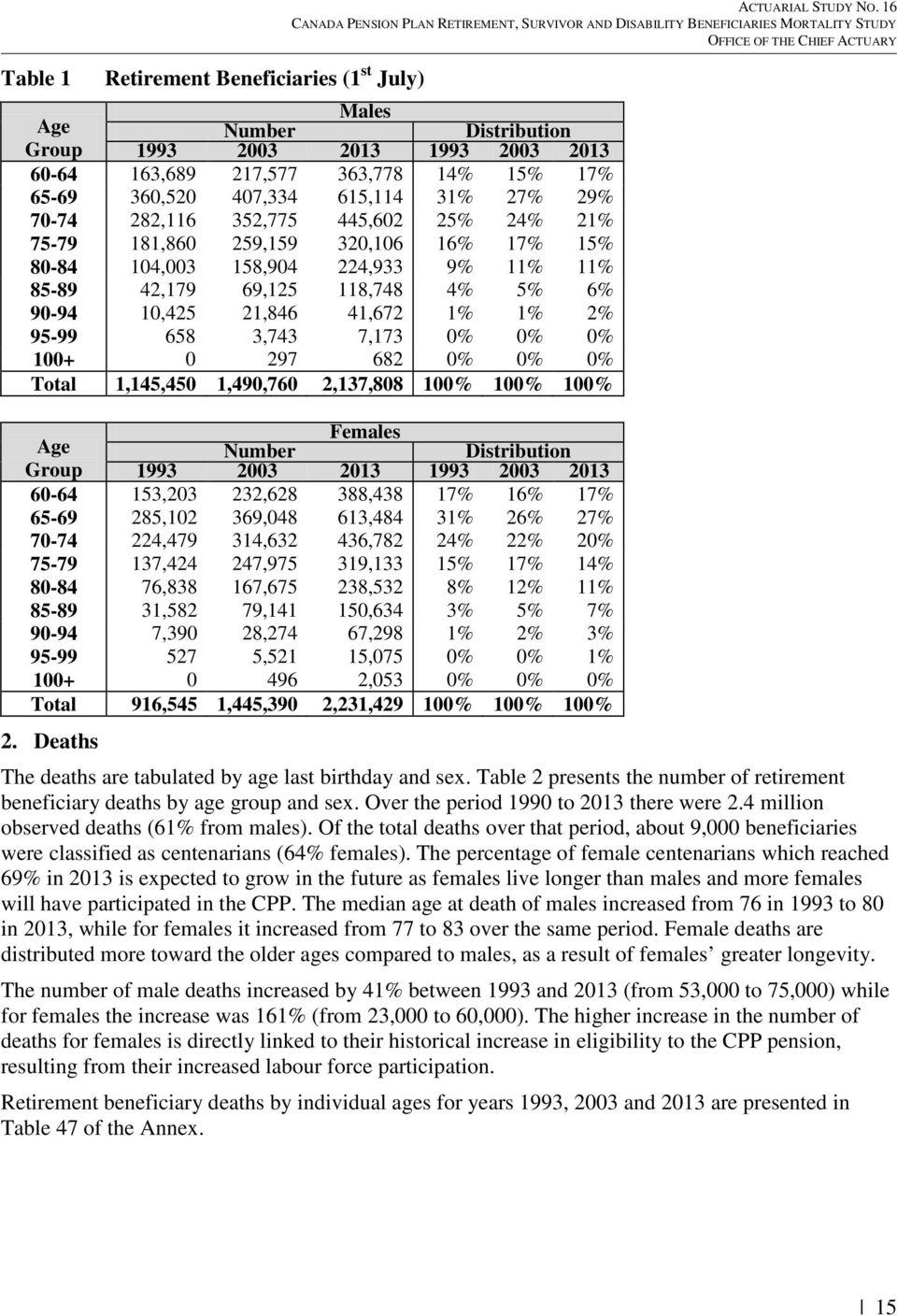
14 III. CPP Retirement Beneficiary Mortality A. Introduction This section presents the methodology and results of this study regarding the mortality of CPP retirement beneficiaries by level of pension over the period 1990 to One of the objectives of this study is to develop mortality adjustment factors that reflect the differences between CPP retirement beneficiary mortality and general population mortality for the purpose of the actuarial valuations of the CPP. The term general population in this study is used to refer to the population of Canada less Québec, as this is the population covered by the CPP. B. Retirement Benefit Eligibility A person aged 60 or older with contributory earnings in at least one calendar year becomes eligible for a retirement pension upon application. Since 2012, an applicant for a retirement pension before the age of 65 does not need to have wholly or substantially ceased to be engaged in paid employment or self-employment. If a person younger than age 65 is in receipt of a CPP retirement pension and continues to work, then he/she is required to contribute (not the case prior to 2012), whereas after 65 he/she may choose to contribute. In any event, no contributions are required or permitted after attaining age 70. C. Retirement Benefit Calculation The initial amount of the monthly retirement pension is based on the history of pensionable earnings over the entire contributory period, which begins at age 18 and ends when the individual collects his/her retirement pension, reaches age 70, or dies. The retirement pension is equal to 25% of the average of the Year s Maximum Pensionable Earning (YMPE) for the year of retirement and the four preceding years, referred to as the Maximum Pensionable Earnings Average (MPEA), adjusted to take into account the contributor s pensionable earnings and the age of the beneficiary at pension take-up. For this purpose, the contributor s pensionable earnings for any given month are indexed by the ratio of the MPEA to the YMPE for the year to which the given month belongs. Months of low pensionable earnings may be excluded from the calculation by reason of: disability; periods of child rearing when children are less than seven years of age; pensions commencing after age 65; and the general drop-out provision (15% of lowest earnings months before 2012, 16% in 2012 and 2013 and 17% after 2013). D. Retirement Mortality Experience for Year Beneficiaries Historical data on the number of retirement beneficiaries by age and sex are presented in Table 1. As females live longer than males, female beneficiaries are on average distributed more toward the advanced ages. The number of male beneficiaries nearly doubled from 1.1 million in 1993 to 2.1 million in Over the same period, the number of female beneficiaries more than doubled from 0.9 million in 1993 to 2.2 million in The steeper increase in the number of female retirement beneficiaries can be attributed to increased labour force participation (and hence CPP eligibility) and longer lifespans. The number of beneficiaries for year 2013 by individual age and sex is presented in Table 46 of the Annex. 14
15 Table 1 Retirement Beneficiaries (1 st July) ACTUARIAL STUDY NO. 16 Age Number Distribution Group , , ,778 14% 15% 17% , , ,114 31% 27% 29% , , ,602 25% 24% 21% , , ,106 16% 17% 15% , , ,933 9% 11% 11% ,179 69, ,748 4% 5% 6% ,425 21,846 41,672 1% 1% 2% ,743 7,173 0% 0% 0% % 0% 0% Total 1,145,450 1,490,760 2,137, % 100% 100% Age Number Distribution Group , , ,438 17% 16% 17% , , ,484 31% 26% 27% , , ,782 24% 22% 20% , , ,133 15% 17% 14% , , ,532 8% 12% 11% ,582 79, ,634 3% 5% 7% ,390 28,274 67,298 1% 2% 3% ,521 15,075 0% 0% 1% ,053 0% 0% 0% Total 916,545 1,445,390 2,231, % 100% 100% 2. Deaths The deaths are tabulated by age last birthday and sex. Table 2 presents the number of retirement beneficiary deaths by age group and sex. Over the period 1990 to 2013 there were 2.4 million observed deaths (61% from males). Of the total deaths over that period, about 9,000 beneficiaries were classified as centenarians (64% females). The percentage of female centenarians which reached 69% in 2013 is expected to grow in the future as females live longer than males and more females will have participated in the CPP. The median age at death of males increased from 76 in 1993 to 80 in 2013, while for females it increased from 77 to 83 over the same period. Female deaths are distributed more toward the older ages compared to males, as a result of females greater longevity. The number of male deaths increased by 41% between 1993 and 2013 (from 53,000 to 75,000) while for females the increase was 161% (from 23,000 to 60,000). The higher increase in the number of deaths for females is directly linked to their historical increase in eligibility to the CPP pension, resulting from their increased labour force participation. Retirement beneficiary deaths by individual ages for years 1993, 2003 and 2013 are presented in Table 47 of the Annex. 15
16 Table 2 Retirement Deaths ( ) Age Group Number Distribution ,133 1,880 2,182 3, % 3.4% 4.0% ,570 8,631 7,394 8, % 11.5% 11.9% ,557 10,970 10,889 10, % 17.0% 13.7% ,918 11,399 13,143 12, % 20.5% 16.2% ,015 10,567 13,525 14, % 21.1% 20.1% ,686 6,840 10,219 14, % 15.9% 18.8% ,563 2,360 5,147 8, % 8.0% 11.5% , ,418 2, % 2.2% 3.4% , % 0.2% 0.5% Total 1,481,751 52,872 64,075 74, % 100.0% 100.0% Median Age Age Group Number Distribution ,340 1,029 1,359 1, % 3.2% 2.9% ,109 3,364 3,973 5, % 9.5% 9.1% ,642 4,484 5,562 6, % 13.2% 10.8% ,702 4,679 7,456 7, % 17.7% 13.3% ,964 4,661 8,848 10, % 21.1% 17.7% ,332 3,192 7,969 12, % 19.0% 20.4% ,653 1,264 4,996 10, % 11.9% 17.5% , ,638 4, % 3.9% 6.8% , % 0.5% 1.4% Total 927,270 22,815 42,017 59, % 100.0% 100.0% Median Age

17 Chart 1 presents the evolution of the distribution of deaths by age and sex from 1993 to It clearly illustrates that the median age at death for both males and females has increased over time. In 2013, the higher number of deaths occurred at age 83 for males and age 88 for females. Chart 1 Distribution of Retirement Deaths (1993 and 2013) Number of deaths 3, ,000 2,500 2,000 1,500 1, Number of deaths 3, ,500 2,000 1,500 1,

18 3. Exposures Table 3 and Chart 2 highlight that the participation of females relative to males varies significantly by age group. In 2013, females had more exposures than males at ages below 67 while males had more exposures than females from age 67 to 77 mainly due to the past lower participation rate of females as contributors to the CPP. At the advanced ages of 78 and over, females have more exposures than males because of females longer lifespans. Exposures of CPP retirement beneficiaries by individual ages for the year 2013 are presented in Table 48 of the Annex. Table 3 Retirement Exposures (2013) Age Group Exposures Both Sexes Distribution Both Sexes , , , % 17.2% 17.0% , ,671 1,224, % 27.4% 28.0% , , , % 19.6% 20.2% , , , % 14.4% 14.7% , , , % 10.7% 10.7% , , , % 6.8% 6.2% ,666 68, , % 3.1% 2.5% ,465 15,522 22, % 0.7% 0.5% ,153 2, % 0.1% 0.1% Total 2,136,976 2,230,405 4,367, % 100.0% 100.0% Chart 2 Retirement Exposures by Age (2013) 160, , , ,000 80,000 60,000 40,000 20, Age 18

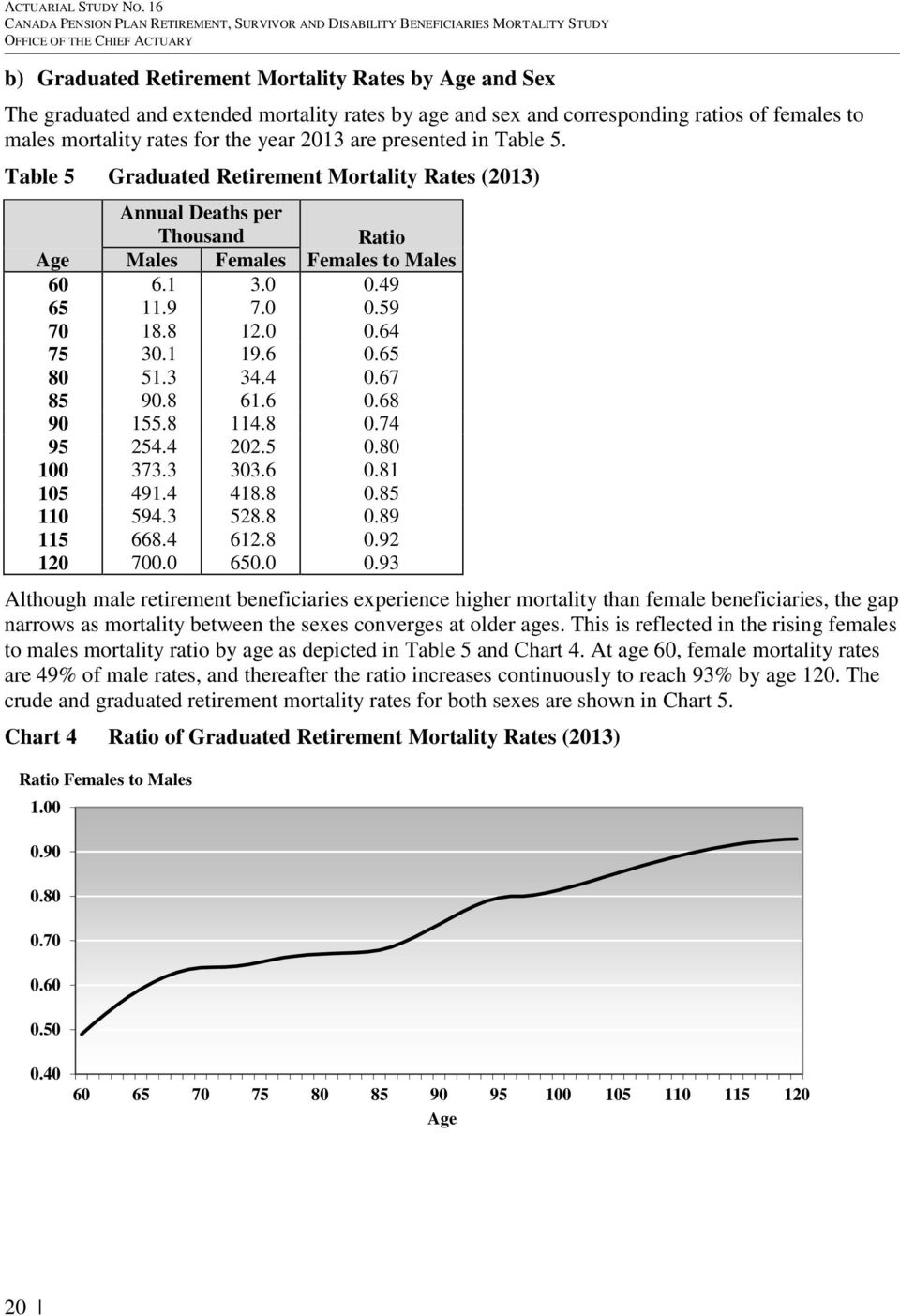
19 4. Mortality Rates a) Crude Retirement Mortality Rates by Age and Sex ACTUARIAL STUDY NO. 16 The crude retirement mortality rates for the year 2013 by age and sex are presented in Table 4. The ratio of females to males mortality rates is an indicator of the average shorter lifetime of males compared to females. However, although males experience a higher level of mortality, the relative gap between the two sexes shows variation by age. The progression of the crude mortality rates for 2013 by age and sex is displayed in Chart 3. experience a higher level of mortality than females at all ages. At ages between 70 and 85, females experience a level of mortality at about twothirds of the mortality level of males. Table 4 Crude Retirement Mortality Rates (1) (2013) Annual Deaths per Thousand Ratio Age to (1) Age 97 is the highest age for which credible crude mortality rates are available. Chart 3 Crude Retirement Mortality Rates (2013) Annual Deaths per Thousand Age 19

20 b) Graduated Retirement Mortality Rates by Age and Sex The graduated and extended mortality rates by age and sex and corresponding ratios of females to males mortality rates for the year 2013 are presented in Table 5. Table 5 Graduated Retirement Mortality Rates (2013) Annual Deaths per Thousand Ratio Age to Although male retirement beneficiaries experience higher mortality than female beneficiaries, the gap narrows as mortality between the sexes converges at older ages. This is reflected in the rising females to males mortality ratio by age as depicted in Table 5 and Chart 4. At age 60, female mortality rates are 49% of male rates, and thereafter the ratio increases continuously to reach 93% by age 120. The crude and graduated retirement mortality rates for both sexes are shown in Chart 5. Chart 4 Ratio of Graduated Retirement Mortality Rates (2013) Ratio to Age 20
21 Chart 5 Crude and Graduated Retirement Mortality Rates (2013) Annual Deaths per Thousand Crude Graduated Annual Deaths per Thousand Crude Graduated Age Age 21
22 c) Graduated Retirement Mortality Rates and Ratios by Age, Sex, and Level of Pension Deaths and exposures for males by age and level of pension for year 2013 are shown in Table 6 and Chart 6. The distribution of exposures by level of pension for males who have retired in years 2008 to 2013 is more heavily distributed toward higher levels of pension. As an example for those who have retired in years 2008 to 2013, 16% have a level of pension less than 37.5% of the maximum, 24% have a level of pension between 37.5% and less than 75% of maximum, and 60% have a level of pension of at least 75% of the maximum. Of the 60% of male beneficiaries receiving at least 75% of the maximum pension, 18.2% are classified as receiving a maximum pension (i.e., in the 100% pension level category). Chart 7 illustrates the distribution of male exposures by age and level of pension for year Table 8 presents mortality rates for both sexes by age and level of pension for year Table 6 Retirement Deaths and Exposures by Age and Level of Pension (, 2013) Deaths < 37.5% % % 100% All Attained Age In 2013 # % # % # % # % # % % % 1, % % 3, % , % 2, % 3, % 1, % 8, % , % 2, % 3, % 2, % 10, % , % 2, % 4, % 3, % 12, % 80+ 3, % 6, % 13, % 16, % 40, % All Ages 9, % 15, % 26, % 23, % 74, % Exposures < 37.5% % % 100% All Attained Age In 2013 # % # % # % # % # % , % 83, % 168, % 71, % 359, % , % 146, % 256, % 118, % 612, % , % 95, % 164, % 124, % 445, % , % 62, % 117, % 103, % 321, % , % 61, % 131, % 164, % 397, % All Ages 266, % 449, % 837, % 582, % 2,136, % Exposures by Year of Emergence < 37.5% % % 100% All Year of Emergence # % # % # % # % # % < % % % % % % 1, % 2, % 3, % 8, % , % 14, % 36, % 49, % 106, % , % 41, % 86, % 110, % 259, % , % 73, % 143, % 128, % 385, % , % 128, % 238, % 147, % 588, % , % 189, % 330, % 143, % 787, % All Years 266, % 449, % 837, % 582, % 2,136, % 22
23 Chart 6 Male Retirement Deaths and Exposures (by Level of Pension 2013) 31% 13% 20% 27% 13% 21% Level of Pension <37.5% 37.5%-75% 75%-100% 100% 36% Deaths 39% Exposures Chart 7 Male Retirement Exposures (by Age and Level of Pension 2013) 160, , , ,000 80,000 60,000 Level of Pension 100% % % <37.5% 40,000 20, Age Deaths and exposures for females by age and level of pension for year 2013 are shown in Table 7 and Chart 8. There were about 60,000 deaths and 2.2 million life-years of exposures for females in The distribution of exposures by level of pension for females who have retired in years 2008 to 2013 is more uniformly distributed between the levels of pension than males. As an example for those who have retired in years 2008 to 2013, 33% have a level of pension less than 37.5% of the maximum, 33% have a level of pension between 37.5% and less than 75% of maximum, and 34% have a level of pension of at least 75% of the maximum. Of the 34% of female beneficiaries receiving at least 75% of the maximum pension, 4.5% are classified as receiving a maximum pension (i.e., in the 100% pension level category). 23
24 Chart 9 illustrates the distribution of female exposures by age and level of pension for year Detailed mortality rates for year 2013 by individual age, sex and level of pension are presented in Tables 8 and 49 while Tables 50 through 54 of the Annex present complete life tables for each level of pension. Table 7 Retirement Deaths and Exposures by Age and Level of Pension (, 2013) Deaths < 37.5% % % 100% All Attained Age In 2013 # % # % # % # % # % % % % % 1, % , % 1, % 1, % % 5, % , % 1, % 1, % % 6, % , % 2, % 1, % % 7, % , % 10, % 7, % 2, % 38, % All Ages 27, % 17, % 11, % 2, % 59, % Exposures < 37.5% % % 100% All Attained Age In 2013 # % # % # % # % # % , % 130, % 126, % 18, % 384, % , % 201, % 165, % 26, % 611, % , % 137, % 100, % 23, % 436, % , % 96, % 66, % 16, % 320, % , % 133, % 95, % 27, % 477, % All Ages 864, % 700, % 554, % 111, % 2,230, % Exposures by Year of Emergence < 37.5% % % 100% All Year of Emergence # % # % # % # % # % < % % % % 1, % , % 4, % 3, % 1, % 16, % , % 46, % 32, % 9, % 157, % , % 81, % 58, % 16, % 282, % , % 121, % 85, % 21, % 405, % , % 187, % 145, % 27, % 589, % , % 258, % 227, % 34, % 777, % All Years 864, % 700, % 554, % 111, % 2,230, % 24
25 Chart 8 Female Retirement Deaths and Exposures (by Level of Pension 2013) 5% 5% 20% 46% 25% 39% Level of Pension <37.5% 37.5%-75% 75%-100% 100% 29% 31% Deaths Exposures Chart 9 Female Retirement Exposures (by Age and Level of Pension 2013) 160, , , ,000 80,000 60,000 Level of pension 100% % % <37.5% 40,000 20, Age 25
26 Charts 10, 11 and Table 9 show the ratios of each level of pension mortality to the all levels of pension mortality. In general, for both sexes, those with higher pensions experience lower mortality, while those with lower pensions experience higher mortality. In addition, for both sexes, each level of pension mortality exhibits convergence to the all levels of pension mortality as age increases. Male retirement beneficiaries at 100% of the maximum retirement pension have the lowest male mortality ratios of 0.68 at age 60, 0.76 at age 70, and 0.89 at age 80. In comparison, male retirement beneficiaries with the lowest level of pension (i.e., less than 37.5% of the maximum retirement pension) have the highest mortality ratios of 2.2 at age 60, 1.2 at age 70, and 1.09 at age 80. Female retirement beneficiaries at 100% of the maximum retirement pension have the lowest female mortality ratios of 0.77 at age 60, 0.75 at age 70, and 0.87 at age 80. In comparison, female retirement beneficiaries with the lowest level of pension have the highest mortality ratios of 1.47 at age 60, 1.14 at age 70, and 1.05 at age 80. The level of pension has relatively more of an impact on male than female mortality rates. Chart 10 Male Retirement Mortality Ratios (by level of pension, 2013) Higher than Overall mortality Lower than Overall Mortality Level of pension < 37.5% % % 100% Age Chart 11 Female Retirement Mortality Ratios (by level of pension, 2013) Higher than Overall Mortality Lower than Overall Mortality Level of pension < 37.5% % % 100% Age 26
27 Table 8 Retirement Mortality Rates by Level of Pension (2013) Annual Deaths per Thousand Female Level of Pension as % of Maximum Level of Pension as % of Maximum Age All < 37.5% % % 100% All < 37.5% % % 100%
28 Table 9 Retirement Mortality Ratios by Level of Pension (2013) Level of Pension as % of Maximum Level of Pension as % of Maximum Age All < 37.5% % % 100% All < 37.5% % % 100%
29 E. Comparison of Retirement and Population Mortality (2011) Since CPP retirement beneficiaries represent a substantial portion of the older Canadian population, the retirement beneficiary mortality rates are compared to the mortality of the population of Canada less Québec for the year 2011, which was the most current year for which data on population mortality from the Canadian Human Mortality Database (CHMD) was available. For this purpose of comparison, a life table for Canada less Québec was derived based on the 2011 CHMD Life Tables for Canada and Québec. The resulting Canada less Québec table was then graduated by age and sex and extended to age 120. Tables 10, 11 and Chart 12 show the ratios of CPP retirement beneficiary mortality rates to the population mortality rates by age and sex for year Table 10 Retirement and Population Mortality (2011) Annual Deaths Per Thousand Ratio Annual Deaths Per Thousand Ratio Retirement to Retirement to Age Retirement Population (1) Population Retirement Population (1) Population (1) Canada less Québec based on CHMD 2011 Life Tables for Canada and Québec. OCA calculations. Chart 12 Ratios of Retirement to Population Mortality (1) (2011) Higher than General Population Mortality 0.9 Lower than General Population Mortality Age (1) Canada less Quebec based on CHMD 2011 Life Tables for Canada and Québec. OCA calculations. 29
30 Table 11 Retirement to Population Mortality Ratios by Level of Pension (2011) Level of Pension as % of Maximum Level of Pension as % of Maximum Age All < 37.5% % % 100% All < 37.5% % % 100%
31 At age 60, the mortality ratio of CPP retirement mortality (all levels combined) to population mortality is 0.78 for males and 0.61 for females. At age 65, the ratios are 0.98 for males and 0.96 for females. After age 65, the mortality ratios for both sexes increase up until age 75. After age 75, the ratios remain greater than 1.00 but show more variability for females. In general, at ages 65 and above, the ratios of retirement beneficiary to population mortality rates are lower for females than for males. For both sexes, retirement beneficiary mortality rates at ages 60 to 64 are significantly lower than for the population. The reason for this is because retirement beneficiaries between the ages of 60 and 64 do not include CPP disability beneficiaries and are thus somewhat healthier than the population. At age 65, disability beneficiaries automatically become retirement beneficiaries and the mortality ratios rise accordingly. For male CPP retirement beneficiaries, mortality rates after age 65 are higher than for the population. This could be viewed as somewhat unexpected since male retirement beneficiaries, who constitute a large portion of the male population aged 65 and over (89% in 1991 and 97% in 2011, see Table 12), should exhibit similar mortality to that of the population. However, Table 12 shows that this has not been the case since Life expectancy at age 65 (which represents a summary measure of mortality over age 65) has been lower for male CPP retirement beneficiaries than the population throughout the period 1991 to The difference could be attributed to the difference between the population census survey data used by the CHMD in constructing its Life Tables for Canada and Québec and the administrative data relied upon for this study. For females, the historical pattern of difference in mortality between CPP retirement beneficiaries and the population is somewhat different compared to males over the period 1991 through Although in 2011 female retirement mortality rates are higher than for the population, in 1991 they were lower. This may be related to the fact that the ratio of female retirement beneficiaries to the population was much lower (48%) than for males (89%) in As such, in contrast to males, female retirement beneficiaries in 1991 could be viewed as representing a sub-group of the population with different characteristics than the overall population. In particular, this sub-group of the female population would have had some work history. This specific characteristic may explain the lower mortality of female beneficiaries compared to the population in 1991, because as shown previously, higher earnings histories are associated with lower mortality. Table 12 and Chart 13 reveal that as the proportion of female beneficiaries in the population gradually increased from 1991 to 2011, female retirement mortality converged toward that of the population, as reflected by the differences in life expectancies. Note however, that even in 2011, the proportion of female beneficiaries in the population (82%) is still much lower than for males (97%). It remains to be seen whether the difference between female beneficiary and population mortality will eventually be similar to the corresponding difference for males as the proportion of female beneficiaries in the population approaches that of males in the future. 31
32 Table 12 Comparison of Retirement Period Life Expectancies at Age 65 ( ) Period Life Expectancy at Age 65 Ratio Beneficiaries to Population (Age 65+) (1) Retirement Population Difference Ratio Beneficiaries to Population (Age 65+) (1) Year Retirement Population Difference % % % % % % % % % % (1) Derived from the ratio of the number of beneficiaries to the population as at1st July of each year. Chart 13 Retirement and Population Life Expectancies at 65 ( ) Life Expectancy at Age 65 Population Population Retirement -0.3 Retirement F. Retirement Mortality Improvement Rates 1. Comparison with 26 th CPP Actuarial Report Difference in Life Expectancy at Age 65 (Retirement Beneficiary - Population) Historical average annual mortality improvement rates measure the pace of change in mortality over time. The improvement indicates that mortality rates have decreased over time, which in turn has led to increased longevity. Mortality improvement rates may be used to formulate assumptions about how mortality may evolve in the future. Table 13 and Charts 14 and 15 show annual mortality improvement rates for retirement beneficiaries over the last 15 years (1998 to 2013) and last 5 years (2008 to 2013). The table and charts also shows the improvement rates that were assumed for the 26 th CPP Actuarial Report for the first five years ( ) of the mortality projection in the report. Improvement rates at very advanced ages (95 and over) should be interpreted with caution due to low exposures, greater variation of results, and the effects of the smoothing (graduation) of the mortality rates at advanced ages. 32
33 As shown in Table 13, over the last 15 years, male retirement beneficiary mortality improvement rates for age groups 65 to 84 are between 0.5 and 1.2 percentage points higher than female rates, while they are relatively the same for ages 85 and over. Over the most recent 5 years, male retirement beneficiary mortality improvement rates are lower or similar to those observed over the last 15 years for ages below 75 while they are higher for ages over 75. For females, improvement rates over the last 5 years are relatively the same as observed over the last 15 years for ages below 85 and somewhat higher for ages 85 and over. For males aged 65 to 74, mortality improvements observed over the last 5 years are less than those assumed under the 26 th CPP Actuarial Report for the first five years of the projections ( ). For ages 75 and over, the experience over the last 5 years is higher than assumed under the 26 th CPP Actuarial Report except at the very advanced ages. For females, improvement rates over the last 5 years are equal to or somewhat higher than assumed for the first 5years of projections under the 26 th CPP Actuarial Report for all ages 65 and above. Table 13 Average Annual Retirement Mortality Improvement Rates Age (1) (1) 26 th CPP AR ( ) (2) Group % 1.7% 2.1% 1.6% 2.6% 1.6% % 1.8% 2.6% 2.0% 2.9% 1.7% % 1.9% 2.9% 1.9% 2.6% 1.7% % 1.9% 2.7% 2.1% 2.3% 1.6% % 1.8% 2.1% 2.3% 1.9% 1.4% % 1.2% 1.7% 1.2% 1.3% 1.2% % 0.7% 0.2% 1.4% 0.8% 0.8% % 1.7% 2.4% 1.9% 2.3% 1.5% % 1.8% 2.4% 1.8% 2.7% 1.7% % 1.8% 2.6% 2.1% 2.2% 1.5% (1) Improvement rates obtained using the corresponding 2013 exposures and populations as weights. (2) 26 th CPP Actuarial Report improvement rates for are for Canada less Québec. Chart 14 Average Annual Retirement Mortality Improvement Rates () 3.5% 3.0% CPP % 2.0% 1.5% 1.0% 0.5% 0.0%
34 Chart 15 Average Annual Retirement Mortality Improvement Rates () 3.5% 3.0% CPP % 2.0% 1.5% 1.0% 0.5% 0.0% Comparison by Level of Pension Table 14 shows a comparison of annual mortality improvement rates for retirement beneficiaries by level of pension. A comparison of annual mortality improvement rates over the last 15 years for retirement beneficiaries by level of pension shows that for both males and females in age group 65 to 94, the mortality improvement rates for retirement beneficiaries with a level of pension of less than 37.5% of the maximum (3% for males, 1.7% for females) are greater than the mortality improvement rates experienced by those at the maximum level of pension (2.5% for males, 1.4% for females). Table 15 shows cumulative mortality improvement rates from 1998 to 2013 by level of pension. Table 14 Average Annual Retirement Improvement Rates (by Level of Pension, ) Age Group < 37.5% % % 100% All < 37.5% % % 100% All % 2.2% 3.4% 3.3% 2.7% 1.2% 1.3% 2.7% 1.3% 1.7% % 2.9% 3.0% 3.7% 3.0% 1.6% 1.7% 2.3% 2.2% 1.8% % 2.7% 2.4% 3.4% 2.8% 1.7% 1.9% 2.3% 2.0% 1.9% % 2.0% 2.2% 2.5% 2.4% 2.0% 1.7% 2.1% 1.6% 1.9% % 1.7% 1.7% 1.9% 1.9% 1.9% 1.7% 1.9% 1.1% 1.8% % 0.9% 1.0% 0.9% 1.1% 1.4% 1.1% 1.3% 0.9% 1.2% % 0.5% 0.5% 0.3% 0.6% 0.7% 0.7% 0.1% 1.4% 0.7% % 2.2% 2.4% 2.5% 2.3% 1.7% 1.6% 2.0% 1.4% 1.7% % 2.6% 3.2% 3.5% 2.8% 1.4% 1.5% 2.5% 1.8% 1.8% % 2.0% 2.0% 2.2% 2.3% 1.8% 1.6% 1.9% 1.3% 1.8% 34
35 Table 15 Cumulative Retirement Improvement Rates by Age (Level of Pension, ) Age Group < 37.5% % % 100% All < 37.5% % % 100% All % 28.9% 40.9% 39.1% 33.2% 16.9% 18.4% 33.4% 18.3% 22.8% % 35.8% 36.6% 42.9% 36.2% 21.3% 22.2% 29.5% 28.3% 24.2% % 33.8% 30.9% 40.7% 34.9% 22.2% 24.8% 29.5% 26.1% 24.6% % 26.5% 28.4% 31.7% 30.1% 26.0% 22.7% 27.5% 21.2% 25.0% % 22.4% 23.0% 24.6% 24.6% 25.3% 23.3% 24.8% 15.6% 23.8% % 12.8% 13.8% 12.3% 15.0% 18.6% 15.2% 17.4% 12.1% 17.0% % 7.2% 7.2% 4.0% 9.3% 9.9% 10.0% 1.8% 18.8% 9.5% % 28.7% 30.1% 31.1% 30.0% 22.6% 21.4% 26.6% 19.5% 22.9% % 32.5% 38.8% 41.6% 34.9% 19.4% 20.4% 31.5% 24.4% 23.5% % 26.3% 25.7% 28.6% 29.9% 23.4% 21.7% 24.8% 18.3% 24.4% 3. Comparison with Population Table 16 presents a comparison of retirement beneficiary mortality improvement rates with those of the population of Canada less Québec. Since population mortality statistics are only available through to year 2011, the last 15 and 5 years have been set to 1996 to 2011 and 2006 to Under both periods examined, the population mortality improvement rates are very similar to those observed for CPP retirement beneficiaries, with some exceptions at the older ages. Table 16 Population and Retirement Average Annual Mortality Improvement Rates (1) Age Group Retirement Population (1) Retirement Population (1) Retirement Population (1) Retirement Population (1) % 2.8% 2.6% 2.7% 1.6% 1.9% 2.2% 2.2% % 2.9% 2.9% 3.0% 1.7% 1.8% 2.2% 2.2% % 2.7% 3.0% 3.0% 1.8% 2.0% 1.7% 2.0% % 2.6% 2.4% 2.3% 1.9% 2.0% 1.6% 1.7% % 1.8% 1.7% 2.4% 1.5% 1.5% 2.2% 2.5% % 1.1% 1.9% 1.9% 1.1% 1.0% 1.5% 1.2% % 0.6% 0.7% 1.6% 0.7% 0.6% 0.5% 1.2% % 2.4% 2.4% 2.6% 1.6% 1.7% 1.9% 1.9% % 2.9% 2.8% 2.9% 1.6% 1.9% 2.2% 2.2% % 2.4% 2.4% 2.6% 1.7% 1.8% 1.9% 2.1% (1) Population mortality improvement rates are based on CHMD data for the period 1996 to 2011, using 2011 population as weights. Population mortality improvement rates are for Canada less Québec based on CHMD data for Canada and Québec. OCA calculations. G. Retirement Period Life Expectancies 1. By Age, Sex, and Level of Pension Tables 17 and 18 show period life expectancies (i.e., without future mortality improvements) for male and female retirement beneficiaries for year 2013, respectively. Life expectancies for the population as projected under the 26 th CPP Actuarial report are also shown for comparison purposes. For each level of pension except the maximum level, male retirement beneficiary period life expectancies are generally equal to or lower than those for the all levels of pension. The all levels of pension life expectancies are lower than for the population at all ages. From Table 17 it can also be observed that in 2013, the period life expectancies for males at age 65 with maximum pensions live about 2.0 years longer than those with pensions less than 37.5% of the maximum. At age 85, the differential for males is of 0.3 years. For females, in comparison, the 35
36 differences in the period life expectancies for females are more stable over time since at age 65 those with maximum pensions live about 1.6 years longer than those with pensions less than 37.5% of the maximum and at age 85, the differential is of 0.4 years. Table 17 Retirement Period Life Expectancies (, 2013) Level of Pension as % of Maximum Age < 37.5% % % 100% ALL Population (1) (1) As projected in 2013 in the 26th CPP Actuarial Report (Canada less Quebec). Table 18 shows that for pensions at or below 75% of the maximum, period life expectancies for females are lower than those for the all levels of pension. The all levels of pension life expectancies are slightly lower than for the population at all ages. For females, the difference in life expectancies between the highest and lowest level of pension at age 65 is 1.6 years and reduces to 0.4 year by age 85. Table 18 Retirement Period Life Expectancies (, 2013) Level of Pension as % of Maximum Age < 37.5% % % 100% ALL Population (1) (1) As projected in 2013 in the 26th CPP Actuarial Report (Canada less Quebec). The evolution of period life expectancies at age 65 by level of pension is presented in Table 19 and Charts 16 and 17. Over the past two decades, for both sexes, the difference in life expectancy at age 65 between those with maximum pensions and those with pensions less than 37.5% of the maximum has been stable. 36
37 Table 19 Retirement Period Life Expectancies at Age 65 ( ) Level of Pension as a % of Maximum 37.5% to 75% 75% to 100% 100% All Difference 100% with <37.5% <37.5% Level of Pension as a % of Maximum 37.5% to 75% 75% to 100% 100% All Difference 100% with <37.5% Year <37.5% Chart 16 Retirement Life Expectancy at Age 65 (High and Low Pension, ) Level of pension Less than 37.5 % 100 % Year 37
38 Chart 17 Retirement Life Expectancy at Age 65 (High and Low Pension, ) Level of pension Less than 37.5 % 100 % Year 2. Contributions to Increase in Life Expectancy at Age 65 (1993 to 2013). Empirical evidence in Table 20 shows the contributions to the increase in life expectancy at age 65 of retirement beneficiaries by age-group over the last 20 years ( ). Over the first half of the period, from 1993 to 2003, about 50% of the increase in life expectancy at age 65 for males (0.75 out of 1.5 years) came from mortality improvements (i.e., reductions in mortality rates) at ages 75 and over. For females, the corresponding proportion is 67% (0.4 out of 0.6 years) over the same period. These proportions reached 65% (1.17 out of 1.8 years) for males and 73% (1.02 out of 1.4 years) for females over the most recent 10-year period ( ). As the distribution of deaths moves towards older ages in the future, the trend of mortality improvements shifting toward the older ages is expected to continue, in turn leading to additional increases in life expectancy at age 65. Over the last 10 years ( ), life expectancy at age 65 of male beneficiaries grew by about 1.8 years or 0.3 of a year more than the previous 10-year period , while life expectancy at age 65 of female beneficiaries grew by 1.4 years or 0.8 of year more than over Table 20 Contribution to Increase in Life Expectancy at Age Change Attributable to Age Group % % % % % % % % % % % % % % % % % % % % Total Change in Life Expectancy at Age % % % % 38
39 H. Work and Retirement Periods of CPP Beneficiaries ACTUARIAL STUDY NO. 16 This section presents an historical overview of the length of work and retirement periods of contributors and beneficiaries of the Canada Pension Plan. Table 21 shows the average age of first time CPP contributors, the average age of new CPP retirement beneficiaries, as well as information regarding the actual and expected ages at death for the given cohort of CPP retirement beneficiaries. It should be noted, that for any given year the first time CPP contributors and new CPP retirement beneficiaries are analyzed on the calendar year basis, i.e., they are not the same group of CPP participants. On the contrary, the analyses of the actual and expected ages at death are done on the cohort basis, i.e., new CPP retirement beneficiaries of a given year are followed through years to the date of their death. The following definitions provide a more detailed explanation of the information included in Table 21 and Chart 18. Definitions Average Age of First Time CPP Contributors A first time CPP contributor is an individual who makes a valid CPP contribution for the first time after reaching age 18. A valid contribution is one that is made on annual earnings that are greater than the Year's Basic Exemption ($3,500) and where the contribution is not fully refunded. As the Plan has slowly matured since its inception, the average age of first time CPP contributors decreased from about 25 years in the early 1970s to 22 years by the mid-1980s. The longer period of formal post-secondary education as well as changes in immigration policies may have resulted in the reversal of this trend over the 1990s and 2000s. Over the last decade, the age of first time contributors has varied between 24.0 and Average Age of New CPP Retirement Beneficiaries The average age of new CPP retirement beneficiaries represents the average age at their benefit takeup date. At the outset of the Plan, there was an initial 10-year transition period before one could receive a full retirement pension in During the transition period, there was a prorating factor that applied to the pension that grew from 10% in 1967 to 100% for 1976 and thereafter. This transition provision created an incentive to delay retirement, and the average age of new CPP retirement beneficiaries was over age 66 until The introduction in 1987 of the flexible retirement take-up age provision drove the average age of new retirement beneficiaries below 65. Over the last decade, the average age at pension take-up has stabilized at around 62.5 years. Death Ratio For the purpose of this study, the death ratio for any given year is equal to the ratio of the number of new CPP retirement beneficiaries for that year who died prior to July 2014 to the total number of new CPP retirement beneficiaries for that year. For example, almost all CPP retirement beneficiaries who took their benefits in 1970 died by July On the other side of the spectrum, only 1% of 2013 new CPP retirement beneficiaries died by July Currently, 20% of all first-time CPP contributors are over age
40 Actual Average Age at Death for Retirees Cohort The actual average age at death for a given retirees cohort represents the actual average age at death for those members of a CPP retirement beneficiaries cohort who took their CPP retirement benefit in a given year and who died prior to July For example, the cohort of new CPP retirement beneficiaries in 1970 who died prior to July 2014 has an average age at death of In comparison, the cohort of new CPP retirement beneficiaries in 2013 who died prior to July 2014 have an average age at death of 64. Expected Average Age at Death for Retirees Cohort (26th CPP Actuarial Report) The expected average age at death for a given retirees cohort is the weighted average of the actual average age at death for deceased members of this cohort and the expected average age at death for the remaining members of this cohort as at July The expected average age at death for the remaining members as at July 2014 is determined using the assumptions of the 26th CPP Actuarial Report as at 31 December 2012 including the assumed future mortality improvements. The Evolution of the Length of Work and Retirement Periods As it can be seen from Table 21, the actual and expected average ages at death for a retirees cohort are very close for earlier cohorts of CPP retirement beneficiaries, since the majority of the retirees of these cohorts died prior to July 2014 (death ratios are close to one). As time progresses, cohorts of retirees become younger, and the difference between the actual and expected average ages of death becomes larger. 40
41 Table 21 Evolution of Various Average Ages of CPP Contributors and Retirees ( ) Year (retirement benefit take-up) Average Age of First Time CPP Contributors (1) Average Age of New CPP Retirement Beneficiaries Death Ratio (from year to July 2014) Actual Average Age at Death for Retirees Cohort Expected Average Age at Death for Retirees Cohort (CPP26) (1) Currently, 20% of all first-time CPP contributors are over age
42 Chart 18 Work and Retirement Periods for CPP Beneficiaries ( ) Canada Pension Plan Participants Avg age at entry* Avg age at retirement Avg age at death * Currently, 20% of all first-time CPP contributors are over age
43 IV. CPP Survivor Beneficiary Mortality A. Introduction ACTUARIAL STUDY NO. 16 This section presents the methodology and results of the study on the mortality of CPP survivor beneficiaries. One of the goals of this study is to develop mortality ratios for CPP survivor beneficiaries relative to the general population. Again, the term general population is used to refer to the population of Canada less Québec, as this is the population covered by the CPP. B. Survivor Benefit Eligibility A legal spouse, a separated legal spouse not cohabiting with a common-law partner, or a commonlaw partner, surviving a deceased contributor, is eligible for a survivor benefit if the following conditions are met as at the date of the contributor s death. The deceased contributor must have made contributions during the lesser of ten calendar years, or one-third of the number of years included wholly or partly in his or her contributory period, but not for less than three years. If the surviving spouse is the separated legal spouse of the deceased contributor, there must be no cohabiting common-law partner at the time of death. If the survivor is the common-law partner of the deceased contributor, they must have cohabited for not less than one year immediately before the death of the contributor. If the common-law partner is of the same-sex as the deceased contributor, the death must have occurred on or after 17 April If under the age of 35, the surviving spouse or common-law partner must have dependent children or be disabled. If the survivor is between ages 35 and 45 and is not disabled and does not have children, then the benefit is reduced. A surviving spouse or common-law partner with dependent children means a survivor who wholly or substantially supports a child of the deceased contributor where the child is under age 18, aged 18 or over but under age 25 and attending school full-time, or aged 18 or over and disabled, having been disabled without interruption since attaining age 18 or the time of the contributor s death, whichever occurred later. Survivors who are not (due to their age or absence of children) eligible for an immediate benefit do become eligible at age 65. C. Survivor Benefit Calculation The initial amount of the monthly survivor benefit depends on the age of the survivor, the survivor s disability status, and the presence of dependent children. In the case that both a survivor and retirement benefit are payable, the survivor s benefit is reduced. If both a survivor and disability benefit are payable, then the disability benefit is reduced. The following five cases describe how the survivor benefit is calculated. 1. New Survivor Age 45 to 65 The amount of monthly benefit payable until the surviving spouse or common-law partner attains age 65 is composed of two portions: a flat-rate benefit depending only on the year in which the survivor benefit is payable ($ in 2015) and an earnings-related benefit depending initially only on the contributor s record of pensionable earnings under the Plan as at the date of death. The initial earnings-related portion (maximum of $ in 2015) is equal to 37.5% of either the retirement pension of the deceased contributor the retirement pension if he or she had been receiving a pension, or the retirement pension that would have been payable to the deceased contributor if the contributory period had ended at the time of death, with no actuarial adjustment in either case. 43
44 2. New Survivor under Age 45 without Dependent Children and not Disabled An eligible spouse or common-law partner, without dependent children and not disabled, who becomes widowed before age 35 is not entitled to a survivor s benefit but may be entitled at a later date if she or he becomes disabled (see 4) or attains age 65 (see 5). If such a survivor is between 35 and 45 years of age, she or he is entitled to a benefit amount calculated as described in 1 above but reduced (until the earlier of disablement or attainment of age 65) by 1/120 of such an amount for each month that the new survivor s age is less than New Survivor under Age 45 with Dependent Children An eligible spouse or common-law partner who becomes widowed prior to age 45 and with dependent children is entitled to a survivor benefit calculated as in 1 above. Under certain circumstances, the survivor benefit is reduced or even discontinued when the survivor no longer has any dependent children. If the survivor is then under age 45 and not disabled, she or he is considered to be a new survivor entitled only to the benefit in accordance with 2 above. 4. Disabled Survivor under Age 65 An eligible surviving spouse or common-law partner under age 65 is entitled to a survivor benefit calculated as in 1 above whenever she or he is disabled. If the disabled surviving spouse or commonlaw partner recovers from disability before age 45, the survivor benefit is discontinued or reduced to what it would be for a new survivor in accordance with 2 above. 5. Survivor Age 65 or Older At age 65 or upon becoming widowed at a later age, an eligible surviving spouse or common-law partner is entitled to a monthly benefit equal to 60% of the retirement pension (maximum of $639 in 2015) of the deceased contributor if he or she had been receiving a pension, or the retirement pension that would have been payable to the deceased contributor if the contributory period had ended at the time of death, with no actuarial adjustment in either case. D. Survivor Mortality Experience for Year Beneficiaries Historical data on the number of survivor beneficiaries by age group and sex are presented in Table 22. As females live longer than males, female beneficiaries are on average distributed more toward the advanced ages. The number of male beneficiaries has increased by over 2.5 times or 156% from about 76,000 in 1993 to 193,000 in Over the same period, the number of female beneficiaries increased by 45% from about 604,000 in 1993 to 875,000 in The steeper increase in the number of male survivor beneficiaries can be attributed to the increased labour force participation of females (and hence CPP eligibility) as well as the increase in male life expectancies. In 2013, there were 1.1 million survivor beneficiaries (82% female). Of all male survivor beneficiaries, the proportion of male survivor beneficiaries younger than age 65 decreased from 42% in 1993 to 27% in In comparison, for females, this proportion has decreased from 31% in 1993 to 21% in The number of beneficiaries for the years 1993, 2003 and 2013 by individual age and sex is presented in Table 55 of the Annex. 44
45 Table 22 Survivor Beneficiaries (1 st July) ACTUARIAL STUDY NO. 16 Age Number Distribution Group < % 0% 0% ,412 1, % 1% 0% ,926 3,141 1,981 4% 2% 1% ,489 5,842 4,690 6% 4% 2% ,556 8,989 9,534 7% 7% 5% ,149 12,581 15,233 9% 10% 8% ,133 14,379 20,734 13% 11% 11% ,997 16,947 26,678 16% 13% 14% ,777 20,348 27,674 16% 16% 14% ,524 19,982 28,346 13% 15% 15% ,483 15,492 27,789 9% 12% 14% ,794 8,222 19,497 4% 6% 10% ,988 8,408 1% 2% 4% ,607 0% 0% 1% % 0% 0% Total 75, , , % 100% 100% Age Number Distribution Group < 35 5,261 2,680 1,741 1% 0% 0% ,236 5,428 3,428 1% 1% 0% ,880 12,546 7,486 2% 2% 1% ,472 21,802 15,889 4% 3% 2% ,356 33,318 31,508 5% 4% 4% ,460 48,878 50,180 7% 6% 6% ,354 63,377 70,886 11% 8% 8% ,878 82,940 95,405 15% 10% 11% , , ,009 19% 14% 13% , , ,825 17% 18% 15% , , ,951 12% 17% 16% ,979 85, ,106 5% 11% 14% ,830 34,565 71,087 1% 4% 8% ,416 18,412 0% 1% 2% ,485 0% 0% 0% Total 603, , , % 100% 100% 2. Deaths Table 23 presents the number of survivor beneficiary deaths by age group and sex. Over the period 1990 to 2013 there were 872,000 observed deaths (83% from females). Of the total deaths, about 7,000 were classified as centenarians (92% females). The median age at death of males increased from 77 in 1993 to 84 in 2013, while for females it increased from 79 to 87 over the same period. Female deaths are distributed more toward the older ages compared to males, as a result of females greater longevity. 45
46 The number of male deaths almost tripled between 1993 and 2013 (from 3,400 to 10,000) while for females the increase was 140% (from 18,000 to 43,000). The higher increase in the number of deaths for males is directly linked to the historical increase in eligibility of females to the CPP pension, resulting from their increased labour force participation. Survivor beneficiary deaths by individual ages for years 1993, 2003 and 2013 are presented in Table 56 of the Annex. Table 23 Survivor Deaths ( ) Age Group Number Distribution < % 0% 0% , % 1% 0% , % 1% 1% , % 3% 3% , % 6% 5% , % 12% 8% , ,273 1,253 21% 19% 13% , ,501 2,103 21% 23% 21% , ,303 2,523 14% 20% 25% , ,832 5% 11% 18% , % 3% 6% % 0% 1% Total 146,006 3,409 6,610 10, % 100% 100% Median Age Age Group Number Distribution <50 1, % 0% 0% , % 0% 0% , % 1% 1% , % 2% 1% ,446 1,410 1,221 1,143 8% 4% 3% ,546 2,645 2,445 2,056 15% 7% 5% ,673 3,846 4,901 3,812 22% 15% 9% ,983 4,424 7,563 6,964 25% 22% 16% ,343 3,194 8,588 10,826 18% 25% 25% , ,945 11,212 5% 18% 26% , ,857 5,041 1% 6% 12% , ,022 0% 1% 2% Total 725,660 17,771 33,809 43, % 100% 100% Median Age
47 Chart 19 presents the evolution of the distribution of deaths by age and sex from 1993 to It clearly illustrates that the median age at death for both males and females has increased over time. In 2013, the number of deaths peaks at age 86 for males and age 90 for females. Chart 19 Distribution of Survivor Deaths (Ages 50 and over, 1993 and 2013) Number of deaths Number of deaths 3, ,500 2,000 1,500 1,
48 3. Exposures Table 24 and Chart 20 highlight that the participation of females relative to males varies significantly by age group. Male survivor exposures are considerably lower than female exposures at all ages as it accounted for 11% of the total exposure in 1993 and 18% of the total exposure in One reason is that CPP participation rates for females have historically been lower than males, which has resulted in fewer potential male survivors. A second reason is that male mortality is materially higher than female mortality and thus males are less likely to survive to older ages. This second effect from higher male mortality is augmented by the fact that males are on average several years older than their female spouses. Exposures of CPP survivor beneficiaries by individual ages for the years 1993, 2003 and 2013 as presented in Table 57 of the Annex. Table 24 Survivor Exposures ( ) Age Group Number Distribution <50 223,449 9,187 10,165 7,469 12% 8% 4% ,077 5,443 8,901 9,474 7% 7% 5% ,187 7,029 12,489 15,177 9% 10% 8% ,213 9,882 14,225 20,722 13% 11% 11% ,015 11,676 16,922 26,661 16% 13% 14% ,496 11,594 20,221 27,604 16% 16% 14% ,455 9,427 19,927 28,467 13% 15% 15% ,521 6,475 15,561 27,938 9% 12% 14% ,121 2,811 8,320 19,745 4% 6% 10% , ,061 8,649 1% 2% 4% , ,681 0% 0% 1% , % 0% 0% Total 2,958,190 74, , , % 100% 100% Age Group Number Distribution <50 988,685 46,895 41,856 28,403 8% 5% 3% ,807 27,913 32,853 31,355 5% 4% 4% ,091,738 39,771 48,135 49,944 7% 6% 6% ,540,386 61,550 62,439 70,727 10% 8% 8% ,085,239 89,567 82,133 95,184 15% 10% 11% ,649, , , ,009 19% 14% 13% ,997, , , ,018 17% 18% 15% ,774,649 72, , ,378 12% 17% 16% ,858,199 31,226 86, ,087 5% 11% 14% ,331 5,951 35,176 72,265 1% 4% 8% , ,606 18,972 0% 1% 2% , ,620 0% 0% 0% Total 17,681, , , , % 100% 100% 48
49 Chart 20 Survivor Exposures (Ages 50 and over, 2013) ACTUARIAL STUDY NO ,000 25,000 20,000 15,000 10,000 5, Mortality Rates a) Crude Survivor Mortality Rates by Age and Sex The crude survivor mortality rates for the year 2013 by age and sex are presented in Table 25. The ratio of females to males mortality is an indicator of the average shorter lifetime of males compared to females. However, although males experience a higher level of mortality, the relative gap between the two sexes shows variation by age. The progression of the crude mortality rates for 2013 by age and sex is displayed in Chart 21. experience a higher level of mortality than females at all ages. show more fluctuations in their crude mortality rates than females due to males lower exposures. Table 25 Crude Survivor Mortality Rates (1) (2013) Annual Deaths per Thousand Ratio Age to (1) Age 97 is the highest age for which credible crude mortality rates are available. 49
50 Chart 21 Crude Survivor Mortality Rates (2013) Annual Deaths per Thousand Age b) Graduated Survivor Mortality Rates by Age and Sex The graduated survivor mortality rates by age and sex and corresponding ratios of females to males mortality for the year 2013 are presented in Table 26. Detailed graduated mortality rates for year 2013 by individual age and sex are presented in Table 27 and a complete life table for survivors aged 50 and over is presented in Table 58 of the Annex. Table 26 Graduated Survivor Mortality Rates (2013) Annual Deaths per Thousand Ratio Age to
51 Although male survivors experience higher mortality than females, the gap narrows as mortality between the sexes converges at older ages. This is reflected in the rising females to males mortality ratio at the older ages as shown in Table 26 and Chart 22. At age 50, female mortality is 71% of male mortality. The females to males mortality ratio shows some variation and reaches a low of 63% at age 73. After age 73, the ratio generally increases, reaching a level of 93% by age 120. Chart 23 presents a comparison of crude and graduated mortality rates. Chart 22 Ratio of Graduated Survivor Mortality Rates (2013) Ratio to Age 51
52 Chart 23 Crude and Graduated Survivor Mortality Rates (2013) Annual Deaths per Thousand Crude Graduated Age Annual Deaths per Thousand Crude Graduated Age 52
53 Table 27 Survivor Mortality Rates by Age and Sex (2013) ACTUARIAL STUDY NO. 16 Annual Deaths per Thousand Ratio Annual Deaths per Thousand Ratio Annual Deaths per Thousand Ratio Age to Age to Age to E. Comparison of Survivor Beneficiary and Population Mortality (2011) In this section, the mortality of the CPP survivor beneficiaries is compared to the mortality of the population of Canada less Québec for the year The earlier section which compared the mortality of the retirement beneficiary to the population mortality includes a description of how the derivation of the mortality of the population for year 2011 was done. Tables 28 and Chart 24 show the ratios of CPP survivor beneficiary mortality rates to the population mortality rates by age and sex for year CPP survivor beneficiary mortality is seen to be significantly higher than that of the general population. One reason might be that survivors are deeply affected by the loss of their spouse, especially at the older ages where the survivor may already be in a weakened physical and emotional condition. Also, in some cases, one could assume that losing part of the primary source of income and social support adds stress to the survivors. At age 50, the male survivor mortality rate is 33% higher than the mortality rate of the male population, while the female survivor mortality rate is 40% higher than the female population. At age 65, the excess mortality is 31% for males and 34% for females. After age 65, the mortality levels between survivors and the general population gradually converge, with the rate of convergence faster for females. 53
54 Table 28 Survivor and Population Mortality (2011) Annual Deaths per Thousand Annual Deaths per Thousand Ratio Ratio Survivor to Survivor to Age Survivor Population (1) Population Survivor Population (1) Population (1) Canada less Québec based on CHMD 2011 Life Tables for Canada and Québec. OCA calculations. Chart 24 clearly shows that the male and female survivor to population mortality ratio curves have different shapes. Male mortality ratios are generally stable between ages 50 and 75, and thereafter decrease monotonically. Female mortality ratios generally decrease with age, but are higher than for males from age 50 to 70. From age 70 onward, female mortality ratios are lower than for males and continuously decrease until age 90, where it is assumed that female survivor mortality reaches the mortality level of the general population. Table 29 presents the survivor beneficiary mortality rates by individual age and sex for the year 2011and the corresponding survivor to population mortality ratios. Chart 24 Ratios of Survivor to Population Mortality (1) (2011) Ratio survivor to population Age (1) Canada less Québec based on CHMD 2011 Life Tables for Canada and Québec. OCA calculations. 54
55 Table 29 Ratio of Survivor to Population Mortality (2011) ACTUARIAL STUDY NO. 16 Annual Deaths Per Thousand Mortality Ratios Survivors General Population (1) Population / Survivors/ Survivors Age Male Female Male Female Male Female (1) Derived from CHMD Canada and Québec Tables using the 2011 population as weights. 55
56 F. Survivor Mortality Improvement Rates 1. Comparison by Age and Sex Table 30 and Charts 25 and 26 show the annual mortality improvement rates for survivor beneficiaries over the last 15 years (1998 to 2013) and last 5 years (2008 to 2013). The table and charts also show the improvement rates that were assumed for the 26 th CPP Actuarial Report for the first five years ( ) of the mortality projection in the report. Improvement rates at very advanced ages (95 and over) should be interpreted with caution due to low exposures, greater variation of results, and the effects of the graduation at the advanced ages. As shown in Table 30, over the last 15 years, male survivor beneficiary mortality improvement rates for ages 65 to 79 are between 1.1 and 1.4 percentage points higher than female rates, while the differential is smaller for ages 50 to 64 and ages 80 and over. For the most recent 5 years, survivor beneficiary mortality improvement rates are generally higher than those observed over the last 15 years. For those aged 65 to 74, male mortality improvements observed over the last 5 years are lower than those assumed for the first 5 years of projection under the 26 th CPP Actuarial Report, while females mortality improvements observed over the same period are slightly higher. For ages 75 and over, mortality improvements observed over the last 5 years are higher than assumed under the first five years of the 26 th CPP Actuarial Report for both sexes. A comparison of annual mortality improvement rates over the last 15 years between survivor beneficiaries and retirement beneficiaries (Table 13) shows that for both males and females in age group 65 to 94, the mortality improvement rates for retirement beneficiaries (2.3% for males and 1.7% for females) are greater than the mortality improvement rates experienced by survivor beneficiaries (2.1% for males and 1.3% for females). Table 30 Average Annual Survivors Mortality Improvement Rates Age (1) (1) 26 th CPP AR ( ) (2) Group % 1.7% 2.5% 2.7% 1.9% 1.6% % 1.6% 2.5% 2.0% 2.6% 1.6% % 1.5% 1.8% 1.9% 2.9% 1.7% % 1.5% 4.3% 1.5% 2.6% 1.7% % 1.4% 2.3% 1.5% 2.3% 1.6% % 1.3% 2.1% 1.8% 1.9% 1.4% % 1.0% 1.7% 0.8% 1.3% 1.2% % 0.5% 1.4% 1.2% 0.8% 0.8% % 1.3% 2.4% 1.4% 2.3% 1.5% % 1.5% 2.0% 1.9% 2.7% 1.7% % 1.4% 2.7% 1.7% 2.2% 1.5% (1) Improvement rates obtained using the corresponding 2013 exposures and populations as weights. (2) 26 th CPP Actuarial Report improvement rates for are for Canada less Québec. 56
57 Chart 25 Average Annual Survivor Mortality Improvement Rates () 4.5% 4.0% CPP % 3.0% 2.5% 2.0% 1.5% 1.0% 0.5% 0.0% -0.5% Chart 26 Average Annual Survivor Mortality Improvement Rates () 4.5% 4.0% CPP % 3.0% 2.5% 2.0% 1.5% 1.0% 0.5% 0.0%
58 2. Comparison with Population Table 31 presents a comparison of survivor beneficiary mortality improvement rates with those of the population of Canada less Québec. Since population mortality statistics are only available through to year 2011, the last 15 and 5 years comparison periods have been set to 1996 to 2011 and 2006 to Over the period , male survivor beneficiary mortality improved at a lower rate than that the population at ages 75 and older, while for females, lower improvements in survivor beneficiary mortality relative to the population occurred at all ages. For the more recent period , survivors mortality improvements have been generally lower than those of the population. Table Population and Survivor Average Annual Mortality Improvement Rates Age Group Survivor Population (1) Survivor Population (1) Survivor Population (1) Survivor Population (1) % 1.9% 2.0% 2.2% 1.4% 1.7% 2.6% 1.9% % 2.8% 2.3% 2.7% 1.7% 1.9% 1.9% 2.2% % 2.9% 2.1% 3.0% 1.3% 1.8% 2.1% 2.2% % 2.7% 2.2% 3.0% 1.4% 2.0% 1.4% 2.0% % 2.6% 2.2% 2.3% 1.4% 2.0% 1.3% 1.7% % 1.8% 1.6% 2.4% 1.2% 1.5% 1.6% 2.5% % 1.1% 2.3% 1.9% 0.9% 1.0% 1.2% 1.2% % 0.6% -1.4% 1.6% 0.7% 0.6% 1.0% 1.2% % 2.4% 2.1% 2.6% 1.2% 1.7% 1.5% 1.9% % 2.9% 2.2% 2.9% 1.4% 1.9% 2.0% 2.2% % 2.4% 2.0% 2.6% 1.3% 1.8% 1.5% 2.1% (1) Population mortality improvement rates are based on CHMD data for the period 1996 to 2011, using 2011 population as weights. Population mortality improvement rates are for Canada less Québec based on CHMD data for Canada and Québec. OCA calculations. G. Survivors Period Life Expectancies 1. Comparison by Age and Sex Table 32 shows period life expectancies (without future mortality improvements) of survivor beneficiaries based on the graduated mortality rates obtained for year For comparison, the table also shows the population life expectancies as projected under the 26 th CPP Actuarial Report. At age 50, CPP survivor beneficiary life expectancies are lower than life expectancies of the general population by 2.0 years for males and 1.7 years for females. By age 80, the differentials fall to 0.8 and 0.5 of a year for males and females, respectively. Table 32 Survivor Period Life Expectancies (2013) Age Survivor Population (1) Difference Survivor Population (1) Difference (1) As projected in 2013 in the 26th CPP Actuarial Report (Canada less Quebec).
59 The evolution of survivor period life expectancies at age 65 is presented in Table 33 and Charts 27 and 28. The difference in survivor life expectancy at age 65 between males and females reduced from a peak of 5.3 years in 1992 to 3.1 years by The difference in male life expectancies at age 65 between the population and survivors has hovered around 1.5 since 1991, while for females the difference increased gradually from 0.4 of a year in 1990 to 1.2 years in Table 33 Survivor Period Life Expectancies at Age 65 ( ) Year Survivor Population (1) Difference with Population Survivor Population (1) Difference with Population Difference with (1) From 26th CPP Actuarial Report (Canada less Quebec). 59
60 Chart 27 Survivor Period Life Expectancy at Age 65 ( ) Survivors Population Year Chart 28 Survivor Period Life Expectancy at Age 65 ( ) 24 Survivors Population Year 60
61 V. CPP Disability Beneficiary Mortality A. Introduction ACTUARIAL STUDY NO. 16 This section presents the methodology and overall results of the study on the mortality of CPP disability beneficiaries. This section only covers the aggregate mortality experience of disability beneficiaries and does not cover mortality by duration of disability. A more detailed analysis of disability mortality by duration and cause was discussed in the OCA s Actuarial Study No. 9 (published in 2011) and an update to that more detailed analysis will be provided in a future study. B. Disability Benefit Eligibility A person is considered disabled if he or she is determined to be suffering from a severe and prolonged mental or physical disability. A disability is considered severe if by reason of it the person is regularly incapable of pursuing any substantially gainful occupation; a disability is considered prolonged if it is likely to be long-term and of indefinite duration or is likely to result in death. A person who becomes disabled prior to age 65 and is not receiving a CPP retirement pension is eligible for a disability benefit provided that contributions have been made, at the time of disablement, for at least four of the previous six calendar years, counting years included either wholly or partly in the contributory period. Since 2008, contributors with 25 or more years of contributions to the Plan can meet the eligibility requirement with contributions in three of the last six years. Contributions must be on earnings that are not less than 10% of the YMPE rounded, if necessary, to the next lower multiple of $100. C. Amount of Disability Pension The amount of monthly benefit payable is the sum of a flat-rate portion ($ in 2015) depending only on the year in which the benefit is payable and an earnings-related portion equal, when it commences, to 75% of the retirement pension under the Plan that would be payable at the onset of disability if the contributory period ended on that date and no actuarial adjustment applied. The automatic conversion of a disability benefit to a retirement pension at age 65 is based on the pensionable earnings at the time of disablement, price-indexed to age 65. In other words, the indexing from the time of disablement to age 65, which determines the initial rate of the retirement pension, is in line with increases in prices rather than wages. In the case that both a disability and survivor benefit are payable, the monthly amount of the disability benefit is reduced. The maximum monthly disability benefit in 2015 is $1, D. Disability Mortality Experience for Year Beneficiaries Historical data on the number of disability beneficiaries by age group and sex are presented in Table 34. The number of male beneficiaries has increased by 8% from about 156,000 in 1991 to 169,000 in Over the same period, the number of female beneficiaries almost doubled, increasing by 92% from about 99,000 in 1991 to 190,000 in The steeper increase in the number of female disability beneficiaries can be attributed to the increased labour force participation of females (and hence CPP benefit eligibility). In 2011, there were 359,000 disability beneficiaries in total (53% female) and the proportion of beneficiaries who were aged 50 and over was about 75% for both males and females. From 1991 to 2011 the average age of disability beneficiaries remained relatively stable for males at about 54 between 1991 and 2011 and slightly increased for females from 53.0 in 1991 to 54.1 in The number of beneficiaries for the year 2011 by individual age and sex is presented in Table 59 of the Annex. 61
62 Table 34 Disability Beneficiaries (1 st July) Number Distribution Age Group < 30 2,074 1,079 1,338 1% 1% 1% ,390 3,112 2,719 3% 2% 2% ,018 7,982 5,274 4% 5% 3% ,668 13,769 10,168 7% 9% 6% ,025 19,448 20,378 9% 12% 12% ,639 28,332 31,130 14% 18% 18% ,815 36,970 44,212 25% 23% 26% ,532 46,952 53,685 37% 30% 32% Total 156, , , % 100% 100% Average Age Number Distribution Age Group < 30 1, ,046 1% 1% 1% ,296 3,111 3,048 3% 2% 2% ,819 8,784 6,358 6% 6% 3% ,439 14,790 12,503 9% 10% 7% ,794 21,450 24,530 11% 14% 13% ,687 29,445 37,009 16% 20% 19% ,122 33,847 49,445 24% 23% 26% ,528 37,589 55,950 30% 25% 29% Total 99, , , % 100% 100% Average Age Deaths Table 35 presents the number of disability deaths by age group and sex. Of the 9,700 observed deaths in 2011, 58% were males. Disability beneficiary deaths by individual ages for years 1991, 2001 and 2011 are presented in Table 60 of the Annex. Over the period 1990 to 2011 there were 206,000 observed deaths in total (64% from males). The median age at death of disabled males remained at about 57 in both 1991 and 2011, while for females it increased from 54 to 56 over the same period. Although there was an increase in total male exposures (see Table 36) between 1991 and 2011, there was a decrease in the total number of male deaths over the same period (from 6,437 in 1991 to 5,590 in 2011). As will be discussed further (see Section E) this counterintuitive result can be linked to the relative prevalence of deaths due to neoplasms and how mortality rates due to neoplasms have decreased over that period. For females, the increase in the number of deaths (from 2,552 to 4,106) is mainly linked to the historical increase in eligibility of females to the CPP disability benefit, resulting from their increased labour force participation. This increase due to eligibility more than offsets the impact of lower neoplasms related mortality for females. 62
63 Table 35 Disability Deaths ( ) ACTUARIAL STUDY NO. 16 Age Group Number Distribution < 30 1, % 1% 1% , % 1% 1% , % 3% 2% , % 6% 4% , % 11% 9% , % 18% 17% ,222 1,617 1,374 1,579 25% 26% 28% ,634 2,516 1,809 2,180 39% 34% 39% Total 130,912 6,437 5,250 5, % 100% 100% Median Age Age Group Number Distribution < % 1% 1% , % 2% 1% , % 4% 2% , % 9% 5% , % 14% 11% , % 21% 21% , ,156 24% 24% 28% , ,269 28% 26% 31% Total 74,904 2,552 3,284 4, % 100% 100% Median Age
64 Chart 29 shows the change in the distribution of deaths by age and sex between 1991 and It illustrates that the median age at death for males has remained relatively stable while it has increased for females over the period. In 2011, the number of disability deaths peaked at age 64 for males and age 62 for females. Chart 29 Distribution of Disability Deaths (Ages 30 and over, 1991 and 2011) Number of Deaths Number of Deaths
65 3. Exposures ACTUARIAL STUDY NO. 16 Table 36 and Chart 30 highlight the fact that in 2011, about 75% of the exposures were within the age groups of 50 and over for both males and females. Exposures of CPP disability beneficiaries by individual ages for the year 2011 are presented in Table 61 of the Annex. Table 36 Disability Exposures ( ) Age Group Number Distribution < 30 34,175 2,045 1,082 1,325 1% 1% 1% ,607 4,324 3,060 2,701 3% 2% 2% ,802 6,947 7,989 5,261 4% 5% 3% ,314 10,503 13,666 10,099 7% 9% 6% ,637 13,896 19,466 20,360 9% 12% 12% ,435 21,417 28,246 31,077 14% 18% 18% ,792 38,505 37,046 44,176 25% 23% 26% ,190,307 58,565 47,973 54,647 37% 30% 32% Total 3,667, , , , % 100% 100% Age Group Number Distribution < 30 25,599 1, ,037 1% 1% 1% ,044 3,265 3,100 3,009 3% 2% 2% ,667 5,749 8,693 6,327 6% 6% 3% ,368 8,262 14,778 12,480 8% 10% 7% ,151 10,601 21,387 24,461 11% 14% 13% ,898 15,402 29,369 37,055 16% 20% 19% ,467 23,795 33,830 49,339 24% 23% 26% ,248 29,974 38,325 56,769 30% 26% 30% Total 3,312,441 98, , , % 100% 100% 65
66 Chart 30 DisabilityExposures (Ages 30 and over, 2011) 12,000 10,000 8,000 6,000 4,000 2, Disability Mortality Rates a) Crude Disability Mortality Rates by Age and Sex The crude disability mortality rates for the year 2011 by age and sex are presented in Table 37. With a few exceptions at the younger ages, the ratio of females to males mortality rates is an indicator of the lower mortality experienced by females compared to males. The progression of the crude mortality rates for 2011 by age and sex is displayed in Chart 31. experience a higher level of mortality than females at nearly all ages, and the relative gap between the two sexes increases with age as the mortality rates of females increase at a much slower rate. Some of the differential between the sexes can be explained by the difference in the distribution of deaths by cause between males and females. For example, for females aged 20 to 49, the ratio of females to males mortality would be about 18% lower if the distribution of female deaths was similar to those for males. This results from female deaths being slightly more distributed toward neoplasms (with highest mortality) than for males. This is further explored in Section E below. Table 37 Crude Disability Mortality Rates (2011) 66 Annual Deaths per Thousand Ratio Age to
67 Chart 31 Crude Disability Mortality Rates (2011) Annual Deaths per Thousand ACTUARIAL STUDY NO Age b) Graduated Disability Mortality Rates by Age and Sex The graduated disability mortality rates by age and sex and the corresponding ratios of females to males mortality for the year 2011 are presented in Table 38. Table 40 shows the graduated disability mortality rates by individual ages and sex for the year A life table based on no other decrement than CPP disability mortality by individual ages for the year 2011 is presented in Table 62 of the Annex. A comparison of crude and graduated disability mortality rates for both sexes is shown in Chart 32. Male disability beneficiaries experience higher mortality than females, and the gap increases with age after age 44. Chart 33 and Table 40 illustrate the decreasing females to males mortality ratio at the middle to older ages. Up to age 45, female mortality ratios varies somewhat, with an average level of about 85% of male mortality. For ages 45 and above, the ratio of females to males mortality decreases steadily and reaches a low of 57% at age 64. Table 38 Graduated Disability Mortality Rates (2011) Annual Deaths per Thousand Ratio Age to
68 Chart 32 Crude and Graduated Disability Mortality Rates (2011) Annual Deaths per Thousand Crude Graduated Age Annual Deaths per Thousand Crude Graduated Age 68
69 Chart 33 Ratio of Graduated Disability Mortality Rates (2011) Ratio to Age 5. Comparison of Disability Beneficiary and Population Mortality As expected, since receipt of the CPP disability benefit requires that the disability be severe and longterm and of indefinite duration or is likely to result in death, mortality of disability beneficiaries is much greater than that of the general population. As shown in Table 39, at 35 deaths per thousand for males and 23 deaths per thousand for females, mortality rates of disability beneficiaries aged 50 to 64 in 2011 are on average six times higher than that of the general population. For a 50 year old disability beneficiary, such level of mortality is about equal to that an individual aged 75 in the general population, as shown in Chart 34. The ratios of disability to population mortality decrease from the youngest to the oldest ages. For example, for males in 2011, the ratio is 9.5 at age 50, 6.9 at age 55, and 3.7 at age 64. For females, the corresponding ratios are 9.9, 7.1, and 3.3. The disability to population mortality ratios are generally higher for females than males. Table 40 presents mortality ratios by individual ages and sex for the year Table 39 Disability to Population Mortality Ratios (2011) Annual Deaths per Thousand Annual Deaths per Thousand Age Disability Population (1) Ratio Disability Population (1) Ratio (1) Derived from CHMD Canada and Québec Tables using the 2011 population as weights. Aggregate mortality for age group standardized using 2011 population weights. 69
70 Chart 34 Disability and Population Mortality Rates (2011) Annual Deaths per Thousand 50 Disabled 45 Population 40 Disabled Age Annual Deaths per Thousand 50 Disabled 45 Population Disabled Age
71 Table 40 Disability Mortality Rates and Ratios by Age and Sex (2011) Age Annual Deaths per Thousand Mortality Ratios Disability/ Disability Disability General Population (1) Population / Male Female Male Female Male Female (1) Derived from CHMD Canada and Québec Tables using the 2011 population as weights. 71
72 E. Disability Mortality Experience by Cause In this section, statistics related to the mortality of CPP disability beneficiaries by cause of disability are discussed, specifically whether disabilities were caused by neoplasms or other causes. 1. Deaths by Major Causes Chart 35 shows the distribution of deaths in 1991 and 2011 by main causes of disability, while Table 41 provides additional details by age group. Regardless of gender and year, neoplasms are the most prevalent cause of disability among CPP disability deaths. For males, the proportion of deaths related to the cause of neoplasms was 36% in 1991 and 39% in In comparison, for females these proportions were much higher at 61% in 1991 and 52% in Due to the fact that mental disorders have become more prominent (in terms of exposures, as shown in the next section), the proportion of deaths related to this cause of disability increased the most over the period 1991 to 2011, compared to all other causes of disability. In 1991, the proportion of male disability deaths, where the disability was caused by mental disorders, was 5% while it was 4% for females. By 2011, the proportions for both sexes increased significantly to 12%. For circulatory disorders, the significant decrease in exposures between 1991 and 2011 explains why the proportion of deaths related to this cause of disability decreased the most over the period for both sexes. The proportion of male disability deaths related to circulatory disorders experienced the largest decline from 22% of deaths in 1991 to 11% in For females, the proportion of disability deaths related to the disorders decreased from 9% to 5% over the same period. Chart 35 Disability Deaths by Cause (1991 and 2011) Male Deaths in 1991 Mental 5% Male Deaths in 2011 Injury 3% Nervous 5% Other 20% Circulatory 22% Neoplasms 36% Muscular 9% Injury 4% Nervous 8% Other 18% Circulatory 11% Muscular 8% Mental 12% Neoplasms 39% Female Deaths in 1991 Injury 1% Nervous 4% Circulatory 9% Muscular 9% Other 12% Mental 4% Neoplasms 61% Female Deaths in 2011 Injury 2% Other Nervous 13% 7% Circulatory 5% Muscular 9% Mental 12% Neoplasms 52% 72
73 Table 41 Disability Deaths by Cause (1991 and 2011) ACTUARIAL STUDY NO () Age Mental Neoplasms Muscular Circulatory Nervous Injury Other All Causes Group # % # % # % # % # % # % # % # % < % 89 52% 4 2% 7 4% 12 7% 8 5% 27 16% % % % 6 3% 11 5% 18 9% 6 3% 29 14% % % % 20 4% 29 6% 44 9% 9 2% 85 17% % % % 50 5% 64 7% 84 9% 29 3% % % % % 118 7% 150 9% 117 7% 59 4% % 1, % % % % % 190 9% 92 4% % 2, % All % 2,186 39% 436 8% % 465 8% 203 4% 1,029 18% 5, % 1991 () Age Mental Neoplasms Muscular Circulatory Nervous Injury Other All Causes Group # % # % # % # % # % # % # % # % < % % 8 1% 15 3% 26 5% 21 4% % % % % 6 2% 32 8% 23 6% 15 4% % % % % 34 6% 63 11% 25 5% 11 2% % % % % 56 7% % 43 5% 24 3% % % % % 138 9% % 75 5% 39 2% % 1, % % % % % 121 5% 70 3% % 2, % All 321 5% 2,311 36% 572 9% 1,408 22% 313 5% 180 3% 1,332 21% 6, % 2011 () Age Mental Neoplasms Muscular Circulatory Nervous Injury Other All Causes Group # % # % # % # % # % # % # % # % <40 9 6% % 8 5% 3 2% 11 7% 3 2% 10 6% % % % 5 2% 2 1% 14 7% 2 1% 25 12% % % % 29 6% 16 3% 25 5% 7 1% 50 11% % % % 60 7% 28 3% 49 6% 12 1% 87 10% % % % 87 8% 69 6% 82 7% 23 2% % 1, % % % % 98 8% % 25 2% % 1, % All % 2,149 52% 357 9% 216 5% 302 7% 72 2% % 4, % 1991 () Age Mental Neoplasms Muscular Circulatory Nervous Injury Other All Causes Group # % # % # % # % # % # % # % # % < % % 9 3% 10 4% 13 5% 1 0% 29 11% % % % 6 2% 12 5% 14 5% 3 1% 18 7% % % % 11 4% 14 5% 8 3% 1 0% 28 9% % % % 26 6% 23 6% 12 3% 1 0% 44 11% % % % 48 8% 69 11% 16 3% 8 1% 81 13% % % % % % 40 6% 14 2% % % All 95 4% 1,555 61% 229 9% 233 9% 103 4% 28 1% % 2, % 73
74 2. Disability Exposures by Cause Chart 36 shows the distribution of exposures in 1991 and 2011 for the causes of disability of neoplasms and other than neoplasms. Table 42 provides additional details by age group. In terms of exposures, disabilities caused neoplasms are not as prominent as they were in terms of deaths. This is attributed to the high proportion of neoplasm cases that die within a duration on benefits of less than two years (refer to Table 15 on page 47 of Actuarial Study No. 9). Mental disorders became the most prominent in terms of exposures from 1991 to In 1991, the proportion of disability exposures related to mental disorders was 11% for males and 15% for females. In 2011, the corresponding proportions more than doubled to 27% for males and 32% for females. Disability caused by muscular disorders (i.e. related to the musculoskeletal system and connective tissue) decreased the most with respect to exposures. For males, the decrease in the proportion of exposures related to muscular disorders was 31% to 21% over the period 1991 to For females, the corresponding decrease was from 40% to 27% over the same period. Chart 36 Disability Exposures by Cause (1991 and 2011) Male Exposures in 1991 Nervous 8% Other 13% Injury 10% Circulatory 23% Mental 11% Muscular 31% Neoplasms 4% Male Exposures in 2011 Injury 9% Nervous 11% Circulatory 11% Other 15% Mental 27% Muscular 21% Neoplasms 6% Female Exposures in 1991 Nervous 9% Injury 6% Circulatory 12% Other 12% Mental 15% Neoplasms 6% Muscular 40% Female Exposures in 2011 Circulatory 5% Injury 4% Nervous 12% Other 13% Muscular 27% Mental 32% Neoplasms 7% 74
75 Table 42 Disability Exposures by Cause (1991 and 2011) ACTUARIAL STUDY NO () Age Mental Neoplasms Muscular Circulatory Nervous Injury Other All Causes Group # % # % # % # % # % # % # % # % <40 4,180 45% 514 6% 761 8% 320 3% 1,158 12% 1,177 13% 1,176 13% 9, % ,898 39% 467 5% 1,351 13% 458 5% 1,309 13% 1,119 11% 1,496 15% 10, % ,135 35% 1,040 5% 3,429 17% 1,131 6% 2,401 12% 2,030 10% 3,194 16% 20, % ,068 29% 1,723 6% 6,217 20% 2,744 9% 3,483 11% 3,017 10% 4,825 16% 31, % ,686 24% 2,825 6% 10,041 23% 5,431 12% 4,720 11% 3,661 8% 6,812 15% 44, % ,526 19% 3,304 6% 14,316 26% 9,026 17% 5,468 10% 4,220 8% 7,786 14% 54, % All 45,494 27% 9,875 6% 36,116 21% 19,111 11% 18,540 11% 15,224 9% 25,288 15% 169, % 1991 () Age Mental Neoplasms Muscular Circulatory Nervous Injury Other All Causes Group # % # % # % # % # % # % # % # % < 40 2,676 20% 537 4% 2,620 20% 600 5% 1,842 14% 2,902 22% 2,138 16% 13, % ,006 19% 409 4% 2,852 27% 961 9% 1,277 12% 1,674 16% 1,325 13% 10, % ,246 16% 574 4% 4,167 30% 2,069 15% 1,413 10% 1,755 13% 1,672 12% 13, % ,645 12% 932 4% 6,737 31% 4,468 21% 1,771 8% 2,133 10% 2,730 13% 21, % ,470 9% 1,841 5% 12,596 33% 9,989 26% 2,524 7% 3,057 8% 5,029 13% 38, % ,949 7% 2,489 4% 19,133 33% 17,621 30% 3,340 6% 3,819 7% 8,213 14% 58, % All 16,992 11% 6,782 4% 48,106 31% 35,709 23% 12,165 8% 15,340 10% 21,107 14% 156, % 2011 () Age Mental Neoplasms Muscular Circulatory Nervous Injury Other All Causes Group # % # % # % # % # % # % # % # % <40 4,268 41% 751 7% 1,389 13% 314 3% 1,577 15% 493 5% 1,581 15% 10, % ,819 39% 824 7% 2,185 18% 423 3% 1,898 15% 539 4% 1,792 14% 12, % ,148 37% 1,662 7% 5,087 21% 940 4% 3,418 14% 1,056 4% 3,150 13% 24, % ,751 34% 2,720 7% 8,828 24% 1,756 5% 4,798 13% 1,541 4% 4,660 13% 37, % ,019 30% 3,556 7% 13,891 28% 2,786 6% 5,914 12% 2,004 4% 6,170 13% 49, % ,635 26% 3,711 7% 19,162 34% 4,100 7% 5,921 10% 2,422 4% 6,818 12% 56, % All 60,640 32% 13,224 7% 50,540 27% 10,319 5% 23,527 12% 8,056 4% 24,17 13% 190, % 1991 () Age Mental Neoplasms Muscular Circulatory Nervous Injury Other All Causes Group # % # % # % # % # % # % # % # % <40 2,354 23% 588 6% 2,574 25% 457 4% 1,997 19% 889 9% 1,531 15% 10, % ,846 22% 512 6% 2,535 31% 415 5% 1,355 16% 574 7% 1,025 12% 8, % ,108 20% 691 7% 3,727 35% 850 8% 1,307 12% 711 7% 1,208 11% 10, % ,356 15% 990 6% 6,242 41% 1,624 11% 1,341 9% 859 6% 1,992 13% 15, % ,019 13% 1,320 6% 10,627 45% 3,233 14% 1,584 7% 1,260 5% 2,752 12% 23, % ,011 10% 1,486 5% 13,642 46% 5,154 17% 1,700 6% 1,478 5% 3,502 12% 29, % All 14,693 15% 5,587 6% 39,346 40% 11,733 12% 9,285 9% 15,771 6% 12,010 12% 98, % 75
76 3. Comparison of Disability and Population Mortality by Cause In this section, statistics related to mortality rates of CPP disability beneficiaries are shown for two separate broad causes of disability: 1) causes specifically related to neoplasms, and 2) all other causes combined. As revealed in Table 43 and Chart 37, disabilities caused by neoplasms are associated with the highest mortality rates among beneficiaries. Although neoplasms represented only about 7% of all causes of CPP disabilities in 2011, they accounted for 45% of all disability deaths that year. In 2011, for the age group 50 to 64, male mortality related to neoplasm-caused disabilities is about 230 deaths per thousand as opposed to 6 per thousand in the general population. For all other causes of disability, the male mortality rate for the same age group is 23 deaths per thousand. The same trends can be observed for female disability beneficiaries, except that the mortality rates are lower compared to males. For neoplasms, since most deaths related to this cause of disability occur in the early years (within the first two years of disability), the mortality rates decline after about age 52 for females and 55 for males, since after those ages the duration of disability increases (refer to Actuarial Study No. 9 Table 20) as the associated probability of surviving increases. For the other than neoplasms causes of disability, mortality tends to increase continuously by age, but remains significantly lower than that of neoplasm-related mortality for both sexes. For the age group 50 to 64, the mortality rate for other than neoplasms causes of disability is about 3 to 4 times that of the population, compared to between 38 and 43 times for neoplasms. For both neoplasms and other than neoplasms causes of disability, female mortality is lower than for that of males at all ages. Table 43 Disability to Population Mortality Ratios by Cause (2011) Annual Deaths per Thousand Mortality Ratio Other Than Other Than Age Neoplasms Neoplasms All Causes Population Neoplasms Neoplasms All Causes Annual Deaths per Thousand Mortality Ratio Other Than Other Than Age Neoplasms Neoplasms All Causes Population Neoplasms Neoplasms All Causes
77 Chart 37 Disability Mortality Rates by Cause (2011) ACTUARIAL STUDY NO. 16 Annual Deaths per Thousand All Causes Neoplasms Other Than Neoplasms Age Annual Deaths per Thousand All Causes Neoplasms Other Than Neoplasms Age 64 77
78 F. Disability Mortality Improvement Rates by Cause The annual mortality improvement rates for disability beneficiaries over the last 15 and 5 years periods of 1996 to 2011 and 2006 to 2011 are shown in Table 44. The improvement rates at younger ages (below 50, not shown) should be interpreted with caution due to low exposures and greater variation of results. Over the more recent 5 years, all causes of disability mortality improvement rates were generally higher than over the last 15 years, but nonetheless remained generally lower than the rates of the population. For the age group and both sexes, the all causes of disability annual mortality improvement rates were 0.8% over the last 15 years, while over the more recent 5 years period they were higher at 1.5% for males and 1.6% for females. The mortality improvement rates of the population, ages 50-64, over the last 15 years were 1.9% and 1.7% for males and females, respectively, and increased to 2.2% and 2.0% over the last 5 years. Over the last 15 years, for each age group shown, mortality improvement rates related to neoplasms causes of disability are greater than the rates for other disability causes and are generally similar to those of the population. The significant mortality improvements related to neoplasms causes over the period helps to explain the observed decrease in the number of male deaths between 1991 and 2011, as a high proportion of disability deaths come from this cause as discussed earlier. As shown in Table 44 and Chart 38, for the age group 50-64, which represents about 75% of disability beneficiaries, mortality improvement rates related to neoplasms causes of disability were higher than for the other causes. Over the last 15 years the average annual mortality improvement rate related to neoplasms for males was 1.7%, while it was 0.4% for other causes. In comparison, for females the average annual mortality improvement rate related to neoplasms was 2.0%, while a mortality deterioration of 0.3% related to other causes was observed. Over the more recent 5 years, the mortality improvement rates related to both neoplasm and other causes have increased, and to a greater extent for other causes. Table 44 Disability Average Annual Mortality Improvement Rates by Cause Age Other Than All Other Than All Group Neoplasms Neoplasms Causes Population (1) Neoplasms Neoplasms Causes Population (1) % 0.5% 1.4% 1.2% 1.2% 2.2% 1.8% 2.5% % 0.5% 1.1% 1.8% 3.1% 1.3% 1.2% 1.7% % 0.2% 0.4% 2.3% 0.7% 1.0% 0.9% 2.4% % 0.4% 0.8% 1.9% 1.8% 1.3% 1.5% 2.2% Age Other Than All Other Than All Group Neoplasms Neoplasms Causes Population (1) Neoplasms Neoplasms Causes Population (1) % -0.4% 1.5% 1.1% 1.7% 0.9% 1.4% 1.4% % -0.1% 1.1% 1.9% 2.3% -1.1% 0.7% 1.5% % -0.5% 0.2% 2.0% 3.5% 2.0% 2.6% 2.6% % -0.3% 0.8% 1.7% 2.5% 0.8% 1.6% 2.0% (1) Improvement rates obtained using standardized crude mortality rates by cause and using the 2011 exposures by age and cause as weights. Population mortality improvement rates are based on CHMD data for the period 1996 to 2011, using 2011 population as weights. Population mortality improvement rates are for Canada less Québec based on CHMD data for Canada and Québec. OCA calculations. 78
79 Chart 38 Disability Average Annual Mortality Improvement Rates by Cause 79
80 G. Probability of Disability Beneficiary Reaching Age 65 In the context of this mortality study and for comparative purposes only, the probability of a CPP disability beneficiary reaching age 65 from any given age strictly accounts only for mortality rates as a decrement, and therefore ignores recovery rates that are normally taken into account for such calculations in disability studies. The probabilities of survival to age 65 presented in this section are derived assuming that the disabled individual will be subject to the mortality rates of the given year throughout his/her life. The evolution of the probabilities of reaching age 65 for a beneficiary aged 50, by cause of disability, and for an individual from the general population are presented in Table 45. In 2011, for both males and females disabled by neoplasms, the probability of reaching age 65 (3% for males, 9% for females) is significantly lower than for those disabled by other causes. These probabilities compare to a probability of over 90% than an individual aged 50 in the general population will reach age 65. Although the probability of surviving to age 65 for those affected by neoplasms is very low, it has nonetheless increased threefold for males and by four and a half times for females since the early 1990s. For those affected by causes other than neoplasms, the probability of reaching age 65 has remained relatively stable over the period 1990 through 2011 at around 70% for males and 84% for females. Chart 39 compares the survival curves to age 65 for individuals aged 50 in the population to disability beneficiaries aged 50 who were affected by neoplasms and by causes other than neoplasms, based on the observed mortality levels in The chart clearly illustrates the much higher mortality risk associated with those affected by neoplasms. Table 45 Probability of a 50-Year Old Disability Beneficiary Reaching Age 65 ( ) Year All Causes Neoplasms Other Than Neoplasms Population (1) All Causes Neoplasms Other Than Neoplasms Population (1) % 1% 67% 86% 69% 2% 84% 92% % 1% 66% 86% 69% 2% 84% 92% % 1% 68% 87% 71% 3% 85% 92% % 1% 68% 87% 70% 2% 85% 92% % 1% 68% 87% 70% 3% 84% 92% % 1% 68% 88% 69% 2% 84% 92% % 1% 69% 88% 70% 3% 84% 93% % 1% 70% 88% 71% 4% 84% 93% % 1% 68% 89% 71% 5% 83% 93% % 1% 69% 89% 71% 4% 84% 93% % 1% 70% 89% 71% 5% 83% 93% % 1% 69% 89% 70% 5% 83% 93% % 1% 69% 89% 70% 5% 83% 93% % 2% 69% 89% 71% 5% 84% 93% % 2% 70% 90% 70% 6% 83% 93% % 2% 69% 90% 71% 6% 83% 94% % 2% 69% 90% 70% 7% 82% 94% % 2% 70% 90% 70% 7% 83% 94% % 3% 70% 91% 71% 9% 83% 94% % 2% 71% 91% 71% 8% 84% 94% % 3% 71% 91% 71% 9% 84% 94% (1) Based on mortality rates from CHMD for Canada less Québec. OCA calculations. 80
81 Chart 39 Probability of 50-Year Old Reaching Age 65 (2011) 100% 90% 80% 70% 100% 90% 80% 70% 60% 50% 40% 30% 20% 10% Population Other Than Neoplasms All Causes Neoplasms 60% 50% 40% 30% 20% 10% 0% 0% % 90% 80% 70% 60% 50% 40% 30% 20% 10% Population Other Than Neoplasms All Causes Neoplasms 100% 90% 80% 70% 60% 50% 40% 30% 20% 10% 0% 0%
82 VI. 82 Conclusion The aging of the Canadian population has increased substantially since the inception of the CPP in Over the last two decades, life expectancy at age 65 of CPP retirement beneficiaries increased by 2.5 years, reaching 20.5 years in More than half of this increase (1.5 years) occurred in the most recent decade. These results are directly linked to the significant reduction in mortality rates that has occurred at the older ages (75 to 89) within the past two decades. As the distribution of deaths moves towards older ages in the future, the trend of mortality improvements shifting toward the older ages is expected to continue, in turn leading to additional increases in life expectancy at age 65. In general, for both sexes, those with higher retirement pensions experience lower mortality compared to those with lower retirement pensions. However, for both sexes, mortality differences by level of pension reduce as age increases. Over the last two decades, the difference between the life expectancies at age 65 of retirement beneficiaries receiving the maximum pension and those receiving pensions of less than 37.5% of the maximum has remained relatively stable at around 2 years for males and 1.5 years for females. The mortality of survivor beneficiaries is significantly higher than that of the general population, possibly due to the stress resulting from losing one s spouse. In 2013, the excess survivor mortality at age 65 is 31% for males and 34% for females. After age 65, mortality above that of the general population gradually reduces. Although the overall mortality of survivor beneficiaries is much higher than for retirement beneficiaries, the same trends in increased life expectancy at age 65 and mortality improvement rates can be observed for both. In 2013, a 65 year old survivor beneficiary is expected to live for another 19.5 years, or about one year less than for a retirement beneficiary of the same age. As expected, since receipt of the CPP disability benefit requires that the disability be severe, longterm and of indefinite duration or is likely to result in death, the mortality of disability beneficiaries is significantly higher than for the general population. At 35 deaths per thousand for males and 23 deaths per thousand for females, mortality rates of disability beneficiaries aged 50 to 64 in 2011 are on average six times higher than those of the general population. For a 50 year old disability beneficiary, such level of mortality is about equal to the mortality of an individual aged 75 in the general population. Although neoplasms represented only about 7% of all CPP disabilities in 2011, they accounted for 45% of all disability deaths that year. In 2011, for the age group 50 to 64, male mortality related to neoplasm disabilities was about 230 deaths per thousand or about 38 times greater than the mortality of the general population (6 deaths per thousand). For all other causes of disability, the male mortality rate was 23 deaths per thousand or about 4 times greater than the mortality of the general population. The same trends can be observed for female disability beneficiaries, except that the mortality rates are lower. Notwithstanding the high level of mortality of disability beneficiaries, annual mortality improvements rates for disability beneficiaries (all causes), are, lower than for the general population, but have nonetheless been observed at levels of 0.8% and 1.5% per year over the last 15 and 5 years, respectively. Specifically, disability mortality related to neoplasms has improved at levels similar to that of the general population. All these mortality improvements have in turn resulted in the probability of a 50 year old male disability beneficiary reaching age 65 (considering mortality only) increasing from 51% to 59% over the period 1990 to 2011, while for female beneficiaries, the corresponding increase was from 66% to 71%. This compares to the probability of a 50 year old reaching age 65 in the general population of over 90% in 2011.
83 VII. Annex Detailed Tables by Year, Age and Sex Table 46 Retirement Beneficiaries by Age and Sex (1 st July) Age ,924 36,397 55,253 23,541 39,280 60, ,751 40,547 66,817 28,262 43,940 71, ,177 44,599 74,279 31,474 48,043 79, ,597 46,235 80,528 33,867 49,181 84, ,240 49,799 86,901 36,059 52,184 92, ,415 86, ,468 59,468 79, , ,634 82, ,155 58,296 75, , ,827 82, ,793 57,475 74, , ,742 79, ,056 56,110 71, , ,902 76, ,642 53,753 68, , ,992 75, ,863 51,297 67, , ,070 73,944 93,926 49,770 65,758 91, ,832 72,149 88,525 46,084 63,735 86, ,892 68,000 81,669 43,302 60,830 80, ,330 62,881 77,619 34,026 56,722 76, ,469 59,996 72,768 31,266 54,847 71, ,510 55,664 67,166 29,249 51,957 66, ,498 51,966 64,597 27,421 49,819 64, ,999 47,806 59,917 26,113 47,172 60, ,384 43,727 55,658 23,375 44,180 56, ,709 40,082 52,913 20,253 41,004 54, ,643 36,678 49,304 17,396 38,367 51, ,240 32,442 46,017 15,016 34,110 48, ,706 28,654 41,042 13,144 30,965 44, ,705 21,048 35,657 11,029 23,229 40, ,689 18,375 31,864 9,385 20,363 37, ,027 15,840 27,468 7,744 17,950 33, ,870 13,679 23,433 6,039 15,631 30, ,498 11,819 19,702 4,730 13,759 26, ,095 9,412 16,281 3,684 11,438 23, ,918 7,353 13,215 2,635 9,021 19, ,825 5,389 10,547 2,037 6,939 16, ,848 4,002 8,193 1,371 5,355 13, ,139 3,020 6, ,003 10, ,082 3, ,956 6, ,541 2, ,046 5, , ,560 3, , , Total 1,145,450 1,490,760 2,137, ,545 1,445,390 2,231,429 83
84 Table 47 Retirement Deaths by Age and Sex (2013) Age % % % 100% ALL % % % 100% ALL , , , , , , , , , , , , , , , , , , , , , , , , , , , , , , , , , , , ,061 1,142 3,086 1, , ,039 1,235 3,111 1, , ,008 1,268 3,058 1, , ,005 1,292 3,098 1, , ,277 3,010 1, , ,238 2,880 1, , ,104 2,607 1, , ,425 1, , ,235 1, , ,148 1, , ,790 1, , , , , , , Total 9,480 15,072 26,729 23,404 74,685 27,729 17,002 11,975 2,943 59,649 84
85 Table 48 Retirement Exposures by Age and Sex (2013) Age % % % 100% ALL % % % 100% ALL 60 4,769 12,241 24,565 11,543 53,118 14,641 20,221 19,793 3,186 57, ,627 15,260 30,726 13,787 66,400 18,951 24,352 24,101 3,864 71, ,483 17,107 34,580 14,546 73,716 21,920 26,835 26,192 3,912 78, ,451 18,683 37,726 15,253 80,113 24,382 28,679 27,747 3,925 84, ,846 20,045 40,827 15,889 86,607 28,111 30,829 28,640 3,859 91, ,787 33,556 60,064 21, ,744 47,272 46,664 39,406 4, , ,886 33,969 60,603 24, ,306 49,214 47,215 39,760 5, , ,952 28,464 49,374 23, ,908 42,609 38,871 31,882 5, , ,208 25,547 44,097 23, ,501 39,606 34,961 27,844 5, , ,509 24,594 42,060 25, ,132 39,434 34,030 26,706 5, , ,437 22,933 39,230 26, ,541 38,635 32,033 24,783 5, , ,041 20,637 35,059 25,766 94,504 36,331 29,163 21,858 4,827 92, ,820 18,966 32,301 24,834 87,922 35,176 27,043 19,829 4,546 86, ,297 17,284 29,593 23,879 82,053 33,636 25,199 17,742 4,216 80, ,257 16,087 28,103 23,224 77,671 32,122 23,670 16,446 4,015 76, ,327 14,804 26,440 22,211 72,782 30,753 22,012 15,293 3,743 71, ,405 13,423 24,480 21,403 67,711 29,172 20,495 13,922 3,462 67, ,611 12,600 23,473 20,945 64,630 28,214 19,349 13,306 3,272 64, ,887 11,443 21,959 19,861 60,150 27,033 18,233 12,318 3,019 60, ,265 10,242 20,679 18,864 56,050 25,608 16,825 11,409 2,776 56, ,616 9,113 18,796 19,421 52,947 24,577 15,924 10,926 2,724 54, ,064 8,220 16,698 19,664 49,647 23,483 14,800 10,432 2,809 51, ,610 7,533 15,234 18,926 46,303 22,110 13,953 9,876 2,786 48, ,225 6,551 13,337 17,322 41,435 20,605 12,670 8,911 2,602 44, ,594 5,447 11,554 15,470 36,066 18,729 11,381 7,865 2,393 40, ,078 4,677 10,183 14,234 32,173 17,371 10,294 7,380 2,254 37, ,621 4,010 8,632 12,425 27,689 15,717 9,229 6,672 2,007 33, ,251 3,422 7,605 10,554 23,833 14,310 8,362 5,997 1,756 30, ,827 2,901 6,625 8,655 20,008 12,751 7,245 5,502 1,490 26, ,528 2,389 5,589 6,946 16,452 11,188 6,387 4,790 1,207 23, ,202 2,005 4,776 5,434 13,417 9,634 5,433 4,039 1,001 20, ,003 1,634 3,794 4,415 10,846 8,210 4,577 3, , ,261 2,840 3,559 8,437 6,445 3,618 2, , ,002 2,721 6,198 5,016 2,949 2, , ,210 1,627 3,768 3,328 1,934 1, , ,200 2,754 2,446 1,469 1, , ,907 1,752 1, , ,313 1, , , , Total 266, , , ,794 2,136, , , , ,444 2,230,405 85
86 Table 49 Retirement Mortality Rates by Age, Sex and Level of Pension (2013) Annual Deaths per Thousand Annual Deaths per Thousand Age % % % 100% ALL % % % 100% ALL
87 lbxb 1,000 dbxb lbxb 1,000 dbxb ACTUARIAL STUDY NO. 16 Table 50 Life Table of Retirement Beneficiaries (All Levels, 2013) qbxb qbxb e x Age e x , , , , , , , , , , , , , , , , , , , , , , , , , , , , , , , , , , , , , , , , , , , , , , , , , , , , , , , , , , , , , , , , , , , , , , , , , , , , , , , , , , , , , , , , , , , , , , , , , , , , , , , , , , , , , , , , , , , , , , , , , , , , , , , , , , , , , , , , , , , , , , , , , , , , , , , , ,
88 Table 51 Life Table of Retirement Beneficiaries (Less than 37.5%, 2013) e x Age l x 1,000 q x d x l x 1,000 q x d x e x , , , , , , , , , , , , , , , , , , , , , , , , , , , , , , , , , , , , , , , , , , , , , , , , , , , , , , , , , , , , , , , , , , , , , , , , , , , , , , , , , , , , , , , , , , , , , , , , , , , , , , , , , , , , , , , , , , , , , , , , , , , , , , , , , , , , , , , , , , , , , , , , , , , , , , , , , , , , ,
89 Table 52 Life Table of Retirement Beneficiaries (37.5% to 75%, 2013) e x Age l x 1,000 q x d x l x 1,000 q x d x e x , , , , , , , , , , , , , , , , , , , , , , , , , , , , , , , , , , , , , , , , , , , , , , , , , , , , , , , , , , , , , , , , , , , , , , , , , , , , , , , , , , , , , , , , , , , , , , , , , , , , , , , , , , , , , , , , , , , , , , , , , , , , , , , , , , , , , , , , , , , , , , , , , , , , , , , , ,
90 Table 53 Life Table of Retirement Beneficiaries (75% to 100%, 2013) e x Age l x 1,000 q x d x l x 1,000 q x d x e x , , , , , , , , , , , , , , , , , , , , , , , , , , , , , , , , , , , , , , , , , , , , , , , , , , , , , , , , , , , , , , , , , , , , , , , , , , , , , , , , , , , , , , , , , , , , , , , , , , , , , , , , , , , , , , , , , , , , , , , , , , , , , , , , , , , , , , , , , , , , , , , , , , , , ,
91 Table 54 Life Table of Retirement Beneficiaries (100%, 2013) e x Age l x 1,000 q x d x l x 1,000 q x d x e x , , , , , , , , , , , , , , , , , , , , , , , , , , , , , , , , , , , , , , , , , , , , , , , , , , , , , , , , , , , , , , , , , , , , , , , , , , , , , , , , , , , , , , , , , , , , , , , , , , , , , , , , , , , , , , , , , , , , , , , , , , , , , , , , , , , , , , , , , , , , , , , , , , , ,
92 Table 55 Survivor Beneficiaries by Age and Sex (1 st July) Age < 50 9,392 10,330 7,546 48,849 42,456 28, ,036 1,564 1,458 5,168 5,650 5, ,059 1,666 1,665 5,441 6,023 5, ,138 1,743 1,908 5,919 6,519 6, ,109 1,906 2,110 6,120 7,050 6, ,214 2,110 2,393 6,708 8,076 7, ,219 2,377 2,569 7,113 9,031 8, ,294 2,680 2,798 7,587 10,235 9, ,435 2,413 3,007 8,254 9,353 9, ,557 2,424 3,263 8,972 9,509 10, ,644 2,687 3,596 9,534 10,750 11, ,781 2,852 3,651 10,676 11,528 12, ,972 2,731 3,847 11,900 11,921 13, ,063 2,884 4,085 12,929 12,744 14, ,210 2,882 4,421 13,983 13,100 15, ,107 3,030 4,730 14,866 14,084 16, ,237 3,099 5,208 16,017 14,787 18, ,359 3,186 5,861 17,346 15,407 20, ,455 3,481 5,105 18,705 16,811 18, ,423 3,602 5,049 19,970 17,551 18, ,523 3,579 5,455 20,840 18,384 20, ,430 3,872 5,667 21,915 20,172 21, ,527 4,009 5,492 23,300 21,749 20, ,413 4,283 5,511 23,336 23,032 22, ,403 4,130 5,497 24,177 24,240 22, ,004 4,054 5,507 20,823 24,947 23, ,982 4,056 5,530 20,609 26,298 24, ,980 4,093 5,523 20,872 27,247 24, ,805 4,136 5,756 20,724 28,406 25, ,952 3,915 5,783 20,984 29,265 26, ,805 3,782 5,754 19,847 29,438 26, ,655 3,606 5,921 18,216 29,420 28, ,434 3,505 5,661 16,283 29,902 28, ,287 3,175 5,845 14,362 28,347 29, ,163 2,979 5,319 12,912 27,478 28, ,227 5,043 11,089 22,206 28, ,065 4,682 9,485 20,436 27, ,879 4,319 7,686 19,027 26, ,619 3,950 5,933 16,992 25, ,439 3,462 4,484 15,585 23, ,220 3,084 3,391 13,527 21, ,554 2,403 10,967 19, ,057 1,482 8,469 17, ,633 1,011 6,499 14, , ,019 11, ,611 7, ,548 6, ,761 4, ,082 3, , , ,485 Total 75, , , , , ,398 92
93 Table 56 Survivor Deaths by Age and Sex (1993, 2003 and 2013) Age < , ,254 1, ,275 1, ,527 1, ,542 1, ,678 1, ,541 1, ,637 1, ,668 2, ,769 2, ,785 2, ,729 2, ,569 2, ,401 2, ,143 2, , , , , ,022 Total 3,409 6,610 10,061 17,771 33,809 43,054 93
94 Table 57 Survivor Exposures by Age and Sex (1993, 2003 and 2013) Age < 50 9,187 10,166 7,469 46,895 41,856 28, ,038 1,552 1,469 4,911 5,560 5, ,029 1,650 1,643 5,219 5,954 5, ,100 1,730 1,902 5,551 6,434 6, ,115 1,889 2,115 5,844 6,970 6, ,162 2,080 2,345 6,388 7,934 7, ,194 2,332 2,558 6,810 8,936 8, ,310 2,657 2,791 7,263 9,983 9, ,378 2,400 2,996 7,924 9,202 9, ,511 2,429 3,280 8,589 9,431 10, ,637 2,671 3,552 9,185 10,584 11, ,720 2,808 3,658 10,146 11,331 12, ,920 2,737 3,872 11,362 11,782 13, ,033 2,808 4,064 12,422 12,452 13, ,131 2,895 4,403 13,355 12,939 14, ,077 2,977 4,725 14,266 13,936 16, ,178 3,085 5,220 15,400 14,620 18, ,293 3,234 5,772 16,580 15,305 20, ,400 3,417 5,115 18,089 16,525 18, ,369 3,554 5,098 19,276 17,425 18, ,436 3,632 5,456 20,221 18,258 20, ,434 3,831 5,612 21,173 19,783 20, ,453 3,997 5,515 22,642 21,496 21, ,389 4,217 5,480 22,931 22,879 22, ,345 4,123 5,512 23,305 23,946 22, ,974 4,052 5,485 20,411 24,802 23, ,969 4,064 5,516 20,335 26,034 24, ,943 4,078 5,584 20,444 26,969 24, ,810 4,116 5,754 20,524 28,163 25, ,920 3,909 5,811 20,690 29,020 26, ,785 3,760 5,802 19,736 29,239 26, ,631 3,645 5,902 18,142 29,316 27, ,439 3,518 5,736 16,155 29,752 28, ,279 3,226 5,800 14,399 28,514 29, ,166 2,920 5,436 12,910 27,089 29, ,252 5,064 11,180 22,237 28, ,080 4,757 9,507 20,576 27, ,901 4,347 7,702 19,015 26, ,634 4,007 6,004 17,171 25, ,472 3,548 4,580 15,769 24, ,233 3,087 3,434 13,599 22, ,601 2,434 11,099 19, ,152 1,542 8,593 17, ,709 1,014 6,649 14, , ,123 11, ,711 8, ,617 6, ,790 4, ,118 3, , , ,620 Total 74, , , , , ,963 94
95 Table 58 Life Table of Survivor Beneficiaries (2013) ACTUARIAL STUDY NO. 16 e x Age l x 1,000 d x l x 1,000 q x d x e x , , , , , , , , , , , , , , , , , , , , , , , , , , , , , , , , , , , , , , , , , , , , , , , , , , , , , , , , , , , , , , , , , , , , , , , , , , , , , , , , , , , , , , , , , , , , , , , , , , , , , , , , , , , , , , , , , , , , , , , , , , , , , , , , , , , , , , , , , , , , , , , , , , , , , , , , , , , , , ,
96 Table 59 Disability Beneficiaries by Age and Sex (1 st July) Age , ,175 1, , ,276 1, ,111 1,460 1, ,424 1,615 1,016 1,164 1,753 1, ,519 1,909 1,136 1,305 2,099 1, ,624 2,009 1,363 1,303 2,275 1, ,793 2,298 1,517 1,423 2,556 1, ,905 2,566 1,840 1,546 2,680 2, ,095 2,660 1,996 1,700 2,926 2, ,287 2,960 2,230 1,759 3,131 2, ,588 3,285 2,585 2,011 3,497 3, ,416 3,315 3,009 1,848 3,813 3, ,485 3,654 3,630 1,926 4,099 4, ,779 3,923 4,052 2,173 4,335 5, ,972 4,109 4,768 2,423 4,516 5, ,373 4,447 4,919 2,424 4,687 5, ,567 4,842 5,409 2,618 4,945 6, ,828 5,035 5,699 2,883 5,366 6, ,176 5,574 6,124 3,161 5,827 7, ,832 6,056 6,644 3,425 6,263 7, ,236 6,825 7,254 3,600 7,044 8, ,964 6,548 7,568 4,026 6,213 9, ,732 6,699 8,261 4,423 6,236 9, ,543 7,341 8,939 4,762 6,865 9, ,693 8,006 9,446 5,207 7,321 10, ,883 8,376 9,998 5,704 7,212 10, ,918 8,934 10,620 6,038 7,451 10, ,618 9,076 10,656 6,068 7,724 11, ,795 9,543 10,958 6,088 7,681 11, ,275 10,104 11,081 5,994 7,822 11, ,926 9,295 10,370 5,340 6,911 10,817 Total 156, , ,904 99, , ,889 96
97 Table 60 Disability Deaths by Age and Sex (1991, 2001 and 2011) Age < Total 6,437 5,250 5,590 2,552 3,284 4,106 97
98 Table 61 Disability Exposures by Age and Sex (1991, 2001 and 2011) Age < , ,165 1, , ,271 1, ,076 1,423 1, ,393 1,614 1,027 1,165 1,764 1, ,497 1,868 1,152 1,269 2,048 1, ,621 2,045 1,348 1,293 2,274 1, ,764 2,283 1,530 1,406 2,537 1, ,873 2,539 1,800 1,527 2,674 2, ,057 2,681 1,993 1,646 2,942 2, ,286 2,931 2,250 1,732 3,122 2, ,523 3,231 2,527 1,952 3,503 3, ,406 3,345 3,048 1,843 3,791 3, ,488 3,661 3,577 1,893 4,079 4, ,732 3,902 4,092 2,140 4,314 5, ,965 4,114 4,671 2,336 4,516 5, ,305 4,444 4,972 2,390 4,687 5, ,517 4,790 5,340 2,563 4,940 6, ,746 5,061 5,733 2,822 5,379 6, ,190 5,561 6,142 3,099 5,781 7, ,775 6,084 6,638 3,371 6,301 7, ,188 6,749 7,224 3,547 6,968 8, ,924 6,583 7,609 3,970 6,254 8, ,663 6,760 8,249 4,336 6,240 9, ,488 7,351 8,902 4,722 6,855 9, ,601 7,907 9,396 5,131 7,252 10, ,829 8,445 10,020 5,637 7,229 10, ,904 8,913 10,554 6,024 7,441 10, ,629 9,082 10,715 6,045 7,679 11, ,800 9,569 11,025 6,068 7,743 11, ,283 10,115 11,151 5,998 7,807 11, ,949 10,293 11,201 5,841 7,656 11,662 Total 156, , ,647 98, , ,478 98
99 Table 62 Life Table of Disability Beneficiaries (2011) ACTUARIAL STUDY NO. 16 Temporary Complete Life Expectancy to Age 65 l x 1,000 q x d x Temporary Complete Life Expectancy to Age 65 Age l x 1,000 q x d x , , , , , , , , , , , , , , , , , , , , , , , , , , , , , , , , , , , , , , , , , , , , , , , , , , , , , , , , , , , , , , , , , , , , , , , , , , , , , , , , , , , , , , , , , , , , , , , , , , , , , , , , , , , , , , , , , , , , , , , , , , , , , , , , , , , , , , , , , , , , , , , , , , , , , , , , , , , , , , , , , , , , , , , , , , , , , , , , ,
100 VIII. References and Acknowledgements References: Canada. Office of the Superintendent of Financial Institutions. Canada Pension Plan Mortality Study, Actuarial Study No. 3. Ottawa: Office of the Chief Actuary, Canada. Office of the Superintendent of Financial Institutions. Canada Pension Plan Mortality Study, Actuarial Study No. 5. Ottawa: Office of the Chief Actuary, Canada. Office of the Superintendent of Financial Institutions. Canada Pension Plan Mortality Study, Actuarial Study No. 7. Ottawa: Office of the Chief Actuary, Canada. Office of the Superintendent of Financial Institutions. Canada Pension Plan Experience Study of Disability Beneficiaries, Actuarial Study No. 9. Ottawa: Office of the Chief Actuary, Canada. Office of the Superintendent of Financial Institutions. Old age Security Program Mortality Experience, Actuarial Study No. 11. Ottawa: Office of the Chief Actuary, Canada. Office of the Superintendent of Financial Institutions. Mortality Projections for Social Security Programs in Canada, Actuarial Study No.12. Ottawa: Office of the Chief Actuary, Martikainen P, Valkonen T. Mortality after death of spouse in relation to duration of bereavement in Finland. J Epidemiol Community Health. 1996;50: doi: /jech [PubMed Central free article]. Acknowledgments: Service Canada provided statistics on the Canada Pension Plan. The Canadian Human Mortality Database, Department of Demography, Université de Montréal, provided historical mortality data. The co-operation and able assistance of Employment and Social Development Canada deserves to be acknowledged. The following people assisted in the preparation of this study: Assia Billig, Ph.D., F.S.A., F.C.I.A. Patrick Dontigny, A.S.A. Alain Guimond, A.S.A. Sari Harrel, F.S.A., F.C.I.A. Natacha Losier Jean-Claude Ménard, F.S.A., F.C.I.A. Michel Montambeault, F.S.A., F.C.I.A. Louis-Marie Pommainville, F.S.A., F.C.I.A. 100
Measuring the Financial Sustainability of the Canada Pension Plan
 Measuring the Financial Sustainability of the Canada Pension Plan Actuarial Study No. 10 January 2012 Office of the Chief Actuary Office of the Chief Actuary Office of the Superintendent of Financial Institutions
ACTUARIAL REPORT. on the Pension Plan for the
 on the Pension Plan for the PUBLIC SERVICE OF CANADA Office of the Chief Actuary Office of the Superintendent of Financial Institutions Canada 16 th Floor, Kent Square Building 255 Albert Street Ottawa,
ACTUARIAL REPORT. on the Pension Plan for the PUBLIC SERVICE OF CANADA
 on the Pension Plan for the PUBLIC SERVICE OF CANADA Office of the Chief Actuary Office of the Superintendent of Financial Institutions Canada 12th Floor, Kent Square Building 255 Albert Street Ottawa,
PROPOSED CHANGES TO THE CANADA PENSION PLAN
 PROPOSED CHANGES TO THE CANADA PENSION PLAN Proposed by Federal, Provincial and Territorial Ministers of Finance Ottawa, May 25, 2009 For further information go to the Department of Finance Canada web
SURVIVOR PAYMENTS UNDER THE RAILROAD RETIREMENT ACT
 SURVIVOR PAYMENTS UNDER THE RAILROAD RETIREMENT ACT E. M. FITCH AND J. EDWARD ELY* THE RAILROAD RETIREMENT ACTS of 95 and 97 primarily provide annuities for employees of the railroad industry but make
Actuarial Report. on the CANADA STUDENT LOANS PROGRAM
 Actuarial Report on the CANADA STUDENT LOANS PROGRAM as at 31 July 2001 Office of the Superintendent of Financial Institutions Office of the Chief Actuary Bureau du surintendant des institutions financières
Metropolitan Edison Company Bargaining Unit Retirement Plan
 Metropolitan Edison Company Bargaining Unit Retirement Plan January 2007 Metropolitan Edison Company Bargaining Unit Retirement Plan This Summary Plan Description is created for the use of eligible participants
Planning Retirement. Information for BCGEU Pension Plan Members
 Planning Retirement Information for BCGEU Pension Plan Members January 2012 PAGE ONE PAGE TWO PAGE THREE PAGE FOUR PAGE FIVE PAGE SIX PAGE SEVEN PAGE EIGHT PAGE NINE PAGE TWELVE TABLE OF CONTENTS Preparing
Workers Compensation and Trust Fund Claims for Mesothelioma
 + Workers Compensation and Trust Fund Claims for Mesothelioma Alec Farquhar, Director, Office of the Worker Adviser Adam Freedman, CMF Board of Directors April 2, 2014 Estimated Asbestos Use in Canada
Canadian Insured Payout Mortality Table 2014 (CIP2014)
 Mortality Table Canadian Insured Payout Mortality Table 2014 (CIP2014) Annuitant Experience Subcommittee Research Committee February 2015 Document 215006 Ce document est disponible en français 2015 Canadian
Canada Pension Plan and Old Age Security benefit rates effective January 1, 2015
 1 of 6 27/02/2015 1:08 PM Home News News Releases Canada Pension Plan and Old Age Security benefit rates effective January 1, 2015 News Release Share this page Canada Pension Plan and Old Age Security
(CLICK ON JURISDICTION FOR ADDENDUM) FEDERAL LIRA ALBERTA LIRA BRITISH COLUMBIA LRRSP MANITOBA LIRA NEWFOUNDLAND AND LABRADOR LIRA NOVA SCOTIA LIRA
 Addendum To CANADIAN SHAREOWNER INVESTMENTS INC. Retirement Savings Plan Declaration of Trust for Locked-In Pension Transfers to a Locked-In Registered Retirement Savings Plan or a Locked-In Registered
Little known facts about the Canada/Quebec Pension Plan (cpp/qpp)
 Little known facts about the Canada/Quebec Pension Plan (cpp/qpp) TAX MANAGED STRATEGY 8 For Canadians at or nearing retirement, the Canada/Quebec Pension Plan (CPP/QPP) remains a bit of a mystery. Many
ACTUARIAL REPORT. 31 March 1997. Life Insurance Plan. Canadian Forces
 ACTUARIAL REPORT 31 March 1997 Life Insurance Plan Canadian Forces 27 February 1998 The Honourable Marcel Massé, P.C., M.P. President of the Treasury Board Ottawa, Canada K1A 0R5 Dear Minister: Pursuant
Survivor s Benefits. If your spouse, common-law partner, parent, or guardian dies, you may be entitled to survivor s benefits.
 CPP benefits: Are you entitled? Survivor s Benefits If your spouse, common-law partner, parent, or guardian dies, you may be entitled to survivor s benefits. What is the Canada Pension Plan? The Canada
1. Introduction. 1.1 Objective
 Second International Comparative Study of Mortality Tables for Pension Fund Retirees T.Z.Sithole (Kingston University London), S.Haberman (Cass Business School, City University London) and R.J.Verrall
FORCES NON-PUBLIC FUNDS EMPLOYEES PENSION PLAN
 F I N A N C I A L S T A T E M E N T S For CANADIAN FORCES NON-PUBLIC FUNDS EMPLOYEES PENSION PLAN For year ended DECEMBER 31, 2009 AUDITORS' REPORT To the Chairperson and Members of the Employee Pension
LAKEHEAD UNIVERSITY EMPLOYEE PENSION PLAN MEMBER BOOKLET
 LAKEHEAD UNIVERSITY EMPLOYEE PENSION PLAN MEMBER BOOKLET 2011 1 TABLE OF CONTENTS Introduction... 3 Eligibility... 4 Contributions... 5 Individual Account... 8 Short Term Account... 8 Retirement Dates...
Old-Age and Survivors Insurance: Insured Workers and Their Representation in Claims
 Old-Age and Survivors Insurance: Insured Workers and Their Representation in Claims By George E. Immerwahr and Harry Mehlman* ALMOST 4 million persons are estimated to have been insured under Federal old-age
June 2015. The Canada Pension Plan Retirement Pension
 June 2015 The Canada Pension Plan Retirement Pension Service Canada delivers the Canada Pension Plan (CPP) program on behalf of the Department of Employment and Social Development Canada. This publication
COUNTY EMPLOYEES' ANNUITY AND BENEFIT FUND OF COOK COUNTY ACTUARIAL VALUATION AS OF DECEMBER 31,2011
 COUNTY EMPLOYEES' ANNUITY AND BENEFIT FUND OF COOK COUNTY ACTUARIAL VALUATION AS OF DECEMBER 31,2011 GOLDSTEIN & ASSOCIATES Actuaries and Consultants 29 SOUTH LaSALLE STREET CHICAGO, ILLINOIS 60603 PHONE
Memorandum. To: Pension Experience Subcommittee From: Bob Howard Date: July 31, 2013 Subject: CPM-RPP14 Mortality Tables Document 213060
 Memorandum To: Pension Experience Subcommittee From: Bob Howard Date: July 31, 2013 Subject: CPM-RPP14 Mortality Tables Document 213060 1 BACKGROUND This memorandum sets out the method that I used for
REHABILITATION PLAN OF THE GRAPHIC COMMUNICATIONS CONFERENCE OF THE INTERNATIONAL BROTHERHOOD OF TEAMSTERS NATIONAL PENSION FUND
 GCC/IBT-NPF REHABILITATION PLAN OF THE GRAPHIC COMMUNICATIONS CONFERENCE OF THE INTERNATIONAL BROTHERHOOD OF TEAMSTERS NATIONAL PENSION FUND I. INTRODUCTION On August 17, 2006, the Pension Protection Act
1999 Academic Pension Plan
 1999 Academic Pension Plan TABLE OF CONTENTS Introduction... 3 Eligibility... 3 Enrolling in the Plan... 3 Contributions... 3 Defined Benefit Component:... 3 Defined Contribution Component:... 4 Other
ACTUARIAL REPORT on the GOVERNMENT ANNUITIES
 ACTUARIAL REPORT on the GOVERNMENT ANNUITIES as at 31 March 2014 Table of Contents Page I. Executive Summary... 4 II. Introduction... 6 III. Data... 7 IV. Methods and Assumptions... 9 V. Results... 10
Summary Plan Description
 Summary Plan Description Glatfelter Retirement Plan Program for Hourly Employees in the Spring Grove Group (Applicable to Employees hired prior to January 17, 2011) Effective January 1, 2012 DMEAST #14404512
Employee Pension Guide. Pension Plan for Salaried Employees of Union Pacific Corporation and Affiliates
 Employee Pension Guide Pension Plan for Salaried Employees of Union Pacific Corporation and Affiliates OVERVIEW OF THE PLAN The following provides a brief overview of the Pension Plan for Salaried Employees
U.S. INDIVIDUAL LIFE INSURANCE PERSISTENCY UPDATE
 A 2007 Report U.S. INDIVIDUAL LIFE INSURANCE PERSISTENCY UPDATE A JOINT STUDY SPONSORED BY LIMRA INTERNATIONAL AND THE SOCIETY OF ACTUARIES 2008, LIMRA International, Inc. 300 Day Hill Road, Windsor, Connecticut
Office of the Chief Actuary
 Office of the Superintendent of Financial Institutions Canada Office of the Chief Actuary Bureau du surintendant des institutions financières Canada Bureau de l actuaire en chef Office of the Chief Actuary
Statistical Bulletin. National Life Tables, United Kingdom, 2011-2013. Key Points. Summary. Introduction
 Statistical Bulletin National Life Tables, United Kingdom, 2011-2013 Coverage: UK Date: 25 September 2014 Geographical Area: Country Theme: Population Key Points A newborn baby boy could expect to live
MUNICIPAL PENSION PLAN FUNDING POLICY
 MUNICIPAL PENSION PLAN FUNDING POLICY Effective: 2007-03-28 Revision: 2015-09-30 TABLE OF CONTENTS 1.0 PREAMBLE... 4 2.0 AUTHORITIES... 5 3.0 BACKGROUND... 6 4.0 KEY RISKS... 8 5.0 BASIC PENSION BENEFITS
Men retiring early: How How are they doing? Dave Gower
 Men retiring early: How retiring are they doing? early: How are they doing? Dave Gower During the first half of this century, men generally stayed in the labour force until at least age 65. In the second
West Virginia Department of Public Safety Death, Disability and Retirement Fund (Plan A)
 West Virginia Department of Public Safety Death, Disability and Retirement Fund (Plan A) Actuarial Valuation As of July 1, 2013 Prepared by: for the West Virginia Consolidated Public Retirement Board January
ACTUARIAL REPORT. on the
 on the CANADA STUDENT LOANS PROGRAM To obtain a copy of this report, please contact: Office of the Chief Actuary Office of the Superintendent of Financial Institutions Canada 16 th Floor, Kent Square Building
Calculating Railroad Retirement Employee Annuities - Benefit Information
 Calculating Railroad Retirement Employee Annuities - Benefit Information Many railroad workers and annuitants want to know how their railroad retirement benefits are calculated. The following describes
New York State Nurses Association. Pension Plan. Summary Plan Description. July 2012. Summary Plan Description
 New York State Nurses Association N Y S N A Pension Plan Summary Plan Description July 2012 Summary Plan Description 1 2 NYSNA Pension Plan Summary Plan Description Table of Contents Introduction... 5
what you need / a Pension plan for you Information for new employees about the
 what you need / a Pension plan for you Information for new employees about the benefits of HOOPP Contents 2 / What you need 3 / Who is HOOPP? 4 / The keys to financial security 6 / What you put in 8 /
Social Security Retirement Parman R. Green, MU Extension Ag Business Mgmt. Specialist
 Social Security Retirement Parman R. Green, MU Extension Ag Business Mgmt. Specialist Farmers and many other self-employed business owners who report income on the cash-basis have a tremendous amount of
Retirement Plan for Bargaining Unit Employees of Florida Progress Corporation
 Document title: AUTHORIZED COPY Retirement Plan for Bargaining Unit Employees of Florida Progress Corporation Document number: HRI-PGNF-00013 Applies to: Keywords: Progress Energy Florida, Inc. (bargaining
Accessing and Optimizing Pensions and Public Benefits
 financial literacy series for older adults Federal Public Benefits for Seniors Accessing and Optimizing Pensions and Public Benefits Ontario edition Both Canada and Ontario have several programs in place
Accurium SMSF Retirement Insights
 Accurium SMSF Retirement Insights SMSF Trustees healthier, wealthier and living longer Volume 2 April 2015 Our research indicates that SMSF trustees are healthier, wealthier and will live longer than the
The Water and Power Employees Retirement Disability and Death Benefit Insurance Plan
 The Water and Power Employees Retirement Disability and Death Benefit Insurance Plan Review of the Death Benefit Fund as of July 1, 2014 Family Death Benefit Allowance Fund Supplemental Family Death Benefit
U.S. Individual Life Insurance Persistency
 A Joint Study Sponsored by LIMRA and the Society of Actuaries Full Report Cathy Ho Product Research 860.285.7794 [email protected] Nancy Muise Product Research 860.285.7892 [email protected] A 2009 Report
The Universities Academic Pension Plan
 The Universities Academic Pension Plan Proposed Plan Changes For pensions earned after December 31, 2014 www.proposedchangesuapp.ca UAPP Proposed Changes for Service after 2014 Table of Contents Introduction
Canada Pension Plan and Quebec Pension Plan
 CANADA PENSION PLAN AND QUEBEC PENSION PLAN TABS. PAGE1 ( -.' i C1 Canada Pension Plan and Quebec Pension Plan I I () CANADA PENSION PLAN AND QUEBEC PENSION PLAN TAB8.PAGE2 Canada Pension Plan and Quebec
SCHEDULE A TO THE REGINA CIVIC EMPLOYEES SUPERANNUATION AND BENEFIT PLAN
 SCHEDULE A TO THE REGINA CIVIC EMPLOYEES SUPERANNUATION AND BENEFIT PLAN FUNDING POLICY as of January 1, 2015 TABLE OF CONTENTS Page I. BACKGROUND...1 II. FUNDING OBJECTIVES...3 III. RISK MANAGEMENT...5
Report of the Actuary on the Annual Valuation of the Retirement System for Employees of the City of Cincinnati. Pension Report
 Report of the Actuary on the Annual Valuation of the Retirement System for Employees of the City of Cincinnati Pension Report Prepared as of December 31, 2011 and Approved by the Board of Trustees on May
Electrical. Pension. Trustees. Pension Plan No. 2
 Electrical Pension Trustees Pension Plan No. 2 ABOUT THIS BOOKLET To understand your benefits from the Electrical Contractors Association and Local Union 134, I.B.E.W. Joint Pension Trust of Chicago Pension
Preparing for Retirement. A Guide for Employees. Human Resources
 Preparing for Retirement A Guide for Employees 010 Human Resources Contents Introduction... 3 Canada Pension Plan Retirement Benefits... 4 Old Age Security... 6 Employment Insurance Benefits at Retirement...
Canada Pension Plan Overview Citizens for Public Justice April 2012
 Canada Pension Plan Overview Citizens for Public Justice April 2012 Chris Roberts Canadian Labour Congress Three Pillars of Canada s Retirement Income System Basic pension Old Age Security and Guaranteed
Preparing for retirement
 What s in this fact sheet? This fact sheet explains the basics of retirement planning. For more information, contact the Human Resources Service, Pension Sector: Telephone: (613) 562-5800 ext. 1747 E-mail:
STATE EMPLOYEES RETIREMENT SYSTEM - DEFINED BENEFIT PLANS -
 STATE EMPLOYEES RETIREMENT SYSTEM - DEFINED BENEFIT PLANS - PROCEDURES AND GUIDELINES FOR DETERMINING QUALIFIED STATUS OF A DOMESTIC RELATIONS ORDER I. INTRODUCTION The State Employees Retirement System
AMENDED REHABILITATION PLAN OF THE GRAPHIC COMMUNICATIONS CONFERENCE OF THE INTERNATIONAL BROTHERHOOD OF TEAMSTERS NATIONAL PENSION FUND
 GCC/IBT-NPF AMENDED REHABILITATION PLAN OF THE GRAPHIC COMMUNICATIONS CONFERENCE OF THE INTERNATIONAL BROTHERHOOD OF TEAMSTERS NATIONAL PENSION FUND I. INTRODUCTION On August 17, 2006, the Pension Protection
TRADITIONAL INDIVIDUAL RETIREMENT ARRANGEMENTS (Traditional IRAs)
 (6-2010) TRADITIONAL INDIVIDUAL RETIREMENT ARRANGEMENTS (Traditional IRAs) List of Required Modifications and Information Package (LRMs) (For use with prototype traditional IRAs intending to satisfy the
Final Report. Canadian Pensioners Mortality. Pension Experience Subcommittee Research Committee. February 2014. Document 214013
 Final Report Canadian Pensioners Mortality Pension Experience Subcommittee Research Committee February 2014 Document 214013 Ce document est disponible en français 2014 Canadian Institute of Actuaries To:
Pre-Retirement Seminar. Faculty & Executives
 Pre-Retirement Seminar Faculty & Executives Spring 2014 Human Resources, the Retirement Planning Institute and Scotiabank This PowerPoint presentation was designed as the handout for the Pre-retirement
Canada Pension Plan. Canada Pension Plan Disability Benefits
 Canada Pension Plan Canada Pension Plan Disability Benefits Contents Introduction... 1 CPP disability... 2 Applying for CPP disability benefits... 4 Receiving CPP disability benefits... 7 Children s benefits...
UNO-VEN Retirement Plan. Summary Plan Description As in effect January 1, 2012
 Summary Plan Description As in effect January 1, 2012 In the event of any conflict between this Summary Plan Description (SPD) and the actual text of the UNO-VEN Retirement Plan, the more detailed provisions
U.S. ARMY NAF EMPLOYEE RETIREMENT PLAN
 U.S. ARMY NAF EMPLOYEE RETIREMENT PLAN March 2014 INTRODUCTION This booklet is published by the U.S. Army NAF Employee Benefits Office. It is intended to provide you with useful information about the U.S.
Table of Contents. Preface... i. I. Leaving Your Money in the TSP... 1. II. Withdrawing Your TSP Account... 2. III. TSP Annuities...
 Table of Contents Preface............................................... i Life Expectancy for a 65-Year-Old Person............................ i Questions to Ask before Withdrawing Your Account....................
Employees Retirement Plan University of Windsor Pre-Retirement Seminar
 Employees Retirement Plan University of Windsor Pre-Retirement Seminar Welcome! April 22, 2014 Presentation Overview Preparing for Retirement Sources of Retirement Income Types of Pension Plans Plan Definitions
Benefits Handbook Date September 1, 2015. Marsh & McLennan Companies Retirement Plan
 Date September 1, 2015 Marsh & McLennan Companies Retirement Plan Marsh & McLennan Companies Marsh & McLennan Companies Retirement Plan The (also referred to as the Plan ) is the central part of the Company
Group Retirement Savings Plan for Ryerson University CUPE 3904 PT&S
 Group Retirement Savings Plan for Ryerson University CUPE 3904 PT&S Prepared June 2009 Policy/Plan Number 42745 Ryerson Group Retirement Pension Plan Table of Contents An Introduction to your Group Plan,
FINANCIAL ANALYSIS ****** UPDATED FOR 55% BENEFIT ****** ****** FOR ALL SURVIVORS ******
 FINANCIAL ANALYSIS ****** UPDATED FOR 55% BENEFIT ****** ****** FOR ALL SURVIVORS ****** This fact sheet is designed to supplement the Department of Defense brochure: SBP SURVIVOR BENEFIT PLAN FOR THE
CANADA POST CORPORATION REGISTERED PENSION PLAN EFFECTIVE OCTOBER 1, 2000
 CANADA POST CORPORATION REGISTERED PENSION PLAN EFFECTIVE OCTOBER 1, 2000 Revised and approved by the Pension Committee of the Board of Directors of on November 21, 2013 CANADA POST CORPORATION REGISTERED
THE PENSION PLAN FOR PROFESSIONAL STAFF OF THE UNIVERSITY OF GUELPH. For the Year Ended September 30, 2005
 THE PENSION PLAN FOR PROFESSIONAL STAFF OF THE UNIVERSITY OF GUELPH December 9, 2005 PricewaterhouseCoopers LLP Chartered Accountants 55 King Street West, Suite 900 Kitchener, Ontario Canada N2G 4W1 Telephone
bulletin 126 Healthy life expectancy in Australia: patterns and trends 1998 to 2012 Summary Bulletin 126 NOVEMBER 2014
 Bulletin 126 NOVEMBER 2014 Healthy life expectancy in Australia: patterns and trends 1998 to 2012 Summary bulletin 126 Life expectancy measures how many years on average a person can expect to live, if
THE RP-2000 MORTALITY TABLES
 THE RP-2000 MORTALITY TABLES Chapter Page Executive Summary 1 1 Background and Collection of Data 4 2 Validation of Data and Final Data Set 8 3 Construction of Basic Table 20 4 RP-2000 Tables 30 5 Relative
Preneed Insurance Mortality Study
 Preneed Insurance Mortality Study by the Deloitte-UConn Actuarial Center May 2008 Revised July 2008 Table of contents Introduction... 2 1. Background and Collection of Data... 3 2. Validation of Data and
CANADA PENSION PLAN. Canada Pension Plan Survivor Benefits. Death Benefit Survivor s Pension Children s Benefit
 CANADA PENSION PLAN Canada Pension Plan Survivor Benefits Death Benefit Survivor s Pension Children s Benefit Contents Introduction...1 Information for contributors about CPP survivor benefits...1 Information
THE EMPIRE LIFE INSURANCE COMPANY LIFE INCOME FUND ENDORSEMENT QUÉBEC SUPPLEMENTAL PENSION PLANS ACT AND REGULATIONS
 Policy Number: THE EMPIRE LIFE INSURANCE COMPANY LIFE INCOME FUND ENDORSEMENT QUÉBEC SUPPLEMENTAL PENSION PLANS ACT AND REGULATIONS Owner/Annuitant: The Policy Number indicated above is amended as described
Summary Plan Description
 Summary Plan Description Glatfelter Retirement Plan Program for Salaried Employees with the Traditional Benefit Effective January 1, 2014 DMEAST #14403385 v4 Overview This document is the Summary Plan
U.S. Individual Life Insurance Persistency
 Full Report U.S. Individual Life Insurance Persistency A Joint Study Sponsored by the Society of Actuaries and LIMRA Cathy Ho Product Research (860) 285-7794 [email protected] Reviewers Al Klein Tony R. Literer
Canada Pension Plan Disability Benefits
 CANADA PENSION PLAN Canada Pension Plan Disability Benefits March 2013 Service Canada delivers the Canada Pension Plan (CPP) program on behalf of the Department of Human Resources and Skills Development
IRS issues final regulations on longevity annuities in individual account plans
 IRS issues final regulations on longevity annuities in individual account plans Effective July 2, 2014, deferred annuities that meet the criteria for a qualifying longevity annuity contract can be excluded
THE STATE of ARIZONA PUBLIC EMPLOYEES DEFERRED COMPENSATION PLAN FOR PUBLIC EMPLOYEES 457 GOVERNMENTAL PLAN AND TRUST EFFECTIVE DECEMBER 1, 2011
 THE STATE of ARIZONA PUBLIC EMPLOYEES DEFERRED COMPENSATION PLAN FOR PUBLIC EMPLOYEES 457 GOVERNMENTAL PLAN AND TRUST EFFECTIVE DECEMBER 1, 2011 Document provided as a courtesy of: 457 GOVERNMENTAL PLAN
The Contributory Pension Plan of the Ontario Northland Transportation Commission. Ontario Registration Number 0355164
 The Contributory Pension Plan of the Ontario Northland Transportation Commission Ontario Registration Number 0355164 Public Sector Pension Plan Solvency Relief Application The Contributory Pension Plan
Teachers Retirement Association. Marriage Dissolution: Dividing TRA Benefits
 Teachers Retirement Association Marriage Dissolution: Dividing TRA Benefits Marriage Dissolution: Dividing TRA Benefits Preface This booklet is designed to give all parties involved in a marriage dissolution
How To Make A Domestic Relations Order Valid
 AMERICAN FEDERATION OF MUSICIANS AND EMPLOYERS PENSION FUND Procedures for Determining the Qualified Status of a State Domestic Relations Order Under current law, the American Federation of Musicians and
County of Santa Clara Physicians Faculty & Staff
 LONG TERM DISABILITY INCOME PLAN UNDERWRITTEN BY: LIFE INSURANCE COMPANY OF NORTH AMERICA a CIGNA company CLASS 1 1/2004 County of Santa Clara Physicians Faculty & Staff FOREWORD Long Term Disability
Your insurance policy. Policy AFS9 on the life of Insured Name. Specimen. Rino D'Onofrio President and Chief Executive Officer
 Your insurance policy Policy AFS9 on the life of Insured Name RBC Life Insurance Company agrees to pay benefits in accordance with the terms and conditions of this policy for losses occurring while this
Thrift Savings Plan. Plan Overview. Investment Options. Contribution Limits. Withdrawal Options
 Plan Overview Investment Options Contribution Limits Withdrawal Options (TSP) Contents Investment Options... Life Cycle Funds... TSP Contributions - Tax Treatment... Agency Contributions... Over 50 Catch-up
How To Get A Pension In Canada
 United Food and Commercial Workers Union for further information Plan Administrator: William M. Mercer Suite #860, One Bentall Centre 505 Burrard Street Vancouver, BC, V7X 1M4 Pension Plan Canada Safeway