
ELCA Investment Fund Descriptions ELCA Retirement Plan
|
|
|
- Rachel Norman
- 9 years ago
- Views:
Transcription
1 FUND PERFORMANCE AS OF DEC. 31, ELCA Investment Fund Descriptions ELCA Retirement Plan Effective Jan. 1, 16

2 About the ELCA Retirement Plan Investment Funds The Board of Pensions of the Evangelical Lutheran Church in America is doing business as Portico Benefit Services. You should carefully consider the target asset allocations, investment objectives, risks, charges, and expenses of any fund before investing in it. All funds, including the ELCA funds, are subject to risk and uncertainty. Past performance is no guarantee of future performance. Funds managed by Portico Benefit Services, including the ELCA funds and ELCA Participating Annuity Investment Fund, are not insured or guaranteed by the Federal Deposit Insurance Corporation, any other government agency, or the ELCA. Fund assets are invested in multiple sectors of the market. Some sectors, as well as the funds, may perform below expectations and lose money over short or extended periods. Review this ELCA Investment Fund Descriptions and the Investment Memorandum for the ELCA Participating Annuity Trust for more information about the ELCA funds. Additional information is available online at myportico or by calling With respect to the ELCA Participating Annuity Investment Fund, the goal of Portico Benefit Services is to increase a member s participating annuity income over time. However, substantial or extended losses or underperformance in the markets will result in a reduction in monthly participating annuity payments. Neither Portico Benefit Services nor the ELCA funds are subject to registration, regulation, or reporting under the Investment Company Act of 194, the Securities Act of 1933, the Employee Retirement Income Security Act of 1974 (ERISA), the Securities Exchange Act of 1934, the Investment Advisers Act of 194 or state securities laws. Members, therefore, will not be afforded the protections of the provisions of those laws and related regulations. Portico does not provide tax, legal, or accounting advice. We provide members with certain written information of general application in order to help you understand how we administer your ELCA Retirement Plan. For advice specific to you, consult your tax, legal, or accounting adviser.

3 Contents 2 Introduction 3 Risk and Return 4 Selecting Your Investments Investment Funds in Your ELCA Retirement Plan 6 Select Series 6 ELCA 8e Balanced Fund 7 ELCA Social Purpose 8e Balanced Fund 8 ELCA 6e Balanced Fund 9 ELCA Social Purpose 6e Balanced Fund 1 ELCA 4e Balanced Fund 11 ELCA Social Purpose 4e Balanced Fund 12 Build-Your-Own Series 12 ELCA Global Stock Fund 13 ELCA Social Purpose Global Stock Fund 14 ELCA Non-U.S. Stock Fund ELCA Social Purpose Non-U.S. Stock Fund 16 ELCA U.S. Stock Fund 17 ELCA Social Purpose U.S. Stock Fund 18 ELCA Social Purpose Stock Index Fund 19 ELCA S&P Stock Index Fund ELCA Small- and Mid-Cap Stock Index Fund 21 ELCA Global Real Estate Securities Fund 22 ELCA -Yield Bond Fund 22 ELCA Bond Fund 24 ELCA Social Purpose Bond Fund ELCA Money Market Fund 26 Fund Description Footnotes 27 ELCA Retirement Plan Fund Managers 29 Investment Risks 32 Glossary The trademarks listed below and contained in this publication are owned, controlled, or licensed by Portico Benefit Services, a ministry of the Evangelical Lutheran Church in America, and are protected by U.S. trademark and unfair competition laws. All rights reserved. ELCA 4e Balanced Fund (4e Balanced Fund) ELCA 6e Balanced Fund (6e Balanced Fund) ELCA 8e Balanced Fund (8e Balanced Fund) ELCA Social Purpose 4e Balanced Fund (Social Purpose 4e Balanced Fund) ELCA Social Purpose 6e Balanced Fund (Social Purpose 6e Balanced Fund) ELCA Social Purpose 8e Balanced Fund (Social Purpose 8e Balanced Fund)
4 Introduction Choosing which funds to include in your retirement plan is one of the most important steps you can take to help meet your income needs when you retire. The ELCA Retirement Plan lets you choose from among ELCA investment funds, including eight social purpose funds and 12 unscreened fund options. To help make sure you re investing your retirement money in funds that meet your needs, read this information carefully. The following pages contain detailed descriptions of each of the ELCA Retirement Plan investment funds, including target asset allocations, investment objectives, investment strategy and risks, potential risk and return characteristics, fees, and historical fund performance information. It also shows you how each fund has performed in relation to its peer fund group. Read this information carefully before making your investment decision. NOTES: An investment in these funds could lose money over short or long periods of time. Past performance is no guarantee of future results. Actual fund returns are net of all fees, and are annualized for periods greater than one year. 2 I Portico Benefit Services
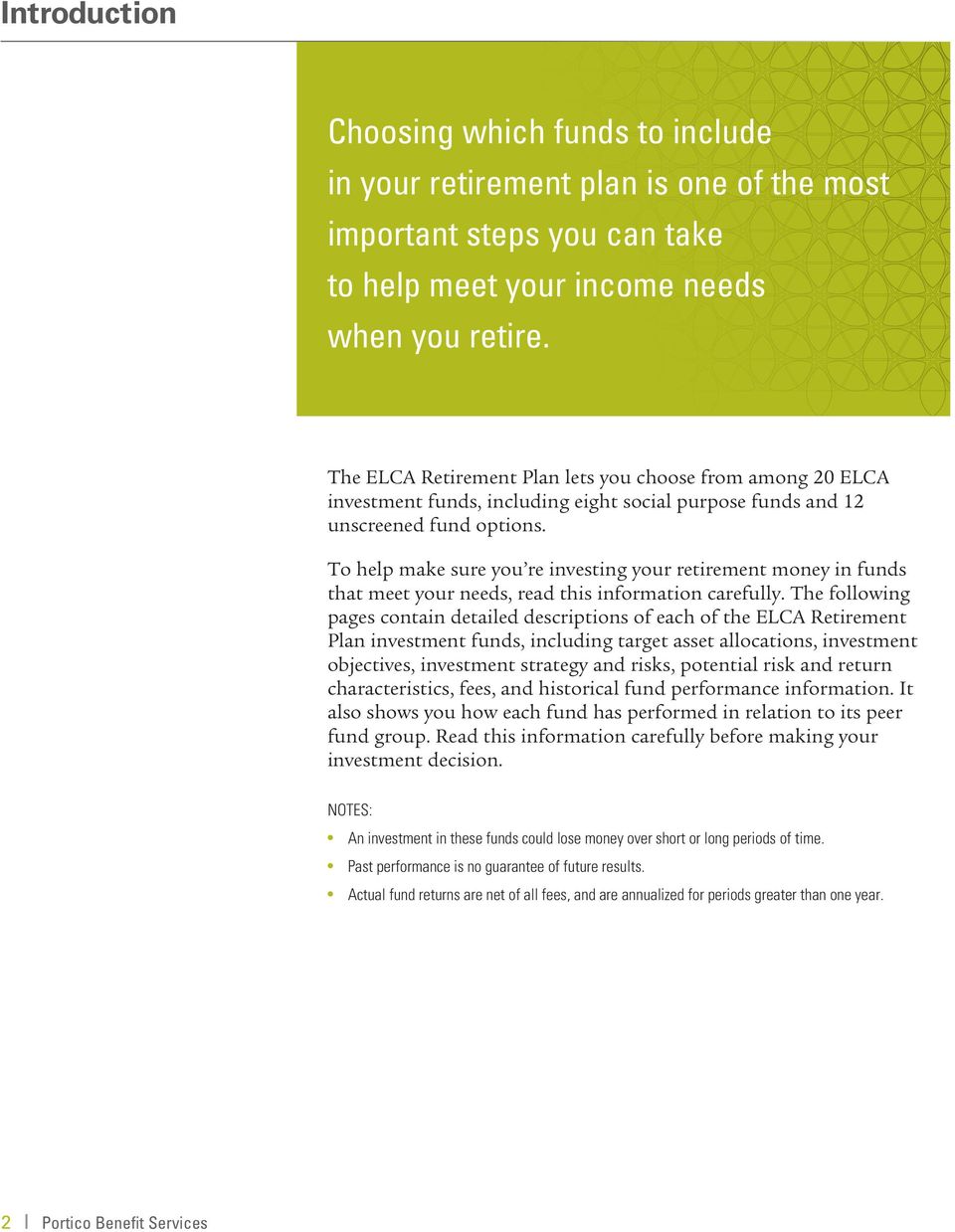
5 Risk and Return Risk/Return Tradeoff You invest to earn a return on your investment. Return can result from income and capital appreciation (increase in value) or depreciation (decrease in value). Returns are usually expressed as a percentage, whether as a rate of income from interest payments or as a percentage increase or decrease in value. All investments carry some degree of risk, either of loss of capital (value) or loss of purchasing power (inflation risk). Investors expect the long-term return on investments to compensate them for the risk taken. Generally, the greater the risk taken, the greater the potential return. Conversely, if you are willing to invest only in low-risk investments, your return is likely to be correspondingly low. This is the risk/return tradeoff. The relative potential long-term risk and potential return characteristics of the ELCA investment funds are shown below. For detailed information about each ELCA Retirement Plan investment fund, see pages 6. RISK/RETURN SCALE FOR ELCA INVESTMENT FUNDS e Balanced Social Purpose 6e Balanced 8e Balanced Social Purpose 8e Balanced Global Stock Social Purpose Global Stock Non-U.S. Stock Social Purpose Non-U.S. Stock U.S. Stock Social Purpose U.S. Stock S&P Stock Index 4 Small- and Mid-Cap Stock Index Social Purpose Stock Index Global Real Estate Securities 4e Balanced Social Purpose 4e Balanced Bond Social Purpose Bond -Yield Bond Money Market 1. The positioning of funds on this potential risk/return chart in no way reflects Portico s opinion of which fund(s) may be appropriate for a given investor. You should carefully consider the target asset allocations, investment objectives, risks, charges, and expenses of any fund before investing in it. 2. Potential risk refers to the degree of annual volatility in potential returns. er risk funds have a greater potential of losing value in any one-year period. This chart is intended to show relative levels of risk/return potential for the funds. It does not purport to show absolute levels of risk/return. 3. Potential return refers to long-term returns. Over most 1-year periods, higher-potential-return funds are anticipated to return more than lower-potential-return funds. 4. S&P is a trademark of The McGraw-Hill Companies Inc. and has been licensed for use by Portico Benefit Services. The ELCA S&P Stock Index Fund is not sponsored, endorsed, sold, or promoted by Standard & Poor s, and Standard & Poor s makes no representation regarding the advisability of investing in the fund.. Due to diversification across, as well as within, asset classes, the Select Series balanced funds are managed with the objective of obtaining the maximum projected return possible per unit of projected risk. Investment Fund Descriptions I 3
6 Selecting Your Investments You can select from among different investment funds available in two categories Select Series and Build-Your- Own Series. Select Series If you want investment professionals to manage the mix of your investments in the plan, investing your entire account in one of the six Select Series balanced funds may be a good option for you. We diversify your account for you and periodically rebalance it to maintain its target asset allocation. Each fund in the Select Series is managed with the objective of obtaining the highest projected return for the projected level of risk. Build-Your-Own Series If you prefer to manage your mix of investments in the plan yourself, use our Build-Your-Own Series funds. Each of these funds targets a specific asset class, and you take on the responsibility of choosing the right mix of funds to diversify your savings. You are also in charge of rebalancing your investments over time to maintain your target asset allocation. Social Purpose Funds Of the investment funds available in the ELCA Retirement Plan, eight are social purpose funds, which strive to further the mission of the ELCA as reflected in the social teachings and policy documents of this church. These funds use a three-pronged approach to investing that includes shareholder advocacy 1, social screening 2, and positive social investments. Our social purpose funds are designed to deliver attractive returns over the long term while investing in ways that are compatible with the mission of the ELCA. Shareholder Advocacy Our social purpose funds promote change through shareholder advocacy, consistent with our fiduciary obligations to members. To motivate corporate leaders to act in the best interests of shareholders, we (in coordination with other stakeholders where appropriate): May hold dialogues with corporate leaders May present shareholder resolutions Vote our proxies Social Screening Each year, investment managers for the screened portfolios receive a list of companies that may not be considered for future investment due to business practices that conflict with the ELCA s social criteria screens 2. Social criteria screens include: alcohol, community economic development 3, environmental 3, gambling, military weapons, pornography, and tobacco. Beginning January 16, a private prison screen is included as well. All screening activities are made consistent with Portico Benefit Services fiduciary obligations to members. Additional details on these screens can be found at elca.org/resources/ Corporate-Responsibility. Positive Social Investments Where applicable, our social purpose fund managers seek and invest in activities they believe will positively benefit the community and the environment, while achieving acceptable returns for plan members. In order to strive for greater, measurable social impact, up to 1% of the assets in each social purpose fund (excluding the Social Purpose Stock Index Fund) can be invested in a type of positive social investing called Social Impact First (SIF) investments. These investments have a somewhat lower projected return and/ or somewhat higher projected risk than similar investments not prioritizing social impact. Managers look for investments, which may include the following: Community development Affordable housing Sustainable forestry Women- and minority-owned businesses Clean energy and the environment Additional details on Portico s social purpose funds can be found at (sign in required) myportico.porticobenefits.org/ myportico/retirement/accumulation/ ChoosingYourFunds.aspx. 1. Takes place for both social purpose funds and unscreened funds. 2. Due to practical implementation realities, not all portfolios in the social purpose funds are screened. Unscreened portfolios include global real estate, alternative equity, illiquid real assets, and public natural resources. 3. Indicates positive social investment screen. Environmental screen is both positive and negative. 4 I Portico Benefit Services

7 Investment Funds in Your ELCA Retirement Plan Investment funds purchase units of investment pools managed under the supervision of Portico Benefit Services. Inter-fund transfers of investment pool units may occur and the value of units transferred will be based on the daily net asset value of the investment pool. There are no commissions or fees associated with these inter-fund transfers. In managing all of its funds, Portico may from time to time use financial futures and/or options to help control overall portfolio risk and enhance portfolio values and returns. Portico is not required to register as a commodity pool operator under the Commodity Futures Trading Commission (CFTC) rules and will not be subjected to the operating criteria of CFTC Rule 4.. Nevertheless, Portico will use financial futures and options prudently in the context of total portfolio circumstances for the purposes of furthering the objective of the plan. Are the ELCA Funds Mutual Funds? The ELCA investment funds are not mutual funds, although they share some similar features the ELCA funds offer diversification among many securities, and professional investment management. ELCA Retirement Plan members do not have individual voting rights in ELCA funds. While mutual funds may be an appropriate investment for non-retirement as well as retirement purposes, the ELCA investment funds are designed specifically for retirement savings. Our investment staff strives to provide you with attractive long-term investment returns for your retirement savings with lower expenses than many retail mutual funds in the marketplace. Neither Portico nor its funds are subject to registration, regulation, or reporting under the Investment Company Act of 194, the Securities Act of 1933, the Securities Exchange Act of 1934, the Investment Advisers Act of 194 or state securities laws. Members, therefore, will not be afforded the protections of those provisions of those laws and related regulations. Plan administration and plan asset management are subject to prudent investor and exclusive benefit rules. Retirement Plan As a nonprofit ministry of the ELCA, Portico s fees cover only its costs. Like many retirement plans, the ELCA Retirement Plan charges two types of fees: administrative and investment. These fees are aggregated and expressed as a percentage of average net assets, by fund. The funds have no sales commissions. Your ELCA Retirement Plan Advantage Your ELCA Retirement Plan is designed to offer you: Social purpose funds Customized retirement income options Wide variety of investment funds Portico Benefit Services is a separately incorporated ministry of the Evangelical Lutheran Church in America, and our mission is to enhance the well-being of those who serve through the ELCA and other faith-based organizations. We focus on you and your needs. Consolidate Your Savings and Let Your ELCA Retirement Plan Work Even Harder for You The plan accepts pretax rollovers of at least $ from: Traditional pretax IRAs 43(b) plans 41(k) plans Governmental 47(b) plans For more information, contact us at or [email protected], or visit PorticoBenefits.org. Fund Transfer Restrictions You will have a seven calendar day waiting period from the time you transfer money out of an investment fund until you can transfer money back into the same fund. NOTE: Transfer restrictions do not apply to the ELCA Money Market Fund. Investment Fund Descriptions I
8 Select Series ELCA 8e Balanced Fund 1 Years Years 1 Year As of January 1, 16 (managed within ranges) n ELCA 8e Balanced Fund n Median of Lipper Peer Group n -yield bonds % n Core bonds 1% n Alternative equity % n Non-U.S. stocks 37.% n Real assets % n U.S. stocks 37.% For footnote(s), see page 26. ELCA 8e Balanced Fund s total net assets in this plan are $112.4 million. Total net assets in this fund are $119.2 million. The ELCA 8e Balanced Fund seeks to achieve superior, long-term risk-adjusted returns relative to its benchmark. The fund may be suitable for members who are comfortable with a high level of potential risk and potential return and have a time horizon of 12 or more years. include direct investment management fees were approximately.7% of the fund s average The fund seeks to achieve its objective by investing in a broad range of asset classes. The target asset allocation (see pie chart) includes an 8% allocation to equities (stocks), which includes both U.S. and non-u.s. stocks, and alternative equity. The remaining % is allocated to bonds and real assets. The fund is managed within ranges of the target allocation percentages. Therefore, at any one time the actual allocation may be different. As described in the next paragraph, the real assets allocation has some characteristics of equities; and in certain respects they may be viewed as increasing the equity allocation beyond the percentage of equity shown in the target asset allocation. This fund may hold some residual cash, but its intent is to be fully invested. See pages for investment manager information for this fund. The asset classes reflected in the pie chart are not necessarily mutually exclusive, and judgments are made in assigning specific assets held by the fund to an asset class. For example, the fund includes an allocation to real assets, which is the asset class used to describe tangible items such as real estate, timberland, oil and gas, etc. Real assets can be purchased directly or indirectly through a variety of investment instruments. The real assets component of the fund is currently invested primarily in equity securities that may include, among others, real estate equity securities (such as stock of real estate investment trusts or REITs), and energy and energy-related equity securities. In addition, real assets may also include equity investments in private market instruments such as real estate partnerships. This fund, like any investment, is subject to risks that could cause the fund to lose value. The value of investments held in the fund will vary from day to day due to a number of factors, including the market s response to the activities of individual companies and the outlook for business activity in general. The fund s investments are subject to a variety of additional risks, which include, among others, equity securities risk, credit risk, change in rating risk, interest rate risk, prepayment and extension risk, duration risk, real assets risk, derivatives risk, market risk, foreign securities risk, liquidity risk, commodity risk, and turnover risk. Investments in foreign securities carry additional risks to which U.S. investments are not exposed, including foreign government risks and currency Liquidity Risk Illiquid investments assets that may not be sold or disposed of in the ordinary course of business within a 31 consecutive calendar day period at approximately the value at which the fund has valued the assets may be included in this fund to enhance the fund s projected long-term returns. However, the fund s investment policy limits illiquid investments to no greater than % of fund assets at market value. 6 I Portico Benefit Services

9 Select Series ELCA Social Purpose 8e Balanced Fund 1 Years Years 1 Year As of January 1, 16 (managed within ranges) n ELCA Social Purpose 8e Balanced Fund n Median of Lipper Peer Group 2 n -yield bonds % n Core bonds 1% n Alternative equity % n Non-U.S. stocks 37.% n Real assets % n U.S. stocks 37.% For footnote(s), see page 26 ELCA Social Purpose 8e Balanced Fund s total net assets in this plan are $7.1 million as of Dec. 31,. Total net assets in this fund are $73.4 million as of Dec. 31,. The ELCA Social Purpose 8e Balanced Fund seeks to achieve superior, long-term risk-adjusted returns relative to its benchmark. The fund may be suitable for members who are comfortable with a high level of potential risk and potential return and have a time horizon of 12 or more years. This is a social purpose fund (see page 4 for a description of social purpose investing). include direct investment management fees were approximately.77% of the fund s average The fund seeks to achieve its objective by investing in a broad range of asset classes. The target asset allocation (see pie chart) includes an 8% allocation to equities (stocks), which includes both U.S. and non-u.s. stocks, and alternative equity. The remaining % is allocated to bonds and real assets. The fund is managed within ranges of the target allocation percentages. Therefore, at any one time the actual allocation may be different. As described in the next paragraph, the real assets allocation has some characteristics of equities; and in certain respects they may be viewed as increasing the equity allocation beyond the percentage of equity shown in the target asset allocation. This fund may hold some residual cash, but its intent is to be fully invested. See pages for investment manager information for this fund. The asset classes reflected in the pie chart are not necessarily mutually exclusive, and judgments are made in assigning specific assets held by the fund to an asset class. For example, the fund includes an allocation to real assets, which is the asset class used to describe tangible items such as real estate, timberland, oil and gas, etc. Real assets can be purchased directly or indirectly through a variety of investment instruments. The real assets component of the fund is currently invested primarily in equity securities which may include, among others, real estate equity securities (such as stock of real estate investment trusts or REITs), and energy and energyrelated equity securities. In addition, real assets may also include equity investments in private market instruments such as real estate partnerships. This fund is allowed to invest up to 1% of the fund assets in Social Impact First (SIF) investments. While SIF investments strive for greater, measurable social impact, the trade-off is a somewhat lower projected return and/ or somewhat higher projected risk. SIF investments will be made across a range of asset classes and will be consistent with the broad asset classes the fund currently invests in (see page 4 for a description of social purpose investing). This fund, like any investment, is subject to risks that could cause the fund to lose value. Each ELCA social purpose fund and its similarly named unscreened fund will contain different securities. Therefore, the risk and return projections are somewhat different for both funds, and their actual risk and return experience will differ. The value of investments held in the fund will vary from day to day due to a number of factors, including the market s response to the activities of individual companies and the outlook for business activity in general. The fund s investments are subject to a variety of additional risks, which include, among others, equity securities risk, credit risk, change in rating risk, interest rate risk, prepayment and extension risk, duration risk, real assets risk, derivatives risk, market risk, foreign securities risk, liquidity risk, commodity risk, and turnover risk. Investments in foreign securities carry additional risks to which U.S. investments are not exposed, including foreign government risks and currency Liquidity Risk Illiquid investments assets that may not be sold or disposed of in the ordinary course of business within a 31 consecutive calendar day period at approximately the value at which the fund has valued the assets may be included in this fund to enhance the fund s projected long-term returns or to help meet social objectives. However, the fund s investment policy limits illiquid investments to no greater than % of fund assets at market value. Investment Fund Descriptions I 7

10 Select Series ELCA 6e Balanced Fund 1 Years Years 1 Year As of January 1, 16 (managed within ranges) n ELCA 6e Balanced Fund n Median of Lipper Growth Peer Group 3 n Median of Lipper Moderate Peer Group 3 n -yield bonds 1% n Core bonds % n Alternative equity % n Non-U.S. stocks 27.% n Real assets 1% n U.S. stocks 27.% For footnote(s), see page 26. ELCA 6e Balanced Fund s total net assets in this plan are $1. billion. Total net assets in this fund are $1.7 billion. The ELCA 6e Balanced Fund seeks to achieve superior, long-term risk-adjusted returns relative to its benchmark. The fund may be suitable for members who are comfortable with a moderate level of potential risk and potential return and have a time horizon of eight or more years. include direct investment management fees were approximately.71% of the fund s average The fund seeks to achieve its objective by investing in a broad range of asset classes. The target asset allocation (see pie chart) includes 6% allocation to equities (stocks), which includes both U.S. and non-u.s stocks and alternative equity. The remaining 4% is allocated to bonds and real assets. The fund is managed within ranges of the target allocation percentages. Therefore, at any one time the actual allocation may be different. As described in the next paragraph, the real assets allocation has some characteristics of equities; and in certain respects they may be viewed as increasing the equity allocation beyond the percentage of equity shown in the target asset allocation. This fund may hold some residual cash, but its intent is to be fully invested. See pages for investment manager information for this fund. The asset classes reflected in the pie chart are not necessarily mutually exclusive, and judgments are made in assigning specific assets held by the fund to an asset class. For example, the fund includes an allocation to real assets, which is the asset class used to describe tangible items such as real estate, timberland, oil and gas, etc. Real assets can be purchased directly or indirectly through a variety of investment instruments. The real assets component of the fund is currently invested primarily in equity securities that may include, among others, real estate equity securities (such as stock of real estate investment trusts or REITs), and energy and energyrelated equity securities. In addition, real assets may also include equity investments in private market instruments such as real estate partnerships. This fund, like any investment, is subject to risks that could cause the fund to lose value. The value of investments held in the fund will vary from day to day due to a number of factors, including the market s response to the activities of individual companies and the outlook for business activity in general. The fund s investments are subject to a variety of additional risks, which include, among others, equity securities risk, credit risk, change in rating risk, interest rate risk, prepayment and extension risk, duration risk, real assets risk, derivatives risk, market risk, foreign securities risk, liquidity risk, commodity risk, and turnover risk. Investments in foreign securities carry additional risks to which U.S. investments are not exposed, including foreign government risks and currency Liquidity Risk Illiquid investments assets that may not be sold or disposed of in the ordinary course of business within a 31 consecutive calendar day period at approximately the value at which the fund has valued the assets may be included in this fund to enhance the fund s projected long-term returns. However, the fund s investment policy limits illiquid investments to no greater than % of fund assets at market value. 8 I Portico Benefit Services

11 Select Series ELCA Social Purpose 6e Balanced Fund 1 Years Years 1 Year As of January 1, 16 (managed within ranges) n ELCA Social Purpose 6e Balanced Fund n Median of Lipper Growth Peer Group 3 n Median of Lipper Moderate Peer Group 3 n -yield bonds 1% n Core bonds % n Alternative equity % n Non-U.S. stocks 27.% n Real assets 1% n U.S. stocks 27.% For footnote(s), see page 26 ELCA Social Purpose 6e Balanced Fund s total net assets in this plan are $41. million as of Dec. 31,. Total net assets in this fund are $4. million. The ELCA Social Purpose 6e Balanced Fund seeks to achieve superior, long-term risk-adjusted returns relative to its benchmark. The fund may be suitable for members who are comfortable with a moderate level of potential risk and potential return and have a time horizon of eight or more years. This is a social purpose fund (see page 4 for a description of social purpose investing). include direct investment management fees were approximately.73% of the fund s average The fund seeks to achieve its objective by investing in a broad range of asset classes. The target asset allocation (see pie chart) includes 6% allocation to equities (stocks), which includes both U.S. and non-u.s. stocks and alternative equity. The remaining 4% is allocated to bonds and real assets. The fund is managed within ranges of the target allocation percentages. Therefore, at any one time the actual allocation may be different. As described in the next paragraph, the real assets allocation has some characteristics of equities; and in certain respects they may be viewed as increasing the equity allocation beyond the percentage of equity shown in the target asset allocation. This fund may hold some residual cash, but its intent is to be fully invested. See pages for investment manager information for this fund. The asset classes reflected in the pie chart are not necessarily mutually exclusive, and judgments are made in assigning specific assets held by the fund to an asset class. For example, the fund includes an allocation to real assets, which is the asset class used to describe tangible items such as real estate, timberland, oil and gas, etc. Real assets can be purchased directly or indirectly through a variety of investment instruments. The real assets component of the fund is currently invested primarily in equity securities that may include, among others, real estate equity securities (such as stock of real estate investment trusts or REITs), and energy and energy-related equity securities. In addition, real assets may also include equity investments in private market instruments such as real estate partnerships. This fund is allowed to invest up to 1% of the fund assets in Social Impact First (SIF) investments. While SIF investments strive for greater, measurable social impact, the trade-off is a somewhat lower projected return and/ or somewhat higher projected risk. SIF investments will be made across a range of asset classes and will be consistent with the broad asset classes the fund currently invests in (see page 4 for a description of social purpose investing). This fund, like any investment, is subject to risks that could cause the fund to lose value. Each ELCA social purpose fund and its similarly named unscreened fund will contain different securities. Therefore, the risk and return projections are somewhat different for both funds, and their actual risk and return experience will differ. The value of investments held in the fund will vary from day to day due to a number of factors, including the market s response to the activities of individual companies and the outlook for business activity in general. The fund s investments are subject to a variety of additional risks, which include, among others, equity securities risk, credit risk, change in rating risk, interest rate risk, prepayment and extension risk, duration risk, real assets risk, derivatives risk, market risk, foreign securities risk, liquidity risk, commodity risk, and turnover risk. Investments in foreign securities carry additional risks to which U.S. investments are not exposed, including foreign government risks and currency Liquidity Risk Illiquid investments assets that may not be sold or disposed of in the ordinary course of business within a 31 consecutive calendar day period at approximately the value at which the fund has valued the assets may be included in this fund to enhance the fund s projected long-term returns or to help meet social objectives. However, the fund s investment policy limits illiquid investments to no greater than % of fund assets at market value. Investment Fund Descriptions I 9
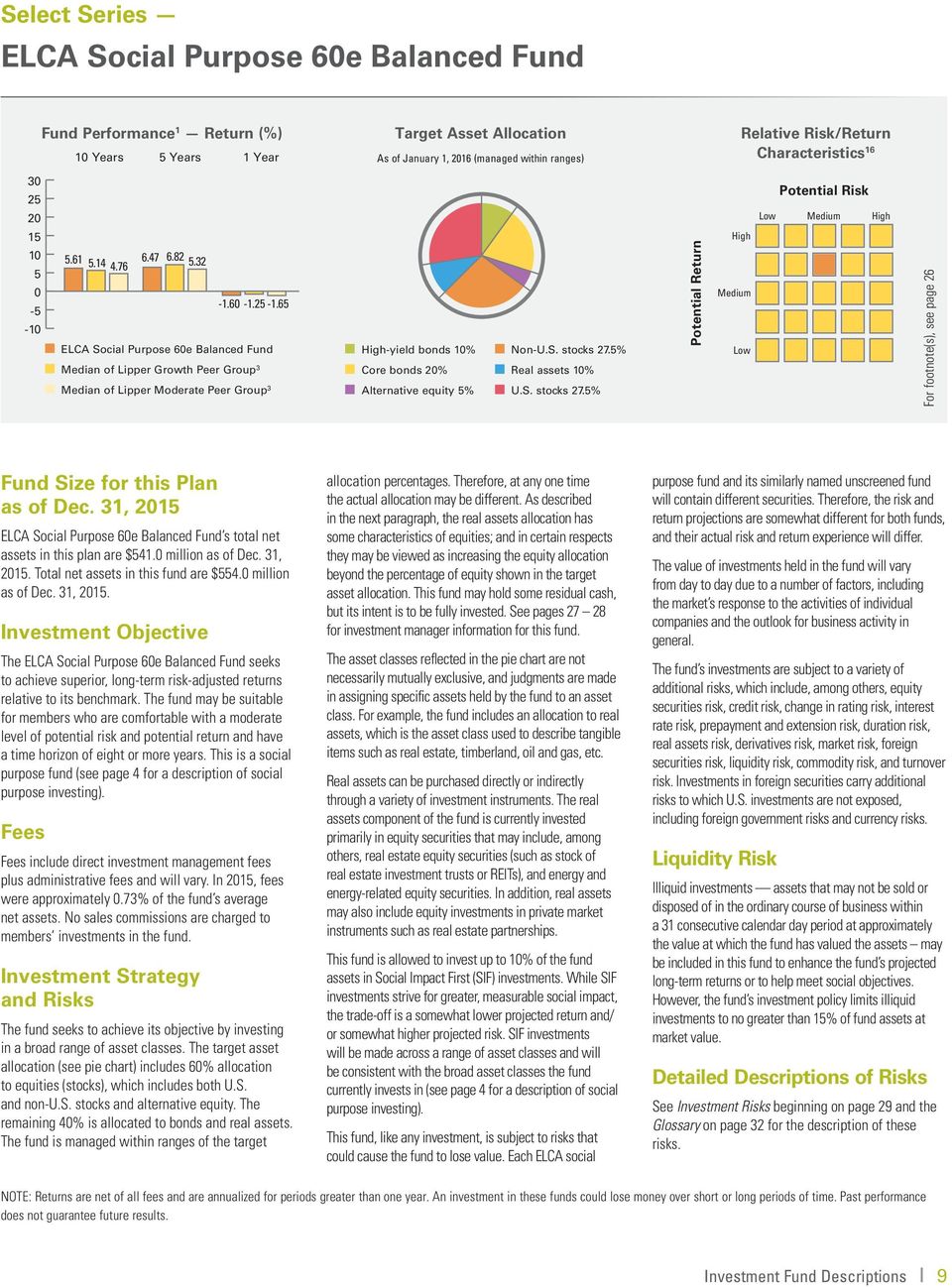
12 Select Series ELCA 4e Balanced Fund 1 Years Years 1 Year As of January, 1 16 (managed within ranges) n ELCA 4e Balanced Fund n Median of Lipper Moderate Peer Group 4 n Median of Lipper Conservative Peer Group 4 n -yield bonds 1% n Core bonds 3% n Alternative equity % n Non-U.S. stocks 17.% n Real assets 1% n U.S. stocks 17.% n Inflation-indexed bonds 1% For footnote(s), see page 26. ELCA 4e Balanced Fund s total net assets in this plan are $248.1 million. Total net assets in this fund are $6.6 million. The ELCA 4e Balanced Fund seeks to achieve superior, long-term risk-adjusted returns relative to its benchmark. The fund may be suitable for members who are comfortable with a modest level of potential risk and potential return and have a time horizon of five or more years. include direct investment management fees were approximately.6% of the fund s average The fund seeks to achieve its objective by investing in a broad range of asset classes.the target asset allocation (see pie chart) includes 6% allocation to bonds and real assets. The remaining 4% is allocated to equities (stocks), which includes both U.S. and non-u.s. stocks, and alternative equity. The fund is managed within ranges of the target allocation percentages. Therefore, at any one time the actual allocation may be different. As described in the next paragraph, the real assets allocation has some characteristics of equities; and in certain respects they may be viewed as increasing the equity allocation beyond the percentage of equity shown in the target asset allocation. This fund may hold some residual cash, but its intent is to be fully invested. See pages for investment manager information for this fund. The asset classes reflected in the pie chart are not necessarily mutually exclusive, and judgments are made in assigning specific assets held by the fund to an asset class. For example, the fund includes an allocation to real assets, which is the asset class used to describe tangible items such as real estate, timberland, oil and gas, etc. Real assets can be purchased directly or indirectly through a variety of investment instruments. The real assets component of the fund is currently invested primarily in equity securities that may include, among others, real estate equity securities (such as stock of real estate investment trusts or REITs), and energy and energy-related equity securities. In addition, real assets may also include equity investments in private market instruments such as real estate partnerships. This fund, like any investment, is subject to risks that could cause the fund to lose value. The value of investments held in the fund will vary from day to day due to a number of factors, including the market s response to the activities of individual companies and the outlook for business activity in general. The fund s investments are subject to a variety of additional risks, which include, among others, equity securities risk, credit risk, change in rating risk, interest rate risk, prepayment and extension risk, duration risk, real assets risk, derivatives risk, market risk, foreign securities risk, liquidity risk, commodity risk, and turnover risk. Investments in foreign securities carry additional risks to which U.S. investments are not exposed, including foreign government risks and currency Liquidity Risk Illiquid investments assets that may not be sold or disposed of in the ordinary course of business within a 31 consecutive calendar day period at approximately the value at which the fund has valued the assets may be included in this fund to enhance the fund s projected long-term returns. However, the fund s investment policy limits illiquid investments to no greater than % of fund assets at market value. 1 I Portico Benefit Services
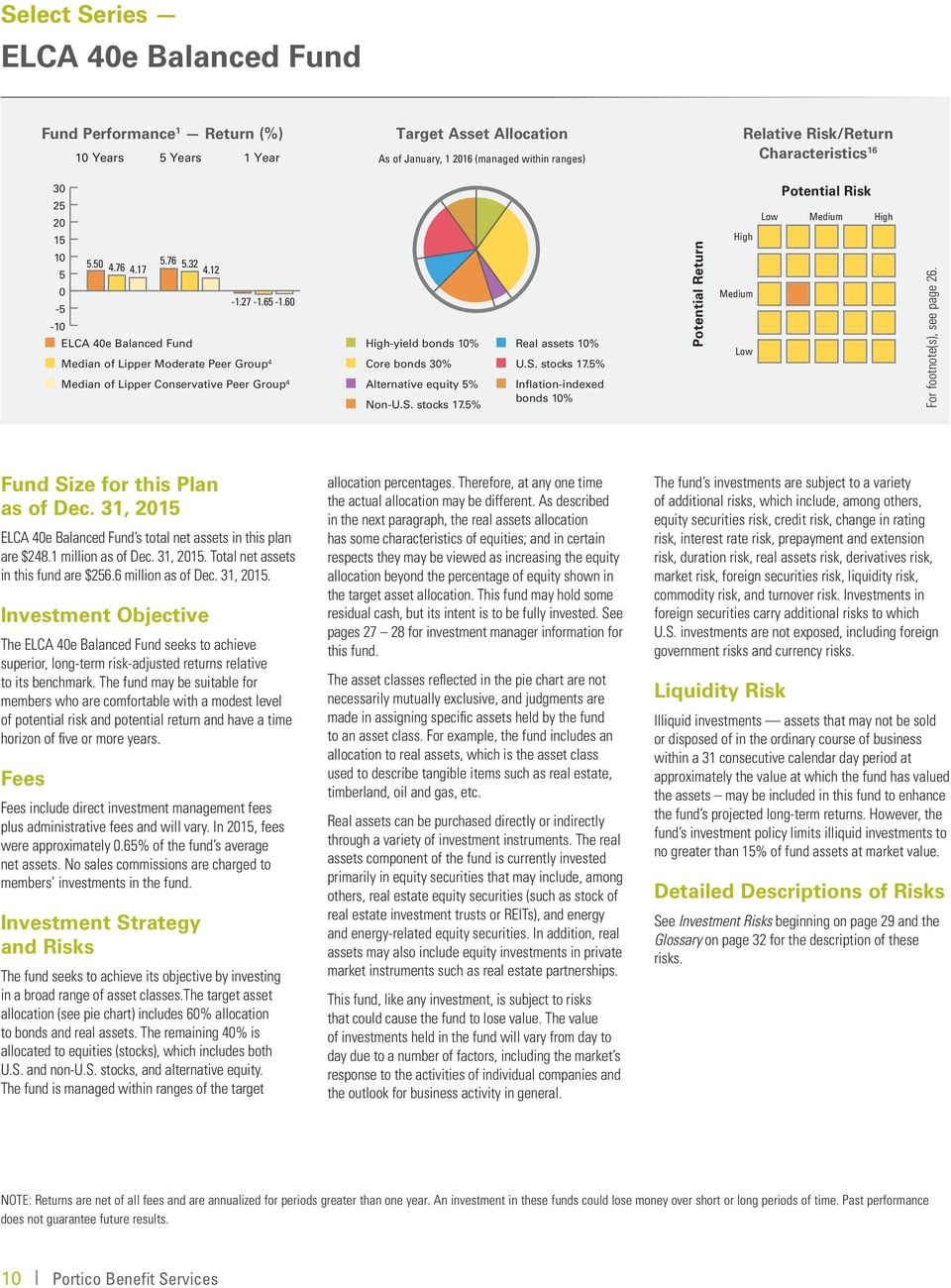
13 Select Series ELCA Social Purpose 4e Balanced Fund 3 1 Years Years 1 Year As of January, 1 16 (managed within ranges) n ELCA Social Purpose 4e Balanced Fund n Median of Lipper Moderate Peer Group 4 n Median of Lipper Conservative Peer Group 4 n -yield bonds 1% n Core bonds 3% n Alternative equity % n Non-U.S. stocks 17.% n Real assets 1% n U.S. stocks 17.% n Inflation-indexed bonds 1% For footnote(s), see page 26 ELCA Social Purpose 4e Balanced Fund s total net assets in this plan are $137.6 million as of Dec. 31,. Total net assets in this fund are $141.2 million. The ELCA Social Purpose 4e Balanced Fund seeks to achieve superior, long-term risk-adjusted returns relative to its benchmark. The fund may be suitable for members who are comfortable with a modest level of potential risk and potential return and have a time horizon of five or more years. This is a social purpose fund (see page 4 for a description of social purpose investing). include direct investment management fees were approximately.67% of the fund s average The fund seeks to achieve its objective by investing in a broad range of asset classes. The target asset allocation (see pie chart) includes an 6% allocation to bonds and real assets. The remaining 4% is allocated to equities (stocks), which includes both U.S. and non-u.s. stocks, and alternative equity. The fund is managed within ranges of the target allocation percentages. Therefore, at any one time the actual allocation may be different. As described in the next paragraph, the real assets allocation has some characteristics of equities; and in certain respects they may be viewed as increasing the equity allocation beyond the percentage of equity shown in the target asset allocation. This fund may hold some residual cash, but its intent is to be fully invested. See pages for investment manager information for this fund. The asset classes reflected in the pie chart are not necessarily mutually exclusive, and judgments are made in assigning specific assets held by the fund to an asset class. For example, the fund includes an allocation to real assets, which is the asset class used to describe tangible items such as real estate, timberland, oil and gas, etc. Real assets can be purchased directly or indirectly through a variety of investment instruments. The real assets component of the fund is currently invested primarily in equity securities that may include, among others, real estate equity securities (such as stock of real estate investment trusts or REITs), and energy and energyrelated equity securities. In addition, real assets may also include equity investments in private market instruments such as real estate partnerships. This fund is allowed to invest up to 1% of the fund assets in Social Impact First (SIF) investments. While SIF investments strive for greater, measurable social impact, the trade-off is a somewhat lower projected return and/ or somewhat higher projected risk. SIF investments will be made across a range of asset classes and will be consistent with the broad asset classes the fund currently invests in (see page 4 for a description of social purpose investing). This fund, like any investment, is subject to risks that could cause the fund to lose value. Each ELCA social purpose fund and its similarly named unscreened fund will contain different securities. Therefore, the risk and return projections are somewhat different for both funds, and their actual risk and return experience will differ. The value of investments held in the fund will vary from day to day due to a number of factors, including the market s response to the activities of individual companies and the outlook for business activity in general. The fund s investments are subject to a variety of additional risks, which include, among others, equity securities risk, credit risk, change in rating risk, interest rate risk, prepayment and extension risk, duration risk, real assets risk, derivatives risk, market risk, foreign securities risk, liquidity risk, commodity risk, and turnover risk. Investments in foreign securities carry additional risks to which U.S. investments are not exposed, including foreign government risks and currency Liquidity Risk Illiquid investments assets that may not be sold or disposed of in the ordinary course of business within a 31 consecutive calendar day period at approximately the value at which the fund has valued the assets may be included in this fund to enhance the fund s projected long-term returns or to help meet social objectives. However, the fund s investment policy limits illiquid investments to no greater than % of fund assets at market value. Investment Fund Descriptions I 11

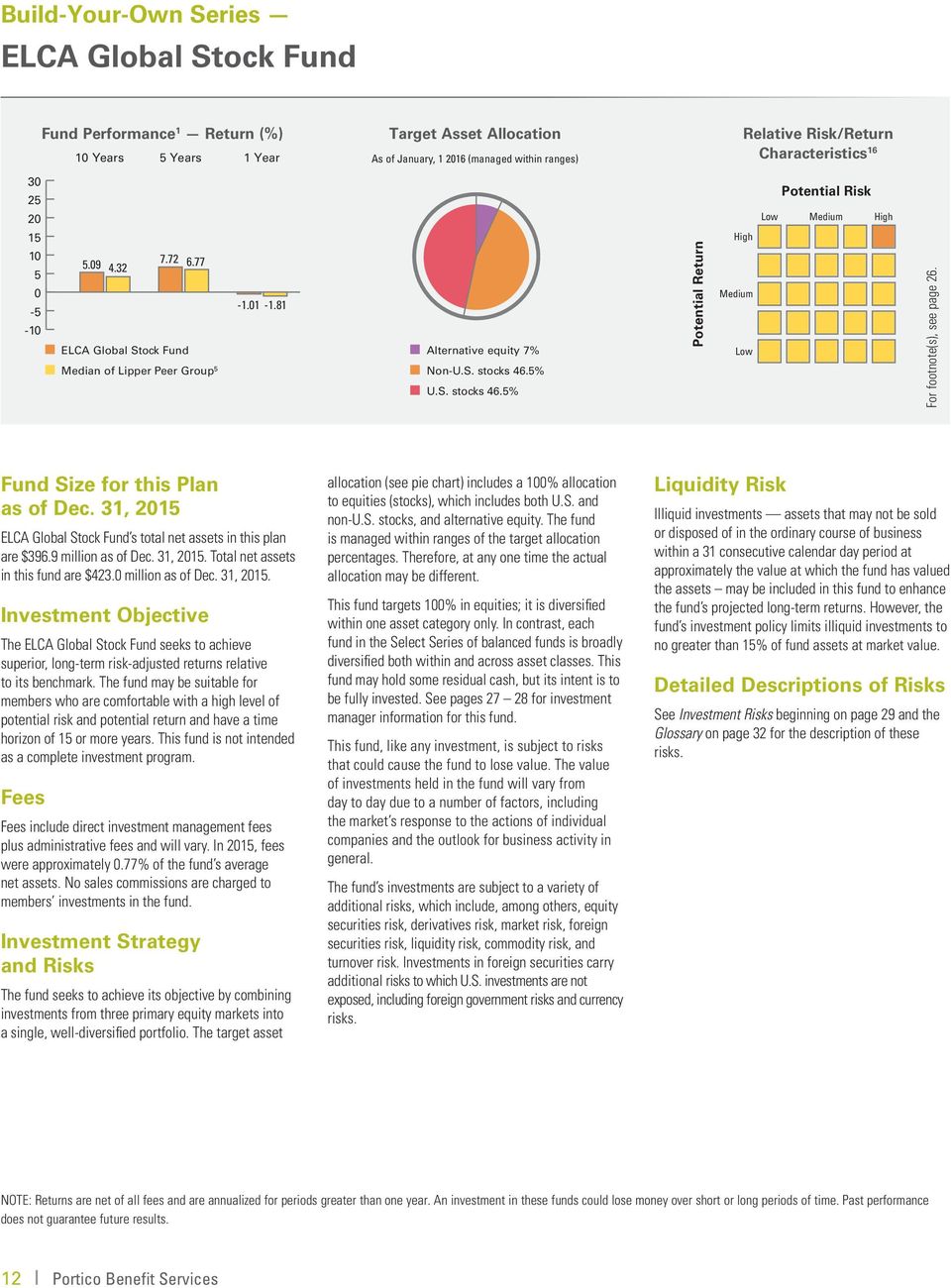
14 Build-Your-Own Series ELCA Global Stock Fund 1 Years Years 1 Year As of January, 1 16 (managed within ranges) n ELCA Global Stock Fund n Median of Lipper Peer Group n Alternative equity 7% n Non-U.S. stocks 46.% n U.S. stocks 46.% For footnote(s), see page 26. ELCA Global Stock Fund s total net assets in this plan are $396.9 million. Total net assets in this fund are $423. million. The ELCA Global Stock Fund seeks to achieve superior, long-term risk-adjusted returns relative to its benchmark. The fund may be suitable for members who are comfortable with a high level of potential risk and potential return and have a time horizon of or more years. This fund is not intended as a complete investment program. include direct investment management fees were approximately.77% of the fund s average The fund seeks to achieve its objective by combining investments from three primary equity markets into a single, well-diversified portfolio. The target asset allocation (see pie chart) includes a 1% allocation to equities (stocks), which includes both U.S. and non-u.s. stocks, and alternative equity. The fund is managed within ranges of the target allocation percentages. Therefore, at any one time the actual allocation may be different. This fund targets 1% in equities; it is diversified within one asset category only. In contrast, each fund in the Select Series of balanced funds is broadly diversified both within and across asset classes. This fund may hold some residual cash, but its intent is to be fully invested. See pages for investment manager information for this fund. This fund, like any investment, is subject to risks that could cause the fund to lose value. The value of investments held in the fund will vary from day to day due to a number of factors, including the market s response to the actions of individual companies and the outlook for business activity in general. The fund s investments are subject to a variety of additional risks, which include, among others, equity securities risk, derivatives risk, market risk, foreign securities risk, liquidity risk, commodity risk, and turnover risk. Investments in foreign securities carry additional risks to which U.S. investments are not exposed, including foreign government risks and currency Liquidity Risk Illiquid investments assets that may not be sold or disposed of in the ordinary course of business within a 31 consecutive calendar day period at approximately the value at which the fund has valued the assets may be included in this fund to enhance the fund s projected long-term returns. However, the fund s investment policy limits illiquid investments to no greater than % of fund assets at market value. 12 I Portico Benefit Services
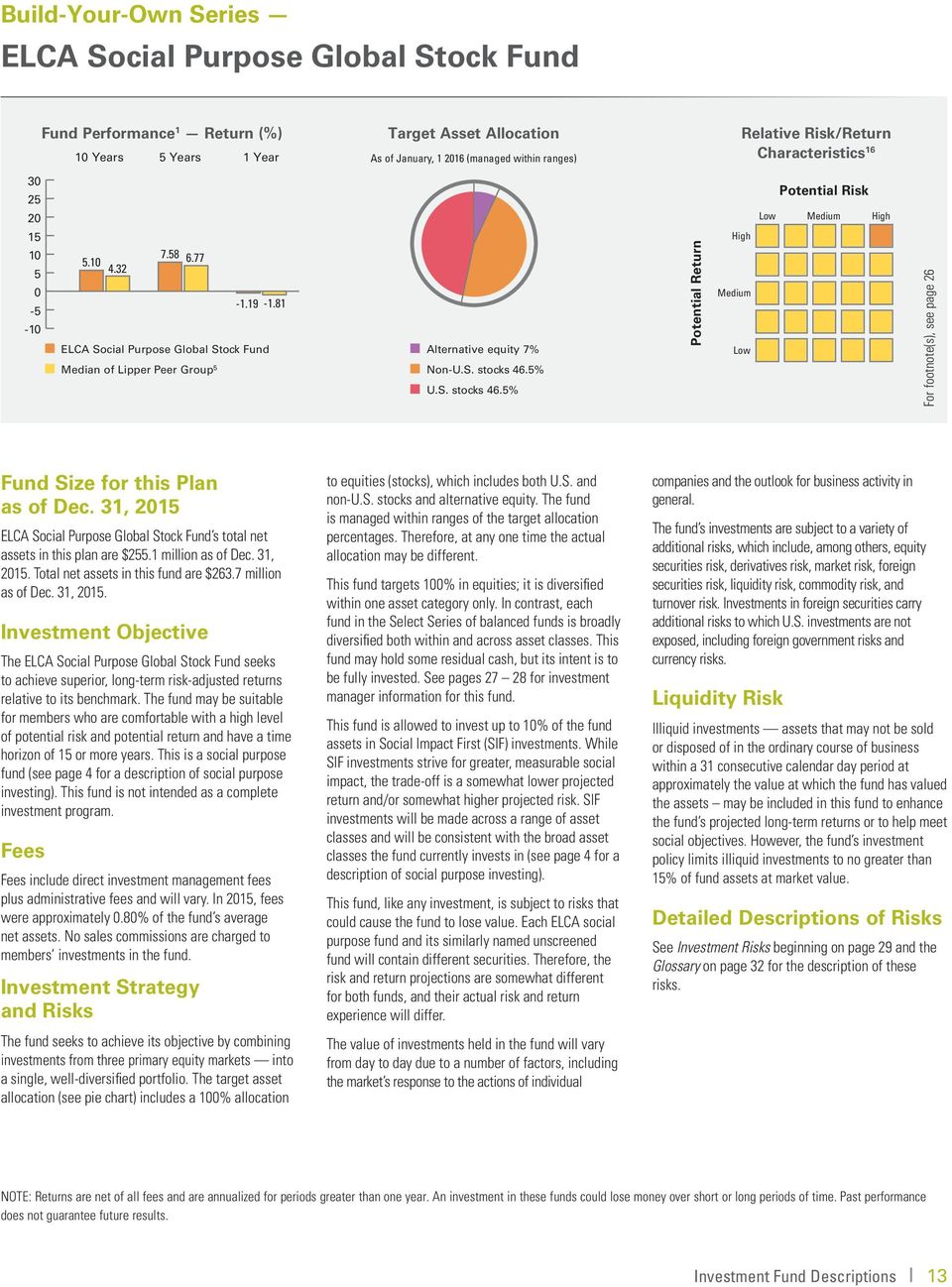
15 Build-Your-Own Series ELCA Social Purpose Global Stock Fund 1 Years Years 1 Year As of January, 1 16 (managed within ranges) n ELCA Social Purpose Global Stock Fund n Median of Lipper Peer Group n Alternative equity 7% n Non-U.S. stocks 46.% n U.S. stocks 46.% For footnote(s), see page 26 ELCA Social Purpose Global Stock Fund s total net assets in this plan are $.1 million as of Dec. 31,. Total net assets in this fund are $263.7 million. The ELCA Social Purpose Global Stock Fund seeks to achieve superior, long-term risk-adjusted returns relative to its benchmark. The fund may be suitable for members who are comfortable with a high level of potential risk and potential return and have a time horizon of or more years. This is a social purpose fund (see page 4 for a description of social purpose investing). This fund is not intended as a complete investment program. include direct investment management fees were approximately.8% of the fund s average The fund seeks to achieve its objective by combining investments from three primary equity markets into a single, well-diversified portfolio. The target asset allocation (see pie chart) includes a 1% allocation to equities (stocks), which includes both U.S. and non-u.s. stocks and alternative equity. The fund is managed within ranges of the target allocation percentages. Therefore, at any one time the actual allocation may be different. This fund targets 1% in equities; it is diversified within one asset category only. In contrast, each fund in the Select Series of balanced funds is broadly diversified both within and across asset classes. This fund may hold some residual cash, but its intent is to be fully invested. See pages for investment manager information for this fund. This fund is allowed to invest up to 1% of the fund assets in Social Impact First (SIF) investments. While SIF investments strive for greater, measurable social impact, the trade-off is a somewhat lower projected return and/or somewhat higher projected risk. SIF investments will be made across a range of asset classes and will be consistent with the broad asset classes the fund currently invests in (see page 4 for a description of social purpose investing). This fund, like any investment, is subject to risks that could cause the fund to lose value. Each ELCA social purpose fund and its similarly named unscreened fund will contain different securities. Therefore, the risk and return projections are somewhat different for both funds, and their actual risk and return experience will differ. The value of investments held in the fund will vary from day to day due to a number of factors, including the market s response to the actions of individual companies and the outlook for business activity in general. The fund s investments are subject to a variety of additional risks, which include, among others, equity securities risk, derivatives risk, market risk, foreign securities risk, liquidity risk, commodity risk, and turnover risk. Investments in foreign securities carry additional risks to which U.S. investments are not exposed, including foreign government risks and currency Liquidity Risk Illiquid investments assets that may not be sold or disposed of in the ordinary course of business within a 31 consecutive calendar day period at approximately the value at which the fund has valued the assets may be included in this fund to enhance the fund s projected long-term returns or to help meet social objectives. However, the fund s investment policy limits illiquid investments to no greater than % of fund assets at market value. Investment Fund Descriptions I 13
16 Build-Your-Own Series ELCA Non-U.S. Stock Fund 1 Years Years 1 Year n ELCA Non-U.S. Stock Fund n Non-U.S. stocks 1% n Median of Lipper Peer Group 6 For footnote(s), see page 26. ELCA Non-U.S. Stock Fund s total net assets in this plan are $32.2 million. Total net assets in this fund are $34. million. The ELCA Non-U.S. Stock Fund seeks to attain efficient exposure to the non-u.s. public equity markets. The fund may be suitable for members who are comfortable with a high level of potential risk and potential return and have a time horizon of or more years. This fund is not intended as a complete investment program. include direct investment management fees were approximately.9% of the fund s average The fund seeks to achieve its objective by investing in a well-diversified portfolio of non-u.s. stocks. The target portfolio is the MSCI All Country World (Ex-U.S.) Investable Market Index, which is a market-capitalization-weighted blend of regions and countries, and of developed and emerging markets outside the United States. This fund targets 1% in stocks; it is diversified within one asset category only. In contrast, each fund in the Select Series of balanced funds is broadly diversified both within and across asset classes. This fund may hold some residual cash, but its intent is to be fully invested. See pages for investment manager information for this fund. This fund, like any investment, is subject to risks that could cause the fund to lose value. The value of investments held in the fund will vary from day to day due to a number of factors, including the market s response to the actions of individual companies and the outlook for business activity in general. The fund s investments are subject to a variety of additional risks, which include, among others, equity securities risk, derivatives risk, market risk, foreign securities risk, liquidity risk, commodity risk, and turnover risk. Investments in foreign securities carry additional risks to which U.S. investments are not exposed, including foreign government risks and currency 14 I Portico Benefit Services

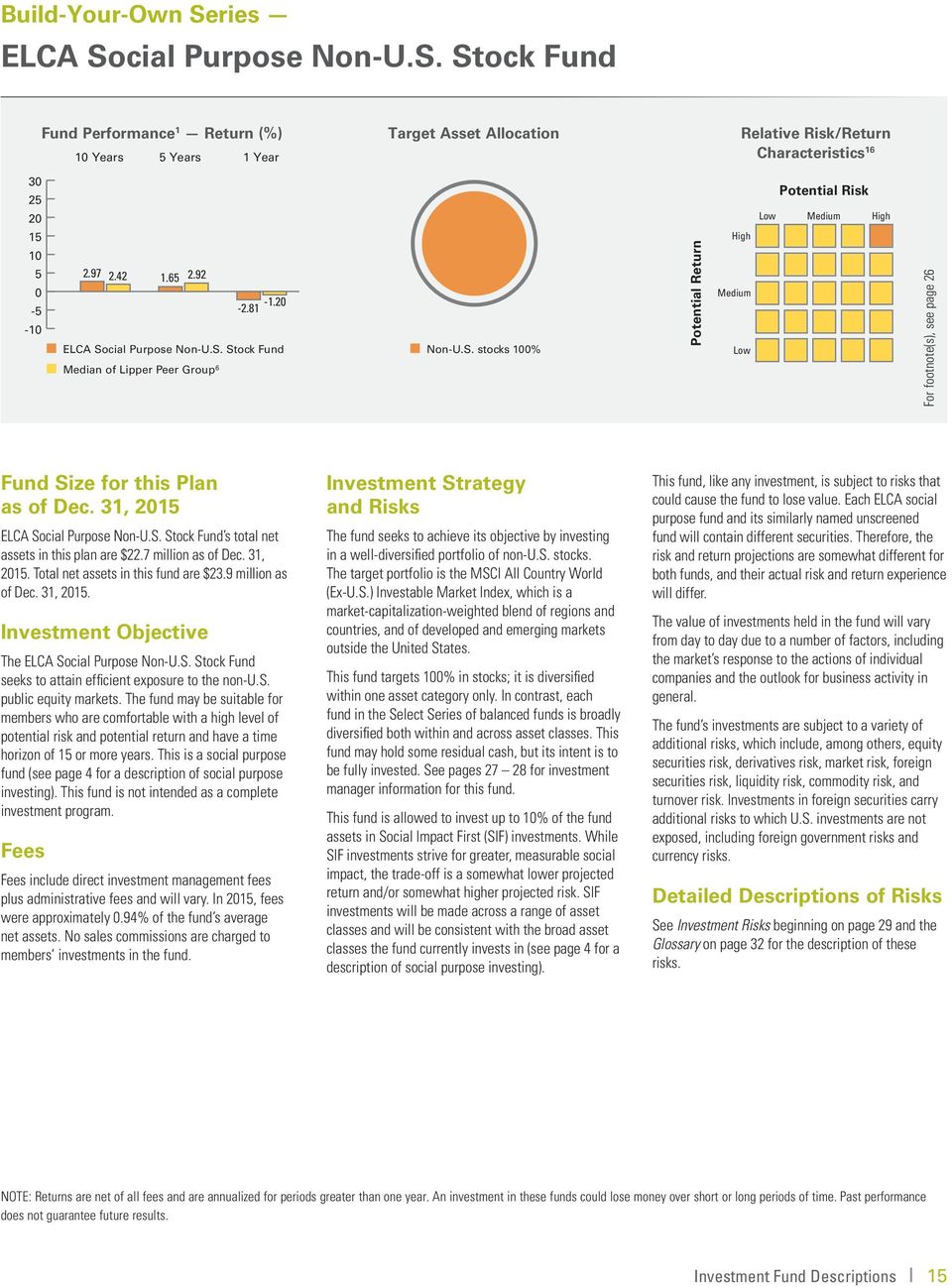
17 Build-Your-Own Series ELCA Social Purpose Non-U.S. Stock Fund 1 Years Years 1 Year n ELCA Social Purpose Non-U.S. Stock Fund n Median of Lipper Peer Group 6 n Non-U.S. stocks 1% For footnote(s), see page 26 ELCA Social Purpose Non-U.S. Stock Fund s total net assets in this plan are $22.7 million as of Dec. 31,. Total net assets in this fund are $23.9 million as of Dec. 31,. The ELCA Social Purpose Non-U.S. Stock Fund seeks to attain efficient exposure to the non-u.s. public equity markets. The fund may be suitable for members who are comfortable with a high level of potential risk and potential return and have a time horizon of or more years. This is a social purpose fund (see page 4 for a description of social purpose investing). This fund is not intended as a complete investment program. include direct investment management fees were approximately.94% of the fund s average The fund seeks to achieve its objective by investing in a well-diversified portfolio of non-u.s. stocks. The target portfolio is the MSCI All Country World (Ex-U.S.) Investable Market Index, which is a market-capitalization-weighted blend of regions and countries, and of developed and emerging markets outside the United States. This fund targets 1% in stocks; it is diversified within one asset category only. In contrast, each fund in the Select Series of balanced funds is broadly diversified both within and across asset classes. This fund may hold some residual cash, but its intent is to be fully invested. See pages for investment manager information for this fund. This fund is allowed to invest up to 1% of the fund assets in Social Impact First (SIF) investments. While SIF investments strive for greater, measurable social impact, the trade-off is a somewhat lower projected return and/or somewhat higher projected risk. SIF investments will be made across a range of asset classes and will be consistent with the broad asset classes the fund currently invests in (see page 4 for a description of social purpose investing). This fund, like any investment, is subject to risks that could cause the fund to lose value. Each ELCA social purpose fund and its similarly named unscreened fund will contain different securities. Therefore, the risk and return projections are somewhat different for both funds, and their actual risk and return experience will differ. The value of investments held in the fund will vary from day to day due to a number of factors, including the market s response to the actions of individual companies and the outlook for business activity in general. The fund s investments are subject to a variety of additional risks, which include, among others, equity securities risk, derivatives risk, market risk, foreign securities risk, liquidity risk, commodity risk, and turnover risk. Investments in foreign securities carry additional risks to which U.S. investments are not exposed, including foreign government risks and currency Investment Fund Descriptions I
18 Build-Your-Own Series ELCA U.S. Stock Fund 1 Years Years 1 Year n ELCA U.S. Stock Fund n U.S. stocks 1% n Median of Lipper Peer Group 7 For footnote(s), see page 26. ELCA U.S. Stock Fund s total net assets in this plan are $73.7 million. Total net assets in this fund are $79.9 million. The ELCA U.S. Stock Fund seeks to attain efficient exposure to the U.S. public equity markets. The fund may be suitable for members who are comfortable with a high level of potential risk and potential return and have a time horizon of or more years. This fund is not intended as a complete investment program. include direct investment management fees were approximately.69% of the fund s average The fund seeks to achieve its objective by investing in a well-diversified portfolio of U.S. stocks representing the broad U.S. stock market. This fund targets 1% in stocks; it is diversified within one asset category only. In contrast, each fund in the Select Series of balanced funds is broadly diversified both within and across asset classes. This fund may hold some residual cash, but its intent is to be fully invested. See pages for investment manager information for this fund. This fund, like any investment, is subject to risks that could cause the fund to lose value. The value of investments held in the fund will vary from day to day due to a number of factors, including the market s response to the actions of individual companies and the outlook for business activity in general. The fund s investments are subject to a variety of additional risks, which include, among others, equity securities risk, derivatives risk, market risk, liquidity risk, commodity risk, and turnover risk. 16 I Portico Benefit Services

19 Build-Your-Own Series ELCA Social Purpose U.S. Stock Fund 1 Years Years 1 Year n ELCA Social Purpose U.S. Stock Fund n Median of Lipper Peer Group 7 n U.S. stocks 1% For footnote(s), see page 26 ELCA Social Purpose U.S. Stock Fund s total net assets in this plan are $46.2 million as of Dec. 31,. Total net assets in this fund are $47.9 million. The ELCA Social Purpose U.S. Stock Fund seeks to attain efficient exposure to the U.S. public equity markets. The fund may be suitable for members who are comfortable with a high level of potential risk and potential return and have a time horizon of or more years. This is a social purpose fund (see page 4 for a description of social purpose investing). This fund is not intended as a complete investment program. include direct investment management fees were approximately.69% of the fund s average The fund seeks to achieve its objective by investing in a well-diversified portfolio of U.S. stocks representing the broad U.S. stock market. This fund targets 1% in stocks; it is diversified within one asset category only. In contrast, each fund in the Select Series of balanced funds is broadly diversified both within and across asset classes. This fund may hold some residual cash, but its intent is to be fully invested. See pages for investment manager information for this fund. This fund is allowed to invest up to 1% of the fund assets in Social Impact First (SIF) investments. While SIF investments strive for greater, measurable social impact, the trade-off is a somewhat lower projected return and/or somewhat higher projected risk. SIF investments will be made across a range of asset classes and will be consistent with the broad asset classes the fund currently invests in (see page 4 for a description of social purpose investing). This fund, like any investment, is subject to risks that could cause the fund to lose value. Each ELCA social purpose fund and its similarly named unscreened fund will contain different securities. Therefore, the risk and return projections are somewhat different for both funds, and their actual risk and return experience will differ. The value of investments held in the fund will vary from day to day due to a number of factors, including the market s response to the actions of individual companies and the outlook for business activity in general. The fund s investments are subject to a variety of additional risks, which include, among others, equity securities risk, derivatives risk, market risk, liquidity risk, commodity risk, and turnover risk. Investment Fund Descriptions I 17

20 Build-Your-Own Series ELCA Social Purpose Stock Index Fund 1 Years Years 1 Year n ELCA Social Purpose Stock Index Fund n Performance Benchmark 8 For footnote(s), see page 26. ELCA Social Purpose Stock Index Fund s total net assets in this plan are $42.1 million as of Dec. 31,. Total net assets in this fund are $43.8 million. The ELCA Social Purpose Stock Index Fund seeks to use a passive style of portfolio management to generate a rate of return from investments in small-, medium-, and large-capitalization U.S. stock investments. The fund may be suitable for members who are comfortable with a high level of potential risk and potential return and have a time horizon of or more years. This is a social purpose fund (see page 4 for a description of social purpose investing). This fund is not intended as a complete investment program. include direct investment management fees were approximately.4% of the fund s average The fund seeks to achieve its objective by investing primarily in the small-, medium-, and largecapitalization stocks that make up the Russell 3 Stock Index in roughly the same proportions as those stocks held in the index. This fund targets 1% in U.S. stocks; it is diversified within one asset category only. In contrast, each fund in the Select Series of balanced funds is broadly diversified both within and across asset classes. This fund may hold some residual cash, but its intent is to be fully invested. See pages for investment manager information for this fund. This fund, like any investment, is subject to risks that could cause the fund to lose value. The value of investments held in the fund will vary from day to day due to a number of factors, including the market s response to the actions of individual companies and the outlook for business activity in general. The fund s investments are subject to a variety of additional risks, which include, among others, equity securities risk, derivatives risk, market risk, liquidity risk, commodity risk, and turnover risk. 18 I Portico Benefit Services

21 Build-Your-Own Series ELCA S&P Stock Index Fund 9 1 Years Years 1 Year n ELCA S&P Stock Index Fund 9 n U.S. stocks 1% n Median of Lipper Peer Group 1 For footnote(s), see page 26 ELCA S&P Stock Index Fund s total net assets in this plan are $124. million. Total net assets in this fund are $139.1 million as of Dec. 31,.. The ELCA S&P Stock Index Fund 1 seeks to use a passive style of portfolio management to generate a rate of return from investments in large capitalization U.S. stock investments. The fund may be suitable for members who are comfortable with a high level of potential risk and potential return and have a time horizon of or more years. This fund is not intended as a complete investment program. include direct investment management fees were approximately.39% of the fund s average The fund seeks to achieve its objective by investing primarily in the large capitalization stocks that make up the Standard & Poor s Index, in roughly the same proportions as those stocks held in the index. This fund targets 1% in U.S. stocks; it is diversified within one asset category only. In contrast, each fund in the Select Series of balanced funds is broadly diversified both within and across asset classes. This fund may hold some residual cash, but its intent is to be fully invested. See pages for investment manager information for this fund. This fund, like any investment, is subject to risks that could cause the fund to lose value. The value of investments held in the fund will vary from day to day due to a number of factors, including the market s response to the actions of individual companies and the outlook for business activity in general. The fund s investments are subject to a variety of additional risks, which include, among others, equity securities risk, derivatives risk, market risk, liquidity risk, commodity risk, and turnover risk. NOTES: Returns are net of all fees and are annualized for periods greater than one year. An investment in these funds could lose money over short or long periods of time. Past performance S&P is a trademark of the McGraw-Hill Companies, Inc., and has been licensed for use by the Portico Benefit Services. The ELCA S&P Stock NOTE: Index Fund Returns is not are sponsored, net of all fees endorsed, and are sold annualized or promoted for by periods Standard greater & Poor s, than one and year. Standard An investment & Poor s makes in these no representation funds could lose regarding money over the advisability short or long of periods investing of in time. the Past fund. performance Investment Fund Descriptions I 19
22 Build-Your-Own Series ELCA Small- and Mid-Cap Stock Index Fund 1 Years Years 1 Year n ELCA Small- and Mid-Cap Stock Index Fund n Performance Benchmark 11 For footnote(s), see page 26. ELCA Small- and Mid-Cap Stock Index Fund s total net assets in this plan are $113. million as of Dec. 31,. Total net assets in this fund are $121.9 million. The ELCA Small- and Mid-Cap Stock Index Fund seeks to use a passive style of portfolio management to generate a rate of return from investments in small-to-medium capitalization U.S. stock investments. The fund may be suitable for members who are comfortable with a high level of potential risk and potential return and have a time horizon of or more years. This fund is not intended as a complete investment program. include direct investment management fees were approximately.43% of the fund s average The fund seeks to achieve its objective by investing primarily in the small-to-medium capitalization stocks that make up the Dow Jones U.S. Completion Total Stock Market Index, in roughly the same proportions as those stocks held in the index. Small- and midcapitalization stocks are generally defined as stocks of companies with less than approximately $ billion in outstanding market value (share price times number of shares outstanding). This fund targets 1% in U.S. stocks; it is diversified within one asset category only. In contrast, each fund in the Select Series of balanced funds is broadly diversified both within and across asset classes. This fund may hold some residual cash, but its intent is to be fully invested. See pages for investment manager information for this fund. This fund, like any investment, is subject to risks that could cause the fund to lose value. The value of investments held in the fund will vary from day to day due to a number of factors, including the market s response to the actions of individual companies and the outlook for business activity in general. The fund s investments are subject to a variety of additional risks, which include, among others, equity securities risk, small and growth company risks, derivatives risk, market risk, liquidity risk, commodity risk, and turnover risk. The fund is expected to invest its assets in equities of companies with small- to medium-sized market capitalizations. Investing in these companies involves higher risks in some respects than investments in equities of companies with larger capitalizations. Prices of small-capitalization and even medium-capitalization equities are often more volatile than prices of large-capitalization equities. In addition, the risk of bankruptcy or insolvency of many smaller companies (with the attendant losses to investors) is higher than for larger, blue-chip companies. In addition, due to thin trading in some small-capitalization equities, an investment in those equities may be illiquid and may not be sold or disposed of in the ordinary course of business within a 31 consecutive calendar day period at approximately the value at which the fund has valued the assets. I Portico Benefit Services
23 Build-Your-Own Series ELCA Global Real Estate Securities Fund 1 Years Years 1 Year As of January, 1 16 (managed within ranges) n ELCA Global Real Estate Securities Fund 12 n Median of Lipper Peer Group 12 n U.S. real estate securities 6% n Non-U.S. real estate securities 4% For footnote(s), see page 26 ELCA Global Real Estate Securities Fund s total net assets in this plan are $9.6 million as of Dec. 31,. Total net assets in this fund are $6. million. The ELCA Global Real Estate Securities Fund seeks to achieve superior, long-term risk-adjusted returns relative to its benchmark. The fund may be suitable for members who are comfortable with a high level of potential risk and a moderate level of potential return and have a time horizon of or more years. This fund is not intended as a complete investment program. include direct investment management fees were approximately.73% of the fund s average The fund seeks to achieve its objective by investing in a well-diversified portfolio of equity real estate securities. The target asset allocation (see pie chart) includes a 1% allocation to real estate equity (stocks), which includes both U.S. and non-u.s. real estate stocks. The fund is managed within ranges of the target allocation percentages. Therefore, at any one time the actual allocation may be different. Investments include the stock of real estate investment trusts (REITs), investment builders, residential builders, developers, or other companies engaged in various aspects of the real estate business or that hold significant real estate assets. The fund will be composed principally of equityrelated real estate securities, and will be invested in stocks that are listed on national securities exchanges or traded in the over-the-counter market. This fund targets 1% in real estate investments; it is diversified within one asset class only. In contrast, each fund in the Select Series of balanced funds is broadly diversified both within and across asset classes. This fund may hold some residual cash, but its intent is to be fully invested. See pages for investment manager information for this fund. This fund, like any investment, is subject to risks that could cause the fund to lose value. The value of investments held in the fund will vary from day to day due to a number of factors, including the market s response to the actions of individual companies and the outlook for business activity in general. The fund s investments are subject to a variety of additional risks, which include, among others, equity securities risk, real estate ownership risks, environmental risks, derivatives risk, market risk, foreign securities risk, liquidity risk, commodity risk, and turnover risk. Risks incident to ownership of real estate include risks associated with changes in the general economic climate, changes in the overall real estate market, local real estate conditions, the financial condition of tenants, buyers and sellers of properties, supply of or demand for competing properties in an area, accelerated construction activity, technological innovations that dramatically alter space requirements, the availability of financing, changes in interest rates, competition based on rental rates, energy and supply shortages, operating cost increases, the quality of maintenance, insurance and management services, various uninsured and uninsurable risks, and government regulations. Real estate values are also affected by such factors as government regulations (including those governing usage, improvements, zoning, and taxes), interest rate levels, the availability of financing, and potential liability under changing environmental and other laws. Investments in foreign securities carry additional risks to which U.S. investments are not exposed, including foreign government risks and currency Investment Fund Descriptions I 21
24 Build-Your-Own Series ELCA -Yield Bond Fund 1 Years Years 1 Year n ELCA -Yield Bond Fund n Median of Lipper Peer Group 13 n -yield bonds 1% For footnote(s), see page 26. ELCA -Yield Bond Fund s total net assets in this plan are $47.1 million. Total net assets in this fund are $.8 million. The ELCA -Yield Bond Fund seeks to attain efficient exposure to the U.S. high-yield fixedincome market. This generally involves portfolio management approaches that seek to avoid undue principal risk by emphasizing higher credit quality (for example, core high-yield, rated BB or B) and cash-yielding securities in a well-diversified manner. The fund may be suitable for members who are comfortable with a moderate level of potential risk and potential return and have a time horizon of seven or more years. This fund is not intended as a complete investment program. include direct investment management fees were approximately.81% of the fund s average The fund seeks to achieve its objective by investing primarily in fixed-income securities rated below the equivalent of BBB (below investment grade). The minimum overall credit quality rating shall be single B or equivalent. This fund targets 1% in high-yield, fixed-income investments; it is diversified within one asset class only. In contrast, each fund in the Select Series of balanced funds is broadly diversified both within and across a range of asset classes. This fund may hold some residual cash, but its intent is to be fully invested. See pages for investment manager information for this fund. This fund, like any investment, is subject to risks that could cause the fund to lose value. The value of investments held in the fund will vary from day to day due to a number of factors, including the market s response to the actions of individual companies and the outlook of business activity in general. The fund s investments are subject to a variety of additional risks, which include, among others, fixedincome securities risk, credit risk, change in rating risk, interest rate risk, prepayment and extension risk, duration risk, derivatives risk, market risk, foreign securities risk, liquidity risk, commodity risk, and turnover risk. In addition, changes in bond ratings may influence the value of securities held in the portfolio. Companies issuing bonds with ratings below Baa/BBB many times have less stable or shorter performance records or have experienced significant events that could cause them to be unable to pay back interest and principal (default on debt payments). Investments in foreign securities carry additional risks to which U.S. investments are not exposed, including foreign government risks and currency 22 I Portico Benefit Services
25 Build-Your-Own Series ELCA Bond Fund 1 Years Years 1 Year n ELCA Bond Fund n Median of Lipper Peer Group 14 n Core bonds 1% For footnote(s), see page 26 ELCA Bond Fund s total net assets in this plan are $136.9 million. Total net assets in this fund are $146.9 million. The ELCA Bond Fund seeks to attain efficient exposure to the investment-grade fixed-income markets. The fund may be suitable for members who are comfortable with a modest level of potential risk and potential return and have a time horizon of three or more years. This fund is not intended as a complete investment program. include direct investment management fees were approximately.47% of the fund s average The fund seeks to achieve its objective by combining investments primarily in three fixed-income markets U.S. Treasury, corporate bonds and mortgagebacked (collateralized) bonds into a single, welldiversified portfolio. The fund primarily invests in U.S. bonds; however, the fund may invest in non-u.s. bonds as well. The minimum overall credit quality level shall be that of the benchmark. The minimum quality rating of any individual security at the time of purchase will be BBB. This fund targets 1% in fixed-income investments; it is diversified within one asset class only. In contrast, each fund in the Select Series of balanced funds is broadly diversified both within and across a range of asset classes. This fund may hold some residual cash, but its intent is to be fully invested. See pages for investment manager information for this fund. This fund, like any investment, is subject to risks that could cause the fund to lose value. The fund is designed to have an overall risk exposure similar to that of the investment-grade bond market in general. The value of the investments held in the fund will vary from day to day due to a number of factors, including the market s response to the actions of individual companies and the outlook of business activity in general. In addition, changes in corporate bond ratings may influence the value of securities held in the portfolio. The fund s investments are subject to a variety of additional risks, which include, among others, fixedincome securities risk, credit risk, change in rating risk, interest rate risk, prepayment and extension risk, duration risk, derivatives risk, market risk, foreign securities risk, liquidity risk, commodity risk, and turnover risk. Investments in foreign securities carry additional risks to which U.S. investments are not exposed, including foreign government risks and currency Investment Fund Descriptions I 23
26 Build-Your-Own Series ELCA Social Purpose Bond Fund 1 Years Years 1 Year n ELCA Social Purpose Bond Fund n Median of Lipper Peer Group 14 n Core bonds 1% For footnote(s), see page 26. ELCA Social Purpose Bond Fund s total net assets in this plan are $8.2 million. Total net assets in this fund are $84.8 million. The ELCA Social Purpose Bond Fund seeks to attain efficient exposure to the investment-grade fixed-income markets. The fund may be suitable for members who are comfortable with a modest level of potential risk and potential return and have a time horizon of three or more years. This is a social purpose fund (see page 4 for a description of social purpose investing). This fund is not intended as a complete investment program. include direct investment management fees were approximately.47% of the fund s average The fund seeks to achieve its objective by combining investments primarily in three fixedincome markets U.S. Treasury, corporate bonds, mortgage-backed (collateralized) bonds and community development bonds into a single, well-diversified portfolio. The fund primarily invests in U.S. bonds; however, the fund may invest in non-u.s. bonds as well. The minimum overall credit quality level shall be that of the benchmark. The minimum quality of any individual security at the time of purchase will be BBB. This fund targets 1% in fixed-income investments; it is diversified within one asset class only. In contrast, each fund in the Select Series of balanced funds is broadly diversified both within and across a range of asset classes. This fund may hold some residual cash, but its intent is to be fully invested. See pages for investment manager information for this fund. This fund is allowed to invest up to 1% of the fund assets in Social Impact First (SIF) investments. While SIF investments strive for greater, measurable social impact, the trade-off is a somewhat lower projected return and/or somewhat higher projected risk. SIF investments will be made across a range of asset classes and will be consistent with the broad asset classes the fund currently invests in (see page 4 for a description of social purpose investing). This fund, like any investment, is subject to risks that could cause the fund to lose value. Each ELCA social purpose fund and its similarly named unscreened fund will contain different securities. Therefore, the risk and return projections are somewhat different for both funds, their actual risk and return experience will differ. The fund is designed to have an overall risk exposure similar to that of the investment-grade bond market in general. The value of the investments held in the fund will vary from day to day due to a number of factors, including the market s response to the actions of individual companies and the outlook of business activity in general. In addition, changes in corporate bond ratings may influence the value of securities held in the portfolio. The fund s investments are subject to a variety of additional risks, which include, among others, fixedincome securities risk, credit risk, change in rating risk, interest rate risk, prepayment and extension risk, duration risk, derivatives risk, market risk, foreign securities risk, liquidity risk, commodity risk, and turnover risk. Investments in foreign securities carry additional risks to which U.S. investments are not exposed, including foreign government risks and currency 24 I Portico Benefit Services
27 Build-Your-Own Series ELCA Money Market Fund 1 Years Years 1 Year n ELCA Money Market Fund n Median of Lipper Peer Group n Cash equivalents 1% For footnote(s), see page 26 ELCA Money Market Fund s total net assets in this plan are $1.2 million. Total net assets in this fund are $129.6 million. The ELCA Money Market Fund seeks to achieve superior, long-term risk-adjusted returns, prudently achievable from a portfolio of money-market investments. The fund may be suitable for members who are comfortable with a low level of potential risk and potential return and have a time horizon of less than three years. This fund is not intended as a complete investment program. include direct investment management fees were approximately.38% of the fund s average The fund seeks to achieve its objective by investing in dollar-denominated, high-credit-quality, publicly traded short-term bond investments (loans to corporations and governments). The fund seeks to preserve value at $1 per share. See pages for investment manager information for this fund. This fund, like any investment, is subject to risks that could cause the fund to lose value. Fund investments are subject to income risk, inflation risk, and interest rate risk. Income risk refers to the possibility that, due to falling market interest rates, the income investors receive from the fund may decline. Inflation risk refers to the increases in the general level of prices that may erode the purchasing power of investment fund balances over time. Interest rate risk refers to the fact that investments in this fund may fall in value as interest rates rise. NOTE: This fund has experienced a negative net return (loss) that is likely to continue in a low interest rate environment. In low interest rate environments, there is a risk that the return on the money market fund, after investment management fees, can be less than the administrative expenses charged by Portico Benefit Services, resulting in a negative net return (or loss) for plan members. Investment Fund Descriptions I
28 Fund Description Footnotes Notes: Returns are net of all fees and are annualized for periods greater than one year. An investment in these funds could lose money over short or long periods of time. Past performance does not guarantee future results. As of Dec. 31, 12, Portico began using Lipper fund classification comparisons. These comparisons use the median (middle) return of mutual funds classified by Lipper and exclude the I institutional share class. Lipper fund classifications are more widely known and provide a more common comparison to other funds with similar investment mandates to the ELCA funds for purposes of comparing investments available to retail investors, such as investments available to an Individual Retirement Account (IRA). Like the ELCA funds, the Lipper returns are net of all fees. Portico continues to use stock index comparisons for the Social Purpose Stock Index and the Small- and Mid-Cap Stock Index Funds, because comparable Lipper peer groups are not available. Unlike Lipper peer groups, stock index comparisons do not include any fees or expenses. Lipper data obtained from Wilshire Associates, Inc. (Wilshire Compass). All of the mutual fund information contained in this display was supplied by Lipper, a Thomson Reuters Company, subject to the following: Copyright 12 Reuters. All rights reserved. Lipper shall not be liable for any errors or delays in the content, or for any actions taken in reliance thereon. 1. An investment in these funds could lose money over short or long periods of time. Past performance is no guarantee of future results. Actual fund returns are net of all fees and are annualized for periods greater than one year. 2. The 8e Balanced Fund s peer fund group is the Lipper Mixed-Asset Target Allocation Growth Funds. 3. The 6e Balanced Fund s peer fund groups are the Lipper Mixed-Asset Target Allocation Growth Funds and Lipper Mixed-Asset Target Allocation Moderate Funds. NOTE: Because the target equity allocation for this fund does not fall within the available Lipper fund classifications, two Lipper fund classification comparisons are shown. The target equity allocation of this fund falls at the high end of the equity allocation of one of the Lipper classifications and falls at the low end of the equity allocation of the other Lipper classification. 4. The 4e Balanced Fund s peer fund groups are the Lipper Mixed-Asset Target Allocation Moderate Funds and Lipper Mixed-Asset Target Allocation Conservative Funds. NOTE: Because the target equity allocation for this fund does not fall within the available Lipper fund classifications, two Lipper fund classification comparisons are shown. The target equity allocation of this fund falls at the high end of the equity allocation of one of the Lipper classifications and falls at the low end of the equity allocation of the other Lipper classification.. The Global Stock Fund s peer fund group is the Lipper Global Multi-Cap Core Funds. 6. The Non-U.S. Stock Fund s peer fund group is the Lipper International Multi-Cap Core Funds. 7. The U.S. Stock Fund s peer fund group is the Lipper Multi-Cap Core Funds. 8. The Social Purpose Stock Index Fund s benchmark is the Russell 3 Stock Index. 9. "S&P " is a trademark of the McGraw-Hill Companies, Inc., and has been licensed for use by Portico Benefit Services. The ELCA S&P Stock Index Fund is not sponsored, endorsed, sold, or promoted by Standard & Poor's, and Standard & Poor's makes no representation regarding the advisability of investing in the fund. 1. The S&P Stock Index Fund s peer fund group is the Lipper S&P Index Objective Funds. 11. The Small- and Mid-Cap Stock Index Fund s benchmark is the Dow Jones U.S. Completion Total Stock Market Index. 12. The Global Real Estate Fund s peer fund group is the Lipper Global Real Estate Funds. The Lipper peer group shown includes mutual funds that owned both U.S. and non-u.s. real estate securities for all time periods shown. This asset class was managed as a 1% U.S. real estate securities pool prior to December 8, at which time it was expanded to include non-u.s. real estate securities. 13. The -Yield Bond Fund s peer fund group is the Lipper Yield Funds. 14. The Bond Fund s peer fund group is the Lipper Core Bond.. The Money Market Fund s peer fund group is the Lipper Money Market Instrument Funds. This fund has experienced a negative net return (loss) that is likely to continue in a low interest rate environment. In low interest rate environments, there is a risk that the return on the money market fund, after investment management fees, can be less than the administrative expenses charged by Portico, resulting in a negative net return (or loss) for plan members. 16. The positioning of funds on the potential risk/ return charts in no way reflects Portico s opinion of which fund(s) may be appropriate for a given investor. You should carefully consider the target asset allocations, investment objectives, risks, charges, and expenses of any fund before investing in it. Potential risk refers to the degree of annual volatility in potential returns. er risk funds have a greater potential of losing value in any one-year period. This chart is intended to show relative levels of risk/return potential for the funds. It does not purport to show absolute levels of risk/return. Potential return refers to long-term returns. Over most 1-year periods, higher-potential-return funds are anticipated to return more than lower-potential-return funds. 26 I Portico Benefit Services
29 ELCA Retirement Plan Fund Managers Fund Managers The ELCA investment funds are investment pools managed under the supervision of Portico Benefit Services. They are not mutual funds. Portico is responsible for establishing the investment objectives and strategy for the various investment choices in your ELCA Retirement Plan. Where Portico does not manage assets directly, Portico s investment staff identifies and hires investment managers in each investment category to assist in carrying out Portico s strategy. The current investment manager(s) of each ELCA fund is shown below. ELCA FUND MANAGERS Asset Category Manager(s) 1 ELCA Fund(s) Passively managed U.S. stock S&P Stock Index Small- and mid-cap stock index Passively managed U.S. stock Social purpose stock index Actively managed U.S. stock Non-U.S. stock Alternative equity BlackRock Institutional Trust Company, N.A. State Street Global Advisors Jackson Square Partners Frontier Capital Management Hotchkis and Wiley Capital Management Martingale Asset Management Los Angeles Capital Management and Equity Research Inc. LSV Asset Management Acadian Asset Management AQR Capital Management Baillie Gifford Overseas, Limited Mondrian Investment Partners State Street Global Advisors T. Rowe Price Associates Adams Street Partners Analytic Investors, LLC Portico Benefit Services Wilshire Private Markets Group ELCA 8e Balanced Fund ELCA 6e Balanced Fund ELCA 4e Balanced Fund ELCA Global Stock Fund ELCA U.S. Stock Fund ELCA S&P Stock Index Fund 2 ELCA Small- and Mid-Cap Stock Index Fund ELCA Social Purpose 8e Balanced Fund ELCA Social Purpose 6e Balanced Fund ELCA Social Purpose 4e Balanced Fund ELCA Social Purpose U.S. Stock Fund ELCA Social Purpose Stock Index Fund ELCA Social Purpose Global Stock Fund ELCA 8e Balanced Fund ELCA Social Purpose 8e Balanced Fund ELCA 6e Balanced Fund ELCA Social Purpose 6e Balanced Fund ELCA 4e Balanced Fund ELCA Social Purpose 4e Balanced Fund ELCA Global Stock Fund ELCA Social Purpose Global Stock Fund ELCA U.S. Stock Fund ELCA Social Purpose U.S. Stock Fund ELCA 8e Balanced Fund ELCA Social Purpose 8e Balanced Fund ELCA 6e Balanced Fund ELCA Social Purpose 6e Balanced Fund ELCA 4e Balanced Fund ELCA Social Purpose 4e Balanced Fund ELCA Global Stock Fund ELCA Social Purpose Global Stock Fund ELCA Non-U.S. Stock Fund ELCA Social Purpose Non-U.S. Stock Fund ELCA 8e Balanced Fund ELCA Social Purpose 8e Balanced Fund ELCA 6e Balanced Fund ELCA Social Purpose 6e Balanced Fund ELCA 4e Balanced Fund ELCA Social Purpose 4e Balanced Fund ELCA Global Stock Fund ELCA Social Purpose Global Stock Fund Social Impact First Equity & Other Impax Asset Management ELCA Social Purpose 8e Fund ELCA Social Purpose 6e Fund ELCA Social Purpose 4e Fund ELCA Social Purpose Global Stock Fund ELCA Social Purpose Non-U.S. Stock Fund ELCA Social Purpose U.S. Stock Fund Investment Fund Descriptions I 27
30 ELCA Retirement Plan Fund Managers ELCA FUND MANAGERS (CONTINUED) Asset Category Manager(s) 1 ELCA Fund(s) Investment-grade bond -yield bond PIMCO Portico Benefit Services State Street Global Advisors Allianz Global Investors Loomis, Sayles & Company T. Rowe Price Associates ELCA 8e Balanced Fund ELCA Social Purpose 8e Balanced Fund ELCA 6e Balanced Fund ELCA Social Purpose 6e Balanced Fund ELCA 4e Balanced Fund ELCA Social Purpose 4e Balanced Fund ELCA Bond Fund ELCA Social Purpose Bond Fund ELCA 8e Balanced Fund ELCA Social Purpose 8e Balanced Fund ELCA 6e Balanced Fund ELCA Social Purpose 6e Balanced Fund ELCA 4e Balanced Fund ELCA Social Purpose 4e Balanced Fund ELCA -Yield Bond Fund Inflation-indexed bond State Street Global Advisors ELCA 4e Balanced Fund ELCA Social Purpose 4e Balanced Fund Social Impact First Fixed Income Portico Benefit Services ELCA Social Purpose 8e Fund ELCA Social Purpose 6e Fund ELCA Social Purpose 4e Fund ELCA Social Purpose Bond Fund Global real estate securities Duff & Phelps Investment Management Co. BlackRock Institutional Trust Company, N.A. ELCA 8e Balanced Fund ELCA Social Purpose 8e Balanced Fund ELCA 6e Balanced Fund ELCA Social Purpose 6e Balanced Fund ELCA 4e Balanced Fund ELCA Social Purpose 4e Balanced Fund ELCA Global Real Estate Securities Fund Public natural resources BlackRock Institutional Trust Company, N.A. ELCA 8e Balanced Fund ELCA Social Purpose 8e Balanced Fund ELCA 6e Balanced Fund ELCA Social Purpose 6e Balanced Fund ELCA 4e Balanced Fund ELCA Social Purpose 4e Balanced Fund Illiquid real assets (private real estate) Portico Benefit Services ELCA 8e Balanced Fund ELCA Social Purpose 8e Balanced Fund ELCA 6e Balanced Fund ELCA Social Purpose 6e Balanced Fund ELCA 4e Balanced Fund ELCA Social Purpose 4e Balanced Fund Cash equivalents The Vanguard Group ELCA Money Market Fund Residual cash Standish Mellon Asset Management Company LLC All funds 1. The investment managers are current as of April, Portico Benefit Services reserves the right to change investment managers from time to time without notice. For the most current list of ELCA fund managers, visit myportico.porticobenefits.org 2. S&P is a trademark of the McGraw-Hill Companies, Inc., and has been licensed for use by Portico Benefit Services. The ELCA S&P Stock Index Fund is not sponsored, endorsed, sold, or promoted by Standard & Poor's, and Standard & Poor's makes no representation regarding the advisability of investing in the fund. 28 I Portico Benefit Services ELCA Retirement Plan Fund Managers I 28
31 Investment Risks The following summarizes investment risks that apply to the investment funds. The investment risks for each fund are different depending on the specific fund s asset allocation. Management Risk The process used by portfolio managers in selecting the specific securities in which the investment funds will invest includes economic and valuation considerations as well as diversification benefits. The portfolio managers skill in choosing appropriate investments will affect the ability of the investment funds to achieve their investment objectives. If the portfolio managers assumptions about the prospects for individual securities are incorrect, this may result in losses in the investment funds investment in such security, which can also result in possible losses overall for the investment funds. Equity Securities Risk Some investment funds are expected to invest in equities of issuers in a variety of sectors including, but not necessarily limited to, large-capitalization, mediumcapitalization, and small-capitalization, as well as international, of both growth and value companies. Through its investments, some investment funds will be exposed to equity securities risk. The prices of stocks can rise or fall rapidly in response to developments affecting a specific company or industry, or to changing economic, political, or market conditions. Some investment funds investments may decline in value if the stock markets perform poorly. There is also a risk that the investment funds investments will underperform either the securities markets generally or particular segments of the securities markets. Additional equity securities risks are set forth below. Small- and -Capitalization Companies: Some investment funds are expected to invest in equities of companies with small- to mediumsized market capitalizations. Investing in these companies involve higher risks in some respects than investments in equities of companies with larger capitalizations. Prices of small-capitalization and even mediumcapitalization equities are often more volatile than prices of largecapitalization equities. In addition, the risk of bankruptcy or insolvency of many smaller companies (with the attendant losses to investors) is higher than for larger, blue-chip companies. In addition, due to thin trading in some small-capitalization equities, an investment in those equities may be illiquid. Growth and Value Companies: By investing in a mix of growth and value companies, some investment funds assume the risks of both. Investors often expect growth companies to increase their earnings at a certain rate. If these expectations are not met, investors can punish the stocks inordinately, even if earnings do increase. In addition, growth companies typically lack the dividend yield that may cushion stock prices in market downturns. Value companies are subject to the risk that they may never reach what the portfolio manager believes is their full market value, either because the market fails to recognize a stock s intrinsic worth or the portfolio manager misgauged that worth. They also may decline in price, even though in theory they are already undervalued. Alternative Equity Risk Alternative equity markets potential risk levels are notably higher than with other asset classes in some investment funds, including U.S. and non-u.s. public market equities. Alternative equity risks include long-term investment commitments and significantly greater illiquidity risks, higher business risks (as associated with early-stage venture capital), higher financial leverage (as associated with leveraged buyouts), lower levels of information quality, accessibility, and transparency, and active participation in companies by general partners/managers. Over longer historical time periods, the dispersion of returns across alternative equity investors has been extremely wide, particularly with respect to general partners/ managers as well as across market segments and investment cycles. It is anticipated that this will continue in the future. Fixed-Income Securities Risk Some investment funds are expected to invest in fixed-income securities, including, but not necessarily limited to, U.S. Treasury bonds across all maturities, investment-grade corporate bonds, mortgage-backed securities, and highyield corporate bonds. Through their investments, some investment funds will be exposed to fixed-income risks described below: Credit Risk: Credit risk is the risk that issuers or guarantors of debt instruments or the counterparty to a derivatives contract, repurchase agreement, or loan of portfolio securities is unable or unwilling to make timely interest and/or principal payments or to otherwise honor its obligations. U.S. Treasury bonds have minimal credit risk because they are backed by the U.S. government s full faith and credit. Certain securities issued by U.S. government-sponsored entities, such as the Federal National Mortgage Association, Federal Home Loan Mortgage Corporation and Federal Home Loan Banks are not guaranteed by the U.S. government, and no assurance can be given that the U.S. government would provide financial support to its agencies or instrumentalities where it is not obligated to do so. Additionally, corporate bonds are subject to greater credit risk than U.S. government bonds, and high-yield bonds are subject to greater credit risk than higher-quality bonds. -yield bonds are commonly referred to as junk bonds and are subject to a substantial degree of credit risk. Change in Rating Risk: A credit rating is a measure of an issuer s expected ability to make all required interest and principal payments in a timely manner. An issuer with the highest credit rating has a very strong degree of certainty (or safety) with respect to Investment Risks I 29
32 Investment Risks making all payments. An issuer with the second-highest credit rating has strong capacity to make all payments, but the degree of safety is somewhat less. If a rating agency gives a debt security a lower rating, the value of the debt security will ordinarily decline because investors will demand a higher rate of return. er-rated debt securities, including high-yield bonds, carry greater investment risk, including the possibility of issuer default and bankruptcy and increased market price volatility. Bonds rated below investment-grade tend to be less marketable than higher-quality bonds because the market for them is less broad. The market for unrated bonds is even narrower. Interest Rate Risk: Interest rate risk is the risk that bond prices will decline over short or even long periods due to rising market interest rates. All bonds, including those issued by the U.S. government and its agencies, are subject to interest rate risk. Their prices tend to move in the opposite direction from market interest rate movements. When interest rates go up, bond prices tend to fall; when rates fall, prices tend to rise. Bonds with longer maturities are affected more by interest rate movements than bonds with shorter maturities, bonds with interest rate reset provisions, notes, or money market instruments. If prices throughout the economy were to decline over time, resulting in deflation, the principal and income of inflation-protected bonds held by some investment funds may decline in price, which would result in losses for those investment funds. Prepayment and Extension Risk: Prepayment risk is the risk that during periods of falling interest rates, an issuer of securities may be able to repay principal prior to the security s maturity, causing some investment funds to have to reinvest in securities with a lower yield. Extension risk is the risk that when interest rates rise, certain securities will be paid off substantially more slowly than originally anticipated and the value of those securities may fall sharply. Both prepayment risk and extension risk may result in a decline to those investment funds income. Duration Risk: Prices of fixed-income securities with longer effective maturities are more sensitive to interest rate changes than those with shorter effective maturities. Debt Liquidity Risk: There may be little trading in the secondary market for particular bonds, other debt securities, or derivatives, which may make them more difficult to value, acquire or sell. Real Assets Risk Investments in real assets involve a high degree of risk, including significant financial, operating, and competitive risks, and expose some investment funds to adverse macroeconomic conditions, such as a rise in interest rates or an economic downturn in a country in which a real asset is located, elevating the risk of loss. Also, real asset investments involve exposure to business cycles, local economic conditions and other factors that may not be present with other types of investments. These risks may be increased for investments in real assets located outside the United States. Commodity Risk Some investment funds may invest in financial futures and options, and may invest in other commodities indirectly through those investment funds allocation to alternative equity and private market partnership investments. Commodity prices can be volatile and may be either directly or indirectly affected by a wide range of factors. Some investment funds may utilize financial futures and options to assist in controlling risk and enhancing portfolio values in a manner that is prudent and intended to further the purposes of those investment funds. Accounts, including margin accounts, may be established with securities dealers to implement such commodity positions. Investments may not be made so as to leverage the total size of those investment funds. Some investment funds may use futures to help keep fully invested by equitizing cash (using cash to buy futures and gain exposure to equities). Some investment funds may also use forward contracts to reduce the risk of foreign currency fluctuations. Some investment funds manage exposure to short-term currency fluctuations in foreign securities by purchasing foreign currency contracts. These contracts are marked to market daily. The gains and losses on foreign currency contracts are netted against the gains and losses on the underlying foreign securities. Some investment funds could be exposed to risk if the value of the currency changes unfavorably, if the counterparties to the contract are unable to meet the terms of their contracts, or if those investment funds are unable to enter into a closing position. Commodity prices can be volatile and may be either directly or indirectly affected by a wide range of factors, including changes in overall market movements, real or perceived inflationary trends, commodity index volatility, changes in interest rates or currency exchange rates, population growth and changing demographics, and factors affecting a particular industry or commodity, such as drought, floods, or other weather conditions, livestock disease, trade embargoes, competition from substitute products, transportation bottlenecks or shortages, fluctuations in supply and demand, tariffs, and international economic, political, and regulatory developments. Real Estate Investment Risk Some investment funds are expected to include the stock of real estate investment trusts (REITs), investment builders, residential builders, developers, or other companies engaged in various 3 I Portico Benefit Services
33 Investment Risks aspects of the real estate business or that hold significant real estate assets. Those investment funds real estate investments will be comprised principally of equityrelated real estate securities and may be invested in stocks that are listed on national securities exchanges or traded in the over-the-counter market. Investment in equity securities in the real estate sector is subject to many of the same risks associated with the direct ownership of real estate, such as adverse changes in national, state, or local real estate conditions (resulting from, for example, oversupply of or reduced demand for space and changes in market rental rates), obsolescence of properties, changes in the availability, cost, and terms of mortgage funds, and the impact of tax, environmental, and other laws. Foreign and Emerging Market Securities Risk Some investment funds are expected to invest in securities that are issued outside the United States. Foreign securities are subject to additional risks not typically associated with investments in domestic securities. These risks may include, among others, country risks (political, diplomatic, regional conflicts, terrorism, war, social and economic instability, currency devaluations and policies that have the effect of limiting or restricting foreign investment, or the movement of assets), different trading practices, less government supervision, less publicly available information, limited trading markets, and greater volatility. Some foreign markets are considered to be emerging markets. Investment in these emerging markets is subject to a greater risk of loss than investments in a developed market. This is due to, among other things, greater market volatility, lower trading volume, political and economic instability, greater risk of market shutdown, and more governmental limitations on foreign investment policy than those typically found in a developed market. Short Sale Risk In order to help meet its investment objective, some investment funds may make short sales. Short sales involve selling a security it does not own in anticipation that the security s price will decline. Short sales expose the investment funds to the risk that it will be required to buy the security sold short (also known as covering the short position) at a time when the security has appreciated in value, thus resulting in a loss to the portfolio. Turnover Risk The investment funds pay transaction costs, such as commissions, when those investments buy and sell securities (or turn over its portfolio). A higher portfolio turnover rate may indicate higher transaction costs. These costs, which are not reflected in annual investment fund operating expenses, affect the investment funds performance. Securities Lending Portico seeks to increase the investment return in some investment funds by lending securities in those investment funds to brokers, dealers, and other financial institutions. Those investment funds could lose money if they do not recover the securities or the value of the collateral falls. Although the external lending agent assumes most risk of loss, losses are possible on reinvested cash collateral that could reduce earnings in some periods. The performance of the securities lending agent is monitored by Portico on an ongoing basis through reviews of the agent's lending activity, investment activity, positions, performance, and personnel changes. Investment Risks I 31
34 Glossary Following are definitions of terms specific to the ELCA Retirement Plan, as well as general investment terms. Alternative Equity Investments with equity-like characteristics that are privately negotiated transactions often involve active participation in companies by general partners/managers, are long-term illiquid commitments, and offer high potential returns and high potential risk. Can include venture capital, corporate finance, distressed securities, and other non-traditional areas. Asset Any possession that has value in an exchange. Asset Allocation The decision regarding how an investor s funds are distributed among the major classes of assets (stocks, bonds, cash equivalents, and real assets) available to the investor. Benchmark The performance of a pre-determined set of securities for comparison purposes. Benchmarks may be based on published indexes or be customized as appropriate to an investment strategy. Bonds Bonds are debt and are issued for a period of more than one year. The U.S. government, local governments, water districts, companies, and many other types of institutions sell bonds. When an investor buys bonds, he or she is lending money. The seller of the bond agrees to repay the principal amount of the loan at a specified time. Interest-bearing bonds pay interest periodically. Capital Appreciation The increase in an asset s market price. For example, if the price of a stock rises from $4 per share to $ per share, the stock has appreciated in value. Change in Rating Risk The risk that the credit or financial strength rating attributed to an issuer of securities will be reduced, resulting in a negative effect on the marketing price of the security. Credit Risk The risk that issuers or guarantors of debt instruments are unable or unwilling to make timely interest and/or principal payments or otherwise honor their obligations. Derivatives Risk Involves the risk that the value of derivatives may rise or fall more rapidly than other investments, and the risk that the fund may lose more than the amount invested in the derivative instrument in the first place. Derivative instruments also involve the risk that other parties to the derivative contract may fail to meet their obligations, which could cause losses. Duration Risk The risk that prices of fixed income securities with longer effective maturities are more sensitive to interest rate changes than those with shorter effective maturities. Equity Funds These funds invest primarily in stocks. Equity Securities Ownership interest in a corporation, indicated by shares (which represent a piece of the corporation s assets and earnings); sometimes referred to as stocks. Extension Risk The risk that when interest rates rise, certain securities will be paid off substantially more slowly than originally anticipated and the value of those securities may fall sharply. Fixed-Income Securities Investments representing a debt of the issuer to investors. Fixed-income securities are assets that pay a fixed dollar amount, such as bonds. Growth Fund An investment fund with a primary investment objective of long-term capital growth and capital gains rather than of current income. Inflation The rate at which the general level of prices for goods and services rises. Inflation Risk The risk investments won t earn enough to keep up with inflation. That is, the amount a dollar will buy today will decline over time. Even investments generally considered safe, like certificates of deposit (CDs) and money markets, experience this risk. Interest The price paid for borrowing money expressed as a percentage rate over a period of time. Interest Rate Risk The risk a security s value changes due to a change in interest rates. For example, if rates rise, bond values fall, and if rates fall, bond values rise. This risk can be managed by diversifying the durations of fixed-income investments. Typically, some should be shorter, and some longer term. 32 I Portico Benefit Services
35 Glossary Investment-Grade Bond A bond that is assigned a rating in the top four categories by commercial credit rating companies and generally is viewed as having little risk of default on the part of the issuer. Investment-grade or high grade is usually reserved for bonds rated BBB/BAA or higher by S&P/Moody s, respectively. The financial objective of an investor (for example, whether the investor requires income or capital appreciation). The investor s objective governs the investment strategy. A plan or method an investor uses when deciding how to allocate investments among asset classes such as stocks, bonds, cash equivalents, and real assets. The strategy should take into account the investor s age (time horizon), assets (financial resources), and attitude toward risk (risk tolerance). Investment Time Horizon The number of years you plan to keep your money invested. Long-Term Debt Debt securities with maturities of more than one year. Market Capitalization The total dollar value of all outstanding shares of a corporation and computed as shares times current market price. Market Risk The risk inherent in the market you invest in. For example, if you invest in stocks, your investments are affected by risks facing all stock investors, such as recession. This means your investments may move in the general direction (up or down) of the stock market. To manage market risk, diversify across markets, such as stock, bond, real estate, etc. Money Market Fund An investment fund that invests primarily in short-term (generally under one year) securities, such as high-liquidity Treasury bills, certificates of deposit, or commercial paper. These funds strive to maintain a net asset value of $1 per share. As with any investment, it is possible to lose money investing in a money market fund. Mutual Fund Mutual funds are pools of money that are managed by an investment company. They have a variety of investment objectives, depending on the fund and its investment charter. Funds can impose a sales charge, or load, on investors when they buy or sell shares. Mutual funds are investment companies regulated by the Investment Company Act of 194. Portfolio A collection of investments real investments (such as land or buildings) and/or financial investments (such as stocks or bonds). Prepayment Risk The risk that during periods of falling interest rates, an issuer of securities may be able to repay principal prior to the security s maturity, causing the fund to have to reinvest in securities with a lower interest rate. Principal The total amount of money borrowed or loaned. Or in the case of an investment, the original amount invested, separate from earnings. Real Assets The asset class used to describe tangible items such as real estate, timberland, oil and gas, etc. Real assets can be purchased directly or indirectly through a variety of investment instruments including publicly traded equity securities that may include, among others, real estate equity securities (stock of real estate investment trusts or REITs), energy, and energyrelated equity securities. Real assets may also include equity investments in private market instruments such as real estate partnerships. Real assets have some characteristics of equities (stocks), and in certain respects they may be viewed as increasing the equity allocation of a portfolio. Return The change in the value of an investment over a specific time period (including any distributions from the investment during that period). It is usually expressed as a percentage rate on an annualized basis for periods greater than one year. Securities Paper certificates (definitive securities) or electronic records (book-entry securities) evidencing ownership of equity (stocks) or debt obligations (bonds). Social Purpose Funds Investment funds managed using an investment analysis and selection process that systematically incorporates a fiduciary responsibility to members, and additionally considers social-, environmental-, and governanceoriented factors in the investment decision-making process. Stock See Equity Securities. Turnover Risk The risk that costs associated with the buying and selling of the securities in the fund will negatively affect the performance of the fund. Volatility A measure of risk based on the standard deviation of the return on an investment. From a practical standpoint, this is a measure of the size of the fluctuations (up and down) in return of an investment. Since some asset classes (stocks, bonds, etc.) experience larger fluctuations in return than others, consider spreading investments across several asset classes. Glossary I 33
36 Portico Benefit Services 8 Marquette Ave., Ste. 1 Minneapolis, MN / / F [email protected] / PorticoBenefits.org -69 (/16)
Balanced Fund RPBAX. T. Rowe Price SUMMARY PROSPECTUS
 SUMMARY PROSPECTUS RPBAX May 1, 2016 T. Rowe Price Balanced Fund A fund seeking capital growth and current income through a portfolio of approximately 65% stocks and 35% fixed income securities. Before
Overview of Your TIAA-CREF Investment Solutions SM Accounts
 Overview of Your TIAA-CREF Investment Solutions SM Accounts TIAA-CREF Investment Solutions SM now offers you nine mutual funds in addition to our fixed and variable annuity accounts. TIAA-CREF Investment
May 1, 2015 as amended June 1, 2015
 INSTITUTIONAL INVESTOR May 1, 2015 as amended June 1, 2015 DATE TARGET FUNDS MyDestination 2005 Fund MyDestination 2015 Fund MyDestination 2025 Fund MyDestination 2035 Fund MyDestination 2045 Fund MyDestination
INVESTMENT POLICY STATEMENT Valued Client
 INVESTMENT POLICY STATEMENT Valued Client August 17, 2010 PREPARED BY: John Ohl Bay Colony Advisors 91 Main St STE 308 Concord, Massachusetts 01742 (978) 369-7200 [email protected] www.baycolonyadvisors.com
CHOOSING YOUR INVESTMENTS
 CHOOSING YOUR INVESTMENTS FOR ASSISTANCE GO ONLINE For more information on your retirement plan, investment education, retirement planning tools and more, please go to www.tiaa-cref.org/carnegiemellon.
CHOOSING YOUR INVESTMENTS
 CHOOSING YOUR INVESTMENTS FOR ASSISTANCE CONTACT US TODAY FOR MORE INFORMATION, ADVICE OR HELP OPENING AN ACCOUNT, IT S EASY TO REACH US: BY PHONE Call us at 800 TIAA-CREF (800 842-2273) to speak with
Investment Funds Description
 Investment Funds Description As of January 1, 2016 (Containing performance and other information as of December 31, 2015 unless otherwise noted) Short Term Investment Fund Stable Value Fund Inflation Protection
Guide to mutual fund investing. Start with the basics
 Guide to mutual fund investing Start with the basics Pursue your financial goals Why do you invest? For a rainy day? A secure retirement? Funding a college tuition? Having a specific goal in mind will
Endowment Policies, Guidelines, and Objectives
 Tower Foundation of San Jose State University Endowment Policies, Guidelines, and Objectives Purpose of the Endowment Policy Statement This statement is issued by the Finance and Investment Committee (the
Glossary of Investment Terms
 online report consulting group Glossary of Investment Terms glossary of terms actively managed investment Relies on the expertise of a portfolio manager to choose the investment s holdings in an attempt
Investment Guide Funds offered through the Washington State Investment Board
 Investment Guide Funds offered through the Washington State Investment Board Investing Overview Asset allocation 2 Two investment approaches 2 Build and Monitor 3 One-Step 3 Diversification 4 Trading restrictions
The IBM 401(k) Plus Plan. Invest today for what you hope to accomplish tomorrow
 The IBM 401(k) Plus Plan Invest today for what you hope to accomplish tomorrow The IBM 401(k) Plus Plan Dollar-for-dollar company match, automatic company contributions, broad range of investment options
Prospectus Socially Responsible Funds
 Prospectus Socially Responsible Funds Calvert Social Investment Fund (CSIF) Balanced Portfolio Equity Portfolio Enhanced Equity Portfolio Bond Portfolio Money Market Portfolio Calvert Social Index Fund
Investment Policy Statement
 Investment Policy Statement For The Community Foundation of New River Valley Originated: February 24, 2005 Revised: September 6. 2005 Revised: June 26. 2007 1 Table of Contents ) 1 Introduction... 1 2
(expenses that you pay each year as a percentage of the value of your investment)
 July 31, 2015 SUMMARY PROSPECTUS SAAT Core Market Strategy Allocation Fund (SKTAX) Class A Before you invest, you may want to review the Fund s prospectus, which contains information about the Fund and
Asset Management Portfolio Solutions Disciplined Process. Customized Approach. Risk-Based Strategies.
 INSTITUTIONAL TRUST & CUSTODY Asset Management Portfolio Solutions Disciplined Process. Customized Approach. Risk-Based Strategies. As one of the fastest growing investment managers in the nation, U.S.
SUMMARY PROSPECTUS CALVERT GLOBAL ENERGY SOLUTIONS FUND INVESTMENT OBJECTIVE FEES AND EXPENSES OF THE FUND. Example. Portfolio Turnover
 SUMMARY PROSPECTUS February 1, 2016 CALVERT GLOBAL ENERGY SOLUTIONS FUND Class (Ticker): A (CGAEX) C (CGACX) Link to Prospectus (Table of Contents) Y (CGAYX) Link to Statement of Additional Information
GLOSSARY OF INVESTMENT-RELATED TERMS FOR NATIONAL ELECTRICAL ANNUITY PLAN PARTICIPANTS
 GLOSSARY OF INVESTMENT-RELATED TERMS FOR NATIONAL ELECTRICAL ANNUITY PLAN PARTICIPANTS General Information This Glossary of Investment-Related Terms for National Electrical Annuity Plan Participants (the
JPMorgan U.S. Equity Fund
 Prospectus J.P. Morgan U.S. Equity Funds Institutional Class Shares November 1, 2009 JPMorgan Disciplined Equity Fund JPMorgan Diversified Fund JPMorgan Mid Cap Value Fund JPMorgan Small Cap Growth Fund
Building an Investment Strategy
 Building an Investment Strategy Building an investment strategy that meets your risk tolerance and investment objectives is critical to successfully preparing for retirement. There are three key steps
SUPPLEMENT TO CALVERT VP NATURAL RESOURCES PORTFOLIO. Calvert Variable Products Portfolios Prospectus (Calvert VP Index Portfolios) dated May 1, 2016
 SUPPLEMENT TO CALVERT VP NATURAL RESOURCES PORTFOLIO Calvert Variable Products Portfolios Prospectus (Calvert VP Index Portfolios) dated May 1, 2016 Calvert VP Natural Resources Portfolio Summary Prospectus
STEWARD FUNDS MANAGING WEALTH, PROTECTING VALUES SOCIALLY RESPONSIBLE SCREENED FUNDS. PROSPECTUS August 28, 2015
 STEWARD FUNDS MANAGING WEALTH, PROTECTING VALUES SOCIALLY RESPONSIBLE SCREENED FUNDS Steward Large Cap Enhanced Index Fund Individual Class SEEKX Institutional Class SEECX Steward Small-Mid Cap Enhanced
ADVISORSHARES YIELDPRO ETF (NASDAQ Ticker: YPRO) SUMMARY PROSPECTUS November 1, 2015
 ADVISORSHARES YIELDPRO ETF (NASDAQ Ticker: YPRO) SUMMARY PROSPECTUS November 1, 2015 Before you invest in the AdvisorShares Fund, you may want to review the Fund s prospectus and statement of additional
CalPERS 457 Plan Target Retirement Date Funds
 CalPERS 457 Plan Target Retirement Date s September 30, 2015 Overview Target Retirement Date s (the "" or "s") are a series of diversified funds, each of which has a predetermined underlying asset mix
investing mutual funds
 investing mutual funds our mission The mission of The USAA Educational Foundation is to help consumers make informed decisions by providing information on financial management, safety concerns and significant
California State University, Fresno Foundation INVESTMENT POLICY STATEMENT
 INVESTMENT POLICY STATEMENT 1. Purposes of the Investment Policy Statement The purposes of this Investment Policy Statement for the management of the Foundation funds under management authority of the
Making Sense of Market Volatility: Retirement Planning Strategies for the Everyday Investor. October, 2008
 Making Sense of Market Volatility: Retirement Planning Strategies for the Everyday Investor October, 2008 1 Market Ups and Downs Recent news is full of anxiety-causing developments: Credit crunch Bank
MML SERIES INVESTMENT FUND
 This Prospectus describes the following Funds. MML SERIES INVESTMENT FUND MML Money Market Fund seeks to maximize current income, preserve capital and maintain liquidity by investing in money market instruments.
T. Rowe Price International Stock Portfolio
 T. Rowe Price International Stock Portfolio Supplement to Summary Prospectus Dated May 1, 2014 The portfolio manager table under Management is supplemented as follows: Effective April 1, 2015, Richard
Start investing in yourself today, with help from the University System of Maryland Supplemental 403(b) Plan and Fidelity.
 University System of Maryland Supplemental 403(b) Plan (#65612) Start investing in yourself today, with help from the University System of Maryland Supplemental 403(b) Plan and Fidelity. Invest some of
Target Retirement Funds
 Prospectus March 1, 2015 Target Retirement Funds Institutional Class Administrative Class Investor Class Harbor Target Retirement Income Fund HARAX HARBX HARCX Harbor Target Retirement 2015 Fund HARGX
Nuveen Intelligent Risk Conservative Allocation Fund will be liquidated after the close of business on June 24, 2016.
 NUVEEN INTELLIGENT RISK CONSERVATIVE ALLOCATION FUND SUPPLEMENT DATED APRIL 18, 2016 TO THE SUMMARY PROSPECTUS DATED DECEMBER 31, 2015 Nuveen Intelligent Risk Conservative Allocation Fund will be liquidated
Retirement Balanced Fund
 SUMMARY PROSPECTUS TRRIX October 1, 2015 T. Rowe Price Retirement Balanced Fund A fund designed for retired investors seeking capital growth and income through investments in a combination of T. Rowe Price
T. Rowe Price Target Retirement 2030 Fund Advisor Class
 T. Rowe Price Target Retirement 2030 Fund Advisor Class Supplement to Summary Prospectus Dated October 1, 2015 Effective February 1, 2016, the T. Rowe Price Mid-Cap Index Fund and the T. Rowe Price Small-Cap
Please read this important information for Yale University Matching Retirement Plan participants
 Please read this important information for Yale University Matching Retirement Plan participants This notice gives you important information about the default investment funds selected for the Matching
INVESTMENT TERM GLOSSARY
 A Accrued Interest - Interest that has been earned but not yet credited to a bond or other fixed-income investment, such as a certificate of deposit. Active Management The use of professional investment
ANNUITIES VARIABLE. MetLife Retirement Perspectives. asset allocation questionnaire
 LINE BAN ANNUITIES VARIABLE MetLife Retirement Perspectives asset allocation questionnaire Asset Allocation Questionnaire The following questions will enable you to determine your time horizon and risk
The Master Statement of Investment Policies and Objectives of The Lower Colorado River Authority Retirement Plan and Trust. Amended June 16, 2015
 The Master Statement of Investment Policies and Objectives of The Lower Colorado River Authority Retirement Plan and Trust Amended June 16, 2015 Introduction The Lower Colorado River Authority ( LCRA )
ALLOCATION STRATEGIES A, C, & I SHARES PROSPECTUS August 1, 2015
 ALLOCATION STRATEGIES A, C, & I SHARES PROSPECTUS August 1, 2015 Investment Adviser: RidgeWorth Investments A Shares C Shares I Shares Aggressive Growth Allocation Strategy SLAAX CLVLX CVMGX Conservative
INVESTMENT POLICY STATEMENT. Creighton University 403(b) Retirement Plan
 INVESTMENT POLICY STATEMENT For Creighton University 403(b) Retirement Plan November 2008 Cornerstone Advisors Asset Management, Inc. 74 West Broad Street, Suite 340 Bethlehem, PA 18018 TABLE OF CONTENTS
City National Rochdale High Yield Bond Fund a series of City National Rochdale Funds
 City National Rochdale High Yield Bond Fund a series of City National Rochdale Funds SUMMARY PROSPECTUS DATED JANUARY 31, 2015, AS SUPPLEMENTED MAY 1, 2015 Class: Institutional Class Servicing Class Class
1 Year 3 Years 5 Years 10 Years
 Summary Prospectus Gerstein Fisher Multi-Factor International Growth Equity Fund Trading Symbol: GFIGX March 30, 2015 Before you invest, you may want to review the Fund s prospectus, which contains more
ThoughtCapital. Investment Strength and Flexibility
 Investment Strength and Flexibility Principal Trust SM Target Date Funds The Principal Trust SM Target Date Funds (Target Date Funds) are designed to capitalize on the growing popularity of Do-It-For-Me
INDEPENDENT SCHOOL DISTRICT #877 POLICY. Buffalo-Hanover-Montrose. POLICY TITLE Investments OPEB CODE NO. 705.1
 INDEPENDENT SCHOOL DISTRICT #877 POLICY Buffalo-Hanover-Montrose INDEX TITLE Noninstructional Operations and Business Services SERIES NO. 700 POLICY TITLE Investments OPEB CODE NO. 705.1 I. Purpose The
Customer Investment Profile
 Customer Name: Account Number: Contact Number: The purpose of this investment profile form is for us to better understand your financial means, investment experience, investment objectives and general
I.A.M. National 401(k) Plan. Investment Options Summary
 I.A.M. National 401(k) Plan Investment Options Summary The I.A.M. National 401(k) Plan offers a diverse investment lineup to meet the varied needs of our participants. The lineup includes 12 Retirement
Defined Contribution Plans Investment Policy Statement
 Defined Contribution Plans Investment Policy Statement Adopted April 29, 2003 Amended June 8, 2004 Amended July 19, 2005 Amended June 17, 2008 Amended September 22, 2009 Amended April 23, 2013 Amended
Spectrum of Investment Options
 Kentucky Deferred Comp Spectrum of Investment Options Your guide to available investment options. Tier 1 Target Date Funds, Balanced Fund Target Date Funds Vanguard Target Retirement Funds (in five-year
Bond Fund of the TIAA-CREF Life Funds
 Summary Prospectus MAY 1, 2015 Bond Fund of the TIAA-CREF Life Funds Ticker: TLBDX Before you invest, you may want to review the Fund s prospectus, which contains more information about the Fund and its
smart Two Paths to Investing for Retirement Which one is right for you? Massachusetts Deferred Compensation SMART Plan INVEST
 smart S A V E M O N E Y A N D R E T I R E T O M O R R O W INVEST Two Paths to Investing for Retirement Which one is right for you? Massachusetts Deferred Compensation SMART Plan Office of the State Treasurer
Considerations for a Global Approach to Property Investing
 CONTRIBUTORS Emily Ulrich Analyst [email protected] Michael Orzano, CFA Director Global Equity Indices [email protected] Philip Murphy, CFA Vice President North American Equities [email protected]
Summary Prospectus August 28, 2015, as revised September 21, 2015
 EXCHANGE TRADED CONCEPTS TRUST ROBO Global TM Robotics and Automation Index ETF Summary Prospectus August 28, 2015, as revised September 21, 2015 Principal Listing Exchange for the Fund: NASDAQ Stock Market
SFDCP TARGET DATE FUND PORTFOLIO SUMMARY: January 29, 2016
 SFDCP TARGET DATE FUND PORTFOLIO SUMMARY: January 29, 2016 SFDCP Target Date Funds Overview SFDCP Target Date Funds (each, a Fund and collectively the Funds or the SFDCP Target Date Funds ) were developed
Learn how a Putnam IRA can help you save for retirement
 Learn how a Putnam IRA can help you save for retirement Traditional and Roth putnam.com/ira How will you use your IRA savings? The vast majority of Traditional IRA owners plan to make withdrawals to pay
Nuveen Real Estate Securities Fund
 Nuveen Real Estate Securities Fund Summary Prospectus April 30, 2015 Ticker: Class A FREAX, Class C FRLCX, Class R3 FRSSX, Class R6 FREGX, Class I FARCX This summary prospectus is designed to provide investors
Foresters Advisory Services, LLC 40 Wall Street, 10 th Floor New York, New York 10005 (212) 858-8000
 ITEM 1 COVER PAGE Foresters Advisory Services, LLC 40 Wall Street, 10 th Floor New York, New York 10005 (212) 858-8000 www.forestersfinancial.com September 21, 2015 This wrap fee program brochure ( Brochure
IU Tax Deferred Annuity Plan (51913) IU TDA Plan. Start investing in yourself today, with help from IU TDA Plan and Fidelity.
 IU Tax Deferred Annuity Plan (51913) IU TDA Plan Start investing in yourself today, with help from IU TDA Plan and Fidelity. Invest some of what you earn today for what you plan to accomplish tomorrow.
SAMPLE OF INVESTMENT POLICY STATEMENT
 investment services SAMPLE OF INVESTMENT POLICY STATEMENT FOR THE (PLAN NAME) OUR HISTORY We are TIAA-CREF. We re a full-service financial services organization that has dedicated itself to helping those
State Street Target Retirement Funds - Class K
 The State Street Target Retirement Funds - Class K (the "Funds") represent units of ownership in the State Street Target Retirement Non-Lending Series Funds. The Funds seek to offer complete, low cost
American Funds Insurance Series. U.S. Government/ AAA-Rated Securities Fund. Summary prospectus Class 3 shares May 1, 2016
 American Funds Insurance Series U.S. Government/ AAA-Rated Securities Fund Summary prospectus Class 3 shares May 1, 2016 Before you invest, you may want to review the fund s prospectus and statement of
BRINKER CAPITAL OVERVIEW. Helping You Invest with Confidence
 BRINKER CAPITAL OVERVIEW Helping You Invest with Confidence PARTIALLY INVESTED PERIODIC INVESTMENT FULLY INVESTED Unwavering Focus on Investment Excellence For more than 25 years, Brinker Capital has been
FREE MARKET U.S. EQUITY FUND FREE MARKET INTERNATIONAL EQUITY FUND FREE MARKET FIXED INCOME FUND of THE RBB FUND, INC. PROSPECTUS.
 FREE MARKET U.S. EQUITY FUND FREE MARKET INTERNATIONAL EQUITY FUND FREE MARKET FIXED INCOME FUND of THE RBB FUND, INC. PROSPECTUS December 31, 2014 Investment Adviser: MATSON MONEY, INC. 5955 Deerfield
Brown Advisory WMC Strategic European Equity Fund Class/Ticker: Institutional Shares / BAFHX Investor Shares / BIAHX Advisor Shares / BAHAX
 Summary Prospectus October 30, 2015 Brown Advisory WMC Strategic European Equity Fund Class/Ticker: Institutional Shares / BAFHX Investor Shares / BIAHX Advisor Shares / BAHAX Before you invest, you may
Sample Investment Policy. Introduction
 Sample Investment Policy Introduction This statement of investment policy was adopted by the Board of Directors of Organization Name on Date, to provide for the creation of, and guidelines for the management
The Bright Start College Savings Program Direct-Sold Plan. Supplement dated January 30, 2015 to Program Disclosure Statement dated November 12, 2012
 The Bright Start College Savings Program Direct-Sold Plan Supplement dated January 30, 2015 to Program Disclosure Statement dated November 12, 2012 This supplement amends the Program Disclosure Statement
YOUR GUIDE TO GETTING STARTED
 George Mason University Cash Match Plan (#72170) Invest in your retirement and yourself today, with help from The George Mason 401(a) Match Plan and Fidelity. YOUR GUIDE TO GETTING STARTED Invest some
Managing Risk/Reward in Fixed Income
 INSIGHTS Managing Risk/Reward in Fixed Income Using Global Currency-Hedged Indices as Benchmarks In the pursuit of alpha, is it better to use a global hedged or unhedged index as a benchmark for measuring
ANDERSON UNIVERSITY INVESTMENT POLICY
 ANDERSON UNIVERSITY INVESTMENT POLICY I. General Investment Objectives A. The primary objective for investment of all funds of the university is to provide an adequate flow of resources sufficient to meet
Mutual Funds Made Simple. Brighten your future with investments
 Mutual Funds Made Simple Brighten your future with investments About Invesco Aim When it comes to investing, your sights are set on a financial summit a college diploma, new home or secure retirement.
401(k) Savings Plan Investment Fund Profiles Detailed Information on the JPMorgan Chase 401(k) Savings Plan Investment Funds
 401(k) Savings Plan Investment Fund Profiles Detailed Information on the JPMorgan Chase 401(k) Savings Plan Investment Funds Effective December 31, 2013 Please Note: Any significant subsequent updates
Vanguard Target Retirement Funds
 Vanguard Target Retirement Funds Supplement to the Prospectus Dated January 27, 2014 Prospectus Text Changes The Average Annual Total Returns table for Vanguard Target Retirement Income Fund is replaced
INTRODUCTION TO BETASHARES YIELD MAXIMISER FUNDS ASX CODE: YMAX (Australian Equities) & UMAX (US Equities)
 ASX CODE: YMAX (Australian Equities) & UMAX (US Equities) www.betashares.com.au One of the more enduring investment themes in recent times has been the desire for income combined with less volatility.
2016 Summary Prospectus
 March 1, 2016 Global X Permanent ETF NYSE Arca, Inc: PERM 2016 Summary Prospectus Before you invest, you may want to review the Fund's prospectus, which contains more information about the Fund and its
PH&N LifeTime Funds. Frequently Asked Questions
 Frequently Asked Questions PH&N LIFETIME FUNDS Your One-Fund Retirement Solution 1. What are target date funds? Target date funds offer a single-fund investment solution to help investors manage their
EXPLORE. Investment Planning Planning for Financial Security SAVING : INVESTING : PLANNING
 EXPLORE Investment Planning Planning for Financial Security SAVING : INVESTING : PLANNING About this seminar Presentation > Provides comprehensive education > Includes action steps > Provides opportunity
J.P. MORGAN SPECIALTY FUNDS. JPMorgan U.S. Real Estate Fund (All Share Classes) (a series of JPMorgan Trust II)
 J.P. MORGAN SPECIALTY FUNDS JPMorgan U.S. Real Estate Fund (All Share Classes) (a series of JPMorgan Trust II) Supplement dated November 12, 2013 to the Prospectus and Summary Prospectus dated May 1, 2013,
INVESTING YOUR SUPER. This document forms part of the NGS Super Member Guide (Product Disclosure Statement) dated 14 August 2015
 This document forms part of the NGS Super Member Guide (Product Disclosure Statement) dated 14 August 2015 INVESTING YOUR SUPER FACT SHEET 5 14 AUGUST 2015 NGS Super offers you flexibility and choice when
PRINCIPAL TRUST TARGET DATE FUNDS SUMMARY
 Date Collective Investment s PRINCIPAL TRUST TARGET DATE FUNDS SUMMARY The date of this summary is October 28, 2015 This summary includes key information about the Trust Date Collective Investment s (each
How To Run A Financial Planning Firm
 Lamorinda Financial Planning, LLC Firm Brochure - Form ADV Part 2A This brochure provides information about the qualifications and business practices of Lamorinda Financial Planning, LLC. If you have any
The Advisors Inner Circle Fund. Westwood LargeCap Value Fund. Summary Prospectus March 1, 2015 Ticker: Institutional Shares WHGLX
 The Advisors Inner Circle Fund Westwood LargeCap Value Fund Summary Prospectus March 1, 2015 Ticker: Institutional Shares WHGLX Before you invest, you may want to review the Fund s complete prospectus,
Exchange Traded Funds A Brief Introduction
 Exchange Traded Funds A Brief Introduction 1 What You Need to Know about ETFs 2 ETF Basics Benefits of ETFs ETFs vs. Mutual Funds The Role of ETFs in Your Portfolio Our Next Steps Appendix: FAQs 3 ETF
Brown Advisory Strategic Bond Fund Class/Ticker: Institutional Shares / (Not Available for Sale)
 Summary Prospectus October 30, 2015 Brown Advisory Strategic Bond Fund Class/Ticker: Institutional Shares / (Not Available for Sale) Before you invest, you may want to review the Fund s Prospectus, which
Your Guide to Investment Changes to the Halliburton Retirement and Savings Plan
 Your Guide to Investment Changes to the Halliburton Retirement and Savings Plan Building Smart Investments New Investment Options Coming in June The Halliburton Retirement and Savings Plan (the Plan )
STATEMENT OF POLICY AND INVESTMENT OBJECTIVES. The University of North Carolina at Pembroke Endowment Board. and
 STATEMENT OF POLICY AND INVESTMENT OBJECTIVES The University of North Carolina at Pembroke Endowment Board and The University of North Carolina at Pembroke Foundation, Inc. December 1, 2010 TABLE OF CONTENTS
Retirement Plans Investment Policy Statement
 Retirement Plans Investment Policy Statement Adopted on August 18, 2015 Effective Date: August 1, 2015 INTRODUCTION Central Michigan sponsors a 403(b) and a 457(b) Retirement Plan (the Plans ) for the
LVIP Dimensional Non-U.S. Equity RPM Fund. Summary Prospectus April 30, 2013
 LVIP Dimensional Non-U.S. Equity RPM Fund (formerly LVIP Dimensional Non-U.S. Equity Fund) (Standard and Service Class) Summary Prospectus April 30, 2013 Before you invest, you may want to review the Fund
A portfolio that matches your plans.
 A portfolio that matches your plans. Amerivest Core Portfolios powered by Morningstar Associates Expert investment management Tailored portfolio recommendations Straightforward, competitive pricing Dedicated
City National Rochdale Intermediate Fixed Income Fund a series of City National Rochdale Funds
 City National Rochdale Intermediate Fixed Income Fund a series of City National Rochdale Funds SUMMARY PROSPECTUS DATED JANUARY 31, 2015, AS SUPPLEMENTED MAY 1, 2015 Class: Class N Institutional Class
SPDR Wells Fargo Preferred Stock ETF
 SPDR Wells Fargo Preferred Stock ETF Summary Prospectus-October 31, 2015 PSK (NYSE Ticker) Before you invest in the SPDR Wells Fargo Preferred Stock ETF (the Fund ), you may want to review the Fund's prospectus
Federated Quality Bond Fund II
 Summary Prospectus April 30, 2015 Share Class Primary Federated Quality Bond Fund II A Portfolio of Federated Insurance Series Before you invest, you may want to review the Fund s Prospectus, which contains