
Curriculum and Instruction Master of Arts Handbook Effective Spring 2016
|
|
|
- Rudolph Dwight Russell
- 9 years ago
- Views:
Transcription
1 Curriculum and Instruction Master of Arts Handbook Effective Spring /22/16
2 CONTENTS Preface... 6 Nondiscrimination... 6 Title IX Notice of Non-Discrimination... 7 Welcome... 8 Contact Information... 8 Overview: Curriculum and Instruction Program... 9 Concentration Areas Culturally and Linguistically Diverse Education Concentration Literacy, Language and Culturally Responsive Teaching Concentration Mathematics Education Concentration Science Education Concentration Mathematics and Science Education Concentration Special Education Concentration Thematic Course Categories Personalized Professional MA in Curriculum & Instruction Concentration Degree Components... 1 Culturally and Linguistically Diverse Education... 1 Reading and Writing... 1 English Education Mathematics Education Science Education Mathematics and Science Education Special Education Personalized Professional C&I MA Degree Plans Culturally & Linguistically Diverse Education English Education Mathematics Education Science Education Mathematics and Science Education Special Education
3 MA with Endorsement Degree Plans Culturally and Linguistically Diverse Education with K-12 Endorsement MA in Curriculum & Instruction: Reading and Writing with Reading Teacher Endorsement, Elementary K MA in Curriculum & Instruction: Reading and Writing with Reading Teacher Endorsement: Secondary MA in Curriculum & Instruction: Reading and Writing with Reading Teacher Endorsement (K-12) MA in C&I: Special Education with Special Education Generalist (Ages 5-21) Endorsement MA C&I Options for Teacher Education Licensure Completers Degree Requirements No Endorsement Degree Requirements MA with Endorsement... 0 Endorsement Only Course Plans... 1 Culturally and Linguistically Diverse Education Endorsement: Elementary and Secondary... 1 Elementary Reading Teacher Endorsement, Grades K Secondary Reading Teacher Endorsement, Grades Reading Teacher Endorsement, Grades K Special Education Generalist Endorsement... 5 Assessment... 6 Student Assessment... 6 LiveText... 6 Capstone... 6 SEHD Diversity Assessment - IDI... 6 Faculty Course Questionnaires... 6 Student Exit and Follow-up Surveys... 7 Program Review... 7 Academic Policies and Procedures... 8 FERPA... 8 Advising... 8 University Computing Account... 8

4 UCD Access Forwarding your UCD Canvas... 9 Grade Requirements... 9 Incomplete Grade Policy... 9 Grade Appeals Process... 9 Transfer Credits Graduation Requirements Timetable for Completion Academic Probation and Dismissal Removal from Probation Probation and Graduation Graduation Institutional Recommendations - Endorsements CU Denver Student Code of Conduct Philosophy of Student Conduct Diversity SEHD Student Honor Code Academic Dishonesty... 4 Intoxication Unprofessional Behavior Disruptive or Disorderly Conduct Procedures for faculty encountering academic dishonesty Leaves of Absence Medical withdrawal Policy Disability Resources and Medical Issues Conflict Resolution Protocol Financial Aid Maymester and Summer Financial Aid Public Service Loan Forgiveness

5 Scholarships Appendix A: Thematic Course Categories Appendix B: Degree Plans for Teacher Education Licensure Completers MA C&I No Endorsement Graduate Level Teacher Licensure to C&I MA with a concentration in Culturally and Linguistically Diverse Education Graduate Level Teacher Licensure to C&I MA with a concentration in English Education Graduate Level Teacher Licensure to C&I MA with a concentration* in Literacy, Language and Culturally Responsive Teaching Graduate Level Teacher Licensure to C&I MA with a concentration in Mathematics Education Graduate Level Teacher Licensure to C&I MA with a concentration in Science Education... 6 Graduate Level Teacher Licensure to C&I MA with a concentration in Mathematics and Science Education Appendix C: Degree Plans for Teacher Education Licensure Completers: MA C&I with Endorsement Graduate Level Teacher Education Program Completers C&I MA with Culturally and Linguistically Diverse Education Endorsement, K Graduate Level Teacher Education Program Completers C&I MA with Reading Teacher Endorsement, K Graduate Level Teacher Education Program Completers C&I MA with Reading Teacher Endorsement, Graduate Level Teacher Education Program Completers MA with Reading Teacher Endorsement, K Graduate Level Teacher Education Program Completers C&I MA with Special Education Generalist Endorsement Appendix D: FERPA Appendix E: Conflict Protocol
6 Preface Your successful experience in the School of Education and Human Development (SEHD) is important to us. This Curriculum and Instruction MA Student Handbook is a tool to ensure you maintain academic progress according to SEHD and University of Colorado Denver (UCD) policies and procedures. Please take the necessary time to read this handbook. In addition to this handbook, students should refer to the School of Education and Human Development Policies Handbook, available on the SEHD website. The student assumes full responsibility for meeting all basic requirements for the degree as well as the specific requirements outlined by their program. The University of Colorado Denver and the School of Education and Human Development reserve the right to make changes in the regulations, courses, rules, fees, or other content in this handbook without advance notice. No verbal modifications to the contents of this handbook are allowed. All modifications must be in writing and approved by the SEHD prior to addition to the handbook. The University of Colorado Denver is accredited by the Higher Learning Commission (HLC). University of Colorado Denver s School of Education & Human Development is fully accredited by the Colorado Department of Education, the Colorado Department of Higher Education, The Council for the Accreditation of Educator Preparation, The Council for Accreditation of Counseling and Related Educational Programs, and the National Association of School Psychologists. We are affiliated with American Association of Colleges of Teacher Education, American Education Research Association, Council of Great City Schools and Colleges of Education (with Denver Public Schools), Urban Educator Corps, National Education Association, A+ Denver Citizens Group, Colorado Association of School Boards, Colorado Association of School Executives, Colorado Council of Deans of Education, and Colorado Education Association. The UCD EdD program is a member of the select Carnegie Program on the Educational Doctorate. Nondiscrimination The University of Colorado does not discriminate on the basis of race, color, national origin, sex, age, disability, creed, religion, sexual orientation, gender identity, gender expression, veteran status, political affiliation, or political philosophy in admission and access to, and treatment and employment in, its educational programs and activities. The university takes action to increase ethnic, cultural, and gender diversity, to employ qualified disabled individuals, and to provide equal opportunity to all students and employees. Qualification for the position and institutional need shall be the sole bases for hiring employees, and the criteria for retaining employees shall be related to performance evaluation, assessment of institutional need, fiscal constraints, and/or, in the case of exempt professionals, the rational exercise of administrative prerogative. 6
7 All students shall have the same fundamental rights to equal respect, due process, and judgment of them based solely on factors demonstrably related to performance and expectations as students. All students share equally the obligations to perform their duties and exercise judgments of others in accordance with the basic standards of fairness, equity, and inquiry that should always guide education. History: Amended November 8, 2001; September 17, 201. Title IX Notice of Non-Discrimination The University of Colorado Denver Anschutz Medical Campus ( the University ) is committed to maintaining a positive learning, working and living environment. The University prohibits discrimination on the basis of race, color, national origin, sex, age, disability, pregnancy, creed, religion, sexual orientation, veteran status, gender identity, gender expression, political philosophy or political affiliation in admission and access to, and treatment and employment in, its educational programs and activities. (Law of the Regents, Article 10). The University prohibition against any act of sexual misconduct or related retaliation applies to all students, faculty, staff, contractors, patients, volunteers, affiliated entities, and other third parties and applies to conduct that occurs on campus and off-campus conduct, including on-line or electronic conduct as noted in the University policy. Violations may be subject to disciplinary action. The University will consider what appropriate potential actions should be taken. The University employs trained staff members who have responsibility for Title IX compliance. The Title IX Coordinator oversees the development, implementation, and evaluation of Title IX policies, procedures, and training efforts and will refer all reports to a trained Title IX Investigator. To submit a concern, please fill out the online form, noted above, or to ask further questions about Title IX, please contact the University Title IX Coordinator or Deputy Coordinator: Campus Title IX Coordinators: Nelia Viveiros, Special Assistant to the Provost and Acting Title IX Coordinator Lawrence Street Center, 180 Lawrence Street, Ste. 1441, Denver, CO Toll Free Phone: CU-TITLE ( ) Phone: [email protected] or [email protected] Will Dewese, Deputy Title IX Coordinator Lawrence Street Center, 180 Lawrence Street, Ste. 144, Denver, CO Phone: [email protected] or [email protected] 7

8 Welcome The School of Education & Human Development at the University of Colorado Denver welcomes you to the MA program in Curriculum and Instruction. This handbook provides students with guidelines to the MA program which are aligned with the University policy, Rules of the Graduate School and the SEHD. Contact Information: Academic Advisor Shelley Gomez LSC 715, CLDE Faculty Lead Sheila Shannon LSC 741, Math-Science Faculty Lead Ron Tzur LSC 728, Academic Services LSC 701, LCRT Faculty Lead Nancy Shanklin LSC 77, Special Education Faculty Lead Margarita Bianco LSC 69,

9 Overview: Curriculum and Instruction Program The Curriculum and Instruction (C&I) program offers a Personalized Professional MA degree, a MA degree plus endorsement, and endorsements in a variety of areas. The program is intended to provide licensed K-12 teachers the skills and understanding necessary for an ever-increasing diverse student body and to prepare them for curriculum development, implementation, and assessment. The program is also beneficial for those individuals who work in community colleges, professional development, or other ancillary services in education and beyond. This is not a licensure program. No teacher license will be issued upon successful completion of the program. MA C&I Degree, MA C&I Degree + Endorsement, and Endorsement Areas Personalized Professional C&I MA Degree with Concentration in: (no license or endorsement) Culturally and Linguistically Diverse Education Reading and Writing C&I MA Degree + Endorsement C&I MA w/culturally and Linguistically Diverse Education with K-12 endorsement C&I MA w/reading and Writing with Reading Teacher Endorsement: Elementary K-6, Secondary 7-12, or K-12 Endorsement Only Culturally and Linguistically Diverse Education (K-12) Reading Teacher: Elementary K-6, Secondary 7-12, or K-12 English Education Math Education Science Education Math and Science Education Special Education C&I MA w/special Education with Generalist Endorsement, Ages 5-21 Special Education Generalist Endorsement, Ages

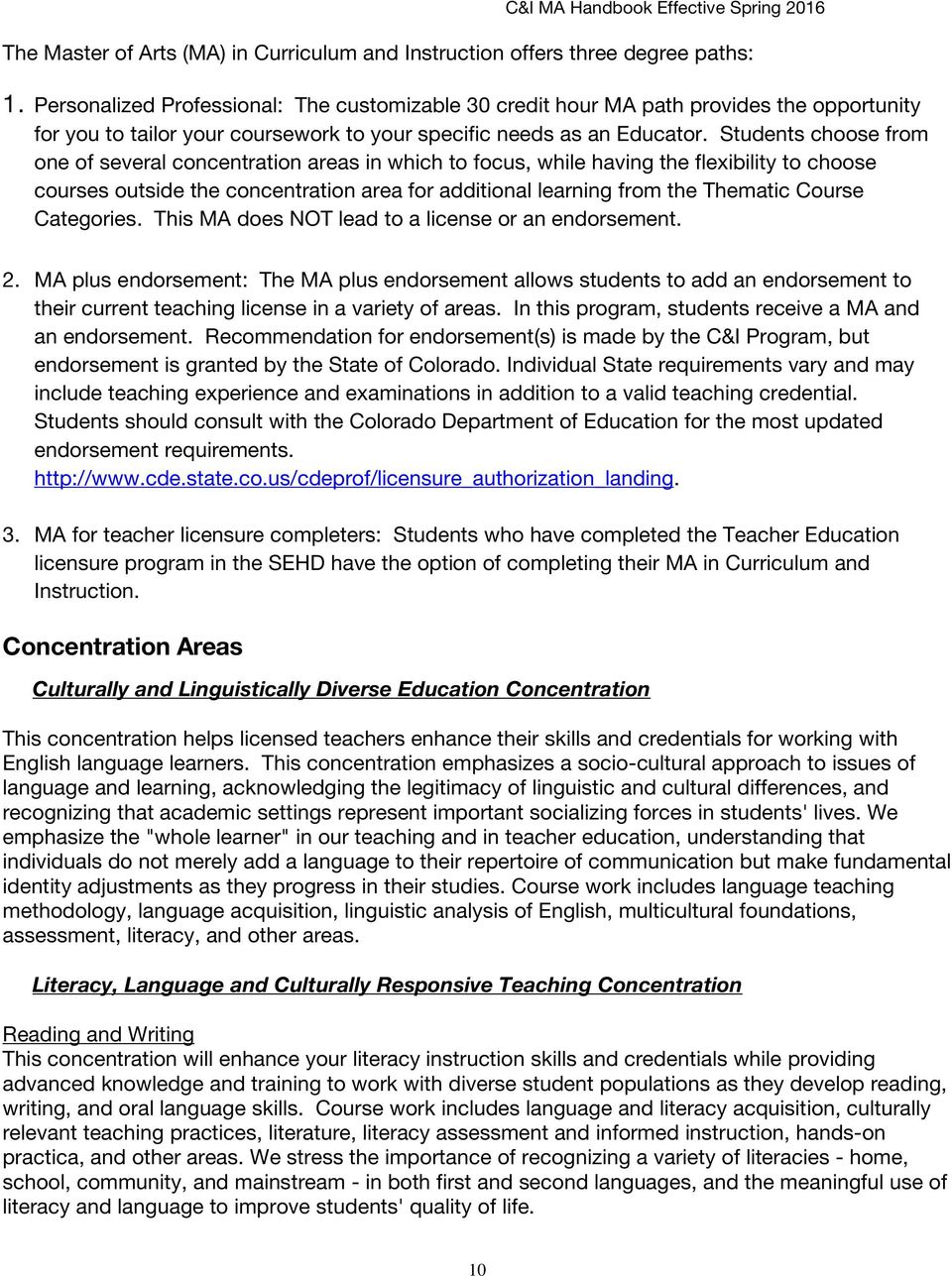
10 The Master of Arts (MA) in Curriculum and Instruction offers three degree paths: 1. Personalized Professional: The customizable 0 credit hour MA path provides the opportunity for you to tailor your coursework to your specific needs as an Educator. Students choose from one of several concentration areas in which to focus, while having the flexibility to choose courses outside the concentration area for additional learning from the Thematic Course Categories. This MA does NOT lead to a license or an endorsement. 2. MA plus endorsement: The MA plus endorsement allows students to add an endorsement to their current teaching license in a variety of areas. In this program, students receive a MA and an endorsement. Recommendation for endorsement(s) is made by the C&I Program, but endorsement is granted by the State of Colorado. Individual State requirements vary and may include teaching experience and examinations in addition to a valid teaching credential. Students should consult with the Colorado Department of Education for the most updated endorsement requirements. MA for teacher licensure completers: Students who have completed the Teacher Education licensure program in the SEHD have the option of completing their MA in Curriculum and Instruction. Concentration Areas Culturally and Linguistically Diverse Education Concentration This concentration helps licensed teachers enhance their skills and credentials for working with English language learners. This concentration emphasizes a socio-cultural approach to issues of language and learning, acknowledging the legitimacy of linguistic and cultural differences, and recognizing that academic settings represent important socializing forces in students' lives. We emphasize the "whole learner" in our teaching and in teacher education, understanding that individuals do not merely add a language to their repertoire of communication but make fundamental identity adjustments as they progress in their studies. Course work includes language teaching methodology, language acquisition, linguistic analysis of English, multicultural foundations, assessment, literacy, and other areas. Literacy, Language and Culturally Responsive Teaching Concentration Reading and Writing This concentration will enhance your literacy instruction skills and credentials while providing advanced knowledge and training to work with diverse student populations as they develop reading, writing, and oral language skills. Course work includes language and literacy acquisition, culturally relevant teaching practices, literature, literacy assessment and informed instruction, hands-on practica, and other areas. We stress the importance of recognizing a variety of literacies - home, school, community, and mainstream - in both first and second languages, and the meaningful use of literacy and language to improve students' quality of life. 10
11 English Education This concentration prepares licensed Secondary English or language arts teacher to work with diverse adolescents as they develop an appreciation for literature and composition. Course work includes theory and methods of English education, linking assessment and instruction, and practicum experience. The study of contemporary, ethnic, and classic literature, reading, and writing are woven together, along with speaking, listening, and viewing. We stress the importance of recognizing a variety of literacies - home, school, community, and mainstream - in both first and second languages, and the meaningful use of literacy and language to improve students' quality of life. Mathematics Education Concentration This concentration promotes elementary and secondary mathematics teachers passion, confidence, and competence in providing mathematics teaching-learning processes informed by insightful theories, effective learning activities, and innovative teaching strategies, as well as by international perspectives. This concentration area focuses on integration of theory, research, and practice to enable teachers to make instructional decisions and implement mathematics lessons that promote students conceptual understandings and problem solving, including opportunities for doing research. Science Education Concentration This concentration promotes elementary and secondary science teachers passion, confidence, and competence in providing science teaching-learning processes informed by insightful theories, effective learning activities, and innovative teaching strategies, as well as by international perspectives. This concentration area focuses on integration of theory, research, and practice to enable teachers to make instructional decisions and implement science lessons that promote students conceptual understandings and problem solving, including opportunities for doing research. Mathematics and Science Education Concentration This concentration area combines the mathematics education and science education fields to prepare teachers who can bridge these disciplines into exciting and innovative programming for students. It draws on the learning activities and experiences provided in the mathematics education and science education concentration areas. Special Education Concentration This concentration emphasizes the development of reflective practitioners through trans-disciplinary training, fosters reflective inquiry about teaching and learning, as well as the development of the skills, knowledge, and dispositions necessary to teach in elementary and secondary classrooms serving students with disabilities. Reflection and inquiry provide an informed and integrated basis for advocating for all learners. Thematic Course Categories The Thematic Course Categories is a collection of courses across all SEHD disciplines designed to allow students to expand student learning. See Appendix A. 11

12 Personalized Professional MA in Curriculum & Instruction The Personalized Professional 0 credit hour MA path provides the opportunity for you to tailor your coursework to your specific needs as an Educator. Students choose from one of several concentration areas in which to focus, while having the flexibility to choose courses for additional learning from the Categories of Thematic Courses within or outside one s concentration. This MA does NOT lead to a license or an endorsement. A current teaching license is not required for the Personalized Professional MA. Degree Components Courses Credits Concentration Courses Three required core courses in your chosen concentration 9 Courses Choice of 5 courses from the Thematic Course Categories 15 Concentration Research Course This will be a required Research and Evaluation Methods course determined with your faculty advisor Concentration Capstone The required Capstone should be taken in your final semester from your concentration area Total Credits 0 Students select one concentration area from the following: Culturally and Linguistically Diverse Education; Reading and Writing or English Education within Literacy, Language, and Culturally Responsive Teaching; Mathematics Education**; Science Education**; Mathematics and Science Education**; or Special Education. Students then take the required concentration core courses (9 credit hours). Then, in consultation and with approval from your faculty advisor, students select 5 courses from the Thematic Course Categories to customize their learning (15 credits). Finally, students take a research course ( credits) and then complete a Capstone course ( credits) for a total of 0 credits. The Customizable degree plan does not include a license or an endorsement. **The Mathematics and Science concentrations require 4 classes for the concentration. The student will complete the Capstone while taking the last concentration course in the program. 12

13 Concentration Degree Components Culturally and Linguistically Diverse Education Area Prefix Course Title Core Foundations (choose 1) CLDE 5010 CLDE 5140 CLDE 5160 Foundations of Language and Culture in Education Language, Culture and Educational Equity History and Law of Bilingual and Immigrant Education Core Language and Linguistics (choose 1) Core Pedagogy (choose 1) CLDE 500 CLDE 5070 CLDE 5820 CLDE 5825 CLDE 5050 Language Development of Multilingual Learners Advanced Linguistic Analysis of English Teaching Multilingual Learners: Advanced Methods of Content Teaching for Bilingual Learners Assessment and Advocacy for Multilingual Learners Research CLDE 6912 Teacher Inquiry in Multilingual Classrooms Capstone CLDE 505 Connecting Theory to Practice Reading and Writing Area Prefix Course Title LCRT 5810 Oral & Written Language & Literacy Core LCRT 5020 Reading Development, Instruction and Assessment LCRT 5055 Literacy Assessment & Informed Instruction Research RSEM 5050 OR RSEM 5080 OR RSEM XXXX Classroom Assessment Research in Schools other RSEM course with Advisor Approval Capstone LCRT 6915 Seminar and Practicum in Literacy Professional Development 1

14 English Education Area Prefix Course Title LCRT 5200 Theory & Methods of English Education Core LCRT 5201 Adolescent Literature Research LCRT 5720 RSEM 5050 OR RSEM 5080 OR RSEM XXXX Writing Development, Instruction, & Assessment Classroom Assessment Research in Schools other RSEM course with Advisor Approval Capstone LCRT 6915 Seminar and Practicum in Literacy Professional Development Mathematics Education Area Prefix Course Title MTED 500 Theories of Mathematical Learning Core take all 4 MTED 5040 MTED 5050 MTED 5060 Mathematics Teaching - Theory and Practice Math Ed Critique Research Students' Math Thinking Paths Research RSEM XXXX To be decided by a student with her/his Faculty Advisor Capstone MTED The Capstone is completed as part of your last core course 14

15 Science Education Area Prefix Course Title SCED 540 Equity and Culture in Science Education Core take all 4 SCED 5500 SCED 550 SCED 6110 The Nature of Science Issues and Trends in Science Education Science and Math Curriculum Studies Research RSEM XXXX To be decided by a student with her/his Faculty Advisor Capstone SCED The Capstone is completed as part of your last core course Mathematics and Science Education Area Prefix Course Title Core take 2 each from Math and Science Cores MTED XXXX MTED XXXX SCED XXXX SCED XXXX To be decided by a student with her/his Faculty Advisor To be decided by a student with her/his Faculty Advisor To be decided by a student with her/his Faculty Advisor To be decided by a student with her/his Faculty Advisor Research RSEM XXXX To be decided by a student with her/his Faculty Advisor Capstone SCED/MTED The Capstone is completed as part of your last core course 15

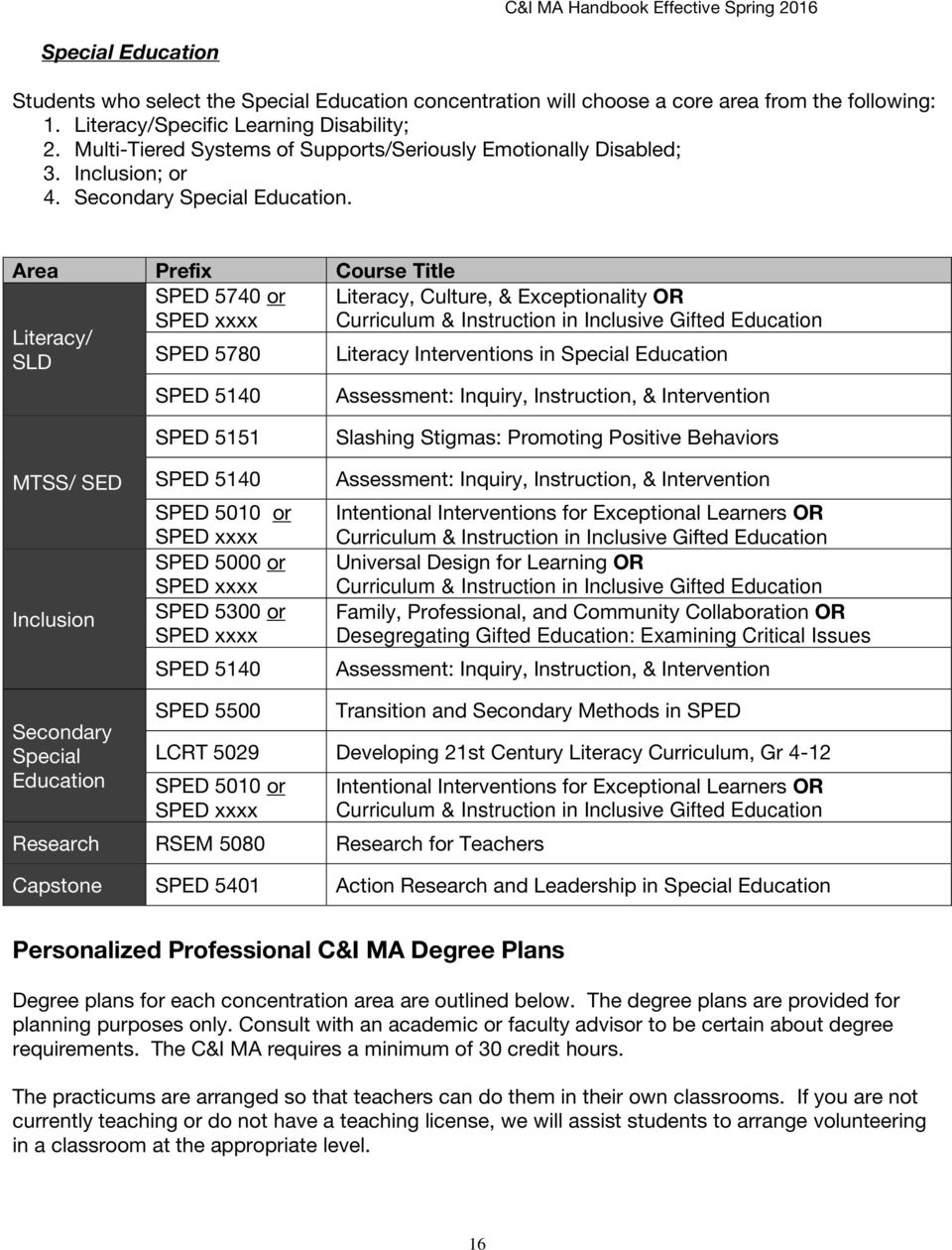
16 Special Education Students who select the Special Education concentration will choose a core area from the following: 1. Literacy/Specific Learning Disability; 2. Multi-Tiered Systems of Supports/Seriously Emotionally Disabled;. Inclusion; or 4. Secondary Special Education. Area Prefix Course Title SPED 5740 or SPED xxxx Literacy/ SLD SPED 5780 SPED 5140 Literacy, Culture, & Exceptionality OR Curriculum & Instruction in Inclusive Gifted Education Literacy Interventions in Special Education Assessment: Inquiry, Instruction, & Intervention MTSS/ SED Inclusion SPED 5151 SPED 5140 SPED 5010 or SPED xxxx SPED 5000 or SPED xxxx SPED 500 or SPED xxxx SPED 5140 Slashing Stigmas: Promoting Positive Behaviors Assessment: Inquiry, Instruction, & Intervention Intentional Interventions for Exceptional Learners OR Curriculum & Instruction in Inclusive Gifted Education Universal Design for Learning OR Curriculum & Instruction in Inclusive Gifted Education Family, Professional, and Community Collaboration OR Desegregating Gifted Education: Examining Critical Issues Assessment: Inquiry, Instruction, & Intervention Secondary Special Education SPED 5500 Transition and Secondary Methods in SPED LCRT 5029 Developing 21st Century Literacy Curriculum, Gr 4-12 SPED 5010 or SPED xxxx Research RSEM 5080 Research for Teachers Intentional Interventions for Exceptional Learners OR Curriculum & Instruction in Inclusive Gifted Education Capstone SPED 5401 Action Research and Leadership in Special Education Personalized Professional C&I MA Degree Plans Degree plans for each concentration area are outlined below. The degree plans are provided for planning purposes only. Consult with an academic or faculty advisor to be certain about degree requirements. The C&I MA requires a minimum of 0 credit hours. The practicums are arranged so that teachers can do them in their own classrooms. If you are not currently teaching or do not have a teaching license, we will assist students to arrange volunteering in a classroom at the appropriate level. 16
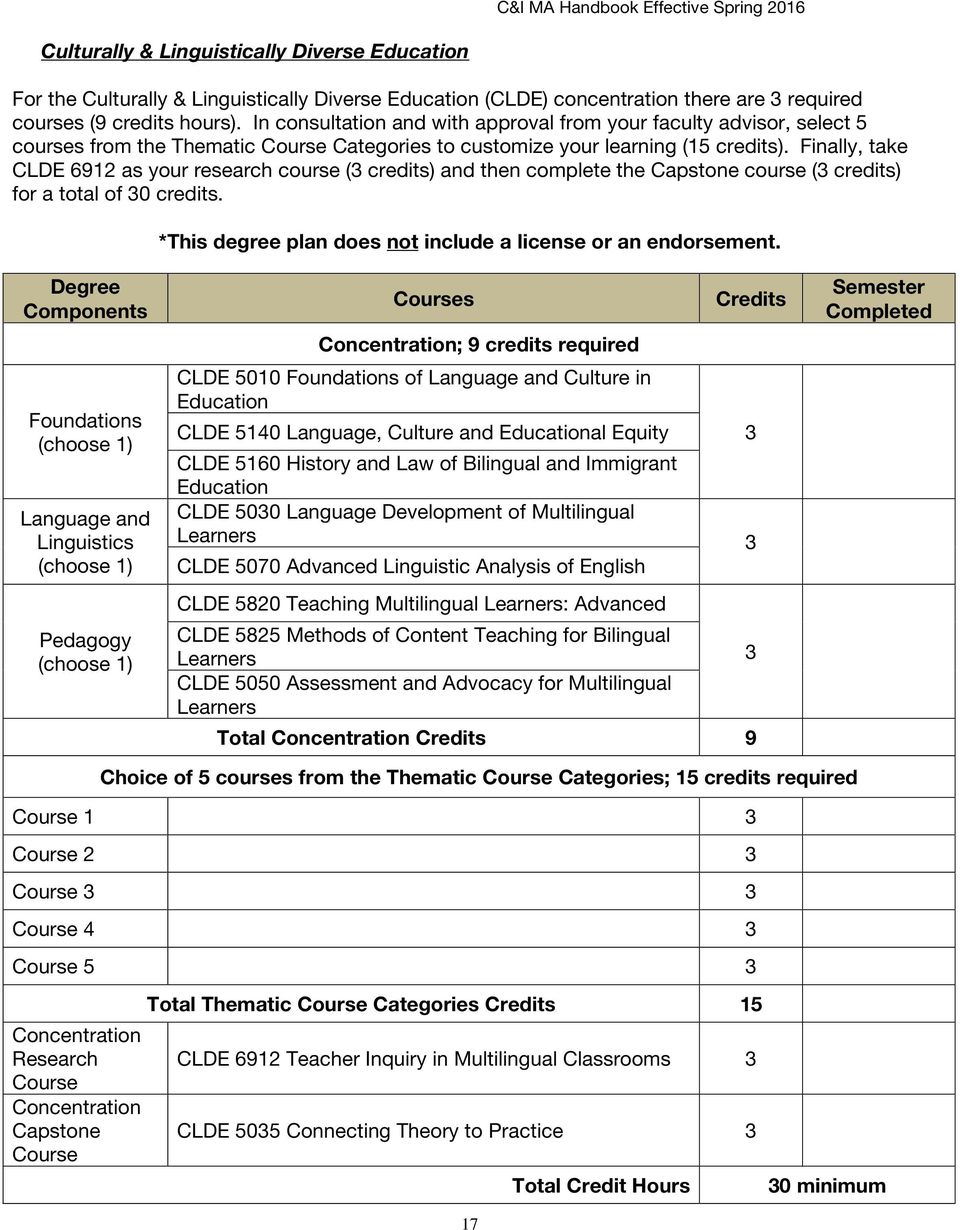
17 Culturally & Linguistically Diverse Education For the Culturally & Linguistically Diverse Education (CLDE) concentration there are required courses (9 credits hours). In consultation and with approval from your faculty advisor, select 5 courses from the Thematic Course Categories to customize your learning (15 credits). Finally, take CLDE 6912 as your research course ( credits) and then complete the Capstone course ( credits) for a total of 0 credits. *This degree plan does not include a license or an endorsement. Degree Components Foundations (choose 1) Language and Linguistics (choose 1) Pedagogy (choose 1) Courses Credits Concentration; 9 credits required CLDE 5010 Foundations of Language and Culture in Education CLDE 5140 Language, Culture and Educational Equity CLDE 5160 History and Law of Bilingual and Immigrant Education CLDE 500 Language Development of Multilingual Learners CLDE 5070 Advanced Linguistic Analysis of English CLDE 5820 Teaching Multilingual Learners: Advanced CLDE 5825 Methods of Content Teaching for Bilingual Learners CLDE 5050 Assessment and Advocacy for Multilingual Learners Total Concentration Credits 9 Semester Completed Choice of 5 courses from the Thematic Course Categories; 15 credits required Course 1 Course 2 Course Course 4 Course 5 Total Thematic Course Categories Credits 15 Concentration Research CLDE 6912 Teacher Inquiry in Multilingual Classrooms Course Concentration Capstone CLDE 505 Connecting Theory to Practice Course Total Credit Hours 0 minimum 17
18 Reading and Writing For the Literacy, Language and Culturally Responsive Teaching concentration with an emphasis in Reading and Writing there are required courses (9 credits hours). In consultation and with approval from your faculty advisor, select 5 courses from the Thematic Course Categories to customize your learning (15 credits). For instance, you may want to focus on elementary or secondary. Finally, take a research course ( credits) and then complete the Capstone course ( credits) for a total of 0 credits. Degree Components *This degree plan does not include a license or an endorsement. Courses Concentration; 9 credits required Credits Core Course 1 LCRT 5810: Oral & Written Language & Literacy Core Course 2 Core Course LCRT 5020: Reading Development, Instruction and Assessment LCRT 5055: Literacy Assessment & Informed Instruction Total Concentration 9 Choice of 5 courses from the Thematic Course Categories; 15 credits required Course 1 Course 2 Course Course 4 Course 5 Concentration Research Course Concentration Capstone Course Total Thematic Course Categories Credits 15 RSEM 5050: Classroom Assessment OR RSEM 5080: Research in Schools OR other RSEM course with Advisor Approval LCRT 6915: Seminar and Practicum in Literacy Professional Development Total Credit Hours Semester Completed 0 minimum 18

19 English Education For the Literacy, Language and Culturally Responsive Teaching concentration with an emphasis in English Education there are required courses (9 credits hours). In consultation and with approval from your faculty advisor, select 5 courses from the Thematic Course Categories to customize your learning (15 credits). Finally, take a research course ( credits) and then complete the Capstone course ( credits) for a total of 0 credits. Degree Components Courses Concentration Courses 9 credits required Credits Core Course 1 LCRT 5200 Theory & Methods of English Ed Semester Completed Core Course 2 LCRT 5201 Adolescent Literature Core Course LCRT 5720 Writing Development, Instruction, & Assessment Total Concentration Courses 9 Choice of 2- courses from the Thematic Course Categories and 2- English courses; 15 credits required Course 1 ENGL XXXX (in Literature, Writing, Film, or Language Study) Course 2 ENGL XXXX (in Literature, Writing, Film, or Language Study) Course ENGL XXXX (in Literature Writing, Film, or Language Study) OR XXXX Choice Course from SEHD Thematic Course Categories with Adviser Approval* Course 4 XXXX Choice Course from SEHD Thematic Course Categories with Adviser Approval* Course 5 XXXX Choice Course from SEHD Thematic Course Categories with Adviser Approval* Total English and Inventory Courses 15 Research RSEM 5050: Classroom Assessment OR RSEM 5080: Research in Schools OR other RSEM course with Advisor Approval Capstone LCRT 6915 Seminar and Practicum in Literacy Professional Development Total Credit Hours 0 * We would highly recommend that students think about taking coursework in language acquisition and reading to complement their work in English Education. Among courses to consider in these areas are: LCRT 5810 Oral & Written Language & Literacy, LCRT 5028 Developing Strategic Reader, Gr. 4-12, LCRT 5029 Developing 21 st Century Literacy Curriculum, Gr. 4-12, LCRT 6911 Seminar & Practicum in Literacy & Language, Gr Students may also want to consider taking a course in Instructional Technology that focuses on literacy. 19

20 Mathematics Education For the Mathematics Education concentration area there are 4 required courses (12 credits hours). In consultation and with approval from your faculty advisor, select 5 courses from the Thematic Course Categories to customize your learning (15 credits). For instance, you may want to customize your Thematic Course Categories selections for elementary or secondary. Finally, take a research course ( credits) for a total of 0 credits. Degree Components *This degree plan does not include a license or an endorsement. Courses Concentration Core; 12 credits required Credits Core Course 1 MTED 500 Theories of Mathematical Learning Core Course 2 MTED 5040 Mathematics Teaching - Theory and Practice Core Course MTED 5050 Critique of Mathematics Education Research Core Course 4 MTED 5060 Developmental Pathways in Students' Mathematical Thinking Total Concentration Core 12 Choice of 5 courses from the Thematic Course Categories; 15 credits required Course 1 Course 2 Course Course 4 Course 5 Semester Completed Total Thematic Course Categories Credits 15 Concentration Research RSEM XXXX Course Concentration MTED Capstone The Capstone is completed in your final core course Course Total Credit Hours 0 minimum 20

21 Science Education For the Science Education concentration there are 4 required courses (12 credits hours). In consultation and with approval from your faculty advisor, select 5 courses from the Thematic Course Categories to customize your learning (15 credits). For instance, you may want to customize your Thematic Course Categories selections for elementary or secondary. Finally, take a research course ( credits) for a total of 0 credits. Degree Components *This degree plan does not include a license or an endorsement. Courses Concentration Core; 9 credits required Credits Core Course 1 SCED 540 Equity and Culture in Science Education Core Course 2 SCED 5500 The Nature of Science Core Course SCED 550 Issues and Trends in Science Education Core Course 4 SCED 6110 Science and Math Curriculum Studies Total Concentration Core 12 Choice of 5 courses from the Thematic Course Categories; 15 credits required Course 1 Course 2 Course Course 4 Course 5 Semester Completed Total Thematic Course Categories Credits 15 Concentration Research RSEM XXXX Course Concentration SCED Capstone The Capstone is completed in your final core course Course Total Credit Hours 0 minimum 21
22 Mathematics and Science Education For the Mathematics and Science Education concentration there are 4 required courses (12 credits hours), two courses from the Mathematics Education core (6 credit hours) and two courses from the Science Education core (6 credits hours). In consultation and with approval from your faculty advisor, select 5 courses from the Thematic Course Categories to customize your learning (15 credits). Finally, take a research course ( credits) for a total of 0 credits. Degree Components *This degree plan does not include a license or an endorsement. Courses Concentration Core; 9 credits required Credits Core Course 1 SCED xxxx Core Course 2 SCED xxxx Core Course MTED xxxx Core Course 4 MTED xxxx Total Concentration Core 12 Choice of 5 courses from the Thematic Course Categories; 15 credits required Course 1 Course 2 Course Course 4 Course 5 Semester Completed Total Thematic Course Categories Credits 15 Concentration Research RSEM XXXX Course Concentration SCED or MTED Capstone The Capstone is completed in your final core course Course Total Credit Hours 0 minimum 22
23 Special Education Students who select the Special Education concentration will choose a core area from the following: 1. Literacy/Specific Learning Disability: Leadership in support of the systematic literacy development of K-12 learners 2. Multi-Tiered Systems of Supports/ Leadership in support of the systematic social and emotional development of K-12 learners. Inclusion; or 4. Secondary Special Education. In consultation and with approval from your faculty advisor, select 5 courses from the Thematic Course Categories to customize your learning (15 credits). Finally, take a research course ( credits) and then complete the Capstone course ( credits) for a total of 0 credits. *This degree plan does not include a license or an endorsement. Degree Components SPED Core Courses Credits Choose One Core Concentration; 9 credits required SPED XXXX SPED XXXX SPED XXXX Total Concentration Core 9 Semester Completed Choice of 5 courses from the Thematic Course Categories; 15 credits required Course 1 Course 2 Course Course 4 Course 5 Concentration Research Course Concentration Capstone Course Total Thematic Course Categories Credits 15 RSEM 5080 Research for Teachers SPED 5401 Action Research and Leadership in Special Education Total Credit Hours 0 minimum 2
24 MA with Endorsement Degree Plans C&I MA Handbook Effective Spring 2016 Recommendation for endorsement(s) is made by the C&I Program, but endorsement is granted by the State of Colorado. Individual State requirements vary and may include teaching experience and examinations in addition to a valid teaching credential. Students should consult with the Colorado Department of Education ( or the state in which they wish to be endorsed for the most updated endorsement requirements. Culturally and Linguistically Diverse Education with K-12 Endorsement Courses: All Required Credit Hours Semester Completed CLDE 5010 Foundations of Language and Culture in Education CLDE 5160 History and Law of Bilingual and Immigrant Education CLDE 5070 Advanced Linguistic Analysis of English CLDE 500 Language Development of Multilingual Learners CLDE 5820 Teaching Multilingual Learners: Advanced CLDE 5050 Assessment and Advocacy for Multilingual Learners Applied Course Options (select one): CLDE 5825 Methods of Content Teaching for Bilingual Learners (Courses taken as part of district partnerships such as LCRT 570, LCRT 5020, or SPED 5740 may be used only with Faculty Advisor approval) Elective with Faculty Advisor approval CLDE 6912 Teacher Inquiry in Multilingual Classrooms CLDE 505 Connecting Theory to Practice Total Credit Hours 0 minimum 24
25 MA in Curriculum & Instruction: Reading and Writing with Reading Teacher Endorsement, Elementary K-6 Recommendation for endorsement(s) is made by the C&I Program, but endorsement is granted by the State of Colorado. Individual State requirements vary and may include teaching experience and examinations in addition to a valid teaching credential. Students should consult with the Colorado Department of Education ( or the state in which they wish to be endorsed for the most updated endorsement requirements. Please note that the Colorado Department of Education also requires 2 years of post-license teaching experience and a passing score on the Reading Teacher PLACE exam to apply for the Elementary Reading Teacher endorsement. This plan includes a MA and endorsement. Courses: All Required Credits Semester Completed LCRT 5810 Oral & Written Language & Literacy LCRT 5020 Reading Development, Instruction & Assessment LCRT 5055 Literacy Assessment & Informed Instruction LCRT 5710 Primary Literacy for Diverse Learners, PreK- OR LCRT 570 Language & Literacy Across the Curriculum LCRT 5720 Writing Development, Instruction & Assessment LCRT 5795 Current Children s Literature (or LCRT 5750, LCRT 5780, LCRT 5790 offered occasionally) LCRT 6910 Seminar & Practicum in Literacy & Language, K-6 Choice from SEHD Thematic Course Categories with Adviser Approval RSEM 5050 Classroom Assessment OR RSEM 5080 Research in Schools OR other RSEM course with Advisor Approval LCRT 6915 Seminar & Practicum in Literacy Professional Development Total Credit Hours 0 minimum 25
26 MA in Curriculum & Instruction: Reading and Writing with Reading Teacher Endorsement: Secondary 7-12 Recommendation for endorsement(s) is made by the C&I Program, but endorsement is granted by the State of Colorado. Individual State requirements vary and may include teaching experience and examinations in addition to a valid teaching credential. Students should consult with the Colorado Department of Education ( or the state in which they wich to be endorsed for the most updated endorsement requirements. Please note that CDE also requires 2 years of post-license teaching experience and a passing score on the Reading Teacher PLACE exam to apply for the Secondary Reading Teacher endorsement. This plan includes a MA and endorsement. Courses: All Required Credits Semester Completed LCRT 5810 Oral & Written Language & Literacy LCRT 5020 Reading Development, Instruction & Assessment OR LCRT 5028 Developing Strategic Readers, Gr LCRT 5055 Literacy Assessment & Informed Instruction LCRT 570 Language & Literacy Across the Curriculum OR LCRT 5029 Developing 21 st Century Literacy Curriculum, Gr LCRT 5720 Writing Development, Instruction & Assessment LCRT 5201 Adolescent Literature LCRT 6911 Seminar & Practicum in Literacy & Language, Gr Choice from SEHD Thematic Course Categories with Adviser Approval RSEM 5050 Classroom Assessment OR RSEM 5080 Research in Schools OR other RSEM course with Advisor Approval LCRT 6915 Seminar & Practicum in Literacy Professional Development Total Credit Hours 0 minimum 26
27 MA in Curriculum & Instruction: Reading and Writing with Reading Teacher Endorsement (K-12) Recommendation for endorsement(s) is made by the C&I Program, but endorsement is granted by the State of Colorado. Individual State requirements vary and may include teaching experience and examinations in addition to a valid teaching credential. Students should consult with the Colorado Department of Education ( or the state in which they wish to be endorsed for the most updated endorsement requirements. Please note that CDE also requires 2 years of post-license teaching experience and a passing score on the Reading Teacher PLACE exam to apply for the Reading Teacher endorsement. This plan includes a MA and endorsement. Courses Credits LCRT 5810 Oral & Written Language & Literacy LCRT 5020 Reading Development, Instruction & Assessment OR LCRT 5028 Developing Strategic Readers, Gr LCRT 5055 Literacy Assessment & Informed Instruction LCRT 5710 Primary Literacy for Diverse Learners, PreK- Semester Completed LCRT 570 Language & Literacy Across the Curriculum OR LCRT 5029 Developing 21 st Century Literacy Curriculum, Gr LCRT 5720 Writing Development, Instruction & Assessment LCRT 5795 Current Children s Literature (or LCRT 5750, LCRT 5780, LCRT 5790 offered occasionally) LCRT 5201 Adolescent Literature LCRT 6910 Seminar & Practicum in Literacy & Language, K-6 LCRT 6911 Seminar & Practicum in Literacy & Language, Gr Choice from SEHD Thematic Course Categories with Adviser Approval RSEM 5050 Classroom Assessment OR RSEM 5080 Research in Schools OR other RSEM course with Advisor Approval LCRT 6915 Seminar & Practicum in Literacy Professional Development Total Credit Hours 42 minimum 27
28 MA in C&I: Special Education with Special Education Generalist (Ages 5-21) Endorsement The MA in C&I: Special Education with added endorsement as Special Education Generalist is designed for currently licensed teachers seeking career advancement and the expertise needed to work effectively with students with special needs and from diverse backgrounds. The program is fully accredited by the Colorado Department of Education and the Council for Exceptional Children. Recommendation for endorsement(s) is made by the C&I Program, but endorsement is granted by the State of Colorado. Individual State requirements vary and may include teaching experience and examinations in addition to a valid teaching credential. Students should consult with the Colorado Department of Education ( or the state in which they wish to be endorsed for the most updated endorsement requirements. Courses Credits A) Special Education (27 hours) SPED 500: Frameworks for Understanding (dis)ability in Contemporary Classrooms (waived if already completed) SPED 5740: Linguistically Responsive Special Education SPED 5010: Instructional Strategies for Students with Special Needs SPED 5151: Culturally Responsive Supports for Social Emotional Development SPED 500: Collaborating in Schools & Communities SPED 5780: Literacy Intervention for Students with Disabilities* SPED 5140: Advanced Assessment in Special Education SPED 592: Internship & Site Seminar (Approximately 128 Hours or 16 days) 2 SPED 59: Internship & Site Seminar (Approximately 192 Hours or 24 days) B) Advanced Study (6 hours) EDHD 5240: Cognition & Instruction RSEM 5050: Classroom Assessment OR RSEM 5080: Research for Teachers SPED 5401: Advanced Seminar in Special Education Total Credit Hours 2-5 Semester Completed 28
29 MA C&I Options for Teacher Education Licensure Completers The tables below show the required courses that are taken AFTER completing the Teacher Education Licensure program. Degree Plans can be found in Appendix B. Degree Requirements No Endorsement STEM* CLDE LCRT (2 options) SPED English Concentration in 15 additional Education LCRT credit hours 15 additional 15 additional credit hours credit hours 15 additional credit hours Math: MTED 500, MTED 5040, MTED 5050, MTED 5060 Science: SCED 540, SCED 5500, SCED 550, SCED 6110 Research: RSEM 5080 or other RSEM course with Advisor Approval Capstone: Completed in your final content Choose 1 from each: Foundations - CLDE 5010 or CLDE 5020 Language and Linguistics CLDE 500 or CLDE 5070 Pedagogy CLDE 5820, CLDE 5825, CLDE 5050 Research: CLDE 6912 Capstone: CLDE LCRT ENGL XXXX (in Literature, Writing, Film, or Language Study). Choose a course from SEHD Thematic Course Categories with Adviser Approval Research: RSEM 5050 OR RSEM 5080 or other RSEM course with Advisor Approval Capstone: LCRT LCRT LCRT LCRT 5055 Research: RSEM 5050 OR RSEM 5080 or other RSEM course with Advisor Approval Capstone: LCRT additional credit hours Select one area: 1. Literacy/Specific Learning Disability 2. Multi-Tiered Systems of Supports/ Seriously Emotionally Disabled. Inclusion 4. Secondary Special Education Then take classes listed for area. See page 16 for detailed information on the core areas. Research: RSEM 5080 Capstone: SPED 5401 course *MA C&I Options for STEM: Mathematics (Elementary & Secondary) Science (Elementary & Secondary) Mathematics & Science (select two math core & two science core, Elementary & Secondary) 29
30 Degree Requirements MA with Endorsement The table below represents the coursework required for Teacher Education Licensure completers to receive a MA in C&I with an endorsement. Degree plans are available in Appendix C. Recommendation for endorsement(s) is made by the C&I Program, but endorsement is granted by the State of Colorado. Individual State requirements vary and may include teaching experience and examinations in addition to a valid teaching credential. Students should consult with the Colorado Department of Education ( or the state in which they wish to be endorsed for the most updated endorsement requirements. CLDE LCRT ( options) SPED CLDE Endorsement 27 additional credit hours 1. CLDE CLDE CLDE CLDE CLDE CLDE CLDE 5825 Research: CLDE 6912 Reading Teacher Endorsement, K-6 27 additional credit hours 1. LCRT LCRT LCRT LCRT 5710 or LCRT LCRT LCRT LCRT Choice from SEHD Thematic Course Categories with Adviser Approval Research: RSEM 5050 or RSEM 5080 or other RSEM course with Advisor Approval Capstone: LCRT 6915 Endorsement requires passing of State of CO PLACE Test & minimum of two years of teaching experience Reading Teacher Endorsement, additional credit hours 1. LCRT LCRT 5020 or LCRT LCRT LCRT 570 or LCRT LCRT LCRT 5201* 7. LCRT Choice from SEHD Thematic Course Categories with Adviser Approval Research: RSEM 5050 or RSEM 5080 or other RSEM course with Advisor Approval Capstone: 0 Reading Teacher Endorsement, K-12-6 additional credit hours 1. LCRT LCRT 5020 or LCRT LCRT LCRT LCRT 570 or LCRT LCRT LCRT LCRT 5201* 9. LCRT LCRT 6911 Research: RSEM 5050 or RSEM 5080 or other RSEM course with Advisor Approval Capstone: LCRT 6915 Endorsement requires passing of State of CO PLACE Test & minimum of two years of teaching experience Special Education Generalist Endorsement 2-5 additional credit hours 1. SPED 500* 2. SPED SPED SPED SPED SPED SPED EDHD SPED SPED 59 Research: RSEM 5080 Capstone: CLDE 505 LCRT 6915 Capstone: SPED 5401 Endorsement Endorsement requires passing requires passing of State of CO of State of CO PLACE Test PLACE Test & minimum of two & minimum of two years of teaching years of teaching experience experience * Waived if already satisfied as part of graduate level Teacher Licensure Program
31 Endorsement Only Course Plans Culturally and Linguistically Diverse Education Endorsement: Elementary and Secondary Recommendation for endorsement(s) is made by the C&I Program, but endorsement is granted by the State of Colorado. Individual State requirements vary and may include teaching experience and examinations in addition to a valid teaching credential. Students should consult with the Colorado Department of Education ( or the state in which they wish to be endorsed for the most updated endorsement requirements. *This course plan does NOT lead to MA degree. Courses CLDE 5010 Foundations of Language and Culture in Education Credits Semester Taken CLDE 5160 History and Law of Bilingual and Immigrant Education CLDE 5070 Advanced Linguistic Analysis of English CLDE 500 Language Development of Multilingual Learners CLDE 5820 Teaching Multilingual Learners: Advanced CLDE 5050 Assessment and Advocacy for Multilingual Learners Applied Course Options (select one): CLDE 5825 Methods of Content Teaching for Bilingual Learners (Courses taken as part of district partnerships such as LCRT 570, LCRT 5020, or SPED 5740 may be used only with Faculty Advisor approval) CLDE 6912 Teacher Inquiry in Multilingual Classrooms Culminating Experience: Final Reflection - Total Credit Hours 24 1
32 Elementary Reading Teacher Endorsement, Grades K-6 C&I MA Handbook Effective Spring 2016 Recommendation for endorsement is made by the C&I Program, but endorsement is granted by the State of Colorado. Individual State requirements vary and may include teaching experience and examinations in addition to a valid teaching credential. Students should consult with the Colorado Department of Education ( or the state in which they wish to be endorsed for the most updated endorsement requirements. *This course plan can be added to your previously obtained MA degree. Courses: All Required Credits Semester Completed LCRT 5810 Oral & Written Language & Literacy LCRT 5020 Reading Development, Instruction & Assessment LCRT 5055 Literacy Assessment & Informed Instruction LCRT 5710 Primary Literacy for Diverse Lrnrs, PreK- OR LCRT 570 Language & Literacy Across the Curriculum LCRT 5720 Writing Development, Instruction & Assessment LCRT 5795 Current Children s Literature (OR LCRT 5750, LCRT 5780, LCRT 5790 offered occasionally) LCRT 6910 Seminar & Practicum in Literacy & Language, K-6 LCRT 6915 Seminar & Practicum in Literacy Professional Development Total Credit Hours 24 2
33 Secondary Reading Teacher Endorsement, Grades 7-12 C&I MA Handbook Effective Spring 2016 Recommendation for endorsement is made by the C&I Program, but endorsement is granted by the State of Colorado. Individual State requirements vary and may include teaching experience and examinations in addition to a valid teaching credential. Students should consult with the Colorado Department of Education ( or the state in which they wish to be endorsed for the most updated endorsement requirements. *This course plan can be added to your previously obtained MA degree. Courses Credits Semester Completed LCRT 5810 Oral & Written Language & Literacy LCRT 5020 Reading Development, Instruction & Assessment OR LCRT 5028 Developing Strategic Readers, Gr LCRT 5055 Literacy Assessment & Informed Instruction LCRT 570 Language & Literacy Across the Curriculum OR LCRT 5029 Developing 21 st Century Literacy Curriculum, Gr LCRT 5720 Writing Development, Instruction & Assessment LCRT 5201 Adolescent Literature LCRT 6911 Seminar & Practicum in Literacy & Language, Gr LCRT 6915 Seminar & Practicum in Literacy Professional Development Total Credit Hours 21 or 24
34 Reading Teacher Endorsement, Grades K-12 Recommendation for endorsement is made by the C&I Program, but endorsement is granted by the State of Colorado. Individual State requirements vary and may include teaching experience and examinations in addition to a valid teaching credential. Students should consult with the Colorado Department of Education ( or the state in which they wish to be licensed for the most updated endorsement requirements. Courses Credits Semester Completed LCRT 5810 Oral & Written Language & Literacy LCRT 5020 Reading Development, Instruction & Assessment OR LCRT 5028 Developing Strategic Readers, Gr LCRT 5055 Literacy Assessment & Informed Instruction LCRT 5710 Primary Literacy for Diverse Learners, PreK- LCRT 570 Language & Literacy Across the Curriculum OR LCRT 5029 Developing 21 st Century Literacy Curriculum, Gr LCRT 5720 Writing Development, Instruction & Assessment LCRT 5795 Current Children s Literature (OR LCRT 5750, LCRT 5780, LCRT 5790 offered occasionally) LCRT 5201 Adolescent Literature* LCRT 6910 Seminar & Practicum in Literacy & Language, K-6 LCRT 6911 Seminar & Practicum in Literacy & Language, Gr Choice from SEHD Thematic Course Categories with Adviser Approval (Satisfied fro already held MA Degree) /0 LCRT 6915 Seminar & Practicum in Literacy Professional Development *Waived if already taken at the MA level. Total Credit Hours - 6 4
35 Special Education Generalist Endorsement Recommendation for endorsement is made by the C&I Program, but endorsement is granted by the State of Colorado. Individual State requirements vary and may include teaching experience and examinations in addition to a valid teaching credential. Students should consult with the Colorado Department of Education ( or the state in which they wish to be endorsed for the most updated endorsement requirements. *This course plan does NOT lead to MA degree. Courses SPED 500: Frameworks for Understanding (dis)ability in Contemporary Classrooms (waived if already completed) Credits SPED 5010: Instructional Strategies for Students with Special Needs Semester Completed SPED 5740: Linguistically Responsive Special Education SPED 5151: Culturally Responsive Supports for Social Emotional Development SPED 500: Collaborating in Schools & Communities SPED 5140: Advanced Assessment in Special Education SPED 5780: Literacy Intervention for Students with Disabilities* SPED 592: Internship & Site Seminar (Approximately 128 Hours or 16 days) SPED 59: Internship & Site Seminar (Approximately 192 Hours or 24 days) Additional Courses as Necessary 2 varies Total Credit Hours Minimum of 26 5
36 Assessment The faculty integrates formative and summative assessments of students learning across the entire program. Assessments are designed to provide information at both the student and program levels. All assessments are linked to the desired program outcomes. Student Assessment Student performance is assessed throughout the student s program in several different ways, all linked to the program outcomes. Conventional, individual course performance measures (including grades and artifacts) constitute one form of assessment. Assessment data are used formatively and summatively - at both the student and program levels. Following are descriptions of the assessment management system used in the SEHD to track and analyze assessment data as well as the tools used. LiveText LiveText is a web-based technology platform linked to program assessments and required for all students in the School of Education & Human Development, SEHD. Details on how SEHD students obtain their LiveText subscription as well as important training workshops and other resources are available on the SEHD assessment website at Students will use their LiveText accounts to upload assessments that show student progress through their program. The LiveText account also provides students with the opportunity to build a portfolio. That portfolio can be used for annual reviews as well as the proposal defense and dissertation reviews. Capstone Students are required to complete a Capstone near the end of their program. SEHD Diversity Assessment - IDI The Intercultural Development Inventory (IDI) is a program and school evaluation tool that the School of Education and Human Development (SEHD) uses to assess how well each program meets the SEHD s mission and vision. The IDI is a 50-item, computerbased instrument that empirically assesses responses in terms of the general orientations toward cultural difference. Scores from the IDI are reported to the SEHD by IDI evaluators at the overall program level and not at the level of individual students. Completing the assessment at the beginning and end of the program is an important way for faculty to consider program adjustments and improvements. Faculty Course Questionnaires Faculty Course Questionnaires (FCQs) are administered according to university rules at the end of each course. Results of these questionnaires are reviewed by course instructors, the C&I Program Leader, and Associate Dean for Academic Programs and Research. Student feedback is used to make inform improvements. 6
37 Student Exit and Follow-up Surveys Program assessment of the curriculum and culminating experiences is also accomplished through student exit and follow-up surveys. Within the SEHD, a formal system exists to conduct exit and follow-up surveys of program graduates, thereby allowing tracking of student placement or advancement in professional jobs following degree completion and documenting the long-term success of graduates. Program Review Data from the program assessments (diversity assessment, comprehensive exams, course outcomes, and individual course assessments) as well as on student recruitment, retention, and career placements are examined yearly through a schoolwide continuous improvement process linked to the SEHD and the university s accrediting bodies. Engaging in this process allows the doctoral faculty to determine if various courses and experiences are addressing the goals and outcomes of the program. Ongoing curriculum, instruction and assessment refinements are made based on these data. In addition, periodic program reviews are required and conducted by the campus-level office of the Associate Vice Chancellor for Academic Affairs. These assessments of program quality are used to modify curriculum and program delivery as necessary. All efforts and rationale for changes are fully documented in accreditation reports. Academic outcomes assessment of student learning is conducted through these multiple and varied assessments in an ongoing and systematic way across individual students, courses, and at the program level to meet the Higher Learning Commission of the North Central Association s ten-year accreditation review. Finally, through our extended partnership activities, input is continuously sought from current students, graduates, and the educational community about new issues that should be addressed by the curriculum. 7
38 Academic Policies and Procedures All of the processes and procedures within the MA program are within the guidelines of the School of Education and Human Development Student Policy and Procedures Handbook found at ources/pages/currentresources.aspx. Students should refer to the SEHD Policy and Procedures Handbook for information on all SEHD policies and procedures. FERPA The Family Educational Rights and Privacy Act (FERPA) is a federal law that protects the privacy of student education records. The law applies to all schools that receive funds under an applicable program of the U.S. Department of Education. FERPA gives parents certain rights with respect to their children's education records. These rights transfer to the student when he or she reaches the age of 18 or attends a school beyond the high school level. Students to whom the rights have transferred are "eligible students." ~ U.S. Department of Education. (See Appendix D.) Advising Students will be assigned a faculty adviser and an academic advisor based on their concentration area. Students should rely on their faculty adviser for course selection and questions relating to their career goals and aspirations. The C&I Academic Adviser for the program should be consulted for process questions (i.e., registration, forms). University Computing Account To claim your university computing account, please fill out the form found at and Submit the information for each step of the process. Please be sure to complete all 6 steps and close your browser when finished. UCD Access UCDAccess is the student portal you will use to register for classes, check your grades, view financial aid, pay your tuition, etc. You will login using your official University username and password. You can login at the UCDAccess website located at You will also find instructions at this website and additional resources. University is an official means of communication for students at the CU Denver. All official university will be sent to each student s assigned a CU Denver address. CU Denver will only use CU Denver student accounts if it elects to send 8
39 communications to students. CU Denver accounts are available through IT Services. Students are responsible for reading s received from CU Denver. Information on your UCD account can be found at Forwarding your UCD Students are discouraged from forwarding their CU Denver to an external account (Gmail, Yahoo, etc.). Students are strongly encouraged to regularly check their CU Denver to ensure you are receiving all messages sent from the university. Canvas Canvas is the online learning management system used by CU Denver, which allows you to access course material, interact with other students, submit assignments online, take quizzes, and engage in online classes. You can login to Canvas at using your University username and password. Visit the Canvas website for information at x. Visit to see a sample online course shell. Grade Requirements To maintain satisfactory academic progress students are required to maintain a minimum GPA of B (. 0). Failure to maintain a.0 GPA will result in students being placed on academic probation. Courses in which grades below B- (2.7) are received cannot be applied toward fulfillment of the requirements for any graduate (PhD or Master s) degree, and consequently, the course must be retaken in order to achieve a B- or better grade. However, all grades received, including repeat courses, will appear on the student s transcript and will be included in the GPA calculation, but only one course enrollment may be counted towards graduation credits. Incomplete Grade Policy Students requesting a grade of Incomplete ( I ) should refer to the SEHD Course Completion Agreement for Incomplete available on the website at ources/all_docs/incomplete%20application.pdf for the full policy and form. Please note that grades of I, W, NC, and F do NOT satisfy financial aid requirements. Grade Appeals Process The steps in the program grade appeals process are as follows: 1. The student appeals to the individual faculty member. 2. If the student is not satisfied with the instructor s decision, he or she can follow the appeals process through the Student Academic Appeals Committee in the 9
40 School of Education & Human Development. udents/resources/pages/currentresources.aspx Transfer Credits The MA program will transfer a maximum of 9 semester credit hours. Students should refer to the Request for Transfer of Credit form for the full policy and process found at: ources/pages/currentresources.aspx. Graduation Requirements Students must: 1. Complete all coursework 2. Maintain a.0 grade point average. Receive no lower than a B- in all coursework (see Grade Requirements above) 4. Satisfactorily complete a Capstone 5. Complete the IDI at the beginning of the program and at the end of the coursework and prior to graduation Timetable for Completion The MA program, with or without endorsement, has a time limit of 7 years. That said, there may be extenuating circumstances that require a student to stop out of her/his studies and return at a later date. Students may apply for extensions to their timetable; these requests will be considered by the program faculty. However, students must complete the requirements of their program within a maximum of 8 years from term of admission. Failure to do so will result in dismissal from the program. Academic Probation and Dismissal If, at any time, a student s cumulative graduate grade point average (GPA) after matriculation falls below.00 (some graduate programs may require that a higher GPA be maintained) the student will be placed on academic probation. Probationary fulltime students have 2 semesters, probationary part-time students have 4 semesters, in which to raise their cumulative GPA to a.00 (or greater if required by the program) for removal from academic probation (calculated using all graduate-level courses since matriculation, including graduate courses that a student enrolled in outside his/her main program). In addition, a minimum GPA of.00 (or greater if required by the program) must be maintained in each probationary term. Students who fail to meet the conditions of probation are subject to dismissal from the School of Education and Human Development. Any student who is dismissed following unsuccessful academic probation or failure to meet his/her program s guidelines for satisfactory academic progress may reapply for admission to the same or a different graduate program only after 1 year. The student should consult with the Program Director before applying. 40
41 Probation also may be imposed for other reasons related to unsatisfactory academic progress and for unprofessional behavior, including honor code violations and conduct that violates the integrity of training and research. In such instances, the length and specific conditions of the probationary period will be determined on a case-by-case basis. Removal from Probation Once the student s GPA has been recalculated and shown to be.00 or above, and/or other specified conditions of the probationary status have been met, the student will be notified by , with a copy of the notification sent to the student s program. Probation and Graduation A student cannot take a milestone exam (Masters final exam or thesis defense, PhD comprehensive exam or dissertation defense) or obtain a degree from CU Denver while on probation. Graduation Students MUST file an application for graduation! Apply through your UCDAccess student portal to notify the Office of the Registrar of your intent to confer your degree by the posted deadlines. Full instructions can be found at Institutional Recommendations - Endorsements It is the student s responsibility to ensure he/she has met the requirements for licensure and endorsement. Students should refer to the Colorado Department of Education (CDE) website for the most current information. Recommendations are made by the SEHD, but licenses and endorsements are granted by the State of Colorado. Individual state requirements vary and may include teaching examinations in addition to a valid teaching license. Students should consult with the CDE and/or the state they will be living in, for the most updated licensure and endorsement requirements. Students should download the applicable form from the CDE website, complete the top portion of the form and submit it with your contact information, including address, to Academic Services in person, by FAX at , or to [email protected] for us to complete. Allow up to 5 business days for the signed form to be ed directly to you for uploading to CDE. CU Denver Student Code of Conduct As members of the CU Denver community, students are expected to uphold University standards, which include abiding by state, civil and criminal laws and all University policies and standards of conduct. These standards assist in promoting a safe and 41
42 welcoming community. The University strives to make the campus community a place of study, work and residence where people are treated, and treat one another, with respect and courtesy. The University views the student conduct process as a learning experience that can result in growth and personal understanding of one s responsibilities and privileges within both the University community and the greater community. Students who violate these standards will be subject to the actions described below. These procedures are designed to provide fairness to all who are involved in the conduct process. Philosophy of Student Conduct The Office of Community Standards and Wellness views the conduct process as a learning experience that helps students to understand their responsibility both to themselves and their living and learning community. We strive to learn from one another in an educational environment that holds mutual respect for individuals and community in high regard and self-responsibility for behaviors. Behavior that conflicts with established standards, policies and guidelines may be referred for conduct proceedings. Every member of the student community must assume responsibility for becoming educated about the various University and housing standards, policies, and guidelines. It is against the basic nature of this community for anyone to demean or discriminate against another human being. A caring, educational community does not tolerate physical or psychological threats, harassment, intimidation, or violence directed against a person. Such behavior is subject to the University conduct processes. Diversity We are committed to a campus community where diversity is appreciated and valued, and where all individuals are treated fairly and with respect. We encourage curiosity, open communication, continuous learning, and community service as ways to create a socially just environment. We support the right to respectful disagreement with ideas and philosophies different from their own. However, we do not permit any form of behavior that places anyone in dangerous, discriminatory, or harassing environments. As a community, we expect all community members to work towards these same goals. The full CU Denver Student Code of Conduct can be found at: CodeofConduct.pdf. Students should also refer to individual program handbooks for additional, specific, information regarding expectations related to professional behaviors and/or ethical standards. SEHD Student Honor Code Education at CU Denver is conducted under the honor system. All students entering an academic program should have developed the qualities of honesty and integrity, and each student should apply these principles to his or her academic and subsequent professional career. All students are expected to achieve a level of maturity which is 42
43 reflected by appropriate conduct at all times. The type of conduct which violates the School of Education & Human Development s Student Honor Code may include but is not limited to the following: Academic Dishonesty 1. Plagiarism 2. Cheating. Fabrication, falsification and deception 4. Multiple submissions 5. Misuse of academic materials 6. Complicity 7. Intoxication 8. Unprofessionalism 9. Disruptive or disorderly conduct or any violation of the Student Code of Conduct Students are expected to know, understand, and comply with the ethical standards of the University. In addition, students have an obligation to inform the appropriate official of any acts of academic dishonesty by other students of the University. Academic dishonesty is defined as a student's use of unauthorized assistance with intent to deceive an instructor or other such person who may be assigned to evaluate the student s work in meeting course and degree requirements. Plagiarism Plagiarism is the use of another person s distinctive ideas or words without acknowledgment. The incorporation of another person s work into one s own required appropriate identification and acknowledgment, regardless of the means of appropriation. The following are considered to be forms of plagiarism when the source is not noted: 1. Word-for-word copying of another person's ideas or words. 2. The mosaic (the interspersing of one s own words here and there while, in essence, copying another's work).. The paraphrase (the rewriting of another s work, yet still using their fundamental idea or theory). 4. Fabrication of references (inventing or counterfeiting sources). 5. Submission of another s work as one's own. 6. Neglecting quotation marks on material that is otherwise acknowledged. Acknowledgment is not necessary when the material used is common knowledge. Cheating Cheating involves the possession, communication, or use of information, materials, notes, study aids or other devices not authorized by the instructor in an academic exercise, or communication with another person during such an exercise. Some examples of cheating include: 4
44 1. Copying from another's paper or receiving unauthorized assistance from another during an academic exercise or in the submission of academic material; 2. Using any electronic, or digital, or technological or other device when its use has been disallowed;. Collaborating with another student or students during an academic exercise without the consent of the instructor. Fabrication, Falsification and Deception Fabrication involves inventing or counterfeiting information, e.g., creating results not obtained in a study or research. Falsification, on the other hand, involves deliberately altering or changing results to suit one s needs in an experiment or other academic exercise. Deception is providing false information or knowingly withholding information. Multiple Submissions This is the submission of academic work for which academic credit has already been earned, when such submission is made without instructor authorization. Misuse of Academic Materials The misuse of academic materials includes, but is not limited to, the following 1. Stealing or destroying library or reference materials or computer programs; 2. Stealing or destroying another student s notes or materials, or having such materials in one s possession without the owner s permission;. Receiving assistance in locating or using sources of information in an assignment when such assistance has been forbidden by the instructor; 4. Illegitimate possession, disposition, or use of examinations or answer keys to examinations; 5. Unauthorized alteration, forgery, or falsification; and 6. Unauthorized sale or purchase of examinations, papers, or assignments. Complicity in Academic Dishonesty Complicity involves knowingly contributing to another s acts of academic dishonesty. Intoxication This is defined as being under the influence of drugs or alcohol in any University setting, classroom setting, practicum/internship, professional development school/site, computer lab or shared student space that compromises the student s ability to learn and participate in educational activities, interferes with the learning process of other students and/or customers and clients of the School of Education & Human Development. Students who have difficulties with alcohol and/or other substances may seek assistance from services available on campus such as the CU Denver Student/Community Counseling Center. Unprofessional Behavior Any conduct including electronic communications, both on and off campus, that interfere with the student s ability to maintain professional standards as defined in 44
45 program handbooks, professional codes of ethics, University policies or procedures or reflects poorly on the student, School of Education & Human Development or University is prohibited. Disruptive or Disorderly Conduct Disruptive or disorderly conduct in any University setting or partner setting, such as the disregard of rights of faculty, staff, administration and peers, threatening behaviors in any medium of communication and sexual harassment are examples of disruptive and disorderly conduct and a violation of the University Code of Student Conduct is prohibited. The Code of Student Conduct can be found by visiting the Office of Community Standards and Wellness website at All proceedings concerned with academic dishonesty are confidential to the extent permitted by law. A student accused of academic dishonesty has the right to: Admit to the charges and accept the penalty imposed by the instructor. If the student admits to the charges, the faculty member will invoke an appropriate penalty, which could include the issuance of a failing grade in the course. If the faculty member believes further action is warranted, then the faculty member may request a hearing of the Academic Ethics Committee, which will determine if further action is necessary; or Dispute the charges or the penalty by following the Student Academic Appeal process. Procedures for faculty encountering academic dishonesty In order to facilitate the accusation process, it is suggested that faculty members include in their syllabi a statement concerning their policy on matters of academic dishonesty. A. A faculty member who suspects that a student may be guilty of academic dishonesty should react quickly. S/he should gather as much evidence as possible as rapidly as possible: e.g. gathering names of and impressions from potential witnesses, listing potential references that may have been plagiarized, or retaining any hard copies of evidence, such as "cheat sheets" or tests that might have been copied and/or copied from. S/he should commit as many details of the incident to writing as quickly as possible as details regarding an incident can be quickly forgotten. B. When a faculty member has evidence suggesting that a student is guilty of academic dishonesty, the student should be confronted with the evidence at a meeting, preferably held in the faculty member's office within five (5) working days of the discovery of the alleged incident. C. After the meeting described above, the faculty member should determine the appropriate penalty for the act of dishonesty. This penalty, as determined by the faculty member, may be a failing or zero grade for the assignment in question or a failing grade in the course. The penalty should be consistent with 45
46 any information published in the faculty member's syllabus. If the faculty member feels that issuance of a failing grade is an insufficient penalty, then the faculty member may request a formal meeting the Associate Dean over SEHD academic program. D. After determining the appropriate penalty, the faculty member should present the student with a written letter describing the alleged violation. Copies of this letter should be given to the student s faculty advisor, the Associate Dean of academic programs and a copy should be place in the student s file housed within the Student Services Center. This letter must include: A detailed description of the incident that resulted in the allegation of academic dishonesty; A statement of the penalty that will be imposed on the student; and Attachment: The SEHD Student Academic Appeal Process. Procedures for faculty that encounter violations of policies other than academic dishonesty Violations of the student honor code that are unrelated to academic dishonesty should also be considered serious and reported to the School of Education & Human Development Associate Dean for Academics. The appropriate offices including campus police, CU Denver Office of Community Standards and Wellness and other appropriate offices may be contacted to report the violation. Consequences and outcomes will be determined by the appropriate parties given the severity of the offense. Leaves of Absence A student may take periodic leaves of absence from the program, as long as the total time to the completion of the degree does not exceed seven years. A student may take up to two semesters of approved leave of absence without having to apply for readmission to the program upon her/his return. Any student gone for more than semesters MUST re-establish residency and apply for readmission. Medical withdrawal Policy Students diagnosed with either physical or psychological medical conditions that significantly impact their safety or ability to be academically successful are eligible to petition for a medical withdrawal. A student who wishes to withdraw under the Medical Withdrawal Policy must withdraw from all classes; partial withdrawals are not permitted. Additionally, international students must contact their assigned International Services Specialist to discuss visa implications associated with withdrawing. Students seeking to withdraw for non-medical reasons will need to review the withdrawal policies and procedures for their respective school or college. The official request for a Medical Withdrawal and all appropriate documentation of the medical condition must be submitted online at iveteam/studentaffairs/officeofcasemanagement/pages/default.aspx. The Office of Case Management will review all requests for medical withdrawals; Case Managers may 46
47 request the student provide additional documentation or clarification when necessary. All required documentation must be attached to the request to receive full consideration. Questions can be directed to the Office of Case Management Staff at Disability Resources and Medical Issues Students with a disability or a serious medical issue should consult with the Disability Resources and Services (DRS) office. The DRS encourages each student to selfidentify and make his or her needs known at the beginning of each semester. It is the students responsibility to initially seek out services. Unless you contact their office, no one will be aware of your needed accommodations. Documentation must be provided to the DRS before any accommodations will be made by the EdD Program. Conflict Resolution Protocol Teaching and learning are collaborative endeavors. Just as any close relationship requires excellent communication and problem-solving skills, so do professional relationships. Every student will inevitably encounter conflict during their preparation and should expect to encounter conflict in their professional career. Having the skills and the experience to successfully navigate conflict are an essential part of doctoral preparation. We coach students to apply guiding principles to a helpful conflict resolution process that starts with analyzing/defining the problem, considering potential solutions and their effects and then deciding on a practical action. A blank flowchart is provided for you to copy and use when needed (Appendix E). The principles underlying conflict resolution are: 1. Individuals filter experiences through personal lenses. A person s standards or norms may be different from another person s, resulting in different perceptions of a problem. 2. Those who are in the situation can usually best solve the problem, not someone outside of the situation. If at all possible, individuals ought to talk to the person perceived to be a part of the problem, rather than to others. If needed, a person ought to first speak to an academic adviser who can offer coaching around language and ways to interact with the person.. Most problems are best solved when addressed as soon as possible. Problems that fester are harder to solve. Consider setting up a private meeting that works well for individuals involved. 4. Most people act and talk with good intentions. Try to understand what the other person's intentions might have been and/or assume that they may have been positive even if you didn't perceive them that way. However part of problem solving includes analyzing whether intentions matched the action perceived by the other person. 5. In approaching another person about a problem, it is usually helpful to be prepared to suggest several possible resolutions. In fact, a first idea may 47
48 not always be the most satisfying to everyone involved. 6. Individuals have a tendency to assume that the other person involved in problem solving has not listened when they do not agree. Although this is possible, it is not necessarily the case. When one feels that s/he has not been listened to, ask the other person to summarize what s/he has heard. One may find that the person has listened but simply doesn't agree. 7. Practice confidentiality! Resist the urge to share the issue with others not involved in the problem, including those in a university class or peers. Please know, though, that university faculty and the academic adviser are helpful mentors and sounding boards. They are always willing to help navigate conflict by coaching with this protocol! 8. Avoid the tendency to make generalities regarding the situation (i.e., everyone in our class feels this way; all of these students think and act alike ). 9. When problems are well defined, resolutions follow more easily. To help define the problem, consider the following process: Suspend judgment. Define the problem for yourself as clearly as you can at the point where you recognize that something is bothering you. Consider who/what is contributing to the problem. Consider your role in this issue. What is within your control and others' control regarding the problem? If the problem is outside of yours and others' control, practice acceptance. What do you suppose the other person s interpretation of the problem is? Put yourself in the other person s shoes. Now restate the problem. Are you ready to present the problem to those involved now? 48
49 Financial Aid Students must apply for financial aid every year. The Free Application for Federal Student Aid (FAFSA) is available starting January 1 st of each year. It can be accessed by navigating to the Federal Student Aid website at The CU Denver Financial Aid and Scholarships Office website has full information on financial aid policies and procedures. Note: Financial aid is awarded on a first come, first served basis. We recommend that you file your federal tax returns as early in the calendar year as possible so that your tax data is available through the IRS Data Retrieval Tool (DRT) when completing the FAFSA application. Income tax return data is available through the DRT three weeks after electronic tax filing and eight weeks after paper tax filing. More than 50% of our students take advantage of need-based financial aid awards and loans. We also offer scholarships, grants (including the popular TEACH grant), and work study. The CU Denver Scholarship Office has information and resources and can be found at: Maymester and Summer Financial Aid The amount of financial aid offered to you for the fall and spring semesters may be at or near your yearly maximum and, if utilized in the fall and spring semesters, will leave you with little or no eligibility for Maymester or summer. If you plan to take summer classes, and will need loan assistance, then you will need to make plans during fall and spring semesters to budget your loan funds. You may want to reserve some funds for summer by reducing the amount of loans that you borrow during the school year. If you opt to borrow your maximum loan eligibility during the fall and spring semesters, please contact Financial Aid at or [email protected] for more information on your summer options. You must be enrolled at least half-time ( credit hours) to receive aid. Public Service Loan Forgiveness If you are employed by a government or not-for-profit organization, you may be able to receive loan forgiveness under the Public Service Loan Forgiveness Program. Learn more at Scholarships We encourage you to apply for scholarships. Some are need-based while others are not. To apply for scholarships university and SEHD), log in to your UCDAccess Portal at Be sure to read the scholarship criteria carefully before applying. If you have questions about the application 49
50 process, contact the Scholarship Resource Office at Scholarship awards are determined by the School's scholarship committee which includes faculty and staff. Award amounts may vary semester to semester. If you aren't awarded a scholarship the first time you apply, reapply for any scholarship you are interested in if you continue to meet the criteria. Information on SEHD scholarships can be found at: ges/scholarships.aspx. 50
51 Appendix A: Thematic Course Categories Courses in italics are under development. Check with your faculty advisor for the most current inventory. Families and Communities Prefix CLDE 5180 COUN 5170 COUN 6140 ECED 5060 HDFR 5075 HDFR 5010 HDFR 5040 HDFR 5045 HDFR 5080 HDFR 6000 LCRT 5815 SPED 500 Course Title Working with Bilingual Families and Communities Issues in Family Studies Counseling Children, Adolescents and Their Parents Working with Families and Communities Family Policy and Law Family and Cultural Diversity Latino Families in Schools and Communities Latino Families in Later Life Global Family Resource Management Family Theories Family Literacies in Diverse Communities Family, Professional, and Community Collaboration Social Emotional Growth Prefix COUN 5120 COUN 5170 SPED 5151 SPED 5600 Course Title Counseling Grief and Loss Issues in Family Studies Promoting Positive Behaviors Special Education Law 51
52 Language, Literacy & Culture C&I MA Handbook Effective Spring 2016 Prefix Course Title Foundations CLDE 5010 CLDE 5070 CLDE 5140 CLDE 5160 CLDE 5170 CLDE 5800 LCRT 5020 LCRT 5810 LCRT 5815 SCHL 5200 SPED 5780 SPED XXXX Foundations of Language, Literacy and Culture Linguistic Analysis of English Language, Culture and Education Equity History & Law of Bilingual & Immigrant Education Race, Class, Literacy and Culture in Public Schools Language Variation & Implications for Teaching Reading Development, Instruction and Assessment Oral & Written Language & Literacy Family Literacies in Diverse Communities Promoting Literacy in Schools Literacy Interventions in SPED Bilingual Special Education Literacy Teaching and Learning CLDE 500 CLDE 502 Language Development of Multilingual Learners: Advanced Connecting Multilingual Theories to Practice ECED 5080 ECED XXXX Language and Literacy Acquisition in Young Children Advanced Understanding of Teaching Dual Language Learners: Birth to Kindergarten LCRT 5028 Developing Strategic Readers, Gr 4-12 LCRT 5029 Developing 21st Century Literacy Curriculum, Gr 4-12 LCRT 5200 LCRT 5201 Theory and Methods of English Education Adolescent Literature LCRT 5710 Primary Literacy for Diverse Learners, Pre K-Grade LCRT 5720 LCRT 5790 LCRT 5795 LCRT XXXX LCRT XXXX Writing Development, Instruction and Assessment Children's Literature: Grimm through Graphic Novels Current Children's Literature Multicultural Children's Literature Teaching & Learning Primary Literacy in Diverse Learners: K-6th Grade 52
53 SPED 550 C&I MA Handbook Effective Spring 2016 Language & Literacy Acquisition in Diverse Learners Assessment, Curriculum and Pedagogy in Language Education CLDE 5820 CLDE XXXX CLDE XXXX INTE 540 INTE XXXX LCRT 5055 LCRT 570 SPED 5740 LCRT 5150 CLDE/SPED 5050 SPED XXXX Teaching Multilingual Learners, Advanced Developing Academic Language in Bilingual Classrooms Issues of Language and Literacy Assessment for Bilingual Learners Learning with Digital Stories Using Technology to Promote Reading and Writing in the 21st Century Literacy Assessment & Informed Instruction Language and Literacy Across the Curriculum Intersections of Literacy, Culture, & Exceptionality Culturally Relevant & Responsive Pedagogy Assessment & Advocacy for Multilingual Learners Curriculum & Instruction in Inclusive Gifted Education 5
54 Leadership Prefix ECED 5091 ECED 500 ECED 50 ECED 550 ECED 5410 ECED 540 EDFN 5240 EDUC 5040 EDUC 5651 EDUC 5652 EDUC 565 EDUC 586 HDFR 500 HDFR 5004 HDFR XXXX INTE 6999 INTE 7110 INTE 7120 INTE 710 Course Title Educators as Agents of Social Change Agents Pedagogical Leadership in ECE Leadership and Ethics in ECE Policy and Advocacy in Early Childhood Using Coaching Skills in Early Childhood Settings Attuning for Personal and Organizational Change for Early Educators Culture of Education Policy Mentoring Novice and Pre-Service Teachers Foundations of Leadership Leadership and Equity for Social Justice Leadership Practices for Responsive Change Educational Administration, Curriculum and Supervision Leadership and Organizations Grant Writing and Fundraising Community Leadership Leadership for Technology Innovation in Schools Mentoring, Coaching and Training Creating Digital Spaces and Professional Learning Improving Workplace Performance 54
55 Learning & Development C&I MA Handbook Effective Spring 2016 Prefix COUN 510 COUN 5400 COUN 620 ECED 5070 ECED 5102 ECED 5104 ECED 5110 ECED 510 EDHD 6XXX EDHD 620 EDHD 6100 EDHD 5110 EDHD 5180 EDHD 5240 EDHD 6140 EDHD 6200 EDHD 6600 EDHD 5200 INTE 520 INTE 540 SPED 5151 SPSY 5100 COUN/EDHD 650 By Subject MTED 500 MTED 5060 Course Title College Student Development Career Development Developmental Counseling in Schools Supporting Social Competence Introduction to Developmentally Appropriate Curriculum Advanced Developmentally Appropriate Practice Advanced Infant and Toddler Development Professional Development in ECE Learning Sciences: Designing Environment for Learning and Development Mind, Brain and Education Advanced Child Growth and Development Human Learning Psychology of Gifted, Talented and Creative Children Cognition and Instruction Social Contexts of Adolescence Human Development Over the Life Span Motivation in Contexts Social Psychology of Learning Games and Learning Learning with Digital Stories Slashing Stigmas: Promoting Positive Behaviors Behavior Analysis and Intervention Theories of Personality Development and Change Theories of Mathematical Learning Developmental Pathways in Students' Mathematical Thinking 55
56 Pedagogy, Instruction & Assessment Prefix Course Title Pedagogy and Assessment CLDE 5190 RSEM 5050 Culturally Responsive Pedagogy and Practices Classroom Assessment LCRT 5028 Developing Strategic Readers, Gr 4-12 LCRT 5055 LCRT 5720 RSEM 5610 SPED 5140 SPED XXXX Literacy Assessment and Informed Instruction Writing Development, Instruction and Assessment Formative and Summative Assessment in Classroom Assessment: Inquiry, Instruction, & Intervention Curriculum & Instruction in Inclusive Gifted Education Disciplinary Pedagogy and Assessment ECED 5102 ECED 5104 Introduction to Developmentally Appropriate Curriculum Advanced Developmentally Appropriate Curriculum ECED 6010 Literacy and Mathematics K-2 LCRT 5029 LCRT 570 MTED 5040 MTED 5060 MTED 501 MTED 5621 MTED 5622 MTED 562 SCED 5401 SCED 5500 SCED 6110 SPED 5010 SPED 5500 SPED XXXX Developing 21 st Century Literacy Curriculum Language and Literacy Across the Curriculum Math Teaching: Theory and Practice Math Ed Critique Research Assessment and Equity in Mathematical Education Numerical Quantities and Operations Underlying K-12 Common Core Standards Algebraic Reasoning Underlying K-12 Common Core Standards Geometrical Reasoning Underlying K-12 Common Core Standards Inquiry Science Pedagogy and Practices The Nature of Science Science and Math Curriculum Studies Intentional Interventions for Exceptional Learners Transition and Secondary Methods in Special Education Curriculum & Instruction in Inclusive Gifted Education Pedagogies Using Technologies 56
57 INTE 5200 INTE 540 INTE 5665 SPED 5000 The Online Educator Learning with Digital Stories Social Media & Digital Cultures Universal Design for Learning C&I MA Handbook Effective Spring 2016 Teaching and Learning Prefix Course Title Digital Media & Learning INTE 5000 Design Thinking INTE 5200 The Online Educator INTE 5250 Strategies for Online and Blended Learning INTE 520 Games and Learning INTE 540 Learning with Digital Stories INTE 5665 Social Media & Digital Cultures Media Literacy & the School Library INTE 500 Media Literacy SCHL 500 Information Literacy SCHL 5100 School Libraries and the Digital Age SCHL 5160 Managing School Libraries SCHL 5200 Promoting Literature in Schools E-Learning Development INTE 5660 Developing Self-Paced Online Courseware INTE 5670 Planning and Facilitating Live Events INTE 5680 Producing Media for Learning 57
58 Prefix COUN 5500 ECED 5210 ECED 6100 EDHD 5180 SCED 540 SPED XXXX SPED XXXX SPED 5000 SPED 5010 SPED 500 SPED 5050 SPED 5151 SPED 5500 C&I MA Handbook Effective Spring 2016 Diversity & Inclusion Course Title Diversity in Higher education Overview of Infant Toddler Autism Services Medical and Physiological Aspects of Development Psychology of Gifted, Talented and Creative Children Equity & Culture Science Education Curriculum & Instruction in Inclusive Gifted Education Desegregating Gifted Education: Examining Critical Issues Universal Design for Learning (UDL) Intentional Interventions for Exceptional Learners Understanding Contemporary Classrooms Assessment & Advocacy for Diverse Learners Slashing Stigmas: Promoting Positive Behaviors Transition and Secondary Methods in Special Education 58
59 Appendix B: Degree Plans for Teacher Education Licensure Completers MA C&I No Endorsement Graduate Level Teacher Licensure to C&I MA with a concentration in Culturally and Linguistically Diverse Education This concentration plan does not lead to an endorsement. Degree Components Courses Credits Semester Completed Foundations (choose 1) Language and Linguistics (choose 1) Pedagogy (choose 1) CLDE 5010 or CLDE 5020 CLDE 500 or CLDE 5070 CLDE 5820, CLDE 5825, or CLDE 5050 Research Capstone RSEM 5050 OR RSEM 5080 or other RSEM course with Advisor Approval LCRT 6915 Seminar and Practicum in Literacy Professional Development Total Credit Hours 15 59
60 Graduate Level Teacher Licensure to C&I MA with a concentration in English Education This concentration plan does not lead to an endorsement. Degree Components Courses Credits Semester Completed Course 1 LCRT 5720 Writing Development, Instruction, & Assessment Course 2 ENGL XXXX (in Literature, Writing, Film, or Language Study) Course XXXX Choice Course from SEHD Thematic Course Categories with Adviser Approval Research RSEM 5050: Classroom Assessment OR RSEM 5080: Research in Schools OR other RSEM course with Advisor Approval Capstone LCRT 6915 Seminar and Practicum in Literacy Professional Development Total Credit Hours 15 60
61 Graduate Level Teacher Licensure to C&I MA with a concentration* in Literacy, Language and Culturally Responsive Teaching *This is not the coursework needed to complete the Reading Teacher Endorsement, K-6, 7-12, or K-12. Please see the next section of the Handbook for those requirements. The concentration plan does not lead to an endorsement. Degree Components Courses Credits Semester Completed Course 1 LCRT 5810 Oral & Written Language & Literacy Course 2 LCRT 5020 Reading Development, Instruction and Assessment Course LCRT 5055 Literacy Assessment & Informed Instruction Research RSEM 5050: Classroom Assessment OR RSEM 5080: Research in Schools OR other RSEM course with Advisor Approval Capstone LCRT 6915 Seminar and Practicum in Literacy Professional Development Total Credit Hours 15 61
62 Graduate Level Teacher Licensure to C&I MA with a concentration in Mathematics Education Elementary or Secondary This concentration plan does not lead to an endorsement. Degree Components Courses Credits Semester Completed Course 1 MTED 500 Course 2 MTED 5040 Course MTED 5050 Course 4 MTED 5060 Research Capstone RSEM 5080 or other RSEM course with Advisor Approval Completed in your final content course: MTED 500, MTED 5040, MTED 5050, or MTED Total Credit Hours 15 62
63 Graduate Level Teacher Licensure to C&I MA with a concentration in Science Education Elementary or Secondary This concentration plan does not lead to an endorsement. Degree Components Courses Credits Semester Completed Course 1 SCED 540 Course 2 SCED 5500 Course SCED 550 Course 4 SCED 6110 Research Capstone RSEM 5080 or other RSEM course with Advisor Approval Completed in your final content course: SCED 540, SCED 5500, SCED 550, or SCED Total Credit Hours 15 6
64 Graduate Level Teacher Licensure to C&I MA with a concentration in Mathematics and Science Education Elementary and Secondary This concentration plan does not lead to an endorsement. Degree Components Courses Credits Semester Completed Course 1 MTED xxxx Course 2 MTED xxxx Course SCED xxxx Course 4 SCED xxxx Research Capstone RSEM 5080 or other RSEM course with Advisor Approval Completed in your final content course: MTED or SCED 0 Total Credit Hours 15 64
65 Graduate Level Teacher Licensure to C&I MA with a concentration in Special Education The concentration plan does not lead to an endorsement. Degree Components Courses Credits Semester Completed Select one area from below: 1. Literacy/Specific Learning Disability 2. Multi-Tiered Systems of Supports/Seriously Emotionally Disabled Required courses take all from your selected area SPED 5740, SPED 5780, and SPED 5140 SPED 5151, SPED 5140, SPED Inclusion SPED 5000, SPED 500, SPED Secondary Special Education LCRT 5029,SPED 5500, SPED 5010 Total credits from selected area ++ 9 Research RSEM 5080 Capstone SPED 5401 Total Credit Hours 15 65
66 Appendix C: Degree Plans for Teacher Education Licensure Completers: MA C&I with Endorsement Graduate Level Teacher Education Program Completers C&I MA with Culturally and Linguistically Diverse Education Endorsement, K-12 Recommendation for endorsement is made by the C&I Program, but endorsement is granted by the State of Colorado. Individual State requirements vary and may include teaching experience and examinations in addition to a valid teaching credential. Students should consult with the Colorado Department of Education ( or the state in which they wish to be endorsed for the most updated endorsement requirements. Courses: All Required CLDE 5010 Foundations of Language and Culture in Education CLDE 5160 History and Law of Bilingual and Immigrant Education Credit Hours Semester Completed CLDE 5070 Advanced Linguistic Analysis of English CLDE 500 Language Development of Multilingual Learners CLDE 5820 Teaching Multilingual Learners: Advanced CLDE 5050 Assessment and Advocacy for Multilingual Learners CLDE 5825 Methods of Content Teaching for Bilingual Learners CLDE 6912 Teacher Inquiry in Multilingual Classrooms Capstone: CLDE 505 Connecting Theory to Practice Total Credit Hours 27 66
67 Graduate Level Teacher Education Program Completers C&I MA with Reading Teacher Endorsement, K-6 Recommendation for endorsement is made by the C&I Program, but endorsement is granted by the State of Colorado. Individual State requirements vary and may include teaching experience and examinations in addition to a valid teaching credential. Students should consult with the Colorado Department of Education ( or the state in which they wish to be endorsed for the most updated endorsement requirements. Courses: All Required Credits Semester Completed LCRT 5810 Oral & Written Language & Literacy LCRT 5020 Reading Development, Instruction & Assessment LCRT 5055 Literacy Assessment & Informed Instruction LCRT 5710 Primary Literacy for Diverse Learners, PreK- OR LCRT 570 Language & Literacy Across the Curriculum LCRT 5720 Writing Development, Instruction & Assessment LCRT 5795 Current Children s Literature (or LCRT 5750, LCRT 5780, LCRT 5790 offered occasionally) LCRT 6910 Seminar & Practicum in Literacy & Language, K-6 RSEM 5050: Classroom Assessment OR RSEM 5080: Research in Schools OR other RSEM course with Advisor Approval LCRT 6915 Seminar & Practicum in Literacy Professional Development State of Colorado Place Exam - Passed Total Credits 27 67
68 Graduate Level Teacher Education Program Completers C&I MA with Reading Teacher Endorsement, 7-12 Recommendation for endorsement is made by the C&I Program, but endorsement is granted by the State of Colorado. Individual State requirements vary and may include teaching experience and examinations in addition to a valid teaching credential. Students should consult with the Colorado Department of Education ( or the state in which they wish to be endorsed for the most updated endorsement requirements. Courses: All Required Credits Semester Completed LCRT 5810 Oral & Written Language & Literacy LCRT 5020 Reading Development, Instruction & Assessment OR LCRT 5028 Developing Strategic Readers, Gr LCRT 5055 Literacy Assessment & Informed Instruction LCRT 570 Language & Literacy Across the Curriculum OR LCRT 5029 Developing 21 st Century Literacy Curriculum, Gr LCRT 5720 Writing Development, Instruction & Assessment LCRT 5201 Adolescent Literature (waived if satisfied as part of graduate level TE program) LCRT 6911 Seminar & Practicum in Literacy & Language, Gr RSEM 5050: Classroom Assessment OR RSEM 5080: Research in Schools OR other RSEM course with Advisor Approval LCRT 6915 Seminar & Practicum in Literacy Professional Development 0 or State of Colorado Place Exam - Passed Total Credit Hours 24 or 27 68
69 Graduate Level Teacher Education Program Completers MA with Reading Teacher Endorsement, K-12 Recommendation for endorsement is made by the C&I Program, but endorsement is granted by the State of Colorado. Individual State requirements vary and may include teaching experience and examinations in addition to a valid teaching credential. Students should consult with the Colorado Department of Education ( or the state in which they wish to be endorsed for the most updated endorsement requirements. Courses Credits Semester Completed LCRT 5810 Oral & Written Language & Literacy LCRT 5020 Reading Development, Instruction & Assessment OR LCRT 5028 Developing Strategic Readers, Gr LCRT 5055 Literacy Assessment & Informed Instruction LCRT 5710 Primary Literacy for Diverse Learners, PreK- LCRT 570 Language & Literacy Across the Curriculum OR LCRT 5029 Developing 21 st Century Literacy Curriculum, Gr LCRT 5720 Writing Development, Instruction & Assessment LCRT 5795 Current Children s Literature (or LCRT 5750, LCRT 5780, LCRT 5790) LCRT 5201 Adolescent Literature (waived if already satisfied as part of graduate level TE Program) 0 - LCRT 6910 Seminar & Practicum in Literacy & Language, K-6 LCRT 6911 Seminar & Practicum in Literacy & Language, Gr RSEM 5050: Classroom Assessment OR RSEM 5080: Research in Schools OR other RSEM course with Advisor Approval LCRT 6915 Seminar & Practicum in Literacy Professional Development Total Credit Hours:
70 Graduate Level Teacher Education Program Completers C&I MA with Special Education Generalist Endorsement Recommendation for endorsement is made by the C&I Program, but endorsement is granted by the State of Colorado. Individual State requirements vary and may include teaching experience and examinations in addition to a valid teaching credential. Students should consult with the Colorado Department of Education ( or the state in which they wish to be endorsed for the most updated endorsement requirements. Courses Credits A) Special Education (27 hours) SPED 500: Frameworks for Understanding (dis)ability in Contemporary Classrooms (waived if already completed) /0 SPED 5740: Linguistically Responsive Special Education SPED 5010: Instructional Strategies for Students with Special Needs SPED 5151: Culturally Responsive Supports for Social Emotional Development SPED 500: Collaborating in Schools & Communities SPED 5780: Literacy Intervention for Students with Disabilities* SPED 5140: Advanced Assessment in Special Education SPED 592: Internship & Site Seminar (Approximately 128 Hours or 16 days) 2 SPED 59: Internship & Site Seminar (Approximately 192 Hours or 24 days) B) Advanced Study (6 hours) EDHD 5240: Cognition & Instruction RSEM 5050: Classroom Assessment OR RSEM 5080: Research for Teachers SPED 5401: Advanced Seminar in Special Education Total Credit Hours 2-5 Semester Completed 70
71 Appendix D: FERPA C&I MA Handbook Effective Spring 2016 Confidentiality of Students Records FERPA The Family Educational Rights and Privacy Act (FERPA) affords students certain rights with respect to their educational records: 1. The right to inspect and review the student s educational records within 45 days of the day that the university receives a request for access. Students should submit to the registrar, dean, head of the academic department or other appropriate official written requests that identify the record(s) they wish to inspect. The university official will make arrangements for access and notify the student of the time and place where the records may be inspected. If the records are not maintained by the university official to whom the request was submitted, that official shall advise the student of the correct official to whom the request should be addressed. 2. The right to request the amendment of the student s educational records that the student believes are inaccurate or misleading. Students may ask the university to amend a record that they believe is inaccurate or misleading. They should write the university official responsible for the record, clearly identify the part of the record they want changed and specify why it is inaccurate or misleading. If the university decides not to amend the record as requested by the student, the university will notify the student of the decision and advise the student of his or her right to a hearing regarding the request for amendment. Additional information regarding the hearing procedures will be provided to the student when notified of the right to a hearing.. The right to consent to disclosure of personally identifiable information contained in the student s educational records, except to the extent that FERPA authorizes disclosure without consent. One exception that permits disclosure without consent is disclosure to school officials with legitimate educational interests. A school official is a person employed by the university in an administrative, supervisory, academic or research or support staff position (including law enforcement unit personnel and health staff); a person or company with whom the university has contracted (such as an attorney, auditor or collection agent); a person serving on the board of trustees; or a student serving on an official committee, such as a disciplinary or grievance committee, or assisting another school official in performing his or her tasks. A school official has a legitimate educational interest if the official needs to review an educational record in order to fulfill his or her professional responsibility. Upon request, the university discloses educational records without consent to officials of another school in which a student seeks or intends to enroll. 71
72 4. The right to file a complaint with the U.S. Department of Education concerning alleged failures by the University of Colorado to comply with the requirements of FERPA. Family Policy Compliance Office U.S. Department of Education 400 Maryland Avenue, SW Washington, DC The following items are designated Directory Information and may be released at the discretion of the University of Colorado Denver unless a student files a request to prevent their disclosure: name address address telephone number dates of attendance registration status class major awards honors degrees conferred photos past and present participation in officially recognized sports and non-curricular activities physical factors (height, weight) of athletes Forms to prevent the disclosure of directory information can be obtained at the Registrar s Office in the Student Commons Building, Room 5005, or via the Registrar s website at Questions regarding student rights under FERPA should be directed to the Registrar s Office,
73 Appendix E: Conflict Protocol 7
Teacher Education Elementary MA Options
 Teacher Education Master's Degree and Endorsement Options M.A. coursework and assignments assume that you are teaching children while enrolled; assignments and portfolio demonstrations require ongoing
Curriculum & Instruction Student Handbook. Master s Program 2015-2016
 Curriculum & Instruction Student Handbook Master s Program 2015-2016 Table of Contents WELCOME TO CURRICULUM & INSTRUCTION... 4 Vision Statement... 5 Curriculum and Instruction (C&I) Program Overview...
Master s of Arts Degree in Leadership: P-12 Education and Principal Education License
 Master s of Arts Degree in Leadership: P-12 Education and Principal Education License Endorsement Areas: Principal License and Director of Special Education Student Handbook LRF: 11/12/15 TABLE OF CONTENTS
WATSON COLLEGE OF EDUCATION UNIVERSITY OF NORTH CAROLINA WILMINGTON MASTER OF ARTS IN TEACHING IN SECONDARY EDUCATION
 WATSON COLLEGE OF EDUCATION UNIVERSITY OF NORTH CAROLINA WILMINGTON MASTER OF ARTS IN TEACHING IN SECONDARY EDUCATION The M.A.T. in Secondary Education addresses the North Professional Teaching Standards,
Special Education Graduate Program Handbook
 Special Education Graduate Program Handbook Master s Degree in Special Education Added Endorsement: Special Education Generalist (K-12), Plus Master s Degree Added Endorsement: Special Education Generalist
B.A. in Education Specialization: Early Childhood Education (P-3) Student Handbook
 B.A. in Education Specialization: Early Childhood Education (P-3) Student Handbook Rowan University College of Education Teacher Education Department 1 Table of Contents Program Description 3 ECED Program
OFF-CAMPUS MASTER S PROGRAMS M.Ed. in Educational Leadership. The Head, Hand, and Heart of School Leadership. Degree Requirements:
 M.Ed. in Educational Leadership This program is for experienced classroom teachers who have an inner passion for facilitating student achievement and school improvement. These educators will find the graduate
GRADUATE PROGRAMS IN EDUCATIONAL PSYCHOLOGY STUDENT HANDBOOK (REVISED 02/2009)
 GRADUATE PROGRAMS IN EDUCATIONAL PSYCHOLOGY STUDENT HANDBOOK (REVISED 02/2009) Division of Educational Psychology School of Education University of Colorado Denver Campus Box 106 PO Box 173364 Denver,
Department of Teacher Education
 Department of Teacher Education Graduate Program Handbook This handbook provides information about graduate programs leading to a Masters of Arts in Education, Master of Arts in Special Education, and
A. The master of arts, educational studies program will allow students to do the following.
 PROGRAM OBJECTIVES DEPARTMENT OF EDUCATION DEGREES OFFERED MASTER OF ARTS, EDUCATIONAL STUDIES (M.A.); MASTER OF ARTS, SCIENCE EDUCATION (M.S.); MASTER OF ARTS IN GERMAN WITH TEACHING LICENSURE (M.A.);
EDUC 605 Curriculum Development and Assessment.. 3 cr
 MASTER OF ARTS IN EDUCATION The Master of Arts in Education degree program combines online learning with practical and applied learning in the classroom. The master s candidate must earn and successfully
Doctorate of Education (EdD) Leadership for Educational Equity Student Handbook Cohort #6, Summer 2015 Start
 Doctorate of Education (EdD) Leadership for Educational Equity Student Handbook Cohort #6, Summer 2015 Start CONTENTS PREFACE ---------------------------------------------------------------------------------
THE FRAMEWORK FOR INTEGRATIVE SCIENCE, TECHNOLOGY, ENGINEERING & MATHEMATICS (STEM) EDUCATION ENDORSEMENT GUIDELINES September 2014
 THE FRAMEWORK FOR INTEGRATIVE SCIENCE, TECHNOLOGY, ENGINEERING & MATHEMATICS (STEM) EDUCATION ENDORSEMENT GUIDELINES September 2014 Commonwealth of Pennsylvania Tom Corbett, Governor Department of Education
M.A. in School Counseling / 2015 2016
 M.A. in School Counseling / 2015 2016 Course of Study for the Master of Arts in School Counseling Initial License (Pre K 8 or 5 12) Candidates for the degree of Master of Arts in School Counseling are
SECTION 4: MASTER OF EDUCATION DEGREE
 SECTION 4: MASTER OF EDUCATION DEGREE Beginning with the summer session in 1954, a fifthyear program of teacher education leading to the degree Master of Teaching was instituted at Northwestern Oklahoma
All students are admitted during the summer and begin their coursework in the fall. Students must commit to completing these courses in sequence.
 Department of Special Education Initial Licensure and Added Endorsement the Special Education Generalist Overview and Assessment Plan Purpose for Program Change In the Fall of 2013 the Department of Special
College of Education Vision and Mission
 1 College of Education Vision and Mission The Mission of the College of Education at New Mexico State University is to serve the people of New Mexico through education, research, extension education, and
Discuss DIVERSITY AND PROFESSIONAL DISPOSITIONS 1 SECTION I CONTEXT
 Discuss DIVERSITY AND PROFESSIONAL DISPOSITIONS 1 SECTION I CONTEXT Provide the following contextual information: 1. Description of any state or institutional policies that may influence the application
Educational Administration
 Graduate School of Education Educational Administration Education Specialist Degree The Education Specialist Degree (Ed.S.) in Educational Administration program is designed for students who already have
Department of Teaching & Learning
 Department of Teaching & Learning 757-68-28, 757 68-284 KaaVonia Hinton-Johnson, Chair The Department of Teaching and Learning offers programs leading to the Master of Science in Education Degree with
Master of Science in Education Teacher Education
 Master of Science in Education Teacher Education Program Director Marcia Matanin 2407 Beeghly Hall (330) 941-3251 [email protected] Program Description The master teacher education program provides advanced
Master of Education in Special Education with Elementary Licensure through the Urban Institute for Teacher Education 2015-2016
 University of Utah, College of Education Master of Education in Special Education with Elementary Licensure through the Urban Institute for Teacher Education 2015-2016 Program information is subject to
M.A. in Special Education / 2013-2014 Candidates for Initial License
 M.A. in Special Education / 2013-2014 Candidates for Initial License Master of Arts in Special Education: Initial License for Teachers of Students with Moderate Disabilities (PreK-8 or 5-12) Candidates
Elementary MEd I. The Relationship of the Program with the Unit s Conceptual Framework
 Elementary MEd I. The Relationship of the Program with the Unit s Conceptual Framework Shaping Tomorrow: Ideas to Action The Early Elementary Education program for prospective elementary education candidates
Masters in. Literacy Education
 Masters in Literacy Education New York University Steinhardt School of Education, Mary Brabeck, Dean Robert Cohen, Chair, Department of Teaching and Learning Jane Ashdown, Vice Chair, Department of Teaching
STUDENT HANDBOOK. Master of Education in Early Childhood Education, PreK-4 and Early Childhood Education Certification Programs
 Master of Education in Early Childhood Education, PreK-4 and Early Childhood Education Certification Programs STUDENT HANDBOOK Lincoln University Graduate Education Program 3020 Market Street Philadelphia,
Urban Education: School, Student, Family, Community Influences on Student Learning
 MA Degree: Core Curriculum and Specializations Coursework Overview: Elementary and Special Education DTR Course Work Plan 2012-2013 Degree Plan: Master s Degree in Curriculum and Instruction to begin June,
COLLEGE OF EDUCATION PROFESSIONAL EDUCATION PROGRAMS UNIT
 COLLEGE OF EDUCATION PROFESSIONAL EDUCATION PROGRAMS UNIT Dean/Unit Head: Faculty Administrators: John Blackwell, Coordinator-Assessment & Instructional Technology Shandra Claiborne-Payton, Coordinator
Master of Science in Education Teacher Education
 Master of Science in Education Teacher Education Program Director Marcia Matamin 2321 Beeghly Hall (330) 941-3652 [email protected] Program Description The master teacher education program provides advanced
Ph.D. Counselor Education and Supervision 2014 2015 Program Guidebook
 Ph.D. Counselor Education and Supervision 2014 2015 Program Guidebook NOTE: 1) This guidebook is subject to change. If it does, students will be notified via email and will be provided with the revised
Georgia Regents University M.Ed. Counselor Education Program
 Georgia Regents University M.Ed. Counselor Education Program Information for Prospective Students The Counselor Education Master of Education (M.Ed.) degree graduate program at Georgia Regents University
The College of Saint Elizabeth Report Narrative
 Program Overview and Mission The College of Saint Elizabeth Report Narrative The College of Saint Elizabeth has been recognized as a leader in teacher education since its founding over 100 years ago. In
Elementary and Secondary Teacher Leadership. Technology Applications in Education
 Elementary and Secondary Teacher Leadership Technology Applications in Education Master's in Curriculum & Instruction Information and Learning Technologies Program Advising Handbook Academic Advisor Jannette
Graduate Programs. Curriculum and Instruction ONLINE. Meeting teachers continuing education needs through online learning.
 Curriculum and Instruction ONLINE Graduate Programs Meeting teachers continuing education needs through online learning. global.k-state.edu/education/curriculum-instruction If you are an educator who is
ONLINE Graduate Programs How to Apply
 Kansas State University Curriculum and Instruction Online Graduate Programs Global Campus Curriculum and Instruction ONLINE Graduate Programs How to Apply Begin your study as a nondegree distance education
Doctorate of Education (EdD) Leadership for Educational Equity Student Handbook Cohort #5, Summer 2014 Start
 Doctorate of Education (EdD) Leadership for Educational Equity Student Handbook Cohort #5, Summer 2014 Start CONTENTS PREFACE ---------------------------------------------------------------------------------
Bachelors of Science in Education (BSED) Middle Childhood Education. School of Education CECH
 Bachelors of Science in Education (BSED) Middle Childhood Education School of Education CECH 2014 Primary Faculty: Emilie M. Camp [email protected] 513-556-0388 I. Program Overview The Middle Childhood
Master of Library and Information Science (MLIS)
 St. Catherine University 1 Master of Library and Information Science (MLIS) Mission The Master of Library and Information Science (MLIS) program at St. Catherine educates students in the principles, practices
Curriculum, Instruction, and Special Education
 Mississippi State University 1 Curriculum, Instruction, and Special Education Department Head: Dr. Janice Nicholson, Interim Graduate Coordinator: Dr. Dana Franz 310 Allen Hall Box 9705 Mississippi State,
University of Colorado at Boulder. BUENO Center for Multicultural Education
 University of Colorado at Boulder BUENO Center for Multicultural Education Scholarship Opportunity for Middle and High School STEM Teachers (Science, Technology, Engineering and Math) Dear Secondary Science,
A grade of C or above in all education courses, major courses, and in all courses that count toward licensure or endorsement is required.
 EDUCATION The Education Unit draws upon a Biblically-based perspective to prepare pre-service teachers to embody Christ-like servanthood. We prepare teachers to cultivate relational peace, educational
Graduate Programs in Education and Human Development
 Graduate Programs in Education and Human Development Department of Curriculum and Instruction Two master s degree options and a doctorate degree are offered in Curriculum and Instruction. The Master of
PRIORITY REVIEW GIVEN TO THOSE WHO SUBMIT APPLICATIONS BY JANUARY 5, 2009. (EI AND LD ONLY.)
 SPECIAL EDUCATION Emotionally Impaired/Learning Disabled/Deaf Education Master of Arts Application Deadlines: EMOTIONALLY IMPAIRED FEBRUARY 15. LEARNING DISABLED FEBRUARY 15. DEAF EDUCATION FEBRUARY 15.
Master of Arts in Education (MAEd)
 Annsley Frazier Thornton School of Education Master of Arts in Education (MAEd) This is an advanced degree program for those students holding an initial teacher certification. The following emphasis areas
College. Of Education
 College Of Education Contact Us 00971-2-5993111 (Abu Dhabi) 00971-4-4021111 (Dubai) 00971-2- 5993783 (College of Education) @Zayed_U www.facebook.com/zayeduniversity www.zu.ac.ae Introduction and Mission
Rank 1 Post-Masters Program
 Annsley Frazier Thornton School of Education Rank 1 Post-Masters Program Mission The Annsley Frazier Thornton School of Education prepares caring, effective educators in the Catholic liberal arts tradition
The UCSC Master of Arts in Education and Teacher Credential Program Philosophy of the Master of Arts in Education/ Teacher Credential Program
 " The UCSC Master of Arts in Education and Teacher Credential Program prepares teachers for California's underserved students. Through a combination of coursework, classroom placements and research projects,
MASTER OF EDUCATION 1. MASTER OF EDUCATION DEGREE (M.ED.) (845) 575-3028 [email protected]
 MASTER OF EDUCATION 1 MASTER OF EDUCATION DEGREE (M.ED.) (845) 575-3028 [email protected] MISSION AND OBJECTIVES The Teacher Education programs offered by Marist College are integrally linked
Learning and Teaching, Doctoral Program (Ed.D.) in
 Hofstra University 2014-2015 Graduate Studies Bulletin Learning and Teaching, Doctoral Program (Ed.D.) in Professor Torff, Graduate Program Director, 516-463-5803 Leading to the degree of Doctor of Education
Master of Education in Educational Psychology With Elementary Licensure through the Urban Institute for Teacher Education 2015-2016
 University of Utah, College of Education Master of Education in Educational Psychology With Elementary Licensure through the Urban Institute for Teacher Education 2015-2016 Program Information is subject
The University of North Carolina at Pembroke 2015-2016 Academic Catalog
 338 The University of North Carolina at Pembroke 2015-2016 Academic Catalog COURSES BIRTH TO KINDERGARTEN (ECE) ECE 2020. Foundations of Early Childhood (3 credits) This course is designed to introduce
Education and Counseling (M.A.Ed.)
 III: Influencing Literacy Instruction and Leadership RDG 5320 Diversity and Multicultural Education RDG 5330 Leadership in Reading RDG 5610 Diagnosis, Assessment, Instruction, and Practicum in Reading
Library Media Endorsement Program Handbook
 Graduate School of Education Library Media Endorsement Program Handbook Graduate School of Education PO Box 751 Portland, OR 97207-0751 www.pdx.edu/ceed/library Graduate School of Education Mission Preparing
Educational Leadership Program
 Educational Leadership Program Experienced educators with a current Florida Professional Educators certificate who are interested in leadership positions in a K-12 school, district or private school system.
Bachelor. of Science in. Psychology. Bachelor of Science in Psychology. Bachelor. of Science in. Psychology. (BSPsy) (BSPsy)
 Bachelor of Science in Psychology Bachelor of Science in Psychology (BSPsy) Bachelor of Science in Psychology (BSPsy) What makes us unique As a student in the Hellenic American University Bachelor of Psychology
This program is offered entirely ONLINE throughout the United States and in approved international locations.
 West Virginia University 1 Special Education Degrees Offered Master of Arts in Special Education Doctor of Education with a major in Special Education MASTER OF ARTS IN SPECIAL EDUCATION OVERVIEW The graduate
The University of Louisiana at Monroe
 i The University of Louisiana at Monroe Online Doctoral Program in Marriage and Family Therapy: Concentration in Creative Systemic Studies Doctor of Philosophy Degree Program Handbook Policies and Procedures
Admissions Requirements
 Special Education Dickinson Hall, Rooms 300F, 304 (501) 569-3124, (501) 569-8710, (501) 569-8922 Master of Education in Special Education The Master of Education in Special Education (SPED) prepares candidates
STUDENT HANDBOOK Graduate Programs in Special Education
 STUDENT HANDBOOK Graduate Programs in Special Education Masters Degree Programs Leading to Initial/Professional Certification & Post-Masters Advanced Certification Programs Graduate Programs in Special
STUDENT HANDBOOK Graduate Programs in Special Education
 STUDENT HANDBOOK Graduate Programs in Special Education Masters Degree Programs Leading to Initial/Professional Certification & Post-Masters Advanced Certification Programs Graduate Programs in Special
Augusta University Counselor Education Program. Information for Prospective Student (M.Ed.)
 Augusta University Counselor Education Program Information for Prospective Student (M.Ed.) The Counselor Education Master of Education (M.Ed.) degree graduate program at Augusta University prepares students
Master of Arts in Education (MAEd)
 Master of Arts in Education (MAEd) This is an advanced degree program for those students holding an initial teacher certification. The following emphasis areas are available: Teacher Leadership, Grades
The University of Mississippi School of Education
 The University of Mississippi School of Education Master s Degree in Literacy Education Department of Teacher Education Educators as Reflective Professionals Graduate Handbook Revised Fall 2012 1 Table
Special Education/Inclusive Education
 Master of Science in Education: Special Education/Inclusive Education Programs for Certified Teachers Program Overview The mission of the Special Education Program is to provide a quality educational experience
Master of Science in Elementary Education: Department of Teacher Education, College of Education
 www.unomaha.edu/graduate www.facebook.com/unograduatestudies 402-554-2341 [email protected] Master of Science in Elementary Education: Department of Teacher Education, College of Education Vision
Master of Arts Curriculum & Instruction
 COE Vision The College of Education is a premier learning community of teachers, leaders, and counselors who contribute positively to a global society. COE Mission The College of Education prepares skilled
Recommended Course Sequence MAJOR LEADING TO PK-4. First Semester. Second Semester. Third Semester. Fourth Semester. 124 Credits
 ELEMENTARY AND EARLY CHILDHOOD EDUCATION MAJOR LEADING TO PK-4 Recommended Course Sequence 124 Credits Elementary and Early Childhood Education majors will also complete a Reading Education minor within
Handbook of the Educational Leadership Program
 Handbook of the Educational Leadership Program Department of Education and Human Services College of Education Lehigh University 111 Research Drive Bethlehem, PA 18105 ([email protected] or 610/758-3250)
EARLY CHILDHOOD EDUCATION AS A CAREER Program Information: Mike Kelly, (360) 538-4013 [email protected]
 EARLY CHILDHOOD EDUCATION AS A CAREER Program Information: Mike Kelly, (360) 538-4013 [email protected] For more information about our graduation rates, the median debt of students who completed the program,
Masters Degree (MED) Individualized Plan of Study, Concentration in Early Childhood Studies
 Masters Degree (MED) Individualized Plan of Study, Concentration in Early Childhood Studies Overview of Plan of Study: MCLA is currently conducting a needs assessment to determine the level of interest
DEPARTMENT OF EDUCATION SCHOOL PSYCHOLOGY PROGRAM
 DEPARTMENT OF EDUCATION SCHOOL PSYCHOLOGY PROGRAM PRACTICUM 2015-2016 The Practicum To the Student: This handbook is intended to address some initial questions you may have regarding field placements.
WATSON SCHOOL OF EDUCATION UNIVERSITY OF NORTH CAROLINA WILMINGTON. BACHELOR OF ARTS DEGREE IN SPECIAL EDUCATION Adapted Curriculum
 WATSON SCHOOL OF EDUCATION UNIVERSITY OF NORTH CAROLINA WILMINGTON BACHELOR OF ARTS DEGREE IN SPECIAL EDUCATION Adapted Curriculum Program Goals and Objectives The goals and objectives of the Special Education
M.A. Counseling Psychology 2015 2016 Program Guidebook
 M.A. Counseling Psychology 2015 2016 Program Guidebook NOTE: 1) This guidebook is subject to change. If it does, students will be notified via email and will be provided with the revised version. 2) Policies
SECTION 4: MASTER OF EDUCATION DEGREE
 SECTION 4: MASTER OF EDUCATION DEGREE Beginning with the summer session in 1954, a fi fth-year program of teacher education leading to the degree Master of Teaching was instituted at Northwestern Oklahoma
GRADUATE SCHOOL OF EDUCATION AND HUMAN DEVELOPMENT
 GRADUATE SCHOOL OF EDUCATION AND HUMAN DEVELOPMENT Dean M.J. Feuer Senior Associate Dean C.A. Kochhar-Bryant Associate Dean for Research and External Relations M.B. Freund Administrative Dean and Chief
SCHOOL OF EDUCATIONAL STUDIES GRADUATE PROGRAMS
 SCHOOL OF EDUCATIONAL STUDIES GRADUATE PROGRAMS Master of Education (M.Ed) Leadership Development for Educators (LEDE) Expanding Capacity for Special Education Leadership (ECSEL) GRADUATE PROGRAMS THE
Literacy Education. Master of Science in Education: Program Overview. Program Highlights
 Master of Science in Education: Literacy Education Program Overview The Ralph C. Wilson, Jr., School of Education offers a Master of Science in Literacy Education. The Literacy Education programs lead
SCHOOL PSYCHOLOGY PROGRAM
 SCHOOL PSYCHOLOGY PROGRAM THE UNIVERSITY OF ALABAMA Handbook of General Program Policies and Procedures ON-CAMPUS PROGRAM ONLY * For new students entering the on-campus program in 2015 School Psychology
Graduate Catalog School Counseling
 Page 1 of 6 Graduate Catalog School Counseling Introduction Professional school counselors support teachers, other professional personnel, and parents in addressing the needs of students related to academic
Southern Arkansas University Gifted & Talented Preparation Program Handbook Dr. Carla Bryant, Director
 Southern Arkansas University Gifted & Talented Preparation Program Handbook Dr. Carla Bryant, Director I. Admission: a. Apply to Graduate School: (www.saumag.edu/graduate/admissions). i. Admission to the
Southwest Baptist University
 Doctoral Program in Educational Leadership Application Packet Southwest Baptist University College of Education and Social Sciences Department of Graduate Studies in Education Page 1 Overview of Program
MASTER S DEGREE IN CURRICULUM & INSTRUCTION
 MASTER S DEGREE IN CURRICULUM & INSTRUCTION with specialization in LANGUAGE & LITERACY EDUCATION and Advanced Certification Programs in: Professional Reading Specialist Master Reading Teacher Developmental
Undergraduate Programs. Graduate Programs 244 ANDREWS UNIVERSITY
 244 ANDREWS UNIVERSITY God calls students to live by principles of good health as stewards of His gift of life. God calls students to develop and maintain supportive personal and professional relationships
GRADUATE PROGRAM CURRICULUM
 GRADUATE PROGRAM CURRICULUM COLLEGE OF EDUCATION & HUMAN SERVICES Dr. Hank Weddington, Dean Dr. Kim Matthews, Chair SCHOOL OF EDUCATION MASTER OF ARTS IN COMMUNITY COLLEGE ADMINISTRATION OFFERED IN ASHEVILLE
CGU s Preliminary Credential + MA Program Program Overview Single-Subject Science Credential
 CGU s Preliminary Credential + MA Program Program Overview Single-Subject Science Credential This 36-unit program is designed to be completed in approximately 15-19 months. 1 The program is divided into
Elementary and Secondary Teacher Leadership. Technology Applications in Education
 Elementary and Secondary Teacher Leadership Technology Applications in Education Master's in Curriculum & Instruction Information and Learning Technologies Program Advising Handbook Academic Advisor Jannette
Department of Teaching, Learning, &Teacher Education
 University of Nebraska-Lincoln College of Education & Human Sciences Department of Teaching, Learning, &Teacher Education Masters Degree Programs Master of Education Master of Arts For further information:
Stephen F. Austin State University
 Stephen F. Austin State University Department of Human Services School Counselor Education Program Information Packet Revised January 2016 1 THE DEPARTMENT OF HUMAN SERVICES Stephen F. Austin State University,
EDUCATION (M.S./M.S.ED.) SCHOOL OF ARTS, SCIENCES AND EDUCATION
 53 EDUCATION (M.S./M.S.ED.) SCHOOL OF ARTS, SCIENCES AND EDUCATION MASTER'S DEGREE IN EDUCATION All programs in the education department are accredited by the Regents Accreditation of Teacher Education.
Judith Herb College of Education
 Judith Herb College of Education 2014-2015 Catalog Graduate Programs The Judith Herb College of Education (JHCOE) offers flexible programs leading to a range of master s, educational specialist, and doctoral