
Business Process Framework (etom)
|
|
|
- Valentine Blake
- 9 years ago
- Views:
Transcription
1 Business Process Framework (etom) For The Information and Communications Services Industry Addendum D: Process Decompositions and Descriptions GB921 Addendum D Version 12.2 April, 2012 TM Forum 2012
2 Notice No recipient of this document and code shall in any way interpret this material as representing a position or agreement of TM Forum or its members. This material is draft working material of TM Forum and is provided solely for comments and evaluation. It is not Forum Approved and is solely circulated for the purposes of assisting TM Forum in the preparation of final material in furtherance of the aims and mission of TM Forum. Although it is copyrighted material of TM Forum: Members of TM Forum are only granted the limited copyright waiver to distribute this material within their companies and may not make paper or electronic copies for distribution outside of their companies. Non-members of the TM Forum are not permitted to make copies (paper or electronic) of this draft material other than for their internal use for the sole purpose of making comments thereon directly to TM Forum. If this material forms part of a supply of information in support of an Industry Group Liaison relationship, the document may only be used as part of the work identified in the Liaison and may not be used or further distributed for any other purposes Any use of this material by the recipient, other than as set forth specifically herein, is at its own risk, and under no circumstances will TM Forum be liable for direct or indirect damages or any costs or losses resulting from the use of this material by the recipient. This material is governed, and all recipients shall be bound, by all of the terms and conditions of the Intellectual Property Rights Policy of the TM Forum ( and may involve a claim of patent rights by one or more TM Forum members or by non-members of TM Forum. Direct inquiries to the TM Forum office: 240 Headquarters Plaza, East Tower 10 th Floor, Morristown, NJ USA Tel No Fax No TM Forum Web Page: GB921 Addendum D, Version 12.2 TM Forum 2012 Page 2 of 442

3 Table of Contents NOTICE... 2 TABLE OF CONTENTS... 3 LIST OF FIGURES PREFACE BUSINESS PROCESS FRAMEWORK INTRODUCTION Process Associations and IDs PROCESS DECOMPOSITIONS & DESCRIPTIONS CUSTOMER RELATIONSHIP MANAGEMENT Customer Relationship Management CRM - Support & Readiness Customer Interface Management Marketing Fulfillment Response Selling Order Handling Problem Handling Customer QoS/SLA Management Retention & Loyalty Bill Invoice Management Bill Payments & Receivables Management Bill Inquiry Handling Charging Manage Billing Events Manage Balances Billing & Collections Management (DELETED) CRM - SUPPORT & READINESS CRM - Support & Readiness Support Customer Interface Management Support Order Handling Support Problem Handling Support Retention & Loyalty Support Marketing Fulfillment Support Selling Support Customer QoS/SLA Manage Campaign Manage Customer Inventory Manage Product Offering Inventory Manage Sales Inventory Support Bill Invoice Management Support Bill Payments & Receivables Management Support Bill Inquiry Handling Support Billing & Collections (DELETED) BILL INVOICE MANAGEMENT Bill Invoice Management Apply Pricing, Discounting, Adjustments & Rebates Create Customer Bill Invoice Produce & Distribute Bill BILL PAYMENTS & RECEIVABLES MANAGEMENT GB921 Addendum D, Version 12.2 TM Forum 2012 Page 3 of 442

4 Bill Payments & Receivables Management Manage Customer Billing Manage Customer Payments Manage Customer Debt Collection BILL INQUIRY HANDLING Bill Inquiry Handling Create Customer Bill Inquiry Report Assess Customer Bill Inquiry Report Authorize Customer Bill Invoice Adjustment Track & Manage Customer Bill Inquiry Resolution Report Customer Bill Inquiry Close Customer Bill Inquiry Report CHARGING Charging Perform Rating Apply Rate Level Discounts Aggregate Items For Charging Manage Customer Charging Hierarchy MANAGE BILLING EVENTS Manage Billing Events Enrich Billing Events Guide Billing Events Mediate Billing Events Report Billing Event Records MANAGE BALANCES Manage Balances Manage Balance Policies Manage Balance Operations Manage Balance Containers Authorize Transaction Based on Balance CUSTOMER INTERFACE MANAGEMENT Customer Interface Management Manage Contact Manage Request (Including Self Service) Analyze & Report on Customer Mediate & Orchestrate Customer Interactions MARKETING FULFILLMENT RESPONSE Marketing Fulfillment Response Issue & Distribute Marketing Collaterals Track Leads SELLING Selling Manage Prospect Qualify Opportunity Negotiate Sales/Contract Acquire Customer Data Cross/Up Selling Develop Sales Proposal Manage Sales Accounts ORDER HANDLING Order Handling Determine Customer Order Feasibility Authorize Credit Track & Manage Customer Order Handling Complete Customer Order GB921 Addendum D, Version 12.2 TM Forum 2012 Page 4 of 442
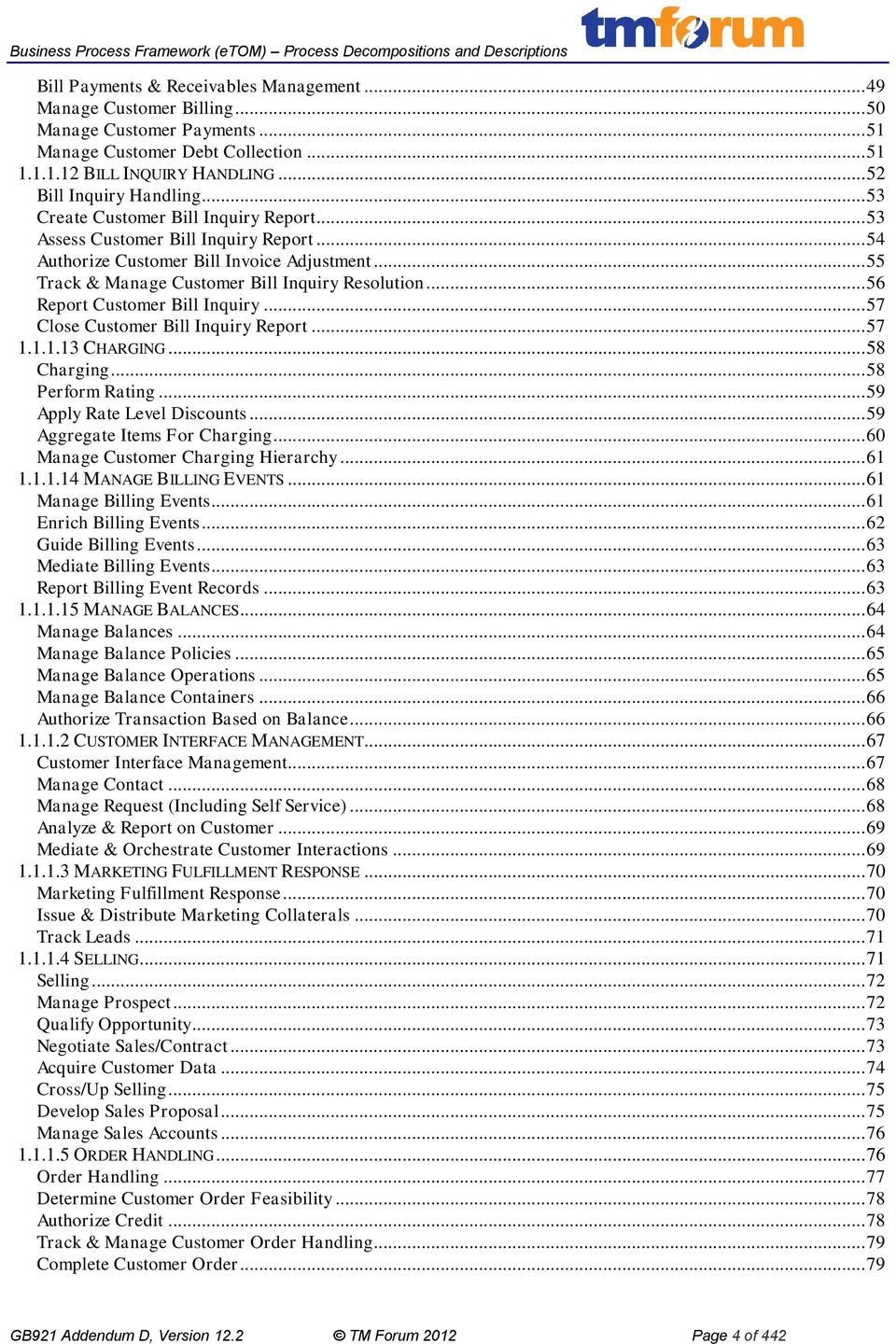
5 Issue Customer Orders Report Customer Order Handling Close Customer Order Receive PO & Issue Orders (DELETED) PROBLEM HANDLING Problem Handling Isolate Customer Problem Report Customer Problem Track & Manage Customer Problem Close Customer Problem Report Create Customer Problem Report Correct & Recover Customer Problem CUSTOMER QOS/SLA MANAGEMENT Customer QoS/SLA Management Assess Customer QoS/SLA Performance Manage QoS/SLA Violation Track & Manage Customer QoS Performance Resolution Close Customer QoS Performance Degradation Report Create Customer QoS Performance Degradation Report Report Customer QoS Performance RETENTION & LOYALTY Retention & Loyalty Establish & Terminate Customer Relationship Build Customer Insight Analyze & Manage Customer Risk Personalize Customer Profile for Retention & Loyalty Validate Customer Satisfaction SERVICE MANAGEMENT & OPERATIONS Service Management & Operations SM&O Support & Readiness Service Configuration & Activation Service Problem Management Service Quality Management Service Guiding & Mediation SM&O SUPPORT & READINESS SM&O Support & Readiness Manage Service Inventory Enable Service Configuration & Activation Support Service Problem Management Enable Service Quality Management Support Service & Specific Instance Rating SERVICE CONFIGURATION & ACTIVATION Service Configuration & Activation Design Solution Allocate Specific Service Parameters to Services Track & Manage Service Provisioning Implement, Configure & Activate Service Test Service End-to-End Issue Service Orders Report Service Provisioning Close Service Order Recover Service Deleted ( ) SERVICE PROBLEM MANAGEMENT Service Problem Management GB921 Addendum D, Version 12.2 TM Forum 2012 Page 5 of 442

6 Create Service Trouble Report Diagnose Service Problem Correct & Resolve Service Problem Track & Manage Service Problem Report Service Problem Close Service Trouble Report Survey & Analyze Service Problem SERVICE QUALITY MANAGEMENT Service Quality Management Monitor Service Quality Analyze Service Quality Improve Service Quality Report Service Quality Performance Create Service Performance Degradation Report Track & Manage Service Quality Performance Resolution Close Service Performance Degradation Report SERVICE GUIDING & MEDIATION Service Guiding & Mediation Mediate Service Usage Records Report Service Usage Records Guide Resource Usage Records Rate Usage Records (DELETED) RESOURCE MANAGEMENT & OPERATIONS Resource Management & Operations RM&O Support & Readiness Resource Provisioning Resource Trouble Management Resource Performance Management Resource Data Collection & Distribution Resource Mediation & Reporting Workforce Management RM&O SUPPORT & READINESS RM&O Support & Readiness Enable Resource Provisioning Enable Resource Performance Management Support Resource Trouble Management Enable Resource Data Collection & Distribution Manage Resource Inventory Manage Logistics RESOURCE PROVISIONING Resource Provisioning Allocate & Install Resource Configure & Activate Resource Test Resource Track & Manage Resource Provisioning Report Resource Provisioning Close Resource Order Issue Resource Orders Recover Resource Collect, Update & Report Resource Configuration Data (DELETED) RESOURCE TROUBLE MANAGEMENT Resource Trouble Management Survey & Analyze Resource Trouble Localize Resource Trouble Correct & Resolve Resource Trouble GB921 Addendum D, Version 12.2 TM Forum 2012 Page 6 of 442

7 Track & Manage Resource Trouble Report Resource Trouble Close Resource Trouble Report Create Resource Trouble Report RESOURCE PERFORMANCE MANAGEMENT Resource Performance Management Monitor Resource Performance Analyze Resource Performance Control Resource Performance Report Resource Performance Create Resource Performance Degradation Report Track & Manage Resource Performance Resolution Close Resource Performance Degradation Report RESOURCE DATA COLLECTION & DISTRIBUTION Resource Data Collection & Distribution Collect Management Information & Data Process Management Information & Data Distribute Management Information & Data Audit Data Collection & Distribution RESOURCE MEDIATION & REPORTING Resource Mediation & Reporting Mediate Resource Usage Records Report Resource Usage Records WORKFORCE MANAGEMENT Workforce Management Manage Appointment Schedule Assign Work Order Track & Manage Work Order Plan and Forecast Workforce Administer Workforce Report Manage Workforce Close Work Order Issue Work Order SUPPLIER/PARTNER RELATIONSHIP MANAGEMENT Supplier/Partner Relationship Management S/PRM Support & Readiness S/P Requisition Management S/P Problem Reporting & Management S/P Performance Management S/P Settlements & Payments Management S/P Interface Management S/PRM SUPPORT & READINESS S/PRM Support & Readiness Support S/P Requisition Management Support S/P Problem Reporting & Management Support S/P Performance Management Support S/P Settlements & Payments Management Support S/P Interface Management S/P REQUISITION MANAGEMENT S/P Requisition Management Select Supplier/Partner Determine S/P Pre-Requisition Feasibility Track & Manage S/P Requisition Receive & Accept S/P Requisition Initiate S/P Requisition Order GB921 Addendum D, Version 12.2 TM Forum 2012 Page 7 of 442

8 Report S/P Requisition Close S/P Requisition Order S/P PROBLEM REPORTING & MANAGEMENT S/P Problem Reporting & Management Initiate S/P Problem Report Receive S/P Problem Report Track & Manage S/P Problem Resolution Report S/P Problem Resolution Close S/P Problem Report S/P PERFORMANCE MANAGEMENT S/P Performance Management Initiate S/P Performance Degradation Report Track & Manage S/P Performance Resolution Report S/P Performance Close S/P Performance Degradation Report Monitor & Control S/P Service Performance S/P SETTLEMENTS & PAYMENTS MANAGEMENT S/P Settlements & Payments Management Manage Account Receive & Assess Invoice Negotiate & Approve Invoice Issue Settlement Notice & Payment S/P INTERFACE MANAGEMENT S/P Interface Management Manage S/P Requests (Including Self Service) Analyze & Report S/P Interactions Mediate & Orchestrate Supplier/Partner Interactions MARKETING & OFFER MANAGEMENT Marketing & Offer Management Market Strategy & Policy Product & Offer Portfolio Planning Product & Offer Capability Delivery Marketing Capability Delivery Product & Offer Development & Retirement Sales Development Product Marketing Communications & Promotion MARKET STRATEGY & POLICY Market Strategy & Policy Gather & Analyze Market Information Establish Market Segments Gain Commitment to Marketing Strategy Establish Market Strategy Link Market Segments & Products PRODUCT & OFFER PORTFOLIO PLANNING Product & Offer Portfolio Planning Gather & Analyze Product Information Establish Product Portfolio Strategy Produce Product Portfolio Business Plans Gain Commitment to Product Business Plans PRODUCT & OFFER CAPABILITY DELIVERY Product & Offer Capability Delivery Define Product Capability Requirements Approve Product Business Case Deliver Product Capability Manage Product Capability Delivery Methodology GB921 Addendum D, Version 12.2 TM Forum 2012 Page 8 of 442
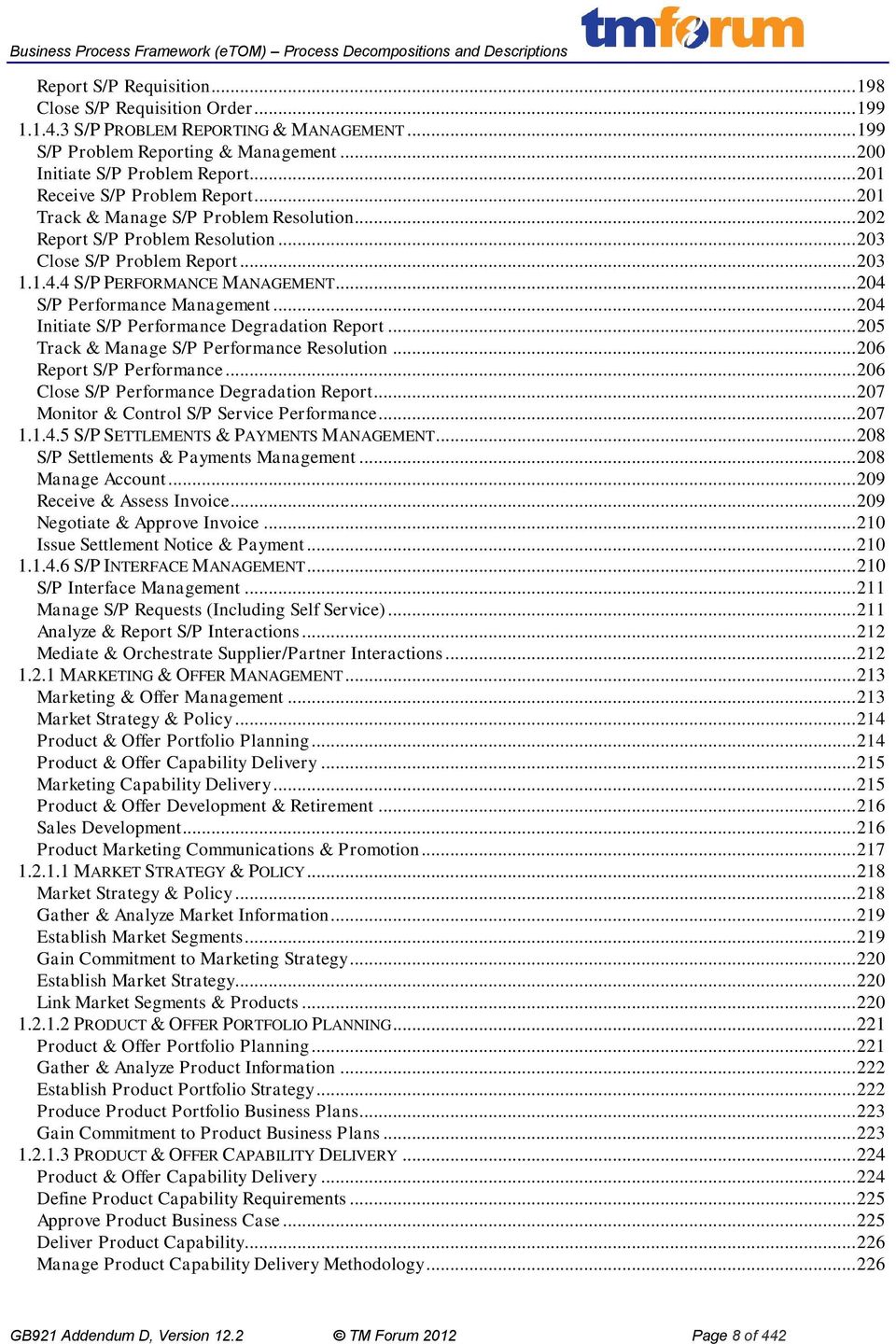
9 Capture Product Capability Shortfalls Manage Handover to Product Operations MARKETING CAPABILITY DELIVERY Marketing Capability Delivery Define Marketing Capability Requirements Gain Marketing Capability Approval Deliver Marketing Infrastructure Manage Handover to Marketing Operations Manage Marketing Capability Delivery Methodology PRODUCT & OFFER DEVELOPMENT & RETIREMENT Product & Offer Development & Retirement Gather & Analyze New Product Ideas Develop New Product Business Proposal Develop Detailed Product Specifications Launch New Products Assess Performance of Existing Products Develop Product Commercialization Strategy Manage Product Development Manage Product Exit SALES DEVELOPMENT Sales Development Monitor Sales & Channel Best Practice Develop Sales & Channel Proposals Develop New Sales Channels & Processes PRODUCT MARKETING COMMUNICATIONS & PROMOTION Product Marketing Communications & Promotion Define Product Marketing Promotion Strategy Develop Product & Campaign Message Select Message & Campaign Channels Develop Promotional Collateral Manage Message & Campaign Delivery Monitor Message & Campaign Effectiveness SERVICE DEVELOPMENT & MANAGEMENT Service Development & Management Service Strategy & Planning Service Capability Delivery Service Development & Retirement SERVICE STRATEGY & PLANNING Service Strategy & Planning Gather & Analyze Service Information Manage Service Research Establish Service Strategy & Goals Define Service Support Strategies Produce Service Business Plans Develop Service Partnership Requirements Gain Enterprise Commitment to Service Strategies SERVICE CAPABILITY DELIVERY Service Capability Delivery Map & Analyze Service Requirements Gain Service Capability Investment Approval Enable Service Support & Operations Manage Handover to Service Operations Capture Service Capability Shortfalls Design Service Capabilities Manage Service Capability Delivery GB921 Addendum D, Version 12.2 TM Forum 2012 Page 9 of 442

10 SERVICE DEVELOPMENT & RETIREMENT Service Development & Retirement Gather & Analyze New Service Ideas Assess Performance of Existing Services Develop New Service Business Proposal Develop Detailed Service Specifications Manage Service Development Manage Service Deployment Manage Service Exit RESOURCE DEVELOPMENT & MANAGEMENT Resource Development & Management Resource Strategy & Planning Resource Capability Delivery Resource Development & Retirement RESOURCE STRATEGY & PLANNING Resource Strategy & Planning Gather & Analyze Resource Information Establish Resource Strategy & Architecture Produce Resource Business Plans Gain Enterprise Commitment to Resource Plans Manage Resource Research Define Resource Support Strategies Develop Resource Partnership Requirements RESOURCE CAPABILITY DELIVERY Resource Capability Delivery Map & Analyze Resource Requirements Gain Resource Capability Investment Approval Enable Resource Support & Operations Manage Handover to Resource Operations Capture Resource Capability Shortfalls Design Resource Capabilities Manage Resource Capability Delivery RESOURCE DEVELOPMENT & RETIREMENT Resource Development & Retirement Gather & Analyze New Resource Ideas Assess Performance of Existing Resources Develop New Resource Business Proposal Develop Detailed Resource Specifications Manage Resource Development Manage Resource Deployment Manage Resource Exit SUPPLY CHAIN DEVELOPMENT & MANAGEMENT Supply Chain Development & Management Supply Chain Strategy & Planning Supply Chain Capability Delivery Supply Chain Development & Change Management SUPPLY CHAIN STRATEGY & PLANNING Supply Chain Strategy & Planning Gather & Analyze Supply Chain Information Establish Supply Chain Strategy & Goals Define Supply Chain Support Strategies Produce Supply Chain Business Plans Gain Enterprise Commitment to Supply Chain Plans SUPPLY CHAIN CAPABILITY DELIVERY Supply Chain Capability Delivery GB921 Addendum D, Version 12.2 TM Forum 2012 Page 10 of 442

11 Determine the Sourcing Requirements Manage the Tender Process Gain Tender Decision Approval Negotiate Commercial Arrangements Determine Potential Suppliers/Partners Gain Approval for Commercial Arrangements SUPPLY CHAIN DEVELOPMENT & CHANGE MANAGEMENT Supply Chain Development & Change Management Manage Supplier/Partner Engagement Manage Supply Chain Contract Variation Manage Supplier/Partner Termination STRATEGIC & ENTERPRISE PLANNING Strategic & Enterprise Planning Strategic Business Planning Business Development Enterprise Architecture Management Group Enterprise Management ITIL Release and Deployment Management ITIL Change Management STRATEGIC BUSINESS PLANNING Strategic Business Planning Provide Strategic Business Direction Creat Actionable Strategy Program-manage Strategy Implementation BUSINESS DEVELOPMENT Business Development Develop Concepts for Revenue Streams Focus or Broaden Customer Base Identify Outspourcing Opportunities Investigate Potential Mergers & Acquisitions Facilitate Negotiation & Implementation of Potential Mergers & Acquisitions ENTERPRISE ARCHITECTURE MANAGEMENT Enterprise Architecture Management Manage Enterprise Architecture Methodology Co-ordinate Enterprise Architecture Manage Enterprise Architectuer Toolsets and Associated Standards Manage & Administer Architecture Repositories Manage Architecture Skillsets Provide Reference Source for Standard Operating Environment Co-ordinate Architecture Review GROUP ENTERPRISE MANAGEMENT Group Enterprise Management Plann & Implement Cross-Business Unit Operation Harmonize Processes & Communication Systems across Business Units Manage Funding & Cross-Subsidies across Business Units Manage Investment for Business Development Co-ordinate Business Activities ENTERPRISE RISK MANAGEMENT Enterprise Risk Management Business Continuity Management Security Management Fraud Management Audit Management Insurance Management Revenue Assurance Management GB921 Addendum D, Version 12.2 TM Forum 2012 Page 11 of 442
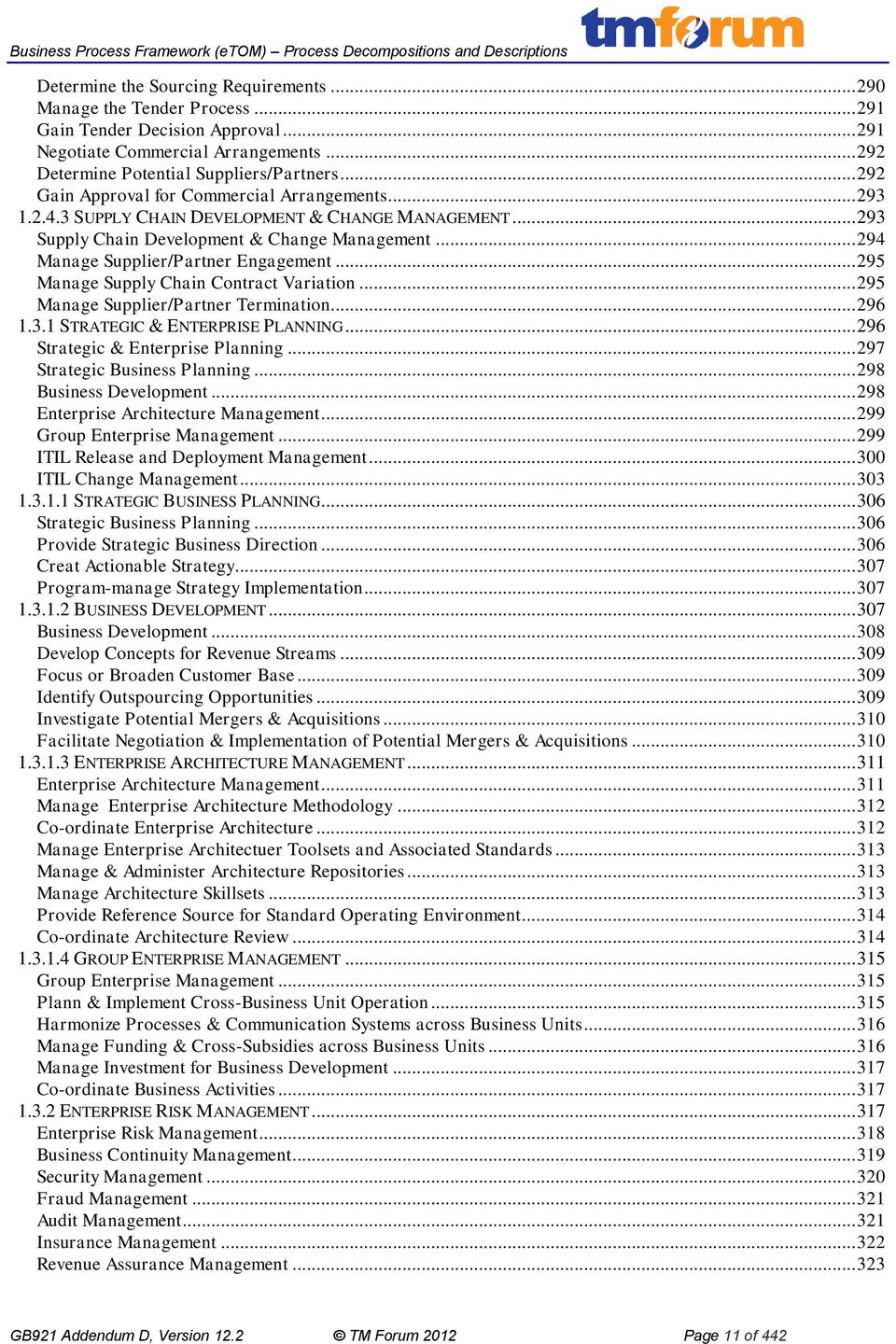
12 ITIL IT Service Continuity Management ITIL Information Security Management ITIL Problem Management BUSINESS CONTINUITY MANAGEMENT Business Continuity Management Co-ordinate Business Continuity Plan Business Continuity Plan Infrastructure Recovery Plan Serious Incident Management Manage Business Continuity Methodologies SECURITY MANAGEMENT Define Security Management Prevention Security Management Manage Proactive Security Management Monitor Industry Trends for Security Management Define Secuirty Management Policies & Procedures Assist with Security Mangement Deployment Manage Reactive Security Management Detect Potential Security Threats & Violations Investigate Potential Security Threats & Violations Define Monitoring to Facilitate Security Management Define Security Management Analysis Define Security Management policies & procedures to facilitate detection incidents Define Incident Management policies and procedures FRAUD MANAGEMENT Fraud Policy Management Fraud Management AUDIT MANAGEMENT Audit Management Define Audit Policy Define Audit Mechanims Assess Operatonal Activities Evaluate Operational Activities Report Audits Apply Audit Mechanisms Proactively INSURANCE MANAGEMENT Insurance Management Identify Insurable Risks Analyze Insurance Cost/Benefits Provide Insurance Advice Manage Insuramce Porrtfolio REVENUE ASSURANCE MANAGEMENT Revenue Assurance Management Manage Revenue Assurance Policy Framework Manage Revenue Assurance Operations Support Revenue Assurance Operations ENTERPRISE EFFECTIVENESS MANAGEMENT Enterprise Effectiveness Management Process Management & Support Enterprise Quality Management Program & Project Management Enterprise Performance Assessment Facilities Management & Support ITIL Service Asset and Configuration Management ITIL Event Management GB921 Addendum D, Version 12.2 TM Forum 2012 Page 12 of 442

13 ITIL Service Catalogue Management ITIL Incident Management ITIL Service Level Management ITIL Capacity Management ITIL Availability Management ITIL Request Fulfillment ITIL Continual Service Improvement PROGRAM & PROJECT MANAGEMENT Program & Project Management Deliver Program/Project Methodologies & Support Select Program/Project Management Support Tools Manage Program/Project Management Skill Sets Manage Program/Project Management Repository Manage Program/Project Management Metrics ENTERPRISE PERFORMANCE ASSESSMENT Enterprise Performance Assessment Define Enterprise Performance Measures Manage Enterprise Performance Data Manage External Survet Companies Report Balanced Scorecard, etc KNOWLEDGE & RESEARCH MANAGEMENT Knowledge & Research Management Knowledge Management Research Management Technology Scanning RESEARCH MANAGEMENT Research Management Evaluate R&D Business Value Manage R&D Investment Manage R&D Program Actvities TECHNOLOGY SCANNING Technology Scanning Evaluate External Technology Determine Business Value of Potential Technology Assess Technology Acquisition FINANCIAL & ASSET MANAGEMENT Financial & Asset Management Financial Management Asset Management Procurement Management PROCUREMENT MANAGEMENT Procurement Management Manage Corporate Procurement & Logistics Policies Define Warehousing Policies Develop Logistics/Transport Policies Develop Stock/Inventory Management Policies Manage Goods Acceptance & Handling STAKEHOLDER & EXTERNAL RELATIONS MANAGEMENT Stakeholder & External Relations Management Corporate Communications & Image Management Community Relations Management Shareholder Relations Management Regulatory Management Legal Management Board & Shares/Securities Management GB921 Addendum D, Version 12.2 TM Forum 2012 Page 13 of 442

14 CORPORATE COMMUNICATIONS & IMAGE MANAGEMENT Corporate Communications & Image Management Promote Desired Corporate mage Manage Spokespeople Manage Messaging COMMUNITY RELATIONS MANAGEMENT Community Relations Management Ensure Community Visibility Communicate Community Messaging Handle Community Contacts SHAREHOLDER RELATIONS MANAGEMENT Shareholder Relations Management Manage Shareholder Relations Manage Employee Share Plans REGULATORY MANAGEMENT Regulatory Management Ensure Regulatory Compliance Handle Pending Regulations File Trariffs LEGAL MANAGEMENT Legal Management Ensure Legala Compliance Carry out Legal requests Provide Legal Advice Notify Legal Environment Changes Manage Legal Actions BOARD & SHARES/SECURITIES MANAGEMENT Board & Shares/Securities Management Manage Board Related Activities Manage Shares/Securities Manage Capital/Equity Activities Manage Share/Stock Registry HUMAN RESOURCES MANAGEMENT Human Resources Management HR Policies & Practices Organization Development Workforce Strategy Workforce Development Employee & Labor Relations Management HR POLICIES & PRACTICES HR Policies & Practices Facilitate Performance Appraisal Facilitate Remuneration Policies & Levels Facilitate Allowances & Benefits Facilitate Occupational Health & Safety Facilitate Equal Employment Opportunity Facilitate Compensation Guidelines Facilitate Code of Conduct Facilitate Hiring & Termination Guidelines Facilitate Employee Satisfaction Measurement & Management WORKFORCE STRATEGY Workforce Strategy Define Workforce Strategy Requirements Create Workforce Strategy Manage Workforce Change GB921 Addendum D, Version 12.2 TM Forum 2012 Page 14 of 442

15 WORKFORCE DEVELOPMENT Workforce Development Apply Competency Modeling Apply Skills Assessment Apply Strength Profiling Apply Succession Planning Apply Training Apply Career Development Apply Work Design Apply Employee Recruitment EMPLOYEE & LABOR RELATIONS MANAGEMENT Employee & Labor Relations Management Manage Employee Relations Manage Labor Relations INDEX ADMINISTRATIVE APPENDIX ACKNOWLEDGMENTS DOCUMENT HISTORY Version History Release History GB921 Addendum D, Version 12.2 TM Forum 2012 Page 15 of 442

16 List of Figures Figure 1. Customer Relationship Management decomposition into level 2 processes Figure 2. CRM Support & Readiness decomposition into level 3 processes Figure 3. Bill Invoice Management decomposition into level 3 processes Figure 4. Bill Payments & Receivables Management decomposition into level 3 processes Figure 5. Bill Inquiry Handling decomposition into level 3 processes Figure 6. Charging decomposition into level 3 processes Figure 7. Manage Billing Events decomposition into level 3 processes Figure 8. Manage Balances decomposition into level 3 processes Figure 9. Customer Interface Management decomposition into level 3 processes Figure 10. Marketing Fulfillment Response decomposition into level 3 processes Figure 11. Selling decomposition into level 3 processes Figure 12. Order Handling decomposition into level 3 processes Figure 13. Problem Handling decomposition into level 3 processes Figure 14. Customer QoS/SLA Management decomposition into level 3 processes Figure 15. Retention & Loyalty decomposition into level 3 processes Figure 16. Service Management & Operations decomposition into level 2 processes Figure 17. SM&O Support & Readiness decomposition into level 3 processes Figure 18. Service Configuration & Activation decomposition into level 3 processes Figure 19. Service Problem Management decomposition into level 3 processes Figure 20. Service Quality Management decomposition into level 3 processes Figure 21. Service Guiding & Mediation decomposition into level 3 processes Figure 22. Resource Management & Operations decomposition into level 2 processes Figure 23. RM&O Support & Readiness decomposition into level 3 processes Figure 24. Resource Provisioning decomposition into level 3 processes Figure 25. Resource Trouble Management decomposition into level 3 processes Figure 26. Resource Performance Management decomposition into level 3 processes Figure 27. Resource Data Collection & Distribution decomposition into level 3 processes Figure 28. Resource Mediation & Reporting decomposition into level 3 processes Figure 29. Workforce Management decomposition into level 3 processes Figure 30. Supplier/Partner Relationship Management decomposition into level 2 processes Figure 31. S/PRM Support & Readiness decomposition into level 3 processes Figure 32. S/P Requisition Management decomposition into level 3 processes GB921 Addendum D, Version 12.2 TM Forum 2012 Page 16 of 442

17 Figure 33. S/P Problem Reporting & Management decomposition into level 3 processes Figure 34. S/P Performance Management decomposition into level 3 processes Figure 35. S/P Settlements & Payments Management decomposition into level 3 processes. 208 Figure 36. S/P Interface Management decomposition into level 3 processes Figure 37. Marketing & Offer Management decomposition into level 2 processes Figure 38. Market Strategy & Policy decomposition into level 3 processes Figure 39. Product & Offer Portfolio Planning decomposition into level 3 processes Figure 40. Product & Offer Capability Delivery decomposition into level 3 processes Figure 41. Marketing Capability Delivery decomposition into level 3 processes Figure 42. Product & Offer Development & Retirement decomposition into level 3 processes Figure 43. Sales Development decomposition into level 3 processes Figure 44. Product Marketing Communications & Promotion decomposition into level 3 processes Figure 45. Service Development & Management decomposition into level 2 processes Figure 46. Service Strategy & Planning decomposition into level 3 processes Figure 47. Service Capability Delivery decomposition into level 3 processes Figure 48. Service Development & Retirement decomposition into level 3 processes Figure 49. Resource Development & Management decomposition into level 2 processes Figure 50. Resource Strategy & Planning decomposition into level 3 processes Figure 51. Resource Capability Delivery decomposition into level 3 processes Figure 52. Resource Development & Retirement decomposition into level 3 processes Figure 53. Supply Chain Development & Management decomposition into level 2 processes Figure 54. Supply Chain Strategy & Planning decomposition into level 3 processes Figure 55. Supply Chain Capability Delivery decomposition into level 3 processes Figure 56. Supply Chain Development & Change Management decomposition into level 3 processes Figure 57. Strategic & Enterprise Planning decomposition into level 2 processes Figure 58. Strategic Business Planning decomposition into level 3 processes Figure 59. Business Development decomposition into level 3 processes Figure 60. Enterprise Architecture Management decomposition into level 3 processes Figure 61. Group Enterprise Management decomposition into level 3 processes Figure 62. Enterprise Risk Management decomposition into level 2 processes Figure 63. Business Continuity Management decomposition into level 3 processes Figure 64. Security Management decomposition into level 3 processes Figure 65. Fraud Management decomposition into level 3 processes GB921 Addendum D, Version 12.2 TM Forum 2012 Page 17 of 442

18 Figure 66. Audit Management decomposition into level 3 processes Figure 67. Insurance Management decomposition into level 3 processes Figure 68. Revenue Assurance Management decomposition into level 3 processes Figure 69. Enterprise Effectiveness Management decomposition into level 2 processes Figure 70. Program & Project Management decomposition into level 3 processes Figure 71. Enterprise Performance Assessment decomposition into level 3 processes Figure 72. Knowledge & Research Management decomposition into level 2 processes Figure 73. Research Management decomposition into level 3 processes Figure 74. Technology Scanning decomposition into level 3 processes Figure 75. Financial & Asset Management decomposition into level 2 processes Figure 76. Procurement Management decomposition into level 3 processes Figure 77. Stakeholder & External Relations Management decomposition into level 2 processes Figure 78. Corporate Communications & Image Management decomposition into level 3 processes Figure 79. Community Relations Management decomposition into level 3 processes Figure 80. Shareholder Relations Management decomposition into level 3 processes Figure 81. Regulatory Management decomposition into level 3 processes Figure 82. Legal Management decomposition into level 3 processes Figure 83. Board & Shares/Securities Management decomposition into level 3 processes Figure 84. Human Resources Management decomposition into level 2 processes Figure 85. HR Policies & Practices decomposition into level 3 processes Figure 86. Workforce Strategy decomposition into level 3 processes Figure 87. Workforce Development decomposition into level 3 processes Figure 88. Employee & Labor Relations Management decomposition into level 3 processes. 429 GB921 Addendum D, Version 12.2 TM Forum 2012 Page 18 of 442

19 Preface Business Process Framework The Business Process Framework (etom) is a reference framework for categorizing all the business activities used by an enterprise involved in delivering on-line Information, Communications and Entertainment services. This is done through definition of each area of business activity, in the form of process components or Process Elements that can be decomposed to expose progressive detail. These process elements can then be positioned within a model to show organizational, functional and other relationships, and can be combined within process flows that trace activity paths through the business. The Process Framework can serve as the blueprint for standardizing and categorizing business activities (or process elements) that will help set direction and the starting point for development and integration of Business and Operations Support Systems (BSS and OSS respectively). An important additional application for the Process Framework is that it helps to support and guide work by TM Forum members and others to develop Frameworx-based solutions (Frameworx is the umbrella structure within which the Process Framework, and other TM Forum work, is gathered). it provides an industrystandard reference point, when considering internal process reengineering needs, partnerships, alliances, and general working agreements with other enterprises, and for suppliers into such enterprises, the Process Framework outlines potential boundaries of process solutions, and the required functions, inputs, and outputs that must be supported by process solutions. See the Release Notes provided for this release for details of the other elements within the Process Framework package of deliverables, and how this links with the rest of Frameworx. Note: This document is an Addendum within the Business Process Framework. Addenda are adjuncts to the main document (in this case, the Business process Framework, Concepts & Principles ) that are presented separately, to avoid a single document becoming cumbersome due to its size. Annexes and Appendices both allow material to be removed from a document body, so that the reader is not distracted from the document flow by too much detail. However, these have different statuses within a document: Annexes have equivalent status to the material within the body of the document, i.e. an Annex represents a formal agreement and requirements for the users of the document. Appendices contain material included for information or general guidance. Also, Addenda have the same status as Annexes. GB921 Addendum D, Version 12.2 TM Forum 2012 Page 19 of 442
20 Thus, a document body, together with its Annexes and Addenda (and their Annexes, if any), represents the normative material presented, while any Appendices in the main document or its Addenda represent non-normative material, included for information only. In addition, Application Notes are a specific document type, used to provide insight into how a specification or other agreed artifact is used in a particular context or area of application. They are non-normative as they provide information and guidance only within the area concerned. Note that this document, providing Extended Process Decompositions and Descriptions, is a normative Addendum. GB921 Addendum D, Version 12.2 TM Forum 2012 Page 20 of 442

21 Introduction This document stands as an Addendum to the Business Process Framework for the Information and Communications Services Industry", GB921 Release It provides further detail concerning the Framework through definition of the process elements within the Process Framework, at several levels of detail. It should be read in conjunction with the main GB921 Concepts & Principles document, and other Addenda (see the associated Release Notes for details). In the main document (GB921 Concepts & Principles), the overall Process Framework was described. In addition, brief descriptions of the Level 1 process groupings of the Process Framework were provided. Addendum D Process Decompositions and Descriptions provides the Level 2 decompositions and descriptions for each of these high-level process elements/groupings. Each Level 1 area is shown with its constituent Level 2 process elements, and brief process descriptions are provided for Level 2 processes in each of the top-level process areas: Operations (OPS); Strategy, Infrastructure & Product (SIP); and Enterprise Management. Further, each level 2 process element is then decomposed into a set of Level 3 decompositions and descriptions. Addendum DX Extended Process Decompositions and Descriptions extends the decompositions a further level - each level 3 process element is then decomposed into a set of Level 4 decompositions and descriptions. At this stage, this is provided for all the process elements within the Operations (OPS) and Strategy, Infrastructure & Product (SIP) areas, and for some of the process elements within Enterprise Management (EM). The extent of this, and the detail provided, is expected to develop in future releases. The documents are organized using the horizontal functional process groupings as the prime categorization for the SIP and OPS process areas these constitute the effective Level 1 process elements within the Process Framework decomposition hierarchy. The Enterprise process groupings are considered individually, and also represent Level 1 process elements.. It is convenient to illustrate all the Level 1 processes within the Process Framework in a single diagram, as in the main document (GB921). To extend this diagram to show all the Level 2 processes within each Level 1 process grouping is possible, but is too graphically complex a picture to be used directly. Once Level 3 processes are included, a single diagram becomes quite impractical, and so individual diagrams showing only part of the process decomposition structure, are shown. It should be understood that the aggregation of, say, all the Level 2 process elements, within a given Level 1 process area, represents the totality of that Level 1 process area within the Process Framework. Similarly, the aggregation of all component Level 3 processes, within their parent Level 2 process element, represents the totality of that Level 2 process element, and this pattern is repeated as further levels of decomposition are exposed. Note that the process decomposition diagrams used in this Addendum can include dots, or crosses, within some of the process boxes. These are not a GB921 Addendum D, Version 12.2 TM Forum 2012 Page 21 of 442
22 Process Associations and IDs graphical error, but are inserted automatically by a process-modeling tool, to indicate that a further decomposition of that process has been made in the tool. To aid understanding, each Level 2 and Level 3 process described here has an associated indication of its positioning within the particular vertical and horizontal Level 1 process with which it is associated. For example, CRM Operations Support & Process Management (shown under Customer Relationship Management Level 2 Process Descriptions, below) has the indication (CRM-OSR) to indicate it is within the horizontal Customer Relationship Management process, and the vertical Operations Support & Readiness process. Processes have been given a process ID throughout this document. The format of the numbering scheme work as follow: aaaaaa.b.x.c.d.e where aaaaaa: This will represent a company specific number. The Business Process Framework team recognizes the need for a company specific identifier but has not yet decided upon one specific format (this is for further study). This field is used to prefix the process ID so that individual companies may extend and/or change the processes; and identify the changes with a company specific identifier. b: This digit is used to identify the originator of the process It is set to 1 if the process is the TMF original one, to 2 otherwise x: Digit representing Level 0 process c: Digit representing Level 1 process d: Digit representing Level 2 process e: Digit representing Level 3 process The unique identifier thus associated with individual processes can thus be used to assist in locating individual processes. GB921 Addendum D, Version 12.2 TM Forum 2012 Page 22 of 442
23 Process Decompositions & Descriptions Customer Relationship Management Figure 1. Customer Relationship Management decomposition into level 2 processes Customer Relationship Management Process Identifier: This horizontal functional process grouping considers the fundamental knowledge of customers needs and includes all functionalities necessary for the acquisition, enhancement and retention of a relationship with a customer. This horizontal functional process grouping considers the fundamental knowledge of customers needs and includes all functionalities necessary for the acquisition, enhancement and retention of a relationship with a customer. It is about customer service and support, whether storefront, telephone, web or field service. It is also about retention management, cross-selling, up-selling and direct marketing for the purpose of selling to customers. CRM also includes the collection of customer information and its application to personalize, customize and integrate delivery of service to a customer, as well as to identify opportunities for increasing the value of the customer to the enterprise. CRM applies to both conventional retail customer interactions, as well as to wholesale interactions, such as when an enterprise is selling to another enterprise that is acting as the retailer. GB921 Addendum D, Version 12.2 TM Forum 2012 Page 23 of 442
24 CRM makes no distinction between manual or automated interactions with customers, nor whether interactions are by paper, telephone, web-based transactions or some other alternative arrangement. CRM - Support & Readiness Process Identifier: CRM Support & Readiness processes ensure the support capability is in place to allow the CRM Fulfillment, Assurance and Billing processes to operate effectively. CRM Support & Readiness processes ensure the support capability is in place to allow the CRM Fulfillment, Assurance and Billing processes to operate effectively. The responsibilities of these processes include, but are not limited to: Provision of sales, product and customer process infrastructure;, policy support and decision support knowledge for customers and customer interactions (including billing activities), sales activity and sales interactions, and product offerings; management & analysis of sales campaigns (including direct and outbound calling); management and analysis of sales activity and sales opportunities (including funnel and prospect analysis and support); maintaining and managing stocks of marketing collateral to be distributed using the Marketing Fulfillment processes; maintaining inventories to support the sales, product and customer data required by the FAB and CRM OS&R processes monitoring and reporting on the capabilities and costs of the individual CRM FAB processes; and longer-term trend analysis on product,,sales and customer FAB processes in order to establish the extent to which enterprise targets for these processes are being achieved and/or the need for the processes to be modified. These processes support the operational introduction of new processes and infrastructure to support new and/or enhanced product offerings, new and/or enhanced sales capability and new and/or enhanced customer management capabilities and are responsible for conducting operations readiness testing and acceptance. They develop the procedures for the specific Fulfillment, Assurance and Billing processes and keep them up to date. After successful testing, these processes accept the new or enhanced process capabilities and manage a full-scale introduction for general availability. GB921 Addendum D, Version 12.2 TM Forum 2012 Page 24 of 442
25 Customer Interface Management Process Identifier: Managing all interfaces between the enterprise and potential and existing customers. Customer Interface Management processes are responsible for managing all interfaces between the enterprise and potential and existing customers. They deal with contact management, understanding the reason for contact, directing customer contacts to the appropriate process, contact closure, exception management, contact results analysis and reporting. CRM contact may be related to one or several of Service Fulfillment, Service Assurance (service quality management and trouble or problem management) and Billing related customer enquiries or contacts. Marketing Fulfillment Response Process Identifier: Responsible for the issue and distribution of marketing collateral directly to a customer and the subsequent tracking of resultant leads. Marketing Fulfillment Response processes are responsible for the issue and distribution of marketing collateral (i.e., coupon, premium, sample, toys, fliers, etc.) directly to a customer and the subsequent tracking of resultant leads. These processes include campaign management activities from lead generation to product and literature fulfillment, and hand-off of leads to the selling processes. Selling Process Identifier: GB921 Addendum D, Version 12.2 TM Forum 2012 Page 25 of 442
26 Responsible for managing prospective customers, for qualifying and educating customers, and matching customer expectations Selling processes are responsible for managing prospective customers, for the qualification and education of the customer and for matching customer expectations to the enterprise s products and services and ability to deliver. These processes also manage the response to customer RFPs. Order Handling Process Identifier: Responsible for accepting and issuing orders. Order Handling processes are responsible for accepting and issuing orders. They deal with pre-order feasibility determination, credit authorization, order issuance, order status and tracking, customer update on order activities and customer notification on order completion. Responsibilities of the Order Handling processes include, but are not limited to: Issuing new customer orders, modifying open customer orders or canceling open customer orders; Verifying whether specific non-standard offerings sought by customers are feasible and supportable; Checking the credit worthiness of customers as part of the customer order process; Testing the completed offering to ensure it is working correctly; Updating of the Customer Inventory Database to reflect that the specific product offering has been allocated, modified or cancelled; Assigning and tracking customer provisioning activities; Managing customer provisioning jeopardy conditions; and GB921 Addendum D, Version 12.2 TM Forum 2012 Page 26 of 442
27 Reporting progress on customer orders to customer and other processes. Problem Handling Process Identifier: Responsible for receiving trouble reports from customers, resolving them to the customer s satisfaction and providing meaningful status on repair and/or restoration activity to the customer. Problem Handling processes are responsible for the management of problems reported by customers and associated with purchased product offerings. The objective of these processes is to receive reports from customers, resolving them to the customer s satisfaction and providing meaningful status on repair and/or recovery activity to the customer. They are also responsible for customer contact and support in relation to any customer-affecting problems detected by other processes or through analysis, including proactively informing the customer and resolving these specific problems to the customer s satisfaction. Responsibilities of the Problem Handling processes include, but are not limited to: Capturing, analyzing, managing and reporting on customer reported problems associated with purchased product offerings; Initiating and managing customer problem reports; Correcting customer problems; Reporting progress on customer problem reports to customer and other processes; Assigning & tracking customer problem recovery activities; and Managing customer problem jeopardy conditions. Problem Handling processes perform analysis, decide on the appropriate actions/responses and carry them out with the intent of restoring normal operation on specific purchased product offerings. Customer QoS/SLA Management Process Identifier: GB921 Addendum D, Version 12.2 TM Forum 2012 Page 27 of 442
28 Monitoring, managing and reporting of delivered vs. contractual Quality of Service (QoS), as defined in the enterprise s service descriptions, customer contracts or product catalogue. Customer QoS/SLA Management processes encompass monitoring, managing and reporting of delivered vs. contractual Quality of Service (QoS), as defined in the enterprise's Service Descriptions, customer contracts or the catalogue of product offerings. They are also concerned with the performance of the enterprise and its products in relation to its Service Level Agreements (SLA) for specific product instances, and other service-related documents. They include operational parameters such as resource performance and availability, but also encompass performance across all of a product's contractual or regulatory parameters, e.g., % Completion on Time for Order Requests, time to repair commitments, customer contact performance. Failure to meet a contracted SLA may lead to billing adjustments, which are handled by Billing and Collections Management. Retention & Loyalty Process Identifier: Manage all functionalities related to the retention of acquired customers, and the use of loyalty schemes in the potential acquisition of customers. Retention & Loyalty processes deal with all functionalities related to the retention of acquired customers, and the use of loyalty schemes in the potential acquisition of customers. They establish a complete understanding of the needs of the customer, a determination of the value of the customer to the enterprise, determination of opportunities and risks for specific customers, etc. These processes collect and analyze data from all enterprise and customer contact. Bill Invoice Management Process Identifier: GB921 Addendum D, Version 12.2 TM Forum 2012 Page 28 of 442
29 Ensure the bill invoice is created, physically and/or electronically produced and distributed to customers, and that the appropriate taxes, discounts, adjustments, rebates and credits for the products and services delivered to customers have been applied. Bill Invoice Management processes ensure the bill invoice is created, physically and/or electronically produced and distributed to customers, and that the appropriate taxes, discounts, adjustments, rebates and credits for the products and services delivered to customers have been applied. These processes are accountable for assuring that enterprise revenue is billed and invoices delivered appropriately to customers. These processes are responsible for, but not limited to: Establishment and application of taxes and charges to the services delivered to customers; Application of the adjustment (adjustment decision done in Bill Inquiry Handling); Creation of accurate bill invoices including all adjustments, rebates, discounts, credits, etc; and Production & distribution of bill in physical and/or electronic form to customers in accordance with the billing cycle; Forecasting of physical resources associated with bill production, such as paper and envelope quantities; Alignment and management of promotional material insertion into distributed bills; and Establishment and management of third party arrangements to support bill invoice generation, production and distribution. Bill Payments & Receivables Management Process Identifier: Ensure that enterprise revenue is collected through pre-established collection channels and put in place procedures to recover past due payments. GB921 Addendum D, Version 12.2 TM Forum 2012 Page 29 of 442
30 The purpose of the Bill Payments & Receivables Management processes is to ensure that enterprise revenue is collected through pre-established collection channels and put in place procedures to recover past due payments. These processes are responsible for managing customer s billing account, processing their payments, performing payment collections and monitoring the status of the account balance. These processes are responsible for, but not limited to: Establishment and management of customer payment processes and channels; Establishment and management of debt collection processes; and Establishment and management of third party arrangements to support collection and recovery of past due payments. Bill Inquiry Handling Process Identifier: Ensure the timely and effective fulfillment of all customer bill inquiries and complaints. The purpose of Bill Inquiry Handling process is to ensure the timely and effective fulfillment of all customer bill inquiries and complaints. This process is responsible for managing customer interaction as it relates to a customer s billing relationship to a Service Provider. This includes the creation of inquiries against the customer s billing account(s), and management of changes to customer billing account structure and details, the managing of all customer bill inquiry lifecycle, reporting changes and updates and closing of customer bill inquiry when all activities were accomplished. This process can be viewed via traditional means, with a service representative managing the customer or via e-business means. In the latter case, inquiries, complaints and changes to details would be handled via electronic media without the intervention of a representative. Charging Process Identifier: GB921 Addendum D, Version 12.2 TM Forum 2012 Page 30 of 442
31 Managing the assignment of a value (monetary or other) to an event or product, or combination (bundle or aggregate) of the above. The purpose of Charging is to assign a value (monetary or other) to an event or product, or combination (bundle or aggregate) of the above. The charge may be either a credit or a debit and can be handled either online or offline. Online charging is performed in real-time, requiring an authorization component which may affect how the service is rendered and enables an operator to provide prepaid services to its customers. Whereas offline charging is performed after the service is rendered and is not required to be done in real-time and generally relates to subscription based products. The charge may appear on a customer invoice via Apply Pricing, Discounting, Adjustments & Rebates. Manage Billing Events Process Identifier: Encompasses the functions required to guide, distribute, mediate, summarize, accumulate, and analyze billing event records. The billing events management processes encompass the functions required to guide, distribute, mediate, summarize, accumulate, and analyze billing event records. These processes may occur in real-time, near real-time, or may be executed on a periodic basis. Billing event records include records produced by network elements (service events), records that indicate the need for periodic billing of a reoccurring product rate, and records that indicate the need for billing of a non-reoccurring rate. The guiding processes ensures that the event records used in the billing processes are appropriately related to the correct customer billing account and products. GB921 Addendum D, Version 12.2 TM Forum 2012 Page 31 of 442
32 The billing event records are edited and if necessary reformatted (mediated) to meet the needs of subsequent processes. The billing event records may also be enriched with additional data during this process. Manage Balances Process Identifier: process terms, and can be applied (i.e. instantiated ) with other similar process elements Management of customer and/or subscriber account balances. This process is responsible for holding, calculating, applying policies and managing functionality/interfaces for the account balances of a customer and/or a subscriber. Here the values resulting from rating and the application of discounts are applied to a customer's balance. The balance affected by the value may be monetary or other balances such as minutes, points, or tokens. Authorizing service requests based on available balance is optional. Billing & Collections Management (DELETED) Process Identifier: (This Process ID has been deliberately unused!) CRM - Support & Readiness GB921 Addendum D, Version 12.2 TM Forum 2012 Page 32 of 442
33 Figure 2. CRM Support & Readiness decomposition into level 3 processes CRM - Support & Readiness Process Identifier: CRM Support & Readiness processes ensure the support capability is in place to allow the CRM Fulfillment, Assurance and Billing processes to operate effectively. CRM Support & Readiness processes ensure the support capability is in place to allow the CRM Fulfillment, Assurance and Billing processes to operate effectively. The responsibilities of these processes include, but are not limited to: Provision of sales, product and customer process infrastructure;, policy support and decision support knowledge for customers and customer interactions (including billing activities), sales activity and sales interactions, and product offerings; management & analysis of sales campaigns (including direct and outbound calling); management and analysis of sales activity and sales opportunities (including funnel and prospect analysis and support); maintaining and managing stocks of marketing collateral to be distributed using the Marketing Fulfillment processes; maintaining inventories to support the sales, product and customer data required by the FAB and CRM OS&R processes monitoring and reporting on the capabilities and costs of the individual CRM FAB processes; and GB921 Addendum D, Version 12.2 TM Forum 2012 Page 33 of 442
34 longer-term trend analysis on product,,sales and customer FAB processes in order to establish the extent to which enterprise targets for these processes are being achieved and/or the need for the processes to be modified. These processes support the operational introduction of new processes and infrastructure to support new and/or enhanced product offerings, new and/or enhanced sales capability and new and/or enhanced customer management capabilities and are responsible for conducting operations readiness testing and acceptance. They develop the procedures for the specific Fulfillment, Assurance and Billing processes and keep them up to date. After successful testing, these processes accept the new or enhanced process capabilities and manage a full-scale introduction for general availability. Support Customer Interface Management Process Identifier: Ensure that all information, materials, systems and resources are available so that the Customer Interface Management processes can operate effectively, when a contact with a customer occurs. The purpose of the Support Customer Interface Management processes is to ensure that there is capability (for example, information, materials, systems and resource) so that the Customer Interface Management processes can operate effectively when a contact with a customer occurs. Examples are information on how to handle unusual requests based on temporary situations, systems needed to accept and track customer contacts, requests for the provisioning of additional resources where it has been identified that current levels will impact on timely contact handling. These processes are responsible for implementing generic and specific changes to customer interfaces. This support could be in updating agent scripts, IVR announcements, Web pages, etc. Customer Interface Support processes keep up to date all information concerning customers. These processes undertake trend analysis on customer contacts, e.g. type, frequency, duration, outcome. Support Order Handling Process Identifier: GB921 Addendum D, Version 12.2 TM Forum 2012 Page 34 of 442
35 Ensure that new and/or modified Order Handling related infrastructure is deployed effectively, and to ensure that Order Handling processes can operate effectively. The purpose of the Support Order Handling processes is twofold to ensure that new and/or modified Order Handling related infrastructure is deployed effectively, and to ensure that Order Handling processes can operate effectively. For the Order Handling processes the role of the Support Order Handling processes is to make sure that there is sufficient process capacity and capability (for example information, materials, systems and resources) so that the Order Handling processes can operate effectively.examples are information on how to process orders for specific product offerings, information needed to carry out designs, materials needed to confirm customer order requests, systems needed to validate product offering availability. The responsibilities of these processes include, but are not limited to: forecasting at an operational level customer order handling volume requirements; the capacity planning associated with the deployment of new and/or modified customer order handling infrastructure; establishment and monitoring of organizational arrangements to support deployment and operation of new and/or modified customer order handling infrastructure; creation, deployment, modification and/or upgrading of customer order handling infrastructure deployment support tools (including Customer Inventory and Product Offer Inventory) and processes for new and/or modified customer order handling infrastructure; authoring, reviewing and approving operational procedures developed by Marketing & Offer Management processes prior to customer order handling infrastructure deployment; the testing and acceptance of new and/or modified customer order handling infrastructure as part of the handover procedure from the Marketing & Offer Management processes to Operations; detecting customer order handling infrastructure operational limitations and/or deployment incompatibilities and providing requirements to address these aspects to Marketing & Offer Management processes; co-ordination and roll-out, in accordance with approved plans, of the approved new and/or modified customer order handling infrastructure; monitoring capacity utilization of deployed customer order handling infrastructure to provide early detection of potential customer order handling infrastructure shortfalls; reconfiguration and re-arrangement of under-utilized deployed customer order handling infrastructure; managing recovery and/or removal of obsolete or unviable customer order handling infrastructure; GB921 Addendum D, Version 12.2 TM Forum 2012 Page 35 of 442
36 reporting on deployed customer order handling infrastructure capacity; Tracking and monitoring of the customer order handling infrastructure deployment processes and costs (including where customer order handling infrastructure is deployed and managed by third parties), reporting on the capability of the customer order handling infrastructure deployment processes; and establishing and managing customer order handling notification facilities and lists to support the Order Handling notification and reporting processes The processes undertake trend analysis on order handling, such as time taken to complete a customer order, frequency and type of Order Handling process issues involved, and cancelled orders. Support Problem Handling Process Identifier: Assist Problem Handling processes by proactively undertaking statistically driven preventative and scheduled purchased product offering maintenance activities and monitoring, managing and reporting on the capability of the Problem Handling processes. The responsibilities of the Support Problem Handling processes are twofold - assist Problem Handling processes by proactively undertaking statistically driven preventative and scheduled purchased product offering maintenance activities and monitoring, managing and reporting on the capability of the Problem Handling processes. These processes are responsible for ensuring that the purchased product offerings are working effectively and efficiently. Responsibilities of these processes include, but are not limited to: Extracting and analyzing, including undertaking trend analysis, historical and current customer problem reports and performance reports to identify potential customer purchased product offerings requiring proactive maintenance and/or replacement; Requesting scheduling of additional customer purchased product offering data collection to assist in the analysis activity; Requesting scheduling of customer purchased product offering performance testing to assist in analysis activity; Developing and managing customer purchased product offering proactive maintenance programs; Requesting customer provisioning activity to prevent anticipated customer problems associated with purchased product offerings identified in the analysis activities; GB921 Addendum D, Version 12.2 TM Forum 2012 Page 36 of 442
37 Reporting outcomes of trend analysis to Market & Offer Management processes to influence new and/or modified customer product offering development; Tracking and monitoring of the Problem Handling processes and associated costs (including where customer infrastructure is deployed and managed by third parties), and reporting on the capability of the Problem Handling processes; and Establishing and managing customer problem notification facilities and lists to support the Problem Handling notification and reporting processes These processes undertake trend analysis on problem handling. Support Retention & Loyalty Process Identifier: Ensure that all information, materials, systems and resources are available so that the Retention & Loyalty processes can be completed without delay, when a request is received from a customer The purpose of the Support Retention & Loyalty processes is to make sure that there is capability (for example, information, materials, systems and resources) so that the Retention & Loyalty processes can operate effectively. Examples are information on current requests for analysis and collection of customer profile information, materials needed to analyze customer retention and loyalty information, systems needed to analyze customer retention and loyalty information, requests for the provisioning of additional resources where it has been identified that current levels will impact on timely retention and loyalty information collection and delivery. These processes undertake trend analysis on retention and loyalty, including customer acquisitions and churn, and the effectiveness of loyalty schemes. Support Marketing Fulfillment Process Identifier: GB921 Addendum D, Version 12.2 TM Forum 2012 Page 37 of 442
38 Ensure that there is capability to support the expected demand for the Marketing Fulfillment Response processes so that they can operate effectively. The purpose of the Support Marketing Fulfillment processes is to ensure that there is capability (for example, information, materials, systems and resources) so that the Marketing Fulfillment Response processes can operate effectively. These processes monitor planned Product Launches and current Marketing Fulfillment activity, then redistribute existing capability or enable new capability (people, facilities, infrastructure). These processes undertake trend analysis on marketing, including problems occurring and launch effectiveness. Support Selling Process Identifier: Administer and manage the operation of the various sales channels and to ensure that there is capability (for example, information, materials, systems and resources) to support the Selling processes The purpose of the Support Selling processes is twofold - to administer and manage the operation of the various sales channels and to ensure that there is capability (for example, information, materials, systems and resources) to support the Selling processes so that they can operate effectively. These processes monitor current selling trends, and are responsible for the optimization and/or redistribution of existing sales channel capability or for enabling new capability (people, facilities, infrastructure). These processes undertake trend analysis on selling, including problems, successes, profit and loss Support Selling processes deal with the administration of the Selling processes and the effectiveness of the channels to support new and existing products, as well as existing and potential customers. The processes ensure the effectiveness of the sales staff and channels both in terms of skill sets available, but also in terms of demand forecasting and management of utilization. These processes are also responsible for the administration and management of sales channel incentive, compensation and reward schemes, and for assessing the performance and effectiveness of sales channels. Other marketing processes, such as Manage Campaign and Product Marketing Communications & Promotion, are responsible for determining the appropriate selling route or channel, and the required selling method and mechanism for specific market segments and channels, by product or product family, e.g., face-to-face contact, telemarketing, etc. Support Selling processes are responsible for ensuring that the sales GB921 Addendum D, Version 12.2 TM Forum 2012 Page 38 of 442
39 channels are capable of implementing the required selling method and have the necessary skills and capacity to support the anticipated volumes and type of product in each market segment. These processes are responsible for providing feedback on the performance and effectiveness information as required to other marketing processes. Sales Channels managed by these processes include retail storefronts, e.g. a third-party retailer or an enterprise's own storefront, various web sites or ISPs, B2B marketplaces or direct relationships with external parties, distributors for that product family, account teams, outbound calling teams, direct sales teams, etc. The Support Selling processes are responsible for the collection and administration of sales lead s and the associated probabilities, and for the distribution of leads to the appropriate sales channels. Leads are collected from many processes both customer facing processes and back-end processes. This process is responsible to ensure that processes are operating to collect leads wherever they arise, for the management of leads, and for the matching of the lead to the appropriate sales channel. These processes are responsible for distributing the lead into the appropriate sales channel. Support Customer QoS/SLA Process Identifier: Support Customer QoS/SLA Management processes by proactively monitoring and assessing the performance of purchased product offerings as a group against agreed QoS/SLA parameters, and monitoring, managing and reporting on the capability of the Customer QoS/SLA Management processes. The responsibilities of the Support Customer QoS/SLA Management processes are twofold - support Customer QoS/SLA Management processes by proactively monitoring and assessing the performance of purchased product offerings as a group against agreed QoS/SLA parameters, and monitoring, managing and reporting on the capability of the Customer QoS/SLA Management processes. Proactive management is undertaken using a range of performance parameters, whether technical, time, economic or process related. The responsibilities of the processes include, but are not limited to: Undertaking proactive monitoring regimes of groups of similar purchased product offerings as required to ensure ongoing performance within agreed parameters over time; Developing and maintaining, in the product offering repository, acceptable and/or commercially agreed performance threshold standards for purchased product offerings to support the Customer QoS/SLA Management processes; GB921 Addendum D, Version 12.2 TM Forum 2012 Page 39 of 442
40 Undertaking trend analysis, and producing reports, of the QoS performance of groups of like purchased product offerings to identify any longer term deterioration; Monitoring and analyzing the purchased product offering performance analyses produced by the Customer QoS/SLA Management processes to identify problems that may be applicable to purchased product offerings as a whole; Aggregate analysis of QoS performance across groups of customers or aggregate analysis of SLA types; Sourcing details relating to purchased product offerings performance and analysis from the product offering inventory to assist in the development of trend analyses; Logging the results of the analysis into the product offering inventory repository; Establishing and managing facilities to inform customers of, and negotiate agreement for, planned service outages; Tracking and monitoring of the Customer QoS/SLA Management processes and associated costs, and reporting on the capability of the Customer QoS/SLA Management processes; Establishing and managing customer notification facilities and lists to support the Customer QoS/SLA Management notification and reporting processes; and Supporting the Support Customer QoS/SLA Management process. Manage Campaign Process Identifier: Manage individual marketing campaigns developed by Product Marketing Communications & Promotion processes The purpose of the Manage Campaign processes is to manage individual Marketing Campaigns developed by Product Marketing Communications & Promotion processes. These processes monitor and undertake trend analysis on the effectiveness of the campaigns, make modifications and report results. Manage Campaign processes ensure that Marketing Fulfillment Response is staffed, trained and equipped appropriately to support the specific campaign, whether direct mail, TV ad, etc. Manage Customer Inventory Process Identifier: GB921 Addendum D, Version 12.2 TM Forum 2012 Page 40 of 442
41 Establish, manage and administer the enterprise's customer inventory, as embodied in the Customer Inventory Database, and monitor and report on the usage and access to the customer inventory, and the quality of the data maintained in it. The purpose of the Manage Customer Inventory processes are twofold - establish, manage and administer the enterprise's customer inventory, as embodied in the Customer Inventory Database, and monitor and report on the usage and access to the customer inventory, and the quality of the data maintained in it. The customer inventory maintains records of all customers, their interactions with the enterprise, any contracts established, and any other customer related- information, required to support CRM and other processes. Responsibilities of these processes include, but are not limited to: Identifying the inventory-relevant information requirements to be captured for customers ; Identifying, establishing and maintaining customer inventory repository facilities; Establishing and managing the customer inventory management and information capture processes; Managing the registration and access control processes that enable processes to create, modify, update, delete and/or download customer data to and from the customer inventory; Ensuring the customer inventory repository accurately captures and records all identified customer details, through use of automated or manual audits; Tracking and monitoring of the usage of, and access to, the customer inventory repository and associated costs, and reporting on the findings; and Identifying any technical driven shortcomings of the customer inventory repository, and providing input to Resource Development & Management processes to rectify these issues. Manage Product Offering Inventory Process Identifier: GB921 Addendum D, Version 12.2 TM Forum 2012 Page 41 of 442
42 Establish, manage and administer the enterprise's product offering inventory, as embodied in the Product Offering Inventory Database, and monitor and report on the usage and access to the product offering inventory, and the quality of the data maintained in it. The purpose of the Manage Product Offering Inventory processes are twofold - establish, manage and administer the enterprise's product offering inventory, as embodied in the Product Offering Inventory Database, and monitor and report on the usage and access to the product offering inventory, and the quality of the data maintained in it. The product offering inventory maintains records of all product offerings, their interactions with the enterprise, and any other product offering related- information, required to support CRM and other processes. The product offering inventory is also responsible for maintaining the association between customers and purchased product offering instances, created as a result of the Order Handling processes. Responsibilities of these processes include, but are not limited to: Identifying the inventory-relevant information requirements to be captured for product offerings ; Identifying, establishing and maintaining product offering inventory repository facilities; Establishing and managing the product offering inventory management and information capture processes; Managing the registration and access control processes that enable processes to create, modify, update, delete and/or download product offering data to and from the product offering inventory; Ensuring the product offering inventory repository accurately captures and records all identified product offering details, through use of automated or manual audits; Tracking and monitoring of the usage of, and access to, the product offering inventory repository and associated costs, and reporting on the findings; and Identifying any technical driven shortcomings of the product offering inventory repository, and providing input to Resource Development & Management processes to rectify these issues. Manage Sales Inventory Process Identifier: Establish, manage and administer the enterprise's inventory of sales prospects, actual sales, channel management and sales commissions, as embodied in the Sales Inventory GB921 Addendum D, Version 12.2 TM Forum 2012 Page 42 of 442
43 Database, and monitor and report on the usage and access to the sales inventory, and the quality of the data maintained in it. The purpose of the Manage Sales Inventory processes are twofold - establish, manage and administer the enterprise's inventory of sales prospects, actual sales, channel management and sales commissions, as embodied in the Sales Inventory Database, and monitor and report on the usage and access to the sales inventory, and the quality of the data maintained in it. The sales inventory maintains records of all sales, sales prospects and sales leads, sales channel activity, marketing campaign targets and performance, sales commissions and any other sales related- information, required to support both the Support Selling and the Selling processes. The sales inventory is also responsible for maintaining the association between customers and sales instances, created as a result of the Selling processes. Responsibilities of these processes include, but are not limited to: Identifying and storing the inventory-relevant information requirements to be captured for sales processes and sales commission management ; Identifying, establishing and maintaining sales inventory repository facilities; Establishing and managing the sales inventory management and information capture processes; Managing the registration and access control processes that enable processes to create, modify, update, delete and/or download sales data to and from the sales inventory; Ensuring the sales inventory repository accurately captures and records all identified sales details, through use of automated or manual audits; Tracking and monitoring of the usage of, and access to, the sales inventory repository and associated costs, and reporting on the findings; and Identifying any technical driven shortcomings of the sales inventory repository, and providing input to Resource Development & Management processes to rectify these issues. Support Bill Invoice Management Process Identifier: Ensure that all information, materials, systems and resources are available so that the Bill Invoice Management processes can be completed without delay. GB921 Addendum D, Version 12.2 TM Forum 2012 Page 43 of 442
44 The purpose of the Support Bill Invoice Management processes is to make sure that there is capability (for example, information, materials, systems and resources) so that the Bill Invoice Management processes can operate effectively. Examples are information needed to generate invoices like taxes, charges, prices, etc., information needed to deliver bills to customers such as address formats and post/zip codes structures, systems needed to create bills, requests for provisioning of additional resources where it has been identified that current levels will impact on timely bill preparation. Where a commercial agreement has been established with a customer to present a billing invoice in a particular customer specific format, these processes are responsible for establishing and maintain the customer specific billing invoice formats, and any interaction with specific customers to modify the format, and design and development of the Service Provider s invoicing process. These processes maintain lists of customers who are eligible for receiving bills in electronic format, and maintain the form of electronic format to be used on a customer basis. Support Bill Invoice Management processes define the billing cycles and respective dates according to cash flow needs as established by Financial Management processes. These processes undertake trend analysis on invoice generation, production and distribution issues, including volume per billing cylce. Support Bill Payments & Receivables Management Process Identifier: Ensure that all information and systems are available so that the Bill Payments & Receivables Management processes can be completed without delay. The purpose of the Support Bill Payments & Receivables Management processes is to make sure that there is capability (for example, established collection channels, information and systems) so that the Bill Payments & Receivables Management processes can operate effectively. Examples are collection channels capable of processing customer bill payments, information on payments done by customers, systems needed to process the payments and make the customer bill account balance. GB921 Addendum D, Version 12.2 TM Forum 2012 Page 44 of 442
45 In addition these processes are responsible for establishing, managing and, if required, operating the various payment processes that the Service Provider chooses to establish. These processes undertake trend analysis on customer billing debts, alerting when predetermined thresholds are tended to be exceeded. Support Bill Inquiry Handling Process Identifier: Ensure that all information, systems and resources are available so that the Bill Inquiry Handling processes can be completed without delay. The purpose of the Support Bill Inquiry Handling processes is to make sure that there is capability (for example, information, systems and resources) so that the Bill Inquiry Handling processes can operate effectively. Examples are information on how to respond to current billing issues being raised by customers, systems needed to create customer bill inquiry and complaint reports, requests for provisioning of additional resources where it has been identified that current levels will impact on timely billing complaint handling. These processes are responsible for managing billing policies associated with customer billing dispute settlements. These processes undertake trend analysis on billing queries and complaints. Support Billing & Collections (DELETED) Process Identifier: (This Process ID has been deliberately unused!) GB921 Addendum D, Version 12.2 TM Forum 2012 Page 45 of 442
46 Bill Invoice Management Figure 3. Bill Invoice Management decomposition into level 3 processes Bill Invoice Management Process Identifier: Ensure the bill invoice is created, physically and/or electronically produced and distributed to customers, and that the appropriate taxes, discounts, adjustments, rebates and credits for the products and services delivered to customers have been applied. Bill Invoice Management processes ensure the bill invoice is created, physically and/or electronically produced and distributed to customers, and that the appropriate taxes, discounts, adjustments, rebates and credits for the products and services delivered to customers have been applied. These processes are accountable for assuring that enterprise revenue is billed and invoices delivered appropriately to customers. These processes are responsible for, but not limited to: Establishment and application of taxes and charges to the services delivered to customers; Application of the adjustment (adjustment decision done in Bill Inquiry Handling); GB921 Addendum D, Version 12.2 TM Forum 2012 Page 46 of 442
47 Creation of accurate bill invoices including all adjustments, rebates, discounts, credits, etc; and Production & distribution of bill in physical and/or electronic form to customers in accordance with the billing cycle; Forecasting of physical resources associated with bill production, such as paper and envelope quantities; Alignment and management of promotional material insertion into distributed bills; and Establishment and management of third party arrangements to support bill invoice generation, production and distribution. Apply Pricing, Discounting, Adjustments & Rebates Process Identifier: Ensure that the bill invoice is reflective of all the commercially agreed billable events and any bill invoice adjustments agreed between a Service Provider and the customer. The purpose of the Apply Pricing, Discounting, Adjustments & Rebates process is to ensure that the bill invoice is reflective of all the commercially agreed billable events and any bill invoice adjustments agreed between a Service Provider and the customer. In addition, it ensures that the appropriate taxes, rebates (i.e. missed customer commitments) and credits are applied to the customer s bill invoice(s). This process contains the account and customer specific pricing, charges, discounting, credits and taxation for services delivered to the customer by the Service Provider. It accepts events that have been collected, translated, correlated, assembled, guided and service rated. It takes these events and determines the account or customer specific pricing, charges, discounts, and taxation that should be delivered to the invoice(s) for the customer. It reviews any agreed adjustments agreed in the previous billing period and includes these to the bill invoice. This process can occur in real-time as events are service rated, or can be on a scheduled on a periodic basis at the Service Provider s discretion. Create Customer Bill Invoice Process Identifier: GB921 Addendum D, Version 12.2 TM Forum 2012 Page 47 of 442
48 Production of a timely and accurate invoice in accordance with the specific billing cycles and reflective of the final charges for services, together with any adjustments, delivered to the customer by the Service Provider and respective trading partners. The primary purpose of the Create Customer Bill Invoice process is the production of a timely and accurate invoice in accordance with the specific billing cycles and reflective of the final charges for services, together with any adjustments, delivered to the customer by the Service Provider and respective trading partners. This process contains the invoicing components of the Service Provider s business. This includes the rendering/formatting of an invoice, the delivery of an electronic copy of an invoice to customers and the processes that verify invoice quality prior to distribution to the customer in electronic form, or to the process responsible for physical invoice production and distribution. The flow of this process can be viewed as an extension of the company s e-business strategy. In this case, the Service Provider would render an invoice electronically, via the Internet for example. Furthermore, this process provides specifications for the formatting of invoices in different ways and to achieve different publishing possibilities, and supports the creation of different invoice formats for different publication media. The process is further responsible for splitting and re-arranging invoices for customers (particularly customers with complex account structures) according to agreements made with these customers. Additionally these processes store the customer invoice for a period of time to address regulation and/or internal requirements, during which they can be accessed to support any customer or regulator agency inquiries on bill invoices. Produce & Distribute Bill Process Identifier: Physical production and distribution of bills to customers in accordance with the specified billing cycle. The purpose of the Produce & Distribute Customer Bill Invoice process is the physical production and distribution of bills to customers in accordance with the specified billing cycle. This process is responsible for all activities associated with ensuring a physical bill is delivered to customers. GB921 Addendum D, Version 12.2 TM Forum 2012 Page 48 of 442
49 The responsibilities of the process include, but are not limited to: Establishing and managing the physical bill production cycle; Establishing the requirements for, and managing the agreed commercial arrangements with, appropriate outsourced suppliers of the production and distribution capabilities; Delivery of invoice information to the physical production processes; Coordinating with promotional processes for any billing insertions to be included with the bill; If internal processes are used, managing availability of paper and envelope volumes to meet the needs of the physical production process; If internal production facilities are used, managing the production runs to create the bills; and Quality management of the physical production and distribution processes. Note that in the above processes for establishing arrangements with outsourced suppliers that the Supply Chain Capability Delivery processes are used as the vehicle for creating the commercial agreements Bill Payments & Receivables Management Figure 4. Bill Payments & Receivables Management decomposition into level 3 processes Bill Payments & Receivables Management Process Identifier: GB921 Addendum D, Version 12.2 TM Forum 2012 Page 49 of 442
50 Ensure that enterprise revenue is collected through pre-established collection channels and put in place procedures to recover past due payments. The purpose of the Bill Payments & Receivables Management processes is to ensure that enterprise revenue is collected through pre-established collection channels and put in place procedures to recover past due payments. These processes are responsible for managing customer s billing account, processing their payments, performing payment collections and monitoring the status of the account balance. These processes are responsible for, but not limited to: Establishment and management of customer payment processes and channels; Establishment and management of debt collection processes; and Establishment and management of third party arrangements to support collection and recovery of past due payments. Manage Customer Billing Process Identifier: Ensure effective management of the customer s billing account as it relates to the products purchased and consumed throughout the appropriate billing cycle. The primary purpose of this process pertains to effective management of the customer s billing account as it relates to the products purchased and consumed throughout the appropriate billing cycle. This process focuses on managing changes to the customer s billing account (for example, customer billing address, etc.) as it relates to the customer s service portfolio, such as ensuring that the correct purchased products are assigned to the customer s billing account for accurate billing. GB921 Addendum D, Version 12.2 TM Forum 2012 Page 50 of 442
51 Manage Customer Payments Process Identifier: Collect payments made by the customer and reconcile the payments to the invoices. The purpose of the Manage Customer Payments process is to collect payments made by the customer and reconcile the payments to the invoices. This process is meant to match these payments with the services/invoices delivered to this customer. These processes can include credit/debit/eft payments using various channels, either directly or through third parties, and cash or cheque payments, either directly or through third parties. In all the above cases these processes are responsible for the processes interacting with the customers and/or the third parties. The processes are also responsible for establishing managing back-end bank accounts for receipt of the customer payments and for the transfer of funds collected by third parties. These processes are responsible for reconciling the money received into the bank accounts against the payments expected in the invoices. Additionally these processes inform the Financial Management on all those payments for updating the ledger. These processes are responsible for establishing the requirements for, and managing any commercial arrangements agreed with, third party suppliers. Note that the Supply Chain Capability Delivery process is used to deliver the commercial agreements. To the extent that processing of any payments is undertaken internally, i.e. cheque processing, these processes are responsible for managing the operation and quality of the internal processing. Where payments do not match invoices, this process is responsible for informing the Manage Customer Debt CollectionManage Debt Management processes of any underpayments, and the Bill Inquiry Handling processes for any over-payments. Underpayments and overpayments are handled appropriately by these separate processes. Manage Customer Debt Collection Process Identifier: GB921 Addendum D, Version 12.2 TM Forum 2012 Page 51 of 442
52 Collect past due payments from the customer. The purpose of the Manage Customer Debt Collection process is to collect past due payments from the customer. This process monitors the amount due from the customer, i.e. check whether the payments are made on time, and implements necessary activities and policies to recover amounts overdue. The responsibilities of this process include, but are not limited to: Identifying invoices which are overdue for payment; Initiating and managing follow-up with customers having overdue amounts; Arranging and monitoring payment plans to allow customers to pay overdue amounts in installments; Initiating debt recovery activities in accordance with appropriate commercial practice and policies; Managing the aged customer debt portfolio; Establishing and managing customer debt profiles to assist in managing debt recovery and debt risk on a customer, product or customer group basis; Establishing and managing commercial arrangements with third parties for the recover of aged debt, and/or for the write-off and selling of parts of the debt portfolio to third parties Note that these processes may initiate a direct enquiry to the customer and attempt to manage the initial recovery through the Bill Inquiry Handling processes. These processes use policies established by the Support Bill Payments & Receivable Management process to direct any escalation of the recovery processes being employed. Note that where third party arrangements need to be put in place, these processes are responsible for establishing the requirements for, and managing any commercial arrangements agreed with, third party suppliers. The Supply Chain Capability Delivery process is used to deliver the commercial agreements Bill Inquiry Handling GB921 Addendum D, Version 12.2 TM Forum 2012 Page 52 of 442
53 Figure 5. Bill Inquiry Handling decomposition into level 3 processes Bill Inquiry Handling Process Identifier: Ensure the timely and effective fulfillment of all customer bill inquiries and complaints. The purpose of Bill Inquiry Handling process is to ensure the timely and effective fulfillment of all customer bill inquiries and complaints. This process is responsible for managing customer interaction as it relates to a customer s billing relationship to a Service Provider. This includes the creation of inquiries against the customer s billing account(s), and management of changes to customer billing account structure and details, the managing of all customer bill inquiry lifecycle, reporting changes and updates and closing of customer bill inquiry when all activities were accomplished. This process can be viewed via traditional means, with a service representative managing the customer or via e-business means. In the latter case, inquiries, complaints and changes to details would be handled via electronic media without the intervention of a representative. Create Customer Bill Inquiry Report Process Identifier: GB921 Addendum D, Version 12.2 TM Forum 2012 Page 53 of 442
54 Create a new customer bill inquiry report. The objective of the Create Customer Bill Inquiry Report process is to create a new customer bill inquiry report, modify existing customer bill inquiry reports, and request cancellation of existing customer bill inquiry reports. A new customer bill inquiry report may be created as a result of specific customer initiated bill inquiry or complaint notifications. If the customer bill inquiry report is created, the Create Customer Bill Inquiry Report processes are responsible for converting the received information into a form suitable for the Bill Inquiry Handling processes, and for requesting additional information if required. Assess Customer Bill Inquiry Report Process Identifier: Assess the bill inquiry report to determine the nature of the inquiry, and to determine whether the inquiry has arisen due to circumstances originating in other process areas The purpose of the Assess Customer Bill Inquiry Report processes is to assess the bill inquiry report to determine the nature of the inquiry, and to determine whether the inquiry has arisen due to circumstances originating in other process areas. The responsibilities of these processes include, but are not limited to: - Verifying whether the information supplied by the customer is correct; and - Performing assessment and investigation based on the customer provided information to determine whether the circumstances leading to the bill inquiry is linked to the underlying services, or other processes. GB921 Addendum D, Version 12.2 TM Forum 2012 Page 54 of 442
55 The Assess Customer Bill Inquiry Report processes will make the results of the investigation available to other processes. The Assess Customer Bill Inquiry Report processes will update the customer bill inquiry report, as required during the assessment, and when the root cause has been identified. The Assess Customer Bill Inquiry Report processes will notify the Track & Manage Bill Inquiry Resolution processes when the investigation and assessment is complete. Authorize Customer Bill Invoice Adjustment Process Identifier: Adjust the customer s bill invoice based on detailed assessment and/or policy. The purpose of the Authorize Customer Bill Invoice Adjustment processes is to adjust the cus-tomer s bill invoice based on detailed assessment and/or policy. The responsibilities of this process include, but are not limited to: - Determination of whether policy allows for automated adjustment of the customer bill invoice, and approving any resultant adjustments; - Undertaking more detailed analysis and investigation to determine whether a bill adjustment is acceptable, including gaining appropriate management authority to make the adjustment; and - Recording the results of the adjustment if approved into the records relating to the customer s bill invoice. These processes rely on the availability of appropriate adjustment policies, which are created within the Support Bill Inquiry Handling processes, for the timely resolution of major billing disputes. The resolution processes may require investigation of the billing processes themselves to de-termine whether the disputed bills are the result of quality errors within the Service GB921 Addendum D, Version 12.2 TM Forum 2012 Page 55 of 442
56 Provider processes. Track & Manage Customer Bill Inquiry Resolution Process Identifier: Efficiently assign, coordinate and track specific customer bill inquiry analysis, bill adjustments and ensuring that appropriate credits and/or other agreed adjustments are made available to the adjustments processes activities, and escalate any open customer bill inquiries in jeopardy. The objective of the Track & Manage Customer Bill Inquiry Resolution processes is to efficiently assign, coordinate and track specific customer bill inquiry analysis, bill adjustments and ensuring that appropriate credits and/or other agreed adjustments are made available to the adjustments processes activities, and escalate any open customer bill inquiries in jeopardy. Responsibilities of these processes include, but are not limited to: - Scheduling, assigning and coordinating analysis and specific customer bill inquiry/complaint adjustment activities; - Modifying the customer bill inquiry/complaint status; - Canceling a customer bill inquiry when the specific request was related to a false billing event; and - Monitoring the jeopardy status of open customer bill inquiries, and escalating customer bill inquiries as necessary. Note that some specific product and/or service components may be owned and managed by suppliers/partners. In these cases the Track & Manage Customer Bill Inquiry Resolution process is responsible for initiating requests, through - S/P Settlements & Payments Management for resolution by the supplier/partner of the specific bill inquiries/complaints. GB921 Addendum D, Version 12.2 TM Forum 2012 Page 56 of 442
57 These processes will co-ordinate all the actions necessary in order to guarantee that all tasks are finished at the appropriate time and in the appropriate sequence. The Track & Manage Bill Inquiry Resolution processes will also inform the Close Customer Bill Inquiry processes by modifying the customer bill inquiry status to cleared when the specific customer bill inquiry/complaint issues have been resolved. Report Customer Bill Inquiry Process Identifier: Report on the customer s bill inquiry. The objective of the Report Customer Bill Inquiry processes is to monitor the status of customer bill inquiries, provide notifications of any changes and provide management reports. These processes are responsible for continuously monitoring the status of customer bill inquiries and managing notifications to other processes and to other parties, including customers, reg-istered to receive notifications of any status changes. Notification lists are managed and maintained by the Support Bill Inquiry Handling processes. These processes record, analyze and assess the customer bill inquiry status changes to provide management reports and any specialized summaries of the efficiency and effectiveness of the overall Bill Inquiry Handling processes. These specialized summaries could be specific reports required by specific audiences and/or customers. These processes also report any identified constraints that can affect customer billing quality standards to other processes. These constraints may include specific resource (billing applica-tion and/or database, for example) failures, etc. Close Customer Bill Inquiry Report Process Identifier: GB921 Addendum D, Version 12.2 TM Forum 2012 Page 57 of 442
58 Close a customer bill inquiry report when the bill inquiry/complaint has been resolved. The objective of the Close Customer Bill Inquiry Report processes is to close a customer bill inquiry report when the bill inquiry/complaint has been resolved. These processes monitor the status of all open customer bill inquiry reports, and recognize that a customer bill inquiry report is ready to be closed when the status is changed to cleared Charging Figure 6. Charging decomposition into level 3 processes Charging Process Identifier: GB921 Addendum D, Version 12.2 TM Forum 2012 Page 58 of 442
59 Managing the assignment of a value (monetary or other) to an event or product, or combination (bundle or aggregate) of the above. The purpose of Charging is to assign a value (monetary or other) to an event or product, or combination (bundle or aggregate) of the above. The charge may be either a credit or a debit and can be handled either online or offline. Online charging is performed in real-time, requiring an authorization component which may affect how the service is rendered and enables an operator to provide prepaid services to its customers. Whereas offline charging is performed after the service is rendered and is not required to be done in real-time and generally relates to subscription based products. The charge may appear on a customer invoice via Apply Pricing, Discounting, Adjustments & Rebates. Perform Rating Process Identifier: Calculating the value of the service/product, before, during or after the rendering of the service. Process responsible for calculating the value of the service/product, before, during or after the rendering of the service, based on parameters of the request (type, quantity, etc.), parameters of the customer/subscriber (tariffs, price plans, accumulated usage, contracts, etc.) and other parameters (time-of-day, taxes, etc.). The same request maybe rated differently for different subscribers based on their purchased offers or service agreements. Apply Rate Level Discounts Process Identifier: GB921 Addendum D, Version 12.2 TM Forum 2012 Page 59 of 442
60 Applies discounts to product prices. This process applies discounts to product prices at an individual product level. A discount may be expressed as a monetary amount or percentage, and modifies a price for a product. When a discount is expressed as a percentage, the discounting process determines the discount calculated in relation to the price for the product. The discount may be displayed as a separate entry on the bill or may be combined with the rate for the product to only show as one entry. Discounts may be a one-time event or may have some duration (days, months, life of product, etc.). Discounts may apply to a specific customer or be generally available based on selection of products (for example - bundles). Discounting structures may involve tiers, tapers, or thresholds. Aggregate Items For Charging Process Identifier: Manages the accumulation of items that may be used in the selection of a value or in calculation of a rate/discount. This process is responsible for accumulating contributing items, which can be quantities, values (monetary or other) or both. Aggregation can occur over time or can be initiated to gather a snapshot of the items at a point in time. The aggregated items may be used in Perform Rating or Apply Rate Level Discounts to determine the applicable price or discount and may further be used as a quantity in the calculation of a rate or discount. GB921 Addendum D, Version 12.2 TM Forum 2012 Page 60 of 442
61 Manage Customer Charging Hierarchy Process Identifier: This process element represents part of the overall enterprise, modelled in business process terms, and can be applied (i.e. instantiated ) with other similar process elements Managing the charging relationships among subscribers. Customer hierarchies are commonly used for corporate customers, family plans or other type of affinity groups. This process manages the charging relationships among subscribers, e.g. sharing, inheriting or restricting balances, price plans and discounts. Thereby assuring that a charge is added to or subtracted from the correct (sub-)account balance Manage Billing Events Figure 7. Manage Billing Events decomposition into level 3 processes Manage Billing Events Process Identifier: GB921 Addendum D, Version 12.2 TM Forum 2012 Page 61 of 442
62 Encompasses the functions required to guide, distribute, mediate, summarize, accumulate, and analyze billing event records. The billing events management processes encompass the functions required to guide, distribute, mediate, summarize, accumulate, and analyze billing event records. These processes may occur in real-time, near real-time, or may be executed on a periodic basis. Billing event records include records produced by network elements (service events), records that indicate the need for periodic billing of a reoccurring product rate, and records that indicate the need for billing of a non-reoccurring rate. The guiding processes ensures that the event records used in the billing processes are appropriately related to the correct customer billing account and products. The billing event records are edited and if necessary reformatted (mediated) to meet the needs of subsequent processes. The billing event records may also be enriched with additional data during this process. Enrich Billing Events Process Identifier: Enrich billing event records with additional data. The Enrich Billing Events processes will augment the billing event records by adding data to the records from sources such as customer, product, or other reference data. A billing event may be assigned a price without consideration of specific product or customer information. The assigned price may be used to enrich the billing event record. GB921 Addendum D, Version 12.2 TM Forum 2012 Page 62 of 442
63 Guide Billing Events Process Identifier: Ensures that the event records used in the billing processes are related to the correct customer billing account and subscribed products. The Guide Billing Events processes ensure that the event records used in the billing process relate to the correct customer billing account and products. A specific event record may be related to multiple customer billing accounts and subscribed products. Distribution of billing event records to other processes may also occur. Mediate Billing Events Process Identifier: Edits and reformats data for recipient applications. The Mediate Billing Events process edits and reformats the data record to meet the needs of a recipient application. Report Billing Event Records Process Identifier: GB921 Addendum D, Version 12.2 TM Forum 2012 Page 63 of 442
64 Generate reports on billing event records based on requests from other processes. The purpose of the Report Billing Event Record processes is to generate reports on billing event records based on requests from other processes. These processes produce reports that may identify abnormalities, which may be caused by fraudulent activity or related to customer complaints. Investigation of problems related to these event records is also part of this process. These processes also support other processes such as customer review of billing events (pre-billing and post-billing) Manage Balances Figure 8. Manage Balances decomposition into level 3 processes Manage Balances Process Identifier: GB921 Addendum D, Version 12.2 TM Forum 2012 Page 64 of 442
65 process terms, and can be applied (i.e. instantiated ) with other similar process elements Management of customer and/or subscriber account balances. This process is responsible for holding, calculating, applying policies and managing functionality/interfaces for the account balances of a customer and/or a subscriber. Here the values resulting from rating and the application of discounts are applied to a customer's balance. The balance affected by the value may be monetary or other balances such as minutes, points, or tokens. Authorizing service requests based on available balance is optional. Manage Balance Policies Process Identifier: process terms, and can be applied (i.e. instantiated ) with other similar process elements Executing policies per balance or balance type. Balance policies are rules that describe how balance affecting events are to be handled. This is done by comparing the value of each event against criteria such as the following: - a minimum allowable balance limit (e.g. balance must remain above zero), - balance expiration dates, - balance thresholds actions and notifications and - roll-over & cyclic policies. Manage Balance Operations Process Identifier: process terms, and can be applied (i.e. instantiated ) with other similar process elements GB921 Addendum D, Version 12.2 TM Forum 2012 Page 65 of 442
66 Allow different operations to be performed on the managed balance. Balance operations processes the charged events, using balance policies and then guides the results towards the relevant balance containers. Operations include : - Reserving amounts from any balance for any session, and crediting unused reservations back into the balance, when a session is released. - Updating balances by applying charges to the balance and credit/debit adjustments. - Balance queries. - Transferring amounts from one balance to another. Manage Balance Containers Process Identifier: process terms, and can be applied (i.e. instantiated ) with other similar process elements Hold and maintain the different balances that a customer and/or a subscriber may have. This process manages the balance containers assigned to a customer and/or subscriber and is used to keep track of usage events, providing input for decision making processes (such as service or product authorization) by means of the balance policies. The containers include monetary and non-monetary balances (or shared) and are used as prepaid balances (enabling realtime service or product authorization), postpaid balances (in conjunction with an Account-Receivables [AR] application). Examples of non-monetary balances and allowances are: free minutes, WAP-only quota, etc. Authorize Transaction Based on Balance Process Identifier: process terms, and can be applied (i.e. instantiated ) with other similar process elements GB921 Addendum D, Version 12.2 TM Forum 2012 Page 66 of 442
67 Manages authorization of service/ product requests based on available balances (monetary or non-monetary) and policies. This process may include balance reservation and must be performed online. Subsequent balance updates are not required to be done in real-time. In this context a service is provided by the network, e.g. voice call. Product is digital content delivered via the network, e.g. content such as music, games, etc Customer Interface Management Figure 9. Customer Interface Management decomposition into level 3 processes Customer Interface Management Process Identifier: Managing all interfaces between the enterprise and potential and existing customers. GB921 Addendum D, Version 12.2 TM Forum 2012 Page 67 of 442
68 Customer Interface Management processes are responsible for managing all interfaces between the enterprise and potential and existing customers. They deal with contact management, understanding the reason for contact, directing customer contacts to the appropriate process, contact closure, exception management, contact results analysis and reporting. CRM contact may be related to one or several of Service Fulfillment, Service Assurance (service quality management and trouble or problem management) and Billing related customer enquiries or contacts. Manage Contact Process Identifier: Manage all contacts/requests between potential or existing customers and the enterprise The purpose of this process is to manage all contacts between potential or existing customers and the enterprise. It deals with the identification of the contact, its development, enhancement and update Manage Request (Including Self Service) Process Identifier: Manage all requests (inbound and outbound) made by potential and existing customers The purpose of this process is to manage all requests (inbound and outbound) made by potential and existing customers. It receives the request and either enables its originator to automatically fulfill it, or identifies and activates the opportune process to accomplish the request; it manages the status of the request and is able to provide status information at any moment in which the request is active; it formally closes the request when all related activities have been terminated. GB921 Addendum D, Version 12.2 TM Forum 2012 Page 68 of 442
69 Analyze & Report on Customer Process Identifier: Perform all necessary analysis on closed requests and on customer contacts and generate related reports The purpose of this process is to perform all necessary analysis on closed (completed or unfulfilled) requests and on customer contacts and it generates related reports, to be utilized for process improvement activities, proactive problems prevention, up-sell opportunities definition, etc. Mediate & Orchestrate Customer Interactions Process Identifier: Ensure that transaction message structure and interactions conform to agreed, externally defined standards used by the enterprise and its customers The purpose of the Mediate & Orchestrate Customer Interactions is to ensure that transaction message structure and interactions conform to agreed, externally defined standards used by the enterprise and its customers. Increasingly transactions with external parties (e.g. customers using RosettaNet or Web Services standards) will need to conform to message and data formats defined by third parties or third party organizations. Based on the specific transaction type and involved external party, this conformance will require the identification of the necessary data formats to be sent externally, and conversion of externally received messages into the required internal enterprise formats. In addition, interactions with external parties may require that messages and transactions need to be undertaken with defined and agreed orchestration for message exchange. The actual agreement between the parties to use specific interaction standards is part of the Support Customer Interface Management and Support Selling L3s. GB921 Addendum D, Version 12.2 TM Forum 2012 Page 69 of 442
70 Marketing Fulfillment Response Figure 10. Marketing Fulfillment Response decomposition into level 3 processes Marketing Fulfillment Response Process Identifier: Responsible for the issue and distribution of marketing collateral directly to a customer and the subsequent tracking of resultant leads. Marketing Fulfillment Response processes are responsible for the issue and distribution of marketing collateral (i.e., coupon, premium, sample, toys, fliers, etc.) directly to a customer and the subsequent tracking of resultant leads. These processes include campaign management activities from lead generation to product and literature fulfillment, and hand-off of leads to the selling processes. Issue & Distribute Marketing Collaterals Process Identifier: GB921 Addendum D, Version 12.2 TM Forum 2012 Page 70 of 442
71 Issue and distribute marketing collateral (i.e., coupon, premium, sample, toys, fliers, etc.) directly to a customer The purpose of this process is to handle the issuing and distribution of marketing collateral to customer, in line with marketing campaign needs. This can involve mailshots, leafleting and displays at events, inserts in newspapers, television and other media advertising and magazines, voice and text messaging to individuals, and so on. Where required, this process deals with customization of general campaign material for individual regions or customer groups. Direct marketing and sales through shop premises, in-store franchises, etc are also included, and this process also manages distribution of marketing collaterals to such outlets Track Leads Process Identifier: Track leads generated through marketing, or that arise in the course of business The purpose of this process is to identify leads following on from marketing campaign advertising, or those that arise otherwise in the course of business and are collected here. Leads are tracked, evaluated and notified to other processes (e.g. Selling) for further action Selling GB921 Addendum D, Version 12.2 TM Forum 2012 Page 71 of 442
72 Figure 11. Selling decomposition into level 3 processes Selling Process Identifier: Responsible for managing prospective customers, for qualifying and educating customers, and matching customer expectations Selling processes are responsible for managing prospective customers, for the qualification and education of the customer and for matching customer expectations to the enterprise s products and services and ability to deliver. These processes also manage the response to customer RFPs. Manage Prospect Process Identifier: Match assigned leads with the most appropriate products and ensure that these prospects are handled appropriately GB921 Addendum D, Version 12.2 TM Forum 2012 Page 72 of 442
73 The purpose of this process is to match assigned leads with the most appropriate products and ensure that these prospects are handled appropriately. These prospects represent a pipeline of potential sales, each of which is expressed in terms of the probability of successful sales closure and an estimate of the total attainable revenue. The needs of each potential prospect are analyzed. Based on these needs, potential solutions are identified from the service provider s product portfolio. Each prospect is tracked through these processes and the outcome (win or loss) of each prospect is reported. Prospects are assigned to the appropriate sales channel. Qualify Opportunity Process Identifier: Ensure that the opportunity is qualified in terms of any associated risk and the amount of effort required to achieve a sale The purpose of the Qualify Opportunity process is to ensure that the opportunity is qualified in terms of any associated risk, and the amount of effort required (e.g. response to a Request for Proposal [RFP]) to achieve a sale. The opportunity is explored with the customer to ensure the offer meets the customer s expectations, and to ensure that the breadth of the customer requirement is understood. Extended interactions with the customer may be required to achieve mutual understanding and agreement. The opportunity may require the development of alternative solutions or customization to the specific customer s requirements. The Qualify Opportunity process is responsible for assessing the size of the potential development and its risk. The resources, financing and potential on-going customer commitment to the developed solution are all factors that must be assessed. These processes also need to assess the strategic importance of the opportunity, the potential for wider application, and the importance of the specific customer to the enterprise. The solution alternatives must be available (e.g. capacity) or scheduled on a product roadmap Negotiate Sales/Contract Process Identifier: GB921 Addendum D, Version 12.2 TM Forum 2012 Page 73 of 442
74 Close the sale with terms that are understood by the customer, and are mutually agreeable to both the customer and the service provider. The purpose of this process is to close the sale with terms that are understood by the customer, and are mutually agreeable to both the customer and the service provider. This process may involve obtaining customer agreement to standard terms and conditions. The agreement process may require interaction with the customer to ensure that the standard terms and conditions are understood by, and are acceptable to, the customer. In some cases this process may involve the development of, and negotiation with the customer of, non-standard terms and conditions associated with sales proposals specifically developed to meet specific customer requirements. For complex sales proposals associated with customer RFPs this process may extend over long time periods and require extensive interaction with customers to achieve agreement. Aspects of contract price determination may include issues of CPE prices from third party vendors, allowances based on customer location, etc. For RFPs, many of the commercial terms being sought may be developed or originated by the customer, and the negotiating team may need to develop strategies to achieve acceptable commercial outcomes..the sale is concluded through negotiations and joint agreement on features, service levels, pricing and discounts, resulting in a sign-off formal agreement/contract between the customer and service provider. Depending upon specific circumstances, final agreement from the Service Provider s perspective may require escalation to, and agreement from, an appropriately delegated manager. The formal agreement could include zero or more confirmed orders from the customer. These orders are then passed on as requests to allow formal Customer Orders to be generated and processed... Acquire Customer Data Process Identifier: Capture and record all pertinent customer data required for the initiation, realization and deployment of the agreed sales proposal. The purpose of this process is to capture and record all pertinent customer data required for the initiation, realization and deployment of the agreed sales proposal. In most standard offerings the necessary customer data is often captured on the sales proposal agreement form associated with the standard offerings. For non-standard and/or complex sales agreements associated, for instance, with a customer RFP, extensive customer information may be required to plan and roll-out the agreed solution. For example, Centrex designs require extensive capture of details surrounding deployment of handsets, features associated with each handset, customer Centrex groups, etc. GB921 Addendum D, Version 12.2 TM Forum 2012 Page 74 of 442
75 In some cases the necessary level of precise detail may be available from the Develop Sales Proposal. Where this is not the case, this process is responsible for determining the precise customer information required to support the agreed proposal, capturing (through forms, or customer interviews, etc.) the required customer information, and storing the details in a form required by other processes. Cross/Up Selling Process Identifier: Ensure that the value of the relationship between the customer and service provider is maximized by selling additional, or more of the existing, products. The purpose of this process is to ensure that the value of the relationship between the customer and service provider is maximized by selling additional, or more of the existing, products. The ongoing analysis of customer trends (e.g. usage, problems, complaints) is used to identify when the current offerings may no longer be appropriate for the customer, or when the opportunity for a larger sale arises. Based on the data collected, more appropriate offerings should be recommended to the customer. Develop Sales Proposal Process Identifier: Develop a sales proposal to respond to the customer s requirements The purpose of this process is to develop a sales proposal to respond to the customer s requirements. This process commences following approval by the Qualify Customer process. The development of a sales proposal may require the selection of a standard product offering, may require the development of a non-standard offering, or may require the creation of a project team to construct an offering in response to a customer s Request For Proposal. In all cases, the processes are responsible for ascertaining the GB921 Addendum D, Version 12.2 TM Forum 2012 Page 75 of 442
76 customer s requirements, determining the ability of the enterprise to support the customer requirements, and developing a proposal (or proposals) for the customer which meets the stated requirements. These processes assess the extent of enterprise support required to develop the sales proposal, marshal the necessary support across the enterprise and administer the sales proposal development activity to ensure that any timing constraints associated with eth customer requirements are achieved. Note that development of a non-standard sales proposal or the response to a customer s RFP may require the development of unique solution designs. The development of unique solutions, within the context of current deployed capabilities, uses the Design Solutions process within Service Management & Operations to undertake the necessary feasibility studies. Where current capabilities are not able to support customer s requirements, the Product & Offer Capability Delivery processes are invoked to undertake any necessary assessment and business case development. Manage Sales Accounts Process Identifier: Manage the sales accounts assigned to the sales channel on a day-day basis The purpose of the Manage Sales Accounts processes is to manage the sales accounts assigned to the sales channel and/or sales manager on a day-day basis. These processes are responsible for contacting the customers associated with each sales account on a regular basis appropriate for the type of account, to develop the appropriate relationships and contacts, to prospect for leads, to promote the enterprise s product offerings, etc Order Handling GB921 Addendum D, Version 12.2 TM Forum 2012 Page 76 of 442
77 Figure 12. Order Handling decomposition into level 3 processes Order Handling Process Identifier: Responsible for accepting and issuing orders. Order Handling processes are responsible for accepting and issuing orders. They deal with pre-order feasibility determination, credit authorization, order issuance, order status and tracking, customer update on order activities and customer notification on order completion. Responsibilities of the Order Handling processes include, but are not limited to: Issuing new customer orders, modifying open customer orders or canceling open customer orders; Verifying whether specific non-standard offerings sought by customers are feasible and supportable; Checking the credit worthiness of customers as part of the customer order process; Testing the completed offering to ensure it is working correctly; Updating of the Customer Inventory Database to reflect that the specific product offering has been allocated, modified or cancelled; GB921 Addendum D, Version 12.2 TM Forum 2012 Page 77 of 442
78 Assigning and tracking customer provisioning activities; Managing customer provisioning jeopardy conditions; and Reporting progress on customer orders to customer and other processes. Determine Customer Order Feasibility Process Identifier: Check the availability and/or the feasibility of providing and supporting standard and customized product offerings where specified to a customer. The purpose of the Determine Customer Order Feasibility process is to check the availability and/or the feasibility of providing and supporting standard and customized product offerings where specified as part of the standard product offering process flow, to a customer. These processes invoke requests to SM&O provisioning processes to determine the availability and supportability of product offerings to a customer. These processes are also responsible for determining whether the offering can be supported by other CRM processes. Authorize Credit Process Identifier: Assess a customer's credit worthiness in support of managing customer risk and company exposure to bad debt GB921 Addendum D, Version 12.2 TM Forum 2012 Page 78 of 442
79 The purpose of the Authorize Credit processes is to assess a customer s credit worthiness in support of managing customer risk and company exposure to bad debt. This process is responsible for initiating customer credit checks and for authorizing credit and credit terms in accordance with established enterprise risk and policy guidelines Track & Manage Customer Order Handling Process Identifier: Ensure customer provisioning activities are assigned, managed and tracked efficiently to meet the agreed committed availability date The objective of the Track & Manage Customer Order Handling processes is to ensure customer provisioning activities are assigned, managed and tracked efficiently to meet the agreed committed availability date. Responsibilities of these processes include, but are not limited to: Scheduling, assigning and coordinating customer provisioning related activities; Generating the respective service order creation request(s) to Issue Service Orders based on specific customer orders; Escalating status of customer orders in accordance with local policy; Undertaking necessary tracking of the execution process; Adding additional information to an existing customer order; Modifying information in an existing customer order; Modifying the customer order status; Canceling a customer order when the initiating sales request is cancelled; Monitoring the jeopardy status of customer orders, and escalating customer orders as necessary; and Indicating completion of a customer order by modifying the customer order status. Note that some specific product components may be delivered directly by suppliers/partners. In these cases the Track & Manage Customer Order Handling process is responsible for initiating requests, through S/P Requisition Management for the delivery by the supplier/partner of the specific product components. Complete Customer Order GB921 Addendum D, Version 12.2 TM Forum 2012 Page 79 of 442
80 Process Identifier: Manage customer information and interactions after customer contracts or associated service orders have been finalized and during the order completion phase The purpose of the Complete Customer Order processes is to manage customer information and interactions after customer contracts or associated service orders have been finalized and during the order completion phase. The customer may participate in commissioning or end-to-end testing and then satisfactory delivery. The customer is trained in the functionality and benefits of the solution. These processes are responsible for ensuring that any customer information required by other CRM processes is updated as part of the customer order completion. Issue Customer Orders Process Identifier: Issue correct and complete customer orders The purpose of the Issue Customer Orders processes is to issue correct and complete customer orders. These processes ensure that all necessary information about the Customer Order (for example, type of product, install address, special requirements, etc.) is available. The customer orders may be required to satisfy pertinent customer requests from the Selling processes (in particular taking into account the purchase order from Negotiate Sales), may arise as a result of requests for customer provisioning activity to satisfy customer problem restoration activities, may arise to alleviate customer performance issues. These processes assess the information contained in the customer order relating to the sales request or initiating customer process request to determine the associated customer orders that need to be issued. The issued customer order may require a feasibility assessment, may require new provisioning activities, may require a change to a previously issued customer order, or may require cancellation of a previously initiated customer order. The customer order may also relate to the cancellation of previously purchased specific services. Where, the initiating request for a purchased product offering has a standard customer order this process is responsible for issuing the GB921 Addendum D, Version 12.2 TM Forum 2012 Page 80 of 442
81 customer order, and for creating a record of the relevant initiating sales request and the associated customer order. Where the initiating request for a purchased product offering has special or unusual requirements, and a specific feasibility assessment has been previously undertaken, this process is responsible for issuing the customer order, and for creating a record of the relevant initiating request information and the associated customer order. Where the initiating request for a purchased product offering has special or unusual requirements, and a specific feasibility assessment has not been previously undertaken, this process marks the issued customer order as requiring special handling, and passes management for further processing to the Track & Manage Customer Order Handling process. The orchestration, if required, and tracking of the customer order progress is the responsibility of the Track & Manage Customer Order Handling processes. Report Customer Order Handling Process Identifier: Monitor the status of customer orders, provide notifications of any changes and provide management reports. The objective of the Report Customer Order Handling processes is to monitor the status of customer orders, provide notifications of any changes and provide management reports. These processes are responsible for continuously monitoring the status of customer orders and managing notifications to processes and other parties registered to receive notifications of any status changes. Notification lists are managed and maintained by the Support Order Handling processes.these processes record, analyze and assess the customer order status changes to provide management reports and any specialized summaries of the efficiency and effectiveness of the overall Order Handling process. These specialized summaries could be specific reports required by specific customers. Close Customer Order Process Identifier: GB921 Addendum D, Version 12.2 TM Forum 2012 Page 81 of 442
82 Close a customer order when the customer provisioning activities have been completed. Monitor the status of all open customer orders, and recognize that a customer order is ready to be closed when the status is changed to completed. The objective of the Close Customer Order processes is to close a customer order when the customer provisioning activities have been completed. These processes monitor the status of all open customer orders, and recognize that a customer order is ready to be closed when the status is changed to completed. Receive PO & Issue Orders (DELETED) Process Identifier: (This Process ID has been deliberately unused!) Problem Handling GB921 Addendum D, Version 12.2 TM Forum 2012 Page 82 of 442
83 Figure 13. Problem Handling decomposition into level 3 processes Problem Handling Process Identifier: Responsible for receiving trouble reports from customers, resolving them to the customer s satisfaction and providing meaningful status on repair and/or restoration activity to the customer. Problem Handling processes are responsible for the management of problems reported by customers and associated with purchased product offerings. The objective of these processes is to receive reports from customers, resolving them to the customer s satisfaction and providing meaningful status on repair and/or recovery activity to the customer. They are also responsible for customer contact and support in relation to any customer-affecting problems detected by other processes or through analysis, including proactively informing the customer and resolving these specific problems to the customer s satisfaction. Responsibilities of the Problem Handling processes include, but are not limited to: Capturing, analyzing, managing and reporting on customer reported problems associated with purchased product offerings; Initiating and managing customer problem reports; Correcting customer problems; Reporting progress on customer problem reports to customer and other processes; Assigning & tracking customer problem recovery activities; and Managing customer problem jeopardy conditions. Problem Handling processes perform analysis, decide on the appropriate actions/responses and carry them out with the intent of restoring normal operation on specific purchased product offerings. Isolate Customer Problem Process Identifier: GB921 Addendum D, Version 12.2 TM Forum 2012 Page 83 of 442
84 Identify the root cause of the customer problem. The purpose of the Isolate Customer Problem processes is to identify the root cause of the customer problem. The responsibilities of these processes include, but are not limited to: Verifying whether the customer is using the purchased product offering correctly; and Performing diagnostics based on the customer provided information to determine whether the root cause of the customer problem is linked to the underlying services. The Isolate Customer Problem processes will make the results of the root cause analysis available to other processes. The Isolate Customer Problem processes will update open customer problem report, as required during the assessment, and when the root cause has been identified. The Isolate Customer Problem processes will notify the Track & Manage Customer Problem processes when the analysis is complete. Report Customer Problem Process Identifier: Monitor the status of customer problem reports, provide notifications of any changes and provide management reports The objective of the Report Customer Problem processes is to monitor the status of customer problem reports, provide notifications of any changes and provide management reports. These processes are responsible for continuously monitoring the status of customer problem reports and managing notifications to processes and other parties registered to receive notifications of any status changes. Notification lists are managed and maintained by the Support Problem Handling processes.these processes record, analyze and assess the customer problem report status changes to provide management reports and any specialized summaries of the efficiency and effectiveness of the overall Problem Handling process. These specialized summaries could be creation of specific reports required by customers and/or other specific audiences. These processes will make the necessary reports about the problem that occurred, the root cause and the GB921 Addendum D, Version 12.2 TM Forum 2012 Page 84 of 442
85 activities carried out for recovery of normal operation. Track & Manage Customer Problem Process Identifier: Ensure that recovery activities are assigned, coordinated and tracked efficiently, and that escalation is invoked as required for any open customer problem reports in jeopardy. The purpose of the Track & Manage Customer Problem processes is to ensure that recovery activities are assigned, coordinated and tracked efficiently, and that escalation is invoked as required for any open customer problem reports in jeopardy. Responsibilities of these processes include, but are not limited to Scheduling, assigning and coordinating tracking any recovery activities, and any repair and restoration activities delegated to other processes; Generating the respective service trouble report creation request(s) to Create Service Trouble Report based on specific customer problem reports; Undertake necessary tracking of the execution progress; Modifying information in an existing customer problem report based on assignments; Modifying the customer problem report status; Canceling a customer problem report when the specific problem was related to an incorrect customer problem report; and Monitoring the jeopardy status of open customer problem reports, and escalating customer problem reports as necessary. Note that some specific product and/or service components may be owned and managed by suppliers/partners. In these cases the Track & Manage Customer Problem process is responsible for initiating requests, through S/P Problem Reporting & Management processes for restoration and recovery by the supplier/partner of the specific service components. These processes will co-ordinate all the actions necessary in order to guarantee that all tasks are finished at the appropriate time and in the appropriate sequence. The Track & Manage Customer Problem processes will also inform the Close Customer Problem processes by modifying the customer problem report status to cleared when the customer problem has been resolved. GB921 Addendum D, Version 12.2 TM Forum 2012 Page 85 of 442
86 Close Customer Problem Report Process Identifier: Ensure that a problem affecting the customer is solved The purpose of the Close Customer Problem Report processes is to close a customer problem report when the problem affecting the customer is solved. These processes are also responsible for possibly contacting the customer to inquire about the customer's satisfaction with resolution of the problem. These processes monitor the status of all open customer problem reports and recognize that a customer problem report is ready to be closed when the status is changed to cleared. Create Customer Problem Report Process Identifier: This process creates a new Customer Problem Report. The objective of the Create Customer Problem Report process is to create a new customer problem report. A new customer problem report may be created as a result of customer contacts indicating a problem with their purchased product offerings or, at the request of analysis undertaken by other processes in the CRM or SM&O horizontal process layers, which detect a failure or degradation which may be impacting customers. These processes are responsible for capturing all the necessary customer information to be included in the new Customer Problem Report. Correct & Recover Customer Problem GB921 Addendum D, Version 12.2 TM Forum 2012 Page 86 of 442
87 Process Identifier: Restore the service to a normal operational state as efficiently as possible The objective of the Correct & Recover Customer Problem processes is to restore the purchased product offerings to a normal operational state as efficiently as possible.depending on the nature of the specific reported failure, or incorrect operation, of the purchased product offering these processes may possibly lead to: Educational interaction with the customer to ensure correct usage of the purchased facilities; Re-assessment of the customers needs and withdrawal, upgrade, renewal of the purchased product offerings; Requests for activities to be undertaken by other processes in the CRM process layer; or Identification that restorative activities need to be undertaken in the SM&O processes. They will also report successful restoration of normal service operation, restoration through temporary work-arounds or an unsuccessful attempt at restoration to Track & Manage Customer Problem through updates to the associated customer problem report Customer QoS/SLA Management GB921 Addendum D, Version 12.2 TM Forum 2012 Page 87 of 442
88 Figure 14. Customer QoS/SLA Management decomposition into level 3 processes Customer QoS/SLA Management Process Identifier: Monitoring, managing and reporting of delivered vs. contractual Quality of Service (QoS), as defined in the enterprise s service descriptions, customer contracts or product catalogue. Customer QoS/SLA Management processes encompass monitoring, managing and reporting of delivered vs. contractual Quality of Service (QoS), as defined in the enterprise's Service Descriptions, customer contracts or the catalogue of product offerings. They are also concerned with the performance of the enterprise and its products in relation to its Service Level Agreements (SLA) for specific product instances, and other service-related documents. They include operational parameters such as resource performance and availability, but also encompass performance across all of a product's contractual or regulatory parameters, e.g., % Completion on Time for Order Requests, time to repair commitments, customer contact performance. Failure to meet a contracted SLA may lead to billing adjustments, which are handled by Billing and Collections Management. GB921 Addendum D, Version 12.2 TM Forum 2012 Page 88 of 442
89 Assess Customer QoS/SLA Performance Process Identifier: Manage the overall assessment of the customer QoS/SLA performance The purpose of the Assess Customer QoS/SLA Performance processes is to manage the overall assessment of the customer QoS/SLA performance. These processes are responsible for ensuring that the QoS received by the customer meets the contractual obligations agreed with the customer. They check that the QoS data that they receive from other processes and entities meets the required QoS thresholds and they alert other processes and entities if this is not the case. These processes are responsible for collecting service and resource performance information analyzed and reported by the Report Service Quality Performance and Report Resource Performance processes, and converting it into a form suitable for determining whether the contractual obligations with the customer are being met. The actual reporting of the results of the assessments is managed in the Report Customer QoS Performance processes. They are responsible for maintaining an overview of the quality of the customer's purchased product offering, and for carrying out QoS performance reviews with the customer, as well as for undertaking any preparatory and/or follow-up steps with other processes/entities in conjunction with such reviews Manage QoS/SLA Violation Process Identifier: Ensure that the customer and the relevant internal processes are informed of service quality degradations and violations and that action is undertaken to resolve the degradation or violation GB921 Addendum D, Version 12.2 TM Forum 2012 Page 89 of 442
90 The purpose of the Manage QoS/SLA Violation processes is to ensure that the customer and the relevant internal processes are informed of service quality degradations and violations and that action is undertaken to resolve the degradation or violation. They analyze all the information related to a QoS/SLA degradation or violation and take the appropriate actions when a soft threshold is crossed or the agreed QoS is violated. They follow up the actions to ensure that the customer is satisfied with the resolution of the problem. They ensure that the customer is informed of any planned maintenance or other scheduled events likely to impact delivery of the customer's service. Track & Manage Customer QoS Performance Resolution Process Identifier: Efficiently assign, coordinate and track specific customer purchased product offering related performance analysis, restoration and improvement activities, and escalate any open customer QoS performance degradation reports in jeopardy. The objective of the Track & Manage Customer QoS Performance Resolution processes is to efficiently assign, coordinate and track specific customer purchased product offering related performance analysis, restoration and improvement activities, and escalate any open customer QoS performance degradation reports in jeopardy. Responsibilities of these processes include, but are not limited to: Adding additional information to an open customer QoS performance degradation report based on the first-in and on-going analysis; Scheduling, assigning and coordinating analysis and specific customer QoS performance restoration activities and/or repair activities delegated to other processes; Generating the respective service trouble report creation request(s) to Create Service Trouble Report based on specific customer QoS performance degradation reports where analysis the root cause is related to services; Modifying information in an existing customer QoS performance degradation report based on assignments; Modifying the customer QoS performance degradation report status; Canceling a customer QoS performance degradation report when the specific request was related to a false performance event; and Monitoring the jeopardy status of open customer QoS performance degradation reports, and escalating customer QoS performance degradation reports as necessary. Note that some specific product and/or service components may be owned and managed by suppliers/partners. In these cases the Track & Manage Customer QoS Performance GB921 Addendum D, Version 12.2 TM Forum 2012 Page 90 of 442
91 Resolution process is responsible for initiating requests, through S/P Performance Management for resolution by the supplier/partner of the specific service components. These processes will co-ordinate all the actions necessary in order to guarantee that all tasks are finished at the appropriate time and in the appropriate sequence. The Track & Manage Customer QoS Performance Resolution processes will also inform the Close Customer QoS Performance Degradation Report processes by modifying the customer QoS performance degradation report status to cleared when the specific customer purchased product offering performance quality issues have been resolved. Close Customer QoS Performance Degradation Report Process Identifier: Close a customer QoS performance degradation report when the performance of the customer purchased product offerings has been resolved The objective of the Close Customer QoS Performance Degradation Report processes is to close a customer QoS performance degradation report when the performance of the customer purchased product offerings has been resolved. These processes monitor the status of all open customer QoS performance degradation reports, and recognize that a customer QoS performance degradation report is ready to be closed when the status is changed to cleared. Create Customer QoS Performance Degradation Report Process Identifier: Create a new customer QoS performance degradation report Not used for this process element GB921 Addendum D, Version 12.2 TM Forum 2012 Page 91 of 442
92 Report Customer QoS Performance Process Identifier: Report on the customer s QoS/SLA performance The objective of the Report Customer QoS Performance processes is to monitor the status of customer QoS performance degradation reports, provide notifications of any changes and provide management reports. These processes are responsible for continuously monitoring the status of customer QoS performance degradation reports and managing notifications to other processes and to other parties, including customers, registered to receive notifications of any status changes. Notification lists are managed and maintained by the Support Customer QoS/SLA Management processes. These processes record, analyze and assess the customer QoS performance degradation report status changes to provide management reports and any specialized summaries of the efficiency and effectiveness of the overall Customer QoS/SLA Management process. These specialized summaries could be specific reports required by specific audiences and/or customers. These processes also report any identified constraints that can affect customer related quality standards to other processes. These constraints may include specific resource failures, capacity shortages due to unexpected demand peaks, etc Retention & Loyalty GB921 Addendum D, Version 12.2 TM Forum 2012 Page 92 of 442
93 Figure 15. Retention & Loyalty decomposition into level 3 processes Retention & Loyalty Process Identifier: Manage all functionalities related to the retention of acquired customers, and the use of loyalty schemes in the potential acquisition of customers. Retention & Loyalty processes deal with all functionalities related to the retention of acquired customers, and the use of loyalty schemes in the potential acquisition of customers. They establish a complete understanding of the needs of the customer, a determination of the value of the customer to the enterprise, determination of opportunities and risks for specific customers, etc. These processes collect and analyze data from all enterprise and customer contact. Establish & Terminate Customer Relationship Process Identifier: GB921 Addendum D, Version 12.2 TM Forum 2012 Page 93 of 442
94 Verify the customer identity, manage the customer identity across the Enterprise, and manage termination as appropriate The purpose of this process is to verify that the customer is who they claim they are. To ensure only one customer identity exists across the Enterprise, which can be referenced across the whole Enterprise and allows the customer to quickly and easily identify himself. The customer relationship is terminated only if actually appropriate, the wishes of the customer are complied with where possible, records are kept in case the relationship with the customer is re-established, legal and ethical requirements for customer information are complied with. Before establishing an identity for a new customer it is essential to check that the customer does not already have an Identity with the Enterprise. Establish and verify the Identity, issue a unique Identifier and Authentication information Significant customer life-stage events or business decisions by the Service Provider cause one or both parties to terminate the relationship. The need for complete termination of relationships needs to be differentiated from just terminating all services. The principles behind this include the Service Provider ending a relationship only if the customer ceases to exist, or the customer is fraudulent, the Enterprise decides that it no longer wishes to do business with the customer This process is also used to clean-up duplicates of customer identifying information that may exist within the organization Profile and preference information for terminated customer relationships is archived if acceptable to the customer. All relevant parties are informed of the ended relationship. Other processes are triggered to dismantle the customer solution and servicing arrangements as necessary. Build Customer Insight Process Identifier: Ensure that Service Provider and the customer feel confident that the relationship is founded on up-to-date, accurate and legally compliant information The purpose of this process is to ensure that Service Provider and the customer feel confident that the relationship is founded on up-to-date, accurate and legally compliant information. The Service Provider will incorporate into the customer profile, all relevant information gathered through all contacts with the customer (usage pattern, GB921 Addendum D, Version 12.2 TM Forum 2012 Page 94 of 442
95 demographics, life stage, household, community of interest, business direction). Customer and market information from other sources may be gathered, which will build a better understanding of the customer. Customer Information must be made available to any process that needs to access it. This customer information will be used to continually refine the means and style of interaction, and the solution sets and customer experience offered. Analyze & Manage Customer Risk Process Identifier: Ensure that a consistent customer risk assessment is used across the Enterprise and ensure that risk analysis is based on information collected from all processes. The purpose of this process is to ensure that risk analysis is based on information collected from all processes and that consistent risk assessment is used across the Enterprise. Its purpose is also to track and improve Operations, target and win the right customers and improves Sales Conversion rate. It determines the credit risk, fraud risk, influence risk, and churn risk. It identifies treatments to manage these risks and focuses on using customer information. Personalize Customer Profile for Retention & Loyalty Process Identifier: Provide the personalization opportunities for customers that will encourage them not to switch to another Service Provider The purpose of this process is to provide the personalization opportunities for customers that will encourage them not to switch to another Service Provider. Personalization allows delivery of services that more closely match the customer s need. Collection of GB921 Addendum D, Version 12.2 TM Forum 2012 Page 95 of 442
96 Personalization Information also discourages switching since the customer would have to build up the same Personalized experience with the next Service Provider. - Business Planning is essential to allow the Service Provider to match the customer s future retention needs and potential acquisition needs, rather than just continuing with today s known needs. - Loyalty schemes allow tangible benefits to be offered to good customers in a massmarket. - The process aims to ensure that all information is gathered and used to make the best decisions to retain those customers the Service Provider wants to retain, heighten satisfaction and maintain profitability. This process provides a source of data for performing loyalty and retention marketing campaigns, for retaining existing customers, promoting customer loyalty, winning back customers who have left. It utilizes predictive modeling software to analyze an account, and to return relevant scores, such as: churn score, up-sell score, cross-sell score, bad debt score and customer lifetime value score. Moreover it utilizes scores for customer analysis and marketing campaign purposes. Validate Customer Satisfaction Process Identifier: Validate that predicted/expected value is delivered by the solution and initialize the aftersales processes (billing and assurance) The purpose of this process is to validate that predicted/expected value is delivered by the solution and that the after-sales processes (billing and assurance) are initialized. It validates that the customer is capable of realizing maximum value from the operation or use of the solution and that intense Provider involvement is no longer needed to manage the solution. This process ensures that the customer is satisfied that the solution that was actually delivered meets original or updated expectations and agreements and that the solution is operable by the customer Service Management & Operations GB921 Addendum D, Version 12.2 TM Forum 2012 Page 96 of 442
97 Figure 16. Service Management & Operations decomposition into level 2 processes Service Management & Operations Process Identifier: This horizontal functional process grouping focuses on the knowledge of services (Access, Connectivity, Content, etc.) and includes all functionalities necessary for the management and operations of communications and information services required by or proposed to customers. This horizontal functional process grouping focuses on the knowledge of services (Access, Connectivity, Content, etc.) and includes all functionalities necessary for the management and operations of communications and information services required by or proposed to customers. The focus is on service delivery and management as opposed to the management of the underlying network and information technology. Some of the functions involve short-term service capacity planning for a service instance, the application of a service design to specific customers or managing service improvement initiatives. These functions are closely connected with the day-to-day customer experience. The processes in this horizontal functional process grouping are accountable to meet, at a minimum, targets set for Service Quality, including process performance and customer satisfaction at a service level, as well as Service Cost. The etom framework differentiates day-to-day operations and support from planning and development and other strategy and lifecycle processes. This better depicts the structure of an enterprise, especially in an ebusiness era. GB921 Addendum D, Version 12.2 TM Forum 2012 Page 97 of 442
98 SM&O Support & Readiness Process Identifier: Manage service infrastructure, ensuring that the appropriate service capacity is available and ready to support the SM&O Fulfillment, Assurance and Billing processes SM&O Support & Readiness processes manage service infrastructure, ensuring that the appropriate service capacity is available and ready to support the SM&O Fulfillment, Assurance and Billing processes in instantiating and managing service instances, and for monitoring and reporting on the capabilities and costs of the individual SM&O FAB processes. The responsibilities of these processes include, but are not limited to: Supporting the operational introduction of new and/or modified service infrastructure; Managing and ensuring the ongoing quality of the Service Inventory; Applying service capacity rules from Infrastructure Lifecycle Management processes; Analyzing availability and quality over time on service infrastructure and service instances, including trend analysis and forecasting; Ensuring the operational capability of the SM&O processes; and Maintaining rating and tariff information for service infrastructure and service instances. Service Configuration & Activation Process Identifier: Allocation, implementation, configuration, activation and testing of specific services to meet customer requirements. Service Configuration & Activation processes encompass allocation, implementation, configuration, activation and testing of specific services to meet customer requirements, GB921 Addendum D, Version 12.2 TM Forum 2012 Page 98 of 442
99 or in response to requests from other processes to alleviate specific service capacity shortfalls, availability concerns or failure conditions. Where included in the service provider offering, these processes extend to cover customer premises equipment. Responsibilities of the Service Configuration & Activation processes include, but are not limited to: Verifying whether specific service designs sought by customers are feasible as part of pre-order feasibility checks; Allocating the appropriate specific service parameters to support service orders or requests from other processes; Reserving specific service parameters (if required by the business rules) for a given period of time until the initiating customer order is confirmed, or until the reservation period expires (if applicable); Implementing, configuring and activating specific services, as appropriate; Testing the specific services to ensure the service is working correctly; Recovery of specific services; Updating of the Service Inventory Database to reflect that the specific service has been allocated, modified or recovered; Assigning and tracking service provisioning activities; Managing service provisioning jeopardy conditions; and Reporting progress on service orders to other processes. Service Problem Management Process Identifier: Respond immediately to customer-affecting service problems or failures in order to minimize their effects on customers, and to invoke the restoration of the service, or provide an alternate service as soon as possible. Service Problem Management processes are responsible for the management of problems associated with specific services. The objective of these processes is to respond immediately to reported service problems or failures in order to minimize their effects on customers, and to invoke the restoration of the service, or provide an alternate service as soon as possible. Responsibilities of the Service Problem Management processes include, but are not limited to: Detecting, analyzing, managing and reporting on service alarm event notifications; GB921 Addendum D, Version 12.2 TM Forum 2012 Page 99 of 442
100 Initiating and managing service trouble reports; Performing service problem localization analysis; Correcting and resolving service problems; Reporting progress on service trouble reports to other processes; Assigning & tracking service problem testing and recovery activities; and Managing service problem jeopardy conditions Service Problem Management processes perform analysis, decide on the appropriate actions/responses and carry them out with the intent of restoring normal operation on specific services. However these activities need to interact with the Problem Handling processes, as the latter have a view on customer impact. Service Problem Management processes are responsible for informing Problem Handling processes of any potential customer problems. Where the original report arose as a result of customer problems, the Service Problem Management processes may be coordinated by Problem Handling processes. Service Quality Management Process Identifier: Managing, tracking, monitoring, analyzing, improving and reporting on the performance of specific services Managing, tracking, monitoring, analyzing, improving and reporting on the performance of specific services. Service Guiding & Mediation Process Identifier: GB921 Addendum D, Version 12.2 TM Forum 2012 Page 100 of 442
101 Manage usage events by correlating and formatting them into a useful format as well as guiding them to an appropriate service. Service Guiding & Mediation processes manage usage events by correlating and formatting them into a useful format. These processes include guiding resource events to an appropriate service, mediation of these usage records, as well as de-duplication of usage records already processed. These processes provide information on customerrelated and Service-related events to other process areas across assurance and billing. This includes reports on non-chargeable events and overcharged events and analysis of event records to identify fraud and prevent further occurrences. In many cases, this process is performed by a resource such as a network element SM&O Support & Readiness Figure 17. SM&O Support & Readiness decomposition into level 3 processes SM&O Support & Readiness Process Identifier: Manage service infrastructure, ensuring that the appropriate service capacity is available and ready to support the SM&O Fulfillment, Assurance and Billing processes GB921 Addendum D, Version 12.2 TM Forum 2012 Page 101 of 442
102 SM&O Support & Readiness processes manage service infrastructure, ensuring that the appropriate service capacity is available and ready to support the SM&O Fulfillment, Assurance and Billing processes in instantiating and managing service instances, and for monitoring and reporting on the capabilities and costs of the individual SM&O FAB processes. The responsibilities of these processes include, but are not limited to: Supporting the operational introduction of new and/or modified service infrastructure; Managing and ensuring the ongoing quality of the Service Inventory; Applying service capacity rules from Infrastructure Lifecycle Management processes; Analyzing availability and quality over time on service infrastructure and service instances, including trend analysis and forecasting; Ensuring the operational capability of the SM&O processes; and Maintaining rating and tariff information for service infrastructure and service instances. Manage Service Inventory Process Identifier: Establish, manage and administer the enterprise's service inventory, as embodied in the Service Inventory Database, and monitor and report on the usage and access to the service inventory, and the quality of the data maintained in it. The responsibilities of the Manage Service Inventory processes are twofold - establish, manage and administer the enterprise's service inventory, as embodied in the Service Inventory Database, and monitor and report on the usage and access to the service inventory, and the quality of the data maintained in it. The service inventory maintains records of all service infrastructure and service instance configuration, version, and status details. It also records test and performance results and any other service related- information, required to support SM&O and other processes. The service inventory is also responsible for maintaining the association between customer purchased product offering instances and service instances, created as a result of the Service Configuration & Activation processes. Responsibilities of these processes include, but are not limited to: Identifying the inventory-relevant information requirements to be captured for service infrastructure and service instances ; GB921 Addendum D, Version 12.2 TM Forum 2012 Page 102 of 442
103 Identifying, establishing and maintaining service inventory repository facilities; Establishing and managing the service inventory management and information capture processes; Managing the registration and access control processes that enable processes to create, modify, update, delete and/or download service data to and from the service inventory; Ensuring the service inventory repository accurately captures and records all identified service infrastructure and service instance details, through use of automated or manual audits; Tracking and monitoring of the usage of, and access to, the service inventory repository and associated costs, and reporting on the findings; and Identifying any technical driven shortcomings of the service inventory repository, and providing input to Resource Development & Management processes to rectify these issues. Enable Service Configuration & Activation Process Identifier: Planning and deployment of service infrastructure, and for ensuring availability of sufficient service infrastructure to support the Service Configuration & Activation processes. The Enable Service Configuration & Activation processes are responsible for planning and deployment of service infrastructure, and for ensuring availability of sufficient service infrastructure to support the Service Configuration & Activation processes. The responsibilities of these processes include, but are not limited to: forecasting at an operational level service infrastructure volume requirements and runout timeframes; the capacity planning associated with the deployment of new and/or modified service infrastructure; establishment and monitoring of organizational arrangements to support deployment and operation of new and/or modified service infrastructure; creation, deployment, modification and/or upgrading of service infrastructure deployment support tools (including Service Inventory) and processes for new and/or modified service infrastructure; development and promulgation of service infrastructure capacity deployment rules and controls; GB921 Addendum D, Version 12.2 TM Forum 2012 Page 103 of 442
104 authoring, reviewing and approving operational procedures developed by Service Development & Management processes prior to service infrastructure deployment; the testing and acceptance of new and/or modified service infrastructure as part of the handover procedure from the Service Development & Management processes to Operations; detecting service infrastructure operational limitations and/or deployment incompatibilities and providing requirements to address these aspects to Service Development & Management processes; co-ordination and roll-out, in accordance with approved plans, of the approved new and/or modified service infrastructure; monitoring capacity utilization of deployed service infrastructure to provide early detection of potential service infrastructure shortfalls; reconfiguration and re-arrangement of under-utilized deployed service infrastructure; managing recovery and/or removal of obsolete or unviable service infrastructure; reporting on deployed service infrastructure capacity; Tracking and monitoring of the service infrastructure deployment processes and costs (including where service infrastructure is deployed and managed by third parties), and reporting on the capability of the service infrastructure deployment processes; establishing and managing service provisioning notification facilities and lists to support the Service Configuration & Activation notification and reporting processes; and updating the Service Inventory of any changes to the available service infrastructure capacity. Support Service Problem Management Process Identifier: Assist Service Problem Management processes by proactively undertaking statistically driven preventative and scheduled service infrastructure maintenance activities and monitoring, managing and reporting on the capability of the Service Problem Management processes. The responsibilities of the Support Service Problem Management processes are twofold - assist Service Problem Management processes by proactively undertaking statistically driven preventative and scheduled service infrastructure maintenance activities and monitoring, managing and reporting on the capability of the Service Problem Management processes. GB921 Addendum D, Version 12.2 TM Forum 2012 Page 104 of 442
105 These processes are responsible for ensuring that the service infrastructure is working effectively and efficiently. Responsibilities of these processes include, but are not limited to: Extracting and analyzing, including undertaking trend analysis, historical and current service instance problem reports and performance reports to identify potential service infrastructure or service instances requiring proactive maintenance and/or replacement; Requesting scheduling of additional service instance data collection to assist in the analysis activity; Requesting scheduling of service instance performance testing to assist in analysis activity; Developing and managing service infrastructure and service instance proactive maintenance programs; Requesting service provisioning activity to prevent anticipated service problems associated with capacity limitations identified in the analysis activities; Reporting outcomes of trend analysis to Service Development & Management processes to influence new and/or modified service infrastructure development; Tracking and monitoring of the Service Problem Management processes and associated costs (including where service infrastructure is deployed and managed by third parties), and reporting on the capability of the Service Problem Management processes; Establishing and managing service problem notification facilities and lists to support the Service Problem Management notification and reporting processes; Enable Service Quality Management Process Identifier: Support Service Quality Management processes by proactively monitoring and assessing service infrastructure performance, and monitoring, managing and reporting on the capability of the Service Quality Management processes. The responsibilities of the Enable Service Quality Management processes are twofold - support Service Quality Management processes by proactively monitoring and assessing service infrastructure performance, and monitoring, managing and reporting on the capability of the Service Quality Management processes. Proactive management is undertaken using a range of performance parameters, whether technical, time, economic or process related. The responsibilities of the processes include, but are not limited to: GB921 Addendum D, Version 12.2 TM Forum 2012 Page 105 of 442
106 Undertaking proactive monitoring regimes of service infrastructure as required to ensure ongoing performance within agreed parameters over time; Developing and maintaining a repository of acceptable performance threshold standards for service instances to support the Service Quality Management processes; Undertaking trend analysis, and producing reports, of the performance of service infrastructure to identify any longer term deterioration; Monitoring and analyzing the service instance analyses produced by the Service Quality Management processes to identify problems that may be applicable to the service infrastructure as a whole; Sourcing details relating to service instance performance and analysis from the service inventory to assist in the development of trend analyses; Logging the results of the analysis into the service inventory repository; Establishing and managing service quality data collection schedules, including managing the collection of the necessary information from the Resource Data Collection & Distribution processes, to support proactive monitoring and analysis activity, and requests from Service Quality Management processes for additional data to support service instance performance analysis; Establishing and managing facilities to support management of planned service infrastructure and service instance outages; Establishing, maintaining and managing the testing of Service Quality control plans to cater for anticipated service quality disruptions; Proactively triggering the instantiation of control plans to manage performance through programmed and/or foreseen potentially disruptive events, i.e. anticipated traffic loads on Xmas day, planned outages, etc.; Tracking and monitoring of the Service Quality Management processes and associated costs (including where service infrastructure is deployed and managed by third parties), and reporting on the capability of the Service Quality Management processes; Establishing and managing service quality notification facilities and lists to support the Service Quality Management notification and reporting processes; and Supporting the Support Customer QoS/SLA Management process. Support Service & Specific Instance Rating Process Identifier: Ensure that rating and tariff information is maintained for each service class, for use by Service & Specific Instance Rating GB921 Addendum D, Version 12.2 TM Forum 2012 Page 106 of 442
107 The purpose of the Support Service & Specific Instance Rating processes ensure that rating and tariff information is maintained for each service class, for use by Service & Specific Instance Rating. They are also responsible for the processing of this information related to administration of the services Service Configuration & Activation Figure 18. Service Configuration & Activation decomposition into level 3 processes Service Configuration & Activation Process Identifier: Allocation, implementation, configuration, activation and testing of specific services to meet customer requirements. Service Configuration & Activation processes encompass allocation, implementation, configuration, activation and testing of specific services to meet customer requirements, or in response to requests from other processes to alleviate specific service capacity shortfalls, availability concerns or failure conditions. Where included in the service provider offering, these processes extend to cover customer premises equipment. GB921 Addendum D, Version 12.2 TM Forum 2012 Page 107 of 442
108 Responsibilities of the Service Configuration & Activation processes include, but are not limited to: Verifying whether specific service designs sought by customers are feasible as part of pre-order feasibility checks; Allocating the appropriate specific service parameters to support service orders or requests from other processes; Reserving specific service parameters (if required by the business rules) for a given period of time until the initiating customer order is confirmed, or until the reservation period expires (if applicable); Implementing, configuring and activating specific services, as appropriate; Testing the specific services to ensure the service is working correctly; Recovery of specific services; Updating of the Service Inventory Database to reflect that the specific service has been allocated, modified or recovered; Assigning and tracking service provisioning activities; Managing service provisioning jeopardy conditions; and Reporting progress on service orders to other processes. Design Solution Process Identifier: Develop an end-end specific service design which complies with a particular customer's requirement The purpose of the Design Solution processes is to develop an end-end specific service design which complies with a particular customer's requirement. These processes are invoked when a customer order requires special or unusual endend service arrangements, which are not able to be satisfied using standard service arrangements. These processes may be invoked as part of a service feasibility assessment, or as a result of a confirmed customer order. The responsibilities of these processes include, but are not limited to: Developing an overall service solution design for a particular customer, including customer premises equipment, operational methods, resource assignments and pre-order feasibility; GB921 Addendum D, Version 12.2 TM Forum 2012 Page 108 of 442
109 Developing an implementation plan considering training and operational support measures and needs, such as the proper parameter information for the Service Quality Management process; Consideration of current and future service and underlying resources infrastructure, as well as expected solution results, budget, duration and risks; Consideration of the time schedule according with customer requirements; Ensure service and provisioning efficiency; Undertaking a business assessment, ensuring an appropriate time-to-revenue as a result of the service and underlying resource investment; and Developing a detailed design identifying the relevant service orders to be issued to the Implement, Configure & Activate Service process and the Allocate Specific Service Parameters to Services processes. A specific service design may require inclusion of some or all of the above aspects depending on whether the service design is being undertaken as part of a feasibility assessment, or is being developed as a result of a committed customer order. These processes invoke requests to RM&O provisioning processes to determine the availability of suitable specific resources, or to suppliers /partners though the S/PRM process in the event that the service design requires either the inclusion of outsourced or partner provided specific services. Allocate Specific Service Parameters to Services Process Identifier: Issue service identifiers for new services. The purpose of the Allocate Specific Service Parameters to Services processes is to issue service identifiers for new services. Where the Allocate Specific Service Parameters to Services processes are requested by a pre-feasibility service order, or by the Design Services processes, these processes determine whether the requested service parameters are available. Depending on business rules, and on any specific levels of commitment contained in the initiating service order or service design request, these processes may reserve specific service parameters linked to the initiating service order or service design request for a period of time, and releasing them when the time period has expired. These processes are responsible for creating a response to the initiating processes with respect to the feasibility assessment. Where the Allocate Specific Service Parameters to Services processes are requested by a service order issued in response to a confirmed customer order, these processes are GB921 Addendum D, Version 12.2 TM Forum 2012 Page 109 of 442
110 responsible for allocating the specific service parameters required to satisfy the initiating service order. Any previously reserved specific service parameters are marked as allocated. Track & Manage Service Provisioning Process Identifier: Ensure service provisioning activities are assigned, managed and tracked efficiently. The objective of the Track & Manage Service Provisioning processes is to ensure service provisioning activities are assigned, managed and tracked efficiently. Responsibilities of these processes include, but are not limited to: Scheduling, assigning and coordinating service provisioning related activities; Generating the respective resource order creation request(s) to Issue Resource Orders based on specific service orders; Escalating status of service orders in accordance with local policy; Undertaking necessary tracking of the execution process; Adding additional information to an existing service order; Modifying information in an existing service order; Modifying the service order status; Canceling a service order when the initiating customer order is cancelled; Monitoring the jeopardy status of service orders, and escalating service orders as necessary; and Indicating completion of a service order by modifying the service order status. Note that some specific service components may be delivered by suppliers/partners. In these cases the Track & Manage Service Provisioning process is responsible for initiating requests, through S/P Requisition Management for the delivery by the supplier/partner of the specific service components. Implement, Configure & Activate Service Process Identifier: GB921 Addendum D, Version 12.2 TM Forum 2012 Page 110 of 442
111 Implement, configure and activate the specific services allocated against an issued service order. The purpose of the Implement, Configure & Activate Service processes is to implement, configure and activate the specific services allocated against an issued service order. These processes are responsible for, but not limited to: Assessing and planning the approach to be undertaken for implementation, configuration and activation; Re-using standard implementation, configuration and activation processes applicable to specific services; Implementing, configuring and reconfiguring specific services, including customer premises equipment if part of the service provider offering. Providing notifications as required if the implementation, configuration and activation activity requires a planned outage or is likely to initiate false specific service alarm event notifications; and Updating the information contained in the service inventory as to the configuration of specific services and their status. At the successful conclusion of these activities, the status of the specific services will be changed from allocated to activated, which means they are in-use. Test Service End-to-End Process Identifier: Test specific services to ensure all components are operating within normal parameters, and that the service is working to agreed performance levels The responsibility of the Test Service End-to-End processes is to test specific services to ensure all components are operating within normal parameters, and that the service is working to agreed performance levels before its activation for the customer. GB921 Addendum D, Version 12.2 TM Forum 2012 Page 111 of 442
112 This purpose is performed through testing the service end-to-end as far as possible. These processes test specific services against supplier/partner defined test plans, or against test plans developed by the service provider. Where appropriate test plans are not available these processes are responsible for developing appropriate test plans. These processes are also responsible for capturing and storing the test results for historical and downstream testing comparison purposes. If these tests succeed, the specific services will be marked as in-service which means the specific services are available for use by customers. Issue Service Orders Process Identifier: Issue correct and complete service orders The purpose of the Issue Service Orders processes is to issue correct and complete service orders. The service orders may be required to satisfy pertinent customer order information received, may arise as a result of requests for service provisioning to satisfy service problem recovery activities, may arise to alleviate service performance issues, or may arise as a result of information received from suppliers/partners in relations to specific services. These processes assess the information contained in the customer order, through a service order request, relating to the purchased product offering, initiating service process or supplier/partner initiated request, to determine the associated service orders that need to be issued. The issued service order may require a service feasibility assessment or a service design to be produced, may require new provisioning activities for specific services, may require a change to a previously issued service order, or may require deletion and/or recovery of previously delivered specific services. Where, the initiating request or the purchased product offering has a standard set of associated service orders this process is responsible for issuing the service orders, and for creating a record of the relevant initiating request or customer order information and the associated service orders. Where the initiating request or the purchased product offering has special or unusual requirements, and a specific feasibility assessment and/or service design has been previously created, this process is responsible for issuing the service orders, and for creating a record of the relevant initiating request or customer order information and the associated service orders. GB921 Addendum D, Version 12.2 TM Forum 2012 Page 112 of 442
113 Where the purchased product offering has special or unusual requirements, and a specific feasibility assessment and/or specific service design has not been previously created, this process marks the issued service order as requiring special handling, and passes management for further processing to the Track & Manage Service Provisioning process. The orchestration, if required, and tracking of the service order progress is the responsibility of the Track & Manage Service Provisioning processes. Report Service Provisioning Process Identifier: Monitor the status of service orders, provide notifications of any changes and provide management reports. The objective of the Report Service Provisioning processes is to monitor the status of service orders, provide notifications of any changes and provide management reports. These processes are responsible for continuously monitoring the status of service orders and managing notifications to processes and other parties registered to receive notifications of any status changes. Notification lists are managed and maintained by the Enable Service Configuration & Activation processes. These processes record, analyze and assess the service order status changes to provide management reports and any specialized summaries of the efficiency and effectiveness of the overall Service Configuration & Activation process. These specialized summaries could be specific reports required by specific audiences. Close Service Order Process Identifier: Close a service order when the service provisioning activities have been completed GB921 Addendum D, Version 12.2 TM Forum 2012 Page 113 of 442
114 The objective of the Close Service Order processes is to close a service order when the service provisioning activities have been completed. These processes monitor the status of all open service orders, and recognize that a service order is ready to be closed when the status is changed to completed. Recover Service Process Identifier: Recover specific services that are no longer required by customers. The responsibility of the Recover Service processes is to recover specific services that are no longer required by customers. These processes follow recovery plans specified by the supplier/partner, or against recovery plans developed by the service provider. Where appropriate recovery plans are not available these processes are responsible for developing appropriate recovery plans. Where recovery of services is likely to impact other in-use specific services, this process is responsible for providing appropriate notification of the recovery proposal and ensuring authorization is received to proceed with the recovery plan. When the recovery activity is about to commence, these processes are responsible for notifying when recovery work is commencing and when it is completed. When recovered, the specific services and/or associated service specific parameters will be marked as unallocated. Deleted ( ) Process Identifier: (This Process ID has been deliberately unused!) GB921 Addendum D, Version 12.2 TM Forum 2012 Page 114 of 442
115 Service Problem Management Figure 19. Service Problem Management decomposition into level 3 processes Service Problem Management Process Identifier: Respond immediately to customer-affecting service problems or failures in order to minimize their effects on customers, and to invoke the restoration of the service, or provide an alternate service as soon as possible. Service Problem Management processes are responsible for the management of problems associated with specific services. The objective of these processes is to respond immediately to reported service problems or failures in order to minimize their GB921 Addendum D, Version 12.2 TM Forum 2012 Page 115 of 442
116 effects on customers, and to invoke the restoration of the service, or provide an alternate service as soon as possible. Responsibilities of the Service Problem Management processes include, but are not limited to: Detecting, analyzing, managing and reporting on service alarm event notifications; Initiating and managing service trouble reports; Performing service problem localization analysis; Correcting and resolving service problems; Reporting progress on service trouble reports to other processes; Assigning & tracking service problem testing and recovery activities; and Managing service problem jeopardy conditions Service Problem Management processes perform analysis, decide on the appropriate actions/responses and carry them out with the intent of restoring normal operation on specific services. However these activities need to interact with the Problem Handling processes, as the latter have a view on customer impact. Service Problem Management processes are responsible for informing Problem Handling processes of any potential customer problems. Where the original report arose as a result of customer problems, the Service Problem Management processes may be coordinated by Problem Handling processes. Create Service Trouble Report Process Identifier: Create a new service trouble report. The objective of the Create Service Trouble Report process is to create a new service trouble report. A new service trouble report may be created as a result of service alarm event notification analysis, and subsequent creation of new service alarm event records, undertaken by the Survey & Analyze Service Problem processes, or at the request of analysis undertaken by other processes in the CRM ( in particular a Customer Problem Report can generate one or more Service Trouble Reports), RM&O, SM&O or S/PRM layers which detect that some form of failure has occurred for which service restoration activity is required to restore normal operation. If the service trouble report is created as a result of a notification or request from processes other than the Survey & Analyze Service Problem processes, the Create GB921 Addendum D, Version 12.2 TM Forum 2012 Page 116 of 442
117 Service Trouble Report processes are responsible for converting the received information into a form suitable for the Service Problem Management processes, and for requested additional information if required. These processes will make estimates of the time to restore service which will be included in the new service trouble report so that other processes can gain access to this information. Diagnose Service Problem Process Identifier: Identify the root cause of the specific service problem The objective of the Diagnose Service Problem processes is to identify the root cause of the specific service problem. These processes are invoked by the Track & Manage Service Problem processes. The responsibilities of these processes include, but are not limited to: Verifying whether the service configuration matches the appropriate product features; Performing diagnostics against the specific services; Running tests against the specific services; Starting and stopping audits against specific services; and Scheduling routine testing of the specific services. The Diagnose Service Problem processes will make the results of the root cause analysis available to other processes. The Diagnose Service Problem processes will update the open service trouble report, as required during the assessment, and when the root cause has been identified. When the process is complete the Diagnose Service Problem processes will notify the Track & Manage Service Problem processes. Correct & Resolve Service Problem Process Identifier: GB921 Addendum D, Version 12.2 TM Forum 2012 Page 117 of 442
118 Restore the service to a normal operational state as efficiently as possible The objective of the Correct & Resolve Service Problem processes is to restore the service to a normal operational state as efficiently as possible. Based on the nature of the service failure leading to the associated service alarm event notification, automatic restoration procedures might be triggered. Manual restoration activity is assigned to the Correct & Resolve Service Problem processes from the Track & Manage Service Problem processes. Depending on the nature of the specific service failure, these processes may possibly reassign services or re-configure service parameters. For large service failures requiring extensive re-assignment and/or re-configuration activity to restore normal operation, these processes will attempt to implement workarounds to recover the specific service operation. In these circumstances, recovery of normal operation may require invocation of the Support Service Problem Management processes. They will also report successful restoration of normal service operation, restoration through temporary work-arounds or an unsuccessful attempt at service restoration to Track & Manage Service Problem through updates to the associated service trouble report. Track & Manage Service Problem Process Identifier: Ensure that testing, repair and restoration activities are assigned, coordinated and tracked efficiently, and that escalation is invoked as required for any open service trouble reports in jeopardy The purpose of the Track & Manage Service Problem processes is to ensure that testing, repair and restoration activities are assigned, coordinated and tracked efficiently, and that escalation is invoked as required for any open service trouble reports in jeopardy. Responsibilities of these processes include, but are not limited to: Initiating first-in testing using automated remote testing capabilities; GB921 Addendum D, Version 12.2 TM Forum 2012 Page 118 of 442
119 Adding additional information to an open service trouble report based on the first-in testing; Scheduling, assigning and coordinating repair and restoration activities; Generating the respective resource trouble report creation request(s) to Create Resource Trouble Report based on specific service trouble reports; Initiate any final testing to confirm clearance of the service problem; Undertake necessary tracking of the execution progress; Modifying information in an existing service trouble report based on assignments; Modifying the service trouble report status; Canceling a service trouble report when the specific problem was related to a false service alarm event; and Monitoring the jeopardy status of open service trouble reports, and escalating service trouble reports as necessary. Note that some specific resource components may be owned and managed by suppliers/partners. In these cases the Track & Manage Service Problem process is responsible for initiating requests, through S/P Problem Reporting & Management processes for restoration and recovery by the supplier/partner of the specific resource components. These processes will co-ordinate all the actions necessary in order to guarantee that all tasks are finished at the appropriate time and in the appropriate sequence. The Track & Manage Service Problem processes are responsible for engaging external suppliers/partners in correction and recovery activities when: higher level expertise and/or higher level support is required to resolve the service problem, (which may be automatic in the case of highest priority service problems); the specific service has been purchased from an external supplier (as in an interconnect service); or the specific service is delivered by an external partner. Where the engagement with an external supplier/partner is for purchased or delivered services, as the case may be, the tracking and management of the supplier/partner problem resolution activity is actually performed by the S/P Problem Reporting & Management processes, with the Track & Manage Service Problem processes relegated to an overall coordination role. The Track & Manage Service Problem processes will also inform the Close Service Problem processes by modifying the service trouble report status to cleared when the service problem has been resolved. Report Service Problem Process Identifier: GB921 Addendum D, Version 12.2 TM Forum 2012 Page 119 of 442
120 Monitor the status of service trouble reports, provide notifications of any changes and provide management reports The objective of the Report Service Problem processes is to monitor the status of service trouble reports, provide notifications of any changes and provide management reports. These processes are responsible for continuously monitoring the status of service trouble reports and managing notifications to processes and other parties registered to receive notifications of any status changes, for example, Service Quality Management and Customer QoS/SLA Management processes. Notification lists are managed and maintained by the Support Service Problem Management processes. These processes record, analyze and assess the service trouble report status changes to provide management reports and any specialized summaries of the efficiency and effectiveness of the overall Service Problem Management process. These specialized summaries could be specific reports required by specific audiences. These processes will make the necessary reports about the problem that occurred, the root cause and the activities carried out for restoration. Close Service Trouble Report Process Identifier: Close a service trouble report when the service problem has been resolved The objective of the Close Service Trouble Report processes is to close a service trouble report when the service problem has been resolved. These processes monitor the status of all open service trouble reports, and recognize that a service trouble report is ready to be closed when the status is changed to cleared. Survey & Analyze Service Problem Process Identifier: GB921 Addendum D, Version 12.2 TM Forum 2012 Page 120 of 442
121 Monitor service alarm event notifications and manage service alarm event records in realtime The objective of the Survey & Analyze Service Problem processes is to monitor service alarm event notifications and manage service alarm event records in real-time. Responsibilities of the Survey & Analyze Service Problem processes include, but are not limited to: Detecting and collecting service alarm event notifications; Initiating and managing service alarm event records; Performing service alarm event notification localization analysis; Correlating and filtering service alarm event records; Reporting service alarm event record status changes to other processes; Managing service alarm event record jeopardy conditions. Service alarm event notification analysis encompasses the identification of the service alarm event in terms of reporting entity and nature of the service alarm event. It will then analyze the service alarm events based on a number of criteria and then suppress redundant, transient or implied service alarm events by means of filtering and correlation. It includes the notification of new service alarm event records, or status changes of previously reported service alarm event records, as well as abatement messages when service alarm event records have been cleared. The analysis will correlate service alarm event notifications to planned outage notifications to remove false service alarm event notifications arising as a result of the planned outage activity. These processes may determine that a service alarm event notification may represent a customer impacting condition. In these circumstances this process is responsible for indicating a potential customer problem to the Problem Handling processes. As a part of this indication this process is responsible for identifying the impacted deployed product instances associated with the service instances presenting alarm event notifications and passing this information to the Problem Handling processes. GB921 Addendum D, Version 12.2 TM Forum 2012 Page 121 of 442
122 Service alarm event record correlation and filtering encompasses the correlation of redundant, transient or implied service alarm event notifications with a specific root cause service alarm event notification and associated service alarm event record. The Survey & Analyze Service Problem processes might trigger a well-defined action based on specific service alarm event notification information as well as the non-arrival of service alarm event notification information after a specific time interval has elapsed. These processes are also responsible for monitoring and triggering the appropriate action when a service alarm event record is not cleared within a pre-defined period of time Service Quality Management Figure 20. Service Quality Management decomposition into level 3 processes Service Quality Management Process Identifier: GB921 Addendum D, Version 12.2 TM Forum 2012 Page 122 of 442
123 Managing, tracking, monitoring, analyzing, improving and reporting on the performance of specific services Managing, tracking, monitoring, analyzing, improving and reporting on the performance of specific services. Monitor Service Quality Process Identifier: Monitor received service quality information and undertake first-in detection The objective of the Monitor Service Quality processes is to monitor received service quality information and undertake first-in detection. The responsibilities of the processes include, but are not limited to: Undertake the role of first in detection and collection by monitoring and logging the received specific service performance quality data; Comparing the received specific service performance quality data to performance quality standards set for each specific service (available from the Service Inventory); Assessing and recording received specific service performance quality data which is within tolerance limits for performance quality standards, and for which continuous monitoring and measuring of performance is required; Recording the results of the continuous monitoring for reporting through the Report Service Quality Performance processes; Detect performance quality threshold violations which represent specific service failures due to abnormal performance; Pass information about specific service failures due to performance quality threshold violations to Service Problem Management to manage any necessary restoration activity as determined by that process; Pass information about potential specific customer SLA/QoS performance degradations arising from specific service quality performance degradations (using knowledge about service to purchased product offering linkages) to Problem Handling to manage any necessary restoration activity as determined by that process; GB921 Addendum D, Version 12.2 TM Forum 2012 Page 123 of 442
124 Detect performance degradation for specific services which provide early warning of potential issues; Forward service performance degradation notifications to other Service Quality Management processes, which manage activities to restore normal specific service performance quality; and Log specific service performance quality degradation and violation details within the repository in the Manage Service Inventory processes to ensure historical records are available to support the needs of other processes. The processes also perform automated service testing using simulated calls simulating standard user behavior, and collect data related to service usage which may supply information to other processes (i.e. marketing, service cost, etc) and identify abnormal usage by the service users (i.e. bad passwords, terminal configurations, etc). Analyze Service Quality Process Identifier: Analyze and evaluate the service quality performance of specific services The purpose of the Analyze Service Quality processes is to analyze the information received from the Monitor Service Quality process to evaluate the service quality performance of specific services. Using the data from Monitor Service Quality, these processes will correlate events in order to filter repetitive alarms and failure events that do not affect the quality delivered, and they will calculate key service quality indicators, (such as Mean Time Between Failures and other chronic problems). The responsibilities of the processes include, but are not limited to: Undertaking analysis as required on specific service performance information received from the Monitor Service Quality processes; Initiating, modifying and cancelling continuous performance data collection schedules for specific services required to analyze specific service performance. These schedules are established through requests sent to the Enable Service Quality Management processes. Determining the root causes of specific service performance degradations and violations; Recording the results of the analysis and intermediate updates in the Service Inventory for historical analysis and for use as required by other processes; and GB921 Addendum D, Version 12.2 TM Forum 2012 Page 124 of 442
125 Undertaking specific detailed analysis (if the original requested came from Customer QoS/SLA Management processes) to discover the root cause of customer QoS performance degradations that may be arising due to interactions between service instances, without any specific service instance having an unacceptable performance in its own right. Improve Service Quality Process Identifier: Restore the service quality to a normal operational state as efficiently as possible. The objective of the Improve Service Quality processes is to restore the service quality to a normal operational state as efficiently as possible. These processes follow service improvement plans specified by the supplier/partner, or use service improvement plans developed by the service provider. Where appropriate service improvement plans are not available these processes are responsible for developing appropriate service improvement plans. Where activity to improve service quality performance is likely to impact other in-use specific services, this process is responsible for providing appropriate notification of the improvement proposal and ensuring authorization is received to proceed with the service improvement plan. When the service improvement activity is about to commence, these processes are responsible for notifying when service improvement activity is commencing and when it is completed. Based on the information determined within the Analyze Service Quality processes and the nature of the specific service degradation, these processes may possibly re-assign services or re-configure service parameters. Report Service Quality Performance Process Identifier: GB921 Addendum D, Version 12.2 TM Forum 2012 Page 125 of 442
126 Monitor the status of service performance degradation reports, provide notifications of any changes and provide management reports The objective of the Report Service Quality Performance processes is to monitor the status of service performance degradation reports, provide notifications of any changes and provide management reports. These processes are responsible for continuously monitoring the status of service performance degradation reports and managing notifications to other processes in the SM&O and other process layers, and to other parties registered to receive notifications of any status changes. Notification lists are managed and maintained by the Enable Service Quality Management processes. These processes record, analyze and assess the service performance degradation report status changes to provide management reports and any specialized summaries of the efficiency and effectiveness of the overall Service Quality Management process. These specialized summaries could be specific reports required by specific audiences. These processes also report any identified constraints that can affect service quality standards to other processes. These constraints may include specific resource failures, capacity shortages due to unexpected demand peaks, etc. Create Service Performance Degradation Report Process Identifier: Create a new service performance degradation report. The objective of the Create Service Performance Degradation Report process is to create a new service performance degradation report, modify existing service performance degradation reports, and request cancellation of existing service performance degradation reports. A new service performance degradation report may be created as a result of specific service performance notifications undertaken by the Monitor Service Performance processes, or at the request of analysis undertaken by other CRM, SM&O or RM&O processes which detect that some form of deterioration or failure has occurred requires an assessment of the specific service performance. If the service performance degradation report is created as a result of a notification or request from processes other than Monitor Service Performance processes, the Create Service Performance Degradation Report processes are responsible for converting the received information into a form suitable for the Service Performance Management GB921 Addendum D, Version 12.2 TM Forum 2012 Page 126 of 442
127 processes, and for requesting additional information if required. Track & Manage Service Quality Performance Resolution Process Identifier: Efficiently assign, coordinate and track specific service performance analysis, restoration and improvement activities, and escalate any open service performance degradation reports in jeopardy. The objective of the Track & Manage Service Quality Performance Resolution processes is to efficiently assign, coordinate and track specific service performance analysis, restoration and improvement activities, and escalate any open service performance degradation reports in jeopardy. Responsibilities of these processes include, but are not limited to: Adding additional information to an open service performance degradation report based on the first-in and on-going analysis; Scheduling, assigning and coordinating analysis and specific service performance restoration activities and/or repair activities delegated to other processes; Generating the respective resource trouble report creation request(s) to Create Resource Trouble Report based on specific service performance degradation reports where analysis the root cause is related to resources; Modifying information in an existing service performance degradation report based on assignments; Modifying the service performance degradation report status; Canceling a service performance degradation report when the specific request was related to a false service failure event; and Monitoring the jeopardy status of open service performance degradation reports, and escalating service performance degradation reports as necessary. Note that some specific resource components may be owned and managed by suppliers/partners. In these cases the Track & Manage Service Quality Performance process is responsible for initiating requests, through S/P Performance Management for resolution by the supplier/partner of the specific resource components. GB921 Addendum D, Version 12.2 TM Forum 2012 Page 127 of 442
128 These processes will co-ordinate all the actions necessary in order to guarantee that all tasks are finished at the appropriate time and in the appropriate sequence. The Track & Manage Service Quality Performance Resolution processes will also inform the Close Service Performance Degradation Report processes by modifying the service performance degradation report status to cleared when the specific service performance quality issues have been resolved. Close Service Performance Degradation Report Process Identifier: Close a service performance degradation report when the service performance has been resolved The objective of the Close Service Performance Degradation Report processes is to close a service performance degradation report when the service performance has been resolved. These processes monitor the status of all open service performance degradation reports, and recognize that a service performance degradation report is ready to be closed when the status is changed to cleared Service Guiding & Mediation GB921 Addendum D, Version 12.2 TM Forum 2012 Page 128 of 442
129 Figure 21. Service Guiding & Mediation decomposition into level 3 processes Service Guiding & Mediation Process Identifier: Manage usage events by correlating and formatting them into a useful format as well as guiding them to an appropriate service. Service Guiding & Mediation processes manage usage events by correlating and formatting them into a useful format. These processes include guiding resource events to an appropriate service, mediation of these usage records, as well as de-duplication of usage records already processed. These processes provide information on customerrelated and Service-related events to other process areas across assurance and billing. This includes reports on non-chargeable events and overcharged events and analysis of event records to identify fraud and prevent further occurrences. In many cases, this process is performed by a resource such as a network element. Mediate Service Usage Records Process Identifier: GB921 Addendum D, Version 12.2 TM Forum 2012 Page 129 of 442
130 Validate, normalize, convert and correlate usage records collected from the resource layer The purpose of the Mediate Service Usage Records process is to validate, normalize, convert and correlate usage records collected. It also removes any duplicate usage records that have already been processed. Report Service Usage Records Process Identifier: Generate reports on usage records based on requests from other processes The purpose of the Report Service Usage Record processes is to generate reports on service usage records based on requests from other processes. These processes produce reports that may identify abnormalities, which may be caused by fraudulent activity or related to customer complaints. Guide Resource Usage Records Process Identifier: Relates the usage record to the appropriate service. GB921 Addendum D, Version 12.2 TM Forum 2012 Page 130 of 442
131 The Guide Resource Usage Records process converts/relates the record to the appropriate service. In many cases, this process is performed by a resource such as a network element. Rate Usage Records (DELETED) Process Identifier: (This Process ID has been deliberately unused!) Resource Management & Operations Figure 22. Resource Management & Operations decomposition into level 2 processes Resource Management & Operations Process Identifier: GB921 Addendum D, Version 12.2 TM Forum 2012 Page 131 of 442
132 Maintains knowledge of resources (application, computing and network infrastructures) and is responsible for managing all these resources (e.g. networks, IT systems, servers, routers, etc.) utilized to deliver and support services required by or proposed to customers. This horizontal functional process grouping maintains knowledge of resources (application, computing and network infrastructures) and is responsible for managing all these resources (e.g. networks, IT systems, servers, routers, etc.) utilized to deliver and support services required by or proposed to customers. It also includes all functionalities responsible for the direct management of all such resources (network elements, computers, servers, etc.) utilized within the enterprise. These processes are responsible for ensuring that the network and information technologies infrastructure supports the end-to-end delivery of the required services. The purpose of these processes is to ensure that infrastructure runs smoothly, is accessible to services and employees, is maintained and is responsive to the needs, whether directly or indirectly, of services, customers and employees. RM&O also has the basic function to assemble information about the resources (e.g. from network elements and/or element management systems), and then integrate, correlate, and in many cases, summarize that data to pass on the relevant information to Service Management systems, or to take action in the appropriate resource. In an ebusiness world, application and computing management are as important as management of the network resources. Moreover, network, computing and applications resources must increasingly be managed in a joint and integrated fashion. To cope with these needs, the etom framework includes the Resource Management & Operations process grouping (together with the corresponding Resource Development & Management grouping within SIP), to provide integrated management across these three sets of resources: applications, computing and network. These areas also encompass processes involved with traditional Network Element Management, since these processes are actually critical components of any resource management process, as opposed to a separate process layer. The RM&O processes thus manage the complete service provider network and subnetwork and information technology infrastructures. The etom framework differentiates day-to-day operations and support from planning and development, and other strategy and lifecycle processes. This better depicts the structure of an enterprise, especially in an ebusiness era. RM&O Support & Readiness Process Identifier: GB921 Addendum D, Version 12.2 TM Forum 2012 Page 132 of 442
133 Manage resource infrastructure to ensure that appropriate application, computing and network resources are available and ready to support the Fulfillment, Assurance and Billing processes in instantiating and managing resource instances, and for monitoring and reporting on the capabilities and costs of the individual FAB processes. RM&O Support & Readiness processes are responsible for managing resource infrastructure to ensure that appropriate application, computing and network resources are available and ready to support the Fulfillment, Assurance and Billing processes in instantiating and managing resource instances, and for monitoring and reporting on the capabilities and costs of the individual FAB processes. Responsibilities of these processes include but are not limited to: Supporting the operational introduction of new and/or modified resource infrastructure and conducting operations readiness testing and acceptance; Managing planned outages; Managing and ensuring the ongoing quality of the Resource Inventory; Analyzing availability and performance over time on resources or groups of resources, including trend analysis and forecasting; Demand balancing in order to maintain resource capacity and performance Performing pro-active maintenance and repair activities; Establishing and managing the workforce to support the etom processes; and Managing spares, repairs, warehousing, transport and distribution of resources and consumable goods. Resource Provisioning Process Identifier: Allocation, installation, configuration, activation and testing of specific resources to meet the service requirements, or in response to requests from other processes to alleviate specific resource capacity shortfalls, availability concerns or failure conditions. GB921 Addendum D, Version 12.2 TM Forum 2012 Page 133 of 442
134 Resource Provisioning processes encompass allocation, installation, configuration, activation and testing of specific resources to meet the service requirements, or in response to requests from other processes to alleviate specific resource capacity shortfalls, availability concerns or failure conditions. Responsibilities of the Resource Provisioning processes include, but are not limited to: Verifying whether appropriate specific resources are available as part of pre-order feasibility checks; Allocating the appropriate specific resources to support service orders or requests from other processes; Reserving specific resources (if required by the business rules) for a given period of time until the service order is confirmed; Possibly initiating delivery of specific resources to the central office, to site or to the customer premise; Installation and commissioning of specific resources after delivery; Configuring and activating physical and/or logical specific resources, as appropriate; Testing the specific resources to ensure the resource is working correctly; Recovery of resources; Updating of the Resource Inventory Database to reflect that the specific resource has been allocated to specific services, modified or recovered; Assigning and tracking resource provisioning activities; Managing resource provisioning jeopardy conditions; and Reporting progress on resource orders to other processes. Resource Trouble Management Process Identifier: Responsible for the management of troubles with specific resources. Resource Trouble Management processes are responsible for the management of troubles associated with specific resources. The objectives of these processes are to efficiently and effectively manage reported resource trouble, isolate the root cause and act to resolve the resource trouble. Responsibilities of the Resource Trouble Management processes include, but are not limited to: GB921 Addendum D, Version 12.2 TM Forum 2012 Page 134 of 442
135 Detecting, analyzing, managing and reporting on resource alarm event notifications; Initiating and managing resource trouble reports; Performing resource trouble localization analysis; Correcting and resolving resource trouble; Reporting progress on resource trouble reports to other processes; Assigning & tracking resource trouble testing and repair activities; and Managing resource trouble jeopardy conditions. On one hand, resource troubles may relate to Problems in the Service domain and therefore also potentially in the customer domain. On the other hand, they may relate to specific resource failures or performance degradations, which are caused by resource faults. As such, the Resource Trouble Management processes work with specific resource alarm event notifications received from Resource Data Collection & Distribution, specific resource performance notifications from Resource Performance Management, and potential specific resource trouble notifications from Service Problem Management processes. Resource Trouble Management processes perform analysis, decide on the appropriate actions/responses and carry them out with the intent of restoring normal operation on specific resources. However these activities need to interact with the Service Problem Management processes, as the latter have a view on service impact. Resource Trouble Management processes are responsible for informing Service Problem Management of any potential service problems. Where the original report arose as a result of service problems, the Resource Trouble Management processes may be co-ordinated by Service Problem Management processes. Resource Performance Management Process Identifier: Managing, tracking, monitoring, analyzing, controlling and reporting on the performance of specific resources GB921 Addendum D, Version 12.2 TM Forum 2012 Page 135 of 442
136 Resource Performance Management processes encompass managing, tracking, monitoring, analyzing, controlling and reporting on the performance of specific resources. They work with basic information received from the Resource Data Collection & Distribution processes. If the analysis identifies a resource performance violation or a potential service performance violation, information will be passed to Resource Trouble Management and/or Service Quality Management as appropriate. The latter processes are responsible for deciding on and carrying out the appropriate action/response. This may include requests to the Resource Performance Management processes to install controls to optimize the specific resource performance. The Resource Performance Management processes will continue to track the resource performance problem, ensuring that resource performance is restored to a level required to support services. Resource Data Collection & Distribution Process Identifier: Collect and/or distribute management information and data records between resource and service instances and other enterprise processes. Resource Data Collection & Distribution processes are responsible for collection and/or distribution of management information and data records between resource and service instances and other enterprise processes. Resource Data Collection & Distribution processes interact with the resource and service instances to intercept and/or collect usage, network and information technology events and other management information for distribution to other processes within the enterprise, and with enterprise processes to accept command, query and other management information for distribution to resource and service instances. The responsibilities of these processes also include processing of the data and/or management information through activities such as filtering, aggregation, formatting, transformation and correlation of the information before presentation to other processes, resource instances or service instances. Client processes for this management information perform usage reporting and billing activities, as well as Fault and Performance analysis of resources and services. These include Resource Performance Management, Service Quality Management and Service & Specific Instance Rating. Client resource and service instances for this management information use the management information for configuration, or use the management information to trigger activities within the resource or service instances. GB921 Addendum D, Version 12.2 TM Forum 2012 Page 136 of 442
137 Resource Mediation & Reporting Process Identifier: Manage resource events by correlating and formatting them into a useful format. Resource Mediation & Reporting processes manage resource events by correlating and formatting them into a useful format. These processes include the mediation and reporting of resource records. Investigation of resource related billing event problems is also part of these processes. These processes are often handled by appropriate network elements. Workforce Management Process Identifier: Managing the staff performing manual activities along with managing the actual activity being performed. "Note: The current focus of the Manage Workforce processes is field Staff and others managed through work orders, etc. There is opportunity for further study in subsequent releases of etom, including: types and positioning of workforce (field technicians, services representatives, etc), other enterprise activities and other management of staff, decomposition and normalization considering information being acted on. GB921 Addendum D, Version 12.2 TM Forum 2012 Page 137 of 442
138 The responsibilities of the Manage Workforce processes is to manage the lifecycle of work assignments or work orders carried out by the workforce. This will include managing the workforce staff (directly or indirectly) employed by, or operating as part of, the enterprise (i.e. technicians, clerks, managers, etc.) that are assigned to, and perform the work specified.the staff directly managed by these processes include all employees, contractors and who are paid by the enterprise. The staff indirectly managed by these processes includes all employees, consultants and contractors paid by third parties who have commercial arrangements with the enterprise.in the cases where the third parties own and manage the service and/or resource infrastructure the Manage Workforce processes are responsible for requesting activities to be performed rather than directly assigning specific staff. The Manage Workforce processes also enable reporting and monitoring of assigned activities.responsibilities of these processes include, but are not limited to:establishing and managing work assignment queues through which requests for work activities are received from etom processes;establishing and managing staff lists, containing details about assignable staff such as location, skills, availability for assignment etc.;establishing, managing and distributing individuals work assignments to staff outlining the daily, or other time breadth, work assignments;establishing and managing fast-track and jeopardy re-assignment capabilities to allow for modification of work assignments as required to meet jeopardy or other high priority conditions;managing appointment schedules, including viewing and scheduling of appointments;managing work orders, including issuance and closure;forecasting assignable staffing requirements on a daily, weekly and longer period basis, based on historic work volume records, and forecast activity volumes;determining work activity time estimates for all known work activities, based on actual historic results or on forward estimates, to be used as a parameter for scheduling work rosters;establishing and managing recall capabilities to allow for out-of-hours staff recall in the event of unforeseen circumstances;managing the registration and access control processes that enable processes to create, modify, update, delete and/or download scheduling and work assignment data to and from the workforce management system(s);establishing and managing information transfer between the enterprise workforce management system(s) and those of external third parties (when the infrastructure is owned and operated by third parties);ensuring workforce management system(s) accurately captures and records all assignment and work scheduling details, through use of automated or manual audits;tracking and monitoring of the usage of, and access to, the workforce management system(s) and associated costs of the Manage Workforce processes, and reporting on the findings; andidentifying any technical driven shortcomings of the workforce management system(s), and providing input to Resource Development & Management processes to rectify these issues RM&O Support & Readiness GB921 Addendum D, Version 12.2 TM Forum 2012 Page 138 of 442
139 Figure 23. RM&O Support & Readiness decomposition into level 3 processes RM&O Support & Readiness Process Identifier: Manage resource infrastructure to ensure that appropriate application, computing and network resources are available and ready to support the Fulfillment, Assurance and Billing processes in instantiating and managing resource instances, and for monitoring and reporting on the capabilities and costs of the individual FAB processes. RM&O Support & Readiness processes are responsible for managing resource infrastructure to ensure that appropriate application, computing and network resources are available and ready to support the Fulfillment, Assurance and Billing processes in instantiating and managing resource instances, and for monitoring and reporting on the capabilities and costs of the individual FAB processes. Responsibilities of these processes include but are not limited to: Supporting the operational introduction of new and/or modified resource infrastructure and conducting operations readiness testing and acceptance; Managing planned outages; Managing and ensuring the ongoing quality of the Resource Inventory; GB921 Addendum D, Version 12.2 TM Forum 2012 Page 139 of 442
140 Analyzing availability and performance over time on resources or groups of resources, including trend analysis and forecasting; Demand balancing in order to maintain resource capacity and performance Performing pro-active maintenance and repair activities; Establishing and managing the workforce to support the etom processes; and Managing spares, repairs, warehousing, transport and distribution of resources and consumable goods. Enable Resource Provisioning Process Identifier: Planning and deployment of new and/or modified resource infrastructure to ensure availability of sufficient resource infrastructure to support the Resource Provisioning processes, and monitoring, managing and reporting on the capability of the Resource Provisioning processes. The responsibilities of the Enable Resource Provisioning processes are twofold - planning and deployment of new and/or modified resource infrastructure to ensure availability of sufficient resource infrastructure to support the Resource Provisioning processes, and monitoring, managing and reporting on the capability of the Resource Provisioning processes. The responsibilities of these processes include, but are not limited to: Forecasting at an operational level resource infrastructure volume requirements and run-out timeframes; Managing capacity planning associated with the deployment of new and/or modified resource infrastructure; Establishing and monitoring of organizational arrangements to support deployment and operation of new and/or modified resource infrastructure; Creating, deploying, modifying and/or upgrading of resource infrastructure deployment support tools (including Resource Inventory) and processes for new and/or modified resource infrastructure; Developing and promulgating resource infrastructure capacity deployment rules and controls; Authoring, reviewing and approving operational procedures developed by Resource Development & Management processes prior to resource infrastructure deployment; GB921 Addendum D, Version 12.2 TM Forum 2012 Page 140 of 442
141 Testing and acceptance of new and/or modified resource infrastructure as part of the handover procedure from the Resource Development & Management processes to Operations; Detecting resource infrastructure operational limitations and/or deployment incompatibilities and providing requirements to address these aspects to Resource Development & Management processes; Scheduling, managing, tracking and monitoring of the roll-out, in accordance with approved plans, of the approved new and/or modified resource infrastructure; Monitoring capacity utilization of deployed resource infrastructure to provide early detection of potential resource infrastructure shortfalls; Monitoring of, and reporting on, resource infrastructure and resource instance currency and version management; Reconfiguring and re-arranging under-utilized deployed resource infrastructure ; Managing recovery and/or removal of obsolete or unviable resource infrastructure; Reporting on deployed resource infrastructure capacity; Tracking and monitoring of the Resource Provisioning Management processes and associated costs (including where resource infrastructure is deployed and managed by third parties), and reporting on the capability of the Resource Provisioning Management processes; Establishing and managing resource provisioning notification facilities and lists to support the Resource Provisioning notification and reporting processes; and Updating the Resource Inventory of any changes to the available resource infrastructure capacity. Enable Resource Performance Management Process Identifier: Proactively monitoring and maintaining resource infrastructure, and monitoring, managing and reporting on the capability of the Resource Performance Management processes. The responsibilities of the Enable Resource Performance Management processes are twofold - support Resource Performance Management processes by proactively monitoring and assessing resource infrastructure performance, and monitoring, managing and reporting on the capability of the Resource Performance Management processes. Proactive management is undertaken using a range of performance parameters, whether technical, time, economic or process related. GB921 Addendum D, Version 12.2 TM Forum 2012 Page 141 of 442
142 The responsibilities of the processes include, but are not limited to: Undertaking proactive monitoring regimes of resource infrastructure as required to ensure ongoing performance within agreed parameters over time; Developing and maintaining a repository of acceptable performance threshold standards for resource instances to support the Resource Performance Management processes; Undertaking trend analysis, and producing reports, of the performance of resource infrastructure to identify any longer term deterioration; Monitoring and analyzing the resource instance analyses produced by the Resource Performance Management processes to identify problems that may be applicable to the resource infrastructure as a whole; Sourcing details relating to resource instance performance and analysis from the resource inventory to assist in the development of trend analyses; Logging the results of the analysis into the resource inventory repository; Establishing and managing resource performance data collection schedules, including managing the collection of the necessary information from the Resource Data Collection & Distribution processes, to support proactive monitoring and analysis activity, and requests from Resource Performance Management processes for additional data to support resource instance performance analysis; Establishing and managing facilities to support management of planned resource infrastructure and resource instance outages; Establishing, maintaining and managing the testing of resource performance control plans to cater for anticipated resource performance disruptions; Proactively triggering the instantiation of control plans to manage performance through programmed and/or foreseen potentially disruptive events, i.e. anticipated traffic loads on Xmas day, planned outages, etc.; Tracking and monitoring of the Resource Performance Management processes and associated costs (including where resource infrastructure is deployed and managed by third parties), and reporting on the capability of the Resource Performance Management processes; Establishing and managing resource performance notification facilities and lists to support the Resource Performance Management notification and reporting processes; and Supporting the Support Service Quality Management process. Support Resource Trouble Management Process Identifier: GB921 Addendum D, Version 12.2 TM Forum 2012 Page 142 of 442
143 Proactively undertaking statistically driven preventative and scheduled resource infrastructure maintenance activities, and repair activities, and monitoring, managing and reporting on the capability of the Resource Trouble Management processes. The responsibilities of the Support Resource Trouble Management processes are twofold - support Resource Trouble Management processes by proactively undertaking statistically driven preventative and scheduled resource infrastructure maintenance activities, and repair activities, and monitoring, managing and reporting on the capability of the Resource Trouble Management processes. These processes are responsible for ensuring that the resource infrastructure is working effectively and efficiently. Responsibilities of these processes include, but are not limited to: Extracting and analyzing, including undertaking trend analysis, historical and current resource instance trouble reports and performance reports to identify potential resource infrastructure or resource instances requiring proactive maintenance and/or replacement; Requesting scheduling of additional resource instance data collection to assist in the analysis activity; Requesting scheduling of resource instance performance testing to assist in analysis activity; Developing and managing resource infrastructure and resource instance proactive maintenance programs; Requesting resource provisioning activity to prevent anticipated resource troubles associated with capacity limitations identified in the analysis activities; Reporting outcomes of trend analysis to Resource Development & Management processes to influence new and/or modified resource infrastructure development; Establishing and managing resource instance spares holding facilities, including arrangements with suppliers/partners for vendor managed spares (the actual commercial agreement is negotiated using Supply Chain Development & Management processes); Management of issuing and re-stocking of spares; Establishing and managing resource instance return and repair programs and associated processes, including both service provider and supplier/partner repair activities; Tracking and monitoring of the Resource Trouble Management processes and associated costs (including where resource infrastructure is deployed and managed by third parties), and reporting on the capability of the Resource Trouble Management processes; Establishing and managing resource trouble notification facilities and lists to support the Resource Trouble Management notification and reporting processes; and Supporting the Support Service Problem Management process GB921 Addendum D, Version 12.2 TM Forum 2012 Page 143 of 442
144 Enable Resource Data Collection & Distribution Process Identifier: Administering and management of the processes which enable the effective operation of the resource data collection and data distribution network, and monitoring, managing and reporting on the capability of the Resource Data Collection & Distribution processes. The responsibilities of the Enable Resource Data Collection & Distribution processes are twofold - administering and management of the processes which enable the effective operation of the resource data collection and data distribution infrastructure, and monitoring, managing and reporting on the capability of the Resource Data Collection & Distribution processes. The Resource Data Collection & Distribution processes may be either scheduled activities, or may be triggered as a result of ad-hoc events. Responsibilities of these processes include, but are not limited to: Administering and managing the scheduling of resource data collection and resource data distribution; Managing the registration and access control processes used by other processes to gain access to the collected resource data; Managing the registration and access control processes that enable processes to download resource data to be distributed to identified resource instances; Establishing and managing resource data storage facilities, and associated management processes, within the resource data collection and resource data distribution infrastructure, to be used as temporary data holding facilities as required; Tracking and monitoring of the Resource Data Collection and Distribution processes and associated costs, and reporting on the capability of the Resource Data Collection and Distribution processes; and Identifying any technical driven shortcomings of the resource data collection and resource data distribution infrastructures, and providing input to Resource Development & Management processes to rectify these issues. Note that the underlying resource infrastructure used for the actual transport of resource data are managed as appropriate by other processes within the RM&O and RD&M GB921 Addendum D, Version 12.2 TM Forum 2012 Page 144 of 442
145 horizontal process groupings Manage Resource Inventory Process Identifier: Establish, manage and administer the enterprise's resource inventory, as embodied in the Resource Inventory Database, and monitor and report on the usage and access to the resource inventory, and the quality of the data maintained in it The responsibilities of the Manage Resource Inventory processes are twofold - establish, manage and administer the enterprise s resource inventory, as embodied in the Resource Inventory Database, and monitor and report on the usage and access to the resource inventory, and the quality of the data maintained in it. The resource inventory maintains records of all resource infrastructure and resource instance configuration, version, and status details. It also records test and performance results and any other resource related- information, required to support RM&O and other processes. The resource inventory is also responsible for maintaining the association between service instances and resource instances, created as a result of the Resource Provisioning Management processes. Responsibilities of these processes include, but are not limited to: Identifying the inventory-relevant information requirements to be captured for resource infrastructure and resource instances; Identifying, establishing and maintaining resource inventory repository facilities; Establishing and managing the resource inventory management and information capture processes; Managing the registration and access control processes that enable processes to create, modify, update, delete and/or download resource data to and from the resource inventory; Ensuring the resource inventory repository accurately captures and records all identified resource infrastructure and resource instance details, through use of automated or manual audits; Tracking and monitoring of the usage of, and access to, the resource inventory repository and associated costs, and reporting on the findings; and Identifying any technical driven shortcomings of the resource inventory repository, and providing input to Resource Development & Management processes to rectify these GB921 Addendum D, Version 12.2 TM Forum 2012 Page 145 of 442
146 issues. Manage Logistics Process Identifier: Manage and control warehousing, stock level management, physical distribution and transport of purchased resources and consumable goods. The responsibility of the Manage Logistics processes is twofold - manage and control warehousing, stock management, physical distribution and transport of purchased resources and consumable goods, and monitoring, managing and reporting on the capability of the Manage Logistics processes. These processes are applicable for both resources managed by the processes in the RM&O processes as well as the myriad of consumable goods used by the enterprise in its day-to-day activities, such as paper, stationery, etc. These processes manage all operational processes associated with the storage and distribution of purchased resources and consumable goods from the supplier. In addition, these processes are responsible for initiating orders for consumable goods, spare parts and for monitoring and reporting on progress of consumable goods orders. The actual order placed is managed through the appropriate S/PRM processes. These purchased items may be temporarily stored in enterprise, vendor or third party managed warehouses before being delivered to smaller distribution points, or being delivered direct to site. Or alternatively they may be delivered directly to site from supplier's facilities. These processes are responsible for determining the distribution path for individual resources and consumable goods. These processes are responsible for the internal operational processes associated with managing a warehouse including aspects such as yard management, dock management, pick management, etc. These processes track all goods stored in the warehouse from the time of inward delivery to outwards dispatch. These processes manage the co-ordination and control of transport infrastructure, including land, air and sea transport capabilities. The transport may be owned and GB921 Addendum D, Version 12.2 TM Forum 2012 Page 146 of 442
147 managed by the enterprise, the vendor or a third-party. Different parties may be responsible for different aspects of the overall end-end transport requirements, i.e., a vendor may deliver to a warehouse, and a third party from the warehouse to site. These processes are responsible for determining truck loads, distribution routes, etc. To the extent that the above processes are managed by either the supplier, or by third parties, the enterprise processes are responsible for initiating requests, and for monitoring, tracking and reporting on the operation of the supplier, and/or third party. Each of the above processes has sub-processes responsible for: Managing the registration and access control processes that enable enterprise processes to create, modify, update, delete and/or download individual requests into supplier and/or third party systems associated with any of the above processes; Managing the registration and access control processes that enable supplier and/or third party processes to create, modify, update, delete and/or download relevant details into enterprise systems associated with any of the above processes; Managing of issuing and re stocking of spares; Tracking and monitoring of the usage of, and access to, the specific process and associated costs of the specific processes, and reporting on the findings; and Identifying any technical driven shortcomings of the specific automated support capabilities, and providing input to Resource Development & Management processes to rectify these issues Resource Provisioning GB921 Addendum D, Version 12.2 TM Forum 2012 Page 147 of 442
148 Figure 24. Resource Provisioning decomposition into level 3 processes Resource Provisioning Process Identifier: Allocation, installation, configuration, activation and testing of specific resources to meet the service requirements, or in response to requests from other processes to alleviate specific resource capacity shortfalls, availability concerns or failure conditions. Resource Provisioning processes encompass allocation, installation, configuration, activation and testing of specific resources to meet the service requirements, or in response to requests from other processes to alleviate specific resource capacity shortfalls, availability concerns or failure conditions. Responsibilities of the Resource Provisioning processes include, but are not limited to: Verifying whether appropriate specific resources are available as part of pre-order feasibility checks; Allocating the appropriate specific resources to support service orders or requests from other processes; Reserving specific resources (if required by the business rules) for a given period of time until the service order is confirmed; Possibly initiating delivery of specific resources to the central office, to site or to the customer premise; Installation and commissioning of specific resources after delivery; Configuring and activating physical and/or logical specific resources, as appropriate; Testing the specific resources to ensure the resource is working correctly; Recovery of resources; Updating of the Resource Inventory Database to reflect that the specific resource has been allocated to specific services, modified or recovered; Assigning and tracking resource provisioning activities; Managing resource provisioning jeopardy conditions; and Reporting progress on resource orders to other processes. Allocate & Install Resource GB921 Addendum D, Version 12.2 TM Forum 2012 Page 148 of 442
149 Process Identifier: Allocate specific resources required to support a specific service The objective of the Allocate & Deliver Resource processes is to allocate specific resources required to support a specific service. These activities include but are not limited to: Investigating the ability to be able to satisfy specific service orders as a part of a feasibility check; Reserving or allocating specific resources in response to issued resource orders; Confirming availability of, or initiating an order for, equipment or software with a Supplier/Partner; and Installing and commissioning specific resources following delivery. Where the Allocate & Deliver Resource processes are requested by a resource order issued as part of a pre-order feasibility check, these processes determine whether there are adequate specific resources available to fulfill the request. Where there are not sufficient specific resources available, these processes may initiate enquiries using the relevant S/PRM and/or Resource Support & Readiness processes to determine lead times for specific resource availability. Depending on business rules, and on any specific levels of commitment contained in the initiating service order, these processes may reserve specific resources linked to the initiating service order for a period of time, and releasing them when the time period has expired. These processes are responsible for creating a response to the initiating processes with respect to the feasibility assessment. Where the Allocate & Deliver Resource processes are requested by a resource order issued in response to a confirmed service order, these processes are responsible for allocating the specific resources required to satisfy the initiating service order. Any previously reserved specific resources are marked as allocated. These process are responsible for initiating, using the S/PRM processes, resource requisition orders for any specific resources in shortfall. Sufficient information is supplied with the resource requisition orders to ensure that the appropriate specific resources are delivered to the appropriate location for installation and configuration. This may include, for example, a central office, a transmission room, or the customer premise. Following delivery, these processes are responsible for installing and commissioning specific resources, and updating the resource inventory as part of these processes. Where installation of the specific resources requires an upfront major resource infrastructure, the installation of both the resource infrastructure and specific resources may be undertaken under the control of the Support Resource Provisioning processes. The Allocate & Deliver Resource processes will closely interact with the Manage Resource Inventory processes to determine availability of physical and logical specific GB921 Addendum D, Version 12.2 TM Forum 2012 Page 149 of 442
150 resources to select from, thereby applying specific selection criteria. Configure & Activate Resource Process Identifier: Configure and activate the specific resources allocated against an issued resource order The objective of the Configure & Activate Resource Processes is to configure and activate the specific resources allocated against an issued resource order.these processes are responsible for, but not limited to: Assessing and planning the approach to be undertaken for configuration and activation; Re-use standard configuration and activation processes applicable to specific resources; Providing notifications as required if the activation activity requires a planned outage or is likely to initiate false specific resource alarm event notifications; and Updating the information contained in the resource inventory as to the configuration of specific resources and their status. At the successful conclusion of these activities, the status of the specific resources will be changed from allocated to activated, which means they are in use. Test Resource Process Identifier: Test specific resources to ensure they are operating within normal parameters GB921 Addendum D, Version 12.2 TM Forum 2012 Page 150 of 442
151 The responsibility of the Test Resource processes is to test specific resources to ensure they are operating within normal parameters. The objective is to verify whether the resources are working correctly and meet the appropriate performance levels. These processes test specific resources against supplier/partner defined test plans, or against test plans developed by the service provider. Where appropriate test plans are not available these processes are responsible for developing appropriate test plans. These processes are also responsible for capturing and storing the test results for historical and downstream testing comparison purposes. If these tests succeed, the specific resources will be marked as in-service which means the specific resources are available for use. Track & Manage Resource Provisioning Process Identifier: Ensure resource provisioning activities are assigned, managed and tracked efficiently The objective of the Track & Manage Resource Provisioning process is to ensure resource provisioning activities are assigned, managed and tracked efficiently. Responsibilities of these processes include, but are not limited to: Scheduling, assigning and coordinating resource provisioning related activities; Escalating status of resource orders in accordance with local policy; Undertaking necessary tracking of the execution process; Adding additional information to an existing resource order; Modifying information in an existing resource order; Modifying the resource order status; Canceling a resource order when the initiating service order is cancelled; Monitoring the jeopardy status of resource orders, and escalating resource orders as necessary; and Indicating completion of a resource order by modifying the resource order status. These processes will co-ordinate all the actions necessary in order to guarantee that all tasks are finished at the appropriate time and in the appropriate sequence. The Track & Manage Resource Provisioning processes are responsible for engaging external suppliers in provisioning activities when these have been outsourced or contracted to external parties. GB921 Addendum D, Version 12.2 TM Forum 2012 Page 151 of 442
152 The Track & Manage Resource Provisioning processes will also inform the Close Resource Order processes by modifying the resource order status to complete when the resource order has been fulfilled. Report Resource Provisioning Process Identifier: Monitor the status of resource orders, provide notifications of any changes and provide management reports. The objective of the Report Resource Provisioning processes is to monitor the status of resource orders, provide notifications of any changes and provide management reports. These processes are responsible for continuously monitoring the status of resource orders and managing notifications to processes and other parties registered to receive notifications of any status changes. Notification lists are managed and maintained by the Enable Resource Provisioning processes. These processes record, analyze and assess the resource order status changes to provide management reports and any specialized summaries of the efficiency and effectiveness of the overall Resource Provisioning process. These specialized summaries could be specific reports required by specific audiences. Close Resource Order Process Identifier: This process monitors the status of the order and changes the status to closed when it is completed. The objective of the Close Resource Order processes is to close a resource order when the resource provisioning activities have been completed. GB921 Addendum D, Version 12.2 TM Forum 2012 Page 152 of 442
153 These processes monitor the status of all open resource orders, and recognize that a resource order is ready to be closed when the status is changed to completed. Issue Resource Orders Process Identifier: Issue correct and complete resource orders The purpose of the Issue Resource Orders processes is to issue correct and complete resource orders. The resource orders may be required to satisfy pertinent service order information received, may arise as a result of requests for resource provisioning to satisfy resource trouble recovery activities, may arise to alleviate resource performance issues, or may arise as a result of information received from suppliers/partners in relations to specific resources. These processes assess the information contained in the service order, through a resource order request, initiating resource process request or supplier/partner initiated request, to determine the associated resource orders that need to be issued. The issued resource order may require a feasibility assessment to be undertaken, may require new provisioning activities for specific resources, may require a change to a previously issued resource order or may require the deletion/recovery of previously delivered specific resources. Where the initiating request or service order has a standard set of associated resource orders, this process is responsible for issuing the resource orders, and for creating a record of the relevant initiating request or service order information and the associated resource orders. Where the initiating request or service order has special or unusual requirements, and a specific feasibility assessment has not been previously undertaken, this process marks the issued resource order as requiring special handling, and passes management for further processing to the Track & Manage Resource Provisioning process. Where the initiating request or service order has special or unusual requirements, and a specific feasibility assessment has been previously undertaken, this process issues the previously determined resource orders. The orchestration, if required, and tracking of the progress of a resource order is the responsibility of the Track & Manage Resource Provisioning processes. GB921 Addendum D, Version 12.2 TM Forum 2012 Page 153 of 442
154 Recover Resource Process Identifier: Recover specific resources that are no longer required. The responsibility of the Recover Resource processes is to recover specific resources that are no longer required. These processes follow recovery plans specified by the supplier/partner, or follow recovery plans developed by the service provider. Where appropriate recovery plans are not available these processes are responsible for developing appropriate recovery plans. Where recovery of resources is likely to impact other in-use specific resources or specific services, this process is responsible for providing appropriate notification of the recovery proposal and ensuring authorization is received to proceed with the recovery plan. When the recovery activity is about to commence, these processes are responsible for notifying when recovery work is commencing and when it is completed. When recovered, the specific resources will be marked as unallocated. Collect, Update & Report Resource Configuration Data (DELETED) Process Identifier: (This Process ID has been deliberately unused!) Resource Trouble Management GB921 Addendum D, Version 12.2 TM Forum 2012 Page 154 of 442
155 Figure 25. Resource Trouble Management decomposition into level 3 processes Resource Trouble Management Process Identifier: Responsible for the management of troubles with specific resources. Resource Trouble Management processes are responsible for the management of troubles associated with specific resources. The objectives of these processes are to efficiently and effectively manage reported resource trouble, isolate the root cause and act to resolve the resource trouble. Responsibilities of the Resource Trouble Management processes include, but are not limited to: Detecting, analyzing, managing and reporting on resource alarm event notifications; Initiating and managing resource trouble reports; Performing resource trouble localization analysis; GB921 Addendum D, Version 12.2 TM Forum 2012 Page 155 of 442
156 Correcting and resolving resource trouble; Reporting progress on resource trouble reports to other processes; Assigning & tracking resource trouble testing and repair activities; and Managing resource trouble jeopardy conditions. On one hand, resource troubles may relate to Problems in the Service domain and therefore also potentially in the customer domain. On the other hand, they may relate to specific resource failures or performance degradations, which are caused by resource faults. As such, the Resource Trouble Management processes work with specific resource alarm event notifications received from Resource Data Collection & Distribution, specific resource performance notifications from Resource Performance Management, and potential specific resource trouble notifications from Service Problem Management processes. Resource Trouble Management processes perform analysis, decide on the appropriate actions/responses and carry them out with the intent of restoring normal operation on specific resources. However these activities need to interact with the Service Problem Management processes, as the latter have a view on service impact. Resource Trouble Management processes are responsible for informing Service Problem Management of any potential service problems. Where the original report arose as a result of service problems, the Resource Trouble Management processes may be co-ordinated by Service Problem Management processes. Survey & Analyze Resource Trouble Process Identifier: Monitor resource alarm event notifications and manage resource alarm event records in real-time The objective of the Survey & Analyze Resource Trouble processes is to monitor resource alarm event notifications and manage resource alarm event records in real-time. Responsibilities of the Survey & Analyze Resource Trouble processes include, but are not limited to: GB921 Addendum D, Version 12.2 TM Forum 2012 Page 156 of 442
157 Detecting and collecting resource alarm event notifications; Initiating and managing resource alarm event records; Performing resource alarm event notification localization analysis; Correlating and filtering resource alarm event records; Reporting resource alarm event record status changes to other processes; and Managing resource alarm event record jeopardy conditions. Resource alarm event notification analysis encompasses the identification of the resource alarm event in terms of reporting entity and nature of the resource alarm event. It will then analyze the resource alarm events based on a number of criteria and then suppress redundant, transient or implied resource alarm events by means of filtering and correlation. It includes the notification of new resource alarm event records, or status changes of previously reported resource alarm event records, as well as abatement messages when resource alarm event records have been cleared. The analysis will correlate resource alarm event notifications to planned outage notifications to remove false resource alarm event notifications arising as a result of the planned outage activity. These processes may determine that a resource alarm event notification may represent a service impacting condition. In these circumstances this process is responsible for indicating a potential service problem to the Service Problem Management processes. As a part of this indication this process is responsible for identifying the impacted service instances associated with the resource instances presenting alarm event notifications and passing this information to the Service Problem Management processes. Resource alarm event record correlation and filtering encompasses the correlation of redundant, transient or implied resource alarm event notifications with a specific root cause resource alarm event notification and associated resource alarm event record. The Survey & Analyze Resource Trouble processes might trigger a well-defined action based on specific resource alarm event notification information as well as the non-arrival of resource alarm event notification information after a specific time interval has elapsed. These processes are also responsible for monitoring and triggering the appropriate action when a resource alarm event record is not cleared within a pre-defined period of time. Localize Resource Trouble Process Identifier: GB921 Addendum D, Version 12.2 TM Forum 2012 Page 157 of 442
158 Identify the root cause of the specific resource trouble The objective of the Localize Resource Trouble processes is to identify the root cause of the specific resource trouble. These processes are invoked by the Track & Manage Resource Trouble processes. The responsibilities of these processes include, but are not limited to: Verifying whether the resource configuration matches the appropriate service features; Performing diagnostics against the specific resources; Running tests against the specific resources; Starting and stopping audits against specific resources; and Scheduling routine testing of the specific resources. The Localize Resource Trouble processes will make the results of the root cause analysis available to other processes. The Localize Resource Trouble processes will update the open resource trouble report, as required during the assessment, and when the root cause has been identified. When the process is complete the Localize Resource Trouble processes will notify the Track & Manage Resource Trouble processes. Correct & Resolve Resource Trouble Process Identifier: Restore or replace resources that have failed as efficiently as possible The objective of the Correct & Resolve Resource Trouble processes is to restore or replace resources that have failed as efficiently as possible. Based on the nature of the resource failure leading to the associated resource alarm event notification, automatic restoration procedures might be triggered. Manual GB921 Addendum D, Version 12.2 TM Forum 2012 Page 158 of 442
159 restoration activity is assigned to the Correct & Resolve Resource Trouble processes from the Track & Manage Resource Trouble processes. Depending on the nature of the specific resource failure, these processes may possibly repair or replace the failed unit or specific resource. These processes are also responsible for isolating a unit with a fault and managing the redundant resource units (e.g. hot standby). For large resource failures requiring extensive repair and/or replacement activity to restore normal operation, these processes will attempt to implement work-arounds to recover the specific resource operation. In these circumstances, recover of normal operation may require invocation of the Support Resource Trouble Management processes. They will also report successful restoration of normal operation, restoration through temporary work-arounds or an unsuccessful attempt at restoration to Track & Manage Resource Trouble through updates to the associated resource trouble report. Track & Manage Resource Trouble Process Identifier: Ensure testing, repair and restoration activities are assigned, coordinated and tracked efficiently, and that escalation is invoked as required for any open resource trouble reports in jeopardy The objective of the Track & Manage Resource Trouble is to ensure testing, repair and restoration activities are assigned, coordinated and tracked efficiently, and that escalation is invoked as required for any open resource trouble reports in jeopardy. Responsibilities of these processes include, but are not limited to: Initiating first-in testing using automated remote testing capabilities; Adding additional information to an open resource trouble report based on the first-in testing; Scheduling, assigning and coordinating repair and restoration activities; Initiate any final testing to confirm clearance of the service problem; Undertake necessary tracking of the execution progress; Modifying information in an existing resource trouble report based on assignments; Modifying the resource trouble report status; Canceling a resource trouble report when the specific trouble was related to a false alarm event; and GB921 Addendum D, Version 12.2 TM Forum 2012 Page 159 of 442
160 Monitoring the jeopardy status of open resource trouble reports, and escalating resource trouble reports as necessary. These processes will co-ordinate all the actions necessary in order to guarantee that all tasks are finished at the appropriate time and in the appropriate sequence. The Track & Manage Resource Trouble processes are responsible for engaging external suppliers in correction and recovery activities when higher level expertise and/or higher level support is required to resolve the resource trouble. This engagement can be linked to the priority of the resource trouble report, and could occur automatically for highest priority resource trouble reports. The Track & Manage Resource Trouble processes will also inform the Close Resource Trouble processes by modifying the resource trouble report status to cleared when the resource trouble has been resolved. Report Resource Trouble Process Identifier: Monitor the status of resource trouble reports, provide notifications of any changes and provide management reports The objective of the Report Resource Trouble processes is to monitor the status of resource trouble reports, provide notifications of any changes and provide management reports. These processes are responsible for continuously monitoring the status of resource trouble reports and managing notifications to processes and other parties registered to receive notifications of any status changes, for example, Resource Performance Management and Service Quality Management. Notification lists are managed and maintained by the Support Resource Trouble Management processes. These processes record, analyze and assess the resource trouble report status changes to provide management reports and any specialized summaries of the efficiency and effectiveness of the overall Resource Trouble Management process. These specialized summaries could be specific reports required by specific audiences. These processes will make the necessary reports about the resource trouble that occurred, the root cause and the activities carried out for restoration. Close Resource Trouble Report Process Identifier: GB921 Addendum D, Version 12.2 TM Forum 2012 Page 160 of 442
161 Close a resource trouble report when the resource problem has been resolved The objective of the Close Service Trouble Report processes is to close a service trouble report when the service problem has been resolved. These processes monitor the status of all open service trouble reports, and recognize that a service trouble report is ready to be closed when the status is changed to cleared. Create Resource Trouble Report Process Identifier: Create a new resource trouble report The objective of the Create Resource Trouble Report process is to create a new resource trouble report. A new resource trouble report may be created as a result of resource alarm event notification analysis, and subsequent creation of new resource alarm event records, undertaken by the Survey & Analyze Resource Trouble processes, or at the request of analysis undertaken by other processes in the RM&O, SM&O (in particular a Service Trouble Report can generate one or more Resource Trouble Reports) or S/PRM layers which detect that some form of failure has occurred for which resource restoration activity is required to restore normal operation. If the resource trouble report is created as a result of a notification or request from processes other than the Survey & Analyze Resource Trouble processes, the Create Resource Trouble Report processes are responsible for converting the received information into a form suitable for the Resource Trouble Management processes, and for requesting additional information if required. These processes will make estimates of the time to restore resource which will be included in the new resource trouble report so that other processes can gain access to this information. GB921 Addendum D, Version 12.2 TM Forum 2012 Page 161 of 442
162 Resource Performance Management Figure 26. Resource Performance Management decomposition into level 3 processes Resource Performance Management Process Identifier: Managing, tracking, monitoring, analyzing, controlling and reporting on the performance of specific resources Resource Performance Management processes encompass managing, tracking, monitoring, analyzing, controlling and reporting on the performance of specific resources. They work with basic information received from the Resource Data Collection & Distribution processes. If the analysis identifies a resource performance violation or a potential service performance violation, information will be passed to Resource Trouble Management GB921 Addendum D, Version 12.2 TM Forum 2012 Page 162 of 442
163 and/or Service Quality Management as appropriate. The latter processes are responsible for deciding on and carrying out the appropriate action/response. This may include requests to the Resource Performance Management processes to install controls to optimize the specific resource performance. The Resource Performance Management processes will continue to track the resource performance problem, ensuring that resource performance is restored to a level required to support services. Monitor Resource Performance Process Identifier: Monitor received resource performance information and undertake first-in detection. The objective of the Monitor Resource Performance processes is to monitor received resource performance information and undertake first-in detection. The responsibilities of the processes include, but are not limited to: Undertaking the role of first in detection by monitoring the received specific resource performance data; Comparing the received specific resource performance data to performance standards set for each specific resource (available from the Resource Inventory); Assessing and recording received specific resource performance data which is within tolerance limits for performance standards, and for which continuous monitoring and measuring of specific resource performance is required; Recording the results of the continuous monitoring for reporting through the Report Resource Performance processes; Detecting performance threshold violations which represent specific resource failures due to abnormal performance; Passing information about resource failures due to performance threshold violations to Resource Trouble Management to manage any necessary restoration activity as determined by that process; Passing information about potential specific service performance degradations arising from specific resource degradations to Service Quality Management to manage any necessary restoration activity as determined by that process; Detecting performance degradation for specific resources which provide early warning of potential issues; GB921 Addendum D, Version 12.2 TM Forum 2012 Page 163 of 442
164 Forwarding resource performance degradation notifications to other Resource Performance Management processes, which manage activities to restore normal specific resource performance; and Logging specific resource performance degradation and violation details within the repository in the Manage Resource Inventory processes to ensure historical records are available to support the needs of other processes. Analyze Resource Performance Process Identifier: Analyze and evaluate the performance of specific resources The objective of the Analyze Resource Performance processes is to analyze the information received from the Monitor Resource Performance process to evaluate the performance of a specific resource. The responsibilities of the processes include, but are not limited to: Undertaking analysis as required on specific resource performance information received from the Monitor Resource Performance processes; Initiating, modifying and cancelling continuous performance data collection schedules for specific resources required to analyze specific resource performance. These schedules are established through requests sent to the Enable Resource Data Collection & Distribution processes; Determining the root causes of specific resource performance degradations and violations; Recording the results of the analysis and intermediate updates in the Resource Inventory for historical analysis and for use as required by other processes; and Undertaking specific detailed analysis (if the original requested came from Service Quality Management processes) to discover the root cause of service performance degradations that may be arising due to interactions between resource instances, without any specific resource instance having an unacceptable performance in its own right. Control Resource Performance Process Identifier: GB921 Addendum D, Version 12.2 TM Forum 2012 Page 164 of 442
165 Apply controls to resources in order to optimize the resource performance The objective of the Control Resource Performance processes is to apply controls to resource instances in order to optimize the resource performance. The responsibilities of the processes include, but are not limited to: Instantiating controls to attempt to restore resource instances to normal operation, at the request of Analyze Resource Performance processes. These controls may be based on established control plans, or the controls may be developed within the Control Resource Performance processes depending on circumstances. Instantiating controls to attempt to restore failed resource instances to normal operation, at the request of Resource Trouble Management or Service Quality Management processes. These controls may be based on established control plans, or the controls may be developed within the Control Resource Performance process depending on circumstances. Report Resource Performance Process Identifier: Monitor the status of resource performance degradation reports, provide notifications of any changes and provide management reports The objective of the Report Resource Performance processes is to monitor the status of resource performance degradation reports, provide notifications of any changes and provide management reports. These processes are responsible for continuously monitoring the status of resource performance degradation reports and managing notifications to other processes in the RM&O and other layers, and to other parties registered to receive notifications of any status changes. Notification lists are managed and maintained by the Enable Resource Performance Management processes. GB921 Addendum D, Version 12.2 TM Forum 2012 Page 165 of 442
166 These processes record, analyze and assess the resource performance degradation report status changes to provide management reports and any specialized summaries of the efficiency and effectiveness of the overall Resource Performance Management process. These specialized summaries could be specific reports required by specific audiences. Create Resource Performance Degradation Report Process Identifier: Create a new resource performance degradation report The objective of the Create Resource Performance Degradation Report process is to create a new resource performance degradation report, modify existing resource performance degradation reports, and request cancellation of existing resource performance degradation reports. A new resource performance degradation report may be created as a result of specific resource performance notifications undertaken by the Monitor Resource Performance processes, or at the request of analysis undertaken by other RM&O, SM&O or S/PRM processes which detect that some form of deterioration or failure has occurred requires an assessment of the specific resource performance. If the resource performance degradation report is created as a result of a notification or request from processes other than Monitor Resource Performance processes, the Create Resource Performance Degradation Report processes are responsible for converting the received information into a form suitable for the Resource Performance Management processes, and for requesting additional information if required. Track & Manage Resource Performance Resolution Process Identifier: Ensure testing, repair and restoration activities are assigned, coordinated and tracked efficiently, and that escalation is invoked as required for any open resource performance GB921 Addendum D, Version 12.2 TM Forum 2012 Page 166 of 442
167 degradation reports in jeopardy The objective of the Track & Manage Resource Performance Resolution processes is to efficiently assign, coordinate and track specific resource performance analysis and control activities, and escalate any open resource performance degradation reports in jeopardy. Responsibilities of these processes include, but are not limited to: Adding additional information to an open resource performance degradation report based on the first-in and on-going analysis; Scheduling, assigning and coordinating analysis and specific resource performance restoration activities and/or repair activities delegated to other processes; Generating the respective S/P problem report creation request(s) to Initiate S/P Problem Report processes based on specific resource performance degradation reports where analysis the root cause is related to S/P products; Modifying information in an existing resource performance degradation report based on assignments; Modifying the resource performance degradation report status; Canceling a resource performance degradation report when the specific request was related to a false resource failure event; and Monitoring the jeopardy status of open resource performance degradation reports, and escalating resource performance degradation reports as necessary. These processes will co-ordinate all the actions necessary in order to guarantee that all tasks are finished at the appropriate time and in the appropriate sequence. The Track & Manage Resource Performance Resolution processes will also inform the Close Resource Performance Degradation Report processes by modifying the resource performance degradation report status to cleared when the specific resource performance issues have been resolved. Close Resource Performance Degradation Report Process Identifier: GB921 Addendum D, Version 12.2 TM Forum 2012 Page 167 of 442
168 Close a resource performance degradation report when the resource performance has been resolved The objective of the Close Resource Performance Degradation Report processes is to close a resource performance degradation report when the resource performance has been resolved. These processes monitor the status of all open resource performance degradation reports, and recognize that a resource performance degradation report is ready to be closed when the status is changed to cleared Resource Data Collection & Distribution Figure 27. Resource Data Collection & Distribution decomposition into level 3 processes Resource Data Collection & Distribution Process Identifier: GB921 Addendum D, Version 12.2 TM Forum 2012 Page 168 of 442
169 Collect and/or distribute management information and data records between resource and service instances and other enterprise processes. Resource Data Collection & Distribution processes are responsible for collection and/or distribution of management information and data records between resource and service instances and other enterprise processes. Resource Data Collection & Distribution processes interact with the resource and service instances to intercept and/or collect usage, network and information technology events and other management information for distribution to other processes within the enterprise, and with enterprise processes to accept command, query and other management information for distribution to resource and service instances. The responsibilities of these processes also include processing of the data and/or management information through activities such as filtering, aggregation, formatting, transformation and correlation of the information before presentation to other processes, resource instances or service instances. Client processes for this management information perform usage reporting and billing activities, as well as Fault and Performance analysis of resources and services. These include Resource Performance Management, Service Quality Management and Service & Specific Instance Rating. Client resource and service instances for this management information use the management information for configuration, or use the management information to trigger activities within the resource or service instances. Collect Management Information & Data Process Identifier: Collection of management information and data records from resource and service instances and other enterprise processes The Collect Management Information & Data processes are responsible for collection of management information and data records from resource and service instances and other enterprise processes. These processes interact with the resource and service instances to intercept and/or collect usage, network and information technology events and, performance and other management information for distribution to other processes within the enterprise, and with enterprise processes to accept command, query and other management information for distribution to resource and service instances. Process Management Information & Data Process Identifier: GB921 Addendum D, Version 12.2 TM Forum 2012 Page 169 of 442
170 Process the management information and/or data into a form suitable for the intended recipient processes, resource instances or service instances The Process Management Information & Data processes are responsible for processing the management information and/or data into a form suitable for the intended recipient processes, resource instances or service instances. The responsibilities of this process include, but are not limited to: Identifying the intended recipient processes, resource instances or service instances to determine the appropriate processing required; Filtering and/or low level correlation of the management information and/or data based on well-defined criteria; Aggregating or disaggregating the management information and/or data to provide summarized versions; and Formatting the management information and/or data into a form suitable for the intended recipient before distribution. Distribute Management Information & Data Process Identifier: Distribute processed management information and/or data to resource instances, service instances or other processes within the enterprise for further analysis and/or reporting. The Distribute Management Information & Data processes are responsible for distributing processed management information and/or data to resource instances, service instances or other processes within the enterprise for further analysis and/or reporting. These processes also manage any orchestration required for distribution of the management information and/or data. Upon successful delivery theses processes are responsible for informing the original sending process or instance that the information has GB921 Addendum D, Version 12.2 TM Forum 2012 Page 170 of 442
171 been successfully distributed (if required), and for deleting the locally stored information from any local repositories. Audit Data Collection & Distribution Process Identifier: Audit the management information & data collection, processing and distribution activities in order to identify possible anomalies. The Audit Data Collection & Distribution processes are responsible for auditing the management information & data collection activities in order to identify possible anomalies such as loss of management information and/or data in the different collection, processing and distribution steps Resource Mediation & Reporting Figure 28. Resource Mediation & Reporting decomposition into level 3 processes GB921 Addendum D, Version 12.2 TM Forum 2012 Page 171 of 442
172 Resource Mediation & Reporting Process Identifier: Manage resource events by correlating and formatting them into a useful format. Resource Mediation & Reporting processes manage resource events by correlating and formatting them into a useful format. These processes include the mediation and reporting of resource records. Investigation of resource related billing event problems is also part of these processes. These processes are often handled by appropriate network elements. Mediate Resource Usage Records Process Identifier: Validate, normalize, convert and correlate usage records collected from the network. The purpose of the Mediate Usage Records processes is to validate, normalize, convert and correlate usage records collected from various pieces of equipment in the network. It also removes any duplicate usage records that have already been processed. Report Resource Usage Records Process Identifier: GB921 Addendum D, Version 12.2 TM Forum 2012 Page 172 of 442
173 Generate reports on resource usage records based on requests from other processes. The purpose of the Report Resource Usage Records is to generate reports on usage records based on requests from other processes. These processes produce reports that may identify abnormalities, which may be caused by fraudulent activity or related to customer complaints or network problems Workforce Management Figure 29. Workforce Management decomposition into level 3 processes Workforce Management Process Identifier: GB921 Addendum D, Version 12.2 TM Forum 2012 Page 173 of 442
174 Managing the staff performing manual activities along with managing the actual activity being performed. "Note: The current focus of the Manage Workforce processes is field Staff and others managed through work orders, etc. There is opportunity for further study in subsequent releases of etom, including: types and positioning of workforce (field technicians, services representatives, etc), other enterprise activities and other management of staff, decomposition and normalization considering information being acted on. The responsibilities of the Manage Workforce processes is to manage the lifecycle of work assignments or work orders carried out by the workforce. This will include managing the workforce staff (directly or indirectly) employed by, or operating as part of, the enterprise (i.e. technicians, clerks, managers, etc.) that are assigned to, and perform the work specified.the staff directly managed by these processes include all employees, contractors and who are paid by the enterprise. The staff indirectly managed by these processes includes all employees, consultants and contractors paid by third parties who have commercial arrangements with the enterprise.in the cases where the third parties own and manage the service and/or resource infrastructure the Manage Workforce processes are responsible for requesting activities to be performed rather than directly assigning specific staff. The Manage Workforce processes also enable reporting and monitoring of assigned activities.responsibilities of these processes include, but are not limited to:establishing and managing work assignment queues through which requests for work activities are received from etom processes;establishing and managing staff lists, containing details about assignable staff such as location, skills, availability for assignment etc.;establishing, managing and distributing individuals work assignments to staff outlining the daily, or other time breadth, work assignments;establishing and managing fast-track and jeopardy re-assignment capabilities to allow for modification of work assignments as required to meet jeopardy or other high priority conditions;managing appointment schedules, including viewing and scheduling of appointments;managing work orders, including issuance and closure;forecasting assignable staffing requirements on a daily, weekly and longer period basis, based on historic work volume records, and forecast activity volumes;determining work activity time estimates for all known work activities, based on actual historic results or on forward estimates, to be used as a parameter for scheduling work rosters;establishing and managing recall capabilities to allow for out-of-hours staff recall in the event of unforeseen circumstances;managing the registration and access control processes that enable processes to create, modify, update, delete and/or download scheduling and work assignment data to and from the workforce management system(s);establishing and managing information transfer between the enterprise workforce management system(s) and those of external third parties (when the infrastructure is owned and operated by third parties);ensuring workforce management system(s) accurately captures and records all assignment and work scheduling details, through use of automated or manual audits;tracking and monitoring of the usage of, and access to, the workforce management system(s) and associated costs of the Manage Workforce processes, and reporting on the findings; andidentifying any technical driven shortcomings of the workforce management system(s), and providing input to Resource Development & Management processes to GB921 Addendum D, Version 12.2 TM Forum 2012 Page 174 of 442
175 rectify these issues. Manage Appointment Schedule Process Identifier: Manages the appointment schedule of assignable staff. The responsibilities of the Manage Appointment Schedule processes include the ability to view the availability of appropriate assignable staff as well as being able to schedule an appointment. Both the viewing and the scheduling may be based on availability of a collection of staff and not a specific person. Similarly, times could be windows of time (i.e. - AM or PM) or a specific time. Assign Work Order Process Identifier: Assign Work Order processes are responsible for assigning manual activities to assignable staff within the enterprise and/or third parties. Assign Work Order processes are responsible for assigning manual activities to assignable staff within the enterprise and/or third parties. Responsibilities of these processes include, but are not limited to: Establishing and managing work assignment queues through which requests for work activities are received from etom processes; Making appropriate assignments, taking into consideration activity priority, associated SLAs, due date, required skills, and job location relative to other assignments made to the same assignable staff, etc. GB921 Addendum D, Version 12.2 TM Forum 2012 Page 175 of 442
176 Allowing for bulk automated assignments of technicians for the entire day as well as automated or manual assignments throughout a work day based on priority work that might arise. Optimizing the assignment of manual activities to technicians selected according to skills, proximity to intervention site, technician availability, vehicles, equipment and special tools required to perform these activities; Whenever necessary, relocating other previously scheduled activities which have float or even relocating work schedules, aiming at the increase of manpower availability; Dispatching technicians and/or third parties to perform manual activities. Track & Manage Work Order Process Identifier: Track & Manage Work Order processes are responsible for monitoring the execution of assigned manual activities to employees and/or third parties, detecting potential problems with completing the work, and requesting Create & Assign Work Order to reallocate manual activities to solve the issue. Track & Manage Work Order processes are responsible for monitoring the execution of assigned manual activities to employees and/or third parties as well as detecting problems with how the various assignments are progressing, requesting Create & Assign Workforce to reallocate resources to work activities as needed. Responsibilities of these processes include, but are not limited to:monitoring the execution of assigned activities, including the various states of dispatch, complete, suspend, cancel, etc. as well as requesting work reassignments to Create & Assign Work Order as required;establishing and managing fast-track and jeopardy re-assignment capabilities to allow for modification of work assignments as required to meet jeopardy or other high priority conditions;managing the registration and access control processes that enable processes to create, modify, update, delete and/or download scheduling and work assignment data to and from the workforce management system(s);establishing and managing information transfer between the enterprise workforce management system(s) and those of external third parties (when the infrastructure is owned and operated by third parties);ensuring workforce management system(s) accurately captures and records all assignment and work scheduling details, through use of automated or manual audits;tracking and monitoring of the usage of, and access to, the workforce management system(s) and associated costs of the Manage Workforce processes, andidentifying any technical driven shortcomings of the workforce management system(s), and providing input to Resource Development & Management processes to rectify these issues. GB921 Addendum D, Version 12.2 TM Forum 2012 Page 176 of 442
177 Plan and Forecast Workforce Process Identifier: Plan & Forecast Workforce processes are responsible for planning and forecasting of the workload of manual activities to be assigned to technicians within the enterprise and/or third parties. Plan & Forecast Workforce processes are responsible for planning and forecasting of the workload of manual activities to be assigned to technicians within the enterprise and/or third parties. Responsibilities of these processes include, but are not limited to:classifying different typologies of manual activities, matching them with technicians skills, determining criteria to define priorities, estimating durations and classifying different typologies of skills;determining work activity time estimates for all known work activities, based on actual historic results or on forward estimates, to be used as a parameter for scheduling work rosters;forecasting the workload and respective assignable staffing requirements on a daily, weekly and longer period basis, from a workload history, considering special events (extraordinary activities), staff vacation considerations, and distributing the available workforce in order to best meet the estimated load;making adjustments, whenever necessary, on the estimated load. Administer Workforce Process Identifier: Perform the necessary activities to assure that the assignable workforce is efficiently utilized. The Administer Workforce processes perform the necessary activities to assure that the assignable workforce is efficiently utilized, and is positioned to get the required work assigned and completed within the required time frame. Administer Workforce scope includes the following:determination and management of turfs, and assignment of staff to these turfs. This also includes potential "borrowing" of staff from one turf to GB921 Addendum D, Version 12.2 TM Forum 2012 Page 177 of 442
178 another.management of jobcodesestablishing and managing staff lists, containing details about assignable staff such as location, skills, availability for assignment etc.;establishing and managing recall capabilities to allow for out-of-hours staff recall in the event of unforeseen circumstances;administration of the appointment schedule, including the hours of operation of the schedule, number of appointments allowed within a certain block of time, etc.consolidating of employee and/or third parties worked hours in a specific time frame basis (day, week, month) and providing this information to Financial Management process for generating the payroll and/or to S/P Settlement & Payments Management process for paying the third parties. Report Manage Workforce Process Identifier: Report Workforce processes are responsible for monitoring the status of work orders, providing notifications of any changes and providing management reports. Report Workforce processes are responsible monitoring the status of work orders, providing notifications of any changes and providing management reports.responsibilities of these processes include, but are not limited to:preparing the statistic data on quality, productivity and efficiency for the services performed by the involved employees and/or third parties; andperiodically recalculating the average time for performing the manual activities and the efficiency level for the employees and/or third parties.reporting on the usage of, and access to, the workforce management system(s) and associated costs of the Manage Workforce processes.these processes are responsible for continuously monitoring the status of work orders and managing notifications to processes and other parties registered to receive notifications of any status changes;these processes record, analyze and assess the work order status changes to provide management reports and any specialized summaries of the efficiency and effectiveness of the overall Manage Workforce processes. These specialized summaries could be specific reports required by specific audiences. Close Work Order Process Identifier: GB921 Addendum D, Version 12.2 TM Forum 2012 Page 178 of 442
179 Close a Work Order when the manual activities assigned to employees and/or third parties have been completed. The objective of Close Work Order processes is to close a Work Order when the manual activities assigned to employees and/or third parties have been completed.these processes monitor the status of all open work orders, and recognize that a Work Order is ready to be closed when the status is changed to completed. Issue Work Order Process Identifier: Issues a correct and complete work order. The purpose of the Issue Work Order processes is to issue correct and complete work orders.the work orders may be required to complete pertinent manual work such as a fulfillment based resource order or an assurance trouble report Supplier/Partner Relationship Management Figure 30. Supplier/Partner Relationship Management decomposition into level 2 processes GB921 Addendum D, Version 12.2 TM Forum 2012 Page 179 of 442
180 Supplier/Partner Relationship Management Process Identifier: This horizontal functional process grouping supports the core operational processes, both the customer instance processes of Fulfillment, Assurance and Billing and the functional operations processes. Supplier/Partner Relationship Management (S/PRM) processes align closely with a supplier s or partner s Customer Relationship Management processes. The inclusion of distinct Supplier/Partner Relationship Management processes in the etom framework enables the direct interface with the appropriate lifecycle, end-to-end customer operations or functional processes with suppliers and/or partners. The processes include issuing purchase orders and tracking them through to delivery, mediation of purchase orders as required to conform to external processes, handling problems, validating billing and authorizing payment, as well as quality management of suppliers and partners. It is important to note that when the enterprise sells its products to a partner or supplier, this is done through the enterprise CRM processes, which act on behalf of the supplier or the enterprise in such cases. Supplier/Partner processes only cover the buying of S/P supplied products by the enterprise. S/PRM Support & Readiness Process Identifier: S/PRM Support & Readiness processes are responsible for ensuring that all necessary facilities related to the interaction with suppliers and partners are ready and functioning. Moreover, these processes are responsible for the resolution of problems related to these facilities. S/PRM Support & Readiness processes are responsible for ensuring that management processes are in place to engage Suppliers/Partners who own and manage infrastructure, GB921 Addendum D, Version 12.2 TM Forum 2012 Page 180 of 442
181 and provide infrastructure capabilities to the Service Provider. They are also responsible for ensuring that necessary facilities related to the interaction with Suppliers/Partners in delivering S/P products and/or services to support Service Provider owned and managed infrastructure are ready and functioning. External suppliers/partners are engaged by the service provider in infrastructure level activities when the service provider has outsourced the relevant infrastructure ownership and management to suppliers/partners (i.e. outsourced network or IT bureau arrangements). Responsibilities of these processes include, but are not limited to: Developing the procedures for the specific S/PRM processes supporting the Fulfillment, Assurance and Billing processes and keep them up-to-date; Undertaking, and reporting on, trend analysis on S/PRM processes, including types of associated requests, response duration, delays and other process measures; Establishing and managing S/P requisition processes for obtaining S/P products and/or services; Establishing and managing S/P problem and performance resolution processes for S/P products and/or services; Establishing and managing payments and settlements processes to manage S/P invoices for S/P products and/or services (as well as for purchased S/P product offerings where the Supplier/Partner owns and manages the infrastructure); Arranging and administering Supplier/Partner access to Service Provider support tools and facilities, and vice versa; Monitoring and reporting on requests made to Suppliers/Partners where the Supplier/Partner owns and manages the particular infrastructure, Establishing and managing automated interfaces between the Service Provider and Supplier/Partner; and Maintaining the currency and quality of the Supplier/Partner Inventory to support the S/PRM and other processes. S/P Requisition Management Process Identifier: Track, monitor and report on the service provider initiated product and/or service provisioning engagements to ensure that the interactions are in accordance with the agreed commercial arrangements between the service provider and the Supplier/Partner. GB921 Addendum D, Version 12.2 TM Forum 2012 Page 181 of 442
182 The S/P Requisition Management processes track, monitor and report on the service provider initiated product, service and/or resource provisioning engagements to ensure that the interactions are in accordance with the agreed commercial arrangements between the service provider and the Supplier/Partner. External suppliers/partners are engaged by the service provider in provisioning activities when: specific resources need to be purchased and delivered to satisfy resource orders; the service provider has outsourced specific activities to suppliers/partners that are required to be utilized as part of provisioning activity (i.e. outsourced installation activities); the specific service is purchased from an external supplier (as in an interconnect service); the specific product and/or service, or specific product and/or service component, is owned and delivered by an external partner, or previously issued requisitions for specific resources or services need to be modified or cancelled. In all of the above cases, the actual engagement in the provisioning processes is initiated by the specific Track & Manage process of either the RM&O or SM&O process layer. Where S/P Requisition Management processes are engaged to manage requisitions of specific resources or outsourced product and/or services from partners/suppliers, these processes are responsible to ensure on-time and correct delivery of the specific resource or outsourced product and/or service. If several suppliers are available, these processes are responsible for selecting between the alternative suppliers with whom a relationship exists. A specification for the S/P supplied resource or product and/or service component is received from the RM&O, SM&O or CRM processes and the range of contracted suppliers surveyed to select the most cost-effective (cost / time trade-off) or to meet preagreed volume commitment targets. Where the engagement with an external supplier/partner is for purchased or delivered specific products, services and/or resources, as the case may be, these processes create and close S/P requisition orders, undertake tracking and management of the supplier/partner provisioning activity, and provide reporting. S/P Problem Reporting & Management Process Identifier: Track, monitor and report on the service provider initiated problem engagements to ensure that the interactions are in accordance with the agreed commercial arrangements GB921 Addendum D, Version 12.2 TM Forum 2012 Page 182 of 442
183 between the service provider and the Supplier/Partner. The S/P Problem Reporting & Management processes track, monitor and report on the service provider initiated problem engagements to ensure that the interactions are in accordance with the agreed commercial arrangements between the service provider and the Supplier/Partner. In addition, external suppliers/partners may report S/P discovered problems to the service provider which may impact resources, services and/or customers. External suppliers/partners are engaged by the service provider in correction and recovery activities when: higher level expertise and/or higher level support is required to resolve the service problem or resource trouble, (which may be automatic in the case of highest priority service problems or resource troubles); the service provider has outsourced specific activities to a supplier/partner which are needed as part of problem management resolution (i.e. outsourced field maintenance); the specific service has been purchased from an external supplier (as in an interconnect service); or the specific product and/or service, or specific product and/or service component, is owned and maintained by an external partner. In all of the above cases, the actual engagement in the correction and recovery processes is initiated by the specific Track & Manage process of the RM&O, SM&O or CRM process layer. Where the engagement with an external supplier/partner is for purchased or delivered product, services and/or resources, as the case may be, these processes create and close S/P problem reports, undertake tracking and management of the supplier/partner problem resolution activity, and provide reporting. S/P Performance Management Process Identifier: Track, monitor and report on the service provider initiated performance engagements to ensure that the interactions are in accordance with the agreed commercial arrangements between the service provider and the Supplier/Partner. GB921 Addendum D, Version 12.2 TM Forum 2012 Page 183 of 442
184 The S/P Performance Management processes track, monitor and report on the service provider initiated performance engagements to ensure that the interactions are in accordance with the agreed commercial arrangements between the service provider and the Supplier/Partner. External suppliers/partners are engaged by the service provider in performance related activities when: higher level expertise and/or higher level support is required to resolve the product performance, service performance or resource performance issues; the service provider has outsourced specific activities to a supplier/partner which are needed as part of performance improvement activity (i.e. outsourced field maintenance); the specific product and/or service are purchased from an external supplier (as in an interconnect service); or the specific product and/or service, or specific product and/or service component, are owned and delivered by an external partner. In all of the above cases, the actual engagement in the performance related activities is initiated by the specific Track & Manage process of either the RM&O or SM&O process layer. Where the engagement with an external supplier/partner is for purchased or delivered product and/or services, as the case may be, these processes create and close S/P performance degradation reports, undertake tracking and management of the supplier/partner performance improvement activity, and provide reporting. S/P Settlements & Payments Management Process Identifier: S/P Settlements & Payments Management processes manage all settlements and payments for the enterprise, including invoice validation and verification and payment authorization. GB921 Addendum D, Version 12.2 TM Forum 2012 Page 184 of 442
185 For a value network, and particularly for service providers, settlements and payments management is complex. In many cases, the supplier cost can be the largest single cost and incorrect settlement or payments can mean the difference between profit and loss. S/P Settlements & Payments Management processes manage all settlements and payments for the enterprise, including invoice validation and verification and payment authorization. These S/P Settlements and Payments Management processes interface with the supplier s Customer Relationship Management process of Billing and Collection Management. S/P Interface Management Process Identifier: S/P Interface Management processes manage the contacts between the enterprise and its current or future suppliers/partners for S/P supplied products.. S/P Interface Management processes manage the contacts between the enterprise and its current or future suppliers/partners for products or services. These processes are basically contact management and tracking processes. These S/P Interface Management processes interface with the CRM process of Customer Interface Management S/PRM Support & Readiness GB921 Addendum D, Version 12.2 TM Forum 2012 Page 185 of 442
186 Figure 31. S/PRM Support & Readiness decomposition into level 3 processes S/PRM Support & Readiness Process Identifier: S/PRM Support & Readiness processes are responsible for ensuring that all necessary facilities related to the interaction with suppliers and partners are ready and functioning. Moreover, these processes are responsible for the resolution of problems related to these facilities. S/PRM Support & Readiness processes are responsible for ensuring that management processes are in place to engage Suppliers/Partners who own and manage infrastructure, and provide infrastructure capabilities to the Service Provider. They are also responsible for ensuring that necessary facilities related to the interaction with Suppliers/Partners in delivering S/P products and/or services to support Service Provider owned and managed infrastructure are ready and functioning. External suppliers/partners are engaged by the service provider in infrastructure level activities when the service provider has outsourced the relevant infrastructure ownership and management to suppliers/partners (i.e. outsourced network or IT bureau arrangements). GB921 Addendum D, Version 12.2 TM Forum 2012 Page 186 of 442
187 Responsibilities of these processes include, but are not limited to: Developing the procedures for the specific S/PRM processes supporting the Fulfillment, Assurance and Billing processes and keep them up-to-date; Undertaking, and reporting on, trend analysis on S/PRM processes, including types of associated requests, response duration, delays and other process measures; Establishing and managing S/P requisition processes for obtaining S/P products and/or services; Establishing and managing S/P problem and performance resolution processes for S/P products and/or services; Establishing and managing payments and settlements processes to manage S/P invoices for S/P products and/or services (as well as for purchased S/P product offerings where the Supplier/Partner owns and manages the infrastructure); Arranging and administering Supplier/Partner access to Service Provider support tools and facilities, and vice versa; Monitoring and reporting on requests made to Suppliers/Partners where the Supplier/Partner owns and manages the particular infrastructure, Establishing and managing automated interfaces between the Service Provider and Supplier/Partner; and Maintaining the currency and quality of the Supplier/Partner Inventory to support the S/PRM and other processes. Support S/P Requisition Management Process Identifier: Manage engagement with suppliers/partners who own and manage outsourced infrastructure, and to ensure that the S/P Requisition Management processes are operating effectively. The purpose of the Support S/P Requisition Management processes is twofold - to manage requisition activity with suppliers/partners who own and manage outsourced infrastructure, and to ensure that the S/P Requisition Management processes can operate effectively. External suppliers/partners are engaged by the service provider in infrastructure level provisioning-related activities when the service provider has outsourced the relevant GB921 Addendum D, Version 12.2 TM Forum 2012 Page 187 of 442
188 infrastructure ownership and management to suppliers/partners (i.e. outsourced network or IT bureau arrangements). The actual engagement with the supplier/partner is initiated by the specific fulfillment or provisioning enablement processes of the CRM, RM&O or SM&O process layers. Where Enable S/P Requisition Management processes are engaged to manage new and/or modified infrastructure deployment and/or capacity availability, these processes are responsible to ensure on-time and correct deployment and delivery of the requested infrastructure. For the S/P Requisition Management processes the role of the Support S/P Requisition Management processes is to make sure that there is sufficient process capacity and capability (for example, information, materials, systems and resources) so that the S/P Requisition Management processes can operate effectively. Examples are: information on how to process requisitions for specific S/P products, materials needed to confirm requisition requests, systems needed to validate supplier/partner product and service availability. The responsibilities of these processes include, but are not limited to: arranging and managing supplier/partner access to appropriate service provider infrastructure deployment support tools (including any appropriate Inventories) and processes; arranging and managing service provider access to appropriate supplier/partner infrastructure deployment support tools (including any appropriate Inventories) and processes; oversight of supplier/partner roll-out, in accordance with approved plans, of the approved new and/or modified infrastructure; reporting on deployed supplier/partner resource infrastructure capacity; tracking and monitoring of the requested supplier/partner infrastructure deployment; reporting on supplier/partner deployment capability; establishing and managing supplier/partner requisition notification facilities and lists to support the S/P Requisition Management notification and reporting processes; updating the Supplier/Partner Inventory of any changes to the supplier/partner infrastructure deployment requests and progress; updating supplier/partner product and/or service information, etc to support the S/PRM processes; and undertaking, and reporting on, trend analysis on S/P Requisition Management processes, including types of associated requisition requests, response duration, delays and other process measures. Support S/P Problem Reporting & Management Process Identifier: GB921 Addendum D, Version 12.2 TM Forum 2012 Page 188 of 442
189 Manage problem resolution activity with suppliers/partners who own and manage outsourced infrastructure, and to ensure that the S/P Problem Reporting & Management processes can operate effectively. The purpose of the Support S/P Problem Reporting & Management processes is twofold - to manage problem resolution activity with suppliers/partners who own and manage outsourced infrastructure, and to ensure that the S/P Problem Reporting & Management processes can operate effectively. External suppliers/partners are engaged by the service provider in infrastructure level problem-related activities when the service provider has outsourced the relevant infrastructure ownership and management to suppliers/partners (i.e. outsourced network or IT bureau arrangements). The actual engagement with the supplier/partner is initiated by the specific problem or trouble management support processes of the CRM, RM&O or SM&O process layers. Where Support S/P Problem Reporting & Management processes are engaged to manage infrastructure-level problems, these processes are responsible to ensure on-time and correct resolution and recovery. For the S/P Problem Reporting & Management processes the role of the Support S/P Problem Reporting & Management processes is to ensure that there is capability (for example, information, materials, systems and resources) so that the S/P Problem Reporting & Management processes can operate effectively. The responsibilities of these processes include, but are not limited to: Arranging and managing supplier/partner access to appropriate service provider problem and/or trouble management support tools (including any appropriate Inventories) and processes; Arranging and managing service provider access to appropriate supplier/partner problem management support tools (including any appropriate Inventories) and processes; Monitoring and reporting on supplier/partner progress towards resolving reported S/P infrastructure problems; Initiating reviews and recommendations for S/P infrastructure performance improvements; Updating the Supplier/Partner Inventory of any changes to the supplier/partner infrastructure problem reports and progress; and Undertaking, and reporting on, trend analysis on S/P Problem Reporting & Management processes, including types of associated problem reports, response duration, delays and other process measures. GB921 Addendum D, Version 12.2 TM Forum 2012 Page 189 of 442
190 Support S/P Performance Management Process Identifier: Manage performance restoration activity with suppliers/partners who own and manage outsourced infrastructure, and to ensure that the S/P Performance Management processes can operate effectively. The purpose of the Support S/P Performance Management processes is twofold - to manage performance restoration activity with suppliers/partners who own and manage outsourced infrastructure, and to ensure that the S/P Performance Management processes can operate effectively. External suppliers/partners are engaged by the service provider in infrastructure level performance-related activities when the service provider has outsourced the relevant infrastructure ownership and management to suppliers/partners (i.e. outsourced network or IT bureau arrangements). The actual engagement with the supplier/partner is initiated by the specific performance support processes of the CRM, RM&O or SM&O process layers. Where Support S/P Performance Management processes are engaged to resolve infrastructure level performance issues, these processes are responsible to ensure on-time and correct resolution and re-establishment of normal infrastructure operation. For the S/P Performance Management processes the role of the Support S/P Performance Management processes is to ensure that there is capability (for example, information, materials, systems and resources) so that the S/P Performance Management processes can operate effectively. The responsibilities of these processes include, but are not limited to: Arranging and managing supplier/partner access to appropriate service provider performance management support tools (including any appropriate Inventories) and processes; Arranging and managing service provider access to appropriate supplier/partner performance management support tools (including any appropriate Inventories) and processes; Monitoring and reporting on supplier/partner progress towards resolving reported infrastructure performance issues; Initiating reviews and recommendations for S/P infrastructure performance improvements; GB921 Addendum D, Version 12.2 TM Forum 2012 Page 190 of 442
191 Updating the Supplier/Partner Inventory of any changes to the supplier/partner infrastructure performance resolution requests and progress; Updating supplier/partner product and/or service performance information, etc to support the S/PRM processes; and Undertaking and reporting on, trend analysis on S/P Performance Management processes, including types of associated performance resolution requests, response duration, delays and other process measures. Support S/P Settlements & Payments Management Process Identifier: Ensure that there is capability (for example, information, materials, systems and resources) so that the S/P Settlements & Payments Management processes can operate effectively The purpose of the Support S/P Settlements & Payments Management processes is to ensure that there is capability (for example, information, materials, systems and resources) so that the S/P Settlements & Payments Management processes can operate effectively. Examples are information on how to respond to current settlements and payment issues with suppliers and partners, materials needed to process payments and invoices with suppliers and partners: systems needed to create payments, handle invoices or analyze supplier/partner payment and settlement concerns, requests for provisioning of additional resources where it has been identified that current levels will impact on timely payment preparation, and complaint handling. External suppliers/partners are engaged by the service provider in infrastructure level payment and settlement-related activities when the service provider has outsourced the relevant infrastructure ownership and management to suppliers/partners (i.e. outsourced network or IT bureau arrangements). These processes undertake trend analysis on payment and invoicing, including problems, delays and complaints. Support S/P Interface Management Process Identifier: GB921 Addendum D, Version 12.2 TM Forum 2012 Page 191 of 442
192 Ensure that there is capability so that the S/P Interface Management processes can operate effectively The purpose of the Support S/P Interface Management processes is to ensure that there is capability (for example, information, materials, systems and resources) so that the S/P Interface Management processes can operate effectively. Examples are information on how to handle unusual requests based on temporary situations, systems needed to accept and track supplier/partner contacts, requests for the provisioning of additional resources where it has been identified that current levels will impact on timely contact handling. These processes are responsible for implementing generic and specific changes to supplier/partner interfaces. This support could be in updating agent scripts, Web pages, etc. Support S/P Interface Management processes keep up to date all information concerning suppliers and partners. These processes undertake trend analysis on supplier/partner contacts, e.g. type, frequency, duration, outcome. Manage Supplier/Partner Inventory Process Identifier: process terms, and can be applied (ie instantiated ) with other similar process elements for application within a specific organization or domain. Manage the administration of the enterprise's supplier/partner inventory. The purpose of the Manage Supplier/Partner Inventory processes are twofold - establish, manage and administer the enterprise's supplier/partner inventory, as embodied in the Supplier/Partner Inventory Database, and monitor and report on the usage and access to the supplier/partner inventory, and the quality of the data maintained in it. The supplier/partner inventory maintains records of all commercial arrangements with supplier/partners, and any modifications to them. It also records all details of contacts with suppliers/partners as well as commercial information, including details of S/P products and services, required to support S/PRM and other processes. GB921 Addendum D, Version 12.2 TM Forum 2012 Page 192 of 442
193 The supplier/partner inventory is also responsible for maintaining the association between product instances, service instances, resource instances and S/P product instances, created as a result of the S/P Requisition Management processes. Responsibilities of these processes include, but are not limited to: Identifying the inventory-relevant information requirements to be captured to support the S/P Relationship Management and other processes; Identifying, establishing and maintaining supplier/partner inventory repository facilities; Establishing and managing the supplier/partner inventory management and information capture processes; Managing the registration and access control processes that enable processes to create, modify, update, delete and/or download supplier/partner data to and from the supplier/partner inventory; Ensuring the supplier/partner inventory repository accurately captures and records all identified supplier/partner details, through use of automated or manual audits; Tracking and monitoring of the usage of, and access to, the supplier/partner inventory repository and associated costs, and reporting on the findings; and Identifying any technical driven shortcomings of the supplier/partner inventory repository, and providing input to Resource Development & Management processes to rectify these issues S/P Requisition Management GB921 Addendum D, Version 12.2 TM Forum 2012 Page 193 of 442
194 Figure 32. S/P Requisition Management decomposition into level 3 processes S/P Requisition Management Process Identifier: Track, monitor and report on the service provider initiated product and/or service provisioning engagements to ensure that the interactions are in accordance with the agreed commercial arrangements between the service provider and the Supplier/Partner. The S/P Requisition Management processes track, monitor and report on the service provider initiated product, service and/or resource provisioning engagements to ensure that the interactions are in accordance with the agreed commercial arrangements between the service provider and the Supplier/Partner. External suppliers/partners are engaged by the service provider in provisioning activities when: specific resources need to be purchased and delivered to satisfy resource orders; the service provider has outsourced specific activities to suppliers/partners that are required to be utilized as part of provisioning activity (i.e. outsourced installation activities); the specific service is purchased from an external supplier (as in an interconnect service); the specific product and/or service, or specific product and/or service component, is owned and delivered by an external partner, or previously issued requisitions for specific resources or services need to be modified or cancelled. In all of the above cases, the actual engagement in the provisioning processes is initiated by the specific Track & Manage process of either the RM&O or SM&O process layer. Where S/P Requisition Management processes are engaged to manage requisitions of specific resources or outsourced product and/or services from partners/suppliers, these processes are responsible to ensure on-time and correct delivery of the specific resource or outsourced product and/or service. If several suppliers are available, these processes are responsible for selecting between the alternative suppliers with whom a relationship exists. A specification for the S/P supplied resource or product and/or service component is received from the RM&O, SM&O or CRM processes and the range of contracted suppliers surveyed to select the most cost-effective (cost / time trade-off) or to meet preagreed volume commitment targets. GB921 Addendum D, Version 12.2 TM Forum 2012 Page 194 of 442
195 Where the engagement with an external supplier/partner is for purchased or delivered specific products, services and/or resources, as the case may be, these processes create and close S/P requisition orders, undertake tracking and management of the supplier/partner provisioning activity, and provide reporting. Select Supplier/Partner Process Identifier: Identify the most appropriate supplier/partner or suppliers/partners amongst those with whom a supply arrangement exists The responsibility of the Select Supplier/Partner processes is to identify the most appropriate supplier/partner or suppliers/partners amongst those with whom a supply arrangement exists. Based on the particular product, service and/or resource component requirements, select the most appropriate supplier or partner from the range of S/Ps with whom a supply arrangement exists. Determine S/P Pre-Requisition Feasibility Process Identifier: Determine the ability of suppliers/partners to deliver the specific resources, services or products, within the specified requirements The Determine S/P Pre-Requisition Feasibility processes are responsible for determining the ability of suppliers/partners to deliver the specific resources, services or products, within the specified requirements. GB921 Addendum D, Version 12.2 TM Forum 2012 Page 195 of 442
196 These processes query a set of candidate suppliers to check for S/P specific resource, service or product availability and ability to meet delivery volumes, delivery time-scales and schedules, locations, specific technical and other requirements (including relevant standards), etc. The candidate suppliers will have been defined during the Select Supplier/Partner processes. Once a supplier/partner is chosen, it must be established that the specific resource, service or product is available (in stock / or that sufficient capacity is available), and that the delivery volumes and conditions can be met. There may be some negotiation with the supplier regarding delivery scheduling and S/P specific resource, service or product availability. There may be a number of suppliers who in principle can meet the business need, and so, within the confines of existing commercial agreements, there may be a process of evaluating each supplier's specific resource, service or product offering (and options) against the business need. Track & Manage S/P Requisition Process Identifier: Ensure S/P requisition orders are being processed and delivered efficiently and effectively The objective of the Track & Manage S/P Requisition processes is to ensure S/P requisition orders are being processed and delivered efficiently and effectively, and that escalation is being invoked as required for any open S/P requisition orders in jeopardy. Responsibilities of these processes include, but are not limited to: Managing regular interaction with the supplier/partner to establish progress of S/P requisition orders; Modifying information in an existing S/P requisition order based on feedback of progress from the supplier/partner; Modifying the S/P requisition order status; Cancelling a S/P requisition order when the specific requisition requirements are no longer required as notified by the RM&O, the SM&O or the CRM processes; and Monitoring the jeopardy status of open S/P requisition orders, and initiating escalation of S/P requisition orders as necessary. GB921 Addendum D, Version 12.2 TM Forum 2012 Page 196 of 442
197 These processes track progress with the supplier/partner, either periodically, or at defined points according to a project or program plan. This tracking may be driven from the enterprise, or triggered by reports from the supplier/partner (e.g. periodically or at key events). These processes also initiate jeopardy and risk management in relation to the supplied specific resources, services and products, their availability and delivery schedule. These processes also manage notifications or requests from suppliers regarding forced or requested changes to the S/P requisition specification or delivery schedule. These change requests may be caused by the supplier/partner or may be outside their control. Change requests are notified to the originating RM&O, SM&O or CRM processes where a resolution is agreed. The Track & Manage S/P Requisition processes will also inform the Close S/P Requisition Order processes by modifying the S/P requisition order status to completed when the S/P requisition has been successfully delivered. Receive & Accept S/P Requisition Process Identifier: Records delivery of S/P requisitions, and arranges for any acceptance testing or commissioning required Receive & Accept S/P Requisition records delivery of S/P requisitions, and arranges for any acceptance testing or commissioning required. These processes facilitate and support coordination of internal activities with activities performed by the supplier/partner, that are required to: Configure a bought-in S/P product; Bring a bought-in S/P product into service; or Restore a bought-in S/P product to service. The actual performance of any acceptance testing and/or commissioning activities by the service provider is managed within the appropriate RM&O or SM&O processes as required. These processes also manage negotiations with a supplier/partner where there have been problems with a S/P product's supply, and determine through dialogue with the supplier/partner, how best to resolve such issues. GB921 Addendum D, Version 12.2 TM Forum 2012 Page 197 of 442
198 This S/P delivery acceptance may involve co-ordination with internal SM&O or RM&O processes, where the supplied specific resource, service or product forms part of a larger system, or is to be onward shipped. These processes report and document on acceptance, and record final acceptance of S/P deliveries. Initiate S/P Requisition Order Process Identifier: Generate a correctly formatted and specified S/P requisition order, and issue this to the selected supplier/partner The Initiate S/P Requisition Order processes are responsible for generating a correctly formatted and specified S/P requisition order, and issuing this to the selected supplier/partner. Requests for S/P requisition orders are passed to the S/P Requisition Management processes from the Track & Manage processes in the RM&O, the SM&O or the CRM process layer. The Initiate S/P Requisition Order contains the originating request identifier to allow for appropriate linking to the processes which originally caused the S/P requisition order to be initiated. Requests received may be for the initiation of new S/P requisition orders, for modifications to previously issued S/P requisition orders or for cancellation of previously issued S/P requisition orders. Report S/P Requisition Process Identifier: Monitor the status of S/P requisition orders, provide notifications of any changes and provide management reports The objective of the Report S/P Requisition processes is to monitor the status of S/P requisition orders, provide notifications of any changes and provide management reports. GB921 Addendum D, Version 12.2 TM Forum 2012 Page 198 of 442
199 These processes are responsible for continuously monitoring the status of S/P requisition orders and managing notifications to processes and other parties registered to receive notifications of any status changes. Notification lists are managed and maintained by the Support S/P Requisition Management processes. These processes record, analyze and assess the S/P requisition order status changes to provide management reports and any specialized summaries of the efficiency and effectiveness of the overall S/P Requisition Management process. These specialized summaries could be specific reports required by specific audiences. Close S/P Requisition Order Process Identifier: Close a S/P requisition order when the S/P requisition has been successfully completed The objective of the Close S/P Requisition Order processes is to close a S/P requisition order when the S/P requisition has been successfully completed. These processes monitor the status of all open S/P requisition orders, and recognize that a S/P requisition order is ready to be closed when the status is changed to completed S/P Problem Reporting & Management GB921 Addendum D, Version 12.2 TM Forum 2012 Page 199 of 442
200 Figure 33. S/P Problem Reporting & Management decomposition into level 3 processes S/P Problem Reporting & Management Process Identifier: Track, monitor and report on the service provider initiated problem engagements to ensure that the interactions are in accordance with the agreed commercial arrangements between the service provider and the Supplier/Partner. The S/P Problem Reporting & Management processes track, monitor and report on the service provider initiated problem engagements to ensure that the interactions are in accordance with the agreed commercial arrangements between the service provider and the Supplier/Partner. In addition, external suppliers/partners may report S/P discovered problems to the service provider which may impact resources, services and/or customers. External suppliers/partners are engaged by the service provider in correction and recovery activities when: higher level expertise and/or higher level support is required to resolve the service problem or resource trouble, (which may be automatic in the case of highest priority service problems or resource troubles); GB921 Addendum D, Version 12.2 TM Forum 2012 Page 200 of 442
201 the service provider has outsourced specific activities to a supplier/partner which are needed as part of problem management resolution (i.e. outsourced field maintenance); the specific service has been purchased from an external supplier (as in an interconnect service); or the specific product and/or service, or specific product and/or service component, is owned and maintained by an external partner. In all of the above cases, the actual engagement in the correction and recovery processes is initiated by the specific Track & Manage process of the RM&O, SM&O or CRM process layer. Where the engagement with an external supplier/partner is for purchased or delivered product, services and/or resources, as the case may be, these processes create and close S/P problem reports, undertake tracking and management of the supplier/partner problem resolution activity, and provide reporting. Initiate S/P Problem Report Process Identifier: Report specific problems to the supplier / partner. The Initiate S/P Problem Report processes are responsible for reporting specific problems to the supplier / partner. These problems are passed to the S/P Problem Reporting & Management processes from either the RM&O or the SM&O Track & Manage processes. The S/P Problem Report contains the originating resource trouble report or service trouble report identifier to allow for appropriate linking to the processes which originally caused the S/P problem report to be initiated. Receive S/P Problem Report Process Identifier: GB921 Addendum D, Version 12.2 TM Forum 2012 Page 201 of 442
202 Receive notification of problems detected by the supplier/ partner, and notifies other processes of this. Receive notification of problems detected by the supplier/ partner, and notifies other processes of this. These notifications will be passed on to the appropriate Track & Manage processes in the RM&O and/or SM&O process layers depending on the nature of the notified problem. Track & Manage S/P Problem Resolution Process Identifier: Track progress of the problem resolution as advised by the supplier / partner. The objective of the Track & Manage S/P Problem Resolution processes is to ensure testing, repair and restoration activities are being assigned, coordinated and tracked efficiently, and that escalation is being invoked as required for any open S/P problem reports in jeopardy. Responsibilities of these processes include, but are not limited to: Managing regular interaction with the supplier/partner to establish resolution progress for S/P problem reports; Modifying information in an existing S/P problem report based on feedback of progress from the supplier/partner; Modifying the S/P problem report status; Cancelling a S/P problem report when the specific problem is discovered to not be related to the supplier/partner; and Monitoring the jeopardy status of open S/P problem reports, and initiating escalation of S/P problem reports as necessary. GB921 Addendum D, Version 12.2 TM Forum 2012 Page 202 of 442
203 The Track & Manage S/P Problem Resolution processes will also inform the Close S/P Problem Report processes by modifying the S/P problem report status to cleared when the S/P problem has been resolved. Report S/P Problem Resolution Process Identifier: Monitor the status of S/P problem reports, provide notifications of any changes and provide management reports The objective of the Report S/P Problem Resolution processes is to monitor the status of S/P problem reports, provide notifications of any changes and provide management reports. These processes are responsible for continuously monitoring the status of S/P problem reports and managing notifications to processes and other parties registered to receive notifications of any status changes. Notification lists are managed and maintained by the Support S/P Problem Reporting & Management processes. These processes record, analyze and assess the S/P problem report status changes to provide management reports and any specialized summaries of the efficiency and effectiveness of the overall S/P Problem Reporting & Management process. These specialized summaries could be specific reports required by specific audiences. Close S/P Problem Report Process Identifier: GB921 Addendum D, Version 12.2 TM Forum 2012 Page 203 of 442
204 Close a S/P problem report when the S/P problem has been resolved The objective of the Close S/P Problem Report processes is to close a S/P problem report when the S/P problem has been resolved. These processes monitor the status of all open S/P problem reports, and recognize that a S/P problem report is ready to be closed when the status is changed to cleared S/P Performance Management Figure 34. S/P Performance Management decomposition into level 3 processes S/P Performance Management Process Identifier: Track, monitor and report on the service provider initiated performance engagements to ensure that the interactions are in accordance with the agreed commercial arrangements between the service provider and the Supplier/Partner. GB921 Addendum D, Version 12.2 TM Forum 2012 Page 204 of 442
205 The S/P Performance Management processes track, monitor and report on the service provider initiated performance engagements to ensure that the interactions are in accordance with the agreed commercial arrangements between the service provider and the Supplier/Partner. External suppliers/partners are engaged by the service provider in performance related activities when: higher level expertise and/or higher level support is required to resolve the product performance, service performance or resource performance issues; the service provider has outsourced specific activities to a supplier/partner which are needed as part of performance improvement activity (i.e. outsourced field maintenance); the specific product and/or service are purchased from an external supplier (as in an interconnect service); or the specific product and/or service, or specific product and/or service component, are owned and delivered by an external partner. In all of the above cases, the actual engagement in the performance related activities is initiated by the specific Track & Manage process of either the RM&O or SM&O process layer. Where the engagement with an external supplier/partner is for purchased or delivered product and/or services, as the case may be, these processes create and close S/P performance degradation reports, undertake tracking and management of the supplier/partner performance improvement activity, and provide reporting. Initiate S/P Performance Degradation Report Process Identifier: Report specific performance issues to the supplier / partner. The Initiate S/P Performance Degradation Report processes are responsible for reporting specific performance issues to the supplier / partner. These performance issues are passed to the S/P Performance Management processes from either the RM&O or the GB921 Addendum D, Version 12.2 TM Forum 2012 Page 205 of 442
206 SM&O Track & Manage processes as well as from Monitor & Control S/P Service Performance. The S/P performance degradation report contains the originating resource performance degradation report or performance degradation report identifier to allow for appropriate linking to the processes which originally caused the S/P performance degradation report to be initiated. Track & Manage S/P Performance Resolution Process Identifier: Track progress of the performance resolution as advised by the supplier / partner. The objective of the Track & Manage S/P Performance Resolution processes is to ensure improvement and restoration activities are being assigned, coordinated and tracked efficiently, and that escalation is being invoked as required for any open S/P performance degradation reports in jeopardy. Responsibilities of these processes include but are not limited to: Managing regular interaction with the supplier/partner to establish resolution progress for S/P performance degradation reports; Modifying information in an existing S/P performance degradation report based on feedback of progress from the supplier/partner; Modifying the S/P performance degradation report status; Canceling a S/P performance degradation report when the specific performance issue is discovered to not be related to the supplier/partner; and Monitoring the jeopardy status of open S/P performance degradation reports, and initiating escalation of S/P performance degradation reports as necessary. The Track & Manage S/P Performance Resolution processes will also inform the Close S/P Performance Degradation Report processes by modifying the S/P performance degradation report status to cleared when the S/P performance issue has been resolved. Report S/P Performance Process Identifier: GB921 Addendum D, Version 12.2 TM Forum 2012 Page 206 of 442
207 Monitor the status of S/P performance degradation reports, provide notifications of any changes and provide management reports The objective of the Report S/P Performance processes is to monitor the status of S/P performance degradation reports, provide notifications of any changes and provide management reports. These processes are responsible for continuously monitoring the status of S/P performance degradation reports and managing notifications to processes and other parties registered to receive notifications of any status changes. Notification lists are managed and maintained by the Support S/P Performance Management processes. These processes record, analyze and assess the S/P performance degradation report status changes to provide management reports and any specialized summaries of the efficiency and effectiveness of the overall S/P Performance Management process. These specialized summaries could be specific reports required by specific audiences. Close S/P Performance Degradation Report Process Identifier: Close a S/P performance degradation report when the performance of the S/P service has been restored The objective of the Close S/P Performance Degradation Report processes is to close a S/P performance degradation report when the performance of the S/P service has been restored. These processes monitor the status of all open S/P performance degradation reports, and recognize that a S/P performance degradation report is ready to be closed when the status is changed to cleared. Monitor & Control S/P Service Performance Process Identifier: GB921 Addendum D, Version 12.2 TM Forum 2012 Page 207 of 442
208 Collect and analyze performance of services delivered by suppliers and partners Monitor & Control S/P Service Performance processes control the performance measurement activities, collect performance data on a specified S/P service, analyze this against the relevant SLA for the supplier/partner and report performance data and any S/P SLA violations to other processes. These processes also carry out impact analysis on any S/P SLA violations and initiate corrective actions S/P Settlements & Payments Management Figure 35. S/P Settlements & Payments Management decomposition into level 3 processes S/P Settlements & Payments Management Process Identifier: GB921 Addendum D, Version 12.2 TM Forum 2012 Page 208 of 442
209 S/P Settlements & Payments Management processes manage all settlements and payments for the enterprise, including invoice validation and verification and payment authorization. For a value network, and particularly for service providers, settlements and payments management is complex. In many cases, the supplier cost can be the largest single cost and incorrect settlement or payments can mean the difference between profit and loss. S/P Settlements & Payments Management processes manage all settlements and payments for the enterprise, including invoice validation and verification and payment authorization. These S/P Settlements and Payments Management processes interface with the supplier s Customer Relationship Management process of Billing and Collection Management. Manage Account Process Identifier: Manage Account processes administer the internal record of usage of supplier/partner s services in support of invoice reconciliation and reciprocal usage settlement. Receive & Assess Invoice Process Identifier: Receive & Assess Invoice processes compare invoices against usage records and offsets, and manage the interactions between the supplier/partner and the enterprise to confirm usage records and resolve account differences. GB921 Addendum D, Version 12.2 TM Forum 2012 Page 209 of 442
210 Negotiate & Approve Invoice Process Identifier: Negotiate & Approve Invoice processes manage the interactions between the supplier/partner and the enterprise, in relation to enquiries about the billing account, handling disputes and any subsequent negotiations. Issue Settlement Notice & Payment Process Identifier: Issue Settlement Notice & Payment processes apply where suppliers / partners are end to revenue sharing, where the enterprise initiates the settlement cycle. Issue Settlement Notice & Payment processes apply where suppliers / partners are end to revenue sharing, where the enterprise initiates the settlement cycle S/P Interface Management GB921 Addendum D, Version 12.2 TM Forum 2012 Page 210 of 442
211 Figure 36. S/P Interface Management decomposition into level 3 processes S/P Interface Management Process Identifier: S/P Interface Management processes manage the contacts between the enterprise and its current or future suppliers/partners for S/P supplied products.. S/P Interface Management processes manage the contacts between the enterprise and its current or future suppliers/partners for products or services. These processes are basically contact management and tracking processes. These S/P Interface Management processes interface with the CRM process of Customer Interface Management. Manage S/P Requests (Including Self Service) Process Identifier: GB921 Addendum D, Version 12.2 TM Forum 2012 Page 211 of 442
212 Accept requests and enable the supplier / partner to obtain the desired information from the enterprise, or identify and activate the appropriate process area to accomplish the request Manage S/P Requests (including Self Service) processes accept requests and enable the supplier / partner to obtain the desired information from the enterprise, or identify and activate the appropriate process area to accomplish the request. They also initiate interactions and manage the process of the supplier/partner obtaining information. Alternatively they interact with the appropriate process area to accomplish the request. Analyze & Report S/P Interactions Process Identifier: Analyze & Report S/P Interactions processes analyze interactions and generate reports for tracking and managing interactions or improving procedures for supplier/partner processes. Mediate & Orchestrate Supplier/Partner Interactions Process Identifier: Ensure that transaction message structure and interactions conform to agreed, externally defined standards used by the enterprise and its suppliers/partners The purpose of the Mediate & Orchestrate Supplier/Partner Interactions is to ensure that transaction message structure and interactions conform to agreed, externally defined GB921 Addendum D, Version 12.2 TM Forum 2012 Page 212 of 442
213 standards used by the enterprise and its suppliers/partners. Increasingly transactions with external parties (e.g. suppliers using RosettaNet or ebxml standards) will need to conform to message and data formats defined by third parties or third party organizations. Based on the specific transaction type and involved external party, this conformance will require the identification of the necessary data formats to be sent externally, and conversion of externally received messages into the required internal enterprise formats. In addition, interactions with external parties may require that messages and transactions need to be undertaken with defined and agreed orchestration for message exchange. The actual agreement between the parties to use specific interaction standards is part of the Support S/P Interface Management and Manage Supplier/Partner Engagement L3s Marketing & Offer Management Figure 37. Marketing & Offer Management decomposition into level 2 processes Marketing & Offer Management Process Identifier: GB921 Addendum D, Version 12.2 TM Forum 2012 Page 213 of 442
214 This horizontal functional process grouping focuses on the knowledge of running and developing the core business for an Information & Communication Service Provider enterprise. It includes functionalities necessary for defining strategies, developing new products, managing existing products and implementing marketing and offering strategies especially suitable for information and communications products Marketing and offer management are well known business processes, especially in the more competitive ebusiness environment, where the rate of innovation and brand recognition determine success. Although most companies carry out all these activities, depending upon the size of the company, they are combined in a variety of ways. These processes are enabling processes, but also the key processes that are accountable for commitment to the enterprise for revenue, overall product results and profit and loss. These processes deal with the creation of product, markets and channels; they manage market and product strategies, pricing, sales, channels, new product development (and retirement), marketing communications and promotion Market Strategy & Policy Process Identifier: Enable the development of a strategic view of an enterprise s existing and desired market-place Market Strategy & Policy processes enable the development of a strategic view of an enterprise s existing and desired market-place, activities and aims. Market segmentation and analysis is performed, to determine an enterprise s target and addressable markets, along with the development of marketing strategies for each market segment or set of target customers. The decision is made as to which markets the enterprise wants or needs to be in, and how it plans to enter or grow in these markets and market segments. This will be achieved through multiple inputs: including Enterprise Strategies, Market Research, Market Analysis. Product & Offer Portfolio Planning Process Identifier: GB921 Addendum D, Version 12.2 TM Forum 2012 Page 214 of 442
215 Develop strategies for products at the portfolio level. Product & Offer Portfolio Planning processes develop strategies for products at the portfolio level. The decision is made as to which product types the enterprise wants or needs to offer, and how it plans to enter or grow in these sectors. This will be done based on multiple inputs: including Enterprise Strategies, Market Research and Market Analysis. Product & Offer Capability Delivery Process Identifier: Manage the delivery and build of new or changed Product & Offer and delivery capabilities within an enterprise. Based on the Product strategy for the enterprise, the Product & Offer Capability Delivery processes manage the delivery and build of new or changed Product offering and delivery capabilities within an enterprise. It also handles their requisite infrastructure, where the technologies, scope or type/depth of infrastructure is significantly different to that currently employed in the enterprise. e.g. introduction of Third-generation Mobile Telephony networks. Marketing Capability Delivery Process Identifier: GB921 Addendum D, Version 12.2 TM Forum 2012 Page 215 of 442
216 Manage the delivery and build of new or changed market capabilities or customer-related capabilities. Based on the market strategy for the enterprise, the Marketing Capability Delivery processes manage the delivery and build of new or changed market capabilities (e.g. online channels and sales channels) or customer-related capabilities (e.g. ability to identify, save, manipulate and retrieve and apply new types of knowledge about customers). These capabilities are created and delivered in line with the Market Strategy, for example, one strategy may be to create more on-line channels to allow for customer self-service. Product & Offer Development & Retirement Process Identifier: Develop and deliver new products and product enhancements and new features, ready for implementation by the Operations processes. Product Development & Retirement processes develop and deliver new products or services and product or service enhancements and new features, ready for implementation by the Operations processes. Additionally they handle the withdrawal of product offerings from the marketplace. Product Development and Retirement processes are project oriented (day to day management of product offerings are handled by the Operations processes). The key measures of this process are how effectively are the enterprise s products and services broadened and the time to market for new products and services or features. These processes also manage major product and service updates and enhancement. Business Case development tracking and commitment are key elements of this process, as are project management discipline with defined quality gates. Sales Development Process Identifier: GB921 Addendum D, Version 12.2 TM Forum 2012 Page 216 of 442
217 Develop the Sales support and response for new and existing products, as well as existing and potential customers. Sales Development processes develop the Sales support and response for new and existing products and services, as well as existing and potential customers. Sales Development processes develop product related compensation plans, define product revenue targets, develop product related sales training, develop prospective customer identification methodology, develop selling processes/methods and procedures for new products. As an aspect of this Sales Development processes define channels for selling the enterprise s products. It develops or ensures development of channel ability to sell and support products, including negotiating for the specific channel, defining or updating the account management process, developing pricing for a specific channel, etc. Product Marketing Communications & Promotion Process Identifier: Develop and manage communications to the market, prospective and existing customers. Product Marketing Communications & Promotion processes deal with overall communication to customers and markets. Product Marketing Communications processes develop and manage communications to the market, prospective and existing customers. Communications involves both the message and the media. Product Marketing Communications can develop a message and manage its delivery through a bill insert, phone communication with customers, a magazine advertisement, or any other appropriate mechanism. Product Marketing Communications develops and manages interfaces with press/news, e.g., schedules press interviews, manages an editorial calendar to plan placements, etc. Product Marketing Promotion on the other hand is the development of specific promotions to sell products, retain customers, and bring in new customers. Product Marketing Promotion processes create the promotional campaigns and advertising to reach the market, customers and channels. They develop the campaigns and collateral, whether direct mail, newspaper ad, etc. Product Marketing Promotion processes work with all other processes of Marketing, Sales and Offer, Brand Management, Market Research and Advertising Management to design marketing promotions and advertising, to determine trade show participation and presence, to support product introductions, etc. Product Marketing Promotions processes interface with Marketing Fulfillment Response GB921 Addendum D, Version 12.2 TM Forum 2012 Page 217 of 442
218 processes in Customer Relationship Management to execute the campaign. One of the key roles of these processes is to position the product in the market, especially versus competitive products Market Strategy & Policy Figure 38. Market Strategy & Policy decomposition into level 3 processes Market Strategy & Policy Process Identifier: Enable the development of a strategic view of an enterprise s existing and desired market-place Market Strategy & Policy processes enable the development of a strategic view of an enterprise s existing and desired market-place, activities and aims. Market segmentation and analysis is performed, to determine an enterprise s target and addressable markets, along with the development of marketing strategies for each market segment or set of GB921 Addendum D, Version 12.2 TM Forum 2012 Page 218 of 442
219 target customers. The decision is made as to which markets the enterprise wants or needs to be in, and how it plans to enter or grow in these markets and market segments. This will be achieved through multiple inputs: including Enterprise Strategies, Market Research, Market Analysis. Gather & Analyze Market Information Process Identifier: Research market information and develop market forecasts Gather & Analyze Market Information processes develop enterprise and business views of the market, based on the analysis of external and internal information sources. These processes include the establishment and management of relationships with external providers of market information, and the management of internal resources used for providing market information. Methodologies used for developing market forecasts, as well as the development of forecasts, are managed within these processes. Establish Market Segments Process Identifier: Establish the market segmentation to be used across the enterprise Establish Market Segments processes identify the market segmentation which will be used across the enterprise. These processes identify the areas within the organization responsible for the management of market segment outcomes, as well as identifying and managing reporting processes for specific market segments. GB921 Addendum D, Version 12.2 TM Forum 2012 Page 219 of 442
220 Gain Commitment to Marketing Strategy Process Identifier: Gain enterprise commitment to the market strategy and segmentation The Gain Commitment to Market Strategy processes gain enterprise commitment to the market strategy and segmentation. These processes include all aspects of identification of stakeholders and negotiation to gain stakeholder approval. Establish Market Strategy Process Identifier: Develop and document the enterprise market strategy Establish Market Strategy processes result in agreement across the enterprise with respect to the markets in which the enterprise will participate, the objectives to be achieved, and the broad strategies to be followed to achieve the objectives. A key subset of the market strategy is the development of appropriate sales strategies to support the market strategy. These processes also identify the areas across the enterprise responsible for the achievement of specific objectives. Link Market Segments & Products Process Identifier: GB921 Addendum D, Version 12.2 TM Forum 2012 Page 220 of 442
221 Analyze the basic consumption profiles of market segments and associate these with the product families available The Link Market Segment and Product processes analyze the basic consumption profiles of market segments and associate these with the product families available, as well as identify potential new product families for the market segments. The processes analyze segment purchase and decision issues, and their geographic locations Product & Offer Portfolio Planning Figure 39. Product & Offer Portfolio Planning decomposition into level 3 processes Product & Offer Portfolio Planning Process Identifier: Develop strategies for products at the portfolio level. GB921 Addendum D, Version 12.2 TM Forum 2012 Page 221 of 442
222 Product & Offer Portfolio Planning processes develop strategies for products at the portfolio level. The decision is made as to which product types the enterprise wants or needs to offer, and how it plans to enter or grow in these sectors. This will be done based on multiple inputs: including Enterprise Strategies, Market Research and Market Analysis. Gather & Analyze Product Information Process Identifier: Research information relating to product ideas and opportunities and identify product opportunities Gather & Analyze Product Information processes research information relating to product ideas and opportunities and identify product opportunities based on the analysis of external and internal information sources. These processes encompass analysis to identify new products as well as reviewing existing products. They also include the establishment and management of relationships with external providers of product information, and the management of internal resources used for providing product information. Establish Product Portfolio Strategy Process Identifier: Define and agree the product and offer portfolio structure to be used within the enterprise The Establish Product Portfolio Strategy processes define the overall structure of the product portfolios to be used across the enterprise, or between or within business units. These products and product portfolios form the basis of offers made to customers. It includes the agreement on and implementation of cross-portfolio and cross-product coordination and management functions. GB921 Addendum D, Version 12.2 TM Forum 2012 Page 222 of 442
223 Produce Product Portfolio Business Plans Process Identifier: Develop annual and multi-year product and product portfolio business plans to guide product development within the enterprise The Produce Product Portfolio Business Plans processes develop annual and multi-year product and product portfolio business plans to guide new product development and enhancements for existing products within the enterprise. These plans include portfolio forecasts, negotiation for required level of resources, outlines of the strategy for offering of the products into the market, anticipated pricing strategies, projected revenues and costs, product performance requirements, operational requirements, gaining interdepartmental, process, infrastructure and supply chain commitment and executive approval, as well as communicating the plans. The portfolio plans can be developed top-down from the overall enterprise business strategy, or can be developed as a bottom-up amalgamation and summary of individual product plans contained within the portfolio, or some combination of the two approaches. Gain Commitment to Product Business Plans Process Identifier: Gain enterprise commitment to the product portfolio strategy and individual product plans The Gain Commitment to Product Business Plans processes gain enterprise commitment to the product portfolio strategy and individual product plans. These processes include all aspects of identification of stakeholders and negotiation to gain stakeholder approval. GB921 Addendum D, Version 12.2 TM Forum 2012 Page 223 of 442
224 Product & Offer Capability Delivery Figure 40. Product & Offer Capability Delivery decomposition into level 3 processes Product & Offer Capability Delivery Process Identifier: Manage the delivery and build of new or changed Product & Offer and delivery capabilities within an enterprise. Based on the Product strategy for the enterprise, the Product & Offer Capability Delivery processes manage the delivery and build of new or changed Product offering and delivery capabilities within an enterprise. It also handles their requisite infrastructure, where the technologies, scope or type/depth of infrastructure is significantly different to that currently employed in the enterprise. e.g. introduction of Third-generation Mobile Telephony networks. GB921 Addendum D, Version 12.2 TM Forum 2012 Page 224 of 442
225 Define Product Capability Requirements Process Identifier: Define and obtain agreement to the detailed infrastructure requirements to support the product portfolio and individual product plans The Define Product Capability Requirements processes define and obtain agreement to the detailed infrastructure requirements to support the product portfolio and individual product plans. Product infrastructure requirements to support new product initiatives in the PLM vertical are captured in this process, as well as any product infrastructure requirements needed to support the specific offers being made to customers through the sales channels. These processes also identify the service infrastructure capabilities required to deliver the product infrastructure. The processes include any cross-enterprise co-ordination and management functions to ensure that the requirements capture the needs of all stakeholders. These processes provide input into the requirements capture processes in the Service and Supply Chain, and potentially the Resource, horizontal process groupings. Approve Product Business Case Process Identifier: Develop and gain approval for a business case to develop and deliver the required capabilities, including identification of potential suppliers/partners The Approve Product Business Case processes capture all activities required to develop and gain the necessary level of approval for a business case to develop and deliver the required capabilities, including identification of potential suppliers/partners. The business case should identify any required product infrastructure components, development costs and anticipated benefits, including revenue gains, productivity gains, performance improvements and/or operational cost improvements. The business case should also include a general view of the types of product offers which could be developed and GB921 Addendum D, Version 12.2 TM Forum 2012 Page 225 of 442
226 deployed using the product infrastructure, but would not necessarily include a specific proposal to launch a specific product. This later activity is managed by the PLM processes. The processes include any cross-enterprise co-ordination and management functions to ensure that the business case is supported by all stakeholders. Deliver Product Capability Process Identifier: Manage the co-coordinated delivery in line with the approved business case of all required product infrastructure capabilities for that business case across the enterprise The Deliver Product Capability processes ensure the co-coordinated delivery in line with the approved business case of all required product infrastructure capabilities for that business case across the enterprise. It is predominantly a program/project management function, with the detailed management of individual infrastructure component delivery managed through separate processes. The processes track and ensure that the business case cost parameters are met, and anticipated benefits and ongoing operational costs are likely to be achieved Manage Product Capability Delivery Methodology Process Identifier: Define and manage the methodology to be adopted for product capability delivery across the enterprise The Manage Product Capability Delivery Methodology processes define and manage the methodology to be adopted for product capability delivery across the enterprise. The processes define the procedures and steps to follow to ensure that all project activities across the enterprise to develop infrastructure capability are co-coordinated, visible and controlled. These processes define the steps in the methodology, and approval process GB921 Addendum D, Version 12.2 TM Forum 2012 Page 226 of 442
227 or gates to be passed by individual product capability delivery projects, and may maintain a repository of all activities as a part of the coordination aspects. Capture Product Capability Shortfalls Process Identifier: Identify specific or imminent product capacity, product performance and/or product operational support shortfalls The Capture Product Capability Shortfalls processes identify specific or imminent product capacity, product performance and/or product operational support shortfalls. These processes take information available from the Customer Relationship Management processes to establish detailed views of anticipated product capacity and performance shortfalls and support process issues. Manage Handover to Product Operations Process Identifier: Manage the processes involved in handover of deployed product infrastructure to operational control The Manage Handover to Product Operations processes manage the processes involved in handover of deployed product infrastructure to operational control. These processes ensure that all performance and operational design requirements have been met by the installed product infrastructure, and that all tools, test equipment, operational procedures, support groups, and training is in place to allow for successful operation. These processes include the management and coordination of all stakeholders required to gain approval and acceptance of the handover to operational control. GB921 Addendum D, Version 12.2 TM Forum 2012 Page 227 of 442
228 Marketing Capability Delivery Figure 41. Marketing Capability Delivery decomposition into level 3 processes Marketing Capability Delivery Process Identifier: Manage the delivery and build of new or changed market capabilities or customer-related capabilities. Based on the market strategy for the enterprise, the Marketing Capability Delivery processes manage the delivery and build of new or changed market capabilities (e.g. online channels and sales channels) or customer-related capabilities (e.g. ability to identify, save, manipulate and retrieve and apply new types of knowledge about customers). These capabilities are created and delivered in line with the Market Strategy, for example, one strategy may be to create more on-line channels to allow for customer self-service. Define Marketing Capability Requirements Process Identifier: GB921 Addendum D, Version 12.2 TM Forum 2012 Page 228 of 442
229 Define and agree the marketing infrastructure capability requirements The Define Marketing Capability Requirements processes define and agree the marketing infrastructure capability requirements. The processes define and obtain agreement to the detailed infrastructure requirements to support the marketing strategies and forecasts. The Define Marketing Capability Requirements processes provide requirements, including process performance targets, for the development of new and/or enhancement of existing marketing infrastructure which are captured by this process. These processes include any cross-enterprise co-ordination and management functions to ensure that the requirements capture the needs of all stakeholders. These processes provide input into the requirements capture processes in the Resource and Supply Chain horizontal process groupings Gain Marketing Capability Approval Process Identifier: Develop and gain the necessary level of approval for a business case to develop and deliver the required capabilities The Gain Marketing Capability Approval processes capture all activities required to develop and gain the necessary level of approval for a business case to develop and deliver the required capabilities, including identification of potential suppliers/partners. The business case developed by these processes should identify development costs and anticipated benefits, including productivity gains and/or operational cost improvements. These processes include any cross-enterprise co-ordination and management functions to ensure that the business case is supported by all stakeholders. Deliver Marketing Infrastructure Process Identifier: GB921 Addendum D, Version 12.2 TM Forum 2012 Page 229 of 442
230 Manage the coordinated delivery of all marketing infrastructure deliverables across the enterprise The Deliver Marketing Infrastructure processes manage the coordinated delivery of all marketing infrastructure deliverables across the enterprise. The processes ensure the cocoordinated delivery in line with the approved business case of all required infrastructure capabilities for that business case across the enterprise. The processes track and ensure that the business case cost parameters, and anticipated benefits are achieved. The Deliver Marketing Infrastructure processes are predominantly program/project management processes, with the detailed management of individual infrastructure component delivery managed through separate processes in the relevant etom horizontal process groupings. Manage Handover to Marketing Operations Process Identifier: Manage the processes involved in handover of deployed marketing infrastructure to operational control The Manage Handover to Marketing Operations processes manage the processes involved in handover of deployed marketing infrastructure to operational control. These processes ensure that all operational and process performance design requirements have been met by the installed marketing infrastructure, and that all tools, test equipment, operational procedures, support groups, and training is in place to allow for successful operation. These processes include the management and coordination of all stakeholders required to gain approval and acceptance of the handover to operational control. Manage Marketing Capability Delivery Methodology Process Identifier: GB921 Addendum D, Version 12.2 TM Forum 2012 Page 230 of 442
231 Define and manage the methodology to be adopted for marketing capability delivery across the enterprise The Manage Marketing Capability Delivery Methodology processes define and manage the methodology to be adopted for marketing capability delivery across the enterprise. The processes define the procedures and steps to follow to ensure that all project activities across the enterprise to develop infrastructure capability are co-coordinated, visible and controlled. These processes define the steps in the methodology, and approval process or gates to be passed by individual marketing capability delivery projects, and may maintain a repository of all activities as a part of the coordination aspects Product & Offer Development & Retirement Figure 42. Product & Offer Development & Retirement decomposition into level 3 processes Product & Offer Development & Retirement Process Identifier: GB921 Addendum D, Version 12.2 TM Forum 2012 Page 231 of 442
232 Develop and deliver new products and product enhancements and new features, ready for implementation by the Operations processes. Product Development & Retirement processes develop and deliver new products or services and product or service enhancements and new features, ready for implementation by the Operations processes. Additionally they handle the withdrawal of product offerings from the marketplace. Product Development and Retirement processes are project oriented (day to day management of product offerings are handled by the Operations processes). The key measures of this process are how effectively are the enterprise s products and services broadened and the time to market for new products and services or features. These processes also manage major product and service updates and enhancement. Business Case development tracking and commitment are key elements of this process, as are project management discipline with defined quality gates. Gather & Analyze New Product Ideas Process Identifier: Research and analyze demographic, customer, technology and marketing information to identify new product and offer opportunities The Gather & Analyze New Product Ideas processes research and analyze demographic, customer, technology and marketing information to identify new product and offer opportunities. These processes undertake the necessary analysis to identify potential opportunities, compare current capabilities with the identified opportunities, and as a result of the analysis develop new opportunity concepts. Requirements from the sales organization relating to enhancements to support their desired offers are also captured by these processes. The concepts include an analysis of the customer value proposition. Develop New Product Business Proposal Process Identifier: GB921 Addendum D, Version 12.2 TM Forum 2012 Page 232 of 442
233 Develop and document business proposals for the identified new product concept The Develop New Product Business Proposal processes develop and document business proposals for the identified new product concept (including if necessary a business case). The business proposal (or business case) identifies the new product requirements, including the specific service components which constitute the product. The business proposal also identifies the development costs and anticipated benefits, including forecast demand, revenue gains, productivity gains, performance improvements and/or operational cost improvements. In addition, these processes define the attributes of the product which form the basis for product advertising and sales. The business proposal also includes an assessment of the risks and the competitive positioning of the product proposal. As a part of the business proposal development a feasibility assessment can be produced. Potential suppliers/partners who can assist in the development of the product are also identified. As a part of the process, the business proposal is appropriately approved, and as a result of the approval, necessary resources are made available. Develop Detailed Product Specifications Process Identifier: Develop and document the detailed product-related technical, performance and operational specifications, and customer manuals. The Develop Detailed Product Specifications processes develop and document the detailed product-related technical, performance and operational specifications, and customer manuals. These processes develop and document the required product features, the specific service and resource requirements and selections, the specific performance and operational requirements and support activities, any product specific data required for the systems and network infrastructure. The processes ensure that all detailed specifications are produced and appropriately documented. Additionally the processes ensure that the documentation is captured in an appropriate enterprise repository. GB921 Addendum D, Version 12.2 TM Forum 2012 Page 233 of 442
234 Launch New Products Process Identifier: Manage the initial introduction of new and enhanced products into the market and handover to operations for ongoing rollout The Launch New Products processes manage the initial introduction of new and enhanced products into the market and handover to operations for ongoing rollout. The initial introduction could be through commercial pilots or market trials, in which case the commercial negotiations for the pilot and/or trial are managed through these processes. These processes identify the shortcomings or issues, and manage the necessary improvements to the product to allow full rollout. At the conclusion of the pilots and/or trials when the product passes its acceptance tests or defined acceptance criteria, these processes manage the handover to operations. Once accepted as a stable product offering, rollout and/or expanded of the product to subsequent customers is managed by the Operations Support & Readiness processes. Assess Performance of Existing Products Process Identifier: Analyze the performance of existing products to identify inadequacies and required improvements The Assess Performance of Existing Products processes analyze the performance of existing products to identify inadequacies and required improvements. These processes use information from customers and from operational activities to identify required improvements. GB921 Addendum D, Version 12.2 TM Forum 2012 Page 234 of 442
235 Develop Product Commercialization Strategy Process Identifier: Ensure that product specific pricing, sales channel support and regulatory approvals are identified and agreed The Develop Product Commercialization Strategy processes ensure that product specific pricing, sales channel support and regulatory approvals are identified and agreed. These processes ensure that all commercialization aspects of the product development process associated with selling the product to the market, including pricing, rating, identification of sales support and sales channels features, are developed and agreed. Additionally these processes manage the enterprise cross-product pricing approval processes. Manage Product Development Process Identifier: Ensure the co-coordinated delivery in line with the approved business case of all required product capabilities for that business case across the enterprise The Manage Product Development processes ensure the co-coordinated delivery in line with the approved business case of all required product capabilities for that business case across the enterprise. These processes use project management disciplines to deliver the necessary capabilities, including process development, specific systems & network infrastructure developments, specific channel developments, specific operational procedures, etc. required to support the new product. It is predominantly a program/project management function, with the detailed management of individual capability delivery managed through separate processes in other horizontal process groupings. GB921 Addendum D, Version 12.2 TM Forum 2012 Page 235 of 442
236 Note that delivery of products within the context of existing commercial arrangements is managed through the Supply Chain Development and Change Management process. If new suppliers/partners are required, the Supply Chain Capability Delivery process is used to deliver the necessary commercial arrangements. Note that the management of major new or enhanced infrastructure development to support Product & Offer Development is managed within the Product & Offer Capability Delivery process Manage Product Exit Process Identifier: Identify existing products which are unviable and manage the processes to exit the product from the market. The Manage Product Exit processes identify existing products which are unviable and manage the process to exit the product from the market. The processes analyze existing products & sales offers to identify economically or strategically unviable products, identify customers impacted by any exit, develop customer specific or market segment exit or migration strategies, develop infrastructure transition and/or replacement strategies, and manage the operational aspects of the exit process. A business proposal identifying the competitive threats, risks and costs may be required as part of developing the exit strategy. It includes any cross-enterprise co-ordination and management functions to ensure that the needs of all stakeholders are identified and managed Sales Development GB921 Addendum D, Version 12.2 TM Forum 2012 Page 236 of 442
237 Figure 43. Sales Development decomposition into level 3 processes Sales Development Process Identifier: Develop the Sales support and response for new and existing products, as well as existing and potential customers. Sales Development processes develop the Sales support and response for new and existing products and services, as well as existing and potential customers. Sales Development processes develop product related compensation plans, define product revenue targets, develop product related sales training, develop prospective customer identification methodology, develop selling processes/methods and procedures for new products. As an aspect of this Sales Development processes define channels for selling the enterprise s products. It develops or ensures development of channel ability to sell and support products, including negotiating for the specific channel, defining or updating the account management process, developing pricing for a specific channel, etc. Monitor Sales & Channel Best Practice GB921 Addendum D, Version 12.2 TM Forum 2012 Page 237 of 442
238 Process Identifier: Ensure that the enterprise keeps abreast of sales and channel practices and capabilities in the wider environment. The Monitor Sales & Channel Best Practice processes ensure that the enterprise keeps abreast of sales and channel practices and capabilities in the wider environment. These processes can involve externally provided research, as well as monitoring of various activities within the enterprise. These processes develop the requirements for the introduction of new sales approaches and sales channels, as well as provide requirements for enhancements to existing sales approaches and channels. This monitoring ensures that the enterprise can provide sales and channel capabilities as effectively as possible at all times. The monitoring captures issues such as compensation plans, product related sales training approaches and techniques, prospective customer identification methodologies, selling processes/methods and procedures for new products. Develop Sales & Channel Proposals Process Identifier: Create and document proposals for sales processes and sales channels, and gain approval for them The Develop Sales & Channel Proposals processes create and document proposals for sales processes and sales channels, and gain approval for them. The processes define proposals to change existing sales processes and/or channels, or to develop new sales processes and/or channels. These processes undertake the necessary identification of the needs of products, and an analysis of the existing or proposed enterprise sales process and/or channel capabilities. Depending on the proposal a business case process may be required to gain the necessary approval. The proposals can be based on industry analysis from the Monitoring Sales & Channel Best Practice processes, on feedback of the effectiveness of existing sales channels from GB921 Addendum D, Version 12.2 TM Forum 2012 Page 238 of 442
239 the Selling processes, or on specific requirements associated with the development of new or enhanced products. These processes include defining product sales targets for each channel, as well as sales and sales personnel performance indicators for each channel. Develop New Sales Channels & Processes Process Identifier: Develop and implement new or adapted sales processes and/or channels to support new or enhanced products. The Develop New Sales Channels & Processes processes develop and implement new or adapted sales processes and/or channels to support new or enhanced products. These processes include the development of external relationships if required to provide the necessary sales channel capability. The development and implementation may require management of the coordination and integration of existing and new sales processes and channels to ensure effective operations. These processes include the definition of commercialization manpower profile, training program development and sales methods and procedures, compensation plans, identification of product potential customers to each channel and sale method Product Marketing Communications & Promotion GB921 Addendum D, Version 12.2 TM Forum 2012 Page 239 of 442
240 Figure 44. Product Marketing Communications & Promotion decomposition into level 3 processes Product Marketing Communications & Promotion Process Identifier: Develop and manage communications to the market, prospective and existing customers. Product Marketing Communications & Promotion processes deal with overall communication to customers and markets. Product Marketing Communications processes develop and manage communications to the market, prospective and existing customers. Communications involves both the message and the media. Product Marketing Communications can develop a message and manage its delivery through a bill insert, phone communication with customers, a magazine advertisement, or any other appropriate mechanism. Product Marketing Communications develops and manages interfaces with press/news, e.g., schedules press interviews, manages an editorial calendar to plan placements, etc. Product Marketing Promotion on the other hand is the development of specific promotions to sell products, retain customers, and bring in new customers. Product Marketing Promotion processes create the promotional campaigns and advertising to reach the market, customers and channels. They develop the campaigns and collateral, whether direct mail, newspaper ad, etc. Product Marketing Promotion processes work with all GB921 Addendum D, Version 12.2 TM Forum 2012 Page 240 of 442
241 other processes of Marketing, Sales and Offer, Brand Management, Market Research and Advertising Management to design marketing promotions and advertising, to determine trade show participation and presence, to support product introductions, etc. Product Marketing Promotions processes interface with Marketing Fulfillment Response processes in Customer Relationship Management to execute the campaign. One of the key roles of these processes is to position the product in the market, especially versus competitive products. Define Product Marketing Promotion Strategy Process Identifier: Defines the specific communications and promotions strategy to be used for positioning the product in the marketplace The Define Product Marketing Promotion Strategy defines the specific communications and promotions strategy to be used for positioning the product in the marketplace, especially in relation to competitive products. The Establish Market Strategy processes (S&C) define the overall umbrella, and these processes operate within that umbrella to target the messages for specific products. The processes define a set of arguments and information needed for creating and developing specific promotional campaigns for each product. Develop Product & Campaign Message Process Identifier: Manage all activities and stakeholder engagement to develop and agree the specific campaign or promotion message The Develop Product & Campaign Message processes manage all activities and stakeholder engagement to develop and agree the specific campaign or promotion GB921 Addendum D, Version 12.2 TM Forum 2012 Page 241 of 442
242 message. Any particular promotion or campaign may require the coordination of multiple stakeholders to produce and agree a specific message. These stakeholders could include media management, all impacted product managers, brand management, marketing management, owners of the potential channels, etc. Select Message & Campaign Channels Process Identifier: Manage the selection of the appropriate channel or channels to support the message delivery and/or campaign The Select Message and Campaign Channel(s) processes manage the selection of the appropriate channel or channels to support the message delivery and/or campaign. A particular promotion may require selection of one or several delivery channels. Develop Promotional Collateral Process Identifier: Ensure that all associated collateral is produced to support the market message and /or campaign The Develop Promotional Collateral processes ensure that all associated collateral is produced to support the market message and/or campaign. Collateral could include production of pamphlets, trade displays, call centre scripts, etc. These processes arrange and manage the delivery through the suppliers or producers of the associated collateral. Note that the actual contractual relationship with the supplier may be established through Supplier Chain Development and Management processes. GB921 Addendum D, Version 12.2 TM Forum 2012 Page 242 of 442
243 Manage Message & Campaign Delivery Process Identifier: Manage and co-ordinate the delivery of the messages and campaigns into the selected channels The Manage Message and Campaign Delivery processes manage and co-ordinate the delivery of the messages and campaigns into the selected channels. They ensure that the channels (owned and/or contracted) are adequately trained and/or informed to manage the message and/or campaign delivery, and that sufficient resources are available in the selected channel(s) to support the delivery. Monitor Message & Campaign Effectiveness Process Identifier: Establish metrics and monitoring and reporting processes to gauge the effectiveness of market messages and product promotional campaigns The Monitor Message and Campaign Effectiveness processes establish metrics and monitoring and reporting processes to gauge the effectiveness of market messages and product promotional campaigns. Based on analysis these processes feedback suggested changes to re-enforce the message or to adapt the message to become more effective Service Development & Management GB921 Addendum D, Version 12.2 TM Forum 2012 Page 243 of 442
244 Figure 45. Service Development & Management decomposition into level 2 processes Service Development & Management Process Identifier: Responsibilities of the Service Configuration & Activation processes include, but are not limited to: Service Strategy & Planning Process Identifier: GB921 Addendum D, Version 12.2 TM Forum 2012 Page 244 of 442
245 Enable the development of a strategic view and a multi-year business plan for the enterprise s services and service directions, and the parties who will supply the required services. Service Strategy & Planning processes enable the development of a strategic view and a multi-year business plan for the enterprise s services and service directions, and the parties who will supply the required services. Research & analysis is performed to determine service targets as well as strategies to reach the defined targets. This research may be obtained from the external market, or developed internally through research programs and activities, or leverage of other internal knowledge. A key input to the service strategy arises from the enterprise s market and product portfolio strategy and forecasts. A focus is placed on the expansion of the existing service capabilities and the identification of new service capabilities required. These processes deliver and develop annual and multi-year service plans in support of products and offers that include volume forecasts, negotiation for required levels of resources, gaining service development and management as well as supply chain commitment and executive approval for the plans. Forecasting of service demand, and capturing of new opportunities, are both essential to ensure that the enterprise can implement the services necessary for the future needs of their customers and potential customers. These processes define the service standards sought, key new service capabilities required, service support levels and approaches required, service design elements to be developed, as well as service cost parameters and targets. These processes also define the policies relating to technical services and their implementation. Service Capability Delivery Process Identifier: Plan and deliver the total capabilities required to deliver changes to service. Service Capability Delivery processes plan and deliver the total capabilities required to deliver changes to service, as necessary. This involves integration of capability delivered from within the enterprise, and capability delivered from a partner/supplier. Service demand forecasting and capturing of new opportunities, are both essential to ensure that the enterprise can implement the services necessary for the future needs of their customers and potential customers. GB921 Addendum D, Version 12.2 TM Forum 2012 Page 245 of 442
246 Service Development & Retirement Process Identifier: Develop and deliver new or enhanced service types. Service Development & Retirement processes are project oriented in that they develop and deliver new or enhanced service types. These processes include process and procedure implementation, systems changes and customer documentation. They also undertake rollout and testing of the service type, capacity management and costing of the service type. It ensures the ability of the enterprise to deliver service types according to requirements Service Strategy & Planning Figure 46. Service Strategy & Planning decomposition into level 3 processes GB921 Addendum D, Version 12.2 TM Forum 2012 Page 246 of 442
247 Service Strategy & Planning Process Identifier: Enable the development of a strategic view and a multi-year business plan for the enterprise s services and service directions, and the parties who will supply the required services. Service Strategy & Planning processes enable the development of a strategic view and a multi-year business plan for the enterprise s services and service directions, and the parties who will supply the required services. Research & analysis is performed to determine service targets as well as strategies to reach the defined targets. This research may be obtained from the external market, or developed internally through research programs and activities, or leverage of other internal knowledge. A key input to the service strategy arises from the enterprise s market and product portfolio strategy and forecasts. A focus is placed on the expansion of the existing service capabilities and the identification of new service capabilities required. These processes deliver and develop annual and multi-year service plans in support of products and offers that include volume forecasts, negotiation for required levels of resources, gaining service development and management as well as supply chain commitment and executive approval for the plans. Forecasting of service demand, and capturing of new opportunities, are both essential to ensure that the enterprise can implement the services necessary for the future needs of their customers and potential customers. These processes define the service standards sought, key new service capabilities required, service support levels and approaches required, service design elements to be developed, as well as service cost parameters and targets. These processes also define the policies relating to technical services and their implementation. Gather & Analyze Service Information Process Identifier: GB921 Addendum D, Version 12.2 TM Forum 2012 Page 247 of 442
248 Research and analyze customer, technology, competitor and marketing information to identify new service directions and industry best practice, and potential enhancements to existing services The Gather & Analyze Service Information processes research and analyze customer, technology, competitor and marketing information to identify new service directions and industry best practice, and potential enhancements to existing services. These processes undertake the necessary analysis to identify potential opportunities, compare current capabilities with the identified opportunities, and as a result of the analysis develop new service requirements. Included in this analysis are the capture and analysis of service growth driven by expansion of housing estates, building developments and building approvals forecasts. The new service requirements include an analysis of the customer value proposition. These processes include the establishment and management of relationships with external providers of service information, and the management of internal resources used for providing service information. A key source of input to this analysis is derived from the marketing and product strategy and planning processes. Manage Service Research Process Identifier: Manage internally driven research investigations and activities which are used to provide detailed assessment or investigation of new and emerging service capabilities The Manage Service Research processes manage internally driven research investigations and activities which are used to provide detailed assessment or investigation of new and emerging service capabilities. The actual research activity may be totally internally delivered, or may be outsourced to external parties to perform the actual research activity. These processes manage the administration of the research activity, management of any research prioritization processes, define the assessment methodologies, administer any actual research contracts with external parties, and develop and manage any intellectual property and patent administration required for the service research activity. Note that the commercial arrangements with external parties are developed within the Supply Chain Development & Management processes. Note that the actual legal arrangements, analysis and litigation surrounding intellectual property is managed within the Legal Management processes in the Enterprise GB921 Addendum D, Version 12.2 TM Forum 2012 Page 248 of 442
249 Management process area. Establish Service Strategy & Goals Process Identifier: Establish the service strategies based on market trends, future products needs, technical capabilities, and addressing shortcomings in existing service performance and support The Establish Service Strategy & Goals processes establish the service strategies based on market trends, future products needs, technical capabilities, and addressing shortcomings in existing service performance and support. These processes accept the changing service requirements and develop appropriate service strategies based on the changing needs of the enterprise, and increasing expectations of the market. They establish realistic service goals for the enterprise and for the products they support. They highlight shortcomings in existing support strategies, including issues associated with resourcing and skill sets. Define Service Support Strategies Process Identifier: Define the principles, policies and performance standards for the operational organization providing service support The Define Service Support Strategies processes define the principles, policies and performance standards for the operational organization providing service support. Over time, the requirements for service levels and service quality on existing services, and the challenges introduced by new services require changes to the support requirements. These processes define the targets, and operational requirements, in this changing environment. The required performance standards are driven by community expectations, internal process and technology capabilities and competitive offerings. A major input to GB921 Addendum D, Version 12.2 TM Forum 2012 Page 249 of 442
250 these processes arises from the Gather & Analyze Service Information processes, and from the product portfolio, resource strategy and market strategy processes. These processes also provide the feedback point from analyses undertaken in the Service Management & Operations process to determine bottlenecks and problems associated with existing service support activities. Produce Service Business Plans Process Identifier: Develop and deliver annual and multi-year service plans in support of products and offers The Produce Service Business Plans processes develop and deliver annual and multiyear service plans in support of products and offers that include volume forecasts, negotiation for required levels of resources and budgets, gaining service development and management as well as supply chain commitment and executive approval for the plans. Forecasting of service demand, and capturing of new opportunities, are both essential to ensure that the enterprise can implement the services necessary for the future needs of their customers and potential customers. The processes assess the impacts that new or modified service requirements will cause on the installed service infrastructure and workforce, and supporting resource infrastructure, and establish the functions and benefits that new or modified service will provide to users These processes identify the timetables and logistics for new service capability introduction. Develop Service Partnership Requirements Process Identifier: Identify the requirements for service aspects sourced from partners or suppliers, and the service aspects to be delivered internally to the enterprise. GB921 Addendum D, Version 12.2 TM Forum 2012 Page 250 of 442
251 The Develop Service Partnership Requirements processes identify the requirements for service aspects sourced from partners or suppliers, and the service aspects to be delivered internally to the enterprise. The processes determine the extent to which service aspects need to be sourced externally or delivered from internal capabilities, they scan external availability, and make recommendations about the specific external partners or suppliers who should be used to provide the service aspects. Note that the processes used to actually source any external suppliers occur with the Supply Chain Development & Management processes. Gain Enterprise Commitment to Service Strategies Process Identifier: Gain enterprise commitment to the service strategy and service plans. The Gain Commitment to Service Plans processes gain enterprise commitment to the service strategy and service plans. These processes include all aspects of identification of stakeholders and negotiation to gain stakeholder approval Service Capability Delivery GB921 Addendum D, Version 12.2 TM Forum 2012 Page 251 of 442
252 Figure 47. Service Capability Delivery decomposition into level 3 processes Service Capability Delivery Process Identifier: Plan and deliver the total capabilities required to deliver changes to service. Service Capability Delivery processes plan and deliver the total capabilities required to deliver changes to service, as necessary. This involves integration of capability delivered from within the enterprise, and capability delivered from a partner/supplier. Service demand forecasting and capturing of new opportunities, are both essential to ensure that the enterprise can implement the services necessary for the future needs of their customers and potential customers. Map & Analyze Service Requirements Process Identifier: GB921 Addendum D, Version 12.2 TM Forum 2012 Page 252 of 442
253 Define the detailed service infrastructure requirements to support the product capabilities required by the enterprise. The Map & Analyze Service Requirements processes define the detailed service infrastructure requirements to support the product capabilities required by the enterprise. The processes provide detailed analysis of new service demand forecasts linked to service relevant geographic distributions. The processes also establish the detailed performance requirements. These processes take the forecast information available from the Produce Service Business Plans and requirements information from the Define Product Capability Requirements processes, as well as service infrastructure requirements developed by the Develop Detailed Service Specifications processes, to establish detailed views of anticipated service demand and performance requirements. The processes include any cross-enterprise coordination and management functions to ensure that the demand distributions capture the needs of all stakeholders. These processes provide input into the requirements capture processes in the Resource and Supply Chain horizontal process groupings Gain Service Capability Investment Approval Process Identifier: Capture all activities required to develop and gain necessary approval for investment proposals to develop and deliver the required service capabilities The Gain Service Capability Investment Approval processes capture all activities required to develop and gain necessary approval for business proposals to develop and deliver the required service capabilities, including identification of potential suppliers/partners. These processes take the input from the Map & Analyze Service Requirements, the Capture Service Capability Shortfalls and the Define Product Capability Requirements processes to develop and gain approval for any business proposals arising. In some cases the business proposal may require the creation and approval of a formal business case, in other cases the business proposal approval may be delegated to local management. In any event requirements for the service infrastructure, identification of required Resource infrastructure capabilities, the cost estimates for delivering the service and supporting GB921 Addendum D, Version 12.2 TM Forum 2012 Page 253 of 442
254 resource infrastructure, including costs for materials (equipment and tools), labor and training are part of the investment proposal. The rules and procedures outlining the necessary approval process to be used are also part of these processes. The processes include any cross-enterprise coordination and management functions to ensure that the investment proposals capture the needs of, and are supported by, all stakeholders Enable Service Support & Operations Process Identifier: Manage the design of any improvements or changes required to the service operational support processes to support the investment proposals and new service capabilities and infrastructure The Enable Service Support & Operations processes manage the design of any improvements or changes required to the service operational support processes to support the investment proposals and new service capabilities and infrastructure. The processes ensure the identification of operational support groups, required skill sets, and availability of appropriate training programs. These processes ensure the identification, collation and coordination of support requirements from all approved investment proposals, and from any operational support shortfalls identified in the Capture Service Capability Shortfalls processes. Manage Handover to Service Operations Process Identifier: Manage the processes involved in handover of deployed service infrastructure to operational control GB921 Addendum D, Version 12.2 TM Forum 2012 Page 254 of 442
255 The Manage Handover to Service Operations processes manage the processes involved in handover of deployed service infrastructure to operational control. These processes ensure that all operational and performance design requirements have been met by the installed service infrastructure, and that all tools, test equipment, operational procedures, support groups, and training is in place to allow for successful operation. These processes include the management and coordination of all stakeholders required to gain approval and acceptance of the handover to operational control. Capture Service Capability Shortfalls Process Identifier: Identify specific or imminent service capacity, service performance and/or service operational support shortfalls The Capture Service Capability Shortfalls processes identify specific or imminent service capacity, service performance and/or service operational support shortfalls. These processes take information available from the Service Management & Operations processes to establish detailed views of anticipated service capacity and performance shortfalls and support process issues. Design Service Capabilities Process Identifier: Manage the design of the service infrastructure to meet the requirements in any approved investment proposals. The Design Service Capabilities processes manage the design of the service infrastructure to meet the requirements in any approved investment proposals approved through the Gain Service Capability Investment Approval processes. These processes ensure the collation and coordination of requirements from all approved investment GB921 Addendum D, Version 12.2 TM Forum 2012 Page 255 of 442
256 proposals, assess the most appropriate service infrastructure, develop the tactical/solution architecture and design specifications to be used to build or source the necessary service infrastructure components, and select the most appropriate service infrastructure suppliers/partners to support the service requirements. Note that the actual management of the sourcing process is handled within the Supply Chain Development & Management processes. Manage Service Capability Delivery Process Identifier: Manage the provision, implementation and roll-out of the new or enhanced service capability, and associated operational support processes. The Manage Service Capability Delivery processes manage the provision, implementation and roll-out of the new or enhanced service capability and associated operational support processes. These processes are predominantly program/project management process functions, and require the detailed management and co-ordination of the delivery of individual service infrastructure components, and any underlying resource infrastructure capability delivery, to achieve the delivery of the overall service capability. These processes are responsible to ensure that the quality of the implemented service capability meets the design specifications. These processes leverage the Supply Chain Development & Management processes as necessary to establish any new sourcing arrangements for the delivery of service components. These processes develop the detailed delivery, implementation and roll-out timetables, and track the expenditure and staff resource usage to deliver the service components, and provide any reporting necessary to keep stakeholders informed of progress. They are responsible for ensuring that the financial aspects of the approved business proposals are met Service Development & Retirement GB921 Addendum D, Version 12.2 TM Forum 2012 Page 256 of 442
257 Figure 48. Service Development & Retirement decomposition into level 3 processes Service Development & Retirement Process Identifier: Develop and deliver new or enhanced service types. Service Development & Retirement processes are project oriented in that they develop and deliver new or enhanced service types. These processes include process and procedure implementation, systems changes and customer documentation. They also undertake rollout and testing of the service type, capacity management and costing of the service type. It ensures the ability of the enterprise to deliver service types according to requirements. Gather & Analyze New Service Ideas Process Identifier: GB921 Addendum D, Version 12.2 TM Forum 2012 Page 257 of 442
258 Combine specific product requirements with demographic, customer, technology and marketing information to identify specific new service classes/components or enhancements to existing service classes/components. The Gather & Analyze New Service Ideas processes combine specific product requirements with demographic, customer, technology and marketing information to identify specific new service classes/components or enhancements to existing service classes/components. These processes undertake the necessary analysis to identify potential service classes, compare current service classes with the identified required service classes, and as a result of the analysis develop new service class ideas. The new service class ideas include an analysis of the customer value proposition. Assess Performance of Existing Services Process Identifier: Analyze the performance of existing services to identify inadequacies and required improvements The Assess Performance of Existing Services processes analyze the performance of existing services to identify inadequacies and required improvements. These processes use information from customers and from operational activities to identify required improvements. Develop New Service Business Proposal Process Identifier: GB921 Addendum D, Version 12.2 TM Forum 2012 Page 258 of 442
259 Develop and document business proposals for the identified new or enhanced Service ideas The Develop New Service Business Proposal processes develop and document business proposals for the identified new or enhanced Service ideas (including if necessary a business case). The business proposal (or business case) identifies the new service requirements, including the specific resource components which underpin the service. The business proposal also identifies the service development, management and operations costs and anticipated benefits, including forecast demand, performance gains, productivity gains and/or operational cost improvements. The business proposal also includes an assessment of the risks and the competitive positioning of the service proposal. As a part of the business proposal development a feasibility assessment can be produced. Potential suppliers/partners who can assist in the development of the service classes are also identified (note that commercial arrangements may already be in place with these potential suppliers/partners). As a part of the process, the business proposal is appropriately approved, and as a result of the approval, necessary staff and other resources are made available. Develop Detailed Service Specifications Process Identifier: Develop and document the detailed service-related technical and operational specifications, and customer manuals. The Develop Detailed Service Specifications processes develop and document the detailed service-related technical and operational specifications, and customer manuals. These processes develop and document the required service features, the specific underpinning resource requirements and selections, the specific operational, and quality requirements and support activities, any service specific data required for the systems and network infrastructure as agreed through the Develop New Service Business Proposal processes. The Develop Detailed Product Specifications processes provide input to these specifications. The processes ensure that all detailed specifications are produced and appropriately documented. Additionally the processes ensure that the documentation is captured in an appropriate enterprise repository. Manage Service Development GB921 Addendum D, Version 12.2 TM Forum 2012 Page 259 of 442
260 Process Identifier: Ensure the co-coordinated development in line with the approved business case of all required new or enhanced service classes/components for that business case across the enterprise The Manage Service Development processes ensure the co-coordinated development in line with the approved business case of all required new or enhanced service classes/components for that business case across the enterprise. These processes ensure that all operational processes and procedures, IT systems changes, network changes, channel changes, operational procedures, testing tools and procedures, etc. required to support the new service class/component are identified and developed. These processes ensure that the necessary documentation and training packages are produced to support the operation of the new service class. These processes also ensure that the required service level agreements and operational level agreements to support the detailed service specifications are developed and agreed for each service class deployed, and that any supplier/partner operational support has been identified and agreed. These processes have both program/project management aspects and technical/operational specification aspects, with the detailed management of individual service class deployment managed by the Manage Service Deployment processes. As well as developing new service classes these processes manage upgrades or enhancements to existing service classes, as the need to review operational and other support is also relevant for upgrading existing classes/components. Note that management of major new or enhanced infrastructure delivery to support service development is managed within the Service Capability Delivery process. Manage Service Deployment Process Identifier: Ensure the co-coordinated deployment in line with the approved business case of all required service classes/components for that business case across the enterprise. GB921 Addendum D, Version 12.2 TM Forum 2012 Page 260 of 442
261 The Manage Service Deployment processes ensure the co-coordinated deployment in line with the approved business case of all required service classes/components for that business case across the enterprise. These processes ensure that all operational processes and procedures, IT systems changes, network changes, channel changes, operational procedures, testing tools and procedures, etc. required to support the new service class/component have been implemented. These processes ensure that appropriate operational staff are identified and have received the necessary training. These processes ensure that the agreed supplier/partner operational support has been implemented. These processes also ensure that acceptance testing is successfully performed to assure that the new or enhanced services comply with the specifications. These processes have both program/project and management aspects. Manage Service Exit Process Identifier: Identify existing service which are unviable and manage the processes to exit the Service Class from the market. The Manage Service Exit processes identify existing service classes which are unviable and manage the process to exit the Service from the products they support. The processes analyze existing service classes to identify economically or strategically unviable classes, identify products & customers impacted by any exit, develop product & customer specific exit or migration strategies, develop service infrastructure transition and/or replacement strategies, and manage the operational aspects of the exit process. A business proposal identifying the competitive threats, risks and costs may be required as a part of developing the exit strategy. These processes include any cross-enterprise coordination and management functions to ensure that the needs of all stakeholders are identified and managed Resource Development & Management GB921 Addendum D, Version 12.2 TM Forum 2012 Page 261 of 442
262 Figure 49. Resource Development & Management decomposition into level 2 processes Resource Development & Management Process Identifier: The Resource Development & Management grouping focuses on planning, developing and delivering the resources needed to support services and products to the Operations domain. It includes functionalities necessary for defining the strategies for development of the network and other physical and non-physical resources, introduction of new technologies and inter-working with existing ones, managing and assessing the performance of existing resources and ensuring that capabilities are in place to meet future service needs. This horizontal functional process focuses on planning, developing and delivering the resources needed to support services and products to the Operations domain. It includes processes necessary for defining the strategies for development of the network and other physical and non-physical resources, introduction of new technologies and interworking with existing ones, managing of existing resources and ensuring that capabilities are in place to meet future service needs Resource Strategy & Planning GB921 Addendum D, Version 12.2 TM Forum 2012 Page 262 of 442
263 Process Identifier: Develop resource strategies, policies and plans for the enterprise, based on the long-term business, market, product and service directions of the enterprise. Resource Strategy & Planning processes develop resource strategies, policies and plans for the enterprise, based on the long-term business, market, product and service directions of the enterprise These processes understand the capabilities of the existing enterprise infrastructure, capture the requirements on the infrastructure based on market, product and service strategies of the enterprise, manage the capabilities of the suppliers and partners to develop and deliver new resource capabilities, and define the way that new or enhanced infrastructure may be deployed. Research & analysis is performed to determine resource targets as well as strategies to reach the defined targets. This research may be obtained from the external market and resource suppliers and partners, or developed internally through research programs and activities, or leverage of other internal knowledge. A key input to the resource strategy arises from the enterprise s market, product portfolio and service strategy and forecasts. A focus is placed on the expansion of the existing resource capabilities and the identification of new resource capabilities required. These processes deliver and develop annual and multi-year resource plans in support of services, products and offers that include volume forecasts, negotiation for required levels of resources, gaining resource development and management as well as supply chain commitment and executive approval for the plans. Forecasting of resource demand, and capturing of new opportunities, are both essential to ensure that the enterprise can construct and implement the resources necessary for the future needs of their customers and potential customers. These processes define the resource implementation standards sought, key new resource capabilities required, resource support levels and approaches required, resource design elements to be developed, as well as resource cost parameters and targets. These processes also define the policies relating to technical resources and their implementation. Resource Capability Delivery Process Identifier: GB921 Addendum D, Version 12.2 TM Forum 2012 Page 263 of 442
264 Use the capability definition or requirements to deploy new and/or enhanced technologies and associated resources. Resource Capability Delivery processes use the capability definition or requirements to deploy new and/or enhanced technologies and associated resources. The objectives of these processes is to ensure that network, application and computing resources are deployed, according to the plans set by Resource Development. They deliver the physical resource capabilities necessary for the ongoing operations, and long term well-being of the enterprise, and ensure the basis on which all resources and services will be built. Responsibilities of the Resource Capability Delivery processes include, but are not limited to: Planning resource supply logistics (warehousing, transport, etc) Planning the Resource Installation Contracting and Directing the Resource Construction where needed Verifying the Resource Installation Handover the Resource Capability to Operations through interactions with the Manage Resource Class Configuration Logical network configurations (such as resource elements integration) are as important to the network resources as the physical aspects. All aspects must be planned and considered in the design and implementation of the network, including infrastructure owned by the enterprise, and by supplier/partners, other physical resources and logical elements. Resource Development & Retirement Process Identifier: Develop new, or enhance existing technologies and associated resource types, so that new Services can be developed. GB921 Addendum D, Version 12.2 TM Forum 2012 Page 264 of 442
265 Resource Development & Retirement processes develop new, or enhance existing technologies and associated resource types, so that new Products are available to be sold to customers. They use the capability definition or requirements defined by Resource Strategy & Planning They also decide whether to acquire resources from outside, taking into account the overall business policy in that respect. These processes also retire or remove technology and associated resource types, which are no longer required by the enterprise. Resource types may be built, or in some cases leased from other SPs or suppliers. To ensure the most efficient and effective solution can be used, negotiations on network level agreements with suppliers or partners are paramount for both building and leasing. These processes interact strongly with Product and Supply Chain Development processes Resource Strategy & Planning Figure 50. Resource Strategy & Planning decomposition into level 3 processes Resource Strategy & Planning Process Identifier: GB921 Addendum D, Version 12.2 TM Forum 2012 Page 265 of 442
266 Develop resource strategies, policies and plans for the enterprise, based on the long-term business, market, product and service directions of the enterprise. Resource Strategy & Planning processes develop resource strategies, policies and plans for the enterprise, based on the long-term business, market, product and service directions of the enterprise These processes understand the capabilities of the existing enterprise infrastructure, capture the requirements on the infrastructure based on market, product and service strategies of the enterprise, manage the capabilities of the suppliers and partners to develop and deliver new resource capabilities, and define the way that new or enhanced infrastructure may be deployed. Research & analysis is performed to determine resource targets as well as strategies to reach the defined targets. This research may be obtained from the external market and resource suppliers and partners, or developed internally through research programs and activities, or leverage of other internal knowledge. A key input to the resource strategy arises from the enterprise s market, product portfolio and service strategy and forecasts. A focus is placed on the expansion of the existing resource capabilities and the identification of new resource capabilities required. These processes deliver and develop annual and multi-year resource plans in support of services, products and offers that include volume forecasts, negotiation for required levels of resources, gaining resource development and management as well as supply chain commitment and executive approval for the plans. Forecasting of resource demand, and capturing of new opportunities, are both essential to ensure that the enterprise can construct and implement the resources necessary for the future needs of their customers and potential customers. These processes define the resource implementation standards sought, key new resource capabilities required, resource support levels and approaches required, resource design elements to be developed, as well as resource cost parameters and targets. These processes also define the policies relating to technical resources and their implementation. Gather & Analyze Resource Information Process Identifier: Research and analyze customer, technology, competitor and marketing information to identify new resource requirements and industry resource capabilities and availability GB921 Addendum D, Version 12.2 TM Forum 2012 Page 266 of 442
267 The Gather & Analyze Resource Information processes research and analyze customer, technology, competitor and marketing information to identify new resource requirements and industry resource capabilities and availability. These processes undertake the necessary analysis to identify potential opportunities, compare current capabilities with the identified opportunities, and as a result of the analysis develop new resource requirements or enhancements to existing requirements. The new or enhanced resource requirements include an analysis of the customer value proposition. These processes include the establishment and management of relationships with external providers of resource information, and the management of internal groups used for providing resource information. A key source of input to this analysis is derived from the business, marketing, service and product strategy and planning processes. Establish Resource Strategy & Architecture Process Identifier: Establish the resource strategies based on market trends, future products needs, technical capabilities, and addressing shortcomings in existing resource support The Establish Resource Strategy & Architecture processes establish the resource strategies based on market trends, future products needs, available and emerging resource capabilities, and addressing shortcomings in existing resource performance and operational support. These processes accept the changing resource requirements and develop appropriate resource strategies and strategic resource architectures based on the changing needs of the enterprise, and increasing expectations of the market. They establish realistic resource development and delivery goals for the enterprise and services to be delivered to the market. They establish implementation policies which act as a set of guidelines to be followed in the Resource Capability Delivery processes. They highlight shortcomings in existing resource performance and operational support arrangements and processes, including issues associated with resourcing and skill sets. Major inputs to these processes are derived from the Gather & Analyze Resource Information and the Manage Resource Research processes Produce Resource Business Plans Process Identifier: GB921 Addendum D, Version 12.2 TM Forum 2012 Page 267 of 442
268 Develop and deliver annual and multi-year resource plans in support of services, products and offers The Produce Resource Business Plans processes develop and deliver annual and multiyear resource plans in support of services, products and offers that include volume forecasts, negotiation for required levels of resources and budgets, gaining resource development and management as well as supply chain commitment and executive approval for the plans. Forecasting of aggregate or high level resource demand, and capturing of new opportunities, are both essential to ensure that budgets are assigned which allow the enterprise to implement the resources capabilities and capacity necessary for the future needs of their customers and potential customers. The processes assess the impacts that new or modified resource infrastructure will cause on the installed infrastructure and workforce, and establish the functions and benefits that new or modified resource will provide to users. These processes identify the timetables and logistics for new resource capability introduction. Gain Enterprise Commitment to Resource Plans Process Identifier: Gains enterprise commitment to the resource strategy and business plans. The Gain Commitment to Resource Plans processes gains enterprise commitment to the resource strategy and business plans. These processes include all aspects of identification of stakeholders and negotiation to gain stakeholder approval. Manage Resource Research Process Identifier: GB921 Addendum D, Version 12.2 TM Forum 2012 Page 268 of 442
269 Manage internally driven research investigations and activities which are used to provide detailed technical assessment or investigation of new and emerging resource capabilities The Manage Resource Research processes manage internally driven research investigations and activities which are used to provide detailed technical assessment or investigation of new and emerging resource capabilities. The actual research activity may be totally internally delivered, or may be outsourced to external parties to perform the actual research activity. These processes manage the administration of the research activity, management of any research prioritization processes, define the assessment methodologies, administer any actual research contracts with external parties, and develop and manage any intellectual property and patent administration required for the resource research activity. Note that the commercial arrangements with external parties are developed within the Supply Chain Development & Management processes. Note that the actual legal arrangements, analysis and litigation surrounding intellectual property is managed within the Legal Management processes in the Enterprise Management process area. Define Resource Support Strategies Process Identifier: Define the principles, policies and performance standards for the operational organization providing resource support The Define Resource Support Strategies processes define the principles, policies and performance standards for the operational organization providing resource support. Over time requirements for service levels and quality on existing resources change and operational challenges are introduced by new resources. These processes define the targets, and operational requirements, in this changing environment. The required performance standards are driven by community and regulatory expectations, internal process and technology capabilities and competitive offerings. A major input to these processes arises from the Gather & Analyze Resource Information processes, and from the product portfolio, resource strategy and market strategy processes. These processes GB921 Addendum D, Version 12.2 TM Forum 2012 Page 269 of 442
270 also provide the feedback point from analyses undertaken in the Resource Management & Operations processes to determine bottlenecks and problems associated with existing resource operational support activities. Develop Resource Partnership Requirements Process Identifier: Identify the requirements for resource capabilities to be sourced from partners or suppliers, and any resource capabilities to be delivered internally to the enterprise. The Develop Resource Partnership Requirements processes identify the requirements for resource capabilities sourced from partners or suppliers, and any resource capabilities to be delivered internally to the enterprise. The processes determine the extent to which resource capabilities need to be sourced externally or delivered from internal capabilities, they scan external availability, and make recommendations about the specific external partners or suppliers who should be used to provide the resource capabilities. Note that the processes used to actually source any external suppliers occur with the Supply Chain Development & Management processes Resource Capability Delivery GB921 Addendum D, Version 12.2 TM Forum 2012 Page 270 of 442
271 Figure 51. Resource Capability Delivery decomposition into level 3 processes Resource Capability Delivery Process Identifier: Use the capability definition or requirements to deploy new and/or enhanced technologies and associated resources. Resource Capability Delivery processes use the capability definition or requirements to deploy new and/or enhanced technologies and associated resources. The objectives of these processes is to ensure that network, application and computing resources are deployed, according to the plans set by Resource Development. They deliver the physical resource capabilities necessary for the ongoing operations, and long term well-being of the enterprise, and ensure the basis on which all resources and services will be built. Responsibilities of the Resource Capability Delivery processes include, but are not limited to: GB921 Addendum D, Version 12.2 TM Forum 2012 Page 271 of 442
272 Planning resource supply logistics (warehousing, transport, etc) Planning the Resource Installation Contracting and Directing the Resource Construction where needed Verifying the Resource Installation Handover the Resource Capability to Operations through interactions with the Manage Resource Class Configuration Logical network configurations (such as resource elements integration) are as important to the network resources as the physical aspects. All aspects must be planned and considered in the design and implementation of the network, including infrastructure owned by the enterprise, and by supplier/partners, other physical resources and logical elements. Map & Analyze Resource Requirements Process Identifier: Define the detailed resource infrastructure requirements to support the service capabilities required by the enterprise The Map & Analyze Resource Requirements processes define the detailed resource infrastructure requirements to support the service capabilities required by the enterprise. The processes provide detailed analysis of new resource requirements linked to relevant geographic distributions. These processes also establish the detailed performance requirements. These processes take the forecast information available from the Produce Resource Business Plans and requirements information from the Map & Analyze Service Requirements processes, as well as resource infrastructure requirements developed by the Develop Detailed Resource Specifications processes, to establish detailed views of anticipated resource demand and performance requirements. These processes manage the capacity planning for the resource infrastructure, and identify capacity requirements based on service forecasts and appropriate resource related metrics, i.e., transaction volumes, storage requirements, traffic volumes, port availabilities, etc. The processes include any cross-enterprise coordination and management functions to ensure that the demand distributions capture the needs of all stakeholders. GB921 Addendum D, Version 12.2 TM Forum 2012 Page 272 of 442
273 Gain Resource Capability Investment Approval Process Identifier: Capture all activities required to develop and gain necessary approval for investment proposals to develop and deliver the required resource capabilities The Gain Resource Capability Investment Approval processes capture all activities required to develop and gain necessary approval for investment proposals to develop and deliver the required resource capabilities, including identification of potential suppliers/partners. These processes take the input from the Map & Analyze Resource Requirements, the Capture Resource Capability Shortfalls and the Map & Analyze Service Requirements processes to develop and gain approval for any business proposals arising. In some cases the business proposal may require the creation and approval of a formal business case, in other cases the business proposal approval may be delegated to local management. In any event the cost estimates for delivering the resource infrastructure, including costs for materials (equipment and tools), labor and training are part of the investment proposal. The rules and procedures outlining the necessary approval process to be used are also part of these processes. The processes include any cross-enterprise coordination and management functions to ensure that the investment proposals capture the needs of, and are supported by, all stakeholders Enable Resource Support & Operations Process Identifier: Manage the design of any improvements or changes required to the resource operational support processes to support the investment proposals and new resource capabilities and infrastructure GB921 Addendum D, Version 12.2 TM Forum 2012 Page 273 of 442
274 The Enable Resource Support & Operations processes manage the design of any improvements or changes required to the resource operational support processes to support the investment proposals and new resource capabilities and infrastructure. The processes ensure the identification of operational support groups, required skill sets, and availability of appropriate training programs. These processes ensure the identification, collation and coordination of support requirements from all approved investment proposals, and from any operational support shortfalls identified in the Capture Resource Capability Shortfalls processes. Manage Handover to Resource Operations Process Identifier: Manage the processes involved in handover of deployed resource infrastructure to operational control The Manage Handover to Resource Operations processes manage the processes involved in handover of deployed resource infrastructure to operational control. These processes ensure that all operational and performance design requirements have been met by the installed resource infrastructure, and that all tools, test equipment, operational procedures, support groups, and training is in place to allow for successful operation. These processes include the management and coordination of all stakeholders required to gain approval and acceptance of the handover to operational control. Capture Resource Capability Shortfalls Process Identifier: Identify specific or imminent resource capacity, resource performance and/or resource operational support shortfalls GB921 Addendum D, Version 12.2 TM Forum 2012 Page 274 of 442
275 The Capture Resource Capability Shortfalls processes identify specific or imminent resource capacity, resource performance and/or resource operational support shortfalls. These processes take information available from the Resource Management & Operations processes to establish detailed views of anticipated resource and shortfalls and support process issues. Design Resource Capabilities Process Identifier: Manage the design of the resource infrastructure to meet the requirements in any approved investment proposals. The Design Resource Capabilities processes manage the design of the resource infrastructure to meet the requirements in any approved investment proposals. These processes ensure the collation and coordination of requirements from all approved investment proposals, assess the most appropriate resource infrastructure, develop the tactical/solution architecture and design specifications to be used to build or source the necessary resource infrastructure components, and select the most appropriate resource infrastructure suppliers/partners to support the resource requirements. A key element of the overall design is the integration approach between the existing legacy resource infrastructure and any proposed new resource infrastructure. This integration design is managed within the architecture and specification processes. Note that the actual management of the sourcing process is handled within the Supply Chain Development & Management processes. Manage Resource Capability Delivery Process Identifier: Manage the provision, implementation, commissioning and roll-out of the new or enhanced resource capability, and associated operational support processes. GB921 Addendum D, Version 12.2 TM Forum 2012 Page 275 of 442
276 The Manage Resource Capability Delivery processes manage the provision, implementation, commissioning and roll-out of the new or enhanced resource capability and associated operational support processes. These processes are predominantly program/project management process functions, and require the detailed management and co-ordination of the delivery of individual resource infrastructure components to achieve the delivery of the overall resource capability. Within the Manage Resource Capability Delivery processes separate suppliers/partners may be responsible for the delivery of the resource capability, and other suppliers/partners for the installation and construction. The Manage Resource Capability Delivery processes ensure that the roles and responsibilities of all parties are identified, managed and coordinated. These processes are responsible to ensure that the quality of the implemented resource capability meets the design specifications. These processes manage the commissioning of the new resource infrastructure by ensuring the availability of test programs and specifications against which to test the new resource infrastructure meets the design requirements. These processes leverage the Supply Chain Development & Management processes as necessary to establish any new sourcing arrangements for the delivery of resource components Resource Development & Retirement Figure 52. Resource Development & Retirement decomposition into level 3 processes GB921 Addendum D, Version 12.2 TM Forum 2012 Page 276 of 442
277 Resource Development & Retirement Process Identifier: Develop new, or enhance existing technologies and associated resource types, so that new Services can be developed. Resource Development & Retirement processes develop new, or enhance existing technologies and associated resource types, so that new Products are available to be sold to customers. They use the capability definition or requirements defined by Resource Strategy & Planning They also decide whether to acquire resources from outside, taking into account the overall business policy in that respect. These processes also retire or remove technology and associated resource types, which are no longer required by the enterprise. Resource types may be built, or in some cases leased from other SPs or suppliers. To ensure the most efficient and effective solution can be used, negotiations on network level agreements with suppliers or partners are paramount for both building and leasing. These processes interact strongly with Product and Supply Chain Development processes. Gather & Analyze New Resource Ideas Process Identifier: Combine specific product & service class requirements with demographic, customer, technology and marketing information to identify specific new resource classes/components, or enhancements to existing resource classes/components The Gather & Analyze New Resource Ideas processes combine specific product & service class requirements with demographic, customer, technology and marketing information to identify specific new resource classes/components, or enhancements to existing resource classes/components. These processes undertake the necessary GB921 Addendum D, Version 12.2 TM Forum 2012 Page 277 of 442
278 analysis to identify potential resource classes, compare current resource classes with the identified required resource classes, and as a result of the analysis develop new resource class ideas. Assess Performance of Existing Resources Process Identifier: Analyze the performance of existing resources to identify inadequacies and required improvements The Assess Performance of Existing Resources processes analyze the performance of existing resources to identify inadequacies and required improvements. These processes use information from customers and from operational activities to identify required improvements. Develop New Resource Business Proposal Process Identifier: Develop and document business proposals for the identified new or enhanced Resource ideas The Develop New Resource Business Proposal processes develop and document business proposals for the identified new or enhanced Resource ideas (including if necessary a business case). The business proposal (or business case) identifies the resource development (e.g.. network and/or IT resources), management and operations costs and anticipated benefits, including forecast demand, performance gains, productivity gains and/or operational cost improvements specifically associated with the resource business proposal. The business proposal also includes an assessment of the risks and the competitive positioning of the proposal. As a part of the business proposal development a feasibility assessment can be produced. Potential suppliers/partners who GB921 Addendum D, Version 12.2 TM Forum 2012 Page 278 of 442
279 can assist in the development of the resource classes are also identified (note that commercial arrangements may already be in place with these potential suppliers/partners). As a part of the process, the business proposal is appropriately approved, and as a result of the approval, necessary staff and other resources are made available. Develop Detailed Resource Specifications Process Identifier: Develop and document the detailed resource-related technical, performance and operational specifications, and manuals. The Develop Detailed Resource Specifications processes develop and document the detailed resource-related technical, performance and operational specifications, and manuals. These processes develop and document the required resource features, the specific technology requirements and selections, the specific operational, performance and quality requirements and support activities, any resource specific data required for the systems and network infrastructure. The Develop Detailed Service Specifications processes provide input to these specifications. The processes ensure that all detailed specifications are produced and appropriately documented. Additionally the processes ensure that the documentation is captured in an appropriate enterprise repository. Manage Resource Development Process Identifier: Ensure the co-coordinated delivery in line with the approved business case of all required resource classes/components capabilities for that business case across the enterprise The Manage Resource Development processes ensure the co-coordinated development in line with the approved business case of all required resource classes/components for GB921 Addendum D, Version 12.2 TM Forum 2012 Page 279 of 442
280 that business case across the enterprise. These processes ensure that all operational processes and procedures, resource changes (e.g. network and/or IT resources), operational procedures, testing tools and procedures, etc. required to support the new resource class/component are identified and developed. These processes ensure that the necessary documentation and training packages are produced to support the operation of the new resource class. These processes also ensure that the required service level agreements and operational level agreements are developed and agreed for each resource class deployed, and that any supplier/partner operational support has been identified and agreed. These processes have both program/project management aspects and technical/operational specification aspects, with the detailed management of individual resource class deployment managed by the Manage Resource Deployment processes. Note that management of major new or enhanced infrastructure delivery to support product and offer development is managed within the Resource Capability Delivery process. Note that delivery of resource classes/components within the context of existing commercial arrangements is managed through the Supply Chain Development and Change Management process. If new suppliers/partners are required, the Supply Chain Capability Delivery process is used to deliver the necessary commercial arrangements Manage Resource Deployment Process Identifier: Ensure the co-coordinated deployment in line with the approved business proposal of all required resource classes/components for that business proposal across the enterprise. The Manage Resource Deployment processes ensure the co-coordinated deployment in line with the approved business case of all required resource classes/components for that business case across the enterprise. These processes ensure that all operational processes and procedures, resource changes (e.g. network and/or IT resources), operational procedures, testing tools and procedures, etc. required to support the new resource class/component have been implemented. These processes ensure that appropriate operational staff are identified and have received the necessary training. These processes ensure that the agreed supplier/partner operational support has been implemented. These processes also ensure that acceptance testing is successfully performed to assure that the new or enhanced resources comply with the specifications. These processes have both program/project and management aspects. Manage Resource Exit GB921 Addendum D, Version 12.2 TM Forum 2012 Page 280 of 442
281 Process Identifier: Identify existing resource classes which are unviable and manage the processes to exit the Resource from the market. The Manage Resource Exit processes identify existing resource classes which are unviable and manage the process to exit the Resource from the services they support. The processes analyze existing resource classes to identify economically or strategically unviable classes, identify products, services classes & customers impacted by any exit, develop specific exit or migration strategies, develop resource infrastructure transition and/or replacement strategies, and manage the operational aspects of the exit process. A business proposal identifying the competitive threats, risks and costs may be required as a part of developing the exit strategy. These processes include any cross-enterprise coordination and management functions to ensure that the needs of all stakeholders are identified and managed Supply Chain Development & Management Figure 53. Supply Chain Development & Management decomposition into level 2 processes GB921 Addendum D, Version 12.2 TM Forum 2012 Page 281 of 442
282 Supply Chain Development & Management Process Identifier: This horizontal functional process focuses on the interactions required by the enterprise with suppliers and partners, who are involved in maintaining the supply chain. The supply chain is a complex network of relationships that a service provider manages to source and deliver products. In the ebusiness world, companies are increasingly working together with suppliers and partners (synergistic clusters, coalitions and business ecosystems) in order to broaden the products they offer and improve their productivity. These processes ensure that the best suppliers and partners are chosen as part of the enterprise supply chain. They help to support sourcing decisions made by the enterprise, and ensure that the capabilities are in place for interaction between the enterprise and its suppliers and partners. They ensure that the contribution of suppliers and partners to the supply chain is timely and delivers the required support, and that their overall performance and contribution is as good as or better than for vertically integrated enterprises. These processes include establishing and maintaining all the information and financial flows between the provider and supplier. Supply Chain Strategy & Planning Process Identifier: Develop the Supply Chain strategies and policies of the enterprise. Supply Chain Strategy & Planning processes develop the Supply Chain strategies and policies of the enterprise, and the enterprise policies for supplier/partner engagement and interaction. E.g. the enterprise decides that it will outsource the supply of all Mobiles Networks. Both the functional processes, as well as Infrastructure and Product Lifecycle Management processes, drive the Supply Chain Strategy and Policy processes. GB921 Addendum D, Version 12.2 TM Forum 2012 Page 282 of 442
283 Supply Chain Capability Delivery Process Identifier: Manage the evaluation of new supplier/partners, to determine those with the products that best meet the enterprise s needs. Supply Chain Capability Delivery processes manage the evaluation of new supplier/partners, to determine those with the goods and services that best meet the enterprise s needs. These processes also initiate and complete business agreements with the supply chain, to allow the delivery of business and technical capabilities required by the enterprise. For example, through these processes, the enterprise might contract with a supplier of a Third-generation Mobile Network and put in place links between the IT Systems of the Supplier and the enterprise, ready to allow specific processes and products to be developed. Another example might be contracts for the supply of personal computers or office supplies for the enterprise. Supply Chain Capability Delivery processes manage the sourcing of infrastructure components, consumables, etc required to support the capability requirements of the enterprise, evaluate and select new supplier/partners, and establish commercial arrangements with selected suppliers/partners. The processes manage the specific evaluation of new supplier/partners to determine those with the best capabilities to meet the enterprise s specific needs (for infrastructure, consumables, etc), and establish commercial arrangements with selected suppliers/partners. These processes manage the activities associated with developing tender documents, running tender processes, gaining enterprise agreement to tender decisions, and negotiating commercial arrangements as a result of the tender decisions. On completion of the contract arrangements, these processes can manage supply of the contracted goods and services (infrastructure, consumables, etc) or can ensure that other processes are able to make requisitions against the contract (e.g. during Fulfillment), according to the appropriate policy and practices of the enterprise. Managing supply includes tracking of the goods and services to be supplied, interaction with the Supplier/partner over any delays or problems, and acceptance on completion of the supply. These processes are also responsible for the establishment of commercial agreements between the enterprise and external parties/providers on B2B frameworks and interactions. The tender process for the sourcing activity can be used not only for managing the sourcing of infrastructure of various types, but is also applicable for use in outsourcing tender processes, and for the sourcing of commodity items used within a business. The actual depth to which the sourcing process is used is dependent on such factors as the value of the sourced items. Note that these processes can also be used for the negotiated agreements between the enterprise and its competitors as a part of regulated GB921 Addendum D, Version 12.2 TM Forum 2012 Page 283 of 442
284 inter-carrier agreements. While tender processes are not used in such a case, the processes for determining appropriate commercial arrangements and for gaining enterprise agreement are used for these regulated and competitive activities. Supply Chain Development & Change Management Process Identifier: Support the development of a supply chain, to support S/P product catalogue extension or modification. Supply Chain Development & Change Management processes support the development of a supply chain, to support service catalogue extension or modification. New suppliers may be required to broaden the services a service provider offers its customers, to improve performance, for outsourcing and out-tasking requirements, etc. These projectoriented processes identify new suppliers or partners, develop agreements and implement with the supplier or partner. In addition, these processes drive automation and change management for the supply chain. e.g. new/modified processes and IT applications may be needed so that Mobile Number Portability can be for Thirdgeneration Mobiles can be offered. Supply Chain Development & Change Management processes manage the on-going commercial arrangements and processes between the enterprise and the selected supplier/partner, and manage the periodic agreement on specifications for deliverables within the context of the negotiated commercial agreement. These processes recognize that the initial commercial arrangements may need to be varied over the course of the commercial agreement and manage the processes which deliver this commercial variation. These processes also manage regular agreement between the enterprise and the supplier/partner on product deliverables, their specification, pricing and delivery timetable. In addition the end-end commercial, delivery and operational processes between the enterprise and supplier/partner need to be monitored, reviewed and changed to improve their effectiveness. These processes particularly apply when the commercial arrangements between the two parties exist over an extended period, and the commercial agreement allows for the ongoing specification of deliverables within the period of the commercial agreement. Shorter-term commercial agreements are unlikely to require the comprehensive level of commercial administration that these processes bring (but note that S/P Support & Readiness processes may have a role in this case). GB921 Addendum D, Version 12.2 TM Forum 2012 Page 284 of 442
285 Supply Chain Strategy & Planning Figure 54. Supply Chain Strategy & Planning decomposition into level 3 processes Supply Chain Strategy & Planning Process Identifier: Develop the Supply Chain strategies and policies of the enterprise. Supply Chain Strategy & Planning processes develop the Supply Chain strategies and policies of the enterprise, and the enterprise policies for supplier/partner engagement and interaction. E.g. the enterprise decides that it will outsource the supply of all Mobiles Networks. Both the functional processes, as well as Infrastructure and Product Lifecycle Management processes, drive the Supply Chain Strategy and Policy processes. Gather & Analyze Supply Chain Information Process Identifier: GB921 Addendum D, Version 12.2 TM Forum 2012 Page 285 of 442
286 Research and analyze the supplier/partner industry to understand availability, performance and competencies of potential suppliers and partners, and appropriate best practice commercial framework establishment and management The Gather & Analyze Supply Chain Information processes research and analyze the supplier/partner industry to understand availability, performance and competencies of potential suppliers and partners, and appropriate best practice commercial framework establishment and management. These processes undertake the necessary analysis to identify potential commercial approaches, compare current approaches and practices with the identified approaches, and as a result of the analysis develop new commercial practices. In addition, these processes monitor the potential and existing industry suppliers and partners, and produce assessments of the risks of establishing relationships with the industry players. These processes include the establishment and management of relationships with external providers of supply chain information, and the management of internal groups used for providing supply chain information. Establish Supply Chain Strategy & Goals Process Identifier: Establish the supply chain strategies based on market trends, future products and service needs, technical capabilities, and addressing shortcomings in existing sourcing support The Establish Supply Chain Strategy & Goals processes establish the sourcing strategies and commercial practices to be used by the enterprise based on market trends, future products and service needs, available and emerging resource capabilities, and addressing identified shortcomings in existing sourcing and commercial operational activities and practices. These processes accept the changing supply chain requirements and develop appropriate strategies based on the changing needs of the enterprise. They establish realistic supply chain development and delivery goals for the enterprise. They establish implementation policies which act as a set of guidelines to be followed in the Supply Chain Capability Delivery processes. They highlight shortcomings in existing Supplier/Partner Relationship Management operational support arrangements and processes, including issues associated with resourcing and skill sets. Major inputs to these processes are derived from the Gather & Analyze Supply Chain Information processes. GB921 Addendum D, Version 12.2 TM Forum 2012 Page 286 of 442
287 Define Supply Chain Support Strategies Process Identifier: Define the principles, policies and performance standards for the operational organization providing supply chain management support The Define Supply Chain Support Strategies processes define the principles, policies and performance standards for the operational organization providing supply chain management support. Over time requirements for service levels and quality levels on existing supply chain process change and operational challenges are introduced by new resource introduction. These processes define the targets, and operational requirements, in this changing environment. The required performance standards are driven by competitive response expectations, internal process and technology capabilities and competitive offerings. A major input to these processes arises from the Gather & Analyze Supply Chain Information processes, and from the product portfolio, resource strategy, service strategy and market strategy processes. These processes also provide the feedback point from analyses undertaken in the Supplier/Partner Relationship Management processes to determine bottlenecks and problems associated with existing supply chain operational support and management activities. Produce Supply Chain Business Plans Process Identifier: Develop and deliver annual and multi-year supply chain business plans in support of delivery and sourcing for services, products and offers The Produce Supply Chain Business Plans processes develop and deliver annual and multi-year supply chain business plans in support of delivery and sourcing for resources, services, products and outsourced capabilities that include supply chain improvement forecasts, negotiation for required levels of resources, gaining supply chain development GB921 Addendum D, Version 12.2 TM Forum 2012 Page 287 of 442
288 and management, as well as supply chain commitment and executive approval for the plans. The product portfolio business plans, service business plans and resource business plans provide a primary source of obtaining a view on forecasts within the supply chain. These processes identify alternative sourcing opportunities within the supply chain for critical items in the event of unforeseen events causing disruption. Note that the actual business continuity plans are developed within the processes defined by the Business Continuity Management process in Enterprise Management. Forecasting of commercial transaction volumes and sourcing demand, and capturing of new approaches, are both essential to ensure that the enterprise can implement the supply chain capabilities and capacity necessary for the future sourcing needs to support customers and potential customers. Gain Enterprise Commitment to Supply Chain Plans Process Identifier: Gain enterprise commitment to the supply chain sourcing strategy and business plans. The Gain Enterprise Commitment to Supply Chain Plans processes gain enterprise commitment to the supply chain sourcing strategy and business plans. These processes include all aspects of identification of stakeholders and negotiation to gain stakeholder approval Supply Chain Capability Delivery GB921 Addendum D, Version 12.2 TM Forum 2012 Page 288 of 442
289 Figure 55. Supply Chain Capability Delivery decomposition into level 3 processes Supply Chain Capability Delivery Process Identifier: Manage the evaluation of new supplier/partners, to determine those with the products that best meet the enterprise s needs. Supply Chain Capability Delivery processes manage the evaluation of new supplier/partners, to determine those with the goods and services that best meet the enterprise s needs. These processes also initiate and complete business agreements with the supply chain, to allow the delivery of business and technical capabilities required by the enterprise. For example, through these processes, the enterprise might contract with a supplier of a Third-generation Mobile Network and put in place links between the IT Systems of the Supplier and the enterprise, ready to allow specific processes and products to be developed. Another example might be contracts for the supply of personal computers or office supplies for the enterprise. Supply Chain Capability Delivery processes manage the sourcing of infrastructure components, consumables, etc required to support the capability requirements of the enterprise, evaluate and select new supplier/partners, and establish commercial arrangements with selected suppliers/partners. The processes manage the specific evaluation of new supplier/partners to determine those with the best capabilities to meet the enterprise s specific needs (for infrastructure, consumables, etc), and establish commercial GB921 Addendum D, Version 12.2 TM Forum 2012 Page 289 of 442
290 arrangements with selected suppliers/partners. These processes manage the activities associated with developing tender documents, running tender processes, gaining enterprise agreement to tender decisions, and negotiating commercial arrangements as a result of the tender decisions. On completion of the contract arrangements, these processes can manage supply of the contracted goods and services (infrastructure, consumables, etc) or can ensure that other processes are able to make requisitions against the contract (e.g. during Fulfillment), according to the appropriate policy and practices of the enterprise. Managing supply includes tracking of the goods and services to be supplied, interaction with the Supplier/partner over any delays or problems, and acceptance on completion of the supply. These processes are also responsible for the establishment of commercial agreements between the enterprise and external parties/providers on B2B frameworks and interactions. The tender process for the sourcing activity can be used not only for managing the sourcing of infrastructure of various types, but is also applicable for use in outsourcing tender processes, and for the sourcing of commodity items used within a business. The actual depth to which the sourcing process is used is dependent on such factors as the value of the sourced items. Note that these processes can also be used for the negotiated agreements between the enterprise and its competitors as a part of regulated inter-carrier agreements. While tender processes are not used in such a case, the processes for determining appropriate commercial arrangements and for gaining enterprise agreement are used for these regulated and competitive activities. Determine the Sourcing Requirements Process Identifier: Manage the collection and finalization of the specific requirements to be achieved from the sourcing process The Determine the Sourcing Requirements processes manage the collection and finalization of the specific requirements to be achieved from the sourcing process including a chronological timetable for anticipated sourcing activities. These requirements take into account the required functional, technical and/or operational specifications produced by the area seeking the sourcing activity and assuring that appropriately aligned commercial aspects (such as special commercial terms, tender timing, cost parameters, etc.) are catered for. The requirements will be determined from the requirements specified in the various business or investment proposals, and any subsequent detailed specifications developed as a part of the architecture design activity, within the product, market, service or resource capability delivery processes. The actual GB921 Addendum D, Version 12.2 TM Forum 2012 Page 290 of 442
291 range of requirements are dependent on the needs of the sourcing initiator, but are likely to include, at a minimum, technical, operational, training and specific supplier support requirements. The Supply Chain Strategy and Planning processes will also provide a set of enterprise level requirements that the sourcing process will need to satisfy. The processes include any cross-enterprise coordination and management functions to ensure that the requirements meets the needs of all stakeholders Manage the Tender Process Process Identifier: Manage and administer the mechanics of the tender process The Manage the Tender Process processes manage and administer the mechanics of the tender process. The processes determine the engagement interactions with potential suppliers/partners, the timing of the process, bring together the commercial and functional requirements into the tender documentation, the analysis and scoring mechanisms for tender analysis based on the functional, technical, operational and commercial requirements, and manage the tender analysis team engagement approach. These processes are invoked by the S/P Requisition Management processes in the event that the requisition process requires a tender to select between previously contracted suppliers. These processes also manage the analysis of the strategic sourcing factors used at the commencement of the process including the industry and competitive analysis, and a determination of the minimum acceptable outcomes from the sourcing process. Gain Tender Decision Approval Process Identifier: GB921 Addendum D, Version 12.2 TM Forum 2012 Page 291 of 442
292 Capture all activities required to develop and gain necessary approval for investment proposals to develop and deliver the required resource capabilities The Gain Tender Decision Approval processes capture all activities required to provide management oversight on the tender process and gain approval for the sourcing decision and supplier/partner selection. These processes cover the establishment of any tender selection boards, the reporting processes and timetables, and the final approval of the tender decisions. The processes include any cross-enterprise coordination and management functions to ensure that the tender decisions are supported by all stakeholders Negotiate Commercial Arrangements Process Identifier: Manage the commercial negotiations between the enterprise negotiation team and the selected supplier/partner, or with competitors in a regulated market The Negotiate Commercial Arrangements processes manage the commercial negotiations between the enterprise negotiation team and the selected supplier/partner, or with competitors in a regulated market. These processes manage the establishment of the commercial negotiating strategy, and the determination of the negotiating parameters. The processes also manage the negotiating timetables and determination of the enterprise negotiating team. Determine Potential Suppliers/Partners Process Identifier: Determine the appropriate short list of suppliers to meet the specific enterprise requirements GB921 Addendum D, Version 12.2 TM Forum 2012 Page 292 of 442
293 The Determine Potential Suppliers/Partners processes determine the appropriate short list of suppliers to meet the specific enterprise requirements (for example, expected technical capability, anticipated delivery timeframes, anticipated costs, etc..). The processes provide detailed analysis of potential partners/suppliers, leveraging information available from the Gather & Analyze Supply Chain Information processes, as well as other specific inputs available from within the enterprise, or from external supplier research organizations at the specific time the need arises. The processes include any cross-enterprise coordination and management functions to ensure that the selected short list meets the needs of all stakeholders Gain Approval for Commercial Arrangements Process Identifier: Gain enterprise commitment to the negotiated commercial arrangements, and provide authorization to sign commercial agreements The Gain Approval for Commercial Arrangements processes gain enterprise commitment to the negotiated commercial arrangements, and provide authorization to sign commercial agreements. These processes include all aspects of identification of stakeholders and regular reporting to gain stakeholder approval Supply Chain Development & Change Management GB921 Addendum D, Version 12.2 TM Forum 2012 Page 293 of 442
294 Figure 56. Supply Chain Development & Change Management decomposition into level 3 processes Supply Chain Development & Change Management Process Identifier: Support the development of a supply chain, to support S/P product catalogue extension or modification. Supply Chain Development & Change Management processes support the development of a supply chain, to support service catalogue extension or modification. New suppliers may be required to broaden the services a service provider offers its customers, to improve performance, for outsourcing and out-tasking requirements, etc. These projectoriented processes identify new suppliers or partners, develop agreements and implement with the supplier or partner. In addition, these processes drive automation and change management for the supply chain. e.g. new/modified processes and IT applications may be needed so that Mobile Number Portability can be for Thirdgeneration Mobiles can be offered. Supply Chain Development & Change Management processes manage the on-going commercial arrangements and processes between the enterprise and the selected supplier/partner, and manage the periodic agreement on specifications for deliverables within the context of the negotiated commercial agreement. These processes recognize that the initial commercial arrangements may need to be varied over the course of the commercial agreement and manage the processes which deliver this commercial variation. These processes also manage regular agreement between the enterprise and the supplier/partner on product deliverables, their specification, pricing and delivery timetable. GB921 Addendum D, Version 12.2 TM Forum 2012 Page 294 of 442
295 In addition the end-end commercial, delivery and operational processes between the enterprise and supplier/partner need to be monitored, reviewed and changed to improve their effectiveness. These processes particularly apply when the commercial arrangements between the two parties exist over an extended period, and the commercial agreement allows for the ongoing specification of deliverables within the period of the commercial agreement. Shorter-term commercial agreements are unlikely to require the comprehensive level of commercial administration that these processes bring (but note that S/P Support & Readiness processes may have a role in this case). Manage Supplier/Partner Engagement Process Identifier: Establish and manage the on-going processes to support the commercial, strategic, delivery and operational interactions between the enterprise and supplier/partner The Manage Supplier/Partner Engagement processes establish and manage the ongoing processes to support the commercial, strategic, delivery and operational interactions between the enterprise and supplier/partner. They monitor, review and agree changes to the commercial, strategic and operational interaction processes to improve their effectiveness. These processes oversight and administer any agreed joint management and/or process improvement activities between the enterprise and the supplier/partner. These joint activities could include operations monitoring and management, project related build and implementation activities, joint strategic management meetings, etc. Manage Supply Chain Contract Variation Process Identifier: Manage changes to the commercial terms of a contract during its term of agreement GB921 Addendum D, Version 12.2 TM Forum 2012 Page 295 of 442
296 The Manage Supply Chain Contract Variation processes manage changes to the commercial terms of a contract during its term of agreement. Variations can occur to the commercial terms themselves (i.e. prices), or to the technical, functional and operational specifications on which the contract was agreed. In addition, changes can occur to the list of items (modification, expansion or reduction) within the contract upon which the SPRM operational processes can place orders. These processes manage all activities which result in a joint commercial agreement to vary the terms of the original negotiated agreement. In addition, these processes also manage any agreements between the enterprise and the supplier/partner of within agreement product volumes, their specification, pricing and delivery timetable. Manage Supplier/Partner Termination Process Identifier: Manage the removal of current suppliers and partners from the enterprises supply chain. The Manage Supplier/Partner Termination processes manage the removal of current suppliers and partners from the enterprises supply chain, based on the continued inadequate performance based on monitoring and analysis performed by the Supplier/Partner Performance Management processes, and unsuccessful resolution through Manage Supplier/Partner Engagement processes. In the event that new suppliers or partners need to be established to replace the terminated supplier/partner the Supply Chain Capability Delivery processes should be used Strategic & Enterprise Planning GB921 Addendum D, Version 12.2 TM Forum 2012 Page 296 of 442
297 Figure 57. Strategic & Enterprise Planning decomposition into level 2 processes Strategic & Enterprise Planning Process Identifier: The Strategic & Enterprise Planning process grouping focuses on the processes required to develop the strategies and plans for the service provider enterprise. This process grouping includes the discipline of Strategic Planning that determines the business and focus of the enterprise, including which markets the enterprise will address, what financial requirements must be met, what acquisitions may enhance the enterprise's financial or market position, etc. Enterprise Planning develops and coordinates the overall plan for the business working with all key units of the enterprise. These processes drive the mission and vision of the enterprise. Enterprise Architecture Management for the enterprise is also a key process within this process grouping. The Enterprise Architecture Management process directs IT across the enterprise, provides IT guidelines and policies, funding approval, etc. (note that IT development and management processes are managed within the Resource Development & Management horizontal functional process grouping). GB921 Addendum D, Version 12.2 TM Forum 2012 Page 297 of 442
298 Strategic Business Planning Process Identifier: Provide strategic business direction to the enterprise. Strategic Business Planning processes provide strategic business direction to the enterprise. These processes encompass all of the functions required to provide strategic business direction to the enterprise, to create actionable plans based on the business strategy and to provide high-level program management of their implementation. Business Development Process Identifier: Broaden the scope of the enterprise activities through expansion, or sharpening of the enterprise s focus through divestment or outsourcing of non-critical activities. Business Development processes develop concepts for new revenue streams, diversification of revenue streams and focusing or broadening of the customer base via investigating new markets, as well as different products and services for the enterprise. The focus is on broadening the scope of the enterprise activities through expansion, or sharpening the enterprise focus through divestment or outsourcing of non-critical activities. The Marketing & Offer Management processes are responsible for the development of markets and products within the existing scope of the enterprise. Business Development processes understand what processes are critical to the identity of the enterprise as priority processes and look for higher quality and lower cost solutions for these high priority processes. In many cases, these processes would identify the opportunity for a surgical outsourcing of a function or process that is not a priority of the enterprise, or is a process the enterprise cannot deliver at competitive benchmarks. Business Development processes are closely related to Strategic Planning. To realize certain enterprise strategies, Business Development processes manage investigation of potential merger and acquisition options and facilitate negotiation and implementation of GB921 Addendum D, Version 12.2 TM Forum 2012 Page 298 of 442
299 mergers or acquisitions. Enterprise Architecture Management Process Identifier: Define, develop, manage and maintain the enterprise architecture. Enterprise Architecture Management processes define, develop, manage and maintain the enterprise architecture, which is the model describing the enterprise in all its facets. These processes define/select, develop and deploy the enterprise architecture methodology, which is a framework that identifies the reference models, their relationships to each other, and the architecture management processes used to establish and maintain the enterprise architecture. The framework contains the policies, guidelines, documentation templates and approaches to be used throughout the enterprise. In addition Enterprise Architecture Management details the processes used to capture, modify, communicate, and review the enterprise architecture and manage exceptions to it. These processes define and select the toolsets used to capture the enterprise architecture (e.g. UML tools), and develop any required standards or reference framework to be used with the tools. The processes define, develop and maintain the repositories and associated repository meta-models to be used to capture architecture details, and manage and administer the capture processes. In addition enterprise architecture management processes define the skill sets require for architects, develop training programs and manage any certification process for architects across the enterprise. Enterprise Architecture Management provides the reference source for the enterprise Standard Operating Environment that is the collection of applications, hardware, software and network components that have been standardized for use across the enterprise. Lastly, enterprise architecture management provides a point of review for strategy and tactical/solution architecture, and defines and manages the review processes. The business strategies and plans provide a key starting point for the development and direction provide by the Enterprise Architecture Management. Note that enterprise architecture management covers both IT and network technologies. The Enterprise Architecture Management processes impact other areas within the etom model, such as Knowledge Management and Process Architecture Management. Group Enterprise Management GB921 Addendum D, Version 12.2 TM Forum 2012 Page 299 of 442
300 Process Identifier: Plan and manage coordination across business units within the enterprise, and between the enterprise and its subsidiaries. Group Enterprise Management processes are responsible for planning and management of coordination across business units within the enterprise, and between the enterprise and its subsidiaries (note that similar interactions concerning outsourcing involving suppliers and partners is handled elsewhere, through Supply Chain and Supplier/Partner processes). The focus is on processes concerned with the co-ordination within the enterprise s own organization, including subsidiaries, from an Enterprise-wide point of view. This includes planning and implementation of cross-business unit operations, harmonization of processes and communication systems; funding and cross-subsidies, investment for business development; and planning, execution and management of existing and new business activities. ITIL Release and Deployment Management Process Identifier: This process element has a different status from many elsewhere in the overall Business Process Framework. This process is not directly instantiated within the enterprise but represents a corporate policy that, where applied, guides the operation and behavior of other process areas. Note also that some enterprises may choose not to use this process for guidance, which does not invalidate general alignment with the Business Process Framework (although clearly, in such cases, alignment with this specific process would not apply.) Release & Deployment Management is defined within ITIL. Its role here is as a model or template for how other process areas should operate to align with the ITIL approach, where this is relevant for the enterprise concerned. Note that not all organizations will choose to follow the ITIL approach, and thus other models for Release & Deployment Management (or equivalent) may apply in such cases. Release & Deployment Management is defined within ITIL, and further information is available at: GB921 Addendum D, Version 12.2 TM Forum 2012 Page 300 of 442
301 vicelifecycle.aspx Its role here is as a model or template for how other process areas should operate to align with the ITIL approach, where this is relevant for the enterprise concerned. Note that not all organizations will choose to follow the ITIL approach, and thus other models for Release & Deployment Management (or equivalent) may apply in such cases. Release and Deployment Management includes all of the processes required to package, build, test and deploy a new or changed service into the live environment. This means that service delivery is managed across any service provider interfaces. Terminology Before considering the terminology of the etom and ITIL approaches it is first necessary to contrast the perspectives which each take of the enterprise. These perspectives affect the concepts and terms used. Due to the nature of the Service Provider enterprise - where SPs typically manage their products, services and resources distinctly - the etom is structured into layers (effectively high-level process groupings) which relate to these concerns. These layers are Customer Relationship Management, Service Management and Resource Management. In contrast, ITIL does not have a layered view of this kind. Its perspective is to represent the IT Services and their support, through a lifecycle view built around a set of ITIL processes that address particular, significant, areas of IT capability. It is then a matter for individual users / enterprises to relate these to their businesses. From the etom perspective, ITIL Release etom Product Release, Service Release, Resource Release ITIL Service etom CFS and RFS distinction Linkage with etom process areas ITIL Release & Deployment Management relates to several etom process areas. The etom processes affected include: Within Operations: Process Identifier: Process Element: CRM Support & Readiness Process Impact: Where ITIL Release and Deployment Management is employed as a guiding mechanism, then the CRM Support & Readiness processes operate in line with this. Affected processes are: Support Order handling: Test order handling Process Identifier: Process Element: SM&O Support & Readiness Process Impact: Where ITIL Release and Deployment Management is employed as a guiding mechanism, then the SM&O Support & Readiness processes operate in line with this. Affected processes are: Enable Service Configuration & Activation: Test Service Configuration Process Identifier: Process Element: RM&O Support & Readiness Process Impact: GB921 Addendum D, Version 12.2 TM Forum 2012 Page 301 of 442
302 Where ITIL Release and Deployment Management is employed as a guiding mechanism, then the RM&O Support & Readiness processes operate in line with this. Affected processes are: Enable Resource Provisioning: Test Resource Provisioning Within Strategy, Infrastructure & Product Process Identifier: Process Element: Product & Offer Capability Delivery Process Impact: Where ITIL Release and Deployment Management as a guiding mechanism, then the Product & Offer Capability Delivery processes operate in line with this. Affected processes are: Manage handover to Product Operations: manage product transition into operations Process Identifier: Process Element: Service Capability Delivery Process Impact: Where ITIL Release and Deployment Management is employed as a guiding mechanism, then the Service Capability Delivery processes operate in line with this. Affected processes are: Manage Service Capability Delivery: ensure service capability are in place Manage handover to Service Operations: manage service transition into operations Process Identifier: Process Element: Service Development & Retirement Process Impact: Where ITIL Release and Deployment Management is employed as a guiding mechanism, then the Service Development & Retirement processes operate in line with this. Affected processes are: Manage Service Deployment: manage service transition into operations Process Identifier: Process Element: Resource Capability Delivery Process Impact: Where ITIL Release and Deployment Management is employed as a guiding mechanism, then the Resource Capability Delivery processes operate in line with this. Affected processes are: Manage Handover to Resource Operations: manage resource transition to operations Process Identifier: Process Element: Resource Development & Retirement Process Impact: Where ITIL Release and Deployment Management is employed as a guiding mechanism, then the Resource Development & Retirement processes operate in line with this. Affected processes are: Manage Resources Development: manage resource transition to operations GB921 Addendum D, Version 12.2 TM Forum 2012 Page 302 of 442
303 ITIL Change Management Process Identifier: This process element has a different status from many elsewhere in the overall Business Process Framework. This process is not directly instantiated within the enterprise but represents a corporate policy that, where applied, guides the operation and behavior of other process areas. Note also that some enterprises may choose not to use this process for guidance, which does not invalidate general alignment with the Business Process Framework (although clearly, in such cases, alignment with this specific process would not apply.) Change Management is defined within ITIL. Its role here is as a model or template for how other process areas should operate to align with the ITIL approach, where this is relevant for the enterprise concerned. Note that not all organizations will choose to follow the ITIL approach, and thus other models for Change Management (or equivalent) may apply in such cases. Change Management is defined within ITIL, and further information is available at: vicelifecycle.aspx Its role here is as a model or template for how other process areas should operate to align with the ITIL approach, where this is relevant for the enterprise concerned. Note that not all organizations will choose to follow the ITIL approach, and thus other models for Change Management (or equivalent) may apply in such cases. Change Management optimizes risk exposure, minimize any business disruption and to ensure that anything released into the live environment goes right the first time. With these as the drivers Change Management should reduce risk and therefore deliver direct benefit to the business. Change Management aims to ensure that all changes to the IT infrastructure are assessed and enacted in a controlled manner, ie: Standardized methods and procedures are used for efficient and prompt handling of all changes All changes to service assets and configuration items are recorded in the Configuration Management System Overall business risk is optimized. The goals of ITIL Change Management are to: GB921 Addendum D, Version 12.2 TM Forum 2012 Page 303 of 442
304 Respond to the customer s changing business requirements while maximizing value and reducing incidents, disruption and re-work Respond to the business and IT requests for change that will align the services with the business needs. The objective of the ITIL Change Management process is to ensure that changes are recorded and then evaluated, authorized, prioritized, planned, tested, implemented, documented and reviewed in a controlled manner. Terminology There is no specific etom term for changes or associated ITIL terms such as change request, change record, or change advisory board. Instead, etom generically refers to changes in various processes. ITIL terminology includes: ITIL Change The actual change that is proposed and possibly carried out is conceptually referred to as an ITIL Change. This is the generic term, which may refer to the ITIL Change Request, ITIL Change Record, the change that is carried out, or all three. ITIL Change Request All changes are submitted as an ITIL Change Request, which may also be called an ITIL Request for Change. ITIL Change Record After an ITIL Change Request is submitted and accepted, all documentation related to that ITIL Change Request is captured in an ITIL Change Record. ITIL Change Advisory Board A team that meets to assess an ITIL Change Request and recommend its authorization or rejection. ITIL Change Authority The individual or team that has the power to enact or reject an ITIL Change Request. ITIL Standard Change A well-known type of change for which a simple, straightforward procedure can be carried out to enact the change. These changes are often expedited and do not require explicit authorization. For example, a request to add a user to a security group may be an ITIL Standard Change. It may also be called an ITIL Pre-approved Change. Linkage with etom process areas ITIL Change Management relates to several etom process areas. The etom processes affected include: Process Identifier: Process Element: Service Configuration & Activation Process Impact: Where ITIL Change Management is employed as a guiding mechanism, then the Service Configuration & Activation processes operate in line with this, so that they are then aligned with the ITIL approach. The Service Configuration & Activation processes works with ITIL Change Management to allocate, implement, configure, and activate a service, bringing it into operation. All of these involve IT changes that must be managed and coordinated. Process Identifier: Process Element: Resource Provisioning Process Impact: Where ITIL Change Management is employed as a guiding mechanism, then the Resource Provisioning processes operate in line with this, so that they are then aligned with the ITIL approach. The Resource Provisioning processes work with ITIL GB921 Addendum D, Version 12.2 TM Forum 2012 Page 304 of 442
305 Change Management to allocate, install, configure, and activate specific resources in support of IT services. All of these involve IT changes that must be managed and coordinated. Process Identifier: Process Element: Product & Offer Capability Delivery Process Impact: Where ITIL Change Management is employed as a guiding mechanism, then the Product & Offer Capability Delivery processes operate in line with this, so that they are then aligned with the ITIL approach. The Product & Offer Capability Delivery processes work with ITIL Change Management to coordinate the development of new and modified products and offerings of the business. Because this includes changes to IT services, ITIL Change Management is involved. Process Identifier: Process Element: Service Capability Delivery Process Impact: Where ITIL Change Management is employed as a guiding mechanism, then the Service Capability Delivery processes operate in line with this, so that they are then aligned with the ITIL approach. The Service Capability Delivery processes work with ITIL Change Management to plan and deliver changes within business services, which typically includes IT services. Process Identifier: Process Element: Service Development & Retirement Process Impact: Where ITIL Change Management is employed as a guiding mechanism, then the Service Development & Retirement processes operate in line with this, so that they are then aligned with the ITIL approach. The Service Development & Retirement processes develop new and enhanced types of service, and IT services that are a part of this service are controlled and managed using ITIL Change Management. Process Identifier: Process Element: Resource Development & Retirement Process Impact: Where ITIL Change Management is employed as a guiding mechanism, then Resource Development & Retirement processes operate in line with this, so that they are then aligned with the ITIL approach. The Resource Development & Retirement processes develop new and enhanced types of resources to enable new services to be developed, and IT services that are a part of this service are controlled and managed using ITIL Change Management. Process Identifier: Process Element: Supply Chain Development & Change Management Process Impact: Where ITIL Change Management is employed as a guiding mechanism, then Supply Chain Development & Change Management processes operate in line with this, so that they are then aligned with the ITIL approach. The Supply Chain Development & Change Management processes manage changes in suppliers in support of a supply chain, and this is an area where ITIL Change Management can be helpful in assessing and approving changes to the supply chain of an IT service. GB921 Addendum D, Version 12.2 TM Forum 2012 Page 305 of 442
306 Strategic Business Planning Figure 58. Strategic Business Planning decomposition into level 3 processes Strategic Business Planning Process Identifier: Provide strategic business direction to the enterprise. Strategic Business Planning processes provide strategic business direction to the enterprise. These processes encompass all of the functions required to provide strategic business direction to the enterprise, to create actionable plans based on the business strategy and to provide high-level program management of their implementation. Provide Strategic Business Direction Process Identifier: GB921 Addendum D, Version 12.2 TM Forum 2012 Page 306 of 442
307 provide strategic business direction to the enterprise Creat Actionable Strategy Process Identifier: create actionable plans based on the business strategy Program-manage Strategy Implementation Process Identifier: provide high-level program management of strategic business plan implementation Business Development GB921 Addendum D, Version 12.2 TM Forum 2012 Page 307 of 442
308 Figure 59. Business Development decomposition into level 3 processes Business Development Process Identifier: Broaden the scope of the enterprise activities through expansion, or sharpening of the enterprise s focus through divestment or outsourcing of non-critical activities. Business Development processes develop concepts for new revenue streams, diversification of revenue streams and focusing or broadening of the customer base via investigating new markets, as well as different products and services for the enterprise. The focus is on broadening the scope of the enterprise activities through expansion, or sharpening the enterprise focus through divestment or outsourcing of non-critical activities. The Marketing & Offer Management processes are responsible for the development of markets and products within the existing scope of the enterprise. Business Development processes understand what processes are critical to the identity of the enterprise as priority processes and look for higher quality and lower cost solutions for these high priority processes. In many cases, these processes would identify the opportunity for a surgical outsourcing of a function or process that is not a priority of the enterprise, or is a process the enterprise cannot deliver at competitive benchmarks. Business Development processes are closely related to Strategic Planning. To realize certain enterprise strategies, Business Development processes manage investigation of potential merger and acquisition options and facilitate negotiation and implementation of mergers or acquisitions. GB921 Addendum D, Version 12.2 TM Forum 2012 Page 308 of 442
309 Develop Concepts for Revenue Streams Process Identifier: develop concepts for new revenue streams, and diversification of revenue streams. The focus is on broadening the scope of the enterprise activities through expansion, or sharpening the enterprise focus through divestment or outsourcing of non-critical activities. The Marketing & Offer Management processes are responsible for the development of markets and products within the existing scope of the enterprise. Business Development processes understand what processes are critical to the identity of the enterprise as priority processes and look for higher quality and lower cost solutions for these high priority processes. Business Development processes are closely related to Strategic Planning. Focus or Broaden Customer Base Process Identifier: focus or broaden the customer base via investigating new markets, as well as different products and services for the enterprise. The focus is on broadening the scope of the enterprise activities through expansion, or sharpening the enterprise focus through divestment or outsourcing of non-critical activities. The Marketing & Offer Management processes are responsible for the development of markets and products within the existing scope of the enterprise. Business Development processes understand what processes are critical to the identity of the enterprise as priority processes and look for higher quality and lower cost solutions for these high priority processes. Business Development processes are closely related to Strategic Planning. Identify Outspourcing Opportunities Process Identifier: GB921 Addendum D, Version 12.2 TM Forum 2012 Page 309 of 442
310 identify the opportunity for a surgical outsourcing of a function or process that is not a priority of the enterprise, or is a process the enterprise cannot deliver at competitive benchmarks. The focus is on broadening the scope of the enterprise activities through expansion, or sharpening the enterprise focus through divestment or outsourcing of noncritical activities. The Marketing & Offer Management processes are responsible for the development of markets and products within the existing scope of the enterprise. Business Development processes understand what processes are critical to the identity of the enterprise as priority processes and look for higher quality and lower cost solutions for these high priority processes. Business Development processes are closely related to Strategic Planning. Investigate Potential Mergers & Acquisitions Process Identifier: manage investigation of potential merger and acquisition options to realize certain enterprise strategies The focus is on broadening the scope of the enterprise activities through expansion, or sharpening the enterprise focus through divestment or outsourcing of non-critical activities. The Marketing & Offer Management processes are responsible for the development of markets and products within the existing scope of the enterprise. Business Development processes understand what processes are critical to the identity of the enterprise as priority processes and look for higher quality and lower cost solutions for these high priority processes. Business Development processes are closely related to Strategic Planning. Facilitate Negotiation & Implementation of Potential Mergers & Acquisitions Process Identifier: GB921 Addendum D, Version 12.2 TM Forum 2012 Page 310 of 442
311 facilitate negotiation and implementation of mergers or acquisitions Enterprise Architecture Management Figure 60. Enterprise Architecture Management decomposition into level 3 processes Enterprise Architecture Management Process Identifier: Define, develop, manage and maintain the enterprise architecture. Enterprise Architecture Management processes define, develop, manage and maintain the enterprise architecture, which is the model describing the enterprise in all its facets. These processes define/select, develop and deploy the enterprise architecture methodology, which is a framework that identifies the reference models, their relationships to each other, and the architecture management processes used to establish and maintain the enterprise architecture. The framework contains the policies, guidelines, documentation templates and approaches to be used throughout the enterprise. In addition Enterprise Architecture Management details the processes used to capture, modify, communicate, and review the enterprise architecture and manage GB921 Addendum D, Version 12.2 TM Forum 2012 Page 311 of 442
312 exceptions to it. These processes define and select the toolsets used to capture the enterprise architecture (e.g. UML tools), and develop any required standards or reference framework to be used with the tools. The processes define, develop and maintain the repositories and associated repository meta-models to be used to capture architecture details, and manage and administer the capture processes. In addition enterprise architecture management processes define the skill sets require for architects, develop training programs and manage any certification process for architects across the enterprise. Enterprise Architecture Management provides the reference source for the enterprise Standard Operating Environment that is the collection of applications, hardware, software and network components that have been standardized for use across the enterprise. Lastly, enterprise architecture management provides a point of review for strategy and tactical/solution architecture, and defines and manages the review processes. The business strategies and plans provide a key starting point for the development and direction provide by the Enterprise Architecture Management. Note that enterprise architecture management covers both IT and network technologies. The Enterprise Architecture Management processes impact other areas within the etom model, such as Knowledge Management and Process Architecture Management. Manage Enterprise Architecture Methodology Process Identifier: define/select, develop and deploy the enterprise architecture methodology, which is a framework that identifies the reference models, their relationships to each other, and the architecture management processes used to establish and maintain the enterprise architecture. The framework contains the policies, guidelines, documentation templates and approaches to be used throughout the enterprise. Enterprise Architecture Management processes define, develop, manage and maintain the enterprise architecture, which is the model describing the enterprise in all its facets. Co-ordinate Enterprise Architecture Process Identifier: GB921 Addendum D, Version 12.2 TM Forum 2012 Page 312 of 442
313 details the processes used to capture, modify, communicate, and review the enterprise architecture and manage exceptions to it. Manage Enterprise Architectuer Toolsets and Associated Standards Process Identifier: define and select the toolsets used to capture the enterprise architecture (e.g. UML tools), and develop any required standards or reference framework to be used with the tools. Manage & Administer Architecture Repositories Process Identifier: define, develop and maintain the repositories and associated repository meta-models to be used to capture architecture details, and manage and administer the capture processes. Manage Architecture Skillsets Process Identifier: GB921 Addendum D, Version 12.2 TM Forum 2012 Page 313 of 442
314 define the skill sets require for architects, develop training programs and manage any certification process for architects across the enterprise. Provide Reference Source for Standard Operating Environment Process Identifier: provides the reference source for the enterprise Standard Operating Environment that is the collection of applications, hardware, software and network components that have been standardized for use across the enterprise. The business strategies and plans provide a key starting point for the development and direction provided. Note that enterprise architecture management covers both IT and network technologies, and the processes impact other areas within the etom model, such as Knowledge Management and Process Architecture Management. Co-ordinate Architecture Review Process Identifier: provides a point of review for strategy and tactical/solution architecture, and defines and manages the review processes. GB921 Addendum D, Version 12.2 TM Forum 2012 Page 314 of 442
315 Group Enterprise Management Figure 61. Group Enterprise Management decomposition into level 3 processes Group Enterprise Management Process Identifier: Plan and manage coordination across business units within the enterprise, and between the enterprise and its subsidiaries. Group Enterprise Management processes are responsible for planning and management of coordination across business units within the enterprise, and between the enterprise and its subsidiaries (note that similar interactions concerning outsourcing involving suppliers and partners is handled elsewhere, through Supply Chain and Supplier/Partner processes). The focus is on processes concerned with the co-ordination within the enterprise s own organization, including subsidiaries, from an Enterprise-wide point of view. This includes planning and implementation of cross-business unit operations, harmonization of processes and communication systems; funding and cross-subsidies, investment for business development; and planning, execution and management of existing and new business activities. Plann & Implement Cross-Business Unit Operation GB921 Addendum D, Version 12.2 TM Forum 2012 Page 315 of 442
316 Process Identifier: planning and implementation of cross-business unit operation. These processes are responsible for planning and management of coordination across business units within the enterprise, and between the enterprise and its subsidiaries (note that similar interactions concerning outsourcing involving suppliers and partners is handled elsewhere, through Supply Chain and Supplier/Partner processes). The focus is on processes concerned with the co-ordination within the enterprise s own organization, including subsidiaries, from an Enterprise-wide point of view. Harmonize Processes & Communication Systems across Business Units Process Identifier: harmonization of processes and communication systems; Manage Funding & Cross-Subsidies across Business Units Process Identifier: funding and cross-subsidies GB921 Addendum D, Version 12.2 TM Forum 2012 Page 316 of 442
317 Manage Investment for Business Development Process Identifier: investment for business development Co-ordinate Business Activities Process Identifier: planning, execution and management of existing and new business activities Enterprise Risk Management GB921 Addendum D, Version 12.2 TM Forum 2012 Page 317 of 442
318 Figure 62. Enterprise Risk Management decomposition into level 2 processes Enterprise Risk Management Process Identifier: The Enterprise Risk Management process grouping focuses on assuring that risks and threats to the enterprise value and/or reputation are identified, and appropriate controls are in place to minimize or eliminate the identified risks. The identified risks may be physical or logical/virtual. Successful risk management ensures that the enterprise can support its mission critical operations, processes, applications, communications in the face of a serious incident, from security threats/violations and fraud attempts. The Enterprise Risk Management processes deal with issues surrounding business continuity, security and fraud. Where those risks can be managed within the context of the enterprise they are managed. However there are some risks, which are outside of the ability of the enterprise to reduce. In those circumstances external insurance can give some comfort to the enterprise, and so the area of insurance management is a key element. A key aspect of risk management is an independent assessment that the identified controls are in place and working effectively. This independent assessment is provided by the Audit Management processes. GB921 Addendum D, Version 12.2 TM Forum 2012 Page 318 of 442
319 In many enterprises the area of credit management can be incorporated within the Enterprise Risk Management processes. In the information and communications technology industry, the issuing of credit and credit assessment is intimately tied with the operational processes surrounding the identification and management of customers. In the etom Business Process Framework, credit management processes are therefore placed within the CRM horizontal process grouping. Business Continuity Management Process Identifier: Manage the development of strategies, policies, plans, organizational roles & responsibilities, and escalation procedures for ensuring continuation of business processes and activities in the event of serious and/or sustained interruption Business Continuity Management processes manage the development of strategies, policies, plans, organizational roles & responsibilities, and escalation procedures for ensuring continuation of business processes and activities in the event of serious and/or sustained interruption. These processes ensure that appropriate plans and procedures are established and tested to provide continuous operation, or controlled reestablishment, of key business processes and activities, to provide for a controlled recovery of infrastructure capability to normal levels, and for determination of operational accountability and processes until the abnormal circumstances are resolved. These processes have four major aspects: Business continuity planning which provides for the proactive planning and testing of business and operational procedure continuity; Infrastructure recovery planning which provides for the pro-active determination of recovery and backup procedures for all key infrastructure capabilities, and their proactive testing; Serious incident management planning which defines the operational roles and responsibilities, and proactively defines the operational procedures and escalation criteria which are initiated when abnormal operation circumstances occur; and Business continuity management methodologies, which ensure consistent application of business continuity management across the enterprise. Note that business continuity management is an extended process structure which incorporates disaster recovery planning. Note that serious incident management is used instead of crisis management as serious disruption can occur to the business through events which would not normally be classified as a crisis. GB921 Addendum D, Version 12.2 TM Forum 2012 Page 319 of 442
320 Security Management Process Identifier: Security Management processes assess threats to the enterprise and provide capabilities and controls to minimize the threats identified. These processes are responsible for setting Security Management corporate policies, guidelines, best practices and auditing for compliance by the enterprise. In the information and communications technology (ICT) service provider domain, Security Management is a systematic and continuous series of processes and behaviors which assure the confidentiality, availability, and integrity of the Enterprise s critical ICT assets. Security Management processes assess threats to the enterprise and provide capabilities and controls to minimize the threats identified. These processes are responsible for setting Security Management corporate policies, guidelines, best practices and auditing for compliance by the enterprise. In the information and communications technology (ICT) service provider domain, Security Management is a systematic and continuous series of processes and behaviors which assure the confidentiality, availability, and integrity of the Enterprise s critical ICT assets. For ICT service providers, such assets can also include customer and partner data and resources. Effective Security Management is essential for an ICT service provider to meet its fiduciary and legal obligations, business/mission objectives, and customer expectations. Security Management addresses both internal and external sources of security threats as it provides computer network protection and defensive services. Security Management processes include:1) Prevention; 2) Monitoring ; 3) Analysis; 4) Detection; and 5) Incident Management. Security management deals with enterprise exposure to loss of value or reputation through threats or security violations. Proactive Security Management processes identify areas of threat to the enterprise (covering both internal and external sources of threat), and monitor industry trends and best practice approaches to ensure that the enterprise remains at the forefront of security management threat minimization. Areas of threat can be physical (e.g. break-ins or terrorist incident, inappropriate use of network) or logical (e.g. inappropriate access to and use of information technology). The processes support the categorization and prioritization of areas of threat. These processes define the policies, guidelines, practices and procedures to be followed and provide assistance to the enterprise operational areas to deploy appropriate physical infrastructure, procedures and monitoring capabilities. Reactive Security management processes deal with the establishment of tools and data collection capabilities to capture details of operation activity, analysis of monitored activity to detect potential threats/security violations, and forensic investigations to determine whether the potential threat is imminent or a security violation has occurred, and the potential or actual perpetrators. GB921 Addendum D, Version 12.2 TM Forum 2012 Page 320 of 442
321 Security Management processes interface to external security, police and/or investigative organizations. These processes strongly interact with Fraud Management and have common elements and information services and communications specific elements. Security Management processes are implemented at many levels of the enterprise and at the user, system/network, etc. levels. Note that the actual security monitoring, control and management procedures and facilities are embedded in the operational infrastructure and processes defined and deployed within the SIP and Operations process areas. Note that Audit Management processes provide assurance that the necessary control structures are in place, and provide an estimate to the extent to which the procedures are followed and are effective. Fraud Management Process Identifier: This process element represents the entry point to the overall Fraud Management program within an operator s business. The Fraud Management process entry point is further disseminated into 2 sub functions: Policy Management and Operations Support Fraud Management is chartered within an operator to conduct 2 primary functions within the operator s business model: Create and maintain a fraud policy (enabling methods, activities, and other procedures to detect, prevent, and manage discovered fraud instances within the operator), and support of fraud operations (creation and management of rules, lists, tools/solutions used for detections, staff education, etc.). The objective of the Fraud Management in general is to detect fraud risks, activities, and other violations, as well as to detect and prevent the re-surfacing of known fraudulent activities, individuals, and syndicates. Proactive detection processes are preferable to reactive mitigation and management of existing fraud, hence the importance of policy and support functions to provide tools to operational components in the enterprise to prevent fraud before it becomes harmful to the business. Inevitably, reactive processes must also be supported, as fraud tactics are in a continual state of change, posing a constant threat to operators. Audit Management Process Identifier: GB921 Addendum D, Version 12.2 TM Forum 2012 Page 321 of 442
322 Provide assurance to senior management and the enterprise Board that the enterprise processes and controls are effective and conform to relevant adopted standards. Audit Management processes provide assurance to senior management and the enterprise Board that the enterprise operational processes and controls are effective and conform to relevant adopted standards (which may be externally imposed or internally adopted). Audit Management processes may be managed by external independent organizations, or by internal groups within the enterprise, but in either case are designed to support senior management/board assurance. They can also be used proactively to develop risk assessment methodologies, scoring systems, and advice to operational groups who are responsible for the operations processes. However, the assurance role of the processes is more related to reactive assessment. The processes identify, prioritize and manage audit programs, define the audit policies and procedures, assess operational activities to ensure necessary or mandated control structures are in place, and provide an estimate to the extent to which the procedures are followed and are effective. The processes ensure that appropriate reports relating to compliance and capability are provided to senior management/board within appropriate defined timeframes. The processes define the audit approach to be used depending on the circumstances, as well as the risk assessment methodology and scoring approach to be used. Insurance Management Process Identifier: Assess and manage the insurable risks within an enterprise. Insurance Management processes are responsible for assessing and managing the insurable risks within an enterprise. These processes identify areas and activities within the enterprise where risk aspects are insurable, and analyze the cost/benefits of undertaking specific insurance. These processes provide advice and consultancy to the enterprise relating to insurance of local activities and programs. These processes manage the engagement with the external insurance industry, and administer insurance policies and portfolios. Depending on the nature of the risk being insured, the Supply Chain Development and Management processes are used to select an appropriate insurer, in other cases where the number of insurance providers is small, the negotiation process may be directly managed by these processes. GB921 Addendum D, Version 12.2 TM Forum 2012 Page 322 of 442
323 Revenue Assurance Management Process Identifier: Establish an enterprise-wide revenue assurance policy framework, and an associated operational capability aimed at minimizing revenue leakage within the enterprise, without influencing demand. The objective of the Revenue Assurance Management processes is to establish an enterprise-wide revenue assurance policy framework, and an associated operational capability to resolve any detected revenue assurance degradations and violations. Revenue Assurance Management processes identify areas of revenue leakage risk within the enterprise, and monitor industry trends and best practice approaches to ensure that the enterprise remains at the forefront of revenue leakage minimization. These processes support the categorization and prioritization of areas of revenue leakage risk. To achieve this, these processes define the policies, guidelines, practices and procedures to be followed and provide assistance to the enterprise operational areas to deploy appropriate procedures and monitoring capabilities. Revenue Assurance Management processes deal with the establishment of tools and data collection capabilities to capture details of operation activity, analysis of monitored activity to detect and correct actual revenue leakage. These processes work in conjunction with operational and other process elements to guide them in supporting the specific needs of Revenue Assurance Management. Where appropriate, Revenue Assurance Management processes supplement the capabilities of these other process elements, to control and analyze the enterprise behavior relevant to Revenue Assurance needs, The responsibilities of these processes include, but are not limited to: Establishing and managing a revenue assurance policy framework, including identification of controls and measures Establishing and managing an operational process capability able to detect and resolve revenue assurance degradations and violations Establishing and managing a capacity to regularly review the revenue assurance policy framework to ensure it meets the enterprise s changing objectives. ITIL IT Service Continuity Management Process Identifier: GB921 Addendum D, Version 12.2 TM Forum 2012 Page 323 of 442
324 This process element has a different status from many elsewhere in the overall Business Process Framework. This process is not directly instantiated within the enterprise but represents a corporate policy that, where applied, guides the operation and behavior of other process areas. Note also that some enterprises may choose not to use this process for guidance, which does not invalidate general alignment with the Business Process Framework (although clearly, in such cases, alignment with this specific process would not apply.) IT Service Continuity Management is defined within ITIL. Its role here is as a model or template for how other process areas should operate to align with the ITIL approach, where this is relevant for the enterprise concerned. Note that not all organizations will choose to follow the ITIL approach, and thus other models for IT Service Continuity Management (or equivalent) may apply in such cases. IT Service Continuity Management is defined within ITIL, and further information is available at: vicelifecycle.aspx Its role here is as a model or template for how other process areas should operate to align with the ITIL approach, where this is relevant for the enterprise concerned. Note that not all organizations will choose to follow the ITIL approach, and thus other models for IT Service Continuity Management (or equivalent) may apply in such cases. IT Service Continuity Management operates in support of overall Business Continuity Management within the enterprise to ensure that the IT systems and support are available within the business, and to recover and restore IT service as required and agreed when service interruptions arise. The IT Service Continuity Manager will carry out a Business Impact Analysis (BIA) for all existing and new services and will then ensure that the results are included within the IT Service Continuity Plan which will be aligned to the Business Continuity Plan. This process is also responsible for carrying out risk assessments to ensure that these risks can be mitigated to prevent a disaster situation if it is justifiable to do so. Terminology The use of Service in ITIL is more general than the usage within the Business Process Framework. ITIL Service can be mapped to Service or Product within the Business Process Framework, depending on the context and focus of the delivered capability. Typically, ITIL services delivered internally in an enterprise (say, between departments) will map to Service, while those delivered externally (to the enterprise s customers) will map to Product. ITIL IT Services represent a subset of the services recognized within ITIL, which also identifies Business Services that these IT Services support and contribute to. Linkage with etom process areas Process Identifier: Process Element: Enterprise Risk Management Process Impact: Where ITIL IT Service Continuity Management is employed as a guiding mechanism, then the Enterprise Risk Management processes operate in line with this, so that business continuity management, etc, are then aligned with the ITIL approach. GB921 Addendum D, Version 12.2 TM Forum 2012 Page 324 of 442
325 Process Identifier: Process Element: Business Continuity Management Process Impact: Where ITIL IT Service Continuity Management is employed as a guiding mechanism, then the Business Continuity Management processes operate in line with this, so that business continuity planning, infrastructure recovery planning, and serious incident management planning, etc, are then aligned with the ITIL approach. ITIL Information Security Management Process Identifier: This process element has a different status from many elsewhere in the overall Business Process Framework. This process is not directly instantiated within the enterprise but represents a corporate policy that, where applied, guides the operation and behavior of other process areas. Note also that some enterprises may choose not to use this process for guidance, which does not invalidate general alignment with the Business Process Framework (although clearly, in such cases, alignment with this specific process would not apply.) Information Security Management is defined within ITIL. Its role here is as a model or template for how other process areas should operate to align with the ITIL approach, where this is relevant for the enterprise concerned. Note that not all organizations will choose to follow the ITIL approach, and thus other models for Information Security Management (or equivalent) may apply in such cases. Information Security Management is defined within ITIL, and further information is available at: vicelifecycle.aspx Its role here is as a model or template for how other process areas should operate to align with the ITIL approach, where this is relevant for the enterprise concerned. Note that not all organizations will choose to follow the ITIL approach, and thus other models for Information Security Management (or equivalent) may apply in such cases. Information Security Management addresses the safety and integrity of information within the enterprise, and aims to satisfy a Service Level Agreement that has been established with the owners/users of the information concerning these aspects. Issues involved include the availability of the information, and maintaining its integrity and confidentiality as required and agreed. More generally, Information Security Management relates to IT Service Continuity Management, since information security will form part of the overall approach for IT service continuity. The Information Security Manager is responsible for developing and managing the Security Policies and also ensuring that they are enforced. They will work closely with the IT Service Continuity Manager carrying out BIA and ensuring that the security aspects are considered appropriately. GB921 Addendum D, Version 12.2 TM Forum 2012 Page 325 of 442
326 Terminology The use of Information in ITIL is consistent with its use within the TM Forum Information Framework (SID). Linkage with etom process areas ITIL Information Security Management relates to several etom process areas. The etom processes affected include: Process Identifier: Process Element: Enterprise Risk Management Process Impact: Where ITIL Information Security Management is employed as a guiding mechanism, then the Enterprise Risk Management processes operate in line with this, so that business continuity management, security management, etc, are then aligned with the ITIL approach. Process Identifier: Process Element: Business Continuity Management Process Impact: Where ITIL Information Security Management is employed as a guiding mechanism, then the Business Continuity Management processes operate in line with this, so that strategies, policies, plans, etc, are then aligned with the ITIL approach. Process Identifier: Process Element: Security Management Process Impact: Where ITIL Information Security Management is employed as a guiding mechanism, then the Security Management processes operate in line with this, so that corporate policies, guidelines, best practices, etc, are then aligned with the ITIL approach. ITIL Problem Management Process Identifier: This process element has a different status from many elsewhere in the overall Business Process Framework. This process is not directly instantiated within the enterprise but represents a corporate policy that, where applied, guides the operation and behavior of other process areas. Note also that some enterprises may choose not to use this process for guidance, which does not invalidate general alignment with the Business Process Framework (although clearly, in such cases, alignment with this specific process would not apply.) Problem Management is defined within ITIL. Its role here is as a model or template for how other process areas should operate to align with the ITIL approach, where this is relevant for the enterprise concerned. Note that not all organizations will choose to follow the ITIL approach, and thus other models for Problem Management (or equivalent) may apply in such cases. GB921 Addendum D, Version 12.2 TM Forum 2012 Page 326 of 442
327 Problem Management is defined within ITIL, and further information is available at: vicelifecycle.aspx. Its role here is as a model or template for how other process areas should operate to align with the ITIL approach, where this is relevant for the enterprise concerned. Note that not all organizations will choose to follow the ITIL approach, and thus other models for Problem Management (or equivalent) may apply in such cases. ITIL Problem Management is driving to find the root cause of a problem. This is not about fixing something quickly but about ensuring that the fix is permanent once it is implemented. The Problem Manager will maintain information on problems, fixes and workarounds and links in very closely with Knowledge Management processes. Terminology Before considering the terminology of the etom and ITIL approaches it is first necessary to contrast the perspectives which each take of the enterprise. These perspectives affect the concepts and terms used. Due to the nature of the Service Provider enterprise - where SPs typically manage their products, services and resources distinctly - the etom is structured into layers (effectively high-level process groupings) which relate to these concerns. These layers are Customer Relationship Management, Service Management and Resource Management. In contrast, ITIL does not have a layered view of this kind. Its perspective is to represent the IT Services and their support, through a lifecycle view built around a set of ITIL processes that address particular, significant, areas of IT capability. It is then a matter for individual users / enterprises to relate these to their businesses. From the etom perspective, each problem is qualified according to its layer of origin. For example, a Problem identified in the Service Management layer may be initially described as a Service Problem. However, it may be subsequently described as a Resource Problem following root cause determination. From the ITIL perspective, a single end-to-end activity is envisaged that does not necessitate the creation of complementary objects in other layers as occurs in etom. Now, turning to the terms used by each approach. In the ITIL approach, it is necessary to distinguish 3 terms. ITIL Incident, ITIL Problem and ITIL Service Request. ITIL Incident. An unplanned interruption to an IT service or reduction in the quality of an IT service. The failure of a configuration item that has not yet impacted service is also an ITIL incident, for example the failure of one disk from a mirror set. ITIL Problem. An ITIL Problem is the underlying cause of one or more ITIL incidents and remains a separate entity. An ITIL Problem must be solved to prevent the ITIL incident from recurring. ITIL Incident Management forms part of the overall process of dealing with problems in the organization and provides a point where these are reported. These are managed within this process. ITIL Service Request. Used as a generic description for many varying types of demands that are placed upon the IT Department by the users. Many of these are actually small changes.. low risk, frequently occurring, low cost, etc. For example, a request (to change a password, to install an additional software application onto a particular workstation, to relocate some items of desktop equipment) or maybe just a question requesting information. The scale and frequent, low-risk nature of these ITIL Service Requests means that they are better handled by a separate process, the ITIL Request Fulfilment process. In the etom approach, the etom is updated to adopt the ITIL terms GB921 Addendum D, Version 12.2 TM Forum 2012 Page 327 of 442
328 for incidents and problems and to include explicit reference to these, whether in an IT or business context. Linkage with etom process areas ITIL Problem Management relates to several etom process areas. The etom processes affected include Within Operations: Process Identifier: Process Element: Customer Relationship Management Process Impact: Where ITIL Problem Management is employed as a guiding mechanism, then the Customer Relationship Management processes operate in line with this. The affected processes are: Problem Handling Customer QoS/SLA Management Process Identifier: Process Element: Problem Handling Process Impact: Where ITIL Problem Management is employed as a guiding mechanism, then the Problem Handling processes operate in line with this. Process Identifier: Process Element: Customer QoS/SLA Management Process Impact: Where ITIL Problem Management is employed as a guiding mechanism, then the Customer QoS/SLA Management processes operate in line with this. Process Identifier: Process Element: Service Management & Operations Process Impact: Where ITIL Problem Management is employed as a guiding mechanism, then the Service Management & Operations processes operate in line with this. The affected processes are:sm&o Support & Readiness Service Configuration & Activation Service Problem ManagementService Quality Management Process Identifier: Process Element: SM&O Support & Readiness Process Impact: Where ITIL Problem Management is employed as a guiding mechanism, then the SM&O Support & Readiness processes operate in line with this. Process Identifier: Process Element: Service Configuration & Activation Process Impact: Where ITIL Problem Management is employed as a guiding mechanism, then the Service Configuration & Activation processes operate in line with this. Process Identifier: Process Element: Service Problem Management Process Impact: Where ITIL Problem Management is employed as a guiding mechanism, then the Service Problem Management processes operate in line with this. GB921 Addendum D, Version 12.2 TM Forum 2012 Page 328 of 442
329 Process Identifier: Process Element: Service Quality Management Process Impact: Where ITIL Problem Management is employed as a guiding mechanism, then the Service Quality Management processes operate in line with this. Process Identifier: Process Element: Resource Management & Operations Process Impact: Where ITIL Problem Management is employed as a guiding mechanism, then the Resource Management & Operations processes operate in line with this. The affected processes are: RM&O Support & Readiness Resource Provisioning Resource Trouble Management Resource Performance Management Resource Data Collection & Distribution Process Identifier: Process Element: RM&O Support & Readiness Process Impact: Where ITIL Problem Management is employed as a guiding mechanism, then the RM&O Support & Readiness processes operate in line with this. Process Identifier: Process Element: Resource Provisioning Process Impact: Where ITIL Problem Management is employed as a guiding mechanism, then the Resource Provisioning processes operate in line with this. Process Identifier: Process Element: Resource Trouble Management Process Impact: Where ITIL Problem Management is employed as a guiding mechanism, then the Resource Trouble Management processes operate in line with this. Process Identifier: Process Element: Resource Performance Management Process Impact: Where ITIL Problem Management is employed as a guiding mechanism, then the Resource Performance Management processes operate in line with this. Process Identifier: Process Element: Resource Data Collection & Distribution Process Impact: Where ITIL Problem Management is employed as a guiding mechanism, then the Resource Data Collection & Distribution processes operate in line with this. Process Identifier: Process Element: Supplier/Partner Relationship Management Process Impact: Where ITIL Problem Management is employed as a guiding mechanism, then the Supplier/Partner Relationship Management processes operate in line with this. The affected processes are:s/prm Support & Readiness S/P Problem Reporting & Management GB921 Addendum D, Version 12.2 TM Forum 2012 Page 329 of 442
330 S/P Performance Management Process Identifier: Process Element: S/PRM Support & Readiness Process Impact: Where ITIL Problem Management is employed as a guiding mechanism, then the S/PRM Support & Readiness processes operate in line with this. Process Identifier: Process Element: S/P Problem Reporting & Management Process Impact: Where ITIL Problem Management is employed as a guiding mechanism, then the S/P Problem Reporting & Management processes operate in line with this. Process Identifier: Process Element: S/P Performance Management Process Impact: Where ITIL Problem Management is employed as a guiding mechanism, then the S/P Performance Management processes operate in line with this. Within Strategy, Infrastructure & Product: Process Identifier: Process Element: Service Development & Management Process Impact: Where ITIL Problem Management is employed as a guiding mechanism, then the Service Development & Management processes operate in line with this. The affected process is: Service Capability Delivery Process Identifier: Process Element: Service Capability Delivery Process Impact: Where ITIL Problem Management is employed as a guiding mechanism, then the Service Capability Delivery processes operate in line with this.process Identifier: Process Element: Resource Development & Management Process Impact: Where ITIL Problem Management is employed as a guiding mechanism, then the Resource Development & Management processes operate in line with this. The affected process is Resource Capability Delivery Process Identifier: Process Element: Resource Capability Delivery Process Impact: Where ITIL Problem Management is employed as a guiding mechanism, then the Resource Capability Delivery processes operate in line with this. Process Identifier: Process Element: Enterprise Risk Management Process Impact: Where ITIL Problem Management is employed as a guiding mechanism, then the Enterprise Effectiveness Management processes operate in line with this. Additionally, new ITIL references are proposed as L2 etom processes. These are: ITIL Problem Management GB921 Addendum D, Version 12.2 TM Forum 2012 Page 330 of 442
331 Process Identifier: x Process Element: ITIL Problem Management Process Impact: This new process in etom should reference the corresponding detailed process in ITIL documentation Business Continuity Management Figure 63. Business Continuity Management decomposition into level 3 processes Business Continuity Management Process Identifier: Manage the development of strategies, policies, plans, organizational roles & responsibilities, and escalation procedures for ensuring continuation of business processes and activities in the event of serious and/or sustained interruption Business Continuity Management processes manage the development of strategies, policies, plans, organizational roles & responsibilities, and escalation procedures for ensuring continuation of business processes and activities in the event of serious and/or GB921 Addendum D, Version 12.2 TM Forum 2012 Page 331 of 442
332 sustained interruption. These processes ensure that appropriate plans and procedures are established and tested to provide continuous operation, or controlled reestablishment, of key business processes and activities, to provide for a controlled recovery of infrastructure capability to normal levels, and for determination of operational accountability and processes until the abnormal circumstances are resolved. These processes have four major aspects: Business continuity planning which provides for the proactive planning and testing of business and operational procedure continuity; Infrastructure recovery planning which provides for the pro-active determination of recovery and backup procedures for all key infrastructure capabilities, and their proactive testing; Serious incident management planning which defines the operational roles and responsibilities, and proactively defines the operational procedures and escalation criteria which are initiated when abnormal operation circumstances occur; and Business continuity management methodologies, which ensure consistent application of business continuity management across the enterprise. Note that business continuity management is an extended process structure which incorporates disaster recovery planning. Note that serious incident management is used instead of crisis management as serious disruption can occur to the business through events which would not normally be classified as a crisis. Co-ordinate Business Continuity Process Identifier: manage the development of strategies, policies, plans, organizational roles & responsibilities, and escalation procedures for ensuring continuation of business processes and activities in the event of serious and/or sustained interruption. These processes ensure that appropriate plans and procedures are established and tested to provide continuous operation, or controlled re-establishment, of key business processes and activities, to provide for a controlled recovery of infrastructure capability to normal levels, and for determination of operational accountability and processes until the abnormal circumstances are resolved. Plan Business Continuity Process Identifier: GB921 Addendum D, Version 12.2 TM Forum 2012 Page 332 of 442
333 Business continuity planning which provides for the proactive planning and testing of business and operational procedure continuity Plan Infrastructure Recovery Process Identifier: Infrastructure recovery planning which provides for the pro-active determination of recovery and backup procedures for all key infrastructure capabilities, and their proactive testing Plan Serious Incident Management Process Identifier: Serious incident management planning which defines the operational roles and responsibilities, and proactively defines the operational procedures and escalation criteria which are initiated when abnormal operation circumstances occur. Note that serious incident management is used instead of crisis management as serious disruption can occur to the business through events which would not normally be classified as a crisis. GB921 Addendum D, Version 12.2 TM Forum 2012 Page 333 of 442
334 Manage Business Continuity Methodologies Process Identifier: Business continuity management methodologies, which ensure consistent application of business continuity management across the enterprise. Note that business continuity management is an extended process structure which incorporates disaster recovery planning Security Management Figure 64. Security Management decomposition into level 3 processes Define Security Management Prevention Process Identifier: The specification of baseline security controls and operational policies to be deployed to the Enterprise. In this process, the organization makes decisions (funding, staffing, R&D, testing, monitoring, etc. about what assets (tangible and intangible) to protect, using what GB921 Addendum D, Version 12.2 TM Forum 2012 Page 334 of 442
335 particular means, and at what target assurance levels. These decisions must be informed not only be technical options, but also by perceived asset value and threat probability. These is typically done by conducting Vultnerability Management, Threat Assessment, and Risk Mitigation processes. Within the Prevention process the organization selects, designs and specifies a baseline set of security controls, including operational policies, to be applied to its managed resources and services to include Secure Configuration policies and procedures. Security Management Process Identifier: Security Management processes assess threats to the enterprise and provide capabilities and controls to minimize the threats identified. These processes are responsible for setting Security Management corporate policies, guidelines, best practices and auditing for compliance by the enterprise. In the information and communications technology (ICT) service provider domain, Security Management is a systematic and continuous series of processes and behaviors which assure the confidentiality, availability, and integrity of the Enterprise s critical ICT assets. Security Management processes assess threats to the enterprise and provide capabilities and controls to minimize the threats identified. These processes are responsible for setting Security Management corporate policies, guidelines, best practices and auditing for compliance by the enterprise. In the information and communications technology (ICT) service provider domain, Security Management is a systematic and continuous series of processes and behaviors which assure the confidentiality, availability, and integrity of the Enterprise s critical ICT assets. For ICT service providers, such assets can also include customer and partner data and resources. Effective Security Management is essential for an ICT service provider to meet its fiduciary and legal obligations, business/mission objectives, and customer expectations. Security Management addresses both internal and external sources of security threats as it provides computer network protection and defensive services. Security Management processes include:1) Prevention; 2) Monitoring ; 3) Analysis; 4) Detection; and 5) Incident Management. Security management deals with enterprise exposure to loss of value or reputation through threats or security violations. Proactive Security Management processes identify areas of threat to the enterprise (covering both internal and external sources of threat), and monitor industry trends and best practice approaches to ensure that the enterprise remains at the forefront of security management threat minimization. Areas of threat can GB921 Addendum D, Version 12.2 TM Forum 2012 Page 335 of 442
336 be physical (e.g. break-ins or terrorist incident, inappropriate use of network) or logical (e.g. inappropriate access to and use of information technology). The processes support the categorization and prioritization of areas of threat. These processes define the policies, guidelines, practices and procedures to be followed and provide assistance to the enterprise operational areas to deploy appropriate physical infrastructure, procedures and monitoring capabilities. Reactive Security management processes deal with the establishment of tools and data collection capabilities to capture details of operation activity, analysis of monitored activity to detect potential threats/security violations, and forensic investigations to determine whether the potential threat is imminent or a security violation has occurred, and the potential or actual perpetrators. Security Management processes interface to external security, police and/or investigative organizations. These processes strongly interact with Fraud Management and have common elements and information services and communications specific elements. Security Management processes are implemented at many levels of the enterprise and at the user, system/network, etc. levels. Note that the actual security monitoring, control and management procedures and facilities are embedded in the operational infrastructure and processes defined and deployed within the SIP and Operations process areas. Note that Audit Management processes provide assurance that the necessary control structures are in place, and provide an estimate to the extent to which the procedures are followed and are effective. Manage Proactive Security Management Process Identifier: identify areas of threat to the enterprise (covering both internal and external sources of threat). Areas of threat can be physical (e.g. break-ins or terrorist incident, inappropriate use of network) or logical (e.g. inappropriate access to and use of information technology). The processes support the categorization and prioritization of areas of threat, and deal with enterprise exposure to loss of value or reputation through threats or security violations. These processes strongly interact with Fraud Management and have common elements and information services and communications specific elements. Monitor Industry Trends for Security Management Process Identifier: GB921 Addendum D, Version 12.2 TM Forum 2012 Page 336 of 442
337 monitor industry trends and best practice approaches to ensure that the enterprise remains at the forefront of security management threat minimization. Define Secuirty Management Policies & Procedures Process Identifier: define the policies, guidelines, practices and procedures to be followed. responsible for setting Security Management corporate policies, guidelines, best practices and auditing for compliance by the enterprise. Security Management addresses internal and external sources of security violations.. Note that Audit Management processes provide assurance that the necessary control structures are in place, and provide an estimate to the extent to which the procedures are followed and are effective. Assist with Security Mangement Deployment Process Identifier: provide assistance to the enterprise operational areas to deploy appropriate physical infrastructure, procedures and monitoring capabilities. Security Management processes are implemented at many levels of the enterprise and at the user, system/network, etc. levels. GB921 Addendum D, Version 12.2 TM Forum 2012 Page 337 of 442
338 Manage Reactive Security Management Process Identifier: deal with the establishment of tools and data collection capabilities to capture details of operation activity. Note that the actual security monitoring, control and management procedures and facilities are embedded in the operational infrastructure and processes defined and deployed within the SIP and Operations process areas. These processes strongly interact with Fraud Management and have common elements and information services and communications specific elements. Detect Potential Security Threats & Violations Process Identifier: analysis of monitored activity to detect potential threats/security violations Investigate Potential Security Threats & Violations Process Identifier: forensic investigations to determine whether the potential threat is imminent or a security violation has occurred, and the potential or actual perpetrators. GB921 Addendum D, Version 12.2 TM Forum 2012 Page 338 of 442
339 Define Monitoring to Facilitate Security Management Process Identifier: Policy-based multimodal (active/passive, dynamic/scheduled) collection, filtering, aggregation, distribution, and retention of relevant data. Within the Monitoring process the organization collects and retains relevant data emanating from or associated with a given set of managed resources and services. Baseline Monitoring policies are best developed as an integral part of the Prevention process, and applied as part of the Configuration process. Such policy-based Monitoring will tend to reflect the multi-modal nature of the activity to include, for example, active and/or passive collection methodologies and dynamic and/or scheduled temporal constraints. Define Security Management Analysis Process Identifier: Policy-based assessment of collected/correlated data for events or trends of interest. Analysis may apply correlation and other functions over the collected data to form a more complete and accurate picture of events and conditions for example, to detect patterns and trends that would not otherwise be visible. Ideally, policy-based assessment methodologies are used in analysis, with those policies also being specified as an integral part of the Prevention process. Define Security Management policies & procedures to facilitate detection incidents Process Identifier: GB921 Addendum D, Version 12.2 TM Forum 2012 Page 339 of 442
340 Policy-based recognition of a possible incident. Within the Detection process the organization gains an awareness that Analysis has detected an anomaly relative to expected results -- and that a possible incident may be occurring or may have occurred. At this stage, automated policy-based remediation may still be possible i.e., without invoking Incident Management. Define Incident Management policies and procedures Process Identifier: ITSM-based incident management practices. Within the Incident Management process the organization leverages ITSM-based incident management practices in response to a Warning. Incident Management will identify necessary Response & Recovery actions that may be conducted by Business Continuity Mgmt processes or within Operations/Assurance Fraud Management GB921 Addendum D, Version 12.2 TM Forum 2012 Page 340 of 442
341 Figure 65. Fraud Management decomposition into level 3 processes Fraud Policy Management Process Identifier: This process element serves as a business process within the operator, within the overall Fraud Management program function. Establish and manage all intra-team, enterprise-wide, and external facing policies to facilitate detection, management, and prevention of fraudulent activities The objective of Fraud Policy Management is to manage and maintain all policies necessary for successful fraud program operations within a carrier. Depending on the product offerings, geographic region served, demographics of the subscriber base, partner (e.g., wholesale) environment, internal network structure, budget, and other factors, fraud policies will vary across operators, with unique requirements for fraud policies prevalent in each case. Practices and processes for detection, investigation, ongoing education, tool uses, feedback of identified frauds, external interactions (partners, LEAs), etc. comprise areas within scope of Fraud Policy Management. Fraud Management Process Identifier: This process element represents the entry point to the overall Fraud Management program within an operator s business. GB921 Addendum D, Version 12.2 TM Forum 2012 Page 341 of 442
342 The Fraud Management process entry point is further disseminated into 2 sub functions: Policy Management and Operations Support Fraud Management is chartered within an operator to conduct 2 primary functions within the operator s business model: Create and maintain a fraud policy (enabling methods, activities, and other procedures to detect, prevent, and manage discovered fraud instances within the operator), and support of fraud operations (creation and management of rules, lists, tools/solutions used for detections, staff education, etc.). The objective of the Fraud Management in general is to detect fraud risks, activities, and other violations, as well as to detect and prevent the re-surfacing of known fraudulent activities, individuals, and syndicates. Proactive detection processes are preferable to reactive mitigation and management of existing fraud, hence the importance of policy and support functions to provide tools to operational components in the enterprise to prevent fraud before it becomes harmful to the business. Inevitably, reactive processes must also be supported, as fraud tactics are in a continual state of change, posing a constant threat to operators. Fraud Operations Support Process Identifier: This process element serves as a business process within the operator, within the overall Fraud Management program function. Fraud Operations Support serves as the enabling function for fraud prevention, ongoing fraud detection, and overall threat reduction practices. Fraud Operations Support has a primary role as a preventative entity within Fraud Operations overall. The Support process objective is to enable the ongoing detection, investigation and actions functions of Fraud Operations but also to support, in a proactive manner, the threats identification and Fraud avoidance functions through preventative information collection, monitoring the business for changes (and counsel the business when those changes expose a threat for fraud) and to manage fraud learnings back into the business via list management, rule enhancements, etc Audit Management GB921 Addendum D, Version 12.2 TM Forum 2012 Page 342 of 442
343 Figure 66. Audit Management decomposition into level 3 processes Audit Management Process Identifier: Provide assurance to senior management and the enterprise Board that the enterprise processes and controls are effective and conform to relevant adopted standards. Audit Management processes provide assurance to senior management and the enterprise Board that the enterprise operational processes and controls are effective and conform to relevant adopted standards (which may be externally imposed or internally adopted). Audit Management processes may be managed by external independent organizations, or by internal groups within the enterprise, but in either case are designed to support senior management/board assurance. They can also be used proactively to develop risk assessment methodologies, scoring systems, and advice to operational groups who are responsible for the operations processes. However, the assurance role of the processes is more related to reactive assessment. The processes identify, prioritize and manage audit programs, define the audit policies and procedures, assess operational activities to ensure necessary or mandated control structures are in place, and provide an estimate to the extent to which the procedures are followed and are effective. The processes ensure that appropriate reports relating to compliance and capability are provided to senior management/board within appropriate defined timeframes. The processes define the audit approach to be used depending on the circumstances, as well as the risk assessment methodology and scoring approach to be used. GB921 Addendum D, Version 12.2 TM Forum 2012 Page 343 of 442
344 Define Audit Policy Process Identifier: define the audit policies and procedures Define Audit Mechanims Process Identifier: define the audit approach to be used depending on the circumstances, as well as the risk assessment methodology and scoring approach to be used. identify, prioritize and manage audit program Assess Operatonal Activities Process Identifier: assess operational activities to ensure necessary or mandated control structures are in place GB921 Addendum D, Version 12.2 TM Forum 2012 Page 344 of 442
345 Evaluate Operational Activities Process Identifier: provide an estimate to the extent to which the procedures are followed and are effective Report Audits Process Identifier: provide assurance to senior management and the enterprise Board that the enterprise operational processes and controls are effective and conform to relevant adopted standards (which may be externally imposed or internally adopted). Audit Management processes may be managed by external independent organizations, or by internal groups within the enterprise, but in either case are designed to support senior management/board assurance. T However, the assurance role of the processes is more related to reactive assessment. The processes ensure that appropriate reports relating to compliance and capability are provided to senior management/board within appropriate defined timeframes. Apply Audit Mechanisms Proactively Process Identifier: use audit mechanansms proactively to develop risk assessment methodologies, scoring systems, and advice to operational groups who are responsible for the operations GB921 Addendum D, Version 12.2 TM Forum 2012 Page 345 of 442
346 processes Insurance Management Figure 67. Insurance Management decomposition into level 3 processes Insurance Management Process Identifier: Assess and manage the insurable risks within an enterprise. Insurance Management processes are responsible for assessing and managing the insurable risks within an enterprise. These processes identify areas and activities within the enterprise where risk aspects are insurable, and analyze the cost/benefits of undertaking specific insurance. These processes provide advice and consultancy to the enterprise relating to insurance of local activities and programs. These processes GB921 Addendum D, Version 12.2 TM Forum 2012 Page 346 of 442
347 manage the engagement with the external insurance industry, and administer insurance policies and portfolios. Depending on the nature of the risk being insured, the Supply Chain Development and Management processes are used to select an appropriate insurer, in other cases where the number of insurance providers is small, the negotiation process may be directly managed by these processes. Identify Insurable Risks Process Identifier: identify areas and activities within the enterprise where risk aspects are insurable. responsible for assessing the insurable risks within an enterprise. Analyze Insurance Cost/Benefits Process Identifier: analyze the cost/benefits of undertaking specific insurance Provide Insurance Advice Process Identifier: GB921 Addendum D, Version 12.2 TM Forum 2012 Page 347 of 442
348 provide advice and consultancy to the enterprise relating to insurance of local activities and programs Manage Insuramce Porrtfolio Process Identifier: manage the engagement with the external insurance industry, and administer insurance policies and portfolios. Depending on the nature of the risk being insured, the Supply Chain Development and Management processes are used to select an appropriate insurer, in other cases where the number of insurance providers is small, the negotiation process may be directly managed by these processes Revenue Assurance Management Figure 68. Revenue Assurance Management decomposition into level 3 processes GB921 Addendum D, Version 12.2 TM Forum 2012 Page 348 of 442
349 Revenue Assurance Management Process Identifier: Establish an enterprise-wide revenue assurance policy framework, and an associated operational capability aimed at minimizing revenue leakage within the enterprise, without influencing demand. The objective of the Revenue Assurance Management processes is to establish an enterprise-wide revenue assurance policy framework, and an associated operational capability to resolve any detected revenue assurance degradations and violations. Revenue Assurance Management processes identify areas of revenue leakage risk within the enterprise, and monitor industry trends and best practice approaches to ensure that the enterprise remains at the forefront of revenue leakage minimization. These processes support the categorization and prioritization of areas of revenue leakage risk. To achieve this, these processes define the policies, guidelines, practices and procedures to be followed and provide assistance to the enterprise operational areas to deploy appropriate procedures and monitoring capabilities. Revenue Assurance Management processes deal with the establishment of tools and data collection capabilities to capture details of operation activity, analysis of monitored activity to detect and correct actual revenue leakage. These processes work in conjunction with operational and other process elements to guide them in supporting the specific needs of Revenue Assurance Management. Where appropriate, Revenue Assurance Management processes supplement the capabilities of these other process elements, to control and analyze the enterprise behavior relevant to Revenue Assurance needs, The responsibilities of these processes include, but are not limited to: Establishing and managing a revenue assurance policy framework, including identification of controls and measures Establishing and managing an operational process capability able to detect and resolve revenue assurance degradations and violations Establishing and managing a capacity to regularly review the revenue assurance policy framework to ensure it meets the enterprise s changing objectives. Manage Revenue Assurance Policy Framework Process Identifier: GB921 Addendum D, Version 12.2 TM Forum 2012 Page 349 of 442
350 Establish and manage a framework of policies and measurable controls that are used to manage the risk associated with revenue assurance The objective of the Manage Revenue Assurance Framework process is to establish and manage a framework of policies and measurable controls that are used to manage the risk associated with revenue assurance, and to optimise the enterprise s appetite for revenue assurance risk. These processes are responsible for, but not limited to: Establishing and managing a revenue assurance policy framework which is aligned with the overall enterprise goals and objectives; Developing a framework of controls and KPIs which achieves the defined revenue assurance goals and objectives Gaining enterprise-wide commitment to and knowledge of the framework; and Regularly reviewing the revenue assurance framework to ensure that its outcomes remain aligned with the enterprise s objectives. The Manage Revenue Assurance Framework process has a specific responsibility in developing and defining controls and Key Performance Indicators (KPIs) used for RA, in conjunction with operational and other processes elsewhere in the enterprise. Where processes elsewhere in the enterprise have an intrinsic capability to instrument their own performance and behavior (as an aspect of operating effectively within the business), the Manage Revenue Assurance Framework process makes use of this capability, but can also provide guidance to these processes in the form of modified, or additional, KPIs, required to support the overall role of Revenue Assurance Management. This can involve individual process elements throughout the enterprise (as appropriate for the various aspects of Revenue Assurance Management that apply), or may involve co-ordination across a number of process elements where Revenue Assurance Management acts to provide an integrated or coordinated view of the overall situation. With regard to KPI definition, the Manage Revenue Assurance Framework process establishes the objectives used to identify the minimum level of satisfactory performance required for a given control point or a process from an RA perspective, and works with other process element in the enterprise to effect this. With regard to development of Revenue Assurance controls, the Manage Revenue Assurance Framework process applies policy-based rules that represent the logical definition of comparisons performed on entities, such as bills and call detail records. These are used together with Revenue Assurance KPIs, to identify discrepancies from an RA perspective. Manage Revenue Assurance Operations Process Identifier: GB921 Addendum D, Version 12.2 TM Forum 2012 Page 350 of 442
351 Measure the actual revenue assurance performance at defined control points against the expected performance, report anomalies and manage resolution. Manage Revenue Assurance Operations processes measure the actual revenue assurance performance at defined control points against the expected performance, report anomalies and manage resolution. Manage Revenue Assurance Operations processes encompass managing, tracking, monitoring, analyzing, controlling and reporting on revenue assurance performance as determined by assessing defined KPIs measured against revenue assurance control points. If the analysis identifies that a revenue assurance KPI violation has occurred, this causes a Revenue Assurance violation to be raised, that may in turn raise a Revenue Assurance Trouble Report. Following on from this, processes are put in place to manage the resolution of the performance violation The Manage Revenue Assurance Operations processes will continue to track the revenue assurance trouble report, ensuring that performance is restored to a level required as defined by the acceptable range for the KPIs. Support Revenue Assurance Operations Process Identifier: Support the Manage Revenue Assurance Operations processes by managing requirements for infrastructure to support the operational processes, and monitoring, managing and reporting on the capability of the Manage Revenue Assurance Operations processes. The objectives of the Support Revenue Assurance Operations processes are twofold: support the Manage Revenue Assurance Operations processes by managing requirements for infrastructure to support the operational processes, and GB921 Addendum D, Version 12.2 TM Forum 2012 Page 351 of 442
352 monitoring, managing and reporting on the capability of the Manage Revenue Assurance Operations processes. The responsibilities of the processes include, but are not limited to: Developing and maintaining a repository of revenue assurance KPIs to support the Manage Revenue Assurance Operations processes; Monitoring and analyzing the report produced by Operations processes to identify potential revenue assurance problems that may be arising across operational processes as a whole; Establishing and managing revenue assurance data collection schedules, including managing the collection of the necessary information from the Resource Data Collection & Distribution processes, to support proactive monitoring and analysis activity, and requests from Manage Revenue Assurance Operations processes for additional data to support revenue assurance performance analysis; Monitoring of the Manage Revenue Assurance Operations processes and associated costs (including where the processes extend to infrastructure deployed and managed by third parties), and reporting on the capability of the Manage Revenue Assurance Operations processes; Establishing and managing resource performance notification facilities and lists to support the Manage Revenue Assurance Operations notification and reporting processes; Creating, deploying, modifying and/or upgrading of revenue assurance infrastructure deployment support tools and processes for new and/or modified revenue assurance infrastructure Authoring, reviewing and approving operational procedures developed by Resource Development & Management processes prior to resource infrastructure deployment; Testing and acceptance of new and/or modified revenue assurance infrastructure support tools as part of the handover procedure from the Resource Development & Management processes; and Detecting revenue assurance infrastructure operational limitations and/or deployment incompatibilities and providing requirements to address these aspects to Resource Development & Management processes; Enterprise Effectiveness Management GB921 Addendum D, Version 12.2 TM Forum 2012 Page 352 of 442
353 Figure 69. Enterprise Effectiveness Management decomposition into level 2 processes Enterprise Effectiveness Management Process Identifier: The Enterprise Effectiveness Management process grouping focuses on defining and providing the tools, methodologies and training to ensure that the enterprise processes and activities are managed and run efficiently and effectively. Any enterprise has a host of processes which are used to support the business of the enterprise and its customers and suppliers. By necessity these processes need to evolve and change over time. Process Management & Support processes ensure that the enterprise has the capability to undertake this process evolution. Across an enterprise many activities occur to expand the capability of the enterprise to deliver products, provide other facilities, deliver new processes, etc. By the nature of the enterprise these activities are complex and require a high degree of coordination, often across the enterprise. Program and project management is a key competence of an enterprise, and the Program & Project Management processes establish and maintain this core competence. Ensuring that the enterprise is both effective and efficient requires that activities undertaken are done correctly the first time. The Enterprise Quality Planning & Support processes establish the quality framework to be employed within the enterprise. Effective management requires effective measurement, and the Enterprise Performance Assessment processes provide the control framework for the establishment and management of appropriate enterprise performance measures. Facilities Management & Support processes take care of environmental aspects within the enterprise's workplace, making sure the workplace facilities are adequate to GB921 Addendum D, Version 12.2 TM Forum 2012 Page 353 of 442
354 guarantee an optimal performance of the employees. Process Management & Support Process Identifier: Define and manage enterprise process management. Process Management & Support processes define and manage enterprise process management. These processes define the methodology to be employed by all process design, process change management or process re-engineering activities across the enterprise. As a part of this definition the tools sets, if any, to be used as a part of the process design, process change management or process re-engineering activity are defined, sourced and deployed as required across the enterprise. The required skill sets to support the methodology are defined, appropriate training is developed or arranged, staff to be trained identified and administration of the training undertaken. Any certification processes for the process methodologies are managed by these processes. If the selected methodology requires licensing from external parties, these processes manage the establishment and maintenance of the necessary licenses. These processes ensure coordination of distributed process design, process change management or process reengineering activities to ensure that duplication is minimized and that process re-use is achieved to the maximum extent possible. These processes also define enterprise policies and guidelines for process management within the enterprise. Cost and performance of individual process activities is the accountability of the operational area using the process. These processes monitor the value of the overall process management activities to ensure that the enterprise continues to gain value from using process management. Appropriate reports on performance at the enterprise level and lower levels are produced by these processes. Enterprise Quality Management Process Identifier: GB921 Addendum D, Version 12.2 TM Forum 2012 Page 354 of 442
355 Define the enterprise quality management policies and the enterprise model for quality management Enterprise Quality Management processes define the enterprise quality management policies and the enterprise model for quality management. They support all operations and lifecycle processes in the implementation and control of this model. Note that quality is actually assessed within each area of the enterprise, but follows the guidelines defined by this process, which provides a template for specific applications of quality management in any areas of the Enterprise Program & Project Management Process Identifier: Define and manage the program and project management methodologies, skills and tools within the enterprise. Program & Project Management processes define and manage the program and project management methodologies, skills and tools within the enterprise. These processes document the program and project methodologies to be used by all projects within the enterprise, and provide documentation templates and any project management tools required. The processes select any tools required to support project and program management, using the Supply Chain Development & Management processes as required. The skills sets and required levels of certification, if any, are defined and managed by these processes. If used, these processes may develop and manage an enterprise repository of program and project information. Metrics associated with program and project management are defined, collected and analyzed by these processes. Note that projects are actually managed within other areas of the enterprise but follow the guidelines defined by this process, which provides a template for specific applications of Program & Project Management in any area of the enterprise. Enterprise Performance Assessment Process Identifier: GB921 Addendum D, Version 12.2 TM Forum 2012 Page 355 of 442
356 Check that the goals defined for the enterprise are on track and being met. Enterprise Performance Assessment processes check that the goals defined for the enterprise are on track and being met. These processes provide regular reporting to senior management and the Board on the status of all defined performance metrics on a regular basis (usually monthly). The processes define and determine the most appropriate performance measures, collect and analyze the associated data and produce summary reports. The measures may be internally developed, or may be based on externally produced or collected measures. Examples of external measures could be customer satisfaction surveys, within or across market segments, or benchmarking studies of particular aspects of the enterprise performance. Examples of internal performance measures can be based on financial performance (i.e. progress against budget), operational process performance based metrics, or employee related measures such as employee opinion surveys. The Enterprise Performance Assessment processes produce the enterprise Balanced Scorecard. These processes establish and administer relationship with external survey companies if required to provide external measures or assist in developing internal measures. Note that performance is actually assessed within each area of the enterprise, but follows the guidelines defined by this process, which provides a template for specific applications of Performance Assessment in any areas of the Enterprise. Facilities Management & Support Process Identifier: Take care of environmental aspects within the enterprise's workplace. Facilities Management & Support processes take care of environmental aspects within the enterprise's workplace, making sure the workplace facilities are adequate to guarantee the optimal performance of the employees ITIL Service Asset and Configuration Management GB921 Addendum D, Version 12.2 TM Forum 2012 Page 356 of 442
357 Process Identifier: This process element has a different status from many elsewhere in the overall Business Process Framework. This process is not directly instantiated within the enterprise but represents a corporate policy that, where applied, guides the operation and behavior of other process areas. Note also that some enterprises may choose not to use this process for guidance, which does not invalidate general alignment with the Business Process Framework (although clearly, in such cases, alignment with this specific process would not apply.) Service Asset and Configuration Management is defined within ITIL. Its role here is as a model or template for how other process areas should operate to align with the ITIL approach, where this is relevant for the enterprise concerned. Note that not all organizations will choose to follow the ITIL approach, and thus other models for Service Asset and Configuration Management (or equivalent) may apply in such cases. Service Asset and Configuration Management is defined within ITIL, and further information is available at: vicelifecycle.aspx Its role here is as a model or template for how other process areas should operate to align with the ITIL approach, where this is relevant for the enterprise concerned. Note that not all organizations will choose to follow the ITIL approach, and thus other models for Service Asset and Configuration Management (or equivalent) may apply in such cases. Service Asset and Configuration Management identifies, controls, records, reports and verifies the service assets and Configuration Items (CIs) in order to support the business and customer s control objectives and requirements. The key point within this area is that it considers all Service Assets and not just hardware and software. Service Asset and Configuration Management aims to: Identify, control, record, report, audit and verify service assets and configuration items, including versions, baselines, constituent components, their attributes, and relationships Account for, manage and protect the integrity of service assets and configuration items (and, where appropriate, those of its customers) through the service lifecycle by ensuring that only authorized components are used and only authorized changes are made Protect the integrity of service assets and configuration items (and, where appropriate, those of its customers) through the service lifecycle Ensure the integrity of the assets and configurations required to control the services and IT infrastructure by establishing and maintaining an accurate and complete Configuration Management System. The goals of Configuration Management are to: Support the business and customer s control objectives and requirements Support efficient and effective Service Management processes by providing accurate configuration information to enable people to make decisions at the right time, e.g. to authorize change and releases, resolve incidents and problems faster. GB921 Addendum D, Version 12.2 TM Forum 2012 Page 357 of 442
358 Minimize the number of quality and compliance issues caused by improper configuration of services and assets Optimize the service assets, IT configurations, capabilities and resources. The objective is to define and control the components of services and infrastructure and maintain accurate configuration information on the historical, planned and current state of the services and infrastructure. Terminology None applicable. Linkage with etom process areas ITIL Service Asset and Configuration Management relates to several etom process areas. The etom processes affected include: SM&O Support and Readiness RM&O Support and Readiness Asset Management Procurement Management (note: to be developed further) ITIL Event Management Process Identifier: This process element has a different status from many elsewhere in the overall Business Process Framework. This process is not directly instantiated within the enterprise but represents a corporate policy that, where applied, guides the operation and behavior of other process areas. Note also that some enterprises may choose not to use this process for guidance, which does not invalidate general alignment with the Business Process Framework (although clearly, in such cases, alignment with this specific process would not apply.) Event Management is defined within ITIL. Its role here is as a model or template for how other process areas should operate to align with the ITIL approach, where this is relevant for the enterprise concerned. Note that not all organizations will choose to follow the ITIL approach, and thus other models for Event Management (or equivalent) may apply in such cases. Event Management is defined within ITIL, and further information is available at: vicelifecycle.aspx Its role here is as a model or template for how other process areas should operate to align with the ITIL approach, where this is relevant for the enterprise concerned. Note that GB921 Addendum D, Version 12.2 TM Forum 2012 Page 358 of 442
359 not all organizations will choose to follow the ITIL approach, and thus other models for Event Management (or equivalent) may apply in such cases. Event Management aims to detect IT infrastructure events and determine the appropriate response to them. Not all events require a response, but some do. Some responses may be automated, although some may require manual intervention. Event Management provides the ability to detect events, to make sense of them and to determine the most suitable control activity. This depends on monitoring but should not be considered as just that, monitoring provides information on everything, event management provides meaningful information and notifications. Terminology Both ITIL and etom use the term event in similar ways. However, the term event needs to be used in other areas where ITIL Event Management can be integrated, including those listed in the following section. In addition, etom uses the terms problem and trouble to refer to many things, including events. This is a source of potential confusion, so the distinctions between ITIL and etom usage in this area should be kept in mind. Linkage with etom process areas ITIL Event Management relates to several etom process areas. The etom processes affected include: Process Identifier: Process Element: Service Problem Management Process Impact: Where ITIL Event Management is employed as a guiding mechanism, then Service Problem Management processes operate in line with this, so that they are then aligned with the ITIL approach. The Service Problem Management processes respond immediately to any issues that may affect the operation of a service, including events, and ITIL Event Management works with this process to resolve events related to a service. Process Identifier: Process Element: Resource Trouble Management Process Impact: Where ITIL Event Management is employed as a guiding mechanism, then Resource Trouble Management processes operate in line with this, so that they are then aligned with the ITIL approach. The Resource Trouble Management processes respond immediately to any issues that may affect the operation of a resource, including events, and ITIL Event Management works with this process to resolve events related to a resource. ITIL Service Catalogue Management Process Identifier: This process element has a different status from many elsewhere in the overall Business Process Framework. This process is not directly instantiated within the enterprise but represents a corporate policy that, where applied, guides the operation and behavior of other process areas. Note also that some enterprises may choose not to use this process for guidance, which does not invalidate general alignment with the Business Process GB921 Addendum D, Version 12.2 TM Forum 2012 Page 359 of 442
360 Framework (although clearly, in such cases, alignment with this specific process would not apply.) Service Catalog Management is defined within ITIL. Its role here is as a model or template for how other process areas should operate to align with the ITIL approach, where this is relevant for the enterprise concerned. Note that not all organizations will choose to follow the ITIL approach, and thus other models for Service Catalog Management (or equivalent) may apply in such cases. Service Catalog Management is defined within ITIL, and further information is available at: vicelifecycle.aspx Its role here is as a model or template for how other process areas should operate to align with the ITIL approach, where this is relevant for the enterprise concerned. Note that not all organizations will choose to follow the ITIL approach, and thus other models for Service Catalog Management (or equivalent) may apply in such cases. All operational services and those being prepared for operation are recorded within the Service Catalogue by the Service Catalogue Manager. This information must be accurate and kept up to date. Terminology Before considering the terminology of the etom and ITIL approaches it is first necessary to contrast the perspectives which each takes of the enterprise. These perspectives affect the concepts and terms used. Due to the nature of the Service Provider enterprise - where SPs typically manage their products, services and resources distinctly - the etom is structured into layers (effectively high-level process groupings) which relate to these concerns. These layers are Customer Relationship Management, Service Management and Resource Management. In contrast, ITIL does not have a layered view of this kind. Its perspective is to represent the IT Services and their support, through a lifecycle view built around a set of ITIL processes that address particular, significant, areas of IT capability. It is then a matter for individual users / enterprises to relate these to their businesses. From the etom perspective, ITIL Service compared with SID Resource Facing Service and Customer Facing Service, ITIL Service is defined as services serving one business unit, multiple business units or business external to the enterprise; by convention we should identify the first two as RFS and the latter as CFS. Linkage with etom process areas ITIL Service Catalog Management relates to several etom process areas. The etom processes affected include: Within Operations: Process Identifier: Process Element: CRM Support & Readiness Process Impact: Where ITIL Service Catalog Management is employed as a guiding mechanism, then the CRM Support & Readiness processes operate in line with this. Sales Inventory Database GB921 Addendum D, Version 12.2 TM Forum 2012 Page 360 of 442
361 should refer to the Service Catalog in the context of the Operational Support & Readiness. Even if this is not the primary focus of Service Catalog Management but an ancillary activity operator should take into account to make the readiness process consistent across layers. Affected processes are: Manage Sales Inventory: ensure Sales Inventory is properly aligned with Service Inventory for all the relevant common elements Process Identifier: Process Element: SM&O Support & Readiness Process Impact: Where ITIL Service Catalog Management is employed as a guiding mechanism, then the SM&O Support & Readiness processes operate in line with this. Service Inventory Database should refer to the Service Catalog in the context of the Operational Support & Readiness. This is the primary focus of Service Catalog Management should be integral part of establishing Service Management as an enterprise discipline. Affected processes are: Manage Service Inventory: ensure Service Inventory is properly established, managed and supported Process Identifier: Process Element: RM&O Support & Readiness Process Impact: Where ITIL Service Catalog Management is employed as a guiding mechanism, then the RM&O Support & Readiness processes operate in line with this. Resource Inventory Database should refer to the Service Catalog in the context of the Operational Support & Readiness. Even if this is not the primary focus of Service Catalog Management but an ancillary activity operator should take into account to make the readiness process consistent across layers. Affected processes are: Manage Resource Inventory: ensure Resource Inventory is properly aligned with Service Inventory for all the relevant common elements Process Identifier: Process Element: S/PRM Support & Readiness Process Impact: Where ITIL Service Catalog Management is employed as a guiding mechanism, then the S/PRM Support & Readiness processes operate in line with this Supplier/Partner Inventory Database should refer to the Service Catalog in the context of the Operational Support & Readiness. Even if this is not the primary focus of Service Catalog Management but an ancillary activity operator should take into account to make the readiness process consistent across layers. Affected processes are: Manage S/P Inventory: ensure S/P Inventory is properly aligned with Service Inventory for all the relevant common elements GB921 Addendum D, Version 12.2 TM Forum 2012 Page 361 of 442
362 ITIL Incident Management Process Identifier: This process element has a different status from many elsewhere in the overall Business Process Framework. This process is not directly instantiated within the enterprise but represents a corporate policy that, where applied, guides the operation and behavior of other process areas. Note also that some enterprises may choose not to use this process for guidance, which does not invalidate general alignment with the Business Process Framework (although clearly, in such cases, alignment with this specific process would not apply.) Incident Management is defined within ITIL. Its role here is as a model or template for how other process areas should operate to align with the ITIL approach, where this is relevant for the enterprise concerned. Note that not all organizations will choose to follow the ITIL approach, and thus other models for Incident Management (or equivalent) may apply in such cases. Incident Management is defined within ITIL, and further information is available at: vicelifecycle.aspx Its role here is as a model or template for how other process areas should operate to align with the ITIL approach, where this is relevant for the enterprise concerned. Note that not all organizations will choose to follow the ITIL approach, and thus other models for Incident Management (or equivalent) may apply in such cases. The purpose of Incident Management is to restore normal service as quickly as possible and to minimize the impact on the day to day running of the business. An incident is either something which has had an effect on service or something which may have an effect in the future. Incident Management represents.. text to be developed Terminology Before considering the terminology of the etom and ITIL approaches it is first necessary to contrast the perspectives which each takes of the enterprise. These perspectives affect the concepts and terms used. Due to the nature of the Service Provider enterprise - where SPs typically manage their products, services and resources distinctly - the etom is structured into layers (effectively high-level process groupings) which relate to these concerns. These layers are Customer Relationship Management, Service Management and Resource Management. In contrast, ITIL does not have a layered view of this kind. Its perspective is to represent the IT Services and their support, through a lifecycle view built around a set of ITIL processes that address particular, significant, areas of IT capability. It is then a matter for individual users / enterprises to relate these to their businesses. GB921 Addendum D, Version 12.2 TM Forum 2012 Page 362 of 442
363 From the etom perspective, each incident is qualified according to its layer of origin. So, for example, an incident created in the customer layer may be described as a Customer Incident, etc. (Similarly, this qualification by layer is applied to the identification of the underlying problem. For example, a Problem identified in the Service Management layer may be initially described as an Service Problem. However, it may be subsequently described as a Resource Problem following root cause determination.)from the ITIL perspective, a single end-to-end activity is envisaged that does not necessitate the creation of complementary objects in other layers as occurs in etom. Now, turning to the terms used by each approach. In the ITIL approach, it is necessary to distinguish 3 terms. ITIL Incident, ITIL Problem and ITIL Service Request. ITIL Incident. An unplanned interruption to an IT service or reduction in the quality of an IT service. The failure of a configuration item that has not yet impacted service is also an ITIL incident, for example the failure of one disk from a mirror set. ITIL Problem. An ITIL Problem is the underlying cause of one or more ITIL incidents and remains a separate entity. An ITIL Problem must be solved to prevent the ITIL incident from recurring. ITIL Incident Management forms part of the overall process of dealing with problems in the organization and provides a point where these are reported. ITIL Service Request. Used as a generic description for many varying types of demands that are placed upon the IT Department by the users. Many of these are actually small changes.. low risk, frequently occurring, low cost, etc. For example, a request (to change a password, to install an additional software application onto a particular workstation, to relocate some items of desktop equipment) or maybe just a question requesting information. The scale and frequent, low-risk nature of these ITIL Service Requests means that they are better handled by a separate process, the ITIL Request Fulfilment process. In the etom approach, the etom is updated to adopt the ITIL terms for incidents and problems and to include explicit reference to these, whether in an IT or business context. Linkage with etom process areas ITIL Incident Management relates to several etom process areas. The etom processes affected include Within Operations: Process Identifier: Process Element: Customer Relationship Management Process Impact: Where ITIL Incident Management is employed as a guiding mechanism, then the Customer Relationship Management processes operate in line with this. The affected processes are: CRM Support & Readiness Customer Interface Management Problem Handling Retention & loyalty Process Identifier: Process Element: CRM Support & Readiness Process Impact: Where ITIL Incident Management is employed as a guiding mechanism, then the CRM Support & Readiness processes operate in line with this, so that infrastructure provision, management and analysis, decision support, inventory and stock monitoring and review, etc, are then aligned with the ITIL approach. GB921 Addendum D, Version 12.2 TM Forum 2012 Page 363 of 442
364 In ITIL Incident Management, the Incident Logging step will make use of the infrastructure to support customer interaction for the Assurance process. Specifically, using the Customer Inventory to identify the ITIL CI. Process Identifier: Process Element: CRM Interface Management Process Impact: Where ITIL Incident Management is employed as a guiding mechanism, then the CRM Interface Management processes operate in line with this, so that customer contact, links with Assurance/Helpdesk, etc, are then aligned with the ITIL approach.in ITIL Incident Management, the Incident Logging step will use the Customer Interface Management processes to manage the contact between the user and the ITIL Service Desk. Process Identifier: Process Element: Problem Handling Process Impact: Where ITIL Incident Management is employed as a guiding mechanism, then the Problem Handling processes operate in line with this, so that processing of incidents related to complaints or faults, etc, are then aligned with the ITIL approach. In ITIL Incident Management, the steps for Incident Logging, Incident Categorization, Incident Prioritization and Initial Diagnosis will use the Problem Handling processes for the Customer or CRM point of view of the ITIL Incident. These processes include capture and analysis of the incident, initiating the ITIL Incident Record, and its closure. Process Identifier: Process Element: Retention & Loyalty Process Impact: Where ITIL Incident Management is employed as a guiding mechanism, then the Retention & Loyalty processes operate in line with this, so that the handling and assessment of customer impact from incidents, etc, are then aligned with the ITIL approach. In ITIL Incident Management, at the Incident Closure step, the Service Desk will check that the incident is fully resolved and that the users are satisfied and willing to agree that the ITIL incident can be closed. The Retention & Loyalty process collects and analyzes data from all enterprise and customer contact, including the ITIL User Satisfaction Survey. Process Identifier: Process Element: Service Management & Operations Process Impact: Where ITIL Incident Management is employed as a guiding mechanism, then the Service Management & Operations processes operate in line with this. The affected processes are: Service Problem Management Process Identifier: Process Element: Resource Management & Operations Process Impact: Where ITIL Incident Management is employed as a guiding mechanism, then the Resource Management & Operations processes operate in line with this. The affected processes are: Resource Trouble Management Process Identifier: Process Element: Supplier/Partner Relationship Management: GB921 Addendum D, Version 12.2 TM Forum 2012 Page 364 of 442
365 Process Impact: Supplier/Partner Relationship Management :processes operate in line with this. The affected processes are: S/P Problem Reporting & Management ITIL Service Level Management Process Identifier: This process element has a different status from many elsewhere in the overall Business Process Framework. This process is not directly instantiated within the enterprise but represents a corporate policy that, where applied, guides the operation and behavior of other process areas. Note also that some enterprises may choose not to use this process for guidance, which does not invalidate general alignment with the Business Process Framework (although clearly, in such cases, alignment with this specific process would not apply.) Service Level Management is defined within ITIL. Its role here is as a model or template for how other process areas should operate to align with the ITIL approach, where this is relevant for the enterprise concerned. Note that not all organizations will choose to follow the ITIL approach, and thus other models for Service Level Management (or equivalent) may apply in such cases. Service Level Management is defined within ITIL, and further information is available at: vicelifecycle.aspx Its role here is as a model or template for how other process areas should operate to align with the ITIL approach, where this is relevant for the enterprise concerned. Note that not all organizations will choose to follow the ITIL approach, and thus other models for Service Catalog Management (or equivalent) may apply in such cases. The Service Level Manager is responsible for keeping up to date with the current and future service requirements of customers. They also ensure that Service Level Agreements (SLAs) and Service Level Reports (SLRs) are kept up to date and are a true reflection of the business requirements. This process also looks at complaints, plaudits and customer satisfaction. Terminology Before considering the terminology of the etom and ITIL approaches it is first necessary to contrast the perspectives which each take of the enterprise. These perspectives affect the concepts and terms used. Due to the nature of the Service Provider enterprise - where SPs typically manage their products, services and resources distinctly - the etom is structured into layers (effectively high-level process groupings) which relate to these concerns. These layers are Customer Relationship Management, Service Management and Resource Management. In contrast, ITIL does not have a layered view of this kind. Its perspective is GB921 Addendum D, Version 12.2 TM Forum 2012 Page 365 of 442
366 to represent the IT Services and their support, through a lifecycle view built around a set of ITIL processes that address particular, significant, areas of IT capability. It is then a matter for individual users / enterprises to relate these to their businesses. From the etom perspective, ITIL Customer etom end-user ITIL Service etom CFS and RFS distinction ITIL SLA etom Customer QoS/SLAITIL SLO etom Service Quality ITIL Underpinning Contract referred in etom as agreed commercial arrangements between the service provider and the Supplier/Partner. Linkage with etom process areas ITIL Service Level Management relates to several etom process areas. The etom processes affected include: Within Operations: Process Identifier: Process Element: Customer QoS/SLA Management Process Impact: Where ITIL Service Level Management is employed as a guiding mechanism, then the Customer QoS/SLA Management processes operate in line with this. Monitoring, managing and reporting of delivered vs. contractual Quality of Service (QoS), as defined in the enterprise s service descriptions, customer contracts or product catalogue is within the scope of ITIL Service Level Management. Process Identifier: Process Element: Service Quality Management Process Impact: Where ITIL Service Level Management is employed as a guiding mechanism, then the Service Quality Management processes operate in line with this. Managing, tracking, monitoring, analyzing, improving and reporting on the performance of specific services is within the scope of ITIL Service Level Managament. Process Identifier: Process Element: Resource Performance Management Process Impact: Where ITIL Service Level Management is employed as a guiding mechanism, then the Resource Performance Management processes operate in line with this. Setting the proper level of Service Level Objectives in accordance to established upper Service Level Agreements based upon relevant resource performance. Process Identifier: Process Element: S/P Performance Management Process Impact: Where ITIL Service Level Management is employed as a guiding mechanism, then the S/P Performance Management processes operate in line with this. Setting the proper level of the Underpinning Contracts in accordance to established upper Service Level Agreements. Within Strategy, Infrastructure & Product Process Identifier: Process Element: Product & Offer Capability Delivery GB921 Addendum D, Version 12.2 TM Forum 2012 Page 366 of 442
367 Process Impact: Where ITIL Service Level Management is employed as a guiding mechanism, then the Product & Offer Capability Delivery processes operate in line with this. Determine Product Requirements to support the proper level of services performance. Process Identifier: Process Element: Service Development & Management Process Impact: Where ITIL Service Level Management is employed as a guiding mechanism, then the Service Development & Management processes operate in line with this. Affected processes are: Service Capability Delivery: ensure that enough Service Capability is in place in order to achieve Service Level Objectives Process Identifier: Process Element: Resource Development & Management Process Impact: Where ITIL Service Level Management is employed as a guiding mechanism, then the Resource Development & Management processes operate in line with this. Affected processes are: Resource Capability Delivery: ensure that enough Resource Capability is in place in order to achieve Service Level Objectives Process Identifier: Process Element: Supply Chain Development and Management Process Impact: Where ITIL Service Level Management is employed as a guiding mechanism, then the Supply Chain Development and Management processes operate in line with this. Ensure that Supply chain is developed in accordance with the established Service Level objectives. ITIL Capacity Management Process Identifier: This process element has a different status from many elsewhere in the overall Business Process Framework. This process is not directly instantiated within the enterprise but represents a corporate policy that, where applied, guides the operation and behavior of other process areas. Note also that some enterprises may choose not to use this process for guidance, which does not invalidate general alignment with the Business Process Framework (although clearly, in such cases, alignment with this specific process would not apply.) GB921 Addendum D, Version 12.2 TM Forum 2012 Page 367 of 442
368 Capacity Management is defined within ITIL. Its role here is as a model or template for how other process areas should operate to align with the ITIL approach, where this is relevant for the enterprise concerned. Note that not all organizations will choose to follow the ITIL approach, and thus other models for Capacity Management (or equivalent) may apply in such cases. Capacity Management is defined within ITIL, and further information is available at: vicelifecycle.aspx Its role here is as a model or template for how other process areas should operate to align with the ITIL approach, where this is relevant for the enterprise concerned. Note that not all organizations will choose to follow the ITIL approach, and thus other models for Capacity Management (or equivalent) may apply in such cases. The Capacity Manager will ensure that there is adequate Capacity to meet current and future business need. This means ensuring that the forecasting of future need is in place along with measuring the current usage. This role will ensure that optimization takes place along with looking forwards to what the new technology available is and will be, recommendations will be made in line with these findings. Terminology Before considering the terminology of the etom and ITIL approaches it is first necessary to contrast the perspectives which each take of the enterprise. These perspectives affect the concepts and terms used. Due to the nature of the Service Provider enterprise - where SPs typically manage their products, services and resources distinctly - the etom is structured into layers (effectively high-level process groupings) which relate to these concerns. These layers are Customer Relationship Management, Service Management and Resource Management. In contrast, ITIL does not have a layered view of this kind. Its perspective is to represent the IT Services and their support, through a lifecycle view built around a set of ITIL processes that address particular, significant, areas of IT capability. It is then a matter for individual users / enterprises to relate these to their businesses. From the etom perspective, ITIL Service etom CFS and RFS distinction ITIL Incident etom Problem ITIL Problem etom QoS Linkage with etom process areas ITIL Capacity Management relates to several etom process areas. The etom processes affected include: Within Operations: Process Identifier: Process Element: CRM Support & Readiness Process Impact: Where ITIL Capacity Management is employed as a guiding mechanism, then the CRM Support & Readiness processes operate in line with this. Affected processes are: Support Customer QoS/SLAProduct capability is measured, analysed and reported in accordance to the defined/expected QoS/SLA; actions are planned and initiated for corrective actions; improvements are planeed according to forecasts and trends. GB921 Addendum D, Version 12.2 TM Forum 2012 Page 368 of 442
369 Process Identifier: Process Element: Customer QoS/SLA Management Process Impact: Where ITIL Capacity Management is employed as a guiding mechanism, then the Customer QoS/SLA Management processes operate in line with this. Affected processes are: Report Customer QoS Performance Create Customer QoS Performance Degradation Report Product capability is measured, analysed and reported in accordance to the defined/expected QoS/SLA; actions are planned and initiated for corrective actions; improvements are planned according to forecasts and trends Process Identifier: Process Element: SM&O Support & Readiness Process Impact: Where ITIL Capacity Management is employed as a guiding mechanism, then the SM&O Support & Readiness processes operate in line with this. Affected processes are: Enable Service Quality Mananagement Ensure Service capability is measured, analysed and reported in accordance to the defined/expected QoS/SLA; actions are planned and initiated for corrective actions; improvements are planned according to forecasts and trends Process Identifier: Process Element: RM&O Support & Readiness Process Impact: Where ITIL Capacity Management is employed as a guiding mechanism, then the RM&O Support & Readiness processes operate in line with this. Affected processes are: Enable Resource Performance Management Ensure Resource capability is measured, analysed and reported in accordance to the defined/expected QoS/SLA; actions are planned and initiated for corrective actions; improvements are planned according to forecasts and trends Within Strategy, Infrastructure & Product Process Identifier: Process Element: Product & Offer Capability Delivery Process Impact: Where ITIL Capacity Management is employed as a guiding mechanism, then the Product & Offer Capability Delivery processes operate in line with this. Affected processes are: Manage handover to Product Operations Define Product Capability Requirements Capture Product Capability Shortfalls Manage Product Capability Delivery Methodology GB921 Addendum D, Version 12.2 TM Forum 2012 Page 369 of 442
370 Product capability is measured, analysed and reported in accordance to the defined/expected QoS/SLA; actions are planned and initiated for corrective actions; improvements are planned according to forecasts and trends Process Identifier: Process Element: Service Capability Delivery Process Impact: Where ITIL Capacity Management is employed as a guiding mechanism, then the Service Capability Delivery processes operate in line with this. Affected processes are: Map & Analyze Service Requirements Design Service Capabilities Capture Service Capability Shortfalls Enable Service Support & Operations Manage handover to Service Operations Service capability is measured, analysed and reported in accordance to the defined/expected QoS/SLA; actions are planned and initiated for corrective actions; improvements are planned according to forecasts and trends Process Identifier: Process Element: Service Development & Retirement Process Impact: Where ITIL Capacity Management is employed as a guiding mechanism, then the Service Development & Retirement processes operate in line with this. Affected processes are: Develop Detailed Service Specifications Assess Performance of existing ServicesService capability is measured, analysed and reported in accordance to the defined/expected QoS/SLA; actions are planned and initiated for corrective actions; improvements are planned according to forecasts and trends Process Identifier: Process Element: Resource Capability Delivery Process Impact: Where ITIL Capacity Management is employed as a guiding mechanism, then the Resource Capability Delivery processes operate in line with this. Affected processes are: Map & Analyze Resource Requirements Enable Resource Support & Operations Capture Resource Capability Shortfalls Design Resource Capability Manage Resource Capability Delivery Resource capability is measured, analysed and reported in accordance to the defined/expected QoS/SLA; actions are planned and initiated for corrective actions; improvements are planned according to forecasts and trends Process Identifier: GB921 Addendum D, Version 12.2 TM Forum 2012 Page 370 of 442
371 Process Element: Service Strategy & Planning Process Impact: Where ITIL Capacity Management is employed as a guiding mechanism, then the Service Strategy & Planning processes operate in line with this. Affected processes are: Gather and Analyze Service Information Establish Service Strategy & Goals Service capability is measured, analysed and reported in accordance to the defined/expected QoS/SLA; actions are planned and initiated for corrective actions; improvements are planned according to forecasts and trends ITIL Availability Management Process Identifier: This process element has a different status from many elsewhere in the overall Business Process Framework. This process is not directly instantiated within the enterprise but represents a corporate policy that, where applied, guides the operation and behavior of other process areas. Note also that some enterprises may choose not to use this process for guidance, which does not invalidate general alignment with the Business Process Framework (although clearly, in such cases, alignment with this specific process would not apply.) Availability Management is defined within ITIL. Its role here is as a model or template for how other process areas should operate to align with the ITIL approach, where this is relevant for the enterprise concerned. Note that not all organizations will choose to follow the ITIL approach, and thus other models for Availability Management (or equivalent) may apply in such cases. Availability Management is defined within ITIL, and further information is available at: vicelifecycle.aspx Its role here is as a model or template for how other process areas should operate to align with the ITIL approach, where this is relevant for the enterprise concerned. Note that not all organizations will choose to follow the ITIL approach, and thus other models for Availability Management (or equivalent) may apply in such cases. The Availability Manager is responsible for ensuring the current Service is performing to its availability targets as well as ensuring that new services are designed to deliver the availability levels required by the business. The Availability Manager will help to specify what the reliability, maintainability and serviceability of a new service should be. Terminology GB921 Addendum D, Version 12.2 TM Forum 2012 Page 371 of 442
372 Before considering the terminology of the etom and ITIL approaches it is first necessary to contrast the perspectives which each take of the enterprise. These perspectives affect the concepts and terms used. Due to the nature of the Service Provider enterprise - where SPs typically manage their products, services and resources distinctly - the etom is structured into layers (effectively high-level process groupings) which relate to these concerns. These layers are Customer Relationship Management, Service Management and Resource Management. In contrast, ITIL does not have a layered view of this kind. Its perspective is to represent the IT Services and their support, through a lifecycle view built around a set of ITIL processes that address particular, significant, areas of IT capability. It is then a matter for individual users / enterprises to relate these to their businesses. From the etom perspective, ITIL Service etom CFS and RFS distinction ITIL Incident etom Problem ITIL Problem etom QoS Linkage with etom process areas ITIL Availability Management relates to several etom process areas. The etom processes affected include: Within Operations: Process Identifier: Process Element: CRM Support & Readiness Process Impact: Where ITIL Availability Management is employed as a guiding mechanism, then the CRM Support & Readiness processes operate in line with this. Affected processes are: Support Customer QoS/SLA Management product availability is measured, analysed and reported in accordance to the defined/expected QoS/SLA; actions are planned and initiated for corrective actions; improvements are planned according to forecasts and trends Process Identifier: Process Element: Customer QoS/SLA Management Process Impact: Where ITIL Availability Management is employed as a guiding mechanism, then the Customer QoS/SLA Management processes operate in line with this. Affected processes are: Report Customer QoS Performance Create Customer QoS Performance Degradation Report: product availability is measured, analysed and reported in accordance to the defined/expected QoS/SLA; actions are planned and initiated for corrective actions; improvements are planned according to forecasts and trends Process Identifier: Process Element: SM&O Support & Readiness Process Impact: Where ITIL Availability Management is employed as a guiding mechanism, then the SM&O Support & Readiness processes operate in line with this. Affected processes are: GB921 Addendum D, Version 12.2 TM Forum 2012 Page 372 of 442
373 Enable Service Quality Management: service availability is measured, analysed and reported in accordance to the defined/expected QoS/SLA; actions are planned and initiated for corrective actions; improvements are planned according to forecasts and trends Process Identifier: Process Element: RM&O Support & Readiness Process Impact: Where ITIL Availability Management is employed as a guiding mechanism, then the RM&O Support & Readiness processes operate in line with this. Affected processes are: Enable Resource Performance Management: resource availability is measured, analysed and reported in accordance to the defined/expected QoS/SLA; actions are planned and initiated for corrective actions; improvements are planned according to forecasts and trends Within Strategy, Infrastructure & Product Process Identifier: Process Element: Product & Offer Capability Delivery Process Impact: Where ITIL Availability Management is employed as a guiding mechanism, then the Product & Offer Capability Delivery processes operate in line with this. Affected processes are: Manage handover to Product Operations Define Product Capability Requirements Capture Product Capability Shortfalls Manage Product Capability Delivery Methodology Product availability is measured, analysed and reported in accordance to the defined/expected QoS/SLA; actions are planned and initiated for corrective actions; improvements are planned according to forecasts and trends Process Identifier: Process Element: Service Capability Delivery Process Impact: Where ITIL Availability Management is employed as a guiding mechanism, then the Service Capability Delivery processes operate in line with this. Affected processes are: Map & Analyze Service Requirements Design Service Capabilities Capture Service Capability Shortfalls Enable Service Support & Operations Manage handover to Service Operations Service availability is measured, analysed and reported in accordance to the defined/expected QoS/SLA; actions are planned and initiated for corrective actions; improvements are planned according to forecasts and trends Process Identifier: GB921 Addendum D, Version 12.2 TM Forum 2012 Page 373 of 442
374 Process Element: Service Development & Retirement Process Impact: Where ITIL Availability Management is employed as a guiding mechanism, then the Service Development & Retirement processes operate in line with this. Affected processes are: Develop Detailed Service Specifications Assess Performance of existing Services Service availability is measured, analysed and reported in accordance to the defined/expected QoS/SLA; actions are planned and initiated for corrective actions; improvements are planned according to forecasts and trends Process Identifier: Process Element: Resource Capability Delivery Process Impact: Where ITIL Availability Management is employed as a guiding mechanism, then the Resource Capability Delivery processes operate in line with this. Affected processes are: Map & Analyze Resource Requirements Enable Resource Support & Operations Capture Resource Capability Shortfalls Design Resource Capability Manage Resource Capability Delivery Resource availability is measured, analysed and reported in accordance to the defined/expected QoS/SLA; actions are planned and initiated for corrective actions; improvements are planned according to forecasts and trends Process Identifier: Process Element: Service Strategy & Planning Process Impact: Where ITIL Availability Management is employed as a guiding mechanism, then the Service Strategy & Planning processes operate in line with this. Affected processes are: Gather and Analyze Service Information Establish Service Strategy & Goals Service availability is measured, analysed and reported in accordance to the defined/expected QoS/SLA; actions are planned and initiated for corrective actions; improvements are planned according to forecasts and trends. ITIL Request Fulfillment Process Identifier: This process element has a different status from many elsewhere in the overall Business Process Framework. This process is not directly instantiated within the enterprise but GB921 Addendum D, Version 12.2 TM Forum 2012 Page 374 of 442
375 represents a corporate policy that, where applied, guides the operation and behavior of other process areas. Note also that some enterprises may choose not to use this process for guidance, which does not invalidate general alignment with the Business Process Framework (although clearly, in such cases, alignment with this specific process would not apply.) Request Fulfillment is defined within ITIL. Its role here is as a model or template for how other process areas should operate to align with the ITIL approach, where this is relevant for the enterprise concerned. Note that not all organizations will choose to follow the ITIL approach, and thus other models for Request Fulfillment (or equivalent) may apply in such cases. Request Fulfillment is defined within ITIL, and further information is available at: vicelifecycle.aspx. Its role here is as a model or template for how other process areas should operate to align with the ITIL approach, where this is relevant for the enterprise concerned. Note that not all organizations will choose to follow the ITIL approach, and thus other models for Request Fulfillment (or equivalent) may apply in such cases. ITIL Request Fulfillment ensures that Service Requests are fulfilled in a controlled and timely manner, most of these service requests are actually changes to the service but due to the small scale impact and frequency it makes sense to take them out of the change management process. The models used for request fulfillment must be signed off by change management before they are used to ensure that there are no risks to the service or environment by implementing them. Terminology Before considering the terminology of the etom and ITIL approaches it is first necessary to contrast the perspectives which each take of the enterprise. These perspectives affect the concepts and terms used. Due to the nature of the Service Provider enterprise - where SPs typically manage their products, services and resources distinctly - the etom is structured into layers (effectively high-level process groupings) which relate to these concerns. These layers are Customer Relationship Management, Service Management and Resource Management. In contrast, ITIL does not have a layered view of this kind. Its perspective is to represent the IT Services and their support, through a lifecycle view built around a set of ITIL processes that address particular, significant, areas of IT capability. It is then a matter for individual users / enterprises to relate these to their businesses. From the etom perspective, each service request is qualified according to its layer of origin. So, for example, a service request created in the customer layer may be described as a Customer Service Request etc. In addition, service requests are not constrained to the Fulfillment vertical in the Operations part of etom. They can also be found in other verticals such as problem handling in the assurance vertical or bill inquiry handling in the billing vertical. From the ITIL perspective, a single end-to-end activity is envisaged that does not necessitate the creation of complementary objects in other layers as occurs in etom. Now, turning to the terms used by each approach. GB921 Addendum D, Version 12.2 TM Forum 2012 Page 375 of 442
376 In the ITIL approach, it is necessary to distinguish 3 terms. ITIL Incident, ITIL Problem and ITIL Service Request. ITIL Incident. An unplanned interruption to an IT service or reduction in the quality of an IT service. The failure of a configuration item that has not yet impacted service is also an ITIL incident, for example the failure of one disk from a mirror set. ITIL Problem. An ITIL Problem is the underlying cause of one or more ITIL incidents and remains a separate entity. An ITIL Problem must be solved to prevent the ITIL incident from recurring. ITIL Incident Management forms part of the overall process of dealing with problems in the organization and provides a point where these are reported. ITIL Service Request. Used as a generic description for many varying types of demands that are placed upon the IT Department by the users. Many of these are actually small changes.. low risk, frequently occurring, low cost, etc. For example, a request (to change a password, to install an additional software application onto a particular workstation, to relocate some items of desktop equipment) or maybe just a question requesting information. The scale and frequent, low-risk nature of these ITIL Service Requests means that they are handled in this process. In the etom approach, the etom is updated to adopt the ITIL terms for incidents and problems and to include explicit reference to these, whether in an IT or business context. Linkage with etom process areas ITIL Request Fulfilment affects the following etom process areas: Within Operations: Process Identifier: Process Element: Customer Relationship Management Process Impact: Where ITIL Request Fulfilment is employed as a guiding mechanism, then the Customer Relationship Management processes operate in line with this. The affected processes are: CRM Support & Readiness Customer Interface Management Order Handling Problem Handling Billing Inquiry Handling Process Identifier: Process Element: CRM Support & Readiness Process Impact: Where ITIL Request Fulfilment is employed as a guiding mechanism, then the CRM Support & Readiness processes operate in line with this. Process Identifier: Process Element: Customer Interface Management Process Impact: Where ITIL Request Fulfilment is employed as a guiding mechanism, then the Customer Interface Management processes operate in line with this. Process Identifier: Process Element: Order Handling GB921 Addendum D, Version 12.2 TM Forum 2012 Page 376 of 442
377 Process Impact: Where ITIL Request Fulfilment is employed as a guiding mechanism, then the Order Handling processes operate in line with this. Process Identifier: Process Element: Problem Handling Process Impact: Where ITIL Request Fulfilment is employed as a guiding mechanism, then the Problem Handling processes operate in line with this. Process Identifier: Process Element: Billing Inquiry Handling Process Impact: Where ITIL Request Fulfilment is employed as a guiding mechanism, then the Billing Inquiry Handling processes operate in line with this. Process Identifier: Process Element: Service Management & Operations Process Impact: Where ITIL Request Fulfilment is employed as a guiding mechanism, then the Service Management & Operations processes operate in line with this. The affected process is: Service Configuration & Activation Process Identifier: Process Element: Service Configuration & Activation Process Impact: Where ITIL Request Fulfilment is employed as a guiding mechanism, then the Service Configuration & Activation processes operate in line with this. Process Identifier: Process Element: Resource Management & Operations Process Impact: Where ITIL Request Fulfilment is employed as a guiding mechanism, then the Resource Management & Operations processes operate in line with this. The affected process is: Resource Provisioning Process Identifier: Process Element: Resource Provisioning Process Impact: Where ITIL Request Fulfilment is employed as a guiding mechanism, then the Resource Provisioning processes operate in line with this. Process Identifier: Process Element: Supplier/Partner Relationship Management Process Impact: Where ITIL Request Fulfilment is employed as a guiding mechanism, then the Supplier/Partner Relationship Management processes operate in line with this. The affected processes are:s/p Requisition ManagementS/P Interface Management Process Identifier: Process Element: S/P Requisition Management Process Impact: Where ITIL Request Fulfilment is employed as a guiding mechanism, then the S/P Requisition Management processes operate in line with this. Process Identifier: GB921 Addendum D, Version 12.2 TM Forum 2012 Page 377 of 442
378 Process Element: S/P Interface Management Process Impact: Where ITIL Request Fulfilment is employed as a guiding mechanism, then the S/P Interface Management processes operate in line with this. Process Identifier: Process Element: Enterprise Effectiveness Management Process Impact: Where ITIL Problem Management is employed as a guiding mechanism, then the Enterprise Effectiveness Management processes operate in line with this. Additionally, new ITIL references are proposed as L2 etom processes. These are: ITIL Request Fulfilment Process Identifier: x Process Element: ITIL Request Fulfilment Process Impact: This new process in etom should reference the corresponding detailed process in ITIL documentation. ITIL Continual Service Improvement Process Identifier: This process element has a different status from many elsewhere in the overall Business Process Framework. This process is not directly instantiated within the enterprise but represents a corporate policy that, where applied, guides the operation and behavior of other process areas. Note also that some enterprises may choose not to use this process for guidance, which does not invalidate general alignment with the Business Process Framework (although clearly, in such cases, alignment with this specific process would not apply.) Continual Service Improvement (CSI) is defined within ITIL. Its role here is as a model or template for how other process areas should operate to align with the ITIL approach, where this is relevant for the enterprise concerned. Note that not all organizations will choose to follow the ITIL approach, and thus other models for CSI (or equivalent) may apply in such cases. Continual Service Improvement (CSI) is defined within ITIL, and further information is available at: vicelifecycle.aspx, Its role here is as a model or template for how other process areas should operate to align with the ITIL approach, where this is relevant for the enterprise concerned. Note that not all organizations will choose to follow the ITIL approach, and thus other models for CSI (or equivalent) may apply in such cases. GB921 Addendum D, Version 12.2 TM Forum 2012 Page 378 of 442
379 Continual Service Improvement represents pro-active mechanisms to help an organization to improve and realize benefits in terms of ROI (return on investment) and VOI (value on investment) along with intangible benefits of customer and staff satisfaction increasing. Note that while there may be a central focus for CSI within an organization, typically the activities to improve should form part of everyone s roles. Everyone within the organization needs to be empowered to suggest improvement ideas and those who actually run the processes or areas of business affected by an Improvement activity should be expected to implement the solutions. Terminology The use of Service in ITIL is more general than the usage within the Business Process Framework. ITIL Service can be mapped to Service or Product within the Business Process Framework, depending on the context and focus of the delivered capability. Typically, ITIL services delivered internally in an enterprise (say, between departments) will map to Service, while those delivered externally (to the enterprise s customers) will map to Product. Linkage with etom process areas Process Identifier: Process Element: Enterprise Effectiveness Management Process Impact: The Enterprise Effectiveness Management process grouping focuses on defining and providing the tools, methodologies and training to ensure that the enterprise processes and activities are managed and run efficiently and effectively, and can manage this in line with the ITIL context of Continual Service Improvement (CSI), where this is relevant for the enterprise concerned. Process Identifier: Process Element: Process Management & Support Process Impact: Where ITIL Continual Service Improvement (CSI) is employed as a guiding mechanism, then the Process Management & Support processes operate in line with this, so that process design, change, etc, are then aligned with the ITIL approach. In ITIL Continual Service Improvement, the intent is that all parts of an enterprise seek to improve services and service management processes, based on formalising and documenting process responsibilities and ownership, and suitable metrics to measure and evaluate the services concerned, including the relationship with underlying technologies, etc, as well as the processes involved. ITIL Continual Service Improvement aims to review, analyse and recommend improvements in all these areas, with the overall goal of improving both cost effectiveness for the services concerned and the customer satisfaction of the service users. The general role of the Process Management & Support processes is consistent with these goals, and ITIL Continual Service Improvement acts to focus how these Process Management & Support operate, and to provide requirements for this. Process Identifier: Process Element: Enterprise Quality Management Process Impact: Where ITIL Continual Service Improvement (CSI) is employed as a guiding mechanism, then the Enterprise Quality Management processes operate within this, so that quality management policies and how these are applied throughout the Enterprise are then aligned with the ITIL approach. Process Identifier: Process Element: Enterprise Performance Assessment GB921 Addendum D, Version 12.2 TM Forum 2012 Page 379 of 442
380 Process Impact: Where ITIL Continual Service Improvement (CSI) is employed as a guiding mechanism, then the Enterprise Performance Assessment processes operate in line with this, so that process monitoring and assessment, etc, are then aligned with the ITIL approach. Process Identifier: Process Element: Product & Offer Development & Retirement Process Impact: Product Development & Retirement processes also manage major product and service updates and enhancement, and can manage this in line with the ITIL context of Continual Service Improvement (CSI), where this is relevant for the enterprise concerned. Process Identifier: Process Element: Gather & Analyze New Product Ideas Process Impact: Where ITIL Continual Service Improvement (CSI) is employed as a guiding mechanism, then the Gather & Analyze New Product Ideas processes operate within this, so that analysis of product and service updates and enhancement, etc, are then aligned with the ITIL approach. Process Identifier: Process Element: Assess Performance of Existing Products Process Impact: Where ITIL Continual Service Improvement (CSI) is employed as a guiding mechanism, then the Assess Performance of Existing Products processes operate in line with this, so that product performance analysis and assessment, etc, are then aligned with the ITIL approach. Process Identifier: Process Element: Develop New Product Business Proposal Process Impact: Where ITIL Continual Service Improvement (CSI) is employed as a guiding mechanism, then the Develop New Product Business Proposal processes operate in line with this, so that proposals for product and service updates and enhancement, etc, are then aligned with the ITIL approach. Process Identifier: Process Element: Develop Detailed Product Specifications Process Impact: Where ITIL Continual Service Improvement (CSI) is employed as a guiding mechanism, then the Develop Detailed Product Specifications processes operate in line with this, so that specification of product and service updates and enhancement, etc, are then aligned with the ITIL approach. Process Identifier: Process Element: Assess Performance of Existing Products Process Impact: Manage Product Development Where ITIL Continual Service Improvement (CSI) is employed as a guiding mechanism, then the Manage Product Development processes operate in line with this, so that development of product and service updates and enhancement, etc, are then aligned with the ITIL approach. GB921 Addendum D, Version 12.2 TM Forum 2012 Page 380 of 442
381 Program & Project Management Figure 70. Program & Project Management decomposition into level 3 processes Program & Project Management Process Identifier: Define and manage the program and project management methodologies, skills and tools within the enterprise. Program & Project Management processes define and manage the program and project management methodologies, skills and tools within the enterprise. These processes document the program and project methodologies to be used by all projects within the enterprise, and provide documentation templates and any project management tools required. The processes select any tools required to support project and program management, using the Supply Chain Development & Management processes as required. The skills sets and required levels of certification, if any, are defined and managed by these processes. If used, these processes may develop and manage an enterprise repository of program and project information. Metrics associated with program and project management are defined, collected and analyzed by these processes. Note that projects are actually managed within other areas of the enterprise but follow the guidelines defined by this process, which provides a template for specific applications of Program & Project Management in any area of the enterprise. GB921 Addendum D, Version 12.2 TM Forum 2012 Page 381 of 442
382 Deliver Program/Project Methodologies & Support Process Identifier: document the program and project methodologies to be used by all projects within the enterprise, and provide documentation templates and any project management tools required. Note that projects are actually managed within other areas of the enterprise but follow the guidelines defined by this process, which provides a template for specific applications of Program & Project Management in any area of the enterprise. Select Program/Project Management Support Tools Process Identifier: select any tools required to support project and program management, using the Supply Chain Development & Management processes as required. Manage Program/Project Management Skill Sets Process Identifier: skills sets and required levels of certification, if any, are defined and managed by these processes GB921 Addendum D, Version 12.2 TM Forum 2012 Page 382 of 442
383 Manage Program/Project Management Repository Process Identifier: If used, these processes may develop and manage an enterprise repository of program and project information. Manage Program/Project Management Metrics Process Identifier: Metrics associated with program and project management are defined, collected and analyzed by these processes Enterprise Performance Assessment GB921 Addendum D, Version 12.2 TM Forum 2012 Page 383 of 442
384 Figure 71. Enterprise Performance Assessment decomposition into level 3 processes Enterprise Performance Assessment Process Identifier: Check that the goals defined for the enterprise are on track and being met. Enterprise Performance Assessment processes check that the goals defined for the enterprise are on track and being met. These processes provide regular reporting to senior management and the Board on the status of all defined performance metrics on a regular basis (usually monthly). The processes define and determine the most appropriate performance measures, collect and analyze the associated data and produce summary reports. The measures may be internally developed, or may be based on externally produced or collected measures. Examples of external measures could be customer satisfaction surveys, within or across market segments, or benchmarking studies of particular aspects of the enterprise performance. Examples of internal performance measures can be based on financial performance (i.e. progress against budget), operational process performance based metrics, or employee related measures such as employee opinion surveys. The Enterprise Performance Assessment processes produce the enterprise Balanced Scorecard. These processes establish and administer relationship with external survey companies if required to provide external measures or assist in developing internal measures. Note that performance is actually assessed within each area of the enterprise, but follows the guidelines defined by this process, which provides a template for specific applications GB921 Addendum D, Version 12.2 TM Forum 2012 Page 384 of 442
385 of Performance Assessment in any areas of the Enterprise. Define Enterprise Performance Measures Process Identifier: define and determine the most appropriate performance measures. The measures may be internally developed, or may be based on externally produced or collected measures. Examples of external measures could be customer satisfaction surveys, within or across market segments, or benchmarking studies of particular aspects of the enterprise performance. Examples of internal performance measures can be based on financial performance (i.e. progress against budget), operational process performance based metrics, or employee related measures such as employee opinion surveys. Manage Enterprise Performance Data Process Identifier: collect and analyze the associated data. Note that performance is actually assessed within each area of the enterprise, but follows the guidelines defined by this process, which provides a template for specific applications of Performance Assessment in any areas of the Enterprise. Manage External Survet Companies Process Identifier: GB921 Addendum D, Version 12.2 TM Forum 2012 Page 385 of 442
386 establish and administer relationship with external survey companies if required to provide external measures or assist in developing internal measures. Report Balanced Scorecard, etc Process Identifier: provide regular reporting to senior management and the Board on the status of all defined performance metrics on a regular basis (usually monthly). These processes check that the goals defined for the enterprise are on track and being met. These processes produce the enterprise Balanced Scorecard. Also produce summary reports Knowledge & Research Management GB921 Addendum D, Version 12.2 TM Forum 2012 Page 386 of 442
387 Figure 72. Knowledge & Research Management decomposition into level 2 processes Knowledge & Research Management Process Identifier: The Knowledge and Research Management process grouping performs knowledge management and research management within the enterprise including evaluation of potential technology acquisitions. Knowledge Management Process Identifier: Manage the tacit and explicit knowledge contained with the enterprise. Knowledge Management processes are responsible for managing the tacit and explicit knowledge contained with the enterprise. This includes establishing processes and capabilities to ensure that all staff have the necessary knowledge available to them to be effective in their work, and to ensure that knowledge captured through work activities is retained and made available as required across the enterprise. Some examples of knowledge management processes include processes associated with patent management, Intellectual Property Rights management, standards for information and information capture and storage, assigning and providing direction for data stewardship, minimizing instances of the same data, etc. Other processes examples include establishment of policies and managing establishment of enterprise portals and intranet capabilities. GB921 Addendum D, Version 12.2 TM Forum 2012 Page 387 of 442
388 Research Management Process Identifier: The Research Management processes plan and prioritize research and development activities within the enterprise. The Research Management processes plan and prioritize research and development activities within the enterprise. These processes identify and evaluate the business value of R&D investment. These processes manage the commitment of financial and other resources to the pursuit of areas of R&D, and management of R&D programs and ongoing assessment of their value and priority. These processes cooperate with Technology Acquisition for corporate-level decisions on make vs. buy concerning internal or external Research & Development investment. Technology Scanning Process Identifier: Perform scanning and initial assessment of emerging technology from external sources for the enterprise. Technology Scanning processes perform scanning and initial assessment of emerging technology from external sources for the enterprise. This includes identification and evaluation of potential technologies, and sources of technologies, and comparison with the in-house research capabilities. It also includes determining the business value of potential technology acquisitions, and provides an initial assessment of any financial or other commitments to actually acquire specific technologies where this is appropriate. These processes cooperates with Research Management processes for corporate-level decisions on internally develop vs. buy concerning emerging technology, by providing expert assessment assistance in making the decision. Any sourcing of the proposed technology is delivered through the Supply Chain Capability Delivery processes GB921 Addendum D, Version 12.2 TM Forum 2012 Page 388 of 442
389 Research Management Figure 73. Research Management decomposition into level 3 processes Research Management Process Identifier: The Research Management processes plan and prioritize research and development activities within the enterprise. The Research Management processes plan and prioritize research and development activities within the enterprise. These processes identify and evaluate the business value of R&D investment. These processes manage the commitment of financial and other resources to the pursuit of areas of R&D, and management of R&D programs and ongoing assessment of their value and priority. These processes cooperate with Technology Acquisition for corporate-level decisions on make vs. buy concerning internal or external Research & Development investment. Evaluate R&D Business Value Process Identifier: GB921 Addendum D, Version 12.2 TM Forum 2012 Page 389 of 442
390 identify and evaluate the business value of R&D investment; cooperate with Technology Acquisition for corporate-level decisions on make vs. buy concerning internal or external Research & Development investment. Manage R&D Investment Process Identifier: plan and prioritize research and development activities within the enterprise; manage the commitment of financial and other resources to the pursuit of areas of R&D Manage R&D Program Actvities Process Identifier: manage R&D programs and make ongoing assessment of their value and priority GB921 Addendum D, Version 12.2 TM Forum 2012 Page 390 of 442
391 Technology Scanning Figure 74. Technology Scanning decomposition into level 3 processes Technology Scanning Process Identifier: Perform scanning and initial assessment of emerging technology from external sources for the enterprise. Technology Scanning processes perform scanning and initial assessment of emerging technology from external sources for the enterprise. This includes identification and evaluation of potential technologies, and sources of technologies, and comparison with the in-house research capabilities. It also includes determining the business value of potential technology acquisitions, and provides an initial assessment of any financial or other commitments to actually acquire specific technologies where this is appropriate. These processes cooperates with Research Management processes for corporate-level decisions on internally develop vs. buy concerning emerging technology, by providing expert assessment assistance in making the decision. Any sourcing of the proposed technology is delivered through the Supply Chain Capability Delivery processes GB921 Addendum D, Version 12.2 TM Forum 2012 Page 391 of 442
392 Evaluate External Technology Process Identifier: identify and evaluate potential technologies, and sources of technologies, and compare with the in-house research capabilities; perform scanning of emerging technology from external sources for the enterprise Determine Business Value of Potential Technology Process Identifier: determine the business value of potential technology acquisitions Assess Technology Acquisition Process Identifier: provide an initial assessment of any financial or other commitments to actually acquire specific technologies where this is appropriate; cooperate with Research Management processes for corporate-level decisions on internally develop vs. buy concerning emerging technology, by providing expert assessment assistance in making the decision. Any sourcing of the proposed technology is delivered through the Supply Chain Capability Delivery processes GB921 Addendum D, Version 12.2 TM Forum 2012 Page 392 of 442
393 1.3.5 Financial & Asset Management Figure 75. Financial & Asset Management decomposition into level 2 processes Financial & Asset Management Process Identifier: The Financial & Asset Management process grouping focuses on managing the finances and assets of the enterprise. Financial Management processes include Accounts Payable, Accounts Receivable, Expense Reporting, Payroll, Book Closings, Tax Planning and Payment etc. Financial Management collects data, reports and analyzes the results of the enterprise. They are accountable for overall management of the enterprise income statement. Asset Management processes set asset policies, track assets and manage the overall corporate balance sheet. TM Forum does not intend to develop process models for these processes, since they are not processes that require significant specialization for information and communications service providers. It is hoped cross-industry models can be referenced. GB921 Addendum D, Version 12.2 TM Forum 2012 Page 393 of 442
394 The Financial & Asset Management (F&AM) process grouping focuses on managing the finances and assets of the enterprise. Financial Management processes include Accounts Payable, Accounts Receivable, Expense Reporting, Revenue Assurance, Payroll, Book Closings, Tax Planning and Payment etc. Financial Management processes collect data, report and analyze the results of the enterprise. They are accountable for overall management of the enterprise income statement. Asset Management processes set asset policies, track assets and manage the overall corporate balance sheet. Financial Management Process Identifier: Manage the financial management aspects of the enterprise. Financial Management processes manage the financial aspects of the enterprise such as Treasury, Banking, Payroll, Financial Planning,and Accounting Operations functions, e.g., Accounts Receivable and Payable. These processes are accountable for the financial health of the enterprise, managing cash flow, etc. Asset Management Process Identifier: Manage all financial and policy aspects of the physical assets of the enterprise Asset Management processes manage all financial and policy aspects of the physical assets of the enterprise (corporate real-estate, fleets, infrastructure, stocks, consumables, etc.); they set asset management policies, track assets using physical asset recording systems and manage the overall corporate balance sheet. GB921 Addendum D, Version 12.2 TM Forum 2012 Page 394 of 442
395 For each managed corporate asset, these processes plan for future needs and coordinate with the Supply Chain Development & Management processes for all aspects related to purchasing. Procurement Management Process Identifier: Define corporate procurement and logistics policies and rules, for all purchases, warehousing, transport, stock level management and physical resource distribution, and supervise their application. Procurement Management processes define corporate procurement and logistics policies and rules, for all purchases, warehousing, transport and physical resource distribution, and supervise their application. These processes manage and control the acceptance of goods from suppliers and any transport arrangements to deliver the goods to either warehouses or site. They define the warehousing structure (centralized and/or distributed) and the associated management policies to be applied to purchased goods. The logistics/transport processes develop policies related to transport of purchased material to warehousing, to site, etc. The stock/inventory management processes, in conjunction with Asset Management processes which provide the inventory information resource, develop corporate policies relating to locations of, and levels of, stock/inventory holdings Procurement Management GB921 Addendum D, Version 12.2 TM Forum 2012 Page 395 of 442
396 Figure 76. Procurement Management decomposition into level 3 processes Procurement Management Process Identifier: Define corporate procurement and logistics policies and rules, for all purchases, warehousing, transport, stock level management and physical resource distribution, and supervise their application. Procurement Management processes define corporate procurement and logistics policies and rules, for all purchases, warehousing, transport and physical resource distribution, and supervise their application. These processes manage and control the acceptance of goods from suppliers and any transport arrangements to deliver the goods to either warehouses or site. They define the warehousing structure (centralized and/or distributed) and the associated management policies to be applied to purchased goods. The logistics/transport processes develop policies related to transport of purchased material to warehousing, to site, etc. The stock/inventory management processes, in conjunction with Asset Management processes which provide the inventory information resource, develop corporate policies relating to locations of, and levels of, stock/inventory holdings. Manage Corporate Procurement & Logistics Policies Process Identifier: GB921 Addendum D, Version 12.2 TM Forum 2012 Page 396 of 442
397 define corporate procurement and logistics policies and rules, for all purchases, warehousing, transport and physical resource distribution, and supervise their application. Define Warehousing Policies Process Identifier: define the warehousing structure (centralized and/or distributed) and the associated management policies to be applied to purchased goods. Develop Logistics/Transport Policies Process Identifier: develop policies related to transport of purchased material to warehousing, to site, etc. Develop Stock/Inventory Management Policies Process Identifier: GB921 Addendum D, Version 12.2 TM Forum 2012 Page 397 of 442
398 develop corporate policies, in conjunction with Asset Management processes which provide the inventory information resource, relating to locations of, and levels of, stock/inventory holdings. Manage Goods Acceptance & Handling Process Identifier: manage and control the acceptance of goods from suppliers and any transport arrangements to deliver the goods to either warehouses or site Stakeholder & External Relations Management GB921 Addendum D, Version 12.2 TM Forum 2012 Page 398 of 442
399 Figure 77. Stakeholder & External Relations Management decomposition into level 2 processes Stakeholder & External Relations Management Process Identifier: The Stakeholder & External Relations Management processes grouping focus on managing the enterprise's relationship with stakeholders and outside entities. Stakeholders include shareholders, employee organizations, etc. Outside entities include regulators and local community. Some of the processes within this grouping are Shareholder Relations, External Affairs,and Public Relations. Corporate Communications & Image Management Process Identifier: GB921 Addendum D, Version 12.2 TM Forum 2012 Page 399 of 442
400 Communicate the required messages to the market and industry about the overall enterprise, and handle enquiries and other interactions with the mass media. Corporate Communications & Image Management processes are responsible for communicating the required messages to the market and industry about the overall enterprise. These include promotion of the desired corporate image for the enterprise and its general business and products. Areas such as sponsorship, corporate-level advertising and general contact with industry bodies, and government and regulatory agencies, are addressed here. These processes also assign spokespeople for marketing topics and any corporate issues, develop specific messages for topics of concern to the enterprise, manage message release approval, manage media interactions with spokespeople, and monitor market reaction to messages and implement any necessary changes or adaptations. Community Relations Management Process Identifier: Ensure the enterprise s position within the community, or communities, within which it operates. Community Relations Management processes are responsible for ensuring the enterprise s position within the community, or communities, within which it operates. This includes local activities with, and financial and other support for, schools, libraries, hospitals, emergency services, etc; concern for the immediate environment; visibility at local events; etc. This area also communicates the desired messages about the enterprise to the community that the enterprise operates within, as well as to employees from a global enterprise standpoint. These processes also handle contact with customer interest groups and customer representatives, as well as dealing with public relations and community relations contacts made to the enterprise. These processes also influence the privacy policy for the enterprise. Shareholder Relations Management GB921 Addendum D, Version 12.2 TM Forum 2012 Page 400 of 442
401 Process Identifier: Manage the relationship between the enterprise and its shareholders. Shareholder Relations Management processes manage the relationship between the enterprise and its shareholders, consistent with all business, financial, legal, and regulatory requirements. This includes incoming and outgoing communication with shareholders. Also included in these processes are the management and administration of employee share and/or option plans. Note that the structure and level of employee share and/or option plans is determined within the HR Policies and Practices processes. Regulatory Management Process Identifier: Ensure that the enterprise complies with all existing government regulations Regulatory Management processes ensure that the enterprise complies with all existing government regulations. Additionally, this process is responsible for legally influencing pending regulations and statutes for the benefit of the enterprise and to inform the enterprise of potential consequences of pending legislation or regulations. In addition, these processes are responsible for tariff filings as required. Legal Management Process Identifier: GB921 Addendum D, Version 12.2 TM Forum 2012 Page 401 of 442
402 Ensure that the enterprise complies with all relevant legal requirements. Legal Management processes are responsible for ensuring that the enterprise complies with all relevant legal requirements, including due diligence. They are also responsible for carrying out legal requests within the enterprise, supporting the enterprise by providing legal advice related to business decisions, and proactively notifying the enterprise of relevant changes or trends that can effect the legal environment that the enterprise operates within. These processes deal with any legal action taken on behalf of or against the enterprise. Board & Shares/Securities Management Process Identifier: Manage all activities associated with Board administration and securities regulation. The Board & Shares/Securities Management processes manage all activities associated with Board administration and securities regulation. The Board Management processes manage Board related activities, and communication of Board decisions throughout the enterprise as required. Shares/Securities Management manages all activities associated with securities/shares of the enterprise and any securities/company regulations impacting on the company, including the administration and management of continuous disclosure/announcements to the securities exchange and/or securities/company regulator. These processes manage all activities associated with modifying the capital/equity structure of the enterprise, including all logistics functions associated with approaching the market for capital/increased equity. These processes manage and administer the enterprise s share/stock registry Corporate Communications & Image Management GB921 Addendum D, Version 12.2 TM Forum 2012 Page 402 of 442
403 Figure 78. Corporate Communications & Image Management decomposition into level 3 processes Corporate Communications & Image Management Process Identifier: Communicate the required messages to the market and industry about the overall enterprise, and handle enquiries and other interactions with the mass media. Corporate Communications & Image Management processes are responsible for communicating the required messages to the market and industry about the overall enterprise. These include promotion of the desired corporate image for the enterprise and its general business and products. Areas such as sponsorship, corporate-level advertising and general contact with industry bodies, and government and regulatory agencies, are addressed here. These processes also assign spokespeople for marketing topics and any corporate issues, develop specific messages for topics of concern to the enterprise, manage message release approval, manage media interactions with spokespeople, and monitor market reaction to messages and implement any necessary changes or adaptations. Promote Desired Corporate mage Process Identifier: GB921 Addendum D, Version 12.2 TM Forum 2012 Page 403 of 442
404 promote the desired corporate image for the enterprise and its general business and products. Areas such as sponsorship, corporate-level advertising and general contact with industry bodies, and government and regulatory agencies, are addressed here. Responsible for communicating the required messages to the market and industry about the overall enterprise Manage Spokespeople Process Identifier: assign spokespeople for marketing topics and any corporate issues; manage media interactions with spokespeople Manage Messaging Process Identifier: develop specific messages for topics of concern to the enterprise, and manage message release approval, monitor market reaction to messages and implement any necessary changes or adaptations. GB921 Addendum D, Version 12.2 TM Forum 2012 Page 404 of 442
405 Community Relations Management Figure 79. Community Relations Management decomposition into level 3 processes Community Relations Management Process Identifier: Ensure the enterprise s position within the community, or communities, within which it operates. Community Relations Management processes are responsible for ensuring the enterprise s position within the community, or communities, within which it operates. This includes local activities with, and financial and other support for, schools, libraries, hospitals, emergency services, etc; concern for the immediate environment; visibility at local events; etc. This area also communicates the desired messages about the enterprise to the community that the enterprise operates within, as well as to employees from a global enterprise standpoint. These processes also handle contact with customer interest groups and customer representatives, as well as dealing with public relations and community relations contacts made to the enterprise. These processes also influence the privacy policy for the enterprise. GB921 Addendum D, Version 12.2 TM Forum 2012 Page 405 of 442
406 Ensure Community Visibility Process Identifier: esponsible for ensuring the enterprise s position within the community, or communities, within which it operates. This includes local activities with, and financial and other support for, schools, libraries, hospitals, emergency services, etc; concern for the immediate environment; visibility at local events; etc Communicate Community Messaging Process Identifier: communicates the desired messages about the enterprise to the community that the enterprise operates within, as well as to employees from a global enterprise standpoint. Handle Community Contacts Process Identifier: handle contact with customer interest groups and customer representatives, as well as dealing with public relations and community relations contacts made to the enterprise. These processes also influence the privacy policy for the enterprise. GB921 Addendum D, Version 12.2 TM Forum 2012 Page 406 of 442
407 Shareholder Relations Management Figure 80. Shareholder Relations Management decomposition into level 3 processes Shareholder Relations Management Process Identifier: Manage the relationship between the enterprise and its shareholders. Shareholder Relations Management processes manage the relationship between the enterprise and its shareholders, consistent with all business, financial, legal, and regulatory requirements. This includes incoming and outgoing communication with shareholders. Also included in these processes are the management and administration of employee share and/or option plans. Note that the structure and level of employee share and/or GB921 Addendum D, Version 12.2 TM Forum 2012 Page 407 of 442
408 option plans is determined within the HR Policies and Practices processes. Manage Shareholder Relations Process Identifier: manage the relationship between the enterprise and its shareholders, consistent with all business, financial, legal, and regulatory requirements. This includes incoming and outgoing communication with shareholders. Manage Employee Share Plans Process Identifier: management and administration of employee share and/or option plans. Note that the structure and level of employee share and/or option plans is determined within the HR Policies and Practices processes Regulatory Management GB921 Addendum D, Version 12.2 TM Forum 2012 Page 408 of 442
409 Figure 81. Regulatory Management decomposition into level 3 processes Regulatory Management Process Identifier: Ensure that the enterprise complies with all existing government regulations Regulatory Management processes ensure that the enterprise complies with all existing government regulations. Additionally, this process is responsible for legally influencing pending regulations and statutes for the benefit of the enterprise and to inform the enterprise of potential consequences of pending legislation or regulations. In addition, these processes are responsible for tariff filings as required. Ensure Regulatory Compliance Process Identifier: GB921 Addendum D, Version 12.2 TM Forum 2012 Page 409 of 442
410 ensure that the enterprise complies with all existing government regulations. Handle Pending Regulations Process Identifier: responsible for legally influencing pending regulations and statutes for the benefit of the enterprise and to inform the enterprise of potential consequences of pending legislation or regulations. File Trariffs Process Identifier: responsible for tariff filings as required Legal Management GB921 Addendum D, Version 12.2 TM Forum 2012 Page 410 of 442
411 Figure 82. Legal Management decomposition into level 3 processes Legal Management Process Identifier: Ensure that the enterprise complies with all relevant legal requirements. Legal Management processes are responsible for ensuring that the enterprise complies with all relevant legal requirements, including due diligence. They are also responsible for carrying out legal requests within the enterprise, supporting the enterprise by providing legal advice related to business decisions, and proactively notifying the enterprise of relevant changes or trends that can effect the legal environment that the enterprise operates within. These processes deal with any legal action taken on behalf of or against the enterprise. Ensure Legala Compliance Process Identifier: responsible for ensuring that the enterprise complies with all relevant legal requirements, including due diligence. GB921 Addendum D, Version 12.2 TM Forum 2012 Page 411 of 442
412 Carry out Legal requests Process Identifier: responsible for carrying out legal requests within the enterprise Provide Legal Advice Process Identifier: responsible for supporting the enterprise by providing legal advice related to business decisions Notify Legal Environment Changes Process Identifier: responsible for proactively notifying the enterprise of relevant changes or trends that can affect the legal environment that the enterprise operates within GB921 Addendum D, Version 12.2 TM Forum 2012 Page 412 of 442
413 Manage Legal Actions Process Identifier: deal with any legal action taken on behalf of or against the enterprise Board & Shares/Securities Management Figure 83. Board & Shares/Securities Management decomposition into level 3 processes Board & Shares/Securities Management Process Identifier: GB921 Addendum D, Version 12.2 TM Forum 2012 Page 413 of 442
414 Manage all activities associated with Board administration and securities regulation. The Board & Shares/Securities Management processes manage all activities associated with Board administration and securities regulation. The Board Management processes manage Board related activities, and communication of Board decisions throughout the enterprise as required. Shares/Securities Management manages all activities associated with securities/shares of the enterprise and any securities/company regulations impacting on the company, including the administration and management of continuous disclosure/announcements to the securities exchange and/or securities/company regulator. These processes manage all activities associated with modifying the capital/equity structure of the enterprise, including all logistics functions associated with approaching the market for capital/increased equity. These processes manage and administer the enterprise s share/stock registry. Manage Board Related Activities Process Identifier: manage Board related activities, and communication of Board decisions throughout the enterprise as required Manage Shares/Securities Process Identifier: manage activities associated with securities/shares of the enterprise and any securities/company regulations impacting on the company, including the administration and management of continuous disclosure/announcements to the securities exchange GB921 Addendum D, Version 12.2 TM Forum 2012 Page 414 of 442
415 and/or securities/company regulator. Manage Capital/Equity Activities Process Identifier: manage all activities associated with modifying the capital/equity structure of the enterprise, including all logistics functions associated with approaching the market for capital/increased equity. Manage Share/Stock Registry Process Identifier: manage and administer the enterprise s share/stock registry Human Resources Management GB921 Addendum D, Version 12.2 TM Forum 2012 Page 415 of 442
416 Figure 84. Human Resources Management decomposition into level 2 processes Human Resources Management Process Identifier: The Human Resources Management process grouping provides the human resources infrastructure for the people resources that the enterprise uses to fulfill its objectives. For example, Human Resources Management processes provide salary structures by level, coordinate performance appraisal and compensation guidelines and set policies in relation to people management, employee benefit programs, etc. Moreover it supports the definition of the organization of the enterprise and coordinates its reorganizations. Note that Human Resources Management processes are concerned with preparing people to carry out their assigned tasks (e.g., organizing training, remuneration, recruiting, etc.). The actual assignment of specific tasks is the responsibility of Work Force Management processes. HR Policies & Practices Process Identifier: GB921 Addendum D, Version 12.2 TM Forum 2012 Page 416 of 442
417 Support people management throughout the enterprise. HR Policies & Practices include the processes that support people management throughout the enterprise, e.g., performance appraisal, remuneration policies, remuneration levels, allowances, benefits, occupational health and safety, equal employment opportunity, compensation guidelines, code of conduct, hiring and termination guidelines, employee satisfaction measurement and management, etc. Organization Development Process Identifier: Support the definition of the organization of the enterprise and coordinate its reorganizations. Organization Development processes support the definition of the organization of the enterprise and coordinate its reorganizations. These processes can apply for the overall organization, can define the organization of single business units, or at least can ensure coherency and/or guarantee support to specific processes defining the organization of single business units elsewhere within the enterprise. Workforce Strategy Process Identifier: GB921 Addendum D, Version 12.2 TM Forum 2012 Page 417 of 442
418 Drives overall enterprise workforce strategies, including their development and execution at the individual business unit level. Workforce Strategy processes drives overall enterprise workforce strategies, including their development and execution at the individual business unit level. Workforce Strategy processes include understanding the requirements of the business and defining the competencies and skills required of the human resources. The processes define the requirements for competency modeling, application of profiling, overall job design, approach to employee satisfaction, etc. These processes create the strategies needed to ensure that the correct type, quantity and quality of employees will be available in right locations for future business. These processes, working with all areas of the enterprise, determine the changes required in the enterprise s workforce and the strategies required to make the necessary changes. Workforce Development Process Identifier: Develop employees to meet the needs of the business. Workforce Development processes focus on development of employees to meet the needs of the business. These processes include competency modeling, skills assessment, job and employee strength profiling, succession planning, training development and delivery, career development, work design, employee recruitment, etc. These processes support both the overall enterprise and the needs of individual business units or functions. Employee & Labor Relations Management Process Identifier: GB921 Addendum D, Version 12.2 TM Forum 2012 Page 418 of 442
419 Manage relationships with employees at an enterprise and employee group level. Employee & Labor Relations Management processes focus on relationships with employees at an enterprise and employee group level. Labor Relations processes include definition of terms of employment, labor contracts development, union contract negotiations, arbitration management, etc. Employee Relations processes cover a variety of processes, e.g., counseling programs, interface to employee groups, employee involvement in the community and charities in the name of the company, etc HR Policies & Practices Figure 85. HR Policies & Practices decomposition into level 3 processes HR Policies & Practices Process Identifier: Support people management throughout the enterprise. GB921 Addendum D, Version 12.2 TM Forum 2012 Page 419 of 442
420 HR Policies & Practices include the processes that support people management throughout the enterprise, e.g., performance appraisal, remuneration policies, remuneration levels, allowances, benefits, occupational health and safety, equal employment opportunity, compensation guidelines, code of conduct, hiring and termination guidelines, employee satisfaction measurement and management, etc. Facilitate Performance Appraisal Process Identifier: support people management throughout the enterprise for performance appraisal Facilitate Remuneration Policies & Levels Process Identifier: support people management throughout the enterprise for remuneration policies, remuneration levels Facilitate Allowances & Benefits Process Identifier: support people management throughout the enterprise for allowances, benefits, GB921 Addendum D, Version 12.2 TM Forum 2012 Page 420 of 442
421 Facilitate Occupational Health & Safety Process Identifier: support people management throughout the enterprise for occupational health and safety Facilitate Equal Employment Opportunity Process Identifier: support people management throughout the enterprise for equal employment opportunity Facilitate Compensation Guidelines Process Identifier: support people management throughout the enterprise for compensation guidelines GB921 Addendum D, Version 12.2 TM Forum 2012 Page 421 of 442
422 Facilitate Code of Conduct Process Identifier: support people management throughout the enterprise for code of conduct Facilitate Hiring & Termination Guidelines Process Identifier: support people management throughout the enterprise for hiring and termination guidelines Facilitate Employee Satisfaction Measurement & Management Process Identifier: support people management throughout the enterprise for employee satisfaction measurement and management GB921 Addendum D, Version 12.2 TM Forum 2012 Page 422 of 442
423 Workforce Strategy Figure 86. Workforce Strategy decomposition into level 3 processes Workforce Strategy Process Identifier: Drives overall enterprise workforce strategies, including their development and execution at the individual business unit level. Workforce Strategy processes drives overall enterprise workforce strategies, including their development and execution at the individual business unit level. Workforce Strategy processes include understanding the requirements of the business and defining the competencies and skills required of the human resources. The processes define the requirements for competency modeling, application of profiling, overall job design, approach to employee satisfaction, etc. These processes create the strategies needed to ensure that the correct type, quantity and quality of employees will be available in right locations for future business. These processes, working with all areas of the enterprise, determine the changes required in the enterprise s workforce and the strategies required GB921 Addendum D, Version 12.2 TM Forum 2012 Page 423 of 442
424 to make the necessary changes. Define Workforce Strategy Requirements Process Identifier: understand the requirements of the business; define the requirements for competency modeling, application of profiling, overall job design, approach to employee satisfaction, etc. Create Workforce Strategy Process Identifier: define the competencies and skills required of the human resources; create the strategies needed to ensure that the correct type, quantity and quality of employees will be available in right locations for future business. and define the competencies and skills required of the human resources Manage Workforce Change Process Identifier: GB921 Addendum D, Version 12.2 TM Forum 2012 Page 424 of 442
425 determine the changes required in the enterprise s workforce and the strategies required to make the necessary changes, working with all areas of the enterprise Workforce Development Figure 87. Workforce Development decomposition into level 3 processes Workforce Development Process Identifier: Develop employees to meet the needs of the business. Workforce Development processes focus on development of employees to meet the needs of the business. These processes include competency modeling, skills assessment, job and employee strength profiling, succession planning, training GB921 Addendum D, Version 12.2 TM Forum 2012 Page 425 of 442
426 development and delivery, career development, work design, employee recruitment, etc. These processes support both the overall enterprise and the needs of individual business units or functions. Apply Competency Modeling Process Identifier: Faciliiate development of employees to meet the needs of the business through competency modeling. These processes support both the overall enterprise and the needs of individual business units or functions. Apply Skills Assessment Process Identifier: Faciliiate development of employees to meet the needs of the business through skills assessment. These processes support both the overall enterprise and the needs of individual business units or functions. Apply Strength Profiling Process Identifier: GB921 Addendum D, Version 12.2 TM Forum 2012 Page 426 of 442
427 development of employees to meet the needs of the business through job and employee strength profiling. These processes support both the overall enterprise and the needs of individual business units or functions. Apply Succession Planning Process Identifier: Faciliiate development of employees to meet the needs of the business through succession planning. These processes support both the overall enterprise and the needs of individual business units or functions. Apply Training Process Identifier: Faciliiate development of employees to meet the needs of the business through training development and delivery. These processes support both the overall enterprise and the needs of individual business units or functions. Apply Career Development Process Identifier: GB921 Addendum D, Version 12.2 TM Forum 2012 Page 427 of 442
428 Faciliiate development of employees to meet the needs of the business through career development. These processes support both the overall enterprise and the needs of individual business units or functions. Apply Work Design Process Identifier: Faciliiate development of employees to meet the needs of the business through work design. These processes support both the overall enterprise and the needs of individual business units or functions. Apply Employee Recruitment Process Identifier: Faciliiate development of employees to meet the needs of the business through employee recruitment. These processes support both the overall enterprise and the needs of individual business units or functions. GB921 Addendum D, Version 12.2 TM Forum 2012 Page 428 of 442
429 Employee & Labor Relations Management Figure 88. Employee & Labor Relations Management decomposition into level 3 processes Employee & Labor Relations Management Process Identifier: Manage relationships with employees at an enterprise and employee group level. Employee & Labor Relations Management processes focus on relationships with employees at an enterprise and employee group level. Labor Relations processes include definition of terms of employment, labor contracts development, union contract negotiations, arbitration management, etc. Employee Relations processes cover a variety of processes, e.g., counseling programs, interface to employee groups, employee involvement in the community and charities in the name of the company, etc. Manage Employee Relations Process Identifier: GB921 Addendum D, Version 12.2 TM Forum 2012 Page 429 of 442
430 Employee Relations processes cover a variety of processes, e.g., counseling programs, interface to employee groups, employee involvement in the community and charities in the name of the company, etc. Employee Relations processes focus on relationships with employees at an enterprise and employee group level Manage Labor Relations Process Identifier: Labor Relations processes include definition of terms of employment, labor contracts development, union contract negotiations, arbitration management, etc. Labor Relations processes focus on relationships with employees at an enterprise and employee group level GB921 Addendum D, Version 12.2 TM Forum 2012 Page 430 of 442
431 Index Customer Relationship Management CRM - Support & Readiness Bill Invoice Management Bill Payments & Receivables Management Bill Inquiry Handling Charging Manage Billing Events Manage Balances Customer Interface Management Marketing Fulfillment Response Selling Order Handling Problem Handling Customer QoS/SLA Management Retention & Loyalty Service Management & Operations SM&O Support & Readiness Service Configuration & Activation Service Problem Management Service Quality Management Service Guiding & Mediation Resource Management & Operations RM&O Support & Readiness Resource Provisioning Resource Trouble Management Resource Performance Management Resource Data Collection & Distribution Resource Mediation & Reporting Workforce Management Supplier/Partner Relationship Management S/PRM Support & Readiness S/P Requisition Management S/P Problem Reporting & Management S/P Performance Management S/P Settlements & Payments Management S/P Interface Management Marketing & Offer Management Market Strategy & Policy Product & Offer Portfolio Planning Product & Offer Capability Delivery Marketing Capability Delivery Product & Offer Development & Retirement Sales Development Product Marketing Communications & Promotion Service Development & Management Service Strategy & Planning Service Capability Delivery Service Development & Retirement Resource Development & Management Resource Strategy & Planning Resource Capability Delivery Resource Development & Retirement Supply Chain Development & Management Supply Chain Strategy & Planning Supply Chain Capability Delivery Supply Chain Development & Change Management Strategic & Enterprise Planning Strategic Business Planning Business Development Enterprise Architecture Management Group Enterprise Management Enterprise Risk Management GB921 Addendum D, Version 12.2 TM Forum 2012 Page 431 of 442
432 Business Continuity Management Security Management Fraud Management Audit Management Insurance Management Revenue Assurance Management Enterprise Effectiveness Management Program & Project Management Enterprise Performance Assessment Knowledge & Research Management Research Management Technology Scanning Financial & Asset Management Procurement Management Stakeholder & External Relations Management Corporate Communications & Image Management Community Relations Management Shareholder Relations Management Regulatory Management Legal Management Board & Shares/Securities Management Human Resources Management HR Policies & Practices Workforce Strategy Workforce Development Employee & Labor Relations Management A Acquire Customer Data Administer Workforce Aggregate Items For Charging Allocate & Install Resource Allocate Specific Service Parameters to Services Analyze & Manage Customer Risk Analyze & Report on Customer Analyze & Report S/P Interactions Analyze Insurance Cost/Benefits Analyze Resource Performance Analyze Service Quality Apply Training Apply Audit Mechanisms Proactively Apply Career Development Apply Competency Modeling Apply Employee Recruitment Apply Pricing, Discounting, Adjustments & Rebates Apply Rate Level Discounts Apply Skills Assessment Apply Strength Profiling Apply Succession Planning Apply Work Design Approve Product Business Case Assess Customer Bill Inquiry Report Assess Customer QoS/SLA Performance Assess Operatonal Activities Assess Performance of Existing Products Assess Performance of Existing Resources Assess Performance of Existing Services Assess Technology Acquisition Asset Management Assign Work Order Assist with Security Mangement Deployment 337 Audit Data Collection & Distribution Audit Management , 343 Authorize Credit Authorize Customer Bill Invoice Adjustment Authorize Transaction Based on Balance B Bill Inquiry Handling... 30, 53 Bill Invoice Management... 28, 46 GB921 Addendum D, Version 12.2 TM Forum 2012 Page 432 of 442
433 Bill Payments & Receivables Management... 29, 49 Billing & Collections Management (DELETED)32 Board & Shares/Securities Management , 413 Build Customer Insight Business Continuity Management , 331 Business Development , 308 C Capture Product Capability Shortfalls Capture Resource Capability Shortfalls Capture Service Capability Shortfalls Carry out Legal requests Charging... 30, 58 Close Customer Bill Inquiry Report Close Customer Order Close Customer Problem Report Close Customer QoS Performance Degradation Report Close Resource Order Close Resource Performance Degradation Report Close Resource Trouble Report Close S/P Performance Degradation Report. 207 Close S/P Problem Report Close S/P Requisition Order Close Service Order Close Service Performance Degradation Report Close Service Trouble Report Close Work Order Collect Management Information & Data Collect, Update & Report Resource Configuration Data (DELETED) Communicate Community Messaging Community Relations Management , 405 Complete Customer Order Configure & Activate Resource Control Resource Performance Co-ordinate Architecture Review Co-ordinate Business Activities Co-ordinate Business Continuity Co-ordinate Enterprise Architecture Corporate Communications & Image Management , 403 Correct & Recover Customer Problem Correct & Resolve Resource Trouble Correct & Resolve Service Problem Creat Actionable Strategy Create Customer Bill Inquiry Report Create Customer Bill Invoice Create Customer Problem Report Create Customer QoS Performance Degradation Report Create Resource Performance Degradation Report Create Resource Trouble Report Create Service Performance Degradation Report Create Service Trouble Report Create Workforce Strategy CRM - Support & Readiness... 24, 33 Cross/Up Selling Customer Interface Management... 25, 67 Customer QoS/SLA Management... 27, 88 Customer Relationship Management D Define Audit Mechanims Define Audit Policy Define Enterprise Performance Measures Define Incident Management policies and procedures Define Marketing Capability Requirements Define Monitoring to Facilitate Security Management Define Product Capability Requirements GB921 Addendum D, Version 12.2 TM Forum 2012 Page 433 of 442
434 Define Product Marketing Promotion Strategy Define Resource Support Strategies Define Secuirty Management Policies & Procedures Define Security Management Analysis Define Security Management policies & procedures to facilitate detection incidents. 339 Define Security Management Prevention Define Service Support Strategies Define Supply Chain Support Strategies Define Warehousing Policies Define Workforce Strategy Requirements Deleted ( ) Deliver Marketing Infrastructure Deliver Product Capability Deliver Program/Project Methodologies & Support Design Resource Capabilities Design Service Capabilities Design Solution Detect Potential Security Threats & Violations Determine Business Value of Potential Technology Determine Customer Order Feasibility Determine Potential Suppliers/Partners Determine S/P Pre-Requisition Feasibility Determine the Sourcing Requirements Develop Concepts for Revenue Streams Develop Detailed Product Specifications Develop Detailed Resource Specifications Develop Detailed Service Specifications Develop Logistics/Transport Policies Develop New Product Business Proposal Develop New Resource Business Proposal Develop New Sales Channels & Processes Develop New Service Business Proposal Develop Product & Campaign Message Develop Product Commercialization Strategy235 Develop Promotional Collateral Develop Resource Partnership Requirements Develop Sales & Channel Proposals Develop Sales Proposal Develop Service Partnership Requirements Develop Stock/Inventory Management Policies Diagnose Service Problem Distribute Management Information & Data E Employee & Labor Relations Management.. 418, 429 Enable Resource Data Collection & Distribution Enable Resource Performance Management 141 Enable Resource Provisioning Enable Resource Support & Operations Enable Service Configuration & Activation Enable Service Quality Management Enable Service Support & Operations Enrich Billing Events Ensure Community Visibility Ensure Legala Compliance Ensure Regulatory Compliance Enterprise Architecture Management , 311 Enterprise Effectiveness Management Enterprise Performance Assessment , 384 Enterprise Quality Management Enterprise Risk Management Establish & Terminate Customer Relationship 93 Establish Market Segments Establish Market Strategy Establish Product Portfolio Strategy Establish Resource Strategy & Architecture Establish Service Strategy & Goals GB921 Addendum D, Version 12.2 TM Forum 2012 Page 434 of 442
435 Establish Supply Chain Strategy & Goals Evaluate External Technology Evaluate Operational Activities Evaluate R&D Business Value F Facilitate Compensation Guidelines Facilitate Allowances & Benefits Facilitate Code of Conduct Facilitate Employee Satisfaction Measurement & Management Facilitate Equal Employment Opportunity Facilitate Hiring & Termination Guidelines Facilitate Negotiation & Implementation of Potential Mergers & Acquisitions Facilitate Occupational Health & Safety Facilitate Performance Appraisal Facilitate Remuneration Policies & Levels Facilities Management & Support File Trariffs Financial & Asset Management Financial Management Focus or Broaden Customer Base Fraud Management , 341 Fraud Operations Support Fraud Policy Management G Gain Approval for Commercial Arrangements Gain Commitment to Marketing Strategy Gain Commitment to Product Business Plans Gain Enterprise Commitment to Resource Plans Gain Enterprise Commitment to Service Strategies Gain Enterprise Commitment to Supply Chain Plans Gain Marketing Capability Approval Gain Resource Capability Investment Approval Gain Service Capability Investment Approval 253 Gain Tender Decision Approval Gather & Analyze Market Information Gather & Analyze New Product Ideas Gather & Analyze New Resource Ideas Gather & Analyze New Service Ideas Gather & Analyze Product Information Gather & Analyze Resource Information Gather & Analyze Service Information Gather & Analyze Supply Chain Information. 285 Group Enterprise Management , 315 Guide Billing Events Guide Resource Usage Records H Handle Community Contacts Handle Pending Regulations Harmonize Processes & Communication Systems across Business Units HR Policies & Practices , 419 Human Resources Management I Identify Insurable Risks Identify Outspourcing Opportunities Implement, Configure & Activate Service Improve Service Quality Initiate S/P Performance Degradation Report 205 Initiate S/P Problem Report Initiate S/P Requisition Order Insurance Management , 346 Investigate Potential Mergers & Acquisitions 310 Investigate Potential Security Threats & Violations Isolate Customer Problem Issue & Distribute Marketing Collaterals Issue Customer Orders GB921 Addendum D, Version 12.2 TM Forum 2012 Page 435 of 442
436 Issue Resource Orders Issue Service Orders Issue Settlement Notice & Payment Issue Work Order ITIL Availability Management ITIL Capacity Management ITIL Change Management ITIL Continual Service Improvement ITIL Event Management ITIL Incident Management ITIL Information Security Management ITIL IT Service Continuity Management ITIL Problem Management ITIL Release and Deployment Management. 300 ITIL Request Fulfillment ITIL Service Asset and Configuration Management ITIL Service Catalogue Management ITIL Service Level Management K Knowledge & Research Management Knowledge Management L Launch New Products Legal Management , 411 Link Market Segments & Products Localize Resource Trouble M Manage Enterprise Architecture Methodology Manage & Administer Architecture Repositories Manage Account Manage Appointment Schedule Manage Architecture Skillsets Manage Balance Containers Manage Balance Operations Manage Balance Policies Manage Balances... 32, 64 Manage Billing Events... 31, 61 Manage Board Related Activities Manage Business Continuity Methodologies. 334 Manage Campaign Manage Capital/Equity Activities Manage Contact Manage Corporate Procurement & Logistics Policies Manage Customer Billing Manage Customer Charging Hierarchy Manage Customer Debt Collection Manage Customer Inventory Manage Customer Payments Manage Employee Relations Manage Employee Share Plans Manage Enterprise Architectuer Toolsets and Associated Standards Manage Enterprise Performance Data Manage External Survet Companies Manage Funding & Cross-Subsidies across Business Units Manage Goods Acceptance & Handling Manage Handover to Marketing Operations Manage Handover to Product Operations Manage Handover to Resource Operations Manage Handover to Service Operations Manage Insuramce Porrtfolio Manage Investment for Business Development Manage Labor Relations Manage Legal Actions Manage Logistics Manage Marketing Capability Delivery Methodology Manage Message & Campaign Delivery Manage Messaging GB921 Addendum D, Version 12.2 TM Forum 2012 Page 436 of 442
437 Manage Proactive Security Management Manage Product Capability Delivery Methodology Manage Product Development Manage Product Exit Manage Product Offering Inventory Manage Program/Project Management Metrics Manage Program/Project Management Repository Manage Program/Project Management Skill Sets Manage Prospect Manage QoS/SLA Violation Manage R&D Investment Manage R&D Program Actvities Manage Reactive Security Management Manage Request (Including Self Service) Manage Resource Capability Delivery Manage Resource Deployment Manage Resource Development Manage Resource Exit Manage Resource Inventory Manage Resource Research Manage Revenue Assurance Operations Manage Revenue Assurance Policy Framework Manage S/P Requests (Including Self Service) Manage Sales Accounts Manage Sales Inventory Manage Service Capability Delivery Manage Service Deployment Manage Service Development Manage Service Exit Manage Service Inventory Manage Service Research Manage Share/Stock Registry Manage Shareholder Relations Manage Shares/Securities Manage Spokespeople Manage Supplier/Partner Engagement Manage Supplier/Partner Inventory Manage Supplier/Partner Termination Manage Supply Chain Contract Variation Manage the Tender Process Manage Workforce Change Map & Analyze Resource Requirements Map & Analyze Service Requirements Market Strategy & Policy , 218 Marketing & Offer Management Marketing Capability Delivery , 228 Marketing Fulfillment Response... 25, 70 Mediate & Orchestrate Customer Interactions 69 Mediate & Orchestrate Supplier/Partner Interactions Mediate Billing Events Mediate Resource Usage Records Mediate Service Usage Records Monitor & Control S/P Service Performance. 207 Monitor Industry Trends for Security Management Monitor Message & Campaign Effectiveness 243 Monitor Resource Performance Monitor Sales & Channel Best Practice Monitor Service Quality N Negotiate & Approve Invoice Negotiate Commercial Arrangements Negotiate Sales/Contract Notify Legal Environment Changes O Order Handling... 26, 77 Organization Development GB921 Addendum D, Version 12.2 TM Forum 2012 Page 437 of 442
438 P Perform Rating Personalize Customer Profile for Retention & Loyalty Plan and Forecast Workforce Plan Business Continuity Plan Infrastructure Recovery Plan Serious Incident Management Plann & Implement Cross-Business Unit Operation Problem Handling... 27, 83 Process Management & Support Process Management Information & Data Procurement Management , 396 Produce & Distribute Bill Produce Product Portfolio Business Plans Produce Resource Business Plans Produce Service Business Plans Produce Supply Chain Business Plans Product & Offer Capability Delivery , 224 Product & Offer Development & Retirement. 216, 231 Product & Offer Portfolio Planning , 221 Product Marketing Communications & Promotion , 240 Program & Project Management , 381 Program-manage Strategy Implementation Promote Desired Corporate mage Provide Insurance Advice Provide Legal Advice Provide Reference Source for Standard Operating Environment Provide Strategic Business Direction Q Qualify Opportunity R Rate Usage Records (DELETED) Receive & Accept S/P Requisition Receive & Assess Invoice Receive PO & Issue Orders (DELETED) Receive S/P Problem Report Recover Resource Recover Service Regulatory Management , 409 Report Audits Report Balanced Scorecard, etc Report Billing Event Records Report Customer Bill Inquiry Report Customer Order Handling Report Customer Problem Report Customer QoS Performance Report Manage Workforce Report Resource Performance Report Resource Provisioning Report Resource Trouble Report Resource Usage Records Report S/P Performance Report S/P Problem Resolution Report S/P Requisition Report Service Problem Report Service Provisioning Report Service Quality Performance Report Service Usage Records Research Management , 389 Resource Capability Delivery , 271 Resource Data Collection & Distribution 136, 168 Resource Development & Management Resource Development & Retirement , 277 Resource Management & Operations Resource Mediation & Reporting , 172 Resource Performance Management , 162 Resource Provisioning , 148 Resource Strategy & Planning , 265 Resource Trouble Management , 155 GB921 Addendum D, Version 12.2 TM Forum 2012 Page 438 of 442
439 Retention & Loyalty... 28, 93 Revenue Assurance Management , 349 RM&O Support & Readiness , 139 S S/P Interface Management , 211 S/P Performance Management , 204 S/P Problem Reporting & Management. 182, 200 S/P Requisition Management , 194 S/P Settlements & Payments Management.. 184, 208 S/PRM Support & Readiness , 186 Sales Development , 237 Security Management , 335 Select Message & Campaign Channels Select Program/Project Management Support Tools Select Supplier/Partner Selling... 25, 72 Service Capability Delivery , 252 Service Configuration & Activation... 98, 107 Service Development & Management Service Development & Retirement , 257 Service Guiding & Mediation , 129 Service Management & Operations Service Problem Management... 99, 115 Service Quality Management , 122 Service Strategy & Planning , 247 Shareholder Relations Management , 407 SM&O Support & Readiness... 98, 101 Stakeholder & External Relations Management Strategic & Enterprise Planning Strategic Business Planning , 306 Supplier/Partner Relationship Management Supply Chain Capability Delivery , 289 Supply Chain Development & Change Management , 294 Supply Chain Development & Management Supply Chain Strategy & Planning , 285 Support Bill Inquiry Handling Support Bill Invoice Management Support Bill Payments & Receivables Management Support Billing & Collections (DELETED) Support Customer Interface Management Support Customer QoS/SLA Support Marketing Fulfillment Support Order Handling Support Problem Handling Support Resource Trouble Management Support Retention & Loyalty Support Revenue Assurance Operations Support S/P Interface Management Support S/P Performance Management Support S/P Problem Reporting & Management Support S/P Requisition Management Support S/P Settlements & Payments Management Support Selling Support Service & Specific Instance Rating Support Service Problem Management Survey & Analyze Resource Trouble Survey & Analyze Service Problem T Technology Scanning , 391 Test Resource Test Service End-to-End Track & Manage Customer Bill Inquiry Resolution Track & Manage Customer Order Handling Track & Manage Customer Problem Track & Manage Customer QoS Performance Resolution Track & Manage Resource Performance Resolution GB921 Addendum D, Version 12.2 TM Forum 2012 Page 439 of 442
440 Track & Manage Resource Provisioning Track & Manage Resource Trouble Track & Manage S/P Performance Resolution Track & Manage S/P Problem Resolution Track & Manage S/P Requisition Track & Manage Service Problem Track & Manage Service Provisioning Track & Manage Service Quality Performance Resolution Track & Manage Work Order Track Leads V Validate Customer Satisfaction W Workforce Development , 425 Workforce Management , 173 Workforce Strategy , 423 GB921 Addendum D, Version 12.2 TM Forum 2012 Page 440 of 442
441 Administrative Appendix This Appendix provides additional background material about the TM Forum and this document. Acknowledgments This release of the Business Process Framework is the result of the combined efforts of a large group of individuals from companies all over the world. Most noteworthy is the participation of numerous service providers. The knowledge and commitment in providing contributions and participating in discussions are greatly appreciated. Contributors over the program leading to previous Business Process Framework/eTOM releases were acknowledged in those documents With the move to management of the Business Process Framework under the TM Forum Change Control Group it has become difficult to list all those involved in the ongoing work, but thanks are due to all of those concerned. Particular thanks and acknowledgement to the Business Process Framework Team Co-chairs: John Wilmes, Progress Software, who has steered much of the ongoing work program through to this Release; Wenjie (Jerry) Zhu, Huawei, who has linked the extensive Charging & Billing work into the Framework; and Gary Bonneau, Cox Communications, who has linked the developing view of Cable into the Framework to expand its scope of application. Also, Deena Freed, Casewise, has provided enormous help and support as Model Manager, and also publishes the work in this document and other forms this is analogous to the traditional role of editor but with more sophisticated tools and techniques to increase flexibility, which is most welcome. The team looks forward to continued input and involvement for ongoing work on the Process Framework. Document History Version History Version Number Date Modified Modified by: Description of changes Version 9.0 August 2010 Mike Kelly Process updates affecting the Billing GB921 Addendum D, Version 12.2 TM Forum 2012 Page 441 of 442
442 & Revenue Management column in Operations, reflecting updates from the separate Revenue Management Team Version 9.1 August 2010 Alicja Kawecki Updated Notice, minor cosmetic corrections for web posting and ME Version 9.2 September 2010 Mike Kelly Small correction, to fix the Process IDs for L3s within Manage Balances, Version 9.3 April 2011 Alicja Kawecki Updated to reflect TM Forum Approved status Version 12.1 April 2012 Deena Freed/ Mike Kelly Merging of Level 4 detail and updates Release History Release Number Date Modified Modified by: Description of changes 9.0 August 2010 Mike Kelly See Release Notes for details 11.5 (note: release numbering adjusted in line with Frameworx) - - note: this release did not update the core Framework Model 12.0 April 2012 Deena Freed/ Mike Kelly New Release GB921 Addendum D, Version 12.2 TM Forum 2012 Page 442 of 442
Telecom Asset Lifecycle Management Tool
 Telecom Asset Lifecycle Management Tool For Success Technology Introduction The scope of this tool is asset lifecycle management for mobile networks operators as well as other telecom providers. Solution
Enhanced Telecom Operations Map (etom) The Business Process Framework
 Enhanced Telecom Operations Map (etom) The Business Framework For The Information and Communications Services Industry Addendum D: Decompositions and s GB921 D TMF Approved Version 4.0 March 2004 Tele
Enhanced Telecom Operations Map (etom) The Business Process Framework
 Enhanced Telecom Operations Map (etom) The Process Framework For The Information and Communications s Industry Addendum F: Process Flow Examples GB921 F TMF ApprovedVersion 4.0 March 2004 Tele Forum 2004
How To Map On An Etom Level 2
 Business Process Framework (etom) For The Information and Communications s Industry Addendum E: Application Note: End-to-End Business Flows Release 9.1 GB921 Addendum E TM Forum Approved Version 9.4 April,
The Progress of the NGOSS initiative towards simpler integrated management
 The Progress of the NGOSS initiative towards simpler integrated management Martin Creaner Vice President & CTO Tele Forum September 2002 Worldwide Consortium of ~400 Operators, Suppliers & Integrators
TM Forum Frameworx 13.5 Implementation Conformance Certification Report
 TM Forum Frameworx 13.5 Implementation Conformance Certification Report TUNISIE TELECOM GLOBAL NETWORK OPERATIONS CENTRE (GNOC) December 2014 Version 1.0 1 Table of Contents List of Figures... 4 List of
Frameworx 11.5 Product Conformance Certification Report. Etiya Telaura CRM Suite Version 3.0
 Frameworx 11.5 Product Conformance Certification Report Etiya Telaura CRM Suite Version 3.0 May 2012 Table of Contents Table of Contents... 2 List of Tables... 3 List of Figures... 3 1 Introduction...
Self-Assessment Process Mapping Report Level 1 Process: Resource Management & Operations (1.1.3)
 Ericsson CBIO V3 Product TM Forum Frameworx 13.0 Certification Business Process Framework (etom) Release 13.0 Self-Assessment Process Mapping Report Level 1 Process: Resource Management & Operations (1.1.3)
Self-Assessment Process Mapping Report Level 1 Process: Supplier/Partner Relationship Management (1.1.4)
 Ericsson CBIO V3 Product TM Forum Frameworx 13.0 Certification Business Process Framework (etom) Release 13.0 Self-Assessment Process Mapping Report Level 1 Process: Supplier/Partner Relationship Management
Huawei Managed Services Unified Platform (MS UP) v1.0
 Huawei Managed Services Unified Platform (MS UP) v1.0 Representation of Solution Functionality/Capability Utilizing etom, ITIL and TL 9000, Huawei Managed Services has integrated these three global standards
Frameworx 12 Solution Conformance Certification Report
 Frameworx 12 Solution Conformance Certification Report Oracle RSDOD Solution April 2013 Version 1.0 TM Forum 2012 Page 1 of 272 Table of Contents Table of Contents... 2 List of Tables... 3 List of Figures...
IBM ECM Industry Strategy White Paper March 2008. Using the etom to Develop an Enterprise Content Management Strategy
 IBM ECM Industry Strategy White Paper March 2008 Using the etom to Develop an Enterprise Content Management Strategy Page 2 Table of Contents Why Adopt an Enterprise Strategy for Content Management?........
Frameworx 14.5 Implementation Conformance Certification Report
 Frameworx 14.5 Implementation Conformance Certification Report Verizon Verizon Enterprise Solutions (VES) Service Assurance & Billing October 2015 Version 1.0 1 Table of Contents List of Figures... 4 List
Frameworx 13.5 Implementation Conformance Certification Report
 Frameworx 13.5 Implementation Conformance Certification Report PT TELEKOMUNIKASI INDONESIA BROADBAND INTERNET SERVICE Resource Management November 2014 Version 1.0 Table of Contents List of Figures...
Introduction to etom. White Paper. 2009 Cisco Systems, Inc. All rights reserved. This document is Cisco Public Information.
 . Introduction to etom White Paper 2009 Cisco Systems, Inc. All rights reserved. This document is Cisco Public Information. Page 1 of 13 Contents Introduction... 3 What Is NGOSS?... 3 History and Context
Business Process Management of Telecommunication Companies: Fulfillment and Operations Support and Readiness Cases
 Business Process of Telecommunication Companies: Fulfillment and Operations Support and Readiness Cases Byeong-Yun Chang School of Business Administration, Ajou University [email protected] Abstract In
Frameworx 12 Implementation (Managed Service) Conformance Certification Report
 Frameworx 12 Implementation (Managed Service) Conformance Certification Report Nokia Solutions & Networks Service Management & MS Operations Lifecycle Framework (SMC and NOC) Version 2.0 February 2014
TM Forum Applications Framework (TAM)
 TM Forum Applications Framework (TAM) The BSS/OSS Systems Landscape Release 3.0 GB929 Version Number 3.2 June, 2008 TM Forum 2008 Notice No recipient of this document shall in any way interpret this document
Microsoft Business Analytics Accelerator for Telecommunications Release 1.0
 Frameworx 10 Business Process Framework R8.0 Product Conformance Certification Report Microsoft Business Analytics Accelerator for Telecommunications Release 1.0 November 2011 TM Forum 2011 Table of Contents
Business Process Framework R8.0
 Business Process Framework R8.0 Certification Report Tribold Enterprise Product Management (EPM), Release 5 August 2011 TM Forum 2011 Table of Contents Table of Contents... 2 List of Tables... 3 List of
Frameworx 13.5 Implementation Conformance Certification Report
 Frameworx 13.5 Implementation Conformance Certification Report PT TELEKOMUNIKASI INDONESIA BROADBAND INTERNET PRODUCTS BROADBAND SERVICE September 2014 Version 1.0 1 Table of Contents List of Figures...
UoD IT Job Description
 UoD IT Job Description Role: Projects Portfolio Manager HERA Grade: 8 Responsible to: Director of IT Accountable for: Day to day leadership of team members and assigned workload Key Relationships: Management
ITIL Roles Descriptions
 ITIL Roles s Role Process Liaison Incident Analyst Operations Assurance Analyst Infrastructure Solution Architect Problem Manager Problem Owner Change Manager Change Owner CAB Member Release Analyst Test
ENTERPRISE MANAGEMENT AND SUPPORT IN THE TELECOMMUNICATIONS INDUSTRY
 ENTERPRISE MANAGEMENT AND SUPPORT IN THE TELECOMMUNICATIONS INDUSTRY The Telecommunications Industry Companies in the telecommunications industry face a number of challenges as market saturation, slow
Nokia Siemens Networks Network management to service management - A paradigm shift for Communications Service Providers
 White paper Nokia Siemens Networks Network management to service management - A paradigm shift for Communications Service Providers Service management solutions enable service providers to manage service
Frameworx 11.5 Solution Conformance Certification Report. IBM Catalog-Driven Order Management Solution. March 2012
 Frameworx 11.5 Solution Conformance Certification Report IBM Catalog-Driven Order Management Solution March 2012 TM Forum 2011 Table of Contents Table of Contents... 2 List of Tables... 3 List of Figures...
A Practical Approach to the Operation of Telecommunication Services driven by the TMF etom Framework
 A Practical Approach to the Operation of Telecommunication Services driven by the TMF etom Framework Hou Jiejin Thesis Director Dr.Prof. Joan Serrat Fernández Departament de Teoria del Senyal i Communicacions
Clarity Marketplace automates the management of multi-channel business environments, supporting both customers and business partners
 Clarity Marketplace automates the management of multi-channel business environments, supporting both customers and business partners clarity.com Clarity s innovative solution has helped TelstraClear deliver
Level 2 Process: 1.1.1.3 Marketing Fulfillment Response Version 1
 TM Forum Frameworx 14.0 Certification Business Process Framework (etom) Release 14.0 Comverse ONE 3.7.7 Level 2 Process: 1.1.1.3 Marketing Fulfillment Response Version 1 March 9, 2015 Comverse authors:
Clarity Infrastructure Management helps network operators to plan and document the change to their networks
 Clarity Infrastructure Management helps network operators to plan and document the change to their networks clarity.com 2 Clarity Simplifying Operations Cost effective and timely network rollouts or upgrades
Information Technology Engineers Examination. Information Technology Service Manager Examination. (Level 4) Syllabus
 Information Technology Engineers Examination Information Technology Service Manager Examination (Level 4) Syllabus Details of Knowledge and Skills Required for the Information Technology Engineers Examination
MSD Supply Chain Programme Strategy Workshop
 MSD Supply Chain Programme Strategy Workshop Day 2 APPENDIX Accenture Development Partnerships Benchmarking MSD s Current Operating Supply Chain Capability 1.0 Planning 2.0 Procurement 3.0 Delivery 4.0
etom- ITIL mapping NORDUnet Nordic Infrastructure for Research & Education 3 rd TF-NOC meeting, June 28 th Zurich Stefan Liström
 Nordic Infrastructure for Research & Education etom- ITIL mapping 3 rd TF-NOC meeting, June 28 th Zurich Stefan Liström Project manager NORDUnet Agenda Overview etom overview and drilldown etom and ITIL
Microsoft Dynamics AX 2012 R3, clear cut benefits for your Organisation
 2012 R3 Microsoft Dynamics AX 2012 R3, clear cut benefits for your Organisation Microsoft Dynamics AX is an enterprise resource planning (ERP) solution for midsize and larger organisations that helps people
ITIL v3 Service Manager Bridge
 ITIL v3 Service Manager Bridge Course Length: 5 Days Course Overview This 5 day hands on, certification training program enables ITIL Version 2 certified Service Managers to upgrade their Service Manager
Service & Network Management
 [email protected] Service & Network Management Introduction Content Requirements and Expectations. Telecommunications Network Management (TMN) Theory and Reality Pressures for change: causes and
Ellipse The Enterprise Asset Management (EAM) solution for asset intensive industries
 Ellipse The Enterprise Asset Management (EAM) solution for asset intensive industries Ellipse is a fully-integrated Enterprise Asset Management (EAM) application suite providing complete visibility and
OPTIMIZE SALES, SERVICE AND SATISFACTION WITH ORACLE DEALER MANAGEMENT
 OPTIMIZE SALES, SERVICE AND SATISFACTION WITH ORACLE DEALER MANAGEMENT KEY FEATURES Manage leads, configure vehicles, prepare quotes, submit invoice and process orders Capture customer, vehicle and service
Cybernetics Approach to Sales Incentive Compensation Management
 Cybernetics Approach to Sales Incentive Compensation Management Sales Incentive Compensation Management (ICM) is increasingly becoming the key decisive and motivating factor in influencing sales force
ITIL 2011 Lifecycle Roles and Responsibilities UXC Consulting
 ITIL 2011 Lifecycle Roles and Responsibilities UXC Consulting Date November 2011 Company UXC Consulting Version Version 1.5 Contact [email protected] http://www.uxcconsulting.com.au This summary
IBM Tivoli Asset Management for IT
 Cost-effectively manage the entire life cycle of your IT assets IBM Highlights Help control the costs of IT assets with a single product installation that tracks and manages hardware, software and related
Service Level Management
 Process Guide Service Level Management Company ABC Service Improvement Program (SIP) Process Guide Service Level Management Table of Contents Document Information... 3 Approval... 4 Section 1: Process
Oracle Business Intelligence Applications Overview. An Oracle White Paper March 2007
 Oracle Business Intelligence Applications Overview An Oracle White Paper March 2007 Note: The following is intended to outline our general product direction. It is intended for information purposes only,
Customer Care for High Value Customers:
 Customer Care for High Value Customers: Key Strategies Srinivasan S.T. and Krishnan K.C. Abstract Communication Service Providers (CSPs) have started investing in emerging technologies as a result of commoditization
Best-Run Dealer Business Management
 Solution in Detail Automotive Executive Summary Contact Us Best-Run Dealer Business Next Generation of Retail Auto Dealers Auto Retail Transformation Customer Centricity Today s auto dealers consistently
CRM. Best Practice Webinar. Next generation CRM for enhanced customer journeys: from leads to loyalty
 CRM Best Practice Webinar Next generation CRM for enhanced customer journeys: from leads to loyalty Featured guest speaker Leslie Ament SVP Research and Principal Analyst at Hypatia Research Group and
ETSI TR 102 450 V1.1.1 (2006-01)
 TR 102 450 V1.1.1 (2006-01) Technical Report Telecommunications and Internet converged Services and Protocols for Advanced Networking (TISPAN); Telecommunication Equipment Life Cycle 2 TR 102 450 V1.1.1
How To Manage It Asset Management On Peoplesoft.Com
 PEOPLESOFT IT ASSET MANAGEMENT KEY BENEFITS Streamline the IT Asset Lifecycle Ensure IT and Corporate Compliance Enterprise-Wide Integration Oracle s PeopleSoft IT Asset Management streamlines and automates
BSB Business Services Training Package TRAINING PACKAGE Version 1.1 WA NOMINAL HOURS GUIDE
 BSB Business Services Training Package TRAINING PACKAGE Version 1.1 WA NOMINAL HOURS GUIDE Updated 16 September 2015 Page 1 Introduction This Guide has been generated to enable the stakeholders in the
Global Supply Chain Control Towers
 Cove r-re rre fere nce Nu um b er e - r Global Supply Chain Control Towers Achieving end-to-end Supply Chain Visibility LOBAL L CONTROL TOWER Prepared and edited by: Gaurav Bhosle Capgemini Consulting
Applying Business Architecture to the Cloud
 Applying Business Architecture to the Cloud Mike Rosen, Chief Scientist Mike.Rosen@ WiltonConsultingGroup.com Michael Rosen Agenda n What do we mean by the cloud? n Sample architecture and cloud support
agility made possible
 SOLUTION BRIEF CA IT Asset Manager how can I manage my asset lifecycle, maximize the value of my IT investments, and get a portfolio view of all my assets? agility made possible helps reduce costs, automate
To comment on these KPIs: email [email protected]
 GARTNER/EBRC KPI INITIATIVE This initiative will identify and develop industry standard measures that are predictive of corporate performance. There is a difference between identifying such measures and
ORACLE PROJECT MANAGEMENT
 ORACLE PROJECT MANAGEMENT KEY FEATURES Oracle Project Management provides project managers the WORK MANAGEMENT Define the workplan and associated resources; publish and maintain versions View your schedule,
ITIL Foundation for IT Service Management 2011 Edition
 ITIL Foundation for IT Service Management 2011 Edition ITIL Rev 03.12 3 days Description ITIL (IT Infrastructure Library) provides a practical, no-nonsense framework for identifying, planning, delivering
The Plan Category. Middle East Academy For Training & Consulting. Training Plan 2016. Public Relations. Leadership and Management. Sales and Marketing
 Middle East Academy For Training & Consulting ل د للتدريب واإلستشارات Training Plan 2016 The plan contains about Eighteen specialty specialty contain all the programs listed. Each program contains three
PROJECT MANAGEMENT PLAN TEMPLATE < PROJECT NAME >
 PROJECT MANAGEMENT PLAN TEMPLATE < PROJECT NAME > Date of Issue: < date > Document Revision #: < version # > Project Manager: < name > Project Management Plan < Insert Project Name > Revision History Name
Infor ERP FACTS. statement of direction
 Infor ERP FACTS statement of direction TABLE OF CONTENTS: PAGE Introduction...3 Solution Overview...5 Solution Direction...6 Solution Enhancements...7 Extended Business Value...8 Customer Support and Maintenance
Business Capability Modeling Developments since last presentation in 2008
 Eclipse Finance Day Business Architecture View Public Business Capability Modeling Developments since last presentation in 2008 Christian R. Meier CTO, WM&SB Application Architecture October 13, 2012 Introduction
ITIL: Foundation (Revision 1.6) Course Overview. Course Outline
 ITIL: Foundation (Revision 1.6) Course Overview The ITIL Foundation Certification Course introduces the new student to the fundamentals of IT Service Management as described in the IT Infrastructure Library
Micron Quality Manual
 Micron Quality Manual The Quality Management System (QMS) is an integral component in allowing Micron to achieve the next level in Quality Control and in delivering Total Quality Excellence to our customers.
Banking on Business Intelligence (BI)
 Banking on Business Intelligence (BI) Building a business case for the Kenyan Banking Sector The new banking environment in Kenya is all about differentiating banking products, increased choices, security
Service Catalog Management: A CA Service Management Process Map
 TECHNOLOGY BRIEF: SERVICE CATALOG MANAGEMENT Catalog : A CA Process Map JULY 2009 Enrico Boverino SR PRINCIPAL CONSULTANT, TECHNICAL SALES ITIL SERVICE MANAGER ITAC CERTIFIED Table of Contents Executive
CRM for Real Estate Part 1: Why CRM?
 CRM for Real Estate Anne Taylor Contents Introduction... 1 Typical Challenges for Real Estate... 2 How CRM can Help... 3 Conclusion... 6 Introduction Some Real Estate organizations are still asking why
26/10/2015. Enterprise Information Systems. Learning Objectives. System Category Enterprise Systems. ACS-1803 Introduction to Information Systems
 ACS-1803 Introduction to Information Systems Instructor: Kerry Augustine Enterprise Information Systems Lecture Outline 6 ACS-1803 Introduction to Information Systems Learning Objectives 1. Explain how
S o l u t i o n O v e r v i e w. Optimising Service Assurance with Vitria Operational Intelligence
 S o l u t i o n O v e r v i e w > Optimising Service Assurance with Vitria Operational Intelligence 1 Table of Contents 1 Executive Overview 1 Value of Operational Intelligence for Network Service Assurance
The Rise of Service Level Management. Gary Case
 pink elephant WHITE PAPER: The Rise of Service Level Management in ITIL V3 The Rise of Service Level Management in ITIL V3 february, 2010 Gary Case Principal Consultant, Pink Elephant Table of Contents
CUSTOMER RELATIONSHIP MANAGEMENT CONCEPTS AND TECHNOLOGIES
 CUSTOMER RELATIONSHIP MANAGEMENT CONCEPTS AND TECHNOLOGIES Chapter 1: Introduction to CRM Selected definitions of CRM 1 CRM is an information industry term for methodologies, software, and usually Internet
Service Integration &
 This is a DRAFT document, being published for review & comment The content is therefore subject to change & revision This document is part of the XGOV Strategic SIAM reference set Service Integration &
COUNTY OF ORANGE, CA Schedule 2D Service Desk Services SOW SCHEDULE 2D SERVICE DESK SERVICES SOW. for. Date TBD
 SCHEDULE 2D SERVICE DESK SERVICES SOW for COUNTY OF ORANGE, CA Date TBD Schedule 2D Service Desk Services SOW Table of Contents 1.0 Service Desk Services Overview and Service Objectives... 1 1.1 Service
Best Practices in Revenue Cycle Services
 Best Practices in Revenue Cycle Services Client Case Study Presented by: Energy. Knowledge. Results. Overview In the drive to increase customer satisfaction and retention, while reducing operating costs,
Consequences of Poorly Performing Software Systems
 Consequences of Poorly Performing Software Systems COLLABORATIVE WHITEPAPER SERIES Poorly performing software systems can have significant consequences to an organization, well beyond the costs of fixing
SOLUTION BRIEF: CA IT ASSET MANAGER. How can I reduce IT asset costs to address my organization s budget pressures?
 SOLUTION BRIEF: CA IT ASSET MANAGER How can I reduce IT asset costs to address my organization s budget pressures? CA IT Asset Manager helps you optimize your IT investments and avoid overspending by enabling
Availability Management: A CA Service Management Process Map
 TECHNOLOGY brief: AVAILABILITY MANAGEMENT Availability : A CA Process Map Malcolm Ryder ARCHITECT CA SERVICES Table of Contents Executive Summary 1 SECTION 1: CHALLENGE 2 Simplifying ITIL How to Use the
Request for Proposal for Application Development and Maintenance Services for XML Store platforms
 Request for Proposal for Application Development and Maintenance s for ML Store platforms Annex 4: Application Development & Maintenance Requirements Description TABLE OF CONTENTS Page 1 1.0 s Overview...
An Implementation Roadmap
 An Implementation Roadmap The 2nd Abu Dhabi IT s Forum P J Corum, CSQA, CSTE, ITSM Managing Director Quality Assurance Institute Middle East and Africa Dubai, UAE Quality Assurance Institute Middle East
Fermilab Computing Division Service Level Management Process & Procedures Document
 BMC Software Consulting Services Fermilab Computing Division Process & Procedures Document Client: Fermilab Date : 07/07/2009 Version : 1.0 1. GENERAL Description Purpose Applicable to Supersedes This
BEST PRACTICE GUIDE 6: ESTABLISHING CONTRACTS. RDTL MINISTRY OF FINANCE Procurement Service
 RDTL MINISTRY OF FINANCE Procurement Service BEST PRACTICE GUIDE 6: ESTABLISHING CONTRACTS 1 RDTL Procurement Guidelines The Procurement Legal Regime Decree Law sets out new procurement processes which
January 2016. Brand and Campaigns Executive: Information for Candidates
 January 2016 Brand and Campaigns Executive: Information for Candidates Thank you for expressing interest in the role of Brand and Campaigns Executive. We have compiled this information pack to tell you
APPENDIX 4 TO SCHEDULE 3.3
 EHIBIT J to Amendment No. 60 - APPENDI 4 TO SCHEDULE 3.3 TO THE COMPREHENSIVE INFRASTRUCTURE AGREEMENT APPENDI 4 TO SCHEDULE 3.3 TO THE COMPREHENSIVE INFRASTRUCTURE AGREEMENT EHIBIT J to Amendment No.
ENTERPRISE MANAGEMENT AND SUPPORT IN THE AUTOMOTIVE INDUSTRY
 ENTERPRISE MANAGEMENT AND SUPPORT IN THE AUTOMOTIVE INDUSTRY The Automotive Industry Businesses in the automotive industry face increasing pressures to improve efficiency, reduce costs, and quickly identify
PEOPLESOFT IT ASSET MANAGEMENT
 PEOPLESOFT IT ASSET MANAGEMENT K E Y B E N E F I T S Streamline the IT Asset Lifecycle Ensure IT and Corporate Compliance Enterprise-Wide Integration P E O P L E S O F T F I N A N C I A L M A N A G E M
HP Service Manager. Software Version: 9.40 For the supported Windows and Linux operating systems. Processes and Best Practices Guide (Codeless Mode)
 HP Service Manager Software Version: 9.40 For the supported Windows and Linux operating systems Processes and Best Practices Guide (Codeless Mode) Document Release Date: December, 2014 Software Release
ems-nms Architecture in Telecom Management Systems
 ems-nms Architecture in Telecom Systems R. Saji Kumar Director, J.M.Suri DDG, IT Division, Telecom Engineering Center, Department of Telecommunications, New Delhi. Abstract Key words This paper aims to
HP Service Manager. Software Version: 9.34 For the supported Windows and UNIX operating systems. Processes and Best Practices Guide
 HP Service Manager Software Version: 9.34 For the supported Windows and UNIX operating systems Processes and Best Practices Guide Document Release Date: July 2014 Software Release Date: July 2014 Legal
OSS/BSS. Introduction
 OSS/BSS OSS/BSS Introduction In order to support the demand for new multimedia applications, service providers must be prepared to provision and activate features on the fly, add bandwidth, bill for content,
How to bridge the gap between business, IT and networks
 ericsson White paper Uen 284 23-3272 October 2015 How to bridge the gap between business, IT and networks APPLYING ENTERPRISE ARCHITECTURE PRINCIPLES TO ICT TRANSFORMATION A digital telco approach can
Role and Skill Descriptions. For An ITIL Implementation Project
 Role and Skill Descriptions For An ITIL Implementation Project The following skill traits were identified as fairly typical of those needed to execute many of the key activities identified: Customer Relationship
ITIL. Lifecycle. www.alctraining.com.my. ITIL Intermediate: Continual Service Improvement. Service Strategy. Service Design. Service Transition
 Take your ITIL skills to the next level ITIL Lifecycle ITIL Intermediate: Part of the complete ITIL Education Program Advance your career Add value to your organisation Gain credits towards ITIL Expert
LANDesk Service Desk Certified in All 15 ITIL. v3 Suitability Requirements. LANDesk demonstrates capabilities for all PinkVERIFY 3.
 LANDesk Service Desk LANDesk Service Desk Certified in All 15 ITIL v3 Suitability Requirements PinkVERIFY is an objective software tool assessment service that validates toolsets that meet a set of functional
Core Monitoring Guide
 Core Monitoring Guide April 2005 eta UNITED STATES DEPARTMENT OF LABOR EMPLOYMENT AND TRAINING ADMINISTRATION Core Monitoring Guide April 2005 United States Department of Labor Employment and Training
1. Verzeichnis der ITIL V3 Service Strategy Prozesse
 1. Verzeichnis der ITIL V3 Service Strategy Prozesse Service Strategy Service Portfolio Financial Conception of IT Strategy IT Financial Organization Maintenance of the Service Portfolio IT Budgeting Demand
Copyright 2000-2007, Pricedex Software Inc. All Rights Reserved
 The Four Pillars of PIM: A white paper on Product Information Management (PIM) for the Automotive Aftermarket, and the 4 critical categories of process management which comprise a complete and comprehensive
NAPCS Product List for NAICS 54161: Management Consulting Services
 NAPCS List for NAICS 54161: National 54161 1 Management Providing advice and guidance in the areas of strategic and organizational, financial, human resources, marketing, and operations and supply chain
AN OVERVIEW OF SYSTEMS ANALYSIS: SYSTEMS ANALYSIS AND THE ROLE OF THE SYSTEMS ANALYST. Lecture 1. 21.10.2014, Tuesday
 AN OVERVIEW OF SYSTEMS ANALYSIS: SYSTEMS ANALYSIS AND THE ROLE OF THE SYSTEMS ANALYST Lecture 1 21.10.2014, Tuesday 2 A Series of Lectures 1.The Role of the Systems 2.Project Planning and Project Management
REQUEST FOR EXPRESSIONS OF INTEREST 4643 EOI
 4643 EOI REQUEST FOR EXPRESSIONS OF INTEREST 4643 EOI 4643 EOI - FUNCTIONAL CONSULTANT TO LEAD THE IMPLEMENTATION OF THE PURCHASE REQUISITION MODULE IN THE PEOPLESOFT 9.0 FINANCIALS AND SUPPLY CHAIN PRODUCT.
ENERGISTICS E&P BUSINESS PROCESS REFERENCE MODEL
 ENERGISTICS E&P BUSINESS PROCESS REFERENCE MODEL Access, receipt, or use of the E&P Business Process Reference Model is subject to the Energistics Product License Agreement found on the Energistics website.
How To Manage A Sales Force Management System
 FS CRM Solution = Customer Relationship Management = After Sales Support = = Marketing = Sales = Customer Service = Inventory = The FS CRM is a cloud hosted on demand solution that caters to all your customer
Oracle istore. Deliver Intelligent, Personalized Customer Experiences
 Oracle istore Oracle istore is the Enterprise E-Business Suite ecommerce application that provides a personalized, comprehensive and cost-effective Internet sales channel. istore is a key component of