
Employees Communication. Attached are brochures (list below) that were sent to employee s
|
|
|
- Melina Goodman
- 9 years ago
- Views:
Transcription
1 Exhibit (C/BP 1) Employees Communication Attached are brochures (list below) that were sent to employee s homes as part of the communication plan explaining the changes taking place January 1, 2013, resulting from the comprehensive compensation and benefits review. The Company will provide the brochure on Focus on Time Off as soon as it is available. The Focus on Time Off brochure is scheduled to be distributed to employees in the end of November Your Total Rewards For Con Edison Management Employees Focus on Pay Focus on Retirement (Final Average Pay formula) Focus on Retirement (Cash Balance formula) Focus on Wellness Focus on Health
2 Your Total Rewards For Con Edison Management Employees

3 Your Total Rewards Our investment in you doesn t end with a paycheck. Why Did We Evaluate Total Rewards? We want to be sure that both you and the company are receiving the best value and return for the dollars we invest in Total Rewards, while balancing the needs of our customers. Changes to Total Rewards Change is never easy especially when it comes to Total Rewards. These changes will affect each person differently. They were difficult decisions that we made after extensive review and input. We appreciate your continued commitment to the company, and will give you more information about the details of these changes throughout the coming months. Share These Details In late March, you received the same information in this brochure in a Postmaster that was ed to you at work. We re sending this brochure to your home now so that you can share these changes with your family members. Total Rewards includes benefits for them and we want them to be part of this conversation, too. In fact, we invest more than $2 billion a year on Total Rewards for you and your family. Total Rewards include your compensation (base salary and variable pay), retirement and health-care benefits, and other valuable benefits, such as time off, work/life balance, and career opportunities. Almost half of the $2 billion we spend on Total Rewards goes to your benefits programs. In 2011, we reviewed our Total Rewards to evaluate whether your compensation and benefits are meeting your needs, are competitive in our industry, are consistent with O&R, reflect best practices in the marketplace, and help us attract and retain the right people. As part of this review, we: Completed employee focus groups and multiple surveys to get your feedback; Benchmarked our programs to see what other utilities and metro New York companies are doing; and Evaluated different program options and changes to the current Total Rewards package. The Result: Beginning January 1, 2013, you will see changes to the Total Rewards package to better align our programs that are currently: Significantly below or above market; Not aligned with what employees value; Not reflecting the best practices in the marketplace; or Inconsistent with O&R. We want to help you understand these changes and their value. In general, the Total Rewards changes include: 1. Vacation and Holidays. To give you greater flexibility, there will be a new vacation policy so that you can reach the maximum number of vacation days earlier in your career, and there will be no distinction between vested and non vested vacation. You will have also have new floating holidays which we selected based on employee feedback to give you greater flexibility in taking time off. 2. Pay. Pay remains an important and the largest part of Total Rewards. Consistency in pay policies between CECONY and O&R is important to employees. We also found that our variable pay is below market, so your variable pay at CECONY will be increased to be consistent with the variable pay offered at O&R. For a summary of the variable pay targets by band, refer to the Variable Pay Table on page 7. (Note that this change will take effect with the 2012 performance period, and will be paid in 2013 based on 2012 performance.) 2
4 3. Pension Plan. The Final Average Pay (FAP) Pension formula: Pension plan benefits are above market for employees under the FAP Pension formula. We will be making some changes to keep the pension plan in step with market practices. If you are under age 50 as of January 1, 2013, the FAP Pension formula will change. It is important to note that the FAP plan formula changes described in this brochure apply only to your pension benefits for your future service, on or after January 1, 2013, and not to your earned (accrued) benefit prior to January 1, If you are age 50 or older as of January 1, 2013, the changes to the pension plan benefits described in this brochure do not apply to you. The Cash Balance Pension formula: The Cash Balance Pension formula will not change because the retirement benefit under the Cash Balance formula is already in line with those of our peers. We are planning to do more, however, to help you understand how the Cash Balance Pension formula works and the value that it provides for your retirement. 4. Thrift Savings 401(k) Plan. If you are under the Cash Balance Pension formula, and a participant in the Thrift Savings 401(k) Plan, you will receive an increased company match in the Thrift Savings 401(k) Plan. This increase aligns your total retirement benefit with our peer group and with the retirement benefits for employees under the FAP Pension formula. If you are under the FAP Pension formula, there will be no change to your Thrift Savings 401(k) Plan. When combined with the FAP Pension formula, the Thrift Savings 401(k) Plan currently offers above-market retirement benefits. 5. Retiree Health. If you are under the Cash Balance Pension formula and eligible for Retiree Health coverage when you retire, you will have access to Retiree Health coverage, but will pay the full cost of the coverage. If you are under the FAP Pension formula, the change to Retiree Health benefits described in this brochure does not apply to you. 6. Retiree Life Insurance. If you are age 50 or older as of January 1, 2013, the current $50,000 benefit will be reduced to $25,000. You do not need to take any action right now. We are providing this preview of the changes that will begin January 1, 2013, so you have time to learn about them. We encourage you to become familiar with the changes in your benefits and programs. Check out What s Next? on page 19 to find out when you can expect to get more information. You will have many opportunities over the coming months to learn all of the specific details about the changes in your Total Rewards package. You can also send an with questions now to totalrewardsquestion@ coned.com. We will answer your questions in future communications and post them in a Frequently Asked Questions section on HR Online. The Total Rewards Survey Thanks for your feedback to the 2011 Total Rewards Survey. 58% of CECONY employees responded more than 3,200 employees in total. If you are under age 50 as of January 1, 2013, Retiree Life Insurance benefits will be eliminated at both CECONY and O&R to align this benefit with the market. The changes to Retiree Life Insurance described in this brochure do not apply to current retirees. 3

5 7. Sick-Time and Disability. The sick-time and disability policies will change to match best practices in the market and address employee concerns about how these policies currently work. The new sick-time and disability policies will change to provide varying percentages of pay based on the amount of time you are out of work due to illness or injury. It will also no longer be linked to years of service. 8. Health Care. We will offer new medical plan options starting in 2013 to give you more control over the money you spend for your health care because they will give you the option of trading off lower payroll contributions and higher out-ofpocket costs when you receive medical care. We will also offer improvements in your dental benefits. 9. Wellness. Living a healthy lifestyle is important to you and the company. If you take certain steps during this year s Open Enrollment period in the fall, you will be able to lower your health-care premium payroll deductions. 10. Expanded Communications. To help you better understand the full value of your Total Rewards, we will communicate with you more clearly and more often. 4
6 FOCUS ON TIME OFF Vacation and Holidays What Is Changing? Effective January 1, 2013, the vacation and holiday policies will change. The changes include the ability to reach the maximum vacation days earlier in your career and the introduction of new floating holidays. These changes not only address your concern about earning vacation sooner, but keep our company in line with market practices and create consistency across CECONY and O&R. How It Will Work Vacation Vacation schedules for CECONY and O&R will become consistent. Effective January 1, 2013, we will no longer classify vacation as vested and non-vested. The new vacation schedule is: Vacation Accrual Schedule Years of Service Current Days Revised Days WHAT WE HEARD FROM EMPLOYEES It takes too long to earn more time off. Not enough vacation days! 51% of employees are currently satisfied with the vacation policy which is lower than our 65% benchmark and are looking for more vacation earlier in their careers. Sources: 2011 Total Rewards Survey and Focus Groups Note: You will not lose any vacation days if you have already earned more than the new schedule allows. = no change 5

7 Holidays There will continue to be 11 paid corporate holidays, four of which will become floating holidays (as highlighted below): New Year s Day Martin Luther King Jr. Day Presidents Day Memorial Day Independence Day Labor Day Columbus Day Veterans Day Thanksgiving Day Day after Thanksgiving Christmas Day We designated the floating holidays based on the results of the employee Total Rewards survey. You can take floating holidays on the actual designated holiday date or on a different date that you select, subject to operational needs. You will continue to have one personal holiday. What This Means for You You will have more flexibility for when and how you use four of the 11 corporate holidays. There will be no distinction between vested and non-vested vacation (we will explain the carryover policy later this year). Vacation schedules will be consistent across CECONY and O&R, with a maximum vacation time of five weeks. If you have earned more vacation under the current schedule than you would earn under the revised schedule, you will not lose vacation days. 6

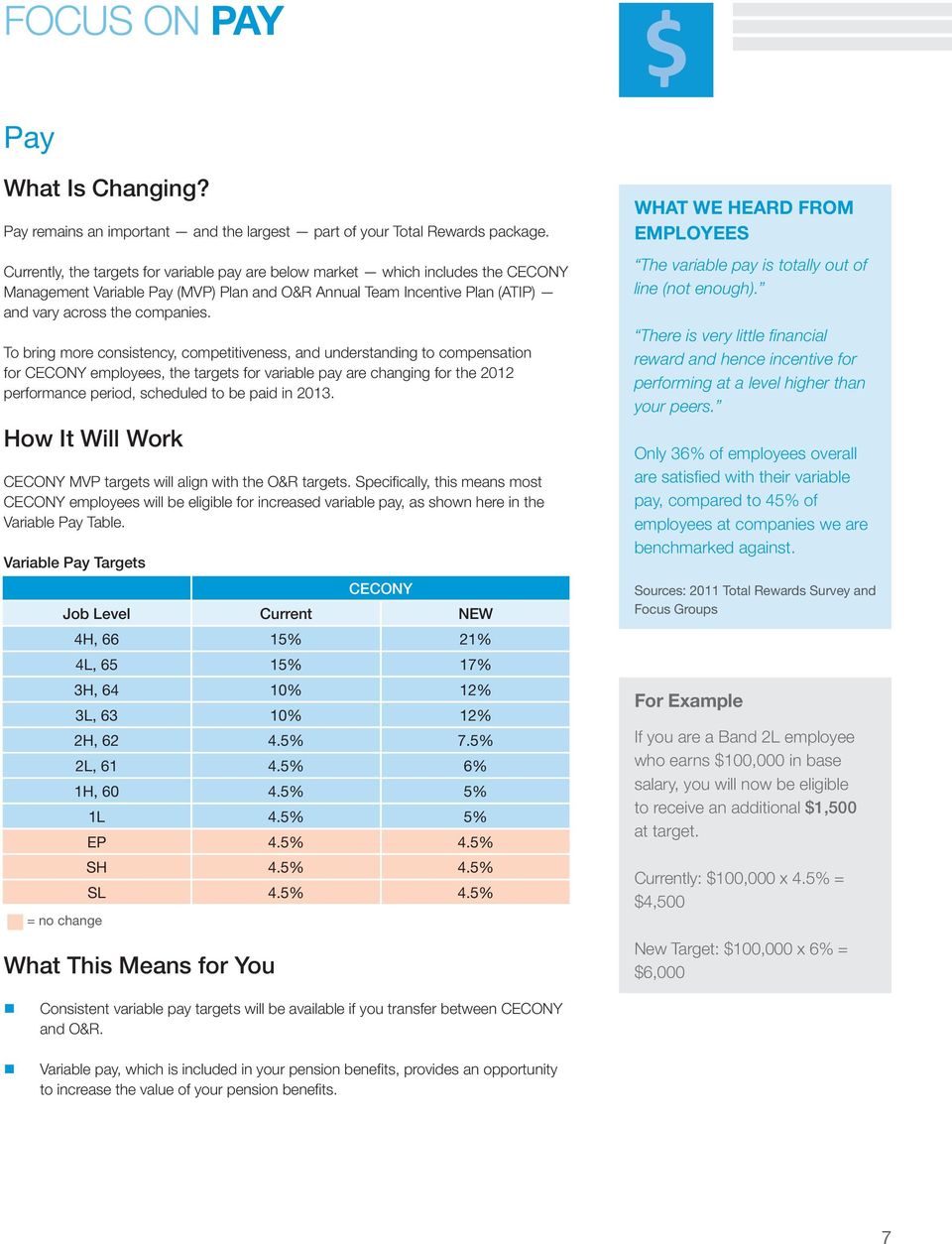
8 FOCUS ON PAY Pay What Is Changing? Pay remains an important and the largest part of your Total Rewards package. Currently, the targets for variable pay are below market which includes the CECONY Management Variable Pay (MVP) Plan and O&R Annual Team Incentive Plan (ATIP) and vary across the companies. To bring more consistency, competitiveness, and understanding to compensation for CECONY employees, the targets for variable pay are changing for the 2012 performance period, scheduled to be paid in How It Will Work CECONY MVP targets will align with the O&R targets. Specifically, this means most CECONY employees will be eligible for increased variable pay, as shown here in the Variable Pay Table. Variable Pay Targets CECONY Job Level Current NEW = no change 4H, 66 15% 21% 4L, 65 15% 17% 3H, 64 10% 12% 3L, 63 10% 12% 2H, % 7.5% 2L, % 6% 1H, % 5% 1L 4.5% 5% EP 4.5% 4.5% SH 4.5% 4.5% SL 4.5% 4.5% What This Means for You WHAT WE HEARD FROM EMPLOYEES The variable pay is totally out of line (not enough). There is very little financial reward and hence incentive for performing at a level higher than your peers. Only 36% of employees overall are satisfied with their variable pay, compared to 45% of employees at companies we are benchmarked against. Sources: 2011 Total Rewards Survey and Focus Groups For Example If you are a Band 2L employee who earns $100,000 in base salary, you will now be eligible to receive an additional $1,500 at target. Currently: $100,000 x 4.5% = $4,500 New Target: $100,000 x 6% = $6,000 Consistent variable pay targets will be available if you transfer between CECONY and O&R. Variable pay, which is included in your pension benefits, provides an opportunity to increase the value of your pension benefits. 7
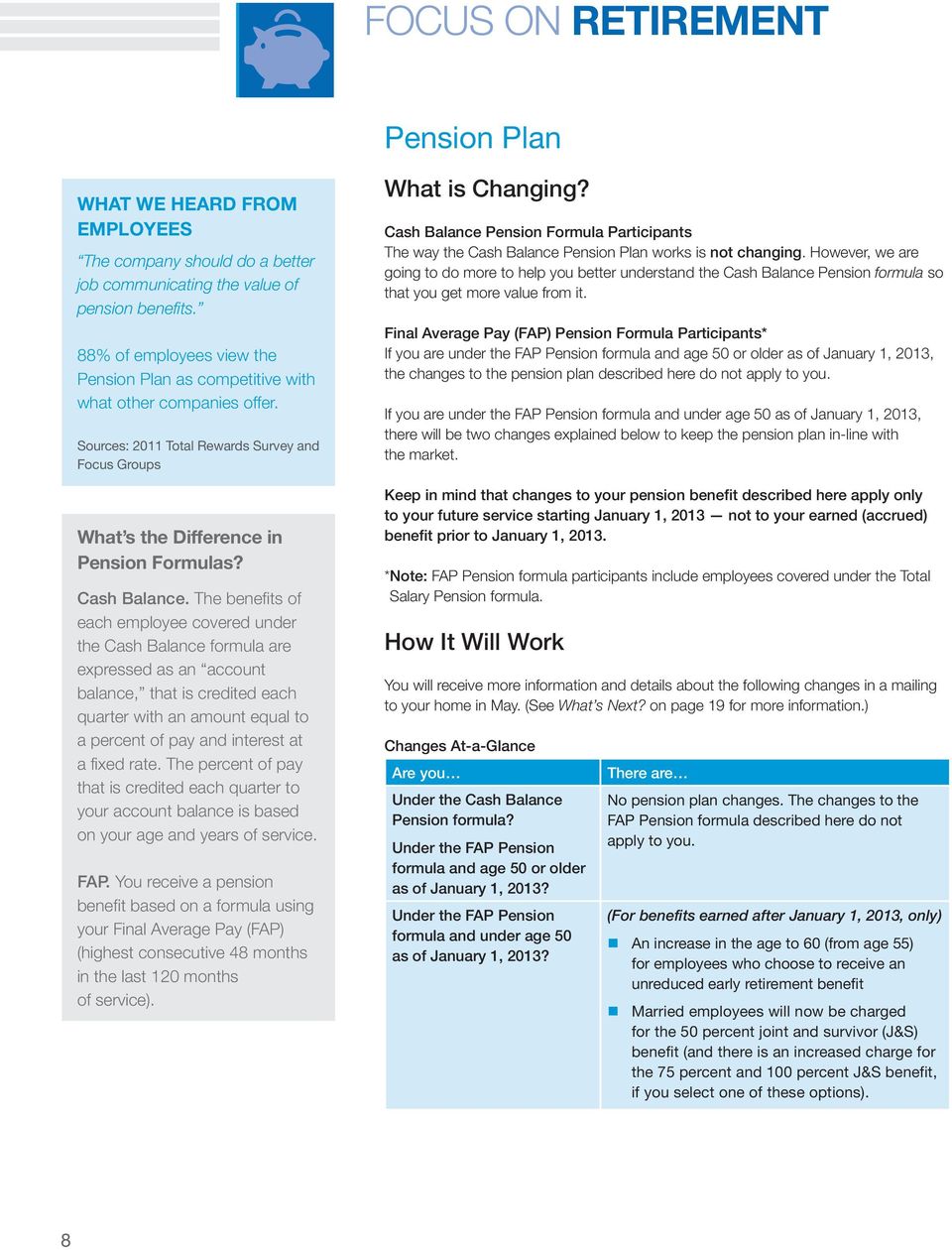
9 FOCUS ON RETIREMENT Pension Plan WHAT WE HEARD FROM EMPLOYEES The company should do a better job communicating the value of pension benefits. 88% of employees view the Pension Plan as competitive with what other companies offer. Sources: 2011 Total Rewards Survey and Focus Groups What s the Difference in Pension Formulas? Cash Balance. The benefits of each employee covered under the Cash Balance formula are expressed as an account balance, that is credited each quarter with an amount equal to a percent of pay and interest at a fixed rate. The percent of pay that is credited each quarter to your account balance is based on your age and years of service. FAP. You receive a pension benefit based on a formula using your Final Average Pay (FAP) (highest consecutive 48 months in the last 120 months of service). What is Changing? Cash Balance Pension Formula Participants The way the Cash Balance Pension Plan works is not changing. However, we are going to do more to help you better understand the Cash Balance Pension formula so that you get more value from it. Final Average Pay (FAP) Pension Formula Participants* If you are under the FAP Pension formula and age 50 or older as of January 1, 2013, the changes to the pension plan described here do not apply to you. If you are under the FAP Pension formula and under age 50 as of January 1, 2013, there will be two changes explained below to keep the pension plan in-line with the market. Keep in mind that changes to your pension benefit described here apply only to your future service starting January 1, 2013 not to your earned (accrued) benefit prior to January 1, * Note: FAP Pension formula participants include employees covered under the Total Salary Pension formula. How It Will Work You will receive more information and details about the following changes in a mailing to your home in May. (See What s Next? on page 19 for more information.) Changes At-a-Glance Are you Under the Cash Balance Pension formula? Under the FAP Pension formula and age 50 or older as of January 1, 2013? Under the FAP Pension formula and under age 50 as of January 1, 2013? There are No pension plan changes. The changes to the FAP Pension formula described here do not apply to you. (For benefits earned after January 1, 2013, only) An increase in the age to 60 (from age 55) for employees who choose to receive an unreduced early retirement benefit Married employees will now be charged for the 50 percent joint and survivor (J&S) benefit (and there is an increased charge for the 75 percent and 100 percent J&S benefit, if you select one of these options). 8
10 1. Early Retirement Benefit for Employees Under the FAP Pension Formula Currently, an unreduced Early Retirement benefit is offered to employees who are age 55 with 30 years of service. A slightly reduced Early Retirement benefit is also offered to employees who are between the ages of 55 and 60 with less than 30 years of service and have 75 points (The 75-point rule is one point for each year of service plus one point for each year of age.) If you are under age 50 as of January 1, 2013, the early retirement age will be increased to age 60 from age 55. This change will be only on future benefits earned after January 1, If you retire between the ages of 55 and 60, even if you have 75 points or 30 years of service, your future benefit earned after January 1, 2013, will be reduced by five percent for each full year before age 60. What This Might Look Like If You Are Age 45 on 1/1/2013 with 20 Years of Service and: You retire at age 55 with 30 years of service on 1/1/2023 with a final average pay of $100,000. Without this change, you would have received an unreduced early retirement benefit of $48,000. With this change, your total benefit will be reduced from $48,000 to $43,500. Accrued benefit prior to 1/1/2013 (assumes no early retirement reduction applied to benefit accrued prior to 1/1/2013) Accrued benefit after 1/1/2013 (25% of early retirement reduction factor is applied to $18,000 based on service after 1/1/2013) Amount Reduction Factor Adjusted Benefit $30, $30,000 $18,000 25% $13,500 Total $48, $43,500 9

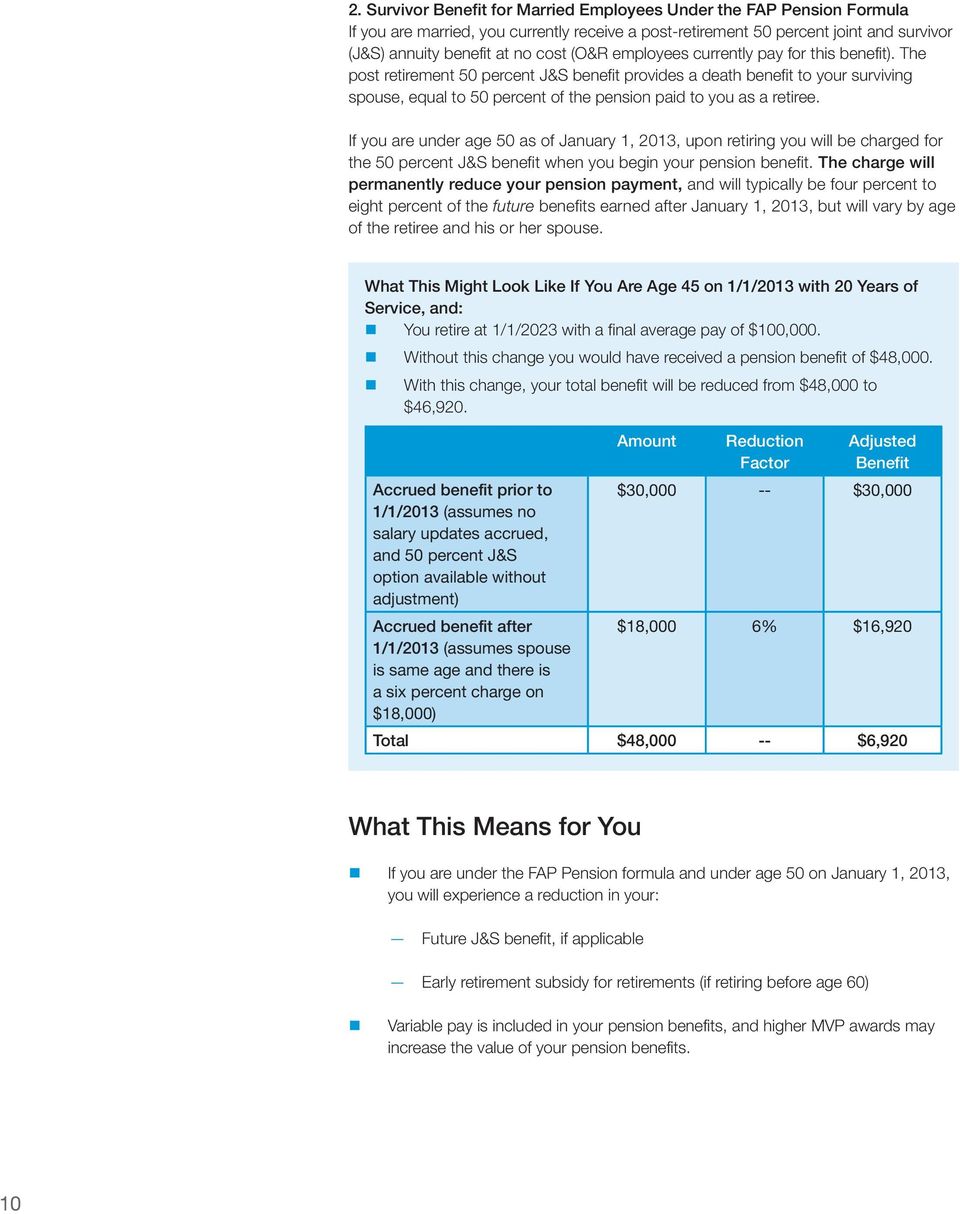
11 2. Survivor Benefit for Married Employees Under the FAP Pension Formula If you are married, you currently receive a post-retirement 50 percent joint and survivor (J&S) annuity benefit at no cost (O&R employees currently pay for this benefit). The post retirement 50 percent J&S benefit provides a death benefit to your surviving spouse, equal to 50 percent of the pension paid to you as a retiree. If you are under age 50 as of January 1, 2013, upon retiring you will be charged for the 50 percent J&S benefit when you begin your pension benefit. The charge will permanently reduce your pension payment, and will typically be four percent to eight percent of the future benefits earned after January 1, 2013, but will vary by age of the retiree and his or her spouse. What This Might Look Like If You Are Age 45 on 1/1/2013 with 20 Years of Service, and: You retire at 1/1/2023 with a final average pay of $100,000. Without this change you would have received a pension benefit of $48,000. With this change, your total benefit will be reduced from $48,000 to $46,920. Accrued benefit prior to 1/1/2013 (assumes no salary updates accrued, and 50 percent J&S option available without adjustment) Accrued benefit after 1/1/2013 (assumes spouse is same age and there is a six percent charge on $18,000) Amount Reduction Factor Adjusted Benefit $30, $30,000 $18,000 6% $16,920 Total $48, $6,920 What This Means for You If you are under the FAP Pension formula and under age 50 on January 1, 2013, you will experience a reduction in your: Future J&S benefit, if applicable Early retirement subsidy for retirements (if retiring before age 60) Variable pay is included in your pension benefits, and higher MVP awards may increase the value of your pension benefits. 10
12 Thrift Savings 401(k) Plan What Is Changing? The Thrift Savings 401(k) Plan and pension plan work together to provide retirement benefits for you. If you are under the Cash Balance Pension formula, the Cash Balance Pension formula itself is not changing, but the company is increasing how much we match in the Thrift Savings 401(k) Plan from three percent (50 percent match on up to six percent of your contribution) to six percent. If you are under the FAP Pension formula, the current company match to the Thrift Savings 401(k) Plan will not change because the combination of your pension and 401(k) plans already offer a market-level retirement benefit. The changes to the Thrift Savings 401(k) Plan described here do not apply to you. How It Will Work NEW FOR JANUARY 1, % 6 % 14 % WHAT WE HEARD FROM EMPLOYEES Higher company contributions to 401(k) should be considered. 77% of employees are satisfied with the Thrift Savings 401(k) Plan as a retirement savings vehicle. 92% of employees believe the Thrift Savings 401(k) Plan is competitive with what other companies offer far above industry norms. Sources: 2011 Total Rewards Survey and Focus Groups Employees in the Cash Balance Pension Formula Contribute up to 8% of your pay The Company Matches 100% of the first 4% of your contributions, plus an additional 50% on the next 4% (up to 6% total) Potential retirement savings of up to 14% of your pay in the Thrift Savings 401(k) Plan You will receive additional details and examples in a mailing to your home in May. What This Means for You If you are under the Cash Balance Pension formula, you will receive an increased company match on your contributions to the Thrift Savings 401(k) Plan. For Cash Balance Pension formula participants, the combination of the pension and 401(k) plans is now more in-line with the market. 11

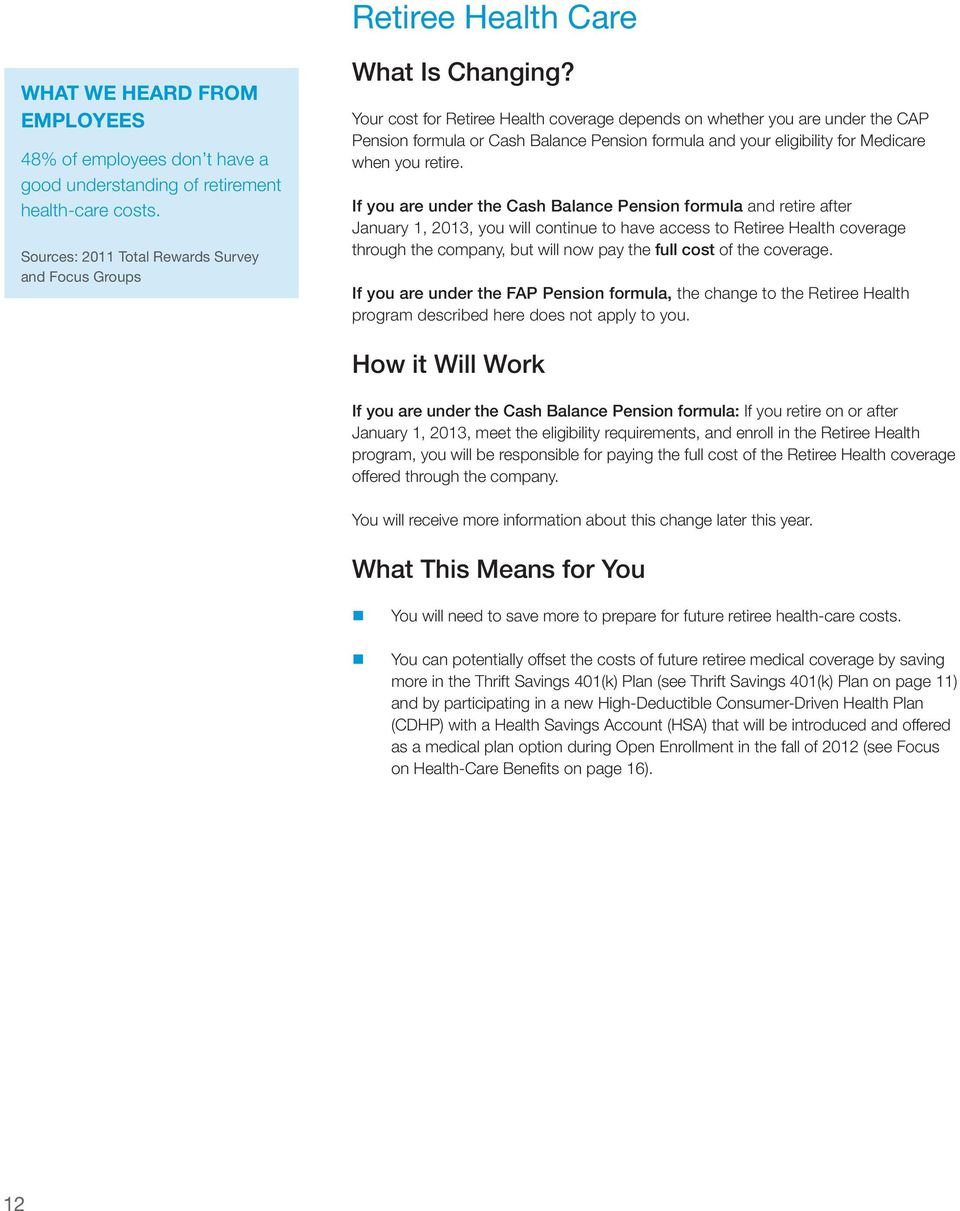
13 Retiree Health Care WHAT WE HEARD FROM EMPLOYEES 48% of employees don t have a good understanding of retirement health-care costs. Sources: 2011 Total Rewards Survey and Focus Groups What Is Changing? Your cost for Retiree Health coverage depends on whether you are under the CAP Pension formula or Cash Balance Pension formula and your eligibility for Medicare when you retire. If you are under the Cash Balance Pension formula and retire after January 1, 2013, you will continue to have access to Retiree Health coverage through the company, but will now pay the full cost of the coverage. If you are under the FAP Pension formula, the change to the Retiree Health program described here does not apply to you. How it Will Work If you are under the Cash Balance Pension formula: If you retire on or after January 1, 2013, meet the eligibility requirements, and enroll in the Retiree Health program, you will be responsible for paying the full cost of the Retiree Health coverage offered through the company. You will receive more information about this change later this year. What This Means for You You will need to save more to prepare for future retiree health-care costs. You can potentially offset the costs of future retiree medical coverage by saving more in the Thrift Savings 401(k) Plan (see Thrift Savings 401(k) Plan on page 11) and by participating in a new High-Deductible Consumer-Driven Health Plan (CDHP) with a Health Savings Account (HSA) that will be introduced and offered as a medical plan option during Open Enrollment in the fall of 2012 (see Focus on Health-Care Benefits on page 16). 12
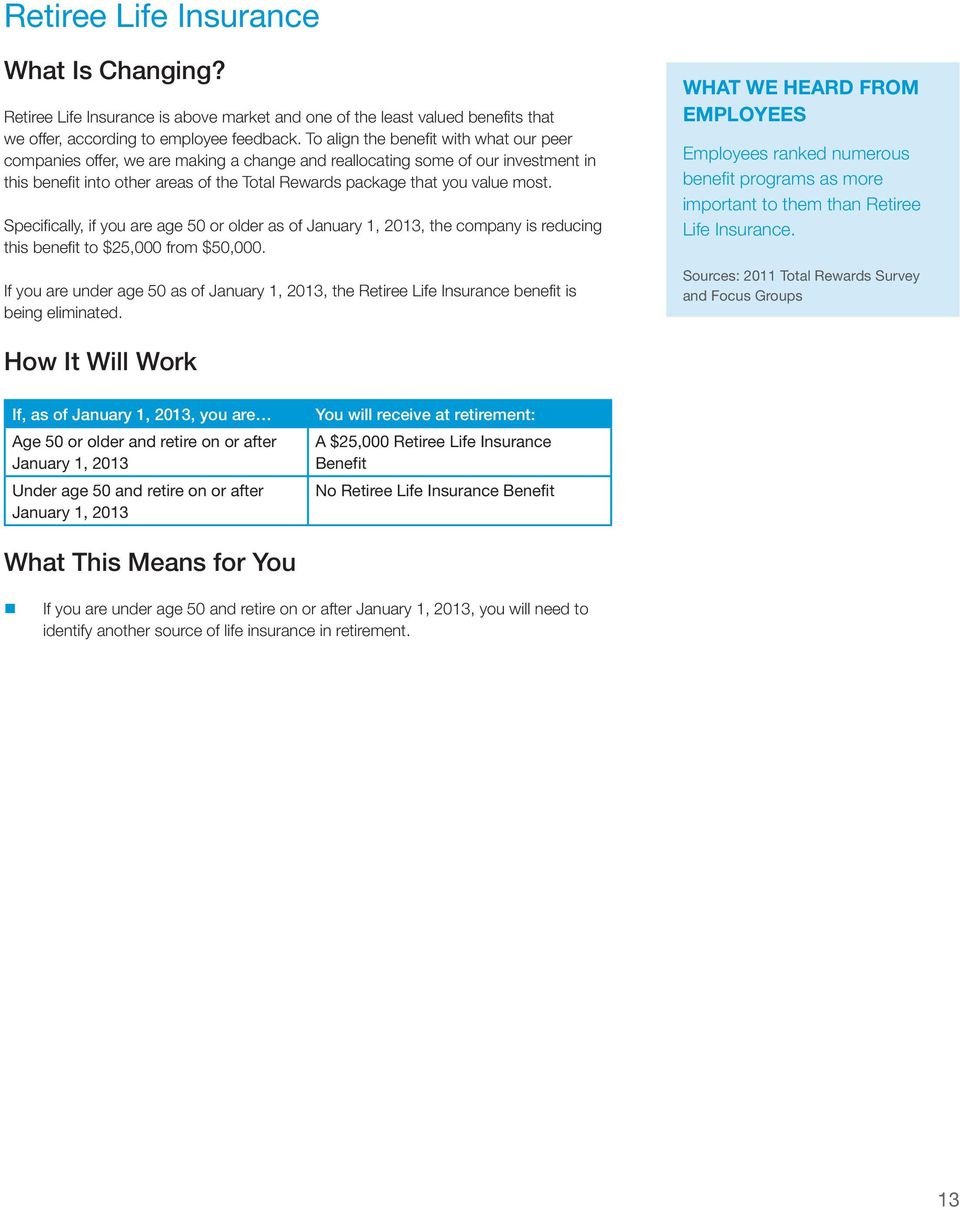
14 Retiree Life Insurance What Is Changing? Retiree Life Insurance is above market and one of the least valued benefits that we offer, according to employee feedback. To align the benefit with what our peer companies offer, we are making a change and reallocating some of our investment in this benefit into other areas of the Total Rewards package that you value most. Specifically, if you are age 50 or older as of January 1, 2013, the company is reducing this benefit to $25,000 from $50,000. If you are under age 50 as of January 1, 2013, the Retiree Life Insurance benefit is being eliminated. WHAT WE HEARD FROM EMPLOYEES Employees ranked numerous benefit programs as more important to them than Retiree Life Insurance. Sources: 2011 Total Rewards Survey and Focus Groups How It Will Work If, as of January 1, 2013, you are Age 50 or older and retire on or after January 1, 2013 Under age 50 and retire on or after January 1, 2013 You will receive at retirement: A $25,000 Retiree Life Insurance Benefit No Retiree Life Insurance Benefit What This Means for You If you are under age 50 and retire on or after January 1, 2013, you will need to identify another source of life insurance in retirement. 13
15 FOCUS ON TIME OFF Sick Time and Disability WHAT WE HEARD FROM EMPLOYEES I think the company is too generous with this benefit (sick time). There are times when people don t need more than one day when they are sick, but many feel they need to take at least three to five days regardless, just to use the benefit. The sick time policy encourages people to take sick time as extra vacation. Sources: 2011 Total Rewards Survey and Focus Groups What Is Changing? Time off when you are sick is designed to help protect you when an illness or injury prevents you from working. We are changing the Sick Time and Short-Term Disability benefits so they are consistent with best practices in the market and in-line with the benefits offered by our peer companies. Specifically, the new Sick Time/Disability Policy will provide varying percentages of your base pay, depending on the amount of time you are approved to be out of work due to an illness or injury. The sick time benefit will no longer be related to your length of service with the company. How It Will Work Starting January 1, 2013, you will be eligible for up to 10 sick days each calendar year, paid at 100 percent of base pay. After five consecutive sick days, you will need to qualify for Short-Term Disability to receive sick pay. After five consecutive workdays out sick, you may be eligible for the Short-Term Disability benefit. You will need to provide documentation, approved by a third-party, to qualify for Short-Term Disability. The Short-Term Disability benefit will provide for sick pay and sick absences longer than five workdays, as follows: Weeks 2 6: 100% of base pay Weeks 7 11: 90% of base pay Weeks 12 26: 80% of base pay Weeks 27 and after: You will move to the Long-Term Disability program, if eligible. Your income will be based on the provisions of the Long-Term Disability program. You will receive more information about the Long-Term Disability program later this year. 14

16 For Example: You earn $52,000 a year ($1,000 a week) and have the following three separate sick absences within the same year: Three-day absence in January for the flu Seven-week absence in March for a fractured ankle You receive 100% of pay for all three days. Week 1 is covered by five of your remaining seven sick days at full pay. Weeks 2 6 are covered at full pay ($1,000 a week) under the Short-Term Disability plan. Three-week absence in September for back sprain Week 7 is covered at 90% ($900 a week) under the Short-Term Disability plan. Week 1 you will receive 100% sick pay for your remaining two sick days; the next three days are covered by unpaid leave. Change to your sick pay: First sick absence: No change Weeks 2 3 are covered at full pay ($1,000 a week) under the Short-Term Disability plan as a new disability. Second sick absence: Week 7 reduced to $900 from $1,000 Third sick absence: First week reduced to $400 from $1,000, no change at weeks 2 3 Note: Maternity leave will be covered under a new maternity policy in development, which we will communicate to you later this year. What This Means for You Sick time is no longer service-related, which will result in reduced sick time benefits for most employees. 15

17 FOCUS ON HEALTH WHAT WE HEARD FROM EMPLOYEES The plans are similar where I can t really tell which would be the right choice. Our health care is about as good as other large companies, but we pay more than many people. 85% of employees say that having a mix of medical plan options to choose from is important. Sources: 2011 Total Rewards Survey and Focus Groups Health Care Benefits What Is Changing? For 2013, we will be offering you more choices in health-care options. These new options will give you more control over your money and help you save money for future health-care expenses. We will also offer improved dental benefits to address common procedures that are not currently covered. How It Will Work Here s an overview of what will change. You will receive additional details and examples in a mailing to your home closer to the Open Enrollment period in the fall of Medical During Open Enrollment this fall, we will introduce new health-care options, including a new high-deductible Consumer-Driven Health Plan (CDHP) with a Health Savings Account (HSA) option, in addition to Health Maintenance Organization (HMO) options. These new plans will offer you the option of trading off lower payroll contributions and higher out-of-pocket costs when you receive medical care. And, as always, you will still save money by visiting in-network providers when you need care. The company will contribute to the HSA if you choose the CDHP option, and you will also be able to contribute to the account. The HSA is not use it or lose it like a Flexible Spending Account, so any dollars remaining can be used in future years for expenses or even to save for retiree medical costs. To help you choose the right medical and prescription drug coverage option, we will make new tools available to you during Open Enrollment. You ll learn more about these tools later this year. Dental Based on your feedback, we are working to improve the dental plan. For example, new procedures (such as implants) will now be covered if you use in-network dentists. What This Means for You You will have greater control over how much you spend on your health care. You will have new tools to help you choose the medical plan that best meets your needs. 16

18 FOCUS ON WELLNESS Wellness What Is Changing? To encourage you and your family members to live a healthy lifestyle, which can also help us better manage health-care costs in the future, we will offer new incentives and activities to help you improve your health. If you take certain steps during this year s Open Enrollment period in the fall, you will able to save money and lower your health-care premiums in How It Will Work To earn the credits and avoid paying more in health-care premiums, you will need to take these three steps: 1. Complete a health-risk questionnaire (HRQ) This questionnaire will be available online through Cigna. 2. Receive basic medical screenings (for example, blood pressure, cholesterol, and blood sugar) These screenings will be offered at local company events and benefits fairs, or you can receive the screening at your physician s office and have the results submitted to Cigna. Basic medical screenings will help supplement the HRQ and develop a more complete assessment of your health risks for such conditions as diabetes, heart disease, back pain, and hypertension. 3. Certify that you don t smoke, or if you do smoke, enroll in an approved smoking-cessation program. All three of these steps will affect how much you pay for health-care coverage in 2013, which you ll learn more about this fall during Open Enrollment. WHAT WE HEARD FROM EMPLOYEES The cost of health benefits has skyrocketed and it scares me that so many employees feel that the company should simply assume the escalated costs. 70% of employees agree that if the company provides a financial incentive, they would participate in programs that could improve their health. There is varied confidence (62% to 92%) with the information and tools available to help employees manage their health. Sources: 2011 Total Rewards Survey and Focus Groups For example, during Open Enrollment this fall, you will need to take one of the following actions to lower your health-care premiums in 2013: If you are a smoker sign up for and participate in the company s smokingcessation program. If you don t smoke certify that you do not smoke. You will receive additional details and examples in a mailing to your home later this year. What This Means for You Reinforcing healthy behaviors can help both you and the company save money on reducing health-care costs. Enrolling in health programs can help you stay healthier longer by preventing and managing health risks and conditions. 17
19 FOCUS ON WORK ENVIRONMENT Expanded Communications WHAT WE HEARD FROM EMPLOYEES The Learning Center and online training are great resources, and programs like the GOLD Program and Tuition Reimbursement make Con Edison a more attractive place to work and improve on my skills. Understanding and perceived competitiveness of flexible work options are below benchmarks. 76% of employees are satisfied with the Employee Stock Purchase Plan (ESPP). What Is Changing? We offer many valuable benefits and resources to help you manage your personal life and your career. They include: Flexible work options Stock Purchase Plan (SPP) Tuition Reimbursement The Learning Center and GOLD Program To help you better understand the full value of these benefits, and all of your Total Rewards, we re committed to providing you with more frequent and enhanced communication. What This Means for You The company will communicate with you more clearly and more often about your Total Rewards. Sources: 2011 Total Rewards Survey and Focus Groups 18

20 What s Next? Here s your Total Rewards Communication Road Map what to expect and when in 2012: COMMUNICATION SCHEDULE APRIL MAY JULY SEPTEMBER NOVEMBER Pay Retirement Wellness Health Time Off An in-depth series of brochures on changes to different parts of your Total Rewards Program will become available. Each brochure will include examples and scenarios to help you better understand the changes and any steps needed to meet enrollment deadlines. HOW TO LEARN MORE Take Time to Read Extra effort is being taken to communicate a lot of information in the coming months, including in mailings to your home. Please share this information with your family. Employee Meetings Plan to attend one of the employee meetings being offered at many locations later this year. Stay tuned for information about available dates and times. Box Do you have a question not answered in the Total Rewards Brochure? If so, please send an to [email protected]. We will address your questions in upcoming communication. Your feedback is helpful. Benefits Fairs Benefits Fairs will be offered in fall 2012 at many locations. Look for a Benefits Fairs schedule later this year. This communication about Total Rewards is just a summary. Your Total Rewards as they now exist and as they will be changed are always governed by the official plan documents and policies. The company reserves the right to amend, modify, or terminate the plans. 19

21
22 FOCUS ON PAY Pay remains an important and the largest part of your Total Rewards package. The company believes in pay for performance, and in compensating you for your contributions to the company s success. This brochure provides information about the management compensation program and the Total Rewards changes to the Management Variable Pay Plan to make it more competitive compared with our peers. A Look at Your Total Compensation The management compensation program is made up of three components: 1. Base Salary. You have the opportunity to receive increases in your base salary based on your work performance and where your actual salary falls within the range set for your job level. 2. Management Variable Pay Plan (MVP). You can earn variable pay each year based on the company s success and your work performance. The company s success is determined by achieving operational, safety, environmental, and financial performance measures set at the beginning of the year. 3. Long-Term Incentives. Long-term incentives are currently awarded in the form of restricted stock units to certain employees who demonstrate the potential to make significant contributions to the company s future success. Generally, employees must also be continuously employed with the company for three years before the stock vests. Awards to employees in bands 3 and 4 are made in the form of performance-based restricted stock. That means the awards are based on the company meeting two performance measures: (1) the three-year total shareholder return relative to the Consolidated Edison, Inc. peer group; and (2) the three-year corporate average of the MVP award fund. How Pay Is Benchmarked Setting the right compensation level for any position is not an exact science. To help evaluate if the pay we offer is competitive, we benchmarked a sample of our job positions against those at peer utility companies. We matched positions based on roles and responsibilities. We also benchmarked a subset of management positions against other companies in the metropolitan New York area. The results we found looking at other utilities and metropolitan New York companies, as well as survey data, helped us determine the competitiveness of our compensation program. When compared with the benchmark data, we found that the CECONY base salary ranges were in-line with current market and variable pay was below market. The changes in the variable pay program described in this brochure will bring variable pay in line with the market. Awards to employees in bands 1 and 2 are made in the form of time-based restricted stock. That means employees must be continuously employed with the company for three years before the stock vests. Through our review of the value of our Total Rewards package, including employee input and external industry benchmarking, we found that our variable pay under the MVP is below market. As a result, we re taking steps to increase the targets for most of the job group levels to improve the competitiveness of our variable pay program. Your Total Rewards For Con Edison Management Employees
23 Variable Pay Your Total Rewards Total Rewards include your pay plus a whole lot more: Compensation (base salary, variable pay, and long-term incentives) Retirement Benefits Health-Care Benefits Other Benefits Con Edison has two variable pay plans: the CECONY MVP and the O&R Annual Team Incentive Plan (ATIP). Both currently have varying individual targets. In addition to being below market, we found the MVP has a low satisfaction rate among employees. To improve the competitiveness of the CECONY variable pay plan, and to create more consistent targets between the CECONY MVP and O&R ATIP, we are changing the targets for variable pay for most CECONY employees starting with the 2012 performance period. The changes will be retroactive to January 1, 2012, and awards will be paid out in April 2013 based on 2012 performance results. Note: The other two components of the management compensation program base pay and long-term incentives are not changing. A Look at the Changes CECONY MVP targets will now align with the O&R ATIP targets, which means that most CECONY employees will be eligible for increased variable pay. Variable Pay Targets CECONY Job Level Current NEW An Example 4H, 66 15% 21% 4L, 65 15% 17% 3H, 64 10% 12% 3L, 63 10% 12% 2H, % 7.5% 2L, % 6% 1H, % 5% 1L 4.5% 5% EP 4.5% 4.5% SH 4.5% 4.5% SL 4.5% 4.5% = no change Under the Total Rewards change, if you are a band 2L employee who earns $100,000 in base salary, you will now be eligible to receive in 2013 an additional $1,500 for 2012 performance results at the new target: Currently: $100,000 x 4.5% = $4,500 New Target: $100,000 x 6% = $6,000 2
24 2012 Variable Pay Performance Period It s important to note that the MVP performance indicators are not changing for The MVP awards paid in 2013 will be based on the actual performance results achieved for For more information, visit the CECONY performance indicator system under hot sites on the company s intranet. January 1, 2012 December 31, 2012 April 2013 PERFORMANCE PERIOD Payout Questions? If you have any questions about the variable pay improvements, send an to [email protected]. We will answer your questions in future communications and post them in a Frequently Asked Questions section on HR Online. What s Next This is the first in a series of brochures that outline the changes to the different aspects of the Total Rewards package. Here s what you can expect over the coming months: RIL MAY JULY SEPTEMBER NOVEMBER ay Retirement Wellness Health Time Off An in-depth series of brochures on changes to different parts of your Total Rewards Program will become available. Each brochure will include examples and scenarios to help you better understand the changes and any steps needed to meet enrollment deadlines. e to Read t is being taken to communicate a lot of information in months, including in mailings to your home. Please information with your family. Box Do you have a question not answered in the Total Rewards Brochure? If so, please send an to [email protected]. We will address your questions in upcoming communication. Your feedback is helpful. e Meetings end one of the employee meetings being offered at tions later this year. Stay tuned for information about Benefits Fairs Benefits Fairs will be offered in fall 2012 at many locations. Look for a Benefits Fairs schedule later this year. This communication about Total Rewards is just a summary. Your Total Rewards as they now ates and times. exist and as they will be changed are always governed by the official plan documents and policies. The company reserves the right to amend, modify, or terminate the plans. 3
25 IMPORTANT INFORMATION ON YOUR TOTAL REWARDS r 4 Irving Place New York, NY 10003
26 FOCUS ON RETIREMENT It s Your Future Planning for a secure retirement is an important goal for you and your family. Con Edison supports you by providing a comprehensive Total Rewards package that includes your compensation (base salary and variable pay), retirement and health-care benefits, and other valuable benefits, such as time off. Earlier this year, you began hearing about changes to the company s retirement benefits. These changes take your feedback into account to recognize what you most value, and better align our Total Rewards with the marketplace and across our companies. While you should have received an overview of the Total Rewards changes both at work and at home earlier this year, take a few minutes now to read about the details of the changes to your retirement benefits and how they impact you. This brochure describes the changes to a CECONY management or CEB employee who is covered under the Final Average Pay (FAP) Pension formula. Keep this brochure handy in the future for your reference once the changes take effect. Also, note that the federal law of ERISA requires us to notify you of changes to the Consolidated Edison Retirement Plan, the Consolidated Edison Retiree Life Plan, and the Consolidated Edison Thrift Savings Plan. This brochure is a Summary of Material Modifications ( SMM ) that provides you with information about what is changing for the Consolidated Edison Retirement Plan, the Consolidated Edison Retiree Life Plan, and the Consolidated Edison Thrift Savings Plan, the effective date of each change, and employees who are affected by each change. Understanding Your Retirement Benefits What s Inside What s Happening... 2 Retirement Changes At-a-Glance... 3 Retirement Benefits Basics Thrift Savings (401(k)) Plan... 5 Retirement Benefits Basics Retirement Plan... 8 Retirement Benefits Basics Retiree Health and Retiree Life Insurance We Hear You How to Take Action Retirement Resources at Your Fingertips Looking Ahead What to Expect What We ve Heard The benefits are too complex to really understand. Getting information about the retirement benefits is difficult. If I m age 50 or older as of January 1, 2013, I m not impacted by the Total Rewards changes to the Retirement Plan. What We re Doing The company is committed to providing you with more frequent and clearer communication to help you understand how the programs work and the full value of your benefits. You can access information about your retirement benefits by using the OnPoint pension calculator found on the company s intranet site at HR Online. The pension calculator will be updated with the new plan changes to help you get the information you need, when you need it. After careful consideration, age 50 was chosen because those individuals are close to retirement, or within five years of being eligible for an Early Retirement pension beginning at age 55. Although the Retirement Plan changes have some impact on employees under age 50, employees in this age group will generally have more time to modify their plans if they wish to retire at age 55, including saving more and retiring later. This is why the company is grandfathering those employees closest to retirement. CEB Employee? The references throughout this brochure to the company intranet at HR Online, OnPoint, the Con Edison Employee Benefits Center, and the link to access Summary Plan Descriptions (SPDs) do not apply to you. See page 18 for CEB contact information and resources. Your Total Rewards For CECONY Management and CEB Employees Covered Under the Final Average Pay (FAP) Pension Formula
27 What s Happening Understanding Your Retirement Income Your income in retirement will likely come from several sources. That s why it s important to understand the role that each will play including your retirement benefits from the company: The Retirement Plan. Depending on your start date, you may be eligible to receive a pension from the company under the Final Average Pay (FAP) Pension formula. See page 8 for details about the FAP Pension formula. The Thrift Savings (401(k)) Plan. When you contribute to the Thrift Savings Plan, the company makes matching contributions. See page 5 for details about this plan. The Stock Purchase Plan. When you contribute to the Stock Purchase Plan, the company makes matching contributions. For details about this plan, go to the company s benefits intranet site at Pages/planDescriptions.aspx and click on Stock Purchase Plan. Social Security. Both you and the company (as well as your previous employers, if any) contribute to Social Security. You will be eligible for Social Security benefits in retirement if you ve been employed for at least 10 years. For information about your future Social Security benefits, contact the Social Security Administration at or visit Savings plan accounts and pensions from other employers. If you ve worked at other companies, you may have participated in another pension plan or contributed to a savings plan. Remember to account for those benefits as you consider your retirement income strategy. Your personal savings. This might include investment accounts, such as individual retirement accounts (IRAs), brokerage accounts, savings bonds, certificates of deposit (CDs), health savings accounts (HSAs), and traditional savings accounts. What It Means to Be Grandfathered Under the Consolidated Edison Retirement Plan Who is grandfathered? What does it mean to be a grandfathered employee? An actively employed CECONY management or CEB employee is considered grandfathered under the FAP Pension formula if he or she is age 50 or older on January 1, You are also considered grandfathered if you are a former union employee who was covered under the FAP Pension formula at the time you transferred to management and are age 50 or older on January 1, The Total Rewards changes to the Retirement Plan and the Retiree Health Program do not apply to grandfathered employees. If you re a grandfathered employee, you need to do nothing at this time. 2 Do any of the Total Rewards changes to retirement benefits apply to employees age 50 or older on January 1, 2013? *Including employees under the Total Salary Pension formula. Yes. Total Rewards changes to the Retiree Life Insurance program will affect management employees who are age 50 or older on January 1, 2013, and under either the FAP* or Cash Balance Pension formulas. Total Rewards changes to the Retiree Health Program also affect management employees who are age 50 or older on January 1, 2013, and under the Cash Balance Pension formula.
28 Retirement Changes At-a-Glance Here s a summary of the changes to your retirement benefits taking effect on January 1, (These affect employees under the Final Average Pay (FAP) Pension formula who are under age 50 on January 1, 2013.) Note that the changes to the Consolidated Edison Retirement Plan described in this brochure apply only to your pension benefits earned on your future service beginning on and after January 1, 2013, and not on your pension benefits earned or accrued before January 1, What s Changing Why? FAP Pension Formula* (Including employees covered under the Total Salary Pension formula) If you are not age 50 or older on January 1, 2013, the age to receive an unreduced Early Retirement pension benefit is being raised from age 55 to age 60: If you retire between the ages of 55 and 60 (even if, at age 55, you have 75 points or 30 years of service), and you elect to begin your pension benefit immediately, the portion of your pension benefit earned after January 1, 2013, will be reduced by 5% for each full year before age 60. If you are married and retire after January 1, 2013, and you were under age 50 on January 1, 2013, you will pay when you begin your pension benefit: A charge, based on your age and your spouse s age, for the 50% Joint & Survivor (50% J&S) benefit (currently offered to married employees at no cost). An increased charge, based on your age and your spouse s age, if you select a 75% or 100% J&S optional form of pension instead of the 50% J&S benefit. The FAP Pension formula provides a pension benefit that is above market. The changes are designed to align the Retirement Plan benefits paid under the FAP Pension formula closer to the median of our peer group. In general, retirement ages are increasing; depending on your year of birth, Social Security increased its unreduced retirement age from age 65 to age 66 or 67. In the Total Rewards Survey, many employees expressed an intention to retire after age 60 (since 2010, the average retirement age of Con Edison management employees has been age 61). Most pension plans at peer companies, as well as the Con Edison Cash Balance Pension formula, apply a charge for J&S benefits. *If you are a former union employee who transferred to management, the Retirement Plan changes affecting the FAP Pension formula also apply to you if you are under age 50 on January 1, Important! With the exception of Retiree Life Insurance, the changes outlined in this brochure do not apply to employees age 50 and older on January 1, 2013 you are considered grandfathered. How Were Retirement Benefits Evaluated? The company evaluated all of our Total Rewards, including our retirement benefits, in three ways: Solicitation of employee input (leadership interviews, focus groups, and employee surveys) Benchmarking of current programs against a peer group of utilities and New York metro companies Review of alternative designs with a consistent set of guiding principles Because employee retirement income is generally supported by both the Retirement Plan and Thrift Savings (401(k)) Plan benefits, the company analyzed the value of each program individually and then as a package. 3
29 What s Changing Retiree Health There are no changes under Total Rewards if you are under the FAP Pension formula and eligible to participate in the Retiree Health Program when you terminate employment with Con Edison. You will continue to receive access to the Retiree Health Program under the current cost-sharing formula. When you retire and enroll in the Retiree Health Program, you will share the cost of Retiree Health coverage with the company. The company s contribution is based on a formula equal to its prior year s contribution, plus a cost-of-living adjustment as measured by the change in the Consumer Price Index (CPI). Retiree Life Insurance If you are age 50 or older on January 1, 2013, and you satisfy the eligibility requirements for Retiree Life Insurance when you retire, your Retiree Life Insurance benefit will be $25,000, instead of $50,000. If you are under age 50 on January 1, 2013, you will not be eligible for Retiree Life Insurance if you retire after Thrift Savings (401(k)) Plan If you are under the FAP Pension formula, Total Rewards does not change your benefits under the Thrift Savings (401(k)) Plan; you continue to receive the 50% company match on the first 6% of your pay that you contribute. Why? Although the company s Retiree Health Program is an above-market benefit, we did not make any changes for employees under the FAP Pension formula because the company s contribution to the cost of the program is limited under a cost-sharing formula. It is important to keep in mind that the company is not obligated to contribute any fixed amount or percentage to the program and can change or terminate the program at any time. Retiree Life Insurance is an abovemarket benefit with perceived low value by employees. These changes are designed to align the benefit closer to the median of our peer group and across company businesses. The total retirement income benefit offered to you with the FAP Pension formula and Thrift Savings (401(k)) Plan combined is above market. 4
30 Retirement Benefits Basics Thrift Savings (401(k)) Plan How the Thrift Savings (401(k)) Plan Works You become eligible to participate in the Thrift Savings (401(k)) Plan on your date of hire. To enroll, you must call Vanguard at For employees under the FAP Pension formula, the Thrift Savings (401(k)) Plan will continue to work as it does today, with the same company matching contribution amount: you receive a 50 percent company match on the first six percent of pay you contribute (up to a three percent match). So, for every $1 you contribute up to six percent of your pay, you receive an additional $0.50 from the company. You can make three types of contributions to your Thrift Savings account. When you enroll with Vanguard, you can make: Pre-tax contributions from your paycheck (before taxes are taken from your pay) After-tax contributions from your paycheck (after taxes are taken from your pay) About Roth Contributions You can learn more about Roth contributions and Roth tax advantages by reading the Thrift Savings Plan Summary Plan Description (SPD) found on the company s intranet site or by going to the Vanguard website at Roth contributions (after taxes are taken from your pay) Your contributions to the Thrift Savings (401(k)) Plan are subject to the Internal Revenue Code ( IRC ) and plan limitations. For more information on the Thrift Savings Plan, visit the company s intranet site at plandescriptions.aspx, or visit the Vanguard website at (see page 18 for access information). 5
31 Hint! Mark your calendar to review and increase your contribution amount, if necessary, before the end of December This will ensure you are receiving the full company match available to you starting with your first paycheck in January To change your contribution amount at any time, log in to the Vanguard website at or call Vanguard at , and then follow the prompts. Example Lisa s base salary is $100,000 per year, and in 2013 she is thinking of contributing 2% of her annual pay ($2,000 pre-tax) to the Thrift Savings (401(k)) Plan. With the company match of $1,000 (50% of $2,000), her total in Thrift Plan savings will be $3,000. However, she visits the Vanguard website and uses the Retirement Income Modeling tool to see whether she is on track to reach her retirement savings goals. She realizes she can and needs to save a little more at least enough to get the full company match! She decides to contribute 6% ($6,000 pre-tax) for She ll receive a $0.50 per $1 match on her entire contribution ($3,000). By increasing her contribution by $4,000 (deducted over the course of the year), she will receive an additional company match of $2,000 and will be saving a total of $9,000 (instead of $3,000) toward her retirement! Mix It Up With Investment Funds The Thrift Savings (401(k)) Plan has numerous investment funds from which you can choose. Learn more about these funds and how to diversify and find the right mix for you by visiting the Vanguard website at 6
32 An Example: A Look at What Retirement Income Could Be Let s assume Michael is under the FAP Pension formula and is age 40 with 15 years of service on January 1, His 2013 annual base salary is $90,000, and he decides to contribute 8% of his pay (with a company match of 3%) to the Thrift Savings (401(k)) Plan. Here s an example of how much of his income would be replaced in retirement by his savings, Social Security, and other company retirement benefits, depending on when he retires: Income Replacement % Retirement Age 82% Retirement Plan (Under the FAP Pension Formula) 140% Thrift Savings (401(k)) Plan Social Security Total Age 55 40% 42% 0% 82% Age 62* 49% 69% 22% 140% Age 65* 51% 86% 27% 164% Note: This illustration assumes Michael s pay grows at 3% each year, he receives a 7% investment return on his Thrift Savings (401(k)) Plan savings, and inflation grows at 2.5%. With the Retirement Plan and Thrift Savings (401(k)) Plan, Michael is well on his way to meeting the retirement income goals recommended by many financial planners. Keep in mind that these numbers do not include his personal savings or savings from another employer, and can increase or decrease depending on actual investment returns. 164% Age 55 Age 62 Age 65 Retirement Plan Thrift Savings (401(k)) Plan Social Security Save, Save, Save! Many financial planners say you ll need 70 percent or more of your current annual income to live comfortably in retirement. So, if you re making $70,000 a year when you retire, you ll need about $49,000 a year in retirement income just to maintain your current standard of living but that doesn t include doing some of the fun things in retirement, like traveling. Although Con Edison provides you with a valuable pension benefit, your pension benefit combined with your Social Security and personal savings may not be enough. That s why it s important to save in the Thrift Savings (401(k)) Plan. And, when you do, you get free money from the company in the form of a matching contribution. Many financial planners also suggest you save between 10 percent and 15 percent annually of your income for retirement beginning in your 20s. So, be sure to take a look at how much you re saving in your Thrift Savings (401(k)) Plan and increase your contribution to six percent so that you get the full company matching contribution of three percent of pay. That means you would be saving nine percent of your pay in your Thrift Savings (401(k)) Plan for the year. *Includes Social Security 7
33 Retirement Benefits Basics Retirement Plan How the Plan Works Now (Before January 1, 2013) Here s a look at how the Final Average Pay (FAP) Pension formula works today: FAP Pension Formula Eligibility An actively employed CECONY management employee who began working for the company before January 1, Formula You receive a pension benefit based on a formula using your FAP (the highest consecutive 48 months in the last 120 months of service). The percentage of FAP provided varies based on your years of credited service as follows: 1.5% of FAP for the first 24 years of accredited service; and 2.0% of FAP for the next 6 years of accredited service; and 0.5% of FAP for each year in excess of 30 years of accredited service. In addition, your pension benefit is increased by 0.35% of FAP in excess of the Social Security taxable wage base multiplied by years of service up to a maximum of 30 years. An additional special pension accrual of 0.5% for each year of service above 30 years will apply to employees actively employed on January 1, 2009, and who are participants in the Consolidated Edison Retirement Plan. Employees on the active payroll who were age 55 and have 30 or more years of service with the company, or will turn age 55 with 30 or more years of service during the period of January 1, 2009, through June 30, 2012, qualify for the special pension accrual. The period beginning January 1, 2009, through June 30, 2012, is called the special accrual period. If (1) you are at least age 55 and (2) you have at least 30 years of service, then you will receive a special pension accrual of 0.5% for each year or part of the year during the period beginning January 1, 2009, and ending June 30, 2012, in which you continue employment and satisfy both those conditions. A Total Salary formula* is used if it results in a pension benefit that is greater than the FAP benefit. This formula is as follows: 2.2% for total pay for the first 30 years of service, plus 1.5% of the resulting amount for each year of service in excess of 30. Total pay under the Total Salary formula includes pay in the year you retire and in each of the previous 14 years, plus pay for each earlier year of service credited at your annual pay for the 14th (pivot) year before the year you retire. * The Total Salary formula applies ONLY to a CECONY management participant who: (1) was on the active payroll of CECONY on both December 31, 1982, and during the 1989 calendar year, or (2) terminated employment with a right to a vested pension benefit prior to December 31, 1982, and who was rehired and repaid any cash-out. 8
34 Vesting You are vested after five years of service. Other Features Unreduced Early Retirement pension benefit is offered at age 60 with 75 points (the 75-point rule is one point for each year of credited service plus one point for each year of age), or age 55 with 30 years of credited service. Reduced Early Retirement benefit is offered below age 60 with 75 points; a 1.5% reduction per year from age 60 to age 55 is applied. Joint & Survivor (J&S) options are available for married participants (death benefits for your surviving spouse). There is no charge for the 50% J&S option. Annual Cost of Living Adjustment (COLA) equals 75% of annual change to CPI, up to 3%. 9
35 How the Retirement Plan Will Work (Under the Total Rewards Changes Starting January 1, 2013 for a CECONY Management or CEB Employee Covered Under the FAP Pension Formula Who Is Not Grandfathered) Did You Know? The company wants you to build for a successful future in retirement, and the pension plan is a valuable part of that. That s why, even though a number of employers have eliminated their pension plans, the company s pension plan remains. For employees under the FAP Pension formula who are under age 50 as of January 1, 2013, the formula will work the same as it currently does with the following changes: An unreduced Early Retirement benefit is offered at age 60 (instead of age 55) to employees with at least 75 points. If you have 75 points and elect to retire and receive your pension between age 55 and 60, a five percent reduction for every year that you elect to begin your pension benefit before age 60 will be applicable to the portion of your benefits earned on or after January 1, The portion of your pension benefit earned before January 1, 2013, will not be reduced if you are between ages 55 and 60 and you have at least 30 years of service when you retire. If you are married when you retire, a charge for the 50 percent Joint & Survivor (J&S) optional form of benefit will be applicable to a portion of your benefits earned on or after January 1, 2013, that reflects the cost of the option and an increased charge for the 75 percent and 100 percent J&S benefit. If you select either one of these options, the amount of these new charges is based on your age and your spouse s age on the date that your pension benefit begins. The charge will permanently reduce your future benefits earned on or after January 1, 2013, and will vary by your age and the age of your spouse. Here are illustrations of what the charges for the J&S options could be prior to January 1, 2013, and on or after January 1, 2013, depending on your age, and your spouse s age, and the date your pension benefit begins: Benefits Earned Before January 1, 2013 Illustrative 50% J&S Reduction Factors Your age when your Your spouse s age when your pension benefit begins pension benefit begins % 0% 0% 0% 0% 60 0% 0% 0% 0% 0% 65 0% 0% 0% 0% 0% Illustrative 75% J&S Reduction Factors Your age when your Your spouse s age when your pension benefit begins pension benefit begins % 3% 2% 2% 1% 60 5% 4% 3% 3% 2% 65 7% 6% 5% 4% 4% Illustrative 100% J&S Reduction Factors Your age when your Your spouse s age when your pension benefit begins pension benefit begins % 5% 4% 3% 3% 60 9% 8% 7% 5% 4% 65 12% 11% 10% 8% 7% 10
36 Benefits Earned on or After January 1, 2013 Illustrative 50% J&S Reduction Factors Your age when your Your spouse s age when your pension benefit begins pension benefit begins % 6% 5% 4% 3% 60 10% 9% 7% 6% 4% 65 14% 13% 11% 9% 7% Illustrative 75% J&S Reduction Factors Your age when your Your spouse s age when your pension benefit begins pension benefit begins % 8% 7% 5% 4% 60 14% 12% 10% 8% 6% 65 20% 18% 16% 13% 11% Illustrative 100% J&S Reduction Factors Your age when your Your spouse s age when your pension benefit begins pension benefit begins % 11% 9% 7% 5% 60 18% 16% 13% 11% 8% 65 25% 23% 20% 17% 14% Remember, the 50 percent J&S charge and increased charge for the 75 percent and 100 percent J&S benefit applies only to the portion of your pension benefit earned on or after January 1, 2013 not to your earned (accrued) benefit prior to January 1,
37 Examples Make a Statement Wondering what your pension benefit will be in retirement? Thinking about retirement, or planning to retire, and need a pension estimate? You will be able to calculate your future earned benefit with the new plan changes by using the Pension Estimating System on OnPoint, starting later this year. You will receive more details when the website is updated. If you plan to retire before December 31, 2012, and need a pension estimate now, the Pension Estimating System is available for 2012 projections. Please note that the pension calculator provides pension estimates for employees up to age 65. If you are age 65 or older and need a pension estimate, contact Con Edison Employee Benefits at Early Retirement Benefit Change Meet Julie Julie is single and age 40 on January 1, 2013, with 15 years of service. Her annual base salary is $90,000, and she expects to receive merit increases of 3%. She retires at age 55 with 30 years of service on January 1, Without the change, Julie would have received an unreduced Early Retirement benefit of $62,544. With this change, her vested accrued pension benefit will be reduced for Early Retirement from $62,544 to $54,238. Accrued Benefit Reduction Factor Before Change Benefit Before Change Reduction Factor After Change Benefit After Change Accrued benefit $29, $29, $29,318 attributed to service prior to 1/1/2013 Accrued benefit after $33, $33,226 25% $24,920 1/1/2013 Total $62, $62, $54,238 The following chart illustrates how the change in the Early Retirement provisions affects Julie s benefit at different retirement ages (assuming her pay continues to grow at 3% per year). Pension Benefit Age Service Current New Change $62,544 $54,238 ($8,306) $65,091 $58,112 ($6,979) $67,735 $62,240 ($5,495) $70,479 $66,635 ($3,844) $73,327 $71,311 ($2,016) $76,282 $76,282 $0 Note: If Julie delays her retirement until age 60 and then begins her pension, she is in the same position as she would have been under the Retirement Plan before the Total Rewards change to the Early Retirement age. 12
38 Early Retirement Benefit Change Meet Marvin Marvin is age 48 on January 1, 2013, with 18 years of service. His annual base salary is $90,000, and he expects to receive annual merit increases of 3%. If Marvin retires at age 55 with 25 years of service on January 1, 2020: Without the change, Marvin would have received an unreduced Early Retirement benefit of $36,155 per year. With the Total Rewards change to Early Retirement benefits, his vested accrued pension benefit will be reduced for Early Retirement from $36,155 to $34,175 per year. Accrued Benefit Reduction Factor Before Change Benefit Before Change Reduction Factor After Change Benefit After Change Accrued benefit $27, % $25, % $25,689 attributed to service prior to 1/1/2013 Accrued benefit after $11, % $10,466 25% $8,486 1/1/2013 Total $39, $36, $34,175 The following chart illustrates how the change in the Early Retirement provisions affects Marvin s benefit at different retirement ages after age 55 (assuming no changes to his final average pay after age 55). Pension Benefit Age Service Current New Change $36,155 $34,175 ($1,980) $39,835 $37,907 ($1,928) $43,770 $42,051 ($1,719) $47,971 $46,634 ($1,337) $52,455 $51,685 ($770) $57,237 $57,237 $0 50% J&S Benefit Change If Marvin is married when he retires and elects to receive his pension at age 60 with 30 years of service on January 1, 2025, with a final average pay of $119,243: Without the Total Rewards change to the 50% J&S benefit, Marvin would have received a pension benefit of $57,237 per year. With the Total Rewards change, if Marvin elects to take the 50% J&S, his pension benefit will be permanently reduced from $57,237 to $55,735 per year. Accrued benefit prior to 1/1/2013 attributed to service (charge for 50% J&S coverage does not apply to this portion of the benefit) Accrued benefit after 1/1/2013 (assuming spouse is same age and there is a 6% charge on this portion of the benefit) Reduction Adjusted Amount Factor Benefit $32, $32,196 $25,041 6% $23,539 Total $57, $55,735 13
39 The Big Picture: How the Changes Work Together Using Julie and Marvin as examples, here s how the three Total Rewards changes of Variable Pay (see the Focus on Pay brochure sent to your home in April for details), change in Early Retirement reduction, and J&S charges all work together: Julie If Julie is married and elects the 50% J&S benefit, there will be a charge applied to the portion of her benefit earned on and after January 1, The combined impact of all three Total Rewards changes is: Pension Benefit 2% Age Service Current Increase in Variable Pay Early Retirement Reduction J&S Charge* Total Change Final Benefit $62,544 $1,251 ($8,473) ($1,159) ($8,381) $54, $65,091 $1,302 ($7,118) ($1,364) ($7,180) $57, $67,735 $1,355 ($5,605) ($1,594) ($5,844) $61, $70,479 $1,410 ($3,921) ($1,860) ($4,371) $66, $73,327 $1,467 ($2,057) ($2,157) ($2,747) $70, $76,282 $1,526 $0 ($2,502) ($976) $75,306 *Assumes spouse is same age as retiree Marvin If Marvin is married and elects the 50% J&S benefit, there will be a charge applied to the portion of his benefit earned on and after January 1, The combined impact of all three Total Rewards changes is: Pension Benefit 2% Age Service Current Increase in Variable Pay Early Retirement Reduction J&S Charge* Total Change Final Benefit $36,155 $724 ($2,020) ($395) ($1,691) $34, $39,835 $797 ($1,967) ($538) ($1,708) $38, $43,770 $875 ($1,752) ($712) ($1,589) $42, $47,971 $960 ($1,365) ($924) ($1,329) $46, $52,455 $1,049 ($785) ($1,177) ($913) $51, $57,237 $1,144 $0 ($1,481) ($337) $56,900 *Assumes spouse is same age as retiree 14
40 Retirement Benefits Basics Retiree Health and Retiree Life Insurance Retiree Health How the Plan Works Currently, the company offers employees who satisfy certain age and service requirements access to Retiree Health coverage, and the company shares in the cost to help pay for this coverage. The amount that the company pays toward these costs is the same amount as the company contributed in the previous year, plus a cost-of-living adjustment based on the change in the Consumer Price Index (CPI). If health-care costs rise above the CPI, retirees monthly contributions are increased. To be eligible at retirement for the benefit, your years of credited service plus age must equal or exceed 75, you must be covered under the active health-care program maintained by the company, and you must elect coverage under the Retiree Health Program immediately upon retirement. If you have other group health coverage when you retire, you must maintain the other group health coverage until such time that you elect to enroll in the Retiree Health Program. For employees under the FAP Pension formula, there are no Total Rewards changes to Retiree Health benefits; the company will continue to share with employees the cost of this coverage under the same formula that exists today. It is important to keep in mind that the company is not obligated to contribute any fixed amount or percentage to the program and can change or terminate the program at any time. When you initiate the retirement process with the company, you will receive information at that time about the specific costs of this benefit and how to enroll. Retiree Life Insurance How the Plan Works Now (Before January 1, 2013) If you have at least 75 points when you retire and elect to receive an immediate pension benefit upon retirement, you will be covered under the company s Retiree Life Insurance program for $50,000, fully paid for by the company. The death benefit is payable to your beneficiary(ies) when you die. How the Plan Will Work Starting January 1, 2013 Employees who are age 50 or older on January 1, 2013, and meet the eligibility requirements when they retire on or after that date will receive a company-paid Retiree Life Insurance benefit in the amount of $25,000 instead of $50,000. You will receive information about any actions you may need to take and how the benefit works when you initiate your retirement. All employees who are under age 50 on January 1, 2013, will no longer be eligible for the company-paid Retiree Life Insurance benefit. Example Dave has been an employee for 25 years and is 55 years old on January 1, He is a grandfathered employee, so the Total Rewards pension changes don t apply to him. However, he is planning to retire on March 15, Starting in April 2013, the company will provide him with a $25,000 Retiree Life Insurance benefit. Susan has been an employee for 20 years and is 49 years old on January 1, She is not a grandfathered employee, so she will not be eligible to receive a company-paid Retiree Life Insurance benefit whenever she retires. 15
41 We Hear You Here are the most frequently asked questions (FAQs) employees are asking about the changes. You can find more FAQs in the Frequently Asked Questions section on HR Online (accessible from any computer at work). General Q: How do I review the big picture? In other words, the value of all of my retirement income benefits altogether? A: Access both the Vanguard and OnPoint websites for your current benefits (see page 18 for access information). Later this year, these websites will be updated with personalized tools and resources reflecting the 2013 plan changes. Q: Where can I find Summary Plan Descriptions (SPDs) describing these benefits? A: SPDs are posted on the company s intranet. Click on Human Resources, then Benefits, and then Plan Descriptions, to find the SPDs. This Summary of Material Modifications (SMM) will also be posted on that site. Q: How do I initiate retirement? A: To initiate your retirement, notify your supervisor and Human Resources representative of your intent to retire at least 30 days before your retirement date. You will be scheduled for a retirement interview. Q: I was a former union employee who transferred to management. Do the pension changes in this brochure apply to me? A: If you began your career as a union employee eligible to receive a pension benefit under a FAP Pension formula, then you continue to earn benefits under a FAP Pension formula. If you are a non-grandfathered management employee on January 1, 2013, then the FAP Pension formula changes taking effect will apply to the benefit you earn while you are a management employee. Pension Q: How do I know what my pension amount will be at a specific age? A: Use the Pension Estimating System tool through OnPoint (see page 18 for access information). The tool will be updated later in 2012 to reflect the new 2013 pension formula changes. Thrift Savings (401(k)) Plan Q: I m over age 50 and in the Cash Balance Pension formula. Will I still be able to make catch-up contributions? A: Yes. You can make additional catch-up contributions to your pre-tax and Roth Thrift Savings (401(k)) Plan of up to the IRC limit in 2013 (currently $5,500 in 2012). Note that you can also contribute to the plan on an after-tax basis. 16
42 Retiree Health Q: How much does Retiree Health coverage cost? A: The cost of Retiree Health coverage changes from year to year and depends on whether you are eligible for Medicare. Additionally, whether covered or not under Medicare, if you are covered under the FAP Pension formula (or covered under the Cash Balance Pension formula and retire before January 1, 2013), you will continue to share the cost of coverage with the company. The company s contribution is based on a formula equal to its prior year s contribution plus a cost-of-living adjustment as measured by the change in the Consumer Price Index (CPI). Each year the cost for retirees changes if the cost of the Retiree Health Program increases above CPI. It is important to keep in mind that the company is not obligated to contribute any fixed amount or percentage to the program and can change or terminate the program at any time. More information about Retiree Health coverage rates will be provided in a later communication. Retiree Life Insurance Q: Are spouses eligible for Retiree Life Insurance? A: The Retiree Life Insurance benefit does not provide life insurance for a retiree s spouse. 17
43 How to Take Action Retirement Resources at Your Fingertips Below are contact details for your retirement benefits. For general benefit questions, visit HR Online > Benefits or call the Con Edison Employee Benefits Center at Remember! The Vanguard and OnPoint websites will be updated with 2013 plan information later this year. Remember to Check Your Beneficiaries! It s important to keep your designation of beneficiaries for your retirement benefits up - to-date so your beneficiaries will be eligible to receive these benefits upon your death. You can change your Thrift Savings (401(k)) Plan and Retiree Life Insurance beneficiaries at any time through the benefit resources shown on the right. (If you are married, your spouse is the beneficiary of your Thrift Savings (401(k)) Plan, unless he or she signs a waiver.) Generally, it s a good idea to review your beneficiaries at least once a year and anytime you experience a life event that could impact your benefits including marriage, divorce, birth or adoption of a child, or death. Contact Thrift Savings (401(k)) Plan Vanguard From the office: HR Online > Benefits From home: To register, go to and follow the prompts The plan name and number is The Consolidated Edison Thrift Savings Plan Retirement Plan OnPoint From the office: HR Online > Benefits From home: buckwebsolutions.com CEB Employees Only For The Consolidated Edison Thrift Savings Plan SPD Other SPDs and general benefits questions What You Can Do Review your: Account balance Personal information Plan rules Asset mix Change your contribution rate Use retirement savings planning tools (tools will be updated with 2013 plan changes later this year) Request to opt out of quarterly statements mailed to your home Speak with a Vanguard Participant Services Associate Review your: Personal information (updated monthly) Plan rules Visualize how your various retirement income sources (pension, 401(k), and personal savings) work together in retirement and generate an estimated pension benefit (for employees up to age 65, if you plan to retire by December 31, 2012) Contact Human Resources through the Con Edison Employee Benefits Center Contact From the office: Outlook > Public Folders > Competitive Shared Services > Human Resources > 401(k) Thrift Savings Plan Senior Human Resources Specialist or Director of Human Resources 18
44 Looking Ahead What to Expect Look for additional communication in the coming months on the Total Rewards changes. Brochures on the following topics will include examples and scenarios to help you better understand the changes and any steps needed to meet enrollment deadlines: Y JULY SEPTEMBER NOVEMBER* ent Wellness Health Time Off f brochures on *CEB changes employees to different will not parts receive of a your November Total Rewards Time Off Program brochure. le. Each brochure will include examples and scenarios to help you better he changes and any steps needed to meet enrollment deadlines. te a lot of information in to your home. Please Box Do you have a question not answered in the Total Rewards Brochure? If so, please send an to [email protected]. We will address your questions in upcoming communication. Your feedback is helpful. tings being offered at for information about Benefits Fairs Benefits Fairs will be offered in fall 2012 at many locations. Look for a Benefits Fairs schedule later this year. This communication about Total Rewards constitutes a summary of material modifications to the Summary Plan Descriptions (SPDs) for the Plans. For more details, see the Consolidated Edison Retirement Plan s summary plan description ( SPD ), the Options SPD, and the Consolidated Edison Thrift Savings Plan s SPD, which are posted on the company s intranet. Go to Pages/planDescriptions.aspx and then click on Plan Descriptions to find the SPDs. Your Total Rewards as they now exist and as they will be changed are always governed by the official plan documents and policies. The company reserves the right to amend, modify, or terminate the plans. Printed on recycled paper 19
45 CECONY FAP
46 FOCUS ON RETIREMENT It s Your Future Planning for a secure retirement is an important goal for you and your family. Con Edison supports you by providing a comprehensive Total Rewards package that includes your compensation (base salary and variable pay), retirement and health-care benefits, and other valuable benefits, such as time off. Earlier this year, you began hearing about changes to the company s retirement benefits. These changes take your feedback into account to recognize what you most value, and better align our Total Rewards with the marketplace and across our companies. While you should have received an overview of the Total Rewards changes both at work and at home earlier this year, take a few minutes now to read about the details of the changes to your retirement benefits and how they impact you. This brochure describes the changes to a CECONY management or CEB employee who is covered under the Cash Balance Pension formula. Keep this brochure handy in the future for your reference once the changes take effect. Also, note that the federal law of ERISA requires us to notify you of changes to the Consolidated Edison Retirement Plan, the Consolidated Edison, Inc. Retiree Health Program, the Consolidated Edison Retiree Life Plan and the Consolidated Edison Thrift Savings Plan. This brochure is a Summary of Material Modifications ( SMM ) that provides you with information about what is changing for the Consolidated Edison Retirement Plan, the Consolidated Edison, Inc. Retiree Health Program, the Consolidated Edison Retiree Life Plan and the Consolidated Edison Thrift Savings Plan, the effective date of each change, and employees who are affected by each change. What s Inside What s Happening... 2 Retirement Changes At-a-Glance... 3 Retirement Benefits Basics Thrift Savings (401(k)) Plan... 4 Retirement Benefits Basics Retirement Plan... 7 Retirement Benefits Basics Retiree Health and Retiree Life Insurance... 9 We Hear You How to Take Action Retirement Resources at Your Fingertips Looking Ahead What to Expect Understanding Your Retirement Benefits What We ve Heard The benefits are too complex to really understand. Getting information about the retirement benefits is difficult. What We re Doing The company is committed to providing you with more frequent and clearer communication to help you understand how the programs work and the full value of your benefits. You can access information about your retirement benefits by using the OnPoint pension calculator found on the company s intranet site at HR Online. The pension calculator will be updated with the new plan changes to help you get the information you need, when you need it. CEB Employee? The references throughout this brochure to the company intranet at HR Online, OnPoint, the Con Edison Employee Benefits Center, and the link to access Summary Plan Descriptions (SPDs) do not apply to you. See page 11 for CEB contact information and resources. Your Total Rewards For CECONY Management and CEB Employees Covered Under the Cash Balance Pension Formula
47 What s Happening Understanding Your Retirement Income Your income in retirement will likely come from several sources. That s why it s important to understand the role that each will play including your retirement benefits from the company: The Retirement Plan. Depending on your start date, you may be eligible to receive a pension from the company under the Cash Balance Pension formula. See page 7 for details about the Cash Balance Pension formula. The Thrift Savings (401(k)) Plan. When you contribute to the Thrift Savings Plan, the company makes matching contributions. See page 4 for details about this plan. The Stock Purchase Plan. When you contribute to the Stock Purchase Plan, the company makes matching contributions. For details about this plan, go to the company s benefits intranet site at Pages/planDescriptions.aspx and click on Stock Purchase Plan. Social Security. Both you and the company (as well as your previous employers, if any) contribute to Social Security. You will be eligible for Social Security benefits in retirement if you ve been employed for at least 10 years. For information about your future Social Security benefits, contact the Social Security Administration at or visit Savings plan accounts and pensions from other employers. If you ve worked at other companies, you may have participated in another pension plan or contributed to a savings plan. Remember to account for those benefits as you consider your retirement income strategy. Your personal savings. This might include investment accounts, such as individual retirement accounts (IRAs), brokerage accounts, savings bonds, certificates of deposit (CDs), health savings accounts (HSAs), and traditional savings accounts. 2
48 Retirement Changes At-a-Glance Here s a summary of the changes to your retirement benefits taking effect on January 1, What s Changing Thrift Savings (401(k)) Plan Increased company match from 3% (50% match on first 6% of your pay that you contribute to the plan) to 6% (100% match on the first 4% of your pay that you contribute to the plan, plus 50% match on the next 4% of your pay that you contribute to the plan). Cash Balance Pension Formula Total Rewards did not make any changes to the Cash Balance Pension formula, but the company will provide increased communication and education about how the Cash Balance Pension formula works and the value that it provides for your retirement. Retiree Health If your years of service plus age are greater than or equal to 75 when you retire, you will continue to have access to Retiree Health but will be required to pay the full cost of the coverage (the company subsidy is being eliminated). If you retire before January 1, 2013, and enroll in Retiree Health, you will share the cost of Retiree Health coverage with the company under the current cost-sharing formula. Retiree Life Insurance If you are age 50 or older on January 1, 2013, and you satisfy the eligibility requirements for Retiree Life Insurance when you retire, your Retiree Life Insurance benefit will be $25,000, instead of $50,000. If you are under age 50 on January 1, 2013, you will not be eligible for Retiree Life Insurance when you retire. Why? The total retirement income benefit offered to you when the Cash Balance Pension formula and the current Thrift Savings (401(k)) Plan are combined is below market. Employees see value in creating incentives to save more such as requiring savings levels of 8% of pay to receive the maximum match. The retirement benefit under the Cash Balance Pension formula is in line with our peer companies. Despite the competitive Cash Balance Pension formula, you told us that you don t completely understand or appreciate this valuable benefit. Retiree health care coverage is above market when compared to the company s peer group. The costs to offer this benefit are high; many companies today are cutting back or eliminating Retiree Health plan benefits to help mitigate these costs. The high costs associated with providing Retiree Health will be re-allocated to higher-value programs, such as the company match in the Thrift Savings (401(k)) Plan. Retiree Life Insurance is an above-market benefit with perceived low value by employees. These changes are designed to align the benefit closer to the median of our peer group and across company businesses. How Were Retirement Benefits Evaluated? The company evaluated all of our Total Rewards, including our retirement benefits, in three ways: Solicitation of employee input (leadership interviews, focus groups, and employee surveys) Benchmarking of current programs against a peer group of utilities and New York metro companies Review of alternative designs with a consistent set of guiding principles Because employee retirement income is generally supported by both the Retirement Plan and Thrift Savings (401(k)) Plan benefits, the company analyzed the value of each program individually and then as a package. 3
49 Retirement Benefits Basics Thrift Savings (401(k)) Plan How the Thrift Savings (401(k)) Plan Works Now (Before January 1, 2013) You become eligible to participate in the Thrift Savings (401(k)) Plan on your date of hire. To enroll, you must call Vanguard at About Roth Contributions You can learn more about Roth contributions and Roth tax advantages by reading the Thrift Savings Plan Summary Plan Description (SPD) found on the company s intranet site or by going to the Vanguard website at If you currently participate in the Thrift Savings (401(k)) Plan, you receive a 50 percent company match on the first six percent of pay you contribute (up to a three percent match). So, for every $1 you contribute up to six percent of your pay, you receive an additional $0.50 from the company. You can make three types of contributions to your Thrift Savings account. When you enroll with Vanguard, you can make: Pre-tax contributions from your paycheck (before taxes are taken from your pay) After-tax contributions from your paycheck (after taxes are taken from your pay) Roth contributions (after taxes are taken from your pay) Your contributions to the Thrift Savings Plan are subject to the Internal Revenue Code ( IRC ) and plan limitations. For more information on the Thrift Savings Plan, visit the company s intranet site at plandescriptions.aspx, or visit the Vanguard website at (see page 11 for access information). How the Plan Will Work Starting January 1, 2013 Employees in the Cash Balance Pension formula will be eligible to receive an increased company match of six percent of pay (100 percent match on the first four percent of your pay that you contribute to the plan, plus 50 percent match on the next four percent of your pay that you contribute to the plan). This means you will be able to receive an employer-matching contribution of six percent of your pay if you make a contribution of eight percent of your pay; for a total contribution of up to 14 percent (or more, if you contribute more than eight percent) of your pay in the Thrift Savings (401(k)) Plan. NEW FOR JANUARY 1, % 6 % 14 % Employees in the Cash Balance Pension Formula Contribute up to 8% of your pay The Company Matches 100% of the first 4% of your contributions, plus an additional 50% on the next 4% (up to 6% total) Potential retirement savings of up to 14% of your pay in the Thrift Savings (401(k)) Plan If your current contribution is less than eight percent, be sure to increase it to ensure you re receiving the maximum company match. See the next page for instructions. 4
50 Example Lisa is under the Cash Balance Pension formula. Her base salary is $100,000 per year, and in 2013 she is thinking of contributing 2% of her annual pay ($2,000 pre-tax) to the Thrift Savings (401(k)) Plan. With the company match, she will earn another $2,000, and her total in Thrift Plan savings will be $4,000. However, she visits the Vanguard website and uses the Retirement Income Modeling tool to see whether she is on track to reach her retirement savings goals. She realizes she can and needs to save a little more and with the increased company match has no reason not to! She decides to contribute 8% ($8,000 pre-tax) for 2013 this will allow her to receive the full company matching contribution. She ll earn a $1 for $1 match on the first 4% ($4,000) and another $0.50 for $1 match on the next 4% ($2,000). By increasing her contribution by $6,000, she receives a total of $4,000 in additional company match. She will be saving a total of $14,000 toward her retirement! Hint! Mark your calendar to review and increase your contribution amount, if necessary, before the end of December This will ensure you are receiving the full company match available to you starting with your first paycheck in January To change your contribution amount at any time, log in to the Vanguard website at or call Vanguard at , and then follow the prompts. Mix It Up With Investment Funds The Thrift Savings (401(k)) Plan has numerous investment funds from which you can choose. Learn more about these funds and how to diversify and find the right mix for you by visiting the Vanguard website at 5
51 Save, Save, Save! Many financial planners say you ll need 70 percent or more of your current annual income to live comfortably in retirement. So, if you re making $70,000 a year when you retire, you ll need about $49,000 a year in retirement income just to maintain your current standard of living but that doesn t include doing some of the fun things in retirement, like traveling. Although Con Edison provides you with a valuable pension benefit, your pension benefit combined with your Social Security and personal savings may not be enough. That s why it s important to save in the Thrift Savings (401(k)) Plan. And, when you do, you get free money from the company in the form of a matching contribution. Many financial planners also suggest you save between 10 percent and 15 percent annually of your income for retirement beginning in your 20s. So, be sure to take a look at how much you re saving in your Thrift Savings (401(k)) Plan and increase your contribution to eight percent so that you get the full company matching contribution of six percent of pay. That means you would be saving 14 percent of your pay in your Thrift Savings (401(k)) Plan for the year. An Example: A Look at What Retirement Income Could Be Let s assume Michael is age 25 and is hired on January 2, His 2013 annual base salary is $70,000 and he decides to contribute 8% of his pay each year to the Thrift Savings (401(k)) Plan. Here s an example of how much of his income would be replaced in retirement by his savings, Social Security, and other company retirement benefits, depending on when he retires: Income Replacement % 0.0 Retirement Age 68% Retirement Plan Thrift Savings (401(k)) Plan Social Security Total Age 55 15% 53% 0% 68% Age 62* 24% 88% 25% 137% Age 65* 29% 109% 31% 169% Note: This illustration assumes Michael s pay grows at 3% each year, he receives a 7% investment return on his Thrift Savings (401(k)) Plan savings, and inflation grows at 2.5%. It also assumes a Cash Balance Interest Crediting Rate of 5%. With the Pension Plan and Thrift Savings (401(k)) Plan, Michael is well on his way to meeting the retirement income goals recommended by many financial planners. Keep in mind that these numbers do not include his personal savings or savings from another employer, and can increase or decrease depending on actual investment returns. *Includes Social Security 137% 169% Age 55 Age 62 Age 65 Retirement Plan Thrift Savings (401(k)) Plan Social Security 6
52 Retirement Benefits Basics Retirement Plan How the Plan Works Here s a look at how the Cash Balance Pension formula works: Eligibility Formula Cash Balance Pension Formula Eligible management employees who began working for the company on or after January 1, 2001 Your benefits are expressed as a Cash Balance account that is credited at the end of each quarter with an amount equal to a percent of pay (4% 7%, depending on your age and years of service) and interest (currently based on 30-year Treasury rates), subject to a 3% annual minimum and 9% annual maximum Points (Age + Years of Service) Pay Credit <35 4% % % 65+ 7% Vesting Other Features In addition, your Cash Balance account will be credited with 4% of your compensation in excess of the Social Security Wage Base ($110,100 per year in 2012) You are fully vested after three years of service Upon retirement or termination of employment, you may choose: A Single Life annuity (for single participants) A 50%, 75%, or 100% Joint & Survivor (J&S) annuity (for married participants) A single sum payment Other payment options provided for by the plan (Total Rewards did not make any changes to the Cash Balance Pension formula.) 7
53 An Example: Meet Brad Brad is hired at age 25 with an annual base pay of $70,000. He receives 5% each year in variable pay, and expects to receive merit increases of 3%. Assuming a 5% annual Cash Balance Interest Crediting Rate, here is an illustration of how his Cash Balance account will grow each quarter over the first three years of his career: Annual pay divided by 4 (quarters per year) + Variable Pay (if any for that quarter) = Total Pay for Quarter Total Pay for quarter x 4% Pay Credit = Quarterly Allocation Quarterly Allocation + Quarterly Interest Accrual (1.25% of Account Balance at beginning of quarter) = Account Balance at End of Quarter Quarter Rounded Age Rounded Years of Service Points (Age + Service) Annual Base Salary Variable Pay Total Pay for Quarter Pay Credit Quarterly Allocation Quarterly Interest Accrual Account Balance (End of Quarter) $70,000 $ - $17,500 4% $700 $ - $ $70,000 $ - $17,500 4% $700 $9 $1, $70,000 $ - $17,500 4% $700 $18 $2, $70,000 $ - $17,500 4% $700 $27 $2, $72,100 $3,500 $21,525 4% $861 $36 $3, $72,100 $ - $18,025 4% $721 $47 $4, $72,100 $ - $18,025 4% $721 $56 $5, $72,100 $ - $18,025 4% $721 $66 $6, $74,263 $3,605 $22,171 4% $887 $76 $7, $74,263 $ - $18,566 4% $743 $88 $7, $74,263 $ - $18,566 4% $743 $98 $8, $74,263 $ - $18,566 4% $743 $109 $9,570 After three years of continuous service with the company, Brad will have a vested account balance of $9,570. 8
54 Retirement Benefits Basics Retiree Health and Retiree Life Insurance Retiree Health How the Plan Works Now (Before January 1, 2013) Currently, the company offers employees who satisfy certain age and service requirements access to Retiree Health coverage, and the company helps pay for this coverage. The amount that the company pays toward the cost is the same amount as the company contributed in the previous year, plus a cost-of-living adjustment based on the change in the Consumer Price Index (CPI). If health-care costs rise above the CPI, retirees monthly contributions are increased. To be eligible at retirement for the benefit, your years of service plus age must equal or exceed 75. How the Plan Will Work Starting January 1, 2013 Total Rewards is not changing the eligibility requirements for Retiree Health coverage. Effective January 1, 2013, as an employee under the Cash Balance Pension formula, you will continue to have access to coverage through the company, but will pay for the full cost of the coverage. Example Steve has been an employee for 5 years and is 55 years old. He plans to retire in 10 years, in which case his years of service and age will equal 80. At that time, the company will provide him with an option for retiree health-care coverage. He will be responsible for the full cost of this coverage, so he ll need to investigate and compare other options available to him to obtain coverage that meets his needs at the right price. When you initiate the retirement process with the company, you will receive information at that time about the specific costs of this benefit and how to participate. Retiree Life Insurance How the Plan Works Now for Cash Balance Employees Who Retire Before January 1, 2013 Employees who satisfy certain eligibility requirements upon retirement receive a $50,000 Retiree Life Insurance benefit, fully paid for by the company. The death benefit is payable to your beneficiary(ies) when you die. How the Plan Will Work for Cash Balance Employees Who Retire After January 1, 2013 Employees who are age 50 or older on January 1, 2013, and retire on or after that date will receive a company-paid Retiree Life Insurance benefit in the amount of $25,000. You will receive information about any actions you may need to take and how the benefit works when you initiate your retirement. Example Dave has been an employee for 10 years and is 55 years old on January 1, He is grandfathered, so the Retiree Life Insurance changes don t apply to him. Susan has been an employee for 10 years and is 49 years old on January 1, She will not be eligible to receive a company-paid Retiree Life Insurance benefit when she retires. Employees who are under age 50 on January 1, 2013, will no longer be eligible to receive a company-paid Retiree Life Insurance benefit. 9
55 We Hear You Here are the most frequently asked questions (FAQs) employees are asking about the changes. You can find more FAQs in the Frequently Asked Questions section on HR Online (accessible from any computer at work). General Q: How do I review the big picture? In other words, the value of all of my retirement income benefits altogether? A: Access both the Vanguard and OnPoint websites for your current benefits (see page 11 for access information). Later this year, these websites will be updated with personalized tools and resources reflecting the 2013 plan changes. Q: Where can I find Summary Plan Descriptions (SPDs) describing these benefits? A: SPDs are posted on the company s intranet. Click on Human Resources, then Benefits, and then Plan Descriptions, to find the SPDs. This Summary of Material Modifications (SMM) will also be posted on that site. Q: How do I initiate retirement? A: To initiate your retirement, notify your supervisor and Human Resources representative of your intent to retire at least 30 days before your retirement date. You will be scheduled for a retirement interview. Pension Q: How do I know what my pension amount will be at a specific age? A: Use the Pension Estimating System tool through OnPoint (see page 11 for access information). The tool will be updated later in 2012 to reflect the new 2013 pension formula changes. Thrift Savings (401(k)) Plan Q: I m over age 50 and in the Cash Balance Pension formula. Will I still be able to make catch-up contributions? A: Yes. You can make additional catch-up contributions to your pre-tax and Roth Thrift Savings (401(k)) Plan of up to the IRC limit in 2013 (currently $5,500 in 2012). Note that you can also contribute to the plan on an after-tax basis. Retiree Health Q: How much does Retiree Health coverage cost? A: The cost of Retiree Health coverage changes from year to year and depends on whether you are eligible for Medicare. Additionally, if you retire on or after January 1, 2013, you will pay the full cost of the coverage. More information about specific Retiree Health coverage rates will be provided in a later communication. Retiree Life Insurance Q: Are spouses eligible for Retiree Life Insurance? A: The Retiree Life Insurance benefit does not provide life insurance for a retiree s spouse. 10
56 How to Take Action Retirement Resources at Your Fingertips Below are contact details for your retirement benefits. For general benefit questions, visit HR Online > Benefits or call the Con Edison Employee Benefits Center at Contact Thrift Savings (401(k)) Plan Vanguard From the office: HR Online > Benefits From home: To register, go to and follow the prompts The plan name and number is The Consolidated Edison Thrift Savings Plan Retirement Plan OnPoint From the office: HR Online > Benefits From home: buckwebsolutions.com CEB Employees Only What You Can Do Review your: Account balance Personal information Plan rules Asset mix Change your contribution rate Use retirement savings planning tools (tools will be updated with 2013 plan changes later this year) Request to opt out of quarterly statements mailed to your home Speak with a Vanguard Participant Services Associate Review your: Account balance Personal information (updated monthly) Plan rules Visualize how your various retirement income sources (pension, 401(k), and personal savings) work together in retirement and generate an estimated pension benefit (for employees up to age 65, if you plan to retire by December 31, 2012) Contact Human Resources through the Con Edison Employee Benefits Center Remember! The Vanguard and OnPoint websites will be updated with 2013 plan information later this year. Remember to Check Your Beneficiaries! It s important to keep your designation of beneficiaries for your retirement benefits up-todate so your beneficiaries will be eligible to receive these benefits upon your death. You can change your Thrift Savings (401(k)) Plan, Retirement Plan, and Retiree Life Insurance beneficiaries at any time through the benefit resources shown on the left. (If you are married, your spouse is the beneficiary of your Thrift Savings (401(k)) Plan, unless he or she signs a waiver.) Generally, it s a good idea to review your beneficiaries at least once a year and anytime you experience a life event that could impact your benefits including marriage, divorce, birth or adoption of a child, or death. For The Consolidated Edison Thrift Savings Plan SPD Other SPDs and general benefits questions Contact From the office: Outlook > Public Folders > Competitive Shared Services > Human Resources > 401(k) Thrift Savings Plan Senior Human Resources Specialist or Director of Human Resources This communication about Total Rewards constitutes a summary of material modifications to the Summary Plan Descriptions (SPDs) for the Plans. For more details, see the Consolidated Edison Retirement Plan s summary plan description ( SPD ), the Consolidated Edison Thrift Savings Plan s SPD, the Consolidated Edison Retiree Health Program s SPD and the Options SPD, which are posted on the company s intranet. Go to and then click on Plan Descriptions to find the SPDs. Your Total Rewards as they now exist and as they will be changed are always governed by the official plan documents and policies. The company reserves the right to amend, modify, or terminate the plans. 11
57 Looking Ahead What to Expect Look for additional communication in the coming months on the Total Rewards changes. Brochures on the following topics will include examples and scenarios to help you better understand the changes and any steps needed to meet enrollment deadlines: MAY JULY SEPTEMBER NOVEMBER* tirement Wellness Health Time Off es of brochures on *CEB changes employees to different will not parts receive of a your November Total Rewards Time Off Program brochure. ilable. Each brochure will include examples and scenarios to help you better nd the changes and any steps needed to meet enrollment deadlines. nicate a lot of information in lings to your home. Please ily. IMPORTANT INFORMATION ON YOUR TOTAL REWARDS Box Do you have a question not answered in the Total Rewards Brochure? If so, please send an to [email protected]. We will address your questions in upcoming communication. Your feedback is helpful. Printed on recycled paper meetings being offered at uned for information about Benefits Fairs Benefits Fairs will be offered in fall 2012 at many locations. Look for a Benefits Fairs schedule later this year. 4 Irving Place New York, NY CECONY CBP
58 FOCUS ON WELLNESS Your well-being is important not only to you and your family, but Con Edison too. The healthier you are, the lower health-care costs are for you and the company, and the more productive you can be at work. That s a win-win for everyone. This is why we ll be encouraging you to live a healthy lifestyle with new wellness incentives you can receive for participating in health-improvement activities. During the fall open enrollment, you ll have the opportunity to earn health-care coverage contribution credits if you choose to complete a health assessment. If you re a tobacco user, you can avoid higher paycheck contributions by choosing to enroll in a tobacco-cessation program. You ll also be able to earn a health-care coverage contribution credit if you get a basic medical screening before the end of the 2013 open enrollment period this fall. Participating in these activities is voluntary; but, if you don t take action, you ll pay more in your health-care contribution. The health assessment is available now and throughout the 2013 open enrollment and will help you learn more about your health status and health risks. By encouraging you to gain a better understanding of your health, we hope you ll take steps to get or stay healthy either on your own or by participating in companysponsored health-improvement activities. To access the health assessment, log on to mycigna.com. Don t Forget the Wellness Programs You Already Have Con Edison offers these programs to help you stay well: Onsite programs, including nutrition counseling, health fairs, and flu shots Access to Cigna weightmanagement programs Gym membership discounts Lifestyle programs through Cigna Disease-management programs through Cigna Learn more at: For CECONY: HR Online, Benefits & Occupational Health intranet pages: ceintranet/hr/ Pages/default.aspx For O&R: HR Online Benefits, Wellness Tab: oruintranet/hr/ benefits_wellness.htm This brochure provides information about wellness, the actions you can take to gain a healthier lifestyle, and how you can reduce your health-care contributions for Your Total Rewards
59 Three Steps to Reduce Your 2013 Contributions When you complete these three steps, you will earn health-care contribution credits that reduce your contributions for You also will avoid higher contributions for health-care coverage if you re a tobacco user. Get started early. If you get your basic medical screening and complete the health assessment by September 30, 2012, your healthcare coverage contribution credits will appear when you sign in to enroll for your 2013 benefits. If you miss the September 30 date, you can still earn credits if you get your basic medical screening by October 31, and complete your health assessment by November 30. Your 2013 contributions and credits will appear on your benefits enrollment confirmation statement. STEP Complete This Activity Get a basic medical screening (blood pressure, cholesterol, blood sugar, and body mass index levels) Complete a health assessment Indicate whether or not you use tobacco, and if you do use tobacco, commit to enroll in an approved tobaccocessation program by December 31, 2013 By This Date October 31, 2012 November 30, 2012 November 20, 2012 And Receive This Credit (or Additional Charge) Per Paycheck in 2013 $5 credit ($120 a year) $5 credit ($120 a year) No additional paycheck contribution Note: If you indicate you are a tobacco user but don t commit to enroll in a tobacco-cessation program, you ll pay $10 more in paycheck contributions ($240 a year) Important Notes If you enroll in an HMO, you will not be eligible for the health-care coverage contribution credits. However, if you use tobacco and don t enroll in a tobaccocessation program, you will pay $10 more per paycheck. If you cover a spouse under your plan, your spouse is not eligible for credits for a basic medical screening, health assessment, or enrolling in a tobaccocessation program; however, we encourage spouses to complete a health assessment so they can get a better understanding of their health status. If you don t complete steps one, two, and three by the dates shown, you won t receive the health-care contribution credits, and you will be charged the additional contribution for tobacco users starting with your first paycheck after January 1,
60 Take a Closer Look at the Steps Here s a closer look at the steps you can take to learn more about your health and reduce your 2013 health-care contributions: Step 1: Receive a Basic Medical Screening It s important to know your numbers or the results of your basic medical screening so you can get a better understanding of your health. By knowing more, you can detect a health condition early on. Plus, a basic medical screening will supplement the health assessment to give you a more complete understanding of your health status. The basic medical screening includes: Blood pressure. High blood pressure can lead to a heart attack or stroke. A normal blood pressure is about 120/80. Cholesterol. High cholesterol can form plaque that can clog your arteries and lead to heart disease. You generally want your total cholesterol to be 200 mg/dl or lower. Blood sugar. High blood sugar can increase your risk of developing diabetes. A normal blood sugar level is between 70 and 120 mg/dl. Body mass index (BMI). BMI is a screening tool used to determine if a person is overweight or obese. Obesity can lead to several health conditions, including hypertension, diabetes, coronary artery disease, and stroke. A healthy BMI is between 18.5 and When you get a basic medical screening, you get a $5 credit toward your health-care contribution with each paycheck that s a total of $120 a year! 3
61 HOW TO Get your basic medical screening one of these four ways by October 31, 2012, and qualify for the health-care contribution credit for Where to Get Your Screening There are four ways to get your basic medical screening: 1. Physical Exam Through Affiliated Physicians. If you ve already had a physical exam at Affiliated Physicians this year, you ve earned your basic medical screening credit. Getting a physical exam at Affiliated Physicians between January 1 and October 31, 2012, makes you eligible for the healthcare contribution credit. If you are enrolled in medical option A, B, or C, you may schedule an exam with Affiliated Physicians by calling or visiting affiliatedphysicians.net. Please note that eligibility to receive a free physical exam through Affiliated Physicians depends on your age: If you are between ages 20 and 29, you are eligible for one exam every three years. If you are between ages 30 and 39, you are eligible for one exam every two years. If you are age 40 and older, you are eligible for one exam a year. See Your Basic Medical Screening Results in Your Health Assessment When you receive a basic medical screening any of the four ways shown to the right, the results will be sent to Cigna and loaded onto your health assessment on file with Cigna. This valuable data can give you a more accurate assessment of your health when you complete your health assessment. Note: The physical exam through Affiliated Physicians is only available to participants currently enrolled in medical option A, B, or C. 2. LabCorp. You can go to your local LabCorp facility between September 1 and October 31, 2012, to receive a free screening. Watch for an in September with instructions on how you can participate in LabCorp s voucher service to receive a free screening. To find a LabCorp facility near you, log on to labcorp.com and go to Find a Lab at the bottom of your screen, or call LABCORP ( ). 3. Your Personal Doctor. You can receive a screening from your doctor. Keep in mind that in-network preventive care is covered in full under your Con Edison medical plan. If you go out-of-network, your screening is covered at the outof-network benefit level. If you get an annual physical between January 1 and October 31, 2012, which includes a basic medical screening, you will be eligible for the health-care contribution credit. Watch for an in September that will include a physician fax form for you to take to your doctor when you receive a basic medical screening. Your doctor will need to complete and fax the form to Cigna for you to receive your health-care contribution credit. 4. Cigna Onsite Screening. Screenings will be offered onsite between September 24 and October 24, (If you get an onsite screening, Cigna will enter the results into your health assessment within two weeks of receiving your screening.) Watch for an in September with dates, times, and locations of the Cigna onsite screenings, as well as a registration form. 4
62 Step 2: Complete a Health Assessment Between now and November 30, 2012, log on to mycigna.com to complete a health assessment and earn a $5 credit per paycheck that s $120 a year! A health assessment is a tool to give you more insight into your health and health status. You ll be able to understand ways to improve your health, and identify what you may not know about your current health status. Simply answer questions about your health, and you ll receive an action plan to help you address any potential health risks. You will be asked to enter your blood pressure, total cholesterol, and HDL cholesterol numbers. You can obtain these numbers by getting a basic medical screening. There are four ways to get your basic medical screening this fall and have the results loaded into your health assessment (see page 4 for details). HOW TO To complete your health assessment, log on to mycigna.com using your user ID and password and click on the Take My Health Assessment link on the home page. If you have not registered on mycigna.com, follow the instructions to register when you log on to the site. Note: You will receive a health-care contribution credit for completing the health assessment not for meeting any specific health criteria. YOUR HEALTH ASSESSMENT IS CONFIDENTIAL The information you enter into your health assessment is confidential. Your individual information will not be shared with Con Edison only aggregate information will be shared to help us develop future healthimprovement programs and incentives. 5
63 HOW TO For employees covered under a Cigna health-care program: Log on to mycigna.com or call to enroll in a tobacco-cessation program by December 31, You can also enroll in a tobacco-cessation program offered by another provider and still avoid the additional contribution. For employees covered under an HMO: Log on to nyc.gov/nycquits or call 311 to enroll in the tobacco-cessation program by December 31, For those who live outside New York state, contact your local or state health department, local hospital, or American Cancer Society. Also, you can log on to smokefree.gov to find a tobaccocessation program near you. Step 3: Enroll in an Approved Tobacco-cessation Program During the open enrollment period this fall, you will be asked to indicate whether you are a tobacco user or not. If you indicate that you are a tobacco user, you ll have to pay more for the cost of your medical coverage, unless you agree to enroll in an approved tobacco-cessation program by December 31, If you indicate that you are a tobacco user, or choose not to respond to the question during open enrollment, and don t enroll in a tobacco-cessation program, you will be required to contribute an additional $10 toward your health-care coverage from each paycheck that s $240 a year. Cigna offers two tobacco-cessation programs: Telephone. You work with a dedicated wellness coach to help you understand reasons for and barriers to change. You follow a personalized healthy-living plan and program materials, and talk by phone for coaching sessions. The program also includes over-the-counter nicotine replacement therapy (patch or gum) at no cost. Online. You get weekly s directing you to your personalized online program to read articles, complete exercises, and review tools, trackers, and downloadable information. The program also includes over-the-counter nicotine replacement therapy (patch or gum) at no cost. Note: You can enroll in a tobacco-cessation program other than the Cigna program and still be able to avoid the additional contributions. Who Is Considered a Tobacco User? During the 2013 open enrollment, you will be asked several questions to determine if you are considered a tobacco user. If You re Enrolled in an HMO If you re enrolled in an HMO and you use tobacco, you will have to pay $10 more per paycheck for your health-care coverage unless you enroll in a tobacco-cessation program. You can access other providers, including the New York City or New York state smoking-cessation programs. The programs also include over-the-counter nicotine replacement therapy (patch) at no cost. What If You Don t Use Tobacco? If you are not a tobacco user, you must indicate so during open enrollment this fall to avoid paying more for your health-care coverage in
64 What s Next This is the third in a series of brochures that outline the changes to the different pieces of the Total Rewards Program. Here s a look at what you can expect over the coming months: Y SEPTEMBER NOVEMBER ess Health Time Off ifferent parts of your Total Rewards Program e examples and scenarios to help you better Questions? needed to meet enrollment deadlines. If you have any questions about the new wellness incentives and health-improvement activities, send an to [email protected]. Questions will be Boxanswered in future communications and posted in a Frequently Asked Questions Do you have section a question HR not Online. answered in the Total Rewards Brochure? If so, please send an to [email protected]. We will address your questions in upcoming communication. Your feedback is helpful. Benefits Fairs Benefits Fairs will be offered in fall 2012 at many locations. Look for a Benefits Fairs schedule later this year. 7
65 IMPORTANT INFORMATION ABOUT YOUR TOTAL REWARDS 4 Irving Place New York, NY 10003
66 FOCUS ON HEALTH 2013 Health Highlights for Management Employees This year, we ve been telling you about changes and enhancements we re making to your Total Rewards your compensation, retirement, wellness, and other valuable benefits. Our investment in these rewards including the introduction of new health-care benefits and resources for 2013 is an investment in you. We want to be sure we are offering comprehensive benefits, resources, and programs that support you and your family while also responsibly managing our costs. In November, you will have the chance to elect your health-care benefits for This year is different for example, you will have new medical options that give you more control over the money you spend, and additional dental benefits. This year, you must also take action to enroll yourself and your eligible dependents if you want medical, dental, vision, flexible spending account(s), and supplemental long-term disability (LTD) coverage next year. If you take no action, you and your eligible dependents will have no coverage under the health program none of the elections you made in 2012 will continue into Start Here Review this brochure to get familiar with the highlights of your 2013 health-care, dental, and LTD benefit options. Then, in early November, look for your open enrollment guide to arrive at your home. Inside the guide you ll find more details about changes to your health-care and LTD benefits, and step-by-step instructions on how to enroll. The guide will also include links to new online tools designed to help you elect the coverages that best suit you and your eligible dependents. Mark Your Calendar 2013 open enrollment is November 7 21, This year, you must enroll yourself and your eligible dependents if you want 2013 health-care coverage! What s Inside A Snapshot of What s New for Medical Benefits... 3 Prescription Drug Coverage... 5 All About Your Medical Options: A New Approach... 6 Dental Benefits Long-Term Disability (LTD) Benefits Questions? Your Total Rewards
67 A Snapshot of What s New for 2013 (Effective January 1, 2013) WHAT S NEW New medical and prescription drug coverage options Changes in what you pay DETAILS Three new medical plan options will replace the current options. Each medical plan option will offer different cost sharing features, and each will include prescription drug coverage. (Note: We will continue to offer current health maintenance organization (HMO) options to eligible CECONY and Orange and Rockland Utilities (O&R) management employees.) The amount you currently pay from your paycheck for medical, dental, and other benefits will change. These amounts will be available in the open enrollment materials you will receive in November. Depending upon which options you choose, your paycheck contributions may increase or decrease. Credits toward what you pay Dental coverage changes Long-Term Disability (LTD) coverage changes If you receive a basic medical screening and take a health assessment by October 31, 2012, you will earn credits toward lowering your health-care payroll contributions. Also, if you re a tobacco user, you can avoid higher 2013 paycheck contributions by enrolling in a tobacco-cessation program. Review the Focus on Wellness Total Rewards mailing you received in August for details. ( Focus on Wellness is also available on HR Online.) You will see plan and coverage changes, including new benefits to address procedures not currently covered. The company-provided Basic LTD benefit will change to 50% of your annual base salary. You ll have the opportunity to buy the Premium LTD Plan, which provides an additional level of LTD coverage at 60% to 70% of your annual base salary (with a cost-of-living adjustment [COLA]). You must enroll in the Premium LTD Plan during open enrollment to have this coverage, and you have a one-time opportunity this year to enroll without needing to prove you meet a certain level of health, called evidence of insurability. There s Flexibility in Choosing Your Benefits For 2013, your hospital and medical option will automatically include prescription drug coverage. Dental coverage will be a separate election. That means, for example, you can have medical and prescription drug coverage only or dental coverage only. 2
68 Medical Benefits Your Medical-Plan Options In 2013, you ll have three medical plan options administered by Cigna and several HMO options from which to choose. The three medical options provide Cigna-administered hospital and medical services and prescription drug coverage (administered by CVS/Caremark) the only differences are your payroll contributions for each plan and the amounts you pay out-of-pocket when you use the plan. The new medical plan options will give you more control over your money. For example, you ll be able to choose between one option (the Open Access Plus [OAP] High-Deductible Health Plan with a Health Savings Account) that has smaller payroll contributions but higher out-of-pocket costs when you receive medical care, and the Open Access Plus (OAP) Coinsurance Plan that has higher payroll contributions and smaller out-of-pocket costs when you receive medical care. The third option is the Open Access Plus (OAP) Copay Plan, which has copays for primary and specialist office visits. You Can Also Choose an HMO Health maintenance organization (HMO) options will continue to be available to eligible CECONY and O&R management employees. To obtain specific HMO plan information, contact the HMO directly. Their contact information will be included in your open enrollment materials. See pages 6 11 for more information about each of these options, how they work, and things to consider when deciding which to choose Medical Plan Options Open Access Plus (OAP) Copay Plan Open Access Plus (OAP) Coinsurance Plan Open Access Plus (OAP) High-Deductible Health Plan with a Health Savings Account (HSA) Similar to the current CECONY Medical Option A and O&R Open Access Plus Plan, this option has specific copays for certain services and coinsurance for others. Your cost when you use services depends on the type of care you receive and whether you use in- or out-of-network services. After meeting the annual deductible, this option has a flat 10% coinsurance rate for all expenses the plan pays 90% after you reach your deductible, and you pay 10% of all expenses, up to an annual out-of-pocket limit. This option offers: The lowest paycheck contributions of the options, but the highest deductible; and A savings account feature that helps you save pre-tax money for health-care expenses, which you can use now or anytime in the future. The company also helps fund this account. Unlike the health-care flexible spending account, your unused dollars at the end of the year carry over to the next plan year. (Note: Prescription drug coverage is included with all three options) 3
69 Helpful Terms to Know Copay: A flat fee you pay at the time you visit an in-network doctor or buy a prescription at an innetwork pharmacy. Coinsurance: The percentage of covered expenses you (or the plan) pays for covered health services (for example, under the OAP Coinsurance Plan, Cigna pays 90% for a hospital admission and your coinsurance amount is 10%). Deductible: The annual dollar amount you or your family must pay out of your pocket for covered health services before the plan begins to pay. Out-of-Pocket Limit: The most you have to pay providers in any calendar year toward the cost of care, including your deductible and coinsurance, but not including copays or paycheck contributions. Once you reach this limit, the plan pays 100% of maximum reimbursable charges for the rest of the calendar year. Preventive Care: Tests and screenings shown by clinical evidence to be safe and effective in either the early detection or prevention of disease. All of our medical-plan options cover in-network preventive care at 100%. Preventive care for you and your family includes routine physical exams and blood tests from your doctor, and wellness screenings that are recommended for your age and gender. This includes routine preventive care for children, such as immunizations; and routine preventive care for adults, such as mammograms, colonoscopies, and prostate exams. How Much Your Coverage Will Cost Next Year The payroll contribution for each option will become available on the HR Payroll intranet site on November 7, Your payroll contribution for 2013 depends on which options you choose and if you participate in the wellness activities described below. Choosing a Medical Option? Make a Healthy Decision Don t forget that new wellness benefits can earn you credits toward your health-care payroll contributions! You recently received the Focus on Wellness brochure outlining these changes (the brochure is also available on the intranet at HR Online): You will earn a credit toward your health-care payroll contribution if you receive a basic medical screening and complete a health assessment by October 31, 2012 at and If you identify yourself as a tobacco user, you can reduce your payroll contribution if you enroll in a tobacco-cessation program (if you re not a tobacco user, you ll need to indicate that during the enrollment process to avoid an increase in your payroll contribution). Participating in these activities is voluntary. If you don t take action, however, you ll pay more per paycheck for your health care. Cigna representatives will be on-site in the fall to provide medical screening services and help you learn more about these and other wellness activities available to you. For a list of onsite screening service dates, see the Wellness Health Assessment and Medical Screenings Postmaster sent on September 18, Whom You Can Cover The medical plans offer three coverage categories. Employee Only Employee + 1 Family Your covered dependents must meet eligibility requirements. They include: Your lawful spouse under New York State law; or Your naturally born or legally adopted child, your stepchild living in your household, or a child for whom you provide sole support and are the court-appointed guardian, up to the end of the month in which he or she turns age 26. What s Not Changing? Your medical plan network is the same, so you can continue to see the same doctors; You continue to have access to both in- and out-of-network coverage under all three options; Preventive care visits at in-network providers remain covered at 100%; Out-of-pocket limits still apply to protect how much you spend during the year; Prescription drug coverage will still be provided through CVS/Caremark (unless you enroll in an HMO). 4
70 Prescription Drug Coverage Under all of the Cigna medical plan options, you ll automatically have prescription drug coverage through CVS/Caremark. The prescription drug plan copay and coinsurance features are different based on which medical-plan option you choose. You will not make a separate prescription drug coverage election during open enrollment, so it s important to consider your prescription drug needs when you choose your medical plan. What You Will Pay to Fill a Prescription Under Each Option Retail (up to a 34-day supply) CVS/CAREMARK COPAY PLAN CVS/CAREMARK COINSURANCE PLAN Deductible $75 per person No deductible Copay/Coinsurance Generic $15 Brand $40 Mail Order (up to a 90-day supply) You pay 10% of drug cost (but not less than $5 per prescription or more than $15 per prescription) You pay 30% of drug cost (but not less than $15 per prescription or more than $50 per prescription) CVS/CAREMARK HIGH-DEDUCTIBLE HEALTH PLAN* Applied toward your medical deductible ($1,250 if you cover yourself; or $2,500 if you cover yourself plus one or more eligible dependents) You pay full cost until you reach your medical deductible, then you pay 20% (subject to out-of-pocket limit) Deductible No deductible No deductible Applied toward your medical deductible Copay/Coinsurance Generic $15 Brand $40 You pay 10% of drug cost (but not less than $10 per prescription or more than $30 per prescription) You pay 30% of drug cost (but not less than $30 per prescription or more than $100 per prescription) You pay full cost until you reach your medical deductible, then you pay 20% (subject to out-of-pocket limit) Here s an example of how the prescription drug coinsurance works under the CVS/Caremark Coinsurance Plan: If you buy a drug: The actual cost of the drug: Coinsurance amount: What you pay for up to a 34-day supply at an in-network retail pharmacy: What you pay for up to a 90-day supply through mail order: Generic Drug A $25 $2.50 (10% Coinsurance) $5 (the minimum copay) $10 (the minimum copay) Generic Drug B $150 $15 (10% Coinsurance) $15 $15 Brand-Name Drug C $400 $120 (30% Coinsurance) $50 (the maximum copay) $100 (the maximum copay) *See page 10 for a description of how prescription drug coverage works under the CVS/Caremark High-Deductible Health Plan. A Prescription for Savings Ask for Generics Next time your doctor prescribes a medication, ask if a generic equivalent is available. If you choose to go with a brand-name drug when a generic equivalent is available, you may pay more for your medication than you need to. During open enrollment, CVS/Caremark will have an online cost estimating tool available (look for details in the open enrollment guide). 5
71 All About Your Medical Options: A New Approach Cigna will be administering our three new medical plan options: OAP Copay Plan OAP Coinsurance Plan OAP High-Deductible Health Plan with a Health Savings Account (HSA) All three options are Open Access Plus (OAP) plans, meaning they offer comprehensive medical coverage, including coverage for medically necessary expenses such as doctor s office visits, emergency care, X-rays, and prescription drugs. You can receive coverage when you use out-of-network providers, but you will pay more than if you use in-network providers. The network of Cigna providers is the same under all three Cigna medical plan options. Also, to help you pay for your out-of-pocket medical expenses, you can contribute on a pre-tax basis from your paycheck to a tax-saving HSA when you enroll in the OAP High-Deductible Health Plan. The company will also deposit $750 ($31.25 per paycheck if you cover yourself) or $1,500 ($62.50 per paycheck if you cover yourself plus one or more eligible dependents) pre-tax in 2013 with this option! Which Option Is Right for Me? There are many things to consider. You ll learn more details and have access to helpful tools during open enrollment. In general, here is how the options compare: Option OAP Copay Plan OAP Coinsurance Plan OAP High-Deductible Health Plan with an HSA It Might Be Right If You Don t mind paying the highest payroll contributions in exchange for a plan most similar to the premium plan that is offered today Want lower payroll contributions, but prefer a more traditional medical plan design than the OAP High-Deductible Health Plan with an HSA Want to take a more active role in managing your health-care expenses Like the tax-advantage and savings features of the HSA (note that only tax-eligible covered dependents can have expenses reimbursed using HSA funds see page 9) Want to pay the least amount in paycheck contributions (among the options) and are financially able to pay the higher out-of-pocket costs when you need care Remember all three medical options cover in-network preventive care at 100% (no deductible applies), and all three options cover the same health-care treatments, services, and prescription drugs. Also, this year you must enroll yourself and your eligible dependents if you want 2013 health-care coverage. Otherwise, you will have no health coverage in
72 What You Will Pay for Medical Services and Prescription Drugs Under Each Medical Option In-Network Annual Medical Deductible (Employee/EE+1 or Family)* OAP Copay Plan OAP Coinsurance Plan OAP High-Deductible Health Plan $300/$900 $500/$1,500 $1,250/$2,500 Coinsurance (inpatient) After deductible, plan pays 100% After deductible, you pay 10% You pay 20% Coinsurance (all other) You pay 10% You pay 10% You pay 20% Annual Out-of-Pocket Limit (Employee/EE+1 or Family) Office Visit Exam Physician Services (injections, surgical procedures, lab work) Emergency Room $1,000**/$3,000** $2,000**/$6,000** $3,000***/$6,000*** Primary Care: You pay $21 copay Specialist: You pay $31 copay After deductible, you pay 10% After deductible, you pay 20% After deductible, you pay 10% After deductible, you pay 10% After deductible, you pay 20% You pay $100 copay for each visit; if admitted, plan pays same as inpatient hospital care (100% after deductible) After deductible, you pay 10% After deductible, you pay 20% Preventive Plan pays 100% Plan pays 100% Plan pays 100% Out-of-Network Annual Deductible (Employee/EE+1 or Family)* $650/$1,950 $800/$2,400 $2,500/$5,000 Coinsurance You pay 30% You pay 30% You pay 40% Annual Out-of-Pocket Limit (Employee/EE+1 or Family) $1,700/$5,100** $5,000/$15,000** $6,000***/$12,000*** Inpatient After deductible, you pay 30% After deductible, you pay 30% After deductible, you pay 40% Office Visit (Exam; Physician Services [injections, surgical procedures, lab work]) After deductible, you pay 30% After deductible, you pay 30% After deductible, you pay 40% Preventive After deductible, you pay 30% After deductible, you pay 30% After deductible, you pay 40% Other Prescription Drug Coverage Pay copay or coinsurance amount (see page 5) Company HSA Funding None None $750/$1,500 Health-Care Flexible Spending Account Savings Maximum $2,500 $2,500 Doesn t apply Pay full cost of prescriptions until you reach the health plan deductible (combined with medical expenses), then subject to coinsurance and out-of-pocket limit * The medical plan deductible carry-over provision will be eliminated for ** The annual out-of-pocket limit for the OAP Copay and OAP Coinsurance Plans includes the annual deductible and coinsurance, but does not include copays for office or hospital visits or prescription drug costs. *** The annual out-of-pocket limit for the OAP High-Deductible Health Plan includes the annual deductible, and also includes coinsurance for office or hospital visits and prescription drug costs. 7
73 The OAP High-Deductible Health Plan With Health Savings Account (HSA): How it Works When you enroll in the OAP High- Deductible Health Plan and open an HSA during open enrollment, you are actually opening a bank account with JPMorgan Chase that you own and control. The HSA allows you to set aside money on a pretax basis to pay for your eligible healthcare expenses at any time. The balance of the account rolls over from You ll pay less from your paycheck each month if year to year, even if you change plans or you don t mind spending more when you get care; and leave the company. You can even take the The company will help fund your HSA. funds in your account and invest them in the future. It s your account to keep. After age 65, you can use the funds for any reason, not just health-care expenses, with no tax penalty. When you have a medical expense during the year, you have a choice: pay the expense out of your own pocket (to keep the money in your HSA and let it continue to grow tax-free), or use your HSA to pay for some or all of your eligible expenses. How Much Your HSA Can Add Up To in 2013 A $1,250/$2,500 Deductible? No Way! Think again. The OAP High-Deductible Health Plan with an HSA option might be worth a second look: If you expect to have minimal health-care expenses next year, aside from recommended preventive care, such as physicals, you could see big cost savings; If You Cover Yourself If You Cover Yourself Plus One or More Eligible Dependents What the company will contribute to your HSA in 2013 How much you can contribute pre-tax to your HSA in 2013 Your total maximum 2013 HSA amount $750 $1,500 $2,500 $4,950 $3,250 $6,450 Plus If you re age 55 or older, you can contribute an additional catch-up contribution of up to $1,000 per year. What s an Eligible Expense Under the HSA The Internal Revenue Code (IRC) determines the expenses for which HSAs can be used. Only tax-eligible covered dependents can have expenses reimbursed using HSA funds. The same expenses eligible under a health-care flexible spending account are eligible under the HSA, including medical-plan deductibles, coinsurance, and other medical expenses not covered or only partially covered by your plan, such as hearing aids, eyeglasses, X-rays, braces, and dental fillings. You can see a complete list of eligible expenses by visiting the Internal Revenue Service (IRS) website at and searching for Publication 502, Medical and Dental Expenses. 8
74 Special Eligibility Rules Apply You can contribute to an HSA if you: Are not covered by another type of health plan, including your spouse s plan (including being covered under his or her health-care flexible spending account); Are not enrolled in Medicare, TRICARE, or TRICARE for Life military benefits program; Have not received Veteran s Administration benefits within the past three months; and Cannot be claimed as a dependent on someone else s tax return. Additionally, only tax-eligible covered dependents can have expenses reimbursed using HSA funds. That means they must be under age 26. What s the Catch? The government requires all health plans offering an HSA to be high-deductible options. This means the deductible is higher than under the OAP Copay Plan and OAP Coinsurance Plan options $1,250 if you cover yourself and $2,500 if you cover yourself plus one or more eligible dependents. You ll pay the full cost for services out-of-pocket including doctor s office visits and prescription drugs until you reach your deductible. Then, the plan s regular coinsurance requirement kicks in until you reach the out-of-pocket maximum amount. A Triple Tax Advantage The HSA helps you lower your taxes on: 1. The money you save. Your voluntary contributions are not taxable. 2. The money you spend. What you withdraw from the account today, tomorrow, or in the future is not subject to taxes as long as you use it to pay for eligible health-care expenses, up to age 65. After age 65, you can use the funds for any reason, not just health-care expenses, with no tax penalty. 3. The investment return on your savings. Once you reach a $2,000 minimum balance, your account begins to earn interest. Any interest earnings on your HSA balance over the years are tax-free. 9
75 How You Pay When You See a Doctor or Need a Prescription with the OAP High-Deductible Health Plan 1. Annual Deductible 2. Coinsurance 3. HSA 4. Out-of-Pocket Limit When you see a doctor, you ll be billed for the full cost for your visit until you reach your deductible (does not include innetwork preventive care, which is 100% covered). You can use funds in your HSA at any time to help pay for your expenses. Once you reach your annual deductible, you ll pay a percentage (coinsurance amount) of the cost of the visit. You can choose to contribute directly to your HSA through pre-tax payroll deductions, up to annual limits. Plus, the company will automatically deposit $31.25 or $62.50 (depending on who you cover), every pay period throughout the year into your account. You can use your account to pay for medical expenses whenever you choose. Once you reach the annual out-of-pocket limit, the plan pays 100% of the cost of the rest of maximum reimbursable charges for the rest of the calendar year. Prescription Drugs You ll pay the full cost of your prescription drugs until you reach your annual deductible, and then you ll pay a coinsurance amount until you reach the annual out-of-pocket limit. Prescription drug expenses you pay count toward your annual deductible and out-of-pocket limit. (Only the OAP High-Deductible Health Plan includes prescription drug out-of-pocket costs in the medical annual out-of-pocket limit which is added financial protection for you.) If You Cover Dependent(s), Understand How the Deductibles and Out-of-Pocket Limits Work Under the OAP High-Deductible Health Plan with an HSA Under the OAP High-Deductible Health Plan with an HSA, all family expenses count toward the deductible ($2,500 in-network) and out-of-pocket limit ($6,000 in-network). This means the plan will begin to share in the cost of care once the $2,500 deductible is met (the family deductible will be satisfied even if the entire amount is incurred by one member of the family). The out-of-pocket limit also works this way. Under the OAP Copay and OAP Coinsurance Plans Under the OAP Copay and OAP Coinsurance Plans, if one family member reaches the plan s individual deductible (for example, $300 under the OAP Copay Plan), the plan will start paying its share of the coinsurance for that person only. However, the next person in the family will also need to meet the individual deductible before the plan starts to share in his or her cost of benefits. If any combination of family members reaches the family deductible, then all family members have met the deductible and the plan will begin to share in the cost for all covered family members. This also applies to the out-of-pocket limit. 10
76 The Health Savings Account (HSA) vs. the Health-Care Flexible Spending Account (Health-Care Flex) If you enroll in the OAP Copay or OAP Coinsurance Plan options, you are eligible to contribute to the health-care Flex. You cannot have both the HSA and health-care Flex at the same time because they both pay for eligible health-care expenses on a pre-tax basis. If you enroll in the OAP High-Deductible Health Plan with an HSA, you are not eligible to participate in the health-care Flex. The same applies to your covered spouse, who the IRS says cannot enroll in a health-care Flex with his or her employer if you are enrolled in the HSA. While both the health-care Flex and HSA offer tax-effective ways to save and pay for eligible medical expenses, the main difference is that you keep the money in your HSA there s no use it or lose it rule with the HSA. Unlike the health-care Flex, if you don t use your HSA savings in one year, it rolls over to future years the money is yours to use on eligible medical expenses until you are age 65, and on anything you want when you are age 65 or older. Here are a few ways to compare the similarities and differences between the HSA and health-care Flex: You get money from the company Your savings will stay in your account if you don t use it You save on taxes Health Savings Account Yes $750 or $1,500, depending on whom you cover Yes you can roll over your money and the company s contribution every year Yes the money you set aside from your paycheck and that you receive from the company is tax-free (up to $3,250 if you cover yourself or $6,450 if you cover yourself plus one or your family) Your account can earn interest Yes once you reach a $2,000 minimum balance (your HSA is a bank account with JPMorgan Chase through Cigna) You can keep the account open if you leave the company or retire Yes the account is yours forever No Health-Care Flexible Spending Account No you must use it or lose it every year Yes the money you set aside from your paycheck (up to $2,500) in this account is tax-free No No you must use or lose your funds (up to $2,500) by the end of the current year Use Your Health-Care Flex Now! Remember, you ll need to use all the money in your health-care Flex (if you re currently enrolled) by December 31, You ll still have until June 30, 2013 to submit your claims from 2012 for reimbursement, if necessary. Look for more details about how the OAP High-Deductible Health Plan with an HSA works in the open enrollment guide you ll receive in the mail in early November. 11
77 Plan Carefully If you decline to enroll in dental coverage this year, but decide to enroll during the next open enrollment period for 2014, you will be eligible to enroll only in Option B Standard Plan at that time. Think carefully about your future dental coverage needs. Use In-Network Dentists When you visit an in-network dentist, you will pay less for the cost of your services (as shown in the chart). Plus, many of our coverage enhancements are available only if you visit in-network dentists. You can check to see if your dentist is in the network by logging on to mybenefits.metlife.com. Dental Benefits We ve heard you ask for improved coverage for common dental procedures. Now it s here! Dental coverage will continue to be administered by MetLife, but you ll see a number of changes in 2013: Two options to choose from: To help align our benefits across our lines of business, we ll offer two comprehensive dental plan options (see below). Coverage enhancements and other changes: You will see coverage improvements for common procedures when you visit in-network dentists, as well as coinsurance changes and some frequency limits for certain services. For example, you ll see: Addition of coverage for dental sealants to age 19, with a 1-in-60-month replacement frequency New coverage for dental implants at in-network providers Reduced frequency limit for full-mouth X-rays from 1 in 36 months to 1 in 60 months Note that you will be able to elect your dental coverage separately from your medical/ prescription drug coverage. You can have medical/prescription drug coverage with or without dental coverage. However, the same dependents must be covered under all of the options you choose. What You Will Pay for Dental Services Under Each Option Annual Deductible Coinsurance Preventive and Diagnostic Basic Restorative Major Restorative Option A Premium Plan In-Network $100 per person Out-of- Network $250 per person No deductible for preventive and diagnostic services Plan pays 100% Plan pays 100% Option B Standard Plan In-Network $125 per person Out-of- Network $250 per person No deductible for preventive and diagnostic services Plan pays 80% Plan pays 50% Plan pays 60% Plan pays 60% Plan pays 50% Orthodontics Plan pays 50% Limits Annual Non- Orthodontic Lifetime Orthodontic $2,500 per person $2,000 per person $2,000 per person $1,000 per person 12
78 Long-Term Disability (LTD) Benefits If you are out of work for more than six months due to an illness or injury, you may become eligible for long-term disability (LTD) benefits starting after week 26 of your absence. LTD offers you peace of mind knowing that if you are injured or become ill for a long period of time and can t work, you will still have a portion of your income to cover expenses. A Basic LTD benefit will be offered to all employees and is 100% paid by the company. Starting in 2013, the benefit will automatically be 50% of your annual base salary. You ll also have the opportunity to purchase Premium LTD Plan coverage to supplement your pay. The plan will pay 60% of your annual base salary if you get individual Social Security benefits, or 70% of your annual base salary if you receive Social Security benefits for your family while you are disabled, with a cost-of-living adjustment (COLA). Consider Your Needs To decide whether you should purchase additional coverage, ask yourself: How much money would my family need in the event I am injured and unable to work? Look at your household bills and statements to understand what you spend on things like your rent or mortgage, utilities, health insurance, children s tuition, and other costs. If you don t think 50% of your pay will cover these costs, take advantage of the option to increase your coverage. You must enroll in the Premium LTD Plan during open enrollment to have this additional coverage. You also have a one-time opportunity this year to enroll without needing to prove you meet a certain level of health, called evidence of insurability. If you don t enroll now and decide to enroll in the Premium LTD Plan during a future open enrollment period, you will be required to provide evidence of insurability at that time. 13
79 Questions? If you have any questions about the new health benefits, visit HR Online > Benefits, or call the: Con Edison HR Service Center at , Monday through Friday, from 9 a.m. to 4 p.m., Eastern time. O&R Employee Benefits Department at , Monday through Friday, from 9 a.m. to 4 p.m., Eastern time. What s Next Keep this brochure to refer to during the open enrollment period. This is the fourth in a series of brochures that outline the changes to the different pieces of the Total Rewards Program. Stay tuned for the last brochure in our series all about your time off benefits coming in November. Also, don t forget to look for your open enrollment guide in the mail at your home in early November! REMEMBER... This year, you must enroll if you want 2013 health-care coverage. If you take no action, you and your eligible dependents will not be covered! 14
80 This communication about Total Rewards is just a summary. Your Total Rewards as they now exist and as they will be changed are always governed by the official plan documents and policies. The company reserves the right to amend, modify, or terminate the plans. 15
81 IMPORTANT INFORMATION ABOUT YOUR TOTAL REWARDS 4 Irving Place New York, NY 10003
SUMMARY OF EMPLOYEE BENEFITS
 SUMMARY OF EMPLOYEE BENEFITS The City of Gaithersburg offers a competitive and comprehensive employee benefit package to eligible employees. This summary of benefits highlights general information about
My SAIC Benefits. Annual Enrollment Update. Our 2014 Benefits Program. October 2013
 My SAIC Benefits October 2013 Annual Enrollment Update Our 2014 Benefits Program What s Inside Our Approach to Health... Page 2 How Our Benefits Stack Up... Page 2 2014 Changes At-A-Glance... Page 3 Highlights
RxFlex. Mission:Health. Retirement Savings Plan 403(b)/ 401(k) Paid Time Off. Tuition Assistance. WorkPerks. Facility Discounts. Short Term Disability
 2011 System Full time and Part time Information provided in this document is an overview of benefits provided by Sentara Healthcare. Benefits eligibility is determined by employment status and division
For What Matters THE RIGHT COVERAGE FOR THE LIFE YOU LEAD
 2012 For What Matters THE RIGHT COVERAGE FOR THE LIFE YOU LEAD Benefits at a Glance For regular full-time and regular part-time employees HUMAN RESOURCES CONTACT CENTRE (HRCC) If you have any questions,
Your HEALTH Your WEALTH Your TIME. Commerce] Benefits
![Your HEALTH Your WEALTH Your TIME. Commerce] Benefits](/thumbs/29/13233046.jpg "Your HEALTH Your WEALTH Your TIME. Commerce] Benefits") Your HEALTH Your WEALTH Your TIME [ Commerce] Benefits At Commerce Bank, our people are our number one asset. Together we create the Commerce Bank culture, and through our actions we demonstrate what it
Your HEALTH Your WEALTH Your TIME [ Commerce] Benefits At Commerce Bank, our people are our number one asset. Together we create the Commerce Bank culture, and through our actions we demonstrate what it
EMPLOYEE BENEFITS. Permanent and Active full-time or 3/4-time* Employment Status.
 HEALTH & DENTAL CARE The City of Des Moines provides you with health and dental care options designed to help you and your family receive the best possible care. Benefits: Permanent and Active full-time
Benefits Highlights. Health Care Disability Benefits Retirement Life & Other Insurance Programs Work & Family and Other GE Benefits
 Benefits Highlights Health Care Disability Benefits Retirement Life & Other Insurance Programs Work & Family and Other GE Benefits GE Benefits: Adding value beyond your paycheck The Company offers a wide
The Benefits of Working at Great-West Financial and Empower Retirement
 The Benefits of Working at Great-West Financial and Empower Retirement From health and well-being to income protection, long-term financial planning and work-life balance, Great-West Financial and Empower
THE CITY OF RALEIGH, NORTH CAROLINA
 THE CITY OF RALEIGH, NORTH CAROLINA 6716 Six Forks Road RALEIGH, NORTH CAROLINA 27615 919-996-3385 POLICE OFFICER The Raleigh Police Department is seeking responsible and dedicated individuals who are
your Benefits in Brief
 your Benefits in Brief Salaried and Non-Union Non-Exempt Employees of Kaiser Foundation Health Plan, Inc. and Kaiser Foundation Hospitals Northern California Kaiser Permanente is committed to providing
your Benefits in Brief American Federation of Nurses-United Healthcare Workers
 your Benefits in Brief American Federation of Nurses-United Healthcare Workers Southern California June 2007 The information presented here is a brief summary of the benefits in effect when this booklet
Welcome to HealthcareSource!
 Employee Benefits Summary 2015 Welcome to HealthcareSource! Beyond building great talent management software for the healthcare industry, we know our employees are our most valuable assets. We ve created
Your Benefits Under the IMRF. Regular Plan Tier 1. Illinois Municipal Retirement Fund. Helping you build a secure retirement
 Your Benefits Under the IMRF Regular Plan Tier 1 Illinois Municipal Retirement Fund Helping you build a secure retirement table of contents Your Benefits at a Glance... 2 Why you participate in IMRF...
Here is a brief summary of some of the benefits that Duke offers:
 Duke University Benefits Overview: Non-Exempt 2015 We are pleased to provide you with information about your benefits at Duke. Our organization is rich in heritage and is proud of its work. While your
Health Care Plans at a Glance. Welcome to Our Benefit Overview. Medical BlueCross BlueShield of SC: All Employees (except Joplin)
 Benefit Overview Health Care Plans at a Glance At Schaeffler the health of our employees and their families are a priority to us. Our benefits are designed to help them manage their physical and financial
Your HP U.S. Benefits Program STRETCH.STRIVE.SUCCEED.
 Your HP U.S. Benefits Program STRETCH.STRIVE.SUCCEED. HP is a company unlike any other. At HP, we re famous for inventing, engineering, and delivering technology solutions that drive business value, create
M&T Bank offers a CDHP that combines traditional medical coverage with a health savings account feature that provides certain tax benefits.
 Benefits Overview M&T Bank understands how important benefits are to you and your family. The benefit plans are designed to meet the varying benefit needs of each employee. Since benefits are a significant
ACE Advantage at a Glance ACE Center & ACE Club. Achieve
 ACE Advantage at a Glance ACE Center & ACE Club Achieve ACE Advantage at a Glance ACE Center & ACE Club At ACE, we boast a strong, talented workforce featuring individuals who are among the best and brightest
Benefits Highlights. Health Care Disability Benefits Retirement Plans Life & Other Insurance Programs Work & Family and Other GE Benefits.
 Benefits Highlights Health Care Disability Benefits Retirement Plans Life & Other Insurance Programs Work & Family and Other GE Benefits HC Option 5 GE Benefits: Adding value beyond your paycheck The Company
Total Rewards for Employees
 Total Rewards for Employees Xcel Energy provides Total Rewards to employees: Pay for Time Off 9 % Other Cash Compensation 4 % Health and Welfare Benefits 17 % 60 % Base Compensation Retirement Benefits
Duke University Health System Benefits Overview: Non-Exempt 2015
 Duke University Health System Benefits Overview: Non-Exempt 2015 We are pleased to provide you with information about your benefits at Duke. Our organization is rich in heritage and is proud of its work.
Full-Time Employee Benefits
 Full-Time Employee Benefits Department of Human Resources 1 List of Benefits* Leave Paid Time Off (PTO) (Hybrid participants only) (not Hybrid participants) Sick Leave (not Hybrid participants) Compensatory
How To Get A Health Care Plan From Kfhp
 Resident Physicians Southern California Region For prospective employees 2015 Kaiser Permanente is committed to providing its employees with a competitive total compensation package that includes more
For people who bring it all. Every day.
 For people who bring it all. Every day. All of us at UnitedHealth Group are bound by more than our mission and our culture. While we re each one of a kind, we share an incredible enthusiasm for living.
How To Know What Happens To Your Benefits When You Quit Your Job
 Westinghouse Electric Company Events Guide Benefits in the Event of: Leave of Absence Disability Layoff / Permanent Separation Death Furlough Voluntary Quit / Involuntary Termination Revised January 2015
Introducing Pension Plus and the Defined Contribution plan
 Introducing and the plan On the day you begin public school employment, you are automatically enrolled in the plan. As a new employee who first worked for a Michigan public school on or after September
MONTANA TECH EMPLOYEE BENEFITS
 MONTANA TECH EMPLOYEE BENEFITS The following is a summary explanation of the payroll deductions and fringe benefits provided to eligible employees of Montana Tech. A. REQUIRED DEDUCTIONS 1. F.I.C.A. (SOCIAL
Highlights of the. Boehringer Ingelheim. Retirement Savings Plan Retirement Plan. This brochure is intended for eligible employees of
 Highlights of the Boehringer Ingelheim: Retirement Savings Plan Retirement Plan This brochure is intended for eligible employees of Boehringer Ingelheim hired after December 31, 2003. Table of Contents
Duke University Benefits Overview: Exempt 2015
 Duke University Benefits Overview: Exempt 2015 We are pleased to provide you with information about your benefits at Duke. Our organization is rich in heritage and is proud of its work. While your pay
TIME AWAY BENEFIT FREQUENTLY ASKED QUESTIONS (FAQs) Updated October 30, 2015
 TIME AWAY BENEFIT FREQUENTLY ASKED QUESTIONS (FAQs) Updated October 30, 2015 Medtronic s time away approach provides eligible employees with the flexibility to balance work and home life. It includes:
District of Columbia Government Benefits Guide Welcome!
 2015 BENEFITS GUIDE District of Columbia Government Benefits Guide Welcome! This guide provides comprehensive information about your benefits as a DC Government employee. Use this guide as your go-to resource
U.S. Employees. Supporting You and Your Family Employee Benefits. Overview 2015
 U.S. Employees Supporting You and Your Family Employee Benefits Overview 2015 Welcome to AECOM where you ll have the opportunity to work with some of the best and brightest minds in our industry. Your
Zurich North America Total Rewards (U.S.) Summary information
 Zurich North America Total Rewards (U.S.) Summary information Zurich North America Total Rewards (U.S.) Summary Founded in Switzerland in 1872, Zurich is one of the world s most experienced insurers. Our
EMPLOYEE BENEFITS PROGRAM
 EMPLOYEE BENEFITS PROGRAM YOUR HEALTH. YOUR LIFE. YOUR FUTURE. 2014 CRC s benefit plans and programs are designed to provide you and your family with the protection you need today and the opportunity to
Chapter 10 Health Insurance Coverage and Related Benefits
 Chapter 10 Health Insurance Coverage and Related Benefits State of New York Department of Civil Service, Employee Benefits Division 518-457-5754 or 1-800-833-4344 (United States, Canada, Puerto Rico, Virgin
EMPLOYEE BENEFIT SUMMARY
 2013 EMPLOYEE BENEFIT SUMMARY Retirement Employees can choose to participate in the Lamar Employee Pension Plan or Social Security. If the employee chooses to participate in the Lamar Employee Pension
Overview of Benefits and Compensation for prospective employees. 2015 Total Rewards at a Glance
 Overview of Benefits and Compensation for prospective employees 2015 Total Rewards at a Glance This pamphlet is intended to provide prospective employees an overview of the many benefits offered by the
Executives. Benefits. Summary. The California State University
 Executives Benefits Summary The California State University January 2006 The Benefits of Working at the CSU This summary of executive perquisites, relocation benefits, and general benefits provides an
Delaware Public Employees Retirement System State Employees Pension Plan. Retirement Planning. Presented by the State of Delaware Office of Pensions
 Delaware Public Employees Retirement System State Employees Pension Plan Retirement Planning Presented by the State of Delaware Office of Pensions Current Statistics (as of 6/30/13) 29,539 Retirees from
2014 BENEFITS HIGHLIGHTS
 2014 BENEFITS HIGHLIGHTS Your Life. Live Well. At Allergan, benefits are designed to support your health and your retirement goals, and to protect your income and the welfare of your family. In combination,
Benefits Summary for UAB Employees www.uab.edu/benefits
 Benefits Summary for UAB www.uab.edu/benefits HUMAN RESOURCE MANAGEMENT Health Care, Dental, and Vision Plans For new employees, coverage under UAB s group health care, dental, or vision plans will begin
For a complete list of EBSA publications, call toll-free: 1-866-444-EBSA (3272) This material will be made available in alternate format upon request:
 This publication has been developed by the U.S. Department of Labor, Employee Benefits Security Administration. It is available on the Internet at: www.dol.gov/ebsa For a complete list of EBSA publications,
An Easy-to-Understand Introduction to the Retirement Plan and the Savings Plan. How the Plans Work. Contributions. Other Benefits
 An Easy-to-Understand Introduction to the Retirement Plan and the Savings Plan Annuities How the Plans Work Contributions Eligibility Enrollment Other Benefits November 2015 WELCOME TO THE YMCA RETIREMENT
EMPLOYEE BENEFITS SUMMARY
 NONAPPROPRIATED FUNDS EMPLOYEE BENEFITS SUMMARY Your Employer of Choice www.usmc-mccs.org MEDICAL & DENTAL BENEFITS Benefits are available to employees immediately upon hire in an eligible position, No
This summary contains an overview of the benefits provided to eligible employees of ASME. HEALTH CARE OPTIONS PICK WHAT S BEST FOR YOU!
 This summary contains an overview of the benefits provided to eligible employees of ASME. Eligibility: HEALTH CARE OPTIONS PICK WHAT S BEST FOR YOU! Full-time employees and part-time employees who work
Duke University Health System Benefits Overview: Exempt 2015
 Duke University Health System Benefits Overview: Exempt 2015 We are pleased to provide you with information about your benefits at Duke. Our organization is rich in heritage and is proud of its work. While
What you need to know about your CalPERS. State Safety Benefits
 YO U R B E N E F I T S YO U R F U T U R E What you need to know about your CalPERS State Safety Benefits C O N T E N T S Introduction............................................. 2 Your Retirement Benefits.................................
If you are thinking about retirement...
 RETIREE HEALTHCARE AND YOUR HEALTH REIMBURSEMENT ARRANGEMENT (HRA) This brochure describes certain retiree healthcare benefits under the Caterpillar Inc. Group Insurance Plan (Part 2). If you participate
IEEE BENEFITS SUMMARY
 IEEE BENEFITS SUMMARY January 2009 DEFINED CONTRIBUTION RETIREMENT PLAN ELIGIBILITY All regular full-time and part-time employees are eligible on their date of hire. CONTRIBUTIONS All contributions are
Human Resources. Yale University. service & maintenance clerical & technical Retirement Planning Brochure
 service & maintenance clerical & technical Retirement Planning Brochure Retirement is one of the biggest changes that you face in your lifetime. This booklet covers the basic information you will need
Marine Corps Nonappropriated Fund Pre-Retirement Planning Guide
 Marine Corps Nonappropriated Fund Pre-Retirement Planning Guide For Active Marine Corps Nonappropriated Fund Civilians JANUARY 2015 Table of Contents CONGRATULATIONS!... 1 GROUP RETIREMENT PLAN... 2 ADDITIONAL
If you decide to retire or have been laid off from your job before you turn 65 and you are not yet eligible for Medicare, what do you do?
 CONTENTS Health Insurance Considerations for Empty Nesters Medicare Considerations Long-Term Care Insurance Considerations Health Insurance Considerations for All Life Situations Disability Insurance Considerations
HEALTH, LIFE INSURANCE, DISABILITY AND WORK/LIFE BENEFITS FREQUENTLY ASKED QUESTIONS (FAQs)
 HEALTH, LIFE INSURANCE, DISABILITY AND WORK/LIFE BENEFITS FREQUENTLY ASKED QUESTIONS (FAQs) For 2016, Medtronic has reshaped its benefits program to provide you and your family the health and insurance
Answers to your questions about Getting Ready to Retire
 Answers to your questions about Getting Ready to Retire 1. What is the earliest date I can begin my PERS Chapter 238 Program benefits? Your effective retirement date will be either the first day of the
Working at Schwab has its rewards. Benefits and beyond what it means for you.
 Working at Schwab has its rewards. Benefits and beyond what it means for you. We ll help you build your career and a healthier, more secure future. Schwab s comprehensive benefits package gives you the
Benefits At A Glance. July 1, 2012 - June 30, 2013. Eligibility. Our Plan Year. ADP s Enrollment Module. Benefit Programs.
 Benefits At A Glance July 1, 2012 - June 30, 2013 ERCOT is committed to assisting employees in maintaining a healthy, productive lifestyle for themselves and their families. We are proud to offer employees
Take the Wheel Benefits for the Road Ahead
 Take the Wheel Benefits for the Road Ahead Ithaca Hourly Benefis Highlights 2015 Welcome Center. It s time again to Take the Wheel as you head out on your benefits enrollment journey. BorgWarner s annual
Planning Your Service Retirement
 Planning Your Service Retirement California Public Employees Retirement System Planning Your Service Retirement If you re planning to retire, you have some important decisions to make. This brochure includes
Disability. Guidelines for Disability Leave. Lawrence Livermore National Security, LLC
 Lawrence Livermore National Security, LLC This checklist explains how your benefits are affected when you are on disability. You may wish to review this information with the Benefits Office to be sure
Employee Benefits Summary Non-Represented Employees
 1 Healthcare Benefits Employee Benefits Summary Non-Represented Employees Medical, Dental, Orthodontic, and Vision Coverage and Premiums Columbia River PUD pays 95% of the premiums for employees, covered
HEALTH SAVINGS ACCOUNT Q&A
 HEALTH SAVINGS ACCOUNT Q&A HSA BASICS What is a health savings account or HSA? A health savings account (HSA) is a tax sheltered savings account, which is only offered to people who are covered under a
BENEFITS SUMMARY. Physicians (Unit 1)
 BENEFITS SUMMARY Physicians (Unit 1) THE BENEFITS OF WORKING AT THE CSU This summary provides an overview of systemwide benefits generally available to Physician (Unit 1) employees of the California State
Join CalSTRS? Join CalPERS? Decide which retirement system is best for you
 Join? Join? Decide which retirement system is best for you 2014 15 Contents Choosing Your Retirement System 5 Your Questions Answered 6 Dual Membership 19 This guide is based on the California Teachers
Members Guide to: Survivor Benefits
 Members Guide to: Survivor Benefits Whether a police officer or firefighter dies before or after retirement, their survivors may be eligible to receive survivor benefits from OP&F. These benefits are generally
Take a Closer Look Sentara Healthcare Benefits 2016
 Take a Closer Look Sentara Healthcare Benefits 2016 Information provided in this document is an overview of benefits provided by Sentara Healthcare. Benefits eligibility is determined by employment status
Retirement Plan Of CITGO Petroleum Corporation And Participating Subsidiary Companies. Summary Plan Description As in effect January 1, 2012
 Of CITGO Petroleum Corporation And Participating Subsidiary Companies Summary Plan Description As in effect January 1, 2012 01/2012 In the event of any conflict between this Summary Plan Description and
your Benefits in Brief
 your Benefits in Brief Southern California Employees: Non-Union Non-Exempt Salaried Salaried Patient Care Providers For Employees of Kaiser Foundation Hospitals, Kaiser Foundation Health Plan, Inc., KP
Benefit Programs Overview
 Blue Cross and Blue Shield Association s Benefit Programs Overview Success should be a shared experience. We share in the success of your diversity, perspectives and background. You share in our commitment
CHI Mercy Medical Center revised as of 1/1/15 CHI. Benefits at a Glance. Healthy CHI SPIRIT. Physical and financial health and wellness
 CHI Mercy Medical Center revised as of 1/1/15 CHI Benefits at a Glance CHI Healthy SPIRIT Physical and financial health and wellness SM Our mission to create healthier communities extends to our own workplace.
FREQUENTLY ASKED QUESTIONS HEALTH SAVINGS ACCOUNTS
 FREQUENTLY ASKED QUESTIONS HEALTH SAVINGS ACCOUNTS What is an HSA? A health savings account (HSA) is a tax-favored savings account created for the purpose of paying medical expenses. Tax-deductible Contributions
Optional Insurance Programs FPPA
 FPPA FPPA offers active members and retirees a variety of voluntary insurance benefits. The list of available programs is constantly being reviewed in order to provide our members the best, most affordable
Preparing for Retirement
 Preparing for Retirement Preparing for Retirement Your UC Pension Lump Sum Cashout Retirement payment vs. paycheck Additional UC sources of retirement income Other sources of retirement income To your
Medigap Insurance 54110-0306
 Medigap Insurance Overview A summary of the insurance policies to supplement and fill gaps in Medicare coverage. How to be a smart shopper for Medigap insurance Medigap policies Medigap and Medicare prescription
PROFESSIONAL-TECHNICAL EMPLOYEE BENEFITS SUMMARY Updated June 2015
 PROFESSIONAL-TECHNICAL EMPLOYEE BENEFITS SUMMARY Updated Pro-Tech employees receive a comprehensive benefits package consistent with the terms of their Collective Bargaining Agreement. The following summarizes
THE HEALTH SAVINGS ACCOUNT
 THE HEALTH SAVINGS ACCOUNT C O N T E N T S Start Saving Now for Your Future Health Care Needs............. 1 How the BlueEdge Plans and the HSA Work Together............. 3 Tax Advantages of an HSA...................................
About Your Benefits 1
 About Your Benefits 1 BENEFIT HIGHLIGHTS Your Benefits. Provide Immediate Eligibility for You and Your Family As a Full-time or Part-time Employee, you are eligible for coverage under most benefits on
After You Retire. What Every Pension Recipient Should Know
 After You Retire What Every Pension Recipient Should Know State of Michigan State Employees' Retirement System July 2015 After You Retire What Every Pension Recipient Should Know About the Office of Retirement
your health. your life. your future.
 2015 EMPLOYEE BENEFITS PROGRAM [email protected] Ben efit with Oxy your health. your life. your future. Occidental Petroleum Corporation Benefit Plans at a Glance Oxy s benefit plans and programs are designed
Consumer Driven Health Plan (CDHP) with Health Savings Account (HSA)
 Consumer Driven Health Plan (CDHP) with Health Savings Account (HSA) Interact with this ebrochure. Here s how. This ebrochure is designed for onscreen viewing, allowing you to navigate through the document
Copayment: The amount you must pay for each medical visit to a participating doctor or other healthcare provider, usually at this time service.
 Basic Terms How to calculate Out of Pocket Costs on a Hospital Stay: If you have a $2000 deductible and 30% coinsurance health insurance plan. If you have a $10,000 emergency room or hospital stay your
Frequently Asked Questions
 Frequently Asked Questions Gulfstream and many other General Dynamics companies offer a new type of health plan the Personal Health Account Plan. The Personal Health Account Plan is a high deductible plan
Frequently Asked Questions
 Frequently Asked Questions Please continue to check back often as new questions and answers will be added! TABLE OF CONTENTS Benefits General. Paid Time Off (PTO). Medical. Prescription Drug Program. Flexible
Get to know the benefits of working at Aetna Smart. Innovative. Dedicated.
 Quality health plans & benefits Healthier living Financial well-being Intelligent solutions Get to know the benefits of working at Aetna Smart. Innovative. Dedicated. www.aetna.com 00.02.362.1 C (7/12)
Effective Jan. 1, 2015. STRS Ohio Health Care Program Guide
 Effective Jan. 1, 2015 2015 STRS Ohio Health Care Program Guide 2 www.strsoh.org Welcome Thank you for your interest in the STRS Ohio Health Care Program. We understand that choosing a health care plan
Health Savings Account (HSA) Bank Account Frequently Asked Questions & Answers As of October 2014
 Health Savings Account (HSA) Bank Account Frequently Asked Questions & Answers As of October 2014 The following provides general information to help answer frequently asked questions about the Health Savings
Retirement Plan for Bargaining Unit Employees of Florida Progress Corporation
 Document title: AUTHORIZED COPY Retirement Plan for Bargaining Unit Employees of Florida Progress Corporation Document number: HRI-PGNF-00013 Applies to: Keywords: Progress Energy Florida, Inc. (bargaining
Your Special Blend. Rewarding Our Partners
 Your Special Blend Rewarding Our Partners Opportunity To make your own path and succeed. If you want the opportunity to make meaningful connections and have an impact every day, become a partner and work
Short-Term Disability and Leaves of Absence Frequently Asked Questions All States
 Short-Term Disability and Leaves of Absence Frequently Asked Questions All States GENERAL INFORMATION...2 FAMILY AND MEDICAL LEAVE ACT (FMLA)...4 PREGNANCY...5 VACATION AND CONTINUATION OF BENEFITS DURING