
AN4427 Application note
|
|
|
- Cecily Jones
- 9 years ago
- Views:
Transcription
1 Application note Gasket design for optimal acoustic performance in MEMS microphones Introduction This application note serves as a reference for the design of gaskets in MEMS microphones, providing recommendations and best practices in order to achieve optimal acoustic performance of these devices. January 2014 DocID Rev 1 1/19

2 Contents AN4427 Contents 1 Acoustic gasket and sealing guidelines Best practices for sealing MEMS microphones in consumer applications Acoustic theory Gasket design recommendations Appendix A Bibliography Revision history /19 DocID Rev 1

3 List of figures List of figures Figure 1. Application example Figure 2. MP34DT01 X-ray Figure 3. MEMS microphone cavity to be simulated Figure 4. MP34DT01 frequency response Figure 5. MP34DT01 frequency response vs. tube length Figure 6. MP34DT01 frequency response vs. tube radius Figure 7. Simulated complex geometries Figure 8. MP34DT01 frequency response vs. complex geometry Figure 9. Subdomain materials Figure 10. Resonance peak magnitude vs. materials Figure 11. Example of tablet - design and acoustic cavity Figure 12. Frequency response DocID Rev 1 3/19 19

4 List of tables AN4427 List of tables Table 1. Resonance peak vs. tube length Table 2. Resonance peak vs. tube radius Table 3. Resonance peak vs. geometry Table 4. Acoustic properties of materials Table 5. Resonance peak magnitude vs. materials Table 6. Document revision history /19 DocID Rev 1

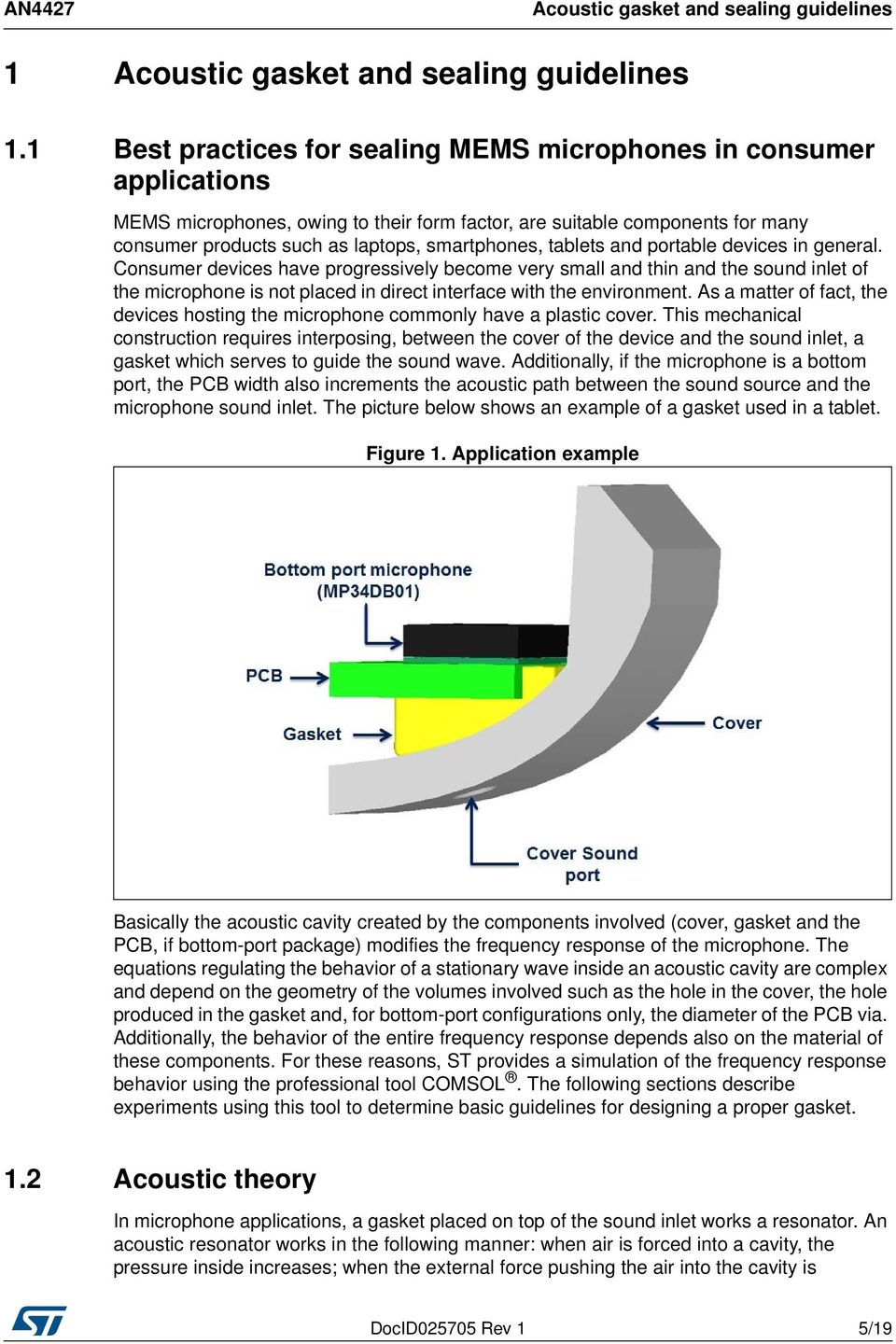
5 Acoustic gasket and sealing guidelines 1 Acoustic gasket and sealing guidelines 1.1 Best practices for sealing MEMS microphones in consumer applications MEMS microphones, owing to their form factor, are suitable components for many consumer products such as laptops, smartphones, tablets and portable devices in general. Consumer devices have progressively become very small and thin and the sound inlet of the microphone is not placed in direct interface with the environment. As a matter of fact, the devices hosting the microphone commonly have a plastic cover. This mechanical construction requires interposing, between the cover of the device and the sound inlet, a gasket which serves to guide the sound wave. Additionally, if the microphone is a bottom port, the PCB width also increments the acoustic path between the sound source and the microphone sound inlet. The picture below shows an example of a gasket used in a tablet. Figure 1. Application example Basically the acoustic cavity created by the components involved (cover, gasket and the PCB, if bottom-port package) modifies the frequency response of the microphone. The equations regulating the behavior of a stationary wave inside an acoustic cavity are complex and depend on the geometry of the volumes involved such as the hole in the cover, the hole produced in the gasket and, for bottom-port configurations only, the diameter of the PCB via. Additionally, the behavior of the entire frequency response depends also on the material of these components. For these reasons, ST provides a simulation of the frequency response behavior using the professional tool COMSOL. The following sections describe experiments using this tool to determine basic guidelines for designing a proper gasket. 1.2 Acoustic theory In microphone applications, a gasket placed on top of the sound inlet works a resonator. An acoustic resonator works in the following manner: when air is forced into a cavity, the pressure inside increases; when the external force pushing the air into the cavity is DocID Rev 1 5/19 19
6 Acoustic gasket and sealing guidelines AN4427 removed, the higher-pressure air inside will flow out. The cavity will be left at a pressure slightly lower than the outside, causing air to be drawn back in. This process repeats with the magnitude of the pressure changes decreasing each time. The air in the port (the neck of the chamber) has mass. Since it is in motion, it possesses some momentum. A longer port would make for a larger mass, and vice-versa. The diameter of the port is related to the mass of air and the volume of the chamber. A port that is too small in area for the chamber volume will "choke" the flow while one that is too large in area for the chamber volume tends to reduce the momentum of the air in the port. Helmholtz resonance is the phenomenon of air resonance in a cavity, such as when one blows across the top of an empty bottle. The name comes from a device created in the 1850s by Hermann Von Helmholtz, the "Helmholtz resonator", which he, the author of the classic study of acoustic science, used to identify the various frequencies or musical pitches present in music and other complex sounds. If the volume of the MEMS cavity is greater than the neck, the resonator corresponds exactly to a Helmholtz resonator. More commonly this condition is not respected since the volume of the MEMS cavity is smaller than the entire volume created by the gasket cavity. Hence, since the equations regulating the behavior of a stationary wave inside an acoustic cavity are complex and depend on the geometry of every involved acoustic cavity, the use of a simulating tool like COMSOL is mandatory. The COMSOL tool supports the five standard problems or scenarios that occur frequently when analyzing acoustics: 1. The radiation problem: a vibrating structure (a speaker, for example) radiates sound into the surrounding space. A far-away boundary condition is necessary to model the unbounded domain. 2. The scattering problem: an incident wave impinges on a body and creates a scattered wave. A far-away radiation boundary condition is necessary. 3. The sound field in an interior space (such as a room): the acoustic waves stay in a finite volume so no radiation condition is necessary. 4. Coupled fluid-elastic structure interaction (structural acoustics). If the radiating or scattering structure consists of an elastic material, then one must consider the interaction between the body and the surrounding fluid. In multiphysics coupling, the acoustic analysis provides a load (the sound pressure) to the structural analysis, and the structural analysis provides accelerations to the acoustic analysis. 5. The transmission problem: the incident sound wave propagates into a body, which can have different acoustic properties. Pressure and acceleration are continuous on the boundary. In the case of a microphone, the scenario considered is the sound field in an interior space. Additionally the tool allows setting the boundary condition for every surface in order to define the problem to simulate. Typical boundary conditions are: Sound-hard boundaries. A sound-hard boundary is a boundary at which the normal component of the acceleration is zero. This means that the normal derivative of the pressure is zero at the boundary. This condition will be used to understand the dependency of the sound-soft boundaries. Sound-soft boundaries. This means that the differential pressure vanishes at the boundary. Impedance boundary conditions. The impedance boundary condition is a generalization of the sound-hard and sound-soft boundary conditions. From a physical point of view, the 6/19 DocID Rev 1

7 Acoustic gasket and sealing guidelines acoustic input impedance is the ratio between pressure and normal particle velocity. The impedance boundary condition is a good approximation for a locally reacting surface defined as a surface for which the normal velocity at any point depends only on the pressure at that exact point. Radiation boundary conditions. The radiation boundary conditions allow an outgoing wave to leave the modeling domain with minimal reflections. This condition will never be used when simulating microphones. 1.3 Gasket design recommendations ST provides simulations for customer-specific projects. This section provides gasket design recommendations based on experience. In order to determine the best practices for gasket design, experiments were performed using the COMSOL tool. The method consists of simulating the effect of defined geometries placed close to the sound inlet of the microphone. These simulations have been carried out, checking how such geometries can modify the frequency response of the ST top-port microphone MP34DT01. The low frequency behavior depends on the ventilation hole and the back chamber while the high frequency response depends on the geometry of the front chamber only. Basically the addition of a gasket modifies the whole geometry of the front chamber since the MP34DT01 has the MEMS close to the sound inlet. For this reason, the geometry of the package is not considered in the following simulations and the range of the study starts from 100 Hz up to 50 khz. Figure 2. MP34DT01 X-ray The first simulation performed with the COMSOL tool represents the frequency response of the MP34DT01, applying 1 Pascal at the sound inlet and setting the silicon material properties as impedance boundary conditions. The tool solves the acoustic equations for every discrete point of the geometry and at the end of the simulation it is possible to plot the collected data in a relevant point. The evaluation point for the frequency response is one of the 4 corners of the MEMS membrane. DocID Rev 1 7/19 19

8 Acoustic gasket and sealing guidelines AN4427 Figure 3. MEMS microphone cavity to be simulated According to the results of the simulation, represented in the figure below, the response of the MP34DT01 microphone can be considered flat across the entire audio band and has small increases after 20 khz. Despite this increment, the assumption that the frequency response of a geometry including microphone and gasket solely depends on the addition of a gasket is a good approximation. Figure 4. MP34DT01 frequency response 20 khz AM17598v1 The first experiment consists of a simulation using cylindrical tubes with fixed radius (200 µm) and different lengths. On the other hand, the second experiment consists of a simulation using cylindrical tubes with fixed length (2 mm) but different diameters. From the results of these two experiments, it is possible to determine the effect of a gasket depending on its length and width. In the following simulations the boundary conditions of the gasket, as well as the microphone cavity, surfaces have been set to sound-hard boundaries. Under this condition the simulation will show the effect of the geometry only and neglects the effect of the involved materials. 8/19 DocID Rev 1

9 Acoustic gasket and sealing guidelines Figure 5. MP34DT01 frequency response vs. tube length Magnitude (db) Comsol Tube 0.5mm - r200e-6 Comsol Tube 1mm - r200e-6 Comsol Tube 2mm - r200e-6 Comsol Tube 3mm - r200e-6 Comsol Tube 4mm - r200e-6 AM17599v Frequency (Hz) Table 1. Resonance peak vs. tube length Tube length (mm) Resonance frequency (Hz) The figure below represents the frequency response versus the radius of the tube. Figure 6. MP34DT01 frequency response vs. tube radius Magnitude (db) Comsol Tube 2mm - r200e-6 Comsol Tube 2mm - r300e-6 Comsol Tube 2mm - r400e-6 Comsol Tube 2mm - r500e-6 AM17600v Frequency (Hz) DocID Rev 1 9/19 19

10 Acoustic gasket and sealing guidelines AN4427 Table 2. Resonance peak vs. tube radius Tube radius (µm) Resonance frequency (Hz) 2.00E E E E Starting from these preliminary results, it is possible to state that geometry placed on top of the microphone cavity produces a resonance effect. The above results can be summarized in two basics conclusions: 1. Firstly the resonance frequency moves lower and higher in the frequency domain, respectively increasing or decreasing the length of the gasket. 2. Conversely, the resonance frequency moves lower and higher in the frequency domain, respectively decreasing or increasing the radius of the gasket. Hence, if the gasket designer want to keep the frequency response flat as much as possible, the first recommendation is to keep the gasket short and wide. The following simulations are aimed to further investigate the dependence of the resonance frequency, increasing the complexity of the geometry. The figures below represent the simulated geometries and the respective results. Figure 7. Simulated complex geometries 10/19 DocID Rev 1

11 Acoustic gasket and sealing guidelines Figure 8. MP34DT01 frequency response vs. complex geometry AM17601v1 100 (a): L=4mm ; R=300u (b): L=4mm ; R1=300u ; R2= 600u 80 (c): L=4mm ; R1=300u ; R2= 1mm (d): L=4mm ; R1=300u ; R2= 600u; R3= 300u 60 (e): L=4mm ; R1=600u ; R2= 300u (f): Tank L=4mm ; R=300u 40 (g): Tank L=4mm ; R=300u ; W= 600u Basically the goal of the above simulations is to understand the effect of the addition of different volumes in terms of radius and length with respect to a fixed geometry. The first simulation is a simple geometry, Figure 7 (a), while the next geometries [Figure 7 (b), (c), (d), (e)] increase the complexity of the previous one, adding different radius and length volumes. For example, the second geometry includes a volume with a doubled radius close to the microphone sound inlet, the third one reaches a radius of 1 mm, the fourth geometry interposes a doubled radius volume at the middle of the original tube and the last one increases the entire volume except a 1 mm length section close to the microphone sound inlet. The geometries of the Figure 7 (f) and (g) are a little bit different. The purpose of the last two simulations is to check if the resonance frequency depends on the inclination of the tube or not. The simulations done, the observations given below are helpful to understand how the resonance frequency of a simple geometry moves in the frequency domain due to the addition of different volumes. The next consideration must be read as a comparison with respect to the first geometry. Checking the results of the simulations in Figure 8, the following observations can be asserted: 1. The introduction of a bigger volume geometry, in the side close to the sound inlet, forces the resonance peak to lower frequencies (Figure 7 (b), blue trace in Figure 8) 2. The resonance peak moves to a lower frequency in proportion to the increase of the diameter of the geometry close to the sound inlet (Figure 7 (c), violet trace in Figure 8) 3. The resonance peak moves to higher frequencies when the bigger geometry moves away from the sound inlet of the microphone. (Figure 7 (d) (e), green and red traces in Figure 8) 4. The resonance peak depends on the geometry, length and width, only. The peak position is independent of geometry inclination. The geometry in Figure 7 (f) represents the same structure of the Figure 7 (a) but rotated 90 degrees, the two respective simulation results are almost the same (yellow and orange traces in Figure 8). The last simulation, geometry represented in Figure 7 (g), has been performed to double check the previous statement. The geometry is similar to that of Figure 7 (b) and the simulation results are almost the same (blue and cyan traces in Figure 8) DocID Rev 1 11/19 19

12 Acoustic gasket and sealing guidelines AN4427 These simulated geometries are helpful when the gasket designer must introduce different volumes. This constraint can occur when the whole application forces the placement of the microphone far from the chassis or perpendicular to the chassis. The following table summarizes the resonances frequency position according to the simulated geometries. Table 3. Resonance peak vs. geometry Geometry Resonance frequency (Hz) (a): L = 4 mm; R = 300 µ (b): L = 4 mm; R1 = 300 µ; R2 = 600 µ (c): L = 4 mm; R1 = 300 µ; R2 = 1 mm 7500 (d): L = 4 mm; R1 = 300 µ; R2= 600 µ; R3 = 300 µ (e): L = 4 mm; R1 = 600 µ; R2 = 300 µ (f): Tank L = 4 mm; R = 300 µ (g): Tank L = 4 mm; R = 300 µ; W = 600 µ The simulations performed so far have been focused on the contribution of the geometry on the microphone frequency response. There is another important parameter to be introduced to provide a proper analysis of the gaskets: the acoustic impedance of the involved material. Basically, while the position of resonance frequency depends on the geometry of the whole structure, the magnitude of the resonance peak depends on the acoustic impedance of the materials. The COMSOL tool allows setting, as boundary conditions, the material properties of each surface involved in the simulation. The goal of the following simulations is to determine the relationship between the resonance peak magnitudes with respect to the acoustic properties of the material. This target will be achieved by setting impedance boundary conditions (a) instead of sound-hard boundaries in the tool. For each surface the proper acoustic impedance of the material will be set. The simulations will be performed, firstly setting the pressure at the structure sound inlet opening (1Pa), setting the acoustic impedance of the MEMS membrane (120*150) and setting the silicon cavity impedance (2000*1500). The above parameters are common to the entire real situation while the gasket surfaces acoustic impedance can vary according to the designer s preference. As a matter of fact, the gasket can consist of plastic, rubber or other materials. Additionally the cover can be made of aluminum or iron or plastic as well. Referring to the following figure, the yellow, pink and green surfaces will be set and kept fixed according to their real acoustic impedance while the blue surface will be modified according to the properties of the different materials. a. The acoustic impedance is defined as the product of the density of the material and the speed of sound in that material: Z acu = p x c. 12/19 DocID Rev 1

13 Acoustic gasket and sealing guidelines Figure 9. Subdomain materials The following table summarizes the acoustic properties of the most common materials used by manufacturers of electronics: plastic or aluminum concerning the covers; soft and hard rubber concerning the gasket; silicon and PCB concerning the electronic components. Table 4. Acoustic properties of materials Material Density (kg / m 3 ) Sound velocity in material (m/s) Air Aluminum PCB Glass Silicon Hard rubber Soft rubber Plastic Lead Iron MEMS membrane The following graphic depicts the behavior of the magnitude of the resonance peak, keeping silicon and MEMS membrane materials fixed and changing the material of the gasket only. While the geometry of the entire application behaves as a resonator, the acoustic property of the material works as a damping factor. The peak is attenuated in proportion to the softness of the material used as the gasket. The gasket designer can choose the material of the gasket according to his own needs. Where the frequency response must be kept flat as much as possible, the materials involved must be chosen as supple as possible. DocID Rev 1 13/19 19

14 Acoustic gasket and sealing guidelines AN4427 Magnitude (db) Figure 10. Resonance peak magnitude vs. materials Sound-hard boundaries (whole geometry) Iron Gasket (7870*5000) Plas c Gasket (1200*2500) Hard Rubber Gasket (1520*150) So Rubber Gasket (120*150) AM17602v Frequency (Hz) The next table summarizes the results of the simulations. Table 5. Resonance peak magnitude vs. materials MEMS cavity MEMS membrane Gasket material Resonance peak (db) Silicon Membrane Sound-hard boundary Silicon Membrane Iron gasket Silicon Membrane Plastic gasket Silicon Membrane Hard rubber gasket Silicon Membrane Soft rubber gasket The following simulation is an example of a real case study of the frequency response of a bottom-port microphone. In particular, the following figure illustrates a possible structure of a tablet concerning the microphone section. In this example the bottom-port microphone is mounted on the PCB, a soft rubber gasket has been used to allow the acoustic coupling between the microphone sound inlet and the cover. 14/19 DocID Rev 1

15 Acoustic gasket and sealing guidelines Figure 11. Example of tablet - design and acoustic cavity As previously stated, the acoustic simulation is performed on the geometry of the all of the components involved. Figure 11 (b) represents the acoustic cavity to be simulated, extracted from the entire structure depicted in Figure 11 (a). On the other hand, the acoustic properties of the materials must be set in the simulator to provide proper simulation results. The materials included in this simulation are those commonly adopted by the manufacturer of the electronic device; the printed circuit consists of FR4, the gasket is soft rubber and the cover is made of aluminum. The COMSOL tool has been used to study the effect of this geometry as well as the materials and the result is shown in the following figure Figure 12. Frequency response Resonance Hz AM17603v1 20 Magnitude (db) (a): Frequency responce F (Hz) (b): Hz Figure 12 (a) shows the frequency response characterized by a resonance peak around Hz; Figure 12 (b) shows how the magnitude of the pressure, expressed in dbspl, is distributed inside the cavity. The pressure inside the cavity is plotted at the resonance frequency; this is the reason why the maximum is exactly on the MEMS membrane. DocID Rev 1 15/19 19

16 Acoustic gasket and sealing guidelines AN4427 This is a typical example of how the gasket can affect the frequency response of the microphone when is embedded in the final application. The gasket commonly introduces a resonance peak; its position as well as its intensity depends on the design chosen by the user. Where the final application must be characterized by a flat frequency response, the gasket is a critical topic and it must be designed very carefully, but an equalized frequency response is needed. For example, the gasket can be helpful if an audio band range must be enhanced without using any equalization tool either analog or digital. In other words, a gasket can be a powerful factor in cases where the audio band must be equalized. 16/19 DocID Rev 1

17 Bibliography Appendix A Bibliography 1. COMSOL user guide version 3.5a 2. COMSOL modeling guide version 3.5a 3. COMSOL Introduction to Acoustics Module 4. Helmholtz resonance - Wikipedia, the free encyclopedia DocID Rev 1 17/19 19

18 Revision history AN Revision history Table 6. Document revision history Date Revision Changes 09-Jan Initial release 18/19 DocID Rev 1

19 Please Read Carefully: Information in this document is provided solely in connection with ST products. STMicroelectronics NV and its subsidiaries ( ST ) reserve the right to make changes, corrections, modifications or improvements, to this document, and the products and services described herein at any time, without notice. All ST products are sold pursuant to ST s terms and conditions of sale. Purchasers are solely responsible for the choice, selection and use of the ST products and services described herein, and ST assumes no liability whatsoever relating to the choice, selection or use of the ST products and services described herein. No license, express or implied, by estoppel or otherwise, to any intellectual property rights is granted under this document. If any part of this document refers to any third party products or services it shall not be deemed a license grant by ST for the use of such third party products or services, or any intellectual property contained therein or considered as a warranty covering the use in any manner whatsoever of such third party products or services or any intellectual property contained therein. UNLESS OTHERWISE SET FORTH IN ST S TERMS AND CONDITIONS OF SALE ST DISCLAIMS ANY EXPRESS OR IMPLIED WARRANTY WITH RESPECT TO THE USE AND/OR SALE OF ST PRODUCTS INCLUDING WITHOUT LIMITATION IMPLIED WARRANTIES OF MERCHANTABILITY, FITNESS FOR A PARTICULAR PURPOSE (AND THEIR EQUIVALENTS UNDER THE LAWS OF ANY JURISDICTION), OR INFRINGEMENT OF ANY PATENT, COPYRIGHT OR OTHER INTELLECTUAL PROPERTY RIGHT. ST PRODUCTS ARE NOT DESIGNED OR AUTHORIZED FOR USE IN: (A) SAFETY CRITICAL APPLICATIONS SUCH AS LIFE SUPPORTING, ACTIVE IMPLANTED DEVICES OR SYSTEMS WITH PRODUCT FUNCTIONAL SAFETY REQUIREMENTS; (B) AERONAUTIC APPLICATIONS; (C) AUTOMOTIVE APPLICATIONS OR ENVIRONMENTS, AND/OR (D) AEROSPACE APPLICATIONS OR ENVIRONMENTS. WHERE ST PRODUCTS ARE NOT DESIGNED FOR SUCH USE, THE PURCHASER SHALL USE PRODUCTS AT PURCHASER S SOLE RISK, EVEN IF ST HAS BEEN INFORMED IN WRITING OF SUCH USAGE, UNLESS A PRODUCT IS EXPRESSLY DESIGNATED BY ST AS BEING INTENDED FOR AUTOMOTIVE, AUTOMOTIVE SAFETY OR MEDICAL INDUSTRY DOMAINS ACCORDING TO ST PRODUCT DESIGN SPECIFICATIONS. PRODUCTS FORMALLY ESCC, QML OR JAN QUALIFIED ARE DEEMED SUITABLE FOR USE IN AEROSPACE BY THE CORRESPONDING GOVERNMENTAL AGENCY. Resale of ST products with provisions different from the statements and/or technical features set forth in this document shall immediately void any warranty granted by ST for the ST product or service described herein and shall not create or extend in any manner whatsoever, any liability of ST. ST and the ST logo are trademarks or registered trademarks of ST in various countries. Information in this document supersedes and replaces all information previously supplied. The ST logo is a registered trademark of STMicroelectronics. All other names are the property of their respective owners STMicroelectronics - All rights reserved STMicroelectronics group of companies Australia - Belgium - Brazil - Canada - China - Czech Republic - Finland - France - Germany - Hong Kong - India - Israel - Italy - Japan - Malaysia - Malta - Morocco - Philippines - Singapore - Spain - Sweden - Switzerland - United Kingdom - United States of America DocID Rev 1 19/19 19

Single LNB supply and control IC DiSEqC 1.X compliant with EXTM based on the LNBH29 in a QFN16 (4x4) Description
 Single LNB supply and control IC DiSEqC 1.X compliant with EXTM based on the LNBH29 in a QFN16 (4x4) Data brief Low-drop post regulator and high-efficiency step-up PWM with integrated power N-MOS allowing
SPC5-FLASHER. Flash management tool for SPC56xx family. Description. Features
 Flash management tool for SPC56xx family Data brief Flash verify: check the Flash content with a binary image file Unsecure sequence for censored device: sending the private password selected from the
LM337. Three-terminal adjustable negative voltage regulators. Features. Description
 Three-terminal adjustable negative voltage regulators Datasheet - production data current limit, thermal overload protection and safe area protection. All overload protection circuitry remains fully functional
Description. Table 1. Device summary. Order codes. TO-220 (single gauge) TO-220 (double gauge) D²PAK (tape and reel) TO-220FP
 1.2 V to 37 V adjustable voltage regulators Description Datasheet - production data TO-220 TO-220FP The LM217, LM317 are monolithic integrated circuits in TO-220, TO-220FP and D²PAK packages intended for
Table 1. Absolute maximum ratings (T amb = 25 C) Symbol Parameter Value Unit. ISO 10605 - C = 330 pf, R = 330 Ω : Contact discharge Air discharge
 Automotive dual-line Transil, transient voltage suppressor (TVS) for CAN bus Datasheet - production data Complies with the following standards ISO 10605 - C = 150 pf, R = 330 Ω : 30 kv (air discharge)
Description. Table 1. Device summary
 2 A positive voltage regulator IC Description Datasheet - production data Features TO-220 Output current up to 2 A Output voltages of 5; 7.5; 9; 10; 12; 15; 18; 24 V Thermal protection Short circuit protection
UM1676 User manual. Getting started with.net Micro Framework on the STM32F429 Discovery kit. Introduction
 User manual Getting started with.net Micro Framework on the STM32F429 Discovery kit Introduction This document describes how to get started using the.net Micro Framework (alias NETMF) on the STM32F429
EN: This Datasheet is presented by the m anufacturer. Please v isit our website for pricing and availability at www.hest ore.hu.
 EN: This Datasheet is presented by the m anufacturer. Please v isit our website for pricing and availability at www.hest ore.hu. 2N3055, MJ2955 Complementary power transistors Features Datasheet - production
STEVAL-IEG001V2. Smart real-time vehicle tracking system. Features
 Smart real-time vehicle tracking system Data brief Features Real-time vehicle tracking through GPS/GSM/GPRS. Vehicle location coordinates acquired using a Telit GPS module and sent over GPRS to web server-based
STTH1R04-Y. Automotive ultrafast recovery diode. Features. Description
 Automotive ultrafast recovery diode Features Datasheet - production data K SMA STTH1R4AY Table 1. Device summary Symbol Value I F(AV) 1 A V RRM 4 V T j (max) 175 C V F (typ) t rr (typ) A K.9 V 14 ns A
M24LRxx/CR95HF application software installation guide
 User manual M24LRxx/CR95HF application software installation guide Introduction This user manual describes the procedures to install the different software drivers required to use the DEVKIT-M24LR-A development
Description. Table 1. Device summary. Order code Temperature range Package Packaging Marking
 14-stage ripple carry binary counter/divider and oscillator Applications Automotive Industrial Computer Consumer Description Datasheet - production data Features Medium speed operation Common reset Fully
TDA2003 10W CAR RADIO AUDIO AMPLIFIER
 TDA2003 10W CAR RADIO AUDIO AMPLIFIER DESCRIPTION The TDA 2003 has improved performance with the same pin configuration as the TDA 2002. The additional features of TDA 2002, very low number of external
EVL185W-LEDTV. 185 W power supply with PFC and standby supply for LED TV based on the L6564, L6599A and Viper27L. Features.
 Features 185 W power supply with PFC and standby supply for LED TV based on the L6564, L6599A and Viper27L Data brief Universal input mains range: 90 264 Vac - frequency 45 65 Hz Output voltage 1: 130
AN3998 Application note
 Application note PDM audio software decoding on STM32 microcontrollers 1 Introduction This application note presents the algorithms and architecture of an optimized software implementation for PDM signal
TN0023 Technical note
 Technical note Discontinuous flyback transformer description and design parameters Introduction The following is a general description and basic design procedure for a discontinuous flyback transformer.
AN3332 Application note
 Application note Generating PWM signals using STM8S-DISCOVERY Application overview This application user manual provides a short description of how to use the Timer 2 peripheral (TIM2) to generate three
BD238. Low voltage PNP power transistor. Features. Applications. Description. Low saturation voltage PNP transistor
 Low voltage PNP power transistor Features Low saturation voltage PNP transistor Applications Audio, power linear and switching applications Description The device is manufactured in planar technology with
UA741. General-purpose single operational amplifier. Features. Applications. Description. N DIP8 (plastic package)
 General-purpose single operational amplifier Datasheet - production data N DIP8 (plastic package) D SO8 (plastic micropackage) Pin connections (top view) 1 - Offset null 1 2 - Inverting input 3 - Non-inverting
AN2866 Application note
 Application note How to design a 13.56 MHz customized tag antenna Introduction RFID (radio-frequency identification) tags extract all of their power from the reader s field. The tags and reader s antennas
AN2604 Application note
 AN2604 Application note STM32F101xx and STM32F103xx RTC calibration Introduction The real-time clock (RTC) precision is a requirement in most embedded applications, but due to external environment temperature
AN3353 Application note
 Application note IEC 61000-4-2 standard testing Introduction This Application note is addressed to technical engineers and designers to explain how STMicroelectronics protection devices are tested according
BD241A BD241C. NPN power transistors. Features. Applications. Description. NPN transistors. Audio, general purpose switching and amplifier transistors
 BD241A BD241C NPN power transistors Features. NPN transistors Applications Audio, general purpose switching and amplifier transistors Description The devices are manufactured in Planar technology with
UM1613 User manual. 16-pin smartcard interface ST8034P demonstration board. Introduction
 User manual 16-pin smartcard interface ST8034P demonstration board Introduction The purpose of this document is to describe, and provide information on, how to efficiently use the ST8034P smartcard interface
AN4108 Application note
 Application note How to set up a HTTPS server for In-Home display with HTTPS Introduction This application note describes how to configure a simple SSL web server using the EasyPHP free application to
DDSL01. Secondary protection for DSL lines. Features. Description
 Secondary protection for DSL lines Features Stand off voltage: 30 V Surge capability: I pp = 30 A 8/20 µs Low capacitance device: 4.5 pf at 2 V RoHS package Low leakage current: 0.5 µa at 25 C 3 2 Description
AN4368 Application note
 Application note Signal conditioning for pyroelectric passive infrared (PIR) sensors Sylvain Colliard-Piraud Introduction Pyroelectric passive infrared (PIR) sensors are widely used in daily life. They
UM1727 User manual. Getting started with STM32 Nucleo board software development tools. Introduction
 User manual Getting started with STM32 Nucleo board software development tools Introduction The STM32 Nucleo board (NUCLEO-F030R8, NUCLEO-F072RB, NUCLEO-F103RB, NUCLEO-F302R8, NUCLEO-F401RE, NUCLEO-L152RE)
SPC5-CRYP-LIB. SPC5 Software Cryptography Library. Description. Features. SHA-512 Random engine based on DRBG-AES-128
 SPC5 Software Cryptography Library Data brief SHA-512 Random engine based on DRBG-AES-128 RSA signature functions with PKCS#1v1.5 ECC (Elliptic Curve Cryptography): Key generation Scalar multiplication
UM1790 User manual. Getting started with STM32L053 discovery kit software development tools. Introduction
 User manual Getting started with STM32L053 discovery kit software development tools Introduction This document describes the software environment recommendations required to build an application using
UM1680 User manual. Getting started with STM32F429 Discovery software development tools. Introduction
 User manual Getting started with STM32F429 Discovery software development tools Introduction This document describes the software environment and development recommendations required to build an application
AN3359 Application note
 Application note Low cost PCB antenna for 2.4GHz radio: Meander design 1 Introduction This application note is dedicated to the STM32W108 product family from STMicroelectronics. One of the main reasons
Description SO-8. series. Furthermore, in the 8-pin configuration Very low-dropout voltage (0.2 V typ.)
 ery low-dropout voltage regulator with inhibit function TO-92 Bag TO-92 Tape and reel Ammopack 1 2 3 SO-8 Description Datasheet - production data The is a very low-dropout voltage regulator available in
BD135 - BD136 BD139 - BD140
 BD135 - BD136 BD139 - BD140 Complementary low voltage transistor Features Products are pre-selected in DC current gain Application General purpose Description These epitaxial planar transistors are mounted
AN4156 Application note
 Application note Hardware abstraction layer for Android Introduction This application note provides guidelines for successfully integrating STMicroelectronics sensors (accelerometer, magnetometer, gyroscope
2STBN15D100. Low voltage NPN power Darlington transistor. Features. Application. Description
 Low voltage NPN power Darlington transistor Features Good h FE linearity High f T frequency Monolithic Darlington configuration with integrated antiparallel collector-emitter diode TAB Application Linear
AN2389 Application note
 Application note An MCU-based low cost non-inverting buck-boost converter for battery chargers Introduction As the demand for rechargeable batteries increases, so does the demand for battery chargers.
LM134-LM234-LM334. Three terminal adjustable current sources. Features. Description
 Three terminal adjustable current sources Features Operates from 1V to 40V 0.02%/V current regulation Programmable from 1µA to 10mA ±3% initial accuracy Description The LM134/LM234/LM334 are 3-terminal
LM135-LM235-LM335. Precision temperature sensors. Features. Description
 Precision temperature sensors Features Directly calibrated in K 1 C initial accuracy Operates from 450µA to 5mA Less than 1Ω dynamic impedance TO-92 (Plastic package) Description The LM135, LM235, LM335
ULN2801A, ULN2802A, ULN2803A, ULN2804A
 ULN2801A, ULN2802A, ULN2803A, ULN2804A Eight Darlington array Datasheet production data Features Eight Darlington transistors with common emitters Output current to 500 ma Output voltage to 50 V Integral
L78MxxAB L78MxxAC. Precision 500 ma regulators. Features. Description
 L78MxxAB L78MxxAC Precision 500 ma regulators Features Output current to 0.5 A Output voltages of 5; 6; 8; 9; 10; 12; 15; 18; 24 V Thermal overload protection Short circuit protection Output transition
ST13005. High voltage fast-switching NPN power transistor. Features. Applications. Description
 High voltage fast-switching NPN power transistor Datasheet production data Features Low spread of dynamic parameters Minimum lot-to-lot spread for reliable operation Very high switching speed Applications
MC33079. Low noise quad operational amplifier. Features. Description
 Low noise quad operational amplifier Datasheet production data Features Low voltage noise: 4.5 nv/ Hz High gain bandwidth product: 15 MHz High slew rate: 7 V/µs Low distortion: 0.002% Large output voltage
L6234. Three phase motor driver. Features. Description
 Three phase motor driver Features Supply voltage from 7 to 52 V 5 A peak current R DSon 0.3 Ω typ. value at 25 C Cross conduction protection TTL compatible driver Operating frequency up to 150 khz Thermal
AN4426 Application note
 Application note Tutorial for MEMS microphones Introduction This application note serves as a tutorial for MEMS microphones, providing general characteristics of these devices, both acoustic and mechanical,
TDA2004R. 10 + 10 W stereo amplifier for car radio. Features. Description
 10 + 10 W stereo amplifier for car radio Features Low distortion Low noise Protection against: Output AC short circuit to ground Overrating chip temperature Load dump voltage surge Fortuitous open ground
AN3354 Application note
 Application note STM32F105/107 in-application programming using a USB host 1 Introduction An important requirement for most Flash-memory-based systems is the ability to update firmware installed in the
STTH2R06. High efficiency ultrafast diode. Features. Description
 STTH2R6 High efficiency ultrafast diode Features Very low conduction losses Negligible switching losses Low forward and reverse recovery times High junction temperature Description A K The STTH2R6 uses
Order code Temperature range Package Packaging
 ST485B ST485C Low power RS-485/RS-422 transceiver Features Low quiescent current: 300 µa Designed for RS-485 interface application - 7 V to 12 V common mode input voltage range Driver maintains high impedance
AN3110 Application note
 Application note Using the STVM100 to automatically adjust VCOM voltage in e-paper Introduction The widespread use of multimedia electronic devices, coupled with environmental concerns over the manufacturing
STTH110. High voltage ultrafast rectifier. Description. Features
 High voltage ultrafast rectifier Datasheet - production data K Description The STTH110, which is using ST ultrafast high voltage planar technology, is especially suited for free-wheeling, clamping, snubbering,
DSL01-xxxSC5. Secondary protection for DSL lines. Features. Description. Applications. Benefits. Complies with the following standards
 -xxxsc5 Secondary protection for DSL lines Features Low capacitance devices: -xxxsc5: Delta C typ = 3.5 pf High surge capability: 30 A - 8/20 µs Voltage: 8 V, 10.5 V, 16 V, and 24 V RoHS package Benefits
ETP01-xx21. Protection for Ethernet lines. Features. Description. Applications. Benefits. Complies with the following standards
 ETP0-xx2 Protection for Ethernet lines Features Differential and common mode protection Telcordia GR089 Intrabuilding: 50 A, 2/0 µs ITU-T K20/2: 40 A, 5/30 µs Low capacitance: 3 pf max at 0 V UL94 V0 approved
How To Write To An Eeprom Memory On A Flash Memory On An Iphone Or Ipro Memory On Microsoft Flash Memory (Eeprom) On A Microsoft Microsoft Powerbook (Ai) 2.2.2
 Application note EEPROM emulation in STM32F10x microcontrollers Introduction Many applications require EEPROM (electrically erasable programmable read-only memory) for non-volatile data storage. For low-cost
ESDLIN1524BJ. Transil, transient voltage surge suppressor diode for ESD protection. Features. Description SOD323
 Transil, transient voltage surge suppressor diode for ESD protection Datasheet production data Features Max peak pulse power 160 W (8/0 µs) Asymmetrical bidirectional device Stand-off voltage: 15 and 4
ULN2001, ULN2002 ULN2003, ULN2004
 ULN2001, ULN2002 ULN2003, ULN2004 Seven Darlington array Datasheet production data Features Seven Darlingtons per package Output current 500 ma per driver (600 ma peak) Output voltage 50 V Integrated suppression
AN3265 Application note
 Application note Handling hardware and software failures with the STM8S-DISCOVERY Application overview This application is based on the STM8S-DISCOVERY. It demonstrates how to use the STM8S window watchdog
BZW50. Transil, transient voltage surge suppressor (TVS) Features. Description
 Transil, transient voltage surge suppressor (TVS) Datasheet production data Features Peak pulse power: 5000 W (10/0 µs) Stand-off voltage range from 10 V to 180 V Unidirectional and bidirectional types
MC34063AB, MC34063AC, MC34063EB, MC34063EC
 MC34063AB, MC34063AC, MC34063EB, MC34063EC DC-DC converter control circuits Description Datasheet - production data Features DIP-8 SO-8 Output switch current in excess of 1.5 A 2 % reference accuracy Low
STP60NF06. N-channel 60V - 0.014Ω - 60A TO-220 STripFET II Power MOSFET. General features. Description. Internal schematic diagram.
 N-channel 60V - 0.014Ω - 60A TO-220 STripFET II Power MOSFET General features Type V DSS R DS(on) I D STP60NF06 60V
UM0985 User manual. Developing your STM32VLDISCOVERY application using the IAR Embedded Workbench software. Introduction
 User manual Developing your STM32VLDISCOVERY application using the IAR Embedded Workbench software Introduction This document provides an introduction on how to use IAR Embedded Workbench for ARM software
Description. IO and RF AGC. ASIC controller and power management. Carrier recovery loop. GPIO switch matrix. Lock indicator and monitoring DVBS2 FEC
 Multi-standard advanced demodulator for satellite digital TV and data services set-top boxes Data Brief Features Demodulation DIRECTV TM and DVBS QPSK DVBS2 QPSK and 8PSK Digital Nyquist root filter with
STN3NF06L. N-channel 60 V, 0.07 Ω, 4 A, SOT-223 STripFET II Power MOSFET. Features. Application. Description
 N-channel 60 V, 0.07 Ω, 4 A, SOT-223 STripFET II Power MOSFET Features Type V DSS (@Tjmax) Exceptional dv/dt capability Avalanche rugged technology 100% avalanche tested R DS(on) max STN3NF06L 60 V < 0.1
STP60NF06FP. N-channel 60V - 0.014Ω - 30A TO-220FP STripFET II Power MOSFET. General features. Description. Internal schematic diagram.
 N-channel 60V - 0.014Ω - 30A TO-220FP STripFET II Power MOSFET General features Type V DSS R DS(on) I D STP60NF06FP 60V
AN2680 Application note
 Application note Fan speed controller based on STDS75 or STLM75 digital temperature sensor and ST72651AR6 MCU Introduction This application note describes the method of defining the system for regulating
ST19NP18-TPM-I2C. Trusted Platform Module (TPM) with I²C Interface. Features
 Trusted Platform Module (TPM) with I²C Interface Data brief Features Single-chip Trusted Platform Module (TPM) Embedded TPM 1.2 firmware I²C communication interface (Slave mode) Architecture based on ST19N
AN3327 Application note
 AN3327 Application note L9942 back EMF stall detection algorithm Introduction The L9942 is an integrated stepper motor driver for bipolar stepper motors used primarily in automotive head lamp leveling.
AN2703 Application note
 Application note list for SCRs, TRIACs, AC switches, and DIACS Introduction All datasheet parameters are rated as minimum or maximum values, corresponding to the product parameter distribution. In each
Getting started with DfuSe USB device firmware upgrade STMicroelectronics extension
 User manual Getting started with DfuSe USB device firmware upgrade STMicroelectronics extension Introduction This document describes the demonstration user interface that was developed to illustrate use
AN2760 Application note
 Application note Using clock distribution circuits in smart phone system design Introduction As smart phones become more and more popular in the market, additional features such as A-GPS, Bluetooth, WLAN
Obsolete Product(s) - Obsolete Product(s)
 Vertical deflection booster for 3 App TV/monitor applications with 0 V flyback generator Features Figure. Heptawatt package Power amplifier Flyback generator Stand-by control Output current up to 3.0 App
AN3155 Application note
 Application note USART protocol used in the STM32 bootloader Introduction This application note describes the USART protocol used in the STM32 microcontroller bootloader. It details each supported command.
AN4128 Application note
 Application note Demonstration board for Bluetooth module class 1 SBT2632C1A.AT2 Introduction This document describes the STEVAL-SPBT4ATV3 demonstration board (dongle) for the Bluetooth class 1 SPBT2632C1A.AT2
VN5R003H-E. 3 mω reverse battery protection switch. Features. Description. Application
 3 mω reverse battery protection switch Datasheet production data Features Max supply voltage V CC -16 to 41 V Operating voltage range V CC -16 to 28 V On-state resistance R ON 3mΩ General Optimized electromagnetic
AN3270 Application note
 Application note Using the STM8L16x AES hardware accelerator Introduction The purpose of cryptography is to protect sensitive data to avoid it being read by unauthorized persons. There are many algorithms
P6KE. Transil, transient voltage surge suppressor (TVS) Features. Description. Complies with the following standards
 Transil, transient voltage surge suppressor (TVS) Datasheet production data Features Peak pulse power: 600 W (10/0 µs ) Stand-off voltage range 6.8 to 440 V Unidirectional and bidirectional types Low clamping
Description. Table 1. Device summary. Order code Package Packing
 4 x 41 W quad bridge car radio amplifier Datasheet - production data Features Flexiwatt25 High output power capability: 4 x 41 W / 4 max. Low distortion Low output noise Standby function Mute function
AN2824 Application note
 Application note STM32F10xxx I 2 C optimized examples Introduction The aim of this application note is to provide I 2 C firmware optimized examples based on polling, interrupts and DMA, covering the four
AN820 APPLICATION NOTE INPUT/OUTPUT PROTECTION FOR AUTOMOTIVE COMPUTER
 AN820 APPLICATION NOTE INPUT/OUTPUT PROTECTION FOR AUTOMOTIE COMPUTER INTRODUCTION In cars, the number of functions carried out by electronic components has greatly increased during the last 10 years.
STP55NF06L STB55NF06L - STB55NF06L-1
 General features STP55NF06L STB55NF06L - STB55NF06L-1 N-channel 60V - 0.014Ω - 55A TO-220/D 2 PAK/I 2 PAK STripFET II Power MOSFET Type V DSS R DS(on) I D STP55NF06L 60V
AN3252 Application note
 Application note Building a wave generator using STM8L-DISCOVERY Application overview This application note provides a short description of how to use the STM8L-DISCOVERY as a basic wave generator for
TDA2822 DUAL POWER AMPLIFIER SUPPLY VOLTAGE DOWN TO 3 V LOW CROSSOVER DISTORSION LOW QUIESCENT CURRENT BRIDGE OR STEREO CONFIGURATION
 TDA2822 DUAL POER AMPLIFIER SUPPLY VOLTAGE DON TO 3 V. LO CROSSOVER DISTORSION LO QUIESCENT CURRENT BRIDGE OR STEREO CONFIGURATION DESCRIPTION The TDA2822 is a monolithic integrated circuit in 12+2+2 powerdip,
AN974 APPLICATION NOTE
 AN974 APPLICATION NOTE Real time clock with ST7 Timer Output Compare By MCD Application Team 1 INTRODUCTION The purpose of this note is to present how to use the ST7 Timer output compare function. As an
STDP2600. Advanced HDMI to DisplayPort (dual mode) converter. Features. Applications
 Advanced HDMI to DisplayPort (dual mode) converter Data brief Features DisplayPort (dual mode) transmitter DP 1.2a compliant Link rate HBR2/HBR/RBR 1, 2, or 4 lanes AUX CH 1 Mbps Supports edp operation
AN2557 Application note
 Application note STM32F10x in-application programming using the USART Introduction An important requirement for most Flash-memory-based systems is the ability to update firmware when installed in the end
STTH3R02QRL. Ultrafast recovery diode. Main product characteristics. Features and benefits. Description. Order codes DO-15 STTH3R02Q DO-201AD STTH3R02
 Ultrafast recovery diode Main product characteristics I F(V) 3 V RRM 2 V T j (max) V F (typ) 175 C.7 V K t rr (typ) 16 ns Features and benefits Very low conduction losses Negligible switching losses K
AN3990 Application note
 Application note Upgrading STM32F4DISCOVERY board firmware using a USB key Introduction An important requirement for most Flash memory-based systems is the ability to update the firmware installed in the
STP10NK80ZFP STP10NK80Z - STW10NK80Z
 STP10NK80ZFP STP10NK80Z - STW10NK80Z N-channel 800V - 0.78Ω - 9A - TO-220/FP-TO-247 Zener-protected supermesh TM MOSFET General features Type V DSS R DS(on) I D Pw STP10NK80Z 800V
STGB10NB37LZ STGP10NB37LZ
 STGB10NB37LZ STGP10NB37LZ 10 A - 410 V internally clamped IGBT Features Low threshold voltage Low on-voltage drop Low gate charge TAB TAB High current capability High voltage clamping feature Applications
AN3211 Application note
 Application note Using the simulated EEPROM with the STM32W108 platform 1 Introduction This document describes how to use the Simulated EEPROM in the STM32W108, gives an overview of the internal design,
BTW69-1200N. 50 A 1200 V non insulated SCR thyristor. Description. Features. Applications
 50 1200 V non insulated SCR thyristor Datasheet - production data G K K G TOP3 non insulated Description vailable in non insulated TOP3 high power package, the BTW69-1200N is suitable for applications
STDP2690. Advanced DisplayPort to DisplayPort (dual mode) converter. Features. Applications
 Advanced DisplayPort to DisplayPort (dual mode) converter Data brief Features DisplayPort dual-mode transmitter DP 1.2a compliant Link rate HBR2/HBR/RBR 1, 2, or 4 lanes AUX CH 1 Mbps Supports edp operation
Description. Table 1. Device summary. Order code Temperature range Package Packing Marking
 8-bit shift register with output latches (3-state) Applicatio Datasheet - production data SO16 TSSOP16 Automotive Industrial Computer Coumer Features High speed: f MAX = 59 MHz (typ.) at V CC = 6 V Low
LM2901. Low-power quad voltage comparator. Features. Description
 Low-power quad voltage comparator Features Wide single supply voltage range or dual supplies for all devices: +2 V to +36 V or ±1 V to ±18 V Very low supply current (1.1 ma) independent of supply voltage
STCS1. 1.5 A max constant current LED driver. Features. Applications. Description
 1.5 A max constant current LED driver Features Up to 40 V input voltage Less than 0.5 V voltage overhead Up to 1.5 A output current PWM dimming pin Shutdown pin LED disconnection diagnostic DFN8 (3x3 mm)
AN438 APPLICATION NOTE SAFETY PRECAUTIONS FOR DEVELOPMENT TOOL TRIAC + MICROCONTROLLER
 AN438 APPLICATION NOTE SAFETY PRECAUTIONS FOR DEVELOPMENT TOOL TRIAC + MICROCONTROLLER INTRODUCTION The goal of this paper is to analyse the different ways to configure a micro-controller and a development
UM0109 USER MANUAL. Public Transport Ticketing Demo
 UM0109 USER MANUAL Public Transport Ticketing Demo The purpose of the Public Transport Ticketing Demo is to demonstrate that the STMicroelectronics shortrange product portfolio can be used as public transport
AN1819 APPLICATION NOTE Bad Block Management in Single Level Cell NAND Flash Memories
 APPLICATION NOTE Bad Block Management in Single Level Cell NAND Flash Memories This Application Note explains how to recognize factory generated Bad Blocks, and to manage Bad Blocks that develop during
STB4NK60Z, STB4NK60Z-1, STD4NK60Z STD4NK60Z-1, STP4NK60Z,STP4NK60ZFP
 STB4NK60Z, STB4NK60Z-1, STD4NK60Z STD4NK60Z-1, STP4NK60Z,STP4NK60ZFP N-channel 600 V - 1.76 Ω - 4 A SuperMESH Power MOSFET DPAK - D 2 PAK - IPAK - I 2 PAK - TO-220 - TO-220FP Features Type V DSS R DS(on)
AN2328 Application note
 Application note HID device coding example Introduction This application note describes how to lookup and use HID devices under Windows. This note is related to the MEMS Evaluation boards which are usually