
Application for a 1915(c) Home and Community-Based Services Waiver
|
|
|
- Sophia Isabella Gilmore
- 9 years ago
- Views:
Transcription
1 Page 1 of 209 Application for a 1915(c) Home and Community-Based Services Waiver PURPOSE OF THE HCBS WAIVER PROGRAM The Medicaid Home and Community-Based Services (HCBS) waiver program is authorized in 1915(c) of the Social Security Act. The program permits a State to furnish an array of home and community-based services that assist Medicaid beneficiaries to live in the community and avoid institutionalization. The State has broad discretion to design its waiver program to address the needs of the waiver s target population. Waiver services complement and/or supplement the services that are available to participants through the Medicaid State plan and other federal, state and local public programs as well as the supports that families and communities provide. The Centers for Medicare & Medicaid Services (CMS) recognizes that the design and operational features of a waiver program will vary depending on the specific needs of the target population, the resources available to the State, service delivery system structure, State goals and objectives, and other factors. A State has the latitude to design a waiver program that is cost-effective and employs a variety of service delivery approaches, including participant direction of services. Request for an Amendment to a 1915(c) Home and Community-Based Services Waiver 1. Request Information A. The State of Pennsylvania requests approval for an amendment to the following Medicaid home and communitybased services waiver approved under authority of 1915(c) of the Social Security Act. B. Program Title: Pennsylvania Adult Autism Waiver C. Waiver Number:PA.0593 D. Amendment Number:PA.0593.R01.03 E. Proposed Effective Date: (mm/dd/yy) 07/01/14 Approved Effective Date of Waiver being Amended: 07/01/11 2. Purpose(s) of Amendment Purpose(s) of the Amendment. Describe the purpose(s) of the amendment: The purpose of the amendment is to increase capacity in the waiver from 418 to 518, including reserve capacity for five individuals who have a protective services plan, developed pursuant to the Adult Protective Services Act, which specifies a need for long-term support. We also request that the unduplicated count be increased from 439 to 544. These requests are due to the Pennsylvania legislature appropriating additional funding for SFY to increase capacity for the Adult Autism Waiver (AAW). In addition, this waiver amendment includes the state s entry for new fields in the waiver application regarding the transition to compliance to home and community-based settings regulations and the settings that currently comply with these regulations. This waiver amendment adds data for other new fields in the waiver application for the home and communitybased services taxonomy and a new section on seclusion. Finally, this wavier amendment makes a technical update in Appendix G-1-d to the bulletin number that specifies training for certified investigators of critical incidents. 3. Nature of the Amendment A. Component(s) of the Approved Waiver Affected by the Amendment. This amendment affects the following component(s) of the approved waiver. Revisions to the affected subsection(s) of these component(s) are being submitted concurrently (check each that applies):

2 Page 2 of 209 Component of the Approved Waiver Waiver Application Appendix A Waiver Administration and Operation Subsection(s) Main 6 an Appendix B Participant Access and Eligibility B-3-a, B- Appendix C Participant Services Appendix D Participant Centered Service Planning and Delivery Appendix E Participant Direction of Services Appendix F Participant Rights C-3 (HCB Appendix G Participant Safeguards G-1-d, G- Appendix H Appendix I Financial Accountability Appendix J Cost-Neutrality Demonstration B. Nature of the Amendment. Indicate the nature of the changes to the waiver that are proposed in the amendment (check each that applies): Modify target group(s) Modify Medicaid eligibility Add/delete services Revise service specifications Revise provider qualifications Increase/decrease number of participants Revise cost neutrality demonstration Add participant-direction of services Application for a 1915(c) Home and Community-Based Services Waiver 1. Request Information (1 of 3) A. The State of Pennsylvania requests approval for a Medicaid home and community-based services (HCBS) waiver under the authority of 1915(c) of the Social Security Act (the Act). B. Program Title (optional - this title will be used to locate this waiver in the finder): Pennsylvania Adult Autism Waiver C. Type of Request: amendment Requested Approval Period:(For new waivers requesting five year approval periods, the waiver must serve individuals who are dually eligible for Medicaid and Medicare.) 3 years 5 years Waiver Number:PA.0593.R01.03 Draft ID: PA D. Type of Waiver (select only one): Regular Waiver E. Proposed Effective Date of Waiver being Amended: 07/01/11 Approved Effective Date of Waiver being Amended: 07/01/11

3 Page 3 of Request Information (2 of 3) F. Level(s) of Care. This waiver is requested in order to provide home and community-based waiver services to individuals who, but for the provision of such services, would require the following level(s) of care, the costs of which would be reimbursed under the approved Medicaid State plan (check each that applies): Hospital Select applicable level of care Hospital as defined in 42 CFR If applicable, specify whether the State additionally limits the waiver to subcategories of the hospital level of care: Inpatient psychiatric facility for individuals age 21 and under as provided in42 CFR Nursing Facility Select applicable level of care Nursing Facility as defined in 42 CFR and 42 CFR If applicable, specify whether the State additionally limits the waiver to subcategories of the nursing facility level of care: Institution for Mental Disease for persons with mental illnesses aged 65 and older as provided in 42 CFR Intermediate Care Facility for Individuals with Intellectual Disabilities (ICF/IID) (as defined in 42 CFR ) If applicable, specify whether the State additionally limits the waiver to subcategories of the ICF/IID level of care: This waiver includes both subcategories of ICF/ID level of care used in Pennsylvania: Intermediate Care Facility for Persons with Related Conditions (ICF/ORC); and Intermediate Care Facility for Persons with Intellectual Disabilities (ICF/-ID). 1. Request Information (3 of 3) G. Concurrent Operation with Programs. This waiver operates concurrently with another program (or programs) approved under the following authorities Select one: Not applicable Applicable Check the applicable authority or authorities: Services furnished under the provisions of 1915(a)(1)(a) of the Act and described in Appendix I Waiver(s) authorized under 1915(b) of the Act. Specify the 1915(b) waiver program and indicate whether a 1915(b) waiver application has been submitted or previously approved: Specify the 1915(b) authorities under which this program operates (check each that applies): 1915(b)(1) (mandated enrollment to managed care) 1915(b)(2) (central broker) 1915(b)(3) (employ cost savings to furnish additional services) 1915(b)(4) (selective contracting/limit number of providers) A program operated under 1932(a) of the Act. Specify the nature of the State Plan benefit and indicate whether the State Plan Amendment has been submitted or previously approved:

4 Page 4 of 209 A program authorized under 1915(i) of the Act. A program authorized under 1915(j) of the Act. A program authorized under 1115 of the Act. Specify the program: H. Dual Eligiblity for Medicaid and Medicare. Check if applicable: This waiver provides services for individuals who are eligible for both Medicare and Medicaid. 2. Brief Waiver Description Brief Waiver Description. In one page or less, briefly describe the purpose of the waiver, including its goals, objectives, organizational structure (e.g., the roles of state, local and other entities), and service delivery methods. The Pennsylvania Adult Autism Waiver is designed to provide community-based services and supports to meet the specific needs of adults with Autism Spectrum Disorders (ASD). The intent of this waiver is to serve some of the many people with ASD that are not served by any waiver or who receive services through other HCBS waivers which do not meet their unique needs. The Department of Public Welfare (DPW) established the Office of Developmental Programs (ODP), Bureau of Autism Services (BAS) in February 2007 for the explicit purpose of assuring that people with ASD have supports and services to assist them in leading successful, happy, and safe lives in the community. As the State Medicaid Agency, DPW retains ultimate authority over the administration and implementation of the Adult Autism Waiver. BAS is responsible for developing policies and procedures for waiver operations. Individuals request services through a toll free number at BAS. BAS regional staff and BAS contractors assess functional eligibility for the Adult Autism Waiver. The DPW Office of Income Maintenance (OIM) determines financial eligibility. The Adult Autism Waiver offers Supports Coordination as a waiver service. The participant chooses his or her Supports Coordination Agency with assistance from BAS regional staff. The Supports Coordinator then conducts state-specified assessments and works with the participant and individuals he or she chooses to develop an Individual Support Plan (ISP). The waiver offers only agency-managed services. DPW will submit a waiver amendment to add participant-directed services upon selection of entities to furnish financial management services and information and assistance to support participant direction. 3. Components of the Waiver Request The waiver application consists of the following components. Note: Item 3-E must be completed. A. Waiver Administration and Operation. Appendix A specifies the administrative and operational structure of this waiver. B. Participant Access and Eligibility. Appendix B specifies the target group(s) of individuals who are served in this waiver, the number of participants that the State expects to serve during each year that the waiver is in effect, applicable Medicaid eligibility and post-eligibility (if applicable) requirements, and procedures for the evaluation and reevaluation of level of care. C. Participant Services. Appendix C specifies the home and community-based waiver services that are furnished through the waiver, including applicable limitations on such services. D. Participant-Centered Service Planning and Delivery. Appendix D specifies the procedures and methods that the State uses to develop, implement and monitor the participant-centered service plan (of care). E. Participant-Direction of Services. When the State provides for participant direction of services, Appendix E specifies the participant direction opportunities that are offered in the waiver and the supports that are available to

5 Page 5 of 209 participants who direct their services. (Select one): Yes. This waiver provides participant direction opportunities. Appendix E is required. No. This waiver does not provide participant direction opportunities. Appendix E is not required. F. Participant Rights. Appendix F specifies how the State informs participants of their Medicaid Fair Hearing rights and other procedures to address participant grievances and complaints. G. Participant Safeguards. Appendix G describes the safeguards that the State has established to assure the health and welfare of waiver participants in specified areas. H. Quality Improvement Strategy. Appendix H contains the Quality Improvement Strategy for this waiver. I. Financial Accountability. Appendix I describes the methods by which the State makes payments for waiver services, ensures the integrity of these payments, and complies with applicable federal requirements concerning payments and federal financial participation. J. Cost-Neutrality Demonstration. Appendix J contains the State's demonstration that the waiver is cost-neutral. 4. Waiver(s) Requested A. Comparability. The State requests a waiver of the requirements contained in 1902(a)(10)(B) of the Act in order to provide the services specified in Appendix C that are not otherwise available under the approved Medicaid State plan to individuals who: (a) require the level(s) of care specified in Item 1.F and (b) meet the target group criteria specified in Appendix B. B. Income and Resources for the Medically Needy. Indicate whether the State requests a waiver of 1902(a)(10)(C)(i) (III) of the Act in order to use institutional income and resource rules for the medically needy (select one): Not Applicable No Yes C. Statewideness. Indicate whether the State requests a waiver of the statewideness requirements in 1902(a)(1) of the Act (select one): No 5. Assurances Yes If yes, specify the waiver of statewideness that is requested (check each that applies): Geographic Limitation. A waiver of statewideness is requested in order to furnish services under this waiver only to individuals who reside in the following geographic areas or political subdivisions of the State. Specify the areas to which this waiver applies and, as applicable, the phase-in schedule of the waiver by geographic area: Limited Implementation of Participant-Direction. A waiver of statewideness is requested in order to make participant-direction of services as specified in Appendix E available only to individuals who reside in the following geographic areas or political subdivisions of the State. Participants who reside in these areas may elect to direct their services as provided by the State or receive comparable services through the service delivery methods that are in effect elsewhere in the State. Specify the areas of the State affected by this waiver and, as applicable, the phase-in schedule of the waiver by geographic area: In accordance with 42 CFR , the State provides the following assurances to CMS: A. Health & Welfare: The State assures that necessary safeguards have been taken to protect the health and welfare of

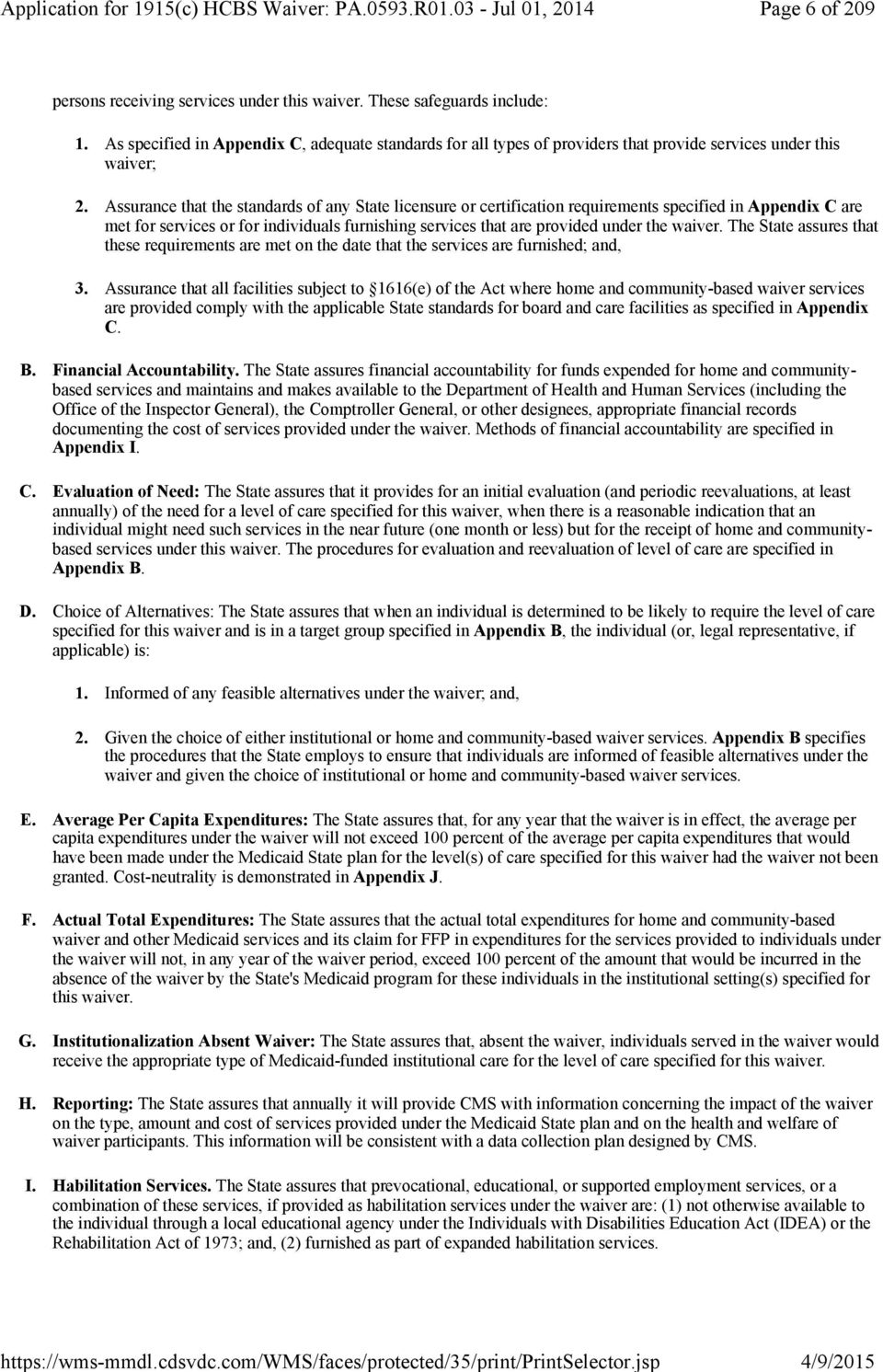
6 Page 6 of 209 persons receiving services under this waiver. These safeguards include: 1. As specified in Appendix C, adequate standards for all types of providers that provide services under this waiver; 2. Assurance that the standards of any State licensure or certification requirements specified in Appendix C are met for services or for individuals furnishing services that are provided under the waiver. The State assures that these requirements are met on the date that the services are furnished; and, 3. Assurance that all facilities subject to 1616(e) of the Act where home and community-based waiver services are provided comply with the applicable State standards for board and care facilities as specified in Appendix C. B. Financial Accountability. The State assures financial accountability for funds expended for home and communitybased services and maintains and makes available to the Department of Health and Human Services (including the Office of the Inspector General), the Comptroller General, or other designees, appropriate financial records documenting the cost of services provided under the waiver. Methods of financial accountability are specified in Appendix I. C. Evaluation of Need: The State assures that it provides for an initial evaluation (and periodic reevaluations, at least annually) of the need for a level of care specified for this waiver, when there is a reasonable indication that an individual might need such services in the near future (one month or less) but for the receipt of home and communitybased services under this waiver. The procedures for evaluation and reevaluation of level of care are specified in Appendix B. D. Choice of Alternatives: The State assures that when an individual is determined to be likely to require the level of care specified for this waiver and is in a target group specified in Appendix B, the individual (or, legal representative, if applicable) is: 1. Informed of any feasible alternatives under the waiver; and, 2. Given the choice of either institutional or home and community-based waiver services. Appendix B specifies the procedures that the State employs to ensure that individuals are informed of feasible alternatives under the waiver and given the choice of institutional or home and community-based waiver services. E. Average Per Capita Expenditures: The State assures that, for any year that the waiver is in effect, the average per capita expenditures under the waiver will not exceed 100 percent of the average per capita expenditures that would have been made under the Medicaid State plan for the level(s) of care specified for this waiver had the waiver not been granted. Cost-neutrality is demonstrated in Appendix J. F. Actual Total Expenditures: The State assures that the actual total expenditures for home and community-based waiver and other Medicaid services and its claim for FFP in expenditures for the services provided to individuals under the waiver will not, in any year of the waiver period, exceed 100 percent of the amount that would be incurred in the absence of the waiver by the State's Medicaid program for these individuals in the institutional setting(s) specified for this waiver. G. Institutionalization Absent Waiver: The State assures that, absent the waiver, individuals served in the waiver would receive the appropriate type of Medicaid-funded institutional care for the level of care specified for this waiver. H. Reporting: The State assures that annually it will provide CMS with information concerning the impact of the waiver on the type, amount and cost of services provided under the Medicaid State plan and on the health and welfare of waiver participants. This information will be consistent with a data collection plan designed by CMS. I. Habilitation Services. The State assures that prevocational, educational, or supported employment services, or a combination of these services, if provided as habilitation services under the waiver are: (1) not otherwise available to the individual through a local educational agency under the Individuals with Disabilities Education Act (IDEA) or the Rehabilitation Act of 1973; and, (2) furnished as part of expanded habilitation services.
7 Page 7 of 209 J. Services for Individuals with Chronic Mental Illness. The State assures that federal financial participation (FFP) will not be claimed in expenditures for waiver services including, but not limited to, day treatment or partial hospitalization, psychosocial rehabilitation services, and clinic services provided as home and community-based services to individuals with chronic mental illnesses if these individuals, in the absence of a waiver, would be placed in an IMD and are: (1) age 22 to 64; (2) age 65 and older and the State has not included the optional Medicaid benefit cited in 42 CFR ; or (3) age 21 and under and the State has not included the optional Medicaid benefit cited in 42 CFR Additional Requirements Note: Item 6-I must be completed. A. Service Plan. In accordance with 42 CFR (b)(1)(i), a participant-centered service plan (of care) is developed for each participant employing the procedures specified in Appendix D. All waiver services are furnished pursuant to the service plan. The service plan describes: (a) the waiver services that are furnished to the participant, their projected frequency and the type of provider that furnishes each service and (b) the other services (regardless of funding source, including State plan services) and informal supports that complement waiver services in meeting the needs of the participant. The service plan is subject to the approval of the Medicaid agency. Federal financial participation (FFP) is not claimed for waiver services furnished prior to the development of the service plan or for services that are not included in the service plan. B. Inpatients. In accordance with 42 CFR (b)(1)(ii), waiver services are not furnished to individuals who are inpatients of a hospital, nursing facility or ICF/IID. C. Room and Board. In accordance with 42 CFR (a)(2), FFP is not claimed for the cost of room and board except when: (a) provided as part of respite services in a facility approved by the State that is not a private residence or (b) claimed as a portion of the rent and food that may be reasonably attributed to an unrelated caregiver who resides in the same household as the participant, as provided in Appendix I. D. Access to Services. The State does not limit or restrict participant access to waiver services except as provided in Appendix C. E. Free Choice of Provider. In accordance with 42 CFR , a participant may select any willing and qualified provider to furnish waiver services included in the service plan unless the State has received approval to limit the number of providers under the provisions of 1915(b) or another provision of the Act. F. FFP Limitation. In accordance with 42 CFR 433 Subpart D, FFP is not claimed for services when another third-party (e.g., another third party health insurer or other federal or state program) is legally liable and responsible for the provision and payment of the service. FFP also may not be claimed for services that are available without charge, or as free care to the community. Services will not be considered to be without charge, or free care, when (1) the provider establishes a fee schedule for each service available and (2) collects insurance information from all those served (Medicaid, and non-medicaid), and bills other legally liable third party insurers. Alternatively, if a provider certifies that a particular legally liable third party insurer does not pay for the service(s), the provider may not generate further bills for that insurer for that annual period. G. Fair Hearing: The State provides the opportunity to request a Fair Hearing under 42 CFR 431 Subpart E, to individuals: (a) who are not given the choice of home and community-based waiver services as an alternative to institutional level of care specified for this waiver; (b) who are denied the service(s) of their choice or the provider(s) of their choice; or (c) whose services are denied, suspended, reduced or terminated. Appendix F specifies the State's procedures to provide individuals the opportunity to request a Fair Hearing, including providing notice of action as required in 42 CFR H. Quality Improvement. The State operates a formal, comprehensive system to ensure that the waiver meets the assurances and other requirements contained in this application. Through an ongoing process of discovery, remediation and improvement, the State assures the health and welfare of participants by monitoring: (a) level of care determinations; (b) individual plans and services delivery; (c) provider qualifications; (d) participant health and welfare; (e) financial oversight and (f) administrative oversight of the waiver. The State further assures that all problems identified through its discovery processes are addressed in an appropriate and timely manner, consistent with the severity and nature of the problem. During the period that the waiver is in effect, the State will implement the

8 Page 8 of 209 Quality Improvement Strategy specified in Appendix H. I. Public Input. Describe how the State secures public input into the development of the waiver: The information contained in this amendment was presented at the Medical Assistance Advisory Committee on January 22, 2015 and the Long Term Care subcommittee on February 10, The information also was published in the Pennsylvania Bulletin on December 20, J. Notice to Tribal Governments. The State assures that it has notified in writing all federally-recognized Tribal Governments that maintain a primary office and/or majority population within the State of the State's intent to submit a Medicaid waiver request or renewal request to CMS at least 60 days before the anticipated submission date is provided by Presidential Executive Order of November 6, Evidence of the applicable notice is available through the Medicaid Agency. K. Limited English Proficient Persons. The State assures that it provides meaningful access to waiver services by Limited English Proficient persons in accordance with: (a) Presidential Executive Order of August 11, 2000 (65 FR 50121) and (b) Department of Health and Human Services "Guidance to Federal Financial Assistance Recipients Regarding Title VI Prohibition Against National Origin Discrimination Affecting Limited English Proficient Persons" (68 FR August 8, 2003). Appendix B describes how the State assures meaningful access to waiver services by Limited English Proficient persons. 7. Contact Person(s) A. The Medicaid agency representative with whom CMS should communicate regarding the waiver is: Last Name: Allen First Name: Title: Agency: Address: Address 2: Leesa Executive Medical Assistance Director Office of the Secretary Health and Welfare Building, 3rd Floor City: Harrisburg State: Pennsylvania Zip: Phone: (717) Ext: TTY Fax: (717) [email protected] B. If applicable, the State operating agency representative with whom CMS should communicate regarding the waiver is: Last Name: Newman First Name: Pia Title: Agency: Assistant Director Office of Developmental Programs, Bureau of Autism Services

9 Page 9 of 209 Address: 801 Market Street Address 2: Suite 5071 City: Philadelphia State: Zip: Pennsylvania Phone: (215) Ext: TTY Fax: (215) [email protected] 8. Authorizing Signature This document, together with the attached revisions to the affected components of the waiver, constitutes the State's request to amend its approved waiver under 1915(c) of the Social Security Act. The State affirms that it will abide by all provisions of the waiver, including the provisions of this amendment when approved by CMS. The State further attests that it will continuously operate the waiver in accordance with the assurances specified in Section V and the additional requirements specified in Section VI of the approved waiver. The State certifies that additional proposed revisions to the waiver request will be submitted by the Medicaid agency in the form of additional waiver amendments. Signature: Submission Date: Julie Mochon State Medicaid Director or Designee Apr 1, 2015 Note: The Signature and Submission Date fields will be automatically completed when the State Medicaid Director submits the application. Last Name: First Name: Title: Agency: Address: Gordon Vincent Deputy Secretary Department of Human Services, Office of Medical Assistance Programs 625 Forster Street, Health and Welfare Building Address 2: City: Harrisbu State: Zip: Pennsylvania Phone: (717) Ext: TTY Fax: (717) [email protected]

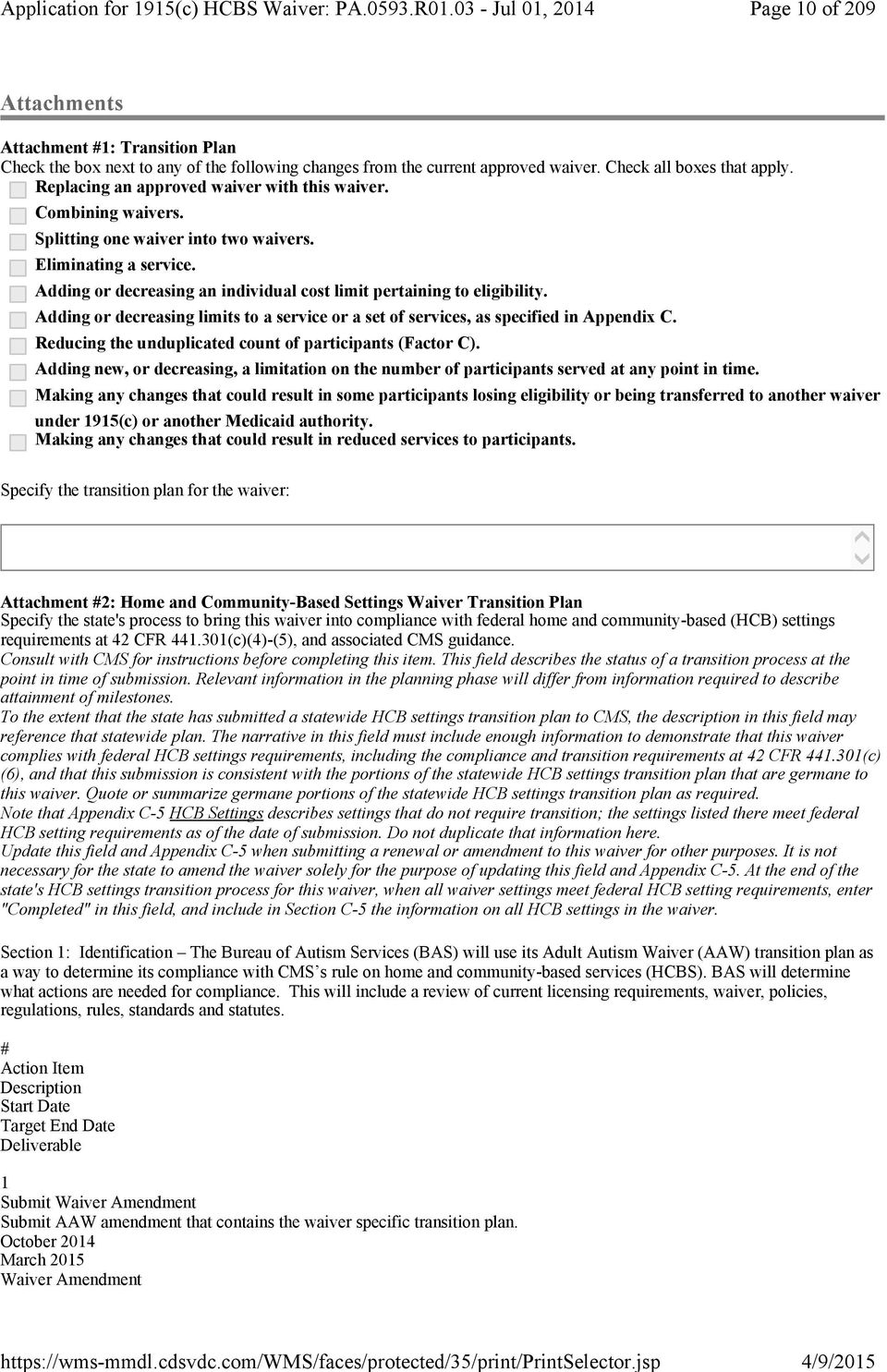
10 Page 10 of 209 Attachments Attachment #1: Transition Plan Check the box next to any of the following changes from the current approved waiver. Check all boxes that apply. Replacing an approved waiver with this waiver. Combining waivers. Splitting one waiver into two waivers. Eliminating a service. Adding or decreasing an individual cost limit pertaining to eligibility. Adding or decreasing limits to a service or a set of services, as specified in Appendix C. Reducing the unduplicated count of participants (Factor C). Adding new, or decreasing, a limitation on the number of participants served at any point in time. Making any changes that could result in some participants losing eligibility or being transferred to another waiver under 1915(c) or another Medicaid authority. Making any changes that could result in reduced services to participants. Specify the transition plan for the waiver: Attachment #2: Home and Community-Based Settings Waiver Transition Plan Specify the state's process to bring this waiver into compliance with federal home and community-based (HCB) settings requirements at 42 CFR (c)(4)-(5), and associated CMS guidance. Consult with CMS for instructions before completing this item. This field describes the status of a transition process at the point in time of submission. Relevant information in the planning phase will differ from information required to describe attainment of milestones. To the extent that the state has submitted a statewide HCB settings transition plan to CMS, the description in this field may reference that statewide plan. The narrative in this field must include enough information to demonstrate that this waiver complies with federal HCB settings requirements, including the compliance and transition requirements at 42 CFR (c) (6), and that this submission is consistent with the portions of the statewide HCB settings transition plan that are germane to this waiver. Quote or summarize germane portions of the statewide HCB settings transition plan as required. Note that Appendix C-5 HCB Settings describes settings that do not require transition; the settings listed there meet federal HCB setting requirements as of the date of submission. Do not duplicate that information here. Update this field and Appendix C-5 when submitting a renewal or amendment to this waiver for other purposes. It is not necessary for the state to amend the waiver solely for the purpose of updating this field and Appendix C-5. At the end of the state's HCB settings transition process for this waiver, when all waiver settings meet federal HCB setting requirements, enter "Completed" in this field, and include in Section C-5 the information on all HCB settings in the waiver. Section 1: Identification The Bureau of Autism Services (BAS) will use its Adult Autism Waiver (AAW) transition plan as a way to determine its compliance with CMS s rule on home and community-based services (HCBS). BAS will determine what actions are needed for compliance. This will include a review of current licensing requirements, waiver, policies, regulations, rules, standards and statutes. # Action Item Description Start Date Target End Date Deliverable 1 Submit Waiver Amendment Submit AAW amendment that contains the waiver specific transition plan. October 2014 March 2015 Waiver Amendment
11 Page 11 of Develop List of Waiver Providers Develop a comprehensive list of all AAW providers September 2014 March 2015 List of AAW Waiver Providers 3 Review of Standards Identify current regulations, policies, waiver service definitions and provider standards for assessment in Section 2. This will include enrollment requirements and processes, licensure regulations, programmatic regulations and other policy documents. January 2015 April 2015 List of Current Regulations and Policies 4 Identify Key Stakeholders As assessments are completed or regulations, policies, waiver service definitions and provider standards are developed or revised, identify stakeholders that will be impacted. March 2015 March 2019 List of Stakeholders Impacted By Each Change Determine how to involve stakeholders in the development and/or review of revised or developed documents. March 2015 March 2016 Stakeholder Involvement Plan 5 Identify IT Changes Determine what changes will be needed to current systems to implement remediation strategies identified in Section 3. January 2015 March 2019 HCBS IT Changes List Section 2: Assessment BAS s assessment activities will include a review of the waiver, policy documents and provider enrollment documents and a review of licensing requirements. Action items related to provider assessment are included in Section 3 Remediation Strategies for each HCBS requirement. # Action Item Description Start Date Target End Date Deliverable Internal Assessment (Regulations, Policies, Procedures) 1 Review of Policy Documents, Waiver Service Definitions and Provider Enrollment Requirements Based on the list of current regulations, policies, waiver service definitions and provider standards for assessment developed in Section 1, review these documents to determine what changes are necessary. February 2015 July 2015 List of Current Regulations and Policies and Whether Changes Need To Be Made. 2 Review of Licensing Requirements Collaborate with the Bureau of Human Services Licensing (BHSL), the Office of Vocational Rehabilitation, and other departments and offices as necessary to identify any necessary changes to policies, regulations or other licensing requirements to comply with the HCBS rule. February 2015

12 Page 12 of 209 June 2015 List of Current Licensing Policies, Regulations and Instruments and Whether Changes Will Be Made. 3 Develop, Test, and Refine Provider Survey Develop and send provider survey to all waiver providers to assist Pennsylvania to get an overall understanding of the settings in which waiver services are being provided and help to determine the specifics of future assessment activities and inform policy development. November 2014 April 2015 Provider Survey and List of AAW Waiver Providers 4 Collect and Analyze Provider Information from Survey Collect and analyze data from surveys. April 2015 April 2015 Survey Finding Report 5 Analyze Fiscal Impact Analyze changes to service definitions, policies, regulations, or other licensing requirements to determine possible fiscal impacts to providers. June 2015 March 2019 Amendments to Rate Settings Methodology in Waivers and Public Notices Section 3: Remediation Strategies - BAS s overall strategy will rely heavily on its existing HCBS quality assurance processes to ensure provider compliance with the HCBS rule. This will include provider identification of remediation strategies for each identified issue and ongoing review of remediation status and compliance. BAS may also prescribe certain requirements to become compliant. BAS will also provide guidance and technical assistance to providers to assist in the assessment and remediation process. Providers that fail to remediate noncompliant settings in a timely manner may be subject to sanctions. Unallowable settings Federal Requirement (c) (5) - Home and Community-Based Settings do not include a nursing facility, institution for mental diseases, ICF/ID and hospitals. Assessment of current waiver, regulations, standards, policies, licensing requirements, and other provider requirements: The following regulations were reviewed: 55 Pa. Code Chapters 51, 2380, 6400 and There are currently no regulations or requirements that prohibit home and community-based settings from being located in a nursing facility, institution for mental disease, ICF/ID or hospital. Licensing regulations stipulate that when a licensed Intellectual Disability service is provided in one of the unallowable settings indicated by CMS, that they must be in a portion of the building that is not licensed as a nursing facility, ICF/ID or hospital. Further, the licensed Intellectual Disability service must be delivered separately from the nursing facility, ICF/ID or hospital service. # Action Item Description Start Date Target End Date Deliverable 1 Develop Policy Develop policy with stakeholder input regarding settings that have the effect of isolating individuals receiving HCBS from the broader community of individuals not receiving HCBS and settings that will be considered home and community-based. April 2015 July 2015 Initial Draft of Home and Community-Based Characteristics Policy

13 Page 13 of Draft Revisions to Regulations If regulatory revisions are identified in Section 2, create a draft of the revised regulations with stakeholder input. January 2015 June 2015 Draft Regulations 3 Public Comment on Policy Release initial draft home and community-based characteristics policy for public comment. Revise policy based on public comment as needed. August 2015 September 2015 Final Draft of Home and Community-Based Characteristics Policy 4 CMS Review of Policy Send final draft of home and community-based characteristics policy to CMS for review and comment. Revise policy based on CMS feedback as needed. October 2015 November 2015 Final Draft of Home and Community-Based Characteristics Policy 5 Public Comment on Revisions to Regulations If regulatory revisions are identified, draft regulations will be published through notice in the Pennsylvania Bulletin for public comment. October 2015 November 2015 Pennsylvania Bulletin Notice 6 Publication of Policy Publish home and community-based characteristics policy. December 2015 December 2015 Home and Community-Based Characteristics Policy 7 Compliance Process for New Providers and Service Location Develop and implement a process to ensure new providers enrolling to render waiver services, existing providers changing their service locations and providers requests for expansion are not unallowable per the home and community-based characteristics policy. December 2015 March 2016 Compliance Process 8 Develop Tracking Tool Develop a method/tool to collect data and track provider status regarding compliance with the home and community-based characteristics policy. December 2015 March 2016 Provider Tracking Tool 9 Home and Community Based Characteristics Training Develop and distribute training tools regarding the home and community-based characteristics policy. January 2016 March 2016 Training Tools

14 Page 14 of Issue Revised Regulations Issue revised regulations. June 2016 June 2016 Revised Regulations 11 Review/Revise Provider Agreement Review provider agreement and revise if necessary. March 2016 June 2016 Provider Agreement 12 Provider Service Alignment with Policy Time for providers to analyze services rendered and make changes to comply with home and community-based characteristics policy if necessary. April 2016 August 2016 No Deliverable For This Item 13 Provider Monitoring Assess whether there are any waiver providers that have the effect of isolating individuals per home and community-based characteristics policy. September 2016 September 2017 Provider Tracking Tool 14 Notify Providers Presumed Not Eligible and Request Plan Notify providers that were found to have the effect of isolating individuals. Inform these providers that they can demonstrate how the service currently meets the home and community-based characteristics policy or they can submit a plan outlining how operation will be altered to meet the requirements for a home and community-based setting. October 2017 December 2017 Notification to Providers 15 Provider Plan Submission Timeframe for providers to develop and submit information requested in the letter referenced above and the home and community-based characteristics policy. January 2018 March 2018 Provider Tracking Tool 16 Develop Safeguards Identify and develop safeguards to preclude reimbursement for ineligible providers after the transition completion date. January 2018 October 2018 HCBS IT Changes List 17 Review Plans Submitted Information submitted by providers regarding how they meet or will make changes to their program to meet the requirements for an eligible setting will be reviewed. April 2018 July 2018 Provider Tracking Tool

15 Page 15 of Notify Providers of Decision Notify providers of BAS s initial decision regarding the setting s eligibility. Information regarding providers determined to be eligible will be submitted to CMS for heightened scrutiny. Providers determined to be ineligible will be provided appeal rights. Providers will be expected to comply with applicable 55 Pa. Code Chapter 51 requirements. August 2018 September 2018 Notification to Providers 19 Notify Participants of Decision Notify participants served by providers determined to be ineligible and Supports Coordination Agencies of provider ineligibility and what actions participants may expect. The Individual Support Plan team must discuss the option of other willing and qualified providers or other services that will meet the participant s needs and ensure their health and safety. The Supports Coordinator will be responsible for documenting this discussion. August 2018 September 2018 Notification to Participants 20 Public Notice Issue a public notice which lists all settings/providers with the determination of whether they are ineligible or will go through the CMS heightened scrutiny process for public comment. October 2018 November 2018 Public Notice 21 Access Issues Determine whether access issues may be created by providers who are no longer eligible/willing to provide waiver services. An access issue is defined as the inability of an individual/family to locate a willing and qualified service provider and/or the inability of a Supports Coordination Agency to secure a willing and qualified provider for individuals requesting services. October 2018 December 2018 Provider Tracking Tool 22 Transition Participants Ensure that individuals who receive services in ineligible settings transition to willing and qualified providers, if necessary. (This timeframe does not include individuals impacted by an access issue.) December 2018 March 2019 Provider Tracking Tool 23 CMS Heightened Scrutiny Send list of settings/providers determined eligible in accordance with the home and community based characteristics policy to CMS for Heightened Scrutiny process. March 2019 March 2019 List of Eligible Providers 24 Ongoing Monitoring Ensure that providers are continuously monitored for ongoing compliance. March 2019 Ongoing On-site Monitoring Tool 25 Public Notice of CMS Heightened Scrutiny Determination

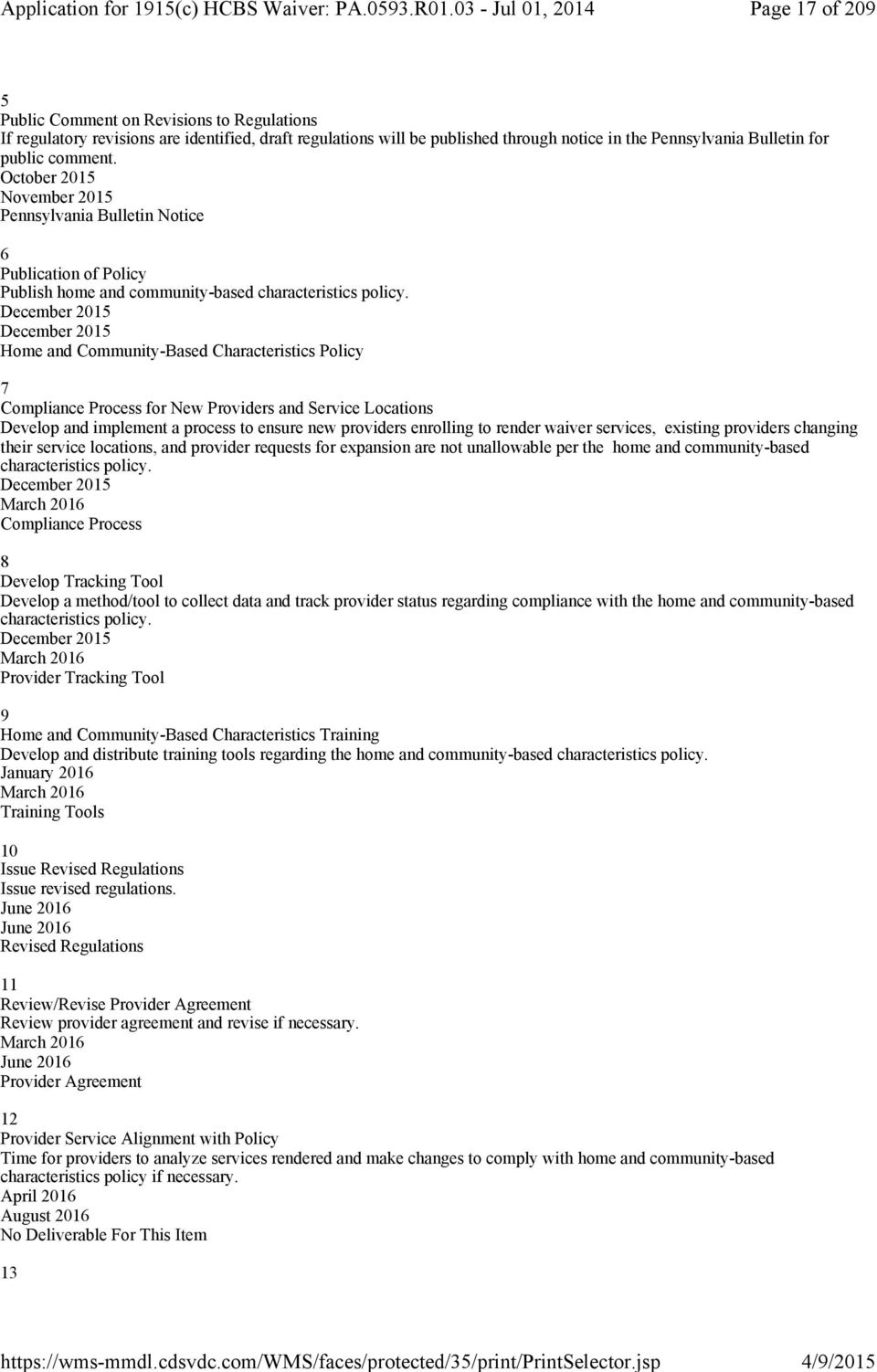
16 Page 16 of 209 Notice will be published in the Pennsylvania Bulletin regarding the settings/provider CMS accepted as being home and community-based and those that CMS denied as being home and community based. March 2019 Ongoing Public Notice Settings Presumed Not Eligible Federal Requirement (c) (5) (v) Settings in a publicly or privately owned facility that provide inpatient treatment; (c) (5) (v) Settings on the grounds of or immediately adjacent to a public institution; (c) (5) (v) Settings that have the effect of isolating individuals receiving HCBS from the broader community of individuals not receiving HCBS Assessment of current waiver, regulations, standards, policies, licensing requirements, and other provider requirements: The following regulations were reviewed: 55 Pa. Code Chapters 51, 2380, 6400 and There are no regulations or requirements that state providers are presumed not eligible for waiver reimbursement when providing services in these settings. Licensing regulations for Community Homes for Individuals with an Intellectual Disability (55 Pa. Code Chapter 6400) and Family Living Homes (55 Pa. Code Chapter 6500) currently have requirements that day services such as employment, education, training, volunteer, civic-minded and other meaningful opportunities shall be provided to the individual. Supported employment services, which are provided in a variety of community employment work sites, are available to any individual enrolled in the AAW. # Action Item Description Start Date Target End Date Deliverable 1 Develop Policy Develop policy with stakeholder input regarding settings that have the effect of isolating individuals receiving HCBS from the broader community of individuals not receiving HCBS and settings that will be considered home and community based. April 2015 July 2015 Initial Draft Home and Community-Based Characteristics Policy 2 Draft Revisions to Regulations If regulatory revisions are identified in Section 2, create a draft of the revised regulations. January 2015 June 2015 Draft Regulations 3 Public Comment on Policy Release initial draft home and community-based characteristics policy for public comment. Revise policy based on public comment as needed. August 2015 September 2015 Final Draft Home and Community-Based Characteristics Policy 4 CMS Review of Policy Send final draft home and community-based characteristics policy to CMS for review and comment. Revise policy based on CMS feedback as needed. October 2015 November 2015 Final Draft Home and Community-Based Characteristics Policy
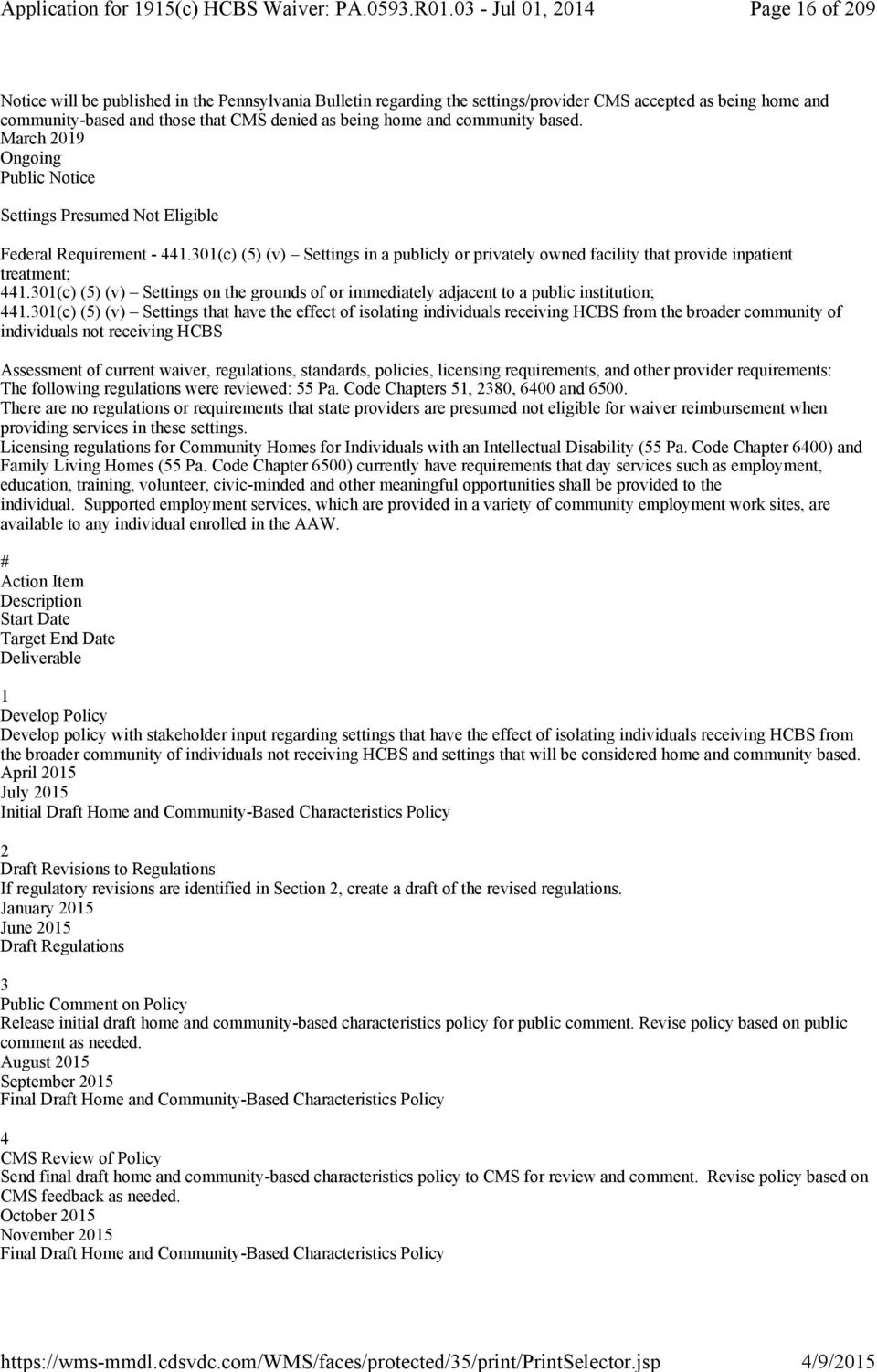
17 Page 17 of Public Comment on Revisions to Regulations If regulatory revisions are identified, draft regulations will be published through notice in the Pennsylvania Bulletin for public comment. October 2015 November 2015 Pennsylvania Bulletin Notice 6 Publication of Policy Publish home and community-based characteristics policy. December 2015 December 2015 Home and Community-Based Characteristics Policy 7 Compliance Process for New Providers and Service Locations Develop and implement a process to ensure new providers enrolling to render waiver services, existing providers changing their service locations, and provider requests for expansion are not unallowable per the home and community-based characteristics policy. December 2015 March 2016 Compliance Process 8 Develop Tracking Tool Develop a method/tool to collect data and track provider status regarding compliance with the home and community-based characteristics policy. December 2015 March 2016 Provider Tracking Tool 9 Home and Community-Based Characteristics Training Develop and distribute training tools regarding the home and community-based characteristics policy. January 2016 March 2016 Training Tools 10 Issue Revised Regulations Issue revised regulations. June 2016 June 2016 Revised Regulations 11 Review/Revise Provider Agreement Review provider agreement and revise if necessary. March 2016 June 2016 Provider Agreement 12 Provider Service Alignment with Policy Time for providers to analyze services rendered and make changes to comply with home and community-based characteristics policy if necessary. April 2016 August 2016 No Deliverable For This Item 13
18 Page 18 of 209 Provider Monitoring Assess whether there are any waiver providers that have the effect of isolating individuals per home community-based characteristics policy. September 2016 September 2017 Provider Tracking Tool 14 Notify Providers Presumed Not Eligible and Request Plan Notify providers that were found to have the effect of isolating individuals. Inform these providers that they can demonstrate how the service currently meets the home and community-based characteristic policy or they can submit a plan outlining how operations will be altered to meet the requirements for a home and community-based setting. October 2017 December 2017 Notification to Providers 15 Provider Plan Submission Timeframe for providers to develop and submit information requested in the letter referenced above and the home and community-based characteristics policy. January 2018 March 2018 Provider Tracking Tool 16 Develop Safeguards Identify and develop safeguards to preclude reimbursement for ineligible providers after the transition completion date. January 2018 October 2018 HCBS IT Changes List 17 Review Plans Submitted Information submitted by providers regarding how they meet or will make changes to their programs to meet the requirements for an eligible setting will be reviewed. April 2018 July 2018 Provider Tracking Tool 18 Notify Providers of Decision Notify providers of BAS s initial decision regarding the setting s eligibility. Information regarding providers determined to be eligible will be submitted to CMS for heightened scrutiny. Providers determined to be ineligible will be provided appeal rights. Providers will be expected to comply with applicable 55 Pa. Code Chapter 51 requirements. August 2018 September 2018 Notification to Providers 19 Notify Participants of Decision Notify participants served by providers determined to be ineligible and Supports Coordination Agencies of provider ineligibility and what actions they may expect. The Individual Support Plan team must discuss the option of other willing and qualified providers or other services that will meet the participant s needs and ensure their health and safety. The Supports Coordinator will be responsible for documenting this discussion. August 2018 September 2018 Notification to Participants 20 Public Notice Issue a public notice which lists all settings/ providers with the determination of whether they are ineligible or will go through the CMS heightened scrutiny process for public comment.

19 Page 19 of 209 October 2018 November 2018 Public Notice 21 Access Issues Determine whether access issues may be created by providers who are no longer eligible/willing to provide waiver services. An access issue is defined as the inability of an participant/family to locate a willing and qualified service provider and/or the inability of a Supports Coordination Agency to secure a willing and qualified provider for participants requesting services. October 2018 December 2018 Provider Tracking Tool 22 Transition Participants Ensure that participants who receive services in ineligible settings transition to willing and qualified providers, if necessary. (This timeframe does not include participants impacted by an access issue.) December 2018 March 2019 Provider Tracking Tool 23 CMS Heightened Scrutiny Send list of settings/providers determined eligible in accordance with the home and community-based characteristics policy to CMS for Heightened Scrutiny process. March 2019 March 2019 List of Eligible Providers 24 Ongoing Monitoring Ensure that providers are continuously monitored for ongoing compliance March 2019 Ongoing On-site Monitoring Tool 25 Public Notice of CMS Heightened Scrutiny Determination Notice will be published in the Pennsylvania Bulletin regarding the settings/provider CMS accepted as being home and community-based and those that CMS denied as being home and community-based. March 2019 Ongoing Public Notice All Settings Must Meet the Following Qualifications Federal Requirement (c) (4) (i) The setting is integrated in and supports full access to the greater community, including opportunities to seek employment and work in competitive integrated settings, engage in community life, control personal resources, and receive services in the community to the same degree of access as individuals not receiving HCBS. Assessment of current waiver, regulations, standards, policies, licensing requirements, and other provider requirements: The following regulations were reviewed: 55 Pa. Code Chapters 51, 2380, 6400 and Licensing regulations for Community Homes for Individuals with an Intellectual Disability (55 Pa. Code Chapter 6400) and Family Living Homes (55 Pa. Code Chapter 6500) currently have requirements that individuals have the right to manage their own finances. These regulations also have requirements that day services such as employment, education, training, volunteer, civic-minded and other meaningful opportunities shall be provided to the individual. Supported employment services, which are provided in a variety of community employment work sites, are available to any individual enrolled in the AAW. Licensing regulations for Adult Training Facilities (55. Pa. Code Chapter 2380) currently require that individuals have opportunities and support for participation in community life, including work opportunities. #
20 Page 20 of 209 Action Item Description Start Date Target End Date Deliverable 1 Explore Employment Data Collection System Explore current employment data collection systems that will capture information on individuals served in the waiver such as type of job, wages, benefits and length of employment as well as information on providers rendering employment services. Recommendations will then be made as to the feasibility of a system and finally a decision will be made regarding whether an employment data collection system can be implemented. November 2014 July 2015 Decision to Determine if a System Can Be Implemented 2 Develop Policy Develop policy with stakeholder input regarding settings that have the effect of isolating individuals receiving HCBS from the broader community of individuals not receiving HCBS and settings that will be considered home and community-based. April 2015 July 2015 Initial Draft of Home and Community-Based Characteristics Policy 3 Draft and Publish Executive Order on Employment Collaborate with other State departments and offices to draft and publish the Executive Order on Employment. This document will clearly articulate employment principles for people with all disabilities. January 2015 December 2015 Executive Order on Employment 4 Public Comment on Policy Release initial draft home and community-based characteristics policy for public comment. Revise policy based on public comment as needed. August 2015 September 2015 Final Draft of Home and Community-Based Characteristics Policy 5 CMS Review of Policy Send final draft home and community-based characteristics policy to CMS for review and comment. Revise policy based on CMS feedback as needed. October 2015 November 2015 Final Draft of Home and Community-Based Characteristics Policy 6 Publication of Policy Publish home and community-based characteristics policy. December 2015 December 2015 Home and Community-Based Characteristics Policy 7 Develop/Distribute Training Tools and Policy Updates Identify, develop, and distribute training tools and policy updates that are needed for compliance with the home and community-based characteristics policy and new service definitions developed. August 2015 March 2019 Training Tools and Policy Updates

21 Page 21 of Develop Expectations Develop and communicate expectations regarding meaningful day opportunities in non-disability specific settings with stakeholder input. June 2016 December 2016 Meaningful Day Opportunity Communication 9 Revise On-site Monitoring Tool Revise on-site monitoring tools as necessary to ensure that providers meet this requirement as well as the home and community-based characteristics policy. March 2016 Ongoing On-site Monitoring Tool 10 Provider Monitoring Assess providers for compliance with this requirement. September 2016 June 2017 and Ongoing Provider Tracking Tool 11 Identify Noncompliance During On-site Monitoring Providers found to be noncompliant with this requirement during on-site monitoring will be required to submit a Plan of Correction and may have their waiver provider agreement terminated if noncompliant with the Plan of Correction. January 2017 March 2019 Compliance Process Federal Requirement (c) (4) (ii) The setting is selected by the individual from among setting options including nondisability specific settings and an option for a private unit in a residential setting. The setting options are identified and documented in the person-centered service plan and are based on the individual s needs, preferences, and for residential settings, resources available for room and board. Assessment of current waiver, regulations, standards, policies, licensing requirements, and other provider requirements: Per the AAW, one of the roles of the supports coordination service is to develop an ISP using a person centered planning approach to help the planning team develop a comprehensive ISP to meet the participant s identified needs in the least restrictive manner possible. # Action Item Description Start Date Target End Date Deliverable 1 Develop Expectations Develop and publish expectations regarding meaningful day opportunities in non-disability specific settings with stakeholder input. June 2016 December 2016 Meaningful Day Opportunity Communication 2 Identify Where Information is Included in the Individual Support Plan Identify where setting options provided to individuals will be documented in the Individual Support Plan January 2016 June 2016
22 Page 22 of 209 HCBS IT Changes List, Document Setting Options 3 Develop Communication Develop and publish communication regarding required Individual Support Plan documentation. July 2016 March 2017 Policy Document 4 Develop/Distribute Training Tools and Policy Updates Identify, develop, and distribute training tools and policy updates as needed for compliance with this requirement. April 2017 March 2019 Training Tools and Policy Updates 5 Revise On-site Monitoring Tools Revise on-site monitoring tools as necessary. March 2018 August 2018 On-site Monitoring tools 6 Provider Monitoring Assess providers for compliance with this requirement. October 2018 March 2019 and Ongoing Individual Support Plan, On-site Monitoring Tool 7 Identify Noncompliance during On-site Monitoring Providers found to be noncompliant with this requirement during on-site monitoring will be required to submit a Plan of Correction and may have their waiver provider agreement terminated if noncompliant with the Plan of Correction. March 2019 March 2019 and Ongoing Compliance Process Federal Requirement (c) (4) (iii) The setting ensures individual rights of privacy, dignity and respect, and freedom from coercion and restraint Assessment of current waiver, regulations, standards, policies, licensing requirements, and other provider requirements: The following regulations were reviewed: 55 Pa. Code Chapters 51, 2380, 6400 and Licensing regulations for Community Homes for Individuals with an Intellectual Disability (55 Pa. Code Chapter 6400) and Family Living Homes (55 Pa. Code Chapter 6500) currently have requirements that individuals have the right to privacy in bedrooms, bathrooms, and during personal care. These regulations also contain the requirement that individuals have the right to reasonable access to a telephone and the opportunity to receive and make private calls, with assistance when necessary. 55 Pa. Code Chapter 51 requires that participants who receive HCBS through BAS be treated with dignity and respect. This regulatory chapter also states that providers of HCBS s may not use the following: seclusion; chemical restraint; mechanical restraint; prone position manual restraint; or a manual restraint that inhibits the respiratory and digestive system, inflicts pain, causes hypertension of joints and pressure on the chest or joints, or uses a technique in which the participant is not supported and allows for free fall as the participant moves to the floor. 55 Pa. Code Chapter 51 states that when participants receiving HCBS select a new willing and qualified provider to replace their current provider, the current provider shall ensure that undue influence is not exerted when the participant is making the choice to a new willing and qualified provider. Per the AAW, BAS articulated a policy to prevent restraint use in a provider manual for all providers and in a manual specifically for supports coordinators. # Action Item Description
23 Page 23 of 209 Start Date Target End Date Deliverable 1 Identify Where Information is Included in the Individual Support Plan When a modification to one of the requirements is needed, identify where required information will be documented in the Individual Support Plan. January 2016 June 2016 HCBS IT Changes List, Document Setting Options 2 Develop Communication Develop and publish communication regarding required ISP documentation. This communication will include the additional information that must be included in the ISP when modification to a requirement is needed. July 2016 December 2016 Policy Document 3 Analyze Restraint Information Analyze restraint information to identify any patterns or trends and provide training and technical assistance to providers as needed. July 2016 March 2019 and ongoing Training 4 Develop/Distribute Training Tools and Policy Updates Identify, develop, and distribute training tools and policy updates that are needed for compliance with this federal requirement. January 2017 March 2019 Training Tools and Policy Updates 5 Revise On-site Monitoring Tools Revise on-site monitoring tools as necessary to monitor provider compliance with this federal requirement. March 2018 August 2018 On-site Monitoring Tools 6 Provider Monitoring Assess providers for compliance with this requirement. October 2018 March 2019 and Ongoing On-site Monitoring Tool 7 Identify Noncompliance During On-site Monitoring Providers found to be noncompliant with this requirement during on-site monitoring will be required to submit a Plan of Correction and may have their waiver provider agreement terminated if noncompliant with the Plan of Correction. March 2019 March 2019 and Ongoing Compliance Process Federal Requirement (c) (4) (iv) The setting optimizes, but does not regiment, individual initiative, autonomy, and independence in making life choices, including but not limited to: daily activities, physical environment, and with whom to interact
24 Page 24 of 209 Assessment of current waiver, regulations, standards, policies, licensing requirements, and other provider requirements: The following regulations were reviewed: 55 Pa. Code Chapters 51, 2380, 6400 and Licensing regulations for Community Homes for Individuals with an Intellectual Disability (55 Pa. Code Chapter 6400) and Family Living Homes (55 Pa. Code Chapter 6500) currently have requirements that day services such as employment, education, training, volunteer, civic-minded and other meaningful opportunities shall be offered to the individual. # Action Item Description Start Date Target End Date Deliverable 1 Develop Policy Develop policy with stakeholder input regarding settings that have the effect of isolating individuals receiving HCBS from the broader community of individuals not receiving HCBS and settings that will be considered home and community-based. April 2015 July 2015 Initial Draft of Home and Community-Based Characteristics Policy 2 Public Comment on Policy Release initial draft home and community-based characteristics policy for public comment. Revise policy based on public comment as needed. August 2015 September 2015 Final Draft of Home and Community-Based Characteristics Policy 3 CMS Review of Policy Send final draft home and community-based characteristics policy to CMS for review and comment. Revise policy based on CMS feedback as needed. October 2015 November 2015 Final Draft of Home and Community-Based Characteristics Policy 4 Publication of Policy Publish home and community-based characteristics policy. December 2015 December 2015 Home and Community-Based Characteristics Policy 5 Develop/Distribute Training Tools and Policy Updates Identify, develop, and distribute training tools and policy updates that are needed for compliance with this federal requirement. January 2016 January 2017 and ongoing Training and Policy Updates 6 Revise On-site Monitoring Tools Revise on-site monitoring tools as necessary to monitor provider compliance with this federal requirement. March 2016 March 2019 and ongoing On-site Monitoring Tools 7 Provider Monitoring Assess providers for compliance with this requirement.
25 Page 25 of 209 September 2016 March 2019 and ongoing On-site Monitoring Tools 8 Identify Noncompliance During On-site Monitoring Providers found to be noncompliant with this requirement during on-site monitoring will be required to submit a Plan of Correction and may have their waiver provider agreement terminated if noncompliant with the Plan of Correction. January 2017 March 2019 Compliance Process Federal Requirement (c) (4) (v) The setting facilitates choice regarding services and who provides them Assessment of current waiver, regulations, standards, policies, licensing requirements, and other provider requirements: BAS currently maintains and will continue to maintain a publicly accessible directory of providers. The AAW Supplemental Provider Agreement states that a provider shall not restrict a participant s freedom of choice to be served by any qualified provider. Each supports coordinator shall provide each participant with information on any qualified provider when requested. The AAW states that the supports coordinator will notify the participant or his or her legal representative in writing that the participant has freedom of choice among feasible service delivery alternatives. 55 Pa. Code Chapter 51 states that each Supports Coordination Agency is to ensure each participant are offered choice of willing and qualified providers. # Action Item Description Start Date Target End Date Deliverable 1 Develop/Distribute Training Tools and Policy Updates Identify, develop, and distribute training tools and policy updates that are needed for compliance with this federal requirement. January 2016 January 2017 and ongoing Training Tools and Policy Updates 2 Revise On-site Monitoring Tools Revise on-site monitoring tools as necessary to monitor provider compliance with this federal requirement. March 2018 March 2019 On-site Monitoring Tools 3 Provider Monitoring Assess providers for compliance with this requirement. October 2018 March 2019 and ongoing On-site Monitoring Tools 4 Identify Noncompliance During On-site Monitoring Providers found to be noncompliant with this requirement during on-site monitoring will be required to submit a Plan of Correction and may have their waiver provider agreement terminated if noncompliant with the Plan of Correction. January 2017 March 2019 Compliance Process Requirements for Provider-owned or Controlled Home and Community Based Residential Settings
26 Page 26 of 209 Federal Requirement-42 CFR (c) (4) (vi) (A) In a provider-owned or controlled residential setting, the unit or dwelling is a specific physical place that can be owned, rented, or occupied under a legally enforceable agreement by the individual receiving services, and the individual has, at a minimum, the same responsibilities and protections from eviction that tenants have under the landlord/tenant law of the State, county, city, or other designated entity. For settings which landlord tenant laws do not apply, the State must ensure that a lease, residency agreement, or other form of written agreement will be in place for each HCBS participant, and that the document provides protections that address eviction processes and appeals comparable to those provided under the jurisdiction s landlord tenant law. Assessment of current waiver, regulations, standards, policies, licensing requirements, and other provider requirements: The following regulations were reviewed: 55 Pa. Code Chapters 51, 6400 and Pa. Code Chapter 51 requires that a room and board contract be completed annually for each individual receiving a residential habilitation service through the waiver. This regulatory chapter also requires providers to provide written notice at least 30 days prior to the date of discharge to the participant, Department, Department s designee and the supports coordinator. There are currently no regulations or requirements, however, that requires the room and board contract give individuals protections from eviction. # Action Item Description Start Date Target End Date Deliverable 1 Draft Revisions to Regulations If regulatory revisions are identified in Section 2, create a draft of the revised regulations with stakeholder input. January 2015 June 2015 Draft Regulations 2 Analyze PA s Landlord Tenant Law Analyze PA s landlord tenant law and determine what constitutes comparability for residential settings. June 2015 January 2016 Revised Room and Board Contract 3 Public Comment on Revisions to Regulations If regulatory revisions are identified, draft regulations will be published through notice in the Pennsylvania Bulletin for public comment. October 2015 November 2015 Notice in Pennsylvania Bulletin 4 Revise Room and Board Contract Revise and distribute updated Room And Board Contract. January 2016 January 2017 Room and Board Contract 5 Issue Revised Regulations Issue revised regulations June 2016 June 2016 Regulations 6 Develop/Distribute Training Tools and Policy Updates
27 Page 27 of 209 Identify, develop, and distribute training tools and policy updates that are needed for compliance with this federal requirement. January 2017 July 2017 and ongoing Training Tools and Policy Updates 7 Revise On-site Monitoring Tool Revise on-site monitoring tools as necessary to monitor provider compliance with this federal requirement. March 2018 August, 2018 and ongoing On-site Monitoring Tools 8 Provider Monitoring Assess providers for compliance with this requirement. October 2018 March 2019 and ongoing On-site Monitoring Tools 9 Identify Noncompliance During On-site Monitoring Providers found to be noncompliant with this requirement during on-site monitoring will be required to submit a Plan of Correction and may have their waiver provider agreement terminated if noncompliant with the Plan of Correction. March 2019 March 2019 and ongoing Compliance Process Federal Requirement-42 CFR (c) (4) (vi) (B) (1) In a provider-owned or controlled residential setting, each individual s unit has an entrance door lockable by the individual, with only appropriate staff having keys to the door. Assessment of current waiver, regulations, standards, policies, licensing requirements, and other provider requirements: The following regulations were reviewed: 55 Pa. Code Chapters 51, 6400 and There are currently no regulations or requirements that mandates that residential settings have entrance doors lockable by the individual, with only appropriate staff having keys to doors. # Action Item Description Start Date Target End Date Deliverable 1 Draft Revisions to Regulations If regulatory revisions are identified in Section 2, create a draft of the revised regulations. January 2015 June 2015 Draft Regulations 2 Public Comment on Revisions to Regulations If regulatory revisions are identified, draft regulations will be published through notice in the Pennsylvania Bulletin for public comment. October 2015 November 2015 Notice in Pennsylvania Bulletin 3 Identify Where Information is Included in the Individual Support Plan When a modification to one of the requirements is needed, identify where required information will be documented in the Individual Support Plan.
28 Page 28 of 209 January 2016 June 2016 HCBS IT Changes List, Document Setting Options 4 Issue Revised Regulations Issue Revised Regulations. June 2016 June 2016 Regulations 5 Develop Communication Develop and publish communication regarding required Individual Support Plan documentation. This communication will include the additional information that must be included in the Individual Support Plan when a modification to a requirement is needed. July 2017 December 2016 Policy Document 6 Develop/Distribute Training Tools and Policy Updates Identify, develop, and distribute training tools and policy updates that are needed for compliance with this federal requirement. January 2017 July 2017 and ongoing Training Tools and Policy Updates 7 Revise On-site Monitoring Tools Revise on-site monitoring tools as necessary to monitor provider compliance with this federal requirement. March August 2018 and ongoing On-site Monitoring Tool 8 Provider Monitoring Assess providers for compliance with this requirement. October 2018 March 2019 and ongoing On-site Monitoring Tools 9 Identify Noncompliance During On-site Monitoring Providers found to be noncompliant with this requirement during on-site monitoring will be required to submit a Plan of Correction and may have their waiver provider agreement terminated if noncompliant with the Plan of Correction. March 2019 March 2019 and ongoing Compliance Process Federal Regulation-42 CFR (c) (4) (vi) (B) (2) In a provider-owned or controlled residential setting, individuals sharing units have a choice of roommates. Assessment of current waiver, regulations, standards, policies, licensing requirements, and other provider requirements: The following regulations were reviewed: 55 Pa. Code Chapters 51, 6400 and There are currently no regulations or requirements that mandates that residential settings give individuals choice of roommates. # Action Item Description Start Date
29 Page 29 of 209 Target End Date Deliverable 1 Determine Which Providers Allow For a Shared Bedroom Determine providers who allow for a shared bedroom. April 2015 June 2015 and ongoing Provider Tracking Tool 2 Identify Where Information is Included in the Individual Support Plan When a modification to one of the requirements is needed, identify where required information will be documented in the Individual Support Plan. January 2016 June 2016 HCBS IT Changes List, Document Setting Options 3 Develop Communication Develop and publish communication providing guidance on right of roommate choice with stakeholder input. June 2016 June 2017 Policy Document 4 Develop Guidance Develop and publish guidance on frequency of assessment, documentation, and roommate compatibility determination June 2016 June 2017 Policy Document 5 Develop Communication Develop and publish communication regarding Individual Support Plan documentation. This communication will include the additional information that must be included in the Individual Support Plan when a modification to a requirement is needed. July 2016 December 2016 Policy Document 6 Develop/Distribute Training Tools and Policy Updates Identify, develop, and distribute training tools and policy updates that are needed for compliance with this federal requirement. January 2017 July 2017 and ongoing Training Tools and Policy Updates 7 Revise On-site Monitoring Tool Revise on-site monitoring tools as necessary to monitor provider compliance with this federal requirement. March 2018 August 2018 and ongoing On-site Monitoring Tool As Necessary 8 Provider Monitoring Assess providers for compliance with this requirement. October 2018 March 2019 and ongoing On-site Monitoring Tools
30 Page 30 of Identify Noncompliance During On-site Monitoring Providers found to be noncompliant with this requirement during on-site monitoring will be required to submit a Plan of Correction and may have their waiver provider agreement terminated if noncompliant with the Plan of Correction. March 2019 March 2019 and ongoing Compliance Process Federal Requirement-42 CFR (c) (4) (vi) (B) (3) In a provider-owned or controlled residential setting, individuals have the freedom to furnish and decorate their sleeping or living units within the lease or other agreement. Assessment of current waiver, regulations, standards, policies, licensing requirements, and other provider requirements: The following regulations were reviewed: 55 Pa. Code Chapters 51, 6400 and Pa. Code Chapter 51 requires that a room and board contract be completed annually for each individual receiving a residential habilitation service through the waiver. There is no requirement, however, that the room and board contract state that individuals have the freedom to furnish and decorate their sleeping or living units. Licensing regulations for Community Homes for Individuals with an Intellectual Disability (55 Pa. Code Chapter 6400) and Family Living Homes (55 Pa. Code Chapter 6500) currently have the requirement that an individual has the right to receive, purchase, have and use personal property. # Action Item Description Start Date Target End Date Deliverable 1 Revise Room and Board Contract Revise and distribute updated Room And Board Contract. January 2016 June 2017 Room and Board Contract 2 Identify Where Information is Included in the Individual Support Plan When a modification to one of the requirements is needed, identify where required information will be documented in the Individual Support Plan. January 2016 June 2016 HCBS IT Changes List, Document Setting Options 3 Develop Communication Develop and publish communication regarding required Individual Support Plan documentation. This communication will include the additional information that must be included in the Individual Support Plan when a modification to a requirement is needed. July 2016 December 2016 Policy Document 4 Develop/Distribute Training Tools and Policy Updates Identify, develop and distribute training tools and policy updates that are needed for compliance with this federal requirement. January 2017 July 2017 and ongoing Training Tools and Policy Updates 5 Revise On-site Monitoring Tools Revise on-site monitoring tools as necessary to monitor provider compliance with this federal requirement.
31 Page 31 of 209 March 2018 August 2018 and ongoing On-site Monitoring Tool 6 Provider Monitoring Assess providers for compliance with this requirement. October 2018 March 2019 and ongoing On-site Monitoring Tools 7 Identify Noncompliance During On-site Monitoring Providers found to be noncompliant with this requirement during on-site monitoring will be required to submit a Plan of Correction and may have their waiver provider agreement terminated if noncompliant with the Plan of Correction. March 2019 March 2019 and ongoing Compliance Process Federal Requirement- 42 CFR (c) (4) (vi) (C) In a provider-owned or controlled residential setting, individuals have the freedom and support to control their own schedules and activities and have access to food at any time. Assessment of current waiver, regulations, standards, policies, licensing requirements, and other provider requirements: The following regulations were reviewed: 55 Pa. Code Chapters 51, 6400 and There are currently no regulations or requirements that mandate that residential settings give individuals freedom and support to control their own schedules and activities and have access to food at any time. # Action Item Description Start Date Target End Date Deliverable 1 Develop Communication Develop and publish communication that specifies individual rights to have control of schedules and activities along with access to food at any time with stakeholder input. January 2016 January 2017 Policy Document 2 Identify Where Information is Included in the Individual Support Plan When a modification to one of the requirements is needed, identify where required information will be documented in the Individual Support Plan. January 2016 June 2016 HCBS IT Changes List, Document Setting Options 3 Develop Communication Develop and publish communication regarding required Individual Support Plan documentation. This communication will include the additional information that must be included in the Individual Support Plan when a modification to a requirement is needed. July 2016 December 2016 Policy Document 4 Develop/Distribute Training Tools and Policy Updates Identify, develop, and distribute training tools and policy updates that are needed for compliance with this federal
32 Page 32 of 209 requirement. January 2017 July 2017 and ongoing Training Tools and Policy Updates 5 Revise On-site Monitoring Tool Revise monitoring tools as necessary to monitor provider compliance with this federal requirement. March 2018 August 2018 and ongoing On-site Monitoring Tools 6 Provider Monitoring Assess providers for compliance with this requirement. October 2018 March 2019 and ongoing On-site Monitoring Tool 7 Identify Noncompliance During On-site Monitoring Providers found to be noncompliant with this requirement during on-site monitoring will be required to submit a Plan of Correction and may have their waiver provider agreement terminated if noncompliant with the Plan of Correction. March 2019 March 2019 and ongoing Compliance Process Federal Requirement-42 CFR (c) (4) (vi) (D) In a provider-owned or controlled residential setting, individuals are able to have visitors of their choosing at any time. Assessment of current waiver, regulations, standards, policies, licensing requirements, and other provider requirements: The following regulations were reviewed: 55 Pa. Code Chapters 51, 6400 and Licensing regulations for Community Homes for Individuals with an Intellectual Disability (55 Pa. Code Chapter 6400) currently have requirements that allow individuals the right to receive scheduled and unscheduled visitors. # Action Item Description Start Date Target End Date Deliverable 1 Determine How Providers Can Accommodate the Regulation Determine how providers can accommodate this requirement in a manner that respects the rights of others in the home June 2015 January 2016 Policy Documents or On-Site Monitoring Tool 2 Develop Communication Develop communication that specifies individual rights to have visitors of their choosing at any time with stakeholder input. January 2016 January 2017 Policy Document 3 Identify Where Information is Included in the Individual Support Plan When a modification to one of the requirements is needed, identify where required information will be documented in the Individual Support Plan. January 2016 June 2016
33 Page 33 of 209 HCBS IT Changes List, Document Setting Options 4 Develop Communication Develop and publish communication regarding ISP documentation. This communication will include the additional information that must be included in the Individual Support Plan when a modification to a requirement is needed. July 2016 December 2016 Policy Document 5 Revise On-site Monitoring Tool Revise on-site monitoring tool as necessary to monitor provider compliance with this federal requirement. March 2018 August 2018 and ongoing On-site Monitoring Tool 6 Provider Monitoring Assess providers for compliance with this requirement October 2018 March 2019 and ongoing On-site Monitoring Tools 7 Identify Noncompliance During On-site Monitoring Providers found to be noncompliant with this requirement during on-site monitoring will be required to submit a Plan of Correction and may have their waiver provider agreement terminated if noncompliant with the Plan of Correction. March 2019 March 2019 and ongoing Compliance Process Federal Requirement-42 CFR (c) (4) (vi) (E) In a provider-owned or controlled residential setting, the setting is physically accessible to the individual. Assessment of current waiver, regulations, standards, policies, licensing requirements, and other provider requirements: The following regulations were reviewed: 55 Pa. Code Chapters 51, 6400 and Licensing regulations for Community Homes for Individuals with an Intellectual Disability (55 Pa. Code Chapter 6400) currently have a requirement that requires physical accessibility and accommodations for individuals with physical disabilities. # Action Item Description Start Date Target End Date Deliverable 1 Develop a Process/Tool Develop and publish a process/tool to determine how individual accessibility can be verified during on-site monitoring to monitor provider compliance with this federal requirement. March 2016 August 2016 On-site Monitoring Tool 2 Provider Monitoring Assess providers for compliance with this requirement October 2016 June 2017 and ongoing On-site Monitoring Tool
34 Page 34 of Identify Noncompliance During On-site Monitoring Providers found to be noncompliant with this requirement during on-site monitoring will be required to submit a Plan of Correction and may have their waiver provider agreement terminated if noncompliant with the Plan of Correction. May 2017 July 2017 and ongoing Compliance Process Section 4: Outreach & Engagement - BAS proposes to involve various stakeholders in the development and implementation of this transition plan. # Action Item Description Start Date Target End Date Deliverable 1 Develop Communication Materials Create Transition Plan Website links, link to register for webinars, public comment mailbox, information handouts, public communication brief. December 2014 December 2014 Communication Materials 2 Public Notice & Comment Official notification through PA Bulletin to begin the public comment period on the waiver amendment/revision and published draft transition plan including: submission, consolidation, documentation, and review of public comments. December 2014 February 2015 Public Notice 3 Stakeholder Webinars Two webinars were held to obtain public comment on proposed AAW transition plan. January 2015 January 2015 Public Notice, Notes from Webinar 4 Transition Plan Revision Incorporation of stakeholder comment and feedback on the AAW transition plan, submission of final waiver amendment and transition plan to CMS, and publication of submitted plan and comments received and AAW responses. February 2015 March 2015 Waiver Amendment, Transition Plan, Comment and Response Document 5 Provider & Stakeholder Training On-going engagement highlighting updates and revisions to regulations, policies, and procedures; training on compliance to the HCBS Final Rule and transitioning activities for individuals with autism, families, supports coordinators, providers, and staff. April 2015 March 2019 Training, Stakeholder Involvement Plan 6 Ongoing Stakeholder Engagement Continued engagement with stakeholder community on regulations and department updates, sustaining an inclusive, person-
35 Page 35 of 209 centric focus that is transparent to individuals and the community while providing accountability to all parties involved. December 2014 March 2019 Stakeholder Involvement Plan 7 Develop Provider Base Provide ongoing engagement with service providers to help build capacity for provision of services in more integrated settings. January 2016 March 2019 and ongoing Strategy Document for Developing an Enhanced Provider Base Additional Needed Information (Optional) Provide additional needed information for the waiver (optional): Appendix A: Waiver Administration and Operation 1. State Line of Authority for Waiver Operation. Specify the state line of authority for the operation of the waiver (select one): The waiver is operated by the State Medicaid agency. Specify the Medicaid agency division/unit that has line authority for the operation of the waiver program (select one): The Medical Assistance Unit. Specify the unit name: (Do not complete item A-2) Another division/unit within the State Medicaid agency that is separate from the Medical Assistance Unit. Specify the division/unit name. This includes administrations/divisions under the umbrella agency that has been identified as the Single State Medicaid Agency. Office of Developmental Programs (ODP), Bureau of Autism Services (BAS) (Complete item A-2-a). The waiver is operated by a separate agency of the State that is not a division/unit of the Medicaid agency. Specify the division/unit name: In accordance with 42 CFR , the Medicaid agency exercises administrative discretion in the administration and supervision of the waiver and issues policies, rules and regulations related to the waiver. The interagency agreement or memorandum of understanding that sets forth the authority and arrangements for this policy is available through the Medicaid agency to CMS upon request. (Complete item A-2-b).
36 Page 36 of 209 Appendix A: Waiver Administration and Operation 2. Oversight of Performance. a. Medicaid Director Oversight of Performance When the Waiver is Operated by another Division/Unit within the State Medicaid Agency. When the waiver is operated by another division/administration within the umbrella agency designated as the Single State Medicaid Agency. Specify (a) the functions performed by that division/administration (i.e., the Developmental Disabilities Administration within the Single State Medicaid Agency), (b) the document utilized to outline the roles and responsibilities related to waiver operation, and (c) the methods that are employed by the designated State Medicaid Director (in some instances, the head of umbrella agency) in the oversight of these activities: The State Medicaid Director in the Office of Medical Assistance Programs (OMAP) has the authority to authorize waiver approvals and submissions. The Director of the Bureau of Autism Services reports directly to the Deputy Secretary of the Office of Developmental Programs, who reports directly to the Secretary of Public Welfare (the head of the single state Medicaid agency). The Secretary of Public Welfare meets weekly with the State Medicaid Agency Director and the Deputy Secretary of the Office of Developmental Programs to discuss services for people with developmental disabilities, and the Deputy Secretary meets weekly with the Director of the Bureau of Autism Services to discuss autism services including the waiver. Therefore, the SMA through Secretary of Public Welfare and OMAP has ultimate authority over waiver operations. b. Medicaid Agency Oversight of Operating Agency Performance. When the waiver is not operated by the Medicaid agency, specify the functions that are expressly delegated through a memorandum of understanding (MOU) or other written document, and indicate the frequency of review and update for that document. Specify the methods that the Medicaid agency uses to ensure that the operating agency performs its assigned waiver operational and administrative functions in accordance with waiver requirements. Also specify the frequency of Medicaid agency assessment of operating agency performance: As indicated in section 1 of this appendix, the waiver is not operated by a separate agency of the State. Thus this section does not need to be completed. Appendix A: Waiver Administration and Operation 3. Use of Contracted Entities. Specify whether contracted entities perform waiver operational and administrative functions on behalf of the Medicaid agency and/or the operating agency (if applicable) (select one): Yes. Contracted entities perform waiver operational and administrative functions on behalf of the Medicaid agency and/or operating agency (if applicable). Specify the types of contracted entities and briefly describe the functions that they perform. Complete Items A-5 and A-6.: BAS contracts with individuals across the Commonwealth to conduct functional eligibility assessments for people who have applied for the waiver. Individuals may be employed by a contracted agency or may be independent contractors. The individuals meet the applicant and his/her representative in-person and conduct the functional eligibility assessment using criteria in Appendix B-1-b. BAS conducts functional eligibility assessments when contractors are not available or do not have the capacity to conduct the assessment within 30 days of receipt of an application. Individuals who conduct functional eligibility assessments must a) have completed required training developed by the BAS for people with ASD; and b) have a Bachelor s degree in Social Work, Psychology, Education, or a related human services field; or a High School diploma or its equivalent and two years of experience working with individuals with disabilities in a Home and Community Based setting. No. Contracted entities do not perform waiver operational and administrative functions on behalf of the Medicaid agency and/or the operating agency (if applicable). Appendix A: Waiver Administration and Operation 4. Role of Local/Regional Non-State Entities. Indicate whether local or regional non-state entities perform waiver operational and administrative functions and, if so, specify the type of entity (Select One): Not applicable
37 Page 37 of 209 Applicable - Local/regional non-state agencies perform waiver operational and administrative functions. Check each that applies: Local/Regional non-state public agencies perform waiver operational and administrative functions at the local or regional level. There is an interagency agreement or memorandum of understanding between the State and these agencies that sets forth responsibilities and performance requirements for these agencies that is available through the Medicaid agency. Specify the nature of these agencies and complete items A-5 and A-6: Local/Regional non-governmental non-state entities conduct waiver operational and administrative functions at the local or regional level. There is a contract between the Medicaid agency and/or the operating agency (when authorized by the Medicaid agency) and each local/regional non-state entity that sets forth the responsibilities and performance requirements of the local/regional entity. The contract(s) under which private entities conduct waiver operational functions are available to CMS upon request through the Medicaid agency or the operating agency (if applicable). Specify the nature of these entities and complete items A-5 and A-6: Appendix A: Waiver Administration and Operation 5. Responsibility for Assessment of Performance of Contracted and/or Local/Regional Non-State Entities. Specify the state agency or agencies responsible for assessing the performance of contracted and/or local/regional non-state entities in conducting waiver operational and administrative functions: Bureau of Autism Services Appendix A: Waiver Administration and Operation 6. Assessment Methods and Frequency. Describe the methods that are used to assess the performance of contracted and/or local/regional non-state entities to ensure that they perform assigned waiver operational and administrative functions in accordance with waiver requirements. Also specify how frequently the performance of contracted and/or local/regional non-state entities is assessed: BAS staff review documentation of all denials of functional eligibility before the applicant is notified of a denial. BAS staff also review all approvals of functional eligibility where the applicant has substantial functional limitations in only three of the six major life activities specified in Appendix B-1-b before the applicant is notified of approval or denial. BAS staff can either require new information or override the determination by the functional eligibility assessment contractor. BAS staff review documentation of a random sample of other approved functional eligibility determinations at least every six months. The sample is sufficient to estimate accuracy with a 10% margin of error and a 90% confidence level. Appendix A: Waiver Administration and Operation 7. Distribution of Waiver Operational and Administrative Functions. In the following table, specify the entity or entities that have responsibility for conducting each of the waiver operational and administrative functions listed (check each that applies): In accordance with 42 CFR , when the Medicaid agency does not directly conduct a function, it supervises the performance of the function and establishes and/or approves policies that affect the function. All functions not performed directly by the Medicaid agency must be delegated in writing and monitored by the Medicaid Agency. Note: More than one box may be checked per item. Ensure that Medicaid is checked when the Single State Medicaid Agency (1) conducts the function directly; (2) supervises the delegated function; and/or (3) establishes and/or approves policies related to the function.
38 Page 38 of 209 Function Medicaid Agency Contracted Entity Participant waiver enrollment Waiver enrollment managed against approved limits Waiver expenditures managed against approved levels Level of care evaluation Review of Participant service plans Prior authorization of waiver services Utilization management Qualified provider enrollment Execution of Medicaid provider agreements Establishment of a statewide rate methodology Rules, policies, procedures and information development governing the waiver program Quality assurance and quality improvement activities Appendix A: Waiver Administration and Operation Quality Improvement: Administrative Authority of the Single State Medicaid Agency As a distinct component of the State s quality improvement strategy, provide information in the following fields to detail the State s methods for discovery and remediation. a. Methods for Discovery: Administrative Authority The Medicaid Agency retains ultimate administrative authority and responsibility for the operation of the waiver program by exercising oversight of the performance of waiver functions by other state and local/regional non-state agencies (if appropriate) and contracted entities. i. Performance Measures For each performance measure the State will use to assess compliance with the statutory assurance, complete the following. Performance measures for administrative authority should not duplicate measures found in other appendices of the waiver application. As necessary and applicable, performance measures should focus on: Uniformity of development/execution of provider agreements throughout all geographic areas covered by the waiver Equitable distribution of waiver openings in all geographic areas covered by the waiver Compliance with HCB settings requirements and other new regulatory components (for waiver actions submitted on or after March 17, 2014) Where possible, include numerator/denominator. For each performance measure, provide information on the aggregated data that will enable the State to analyze and assess progress toward the performance measure. In this section provide information on the method by which each source of data is analyzed statistically/deductively or inductively, how themes are identified or conclusions drawn, and how recommendations are formulated, where appropriate. Performance Measure: Number of applicants who receive a functional eligibility determination within 30 days of BAS receipt of an application divided by total number of applications received by BAS. Data Source (Select one):
39 Page 39 of 209 If '' is selected, specify: BAS staff and, where available, individuals contracted for functional eligibility assessments supply the date of initial functional eligibility determination. Responsible Party for data collection/generation (check each that applies): Frequency of data collection/generation (check each that applies): Sampling Approach(check each that applies): State Medicaid Agency Weekly 100% Review Operating Agency Monthly Less than 100% Review Sub-State Entity Quarterly Representative BAS staff and, where available, individuals contracted for initial level of care assessments supply the date of initial level of care determination. Annually Continuously and Ongoing Sample Confidence Interval = Stratified Describe Group: Data Aggregation and Analysis: Responsible Party for data aggregation and analysis (check each that applies): State Medicaid Agency Operating Agency Frequency of data aggregation and analysis(check each that applies): Weekly Monthly Sub-State Entity Quarterly Annually Continuously and Ongoing
40 Page 40 of 209 Performance Measure: Number of initial functional eligibility determinations where BAS agrees with the decision after a review of documentation is complete divided by the number of initial functional eligibility determinations reviewed by BAS. Data Source (Select one): If '' is selected, specify: BAS functional eligibility review database, an Access database where data are recorded from staff review of functional eligibility. Responsible Party for data collection/generation (check each that applies): Frequency of data collection/generation (check each that applies): Sampling Approach(check each that applies): State Medicaid Weekly 100% Review Agency Operating Agency Monthly Less than 100% Review Sub-State Entity Quarterly Representative Annually Continuously and Ongoing Every 6 months Sample Confidence Interval = Stratified Describe Group: 100% of denials 100% of approvals of those with substantial functional limitations in only 3 of the 6 major life activities listed in Apdx B-1-b. 20% of all remaining approvals. Data Aggregation and Analysis:
41 Page 41 of 209 Responsible Party for data aggregation and analysis (check each that applies): State Medicaid Agency Operating Agency Sub-State Entity Frequency of data aggregation and analysis(check each that applies): Weekly Monthly Quarterly Annually Continuously and Ongoing Every 6 months ii. If applicable, in the textbox below provide any necessary additional information on the strategies employed by the State to discover/identify problems/issues within the waiver program, including frequency and parties responsible. To verify the accuracy of functional eligibility dates used for the performance measure in a.i.a., BAS reviews paper records for a sample of functional eligibility determinations. Since BAS staff conduct some determinations as identified in Appendix B-6-a, a BAS staff person may not review his or her own determination. The sample is sufficient to obtain a 90% confidence level with a 10% margin of error. For each assessment reviewed, BAS compares the date of assessment in the call log to the date listed on the paper record. BAS also checks the individual s application to ensure the call log is accurate regarding the date the application was received. Finally, BAS staff review data regarding functional eligibility assessments to identify if any assessors are outliers in approval or denial of functional eligibility, and observe interviews for any assessors that are outliers to review their application of functional eligibility criteria. b. Methods for Remediation/Fixing Individual Problems i. Describe the State s method for addressing individual problems as they are discovered. Include information regarding responsible parties and GENERAL methods for problem correction. In addition, provide information on the methods used by the State to document these items. Each quarter, BAS reviews information collected from the discovery activities during that quarter. BAS staff meet quarterly to discuss findings and identify remediation strategies if necessary. If there are multiple issues of performance, the BAS Director will set priorities regarding which issue to address first. If the information indicates that there are issues in timely performance or making accurate functional eligibility determinations, BAS will first assess whether problems are system-wide or isolated to a particular contractor or region. If problems are system-wide, the BAS Director or a designee will meet with individuals involved in functional eligibility determinations, such as contracted individuals and BAS staff who make functional eligibility determinations and BAS staff who review assessments. The meetings will identify systemic issues that lead to untimely performance or instances where BAS overrides the assessor s decision, and identify possible solutions such as training, technical assistance, more intensive monitoring, or process changes. The BAS Director or designee will then develop a quality improvement strategy to address the issue. ii. If performance issues are isolated to only one region, contractor, or provider, the BAS Director or designee will communicate with the responsible DPW staff, contractor, or provider to identify the reason for the issues in performance. In addition, BAS may interview participants, family members, and providers, and/or review additional records, as necessary. The BAS Director or designee will determine corrective action based on the data collected and the previous performance of the staff person or provider. Examples of corrective action include additional training, more intensive monitoring by BAS, follow-up and resolution through a corrective action plan. For performance issues with contractors, BAS will follow DPW departmental policy regarding sanctions and, if warranted, termination of the contract. Remediation Data Aggregation
42 Page 42 of 209 Remediation-related Data Aggregation and Analysis (including trend identification) Frequency of data aggregation and Responsible Party(check each that applies): analysis(check each that applies): State Medicaid Agency Weekly Operating Agency Sub-State Entity Monthly Quarterly Annually Continuously and Ongoing c. Timelines When the State does not have all elements of the Quality Improvement Strategy in place, provide timelines to design methods for discovery and remediation related to the assurance of Administrative Authority that are currently nonoperational. No Yes Please provide a detailed strategy for assuring Administrative Authority, the specific timeline for implementing identified strategies, and the parties responsible for its operation. Appendix B: Participant Access and Eligibility B-1: Specification of the Waiver Target Group(s) a. Target Group(s). Under the waiver of Section 1902(a)(10)(B) of the Act, the State limits waiver services to one or more groups or subgroups of individuals. Please see the instruction manual for specifics regarding age limits. In accordance with 42 CFR (b)(6), select one or more waiver target groups, check each of the subgroups in the selected target group(s) that may receive services under the waiver, and specify the minimum and maximum (if any) age of individuals served in each subgroup: Target Group Included Target SubGroup Minimum Age Aged or Disabled, or Both - General Maximum Age Limit Maximum Age No Maximum Age Limit Aged Disabled (Physical) Disabled () Aged or Disabled, or Both - Specific Recognized Subgroups Brain Injury HIV/AIDS Medically Fragile
43 Page 43 of 209 Technology Dependent Intellectual Disability or Developmental Disability, or Both Autism 21 Developmental Disability Mental Illness Intellectual Disability Mental Illness Serious Emotional Disturbance b. Additional Criteria. The State further specifies its target group(s) as follows: Waiver eligibility is limited to people who: Meet Medical Assistance Program clinical and financial eligibility for Intermediate Care Facility for Persons with Related Conditions (ICF/ORC) or Intermediate Care Facility for Persons with Intellectual Disabilities (ICF/ID) services,and Have a diagnosis of Autism Spectrum Disorder (ASD) as determined by a licensed psychologist, licensed physician, licensed physician assistant, or certified registered nurse practitioner that manifests before the age of 22. ASD is as defined in the DSM IV and corresponds to ICD-9 codes Autistic Disorder; Childhood Disintegrative Disorder; Pervasive Developmental Disorder-Not wise Specified; Asperger Syndrome; Rett Disorder, and Have substantial functional limitations in three or more major life activities as a result of ASDs and/or other developmental disabilities that are likely to continue indefinitely: self-care, receptive and expressive language, learning, mobility, self direction and/or capacity for independent living, and Are 21 years of age or older c. Transition of Individuals Affected by Maximum Age Limitation. When there is a maximum age limit that applies to individuals who may be served in the waiver, describe the transition planning procedures that are undertaken on behalf of participants affected by the age limit (select one): Not applicable. There is no maximum age limit The following transition planning procedures are employed for participants who will reach the waiver's maximum age limit. Appendix B: Participant Access and Eligibility B-2: Individual Cost Limit (1 of 2) a. Individual Cost Limit. The following individual cost limit applies when determining whether to deny home and community-based services or entrance to the waiver to an otherwise eligible individual (select one). Please note that a State may have only ONE individual cost limit for the purposes of determining eligibility for the waiver: No Cost Limit. The State does not apply an individual cost limit. Do not complete Item B-2-b or item B-2-c. Cost Limit in Excess of Institutional Costs. The State refuses entrance to the waiver to any otherwise eligible individual when the State reasonably expects that the cost of the home and community-based services furnished to that individual would exceed the cost of a level of care specified for the waiver up to an amount specified by the State. Complete Items B-2-b and B-2-c.
44 Page 44 of 209 The limit specified by the State is (select one) A level higher than 100% of the institutional average. Specify the percentage: Institutional Cost Limit. Pursuant to 42 CFR (a)(3), the State refuses entrance to the waiver to any otherwise eligible individual when the State reasonably expects that the cost of the home and community-based services furnished to that individual would exceed 100% of the cost of the level of care specified for the waiver. Complete Items B-2-b and B-2-c. Cost Limit Lower Than Institutional Costs. The State refuses entrance to the waiver to any otherwise qualified individual when the State reasonably expects that the cost of home and community-based services furnished to that individual would exceed the following amount specified by the State that is less than the cost of a level of care specified for the waiver. Specify the basis of the limit, including evidence that the limit is sufficient to assure the health and welfare of waiver participants. Complete Items B-2-b and B-2-c. The cost limit specified by the State is (select one): The following dollar amount: Specify dollar amount: The dollar amount (select one) Is adjusted each year that the waiver is in effect by applying the following formula: Specify the formula: May be adjusted during the period the waiver is in effect. The State will submit a waiver amendment to CMS to adjust the dollar amount. The following percentage that is less than 100% of the institutional average: Specify percent: :
45 Page 45 of 209 Appendix B: Participant Access and Eligibility B-2: Individual Cost Limit (2 of 2) Answers provided in Appendix B-2-a indicate that you do not need to complete this section. b. Method of Implementation of the Individual Cost Limit. When an individual cost limit is specified in Item B-2-a, specify the procedures that are followed to determine in advance of waiver entrance that the individual's health and welfare can be assured within the cost limit: c. Participant Safeguards. When the State specifies an individual cost limit in Item B-2-a and there is a change in the participant's condition or circumstances post-entrance to the waiver that requires the provision of services in an amount that exceeds the cost limit in order to assure the participant's health and welfare, the State has established the following safeguards to avoid an adverse impact on the participant (check each that applies): The participant is referred to another waiver that can accommodate the individual's needs. Additional services in excess of the individual cost limit may be authorized. Specify the procedures for authorizing additional services, including the amount that may be authorized: safeguard(s) Appendix B: Participant Access and Eligibility B-3: Number of Individuals Served (1 of 4) a. Unduplicated Number of Participants. The following table specifies the maximum number of unduplicated participants who are served in each year that the waiver is in effect. The State will submit a waiver amendment to CMS to modify the number of participants specified for any year(s), including when a modification is necessary due to legislative appropriation or another reason. The number of unduplicated participants specified in this table is basis for the cost-neutrality calculations in Appendix J: Waiver Year Table: B-3-a Year Year Year Year Year Unduplicated Number of Participants b. Limitation on the Number of Participants Served at Any Point in Time. Consistent with the unduplicated number of participants specified in Item B-3-a, the State may limit to a lesser number the number of participants who will be served at any point in time during a waiver year. Indicate whether the State limits the number of participants in this
46 Page 46 of 209 way: (select one): The State does not limit the number of participants that it serves at any point in time during a waiver year. The State limits the number of participants that it serves at any point in time during a waiver year. The limit that applies to each year of the waiver period is specified in the following table: Table: B-3-b Maximum Number of Participants Waiver Year Served At Any Point During the Year Year Year Year Year Year Appendix B: Participant Access and Eligibility B-3: Number of Individuals Served (2 of 4) c. Reserved Waiver Capacity. The State may reserve a portion of the participant capacity of the waiver for specified purposes (e.g., provide for the community transition of institutionalized persons or furnish waiver services to individuals experiencing a crisis) subject to CMS review and approval. The State (select one): Not applicable. The state does not reserve capacity. The State reserves capacity for the following purpose(s). Purpose(s) the State reserves capacity for: Purposes People identified in Adult Protective Services investigations Appendix B: Participant Access and Eligibility B-3: Number of Individuals Served (2 of 4) Purpose (provide a title or short description to use for lookup): People identified in Adult Protective Services investigations Purpose (describe): To enable adults with ASD who have experienced abuse, exploitation, abandonment, and/or neglect to receive waiver services to help prevent future abuse, exploitation, abandonment, or neglect. Capacity is reserved for adults with ASD who have a protective services plan developed pursuant to the Adult Protective Services Act that specifies a need for long-term support. Individuals must be eligible for the Adult Autism Waiver as specified in Appendix B-1, B-4, B-5, and B-6. In addition, capacity is reserved only for individuals who were not receiving a Pennsylvania home and community-based services waiver at the time the protective services plan was developed. All participants enrolled in the Waiver have comparable access to all services offered in the Waiver regardless of whether he or she is enrolled due to meeting reserved capacity criteria or the Selection of Entrants to the Waiver criteria in Appendix B-3-f. This is evidenced by the Individual Support Plan process that is required for all participants and requires that service options be fully explored with every individual.
47 Page 47 of 209 Describe how the amount of reserved capacity was determined: The amount of reserved capacity is based on the historical number of adults with ASD with protective services plans indicating a need for long-term support. Capacity is reserved starting in year 4 of the waiver. The capacity that the State reserves in each waiver year is specified in the following table: Waiver Year Capacity Reserved Year 1 0 Year 2 0 Year 3 0 Year 4 5 Year 5 5 Appendix B: Participant Access and Eligibility B-3: Number of Individuals Served (3 of 4) d. Scheduled Phase-In or Phase-Out. Within a waiver year, the State may make the number of participants who are served subject to a phase-in or phase-out schedule (select one): The waiver is subject to a phase-in or phase-out schedule that is included in Attachment #1 to Appendix B-3. This schedule constitutes an intra-year limitation on the number of participants who are served in the waiver. e. Allocation of Waiver Capacity. Select one: The waiver is not subject to a phase-in or a phase-out schedule. Waiver capacity is allocated/managed on a statewide basis. Waiver capacity is allocated to local/regional non-state entities. (a) the entities to which waiver capacity is allocated; (b) the methodology that is used to allocate capacity and how often the methodology is reevaluated; and, (c) policies for the reallocation of unused capacity among local/regional non-state entities: f. Selection of Entrants to the Waiver. Specify the policies that apply to the selection of individuals for entrance to the waiver: Prioritization Criteria BAS prioritizes entry into the waiver based on four criteria: use of long-term support services; geographic distribution of capacity; a lottery that was held to help determine the order of application for requests for service during the first six weeks of the waiver; and the date and time of requests for service received after the first six weeks of the waiver. - Use of Long-Term Support Services Since the intent of the Adult Autism Waiver is to serve new individuals, BAS prioritizes entry as follows:
48 Page 48 of 209 Priority 1. People not receiving ongoing state funded or state and Federally funded long-term support services (e.g., Medicaid HCBS Waiver supports; ICF/ID; nursing facility; services in an Institution for Mental Disease; Community Residential Rehabilitation Services; services in a Long-Term Structured Residence; Residential Treatment Facility; and extended acute care for people with serious mental illness). - Priority 2. If waiver capacity remains, the waiver will serve people who do not meet Priority 1 criteria. Priority 2 individuals will only receive applications if waiver capacity remains available after all Priority 1 individuals across the Commonwealth have had their applications processed. - - Geographic Distribution Within each priority group, BAS allocates waiver capacity on a regional basis to ensure access across the Commonwealth. Four regions are defined as follows: West: Allegheny, Armstrong, Beaver, Butler, Cameron, Clarion, Clearfield, Crawford, Elk, Erie, Fayette, Forest, Greene, Indiana, Jefferson, Lawrence, McKean, Mercer, Potter, Venango, Warren, Washington, and Westmoreland Counties Central: Adams, Bedford, Blair, Cambria, Centre, Clinton, Columbia, Cumberland, Dauphin, Franklin, Fulton, Huntington, Juniata, Lancaster, Lebanon, Lycoming, Mifflin, Montour, Northumberland, Perry, Snyder, Somerset, Union, and York Counties Southeast: Bucks, Chester, Delaware, Montgomery, and Philadelphia Counties Northeast: Berks, Bradford, Carbon, Lackawanna, Lehigh, Luzerne, Monroe, Northampton, Pike, Schuylkill, Sullivan, Susquehanna, Tioga, Wayne, and Wyoming Counties BAS initially allocated capacity to each region based on the percentage of Pennsylvania s population age 20 or older, according to the U.S. Census Bureau s 2006 Current Population Estimates. The population of 20 and older was used because these data were easily available on the Census Bureau s Web site. Once enrolled, participants may move anywhere in the Commonwealth and continue to be enrolled in the waiver. When BAS adds new capacity, it will add capacity to each region so that the total waiver capacity is allocated in proportion to Pennsylvania s population age 21 or older in each region, according to the most recent version of the U.S. Census Bureau s Current Population Estimates. The population of age 21 and older will be used in the future because data for this age group by county is now readily available from the U.S. Census Bureau. - Lottery for Requests for Service during the First Six Weeks When the waiver began on July 1, 2008, the Commonwealth collected requests for services for a six-week period using the Intake Process described below. Then BAS randomly assigned a number to each Priority 1 individual for whom services were requested during the six-week period. Applications have been sent to all Priority 1 individuals who received a randomly assigned number. There are no Priority 1 individuals on the interest list for the Adult Autism Waiver from the initial six-week period. BAS also randomly assigned a number to each Priority 2 individual for whom services were requested during the sixweek period. Priority 2 individuals who received a randomly assigned number remain on the interest list for the Adult Autism Waiver. - Date and Time of Requests for Service Received After the Initial Six-Week Period The Intake Process described below continues to be used. Within each priority group and region, BAS sends applications in chronological order based on the date and time BAS received a request for services. Intake Process BAS accepts requests for services using a publicized, toll-free telephone number. Recorded prompts ask the callers
49 Page 49 of 209 for basic information about the caller and the person for whom services are requested. BAS checks DPW management information systems to identify whether the person is currently receiving on-going long-term support services in order to establish whether the person is a Priority 1 or Priority 2 individual. BAS also contacts the person s County Mental Health Agency to identify whether the person is currently receiving services in a Community Residential Rehabilitation Services; services in a Long-Term Structured Residence; Residential Treatment Facility; and extended acute care for people with serious mental illness BAS returns each phone call to verify the person s (and, if applicable, representative s) contact information. BAS prioritizes requests for services based on the criteria described in the Prioritization Criteria section above. When waiver capacity is available to a person, BAS sends the person and representative (if applicable) an application. BAS assists the person or representative if necessary to complete the application and the person or representative may call BAS for assistance. When the person and/or representative returns the application, DPW staff, with assistance as necessary from the functional eligibility contractors described in Appendix A, determine whether the person meets the eligibility requirements specified in Appendix B-1. If DPW determines the person is not eligible for the waiver, BAS contacts the next person based on the criteria described in the Prioritization Criteria section above. Interest List Procedure If the waiver capacity in a region is filled, individuals requesting services will be placed on an interest list until capacity is available. If waiver capacity becomes available in a region, Priority 1 individuals on the interest list in that region will receive applications in chronological order based on the date and time BAS received a request for waiver services. If waiver capacity remains available in a region after all Priority 1 requests from that region have been processed, BAS will apply the Unused Capacity Procedure. Unused Capacity Procedure If a region does not have enough Priority 1 applicants to use available waiver capacity, BAS will monitor the number of Priority 1 requests for services received in the next 90 calendar days. BAS will send applications to Priority 1 individuals who request services during this time in chronological order until the region s waiver capacity is used. If the region still has waiver capacity after 90 calendar days, BAS will reallocate unused capacity to regions where Priority 1 individuals are on an interest list. BAS will reallocate capacity to these regions in proportion to each region s population age 21 or older based on the most recently available version of the U.S. Census Bureau s Current Population Estimates. If waiver capacity remains available after all Priority 1 individuals have had their applications processed, BAS will return the remaining waiver capacity to the original region (i.e., the region that did not have enough Priority 1 individuals to use its capacity). BAS will first send applications to Priority 2 individuals in this region who requested services during the initial six-week period, in order of their randomly assigned number. If capacity remains available, BAS will send applications to Priority 2 individuals in this region who requested services after the six-week period, in chronological order. If the region still has waiver capacity after processing all requests from Priority 2 individuals in that region, BAS will reallocate unused capacity to regions where Priority 2 individuals are on an interest list. BAS first will send applications to Priority 2 individuals who requested services during the initial six-week period, in order of their randomly assigned number. BAS will then send applications to Priority 2 individuals who requested services after the six-week period, in chronological order. CHANGE IN PRIORITY STATUS If an individual changes priority status after their initial request for services, the person is reassigned to the new priority status as of the date their status changed. The person is enrolled in chronological order based on the date of their change in Priority status. For example, if a Priority 2 person disenrolls from another Medicaid HCBS waiver, that person would become a Priority 1 individual. The person would receive an application with other Priority 1 individuals. The date he or she disenrolled from the other waiver would be considered the date of requested services for purposes of receiving an application. If a Priority 1 person enrolls in another waiver, that person would become a Priority 2 individual. If applications are sent to Priority 2 individuals, the person would receive an application with other Priority 2 individuals. The date he or she enrolled in the other waiver would be considered the date of requested services for purposes of receiving an application. Appendix B: Participant Access and Eligibility
50 Page 50 of 209 B 3: Number of Individuals Served Attachment #1 (4 of 4) Answers provided in Appendix B-3-d indicate that you do not need to complete this section. Appendix B: Participant Access and Eligibility B-4: Eligibility Groups Served in the Waiver a. 1. State Classification. The State is a (select one): 1634 State SSI Criteria State 209(b) State 2. Miller Trust State. Indicate whether the State is a Miller Trust State (select one): No Yes b. Medicaid Eligibility Groups Served in the Waiver. Individuals who receive services under this waiver are eligible under the following eligibility groups contained in the State plan. The State applies all applicable federal financial participation limits under the plan. Check all that apply: Eligibility Groups Served in the Waiver (excluding the special home and community-based waiver group under 42 CFR ) Low income families with children as provided in 1931 of the Act SSI recipients Aged, blind or disabled in 209(b) states who are eligible under 42 CFR Optional State supplement recipients Optional categorically needy aged and/or disabled individuals who have income at: Select one: 100% of the Federal poverty level (FPL) % of FPL, which is lower than 100% of FPL. Specify percentage: Working individuals with disabilities who buy into Medicaid (BBA working disabled group as provided in 1902(a)(10)(A)(ii)(XIII)) of the Act) Working individuals with disabilities who buy into Medicaid (TWWIIA Basic Coverage Group as provided in 1902(a)(10)(A)(ii)(XV) of the Act) Working individuals with disabilities who buy into Medicaid (TWWIIA Medical Improvement Coverage Group as provided in 1902(a)(10)(A)(ii)(XVI) of the Act) Disabled individuals age 18 or younger who would require an institutional level of care (TEFRA 134 eligibility group as provided in 1902(e)(3) of the Act) Medically needy in 209(b) States (42 CFR ) Medically needy in 1634 States and SSI Criteria States (42 CFR , and ) specified groups (include only statutory/regulatory reference to reflect the additional groups in the State plan that may receive services under this waiver) All other mandatory and optional groups under the State Plan are included.
51 Page 51 of 209 Special home and community-based waiver group under 42 CFR ) Note: When the special home and community-based waiver group under 42 CFR is included, Appendix B-5 must be completed No. The State does not furnish waiver services to individuals in the special home and community-based waiver group under 42 CFR Appendix B-5 is not submitted. Yes. The State furnishes waiver services to individuals in the special home and community-based waiver group under 42 CFR Select one and complete Appendix B-5. All individuals in the special home and community-based waiver group under 42 CFR Only the following groups of individuals in the special home and community-based waiver group under 42 CFR Check each that applies: A special income level equal to: Select one: 300% of the SSI Federal Benefit Rate (FBR) A percentage of FBR, which is lower than 300% (42 CFR ) Specify percentage: A dollar amount which is lower than 300%. Specify dollar amount: Aged, blind and disabled individuals who meet requirements that are more restrictive than the SSI program (42 CFR ) Medically needy without spenddown in States which also provide Medicaid to recipients of SSI (42 CFR , and ) Medically needy without spend down in 209(b) States (42 CFR ) Aged and disabled individuals who have income at: Select one: 100% of FPL % of FPL, which is lower than 100%. Specify percentage amount: specified groups (include only statutory/regulatory reference to reflect the additional groups in the State plan that may receive services under this waiver) Appendix B: Participant Access and Eligibility B-5: Post-Eligibility Treatment of Income (1 of 7)
52 Page 52 of 209 In accordance with 42 CFR (e), Appendix B-5 must be completed when the State furnishes waiver services to individuals in the special home and community-based waiver group under 42 CFR , as indicated in Appendix B-4. Post-eligibility applies only to the 42 CFR group. a. Use of Spousal Impoverishment Rules. Indicate whether spousal impoverishment rules are used to determine eligibility for the special home and community-based waiver group under 42 CFR : Note: For the five-year period beginning January 1, 2014, the following instructions are mandatory. The following box should be checked for all waivers that furnish waiver services to the 42 CFR group effective at any point during this time period. Spousal impoverishment rules under 1924 of the Act are used to determine the eligibility of individuals with a community spouse for the special home and community-based waiver group. In the case of a participant with a community spouse, the State uses spousal post-eligibility rules under 1924 of the Act. Complete Items B-5-e (if the selection for B-4-a-i is SSI State or 1634) or B-5-f (if the selection for B-4-a-i is 209b State) and Item B-5-g unless the state indicates that it also uses spousal post-eligibility rules for the time periods before January 1, 2014 or after December 31, Note: The following selections apply for the time periods before January 1, 2014 or after December 31, 2018 (select one). Spousal impoverishment rules under 1924 of the Act are used to determine the eligibility of individuals with a community spouse for the special home and community-based waiver group. In the case of a participant with a community spouse, the State elects to (select one): Use spousal post-eligibility rules under 1924 of the Act. (Complete Item B-5-b (SSI State) and Item B-5-d) Use regular post-eligibility rules under 42 CFR (SSI State) or under (209b State) (Complete Item B-5-b (SSI State). Do not complete Item B-5-d) Spousal impoverishment rules under 1924 of the Act are not used to determine eligibility of individuals with a community spouse for the special home and community-based waiver group. The State uses regular post-eligibility rules for individuals with a community spouse. (Complete Item B-5-b (SSI State). Do not complete Item B-5-d) Appendix B: Participant Access and Eligibility B-5: Post-Eligibility Treatment of Income (2 of 7) Note: The following selections apply for the time periods before January 1, 2014 or after December 31, b. Regular Post-Eligibility Treatment of Income: SSI State. The State uses the post-eligibility rules at 42 CFR for individuals who do not have a spouse or have a spouse who is not a community spouse as specified in 1924 of the Act. Payment for home and community-based waiver services is reduced by the amount remaining after deducting the following allowances and expenses from the waiver participant's income: i. Allowance for the needs of the waiver participant (select one): The following standard included under the State plan Select one: SSI standard Optional State supplement standard Medically needy income standard The special income level for institutionalized persons
53 Page 53 of 209 (select one): 300% of the SSI Federal Benefit Rate (FBR) A percentage of the FBR, which is less than 300% Specify the percentage: A dollar amount which is less than 300%. Specify dollar amount: A percentage of the Federal poverty level Specify percentage: standard included under the State Plan The following dollar amount Specify dollar amount: If this amount changes, this item will be revised. The following formula is used to determine the needs allowance: ii. Allowance for the spouse only (select one): Not Applicable The state provides an allowance for a spouse who does not meet the definition of a community spouse in 1924 of the Act. Describe the circumstances under which this allowance is provided: Specify the amount of the allowance (select one): SSI standard Optional State supplement standard Medically needy income standard
54 Page 54 of 209 The following dollar amount: iii. Specify dollar amount: If this amount changes, this item will be revised. The amount is determined using the following formula: Allowance for the family (select one): Not Applicable (see instructions) AFDC need standard Medically needy income standard The following dollar amount: Specify dollar amount: The amount specified cannot exceed the higher of the need standard for a family of the same size used to determine eligibility under the State's approved AFDC plan or the medically needy income standard established under 42 CFR for a family of the same size. If this amount changes, this item will be revised. The amount is determined using the following formula: iv. Amounts for incurred medical or remedial care expenses not subject to payment by a third party, specified in 42 CFR : a. Health insurance premiums, deductibles and co-insurance charges b. Necessary medical or remedial care expenses recognized under State law but not covered under the State's Medicaid plan, subject to reasonable limits that the State may establish on the amounts of these expenses. Select one: Not Applicable (see instructions)note: If the State protects the maximum amount for the waiver participant, not applicable must be selected. The State does not establish reasonable limits. The State establishes the following reasonable limits
55 Page 55 of 209 Appendix B: Participant Access and Eligibility B-5: Post-Eligibility Treatment of Income (3 of 7) Note: The following selections apply for the time periods before January 1, 2014 or after December 31, c. Regular Post-Eligibility Treatment of Income: 209(B) State. Answers provided in Appendix B-4 indicate that you do not need to complete this section and therefore this section is not visible. Appendix B: Participant Access and Eligibility B-5: Post-Eligibility Treatment of Income (4 of 7) Note: The following selections apply for the time periods before January 1, 2014 or after December 31, d. Post-Eligibility Treatment of Income Using Spousal Impoverishment Rules The State uses the post-eligibility rules of 1924(d) of the Act (spousal impoverishment protection) to determine the contribution of a participant with a community spouse toward the cost of home and community-based care if it determines the individual's eligibility under 1924 of the Act. There is deducted from the participant's monthly income a personal needs allowance (as specified below), a community spouse's allowance and a family allowance as specified in the State Medicaid Plan. The State must also protect amounts for incurred expenses for medical or remedial care (as specified below). i. Allowance for the personal needs of the waiver participant (select one): SSI standard Optional State supplement standard Medically needy income standard The special income level for institutionalized persons A percentage of the Federal poverty level Specify percentage: The following dollar amount: Specify dollar amount: If this amount changes, this item will be revised The following formula is used to determine the needs allowance: Specify formula: ii. If the allowance for the personal needs of a waiver participant with a community spouse is different from the amount used for the individual's maintenance allowance under 42 CFR or 42 CFR
56 Page 56 of , explain why this amount is reasonable to meet the individual's maintenance needs in the community. Select one: Allowance is the same Allowance is different. iii. Explanation of difference: Amounts for incurred medical or remedial care expenses not subject to payment by a third party, specified in 42 CFR : a. Health insurance premiums, deductibles and co-insurance charges b. Necessary medical or remedial care expenses recognized under State law but not covered under the State's Medicaid plan, subject to reasonable limits that the State may establish on the amounts of these expenses. Select one: Not Applicable (see instructions)note: If the State protects the maximum amount for the waiver participant, not applicable must be selected. The State does not establish reasonable limits. The State uses the same reasonable limits as are used for regular (non-spousal) post-eligibility. Appendix B: Participant Access and Eligibility B-5: Post-Eligibility Treatment of Income (5 of 7) Note: The following selections apply for the five-year period beginning January 1, e. Regular Post-Eligibility Treatment of Income: 1634 State through Answers provided in Appendix B-5-a indicate the selections in B-5-b also apply to B-5-e. Appendix B: Participant Access and Eligibility B-5: Post-Eligibility Treatment of Income (6 of 7) Note: The following selections apply for the five-year period beginning January 1, f. Regular Post-Eligibility Treatment of Income: 209(B) State through Answers provided in Appendix B-4 indicate that you do not need to complete this section and therefore this section is not visible. Appendix B: Participant Access and Eligibility B-5: Post-Eligibility Treatment of Income (7 of 7) Note: The following selections apply for the five-year period beginning January 1, g. Post-Eligibility Treatment of Income Using Spousal Impoverishment Rules through 2018.
57 Page 57 of 209 The State uses the post-eligibility rules of 1924(d) of the Act (spousal impoverishment protection) to determine the contribution of a participant with a community spouse toward the cost of home and community-based care. There is deducted from the participant's monthly income a personal needs allowance (as specified below), a community spouse's allowance and a family allowance as specified in the State Medicaid Plan. The State must also protect amounts for incurred expenses for medical or remedial care (as specified below). Answers provided in Appendix B-5-a indicate the selections in B-5-d also apply to B-5-g. Appendix B: Participant Access and Eligibility B-6: Evaluation/Reevaluation of Level of Care As specified in 42 CFR (c), the State provides for an evaluation (and periodic reevaluations) of the need for the level (s) of care specified for this waiver, when there is a reasonable indication that an individual may need such services in the near future (one month or less), but for the availability of home and community-based waiver services. a. Reasonable Indication of Need for Services. In order for an individual to be determined to need waiver services, an individual must require: (a) the provision of at least one waiver service, as documented in the service plan, and (b) the provision of waiver services at least monthly or, if the need for services is less than monthly, the participant requires regular monthly monitoring which must be documented in the service plan. Specify the State's policies concerning the reasonable indication of the need for services: i. Minimum number of services. ii. The minimum number of waiver services (one or more) that an individual must require in order to be determined to need waiver services is: 1 Frequency of services. The State requires (select one): The provision of waiver services at least monthly Monthly monitoring of the individual when services are furnished on a less than monthly basis If the State also requires a minimum frequency for the provision of waiver services other than monthly (e.g., quarterly), specify the frequency: b. Responsibility for Performing Evaluations and Reevaluations. Level of care evaluations and reevaluations are performed (select one): Directly by the Medicaid agency By the operating agency specified in Appendix A By an entity under contract with the Medicaid agency. Specify the entity: Level of care evaluations are conducted by Physicians Licensed in Pennsylvania. If the physician indicates ICF/ID level of care, a Qualified Intellectual Disabilities Professional (QIDP) employed by ODP will evaluate whether the person meets ICF/ID level of care. If the physician indicates the person meets ICF/ORC level of care criteria, an additional assessment is not necessary. c. Qualifications of Individuals Performing Initial Evaluation: Per 42 CFR (c)(1), specify the educational/professional qualifications of individuals who perform the initial evaluation of level of care for waiver
58 Page 58 of 209 applicants: Physicians must be licensed in Pennsylvania under PA Code Title 49, Chapter 17. Qualified Intellectual Disabilities (QIDP) must meet one of the following three criteria: 1. A Masters degree or above from an accredited college or university and one year of work experience working directly with persons with mental retardation; 2. A Bachelors degree from an accredited college or university and two years work experience working directly with persons with mental retardation; or 3. An Associate s degree or 60 credit hours from an accredited college or university and four years work experience working directly with persons with mental retardation. d. Level of Care Criteria. Fully specify the level of care criteria that are used to evaluate and reevaluate whether an individual needs services through the waiver and that serve as the basis of the State's level of care instrument/tool. Specify the level of care instrument/tool that is employed. State laws, regulations, and policies concerning level of care criteria and the level of care instrument/tool are available to CMS upon request through the Medicaid agency or the operating agency (if applicable), including the instrument/tool utilized. ICF/ID criteria: The ICF/ID level of care shall be indicated only when the applicant or recipient: (1) Requires active treatment. (2) Has a diagnosis of mental retardation. (3) Has been recommended for an ICF/ID level of care based on a medical evaluation. A diagnosis of intellectual disabilities is documented by meeting the following requirements: (1) A licensed psychologist, certified school psychologist or a licensed physician who practices psychiatry shall certify that the applicant or recipient has significantly sub-average intellectual functioning which is documented by one of the following: (i) Performance that is more than two standard deviations below the mean as measurable on a standardized general intelligence test. (ii) Performance that is slightly higher than two standard deviations below the mean of a standardized general intelligence test during a period when the person manifests serious impairments of adaptive behavior. (2) A qualified intellectual disabilities professional as defined in 42 CFR (relating to condition of participation: facility staffing) shall certify that the applicant or recipient has impairments in adaptive behavior as provided by a standardized assessment of adaptive functioning which shows that the applicant or recipient has one of the following: (i) Significant limitations in meeting the standards of maturation, learning, personal independence or social responsibility of his age and cultural group. (ii) Substantial functional limitation in three or more of the following areas of major life activity: (A) Self-care. (B) Receptive and expressive language. (C) Learning. (D) Mobility. (E) Self-direction. (F) Capacity for independent living. (G) Economic self-sufficiency. (3) It has been certified that documentation to substantiate that the applicant s or recipient s conditions were manifest before the applicant s or recipient s 22nd birthday, as established in section 102 of the Developmental Disabilities Assistance and Bill of Rights Act (42 U.S.C.A. 6001). ICF/ORC criteria: The ICF/ORC level of care shall be indicated only when the applicant or recipient: (1) Requires active treatment. (2) Has a diagnosis of an other related condition. (3) Has been recommended for an ICF/ORC level of care based on a medical evaluation. An other related condition is defined as a severe disability, such as cerebral palsy, spina bifida, epilepsy or other similar condition manifest prior to age 22 that results in substantial limitations in at least three of the following six activities of daily living:
59 Page 59 of 209 _ self-care, _ receptive and expressive language _ learning, _ mobility, _ self direction and/or _ capacity for independent living The Medical Evaluation form MA 51 is used to determine level of care e. Level of Care Instrument(s). Per 42 CFR (c)(2), indicate whether the instrument/tool used to evaluate level of care for the waiver differs from the instrument/tool used to evaluate institutional level of care (select one): The same instrument is used in determining the level of care for the waiver and for institutional care under the State Plan. A different instrument is used to determine the level of care for the waiver than for institutional care under the State plan. Describe how and why this instrument differs from the form used to evaluate institutional level of care and explain how the outcome of the determination is reliable, valid, and fully comparable. f. Process for Level of Care Evaluation/Reevaluation: Per 42 CFR (c)(1), describe the process for evaluating waiver applicants for their need for the level of care under the waiver. If the reevaluation process differs from the evaluation process, describe the differences: Applicants who have been determined by BAS Regional Office staff or contractors to meet program eligibility requirements specified in Appendix B-1 are evaluated by a physician using the Medical Assistance Evaluation form (MA-51) to determine level of care. If the MA-51 indicates a person meets ICF/ID level of care criteria, BAS will assign a Qualified Intellectual Disabilities Professional (QIDP) to assess whether the person requires ICF/ID level of care using the criteria in B-6-d. For initial evaluations, BAS Regional Office staff assist physicians with completing the MA-51 when necessary. For reevaluations, Supports Coordinators assist physicians with this task when necessary. g. Reevaluation Schedule. Per 42 CFR (c)(4), reevaluations of the level of care required by a participant are conducted no less frequently than annually according to the following schedule (select one): Every three months Every six months Every twelve months schedule Specify the other schedule: h. Qualifications of Individuals Who Perform Reevaluations. Specify the qualifications of individuals who perform reevaluations (select one): The qualifications of individuals who perform reevaluations are the same as individuals who perform initial evaluations. The qualifications are different. Specify the qualifications: i. Procedures to Ensure Timely Reevaluations. Per 42 CFR (c)(4), specify the procedures that the State employs to ensure timely reevaluations of level of care (specify):
60 Page 60 of 209 The Home and Community Services Information System (HCSIS) sends an alert to the BAS staff and the Supports Coordinator 60 days before the level of care determination is due. The Supports Coordinator also assists physicians with completing the medical evaluation form when necessary. After the level of care recertification is completed, BAS staff indicate in HCSIS that level of care was reevaluated, and the result of that reevaluation. j. Maintenance of Evaluation/Reevaluation Records. Per 42 CFR (c)(3), the State assures that written and/or electronically retrievable documentation of all evaluations and reevaluations are maintained for a minimum period of 3 years as required in 45 CFR Specify the location(s) where records of evaluations and reevaluations of level of care are maintained: BAS maintains copies of all level of care evaluations and reevaluations. Appendix B: Evaluation/Reevaluation of Level of Care Quality Improvement: Level of Care As a distinct component of the State s quality improvement strategy, provide information in the following fields to detail the State s methods for discovery and remediation. a. Methods for Discovery: Level of Care Assurance/Sub-assurances The state demonstrates that it implements the processes and instrument(s) specified in its approved waiver for evaluating/reevaluating an applicant's/waiver participant's level of care consistent with level of care provided in a hospital, NF or ICF/IID. i. Sub-Assurances: a. Sub-assurance: An evaluation for LOC is provided to all applicants for whom there is reasonable indication that services may be needed in the future. Performance Measures For each performance measure the State will use to assess compliance with the statutory assurance (or sub-assurance), complete the following. Where possible, include numerator/denominator. For each performance measure, provide information on the aggregated data that will enable the State to analyze and assess progress toward the performance measure. In this section provide information on the method by which each source of data is analyzed statistically/deductively or inductively, how themes are identified or conclusions drawn, and how recommendations are formulated, where appropriate. Performance Measure: Number of applicants who receive a level of care determination within 60 days of BAS receipt of application divided by total number of applicants. Data Source (Select one): If '' is selected, specify: BAS call log, an Access database where data are recorded for all people who request waiver services Responsible Party for data collection/generation (check each that applies): Frequency of data collection/generation (check each that applies): Sampling Approach (check each that applies): State Medicaid Weekly 100% Review Agency Operating Agency Monthly Less than 100%
61 Page 61 of 209 Review Sub-State Entity Quarterly Representative Annually Continuously and Ongoing Sample Confidence Interval = Stratified Describe Group: Data Aggregation and Analysis: Responsible Party for data aggregation and analysis (check each that applies): State Medicaid Agency Operating Agency Frequency of data aggregation and analysis(check each that applies): Weekly Monthly Sub-State Entity Quarterly Annually Continuously and Ongoing b. Sub-assurance: The levels of care of enrolled participants are reevaluated at least annually or as specified in the approved waiver. Performance Measures For each performance measure the State will use to assess compliance with the statutory assurance (or sub-assurance), complete the following. Where possible, include numerator/denominator.
62 Page 62 of 209 For each performance measure, provide information on the aggregated data that will enable the State to analyze and assess progress toward the performance measure. In this section provide information on the method by which each source of data is analyzed statistically/deductively or inductively, how themes are identified or conclusions drawn, and how recommendations are formulated, where appropriate. Performance Measure: Number of enrolled participants who receive a level of care re-evaluation within 12 months of previous evaluation divided by number of participants who have been enrolled for at least 12 months. Data Source (Select one): If '' is selected, specify: Home and Community Services Information System (HCSIS) Responsible Party for data collection/generation (check each that applies): Frequency of data collection/generation (check each that applies): Sampling Approach (check each that applies): State Medicaid Agency Weekly 100% Review Operating Agency Monthly Less than 100% Review Sub-State Entity Quarterly Representative Sample Confidence Interval = Annually Stratified Describe Group: Continuously and Ongoing Data Aggregation and Analysis: Responsible Party for data aggregation and analysis (check each that applies): Frequency of data aggregation and analysis(check each that applies): State Medicaid Agency Operating Agency Weekly Monthly
63 Page 63 of 209 Sub-State Entity Quarterly Annually Continuously and Ongoing c. Sub-assurance: The processes and instruments described in the approved waiver are applied appropriately and according to the approved description to determine participant level of care. Performance Measures For each performance measure the State will use to assess compliance with the statutory assurance (or sub-assurance), complete the following. Where possible, include numerator/denominator. For each performance measure, provide information on the aggregated data that will enable the State to analyze and assess progress toward the performance measure. In this section provide information on the method by which each source of data is analyzed statistically/deductively or inductively, how themes are identified or conclusions drawn, and how recommendations are formulated, where appropriate. Performance Measure: Number of initial level of care determinations where the instrument described in Appendix B-6 is used and BAS agrees with the decision divided by the number of initial level of care determinations reviewed by BAS. Data Source (Select one): If '' is selected, specify: BAS paper review of MA-51 form and other forms used by the QIDP for ICF/ID determination. Responsible Party for data collection/generation (check each that applies): Frequency of data collection/generation (check each that applies): Sampling Approach (check each that applies): State Medicaid Agency Weekly 100% Review Operating Agency Monthly Less than 100% Review Sub-State Entity Quarterly Representative Sample Confidence Interval = Annually Stratified Describe
64 Page 64 of 209 Continuously and Ongoing Group: Data Aggregation and Analysis: Responsible Party for data aggregation and analysis (check each that applies): State Medicaid Agency Operating Agency Sub-State Entity Frequency of data aggregation and analysis(check each that applies): Weekly Monthly Quarterly Annually Continuously and Ongoing Every six months. Performance Measure: Number of level of care re-determinations where the instrument described in Appendix B-6 is used and BAS agrees with the decision divided by total number of level of care re-determinations. Data Source (Select one): If '' is selected, specify: BAS paper review of MA-51 form and other forms used by the QIDP for ICF/ID determination. Responsible Party for data collection/generation (check each that applies): Frequency of data collection/generation (check each that applies): Sampling Approach (check each that applies): State Medicaid Agency Weekly 100% Review Operating Agency Monthly Less than 100% Review Sub-State Entity Quarterly Representative
65 Page 65 of 209 Sample Confidence Interval = Annually Stratified Describe Group: Continuously and Ongoing Data Aggregation and Analysis: Responsible Party for data aggregation and analysis (check each that applies): State Medicaid Agency Operating Agency Sub-State Entity Frequency of data aggregation and analysis(check each that applies): Weekly Monthly Quarterly Annually Continuously and Ongoing Every 6 months. ii. If applicable, in the textbox below provide any necessary additional information on the strategies employed by the State to discover/identify problems/issues within the waiver program, including frequency and parties responsible. To verify the accuracy of information in the call log used for the performance measure in a.i.a., BAS reviews paper records of level of care for a sample of initial level of care determinations. The sample will be sufficient to obtain a 90% confidence level with a 10% margin of error. For each level of care assessment reviewed, BAS compares the date of assessment in the call log to the date listed on the paper record and to the level of care determination date in HCSIS. BAS also checks the individual s application to ensure the call log is accurate regarding the date the application was received. To verify the accuracy of information in HCSIS used for the performance measure in a.i.b., every six months, BAS reviews paper files to verify that the dates of the current and previous level of care determinations for a sample of participants match the dates in HCSIS. The sample will be sufficient to obtain a 90% confidence level with a 10% margin of error.
66 Page 66 of 209 b. Methods for Remediation/Fixing Individual Problems i. Describe the State s method for addressing individual problems as they are discovered. Include information regarding responsible parties and GENERAL methods for problem correction. In addition, provide information on the methods used by the State to document these items. Each quarter, BAS reviews information collected from the discovery activities during that quarter. BAS staff meet quarterly to discuss findings and identify remediation strategies if necessary. If there are multiple issues of performance, the BAS Director will set priorities regarding which issue to address first. If the information indicates that there are issues in timely performance or in following the level of care process, BAS will first assess whether problems are system-wide or isolated to a particular provider or region. If problems are system-wide, the BAS Director or a designee will meet with individuals involved in level of care issues, such as BAS staff and Supports Coordinators who assist physicians in completing the MA-51 form. The meetings will identify systemic issues that lead to untimely performance or not following the process, and identify possible solutions such as staff training, technical assistance, more intensive monitoring, or process changes. The BAS Director or designee will then develop a quality improvement strategy to address the issue. ii. If performance issues are isolated to only one region or provider, the BAS Director or designee will communicate with the responsible DPW staff or provider to identify the reason for the issues in performance. In addition, BAS may interview participants, family members, and providers, and/or review additional records, as necessary. The BAS Director or designee will determine corrective action based on the data collected and the previous performance of the staff person or provider. Examples of corrective action include additional training, more intensive monitoring by BAS, follow-up and resolution through a corrective action plan. For performance issues with providers, BAS will follow DPW departmental policy regarding sanctions and, if warranted, termination of the provider agreement. Remediation Data Aggregation Remediation-related Data Aggregation and Analysis (including trend identification) Frequency of data aggregation and analysis Responsible Party(check each that applies): (check each that applies): State Medicaid Agency Weekly Operating Agency Sub-State Entity Monthly Quarterly Annually Continuously and Ongoing c. Timelines When the State does not have all elements of the Quality Improvement Strategy in place, provide timelines to design methods for discovery and remediation related to the assurance of Level of Care that are currently non-operational. No Yes Please provide a detailed strategy for assuring Level of Care, the specific timeline for implementing identified strategies, and the parties responsible for its operation.
67 Page 67 of 209 Appendix B: Participant Access and Eligibility B-7: Freedom of Choice Freedom of Choice. As provided in 42 CFR (d), when an individual is determined to be likely to require a level of care for this waiver, the individual or his or her legal representative is: i. informed of any feasible alternatives under the waiver; and ii. given the choice of either institutional or home and community-based services. a. Procedures. Specify the State's procedures for informing eligible individuals (or their legal representatives) of the feasible alternatives available under the waiver and allowing these individuals to choose either institutional or waiver services. Identify the form(s) that are employed to document freedom of choice. The form or forms are available to CMS upon request through the Medicaid agency or the operating agency (if applicable). BAS sends notification of freedom of choice between the Adult Autism Waiver, institutional services,or no services with the application for the waiver. If an applicant is determined to meet the criteria in Appendix B-1-b, BAS will send the participant a list of Supports Coordination Agencies. The participant will choose their Supports Coordination Agency with assistance from BAS staff if necessary. The Supports Coordinator will then work with the participant and individuals he or she chooses to develop an ISP as specified in Appendix D. This process includes providing a statewide provider directory to the participant, so he or she is aware of all available providers. The Supports Coordinator will notify the participant or his or her legal representative in writing that the participant has freedom of choice among feasible service delivery alternatives. To document that the person has been notified of his or her freedom of choice, BAS developed three forms. A Waiver Service Supports Coordinator Choice Form documents the person was notified of his or her right to choose a supports coordination agency. A Service Delivery Preference Form documents the participant s choice between waiver, institutional services, or no services. A Waiver Service Provider Choice Form documents that the person received a list of available providers and has been informed of his or her freedom to choose willing and qualified providers. b. Maintenance of Forms. Per 45 CFR 92.42, written copies or electronically retrievable facsimiles of Freedom of Choice forms are maintained for a minimum of three years. Specify the locations where copies of these forms are maintained. Supports Coordinators will maintain copies of forms documenting freedom of choice in the participant s record located at the Supports Coordination Agency. Appendix B: Participant Access and Eligibility B-8: Access to Services by Limited English Proficiency Persons Access to Services by Limited English Proficient Persons. Specify the methods that the State uses to provide meaningful access to the waiver by Limited English Proficient persons in accordance with the Department of Health and Human Services "Guidance to Federal Financial Assistance Recipients Regarding Title VI Prohibition Against National Origin Discrimination Affecting Limited English Proficient Persons" (68 FR August 8, 2003): Materials will include a statement in five languages - Spanish, Chinese, Cambodian, Vietnamese and Russian - to inform individuals with Limited English Proficiency (LEP) that they may have the document translated free of charge by calling a toll free number established by DPW that will connect them to an interpreter service. The DPW Office of Administration, Bureau of Equal Opportunity, coordinates LEP issues for DPW and has identified the specific languages to include based upon analysis of the non-english speaking population in accordance with state and Federal policy for access to services for people with LEP. DPW contracts with a telephone interpreter service that staffs the toll-free number and has translators for many languages spoken in the Commonwealth, including less common languages that will not be included in the written materials. Additionally, the Commonwealth has a statewide language interpretation contract that provides access to over thirty contractors who can provide translation and interpretation services via phone, writing or face-to-face. If a person leaves a message in a language other than English on the toll-free number for requesting services described in Appendix B-3-f, BAS contacts the DPW telephone interpreter service, which will translate the message and translate BAS return of phone call.
68 Page 68 of 209 The telephone interpreter service will translate for BAS staff in other phone calls to people with LEP. DPW will arrange for in-person translation services to translate in-person interviews by BAS staff or contractors, including initial functional eligibility assessments and interviews for quality monitoring. Arrangements for accommodating individuals who are deaf or hearing impaired will be made as needed. Support Coordinators and other Adult Autism Waiver providers must ensure participants have access to translation services. It is the responsibility of the service provider to notify applicants and recipients of the availability of oral and written language services at no cost to the recipient. Providers may contact BAS if they need assistance obtaining an interpreter. Appendix C: Participant Services C-1: Summary of Services Covered (1 of 2) a. Waiver Services Summary. List the services that are furnished under the waiver in the following table. If case management is not a service under the waiver, complete items C-1-b and C-1-c: Service Type Statutory Service Statutory Service Statutory Service Statutory Service Statutory Service Extended State Plan Service Service Service Service Service Service Service Service Service Service Service Service Service Day Habilitation Residential Habilitation Respite Supported Employment Supports Coordination Therapies Assistive Technology Behavioral Specialist Services Community Inclusion Community Transition Services Environmental Modifications Family Counseling Family Training Job Assessment and Finding Nutritional Consultation Temporary Crisis Services Transitional Work Services Appendix C: Participant Services C-1/C-3: Service Specification State laws, regulations and policies referenced in the specification are readily available to CMS upon request through the Medicaid agency or the operating agency (if applicable). Service Type: Statutory Service Service: Day Habilitation Alternate Service Title (if any): HCBS Taxonomy:
69 Page 69 of 209 Category 1: Sub-Category 1: 04 Day Services day habilitation Category 2: Sub-Category 2: Category 3: Category 4: Sub-Category 3: Sub-Category 4: Service Definition (Scope): Day Habilitation is provided in adult training facilities licensed under 55 PA Code Chapter Day Habilitation provides individualized assistance with acquiring, retaining, and improving communication, socialization, self-direction, self-help, and adaptive skills necessary to reside in the community. This service includes activities to improve the participant s capacity to perform activities of daily living (i.e., bathing, dressing, eating, mobility, and using the toilet) and instrumental activities of daily living (i.e., communication, survival skills, cooking, housework, shopping, money management, time management, and use of transportation). Day Habilitation provides on-site modeling of behavior, behavior support, intensive behavior episode intervention, training, cueing, and/or supervision. Day Habilitation can include personal assistance in completing activities of daily living and instrumental activities of daily living. The intent of this service, however, is to reduce the need for direct personal assistance by improving the participant s capacity to perform these tasks independently. This service includes assistance with medication administration and the performance of health-related tasks to the extent state law permits. This service also includes transportation to and from the facility and during day habilitation activities necessary for the individual's participation in those activities. These transportation costs are assumed in the rate for this service. Day Habilitation services must be necessary to achieve the expected outcomes identified in the participant s ISP. The Supports Coordinator must review this service at least quarterly, in conjunction with the participant, to assure that expected outcomes are met and to modify the ISP as necessary. The review must include an assessment of the participant s progress, identification of needs, and plans to address those needs. If the participant receives Behavioral Specialist Services, this service includes implementation of the behavioral support plan and, if necessary, the crisis intervention plan. The service includes collecting and recording the data necessary to support review of the ISP and the behavioral support plan. Day Habilitation is normally furnished for up to 6 hours a day, five days per week on a regularly scheduled basis. Day Habilitation does not include services that are funded under the Rehabilitation Act of 1973 or the Individuals with Disabilities Education and Improvement Act. The Supports Coordinator must review the need for this service quarterly. Day Habilitation may not be provided to a participant during the same hours that Supported Employment, Transitional Work Services, quarter hourly-reimbursed Respite, or Community Inclusion is provided. Specify applicable (if any) limits on the amount, frequency, or duration of this service: Total combined hours for Community Inclusion, Day Habilitation, Supported Employment, and Transitional Work Services are limited to 50 hours in a calendar week. Participants living in the community should be able to have their needs met within the 50 hour limitation on the combination of Community Inclusion, Day Habilitation, Supported Employment, and Transitional Work Services. A participant whose needs exceed 50 hours a week will be evaluated by BAS to determine if the participant s health and welfare cannot be assured within the 50 hour limitation. If the participant s health and welfare cannot be assured, the Supports Coordinator will explore the following to ensure health and welfare: Accessing additional natural supports (e.g., assistance of family or local community organizations); Seeking services through non-waiver resources such as State Plan services or local community agencies; or Accessing residential habilitation services. Service Delivery Method (check each that applies):
70 Page 70 of 209 Participant-directed as specified in Appendix E Provider managed Specify whether the service may be provided by (check each that applies): Legally Responsible Person Relative Legal Guardian Provider Specifications: Provider Category Provider Type Title Agency Adult Training Facilities Appendix C: Participant Services C-1/C-3: Provider Specifications for Service Service Type: Statutory Service Service Name: Day Habilitation Provider Category: Agency Provider Type: Adult Training Facilities Provider Qualifications License (specify): Title 55 PA Code Chapter 2380 Certificate (specify): Standard (specify): Agencies providing waiver services will have a signed Medical Assistance Provider Agreement. Provider staff furnishing this service must: Be age 18 or older Have a high school diploma or equivalent Complete required training developed by the Bureau of Autism Services regarding services for people with autism spectrum disorders, and meet the requirements of Title 55 PA Code Chapter Facilities must have automobile insurance for all automobiles owned, leased, and/or hired used as a component of this service Verification of Provider Qualifications Entity Responsible for Verification: Bureau of Autism Services Frequency of Verification: Bi-ennial Appendix C: Participant Services C-1/C-3: Service Specification State laws, regulations and policies referenced in the specification are readily available to CMS upon request through the Medicaid agency or the operating agency (if applicable). Service Type: Statutory Service Service:
71 Page 71 of 209 Residential Habilitation Alternate Service Title (if any): HCBS Taxonomy: Category 1: 02 Round-the the-clock Clock Services Category 2: 02 Round-the the-clock Clock Services Category 3: Category 4: Sub-Category 1: group living, residential habilitation Sub-Category 2: shared living, residential habilitation Sub-Category 3: Sub-Category 4: Service Definition (Scope): Residential habilitation assists individuals in acquiring, retaining, and improving the communication, socialization, self-direction, self-help, and adaptive skills necessary to reside in the community. This service also includes any necessary assistance in performing activities of daily living (i.e., bathing, dressing, eating, mobility, and using the toilet) and instrumental activities of daily living (i.e., communication, survival skills, cooking, housework, shopping, money management, time management, and use of transportation). The intent of this service, however, is to reduce the need for direct personal assistance by improving the participant s capacity to perform these tasks independently. This service includes transportation to community activities not included in the Medicaid State Plan or other services in this waiver. Transportation costs are built into the rate for this service. Residential Habilitation does not include payment for room or board. Residential Habilitation services must be necessary to achieve the expected outcomes identified in the participant s ISP. The Supports Coordinator must review this service at least quarterly, in conjunction with the participant, to assure that expected outcomes are met and to modify the ISP as necessary. The review must include an assessment of the participant s progress, identification of needs, and plans to address those needs. Residential Habilitation is provided in a licensed facility not owned by the participant or a family member. Residential Habilitation is provided in two types of licensed facilities: Community Homes (Group Settings) licensed under Title 55 Pennsylvania Code Chapter 6400; and Family Living Homes licensed under Title 55 Pennsylvania Code Chapter If the participant receives Behavioral Specialist Services, this service includes implementation of the behavioral support plan and, if necessary, the crisis intervention plan. Residential Habilitation includes collecting and recording the data necessary to support review of the ISP and the behavioral support plan. Specify applicable (if any) limits on the amount, frequency, or duration of this service: If the participant is receiving Residential Habilitation services(community Home or Family Living Home), Community Inclusion may only be provided outside of the participant's residence. Service Delivery Method (check each that applies): Participant-directed as specified in Appendix E Provider managed
72 Page 72 of 209 Specify whether the service may be provided by (check each that applies): Legally Responsible Person Relative Legal Guardian Provider Specifications: Provider Category Provider Type Title Agency Residential Provider (Community Home) Agency Family Living Provider Appendix C: Participant Services C-1/C-3: Provider Specifications for Service Service Type: Statutory Service Service Name: Residential Habilitation Provider Category: Agency Provider Type: Residential Provider (Community Home) Provider Qualifications License (specify): Community Home Title 55 PA Code Chapter 6400 Certificate (specify): Standard (specify): Agencies Providing Waiver services will have a signed Medical Assistance Provider Agreement. Community Homes must have a licensed capacity to serve four or fewer residents. For all provider types, individuals furnishing this service must: Be age 18 or older Have a high school diploma or equivalent Complete required training developed by the Bureau of Autism Services regarding services for people with autism spectrum disorders, and meet requirements of Title 55 PA Code Chapter The Residential Habilitation facility must have automobile insurance for all automobiles owned, leased, and/or hired used as a component of this service Verification of Provider Qualifications Entity Responsible for Verification: Bureau of Autism Services Frequency of Verification: Bi-ennial Appendix C: Participant Services C-1/C-3: Provider Specifications for Service Service Type: Statutory Service Service Name: Residential Habilitation Provider Category: Agency Provider Type: Family Living Provider Provider Qualifications License (specify):
73 Page 73 of 209 Title 55 PA Code Chapter 6500 Certificate (specify): Standard (specify): Agencies Providing Waiver services will have a signed Medical Assistance Provider Agreement. For all provider types, individuals furnishing this service must: Be age 18 or older Have a high school diploma or equivalent Complete required training developed by the Bureau of Autism Services regarding services for people with autism spectrum disorders, and meeting all requirements of Title 55 PA Code Chapter Verification of Provider Qualifications Entity Responsible for Verification: Bureau of Autism Services Frequency of Verification: Bi-ennial Appendix C: Participant Services C-1/C-3: Service Specification State laws, regulations and policies referenced in the specification are readily available to CMS upon request through the Medicaid agency or the operating agency (if applicable). Service Type: Statutory Service Service: Respite Alternate Service Title (if any): HCBS Taxonomy: Category 1: Sub-Category 1: 09 Caregiver Support respite, out-of of-home Category 2: Sub-Category 2: 09 Caregiver Support respite, in-home Category 3: Sub-Category 3: Category 4: Sub-Category 4: Service Definition (Scope): Respite provides planned or emergency short-term relief to a participant s unpaid caregiver when the caregiver is temporarily unavailable to provide supports due to non-routine circumstances. Respite may be provided either in or out of the participant s home. Respite services facilitate the participant s social interaction, use of natural
74 Page 74 of 209 supports and typical community services available to all people, and participation in volunteer activities. This service includes activities to improve the participant s capacity to perform activities of daily living (i.e., bathing, dressing, eating, mobility, and using the toilet) and instrumental activities of daily living (i.e., communication, survival skills, cooking, housework, shopping, money management, time management, and use of transportation). Respite includes on-site modeling of behavior, behavior support, intensive behavior episode intervention, training, cueing, and/or supervision. To the degree possible, the respite provider must maintain the participant s schedule of activities. If the participant receives Behavioral Specialist Services, this service includes implementation of the behavioral support plan and, if necessary, the crisis intervention plan. The service includes collecting and recording the data necessary to support review of the Individual Support Plan and the behavioral support plan. Respite services are not available to people who receive Residential Habilitation. Respite services may not be provided at the same time that Community Inclusion, Day Habilitation, Supported Employment, or Transitional Work Services is provided. This service does not include room and board when delivered in the participant s home. Federal financial participation is not claimed for the cost of room and board except when provided as part of respite care furnished in a facility approved by the State that is not a private residence. Respite is provided as follows: In the participant s home or out of the home in units of 15 minutes. Intended to provide short-term respite. Respite does not include room and board when provided in the participant s home. Out of the home in units of a day which is defined as 10 or more hours of out of home respite. Intended to provide overnight respite. Respite services when provided outside the home include room and board. Specify applicable (if any) limits on the amount, frequency, or duration of this service: Expenditure for Respite is limited to 30 times the per diem rate for overnight respite per year, with the year starting on the ISP plan effective date. This limit provides up to 30 days or 290 hours of Respite per year. The participant may receive both hourly and daily respite during the year as long as the amount of respite does not exceed the amount approved on the participant s ISP. This limitation generally would not impact participant s health and welfare. In the event that respite services would be needed beyond the above limits in order to assure health and welfare, based on the family s request or provider assessment that additional services would be needed, the Supports Coordinator will convene an ISP meeting of the participant, and other team members to explore alternative resources to assure the participant s health and welfare through other supports and services. Service Delivery Method (check each that applies): Participant-directed as specified in Appendix E Provider managed Specify whether the service may be provided by (check each that applies): Legally Responsible Person Relative Legal Guardian Provider Specifications: Provider Category Provider Type Title Agency Agency Agency Family Living Home Community Home Respite Provider Appendix C: Participant Services C-1/C-3: Provider Specifications for Service Service Type: Statutory Service Service Name: Respite Provider Category:
75 Page 75 of 209 Agency Provider Type: Family Living Home Provider Qualifications License (specify): Title 55 PA Code Chapter 6500 Certificate (specify): Standard (specify): Agencies Providing Waiver services will have a signed Medical Assistance Provider Agreement. For all provider types, individuals furnishing this service must: Be age 18 or older Have a high school diploma or equivalent Complete required training developed by the Bureau of Autism Services regarding services for people with autism spectrum disorders. Verification of Provider Qualifications Entity Responsible for Verification: Bureau of Autism Services Frequency of Verification: Bi-ennial Appendix C: Participant Services C-1/C-3: Provider Specifications for Service Service Type: Statutory Service Service Name: Respite Provider Category: Agency Provider Type: Community Home Provider Qualifications License (specify): Title 55 PA Code Chapter 6400 Certificate (specify): Standard (specify): Agencies Providing Waiver services will have a signed Medical Assistance Provider Agreement. For all provider types, individuals furnishing this service must: Be age 18 or older Have a high school diploma or equivalent Complete required training developed by the Bureau of Autism Services regarding services for people with autism spectrum disorders. Verification of Provider Qualifications Entity Responsible for Verification: Bureau of Autism Services Frequency of Verification: Bi-ennial Appendix C: Participant Services C-1/C-3: Provider Specifications for Service
76 Page 76 of 209 Service Type: Statutory Service Service Name: Respite Provider Category: Agency Provider Type: Respite Provider Provider Qualifications License (specify): Certificate (specify): Standard (specify): Agencies Providing Waiver services will have a signed Medical Assistance Provider Agreement. For all provider types, individuals furnishing this service must: Be age 18 or older Have a high school diploma or equivalent Complete required training developed by the Bureau of Autism Services regarding services for people with autism spectrum disorders. Verification of Provider Qualifications Entity Responsible for Verification: Bureau of Autism Services Frequency of Verification: Bi-ennial Appendix C: Participant Services C-1/C-3: Service Specification State laws, regulations and policies referenced in the specification are readily available to CMS upon request through the Medicaid agency or the operating agency (if applicable). Service Type: Statutory Service Service: Supported Employment Alternate Service Title (if any): HCBS Taxonomy: Category 1: Sub-Category 1: 03 Supported Employment ongoing supported employment, individual Category 2: Sub-Category 2: Category 3: Sub-Category 3:
77 Page 77 of 209 Category 4: Sub-Category 4: Service Definition (Scope): Supported Employment provides ongoing assistance in developing the communication, socialization, selfdirection, self-help, and adaptive skills necessary to maintain employment in a community setting. This service provides ongoing assistance in maintaining employment. The Job Finding service is available to help participants identify and obtain a position of employment. Supported Employment services are provided for persons who, because of their disability, need intensive ongoing support to perform in a work setting. The intent of this service is to reduce the need for assistance by improving the participant s capacity to work independently. Payment will be made only for the support and training of the participants receiving waiver services as a result of their disabilities. Payment will not be made for supervisory activities rendered as a normal part of the business setting nor will payment be made for adaptations employers would be expected to provide for other employees not receiving supported employment. The cost of transportation provided by staff to and from job sites is included in the rate paid to the program provider. Supported Employment must be necessary to achieve the expected outcomes identified in the participant s ISP. The Supports Coordinator must review this service at least quarterly, in conjunction with the participant, to assure that expected outcomes are met and to modify the ISP as necessary. The review must include an assessment of the participant s progress, identification of needs, and plans to address those needs. It is the participant and supported employment services provider s responsibility to notify the Supports Coordinator of any changes in the employment activities. If the participant receives Behavioral Specialist Services, this service includes implementation of the behavioral support plan and, if necessary, the crisis intervention plan. This service includes collecting and recording the data necessary to support review of the ISP and the behavioral support plan. Documentation is maintained in the file of each individual receiving this service to satisfy state assurances that the service does not include services which are otherwise available to the participant under the Rehabilitation Act of 1973, as amended, or Individuals with Disabilities Education and Improvement Act (IDEA). Supported Employment may not be provided at the same time that quarter hourly-reimbursed Respite, Day Habilitation, Community Inclusion, or Transitional Work Services is provided. Specify applicable (if any) limits on the amount, frequency, or duration of this service: Total combined hours for Community Inclusion, Day Habilitation, Supported Employment, and Transitional Work Services are limited to 50 hours in a calendar week. Participants living in the community should be able to have their needs met within the 50 hour limitation on the combination of Community Inclusion, Day Habilitation, Supported Employment, and Transitional Work Services. A participant whose needs exceed 50 hours a week will be evaluated by BAS to determine if the participant s health and welfare cannot be assured within the 50 hour limitation. If the participant s health and welfare cannot be assured, the Supports Coordinator will explore the following to ensure health and welfare: Accessing additional natural supports (e.g., assistance of family or local community organizations); Seeking services through non-waiver resources such as State Plan services or local community agencies; or Accessing residential habilitation services. Service Delivery Method (check each that applies): Participant-directed as specified in Appendix E Provider managed Specify whether the service may be provided by (check each that applies): Legally Responsible Person Relative Legal Guardian Provider Specifications:
78 Page 78 of 209 Provider Category Agency Provider Type Title Supported Employment Agency Appendix C: Participant Services C-1/C-3: Provider Specifications for Service Service Type: Statutory Service Service Name: Supported Employment Provider Category: Agency Provider Type: Supported Employment Agency Provider Qualifications License (specify): Certificate (specify): Standard (specify): Agencies Providing Waiver services will have a signed Medical Assistance Provider Agreement. Individuals furnishing this service must: Be age 18 or older Have a high school diploma or equivalent Complete required training developed by the Bureau of Autism Services regarding services for people with autism spectrum disorders.. Completed required vocational training developed by the Bureau of Autism Services The Supported Employment Agency must have automobile insurance for all automobiles owned, leased, and/or hired used as a component of this service. Verification of Provider Qualifications Entity Responsible for Verification: Bureau of Autism Services Frequency of Verification: Bi-ennial Appendix C: Participant Services C-1/C-3: Service Specification State laws, regulations and policies referenced in the specification are readily available to CMS upon request through the Medicaid agency or the operating agency (if applicable). Service Type: Statutory Service Service: Case Management Alternate Service Title (if any): Supports Coordination HCBS Taxonomy: Category 1: Sub-Category 1:
79 Page 79 of Case Management case management Category 2: Sub-Category 2: Category 3: Category 4: Sub-Category 3: Sub-Category 4: Service Definition (Scope): Supports Coordination involves the location, coordination, and monitoring of needed services and supports. The Supports Coordinator assists participants in obtaining and coordinating needed waiver and other State plan services, as well as housing, medical, social, vocational, and other community services, regardless of funding source. The maximun caseload for a Supports Coordinator is 35 waiver participants, including participants in other Pennsylvania HCBS waivers, unless the requirement is waived by BAS in order to ensure a sufficient supply of Supports Coordinators in the waiver. The service includes both the development of an Individual Support Plan (ISP) and ongoing supports coordination as follows: 1) Initial Plan Development: The Supports Coordinator: a) Conducts assessments to inform service planning, including i) the Scales of Independent Behavior-Revised (SIB-R) to assess each individual s strengths and needs regarding independent living skills and adaptive behavior; ii) for participants living with family members, the Parental Stress Scale to evaluate the total stress a family caregiver feels based on the combination of the participants and caregivers' characteristics; and iii) assessment information on the ISP form regarding the person s desired goals and health status. The Supports Coordinator completes the SIB-R and receives the Parental Stress Scale in advance of the initial ISP meeting. The assessment information on the ISP form is completed during the ISP team meeting described in Appendix D-1-d. b) Develops an initial ISP using a person centered planning approach to help the planning team develop a comprehensive ISP to meet the participant s identified needs in the least restrictive manner possible. The planning team includes the Supports Coordinator, the participant, and other individuals the participant chooses. The Supports Coordinator also ensures participant choice of providers by providing information to ensure participants make fully informed decisions. Initial Plan Development includes Supports Coordination to facilitate community transition for individuals who received Medicaid-funded institutional services (i.e., ICF/ID, ICF/ORC, nursing facility, and Institution for Mental Disease) and who lived in an institution for at least 90 consecutive days prior to their transition to the waiver. Supports Coordination activities for people leaving institutions must be coordinated with and must not duplicate institutional discharge planning. 2) Ongoing Supports Coordination: Upon completion of the initial plan, the Supports Coordinator: a) Provides ongoing monitoring of the services included in the participant s ISP as described in Appendix D-2-a of the waiver. The Supports Coordinator must meet the participant in person no less than quarterly to ensure the participant s health and welfare, to review the participant s progress, to ensure that the ISP is being implemented as written, and to assess whether the team needs to revise the ISP. Within each year, at least one visit must occur in the participant s home. At least one visit must occur in a location outside the home where the participant receives services, if services are furnished outside the home. In addition, the Supports Coordinator must contact the participant, his or her guardian, or a representative designated by the participant in the ISP at least monthly, or more frequently as necessary to ensure the participant s health and welfare. These contacts may also be made
80 Page 80 of 209 in person. If the participant receives Behavioral Specialist Services, the Supports Coordinator ensures the participant s Behavioral Support Plan and Crisis Intervention Plan are consistent with the ISP, and reconvenes the planning team if necessary. b) Reconvenes the planning team to conduct a comprehensive review of the ISP at least annually. The Supports Coordinator completes the SIB-R, the Parental Stress Scale, and the assessment information on the ISP form as part of the comprehensive review. c) At least annually, the Supports Coordinator assists the participant s physician in completing the level of care re-evaluation as necessary. If a participant refuses Supports Coordination services, BAS staff will perform the Supports Coordination tasks described in this waiver to assure health and welfare of the participant. Supports Coordination Agencies must use HCSIS to maintain case records that document the following for all individuals receiving Supports Coordination: 1) The name of the individual. 2) The dates of the Supports Coordination services. 3) The name of the provider agency (if relevant) and the person providing the Supports Coordination. 4) The nature, content, units of the case management services received and whether goals specified in the ISP have been achieved. 5) Whether the individual has declined services included in the ISP. 6) The need for, and occurrences of, coordination with other Supports Coordinators or case managers. 7) A timeline for obtaining needed services. 8) A timeline for reevaluation of the ISP. Specify applicable (if any) limits on the amount, frequency, or duration of this service: Support Coordination may not duplicate payments made to public agencies or private entities under the Medicaid State plan or other program authorities. A participant s Supports Coordination Agency may not provide any other waiver services for that individual, with the exception of Community Transition Services, Assistive Technology, and Environmental Modifications. A participant s Supports Coordination Agency may not have a fiduciary relationship with providers of the participant s other waiver services, except for Community Transition Services, Assistive Technology, and Environmental Modifications. Supports Coordination services to facilitate transition from an institution to the community are limited to services provided within 180 days of the person leaving the facility. Service Delivery Method (check each that applies): Participant-directed as specified in Appendix E Provider managed Specify whether the service may be provided by (check each that applies): Legally Responsible Person Relative Legal Guardian Provider Specifications: Provider Category Agency Provider Type Title Supports Coordination Agency Appendix C: Participant Services C-1/C-3: Provider Specifications for Service Service Type: Statutory Service Service Name: Supports Coordination Provider Category:
81 Page 81 of 209 Agency Provider Type: Supports Coordination Agency Provider Qualifications License (specify): Certificate (specify): Standard (specify): Agencies Providing Waiver services will have a signed Medical Assistance Provider Agreement. Individuals furnishing this service must: Have at least a Bachelors degree in Education, Psychology, Social Work, or other related social sciences. Have either 1) at least three years experience providing case management for people with disabilities or 2) at least three years experience working with people with autism spectrum disorders Complete required training developed by the Bureau of Autism Services for Supports Coordination for people with autism spectrum disorders, including training in needs assessment and personcentered planning Verification of Provider Qualifications Entity Responsible for Verification: Bureau of Autism Services Frequency of Verification: Bi-ennial Appendix C: Participant Services C-1/C-3: Service Specification State laws, regulations and policies referenced in the specification are readily available to CMS upon request through the Medicaid agency or the operating agency (if applicable). Service Type: Extended State Plan Service Service Title: Therapies HCBS Taxonomy: Category 1: Sub-Category 1: 10 Mental Health and Behavioral Services counseling Category 2: Sub-Category 2: 11 Health and Therapeutic Services speech, hearing, and language therapy Category 3: Sub-Category 3: 11 Health and Therapeutic Services occupational therapy Category 4: Sub-Category 4:
82 Page 82 of 209 Service Definition (Scope): Therapies are services provided by health care professionals that enable individuals to increase or maintain their ability to perform activities of daily living. Therapies in this waiver are limited to: 1. Occupational therapy by a registered occupational therapist based on documentation of a prescription for a specific therapy program by a physician. Occupational therapy can include independent evaluations of a participant s assistive technology or environmental modification needs, as described in the definitions of Assistive Technology and Environmental Modifications. 2. Speech/language therapy provided by a licensed speech therapist or certified audiologist upon examination and recommendation by a certified or certification-eligible audiologist or a licensed speech therapist. 3. Counseling provided by a licensed psychologist, licensed psychiatrist, licensed social worker, licensed professional counselor, or licensed marriage and family therapist. Therapy services are direct services provided to assist individuals in the acquisition, retention, or improvement of skills necessary for the individual to live and work in the community, and must be attached to an individualized outcome. The need for the service must be evaluated on a periodic basis, at least annually or more frequently as needed as part of the ISP process. This evaluation must review whether the individual continues to require the current level of authorized services and that the service continues to result in positive outcomes for the individual. It is recognized, however, that long-term Therapy services may be necessary due to an individual s extraordinary medical or behavioral conditions. The need for long-term Therapy services must be documented in the individual s ISP. Therapies do not duplicate services under the State plan due to difference in scope, frequency and duration of services and to specific provider experience and training required to accommodate the individual s disability. Specify applicable (if any) limits on the amount, frequency, or duration of this service: Medical Assistance, Medicare and private insurance-compensable services cannot be provided through the Medicaid Waiver unless these services are denied by the individual s health care plan(s). Therapies will be provided under the State Plan until the State Plan limitations have been reached. Service Delivery Method (check each that applies): Participant-directed as specified in Appendix E Provider managed Specify whether the service may be provided by (check each that applies): Legally Responsible Person Relative Legal Guardian Provider Specifications: Provider Category Agency Individual Individual Individual Agency Agency Provider Type Title Occupational Therapy Counseling Speech/Language Therapy Occupational Therapy Speech/Language Therapy Counseling Appendix C: Participant Services C-1/C-3: Provider Specifications for Service Service Type: Extended State Plan Service Service Name: Therapies Provider Category: Agency Provider Type:
83 Page 83 of 209 Occupational Therapy Provider Qualifications License (specify): Title 49, PA Code, Chapter 42 Certificate (specify): Standard (specify): Agencies providing Waiver services will have a signed Medical Assistance Provider Agreement. The provider standards in the Medicaid state plan will apply. In addition, individuals providing these services must complete required training developed by BAS regarding services for people with ASD. Verification of Provider Qualifications Entity Responsible for Verification: BAS Frequency of Verification: Bi-ennial Appendix C: Participant Services C-1/C-3: Provider Specifications for Service Service Type: Extended State Plan Service Service Name: Therapies Provider Category: Individual Provider Type: Counseling Provider Qualifications License (specify): Psychologist-Title 49 PA Code Chapter 41 Psychiatrist-Title 49 PA Code Chapter 17 Social Worker-Title 49 PA Code Chapter 47 Marriage and Family Therapist-Title 49 PA Code Chapter 48 Professional Counselor-Title 49 PA Code Chapter 49 Certificate (specify): Standard (specify): Individuals providing Waiver services will have a signed Medical Assistance Provider Agreement. The provider standards in the Medicaid state plan will apply. In addition, individuals providing these services must complete required training developed by BAS regarding services for people with ASD. Verification of Provider Qualifications Entity Responsible for Verification: BAS Frequency of Verification: Bi-ennial Appendix C: Participant Services C-1/C-3: Provider Specifications for Service Service Type: Extended State Plan Service Service Name: Therapies
84 Page 84 of 209 Provider Category: Individual Provider Type: Speech/Language Therapy Provider Qualifications License (specify): Title 49, PA Code, Chapter 45 Certificate (specify): Standard (specify): Individuals providing Waiver services will have a signed Medical Assistance Provider Agreement. The provider standards in the Medicaid state plan will apply. In addition, individuals providing these services must complete required training developed by BAS regarding services for people with ASD. Verification of Provider Qualifications Entity Responsible for Verification: BAS Frequency of Verification: Bi-ennial Appendix C: Participant Services C-1/C-3: Provider Specifications for Service Service Type: Extended State Plan Service Service Name: Therapies Provider Category: Individual Provider Type: Occupational Therapy Provider Qualifications License (specify): Title 49 PA Code, Chapter 42 Certificate (specify): Standard (specify): Individuals providing Waiver services will have a signed Medical Assistance Provider Agreement. The provider standards in the Medicaid state plan will apply. In addition, individuals providing these services must complete required training developed by BAS regarding services for people with ASD. Verification of Provider Qualifications Entity Responsible for Verification: BAS Frequency of Verification: Bi-ennial Appendix C: Participant Services C-1/C-3: Provider Specifications for Service Service Type: Extended State Plan Service Service Name: Therapies Provider Category:
85 Page 85 of 209 Agency Provider Type: Speech/Language Therapy Provider Qualifications License (specify): Title 49 PA Code, Chapter 45 Certificate (specify): Standard (specify): Agencies providing Waiver services will have a signed Medical Assistance Provider Agreement. The provider standards in the Medicaid state plan will apply. In addition, individuals providing these services must complete required training developed by BAS regarding services for people with ASD. Verification of Provider Qualifications Entity Responsible for Verification: BAS Frequency of Verification: Bi-ennial Appendix C: Participant Services C-1/C-3: Provider Specifications for Service Service Type: Extended State Plan Service Service Name: Therapies Provider Category: Agency Provider Type: Counseling Provider Qualifications License (specify): Psychologist-Title 49 PA Code Chapter 41 Psychiatrist-Title 49 PA Code Chapter 17 Social Worker-Title 49 PA Code Chapter 47 Marriage and Family Therapist-Title 49 PA Code Chapter 48 Professional Counselor-Title 49 PA Code Chapter 49 Certificate (specify): Standard (specify): Agencies Providing Waiver services will have a signed Medical Assistance Provider Agreement. The provider standards in the Medicaid state plan will apply. In addition, individuals providing these services must complete required training developed by BAS regarding services for people with ASD. Verification of Provider Qualifications Entity Responsible for Verification: BAS Frequency of Verification: Bi-ennial Appendix C: Participant Services C-1/C-3: Service Specification
86 Page 86 of 209 State laws, regulations and policies referenced in the specification are readily available to CMS upon request through the Medicaid agency or the operating agency (if applicable). Service Type: Service As provided in 42 CFR (b)(9), the State requests the authority to provide the following additional service not specified in statute. Service Title: Assistive Technology HCBS Taxonomy: Category 1: Sub-Category 1: 14 Equipment, Technology, and Modifications equipment and technology Category 2: Sub-Category 2: Category 3: Category 4: Sub-Category 3: Sub-Category 4: Service Definition (Scope): An item, piece of equipment, or product system, whether acquired commercially, modified, or customized, that is used to increase, maintain, or improve a participant s communication, self-help, self-direction, and adaptive capabilities. This service also includes items necessary for life support and durable and non-durable medical equipment not available under the Medicaid state plan. Assistive technology service includes activities that directly support a participant in the selection, acquisition, or use of an assistive technology device, limited to: A. Purchasing, leasing, or otherwise providing for the acquisition of assistive technology devices for participants; B. Selecting, designing, fitting, customizing, adapting, applying, maintaining, repairing, or replacing assistive technology devices; C. Coordination and use of necessary interventions or services with assistive technology devices, such as interventions or services associated with other services in the ISP; D. Training or technical assistance for the participant, or, where appropriate, the participant s family members, guardian, advocate, authorized representative, or other informal support on how to use and/or care for the assistive technology; E. Training or technical assistance for professionals or other individuals who provide services to the participant on how to use and/or care for the assistive technology; F. Extended warranties; and G. Ancillary supplies and equipment necessary to the proper functioning of assistive technology devices, such as replacement batteries. All items shall meet the applicable standards of manufacture, design, and installation. Items shall be specific to a participant s individual needs and not be approved to benefit the public at large, staff, significant others, or family members. Items reimbursed with waiver funds shall not duplicate items covered under the Medicaid State Plan. If the participant receives Behavioral Specialist Services, Assistive Technology must be consistent with the participant s behavioral support plan and crisis intervention plan. Assistive technology devices costing $500 or more must be recommended by an independent evaluation of the
87 Page 87 of 209 participant s assistive technology needs, including a functional evaluation of the impact of the provision of appropriate assistive technology and appropriate services to the participant on the customary environment of the participant. This service does not include the independent evaluation. Depending on the type of assistive technology, the evaluation may be conducted by an occupational therapist; a speech, hearing, and language therapist; a behavioral specialist; or another professional as approved in the ISP. Supports Coordinators may also recommend to BAS generalized assistive technology for the participant based on evaluation of participant request and documentation of need. The organization or professional providing the evaluation shall not be a related party to the assistive technology provider. Specify applicable (if any) limits on the amount, frequency, or duration of this service: The amount of this service is limited to $10,000 for the participant s lifetime. This amount includes up to $1,000 per year for replacement parts and repair, with the year starting on the ISP authorization date. The experience in the State has shown this limit to be sufficient to meet the needs of persons with ASD. In the event that an individual would require assistive technology beyond the above the limits in order to assure health and welfare, the Supports Coordinator based on the appropriate professional assessment and documentation of need, will convene an ISP meeting of the participant, and other team members to explore alternative resources to meet the participants health and welfare as outlined in Appendix D Service Delivery Method (check each that applies): Participant-directed as specified in Appendix E Provider managed Specify whether the service may be provided by (check each that applies): Legally Responsible Person Relative Legal Guardian Provider Specifications: Provider Category Agency Agency Agency Provider Type Title Independent Vendor Durable Medical Equipment Suppliers Service Agency Appendix C: Participant Services C-1/C-3: Provider Specifications for Service Service Type: Service Service Name: Assistive Technology Provider Category: Agency Provider Type: Independent Vendor Provider Qualifications License (specify): Trade appropriate. Certificate (specify): Standard (specify): Providers shall meet the applicable standards of manufacture, design, and installation for the items they provide under the waiver. Verification of Provider Qualifications Entity Responsible for Verification: BAS Frequency of Verification: Bi-ennial
88 Page 88 of 209 Appendix C: Participant Services C-1/C-3: Provider Specifications for Service Service Type: Service Service Name: Assistive Technology Provider Category: Agency Provider Type: Durable Medical Equipment Suppliers Provider Qualifications License (specify): Certificate (specify): Standard (specify): Suppliers of medical equipment and supplies must meet the requirements for Medicaid State Plan medical supplies providers specified in 55 PA Code Chapter Verification of Provider Qualifications Entity Responsible for Verification: BAS Frequency of Verification: Bi-ennial Appendix C: Participant Services C-1/C-3: Provider Specifications for Service Service Type: Service Service Name: Assistive Technology Provider Category: Agency Provider Type: Service Agency Provider Qualifications License (specify): Certificate (specify): Standard (specify): Agencies providing Waiver services will have a signed Medical Assistance Provider Agreement. Agencies that meet the standards for Supports Coordination or Community Inclusion may subcontract with providers of assistive technology as an Organized Health Care Delivery System as specified in Appendix I-3-g-ii. Providers shall meet the applicable standards of manufacture, design, and installation for the items they provide under the waiver. Verification of Provider Qualifications Entity Responsible for Verification: BAS
89 Page 89 of 209 Frequency of Verification: Bi-ennial Appendix C: Participant Services C-1/C-3: Service Specification State laws, regulations and policies referenced in the specification are readily available to CMS upon request through the Medicaid agency or the operating agency (if applicable). Service Type: Service As provided in 42 CFR (b)(9), the State requests the authority to provide the following additional service not specified in statute. Service Title: Behavioral Specialist Services HCBS Taxonomy: Category 1: Sub-Category 1: 10 Mental Health and Behavioral Services behavior support Category 2: Sub-Category 2: Category 3: Category 4: Sub-Category 3: Sub-Category 4: Service Definition (Scope): This service provides specialized behavioral support for individuals who may demonstrate behavioral challenges because of limited social skills, limited communication skills, or impaired sensory systems. Behavioral Specialist Services provide specialized interventions that assist a participant to increase adaptive behaviors to replace or modify challenging behaviors of a disruptive or destructive nature that prevent or interfere with the participant s inclusion in home and family life or community life. Supports and interventions focus on positive behavior strategies incorporating a proactive understanding of behavior, rather than aversive or punishment strategies. The service includes both the development of an initial behavioral support plan by the Behavioral Specialist and ongoing behavioral supports as follows: 1. Initial Plan Development: The Behavioral Specialist Provider: Conducts a Functional Behavioral Assessment (FBA) of behavior and its causes, and an analysis of assessment findings of the behavior(s) to be targeted so that an appropriate behavioral support plan may be designed; Develops an individualized, comprehensive behavioral support plan a set of interventions to be used by people coming into contact with the participant to increase and improve the participant s adaptive behaviors consistent with the outcomes identified in the participant's ISP. Develops a crisis intervention plan that will identify how crisis intervention support will be available to the participant, how the Supports Coordinator and other appropriate waiver service providers will be kept informed of the precursors of the participant s challenging behavior, and the procedures/interventions that are most effective to deescalate the challenging behaviors.
90 Page 90 of Ongoing Support: Upon completion of the initial plan, the Behavioral Specialist Provider provides direct and consultative supports. 2a. Direct supports include: Training of and consultation with the participant in the purpose, objectives, methods, and documentation of the behavioral support plan or revisions of the plan Training of and consultation with family members, friends, waiver providers and other support providers in the purpose, objectives, methods, and documentation of the behavioral support plan or revisions of the plan with the participant present; and Crisis intervention supports provided directly to the participant in response to a behavioral episode manifesting itself by acute symptoms of sufficient severity such that a prudent layperson, who possesses an average knowledge of behavioral health and medicine, could reasonably expect the absence of immediate intervention to result in placing the participant and/or the persons around them in serious jeopardy including imminent risk of institutionalization or place the participant in imminent risk of incarceration or result in the imminent damage to valuable property by the participant. 2b. Consultative supports include: Training of and consultation with family members, friends, waiver providers and other support providers in the purpose, objectives, methods, and documentation of the behavioral support plan or revisions of the plan without the participant present. Upon completion of initial plan development, Behavioral Specialist Services providers must meet with the participant, family members, the Supports Coordinator, and other providers to explain the behavioral support plan and the crisis intervention plan, to ensure all parties understand the plans; Monitoring and analyzing data collected during the behavioral support plan implementation based on the goals of the behavioral support plan; If necessary, modification of the behavioral support plan, possibly including a new FBA, based on data analysis of the plan s implementation; and Crisis intervention supports provided to informal or formal caregivers in response to a behavioral episode manifesting itself by acute symptoms of sufficient severity such that a prudent layperson, who possesses an average knowledge of behavioral health and medicine, could reasonably expect the absence of immediate intervention to result in placing the participant and/or the persons around them in serious jeopardy including imminent risk of institutionalization or place the participant in imminent risk of incarceration or result in the imminent damage to valuable property by the participant. The Behavioral Specialist Services provider must have a Behavioral Specialist available for crisis intervention support 24-hours a day, 7 days a week. The Behavioral Specialist on call for crisis response and the Supports Coordinator must have access to the person s crisis intervention plan. The Supports Coordinator is responsible for ensuring that the participant s behavior support plan and crisis intervention plan are consistent with the participant s ISP, and will reconvene the planning team if there are any discrepancies. The Behavioral Specialist Services provider must notify the Supports Coordinator of any changes to the behavioral support plan or crisis intervention plan, and must update the Supports Coordinator on at least a monthly basis regarding the participant s progress toward the goals for this service. Behavioral Specialist Services are specific services necessary to address behavioral challenges resulting from ASD. Behavioral Specialist Services do not duplicate mental health services to treat mental illness that Medical Assistance provides through a 1915(b) waiver (Behavioral Health Choices). Specify applicable (if any) limits on the amount, frequency, or duration of this service: Service Delivery Method (check each that applies): Participant-directed as specified in Appendix E Provider managed Specify whether the service may be provided by (check each that applies): Legally Responsible Person Relative
91 Page 91 of 209 Legal Guardian Provider Specifications: Provider Category Provider Type Title Agency Behavioral Specialist Services Agency Appendix C: Participant Services C-1/C-3: Provider Specifications for Service Service Type: Service Service Name: Behavioral Specialist Services Provider Category: Agency Provider Type: Behavioral Specialist Services Agency Provider Qualifications License (specify): Certificate (specify): Standard (specify): Agencies Providing Waiver services will have a signed Medical Assistance Provider Agreement Behavioral Specialists providing this service must: Have at least a Masters Degree in Social Work, Psychology, Education, or a related human services field Complete training in conducting and using an Functional Behavioral Assessment(FBA) and in positive behavioral support. The training must be provided by either the BAS or by an accredited college or university. If this training was not provided by the BAS, BAS must review and approve the course description. Complete required training developed by the BAS regarding Behavioral Specialist Services for people with ASD. Verification of Provider Qualifications Entity Responsible for Verification: BAS Frequency of Verification: Bi-ennial Appendix C: Participant Services C-1/C-3: Service Specification State laws, regulations and policies referenced in the specification are readily available to CMS upon request through the Medicaid agency or the operating agency (if applicable). Service Type: Service As provided in 42 CFR (b)(9), the State requests the authority to provide the following additional service not specified in statute. Service Title: Community Inclusion HCBS Taxonomy:
92 Page 92 of 209 Category 1: Sub-Category 1: 04 Day Services community integration Category 2: Sub-Category 2: Category 3: Category 4: Sub-Category 3: Sub-Category 4: Service Definition (Scope): Community Inclusion is designed to assist participants in acquiring, retaining, and improving communication, socialization, self-direction, self-help, and adaptive skills necessary to reside in the community. Community Inclusion facilitates the participant s social interaction; use of natural supports and typical community services available to all people; and participation in education and volunteer activities. This service includes activities to improve the participant s capacity to perform activities of daily living (i.e., bathing, dressing, eating, mobility, and using the toilet) and instrumental activities of daily living (i.e., communication, survival skills, cooking, housework, shopping, money management, time management, and use of transportation). As necessary, Community Inclusion may include personal assistance in completing activities of daily living and instrumental activities of daily living. The intent of this service, however, is to reduce the need for direct personal assistance by improving the participant s capacity to perform these tasks independently. Community Inclusion provides on-site modeling of behavior, behavior support, intensive behavior episode intervention, training, cueing, and/or supervision. Community Inclusion services must be necessary to achieve the expected outcomes identified in the participant s ISP. The Supports Coordinator must review this service at least quarterly, in conjunction with the participant, to assure that expected outcomes are met and to modify the ISP as necessary. The review must include an assessment of the participant s progress, identification of needs, and plans to address those needs. If the participant receives Behavioral Specialist Services, this service includes implementation of the behavioral support plan and, if necessary, the crisis intervention plan. The service includes collecting and recording the data necessary to support review of the ISP and the behavioral support plan. This service may be furnished in a participant s home and at other community locations, such as libraries or stores. If the participant is receiving Residential Habilitation services (Community Home or Family Living Home), Community Inclusion may only be provided outside of the participant's residence. The cost of transportation provided by staff to and from Community Inclusion activities is included in the rate paid to the program provider. Community Inclusion may not be provided at the same time that quarter hourlyreimbursed Respite, Day Habilitation, Transitional Work Services, or Supported Employment service is provided. Specify applicable (if any) limits on the amount, frequency, or duration of this service: 1)Total combined hours for Community Inclusion, Day Habilitation, Supported Employment, and Transitional Work Services are limited to 50 hours in a calendar week. Participants living in the community should be able to have their needs met within the 50 hour limitation on the combination of Community Inclusion, Day Habilitation, Supported Employment, and Transitional Work Services. A participant whose needs exceed 50 hours a week will be evaluated by BAS to determine if the participant s health and welfare cannot be assured within the 50 hour limitation. If the participant s health and welfare cannot be assured, the Supports Coordinator will explore the following to ensure health and welfare: * Accessing additional natural supports (e.g., assistance of family or local community organizations); * Seeking services through non-waiver resources such as State Plan services or local community agencies; or * Accessing residential habilitation services. 2) If the participant is receiving Residential Habilitation services(community Home or Family Living Home), Community Inclusion may only be provided outside of the participant's residence.
93 Page 93 of 209 Service Delivery Method (check each that applies): Participant-directed as specified in Appendix E Provider managed Specify whether the service may be provided by (check each that applies): Legally Responsible Person Relative Legal Guardian Provider Specifications: Provider Category Provider Type Title Agency Community Inclusion Agency Appendix C: Participant Services C-1/C-3: Provider Specifications for Service Service Type: Service Service Name: Community Inclusion Provider Category: Agency Provider Type: Community Inclusion Agency Provider Qualifications License (specify): Certificate (specify): Standard (specify): Agencies Providing Waiver services will have a signed Medical Assistance Provider Agreement. Community Inclusion staff must: * Be age 18 or older * Have a high school diploma or equivalent * Complete required training developed by the BAS regarding services for people with ASD. Community Inclusion agencies must have automobile insurance for all automobiles owned, leased, and/or hired used as a component of this service. Verification of Provider Qualifications Entity Responsible for Verification: BAS Frequency of Verification: Bi-ennial Appendix C: Participant Services C-1/C-3: Service Specification State laws, regulations and policies referenced in the specification are readily available to CMS upon request through the Medicaid agency or the operating agency (if applicable). Service Type:
94 Page 94 of 209 Service As provided in 42 CFR (b)(9), the State requests the authority to provide the following additional service not specified in statute. Service Title: Community Transition Services HCBS Taxonomy: Category 1: Sub-Category 1: 16 Community Transition Services community transition services Category 2: Sub-Category 2: Category 3: Category 4: Sub-Category 3: Sub-Category 4: Service Definition (Scope): Community Transition Services are non-recurring set-up expenses for individuals who are transitioning from an institution to private residence where the person is directly responsible for his or her living expenses. Institutions include ICF/ID, ICF/ORC, nursing facilities, and psychiatric hospitals where the participant has resided for at least 90 consecutive days. Allowable expenses are those necessary to enable an individual to establish his or her basic living arrangement that do not constitute room and board. Community Transition Services are limited to the following: Essential furnishings and initial supplies (Examples: household products, dishes, chairs, and tables); Moving expenses; Security deposits or other such one-time payments that are required to obtain or retain a lease on an apartment or home; Set-up fees or deposits for utility or service access (Examples: telephone, electricity, heating); and Personal and environmental health and welfare assurances (Examples: pest eradication, allergen control, onetime cleaning prior to occupancy). Community Transition Services are furnished only to the extent that they are reasonable and necessary as determined through the service plan development process; clearly identified in the service plan, and the person is unable to meet such expense, or when the services cannot be obtained from other sources. Community Transition Services do not include monthly rental or mortgage expense; food, regular utility charges; and/or household appliances or items that are intended for purely diversional/recreational purposes. Specify applicable (if any) limits on the amount, frequency, or duration of this service: Community Transition Services are limited to $4,000 in a participant s lifetime. This limitation generally would not impact participants health and welfare. This service is only authorized for participants who move from institutional settings into the community. In the event that a participant would need community transition services beyond the above the limits in order to assure health and welfare, the Supports Coordinator based on appropriate documentation of need will convene an ISP meeting of the participant, and other team members to explore alternative resources to meet the participant s health and welfare as outlined in Appendix D. Service Delivery Method (check each that applies): Participant-directed as specified in Appendix E Provider managed
95 Page 95 of 209 Specify whether the service may be provided by (check each that applies): Legally Responsible Person Relative Legal Guardian Provider Specifications: Provider Category Provider Type Title Agency Supports Coordination Agencies Individual Independent Vendor Appendix C: Participant Services C-1/C-3: Provider Specifications for Service Service Type: Service Service Name: Community Transition Services Provider Category: Agency Provider Type: Supports Coordination Agencies Provider Qualifications License (specify): Certificate (specify): Standard (specify): Agencies Providing Waiver services will have a signed Medical Assistance Provider Agreement. Supports Coordination agencies that meet the standards for the Supports Coordination Service may subcontract with providers of community transition services as an Organized Health Care Delivery System as specified in Appendix I-3-g-ii. All individuals providing services must meet all local and state requirements for that service. All items and services shall be provided according to applicable state and local standards of manufacture, design, and installation. Verification of Provider Qualifications Entity Responsible for Verification: Bureau of Autism Services Frequency of Verification: Bi-ennial Appendix C: Participant Services C-1/C-3: Provider Specifications for Service Service Type: Service Service Name: Community Transition Services Provider Category: Individual Provider Type: Independent Vendor Provider Qualifications License (specify):
96 Page 96 of 209 Certificate (specify): Standard (specify): Agencies Providing Waiver services will have a signed Medical Assistance Provider Agreement. All individuals providing services must meet all local and state requirements for that service. All items and services shall be provided according to applicable state and local standards of manufacture, design, and installation. Verification of Provider Qualifications Entity Responsible for Verification: Bureau of Autism Services Frequency of Verification: Bi-ennial Appendix C: Participant Services C-1/C-3: Service Specification State laws, regulations and policies referenced in the specification are readily available to CMS upon request through the Medicaid agency or the operating agency (if applicable). Service Type: Service As provided in 42 CFR (b)(9), the State requests the authority to provide the following additional service not specified in statute. Service Title: Environmental Modifications HCBS Taxonomy: Category 1: Sub-Category 1: 14 Equipment, Technology, and Modifications home and/or vehicle accessibility adaptatio Category 2: Sub-Category 2: Category 3: Category 4: Sub-Category 3: Sub-Category 4: Service Definition (Scope): These are physical adaptations to the participant s home outlined in the participant s ISP which are necessary to ensure the health and welfare of the participant and/or to enable the participant to function with greater independence in the home. If the participant receives Behavioral Specialist Services, modifications must be consistent with the participant s behavioral support plan and crisis intervention plan. Adaptations are limited to: A. Alarms and motion detectors on doors, windows, and/or fences;
97 Page 97 of 209 B. Brackets for appliances; C. Locks; D. Modifications, including vehicle modifications, needed to accommodate an individual s special sensitivity to sound, light or other environmental conditions, E. Outdoor gates and fences; F. Plexiglas windows; G. Raised electrical switches and sockets; and H. Home or vehicle adaptations for participants with physical disabilities, such as ramps, grab-bars, widening of doorways, or modification of bathroom facilities. Environmental Modifications may not be provided in homes or vehicles owned by a provider. Environmental Modifications costing over $1,000 must be recommended by an independent evaluation of the participant s needs, including a functional evaluation of the impact of the modification on the participant s environment. This service does not include the independent evaluation. Depending on the type of modification, the evaluation may be conducted by an occupational therapist; a speech, hearing, and language therapist; a behavioral specialist; or another professional as approved in the ISP. The organization or professional providing the evaluation shall not be a related party to the Environmental Modifications provider. Specify applicable (if any) limits on the amount, frequency, or duration of this service: The amount of this service is limited to $20,000 for the participant s lifetime. In the event that an individual would require environmental modifications beyond the above the limits in order to assure health and welfare, the Supports Coordinator based on appropriate documentation will convene an ISP meeting of the participant, and other team members to explore alternative resources to meet the participants health and welfare as outlined in Appendix D. Service Delivery Method (check each that applies): Participant-directed as specified in Appendix E Provider managed Specify whether the service may be provided by (check each that applies): Legally Responsible Person Relative Legal Guardian Provider Specifications: Provider Category Agency Individual Agency Provider Type Title Service Agency Independent Vendors Independent Vendor Appendix C: Participant Services C-1/C-3: Provider Specifications for Service Service Type: Service Service Name: Environmental Modifications Provider Category: Agency Provider Type: Service Agency Provider Qualifications License (specify): Certificate (specify):
98 Page 98 of 209 Standard (specify): Agencies Providing Waiver services will have a signed Medical Assistance Provider Agreement. Agencies that meet the standards for Supports Coordination or Community Inclusion may subcontract with providers of assistive technology as an Organized Health Care Delivery System as specified in Appendix I-3-g-ii. Individuals providing this service shall meet all applicable state and local licensure requirements. All modifications shall meet applicable standards of manufacture, design, and installation. Services shall be provided in accordance with applicable state and local building codes. Verification of Provider Qualifications Entity Responsible for Verification: BAS Frequency of Verification: Bi-ennial Appendix C: Participant Services C-1/C-3: Provider Specifications for Service Service Type: Service Service Name: Environmental Modifications Provider Category: Individual Provider Type: Independent Vendors Provider Qualifications License (specify): Trade appropriate. Certificate (specify): Standard (specify): Individuals providing this service shall meet all applicable state and local licensure requirements. All modifications shall meet applicable standards of manufacture, design, and installation. Services shall be provided in accordance with applicable state and local building codes. Verification of Provider Qualifications Entity Responsible for Verification: BAS Frequency of Verification: Bi-ennial Appendix C: Participant Services C-1/C-3: Provider Specifications for Service Service Type: Service Service Name: Environmental Modifications Provider Category: Agency Provider Type: Independent Vendor Provider Qualifications License (specify):
99 Page 99 of 209 Trade appropriate. Certificate (specify): Standard (specify): Individuals providing this service shall meet all applicable state and local licensure requirements. All modifications shall meet applicable standards of manufacture, design, and installation. Services shall be provided in accordance with applicable state and local building codes. Verification of Provider Qualifications Entity Responsible for Verification: BAS Frequency of Verification: Bi-ennial Appendix C: Participant Services C-1/C-3: Service Specification State laws, regulations and policies referenced in the specification are readily available to CMS upon request through the Medicaid agency or the operating agency (if applicable). Service Type: Service As provided in 42 CFR (b)(9), the State requests the authority to provide the following additional service not specified in statute. Service Title: Family Counseling HCBS Taxonomy: Category 1: Sub-Category 1: 09 Caregiver Support caregiver counseling and/or training Category 2: Sub-Category 2: Category 3: Category 4: Sub-Category 3: Sub-Category 4: Service Definition (Scope): This service provides caregiver counseling for the participant s family and informal network to develop and maintain healthy, stable relationships among all caregivers, including family members, in order to support the participant. Emphasis is placed on the acquisition of coping skills by building upon family strengths. Counseling services are intended to increase the likelihood that the participant will remain in or return to the family s home. The waiver may not pay for services for which a third party, such as the family members health insurance, is liable. Family Counseling services do not duplicate mental health services to treat mental illness that Medical Assistance provides through a 1915(b) waiver (Behavioral HealthChoices). Family Counseling must be necessary to achieve the expected outcomes identified in the participant s ISP. The Family Counseling provider must update the Supports Coordinator on at least a quarterly basis regarding progress toward the goals for the Family Counseling service. If the participant receives Behavioral Specialist
100 Page 100 of 209 Services, the Family Counseling provider must provide this service in a manner consistent with the participant s behavioral support plan and crisis intervention plan. Specify applicable (if any) limits on the amount, frequency, or duration of this service: The amount of this service is limited to 20 hours in a year, with the year starting on the ISP authorization date. This limitation generally would not impact participant s health and welfare. In the event that family counseling services would be needed beyond the above limits in order to assure health and welfare, based on the family s request or provider assessment that additional services would be needed, the Supports Coordinator will convene an ISP meeting of the participant, and other team members to explore alternative resources to assure the participant s health and welfare through other supports and services as outlined in Appendix D Provider Specifications Service Delivery Method (check each that applies): Participant-directed as specified in Appendix E Provider managed Specify whether the service may be provided by (check each that applies): Legally Responsible Person Relative Legal Guardian Provider Specifications: Provider Category Provider Type Title Agency Counseling Agency Appendix C: Participant Services C-1/C-3: Provider Specifications for Service Service Type: Service Service Name: Family Counseling Provider Category: Agency Provider Type: Counseling Agency Provider Qualifications License (specify): Psychologist-Title 49 PA Code Chapter 41 Social Worker-Title 49 PA Code Chapter 47 Marriage and Family Therapist-Title 49 PA Code Chapter 48 Professional Counselor-Title 49 PA Code Chapter 49 Certificate (specify): Standard (specify): Individuals within the agency furnishing this service must: Have one of the licenses described herein Complete required training developed by the Bureau of Autism Services regarding services for people with autism spectrum disorders. Verification of Provider Qualifications Entity Responsible for Verification: Bureau of Autism Services
101 Page 101 of 209 Frequency of Verification: Bi-ennial Appendix C: Participant Services C-1/C-3: Service Specification State laws, regulations and policies referenced in the specification are readily available to CMS upon request through the Medicaid agency or the operating agency (if applicable). Service Type: Service As provided in 42 CFR (b)(9), the State requests the authority to provide the following additional service not specified in statute. Service Title: Family Training HCBS Taxonomy: Category 1: Sub-Category 1: 09 Caregiver Support caregiver counseling and/or training Category 2: Sub-Category 2: Category 3: Category 4: Sub-Category 3: Sub-Category 4: Service Definition (Scope): Family Training is a service available to develop expertise in the participant s family and informal care network so that caregivers can help the participant acquire, retain, or improve skills that directly improve the individual s ability to live independently. Training is limited to the following areas of expertise: communication skills, stress reduction, self-direction, daily living skills, socialization, and environmental adaptation. This service does not include training in the use of assistive technology devices, which is included in the Assistive Technology service. This service also does not include the training necessary for family members to carry out the behavioral support plan or crisis intervention plan, which is included in Behavioral Specialist Services. Family Training must be necessary to achieve the expected outcomes identified in the participant s ISP. The Family Training provider must update the Supports Coordinator on at least a quarterly basis regarding progress toward the goals for the Family Training service. The Supports Coordinator ensures Family Training does not duplicate training to the family that is provided under Behavioral Specialist Services. If the participant receives Behavioral Specialist Services, the Family Training provider must provide this service in a manner consistent with the participant s behavioral support plan and crisis intervention plan. Specify applicable (if any) limits on the amount, frequency, or duration of this service: The amount of this service is limited to 20 hours in a year, with the year starting on the ISP authorization date. This limitation generally would not impact participant s health and welfare. In the event that family training services would be needed beyond the above the limits in order to assure health and welfare, the Supports Coordinator based on the family s request or provider assessment that additional services would be needed will convene an ISP meeting of the participant, and other team members to explore alternative resources to assure the participant s health and welfare through other supports and services as outlined in Appendix D.
102 Page 102 of 209 Service Delivery Method (check each that applies): Participant-directed as specified in Appendix E Provider managed Specify whether the service may be provided by (check each that applies): Legally Responsible Person Relative Legal Guardian Provider Specifications: Provider Category Provider Type Title Individual Family Training Provider Agency Family Training Agency Appendix C: Participant Services C-1/C-3: Provider Specifications for Service Service Type: Service Service Name: Family Training Provider Category: Individual Provider Type: Family Training Provider Provider Qualifications License (specify): Certificate (specify): Standard (specify): Agencies Providing Waiver services will have a signed Medical Assistance Provider Agreement. Individuals furnishing this service must: Have at least three years experience working directly with people with autism spectrum disorders Have at least a Bachelors degree in Education, Psychology, Social Work, or another related social science. Complete required training developed by the Bureau of Autism Services regarding services for people with autism spectrum disorders Verification of Provider Qualifications Entity Responsible for Verification: Bureau of Autism Services Frequency of Verification: Bi-ennial Appendix C: Participant Services C-1/C-3: Provider Specifications for Service Service Type: Service Service Name: Family Training Provider Category: Agency
103 Page 103 of 209 Provider Type: Family Training Agency Provider Qualifications License (specify): Certificate (specify): Standard (specify): Agencies Providing Waiver services will have a signed Medical Assistance Provider Agreement. Individuals furnishing this service must: Have at least three years experience working directly with people with autism spectrum disorders Have at least a Bachelors degree in Education, Psychology, Social Work, or another related social science. Complete required training developed by the Bureau of Autism Services regarding services for people with autism spectrum disorders. Verification of Provider Qualifications Entity Responsible for Verification: Bureau of Autism Services Frequency of Verification: Bi-ennial Appendix C: Participant Services C-1/C-3: Service Specification State laws, regulations and policies referenced in the specification are readily available to CMS upon request through the Medicaid agency or the operating agency (if applicable). Service Type: Service As provided in 42 CFR (b)(9), the State requests the authority to provide the following additional service not specified in statute. Service Title: Job Assessment and Finding HCBS Taxonomy: Category 1: Sub-Category 1: 03 Supported Employment job development Category 2: Sub-Category 2: Category 3: Category 4: Service Definition (Scope): Sub-Category 3: Sub-Category 4:
104 Page 104 of 209 Job Assessment and Finding provides support necessary to obtain paid or volunteer work in the community by participants receiving waiver services, including job assessment and job development. services provide ongoing support to continue paid or volunteer work once it is obtained (Supported Employment for paid work and Community Inclusion for volunteer work). Job Assessment and Finding may be provided concurrent with Supported Employment or Community Inclusion if the participant wants to obtain a better job while continuing paid or unpaid work. Job Assessment and Finding has two components: Job Assessment: the provider identifies suitable employment based on a situational vocational assessment that includes: Conducting a review of the participant s work history, interests, and skills that results in recommendations for employment and, if necessary, training; Identifying jobs in the community that match the participant s interests, abilities, and skills; and Situational assessments (job tryouts) to assess the participant s interest and aptitude in a particular type of job Job Finding: assistance in identifying and securing a job that fits the participant s preferences and employer s needs, based on data obtained during the situational assessments. A successful outcome is defined as a permanent job placement where the participant has worked for at least 30 calendar days. If the participant receives Behavioral Specialist Services, this service includes implementation of the behavioral support plan and, if necessary, the crisis intervention plan. This service includes collecting and recording the data necessary to support review of the ISP and the behavioral support plan. Documentation is maintained in the file of each individual receiving this service to satisfy state assurances that the service does not include services which are otherwise available to the participant under the Rehabilitation Act of 1973, as amended, or Individuals with Disabilities Education and Improvement Act (IDEA). Specify applicable (if any) limits on the amount, frequency, or duration of this service: Service Delivery Method (check each that applies): Participant-directed as specified in Appendix E Provider managed Specify whether the service may be provided by (check each that applies): Legally Responsible Person Relative Legal Guardian Provider Specifications: Provider Category Provider Type Title Agency Job Finding Agency Appendix C: Participant Services C-1/C-3: Provider Specifications for Service Service Type: Service Service Name: Job Assessment and Finding Provider Category: Agency Provider Type: Job Finding Agency Provider Qualifications
105 Page 105 of 209 License (specify): Certificate (specify): Standard (specify): Agencies Providing Waiver services will have a signed Medical Assistance Provider Agreement. Individuals furnishing this service must: Have at least a Bachelors degree in Education, Psychology, Social Work, or other related social sciences. Complete required training developed by the Bureau of Autism Services regarding services for people with autism spectrum disorders, including training in providing a situational vocational assessment. The Job Finding Agency must have automobile insurance for all automobiles owned, leased, and/or hired used as a component of this service Verification of Provider Qualifications Entity Responsible for Verification: Bureau of Autism Services Frequency of Verification: Bi-ennial Appendix C: Participant Services C-1/C-3: Service Specification State laws, regulations and policies referenced in the specification are readily available to CMS upon request through the Medicaid agency or the operating agency (if applicable). Service Type: Service As provided in 42 CFR (b)(9), the State requests the authority to provide the following additional service not specified in statute. Service Title: Nutritional Consultation HCBS Taxonomy: Category 1: Sub-Category 1: 11 Health and Therapeutic Services nutrition consultation Category 2: Sub-Category 2: Category 3: Category 4: Service Definition (Scope): Sub-Category 3: Sub-Category 4:
106 Page 106 of 209 Nutritional Consultation provides assistance to participants with an identified food allergy, food sensitivity, or a serious nutritional deficiency, which can include inadequate food and overeating. Nutritional Consultation assists the participant and/or their families and caregivers in developing a diet and planning meals that meet the participant s nutritional needs while avoiding any problem foods that have been identified by a physician. Telephone consultation is allowable a) if the driving distance between the provider and the participant is greater than 30 miles; b) if telephone consultation is provided according to a plan for nutritional consultation services based on an in-person assessment of the participant s nutritional needs; and c) if telephone consultation is indicated in the participant s ISP. If the participant receives Behavioral Specialist Services, the services delivered must be consistent with the participant s behavioral support plan and crisis intervention plan. This service does not include the purchase of food. Specify applicable (if any) limits on the amount, frequency, or duration of this service: Service Delivery Method (check each that applies): Participant-directed as specified in Appendix E Provider managed Specify whether the service may be provided by (check each that applies): Legally Responsible Person Relative Legal Guardian Provider Specifications: Provider Category Provider Type Title Individual Dietician-Nutritionist Agency Dietician-Nutritionist Agency Appendix C: Participant Services C-1/C-3: Provider Specifications for Service Service Type: Service Service Name: Nutritional Consultation Provider Category: Individual Provider Type: Dietician-Nutritionist Provider Qualifications License (specify): Title 49 PA Code Chapter 21, subchapter G Certificate (specify): Standard (specify): Agencies Providing Waiver services will have a signed Medical Assistance Provider Agreement. In addition to licensure, individuals furnishing this service must: Complete required training developed by the Bureau of Autism Services regarding services for people with autism spectrum disorders. Verification of Provider Qualifications Entity Responsible for Verification: Bureau of Autism Services Frequency of Verification: Bi-ennial
107 Page 107 of 209 Appendix C: Participant Services C-1/C-3: Provider Specifications for Service Service Type: Service Service Name: Nutritional Consultation Provider Category: Agency Provider Type: Dietician-Nutritionist Agency Provider Qualifications License (specify): Title 49 PA Code Chapter 21, subchapter G Certificate (specify): Standard (specify): Agencies Providing Waiver services will have a signed Medical Assistance Provider Agreement. In addition to licensure, individuals furnishing this service must: Complete required training developed by the Bureau of Autism Services regarding services for people with autism spectrum disorders. Verification of Provider Qualifications Entity Responsible for Verification: Bureau of Autism Services Frequency of Verification: Bi-ennial Appendix C: Participant Services C-1/C-3: Service Specification State laws, regulations and policies referenced in the specification are readily available to CMS upon request through the Medicaid agency or the operating agency (if applicable). Service Type: Service As provided in 42 CFR (b)(9), the State requests the authority to provide the following additional service not specified in statute. Service Title: Temporary Crisis Services HCBS Taxonomy: Category 1: Sub-Category 1: 10 Mental Health and Behavioral Services crisis intervention Category 2: Sub-Category 2: Category 3: Sub-Category 3:
108 Page 108 of 209 Category 4: Sub-Category 4: Service Definition (Scope): Temporary Crisis services provide additional staff in the short term at a time of crisis for a participant when it has been determined that the participant s health and welfare is in jeopardy and existing supports and services cannot be provided without additional staff assistance. This service is intended for those unforeseen circumstances which trigger a need for a time limited increase in support. Temporary Crisis services staff support the family and existing services to assist the participant in stabilizing following a crisis and implementing the behavioral support plan. The need for the Temporary Crisis services will be determined by BAS based on information and documentation from the Supports Coordinator, the Behavioral Specialist and other members of the ISP team including the participant and family. BAS reviews the continued need for the Temporary Crisis services staff based on data and information received from the SC, Behavioral Specialist, participant and other team members, including the family, at least weekly. When it has been determined by the Behavioral Specialist and other team members that the participant has been stabilized, the Temporary Crisis services will cease. This service may be furnished in a participant s home and at other community locations where the participant is receiving supports and services in order to assist in transitioning from a crisis status and assure health and welfare. Specify applicable (if any) limits on the amount, frequency, or duration of this service: Services are limited to 540 hours in a twelve-month period beginning with the ISP authorization date. This service is intended to be temporary emergency assistance and not to be an ongoing service. When authorizing this service, BAS will require a review of service implementation, and if necessary, modification of the participant's Behavioral Support plan in order to prevent the need for this service in the future. If a participant is experiencing numerous events which require this service, the Supports Coordinator will explore the following to ensure health and welfare: * Accessing additional natural supports (e.g., assistance of family or local community organizations); * Seeking services through non-waiver resources such as State Plan services or local community agencies; or * Accessing residential habilitation services. In addition, the team and BAS will invoke the risk management procedures to determine if the participant's health and welfare can be assured by this waiver. Service Delivery Method (check each that applies): Participant-directed as specified in Appendix E Provider managed Specify whether the service may be provided by (check each that applies): Legally Responsible Person Relative Legal Guardian Provider Specifications: Provider Category Agency Agency Agency Agency Provider Type Title Day Habilitation Provider Community Inclusion Agency Residential Habilitation Provider Family Living Home Provider
109 Page 109 of 209 Appendix C: Participant Services C-1/C-3: Provider Specifications for Service Service Type: Service Service Name: Temporary Crisis Services Provider Category: Agency Provider Type: Day Habilitation Provider Provider Qualifications License (specify): Certificate (specify): Standard (specify): Agencies Providing Waiver services will have a signed Medical Assistance Provider Agreement. Temporary Crisis services staff must: Be age 18 or older Have a high school diploma or equivalent Complete required training developed by the Bureau of Autism Services regarding services for people with autism spectrum disorders. Temporary Crisis agencies provider staff must have automobile insurance for all automobiles owned, leased, and/or hired used as a component of this service. Verification of Provider Qualifications Entity Responsible for Verification: Bureau of Autism Services Frequency of Verification: Bi-ennial Appendix C: Participant Services C-1/C-3: Provider Specifications for Service Service Type: Service Service Name: Temporary Crisis Services Provider Category: Agency Provider Type: Community Inclusion Agency Provider Qualifications License (specify): Certificate (specify): Standard (specify): Agencies Providing Waiver services will have a signed Medical Assistance Provider Agreement. Temporary Crisis services staff must: Be age 18 or older
110 Page 110 of 209 Have a high school diploma or equivalent Complete required training developed by the Bureau of Autism Services regarding services for people with autism spectrum disorders. Temporary Crisis agencies provider staff must have automobile insurance for all automobiles owned, leased, and/or hired used as a component of this service. Verification of Provider Qualifications Entity Responsible for Verification: Bureau of Autism Services Frequency of Verification: Bi-ennial Appendix C: Participant Services C-1/C-3: Provider Specifications for Service Service Type: Service Service Name: Temporary Crisis Services Provider Category: Agency Provider Type: Residential Habilitation Provider Provider Qualifications License (specify): Certificate (specify): Standard (specify): Agencies Providing Waiver services will have a signed Medical Assistance Provider Agreement. Temporary Crisis services staff must: Be age 18 or older Have a high school diploma or equivalent Complete required training developed by the Bureau of Autism Services regarding services for people with autism spectrum disorders. Temporary Crisis agencies provider staff must have automobile insurance for all automobiles owned, leased, and/or hired used as a component of this service. Verification of Provider Qualifications Entity Responsible for Verification: Bureau of Autism Services Frequency of Verification: Bi-ennial Appendix C: Participant Services C-1/C-3: Provider Specifications for Service Service Type: Service Service Name: Temporary Crisis Services Provider Category: Agency Provider Type: Family Living Home Provider Provider Qualifications
111 Page 111 of 209 License (specify): Certificate (specify): Standard (specify): Agencies Providing Waiver services will have a signed Medical Assistance Provider Agreement. Temporary Crisis services staff must: Be age 18 or older Have a high school diploma or equivalent Complete required training developed by the Bureau of Autism Services regarding services for people with autism spectrum disorders. Temporary Crisis agencies provider staff must have automobile insurance for all automobiles owned, leased, and/or hired used as a component of this service. Verification of Provider Qualifications Entity Responsible for Verification: Bureau of Autism Services Frequency of Verification: Bi-ennial Appendix C: Participant Services C-1/C-3: Service Specification State laws, regulations and policies referenced in the specification are readily available to CMS upon request through the Medicaid agency or the operating agency (if applicable). Service Type: Service As provided in 42 CFR (b)(9), the State requests the authority to provide the following additional service not specified in statute. Service Title: Transitional Work Services HCBS Taxonomy: Category 1: Sub-Category 1: 03 Supported Employment ongoing supported employment, group Category 2: Sub-Category 2: Category 3: Category 4: Sub-Category 3: Sub-Category 4: Service Definition (Scope): Transitional Work Services provide community employment opportunities in which the participant is working
112 Page 112 of 209 alongside other people with disabilities. The intent of this service is to support individuals in transition to integrated, competitive employment. Transitional Work Services may not be provided in a facility subject to Title 55, Chapter 2380 or Chapter 2390 regulations. Transitional Work Services do not include Supported Employment services. Transitional work service options include: mobile work force, work station in industry, affirmative industry, and enclave. A Mobile Work Force uses teams of individuals, supervised by a training/job supervisor, who conduct service activities away from an agency or facility. The provider agency contracts with an outside organization or business to perform maintenance, lawn care, janitorial services, or similar tasks and the individuals are paid by the provider. A Work Station in Industry involves individual or group training of individuals at an industry site. Training is conducted by a provider training/job supervisor or by a representative of the industry, and is phased out as the individual(s) demonstrate job expertise and meet established production rates. Affirmative Industry is operated as an integrated business, where disabled and non-disabled employees work together to carry out the job functions of the business. Enclave is a business model where disabled individuals are employed by a business/industry to perform specific job functions while working alongside non-disabled workers. Transitional Work Services must be necessary to achieve the expected outcomes identified in the participant s ISP. The Supports Coordinator must review this service at least quarterly, in conjunction with the participant, to assure that expected outcomes are met, to ensure the participant is aware of employment options, and to modify the ISP as necessary. The review must include an assessment of the participant s progress, identification of needs, and plans to address those needs. It is the participant and services provider s responsibility to notify the Supports Coordinator of any changes in the employment activities and to provide the Supports Coordinator with copies of the referenced evaluation. The cost of transportation provided by staff to and from job sites is included in the rate paid to the program provider. If the participant receives Behavioral Specialist Services, this service includes implementation of the behavioral support plan and, if necessary, the crisis intervention plan. The service includes collecting and recording the data necessary to support review of the ISP and the behavioral support plan. Documentation is maintained in the file of each individual receiving this service to satisfy state assurances that the service does not include services which are otherwise available to the participant under the Rehabilitation Act of 1973, as amended, or Individuals with Disabilities Education and Improvement Act (IDEA). Transitional Work Services may not be provided at the same time that quarter hourly-reimbursed Respite, Day Habilitation, Community Inclusion, or Supported Employment service is provided. Specify applicable (if any) limits on the amount, frequency, or duration of this service: Total combined hours for Community Inclusion, Day Habilitation, Supported Employment, and Transitional Work Services are limited to 50 hours in a calendar week. Participants living in the community should be able to have their needs met within the 50 hour limitation on the combination of Community Inclusion, Day Habilitation, Supported Employment, and Transitional Work Services. A participant whose needs exceed 50 hours a week will be evaluated by BAS to determine if the participant s health and welfare cannot be assured within the 50 hour limitation. If the participant s health and welfare cannot be assured, the Supports Coordinator will explore the following to ensure health and welfare: Accessing additional natural supports (e.g., assistance of family or local community organizations); Seeking services through non-waiver resources such as State Plan services or local community agencies; or Accessing residential habilitation services. Service Delivery Method (check each that applies): Participant-directed as specified in Appendix E Provider managed Specify whether the service may be provided by (check each that applies): Legally Responsible Person Relative Legal Guardian Provider Specifications: Provider Category Agency Provider Type Title Transitional Work Services Agency
113 Page 113 of 209 Appendix C: Participant Services C-1/C-3: Provider Specifications for Service Service Type: Service Service Name: Transitional Work Services Provider Category: Agency Provider Type: Transitional Work Services Agency Provider Qualifications License (specify): Certificate (specify): Standard (specify): Agencies Providing Waiver services will have a signed Medical Assistance Provider Agreement. Individuals furnishing this service must: Be age 18 or older Have a high school diploma or equivalent Complete required training developed by the Bureau of Autism Services regarding services for people with autism spectrum disorders. The Transitional Work Services Agency must have automobile insurance for all automobiles owned, leased, and/or hired used as a component of this service Verification of Provider Qualifications Entity Responsible for Verification: Bureau of Autism Services Frequency of Verification: Bi-ennial Appendix C: Participant Services C-1: Summary of Services Covered (2 of 2) b. Provision of Case Management Services to Waiver Participants. Indicate how case management is furnished to waiver participants (select one): Not applicable - Case management is not furnished as a distinct activity to waiver participants. Applicable - Case management is furnished as a distinct activity to waiver participants. Check each that applies: As a waiver service defined in Appendix C-3. Do not complete item C-1-c. As a Medicaid State plan service under 1915(i) of the Act (HCBS as a State Plan Option). Complete item C-1-c. As a Medicaid State plan service under 1915(g)(1) of the Act (Targeted Case Management). Complete item C-1-c. As an administrative activity. Complete item C-1-c. c. Delivery of Case Management Services. Specify the entity or entities that conduct case management functions on behalf of waiver participants:
114 Page 114 of 209 Appendix C: Participant Services C-2: General Service Specifications (1 of 3) a. Criminal History and/or Background Investigations. Specify the State's policies concerning the conduct of criminal history and/or background investigations of individuals who provide waiver services (select one): No. Criminal history and/or background investigations are not required. Yes. Criminal history and/or background investigations are required. (a) the types of positions (e.g., personal assistants, attendants) for which such investigations must be conducted; (b) the scope of such investigations (e.g., state, national); and, (c) the process for ensuring that mandatory investigations have been conducted. State laws, regulations and policies referenced in this description are available to CMS upon request through the Medicaid or the operating agency (if applicable): BAS requires provider agencies to obtain criminal background checks for all staff that come in contact with any waiver participant. The Pennsylvania State Police conduct the criminal background checks by identifying whether an individual s criminal history is in their central repository. As part of monitoring provider qualifications, BAS reviews providers in a representative sample of participants with a 10% margin of error and a 90% confidence level. This sample review includes a review of providers personnel records to assure that providers obtained criminal history background checks in a timely manner. 55 PA Code, Community Homes for Individuals with Mental Retardation (Criminal History Record Check) Pennsylvania Code (the Commonwealth's official publication of rules and regulations) requires that an application for a criminal history record check be submitted to the Pennsylvania State Police for employees of the home who will have direct contact with individuals, including part-time and temporary employees. This must be completed within five working days after the person s date of hire. If the applicant has not been a resident of Pennsylvania for two years preceding the date of application, a criminal history record is required from the Federal Bureau of Investigation (FBI), in addition to the Pennsylvania criminal history record, also within five working days after the date of hire. Pennsylvania Code also states that criminal history checks shall have been completed no more than one year prior to the person s date of hire. 55 PA Code, Family Living Homes (Criminal History Record Check) Pennsylvania Code requires that an application for a criminal history record check be submitted to the Pennsylvania State Police for individuals 18 years of age or older who reside in the home, prior to an individual living or receiving respite care in the home. If any person in the home age 18 years or older is not a resident of Pennsylvania, a criminal history record is required from the FBI prior to an individual living or receiving respite care in the home. These requirements also apply to any person 17 years of age or older who moves into the home and any person who reaches the age of 18 years, after the individual lives in the home. Pennsylvania Code also states that any criminal clearances would be completed no more than 1 year prior to an individual living or receiving care in the home. b. Abuse Registry Screening. Specify whether the State requires the screening of individuals who provide waiver services through a State-maintained abuse registry (select one): No. The State does not conduct abuse registry screening. Yes. The State maintains an abuse registry and requires the screening of individuals through this registry. (a) the entity (entities) responsible for maintaining the abuse registry; (b) the types of positions for which abuse registry screenings must be conducted; and, (c) the process for ensuring that mandatory screenings have been conducted. State laws, regulations and policies referenced in this description are available to CMS upon request through the Medicaid agency or the operating agency (if applicable):
115 Page 115 of 209 Appendix C: Participant Services C-2: General Service Specifications (2 of 3) c. Services in Facilities Subject to 1616(e) of the Social Security Act. Select one: No. Home and community-based services under this waiver are not provided in facilities subject to 1616 (e) of the Act. Yes. Home and community-based services are provided in facilities subject to 1616(e) of the Act. The standards that apply to each type of facility where waiver services are provided are available to CMS upon request through the Medicaid agency or the operating agency (if applicable). i. Types of Facilities Subject to 1616(e). Complete the following table for each type of facility subject to 1616(e) of the Act: ii. Personal Care Home Residential Habilitation (Community Home) Facility Type Residential Habilitation (Family Living Home) Larger Facilities: In the case of residential facilities subject to 1616(e) that serve four or more individuals unrelated to the proprietor, describe how a home and community character is maintained in these settings. The regulations for Personal Care Homes and Community Homes include requirements to ensure a homelike, community-based environment. Requirements include: A common living room with adequate space for all residents; A dining area and kitchen; Single or double occupancy bedrooms, with requirements for adequate bedroom space Regulations also give residents a right to privacy, including the right to make private phone calls, receive unopened mail, and have privacy in the bedroom and bathroom. As specified in Appendix D, the ISP for all participants including people served in these facilities includes all supports the participant needs, including community resources and activities outside the residence. The Supports Coordinator and facility assist participants in accessing community resources and activities. Personal Care Homes are licensed under Title 55 PA Code Chapter 2600 and Community Homes are licensed under Title 55 PA Code Chapter These licensing standards are available upon request from the Medicaid agency. Appendix C: Participant Services C-2: Facility Specifications Facility Type: Personal Care Home Waiver Service(s) Provided in Facility: Waiver Service Provided in Facility
116 Page 116 of 209 Assistive Technology Family Counseling Temporary Crisis Services Family Training Nutritional Consultation Therapies Transitional Work Services Job Assessment and Finding Residential Habilitation Supported Employment Community Inclusion Environmental Modifications Day Habilitation Supports Coordination Community Transition Services Respite Behavioral Specialist Services Facility Capacity Limit: Capacity of 8 or fewer Scope of Facility Sandards. For this facility type, please specify whether the State's standards address the following topics (check each that applies): Admission policies Physical environment Sanitation Safety Staff : resident ratios Staff training and qualifications Staff supervision Resident rights Medication administration Use of restrictive interventions Incident reporting Scope of State Facility Standards Standard Provision of or arrangement for necessary health services Topic Addressed
117 Page 117 of 209 When facility standards do not address one or more of the topics listed, explain why the standard is not included or is not relevant to the facility type or population. Explain how the health and welfare of participants is assured in the standard area(s) not addressed: Appendix C: Participant Services C-2: Facility Specifications Facility Type: Residential Habilitation (Community Home) Waiver Service(s) Provided in Facility: Waiver Service Assistive Technology Provided in Facility Family Counseling Temporary Crisis Services Family Training Nutritional Consultation Therapies Transitional Work Services Job Assessment and Finding Residential Habilitation Supported Employment Community Inclusion Environmental Modifications Day Habilitation Supports Coordination Community Transition Services Respite Behavioral Specialist Services Facility Capacity Limit: Four (4) or fewer for res hab and temporary crisis services. Community Homes serving five or more individuals may provide respite. Scope of Facility Sandards. For this facility type, please specify whether the State's standards address the following topics (check each that applies): Scope of State Facility Standards Standard Topic Addressed
118 Page 118 of 209 Admission policies Physical environment Sanitation Safety Staff : resident ratios Staff training and qualifications Staff supervision Resident rights Medication administration Use of restrictive interventions Incident reporting Provision of or arrangement for necessary health services When facility standards do not address one or more of the topics listed, explain why the standard is not included or is not relevant to the facility type or population. Explain how the health and welfare of participants is assured in the standard area(s) not addressed: Appendix C: Participant Services C-2: Facility Specifications Facility Type: Residential Habilitation (Family Living Home) Waiver Service(s) Provided in Facility: Waiver Service Assistive Technology Provided in Facility Family Counseling Temporary Crisis Services Family Training Nutritional Consultation Therapies Transitional Work Services Job Assessment and Finding Residential Habilitation Supported Employment Community Inclusion Environmental Modifications
119 Page 119 of 209 Day Habilitation Supports Coordination Community Transition Services Respite Behavioral Specialist Services Facility Capacity Limit: Limited to two participants per Family Home Scope of Facility Sandards. For this facility type, please specify whether the State's standards address the following topics (check each that applies): Admission policies Physical environment Sanitation Safety Staff : resident ratios Staff training and qualifications Staff supervision Resident rights Medication administration Use of restrictive interventions Incident reporting Scope of State Facility Standards Standard Provision of or arrangement for necessary health services Topic Addressed When facility standards do not address one or more of the topics listed, explain why the standard is not included or is not relevant to the facility type or population. Explain how the health and welfare of participants is assured in the standard area(s) not addressed: Appendix C: Participant Services C-2: General Service Specifications (3 of 3) d. Provision of Personal Care or Similar Services by Legally Responsible Individuals. A legally responsible individual is any person who has a duty under State law to care for another person and typically includes: (a) the parent (biological or adoptive) of a minor child or the guardian of a minor child who must provide care to the child or (b) a spouse of a waiver participant. Except at the option of the State and under extraordinary circumstances specified by the State, payment may not be made to a legally responsible individual for the provision of personal care or similar services that the legally responsible individual would ordinarily perform or be responsible to perform on behalf of a waiver participant. Select one:
120 Page 120 of 209 No. The State does not make payment to legally responsible individuals for furnishing personal care or similar services. Yes. The State makes payment to legally responsible individuals for furnishing personal care or similar services when they are qualified to provide the services. (a) the legally responsible individuals who may be paid to furnish such services and the services they may provide; (b) State policies that specify the circumstances when payment may be authorized for the provision of extraordinary care by a legally responsible individual and how the State ensures that the provision of services by a legally responsible individual is in the best interest of the participant; and, (c) the controls that are employed to ensure that payments are made only for services rendered. Also, specify in Appendix C-1/C-3 the personal care or similar services for which payment may be made to legally responsible individuals under the State policies specified here. e. State Policies Concerning Payment for Waiver Services Furnished by Relatives/Legal Guardians. Specify State policies concerning making payment to relatives/legal guardians for the provision of waiver services over and above the policies addressed in Item C-2-d. Select one: The State does not make payment to relatives/legal guardians for furnishing waiver services. The State makes payment to relatives/legal guardians under specific circumstances and only when the relative/guardian is qualified to furnish services. Specify the specific circumstances under which payment is made, the types of relatives/legal guardians to whom payment may be made, and the services for which payment may be made. Specify the controls that are employed to ensure that payments are made only for services rendered. Also, specify in Appendix C-1/C-3 each waiver service for which payment may be made to relatives/legal guardians. Family members defined as parents, children, stepparents, stepchildren, grandparents, grandchildren, brothers, sisters, half brothers, half sisters, aunts, uncles, nieces or nephews may provide Community Inclusion and Respite as employees of a provider agency providing these services. Any family member may provide the above services, except a person who lives with the participant may not provide respite. Legal guardians who are family members may provide the services listed above. Legal guardians who are not family members may not provide waiver services. Services provided by family members must: meet the definition of a service/support outlined in Appendix C-3; be necessary to avoid institutionalization; be a service/support that is specified in the ISP; be provided by a person who meets the provider qualifications and training standards specified in the waiver for that service; be paid at a rate that does not exceed that which would otherwise be paid to a provider of a similar service; NOT be performing an activity that the family would ordinarily perform or is responsible to perform. The ISP documents that the above criteria are met whenever a family member provides the service. A family member who is employed as a service provider through an agency must comply with the following: The family member may not provide more than 40 hours of services in a seven-day period. Forty hours is the total amount regardless of the number of individuals the family member serves under the waiver; The family member must maintain and submit time sheets to the agency provider and other required documentation for hours worked Monitoring Requirements: Providers are responsible for ensuring family members are paid only for services rendered and are not paid for more hours than authorized in the ISP. As part of the billing validation process for a sample of participants described in Appendix I-2-d, BAS monitors whether providers paid family members for more hours than authorized in the ISP when participants elect to use family members as paid service providers.
121 Page 121 of 209 The Supports Coordinator is required to conduct quarterly in-person monitoring visits for all participants to monitor the participant s health, safety, and welfare and to review that services are provided as specified in the ISP. These visits provide an opportunity for the Supports Coordinator to talk to the participant to assess whether services reflect the participant s preferences. The Supports Coordinator also talks to non-family members who interact with the participant on a regular basis, who may be able to identify whether the participant appears dissatisfied. Relatives/legal guardians may be paid for providing waiver services whenever the relative/legal guardian is qualified to provide services as specified in Appendix C-1/C-3. Specify the controls that are employed to ensure that payments are made only for services rendered. policy. f. Open Enrollment of Providers. Specify the processes that are employed to assure that all willing and qualified providers have the opportunity to enroll as waiver service providers as provided in 42 CFR : BAS developed provider informational materials, which have been widely distributed to providers and provider associations and are available upon request. BAS presents regularly to provider organizations to increase awareness of the waiver and outreach to individual providers who are already serving consumers with a developmental disability (both adults and children). BAS has staff that specifically focuses on provider recruitment. They have increased provider enrollment by contacting providers and provider associations proactively, focusing on areas of greatest need. Information regarding provider qualifications and the provider enrollment process are available on the DPW Web site and providers interested in providing waiver services may contact BAS at any time with questions. Staff provide technical assistance to providers in preparing an enrollment application. If a provider applies, BAS staff determine whether the provider meets the provider qualification criteria outlined in this waiver. (Training required by BAS is available at no cost to the provider.) If the provider meets the criteria, BAS notifies the Office of Medical Assistance Programs, which executes a Medical Assistance Provider Agreement with the provider. Appendix C: Participant Services Quality Improvement: Qualified Providers As a distinct component of the State s quality improvement strategy, provide information in the following fields to detail the State s methods for discovery and remediation. a. Methods for Discovery: Qualified Providers The state demonstrates that it has designed and implemented an adequate system for assuring that all waiver services are provided by qualified providers. i. Sub-Assurances: a. Sub-Assurance: The State verifies that providers initially and continually meet required licensure and/or certification standards and adhere to other standards prior to their furnishing waiver services. Performance Measures For each performance measure the State will use to assess compliance with the statutory assurance, complete the following. Where possible, include numerator/denominator. For each performance measure, provide information on the aggregated data that will enable the State to analyze and assess progress toward the performance measure. In this section provide information on
122 Page 122 of 209 the method by which each source of data is analyzed statistically/deductively or inductively, how themes are identified or conclusions drawn, and how recommendations are formulated, where appropriate. Performance Measure: Number of providers with a current license divided by total number of providers enrolled for services that require a license (i.e., day habilitation, residential habilitation, occupational therapy, speech/language therapy, family counseling, and nutritional consultation) Data Source (Select one): If '' is selected, specify: Licensing databases maintained by state licensing agencies (DPW ODP for habilitation and Department of Health for other services) Responsible Party for data collection/generation (check each that applies): Frequency of data collection/generation (check each that applies): Sampling Approach (check each that applies): State Medicaid Weekly 100% Review Agency Operating Agency Monthly Less than 100% Review Sub-State Entity Quarterly Representative Sample Confidence Interval = 90%+/-10% Annually Stratified Describe Group: Continuously and Ongoing Data Aggregation and Analysis: Responsible Party for data aggregation and analysis (check each that applies): State Medicaid Agency Operating Agency Sub-State Entity Frequency of data aggregation and analysis(check each that applies): Weekly Monthly Quarterly
123 Page 123 of 209 Annually Continuously and Ongoing Performance Measure: Number of providers with a Medical Assistance Provider Agreement and an Adult Autism Waiver Supplemental Agreement divided by number of providers enrolled in the Adult Autism Waiver Data Source (Select one): If '' is selected, specify: On-site review of provider enrollment records maintained by BAS. Responsible Party for data collection/generation (check each that applies): State Medicaid Agency Frequency of data collection/generation (check each that applies): Sampling Approach (check each that applies): Weekly 100% Review Operating Agency Monthly Less than 100% Review Sub-State Entity Quarterly Representative Sample Confidence Interval = 90%+/-10% Annually Stratified Describe Group: Continuously and Ongoing Data Aggregation and Analysis: Responsible Party for data aggregation and analysis (check each Frequency of data aggregation and analysis(check each that applies):
124 Page 124 of 209 that applies): State Medicaid Agency Operating Agency Sub-State Entity Weekly Monthly Quarterly Annually Continuously and Ongoing b. Sub-Assurance: The State monitors non-licensed/non-certified providers to assure adherence to waiver requirements. For each performance measure the State will use to assess compliance with the statutory assurance, complete the following. Where possible, include numerator/denominator. For each performance measure, provide information on the aggregated data that will enable the State to analyze and assess progress toward the performance measure. In this section provide information on the method by which each source of data is analyzed statistically/deductively or inductively, how themes are identified or conclusions drawn, and how recommendations are formulated, where appropriate. Performance Measure: Number of direct support staff who meet age, education, and experience requirements in Appendix C-3 divided by number of direct support staff serving Adult Autism Waiver participants in a given month. Data Source (Select one): If '' is selected, specify: On-site record review of provider personnel data. Responsible Party for data collection/generation (check each that applies): Frequency of data collection/generation (check each that applies): Sampling Approach (check each that applies): State Medicaid Weekly 100% Review Agency Operating Agency Monthly Less than 100% Review Sub-State Entity Quarterly Representative Sample Confidence Interval =
125 Page 125 of 209 Annually Stratified Describe Group: Continuously and Ongoing A random sample of participants. A 90% confidence interval Record review all staff serving in past month. Review provider staff for meeting standards. Data Aggregation and Analysis: Responsible Party for data aggregation and analysis (check each that applies): State Medicaid Agency Operating Agency Sub-State Entity Frequency of data aggregation and analysis(check each that applies): Weekly Monthly Quarterly Annually Continuously and Ongoing Performance Measure: Number of direct support staff for whom criminal background checks have been completed divided by number of direct support staff serving Adult Autism Waiver participants in a given month. Data Source (Select one): If '' is selected, specify: On-site record review of provider personnel data.
126 Page 126 of 209 Responsible Party for data collection/generation (check each that applies): Frequency of data collection/generation (check each that applies): Sampling Approach (check each that applies): State Medicaid Weekly 100% Review Agency Operating Agency Monthly Less than 100% Review Sub-State Entity Quarterly Representative Annually Continuously and Ongoing Sample Confidence Interval = Stratified Describe Group: A random sample of participants. A 90% confidence interval 10% margin error. Record review all staff serving in past month. Review provider staff for completed criminal background checks. Data Aggregation and Analysis: Responsible Party for data aggregation and analysis (check each that applies): State Medicaid Agency Operating Agency Sub-State Entity Frequency of data aggregation and analysis(check each that applies): Weekly Monthly Quarterly
127 Page 127 of 209 Annually Continuously and Ongoing c. Sub-Assurance: The State implements its policies and procedures for verifying that provider training is conducted in accordance with state requirements and the approved waiver. For each performance measure the State will use to assess compliance with the statutory assurance, complete the following. Where possible, include numerator/denominator. For each performance measure, provide information on the aggregated data that will enable the State to analyze and assess progress toward the performance measure. In this section provide information on the method by which each source of data is analyzed statistically/deductively or inductively, how themes are identified or conclusions drawn, and how recommendations are formulated, where appropriate. Performance Measure: Number of direct support staff for whom required training has been completed divided by number of direct support staff serving Adult Autism Waiver participants in a given month. Data Source (Select one): If '' is selected, specify: On-site record review of provider personnel data and BAS SPeCTRUM training database. Responsible Party for data collection/generation (check each that applies): Frequency of data collection/generation (check each that applies): Sampling Approach (check each that applies): State Medicaid Weekly 100% Review Agency Operating Agency Monthly Less than 100% Review Sub-State Entity Quarterly Representative Sample Confidence Interval = Annually Stratified Describe Group:
128 Page 128 of 209 Continuously and Ongoing A random sample of participants. A 90% confidence interval 10% margin of error. Record review all staff serving in past month. Review provider staff for completing required Training. Data Aggregation and Analysis: Responsible Party for data aggregation and analysis (check each that applies): State Medicaid Agency Operating Agency Sub-State Entity Frequency of data aggregation and analysis(check each that applies): Weekly Monthly Quarterly Annually Continuously and Ongoing ii. If applicable, in the textbox below provide any necessary additional information on the strategies employed by the State to discover/identify problems/issues within the waiver program, including frequency and parties responsible. b. Methods for Remediation/Fixing Individual Problems i. Describe the State s method for addressing individual problems as they are discovered. Include information regarding responsible parties and GENERAL methods for problem correction. In addition, provide information on the methods used by the State to document these items.
129 Page 129 of 209 BAS reviews findings of the documentation review annually. If findings from discovery activities indicate a provider does not meet provider standards, BAS will contact the provider for more information to assess whether the provider meets standards. If a provider does not meet provider standards, BAS will give the provider 30 days to remediate the reason for ineligibility. BAS will provide technical assistance and training to the provider during this time to prevent disenrollment. BAS will advise Supports Coordinators that the provider may be disenrolled and that a) participants may need to find new providers and b) Supports Coordinators must not include the provider in new ISPs during the 30 day period. If the provider is a Supports Coordination agency, BAS will notify participants that the provider may be disenrolled and that participants may need to find new providers. If the provider does not meet provider standards after 30 days, BAS will disenroll the provider and notify Supports Coordinators that participants will need to identify a new provider. The Supports Coordinator will notify the participant that a new provider is necessary. If the provider is a Supports Coordination agency, BAS will notify participants and assist them in choosing new Supports Coordination agencies. BAS will send a notice of action to the provider to let the provider know that it can appeal the disenrollment decision to the DPW Bureau of Hearings and Appeals. BAS may require the provider to refund some or all of the payments it has received. If BAS identifies provider staff that do not meet provider standards, BAS will require the provider to specify whether it will assign different staff or perform tasks necessary for the staff to meet provider requirements (e.g., conduct a criminal background check or complete BAS-required training). Any tasks to enable staff to meet provider requirements must be completed within 30 days. BAS will provide technical assistance and training to the provider during this time. If the provider attempts to help the staff person meet qualifications, BAS will follow up with the provider after 30 days to ensure that the provider s attempts to have staff meet qualifications have been completed. ii. BAS also will notify the Supports Coordinator when provider staff does not meet provider standards. The Supports Coordinator will inform the participant that the provider staff did not meet qualifications and the planned corrective action. The Supports Coordinator will remind the participant that he or she may choose a different provider for the service. If the provider staff person that does not meet standards is a Supports Coordinator, BAS will inform the participant and remind the participant that he or she may choose a different provider. Following the process described in the Financial Accountability assurance, BAS may require the provider to refund some or all of the payments received for services provided by this staff person. Remediation Data Aggregation Remediation-related Data Aggregation and Analysis (including trend identification) Frequency of data aggregation and analysis Responsible Party(check each that applies): (check each that applies): State Medicaid Agency Weekly Operating Agency Sub-State Entity Monthly Quarterly Annually Continuously and Ongoing c. Timelines When the State does not have all elements of the Quality Improvement Strategy in place, provide timelines to design methods for discovery and remediation related to the assurance of Qualified Providers that are currently nonoperational. No
130 Page 130 of 209 Yes Please provide a detailed strategy for assuring Qualified Providers, the specific timeline for implementing identified strategies, and the parties responsible for its operation. Appendix C: Participant Services C-3: Waiver Services Specifications Section C-3 'Service Specifications' is incorporated into Section C-1 'Waiver Services.' Appendix C: Participant Services C-4: Additional Limits on Amount of Waiver Services a. Additional Limits on Amount of Waiver Services. Indicate whether the waiver employs any of the following additional limits on the amount of waiver services (select one). Not applicable- The State does not impose a limit on the amount of waiver services except as provided in Appendix C-3. Applicable - The State imposes additional limits on the amount of waiver services. When a limit is employed, specify: (a) the waiver services to which the limit applies; (b) the basis of the limit, including its basis in historical expenditure/utilization patterns and, as applicable, the processes and methodologies that are used to determine the amount of the limit to which a participant's services are subject; (c) how the limit will be adjusted over the course of the waiver period; (d) provisions for adjusting or making exceptions to the limit based on participant health and welfare needs or other factors specified by the state; (e) the safeguards that are in effect when the amount of the limit is insufficient to meet a participant's needs; (f) how participants are notified of the amount of the limit. (check each that applies) Limit(s) on Set(s) of Services. There is a limit on the maximum dollar amount of waiver services that is authorized for one or more sets of services offered under the waiver. Furnish the information specified above. Prospective Individual Budget Amount. There is a limit on the maximum dollar amount of waiver services authorized for each specific participant. Furnish the information specified above. Budget Limits by Level of Support. Based on an assessment process and/or other factors, participants are assigned to funding levels that are limits on the maximum dollar amount of waiver services. Furnish the information specified above. Type of Limit. The State employs another type of limit. Describe the limit and furnish the information specified above.
131 Page 131 of 209 Appendix C: Participant Services C-5: Home and Community-Based Settings Explain how residential and non-residential settings in this waiver comply with federal HCB Settings requirements at 42 CFR (c)(4)-(5) and associated CMS guidance. Include: 1. Description of the settings and how they meet federal HCB Settings requirements, at the time of submission and in the future. 2. Description of the means by which the state Medicaid agency ascertains that all waiver settings meet federal HCB Setting requirements, at the time of this submission and ongoing. Note instructions at Module 1, Attachment #2, HCB Settings Waiver Transition Plan for description of settings that do not meet requirements at the time of submission. Do not duplicate that information here. BAS is in the process of assessing whether all providers meet the federal HCB Settings requirements. A description of the assessment and ongoing monitoring process is outlined in the transition plan for providers of these services. All other services in this waiver are provided in a private home where the participant resides or in integrated community settings and are presumed to be compliant with HCB Setting requirements. Appendix D: Participant-Centered Planning and Service Delivery D-1: Service Plan Development (1 of 8) State Participant-Centered Service Plan Title: Individual Support Plan (ISP) a. Responsibility for Service Plan Development. Per 42 CFR (b)(2), specify who is responsible for the development of the service plan and the qualifications of these individuals (select each that applies): Registered nurse, licensed to practice in the State Licensed practical or vocational nurse, acting within the scope of practice under State law Licensed physician (M.D. or D.O) Case Manager (qualifications specified in Appendix C-1/C-3) Case Manager (qualifications not specified in Appendix C-1/C-3). Specify qualifications: Social Worker Specify qualifications: Specify the individuals and their qualifications: Appendix D: Participant-Centered Planning and Service Delivery D-1: Service Plan Development (2 of 8) b. Service Plan Development Safeguards. Select one:
132 Page 132 of 209 Entities and/or individuals that have responsibility for service plan development may not provide other direct waiver services to the participant. Entities and/or individuals that have responsibility for service plan development may provide other direct waiver services to the participant. The State has established the following safeguards to ensure that service plan development is conducted in the best interests of the participant. Supports Coordination agencies may also provide Community Transition Services, Assistive Technology, and Environmental Modifications, and may subcontract with providers of these services as an Organized Health Care Delivery System as specified in Appendix I-3-g-ii. We anticipate these services will be used by a small number of participants. The participant may choose any provider for these services and is not limited to his or her Supports Coordination agency. BAS requires the Supports Coordination Agency to provide a document signed by the participant or his or her representative stating their understanding of the choice of providers available to them. BAS also reviews all ISPs to ensure that the needs of the participant are being addressed and that providers other than Supports Coordination agencies are not excluded from providing service. Appendix D: Participant-Centered Planning and Service Delivery D-1: Service Plan Development (3 of 8) c. Supporting the Participant in Service Plan Development. (a) the supports and information that are made available to the participant (and/or family or legal representative, as appropriate) to direct and be actively engaged in the service plan development process and (b) the participant's authority to determine who is included in the process. The waiver participant, or his/her legal representative, selects the people involved in the individual s planning process other than the Supports Coordinator (SC). The planning team could include siblings, other family members, neighbors, friends, service providers, or others. The participant selects the Supports Coordination Agency, and may request a particular SC. If the requested SC is not available, they may request another SC. However, there may be times when an agency may assign a SC if the requested SC is not available (e.g., serving the maximum number of participants) or if the participant has no preference. As with all services in the Waiver, the participant has the right to appeal if he/she feels their Supports Coordination needs are not being met. The planning team participates in all ISP development meetings, which occur at least annually and after a change in the participant s needs. The SC collaborates with the participant to share logistical information for meetings to ensure the full planning team can participate. To ensure the planning team is aware of all provider options, BAS maintains an on-line Services and Supports directory that includes all provider agencies certified to provide Adult Autism Waiver services, their contact information, and services available from each agency. BAS updates the Services and Supports directory on a realtime basis to ensure participants have up-to-date information regarding available providers. The SC provides each participant and the planning team a copy of the Services and Supports directory at each ISP development meeting. Participants may receive the full Services and Supports directory at any time upon request. Appendix D: Participant-Centered Planning and Service Delivery D-1: Service Plan Development (4 of 8) d. Service Plan Development Process. In four pages or less, describe the process that is used to develop the participantcentered service plan, including: (a) who develops the plan, who participates in the process, and the timing of the plan; (b) the types of assessments that are conducted to support the service plan development process, including securing information about participant needs, preferences and goals, and health status; (c) how the participant is informed of the services that are available under the waiver; (d) how the plan development process ensures that the service plan addresses participant goals, needs (including health care needs), and preferences; (e) how waiver and other services are coordinated; (f) how the plan development process provides for the assignment of responsibilities to implement and monitor the plan; and, (g) how and when the plan is updated, including when the participant's needs change. State laws, regulations, and policies cited that affect the service plan development process are available to CMS upon request through the Medicaid agency or the operating agency (if applicable): (a) Who develops the plan, who participates in the process, and the plan s timing:
133 Page 133 of 209 The Supports Coordinator (SC) is responsible for developing the ISP. The SC works with the planning team, which also includes the participant, his or her legal representative, and other individuals the participant selected including providers. BAS notifies the participant when the participant is determined eligible for the Adult Autism Waiver, and works with the participant to choose an SC agency. If the participant refuses the SC service, BAS staff provide Supports Coordination. The SC convenes the planning team within 20 business days of the selection of a SC agency in order to develop the ISP. The ISP must be completed within 45 calendar days of selection of a SC agency. These time requirements may be extended for circumstances beyond the Support Coordinator s control with prior approval from BAS. ISPs must be updated at least annually and after a change in the participant s needs. (b) Types of assessments conducted to support the planning process, including securing information about participant needs, preferences, goals, and health status The SC uses the Scales of Independent Behavior-Revised (SIB-R) to assess each individual s strengths and needs regarding independent living skills and adaptive behavior. The SIB-R also identifies risk factors related to challenging behaviors, such as behavior harmful to self or others. The SIB-R takes approximately an hour to complete and is conducted face-to-face with the participant (and a proxy such as a family member if the individual cannot communicate verbally). The SIB-R is completed in advance of the initial ISP development, and at least annually thereafter. The SC uses the Quality of Life Questionnaire (QoLQ) developed by Schalock et al. to measure whether the waiver is improving the participant s quality of life. This questionnaire is a face-to-face interview with the participant or proxy and is conducted at the same time as the SIB-R. It takes approximately 30 minutes to complete. If the individual lives with his or her family, the family caregiver completes a Parental Stress Scale (PSS) assessment, which evaluates the total stress a family caregiver feels based on the combination of the participants and caregivers' characteristics. The family caregiver completes the PSS in advance and gives the completed questionnaire to the SC. It takes approximately 30 minutes to complete. The PSS is also completed in advance of the initial ISP development, and at least annually thereafter. The ISP form, completed during the planning meeting, collects information about the person s desired goals and the person s health status to inform service planning. (c) How the participant is informed of the services that are available under the waiver To ensure the participant is aware of all service options, BAS provides each participant a list of Adult Autism Waiver services with brief, easy-to-understand definitions for each service when the person is determined eligible for the Adult Autism Waiver. The service list is available at any time upon request and available on the Internet. (d) How the plan development process ensures that the service plan addresses participant goals, needs (including health care needs), and preferences The ISP document includes a summary of outcomes that 1) reflect the individual s preferences, 2) represent desired changes or important things that should be maintained, 3) make a difference in the individual s life, 4) address all services outside the waiver services including health care needs and informal supports and services, and 5) signify a shared commitment to take action. The ISP outlines the actions and supports necessary for the individual to achieve his or her outcomes. The standardized ISP format contains the following sections relevant to a participant s goals, needs, and preferences: Individual Preferences Like And Admire, Know And Do, Desired Activities, Important To, What Makes Sense Medical Medications/Supplements (And Treatments), Allergies, Health Evaluations, Medical Contacts, Medical History Health and welfare General health and welfare Risks, Fire Safety, Traffic, Cooking/Appliance Use, Outdoor Appliances, Water Safety (Including Temperature Regulation), Safety Precautions, Knowledge Of Self-Identifying Information, Stranger Awareness, Meals/Eating, Supervision Of Care Needs, Health Care, Health Promotion Functional Information Functional Level, Educational/Vocational, Employment, Understanding Communication, Non-Medical Evaluation Financial Financial Information, Financial Management, Financial Resources non-waiver supports and services that are part of the participant s every day life.
134 Page 134 of 209 The SC and the planning team also use the information obtained from the SIB-R, QoLQ, and PSS assessments to identify a participant s needs. BAS has developed standard Supports Coordination training and posted it on a Virtual Training Center (VTC) web site that provides instruction for completing all assessments, assembling the planning team, facilitating the planning team to develop the ISP, monitoring ISP implementation, and changing the ISP when necessary. Completion of this training is required for all Adult Autism Waiver SC s. The VTC web site includes continuing education and technical assistance for Supports Coordinators as necessary. (e) How waiver and other services are coordinated The ISP includes all supports the participant needs, regardless of funding source. The planning team considers all available resources, including natural supports in the person s community such as friends, family, neighbors, local businesses, schools, civic organizations, and employers. The SC assists participants in obtaining and coordinating necessary services, including State Plan services as well as housing, health care, medical, social, vocational, and other community supports. The SC ensures that the ISP clearly documents that State Plan services are utilized before waiver services when there is a State Plan service available to meet the Participant s need. (f) How the plan development process provides for the assignment of responsibilities to implement and monitor the plan The ISP identifies the services and supports that best support the participant to achieve his or her goals. For waiver services, the participant, along with the planning team, select service providers to implement the waiver services in the plan. The participant and team also identify the duration and frequency of each of the services based on the individual s assessed needs. As stated above, the ISP also includes non-waiver services that meet the participant s needs. The ISP identifies responsible parties for providing these supports as well. All waiver service providers listed in participant s ISP are notified when an ISP is developed or updated, to ensure providers have the latest information regarding their responsibilities for the waiver participant. Supports coordinators are responsible for regularly communicating with participants other waiver service providers to monitor the provision of services. SC s contact waiver service providers and visit the participant in-person at least quarterly to monitor that services are being provided according to the ISP. These visits occur both in the participant s home and in other settings where he or she receives services. (g) How and when the plan is updated, including when the participant s needs change Supports Coordinators must update the ISP at least every twelve months. The SC performs the SIB-R, QoLQ and PSS assessments, and then reconvenes the planning team to update the ISP. The planning team reviews the outcomes, needs, and services in the ISP and changes the ISP accordingly. The ISP also must be updated as appropriate when the participant s needs change. The SC must be particularly aware of changes necessary to assure the health and welfare of the participant and regarding services that have distinct limitations in amount of services. This change may be identified by the participant, the SC, another service provider, or another individual (not necessarily individuals on the planning team). For all ISP updates that change the amount and frequency of a service, the SC reconvenes the individual and his or her support team to discuss needed changes and revise the ISP. A planning team meeting is not necessary when the only change is the provider of a service. Appendix D: Participant-Centered Planning and Service Delivery D-1: Service Plan Development (5 of 8) e. Risk Assessment and Mitigation. Specify how potential risks to the participant are assessed during the service plan development process and how strategies to mitigate risk are incorporated into the service plan, subject to participant needs and preferences. In addition, describe how the service plan development process addresses backup plans and the arrangements that are used for backup. Because ASD affects individuals social and communication skills, disruptive, dangerous, and destructive behaviors are common risks for adults with ASD. These behaviors include those that are harmful to self, harmful to others, or destructive to property. In some instances, these behaviors can trigger the involvement of law enforcement and/or
135 Page 135 of 209 mental health crisis teams and therefore present a risk for incarceration, hospitalization, or institutionalization. The Scales of Independent Behavior Revised (SIB-R) assessment tool identifies challenging behaviors, and their frequency and intensity, and uses an index to measure a level of seriousness for challenging behaviors. As described in Appendix D.1.d, the Supports Coordinator conducts the SIB-R early in the initial service planning process and at least annually to assess risk areas related to disruptive, dangerous, or destructive behaviors, as well as to assess independent living skills. The Behavioral Specialist Service is an important means to address the risk of disruptive, dangerous, or destructive behavior when this risk is identified. As described in Appendix C-3, the Behavioral Specialist develops a behavioral support plan, a set of interventions to be used by people coming into contact with the participant to increase and improve the participant s adaptive behaviors. A behavioral support plan identifies specific problem behaviors (e.g., elopement or hitting a caregiver), the antecedents to each behavior, and replacement behaviors that meet the same function for the participant. The behavioral support plan then provides specific actions for people interacting with the individual to prevent the problem behavior and, if necessary, respond to the problem behavior. The Behavioral Specialist also develops a crisis intervention plan to address severe destructive or dangerous behaviors that place the participant and/or the persons around them in serious jeopardy, including imminent risk of institutionalization or incarceration. Both plans must be individualized based on the unique needs and strengths of the participant and his or her support system. Both plans, and any change to these plans, must be shared with direct support staff and with the SC. The SC must reconvene the planning team if the behavioral support plan is not consistent with the ISP or indicates a change in the ISP may be warranted. The Behavioral Specialist Services provider must have a Behavioral Specialist available for crisis intervention supports 24-hours a day, 7 days a week, to provide direct assistance to the participant, providers, and informal caregivers during a crisis episode, as described in Appendix C-3. Following a crisis episode, the Behavioral Specialist must review the behavioral support plan and crisis intervention plan within 10 calendar days to assess the plan s effectiveness and identify any necessary modification. The Behavioral Specialist Service is an important option for Adult Autism Waiver participants at risk of disruptive, dangerous, and destructive behaviors. This service is essential for the health and welfare of individuals who 1) exhibited challenging behaviors in the past year that are serious or very serious, as identified in the SIB-R assessment or in the Supports Coordinator s notes in HCSIS made after the SIB-R assessment, or 2) experienced a crisis episode in the past year. A crisis episode is defined as a behavioral episode manifesting itself by acute symptoms of sufficient severity such that a prudent layperson, who possesses an average knowledge of behavioral health and medicine, could reasonably expect the absence of immediate intervention to result in placing the participant and/or the persons around them in serious jeopardy including imminent risk of institutionalization or place the Participant in imminent risk of incarceration or result in the imminent damage to valuable property by the Participant. Crisis episodes are critical incidents that must be reported as described in Appendix G-1-b. If a participant has exhibited serious or very serious challenging behaviors or has experienced a crisis episode and does not presently have Behavioral Specialist Services in their ISP, the SC convenes an ISP team meeting within 10 calendar days to discuss the need to change the ISP in order to address these issues through additional waiver services including the establishment of Behavioral Specialist Services for the participant in order to ensure the participant s health and welfare. If the participant or his or her representative or family will not accept the services that the team members determine as necessary to ensure health and welfare, the SC must: o Work with the individual, family and BAS staff with expertise in behavioral support to ensure that the services in the ISP meet the needs of the participant and ensure their health and welfare. o Explain to the participant the benefits of changes in services. o Educate the participant and family, explaining the service and the expected outcomes, how such services impact the participant and other services in the plan. If after the above actions have been taken the participant is not willing to participate in the services the SC thinks are necessary to ensure health and welfare, the SC must contact BAS and o inform BAS staff that the continuation of waiver services is in question o provide documentation of all team meetings and discussions with participant and family o request review by the program and clinical staff to determine if health and welfare is at risk.
136 Page 136 of 209 If after review by BAS staff it is determined that participant health and welfare cannot be assured without the addition of Behavioral Specialist Services or other necessary services to ensure health and welfare, BAS will contact the participant to encourage acceptance of necessary services. If services are not accepted, then BAS will terminate waiver services. This decision is based on the fact that an ISP that does not ensure participant health and welfare cannot be approved or continued. BAS staff will inform the participant in writing as indicated in Appendix F. The service planning process identifies risk areas in addition to the risk associated with disruptive behaviors. The Parental Stress Scale can identify risks related to caregiver stress, for example. Also, the Medical and health and welfare sections of the ISP identify risks associated with the participant s health status and management of healthrelated risks. The planning team must identify risks and strategies to address them based on the participant s needs, strengths, and preferences. If an individual refuses routine medical or dental examination or treatment, the refusal and continued attempts to train the individual about the need for health care shall be documented in the individual s record. When the waiver participant resides in a home owned or leased by the participant or family member, the ISP must identify how back-up support will be provided in emergency situations including when a staffing absence would jeopardize the individual s health and welfare. Back-up plans are developed as part of the ISP development process and depending on the individual s circumstances could include a family member, friend, or neighbor being available to assist the individual with little to no advance notice. Appendix D: Participant-Centered Planning and Service Delivery D-1: Service Plan Development (6 of 8) f. Informed Choice of Providers. Describe how participants are assisted in obtaining information about and selecting from among qualified providers of the waiver services in the service plan. After an applicant is determined to be eligible for the Adult Autism Waiver, BAS sends the participant a list of Supports Coordination Agencies. Unless the participant refuses the Supports Coordination service, the participant chooses their Supports Coordinator (SC) with assistance from BAS staff if necessary. The SC then works with the participant and individuals he or she chooses to develop an ISP as specified in Appendix D-1-d. This process includes providing a copy of the Services and Supports directory to the participant, so he or she is aware of all available providers. The SC and the planning team help the participant select service providers as part of the ISP process. If the participant refuses the Supports Coordination service, BAS staff will work with the participant and individuals he or she chooses to develop an ISP as specified in Appendix D-1-d. Appendix D: Participant-Centered Planning and Service Delivery D-1: Service Plan Development (7 of 8) g. Process for Making Service Plan Subject to the Approval of the Medicaid Agency. Describe the process by which the service plan is made subject to the approval of the Medicaid agency in accordance with 42 CFR (b)(1)(i): BAS a Bureau within the Medicaid Agency approves all ISPs within 15 days of the date the Supports Coordinator submits the ISP to BAS for approval. Appendix D: Participant-Centered Planning and Service Delivery D-1: Service Plan Development (8 of 8) h. Service Plan Review and Update. The service plan is subject to at least annual periodic review and update to assess the appropriateness and adequacy of the services as participant needs change. Specify the minimum schedule for the review and update of the service plan: Every three months or more frequently when necessary Every six months or more frequently when necessary Every twelve months or more frequently when necessary schedule Specify the other schedule:
137 Page 137 of 209 i. Maintenance of Service Plan Forms. Written copies or electronic facsimiles of service plans are maintained for a minimum period of 3 years as required by 45 CFR Service plans are maintained by the following (check each that applies): Medicaid agency Operating agency Case manager Appendix D: Participant-Centered Planning and Service Delivery D-2: Service Plan Implementation and Monitoring a. Service Plan Implementation and Monitoring. (a) the entity (entities) responsible for monitoring the implementation of the service plan and participant health and welfare; (b) the monitoring and follow-up method(s) that are used; and, (c) the frequency with which monitoring is performed. (a) The entity (entities) responsible for monitoring the implementation of the service plan and participant health and welfare SC s monitor participant health and welfare and the ISP implementation. (b) The monitoring and follow-up method(s) that are used SC s monitor the implementation of participants ISP by visiting the participant and communicating with other waiver service providers and the participant s informal supports. SC s use a standard monitoring form developed by BAS. During this regular monitoring, SC s: 1) Assess the extent to which the participant has access to and is receiving services according to his or her ISP. This includes monitoring that providers delivered the services at the frequency and duration identified in the ISP, and that participants are accessing non-waiver supports and health-related services as indicated on the ISP; 2) Evaluate whether the services furnished meet the participant s needs and help the participant become more independent; 3) Assess the effectiveness of back-up plans and determine if changes are necessary; 4) Remind participants that they have free choice of qualified providers; 5) Remind participants, providers, and informal caregivers that they should contact the SC if they believe services are not being delivered as agreed upon at the most recent ISP meeting; 6) Review the participant s progress toward goals stated in the ISP; 7) Observe whether the participant feels healthy and not in pain or injured; 8) Interview the participant and others involved in the participant s services to identify any concerns regarding the participant s health and welfare, and 9) Inform BAS immediately when participant s health and welfare is in jeopardy. If at any point the SC believes that a participant s health and welfare is in jeopardy, he or she must take immediate action to assure the person s safety. When a SC identifies a less serious issue, he or she must work with the participant, informal supports, and service providers to address the issue. Depending on the severity and scope of the issue, the SC may reconvene the planning team to address the issue. The Commonwealth uses its HCSIS to document notes of all SC contacts with participants, providers, and informal supports. All SC s must document all of their communications and actions regarding the waiver participant in HCSIS. BAS uses HCSIS to monitor that SC s are conducting required monitoring visits. BAS reviews a sample of SC records to assure SC s are properly addressing any identified problems.
138 Page 138 of 209 (c) The frequency with which monitoring is performed SC s are required to visit the participant each quarter. Within each year, at least one visit must occur in the participant s home. One visit must occur in a location outside the home where a participant receives services, if services are furnished outside the home. SC s must conduct additional visits as necessary based on the needs of the individual. b. Monitoring Safeguards. Select one: Entities and/or individuals that have responsibility to monitor service plan implementation and participant health and welfare may not provide other direct waiver services to the participant. Entities and/or individuals that have responsibility to monitor service plan implementation and participant health and welfare may provide other direct waiver services to the participant. The State has established the following safeguards to ensure that monitoring is conducted in the best interests of the participant. Supports Coordination agencies also may provide Community Transition Services, Assistive Technology, and Environmental Modifications, and may subcontract with providers of these services as an Organized Health Care Delivery System (OHCDS) as specified in Appendix I-3-g-ii. These services have been used by a small number of participants. The participant may choose any provider for these services and is not limited to his or her Supports Coordination Agency. BAS requires the Supports Coordination Agency to provide a document signed by the participant or his or her representative stating their understanding of the choices of providers available to them. BAS also reviews the ISP and the monitoring by Supports Coordinators to ensure that the best interests of the participant are being addressed. Appendix D: Participant-Centered Planning and Service Delivery Quality Improvement: Service Plan As a distinct component of the State s quality improvement strategy, provide information in the following fields to detail the State s methods for discovery and remediation. a. Methods for Discovery: Service Plan Assurance/Sub-assurances The state demonstrates it has designed and implemented an effective system for reviewing the adequacy of service plans for waiver participants. i. Sub-Assurances: a. Sub-assurance: Service plans address all participants assessed needs (including health and safety risk factors) and personal goals, either by the provision of waiver services or through other means. Performance Measures For each performance measure the State will use to assess compliance with the statutory assurance (or sub-assurance), complete the following. Where possible, include numerator/denominator. For each performance measure, provide information on the aggregated data that will enable the State to analyze and assess progress toward the performance measure. In this section provide information on the method by which each source of data is analyzed statistically/deductively or inductively, how themes are identified or conclusions drawn, and how recommendations are formulated, where appropriate. Performance Measure: Number of Individual Support Plans (ISP) that address the participant s needs and goals identified in the assessments divided by total number of ISPs. Data Source (Select one): If '' is selected, specify: Database of BAS ISP Reviews
139 Page 139 of 209 Responsible Party for data collection/generation (check each that applies): Frequency of data collection/generation (check each that applies): Sampling Approach (check each that applies): State Medicaid Agency Weekly 100% Review Operating Agency Monthly Less than 100% Review Sub-State Entity Quarterly Representative Sample Confidence Interval = Annually Stratified Describe Group: Continuously and Ongoing Data Aggregation and Analysis: Responsible Party for data aggregation and analysis (check each that applies): Frequency of data aggregation and analysis(check each that applies): State Medicaid Agency Operating Agency Weekly Monthly Sub-State Entity Quarterly Annually Continuously and Ongoing
140 Page 140 of 209 b. Sub-assurance: The State monitors service plan development in accordance with its policies and procedures. Performance Measures For each performance measure the State will use to assess compliance with the statutory assurance (or sub-assurance), complete the following. Where possible, include numerator/denominator. For each performance measure, provide information on the aggregated data that will enable the State to analyze and assess progress toward the performance measure. In this section provide information on the method by which each source of data is analyzed statistically/deductively or inductively, how themes are identified or conclusions drawn, and how recommendations are formulated, where appropriate. Performance Measure: Number of ISPs in which the ISP is approved without revisions, which indicates the service planning process in Appendix D was followed, divided by total number of ISPs. Data Source (Select one): If '' is selected, specify: Database of BAS ISP Reviews Responsible Party for data collection/generation (check each that applies): State Medicaid Agency Frequency of data collection/generation (check each that applies): Sampling Approach (check each that applies): Weekly 100% Review Operating Agency Monthly Less than 100% Review Sub-State Entity Quarterly Representative Annually Continuously and Ongoing Sample Confidence Interval = Stratified Describe Group: Data Aggregation and Analysis:
141 Page 141 of 209 Responsible Party for data aggregation and analysis (check each that applies): Frequency of data aggregation and analysis(check each that applies): State Medicaid Agency Operating Agency Weekly Monthly Sub-State Entity Quarterly Annually Continuously and Ongoing Performance Measure: Number of initial ISPs completed within 45 days of the selection of an SC agency divided by total number of initial ISPs completed during a quarter. Data Source (Select one): If '' is selected, specify: Home and Community Services Information System (HCSIS) ISP Monitoring Report Responsible Party for data collection/generation (check each that applies): Frequency of data collection/generation (check each that applies): Sampling Approach (check each that applies): State Medicaid Agency Weekly 100% Review Operating Agency Monthly Less than 100% Review Sub-State Entity Quarterly Representative Sample Confidence Interval = Annually Stratified Describe Group: Continuously and Ongoing
142 Page 142 of 209 Data Aggregation and Analysis: Responsible Party for data aggregation and analysis (check each that applies): Frequency of data aggregation and analysis(check each that applies): State Medicaid Agency Operating Agency Weekly Monthly Sub-State Entity Quarterly Annually Continuously and Ongoing c. Sub-assurance: Service plans are updated/revised at least annually or when warranted by changes in the waiver participant s needs. Performance Measures For each performance measure the State will use to assess compliance with the statutory assurance (or sub-assurance), complete the following. Where possible, include numerator/denominator. For each performance measure, provide information on the aggregated data that will enable the State to analyze and assess progress toward the performance measure. In this section provide information on the method by which each source of data is analyzed statistically/deductively or inductively, how themes are identified or conclusions drawn, and how recommendations are formulated, where appropriate. Performance Measure: Number of ISPs for which revisions were completed within 12 months of most recent previous ISP divided by total number of ISPs for which a revision was due in a quarter. Data Source (Select one): If '' is selected, specify: Home and Community Services Information System (HCSIS) ISP Review Date Aging Report Responsible Party for data collection/generation (check each that applies): Frequency of data collection/generation (check each that applies): Sampling Approach (check each that applies):
143 Page 143 of 209 State Medicaid Agency Weekly 100% Review Operating Agency Monthly Less than 100% Review Sub-State Entity Quarterly Representative Sample Confidence Interval = Annually Stratified Describe Group: Continuously and Ongoing Data Aggregation and Analysis: Responsible Party for data aggregation and analysis (check each that applies): Frequency of data aggregation and analysis(check each that applies): State Medicaid Agency Operating Agency Weekly Monthly Sub-State Entity Quarterly Annually Continuously and Ongoing Performance Measure: Number of participant interview respondents who reported unmet needs divided by number of participants interviewed by BAS staff (a number above zero indicates the assurance is not met for some individuals).
144 Page 144 of 209 Data Source (Select one): If '' is selected, specify: Interviews with a sample of participants, their provider staff, and family members. Responsible Party for data collection/generation (check each that applies): Frequency of data collection/generation (check each that applies): Sampling Approach (check each that applies): State Medicaid Weekly 100% Review Agency Operating Agency Monthly Less than 100% Review Sub-State Entity Quarterly Representative Sample Confidence Interval = 90%+/-10% Annually Stratified Describe Group: Continuously and Ongoing Data Aggregation and Analysis: Responsible Party for data aggregation and analysis (check each that applies): State Medicaid Agency Operating Agency Sub-State Entity Frequency of data aggregation and analysis(check each that applies): Weekly Monthly Quarterly Annually Continuously and Ongoing
145 Page 145 of 209 d. Sub-assurance: Services are delivered in accordance with the service plan, including the type, scope, amount, duration and frequency specified in the service plan. Performance Measures For each performance measure the State will use to assess compliance with the statutory assurance (or sub-assurance), complete the following. Where possible, include numerator/denominator. For each performance measure, provide information on the aggregated data that will enable the State to analyze and assess progress toward the performance measure. In this section provide information on the method by which each source of data is analyzed statistically/deductively or inductively, how themes are identified or conclusions drawn, and how recommendations are formulated, where appropriate. Performance Measure: Number of participants with at least one unit of service that was authorized and not used, where unused services is not explained by participant illness; hospitalization; participant refusing services; or participant vacation with family or friends divided by number of participants interviewed by BAS (a number above zero indicates the assurance is not met for some individuals). Data Source (Select one): If '' is selected, specify: DPW Data Warehouse using data from HCSIS and interviews with a sample of participants, their provider staff, and family members. Responsible Party for data collection/generation (check each that applies): Frequency of data collection/generation (check each that applies): Sampling Approach (check each that applies): State Medicaid Weekly 100% Review Agency Operating Agency Monthly Less than 100% Review Sub-State Entity Quarterly Representative Sample Confidence Interval = Confidence Interval should be 90%+/- 10% Annually Stratified Describe Group: Continuously and Ongoing
146 Page 146 of 209 Data Aggregation and Analysis: Responsible Party for data aggregation and analysis (check each that applies): State Medicaid Agency Operating Agency Sub-State Entity Frequency of data aggregation and analysis(check each that applies): Weekly Monthly Quarterly Annually Continuously and Ongoing e. Sub-assurance: Participants are afforded choice: Between waiver services and institutional care; and between/among waiver services and providers. Performance Measures For each performance measure the State will use to assess compliance with the statutory assurance (or sub-assurance), complete the following. Where possible, include numerator/denominator. For each performance measure, provide information on the aggregated data that will enable the State to analyze and assess progress toward the performance measure. In this section provide information on the method by which each source of data is analyzed statistically/deductively or inductively, how themes are identified or conclusions drawn, and how recommendations are formulated, where appropriate. Performance Measure: Number of people for whom choices between a) waiver and institutional care and b) among waiver services and providers are documented divided by total number of people with ISP Data Source (Select one): If '' is selected, specify: Database of BAS ISP Reviews Responsible Party for data Frequency of data collection/generation Sampling Approach (check each that applies):
147 Page 147 of 209 collection/generation (check each that applies): (check each that applies): State Medicaid Agency Weekly 100% Review Operating Agency Monthly Less than 100% Review Sub-State Entity Quarterly Representative Sample Confidence Interval = Annually Stratified Describe Group: Continuously and Ongoing Data Aggregation and Analysis: Responsible Party for data aggregation and analysis (check each that applies): Frequency of data aggregation and analysis(check each that applies): State Medicaid Agency Operating Agency Weekly Monthly Sub-State Entity Quarterly Annually Continuously and Ongoing Performance Measure: Number of participants who indicated they were able to choose between a) waiver
148 Page 148 of 209 and institutional care and b) among waiver services and providers are documented divided by number of participants interviewed by BAS staff. Data Source (Select one): If '' is selected, specify: Interviews with a sample of participants, their provider staff, and family members Responsible Party for data collection/generation (check each that applies): State Medicaid Agency Frequency of data collection/generation (check each that applies): Sampling Approach (check each that applies): Weekly 100% Review Operating Agency Monthly Less than 100% Review Sub-State Entity Quarterly Representative Sample Confidence Interval = 90%+/-10% Annually Stratified Describe Group: Continuously and Ongoing Data Aggregation and Analysis: Responsible Party for data aggregation and analysis (check each that applies): State Medicaid Agency Operating Agency Sub-State Entity Frequency of data aggregation and analysis(check each that applies): Weekly Monthly Quarterly Annually Continuously and Ongoing
149 Page 149 of 209 ii. If applicable, in the textbox below provide any necessary additional information on the strategies employed by the State to discover/identify problems/issues within the waiver program, including frequency and parties responsible. An individual is not able to receive waiver-funded services that are not in his or her ISP. As described in Appendix I, PROMISe and HCSIS system edits limit payments to waiver services specified in the participant s ISP. BAS staff review all ISPs before provision of services, and approve or request revisions to ISPs based on the ISP, Supports Coordinator notes, copies of the needs assessments specified in Appendix D-1-d(b), and copies of the forms specified in Appendix B-7-a to document the participant received a choice between waiver and institutional services and a choice among waiver providers. Supports Coordinators monitor whether services were actually provided as part of the ISP monitoring described in Appendix D-2-a. Supports Coordinators must contact the participant at least each month and visit the participant in-person at least each quarter. Within each year, at least one visit must occur in the participant s home. At least one visit must occur in a location outside the home where a participant receives services, if the services are furnished outside the home. The monitoring includes assessing the extent to which the participant is receiving waiver services and non-waiver services in the amount, duration, and frequency specified in his or her ISP. Supports Coordinators indicate in their notes in HCSIS if information suggests 1) a participant s utilization of waiver services is different from what has been authorized; and/or 2) a participant is not able to access non-waiver services as specified in the ISP. In addition, BAS staff interview a sample of participants, and their provider staff, to assess the quality of services. BAS developed a standard template for these interviews, which includes questions regarding unmet needs and goals; the service planning process; participant choice of provider; participant choice between waiver and institutional services; and the amount, scope, and frequency of services provided. BAS staff also review provider and Supports Coordinator documentation for these participants to identify indications of unmet needs and goals and of under- or over-utilization. The records include assessment instruments; the forms identified in Appendix B-7; Supports Coordinator notes; ISPs; critical incident reports; and providers records of service delivery. b. Methods for Remediation/Fixing Individual Problems i. Describe the State s method for addressing individual problems as they are discovered. Include information regarding responsible parties and GENERAL methods for problem correction. In addition, provide information on the methods used by the State to document these items. After reviewing each service plan, BAS staff ask the Supports Coordinator to revise the ISP if 1) the ISP does not address all identified needs or goals; 2) it appears the Supports Coordinator did not follow the service planning process; or 3) there is insufficient documentation that the participant exercised his or her rights to choose among service providers and/or between waiver and institutional services. BAS staff may contact the participant and family members to investigate the situation. The Supports Coordinator must revise the ISP, reconvening the planning team and/or conducting assessments if necessary, and send the revised ISP to BAS for review. If an individual s ISP does not address all of an individual s needs, and services appear inadequate to assure the participant s health and welfare, BAS staff will require the Supports Coordinator to reconvene the planning team within 30 days to change the ISP. Similarly, if the service planning process was not followed and may affect participant s health and welfare, BAS staff will require the Supports Coordinator to reconvene the planning team within 30 days to review the ISP. If a Supports Coordinator finds that a participant is not receiving the services authorized in his or her ISP, he or she contacts providers and the participant to identify the reason services were not delivered and helps providers and the participant address reasons for underutilization. The Supports Coordinator may revise the ISP if the participant wants to change providers. The Supports Coordinator may re-convene the ISP team to address underutilization. For example, if the participant finds he or she does not need the amount of services in the ISP, the supports coordinator and the ISP team may assess whether the amount of services in the ISP
150 Page 150 of 209 should be reduced. ii. At any point, if BAS staff find that an individual was not able to freely exercise the right to choose 1) between waiver and institutional services, or 2) among service providers; BAS staff must contact the participant to ensure they are aware of these rights. BAS staff may assist the individual in finding a new Supports Coordinator or Supports Coordination agency if necessary. If the person prefers institutional services, BAS must identify available institutions for the individual. Remediation Data Aggregation Remediation-related Data Aggregation and Analysis (including trend identification) Frequency of data aggregation and analysis Responsible Party(check each that applies): (check each that applies): State Medicaid Agency Weekly Operating Agency Sub-State Entity Monthly Quarterly Annually Continuously and Ongoing c. Timelines When the State does not have all elements of the Quality Improvement Strategy in place, provide timelines to design methods for discovery and remediation related to the assurance of Service Plans that are currently non-operational. No Yes Please provide a detailed strategy for assuring Service Plans, the specific timeline for implementing identified strategies, and the parties responsible for its operation. Appendix E: Participant Direction of Services Applicability (from Application Section 3, Components of the Waiver Request): Yes. This waiver provides participant direction opportunities. Complete the remainder of the Appendix. No. This waiver does not provide participant direction opportunities. Do not complete the remainder of the Appendix. CMS urges states to afford all waiver participants the opportunity to direct their services. Participant direction of services includes the participant exercising decision-making authority over workers who provide services, a participant-managed budget or both. CMS will confer the Independence Plus designation when the waiver evidences a strong commitment to participant direction. Indicate whether Independence Plus designation is requested (select one):
151 Page 151 of 209 Yes. The State requests that this waiver be considered for Independence Plus designation. No. Independence Plus designation is not requested. Appendix E: Participant Direction of Services E-1: Overview (1 of 13) Answers provided in Appendix E-0 indicate that you do not need to submit Appendix E. Appendix E: Participant Direction of Services E-1: Overview (2 of 13) Answers provided in Appendix E-0 indicate that you do not need to submit Appendix E. Appendix E: Participant Direction of Services E-1: Overview (3 of 13) Answers provided in Appendix E-0 indicate that you do not need to submit Appendix E. Appendix E: Participant Direction of Services E-1: Overview (4 of 13) Answers provided in Appendix E-0 indicate that you do not need to submit Appendix E. Appendix E: Participant Direction of Services E-1: Overview (5 of 13) Answers provided in Appendix E-0 indicate that you do not need to submit Appendix E. Appendix E: Participant Direction of Services E-1: Overview (6 of 13) Answers provided in Appendix E-0 indicate that you do not need to submit Appendix E. Appendix E: Participant Direction of Services E-1: Overview (7 of 13) Answers provided in Appendix E-0 indicate that you do not need to submit Appendix E. Appendix E: Participant Direction of Services E-1: Overview (8 of 13) Answers provided in Appendix E-0 indicate that you do not need to submit Appendix E. Appendix E: Participant Direction of Services E-1: Overview (9 of 13)
152 Page 152 of 209 Answers provided in Appendix E-0 indicate that you do not need to submit Appendix E. Appendix E: Participant Direction of Services E-1: Overview (10 of 13) Answers provided in Appendix E-0 indicate that you do not need to submit Appendix E. Appendix E: Participant Direction of Services E-1: Overview (11 of 13) Answers provided in Appendix E-0 indicate that you do not need to submit Appendix E. Appendix E: Participant Direction of Services E-1: Overview (12 of 13) Answers provided in Appendix E-0 indicate that you do not need to submit Appendix E. Appendix E: Participant Direction of Services E-1: Overview (13 of 13) Answers provided in Appendix E-0 indicate that you do not need to submit Appendix E. Appendix E: Participant Direction of Services E-2: Opportunities for Participant Direction (1 of 6) Answers provided in Appendix E-0 indicate that you do not need to submit Appendix E. Appendix E: Participant Direction of Services E-2: Opportunities for Participant-Direction (2 of 6) Answers provided in Appendix E-0 indicate that you do not need to submit Appendix E. Appendix E: Participant Direction of Services E-2: Opportunities for Participant-Direction (3 of 6) Answers provided in Appendix E-0 indicate that you do not need to submit Appendix E. Appendix E: Participant Direction of Services E-2: Opportunities for Participant-Direction (4 of 6) Answers provided in Appendix E-0 indicate that you do not need to submit Appendix E. Appendix E: Participant Direction of Services E-2: Opportunities for Participant-Direction (5 of 6) Answers provided in Appendix E-0 indicate that you do not need to submit Appendix E.
153 Page 153 of 209 Appendix E: Participant Direction of Services E-2: Opportunities for Participant-Direction (6 of 6) Answers provided in Appendix E-0 indicate that you do not need to submit Appendix E. Appendix F: Participant Rights Appendix F-1: Opportunity to Request a Fair Hearing The State provides an opportunity to request a Fair Hearing under 42 CFR Part 431, Subpart E to individuals: (a) who are not given the choice of home and community-based services as an alternative to the institutional care specified in Item 1-F of the request; (b) are denied the service(s) of their choice or the provider(s) of their choice; or, (c) whose services are denied, suspended, reduced or terminated. The State provides notice of action as required in 42 CFR Procedures for Offering Opportunity to Request a Fair Hearing. Describe how the individual (or his/her legal representative) is informed of the opportunity to request a fair hearing under 42 CFR Part 431, Subpart E. Specify the notice(s) that are used to offer individuals the opportunity to request a Fair Hearing. State laws, regulations, policies and notices referenced in the description are available to CMS upon request through the operating or Medicaid agency. BAS notifies an individual in writing that he or she has a right to a fair and impartial hearing when one of the following occurs: a) An individual is determined ineligible for the Adult Autism Waiver; or b) An applicant or participant is not given the choice between community and institutional services (i.e., between Home and Community Based Services through the Adult Autism Waiver and Intermediate Care Facility for Persons with Related Conditions (ICF/ORC) or Intermediate Care Facility for Persons with Intellectual Disabilities(ICF-ID) services); or c) A participant is denied the provider(s) of their choice; or d) Actions are taken to deny new or additional services; or e) Actions are taken to suspend, reduce, or terminate existing services to a participant; or f) A person requesting services is determined to be Priority 2 according to Appendix B-3-f. When BAS notifies an applicant in writing that he or she is eligible for the Adult Autism Waiver, BAS will send the applicant a handbook that includes a chapter on right to fair hearing procedures. In addition, during the initial planning meeting, the Supports Coordinator reviews the right to fair hearing procedures verbally. The Supports Coordinator also reviews the right to fair hearing procedures verbally during the annual review of the ISP and at any time requested by the participant or the participant s representative and/or when services are changed in the ISP. If BAS is reducing, suspending, or terminating services, the participant will have 30 days from the receipt of the notice to appeal the change. If the participant appeals within 10 days, DPW will not reduce, suspend, or terminate services; services will continue while the appeal is pending. If the participant appeals between 11 and 30 days after the notice, DPW will implement the reduction, suspension, or termination of services while the appeal is pending. BAS maintains documentation of notices of adverse actions and all fair hearing requests. The Department of Public Welfare, Bureau of Hearings and Appeals also maintains documentation of appeals and appeal decisions in accordance with Title 55 PA Code Chapter 275. Appendix F: Participant-Rights Appendix F-2: Additional Dispute Resolution Process a. Availability of Additional Dispute Resolution Process. Indicate whether the State operates another dispute resolution process that offers participants the opportunity to appeal decisions that adversely affect their services while preserving their right to a Fair Hearing. Select one: No. This Appendix does not apply Yes. The State operates an additional dispute resolution process b. Description of Additional Dispute Resolution Process. Describe the additional dispute resolution process, including: (a) the State agency that operates the process; (b) the nature of the process (i.e., procedures and timeframes), including
154 Page 154 of 209 the types of disputes addressed through the process; and, (c) how the right to a Medicaid Fair Hearing is preserved when a participant elects to make use of the process: State laws, regulations, and policies referenced in the description are available to CMS upon request through the operating or Medicaid agency. Appendix F: Participant-Rights Appendix F-3: State Grievance/Complaint System a. Operation of Grievance/Complaint System. Select one: No. This Appendix does not apply Yes. The State operates a grievance/complaint system that affords participants the opportunity to register grievances or complaints concerning the provision of services under this waiver b. Operational Responsibility. Specify the State agency that is responsible for the operation of the grievance/complaint system: The Bureau of Autism Services (BAS) c. Description of System. Describe the grievance/complaint system, including: (a) the types of grievances/complaints that participants may register; (b) the process and timelines for addressing grievances/complaints; and, (c) the mechanisms that are used to resolve grievances/complaints. State laws, regulations, and policies referenced in the description are available to CMS upon request through the Medicaid agency or the operating agency (if applicable). BAS operates a general information line at and has a general information address, both of which are posted on the DPW web site that it uses to receive complaints. BAS provides this contact information for complaints in writing after a person has been determined eligible for the waiver. The notification also explains that the individual has the right to request a fair hearing if applicable according to Appendix F-1 and explains that the complaint is not a pre-requisite or a substitute for a fair hearing. Individuals calling or ing with a complaint are logged into a database. Complaints may include the following topics: Service quality Service timeliness topics related to the waiver After a call or is properly documented it is forwarded to the appropriate BAS staff for resolution and that resolution is entered into the database. BAS will resolve complaints within 30 days and notify the participant in writing of the resolution. BAS will complete quarterly reports of complaints and grievances and their resolution. This report will be shared with staff for review and to assure all follow-up work to resolve complaints has been done. Appendix G: Participant Safeguards Appendix G-1: Response to Critical Events or Incidents a. Critical Event or Incident Reporting and Management Process. Indicate whether the State operates Critical Event or Incident Reporting and Management Process that enables the State to collect information on sentinel events occurring in the waiver program.select one: Yes. The State operates a Critical Event or Incident Reporting and Management Process (complete Items b through e) No. This Appendix does not apply (do not complete Items b through e) If the State does not operate a Critical Event or Incident Reporting and Management Process, describe the process that the State uses to elicit information on the health and welfare of individuals served through the program.
155 Page 155 of 209 b. State Critical Event or Incident Reporting Requirements. Specify the types of critical events or incidents (including alleged abuse, neglect and exploitation) that the State requires to be reported for review and follow-up action by an appropriate authority, the individuals and/or entities that are required to report such events and incidents and the timelines for reporting. State laws, regulations, and policies that are referenced are available to CMS upon request through the Medicaid agency or the operating agency (if applicable). BAS articulated the incident management policy described below in a provider manual for all providers and a manual specifically for supports coordinators. All Adult Autism Waiver providers must follow this policy. Types of critical incidents that must be reported: Incidents to be reported within 24 hours Most incident categories are reported using a standardized incident report that is comprised of two components, the first section and the final section. The first section must be submitted within 24 hours of the occurrence or discovery of the incident. The first section of the incident report includes individual and provider demographics, incident categorization, actions taken to protect the health and safety of the individual, and a description of the incident. The final section of the incident report must be submitted within 30 days of the incident s recognition or discovery, and must contain all of the information from the first section as well as additional specific information relevant to the incident. If the provider agency determines it will no be able to meet the 30-day reporting timeframes for completion of the final section, notification of an extension is to be made to BAS staff prior to the expiration of the 30-day period. Providers must submit all incidents within the incident management module of HCSIS or within the Enterprise Incident Management (EIM) system, which is scheduled to replace the HCSIS incident management module. HCSIS or EIM enables prompt notification of BAS and the Supports Coordinator. If HCSIS or EIM is unavailable, providers must complete and incident reports using a password-protected Excel form developed by BAS. Providers must the password separately to protect participant confidentiality. The forms were designed to collect the exact data collected in HCSIS or EIM. BAS staff will notify supports coordinators of critical incidents for the people they serve via telephone and/or of password protected files. In Appendix G-1-d, BAS specifies the types of incidents that must be investigated. The entity that reports an incident whether a provider, a SC agency, or BAS must identify a certified investigator to conduct required investigations promptly. A certified investigator is a person who has been trained and received a certificate in investigation from ODP. Certified investigators are responsible to investigate incidents as per their standard training, and to complete an Incident Report with a summary of their investigation findings. Corrective action for the incident must address any investigation findings. The following are categories of incidents to be reported within 24 hours using a standardized incident report: 1. Abuse - The allegation or actual occurrence of the infliction of injury, unreasonable confinement, intimidation, punishment, mental anguish, sexual abuse or exploitation. Abuse is reported from the victim s perspective, not from the perspective of the person committing the abuse. (i) Physical abuse An intentional physical act by staff or other person which causes or may cause physical injury to an individual, such as striking or kicking, applying noxious or potentially harmful substances or conditions to an individual. (ii) Psychological abuse An act, other than verbal, which may inflict emotional harm, invoke fear or humiliate, intimidate, degrade or demean an individual. (iii) Sexual abuse An act or attempted acts such as rape, incest, sexual molestation, sexual exploitation or sexual harassment and inappropriate or unwanted touching of an individual by another. Any sexual contact between a staff person and an individual is abuse. (iv) Verbal abuse A verbalization that inflicts or may inflict emotional harm, invoke fear or humiliate, intimidate, degrade or demean an individual. (v) Improper or unauthorized use of restraint A restraint not approved in the ISP or one that is not a part of an agency s emergency restraint procedure is considered unauthorized. A restraint that is intentionally applied incorrectly is considered an improper use of restraint. 2. Death All deaths are reportable. 3. Disease Reportable to the Department of Health An occurrence of a disease on The Pennsylvania Department of Health List of Reportable Diseases. The current list can be found at the Department of Health s website,
156 Page 156 of An incident report is required only when the reportable disease is initially diagnosed. 4. Emergency closure An unplanned situation that results in the closure of a home or program facility for one or more days. This category does not apply to individuals who reside in their own home or the home of a family member. (This may be reported as a site report, which is a report related to multiple participants receiving services at the same place.) 5. Emergency room visit The use of a hospital emergency room. This includes situations that are clearly emergencies as well as those when an individual is directed to an emergency room in lieu of a visit to the Primary Care Physician (PCP) or as the result of a visit to the PCP. The use of an emergency room by an individual s PCP, in place of the physician's office, is not reportable. 6. Fire A situation that requires the active involvement of fire personnel that is extinguishing a fire, clearing smoke from the premises, responding to a false alarm, and the like. Situations which require the evacuation of a facility in response to suspected or actual gas leaks and/or carbon monoxide alarms, or both, are reportable. Situations in which staff extinguish small fires without the involvement of fire personnel are reportable. This may be reported as a site report. 7. Hospitalization An inpatient admission to an acute care facility for purposes of treatment. Scheduled treatment of medical conditions on an outpatient basis is not reportable. 8. Individual-to-individual abuse An interaction between one individual receiving services and another individual receiving services resulting in an allegation or actual occurrence of the infliction of injury, unreasonable confinement, intimidation, punishment, mental anguish, sexual abuse or exploitation. Individual-to-individual abuse is reported on from the victim s perspective, not on the person committing the abuse. 9. Injury requiring treatment beyond first aid Any injury that requires the provision of medical treatment beyond that traditionally considered first aid. First aid includes assessing a condition, cleaning an injury, applying topical medications, applying a Band-Aid, and the like. Treatment beyond first aid includes but is not limited to lifesaving interventions such as CPR or use of the Heimlich maneuver, wound closure by a medical professional, casting or otherwise immobilizing a limb. Evaluation/assessment of an injury by emergency personnel in response to a 911 call is reportable even if the individual is not transported to an emergency room. 10. Law enforcement activity The involvement of law enforcement personnel is reportable in the following situations: (i) An individual is charged with a crime or is the subject of a police investigation that may lead to criminal charges. (ii) An individual causes an event, such as pulling a fire alarm that requires active involvement of law enforcement personnel, even if the event will not lead to criminal charges. (iii) An individual is the victim of a crime, including crimes against the person or their property. (iv) A crime, such as vandalism or a break-in, that occurs at a provider site. This may be reported as a site report. (v) An on-duty employee or an employee who is volunteering during off duty time, who is charged with an offense, a crime or is the subject of an investigation while on duty or volunteering. This is reported as a site report. (vi) A volunteer who is charged with an offense, a crime or is the subject of an investigation resulting from actions or behaviors that occurred while volunteering. This is reported as a site report. (vii) A crisis intervention involving police/law enforcement personnel. (viii) A citation given to an agency staff person for a moving violation while operating an agency vehicle, or while transporting individuals in a private vehicle, is reported as a site report. 11. Missing person A person is considered missing when they are out of contact with staff for more than 24 hours without prior arrangement or if they are in immediate jeopardy when missing for any period of time. A person may be considered in immediate jeopardy based on the person s personal history and may be considered missing before 24 hours elapse. Additionally, it is considered a reportable incident whenever the police are contacted about an individual and/or the police independently find and return the individual, or both, regardless of the amount of time the person was missing. 12. Misuse of funds An intentional act or course of conduct, which results in the loss or misuse of an individual s money or personal property. Requiring an individual to pay for an item or service that is normally provided as part of the ISP is considered financial exploitation and is reportable as a misuse of funds. Requiring an individual to pay for items that are intended for use by several individuals is also considered financial exploitation. Individuals may voluntarily make joint purchases with other individuals of items that benefit the household. 13. Neglect The failure to obtain or provide the needed services and supports defined as necessary or otherwise required by law or regulation. This includes the failure to provide needed care such as shelter, food, clothing, personal hygiene, medical care, protection from health and safety hazards, attention and supervision, including leaving individuals unattended and other basic treatment and necessities needed for development of physical, intellectual and emotional capacity and well being. This includes acts that are intentional or unintentional regardless of the obvious occurrence of harm. 14. Psychiatric hospitalization An inpatient admission to a psychiatric facility, including crisis facilities and the psychiatric departments of acute care hospitals, for the purpose of evaluation and/or treatment, or both, whether voluntary or involuntary. This includes admissions for 23 hour observation and those for the review and/or adjustment, or both, of medications prescribed for the treatment of psychiatric symptoms or for the control of challenging behaviors.
157 Page 157 of Rights violation An act which is intended to improperly restrict or deny the human or civil rights of an individual including those rights which are specifically mandated under applicable regulations. Examples include but are not limited to, the unauthorized removal of personal property, refusal of access to the telephone, privacy violations, and breach of confidentiality. This does not include restrictions that are imposed by court order or consistent with a waiver of licensing regulations. 16. Suicide attempt The intentional and voluntary attempt to take one s own life. A suicide attempt is limited to the actual occurrence of an act and does not include suicidal threats. 17. Crisis Event - A behavioral episode manifesting itself by acute symptoms of sufficient severity such that a prudent layperson, who possesses an average knowledge of behavioral health and medicine, could reasonably expect the absence of immediate intervention to result in placing the individual and/or the persons around them in serious jeopardy, including imminent risk of hospitalization, institutionalization, or incarceration. If a crisis event occurs at the same time as another incident category, two reports must be submitted: one using the reporting form for most incidents and one using a form specifically to inform and evaluate the person s crisis intervention plan. 18. Restraints - Any physical, chemical or mechanical intervention used to control acute, episodic behavior that restricts the movement or function of the individual or portion of the individual s body, including those that are approved as part of an ISP or those used on an emergency basis. Improper or unauthorized use of restraint is considered abuse and is to be reported under the abuse category. Incidents to be reported within 72 hours The following category of incidents must be reported within 72 hours of the recognition or discovery of the event: 1. Medication error Any nonconforming practice with the Rights of Medication Administration as described in the ODP Medication Administration Training Course. This includes omission, wrong dose, wrong time, wrong person, wrong medication, wrong route, wrong position, wrong technique/method and wrong form. Individuals and/or entities that must report incidents - Providers: Employees, contracted agents and volunteers of Adult Autism Waiver providers are to respond to events that are defined as an incident. When an incident is recognized or discovered by a provider, prompt action is to be taken to protect the individual s health, safety and rights. The responsibility for this protective action is assigned to the provider initial reporter and point person. The protection may include dialing 911, escorting to medical care, separating the perpetrator, arranging for counseling and referring to a victim assistance program. Unless otherwise indicated in the individual support plan, the provider point person or designee is to inform the individual s family within 24 hours, or within 72 hours for medication errors, of the occurrence of an incident and to also inform the family of the outcome of any investigation. After taking all appropriate actions following an incident to protect the individual, the provider is to report all categories of incidents and complete an investigation as necessary whenever services or supports are: 1. Rendered at the provider's site; 2. Provided in a community environment, other than an individual s home, while the individual is the responsibility of an employee, contracted agent or volunteer; or 3. Provided in an individual's own home or the home of his family, while an employee, contracted agent or volunteer is providing services in the home. In addition, employees, contracted agents or volunteers of provider agencies are to report deaths, alleged abuse, or neglect when they become aware of such incidents regardless of where or when these incidents occur. If the death, alleged abuse or neglect occurred beyond the provider's responsibility as specified above (relating to providers) the provider is not to report the incident according to Appendix G-1-b, but instead should give notice of the incident to the individual's supports coordinator. - Individuals and families. Individuals and families are to notify the provider, when they feel it is appropriate, or their supports coordinator regarding any health and safety concerns they may have related to a service or support that they are receiving. If an individual or family member observes or suspects abuse, neglect or any inappropriate conduct, whether occurring in the home or out of the home, they should contact the provider or their supports coordinator, or both and they may also contact BAS directly at a toll-free number, The supports coordinator will either inform the involved provider of the incident or file an incident report. Once informed by the supports coordinator, the provider is subsequently responsible to take prompt action to protect the individual, complete an investigation as necessary and
158 Page 158 of 209 file an incident report. In the event of the death of an individual, the family is requested to notify the supports coordinator. - Supports Coordinators The supports coordinator is to immediately notify the provider when an individual or family informs their supports coordinator that an event has occurred that can be defined as an incident and services or supports were: 1. Rendered at the provider's site; 2. Provided in a community environment, other than an individual's home, while the individual is the responsibility of an employee, contracted agent or volunteer; or 3. Provided in an individual's own home or the home of his family, while an employee, contracted agent or volunteer is providing services in the home. The provider is responsible for taking prompt action to protect the individual, completing an investigation as necessary and filing an incident report. When an individual or a family member informs the supports coordinator of an event that can be categorized as an incident and the provider is not responsible for reporting the incident as specified in items 1 3 above, the supports coordinator will take prompt action to protect the individual. The supports coordinator may need to employ the resources of law enforcement, area agency on aging, counselors or other protective service agencies to protect the individual. Once the individual's health and safety are assured the supports coordinator will report the incident to BAS using the incident reporting methods described below. The supports coordination agency will assign a certified investigator if necessary according to Appendix G-1-d. When a family member of an individual informs the individual's supports coordinator of the death of the individual, the supports coordinator will determine if a report has been filed by a provider. If a provider is not required to file the report, the supports coordinator will file an incident report. If a supports coordinator is informed that a provider suspects that abuse or neglect is occurring beyond the authority of the provider to investigate as specified in items 1 3 above, the supports coordinator is to take all available action to protect the health and safety of the individual. The supports coordinator may need to employ the resources of law enforcement, area agency on aging, counselors or other protective service agencies to protect the individual. Once the individual's health and safety are assured the supports coordinator will report the incident to BAS using the incident reporting methods described below and the supports coordination agency will assign a certified investigator if necessary according to Appendix G-1-d. - Bureau of Autism Services In some circumstances, BAS staff may be required to report incidents. BAS staff are to report deaths and incidents of alleged abuse or neglect in circumstances when the process for reporting or investigating incidents, described in this waiver document, for providers or support coordination entities compromises objectivity. Incident Reporting Methods The primary method used to report incidents is HCSIS or EIM as described above. If HCSIS or EIM functionality is unavailable, the methods for reporting an incident are by fax or an to BAS of the password-protected incident management forms described above. c. Participant Training and Education. Describe how training and/or information is provided to participants (and/or families or legal representatives, as appropriate) concerning protections from abuse, neglect, and exploitation, including how participants (and/or families or legal representatives, as appropriate) can notify appropriate authorities or entities when the participant may have experienced abuse, neglect or exploitation. When Supports Coordinators meet with the participant and his/her family for the introductory meeting and subsequent ISP development meetings, Supports Coordinators must review what participants, or anyone in the participant s support team, should do if they have concerns about abuse, neglect, or exploitation and provide instructions for how to report these concerns to the Supports Coordinator or to the BAS toll-free number. d. Responsibility for Review of and Response to Critical Events or Incidents. Specify the entity (or entities) that receives reports of critical events or incidents specified in item G-1-a, the methods that are employed to evaluate such reports, and the processes and time-frames for responding to critical events or incidents, including conducting investigations.
159 Page 159 of 209 Entities that receive and evaluate reports: BAS evaluates all incident reports within 24 hours of their submission to determine that appropriate action to protect the individual s health, safety and rights occurred. If the appropriate actions have not taken place, BAS staff immediately communicate their concerns to the reporting entity (i.e., provider or supports coordinator). BAS approval of incidents must meet criteria within the Incident Management Closure Protocol. After the provider or supports coordinator submits the final section of the Incident Report, BAS staff perform a management review within 30 days. BAS conducts the management review process so that at least 90 percent of the submitted incident reports are approved or not approved within 30 days of finalization by the provider or supports coordination entity. The management review process is to review the full report and approve or not approve the incident report. This process includes a determination that: (1) The appropriate action to protect the individual's health, safety and rights occurred. (2) The incident categorization is correct. (3) A certified investigation occurred when needed. (4) Proper safeguards are in place. (5) Corrective action in response to the incident has, or will, take place. Entities responsible for conducting investigations and how investigations are conducted: Investigations are required for the following categories of incidents defined in Appendix G-1-b: o Abuse o Death, when an individual is receiving services from a provider as specified in items 1-3 below. o Misuse of Funds o Neglect o Rights Violation o Hospitalization, when caused by one of the following: o accidental injury, o unexplained injury, o staff to individual injury, o injury resulting from individual to individual abuse, or o injury resulting from restraint o Emergency room visit, when caused by one of the following: o unexplained injury, o staff to individual injury, o injury resulting from individual to individual abuse, or o injury resulting from restraint o Injury requiring treatment beyond first aid, when caused by one of the following: o staff to individual injury, o injury resulting from individual to individual abuse, or o injury resulting from restraint o Individual to individual abuse, when sexual abuse is alleged Providers are responsible for investigating the above types of incidents if the alleged incident occurred when services or supports were: 1. Rendered at the provider s site; 2. Provided in a community environment, other than an individual s home, while the individual was the responsibility of an employee, contracted agent or volunteer; or 3. Provided in an individual s own home or the home of his family, while an employee, contracted agent or volunteer is providing services in the home. Supports Coordinators are responsible for investigating events that can be categorized as abuse or neglect if the provider is not responsible as specified in items 1-3 above. Also, if a provider's certified investigator suspects that abuse or neglect is occurring beyond the authority of the provider to investigate, as specified in items 1-3 above, the supports coordinator is responsible for the investigation. BAS is responsible for investigating events that BAS must report as specified in Appendix G-1-b. For incidents that the provider must investigate, BAS conducts a separate investigation for incidents that involve either death or the use of restraint. The responsible entities identified above will assign certified investigators to conduct investigations. A certified investigator is a person who has been trained and received a certificate in investigation from ODP as communicated via Mental Retardation Bulletin , issued September 16, 2004, titled Announcement of Certified
160 Page 160 of 209 Investigations. Certified investigators are to promptly begin an investigation, when assigned, and are to enter a summary of their investigation findings in the Incident Report. How investigations are conducted: Certified investigators conduct their investigations as per their Certified Investigator training, by conducting face-toface interviews with the alleged victim, interviewing witnesses, reviewing witness s written statements, determining whether clinical input is needed (if so BAS clinicians would be contacted), and securing that input, and identifying and reviewing other evidence as appropriate. Certified investigators are required to complete investigation records and enter the summary of the investigator's findings into HCSIS or EIM. If HCSIS or EIM is unavailable, certified investigators must findings to BAS using a password-protected Excel form developed by BAS and investigators must the password separately to protect participant confidentiality. The summary is the compilation of the analysis and findings section of the investigation report. For more information on the investigation report, see the Pennsylvania Certified Investigation Manual. Investigation timeframes: Investigation findings are part of final section of the incident report, mentioned in Appendix G-1-b, which must be submitted within 30 days of the incident s recognition or discovery. If the provider agency determines they will not be able to meet the 30-day reporting timeframes for completion of the final section, the provider must notify BAS prior to the expiration of the 30-day period. Process and timeframes for informing the participant and his/her family and providers of the investigation results: The provider point person must notify the individual s family of the occurrence of a reportable incident within 24 hours of the incident, or 72 hours for medication errors, unless otherwise indicated in the ISP. The provider point person must notify the individual and his/her family of the findings of any investigation unless otherwise indicated in the ISP. BAS, Supports Coordinators, and provider staff, including staff from providers not involved in the incident, must be notified of the investigation results through HCSIS or EIM. If HCSIS or EIM is unavailable, point persons must findings to BAS using a password-protected Excel form developed by BAS. Point persons must the password separately to protect participant confidentiality. e. Responsibility for Oversight of Critical Incidents and Events. Identify the State agency (or agencies) responsible for overseeing the reporting of and response to critical incidents or events that affect waiver participants, how this oversight is conducted, and how frequently. BAS is responsible for the oversight of and response to critical incidents. If the provider is licensed, BAS notifies the licensing agency of the incident and coordinates response to the incident with the licensing agency. Interaction with licensing agency staff must be made within one working day of reviewing and evaluating the incident. Within 24 hours of the submission of the first section of the incident report, BAS staff review the incident to determine that appropriate action to protect the individual s health, safety, and rights occurred. In the event that the appropriate actions have not taken place the BAS staff should immediately communicate their concerns to the appropriate provider or supports coordinator. After the provider or supports coordinator submits the final section of the incident report, BAS completes a management review within 30 days. The management review process is to review the full report and approve or not approve the incident report. This process includes a determination that: The appropriate action to protect the individual s health, safety, and rights occurred. The incident categorization is correct. A certified investigation occurred when needed. Proper safeguards are in place. Corrective action in response to the incident has, or will, take place. Prior to each of their monthly contacts with participants, supports coordinators review HCSIS or EIM (or if HCSIS or EIM incident management functionality is unavailable records they maintain based on notification of incidents as described in Appendix G-1-b and G-1-d) for the status of participants incident reports and to identify the need for any ISP changes to prevent re-occurrence of any incidents. BAS staff meet quarterly to review aggregated incident report data, discuss trends, identify possible causes of trends, and specify next steps for reducing participants risk of abuse, neglect, or exploitation.
161 Page 161 of 209 Appendix G: Participant Safeguards Appendix G-2: Safeguards Concerning Restraints and Restrictive Interventions (1 of 3) a. Use of Restraints. (Select one): (For waiver actions submitted before March 2014, responses in Appendix G-2-a will display information for both restraints and seclusion. For most waiver actions submitted after March 2014, responses regarding seclusion appear in Appendix G-2-c.) The State does not permit or prohibits the use of restraints Specify the State agency (or agencies) responsible for detecting the unauthorized use of restraints and how this oversight is conducted and its frequency: The use of restraints is permitted during the course of the delivery of waiver services. Complete Items G-2-ai and G-2-a-ii. i. Safeguards Concerning the Use of Restraints. Specify the safeguards that the State has established concerning the use of each type of restraint (i.e., personal restraints, drugs used as restraints, mechanical restraints). State laws, regulations, and policies that are referenced are available to CMS upon request through the Medicaid agency or the operating agency (if applicable). BAS is clear on its mission to eliminate restraints as a response to challenging behaviors, and restraints have not been used in the Adult Autism Waiver. BAS articulated a policy to prevent restraint use in a provider manual for all providers and in a manual specifically for supports coordinators. In addition, providers licensed by ODP to serve people with intellectual disabilities must follow practices articulated in the licensing regulations related to restraints (Title 55 PA Code, Chapters 2380, 6400, and 6500). Physical, chemical, and mechanical restraints are permitted only when consistent with the practices described below. Use of Alternative Methods before Instituting Restraints Waiver service providers should pursue alternative strategies to the use of restraint. Every attempt shall be made to anticipate and de-escalate the behavior using methods of intervention less intrusive than restraints. If the person receives Behavioral Support Services, the participant s behavioral support plan and crisis intervention plan identifies specific interventions tailored to the individual that anticipate and de-escalate challenging behaviors before restraints are considered necessary. Restraining a person in a prone position is prohibited. Protocols for When Restraints are Employed Restraints are always a last resort to protect an individual s health and/ or safety. Consequently, it is never used as a punishment, therapeutic technique or for staff convenience. The individual is immediately to be released from the restraint as soon as it is determined that the individual is no longer a risk to him/herself or others. Manual restraint shall be used only when it has been documented that other less restrictive methods have been unsuccessful in protecting the individual from injuring himself or others. For each individual for whom restrictive procedures including restraints may be used, a restrictive procedure plan shall be written prior to the use of restrictive procedures. The restrictive procedure plan shall include methods for modifying or eliminating the behavior, such as changes in the individual s physical and social environment, changes in the individual s routine, improving communications, teaching skills and reinforcing appropriate behavior. The restrictive procedure plan shall be developed and revised by provider staff including participation of the individual s direct care staff, the behavioral specialist (if Behavioral Specialist Services are in the participant s ISP), and other professionals as appropriate. The restrictive procedure plan shall be submitted to the Supports Coordinator, who may convene the ISP team if necessary to discuss the plan. If the participant has a Behavioral Support Plan (BSP) and a Crisis Intervention Plan (CIP) which includes restrictive procedures, the BSP/CIP may serve as the restrictive procedure plan.
162 Page 162 of 209 The restrictive procedure plan shall include: (1) The specific behavior to be addressed and the suspected antecedent or reason for the behavior. (2) The single behavioral outcome desired stated in observable or measurable terms. (3) Methods for modifying or eliminating the behavior, such as changes in the individual s physical and social environment, changes in the individual s routine, improving communications, teaching skills and reinforcing alternative appropriate behavior. (4) Types of restrictive procedures that may be used and the circumstances under which the procedures may be used. (5) A target date for achieving the outcome. (6) The amount of time the restrictive procedure may be applied. (7) Physical problems that require special attention during the use of restrictive procedures. (8) The name of the staff person responsible for monitoring and documenting progress with the plan. The restrictive procedure plan shall be implemented as written. Supports Coordinators and providers who developed the plan shall keep copies of the restrictive procedure plan in the individual s record. Providers who use restraints as part of their operating procedures must have a restrictive procedure review committee. This committee must review and revise (if necessary) the restrictive procedure plan at least every 6 months. Methods for Detecting Unauthorized use of Restraints or Seclusion As articulated in Appendix G-1, BAS defines the unauthorized use of physical, chemical, or mechanical restraints as a form of abuse and requires providers to report incidents of abuse within 24 hours of occurrence or discovery. The Provider Manual and Supports Coordinator Manual also define the types of unauthorized restraints so providers can detect and report these abuses. All incidents are reportable through HCSIS or EIM or if HCSIS or EIM incident management functionality is unavailable via e- mail as described in Appendix G-1-b. After any use of a restraint, the Supports Coordinator must meet with the participant and his or her planning team for a post-restraint debriefing to determine how future situations can be prevented. The Supports Coordinator records information from the debriefing sessions in HCSIS as part of his or her service notes. These discussions can be separate and distinct with the intended purpose of determining what could have been done differently to avoid the restraint. Any changes to the individual s plan shall be documented in the ISP. During the monitoring visits described in Appendix D, the Supports Coordinator assesses the participant s health and welfare. If the participant or another individual informs the Supports Coordinator of an unreported use of restraint, the Supports Coordinator shall 1) take whatever immediate steps are necessary to ensure the participant s health and welfare, and 2) report the incident according to the policy in Appendix G-1. Education and Training Requirements for Personnel who Administer Restraints and Seclusion BAS has several resources available to providers to educate and train staff regarding the safe use of restraint and the reduction and elimination of restraints. A list of training resources is found in Bulletin Elimination of Restraints through Positive Practice. BAS requires providers who administer restraints to submit their planned staff training curricula for review and approval. BAS validates implementation of staff training as part of provider monitoring Training Training should be ongoing for all staff and should focus on overall supports for improving an individual s quality of life while maintaining his or her health and welfare. Acknowledging that there are providers that continue to serve and support individuals in a restraint-free environment and provide extensive training for their staff, the guidelines issued by ODP are to be viewed as minimal expectations to help support the person and create a structure that prevents restraint. All providers should have procedures in place that address how people are supported in emergency situations where an individual s health and welfare may be at risk. All staff should have initial training within 30 calendar days after their first day of employment and prior to working directly with an individual, or have documented training that has occurred within the past 12 months. Ongoing training is expected to occur within every calendar year. Training in the application of
163 Page 163 of 209 ii. restraints is needed only for those providers who utilize restraint as part of their operating procedures. The following curriculum of training is required for those providers who utilize restraints. Environmental design and social, physiological, and cultural motivators for behavior, including information on individuals who have experienced trauma such as abuse. This includes understanding the impact of environmental factors and triggers. Positive behavioral support methods that include techniques to de-escalate behavior; listening and communication skills; teaching functionally equivalent replacement behaviors; awareness of environmental factors that can cause disruptive behaviors; violence prevention and conflict resolution; and how to complete a FBA. Information on best practice methods for interacting with individuals who have a dual diagnosis of ASD and a mental illness. This includes the effects of medications, how medication changes can impact behavior, and teaching alternative strategies and other coping mechanisms. Person-centered alternatives to the use of restraint, including an understanding of which positive behavior supports are most effective with particular individuals and teaching strategies that emphasize prevention of future challenging incidents. This includes the integration of effective behavioral supports. Basic training in body mechanics that illustrates how to avoid hyperextensions and other positions that may endanger individual safety. Awareness of an individual s health history in order to assess increased risk that may occur during the application of a restraint. The use of physical restraints, including the proper application of restraints appropriate to the age, weight, and diagnosis of the individual. Also, the possible negative psychological effects of restraint, and monitoring an individual s physical condition for signs of distress or trauma. Definitions of restraint; policies on the use of restraints; the risks associated with the use of restraints; and staff experience the use of physical restraint applies to themselves. This includes debriefing techniques with the individuals they support as well as staff members. State Oversight Responsibility. Specify the State agency (or agencies) responsible for overseeing the use of restraints and ensuring that State safeguards concerning their use are followed and how such oversight is conducted and its frequency: BAS is responsible for oversight of the use of restraints. BAS analyzes data on restraint as part of the regular analysis of incident data described in Appendix G-1. BAS also will review Supports Coordinator notes and provider records for a sample of participants and interview those participants. The review and interviews include questions to identify appropriate and inappropriate use of restraint. BAS will require corrective action if necessary. BAS will review individual occurrences of the use of restraints within 24 hours of occurrence. BAS staff meet quarterly to review aggregated data, discuss trends, identify possible causes of trends and specify next steps for eliminating inappropriate use of restraints. Appendix G: Participant Safeguards Appendix G-2: Safeguards Concerning Restraints and Restrictive Interventions (2 of 3) b. Use of Restrictive Interventions. (Select one): The State does not permit or prohibits the use of restrictive interventions Specify the State agency (or agencies) responsible for detecting the unauthorized use of restrictive interventions and how this oversight is conducted and its frequency: The use of restrictive interventions is permitted during the course of the delivery of waiver services Complete Items G-2-b-i and G-2-b-ii. i. Safeguards Concerning the Use of Restrictive Interventions. Specify the safeguards that the State has in effect concerning the use of interventions that restrict participant movement, participant access to other individuals, locations or activities, restrict participant rights or employ aversive methods (not including restraints or seclusion) to modify behavior. State laws, regulations, and policies referenced in the specification are available to CMS upon request through the Medicaid agency or the operating agency.
164 Page 164 of 209 DPW encourages use of positive behavioral supports and discourages restrictive interventions. BAS articulated this policy in a provider manual for all providers and a manual specifically for supports coordinators. In addition, providers licensed by ODP to serve people with intellectual disabilities must follow practices articulated in the licensing regulations related to restraints and seclusion (Title 55 PA Code, Chapters 2380, 6400, and 6500). Use of Alternative Methods before Instituting Restrictive Interventions Waiver service providers are to pursue alternative strategies to the use of restrictive interventions. Every attempt should be made to anticipate and de-escalate the behavior using methods of intervention less intrusive than restrictive interventions. If the person receives Behavioral Support Services, the participant s Behavioral Support Plan (BSP) and Crisis Intervention Plan (CIP) identifies specific interventions tailored to the individual that anticipate and de-escalate challenging behaviors before restrictive interventions are considered necessary. A restrictive intervention is a practice that limits an individual s movement, activity of function; interferes with an individual s ability to acquire positive reinforcement; results in the loss of objects or activities that an individual values; or requires an individual to engage in a behavior that the individual would not engage in given freedom of choice. A restrictive intervention may not be used as retribution, for the convenience of the family (staff persons), as a substitute for the program or in a way that interferes with the individual s developmental program. For each incident requiring restrictive interventions: Every attempt shall be made to anticipate and de-escalate the behavior using methods of intervention less intrusive than restrictive interventions. A restrictive intervention may not be used unless less restrictive techniques and resources appropriate to the behavior have been tried but have failed. The use of aversive conditioning, defined as the application, contingent upon the exhibition of challenging behavior, of startling, painful or noxious stimuli, is prohibited. Protocols for When Restrictive Interventions are Employed For each individual for whom restrictive interventions may be used, a restrictive intervention plan shall be written prior to the use of restrictive intervention. The restrictive intervention plan shall include methods for modifying or eliminating the behavior, such as changes in the individual s physical and social environment, changes in the individual s routine, improving communications, teaching skills and reinforcing appropriate behavior. The restrictive intervention plan shall be developed and revised by provider staff including participation of the individual s direct care staff, the behavioral specialist (if Behavioral Specialist Services are in the participant s ISP), and other professionals as appropriate. The restrictive intervention plan shall be submitted to the Supports Coordinator, who may convene the ISP team if necessary to discuss the plan. If the participant has a Behavioral Support Plan (BSP) and a Crisis Intervention Plan (CIP) which includes restrictive interventions, the BSP/CIP may serve as the restrictive intervention plan. The restrictive intervention plan shall include: (1) The specific behavior to be addressed and the suspected antecedent or reason for the behavior. (2) The single behavioral outcome desired stated in observable or measurable terms. (3) Methods for modifying or eliminating the behavior, such as changes in the individual s physical and social environment, changes in the individual s routine, improving communications, teaching skills and reinforcing alternative appropriate behavior. (4) Types of restrictive interventions that may be used and the circumstances under which the interventions may be used. (5) A target date for achieving the outcome. (6) The amount of time the restrictive intervention may be applied. (7) Physical problems that require special attention during the use of restrictive interventions. (8) The name of the staff person responsible for monitoring and documenting progress with the plan. The restrictive intervention plan shall be implemented as written. Supports Coordinators and providers who developed the plan shall keep copies of the restrictive intervention plan in the individual s
165 Page 165 of 209 record. Providers who use restrictive interventions as part of their operating procedures must have a restrictive intervention review committee. This committee must review and revise (if necessary) the restrictive intervention plan at least every 6 months. A record of each use of a restrictive intervention documenting the specific behavior addressed, methods of intervention used to address the behavior, the date and time the restrictive intervention was used, the specific procedures followed, the staff person who used the restrictive intervention, the duration of the restrictive intervention, the staff person who observed the individual if exclusion was used and the individual s condition during and following the removal of the restrictive intervention shall be kept in the individual s record. Methods for Detecting Unauthorized use of Restrictive Interventions During the monitoring visits described in Appendix D, the Supports Coordinator interviews the participant and others involved in the participant s services to identify any concerns regarding the participant s health and welfare. The Supports Coordinator reviews the provider s record for documentation of restrictive interventions. If restrictive interventions are documented or if the participant or another individual reports undocumented usage of restrictive interventons, the Supports Coordinator shall 1) take whatever immediate steps are necessary to ensure the participant s health and welfare, and 2) meet with the participant and his or her planning team to determine how to prevent the usage of restrictive interventions. The Supports Coordinator records information from the debriefing sessions in HCSIS as part of his or her service notes. Any changes to the individual s plan shall be documented in the ISP. Education and Training Requirements for Personnel who Administer Restrictive Interventions ODP has several resources available to providers to educate and train staff regarding the reduction and elimination of restrictive interventions. A list of training resources is found in Bulletin Elimination of Restraints through Positive Practice. BAS requires providers who administer restrictive interventions to submit their planned staff training curricula for review and approval. BAS validates implementation of staff training as part of provider monitoring. Training ii. All staff should have initial training within 30 calendar days after their first day of employment and prior to working directly with an individual, or have documented training that has occurred within the past 12 months. Ongoing training is expected to occur within every calendar year. Training in the application of restrictive interventions is necessary only for those providers who utilize these interventions as part of their operating procedures. The following curriculum of training is required for those providers who utilize restrictive interventions: Environmental design and social, physiological, and cultural motivators for behavior, including information on individuals who have experienced trauma such as abuse. This includes understanding the impact of environmental factors and triggers. Positive behavioral support methods that include techniques to de-escalate behavior; listening and communication skills; teaching functionally equivalent replacement behaviors; awareness of environmental factors that can cause disruptive behaviors; violence prevention and conflict resolution; and how to complete a Functional Behavioral Assessment. Information on best practice methods for interacting with individuals who have a dual diagnosis of ASD and a mental illness. This includes the effects of medications, how medication changes can impact behavior, and teaching alternative strategies and other coping mechanisms. Person-centered alternatives to restrictive interventions, including an understanding of which positive practices are most effective with particular individuals and teaching strategies that emphasize prevention of future negative incidents. This includes the integration of effective behavioral supports. Awareness of an individual s health history in order to assess increased risk that may occur during the application of a restrictive intervention. Definitions of restrictive interventions; policies on the use of restrictive interventions; and the risks associated with these interventions. This includes debriefing techniques with the individuals they support as well as staff members. State Oversight Responsibility. Specify the State agency (or agencies) responsible for monitoring and overseeing the use of restrictive interventions and how this oversight is conducted and its frequency:
166 Page 166 of 209 BAS is responsible for oversight of the use of restrictive interventions. BAS analyzes data on restrictive interventions as part of the regular analysis of incident data described in Appendix G-1. BAS also will review Supports Coordinator notes and provider records for a sample of participants and interview those participants. The review and interviews include questions to identify appropriate and inappropriate use of restrictive interventions. BAS will require corrective action if necessary. BAS will review individual occurrences of the use of restrictive interventions within 24 hours of occurrence. BAS staff meet quarterly to review aggregated data, discuss trends, identify possible causes of trends and specify next steps for eliminating inappropriate use of restrictive interventions. Appendix G: Participant Safeguards Appendix G-2: Safeguards Concerning Restraints and Restrictive Interventions (3 of 3) c. Use of Seclusion. (Select one): (This section will be blank for waivers submitted before Appendix G-2-c was added to WMS in March 2014, and responses for seclusion will display in Appendix G-2-a combined with information on restraints.) The State does not permit or prohibits the use of seclusion Specify the State agency (or agencies) responsible for detecting the unauthorized use of seclusion and how this oversight is conducted and its frequency: BAS is responsible for detecting the unauthorized use of seclusion. BAS analyzes data on seclusion as part of the regular analysis of incident data described in Appendix G-1. BAS also will review Supports Coordinator notes and provider records for a sample of participants and interview those participants. The review and interviews include questions to identify unauthorized of seclusion. BAS will require corrective action if necessary. BAS will review individual occurrences of the use of seclusion within 24 hours of occurrence. The use of seclusion is permitted during the course of the delivery of waiver services. Complete Items G-2-c-i and G-2-c-ii. i. Safeguards Concerning the Use of Seclusion. Specify the safeguards that the State has established concerning the use of each type of seclusion. State laws, regulations, and policies that are referenced are available to CMS upon request through the Medicaid agency or the operating agency (if applicable). ii. State Oversight Responsibility. Specify the State agency (or agencies) responsible for overseeing the use of seclusion and ensuring that State safeguards concerning their use are followed and how such oversight is conducted and its frequency: Appendix G: Participant Safeguards Appendix G-3: Medication Management and Administration (1 of 2) This Appendix must be completed when waiver services are furnished to participants who are served in licensed or unlicensed living arrangements where a provider has round-the-clock responsibility for the health and welfare of residents. The Appendix does not need to be completed when waiver participants are served exclusively in their own personal residences or in the home of a family member. a. Applicability. Select one: No. This Appendix is not applicable (do not complete the remaining items) Yes. This Appendix applies (complete the remaining items) b. Medication Management and Follow-Up
167 Page 167 of 209 i. Responsibility. Specify the entity (or entities) that have ongoing responsibility for monitoring participant medication regimens, the methods for conducting monitoring, and the frequency of monitoring. ii. Through the Office of Medical Assistance Programs (OMAP) oversight, Fee for Service (FFS) and Managed Care Organizations (MCO) complete Drug Utilization Reviews (DURs). Each participant s medications are reviewed at the time of refill or with the addition of a new medication. The DUR uses a standard pharmacy program to look for problems like therapeutic duplication, prescribed allergic medications, dosages over the recommended level, concurrent use of contraindicated medications, etc. The pharmacist contacts the prescribing practitioner if there are problems before filling the prescription. Medication regimens are recorded in the participant s ISP, and Supports Coordinators review medication records, including for behavior modifying medications, to assess that the participant is receiving the medications specified in the ISP. In addition, medication errors are a reportable incident. As part of annual provider monitoring, BAS reviews a sample of individual records, including medications. BAS also reviews incident reports related to medication errors, along with other incidents data as specified in Appendix G-1. Through ODP, BAS has access to nurses who help with questions about medications and responses. BAS requires corrective action if necessary. Methods of State Oversight and Follow-Up. Describe: (a) the method(s) that the State uses to ensure that participant medications are managed appropriately, including: (a) the identification of potentially harmful practices (e.g., the concurrent use of contraindicated medications); (b) the method(s) for following up on potentially harmful practices; and, (c) the State agency (or agencies) that is responsible for follow-up and oversight. As part of annual provider monitoring, BAS reviews a sample of individual records, including medications. BAS also reviews incident reports related to medication errors, along with other incidents data as specified in Appendix G-1. Through ODP, BAS has access to nurses who help with questions about medications and responses. BAS requires corrective action if necessary. BAS will work with ODP licensing staff when providing oversight of medication management to providers licensed by ODP: Community Homes, Family Living Homes, and Adult Training Facilities. ODP's licensing staff review medication information when conducting standard annual licensing reviews. This includes looking at medication practices, logs, storage, etc. Licensing reviews bring problematic patterns about medication administration practices to a central level and then they are addressed either directly with a provider or incorporated into the medication administration training course. BAS will review licensing reviews as part of annual provider monitoring. Through OMAP oversight, FFS and MCO complete Drug Utilization Reviews (DURs). Each participant s medications are reviewed at the time of refill or with the addition of a new medication. The DUR reviews the medications both prospectively and retrospectively. Findings are communicated to healthcare practitioners either collectively thru Continued Medical Education or individually. In addition to the pharmacist contacting the prescribing practitioner, patterns of potentially harmful practices are communicated to the practitioner community via remittance advices and CME addressing the particular issue. Information about best practices and potentially harmful new drug information is communicated to the field via Drug Alerts. Direct consultation with a pharmacist with a specialty certification in psychiatric pharmacology occurs on an as needed basis. Appendix G: Participant Safeguards Appendix G-3: Medication Management and Administration (2 of 2) c. Medication Administration by Waiver Providers i. Provider Administration of Medications. Select one: ii. Not applicable. (do not complete the remaining items) Waiver providers are responsible for the administration of medications to waiver participants who cannot self-administer and/or have responsibility to oversee participant self-administration of medications. (complete the remaining items) State Policy. Summarize the State policies that apply to the administration of medications by waiver providers or waiver provider responsibilities when participants self-administer medications, including (if applicable) policies concerning medication administration by non-medical waiver provider personnel. State laws, regulations, and policies referenced in the specification are available to CMS upon request through the
168 Page 168 of 209 Medicaid agency or the operating agency (if applicable). State regulations for licensed Community Home and Day Habilitation providers allow for the administration of medication by unlicensed staff when trained using a standard Medication Administration course. Licensed Family Living Homes may administer medications if trained by the participant s health care provider. providers may administer medications to the extent state law permits. iii. The current medication administration course for Community Home and Day Habilitation providers requires the review of medication administration logs for errors in documentation including matching the person s prescribed medications on the log to those available to be given. Observations of medication passes are required on an annual basis. Clinical nursing staff are not required to take the administration course as this is part of their clinical scope of practice under the State Nursing Board. Self administration guidelines appear in the regulations and setting up and monitoring self administration programs are taught as part of the medication administration program. Medication Error Reporting. Select one of the following: Providers that are responsible for medication administration are required to both record and report medication errors to a State agency (or agencies). Complete the following three items: (a) Specify State agency (or agencies) to which errors are reported: Medication errors are reported to BAS via an electronic database (HCSIS or EIM), which is accessible by the Supports Coordinator, and providers. If HCSIS or EIM incident management functionality is unavailable, errors are reported to BAS via as described in Appendix G-1-b. (b) Specify the types of medication errors that providers are required to record: Providers report medication errors as specified in the Incident Management module of HCSIS or in EIM, including wrong person, wrong medication (wrong medication, extra dose, and discontinued medication), wrong dose, wrong route, wrong time, wrong form, wrong technique/method, and wrong position. If HCSIS or EIM incident management functionality is unavailable, errors are reported to BAS via as described in Appendix G-1-b. (c) Specify the types of medication errors that providers must report to the State: Providers report medication errors as specified in the Incident Management module of HCSIS or in EIM, including wrong person, wrong medication (wrong medication, extra dose, and discontinued medication), wrong dose, wrong route, wrong time, wrong form, wrong technique/method, and wrong position. If HCSIS or EIM incident management functionality is unavailable, errors are reported to BAS via as described in Appendix G-1-b. Providers responsible for medication administration are required to record medication errors but make information about medication errors available only when requested by the State. Specify the types of medication errors that providers are required to record: iv. State Oversight Responsibility. Specify the State agency (or agencies) responsible for monitoring the performance of waiver providers in the administration of medications to waiver participants and how monitoring is performed and its frequency. As part of annual provider monitoring, BAS reviews a sample of individual records, including medications. BAS also reviews incident reports related to medication errors, along with other incidents data as specified in Appendix G-1. Through ODP, BAS has access to nurses who help with questions about medications and responses. Through the Office of Medical Assistance Programs (OMAP) oversight, Fee for Service (FFS) and Managed
169 Page 169 of 209 Care Organizations (MCO) complete Drug Utilization Reviews (DURs). Each participant s medications are reviewed at the time of refill or with the addition of a new medication. The DUR uses a standard pharmacy program to look for problems like therapeutic duplication, prescribed allergic medications, dosages over the recommended level, concurrent use of contraindicated medications, etc. The pharmacist contacts the prescribing practitioner if there are problems before filling the prescription. The DUR reviews the medication both prospectively and retrospectively. Findings are communicated to healthcare practitioners either collectively thru Continued Medical Education or individually. In addition to the pharmacist contacting the prescribing practitioner, patterns of potentially harmful practices are communicated to the practitioner community via remittance advices and CME addressing the particular issue. Information about best practices and potentially harmful new drug information is communicated to the field via Drug Alerts. Direct consultation with a pharmacist with a specialty certification in psychiatric pharmacology occurs on an as needed basis. In addition, the licensure agency monitors medication regimens. For licensed Community Homes, Family Living Homes, and Day Habilitation facilities, ODP s licensing staff review medication information when conducting standard annual licensing reviews. This includes looking at medication practices, logs, storage, etc. Licensing reviews bring problematic patterns about medication administration practices to a central level and then they are addressed either directly with a provider or incorporated into the medication administration training course. Appendix G: Participant Safeguards Quality Improvement: Health and Welfare As a distinct component of the State s quality improvement strategy, provide information in the following fields to detail the State s methods for discovery and remediation. a. Methods for Discovery: Health and Welfare The state demonstrates it has designed and implemented an effective system for assuring waiver participant health and welfare. (For waiver actions submitted before June 1, 2014, this assurance read "The State, on an ongoing basis, identifies, addresses, and seeks to prevent the occurrence of abuse, neglect and exploitation.") i. Sub-Assurances: a. Sub-assurance: The state demonstrates on an ongoing basis that it identifies, addresses and seeks to prevent instancesof abuse, neglect, exploitation and unexplained death. (Performance measures in this sub-assurance include all Appendix G performance measures for waiver actions submitted before June 1, 2014.) Performance Measures For each performance measure the State will use to assess compliance with the statutory assurance (or sub-assurance), complete the following. Where possible, include numerator/denominator. For each performance measure, provide information on the aggregated data that will enable the State to analyze and assess progress toward the performance measure. In this section provide information on the method by which each source of data is analyzed statistically/deductively or inductively, how themes are identified or conclusions drawn, and how recommendations are formulated, where appropriate. Performance Measure: Number of reported critical incidents where BAS approved the provider s initial submission of the final report divided by total number of reported critical incidents. Data Source (Select one): If '' is selected, specify: DPW Data Warehouse based on data in HCSIS Responsible Party for data Frequency of data collection/generation Sampling Approach (check each that applies):
170 Page 170 of 209 collection/generation (check each that applies): (check each that applies): State Medicaid Agency Weekly 100% Review Operating Agency Monthly Less than 100% Review Sub-State Entity Quarterly Representative Sample Confidence Interval = Annually Stratified Describe Group: Continuously and Ongoing Data Aggregation and Analysis: Responsible Party for data aggregation and analysis (check each that applies): Frequency of data aggregation and analysis(check each that applies): State Medicaid Agency Operating Agency Weekly Monthly Sub-State Entity Quarterly Annually Continuously and Ongoing Performance Measure: Number of reported critical incidents where a certified investigator found abuse
171 Page 171 of 209 and/or neglect divided by number of reported critical incidents where an investigation was required and finalized Data Source (Select one): If '' is selected, specify: HCSIS Outcome Investigation Report Responsible Party for data collection/generation (check each that applies): State Medicaid Agency Frequency of data collection/generation (check each that applies): Sampling Approach (check each that applies): Weekly 100% Review Operating Agency Monthly Less than 100% Review Sub-State Entity Quarterly Representative Annually Continuously and Ongoing Sample Confidence Interval = Stratified Describe Group: Data Aggregation and Analysis: Responsible Party for data aggregation and analysis (check each that applies): State Medicaid Agency Operating Agency Frequency of data aggregation and analysis(check each that applies): Weekly Monthly Sub-State Entity Quarterly Annually
172 Page 172 of 209 Continuously and Ongoing Performance Measure: Number of participants interviewed by BAS who reported that someone hit or hurt them physically divided by number of participants BAS interviewed. Data Source (Select one): If '' is selected, specify: On-site record reviews and interviews for a sample of participants, their provider staff, and family members. Responsible Party for data collection/generation (check each that applies): Frequency of data collection/generation (check each that applies): Sampling Approach (check each that applies): State Medicaid Weekly 100% Review Agency Operating Agency Monthly Less than 100% Review Sub-State Entity Quarterly Representative Sample Confidence Interval = 90%+/-10% Annually Stratified Describe Group: Continuously and Ongoing Data Aggregation and Analysis: Responsible Party for data aggregation and analysis (check each that applies): State Medicaid Agency Operating Agency Frequency of data aggregation and analysis(check each that applies): Weekly Monthly
173 Page 173 of 209 Sub-State Entity Quarterly Annually Continuously and Ongoing Performance Measure: Number of participants interviewed by BAS who reported they do not feel safe where they live divided by number of participants BAS interviewed. Data Source (Select one): If '' is selected, specify: Participant Survey Responsible Party for data collection/generation (check each that applies): Frequency of data collection/generation (check each that applies): Sampling Approach (check each that applies): State Medicaid Weekly 100% Review Agency Operating Agency Monthly Less than 100% Review Sub-State Entity Quarterly Representative Sample Confidence Interval = Less than 100% Review Representative Sample Confidence Interval: 90% +- 10% Annually Stratified Describe Group: Continuously and Ongoing
174 Page 174 of 209 Data Aggregation and Analysis: Responsible Party for data aggregation and analysis (check each that applies): State Medicaid Agency Operating Agency Sub-State Entity Frequency of data aggregation and analysis(check each that applies): Weekly Monthly Quarterly Annually Continuously and Ongoing Performance Measure: Number of participants interviewed by BAS who reported staff yell or scream at them divided by number of participants BAS interviewed. Data Source (Select one): If '' is selected, specify: Participant Survey Responsible Party for data collection/generation (check each that applies): Frequency of data collection/generation (check each that applies): Sampling Approach (check each that applies): State Medicaid Weekly 100% Review Agency Operating Agency Monthly Less than 100% Review Sub-State Entity Quarterly Representative Sample Confidence Interval = Representative Sample Confidence Interval: 90% +- 10% Annually Stratified Describe Group:
175 Page 175 of 209 Continuously and Ongoing Data Aggregation and Analysis: Responsible Party for data aggregation and analysis (check each that applies): State Medicaid Agency Operating Agency Sub-State Entity Frequency of data aggregation and analysis(check each that applies): Weekly Monthly Quarterly Annually Continuously and Ongoing Performance Measure: Number of critical incident reports indicating the use of restraint, including improper or unauthorized use of restraint, divided by total number of waiver participants. Data Source (Select one): If '' is selected, specify: HCSIS or Enterprise Incident Management (EIM) which is scheduled to replace HCSIS. Responsible Party for data collection/generation (check each that applies): Frequency of data collection/generation (check each that applies): Sampling Approach (check each that applies): State Medicaid Agency Weekly 100% Review Operating Agency Monthly Less than 100% Review
176 Page 176 of 209 Sub-State Entity Quarterly Representative Sample Confidence Interval = Annually Stratified Describe Group: Continuously and Ongoing Data Aggregation and Analysis: Responsible Party for data aggregation and analysis (check each that applies): Frequency of data aggregation and analysis(check each that applies): State Medicaid Agency Operating Agency Weekly Monthly Sub-State Entity Quarterly Annually Continuously and Ongoing Performance Measure: Number of critical incident reports indicating psychiatric hospitalizations divided by total number of waiver participants. Data Source (Select one): If '' is selected, specify: HCSIS or Enterprise Incident Management (EIM) which is scheduled to replace HCSIS. Responsible Party for Frequency of data Sampling Approach
177 Page 177 of 209 data collection/generation (check each that applies): collection/generation (check each that applies): (check each that applies): State Medicaid Agency Weekly 100% Review Operating Agency Monthly Less than 100% Review Sub-State Entity Quarterly Representative Annually Continuously and Ongoing Sample Confidence Interval = Stratified Describe Group: Data Aggregation and Analysis: Responsible Party for data aggregation and analysis (check each that applies): State Medicaid Agency Operating Agency Frequency of data aggregation and analysis(check each that applies): Weekly Monthly Sub-State Entity Quarterly Annually Continuously and Ongoing Performance Measure:
178 Page 178 of 209 Number of critical incidents involving police intervention because a participant is charged with a crime or is the subject of a police investigation that may lead to criminal charges; a participant causes an event, such as pulling a fire alarm, that requires involvement of police; or a crisis intervention involving police/law enforcement personnel divided by total number of waiver participants. Data Source (Select one): If '' is selected, specify: HCSIS or Enterprise Incident Management (EIM) which is scheduled to replace HCSIS. Responsible Party for data collection/generation (check each that applies): Frequency of data collection/generation (check each that applies): Sampling Approach (check each that applies): State Medicaid Agency Weekly 100% Review Operating Agency Monthly Less than 100% Review Sub-State Entity Quarterly Representative Annually Continuously and Ongoing Sample Confidence Interval = Stratified Describe Group: Data Aggregation and Analysis: Responsible Party for data aggregation and analysis (check each that applies): State Medicaid Agency Operating Agency Frequency of data aggregation and analysis(check each that applies): Weekly Monthly Sub-State Entity Quarterly Annually
179 Page 179 of 209 Continuously and Ongoing b. Sub-assurance: The state demonstrates that an incident management system is in place that effectively resolves those incidents and prevents further similar incidents to the extent possible. Performance Measures For each performance measure the State will use to assess compliance with the statutory assurance (or sub-assurance), complete the following. Where possible, include numerator/denominator. For each performance measure, provide information on the aggregated data that will enable the State to analyze and assess progress toward the performance measure. In this section provide information on the method by which each source of data is analyzed statistically/deductively or inductively, how themes are identified or conclusions drawn, and how recommendations are formulated, where appropriate. c. Sub-assurance: The state policies and procedures for the use or prohibition of restrictive interventions (including restraints and seclusion) are followed. Performance Measures For each performance measure the State will use to assess compliance with the statutory assurance (or sub-assurance), complete the following. Where possible, include numerator/denominator. For each performance measure, provide information on the aggregated data that will enable the State to analyze and assess progress toward the performance measure. In this section provide information on the method by which each source of data is analyzed statistically/deductively or inductively, how themes are identified or conclusions drawn, and how recommendations are formulated, where appropriate. d. Sub-assurance: The state establishes overall health care standards and monitors those standards based on the responsibility of the service provider as stated in the approved waiver. Performance Measures For each performance measure the State will use to assess compliance with the statutory assurance (or sub-assurance), complete the following. Where possible, include numerator/denominator. For each performance measure, provide information on the aggregated data that will enable the State to analyze and assess progress toward the performance measure. In this section provide information on the method by which each source of data is analyzed statistically/deductively or inductively, how themes are identified or conclusions drawn, and how recommendations are formulated, where appropriate. ii. If applicable, in the textbox below provide any necessary additional information on the strategies employed by the State to discover/identify problems/issues within the waiver program, including frequency and parties responsible. As described in Appendix D-2-a. Supports Coordinators must contact the participant at least each month and
180 Page 180 of 209 visit the participant in-person at least each quarter. Within each year, at least one visit must occur in the participant s home and one visit must occur in a location outside the home where a participant receives services. Supports Coordinators enter monitoring findings in HCSIS. The monitoring includes: Observing whether the participant feels healthy and not in pain or injured; Interviewing the participant and others to identify any concerns regarding the participant s health and welfare; Reviewing the participant s progress toward goals; and Assessing the effectiveness of back-up plans. BAS staff will review Supports Coordinator monitoring notes in HCSIS for certain participants. BAS conducts these reviews on a quarterly basis for participants who exhibited very serious or extremely serious challenging behaviors according to the most recent SIB-R assessment, or who have experienced a crisis episode in the past year. All incidents are reported in HCSIS or EIM or, if HCSIS or EIM Incident Management functionality is unavailable, via of password protected files as described in Appendix G-1-b. Each month, BAS generates reports regarding critical incidents. One report lists the participants that had a reported incident, the incident date and location, the type of incident, and status of investigation (if required). A second report shows similar information, but is organized by provider so BAS staff can quickly identify providers with an unusually high number of incidents. The third report shows the number of incidents by type of incident. b. Methods for Remediation/Fixing Individual Problems i. Describe the State s method for addressing individual problems as they are discovered. Include information regarding responsible parties and GENERAL methods for problem correction. In addition, provide information on the methods used by the State to document these items. As described in Appendix D-2-a, if at any point the Supports Coordinator believes that a participant s health and welfare is in jeopardy, he or she will take immediate action to assure the person s safety. When a Supports Coordinator identifies a less serious issue, he or she must work with the participant, informal supports, and other service providers to address the issue. ii. If BAS identifies any concerns regarding health and welfare when reviewing Supports Coordination quarterly monitoring, BAS staff will provide support or technical assistance to the Supports Coordinator to help resolve the situation. When necessary, the Supports Coordinator will reconvene the planning team to revise the ISP. BAS staff may also contact the participant and/or other service providers as necessary to ensure participant health and welfare. Remediation Data Aggregation Remediation-related Data Aggregation and Analysis (including trend identification) Responsible Party(check each that Frequency of data aggregation and applies): analysis(check each that applies): State Medicaid Agency Weekly Operating Agency Sub-State Entity Monthly Quarterly Annually Continuously and Ongoing
181 Page 181 of 209 c. Timelines When the State does not have all elements of the Quality Improvement Strategy in place, provide timelines to design methods for discovery and remediation related to the assurance of Health and Welfare that are currently nonoperational. No Yes Please provide a detailed strategy for assuring Health and Welfare, the specific timeline for implementing identified strategies, and the parties responsible for its operation. Appendix H: Quality Improvement Strategy (1 of 2) Under 1915(c) of the Social Security Act and 42 CFR , the approval of an HCBS waiver requires that CMS determine that the State has made satisfactory assurances concerning the protection of participant health and welfare, financial accountability and other elements of waiver operations. Renewal of an existing waiver is contingent upon review by CMS and a finding by CMS that the assurances have been met. By completing the HCBS waiver application, the State specifies how it has designed the waiver s critical processes, structures and operational features in order to meet these assurances. Quality Improvement is a critical operational feature that an organization employs to continually determine whether it operates in accordance with the approved design of its program, meets statutory and regulatory assurances and requirements, achieves desired outcomes, and identifies opportunities for improvement. CMS recognizes that a state s waiver Quality Improvement Strategy may vary depending on the nature of the waiver target population, the services offered, and the waiver s relationship to other public programs, and will extend beyond regulatory requirements. However, for the purpose of this application, the State is expected to have, at the minimum, systems in place to measure and improve its own performance in meeting six specific waiver assurances and requirements. It may be more efficient and effective for a Quality Improvement Strategy to span multiple waivers and other long-term care services. CMS recognizes the value of this approach and will ask the state to identify other waiver programs and long-term care services that are addressed in the Quality Improvement Strategy. Quality Improvement Strategy: Minimum Components The Quality Improvement Strategy that will be in effect during the period of the approved waiver is described throughout the waiver in the appendices corresponding to the statutory assurances and sub-assurances. documents cited must be available to CMS upon request through the Medicaid agency or the operating agency (if appropriate). In the QIS discovery and remediation sections throughout the application (located in Appendices A, B, C, D, G, and I), a state spells out: The evidence based discovery activities that will be conducted for each of the six major waiver assurances; The remediation activities followed to correct individual problems identified in the implementation of each of the assurances; In Appendix H of the application, a State describes (1) the system improvement activities followed in response to aggregated, analyzed discovery and remediation information collected on each of the assurances; (2) the correspondent roles/responsibilities of those conducting assessing and prioritizing improving system corrections and improvements; and (3) the processes the state will follow to continuously assess the effectiveness of the OIS and revise it as necessary and appropriate. If the State's Quality Improvement Strategy is not fully developed at the time the waiver application is submitted, the state may provide a work plan to fully develop its Quality Improvement Strategy, including the specific tasks the State plans to undertake during the period the waiver is in effect, the major milestones associated with these tasks, and the entity (or entities) responsible for the completion of these tasks. When the Quality Improvement Strategy spans more than one waiver and/or other types of long-term care services under the
182 Page 182 of 209 Medicaid State plan, specify the control numbers for the other waiver programs and/or identify the other long-term services that are addressed in the Quality Improvement Strategy. In instances when the QIS spans more than one waiver, the State must be able to stratify information that is related to each approved waiver program. Unless the State has requested and received approval from CMS for the consolidation of multiple waivers for the purpose of reporting, then the State must stratify information that is related to each approved waiver program, i.e., employ a representative sample for each waiver. Appendix H: Quality Improvement Strategy (2 of 2) H-1: Systems Improvement a. System Improvements i. Describe the process(es) for trending, prioritizing, and implementing system improvements (i.e., design changes) prompted as a result of an analysis of discovery and remediation information. Within four months of the end of each State Fiscal Year (each October), BAS Central Office will produce an Annual Quality Assurance Report with a summary of findings and corrective action from all quality management activities described in the waiver application. The primary audience for both reports is the public, including people with ASD, advocacy groups, and providers. The report will be posted on the DPW Web site and available to the public. Based on information from the annual reports, the BAS Director will set priorities regarding quality improvement activities each year. Specific to assuring health and safety, BAS staff will meet quarterly regarding risk management. The meetings will include a representative from the BAS Central Office, each BAS Regional Office, and BAS clinical experts. Before each meeting, BAS will review monthly incident report data and the results of monitoring of Supports Coordinator notes for participants who have exhibited very serious or extremely serious challenging behaviors, or who have experienced a crisis episode in the past year. BAS staff will analyze the data from that quarter and previous quarters to identify statewide and regional trends. During the meeting, staff will discuss identified trends, identify possible causes, and specify next steps for reducing participants risk of abuse, neglect, or exploitation. ii. System Improvement Activities Responsible Party(check each that applies): State Medicaid Agency Operating Agency Frequency of Monitoring and Analysis(check each that applies): Weekly Monthly Sub-State Entity Quality Improvement Committee Quarterly Annually b. System Design Changes i. Describe the process for monitoring and analyzing the effectiveness of system design changes. Include a description of the various roles and responsibilities involved in the processes for monitoring & assessing system design changes. If applicable, include the State's targeted standards for systems improvement. ii. BAS will monitor any system design changes on an annual basis. When system design changes are made, BAS will specify discovery activities and measures specific to the particular design change to evaluate the effect of the changes. BAS will then include the results in the Annual Quality Assurance Report. These reports will be communicated as described in Appendix H.1.a.i. Describe the process to periodically evaluate, as appropriate, the Quality Improvement Strategy.
183 Page 183 of 209 BAS also will evaluate the quality management strategy during the fifth year of the waiver. BAS will first solicit feedback from BAS staff regarding the effectiveness and efficiency of the quality improvement strategy. BAS will work internally to draft suggested revisions of the quality improvement strategy, if any. BAS will then release a draft revision of the quality improvement strategy on the DPW Web site, noting any changes. BAS will solicit public comment through the advocacy organizations and support groups that receive BAS bi-monthly newsletters. BAS will consider comments from providers, participants, family members and other stakeholders and then release a final quality improvement strategy before submitting a waiver renewal to CMS during the fifth year of the waiver renewal(2016). Appendix I: Financial Accountability I-1: Financial Integrity and Accountability Financial Integrity. Describe the methods that are employed to ensure the integrity of payments that have been made for waiver services, including: (a) requirements concerning the independent audit of provider agencies; (b) the financial audit program that the state conducts to ensure the integrity of provider billings for Medicaid payment of waiver services, including the methods, scope and frequency of audits; and, (c) the agency (or agencies) responsible for conducting the financial audit program. State laws, regulations, and policies referenced in the description are available to CMS upon request through the Medicaid agency or the operating agency (if applicable). The methods used to ensure the integrity of payments made for waiver services include: (a) An annual fiscal year audit of state government, grantees and providers of services conducted in compliance with the requirements of the Single Audit Act of 1984, P.L , and the Single Audit Act Amendments of 1996, P.L (b) The Department of the Auditor General, an independent office, and the fiscal watchdog of Pennsylvania taxpayers conducts the annual state fiscal year, Commonwealth of Pennsylvania Single Audit. The Office of Management and Budget (OMB) Circular No. A-133 issued pursuant to the Single Audit Act as amended, sets forth standards for obtaining consistency and uniformity for the audit of States, local governments, and non-profit organizations expending Federal awards. Additionally, the A-133 Compliance Supplement based on the requirements of the 1996 Amendments and 1997 revisions to OMB Circular A-133 provides for the issuance of a compliance supplement to assist auditors in performing the required audits. The guidelines presented in the compliance supplement are the basis for the financial and compliance testing of waiver services. (c) Recipients of Federal funds who are contracted directly through the State or are enrolled as Medical Assistance providers of service are audited annually in accordance with the Single Audit Act, as amended. Profit and non-profit providers of service are audited exclusively by contracting with CPA firms. The DPW releases an annual Single Audit Supplement publication to county government and CPA firms which provides compliance requirements specific to DPW programs, including waiver services. The waiver services are tested in accordance with both the compliance requirements set forth by the OMB Circular A-133 compliance supplement and by the DPW single audit supplement. These procedures are applicable to providers of service regardless of whether the provider is a public or a private organization. (d) The purpose of the Single Audit Supplement is to fill four basic needs: 1) a reference manual detailing additional financial and compliance requirements pertaining to specific DPW programs operated by local governments and/or private agencies; 2) an audit requirement to be referenced when contracting for single audit services, providing the auditing entity with the assurance that the final report package will be acceptable to the DPW; 3) a vehicle for passing compliance requirements to a lower tier agency; 4) additional guidance to be used in conjunction with the Single Audit Act as amended; OMB Circular A-133; Government Auditing Standards (commonly know as the Yellow Book ) issued by the Comptroller General of the United States; OMB Federal Compliance Supplement; and audit and accounting guidance issued by the AICPA. (e) If issues of fraud and abuse are suspected, DPW will refer such situations to the DPW, OMAP, Bureau of Program Integrity for review, investigation and necessary action. (f) For a random sample of participants, as part of the annual monitoring of providers, BAS compares paid claims data to provider records such as time sheets and reports of services rendered. BAS also interviews participants to assess whether participants reporting of service delivery is consistent with claims data. o Process to review findings, establish priorities, and develop remediation and improvement strategies, including roles
184 Page 184 of 209 and responsibilities (in addition to the overall process described in the Overview): If BAS staff suspect inappropriate billing based on its monitoring, BAS staff will review the provider history through HCSIS reports and complete an investigation which may include additional review of services rendered reports, time sheets, and claims to determine if inaccurate or inappropriate billings were submitted. Depending upon the findings of the review, remediation may require: o BAS monitoring and training of provider staff in documentation of services rendered; o A time-limited monitoring by BAS or provider supervisor of weekly time sheets submitted by staff o Suspension of new enrollment o Termination of contract o Requiring the provider to refund inappropriately billed amounts In any of the above situations, if the findings result in suspected fraud or abuse, BAS will report the provider staff or individual staff person to the DPW, Office of Administration (OA) Bureau of Program Integrity (BPI) for appropriate investigation and legal action as necessary. Appendix I: Financial Accountability Quality Improvement: Financial Accountability As a distinct component of the State s quality improvement strategy, provide information in the following fields to detail the State s methods for discovery and remediation. a. Methods for Discovery: Financial Accountability State financial oversight exists to assure that claims are coded and paid for in accordance with the reimbursement methodology specified in the approved waiver. (For waiver actions submitted before June 1, 2014, this assurance read "State financial oversight exists to assure that claims are coded and paid for in accordance with the reimbursement methodology specified in the approved waiver.") i. Sub-Assurances: a. Sub-assurance: The State provides evidence that claims are coded and paid for in accordance with the reimbursement methodology specified in the approved waiver and only for services rendered. (Performance measures in this sub-assurance include all Appendix I performance measures for waiver actions submitted before June 1, 2014.) Performance Measures For each performance measure the State will use to assess compliance with the statutory assurance (or sub-assurance), complete the following. Where possible, include numerator/denominator. For each performance measure, provide information on the aggregated data that will enable the State to analyze and assess progress toward the performance measure. In this section provide information on the method by which each source of data is analyzed statistically/deductively or inductively, how themes are identified or conclusions drawn, and how recommendations are formulated, where appropriate. Performance Measure: Number of claims for which provider documentation indicates services were provided as billed divided by total number of claims paid for a sample of participants. Data Source (Select one): If '' is selected, specify: On-site record review of provider documentation of services rendered. Responsible Party for data collection/generation (check each that applies): Frequency of data collection/generation (check each that applies): Sampling Approach (check each that applies):
185 Page 185 of 209 State Medicaid Weekly 100% Review Agency Operating Agency Monthly Less than 100% Review Sub-State Entity Quarterly Representative Sample Confidence Interval = 90%+/-10% Annually Stratified Describe Group: Continuously and Ongoing Data Aggregation and Analysis: Responsible Party for data aggregation and analysis (check each that applies): State Medicaid Agency Operating Agency Sub-State Entity Frequency of data aggregation and analysis(check each that applies): Weekly Monthly Quarterly Annually Continuously and Ongoing b. Sub-assurance: The state provides evidence that rates remain consistent with the approved rate methodology throughout the five year waiver cycle. Performance Measures For each performance measure the State will use to assess compliance with the statutory assurance (or
186 Page 186 of 209 sub-assurance), complete the following. Where possible, include numerator/denominator. For each performance measure, provide information on the aggregated data that will enable the State to analyze and assess progress toward the performance measure. In this section provide information on the method by which each source of data is analyzed statistically/deductively or inductively, how themes are identified or conclusions drawn, and how recommendations are formulated, where appropriate. ii. If applicable, in the textbox below provide any necessary additional information on the strategies employed by the State to discover/identify problems/issues within the waiver program, including frequency and parties responsible. For a random sample of participants, as part of the annual monitoring of providers, BAS compares paid claims data to provider records such as time sheets and reports of services rendered. BAS also interviews participants to assess whether participants reporting of service delivery is consistent with claims data. The audits described in Appendix I-1 and the claims validation described in Appendix I-2-d help ensure payments are made only to qualified providers for services provided to waiver participants and authorized in the ISP. b. Methods for Remediation/Fixing Individual Problems i. Describe the State s method for addressing individual problems as they are discovered. Include information regarding responsible parties and GENERAL methods for problem correction. In addition, provide information on the methods used by the State to document these items. If a Supports Coordinator suspects inappropriate billing the Supports Coordinator will inform BAS staff by phone or of the situation. BAS staff will require the provider agency to review individual staff time sheets and request that provider submit a summary report of findings and resolution to the BAS. If a Supports Coordinator or BAS staff suspects inappropriate billing, BAS staff will review the provider history through HCSIS reports and complete an investigation which may include onsite review of services rendered reports, time sheets, and claims to determine if inaccurate or inappropriate billings were submitted. Depending upon the findings of the reviews remediation may require o BAS monitoring and training of provider staff in documentation of services rendered; o A time-limited monitoring by Supports Coordinator or provider supervisor of weekly time sheets submitted by staff o Suspension of new enrollment o Termination of contract o Requiring the provider to refund inappropriately billed amounts ii. In any of the above situations, if the findings result in suspected fraud or abuse, BAS will report the provider staff or individual staff person to the DPW, OA, BPI for appropriate investigation and legal action as necessary. Remediation Data Aggregation Remediation-related Data Aggregation and Analysis (including trend identification) Frequency of data aggregation and analysis Responsible Party(check each that applies): (check each that applies): State Medicaid Agency Weekly Operating Agency Sub-State Entity Monthly Quarterly Annually Continuously and Ongoing
187 Page 187 of 209 c. Timelines When the State does not have all elements of the Quality Improvement Strategy in place, provide timelines to design methods for discovery and remediation related to the assurance of Financial Accountability that are currently nonoperational. No Yes Please provide a detailed strategy for assuring Financial Accountability, the specific timeline for implementing identified strategies, and the parties responsible for its operation. Appendix I: Financial Accountability I-2: Rates, Billing and Claims (1 of 3) a. Rate Determination Methods. In two pages or less, describe the methods that are employed to establish provider payment rates for waiver services and the entity or entities that are responsible for rate determination. Indicate any opportunity for public comment in the process. If different methods are employed for various types of services, the description may group services for which the same method is employed. State laws, regulations, and policies referenced in the description are available upon request to CMS through the Medicaid agency or the operating agency (if applicable). Providers are reimbursed on a statewide fee for service basis for Behavioral Specialist Services, Community Inclusion, Day Habilitation, Family Counseling, Family Training, Job Finding, Nutritional Consultation, Residential Habilitation, Respite, Supported Employment, Supports Coordination, Temporary Crisis, Therapies, and Transitional Work Services. The rates for this program are published for all providers. The fee schedule has no regional variation. There is no cost settlement. For Assistive Technology, Community Transition Services and Environmental Modifications, providers are reimbursed at the invoice cost for the service or equipment provided. Total costs may not exceed limits in Appendix C-3 for each service. BAS contracted with Mercer Government Human Services Consulting (Mercer) to develop the rates for those services that are paid based on a statewide fee schedule. In developing payment rates for these services, Mercer s methodology contained an analysis of four key components: direct care salary expenses, employee related expenses, program indirect expenses and administrative expenses. Mercer conducted a compensation study to determine the appropriate wage or salary expense for the direct care workers providing each service. Mercer reviewed wage data provided by the Bureau of Labor Statistics and other national sources to develop service-specific base wage rates based on the staffing requirements and roles and responsibilities of the worker. This component is the most significant portion of the total payment rate. In developing the other three rate components, Mercer and BAS first discussed the allowable costs to be funded through each service and included only allowable indirect and administrative expenses. Mercer used this information to develop rates that comply with the requirements of Section 1902(a)30(A) of the Social Security Act (i.e., payments are consistent with economy, efficiency and quality of care and are sufficient to enlist enough providers ) and the related federal regulations at 42 CFR BAS reviews provider enrollment and retention for each service annually to ensure that access to care and adequacy of payments are maintained. In accordance with 42 CFR (a)(2), FFP is not claimed for room and board costs except as part of respite services when provided in a licensed or certified respite facility and not a private residence. Room and board costs are not included in the rates for any of the other services.
188 Page 188 of 209 BAS made the rates available to waiver participants, providers and the public through the DPW Web site. If a change in the methodology occurs, BAS will amend the waiver and provide CMS with the updated methodology, as well as publish the change in a bulletin. The bulletin development process includes solicitation of public comment based on a draft bulletin posted on the DPW Web site. The OMAP reimburses qualified providers through the Medicaid Management Information System, called the Provider Reimbursement and Operations Management Information System (PROMISe). Payments are made directly to the provider of record. b. Flow of Billings. Describe the flow of billings for waiver services, specifying whether provider billings flow directly from providers to the State's claims payment system or whether billings are routed through other intermediary entities. If billings flow through other intermediary entities, specify the entities: Agency providers submit claims to the OMAP through PROMISe. Appendix I: Financial Accountability I-2: Rates, Billing and Claims (2 of 3) c. Certifying Public Expenditures (select one): No. State or local government agencies do not certify expenditures for waiver services. Yes. State or local government agencies directly expend funds for part or all of the cost of waiver services and certify their State government expenditures (CPE) in lieu of billing that amount to Medicaid. Select at least one: Certified Public Expenditures (CPE) of State Public Agencies. (a) the State government agency or agencies that certify public expenditures for waiver services; (b) how it is assured that the CPE is based on the total computable costs for waiver services; and, (c) how the State verifies that the certified public expenditures are eligible for Federal financial participation in accordance with 42 CFR (b).(Indicate source of revenue for CPEs in Item I-4-a.) Certified Public Expenditures (CPE) of Local Government Agencies. (a) the local government agencies that incur certified public expenditures for waiver services; (b) how it is assured that the CPE is based on total computable costs for waiver services; and, (c) how the State verifies that the certified public expenditures are eligible for Federal financial participation in accordance with 42 CFR (b). (Indicate source of revenue for CPEs in Item I-4-b.) Appendix I: Financial Accountability I-2: Rates, Billing and Claims (3 of 3) d. Billing Validation Process. Describe the process for validating provider billings to produce the claim for federal financial participation, including the mechanism(s) to assure that all claims for payment are made only: (a) when the individual was eligible for Medicaid waiver payment on the date of service; (b) when the service was included in the participant's approved service plan; and, (c) the services were provided: Billing validation is done first through PROMISe. PROMISe verifies participant information in the Client Information System (CIS), such as the participant s Master Client Index (MCI) number, name, the participant s
189 Page 189 of 209 eligibility status, and effective eligibility dates. PROMISe also verifies that the provider(s) and service(s) on the claim are enrolled providers of the services and the services are in the Adult Autism Waiver. After validation of the above listed items occurs, the claim information is sent to HCSIS to be verified against the participant s ISP. If any of the information on the PROMISe claim is in conflict with the ISP, HCSIS sends an error code to PROMISe. PROMISe then suspends or rejects the claim. This system edit provides an upfront monitoring of eligibility status and authorized services as per the approved ISP. PROMISe notifies providers of rejected claims. Each denied claim has one or more denial codes associated with it that show the reasons for rejections. Providers can work through the denied claims to correct the error or errors and resubmit them. BAS will be reviewing a customized summary report from Promise showing rejected claims on a quarterly basis. BAS monitors provider s claims rejection status and provides necessary training and direction to limit such errors/rejections. For a random sample of participants, as part of the annual monitoring of providers, BAS compares paid claims data to provider records such as time sheets and reports of services rendered. BAS also interviews participants to assess whether participants reporting of service delivery is consistent with claims data. For the Supports Coordination service, all contacts by the Supports Coordinators must be recorded in HCSIS. BAS reviews a sample of Supports Coordinator records each year to assess whether billing reflects the amount of Supports Coordination activity recorded in the notes. e. Billing and Claims Record Maintenance Requirement. Records documenting the audit trail of adjudicated claims (including supporting documentation) are maintained by the Medicaid agency, the operating agency (if applicable), and providers of waiver services for a minimum period of 3 years as required in 45 CFR Appendix I: Financial Accountability I-3: Payment (1 of 7) a. Method of payments -- MMIS (select one): Payments for all waiver services are made through an approved Medicaid Management Information System (MMIS). Payments for some, but not all, waiver services are made through an approved MMIS. (a) the waiver services that are not paid through an approved MMIS; (b) the process for making such payments and the entity that processes payments; (c) and how an audit trail is maintained for all state and federal funds expended outside the MMIS; and, (d) the basis for the draw of federal funds and claiming of these expenditures on the CMS-64: Payments for waiver services are not made through an approved MMIS. (a) the process by which payments are made and the entity that processes payments; (b) how and through which system(s) the payments are processed; (c) how an audit trail is maintained for all state and federal funds expended outside the MMIS; and, (d) the basis for the draw of federal funds and claiming of these expenditures on the CMS-64: Payments for waiver services are made by a managed care entity or entities. The managed care entity is paid a monthly capitated payment per eligible enrollee through an approved MMIS. Describe how payments are made to the managed care entity or entities:
190 Page 190 of 209 Appendix I: Financial Accountability I-3: Payment (2 of 7) b. Direct payment. In addition to providing that the Medicaid agency makes payments directly to providers of waiver services, payments for waiver services are made utilizing one or more of the following arrangements (select at least one): The Medicaid agency makes payments directly and does not use a fiscal agent (comprehensive or limited) or a managed care entity or entities. The Medicaid agency pays providers through the same fiscal agent used for the rest of the Medicaid program. The Medicaid agency pays providers of some or all waiver services through the use of a limited fiscal agent. Specify the limited fiscal agent, the waiver services for which the limited fiscal agent makes payment, the functions that the limited fiscal agent performs in paying waiver claims, and the methods by which the Medicaid agency oversees the operations of the limited fiscal agent: Providers are paid by a managed care entity or entities for services that are included in the State's contract with the entity. Specify how providers are paid for the services (if any) not included in the State's contract with managed care entities. Appendix I: Financial Accountability I-3: Payment (3 of 7) c. Supplemental or Enhanced Payments. Section 1902(a)(30) requires that payments for services be consistent with efficiency, economy, and quality of care. Section 1903(a)(1) provides for Federal financial participation to States for expenditures for services under an approved State plan/waiver. Specify whether supplemental or enhanced payments are made. Select one: No. The State does not make supplemental or enhanced payments for waiver services. Yes. The State makes supplemental or enhanced payments for waiver services. Describe: (a) the nature of the supplemental or enhanced payments that are made and the waiver services for which these payments are made; (b) the types of providers to which such payments are made; (c) the source of the non-federal share of the supplemental or enhanced payment; and, (d) whether providers eligible to receive the supplemental or enhanced payment retain 100% of the total computable expenditure claimed by the State to CMS. Upon request, the State will furnish CMS with detailed information about the total amount of supplemental or enhanced payments to each provider type in the waiver. Appendix I: Financial Accountability I-3: Payment (4 of 7)
191 Page 191 of 209 d. Payments to State or Local Government Providers. Specify whether State or local government providers receive payment for the provision of waiver services. No. State or local government providers do not receive payment for waiver services. Do not complete Item I- 3-e. Yes. State or local government providers receive payment for waiver services. Complete Item I-3-e. Specify the types of State or local government providers that receive payment for waiver services and the services that the State or local government providers furnish: Many County Mental Health and Mental Retardation (MH/MR) Programs have experience working with people who have autism spectrum disorders as well as a mental illness or mental retardation diagnosis. These entities may enroll to provide waiver services if they meet the provider standard in Appendix C-3. Appendix I: Financial Accountability I-3: Payment (5 of 7) e. Amount of Payment to State or Local Government Providers. Specify whether any State or local government provider receives payments (including regular and any supplemental payments) that in the aggregate exceed its reasonable costs of providing waiver services and, if so, whether and how the State recoups the excess and returns the Federal share of the excess to CMS on the quarterly expenditure report. Select one: The amount paid to State or local government providers is the same as the amount paid to private providers of the same service. The amount paid to State or local government providers differs from the amount paid to private providers of the same service. No public provider receives payments that in the aggregate exceed its reasonable costs of providing waiver services. The amount paid to State or local government providers differs from the amount paid to private providers of the same service. When a State or local government provider receives payments (including regular and any supplemental payments) that in the aggregate exceed the cost of waiver services, the State recoups the excess and returns the federal share of the excess to CMS on the quarterly expenditure report. Describe the recoupment process: Appendix I: Financial Accountability I-3: Payment (6 of 7) f. Provider Retention of Payments. Section 1903(a)(1) provides that Federal matching funds are only available for expenditures made by states for services under the approved waiver. Select one: Providers receive and retain 100 percent of the amount claimed to CMS for waiver services. Providers are paid by a managed care entity (or entities) that is paid a monthly capitated payment. Specify whether the monthly capitated payment to managed care entities is reduced or returned in part to the State.
192 Page 192 of 209 Appendix I: Financial Accountability I-3: Payment (7 of 7) g. Additional Payment Arrangements i. Voluntary Reassignment of Payments to a Governmental Agency. Select one: No. The State does not provide that providers may voluntarily reassign their right to direct payments to a governmental agency. Yes. Providers may voluntarily reassign their right to direct payments to a governmental agency as provided in 42 CFR (e). Specify the governmental agency (or agencies) to which reassignment may be made. ii. Organized Health Care Delivery System. Select one: No. The State does not employ Organized Health Care Delivery System (OHCDS) arrangements under the provisions of 42 CFR Yes. The waiver provides for the use of Organized Health Care Delivery System arrangements under the provisions of 42 CFR Specify the following: (a) the entities that are designated as an OHCDS and how these entities qualify for designation as an OHCDS; (b) the procedures for direct provider enrollment when a provider does not voluntarily agree to contract with a designated OHCDS; (c) the method(s) for assuring that participants have free choice of qualified providers when an OHCDS arrangement is employed, including the selection of providers not affiliated with the OHCDS; (d) the method(s) for assuring that providers that furnish services under contract with an OHCDS meet applicable provider qualifications under the waiver; (e) how it is assured that OHCDS contracts with providers meet applicable requirements; and, (f) how financial accountability is assured when an OHCDS arrangement is used: (a) Supports Coordination agencies can apply to become OHCDS entities for the Adult Autism Waiver services of Community Transition Services, Assistive Technology, and/or Environmental Modifications. Supports Coordination agencies qualify for OHCDS designation because they provide Supports Coordination as a direct service. Community Inclusion agencies can apply to become OHCDS entities for the Adult Autism Waiver service of Assistive Technology and/or Environmental Modifications. Community Inclusion agencies qualify for OHCDS designation because they provide Community Inclusion as a direct service. (b) Community Transition Services, Assistive Technology, and Environmental Modifications providers have the option to directly enroll as an Adult Autism Waiver provider should they not desire to work through an OHCDS. (c) Individuals have the right to choose their provider of services despite the OHCDS arrangement. BAS staff inquire about whether this choice took place in the interviews with a sample of participants and family members that are used to collect information for quality management. The sample is sufficient to obtain a 90% confidence level with a 10% margin of error. (d) Agencies or individuals who provide Community Transition Services, Assistive Technology, and Environmental Modifications must meet all Adult Autism Waiver requirements. The Supports Coordinator must document the successful delivery or completion of the services once completed. (e) & (f) BAS reviews all ISPs and scrutinizes Community Transition Services, Assistive Technology, and Environmental Modifications (and all services) to ensure they are necessary, appropriate, and that expenditures are within the monetary limits for the service. Community Transition Services, Assistive
193 Page 193 of 209 iii. Technology, and Environmental Modifications are subject to the same financial accountability oversight as other Adult Autism Waiver services. For a sample of Adult Autism Waiver participants, BAS reviews the Supports Coordination agency records and interviews with participants, family members, and provider staff to verify that services were furnished as billed. The sample is sufficient to obtain a 90% confidence level with a 10% margin of error. BAS will also ensure the arrangements between the OHCDS entity and the agency or individual providing the service meet OHCDS requirements. These arrangements may not be formal contracts as these services generally represent short-term or single purchase transactions. Contracts with MCOs, PIHPs or PAHPs. Select one: The State does not contract with MCOs, PIHPs or PAHPs for the provision of waiver services. The State contracts with a Managed Care Organization(s) (MCOs) and/or prepaid inpatient health plan(s) (PIHP) or prepaid ambulatory health plan(s) (PAHP) under the provisions of 1915(a)(1) of the Act for the delivery of waiver and other services. Participants may voluntarily elect to receive waiver and other services through such MCOs or prepaid health plans. Contracts with these health plans are on file at the State Medicaid agency. Describe: (a) the MCOs and/or health plans that furnish services under the provisions of 1915(a)(1); (b) the geographic areas served by these plans; (c) the waiver and other services furnished by these plans; and, (d) how payments are made to the health plans. This waiver is a part of a concurrent 1915(b)/ 1915(c) waiver. Participants are required to obtain waiver and other services through a MCO and/or prepaid inpatient health plan (PIHP) or a prepaid ambulatory health plan (PAHP). The 1915(b) waiver specifies the types of health plans that are used and how payments to these plans are made. Appendix I: Financial Accountability I-4: Non-Federal Matching Funds (1 of 3) a. State Level Source(s) of the Non-Federal Share of Computable Waiver Costs. Specify the State source or sources of the non-federal share of computable waiver costs. Select at least one: Appropriation of State Tax Revenues to the State Medicaid agency Appropriation of State Tax Revenues to a State Agency other than the Medicaid Agency. If the source of the non-federal share is appropriations to another state agency (or agencies), specify: (a) the State entity or agency receiving appropriated funds and (b) the mechanism that is used to transfer the funds to the Medicaid Agency or Fiscal Agent, such as an Intergovernmental Transfer (IGT), including any matching arrangement, and/or, indicate if the funds are directly expended by State agencies as CPEs, as indicated in Item I- 2-c: State Level Source(s) of Funds. (a) the source and nature of funds; (b) the entity or agency that receives the funds; and, (c) the mechanism that is used to transfer the funds to the Medicaid Agency or Fiscal Agent, such as an Intergovernmental Transfer (IGT), including any matching arrangement, and/or, indicate if funds are directly expended by State agencies as CPEs, as indicated in Item I-2-c:
194 Page 194 of 209 Appendix I: Financial Accountability I-4: Non-Federal Matching Funds (2 of 3) b. Local Government or Source(s) of the Non-Federal Share of Computable Waiver Costs. Specify the source or sources of the non-federal share of computable waiver costs that are not from state sources. Select One: Not Applicable. There are no local government level sources of funds utilized as the non-federal share. Applicable Check each that applies: Appropriation of Local Government Revenues. (a) the local government entity or entities that have the authority to levy taxes or other revenues; (b) the source(s) of revenue; and, (c) the mechanism that is used to transfer the funds to the Medicaid Agency or Fiscal Agent, such as an Intergovernmental Transfer (IGT), including any matching arrangement (indicate any intervening entities in the transfer process), and/or, indicate if funds are directly expended by local government agencies as CPEs, as specified in Item I-2-c: Local Government Level Source(s) of Funds. (a) the source of funds; (b) the local government entity or agency receiving funds; and, (c) the mechanism that is used to transfer the funds to the State Medicaid Agency or Fiscal Agent, such as an Intergovernmental Transfer (IGT), including any matching arrangement, and/or, indicate if funds are directly expended by local government agencies as CPEs, as specified in Item I-2-c: Appendix I: Financial Accountability I-4: Non-Federal Matching Funds (3 of 3) c. Information Concerning Certain Sources of Funds. Indicate whether any of the funds listed in Items I-4-a or I-4-b that make up the non-federal share of computable waiver costs come from the following sources: (a) health care-related taxes or fees; (b) provider-related donations; and/or, (c) federal funds. Select one: None of the specified sources of funds contribute to the non-federal share of computable waiver costs The following source(s) are used Check each that applies: Health care-related taxes or fees Provider-related donations Federal funds For each source of funds indicated above, describe the source of the funds in detail: Appendix I: Financial Accountability I-5: Exclusion of Medicaid Payment for Room and Board
195 Page 195 of 209 a. Services Furnished in Residential Settings. Select one: No services under this waiver are furnished in residential settings other than the private residence of the individual. As specified in Appendix C, the State furnishes waiver services in residential settings other than the personal home of the individual. b. Method for Excluding the Cost of Room and Board Furnished in Residential Settings. The following describes the methodology that the State uses to exclude Medicaid payment for room and board in residential settings: In accordance with 42 CFR (a)(2), the Commonwealth does not pay the cost of room and board except for respite service rendered outside his/her private residence in a licensed or certified respite facility. The fee schedule developed for all waiver services, except respite in a licensed or certified respite facility, does not include consideration for room and board. Those payments are based solely on service costs. Since payments are processed through the Commonwealth s MMIS system, PROMISe, the cost for room and board is not included with the exception of respite rendered in a licensed or certified respite facility. For respite services provided outside his/her private residence in a licensed or certified respite facility, the rate includes both service costs and an allowance for room and board. Appendix I: Financial Accountability I-6: Payment for Rent and Food Expenses of an Unrelated Live-In Caregiver Reimbursement for the Rent and Food Expenses of an Unrelated Live-In Personal Caregiver. Select one: No. The State does not reimburse for the rent and food expenses of an unrelated live-in personal caregiver who resides in the same household as the participant. Yes. Per 42 CFR (a)(2)(ii), the State will claim FFP for the additional costs of rent and food that can be reasonably attributed to an unrelated live-in personal caregiver who resides in the same household as the waiver participant. The State describes its coverage of live-in caregiver in Appendix C-3 and the costs attributable to rent and food for the live-in caregiver are reflected separately in the computation of factor D (cost of waiver services) in Appendix J. FFP for rent and food for a live-in caregiver will not be claimed when the participant lives in the caregiver's home or in a residence that is owned or leased by the provider of Medicaid services. The following is an explanation of: (a) the method used to apportion the additional costs of rent and food attributable to the unrelated live-in personal caregiver that are incurred by the individual served on the waiver and (b) the method used to reimburse these costs: Appendix I: Financial Accountability I-7: Participant Co-Payments for Waiver Services and Cost Sharing (1 of 5) a. Co-Payment Requirements. Specify whether the State imposes a co-payment or similar charge upon waiver participants for waiver services. These charges are calculated per service and have the effect of reducing the total computable claim for federal financial participation. Select one: No. The State does not impose a co-payment or similar charge upon participants for waiver services. Yes. The State imposes a co-payment or similar charge upon participants for one or more waiver services. i. Co-Pay Arrangement. Specify the types of co-pay arrangements that are imposed on waiver participants (check each that applies):
196 Page 196 of 209 Charges Associated with the Provision of Waiver Services (if any are checked, complete Items I-7-a-ii through I-7-a-iv): Nominal deductible Coinsurance Co-Payment charge Appendix I: Financial Accountability I-7: Participant Co-Payments for Waiver Services and Cost Sharing (2 of 5) a. Co-Payment Requirements. ii. Participants Subject to Co-pay Charges for Waiver Services. Answers provided in Appendix I-7-a indicate that you do not need to complete this section. Appendix I: Financial Accountability I-7: Participant Co-Payments for Waiver Services and Cost Sharing (3 of 5) a. Co-Payment Requirements. iii. Amount of Co-Pay Charges for Waiver Services. Answers provided in Appendix I-7-a indicate that you do not need to complete this section. Appendix I: Financial Accountability I-7: Participant Co-Payments for Waiver Services and Cost Sharing (4 of 5) a. Co-Payment Requirements. iv. Cumulative Maximum Charges. Answers provided in Appendix I-7-a indicate that you do not need to complete this section. Appendix I: Financial Accountability I-7: Participant Co-Payments for Waiver Services and Cost Sharing (5 of 5) b. State Requirement for Cost Sharing. Specify whether the State imposes a premium, enrollment fee or similar cost sharing on waiver participants. Select one: No. The State does not impose a premium, enrollment fee, or similar cost-sharing arrangement on waiver participants. Yes. The State imposes a premium, enrollment fee or similar cost-sharing arrangement.
197 Page 197 of 209 Describe in detail the cost sharing arrangement, including: (a) the type of cost sharing (e.g., premium, enrollment fee); (b) the amount of charge and how the amount of the charge is related to total gross family income; (c) the groups of participants subject to cost-sharing and the groups who are excluded; and, (d) the mechanisms for the collection of cost-sharing and reporting the amount collected on the CMS 64: Appendix J: Cost Neutrality Demonstration J-1: Composite Overview and Demonstration of Cost-Neutrality Formula Composite Overview. Complete the fields in Cols. 3, 5 and 6 in the following table for each waiver year. The fields in Cols. 4, 7 and 8 are auto-calculated based on entries in Cols 3, 5, and 6. The fields in Col. 2 are auto-calculated using the Factor D data from the J-2-d Estimate of Factor D tables. Col. 2 fields will be populated ONLY when the Estimate of Factor D tables in J-2-d have been completed. Level(s) of Care: ICF/IID Col. 1 Col. 2 Col. 3 Col. 4 Col. 5 Col. 6 Col. 7 Col. 8 Year Factor D Factor D' Total: D+D' Factor G Factor G' Total: G+G' Difference (Col 7 less Column4) Appendix J: Cost Neutrality Demonstration J-2: Derivation of Estimates (1 of 9) a. Number Of Unduplicated Participants Served. Enter the total number of unduplicated participants from Item B-3-a who will be served each year that the waiver is in operation. When the waiver serves individuals under more than one level of care, specify the number of unduplicated participants for each level of care: Waiver Year Table: J-2-a: Unduplicated Participants Total Unduplicated Number of Participants (from Item B-3-a) Distribution of Unduplicated Participants by Level of Care (if applicable) Level of Care: ICF/IID Year Year Year Year Year Appendix J: Cost Neutrality Demonstration J-2: Derivation of Estimates (2 of 9) b. Average Length of Stay. Describe the basis of the estimate of the average length of stay on the waiver by participants in item J-2-a.
198 Page 198 of 209 There are no changes to Year 1 through 3 because those years occurred before the effective date of this amendment. Year 4: Calculations for Year 4 are more complex because the amendment proposes an increase in capacity during that year.in addition, only 406 people were enrolled as of the start of the year. Enrollment did not reach capacity during Year 3 because of a lower response rate from applicants than in previous years. Total days of service are calculated by separating the 518 persons served at one time into four groups: people who enroll to reach the Year 3 capacity; people who disenroll and are replaced by new individuals during the year, people who are enrolled for the full year, and people who will enroll to reach the proposed new capacity. Total days of service will then be divided by the proposed unduplicated number of persons served, Days of service for people who enroll to reach Year 3 capacity: The enrollment at the start of the year was 406. Twelve people enrolled before this amendment was submitted to reach the capacity of 418. Based on the enrollment dates for these individuals, the average days of service is 218. Total is 2,616 days (12*218 days). 2. Days of service for people who disenroll: Historically, 5% of waiver participants disenroll from the waiver each year. If this trend continues, 26 people would disenroll each year. Based on enrollment experience to date, it is assumed that 120 days will be necessary to enroll new people for the waiver. Therefore, capacity for 26 people will be used for only 245 days ( ). Total is 6,370 days (26*245 days). 3. Days of service for people enrolled in the full year: Of the 406 people enrolled at the start of the year, 380 people will be served for the entire year (406 people enrolled at the start of the year minus 26 who disenroll). Total is 138,700 days (380 people times 365 days). 4. Days of service for 100 people enrolled to reflect additional capacity for Year 4: These individuals will start services with projected start dates from January through June, Average days of service for the 100 participants will be approximately 91 days, assuming all individuals remained enrolled until the end of the waiver year. Total days of enrollment will be 9,100 (100 people times 91 days). Total days of service: 2, , , ,100 = 156,786 Average length of stay is calculated as total days of service divided by the unduplicated number of participants: 156,786/544=288 Year 5: For year 5, there is no change in waiver capacity. To calculate total days of service, the 518 persons served at one time are separated into two groups: people who disenroll and people who are enrolled for the full year. 1. Days of service for people who disenroll: As in Year 4, it is assumed 5% (26 people) will disenroll each year and 120 days will be necessary to enroll new people into the waiver. Because 2016 is a leap year, capacity for 26 people will be used for only 246 days ( ). Total is 6,396 days (26 people times 246 days). 2. Days of service for people enrolled in the full year: Of the 518 people enrolled at the start of the year, 492 people will be served for the entire year (518 people enrolled at the start of the year minus 26 who disenroll). Total is 180,072 days (492 people times 366 days). Total days of service: 6, ,072 = 186,468 Average length of stay is calculated as total days of service divided by the unduplicated number of participants: 186,468/544=343 Appendix J: Cost Neutrality Demonstration J-2: Derivation of Estimates (3 of 9) c. Derivation of Estimates for Each Factor. Provide a narrative description for the derivation of the estimates of the following factors.
199 Page 199 of 209 i. Factor D Derivation. The estimates of Factor D for each waiver year are located in Item J-2-d. The basis for these estimates is as follows: For Factor D the assumptions made for average length of stay apply, including disenrollment rates and average enrollment dates for new enrollees. Data for paid claims for SFY 2013/14 (Year 3) extracted from the DPW data warehouse in July 2014 were used as a basis for Factor D for most services. It is assumed these data include services provided through May 2014, 11 months of the SFY. It is assumed the percentage of participants using each service with data for SFY 2013/14 will remain the same as in paid claims for SFY 2013/14 to date, with the exception of Initial ISP Development. For that service, one participant is assumed for each new enrollee. It is assumed the number of units per day of service will be the same as in paid claims for SFY 2013/14 to date. Therefore, the annual number of units will be the average number of units in SFY 2013/14 data to date multiplied by the ratio of average days of service in the projected waiver year to 284, the average days of service during the first 11 months of SFY 2013/14. The average cost for all services will be the average cost for paid claims for SFY 2013/14 to date. For services with no paid claims to date in SFY 2013/14, data for paid claims in SFY 2012/13 were used if available. SFY 2012/13 data were available for the daily rate of Out-Of-Home Respite and for Speech Therapy. For these services, it is assumed the percentage of participants using each service will be the same as in SFY 2012/13. It is assumed the number of units per day of service will be the same as in SFY 2012/13. The average cost for all services is assumed to be the average cost for paid claims in SFY 2012/13. ii. iii. iv. Four services had no paid claims in either SFY 2012/13 or data to date for SFY 2013/14. For Occupational Therapy, Community Transition Services, Environmental Modifications, and the 15-minute rate of Out-Of- Home Respite, one user is assumed per year. Average units per user and Year 4 average cost per unit are assumed to be the same as in Appendix J of the renewal before this amendment. Average cost per unit for Year 5 is assumed to be the same as the average cost for Year 4. Factor D' Derivation. The estimates of Factor D' for each waiver year are included in Item J-1. The basis of these estimates is as follows: BAS based the Factor D' estimate on actual claims and encounter data for individuals served in Pennsylvania's Adult Autism Waiver in State Fiscal Year (SFY) 2011/2012. BAS assumed non-waiver Medicaid costs would increase over time by 2 percent per year. For each year, Factor D' was multiplied by the ratio of the projected average length of stay for that year to the 2011/12 average length of stay. The entire time period used for estimates occurred after Medicare PART D was implemented, so Part D costs are removed. Factor G Derivation. The estimates of Factor G for each waiver year are included in Item J-1. The basis of these estimates is as follows: BAS based the Factor G estimate on actual claims data for individuals served in Pennsylvania's ICF/ID and ICF/ORC in State Fiscal Year (SFY) 2011/2012. BAS assumed ICF/ID and ICF/ORC costs would increase over time by 2 percent per year. BAS did not adjust the estimate for length of stay. The average length of stay in the ICF/ID and ICF/ORC claims data is similar to the average length of stay assumed for all years of the renewal. Factor G' Derivation. The estimates of Factor G' for each waiver year are included in Item J-1. The basis of these estimates is as follows: BAS based the Factor G' estimate on actual claims data for individuals served in Pennsylvania's ICF/ID and ICF/ORC in State Fiscal Year (SFY) 2011/2012. BAS assumed other Medicaid costs for people served in ICF/ID and ICF/ORC would increase over time by 2 percent per year. BAS did not adjust the estimate for length of stay. The average length of stay in the ICF/ID and ICF/ORC claims data is similar to the average length of stay assumed for all years of the renewal. Appendix J: Cost Neutrality Demonstration J-2: Derivation of Estimates (4 of 9) Component management for waiver services. If the service(s) below includes two or more discrete services that are reimbursed separately, or is a bundled service, each component of the service must be listed. Select manage components to add these components.
200 Page 200 of 209 Day Habilitation Residential Habilitation Respite Supported Employment Supports Coordination Therapies Assistive Technology Behavioral Specialist Services Community Inclusion Community Transition Services Environmental Modifications Family Counseling Family Training Job Assessment and Finding Nutritional Consultation Temporary Crisis Services Transitional Work Services Waiver Services Appendix J: Cost Neutrality Demonstration J-2: Derivation of Estimates (5 of 9) d. Estimate of Factor D. i. Non-Concurrent Waiver. Complete the following table for each waiver year. Enter data into the Unit, # Users, Avg. Units Per User, and Avg. Cost/Unit fields for all the Waiver Service/Component items. Select Save and Calculate to automatically calculate and populate the Component Costs and Total Costs fields. All fields in this table must be completed in order to populate the Factor D fields in the J-1 Composite Overview table. Waiver Year: Year 1 Waiver Service/ Component Unit # Users Avg. Units Per User Avg. Cost/ Unit Component Cost Total Cost Day Habilitation Total: Day Habilitation 15 min Residential Habilitation Total: Community Home Day Family Living Home Day Respite Total: Out of Home- Daily Day Out of Home-15 min 15 min In-home-15 min 15 min Supported Employment Total: Supported Employment 15 min
201 Page 201 of 209 Supports Coordination Total: Supports Coordination Initial Plan Development Plan Supports Coordination 15 min Therapies Total: Therapies - Counseling 15 min Therapies - Speech 15 min Therapies - Occupational 15 min Assistive Technology Total: Assistive Technology Item Behavioral Specialist Services Total: Behavior Specialist Services- Ongoing Direct Behavior Specialist Services- Ongoing Consultative FBA and BSP/CIP Development 15 min min Plan Community Inclusion Total: Community Inclusion 15 min Community Transition Services Total: Community Transition Services Environmental Modifications Total: Environmental Modifications Item Item Family Counseling Total: Family Counseling 15 min Family Training Total: Family Training 15 min Job Assessment and Finding Total: Assessment Assessment Job Finding Job Nutritional Consultation Total: Nutritional Consultation 15 min Temporary Crisis Services Total: Temporary Crisis Services 15 min Transitional Work Services Total:
202 Page 202 of 209 Transitional Work Services 15 min GRAND TOTAL: Total Estimated Unduplicated Participants: 315 Factor D (Divide total by number of participants): Average Length of Stay on the Waiver: 325 Appendix J: Cost Neutrality Demonstration J-2: Derivation of Estimates (6 of 9) d. Estimate of Factor D. i. Non-Concurrent Waiver. Complete the following table for each waiver year. Enter data into the Unit, # Users, Avg. Units Per User, and Avg. Cost/Unit fields for all the Waiver Service/Component items. Select Save and Calculate to automatically calculate and populate the Component Costs and Total Costs fields. All fields in this table must be completed in order to populate the Factor D fields in the J-1 Composite Overview table. Waiver Year: Year 2 Waiver Service/ Component Unit # Users Avg. Units Per User Avg. Cost/ Unit Component Cost Total Cost Day Habilitation Total: Day Habilitation 15 min Residential Habilitation Total: Community Home Day Family Living Home Day Respite Total: Out of Home- Daily Day Out of Home-15 min 15 min In-home-15 min 15 min Supported Employment Total: Supported Employment 15 min Supports Coordination Total: Supports Coordination Initial Plan Development Plan Supports Coordination 15 min Therapies Total: Therapies - Counseling 15 min Therapies - Speech 15 min Therapies - Occupational 15 min Assistive Technology Total:
203 Page 203 of 209 Assistive Technology Item Behavioral Specialist Services Total: Behavior Specialist Services- Ongoing Direct Behavior Specialist Services- Ongoing Consultative FBA and BSP/CIP Development 15 min min Plan Community Inclusion Total: Community Inclusion 15 min Community Transition Services Total: Community Transition Services Environmental Modifications Total: Environmental Modifications Item Item Family Counseling Total: Family Counseling 15 min Family Training Total: Family Training 15 min Job Assessment and Finding Total: Assessment Assessment Job Finding Job Nutritional Consultation Total: Nutritional Consultation 15 min Temporary Crisis Services Total: Temporary Crisis Services 15 min Transitional Work Services Total: Transitional Work Services 15 min GRAND TOTAL: Total Estimated Unduplicated Participants: 330 Factor D (Divide total by number of participants): Average Length of Stay on the Waiver: 322 Appendix J: Cost Neutrality Demonstration J-2: Derivation of Estimates (7 of 9) d. Estimate of Factor D. i. Non-Concurrent Waiver. Complete the following table for each waiver year. Enter data into the Unit, # Users, Avg. Units Per User, and Avg. Cost/Unit fields for all the Waiver Service/Component items. Select Save and Calculate to
204 Page 204 of 209 automatically calculate and populate the Component Costs and Total Costs fields. All fields in this table must be completed in order to populate the Factor D fields in the J-1 Composite Overview table. Waiver Year: Year 3 Waiver Service/ Component Unit # Users Avg. Units Per User Avg. Cost/ Unit Component Cost Total Cost Day Habilitation Total: Day Habilitation 15 min Residential Habilitation Total: Community Home Day Family Living Home Day Respite Total: Out of Home- Daily Day Out of Home-15 min 15 min In-home-15 min 15 min Supported Employment Total: Supported Employment 15 min Supports Coordination Total: Supports Coordination Initial Plan Development Plan Supports Coordination 15 min Therapies Total: Therapies - Counseling 15 min Therapies - Speech 15 min Therapies - Occupational 15 min Assistive Technology Total: Assistive Technology Item Behavioral Specialist Services Total: Behavior Specialist Services- Ongoing Direct Behavior Specialist Services- Ongoing Consultative FBA and BSP/CIP Development 15 min min Plan Community Inclusion Total: Community Inclusion 15 min Community Transition Services Total: Community Transition Services Item
205 Page 205 of 209 Environmental Modifications Total: Environmental Modifications Item Family Counseling Total: Family Counseling 15 min Family Training Total: Family Training 15 min Job Assessment and Finding Total: Assessment Assessment Job Finding Job Nutritional Consultation Total: Nutritional Consultation 15 min Temporary Crisis Services Total: Temporary Crisis Services 15 min Transitional Work Services Total: Transitional Work Services 15 min GRAND TOTAL: Total Estimated Unduplicated Participants: 439 Factor D (Divide total by number of participants): Average Length of Stay on the Waiver: 310 Appendix J: Cost Neutrality Demonstration J-2: Derivation of Estimates (8 of 9) d. Estimate of Factor D. i. Non-Concurrent Waiver. Complete the following table for each waiver year. Enter data into the Unit, # Users, Avg. Units Per User, and Avg. Cost/Unit fields for all the Waiver Service/Component items. Select Save and Calculate to automatically calculate and populate the Component Costs and Total Costs fields. All fields in this table must be completed in order to populate the Factor D fields in the J-1 Composite Overview table. Waiver Year: Year 4 Waiver Service/ Component Unit # Users Avg. Units Per User Avg. Cost/ Unit Component Cost Total Cost Day Habilitation Total: Day Habilitation 15 min Residential Habilitation Total: Community Home Day Family Living Home Day
206 Page 206 of 209 Respite Total: Out of Home- Daily Day Out of Home-15 min 15 min In-home-15 min 15 min Supported Employment Total: Supported Employment 15 min Supports Coordination Total: Supports Coordination Initial Plan Development Plan Supports Coordination 15 min Therapies Total: Therapies - Counseling 15 min Therapies - Speech 15 min Therapies - Occupational 15 min Assistive Technology Total: Assistive Technology Item Behavioral Specialist Services Total: Behavior Specialist Services- Ongoing Direct Behavior Specialist Services- Ongoing Consultative FBA and BSP/CIP Development 15 min min Plan Community Inclusion Total: Community Inclusion 15 min Community Transition Services Total: Community Transition Services Environmental Modifications Total: Environmental Modifications Item Item Family Counseling Total: Family Counseling 15 min Family Training Total: Family Training 15 min Job Assessment and Finding Total: Assessment Assessment
207 Page 207 of 209 Job Finding Job Nutritional Consultation Total: Nutritional Consultation 15 min Temporary Crisis Services Total: Temporary Crisis Services 15 min Transitional Work Services Total: Transitional Work Services 15 min GRAND TOTAL: Total Estimated Unduplicated Participants: 544 Factor D (Divide total by number of participants): Average Length of Stay on the Waiver: 342 Appendix J: Cost Neutrality Demonstration J-2: Derivation of Estimates (9 of 9) d. Estimate of Factor D. i. Non-Concurrent Waiver. Complete the following table for each waiver year. Enter data into the Unit, # Users, Avg. Units Per User, and Avg. Cost/Unit fields for all the Waiver Service/Component items. Select Save and Calculate to automatically calculate and populate the Component Costs and Total Costs fields. All fields in this table must be completed in order to populate the Factor D fields in the J-1 Composite Overview table. Waiver Year: Year 5 Waiver Service/ Component Unit # Users Avg. Units Per User Avg. Cost/ Unit Component Cost Total Cost Day Habilitation Total: Day Habilitation 15 min Residential Habilitation Total: Community Home Day Family Living Home Day Respite Total: Out of Home- Daily Day Out of Home-15 min 15 min In-home-15 min 15 min Supported Employment Total: Supported Employment 15 min Supports Coordination Total: Supports Coordination Initial Plan Development Plan
208 Page 208 of 209 Supports Coordination 15 min Therapies Total: Therapies - Counseling 15 min Therapies - Speech 15 min Therapies - Occupational 15 min Assistive Technology Total: Assistive Technology Item Behavioral Specialist Services Total: Behavior Specialist Services- Ongoing Direct Behavior Specialist Services- Ongoing Consultative FBA and BSP/CIP Development 15 min min Plan Community Inclusion Total: Community Inclusion 15 min Community Transition Services Total: Community Transition Services Environmental Modifications Total: Environmental Modifications Item Item Family Counseling Total: Family Counseling 15 min Family Training Total: Family Training 15 min Job Assessment and Finding Total: Assessment Assessment Job Finding Job Nutritional Consultation Total: Nutritional Consultation 15 min Temporary Crisis Services Total: Temporary Crisis Services 15 min Transitional Work Services Total: Transitional Work Services 15 min GRAND TOTAL: Total Estimated Unduplicated Participants: 544
209 Page 209 of 209 Factor D (Divide total by number of participants): Average Length of Stay on the Waiver: 342
Application for a 1915 (c) HCBS Waiver
 Application for a 1915 (c) HCBS Waiver HCBS Waiver Application Version 3.5 Submitted by: Submission Date: CMS Receipt Date (CMS Use) Provide a brief one-two sentence description of the request (e.g., renewal
How To Manage A Waiver From Medicaid
 Application for a 1915 (c) HCBS Waiver HCBS Waiver Application Version 3.3 Submitted by: State of Department of Community Health, Division of Medical Assistance Submission Date: CMS Receipt Date (CMS Use)
Application for a 1915(c) Home and Community- Based Services Waiver
 Page 1 of 201 Application for a 1915(c) Home and Community- Based Services Waiver PURPOSE OF THE HCBS WAIVER PROGRAM The Medicaid Home and Community-Based Services (HCBS) waiver program is authorized in
Clarification of Medicaid Coverage of Services to Children with Autism
 DEPARTMENT OF HEALTH & HUMAN SERVICES Centers for Medicare & Medicaid Services 7500 Security Boulevard, Mail Stop S2-26-12 Baltimore, Maryland 21244-1850 CMCS Informational Bulletin DATE: July 7, 2014
Title 10 DEPARTMENT OF HEALTH AND MENTAL HYGIENE
 Title 10 DEPARTMENT OF HEALTH AND MENTAL HYGIENE Subtitle 09 MEDICAL CARE PROGRAMS Chapter 61 Medical Day Care Services Waiver Authority: Health-General Article, 2-104(b), 15-103, and 15-111, Annotated
Appendix 4: SPA and Waiver Options to Enhance Concurrent Care Programs
 Appendix 4: SPA and Waiver Options to Enhance Concurrent Care Programs Medicaid State Plan Options Each state describes its Medicaid program in the Medicaid State Plan. The State Plan specifies how the
4. Program Regulations
 Table of Contents iv 437.401: Introduction... 4-1 437.402: Definitions... 4-1 437.403: Eligible Members... 4-2 437.404: Provider Eligibility... 4-3 437.405: Out-of-State Hospice Services... 4-3 437.406:
State Plan for the State Vocational Rehabilitation Services Program and State Plan Supplement for the State Supported Employment Services Program
 Page 1 of 64 Screen 1 of 17 State Plan for the State Vocational Rehabilitation Services Program and State Plan Supplement for the State Supported Employment Services Program Indiana State Plan for Fiscal
CALIFORNIA DEPARTMENT OF REHABILITATION 2015 STATE PLAN. October 1, 2014 September 30, 2015
 CALIFORNIA DEPARTMENT OF REHABILITATION 2015 STATE PLAN October 1, 2014 September 30, 2015 For the Vocational Rehabilitation Services Program and Supplement for the Supported Employment Services Program
Arkansas Department of Career Education Arkansas Rehabilitation Services Division
 Agency # 172.00 Arkansas Department of Career Education Arkansas Rehabilitation Services Division Fiscal Year 2015 State Plan For the Vocational Rehabilitation Services and Supported Employment Services
ADDENDUM to. Commonwealth of Massachusetts Executive Office of Health and Human Services Office of Medicaid
 ADDENDUM to Commonwealth of Massachusetts Executive Office of Health and Human Services Office of Medicaid Proposal to the Center for Medicare and Medicaid Innovation State Demonstration to Integrate Care
EXTERNAL VERSION 1-4/18/08
 Enclosure A Technical Assistance Tool Optional State Plan Case Management [CMS-2237-IFC] BASIC PROVISIONS OF SECTION 6052 OF THE DRA 1) What is contained in section 6052 of the Deficit Reduction Act of
IN THE MATTER OF: Docket No. 2011-52740 EDW, Case No. 22907105 DECISION AND ORDER
 STATE OF MICHIGAN MICHIGAN ADMINISTRATIVE HEARING SYSTEM FOR THE DEPARTMENT OF COMMUNITY HEALTH P.O. Box 30763, Lansing, MI 48909 (877) 833-0870; Fax: (517) 334-9505 IN THE MATTER OF: Docket No. 2011-52740
North Carolina Innovations Technical Guide DRAFT
 North Carolina Innovations Technical Guide NC Innovations Manual 1/1/12 TABLE OF CONTENTS NORTH CAROLINA INNOVATIONS WAIVER OVERVIEW AND PURPOSE 1.1 NORTH CAROLINA INNOVATIONS 2.1 ASSESSMENT OF NEEDS 3.1
Memorandum of Understanding (MOU) The Centers for Medicare & Medicaid Services (CMS) The State of Colorado
 Memorandum of Understanding (MOU) Between The Centers for Medicare & Medicaid Services (CMS) And The State of Colorado Regarding a Federal-State Partnership to Test a Managed Fee-for-Service (MFFS) Financial
DEVELOPMENTAL DISABILITIES INDIVIDUAL BUDGETING MEDICAID WAIVER COVERAGE AND LIMITATIONS HANDBOOK Agency for Health Care Administration
 Florida Medicaid DEVELOPMENTAL DISABILITIES INDIVIDUAL BUDGETING MEDICAID WAIVER COVERAGE AND LIMITATIONS HANDBOOK Agency for Health Care Administration December 2012 DRAFT UPDATE LOG DEVELOPMENTAL DISABILITIES
Title 10 DEPARTMENT OF HEALTH AND MENTAL HYGIENE
 10.09.79.00 Title 10 DEPARTMENT OF HEALTH AND MENTAL HYGIENE Subtitle 09 MEDICAL CARE PROGRAMS Chapter 79 Psychiatric Residential Treatment Facility (PRTF) Demonstration Waiver Authority: Health-General
Division of Medical Services
 Division of Medical Services Program Planning & Development P.O. Box 1437, Slot S-295 Little Rock, AR 72203-1437 501-682-8368 Fax: 501-682-2480 TO: Arkansas Medicaid Health Care Providers Alternatives
1.5 The state legally may carry out each provision of the State Plan and its supplement.yes
 State Plan for the State Vocational Rehabilitation Services Program and State Plan Supplement for the State Supported Employment Services Program South Carolina Commission for the Blind State Plan for
Note: Authority cited: Sections 100502 and 100504, Government Code. Reference: Sections 100502 and 100503, Government Code; and 45 C.F.R. 155.225.
 California Code of Regulations Title 10. Investment Chapter 12. California Health Benefit Exchange ( 6850 et seq.) Article 11. Certified Application Counselor Program. 6850. Definitions... 2 6852. Certified
Medicaid Home- and Community-Based Waiver Programs
 INFORMATION BRIEF Research Department Minnesota House of Representatives 600 State Office Building St. Paul, MN 55155 Danyell Punelli, Legislative Analyst 651-296-5058 Updated: November 2013 Medicaid Home-
OLD AGE PENSION HEALTH CARE PROGRAM 8.940 8.941 8.940 OLD AGE PENSION HEALTH CARE PROGRAM AND OLD AGE PENSION HEALTH CARE SUPPLEMENTAL PROGRAM
 8.940 8.941 8.940 OLD AGE PENSION HEALTH CARE PROGRAM AND OLD AGE PENSION HEALTH CARE SUPPLEMENTAL PROGRAM 8.941 EXTENT AND LIMITATIONS OF MEDICAL CARE 8.941.1 GENERAL DESCRIPTION - OLD AGE PENSION HEALTH
OFFICE OF MENTAL HEALTH AND SUBSTANCE ABUSE SERVICES BULLETIN
 OFFICE OF MENTAL HEALTH AND SUBSTANCE ABUSE SERVICES BULLETIN ISSUE DATE: May 23, 2014 EFFECTIVE DATE: May 26, 2014 NUMBER: OMHSAS-14-02 SUBJECT: Enrollment and Payment of Licensed Providers that Provide
Nebraska Medicaid Managed Long-Term Services and Supports
 Background A significant shift in the management and administration of Medicaid services has taken place over the past several years with the growth of managed care. Full-risk managed care is a health
FLORIDA: Frequently Asked Questions About the Autism Insurance Reform Law. What does the Florida Autism Legislation (Senate Bill Number 2654) do?
 FLORIDA: Frequently Asked Questions About the Autism Insurance Reform Law What does the Florida Autism Legislation (Senate Bill Number 2654) do? There are three major components of the Florida Autism Legislation,
EXECUTIVE SUMMARY BACKGROUND
 EXECUTIVE SUMMARY BACKGROUND Title XIX of the Social Security Act (the Act) established the Medicaid program to pay for the medical assistance costs of certain individuals and families with limited incomes
Center for Medicare and Medicaid Innovation
 Center for Medicare and Medicaid Innovation Summary: Establishes within the Centers for Medicare and Medicaid Services (CMS) a Center for Medicare & Medicaid Innovation (CMI). The purpose of the Center
Florida Medicaid. Medicaid Certified School Match Program Coverage and Limitations Handbook. Agency for Health Care Administration
 Florida Medicaid Medicaid Certified School Match Program Coverage and Limitations Handbook Agency for Health Care Administration This page is intentionally blank. This page is intentionally blank. UPDATE
RULES AND REGULATIONS Title 55 PUBLIC WELFARE
 3230 RULES AND REGULATIONS Title 55 PUBLIC WELFARE DEPARTMENT OF PUBLIC WELFARE [ 55 PA. CODE CH. 51 ] Office of Developmental Programs Home and Community-Based Services The Department of Public Welfare
Testimony on the Department of Human Services. Overview of Services Provided to Individuals with Disabilities. Kevin Hancock
 Testimony on the Department of Human Services Overview of Services Provided to Individuals with Disabilities Kevin Hancock Chief of Staff of the Office of Long Term Living Steve Suroviec Deputy Secretary
NEW HAMPSHIRE CODE OF ADMINISTRATIVE RULES. PART He-M 1301 MEDICAL ASSISTANCE SERVICES PROVIDED BY EDUCATION AGENCIES
 CHAPTER He-M 1300 SPECIALIZED SERVICES PART He-M 1301 MEDICAL ASSISTANCE SERVICES PROVIDED BY EDUCATION AGENCIES Statutory Authority: RSA 186-C:27; I-II He-M 1301.01 Purpose. The purpose of these rules
DEPARTMENT OF HEALTH CARE FINANCE
 DEPARTMENT OF HEALTH CARE FINANCE Dear Provider: Enclosed is the District of Columbia Medicaid provider enrollment application solely used for providers, who request to be considered for the Adult Substance
256B.055 ELIGIBILITY CATEGORIES.
 1 MINNESOTA STATUTES 2013 256B.055 256B.055 ELIGIBILITY CATEGORIES. Subdivision 1. Children eligible for subsidized adoption assistance. Medical assistance may be paid for a child eligible for or receiving
Disability Waivers Rate System
 Disability Waivers Rate System Minnesota Department of Human Services Disability Services Division For more information contact: Minnesota Department of Human Services Disability Services P.O. Box 65967
State Regulations Pertaining to Admission, Transfer, and Discharge Rights
 State Regulations Pertaining to Admission, Transfer, and Discharge Rights Note: This document is arranged alphabetically by State. To move easily from State to State, click the Bookmark tab on the Acrobat
June 13, 2012. Report Number: A-06-09-00107
 June 13, 2012 OFFICE OF AUDIT SERVICES, REGION VI 1100 COMMERCE STREET, ROOM 632 DALLAS, TX 75242 Report Number: A-06-09-00107 Mr. Don Gregory Medicaid Director Louisiana Department of Health and Hospitals
State of California Health and Human Services Agency Department of Health Care Services
 State of California Health and Human Services Agency Department of Health Care Services TOBY DOUGLAS DIRECTOR EDMUND G. BROWN JR. GOVERNOR DATE: All Plan Letter 14-xxx TO: ALL MEDI-CAL MANAGED CARE HEALTH
OFFICE OF MENTAL HEALTH AND SUBSTANCE ABUSE SERVICES BULLETIN
 OFFICE OF MENTAL HEALTH AND SUBSTANCE ABUSE SERVICES BULLETIN ISSUE DATE: EFFECTIVE DATE: NUMBER: January 1, 2010 January 1, 2010 OMHSAS-09-07 SUBJECT: BY: Peer Support Services - Revised Joan L. Erney,
Research Summary. ACA SECTION 2401, COMMUNITY FIRST CHOICE OPTION (Section 1915(k) of the Social Security Act); MARYLAND STATE PLAN AMENDMENT SUMMARY
 Research Summary www.norc.org [email protected] October 24, 2014 ACA SECTION 2401, COMMUNITY FIRST CHOICE OPTION (Section 1915(k) of the Social Security Act); MARYLAND STATE PLAN AMENDMENT SUMMARY OVERVIEW
Amended Date: March 1, 2014. Table of Contents
 Table of Contents 1.0 Description of the Procedure, Product, or Service... 1 1.1 Definitions... 1 2.0 Eligible Beneficiaries... 2 2.1 Provisions... 2 2.1.1 General... 2 2.1.2 Specific... 2 2.2 Special
EQR PROTOCOL 1: ASSESSMENT OF COMPLIANCE WITH MEDICAID MANAGED CARE REGULATIONS
 OMB Approval No. 0938-0786 EQR PROTOCOL 1: ASSESSMENT OF COMPLIANCE WITH MEDICAID MANAGED CARE REGULATIONS A Mandatory Protocol for External Quality Review (EQR) Protocol 1: Protocol 2: Validation of Measures
Specifically, section 6035 of the DRA amended section 1902(a) (25) of the Act:
 DEPARTMENT OF HEALTH & HUMAN SERVICES Centers for Medicare & Medicaid Services 7500 Security Boulevard, Mail Stop S2-26-12 Baltimore, Maryland 21244-1850 Medicaid and CHIP FAQs: Identification of Medicaid
HCBS MR/DD Medical Alert
 KANSAS MEDICAL ASSISTANCE PROGRAM PROVIDER MANUAL HCBS MR/DD Medical Alert PART II HCBS MR/DD MEDICAL ALERT PROVIDER MANUAL Section BILLING INSTRUCTIONS Page 7000 HCBS MR/DD Medical Alert Billing Instructions.........
STATE AGENCY WAIVER PROGRAMS: COMMUNITY LONG TERM CARE. Jocelin Dawson, SCDHHS Lori Manos, SCDDSN Susan Bolt, SCDHHS
 STATE AGENCY WAIVER PROGRAMS: COMMUNITY LONG TERM CARE Jocelin Dawson, SCDHHS Lori Manos, SCDDSN Susan Bolt, SCDHHS Presentation is current as of November 26, 2013 UPDATES ON MEDICAID LONG TERM CARE PROGRAMS
Center for Medicaid and CHIP Services SMDL# 12-002 ICM# 2
 DEPARTMENT OF HEALTH & HUMAN SERVICES Centers for Medicare & Medicaid Services 7500 Security Boulevard, Mail Stop S2-26-12 Baltimore, Maryland 21244-1850 Center for Medicaid and CHIP Services SMDL# 12-002
Provider Monitoring Process
 Provider Monitoring Process This statewide provider monitoring process is applicable for all providers including direct vendors and Organized Health Care Delivery Systems (OHCDS) qualified to provide Consolidated
907 KAR 9:010. Reimbursement for Level I and II[Payments for ] psychiatric residential RELATES TO: KRS 205.520, 216B.450, 216B.455, 216B.
![907 KAR 9:010. Reimbursement for Level I and II[Payments for ] psychiatric residential RELATES TO: KRS 205.520, 216B.450, 216B.455, 216B.](/thumbs/24/2833609.jpg "907 KAR 9:010. Reimbursement for Level I and II[Payments for ] psychiatric residential RELATES TO: KRS 205.520, 216B.450, 216B.455, 216B.") 1 1 1 1 1 1 1 0 1 CABINET FOR HEALTH AND FAMILY SERVICES Department for Medicaid Services Division of Healthcare Facilities Management (Amended After Comments) 0 KAR :0. Reimbursement for Level I and II[Payments
1 1 1 1 1 1 1 0 1 CABINET FOR HEALTH AND FAMILY SERVICES Department for Medicaid Services Division of Healthcare Facilities Management (Amended After Comments) 0 KAR :0. Reimbursement for Level I and II[Payments
Attachment C. AGREEMENT between the County Department of. Social Services, (referred to in this Agreement as "the Social Services
 Attachment C AGREEMENT BETWEEN A SOCIAL SERVICES DISTRICT AND AN ASSISTED LIVING PROGRAM AGREEMENT between the County Department of Social Services, (referred to in this Agreement as "the Social Services
Florida Medicaid THERAPY SERVICES COVERAGE AND LIMITATIONS HANDBOOK
 Florida Medicaid THERAPY SERVICES COVERAGE AND LIMITATIONS HANDBOOK Agency for Health Care Administration August 2013 How to Use the Update Log UPDATE LOG THERAPY SERVICES COVERAGE AND LIMITATIONS HANDBOOK
CHAPTER 535 HEALTH HOMES. Background... 2. Policy... 2. 535.1 Member Eligibility and Enrollment... 2. 535.2 Health Home Required Functions...
 TABLE OF CONTENTS SECTION PAGE NUMBER Background... 2 Policy... 2 535.1 Member Eligibility and Enrollment... 2 535.2 Health Home Required Functions... 3 535.3 Health Home Coordination Role... 4 535.4 Health
CHAPTER 59A-23 WORKERS COMPENSATION MANAGED CARE ARRANGEMENTS 59A-23.001 Scope. 59A-23.002 Definitions. 59A-23.003 Authorization Procedures.
 CHAPTER 59A-23 WORKERS COMPENSATION MANAGED CARE ARRANGEMENTS 59A-23.001 Scope. 59A-23.002 Definitions. 59A-23.003 Authorization Procedures. 59A-23.004 Quality Assurance. 59A-23.005 Medical Records and
Health Homes (Section 2703) Frequently Asked Questions
 Health Homes (Section 2703) Frequently Asked Questions Following are Frequently Asked Questions regarding opportunities made possible through Section 2703 of the Affordable Care Act to develop health home
State A uthor ization
 Page 2 of 15 Program Integrity State A uthor ization Question 1: Does section 600.9(a)(1)(i)(A) permit an institution to be authorized by name by a State as a postsecondary educational institution in one
NOTICE OF INTENT. Department of Health and Hospitals Bureau of Health Services Financing and Office of Behavioral Health
 NOTICE OF INTENT Department of Health and Hospitals Bureau of Health Services Financing and Office of Behavioral Health Home and Community-Based Behavioral Health Services Waiver (LAC 50:XXXIII.Chapters
MEDICAID SCHOOL-BASED ADMINISTRATIVE CLAIMING GUIDE
 MEDICAID SCHOOL-BASED ADMINISTRATIVE CLAIMING GUIDE May 2003 MEDICAID SCHOOL-BASED ADMINISTRATIVE CLAIMING GUIDE TABLE OF CONTENTS I. INTRODUCTION...1 II. MEDICAID IN THE SCHOOL SETTING...3 III. INTERAGENCY
Treatment Facilities Amended Date: October 1, 2015. Table of Contents
 Table of Contents 1.0 Description of the Procedure, Product, or Service... 1 1.1 Definitions... 1 2.0 Eligibility Requirements... 1 2.1 Provisions... 1 2.1.1 General... 1 2.1.2 Specific... 1 2.2 Special
NO. 160. AN ACT RELATING TO THE COORDINATION, FINANCING AND DISTRIBUTION OF LONG-TERM CARE SERVICES. (H.782)
 NO. 160. AN ACT RELATING TO THE COORDINATION, FINANCING AND DISTRIBUTION OF LONG-TERM CARE SERVICES. (H.782) It is hereby enacted by the General Assembly of the State of Vermont: Sec. 1. DEFINITIONS For
Statewide Hospital Quality Care Assessment Frequently Asked Questions
 Statewide Hospital Quality Care Assessment 1. Q: Why are hospitals being assessed? A: Federal regulations, CFR 42 Part 433 - Fiscal Administration, allows states to assess 19 classes of providers under
September 30, 3013. Nancy Atkins Commissioner Department of Health and Human Resources 350 Capitol Street, Room 251 Charleston, WV25301 3706
 September 30, 3013 Nancy Atkins Commissioner Department of Health and Human Resources 350 Capitol Street, Room 251 Charleston, WV25301 3706 Dear Ms. Atkins: This letter is to inform you that West Virginia
SENATE BILL No. 614 AMENDED IN ASSEMBLY JULY 16, 2015 AMENDED IN ASSEMBLY JULY 6, 2015 AMENDED IN SENATE APRIL 6, 2015
 AMENDED IN ASSEMBLY JULY 16, 2015 AMENDED IN ASSEMBLY JULY 6, 2015 AMENDED IN SENATE APRIL 6, 2015 SENATE BILL No. 614 Introduced by Senator Leno (Coauthor: Senator Anderson) February 27, 2015 An act to
Timeline for Developing a Managed Long Term Services and Supports (MLTSS) Program
 Timeline for Developing a Managed Long Term Services and Supports (MLTSS) Program May 2013 Prepared by Truven Health Analytics for the Centers for Medicare & Medicaid Services (CMS), Disabled and Elderly
HOUSE OF REPRESENTATIVES
 HOUSE OF REPRESENTATIVES HB 2010 2013-2014; health; welfare; budget reconciliation. Sponsor: Representative Pratt DPA X Caucus and COW House Engrossed OVERVIEW HB 2010 includes provisions to health and
Utah Medicaid Hospice Care Provider Training
 Utah Medicaid Hospice Care Provider Training Presented By: The Division of Medicaid and Health Financing Bureau of Authorization and Community Based Services October 2012 1 Hospice Training Topics Client
NC General Statutes - Chapter 58 Article 68 1
 Article 68. Health Insurance Portability and Accountability. 58-68-1 through 58-68-20: Repealed by Session Laws 1997-259, s. 1(a). Part A. Group Market Reforms. Subpart 1. Portability, Access, and Renewability
8.200.400.1 ISSUING AGENCY: New Mexico Human Services Department (HSD). [8.200.400.1 NMAC - Rp, 8.200.400.1 NMAC, 1-1-14]
![8.200.400.1 ISSUING AGENCY: New Mexico Human Services Department (HSD). [8.200.400.1 NMAC - Rp, 8.200.400.1 NMAC, 1-1-14]](/thumbs/30/14461020.jpg "8.200.400.1 ISSUING AGENCY: New Mexico Human Services Department (HSD). [8.200.400.1 NMAC - Rp, 8.200.400.1 NMAC, 1-1-14]") TITLE 8 SOCIAL SERVICES CHAPTER 200 MEDICAID ELIGIBILITY - GENERAL RECIPIENT RULES PART 400 GENERAL MEDICAID ELIGIBILITY 8.200.400.1 ISSUING AGENCY: New Mexico Human Services Department (HSD). [8.200.400.1
TITLE 8 SOCIAL SERVICES CHAPTER 200 MEDICAID ELIGIBILITY - GENERAL RECIPIENT RULES PART 400 GENERAL MEDICAID ELIGIBILITY 8.200.400.1 ISSUING AGENCY: New Mexico Human Services Department (HSD). [8.200.400.1
COMMONWEALTH of VIRGINIA
 COMMONWEALTH of VIRGINIA Department of Medical Assistance Services HCBCS - Consumer Directed Service Coordination VIRGINIA MEDICAID PROVIDER ENROLLMENT PACKAGE Thank you for your interest in becoming a
SD MEDICAID PROVIDER AGREEMENT
 SD MEDICAID PROVIDER AGREEMENT The SD Medicaid Provider Agreement, hereinafter called Agreement, is executed by an eligible provider who desires to be a participating provider in the South Dakota Medicaid
Commonwealth of Pennsylvania MANAGED LONG-TERM SERVICES AND SUPPORTS (MLTSS) DISCUSSION DOCUMENT
 Commonwealth of Pennsylvania MANAGED LONG-TERM SERVICES AND SUPPORTS (MLTSS) DISCUSSION DOCUMENT June 2015 June 1, 2015 Dear Fellow Pennsylvanian: Today we are beginning a very important process that will
RULES AND REGULATIONS DEPARTMENT OF HEALTH DIVISION OF DEVELOPMENTAL DISABILITIES CHAPTER 1
 RULES AND REGULATIONS DEPARTMENT OF HEALTH DIVISION OF DEVELOPMENTAL DISABILITIES CHAPTER 1 Rules For Individually-selected Service Coordination Section 1. Authority. The Department of Health, through
CHAPTER 272. C.30:4I-1 Short title. 1. This act shall be known and may be cited as the "Children's Health Care Coverage Act."
 CHAPTER 272 AN ACT establishing the Children's Health Care Coverage Program, amending P.L.1968, c.413 and supplementing Title 30 of the Revised Statutes. BE IT ENACTED by the Senate and General Assembly
JUt 17 2008. vengriy-- Review offederal Medicaid Claims Made by Inpatient Substance Abuse Treatment Facilities in New Jersey (A-02-07-01005)
 -4 DEPARTMENT (~I'~ ~EHVJC'.e.$ OF HEALTII & HUMAN SERVICES Office of Inspector General '~',,
Financial Models to Support State Efforts to Coordinate Care for Medicare-Medicaid Enrollees. Demonstration Proposal. Idaho
 Financial Models to Support State Efforts to Coordinate Care for Medicare-Medicaid Enrollees Demonstration Proposal Idaho Summary: In July 2011, CMS released a State Medicaid Directors' letter regarding
PART 441 SERVICES: REQUIRE- MENTS AND LIMITS APPLICABLE TO SPECIFIC SERVICES
 440.385 440.385 Delivery of benchmark and benchmark-equivalent coverage through managed care entities. In implementing benchmark or benchmark-equivalent benefit packages, States must comply with the managed
Department of Health and Human Services. Centers for Medicare & Medicaid Services. Medicaid Integrity Program
 Department of Health and Human Services Centers for Medicare & Medicaid Services Medicaid Integrity Program North Carolina Comprehensive Program Integrity Review Final Report Reviewers: Mark Rogers, Review
DEPARTMENT OF HEALTH AND HUMAN SERVICES OFFICE OF AUDIT SERVICES 233 NORTH MICHIGAN AVENUE CHICAGO, ILLINOIS 60601. April 23,2002
 DEPARTMENT OF HEALTH AND HUMAN SERVICES OFFICE OF AUDIT SERVICES 233 NORTH MICHIGAN AVENUE CHICAGO, ILLINOIS 60601 REGION V OFFICE OF INSPECTOR GENERAL UN: A-05-0 l-00044 April 23,2002 Mr. Michael O Keefe
This declaration provides for the additional changes to current reimbursement policies.
 Diagnosis Related Groups Part 1: APR-DRG Reimbursement Implementation Senate Bill 853 (Statutes of 2010) added Section 14105.28 to the California Welfare and Institutions Code (W&I Code), which directed
Community Living Exchange Collaborative: A National Technical Assistance Program. Funded by Centers for Medicare and Medicaid Services (CMS)
 Community Living Exchange Collaborative: A National Technical Assistance Program Funded by Centers for Medicare and Medicaid Services (CMS) Susan Reinhard, RN, PhD Robert Mollica, EdD Policy Brief Money
NATIONAL ASSOCIATION OF COMMUNITY HEALTH CENTERS. Briefing Paper on the Proposed Medicare Shared Savings Program
 NATIONAL ASSOCIATION OF COMMUNITY HEALTH CENTERS Briefing Paper on the Proposed Medicare Shared Savings Program The Centers for Medicare and Medicaid Services (CMS) recently issued a proposed rule to implement
How To Make A Hospice Care Plan
 TOPIC PROPOSED RULE SUMMARY COMMENT Rates and Estimated hospital market basket update: 2.7 percent Aggregate Cap PROPOSAL Impact of ACA Reductions: minus 0.7 percentage points Impact of Wage Index Changes
Supports Coordination
 Supports Coordination Information from: A. Application for a 1915(c) Home and Community-Based Services Waiver (Consolidated) Appendix D, section 2a: Service Plan Implementation and Monitoring, p. 49-53
EQR PROTOCOL 1 ASSESSING MCO COMPLIANCE WITH MEDICAID AND CHIP MANAGED CARE REGULATIONS
 EQR PROTOCOL 1 ASSESSING MCO COMPLIANCE WITH MEDICAID AND CHIP MANAGED CARE REGULATIONS Attachment D: The purpose of this Attachment to Protocol 1 is to provide the reviewer(s) with sample review questions
Title 55, Public Welfare, Chapter 5230 Psychiatric Rehabilitation Services Question and Answer Document
 Title 55, Public Welfare, Chapter 5230 Psychiatric Rehabilitation Services Question and Answer Document GENERAL PROVISIONS 5230.3 Definitions GENERAL REQUIREMENTS 5230.11 Organizational Structure 5230.13
COMMUNITY CARE FOR THE ELDERLY (CCE) PROGRAM REQUEST FOR PROPOSAL (RFP) GUIDELINES
 COMMUNITY CARE FOR THE ELDERLY (CCE) PROGRAM REQUEST FOR PROPOSAL (RFP) GUIDELINES This document is intended for use as guidance by area agencies on aging in the development of an area-specific request
130 CMR: DIVISION OF MEDICAL ASSISTANCE MASSHEALTH COVERAGE TYPES TABLE OF CONTENTS
 Page 519.000 TABLE OF CONTENTS Section 519.001: Introduction 519.002: MassHealth Standard 519.003: Pickle Amendment Cases 519.004: Disabled Adult Children 519.005: Community Residents 65 Years of Age and
New Hampshire Department of Health and Human Services. Medicaid Care Management Program Step 2 Design Concept
 New Hampshire Department of Health and Human Services Medicaid Care Management Program Step 2 Design Concept Redesign of New Hampshire s Long Term Services and Supports Delivery System: A Concept Paper