
Disability Waivers Rate System
|
|
|
- Maria Osborne
- 10 years ago
- Views:
Transcription
1 Disability Waivers Rate System Minnesota Department of Human Services Disability Services Division

2 For more information contact: Minnesota Department of Human Services Disability Services P.O. Box St. Paul, MN (651) This information is available in accessible formats to individuals with disabilities by calling (65) TTY users can call through Minnesota Relay at (800) For Speech-to-Speech, call (877) For other information on disability rights and protections, contact the agency s ADA coordinator. Minnesota Statutes, Chapter 3.197, requires the disclosure of the cost to prepare this report. The estimated cost of preparing this report is 20,000. Printed with a minimum of 10 percent post-consumer material. Please recycle. 2

3 Table of Contents I. Executive summary...4 II. Legislation...6 III. Introduction...8 IV. Impact Analysis...11 V. Data Gathering...22 VI. Payment Values...25 VII. Report Recommendations...41 VIII. Appendix

4 I. Executive summary This report responds to legislation enacted in January 2014 which required the Minnesota Department of Human Services to implement a new Disability Waivers Rate Setting (DWRS) system and is the first opportunity to see an accurate projection of the impact of the DWRS. In 2007, the Centers for Medicare and Medicaid Services informed Minnesota that its four disability waivers were out of compliance with federal requirements for uniform rate determination methods and standards. Extensive research was conducted and after lengthy stakeholder input and legislative negotiations, the Disability Waivers Rate System was finalized in the 2013 legislative session. This system transferred the responsibility of setting service rates from counties and tribes to the state and it allowed for the federal renewal of the Minnesota disability waivers. The DWRS was a significant change for the state and legislation was careful to allow for a 5 year transition plan to full implementation of the new system. A process intended to allow time to make adjustments to the system and ensure that the quality of services was maintained. This report summarizes analysis of preliminary data entries into the DWRS, examining the immediate and projected long term impact of DWRS on the price of providing services to ongoing disability waiver recipients on a service level, provider level, and lead agency level. Individuals were enrolled in DWRS on a rolling basis as services were renewed. DHS will not have a full year of complete data until the end of 2015 when all individuals have been enrolled in the DWRS for a full year. Legislation also required preliminary research and data gathering regarding specified components used to calculate rates within DWRS and to identify analysis plans for future reporting. This report includes background information and recommended methodologies to further research the 18 identified topics. The findings in this report illustrate that the current impact of DWRS to statewide fiscal estimates, lead agencies, providers, and recipients is very limited due to banding of historical rates. The 2014 statewide impact of DWRS across all disability waiver services utilizing DWRS is a decrease of 0.1 percent. The projected impact of DWRS in 2019 varies widely, with some providers, services, and lead agencies showing large increases while others indicating large decreases. As the 5 year banding period continues, DHS will focus research on ensuring that the DWRS system accurately reflects the cost of providing services in each service category, that recipients continue to have access to the services they need, and that the DWRS system is implemented fairly and consistently throughout the state. DHS recommends that the 5 year implementation schedule be followed to allow for careful analysis in years 2015 and 2016, which will result in appropriate, data driven, adjustments to 4

5 framework component values and the service planning necessary to provide the best services for individuals who use waivered services. 5

6 II. Legislation Minnesota Statutes 2013, section 256B.4914 subdivision 10 required the Department of Human services submit a report and present preliminary research as follows: Subd. 10.Updating payment values and additional information. (a) From January 1, 2014, through December 31, 2017, the commissioner shall develop and implement uniform procedures to refine terms and adjust values used to calculate payment rates in this section. (b) No later than July 1, 2014, the commissioner shall, within available resources, begin to conduct research and gather data and information from existing state systems or other outside sources on the following items: (1) differences in the underlying cost to provide services and care across the state; and (2) mileage, vehicle type, lift requirements, incidents of individual and shared rides, and units of transportation for all day services, which must be collected from providers using the rate management worksheet and entered into the rates management system; and (3) the distinct underlying costs for services provided by a license holder certified under section 245D.33. (c) Using a statistically valid set of rates management system data, the commissioner, in consultation with stakeholders, shall analyze for each service the average difference in the rate on December 31, 2013, and the framework rate at the individual, provider, lead agency, and state levels. The commissioner shall issue semiannual reports to the stakeholders on the difference in rates by service and by county during the banding period under section 256B.4913, subdivision 4a. The commissioner shall issue the first report by October 1, (d) No later than July 1, 2014, the commissioner, in consultation with stakeholders, shall begin the review and evaluation of the following values already in subdivisions 6 to 9, or issues that impact all services, including, but not limited to: (1) values for transportation rates for day services; (2) values for transportation rates in residential services; (3) values for services where monitoring technology replaces staff time; (4) values for indirect services; (5) values for nursing; (6) component values for independent living skills; (7) component values for family foster care that reflect licensing requirements; (8) adjustments to other components to replace the budget neutrality factor; (9) remote monitoring technology for nonresidential services; (10) values for basic and intensive services in residential services; (11) values for the facility use rate in day services; (12) values for workers' compensation as part of employee-related expenses; 6

7 (13) values for unemployment insurance as part of employee-related expenses; (14) a component value to reflect costs for individuals with rates previously adjusted for the inclusion of group residential housing rate 3 costs, only for any individual enrolled as of December 31, 2013; and (15) any changes in state or federal law with an impact on the underlying cost of providing home and community-based services. (e) The commissioner shall report to the chairs and the ranking minority members of the legislative committees and divisions with jurisdiction over health and human services policy and finance with the information and data gathered under paragraphs (b) to (d) on the following dates: (1), with preliminary results and data; (2) January 15, 2016, with a status implementation update, and additional data and summary information; (3) January 15, 2017, with the full report; and (4) January 15, 2019, with another full report, and a full report once every four years thereafter. 7

8 III. Introduction The Department of Human Services (DHS) submits this report to the Minnesota Legislature pursuant to Minnesota Statutes 2013, section 256B.4914 subdivision 10 which directed DHS to submit a report and present preliminary research about the Disability Waiver Rates System (DWRS). The statute requires the Commissioner of the Department of Human Services to analyze for each service the difference in the rate on December 31, 2013, and the framework rate at the individual, provider, lead agency, and state levels. Background In 2007, the Centers for Medicare and Medicaid Services informed Minnesota that its four disability waivers were out of compliance with federal requirements for uniform rate determination methods and standards. The disability waivers are the Brain Injury (BI), Community Alternative Care (CAC), Community Alternatives for Disabled Individuals (CADI) and Developmental Disabilities (DD) waivers. Complex and extensive research was conducted on the cost of providing disability waiver services in Minnesota. This research was conducted by an independent research firm, Navigant Consulting Inc., and included reviewing national and local independent data sources as well as conducting a disability service provider cost and wage survey. Navigant Consulting completed their research and presented recommendations to DHS in January Workgroups comprised of service providers and lead agency representatives have met and provided input in this process since An advisory committee comprised of stakeholders was established and has been meeting on a monthly basis since After stakeholder input and legislative negotiations, the Disability Waivers Rate System was finalized in the 2013 legislative session. This system transferred the responsibility of setting service rates from counties and tribes to the state and it allowed for the federal renewal of the Minnesota disability waivers. The DWRS was a significant change for the state, lead agencies and providers which required extensive work and thousands of hours of training by all those involved to learn the new rate setting system. Due to the significance of this change, Legislation was careful to allow for a 5 year transition plan to full implementation of the new system. This process was intended to allow time to make adjustments to the system and ensure that the quality of services was maintained. In January 2014, this system went live statewide on a rolling basis as recipients renewed their service agreements. Lead agencies use the Disability Waivers Rate System to calculate a framework rate for each recipient and service. From 2014 through 2018, rates calculated by DWRS are banded to their historic rate. Banding protections are as follows: Calendar Year 1 (2014): 2014 rates are limited to be within 0.5% of their 2013 rates 8

9 Calendar Year 2 (2015): 2015 rates are limited to be within 0.5% of their 2014 rates Calendar Year 3 (2016): 2016 rates are limited to be within 1.0% of their 2015 rates Calendar Year 4 (2017): 2017 rates are limited to be within 1.0% of their 2016 rates Calendar Year 5 (2018): 2018 rates are limited to be within 1.0% of their 2017 rates Calendar Year 6 (2019): Rates calculated in 2019 are full framework rates The banding protections shown above are designed to give adequate time to conduct appropriate and complex research on the rate setting system prior to statewide full implementation. The study in this report highlights the initial data trends seen in the system in the first year of implementation. DHS will utilize the findings in this study to define a focused evaluation strategy of DWRS components and system usage for the subsequent research years. This report represents the first opportunity for DHS to provide an accurate projection of system changes. How the System Works Rates are calculated in an application called the Rates Management System. Direct service costs are based on individual needs as directed by service planning. Direct service wages are the primary driver for rates. Component values which include supervision, employee-related cost factors, and client and program overhead factors are taken into consideration. Direct wages and component values are multiplied by required service units to provide costs related to individual needs. System Goals Goals of the system were to create statewide rate setting methodologies that: Are transparent, fair and consistent across the state Comply with federal requirements for administration of waiver programs Establish rates based on a uniform process of structuring component values for service Promote quality and participant choice Recognize a person s assessed need for particular components within each service Following years of System Implementation In following years, data will be used to drive improvement and mitigate potentially negative impacts of the system. It is important to note that this report includes preliminary data. Individuals were enrolled in DWRS on a monthly rolling basis between January and December 2014 as services were renewed. Due to this enrollment schedule, DHS will not have a full year of complete data until the end of 2015 when all individuals have been enrolled in the DWRS for a full year. DHS is devoted to adhering to the research topics and the report schedule detailed in MN Statute 256B As more and better data is available, it will be shared with and reviewed by various stakeholders. The 5 year implementation schedule will allow for careful analysis, resulting in 9

10 appropriate adjustments to framework component values and the service planning necessary to provide the best services for individuals who use waivered services. DHS is committed to continued collaboration with provider representatives, lead agency representatives and other stakeholders to ensure the disability waiver rates system is applied uniformly and in a way which allows for appropriate adaptation to systems issues which may be identified throughout the implementation period. 10

11 IV. Impact Analysis In January 2014, the DWRS system went live statewide on a rolling basis as recipients service agreements renewed. Lead agencies use the Disability Waivers Rate System to calculate a framework rate for each recipient and service. The system also calculates a 2014 rate for each recipient and service, a rate that is limited to being within 0.5% of 2013 rates due to banding protections. Full framework rates will be implemented in calendar year This report summarizes analysis of data entries into the Disability Waivers Rates System (DWRS), examining the immediate and projected long term impact of DWRS on the price of providing services to ongoing disability waiver recipients. The analysis findings in this report highlight the impact experienced statewide as well as on a bucket level, service level, provider level, and lead agency level. Analysis Methodology This study measures the fiscal impact of DWRS by examining the percent difference in the rate per unit for recipients and services authorized in both 2013 and The objective of this analysis is to measure the direct impact of DWRS, excluding all other factors that may impact rates. Therefore, this study is limited to the following specifications: Holding Recipients, Level of Service, and Units Constant: This study measures the impact of DWRS by only looking at recipients receiving the same services in both time periods. It does not include new recipients that had a change in service need in Each service agreement line must have a historical rate established by the individual s rate in DWRS Usage: This study only includes service agreement lines in which DWRS was utilized to calculate a rate entered into MMIS. MMIS data is merged with DWRS data and all lines that do not have a match between the two databases are not included in this study. Rate Exceptions: To be included in this study, the calculation of the DWRS rates must not be based on an exception, changes in service level or intensity, or a manually banded rate. Difference in Units: Prior to DWRS implementation on January 1, 2014, some services were required to translate units on November 1, 2013 (for example, monthly rates were converted to daily rates). Authorization patterns prior to translations would not provide an equivalent measure to compare to the new 2014 rate structure. This study compares post-translated rates as of December 31, 2013 to 2014 rates. Cost of Living Increases: This study accounts for rate increases resulting from the April and July Cost of Living Adjustments by adjusting corresponding historic rates per service agreement line. 11

12 Limitations This analysis is being conducted very early in the stages of implementing a new rate setting system. Therefore, in addition to the specifications listed above, this study has the following limitations: This is a point in time analysis that does not yet encapsulate a full year of DWRS implementation. This analysis is based on a sample of DWRS entries that only meet the above specifications. This analysis does not measure the precise impact of DWRS on paid claims. This analysis does not predict the use of exception rates for recipients with exceptionally high needs, who are currently banded to their historic rates but will likely request an exception upon application of the framework rate. This may alter the impact in Sample A total of 65,444 approved service agreement lines from January 1, 2014 through October 31, 2014 were included in this study, encompassing 19,159 recipients and 1,700 providers. All service categories, unless noted, have a sample size in this study that meets or exceeds the sample size required in order to determine a confidence level of 95%. Services The subject of this study involves services in Minnesota Statutes 2014, section 256B.4914, subdivisions 6 through 9. A list of these services, by bucket and by waiver, can be accessed in Appendix A. Definitions and Measures This report evaluates the impact of DWRS using the following measures: 2014 Impact: Percent difference between the average rate per unit in 2013 and the average 2014 banded rate per unit 2019 Projected Impact: Percent difference between the average rate per unit in 2013 and the average framework rate per unit Summary of Findings Statewide Across all buckets and services statewide, the amount authorized per unit in 2014 compared to the amount authorized per unit in 2013 for the same recipients and services decreased by 0.1 percent. When comparing 2013 rates to framework rates, the projected impact statewide in 2019 is a decrease of 2.8 percent. However, because these service agreements are currently banded to their historic rates, ongoing recipients with exceptionally high costs may not be accurately projected in this study because exception rates are not requested and applied until banding protections are no longer applicable. The projection of 2019 impacts will likely be amended 12
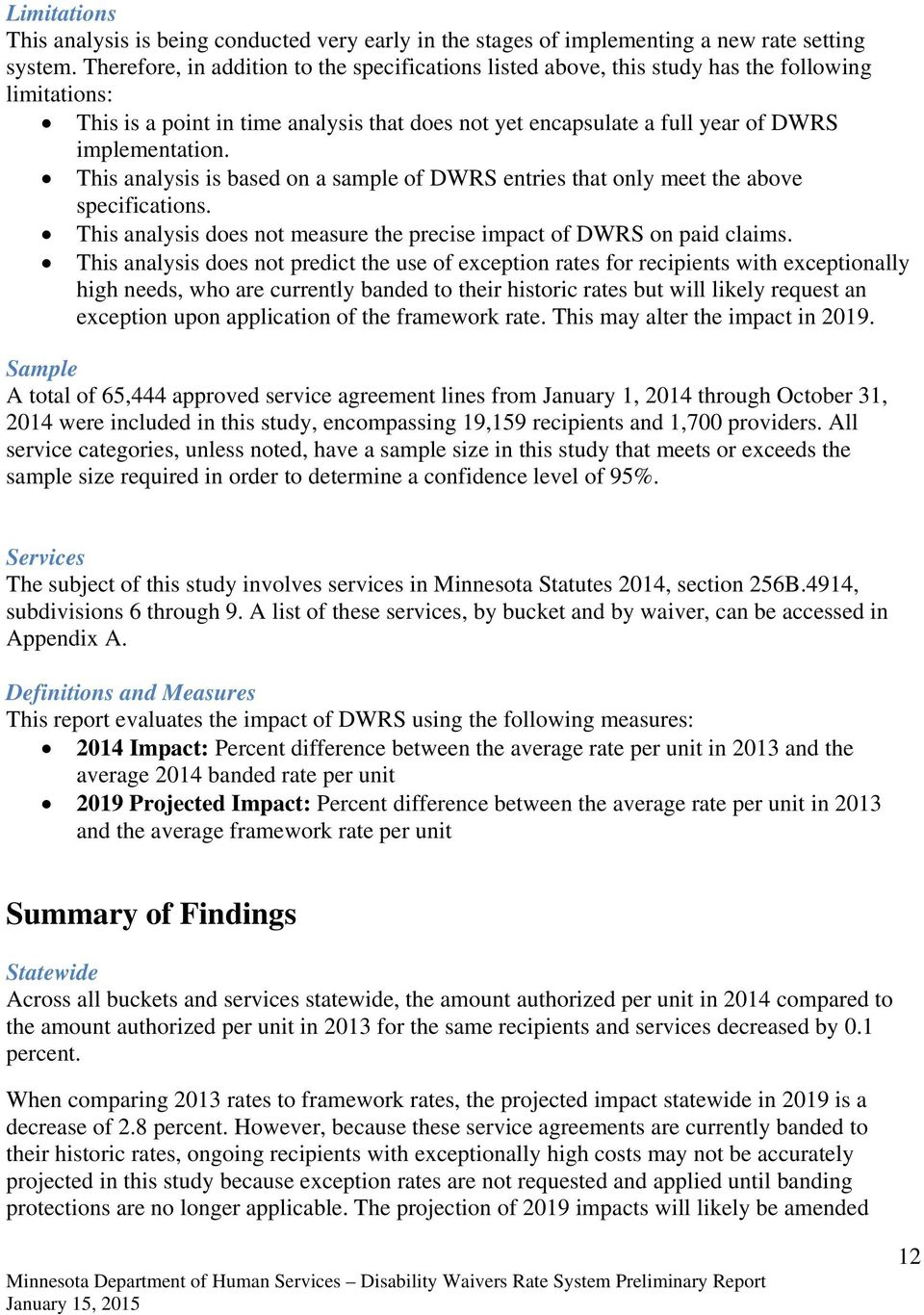
13 when more data is known about these recipients and services, and their interaction with DWRS. Analysis and assessment of individuals with exceptionally high costs will be a priority in 2015 and DHS will be working with stakeholders to identify additional research items, review research methodologies, and share research findings. Statewide Findings by Bucket In the implementation of DWRS, Minnesota statutes categorizes services into buckets defined as Residential, Day, Unit Based without Programming, and Unit Based with Programming. The corresponding services within these buckets can be accessed in Appendix A. The following table highlights the observed impact of DWRS by bucket in 2014 as well as the projected impact in Figure 1: Impact by Bucket Bucket % Change in 2014 Projected % Change in 2019 Residential % % Day % % Unit Based without Programming % % Unit Based with Programming % % STATEWIDE ACROSS ALL BUCKETS % -2.80% As the above table illustrates, the fiscal impact for all buckets in 2014 is limited. However, trends in the framework rate are projecting significant changes in the Day and Unit Based with Programming buckets. These will be areas in which further analysis will be focused in 2015 and While this report summarizes the percent change experienced in each of these categories, it should be noted that total spending within each of these buckets varies, with the residential bucket currently containing the largest amount. Budget Neutrality Budget neutrality in the initial implementation of the Disability Waiver Rate System is defined in Minnesota Statutes 2014, section 256B.4914, subdivision 16 as having estimated spending in 2013 that is within 0.3% of estimated spending in 2014 for the same recipients and services on a bucket level. In this analysis, budget neutrality is determined by examining the rates of recipients receiving the same services in calendar years 2013 and 2014, and evaluating the percent difference in rates between both time periods holding 2014 authorized units constant. This analysis concluded that as of October 31, 2014, all buckets were within the threshold of 0.3%. As data continues to populate the system, and exceptions costs are reflected in the data, ongoing analysis will be conducted and shared with stakeholders. 13

14 Statewide By Service Current data trends indicate wide variability in the projected 2019 impact among services. This report will list changes observed by each service category as well highlight the most significant changes seen by procedure code. Note that this study does not account for recipients of rate exceptions, which will likely impact the projected change in For a detailed table listing the sample size specifications, utilization rates, average prices, and percent changes by bucket, service category, and service procedure code, see Appendix B. Residential Services The residential bucket is experiencing a 0.06 percent decrease in the rate per unit from 2013 to 2014 and is projected to increase by percent in While service categories within the residential bucket are experiencing a slight decrease in 2014, they are all projected to increase in This is because the number of recipients whose rates are banding down in 2014 is slightly higher than the number of recipients whose rates are banding up. However, the recipients whose rates are banding up are experiencing greater variance between their historic rate and their framework rate, resulting in larger positive percent changes in The following table displays how the implementation of DWRS has impacted specific residential service categories to date: Figure 2: Statewide Impact to Residential Services Percent Change in 2014 Projected Percent Change in 2019 Customized Living Category % % Foster Care Category % 0.890% Residential Care Services Category % 9.082% Supportive Living Services Category % 0.204% (Daily) Total RESIDENTIAL Bucket % 0.883% Within these categories, the specific procedure codes that indicate the most significant changes in 2019 include the following: Customized Living daily is projected to increase 16% Adult Family Foster Care is projected to increase 46% These are areas in which further study will be focused in 2015 and DHS will particularly be examining the inputs entered by lead agencies to calculate these framework rates. Also, the residential services bucket is an area that may particularly be impacted by rate exceptions when banding protections are removed. DHS will be focusing efforts in the subsequent research years to analyze rate setting for recipients with exceptionally high costs. 14

15 Day Services All service categories in the day bucket are exhibiting a decrease in 2014 as well as a projected decrease to the framework rate. The following table displays how the implementation of DWRS has impacted specific day service categories statewide. Figure 3: Statewide Impact to Day Services Percent Change in 2014 Projected Percent Change in 2019 Adult Day Care Category % % Day Training & Habilitation Category % % Prevocational Services Category % % Total DAY Bucket % % The procedure codes in this bucket demonstrating the most significant projected percent changes in 2019 include both daily and hourly prevocational services and Day Training and Habilitation daily rates. These are all areas in which further study will be focused in 2015 and DHS will be identifying any significant trends and outliers in the inputs entered by lead agencies to calculate framework rates, such as staffing ratios and staffing hours. Unit Based without Programming Services The Unit Based without Programming bucket is experiencing an increase of 0.1 percent in 2014 and is projecting an increase of 8.48 percent in The following table displays how the implementation of DWRS has impacted the service categories in this bucket statewide. Figure 4: Statewide Impact to Unit Based without Programming Services Percent Change in 2014 Projected Percent Change in 2019 Personal Support/Companion Care % % Respite Care Services Category 0.081% 7.337% Total UNIT BASED WITHOUT PROGRAMMING Bucket 0.100% 8.482% As indicated in this table, both service categories in this bucket are exhibiting an increase in both time periods. Personal support, in particular, indicates a large projected increase in In the Respite Care Services category, 15-minute units are projecting an increase in 2019 while daily units are projecting a decrease, resulting in an overall increase of 7.3 percent increase for the service category. 1 The DTH Category includes DTH Daily, including transportation, and DTH Partial Day. In order to compare rates accurately, the DTH Daily Historic, 2014 Rate, and Framework Rate all include the DTH Transportation amount entered into DWRS in DTH Partial Day is also included in this category. Historic rates are defined as rates authorized in 2013; 2014 rates are rates authorized for the same person in 2014; and these 2014 rates are held constant through the framework rate period. 2 Not included in this study are recipients of Personal Support providers who were previously operating as a Fiscal Support Entity, and who received an exception to be excluded from the banding process in 2014 due to clarification of service delivery policy. 15

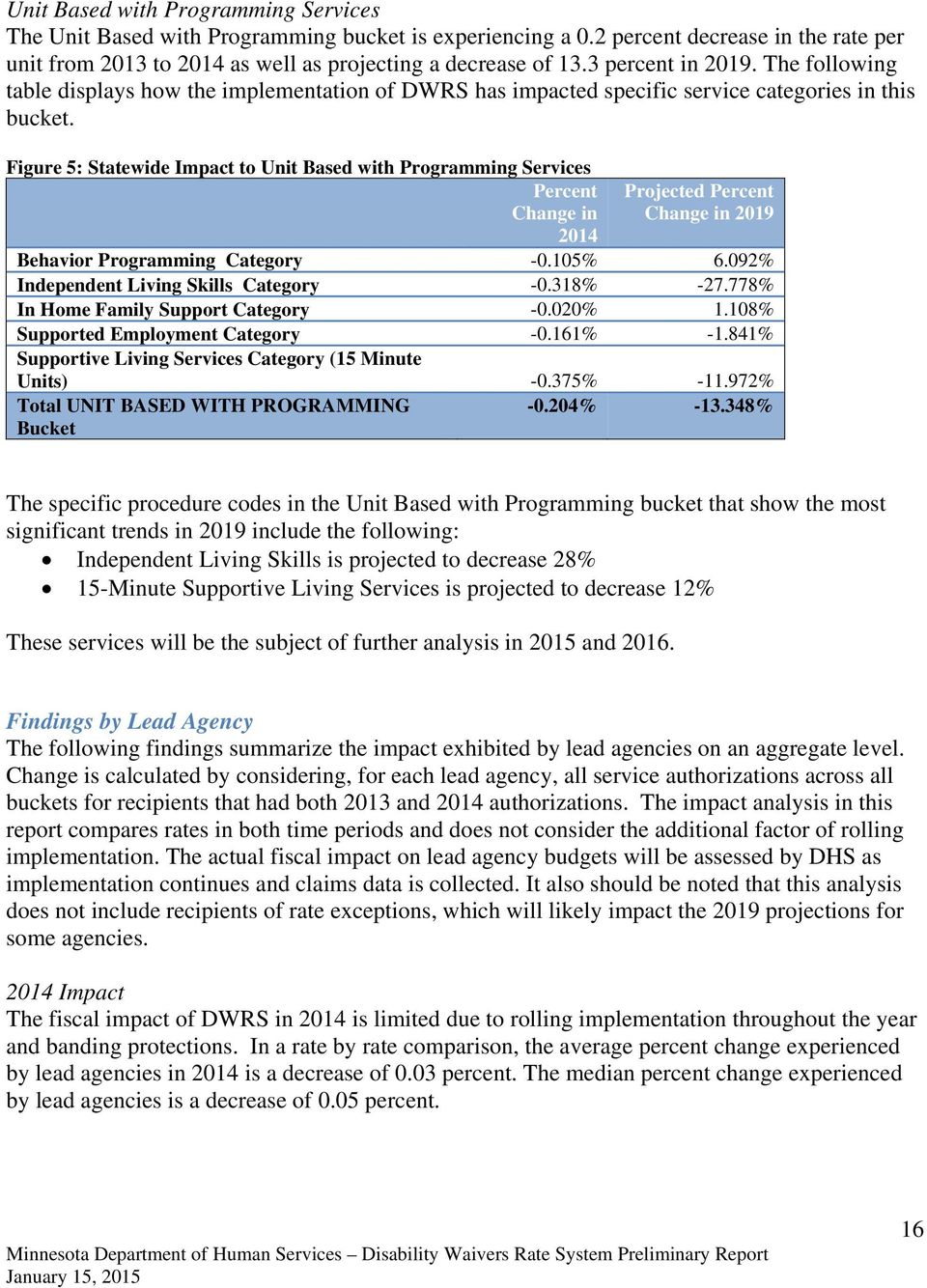
16 Unit Based with Programming Services The Unit Based with Programming bucket is experiencing a 0.2 percent decrease in the rate per unit from 2013 to 2014 as well as projecting a decrease of 13.3 percent in The following table displays how the implementation of DWRS has impacted specific service categories in this bucket. Figure 5: Statewide Impact to Unit Based with Programming Services Percent Change in 2014 Projected Percent Change in 2019 Behavior Programming Category % 6.092% Independent Living Skills Category % % In Home Family Support Category % 1.108% Supported Employment Category % % Supportive Living Services Category (15 Minute Units) % % Total UNIT BASED WITH PROGRAMMING Bucket % % The specific procedure codes in the Unit Based with Programming bucket that show the most significant trends in 2019 include the following: Independent Living Skills is projected to decrease 28% 15-Minute Supportive Living Services is projected to decrease 12% These services will be the subject of further analysis in 2015 and Findings by Lead Agency The following findings summarize the impact exhibited by lead agencies on an aggregate level. Change is calculated by considering, for each lead agency, all service authorizations across all buckets for recipients that had both 2013 and 2014 authorizations. The impact analysis in this report compares rates in both time periods and does not consider the additional factor of rolling implementation. The actual fiscal impact on lead agency budgets will be assessed by DHS as implementation continues and claims data is collected. It also should be noted that this analysis does not include recipients of rate exceptions, which will likely impact the 2019 projections for some agencies Impact The fiscal impact of DWRS in 2014 is limited due to rolling implementation throughout the year and banding protections. In a rate by rate comparison, the average percent change experienced by lead agencies in 2014 is a decrease of 0.03 percent. The median percent change experienced by lead agencies is a decrease of 0.05 percent. 16
17 2019 Impact When banding no longer applies and lead agencies are utilizing all framework rates in 2019, the projected impact of DWRS on lead agencies has wide variability, ranging from a decrease of 20.6 percent to an increase of 100 percent. However, 44 percent of lead agencies are projecting a change of five percent or less. The average projected change in 2019 is an increase of 4.7 percent and the median projected change is an increase of two percent. The distribution is rightly skewed with 61% of lead agencies across the state projecting an increase in The graph below illustrates the distribution of lead agencies projected change in Figure 6: Histogram of Projected 2019 Impact by Lead Agency 25 Estimated 2019 Impact Distribution of Lead Agencies Number of Lead Agencies Projected Percent Change from 2013 to 2019 Rates This graph demonstrates that the number of lead agencies projecting an increase in 2019 is larger than the number of agencies projecting a decrease. It also shows that most lead agencies are projecting a change of ten percent or less, and that there are more lead agencies with extreme increases than there are with extreme decreases. As indicated in these initial analysis findings, the projected impact of DWRS in 2019 fluctuates widely among lead agencies. This is largely due to historic rates having wide variability across the state prior to the implementation of DWRS. The figure below illustrates the variability of the projected change across all lead agencies in the state. 17

18 Figure 7: State of Minnesota Map, Projected 2019 Impact by Lead Agency As the previous graph and map illustrate, more lead agencies are projecting an increase than those that are projecting a decrease. However, many of the state s largest lead agencies with the greatest number of recipients and highest disability waiver spending are projecting a decrease. For a more detailed look the projected fiscal impact of DWRS on each lead agency, see Appendix C. This table outlines the study findings for each service bucket in each lead agency. 18

19 Findings by Provider Similarly to other findings presented in this report, the fiscal impact of DWRS on service providers in 2014 is limited due to rolling implementation and banding protections. Percent change in this study is calculated by considering, for each provider, all service authorizations for recipients that had both 2013 and 2014 authorizations Impact Considering all providers whose rates were calculated using DWRS, the average change experienced by providers in 2014 is a decrease of 0.05 percent. The median percent change experienced by providers is a decrease of 0.09 percent. 43 percent of providers are experiencing an overall increase in 2014 while 57 percent are experiencing a decrease in Impact When banding no longer applies and full framework rates are authorized in 2019, the projected impact of DWRS on providers has wide variability. The following statistics summarize trends seen on a provider level: The median percent change in rates projected for all providers is a decrease of 1.16 percent One third of all providers are projecting a change, increase or decrease, of ten percent or less 47 percent of providers are projecting an increase in percent of providers are projecting a decrease in 2019 The graph below illustrates the distribution of providers projected change in Figure 8: Histogram of Projected 2019 Impact by Provider Number of Providers Estimated 2019 Impact Distribution of Providers Percent Change Projected from 2013 to

20 As seen in the graph above, the variability in the projected impact is wide among all providers across the state and across wavier services. Variability in DWRS impact among providers depends on many factors such as historical rate setting methods, the number of recipients served, and the type of services rendered by providers. For more details on the estimated impact to providers, see Appendix D. Findings by Recipient The following research findings explore how DWRS implementation has impacted the rates of each recipient. These statistics are calculated by considering all rates for all DWRS services that an individual has been authorized for in both time periods and determining the total percent change experienced or projected for the individual across all services in that service bucket. The average change overall experienced by recipients in 2014 is a decrease of 0.12 percent. The average change projected for recipients rates in 2019 is a decrease of 4.79 percent. The following table illustrates the changes seen by service bucket: Figure 9: Estimated and Projected Impact by Recipient Resident ial Bucket Day Bucket Unit Based without Programmi ng Average Percent Change, by Recipient, in 2014 Average Percent Change Projected, by Recipient, in 2019 Unit Based with Programmin g TOTAL All Buckets -0.01% -0.14% 0.15% -0.25% -0.12% 7.97% % 16.92% % -4.79% As with other findings in this report, these analysis trends vary widely and depend on many factors such as historical rate setting methods, the number of services authorized for, and the type of services authorized. While the 2014 findings in this section reflect current trends experienced within the first year of DWRS implementation, 2019 projections will be impacted by the exceptions process and trends in lead agency inputs as DWRS implementation continues. DHS will strategically focus research in 2015 and 2016 on areas where large changes are seen on an individual recipient level. For more details on the estimated impact to recipients total rates, see Appendix E. Findings Conclusion The findings in this study illustrate that the impact of DWRS to statewide fiscal estimates, lead agencies, providers, and recipients is very limited due to banding to historical rates. The impact of DWRS across the state in 2014 is a decrease of 0.1 percent. However, the projected impact of DWRS in 2019 varies widely, with some providers, services, and lead agencies showing large increases while others indicating large decreases. It is anticipated that moving from a variable county negotiated rate system to a statewide systematic methodology will result in different rates. As the banding period continues, DHS will focus research on ensuring that DWRS 20

21 accurately reflects the cost of providing services in each service category, that recipients continue to have access to the services they need, and that the DWRS system is implemented fairly and consistently throughout the state. In order to ensure these goals are met, the following research projects are currently being planned for the next two years: DWRS Inputs: Inputs, such as staffing hours, are entered by lead agencies and are fundamental to the calculation of rates. DHS will study inputs entered into DWRS, identifying outliers and trends. Analysis findings will be reported to CMS. DWRS Compliance: DHS will continue to monitor DWRS compliance for each lead agency and analysis findings will be reported to CMS. Rate Exceptions: DHS will study the use of rate exceptions, including the fiscal cost, trends in service categories and exception reasons, and specific cost drivers necessitating an approved exception. DHS will work to identify the probable use of exceptions when banding protections are no longer applicable. DWRS Impact by Recipient: DHS will further examine DWRS impact by recipient, researching specific recipient and waiver populations and the interaction with DWRS. Transportation: DHS will study the use and cost of transportation in day services. 21
22 V. Data Gathering Legislation requires DHS to, within available resources, conduct preliminary research and gather preliminary data from sources within and outside the state system. A. Differences in the Underlying Cost to Provide Services and Care across the State In response to the requirements listed above, DHS has commissioned an independent health research firm, Truven Health Analytics, to conduct a research study on the differences in the cost of providing services throughout the state. The research project includes the following steps: 1. Identify cost drivers within the DWRS frameworks that have rationale and evidence to support statistically significant cost variation by region 2. Determine for each cost factor if there is sufficient, reliable and credible data to demonstrate a meaningful regional variation in cost 3. Develop a research methodology for studying cost factors that meet the above criteria. 4. Conduct the analysis and determine a regional rate index to be implemented in the DWRS frameworks 5. Conduct a comprehensive impact analysis, estimating the anticipated impact of the proposed regional rate factors on a statewide, bucket, service, and regional level. This analysis is being done on all framework services. In order to encompass the unique economic drivers in different micro regions of the state, the regions used in this study are Metropolitan Statistical Areas (MSAs), which are defined by the U.S. Office of Management and Budget as regions consisting of adjacent counties that have a high degree of social and economic integration (as measured by commuting to work) with an urban core. The regions can be accessed through the Minnesota Department of Employment and Economic Development at: This is a complex and important research project that will likely have significant fiscal impact on providers and lead agencies if a regional index is implemented. The goal completion date for this project is January 31, Thorough review of analysis findings and impact findings will then be conducted at DHS and shared with stakeholders prior to system development and implementation. 22
23 B. Mileage, Vehicle Type, Lift Requirements, Incidents of Individual and Shared Rides, and Units of Transportation for all Day Services, Which Must be Collected from Providers Using the Rate Management Worksheet and Entered into the Rates Management System As of August 1, 2014, lead agencies were required to enter the following transportation information into DWRS for all DT&H Daily services: Lift Required Lift Used Average Number of One-Way Trips Per Day Shared Average Number of One-Way Trips Per Day Individual Average Number of Miles Per Day Shared Average Number of Miles Per Day Individual Number of Riders A full year of data will be available in September Beginning with the 2016 DWRS legislative report, DHS will analyze transportation utilization trends, transportation costs and the correlation between cost and utilization. Regional transportation costs and utilization may be further evaluated to compare urban and non-urban sections of the state. C. The Distinct Underlying Costs for Services Provided by a License Holder Certified Under Section 245D.33 DHS will assess and research the impact of costs associated with the license requirements for disability waiver service providers under 245D.33. The following research process will be conducted: 1. Identify Costs 2. Develop Research Plan 3. Conduct Research 4. Review Findings DHS will identify costs associated with specific licensing requirements for service providers licensed under 245D.33. Costs will be assessed to determine if they meet at least one of the following primary criteria to be eligible for further research: Is there rationale and evidence that a cost associated with a requirement under 245D.33 has a direct and significant impact on specific component values within the DWRS frameworks? Is there rationale and evidence that a cost associated with a requirement under 245D.33 introduces a new cost driver to providing waiver services that is not currently reflected in current component values within the DWRS frameworks? 23
24 Possible costs identified in the initial review of 245D.33 include training costs, licensing fees, and administrative tasks. The current DWRS frameworks include these costs within Program- Related Expenses. DHS will develop a research plan to study these costs and determine whether they are adequately included in the frameworks. Development of the research plan will include engaging with stakeholders on the thorough identification of 245D.33 costs to providers. After costs have been fully identified, DHS will determine the availability of credible and reliable data to research the identified costs and will develop a systematic research plan with the appropriate methods and techniques to address the research questions. After research is conducted, findings and recommendations will be reviewed with stakeholders. 24
25 VI. Payment Values Legislation requires a preliminary review or evaluation of the following payment values for services in the DWRS. In some instances, an analysis plan for future reporting is included. A. Values for Transportation Rates for Day Services The only Day Service that requires transportation inputs in RMS is DT&H Daily, available under the DD waiver. This section will provide information on the required transportation inputs for this service as well as plans for analysis in future reports. The first analysis of transportation rates for day services will be available in the 2016 DWRS legislative report as a full year of data will be available. As of August 1, 2014, lead agencies were required to enter transportation information for DT&H Daily services. These inputs include: Lift Required Lift Used Average Number of One-Way Trips Per Day Shared Average Number of One-Way Trips Per Day Individual Average Number of Miles Per Day Shared Average Number of Miles Per Day Individual Number of Riders Beginning with the 2016 DWRS legislative report, DHS will report the average transportation use by service, the average transportation cost for services that include transportation, how transportation utilization correlates with transportation costs and how transportation cost and utilization vary between regions. Regional transportation costs and utilization may be further evaluated to compare urban and non-urban sections of the state. B. Values for Transportation Rates in Residential Services Transportation costs for residential services are included in the service framework rate. Transportation costs for residential services during the initial year of implementation, 2014, were based on an individual s needs and were priced as follows: no transportation required: 0/individual transportation without a customized adapted vehicle required: 1,600/individual transportation in an adapted vehicle with a lift required: 3,000/individual Transportation rates for these services were changed in 2014 statute and the implementation of the change began January 1, Transportation costs for residential services will now be based on the resident with the highest need and are priced as follows: 25
26 no transportation required: 0/individual transportation without a customized adapted vehicle required for all residents: 1,600/individual transportation in an adapted vehicle with a lift required for 1 or more residents: 3,000/individual DHS will analyze transportation authorizations from 2014 and compare them to authorizations in 2015 for inclusion in the 2016 legislative report and ongoing reports to ensure fitness of the component values. C. Values for Services Where Monitoring Technology Replaces staff time Minnesota defines monitoring technology as the use of technology and equipment for providing oversight, monitoring and supervision of individual health and safety while also supporting independence. Monitoring technology equipment includes tools such as alarms, sensors, remote monitors and other devices. The goals for using monitoring technology are to promote community living and independence and to ensure the health and welfare of individuals with disabilities. Remote staffing is authorized in corporate and family foster care and supported living services (SLS). Using monitoring technology may supplant the need for in-person staff time. This section will examine data where waiver recipients used monitoring technology in place of in-person staffing. The applicable fields in RMS include the number of remote awake hours for shared and individual staffing and the number of remote monitored residents for shared staffing. The data used below is RMS data entered between January 1, 2014 and October 31, 2014 that had an MMIS match. Overall, 3722 service lines included some monitoring technology. Framework and Historic Rates Comparison Framework rates differ depending on whether services include monitoring technology or not. Typically, services that included monitoring technology had a more expensive rate. Like framework rates, historically, services that included monitoring technology typically had a more expensive rate than those that did include monitoring technology. Preliminary data indicates that remote monitoring staff does not decrease authorization cost when compared to traditional, on-site staffing. DHS will continue to research the component values for monitoring technology as data is available. 26
27 D. Values for Indirect Services With a few exceptions, only direct (or recipient-facing) time is billable. The Program Plan Support value within the DWRS frameworks accounts for the time spent by direct service staff when they are not directly engaged with service recipients. The Program Plan Support value in the DWRS was recommended in the report by Navigant Consulting Inc., with the primary data source as the 2010 RSMI Provider Cost and Wage Survey. DHS agrees that for some services indirect time may be a significant cost-driver, and where this is so, DHS has recently offered policy clarification allowing some specific indirect (not recipient-facing) time to be billed as direct service. DHS continues to analyze the direct and indirect aspects of service provision, and will use the learnings to recommend adjustments to policy or to the Program Plan Support component value. E. Values for Nursing Lead agencies may enter nursing information in the Rate Management System (RMS) for all Day and Residential services. This section will analyze the average RN and LPN utilization in day and residential services and the corresponding rates calculated by RMS. RN Services 165 day service lines included some RN services, accounting for 1.4 percent of all day service lines entered during this period. 53 percent of these lines were used under a CADI waiver, 41 percent were used under a DD waiver and six percent were used under a BI waiver. The most common day service used to provide RN services was Adult Day Care residential service lines included some RN services, accounting for 16.6 percent of all residential service lines entered during this period. 59 percent of these lines were used under a DD waiver, 35 percent were used under a CADI waiver, five percent were used under a BI waiver and 1 percent were used under a CAC waiver. The most common residential service used to provide RN services was adult corporate supportive living services daily. LPN Services 145 day service lines included some LPN services, accounting for 1.2 percent of all day service lines entered during this period. 48 percent of these lines were used under a DD waiver, 46 percent were used under a CADI waiver and six percent were used under a BI waiver. The most common day service used to provide LPN services was DT&H/Structured Day Program residential service lines included some LPN services, accounting for 10.8 percent of all Residential Service lines entered during this period. 68 percent of these lines were used under a DD waiver, 26 percent were used under a CADI waiver, five percent were used under a BI 27
28 waiver and 1 percent were used under a CAC waiver. The most common residential service used to provide LPN services was adult corporate supportive living services daily. Trends in this initial data show that service authorizations that include RN or LPN hours tend to have higher rates than those that do not include RN or LPN hours. Day services that included RN or LPN services had an average framework rate of 80.30, compared to an average framework rate of for Day services that did not include RN or LPN services. Residential services that included RN or LPN services had an average framework rate of , compared to an average framework rate of for Residential services that did not include RN or LPN services. Nursing is an area which DHS will continue to monitor and evaluate. DHS is working with the Department of Health to determine what provision of nursing is allowable, and working with stakeholders to determine the best way to wrap nursing services around waivered services to ensure quality services. Services with nursing that were in effect in December of 2013 do have the protection of banding until F. Component Values for Independent Living Skills Independent Living Skills Training is defined as direct training from a staff person to address identified skill development needs of a person in the areas of communication skills, community living and mobility, interpersonal skills, reduction or elimination of maladaptive behavior, selfcare, and sensory or motor development involved in acquiring functional skills. This is a service that often takes place in the community, and in some instances it may be incumbent upon service providers to provide transportation into the community as part of the service. In-program transportation provided as a part of the service is currently accounted for in unit-based rate frameworks under Client Programming and Supports. However, transportation requirements and costs for service providers in rural areas may be higher than accounted for in the statewide rate setting frameworks. Future research will study the variance in the cost of travel for unit based services, such as ILS training throughout the state. To cover the cost of travel associated with ILS, waiver transportation services and ILS may be authorized concurrently when ILS services are being provided in conjunction with travel. G. Component values for Family Foster Care That Reflect Licensing Requirements Licensing requirements enacted in 1/01/14 as a result of the new 245D rule may require some family foster care providers and staff to complete a level of training which was not required in years prior to This change was part of a DHS initiative to establish health and safety standards across all of the home and community-based services. 28
29 Component values for corporate foster care and family foster care differ in two ways. The first difference is in the general administrative support ratio (13.25% in corporate vs. 3.3 percent in family foster care) Family Foster Care providers typically provide this service in their own home, and therefore generally do not incur the administrative costs typically associated with providers that operate on a larger scale, and/or perhaps in a separate location. As such, they generally would not be expected to incur costs associated with administrative functions, such as human resources, accounting, office supplies and equipment maintenance, and facilities management. The second difference is in the absence factor (3.9 % in corporate which includes a utilization factor vs. 1.7% in family foster care does not include a utilization factor).family Foster Care providers typically provide this service in their own home, and therefore generally do not incur additional costs that other providers incur to maintain a licensed capacity associated with the utilization factor. Training is included in program related expense ratio in the framework (1.3%). This is the same component value in corporate foster care. DHS will continue analysis in 2015 and 2016 to determine if training values are sufficient to meet the costs associated with training for all services which must meet 245D licensing requirements. H. Adjustments to Other Components to Replace the Budget Neutrality Factor Under current statute, each framework rate calculation in DWRS has an after model adjustment called the budget neutrality factor. The framework rate generated by DWRS is multiplied by the following factors: For residential services: For day services: For unit-based services with programming: For unit-based services without programming: The purpose of this factor was to ensure that the level of spending during the banding years remains comparable to historic spending. It is anticipated that moving from a variable county negotiated rate system to a statewide systematic rate system will result in different rates. However, as the banding period continues, DHS will be conducting comprehensive analysis and evaluation on framework inputs, component values, and the impact of DWRS. Research will be focused on ensuring that components within the Disability Waiver Rate System accurately reflect the cost of providing disability wavier services and that recipients continue to have access to the services they need. If evaluation findings conclude that component values should be modified to more accurately reflect the cost of proving waiver services, DHS will consider adjusting and/or removing the budget neutrality factor in conjunction with such changes. 29
30 I. Remote Monitoring Technology for Nonresidential Services Minnesota defines monitoring technology as the use of technology and equipment for providing oversight, monitoring and supervision of individual health and safety while also supporting independence. Monitoring technology equipment includes tools such as alarms, sensors, remote monitors and other devices. The goals for using monitoring technology are to promote community living and independence and to ensure the health and welfare of individuals with disabilities. Presently, lead agencies may authorize monitoring technology within the Rate Management System (RMS) for corporate and family foster care or supported living services (SLS), which are residential services. However, the use of technology in other settings is a future possibility. This section will examine how monitoring technology is used within waiver services in other states. State Comparisons None of the states that offer monitoring technology as a service allow it to be used in nonresidential services. Ohio, Montana, Indiana and Maine indicate that monitoring technology is limited to residential services. Missouri does not explicitly indicate that monitoring technology is limited to residential services, but one of the goals of the service is to decrease reliance on physical staff during the night. States place restrictions when authorizing monitoring technology services. Montana limits monitoring technology to supported living services that reduces or replaces residential habilitation. Ohio prohibits monitoring technology in adult foster care, corporate and family. Missouri requires that each case be subject to review by a human rights committee. Indiana places fewer restrictions on monitoring technology, and Maine only enacted their rule on monitoring technology on September 1, The table below details the rate each state has established for monitoring technology services. State Maximum Rate Unit Notes Maine minute Monitoring without interaction Maine minute Monitoring with 1-to-1 interaction Montana 7.77 Hour Remote monitoring staff Indiana Hour Remote monitoring staff Montana 300 Month Equipment expenses Missouri 3,000 Waiver year N/A Ohio 7,500 3 years Covered under Level 1 waiver 30
31 State Maximum Rate Unit Notes Ohio 25,000 Waiver eligibility span Covered under SELF waiver Monitoring technology is an emerging service in disability waivers. State practices vary widely. DHS will be initiating a monitoring technology learning community with stakeholders during This workgroup will inform research and innovation in 2015 and J. Values for Basic and Intensive Services in Residential Services The Disability Waiver Rate System was developed over four years of meetings by an Intensive Workgroup of provider and lead agency stakeholders. This workgroup defined the cost drivers for each service. This group determined that more skilled staff are required to deliver services that include training, habilitation, and rehabilitation. The groups also determined that more skilled staff commands higher wages than similar staff in the industry that deliver care but are not required to understand learning styles, implement a training plan, and measure the success of it. For this reason, during legislative negotiations in 2013, DHS initially proposed two tiers of residential services: an intensive level for training services and a basic level for maintenance services. There was concern during 2013 legislative negotiations that implementation of two tiers would be administratively burdensome. DHS agreed to collapse the two tiers until further research could be conducted. Future analysis will revisit the concept of basic and intensive service and seek to analyze if more skilled staff for training services reasonably results in a wage differential. K. Values for the Facility Use Rate in Day Services The facility use rate in DWRS is considered an interim component in the frameworks for day services. This rate was determined using a combination of a rate recommended in the Navigant report and information gathered from stakeholders. The primary data sources for this component value were as follows: the average cost to rent existing appropriate space Minneapolis was 8.30 per person / per week, and the cost of new construction for a day care center in Minneapolis was 8.24 per person / per week. The Navigant report recommended we use the higher of these two values, and DHS accepted this recommendation. During legislative negotiations in 2013, a compromise was made to reach the current value of per person / per week. 31
32 CMS issued new rules in January 2014 which required each state to create a transition plan to come into compliance with requirements by March 17, This rule limits the communitybased service dollars spent on facility settings until the assessment phase of the transition plan is completed. Once regulatory requirements are identified, DHS will propose changes to statute, submit waiver amendments and make changes to DHS policy manuals to align regulatory requirements, service descriptions and provider standards with federal rule requirements. DHS will propose the changes to statute in phases over the next several legislative sessions, concluding in the 2018 legislative session. Phasing the language changes over several legislative sessions allows opportunity to work with stakeholders, especially in areas that are more complicated to address. DHS will provide analysis of the facility use rate for day services in 2015 and 2016 with regard to the transition plan and new CMS rule. L. Values for Workers' Compensation as Part of Employee-Related Expenses; and M. Values for Unemployment Insurance as Part of Employee-Related Expenses The current methodology for all Disability Waiver Rate System frameworks includes a total of 11.56% for payroll taxes, unemployment insurance, and workers compensation. This percentage includes the following employer costs: 6.20% for Social Security payroll taxes 1.45% for Medicare payroll taxes 2.41% for Unemployment Insurance 1.5% for Workers Compensation This section will summarize current research on these employer costs and compare them to the rates used in the current framework methodology. FICA Taxes The Federal Insurance Contributions Act (FICA) requires employers to contribute an employeematched tax for Social Security and Medicare. The current framework methodology, based off the tax rate for employers in 2010, is 6.20% for Social Security and 1.45% for Medicare. These rates, set by federal statute, are currently at the same rate in Unemployment Insurance In addition to FICA taxes, employers are also required to contribute to both state and federal unemployment systems. The statutory requirement for the Federal Unemployment Tax (FUTA) 3 Social Security Administration. Social Security & Medicare Tax Rates. 32
33 is a tax rate of 6.0%, however employers receive a 5.4% credit when state unemployment taxes are paid, resulting in a net tax rate of 0.6% for the first 7,000 paid to each employee. 4 The Minnesota state unemployment tax (SUTA) is also an employer-only paid tax, and its rate is determined by the Minnesota Department of Employment and Economic Development based on the employer s estimated liability. In 2014, state unemployment tax rates varied from 0.20% to the maximum rate of 9.10%. Because unemployment taxes are determined based on individual employers estimated liability, the rates vary widely across industries. Some industries, such as the construction industry, have historically high incidences of unemployment claims, while other industries do not see long-term industry wide patterns of unemployment. The disability and healthcare services industry is not considered an industry with a historically high amount of unemployment insurance claims. In a report published in 2014, the U.S. Department of Labor s Bureau of Labor Statistics 5 found that: Private industry employers in the service-providing industry averaged a federal unemployment tax rate of 0.1% and a state unemployment tax rate of 0.7%. All private industry employers in Midwest census region averaged a federal unemployment tax rate of 0.1% and a state unemployment tax rate of 0.8%. The current framework methodology includes 2.41% for Unemployment, based off Minnesota Department of Employment and Economic Development s 2010 rate for new employers in a non-high experience rating industry. In 2014, Minnesota s rate for new employers is 2.33% 6, a decrease of 0.08% from the rate in the framework. However, this rate for new employers may not reflect the actual rates paid by current employers in the disability waiver service industry. As indicated in the U.S. Bureau of Labor Statistics report cited above, average rates could be as low as 0.8% or 0.9%. Future DHS research may want to further explore the actual unemployment rates paid by providers in this industry in the state of Minnesota. Workers Compensation Like unemployment rates, workers compensation rates vary by employer depending on the level of estimated risk. Currently, DWRS includes a workers compensation rate of 1.5%. This rate was based on the national average rate for all employers in The most recent publication published by the U.S. Social Security Administration found that the average cost to employers 4 Internal Revenue Service. Form 940 Employer s Annual Federal Unemployment (FUTA) Tax Return U.S. Department of Labor Bureau of Labor Statistics. Employer Costs for Employee Compensation June Published September 10, Unemployment Insurance Minnesota. Unemployment Insurance Tax Rates. taxes/tax rates/index.jsp. 33
34 nationally was 1.27%, a decrease of 0.23% from the amount used in the framework. 7 This downward trend is also indicated regionally in a report published in 2014 by the Minnesota Department of Labor and Industry, where it was noted that pure premium rates in 2013 were down thirty percent from This long-term downward trend found that the cost to employers among all industries in the state of Minnesota was 1.3% of paid wages in Workers Compensation in Minnesota Workers Compensation coverage protects workers and employers from incurring significant cost in the event of a workplace injury. Workers compensation laws in the United States differ among states in their requirements and rate setting. In a 2011 report published by the Oregon Department of Consumer and Business Services, it was found that there is wide variation among states in the statewide average workers compensation premium rate. Compared to other states, Minnesota ranked 16 out of 50 in the highest average workers compensation rate. 9 Under Minnesota Statutes, section , subdivision 2, all employers are required to purchase workers compensation if they have at least one employee, with few exceptions listed in state law. Most applicable for disability waiver service providers is the exception that a sole proprietor is excluded from being required to purchase workers compensation for themselves, their spouse, parent or child, regardless of age. This exemption may impact small providers, such as those in Family Foster Care. In the state of Minnesota, employers purchase workers compensation coverage most commonly through the voluntary market. If they are unable to gain insurance through the voluntary market due to historical workers compensation claim history, they may purchase it through the Assigned Risk Plan program administered by the Minnesota Department of Commerce. These rates are set according to the employers industry class code and in 2014 these rates were at least 2.75 percent higher than the average rate in each industry. The assigned risk rate for industries related to disability wavier services are as follows: Code 8842 Group Homes, All Employees: Includes Group homes, group foster homes, halfway houses that provide rehabilitation services, shelters, and independent supportive living homes for people with disabilities: 4.18% 7 U.S. Social Security Administration. Annual Statistical Supplement, Published February Minnesota Department of Labor & Industry. Minnesota Worker s Compensation System Report. Published June Oregon Department of Consumer & Business Services. Oregon Workers Compensation Premium Rate Ranking. Published February
35 Code 8835 Home, Public, and Traveling Healthcare, All Employees Includes businesses providing homemaker and companion services, physically assisting, assisting persons with disabilities in the activities of daily living: 5.06% Code 8864 Social Services Organization, All Employees: Applicable to businesses that provide social services to people with disabilities. Services include on-site counseling, client assessments, providing sleeping accommodations and meals, counseling, advising, directing, guiding, and instructing clients: 4.73% 10 All workers compensation rates purchased through the voluntary market must be filed by the insurer to the Minnesota Department of Commerce. These filings are used by the Minnesota Workers Compensation Insurers Association to publish the Minnesota Ratemaking Report, an annual report containing average workers compensation premium base rates. This report is approved by the Minnesota Department of Commerce, and is statutorily required to be published and dispersed annually for all members. In the initial research of workers compensation premiums, there was no publicly accessible data to research industry-specific rates. However, future research may involve seeking access to this data through the Minnesota Department of Commerce or the Minnesota Workers Compensation Insurers Association. Summary of Findings and Areas of Future Research The initial examination of currently available reports and research regarding workers compensation resulted in the following findings: Workers compensation rates are indicating a long-term downward trend nationally and statewide since the rate was established in DWRS. Some employers providing waiver services many not be required under state law to purchase workers compensation insurance. Due to differences in state requirements and insurance delivery systems, workers compensation premiums in Minnesota may differ significantly from premiums in other states. Due to differences in estimated risk, workers compensation premiums in the disability wavier service providing industry may differ from premiums in other industries Future DHS analysis on workers compensation could seek to answer the following research questions: What is the average rate for employers in the disability waiver service providing industry? 10 Minnesota Workers Compensation Assigned Risk Plan. Assigned Risk Plan Rates Effective April 1, pdf. 35
36 How does the average rate in this industry differ from the statewide average? How does the average rate in this industry differ from the rate currently included in the DWRS frameworks? Are there particular waiver service categories in which workers compensation rates are higher or where there are higher incidences of employers purchasing workers compensation through the Assigned Risk plan? Would these increased costs be adequately addressed through the DWRS exceptions process? Are there particular waiver service categories in which a significant number of providers do not purchase workers compensation insurance? N. A Component Value to Reflect Costs for Individuals with Rates Previously Adjusted for the Inclusion of Group Residential Housing Rate 3 Costs, Only for any Individual Enrolled as of December 31, 2013 Prior to December 1, 2004, a Group Residential Housing supplemental rate was available to people with disabilities living in foster care licensed settings. This rate, commonly referred to as GRH Rate 3, was a supplement to the base Group Residential Housing payment available to people with limited income and assets living in licensed foster care settings. The rate 3 was available only to people with disabilities. The amount was negotiated between the lead agency and the licensed setting within the cap amount available and required DHS approval. The majority of GRH rate 3 payments went to providers that concurrently provided home and community based waiver services (usually through the Developmental Disability or Community Alternatives Care waivers). GRH Rate 3 payments ended December 1, At DHS direction, lead agencies negotiated increases (also effective December 1, 2004) to home and community waiver rates to offset the loss of GRH Rate 3. Between December 1, 2004 and the implementation of the statewide disability waiver rates system on January 1, 2014, lead agencies negotiated residential service rates with providers without statewide oversight. There was no consistent approach for accounting for provider costs previously captured under the GRH Rate 3. Some lead agencies simply carried their historic negotiated GRH rate 3 agreements forward as part of the provider s contract rate. Why is GRH Rate 3 a DWRS study item? Some provider agencies are concerned that DWRS implementation will inappropriately shift funds between agencies, reducing rates for providers whose lead agency negotiated rates were based in part on historic GRH rate 3 agreements and increasing rates for other providers. The department is committed to assuring that implementation of DWRS is budget neutral, and that no funding will be lost as part of implementation. Can a component be added to the DWRS framework to capture historic GRH rate 3 agreements? 36
37 Capturing historic GRH rate 3 agreements within the DWRS will be difficult for several reasons. First, there is no reliable data source for the historic GRH rate 3 agreements that ended more than ten years ago. Second, the intention behind a statewide rate system, and specific direction from CMS, is to replace county negotiated rates with a consistent statewide system of establishing rates. Carrying forward the historic GRH rate 3 amounts that were negotiated between counties and providers contradicts the intention of the DWRS and direction from CMS. What other alternatives could address provider concerns? To the extent that historic GRH rate 3 agreement amounts varied due to regional cost differences, development of the regional rate variation factor required in 256B.4914 may address this issue. O. Any Changes in State or Federal Law with an Impact on the Underlying Cost of Providing Home and Community-Based Services. DHS will assess and research the impact of any new state or federal law that may have a statistically significant impact on the cost of providing disability waiver services. The following research process will be conducted: 1. Identification and Initial Assessment: State and federal law changes that may have an impact in the cost of providing services will be identified for further assessment. The law change will then be assessed to determine if it meets at least one of the following primary criteria: Is there rationale and evidence that the particular law change has a direct and significant impact on specific component values within the DWRS frameworks? Is there rationale and evidence that the particular law change introduces a new cost driver to providing waiver services that is not currently reflected in current component values within the DWRS frameworks? New state and federal laws that do not meet these criteria will not be the subject of further study under this research plan. 2. Development of Research Plan: For new laws that are determined to meet at least one of the criteria in step one, DHS will develop a comprehensive research plan. The research plan will specify the specific research questions, data resources, and research methodology of the study. 3. Conduct Research. Depending on the research methodology, DHS will obtain data or develop a data model. Research will be conducted on the requirements of the new law and their impact on the cost of providing waiver services. 37
38 4. Review Findings. Research findings and recommendations will be reviewed with stakeholders. An Example: The Affordable Care Act The Patient Protection and Affordable Care Act requires some employers to provide full-time employees with comprehensive health insurance. An initial assessment of this law finds that it may have a direct and possibly significant impact on the component values within the DWRS frameworks that cover the cost of employee benefits. Details about the law include: Employers with more than 99 full-time employees must provide health coverage to 70% of their full-time employees in 2015 and 95% of their full-time employees in Employers with 50 to 99 full-time employees must provide health coverage to 95% of their full-time employees by The law will not be enforced for businesses with fewer than 50 employees. Small businesses who do offer health insurance to their employees may also be eligible for the Small Business Health Care Tax Credit. In order to qualify under the law, the health insurance offered to employees must be affordable, meaning the lowest self-only plan s premium must not be greater than 9.5 percent of the employee s gross household income. The health insurance plan must also meet minimum value, meaning that it is designed to cover at least sixty percent of the total cost of medical services for a standard population. 11 Large employers who do not provide health insurance are subject to a fine, called the Employer Responsibility Payment of 2,000 per employee per year. The DWRS frameworks currently contain a component value of 12.04% for employee benefits that include health insurance, dental insurance, vision, life insurance, short-term disability insurance, long-term disability insurance, retirement, tuition reimbursements, and wellness programs. This component is included in all frameworks regardless of business size, except for Customized Living. As noted above, the Affordable Care Act (ACA) has not yet begun enforcement of the employer mandate and the rules vary by size of business. Impact on the cost of providing services will depend on many factors such as the size of businesses and the cost of providing health coverage before and after ACA. DHS will develop a methodology to research the effects of this law on the cost of providing waiver services, and will compare these findings to the value that is currently included in the frameworks for this cost driver. 11 U.S. Centers for Medicare & Medicaid Services. Health Insurance for Businesses with 50 or More Employees. Viewed at businesses/what do large business owners need to know/ 38
39 P. Exceptions Analysis The Disability Waiver Rate System (DWRS) was developed after a complex review was conducted of costs associated with providing disability waiver services. While the DWRS frameworks are designed to cover the cost of serving most recipients, it is anticipated that some recipients with exceptionally high costs will require a DHS-approved rate exception. An explanation of the exceptions process is detailed in the following statute. Minnesota Statutes 2014, section 245B.4914, subdivision 14: Exceptions. (a) In a format prescribed by the commissioner, lead agencies must identify individuals with exceptional needs that cannot be met under the disability waiver rate system. The commissioner shall use that information to evaluate and, if necessary, approve an alternative payment rate for those individuals. (b) Lead agencies must submit exception requests to the state. (c) An application for a rate exception may be submitted for the following criteria: (1) an individual has service needs that cannot be met through additional units of service; or (2) an individual s rate determined under subdivisions 6, 7, 8 and 9 results in an individual being discharged. Summary of 2014 Exceptions As of December 2014, DHS has received a total of 185 exception requests from 45 different lead agencies. Of all requests received, 76 have been approved, 25 are currently pending, and 84 were withdrawn because they either did not meet the basic qualifications for an exception as listed in the above statute or they were able to meet the individual s needs through additional units of service in DWRS. No exception requests received by DHS have been denied. Out of the approved exceptions in 2014, 71% were residential services, 8% were day services, and 14% were unit based without programming, and 7% were unit based with programming services. These summary statistics have been shared with stakeholders on a quarterly basis. Exceptions Research The exceptions process is an important aspect of the DWRS implementation because it ensures that individuals with exceptionally high costs continue to receive services according to their individual needs. DHS is currently developing a robust analysis methodology to explore the following important aspects regarding exceptions: Identification of Cost Factor Trends What are the particular cost factors for exception recipients that exceed the fixed components within the DWRS frameworks and necessitate a rate exception? 39
40 Identification of Trends in Frameworks or Services Are there particular services or frameworks that have higher proportions of exceptions? Research on a Recipient Level For approved exception recipients, are there particular trends in age, waiver type, assessment score, etc.? Are there particular recipient populations that may need to utilize the exceptions process in the future? How will exceptions likely be used when banding protections are no longer applicable? For recipient populations that are currently banded and determined to possibly need exceptions in 2019, what is the variance between their historic rate and the framework rate? How do particular RMS inputs differ from the average inputs entered for all recipients? Analysis of Exception Costs What are the current fiscal costs of approved exceptions? How does the cost of approved exceptions change over time? How will the cost of approved exceptions impact the projected spending of DWRS services upon full implementation in 2019? Exceptions Requests Before 2019 What is an appropriate timeline to begin the exceptions request process for individuals who are currently banded and who will possibly need exceptions in 2019? This is a multi-faceted and important research project that will inform the continued development of the exceptions process for full implementation of DWRS in Findings of this research will also inform specific areas in which DWRS frameworks may need to be improved. DHS will be working with stakeholders to identify additional research items, review research methodology, and share research findings. 40
41 VII. Report recommendations The DWRS was a significant change for the state and legislation was careful to allow for a 5 year transition plan to full implementation of the new system. This process was intended to allow time to make adjustments to the system and ensure that the quality of services was maintained. This report is the first opportunity to see an accurate projection of the potential impacts of the new rate setting methodology; however, DHS will not have a full year of data until the end of DHS recommends that the 5 year implementation schedule be followed to allow for careful analysis in years 2015 and 2016, which will result in appropriate, data driven adjustments to framework component values and the service planning necessary to provide the best services for individuals who use waivered services. During the next four years, through full implementation in January, 2019, protections exist for individuals, providers, lead agencies and the state. These protections include the rate stabilization adjustment period, known as banding, as well as the rates exceptions request process for individuals with needs which may not be met by the rates frameworks. These protections allow for the opportunity to make data driven changes to mitigate future, potentially negative impacts. DHS is committed to continued communication with provider representatives, lead agency representatives and other stakeholders to ensure the disability waiver rates system is applied uniformly and in a way which allows for appropriate adaptation to systems issues which may be identified throughout the implementation period. During the remaining four years of banding protection, DHS will focus research on careful analysis to ensure that the DWRS system accurately reflects the cost of providing services in each service category, that recipients continue to have access to the quality services they need, and that the DWRS system is implemented fairly and consistently throughout the state. 41
42 VIII. Appendix Appendix A: List of Services by Bucket and Waiver Type BUCKET & SERVICE WAIVER TYPE: DAY BUCKET CAC BI CAD I Adult Day Bath X X X Adult Day, Corporate, 15 Minute X X X Adult Day, Corporate, Daily X X X X Adult Day, Family, 15 Minute X X X Adult Day, Family, Daily X X X X DTH, 15 Minute DTH, Daily DTH, Transportation, for Daily DTH DTH, Partial Day Prevocational Services, Daily X X Prevocational Services, Hourly X X Structured Day, 15 Minute Structured Day, Daily RESIDENTIAL BUCKET Customized Living, Daily X X Customized Living, 24Hour, Daily X X Foster Care, Corporate, Adult, Daily X X X Foster Care, Corporate, Child, Daily X X X Foster Care, Family, Adult, Daily X X X Foster Care, Family, Child, Daily X X X Residential Care Services, Daily X X SLS, Adult, Corporate, Daily SLS, Adult, Family, Daily SLS, Child, Corporate, Daily SLS, Child, Family, Daily UNIT BASED WITH PROGRAMMING BUCKET Behavior Programming by Analyst, 15 Minute X X Behavior Programming by Prof, 15 Minute X X Behavior Programming by Specialist, 15 Minute X X Housing Access Coordination, 15 Minute X X X ILS Training, 1:1 Ratio, 15 Minute X X ILS Training, 1:2 Ratio, 15 Minute X X In Home Family Support, 15 Minute SLS, Adult, Corporate, 15 Minute X X DD X X X X X X X X X X 42
43 BUCKET & SERVICE WAIVER TYPE: SLS, Adult, Family, 15 Minute SLS, Child, Corporate, 15 Minute SLS, Child, Family, 15 Minute CAC BI CAD I Supported Employment, 1:1 Ratio, 15 Minute X X X Supported Employment, 1:2 Ratio, 15 Minute X X X Supported Employment, 1:3 Ratio, 15 Minute X X X UNIT BASED WITHOUT PROGRAMMING BUCKET Night Supervision, 15 Minute Personal Support/Companion Care, 15 Minute X X X Respite Care Services, In Home, 15 Minute X X X X Respite Care Services, In Home, Daily X X X X Respite Care Services, Out of Home, 15 Minute X X X X Respite Care Services, Out of Home, Daily X X X X Respite, Out of Home, Room & Board, Daily X X X X X DD X X X Appendix B: Statewide Analysis by Bucket and Service Recip. Count Averag e Histori c Rate Per Units Provider Count Authorize d Unit DAY BUCKET SERVICES Averag e 2014 Rate Per Unit Average Framewor k Rate Per Unit Percent Change in 2014 Projected Percent Change in 2019 Adult Day Care Category ,319, % % Corporate, Daily , % 4.648% Corporate, 15 Min ,258, % % Family, 15 Min 1 1 1, % 1.899% Adult Day Bath , % % Day Training & Habilitation Category 8, ,389, % % DTH, Daily 6, ,221, % % DTH, Partial Day 5, , % % Prevocational Services - Category 1, , % % Daily 1, , % % Hourly , % % 43
44 Recip. Count Provider Count Units Authorize d Averag e Histori c Rate Per Unit Averag e 2014 Rate Per Unit Average Framewor k Rate Per Unit Percent Change in 2014 Projected Percent Change in 2019 Total DAY Bucket 10, ,236, % % RESIDENTIAL BUCKET SERVICES Customized Living (CL) Category , % % CL, Daily , % % 24Hr CL, Daily , % % % 0.890% Foster Care Category 2, , Family, Adult, Daily , % % Corporate, Adult, Daily 2, , % % Family, Child, Daily , % 8.738% Residential Care Services (RCS) Category , % 9.082% RCS, Daily , % 9.082% Supportive Living Services Category 5, ,912, % 0.204% Family SLS, Adult, Daily , % % Family SLS, Child, Daily 4 3 1, % 7.139% Corp. SLS, Adult, Daily 5, ,859, % 0.350% Total RESIDENTIAL Bucket 8,804 1,122 2,905, % 0.883% UNIT BASED WITHOUT PROGRAMMING BUCKET SERVICES Personal Support Category , % % Personal Support/ Companion Care, 15Min , % % Respite Care Services Category 1, ,778, % 7.337% In Home, 15Min ,354, % % Out of Home, 15Min , % % In Home, Daily , % % Out of Home, Daily , % % Total UNIT BASED WITHOUT PROGRAM Bucket 1, ,413, % 8.482% UNIT BASED WITH PROGRAMMING BUCKET SERVICES Behavior Programming Category , % 6.092% 44
45 Recip. Count Provider Count Units Authorize d Averag e Histori c Rate Per Unit Averag e 2014 Rate Per Unit Average Framewor k Rate Per Unit Percent Change in 2014 Projected Percent Change in 2019 By Analyst, 15Min , % % By Specialist, 15Min , % % By Professional, 15Min , % % Independent Living Skills (ILS) Category 3, ,646, % % ILS Training, 1:1 Ratio, 15Min 3, ,646, % % In Home Family Support Category 1, ,653, % 1.108% In-Home, 15Min 1, ,653, % 1.108% Supported Employment Category 1, ,502, % % 1:1 Ratio, 15Min 1, ,408, % % 1:2 Ratio, 15Min , % % 1:3 Ratio, 15Min , % % Supportive Living Services Category , % % Family, Adult, 15Min , % % Corporate, Adult, 15Min , % % Total UNIT BASED WITH PROGRAM Bucket 6, ,005, % % 45
46 Appendix C: Lead Agency Impact Analysis by Service Bucket Where N = Number of Distinct Recipients in the Study DAY BUCKET RESIDENTIAL UNIT W/O PROGRAM UNIT WITH PROGRAM % % % LEAD CH % CH CH CH AGENCY N 2019 N 2019 N 2019 N 2019 TOTAL - ACROSS ALL BUCKETS % # # % CH CH Recip. Providers Aitkin 51-10% 40-3% 7-1% 28-14% % -5% Anoka % 365-7% 160 3% % % -12% Becker 51-10% 51 28% 7 10% 22-7% % 21% Beltrami 79-12% 114 6% 4 81% 21 4% % 4% Benton 88-16% 77-7% 2 4% 71-12% % -8% Big Stone 30-6% 28 3% 13 2% 14 18% % 2% Blue Earth % 141-3% 7 45% 54-16% % -6% Brown 78-9% 84-4% 44 19% 40-3% % -4% Carlton 53-4% 113 6% 28 27% 63 25% % 7% Carver % 25-4% 30-2% 96-13% % -10% Cass 76-3% 51-6% 2 39% 18-10% % -5% Chippewa 49-8% 46 41% 2 38% 22 11% % 30% Chisago 101-7% 71 13% 22 52% 40-19% % 8% Clay 117-4% 200 2% 39 8% 137 7% % 2% Clearwater 1 168% 10 32% 1-5% 8 108% % 42% Cook 6-6% 4 7% % 5% Cottonwood 53-2% 34 7% 6-13% 26 17% % 7% Crow Wing 82-11% 77 6% 16-2% 25-7% % 2% Dakota % 530-1% % % % -7% Dodge 25-22% 32-4% 1 49% 15 3% % -6% Douglas % 74 16% 9-18% 22 6% % 10% Faribault 57-13% 54 10% 24 67% 12 0% % 6% Fillmore 48-1% 25 10% 7 10% % 8% Freeborn 71-19% 71 7% 2-6% 13 11% % 2% Goodhue % 111-1% 20 3% 29 2% % -5% Grant 11-4% 16 56% 1 34% 2 32% % 46% Hennepin % % % % % -10% Houston 13-20% 50 2% 2-9% 44-23% % -3% Hubbard 44-9% 40 18% 31-2% % 13% Isanti 48 2% 28 8% 1-5% 12-27% % 3% Itasca 110-3% 90 20% 13 66% 21 9% % 17% Jackson 29-1% 25 0% 10 12% % 0% Kanabec 47-5% 12 7% 5 30% 13-15% % 2% Kandiyohi % % 41-7% 64-6% % 11% Kittson 13-23% 4 10% 1-19% % 1% Koochiching 44 0% 35-9% 2-8% 15 17% % -7% Lac Qui Parle 38-22% 38 26% 6-22% 16 8% % 14% Lake 26-10% 17 9% 5-4% 18 22% % 8% Lake of the Woods 5 23% 5-25% 1-45% 14-16% % -21% Le Sueur 91-6% 88 9% 1 44% 36 6% % 7% Lincoln 20-10% 22 6% 5-21% 11-11% % 1% Lyon 96 9% 82 1% 22-11% 47-2% % 1% Mahnomen 9-7% % -7% Marshall 45-16% 35 24% 1 28% 16-19% % 13% Martin 60 0% 59 1% 15 26% 24 0% % 1% 46
47 DAY BUCKET RESIDENTIAL UNIT W/O PROGRAM UNIT WITH PROGRAM TOTAL - ACROSS ALL BUCKETS % % % % LEAD AGENCY N CH 2019 N % CH 2019 N CH 2019 N CH 2019 # Recip. # Providers % CH 2014 CH 2019 Mc Leod 73-10% 71 5% 2-17% 18 16% % 3% Meeker 56 5% 56 13% 1-5% 20 20% % 12% Mille Lacs 81-4% 54 9% 2 17% 29-5% % 5% Morrison 76-2% 61 9% 6 11% 36-6% % 5% Mower 61-5% 18 6% 1 288% 15-6% % 3% Murray 22-9% 22 9% 1-24% 8-4% % 6% Nicollet 69-16% 27 12% 2 1% 8-12% % 7% Nobles 51-5% 53 12% 3-25% 24 4% % 9% Norman 12-20% 15-1% 1 35% 1 55% % -3% Olmsted % 281-3% 65 17% 146 8% % -3% Otter Tail 116 1% 138 7% 19 3% 44 6% % 6% Pennington 24-9% 9 128% 3 91% % 100% Pine 66-14% 51 4% 20 3% % 1% Pipestone 31 2% 18-12% 9-3% 3 0% % -8% Polk % 90 13% 2-2% 29 3% % 8% Pope 29-3% 31-1% 1-44% 10 2% % -1% Ramsey % 708-5% 165 7% % % -9% Red Lake 9 9% 6 34% % 28% Redwood 57 0% 63 7% 7 42% % 7% Renville 61-7% 59 2% 1-5% 20 4% % 0% Rice % 134 1% 16 13% 49 10% % 0% Rock 38 1% 30 0% 9-16% 24 6% % 1% Roseau 32-18% % 2-43% % 91% Scott % 99-12% 24 11% 70-13% % -13% Sherburne 77-11% 71 18% 12 20% 53-20% % 9% Sibley 46-11% 31-4% 10 6% 14-12% % -6% St. Louis 366-9% 596 5% 71 5% 206 5% % 3% Stearns % 269 1% 20 12% % % -2% Steele 42-23% 83 1% 1 115% 47 4% % -1% Stevens 32 10% 2 1% 1-4% 11 5% % 7% Swift 45-21% 48 1% 4-29% 14-24% % -4% Todd 54 13% 57-9% 3-1% 19 6% % -6% Traverse 8 3% 4-37% 5-11% 7-1% % -17% Wabasha 85-20% 55 2% 12-6% 26-10% % -4% Wadena 60-14% 37 2% 2-5% 12 4% % -1% Waseca 40-11% 39 7% 3-1% 35 19% % 7% Washington % 218-7% % % % -8% Watonwan 37-12% 33-14% 5 22% 11-1% % -12% White Earth Tribe 1-23% 1 83% 4-10% % 21% Wilkin 19 0% 10-3% 3 13% % -2% Winona 154-3% 124-1% 43-9% 145-7% % -3% Wright % 160 6% 51-6% 168-4% % 1% Yellow Medicine 38 3% 35 9% 5-28% 23-15% % 3% Grand Total % % % % % -3% 47
48 Appendix D: Estimated Impact by Provider, By Service Bucket Day Residential Unit Based without Programming Unit Based with Programming All Providers - All Buckets Number of Providers in Study Impact Average Percent Change Experienced by Providers in % 0.03% 0.04% -0.13% -0.05% Median Percent Change Experienced by Providers in % 0.02% 0.14% -0.42% -0.09% Percentage of Providers Exhibiting an Increase in % 51% 54% 37% 43% Percentage of Providers Exhibiting a Decrease in % 49% 45% 63% 57% Estimated 2019 Impact Average Percent Change Projected for Providers in % 26.32% 18.83% -4.29% 17.45% Median Percent Change Projected for Providers in % 2.68% 6.23% -8.05% -1.15% Percentage of Providers Projecting an Increase in % 54% 57% 37% 47% Percentage of Providers Projecting a Decrease in % 46% 42% 63% 53% Changes Experienced by Providers in Each Service Bucket This table illustrates the average and median changes experienced by providers within each service bucket. For example, the average change experienced by providers in the Day bucket in 2014 was a decrease of.29 percent. This table also illustrates what percent of providers are experiencing an increase or decrease. For example, nineteen percent of providers in the Day bucket experienced an increase in Changes Experienced by Providers across All Buckets The last column in this table illustrates the changes experienced by providers as a whole. For example, when taking into consideration all services a provider has been authorized to provider for all recipients and services in both time periods, the average provider is experiencing a decrease of.05 percent in
49 Appendix E: Estimated Impact by Recipient, By Service Bucket Day Residential Unit Based without Programming Unit Based with Programmin g TOTAL All Buckets Number of Recipients in Study 10,335 8,805 1,605 6,419 19, Impact Average Percent Change Experienced by Recipients in % -0.01% 0.15% -0.25% -0.12% Median Percent Change Experienced by Recipients in % -0.18% 0.42% -0.50% -0.41% Percentage of Recipients Exhibiting an Increase in % 49% 65% 25% 35% Percentage of Recipients Exhibiting a Decrease in % 51% 33% 74% 60% Estimated 2019 Impact Average Percent Change Projected for Recipients in % 7.97% 16.92% % -4.79% Median Percent Change Projected for Recipients in % -0.21% 8.88% % -7.01% Percentage of Recipients Projecting an Increase in % 49% 65% 25% 33% Percentage of Recipients Projecting a Decrease in % 51% 33% 75% 62% Changes Experienced by Recipients in Each Service Bucket This table illustrates the average and median changes experienced by recipients within each service bucket. For example, the average change experienced by recipients in the Residential bucket in 2014 was a decrease of.01 percent. This table also illustrates what percent of recipients are experiencing an increase or decrease. For example, 49% of recipients in the Residential bucket experienced an increase in Changes Experienced by Recipients across All Buckets The last column in this table illustrates the changes experienced by recipients as a whole. For example, when taking into consideration all services a recipient has been authorized for in both time periods, the average recipient is experiencing a decrease of.12 percent in
Medicaid Home- and Community-Based Waiver Programs
 INFORMATION BRIEF Research Department Minnesota House of Representatives 600 State Office Building St. Paul, MN 55155 Danyell Punelli, Legislative Analyst 651-296-5058 Updated: November 2013 Medicaid Home-
Medical Assistance Spenddown Requirements and Processes
 Medical Assistance Spenddown Requirements and Processes Health Care Administration February 2015 For more information, contact: Minnesota Department of Human Services Health Care Administration P.O. Box
Minnesota Case Management Reform
 Minnesota Case Management Reform Chemical and Mental Health Services Administration- Adult and Children s Mental Health Divisions Continuing Care Administration Disability Services Division February 2014
Why a 5% rate increase is critical in 2016
 bit.ly/bestlifemn @BestLifeMN BestLifeAlliance Pinterest YouTube Why a 5% rate increase is critical in 2016 Alliance Description: The Best Life Alliance is a nonpartisan coalition of more than 130 Minnesota
Application for CFSS Consultation and Financial Management Services. Section 1915(b) (4) Waiver Fee-for-Service Selective Contracting Program
 Application for CFSS Consultation and Financial Management Services Section 1915(b) (4) Waiver Fee-for-Service Selective Contracting Program June 2014 Section A Waiver Program Description Part I: Program
A Plan to Include Detoxification Services as a Covered Medical Assistance Benefit
 A Plan to Include Detoxification Services as a Covered Medical Assistance Benefit Alcohol and Drug Abuse Division Minnesota Department of Human Services December 2014 For more information contact: Minnesota
Minnesota Department of Human Services Waiver Review Initiative
 Minnesota Department of Human Services Waiver Review Initiative Report for: Houston Waiver Review Site Visit: September 2013 Report Issued: November 2013 Page 1 Contents Contents... 2 Acknowledgements...
NO. 160. AN ACT RELATING TO THE COORDINATION, FINANCING AND DISTRIBUTION OF LONG-TERM CARE SERVICES. (H.782)
 NO. 160. AN ACT RELATING TO THE COORDINATION, FINANCING AND DISTRIBUTION OF LONG-TERM CARE SERVICES. (H.782) It is hereby enacted by the General Assembly of the State of Vermont: Sec. 1. DEFINITIONS For
STATEMENT OF ESTIMATED REGULATORY COSTS FEBRUARY 2014 PROPOSED CHANGES TO CHAPTER 58A-5, FLORIDA ADMINISTRATIVE CODE
 STATEMENT OF ESTIMATED REGULATORY COSTS FEBRUARY 2014 PROPOSED CHANGES TO CHAPTER 58A-5, FLORIDA ADMINISTRATIVE CODE Executive Summary The Department of Elder Affairs, (Department) in consultation with
Bulletin. Complying with Chemical Dependency Treatment Fund Billing and Rate Enhancement Requirements TOPIC PURPOSE CONTACT SIGNED NUMBER #14-51-01
 Bulletin NUMBER #14-51-01 DATE OF INTEREST TO County Directors Social Services Supervisors and Staff CCDTF Provider Program Directors and Staff Tribal Business Persons and Staff ACTION/DUE DATE EXPIRATION
Quality Assurance Plan for Home and Community-Based Services
 Quality Assurance Plan for Home and Community-Based Services Summary Report of Plans Forwarded by Counties and Tribes For 2008 Department of Human Services Continuing Care Administration July 2008 Final
February 26, 2015. Enclosed for your records is an approved copy of the following State Plan Amendment: --Effective Date: July 1, 2013
 Department of Health & Human Services Centers for Medicare & Medicaid Services 233 North Michigan Avenue, Suite 600 Chicago, Illinois 60601-5519 February 26, 2015 Marie Zimmerman State Medicaid Director
Minnesota Statewide Quality Assurance Activities by Service Type: A Working Document. Minnesota Quality Assurance Panel February, 2007
 Minnesota Statewide Quality Assurance Activities by Service Type: A Working Document Minnesota Quality Assurance Panel February, 2007 The Minnesota Quality Assurance Panel eamined eisting quality assurance
NURSING FACILITY LEVEL OF CARE (NF LOC) CHANGE. Question and Answer
 NURSING FACILITY LEVEL OF CARE (NF LOC) CHANGE Question and Answer Q. What is the Nursing Facility Level of Care (NF LOC) change? A. The NF LOC change is a change in the statutory criteria used to establish
Complaint Investigations of Minnesota Health Care Facilities
 Complaint Investigations of Minnesota Health Care Facilities Report to the Minnesota Legislature explaining the investigative process and summarizing investigations from State Fiscal Year 2009 through
Social Service Time Study (SSTS) Codes, Activities and Definitions
 Bulletin November #13-32-13 26, 2013 Minnesota Department of Human Services -- P.O. Box 64941 -- St. Paul, MN 55164-0941 OF INTEREST TO County Directors SSTS Coordinators Social Service Supervisors Fiscal
MA Reimbursement Rates For Independent Private Duty Nursing Increase
 #01-56-13 Bulletin June 6, 2001 Minnesota Department of Human s 444 Lafayette Rd. St. Paul, MN 55155 OF INTEREST TO! County Directors! Administrative Contacts: CAC, CADI, TBI, PAS, MR/RC, EW, AC! Private
Expanding Self Direction in Ohio s Medicaid HCBS Programs
 Expanding Self Direction in Ohio s Medicaid HCBS Programs The Executive Budget as introduced (HB 64) increases access to Medicaid home and community based services (HCBS), and creates new opportunities
Office of Developmental Programs - Service Descriptions
 1 Office of Developmental Programs - Descriptions *The service descriptions below do not represent the comprehensive Definition as listed in each of the Waivers. Please refer to the appropriate Waiver
Comprehensive Quality Strategy
 Minnesota Department of Human Services Comprehensive Quality Strategy Minnesota Department of Human Services February 2015 For More Information Contact: Ann Berg, Deputy Medicaid Director Minnesota Department
TELEMEDICINE, TELEHEALTH, AND HOME TELEMONITORING TEXAS MEDICAID SERVICES. Biennial Report to the Texas Legislature
 TELEMEDICINE, TELEHEALTH, AND HOME TELEMONITORING TEXAS MEDICAID SERVICES Biennial Report to the Texas Legislature As Required by Texas Government Code 531.0216 Texas Health and Human Services Commission
III. New Nursing Facility Payment System - Value-based Reimbursement (VBR) to be Implemented
 Page 2 I. Introduction The purpose of this bulletin is to inform interested parties of 2015 changes made to policy and rates that apply broadly to nursing facilities and to provide details on how DHS will
GENERAL ASSEMBLY OF NORTH CAROLINA SESSION 2015 H 1 HOUSE BILL 255. Short Title: Building Code Reg. Reform. (Public)
 GENERAL ASSEMBLY OF NORTH CAROLINA SESSION H 1 HOUSE BILL Short Title: Building Code Reg. Reform. (Public) Sponsors: Referred to: Representatives Brody, Riddell, Cotham, and Watford (Primary Sponsors).
Department of Human Services. Oversight of MNsure Eligibility Determinations for Public Health Care Programs. Internal Controls and Compliance Audit
 O L A OFFICE OF THE LEGISLATIVE AUDITOR STATE OF MINNESOTA FINANCIAL AUDIT DIVISION REPORT Department of Human Services Oversight of MNsure Eligibility Determinations for Public Health Care Programs Internal
Application for a 1915(c) Home and Community-Based Services Waiver
 Page 1 of 209 Application for a 1915(c) Home and Community-Based Services Waiver PURPOSE OF THE HCBS WAIVER PROGRAM The Medicaid Home and Community-Based Services (HCBS) waiver program is authorized in
Assisted Living/Housing with Services in Minnesota
 INFORMATION BRIEF Minnesota House of Representatives Research Department 600 State Office Building St. Paul, MN 55155 February 2001 Randall Chun, Legislative Analyst 651-296-8639 Assisted Living/Housing
Complaint Investigations of Minnesota Health Care Facilities
 Complaint Investigations of Minnesota Health Care Facilities Report to the Minnesota Legislature explaining the investigative process and summarizing investigations from July 1, 2003 to June 30, 2006 and
Non-Emergency Medical Transportation Reviews
 Table of Contents Non-Emergency Medical Transportation Reviews Focusing on Compliance OIG 99-0269 BACKGROUND................................Pg 1 Non-emergency medical transportation expenditures have increased
256B.055 ELIGIBILITY CATEGORIES.
 1 MINNESOTA STATUTES 2013 256B.055 256B.055 ELIGIBILITY CATEGORIES. Subdivision 1. Children eligible for subsidized adoption assistance. Medical assistance may be paid for a child eligible for or receiving
SENATE BILL No. 614 AMENDED IN ASSEMBLY JULY 16, 2015 AMENDED IN ASSEMBLY JULY 6, 2015 AMENDED IN SENATE APRIL 6, 2015
 AMENDED IN ASSEMBLY JULY 16, 2015 AMENDED IN ASSEMBLY JULY 6, 2015 AMENDED IN SENATE APRIL 6, 2015 SENATE BILL No. 614 Introduced by Senator Leno (Coauthor: Senator Anderson) February 27, 2015 An act to
New Hampshire Department of Health and Human Services. Medicaid Care Management Program Step 2 Design Concept
 New Hampshire Department of Health and Human Services Medicaid Care Management Program Step 2 Design Concept Redesign of New Hampshire s Long Term Services and Supports Delivery System: A Concept Paper
1. Section Modifications
 Table of Contents 1. Section Modifications... 1 2.... 2 2.1. Introduction... 2 2.2. Definitions... 2 2.2.1. Non-Emergent Medical Transportation (NEMT)... 2 2.2.2. Non-Emergent Non-Medical Transportation...
Disclosure Information and Summary of Benefits for the Basic Medicare Supplement Plan
 Disclosure Information and Summary of Benefits for the Basic Medicare Supplement Plan From the Minnesota Comprehensive Health Association (MCHA) PO Box 9310 Minneapolis, Minnesota 55440-9310 Beginning
Health Insurance Exchange Study
 Health Insurance Exchange Study Minnesota Department of Health February, 2008 Division of Health Policy Health Economics Program PO Box 64882 St. Paul, MN 55164-0882 (651) 201-3550 www.health.state.mn.us
Overview of the Connecticut Non-Emergency Medical Transportation Program
 Supplement 4 to page 9(e) of ATTACHMENT 3.1-A Page 1 SERVICES PROVIDED TO THE CATEGORICALLY NEEDY Overview of the Connecticut Non-Emergency Medical Transportation Program 1. Introduction The Department
Florida Senate - 2015 SB 1280
 By Senator Soto 1 2 3 4 5 6 7 8 9 10 11 12 13 14 15 16 17 18 19 20 21 22 23 24 25 26 27 28 29 A bill to be entitled An act relating to emergency air medical service; creating s. 401.2515, F.S.; defining
MinnesotaCare Program Helpline and Disability Linkage Line Reports
 This document is made available electronically by the Minnesota Legislative Reference Library as part of an ongoing digital archiving project. http://www.leg.state.mn.us/lrl/lrl.asp MinnesotaCare Program
Randall Chun, Legislative Analyst Updated: January 2016. MinnesotaCare
 INFORMATION BRIEF Research Department Minnesota House of Representatives 600 State Office Building St. Paul, MN 55155 Randall Chun, Legislative Analyst is administered by the Minnesota Department of Human
Florida Senate - 2016 SB 1080
 By Senator Legg 1 2 3 4 5 6 7 8 9 10 11 12 13 14 15 16 17 18 19 20 21 22 23 24 25 26 27 28 29 30 31 32 A bill to be entitled An act relating to emergency air medical service; amending s. 20.435, F.S.;
Financing Education In Minnesota 2013-14. A Publication of the Minnesota House of Representatives Fiscal Analysis Department
 Financing Education In Minnesota 2013-14 A Publication of the Minnesota House of Representatives Fiscal Analysis Department November 2013 Financing Education in Minnesota 2013-14 A Publication of the Minnesota
Higher Education Capital Matching (HECap) Grant Program Legislation 2005-2014 (the HECap Act )
 Higher Education Capital Matching (HECap) Grant Program Legislation 2005-2014 (the HECap Act ) The attached provisions of law represent unofficial reproductions of the legislation establishing the HECap
Minnesota Hospitals: Uncompensated Care, Community Benefits, and the Value of Tax Exemptions
 Minnesota Hospitals: Uncompensated Care, Community Benefits, and the Value of Tax Exemptions Minnesota Department of Health January, 2007 Division of Health Policy Health Economics Program PO Box 64882
CITY OF BEATRICE, NEBRASKA ECONOMIC DEVELOPMENT PROGRAM (LB840)
 CITY OF BEATRICE, NEBRASKA ECONOMIC DEVELOPMENT PROGRAM (LB840) Effective April 1, 2013 March 31, 2023 TABLE OF CONTENTS NEED AND PURPOSE 1 SECTION I. GENERAL COMMUNITY AND ECONOMIC DEVELOPMENT STRATEGY
A Bill Regular Session, 2013 HOUSE BILL 1256
 Stricken language would be deleted from and underlined language would be added to present law. 0 State of Arkansas th General Assembly As Engrossed: H/0/ A Bill Regular Session, HOUSE BILL By: Representative
Non-Emergency Medical Transportation (NEMT) Advisory Committee Request For Information (RFI)
 This document is made available electronically by the Minnesota Legislative Reference Library as part of an ongoing digital archiving project. http://www.leg.state.mn.us/lrl/lrl.asp Non-Emergency Medical
How To Pay For A Medicare Supplement Plan
 Disclosure Information and Summary of Benefits for the Basic Medicare Supplement Plan From the Minnesota Comprehensive Health Association (MCHA) PO Box 9310 Minneapolis, Minnesota 55440-9310 Beginning
ATAM Brief: Highlights and Text of the New Minnesota Autism Laws Passed by the Legislature in 2013
 ATAM Brief: Highlights and Text of the New Minnesota Autism Laws Passed by the Legislature in 2013 Reference: HF 1233 Health and Human Services Omnibus Bill Article 7, Sec. 14. [256B.0949] AUTISM EARLY
Workers Compensation Medical Services Review Committee Meeting Minutes April 20, 2015
 Workers Compensation Medical Services Review Committee Meeting Minutes April 20, 2015 I. Call to order The Medical Services Review Committee was called to order at 9:00 am on Monday, April 20, 2015, in
Timeline for Developing a Managed Long Term Services and Supports (MLTSS) Program
 Timeline for Developing a Managed Long Term Services and Supports (MLTSS) Program May 2013 Prepared by Truven Health Analytics for the Centers for Medicare & Medicaid Services (CMS), Disabled and Elderly
WORKERS COMPENSATION UPDATE
 WORKERS COMPENSATION UPDATE May 2015 NEW MINNESOTA LAW AIMS TO STREAMLINE WORKERS COMPENSATION TRANSACTIONS Gov. Mark Dayton recently signed into law a bill designed to tackle the rising costs associated
Nebraska Medicaid Managed Long-Term Services and Supports
 Background A significant shift in the management and administration of Medicaid services has taken place over the past several years with the growth of managed care. Full-risk managed care is a health
HB 686-FN-A - AS INTRODUCED. establishing a single payer health care system and making an appropriation therefor.
 0 SESSION -0 0/0 HOUSE BILL AN ACT -FN-A establishing a single payer health care system and making an appropriation therefor. SPONSORS: Rep. McNamara, Hills ; Rep. Suzanne Smith, Graf ; Rep. Moody, Rock
TOPIC PURPOSE CONTACT SIGNED. CHARLES JOHNSON Deputy Commissioner TERMINOLOGY NOTICE
 Bulletin NUMBER #14-68-19 DATE OF INTEREST TO County Directors Social Services Supervisors and Staff American Indian Tribes ACTION/DUE DATE Please read information and prepare for implementation EXPIRATION
DEVELOPMENTAL DISABILITIES WAIVER SERVICES COVERAGE AND LIMITATIONS HANDBOOK
 Florida Medicaid DEVELOPMENTAL DISABILITIES WAIVER SERVICES COVERAGE AND LIMITATIONS HANDBOOK Agency for Health Care Administration BLANK PAGE UPDATE LOG Developmental Disabilities Waiver Services Coverage
Application for a 1915(c) Home and Community- Based Services Waiver
 Page 1 of 201 Application for a 1915(c) Home and Community- Based Services Waiver PURPOSE OF THE HCBS WAIVER PROGRAM The Medicaid Home and Community-Based Services (HCBS) waiver program is authorized in
NEW YORK STATE MEDICAID PROGRAM PRIVATE DUTY NURSING MANUAL
 NEW YORK STATE MEDICAID PROGRAM PRIVATE DUTY NURSING MANUAL POLICY GUIDELINES Table of Contents SECTION I - REQUIREMENTS FOR PARTICIPATION IN MEDICAID... 2 WRITTEN ORDER REQUIRED... 2 RECORD KEEPING REQUIREMENTS...
Department of Human Services
 Department of Human Services Long-Term Care Community Nursing Rule Information and Required Forms Aging and People with Disabilities and Medical Assistance Programs Topics Agency Information Oregon Health
Non-Medical Transportation. IO and Level 1 Non Medical Transportation for Accessing Adult Day Services
 Non-Medical Transportation IO and Level 1 Non Medical Transportation for Accessing Adult Day Services Non-Medical Transportation Replaced former day habilitation services that included transportation Available
Understanding the New Fee for Service System: An Overview for Individuals and Families
 Understanding the New Fee for Service System: An Overview for Individuals and Families New Jersey Department of Human Services Division of Developmental Disabilities October 21, 2014 Elizabeth M. Shea
Minnesota Council on Transportation Access
 2014 Report on Minnesota Council on Transportation Access January 2015 1 Prepared by The Minnesota Department of Transportation on behalf of the Minnesota Council on Transportation Access 395 John Ireland
THIS PAGE INTENTIONALLY LEFT BLANK
 THIS PAGE INTENTIONALLY LEFT BLANK ACTION DELIVERY SERVICE, INC. DBA MEDICAL TRANSPORTATION SERVICE ALSO KNOWN AS MTS ASHLAND, KENTUCKY TABLE OF CONTENTS Title Page Independent Auditor s Report... 1 Compliance