
The common fund-raising strategy
|
|
|
- Jemimah Anderson
- 10 years ago
- Views:
Transcription
1 Substantive Officer: LB Agenda item: 8 (a) Implementation of paragraphs 1 to 3 and 5 to 8 of decision 6/COP.9 The common fund-raising strategy The Conference of the Parties, Recalling that strategic objective 4 of the 10-year strategic plan and framework to enhance the implementation of the Convention ( ) (The Strategy), adopted by decision 3/COP.8, is to mobilize resources to support implementation of the Convention through building effective partnerships between national and international actors, Also recalling paragraph 7 of decision 6/COP.9, Reaffirming that urgent action is needed to combat desertification, land degradation and drought, which requires favourable conditions for enhanced investment from national, international and private sector resources, Having reviewed and considered document ICCD/COP(10)/3 on the establishment of a common fund-raising strategy ( ), 1. Takes note of the draft common fund-raising strategy ( ) in the annex to this decision; 2. Requests the secretariat and the Global Mechanism to continue coordinating their fund-raising efforts, ensuring alignment and integration with wider strategies to address strategic objective 4 of the 10-year strategic plan and framework to enhance the implementation of the Convention ( ) (The Strategy), in accordance with decision /COP.10; 3. Further requests the secretariat and the Global Mechanism to include reporting on their fundraising efforts in the overall report on the performance of the Convention s institutions and subsidiary bodies.

2 Annex Establishment of a common fund-raising strategy ( ) 1. Background and scope 36. Through the implementation of the 10-year strategic plan and framework to enhance the implementation of the Convention ( ) (The Strategy), Parties seek to realize the vision of forging a global partnership to reverse and prevent desertification/land degradation and to mitigate the effects of drought in affected areas in order to support poverty reduction and environmental sustainability. Strategic objective 4 (SO 4) of The Strategy aims to mobilize resources to support implementation of the Convention through building effective partnerships between national and international actors. 37. Parties share a commitment to urgent action to combat desertification and land degradation and agree that this requires enhanced investment from national, international and private sector resources, favourable political priority setting among development partners and favourable conditions for private sector investment. Continuous support for the implementation of the Convention will require effective partnerships, comprehensive resource mobilization and aligned fund-raising. 38. The ultimate purpose of this common fund-raising strategy is to ensure through the enhanced policy dialogue facilitated by the United Nations Convention to Combat Desertification (UNCCD) process that efforts to reverse and prevent desertification/land degradation and to mitigate the effects of drought in affected areas are not constrained by a lack of resources. By its decision 6/COP.9, the Conference of the Parties (COP) requested the secretariat to establish, in collaboration with the Global Mechanism (GM), and submit to the COP for consideration and adoption, a common fund-raising strategy with respect to the mobilization of resources for activities that are complementary to GM activities, addressing both the needs of affected developing country Parties and where appropriate, in affected country Parties in Central and Eastern Europe and the internal requirements of the institutions and the subsidiary bodies of the Convention taking into account the respective mandates of the secretariat and of the GM as provided in the Convention. 2. Approach and principles 39. Through the implementation of this common fund-raising strategy over the period , the profile of desertification/land degradation and drought (DLDD) and sustainable land management (SLM) issues on global development agendas should be raised and the credibility of UNCCD institutions as the leading global authorities on DLLD enhanced. 40. In this strategy, particular emphasis is placed on improving the extent to which resource requirements under the UNCCD process and its supportive services to Parties are met, increasing the predictability of resources for the Convention process and improving the transparency, accountability, efficiency and effectiveness in their use. A thematic multistakeholder partnership approach to critical issues should better align and coordinate inputs, while respecting the mandates of the secretariat and the GM as provided in the Convention. Activities undertaken under this fund-raising strategy will be jointly executed by the 2
3 secretariat and the GM, with the support of interested partners. The approach takes into account the Paris Declaration on Aid Effectiveness (2005) and a mutual commitment to align contributions with national priorities. The plan will be implemented with the understanding that, in reality, international commitments and priorities have to compete with other national urgencies but with the conviction that combating DLDD is more farreaching than aid policy. Combating DLDD is about collaboratively securing one of the most fundamental common services humanity obtains from nature: the fertility of the land. The approach will be regularly reviewed and revised accordingly. KEY PRINCIPLES 41. The secretariat and the GM will: (a) Work through priorities: Focus fund-raising on a limited number of programme priorities clearly identified in the budget and work programme agreed by Parties. Work with potential partners to identify matches between their priorities and those of the UNCCD. (b) Develop a wider and more secure resource base: Wherever possible, ask for support to match the full period of the biennial budget. Ask for pledges to be made sufficiently in advance to allow for sensible planning with the core budget resources. Aim to broaden the range of partners, with more Parties contributing, and greater involvement of the public and private sectors. (c) Coordinate work: Organize bilateral review meetings with major development partners and host meetings of interested Parties for the exchange of views and information. Ensure coordinated approaches to development partners. (d) Adopt a partnership approach: Seek to work with committed and potential partners in an atmosphere of shared responsibility, well-defined outcomes and mutual accountability. Move progressively towards a multi-stakeholder partnership approach to delivery of the four-year work plan in order to better align and coordinate inputs and better service partnership relationships. (e) Focus on accountability and impact-oriented action: Continually strive to provide a clearer view of where and for which outcomes contributions are spent and enable partners to follow contributions. Monitoring and reporting will be timely and fully transparent. Focus on impact and the use and usefulness of outputs to Parties. (f) Strive for efficiency and effectiveness: Strive to maximize the efficient use of resources, provide for flexible modes of delivery and closely monitor the effectiveness of our investments. 3. Context 42. The secretariat and the GM have enhanced the political dialogue with international development and financing institutions and developed a series of tools and initiatives to support resource mobilization for national action in affected countries. Corporate fundraising for the UNCCD process must be seen within the context of these wider efforts, particularly by the GM and Parties, to mobilize substantial resources for SO 4. Land degradation does not constitute an isolated environmental concern but impacts directly on human livelihoods, on food security and agricultural production, water management and availability as well as adaptation to climate change. Land degradation is one of the most complex, challenging development issues currently facing the international community. 3

4 43. Comprehensive follow-up to the high-level meeting, Addressing desertification, land degradation and drought in the context of sustainable development and poverty eradication, held on Tuesday, 20 September 2011 prior to the United Nations General Assembly General Debate, is crucial. In particular it is important to ensure that the outcomes of this meeting are leveraged to confirm DLDD-friendly results at the United Nations Conference on Sustainable Development in 2012 and beyond. 44. UNCCD fund-raising also needs to widen the resource base. Prioritization (particularly in favour of the Millennium Development Goals and climate change) means that a more compelling case, either to significantly increase the amount of funding allocated to DLDD issues or to avoid potential cuts, must be made urgently. The global economic world order is also evolving rapidly. Future developments in emerging, particularly G-20, economies will be critical for resource mobilization in the medium term. In parallel, the corporate sector and philanthropic foundations are emerging as major partners in many development sectors and any robust fund-raising strategy must explore engagement with these new players. 45. In addition to efforts to raise awareness about DLDD issues and frame development agendas among potential funders through targeted outreach and evidence-driven campaigns, accessing existing funding streams, particularly relating to climate change and/or the Global Environment Facility (GEF), offer synergies for implementation with the other Rio conventions and large, insufficiently tapped, resource flows. Strategically, ongoing operations in the wider development agenda, such as the Comprehensive Africa Agriculture Development Programme (CAADP) and its Rural Futures of the African Union Commission, the Global Agriculture and Food Security Programme (GAFSP), The Great Green Wall for the Sahara and Sahel Initiative and a variety of other regional and subregional programmes and initiatives demand the pro-active engagement of UNCCD institutions and partners. 46. Finally, it should be clear that corporate fund-raising (for the COP and its subsidiary bodies, the secretariat and GM operations) is not a goal per se, but is to be seen as a catalyst for policy dialogue and investment in SLM and stronger SLM/DLDD policy at national level. The secretariat and the GM aim to strengthen the UNCCD impact chain where relatively small investments through the UNCCD process and supporting services, and through economies of scale, facilitate major policy reforms and leverage investment at national level. In turn, this best practice policy and investment brings tangible impact and benefit to beneficiaries in drylands. 4
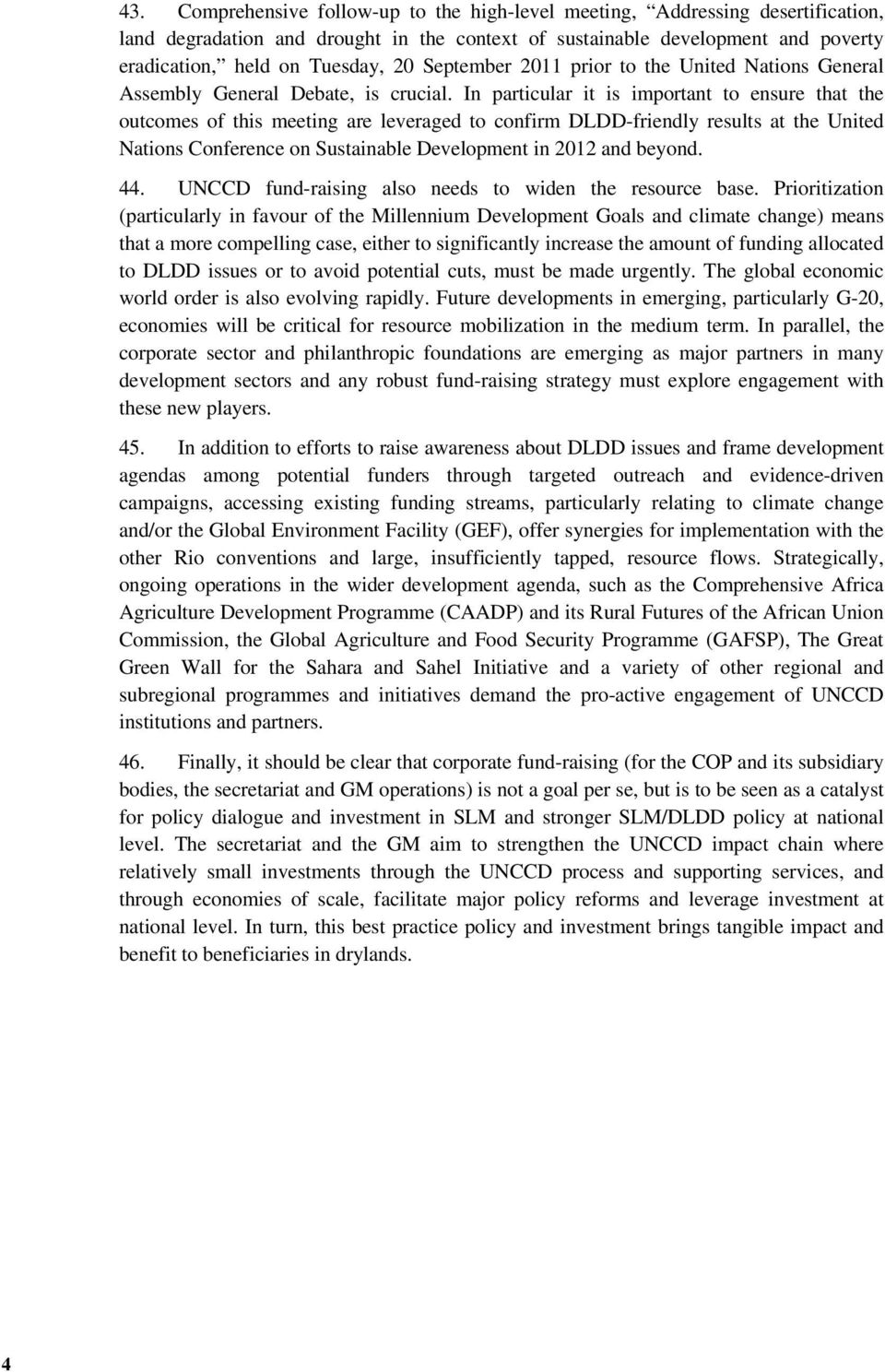
5 Figure The common fund-raising strategy impact chain Resources (Funds raised and used in the United Nations Convention to Combat Desertification process) Activities (participation of affected countries in policy and decision-making, strengthened science-policy dialogue, regional work programmes, enhanced collaboration with partner agencies on critical issues, communications) Output (best desertification/land degradation and drought (DLDD) evidence and policy guidance available, accessible and understood at local, national and global levels) Usage (by policymakers at local, national and global levels, including accelerated take-up by multilateral and bilateral development partners, development banks, the corporate sector) Outcome (best practice in sustainable land management (SLM) and addressing DLDD is implemented across affected countries and financing is mainstreamed into domestic budgets and development agendas) Impact (living conditions of affected populations and the condition of affected ecosystems enhanced; land-based mitigation of climate change, greater biodiversity) 4. Financial target 47. Parties mandated that fund-raising should respond to defined resource needs. While the overarching fund-raising strategy is designed to cover corporate/institutional fundraising for the period , the financial target to measure the success of the fundraising strategy is set as the result of the gap identified in the costed two-year work programme to be approved at the tenth session of the COP (COP 10). The secretariat and the GM will therefore benchmark and measure success in terms of the proportion of UNCCD work packages receiving adequate funding. 5
6 In order to implement the work plans and work programmes of the Committee on Science and Technology, Committee for the Review of the Implementation of the Convention and the secretariat, and to support GM operations, supplementary (voluntary) funds will be required for: Participation at sessions of the COP and its subsidiary bodies Servicing of the COP and its subsidiary bodies (i.e. impact and performance reporting process and scientific conferences) Processes leading to a COP decision that will have an impact at country level (economics of land degradation, national action programme alignment) Work programmes of the regional coordination mechanisms Support to eligible affected country Parties yet to be quantified. Corporate/institutional fund-raising targets exclude funds available from core budget resources and resources mobilized at eligible country level for SLM/DLDD. 48. In order to achieve the financial target mentioned in paragraph 47, actionable objectives of the common fund-raising strategy have been developed and are listed under five distinct fund-raising goals. (a) (i) (ii) Goal 1. Resource needs and priorities are clearly documented: To improve priority setting for financing DLDD interventions in the face of limited resource flows: Streamline the use of existing core budget resources between the secretariat and the GM and budget check all proposed activities against core or available resources; To more effectively, convincingly and compellingly communicate the financial requirements for the implementation of the UNCCD process and improve the understanding and commitment of Parties and potential partners: Produce a Financial Resource Requirement brochure including (1) a statement of resources mobilized and managed; (2) a statement of specific needs for the coming biennium, including available funding, gaps and priorities; (3) an impact statement on failure to mobilize; and (4) development partner recognition and acknowledgement. (b) Goal 2. Advocacy to ensure policymakers and development partners are fully cognizant of the importance of comprehensive action on DLDD issues and the intrinsic value of the UNCCD process: (i) To integrate DLDD issues into development cooperation plans and priorities of bilateral and multilateral partners and foundations by framing the policy setting environment, using the advocacy policy frameworks: Identify, engage and collaborate with a network of key decision makers (e.g. parliamentarians, representatives and influencers from Organization for Economic Cooperation and Development (OECD) and Group of Twenty (G-20) countries); 6

7 (ii) To assess the economic costs of DLDD issues: Facilitate the collection and dissemination of key evidence/outcomes from the 2nd UNCCD Scientific Conference and the economics of land degradation initiative for policy making/fund-raising; (iii) To ensure the policy setting environment is conducive to fund-raising: Personalize the issue of DLDD for the public and investors through the development of practical positive steps that can be taken by citizens and strengthen relations with civil society as an agent for behavioural change, advocacy and fund-raising; (iv) (v) (vi) To speak to policymakers and funders with relevance and authority: Ensure internal assets and a network of SLM champions and dryland ambassadors are used for fund-raising and advocacy for resource mobilization purposes; To frame and implement a biannual campaign on a critical theme with a significant funding shortfall: Proposal on science, knowledge and capacity-building; To distil and produce concise, forward-looking materials tailored to fund specific needs and timelines, based on the advocacy policy frameworks. (c) partners: (i) (ii) (iii) (iv) (v) (vi) (vii) Goal 3. Consistent and systematic outreach with potential development To establish a mechanism for regular ongoing virtual communication with potential partners, as requested: electronic mailing list (e.g. LISTSERV), video/teleconferencing, online chats; To facilitate an annual consultation or meetings of interested Parties with potential partners on matching specific themes/issues with their strategic priorities; To carry out an analysis of development partner constraints on contributing to UNCCD processes and work collaboratively on new modes of delivery; To agree on a calendar of opportunities and deadlines (i.e. advocacy visits, speaking tours) with bilateral and multilateral development partners to support internal advocacy for DLDD issues; To map and engage a network of foundations interested in environmental issues and keep them regularly informed about UNCCD, particularly regarding DLDD issues; To systematically engage and work with multilateral/regional platforms (e.g. Global Donor Platform for Rural Development, the Global Drylands Report, regional and international financial institutions including development banks and economic communities, GEF, reducing emissions from deforestation and forest degradation (REDD+); European Union, African, Caribbean and Pacific (ACP) Group of States; To strengthen the UNCCD business forum and develop a value proposition for corporate sector engagement on DLDD issues, identify business champions and innovators, explore practical options and mechanisms for engagement and commitment. 7
8 (d) (i) (ii) Goal 4. Explore non-traditional funding streams for UNCCD issues: To map and connect with non-traditional partners (in sectors such as health and education): Develop value propositions and appropriate work packages for these new sectors; To develop a tangible marketing product/approach for UNCCD and DLDD issues to strengthen presence and brand identity; (iii) To hold a consultation on opportunities in affected countries: Explore markets and trademarks for unique dryland sustainable products; examine cofinancing payment schemes for land management and ecosystem services. (e) (i) (ii) Goal 5. Develop internal fund-raising capacity: To establish and coordinate a network (community of practice) for DLDD resource mobilization composed of officers invited from each like-minded partner agency: Establish product/service-driven terms of reference to guide collaboration; To collaborate with colleagues to ensure linkages between evidence, policy, advocacy and communications are enhanced to support fund-raising: Develop a common key message platform for use with policymakers and funders, and communicate the impact chain more effectively; (iii) To strengthen synergies with other Rio conventions (United Nations Framework Convention on Climate Change, Convention on Biological Diversity) and GEF on advocacy, resource mobilization and fund-raising; (iv) (v) (vi) (vii) To establish a monitoring mechanism to review evolving priorities, strategies, systems and key contacts among partners; To establish and respect an annual calendar for the submission/reporting of proposals; To develop a more standardized approach to partnership: Move towards thematic multi-stakeholder partnerships where the complementary strengths and core competencies, resources and assets (joint delivery and in-kind contribution) of multiple partners can be better aligned. Partnerships might be envisioned around, for example, food security or soil carbon; To develop an online centre for partnering: Explore matchmaker functions to match available resources and skills with a bank of suitable projects. 5. Implementation of the common fund-raising strategy 49. The effective implementation of the common fund-raising strategy will require the commitment and practical collaboration of relevant UNCCD stakeholders at every level. 50. Risks and assumptions include the following: (a) Future shocks do not have a fundamental impact on the social, political or economic situation in donor countries; (b) The science-policy dialogue and best practice is continually strengthened in order to provide the best possible guidance on the implementation of comprehensive action on DLDD/SLM; 8
9 (c) The ability of UNCCD to continually leverage opportunities to strengthen political will and to thoroughly understand and convincingly communicate needs must be reinforced. Activities are addressed through the biannual joint work programme of the secretariat and the GM. The establishment of a network for DLDD resource mobilization (Goal 5 paragraph 48 (e) (i) of this fund-raising strategy) should enhance our ability to deliver on our fund-raising targets in a spirit of partnership as agencies work collaboratively to support the implementation of this strategy. 9
How To Implement The Convention
 Decision 3/COP.8 The 10-year strategic plan and framework to enhance the implementation of the Convention The Conference of the Parties, Having reviewed documents ICCD/COP(8)/10, ICCD/COP(8)/10/Add.1 and
REPORT OF THE CONFERENCE OF THE PARTIES ON ITS SEVENTH SESSION, HELD AT MARRAKESH FROM 29 OCTOBER TO 10 NOVEMBER 2001 Addendum
 UNITED NATIONS Distr. GENERAL FCCC/CP/2001/13/Add.1 21 January 2002 Original: ENGLISH CONFERENCE OF THE PARTIES REPORT OF THE CONFERENCE OF THE PARTIES ON ITS SEVENTH SESSION, HELD AT MARRAKESH FROM 29
192 EX/6. Executive Board Hundred and ninety-second session
 Executive Board Hundred and ninety-second session 192 EX/6 PARIS, 31 July 2013 Original: English Item 6 of the provisional agenda PROPOSAL FOR A GLOBAL ACTION PROGRAMME ON EDUCATION FOR SUSTAINABLE DEVELOPMENT
OUTLINE. Source: 36 C/Resolution 16, 190 EX/Decision 9 and 192 EX/Decision 6.
 37th Session, Paris, 2013 37 C 37 C/57 4 November 2013 Original: English Item 5.19 of the provisional agenda PROPOSAL FOR A GLOBAL ACTION PROGRAMME ON EDUCATION FOR SUSTAINABLE DEVELOPMENT AS FOLLOW-UP
Sustainable Land Management in the Global Environment Facility. GEF Role as Financial Mechanism of the UNCCD
 Sustainable Land Management in the Global Environment Facility GEF Role as Financial Mechanism of the UNCCD GEF as Financial Mechanism of the UNCCD Land Degradation Focal Area as main GEF financing window
GLOBAL ALLIANCE FOR CLIMATE-SMART AGRICULTURE (GACSA)
 GLOBAL ALLIANCE FOR CLIMATE-SMART AGRICULTURE (GACSA) FRAMEWORK DOCUMENT Version 01 :: 1 September 2014 I Vision 1. In today s world there is enough food produced for all to be well-fed, but one person
International environmental governance. Bali Strategic Plan for Technology Support and Capacity-building
 UNITED NATIONS UNEP/GC.23/6/Add.1 EP Governing Council of the United Nations Environment Programme Distr.: General 23 December 2004 Original: English Twenty-third session of the Governing Council/ Global
Advance unedited version. Decision -/CP.13. Bali Action Plan
 The Conference of the Parties, Decision -/CP.13 Bali Action Plan Resolving to urgently enhance implementation of the Convention in order to achieve its ultimate objective in full accordance with its principles
THE UNCCD & BUSINESS: PARTNERSHIP OPPORTUNITIES FOR SUSTAINABLE LAND MANAGEMENT
 THE UNCCD & BUSINESS: PARTNERSHIP OPPORTUNITIES FOR SUSTAINABLE LAND MANAGEMENT Context COP 10 1 decided to grant observer status and participation in official meetings of the governing bodies of the UNCCD
Draft Concept Note Ministry of Foreign Affairs, Republic of Korea. The 2014 Busan Global Partnership Workshop 6-7 November, Seoul. 1.
 Draft Concept Note Ministry of Foreign Affairs, Republic of Korea The 2014 Busan Global Partnership Workshop 6-7 November, Seoul 1. Background 1.1. Global Partnership for Effective Development Co-Operation
Proposed medium-term plan for the period 2002-2005
 United Nations A/55/6 (Prog. 9) General Assembly Distr.: General 18 April 2000 Original: English Fifty-fifth session Item 120 of the preliminary list* Programme planning Contents Proposed medium-term plan
MINISTERIAL MEETING OF THE BLUE WEEK 2015
 5 JUNE 2015 MINISTERIAL MEETING OF THE BLUE WEEK 2015 We, Ministers responsible for Ocean/ Fisheries/ Maritime Affairs, having met in Lisbon on June the 5 th, 2015, at the invitation of the Minister of
Draft conclusions proposed by the Chair. Recommendation of the Subsidiary Body for Implementation
 United Nations FCCC/SBI/2012/L.47 Distr.: Limited 1 December 2012 Original: English Subsidiary Body for Implementation Thirty-seventh session Doha, 26 November to 1 December 2012 Agenda item 14 Article
E VIRO ME T Council meeting Luxembourg, 14 October 2013
 COU CIL OF THE EUROPEA U IO EN Conclusions on Preparations for the 19th session of the Conference of the Parties (COP 19) to the United ations Framework Convention on Climate Change and the 9th session
High-level Panel on Global Sustainability Third Meeting of the Panel Helsinki, 16-17 May 2011. Meeting Report
 I. Introduction High-level Panel on Global Sustainability Third Meeting of the Panel Helsinki, 16-17 May 2011 Meeting Report Prepared by the Panel secretariat with guidance from the Co-Chairs 1. The third
Council conclusions on a transformative post-2015 agenda. General Affairs Council meeting Brussels, 16 December 2014
 Council of the European Union PRESS EN COUNCIL CONCLUSIONS Brussels, 16 December 2014 Council conclusions on a transformative post-2015 agenda General Affairs Council meeting Brussels, 16 December 2014
FINAL. World Education Forum. The Dakar Framework for Action. Education For All: Meeting our Collective Commitments. Revised Final Draft
 28/04/2000, 3 P.m. FINAL The Dakar Framework for Action Education For All: Meeting our Collective Commitments Revised Final Draft World Education Forum Dakar, Senegal, 26-28 April 2000 1 1 The Dakar Framework
TERMS OF REFERENCE N 025/2015
 TERMS OF REFERENCE N 025/2015 Ref: RedLAC CAFÉ Knowledge for Action Project Project K Specialist consultant(s) for content development and workshop moderation on the topic Negotiations with the private
Draft Resolution on Science, technology and innovation for development
 1 Draft Resolution on Science, technology and innovation for development The Economic and Social Council, Recognizing the role of the Commission on Science and Technology for Development as the United
The Copenhagen Decisions. Submission on the outcome of the Ad Hoc Working Group on Long Term Cooperative Action under the Convention under item 3
 The Copenhagen Decisions Submission on the outcome of the Ad Hoc Working Group on Long Term Cooperative Action under the Convention under item 3 Proposal by the African Group Rev.1 (Copenhagen Denmark,
Original: English Rio de Janeiro, Brazil 20-22 June 2012
 United Nations A/CONF.216/5* Distr.: General 19 June 2012 Original: English Rio de Janeiro, Brazil 20-22 June 2012 Item 10 of the provisional agenda** Outcome of the Conference Letter dated 18 June 2012
Summary of UNICEF Private Fundraising and Partnerships Plan 2014-2017
 Summary of UNICEF Private Fundraising and Partnerships Plan 2014-2017 1. Introduction The Private Fundraising and Partnerships Plan supports the UNICEF Strategic Plan 2014 2017 and other organizational
Criteria, structure and steps to develop and operationalize them
 Guidance document on programme development and implementation for the Ten Year Framework of Programmes on Sustainable Consumption and Production (10YFP): Criteria, structure and steps to develop and operationalize
Draft decision -/CP.15. Copenhagen Accord
 UNITED NATIONS Distr. LIMITED FCCC/CP/2009/L.7 18 December 2009 Original : ENGLISH CONFERENCE OF THE PARTIES Fifteenth session Copenhagen, 7 18 December 2009 Agenda item 9 High-level segment Draft decision
REDD+ in the UN Climate Regime. Prof. Dr. Christina Voigt International Climate Change and Energy Law
 REDD+ in the UN Climate Regime Prof. Dr. Christina Voigt International Climate Change and Energy Law REDD People Forests Climate Change From this video/presentation: 1. What is REDD+? 2. Who should be
Framework Convention on Climate Change
 United Nations Framework Convention on Climate Change FCCC/CP/2010/7/Add.1 Distr.: General 15 March 2011 Original: English Conference of the Parties Contents Report of the Conference of the Parties on
Discussion Paper on Follow-up and Review of the Post-2015 Development Agenda - 12 May 2015
 Discussion Paper on Follow-up and Review of the Post-2015 Development Agenda - 12 May 2015 Introduction This discussion paper outlines some key elements on follow-up and review which have emerged from
ICCD/COP(12)/CST/INF.5
 United Nations Convention to Combat Desertification ICCD/COP(12)/CST/INF.5 Distr.: General 13 August 2015 English only Conference of the Parties Committee on Science and Technology Twelfth session Ankara,
Outcome of the work of the Ad Hoc Working Group on long-term Cooperative Action under the Convention
 Advance unedited version Draft decision -/CP.16 Outcome of the work of the Ad Hoc Working Group on long-term Cooperative Action under the Convention The Conference of the Parties Recalling its decision
July 7, 2009 DESIGN DOCUMENT FOR THE FOREST INVESTMENT PROGRAM, A TARGETED PROGRAM UNDER THE SCF TRUST FUND
 July 7, 2009 DESIGN DOCUMENT FOR THE FOREST INVESTMENT PROGRAM, A TARGETED PROGRAM UNDER THE SCF TRUST FUND 2 I. BACKGROUND 1. There is increasing consensus that addressing climate change is central to
Centre International de Droit Comparé de l Environnement CIDCE. Comments on the Zero draft of the Post 2015 framework for disaster risk reduction
 Centre International de Droit Comparé de l Environnement CIDCE Comments on the Zero draft of the Post 2015 framework for disaster risk reduction Paragraph n (1,2,3,...), page Comments A. Preambule 5. page
A/58/210. General Assembly. United Nations
 United Nations General Assembly Distr.: General 1 August 2003 Original: English A/58/210 Fifty-eighth session Item 97 of the provisional agenda* Implementation of Agenda 21, the Programme for the Further
Report of the Conference of the Parties on its nineteenth session, held in Warsaw from 11 to 23 November 2013
 United Nations FCCC/CP/2013/10/Add.1 Distr.: General 31 January 2014 Original: English Conference of the Parties Contents Report of the Conference of the Parties on its nineteenth session, held in Warsaw
U.S. Submission on Elements of the 2015 Agreement Introduction
 U.S. Submission on Elements of the 2015 Agreement Introduction The United States is pleased to present its views on elements of the 2015 agreement. Before turning to specific elements, we would like to
Report of the Conference of the Parties on its thirteenth session, held in Bali from 3 to 15 December 2007
 UNITED NATIONS Distr. GENERAL FCCC/CP/2007/6/Add.1 * 14 March 2008 Original: ENGLISH CONFERENCE OF THE PARTIES Report of the Conference of the Parties on its thirteenth session, held in Bali from 3 to
Brief on Climate Change Finance
 Brief on Climate Change Finance Introduction Climate change is a complex policy issue with major implications in terms of finance. All actions to address climate change ultimately involve costs. Funding
How To Help The World Coffee Sector
 ICC 105 19 Rev. 1 16 October 2012 Original: English E International Coffee Council 109 th Session 24 28 September 2012 London, United Kingdom Strategic action plan for the International Coffee Organization
The United Nations Environment Programme and the 2030 Agenda. Global Action for People and the Planet
 The United Nations Environment Programme and the 2030 Agenda Global Action for People and the Planet Unemployment, resource scarcity, climate change, food insecurity and inequity all signal the need for
AFRICAN BIOSPHERE RESERVES NETWORK AfriMAB
 AFRICAN BIOSPHERE RESERVES NETWORK AfriMAB Preamble 1. Considering that biosphere reserves are set up with the aim of promoting a balanced relationship between human beings and the Biosphere ; 2. Considering
Diversity of Cultural Expressions INTERGOVERNMENTAL COMMITTEE FOR THE PROTECTION AND PROMOTION OF THE DIVERSITY OF CULTURAL EXPRESSIONS
 Diversity of Cultural Expressions 1.EXT.IGC Distribution limited CE/08/1.EXT.IGC/Dec. Rev. 2 Paris, 20 August 2008 Original: English / French INTERGOVERNMENTAL COMMITTEE FOR THE PROTECTION AND PROMOTION
Decision PC.2/dc.1 on the Interim Work Programme 2009/2010
 PREPARATORY COMMISSION FOR THE INTERNATIONAL RENEWABLE ENERGY AGENCY Annex 8: Decision on the Interim Work Programme 2009/2010 Report Annex 7 Second session Monday, 29 June 2009 Sharm El Sheikh International
Panel Remarks by Mr Mmboneni Muofhe, GEO Principal Alternate, Deputy Director General, Department of Science and Technology, South Africa
 UNGGIM- HLF, 20 22 April 2016, Addis Ababa, Ethiopia Session 1: Land Information for Sustainable Development Sub- Session: Addressing challenges confronting countries 20 April 2016: 15h45 17h00 Panel Remarks
G20 Agriculture Ministers Meeting Communiqué
 G20 Agriculture Ministers Meeting Communiqué Xi an, 3 June 2016 1. We, the G20 Agriculture Ministers, met today in Xi an to discuss how G20 members can promote food security, nutrition, sustainable agricultural
Recognizing that women smallholder farmers constitute the majority of food producers, but remain vulnerable and require targeted support;
 DECLARATION OF THE HIGH-LEVEL MEETING Toward African Renaissance: Renewed Partnership for a Unified Approach to End Hunger in Africa by 2025 under the Framework the Comprehensive Africa Agriculture Development
FCCC/CP/2015/L.9/Rev.1
 + United Nations FCCC/CP/2015/L.9/Rev.1 Distr.: Limited 12 December 2015 Original: English Conference of the Parties Twenty-first session Paris, 30 November to 11 December 2015 Agenda item 4(b) Durban
Environmental governance
 Environmental governance United Nations Environment Programme An overview Governing our planet s rich and diverse natural resources is an increasingly complex challenge. In our globalised world of interconnected
April 2015 C 2015/31 E. Thirty-ninth Session. Rome, 6-13 June 2015. Global Soil Partnership - World Soil Charter
 April 2015 C 2015/31 E CONFERENCE Thirty-ninth Session Rome, 6-13 June 2015 Global Soil Partnership - World Soil Charter Executive Summary The FAO Conference adopted the World Soil Charter (WSC) at its
Position of the International Indigenous Peoples Forum on Climate Change (IIPFCC)* on current Climate Change negotiations. Bonn, Germany, June 2010
 Position of the International Indigenous Peoples Forum on Climate Change (IIPFCC)* on current Climate Change negotiations Bonn, Germany, June 2010 GENERAL PRINCIPLES The IIPFCC, gathered in Bonn on the
Forest Carbon Partnership Facility (FCPF)
 Forest Carbon Partnership Facility (FCPF) Readiness Mechanism Review and Assessment of Readiness Preparation Proposals DRAFT September 4, 2009 This Program Document updates Program Document FMT 2009-1-Rev.2
10721/16 GSC/lt 1 DGB 2B
 Council of the European Union Brussels, 28 June 2016 (OR. en) 10721/16 OUTCOME OF PROCEEDINGS From: General Secretariat of the Council On: 28 June 2016 To: Delegations No. prev. doc.: 10320/16 REV 1 Subject:
EUROCLIMA regional cooperation programme: science and networking for climate-smart public policies
 EUROCLIMA regional cooperation programme: science and networking for climate-smart public policies Thursday 30th August 2012 Tallinn, Estonia Jan Karremans Director Technical Assistance 1 Institutional
Land Degradation (Desertification and Deforestation) Strategy
 Land Degradation (Desertification and Deforestation) Strategy Background The Land Degradation Focal Area (LD FA) directly supports the implementation of the UNCCD, as an operating entity of the Financial
Resolution XII.13. Wetlands and disaster risk reduction
 12 th Meeting of the Conference of the Parties to the Convention on Wetlands (Ramsar, Iran, 1971) Punta del Este, Uruguay, 1-9 June 2015 Resolution XII.13 Wetlands and disaster risk reduction 1. RECALLING
UNITED NATIONS COMMISSION ON SCIENCE AND TECHNOLOGY FOR DEVELOPMENT
 UNITED NATIONS COMMISSION ON SCIENCE AND TECHNOLOGY FOR DEVELOPMENT Chairman s draft recommendations on the basis of the consolidated version of the rolling document A. Shaping the outcomes of IGF meetings
FCCC/SBI/2015/3/Add.2
 United Nations FCCC/SBI/2015/3/Add.2 Distr.: General 22 April 2015 English only Subsidiary Body for Implementation Forty-second session Bonn, 1 11 June 2015 Item 15(b) of the provisional agenda Administrative,
PRACTICAL STRATEGIES FOR IMMEDIATE PROGRESS ON CLIMATE CHANGE BUILDING BLOCKS FOR A GLOBAL AGREEMENT
 PRACTICAL STRATEGIES FOR IMMEDIATE PROGRESS ON CLIMATE CHANGE BUILDING BLOCKS FOR A GLOBAL AGREEMENT Forging an effective response to climate change is one of the international community s highest priorities.
Ministerial Declaration of The Hague on Water Security in the 21st Century
 Ministerial Declaration of The Hague on Water Security in the 21st Century 1. Water is vital for the life and health of people and ecosystems and a basic requirement for the development of countries, but
Questions and Answers on the European Commission Communication: The Paris Protocol A blueprint for tackling global climate change beyond 2020
 European Commission - Fact Sheet Questions and Answers on the European Commission Communication: The Paris Protocol A blueprint for tackling global climate change beyond 2020 Brussels, 25 February 2015
DRY LAND, LIVELIHOODS AND GENDER PROGRAM
 DRY LAND, LIVELIHOODS AND GENDER PROGRAM West Asia Regional Office RCF Nov. 12th, 2015 IUCN STRATEGY ON DRYLANDS BASED ON A NUMBER OF IUCN RESOLUTIONS) The IUCN Strategy on Drylands 2010-2020 was drafted
Fact sheet: STEPPING UP INTERNATIONAL ACTION ON CLIMATE CHANGE The Road to Copenhagen
 Fact sheet: STEPPING UP INTERNATIONAL ACTION ON CLIMATE CHANGE The Road to Copenhagen Introduction Climate change is today widely recognized as one of mankind s greatest challenges in the 21st century.
SUN Donor Network. I. Introduction
 SUN Donor Network I. Introduction Donors are one of five key constituencies supporting the global movement to Scale Up Nutrition. At the country level SUN donors usually form a coordination group, if this
ETI PERSPECTIVE 2020: A FIVE YEAR STRATEGY
 ETI PERSPECTIVE 2020: A FIVE YEAR STRATEGY Introduction This document is the final and Board approved version of ETI s strategic directions based on the ETI Board meeting discussion of 12 th March 2015.
4: Proposals for Best Practice Principles for GHP activities at country level
 DOC 2.05-8.1 From: WORKING GROUP ON GLOBAL HEALTH PARTNERSHIPS: REPORT --- BEST PRACTICE PRINCIPLES FOR GLOBAL HEALTH PARTNERSHIP ACTIVITIES AT COUNTRY LEVEL (Oct. 2005) 4: Proposals for Best Practice
Executive Board of the United Nations Entity for Gender Equality and the Empowerment of Women
 United Nations UNW/2015/CRP.8 Executive Board of the United Nations Entity for Gender Equality and the of Women Distr.: Limited 23 April 2015 Original: English Annual session of 2015 30 June - 2 July 2015
Hanover Declaration Local Action Driving Transformation
 Hanover Declaration Local Action Driving Transformation 1 National Governments: Build upon local authority climate leadership! The International Conference on Climate Action 2015 (ICCA2015) showed that
Resolution on ''Science and Technology for Development''
 UNITED NATIONS ECONOMIC AND SOCIAL COUNCIL (ECOSOC) July 2009 Session 2009/8 Resolution on ''Science and Technology for Development'' Resolution 2009/8 Science and technology for development The Economic
VACANCY ANNOUNCEMENT: EVIDENCE, LEARNING & ACCOUNTABILITY COORDINATOR NO.VA/NPCA/16/05
 VACANCY ANNOUNCEMENT: EVIDENCE, LEARNING & ACCOUNTABILITY COORDINATOR NO.VA/NPCA/16/05 The African Union (AU), established as a unique Pan African continental body, is charged with spearheading Africa
Draft Programme Document
 Draft Programme Document CHANGE MANAGEMENT, PUBLIC SECTOR DEVELOPMENT AND PROGRAMME SUPPORT A Programme under the National Agriculture Development Framework APRIL 2009 1 Table of Contents I. Executive
Rio Political Declaration on Social Determinants of Health
 Rio Political Declaration on Social Determinants of Health Rio de Janeiro, Brazil, 21 October 2011 1. Invited by the World Health Organization, we, Heads of Government, Ministers and government representatives
Safe Water Quality for All Uses: Promoting science-based policy responses to water quality challenges
 Complementary Additional Programme 2014-2015 / Concept note Safe Water Quality for All Uses: Promoting science-based policy responses to water quality challenges Geographical scope/benefitting country(ies):
Financial sector leadership on natural capital
 Financial sector leadership on natural capital The Natural Capital Declaration A commitment by financial institutions to mainstream natural capital in financial products and in accounting, disclosure and
expanding bilateral cooperation in research and development, especially in renewable energy higher education
 VII EU-Mexico Summit Brussels, 12 June 2015 Joint Statement 1. We, the leaders of the European Union and the United Mexican States, met today in Brussels and agreed to foster a closer and stronger Strategic
RESEARCH AND POLICY SUPPORT BUSINESS PLAN 2013-2016
 RESEARCH AND POLICY SUPPORT BUSINESS PLAN 2013-2016 Summary EUROPEAN FOREST INSTITUTE Yliopistokatu 6 80100 Joensuu Tel. +358 10 773 4300 www.efi.int Tactics consists on knowing what to do when and where
Ecosystem Services and Convention on Biological Diversity How ecosystem services are reflected in the CBD COP Decisions in Nagoya?
 Ecosystem Services and Convention on Biological Diversity How ecosystem services are reflected in the CBD COP Decisions in Nagoya? Heikki Toivonen Finnish Environment Institute Ecosystem services and Biodiversity,
new challenges and how its delivery can be improved in order to maximise its impact in the future.
 Contribution of the Kent, Greater Essex and East Sussex Local Enterprise Partnership to the consultation on the conclusions of the Fifth Cohesion Report on Economic, social and territorial cohesion: the
Summary of ExCo 15 Discussion and Recommendations to the CGIAR on CGIAR Change Management Process 1
 Summary of ExCo 15 Discussion and Recommendations to the CGIAR on CGIAR Change Management Process 1 Integrated CGIAR Reform Proposal Change Steering Team (CST) Chair, Rodney Cooke and Co-Chair, Jonathan
Decision IPBES-2/5: Work programme for the period 2014 2018
 Decision IPBES-2/5: Work programme for the period 2014 2018 The Plenary, Welcoming the draft work programme of the Intergovernmental Science-Policy Platform on Biodiversity and Ecosystem Services for the
I. Organizational issues in the field
 Report of the Conference of the Parties of the Stockholm Convention on Persistent Organic Pollutants on the work of its fourth meeting (UNEP/POPS/COP.4/38) (Extract) SC-4/34: Enhancing cooperation and
Produced by the UNCSD Secretariat, February 2012. A Green Economy Knowledge-Sharing Platform: Exploring Options
 INFORMATION NOTE Produced by the UNCSD Secretariat, March 2012 Produced by the UNCSD Secretariat, February 2012 A Green Economy Knowledge-Sharing Platform: Exploring Options Executive Summary A potential
THE ESTABLISHMENT OF A HELPDESK FOR INTEGRATED FLOOD MANAGEMENT
 FRAMEWORK DOCUMENT FOR THE ESTABLISHMENT OF A HELPDESK FOR INTEGRATED FLOOD MANAGEMENT This document sets out the basic objectives, structure and roles of the HelpDesk for Integrated Flood Management.
TAP Network Response to the Post-2015 Z ero Draft
 TAP Network Response to the Post-2015 Z ero Draft The Zero Draft of the Outcome Document for the Post-2015 Development Agenda represents a critical juncture in laying out a new sustainable development
FCCC/SBSTA/2016/1. United Nations. Provisional agenda and annotations. I. Provisional agenda
 United Nations FCCC/SBSTA/2016/1 Distr.: General 7 March 2016 Original: English Subsidiary Body for Scientific and Technological Advice Forty-fourth session Bonn, 16 26 May 2016 Item 2 of the provisional
Having undertaken a general discussion on the basis of Report IV, Small and medium-sized enterprises and decent and productive employment creation,
 International Labour Conference Provisional Record 104th Session, Geneva, June 2015 11-1 Fourth item on the agenda: Small and medium-sized enterprises and decent and productive employment creation Reports
Perspective. The Hanoi Communiqué
 The Hanoi Communiqué The Ministers, representatives of countries, practitioners, scientists, civil society, private sector, and all other participants present at the 2 nd Global Conference on Agriculture,
A COLLABORATIVE FRAMEWORK FOR GUIDING POST-MFA ACTIONS. MFA Forum
 FOR GUIDING POST-MFA ACTIONS MFA Forum March 2005 CONTENTS The Context... 1 The MFA Forum... 1 The Need for Action... 2 Shared Responsibilities... 3 Overarching Principles... 5 The Roles of Individual
TERMINAL EVALUATION TERMS OF REFERENCE
 TERMINAL EVALUATION TERMS OF REFERENCE BASIC INFORMATON Location: Uganda Application Deadline: July 30 th, 2015 Type of Contract: Individual Contract Post Level: International Consultant Languages Required:
A GLOBAL STRATEGY OF MIGRATION FOR DEVELOPMENT
 A GLOBAL STRATEGY OF MIGRATION FOR DEVELOPMENT BEYOND THE MIDA APPROACH TO MOBILIZING AND SHARING OF HUMAN AND FINANCIAL RESOURCES OF THE OVERSEAS AFRICAN COMMUNITY 2006-2010 Geneva, June 2006 FOREWORD
DRYLAND SYSTEMS Science for better food security and livelihoods in the dry areas
 DRYLAND SYSTEMS Science for better food security and livelihoods in the dry areas CGIAR Research Program on Dryland Agricultural Production Systems The global research partnership to improve agricultural
2011 Tunza International Children and Youth Conference Bandung Declaration October 1, 2011. The Voice of Children & Youth for Rio+20
 1 2 3 4 5 6 7 8 9 10 11 12 13 14 15 16 17 18 19 20 21 22 23 24 25 26 27 28 29 30 31 32 33 2011 Tunza International Children and Youth Conference Bandung Declaration October 1, 2011 The Voice of Children
PROPOSED MANDATE FOR THE GLOBAL PARTNERSHIP FOR EFFECTIVE DEVELOPMENT CO-OPERATION
 PROPOSED MANDATE FOR THE GLOBAL PARTNERSHIP FOR EFFECTIVE DEVELOPMENT CO-OPERATION This document sets out the proposed mandate of the Global Partnership for Effective Development Co-operation. It was discussed