
SET Based Technicians
|
|
|
- Delphia Patricia Short
- 10 years ago
- Views:
Transcription
1 SET Based Technicians Lessons from the UK and European Labour Force Surveys Nick Jagger, Maria Sigala, Freddie Sumption REPORT 475

2 Institute for Employment Studies IES is an independent, apolitical, international centre of research and consultancy in HR issues. It works closely with employers in all sectors, government departments, agencies, professional bodies and associations. IES is a focus of knowledge and practical experience in employment and training policy, the operation of labour markets, and HR planning and development. IES is a not forprofit organisation. Acknowledgements We would like to thank Daniel Sanford Smith, of the Gatsby Foundation, who not only commissioned this work, but who has by helpful questions and suggestions guided the research and reporting in the direction it is now facing. We would also like to thank Tom Levesley and James Walker Hebborn who have supported in many ways the project from within IES. Institute for Employment Studies Sovereign House Church Street Brighton BN1 1UJ UK Telephone: 44 (0) askies@employment studies.co.uk Website: studies.co.uk Copyright 2010 Institute for Employment Studies ISBN:
3 Contents Executive Summary 1 Introduction Objectives UK Labour Force Survey European LFS Structure of report 6 2 Level 4 SET Based Technicians Numbers Levels of qualification Gender Age Demographics Ethnicity Incidence of training Hourly income from ASHE Summary of UK Level 4 SET 13 3 Level 3 SET Based Technicians Numbers Levels of qualification Gender Age Demographics Ethnicity Incidence of training Hourly income from ASHE Summary of UK Level 3 SET 24 vi iii

4 4 European SET Based Technicians Physical and engineering science Computer associate Optical and electronic equipment operators Ship and aircraft controllers and Safety and quality inspectors Life science and related associate professionals Health associate professions (except nursing) 52 5 National Analyses Austria Belgium Bulgaria Switzerland Cyprus Czech Republic Germany Denmark Estonia Spain Finland France Greece Hungary Ireland Italy Lithuania Luxembourg Latvia Malta Netherlands Norway Poland Portugal Romania Sweden Slovenia Slovakia United Kingdom 88 iv

5 6 Summary and Implications for the UK Relative numbers of SET Relative qualification levels Relative levels of training Sectoral linkage Potential policy response 94 7 Bibliography 96 Appendix 1 97 Appendix v

6 Executive Summary This report examines critical features of Science, Engineering and Technology (SET) based working in the UK and compares these to working in other countries across the European Economic Areas (EEA). The main messages of the report are as follows: The main labour market data source, the Labour Force Survey (LFS), does not collect information on the subject of an individual s highest qualification. This means that SET need to be identified on the basis of occupations. Within the UK, where we have a more detailed occupational classification available, it is possible to identify two groups of SET : Level 4 SET based with on average higher level qualifications. Level 3 SET based with on average lower level qualifications. Both the Level 4 and Level 3 had significant numbers of people who only had a Level 2 or below qualification. This suggests there is scope for upskilling the workforce through further qualifications. Using a different international classification, a broadly similar group of SET were identified across Europe. Comparison with this group showed that the UK SET were a smaller proportion of the workforce overall and were more likely to have university level qualification. The UK SET were more likely than their European counterparts to have received training, but less likely to be linked to specific sectors. vi

7 Introduction 1 1 Introduction 1.1 Objectives The aim of this study is to explore the supply of, and demand for, technician level Science, Engineering and Technology (SET) underpinning skills within the UK. This report is based on the analysis of the UK Labour Force Survey (LFS) and the linked European Labour Force Survey (ELFS) both of which provide a range of detailed labour market information. In particular, the surveys provide details of occupations and levels of qualification that are used to identify SET. 1.2 UK Labour Force Survey The UK LFS is a continuous, household based, sample survey which reports quarterly. The range of questions asked is designed to inform labour market policy and those used are consistent with the questions used by similar surveys across the European Union. The quarterly data is available for further analysis from the Office of National Statistics (ONS) and the proceeding analyses are based on this publicly available data. As the quarterly data is based on a sample of households the weighted results are subject to sampling error. This means that in practice data cells of less than 10,000 people from quarterly data are considered unreliable and are therefore suppressed in any published reports. It is possible to merge quarters together and if four quarters are merged to produce an annual view it is possible to publish cells of 6,000 and above. In order to examine details of specific SET technician occupations, we have found it necessary to merge 12 quarters, or three years of data, which allows cells of 3,000 and above to be published Defining Within the UK two approaches to examining SET technician level skills were adopted. Both approaches used a selection of SET technician occupations. This had

8 2 SET Based Technicians the benefit of producing a disaggregated view. However, a consequence of the disaggregated view is that this lowers the level of detail that is available from the analysis. Two groups of SET were identified: One group linked predominantly with National Qualifications Framework (NQF) Levels 4 and 5 and linked to the outcomes of Advanced Modern Apprenticeships and, hence, called Level 4 SET based. The second group linked predominantly with NQF Levels 2 and 3 and, hence, linked to the outcomes of Foundation Modern Apprenticeships and, therefore, called Level 3 SET based Why and how SET SET skills are generally defined by the possession of a higher level (first degree or above) qualification within these areas. We have deliberately used SET, rather than more recently used Science, Technology, Engineering and Mathematics (STEM) term, as, despite many occupations requiring numeracy, there are no occupations at the technician level based solely on mathematics. A further reason for using SET rather than STEM is that the area of interest excludes accountancy which require numeracy, but do not require scientific or technical underpinning knowledge. The preference for SET over STEM is compounded by the need to use existing standard classifications to allow linkage to a range of official data sources. This, in practice, means defining SET either in terms of the subject of an individual s highest qualification, or in terms of their occupation, which in turn is based upon their job title. However, with, who usually are qualified at below degree level, a problem with using subject of qualification exists. This is because the main data source used, the LFS, only codes the subject of the highest qualification for foundation degrees and above. This means that using the LFS we cannot identify SET on the basis of the subject and level of their highest qualification. Therefore, the current exercise focused on defining SET in terms of occupations as coded using the 2000 version of the Standard Occupational Classification or SOC A similar approach is also used when defining SET using the European LFS where occupations are coded using the International Standard Classification of Occupations (ISCO) Selection by level of qualification Using the latest available quarter of the LFS (July to September 2009), all four digit occupations were analysed by level of qualification. Particular focus was applied

9 Introduction 3 to occupations that had over 10,000 weighted workers in the occupation as this is the limit to reliability using a quarter of the LFS. Then all the occupations with 30 or over per cent at NQF Levels 2 or 3 were extracted. This approach identified those occupations traditionally occupied by those with technician level qualifications. A listing of all these occupations is contained in Appendix 1 of this report Further selection by occupation We then sought four digit SOC 2000 occupations within the following SOC major groups: Major Group 3: Associate professional and technical occupation. Major Group 5: Skilled trades occupations. These were selected as these occupational major groups were considered to correspond to the concept of technician. Finally, as well as meeting these criteria, the occupations had to have a significant proportion of SET underpinning knowledge. This was established by checking the occupational description given to each four digit SOC code (ONS, 2001) Differentiation by dominant level of qualification The above selection methods produced a selection of 23 four digit SOC 2000 occupations. These were then further examined by the highest level of qualification and were found to fall into two groups. Those that meet the above criteria and still had a substantial proportion qualified at first degree and above or at NQF 4 and above, we considered to be Level 4 SET based. The second group of four digit SOC codes had a far greater linkage to qualifications in the range of NQF Levels 2 and 3. In this case, all of these occupations had at least half qualified to this level. Therefore, this group of SET technician occupations has been called Level 3 SET. The Department of Business, Innovation and Skills (BIS) has produced a method to map the highest qualifications recorded within the LFS onto the NQF (BIS, 2009). Using this, we have taken the NQF Levels 4, 5 and 6, excluding teaching qualifications Level 4 SET based This approach produced the following occupations as Level 4 SET based. These had more than 20 per cent at NQF 6 and above as well as more
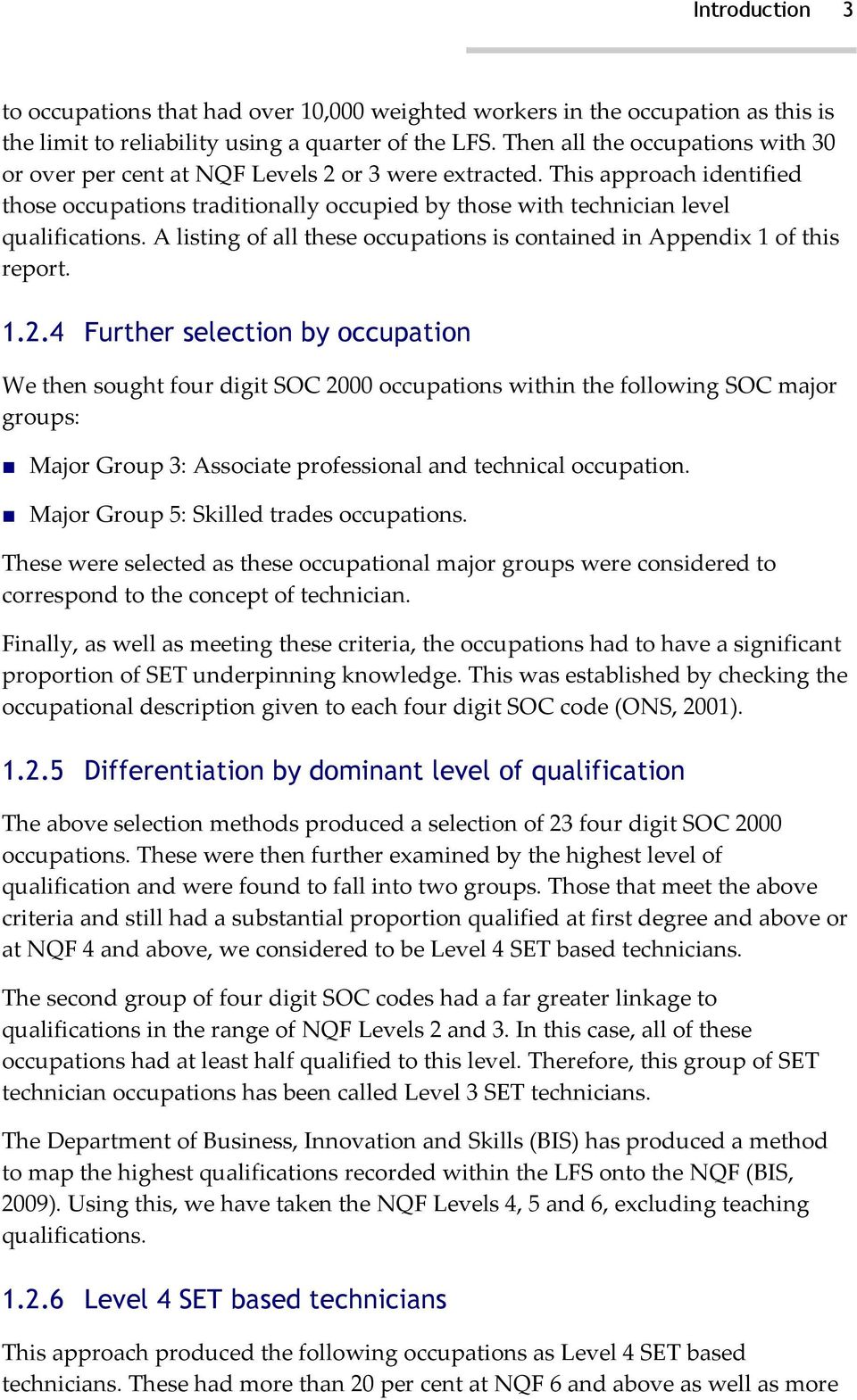
10 4 SET Based Technicians than 30 per cent at NQF Levels 2 and 3. However, the most common qualification level is NQF Level 4, hence the name. Details of the constituent occupations are provided in Appendix 1. Table 1.1: Level 4 SET based technician occupations Source: IES SOC 2000 Code Description 3111 Laboratory 3113 Engineering 3114 Building and civil engineering 3115 Quality assurance 3119 Science and engineering n.e.c IT operations 3132 IT user support 3218 Medical and dental 5245 Computer engineer, installation and maintenance In practice, many of those in these occupations were found to hold first degree and above level qualifications; however, the underlying assumption of the SOC classification is that Associate professional and technical as well as Skilled trades occupations are sub degree level qualifications. This in part reflects the great expansion of higher education, but also in part suggests that many people are over qualified for the job they do Level 3 SET based The approach outlined above also generated the concept of Level 3 SET based modelled on the Foundation Modern Apprenticeships. These four digit SOC codes had a far smaller proportion qualified at NQF Level 4 and above. They also had at least half of those in these occupations qualified at NQF level 2 and 3. Details are provided in Table 1.2.
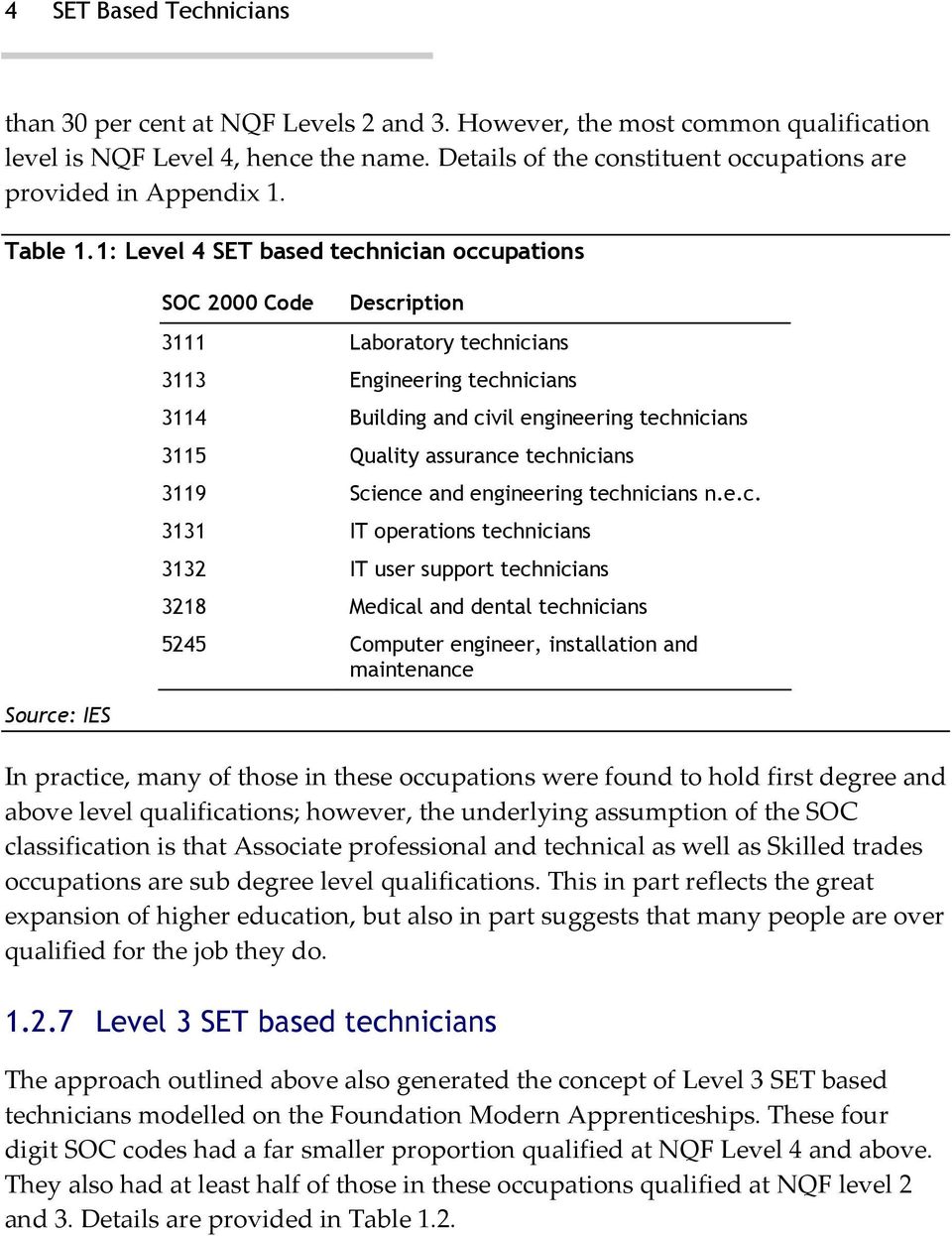
11 Introduction 5 Table 1.2: Level 3 SET based technician occupations Source: IES SOC 2000 Codes Description 3112 Electrical/electronics 3113 Engineering 3217 Pharmaceutical dispensers 5224 Precision instrument makers and repairers 5242 Telecommunications engineers 5243 Lines repairers and cable jointers 5213 Sheet metal workers 5215 Welding trades 5216 Pipe fitters 5221 Metal machine setter and setter operator 5222 Tool-makers, tool-fitters and markers-out 5241 Electricians and electrical fitters 5249 Electrical and electronic engineer n.e.c Plumbing, heating and ventilating engineers 1.3 European LFS In addition to analysing the UK LFS and Eurostat data extractions, we obtained special permission from Eurostat to analyse the ELFS microdata which contains information from 26 1 of the European Union countries plus Iceland and Norway. Additionally in this chapter, we have used some commissioned extractions from the ELFS which also contain data from Switzerland, Macedonia and Turkey. Eurostat ensure that the series of national LFS across Europe use compatible definitions and questions and are capable of generating data using consistent international standard classifications. These national surveys are then collated to produce a harmonised data set known as the ELFS. We have obtained extracts from the annual datasets which are constructed using quarterly datasets from the national statistical bodies who undertake their national surveys. In particular, the bulk of the data reported here comes from the 2008 annual dataset. Eurostat uses a variant of the ISCO, known as ISCO 88 COM. 1 Malta is not included as its small population and sample mean that confidentiality could be compromised by release of the microdata.

12 6 SET Based Technicians Table 1.3 provides a listing of the main SET based technician occupations within ISCO. The physical science and engineering science are clearly within the remit. However, the others are also consistent with the definitions used with the UK SOC 2000 classification shown in Table 1.1 and Table 1.2. Table 1.3: ISCO-88 codes for SET based technician occupations ISCO-88 codes Description 311 Physical and engineering science 312 Computer associate 313 Optical and electronic equipment operators 314 Ship and aircraft controllers and 315 Safety and quality inspectors 321 Life science and related associate professionals 322 Health associate professions (except nursing) Source: Eurostat ISCO 88 (COM) Documentation These are broadly similar to the UK SOC occupations included earlier. However, as the available ISCO data only uses three digits of coding, the ISCO SET are less finely described and have fewer sub categories. 1.4 Structure of report The rest of the report consists of five additional chapters: Chapter 2 Level 4 SET Based Technicians. Chapter 3 Level 3 SET Based Technicians. Chapter 4 European SET Based Technicians. Chapter 5 National Analyses. Chapter 6 Summary and Implications for the UK.

13 Level 4 SET Based Technicians 7 2 Level 4 SET Based Technicians This chapter uses the UK LFS to examine who have a SET underpinning knowledge and whose occupations generally require an NQF Level 4 and above qualification. Section provides details of the detailed occupations included in this category. The process used to identify this group of occupations is also described in Section 1.2. However, in summary, this involved the examination of detailed occupational titles and associated job titles in SOC Major Groups 3 and 5. The dominant highest educational level for each occupation was then used to divide these SET based technician occupations into those centred around NQF Level 3 and NQF Level 4. This chapter examines the SET technician occupations predominantly at NQF Level Numbers In order to obtain the maximum level of analysis, 12 quarters, or three years, of the LFS were aggregated to produce a larger sample. This procedure allows sub groups of 3,000 to be reliably reported rather than the 10,000 limit imposed when using a single quarter (ONS, 2003). This means that sometimes, for instance, the numbers of females cannot be reported while the numbers and proportion of males can be reported. The convention allows the numbers of males to be reported in this case but the precise proportions of males are subject to error if the numbers of females are not reported. Where the numbers are too small to report, they have been replaced in the tables by the symbol * *. This means that we created a 12 quarter sample covering 2007 to 2009, and in order to allow analysis over a five year time frame a further 12 quarter sample was also created covering the years 2001 to As well as producing a five year time frame, this is the longest available period available where SOC 2000 was used to code for occupations. Slight adjustments had to be made to the samples to account for changes in the way the highest level of qualification were coded over the period. Apart from this change, the other critical variables remained stable

14 8 SET Based Technicians over the period. This is partly because the critical variables were also used by Eurostat as part of the European LFS, and as the Eurostat definitions remained constant so did the corresponding definitions within the UK LFS. Table 2.1 provides the numbers within each Level 4 SET based technician occupation in 2001 to 2003 and 2007 to 2009 as well as the percentage change between the two periods. The largest four digit SOC occupation amongst the Level 4 SET based was IT operations. However, medical and dental showed the greatest growth in numbers with 3.3 per cent growth in between the two periods. Importantly, many of the occupations had shown a decline in numbers with IT user support showing a 13.3 per cent decline. The growth in medical and dental presumably reflected a growth in the NHS over the period. While the decline in IT user support probably reflects patterns of technical change impacting patterns of service delivery. Table 2.1: Numbers of Level 4 SET based 2001 to to 2009 % Change Laboratory 69,733 64, Building and civil engineering 25,075 25, Quality assurance 19,582 18, Science and engineering n.e.c. 43,301 41, IT operations 120, , IT user support 68,060 59, Medical and dental 32,673 33, Computer engineers, installation and maintenance 43,081 41, Source: IES analysis of the 2001 to 2003 and 2007 to 2009 LFS 2.2 Levels of qualification Reflecting the selection criteria for the Level 4 SET based, all of the four digit SOC occupations included had more than 20 per cent at NQF 6 and above, as well as more than 30 per cent at NQF Levels 2 and 3. This pattern suggests that the occupations are filled by a combination of over qualified holders of first degree and above qualifications and under qualified holders of NQF Levels 2 and 3 qualifications. This, in turn, potentially suggests a shortage of supply at the NQF Levels 4 and 5 in these occupations. IT operations were the most likely to be qualified at NQF Level 6 and above, or first degree and above. Computer engineers, installation and maintenance were the least likely to be qualified at NQF Level 6 and above, at 21.1

15 Level 4 SET Based Technicians 9 per cent. Medical and dental were the most likely to be qualified at NQF Levels 2 or 3. Despite the criteria that 20 per cent or more had to be qualified to NQF Level 6 and above, almost comparable proportions had qualifications below NQF Level 2 or no qualifications. This possibly reflects people who have learnt on the job and have not obtained the appropriate qualifications. However, it also suggests a worrying extent of under qualification in these critical occupations. Over one in five (20.3 per cent) of the computer engineers, installation and maintenance had sub NQF Level 2 qualifications. At the same time, over one in 10 (10.3 per cent) of the building and civil engineering, had other lower or no qualifications as did almost one in five (19.8 per cent) of quality assurance. The relatively large proportion of these Level 4 SET based technician occupations that are under qualified, suggests a substantial scope for the provision of workplace delivered and assessed NVQ qualifications. Using the Assess Train Assess model these people, who hopefully have the necessary competencies, could be qualified relatively rapidly. Table 2.2: Level 4 SET based levels of qualification NQF first degree & above plus teaching qualifications Other NQF Levels 4 and 5 NQF Levels 2 and 3 Other lower or no qualifications Laboratory Building and civil engineering Quality assurance Science and engineering n.e.c. IT operations IT user support Medical and dental Computer engineers, installation and maintenance Source: IES analysis of the 2007 to 2009 LFS 2.3 Gender Table 2.3 provides a gender breakdown of the Level 4 SET based. Two of the four digit SOC 2000 occupations, building and civil engineering and computer engineers, installation and maintenance, had such a large proportion of males (90.6 and 95.6 per cent respectively) that the numbers of females had to be suppressed as they were less than 3,000. However, the laboratory and medical and dental had more females than

16 10 SET Based Technicians males, with males representing 45.6 and 41.4 per cent of the total respectively. The other Level 4 SET based technician occupations had the percentage of males in between 70 and 80 per cent. Table 2.3: Gender breakdown of Level 4 SET based Male Female Total % Male Laboratory 29,242 34,920 64, Building and civil engineering 23,205 * * 25, Quality assurance 14,730 4,038 18, Science and engineering n.e.c. 31,972 9,624 41, IT operations 93,948 27, , IT user support 44,097 14,923 59, Medical and dental 13,969 19,785 33, Computer engineers, installation and maintenance 39,765 * * 41, Source: IES analysis of the 2007 to 2009 LFS 2.4 Age Table 2.4 provides an age breakdown of the Level 4 SET based. This shows that the IT user support had the youngest profile with over two thirds (67.3 per cent) under 39 years old. By comparison, 28.6 per cent of the science and engineering not elsewhere classified (n.e.c.) and 28.5 per cent of quality assurance were over 50 years old. Table2.4: Age breakdown of Level 4 SET based Laboratory Building and civil engineering Quality assurance Science and engineering n.e.c IT operations IT user support Medical and dental Computer engineers, installation and maintenance Source: IES analysis of the 2007 to 2009 LFS 2.5 Demographics In an effort to explore the demographic dynamics between 2001 to 2003 and 2007 to 2009, the 2001 to 2003 population was aged five years and the resulting age

17 Level 4 SET Based Technicians 11 structure compared with the actual age structure in 2007 to Given the five year gap between the two populations, this aging of the older population profile by five years reflects the actual aging of the former population. This means that the increases in age band populations reflect net movements into the occupation within the age range, and decreases in the age band reflect net movements out of the occupation. These movements are then expressed in terms of percentages of the total population for the occupation to allow comparisons between the occupations. This data is presented in Table 2.5 and shows that the building and civil engineering have the largest inflows at the 16 to 29 year old range and the largest outflows in the 45 to 64 year old range. All of the occupations have some inflow in the 16 to 29 year old range and all have some outflow in the 45 to 64 year old range. This reflects movement into these occupations following training and movement out into retirement and other occupations at the older age ranges. The quality assurance have the lowest inflow at the 16 to 29 year old age range. This probably reflects movement into this occupation predominantly from other occupations rather than from initial training. The IT user support have proportionally the largest outflow in the 30 to 44 year old age range reflecting the overall decline in numbers of this occupation and the transition to other occupations. Table2.5: Percentage change in numbers of Level 4 SET based, by age band Laboratory Building and civil engineering Quality assurance Science and engineering n.e.c IT operations IT user support Medical and dental Computer engineers, installation and maintenance Source: IES analysis of the 2001 to 2003 and 2007 to 2009 LFS 2.6 Ethnicity Table 2.6 provides an analysis of the ethnicity of the Level 4 SET based technician occupations. This shows that the building and civil engineering are the most white, with 95.2 per cent reporting themselves in this ethnic group. By

18 12 SET Based Technicians comparison, the most non white occupation were the computer engineers, installation and maintenance and the IT operations. Table2.6: Ethnicity breakdown of Level 4 SET based White Non-white % White Laboratory 57,571 6, Building and civil engineering 24,376 * * 95.2 Quality assurance 17,546 * * 93.5 Science and engineering n.e.c. 38,445 * * 92.4 IT operations 106,645 15, IT user support 52,303 6, Medical and dental 31,582 * * 93.6 Computer engineers, installation and maintenance 36,483 5, Source: IES analysis of the 2007 to 2009 LFS 2.7 Incidence of training The final table based on the UK LFS describing the Level 4 SET based is Table 2.7. This table shows the proportion of each occupation reporting work related training in the last 13 weeks, or last three months. The occupation reporting the highest incidence of training was the medical and dental. This possibly reflects a greater tradition of Continuing Professional Development (CPD) within the medical area. The occupation with the least reported incidence of training was the science and engineering n.e.c. and the quality assurance, where respectively 25.5 per cent and 22.7 per cent reported training in the last 13 weeks. Table 2.7: Training and Level 4 SET based Yes No N % N % Laboratory 19, , Building and civil engineering 8, , Quality assurance 4, , Science and engineering n.e.c. 10, , IT operations 34, , IT user support 18, , Medical and dental 14, , Computer engineers, installation and maintenance 11, , Source: IES analysis of the 2007 to 2009 LFS

19 Level 4 SET Based Technicians Hourly income from ASHE Another data source was used to examine the median and mean hourly earning without overtime. Table 2.8 uses data from the Annual Survey of Hours and Earnings (ASHE). This comparator was selected as it is least influenced by the hours worked or the extent of overtime. Given the usually highly skewed distribution of earnings data, it is more usual to compare the median earnings rather than the mean or average earnings. The median earning is also the 50 percentile and half way along the distribution. This table shows that the Level 4 SET based technician occupation with the lowest median earnings, at per hour, was the laboratory. It is possibly significant that this was also the occupation with the highest proportion of females. The most highly paid (in terms of the median salary) occupation was the IT operations. Since the salaries offered are sometimes taken as a measure of labour market stress and hence shortage, this could also suggest that this was where the main shortage was. Table 2.8: Hourly income of Level 4 SET based SOC Codes Median hourly earnings without overtime Mean hourly earnings without overtime 3111 Laboratory Building and civil engineering Quality assurance Science and engineering n.e.c IT operations IT user support Medical and dental Computer engineer, installation and maintenance Source: Annual Survey of Hours and Earnings (ASHE) Summary of UK Level 4 SET A number of important features emerge from the above analyses: Despite being partially defined in terms of a high proportion with relatively high level qualifications, there is still a substantial minority with very low or no qualifications.

20 14 SET Based Technicians Laboratory as well as medical and dental had the highest proportions of females at about 45 and 40 per cent respectively, while the other Level 4 SET technician occupations were predominantly male. Quality assurance were the least likely to see inflows in the 16 to 29 year old ranges, while building and civil engineering were the most likely. Medical and dental were the most likely to have received training and quality assurance the least likely to have received training in the previous 13 weeks. IT operations had the highest average earnings and laboratory had the lowest.

21 Level 3 SET Based Technicians 15 3 Level 3 SET Based Technicians This chapter examines the labour market characteristics of Level 3 SET based. These are SET based whose occupations generally only require a NQF Level 3 qualification. Section provides details of the detailed occupations included in this category. The process used to identify this group of occupation is outlined in Section 1.2. However, in summary this involved the examination of detailed occupational titles and associated job titles in SOC Major Groups 3 and 5. The dominant highest educational level for each occupation was then used to divide these SET based technician occupations into those centred around NQF Level 3 and NQF Level 4. This chapter examines the SET technician occupations predominantly at NQF Level 3.
22 16 SET Based Technicians 3.1 Numbers Table 3.1 provides the numbers within each Level 3 SET based technician occupation in 2001 to 2003 and 2007 to 2009 as well as the percentage change between the two periods. The Level 3 SET based technician occupation showing the greatest growth at 47.2 per cent was pharmaceutical dispensers. On the other hand, the occupations showing the greatest contraction at 46.1 per cent were the tool makers, tool fitters and markers out. Table 3.1: Numbers of Level 3 SET based 2001 to to 2009 % Change Electrical/electronics 34,969 29, Engineering 68,521 69, Pharmaceutical dispensers 25,756 37, Precision instrument makers and repairers 26,753 19, Telecommunications engineers 56,935 47, Lines repairers and cable jointers 13,349 14, Sheet metal workers 32,066 22, Welding trades 86,283 82, Pipe fitters 14,845 12, Metal machine setter and setter operator 93,505 60, Tool-makers, tool-fitters and markers-out 31,936 17, Electricians and electrical fitters 238, , Electrical and electronic engineer n.e.c. 100,557 89, Plumbing, heating and ventilating engineers 163, , Source: IES analysis of the 2001 to 2003 and 2007 to 2009 LFS
23 Level 3 SET Based Technicians Levels of qualification Reflecting the selection criteria for Level 3 SET based, all the four digit SOC 2000 occupations within this group had more than half at NQF Levels 2 and 3. As this is the level of qualification attained by Foundation Modern Apprentices, this explains the name given to this group of SET. Despite the selection criteria, 14.5 per cent of the engineering were qualified to NQF Level 6 and above. On the other hand, 78.8 per cent of the tool makers, tool fitters and markers out were qualified to NQF Levels 2 and 3. Interestingly, 31.3 per cent of the welding trades and 31.1 per cent of the metal machine setter and setter operators were qualified at less than NQF Level 2 or had no formal qualifications. Table 3.2: Level 3 SET based levels of qualifications NQF first degree & above plus teaching qualifications Other NQF Levels 4 and 5 NQF Levels 2 and 3 Other lower or no qualifications Pharmaceutical dispensers Electrical/electronics Engineering Precision instrument makers and repairers Telecommunications engineers Lines repairers and cable jointers Sheet metal workers Welding trades Pipe fitters Metal machine setter and setter operator Tool-makers, tool-fitters and markers-out Electricians and electrical fitters Electrical and electronic engineer n.e.c. Plumbing, heating and ventilating engineers Source: IES analysis of the 2007 to 2009 LFS
24 18 SET Based Technicians 3.3 Gender Table 3.3 provides a gender breakdown of the Level 3 SET based technician occupations. This shows that apart from the pharmaceutical dispensers all of the Level 3 SET based occupations were over 90 per cent male. Given that the weighted numbers of females in all of these occupations were below 3,000, the actual differences between these occupations are largely unreliable. The pharmaceutical dispensers on the other hand are almost totally female and there are similar cautions about the relative number of male pharmaceutical dispensers. Table 3.3: Gender breakdown of Level 3 SET based Male Female Total % Male Pharmaceutical dispensers * * 35,426 37,908 * * Electrical/electronics 26,830 * * 29, Engineering 66,126 * * 69, Precision instrument makers and repairers 19,138 * * 19, Telecommunications engineers 46,076 * * 47, Lines repairers and cable jointers 14,445 * * 14, Sheet metal workers 22,478 * * 22, Welding trades 81,715 * * 82, Pipe fitters 12,697 * * 12, Metal machine setter and setter operator 58,118 * * 60, Tool-makers, tool-fitters and markers-out 17,148 * * 17, Electricians and electrical fitters 241,313 * * 243, Electrical and electronic engineer n.e.c. 87,463 * * 89, Plumbing, heating and ventilating engineers 194,574 * * 195, Source: IES analysis of the 2007 to 2009 LFS
25 Level 3 SET Based Technicians Age The age breakdown of the Level 3 SET based technician occupations is provided by Table 3.4. This shows that the age profile of the tool makers, tool fitters and markers out shows the smallest proportion of 16 to 29 year olds and 42.0 per cent within the 50 to 64 year old age range. This suggests a seriously aging occupation. This combined with the overall decrease in numbers in the occupation further suggests an occupation being phased out. Given that CAD/CAM techniques have removed the need for many of the functions undertaken by tool makers, toolfitters and markers out, this is a plausible explanation. Another occupation with an interesting age profile was the pipe fitters. The pipe fitters have virtually onethird (33.2 per cent) of the occupation in the youngest age range and a further 30.0 per cent in the oldest age range. This suggests an occupation that until recently was in decline but recently has seen a growth in numbers. The pharmaceutical dispensers were the occupation with the smallest proportion (18.4 per cent) in the oldest age range of 50 to 64 year olds. This might represent a relatively new occupation which means that there are relatively few who were trained 30 years or so ago. These hypotheses are explored in more detail in the subsequent demographic table. Table 3.4: Age breakdown of Level 3 SET based Pharmaceutical dispensers Electrical/electronics Engineering Precision instrument makers and repairers Telecommunications engineers Lines repairers and cable jointers Sheet metal workers Welding trades Pipe fitters Metal machine setter and setter operator Tool-makers, tool-fitters and markers-out Electricians and electrical fitters Electrical and electronic engineer n.e.c Plumbing, heating and ventilating engineers Source: IES analysis of the 2007 to 2009 LFS
26 20 SET Based Technicians 3.5 Demographics As outlined previously, this section examines the inflows and outflows from each occupation by age band by aging the data from 2001 to 2003 by five years, and comparing this with the 2007 to 2009 data. To aid comparative analysis, this data is then expressed in terms of percentages of the 2007 to 2009 total numbers. Table 3.5 therefore shows the relative inflows and outflows for each of the Level 3 SET based technician occupations. This in turn shows that, as predicted by the age structure, that the tool makers, tool fitters and markers out show a decline in numbers over the five year period in each of the age bands. This suggests an occupation in terminal decline. Another occupation with a similarly declining profile is that of the metal machine setter and setter operators, which has significant declines in the 30 to 44 and 45 to 64 year old age bands, but a modest increase in the 16 to 29 year old age band. The pharmaceutical dispensers have the greatest growth profile with the greatest growth in the 16 to 29 year old age band and the smallest decline in the 45 to 64 year old age band. Table 3.5: Percentage change in numbers of Level 3 SET based, by age band Pharmaceutical dispensers Electrical/electronics Engineering Precision instrument makers and repairers Telecommunications engineers Lines repairers and cable jointers Sheet metal workers Welding trades Pipe fitters Metal machine setter and setter operators Tool-makers, tool-fitters and markers-out Electricians and electrical fitters Elec and electronic engineer n.e.c Plumbing, heating and ventilating engineers Source: IES analysis of the 2001 to 2003 and 2007 to 2009 LFS
27 Level 3 SET Based Technicians Ethnicity Table 3.6 examines the pattern of ethnicity amongst the Level 3 SET based technician occupations. This shows that, as far as can be told, given the problems with the small (and suppressed) numbers of females, that the electrical/ electronics had the greatest proportion of ethnic minorities. At the same time, and with the same cautions, the data also suggests that the pipefitters were the most white of the Level 3 SET based technician occupations. Table 3.6: Ethnicity breakdown of Level 3 SET based White Non-white % White Pharmaceutical dispensers 35,092 * * 92.6 Electrical/electronics 27,243 * * 92.2 Engineering 67,101 * * 97.2 Precision instrument makers and repairers 19,279 * * 97.3 Telecommunications engineers 44,086 3, Lines repairers and cable jointers 14,365 * * 99.4 Sheet metal workers 22,048 * * 97.1 Welding trades 79,750 * * 96.5 Pipe fitters 12,692 * * 99.7 Metal machine setter and setter operator 58,104 * * 95.8 Tool-makers, tool-fitters and markers-out 16,487 * * 95.8 Electricians and electrical fitters 234,826 8, Electrical and electronic engineer n.e.c. 84,350 5, Plumbing, heating and ventilating engineers 187,976 7, Source: IES analysis of the 2007 to 2009 LFS
28 22 SET Based Technicians 3.7 Incidence of training Table 3.7 shows the reported incidence of work related training over the last 13 weeks by each of the Level 3 SET based technician occupations. This shows that the pharmaceutical dispensers had the highest reported incidence of training with 44.7 per cent reporting training. This reinforces the pattern of high levels of CPD amongst the medical occupations. The occupation with the smallest proportion reporting training was the metal machine setter and setter operators. At the same time, the other declining occupation tool makers, tool fitters and markers out probably had a smaller proportion reporting training, but this is within the range of uncertainty generated by the small sample size. Table 3.7: Training and Level 3 SET based Yes No N % N % Pharmaceutical dispensers 16, , Electrical/electronics 7, , Engineering 24, , Precision instrument makers and repairers 4, , Telecommunications engineers 14, , Lines repairers and cable jointers 5, , Sheet metal workers * * * * 19, Welding trades 14, , Pipe fitters * * * * 9, Metal machine setter and setter operator 8, , Tool-makers, tool-fitters and markers-out * * * * 15, Electricians and electrical fitters 68, , Electrical and electronic engineer n.e.c. 26, , Plumbing, heating and ventilating engineers 51, , Source: IES analysis of the 2007 to 2009 LFS
29 Level 3 SET Based Technicians Hourly income from ASHE This final table (Table 3.8) presents data on the median and mean hourly nonovertime earnings of the Level 3 SET based technician occupations from the ASHE. This shows the occupation with the lowest median hourly salary is also the occupation with the highest proportion of females, the pharmaceutical dispensers. The engineering had the highest median salary, and at per hour this was almost twice the median salary of 8.20 earned by the pharmaceutical dispensers. Table 3.8: Hourly income of Level 3 SET based SOC Codes Median hourly earnings without overtime Mean hourly earnings without overtime 3217 Pharmaceutical dispensers Electrical/electronics Engineering Precision instrument makers and repairers Telecommunications engineers Lines repairers and cable jointers Sheet metal workers Welding trades Pipe fitters Metal machine setter and setter operator Tool-makers, tool-fitters and markers-out Electricians and electrical fitters Electrical and electronic engineer n.e.c Plumbing, heating and ventilating engineers Source: Annual Survey of Hours and Earnings (ASHE) 2009
30 24 SET Based Technicians 3.9 Summary of UK Level 3 SET A number of important features emerge from the above analyses: The largest occupation within the Level 3 SET technician grouping was electricians and electrical fitters, but the fastest growing occupation was pharmaceutical dispensers. Electrical and electronics were the most likely to have a qualification at NQF Levels 4 and above, while 31.3 per cent of welding trades had qualifications below NQF Level 2 or no qualifications. Apart from pharmaceutical dispensers where females dominate, the other Level 3 SET based technician occupations were dominated by males. The pharmaceutical dispensers were the most likely to have received training in the previous 13 weeks, while tool makers, tool fitters and markers out were the least likely to have received training. On average, engineering were paid the most and pharmaceutical dispensers the least.
31 European SET Based Technicians 25 4 European SET Based Technicians The analysis in this chapter is based on the various national Labour Force Surveys which are co ordinated and collated by Eurostat to provide comparable data allowing European analyses. As outlined in Section 1.3, the occupations in the comparable ELFS is coded using the ISCO (International Labour Organisation (ILO), 1988) and in practice a specific variant of ISCO known as ISCO (COM). Using this classification, we have developed a comparable selection of occupations to that used in the preceding chapters using SOC These ISCO occupations are as follows: ISCO 311 physical and engineering science. ISCO 312 computer associate. ISCO 313 optical and electronic equipment operators. ISCO 314 ship and aircraft controllers and. ISCO 315 safety and quality inspectors. ISCO 321 life science and related associate professionals. ISCO 322 health associate professions (except nursing). Each of these ISCO occupations is examined in turn below. Given the extra restrictions on analysing the European LFS and the reduced number of variables compared with the UK LFS, these analyses are necessarily less complex than the UK only analyses. However, the extra dimension of the European comparisons more than makes up for any lack of detail. The following chapter examines the situation country by country.
32 26 SET Based Technicians 4.1 Physical and engineering science ISCO Category 311 covers physical and engineering science. Table 4.1 provides details of the nine component four digit occupational groupings that make up ISCO 311. This provides a more rounded understanding of the types of occupations covered by this category. Table 4.1: ISCO components of physical and engineering science ISCO four digit codes Description 3111 Chemical and physical science 3112 Civil engineering 3113 Electrical engineering 3114 Electronics and telecommunications engineering 3115 Mechanical engineering 3116 Chemical engineering 3117 Mining and metallurgical 3118 Draughtspersons 3119 Physical and engineering science n.e.c. Source: Eurostat ISCO 88 (COM) Documentation Percentage of the workforce Figure 4.1 shows the relative number of physical and engineering science by country compared with all those in employment. In order to ease the reading of the following charts, Table 4.2 lists the country names and codes used for ease of reference. Where countries are not included in the charts their data has been suppressed due to low numbers and confidentiality concerns. Table 4.2: Country names and codes Name Code Name Code Name Code Name Code Austria AT Estonia EE Iceland IS Poland PL Belgium BE Spain ES Italy IT Portugal PT Bulgaria BG Finland FI Lithuania LT Romania RO Cyprus CY France FR Luxembourg LU Sweden SE Czech Republic CZ Greece GR Latvia LV Slovenia SI Germany DE Hungary HU Netherlands NL Slovakia SK Denmark DK Ireland IE Norway NO United Kingdom UK Source: International Standards Organisation Two Digit Codes
33 European SET Based Technicians 27 Figure 4.1 shows that in the UK, 1.1 per cent of the workforce is within this category. The UK proportion is less than a quarter of that found in the Czech Republic (CZ) and Belgium (BE), and less than half of the EU average. The only countries with a smaller proportion are Luxembourg (LU), Spain (ES), Estonia (EE), and Lithuania (LT). As this group of workers most clearly are SET this apparent deficit is worrying. Figure 4.1: Physical and engineering science as a percentage of workforce, by country Per cent of Total CZ BE SI FR AT MT IT CH SK NO SE DE DK FI EU LV BG NL PL GR HU PT CY RO IE UK LU ES EE LT Source: Eurostat 2008 Annual Average Analysis of the European Labour Force Survey Percentage with intermediate level qualifications Figure 4.2 shows the percentage of the physical and engineering science with an intermediate or medium level qualification. In UK terms, an intermediate level qualification represents A Levels and equivalents up to Higher National Diplomas (HNDs) and Foundation Degrees. Table 4.3 provides the UK equivalents to the Eurostat classification. Figure 4.2 shows that 47.1 per cent of the UK physical science and engineering have an intermediate level qualification. Table 4.3: UK and Eurostat reduced ISCED classification Classification Eurostat definition UK equivalent Low Lower Secondary and below GCSEs, NQF Level 2 and below Intermediate Upper Secondary A Levels, NQF Level 3, HE Access courses High Tertiary Level NQF Level 4 and 5, HNC, HND, First degree and above Source: Eurostat and Schneider 2008
34 28 SET Based Technicians Figure 4.2: Physical and engineering science percentage with intermediate level qualifications, by country Per cent Medium SI RO PL CZ HU BG IT AT SK LU SE LT EU MT NL EE DE DK CH FR BE NO GR LV UK FI PT IE CY ES Source: Eurostat 2008 Annual Average Analysis of the European Labour Force Survey This compares with an EU average of 61.7 per cent and figures of 93.4, 93.3 and 90.1 per cent for Slovenia (SI), Romania (RO) and Poland (PL) respectively. The relatively low proportion of intermediately qualified in the UK reflects a high number of people qualified at a high level within this occupation. The UK has a further 47.4 per cent of the physical science and engineering qualified at a high level which compares with an EU average of 29.4 per cent Average age An important aspect of determining whether supply is matching demand for SET is to examine their average age. An older average age suggests less replacement by new entrants who tend to be younger. In the case of the physical science and engineering, the UK s average age of 40.7 years is mid range between Romania s (RO) 44.6 and Ireland s (IE) Forty is relatively old which suggests a low replacement rate, but the UK s problems are not as bad as elsewhere.
35 European SET Based Technicians 29 Figure 4.3: Average age of physical and engineering science Average age RO EE FI SE NO CY DE BG DK SK CZ IS PL UK LT HU BE IT LV GR NL LU FR SI PT AT ES IE Source: Eurostat 2008 Annual Average Analysis of the European Labour Force Survey Length of service Another way of looking at the extent of potential replacement demand is to look at the average length of service with their current employer. Here the average value for physical science and engineering in the UK was 9.1 years which was less than in all the other countries apart from Iceland (IS). However, there is not a great deal of variation with Romania (RO) having the longest average length of service at 14.2 years. Figure 4.4: Length of service of physical and engineering science Years of service RO CY DE BE FI SK IT SE PT GR SI CZ FR AT HU PL NL NO LU ES LT BG IE EE LV DK UK IS Source: Eurostat 2008 Annual Average Analysis of the European Labour Force Survey The pattern of short length of service in the UK might also be a reflection of a more flexible labour market with more mobility between employers. However, when analysed, no general pattern between the Organisation for Economic Co operation
36 30 SET Based Technicians and Development s (OECD) labour market flexibility indicator and average length of service of physical and engineering science could be found Percentage trained in last four weeks Figure 4.5 shows the extent to which physical and engineering science have been involved in some form of training over the four weeks before they were surveyed. This shows that over one fifth of UK physical and engineering science had undertaken training. This compared with over a quarter of the same group in Denmark (DK), and as few as four per cent getting training in Poland (PL). Figure 4.5: Percentage of physical and engineering science trained in the last four weeks Percentage training DK UK FI SE NO AT ES NL FR SI CZ BE DE LV IT PL Source: Eurostat 2008 Annual Average Analysis of the European Labour Force Survey Largely, this pattern is due to national differences in the proclivity of employers to offer training as Figure 4.6 shows. Figure 4.6 provides an almost identical pattern as Figure 4.5 with the addition of more countries. This shows that training in employment is a particularly Scandinavian and UK phenomena.
37 European SET Based Technicians 31 Figure 4.6: Percentage of all employees trained in the last four weeks Percentage trained DK UK SE FI NO IS AT ES SI FR NL LU EE CZ CY DE BE IE IT LV PL LT SK GR PT HU RO Source: Eurostat 2008 Annual Average Analysis of the European Labour Force Survey Sectors of employment Some of the SET technician occupations are sector specific, others are spread over a range of sectors, and overall the analysis is made more difficult by the limits to disaggregation implicit in the sample surveys underlying the data. However, physical and engineering science are generally concentrated in manufacturing (Standard Industrial Classification of Economic Activities (SIC 2007 C)) and professional scientific and technical activities (SIC 2007 M). In a few countries with very small manufacturing sectors the concentration is in wholesale and retail trade, repair of motor vehicles and motorcycles (SIC 2007 G). Notably in the UK, a comparatively small proportion of the physical and engineering science are engaged in manufacturing or professional scientific and technical establishments. While in Italy (IT) almost two thirds (64.1 per cent) and in Spain 59.9 per cent are in these sectors and nine countries have over 40 per cent in these sectors.
38 32 SET Based Technicians Figure 4.7: Percentage of physical and engineering in manufacturing and professional, scientific and technical activities Percentage of total IT ES DE RO AT BE CZ GR HU PT CY NO UK NL SE FR Note: Countries not included in the analysis by IES have values too small to be reliable analysed. Source: Eurostat 2008 Annual Average Analysis of the European Labour Force Survey 4.2 Computer associate ISCO category 312 covers computer associate. Table 4.4 provides the component four digit ISCO occupations which provide a better understanding of the type of work done by those coded as computer associate. Due to underlying Irish national occupational classifications, there is no data covering computer associate from Ireland. Table 4.4: ISCO components of computer associate ISCO four digit codes Description Source: Eurostat ISCO 88 (COM) Documentation 3121 Computer assistants 3122 Computer equipment operators 3123 Industrial robot controllers Percentage of the workforce Figure 4.8 shows that the UK has computer associate as a percentage of the workforce slightly less than the EU average. At 0.6 per cent of the workforce, the UK has proportionally half the computer associate as Italy (IT) where they are 1.2 per cent of the workforce.
39 European SET Based Technicians 33 Figure 4.8: Computer associate as a percentage of the workforce, by country Per cent of Total NO NL IT CZ SK SE LU SI ES AT DE DK EU LV PT UK HU FR FI BG RO GR PL CY BE CH Source: Eurostat 2008 Annual Average Analysis of the European Labour Force Survey Percentage with intermediate level qualifications The UK has fewer computer associate with intermediate level qualifications than the EU average. Overall, the UK had 39.6 per cent with intermediate qualifications while Slovenia (SI), Poland (PL) and Luxembourg (LU) had a concentration of computer associate with intermediate qualifications at 88.1, 87.6 and 86.0 per cent respectively. Figure 4.9: Computer associate percentage with an intermediate level qualification, by country Per cent Medium SI PL LU RO AT CZ IT SK CH SE PT HU GR BG MT NL FI DK EU BE DE NO UK FR LV LT ES CY Source: Eurostat 2008 Annual Average Analysis of the European Labour Force Survey
40 34 SET Based Technicians Average age Generally, the average age of computer associate is relatively similar across Europe with the UK s average age of 35.9 years at the mid range. Figure 4.10: Average age of computer associate Average age BG PL DE SE SI IS NO NL LU DK IT FI UK AT FR LT BE CY LV CZ HU RO GR ES SK PT Source: Eurostat 2008 Annual Average Analysis of the European Labour Force Survey Length of service Partly reflecting the lower average age of computer associate, the average length of service is also lower. The UK at 6.9 years is at the lower onethird of the distribution. This compares with Slovenia (SI) and Poland (PL) at 11.8 and 11.0 years respectively. Figure 4.11: Length of service of computer associate Year service SI PL BG BE LU DE IT FR AT NL SE RO PT NO FI CY LV GR UK IS DK EE SK CZ ES HU LT Source: Eurostat 2008 Annual Average Analysis of the European Labour Force Survey
41 European SET Based Technicians Percentage trained in last four weeks Again, the UK has a relatively high incidence of training reflecting generally higher rates of training in the UK. In the UK, 22.7 per cent of computer associate reported training in the last four weeks. Figure 4.12: Percentage of computer associate trained in the last four weeks Percentage training FI DK UK ES SE NL NO AT CZ SI DE IT FR PL Source: Eurostat 2008 Annual Average Analysis of the European Labour Force Survey Sectors of employment As before, the sectors of employment filled by computer associate tend to be specific to the occupation. This means that the most important sectors for computer associate are transport and storage (SIC 2007 H) as well as information and communication (SIC 2007 J). Additionally at this level of disaggregation, differences in the underlying national occupational classifications start to become more apparent. Figure 4.13 shows that of the reportable countries, the UK has the smallest percentage of computer associate in the sectors where they would be expected to be concentrated. This suggests that they are more widely spread into IT using sectors.
42 36 SET Based Technicians Figure 4.13: Percentage of computer associate in transport and storage as well as information and communications sectors Percentage of total IT DE GR HU PT AT CZ RO FR SE NO NL UK Source: Eurostat 2008 Annual Average Analysis of the European Labour Force Survey 4.3 Optical and electronic equipment operators The ISCO category 313 covers optical and electronic equipment operators. Table 4.5 provides the details of the four digit ISCO occupations that make up this group of occupations. Table 4.5: ISCO components of optical and electronic equipment operators ISCO four digit codes Description 3131 Photographers and image and sound recording equipment operators 3132 Broadcasting and telecommunications equipment operators 3133 Medical equipment operators 3139 Optical and electronic equipment operators n.e.c. Source: Eurostat ISCO 88 (COM) Documentation Percentage of the workforce The UK has almost the same proportion of the workforce as optical and electronic equipment operators as the whole of the European Union. The UK has 0.28 per cent of the workforce in this category as does the EU. This is less than half the level in the Netherlands (NL) which had 0.44 per cent and less than twice the level in Romania (RO) which had 0.15 per cent.
43 European SET Based Technicians 37 Figure 4.14: Optical and electronic equipment operators as a percentage of workforce, by country Per cent of Total NL IT CY SE CZ CH DK ES SI GR EE AT EU UK HU LU PT DE FR BG FI PL IE SK BE RO Source: Eurostat 2008 Annual Average Analysis of the European Labour Force Survey Percentage with intermediate level qualifications In the UK, 31.1 per cent of optical and electronic equipment operators have intermediate level qualifications. This is less than the EU average where half (50.5 per cent) of those in these occupations had an intermediate level qualification. However, there is also clearly a central European tradition where much higher proportions of the optical and electronic equipment operators have intermediate qualifications with Romania (RO), the Czech Republic (CZ), Luxembourg (LU), Poland (PL) and Bulgaria (BG) all having more than 70 per cent of their optical and electronic equipment operators with intermediate level qualifications. Figure 4.15: Optical and electronic equipment operators percentage with an intermediate level qualification, by country Per cent Medium RO CZ LU PL BG SI HU GR IT CH SE SK FI EE DE AT DK EU CY LT FR LV NL PT UK IE BE MT ES Source: Eurostat 2008 Annual Average Analysis of the European Labour Force Survey
44 38 SET Based Technicians Average age The average age of optical and electronic equipment operators is remarkably consistent across Europe, with little deviation from the UK s average of 38.6 years. Figure 4.16: Average age of optical and electronic equipment operators Average age EE BG SE PL IT LV HU DE NL SI UK LT AT CZ LU BE FR IE DK GR FI RO CY ES IS SK PT Source: Eurostat 2008 Annual Average Analysis of the European Labour Force Survey Length of service However, there is greater variation in the average length of service of optical and electronic equipment operators. Those in the UK on average had been with their current employer for 8.8 years. This is on the lower end of the European range which ranged from Italy (IT) with 12.9 years and France with seven years. Figure 4.17: Length of service of optical and electronic equipment operators Years of service IT LV BE EE SI LU DE PL LT GR NL AT PT RO BG HU SE CZ CY ES UK FI IE NO IS SK FR DK Source: Eurostat 2008 Annual Average Analysis of the European Labour Force Survey
45 European SET Based Technicians Percentage trained in last four weeks Given the underlying national propensity to train, only nine countries generate data allowing the extent of training of optical and electronic equipment operators to be examined. Of these nine, the UK shows the greatest propensity to train, with just over 17 per cent of them reporting some form of training in the last four weeks before they were surveyed. Figure 4.18: Percentage of optical and electronic equipment operators trained in the last four weeks Percentage training UK SE ES SI CZ DE IT PL NL Source: Eurostat 2008 Annual Average Analysis of the European Labour Force Survey Sectors of employment The important sectors for optical and electronic equipment operators are SIC 2007 J, information and communication, and SIC 2007 M, professional, scientific and technical activities. In Cyprus as many as 85.3 per cent of these occupations are to be found in these two sectors. However, in the UK these occupations are spread over many sectors and insufficient are found in these specific sectors to be reported.
46 40 SET Based Technicians Figure 4.19: Percentage of optical and electronic equipment operators in information and communication as well as professional, scientific and technical activities Percentage of total CY GR RO ES PT IT CZ HU AT DE Source: Eurostat 2008 Annual Average Analysis of the European Labour Force Survey 4.4 Ship and aircraft controllers and The ISCO category 314 covers ship and aircraft controllers and. As before, the types of occupations covered by this definition are more clearly outlined in Table 4.6 which lists the four digit occupations within this category. Table 4.6: ISCO components of ship and aircraft controllers and ISCO four digit codes Description 3141 Ships engineers 3142 Ships deck officers and pilots 3143 Aircraft pilots and related associate professionals 3144 Air traffic controllers 3145 Air traffic safety Source: Eurostat ISCO 88 (COM) Documentation Percentage of the workforce Figure 4.20 shows the proportion of the workforce working as ship and aircraft controllers and. The UK with 0.14 per cent of the workforce has slightly more than the EU average of 0.11 per cent of the workforce. Interestingly, Norway (NO) has a significantly greater proportion of their workforce in these occupations at 0.6 per cent.
47 European SET Based Technicians 41 Figure 4.20: Ship and aircraft controllers and as a percentage of the workforce, by country Per cent of Total NO EE LU GR SE DK NL FI CH BG SI LV BE UK EU DE CZ RO SK IT AT ES IE PL FR PT Source: Eurostat 2008 Annual Average Analysis of the European Labour Force Survey Percentage with intermediate level qualifications Figure 4.21 shows that 49.9 per cent of the UK s ship and aircraft controllers and were qualified at an intermediate level. This is almost the same proportion as the EU average which was 48.5 per cent. As before, the Eastern European countries were more likely to have this group of occupations qualified to intermediate levels. Likewise, the Mediterranean countries were less likely to have them qualified at this level. Figure 4.21: Ship and aircraft controllers and percentage with an intermediate level qualification Per cent Medium LV AT GR IT NO SK LU LT CZ MT PT FI DK DE UK EU EE HU SI CH NL RO BG PL CY SE BE IE FR ES Source: Eurostat 2008 Annual Average Analysis of the European Labour Force Survey
48 42 SET Based Technicians Average age The average age of ship and aircraft controllers and in the UK and elsewhere is shown in Figure This indicates that in the UK this group is, on average, older than most other countries at 42.4 years old. This is less than in Latvia where the average was 48.7 years and more than Luxembourg (LU) where the average age was 36.3 years old. Figure 4.22: Average age of ship and aircraft controllers and Average age LV LT CY FR EE NO SE UK BG GR CZ ES AT IT PL NL FI DE DK BE HU IS SK RO SI PT IE LU Source: Eurostat 2008 Annual Average Analysis of the European Labour Force Survey Length of service In terms of length of service, there is an anomaly with Cyprus (CY) showing an average length of service of 22.1 years while all the other countries are within the range of 14 years for Latvia (LV) and seven years for France (FR). The UK fits nicely within this range with an average length of service of 10.4 years.
49 European SET Based Technicians 43 Figure 4.23: Length of service of ship and aircraft controllers and Years of service CY LV IT AT FI SE NL SI EE RO LU CZ LT PL PT IE HU DK SK GR UK BE BG IS ES DE NO FR Source: Eurostat 2008 Annual Average Analysis of the European Labour Force Survey Percentage trained in last four weeks Figure 4.24 shows the percentage of ship and aircraft controllers and who had attended training in the previous four weeks. As before, the country pattern is largely determined by the national propensity to train. Of those in the UK, 30.8 per cent attended training which is a relatively high proportion, presumably reflecting the safety critical nature of the work of many in this group. Figure 4.24: Percentage of ship and aircraft controllers and trained in the last four weeks Percentage training DK UK CZ SE ES NL DE SI IT PL Source: Eurostat 2008 Annual Average Analysis of the European Labour Force Survey
50 44 SET Based Technicians Sectors of employment As might be expected, in many countries this group of employees were concentrated in the transportation and storage sector. This shows that for Greece (GR), the Czech Republic (CZ), Germany (DE), Spain (ES) and Italy 95.6, 84.8, 84.4, 76.6 and 70 per cent respectively were in this sector. Again there was a lack of sectoral specificity in the UK which meant that no single dominant sector could be identified for this group. Figure 4.25: Percentage of ship and aircraft controllers and in the transport and storage sector Percentage of total GR CZ DE ES IT Source: Eurostat 2008 Annual Average Analysis of the European Labour Force Survey 4.5 Safety and quality inspectors The ISCO category 315 covers safety and quality inspectors. As before, Table 4.7, which shows the component four digit occupations, provides a better idea of the type of work undertaken by this group. Due to the underlying national occupational classification which is translated into ISCO there is no data from France covering safety and quality inspectors. Table 4.7: ISCO components of safety and quality inspectors ISCO four digit codes Description Source: Eurostat ISCO 88 (COM) Documentation 3151 Building and fire inspectors 3152 Safety, health and quality inspectors
51 European SET Based Technicians Percentage of the workforce There is quite a variation in the proportion of the workforce employed as safety and quality inspectors. This ranges from 1.06 per cent in Hungary (HU) to 0.13 per cent in the Netherlands (NL), with the UK mid range with 0.35 per cent of the workforce. Figure 4.26: Safety and quality inspectors as a percentage of the workforce, by country Per cent of Total HU EE CZ SK PL AT DE NO ES BG DK EU UK BE RO PT LT SE IT IE CH FI LV NL Source: Eurostat 2008 Annual Average Analysis of the European Labour Force Survey Percentage with intermediate level qualifications The UK, as with most of the other SET technician occupations, has a smaller percentage of safety and quality inspectors qualified to intermediate levels. In the UK, 30.6 per cent have intermediate level qualifications. This compares with 56.4 for the EU overall and 88.5 per cent for Romania (RO).
52 46 SET Based Technicians Figure 4.27: Safety and quality inspectors, percentage with an intermediate level qualification Per cent Medium RO CZ LV SK PL HU AT DE CH SE EU IT BG NL BE EE LT NO PT DK UK FI MT ES IE GR Source: Eurostat 2008 Annual Average Analysis of the European Labour Force Survey Average age There is little variation in the average age of safety and quality inspectors; those in the UK were slightly older with an average age of 44.8 years. Figure 4.28: Average age of safety and quality inspectors Average age FI CY SE NO UK DE NL EE LU IT BG IS CZ LT DK LV PT PL BE AT HU RO IE SK SI ES GR Source: Eurostat 2008 Annual Average Analysis of the European Labour Force Survey Length of service As elsewhere, the average length of service of safety and quality inspectors in the UK is at the low end of the scale at 9.3 years. This compares with an average of 15.8 years in Portugal (PT) and 4.9 years in Iceland (IS).
53 European SET Based Technicians 47 Figure 4.29: Length of service of safety and quality inspectors Years of service PT FI BE CY IT SE NL SI NO DE PL AT CZ LT RO BG LU HU ES EE UK SK IE DK LV GR IS Source: Eurostat 2008 Annual Average Analysis of the European Labour Force Survey Percentage trained in the last four weeks Again, as with the other SET technician occupations, the pattern of training received largely reflects the national proclivity to train. However, at 28.2 per cent the extent of training in the UK for safety and quality inspectors is greater than for the optical and electronic equipment operators and less than that received by the ship and aircraft controllers and. Figure 4.30: Percentage of safety and quality inspectors trained in the last four weeks Percentage trained DK UK SE AT ES NL CZ IT DE PL Source: Eurostat 2008 Annual Average Analysis of the European Labour Force Survey
54 48 SET Based Technicians Sectors of employment The most important single sector for safety and quality inspectors was manufacturing (SIC 2007 C). However, as with some of the other SET technician occupations in the UK, safety and quality inspectors are spread across a wide range of sectors and the numbers in manufacturing were too small to report. This means that Romania (RO) had the highest proportion (83.3 per cent) in manufacturing. Figure 4.31: Percentage of safety and quality inspectors in manufacturing Percentage of total RO HU CZ BE ES DE AT IT Source: Eurostat 2008 Annual Average Analysis of the European Labour Force Survey 4.6 Life science and related associate professionals The ISCO category 321 covers life science and related associate professionals. As before, a better idea of the type of work undertaken by this group can be obtained from Table 4.8 which provides details of the component four digit ISCO occupations. Due to the use in Ireland of a variant of the UK s SOC 1980 occupational classification as the underlying national occupational classification, there is no data covering life science and related associate professionals. Table 4.8: ISCO components of life science and related associate professionals ISCO four digit codes Description 3211 Life science 3212 Agronomy and forestry 3213 Farming and forestry advisers Source: Eurostat ISCO 88 (COM) Documentation
55 European SET Based Technicians Percentage of the workforce The UK has one of the smallest proportions of the workforce in these life science technician type occupations at 0.11 per cent of the workforce, compared with an EU average of 0.27 per cent of the workforce. The Czech Republic has the highest proportion of these life science technician occupations at 0.67 per cent of the workforce. Figure 4.32: Life science and related associate professionals as a percentage of the workforce, by country Per cent of Total CZ FI DK LT SK FR LV DE NO NL SE SI EU PL GR PT IT RO HU CY CH LU UK ES Source: Eurostat 2008 Annual Average Analysis of the European Labour Force Survey Percentage with intermediate level qualifications As with the other SET technician ISCO occupations, the UK had a low proportion of life science qualified to an intermediate level. The UK had 14.5 per cent with intermediate level qualifications and this compares with Romania (RO) where 92.3 per cent had this level of qualification. The UK figure also compares with the EU average value of 46.7 per cent.
56 50 SET Based Technicians Figure 4.33: Life science and related associate professionals percentage with an intermediate level education, by country Per cent medium RO PL CZ SI AT HU SK LU BG DE CH LT IT MT LV FI EU GR NL PT FR NO UK CY ES DK SE Source: Eurostat 2008 Annual Average Analysis of the European Labour Force Survey Average age The average age of UK life science was 39.6 years old and this compares to a more problematic age of 60.2 in Estonia (EE) and more general problems in the Scandinavian countries where the average is above 43 in all cases. Figure 4.34: Average age of life science and related associate professionals Average age SE IS BG LT CZ NO FI SK CY IT LU DK HU RO BE LV NL UK PL FR SI ES AT PT DE GR Source: Eurostat 2008 Annual Average Analysis of the European Labour Force Survey Length of service The UK has the shortest average length of service for life science of all the countries covered. Six countries have more than twice the UK s average length
57 European SET Based Technicians 51 of service of 7.6 years. These countries are Luxembourg (LU), Cyprus (CY), Sweden (SE), Finland (FI), Lithuania (LT) and Iceland (IS) that had average lengths of service of 19.4, 17.0, 16.8, 16.0, 15.9, and 15.7 years respectively. Figure 4.35: Length of service of life science and related associate professionals Years of service LU CY SE FI LT IS SK IT EE HU SI CZ RO BG FR NO DE NL PL PT AT DK GR LV BE ES UK Source: Eurostat 2008 Annual Average Analysis of the European Labour Force Survey Percentage trained in the last four weeks As with the other SET technician occupations, the extent of training amongst the life science largely is driven by the national pattern of training. However, where we have data, more life science attended training than any of the other SET technician ISCO occupational groups. Figure 4.36: Percentage of life science and associate professionals trained in the last four weeks Percentage trained DK FI UK SE ES SI FR IT DE CZ NL Source: Eurostat 2008 Annual Average Analysis of the European Labour Force Survey
58 52 SET Based Technicians Sectors of employment Generally, it is assumed that the most important sector for the employment of life science and associate professionals is the human health and social work sector or SIC 2007 Q. Figure 4.37: Percentage of life science and associate professionals in the human health and social work activities sector Percentage of total DE GR PT IT CZ FR Source: Eurostat 2008 Annual Average Analysis of the European Labour Force Survey Again, the UK life science are spread across many sectors and the numbers actually in the human health sector are too small to report. Germany (DE) has the highest concentration in this sector with 58.4 per cent located there. 4.7 Health associate professions (except nursing) The ISCO category 322 covers health associate professions (except nursing). As before, the coverage is best described by looking at the component four digit occupations and their descriptions in Table 4.9.
59 European SET Based Technicians 53 Table 4.9: ISCO components of health associate professions (except nursing) ISCO four digit codes Description 3221 Medical assistants 3222 Hygienists, health and environmental officers 3223 Dieticians and nutritionists 3224 Optometrists and opticians 3225 Dental assistants 3226 Physiotherapists and related associate professionals 3227 Veterinary assistants 3228 Pharmaceutical assistants 3229 Health associate professionals (except nursing) not elsewhere classified Source: Eurostat ISCO 88 (COM) Documentation Percentage of the workforce As shown in Figure 4.38, the UK has slightly fewer health associate professionals than the EU average in terms of percentage of the workforce. Italy has the highest concentration of these health associate professionals with 2.61 per cent of the workforce. This compares with the UK with 1.10 per cent and Greece (GR) with 0.31 per cent of the workforce. Figure 4.38: Health associate professions (except nursing) as a percentage of the workforce, by country Per cent of Total IT CH LT NL RO DK SE HU DE EU BE UK AT FR FI NO ES LV SI IE PL CZ LU SK CY BG PT EE GR Source: Eurostat 2008 Annual Average Analysis of the European Labour Force Survey
60 54 SET Based Technicians Percentage with intermediate level qualifications The proportion of the health associate professions with an intermediate level qualification in the UK at 35.8 per cent of the workforce is less than the EU average and at the lower end of the European spectrum. The accession states from Eastern Europe had the highest proportions with intermediate level qualifications with Romania (RO) with 88.8 per cent with intermediate qualifications. Figure 4.39: Health associate professions (except nursing) percentage with an intermediate level education Per cent medium RO PL HU LV CZ SI SK CH EE DE IT EU NL AT LT FR DK UK GR PT SE ES BG LU CY NO IE Source: Eurostat 2008 Annual Average Analysis of the European Labour Force Survey Average age The average age of UK health associate professionals was 39.7 years. This compares with 45.5 years in Bulgaria (BG) and 34.6 years in Cyprus (CY).
61 European SET Based Technicians 55 Figure 4.40: Average age of health associate professionals (except nursing) Average age BG IS LV EE SE LT HU FI NO NL IT CZ DK SK BE UK PL DE SI RO IE GR FR PT LU AT ES CY Source: Eurostat 2008 Annual Average Analysis of the European Labour Force Survey Length of service The UK s average length of service of 8.5 years is at the low end of the spectrum and compares with an average length of service in Lithuania of 15.4 years. Figure 4.41: Length of service of health associate professionals (except nursing) Years of service LT BE SI HU IT BG PT LV SK PL RO SE FR GR FI NL CZ ES LU NO IS UK DE EE AT CY IE DK Source: Eurostat 2008 Annual Average Analysis of the European Labour Force Survey Percentage trained in the last four weeks Given the nature of the occupation and the generally higher levels of ongoing training associated with health associate professional occupations, more countries are shown in Figure This shows that, as elsewhere, Denmark (DK) and the UK had the highest incidence of training at 41.3 and 37.3 per cent respectively.
62 56 SET Based Technicians Figure 4.42: Percentage of health associate professionals (except nursing) trained in the last four weeks Percentage trained DK UK SE FI AT ES SI FR NL DE CZ IT BE Source: Eurostat 2008 Annual Average Analysis of the European Labour Force Survey Sectors of employment Overall, and perhaps surprisingly, the human health and social work sector was often not the main sector employing health associate professionals. Therefore, the analysis examined their employment in the wholesale and retail trade, repair of motor vehicles and motorcycles as well as the human health and social work activities sector. The results of this analysis are presented in Figure This shows that for 12 countries this combination of sectors accounts for more than 65 per cent of the health associate professionals. Again in the UK, these SET are spread over too many sectors to allow a reliable analysis. Figure 4.43: Percentage of health associate professionals (except nursing) in wholesale and retail trade, repair of motor vehicles and motorcycles as well as human health and social work activities Percentage of total RO IT LT PT DE BE GR HU CZ CY ES AT NL Source: Eurostat 2008 Annual Average Analysis of the European Labour Force Survey
63 National Analyses 57 5 National Analyses This analysis at the national level includes some other countries than in the preceding chapter as this chapter uses tables generated by Eurostat and vetted to ensure confidentiality. By contrast, the bulk of the data in the preceding chapter is derived from confidential micro data obtained by IES and analysed under strict conditions. However, there are a reduced number of countries that allow their micro data to be analysed in this way. However, before moving on to a country by country analysis, a further crosscountry analysis is presented. Table 5.1 shows data covering 2008: SET as a percentage of the workforce this shows the importance of SET within the national economy. SET as a percentage of manufacturing and energy employment this shows the contribution of SET to the manufacturing and energy sectors. Industrial gross value added as a percentage of total gross value added this shows the contribution of manufacturing and the energy sectors to the overall economy. Gross domestic product (GDP) per capita this is expressed as a proportion of the total EU27 GDP per capita and therefore shows the country s relative output per head of population. Overall, this table shows that there is no clear, or straightforward, relationship between the numbers or distribution of SET and industrial output or national output. However, the data is suggestive of a linkage, and with potentially a larger range of variables and the use of multivariate analysis techniques, the complex story could possibly be derived.
64 58 SET Based Technicians Table 5.1: Summary SET technician and economic performance indicators SET Technicians as % of Workforce % Manufacturing Employment SET Technicians Industrial Gross Value added as % Total GDP GDP per capita in PPP (EU27 = 100) Austria Belgium Bulgaria Switzerland 6.9 na Cyprus Czech Republic Germany Denmark Estonia Spain European Union 5.3 na Finland France Greece Hungary Ireland Italy Lithuania Luxembourg Latvia Malta 5.9 n.a Netherlands Norway Poland Portugal Romania Sweden Slovenia Slovakia United Kingdom Notes: n.a. =not available, Romania GDP per capita data for 2007 all other data Sources: SET as % workforce special extract obtained from Eurostat; manufacturing employment % SET IES analysis of ELFS micro-data; value added and GDP per capita data from Eurostat structural indicators
65 National Analyses 59 Table 5.2 provides a key to the symbols used in the following national tables. These symbols show the relative position of the occupation in each country compared with the EU norm. Where appropriate the actual value appears below the symbol. Table 5.2: Key to the symbols used in the national tables Symbol value == value Description More than the EU average Almost equal to the EU average Less than the EU average value * * Too small cell sizes for reporting n.a. Not available Source: IES
66 60 SET Based Technicians 5.1 Austria Austria (AT) has data from the special compilation and from the micro data analysis. Austria has a total of about 259,000 SET which represents 6.5 per cent of the Austrian workforce. This compares with an average value of 5.3 per cent of the workforce for the whole of the EU. The data shows that virtually all (92.3 per cent) of the ship and aircraft controllers and had an intermediate level qualification in Austria. The Austrian health associate and related associate professionals had the least (47.5 per cent) qualified to an intermediate level and the most (46.0 per cent) qualified to a high level. The classification of attainment into low, intermediate and high and the linkage to UK qualifications is outlined in Table 4.3. Table 5.3 summarises Austria s relative position compared with the EU average, using the symbols shown in Table 5.2. Table 5.3: Features of Austrian SET compared with the average 311 Physical and engineering science Average Age Computer associate professionals Optical and electronic equipment operators 314 Ship and aircraft controllers and Safety and quality inspectors Life science and related associate professionals 322 Health associate professionals (except nursing) Per cent Trained Intermediate Level * * 59.5 * * * * * * Proportion of the Workforce * * 1.1 Source: Analysis of the Annual 2008 European Labour Force
67 National Analyses Belgium Belgium (BE) has data from the special compilation and from the micro data analysis. In Belgium, there was a total of about 299,000 SET which represents 6.8 per cent of the Belgian workforce. This is more than the average value for the EU which is 5.3 per cent of the workforce. The data shows that in Belgium SET tend to have a mixture of intermediate and high level qualifications. The health associate professionals were the most likely to have a high level qualification at 84.4 per cent of the total. The optical and electronic equipment operators were also more likely (at 69.4 per cent) to have a high level qualification. Table 5.4 provides summary information on the relative position of Belgium compared with the EU average. Table 5.4: Features of Belgian SET compared with the average 311 Physical and engineering science Average Age Computer associate professionals Optical and electronic equipment operators 314 Ship and aircraft controllers and Safety and quality inspectors Life science and related associate professionals Per cent Trained 6.9 Intermediate Level 48.5 * * 52.8 * * 25.9 * * 29.9 * * 51.5 Proportion of the Workforce * * * * * * * * 322 Health associate professionals (except nursing) * * 1.1 Source: Analysis of the Annual 2008 European Labour Force
68 62 SET Based Technicians 5.3 Bulgaria Bulgaria (BG) has a total of about 126,000 SET which represents 3.8 per cent of the Bulgarian workforce. This is less than the EU average value of 5.3 per cent of the workforce. The data shows that, apart from health associate professionals (except nursing) of whom 79.2 per cent were qualified to a high level, the bulk of the Bulgarian SET were qualified to an intermediate level. This was particularly the case for the largest SET technician group which was physical and engineering science which had 78.4 per cent qualified at an intermediate level. Table 5.5 provides summary information on the relative position of the Bulgarian SET compared with the EU average. Table 5.5: Features of Bulgarian SET compared with the average 311 Physical and engineering science Average Age Computer associate professionals Optical and electronic equipment operators 314 Ship and aircraft controllers and Safety and quality inspectors Life science and related associate professionals Per cent Trained Intermediate Level * * 78.4 * * 61.0 * * 70.4 * * 35.8 * * 53.3 Proportion of the Workforce * * * * * * * * 322 Health associate professionals (except nursing) 45.5 * * Source: Analysis of the Annual 2008 European Labour Force
69 National Analyses Switzerland Switzerland (CH) has a total of about 284,000 SET which represents 6.9 per cent of the Swiss workforce. This is more than the average EU value where 5.3 per cent of the workforce are SET. The available data shows that in Switzerland, ship and aircraft controllers and have the highest educational profile with 58.6 per cent with high level qualifications. By comparison, 68.4 per cent of the Swiss computer associate professionals had intermediate level qualifications. The only data available covering Switzerland is that relating to the numbers and qualification levels of SET as Swiss data is not contained in the Eurostat LFS micro data release.
70 64 SET Based Technicians 5.5 Cyprus Cyprus (CY) has a total of about 11,000 SET which represents 2.8 per cent of the Cypriot workforce. This is a significantly smaller proportion of the workforce than the EU average of 5.3 per cent. The data shows that in Cyprus, where there were sufficient numbers to report, a significant proportion of SET had high level qualifications. However, the low proportions of the workforce in these occupations suggest that this is more of an absence of intermediate level qualified personnel than an highly qualified profile. Table 5.6 shows the relative position of the SET in Cyprus. Table 5.6: Features of Cypriot SET compared with the average 311 Physical and engineering science Average Age Computer associate professionals Optical and electronic equipment operators 314 Ship and aircraft controllers and 36.1 Per cent Trained Intermediate Level * * 27.0 * * 22.8 * * 43.4 Proportion of the Workforce * * * * * * * * 315 Safety and quality inspectors * * * * * * * * 321 Life science and related associate professionals 42.7 * * Health associate professionals (except nursing) 34.6 * * Source: Analysis of the Annual 2008 European Labour Force
71 National Analyses Czech Republic The Czech Republic (CZ) has a total of about 430,000 SET which represents 8.7 per cent of the Czech workforce. This is a significantly greater proportion of the Czech workforce than the EU average value of 5.3 per cent. The data shows that the majority of SET in the Czech Republic are qualified at an intermediate level. This is most pronounced amongst the physical and engineering science, of whom 85 per cent were qualified to an intermediate level. It is also clear that very few of the Czech SET are qualified at a low level as the combination of intermediate and high level qualifications account for almost all of the SET. The group with the highest proportion of high level qualifications (38 per cent) were the ship and aircraft controllers and. Table 5.7 shows the relative position of Czech SET compared with the EU average. Table 5.7: Features of Czech SET compared with the average Average Age Per cent Trained Intermediate Level Proportion of the Workforce 311 Physical and engineering science Computer associate professionals Optical and electronic equipment operators Ship and aircraft controllers and Safety and quality inspectors Life science and related associate professionals Health associate professionals (except nursing) Source: Analysis of the Annual 2008 European Labour Force
72 66 SET Based Technicians 5.7 Germany Germany (DE) has a total of about 2,379,000 SET which represents 6.2 per cent of the German workforce. This is more than the EU average density of SET which is 5.3 per cent of the EU workforce. The data shows that while intermediate level qualifications are important for SET in Germany, there is also a substantial proportion with higher level qualifications. The highest proportion with intermediate level qualifications was the safety and quality inspectors and the highest proportion with high level qualifications was the computer associate professionals. Table 5.8 shows the relative position of German SET compared with the EU average. Table 5.8: Features of German SET compared with the average Average Age Per cent Trained Intermediate Level Proportion of the Workforce 311 Physical and engineering science Computer associate professionals Optical and electronic equipment operators Ship and aircraft controllers and Safety and quality inspectors Life science and related associate professionals Health associate professionals (except nursing) Source: Analysis of the Annual 2008 European Labour Force
73 National Analyses Denmark Denmark (DK) has a total of about 188,000 SET which represents 6.7 per cent of the Danish workforce. This is more than the EU average of 5.3 per cent of the workforce. The data shows that in Denmark some SET technician occupations were predominately staffed with those with high level qualifications, while others were mainly staffed by those with intermediate level qualifications. The Danish life science and related associate professionals were 85.2 per cent high level qualified as were 55.7 per cent of the health associate professionals. This compares with the optical and electronic equipment operators where 57.4 per cent had intermediate level qualifications. Table 5.9 shows the relative position of Danish SET compared with the EU average. Table 5.9: Features of Danish SET compared with the average 311 Physical and engineering science Average Age Computer associate professionals Optical and electronic equipment operators 314 Ship and aircraft controllers and Safety and quality inspectors Life science and related associate professionals 322 Health associate professionals (except nursing) Per cent Trained Intermediate Level * * Proportion of the Workforce Source: Analysis of the Annual 2008 European Labour Force
74 68 SET Based Technicians 5.9 Estonia Estonia (EE) has a total of about 18,000 SET which represents 2.8 per cent of the Estonian workforce. This is significantly less than the EU average of 5.3 per cent of the workforce. The data shows that where the data is reliable that there are more SET with intermediate level qualifications than high level qualifications. Just over 40 per cent of the physical and engineering science have a high level qualification and this compares with 45.6 per cent for safety and quality inspectors. Table 5.10 shows the relative position of Estonian SET. Table 5.10: Features of Estonian SET compared with the average 311 Physical and engineering science Average Age 44.3 Per cent Trained Intermediate Level * * 58.0 Proportion of the Workforce 312 Computer associate professionals * * * * * * * * Optical and electronic equipment operators 314 Ship and aircraft controllers and Safety and quality inspectors Life science and related associate professionals * * 62.1 * * 45.8 * * * * * * * * * * 322 Health associate professionals (except nursing) * * Source: Analysis of the Annual 2008 European Labour Force
75 National Analyses Spain Spain (ES) has a total of about 688,000 SET which represents 3.4 per cent of the Spanish workforce. This is less than the EU average value of 5.3 per cent of the workforce. The data shows that across the board in Spain the SET are more likely than in other countries to have high level qualifications. This means that 86.4 per cent of ship and aircraft controllers and have a high level qualification. By comparison, of the computer associate professionals, 28.1 per cent have intermediate level qualifications, which is the highest reportable incidence of this level of qualifications. Table 5.11 shows the position of Spanish SET compared with the EU average. Table 5.11: Features of Spanish SET compared with the average Average Age Per cent Trained Intermediate Level Proportion of the Workforce 311 Physical and engineering science Computer associate professionals Optical and electronic equipment operators Ship and aircraft controllers and Safety and quality inspectors Life science and related associate professionals Health associate professionals (except nursing) Source: Analysis of the Annual 2008 European Labour Force
76 70 SET Based Technicians 5.11 Finland Finland (FI) has a total of 126,000 SET which represents 5.1 per cent of the Finish workforce. This is slightly less than the EU average value of 5.3 per cent of the workforce. The data shows that in Finland, apart from health associate professionals, relatively high proportions of the workforce have intermediate level qualifications. The highest proportion with intermediate level qualifications was the optical and electronic equipment operators where 63.1 per cent had that level of qualification. By comparison, 88 per cent of the health associate professionals had high level qualifications. Table 5.12 shows the relative position of Finnish SET. Table 5.12: Features of Finnish SET compared with the average 311 Physical and engineering science Average Age Computer associate professionals Optical and electronic equipment operators 314 Ship and aircraft controllers and Safety and quality inspectors Life science and related associate professionals 322 Health associate professionals (except nursing) Per cent Trained Intermediate Level * * 63.1 * * 57.7 * * Proportion of the Workforce Source: Analysis of the Annual 2008 European Labour Force
77 National Analyses France France (FR) has a total of about 1,543,000 SET which represents 6.0 per cent of the French workforce. This is a greater proportion of the workforce than the EU average of 5.3 per cent. The data shows that in France there was a slight tendency for SET to be more likely to have a high level qualification rather than an intermediate level qualification. This meant that 69.1 per cent of the ship and aircraft controllers and had a high level qualification. By comparison, 51 per cent of the French physical and engineering science had an intermediate level qualification. Table 5.13 provides information on the relative position of French SET compared with the EU average. Table 5.13: Features of French SET compared with the average 311 Physical and engineering science Average Age Computer associate professionals Optical and electronic equipment operators 314 Ship and aircraft controllers and Per cent Trained Intermediate Level * * 40.0 * * 26.8 Proportion of the Workforce Safety and quality inspectors n.a. n.a. n.a. n.a. 321 Life science and related associate professionals Health associate professionals (except nursing) Source: Analysis of the Annual 2008 European Labour Force
78 72 SET Based Technicians 5.13 Greece Greece (GR) has a total of about 130,000 SET which represents 2.9 per cent of the Greek workforce. This is significantly less than the EU average value of 5.3 per cent of the workforce. The data shows that some component SET technician occupations were more likely to have intermediate level qualifications than on average, while others were more likely to have high level qualifications than on average. The ship and aircraft controllers and were more likely (82.9 per cent) than usual to have an intermediate level qualification. By comparison, 63.9 per cent of the Greek health associate professionals had a high level qualification. Table 5.14 indicates the relative position of Greek SET compared with the EU average. Table 5.14: Features of Greek SET compared with the average 311 Physical and engineering science Average Age Computer associate professionals Optical and electronic equipment operators 314 Ship and aircraft controllers and Per cent Trained Intermediate Level * * 47.8 * * 62.8 * * 66.5 * * 82.9 Proportion of the Workforce 315 Safety and quality inspectors * * * * * * * * Life science and related associate professionals 37.6 * * Health associate professionals (except nursing) 38.3 * * Source: Analysis of the Annual 2008 European Labour Force
79 National Analyses Hungary Hungary (HU) has a total of about 187,000 SET which represents 4.9 per cent of the Hungarian workforce. This is less than the EU average of 5.3 per cent of the workforce. The data shows that in Hungary intermediate level qualifications are more important for SET. In Hungary, 81.3 per cent of physical and engineering science as well as 80.6 per cent of health associate professionals have intermediate level qualifications. Computer associate professionals have the highest proportion of high level qualifications at 34.7 per cent. Table 5.15 shows the relative position of Hungarian SET. Table 5.15: Features of Hungarian SET compared with the average 311 Physical and engineering science Average Age Computer associate professionals Optical and electronic equipment operators 314 Ship and aircraft controllers and 39.4 Per cent Trained Intermediate Level * * 81.3 * * 63.1 * * 68.3 Proportion of the Workforce * * * * * * * * 315 Safety and quality inspectors Life science and related associate professionals 322 Health associate professionals (except nursing) Source: Analysis of the Annual 2008 European Labour Force * * 69.1 * * 69.3 * *
80 74 SET Based Technicians 5.15 Ireland Ireland (IE) has a total of about 48,000 SET which represents 2.3 per cent of the Irish workforce. This is significantly less than the EU average of 5.3 per cent of the workforce. The data shows that where the data is available there is a relatively high proportion of SET in Ireland with intermediate level qualifications. Table 5.16 shows the relative position of Irish SET compared with the EU average. Table 5.16: Features of Irish SET compared with the average 311 Physical and engineering science Average Age 37.2 Per cent Trained Intermediate Level * * 30.7 Proportion of the Workforce Computer associate professionals n.a. n.a. n.a. n.a. 313 Optical and electronic equipment operators 314 Ship and aircraft controllers and Safety and quality inspectors Life science and related associate professionals * * 30.4 * * 29.6 * * * * * * * * * * 322 Health associate professionals (except nursing) * * Source: Analysis of the Annual 2008 European Labour Force
81 National Analyses Italy Italy (IT) has a total of about 1,896,000 SET which represents 8.2 per cent of the Italian workforce. This is significantly more than the EU average of 5.3 per cent of the workforce. The data shows that relatively high proportions of the Italian SET were qualified at an intermediate level. Ship and aircraft controllers and were the most likely to be qualified at an intermediate level with 81.2 per cent qualified in that manner. All the other SET technician occupations, at least half, were also qualified at the intermediate level. The life science and related associate professionals were the most likely to be qualified at a high level with 35.9 per cent qualified in this manner. Table 5.17 shows the relative position of Italian SET compared with the EU average. Table 5.17: Features of Italian SET compared with the average Average Age Per cent Trained Intermediate Level Proportion of the Workforce 311 Physical and engineering science Computer associate professionals Optical and electronic equipment operators Ship and aircraft controllers and Safety and quality inspectors Life science and related associate professionals Health associate professionals (except nursing) Source: Analysis of the Annual 2008 European Labour Force
82 76 SET Based Technicians 5.17 Lithuania Lithuania (LT) has a total of about 65,000 SET which represents 4.3 per cent of the Lithuanian workforce. This is less than the EU average value of 5.3 per cent. The data shows that the available data for Lithuania is sparse and this makes it impossible to generalise. However, the available data suggests that intermediate level qualifications are in the upper end of the distribution. For instance, 61.8 per cent of the physical and engineering science had an intermediate level qualification. Table 5.18 shows the relative position of Lithuanian SET compared with the EU average. Table 5.18: Features of Lithuanian SET compared with the average 311 Physical and engineering science Average Age 40.6 Per cent Trained Intermediate Level * * 61.8 Proportion of the Workforce 312 Computer associate professionals * * * * * * * * Optical and electronic equipment operators 314 Ship and aircraft controllers and * * * * * * * * * * * * * * * * 315 Safety and quality inspectors Life science and related associate professionals 322 Health associate professionals (except nursing) Source: Analysis of the Annual 2008 European Labour Force * * 46.2 * * 55.1 * *
83 National Analyses Luxembourg Luxembourg (LU) has a total of about 7,000 SET which represents 3.4 per cent of Luxembourg s workforce. This is less than the EU average value of 5.3 per cent. The data shows that for many of the SET technician occupations in Luxembourg it is impossible to reliably report details of the level of qualifications due to numbers falling below reporting limits. However, the available data which is necessarily not terribly reliable suggests that normally computer associate professionals have intermediate level qualifications while health associate professionals have high level qualifications. Table 5.19 shows the relative position of Luxembourger SET compared with the EU average. Table 5.19: Features of Luxembourger SET compared with the average 311 Physical and engineering science Average Age Computer associate professionals Optical and electronic equipment operators 314 Ship and aircraft controllers and Per cent Trained Intermediate Level * * 65.1 * * 86.0 * * 77.5 * * 70.5 Proportion of the Workforce 315 Safety and quality inspectors * * * * * * * * Life science and related associate professionals 42.5 * * Health associate professionals (except nursing) 37.5 * * Source: Analysis of the Annual 2008 European Labour Force
84 78 SET Based Technicians 5.19 Latvia Latvia (LV) has a total of about 46,000 SET which represents 4.3 per cent of the Latvian workforce. This is less than the EU average of 5.3 per cent. The data shows that in Latvia some of the SET technician occupations were predominantly qualified at the intermediate level, most notably ship and aircraft controllers and where 92.7 per cent had intermediate level qualifications. Table 5.20 shows the relative position of Latvian SET compared with the EU average. Table 5.20: Features of Latvian SET compared with the average 311 Physical and engineering science Average Age Computer associate professionals Optical and electronic equipment operators 314 Ship and aircraft controllers and Per cent Trained 5.7 Intermediate Level 47.1 * * 35.0 Proportion of the Workforce * * * * * * * * Safety and quality inspectors Life science and related associate professionals 322 Health associate professionals (except nursing) 40.4 Source: Analysis of the Annual 2008 European Labour Force * * 92.7 * * 77.9 * * 51.7 * * * * * * * *
85 National Analyses Malta Malta (MT) does not allow Eurostat to include their LFS micro data in the confidential micro data release. However, Malta has a total of about 9,000 SET which represents 5.9 per cent of the Maltese workforce. This is more than the EU average value of 5.3 per cent. However, the lack of further data means that the analysis of SET within Malta is limited. The data shows that it is only possible to examine the highest educational qualifications of physical and engineering science. Overall, this shows that the bulk of this group have intermediate level qualifications and the rest largely have low level qualifications. Given the absence of Maltese micro data from the ELFS data, it is difficult to say much more about the Maltese SET.
86 80 SET Based Technicians 5.21 Netherlands The Netherlands (NL) has a total of about 521,000 SET which represents 6.2 per cent of the Dutch workforce. This is more than the EU average value of 5.3 per cent. The data shows that for some of the SET technician occupations more than normal have high level qualifications. These are the optical and electronic equipment operators with 52.4 per cent and ship and aircraft controllers and with 51.0 per cent with high level qualifications. By contrast, 60.7 per cent of the physical and engineering science have an intermediate level qualification. Table 5.21 shows the relative position of Dutch SET compared with the EU average. Table 5.21: Features of Dutch SET compared with the average Average Age Per cent Trained Intermediate Level Proportion of the Workforce 311 Physical and engineering science Computer associate professionals Optical and electronic equipment operators Ship and aircraft controllers and Safety and quality inspectors Life science and related associate professionals Health associate professionals (except nursing) Source: Analysis of the Annual 2008 European Labour Force
87 National Analyses Norway Norway (NO) has a total of about 172,000 SET which represents 7.0 per cent of the Norwegian workforce. This is more than the EU average value of 5.3 per cent. The data shows, where it is possible to tell, that Norwegian SET are more likely to have high level qualifications than in most of the other countries. Table 5.22 shows the relative position of Norwegian SET compared with the EU average. Table 5.22: Features of Norwegian SET compared with the average 311 Physical and engineering science Average Age Computer associate professionals Optical and electronic equipment operators Per cent Trained Intermediate Level Proportion of the Workforce * * * * * * * * 314 Ship and aircraft controllers and Safety and quality inspectors Life science and related associate professionals 322 Health associate professionals (except nursing) Source: Analysis of the Annual 2008 European Labour Force * * 74.2 * * 41.9 * * 23.6 * *
88 82 SET Based Technicians 5.23 Poland Poland (PL) has a total of about 568,000 SET which represents 3.7 per cent of the Polish workforce. This is less than the EU average value of 5.3 per cent of the workforce. The data shows that overwhelmingly SET in Poland have intermediate level qualifications. Physical and engineering science at 90.1 per cent, and life science and related associate professionals at 90.9 per cent are at the extreme. The exception to the rule was ship and aircraft controllers and where 65.2 per cent had high level qualifications. Table 5.23 shows the relative position of Polish SET compared with the EU average. Table 5.23: Features of Polish SET compared with the average 311 Physical and engineering science Average Age Computer associate professionals Optical and electronic equipment operators 314 Ship and aircraft controllers and Safety and quality inspectors Life science and related associate professionals 322 Health associate professionals (except nursing) Per cent Trained Intermediate Level * * 90.9 * * 82.1 Proportion of the Workforce Source: Analysis of the Annual 2008 European Labour Force
89 National Analyses Portugal Portugal (PT) has a total of about 160,000 SET which represents 3.3 per cent of the Portuguese workforce. This is less than the EU average value of 5.3 per cent of the workforce. The data shows that in Portugal there is a significant proportion of SET with low level qualifications. Generally, the qualification profile is even with similar proportions with low, intermediate and high level qualifications. This means that 41.6 per cent of optical and electronic equipment operators have low level qualifications. While by comparison, 65.1 per cent of the computer associate professionals have intermediate level qualifications and 44.4 per cent of life science and related associate professionals have high level qualifications. Table 5.24 shows the relative position of Portuguese SET compared with the EU average. Table 5.24: Features of Portuguese SET compared with the average 311 Physical and engineering science Average Age Computer associate professionals Optical and electronic equipment operators 314 Ship and aircraft controllers and Safety and quality inspectors Life science and related associate professionals 322 Health associate professionals (except nursing) Per cent Trained Intermediate Level * * 43.3 * * 65.1 * * 33.7 * * 57.9 * * 40.9 * * 33.7 * * 25.1 Proportion of the Workforce Source: Analysis of the Annual 2008 European Labour Force
90 84 SET Based Technicians 5.25 Romania Romania (RO) has a total of about 360,000 SET which represents 4.1 per cent of the Romanian workforce. This compares with an EU average value of 5.3 per cent of the EU workforce. The data shows that in Romania, as in many of the former communist accession states, the emphasis amongst the SET is on intermediate level qualifications. The percentages with intermediate level qualifications range from 93.3 per cent amongst the physical and engineering science to 78.8 per cent with the computer associate professionals. Table 5.25 shows the relative position of Romanian SET compared with the EU average. Table 5.25: Features of Romanian SET compared with the average 311 Physical and engineering science Average Age Computer associate professionals Optical and electronic equipment operators 314 Ship and aircraft controllers and Safety and quality inspectors Life science and related associate professionals 322 Health associate professionals (except nursing) Per cent Trained Intermediate Level * * 93.3 * * 78.8 * * 81.7 * * 36.2 * * 88.5 * * 92.3 * * 88.8 Proportion of the Workforce Source: Analysis of the Annual 2008 European Labour Force
91 National Analyses Sweden Sweden (SE) has a total of about 301,000 SET which represents 6.7 per cent of the Swedish workforce. This is more than the EU average of 5.3 per cent of the EU workforce. The data shows that although intermediate level qualifications are important for SET in Sweden, there are some occupations, particularly in the health area, where high level qualifications predominate. Of the computer associate professionals 68.2 per cent had an intermediate level qualification, while 85.1 per cent of the life science and related associate professionals had a high level qualification. Table 5.26 shows the relative position of Swedish SET compared with the EU average. Table 5.26: Features of Swedish SET compared with the average Average Age Per cent Trained Intermediate Level Proportion of the Workforce 311 Physical and engineering science Computer associate professionals Optical and electronic equipment operators Ship and aircraft controllers and Safety and quality inspectors Life science and related associate professionals Health associate professionals (except nursing) Source: Analysis of the Annual 2008 European Labour Force
92 86 SET Based Technicians 5.27 Slovenia Slovenia (SI) has a total of about 59,000 SET which represents 6.1 per cent of the Slovenian workforce. This is more than the 5.3 per cent of the EU workforce that are SET. The data shows that apart from the ship and aircraft controllers and, the bulk of the Slovenian SET had intermediate level qualifications. Indeed, 93.4 per cent of the physical and engineering science had intermediate level qualifications. The group with the lowest proportion of intermediate level qualifications were the ship and aircraft controllers and at 40.9 per cent. Table 5.27 shows the relative position of Slovenian SET compared with the EU average. Table 5.27: Features of Slovenian SET compared with the average 311 Physical and engineering science Average Age Computer associate professionals Optical and electronic equipment operators 314 Ship and aircraft controllers and Per cent Trained Intermediate Level Proportion of the Workforce 315 Safety and quality inspectors * * * * * * * * Life science and related associate professionals Health associate professionals (except nursing) Source: Analysis of the Annual 2008 European Labour Force
93 National Analyses Slovakia Slovakia (SK) has a total of about 154,000 SET which represents 6.4 per cent of the Slovakian workforce. This is a greater proportion of the workforce than the average EU value of 5.3 per cent of the workforce. The data shows that Slovakia s SET are predominately qualified to an intermediate level. The data shows the proportion ranges from 63.4 per cent with the optical and electronic equipment operators to 75.3 per cent with the safety and quality inspectors. Table 5.28 shows the relative position of Slovakian SET compared with the EU average. Table 5.28: Features of Slovakian SET compared with the average 311 Physical and engineering science Average Age Computer associate professionals Optical and electronic equipment operators 314 Ship and aircraft controllers and Safety and quality inspectors Life science and related associate professionals 322 Health associate professionals (except nursing) Per cent Trained Intermediate Level * * 74.3 * * 71.0 * * 63.4 * * 71.0 * * 75.3 * * 68.4 * * 72.5 Proportion of the Workforce Source: Analysis of the Annual 2008 European Labour Force
94 88 SET Based Technicians 5.29 United Kingdom The United Kingdom (UK) has about 1,069,000 SET which represents 3.7 per cent of the UK workforce. This compares with an EU average value of 5.3 per cent. The data shows that the UK has a fairly even mix between intermediate and high level qualifications for most of the SET technician occupations. The exception to this is the life science and related associate professionals where 77.7 per cent had high level qualifications. Additionally, the optical and electronic equipment operators as well as the safety and quality inspectors both have over half with high level qualifications at 57.6 and 59.8 per cent respectively. Table 5.29 shows the relative position of UK SET compared with the EU average. Table 5.29: Features of UK SET compared with the average Average Age Per cent Trained Intermediate Level Proportion of the Workforce 311 Physical and engineering science Computer associate professionals Optical and electronic equipment operators Ship and aircraft controllers and Safety and quality inspectors Life science and related associate professionals Health associate professionals (except nursing) Source: Analysis of the Annual 2008 European Labour Force
95 Summary and Implications for the UK 89 6 Summary and Implications for the UK 6.1 Relative numbers of SET In part, the UK s relative numbers can be explained by the relative size of the main sectors employing the SET. Table 6.1 presents this data and shows that some UK sectors employ fewer than on average across the EU, while others employ more. However, the relative lack of sectoral linkage in the UK (explored in more detail in Section 6.4) limits this explanation. Despite this proviso, the following observations can be made: Physical and engineering science make up a smaller proportion of the UK workforce than the EU 27 average. This is probably because the UK s manufacturing sector, which represents 11.4 per cent of total employment, is smaller than the EU 27 average of 17.3 per cent. This implies that any expansion of UK manufacturing is likely to be accompanied by an increased need for these. Computer associate the UK s Information and communication sector at 4.1 per cent of the workforce is larger than the EU average of 2.9 per cent of the workforce. Despite this, the UK workforce has a smaller proportion of computer associate than the EU 27 average. Again, this suggests that people with the necessary background may be important to any expansion of this sector. Optical and electronic equipment operators as noted before, the UK s information and communication sector employment is greater than on average across the EU. This would also suggest a greater proportion of in this occupation. However, in practice the size of the UK s computing sector does not support the numbers of that are found elsewhere. This can either mean that the sector uses higher level skills and does not need or that there is an unmet need for.
96 90 SET Based Technicians Ship and aircraft controllers and the UK s transportation and storage sector represents a slightly larger proportion of the workforce, possibly reflecting a longer coastline than some countries. This also reflects the slightly greater proportion of the workforce for this group found in the LFS. Here, the relationship between sector size and the number of is probably more determined by regulatory factors. Table 6.1: Relative employment in NACE 2007 sectors in the EU 27 and UK in 2008 NACE 2007 European Union 27 % of total employment United Kingdom % of total employment Agriculture, forestry and fishing Mining and quarrying Manufacturing Electricity, gas, steam and air conditioning supply Water supply; sewerage, waste management and remediation activities Construction Wholesale and retail trade; repair of motor vehicles and motorcycles Transportation and storage Accommodation and food service activities Information and communication Financial and insurance activities Real estate activities Professional, scientific and technical activities Administrative and support service activities Public administration and defence; compulsory social security Education Human health and social work activities Arts, entertainment and recreation Other service activities Total All NACE branches Source: IES analysis of Eurostat LFS based data covering the third quarter of 2008 Safety and quality inspectors as already mentioned, the UK s manufacturing sector is smaller in terms of employment than on average across the EU. Despite this, the proportion of the workforce in this occupation is only slightly smaller. This suggests that UK manufacturing may make a greater use of this type of skill than elsewhere.
97 Summary and Implications for the UK 91 Life science and related occupations in other countries, these are predominantly linked to the agriculture, forestry and fishing sector which in the UK represents one per cent of the workforce compared with the EU average of 4.7 per cent. However, in the UK this group is also important to the pharmaceutical and bioscience sector. This may explain why the UK uses more of these skills than the size of agricultural employment would suggest. Health associate professionals it is assumed that these are linked to the human health and social work activities sector which in the UK represents 12.2 per cent of employment compared with the 9.6 per cent for the EU 27. As the UK has a slightly smaller proportion of the in this group than across the EU as a whole, this suggests that potentially there is an unmet demand for more of these skills. 6.2 Relative qualification levels Generally, the UK has fewer people with intermediate level skills in the workforce and more with high level qualifications than the average across the EU, as shown in Table 6.2. Table 6.2: Level of highest qualification by country Intermediate High level European Union* Belgium Bulgaria Czech Republic Denmark Germany Estonia Ireland Greece Spain France Italy Cyprus Latvia Lithuania Luxembourg Hungary Netherlands
98 92 SET Based Technicians Intermediate High level Austria Poland Portugal Romania Slovenia Slovakia Finland Sweden United Kingdom Iceland Norway * Note excludes Malta as Maltese micro-data not included in release Source: IES analysis of Eurostat LFS based data covering the third quarter of 2008 However, there are specific differences for each of the component ISCO occupations amongst the SET. Table 6.3: Level of qualifications of SET in the UK and EU Physical and engineering science UK Intermediate UK High EU Intermediate EU High Computer associate Optical and electronic equipment operators Ship and aircraft controllers and Safety and quality inspectors Life science and related occupations Health associate professionals All employed Source: IES analysis of Eurostat LFS based data covering the third quarter of 2008 Generally, it can be seen that the UK SET are much more likely to have high level qualifications and less likely to have intermediate level qualifications than in the EU as a whole. Given that the UK generally has fewer SET than on average across the EU, this means that the relative numbers with intermediate level qualifications need to rise if the overall levels of high and intermediate qualified SET are going to be consistent with EU levels. The overall EU figures are in part influenced by the former communist accession
99 Summary and Implications for the UK 93 countries which had a strong tradition of intermediate level qualifications. However, as these countries are relatively small they do not have a major influence on the overall figures and simply show that these types of occupations can be filled with people with a cheaper education and training. 6.3 Relative levels of training Overall, the UK tends to have relatively high levels of job related training. Using a slightly different definition of training, 2008 average annual LFS data shows 19.9 per cent of UK 25 to 64 year olds participating in education and training over the four weeks prior to the survey. This compares to an EU average of 9.5 per cent involved in education and training. This is also the case amongst the SET. Necessarily using a different basis of those who are employed and aged 16 to 75, the UK shows the following levels of work related training: Physical and engineering science 20.9 per cent in the UK received training in the previous four weeks. Given the relative importance of this group for the overall number of UK SET, this figure is closer to the overall average than the others. Computer associate 22.7 per cent received training in the previous four weeks. This slightly higher proportion receiving training than the physical and engineering science may reflect greater rates of technical change in this area. Optical and electronic equipment operators 17.5 per cent in the UK received training in the previous four weeks. This is a lower figure than the other SET and possibly reflects lower levels of technical change in this area. Ship and aircraft controllers and 30.8 per cent in the UK received training in the previous four weeks. This higher than average figure probably reflects regulatory based CPD requirement. Safety and quality inspectors 28.2 per cent in the UK received training in the previous four weeks. This is higher than the norm for UK SET and possibly reflects the need to keep up to date when performing these functions. Life science and related occupations 27.5 per cent in the UK received training in the previous four weeks. This is higher than the norm for UK SET and possibly reflects the need to keep up to date when performing these functions. Health associate professionals 37.3 per cent in the UK received training in the previous four weeks. This higher than average figure probably reflects regulatory based CPD requirements.
100 94 SET Based Technicians However, although a high level of training can indicate a high level of responsiveness to changing technologies, it can also indicate that the initial qualifications are inappropriate and there is a need for retraining. This is probably not the case in the UK and the greater extent of training in the UK is a positive story. 6.4 Sectoral linkage Generally, the UK has less sectoral linkage than other countries in the EU. By this it means that unlike in most of the other larger EU countries, it proved impossible to identify a main sector employing the SET. Compared with other countries in the EU it is difficult to identify where SET in the UK are employed. The possible reasons for this lack of sectoral specificity are as follows: Difficulties coding companies using the new Standard Industrial Classification 2007 which has only just been introduced. This is possible, but would apply equally to the other countries. SET technician functions are more likely in the UK to be provided by contractors and suppliers based in other sectors rather than directly employed by the target sector. Unspecific job titles mean some SET in critical sectors are not identified as such. This is probably the most likely reason as in the UK there is not the continental tradition of specific sectoral qualifications being aligned with specific job titles. 6.5 Potential policy response The UK currently has a skills monitoring and development system that is based around Sector Skills Councils (SSCs). These bodies are employer led and are responsible for the development of sector specific qualifications that meet employers changing requirements. In principal, these bodies should identify the qualifications that are needed that are in short supply. They also have a role in ensuring that the various training providers are in a position to deliver these skills. The lack of sectoral linkage, noted in Section 6.4, is a potential issue and every effort should be made by the SSCs to encourage the consistent use of sector and qualification specific job titles in order to simplify reliable labour market analyses. In countries such as Germany, the more specific job titles help to ensure consistent skills amongst occupational groups. The major problem that needs to be addressed is the relative shortage of SET qualified at an intermediate level. All of the SET technician
101 Summary and Implications for the UK 95 occupations have sufficient numbers qualified to a high level and the relative overall numerical shortage can be mainly explained by the lack of people with intermediate level qualifications. The sort of qualifications that will deliver the numbers required are currently delivered as part of apprenticeships. However, more generally there is a need for clear, well understood and valued technical training routes that lead to SET technician roles. There will need to be an effort to emphasise SET technician type apprenticeships over and above apprenticeships in other areas. This will have to be supported by clearer and more specific careers advice to encourage suitably qualified people to pursue this route.
102 96 SET Based Technicians 7 Bibliography BIS (2009), Using the Labour Force Survey to measure highest levels of qualification held within the working age population, Department for Business, Innovation and Skills ILO (1988), International Standard Classification of Occupations (ISCO) 1988, International Labour Organisation Jagger N, Nesta L, Gerova V, Patel P (2005), Sectors Matter: An International Study of Sector Skills and Productivity, Research Report RR14, Sector Skills Development Agency ONS (2001), Standard Occupational Classification 2000, Volume 1, Office of National Statistics ONS (2003), Volume 1: Background and methodology, Office of National Statistics
103 Appendix 1 97 Appendix 1 Table A1.1: Occupations with more than 30 per cent at NQF 2 and 3 SOC Codes Description % Qualified at NQF 4 and 5 Included 1122 Managers in construction Marketing and sales managers Customer care managers Financial institution managers Office managers Transport and distribution managers Storage and warehouse managers Retail and wholesale managers Residential and day care managers Hotel and accommodation managers Restaurant and catering managers Publicans and managers licensed premises Property, housing and land managers Garage managers and proprietors Hairdressers and beauty salon managers and proprietors Shopkeepers, wholesale and retail dealers Managers and proprietors in other services n.e.c Mechanical engineers Electrical engineers Planning and quality control engineers Engineering professionals n.e.c Laboratory 41.2 Yes 3112 Electrical and electronic 55.1 Yes 3113 Engineering 54.2 Yes
104 98 SET Based Technicians SOC Codes Description % Qualified at NQF 4 and 5 Included 3114 Building and civil engineering 33.6 Yes 3115 Quality assurance 34.7 Yes 3119 Science and engineering n.e.c Yes 3131 IT operations 31.4 Yes 3132 IT user support 43.8 Yes 3217 Pharmaceutical dispensers 60.0 Yes 3218 Medical and dental 33.8 Yes 3231 Youth and community workers Housing and welfare officers NCOs and other ranks Police officers (sergeant and below) Fire service officers (leading officer and below) Prison service officers (below principal officer) Protective services associate professionals n.e.c Actors, entertainers Sports coaches, instructors and officials Fitness instructors Legal associate professionals Estimators, valuers and assessors Brokers Insurance underwriters Finance and investment analyst and advisers Financial and accounting Buyers and purchasing officers Sales representatives Estate agents, auctioneers Public service associate professionals Personnel and industrial relations officers Vocational and industrial trainers and instructors Occupational hygienists and health safety officers Civil Service executive officers Civil Service administrative officers and assistants Local government clerical officers and assistants Officers non-governmental organisations Credit controllers Accounts wages clerk, bookkeeper Counter clerks 58.2
105 Appendix 1 99 SOC Codes Description % Qualified at NQF 4 and 5 Included 4131 Filing and other records assistants and clerks Pensions and insurance clerks Stock control clerks Transport and distribution clerks Library assistants and clerks Database assistants and clerks Market research interviewers Communication operators General office assistants or clerks Medical secretaries Legal secretaries School secretaries Company secretaries Personal assists and other secretaries Receptionists Farmers Gardeners and grounds (wo)men Agricultural and fishing trades n.e.c Sheet metal workers 64.9 Yes 5215 Welding trades 58.7 Yes 5216 Pipe fitters 74.8 Yes 5221 Metal machine setter and setter-operator 64.8 Yes 5222 Tool-makers, tool-fitters and markers-out 72.0 Yes 5223 Metal working prod and maintenance fitter Precision instrument makers and repairers 68.7 Yes 5231 Motor mechanics, auto engineers Vehicle body builders and repairers Vehicle spray painters Electricians, electrical fitters 77.8 Yes 5242 Telecommunications engineers 52.8 Yes 5243 Lines repairers and cable jointers 73.8 Yes 5245 Computer engineer, installation and maintenance 29.5 Yes 5249 Electrical and electronic engineer n.e.c Yes 5312 Bricklayers, masons Roofers, roof tilers and slaters Plumbing, heating and ventilating engineers 78.6 Yes 5315 Carpenters and joiners 73.4
106 100 SET Based Technicians SOC Codes Description % Qualified at NQF 4 and Glaziers, window fabric and fitters Construction trades n.e.c Plasterers Floorers and wall tilers Painters and decorators Printers Bookbinders and print finishers Butchers, meat cutters Bakers, flour confectioners Chefs, cooks Furniture maker, other craft woodworkers Nursing auxiliaries and assistants Ambulance staff (excluding paramedics) Dental nurses House parents and residential wardens Care assistants and home carers Nursery nurses Childminders and related occupations Playgroup leaders and assistants Educational assistants Animal care occupations n.e.c Sports and leisure assistants Travel agents Air travel assistants Hairdressers, barbers Beauticians and related occupations Housekeepers and related occupations Caretakers Sales and retail assistants Retail cashiers/check-out operators Telephone salespersons Debt, rent and other cash collectors Rounds(wo)men and van salespersons Sales related occupations n.e.c Call centre agents and operators Customer care occupations Food, drink and tobacco process operatives 40.3 Included
107 Appendix SOC Codes Description % Qualified at NQF 4 and Chemical and related process operatives Plastics process operatives Paper and wood machine operatives Metal working machine operatives Plant and machine operatives n.e.c Assemblers (electrical products) Assemblers (vehicle and metal goods) Routine inspectors and testers Sewing machinists Assemblers and routine operatives n.e.c Scaffolders, stagers, riggers Road construction operatives Construction operatives n.e.c Heavy goods vehicle drivers Van drivers Bus and coach drivers Taxi, cab drivers and chauffeurs Driving instructors Air transport operatives Transport operatives n.e.c Fork-lift truck drivers Mobile machine drivers and operatives Farm workers Labourers build and woodworking trades Labourer and other construction trades n.e.c Packers, bottlers, canners, fillers Labourers process and plant operations n.e.c Other good handling and storage occupation n.e.c Post worker, mail sort, messenger, courier Elementary office occupations n.e.c Kitchen and catering assistants Waiters, waitresses Bar staff Leisure and theme park attendants Cleaners, domestics Refuse and salvage occupations Security guards and related occupations 46.2 Included
108 102 SET Based Technicians SOC Codes Description % Qualified at NQF 4 and School mid-day assistants Elementary security occupation n.e.c Shelf fillers Elementary sales occupations n.e.c Included Source: IES Analysis of July to September 2009 LFS
109 Appendix Appendix 2 Following the BIS conversion of LFS highest qualifications to the NQF (BIS, 2009) we have taken NQF Level 4, to include the following qualifications: NVQ Level 4 Diploma in Higher Education HNC, HND and BTEC Higher RSA/OCR Higher Diploma Foundation degrees Other HE below first degree. At the same time we have also taken the following qualifications to be equivalent to NQF Levels 2 and 3: NVQ Level 3 and NVQ Level 2 Advanced and Intermediate Welsh Baccalaureates International Baccalaureates GNVQ Advanced and GNVQ Intermediate A Levels or equivalent RSA Advanced Diplomas OND, ONC, BTEC National City and Guilds Advanced Craft Scottish CSYS SCE Higher or equivalent Access to HE qualifications More than one AS Level Trade Apprenticeship RSA/OCR Diploma City & Guilds Craft Five or more O Levels or GCSE grade A* to C or equivalents 45 per cent of those reporting other qualifications.
INNOBAROMETER 2015 - THE INNOVATION TRENDS AT EU ENTERPRISES
 Eurobarometer INNOBAROMETER 2015 - THE INNOVATION TRENDS AT EU ENTERPRISES REPORT Fieldwork: February 2015 Publication: September 2015 This survey has been requested by the European Commission, Directorate-General
SURVEY ON THE TRAINING OF GENERAL CARE NURSES IN THE EUROPEAN UNION. The current minimum training requirements for general care nurses
 SURVEY ON THE TRAINING OF GENERAL CARE NURSES IN THE EUROPEAN UNION This survey serves as a background document for the discussion of the Commission's legislative proposal to modernize the minimum requirements
EUROPE 2020 TARGET: EARLY LEAVERS FROM EDUCATION AND TRAINING
 EUROPE 2020 TARGET: EARLY LEAVERS FROM EDUCATION AND TRAINING By 2020, the share of early leavers from education and training (aged 18-24) should be less than 10% Early school leaving 1 is an obstacle
EUROPEAN AREA OF SKILLS AND QUALIFICATIONS
 EUROPEAN AREA OF SKILLS AND QUALIFICATIONS REPORT Fieldwork: April - May 2014 Publication: June 2014 This survey has been requested by the European Commission, Directorate-General for Education and Culture
EUROPEAN YOUTH: PARTICIPATION IN DEMOCRATIC LIFE
 Flash Eurobarometer EUROPEAN YOUTH: PARTICIPATION IN DEMOCRATIC LIFE REPORT Fieldwork: April 2013 Publication: May 2013 This survey has been requested by the European Commission, Directorate-General for
THE ROLE OF PUBLIC SUPPORT IN THE COMMERCIALISATION OF INNOVATIONS
 Flash Eurobarometer THE ROLE OF PUBLIC SUPPORT IN THE COMMERCIALISATION OF INNOVATIONS REPORT Fieldwork: January February 2014 Publication: May 2014 This survey has been requested by the European Commission,
ERMInE Database. Presentation by Nils Flatabø SINTEF Energy Research. ERMInE Workshop 2 - Northern Europe Oslo, 1. November 2006
 ERMInE Database Presentation by Nils Flatabø SINTEF Energy Research ERMInE Workshop 2 - Northern Europe Oslo, 1. November 26 Overview Content of the Ermine Database Electronic Questionnaire RTD&D Data
RETAIL FINANCIAL SERVICES
 Special Eurobarometer 373 RETAIL FINANCIAL SERVICES REPORT Fieldwork: September 211 Publication: April 212 This survey has been requested by the European Commission, Directorate-General Internal Market
RETAIL FINANCIAL SERVICES
 Special Eurobarometer 373 RETAIL FINANCIAL SERVICES REPORT Fieldwork: September 211 Publication: March 212 This survey has been requested by Directorate-General Internal Market and Services and co-ordinated
INNOVATION IN THE PUBLIC SECTOR: ITS PERCEPTION IN AND IMPACT ON BUSINESS
 Flash Eurobarometer INNOVATION IN THE PUBLIC SECTOR: ITS PERCEPTION IN AND IMPACT ON BUSINESS REPORT Fieldwork: February-March 22 Publication: June 22 This survey has been requested by the European Commission,
ENTERING THE EU BORDERS & VISAS THE SCHENGEN AREA OF FREE MOVEMENT. EU Schengen States. Non-Schengen EU States. Non-EU Schengen States.
 ENTERING THE EU BORDERS & VISAS THE SCHENGEN AREA OF FREE MOVEMENT An area without internal borders where EU citizens and non-eu nationals may move freely EU Schengen States Non-Schengen EU States IS Azores
EUROPEAN CITIZENS DIGITAL HEALTH LITERACY
 Flash Eurobarometer EUROPEAN CITIZENS DIGITAL HEALTH LITERACY REPORT Fieldwork: September 2014 Publication: November 2014 This survey has been requested by the European Commission, Directorate-General
European Engineering Report
 In cooperation with Institut der deutschen Wirtschaft Köln Bildungspolitik und Arbeitsmarktpolitik Dr. Vera Erdmann Tel.: +49 (0) 221 49 81-7 49 [email protected] Verein Deutscher Ingenieure e.v. Beruf
European Research Council
 ERC Starting Grant Outcome: Indicative statistics Reproduction is authorised provided the source ERC is acknowledged ERCEA/JH. ERC Starting Grant: call Submitted and selected proposals by domain Submitted
INVESTING IN INTANGIBLES: ECONOMIC ASSETS AND INNOVATION DRIVERS FOR GROWTH
 Flash Eurobarometer INVESTING IN INTANGIBLES: ECONOMIC ASSETS AND INNOVATION DRIVERS FOR GROWTH REPORT Fieldwork: January February 213 Publication: May 213 This survey has been requested by the European
HOW COMPANIES INFLUENCE OUR SOCIETY: CITIZENS VIEW
 Flash Eurobarometer HOW COMPANIES INFLUENCE OUR SOCIETY: CITIZENS VIEW REPORT Fieldwork: October-November 2012 Publication: April 2013 This survey has been requested by the European Commission, Directorate-General
User language preferences online. Analytical report
 Flash Eurobarometer 313 The Gallup Organization Flash Eurobarometer European Commission User language preferences online Analytical report Fieldwork: January 2011 Publication: May 2011 This survey was
Our patent and trade mark attorneys are here to help you protect and profit from your ideas, making sure they re working every bit as hard as you do.
 Our patent and trade mark attorneys are here to help you protect and profit from your ideas, making sure they re working every bit as hard as you do. Our people work with everyone from multi-nationals
Implementing the cooperation mechanisms of the RES directive current status and open questions
 Implementing the cooperation mechanisms of the RES directive current status and open questions Corinna Klessmann, Ecofys Germany RE-SHAPING Workshop, Vilnius, 16.05.2011 Supported by Intelligent Energy
EUROPE 2020 TARGET: TERTIARY EDUCATION ATTAINMENT
 EUROPE 2020 TARGET: TERTIARY EDUCATION ATTAINMENT Low tertiary or equivalent education attainment levels create skills bottlenecks in knowledgeintensive economic sectors and hamper productivity, innovation
Monitoring the social impact of the crisis: public perceptions in the European Union (wave 6) REPORT
 Eurobarometer Monitoring the social impact of the crisis: public perceptions in the European Union (wave 6) REPORT Fieldwork: December 2011 Publication: April 2012 This survey has been requested by Directorate-General
European judicial training 2014. Justice
 European judicial training 2014 Justice Europe Direct is a service to help you find answers to your questions about the European Union. Freephone number (*): 00 800 6 7 8 9 10 11 (*) Certain mobile telephone
Family Law. Analytical Report
 Flash Eurobarometer European Commission Family Law Analytical Report Fieldwork: June 2006 Report: October 2006 Flash Eurobarometer 188 The Gallup Organization This survey was requested by Directorate-General
European Research Council
 ERC Advanced Grants 2011 Outcome: Indicative Statistics Reproduction is authorised provided that the source ERC is acknowledged NB: In these graphs grantee refers to a candidate selected for ERC funding
The coverage rate of social benefits. Research note 9/2013
 Research note 9/2013 SOCIAL SITUATION OBSERVATORY INCOME DISTRIBUTION AND LIVING CONDITIONS APPLICA (BE), EUROPEAN CENTRE FOR THE EUROPEAN CENTRE FOR SOCIAL WELFARE POLICY AND RESEARCH (AT), ISER UNIVERSITY
Study on comparison tools and third-party verification schemes
 Justice and Consumers Study on comparison tools and third-party verification schemes ECCG 25/03/2015 Julien Brugerolle JUST E6 Introduction Study objectives Explore consumer behavioural patterns in the
Unmarried births turn UK into the family breakdown capital of Western Europe
 Unmarried births turn UK into the family breakdown capital of Western Europe Harry Benson, The Marriage Foundation, October 2014 Family breakdown affecting children can only come from one of two sources:
YOUNG PEOPLE AND DRUGS
 Eurobarometer YOUNG PEOPLE AND DRUGS REPORT Fieldwork: June 2014 Publication: August 2014 This survey has been requested by the European Commission, Directorate-General for Justice and co-ordinated by
ANALYSIS OF THE STAKEHOLDER CONSULTATION ON
 ANALYSIS OF THE STAKEHOLDER CONSULTATION ON Science and Technology, the key to Europe s future: guidelines for future European policy to support research COM(353)2004 DG Research, European Commission,
How To Study The Small Ruminant Population In The European Land Animals
 1 Joint Research Centre (JRC) Economic Analysis of Electronic Identification (EID) of Small Ruminants in Member States IPSC - Institute for the Protection and Security of the Citizen Ispra - Italy http://ipsc.jrc.ec.europa.eu/
Comparison of annuity markets (OECD National Annuity Markets: Features and Implications, Rusconi 2008) Mercer
 May 2009 Retirement Income/Annuities Around the World What US Policy Makers Might Learn Barbara Marder, Baltimore Global Defined Contribution Consulting Leader www.mercer.com 1 Comparison of annuity markets
BUSINESS-TO-BUSINESS ALTERNATIVE DISPUTE RESOLUTION IN THE EU
 Flash Eurobarometer BUSINESS-TO-BUSINESS ALTERNATIVE DISPUTE RESOLUTION IN THE EU REPORT Fieldwork: March-April 22 Publication: November 22 This survey has been requested by Directorate-General for Justice
Your first EURES job. Progress Summary 2014Q4. March 2015
 Progress Summary 04Q4 March 05 This summary presents an overview of the implementation of Your first Eures job since the start date of activities in June 0 until the end of 04. It highlights in particular
ATTITUDES OF EUROPEANS TOWARDS TOBACCO AND ELECTRONIC CIGARETTES
 Special Eurobarometer 429 ATTITUDES OF EUROPEANS TOWARDS TOBACCO AND ELECTRONIC CIGARETTES REPORT Fieldwork: November-December 2014 Publication: May 2015 This survey has been requested by the European
Dublin, March 2013. EPSO Network of Experts in the field of Personnel Selection 14th March 2013
 Dublin, March 2013 EPSO Network of Experts in the field of Personnel Selection 14th March 2013 On-going and upcoming competitions AD2012 by Citizenship AD2012 Citizenship %EU Population validated application
I have asked for asylum in the EU which country will handle my claim?
 EN I have asked for asylum in the EU which country will handle my claim? A Information about the Dublin Regulation for applicants for international protection pursuant to article 4 of Regulation (EU) No
EUROPEANS SATISFACTION WITH RAIL SERVICES
 Flash Eurobarometer 382a EUROPEANS SATISFACTION WITH RAIL SERVICES SUMMARY Fieldwork: September 2013 Publication: December 2013 This survey has been requested by the European Commission, Directorate-General
Finnish foreign trade 2014 Figures and diagrams. 27.2.2015 FINNISH CUSTOMS Statistics 1
 Finnish foreign trade 214 Figures and diagrams 27.2.215 FINNISH CUSTOMS Statistics 1 IMPORTS, EXPORTS AND TRADE BALANCE 199-214 7 billion e 6 5 4 3 2 1-1 9 91 92 93 94 95 96 97 98 99 1 2 3 4 5 6 7 8 9
WOMEN IN DECISION-MAKING POSITIONS
 Special Eurobarometer 376 WOMEN IN DECISION-MAKING POSITIONS REPORT Fieldwork: September 2011 Publication: March 2012 This survey has been requested by Directorate-General Justice and co-ordinated by Directorate-
Towards a safer use of the Internet for children in the EU a parents perspective. Analytical report
 Flash Eurobarometer 248 The Gallup Organisation Analytical Report Flash EB N o 251 Public attitudes and perceptions in the euro area Flash Eurobarometer European Commission Towards a safer use of the Internet
OVERVIEW OF PURCHASE AND TAX INCENTIVES FOR ELECTRIC VEHICLES IN THE EU
 01.04.2014 OVERVIEW OF PURCHASE AND TAX INCENTIVES FOR ELECTRIC VEHICLES IN THE EU This table provides an overview of the incentives that are granted in the Member States of the European Union for the
Regional characteristics of foreignborn people living in the United Kingdom
 Regional characteristics of foreignborn people living in the United Kingdom By Alice Reid and Caroline Miller, Office for National Statistics Abstract This article examines the characteristics of foreign-born
Health and long-term care in the European Union
 Special Eurobarometer European Commission Health and long-term care in the European Union Fieldwork: May June 2007 Publication: December 2007 Report Special Eurobarometer 283/ Wave 67.3 TNS Opinion & Social
E-COMMUNICATIONS HOUSEHOLD SURVEY
 Special Eurobarometer 396 E-COMMUNICATIONS HOUSEHOLD SURVEY REPORT Fieldwork: February - March 2013 Publication: November 2013 This survey has been requested by the European Commission, Directorate-General
Social dumping and free movement: Overview of current issues from an economic point of view
 Social dumping and free movement: Overview of current issues from an economic point of view Prof. dr. Jozef Pacolet & Frederic De Wispelaere Design Charles & Ray Eames - Hang it all Vitra Statistics on
EUROPEAN SEMESTER THEMATIC FICHE ACCESS TO FINANCE
 EUROPEAN SEMESTER THEMATIC FICHE ACCESS TO FINANCE Access to finance is key to business development. Investment and innovation are not possible without adequate financing. A difficulty in getting finance
Voluntary health insurance and health care reforms
 Voluntary health insurance and health care reforms Sarah Thomson Senior Research Fellow, European Observatory Deputy Director, LSE Health IMF conference, Paris, 21 st June 2011 Health financing policy
Labour Force Survey 2014 Almost 10 million part-time workers in the EU would have preferred to work more Two-thirds were women
 75/2015-27 April 2015 Labour Force Survey 2014 Almost 10 million part-time workers in the EU would have preferred to work more Two-thirds were women Among the 44.1 million persons in the European Union
EN 106 EN 4. THE MOBILE USE OF THE INTERNET BY INDIVIDUALS AND ENTERPRISES. 4.1. Introduction
 4. THE MOBILE USE OF THE INTERNET BY INDIVIDUALS AND ENTERPRISES 4.1. Introduction This chapter looks at mobile use of the internet by individuals and enterprises, benefiting from new data collected in
E-COMMUNICATIONS AND TELECOM SINGLE MARKET HOUSEHOLD SURVEY
 Special Eurobarometer 414 E-COMMUNICATIONS AND TELECOM SINGLE MARKET HOUSEHOLD SURVEY REPORT Fieldwork: January 2014 Publication: March 2014 This survey has been requested by the European Commission, Directorate-General
BUILDING THE DIGITAL SINGLE MARKET CROSS BORDER DEMAND FOR CONTENT SERVICES
 Special Eurobarometer 366 BUILDING THE DIGITAL SINGLE MARKET CROSS BORDER DEMAND FOR CONTENT SERVICES REPORT Fieldwork: April - May 2011 This survey has been requested by the European Commission, Directorate-General
ATTITUDES OF EUROPEANS TOWARDS BUILDING THE SINGLE MARKET FOR GREEN PRODUCTS
 Flash Eurobarometer 367 ATTITUDES OF EUROPEANS TOWARDS BUILDING THE SINGLE MARKET FOR GREEN PRODUCTS SUMMARY Fieldwork: December 2012 Publication: July 2013 This survey has been requested by the European
RETAILERS ATTITUDES TOWARDS CROSS- BORDER TRADE AND CONSUMER PROTECTION
 Eurobarometer RETAILERS ATTITUDES TOWARDS CROSS- BORDER TRADE AND CONSUMER PROTECTION REPORT Fieldwork: September - October 2012 Publication: June 2013 This survey has been requested by the European Commission,
Minimum Wage Protection Current German and European Debates
 Årskonferanse i Fafo Østforum Fire år etter EU-utvidelsen: Status og framtidsperspektiver Oslo, 3 June 2008 Minimum Wage Protection Current German and European Debates Thorsten Schulten Wirtschafts- und
72/2015-21 April 2015
 72/2015-21 April 2015 Provision of deficit and debt data for 2014 - first notification Euro area and EU28 government deficit at 2.4% and 2.9% of GDP respectively Government debt at 91.9% and 86.8% In 2014,
SURVEY OF SCHOOLS: ICT IN EDUCATION COUNTRY PROFILE: CZECH REPUBLIC
 SURVEY OF SCHOOLS: ICT IN EDUCATION COUNTRY PROFILE: CZECH REPUBLIC November 2012 This report was prepared by the Contractor: European Schoolnet and University of Liège under contract SMART 2010/0039.
Attitudes towards vocational education and training
 Special Eurobarometer 369 European Commission Attitudes towards vocational education and training REPORT Special Eurobarometer 369 / Wave TNS opinion & social Fieldwork: June Publication: September This
ATTITUDES OF EUROPEANS TOWARDS BUILDING THE SINGLE MARKET FOR GREEN PRODUCTS
 Eurobarometer ATTITUDES OF EUROPEANS TOWARDS BUILDING THE SINGLE MARKET FOR GREEN PRODUCTS REPORT Fieldwork: December 2012 Publication: July 2013 This survey has been requested by the European Commission,
PUBLIC ATTITUDES TOWARDS ROBOTS
 Special Eurobarometer 382 PUBLIC ATTITUDES TOWARDS ROBOTS REPORT Fieldwork: February - March 2012 Publication: September 2012 This survey has been requested by Directorate-General for Information Society
The Legal Protection Insurance Market in Europe. October 2013
 The Legal Protection Insurance Market in Europe October 2013 The Legal Protection Insurance Market in Europe October 2013 In its latest publication RIAD, the International Association of Legal Protection
Special Eurobarometer 423 CYBER SECURITY REPORT
 Special Eurobarometer 423 CYBER SECURITY REPORT Fieldwork: October 2014 Publication: February 2015 This survey has been requested by the European Commission, Directorate-General for Home Affairs and co-ordinated
ECCE Standing Committee Education & Training
 ECCE Standing Committee Education & Training Impact of the Bologna Process on Civil engineering education in Europe Prof. Iacint Manoliu 45 th ECCE meeting Bucharest, 11 May 2007 SCD Civil Engineering
PATIENTS RIGHTS IN CROSS-BORDER HEALTHCARE IN THE EUROPEAN UNION
 Special Eurobarometer 425 PATIENTS RIGHTS IN CROSS-BORDER HEALTHCARE IN THE EUROPEAN UNION REPORT Fieldwork: October 2014 Publication: May 2015 This survey has been requested by the European Commission,
Family Law. Fieldwork: June 2006 Report: October 2006
 The Gallup Organization Flash EB N o 188 Consular Protection and Family Law Flash Eurobarometer European Commission Family Law Summary Fieldwork: June 06 Report: October 06 Flash Eurobarometer 188 The
Digital Inclusion and Skills. Digital Agenda Scoreboard 2014
 Digital Inclusion and Skills Digital Agenda Scoreboard 2014 1 72% of EU population uses the internet weekly and 57% of disadvantaged do so. Most of EU population (62%) uses the internet every day. The
CO2 BASED MOTOR VEHICLE TAXES IN THE EU IN 2015
 CO2 BASED MOTOR VEHICLE TAXES IN THE EU IN 2015 COUNTRY AT (AUSTRIA) BE (BELGIUM) BG (BULGARIA) CO2/FUEL CONSUMPTION TAXES A fuel consumption tax (Normverbrauchsabgabe or NoVA) is levied upon the first
CONSUMERS ATTITUDES TOWARDS CROSS- BORDER TRADE AND CONSUMER PROTECTION
 Eurobarometer CONSUMERS ATTITUDES TOWARDS CROSS- BORDER TRADE AND CONSUMER PROTECTION REPORT Fieldwork: September 2011 Publication: May 2012 This survey has been requested by the European Commission, Directorate-General
Broadband markets Digital Agenda Scoreboard 1 2014
 Broadband markets Digital Agenda Scoreboard 2014 1 Broadband coverage: Basic broadband is available to everyone in the EU, while fixed technologies cover 97% leaving 6 million homes unconnected. Next Generation
Broadband Coverage in Europe Final Report 2009 Survey Data as of 31 December 2008. DG INFSO 80106 December 2009 IDATE 1
 Broadband Coverage in Europe Final Report 2009 Survey Data as of 31 December 2008 DG INFSO 80106 December 2009 IDATE 1 Table of contents 1. Methodological notes...5 2. Executive summary...7 3. European
Finnish foreign trade 2013 Figures and diagrams. 7.2.2014 TULLI Tilastointi 1
 Finnish foreign trade 213 Figures and diagrams 7.2.214 TULLI Tilastointi 1 IMPORTS, EXPORTS AND BALANCE OF TRADE 199-213 billion e 7 6 5 4 3 2 1-1 9 91 92 93 94 95 96 97 98 99 1 2 3 4 5 6 7 8 9 1 11 12
Special Eurobarometer 431 DATA PROTECTION REPORT
 Special Eurobarometer 431 DATA PROTECTION REPORT Fieldwork: March 2015 Publication: June 2015 This survey has been requested by the European Commission, Directorate-General for Justice and Consumers and
Private Sector Debt Dívida do Sector Privado. dossiers. Economic Outlook Conjuntura Económica. Conjuntura Económica.
 dossiers Economic Outlook Private Sector Debt Dívida do Sector Privado Last Update Última Actualização:12/08/2015 Portugal Economy Probe (PE Probe) Prepared by PE Probe Preparado por PE Probe Copyright
E-Communications Household Survey. Report. Fieldwork: November - December 2009 Publication: October 2010. Special Eurobarometer 335
 Special Eurobarometer 335 European Commission E-Communications Household Survey Report Fieldwork: November - December 2009 Publication: October 2010 Special Eurobarometer 335 / Wave TNS Opinion & Social
COMPANIES ENGAGED IN ONLINE ACTIVITIES
 Flash Eurobarometer 413 COMPANIES ENGAGED IN ONLINE ACTIVITIES SUMMARY Fieldwork: January-February 2015 Publication: May 2015 This survey has been requested by the European Commission, Directorate-General
Responsible Research and Innovation (RRI), Science and Technology
 Special Eurobarometer 401 Responsible Research and Innovation (RRI), Science and Technology REPORT Fieldwork: April - May 2013 Publication: November 2013 This survey has been requested by the European
Computing our Future Computer programming and coding in schools in Europe. Anja Balanskat, Senior Manager European Schoolnet
 Computing our Future Computer programming and coding in schools in Europe Anja Balanskat, Senior Manager European Schoolnet ABOUT THE SURVEY What do Ministries currently think about the topic? Curricula
Attitudes of Europeans towards Tobacco. Report. Special Eurobarometer. Fieldwork October - November 2006 Publication May 2007
 Special Eurobarometer European Commission Attitudes of Europeans towards Tobacco Fieldwork October - November 2006 Publication May 2007 Report Special Eurobarometer 272c / Wave 66.2 TNS Opinion & Social
DOCTORAL (Ph.D) THESIS
 DOCTORAL (Ph.D) THESIS UNIVERSITY OF KAPOSVÁR FACULTY OF ECONOMIC SCIENCE Department of Finance and Economics Head of Doctors School: DR. GÁBOR UDOVECZ Doctor of the Hungarian Academy of Sciences Supervisor:
On the way to 2020: data for vocational education and training policies
 European Centre for the Development of Vocational Training RESEARCH PAPER No 33 On the way to 2020: data for vocational education and training policies On the way to 2020: data for vocational education
Report on equality between women and men
 ISSN 1680-2381 Report on equality between women and men 2008 European Commission Report on equality between women and men 2008 European Commission Directorate-General for Employment, Social Affairs and
Poverty and Social Exclusion in Central, Eastern and South-Eastern European Member States. Michael Knogler
 Department of Economics Policy Issues No. May 1 Institut für Ost- und Südosteuropaforschung Landshuter Straße, D-937 Regensburg Telefon: ++9 (9 1) 93 5-1 E-Mail: [email protected] Internet: www.ios-regensburg.de
Statistical Data on Women Entrepreneurs in Europe
 Statistical Data on Women Entrepreneurs in Europe September 2014 Enterprise and Industry EUROPEAN COMMISSION Directorate-General for Enterprise and Industry Directorate D SMEs and Entrepreneurship Unit
PREFERENCES OF EUROPEANS TOWARDS TOURISM
 Eurobarometer PREFERENCES OF EUROPEANS TOWARDS TOURISM REPORT Fieldwork: January 2014 Publication: February 2014 This survey has been requested by the European Commission, Directorate-General for Enterprise
Flash Eurobarometer 355 SPACE ACTIVITIES REPORT
 Flash Eurobarometer SPACE ACTIVITIES REPORT Fieldwork: July 2012 Publication: September 2012 This survey has been requested by the European Commission, Directorate-General Enterprise and Industry and co-ordinated
Teachers' and School Heads' Salaries and Allowances in Europe, 2013/14
 1 Teachers' and School Heads' Salaries and Allowances in Europe, 2013/14 CONTENTS Table of Figures 3 Codes 4 Overview 5 Part I: Comparative Analysis 6 Part II: National Data Sheets 29 Part III: Definitions
Special Eurobarometer 390 CYBER SECURITY REPORT
 Special Eurobarometer 390 CYBER SECURITY REPORT Fieldwork: March 2012 Publication: July 2012 This survey has been requested by the European Commission, Directorate-General Home Affairs and co-ordinated
A Statistical Overview of the Erasmus Programme in 2012-13
 On the way to Erasmus+ A Statistical Overview of the Erasmus Programme in 2012-13 Education and Training TABLE OF CONTENTS 3 Table of contents Acronyms used in this report...14 Disclaimer...14 Preface...15
SMES, RESOURCE EFFICIENCY AND GREEN MARKETS
 Eurobarometer SMES, RESOURCE EFFICIENCY AND GREEN MARKETS REPORT Fieldwork: September 2013 Publication: December 2013 This survey has been requested by the European Commission, Directorate-General for
MEN AND WOMEN WITH DISABILITIES IN THE EU: STATISTICAL ANALYSIS OF THE LFS AD HOC MODULE AND THE EU-SILC
 MEN AND WOMEN WITH DISABILITIES IN THE EU: STATISTICAL ANALYSIS OF THE LFS AD HOC MODULE AND THE EU-SILC STUDY FINANCED BY DG EMPLOYMENT, SOCIAL AFFAIRS AND EQUAL OPPORTUNITIES (CONTRACT NO. VC/2005/0320
GDP per capita, consumption per capita and comparative price levels in Europe
 Economy and finance Author: Lars SVENNEBYE Statistics in focus 2008 GDP per capita, consumption per capita and comparative price levels in Europe Final results for 2005 and preliminary results for 2006
The Architectural Profession in Europe
 The Architectural Profession in Europe - A Sector Study Commissioned by the Architects Council of Europe PART ONE F I N A L 18 December 2008 Mirza & Nacey F I N A L The Architectural Profession in Europe
Public Debt and Contingent Liabilities: A Cross-Country Comparison
 Public Debt and Contingent Liabilities: A Cross-Country Comparison Melchior Vella and Gevit Duca * 1. Contingent Liabilities 1.1 What are contingent liabilities? Contingent liabilities are obligations
Attitudes towards vocational education and training
 Special Eurobarometer 369 European Commission Attitudes towards vocational education and training SUMMARY Special Eurobarometer 369 / Wave EB75.4 TNS opinion & social Fieldwork: June 2011 Publication:
Digital Agenda Targets Progress report. Digital Agenda Scoreboard 2014
 Digital Agenda Targets Progress report Digital Agenda Scoreboard 2014 1 NGA coverage: Fast broadband technologies capable of providing at least 30 Mbps are available to 64%, up from 54% a year ago Among
The Future European Constitution
 Flash Eurobarometer European Commission The Future European Constitution Fieldwork : January 2004 Publication : February 2004 Flash Eurobarometer 159 - TNS Sofres / EOS Gallup Europe This survey was requested
ERGP (12) 33 ERGP report on data collection ERGP REPORT WITH DATA ON INDICATORS ON THE POSTAL MARKET
 ERGP REPORT WITH DATA ON INDICATORS ON THE POSTAL MARKET April 2013 Contents List of Tables... 3 List of Figures... 3 Country codes... 5 Executive Summary... 6 Part 1 Background and objectives... 8 Part
Special Eurobarometer 379 FUTURE OF EUROPE REPORT. This survey has been requested by the European Commission, Directorate-General for Communication.
 Special Eurobarometer 379 FUTURE OF EUROPE REPORT Fieldwork: December 2011 Publication: April 2012 This survey has been requested by the European Commission, Directorate-General for Communication. http://ec.europa.eu/public_opinion/index_en.htm