
Program Catalog. Master s degree: Biology (Master of Science, M.Sc.)
|
|
|
- Clementine Jones
- 10 years ago
- Views:
Transcription
1 Program Catalog Master s degree: Biology (Master of Science, M.Sc.) (60 ECTS points) Based on the Examination Regulations from September 21, /026/---/M1/H/2012 Version: May 1, 2013
2 Table of Contents Abbreviations and Explanations... 4 Master of Science, Biology (60 ECTS points)... 6 Module: P 1 Final Master Module... 8 Module: WP 1 Specialized s in Plant Sciences Module: WP 2 Specialized s in Plant Sciences Module: WP 3 Specialized s in Plant Sciences Module: WP 4 Specialized s in Genetics Module: WP 5 Specialized s in Genetics Module: WP 6 Specialized s in Genetics Module: WP 7 Specialized s in Human Biology Module: WP 8 Specialized s in Human Biology Module: WP 9 Specialized s in Human Biology Module: WP 10 Specialized s in Microbiology Module: WP 11 Specialized s in Microbiology Module: WP 12 Specialized s in Microbiology Module: WP 13 Specialized s in Cell Biology Module: WP 14 Specialized s in Cell Biology Module: WP 15 Specialized s in Cell Biology Module: WP 16 Specialized s in Zoology Module: WP 17 Specialized s in Zoology Module: WP 18 Specialized s in Zoology Module: WP 19 Specialized s in Anthropology Module: WP 20 Specialized s in Anthropology Module: WP 21 Specialized s in Anthropology Module: WP 22 Specialized s in Systematic Botany Module: WP 23 Specialized s in Systematic Botany Module: WP 24 Specialized s in Systematic Botany Module: WP 25 Specialized biology-related s Module: WP 26 Interdisciplinary lectures and seminars in Biology Module: WP 27 Interdisciplinary lectures and seminars in Biology Module: WP 28 Individual research training Module: WP 29 Concepts and methods in subdivisions of Evolutionary Biology, Ecology and Systematic Botany/Mycology and related disciplines Module: WP 30 Preparation for master s thesis Master 60 ECTS points, Seite 2 von 76

3 Module: WP 31 Interdisciplinary Training Module: WP 32 Research and research project Module: WP 33 Teaching and Training Master 60 ECTS points, Seite 3 von 76
4 Abbreviations and Explanations CP Credit Points, ECTS points ECTS European Credit Transfer and Accumulation System h hours summer semester SWS hours per week per semester/credit hours WS winter semester WP elective (Wahlpflicht) P compulsory (Pflicht) 1. Instructions for the program catalog: The program catalog is a list of formal requirements for the elective s and modules that are described generically according to subject, and for the mandatory final module. An Elective Catalog (in Appendix) lists individual s offered in the master s program, including instructors, detailed descriptions of contents and qualification goals. s are grouped according to subject, according to lectures, practical s and seminars (in that order). Practical research s (lab rotations) are not listed individually since the topics vary according to current topics in faculty research groups. 2. Designated ECTS points. In the program catalog assigned ECTS points are designated as follows: ECTS points that are not listed in parentheses are awarded upon successful completion of the respective graded exam. ECTS points listed in parentheses are for calculation purposes only; these s do not entail a graded exam. 3. Levels of s can be either as binding or can be considered as a recommendation, according to the stipulations stated in Appendix 1 in the examination regulations. This is reflected in the terminology used, stating either designated semester or recommended semester, respectively. 4. Applicability to other degree programs: Modules are custom-designed to the Master of Science Biology program and are not transferable as entire modules into other degree programs. Some individual, broadly relevant s may also be applied to teaching degree or bachelor s degree programs. Individual s as modular elements are exchangeable with those of other master s programs within the boundaries of respective program regulations. 5. Please note: The program catalog serves as an orientation for intended of studies. For detailed regulations, please see the official examination regulations under Contact Master s program coordinator: Dr. Michael Bögle, [email protected] Application: Master 60 ECTS points, Seite 4 von 76

5 Master 60 ECTS points, Seite 5 von 76
6 Master of Science, Biology (60 ECTS points) Program structure The Master of Science Biology 60 ECTS program is designed to accommodate students holding an 8-semester bachelor s degree, allowing completion of the master s degree within the conventional duration of a total of 10 semesters (Bachelor + Master). Students further deepen their knowledge through specialized s taught by the highly qualified staff in the Faculty of Biology. The advantage of the master s program is its flexibility; the goal of the program is to allow as much freedom as possible in the choice of subjects and the organization of s. The curriculum is kept as research-oriented as possible by offering a broad spectrum of practical s, research s and requiring a final research project with a written master s thesis. Students compose their own curriculum (with few restrictions) according to their interest and availability. The curriculum is based on elective modules (defined credit-point units composed of subject-related s) that are offered in Anthropology, Cell Biology, Genetics, Human Biology, Microbiology, Plant Sciences, Systematic Botany and Zoology. Module structure The master s program extends over two semesters during which time a total of 60 ECTS points are acquired. In 2 semesters, students select s/modules to acquire 30 ECTS points per semester. Modules in various subjects are available with 9, 15, or 21 ECTS points (see Figure 1). Interdisciplinary modules worth 3 or 6 ECTS points are also offered. During the 2-semester program, students complete an 18 ECTS points master s final module that includes a 15 ECTS points master's thesis. Modules may contain only one lecture. 9-point modules generally include a lecture (3 points), a practical (3 points), and a seminar (3 points) or include a lecture and a long practical (6 points). 15-point modules may include two long practical s and a lecture or a practical research (12 points) and a lecture in the respective field of study. 21-point modules provide a combination of a practical research with a 9-point module. For a general overview of module structure, please see Figure 1. Module assessment Modules are assessed according to the successful completion of their individual component s; there are no module exams per se. In an attempt to reduce the number of exams and the student workload toward the end of the semester, different forms of assessment have been implemented (here a general summary): Assessment form Lecture Graded exam Seminar Oral presentation Practical Lab report For a detailed regimen of different forms of assessment, please see examination regulations Master 60 ECTS points, Seite 6 von 76
7 Master 60 ECTS points, Seite 7 von 76

8 Module: P 1 Final Master Module Program Master s degree: Biology (Master of Science, M.Sc.) Assigned s Required Colloquium P 1.1 Master s Colloquium 1 WS 15 h (1 SWS) 15 h 1 Colloquium P 1.2 Master s Colloquium 2 15 h (1 SWS) 15 h 1 Master s P 1.3 Master s Thesis h 15 Thesis Defense P 1.4 Defense - 30 h 1 Elective Lecture P Lecture in Biology 1 30 h (2 SWS) 60 h 3 Lecture P Lecture in Biology 2 30 h (2 SWS) 60 h 3 Lecture P Lecture in Biology 3 30 h (2 SWS) 60 h 3 Seminar P Seminar in Biology 30 h (2 SWS) 60 h 3 Practical P Practical in 45 h (3 SWS) 45 h 3 Biology 1 Practical P Practical in 45 h (3 SWS) 45 h 3 Biology 2 Practical P Practical in Biology 3 90 h (6 SWS) 90 h 6 Practical P Practical research in Biology 450 h (30 SWS) 0 h 12 In this module a total of 30 ECTS points must be accrued, 12 ECTS points of which are elective s. Class is SWS; total time, including preparation time, is approx. 900 h. Type of module Elective guidelines Mandatory module with mandatory and elective s. For elective s in P1 module the following applies: elective s totaling 12 ECTS points are to be chosen from listings in the elective catalog. Entry requirements Admission to the 60 ECTS points program (completed 8 semester bachelor s degree). Level Designated semester: 1 Duration Content The final module spans 2 semesters. The master s final module is composed of a master s thesis, an oral defense, in 20 scientific talks in addition Master 60 ECTS points, Seite 8 von 76
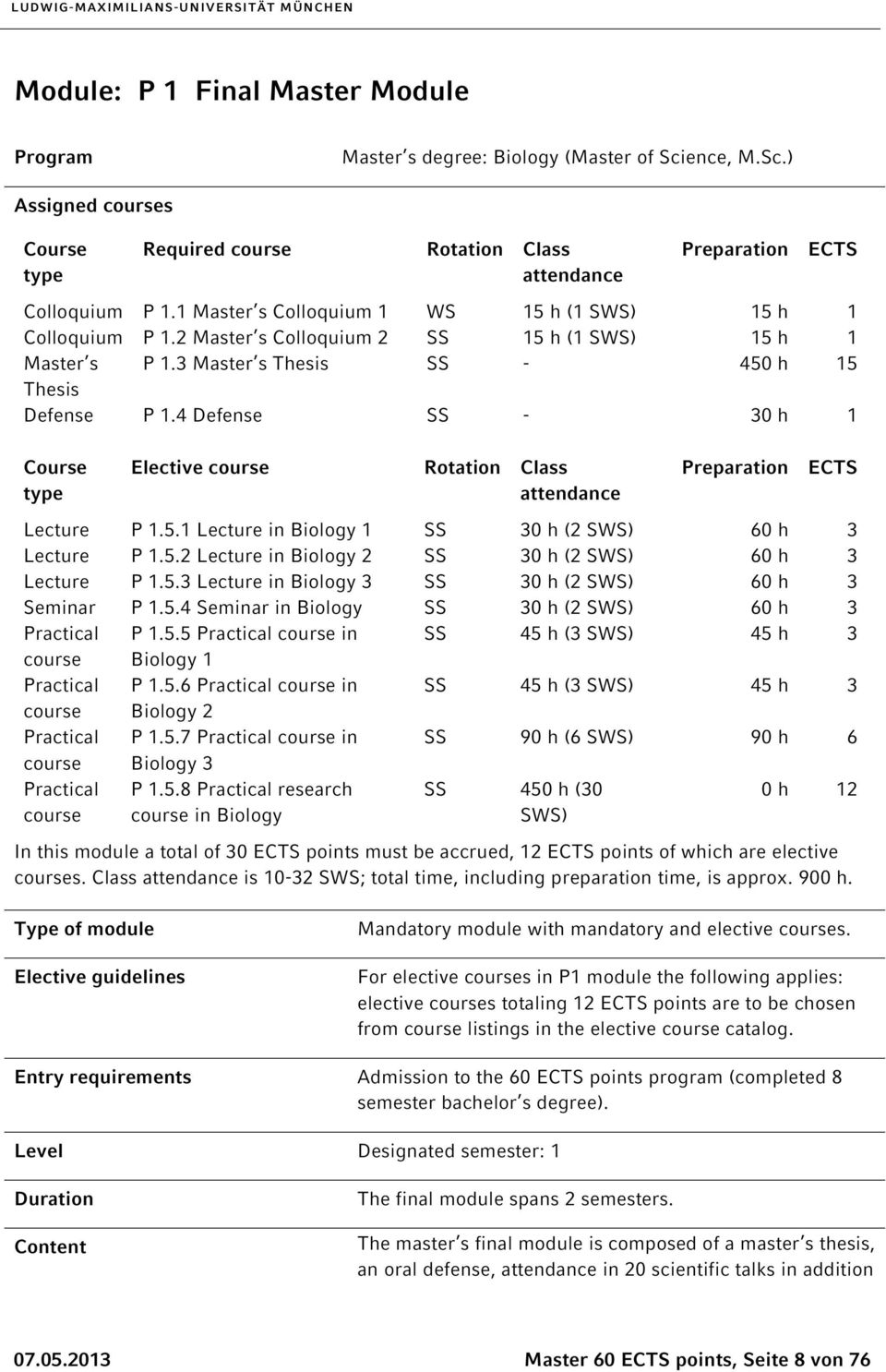
9 to elective s in a related field. Qualification goals Grading This module requires all key qualification skills, in particular independent experimental work under supervision of an instructor/advisor. The module requires skills in organization, strategic methodological planning and performance of experiments, documentation and interpretation of results, in addition to completion of a final thesis written according to international scientific standards. The oral defense tests communication skills, basic and applied knowledge in the given subject, and ability to explain specific processes in a broader context. The module is graded according to graded master s thesis. Pass/fail conditions for ECTS points ECTS points are awarded according to successful completion of colloquium and disputation, passing grade of written master s thesis and successful completion of elective s. Responsible person Language Qualified supervisor from the Faculty of Biology. Master s thesis may be written in German or English. Other information Master 60 ECTS points, Seite 9 von 76

10 Module: WP 1 Specialized s in Plant Sciences 1 Program Master s degree: Biology (Master of Science, M.Sc.) Assigned s Lecture Practical Seminar Required WP 1.1 Specialized lecture in Plant Sciences WP 1.2 Specialized practical in Plant Sciences WP 1.3 Seminar accompanying Specialized practical in Plant Sciences WS 30 h (2 SWS) 60 h 3 This module is comprised of 9 ECTS points. Class is 7 SWS; total time, including preparation time, is 270 h. Type of module Elective guidelines Entry requirements Elective module with mandatory s. The module is composed of thematically related elements (in general lecture, practical and seminar, see elective catalog). The sum of ECTS points is oriented to 30 ECTS points per semester. none Level Recommended semester: 1 Duration Content Qualification goals Grading Pass/fail conditions for ECTS points The module spans 1 semester. The 9 point module includes a lecture, seminar and an instructed practical in Plant Sciences. This basic module aims at providing students with theoretical knowledge, training in researching, presenting and critically discussing a topic, as well as practical experience in application and interpretation of methods and concepts. Teamwork, learning strategies, organizational and communication skills are required, and serve as the basis for the master s thesis and future professional roles. The module is graded according to lecture grade. ECTS points are awarded for individual s according to successful completion; module completion is dependent on Master 60 ECTS points, Seite 10 von 76
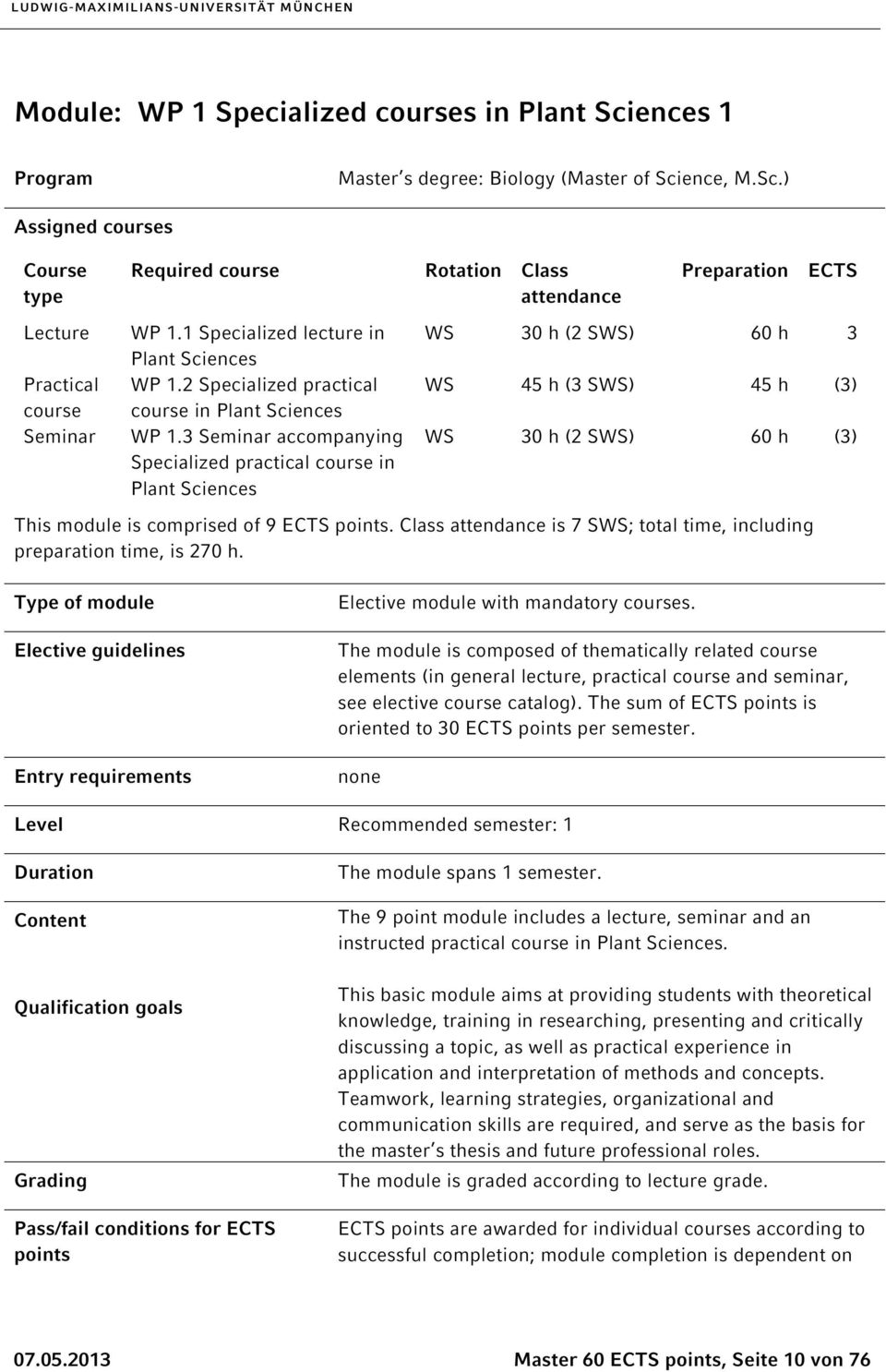
11 successful completion of individual elements. Responsible persons Language Prof. Dr. Dario Leister, Prof. Dr. Jürgen Soll (Chairs, Plant Sciences division). Teaching responsibilities for individual s are listed in elective catalog. English, with exception of s also offered for teaching and bachelor s degrees. Other information Master 60 ECTS points, Seite 11 von 76

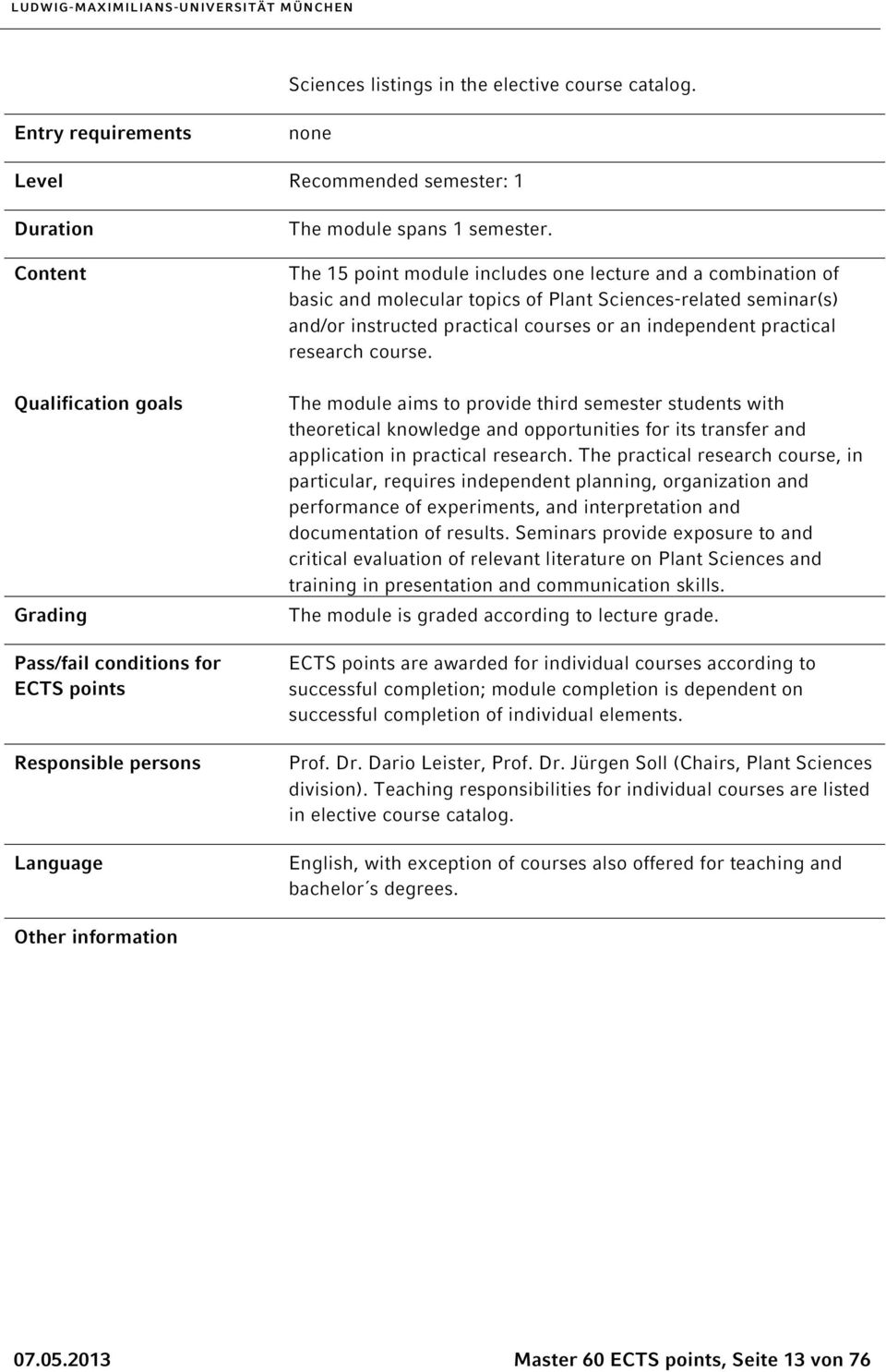
12 Module: WP 2 Specialized s in Plant Sciences 2 Program Master s degree: Biology (Master of Science, M.Sc.) Assigned s Lecture Required WP 2.1 Specialized lecture in Plant Sciences WS 30 h (2 SWS) 60 h 3 Elective Practical WP Specialized practical in Plant Sciences * Seminar WP Seminar practical in Plant Sciences Practical WP Specialized practical in molecular Plant Sciences * Seminar WP Seminar practical in molecular Plant Sciences Practical Practical WP Specialized practical research in Plant Sciences WP Specialized practical in Cell Biology of plants WS 450 h (30 SWS) May only be chosen with accompanying practical. 0 h 12 WS 90 h (6 SWS) 90 h 6 In this module a total of 15 ECTS points must be accrued, 12 ECTS points of which are elective s. Class is SWS; total time, including preparation time, is approx. 450 h. Type of module Elective guidelines Elective module with mandatory and elective s. The module is composed of thematically related elements (in general lecture, practical and seminar, see elective catalog). The sum of ECTS points is oriented to 30 ECTS points per semester. For elective s in this module the following applies: elective s totaling 12 ECTS points are to be chosen from Plant Master 60 ECTS points, Seite 12 von 76

13 Sciences listings in the elective catalog. Entry requirements none Level Recommended semester: 1 Duration Content Qualification goals Grading Pass/fail conditions for ECTS points Responsible persons Language The module spans 1 semester. The 15 point module includes one lecture and a combination of basic and molecular topics of Plant Sciences-related seminar(s) and/or instructed practical s or an independent practical research. The module aims to provide third semester students with theoretical knowledge and opportunities for its transfer and application in practical research. The practical research, in particular, requires independent planning, organization and performance of experiments, and interpretation and documentation of results. Seminars provide exposure to and critical evaluation of relevant literature on Plant Sciences and training in presentation and communication skills. The module is graded according to lecture grade. ECTS points are awarded for individual s according to successful completion; module completion is dependent on successful completion of individual elements. Prof. Dr. Dario Leister, Prof. Dr. Jürgen Soll (Chairs, Plant Sciences division). Teaching responsibilities for individual s are listed in elective catalog. English, with exception of s also offered for teaching and bachelor s degrees. Other information Master 60 ECTS points, Seite 13 von 76
14 Module: WP 3 Specialized s in Plant Sciences 3 Program Master s degree: Biology (Master of Science, M.Sc.) Assigned s Lecture Required WP 3.1 Specialized lecture in Plant Sciences WS 30 h (2 SWS) 60 h 3 Elective Practical WP Specialized practical in Plant Sciences * Seminar WP Seminar accompanying Specialized practical in Plant Sciences Practical WP Specialized practical in molecular Plant Sciences * Seminar WP Seminar accompanying Specialized practical in molecular Plant Sciences Practical Practical Practical WP Specialized practical research in Plant Sciences WP Specialized practical in Cell Biology of plants WP Specialized practical : Methods in Plant Sciences * Seminar WP Seminar practical : Methods in Plant Sciences WS 450 h (30 SWS) * May only be chosen with accompanying practical. 0 h 12 WS 90 h (6 SWS) 90 h 6 In this module a total of 21 ECTS points must be accrued, 18 ECTS points of which are elective s. Class is SWS; total time, including preparation time, is approx. 630 h. Type of module Elective module with mandatory and elective s Master 60 ECTS points, Seite 14 von 76
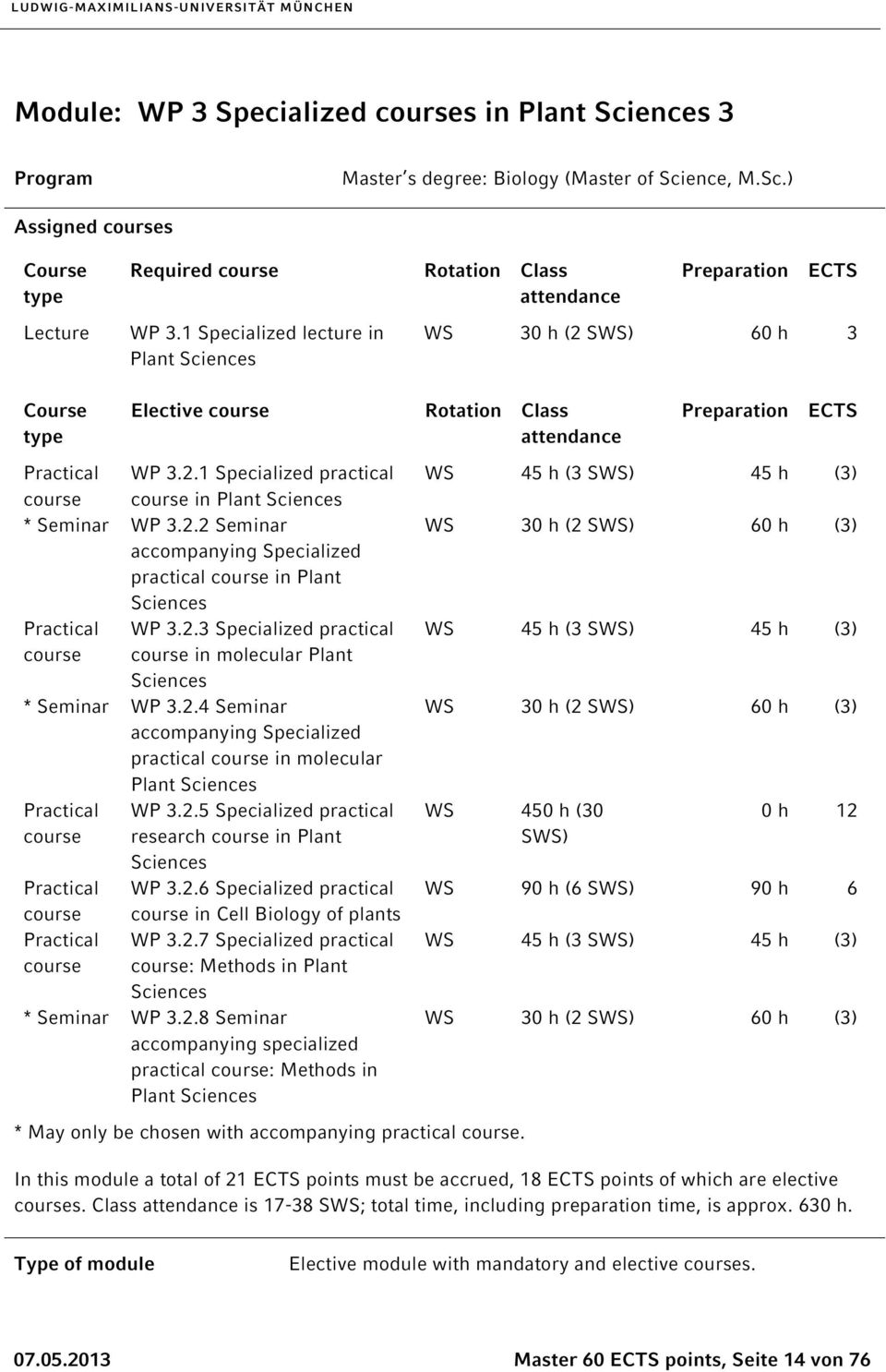
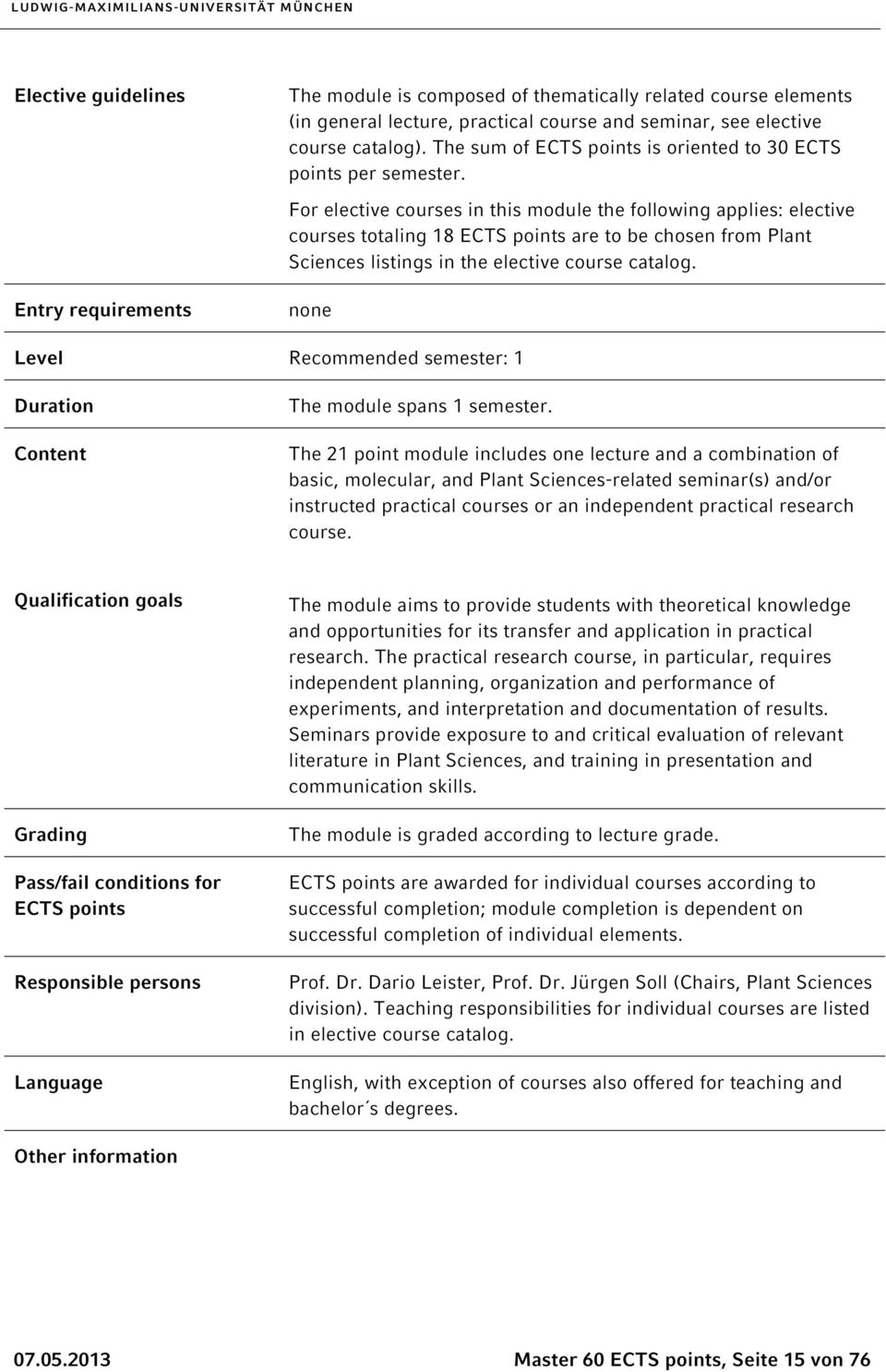
15 Elective guidelines Entry requirements The module is composed of thematically related elements (in general lecture, practical and seminar, see elective catalog). The sum of ECTS points is oriented to 30 ECTS points per semester. For elective s in this module the following applies: elective s totaling 18 ECTS points are to be chosen from Plant Sciences listings in the elective catalog. none Level Recommended semester: 1 Duration Content The module spans 1 semester. The 21 point module includes one lecture and a combination of basic, molecular, and Plant Sciences-related seminar(s) and/or instructed practical s or an independent practical research. Qualification goals Grading Pass/fail conditions for ECTS points Responsible persons Language The module aims to provide students with theoretical knowledge and opportunities for its transfer and application in practical research. The practical research, in particular, requires independent planning, organization and performance of experiments, and interpretation and documentation of results. Seminars provide exposure to and critical evaluation of relevant literature in Plant Sciences, and training in presentation and communication skills. The module is graded according to lecture grade. ECTS points are awarded for individual s according to successful completion; module completion is dependent on successful completion of individual elements. Prof. Dr. Dario Leister, Prof. Dr. Jürgen Soll (Chairs, Plant Sciences division). Teaching responsibilities for individual s are listed in elective catalog. English, with exception of s also offered for teaching and bachelor s degrees. Other information Master 60 ECTS points, Seite 15 von 76
16 Module: WP 4 Specialized s in Genetics 1 Program Master s degree: Biology (Master of Science, M.Sc.) Assigned s Lecture Practical Seminar Required WP 4.1 Specialized lecture in Genetics WP 4.2 Specialized practical in Genetics WP 4.3 Seminar accompanying Specialized practical in Genetics WS 30 h (2 SWS) 60 h 3 This module is comprised of 9 ECTS points. Class is 7 SWS; total time, including preparation time, is 270 h. Type of module Elective guidelines Entry requirements Elective module with mandatory s. The module is composed of thematically related elements (in general lecture, practical and seminar, see elective catalog). The sum of ECTS points is oriented to 30 ECTS points per semester. none Level Recommended semester: 1 Duration Content The module spans 1 semester. The 9 point module includes a lecture, seminar and an instructed practical in Genetics. Qualification goals Grading Pass/fail conditions for ECTS This basic module aims at providing students with theoretical knowledge, training in researching, presenting and critically discussing a topic, as well as practical experience in application and interpretation of methods and concepts. Teamwork, learning strategies, organizational and communication skills are required, and serve as the basis for the master s thesis and future professional roles. The module is graded according to lecture grade. ECTS points are awarded for individual s according to Master 60 ECTS points, Seite 16 von 76
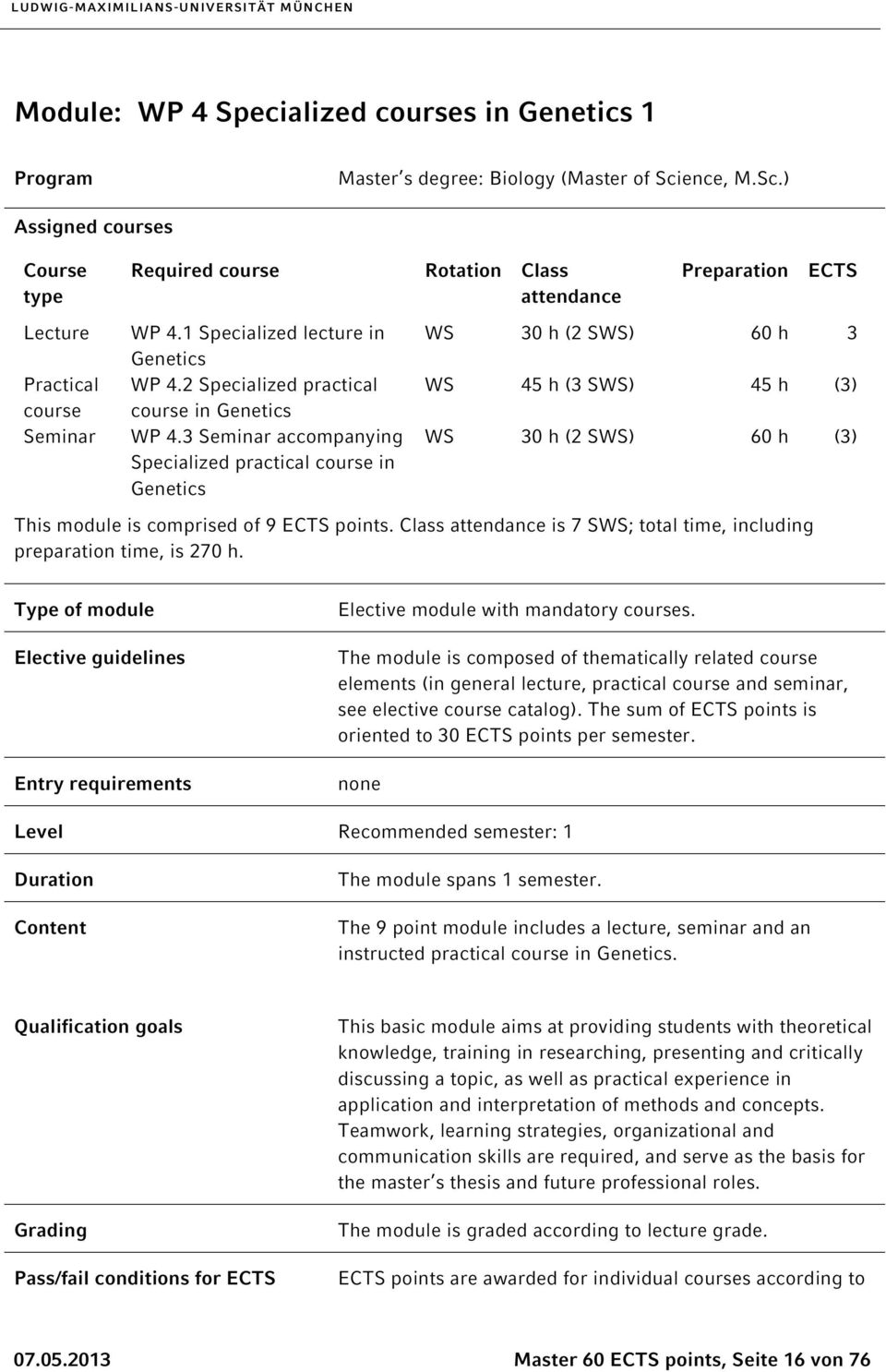
17 points Responsible person Language successful completion; module completion is dependent on successful completion of individual elements. Prof. Dr. Martin Parniske (Chair, Genetics division). Teaching responsibilities for individual s are listed in elective catalog. English, with exception of s also offered for teaching and bachelor s degrees. Other information Master 60 ECTS points, Seite 17 von 76

18 Module: WP 5 Specialized s in Genetics 2 Program Master s degree: Biology (Master of Science, M.Sc.) Assigned s Lecture Required WP 5.1 Specialized lecture in Genetics WS 30 h (2 SWS) 60 h 3 Elective Practical WP Specialized practical in Genetics * Seminar WP Seminar practical in Genetics Practical WP Specialized practical in molecular Genetics * Seminar WP Seminar practical in molecular Genetics Practical WP Specialized practical research in Genetics Practical WP Specialized practical in molecular * May only be chosen with accompanying practical. WS 450 h (30 0 h 12 SWS) WS 90 h (6 SWS) 90 h 6 In this module a total of 15 ECTS points must be accrued, 12 ECTS points of which are elective s. Class is SWS; total time, including preparation time, is approx. 450 h. Type of module Elective guidelines Entry requirements Elective module with mandatory and elective s. The module is composed of thematically related elements (in general lecture, practical and seminar, see elective catalog). The sum of ECTS points is oriented to 30 ECTS points per semester. For elective s in this module the following applies: elective s totaling 12 ECTS points are to be chosen from Plant Sciences listings in the elective catalog. none Master 60 ECTS points, Seite 18 von 76

19 Level Recommended semester: 1 Duration Content The module spans 1 semester. The 15 point module includes one lecture and a combination of basic and molecular topics of Genetics-related seminar(s) and/or instructed practical s or an independent practical research. Qualification goals Grading Pass/fail conditions for ECTS points Responsible person Language The module aims to provide students with theoretical knowledge and opportunities for its transfer and application in practical research. The practical research, in particular, requires independent planning, organization and performance of experiments, and interpretation and documentation of results. Seminars provide exposure to and critical evaluation of relevant literature on Genetics and training in presentation and communication skills. The module is graded according to lecture grade. ECTS points are awarded for individual s according to successful completion; module completion is dependent on successful completion of individual elements. Prof. Dr. Martin Parniske (Chair, Genetics division). Teaching responsibilities for individual s are listed in elective catalog. English, with exception of s also offered for teaching and bachelor s degrees. Other information Master 60 ECTS points, Seite 19 von 76

20 Module: WP 6 Specialized s in Genetics 3 Program Master s degree: Biology (Master of Science, M.Sc.) Assigned s Lecture Required WP 6.1 Specialized lecture in Genetics WS 30 h (2 SWS) 60 h 3 Elective Practical WP Specialized practical in Genetics * Seminar WP Seminar practical in Genetics Practical WP Specialized practical in molecular Genetics * Seminar WP Seminar practical in molecular Genetics Practical WP Specialized practical research in Genetics Practical WP Specialized practical in molecular Practical WP Specialized practical : Methods in Genetics * Seminar WP Seminar practical : Methods in Genetics * May only be chosen with accompanying practical. WS 450 h (30 0 h 12 SWS) WS 90 h (6 SWS) 90 h 6 In this module a total of 21 ECTS points must be accrued, 18 ECTS points of which are elective s. Class is SWS; total time, including preparation time, is approx. 630 h. Type of module Elective guidelines Elective module with mandatory and elective s. The module is composed of thematically related elements (in general lecture, practical and seminar, see elective catalog). The sum of ECTS points is oriented to 30 ECTS Master 60 ECTS points, Seite 20 von 76

21 points per semester. For elective s in this module the following applies: elective s totaling 18 ECTS points are to be chosen from Genetics listings in the elective catalog. Entry requirements none Level Recommended semester: 1 Duration Content The module spans 1 semester. The 21 point module includes one lecture and a combination of basic, molecular, and Genetics -related seminar(s) and/or instructed practical s or an independent practical research. Qualification goals Grading Pass/fail conditions for ECTS points Responsible person Language The module aims to provide students with theoretical knowledge and opportunities for its transfer and application in practical research. The practical research, in particular, requires independent planning, organization and performance of experiments, and interpretation and documentation of results. Seminars provide exposure to and critical evaluation of relevant literature on Genetics, and training in presentation and communication skills. The module is graded according to lecture grade. ECTS points are awarded for individual s according to successful completion; module completion is dependent on successful completion of individual elements. Prof. Dr. Martin Parniske (Chair, Genetics division). Teaching responsibilities for individual s are listed in elective catalog. English, with exception of s also offered for teaching and bachelor s degrees. Other information Master 60 ECTS points, Seite 21 von 76
22 Module: WP 7 Specialized s in Human Biology 1 Program Master s degree: Biology (Master of Science, M.Sc.) Assigned s Lecture Practical Seminar Required WP 7.1 Specialized lecture in Human Biology WP 7.2 Specialized practical in Human Biology WP 7.3 Seminar accompanying specialized practical in Human Biology WS 30 h (2 SWS) 60 h 3 This module is comprised of 9 ECTS points. Class is 7 SWS; total time, including preparation time, is 270 h. Type of module Elective guidelines Entry requirements Elective module with mandatory s. The module is composed of thematically related elements (in general lecture, practical and seminar, see elective catalog). The sum of ECTS points is oriented to 30 ECTS points per semester. none Level Recommended semester: 1 Duration Content The module spans 1 semester. The 9 point module includes a lecture, seminar and an instructed practical in Human Biology. Qualification goals Grading Pass/fail conditions for ECTS This basic module aims at providing students with theoretical knowledge, training in researching, presenting and critically discussing a topic, as well as practical experience in application and interpretation of methods and concepts. Teamwork, learning strategies, organizational and communication skills are required, and serve as the basis for the master s thesis and future professional roles. The module is graded according to lecture grade. ECTS points are awarded for individual s according to Master 60 ECTS points, Seite 22 von 76
23 points Responsible person Language successful completion; module completion is dependent on successful completion of individual elements. Prof. Dr. Heinrich Leonhardt (Chair, Human Biology division). Teaching responsibilities for individual s are listed in elective catalog. English, with exception of s also offered for teaching and bachelor s degrees. Other information Master 60 ECTS points, Seite 23 von 76
24 Module: WP 8 Specialized s in Human Biology 2 Program Master s degree: Biology (Master of Science, M.Sc.) Assigned s Lecture Required WP 8.1 Specialized lecture in Human Biology WS 30 h (2 SWS) 60 h 3 Elective Practical WP Specialized practical in Human Biology * Seminar WP Seminar accompanying Specialized practical in Human Biology Practical WP Specialized practical in molecular Human Biology * Seminar WP Seminar practical in molecular Human Biology Practical Practical WP Specialized practical research in Human Biology WP Cell Biology-oriented practical in Human Biology WS 450 h (30 SWS) * May only be chosen with accompanying practical. 0 h 12 WS 90 h (6 SWS) 90 h 6 In this module a total of 15 ECTS points must be accrued, 12 ECTS points of which are elective s. Class is SWS; total time, including preparation time, is approx. 450 h. Type of module Elective guidelines Elective module with mandatory and elective s. The module is composed of thematically related elements (in general lecture, practical and seminar, see elective catalog). The sum of ECTS points is oriented to 30 ECTS points per semester. For elective s in this module the following applies: elective Master 60 ECTS points, Seite 24 von 76
25 s totaling 12 ECTS points are to be chosen from Plant Sciences listings in the elective catalog. Entry requirements none Level Recommended semester: 1 Duration Content The module spans 1 semester. The 15 point module includes one lecture and a combination of basic and molecular topics of Human Biology-related seminar(s) and/or instructed practical s or an independent practical research. Qualification goals Grading Pass/fail conditions for ECTS points Responsible person Language The module aims to provide students with theoretical knowledge and opportunities for its transfer and application in practical research. The practical research, in particular, requires independent planning, organization and performance of experiments, and interpretation and documentation of results. Seminars provide exposure to and critical evaluation of relevant literature on Human Biology and training in presentation and communication skills. The module is graded according to lecture grade. ECTS points are awarded for individual s according to successful completion; module completion is dependent on successful completion of individual elements. Prof. Dr. Heinrich Leonhardt (Chair, Human Biology division). Teaching responsibilities for individual s are listed in elective catalog. English, with exception of s also offered for teaching and bachelor s degrees. Other information Master 60 ECTS points, Seite 25 von 76
26 Module: WP 9 Specialized s in Human Biology 3 Program Master s degree: Biology (Master of Science, M.Sc.) Assigned s Lecture Required WP 9.1 Specialized lecture in Human Biology WS 30 h (2 SWS) 60 h 3 Elective Practical WP Specialized practical in Human Biology * Seminar WP Seminar practical in Human Biology Practical WP Specialized practical in molecular Human Biology * Seminar WP Seminar practical in molecular Human Biology Practical WP Specialized practical research in Human Biology Practical WP Cytological practical in Human Biology Practical WP Specialized practical : Methods in Human Biology * Seminar WP Seminar practical : Methods in Human Biology * May only be chosen with accompanying practical. WS 450 h (30 0 h 12 SWS) WS 90 h (6 SWS) 90 h 6 In this module a total of 21 ECTS points must be accrued, 18 ECTS points of which are elective s. Class is SWS; total time, including preparation time, is approx. 630 h. Type of module Elective module with mandatory and elective s Master 60 ECTS points, Seite 26 von 76
27 Elective guidelines Entry requirements The module is composed of thematically related elements (in general lecture, practical and seminar, see elective catalog). The sum of ECTS points is oriented to 30 ECTS points per semester. For elective s in this module the following applies: elective s totaling 18 ECTS points are to be chosen from Human Biology listings in the elective catalog. none Level Recommended semester: 1 Duration Content The module spans 1 semester. The 21 point module includes one lecture and a combination of basic, molecular, and Human Biology-related seminar(s) and/or instructed practical s or an independent practical research. Qualification goals Grading Pass/fail conditions for ECTS points Responsible person Language The module aims to provide students with theoretical knowledge and opportunities for its transfer and application in practical research. The practical research, in particular, requires independent planning, organization and performance of experiments, and interpretation and documentation of results. Seminars provide exposure to and critical evaluation of relevant literature on Human Biology, and training in presentation and communication skills. The module is graded according to lecture grade. ECTS points are awarded for individual s according to successful completion; module completion is dependent on successful completion of individual elements. Prof. Dr. Heinrich Leonhardt (Chair, Human Biology division). Teaching responsibilities for individual s are listed in elective catalog. English, with exception of s also offered for teaching and bachelor s degrees. Other information Master 60 ECTS points, Seite 27 von 76
28 Module: WP 10 Specialized s in Microbiology 1 Program Master s degree: Biology (Master of Science, M.Sc.) Assigned s Lecture Practical Seminar Required WP 10.1 Specialized lecture in Microbiology WP 10.2 Specialized practical in Microbiology WP 10.3 Seminar practical in Microbiology WS 30 h (2 SWS) 60 h 3 This module is comprised of 9 ECTS points. Class is 7 SWS; total time, including preparation time, is 270 h. Type of module Elective guidelines Entry requirements Elective module with mandatory s. The module is composed of thematically related elements (in general lecture, practical and seminar, see elective catalog). The sum of ECTS points is oriented to 30 ECTS points per semester. none Level Recommended semester: 1 Duration Content The module spans 1 semester. The 9 point module includes a lecture, seminar and an instructed practical in Microbiology. Qualification goals Grading This basic module aims at providing students with theoretical knowledge, training in researching, presenting and critically discussing a topic, as well as practical experience in application and interpretation of methods and concepts. Teamwork, learning strategies, organizational and communication skills are required, and serve as the basis for the master s thesis and future professional roles. The module is graded according to lecture grade Master 60 ECTS points, Seite 28 von 76
29 Pass/fail conditions for ECTS points Responsible person Language ECTS points are awarded for individual s according to successful completion; module completion is dependent on successful completion of individual elements. Prof. Dr. Kirsten Jung (Chair, Microbiology division). Teaching responsibilities for individual s are listed in elective catalog. English, with exception of s also offered for teaching and bachelor s degrees. Other information Master 60 ECTS points, Seite 29 von 76
30 Module: WP 11 Specialized s in Microbiology 2 Program Master s degree: Biology (Master of Science, M.Sc.) Assigned s Lecture Required WP 11.1 Specialized lecture in Microbiology WS 30 h (2 SWS) 60 h 3 Elective Practical WP Specialized practical in Microbiology * Seminar WP Seminar practical in Microbiology Practical WP Specialized practical in molecular, cytological Microbiology * Seminar WP Seminar practical in molecular, cytological Microbiology Practical Practical WP Specialized practical research in Microbiology WP Cytological, molecular practical in Microbiology WS 450 h (30 SWS) * May only be chosen with accompanying practical. 0 h 12 WS 90 h (6 SWS) 90 h 6 In this module a total of 15 ECTS points must be accrued, 12 ECTS points of which are elective s. Class is SWS; total time, including preparation time, is approx. 450 h. Type of module Elective guidelines Elective module with mandatory and elective s. The module is composed of thematically related elements (in general lecture, practical and seminar, see elective catalog). The sum of ECTS points is oriented to 30 ECTS points per semester. For elective s in this module the following applies: elective Master 60 ECTS points, Seite 30 von 76
31 s totaling 12 ECTS points are to be chosen from Plant Sciences listings in the elective catalog. Entry requirements none Level Recommended semester: 1 Duration Content The module spans 1 semester. The 15 point module includes one lecture and a combination of basic and molecular topics of Microbiology -related seminar(s) and/or instructed practical s or an independent practical research. Qualification goals Grading Pass/fail conditions for ECTS points Responsible person Language The module aims to provide students with theoretical knowledge and opportunities for its transfer and application in practical research. The practical research, in particular, requires independent planning, organization and performance of experiments, and interpretation and documentation of results. Seminars provide exposure to and critical evaluation of relevant literature on Microbiology and training in presentation and communication skills. The module is graded according to lecture grade. ECTS points are awarded for individual s according to successful completion; module completion is dependent on successful completion of individual elements. Prof. Dr. Kirsten Jung (Chair, Microbiology division). Teaching responsibilities for individual s are listed in elective catalog. English, with exception of s also offered for teaching and bachelor s degrees. Other information Master 60 ECTS points, Seite 31 von 76
32 Module: WP 12 Specialized s in Microbiology 3 Program Master s degree: Biology (Master of Science, M.Sc.) Assigned s Lecture Required WP 12.1 Specialized lecture in Microbiology WS 30 h (2 SWS) 60 h 3 Elective Practical WP Specialized practical in Microbiology * Seminar WP Seminar practical in Microbiology Practical WP Specialized practical in molecular and cellbiological Microbiology * Seminar WP Seminar practical in molecular and cell-biological Microbiology Practical WP Specialized practical research in Microbiology Practical Practical WP Molecular and cellbiological practical in Microbiology WP Specialized practical : Methods in Microbiology * Seminar WP Seminar practical : Methods in Microbiology * May only be chosen with accompanying practical. WS 450 h (30 0 h 12 SWS) WS 90 h (6 SWS) 90 h 6 In this module a total of 21 ECTS points must be accrued, 18 ECTS points of which are elective s. Class is SWS; total time, including preparation time, is approx. 630 h Master 60 ECTS points, Seite 32 von 76
33 Type of module Elective guidelines Entry requirements Elective module with mandatory and elective s. The module is composed of thematically related elements (in general lecture, practical and seminar, see elective catalog). The sum of ECTS points is oriented to 30 ECTS points per semester. For elective s in this module the following applies: elective s totaling 18 ECTS points are to be chosen from Microbiology listings in the elective catalog. none Level Recommended semester: 1 Duration Content The module spans 1 semester. The 21 point module includes one lecture and a combination of basic, molecular, and Microbiology -related seminar(s) and/or instructed practical s or an independent practical research. Qualification goals Grading Pass/fail conditions for ECTS points Responsible person Language The module aims to provide students with theoretical knowledge and opportunities for its transfer and application in practical research. The practical research, in particular, requires independent planning, organization and performance of experiments, and interpretation and documentation of results. Seminars provide exposure to and critical evaluation of relevant literature in Microbiology, and training in presentation and communication skills. The module is graded according to lecture grade. ECTS points are awarded for individual s according to successful completion; module completion is dependent on successful completion of individual elements. Prof. Dr. Kirsten Jung (Chair, Microbiology division). Teaching responsibilities for individual s are listed in elective catalog. English, with exception of s also offered for teaching and bachelor s degrees. Other information Master 60 ECTS points, Seite 33 von 76
34 Module: WP 13 Specialized s in Cell Biology 1 Program Master s degree: Biology (Master of Science, M.Sc.) Assigned s Lecture Practical Seminar Required WP 13.1 Specialized lecture in Cell Biology WP 13.2 Specialized practical in Cell Biology WP 13.3 Seminar practical in Cell Biology WS 30 h (2 SWS) 60 h 3 This module is comprised of 9 ECTS points. Class is 7 SWS; total time, including preparation time, is 270 h. Type of module Elective guidelines Entry requirements Elective module with mandatory s. The module is composed of thematically related elements (in general lecture, practical and seminar, see elective catalog). The sum of ECTS points is oriented to 30 ECTS points per semester. none Level Recommended semester: 1 Duration Content The module spans 1 semester. The 9 point module includes a lecture, seminar and an instructed practical in Cell Biology. Qualification goals Grading Pass/fail conditions for ECTS This basic module aims at providing students with theoretical knowledge, training in researching, presenting and critically discussing a topic, as well as practical experience in application and interpretation of methods and concepts. Teamwork, learning strategies, organizational and communication skills are required, and serve as the basis for the master s thesis and future professional roles. The module is graded according to lecture grade. ECTS points are awarded for individual s according to Master 60 ECTS points, Seite 34 von 76
35 points Responsible person Language successful completion; module completion is dependent on successful completion of individual elements. Prof. Dr. Barbara Conradt (Chair, Cell and Developmental Biology division). Teaching responsibilities for individual s are listed in elective catalog. English, with exception of s also offered for teaching and bachelor s degrees. Other information Master 60 ECTS points, Seite 35 von 76
36 Module: WP 14 Specialized s in Cell Biology 2 Program Master s degree: Biology (Master of Science, M.Sc.) Assigned s Lecture Required WP 14.1 Specialized lecture in Cell Biology WS 30 h (2 SWS) 60 h 3 Elective Practical WP Specialized practical in Cell Biology * Seminar WP Seminar practical in Cell Biology Practical WP Specialized practical in molecular Cell Biology * Seminar WP Seminar practical in molecular Cell Biology Practical WP Specialized practical research in Cell Biology Practical WP Practical in Cell Biology * May only be chosen with accompanying practical. WS 450 h (30 0 h 12 SWS) WS 90 h (6 SWS) 90 h 6 In this module a total of 15 ECTS points must be accrued, 12 ECTS points of which are elective s. Class is SWS; total time, including preparation time, is approx. 450 h. Type of module Elective guidelines Elective module with mandatory and elective s. The module is composed of thematically related elements (in general lecture, practical and seminar, see elective catalog). The sum of ECTS points is oriented to 30 ECTS points per semester. For elective s in this module the following applies: elective s totaling 12 ECTS points are to be chosen from Plant Sciences listings in the elective catalog Master 60 ECTS points, Seite 36 von 76
37 Entry requirements none Level Recommended semester: 1 Duration Content The module spans 1 semester. The 15 point module includes one lecture and a combination of basic and molecular topics of Cell Biology -related seminar(s) and/or instructed practical s or an independent practical research. Qualification goals Grading Pass/fail conditions for ECTS points Responsible person Language The module aims to provide students with theoretical knowledge and opportunities for its transfer and application in practical research. The practical research, in particular, requires independent planning, organization and performance of experiments, and interpretation and documentation of results. Seminars provide exposure to and critical evaluation of relevant literature in Cell Biology and training in presentation and communication skills. The module is graded according to lecture grade. ECTS points are awarded for individual s according to successful completion; module completion is dependent on successful completion of individual elements. Prof. Dr. Barbara Conradt (Chair, Cell and Developmental Biology division). Teaching responsibilities for individual s are listed in elective catalog. English, with exception of s also offered for teaching and bachelor s degrees. Other information Master 60 ECTS points, Seite 37 von 76
38 Module: WP 15 Specialized s in Cell Biology 3 Program Master s degree: Biology (Master of Science, M.Sc.) Assigned s Lecture Required WP 15.1 Specialized lecture in Cell Biology WS 30 h (2 SWS) 60 h 3 Elective Practical WP Specialized practical in Cell Biology * Seminar WP Seminar practical in Cell Biology Practical WP Specialized practical in molecular Cell Biology * Seminar WP Seminar practical in molecular Cell Biology Practical WP Specialized practical research in Cell Biology Practical WP Practical der Cell Biology Practical WP Specialized practical : Methods in Cell Biology * Seminar WP Seminar practical : Methods in Cell Biology * May only be chosen with accompanying practical. WS 450 h (30 0 h 12 SWS) WS 90 h (6 SWS) 90 h 6 In this module a total of 21 ECTS points must be accrued, 18 ECTS points of which are elective s. Class is SWS; total time, including preparation time, is approx. 630 h. Type of module Elective guidelines Elective module with mandatory and elective s. The module is composed of thematically related elements (in general lecture, practical and seminar, see elective Master 60 ECTS points, Seite 38 von 76
39 catalog). The sum of ECTS points is oriented to 30 ECTS points per semester. For elective s in this module the following applies: elective s totaling 18 ECTS points are to be chosen from Cell Biology listings in the elective catalog. Entry requirements none Level Recommended semester: 1 Duration Content The module spans 1 semester. The 21 point module includes one lecture and a combination of basic, molecular, and Cell Biology-related seminar(s) and/or instructed practical s or an independent practical research. Qualification goals Grading Pass/fail conditions for ECTS points Responsible person Language The module aims to provide students with theoretical knowledge and opportunities for its transfer and application in practical research. The practical research, in particular, requires independent planning, organization and performance of experiments, and interpretation and documentation of results. Seminars provide exposure to and critical evaluation of relevant literature in Cell Biology, and training in presentation and communication skills. The module is graded according to lecture grade. ECTS points are awarded for individual s according to successful completion; module completion is dependent on successful completion of individual elements. Prof. Dr. Barbara Conradt (Chair, Cell and Developmental Biology division). Teaching responsibilities for individual s are listed in elective catalog. English, with exception of s also offered for teaching and bachelor s degrees. Other information Master 60 ECTS points, Seite 39 von 76
40 Module: WP 16 Specialized s in Zoology 1 Program Master s degree: Biology (Master of Science, M.Sc.) Assigned s Lecture Practical Seminar Required WP 16.1 Specialized lecture in Zoology WP 16.2 Specialized practical in Zoology WP 16.3 Seminar practical in Zoology WS 30 h (2 SWS) 60 h 3 This module is comprised of 9 ECTS points. Class is 7 SWS; total time, including preparation time, is 270 h. Type of module Elective guidelines Entry requirements Elective module with mandatory s. The module is composed of thematically related elements (in general lecture, practical and seminar, see elective catalog). The sum of ECTS points is oriented to 30 ECTS points per semester. none Level Recommended semester: 1 Duration Content The module spans 1 semester. The 9 point module includes a lecture, seminar and an instructed practical in Zoology. Qualification goals Grading Pass/fail conditions for ECTS This basic module aims at providing students with theoretical knowledge, training in researching, presenting and critically discussing a topic, as well as practical experience in application and interpretation of methods and concepts. Teamwork, learning strategies, organizational and communication skills are required, and serve as the basis for the master s thesis and future professional roles. The module is graded according to lecture grade. ECTS points are awarded for individual s according to Master 60 ECTS points, Seite 40 von 76
41 points Responsible person Language successful completion; module completion is dependent on successful completion of individual elements. Prof. Dr. Gerhard Haszprunar, Prof. Dr. Matthias Starck (Chairs, Zoology division). Teaching responsibilities for individual s are listed in elective catalog. English, with exception of s also offered for teaching and bachelor s degrees. Other information Master 60 ECTS points, Seite 41 von 76
42 Module: WP 17 Specialized s in Zoology 2 Program Master s degree: Biology (Master of Science, M.Sc.) Assigned s Lecture Required WP 17.1 Specialized lecture in Zoology WS 30 h (2 SWS) 60 h 3 Elective Practical WP Specialized practical in Zoology * Seminar WP Seminar practical in Zoology Practical WP Specialized practical : Methods in Zoology * Seminar WP Seminar practical : Methods in Zoology Practical WP Specialized practical research in Zoology Practical WP Specialized practical in Zoology Exkursion WP Specialized zoological excursion * May only be chosen with accompanying practical. WS 450 h (30 0 h 12 SWS) WS 90 h (6 SWS) 90 h 6 WS 90 h (6 SWS) 90 h 6 In this module a total of 15 ECTS points must be accrued, 12 ECTS points of which are elective s. Class is SWS; total time, including preparation time, is approx. 450 h. Type of module Elective guidelines Elective module with mandatory and elective s. The module is composed of thematically related elements (in general lecture, practical and seminar, see elective catalog). The sum of ECTS points is oriented to 30 ECTS points per semester. For elective s in this module the following applies: elective s totaling 12 ECTS points are to be chosen from Zoology listings in the elective catalog Master 60 ECTS points, Seite 42 von 76
43 Entry requirements none Level Recommended semester: 1 Duration Content Qualification goals Grading Pass/fail conditions for ECTS points Responsible person Language The module spans 1 semester. The 15 point module includes one lecture and a combination of basic and molecular topics of Zoology-related seminar(s) and/or instructed practical s or an independent practical research. The module aims to provide third semester students with theoretical knowledge and opportunities for its transfer and application in practical research. The practical research, in particular, requires independent planning, organization and performance of experiments, and interpretation and documentation of results. Seminars provide exposure to and critical evaluation of relevant literature in Zoology and training in presentation and communication skills. The module is graded according to lecture grade. ECTS points are awarded for individual s according to successful completion; module completion is dependent on successful completion of individual elements. Prof. Dr. Gerhard Haszprunar, Prof. Dr. Matthias Starck (Chairs, Zoology division). Teaching responsibilities for individual s are listed in elective catalog. English, with exception of s also offered for teaching and bachelor s degrees. Other information Master 60 ECTS points, Seite 43 von 76
44 Module: WP 18 Specialized s in Zoology 3 Program Master s degree: Biology (Master of Science, M.Sc.) Assigned s Lecture Required WP 18.1 Specialized lecture in Zoology WS 30 h (2 SWS) 60 h 3 Elective Practical WP Specialized practical in Zoology * Seminar WP Seminar practical in Zoology Practical WP Specialized practical : Methods in Zoology * Seminar WP Seminar practical : Methods in Zoology Practical WP Specialized practical research in Zoology Practical WP Specialized practical in Zoology Exkursion WP Specialized zoological excursion Exkursion WP Specialized zoological excursion WS 450 h (30 0 h 12 SWS) WS 90 h (6 SWS) 90 h 6 WS 90 h (6 SWS) 90 h 6 WS 180 h (12 SWS) * May only be chosen with accompanying practical. 180 h 12 In this module a total of 21 ECTS points must be accrued, 18 ECTS points of which are elective s. Class is SWS; total time, including preparation time, is approx. 630 h. Type of module Elective guidelines Elective module with mandatory and elective s. The module is composed of thematically related elements (in general lecture, practical and seminar, see elective catalog). The sum of ECTS points is oriented to 30 ECTS points per semester. For elective s in this module the following applies: elective Master 60 ECTS points, Seite 44 von 76
45 s totaling 18 ECTS points are to be chosen from Zoology listings in the elective catalog. Entry requirements none Level Recommended semester: 1 Duration Content The module spans 1 semester. The 21 point module includes one lecture and a combination of basic, molecular, and Zoology-related seminar(s) and/or instructed practical s or an independent practical research. Qualification goals Grading Pass/fail conditions for ECTS points Responsible person Language The module aims to provide students with theoretical knowledge and opportunities for its transfer and application in practical research. The practical research, in particular, requires independent planning, organization and performance of experiments, and interpretation and documentation of results. Seminars provide exposure to and critical evaluation of relevant literature in Zoology, and training in presentation and communication skills. The module is graded according to lecture grade. ECTS points are awarded for individual s according to successful completion; module completion is dependent on successful completion of individual elements. Prof. Dr. Gerhard Haszprunar, Prof. Dr. Matthias Starck (Chairs, Zoology division). Teaching responsibilities for individual s are listed in elective catalog. English, with exception of s also offered for teaching and bachelor s degrees. Other information Master 60 ECTS points, Seite 45 von 76
46 Module: WP 19 Specialized s in Anthropology 1 Program Master s degree: Biology (Master of Science, M.Sc.) Assigned s Lecture Practical Seminar Required WP 19.1 Specialized lecture in Anthropology WP 19.2 Specialized practical in Anthropology WP 19.3 Seminar practical in Anthropology WS 30 h (2 SWS) 60 h 3 This module is comprised of 9 ECTS points. Class is 7 SWS; total time, including preparation time, is 270 h. Type of module Elective guidelines Entry requirements Elective module with mandatory s. The module is composed of thematically related elements (in general lecture, practical and seminar, see elective catalog). The sum of ECTS points is oriented to 30 ECTS points per semester. none Level Recommended semester: 1 Duration Content The module spans 1 semester. The 9 point module includes a lecture, seminar and an instructed practical in Anthropology. Qualification goals Grading This basic module aims at providing students with theoretical knowledge, training in researching, presenting and critically discussing a topic, as well as practical experience in application and interpretation of methods and concepts. Teamwork, learning strategies, organizational and communication skills are required, and serve as the basis for the master s thesis and future professional roles. The module is graded according to lecture grade Master 60 ECTS points, Seite 46 von 76
47 Pass/fail conditions for ECTS points Responsible person Language ECTS points are awarded for individual s according to successful completion; module completion is dependent on successful completion of individual elements. Prof. Dr. Gisela Grupe (acting Chair, Anthropology division). Teaching responsibilities for individual s are listed in elective catalog. English, with exception of s also offered for teaching and bachelor s degrees. Other information Master 60 ECTS points, Seite 47 von 76
48 Module: WP 20 Specialized s in Anthropology 2 Program Master s degree: Biology (Master of Science, M.Sc.) Assigned s Lecture Required WP 20.1 Specialized lecture in Anthropology WS 30 h (2 SWS) 60 h 3 Elective Practical WP Specialized practical in Anthropology * Seminar WP Seminar practical in Anthropology Practical WP Specialized practical : Methods in Anthropology * Seminar WP Seminar practical : Methods in Anthropology Practical WP Specialized practical research in Anthropology Practical WP Specialized practical in Anthropology Exkursion WP Specialized anthropological excavation/excursion * May only be chosen with accompanying practical. WS 450 h (30 0 h 12 SWS) WS 90 h (6 SWS) 90 h 6 WS 90 h (6 SWS) 90 h 6 In this module a total of 15 ECTS points must be accrued, 12 ECTS points of which are elective s. Class is SWS; total time, including preparation time, is approx. 450 h. Type of module Elective guidelines Elective module with mandatory and elective s. The module is composed of thematically related elements (in general lecture, practical and seminar, see elective catalog). The sum of ECTS points is oriented to 30 ECTS points per semester Master 60 ECTS points, Seite 48 von 76
49 For elective s in this module the following applies: elective s totaling 12 ECTS points are to be chosen from Anthropology listings in the elective catalog. Entry requirements none Level Recommended semester: 1 Duration Content The module spans 1 semester. The 15 point module includes one lecture and a combination of basic and molecular topics of Anthropology-related seminar(s) and/or instructed practical s or an independent practical research. Qualification goals Grading Pass/fail conditions for ECTS points Responsible person Language The module aims to provide third semester students with theoretical knowledge and opportunities for its transfer and application in practical research. The practical research, in particular, requires independent planning, organization and performance of experiments, and interpretation and documentation of results. Seminars provide exposure to and critical evaluation of relevant literature in Anthropology and training in presentation and communication skills. The module is graded according to lecture grade. ECTS points are awarded for individual s according to successful completion; module completion is dependent on successful completion of individual elements. Prof. Dr. Gisela Grupe (acting Chair, Anthropology division). Teaching responsibilities for individual s are listed in elective catalog. English, with exception of s also offered for teaching and bachelor s degrees. Other information Master 60 ECTS points, Seite 49 von 76
50 Module: WP 21 Specialized s in Anthropology 3 Program Master s degree: Biology (Master of Science, M.Sc.) Assigned s Lecture Required WP 21.1 Specialized lecture in Anthropology WS 30 h (2 SWS) 60 h 3 Elective Practical WP Specialized practical in Anthropology * Seminar WP Seminar practical in Anthropology Practical WP Specialized practical : Methods in Anthropology * Seminar WP Seminar practical : Methods in Anthropology Practical Practical Exkursion Exkursion WP Specialized practical research in Anthropology WP Specialized practical in Anthropology WP Specialized anthropological excavation/excursion WP Specialized anthropological excavation/excursion WS 450 h (30 SWS) 0 h 12 WS 90 h (6 SWS) 90 h 6 WS 90 h (6 SWS) 90 h 6 WS 180 h (12 SWS) * May only be chosen with accompanying practical. 180 h 12 In this module a total of 21 ECTS points must be accrued, 18 ECTS points of which are elective s. Class is SWS; total time, including preparation time, is approx. 630 h. Type of module Elective module with mandatory and elective s Master 60 ECTS points, Seite 50 von 76
51 Elective guidelines Entry requirements The module is composed of thematically related elements (in general lecture, practical and seminar, see elective catalog). The sum of ECTS points is oriented to 30 ECTS points per semester. For elective s in this module the following applies: elective s totaling 18 ECTS points are to be chosen from Anthropology listings in the elective catalog. none Level Recommended semester: 1 Duration Content The module spans 1 semester. The 21 point module includes one lecture and a combination of basic, molecular, and Anthropology-related seminar(s) and/or instructed practical s or an independent practical research. Qualification goals Grading Pass/fail conditions for ECTS points Responsible person Language The module aims to provide students with theoretical knowledge and opportunities for its transfer and application in practical research. The practical research, in particular, requires independent planning, organization and performance of experiments, and interpretation and documentation of results. Seminars provide exposure to and critical evaluation of relevant literature n Anthropology, and training in presentation and communication skills. The module is graded according to lecture grade. ECTS points are awarded for individual s according to successful completion; module completion is dependent on successful completion of individual elements. Prof. Dr. Gisela Grupe (acting Chair, Anthropology division). Teaching responsibilities for individual s are listed in elective catalog. English, with exception of s also offered for teaching and bachelor s degrees. Other information Master 60 ECTS points, Seite 51 von 76
52 Module: WP 22 Specialized s in Systematic Botany 1 Program Master s degree: Biology (Master of Science, M.Sc.) Assigned s Lecture Practical Seminar Required WP 22.1 Specialized lecture in Systematic Botany WP 22.2 Specialized practical in Systematic Botany WP 22.3 Seminar practical in Systematic Botany WS 30 h (2 SWS) 60 h 3 This module is comprised of 9 ECTS points. Class is 7 SWS; total time, including preparation time, is 270 h. Type of module Elective guidelines Entry requirements Elective module with mandatory s. The module is composed of thematically related elements (in general lecture, practical and seminar, see elective catalog). The sum of ECTS points is oriented to 30 ECTS points per semester. none Level Recommended semester: 1 Duration Content The module spans 1 semester. The 9 point module includes a lecture, seminar and an instructed practical in Systematic Botany. Qualification goals Grading This basic module aims at providing students with theoretical knowledge, training in researching, presenting and critically discussing a topic, as well as practical experience in application and interpretation of methods and concepts. Teamwork, learning strategies, organizational and communication skills are required, and serve as the basis for the master s thesis and future professional roles. The module is graded according to lecture grade Master 60 ECTS points, Seite 52 von 76
53 Pass/fail conditions for ECTS points Responsible person Language ECTS points are awarded for individual s according to successful completion; module completion is dependent on successful completion of individual elements. Prof. Dr. Susanne Renner (Chair, Systematic Botany and Mycology division). Teaching responsibilities for individual s are listed in elective catalog. English, with exception of s also offered for teaching and bachelor s degrees. Other information Master 60 ECTS points, Seite 53 von 76
54 Module: WP 23 Specialized s in Systematic Botany 2 Program Master s degree: Biology (Master of Science, M.Sc.) Assigned s Lecture Required WP 23.1 Specialized lecture in Systematic Botany WS 30 h (2 SWS) 60 h 3 Elective Practical WP Specialized practical in Systematic Botany * Seminar WP Seminar practical in Systematic Botany Practical WP Specialized practical : Methods in Systematic Botany * Seminar WP Seminar practical : Methods in Systematic Botany Practical WP Specialized practical research in Systematic Botany Practical WP Specialized practical in Systematic Botany Exkursion WP Excursion for systematic Botany * May only be chosen with accompanying practical. WS 450 h (30 0 h 12 SWS) WS 90 h (6 SWS) 90 h 6 WS 90 h (6 SWS) 90 h 6 In this module a total of 15 ECTS points must be accrued, 12 ECTS points of which are elective s. Class is SWS; total time, including preparation time, is approx. 450 h. Type of module Elective guidelines Elective module with mandatory and elective s. The module is composed of thematically related elements (in general lecture, practical and seminar, see elective catalog). The sum of ECTS points is oriented to 30 ECTS points per semester. For elective s in this module the following applies: elective Master 60 ECTS points, Seite 54 von 76
55 s totaling 12 ECTS points are to be chosen from Systematic Botany listings in the elective catalog. Entry requirements none Level Recommended semester: 1 Duration Content The module spans 1 semester. The 15 point module includes one lecture and a combination of basic and molecular topics of Systematic Botany -related seminar(s) and/or instructed practical s or an independent practical research. Qualification goals Grading Pass/fail conditions for ECTS points Responsible person Language The module aims to provide students with theoretical knowledge and opportunities for its transfer and application in practical research. The practical research, in particular, requires independent planning, organization and performance of experiments, and interpretation and documentation of results. Seminars provide exposure to and critical evaluation of relevant literature in Systematic Botany and training in presentation and communication skills. The module is graded according to lecture grade. ECTS points are awarded for individual s according to successful completion; module completion is dependent on successful completion of individual elements. Prof. Dr. Susanne Renner (Chair, Systematic Botany and Mycology division). Teaching responsibilities for individual s are listed in elective catalog. English, with exception of s also offered for teaching and bachelor s degrees. Other information Master 60 ECTS points, Seite 55 von 76
56 Module: WP 24 Specialized s in Systematic Botany 3 Program Master s degree: Biology (Master of Science, M.Sc.) Assigned s Lecture Required WP 24.1 Specialized lecture in Systematic Botany WS 30 h (2 SWS) 60 h 3 Elective Practical WP Specialized practical in Systematic Botany * Seminar WP Seminar practical in Systematic Botany Practical WP Specialized practical : Methods in Systematic Botany * Seminar WP Seminar practical : Methods in Systematic Botany Practical Practical Exkursion Exkursion WP Specialized practical research in Systematic Botany WP Specialized practical in Systematic Botany WP Excursion for Systematic Botany WP Excursion for Systematic Botany WS 450 h (30 SWS) 0 h 12 WS 90 h (6 SWS) 90 h 6 WS 90 h (6 SWS) 90 h 6 WS 180 h (12 SWS) 180 h 12 * May only be chosen with accompanying practical. In this module a total of 21 ECTS points must be accrued, 18 ECTS points of which are elective s. Class is SWS; total time, including preparation time, is approx. 630 h. Type of module Elective guidelines Elective module with mandatory and elective s. The module is composed of thematically related elements (in general lecture, practical and seminar, see elective catalog). The sum of ECTS points is oriented to 30 ECTS Master 60 ECTS points, Seite 56 von 76
57 points per semester. For elective s in this module the following applies: elective s totaling 18 ECTS points are to be chosen from Systematic Botany listings in the elective catalog. Entry requirements none Level Recommended semester: 1 Duration Content The module spans 1 semester. The 21 point module includes one lecture and a combination of basic, molecular, and Systematic Botany-related seminar(s) and/or instructed practical s or an independent practical research. Qualification goals Grading Pass/fail conditions for ECTS points Responsible person Language The module aims to provide students with theoretical knowledge and opportunities for its transfer and application in practical research. The practical research, in particular, requires independent planning, organization and performance of experiments, and interpretation and documentation of results. Seminars provide exposure to and critical evaluation of relevant literature on Systematic Botany, and training in presentation and communication skills. The module is graded according to lecture grade. ECTS points are awarded for individual s according to successful completion; module completion is dependent on successful completion of individual elements. Prof. Dr. Susanne Renner (Chair, Systematic Botany and Mycology division). Teaching responsibilities for individual s are listed in elective catalog. English, with exception of s also offered for teaching and bachelor s degrees. Other information Master 60 ECTS points, Seite 57 von 76
58 Module: WP 25 Specialized biology-related s Program Master s degree: Biology (Master of Science, M.Sc.) Assigned s Lecture Practical Seminar Required WP 25.1 Specialized lecture for biology-related general topics WP 25.2 Specialized practical training WP 25.3 Seminar in a biologyrelated general topic WS 30 h (2 SWS) 60 h 3 This module is comprised of 9 ECTS points. Class is 7 SWS; total time, including preparation time, is 270 h. Type of module Elective guidelines Entry requirements Elective module with mandatory s. The module is composed of thematically related elements (in general lecture, practical and seminar, see elective catalog). The sum of ECTS points is oriented to 30 ECTS points per semester. none Level Recommended semester: 1 Duration Content The module spans 1 semester. The 9 point module includes a lecture, seminar and an instructed practical in specialized biology-related s. Qualification goals Grading Pass/fail conditions for ECTS This basic module aims at providing students with theoretical knowledge, training in researching, presenting and critically discussing a topic, as well as practical experience in application and interpretation of methods and concepts. Teamwork, learning strategies, organizational and communication skills are required, and serve as the basis for the master s thesis and future professional roles. The module is graded according to lecture grade. ECTS points are awarded for individual s according to Master 60 ECTS points, Seite 58 von 76
59 points Responsible person Language successful completion; module completion is dependent on successful completion of individual elements. Teaching staff, Faculty of Biology or related Faculty English, with exception of s also offered for teaching and bachelor s degrees. Other information Master 60 ECTS points, Seite 59 von 76
60 Module: WP 26 Interdisciplinary lectures and seminars in Biology 1 Program Master s degree: Biology (Master of Science, M.Sc.) Assigned s Elective Lecture WP Specialized lecture WS 30 h (2 SWS) 60 h 3 in Plant Sciences Lecture WP Specialized lecture: WS 30 h (2 SWS) 60 h 3 Methods in Plant Sciences Lecture WP Specialized lecture WS 30 h (2 SWS) 60 h 3 in Genetics Lecture WP Specialized lecture: WS 30 h (2 SWS) 60 h 3 Methods in Genetics Lecture WP Specialized lecture WS 30 h (2 SWS) 60 h 3 in Human Biology Lecture WP Specialized lecture: WS 30 h (2 SWS) 60 h 3 Methods in Human Biology Lecture WP Specialized lecture WS 30 h (2 SWS) 60 h 3 in Microbiology Lecture WP Specialized lecture: WS 30 h (2 SWS) 60 h 3 Methods in Microbiology Lecture WP Specialized lecture WS 30 h (2 SWS) 60 h 3 in Cell Biology Lecture WP Specialized WS 30 h (2 SWS) 60 h 3 lecture: Methods in Cell Biology Lecture WP Specialized lecture WS 30 h (2 SWS) 60 h 3 in Zoology Lecture WP Specialized WS 30 h (2 SWS) 60 h 3 lecture: Methods in Zoology Lecture WP Specialized lecture WS 30 h (2 SWS) 60 h 3 in Anthropology Lecture WP Specialized WS 30 h (2 SWS) 60 h 3 lecture: Methods in Anthropology Lecture WP Specialized lecture WS 30 h (2 SWS) 60 h 3 in Systematic Botany Lecture WP Specialized WS 30 h (2 SWS) 60 h 3 lecture: Methods in Systematic Botany Seminar WP Student teaching WS 45 h (3 SWS) 45 h Master 60 ECTS points, Seite 60 von 76
61 Practical Seminar WP Specialized practical training WP Professional skills 3 WS 45 h (3 SWS) 45 h 3 WS 30 h (2 SWS) 60 h 3 This module is comprised of 6 ECTS points, 6 ECTS points of which are elective s. Class is 4-6 SWS; total time, including preparation time, is 180 h. Type of module Elective guidelines Entry requirements Elective module with elective s. The module is composed of thematically related elements (in general lecture, practical and seminar, see elective catalog). The sum of ECTS points is oriented to 30 ECTS points per semester. For elective s in this module the following applies: elective s totaling 6 ECTS points are to be chosen from listings in the elective catalog or from other LMU faculty s. none Level Recommended semester: 1 Duration Content Qualification goals The module spans 1 semester. This module includes the student s choice of one lecture, a seminar and/or a practical in one or varying subjects, including student teaching and qualifying s in professional skills. This module allows students to broaden exposure to subjects diverging from their major research interest, and to achieve professional skills. Grading Pass/fail conditions for ECTS points Responsible person Language The module is graded according to lecture grade. ECTS points are awarded for individual s according to successful completion; module completion is dependent on successful completion of individual elements. Teaching staff, Faculty of Biology English, with exception of s also offered for teaching and bachelor s degrees. Other information Master 60 ECTS points, Seite 61 von 76
62 Module: WP 27 Interdisciplinary lectures and seminars in Biology 2 Program Master s degree: Biology (Master of Science, M.Sc.) Assigned s Elective Lecture WP Specialized lecture WS 30 h (2 SWS) 60 h 3 in Plant Sciences Lecture WP Specialized lecture: WS 30 h (2 SWS) 60 h 3 Methods in Plant Sciences Lecture WP Specialized lecture WS 30 h (2 SWS) 60 h 3 in Genetics Lecture WP Specialized lecture: WS 30 h (2 SWS) 60 h 3 Methods in Genetics Lecture WP Specialized lecture WS 30 h (2 SWS) 60 h 3 in Human Biology Lecture WP Specialized lecture: WS 30 h (2 SWS) 60 h 3 Methods in Human Biology Lecture WP Specialized lecture WS 30 h (2 SWS) 60 h 3 in Microbiology Lecture WP Specialized lecture: WS 30 h (2 SWS) 60 h 3 Methods in Microbiology Lecture WP Specialized lecture WS 30 h (2 SWS) 60 h 3 in Cell Biology Lecture WP Specialized WS 30 h (2 SWS) 60 h 3 lecture: Methods in Cell Biology Lecture WP Specialized lecture WS 30 h (2 SWS) 60 h 3 in Zoology Lecture WP Specialized WS 30 h (2 SWS) 60 h 3 lecture: Methods in Zoology Lecture WP Specialized lecture WS 30 h (2 SWS) 60 h 3 in Anthropology Lecture WP Specialized WS 30 h (2 SWS) 60 h 3 lecture: Methods in Anthropology Lecture WP Specialized lecture WS 30 h (2 SWS) 60 h 3 in Systematic Botany Lecture WP Specialized WS 30 h (2 SWS) 60 h 3 lecture: Methods in Systematic Botany Practical WP Specialized WS 45 h (3 SWS) 45 h Master 60 ECTS points, Seite 62 von 76
63 practical training Seminar WP Student teaching 3 WS 45 h (3 SWS) 45 h 3 Seminar WP Professional skills 3 WS 30 h (2 SWS) 60 h 3 In this module a total of 3 ECTS points must be accrued, 3 ECTS points of which are elective s. Class is 2-3 SWS; total time, including preparation time, is approx. 90 h. Type of module Elective guidelines Entry requirements Elective module with elective s. The module is composed of thematically related elements (in general lecture, practical and seminar, see elective catalog). The sum of ECTS points is oriented to 30 ECTS points per semester. For elective s in this module the following applies: elective s totaling 3 ECTS points are to be chosen from listings in the elective catalog or from other LMU faculty s. none Level Recommended semester: 1 Duration Content The module spans 1 semester. This module includes the student s choice of one lecture, a seminar or a practical, including a practical unit for student teaching and qualifying s in professional skills. Qualification goals Grading Pass/fail conditions for ECTS points Responsible person Language This module allows students to broaden exposure to subjects diverging from their major research interest, and to achieve professional skills. The module is graded according to lecture grade. ECTS points are awarded for individual s according to successful completion; module completion is dependent on successful completion of individual elements. Teaching staff, Faculty of Biology English, with exception of s also offered for teaching and bachelor s degrees. Other information Master 60 ECTS points, Seite 63 von 76
64 Module: WP 28 Individual research training 3 Program Master s degree: Biology (Master of Science, M.Sc.) Assigned s Practical Required WP 28.1Practical : Individual research training 3: Pilot study Seminar WP 28.2 Seminar: Skills 4: Grant writing Seminar WP 28.3 Seminar and discussion 3: Hot topics in Evolution, Ecology and Systematics WS 9 h (0,6 SWS) 291 h 10 WS 30 h (2 SWS) 30 h 2 WS 30 h (2 SWS) 60 h 3 In this module a total of 15 ECTS points must be accrued. Class is 4-6 SWS; total time, including preparation time, is approx. 450 h. Type of module Elective guidelines Entry requirements Elective module with mandatory s. The module is composed of thematically related elements (in general lecture, practical and seminar, see elective catalog). The sum of ECTS points is oriented to 30 ECTS points per semester. none Level Recommended semester: 1 Duration Content The module spans 1 semester. Students carry out a pilot study as preparation for their master s thesis. The topic of the project should be in the field of Evolution, Ecology or Systematics. They find and read relevant literature. They write a small research plan and discuss this plan with various people. They collect preliminary data and /or do some preliminary analysis. They do a short (15 minutes) presentation in the group where they did the research. They write a grant proposal whose form follows standards from a big grant agency (e.g. DFG). They learn how to make a time plan and a budget. They get an overview of the most important grant agencies in Germany and Europe. They also learn how to compile a good job Master 60 ECTS points, Seite 64 von 76
65 application, including CV and statement of interest. The seminar is co-taught by three faculty members representing evolution, ecology and systematics. Students read scientific publications on hotly debated issued in the three research areas. They prepare presentations of different formats on important scientific contributions. Students also lead and contribute to scholarly discussions on the topics of the studies. The publications on hotly debated topics in Ecology, Evolution and Systematics are chosen by the lecturers. Qualification goals Grading Pass/fail conditions for ECTS points Responsible person Language Students learn how to design a research project and write a scientific grant proposal based on preliminary data or analyzes from their own pilot study. Students will be able to write a good job application and grant proposal. They will know the most important funding agencies of Germany and Europe. Students will have read and disputed a series of scientific studies on hotly debated topics in Ecology, Evolution and Systematics. They will further improve their experience with presentations in different formats, asking critical questions about papers, participating in and leading of discussions. The module is graded. ECTS points are awarded for passing the exam, which is allocated to the module. Prof. Dr. John Parsch English Other information Master 60 ECTS points, Seite 65 von 76
66 Module: WP 29 Concepts and methods in subdivisions of Evolutionary Biology, Ecology and Systematic Botany/Mycology and related disciplines Program Master s degree: Biology (Master of Science, M.Sc.) Assigned s Elective Lecture WP Lecture: Functional Morphology * Practical WP Practical : Functional Morphology Lecture WP Lecture: Functional Anatomy and Archeobiology * Practical WP Practical : Functional Anatomy and Archeobiology Lecture WP Lecture: Biogeography and nature conservation * Practical WP Practical : Biogeography and nature conservation Lecture WP Lecture: New perspectives in Systematic Botany * Tutorial WP Tutorial: New perspectives in Systematic Botany Lecture WP Lecture: Current insights in Systematic Botany * Practical WP Practical : Current insights in Systematic Botany WP Marine Biology Lecture WP Practical : Marine Biology WP Paleobiology Lecture WS or WS or WS or WS or WS or WS or WS and WS and WS and WS and 8 h (0,5 SWS) 22 h (1) 38 h (2,5 22 h (2) SWS) 15 h (1 SWS) 15 h (1) 30 h (2 SWS) 30 h (2) 15 h (1 SWS) 15 h (1) 45 h (3 SWS) 15 h (2) 15 h (1 SWS) 15 h (1) 30 h (2 SWS) 30 h (2) 15 h (1 SWS) 15 h (1) 30 h (2 SWS) 30 h (2) Lecture WS or 30 h (2 SWS) 30 h (2) * Practical WS or 60 h (4 SWS) 60 h (4) Lecture WS or 30 h (2 SWS) 30 h (2) * Practical WP Practical WS or 30 h (2 SWS) 0 h (1) Master 60 ECTS points, Seite 66 von 76
67 : Paleobiology Lecture WP Lecture: Mycology WS or * Exkursion WP Excursion and WS or and Practical Practical : Mycology Lecture WP Lecture: WS and Microbiology * Practical WP Practical WS and : Microbiology Lecture WP Lecture: WS and Genetics * Practical WP Practical WS and : Genetics Lecture WP Lecture: WS and Advanced general Biology * Tutorial WP Tutorial: WS and Advanced general Biology Lecture WP Lecture: WS and Empirical general Biology * Practical Lecture * Practical Lecture * Practical Seminar * Sommerschule Seminar * Practical WP Practical : Empirical general Biology WP Lecture: Introduction to Bioinformatics for Biologists WP Bioinformatics for Biologists Practical WP Lecture: Evertebrates WP Practical : Evertebrates WP Preparatory seminar: Summer School: WP Participation in Summer School WP Seminar: Experimental Plankton Ecology WP Practical : Experimental Plankton Ecology WS and WS and WS and WS or WS or WS or WS or WS or WS or * May only be chosen with accompanying practical. 15 h (1 SWS) 15 h (1) 45 h (3 SWS) 15 h (2) 30 h (2 SWS) 30 h (2) 30 h (2 SWS) 0 h (1) 30 h (2 SWS) 30 h (2) 30 h (2 SWS) 0 h (1) 15 h (1 SWS) 15 h (1) 30 h (2 SWS) 30 h (2) 15 h (1 SWS) 15 h (1) 30 h (2 SWS) 30 h (2) 30 h (2 SWS) 30 h (2) 60 h (4 SWS) 60 h (4) 30 h (2 SWS) 60 h (3) 45 h (3 SWS) 45 h (3) 15 h (1 SWS) 15 h (1) 30 h (2 SWS) 30 h (2) 15 h (1 SWS) 15 h (1) 30 h (2 SWS) 30 h (2) In this module a total of 6 ECTS points must be accrued, 6 ECTS points of which are elective Master 60 ECTS points, Seite 67 von 76
68 s. Class is 5-8 SWS; total time, including preparation time, is approx. 180 h. Type of module Elective guidelines Entry requirements Elective module with elective s. The module is composed of thematically related elements (in general lecture, practical and seminar, see elective catalog). The sum of ECTS points is oriented to 30 ECTS points per semester. For elective s in this module the following applies: elective s totaling 6 ECTS points are to be chosen from s in the EES master s program. none Level Recommended semester: 1 Duration Content The module spans 1 semester. In complementary theoretical and practical classes, students will be introduced in depth to concepts and methods in selected fields of evolution, ecology and systematics and related disciplines. Qualification goals Grading Pass/fail conditions for ECTS points Responsible person Language Students acquire a firm knowledge of specific concepts and methods in selected fields of Evolution, Ecology and Systematics and related disciplines. The module is graded. ECTS points are awarded for individual s according to successful completion; module completion is dependent on successful completion of individual elements. Prof. Dr. John Parsch English Other information Master 60 ECTS points, Seite 68 von 76
69 Module: WP 30 Preparation for master s thesis Program Master s degree: Biology (Master of Science, M.Sc.) Assigned s Elective Lecture WP Lecture: Specialized topic * Tutorial WP Tutorial: Specialized topic lecture Lecture WP Lecture: Theoretical methods * Tutorial WP Tutorial: Theoretical methods lecture Lecture WP Lecture: Empirical methods * WP Practical : Practical Empirical methods WS and WS and WS and WS and WS and WS and * May only be chosen with accompanying practical. 15 h (1 SWS) 30 h (1,5) 30 h (2 SWS) 15 h (1,5) 15 h (1 SWS) 30 h (1,5) 30 h (2 SWS) 15 h (1,5) 15 h (1 SWS) 30 h (1,5) 30 h (2 SWS) 15 h (1,5) In this module a total of 6 ECTS points must be accrued, 6 ECTS points of which are elective s. Class is 6 SWS; total time, including preparation time, is approx. 180 h. Type of module Elective guidelines Entry requirements Elective module with elective s. The module is composed of thematically related elements. The sum of ECTS points is oriented to 30 ECTS points per semester. For elective s in this module the following applies: elective s totaling 6 ECTS points are to be chosen from listings in the elective catalog. none Level Recommended semester: 1 Duration Content The module spans 1 semester. In this module, students learn about concepts, new advances and methods in a specific research area that is related to their master s project. Students acquire a deeper knowledge of concepts, new Master 60 ECTS points, Seite 69 von 76
70 Qualification goals Grading Pass/fail conditions for ECTS points Responsible person Language advances and methods in a specific research area that is related to their master s project. The module is graded. ECTS points are awarded for passing the exams, which are allocated to the module. Prof. Dr. Herwig Stibor English Other information Master 60 ECTS points, Seite 70 von 76
71 Module: WP 31 Interdisciplinary Training Program Master s degree: Biology (Master of Science, M.Sc.) Assigned s Choice of: lecture, colloquium, practical, excursion, tutorial or seminar Choice of: lecture, colloquium, practical, excursion, tutorial or seminar Choice of: lecture, colloquium, practical, excursion, tutorial or seminar Required WP 31.1 Interdisciplinary training 1 WP 31.2 Interdisciplinary training 2 WS and WS and 135 h (9 SWS) 45 h 6 90 h (6 SWS) 0 h 3 WP 31.3 Interdisciplinary WS and 90 h (6 SWS) 0 h 3 training 3 WP 31.4 General seminar WS 30 h (2 SWS) 60 h 3 In this module a total of 15 ECTS points must be accrued. Class is 23 SWS; total time, including preparation time, is approx. 450 h. Type of module Elective guidelines Entry requirements Elective module with mandatory s. The module is composed of thematically related elements (in general lecture, practical and seminar, see elective catalog). The sum of ECTS points is oriented to 30 ECTS points per semester. none Master 60 ECTS points, Seite 71 von 76
72 Level Recommended semester: 1 Duration Content Qualification goals Grading Pass/fail conditions for ECTS points Responsible person Language The module spans 1 semester. Contents of this module are additional theoretical and practical skills in the scientific field of individual interest and interdisciplinary discussions. In this module the student will learn to focus his or her own scientific profile. Furthermore the students gain practice integrating insights from different fields on a common topic and enhance their ability to take part in interdisciplinary discussions. The module is graded. ECTS points are awarded for individual s according to successful completion; module completion is dependent on successful completion of individual elements. Prof. Dr. Christian Leibold English Other information Master 60 ECTS points, Seite 72 von 76
73 Module: WP 32 Research and research project Program Master s degree: Biology (Master of Science, M.Sc.) Assigned s Supervised scientific work Supervised scientific work Required WP 32.1 Practical WP 32.2 Research project - Neurosciences WS and WS and 60 h (4 SWS) 30 h h (9 SWS) 45 h 6 In this module a total of 9 ECTS points must be accrued. Class is 13 SWS; total time, including preparation time, is approx. 270 h. Type of module Elective guidelines Entry requirements Elective module with mandatory s. The module is composed of thematically related elements (in general lecture, practical and seminar, see elective catalog). The sum of ECTS points is oriented to 30 ECTS points per semester. none Level Recommended semester: 1 Duration Content Qualification goals Grading Pass/fail conditions for ECTS points Responsible person The module spans 1 semester. Content of this research project is guided working on an elective scientific question. The topic is to be chosen together with the mentors. Goal of this research project is gaining practice in general skills of scientific working and good laboratory practice. In the end the student shall be able to denominate a novel question of scientific interest. The module is graded according to lab report. ECTS points are awarded for individual s according to successful completion; module completion is dependent on successful completion of individual elements. Members of the faculty of the Graduate School of Systemic Master 60 ECTS points, Seite 73 von 76
74 Neurosciences Language English Other information Master 60 ECTS points, Seite 74 von 76
75 Module: WP 33 Teaching and Training Program Master s degree: Biology (Master of Science, M.Sc.) Assigned s Required Tutorium WP 33.1 Tutoring for beginners WS and Workshop WP 33.2 Non-scientific skills I WS and Workshop WP 33.3 Non-scientific skills II WS and 15 h (1 SWS) 15 h (1) 15 h (1 SWS) 15 h (1) 15 h (1 SWS) 15 h (1) In this module a total of 3 ECTS points must be accrued. Class is 3 SWS; total time, including preparation time, is approx. 90 h. Type of module Elective guidelines Entry requirements Elective module with mandatory s. The Non-Scientific Skills workshops are announced on our homepage: none Level Recommended semester: 1 Duration Content Qualification goals Type of grade Grading Pass/fail conditions for ECTS points Responsible person Language The module spans 1 semester. Contents of this module are specialized complementary skills e.g. teaching as well as social, lingual and time management skills. The goal of this module is to prepare the student for different career demands. Oral exam This module is not graded. ECTS points are awarded for successful completion; module completion is dependent on successful completion of individual elements. Dr. Alexander Kaiser, Prof. Dr. Benedikt Grothe English Master 60 ECTS points, Seite 75 von 76
76 Other information Master 60 ECTS points, Seite 76 von 76
Program Catalog. Master s degree: Biology (Master of Science, M.Sc.)
 Program Catalog Master s degree: Biology (Master of Science, M.Sc.) (60 ECTS points) Based on the Examination Regulations from September 21, 2012 88/026/---/M1/H/2012 Version: May 1, 2013 LUDWIG-MAXIMILIANS-UNIVERSITÄT
Modulhandbuch / Program Catalog. Master s degree Evolution, Ecology and Systematics. (Master of Science, M.Sc.)
 Modulhandbuch / Program Catalog Master s degree Evolution, Ecology and Systematics (Master of Science, M.Sc.) (120 ECTS points) Based on the Examination Regulations from March 28, 2012 88/434/---/M0/H/2012
Contents. I. Joint regulations 1 Applicability 2 Academic degrees; orientation 3 Standard term and scope of study 4 Board of examiners
 Examination Rules and Regulations for the Consecutive Master s Degree Program in Global Political Economy, Faculty of Social Sciences, University of Kassel, 10th February 2010 Contents I. Joint regulations
Curriculum and Module Handbook. Master s Degree Programme. in Finance (Master of Science in Finance) 1 September 2015
 Curriculum and Module Handbook Master s Degree Programme in Finance (Master of Science in Finance) 2015 1 September 2015 1 The curriculum was developed by the following University of Liechtenstein faculty
University of Freiburg Study and Examination Regulations for the Bachelor of Liberal Arts and Sciences Degree Program
 University of Freiburg Study and Examination Regulations for the Bachelor of Liberal Arts and Sciences Degree Program This is a translation of the Rules and Regulations of the Bachelor program Liberal
Master s degree programme in Architecture
 Study plan Master s degree programme in Architecture (Master of Science in Architecture MSc Arch) 2014 16. May 2014 Curriculum Master of Science in Architecture 2014 1 The Study concept was developed by
Curriculum. for the Master s Degree Program in MEDIA AND CONVERGENCE MANAGEMENT
 Curriculum for the Master s Degree Program in MEDIA AND CONVERGENCE MANAGEMENT Entry into effect: 1.10.2013 Curriculum for the Master s degree program in MEDIA AND CONVERGENCE MANAGEMENT Content 1 General...
Study Regulations for the Master of Science Programs at MODUL University Vienna
 Study Regulations for the Master of Science Programs at MODUL University Vienna 24 June 2015 Due to the accreditation as a private university (decision of the Austrian Accreditation Council on 12 July
Wood Technology and Management
 Universität für Bodenkultur Wien University of Natural Resources and Life Sciences, Vienna Curriculum for the Master s Programme in Wood Technology and Management Programme classification no. 066 426 Effective
CHEMISTRY AND PHYSICS OF MATERIALS
 International Master Programme CHEMISTRY AND PHYSICS OF MATERIALS at the Paris-Lodron University of Salzburg Non-legally binding translation of the description of the Masters Programme https://online.uni-salzburg.at/plus_online/wbmitteilungsblaetter.display?pnr=707293
Brief Description of the Master Study Program Psychology: Human Performance in Socio-Technical Systems (HPSTS)
 TU Dresden Faculty of Science Department of Psychology Brief Description of the Master Study Program Psychology: Human Performance in Socio-Technical Systems (HPSTS) 1 Objectives, Contents, and Structure
Curriculum and Module Handbook. Master s Degree Programme. in Information Systems (Master of Science in Information Systems) 1 September 2015
 Curriculum and Module Handbook Master s Degree Programme in Information Systems (Master of Science in Information Systems) 2015 1 September 2015 1 Curriculum developed by: Dr Oliver Müller, Assistant Professor,
Curriculum for the PhD Program Management at the University of Innsbruck School of Management
 The English version of the curriculum for the PhD Program Management is not legally binding and is for informational purposes only. The legal basis is regulated in the curriculum published in the University
Civil Engineering Sciences - Environment and Transportation
 Curriculum for the Master s Program Civil Engineering Sciences - Environment and Transportation Curriculum 2006 This curriculum was approved by the Curricula Committee of Graz University of Technology
Curriculum for the Doctoral programme Catholic Theology at the Faculty of Catholic Theology of the University of Innsbruck
 The English version of the curriculum for the Doctoral programme Catholic Theology is not legally binding and is for informational purposes only. The legal basis is regulated in the curriculum published
CURRICULUM OF THE MASTER S PROGRAM IN ARCHITECTURE AT THE ACADEMY OF FINE ARTS VIENNA (MArch)
 Academy of Fine Arts Vienna Institute for Art and Architecture Curriculum Commission for Architecture CURRICULUM OF THE MASTER S PROGRAM IN ARCHITECTURE AT THE ACADEMY OF FINE ARTS VIENNA (MArch) Table
Published in German language in the official bulletin ( Amtliche Bekanntmachungen ) of Ulm University, No. 6 of 16 march 2015, p.
 Published in German language in the official bulletin ( Amtliche Bekanntmachungen ) of Ulm University, No. 6 of 16 march 2015, p.27-32 Subject-specific Study and Examination Regulations for the Master
Faculty of Mechanical, Process and Energy Engineering
 Faculty of Mechanical, Process and Energy Engineering Dekan 08.11.2010 Structured Doctorate - substitution of the doctoral oral examination (Rigorosum) for credits from a structured doctoral programme
Subject-specific study and examination regulations for the master s degree program in biomedical sciences
 Subject-specific study and examination regulations for the master s degree program in biomedical sciences Valid as of February 17, 2015 On December 13, 2014 the following statutes were enacted by the Senate
Guidance to the Master and PhD Programmes in Computer Science
 Guidance to the Master and PhD Programmes in Computer Science at the Faculty of Science, University of Basel Department of Mathematics and Computer Science Bernoullistrasse 16, CH 4056 Basel Tel: +41 61
REGULATIONS OF UNDERGRADUATE KAZAKH NATIONAL UNIVERSITY NAMED AFTER AL-FARABI
 12 REGULATIONS OF UNDERGRADUATE KAZAKH NATIONAL UNIVERSITY NAMED AFTER AL-FARABI This provision establishes the requirements for the content of education, educational trajectories of students, development
K 066/875. Master Curriculum. Bioinformatics. (in English)
 K 066/875 Master Curriculum Bioinformatics (in English) 29. Sitzung der CPK, 17.6.2013 Mitteilungsblatt vom 26.06.2013 25. Stk. Pkt. 168 Version IV.5 5_MS_Bioinformatics_Curriculum Seite 1 von 10 Inkrafttreten:
Bachelor Curriculum in cooperation with
 K 0/675 Bachelor Curriculum in cooperation with Přírodovědecká fakulta, PRF, Faculty of Science Jihočeská univerzita, University of South Bohemia in Budweis (České Budějovice) Česká republika, Czech Republic
REGULATIONS AND CURRICULUM FOR THE MASTER S PROGRAMME IN INFORMATION ARCHITECTURE FACULTY OF HUMANITIES AALBORG UNIVERSITY
 REGULATIONS AND CURRICULUM FOR THE MASTER S PROGRAMME IN INFORMATION ARCHITECTURE FACULTY OF HUMANITIES AALBORG UNIVERSITY SEPTEMBER 2015 Indhold PART 1... 4 PRELIMINARY REGULATIONS... 4 Section 1 Legal
Module Handbook for the Masters program in General Linguistics at the University of Bamberg
 1 Otto-Friedrich-Universität Bamberg Humanities Faculty Department of General Linguistics http://www.uni-bamberg.de/aspra Module Handbook for the Masters program in General Linguistics at the University
Master of Science (M.Sc.) in Computer Science
 General description of the degree program Name Qualification awarded: Computer Science Master of Science (M.Sc.) in Computer Science Level of qualification Qualification requirements and regulations Alternative
Information and Library
 Information and Library Services Programme: Information and Library Services Faculty Design, Media and Information Department of Information Degree: Bachelor of Arts (B.A.) 1 Where will graduates of the
DOCTORAL PROGRAM AT LEUPHANA UNIVERSITY
 DOCTORAL PROGRAM AT LEUPHANA UNIVERSITY Information for international doctoral candidates LEUPHANA GRADUATE SCHOOL» www.leuphana.de/doctoral-degree WELCOME AT LEUPHANA UNIVERSITY OF LÜNEBURG We are very
Master in Biology Faculty of Natural Sciences February 2010
 Master in Biology Faculty of Natural Sciences February 2010 University of Ulm There are many good reasons to pursue a master degree at the University of Ulm. One of the most important ones, alongside the
Curriculum of the Master degree programme
 Curriculum of the Master degree programme Mountain Risk Engineering Code: 066 430 University of Natural Resources and Life Sciences, Vienna Center for International Relations For legal purposes, only the
Examination and Academic Regulations for the Master s Program in Nutrition and Biomedicine at the Technische Universität München
 page 1 Examination and Academic Regulations for the Master s Program in Nutrition and Biomedicine at the Technische Universität München dated 6 June 01 In accordance with Art. 13 (1) sentence in conjunction
BACHELOR S DEGREE PROGRAM NURSING SCIENCE MEDICAL UNIVERSITY OF GRAZ
 BACHELOR S DEGREE PROGRAM NURSING SCIENCE MEDICAL UNIVERSITY OF GRAZ Bachelor s Degree Program for Nursing Sience Table of Contents Introduction... 3 The Degree Program... 4 Admission Requirements and
STUDY REGULATIONS Study regulations for International Executive Master of Business Administration (MBA) program, applicable to English language
 STUDY REGULATIONS Study regulations for International Executive Master of Business Administration (MBA) program, applicable to English language version Table of contents Page 2 1 Equity principle... 3
Individual Training and Supervision Plan (ITSP) Medicine at Ruhr University Research School
 Individual Training and Supervision Plan (ITSP) Medicine at Ruhr University Research School General Information Forename, Name Title of PhD Thesis Section: Life Sciences Thematic Priority (if applicable)
Subject Examination and Academic Regulations for the Research on Teaching and Learning Master s Programme at the Technische Universität München
 Page 1 The version is provided merely as a convenience and is not intended to be a legally binding document. Subject Examination and Academic Regulations for the Research on Teaching and Learning Master
Curriculum for the Master of Arts programme in Art Science at the Faculty of Humanities 1 of the University of Innsbruck
 The English version of the curriculum for the Master of Art Science is not legally binding and is for informational purposes only. The legal basis is regulated in the curriculum published in the University
In summer semester and in winter semester
 General description of the degree program Name Qualification awarded: Computer Science Bachelor of Science (B.Sc.) in Computer Science Level of qualification Qualification requirements and regulations
UNIVERSITY OF BELGRADE FACULTY OF PHILOSOPHY. Part two: INFORMATION ON DEGREE PROGRAMS
 Part two: INFORMATION ON DEGREE PROGRAMS Part two: Information on Degree Programs Philosophy Bachelor s Degree Philosophy Master s Degree Philosophy Doctoral Degree Sociology Bachelor s Degree Sociology
Curriculum for the Bachelor s Program
 Cooperation Project NAWI Graz Curriculum for the Bachelor s Program Earth Version 2006/07 This curriculum was approved by the Senate of Graz University of Technology in a circular voting procedure on 28
Master Program Applied Economics
 The English version of the curriculum for the Master Program in Applied Economics is not legally binding and is for informational purposes only. The legal basis is regulated in the curriculum published
Bachelor Curriculum in cooperation with
 K 0/675 Bachelor Curriculum in cooperation with Přírodovědecká fakulta, PRF, Faculty of Science Jihočeská univerzita, University of South Bohemia in Budweis (České Budějovice) Česká republika, Czech Republic
Conditions of Studies Economics - Business Administration (B.A.) for the bachelor study programme of Business Administration (B.A.
 Study Regulations* for the bachelor study programme of Business Administration (B.A.) at SRH Hochschule Berlin according to the decision of the senate 17 of the basic statutes 27. May 2010 1 * Whenever
Curriculum for the Doctor of Philosophy programme Psychology at the Faculty of Psychology and Sport Science of the University of Innsbruck
 The English version of the curriculum for the Doctor of Philosophy programme Psychology is not legally binding and is for informational purposes only. The legal basis is regulated in the curriculum published
THE MASTER'S DEGREE IN INFORMATION STUDIES
 Academic Regulations for THE MASTER'S DEGREE IN INFORMATION STUDIES THE FACULTY OF HUMANITIES THE UNIVERSITY OF AARHUS 2007 Revised June 2009 1. Framework Provisions Title Prepared by The Master s degree
Examination Regulations for the Computer Science and Applied Computer Science Master Programs at the Technical University of Kaiserslautern
 Examination Regulations for the Computer Science and Applied Computer Science Master Programs at the Technical University of Kaiserslautern From 9 September 2009, last amended on 15 October 2012 (merged
CURRICULUM OF THE BACHELOR S PROGRAM IN ARCHITECTURE AT THE ACADEMY OF FINE ARTS VIENNA (BArch)
 Academy of Fine Arts Vienna - Institute for Art and Architecture Curriculum Commission for Architecture CURRICULUM OF THE BACHELOR S PROGRAM IN ARCHITECTURE AT THE ACADEMY OF FINE ARTS VIENNA (BArch) Table
MSc Programme Intelligent Adaptive Systems (IAS)
 Faculty of Mathematics, Informatics and Natural Sciences Department of Informatics UHH Fachbereich Informatik Vogt-Koelln-Str. 30 D-22527 Hamburg MSc Programme Intelligent Adaptive Systems (IAS) Web: http://www.master-intelligent-adaptive-systems.com/
3. DURATION: 4 semesters full-time (54 hours weekly)
 1. COURSE: MA BRITISH STUDIES 2. DEGREE AWARDED: Master of Arts 3. DURATION: 4 semesters full-time (54 hours weekly) CREDIT POINTS: 120 START DATE: every winter semester 4. ENTRY REQUIREMENTS The prerequisite
Earth System Science. Curriculum. Master of Science
 Contact University of Hohenheim Study Counselling Prof. Dr. Volker Wulfmeyer Dr. Andreas Behrendt 70593 Stuttgart Germany Phone +49 (0)711 459-22313 [email protected] www.uni-hohenheim.de/ess
Business Administration and Engineering
 General description of degree program Name Qualification awarded Level of qualification Qualification requirements and regulations Key learning outcomes Profile of the program Occupational profiles of
Biological Chemistry
 K 033/663 Bachelor Curriculum in cooperation with Přírodovědecká fakulta, PRF, Faculty of Science Jihočeská univerzita, University of South Bohemia in Budweis (České Budějovice) Česká republika, Czech
Profile Description - Marketing, Globalization and Culture
 Profile Description - Marketing, Globalization and Culture Enclosure to the curriculum for Master of Science in Economics and Business Administration Odense Sept. 2015 1 of 10 This profile description
Polymer Technologies and Science (PTS)
 K 066/479 Master Curriculum Polymer Technologies and Science (PTS) (in English) 2_MS_PolymerTechnologiesAndScience_Curr Seite 1 von 10 Inkrafttreten: 1.10.2014 Table of Contents 1 Qualification Profile...3
Study, Internship, and Examination Regulations. Academy Profession and Bachelor Degrees INTERNATIONAL BUSINESS COLLEGE MITROVICA
 Study, Internship, and Examination Regulations Academy Profession and Bachelor Degrees INTERNATIONAL BUSINESS COLLEGE MITROVICA These study and examination regulations apply for the two year Academy Profession
Note: Principal version Modification Complete version from 1 October 2015 PhD Program in Economics 1 Qualification Profile
 Note: The following curriculum is a consolidated version. It is legally non-binding and for informational purposes only. The legally binding versions are found in the University of Innsbruck Bulletins
CURRICULUM FOR THE MASTER DEGREE PROGRAM IN QUANTITATIVE FINANCE AT WU WIRTSCHAFTSUNIVERSITÄT WIEN VIENNA UNIVERSITY OF ECONOMICS AND BUSINESS
 CURRICULUM FOR THE MASTER DEGREE PROGRAM IN QUANTITATIVE FINANCE AT WU WIRTSCHAFTSUNIVERSITÄT WIEN VIENNA UNIVERSITY OF ECONOMICS AND BUSINESS On January 29, 2014, pursuant to 25 (1) item 10 of the Universities
Programme Regulations 2006. of the Master s degree programme in. Management, Technology, and Economics
 RSETHZ 324.1.1800.11 Programme Regulations 2006 of the Master s degree programme in Management, Technology, and Economics Department of Management, Technology, and Economics 5 July 2006 (1 This is an English
Curriculum for The Master of Science in Economics and Business Administration (cand.merc.)
 Curriculum for The Master of Science in Economics and Business Administration (cand.merc.) Esbjerg, Kolding, Odense, Sønderborg 2009, 1 of 21 This curriculum has been prepared under powers conferred by
a. Table of contents Preliminary remarks on language use
 Subject-specific Study and Examination Regulations for the English-language Master Programme in Communications Technology offered by the Faculty of Engineering and Computer Science of Ulm University of
1 Guidelines of the Specialized Master of Science in Geography (MSc)
 1 Guidelines of the Specialized Master of Science in Geography (MSc) 1.1 General information The Master of Science in Geography is the specialized degree, allowing an individual specialization in geography.
Rules and Requirements. PhD Program (Doctoral Program Doctor of Philosophy )
 Rules and Requirements of the PhD Program (Doctoral Program Doctor of Philosophy ) at the Medical University of Vienna Rules and Requirements of the PhD Program Page 1 of 11 Goals 1. The PhD Program at
Regulations of the Graduate School of Communication Science of the Department 06 of the Westfälische Wilhelms University Muenster
 Regulations of the Graduate School of Communication Science of the Department 06 of the Westfälische Wilhelms University Muenster 1 Tasks and objectives 2 About the regulations 3 Structure of the Graduate
Customised programmes
 Customised programmes for your company s needs Design your education programme Table of Contents P03 Steinbeis Business Academy P04 Your benefit - Project Competence Concept P05 Added value for the customer
Study Regulation for the Consecutive Master Study Program Psychology: Human Performance in Socio-Technical Systems (HPSTS)
 Technical University Dresden Faculty of Science Study Regulation for the Consecutive Master Study Program Psychology: Human Performance in Socio-Technical Systems (HPSTS) Pre-release, issued by the Faculty
BACHELOR S DEGREE PROGRAM NURSING SCIENCE MEDICAL UNIVERSITY OF GRAZ
 BACHELOR S DEGREE PROGRAM NURSING SCIENCE MEDICAL UNIVERSITY OF GRAZ Table of Contents Introduction... 3 The Degree Program... 4 Admission Requirements and Admission... 4 Objectives of the Degree Program...
Polymer Technologies and Science (PTS)
 K 066/479 Master Curriculum Polymer Technologies and Science (PTS) (in English) 1_MS_PolymerTechnologiesAndScience_Curr Seite 1 von 9 Inkrafttreten: 1.10.2013 Table of Contents 1 Qualification Profile...3
Statute for the PhD Program in Political Science at the Department of Political Science University of Copenhagen
 Statute for the PhD Program in Political Science at the Department of Political Science University of Copenhagen Adopted by the Faculty of Social Sciences Doctoral Committee on 28 May 2014 Introductory
Curriculum. for the Master's degree programme in. International Management
 Curriculum for the Master's degree programme in International Management Curriculum for the Master's degree programme in "International Management" Table of contents 1 General... - - 2 Qualification profile...
Molecular Biology. Master s degree program. Faculty of Science UNI INFO 2015
 Faculty of Science UNI INFO 2015 Molecular Biology Master s degree program Master of Science: M Sc in Molecular Biology Curriculum This Master s degree program is offered by the Biozentrum of the University
WE FORM EUROPE S TOP EXECUTIVES!
 WE FORM EUROPE S TOP EXECUTIVES! A subsidiary of Study Guide Master s Programme Strategic HR Management in Europe Part-time UNIVERSITY OF APPLIED SCIENCES BFI VIENNA Study Guide Master s Programme Strategic
The Masters in Applied & Environmental Geoscience AEG
 Faculty of Science Department of Geosciences The Masters in Applied & Environmental Geoscience AEG What is Applied & Environmental Geoscience? Applied & Environmental Geoscience (AEG) is a research oriented
Electrical Engineering
 Curriculum for the Bachelor s Program Electrical Curriculum 2006 This curriculum was approved by the Curricula Committee of Graz University of Technology in the session on 7 April 2006. On the basis of
Biology Program Health Sciences Program Assessment Report 2009-2010
 Biology Program Health Sciences Program Assessment Report 2009-2010 I. Introduction The Biology program serves all OIT students wishing to major or minor in the biological sciences, including those entering
Profile Description - International Business & Marketing
 Profile Description - International Business & Marketing Enclosure to the curriculum for Master of Science in Economics and Business Administration 1 of 9 This profile description is an enclosure to the
Degree programme Bachelor of educational science and pedagogy
 Institut für Erziehungswissenschaft des Fachbereichs Erziehungswissenschaften (FB 21) Degree programme Bachelor of educational science and pedagogy Summarised information for international partner universities
Natural Resources Management and Ecological Engineering (NARMEE)
 Universität für Bodenkultur Wien University of Natural Resources and Life Sciences, Vienna Curriculum for the Master s Programme in Natural Resources Management and Ecological Engineering (NARMEE) Programme
Master s programme Print and Media Technology All facts you have to know!
 Institute for Print and Media Technology at Chemnitz University of Technology [pmtuc] Master s programme Print and Media Technology All facts you have to know! Overview Globalisation on every level of
Verfahrenstechnik und Chemieingenieurwesen
 Verfahrenstechnik und Chemieingenieurwesen Qualification Frames and Curricula for Degree Courses for Process Engineering, Chemical Engineering and Biomolecular or Bioprocess Engineering at Universities
Study Regulations for the Bachelor of Science in International Management
 Study Regulations for the Bachelor of Science in International Management 24 June 2015 Due to the accreditation as a private university (decision of the Austrian Accreditation Council on 12 July 2007 according
CURRICULUM. for the Master s Program in Strategy, Innovation, and Management Control at WU Vienna University of Economics and Business
 CURRICULUM for the Master s Program in Strategy, Innovation, and Management Control at WU Vienna University of Economics and Business (as amended by the resolutions of the Committee for Academic Programs
Curriculum for the Master of Laws (LL.M.) at the University of Copenhagen
 Curriculum for the Master of Laws (LL.M.) at the University of Copenhagen This document is a translation produced solely for guidance purposes. The Danish language version of this document is the only
Statutes of the Doctoral School of Electrical Engineering at the Faculty of Electrical and Information Engineering at Graz University of Technology
 Statutes of the Doctoral School of Electrical Engineering at the Faculty of Electrical and Information Engineering at Graz University of Technology Version: 23-02-2015 (1) Aims and content of the Doctoral
Curriculum for Master of Science in. Information Technology (IT, Communication and Organisation) MsCIT ITCO
 Please note: Only the original study guide in Danish has legal validity in matters of discrepancy Curriculum for Master of Science in Information Technology (IT, Communication and Organisation) MsCIT ITCO