
LEED CANADA FOR NEW CONSTRUCTION AND MAJOR RENOVATIONS 2009 LEED CANADA FOR CORE AND SHELL DEVELOPMENT 2009 RATING SYSTEM
|
|
|
- Leo Tate
- 10 years ago
- Views:
Transcription
1 LEED CANADA FOR NEW CONSTRUCTION AND MAJOR RENOVATIONS 2009 LEED CANADA FOR CORE AND SHELL DEVELOPMENT 2009 RATING SYSTEM

2 PREFACE FROM THE CAGBC The built environment has a profound impact on our natural environment, economy, health, and productivity. Breakthroughs in building science, technology, and operations are now available to designers, builders, operators, and owners who want to build green and maximize both economic and environmental performance. The green building movement offers an unprecedented opportunity to respond to the most important challenges of our time, including global climate change, dependence on non sustainable and expensive sources of energy, and threats to human health. The work of innovative building professionals is a fundamental driving force in the green building movement. Such leadership is a critical component to achieving the Canada Green Building Council s (CaGBC s) vision of a transformed built environment leading to a sustainable future. CaGBC Membership The CaGBC s greatest strength is the diversity of our membership. CaGBC is a balanced, consensus based not-for-profit with more than 2,300 member companies and organizations. Since its inception in 2002, CaGBC has played a vital role in providing a leadership forum and a unique, integrating force for the building industry. CaGBC s programs have three distinguishing characteristics: Committee-based The heart of this effective coalition is our committee structure, in which volunteer members work with staff and expert consultants to design and implement strategies. Our committees provide a forum for members to resolve differences, build alliances, and forge cooperative solutions for influencing change in all sectors of the building industry. Member-Driven Membership is open and balanced and provides a comprehensive platform for carrying out important programs and activities. We target the issues identified by our members as the highest priority. We conduct an annual review of achievements that allows us to set policy, revise strategies, and devise work plans based on members needs. Consensus-Focused We work together to promote green buildings and, in doing so, we help to foster greater economic vitality and environmental health at lower costs. We work to bridge ideological gaps between industry segments to develop balanced policies and programs that benefit the entire industry. For more information: Contact the Canada Green Building Council 47 Clarence St., Suite 202 Ottawa, Ontario K1N 9K1 phone: fax: [email protected] ii
3 DISCLAIMER AND NOTICES The Canada Green Building Council authorizes you to view the LEED Canada for New Construction and Major Renovations Green Building Rating System and the LEED Canada for Core and Shell Development Green Building Rating System for your individual use and to copy as it is, or in part if you reference the original document. No content may be altered. In exchange for this authorization, you agree to honour all copyright and other proprietary notices contained in the original LEED Canada for New Construction and Major Renovations Green Building Rating System and LEED Canada for Core and Shell Development Green Building Rating System. You also agree not to sell or modify the LEED Canada for New Construction and Major Renovations Green Building Rating System and the LEED Canada for Core and Shell Development Green Building Rating System or to reproduce, display or distribute the LEED Canada for New Construction and Major Renovations Green Building Rating System and the LEED Canada for Core and Shell Development Green Building Rating System in any way for any public or commercial purpose, including display on a website or in a networked environment. Unauthorized use of the LEED Canada for New Construction and Major Renovations Green Building Rating System and the LEED Canada for Core and Shell Development Green Building Rating System violates copyright, trademark and other laws and is prohibited. All text, graphics, layout and other elements of content contained in the LEED Canada for New Construction and Major Renovations Green Building Rating System and the LEED Canada for Core and Shell Development Green Building Rating System is owned by the Canada Green Building Council and is protected by copyright under Canada, United States and foreign laws. Also please note that none of the parties involved in the funding or creation of the LEED Canada for New Construction and Major Renovations Green Building Rating System and the LEED Canada for Core and Shell Development Green Building Rating System, including the Canada and U.S. Green Building Council or their members, make any warranty (express or implied) or assume any liability or responsibility to you or any third parties for the accuracy, completeness or use of, or reliance on, any information contained in the LEED Canada for New Construction and Major Renovations Green Building Rating System and the LEED Canada for Core and Shell Development Green Building Rating System, or for any injuries, losses or damages (including, without limitation, equitable relief ) arising out of such use or reliance. As a condition of use, you covenant not to sue, and agree to waive and release the Canada Green Building Council and its members from any and all claims, demands and causes of action for any injuries, losses or damages (including, without limitation, equitable relief ) that you may now or hereafter have a right to assert against such parties as a result of your use of, or reliance on, the LEED Canada for New Construction and Major Renovations Green Building Rating System and the LEED Canada for Core and Shell Development Green Building Rating System. COPYRIGHT Copyright 2010 by the Canada Green Building Council. All rights reserved. TRADEMARK LEED is a registered trademark of the U.S. Green Building Council (USGBC), licensed to the Canada Green Building Council (CaGBC) for use with LEED Canada. ISBN # iii

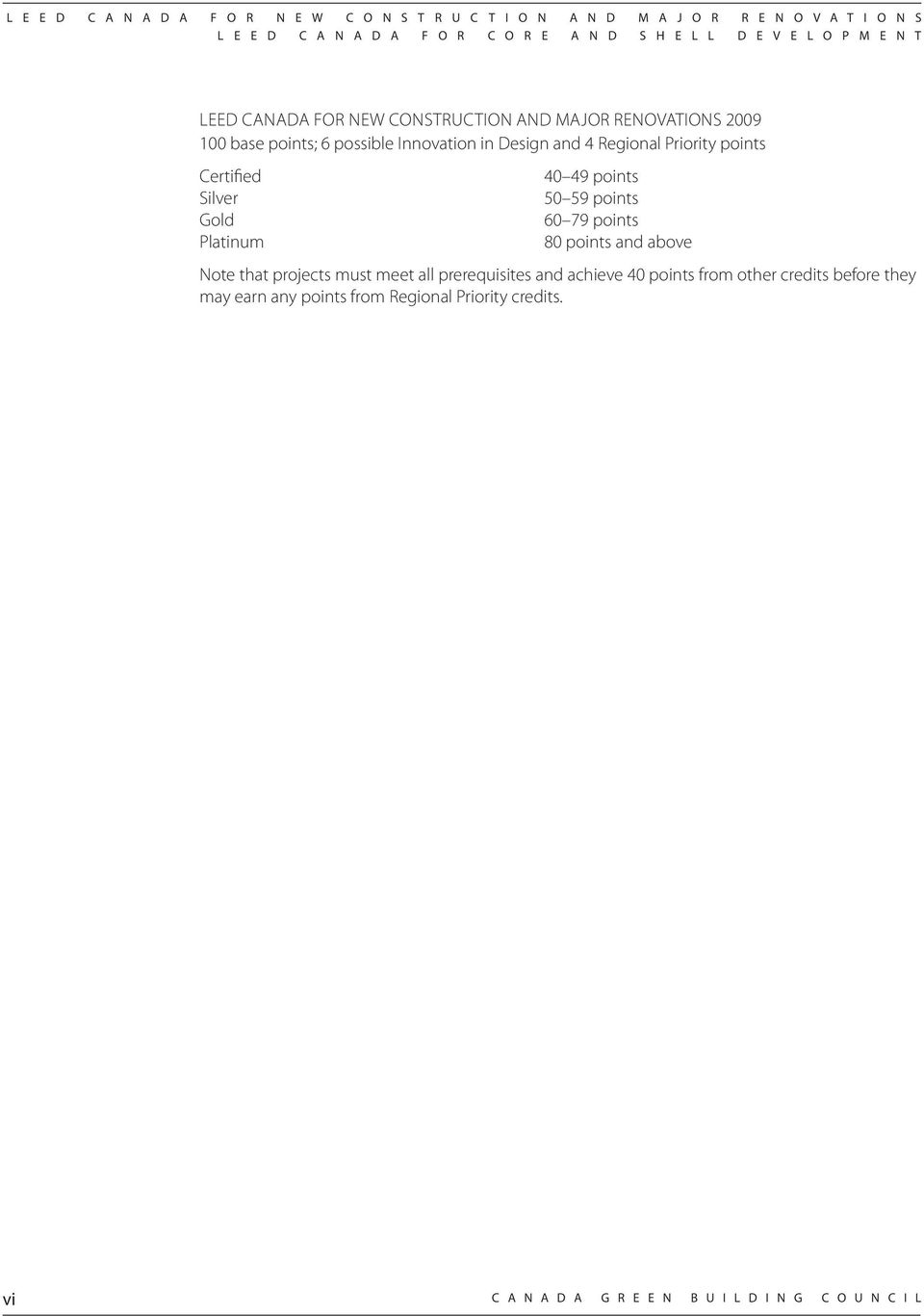
4 LEED CANADA FOR NEW CONSTRUCTION AND MAJOR RENOVATIONS 2009 PROJECT CHECKLIST SUSTAINABLE SITES 26 POSSIBLE POINTS Prereq 1 Construction Activity Pollution Prevention Required Credit 1 Site Selection 1 Credit 2 Development Density and Community Connectivity 3, 5 Credit 3 Brownfield Redevelopment 1 Credit 4.1 Alternative Transportation: Public Transportation Access 3, 6 Credit 4.2 Alternative Transportation: Bicycle Storage and Changing Rooms 1 Credit 4.3 Alternative Transportation: Low-Emitting and Fuel-Efficient Vehicles 3 Credit 4.4 Alternative Transportation: Parking Capacity 2 Credit 5.1 Site Development: Protect and Restore Habitat 1 Credit 5.2 Site Development: Maximize Open Space 1 Credit 6.1 Stormwater Design: Quantity Control 1 Credit 6.2 Stormwater Design: Quality Control 1 Credit 7.1 Heat Island Effect: Non-Roof 1 Credit 7.2 Heat Island Effect: Roof 1 Credit 8 Light Pollution Reduction 1 WATER EFFICIENCY 10 POSSIBLE POINTS Prereq 1 Water Use Reduction Required Credit 1 Water Efficient Landscaping 2, 4 Credit 2 Innovative Wastewater Technologies 2 Credit 3 Water Use Reduction 2-4 ENERGY AND ATMOSPHERE 35 POSSIBLE POINTS Prereq 1 Fundamental Commissioning of Building Energy Systems Required Prereq 2 Minimum Energy Performance Required Prereq 3 Fundamental Refrigerant Management Required Credit 1 Optimize Energy Performance 1-19 Credit 2 On-Site Renewable Energy 1-7 Credit 3 Enhanced Commissioning 2 Credit 4 Enhanced Refrigerant Management 2 Credit 5 Measurement and Verification 3 Credit 6 Green Power 2 iv
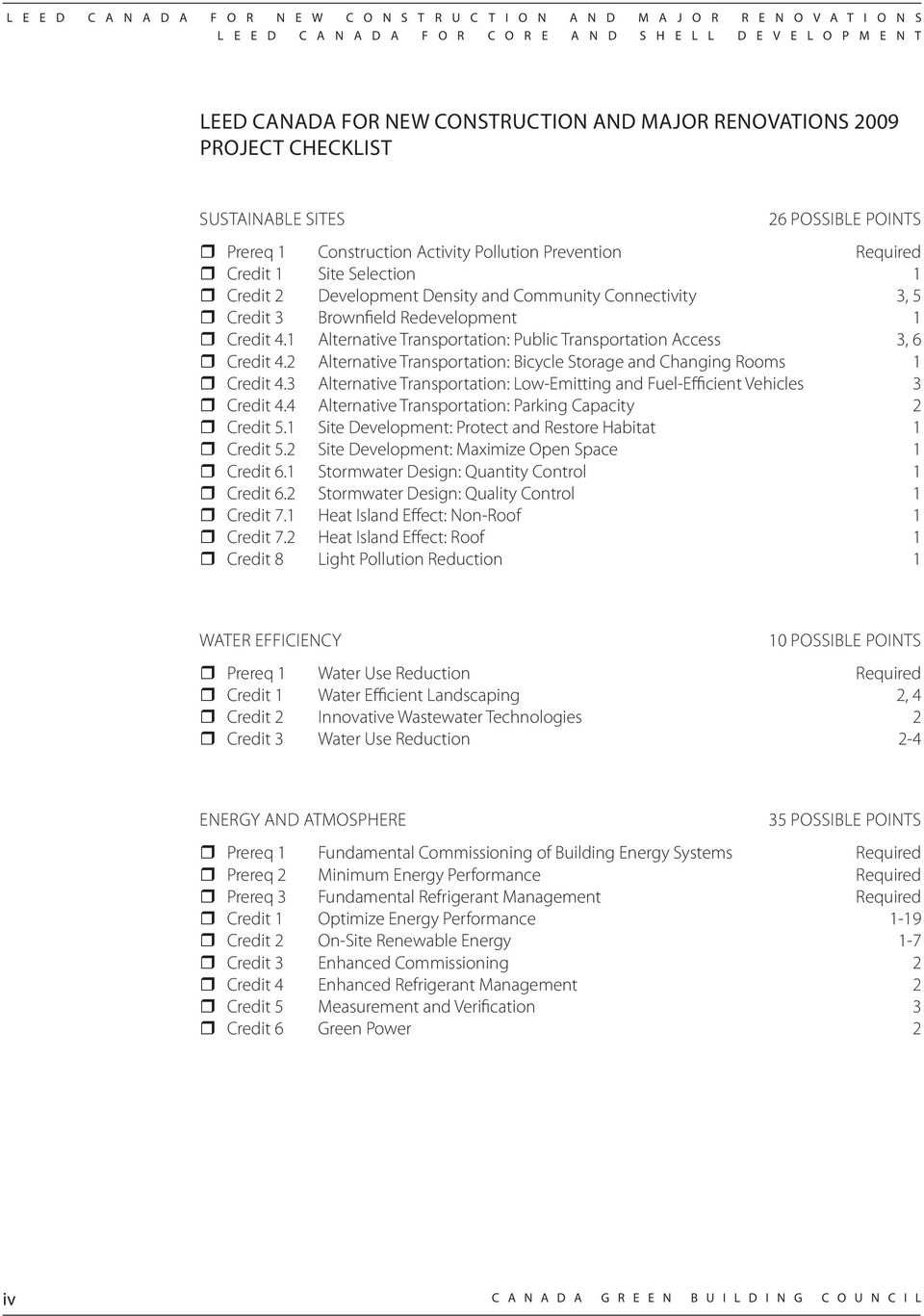
5 MATERIALS AND RESOURCES 14 POSSIBLE POINTS Prereq 1 Storage and Collection of Recyclables Required Credit 1.1 Building Reuse: Maintain Existing Walls, Floors, and Roof 1-3 Credit 1.2 Building Reuse: Maintain Interior Non-Structural Elements 1 Credit 2 Construction Waste Management 1-2 Credit 3 Materials Reuse 1-2 Credit 4 Recycled Content 1-2 Credit 5 Regional Materials 1-2 Credit 6 Rapidly Renewable Materials 1 Credit 7 Certified Wood 1 INDOOR ENVIRONMENTAL QUALITY 15 POSSIBLE POINTS Prereq 1 Minimum Indoor Air Quality Performance Required Prereq 2 Environmental Tobacco Smoke (ETS) Control Required Credit 1 Outdoor Air Delivery Monitoring 1 Credit 2 Increased Ventilation 1 Credit 3.1 Construction Indoor Air Quality Management Plan: During Construction 1 Credit 3.2 Construction Indoor Air Quality Management Plan: Before Occupancy 1 Credit 4.1 Low-Emitting Materials: Adhesives and Sealants 1 Credit 4.2 Low-Emitting Materials: Paints and Coatings 1 Credit 4.3 Low-Emitting Materials: Flooring Systems 1 Credit 4.4 Low-Emitting Materials: Composite Wood and Agrifibre Products 1 Credit 5 Indoor Chemical and Pollutant Source Control 1 Credit 6.1 Controllability of System: Lighting 1 Credit 6.2 Controllability of System: Thermal Comfort 1 Credit 7.1 Thermal Comfort: Design 1 Credit 7.2 Thermal Comfort: Verification 1 Credit 8.1 Daylight and Views: Daylight 1 Credit 8.2 Daylight and Views: Views 1 INNOVATION IN DESIGN 6 POSSIBLE POINTS Credit 1 Innovation in Design 1-5 Credit 2 LEED Accredited Professional 1 REGIONAL PRIORITY 4 POSSIBLE POINTS Credit 1 Durable Building 1 Credit 2 Regional Priority Credit 1-3 v
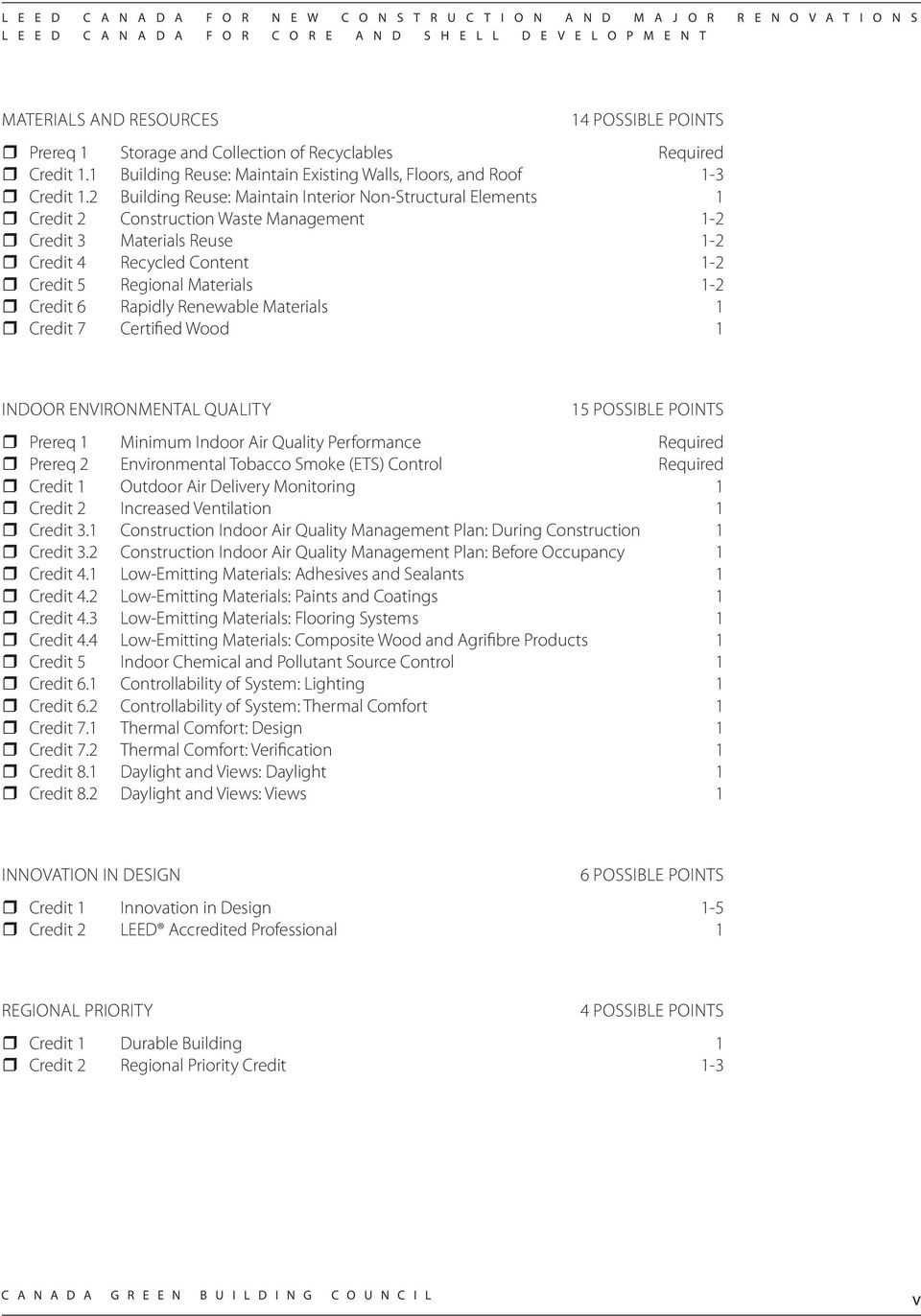
6 LEED CANADA FOR NEW CONSTRUCTION AND MAJOR RENOVATIONS base points; 6 possible Innovation in Design and 4 Regional Priority points Certified Silver Gold Platinum points points points 80 points and above Note that projects must meet all prerequisites and achieve 40 points from other credits before they may earn any points from Regional Priority credits. vi
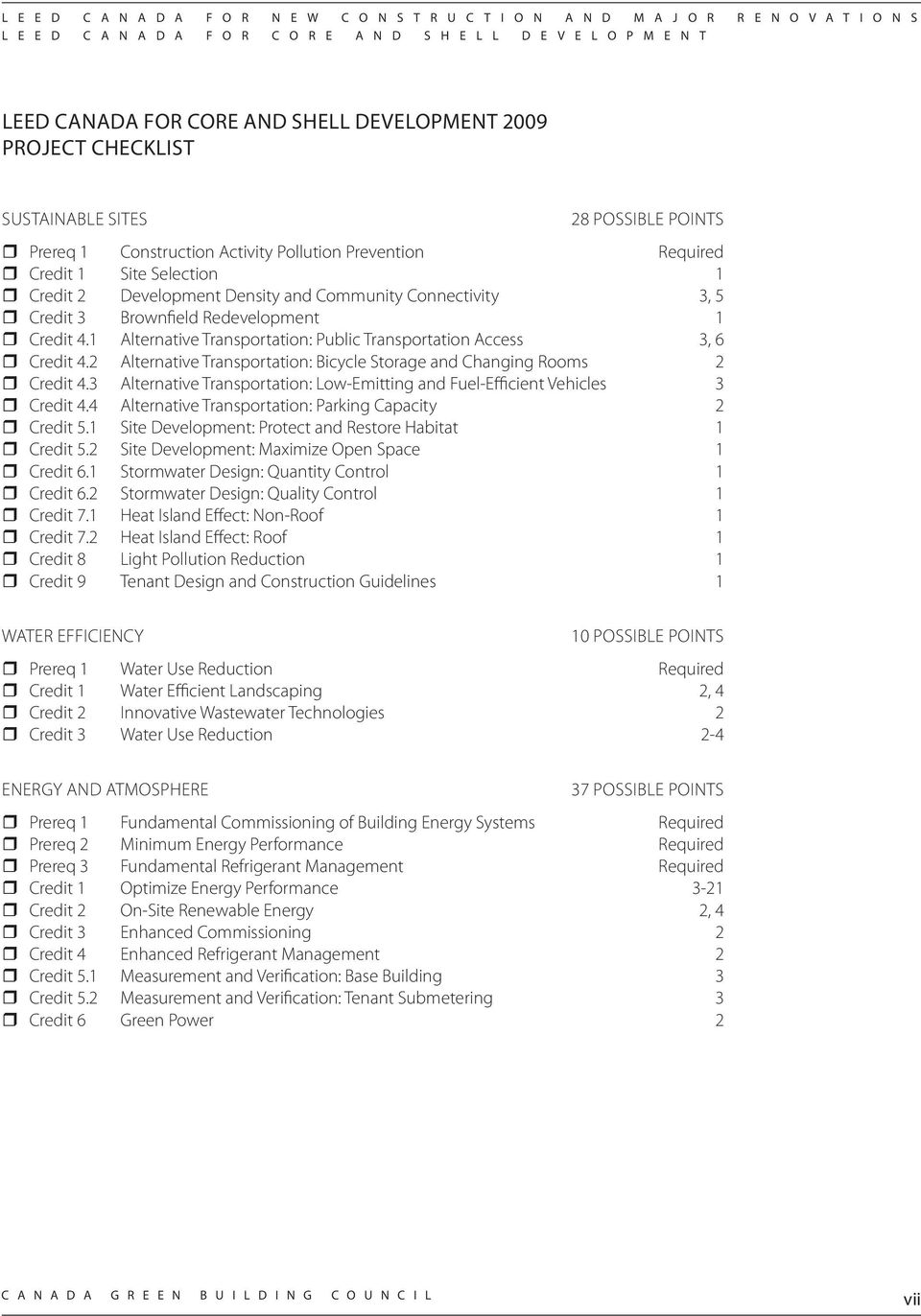
7 LEED CANADA FOR CORE AND SHELL DEVELOPMENT 2009 PROJECT CHECKLIST SUSTAINABLE SITES 28 POSSIBLE POINTS Prereq 1 Construction Activity Pollution Prevention Required Credit 1 Site Selection 1 Credit 2 Development Density and Community Connectivity 3, 5 Credit 3 Brownfield Redevelopment 1 Credit 4.1 Alternative Transportation: Public Transportation Access 3, 6 Credit 4.2 Alternative Transportation: Bicycle Storage and Changing Rooms 2 Credit 4.3 Alternative Transportation: Low-Emitting and Fuel-Efficient Vehicles 3 Credit 4.4 Alternative Transportation: Parking Capacity 2 Credit 5.1 Site Development: Protect and Restore Habitat 1 Credit 5.2 Site Development: Maximize Open Space 1 Credit 6.1 Stormwater Design: Quantity Control 1 Credit 6.2 Stormwater Design: Quality Control 1 Credit 7.1 Heat Island Effect: Non-Roof 1 Credit 7.2 Heat Island Effect: Roof 1 Credit 8 Light Pollution Reduction 1 Credit 9 Tenant Design and Construction Guidelines 1 WATER EFFICIENCY 10 POSSIBLE POINTS Prereq 1 Water Use Reduction Required Credit 1 Water Efficient Landscaping 2, 4 Credit 2 Innovative Wastewater Technologies 2 Credit 3 Water Use Reduction 2-4 ENERGY AND ATMOSPHERE 37 POSSIBLE POINTS Prereq 1 Fundamental Commissioning of Building Energy Systems Required Prereq 2 Minimum Energy Performance Required Prereq 3 Fundamental Refrigerant Management Required Credit 1 Optimize Energy Performance 3-21 Credit 2 On-Site Renewable Energy 2, 4 Credit 3 Enhanced Commissioning 2 Credit 4 Enhanced Refrigerant Management 2 Credit 5.1 Measurement and Verification: Base Building 3 Credit 5.2 Measurement and Verification: Tenant Submetering 3 Credit 6 Green Power 2 vii
8 MATERIALS AND RESOURCES 13 POSSIBLE POINTS Prereq 1 Storage and Collection of Recyclables Required Credit 1 Building Reuse: Maintain Existing Walls, Floors, and Roof 1-5 Credit 2 Construction Waste Management 1-2 Credit 3 Materials Reuse 1 Credit 4 Recycled Content 1-2 Credit 5 Regional Materials 1-2 Credit 6 Certified Wood 1 INDOOR ENVIRONMENTAL QUALITY 12 POSSIBLE POINTS Prereq 1 Minimum Indoor Air Quality Performance Required Prereq 2 Environmental Tobacco Smoke (ETS) Control Required Credit 1 Outdoor Air Delivery Monitoring 1 Credit 2 Increased Ventilation 1 Credit 3 Construction Indoor Air Quality Management Plan: During Construction 1 Credit 4.1 Low-Emitting Materials: Adhesives and Sealants 1 Credit 4.2 Low-Emitting Materials: Paints and Coatings 1 Credit 4.3 Low-Emitting Materials: Flooring Systems 1 Credit 4.4 Low-Emitting Materials: Composite Wood and Agrifibre Products 1 Credit 5 Indoor Chemical and Pollutant Source Control 1 Credit 6 Controllability of System: Thermal Comfort 1 Credit 7 Thermal Comfort: Design 1 Credit 8.1 Daylight and Views: Daylight 1 Credit 8.2 Daylight and Views: Views 1 INNOVATION IN DESIGN 6 POSSIBLE POINTS Credit 1 Innovation in Design 1-5 Credit 2 LEED Accredited Professional 1 REGIONAL PRIORITY 4 POSSIBLE POINTS Credit 1 Durable Building 1 Credit 2 Regional Priority Credit 1-3 LEED CANADA FOR CORE AND SHELL DEVELOPMENT base points; 6 possible Innovation in Design and 4 Regional Priority points Certified Silver Gold Platinum points points points 80 points and above Note that projects must meet all prerequisites and achieve 40 points from other credits before they may earn any points from Regional Priority credits. viii

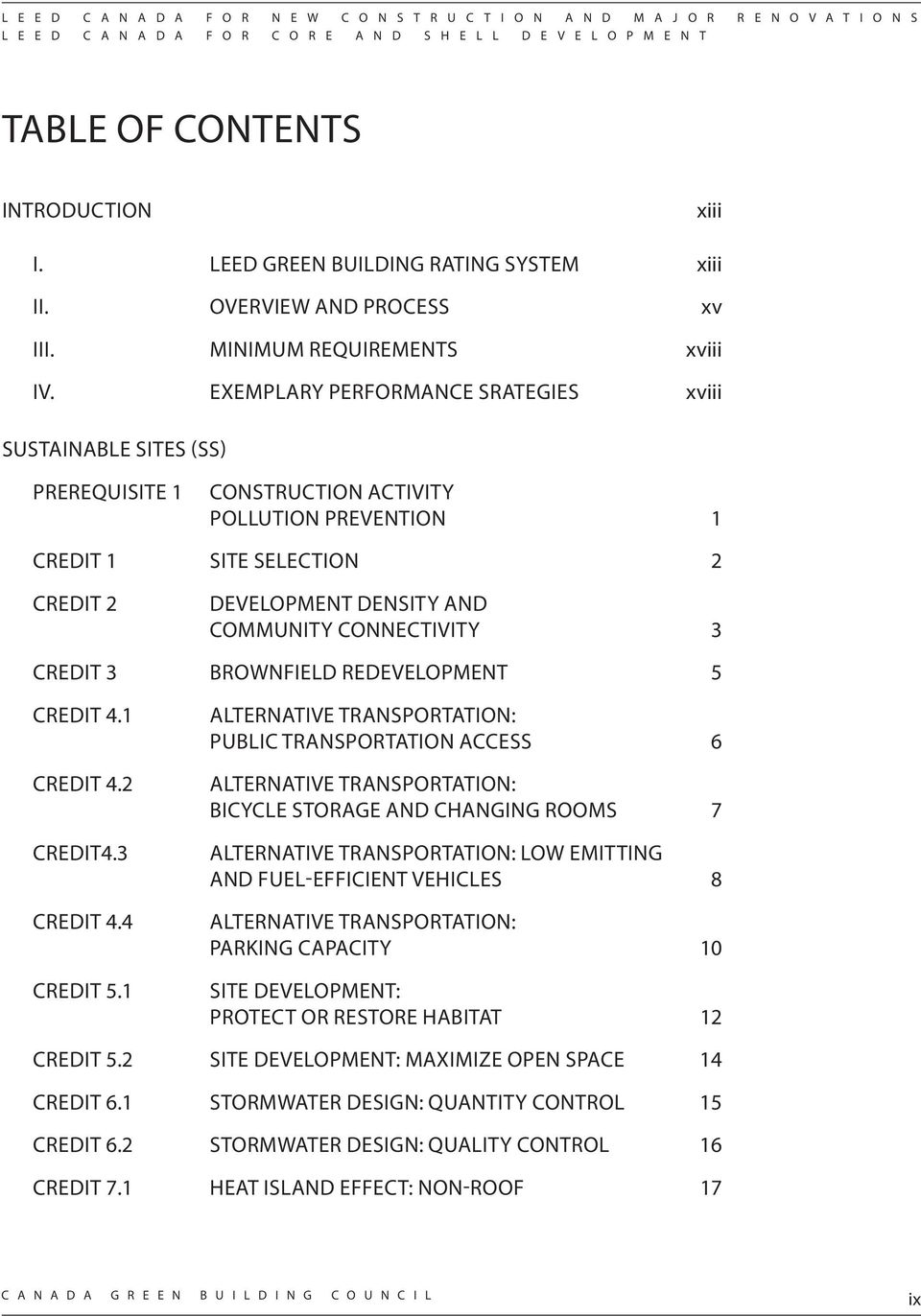
9 TABLE OF CONTENTS INTRODUCTION xiii I. LEED GREEN BUILDING RATING SYSTEM xiii II. OVERVIEW AND PROCESS xv III. MINIMUM REQUIREMENTS xviii IV. EXEMPLARY PERFORMANCE SRATEGIES xviii SUSTAINABLE SITES (SS) PREREQUISITE 1 CONSTRUCTION ACTIVITY POLLUTION PREVENTION 1 CREDIT 1 SITE SELECTION 2 CREDIT 2 DEVELOPMENT DENSITY AND COMMUNITY CONNECTIVITY 3 CREDIT 3 BROWNFIELD REDEVELOPMENT 5 CREDIT 4.1 CREDIT 4.2 CREDIT4.3 CREDIT 4.4 CREDIT 5.1 ALTERNATIVE TRANSPORTATION: PUBLIC TRANSPORTATION ACCESS 6 ALTERNATIVE TRANSPORTATION: BICYCLE STORAGE AND CHANGING ROOMS 7 ALTERNATIVE TRANSPORTATION: LOW EMITTING AND FUEL-EFFICIENT VEHICLES 8 ALTERNATIVE TRANSPORTATION: PARKING CAPACITY 10 SITE DEVELOPMENT: PROTECT OR RESTORE HABITAT 12 CREDIT 5.2 SITE DEVELOPMENT: MAXIMIZE OPEN SPACE 14 CREDIT 6.1 STORMWATER DESIGN: QUANTITY CONTROL 15 CREDIT 6.2 STORMWATER DESIGN: QUALITY CONTROL 16 CREDIT 7.1 HEAT ISLAND EFFECT: NON-ROOF 17 ix
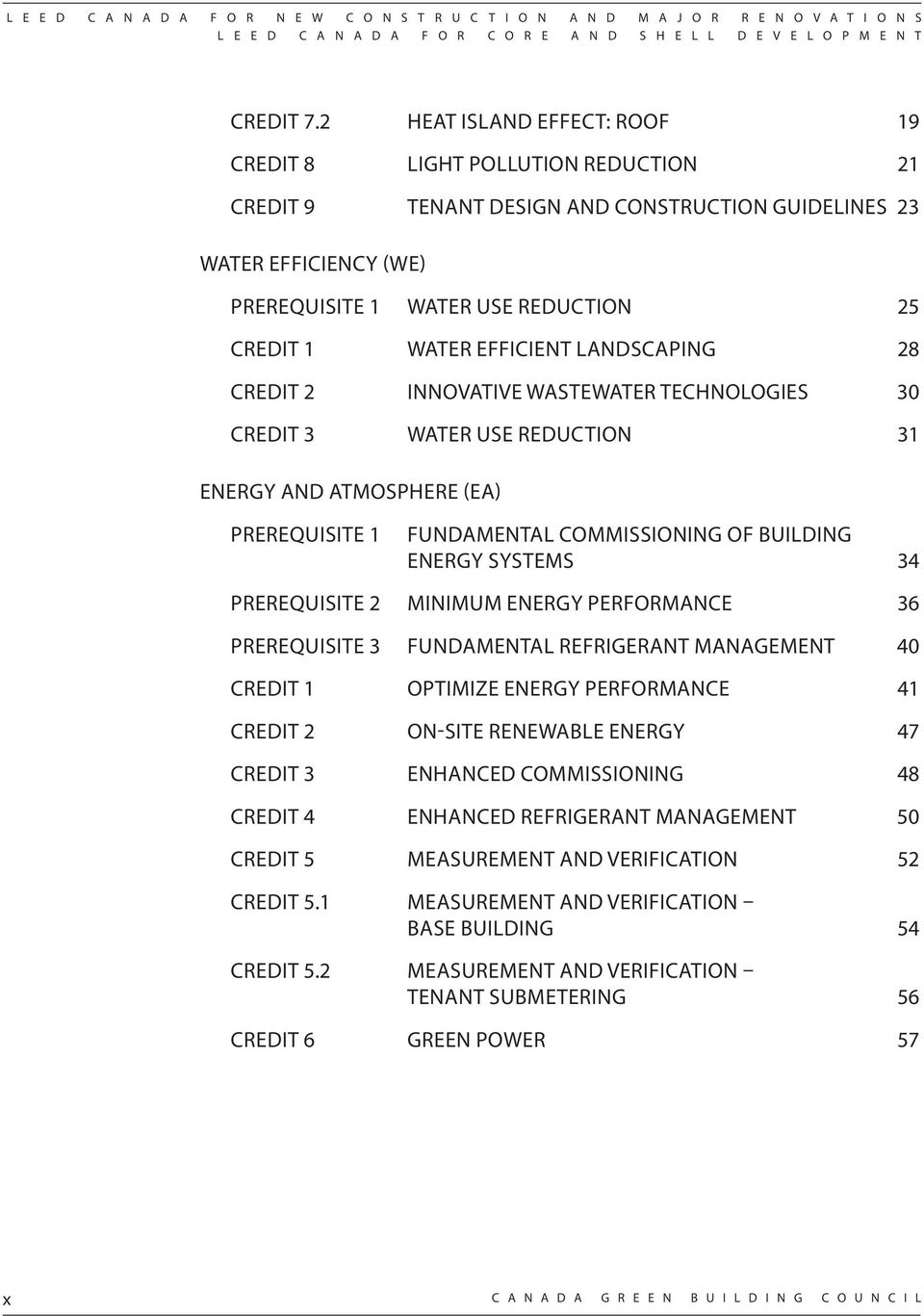
10 CREDIT 7.2 HEAT ISLAND EFFECT: ROOF 19 CREDIT 8 LIGHT POLLUTION REDUCTION 21 CREDIT 9 TENANT DESIGN AND CONSTRUCTION GUIDELINES 23 WATER EFFICIENCY (WE) PREREQUISITE 1 WATER USE REDUCTION 25 CREDIT 1 WATER EFFICIENT LANDSCAPING 28 CREDIT 2 INNOVATIVE WASTEWATER TECHNOLOGIES 30 CREDIT 3 WATER USE REDUCTION 31 ENERGY AND ATMOSPHERE (EA) PREREQUISITE 1 FUNDAMENTAL COMMISSIONING OF BUILDING ENERGY SYSTEMS 34 PREREQUISITE 2 MINIMUM ENERGY PERFORMANCE 36 PREREQUISITE 3 FUNDAMENTAL REFRIGERANT MANAGEMENT 40 CREDIT 1 OPTIMIZE ENERGY PERFORMANCE 41 CREDIT 2 ON-SITE RENEWABLE ENERGY 47 CREDIT 3 ENHANCED COMMISSIONING 48 CREDIT 4 ENHANCED REFRIGERANT MANAGEMENT 50 CREDIT 5 MEASUREMENT AND VERIFICATION 52 CREDIT 5.1 MEASUREMENT AND VERIFICATION BASE BUILDING 54 CREDIT 5.2 MEASUREMENT AND VERIFICATION TENANT SUBMETERING 56 CREDIT 6 GREEN POWER 57 x
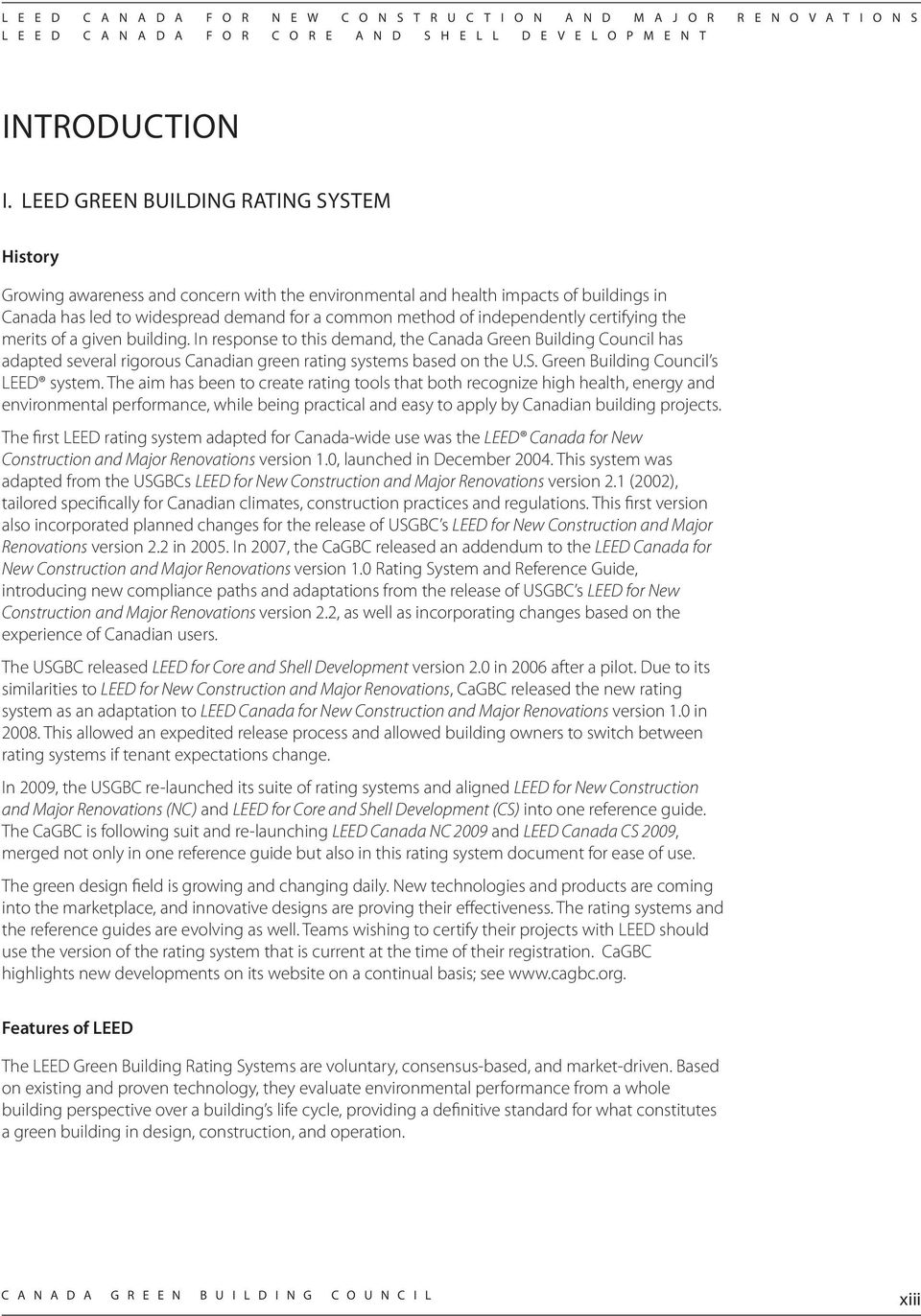
11 MATERIALS AND RESOURCES (MR) PREREQUISITE 1 STORAGE AND COLLECTION OF RECYCLABLES 58 CREDIT 1/1.1 CREDIT 1.2 BUILDING REUSE - MAINTAIN EXISTING WALLS, FLOORS, AND ROOF 59 BUILDING REUSE - MAINTAIN INTERIOR NON-STRUCTURAL ELEMENTS 61 CREDIT 2 CONSTRUCTION WASTE MANAGEMENT 62 CREDIT 3 MATERIALS REUSE 63 CREDIT 4 RECYCLED CONTENT 64 CREDIT 5 REGIONAL MATERIALS 65 CREDIT 6 RAPIDLY RENEWABLE MATERIALS 66 CREDIT 6/7 CERTIFIED WOOD 67 INDOOR ENVIRONMENTAL QUALITY (IEQ) PREREQUISITE 1 MINIMUM IAQ PERFORMANCE 68 PREREQUISITE 2 ENVIRONMENTAL TOBACCO SMOKE (ETS) CONTROL 69 CREDIT 1 OUTDOOR AIR DELIVERY MONITORING 72 CREDIT 2 INCREASED VENTILATION 74 CREDIT 3/3.1 CREDIT 3.2 CREDIT 4.1 CREDIT 4.2 CREDIT 4.3 CONSTRUCTION IAQ MANAGEMENT PLAN: DURING CONSTRUCTION 76 CONSTRUCTION IAQ MANAGEMENT PLAN: BEFORE OCCUPANCY 77 LOW-EMITTING MATERIALS: ADHESIVES AND SEALANTS 80 LOW-EMITTING MATERIALS: PAINTS AND COATINGS 82 LOW-EMITTING MATERIALS: FLOORING SYSTEMS 83 xi

12 CREDIT 4.4 CREDIT 5 LOW-EMITTING MATERIALS: COMPOSITE WOOD AND AGRIFIBRE PRODUCTS 85 INDOOR CHEMICAL AND POLLUTANT SOURCE CONTROL 86 CREDIT 6.1 CONTROLLABILITY OF SYSTEMS: LIGHTING 88 CREDIT 6/6.2 CONTROLLABILITY OF SYSTEMS: THERMAL COMFORT 89 CREDIT 7/7.1 THERMAL COMFORT: DESIGN 91 CREDIT 7.2 THERMAL COMFORT: VERIFICATION 92 CREDIT 8.1 DAYLIGHT AND VIEWS: DAYLIGHT 94 CREDIT 8.2 DAYLIGHT AND VIEWS: VIEWS 98 INNOVATION IN DESIGN (ID) CREDIT 1 INNOVATION IN DESIGN 99 CREDIT 2 LEED ACCREDITED PROFESSIONAL 101 REGIONAL PRIORITY (RP) CREDIT 1 DURABLE BUILDING 102 CREDIT 2 REGIONAL PRIORITY CREDIT 104 xii

13 INTRODUCTION I. LEED GREEN BUILDING RATING SYSTEM History Growing awareness and concern with the environmental and health impacts of buildings in Canada has led to widespread demand for a common method of independently certifying the merits of a given building. In response to this demand, the Canada Green Building Council has adapted several rigorous Canadian green rating systems based on the U.S. Green Building Council s LEED system. The aim has been to create rating tools that both recognize high health, energy and environmental performance, while being practical and easy to apply by Canadian building projects. The first LEED rating system adapted for Canada-wide use was the LEED Canada for New Construction and Major Renovations version 1.0, launched in December This system was adapted from the USGBCs LEED for New Construction and Major Renovations version 2.1 (2002), tailored specifically for Canadian climates, construction practices and regulations. This first version also incorporated planned changes for the release of USGBC s LEED for New Construction and Major Renovations version 2.2 in In 2007, the CaGBC released an addendum to the LEED Canada for New Construction and Major Renovations version 1.0 Rating System and Reference Guide, introducing new compliance paths and adaptations from the release of USGBC s LEED for New Construction and Major Renovations version 2.2, as well as incorporating changes based on the experience of Canadian users. The USGBC released LEED for Core and Shell Development version 2.0 in 2006 after a pilot. Due to its similarities to LEED for New Construction and Major Renovations, CaGBC released the new rating system as an adaptation to LEED Canada for New Construction and Major Renovations version 1.0 in This allowed an expedited release process and allowed building owners to switch between rating systems if tenant expectations change. In 2009, the USGBC re-launched its suite of rating systems and aligned LEED for New Construction and Major Renovations (NC) and LEED for Core and Shell Development (CS) into one reference guide. The CaGBC is following suit and re-launching LEED Canada NC 2009 and LEED Canada CS 2009, merged not only in one reference guide but also in this rating system document for ease of use. The green design field is growing and changing daily. New technologies and products are coming into the marketplace, and innovative designs are proving their effectiveness. The rating systems and the reference guides are evolving as well. Teams wishing to certify their projects with LEED should use the version of the rating system that is current at the time of their registration. CaGBC highlights new developments on its website on a continual basis; see Features of LEED The LEED Green Building Rating Systems are voluntary, consensus-based, and market-driven. Based on existing and proven technology, they evaluate environmental performance from a whole building perspective over a building s life cycle, providing a definitive standard for what constitutes a green building in design, construction, and operation. xiii
14 The LEED rating systems are designed for rating new and existing commercial, institutional, and residential buildings. They are based on accepted energy and environmental principles and strike a balance between known, established practices and emerging concepts. Each rating system is organized into 5 environmental categories: Sustainable Sites, Water Efficiency, Energy and Atmosphere, Materials and Resources, and Indoor Environmental Quality. An additional category, Innovation in Design (or Operations), addresses sustainable building expertise as well as measures not covered under the 5 environmental categories. Regional bonus points are another feature of LEED and acknowledge the importance of local conditions in determining best environmental design and construction practices. The LEED Credit Weightings In LEED 2009, the allocation of points between credits is based on the potential environmental impacts and human benefits of each credit with respect to a set of impact categories. The impacts are defined as the environmental or human effect of the design, construction, operation, and maintenance of the building, such as greenhouse gas emissions, fossil fuel use, toxins and carcinogens, air and water pollutants, indoor environmental conditions. A combination of approaches, including energy modeling, life-cycle assessment, and transportation analysis, is used to quantify each type of impact. The resulting allocation of points among credits is called credit weighting. LEED 2009 uses the U.S. Environmental Protection Agency s TRACI 1 environmental impact categories as the basis for weighting each credit. TRACI was developed to assist with impact evaluation for life-cycle assessment, industrial ecology, process design, and pollution prevention. LEED 2009 also takes into consideration the weightings developed by the National Institute of Standards and Technology (NIST); these compare impact categories with one another and assign a relative weight to each. Together, the 2 approaches provide a solid foundation for determining the point value of each credit in LEED The LEED 2009 credit weightings process is based on the following parameters, which maintain consistency and usability across rating systems: All LEED credits are worth a minimum of 1 point. All LEED credits are positive, whole numbers; there are no fractions or negative values. All LEED credits receive a single, static weight in each rating system; there are no individualized scorecards based on project location. All LEED rating systems have 100 base points; Innovation in Design (or Operations) and Regional Priority credits provide opportunities for up to 10 bonus points. Given the above criteria, the LEED 2009 credit weightings process involves 3 steps: 1. A reference building is used to estimate the environmental impacts in 13 categories associated with a typical building pursuing LEED certification. 2. The relative importance of building impacts in each category are set to reflect values based on the NIST weightings Data that quantify building impacts on environmental and human health are used to assign points to individual credits. xiv
15 Each credit is allocated points based on the relative importance of the building-related impacts that it addresses. The result is a weighted average that combines building impacts and the relative value of the impact categories. Credits that most directly address the most important impacts are given the greatest weight, subject to the system design parameters described above. Credit weights also reflect a decision by LEED to recognize the market implications of point allocation. The result is a significant change in allocation of points compared with previous LEED rating systems. Overall, the changes increase the relative emphasis on the reduction of energy consumption and greenhouse gas emissions associated with building systems, transportation, the embodied energy of water, the embodied energy of materials, and where applicable, solid waste. The details of the weightings process vary slightly among individual rating systems. For example, LEED Canada for Existing Buildings: Operations and Maintenance includes credits related to solid waste management within the building but LEED Canada for New Construction and Major Renovations does not. This results in a difference in the portion of the environmental footprint addressed by each rating system and the relative allocation of points. The weightings process for each rating system is fully documented in a weightings workbook. The credit weightings process will be reevaluated over time to incorporate changes in values ascribed to different building impacts and building types, based on both market reality and evolving scientific knowledge related to buildings. A complete explanation of the LEED credit weightings system is available on the USGBC website, at Regional Priority Credits To provide incentive to address geographically specific environmental issues, CaGBC is providing an opportunity for LEED Canada project teams to propose existing credits as Regional Priority credits. For a list of eligible credits and guidance regarding Regional Priority, refer to the CaGBC website, at II. OVERVIEW AND PROCESS The LEED Canada for New Construction and Major Renovations Green Building Rating System and the LEED Canada for Core and Shell Development Green Building Rating System are a set of performance standards for certifying the design and construction of commercial or institutional buildings and high-rise residential buildings of all sizes, both public and private. The intent is to promote highperformance, healthful, durable, affordable, and environmentally sound practices in building design and construction. Prerequisites and credits in the LEED Canada for New Construction and Major Renovations 2009 and in the LEED Canada for Core and Shell Development 2009 address seven topics: Sustainable Sites (SS) Water Efficiency (WE) Energy and Atmosphere (EA) Materials and Resources (MR) Indoor Environmental Quality (IEQ) Innovation in Design (ID) Regional Priority (RP) xv
16 LEED Canada for New Construction and Major Renovations 2009 and LEED Canada for Core and Shell Development 2009 certifications are awarded according to the following scale: Certified Silver Gold Platinum points points points 80 points and above The CaGBC will recognize buildings that achieve one of these ratings with a formal certificate of certification. When to Use LEED Canada for New Construction and Major Renovations 2009 LEED Canada for New Construction and Major Renovations was designed primarily for new commercial office buildings, but it has been applied to many other building types by LEED practitioners. All commercial buildings, as defined by standard building codes, are eligible for certification as LEED Canada for New Construction and Major Renovations buildings. Examples of commercial occupancies include offices, institutional buildings (libraries, museums, churches, schools, etc.), hotels, and multi-unit residential buildings (MURBs) other than those covered by Part 9 of the National Building Code. MURBs under Part 9 of the National Building Code and single-occupancy residential buildings wishing to obtain a LEED certification, should apply under LEED Canada for Homes However, Part 9 buildings that are a part of mixed-use projects in which the majority of the floor area is eligible for LEED Canada for New Construction and Major Renovations certification are allowed to be part of the latter project. Note that there is no separate LEED for Schools rating system in Canada. Instead schools wishing to obtain LEED certification for new buildings must apply under LEED Canada for New Construction and Major Renovations. Some special allowances for schools have been noted within the credits. LEED Canada for New Construction and Major Renovations addresses design and construction activities for both new buildings and major renovations of existing buildings. For a major renovation of an existing building, LEED Canada for New Construction and Major Renovations is the appropriate rating system; refer to the How to apply as a major renovation section below for important details. If the project scope does not involve significant design and construction activities and focuses more on operations and maintenance activities, LEED Canada for Existing Buildings: Operations & Maintenance is more appropriate because it addresses operational and maintenance issues of working buildings. If the project s scope is mostly limited to interior renovations, LEED Canada for Commercial Interiors is more appropriate. It is the responsibility of the applicant to ensure the project can achieve all prerequisites and sufficient credits for certification when selecting an appropriate rating system to use. Some projects are designed and constructed to be partially occupied by the owner or developer, and partially occupied by other tenants. In such projects, the owner or developer has direct influence over the portion of the work that they occupy. For such a project to pursue LEED Canada for New Construction and Major Renovations certification, at least 50% of the building s floor area must be fit-up for the certification application. Projects in which 50% or less of the building s floor area is fit-up (and is not under the design and construction control of the owner or developer) should pursue LEED Canada for Core and Shell Development certification. xvi

17 When to Use LEED Canada for Core and Shell Development 2009 The LEED Canada for Core and Shell Development Rating System is a market-specific application that recognizes the unique nature of core and shell development. The LEED Canada for Core and Shell Development Rating System acknowledges the limited level of influence a developer can exert in a speculatively developed building. LEED Canada for Core and Shell Development was developed to serve the speculative development market, in which project teams do not control all scopes of a whole building s design and construction. Depending on how the project is structured, this scope can vary significantly from project to project. The LEED Canada for Core and Shell Development Rating System addresses a variety of project types and a broad project range. LEED Canada for Core and Shell Development can be used for projects in which the developer controls the design and construction of the entire core and shell base building (e.g., mechanical, electrical, plumbing, and fire protection systems) but has no control over the design and construction of the tenant fit-out. Examples of this type of project can be a commercial office building, medical office building, retail center, warehouse, and lab facility. If a project is designed and constructed to be partially occupied by the owner or developer, then the owner or developer has direct influence over that portion of the interior build-out work. For these projects to pursue LEED Canada for Core and Shell Development certification, the owner must occupy 50% or less of the building floor area. Projects in which more than 50% of the building floor area is occupied by an owner should pursue LEED Canada for New Construction and Major Renovations certification. Because of the nature of the core and shell project type and scope, LEED Canada for Core and Shell Development certification has some unique aspects. Further guidance on these can be found in the appendices to the LEED Canada Reference Guide for Green Design and Construction. Many projects neatly fit the defined scope of only one LEED rating system; others may be eligible for two or more. The project is a viable candidate for LEED certification if it can meet all prerequisites and achieve the minimum points required in a given rating system. If more than one rating system applies, the project team can decide which one to pursue. For further assistance in choosing the most appropriate LEED rating system, please [email protected]. LEED Canada Project Registration Projects teams interested in earning LEED Canada for New Construction and Major Renovations or Core and Shell Development certification for their buildings must first register the project with the CaGBC. Projects can be registered on the CaGBC website ( Registering early in the development process ensures the maximum potential for achieving high building performance, and establishes contact with the CaGBC. Registration of a LEED Canada NC or LEED Canada CS project provides online access to essential information, software tools and communications for LEED users, such as the LEED Canada NC / CS Letter Templates and Scorecard spreadsheet, and allows the team to submit Credit Interpretation Requests (CIRs). The CaGBC web site ( contains additional registration details, a fee calculator, and the online form used to register projects. xvii

18 LEED Canada NC and LEED Canada CS Certification To earn LEED certification, the project must satisfy all the prerequisites and credits worth the minimum number of points to attain the desired project rating under LEED Canada for New Construction and Major Renovations or LEED Canada for Core and Shell Development. Projects will need to comply with the version that is current at the time of project registration. Applications for certification (submittals) should follow the requirements noted on the CaGBC website, within this rating system, and within the LEED Canada Reference Guide for Green Building Design and Construction, as well as the LEED Canada NC / CS Letter Templates. III. MINIMUM PROGRAM REQUIREMENTS The LEED Canada Reference Guide for Green Building Design and Construction provides information on minimum requirements that must be adhered to by all projects. These requirements give clear guidance to customers, protect the integrity of the LEED program, and reduce challenges that occur during the LEED certification process. IV. EXEMPLARY PERFORMANCE STRATEGIES Exemplary performance strategies result in performance that greatly exceeds the performance level or expands the scope required by an existing LEED Canada for New Construction and Major Renovations or Core and Shell Development credit. To earn exemplary performance credits, teams must generally meet the performance level defined by the next step in the threshold progression. The LEED Canada Reference Guide for Green Building Design and Construction expands further on exemplary performance pathways. 1 Tools for the Reduction and Assessment of Chemical and Other Environmental Impacts (TRACI). U.S. Environmental Protection Agency, Office of Research and Development. nrmrl/std/sab/traci/. 2 Relative impact category weights based on an exercise undertaken by NIST (National Institute of Standards and Technology) for the BEES program. xviii

19 CONSTRUCTION ACTIVITY POLLUTION PREVENTION SS NC Prerequisite 1 CS Prerequisite 1 NC CS Prerequisite SS Prerequisite 1 SS Prerequisite 1 Points Required Required INTENT To reduce pollution from construction activities by controlling soil erosion, waterway sedimentation and airborne dust generation. REQUIREMENTS: NC & CS Create and implement an erosion and sedimentation control (ESC) plan for all construction activities associated with the project. The plan must conform to the erosion and sedimentation requirements of the 2003 U.S. EPA Construction General Permit OR local standards and codes, whichever is more stringent. The plan must describe the measures implemented to accomplish the following objectives: To prevent loss of soil during construction by stormwater runoff and/or wind erosion, including protecting topsoil by stockpiling for reuse. To prevent sedimentation of storm sewer or receiving streams. To prevent pollution of the air with dust and particulate matter. The U.S. EPA s construction general permit outlines the provisions necessary to comply with Phase I and Phase II of USA s National Pollutant Discharge Elimination System (NPDES) program. While the permit only applies to construction sites greater than 0.40 hectares (1 acre), the requirements are applied to all projects for the purposes of this prerequisite. Information on the U.S. EPA construction general permit is available at: INTERPRETATIONS There are no interpretations for this credit. 1

20 SS NC Credit 1 CS Credit 1 SITE SELECTION NC CS Credit SS Credit 1 SS Credit 1 Points 1 point 1 point INTENT To avoid the development of inappropriate sites and reduce the environmental impact from the location of a building on a site. REQUIREMENTS: NC & CS Do not develop buildings, hardscape, roads or parking areas on portions of sites that meet any of the following criteria: Prime farmland (farm buildings are exempt from this requirement). Previously undeveloped or graded land whose elevation is EITHER: lower than 1.5 metres (5 feet) above the elevation of the 100-year flood plain, OR lower than 0.9 metres (3 feet) above the elevation of the 200-year flood plain. Ecologically sensitive land. Land specifically identified as habitat for any species on federal, provincial, or territorial threatened or endangered lists. Land within 30.5 metres (100 feet) of any wetlands or areas of special concern identified by federal, provincial, or local authorities, OR within setback distances from wetlands prescribed in federal, provincial, or local regulations and requirements, whichever are more stringent. Previously undeveloped or graded land that is within 15.2 metres (50 feet) of a water body, defined as seas, lakes, rivers, streams and tributaries which support or could support fish, recreation or industrial use, consistent with federal, provincial, or local regulations and requirements. Land that prior to acquisition for the project was public parkland, unless land of equal or greater value as parkland is accepted in trade by the public landowner (park authority projects are exempt). POTENTIAL TECHNOLOGIES & STRATEGIES During the site selection process, give preference to sites that do not include sensitive elements or restrictive land types. Select a suitable building location and design the building with a minimal footprint to minimize disruption of the environmentally sensitive areas identified above. 2

21 DEVELOPMENT DENSITY AND COMMUNITY CONNECTIVITY SS NC Credit 2 CS Credit 2 NC CS Credit SS Credit 2 SS Credit 2 Points 3, 5 points 3, 5 points INTENT To channel development to urban areas with existing infrastructure, protect greenfields and preserve habitat and natural resources. REQUIREMENTS: NC & CS OPTION 1. DEVELOPMENT DENSITY (5 Points) OR Construct or renovate a building on a previously developed or graded site, that conforms with a minimum development density of 13,800 square metres per hectare requirement (60,000 square feet per acre), AND select a site in a community with a minimum density of 13,800 square metres per hectare (60,000 square feet per acre net). The density calculation is based on a typical two-storey downtown development and must include the area of the project being built. OPTION 2. COMMUNITY CONNECTIVITY (3 Points) Construct or renovate a building on a site that meets the following criteria: Is located on a previously developed site Is within 800 metres (½ mile) of a residential area or neighbourhood with an average density of 25 units per hectare (10 units per acre net) (unless the project itself contains residential units meeting the density requirement) Is within 800 metres (½ mile) of at least 10 basic services Has pedestrian access between the building and the services. 3
22 SS NC Credit 2 CS Credit 2 If a service in a mixed use project is counted, it must be open to the public. No more than 2 of the 10 services required may be anticipated (i.e., at least 8 must be existing and operational). In addition, the anticipated services must demonstrate that they will be operational in the locations indicated within 1 year of occupation of the applicant s project. Examples of basic services include the following: Bank Place of Worship Convenience Grocery Day Care Centre Cleaners Fire Station Beauty Salon Hardware Laundry Library Medical or Dental Office Senior Care Facility Park Pharmacy Post Office Restaurant School Supermarket Theatre Community Centre Fitness Centre Museum OR Proximity is determined by drawing an 800 metre (½ mile) radius around a main building entrance on a site map and counting the services within that radius. OPTION 3. COMMUNITY CONNECTIVITY WITH DENSITY (5 points) Construct or renovate a building on a site that meets the following criteria: Is located on a previously developed site Meets the community connectivity requirements of Option 2 Meets the minimum project site density requirement of 13,800 square metres per hectare (60,000 square feet per acre). POTENTIAL TECHNOLOGIES & STRATEGIES During the site selection process, give preference to urban sites with pedestrian access to a variety of services. 4
23 BROWNFIELD REDEVELOPMENT NC CS Credit SS Credit 3 SS Credit 3 Points 1 point 1 point SS NC Credit 3 CS Credit 3 INTENT To rehabilitate damaged sites where development is complicated by environmental contamination and to reduce pressure on undeveloped land. REQUIREMENTS: NC & CS Develop on a site defined as a brownfield or contaminated site by the appropriate local, provincial or federal government agency (or where allowed by your jurisdiction, documented as contaminated by an independent environmental assessment firm). Provide remediation as defined and required by the relevant regulatory agency. POTENTIAL TECHNOLOGIES & STRATEGIES During the site selection process, give preference to brownfield sites. Identify tax incentives and property cost savings. Coordinate site development plans with remediation activity, as appropriate. 5
24 SS NC Credit 4.1 CS Credit 4.1 ALTERNATIVE TRANSPORTATION: PUBLIC TRANSPORTATION ACCESS NC CS Credit SS Credit 4.1 SS Credit 4.1 Points 3, 6 points 3, 6 points INTENT To reduce pollution and land development impacts from automobile use. REQUIREMENTS: NC & CS OPTION 1. RAIL STATION PROXIMITY (6 points) OR Locate the project within 800 metres (½ mile) walking distance (measured from a main building entrance) of an existing or planned and funded commuter rail, light rail or subway station with frequent service. OPTION 2. BUS STOP PROXIMITY (6 points) OR Locate the project within 400 metres (¼ mile) walking distance (measured from a main building entrance) of 1 or more stops for 2 or more public, campus, or private bus lines with frequent service usable by building occupants. OPTION 3. TRANSPORTATION DEMAND MANAGEMENT PLAN (3 or 6 points) Provide a Transportation Demand Management Plan (TDM) Strategy that results in a more efficient use of transportation resources, demonstrated through reduction of single occupant vehicle (SOV) trips by 25% (3 points) or 50% (6 points). POTENTIAL TECHNOLOGIES & STRATEGIES Perform a transportation survey of future building occupants to identify transportation needs. Locate the building near mass transit. 6
25 ALTERNATIVE TRANSPORTATION: BICYCLE STORAGE AND CHANGING ROOMS SS NC Credit 4.2 CS Credit 4.2 NC CS Credit SS Credit 4.2 SS Credit 4.2 Points 1 point 2 points INTENT To reduce pollution and land development impacts from automobile use. REQUIREMENTS: NC & CS CASE 1. FOR NON-RESIDENTIAL PROJECTS Provide secure and covered bicycle racks and/or storage within 183 metres (200 yards) of a building entrance for 5% or more of Full-Time Equivalent (FTE) occupants. Provide secure bicycle racks and/or storage within 183 metres (200 yards) of a building entrance for 5% or more of peak Transient Users. Provide shower and changing facilities in the building, or within 183 metres (200 yards) of a building entrance, for 0.5% of Full-Time Equivalent (FTE) occupants. CASE 2. FOR MULTI-UNIT RESIDENTIAL PROJECTS Provide covered storage facilities for securing bicycles for 15% or more of building occupants. POTENTIAL TECHNOLOGIES & STRATEGIES Design the building with transportation amenities such as bicycle racks and shower/changing facilities. 7
26 SS NC Credit 4.3 CS Credit 4.3 ALTERNATIVE TRANSPORTATION: LOW-EMITTING & FUEL-EFFICIENT VEHICLES NC CS Credit SS Credit 4.3 SS Credit 4.3 Points 3 points 3 points INTENT To reduce pollution and land development impacts from automobile use. REQUIREMENTS OPTION 1. NC & CS OR Install alternative-fuel refuelling stations for 3% of the total vehicle parking capacity of the site. Liquid or gaseous fuelling facilities must be separately ventilated or located outdoors. OPTION 2. NC OR Provide low-emitting and fuel-efficient vehicles for 3% of full-time equivalent (FTE) occupants. Provide preferred parking for these vehicles. Note: Employee owned vehicles contribute towards this credit if supported by an organizationwide incentive program. OPTION 3. NC Provide building occupants access to a low-emitting and fuel-efficient vehicle-sharing program. The following requirements must be met: One low-emitting or fuel-efficient vehicle must be provided per 3% of FTE occupants, assuming that 1 shared vehicle can carry 8 people (i.e., 1 vehicle per 267 FTE occupants). For buildings with fewer than 267 FTE occupants, at least one fuel-efficient vehicle must be provided. The vehicle sharing contract must demonstrate an agreement of at least 2 years. The estimated number of customers served per vehicle must be supported by documentation. A narrative explaining the vehicle-sharing program and its administration must be submitted. Parking for low-emitting and fuel-efficient vehicles must be located in the nearest available spaces in the nearest available parking area. Provide a site plan or area map clearly highlighting the walking path from the parking area to the project site and noting the distance. 8
27 ALL OPTIONS For the purposes of this credit, low-emitting and fuel-efficient vehicles are defined as vehicles having a Combined Fuel Consumption Rating (CFCR) of 6.5L/100km or less, as defined by Natural Resources Canada s Office of Energy Efficiency. SS NC Credit 4.3 CS Credit 4.3 POTENTIAL TECHNOLOGIES & STRATEGIES Provide transportation amenities such as alternative-fuel refuelling stations. Consider sharing the costs and benefits of refuelling stations with neighbours. 9
28 SS NC Credit 4.4 CS Credit 4.4 ALTERNATIVE TRANSPORTATION: PARKING CAPACITY NC CS Credit SS Credit 4.4 SS Credit 4.4 Points 2 points 2 points INTENT To reduce pollution and land development impacts from automobile use. REQUIREMENTS: NC & CS CASE 1. NON-RESIDENTIAL PROJECTS OPTION 1 OR Size parking capacity to meet but not exceed minimum local zoning requirements. Do not exceed 3.5 spaces per 93 square metres (1000 square feet) of gross floor area. Provide preferred parking for carpools or vanpools for 5% (for New Construction) or 3% (for Core and Shell) of the total provided parking spaces. OPTION 2 OR For projects that provide parking for less than 5% (for New Construction) or 3% (for Core and Shell) of full-time equivalent (FTE) building occupants: OPTION 3 Provide preferred parking for carpools or vanpools, marked as such, for 5% (for New Construction) or 3% (for Core and Shell) of total parking spaces. Providing a discounted parking rate is an acceptable substitute for preferred parking for carpool or vanpool vehicles. To establish a meaningful incentive in all potential markets, the parking rate must be discounted at least 20%. The discounted rate must be available to all customers (i.e. not limited to the number of customers equal to 5% of the vehicle parking capacity), publicly posted at the entrance of the parking area, and available for a minimum of 2 years. Provide no new parking. Do not exceed 3.5 spaces per 93 square metres (1000 square feet) of gross floor area. For projects with existing parking, provide preferred parking for carpools or vanpools for 5% (for New Construction) or 3% (for Core and Shell) of the total provided parking spaces. 10
29 CASE 2. RESIDENTIAL PROJECTS OPTION 1 OR Size parking capacity to meet but not exceed minimum local zoning requirements. Provide infrastructure and support programs to facilitate shared vehicle usage such as carpool drop-off areas, designated parking for vanpools, or car-share services, ride boards, and shuttle services to mass transit. OPTION 2 OR Provide 20% less parking than required by the standard local zoning by-law requirements for residential projects in the general area of the development. OPTION 3 SS NC Credit 4.4 CS Credit 4.4 Provide no new parking. Do not exceed 3.5 spaces per 93 square metres (1000 square feet) of gross floor area. CASE 3. MIXED USE (RESIDENTIAL WITH COMMERCIAL/RETAIL) PROJECTS Mixed-use buildings with less than 10% commercial area must be considered residential and adhere to the residential requirements in Case 2. For mixed-use buildings with more than 10% commercial area, the commercial space must adhere to non-residential requirements in Case 1 and the residential component must adhere to residential requirements in Case 2. POTENTIAL TECHNOLOGIES & STRATEGIES Minimize parking lot/garage size. Consider sharing parking facilities with adjacent buildings. Consider alternatives that will limit the use of single occupancy vehicles. 11
30 SS NC Credit 5.1 CS Credit 5.1 SITE DEVELOPMENT: PROTECT OR RESTORE HABITAT NC CS Credit SS Credit 5.1 SS Credit 5.1 Points 1 point 1 point INTENT To conserve existing natural areas and restore damaged areas to provide habitat and promote biodiversity. REQUIREMENTS: NC & CS CASE 1. GREENFIELD SITES Limit all site disturbance to the following parameters: 12 metres (40 feet) beyond the building perimeter; 3 metres (10 feet) beyond surface walkways, patios, surface parking and utilities less than 300 mm (12 inches) in diameter; 4.5 metres (15 feet) beyond primary roadway curbs and main utility branch trenches; 7.5 metres (25 feet) beyond constructed areas with permeable surfaces (such as pervious paving areas, stormwater detention facilities and playing fields) that require additional staging areas to limit compaction in the constructed area. CASE 2. PREVIOUSLY DEVELOPED AREAS OR GRADED SITES Restore or protect a minimum 50% of the site area (excluding the building footprint) or 20% of the total site area (including building footprint), whichever is greater, with native or adapted vegetation. Projects earning 5 points under SS Credit 2: Development Density and Community Connectivity may include vegetated roof surface in this calculation if the plants are native or adapted, provide habitat, and promote biodiversity. 12
31 POTENTIAL TECHNOLOGIES & STRATEGIES Survey greenfield sites to identify site elements and adopt a master plan for developing the project site. Carefully site the building to minimize disruption to existing ecosystems and design the building to minimize its footprint. Strategies include stacking the building program, tuck-under parking and sharing parking facilities with neighbours. Establish clearly-marked construction boundaries to minimize disturbance of the existing site and restore previously degraded areas to their natural state. For previously developed sites, use local and regional governmental agencies, consultants, educational facilities and native plant societies as resources for the selection of appropriate native or adapted plants. Prohibit plants listed as invasive or noxious weed species. Once established, native/adapted plants require minimal or no irrigation; do not require active maintenance such as mowing or chemical inputs such as fertilizers, pesticides or herbicides; and provide habitat value and promote biodiversity through avoidance of monoculture plantings. SS NC Credit 5.1 CS Credit
32 SS NC Credit 5.2 CS Credit 5.2 SITE DEVELOPMENT: MAXIMIZE OPEN SPACE NC CS Credit SS Credit 5.2 SS Credit 5.2 Points 1 point 1 point INTENT To promote biodiversity by providing a high ratio of open space to development footprint. REQUIREMENTS: NC & CS CASE 1. SITES WITH LOCAL ZONING OPEN SPACE REQUIREMENTS Reduce the development footprint and/or provide vegetated open space within the project boundary such that the amount of open space exceeds local zoning requirements by 25%. CASE 2. SITES WITH NO LOCAL ZONING REQUIREMENTS (e.g., some university campuses, military bases) Provide vegetated open space area adjacent to the building that is equal in area to the building footprint. CASE 3. SITES WITH LOCAL ZONING BUT NO OPEN SPACE REQUIREMENTS Provide vegetated open space equal to 20% of the project s site area. ALL CASES For projects in urban areas that earn 5 points under SS Credit 2: Development Density and Community Connectivity, accessible vegetated roof areas can contribute to credit compliance. For projects in urban areas that earn 5 points under SS Credit 2: Development Density and Community Connectivity, pedestrian oriented hardscape areas can contribute to credit compliance. For such projects, a minimum of 25% of the open space counted must be vegetated. Wetlands or naturally designed ponds may count as open space if the side slope gradients average 1:4 (vertical: horizontal) or less and are vegetated. POTENTIAL TECHNOLOGIES & STRATEGIES Perform a site survey to identify site elements and adopt a master plan for developing the project site. Select a suitable building location and design the building footprint to minimize site disruption. Strategies include stacking the building program, tuck-under parking and sharing parking facilities with neighbours to maximize the amount of open space on the site. 14
33 STORMWATER DESIGN: QUANTITY CONTROL NC CS Credit SS Credit 6.1 SS Credit 6.1 Points 1 point 1 point SS NC Credit 6.1 CS Credit 6.1 INTENT To limit disruption of natural hydrology by reducing impervious cover, increasing on-site infiltration, reducing or eliminating pollution from stormwater runoff and eliminating contaminants. REQUIREMENTS: NC & CS CASE 1. SITES WITH EXISTING IMPERVIOUSNESS 50% OR LESS OPTION 1 OR Implement a stormwater management plan that prevents the post-development peak discharge rate and quantity from exceeding the pre-development peak discharge rate and quantity for the 1 and 2-year 24-hour design storms. OPTION 2 Implement a stormwater management plan that protects receiving waterways from excessive erosion by implementing velocity and quantity control strategies. CASE 2. SITES WITH EXISTING IMPERVIOUSNESS GREATER THAN 50% Implement a stormwater management plan that results in a 25% decrease in the rate and volume of stormwater runoff from the 2-year 24-hour design storms. POTENTIAL TECHNOLOGIES & STRATEGIES Design the project site to maintain natural stormwater flows by promoting infiltration. Specify vegetated roofs, pervious paving and other measures to minimize impervious surfaces. Reuse stormwater for non-potable uses such as landscape irrigation, toilet and urinal flushing, and custodial uses. 15
34 SS NC Credit 6.2 CS Credit 6.2 STORMWATER DESIGN: QUALITY CONTROL NC CS Credit SS Credit 6.2 SS Credit 6.2 Points 1 point 1 point INTENT To limit disruption and pollution of natural water flows by managing stormwater runoff. REQUIREMENTS: NC & CS Implement a stormwater management plan that reduces impervious cover, promotes infiltration and captures and treats the stormwater runoff from 90% of the average annual rainfall using acceptable best management practices (BMPs). BMPs used to treat runoff must be capable of removing 80% of the average annual post-development total suspended solids (TSS) load. BMPs are considered to meet these criteria if they are designed in accordance with standards and specifications from a provincial, territorial, or local program that has adopted these performance standards. Implement a management plan to minimize pollution and eutrophication of waterways from excess nutrient pollutants such as nitrogen and phosphorus, often found in cleaning agents and fertilizers. POTENTIAL TECHNOLOGIES & STRATEGIES Use alternative surfaces (e.g., vegetated roofs, pervious pavement, grid pavers) and non-structural techniques (e.g., rain gardens, vegetated swales, disconnection of imperviousness, rainwater recycling) to reduce imperviousness and promote infiltration and thereby reduce pollutant loadings. Use sustainable design strategies (e.g., low-impact development, environmentally sensitive design) to create integrated natural and mechanical treatment systems such as constructed wetlands, vegetated filters and open channels to treat stormwater runoff. 16
35 HEAT ISLAND EFFECT: NON ROOF NC CS Credit SS Credit 7.1 SS Credit 7.1 Points 1 point 1 point SS NC Credit 7.1 CS Credit 7.1 INTENT To reduce heat islands to minimize impact on microclimates and human and wildlife habitats. REQUIREMENTS: NC & CS CASE 1. ALL PROJECTS OPTION 1 OR Use any combination of the following strategies for 50% of the site hardscape (including roads, sidewalks, courtyards and parking lots): Provide shade from existing tree canopy or within 5 years of landscape installation; landscaping (trees) must be in place at the time of occupancy. Provide shade from structures covered by solar panels that produce energy used to offset some non-renewable resource use. Provide shade from architectural devices or structures that have a solar reflectance index (SRI) of at least 29. Use hardscape materials with an SRI of at least 29. Use an open-grid pavement system (at least 50% pervious). OPTION 2 Place a minimum of 50% of parking spaces under cover. Any roof used to shade or cover parking must have an SRI of at least 29, be a vegetated green roof, or be covered by solar panels that produce energy used to offset some non-renewable resource use. CASE 2 FOR NON-CAMPUS PROJECTS ONLY For projects where the non-roof area constitutes less than 5% of the total site area: meet the requirements of SS Credit 7.2: Heat Island Effect: Roof and SS Credit 2: Development Density and Community Connectivity. 17
36 SS NC Credit 7.1 CS Credit 7.1 POTENTIAL TECHNOLOGIES & STRATEGIES Employ strategies, materials and landscaping techniques that reduce the heat absorption of exterior materials. Use shade (calculated on June 21, noon solar time) from native or adapted trees and large shrubs, vegetated trellises or other exterior structures supporting vegetation. Consider using new coatings and integral colorants for asphalt to achieve light-coloured surfaces instead of blacktop. Position photovoltaic cells to shade impervious surfaces. Consider replacing constructed surfaces (e.g., roof, roads, sidewalks, etc.) with vegetated surfaces such as vegetated roofs and open grid paving or specify high-albedo materials, such as concrete, to reduce heat absorption. 18
37 HEAT ISLAND EFFECT: ROOF NC CS Credit SS Credit 7.2 SS Credit 7.2 Points 1 point 1 point SS NC Credit 7.2 CS Credit 7.2 INTENT To reduce heat islands to minimize impact on microclimates and human and wildlife habitats. REQUIREMENTS: NC & CS OPTION 1 Use roofing materials with a solar reflectance index (SRI) equal to or greater than the values in the table below for a minimum of 75% of the roof surface. Roofing materials having a lower SRI value than those listed below may be used if the weighted rooftop SRI average meets the following criteria: Projected area of SRI roof Total projected roof area x SRI of installed roof Required SRI 75% ROOF TYPE SLOPE SRI Low-Sloped Roof 2:12 78 Steep-Sloped Roof > 2:12 29 OR OPTION 2 OR Install a vegetated roof for at least 50% of the roof area. OPTION 3 Install high-albedo and vegetated roof surfaces that, in combination, meet the following criteria: Projected area roof meeting minimum SRI + Area of vegetated roof Total projected roof area
38 SS NC Credit 7.2 CS Credit 7.2 ROOF TYPE SLOPE SRI Low-Sloped Roof 2:12 78 Steep-Sloped Roof > 2:12 29 POTENTIAL TECHNOLOGIES & STRATEGIES Consider installing high-albedo and vegetated roofs to reduce heat absorption. See the LEED Canada Reference Guide for Green Building Design and Construction for default values. Product information is available from the Cool Roof Rating Council Web site at and the ENERGY STAR Web site at 20
39 LIGHT POLLUTION REDUCTION NC CS Credit SS Credit 8 SS Credit 8 Points 1 point 1 point SS NC Credit 8 CS Credit 8 INTENT To minimize light trespass from the building and site, reduce sky-glow to increase night sky access, improve nighttime visibility through glare reduction and reduce development impact from lighting on nocturnal environments. REQUIREMENTS: NC & CS Project teams must comply with 1 of the 2 options for interior lighting AND the requirement for exterior lighting. FOR INTERIOR LIGHTING OPTION 1 OR Reduce the input power (by automatic device) of all non-emergency interior luminaires with a direct line of sight to any openings in the envelope (translucent or transparent) by at least 50% between the hours of 11 p.m. and 5 a.m. After-hours override may be provided by a manual or occupant-sensing device provided the override lasts no more than 30 minutes. OPTION 2 All openings in the envelope (translucent or transparent) with a direct line of sight to any non-emergency luminaires must have shielding (controlled/closed by automatic device for a resultant transmittance of less than 10% between the hours of 11 p.m. and 5 a.m.) FOR EXTERIOR LIGHTING Partially or fully shield all exterior luminaires with 1000 initial lamp lumens or more to meet the Full Cutoff IESNA Classification so they do not emit light directly to the night sky. Light areas only as required for safety and comfort. Do not exceed 80% of the Lighting Power Densities for exterior areas and 50% for building facades and landscape features as defined in ANSI/ASHRAE/IESNA Standard for the classified zone. Classify the project under 1 of the following zones, as defined in IESNA RP-33, and follow all of the requirements for that zone: 21
40 SS NC Credit 8 CS Credit 8 LZ1 Dark (developed areas within national parks, provincial parks, forest land and rural areas) Design exterior lighting so that all site and building-mounted luminaires produce a maximum initial illuminance value no greater than 0.11 horizontal and vertical lux (0.01 horizontal and vertical footcandles) at the site boundary and beyond. Document that 0% of the total initial designed fixture lumens (sum total of all fixtures on site) are emitted at an angle of 90 degrees or higher from nadir (straight down). LZ2 Low (primarily residential zoning, neighbourhood business districts, light industrial with limited nighttime use and residential mixed use areas) Design exterior lighting so that all site and building-mounted luminaires produce a maximum initial illuminance value no greater than 1.1 horizontal and vertical lux (0.10 horizontal and vertical footcandles) at the site boundary and no greater than 0.11 horizontal lux (0.01 horizontal footcandles) 3 metres (10 feet) beyond the site boundary. Document that no more than 2% of the total initial designed fixture lumens (sum total of all fixtures on site) are emitted at an angle of 90 degrees or higher from nadir (straight down). LZ3 Medium (all other areas not included in LZ1, LZ2 or LZ4 such as commercial/ industrial, high-density residential) Design exterior lighting so that all site and building-mounted luminaires produce a maximum initial illuminance value no greater than 2.2 horizontal and vertical lux (0.20 horizontal and vertical footcandles) at the site boundary and no greater than 0.11 horizontal lux (0.01 horizontal footcandles) 4.6 metres (15 feet) beyond the site. Document that no more than 5% of the total initial designed fixture lumens (sum total of all fixtures on site) are emitted at an angle of 90 degrees or higher from nadir (straight down). LZ4 High (high-activity commercial districts in major metropolitan areas) Design exterior lighting so that all site and building-mounted luminaires produce a maximum initial illuminance value no greater than 6.5 horizontal and vertical lux (0.60 horizontal and vertical footcandles) at the site boundary and no greater than 0.11 horizontal lux (0.01 horizontal footcandles) 4.6 metres (15 feet) beyond the site. Document that no more than 10% of the total initial designed fixture lumens are emitted at an angle of 90 degrees or higher from nadir (straight down). LZ2, LZ3 & LZ4 For site boundaries that abut public rights-of-way, light trespass requirements may be met relative to the curb line instead of the site boundary. FOR ALL ZONES Illuminance generated from a single luminaire placed at the intersection of a private vehicular driveway and public roadway accessing the site, is allowed to use the centerline of the public roadway as the site boundary for a length of 2 times the driveway width centered at the centerline of the driveway. POTENTIAL TECHNOLOGIES & STRATEGIES Adopt site lighting criteria to maintain safe light levels while avoiding off-site lighting and night sky pollution. Minimize site lighting where possible, and use computer software to model the site lighting. Technologies to reduce light pollution include full cutoff luminaires, low-reflectance surfaces and low-angle spotlights. 22
41 TENANT DESIGN AND CONSTRUCTION GUIDELINES SS NC NA CS Credit 9 NC CS Credit NA SS Credit 9 Points NA 1 point INTENT To educate tenants about implementing sustainable design and construction features in their tenant improvement build-out. Tenant design and construction guidelines benefit the Core and Shell Development certified project in 2 important ways: First, the guidelines will help tenants design and build sustainable interiors and adopt green building practices; second, the guidelines will help in coordinating LEED Canada for Commercial Interiors certifications. REQUIREMENTS: CS Publish an illustrated document that provides tenants with the following design and construction information: A description of the sustainable design and construction features incorporated in the core and shell project and the project s sustainability goals and objectives, including those for tenant spaces. Information on LEED Canada for Commercial Interiors and how the core and shell building contributes to achieving these credits. Information that enables a tenant to coordinate space design and construction with the core and shell s building systems. Specific LEED Canada for Commercial Interiors credit issues to be addressed when applicable include the following: Water use reduction. Optimize energy performance, lighting power. Optimize energy performance, lighting controls. Optimize energy performance, HVAC. Energy use and metering. Measurement and verification. Ventilation and outdoor air delivery. Construction indoor air quality management. Indoor chemical and pollutant source control. Controllability of systems. Thermal comfort. Daylighting and views. 23
42 SS NC NA CS Credit 9 Commissioning. Elimination or control of environmental tobacco smoke. Recommendations, including examples, for sustainable strategies, products, materials, and services. POTENTIAL TECHNOLOGIES & STRATEGIES Provide a copy of the tenant design and construction guidelines to tenants. 24
43 WATER USE REDUCTION NC CS Prerequisite WE Prerequisite 1 WE Prerequisite 1 Points Required Required WE NC Prerequisite 1 CS Prerequisite 1 INTENT To increase water efficiency within buildings to reduce the burden on municipal water supply and wastewater systems. REQUIREMENT: NC & CS Employ strategies that in aggregate use 20% less water than the water use baseline calculated for the building (not including irrigation). Calculate the baseline according to the commercial and/or residential baselines outlined below. Calculations are based on estimated occupant usage and must include only the following fixtures and fixture fittings (as applicable to the project scope): water closets, urinals, lavatory faucets, showers, kitchen sink faucets, and pre-rinse spray valves. COMMERCIAL FIXTURES, FITTINGS AND APPLIANCES Commercial Toilets METRIC 6.0 Litres per flush (LPF) Except blow-out fixtures: 13.2LPF CURRENT BASELINE IMPERIAL 1.6 gallons per flush (GPF)* Except blow-out fixtures: 3.5 GPF Commercial Urinals 3.8 LPF 1.0 GPF 8.3 Litres per minute (LPM) at 414 kilopascals (kpa) private applications only (hotel or motel guest rooms, hospital patient rooms) Commercial lavatory (restroom) faucets 2.2 gallons per minute (GPM) at 60 pounds per square inch (psi), private applications only (hotel or motel guest rooms, hospital patient rooms) 1.9 LPM at 414 kpa all others except 0.5 GPM at 60 psi ** all others except private applications private applications 0.95 Litres per cycle for metering faucets 0.25 gallons per cycle for metering faucets Commercial Showerheads 9.5 LPM 2.5 GPM Commercial pre-rinse spray valves (for food service applications) Flow rate 6.0 LPM (no pressure specified; no performance requirement) Flow rate 1.6 GPM (no pressure specified; no performance requirement) 25
44 WE NC Prerequisite 1 CS Prerequisite 1 RESIDENTIAL FIXTURES, FITTINGS AND APPLIANCES METRIC CURRENT BASELINE IMPERIAL Residential Toilets 6.0 LPF at 414 kpa 1.6 GPF* Residential Lavatory Faucets Residential Kitchen Faucets 8.3 LPM at 414 kpa 2.2 GPM at 60 psi Residential Showerheads 9.5 LPM at 552 kpa per shower stall 2.5 GPM at 80 psi per shower stall*** * U.S. EPAct 1992 standard for toilets applies to both commercial and residential models. ** In addition to U.S. EPAct requirements, the American Society of Mechanical Engineers standard for public lavatory faucets is 0.5 gpm at 60 psi (ASME A ). This maximum has been incorporated into the U.S. national Uniform Plumbing Code and the International Plumbing Code. *** Residential shower compartment (stall) in dwelling units: The total allowable flow rate from all flowing showerheads at any given time, including rain systems, waterfalls, bodysprays, bodyspas, and jets, must be limited to the allowable showerhead flow rate as specified above 9.5 LPM (2.5 GPM) per shower compartment, where the floor area of the shower compartment is less than 1.6 square metres (2,500 square inches). For each increment of 1.6 square metres (2,500 square inches) of floor area thereafter or part thereof, an additional showerhead with total allowable flow rate from all flowing devices equal to or less than the allowable flow rate as specified above must be allowed. Exception: Showers that emit recirculated non-potable water originating from within the shower compartment while operating are allowed to exceed the maximum as long as the total potable water flow does not exceed the flow rate as specified above. Tables adapted from information developed and summarized by the U.S. Environmental Protection Agency (EPA) Office of Water based on requirements of the Energy Policy Act (EPAct) of 1992 and subsequent rulings by the US Department of Energy, requirements of the EPAct of 2005, and the plumbing code requirements as stated in the 2006 editions of the Uniform Plumbing Code or International Plumbing Code pertaining to fixture performance. The following fixtures, fittings and appliances are outside the scope of water use reduction calculation: Commercial Steam Cookers Commercial Dishwashers Automatic Commercial Ice Makers Commercial (family sized) Clothes Washers Residential Clothes Washers Standard and Compact Residential Dishwashers AND Have in place a permanently installed water meter(s) that measures all potable water use for the entire building and associated grounds. Calibrate meter(s) following the manufacturer s recommendations if the building owner, management organization or tenant owns the meter. Meters owned by third parties (e.g., utilities or governments) are exempt. 26
45 POTENTIAL TECHNOLOGIES & STRATEGIES WaterSense-certified fixtures and fixture fittings should be used where available. Use highefficiency fixtures (e.g., water closets and urinals) and dry fixtures, such as toilets attached to composting systems, to reduce potable water demand. Consider using alternative on-site sources of water (e.g., rainwater, stormwater, and air conditioner condensate) and greywater for nonpotable applications such as custodial uses and toilet and urinal flushing. The quality of any alternative source of water used must be taken into consideration based on its application or use. Install a building-level water meter to measure and track total potable water consumption in the facility. WE NC Prerequisite 1 CS Prerequisite 1 27
46 WE NC Credit 1 CS Credit 1 WATER EFFICIENT LANDSCAPING NC CS Credit WE Credit 1 WE Credit 1 Points 2, 4 points 2, 4 points INTENT To limit or eliminate the use of potable water or other natural surface or subsurface water resources available on or near the project site for landscape irrigation. REQUIREMENTS: NC & CS OPTION 1. REDUCE BY 50% (2 points) OR Reduce potable water consumption for irrigation by 50% from a calculated midsummer baseline case. Landscaped area must constitute at least 5% of the project site area. Reductions must be attributed to any combination of the following items: Plant species, density, and microclimate factor Irrigation efficiency Use of captured rainwater Use of recycled wastewater Use of water treated and conveyed by a public agency specifically for non-potable uses Groundwater seepage that is pumped away from the immediate vicinity of building slabs and foundations can be used for landscape irrigation and meet the intent of this credit. However, the project team must demonstrate that doing so does not affect site stormwater management systems. OPTION 2. NO POTABLE WATER USE OR IRRIGATION (4 points) Meet the requirements for Option 1. AND PATH 1 OR Use only captured rainwater, recycled wastewater, recycled greywater, or water treated and conveyed by a public agency specifically for non-potable uses for irrigation. 28
47 PATH 2 Install landscaping that does not require permanent irrigation systems. Temporary irrigation systems used for plant establishment are allowed only if removed within one year of installation. WE NC Credit 1 CS Credit 1 POTENTIAL TECHNOLOGIES & STRATEGIES Perform a soil/climate analysis to determine appropriate plant material and design the landscape with native or adapted plants to reduce or eliminate irrigation requirements. Where irrigation is required, use high-efficiency equipment and/or climate-based controllers. 29
48 WE NC Credit 2 CS Credit 2 INNOVATIVE WASTEWATER TECHNOLOGIES NC CS Credit WE Credit 2 WE Credit 2 Points 2 points 2 points INTENT To reduce wastewater generation and potable water demand while increasing the local aquifer recharge. REQUIREMENTS: NC & CS OPTION 1 OR Reduce potable water use for building sewage conveyance by 50% through the use of waterconserving fixtures (e.g., water closets, urinals) or non-potable water (e.g., captured rainwater, recycled greywater, and on-site or municipally treated wastewater). OPTION 2 Treat 50% of wastewater on-site to tertiary standards. Treated water must be infiltrated or used on-site. POTENTIAL TECHNOLOGIES & STRATEGIES Specify high-efficiency fixtures and dry fixtures (e.g., composting toilet systems, non-water-using urinals) to reduce wastewater volumes. Consider reusing stormwater or greywater for sewage conveyance or on-site mechanical and/or natural wastewater treatment systems. Options for onsite wastewater treatment include packaged biological nutrient removal systems, constructed wetlands and high-efficiency filtration systems. 30
49 WATER USE REDUCTION NC CS Credit WE Credit 3 WE Credit 3 Points 2-4 points 2-4 points WE NC Credit 3 CS Credit 3 INTENT To further increase water efficiency within buildings to reduce the burden on municipal water supply and wastewater systems. REQUIREMENTS: NC & CS Employ strategies that in aggregate use less water than the water use baseline calculated for the building (not including irrigation). The minimum water savings percentage for each point threshold is as follows: PERCENTAGE REDUCTION POINTS 30% 2 35% 3 40% 4 Calculate the baseline according to the commercial and/or residential baselines outlined below. Calculations are based on estimated occupant usage and must include only the following fixtures and fixture fittings (as applicable to the project scope): water closets, urinals, lavatory faucets, showers, kitchen sink faucets, and pre-rinse spray valves. 31
50 WE NC Credit 3 CS Credit 3 COMMERCIAL FIXTURES, FITTINGS AND APPLIANCES Commercial Toilets METRIC 6.0 Litres per flush (LPF) Except blow-out fixtures: 13.2LPF CURRENT BASELINE IMPERIAL 1.6 gallons per flush (GPF)* Except blow-out fixtures: 3.5 GPF Commercial Urinals 3.8 LPF 1.0 GPF 8.3 LPM at 414 kilopascals (kpa) private applications only (hotel or motel guest rooms, hospital patient rooms) 2.2 gallons per minute (GPM) at 60 pounds per square inch (psi), private applications only (hotel or motel guest rooms, hospital patient rooms) Commercial lavatory (restroom) faucets 1.9 LPM at 414 kpa all others except private applications 0.5 GPM at 60 psi ** all others except private applications 0.95 Litres per cycle for metering faucets 0.25 gallons per cycle for metering faucets Commercial Showerheads 9.5 LPM 2.5 GPM Commercial pre-rinse spray valves (for food service applications) Flow rate 6.0 LPM (no pressure specified; no performance requirement) Flow rate 1.6 GPM (no pressure specified; no performance requirement) RESIDENTIAL FIXTURES, FITTINGS AND APPLIANCES METRIC CURRENT BASELINE IMPERIAL Residential Toilets 6.0 LPF at 414 kpa 1.6 GPF* Residential Lavatory Faucets Residential Kitchen Faucets 8.3 LPM at 414 kpa 2.2 GPM at 60 psi Residential Showerheads 9.5 LPM at 552 kpa per shower stall 2.5 GPM at 80 psi per shower stall*** * U.S. EPAct 1992 standard for toilets applies to both commercial and residential models. ** In addition to U.S. EPAct requirements, the American Society of Mechanical Engineers standard for public lavatory faucets is 0.5 gpm at 60 psi (ASME A ). This maximum has been incorporated into the U.S. national Uniform Plumbing Code and the International Plumbing Code. *** Residential shower compartment (stall) in dwelling units: The total allowable flow rate from all flowing showerheads at any given time, including rain systems, waterfalls, bodysprays, bodyspas, and jets, must be limited to the allowable showerhead flow rate as specified above 9.5 LPM (2.5 GPM) per shower compartment, where the floor area of the shower compartment is less than 1.6 square metres (2,500 square inches). For each increment of 1.6 square metres (2,500 square inches) of floor area thereafter or part thereof, an additional showerhead with total allowable flow rate from all flowing devices equal to or less than the allowable flow rate as specified above must be allowed. Exception: Showers that emit recirculated non-potable water originating from within the shower compartment while operating are allowed to exceed the maximum as long as the total potable water flow does not exceed the flow rate as specified above. Tables adapted from information developed and summarized by the U.S. Environmental Protection Agency (EPA) Office of Water based on requirements of the Energy Policy Act (EPAct) of 1992 and subsequent rulings by the US Department of Energy, requirements of the EPAct of 2005, and the plumbing code requirements as stated in the 2006 editions of the Uniform Plumbing Code or International Plumbing Code pertaining to fixture performance. 32
51 The following fixtures, fittings and appliances are outside the scope of water use reduction calculation: Commercial Steam Cookers Commercial Dishwashers Automatic Commercial Ice Makers Commercial (family sized) Clothes Washers Residential Clothes Washers Standard and Compact Residential Dishwashers WE NC Credit 3 CS Credit 3 POTENTIAL TECHNOLOGIES & STRATEGIES WaterSense-certified fixtures and fixture fittings should be used where available. Use highefficiency fixtures (e.g., water closets and urinals) and dry fixtures, such as toilets attached to composting systems, to reduce potable water demand. Consider using alternative on-site sources of water (e.g., rainwater, stormwater, and air conditioner condensate) and greywater for nonpotable applications such as custodial uses and toilet and urinal flushing. The quality of any alternative source of water used must be taken into consideration based on its application or use. 33
52 EA NC Prerequisite 1 CS Prerequisite 1 FUNDAMENTAL COMMISSIONING OF BUILDING ENERGY SYSTEMS NC CS Prerequisite EA Prerequisite 1 EA Prerequisite 1 Points Required Required INTENT To verify that the project s energy related systems are installed, calibrated and perform according to the owner s project requirements, basis of design, and construction documents. Benefits of commissioning include reduced energy use, lower operating costs, reduced contractor callbacks, better building documentation, improved occupant productivity, and verification that the systems perform in accordance with the owner s project requirements. REQUIREMENTS: NC & CS The following commissioning process activities must be completed by the project team. 1. Designate an individual as the Commissioning Authority (CxA) to lead, review and oversee the completion of the commissioning process activities. a. The CxA must have documented commissioning authority experience in at least 2 building projects. b. The individual serving as the CxA must be independent of the project s design and construction management, though they may be employees of the firms providing those services. The CxA may be a qualified employee or consultant of the owner. c. The CxA must report results, findings and recommendations directly to the owner. d. For projects smaller than 4,650 gross square metres (50,000 gross square feet), the CxA may be a qualified person on the design or construction teams who has the required experience. 2. The owner must document the owner s project requirements. The design team must develop the basis of design. The CxA must review these documents for clarity and completeness. The owner and design team must be responsible for updates to their respective documents. 3. Develop and incorporate commissioning requirements into the construction documents. 4. Develop and implement a commissioning plan. 5. Verify the installation and performance of the systems to be commissioned. 6. Complete a summary commissioning report. 34
53 COMMISSIONED SYSTEMS Commissioning process activities must be completed for the following energy-related systems, at a minimum (if they are installed as part of the core and shell project): Heating, ventilating, air conditioning, and refrigeration (HVAC&R) systems (mechanical and passive) and associated controls. Lighting and daylighting controls. Domestic hot water systems. Renewable energy systems (e.g., wind, solar). EA NC Prerequisite 1 CS Prerequisite 1 POTENTIAL TECHNOLOGIES & STRATEGIES Engage a CxA as early as possible in the design process. Determine the owner s project requirements, develop and maintain a commissioning plan for use during design and construction and incorporate commissioning requirements in bid documents. Assemble the commissioning team, and prior to occupancy verify the performance of energy consuming systems. Complete the commissioning reports with recommendations prior to accepting the commissioned systems. Owners are encouraged to seek out qualified individuals to lead the commissioning process. Qualified individuals are identified as those who possess a high level of experience in the following areas: Energy systems design, installation and operation Commissioning planning and process management Hands-on field experience with energy systems performance, interaction, start-up, balancing, testing, troubleshooting, operation and maintenance procedures Energy systems automation control knowledge Owners are encouraged to consider including water-using systems, building envelope systems, and other systems in the scope of the commissioning plan as appropriate. The building envelope is an important component of a facility that impacts energy consumption, occupant comfort and indoor air quality. While this prerequisite does not require building envelope commissioning, an owner can achieve significant financial savings and reduce risk of poor indoor air quality by including it in the commissioning process. The LEED Canada Reference Guide for Green Building Design and Construction provides guidance on the rigour expected for this prerequisite for the following: Owner s project requirements Basis of design Commissioning plan Commissioning specification Performance verification documentation Commissioning report 35
54 EA NC Prerequisite 2 CS Prerequisite 2 MINIMUM ENERGY PERFORMANCE NC CS Prerequisite EA Prerequisite 2 EA Prerequisite 2 Points Required Required INTENT To establish the minimum level of energy efficiency for the proposed building and systems to reduce environmental and economic impacts associated with excessive energy use. REQUIREMENTS: NC & CS Select 1 of the 3 compliance path options described below. Whichever compliance path is chosen for this prerequisite must also be utilized for EA Credit 1: Optimize Energy Performance, if that credit is sought. OPTION 1. WHOLE BUILDING ENERGY SIMULATION: EITHER PATH 1. Model National Energy Code For Buildings (MNECB) OR Demonstrate a 23% cost improvement in the proposed building performance rating for new buildings or a 19% cost improvement in the proposed building performance rating for major renovations to existing buildings, compared with the reference building performance rating. Calculate the reference building performance rating according to the Model National Energy Code for Buildings 1997 (MNECB) using a computer simulation model for the whole building project. To achieve this prerequisite, the proposed design must meet the following criteria: Comply with the mandatory provisions of the MNECB Inclusion of all the energy costs within and associated with the building project. Compare against a baseline building that complies with the reference building requirements as defined in the MNECB
55 PATH 2. ASHRAE , Energy Standard for Buildings Except Low-Rise Residential Buildings Demonstrate a 10% cost improvement in the proposed building performance rating for new buildings, or a 5% cost improvement in the proposed building performance rating for major renovations to existing buildings, compared with the baseline building performance rating. Calculate the baseline building performance rating according to the building performance rating method in Appendix G of ANSI/ASHRAE/IESNA Standard (with errata but without addenda a ) using a computer simulation model for the whole building project. Appendix G of Standard requires that the energy analysis done for the building performance rating method include all energy costs associated with the building project. To achieve this prerequisite, the proposed design must meet the following criteria: Comply with the mandatory provisions (Sections 5.4, 6.4, 7.4, 8.4, 9.4 and 10.4) in Standard (with errata but without addenda); Inclusion of all the energy costs within and associated with the building project. Compare against a baseline building that complies with Appendix G of Standard (with errata but without addenda). Regardless of the path chosen (MNECB 1997 or ASHRAE ), the following requirements apply. The whole building project simulation must follow the procedures defined in the referenced standard and the LEED Canada Energy Modelling Rules. For the purposes of this analysis, process energy is considered to include, but is not limited to, office and general miscellaneous equipment, computers, elevators and escalators, kitchen cooking and refrigeration, laundry washing and drying, lighting exempt from the lighting power allowance (e.g., lighting integral to medical equipment) and other (e.g., waterfall pumps). Regulated (non-process) energy includes lighting (e.g., for the interior, parking garage, surface parking, façade, or building grounds, etc. except as noted above), heating, ventilation and air conditioning (HVAC) (e.g., for space heating, space cooling, fans, pumps, toilet exhaust, parking garage ventilation, kitchen hood exhaust, humidification, etc.), and service water heating for domestic or space heating purposes. Process loads must be identical for both the baseline building performance rating and for the proposed building performance rating. However, project teams may follow the exceptional calculation method (ANSI/ASHRAE/IESNA , G2.5) or the LEED Canada Energy Modelling Rules to document measures that reduce process loads. Documentation of process load energy savings must include a list of the assumptions made for both the base and proposed design, and theoretical or empirical information supporting these assumptions. For the purposes of demonstrating compliance to EA Prerequisite 2, no credit or penalty is given for the performance of a District Energy System (DES). EA NC Prerequisite 2 CS Prerequisite 2 a Project teams wishing to use ASHRAE approved addenda for the purposes of this prerequisite may do so at their discretion. Addenda must be applied consistently across all LEED credits. 37
56 EA NC Prerequisite 2 CS Prerequisite 2 OR OPTION 2. PRESCRIPTIVE COMPLIANCE PATH: ASHRAE Advanced Energy Design Guide OR Comply with the prescriptive measures of the ASHRAE Advanced Energy Design Guide appropriate to the project scope, outlined below. Project teams must comply with all applicable criteria as established in the Advanced Energy Design Guide for the climate zone in which the building is located. PATH 1. ASHRAE Advanced Energy Design Guide for Small Office Buildings 2004 The building must meet the following requirements: Less than 1,860 square metres (20,000 square feet). Office occupancy. PATH 2. ASHRAE Advanced Energy Design Guide for Small Retail Buildings 2006 The building must meet the following requirements: Less than 1,860 square metres (20,000 square feet). Retail occupancy. PATH 3. ASHRAE Advanced Energy Design Guide for Small Warehouses and Self-Storage Buildings 2008 The building must meet the following requirements: Less than 4,645 square metres (50,000 square feet). Warehouse of self-storage occupancy. PATH 4. ASHRAE Advanced Energy Design Guide for K-12 School Buildings The building must meet the following requirements: Less than 18,600 square metres (200,000 square feet). K-12 school occupancy. OPTION 3. PRESCRIPTIVE COMPLIANCE PATH: Advanced Buildings Core Performance Guide Comply with the prescriptive measures identified in the Advanced Buildings Core Performance Guide developed by the New Buildings Institute. The building must meet the following requirements: Less than 9,290 square metres (100,000 square feet). Comply with Section 1: Design Process Strategies, and Section 2: Core Performance Requirements. Office, school, public assembly, and retail projects less than 9,290 square metres (100,000 square feet) must comply with Section 1 and Section 2 of the Core Performance Guide. Other project types less than 9,290 square metres (100,000 square feet) implement the basic requirements of the Core Performance Guide. Health care, warehouse, laboratory projects or other building types that differ significantly from office or retail projects are ineligible for this path (for NC & CS projects). 38
57 ALL OPTIONS must meet all the requirements below: Have an energy meter(s) that measures all energy use, for both building and site energy uses. Calibrate meter(s) following the manufacturer s recommendations if the building owner, management organization or tenant owns the meter. Meters owned by third parties (e.g., utilities or governments) are exempt. EA NC Prerequisite 2 CS Prerequisite 2 POTENTIAL TECHNOLOGIES & STRATEGIES Design the building envelope and systems to meet baseline requirements. Use a computer simulation model to assess the energy performance and identify the most cost-effective energy efficiency measures. Quantify energy performance compared with a baseline or reference building. 39
58 EA NC Prerequisite 3 CS Prerequisite 3 FUNDAMENTAL REFRIGERANT MANAGEMENT NC CS Prerequisite EA Prerequisite 3 EA Prerequisite 3 Points Required Required NTENT To reduce stratospheric ozone depletion. REQUIREMENTS: NC & CS Zero use of chlorofluorocarbon (CFC)-based refrigerants in new base building heating, ventilating, air conditioning and refrigeration (HVAC&R) systems. When reusing existing base building HVAC equipment, complete a comprehensive CFC phase-out conversion prior to project completion. Phase-out plans extending beyond the project completion date will be considered on their merits. Projects using Existing District Chilled Water Plants: The CFC phase-out must be completed by 2015 and either comply with the requirements of the authority having jurisdiction or meet the following conditions, whichever is more stringent: The replacement or upgrade to alternative refrigerants, as determined by a third party assessment, is not economically viable (e.g. simple payback of the replacement is greater than 10 years). Operation complies with U.S. EPA Clean Air Act Title VI, Rule 608 governing refrigerant management and reporting. A comprehensive preventative maintenance program is established to minimize CFC leaks to less than 1% annually and the leakage over the remainder of the unit life is maintained below 30%. The CFC based chillers are used as the lag chillers and do not deliver more than 25% of the total cooling from the plant. POTENTIAL TECHNOLOGIES & STRATEGIES When reusing existing HVAC systems, conduct an inventory to identify equipment that uses CFCbased refrigerants and provide a replacement schedule for these refrigerants. For new buildings, specify new HVAC equipment in the base building that uses no CFC-based refrigerants. 40
59 OPTIMIZE ENERGY PERFORMANCE NC CS Credit EA Credit 1 EA Credit 1 Points 1-19 points 3-21 points EA NC Credit 1 CS Credit 1 INTENT To achieve increasing levels of energy performance beyond the prerequisite standard to reduce environmental and economic impacts associated with excessive energy use. REQUIREMENTS: NC & CS Select 1 of the 3 compliance path options described below. Project teams documenting achievement using any of the 3 options are assumed to be in compliance with EA Prerequisite 2: Minimum Energy Performance. OPTION 1. WHOLE BUILDING ENERGY SIMULATION (1-19 points for NC, 3-21 points for CS) EITHER PATH 1. Model National Energy Code For Buildings (MNECB) Demonstrate a percentage cost improvement in the proposed building performance rating compared with the reference building performance rating. Calculate the reference building performance according to the Model National Energy Code for Buildings 1997 (MNECB) using a computer simulation model for the whole building project. The minimum energy cost savings percentage for each point threshold is as follows: 41
60 EA NC Credit 1 CS Credit 1 NEW BUILDINGS EXISTING BUILDING RENOVATIONS POINTS FOR NC POINTS FOR CS 25% 21% % 23% % 25% % 27% % 28% % 30% % 32% % 33% % 35% % 37% % 39% % 40% % 42% % 44% % 45% % 47% % 49% % 50% % 52% OR The energy analysis done for the building performance rating method must include all the energy costs associated with the building project. To achieve points under this credit, the proposed design must meet the following criteria: Compliance with the mandatory provisions of the MNECB Inclusion of all the energy costs within and associated with the building project. Comparison against a baseline building that complies with the reference building requirements as defined in the MNECB
61 PATH 2. ASHRAE , Energy Standard for Buildings Except Low-Rise Residential Buildings Demonstrate a percentage cost improvement in the proposed building performance rating compared with the baseline building performance rating. Calculate the baseline building performance according to Appendix G of ANSI/ASHRAE/IESNA Standard (with errata but without addenda a ) using a computer simulation model for the whole building project. The minimum energy cost savings percentage for each point threshold is as follows: EA NC Credit 1 CS Credit 1 NEW BUILDINGS EXISTING BUILDING RENOVATIONS POINTS FOR NC POINTS FOR CS 12% 8% % 10% % 12% % 14% % 16% % 18% % 20% % 22% % 24% % 26% % 28% % 30% % 32% % 34% % 36% % 38% % 40% % 42% % 44% a Project teams wishing to use ASHRAE approved addenda for the purposes of this credit may do so at their discretion. Addenda must be applied consistently across all LEED credits. 43
62 EA NC Credit 1 CS Credit 1 OR Appendix G of Standard requires that the energy analysis done for the building performance rating method include all the energy costs associated with the building project. To achieve points under this credit, the proposed design must meet the following criteria: Compliance with the mandatory provisions (Sections 5.4, 6.4, 7.4, 8.4, 9.4 and 10.4) in Standard (with errata but without addenda); Inclusion of all the energy costs within and associated with the building project. Comparison against a baseline building that complies with Appendix G to Standard (with errata but without addenda). Regardless of the path chosen (MNECB 1997 or ASHRAE ), the following requirements apply: The whole building project simulation must follow the procedures defined in the referenced energy standard and the LEED Canada Energy Modelling Rules. For the purpose of this analysis, process energy is considered to include, but is not limited to, office and general miscellaneous equipment, computers, elevators and escalators, kitchen cooking and refrigeration, laundry washing and drying, lighting exempt from the lighting power allowance (e.g., lighting integral to medical equipment) and other (e.g., waterfall pumps). Regulated (non-process) energy includes lighting (e.g., for the interior, parking garage, surface parking, façade, or building grounds, etc. except as noted above), heating, ventilating, and air conditioning (HVAC) (e.g., for space heating, space cooling, fans, pumps, toilet exhaust, parking garage ventilation, kitchen hood exhaust, humidification, etc.), and service water heating for domestic or space heating purposes. For this credit, process loads must be identical for both the baseline building performance rating and for the proposed building performance rating. However, project teams may follow the exceptional calculation method (ANSI/ASHRAE/IESNA G2.5) or the LEED Canada Energy Modelling Rules to document measures that reduce process loads. Documentation of process load energy savings must include a list of the assumptions made for both the base and proposed design, and theoretical or empirical information supporting these assumptions. OPTION 2. PRESCRIPTIVE COMPLIANCE PATH: ASHRAE Advanced Energy Design Guide (1 point) Comply with the prescriptive measures of the ASHRAE Advanced Energy Design Guide appropriate to the project scope, outlined below. Project teams must comply with all applicable criteria as established in the Advanced Energy Design Guide for the climate zone in which the building is located. PATH 1. ASHRAE Advanced Energy Design Guide for Small Office Buildings 2004 The building must meet the following requirements: Less than 1,860 square metres (20,000 square feet). Office occupancy. 44
63 OR PATH 2. ASHRAE Advanced Energy Design Guide for Small Retail Buildings 2006 The building must meet the following requirements: Less than 1,860 square metres (20,000 square feet). Retail occupancy. PATH 3. ASHRAE Advanced Energy Design Guide for Small Warehouses and Self-Storage Buildings 2008 The building must meet the following requirements: Less than 4,645 square metres (50,000 square feet). Warehouse of self-storage occupancy. PATH 4. ASHRAE Advanced Energy Design Guide for K-12 School Buildings The building must meet the following requirements: Less than 18,600 square metres (200,000 square feet). K-12 school occupancy. OPTION 3. PRESCRIPTIVE COMPLIANCE PATH: Advanced Buildings Core Performance Guide (1-3 points) Comply with the prescriptive measures identified in the Advanced Buildings Core Performance Guide developed by the New Buildings Institute. The building must meet the following requirements: Less than 9,290 square metres (100,000 square feet). Comply with Section 1: Design Process Strategies, and Section 2: Core Performance Requirements. Health care, warehouse, laboratory projects or other building types that differ significantly from office or retail projects are ineligible for this path (for NC & CS projects). EA NC Credit 1 CS Credit 1 Points achieved under Option 3 (1 point): 1 point is available for all projects (office, school, public assembly, and retail projects) less than 9,290 square metres (100,000 square feet) that comply with Sections 1 and 2 of the Core Performance Guide. Additional points available under Option 3 (up to 2 additional points): Up to 2 additional points are available to projects that implement performance strategies listed in Section 3: Enhanced Performance. For every 3 strategies implemented from this section, 1 point is available. The following strategies are addressed by other aspects of LEED and are not eligible for additional points under EA Credit 1: 3.1 Cool Roofs 3.8 Night Venting 3.13 Additional Commissioning 45
64 EA NC Credit 1 CS Credit 1 POTENTIAL TECHNOLOGIES & STRATEGIES Design the building envelope and systems to maximize energy performance. Use a computer simulation model to assess the energy performance and identify the most cost-effective energy efficiency measures. Quantify energy performance compared with a baseline or reference building. 46
65 ON-SITE RENEWABLE ENERGY NC CS Credit EA Credit 2 EA Credit 2 Points 1-7 points 2, 4 points EA NC Credit 2 CS Credit 2 INTENT To encourage and recognize increasing levels of on-site renewable energy self-supply to reduce environmental and economic impacts associated with fossil fuel energy use. REQUIREMENTS: NC & CS Use on-site renewable energy systems to offset building energy cost. Calculate project performance by expressing the energy produced by the renewable systems as a percentage of the building s annual energy cost and use the table below to determine the number of points achieved. For projects pursuing Option 1 in EA Credit 1; Optimize Energy Performance, use the building annual energy cost calculated in EA Credit 1. For projects pursuing EA Credit 1 prescriptive paths use the U.S. Department of Energy s (DOE) Commercial Buildings Energy Consumption Survey (CBECS) database to determine the estimated electricity use. The minimum renewable energy percentage for each point threshold is as follows: NEW CONSTRUCTION: PERCENTAGE RENEWABLE ENERGY POINTS 1% 1 3% 2 5% 3 7% 4 9% 5 11% 6 13% 7 CORE AND SHELL: PERCENTAGE RENEWABLE ENERGY POINTS 0.5% 2 1% 4 POTENTIAL TECHNOLOGIES & STRATEGIES Assess the project for non-polluting and renewable energy potential including solar, wind, geothermal, low-impact hydro, biomass and bio-gas strategies. When applying these strategies, take advantage of net metering with the local utility. 47
66 EA NC Credit 3 CS Credit 3 ENHANCED COMMISSIONING NC CS Credit EA Credit 3 EA Credit 3 Points 2 points 2 points INTENT To begin the commissioning process early during the design process and execute additional activities after systems performance verification is completed. REQUIREMENTS: NC & CS Implement, or have a contract in place to implement, the following additional commissioning process activities in addition to the requirements of EA Prerequisite 1: Fundamental Commissioning of Building Energy System: 1. Prior to the start of the construction documents phase, designate an independent Commissioning Authority (CxA) to lead, review, and oversee the completion of all commissioning process activities. a. The CxA must have documented commissioning authority experience in at least 2 building projects. b. The individual serving as the CxA: i. Must be independent of the work of design and construction. ii. Must not be an employee of, or contracted through the design firm (engineering firm of record). iii. Must not be an employee of, or contracted through a contractor or construction manager holding construction contracts. iv. May be a qualified employee or consultant of the owner. c. The CxA must report results, findings and recommendations directly to the owner. 2. The CxA must conduct, at a minimum, 1 commissioning design review of the owner s project requirements basis of design, and design documents prior to mid-construction documents phase and back-check the review comments in the subsequent design submission. 3. The CxA must review contractor submittals applicable to systems being commissioned for compliance with the owner s project requirements and basis of design. This review must be concurrent with the review of the architect or engineer of record and submitted to the design team and the owner. 4. The CxA or other project team members must develop a systems manual that provides future operating staff the information needed to understand and optimally operate the commissioned systems. 5. The CxA or other project team members must verify that the requirements for training operating personnel and building occupants are completed. 48
67 6. The CxA must be involved in reviewing the operation of the building with operations and maintenance (O&M) staff and occupants within 10 months after substantial completion. A plan for resolving outstanding commissioning-related issues must be included. EA NC Credit 3 CS Credit 3 POTENTIAL TECHNOLOGIES & STRATEGIES Although it is preferable that the CxA be contracted by the owner for the enhanced commissioning credit, the CxA may also be an independent contractor to through the architect or independent construction management firm not holding construction contracts. The LEED Canada Reference Guide for Green Building Design and Construction provides detailed guidance on the rigor expected for the following process activities: Commissioning design review. Commissioning submittal review. Systems manual. 49
68 EA NC Credit 4 CS Credit 4 ENHANCED REFRIGERANT MANAGEMENT NC CS Credit EA Credit 4 EA Credit 4 Points 2 points 2 points INTENT To reduce ozone depletion and support early compliance with the Montreal Protocol while minimizing direct contributions to climate change. REQUIREMENTS: NC & CS OPTION 1 OR Do not use refrigerants. OPTION 2 Select refrigerants and heating, ventilating, air conditioning and refrigeration (HVAC&R) that minimize or eliminate the emission of compounds that contribute to ozone depletion and global climate change. The base building HVAC&R equipment must comply with the following formula, which sets a maximum threshold for the combined contributions to ozone depletion and global warming potential: LCGWP + LCODP x CALCULATION FOR DEFINITITIONS FOR LCGWP + LCODP X LCODP = [ODPr x (Lr x Life + Mr) x Rc]/Life LCGWP = [GWPr x (Lr x Life + Mr) x Rc]/Life LCODP: Lifecycle Ozone Depletion Potential (lb CFC11/Ton-Year) LCGWP: Lifecycle Direct Global Warming Potential (lb CO 2/Ton-Year) GWPr: Global Warming Potential of Refrigerant (0 to 12,000 lb CO 2/lbr) ODPr: Ozone Depletion Potential of Refrigerant (0 to 0.2 lb CFC11/lbr) Lr: Refrigerant Leakage Rate (0.5% to 2.0%; default of 2% unless otherwise demonstrated) Mr: End of life Refrigerant Loss (2% to 10%; default of 10% unless otherwise demonstrated) Rc: Refrigerant Charge (0.5 to 5.0 lbs of refrigerant per ton of gross ARI rated cooling capacity) Life: Equipment of Life (10 years; default based on equipment type, unless otherwise demonstrated) 50
69 For multiple types of equipment, a weighted average of all base building level HVAC&R equipment must be calculated using the following formula: [ (LCGWP + LCODP x 10 5 ) x Qunit]/Qtotal 100 EA NC Credit 4 CS Credit 4 CALCULATION DEFINITIONS FOR [ (LCGWP + LCODP X 10 5 ) X Qunit] / Qtotal 100 Qunit = Gross ARI rated cooling capacity of an individual HVAC or refrigeration unit (Tons) Qtotal = Total gross ARI rated cooling capacity of all HVAC or refrigeration units (Tons) ALL OPTIONS Small HVAC units (defined as containing less than 0.23 kg (0.5 lbs) of refrigerant), and other equipment such as standard refrigerators, small water coolers, and any other cooling equipment that contains less than 0.23 kg (0.5 lbs) of refrigerant, are not considered part of the base building system and are not subject to the requirements of this credit. Do not operate or install fire suppression systems that contain ozone-depleting substances such as CFCs, hydrochlorofluorocarbons (HCFCs) or halons. POTENTIAL TECHNOLOGIES & STRATEGIES Design and operate the facility without mechanical cooling and refrigeration equipment. Where mechanical cooling is used, utilize base building HVAC&R systems for the refrigeration cycle that minimize direct impact on ozone depletion and global climate change. Select HVAC&R equipment with reduced refrigerant charge and increased equipment life. Maintain equipment to prevent leakage of refrigerant to the atmosphere. Use fire suppression systems that do not contain CFCs, HCFCs or halons. 51
70 EA NC Credit 5 MEASUREMENT AND VERIFICATION CS NA NC CS Credit EA Credit 5 NA Points 3 points NA INTENT To provide for the ongoing accountability of building energy consumption over time. REQUIREMENTS: NC OPTION 1 OR Develop and implement a measurement & verification (M&V) Plan consistent with Option D: Calibrated Simulation (Savings Estimation Method 2) as specified in the International Performance Measurement & Verification Protocol (IPMVP) Volume III: Concepts and Options for Determining Energy Savings in New Construction, April, The M&V period must cover at least 1 year of post-construction occupancy. Provide a process for corrective action if the results of the M&V plan indicate that energy savings are not being achieved. OPTION 2 Develop and implement a measurement & verification (M&V) Plan consistent with Option B: Energy Conservation Measure Isolation, as specified in the International Performance Measurement & Verification Protocol (IPMVP) Volume III: Concepts and Options for Determining Energy Savings in New Construction, April, The M&V period must cover at least 1 year of post-construction occupancy. Provide a process for corrective action if the results of the M&V plan indicate that energy savings are not being achieved. 52
71 POTENTIAL TECHNOLOGIES & STRATEGIES Develop an M&V plan to evaluate building and/or energy system performance. Characterize the building and/or energy systems through energy simulation or engineering analysis. Install the necessary metering equipment to measure energy use. Track performance by comparing predicted performance to actual performance, broken down by component or system as appropriate. Evaluate energy efficiency by comparing actual performance to baseline performance. While the IPMVP describes specific actions for verifying savings associated with energy conservation measures (ECMs) and strategies, this LEED credit expands upon typical IPMVP M&V objectives. Measurement & verification activities should not necessarily be confined to energy systems where ECMs or energy conservation strategies have been implemented. The IPMVP provides guidance on M&V strategies and their appropriate applications for various situations. These strategies should be used in conjunction with monitoring and trend logging of significant energy systems to provide for the ongoing accountability of building energy performance. For the corrective action process, consider installing diagnostics within the control system to alert the staff when equipment is not being optimally operated. Conditions that might warrant alarms to alert staff could include: Leaking valves in the cooling and heating coils within air handling units; Missed economizer opportunities (e.g., faulty economizer damper controls); Software and manual overrides allowing equipment to operate 24 hours a day/7 days a week; Equipment operation during unusual circumstances (e.g., boiler on when outside air temperature is above 18 C (65 F)). Besides control diagnostics, consider employing retro-commissioning services or dedicating staff to investigate increases in energy usage. EA NC Credit 5 CS NA 53
72 EA NC NA CS Credit 5.1 MEASUREMENT AND VERIFICATION: BASE BUILDING NC CS Credit NA EA Credit 5.1 Points NA 3 points INTENT To provide for the ongoing accountability of building energy consumption over time. REQUIREMENTS: CS OPTION 1 OR Develop and implement a measurement and verification (M&V) plan consistent with Option D: Calibrated Simulation (Savings Estimation Method 2) as specified by the International Performance Measurement & Verification Protocol (IPMVP), Volume III: Concepts and Options for Determining Energy Savings in New Construction, April The documentation must include the following: A description of the infrastructure design. Existing meter locations. Existing meter specifications. 1-line electrical schematics identifying end-use circuits. Guidelines for carrying out tenant submetering. The M&V period must cover at least 1 year of post-construction occupancy. Provide a process for corrective action to ensure energy savings are realized if the results of the M&V plan indicate that energy savings are not being achieved. OPTION 2 Develop and implement a measurement and verification (M&V) plan consistent with Option B: Energy Conservation Measure Isolation, as specified by the International Performance Measurement & Verification Protocol (IPMVP), Volume III: Concepts and Options for Determining Energy Savings in New Construction, April The documentation must include the following: A description of the infrastructure design. Existing meter locations. Existing meter specifications. 1-line electrical schematics identifying end-use circuits. Guidelines for carrying out tenant submetering. 54
73 The M&V period must cover at least 1 year of post-construction occupancy. Provide a process for corrective action to ensure energy savings are realized if the results of the M&V plan indicate that energy savings are not being achieved. EA NC NA CS Credit 5.1 POTENTIAL TECHNOLOGIES & STRATEGIES Develop an M&V plan to evaluate building and/or energy system performance. Characterize the building and/or energy systems through energy simulation or engineering analysis. Install the necessary metering equipment to measure energy use. Track performance by comparing predicted performance to actual performance, broken down by component or system as appropriate. Evaluate energy efficiency by comparing actual performance to baseline performance. While the IPMVP describes specific actions for verifying savings associated with energy conservation measures (ECMs) and strategies, this LEED credit expands upon typical IPMVP M&V objectives. M&V activities should not necessarily be confined to energy systems where ECMs or energy conservation strategies have been implemented. The IPMVP provides guidance on M&V strategies and their appropriate applications for various situations. These strategies should be used in conjunction with monitoring and trend logging of significant energy systems to provide for the ongoing accountability of building energy performance. 55
74 EA NC NA CS Credit 5.2 MEASUREMENT AND VERIFICATION: TENANT SUBMETERING NC CS Credit NA EA Credit 5.2 Points NA 3 points INTENT To provide for the ongoing accountability of building electricity consumption performance over time. REQUIREMENTS: CS Include a centrally monitored electronic metering network in the base building design that is capable of being expanded to accommodate the future tenant submetering as required by LEED Canada for Commercial Interiors Rating System EA Credit 3: Energy Use, Measurement & Payment Accountability. Develop a tenant measurement and verification (M&V) plan that documents and advises future tenants of this opportunity and the means of achievement. Provide a process for corrective action if the results of the M&V plan indicate that energy savings are not being achieved. POTENTIAL TECHNOLOGIES & STRATEGIES Install the necessary metering and submetering equipment to measure energy use. Develop and implement an M&V plan that can be utilized and expanded by the tenant and that compares predicted savings to actual energy performance. For the corrective action process, consider installing diagnostics within the control system to alert the staff when equipment is not being optimally operated. Conditions that might warrant alarms to alert staff could include: Leaking valves in the cooling and heating coils within air handling units. Missed economizer opportunities (e.g., faulty economizer damper controls). Software and manual overrides allowing equipment to operate 24 hours a day/7 days a week. Equipment operation during unusual circumstances (e.g., boiler on when outside air temperature is above 18 C (65 F)). Besides control diagnostics, consider employing retro-commissioning services or dedicating staff to investigate increases in energy usage. 56
75 GREEN POWER NC CS Credit EA Credit 6 EA Credit 6 Points 2 points 2 points EA NC Credit 6 CS Credit 6 INTENT To encourage the development and use of grid-source, renewable energy technologies on a net zero pollution basis. REQUIREMENTS: NC & CS Engage in at least a 2-year renewable energy contract to provide at least 35% of the building s electricity from renewable sources. Renewable sources are those that meet the Environmental Choice EcoLogo Program requirements for renewable, low-impact generation. All purchases of green power shall be based on the quantity of energy consumed, not the cost. CS ADDITIONAL REQUIREMENT: The core and shell building s electricity is defined as the electricity usage of the core and shell floor area, but not less than 15% of the total proposed building electricity consumption. OPTION 1. DETERMINE BASELINE ELECTRICITY USE OR Use the annual electricity consumption from the results of EA Credit 1: Optimize Energy Performance. OPTION 2. ESTIMATE BASELINE ELECTRICITY USE Use the U.S. Department of Energy s Commercial Buildings Energy Consumption Survey database to determine the estimated electricity use. POTENTIAL TECHNOLOGIES & STRATEGIES Determine the energy needs of the building and investigate opportunities to engage in a green power contract. Green power is derived from solar, wind, biomass or low-impact hydro sources. 57
76 MR NC Prerequisite 1 CS Prerequisite 1 STORAGE AND COLLECTION OF RECYCLABLES NC CS Prerequisite MR Prerequisite 1 MR Prerequisite 1 Points Required Required INTENT To facilitate the reduction of waste generated by building occupants that is hauled to and disposed of in landfills. REQUIREMENTS: NC & CS Provide an easily-accessible dedicated area or areas for the collection and storage of materials for recycling for the entire building. Materials must include, at a minimum, paper, corrugated cardboard, glass, plastics, metals, and, if a municipal collection program is available, organic wastes (including landscaping waste). POTENTIAL TECHNOLOGIES & STRATEGIES Designate an area for recyclable collection and storage that is appropriately sized and located in a convenient area. Identify local waste handlers and buyers for glass, plastic, metals, office paper, newspaper, cardboard and organic wastes. Instruct occupants on recycling procedures. Consider employing cardboard balers, aluminum can crushers, recycling chutes and other waste management strategies to further enhance the recycling program. 58
77 BUILDING REUSE: MAINTAIN EXISTING WALLS, FLOORS, AND ROOF MR NC Credit 1.1 CS Credit 1 NC CS Credit MR Credit 1.1 MR Credit 1 Points 1-3 points 1-5 points INTENT To extend the life cycle of existing building stock, conserve resources, retain cultural resources, reduce waste and reduce environmental impacts of new buildings as they relate to materials manufacturing and transport. REQUIREMENTS: NC & CS Maintain the existing building structure (including structural floor and roof decking) and envelope (the exterior skin and framing, excluding window assemblies and non-structural roofing material). Hazardous materials remediated as a part of the project scope must be excluded from the calculation of the percentage maintained. The table below describes the minimum % building structure reuse requirements for credit achievement, as measured by surface area: NC: CS: % BUILDING REUSE POINTS 55% 1 75% 2 95% 3 % BUILDING REUSE POINTS 25% 1 33% 2 42% 3 50% 4 75% 5 If the project includes an addition that is more than 6 times (for Core and Shell) and 2 times (for New Construction) the total floor area of the existing building, this credit is not applicable. Government registered or designated heritage building projects are exempted from this floor area requirement. 59
78 MR NC Credit 1.1 CS Credit 1 POTENTIAL TECHNOLOGIES & STRATEGIES Consider reusing existing, previously-occupied building structures, envelopes and elements. Remove elements that pose a contamination risk to building occupants and upgrade components that would improve energy and water efficiency such as windows, mechanical systems and plumbing fixtures. 60
79 BUILDING REUSE: MAINTAIN INTERIOR NON-STRUCTURAL ELEMENTS MR NC Credit 1.2 CS NA NC CS Credit MR Credit 1.2 NA Points 1 points NA INTENT To extend the life cycle of existing building stock, conserve resources, retain cultural resources, reduce waste and reduce environmental impacts of new buildings as they relate to materials manufacturing and transport. REQUIREMENTS: NC Use existing interior non-structural elements (e.g., interior walls, doors, floor coverings and ceiling systems) in at least 50% (by surface area) of the completed building, including additions. Hazardous materials remediated as a part of the project scope must be excluded from the calculation of the percentage maintained. If the project includes an addition that is more than 2 times the total floor area of the existing building, this credit is not applicable. Government registered or designated heritage building projects are exempted from this floor area requirement. POTENTIAL TECHNOLOGIES & STRATEGIES Consider reusing existing building structures, envelopes and interior non-structural elements. Remove elements that pose a contamination risk to building occupants, and upgrade components that would improve energy and water efficiency such as mechanical systems and plumbing fixtures. Quantify the extent of building reuse. 61
80 MR NC Credit 2 CS Credit 2 CONSTRUCTION WASTE MANAGEMENT NC CS Credit MR Credit 2 MR Credit 2 Points 1-2 points 1-2 points INTENT To divert construction and demolition debris from disposal in landfills and incineration facilities. Redirect recyclable recovered resources back to the manufacturing process and redirect reusable materials to appropriate sites. REQUIREMENTS: NC & CS Recycle and/or salvage non-hazardous construction and demolition debris. Excavated soil and land-clearing debris do not contribute to this credit. Calculations can be done by weight or volume, but must be consistent throughout. The minimum percentage debris to be recycled or salvaged for each point threshold is as follows: % RECYCLED OR SALVAGED POINTS 50% 1 75% 2 POTENTIAL TECHNOLOGIES & STRATEGIES Establish goals for diversion from disposal in landfills and incineration facilities and adopt a construction waste management plan to achieve these goals. Consider recycling cardboard, metal, brick, mineral fibre panel, concrete, plastic, clean wood, glass, gypsum wallboard, carpet and insulation. Construction debris processed into a recycled content commodity which has an open market value (e.g. wood derived fuel [WDF], compost or mulch, etc.) may be applied to the construction waste calculation. Designate a specific area(s) on the construction site for segregated or comingled collection of recyclable materials, and track recycling efforts throughout the construction process. Identify construction haulers and recyclers to handle the designated materials. Note that diversion may include donation of materials to charitable organizations and salvage of materials on-site. 62
81 MATERIALS REUSE NC CS Credit MR Credit 3 MR Credit 3 Points 1-2 points 1 point MR NC Credit 3 CS Credit 3 INTENT To reuse building materials and products in order to reduce demand for virgin materials and reduce waste, thereby lessening impacts associated with the extraction and processing of virgin resources. REQUIREMENTS NC: Use salvaged, refurbished or reused materials, the sum of which constitutes at least 5% or 10%, based on cost, of the total value of materials on the project. The minimum percentage materials reused for each point threshold is as follows: REUSED MATERIALS POINTS 5% 1 10% 2 CS: (1 Point) Use salvaged, refurbished or reused materials, the sum of which constitutes at least 5%, based on cost, of the total value of materials on the project. NC & CS: Mechanical, electrical and plumbing components and specialty items such as elevators and equipment cannot be included in this calculation. Include only materials permanently installed in the project. Furniture may be included if it is included consistently in MR Credit 3: Materials Reuse through MR Credit 7: Certified Wood (MR Credit 6 in Core and Shell). POTENTIAL TECHNOLOGIES & STRATEGIES Identify opportunities to incorporate salvaged materials into the building design and research potential material suppliers. Consider salvaged materials such as beams and posts, flooring, paneling, doors and frames, cabinetry and furniture, brick, and decorative items. 63
82 MR NC Credit 4 CS Credit 4 RECYCLED CONTENT NC CS Credit MR Credit 4 MR Credit 4 Points 1-2 points 1-2 points INTENT To increase demand for building products that incorporate recycled content materials, thereby reducing impacts resulting from extraction and processing of virgin materials. REQUIREMENTS: NC & CS Use materials with recycled content such that the sum of post-consumer recycled content plus 1/2 of the pre-consumer content constitutes at least 10% or 20%, based on cost, of the total value of the materials in the project. The minimum percentage recycled for each point threshold is as follows: RECYCLED CONTENT POINTS 10% 1 20% 2 The recycled content value of a material assembly is determined by weight. The recycled fraction of the assembly is then multiplied by the cost of assembly to determine the recycled content value. Mechanical, electrical and plumbing components and specialty items such as elevators cannot be included in this calculation. Include only materials permanently installed in the project. Furniture may be included if it is included consistently in MR Credits 3: Materials Reuse through MR Credit 7: Certified Wood (MR Credit 6 in Core and Shell). Recycled content is defined in accordance with the International Organization of Standards document, ISO Environmental Labels and Declarations - Self-declared Environmental Claims (Type II environmental labelling). POTENTIAL TECHNOLOGIES & STRATEGIES Establish a project goal for recycled content materials, and identify material suppliers that can achieve this goal. During construction, ensure that the specified recycled content materials are installed. Consider a range of environmental, economic and performance attributes when selecting products and materials. 64
83 REGIONAL MATERIALS NC CS Credit MR Credit 5 MR Credit 5 Points 1-2 points 1-2 points MR NC Credit 5 CS Credit 5 INTENT To increase demand for building materials and products extracted, processed, and manufactured within the region, thereby supporting the use of indigenous resources and reducing the environmental impacts resulting from transportation. REQUIREMENTS: NC & CS Use building materials or products that have been extracted, harvested, recovered and processed within 800 km (500 miles) (2,400 km if shipped by rail or water) of the final manufacturing site. Demonstrate that the final manufacturing site is within 800 km (500 miles) (2,400 km if shipped by rail or water) of the project site for these products. If only a fraction of a product or material is extracted, harvested, recovered, processed and manufactured locally, then only that percentage (by weight) must contribute to the regional value. The minimum percentage of regional materials for each point threshold is as follows: REGIONAL MATERIALS POINTS 20% 1 30% 2 Mechanical, electrical and plumbing components and specialty items such as elevators and equipment must not be included in this calculation. Include only materials permanently installed in the project. Furniture may be included if it is included consistently in MR Credits 3: Materials Reuse through MR Credit 7: Certified Wood (MR Credit 6 in Core and Shell). POTENTIAL TECHNOLOGIES & STRATEGIES Establish a project goal for locally sourced materials, and identify materials and material suppliers that can achieve this goal. During construction, ensure that the specified local materials are installed, and quantify the total percentage of local materials installed. Consider a range of environmental, economic and performance attributes when selecting products and materials. 65
84 MR NC Credit 6 RAPIDLY RENEWABLE MATERIALS CS NA NC CS Credit MR Credit 6 NA Points 1 point NA INTENT To reduce the use and depletion of finite raw materials and long-cycle renewable materials by replacing them with rapidly renewable materials. REQUIREMENTS: NC Use rapidly renewable building materials and products for 2.5% of the total value of all building materials and products used in the project, based on cost. Rapidly renewable building materials and products are made from plants that are typically harvested within a 10-year cycle or shorter. Furniture may be included if it is included consistently in MR Credits 3: Materials Reuse through MR Credit 7: Certified Wood. POTENTIAL TECHNOLOGIES & STRATEGIES Establish a project goal for rapidly renewable materials, and identify products and suppliers that can support achievement of this goal. Consider materials such as bamboo, wool, cotton insulation, agrifibre, linoleum, wheatboard, strawboard and cork. During construction, ensure that the specified renewable materials are installed. 66
85 CERTIFIED WOOD NC CS Credit MR Credit 7 MR Credit 6 Points 1 point 1 point MR NC Credit 7 CS Credit 6 INTENT To encourage environmentally responsible forest management. REQUIREMENTS: NC & CS Use a minimum of 50% (based on cost) of wood-based materials and products that are certified in accordance with the Forest Stewardship Council s (FSC) Principles and Criteria, for wood building components. These components include at a minimum structural framing and general dimensional framing, flooring, sub-flooring, wood doors and finishes. Include materials permanently installed in the project. Wood products purchased for temporary use on the project (e.g., formwork, bracing, scaffolding, sidewalk protection, and guard rails) may be included in the calculation at the project team s discretion. If any such materials are included, all such materials must be included in the calculation. If such materials are purchased for use on multiple projects, the applicant may include these materials for only one project, at its discretion. Furniture may be included if it is included consistently in MR Credits 3: Materials Reuse through MR Credit 7: Certified Wood (MR Credit 6 in Core and Shell). POTENTIAL TECHNOLOGIES & STRATEGIES Establish a project goal for FSC-certified wood products and identify suppliers that can achieve this goal. During construction, ensure that the FSC-certified wood products are installed and quantify the total percentage of FSC-certified wood products installed. 67
86 IEQ NC Prerequisite 1 CS Prerequisite 1 MINIMUM INDOOR AIR QUALITY PERFORMANCE NC CS Prerequisite IEQ Prerequisite 1 IEQ Prerequisite 1 Points Required Required INTENT To establish minimum indoor air quality (IAQ) performance to enhance indoor air quality in buildings, thus contributing to the comfort and well-being of the occupants. REQUIREMENTS: NC & CS Meet the minimum requirements of Sections 4 through 7 of ASHRAE , Ventilation for Acceptable Indoor Air Quality (with errata but without addenda a ). AND CASE 1. MECHANICALLY VENTILATED SPACES Mechanical ventilation systems must be designed using the ventilation rate procedure or the applicable local code, whichever is more stringent. CASE 2. NATURALLY VENTILATED SPACES Naturally ventilated buildings must comply with ASHRAE , paragraph 5.1 (with errata but without addenda). CS ADDITIONAL REQUIREMENT: Mechanical ventilation systems installed during core and shell construction must be capable of meeting projected ventilation levels based on anticipated future tenant requirements. POTENTIAL TECHNOLOGIES & STRATEGIES Design ventilation systems to meet or exceed the minimum outdoor air ventilation rates as described in the ASHRAE standard. Balance the impacts of ventilation rates on energy use and indoor air quality to optimize for energy efficiency and occupant comfort. Use the ASHRAE Standard Users Manual (with errata but without addenda) for detailed guidance on meeting the referenced requirements. a Project teams wishing to use ASHRAE approved addenda for the purposes of this prerequisite may do so at their discretion. Addenda must be applied consistently across all LEED credits. 68
87 L E E D C A N A D A F O R N E W C O N S T R U C T I O N A N D M A J O U R R E N O V A T I O N S ENVIRONMENTAL TOBACCO SMOKE (ETS) CONTROL IEQ NC Prerequisite 2 CS Prerequisite 2 NC CS Prerequisite IEQ Prerequisite 2 IEQ Prerequisite 2 Points Required Required INTENT To prevent or minimize exposure of building occupants, indoor surfaces, and ventilation air distribution systems to environmental tobacco smoke (ETS). REQUIREMENTS: NC & CS OPTION 1 OR Prohibit smoking in the building. Prohibit on-property smoking within 7.5 metres (25 feet) of entries, outdoor air intakes and operable windows. Provide signage to allow smoking in designated areas, prohibit smoking in designated areas or prohibit smoking on the entire property. OPTION 2 CASE 1. ALL PROJECTS Prohibit smoking in the building except in designated smoking areas. Prohibit on-property smoking within 7.5 metres (25 feet) of entries, outdoor air intakes and operable windows. Provide signage to allow smoking in designated areas, prohibit smoking in designated areas or prohibit smoking on the entire property. Provide designated smoking rooms designed to contain, capture and remove ETS from the building. At a minimum, the smoking room must be directly exhausted to the outdoors, away from air intakes and building entry paths, with no re-circulation of ETS-containing air to non-smoking areas and enclosed with impermeable deck-to-deck partitions. Operate exhaust sufficient to create a negative pressure differential with the surrounding spaces of at least an average of 5 Pascals (Pa) (0.02 inches of water gauge) and with a minimum of 1 Pa (0.004 inches of water gauge) when the doors to the smoking rooms are closed. 69
88 IEQ NC Prerequisite 2 CS Prerequisite 2 Verify performance of the smoking rooms differential air pressures by conducting 15 minutes of measurement, with a minimum of 1 measurement every 10 seconds, of the differential pressure in the smoking room with respect to each adjacent area and in each adjacent vertical chase with the doors to the smoking room closed. Conduct the testing with each space configured for worst-case conditions of transport of air from the smoking rooms (with closed doors) to adjacent spaces. Note: Option 2 is intended for isolated smoking rooms. For residential buildings where smoking is allowed in all residential suites (i.e. adjacent rooms/suites cannot be operated at negative pressure with respect to each other) then compliance path Case 2 must be used. CASE 2. MULTI-UNIT RESIDENTIAL BUILDINGS, HOTELS, MOTELS AND DORMITORIES ONLY Prohibit smoking in all common areas of the building. Locate any exterior designated smoking areas where smoking is permitted, at least 7.5 metres (25 feet) from entries, outdoor air intakes and operable windows opening to common areas. Prohibit on-property smoking within 7.5 metres (25 feet) of entries, outdoor air intakes, and operable windows. Provide signage to allow smoking in designated areas, prohibit smoking in designated areas or prohibit smoking on the entire property. Weatherstrip all exterior doors and operable windows in the residential units to minimize leakage from the outdoors. Minimize uncontrolled pathways for ETS transfer between individual residential units by sealing penetrations in walls, ceilings and floors in each unit and by sealing vertical chases adjacent to the units. Weatherstrip all doors in the residential units leading to common hallways to minimize air leakage into the hallway. If the common hallways are pressurized with respect to the residential units then doors in the residential units leading to the common hallways need not be weatherstripped provided that the positive differential pressure is demonstrated as in Option 2, Case 1 above, considering the residential unit as the smoking room (note: this is not recommended as it may be difficult to achieve the required pressure differential in all units in mid to high rise residential buildings). Demonstrate acceptable sealing of residential units by a blower door test conducted in accordance with ANSI/ASTM-E , Standard Test Method for Determining Air Leakage Rate By Fan Pressurization. Use the progressive sampling methodology defined in Chapter 4 (Compliance Through Quality Construction) of the Residential Manual for Compliance with California s 2001 Energy Efficiency Standards. Residential units must demonstrate an Equivalent Normalized Leakage Area of less than 1.65cm²/m² of enclosure area (2.37in²/100ft²) when calculated using the equivalent leakage area as per the Can/CGSB M86 calculation methodology (i.e., 10 Pa, Cd = 0.61). This typically converts to an Effective Normalized Leakage Area of 0.875cm²/ m² (1.25in² per 100ft²) when calculated using the effective leakage area as per the ASTM methodology (i.e., 4 Pa, Cd = 1.0). 70
89 POTENTIAL TECHNOLOGIES & STRATEGIES Prohibit smoking in buildings or effectively control the ventilation air in smoking rooms. Also for residential buildings, projects can prohibit smoking in common areas and design building envelope and systems to minimize ETS transfer among dwelling units. IEQ NC Prerequisite 2 CS Prerequisite 2 71
90 IEQ NC Credit 1 CS Credit 1 OUTDOOR AIR DELIVERY MONITORING NC CS Credit IEQ Credit 1 IEQ Credit 1 Points 1 point 1 point INTENT To provide capacity for ventilation system monitoring to help promote occupant comfort and wellbeing. REQUIREMENTS: NC & CS Install permanent monitoring systems to ensure that ventilation systems maintain design minimum requirements. Configure all monitoring equipment to generate an alarm when the airflow values or carbon dioxide (CO 2 ) levels vary by 10% or more from the design values via either a building automation system alarm to the building operator or a visual or audible alert to the building occupants. All outdoor airflow and/or CO 2 sensors must be calibrated as part of EA Prerequisite 1: Fundamental Commissioning of Building Energy Systems and recalibration requirements must be included in the project O&M Manual. AND CASE 1. MECHANICALLY VENTILATED SPACES Monitor CO 2 concentrations within all densely occupied spaces (those with a design occupant density of 25 people or more per 93 square metres (1000 square feet)). CO 2 monitors must be between 0.9 and 1.8 metres (3 feet and 6 feet) above the floor. Provide a direct outdoor airflow measurement device capable of measuring the minimum outdoor air intake flow with an accuracy of plus or minus 15% of the design minimum outdoor air rate, as defined by ASHRAE (with errata but without addenda a ) for mechanical ventilation systems where 20% or more of the design supply airflow serves non-densely occupied spaces. CASE 2. NATURALLY VENTILATED SPACES Monitor CO 2 concentrations within all naturally ventilated spaces. CO 2 monitors must be between 0.9 and 1.8 metres (3 feet and 6 feet) above the floor. One CO 2 sensor may be used to monitor multiple spaces if the natural ventilation design uses passive stack(s) or other means to induce airflow through those spaces equally and simultaneously without intervention by building occupants. CO 2 monitoring is required in densely occupied spaces. a Project teams wishing to use ASHRAE approved addenda for the purposes of this credit may do so at their discretion. Addenda must be applied consistently across all LEED credits. 72
91 POTENTIAL TECHNOLOGIES & STRATEGIES Install CO 2 and airflow measurement equipment and feed the information to the heating, ventilating and air conditioning (HVAC) system and/or building automation system (BAS) to trigger corrective action, if applicable. If such automatic controls are not feasible with the building systems, use the measurement equipment to trigger alarms that inform building operators or occupants of a possible deficiency in outdoor air delivery. IEQ NC Credit 1 CS Credit 1 73
92 IEQ NC Credit 2 CS Credit 2 INCREASED VENTILATION NC CS Credit IEQ Credit 2 IEQ Credit 2 Points 1 point 1 point INTENT To provide additional outdoor air ventilation to improve indoor air quality (IAQ) and promote occupant comfort, well-being and productivity. REQUIREMENTS: NC & CS CASE 1. MECHANICALLY VENTILATED SPACES (NON-RESIDENTIAL) Increase breathing zone outdoor air ventilation rates to all occupied spaces by at least 30% above the minimum rates required by ASHRAE Standard Ventilation for Acceptable Indoor Air Quality (with errata but without addenda a ) as determined by IEQ Prerequisite 1: Minimum Indoor Air Quality Performance. CASE 2. NATURALLY VENTILATED SPACES (NON-RESIDENTIAL) Determine that natural ventilation is an effective strategy for the project by following the flow diagram process shown in Figure 2.8 of the Chartered Institution of Building Services Engineers (CIBSE) Applications Manual 10: 2005, Natural Ventilation in Non-domestic Buildings. AND OPTION 1 Show that the natural ventilation systems design meets the recommendations set forth in the CIBSE manuals appropriate to the project space. PATH 1. CIBSE Applications Manual 10: 2005, Natural ventilation in Non-domestic Buildings. PATH 2. CIBSE AM 13:2000, Mixed Mode Ventilation. a Project teams wishing to use ASHRAE approved addenda for the purposes of this credit may do so at their discretion. Addenda must be applied consistently across all LEED credits. 74
93 OR OPTION 2 Use a macroscopic, multi-zone, analytic model to predict that room-by-room airflows will effectively naturally ventilate, defined as providing the minimum ventilation rates required by ASHRAE Chapter 6 (with errata but without addenda), for at least 90% of occupied spaces. IEQ NC Credit 2 CS Credit 2 CS ADDITIONAL REQUIREMENT: The core and shell buildings that are designed to be naturally ventilated must provide the capability for the tenant build-out to meet the requirements of this credit. CASE 3. RESIDENTIAL BUILDINGS ONLY Design ventilation systems in accordance with ASHRAE and provide outside air through a central or individual system, ducted directly to the suite with air distributed to all regularly occupied areas in the suite. POTENTIAL TECHNOLOGIES & STRATEGIES For mechanically ventilated spaces: Use heat recovery, or more effective ventilation delivery, to minimize the additional energy consumption associated with higher ventilation rates. Projects must ensure they include the effects of the zone air change effectiveness (E ac ), and that the energy simulation prepared under EA Prerequisite 2 / EA Credit 1 accounts for the impacts of any additional outdoor air above ASHRAE values documented in EQp1. For naturally ventilated spaces: Show that the design meets the recommendations set forth in the Chartered Institution of Building Services Engineers (CIBSE) manuals appropriate to the project space, or use a macroscopic, multi-zone, analytic model to predict that room-by-room airflows will effectively naturally ventilate. 75
94 IEQ NC Credit 3.1 CS Credit 3 CONSTRUCTION IAQ MANAGEMENT PLAN: DURING CONSTRUCTION NC CS Credit IEQ Credit 3.1 IEQ Credit 3 Points 1 point 1 point INTENT To reduce indoor air quality (IAQ) problems resulting from construction or renovation and promote the comfort and well-being of construction workers and building occupants. REQUIREMENTS: NC & CS Develop and implement an IAQ Management Plan for the construction and pre-occupancy phases of the building as follows: During construction, meet or exceed the recommended control measures of the Sheet Metal and Air Conditioning Contractors National Association (SMACNA) IAQ Guidelines For Occupied Buildings Under Construction, 2nd Edition 2007, ANSI/SMACNA (Chapter 3). Protect stored on-site and installed absorptive materials from moisture damage. If permanently installed air handlers are used during construction, filtration media with a minimum efficiency reporting value (MERV) of 8 must be used at each return air grille, as determined by ASHRAE (with errata but without addenda a ). Replace all filtration media immediately prior to occupancy. POTENTIAL TECHNOLOGIES & STRATEGIES Adopt an IAQ management plan to protect the heating, ventilating and air conditioning (HVAC) system during construction, control pollutant sources and interrupt contamination pathways. Sequence the installation of materials to avoid contamination of absorptive materials, such as insulation, carpeting, ceiling tile and gypsum wallboard. Coordinate with IEQ Credit 3.2: Construction IAQ Management Plan Before Occupancy (NC projects only) and IEQ Credit 5: Indoor Chemical & Pollutant Source Control to determine the appropriate specifications and schedules for filtration media. If possible, avoid using permanently installed air handlers for temporary heating/cooling during construction. Consult the LEED Canada Reference Guide for Green Building Design and Construction for more detailed information on how to ensure the well-being of construction workers and building occupants if permanently installed air handlers must be used during construction. a Project teams wishing to use ASHRAE approved addenda for the purposes of this credit may do so at their discretion. Addenda must be applied consistently across all LEED credits. 76
95 CONSTRUCTION IAQ MANAGEMENT PLAN: BEFORE OCCUPANCY IEQ NC Credit 3.2 CS NA NC CS Credit IEQ Credit 3.2 NA Points 1 point NA INTENT To reduce indoor air quality (IAQ) problems resulting from the construction or renovation to promote the comfort and well-being of construction workers and building occupants. REQUIREMENTS: NC Develop an IAQ management plan and implement it after all finishes have been installed and the building has been completely cleaned before occupancy: OPTION 1. FLUSH-OUT PATH 1 OR After construction ends, prior to occupancy and with all interior finishes installed, install new filtration media and perform a building flush-out by supplying a total air volume of 4,300 cubic metres of outdoor air per square metre (14,000 cubic feet of outdoor air per square foot) of floor area while maintaining an internal temperature of at least 16ºC (60ºF) and relative humidity no higher than 60%. PATH 2 If occupancy is desired prior to completion of the flush-out, the space may be occupied following delivery of a minimum of 1,075 cubic metres of outdoor area per square metre (3,500 cubic feet of outdoor air per square foot) of floor area. Once a space is occupied, it must be ventilated at a minimum rate of 1.54 L/s/m² (0.30 cfm/ft²) of outdoor air or the design minimum outdoor air rate determined in IEQ Prerequisite 1: Minimum Indoor Air Quality Performance, whichever is greater. During each day of the flush-out period, ventilation must begin a minimum of 3 hours prior to occupancy and continue during occupancy. These conditions must be maintained until a total of 4,300 cubic metres per square metre (14,000 cubic feet per square foot) of outdoor air has been delivered to the space. All finishes must be installed prior to flush out. 77
96 IEQ NC Credit 3.2 CS NA OR OPTION 2. AIR TESTING Conduct baseline IAQ testing, after construction ends and prior to occupancy, using testing protocols consistent with the United States Environmental Protection Agency Compendium of Methods for the Determination of Air Pollutants in Indoor Air and as additionally detailed in the LEED Canada Reference Guide for Green Building Design and Construction. Demonstrate that the contaminant maximum concentrations listed below are not exceeded. CONTAMINANT Formaldehyde Particulates (PM10) Total Volatile Organic Compounds (TVOC) 4-Phenylcyclohexene (4-PCH)* Carbon Monoxide (CO) MAXIMUM CONCENTRATION 27 parts per billion 50 micrograms per cubic meter 500 micrograms per cubic meter 6.5 micrograms per cubic meter 9 part per million and no greater than 2 parts per million above outdoor levels *This test is only required if carpets and fabrics with styrene butadiene rubber (SBR) latex backing material are installed as part of the base building systems. For each sampling point where the maximum concentration limits are exceeded, conduct an additional flush-out with outdoor air and retest the noncompliant concentrations. Repeat until all requirements are met. When retesting noncompliant building areas, take samples from the same locations as in the first test, although it is not required. Conduct the air sample testing as follows: a. All measurements must be conducted prior to occupancy, but during normal occupied hours with the building ventilation system started at the normal daily start time and operated at the minimum outdoor air flow rate for the occupied mode throughout the test. b. All interior finishes must be installed, including but not limited to millwork, doors, paint, carpet and acoustic tiles. Movable furnishings such as workstations and partitions should be in place for the testing, although it is not required. c. The number of sampling locations will depend on the size of the building and number of ventilation systems. For each portion of the building served by a separate ventilation system, the number of sampling points must not be less than 1 per 2,300 square metres (25,000 square feet) or for each contiguous floor area, whichever is larger. Include areas with the least ventilation and greatest presumed source strength. d. Air samples shall be collected between 0.9 and 1.8 metres (3 and 6 feet) from the floor to represent the breathing zone of occupants, and over a minimum 4-hour period. 78
97 POTENTIAL TECHNOLOGIES & STRATEGIES Prior to occupancy, perform a building flush-out or test the air contaminant levels in the building. The flush-out is often used where occupancy is not required immediately upon substantial completion of construction. IAQ testing can minimize schedule impacts but may be more costly. Coordinate with IEQ Credit 3.1: Construction IAQ Management Plan During Construction and IEQ Credit 5: Indoor Chemical & Pollutant Source Control to determine the appropriate specifications and schedules for filtration media. The intent of this credit is to eliminate IAQ problems that occur as a result of construction. Architectural finishes used in tenant build-outs constitute a significant source of air pollutants and must be addressed to qualify for this credit. IEQ NC Credit 3.2 CS NA 79
98 IEQ NC Credit 4.1 CS Credit 4.1 LOW-EMITTING MATERIALS: ADHESIVES AND SEALANTS NC CS Credit IEQ Credit 4.1 IEQ Credit 4.1 Points 1 point 1 point INTENT To reduce the quantity of indoor air contaminants that are odorous, irritating and/or harmful to the comfort and well-being of installers and occupants. REQUIREMENTS: NC & CS All adhesives and sealants used on the interior of the building (i.e., inboard side of the weatherproofing system and applied on-site) must comply with the following requirements as applicable to the project scope: Adhesives, Sealants and Sealant Primers: South Coast Air Quality Management District (SCAQMD) Rule #1168. Volatile organic compounds (VOC) limits are listed in the table below and correspond to an effective date of July 1, 2005 and rule amendment date of January 7, ARCHITECTURAL APPLICATIONS VOC LIMIT [g/l LESS WATER] SPECIALTY APPLICATIONS VOC LIMIT [g/l LESS WATER] Indoor Carpet Adhesives 50 PVC Welding 510 Carpet Pad Adhesives 50 CPVC Welding 490 Wood Flooring Adhesives 100 ABS Welding 325 Rubber Floor Adhesives 60 Plastic Cement Welding 250 Subfloor Adhesives 50 Adhesive Primer for Plastic 550 Ceramic Tile Adhesives 65 Contact Adhesive 80 VCT & Asphalt Adhesives 50 Special Purpose Contact Adhesive 250 Drywall & Panel Adhesives 50 Structural Wood Member Adhesive 140 Cove Base Adhesives 50 Multipurpose Construction Adhesives Structural Glazing Adhesives 100 Sheet Applied Rubber Lining Operations Top & Trim Adhesive
99 SUBSTRATE SPECIFIC APPLICATIONS VOC LIMIT [g/l LESS WATER] SEALANTS VOC LIMIT [g/l LESS WATER] Metal to metal 30 Architectural 250 Plastic foams 50 Nonmembrane roof 300 Porous material (except wood) 50 Roadway 250 Wood 30 Single-ply roof membrane 450 Fibreglass 80 Other 420 SEALANT PRIMERS VOC LIMIT [g/l LESS WATER] Architectural, nonporous 250 Architectural, porous 775 Other 750 IEQ NC Credit 4.1 CS Credit 4.1 Aerosol Adhesives must comply with Green Seal Standard for Commercial Adhesives GS-36 requirements in effect on October 19, 2000 AEROSOL ADHESIVES: General Purpose mist spray General Purpose web spray Special purpose aerosol adhesives (all Types) VOC WEIGHT [g/l MINUS WATER] 65% VOCs by weight 55% VOCs by weight 70% VOCs by weight POTENTIAL TECHNOLOGIES & STRATEGIES Specify low-voc materials in construction documents. Ensure that VOC limits are clearly stated in each section of the specifications where adhesives and sealants are addressed. Common products to evaluate include general construction adhesives, flooring adhesives, fire-stopping sealants, caulking, duct sealants, plumbing adhesives and cove base adhesives. Review product cut sheets, material safety data (MSD) sheets, signed attestations or other official literature from the manufacturer clearly identifying the VOC contents or compliance with referenced standards. 81
100 IEQ NC Credit 4.2 CS Credit 4.2 LOW-EMITTING MATERIALS: PAINTS AND COATINGS NC CS Credit IEQ Credit 4.2 IEQ Credit 4.2 Points 1 point 1 point INTENT To reduce the quantity of indoor air contaminants that are odorous, irritating and/or harmful to the comfort and well-being of installers and occupants. REQUIREMENTS: NC & CS Paints and coatings used on the interior of the building (i.e., inboard side of the weatherproofing system and applied on-site) must comply with the following criteria as applicable to the project scope: Architectural paints and coatings applied to interior walls and ceilings must not exceed the volatile organic compound (VOC) content limits established in Green Seal Standard GS-11, Paints, First Edition, May 20, Anti-corrosive and anti-rust paints applied to interior ferrous metal substrates must not exceed the VOC content limit of 250 g/l established in Green Seal Standard GC-03, Anti-Corrosive Paints, Second Edition, January 7, Clear wood finishes, floor coatings, stains, primers, and shellacs applied to interior elements must not exceed the VOC content limits established in South Coast Air Quality Management District (SCAQMD) Rule 1113, Architectural Coatings, rules in effect on January 1, POTENTIAL TECHNOLOGIES & STRATEGIES Specify low-voc paints and coatings in construction documents. Ensure that VOC limits are clearly stated in each section of the specifications where paints and coatings are addressed. Track the VOC content of all interior paints and coatings during construction. 82
101 LOW-EMITTING MATERIALS: FLOORING SYSTEMS NC CS Credit IEQ Credit 4.3 IEQ Credit 4.3 Points 1 point 1 point IEQ NC Credit 4.3 CS Credit 4.3 INTENT To reduce the quantity of indoor air contaminants that are odorous, irritating and/or harmful to the comfort and well-being of installers and occupants. REQUIREMENTS: NC & CS OPTION 1 All flooring must comply with the following as applicable to the project scope (a small amount of non-compliant flooring may be used for specialty areas provided it does not exceed 5% of floor area): All carpet installed in the building interior shall meet the testing and product requirements of the Carpet and Rug Institute s Green Label Plus program. All carpet cushion installed in the building interior shall meet the requirements of the Carpet and Rug Institute Green Label program. All carpet adhesive shall meet the requirements of IEQ Credit 4.1: Adhesives and Sealants, which includes a volatile organic compound (VOC) limit of 50 g/l. All hard surface flooring covered by the FloorScore standard must be certified as compliant with the standard (current as of the date of this rating system, or more stringent version) by an independent third-party. Flooring products covered by FloorScore include vinyl, linoleum, laminate flooring, engineered wood flooring, ceramic flooring, rubber flooring and wall base. All components of hard surface flooring systems (regardless of FloorScore requirement), including but not limited to, adhesives, sealants, and backing, must meet the requirements of IEQ Credit 4.1: Adhesives and Sealants. Concrete, wood, bamboo, and cork floor finishes such as sealers, stains, and finishes, must meet the requirements of South Coast Air Quality Management District (SCAQMD) Rule 1113, Architectural Coatings, rules in effect on January 1, VOC limits are listed below. Clear wood finishes: varnish 350 g/l; lacquer 550 g/l Floor coatings: 100 g/l Sealers: waterproofing sealers 250 g/l; sanding sealers 350 g/l; all other sealers 200 g/l Shellacs: Clear 730 g/l; pigmented 550 g/l Stains: 250 g/l 83
102 IEQ NC Credit 4.3 CS Credit 4.3 Tile setting adhesives and grout must meet South Coast Air Quality Management District (SCAQMD) Rule VOC limits are listed below and correspond to an effective date of July 1, 2005 and rule amendment date of January 7, Ceramic tile adhesive: 65 g/l Grout and mortar: 250 g/l OR OPTION 2 All flooring products installed in the building interior must meet the testing and product requirements of the California Department of Public Health Standard Practice for The Testing of Volatile Organic Emissions from Various Sources Using Small-Scale Environmental Chambers, including 2004 Addenda. A small amount of non-compliant flooring may be used for specialty areas provided it does not exceed 5% of floor area. POTENTIAL TECHNOLOGIES & STRATEGIES Clearly specify requirements for product testing and/or certification in the construction documents. Select products that are either certified under the Green Label Plus program, Floorscore program, or for which testing has been done by qualified independent laboratories in accordance with the appropriate requirements. 84
103 LOW-EMITTING MATERIALS: COMPOSITE WOOD AND AGRIFIBER PRODUCTS IEQ NC Credit 4.4 CS Credit 4.4 NC CS Credit IEQ Credit 4.4 IEQ Credit 4.4 Points 1 point 1 point INTENT To reduce the quantity of indoor air contaminants that are odorous, irritating and/or harmful to the comfort and well-being of installers and occupants. REQUIREMENTS: NC & CS Composite wood and agrifibre products used on the interior of the building (i.e., inboard side of the weatherproofing system and applied on-site) shall contain no added urea-formaldehyde resins. Laminating adhesives used to fabricate on-site and shop-applied composite wood and agrifibre assemblies must not contain added urea-formaldehyde resins. Composite wood and agrifibre products are defined as particleboard, medium density fiberboard (MDF), plywood, wheatboard, strawboard, panel substrates and door cores. Materials considered fixtures, furniture, and equipment (FF&E) are not considered base building elements and are not included. POTENTIAL TECHNOLOGIES & STRATEGIES Specify wood and agrifibre products that contain no added urea-formaldehyde resins. Specify laminating adhesives for field and shop-applied assemblies that contain no added ureaformaldehyde resins. Review product cut sheets, material safety data (MSD) sheets, signed attestations or other official literature from the manufacturer. 85
104 IEQ NC Credit 5 CS Credit 5 INDOOR CHEMICAL AND POLLUTANT SOURCE CONTROL NC CS Credit IEQ Credit 5 IEQ Credit 5 Points 1 point 1 point INTENT To minimize building occupant exposure to potentially hazardous particulates and chemical pollutants. REQUIREMENTS: NC & CS Design to minimize and control the entry of pollutants into buildings and later cross-contamination of regularly occupied areas through the following strategies: Employ permanent entryway systems at least 3 metres (10 feet) long in the primary direction of travel to capture dirt and particulates entering the building at regularly used entrances that are directly connected to the outdoors or other contaminant generating spaces. Permanently installed grates, grilles, or slotted systems that allow for cleaning underneath must comprise at least 1 metre (3 feet) of the 3 metre (10 feet) requirement. Walk-off/Roll-out mats are acceptable for the remainder of the length only when maintained on a weekly basis by a contracted service. Entrances from adjacent areas where outdoor dirt is reduced, such as from covered parking structures, need not have permanently installed grates, grilles, or slotted systems if they are equipped with portable walk-off mats that total at least 3 metres (10 feet) long, with a weekly cleaning and maintenance program in place. Core and Shell projects that do not have entryway systems cannot achieve this credit. Sufficiently exhaust each space where hazardous gases or chemicals may be present or used (e.g., garages, housekeeping and laundry areas, science laboratories, prep rooms, art rooms, shops of any kind, and copying and printing rooms) to create negative pressure with respect to adjacent spaces when the doors to the room are closed. For each of these spaces, provide selfclosing doors and deck-to-deck partitions or a hard-lid ceiling. The exhaust rate must be at least 2.5 L/s/m² (0.50 cfm/ft²), with no air recirculation. The pressure differential with the surrounding spaces must be at least 5 Pascals (Pa) (0.02 inches of water gauge) on average and 1 Pa (0.004 inches of water) at a minimum when the doors to the rooms are closed. Provide containment (i.e., a closed container for storage for off-site disposal in a regulatory compliant storage area, preferably outside the building) for appropriate disposal of hazardous liquid wastes in places where water and chemical concentrate mixing occurs (e.g., housekeeping, janitorial and science laboratories). 86
105 In mechanically ventilated buildings, install new air filtration media in regularly occupied areas prior to occupancy for all air handling equipment with a maximum flow rate of more than 283 L/s (600 cfm); these filters must provide a minimum efficiency reporting value (MERV) 13 or higher. Air handlers with a maximum supply volume of 283 L/s (600 cfm) or less are exempt from the filtration requirements provided they are equipped with the highest supply air filtration level commercially available for the specific equipment. Filtration should be applied to process both return and outside air that is to be delivered as supply air. For residential projects, install carbon monoxide (CO) alarms in dwelling units and common spaces that contain or are adjacent to combustion equipment. IEQ NC Credit 5 CS Credit 5 POTENTIAL TECHNOLOGIES & STRATEGIES Design facility cleaning and maintenance areas with isolated exhaust systems for contaminants. Maintain physical isolation from the rest of the regularly occupied areas of the building. Install permanent architectural entryway systems such as grills or grates to prevent occupant-borne contaminants from entering the building. Install high-level filtration systems in air handling units processing both return air and outside supply air. Ensure that air handling units can accommodate required filter sizes and pressure drops. Install carbon monoxide alarms in residential projects in spaces that contain or are adjacent to combustion equipment. 87
106 IEQ NC Credit 6.1 CONTROLLABILITY OF SYSTEMS: LIGHTING CS NA NC CS Credit IEQ Credit 6.1 NA Points 1 point NA INTENT To provide a high level of lighting system control by individual occupants or groups in multioccupant spaces (e.g., classrooms and conference areas) and promote their productivity, comfort and well-being. REQUIREMENTS: NC Provide individual lighting controls for 90% (minimum) of the building occupants to enable adjustments to suit individual task needs and preferences. Provide lighting system controls for all shared multi-occupant spaces that complies with ASHRAE/ IESNA Standard section (Lighting) (with errata but without addenda a ), to enable adjustments that meet group needs and preferences. POTENTIAL TECHNOLOGIES & STRATEGIES Design the building with occupant controls for lighting. Strategies to consider include lighting controls and task lighting. Integrate lighting systems controllability into the overall lighting design, providing ambient and task lighting while managing the overall energy use of the building. a Project teams wishing to use ASHRAE approved addenda for the purposes of this credit may do so at their discretion. Addenda must be applied consistently across all LEED credits. 88
107 CONTROLLABILITY OF SYSTEMS: THERMAL COMFORT IEQ NC Credit 6.2 CS Credit 6 NC CS Credit IEQ Credit 6.2 IEQ Credit 6 Points 1 point 1 point INTENT To provide a high level of thermal comfort system control by individual occupants or groups in multi-occupant spaces (e.g., classrooms or conference areas) to promote their productivity, comfort and well-being. REQUIREMENTS: NC & CS Provide individual comfort controls for 50% (minimum) of the building occupants to enable adjustments to meet individual needs and preferences. Operable windows may be used in lieu of controls for occupants located 6 metres (20 feet) inside and 3 metres (10 feet) to either side of the operable part of the window. The areas of operable window must meet the requirements of ASHRAE Standard Ventilation for Acceptable Indoor Air Quality, paragraph 5.1 Natural Ventilation (with errata but without addenda a ). Provide comfort system controls for all shared multi-occupant spaces to enable adjustments that meet group needs and preferences. Conditions for thermal comfort are described in ASHRAE Standard Thermal Environmental Conditions for Human Occupancy (with errata but without addenda) to include the primary factors of air temperature, radiant temperature, air speed and humidity. CS ADDITIONAL REQUIREMENT: Core and shell projects that do not purchase and/or install the mechanical system or operable windows (or a combination of both) have not met the intent of this credit. See Appendix 1 b Default Occupancy Counts for occupancy count requirements and guidance. a Project teams wishing to use ASHRAE approved addenda for the purposes of this credit may do so at their discretion. Addenda must be applied consistently across all LEED credits. b Appendix 1 is located in the LEED Canada Reference Guide for Green Building Design and Construction. 89
108 IEQ NC Credit 6.2 CS Credit 6 POTENTIAL TECHNOLOGIES & STRATEGIES Design the building and systems with comfort controls to allow adjustments to suit individual needs or those of groups in shared spaces. ASHRAE Standard (with errata but without addenda) identifies the factors of thermal comfort and a process for developing comfort criteria for building spaces that suit the needs of the occupants involved in their daily activities. Control strategies can be developed to expand on the comfort criteria, and enable individuals to make adjustments to suit their individual needs and preferences. These strategies may involve system designs incorporating operable windows, hybrid systems integrating operable windows and mechanical systems, or mechanical systems alone. Individual adjustments may involve individual thermostat controls, local diffusers at floor, desk or overhead levels, control of individual radiant panels or other means integrated into the overall building, thermal comfort systems and energy systems design. In addition, designers should evaluate the closely tied interactions between thermal comfort as required by ASHRAE Standard (with errata but without addenda) and acceptable indoor air quality as required by ASHRAE Standard (with errata but without addenda), whether natural or mechanical ventilation. 90
109 THERMAL COMFORT: DESIGN NC CS Credit IEQ Credit 7.1 IEQ Credit 7 Points 1 point 1 point IEQ NC Credit 7.1 CS Credit 7 INTENT To provide a comfortable thermal environment that promotes occupant productivity and wellbeing. REQUIREMENTS: NC & CS Design heating, ventilation and air conditioning (HVAC) systems and the building envelope to meet the requirements of ASHRAE Standard , Thermal Comfort Conditions for Human Occupancy (with errata but without addenda a ). Demonstrate design compliance in accordance with the Section documentation. CS ADDITIONAL REQUIREMENT: The core and shell base building mechanical system must allow for the tenant build-out to meet the requirements of this credit. Project teams that design their project for mechanical ventilation that do not purchase or install the mechanical system are not eligible to achieve this credit. See Appendix 1 b Default Occupancy Counts for occupancy count requirements and guidance. POTENTIAL TECHNOLOGIES & STRATEGIES Establish comfort criteria according to ASHRAE Standard (with errata but without addenda) that support the desired quality and occupant satisfaction with building performance. Design the building envelope and systems with the capability to meet the comfort criteria under expected environmental and use conditions. Evaluate air temperature, radiant temperature, air speed, and relative humidity in an integrated fashion and coordinate these criteria with IEQ Prerequisite 1: Minimum IAQ Performance, IEQ Credit 1: Outdoor Air Delivery Monitoring, and IEQ Credit 2: Increased Ventilation. a Project teams wishing to use ASHRAE approved addenda for the purposes of this credit may do so at their discretion. Addenda must be applied consistently across all LEED credits. b Appendix 1 is located in the LEED Canada Reference Guide for Green Building Design and Construction. 91
110 IEQ NC Credit 7.2 THERMAL COMFORT: VERIFICATION CS Credit NA NC CS Credit IEQ Credit 7.2 NA Points 1 point NA INTENT To provide for the assessment of building occupants thermal comfort over time. REQUIREMENTS: NC CASE 1. ALL BUILDINGS Achieve IEQ Credit 7.1: Thermal Comfort Design. Agree to conduct a thermal comfort survey of building occupants within 6 to 18 months after occupancy. This survey should collect anonymous responses about thermal comfort in the building, including an assessment of overall satisfaction with thermal performance and identification of thermal comfort problems. Agree to develop a plan for corrective action if the survey results indicate that more than 20% of occupants are dissatisfied with thermal comfort in the building. This plan should include measurement of relevant environmental variables in problem areas in accordance with ASHRAE Standard , Thermal Environmental Conditions for Human Occupancy, (with errata but without addenda a ). Provide a permanent monitoring system to verify that building performance meets the desired comfort criteria as determined by IEQ Credit 7.1: Thermal Comfort Design. CASE 2. RESIDENTIAL BUILDINGS ONLY Achieve IEQ Credit 7.1: Thermal Comfort Design. Provide permanent monitoring of the central and in-suite equipment to verify that building performance meets the desired comfort criteria as determined by IEQ Credit 7.1: Thermal Comfort Design. Where the occupant has control over the dwelling unit temperature, it is acceptable to have standalone displays of temperature and humidity within the dwelling unit. Provide instructions, permanently installed within the dwelling unit, to advise the occupants on steps they can take to maintain temperature and humidity within comfort criteria. a Project teams wishing to use ASHRAE approved addenda for the purposes of this credit may do so at their discretion. Addenda must be applied consistently across all LEED credits. 92
111 POTENTIAL TECHNOLOGIES & STRATEGIES ASHRAE Standard (with errata but without addenda) provides guidance for establishing thermal comfort criteria and documenting and validating building performance to the criteria. While the standard is not intended for purposes of continuous monitoring and maintenance of the thermal environment, the principles expressed in the standard provide a basis for the design of monitoring and corrective action systems. IEQ NC Credit 7.2 CS NA 93
112 IEQ NC Credit 8.1 CS Credit 8.1 DAYLIGHT AND VIEWS: DAYLIGHT NC CS Credit IEQ Credit 8.1 IEQ Credit 8.1 Points 1 point 1 point INTENT To provide for the building occupants a connection between indoor spaces and the outdoors through the introduction of daylight and views into the regularly occupied areas of the building. REQUIREMENTS: NC & CS Through 1 of the 4 options achieve daylighting in at least 75% of the regularly occupied spaces. OPTION 1. SIMULATION OR Demonstrate through computer simulations that 75% or more of all regularly occupied spaces achieve daylight illuminance levels of a minimum of 250 Lux (25 footcandles) and a maximum of 5,000 Lux (500 footcandles) in a clear sky condition on March 21 or September 21 at 9.00 am and 3.00 pm; areas with illuminance levels below or above the range do not comply. However, designs that incorporate view-preserving automated shades for glare control may demonstrate compliance for only the minimum 250 Lux (25 footcandles) illuminance level. OPTION 2. PRESCRIPTIVE For the Side-lighting daylight zone (see diagram below): Achieve a value, calculated as the product of the visible light transmittance (VLT) and window-to-floor area ratio (WFR) of daylight zone between and The window area included in the calculation must be at least 0.76 metres (30 inches) above the floor < VLT X WFR < The ceiling must not obstruct a line in section that joins the window-head to a line on the floor that is parallel to the plane of the window; is twice the height of the window-head above the floor in, distance from the plane of the glass as measured perpendicular to the plane of the glass. Provide sunlight redirection and/or glare control devices to ensure daylight effectiveness. 94
113 IEQ NC Credit 8.1 CS Credit 8.1 Ceiling Above This Line H 2H For Top-lighting Daylight Zone (see diagram below): The daylit zone under a skylight is the outline of the opening beneath the skylight, plus in each direction the lesser of: a. 70% of the ceiling height, OR b. 1/2 of the distance to the edge of the nearest skylight, OR c. The distance to any permanent opaque partition (if transparent show VLT) that is farther than 70% of the distance between the top of the partition and the ceiling. Achieve a skylight roof coverage that is between 3% and 6% of the roof area with a minimum 0.5 visible light transmittance (VLT). The distance between the skylights must not be more than 1.4 times the ceiling height. Skylight diffuser, if used, must have a measured haze value of greater than 90% when tested according to ASTM D1003. Avoid direct line of sight to the skylight diffuser. Exceptions for areas where tasks would be hindered by the use of daylight will be considered on their merits. 95
114 IEQ NC Credit 8.1 CS Credit H Length of Side 3 Skylight Side 4 Permanent Partition Hx0.7 Total Daylight Zone Length Daylight Zone Beyond Skylight OR OPTION 3. MEASUREMENT OR Demonstrate, through records of indoor light measurements, that a minimum daylight illumination level of 250 Lux (25 footcandles) has been achieved in at least 75% of all regularly occupied areas. Measurements must be taken on a 3 metre (10-foot) grid for all occupied spaces and must be recorded on building floor plans. Only the floor area associated with the portions of rooms or spaces meeting the minimum illumination requirements may be counted in the calculations. For all projects pursuing this option, provide daylight redirection and/or glare control devices to avoid high-contrast situations that could impede visual tasks. Exceptions for areas where tasks would be hindered by daylight will be considered on their merits. OPTION 4. COMBINATION Any of the above calculation methods may be combined to document the minimum daylight illumination in at least 75% of all regularly occupied spaces. The different methods used in each space must be clearly recorded on all building plans. In all cases, only the floor area associated with the portions of rooms or spaces meeting the requirements can be applied toward the total area calculation required to qualify for this credit. In all cases, provide glare control devices to avoid high-contrast situations that could impede visual tasks. Exceptions for areas where tasks would be hindered by the use of daylight will be considered on their merits. 96
115 POTENTIAL TECHNOLOGIES & STRATEGIES Design the building to maximize interior daylighting. Strategies to consider include building orientation, shallow floor plates, increased building perimeter, exterior and interior permanent shading devices, high-performance glazing, and high-ceiling reflectance values; additionally, automatic photocell-based controls can help reduce energy use. Predict daylight factors via manual calculations, or model daylighting strategies with a physical or computer model to assess lighting levels and daylight factors achieved. IEQ NC Credit 8.1 CS Credit
116 IEQ NC Credit 8.2 CS Credit 8.2 DAYLIGHT AND VIEWS: VIEWS NC CS Credit IEQ Credit 8.2 IEQ Credit 8.2 Points 1 point 1 point INTENT To provide building occupants a connection to the outdoors through the introduction of daylight and views into the regularly occupied areas of the building. REQUIREMENTS: NC & CS Achieve direct line of sight to the outdoor environment via vision glazing between 0.76 metres and 2.3 metres (30 inches and 90 inches) above the finished floor for building occupants in 90% of all regularly occupied areas. Determine the area with direct line of sight by totalling the regularly occupied floor area that meets the following criteria: In plan view, the area is within sight lines drawn from perimeter vision glazing. In section view, a direct sight line can be drawn from the area to perimeter vision glazing. Line of sight may be drawn through interior glazing. For private offices, the entire floor area of the office can be counted if 75% or more of the area has direct line of sight to perimeter vision glazing. For classrooms and other multi-occupant spaces, the actual floor area with direct line of sight to perimeter vision glazing is counted. CS ADDITIONAL REQUIREMENT: The core and shell design must incorporate a feasible tenant layout(s) per the default occupancy counts (or some other justifiable occupancy count) that can be used in the analysis of this credit. POTENTIAL TECHNOLOGIES & STRATEGIES Design the space to maximize daylighting and view opportunities. Strategies to consider include lower partitions, interior shading devices, interior glazing and automatic photocell-based controls. CORE AND SHELL PROJECTS This credit requires consideration of tenant design for views that can be implemented during future tenant build-out. Core and shell design documents should include drawings or specifications that detail the design assumptions and information on how the tenant can use this capability. If design and construction guidelines are created for tenants, this information should also be included in the guidelines. 98
117 INNOVATION IN DESIGN NC CS Credit ID Credit 1 ID Credit 1 Points 1-5 points 1-5 points ID NC Credit 1 CS Credit 1 INTENT To provide design teams and projects the opportunity to achieve exceptional performance above the requirements set by this rating system and/or innovative performance in Green Building categories not specifically addressed by this rating system. REQUIREMENTS: NC & CS Credit can be achieved through any combination of the paths below: PATH 1. INNOVATION IN DESIGN (1-5 points) Achieve significant, measureable environmental performance using a strategy not addressed in the LEED Canada for New Construction and Major Renovations 2009 and LEED Canada for Core and Shell Development One point is awarded for each innovation achieved. No more than 5 points under ID Credit1 may be earned through PATH 1 Innovation in Design. Identify the following in writing: The intent of the proposed innovation credit. The proposed requirement for compliance. The proposed submittals to demonstrate compliance. The design approach (strategies) used to meet the requirements. 99
118 ID NC Credit 1 CS Credit 1 PATH 2. EXEMPLARY PERFORMANCE (1-3 points) Achieve exemplary performance in an existing credit that allows exemplary performance as specified in the LEED Canada Reference Guide for Green Building Design and Construction. An exemplary performance point may be earned for achieving double the credit requirements and/or achieving the next incremental percentage threshold of an existing credit in LEED. One point is awarded for each exemplary performance achieved. No more than 3 points under IDc1 may be earned through PATH 2 Exemplary Performance. POTENTIAL TECHNOLOGIES & STRATEGIES Substantially exceed a LEED Canada for New Construction and Major Renovations 2009 or Core and Shell Development 2009 performance credit such as energy performance or water efficiency. Apply strategies or measures that demonstrate a comprehensive approach and quantifiable environment and/or health benefits. 100
119 LEED ACCREDITED PROFESSIONAL NC CS Credit ID Credit 2 ID Credit 2 Points 1 point 1 point ID NC Credit 2 CS Credit 2 INTENT To support and encourage the design integration required by LEED to streamline the application and certification process. REQUIREMENTS: NC & CS At least 1 principal participant of the project team must be a LEED Accredited Professional (AP). POTENTIAL TECHNOLOGIES & STRATEGIES Educate the project team members about green building design and construction, the LEED requirements and application process early in the life of the project. Consider assigning integrated design and construction process facilitation to the LEED AP. 101
120 RP NC Credit 1 CS Credit 1 DURABLE BUILDING NC CS Credit RP Credit 1 RP Credit 1 Points 1 point 1 point INTENT To minimize materials use and construction waste over a building s life resulting from inappropriate material selection or premature failure of the building and its constituent components and assemblies. REQUIREMENTS: NC & CS Develop and implement a Building Durability Plan, in accordance with the principles in CSA S (R2007) Guideline on Durability in Buildings, for the components within the scope of the Guideline, for the construction and preoccupancy phases of the building as follows: Design and construct the building with the intent that the predicted service life equals or exceeds the design service life (DSL) established in Table 2 in CSA S (R2007) Guideline on Durability in Buildings. Provide the owner s expectation of design service life. Where component and assembly design service lives are shorter than the design service life of the building, design and construct those components and assemblies so that they can be readily replaced, and use a design service life in accordance with Table 3 in CSA S (R2007) Guideline on Durability in Buildings, as follows: For components and assemblies whose Categories of Failure are 6, 7 or 8 in Table 3, use a design service life equal to the design service life of the building. For components and assemblies whose Categories of Failure are 4 or 5 in Table 3, use a design service life equal to at least half of the design service life of the building. Demonstrate the predicted service life of chosen components or assemblies by documenting demonstrated effectiveness, modeling of the deterioration process or by testing in accordance with Clauses 7.3, 7.4 or 7.5. Complete Tables A1, A2 and A3 from CSA S (R2007) Guideline on Durability in Buildings or the LEED Canada Durable Building Tables, which correspond to CSA S478 Tables A1, A2 and A3. 102
121 Develop and document the quality management program in accordance with CSA S (R2007) Guideline on Durability in Buildings. Document the elements of quality assurance activities (including design and field reviews) carried out in the format contained in Table 1, Quality Assurance and the Building Process, of CSA S (R2007) Guideline on Durability in Buildings. Utilize a qualified building science professional to develop and deliver the Building Durability Plan who: Is employed by a firm with an Engineering Certificate of Authorization or an Architectural Certificate of Practice. Has experience in performing building science reviews focused on the envelope durability for at least two prior buildings. One of the following: Has successfully completed at least 35 hours of instruction in building science courses that address envelope durability within the last 10 years. OR Has a certificate demonstrating building envelope expertise from a building warranty program (e.g., TARION). OR Is independent of the architectural firm of record. RP NC Credit 1 CS Credit 1 POTENTIAL TECHNOLOGIES & STRATEGIES Design strategies for building durability that will minimize premature deterioration of the walls and roof, while harmonizing and integrating Architectural, Mechanical, Landscape, and Electrical performance requirements, and meet the needs of the Owner and Contractor. Appropriate technologies and strategies must be appropriate to the region, for example: rain screen walls, overhangs, etc. 103
122 RP NC Credit 2 CS Credit 2 REGIONAL PRIORITY CREDIT NC CS Credit RP Credit 2 RP Credit 2 Points 1-3 points 1-3 points INTENT To provide incentive for the achievement of credits that address geographically-specific environmental priorities. REQUIREMENT: NC & CS Up to 3 points for Regional Priority Credit 2 may be proposed for LEED Canada for New Construction and Major Renovations 2009 and Core and Shell Development The Regional Priority credit is intended to allow adding point emphasis to recognize one or more issues that have additional regional environmental importance. To achieve a Regional Priority credit, the applicant must identify LEED credits which have additional regional environmental importance. A project must achieve the base credit and then propose that credit as a Regional Priority credit. POTENTIAL TECHNOLOGIES & STRATEGIES Determine and pursue the prioritized credits for the project location. 104
123 105
POMONA COLLEGE Sustainability Integration Office Facilities and Campus Services
 POMONA COLLEGE Sustainability Integration Office Facilities and Campus Services May 200 Table of Contents NEW CONSTRUCTION/MAJOR RENOVATION Process... Design... 3 MINOR RENOVATIONS/PROJECTS Process...
Los Angeles Mission College Facilities Master Plan Draft Program Environmental Impact Report 3.5 ENERGY CONSERVATION AND SUSTAINABILITY.
 3.5 ENERGY CONSERVATION AND SUSTAINABILITY As a result of the analysis undertaken in the Initial Study 1 for the Los Angeles Mission College Facilities Master Plan, the LACCD determined that the proposed
Sika Sarnafil World Class Roofing and Waterproofing
 The following is a brief summary of the Leadership in Energy and Environmental Design program (LEED, Version 3) and the sections Sika Sarnafil s roofing systems can help contribute to obtaining LEED points.
How To Calculate Cost Of An Eco-Friendly Building
 THE ECONOMICS OF LEED FOR EXISTING BUILDINGS FOR INDIVIDUAL BUILDINGS 2008 EDITION A WHITE PAPER BY LEONARDO ACADEMY INC. Revised February 2, 2009 APRIL 21, 2008 THIS WHITE PAPER SPONSORED BY JOHNSON CONTROLS
TTU Green Standards. TTU Green Standards
 For our rapidly expanding on-campus student residence halls, Texas Tech University felt strongly that LEED guidelines and practices would be employed. This new 457 bed, 234,500 square foot residence hall
LEED Canada EB:O&M existing building operations & maintenance
 LEED Canada EB:O&M existing building operations & maintenance Joe Stano Partner, Kane Consulting Partnership [email protected] 604-924-0094 ext. 2 #psf11 Agenda Introduction LEED Canada EB:O&M overview
Los Angeles Union Station, CA Sustainable Neighborhood Assessment. April 22-23, 2014
 Los Angeles Union Station, CA Sustainable Neighborhood Assessment April 22-23, 2014 Sustainable Neighborhood Assessment Through the Sustainable Neighborhood Assessment Tool developed by Global future development
100% 50% 92% 99% LEED Facts PROJECT HIGHLIGHTS. Multi-occupant spaces have adjustable thermostats and lighting. Reduced water usage for landscaping
 UNIVERSITY OF RICHMOND CAROLE WEINSTEIN INTERNATIONAL CENTER 28 Westhampton Way, Richmond VA 23173 LEED NC v2.2 GOLD 2015 Completed in 2010, the Carole Weinstein International Center showcases the University
Massport Sustainability Design Standards and Guidelines (SDG)
 Massport Sustainability Design Standards and Guidelines (SDG) Jacquelyn Wilkins, Massport June 15, 2011 Agenda Introduction Background Overview of SDG Q&A Introduction Why are we here? Get up to speed
2010 LEED Application Guide for Multiple Buildings and On-Campus Building Projects (2010 AGMBC)
 2010 LEED Application Guide for Multiple Buildings and On-Campus Building Projects (2010 AGMBC) For Use with 2009 LEED Rating Systems for Design and Construction and Operations and Maintenance Published
OFFICIAL PLAN REVIEW ENVIRONMENTAL STAKEHOLDERS FEEDBACK REPORT
 OFFICIAL PLAN REVIEW ENVIRONMENTAL STAKEHOLDERS FEEDBACK REPORT TABLE OF CONTENTS 1. ABOUT THE WORKSHOP Page 3 2. GREEN SPACE/OPEN SPACE AS A COMMUNITY CONNECTOR Page 5 3. SUSTAINABLE COMMUNITY DESIGN
Introduction. I. Why Make Your Building Green? III. Overview and Process. II. LEED Green Building Rating System
 Introduction I. Why Make Your Building Green? The environmental impact of the building design, construction, and operations industry is enormous. Buildings annually consume more than 30 percent of the
LEED PRESENTATION OUTLINE
 16902 BOLSA CHICA STREET, SUITE 101 HUNTINGTON BEACH, CA 92649 TELEPHONE (714) 840-8230 FACSIMILE (714) 840-2490 LEED PRESENTATION OUTLINE I. Overview of Green Building and Risks Involved with Sustainability
LEED for New Construction & Major Renovations
 LEED for New Construction & Major Renovations Version 2.2 For Public Use and Display October 2005 Table of Contents Introduction 4 Sustainable Sites 8 SS Prerequisite 1: Construction Activity Pollution
Sustainable Construction An Education and Research Perspective
 Sustainable Construction An Education and Research Perspective Amit Bandyopadhyay, Ph.D.,PE, Orla LoPiccolo, RA, AIA, Bahar Zoghi, Ph.D., PE State University of New York College of Technology at Farmingdale
Za abeel Energy City Master Plan. Dubai, United Arab Emirates
 Dubai, United Arab Emirates Dubai, United Arab Emirates The Energy Master Plan is uniquely positioned as a center for both commerce and residential development. The project will embody modern, sustainable
LEED v4 for BUILDING DESIGN AND CONSTRUCTION
 LEED v4 for BUILDING DESIGN AND CONSTRUCTION Includes: LEED BD+C: New Construction LEED BD+C: Core and Shell LEED BD+C: Schools LEED BD+C: Retail LEED BD+C: Data Centers LEED BD+C: Warehouses and Distribution
How To Make A Green Building Plan
 LEED v4 User Guide JUNE 2013 Table of Contents Welcome to LEED v4... 3 LEED v4 is global... 3 LEED v4: market sector improvements... 3 LEED v4: improved environmental outcomes... 4 LEED Certification Process...
FEDERAL LEADERSHIP IN HIGH PERFORMANCE and SUSTAINABLE BUILDINGS MEMORANDUM OF UNDERSTANDING
 FEDERAL LEADERSHIP IN HIGH PERFORMANCE and SUSTAINABLE BUILDINGS MEMORANDUM OF UNDERSTANDING PURPOSE: With this Memorandum of Understanding (MOU), signatory agencies commit to federal leadership in the
LEED Green Building Rating System For Core & Shell Development Version 2.0
 LEED Green Building Rating System For Core & Shell Development Version 2.0 July 2006* For Public Use and Display *Revised EA section for projects registered after June 26, 2007. Disclaimer and Notices
CITY OF FERNDALE EAGLE Checklist
 CITY OF FERNDALE EAGLE Checklist Purpose of the Checklist: The City of Ferndale has adopted EAGLE, an indicator-based program intended to provide the citizens of Ferndale, the applicant, and the City with
A Developer s Guide: Watershed-Wise Development
 A Developer s Guide: Watershed-Wise Development Environmental Protection What is a watershed? It does not matter how far away you build from a creek, lake, or the ocean, you are in a watershed. Another
Restoration. a brief look at
 Copyright 2009 Canin Associates, Inc. All rights reserved. No part of this publication may be reproduced or transmitted by any means without written permission from Canin Associates, Inc. a brief look
LEED 2009 FOR NEW CONSTRUCTION AND MAJOR RENOVATONS ACP DOCUMENTATION GUIDANCE FOR PROJECTS OUTSIDE THE U.S.
 LEED 2009 FOR NEW CONSTRUCTION AND MAJOR RENOVATONS ACP DOCUMENTATION GUIDANCE FOR PROJECTS OUTSIDE THE U.S. October 2011 This is a draft document and can be used only in the interim until LEED Online
125 Mount Auburn Second Floor Office Renovation LEED-CI Silver, September 2008
 125 Mount Auburn Second Floor Office Renovation LEED-CI Silver, September 2008 The Harvard Law School s 125 Mount Auburn office renovation project team was committed to sustainable design and construction,
SouthShore HILLSBOROUGH COMMUNITY COLLEGE
 SouthShore HILLSBOROUGH COMMUNITY COLLEGE The opening of Hillsborough Community College s fifth campus, the SouthShore Center, marks an exciting milestone for the college and will open an exciting new
Sustainable Building Policy
 Sustainable Building Policy Oliver Bowen Maintenance Facility 2011 Annual Report Building a great city The City achieved three LEED certifications in 2011. Executive Summary This report, the fifth annual
LEED GOLD CERTIFIED OFFICE DESIGN AND CONSTRUCTION
 LEED GOLD CERTIFIED OFFICE DESIGN AND CONSTRUCTION Setting a Precedent for Sustainable Interior Commercial Design FLEXIBLE INNOVATIVE CREATIVE R E S P O N S I B L E We transformed our lower Manhattan office
The Raleigh Convention Center Raleigh, North Carolina Green Building Education A Self Guided Walking Tour
 The Raleigh Convention Center Raleigh, North Carolina Green Building Education A Self Guided Walking Tour Building Dedication Ceremony September 05, 2008 An evening view of the west facing Shimmer Wall
LEED for Existing Buildings: Operations & Maintenance
 LEED for Existing Buildings: Operations & Maintenance For Public Use and Display September 2008 Disclaimer and Notices The U.S. Green Building Council authorizes you to view the LEED for Existing Buildings:
Designing Cabling Systems and Data Centers for Green Building Compliance. Dr. Paulo Marin, EE, MSc. Paulo Marin IT Expert www.paulomarin.
 Designing Cabling Systems and Data Centers for Green Building Compliance Dr. Paulo Marin, EE, MSc. Paulo Marin IT Expert www.paulomarin.com Objective This seminar will introduce the Green Building concept
BOMA BESt AND LEED EBOM COMPARISON
 BOMA BESt AND LEED EBOM COMPARISON INTERNATIONAL FACILITY MANAGEMENT ASSOCIATION James Furlong, CET, LEED AP - Senior Associate, Stantec Consulting Ltd. BOMA BESt BOMA - Building Owners and Managers Association
Summary and Description of 2014 Enhancements to New Jersey Model Stormwater Control Ordinance for Municipalities
 Summary and Description of 2014 Enhancements to New Jersey Model Stormwater Control Ordinance for Municipalities This document summarizes and provides explanation for the purpose and intent of major recommended
MSHDA Affordable Green Enterprise Green Communities USGBC LEED
 TAB M The ("QAP") is designed to further the Authority's mission by providing a process to allocate Low Income Housing Tax Credits ("LIHTC") to developments promoting safe, decent, affordable housing.
Guide to the (Non-Residential) California Green Building Standards Code. Including changes effective July 1, 2012
 Guide to the (Non-Residential) California Green Building Standards Code An educational publication by the California Building Standards Commission Third Edition January 2012 CALGreen Section: 5.710.6.2
Policy GRN-1.1.2. The City will adopt a Go Green Initiative to implement strategies to reduce greenhouse gas emissions within the City s borders.
 Vision Statement: Provide goals, objectives, and policies that preserve, improve, and promote responsible use and protect the City s natural and built environment. Goals, Objectives and Policies: Goal
BREEAM Refurbishment and Fit-out 2014 Briefings. Part of the BRE Trust
 BREEAM Refurbishment and Fit-out 2014 Briefings Part of the BRE Trust BREEAM for Refurbishment and Fit-out Follows 2 years of development Draft scheme published and consultation from 19 th July 2014 Launched
34% 81% 84% 19% GOLD PROJECT HIGHLIGHTS. LEED Facts. Stubbs Laboratory
 HARVARD UNIVERSITY FACULTY OF ARTS AND SCIENCES LEED-CI V3.0 STUBBS LABORATORY GORDON MCKAY LABS BUILDING Gordon McKay Building, 9 Oxford Street, Cambridge, MA 02138 GOLD The Stubbs Laboratory is a 2,035
Achieve increasing levels of energy performance beyond the prerequisite standard to
 Certification Contribution The Leadership in Energy and Environmental Design () Green Building Rating System is the nationally accepted benchmark for the design construction, and operation of high performance
Aldrich Hall. LEED Facts. Silver 34* Case Study. Harvard Business School. Aldrich Hall Boston, MA
 Harvard Business School Aldrich Hall LEED Facts Harvard Business School Aldrich Hall Boston, MA LEED for New Construction - Version 2.2 Certification Pending Silver 34* Sustainable Sites 9/14 Water Efficiency
COMPASS bos I-A DATA CENTER
 COMPASS bos I-A DATA CENTER northborough, ma Green Building Education: Case Study Prepared for Compass Datacenters by Callison LLC COMPASS bos I-A DATA CENTER GREEN BUILDING EDUCATION Compass Mission develop
How To Amend A Stormwater Ordinance
 Regulatory Alternatives to Address Stormwater Management and Flooding in the Marlboro Street Study Area Alternative 1: Amend Existing Local Regulations This proposed alternative provides an incremental
DuPont Surfaces. Suitable for both horizontal and vertical applications, Corian solid surfaces and Zodiaq
 DuPont Surfaces contributing to sustainable design and leed Durable, easy to maintain, and low-voc emitting, DuPont Corian solid surfaces and DuPont Zodiaq quartz surfaces can contribute to your sustainable
Green House, Hungary
 Further information Skanska AB www.skanska.com Contact Noel Morrin, SVP Sustainability & Green Support [email protected] Green House, Hungary Case Study 109 Aspects of Sustainability This project
28.0 Development Permit Area #2 (Neighbourhood District)
 28.0 Development Permit Area #2 (Neighbourhood District) Goals and Objectives To provide a guide for infill and new development in the Neighbourhood District. To outline the nature, form and character
GREEN SCHOOL DESIGN (Revision no.1, Dated 07/14/2010)
 I. Introduction: GREEN SCHOOL DESIGN (Revision no.1, Dated 07/14/2010) Public school facilities must be designed and constructed to be efficient, effective, and sustainable for their expected building
Sustainable Features. High-performance HVAC. High-performance Envelope Green Roof Day-Lighting Bicycle Infrastructure
 Sustainable Features High-performance HVAC High-performance Envelope Green Roof Day-Lighting Bicycle Infrastructure Sustainable Landscaping Recycled and Regional Materials Storm-water Management District
Permeable Interlocking Concrete Pavements. The Stormwater Problem
 Permeable Interlocking Concrete Pavements The Stormwater Problem 1 Stormwater Management Objectives Water Quantity Accommodate water volumes & peak flows Water Quality Control pollutant levels A Low Impact
Interlocking Concrete Pavement Institute (ICPI) Model Stormwater Ordinance for Permeable Interlocking Concrete Pavements August 2010
 Interlocking Concrete Pavement Institute (ICPI) Model Stormwater Ordinance for Permeable Interlocking Concrete Pavements August 2010 Background What are permeable interlocking concrete pavements (PICP)?
Using Compost BMPs for LEED Green Building Credits
 Using Compost BMPs for LEED Green Building Credits by Britt Faucette, Ph.D., CPESC, LEED AP COMPOST based best management practices (BMPs) are a natural fit for green buildings and have been increasingly
PREVENTION. City of Orem FLOOD DAMAGE PREVENTION 10-1-1
 City of Orem FLOOD DAMAGE PREVENTION 10-1-1 CHAPTER 10. Article 10-1. Article 10-2. Article 10-3. Article 10-4. Article 10-5. FLOOD DAMAGE PREVENTION Purposes Definitions General Provisions Administration
Permeable Pavers. calstone.com. Permeable Interlocking Concrete Pavements (PICP s)
 Permeable Pavers Permeable Interlocking Concrete Pavements (PICP s) CBC Title 24/ADA Compliant LEED Functional Optimum balance of surface infiltration and joint interlock Available in a 6 x 9 Quarry Stone
VISION, DESIGN PRINCIPLES & OVERALL PLANNING STRATEGY
 3 VISION, DESIGN PRINCIPLES & OVERALL PLANNING STRATEGY The overall planning strategy for the Bank Street CDP is to ensure that future development is undertaken in a coordinated and planned approach, supported
Storm Water Management Requirements for Construction Projects Less than One Acre
 Storm Water Management Requirements for Construction Projects Less than One Acre Purpose: UC Irvine s Phase II Small MS4 Storm Water Permit requires construction projects less than one acre in size to
LEED for Schools. for New Construction and Major Renovations
 LEED for Schools for New Construction and Major Renovations First Edition Updated November 2007 Table of Contents Introduction 4 Sustainable Sites 6 SS Prerequisite 1: Construction Activity Pollution Prevention
FEDERAL LEADERSHIP IN HIGH PERFORMANCE and SUSTAINABLE BUILDINGS MEMORANDUM OF UNDERSTANDING
 FEDERAL LEADERSHIP IN HIGH PERFORMANCE and SUSTAINABLE BUILDINGS MEMORANDUM OF UNDERSTANDING PURPOSE: With this Memorandum of Understanding (MOU), signatory agencies commit to federal leadership in the
1 0 0 % E C O - F R I E N D LY
 100% ECO-FRIENDLY COTTO D ESTE CARES FOR THE ENVIRONMENT Cotto d Este s incessant strive for excellence has led us to respect the following principles when dealing with the environment. All the waste that
2010 Salida Community Priorities Survey Summary Results
 SURVEY BACKGROUND The 2010 Salida Community Priorities Survey was distributed in September in an effort to obtain feedback about the level of support for various priorities identified in the draft Comprehensive
SOUTHERN CALIFORNIA EDISON DATA CENTER GREEN BUILDING EDUCATION: A CASE STUDY
 SOUTHERN CALIFORNIA EDISON DATA CENTER GREEN BUILDING EDUCATION: A CASE STUDY SCE DATA CENTER GREEN BUILDING EDUCATION...create the most efficient and environmentally intelligent facility possible... The
Siemens Gebze Location FIRST GREEN BUILDING IN TURKEY CERTIFICIED AS LEED GOLD
 FIRST GREEN BUILDING IN TURKEY CERTIFICIED AS LEED GOLD Slide 1 Energy Efficiency Workshop with KFW & TSKB Sep 28th, 2010 The LEED Green Building Rating System is a voluntary standard that defines high
MASSACHUSETTS COASTAL NONPOINT PROGRAM NOAA/EPA DECISIONS ON CONDITIONS OF APPROVAL
 MASSACHUSETTS COASTAL NONPOINT PROGRAM NOAA/EPA DECISIONS ON CONDITIONS OF APPROVAL FOREWORD This document contains the basis for NOAA and EPA s decision to fully approve Massachusetts Coastal Nonpoint
Going green in elevator and escalator design
 Going green in elevator and escalator design Green is more than a color choice in building design it has become an emerging and dominant design philosophy. For the building community, green building materials
City of Valdosta Land Development Regulations. Table of Contents
 TITLE 1 ADMINISTRATION Chapter 102 General Provisions 102-1 Title 102-2 Purpose 102-3 Authority 102-4 Jurisdiction 102-5 Application of Ordinance 102-6 Relationship to Existing Ordinances 102-7 Powers
Edgecombe County Solar Energy Development Ordinance
 1. Purpose The purpose of this ordinance is to facilitate the construction, installation, and operation of Solar Energy Systems (SESs) in Edgecombe County in a manner that promotes economic development
Change is in the Air What Businesses Need to Know. Thomas M. Donnelly, San Francisco Brian L. Sedlak, Chicago Thomas V.
 Change is in the Air What Businesses Need to Know Thomas M. Donnelly, San Francisco Brian L. Sedlak, Chicago Thomas V. Skinner, Chicago California s Efforts to Reduce Greenhouse Gas Emissions Renewable
NYCIDA PROJECT COST/BENEFIT ANALYSIS June 5, 2014
 NYCIDA PROJECT COST/BENEFIT ANALYSIS June 5, 2014 APPLICANT Skyline Restoration Inc. CGI Northeast, Inc. Spring Scaffolding LLC Metropolitan Northeast LLC 11-20 37 th Avenue Long Island City, NY 11101
PLANNED UNIT DEVELOPMENT & SIDEWALK WAIVER REQUEST STAFF REPORT Date: November 7, 2013
 PLANNED UNIT DEVELOPMENT & SIDEWALK WAIVER REQUEST STAFF REPORT Date: November 7, 2013 NAME LOCATION Audubon Properties, LLC. 4700 & 4960 Dauphin Island Parkway West side of Dauphin Island Parkway, 580
SECTION 1.0 STATUTORY AUTHORIZATION AND PURPOSE
 A local law for Flood Damage Prevention as authorized by the New York State Constitution, Article IX, Section 2, and Environmental Conservation Law, Article 36 1.1 FINDINGS SECTION 1.0 STATUTORY AUTHORIZATION
Millennium Hall, Philadelphia, Pennsylvania is a Residence Hall/Dormitory building of approximately 102,680 ft². The client is Drexel University.
 Page 1 of 6 INTRODUCTION Millennium Hall, Philadelphia, Pennsylvania is a Residence Hall/Dormitory building of approximately 102,680 ft². The client is Drexel University. Millennium Hall is described as
JACKSON HOLE ENERGY EFFICIENCY ACTION PLAN FALL 2007. Page 1 of 9
 JACKSON HOLE ENERGY EFFICIENCY ACTION PLAN FALL 2007 Page 1 of 9 TABLE OF CONTENTS I. SUMMARY 1. Introduction 2. Purpose 3. Energy Use Snapshot 4. Strategies 5. Short-Term Recommendations 6. Long-Term
Development proposals will require to demonstrate, according to scale, type and location, that they:-
 Appendix 2 : Relevant Development Plan Policies Angus Local Plan Review 2009 Policy S1 : Development Boundaries (a) Within development boundaries proposals for new development on sites not allocated on
KEYBANK AT RAINIER TOWER- 24TH & 25TH FLOORS SEATTLE, WA Green Building Education: Case Study. Prepared for KeyBank by Callison LLC 2015 KeyCorp
 KEYBANK AT RAINIER TOWER- 24TH & 25TH FLOORS SEATTLE, WA Green Building Education: Case Study Prepared for KeyBank by Callison LLC 205 KeyCorp KEYBANK-RAINIER TOWER- 24 & 25 GREEN BUILDING EDUCATION KEYBANK
BREEAM versus LEED. White Paper first published February 2010. BREEAM versus LEED Page 1
 BREEAM versus LEED White Paper first published February 2010 BREEAM versus LEED Page 1 About this White Paper Inbuilt leads the way in technical and consulting excellence for the design, delivery and development
SCHEDULE 2 TO THE DEVELOPMENT PLAN OVERLAY Shown on the planning scheme map as DPO2 WAVERLEY GOLF COURSE, LYSTERFIELD VALLEY
 SCHEDULE 2 TO THE DEVELOPMENT PLAN OVERLAY Shown on the planning scheme map as DPO2 WAVERLEY GOLF COURSE, LYSTERFIELD VALLEY 1.0 Conditions and requirements for permits A permit to use and develop the
Permeable Interlocking Concrete Pavements
 Permeable Interlocking Concrete Pavements Program 000003 Revised 1-29-08 Permeable Interlocking Concrete Pavements This program is registered with the AIA/CES and ASLA CPE for continuing education professional
Planning should achieve high quality urban design and architecture that: Contributes positively to local urban character and sense of place.
 15 BUILT ENVIRONMENT AND HERITAGE 15/07/2013 VC100 Planning should ensure all new land use and development appropriately responds to its landscape, valued built form and cultural context, and protect places
Implementing Instructions - Sustainable Locations for Federal Facilities
 Implementing Instructions - Sustainable Locations for Federal Facilities Page 1 Background On October 5, 2009, President Obama signed Executive Order (E.O.) 13514, Federal Leadership in Environmental,
CASS COUNTY COMMISSION POLICY MANUAL 38.07 ADOPTED DATE: FEBRUARY 2, 1998 PAGE 1 OF 9
 CASS COUNTY COMMISSION POLICY MANUAL 38.07 SUBJECT: ORDINANCE #1998-2 (FLOOD DAMAGE PREVENTION) ADOPTED DATE: FEBRUARY 2, 1998 PAGE 1 OF 9 NORTH DAKOTA COUNTY OF CASS ORDINANCE #1998-2 Be it ordained and
Challenging Sustainable Goals for Landscape Architects
 Challenging Sustainable Goals for Landscape Architects By Barrett L. Kays 11, FASLA Sustainable goals need to challenge landscape architects, our clients, and the public to incrementally solve major environmental
Green Growth Platform questionnaire Answers submitted by Rahm Emanuel. Chicago s Climate Change Solutions and Clean Energy Future
 Green Growth Platform questionnaire Answers submitted by Rahm Emanuel Chicago s Climate Change Solutions and Clean Energy Future 1. Fisk and Crawford Coal Plants -- Clean Up or Shut Down: Will you strongly
BOMA BESt Assessment Overview
 BOMA BESt Assessment Overview BOMA Building Environmental Standards OFFICE Module August 2013 The Voice of the Commercial Real Estate Industry in Canada The Building Owners and Managers Association of
Center for Sustainable Business Growth
 Center for Sustainable Business Growth Progress Report; December 2014 Bridgeport Eco-Technology Park The south and west ends of Bridgeport, where the Eco-Technology Park resides, have been the home of
LEED Documentation Final Report
 LEED Documentation Final Report Mary Liang Intern, Indiana University Office of Sustainability Mentors: Bill Brown & Emile Rex Academic Year 2011-2012 EXECUTIVE SUMMARY In 2009, Indiana University at Bloomington
Going for LEED Gold: SUSTAINABLE DESIGN IN THE RICHARD IVEY BUILDING
 Going for LEED Gold: SUSTAINABLE DESIGN IN THE RICHARD IVEY BUILDING Natural lighting is an important tool in attaining sustainability. Using large windows and glass enclosures to bring in natural light
STORMWATER POLLUTION PREVENTION PLAN TEMPLATE. 1.0 SITE DESCRIPTION 1.1 Project Name and Location Date
 STORMWATER POLLUTION PREVENTION PLAN TEMPLATE Disclaimer: This template was developed for guidance purposes only in an effort to assist Construction Storm Water permit applicants in meeting state and local
GREEN DEVELOPMENT PLAN Developer Name: Project Name: Address (Street/City/State) Description of Process. Goals. Design & Development Team Members Name
 GREEN DEVELOPMENT PLAN Developer Name: Project Name: Address (Street/City/State) Description of Process A description of the process that was used to select the green building strategies, systems and materials
Step 2: Define Project Objectives
 Why GREEN Small-scale renovations to large-scale new construction and master planning, owners are embracing sustainable practices in order to lessen their environmental impact and to reduce their operating