
Fraud and Abuse Laws. Kim C. Stanger (1/16)
|
|
|
- Virginia Bradley
- 10 years ago
- Views:
Transcription
1 Fraud and Abuse Laws Kim C. Stanger (1/16)

2 This presentation is similar to any other legal education materials designed to provide general information on pertinent legal topics. The statements made as part of the presentation are provided for educational purposes only. They do not constitute legal advice nor do they necessarily reflect the views of Holland & Hart LLP or any of its attorneys other than the speaker. This presentation is not intended to create an attorney-client relationship between you and Holland & Hart LLP. If you have specific questions as to the application of law to your activities, you should seek the advice of your legal counsel.
3 Overview Key fraud and abuse laws False Claims Act Anti-Kickback Statute Ethics in Physician Referrals Act ( Stark ) Civil Monetary Penalties Law State Statutes Report and repayment obligations Compliance programs

4 Preliminaries Written materials Copy of.ppt slides Healthcare Transactions: Beware Stark, Anti-Kickback, and More OIG Roadmap for New Physicians: Avoiding Medicare and Medicaid Fraud and Abuse OIG Supplemental Compliance Program Guidance for Hospitals Written materials are available per the webinar instructions or contact me at The program will be recorded and available for download at Submit questions per Web-Ex chat function or contact me at
5 Preliminaries This is an overview of some relevant federal laws. Additional laws may apply State laws Federal laws Payer contracts Application may depend on specific facts. We re going to be moving fast. Written materials will provide more detail.

6 False Claims Act (18 USC 1347)
7 False Claims Act Cannot knowingly submit a false claim for payment to the federal government. Must report and repay an overpayment within 60 days. Penalties Repayment plus interest Civil monetary penalties of $5,500 to $11,000 per claim 3x damages Exclusion from Medicare/Medicaid (18 USC 1347)
8 False Claims Act Qui Tam Suits: private entities (e.g., employees, patients, providers, competitors, etc.) may sue the hospital under False Claims Act on behalf of the government. Government may or may not intervene. Qui tam relator. Receives a percentage of any recovery. Recovers their costs and attorneys fees.
9 False Claims Act: Examples Claims for services that were not provided or were different than claimed. Failure to comply with quality of care. Express or implied certification of quality. Provision of worthless care. Failure to comply with conditions of payment or relevant fraud and abuse laws. Express or implied certification of compliance when submit claims (e.g., cost reports or claim forms).
10 Anti-Kickback Statute (42 USC 1320a-7b; 42 CFR )

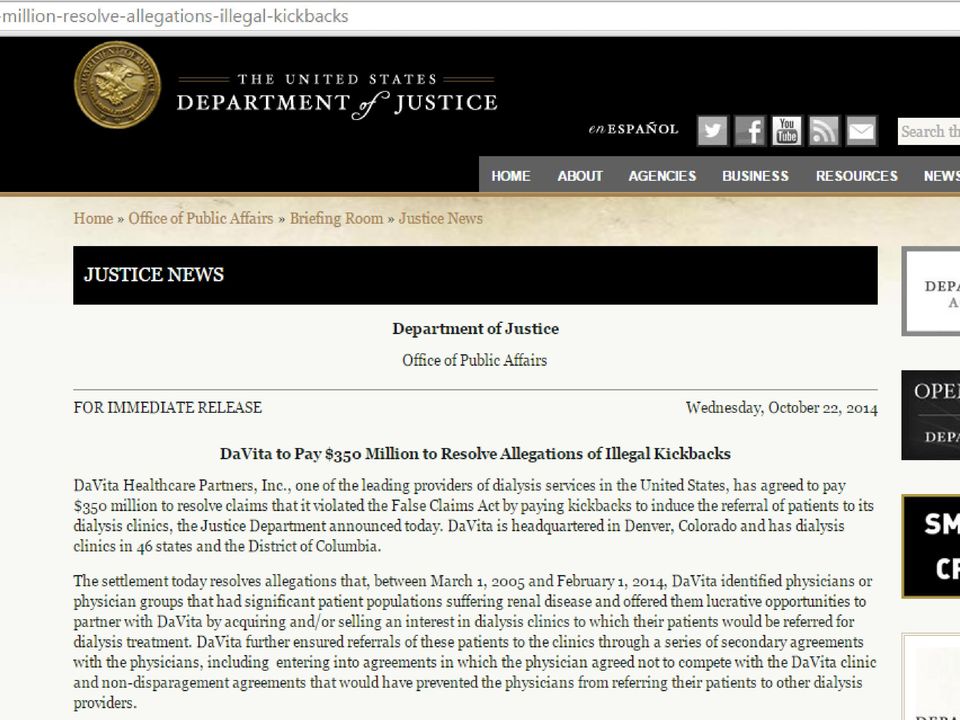
11 Anti-Kickback Statute Cannot knowingly and willfully offer, pay, solicit or receive remuneration to induce referrals for items or services covered by government program unless transaction fits within a regulatory safe harbor. (42 USC 1320a-7b(b)) One purpose test Anti-Kickback Statute applies if one purpose of the remuneration is to induce referrals even if there are other legitimate purposes. (U.S. v.greber, 760 F.2d 68 (3d Cir. 1985)). Difficult to disprove. Ignorance of the law is no excuse.
12 Anti-Kickback Statute Penalties 5 years in prison $25,000 criminal fine $50,000 penalty 3x damages Exclusion from Medicare/Medicaid (42 USC 1320a-7b(b); 42 CFR ) Anti-Kickback violation = False Claims Act violation Lower standard of proof Subject to False Claims Act penalties Subject to qui tam suit. (42 USC 1320a-7a(a)(7)) OIG Self-Disclosure Protocol: minimum $50,000 settlement.
13 Anti-Kickback Statute Anytime you want to: Give or receive anything to induce or reward referrals, or Do any deal with a referral source.

14
15 Anti-Kickback Statute Applies to any form of remuneration to induce or reward referrals for federal program business. Money. Free or discounted items or services (e.g., perks, gifts, space, equipment, meals, insurance, trips, CME, etc.). Overpayments or underpayments (e.g., not fair market value). Payments for items or services that are not provided. Payments for items or services that are not necessary. Professional courtesies. Waivers of copays or deductibles. Low interest loans or subsidies. Business opportunities that are not commercially reasonable. Anything else of value

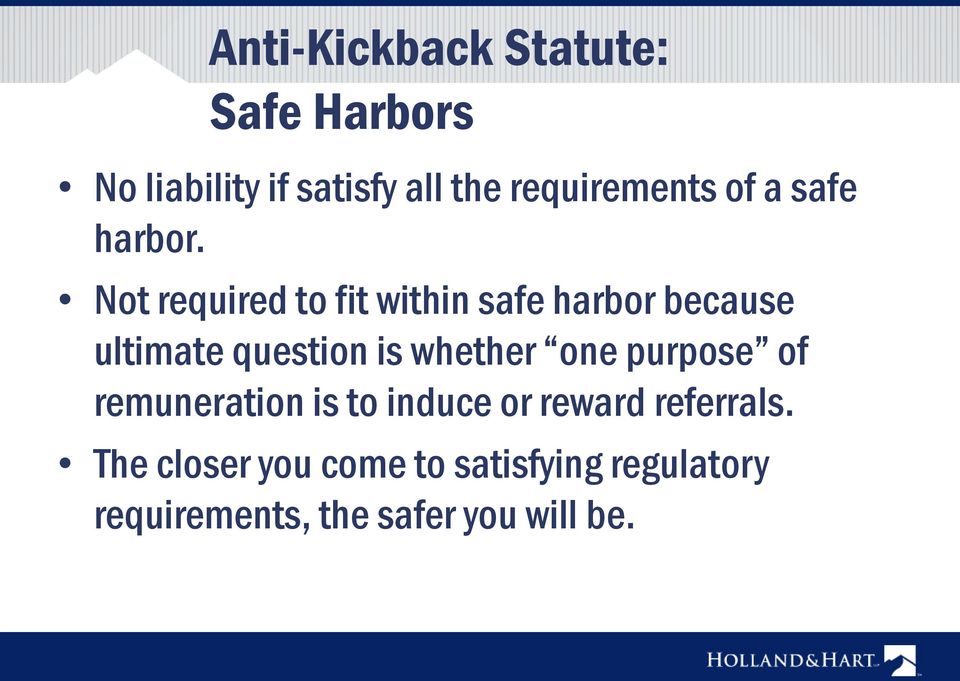
16 Anti-Kickback Statute: Safe Harbors No liability if satisfy all the requirements of a safe harbor. Not required to fit within safe harbor because ultimate question is whether one purpose of remuneration is to induce or reward referrals. The closer you come to satisfying regulatory requirements, the safer you will be.
17 Anti-Kickback Statute: Safe Harbors Exceptions and safe harbors Bona fide employment Personal services contracts Leases for space or equipment Investments in group practice Investments in ASCs Sale of practice Recruitment Certain investment interests Waiver of beneficiary coinsurance and deductible amounts. (42 CFR )

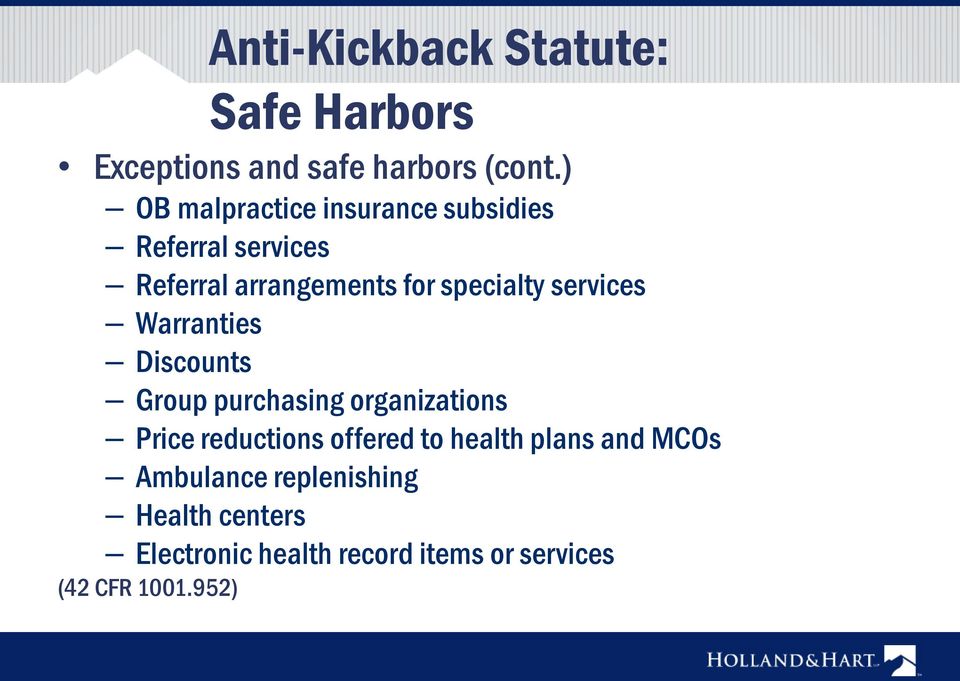
18 Anti-Kickback Statute: Safe Harbors Exceptions and safe harbors (cont.) OB malpractice insurance subsidies Referral services Referral arrangements for specialty services Warranties Discounts Group purchasing organizations Price reductions offered to health plans and MCOs Ambulance replenishing Health centers Electronic health record items or services (42 CFR )
19 Anti-Kickback Statute No de minimus safe harbor. But not too much risk if remuneration is nominal (whatever that means ). No fair market value safe harbor. Fair market value payment does not legitimize a payment if there is an illegal purpose. (70 FR 4864) But fairly safe if remuneration represents fair market value for legitimate, needed services or items. Consider risk of federal program abuse. Due to nature of transaction. Incorporate safeguards to protect against abuse.

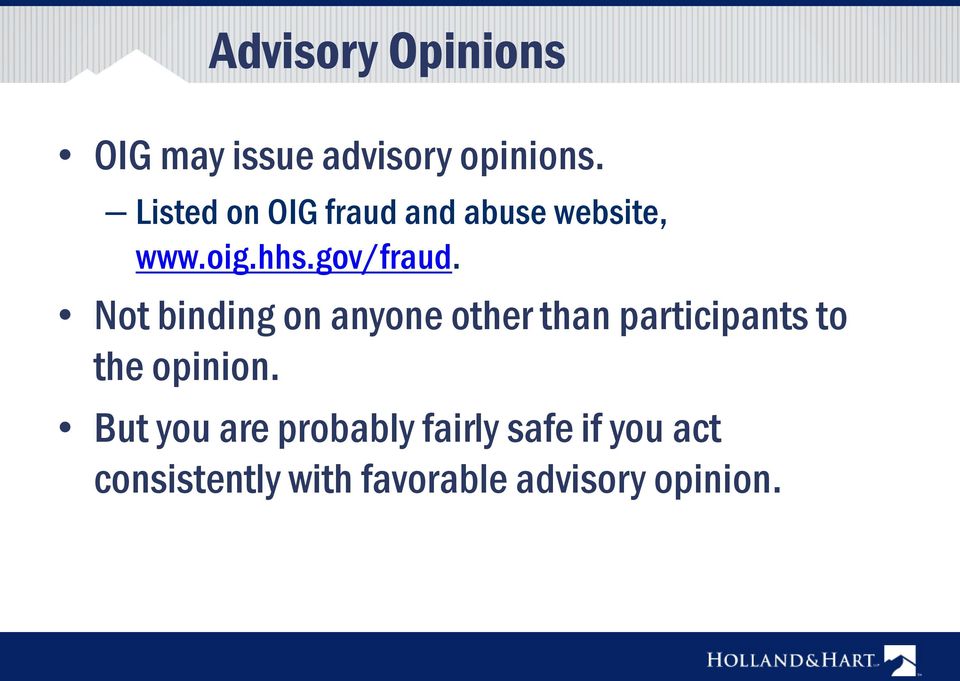
20 Advisory Opinions OIG may issue advisory opinions. Listed on OIG fraud and abuse website, Not binding on anyone other than participants to the opinion. But you are probably fairly safe if you act consistently with favorable advisory opinion.
21
22 Ethics in Patient Referrals Act ( Stark ) (42 USC 1395nn) Regulations at 42 CFR
23 Stark If a physician (or their family member) has a financial relationship with an entity: The physician may not refer patients to that entity for designated health services, and The entity may not bill Medicare for such designated health services unless arrangement structured to fit within a regulatory exception. (42 CFR )
24 Stark Financial Relationship w/physician or family Referrals for DHS Physician cannot refer and DHS provider cannot bill for DHS unless transaction fits in safe harbor.
25 Stark Penalties No payment for services provided per improper referral. Repayment of payments improperly received within 60 days. Civil penalties. $15,000 per claim submitted $100,000 per scheme (42 CFR , (a)(5), and (b)) May also constitute Anti-Kickback Statute violation May trigger False Claims Act.
26 Stark Cannot bill or receive payment for services for prohibited referrals during the period of disallowance. Begins when financial relationship fails to satisfy one of the safe harbors. Ends when: Relationship brought into compliance, and Amounts overpaid or underpaid are repaid. Prospective compliance alone does not end the period of noncompliance. (42 CFR (c)(1))
27 Stark Any financial relationship or item of value between a physician (or their family) and an entity providing DHS.
28
29 Stark Applies to referrals by a physician to entities with which the physician (or their family member) has a financial relationship. Physician = MDs DOs Oral surgeons Dentists Podiatrists Optometrists Chiropractors (42 CFR ) Family member = Spouse Parent, child Sibling Stepparent, stepchild, stepsibling Grandparent, grandchild In-law
30 Stark Applies to referrals by physician to entities with which physician (or their family member) has financial relationship. Direct relationship. Indirect relationship (e.g., through ownership in another entity). Financial relationship = Ownership or investment: stocks, bonds, partnership, membership shares, secured loans, securities, etc. Compensation: employment, contract, lease, payments, gifts, free or discounted items, and virtually any other exchange of remuneration. (42 CFR and.354)
31 Stark Applies to referrals (orders, requests, plan of care, certification) by physician for DHS performed by others. Other providers or facilities. Others in physician s own group. Other employees or contractors. Does not apply to services the physician personally performs. Physician may perform his own DHS. Beware ancillary, technical, facility fees. Does not apply to many services performed by radiologists or pathologists since they usually do not make referrals. (42 CFR )
32 Stark Applies to referrals for designated health services ( DHS ) payable in whole or part by Medicare. Inpatient and outpatient hospital services Outpatient prescription drugs Clinical laboratory services Physical, occupational, or speech therapy Home health services Radiology and certain imaging services Radiation therapy and supplies Durable medical equipment and supplies Parenteral and enteral nutrients, equipment, and supplies Prosthetics and orthotics CMS website lists some of the affected CPT codes. (42 CFR )
33 Stark Stark does not require intent to violate statute. No good faith compliance. To comply with Stark, transaction must either: Fall outside statute, i.e., no financial relationship or referral, or Fit within regulatory safe harbor. Exception: Entity may bill for prohibited services rendered per improper referral if entity did not know and did not act in reckless disregard or deliberate indifference concerning the identity of the referring physician. (42 CFR )
34 Stark contains numerous safe harbors. Applicable to both ownership/investment and compensation arrangements. Applicable to only ownership/investment arrangements. Applicable to only compensation arrangements. No liability if comply with all the requirements of an applicable safe harbor. Need only comply with one safe harbor for each financial relationship. (42 CFR ) Stark: Safe Harbors
35 Stark: Exceptions for Both Ownership and Compensation Physician services rendered by another physician in same group practice* or under such physician s supervision. In-office ancillary services provided through group practice*. Prepaid health plans. Certain services furnished in academic medical center. Implants in ASC. Preventive screening tests, immunizations, and vaccines. EPO and other dialysis-related drugs. Eyeglasses and contact lenses following cataract surgery. Intra-family rural referrals. (42 CFR ) * Must qualify as group practice under 42 CFR
36 Stark: Exceptions for Only Ownership or Investments Ownership or investment interests in: Rural providers. The whole hospital, not a part of the hospital. Subject to limits in 42 CFR Publicly traded securities. Large, regulated mutual funds. (42 CFR )
37 Stark: Exceptions for Only Compensation Arrangements Bona fide employment relationships. Personal services contracts. Space or equipment rental. Timeshare arrangements.* Physician recruitment. Midlevel recruitment.* Physician retention. Fair market value. (42 CFR ) Non-monetary compensation up to $300. Medical staff incidental benefits. Compliance training. Community-wide health information system. Professional courtesy. Certain payments by a physician for items or services at FMV. Others. * Effective 1/1/16.
38 Stark: Analysis 1. Is there a financial relationship between the DHS provider and the physician or their family member? Direct or indirect relationship? Ownership or investment interest? Compensation arrangement? 2. Does the physician make or has she made referrals to the entity for DHS payable by Medicare? 3. Does a safe harbor apply? 4. Has the entity billed for items/services pursuant to improper referral, and if so, did the entity have knowledge of physician s identity?
39 Stark: Common Problems Physician referrals to entities that the physician owns. Compensation arrangements which pay physicians based on their referrals to others (e.g., eat what you kill for ancillary services). Paying physicians more than fair market value. Paying physicians even though services are not provided or needed. Giving physicians discounts or freebies (e.g., professional courtesies). Subsidizing physician practices. Financial arrangements without a written contract. Performing after a written contract has expired. Amending contracts within one year. Leases that fail to satisfy lease safe harbors (e.g., per click, on demand, non-exclusive).
40 Abuse/PhysicianSelfReferral/index.html Advisory opinions FAQs DHS by CPT code Seff-Referral Disclosure Protocol Recent settlements
41 Civil Monetary Penalties Law (42 USC 1320a-7a)
42 Civil Monetary Penalties Law Prohibits certain specified conduct: Submitting false or fraudulent claims or misrepresenting facts relevant to services. Offering, soliciting, giving or receiving remuneration to induce referrals (i.e., kickbacks). Offering inducements to program beneficiaries. Offering inducements to physicians to limit services. Submitting claims for services ordered by, or contracting with, an excluded entity. Failing to report and repay an overpayment. Failing to grant govt timely access. (42 USC 1320a-7a; 42 CFR )
43 Civil Monetary Penalties Law Penalties vary based on conduct, but generally range from: $2,000 to $50,000 fines 3x amount claimed Denial of payment Repayment of amounts improperly paid Exclusion from government programs CMPL violations may also violate: False Claims Act Anti-Kickback Statute Stark
44 Inducements to Govt Program Patients Cannot offer or transfer remuneration to Medicare or state program beneficiaries if you know or should know that the remuneration is likely to influence the beneficiaries to order or receive items or services payable by federal or state programs from a particular provider. Penalty: Also a likely $10,000 for each item or service. violation of the 3x amount claimed. Anti-Kickback Statute Repayment of amounts paid. Exclusion from Medicare and Medicaid. (42 USC 1320a-7a(a)(5); 42 CFR ).
45 Inducements to Govt Program Patients Remuneration = anything of value, including but not limited to: Waiver of co-pays and deductibles unless satisfy certain conditions, and Items or services for free or less than fair market value unless satisfy certain conditions. (42 USC 1320a-7a(i); 42 CFR ; OIG Bulletin, Gifts to Beneficiaries)
46 Inducements to Govt Program Patients Remuneration does not include: Waivers or co-pays based on financial need or after failed collection efforts if certain conditions met. Items or services if financial need and certain conditions met. Incentives to promote delivery of preventative care. Payments meeting Anti-Kickback Statute safe harbor. Retailer coupons, rebates or rewards offered to public. Any other remuneration that promotes access to care and poses a low risk of harm to patients and federal health care programs. Certain other situations. (42 USC 1320a-7a(i); 42 CFR )
47 Inducements to Govt Program Patients OIG has approved the following in opinions or comments: Free or discounted item or service of low value, i.e., Each item or service is less than $10, and Aggregate is less than $50 per patient per year. (OIG Bulletin, Offering Gifts and Inducements to Beneficiaries (8/02); 66 FR ) Free screenings not conditioned on or tied to additional services from any provider. (Adv. Op ) Free transportation programs where transportation is reasonable and local, open to patients regardless of payor, and other transportation options are limited. (Adv. Op ; OIG Bulletin, Offering Gifts and Inducements to Beneficiaries (8/02)).
48 Payment to Limit Services Hospital or CAH cannot knowingly make a payment, directly or indirectly, to a physician as an inducement to reduce or limit services provided to Medicare or Medicaid beneficiaries who are under the direct care of the physician. Includes gainsharing programs. Penalties: $2000 for each individual with respect to whom payment made. Any other penalty allowed by law. (42 USC 1320a-7a(b)(1); 42 CFR )
49 Payment to Limit Services OIG has periodically approved gainsharing in advisory opinions if certain safeguards included, e.g., Proposed plan does not adversely affect patient care. Quality evaluated by third party. Low risk that incentive will lead physicians to provide medically inappropriate care. Payments limited in duration and amount. (See, e.g., Adv. Op ) OIG advisory opinions do not apply to Stark. CMS/OIG have issued interim rule waiving CMPL and Stark for ACOs.
50 Excluded Entities Cannot submit claim for item or service ordered or furnished by an excluded person. Cannot hire or contract with an excluded entity or arrange for excluded entity to provide items or services payable by federal programs. Penalties $10,000 per item or service. 3x amount claimed. Repayment of amounts paid. Exclusion from Medicare and Medicaid (42 USC 1320a-7a(a)(8); 42 CFR ; OIG Bulletin, Effect of Exclusion)
51 Excluded Entities Medicare, Medicaid, or other federal program will not pay claim if person knew or should have known of exclusion. Exception for certain emergency services. (42 CFR (b) and (a)) Knowledge = Knew or should have known of exclusion. Notified by HHS of exclusion, e.g., in response to claim. Listed on the List of Excluded Individuals or Entities ( LEIE ).
52
53 List of Excluded Individuals and Entities ( LEIE ) OIG maintains LEIE and updates monthly: Check LEIE before hiring or contracting with entities. Employees, contractors, vendors, medical staff, etc. Check LEIE periodically to determine status. Employees, providers, vendors, medical staff members, ordering providers, others? Condition contracts and medical staff membership on nonexclusion. Respond promptly if receive notice of excluded entity.
54 Advisory Opinions OIG may issue advisory opinions. Listed on OIG fraud and abuse website, Not binding on anyone other than participants to the opinion. But you are probably fairly safe if you act consistently with favorable advisory opinion.
55 Remember State Laws
56 Common State Laws State false claims acts. State anti-kickback statutes. State self-referral ( mini-stark ) laws. Fee splitting statutes. Healthcare fraud statutes. Others?
57 Common State Laws Federal Fraud and Abuse Laws Generally limited to claims for federal healthcare programs, e.g., Medicare Medicaid TriCare Others? State Fraud and Abuse Laws May be broader than federal statutes, e.g., State healthcare programs Private payer arrangements Others? Don t forget to check state laws or private contacts.
58 Better to comply in the first place!
59 Compliance Plans
60 Why have a compliance plan? ACA will require providers to have compliance plan as condition to enrollment in Medicare, Medicaid, SCHIP. (ACA 6401) HHS to develop core elements of required compliance plans. HHS has not issued implementing regulations for physicians yet. Regulations issued for other providers suggests that HHS will track elements from earlier Compliance Program Guidance.
61 Why have a compliance plan? Even if not mandated, compliance plan is still a good idea. May facilitate compliance and avoid repayments and penalties. May help avoid fraud charges. May mitigate penalties. May improve performance. facilitates prompt claims submissions identifies undercoding as well as upcoding reduces claim denials improves medical record documentation may identify and prevent patient care problems Compliance plan = preventative medicine
62
63 Not mandatory. OIG Compliance Program Guidance Not a compliance plan itself. Provides a guide or outline for a compliance plan. Feds will give some deference if plan addresses the elements and standards in the OIG guidance. 7 elements are based on Federal Sentencing Guidelines. Unlike other similar programs, OIG is very flexible and does not expect small practices to formally implement all 7 elements.
64 OIG Compliance Guidance: Elements 1. Internal monitoring and auditing. 2. Written standards, policies and procedures. 3. Compliance officer or contacts. 4. Education and training. 5. Investigation of alleged violations and appropriate disclosures to government agencies. 6. Open lines of communication, e.g., open discussions at staff meetings or bulletin board notices. 7. Enforcement of disciplinary standards. Implementation depends on size and resources of group.
65 Action Items
66 Action Items Identify remuneration to referral sources (e.g., providers, facilities, vendors, govt program patients). Contracts (employment, independent contractors, etc.). Group compensation structures. Leases (space, equipment, etc.). Subsidies or loans. Joint ventures or partnerships. Free or discounted items or services (e.g., use of space, equipment, personnel or resources; professional courtesies; gifts; etc.). Marketing programs. Financial policies.
67 Action Items Review relationships for compliance with statute or exception, e.g., No intent to induce referrals for government program business. Written contract that is current and signed by parties. Compliance with terms of contract. Parties providing required services. Documentation confirming that services provided. Fair market value. Compensation not based on volume or value of referrals. Arrangement is commercially reasonable and serves legitimate business purpose.
68 Action Items Implement method to track and monitor relationships with referral sources for compliance. Central repository for contracts or deals. Method to track contract termination dates. Process for confirming compliance before payment. Require review and approval by compliance officer, attorney or other qualified individual. Contracts. Joint transactions with referral sources. Benefits or perks to referral sources. Marketing or advertising.
69 Action Items Ensure your compliance policies address fraud and abuse laws. Train key personnel regarding compliance. Administration. Compliance officers and committees. Human resources. Physician relations and medical staff officers. Marketing / public relations. Governing board members. Purchasing. Accounts payable. Document training.
70 Don t do this! If you think you have a problem
71 If you think you have a problem Suspend payments or claims until resolved. Investigate problem per compliance plan. Consider involving attorney to maintain privilege. Implement appropriate corrective action. But remember that prospective compliance may not be enough. If repayment is due: Report and repayment per applicable law. Self-disclosure program. To OIG, if there was knowing violation of False Claims Act, Anti- Kickback Statute or Civil Monetary Penalties Law. To CMS, if there was violation of Stark.
72 Additional Resources
73
74 Publications Webinars
75 Upcoming Holland & Hart Webinars 1/14 Responding to Noncompliance 2/4 HIPAA Privacy and Security Rules 2/11 HIPAA for Business Associates 2/18 Responding to HIPAA Breaches To receive notices or client alerts, contact me at
76 Questions? Kim C. Stanger (208) (208) (cell)
THE CHRIST HOSPITAL POLICY NO. 4.21.113 ADMINISTRATIVE POLICY PAGE 1 OF 6 COMPLIANCE WITH THE FEDERAL ANTI-KICKBACK STATUTE AND STARK LAW
 ADMINISTRATIVE POLICY PAGE 1 OF 6 POLICY TITLE: ORIGINATED BY: APPROVED BY: COMPLIANCE WITH THE FEDERAL ANTI-KICKBACK STATUTE AND STARK LAW COMPLIANCE OFFICER COMPLIANCE COMMITTEE REVIEWED/REVISED: 1/2011;
Fraud and Abuse Primer. Stark Law The Anti-Kickback Statute False Claims Act
 Fraud and Abuse Primer Stark Law The Anti-Kickback Statute False Claims Act Stark Act 42 U.S.C. 1395nn The Stark II Act prohibits a physician from making a Referral to an entity; for the furnishing of
AVOIDING FRAUD AND ABUSE
 AVOIDING FRAUD AND ABUSE Responsibility, Protection, Prevention Presented by: www.thehealthlawfirm.com Main Office: 1101 Douglas Avenue Altamonte Springs, FL 32714 Phone: (407) 331-6620 Fax: (407) 331-3030
Federal and State Laws Relating to Referrals
 POLICY: Federal and State Laws Relating to Referrals DATE: June 24, 2008 PAGES: 1 of 5 INTRODUCTION POLICY The process of referring patients to health care providers has been the subject of significant
How To Get A Medical Bill Of Health From A Member Of A Health Care Provider
 Neighborhood requires compliance with all laws applicable to the organization s business, including insistence on compliance with all applicable federal and state laws dealing with false claims and false
A Roadmap for New Physicians. Avoiding Medicare and Medicaid Fraud and Abuse
 A Roadmap for New Physicians Avoiding Medicare and Medicaid Fraud and Abuse Introduction This tutorial is intended to assist new physicians in understanding how to comply with Federal laws that combat
Frequently Used Health Care Laws
 Frequently Used Health Care Laws In the following section, a select few of the frequently used health care laws will be briefly defined. Of the frequently used health care laws, there are some laws that
Stark, False Claims and Anti- Kickback Laws: Easy Ways to Stay Compliant with the Big Three in Healthcare
 Stark, False Claims and Anti- Kickback Laws: Easy Ways to Stay Compliant with the Big Three in Healthcare In health care, we are blessed with an abundance of rules, policies, standards and laws. In Health
PREVENTING FRAUD, ABUSE, & WASTE: A Primer for Physical Therapists
 PREVENTING FRAUD, ABUSE, & WASTE: A Primer for Physical Therapists Available at: http://www.apta.org/integrity 2014 American Physical Therapy Association. All rights reserved. All reproduction or redistribution
HCCA 2013 COMPLIANCE INSTITUTE ANTI-KICKBACK STATUTE 101 SEATTLE, WASHINGTON
 UW MEDICINE HCAA 2013 Compliance Institute HCCA 2013 COMPLIANCE INSTITUTE ANTI-KICKBACK STATUTE 101 April 23, 2013 Robert S. Brown Senior Compliance Specialist UW Medicine Compliance SEATTLE, WASHINGTON
USC Office of Compliance
 PURPOSE This policy complies with requirements under the Deficit Reduction Act of 2005 and other federal and state fraud and abuse laws. It provides guidance on activities that could result in incidents
Compliance and Program Integrity Melanie Bicigo, CHC, CEBS [email protected] 906-225-7749
 Compliance and Program Integrity Melanie Bicigo, CHC, CEBS [email protected] 906-225-7749 Define compliance and compliance program requirements Communicate Upper Peninsula Health Plan (UPHP) compliance
QUESTIONS AND ANSWERS ON FINAL STARK II RULES
 QUESTIONS AND ANSWERS ON FINAL STARK II RULES PLEASE NOTE: ASCRS and ASOA cannot provide specific legal advice as to whether an individual ophthalmology practice complies with the selfreferral ban. We
Stark Law Basics for Health Care Providers
 Stark Law Basics for Health Care Providers Today s Webcast will begin promptly at Noon FOLLOW STEPTOE & JOHNSON ON TWITTER: Follow @Steptoe_Johnson ALSO FIND US ON http://www.linkedin.com/companies/216795
The Push and Pull of Legal Compliance: The Odd Couple. Ohio Hospital Association. Annual Meeting June 14, 2016
 The Push and Pull of Legal Compliance: The Odd Couple Ohio Hospital Association Annual Meeting June 14, 2016 Anthea R. Daniels Baker Donelson, Bearman, Caldwell & Berkowitz 211 Commerce Street, Suite 800
Objectives. Fraud and Abuse defined Enforcement agencies Fraud and Abuse regulations Five-step action plan
 Fraud and Abuse Primer: Does your Compliance Program Prevent and Detect Fraud and Abuse? Julie Dean, JD, CHC, CHRC, CHPC Sr. Managing Consultant, Compliance Objectives Fraud and Abuse defined Enforcement
Introduction to the Anti-Kickback Statute
 www.bakerdaniels.com Introduction to the Anti-Kickback Statute and Stark Law October 24, 2011 Isaac M. Willett Baker & Daniels LLP Federal Anti-Kickback Statute Prohibits the offering, paying soliciting
ACOs: Fraud & Abuse Waivers and Analysis
 ACOs: Fraud & Abuse Waivers and Analysis Robert G. Homchick and Sarah Fallows Davis Wright Tremaine, LLP I. Introduction The Patient Protection and Affordable Care Act of 2010 (ACA) fosters the development
To: All Vendors, Agents and Contractors of Hutchinson Regional Medical Center
 To: All Vendors, Agents and Contractors of Hutchinson Regional Medical Center From: Corporate Compliance Department Re: Deficit Reduction Act of 2005 Dear Vendor/Agent/Contractor: Under the Deficit Reduction
Legal Issues to Consider When Creating a Health Care Business Model
 Legal Issues to Consider When Creating a Health Care Business Model Connie A. Raffa, J.D., LL.M. Business practices considered standard in other industries may in the health care industry be considered
Stark Law and Related Limitations on Financial Interests in Health Care Reimbursement
 Stark Law and Related Limitations on Financial Interests in Health Care Reimbursement Linda Grimms, Assistant Attorney General Oregon Department of Justice January 6, 2012 Context This Report was prepared
2012-2013 MEDICARE COMPLIANCE TRAINING EMPLOYEES & FDR S. 2012 Revised
 2012-2013 MEDICARE COMPLIANCE TRAINING EMPLOYEES & FDR S 2012 Revised 1 Introduction CMS Requirements As of January 1, 2011, Federal Regulations require that Medicare Advantage Organizations (MAOs) and
FRAUD, WASTE & ABUSE. Training for First Tier, Downstream and Related Entities. Slide 1 of 24
 FRAUD, WASTE & ABUSE Training for First Tier, Downstream and Related Entities Slide 1 of 24 Purpose of this Program On December 5, 2007, the Centers for Medicare and Medicaid Services ( CMS ) published
Fraud, Waste and Abuse Prevention Training
 Fraud, Waste and Abuse Prevention Training The Centers for Medicare & Medicaid Services (CMS) requires annual fraud, waste and abuse training for organizations providing health services to MA or Medicare
The Fraud Enforcement and Recovery Act and Healthcare Reform: Implications for Compliance Initiatives and Fraud Investigations
 The Fraud Enforcement and Recovery Act and Healthcare Reform: Implications for Compliance Initiatives and Fraud Investigations Presented by: Robert Threlkeld, Esq. Holly Pierson, Esq. Paul F. Danello,
Compliance Plan. Table of Contents
 Compliance Plan Compliance Plan Table of Contents Introduction... 3 Administrative Structure... 4 A. CorporateCompliance Officer... 4 B. Compliance Committee... 5 C. Hospital Compliance Officer..6 Communications...
A Practical Guide to Stark Compliance Part 1: Stark Law 101: An Introduction to Physician Self- Referral
 A smarter way to protect your brand A Practical Guide to Stark Compliance Part 1: Stark Law 101: An Introduction to Physician Self- Referral Presented by: Compliance 360 at a Glance Compliance, Risk and
Amy K. Fehn. I. Overview of Accountable Care Organizations and the Medicare Shared Savings Program
 IMPLEMENTING COMPLIANCE PROGRAMS FOR ACCOUNTABLE CARE ORGANIZATIONS Amy K. Fehn I. Overview of Accountable Care Organizations and the Medicare Shared Savings Program The Medicare Shared Savings Program
UPDATED. Special Advisory Bulletin on the Effect of Exclusion from Participation in Federal Health Care Programs
 UPDATED Special Advisory Bulletin on the Effect of Exclusion from Participation in Federal Health Care Programs Issued May 8, 2013 Updated Special Advisory Bulletin on the Effect of Exclusion from Participation
Under section 1128A(a)(5) of the Social Security Act (the Act), enacted as part of
 OFFICE OF INSPECTOR GENERAL SPECIAL ADVISORY BULLETIN OFFERING GIFTS AND OTHER INDUCEMENTS TO BENEFICIARIES August 2002 Introduction Under section 1128A(a)(5) of the Social Security Act (the Act), enacted
LMHS COMPLIANCE ORIENTATION Physicians and Midlevel Providers. Avoiding Medicare and Medicaid Fraud & Abuse
 LMHS COMPLIANCE ORIENTATION Physicians and Midlevel Providers Avoiding Medicare and Medicaid Fraud & Abuse Revised 06/03/2014 LMHS COMPLIANCE PROGRAM 6/30/2014 2 Chief Compliance Officer Catherine A. Kahle,
Medicare Advantage and Part D Fraud, Waste, and Abuse Training. October 2010
 Medicare Advantage and Part D Fraud, Waste, and Abuse Training October 2010 Introduction 2008: United States spent $2.3 trillion on health care. Federal fiscal year 2010: Medicare expected to cover an
Addressing Government Investigations. Marcos Daniel Jimenez Partner
 Addressing Government Investigations Marcos Daniel Jimenez Partner November 14, 2014 Agenda Statistics Key Players Fraud and Abuse Laws Potential Consequences Mitigation Strategies 2 Key Health Care Fraud
Policies and Procedures SECTION:
 PAGE 1 OF 5 I. PURPOSE The purpose of this Policy is to fulfill the requirements of Section 6032 of the Deficit Reduction Act of 2005 by providing to Creighton University employees and employees of contractors
Stark Law Update: Irrational Laws Rigidly Applied
 Compliance Education Stark Law Update: Irrational Laws Rigidly Applied Raja Sekaran, JD Associate General Counsel Catholic Healthcare West HFMA Northern California Meeting March 25 & 26, 2010 Sacramento,
Why Worry? Fraud and Abuse Risks for Managed Care Organizations. Overview
 Why Worry? Fraud and Abuse Risks for Managed Care Organizations Stephen K. Warch Shareholder, Nilan Johnson Lewis Overview Risks Created by Incentives Offered by Health Plans and Providers o Prohibition
FIRST TIER, DOWNSTREAM AND RELATED ENTITIES (FDR) ANNUAL TRAINING
 FIRST TIER, DOWNSTREAM AND RELATED ENTITIES (FDR) ANNUAL TRAINING The Compliance Team appreciates your attention and cooperation during this CMS mandated annual training! DEFINITIONS ADVANTAGE utilizes
False Claims Act CMP212
 False Claims Act CMP212 Colorado Access is committed to a culture of compliance in which its employees, providers, contractors, and consultants are educated and knowledgeable about their role in reporting
Discovering a Potential Overpayment: An Law, and Medicare Reimbursement Considerations
 Discovering a Potential Overpayment: An Overview of the False Claims Act, Stark Law, and Medicare Reimbursement Considerations, Stockholder, Reid & Riege, P.C., Stockholder, Reid & Riege, P.C. Outline
Understanding Health Reform s
 Compliance 101: Understanding Health Reform s New Compliance Requirements Uri Bilek Feldesman Tucker Leifer Fidell LLP Does your organization have a designated Compliance Officer? a. Yes b. No c. Don't
Compliance: What Every Reference Lab Representative Should Know By Peter Francis
 Compliance: What Every Reference Lab Representative Should Know By Peter Francis 04-10 Following the hiring of a sales representative, one of the first duties of any clinical or anatomical pathology lab
I. Policy Purpose. II. Policy Statement. III. Policy Definitions: RESPONSIBILITY:
 POLICY NAME: POLICY SPONSOR: FRAUD, WASTE AND ABUSE COMPLIANCE OFFICER RESPONSIBILITY: EFFECTIVE DATE: REVIEW/ REVISED DATE: I. Policy Purpose The purpose of this policy is to outline the requirements
Compliance, Code of Conduct & Ethics Program Cantex Continuing Care Network. Contents
 Compliance, Code of Conduct & Ethics Program Cantex Continuing Care Network Contents Compliance, Code of Conduct & Ethics Program 1 What is the CCCN Code of Conduct? 2 Operating Philosophies 2 Employee
The Stark Law Rules of the Road. An overview of the Stark Law to help interested physicians acquire an introductory knowledge of this intricate law
 The Stark Law Rules of the Road An overview of the Stark Law to help interested physicians acquire an introductory knowledge of this intricate law Rules of the Road how physicians can navigate the Stark
Fraud, Waste, and Abuse
 These training materials are divided into three topics to meet the responsibilities stated on the previous pages: Fraud, Waste, Compliance Program Standards of Conduct Although the information contained
Fraud Prevention Training Requirements For Medicare Advantage Plans
 MEDICARE ADVANTAGE (Part C) PRESCRIPTION DRUG (Part D) FRAUD, WASTE, and ABUSE EDUCATION AND TRAINING 1 INTRODUCTION CMS has mandated that Medicare Advantage Organizations (MAOs) and Prescription Drug
STARK UPDATE IN A TIME OF HOSPITAL-PHYSICIAN TRANSACTIONS. Margaret J. Davino Kaufman Borgeest & Ryan LLP (973) 451-9600 March 10, 2015
 STARK UPDATE IN A TIME OF HOSPITAL-PHYSICIAN TRANSACTIONS Margaret J. Davino Kaufman Borgeest & Ryan LLP (973) 451-9600 March 10, 2015 Multiple transactions between hospital and physicians today TRANSACTION
3. Physician means a doctor of medicine, osteopathy, dental surgery, dental medicine, podiatric medicine, optometry, or a chiropractor.
 Subject: Non-Monetary Compensation and Medical Staff Incidental Benefits Department: Enterprise Risk Management Services Executive Sponsor: SVP/Chief Risk Officer Approved by: Rod Hochman, MD - President/CEO
Fraud & Abuse Waivers Under the Medicare Shared Savings Program
 Fraud & Abuse Waivers Under the Medicare Shared Savings Program Robert G. Homchick Davis Wright Tremaine, LLP I. Introduction The Patient Protection and Affordable Care Act of 2010 (ACA) fosters the development
Fraud Waste & A buse
 5 Fraud Waste & Abuse Fraud, Waste and Abuse Detecting and preventing fraud, waste and abuse Harvard Pilgrim is committed to detecting, mitigating and preventing fraud, waste and abuse. Providers are also
FRAUD AND ABUSE CONCERNS FOR ELECTRONIC PRESCRIBING AND ELECTRONIC HEALTH RECORDS
 FRAUD AND ABUSE CONCERNS FOR ELECTRONIC PRESCRIBING AND ELECTRONIC HEALTH RECORDS Presented by: Peter M Hoffman, Esq Garfunkel, Wild & Travis, PC (516) 393-2268 phoffman@gwtlawcom 1 THE FEDERAL ANTI-KICKBACK
Florida Health Care Plans Fraud, Waste & Abuse and Compliance Training
 Florida Health Care Plans Fraud, Waste & Abuse and Compliance Training 2014 Version INTRODUCTION The United States spends more than $2 trillion on health care every year. The National Health Care Anti-Fraud
Prepared by: The Office of Corporate Compliance & HIPAA Administration
 Gwinnett Health System s Annual Education 2014 Corporate Compliance: Our Commitment to Excellence Prepared by: The Office of Corporate Compliance & HIPAA Administration Objectives After completing this
Rules of the Engagement: Compliance, Legalities and Ethics in Audiology Today. 2011 AAA Convention Chicago, IL
 Rules of the Engagement: Compliance, Legalities and Ethics in Audiology Today 2011 AAA Convention Chicago, IL 1. Ignorance is NOT a defense 2. Rules, regulations, guidance and laws do not have to be interpreted
Fraud, Waste and Abuse Training for Medicare and Medicaid Providers
 Fraud, Waste and Abuse Training for Medicare and Medicaid Providers For Use By: Licensed affiliates and subsidiaries of Magellan Health Services, Inc. Contents and Agenda Define Fraud, Waste, and Abuse
CHAMPAIGN COUNTY NURSING HOME SUMMARY OF ANTI-FRAUD AND ABUSE POLICIES
 1. PURPOSE CHAMPAIGN COUNTY NURSING HOME SUMMARY OF ANTI-FRAUD AND ABUSE POLICIES Champaign County Nursing Home ( CCNH ) has established anti-fraud and abuse policies to prevent fraud, waste, and abuse
Structuring Physician Recruitment Arrangements in Accordance with the Stark II/Phase II Interim Final Rule
 Structuring Physician Recruitment Arrangements in Accordance with the Stark II/Phase II Interim Final Rule Stacey A. Tovino [email protected] June 25, 2004 On March 26, 2004, the Centers for Medicare
Fraud, Waste and Abuse Training
 Fraud, Waste and Abuse Training 1 Why Do I Need Training? Every year millions of dollars are improperly spent because of fraud, waste and abuse. It affects everyone, Including YOU. This training will help
DON T BE A VICTIM OF THE STARK PHYSICIAN CONTRACTS ERRIKA PERKINS, CPA, CIA SENIOR INTERNAL AUDITOR [email protected]
 1 DON T BE A VICTIM OF THE STARK LAW: UNDERSTAND HOW TO AUDIT PHYSICIAN CONTRACTS ERRIKA PERKINS, CPA, CIA SENIOR INTERNAL AUDITOR THE METHODIST HOSPITAL SYSTEM [email protected] AHIA 31 st Annual Conference
Fraud, Waste and Abuse Prevention and Education Policy
 Corporate Compliance Fraud, Waste and Abuse Prevention and Education Policy The Compliance Program at the Cortland Regional Medical Center (CRMC) demonstrates our commitment to uphold all federal and state
Fraud Waste and Abuse Training First Tier, Downstream and Related Entities
 Fraud Waste and Abuse Training First Tier, Downstream and Related Entities Revised: 04/2010 OVERVIEW Centene Corporation Purpose Bridgeway Compliance Program Definitions of Fraud Waste & Abuse Laws and
Fraud Waste and Abuse Training First Tier, Downstream and Related Entities. ONECare by Care1st Health Plan Arizona, Inc. (HMO) Revised: 10/2009
 Fraud Waste and Abuse Training First Tier, Downstream and Related Entities ONECare by Care1st Health Plan Arizona, Inc. (HMO) Revised: 10/2009 Overview Purpose Care1st/ ONECare Compliance Program Definitions
The following presentation was based on the
 Fraud Waste and Abuse Presentation The following presentation was based on the Medicare Parts C & D Fraud, Waste, and Abuse Training and General Compliance Training developed by the Centers for Medicare
CORPORATE COMPLIANCE POLICY AND PROCEDURE
 Title: Fraud Waste and Abuse Laws in Health Care Policy # 1011 Sponsor: Corporate Approved by: Carleen Dunne, Director, Corporate and Privacy Officer Issued: Page: 1 of 7 June 25, 2007 Last Reviewed/Updated
Fraud, Waste & Abuse. Training Course for UHCG Employees
 Fraud, Waste & Abuse Training Course for UHCG Employees Overview The Centers for Medicare & Medicaid Services (CMS) require Medicare Advantage Organizations and Part D Plan Sponsors to provide annual fraud,
Developed by the Centers for Medicare & Medicaid Services
 Developed by the Centers for Medicare & Medicaid Services Every year millions of dollars are improperly spent because of fraud, waste, and abuse. It affects everyone. Including YOU. This training will
CONTRACT COMPLIANCE GEORGIA HOSPITAL ASSOCIATION CENTER FOR RURAL HEALTH ANNUAL SUMMER MEETING. August 13-15, 2014
 GEORGIA HOSPITAL ASSOCIATION CENTER FOR RURAL HEALTH ANNUAL SUMMER MEETING August 13-15, 2014 CONTRACT COMPLIANCE Daniel J. Mohan Partner Health Law Group CONTRACT COMPLIANCE Presentation will cover the
American Health Lawyers Association. Fraud and Abuse Practice Group SUMMARY OF FRAUD AND ABUSE STATUTES AND REGULATIONS COLORADO
 ANTI-KICKBACK American Health Lawyers Association Fraud and Abuse Practice Group SUMMARY OF FRAUD AND ABUSE STATUTES AND REGULATIONS COLORADO Prepared by Wallis S. Stromberg, Esquire Heather L. Kenney,
CODE OF CONDUCT. Providers, Suppliers and Contractors
 CODE OF CONDUCT Providers, Suppliers and Contractors Table of Contents Code of Conduct... Honesty and integrity... Quality and Service... Responsibilities of Providers, Suppliers and Contractors... Compliance
What is a Compliance Program?
 Course Objectives Learn about the most important elements of the compliance program; Increase awareness and effectiveness of our compliance program; Learn about the important laws and what the government
Fraud and Abuse. Current Trends and Enforcement Activities
 Fraud and Abuse Current Trends and Enforcement Activities Agenda Background Overview of Key Fraud and Abuse Laws Enforcement Recent Significant Cases and Trends Areas of Focus and Challenges for 2014 Identifying
CMS Mandated Training for Providers, First Tier, Downstream and Related Entities
 CMS Mandated Training for Providers, First Tier, Downstream and Related Entities I. INTRODUCTION It is the practice of Midwest Health Plan (MHP) to conduct its business with the highest degree of ethics
2015 Fraud, Waste & Abuse Prevention
 Quality Independent Physicians, LLC Awareness Training 2015 Fraud, Waste & Abuse Prevention Fraud, Waste and Abuse (FWA) Training Objectives After completing this training you should be able to: Recognize
CODE OF RESPONSIBLE CONDUCT
 Division of Compliance & Organizational Ethics CODE OF RESPONSIBLE CONDUCT Approved by The Christ Hospital Board of Directors April 2008 THE CHRIST HOSPITAL CODE OF RESPONSIBLE CONDUCT Dear Employees &
Fraud, Waste and Abuse: Compliance Program. Section 4: National Provider Network Handbook
 Fraud, Waste and Abuse: Compliance Program Section 4: National Provider Network Handbook December 2015 2 Our Philosophy Magellan takes provider fraud, waste and abuse We engage in considerable efforts
CMS Publishes Final Stark Law Regulations
 11/20/2015 CMS Publishes Final Stark Law Regulations By Karl Thallner and Nicole Aiken, Reed Smith LLP On October 30, 2015, as part of a larger final rule revising the Medicare Physician Fee Schedule (MPFS)
Touchstone Health Training Guide: Fraud, Waste and Abuse Prevention
 Touchstone Health Training Guide: Fraud, Waste and Abuse Prevention About the Training Guide Touchstone is providing this Fraud, Waste and Abuse Prevention Training Guide as a resource for meeting Centers
Increased Coverage, Reduced Cost-Sharing Amounts, or Reduced Premium Amounts Offered by Health Plans -- 43
 Includes changes from the 2009 Inpatient Prospective Payment Final Rules published in Federal Register August 18, 2008 and reference to changes made by the Patient Protection and Affordable Care Act of
Washington Scene. Safe Harbor Rules issued for Medicare/Medicaid antikickback law
 Washington Scene KATHLEEN A. MICHELS, RN, JD Director of Federal Government Affairs AANA Federal Government Affairs Office Washington, DC Safe Harbor Rules issued for Medicare/Medicaid antikickback law
11 Key Concepts from the Stark Law
 11 Key Concepts from the Stark Law Scott Becker, Partner 312.750.6016 [email protected] Ji Hye Kim, Associate 312.849.8222 [email protected] Jessica L. Smith, Associate 312.849.3687 [email protected]
CPCA California Primary Care Association
 CPCA California Primary Care Association Managing the Compliance Risk of Fraud, Abuse and the False Claims Act CPCA CFO Conference Larry Garcia Kenneth Julian April 30, 2010 Background The Patient Protection