
Touchstone Health Training Guide: Fraud, Waste and Abuse Prevention
|
|
|
- Domenic Newton
- 10 years ago
- Views:
Transcription
1 Touchstone Health Training Guide: Fraud, Waste and Abuse Prevention
2 About the Training Guide Touchstone is providing this Fraud, Waste and Abuse Prevention Training Guide as a resource for meeting Centers for Medicare & Medicaid Services (CMS) requirement that contracted entities provide fraud, waste and abuse prevention training to their employees who administer or deliver Medicare benefits or services. This training guide is designed for use by employees as well as first-tier, downstream and related entities that provide services or benefits in the Medicare Part C and Part D programs. For additional information, CMS issued the Medicare fraud, waste and abuse guidance that may be found at: _FWA.pdf As a first-tier, downstream or related entity that provides services or benefits in the Medicare Part C and Part D programs, you are responsible for recognizing behavior that may be considered fraud, waste or abuse. When such behavior is detected, it should not only be reported, but measures should also be put in place to confirm that such behavior does not occur in the future.

3 Introduction What is Medicare Fraud? In general, fraud is defined as making false statements or representations of material facts to obtain some benefit or payment for which no entitlement would otherwise exist. These acts may be committed either for the person s own benefit or for the benefit of some other party. Some examples of fraud include, but are not limited to: Double billing Billing for more expensive services or procedures than were actually provided Doctor shopping for prescription drugs Eligibility fraud Short-filling prescriptions Prescription forging or altering An example of double billing is a pharmacist who deliberately charges both the patient and Medicare for the full cost of the same prescription and keeps the extra money. What is Medicare Waste? Waste is defined as using health care benefits or spending health care dollars without real need. An example of waste would be prescribing a medication for 30 days with a refill when it is not known if the medication will be needed. What is Medicare Abuse? Abuse describes the practice, either directly or indirectly results in unnecessary costs to the Medicare Program. Examples of Medicare abuse may include: Misusing codes on a claim Charging excessively for services or supplies Billing for services that were not medically necessary

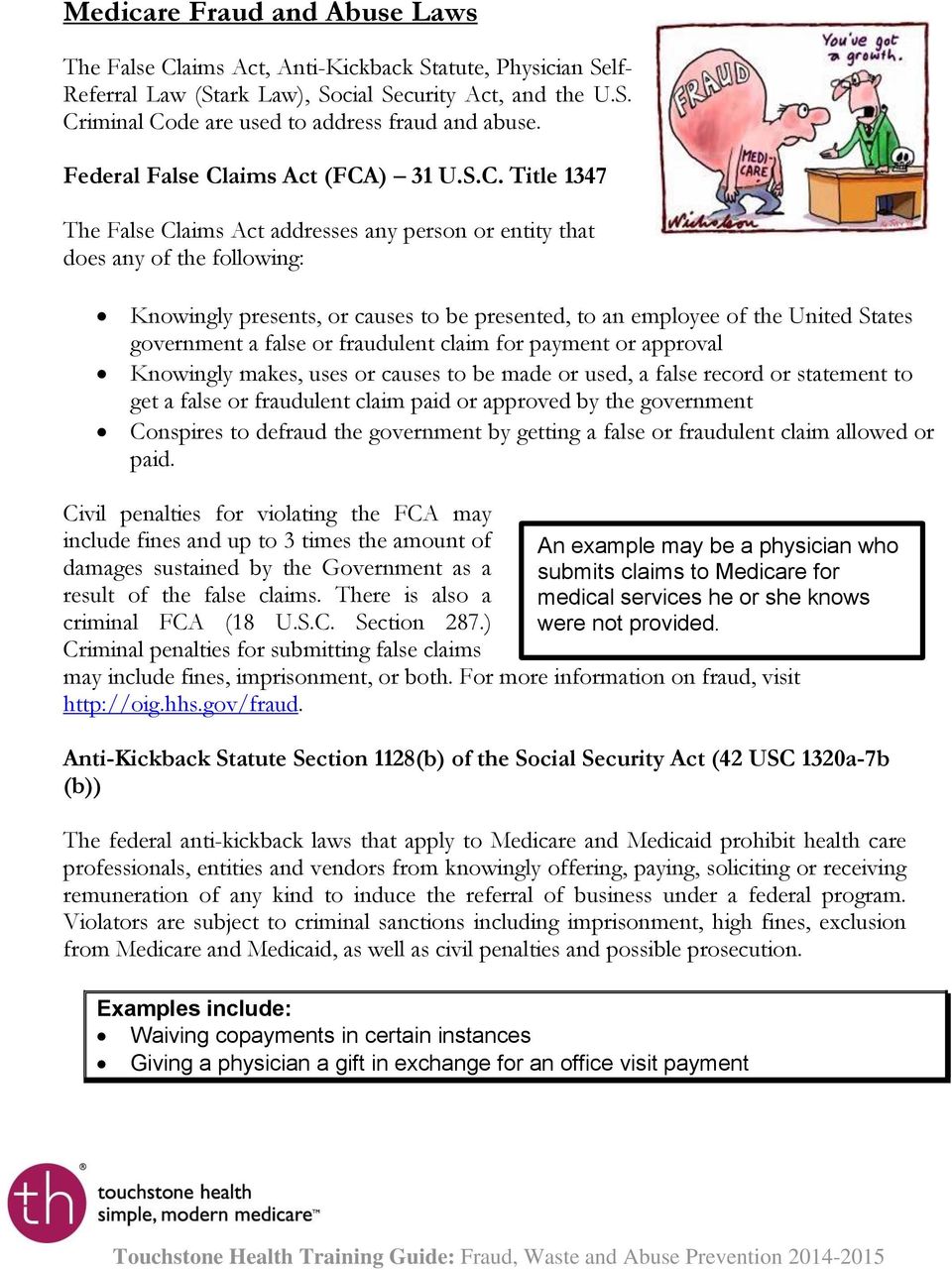
4 Medicare Fraud and Abuse Laws The False Claims Act, Anti-Kickback Statute, Physician Self- Referral Law (Stark Law), Social Security Act, and the U.S. Criminal Code are used to address fraud and abuse. Federal False Claims Act (FCA) 31 U.S.C. Title 1347 The False Claims Act addresses any person or entity that does any of the following: Knowingly presents, or causes to be presented, to an employee of the United States government a false or fraudulent claim for payment or approval Knowingly makes, uses or causes to be made or used, a false record or statement to get a false or fraudulent claim paid or approved by the government Conspires to defraud the government by getting a false or fraudulent claim allowed or paid. Civil penalties for violating the FCA may include fines and up to 3 times the amount of damages sustained by the Government as a result of the false claims. There is also a criminal FCA (18 U.S.C. Section 287.) Criminal penalties for submitting false claims An example may be a physician who submits claims to Medicare for medical services he or she knows were not provided. may include fines, imprisonment, or both. For more information on fraud, visit Anti-Kickback Statute Section 1128(b) of the Social Security Act (42 USC 1320a-7b (b)) The federal anti-kickback laws that apply to Medicare and Medicaid prohibit health care professionals, entities and vendors from knowingly offering, paying, soliciting or receiving remuneration of any kind to induce the referral of business under a federal program. Violators are subject to criminal sanctions including imprisonment, high fines, exclusion from Medicare and Medicaid, as well as civil penalties and possible prosecution. Examples include: Waiving copayments in certain instances Giving a physician a gift in exchange for an office visit payment
5 Physician Self-Referral Law (Stark Law) The Physician Self-Referral Law (Stark Law) (42 U.S.C. Section 1395nn) prohibits a physician from making a referral for certain designated health services to an entity in which the physician (or an immediate member of his or her family) has an ownership/investment interest or with which he or she has a compensation arrangement, unless an exception applies. For more information, visit Criminal Health Care Fraud Statute The Criminal Health Care Fraud Statute (18 U.S.C. Section 1347) prohibits knowingly and willfully executing, or attempting to execute, a scheme or artifice: To defraud any health care benefit program; or To obtain (by means of false or fraudulent pretenses, representations, or promises) any of the money or property owned by, or under the custody of control of, any health care benefit programs.

6 Identifying Fraudulent Activities Health Plan Fraud Fraud committed by the health plan is defined as acts committed through deception, misrepresentation or concealment by the health plan s employees as directed by leadership of the health plan. Examples include: Failure to provide medically necessary services Marketing schemes Improper bid submissions Payments for excluded drugs Multiple billing Inappropriate formulary decisions Inappropriate enrollment/disenrollment False information Inaccurate data submission Fraud by Agents/Brokers Fraud committed by agents/brokers is defined as deception, misrepresentation or concealment by a licensed representative to obtain something of value for which he/she would not otherwise be entitled. Examples Include: Helping individuals fill out their enrollment information so they will be eligible for insurance. False advertising Fraud Due to Misrepresentation of Enrollment Information Fraud due to misrepresentation of enrollment information is defined as commission of an act of deception, misrepresentation, or concealment, or allowing it to be done by someone else, to obtain coverage for which one would not otherwise be entitled. Examples of eligibility fraud include: Individuals joining to form a nonexistent group for insurance purposes. Members not meeting the eligibility requirements Not disclosing medical conditions on an application
7 Claims Fraud Know how to recognize typical fraud techniques such as: Provider is not in the insured s geographic region Large bills incurred prior to term date or immediately after effective date Provider Fraud Provider fraud is defined as the devising of any scheme by any provider of health care or services to defraud for the purpose of personal or financial gain by means of false or fraudulent pretenses, representations promises. Examples of Provider Fraud can include: Billing for services not rendered Providing free services and billing the insurance company Nonqualified practitioners billing as qualified practitioners Billing for noncovered services using an incorrect code. Examples of Dental Fraud: Billing for dental services not rendered Providing excessive dental work that is not needed by the patient Falsifying the date of service to correspond with the member s coverage period Billing for non-covered services using an incorrect code Example of Pharmacy Fraud: Filling less than the prescribed quantity of a drug Billing for a brand when generic drugs are dispensed Forging or altering prescriptions Prescription drug switching Failure to offer negotiated prices Unlawful remuneration Inappropriate documentation of pricing information
8 Member Fraud Member fraud is defined as the commission of acts of deception, misrepresentation or concealment by any policyholder or group of policyholders in order to obtain something of value to which they would not otherwise be entitled. Examples of Member Fraud include: Alteration of bills Submission of false claims Doctor shopping Identity theft Improper coordination of benefits False disclosure with regard to continuation of benefits (COB)
9 Special Investigations Unit (SIU) Touchstone Health s Special Investigation Unit operated through the Compliance and Internal Audit Departments is responsible for the detection, prevention and reporting of Part C and D fraud, waste and abuse. All information received or discovered by the SIU will be treated as confidential and the results of the investigations will be discussed only with the persons having a legitimate reason to receive the information (e.g. state and federal authorities, and Touchstone s senior management. Touchstone cooperates with federal, state and local authorities in the investigation of potential fraud, waste and abuse when indicated. The SIU supports law enforcement agencies, CMS and the Medicare Drug Integrity Contractor (MEDIC) in the execution of any resulting corrective action that is taken as a result of the fraud, waste and abuse investigation. Referrals of Fraud Cases to Law Enforcement Authorities Touchstone is committed to aggressive investigation and referrals to possible prosecution of health care fraud by members, providers, agents, business entities, company employees and other individuals. Suspected fraud, waste and abuse for Medicare (Parts A, B, and C) are reported to CMS through the Department of Health and Human Services (HHS) Office of Inspector General (OIG.) Suspected Medicaid fraud, waste and abuse is reported to the Medicaid Program Integrity (MPI) administrator. Reporting of Violation by Health Care Professionals, Entities or Vendors If you become aware of possible violation of any federal or state rule, law, regulation or policy, or any violation of Touchstone s Compliance and Ethics Policy and Fraud, Waste and Abuse prevention training guide, immediately report it by calling the Report It Hotline at or Username: Touchstoneh Password: Compliance13 See next page for additional contact information

10 You may also contact the following agencies: Touchstone Health Compliance Department One North Lexington Avenue 12 th Floor White Plains, NY Report It Hotline or Username: Touchstoneh Password: Compliance13 Centers for Medicare and Medicaid Services (CMS) U.S. Department of Health and Human Services (HHS) Office of the Inspector General (OIG) OIG s National Hotline: [email protected]

Prime Staffing-Fraud, Waste and Abuse Prevention Training Guide Designed for First-tier, Downstream and Related Entities
 Prime Staffing-Fraud, Waste and Abuse Prevention Training Guide Designed for First-tier, Downstream and Related Entities Prime Staffing is providing this Fraud, Waste and Abuse Prevention Training Guide
Fraud, Waste, and Abuse
 These training materials are divided into three topics to meet the responsibilities stated on the previous pages: Fraud, Waste, Compliance Program Standards of Conduct Although the information contained
Medicare Compliance and Fraud, Waste, and Abuse Training
 Medicare Compliance and Fraud, Waste, and Abuse Training Objectives Recognize laws and concepts affecting compliance and fraud, waste, and abuse (FWA) Increase awareness of FWA Use identification techniques
TM Nightingale. Home Healthcare. Fraud & Abuse: Prevention, Detection, & Reporting
 Fraud & Abuse: Prevention, Detection, & Reporting What Is Fraud? Fraud is defined as making false statements or representations of facts to obtain benefit or payment for which none would otherwise exist.
How To Get A Medical License In Michigan
 FRAUD, WASTE, & ABUSE Kimberly Parks NEIGHBORHOOD LEGAL SERVICES MICHIGAN ELDER LAW & ADVOCACY CENTER 12121 Hemingway Redford, Michigan 48239 (313) 937-8291 Why It s Important Fraud, Waste and Abuse drain
Compliance and Program Integrity Melanie Bicigo, CHC, CEBS [email protected] 906-225-7749
 Compliance and Program Integrity Melanie Bicigo, CHC, CEBS [email protected] 906-225-7749 Define compliance and compliance program requirements Communicate Upper Peninsula Health Plan (UPHP) compliance
Fraud, Waste and Abuse Prevention Training
 Fraud, Waste and Abuse Prevention Training The Centers for Medicare & Medicaid Services (CMS) requires annual fraud, waste and abuse training for organizations providing health services to MA or Medicare
Developed by the Centers for Medicare & Medicaid Services
 Developed by the Centers for Medicare & Medicaid Services Every year millions of dollars are improperly spent because of fraud, waste, and abuse. It affects everyone. Including YOU. This training will
Fraud, Waste and Abuse Training for Medicare and Medicaid Providers
 Fraud, Waste and Abuse Training for Medicare and Medicaid Providers For Use By: Licensed affiliates and subsidiaries of Magellan Health Services, Inc. Contents and Agenda Define Fraud, Waste, and Abuse
CMS Mandated Training for Providers, First Tier, Downstream and Related Entities
 CMS Mandated Training for Providers, First Tier, Downstream and Related Entities I. INTRODUCTION It is the practice of Midwest Health Plan (MHP) to conduct its business with the highest degree of ethics
Fraud, Waste and Abuse Training. Protecting the Health Care Investment. Section Three
 Fraud, Waste and Abuse Training Protecting the Health Care Investment Section Three Section 1.2: Purpose According to the National Health Care Anti-Fraud Association, the United States spends more than
How To Get A Medical Bill Of Health From A Member Of A Health Care Provider
 Neighborhood requires compliance with all laws applicable to the organization s business, including insistence on compliance with all applicable federal and state laws dealing with false claims and false
The following presentation was based on the
 Fraud Waste and Abuse Presentation The following presentation was based on the Medicare Parts C & D Fraud, Waste, and Abuse Training and General Compliance Training developed by the Centers for Medicare
Fraud, Waste & Abuse. UPMC Health Plan Quality Audit, Fraud, Waste & Abuse Department
 Fraud, Waste & Abuse UPMC Health Plan Quality Audit, Fraud, Waste & Abuse Department Definitions of Fraud, Waste & Abuse FRAUD: An intentional deception or misrepresentation made by a person or entity,
Medicare Advantage and Part D Fraud, Waste, and Abuse Training. October 2010
 Medicare Advantage and Part D Fraud, Waste, and Abuse Training October 2010 Introduction 2008: United States spent $2.3 trillion on health care. Federal fiscal year 2010: Medicare expected to cover an
FRAUD, WASTE & ABUSE. Training for First Tier, Downstream and Related Entities. Slide 1 of 24
 FRAUD, WASTE & ABUSE Training for First Tier, Downstream and Related Entities Slide 1 of 24 Purpose of this Program On December 5, 2007, the Centers for Medicare and Medicaid Services ( CMS ) published
BlueCross BlueShield of Tennessee Senior Care Division and Volunteer State Health Plan
 BlueCross BlueShield of Tennessee Senior Care Division and Volunteer State Health Plan Fraud Waste and Abuse Training for Providers, First Tier, Downstream and Related Entities Overview The Centers for
Fraud Waste and Abuse Training Requirement. To Whom It May Concern:
 RE: Fraud Waste and Abuse Training Requirement To Whom It May Concern: This letter is to inform you about a new requirement being implemented by the CMS program (Centers for Medicare and Medicaid Services)
Fraud, Waste, and Abuse Training For Use By Care Wisconsin Providers Created: September 20, 2010 Reviewed/Revised: 8/18/2011
 Fraud, Waste, and Abuse Training For Use By Care Wisconsin Providers Created: September 20, 2010 Reviewed/Revised: 8/18/2011 Definitions & Examples Why it Matters Prevention, Detection and Reporting Your
MODULE II: MEDICARE & MEDICAID FRAUD, WASTE, AND ABUSE TRAINING
 MODULE II: MEDICARE & MEDICAID FRAUD, WASTE, AND ABUSE TRAINING 2 0 1 4 Introduction The Medicare and Medicaid programs are governed by statutes, regulations, and policies PacificSource must have an effective
False Claims / Federal Deficit Reduction Act Notice Help Stop Healthcare Fraud, Waste and Abuse: Report to the Firelands Corporate Compliance Officer
 1111 Hayes Avenue Sandusky, OH 44870 www.firelands.com False Claims / Federal Deficit Reduction Act Notice Help Stop Healthcare Fraud, Waste and Abuse: Report to the Firelands Corporate Compliance Officer
FIRST TIER, DOWNSTREAM AND RELATED ENTITIES (FDR) ANNUAL TRAINING
 FIRST TIER, DOWNSTREAM AND RELATED ENTITIES (FDR) ANNUAL TRAINING The Compliance Team appreciates your attention and cooperation during this CMS mandated annual training! DEFINITIONS ADVANTAGE utilizes
Fraud, Waste and Abuse Page 1 of 9
 Page 1 of 9 Overview It is the policy of MVP Health Care, Inc. and its affiliates (collectively referred to as MVP ) to comply with all applicable federal and state laws regarding fraud, waste and abuse.
Fraud Waste and Abuse Training First Tier, Downstream and Related Entities
 Fraud Waste and Abuse Training First Tier, Downstream and Related Entities Revised: 04/2010 OVERVIEW Centene Corporation Purpose Bridgeway Compliance Program Definitions of Fraud Waste & Abuse Laws and
Fraud, Waste and Abuse Training
 Fraud, Waste and Abuse Training 1 Why Do I Need Training? Every year millions of dollars are improperly spent because of fraud, waste and abuse. It affects everyone, Including YOU. This training will help
Medicare Parts C & D Fraud, Waste, and Abuse Training and General Compliance Training
 Medicare Parts C & D Fraud, Waste, and Abuse Training and General Compliance Training Developed by the Centers for Medicare & Medicaid Services Issued: February, 2013 Important Notice This training module
Medicare Fraud, Waste and Abuse (FWA) Compliance Training. ICE Approved: 11/13/09
 Medicare Fraud, Waste and Abuse (FWA) Compliance Training ICE Approved: 11/13/09 1 CMS Requirements The Centers for Medicare and Medicaid Services (CMS) requires annual fraud, waste, and abuse training
MEDICAID AND MEDICARE (PARTS C&D) FRAUD, WASTE AND ABUSE TRAINING
 MEDICAID AND MEDICARE (PARTS C&D) FRAUD, WASTE AND ABUSE TRAINING Why Do I Need Training/Where Do I Fit in? Why Do I Need Training? Every year millions of dollars are improperly spent because of fraud,
Fraud Waste and Abuse Training First Tier, Downstream and Related Entities. ONECare by Care1st Health Plan Arizona, Inc. (HMO) Revised: 10/2009
 Fraud Waste and Abuse Training First Tier, Downstream and Related Entities ONECare by Care1st Health Plan Arizona, Inc. (HMO) Revised: 10/2009 Overview Purpose Care1st/ ONECare Compliance Program Definitions
Fraud, Waste and Abuse Network Pharmacy Training 2011
 Fraud, Waste and Abuse Network Pharmacy Training 2011 Table of Contents Centers for Medicare & Medicaid Services (CMS) Role Important Federal Statutes for Medicare Participants Fraud, Waste and Abuse Defined
Combating Medicare Parts C and D Fraud, Waste, and Abuse
 Combating Medicare Parts C and D Fraud, Waste, and Abuse Why Do I Need Training? Every year billions of dollars are improperly spent because of FWA. It affects everyone including you. This training will
Fraud, Waste & Abuse. Training Course for UHCG Employees
 Fraud, Waste & Abuse Training Course for UHCG Employees Overview The Centers for Medicare & Medicaid Services (CMS) require Medicare Advantage Organizations and Part D Plan Sponsors to provide annual fraud,
Preventing Fraud, Waste, and Abuse
 2013 Compliance Training for Contractors and Vendors Module 2 Preventing Fraud, Waste, and Abuse For Internal Training Purposes Only 1 Learning Objectives After completing this training, learners will
Medicare Parts C & D Fraud, Waste, and Abuse Training and General Compliance Training. Important Notice
 Medicare Parts C & D Fraud, Waste, and Abuse Training and General Compliance Training Developed by the Centers for Medicare & Medicaid Services Issued: February, 2013 Important Notice This training module
Principles of Business Ethics Compliance and Fraud Prevention Guide
 Principles of Business Ethics Compliance and Fraud Prevention Guide Military Healthcare Services Dear Health Care Professionals, Entities and Vendors: Our industry s attention has increased its focus on
Medicare Fraud, Waste, and Abuse Training for Healthcare Professionals 2010-2011
 Medicare Fraud, Waste, and Abuse Training for Healthcare Professionals 2010-2011 Y0067_H2816_H6169_WEB_UAMC IA 11/22/2010 Last Updated: 11/22/2010 Medicare Requirements The Centers for Medicare and Medicaid
Prevention of Fraud, Waste and Abuse Training
 Prevention of Fraud, Waste and Abuse Training For Group Health Contracted Providers FWA Department l Office of Compliance and Ethics 1 Outline Purpose Deemed Compliant Group Health Compliance Program Fraud,
COMPLIANCE AND OVERSIGHT MONITORING
 COMPLIANCE AND OVERSIGHT MONITORING The contract between HCA and Molina Healthcare defines a number of performance requirements that must be satisfied by Molina Healthcare subcontracted Providers to provide
SCAN Health Plan Policy and Procedure Number: CRP-0067, False Claims Act & Deficit Reduction Act 2005
 Health Plan Policy and Procedure Number: CRP-0067, False Claims Act & Deficit Reduction Act 2005 Approver Approval Stage Date Chris Zorn Approval Event (Authoring) 12/09/2013 Nancy Monk Approval Event
A Roadmap for New Physicians. Avoiding Medicare and Medicaid Fraud and Abuse
 A Roadmap for New Physicians Avoiding Medicare and Medicaid Fraud and Abuse Introduction This tutorial is intended to assist new physicians in understanding how to comply with Federal laws that combat
USC Office of Compliance
 PURPOSE This policy complies with requirements under the Deficit Reduction Act of 2005 and other federal and state fraud and abuse laws. It provides guidance on activities that could result in incidents
Overview, Guidance & Training: Medicare Fraud, Waste & Abuse
 Overview, Guidance & Training: Medicare Fraud, Waste & Abuse Learning Objectives 1. To become familiar with the new educational component of fraud, waste and abuse (FWA) training regulations that govern
False Claims Act CMP212
 False Claims Act CMP212 Colorado Access is committed to a culture of compliance in which its employees, providers, contractors, and consultants are educated and knowledgeable about their role in reporting
Combating Fraud, Waste, and Abuse
 Combating Fraud, Waste, and Abuse On-Line Training The information contained in this presentation is intended to prevent and/or combat Fraud, Waste, and Abuse with respect to Medicare and other benefit
Fraud Prevention Training Requirements For Medicare Advantage Plans
 MEDICARE ADVANTAGE (Part C) PRESCRIPTION DRUG (Part D) FRAUD, WASTE, and ABUSE EDUCATION AND TRAINING 1 INTRODUCTION CMS has mandated that Medicare Advantage Organizations (MAOs) and Prescription Drug
MEDICAID AND MEDICARE (PARTS C&D) FRAUD, WASTE AND ABUSE TRAINING
 MEDICAID AND MEDICARE (PARTS C&D) FRAUD, WASTE AND ABUSE TRAINING Why Do I Need Training/Where Do I Fit in? Why Do I Need Training? Every year millions of dollars are improperly spent because of fraud,
Detecting and Preventing Fraud, Waste and Abuse
 Detecting and Preventing Fraud, Waste and Abuse Overview It is the policy of ICS to comply with all applicable federal and state laws regarding fraud, waste and abuse. ICS acknowledges its participation
Stark, False Claims and Anti- Kickback Laws: Easy Ways to Stay Compliant with the Big Three in Healthcare
 Stark, False Claims and Anti- Kickback Laws: Easy Ways to Stay Compliant with the Big Three in Healthcare In health care, we are blessed with an abundance of rules, policies, standards and laws. In Health
CHAMPAIGN COUNTY NURSING HOME SUMMARY OF ANTI-FRAUD AND ABUSE POLICIES
 1. PURPOSE CHAMPAIGN COUNTY NURSING HOME SUMMARY OF ANTI-FRAUD AND ABUSE POLICIES Champaign County Nursing Home ( CCNH ) has established anti-fraud and abuse policies to prevent fraud, waste, and abuse
DEPARTMENT OF HUMAN SERVICES DIVISION OF DEVELOPMENTAL DISABILITIES
 DEPARTMENT OF HUMAN SERVICES DIVISION OF DEVELOPMENTAL DISABILITIES DIVISION CIRCULAR #54 N/A EFFECTIVE DATE: November 19, 2008 DATE ISSUED: November 19, 2008 (Rescinds Division Circular #54 issued on
B. Prevent, detect, and respond to unacceptable legal risk and its financial implications. C. Route non-compliance issues to appropriate areas.
 Policy Ashe Memorial Hospital (AMH) is committed to effective and efficient operations, reliable financial reporting and compliance with all applicable laws and regulations. It is the policy of AMH to
55144-1-5 Page: 1 of 5. Pharmacy Fraud, Waste and Abuse Policy. 1.0 Compliance Assurance. 2.0 Procedure
 Pharmacy Fraud, Waste and Abuse Policy 1.0 Compliance Assurance This Fraud Waste and Abuse Policy ( Policy ) reiterates the commitment of this pharmacy to comply with the standards of conduct established
CODE OF CONDUCT. Providers, Suppliers and Contractors
 CODE OF CONDUCT Providers, Suppliers and Contractors Table of Contents Code of Conduct... Honesty and integrity... Quality and Service... Responsibilities of Providers, Suppliers and Contractors... Compliance
2015 Fraud, Waste & Abuse Prevention
 Quality Independent Physicians, LLC Awareness Training 2015 Fraud, Waste & Abuse Prevention Fraud, Waste and Abuse (FWA) Training Objectives After completing this training you should be able to: Recognize
Florida Health Care Plans Fraud, Waste & Abuse and Compliance Training
 Florida Health Care Plans Fraud, Waste & Abuse and Compliance Training 2014 Version INTRODUCTION The United States spends more than $2 trillion on health care every year. The National Health Care Anti-Fraud
PREVENTING FRAUD, ABUSE, & WASTE: A Primer for Physical Therapists
 PREVENTING FRAUD, ABUSE, & WASTE: A Primer for Physical Therapists Available at: http://www.apta.org/integrity 2014 American Physical Therapy Association. All rights reserved. All reproduction or redistribution
Prepared by: The Office of Corporate Compliance & HIPAA Administration
 Gwinnett Health System s Annual Education 2014 Corporate Compliance: Our Commitment to Excellence Prepared by: The Office of Corporate Compliance & HIPAA Administration Objectives After completing this
POLICY ON FRAUD, WASTE AND ABUSE IN FEDERAL HEALTH CARE PROGRAMS
 43 New Scotland Avenue (MC-12) Albany, NY 12208 POLICY ON FRAUD, WASTE AND ABUSE IN FEDERAL HEALTH CARE PROGRAMS EFFECTIVE JANUARY 1, 2007, APPROVED NOVEMBER 14, 2006 LATEST REVISION DATE: MARCH 4, 2015
LMHS COMPLIANCE ORIENTATION Physicians and Midlevel Providers. Avoiding Medicare and Medicaid Fraud & Abuse
 LMHS COMPLIANCE ORIENTATION Physicians and Midlevel Providers Avoiding Medicare and Medicaid Fraud & Abuse Revised 06/03/2014 LMHS COMPLIANCE PROGRAM 6/30/2014 2 Chief Compliance Officer Catherine A. Kahle,
Compliance, Code of Conduct & Ethics Program Cantex Continuing Care Network. Contents
 Compliance, Code of Conduct & Ethics Program Cantex Continuing Care Network Contents Compliance, Code of Conduct & Ethics Program 1 What is the CCCN Code of Conduct? 2 Operating Philosophies 2 Employee
Medicare 101. Presented by Area Agency on Aging 1-A
 Medicare 101 Presented by Area Agency on Aging 1-A What is Medicare? n Federal Health Insurance for: n People 65 years of age or older n Some persons with disabilities, after a 24 month waiting period
Compliance Program Guide for Contractors. Integrity Program
 Compliance Program Guide for Contractors Integrity Program Prepared by: Compliance Officer Version 2.2 December 2013 1 Table of Contents Integrity Program Overview... 2 Standards of Conduct... 3 Reporting
The term knowing is defined to mean that a person with respect to information:
 Section 11. Fraud, Waste, and Abuse Introduction Molina Healthcare of [state] maintains a comprehensive Fraud, Waste, and Abuse program. The program is held accountable for the special investigative process
Compliance. In general, compliance means conforming to a rule, such as a specification, policy, standard or law.
 COMPLIANCE TRAINING Compliance In general, compliance means conforming to a rule, such as a specification, policy, standard or law. Regulatory compliance describes the goal that corporations or public
Program Integrity Fraud, Waste, and Abuse Training
 Program Integrity Fraud, Waste, and Abuse Training March 2015 Jim K. Hampton, Director Fraud Operations & SIU Health Care Fraud is a crime that has a significant effect on the private and public health
NOYES HEALTH ADMINISTRATION POLICY/PROCEDURE
 NOYES HEALTH ADMINISTRATION POLICY/PROCEDURE SUBJECT: DETECTION AND PREVENTION OF POLICY: 200.161 FRAUD, WASTE, AND ABUSE EFFECTIVE DATE: June, 2012 ISSUED BY: Administration TJC REF: None PAGE: 1 OF 5
Preferred IPA Medicare Fraud, Waste, and Abuse Training General Compliance Training HIPAA Compliance Training 2014-2015
 Preferred IPA Medicare Fraud, Waste, and Abuse Training General Compliance Training HIPAA Compliance Training 2014-2015 This training program consists of three parts: 1. Medicare Parts C & D Fraud, Waste,
METHODIST HEALTH SYSTEM ADMINISTRATIVE TITLE: DETECTING FRAUD AND ABUSE AND AN OVERVIEW OF THE FEDERAL AND STATE FALSE CLAIMS ACTS
 METHODIST HEALTH SYSTEM ADMINISTRATIVE Formulated: 6/19/07 Reviewed: Revised: Effective: 10/30/07 TITLE: DETECTING FRAUD AND ABUSE AND AN OVERVIEW OF THE FEDERAL AND STATE FALSE CLAIMS ACTS PURPOSE: Methodist
Standards of. Conduct. Important Phone Number for Reporting Violations
 Standards of Conduct It is the policy of Security Health Plan that all its business be conducted honestly, ethically, and with integrity. Security Health Plan s relationships with members, hospitals, clinics,
Metropolitan Jewish Health System and its Participating Agencies and Programs [MJHS]
![Metropolitan Jewish Health System and its Participating Agencies and Programs [MJHS]](/thumbs/34/17169087.jpg "Metropolitan Jewish Health System and its Participating Agencies and Programs [MJHS]") Metropolitan Jewish Health System and its Participating Agencies and Programs [MJHS] POLICY PURSUANT TO THE FEDERAL DEFICIT REDUCTION ACT OF 2005: Detection and Prevention of Fraud, Waste, and Abuse and
Metropolitan Jewish Health System and its Participating Agencies and Programs [MJHS] POLICY PURSUANT TO THE FEDERAL DEFICIT REDUCTION ACT OF 2005: Detection and Prevention of Fraud, Waste, and Abuse and
Fraud, Waste and Abuse Prevention and Education Policy
 Corporate Compliance Fraud, Waste and Abuse Prevention and Education Policy The Compliance Program at the Cortland Regional Medical Center (CRMC) demonstrates our commitment to uphold all federal and state
NewYork-Presbyterian Hospital Sites: All Centers Hospital Policy and Procedure Manual Number: D160 Page 1 of 9
 Page 1 of 9 TITLE: FEDERAL DEFICIT REDUCTION ACT OF 2005 FRAUD AND ABUSE PROVISIONS POLICY: NewYork- Presbyterian Hospital (NYP or the Hospital) is committed to preventing and detecting any fraud, waste,
I. Policy Purpose. II. Policy Statement. III. Policy Definitions: RESPONSIBILITY:
 POLICY NAME: POLICY SPONSOR: FRAUD, WASTE AND ABUSE COMPLIANCE OFFICER RESPONSIBILITY: EFFECTIVE DATE: REVIEW/ REVISED DATE: I. Policy Purpose The purpose of this policy is to outline the requirements
Avoiding Medicaid Fraud. Odyssey House of Utah Questions? Contact your Program Director or Emily Capito, Director of Operations
 Avoiding Medicaid Fraud Odyssey House of Utah Questions? Contact your Program Director or Emily Capito, Director of Operations MEDICAID FRAUD OVERVIEW Medicaid Fraud The Medicaid Program provides medical
Compliance Program Code of Conduct
 Compliance Program Code of Conduct INTRODUCTION All personnel must not only act in compliance with all applicable legal rules and regulations, but also strive to avoid even the appearance of impropriety.
Developed by the Centers for Medicare & Medicaid Services. Issued: February, 2013
 CMS Fraud, Waste, and Abuse Training and General Compliance Training Developed by the Centers for Medicare & Medicaid Services Issued: February, 2013 Important Notice This training module consists of two
ADMINISTRATIVE POLICY SECTION: CORPORATE COMPLIANCE Revised Date: 2/26/15 TITLE: FALSE CLAIMS ACT & WHISTLEBLOWER PROVISIONS
 Corporate Compliance Plan AD-819-0 Reporting of Compliance Concerns & Non-retaliation AD-807-0 Compliance Training Policy CFC ADMINISTRATIVE POLICY AD-819-1 SECTION: CORPORATE COMPLIANCE Revised Date:
SECTION 18 1 FRAUD, WASTE AND ABUSE
 SECTION 18 1 FRAUD, WASTE AND ABUSE Annual FW&A Training Required for Providers and Office Staff 1 Examples of Fraud, Waste and Abuse 2 Fraud, Waste and Abuse Program Policy 3 Suspected Non-Compliance
To: All Vendors, Agents and Contractors of Hutchinson Regional Medical Center
 To: All Vendors, Agents and Contractors of Hutchinson Regional Medical Center From: Corporate Compliance Department Re: Deficit Reduction Act of 2005 Dear Vendor/Agent/Contractor: Under the Deficit Reduction
AVOIDING FRAUD AND ABUSE
 AVOIDING FRAUD AND ABUSE Responsibility, Protection, Prevention Presented by: www.thehealthlawfirm.com Main Office: 1101 Douglas Avenue Altamonte Springs, FL 32714 Phone: (407) 331-6620 Fax: (407) 331-3030