
International Relations: One World, Many Theories
|
|
|
- Isaac Lambert
- 10 years ago
- Views:
Transcription
1 International Relations: One World, Many Theories by Stephen M. Walt W hy should policymakers and practitioners care about the scholarly study of international affairs? Those who conduct foreign policy often dismiss academic theorists (frequently, one must admit, with good reason), but there is an inescapable link between the abstract worm of theory and the real worm of policy. We need theories to make sense of the blizzard of information that bombards us daily. Even policymakers who are contemptuous of "theory" must rely on their own (often unstated) ideas about how the world works in order to decide what to do. It is hard to make good policy if one's basic organizing principles are flawed, just as it is hard to construct good theories without knowing a lot about the real world. Everyone uses theories--whether he or she knows it or not--and disagreements about policy usually rest on more fundamental disagreements about the basic forces that shape international outcomes. Take, for example, the current debate on how to respond to China. From one perspective, Chinas ascent is the latest example of the ten- STEPHEN M. WALT is professor of political science and master of the social science collegiate division at the University of Chicago. He is a member of FOREIGN POLICY's editorial board. SPRING

2 International Relations dency for rising powers to alter the global balance of power in potentially dangerous ways, especially as their growing influence makes them more ambitious. From another perspective, the key to China's future conduct is whether its behavior will be modified by its integration into world markets and by the (inevitable?) spread of democratic principles. From yet another viewpoint, relations between China and the rest of the world will be shaped by issues of culture and identity: Will China see itself (and be seen by others) as a normal member of the world community or a singular society that deserves special treatment? In the same way, the debate over NA'rO expansion looks different depending on which theory one employs. From a "realist" perspective, NATO expansion is an effort to extend Western influence--well beyond the traditional sphere of U.S. vital interests--during a period of Russ- Jan weakness and is likely to provoke a harsh response from Moscow. From a liberal perspective, however, expansion will reinforce the nascent democracies of Central Europe and extend NATO's conflictmanagement mechanisms to a potentially turbulent region. A third view might stress the value of incorporating the Czech Republic, Hungary, and Poland within the Western security community, whose members share a common identity that has made war largely unthinkable. No single approach can capture all the complexity of contemporary world politics. Therefore, we are better off with a diverse array of competing ideas rather than a single theoretical orthodoxy. Competition between theories helps reveal their strengths and weaknesses and spurs subsequent refinements, while revealing flaws in conventional wisdom. Although we should take care to emphasize inventiveness over invective, we should welcome and encourage the heterogeneity of contemporary scholarship. WHEnE AnE WE COMING FnOM? The study of international affairs is best understood as a protracted competition between the realist, liberal, and radical traditions. Realism emphasizes the enduring propensity for conflict between states; liberalism identifies several ways to mitigate these conflictive tendencies; and the radical tradition describes how the entire system of state relations might be transformed. The boundaries between these traditions are somewhat fuzzy and a number of important works do not fit neatly into any of them, but debates within and among them have largely defmed the discipline. 30 FOREIGN POLICY

3 Walt Rea//sm Realism was the dominant theoretical tradition throughout the Cold War. It depicts international affairs as a struggle for power among selfinterested states and is generally pessimistic about the prospects for eliminating conflict and war. Realism dominated in the Cold War years because it provided simple but powerful explanations for war, alliances, imperialism, obstacles to cooperation, and other international phenomena, and because its emphasis on competition was consistent with the central features of the American-Soviet rivalry. Realism is not a single theory, of course, and realist thought evolved considerably throughout the Cold War. "Classical" realists such as Hans Morgenthau and Reinhold Niebuhr believed that states, like human beings, had an innate desire to dominate others, which led them to fight wars. Morgenthau also stressed the virtues of the classical, multipolat; balance-of-power system and saw the bipolar rivalry between the United States and the Soviet Union as especially dangerous. By contrast, the "neorealist" theory advanced by Kenneth Waltz ignored human nature and focused on the effects of the international system. For Waltz, the international system consisted of a number of great powers, each seeking to survive. Because the system is anarchic (i.e., there is no central authority to protect states from one another), each state has to survive on its own. Waltz argued that this condition would lead weaker states to balance against, rather than bandwagon with, more powerful rivals. And contrary to Morgenthau, he claimed that bipolarity was more stable than multipolarity. An important refinement to realism was the addition of offensedefense theory, as laid out by Robert Jervis, George Quester, and Stephen Van Evem. These scholars argued that war was more likely when states could conquer each other easily. When defense was easier than offense, however, security was more plentiful, incentives to expand declined, and cooperation could blossom. And if defense had the advantage, and states could distinguish between offensive and defensive weapons, then states could acquire the means to defend themselves without threatening others, thereby dampening the effects of anarchy. For these "defensive" realists, states merely sought to survive and great powers could guarantee their security by forming balancing alliances and choosing defensive military postures (such as retaliatory nuclear forces). Not surprisingly, Waltz and most other neorealists believed that the United States was extremely secure for most of the Cold War. Their SPRING

4 International Relations principle fear was that it might squander its favorable position by adopting an overly aggressive foreign policy. Thus, by the end of the Cold War, realism had moved away from Morgenthau's dark brooding about human nature and taken on a slightly more optimistic tone. Liberalism The principal challenge to realism came from a broad family of liberal theories. One strand of liberal thought argued that economic interdependence would discourage states from using force against each other because warfare would threaten each side's prosperity. A second strand, often associated with President Woodrow Wilson, saw the spread of democracy as the key to world peace, based on the claim that democratic states were inherently more peaceful than authoritarian states. A third, more recent theory argued that international institutions such as the International Energy Agency and the International Monetary Fund could help overcome selfish state behavior, mainly by encouraging states to forego immediate gains for the greater benefits of enduring cooperation. Although some liberals flirted with the idea that new transnational actors, especially the multinational corporation, were gradually encroaching on the power of states, liberalism generally saw states as the central players in international affairs. All liberal theories implied that cooperation was more pervasive than even the defensive version of realism allowed, but each view offered a different recipe for promoting it. Rad/cd Ap~oaches Until the 1980s, marxism was the main alternative to the mainstream realist and liberal traditions. Where realism and liberalism took the state system for granted, marxism offered both a different explanation for international conflict and a blueprint for fundamentally transforming the existing international order. Orthodox marxist theory saw capitalism as the central cause of international conflict. Capitalist states battled each other as a consequence of their incessant struggle for profits and battled socialist states because they saw in them the seeds of their own destruction. Neomarxist "dependency" theory, by contrast, focused on relations between advanced capitalist powers and less developed states and argued that the former--aided by an unholy alliance with the ruling classes of the developing world had grown rich by exploiting the latter. The solu- 32 FOREIGN POLICY

5 International Relations tion was to overthrow these parasitic 61ites and install a revolutionary government committed to autonomous development. Both of these theories were largely discredited before the Cold War even ended. The extensive history of economic and military cooperation among the advanced industrial powers showed that capitalism did not inevitably lead to conflict. The bitter schisms that divided the communist world showed that socialism did not always promote harmony. Dependency theory suffered similar empirical setbacks as it became increasingly clear that, first, active participation in the world economy was a better route to prosperity than autonomous socialist development; and, second, many developing countries proved themselves quite capable of bargaining successfully with multinational corporations and other capitalist institutions. As marxism succumbed to its various failings, its mantle was assumed by a group of theorists who borrowed heavily from the wave of postmodem writings in literary criticism and social theory. This "deconstructionist" approach was openly skeptical of the effort to devise general or universal theories such as realism or liberalism. Indeed, its proponents emphasized the importance of language and discourse in shaping social outcomes. However, because these scholars focused initially on criticizing the mainstream paradigms but did not offer positive alternatives to them, they remained a self-consciously dissident minority for most of the 1980s. Domestic Politics Not all Cold War scholarship on international affairs fit neatly into the realist, liberal, or marxist paradigms. In particular, a number of important works focused on the characteristics of states, governmental organizations, or individual leaders. The democratic strand of liberal theory fits under this heading, as do the efforts of scholars such as Graham Allison and John Steinbruner to use organization theory and bureaucratic politics to explain foreign policy behavior, and those of Jervis, Irving Janis, and others, which applied social and cognitive psychology. For the most part, these efforts did not seek to provide a general theory of international behavior but to identify other factors that might lead states to behave contrary to the predictions of the realist or liberal approaches. Thus, much of this literature should be regarded as a complement to the three main paradigms rather than as a rival approach for analysis of the international system as a whole. 34 FOREIGN POLICY

6 Walt NEW WRINKLES IN OLD PARADIGMS Scholarship on intemational affairs has diversified significantly since the end of the Cold War. Non-American voices are more prominent, a wider range of methods and theories are seen as legitimate, and new issues such as ethnic conflict, the environment, and the future of the state have been placed on the agenda of scholars everywhere. Yet the sense of d~j~ vu is equally striking. Instead of resolving the struggle between competing theoretical traditions, the end of the Cold War has merely launched a new series of debates. Ironically, even as many societies embrace similar ideals of democracy, free markets, and human rights, the scholars who study these developments are more divided than ever. Rea//sm Redux Although the end of the Cold War led a few writers to declare that realism was destined for the academic scrapheap, rumors of its demise have been largely exaggerated. A recent contribution of realist theory is its attention to the problem of relative and absolute gains. Responding to the institutionalists' claim that international institutions would enable states to forego short-term advantages for the sake of greater long-term gains, realists such as Joseph Grieco and Stephen Krasner point out that anarchy forces states to worry about both the absolute gains from cooperation and the way that gains are distributed among participants. The logic is straightforward: If one state reaps larger gains than its partners, it will gradually become stronger, and its partners will eventually become more vulnerable. Realists have also been quick to explore a variety of new issues. Barry Posen offers a realist explanation for ethnic conflict, noting that the breakup of multiethnic states could place rival ethnic groups in an anarchic setting, thereby triggering intense fears and tempting each group to use force to improve its relative position. This problem would be particularly severe when each group's territory contained enclaves inhabited by their ethnic rivals--as in the former Yugoslavia because each side would be tempted to "cleanse" (preemptively) these alien minorities and expand to incorporate any others from their ethnic group that lay outside their borders. Realists have also cautioned that N^TO, absent a clear enemy, would likely face increasing strains and that expanding its presence eastward would jeopardize relations with Russia. Finally, scholars such as Michael Mastanduno have argued that U.S. SPRINO

7 International Relations Waiting for Mr. X The post-cold War world still awaits its "X" article. Although many have tried, no one has managed to pen the sort of compelling analysis that George Kennan provided for an earlier era, when he articulated the theory of containment. Instead of a single new vision, the most important development in post-cold War writings on world affairs is the continuing clash between those who believe world politics has been (or is being) fundamentally transformed and those who believe that the future will look a lot like the past. Scholars who see the end of the Cold War as a watershed fall into two distinct groups. Many experts still see the state as the main actor but believe that the agenda of states is shifting from military competition to economic competitiveness, domestic welfare, and environmental protection. Thus, President Bill Clinton has embraced the view that "enlightened self-interest [and] shared values.., will compel us to cooperate in more constructive ways." Some writers attribute this change to the spread of democracy, others to the nuclear stalemate, and still others to changes in international norms. An even more radical perspective questions whether the state is still the most important international actor. Jessica Mathews believes that "the absolutes of the Westphalian system [of] territorially fixed states.., are all dissolving," and John Ruggie argues that we do not even have a vocabulary that can adequately describe the new forces that (he believes) are transforming contemporary world politics. Although there is still no consensus on the causes of this trend, the view that states are of decreasing relevance is surprisingly common among academics, journalists, and policy wonks. Prominent realists such as Christopher Layne and Kenneth Waltz continue to give the state pride of place and predict a return to familiar patterns of great power competition. Similarly, Robert Keohane and other institutionalists also emphasize the central role of the state and argue that institutions such as the European Union and NATO are important precisely because they provide continuity in the midst of dramatic political shifts. These authors all regard the end of the Cold War as a far-reaching shift in the global balance of power but do not see it as a qualitative transformation in the basic nature of world politics. Who is right? Too soon to tell, but the debate bears watching in the years to come. --S.W. 36 FOREIGN POLICY

8 Wak foreign policy is generally consistent with realist principles, insofar as its actions are still designed to preserve U.S. predominance and to shape a postwar order that advances American interests. The most interesting conceptual development within the realist paradigm has been the emerging split between the "defensive" and "offensive" strands of thought. Defensive realists such as Waltz, Van Ever-a, and Jack Snyder assumed that states had little intrinsic interest in military conquest and argued that the costs of expansion generally outweighed the benefits. Accordingly, they maintained that great power wars occurred largely because domestic groups fostered exaggerated perceptions of threat and an excessive faith in the efficacy of military force. This view is now being challenged along several fronts. First, as Randall Schweller notes, the neorealist assumption that states merely seek to survive "stacked the deck" in favor of the status quo because it precluded the threat of predatory revisionist states nations such as Adolf Hitler's Germany or Napoleon Bonaparte's France that "value what they covet far more than what they possess" and are willing to risk annihilation to achieve their aims. Second, Peter Liberman, in his book Does Conquest Pay?, uses a number of historical cases--such as the Nazi occupation of Western Europe and Soviet hegemony over Eastern Europe--to show that the benefits of conquest often exceed the costs, thereby casting doubt on the claim that military expansion is no longer cost-effective. Third, offensive realists such as Eric Labs, John Mearsheimer, and Fareed Zakaria argue that anarchy encourages all states to try to maximize their relative strength simply because no state can ever be sure when a truly revisionist power might emerge. These differences help explain why realists disagree over issues such as the future of Europe. For defensive realists such as Van Evem, war is rarely profitable and usually results from militarism, hypernationalism, or some other distorting domestic factor. Because Van Evera believes such forces are largely absent in post-cold War Europe, he concludes that the region is "primed for peace." By contrast, Mearsheimer and other offensive realists believe that anarchy forces great powers to compete irrespective of their internal characteristics and that security competition will return to Europe as soon as the U.S. pacifier is withdrawn. New L/re for L/herd/sin The defeat of communism sparked a round of self-congratulation in the West, best exemplified by Francis Fukuyama's infamous claim that SPRING

9 International Relations COMPETING PARADIGMS Main Thec,;i~,~ Pr~ositlon Mab Ueits of Analysb Mab Instrumnts Modern Theorists Representative Modem Works Ssvaf-J~erl~lgd slatus CnlIcgrn for power S1nta bohaviec shaped compete co~ fur overridden by economic, by 61~ b~efs, power or secu~ paliticd mmiderntions cdleclive norms, (desi/e fur ~'ecpwjly, and s~jnl idm~dliec commilmont to liberal values) States S1otus Individuals (ecpeciaiy ~Jitus) Economic and Varies (international Ideas and espe('mlly military instituliens, economic discourse power axdmnge, promntion of democracy) Hans Margenthon, Michael Doyle, Alexander Wench, Kenneth Waltz Robed Keohona John ROwe Wall~ T/mory of ~ernat/ona/po//#ce Maarsbeimer, "Back to i the Future: Imtabil~ly in Europe after the Cold War" (l~rnat/ana/sea~r/ry, 1990) Keohaon, After Hq~nany Fukuyama, "the [nd of flist~?" (#m'/oon/ /ntea'~, 1989) Wendl', "Aonrd~ Is Whm States Make of H' (I.~r~/ona/ OrSan~,a~ 1992); Roslo~ & Krmeclnd, "Understanding Omogm in Intumu~al Politics" [Inturnaliond 1994) Post-Cold War Resurgence of Increased co~erafim Agonslic became ii Predldim overt great power compelilion as lib~al values, free markets, and intemacannot prndia Ibe content of ideas fional in~ntiens ~onl Mab Lknitation Daes not account for Tends Io ignore tho Belier at describing 1he intemmienal change role of power past Ilmn anticipaling the future 38 FOREIGN POLICY

10 Walt humankind had now reached the "end of history." History has paid little attention to this boast, but the triumph of the West did give a notable boost to all three swands of liberal thought. By far the most interesting and important development has been the lively debate on the "democratic peace." Although the most recent phase of this debate had begun even before the Soviet Union collapsed, it became more influential as the number of democracies began to increase and as evidence of this relationship began to accumulate. Democratic peace theory is a refinement of the earlier claim that democracies were inherently more peaceful than autocratic states. It rests on the belief that although democracies seem to fight wars as often as other states, they rarely, ff ever, fight one another. Scholars such as Michael Doyle, James Lee Ray, and Bruce Russetr have offered a number of explanations for this tendency, the most popular being that democracies embrace norms of compromise that bar the use of force against groups espousing similar principles. It is hard to think of a more influential, recent academic debate, insofar as the belief that "democracies don't fight each other" has been an important justification for the Clinton administration's efforts to enlarge the sphere of democratic rule. It is therefore ironic that faith in the "democratic peace" became the basis for U.S. policy just as additional research was beginning to identify several qualifiers to this theory. First, Snyder and Edward Mansfield pointed out that states may be more prone to war when they are in the midst of a democratic transition, which implies that efforts to export democracy might actually make things worse. Second, critics such as Joanne Gowa and David Spiro have argued that the apparent absence of war between democracies is due to the way that democracy has been defined and to the relative dearth of democratic states (especially before 1945). In addition, Christopher Layne has pointed out that when democracies have come close to war in the past their decision to remain at peace ukimately had little do with their shared democratic character. Third, clearcut evidence that democracies do not fight each other is confined to the post-1945 era, and, as Gowa has emphasized, the absence of conflict in this period may be due more to their common interest in conmining the Soviet Union than to shared democratic principles. Liberal institutionalists likewise have continued to adapt their own theories. On the one hand, the core claims of institutionalist theory have become more modest over time. Institutions are now said to facilitate cooperation when it is in each state's interest to do so, but it is widely SPRING

11 International Relations agreed that they cannot force states to behave in ways that are contrary to the states' own selfish interests. [For further discussion, please see Robert Keohane's article.] On the other hand, institutionalists such as John Duffield and Robert McCalla have extended the theory into new substantive areas, most notably the study of NAaXg. For these scholars, NATO'S highly institutionalized character helps explain why it has been able to survive and adapt, despite the disappearance of its main adversary. The economic strand of liberal theory is still influential as well. In particular, a number of scholars have recently suggested that the "globalization" of world markets, the rise of transnational networks and nongovernmental organizations, and the rapid spread of global communications technology are undermining the power of states and shifting attention away from military security toward economics and social welfare. The details are novel but the basic logic is familiar: As societies around the globe become enmeshed in a web of economic and social connections, the costs of disrupting these ties will effectively preclude unilateral state actions, especially the use of force. This perspective implies that war will remain a remote possibility among the advanced industrial democracies. It also suggests that bringing China and Russia into the relentless embrace of world capitalism is the best way to promote both prosperity and peace, particularly if this process creates a strong middle class in these states and reinforces pressures to democratize. Get these societies hooked on prosperity and competition will be confined to the economic realm. This view has been challenged by scholars who argue that the actual scope of "globalization" is modest and that these various transactions still take place in environments that are shaped and regulated by states. Nonetheless, the belief that economic forces are superseding traditional great power politics enjoys widespread acceptance among scholars, pundits, and policymakers, and the role of the state is likely to be an important topic for future academic inquiry. Constructia~st Theories Whereas realism and liberalism tend to focus on material factors such as power or trade, constructivist approaches emphasize the impact of ideas. Instead of taking the state for granted and assuming that it simply seeks to survive, constructivists regard the interests and identities of states as a highly malleable product of specific historical processes. They pay close attention to the prevailing discourse(s) in society because dis- 40 FOREIGN POLICY

12 Wdt course reflects and shapes beliefs and interests, and establishes accepted norms of behavior. Consequently, constructivism is especially attentive to the sources of change, and this approach has largely replaced marxism as the preeminent radical perspective on international affairs. The end of the Cold War played an important role in legitimating constructivist theories because realism and liberalism both failed to anticipate this event and had some trouble explaining it. Constructivists had an explanation: Specifically, former president Mikhail Gorbachev revolutionized Soviet foreign policy because he embraced new ideas such as "common security." Moreover, given that we live in an era where old norms are being challenged, once clear boundaries are dissolving, and issues of identity are becoming more salient, it is hardly surprising that scholars have been d/awn to approaches that place these issues front and center. From a constructivist perspective, in fact, the central issue in the post-cold War world is how different groups conceive their identities and interests. Although power is not irrelevant, constructivism emphasizes how ideas and identities are created, how they evolve, and how they shape the way states understand and respond to their situation. Therefore, it matters whether Europeans define themselves primarily in national or continental terms; whether Germany and Japan redefine their pasts in ways that encourage their adopting more active international roles; and whether the United States embraces or rejects its identity as "global policeman." Constructivist theories are quite diverse and do not offer a unified set of predictions on any of these issues. At a purely conceptual level, Alexander Wendt has argued that the realist conception of anarchy does not adequately explain why conflict occurs between states. The real issue is how anarchy is understood--in Wendt's words, "Anarchy is what states make of it." Another strand of constructivist theory has focused on the future of the territorial state, suggesting that transnational communication and shared civic values are undermining traditional national loyalties and creating radically new forms of political association. Other constructivists focus on the role of norms, arguing that international law and other normative principles have eroded earlier notions of sovereignty and altered the legitimate purposes for which state power may be employed. The common theme in each of these strands is the capacity of discourse to shape how political actors define themselves and their interests, and thus modify their behavior. Sr'aINO

13 International Relations Domestic Politics Recons/dered As in the Cold War, scholars continue to explore the impact of domestic politics on the behavior of states. Domestic politics are obviously central to the debate on the democratic peace, and scholars such as Snyder, Jeffrey Frieden, and Helen Milner have examined how domestic interest groups can distort the formation of state preferences and lead to suboptimal international behavior. George Downs, David Rocke, and others have also explored how domestic institutions can help states deal with the perennial problem of uncertainty, while students of psychology have applied prospect theory and other new tools to explain why decision makers fail to act in a rational fashion. [For further discussion about foreign policy decision making, please see the article by Margaret Hermann and Joe Hagan.] The past decade has also witnessed an explosion of interest in the concept of culture, a development that overlaps with the constructivist emphasis on the importance of ideas and norms. Thus, Thomas Berger and Peter Katzenstein have used cultural variables to explain why Germany and Japan have thus far eschewed more self-reliant military policies; Elizabeth Kier has offered a cultural interpretation of British and French military doctrines in the interwar period; and lain Johnston has traced continuities in Chinese foreign policy to a deeply rooted form of "cultural realism." Samuel Huntington's dire warnings about an imminent "clash of civilizations" are symptomatic of this trend as well, insofar as his argument rests on the claim that broad cultural affinities are now supplanting national loyalties. Though these and other works define culture in widely varying ways and have yet to provide a full explanation of how it works or how enduring its effects might be, cultural perspectives have been very much in vogue during the past five years. This trend is partly a reflection of the broader interest in cultural issues in the academic world (and within the public debate as well) and partly a response to the upsurge in ethnic, nationalist, and cultural conflicts since the demise of the Soviet Union. TOMORROW'S CONCEPTUAL TOOLBOX While these debates reflect the diversity of contemporary scholarship on international affairs, there are also obvious signs of convergence. Most realists recognize that nationalism, militarism, ethnicity, and other domestic factors are important; liberals acknowledge that power is central to inter- 42 FOREIGN POLICY

14 Wak national behavior; and some constructivists admit that ideas will have greater impact when backed by powerful states and reinforced by enduring material forces. The boundaries of each paradigm are somewhat permeable, and there is ample opportunity for intellectual arbitrage. Which of these broad perspectives sheds the most light on contemporary international affairs, and which should policymakers keep most firmly in mind when charting our course into the next century? Although many academics (and more than a few policymakers) are loathe to admit it, realism remains the most compelling general framework for understanding international relations. States continue to pay close attention to the balance of power and to worry about the possibility of major conflict. Among other things, this enduring preoccupation with power and security explains why many Asians and Europeans are now eager to preserve--and possibly expand--the U.S. military presence in their regions. As Czech president V~iclav Havel has warned, if NATO fails to expand, "we might be heading for a new global catastrophe... [which] could cost us all much more than the two world wars." These are not the words of a man who believes that great power rivalry has been banished forever. As for the United States, the past decade has shown how much it likes being "number one" and how determined it is to remain in a predominant position. The United States has taken advantage of its current superiority to impose its preferences wherever possible, even at the risk of irritating many of its long-standing allies. It has forced a series of one-sided arms control agreements on Russia, dominated the problematic peace effort in Bosnia, taken steps to expand NATO into Russia's backyard, and become increasingly concemed about the rising power of China. It has called repeatedly for greater reliance on multilateralism and a larger role for international institutions, but has treated agencies such as the United Nations and the World Trade Organization with disdain whenever their actions did not conform to U.S. interests. It refused to join the rest of the world in outlawing the production of landmines and was politely uncooperative at the Kyoto environmental summit. Although U.S. leaders are adept at cloaking their actions in the lofty rhetoric of"world order," naked self-interest lies behind most of them. Thus, the end of the Cold War did not bring the end of power politics, and realism is likely to remain the single most useful instrument in our intellectual toolbox. Yet realism does not explain everything, and a wise leader would also keep insights from the rival paradigms in mind. Liberal theories SPRING

15 International Relations identify the instruments that states can use to achieve shared interests, highlight the powerful economic forces with which states and societies must now contend, and help us understand why states may differ in their basic preferences. Paradoxically, because U.S. protection reduces the danger of regional rivalries and reinforces the "liberal peace" that emerged after 1945, these factors may become relatively more important, as long as the United States continues to provide security and stability in many parts of the world. Meanwhile, constructivist theories are best suited to the analysis of how identities and interests can change over time, thereby producing subtle shifts in the behavior of states and occasionally triggering farreaching but unexpected shifts in international affairs. It matters if political identity in Europe continues to shift from the nation-state to more local regions or to a broader sense of European identity, just as it matters if nationalism is gradually supplanted by the sort of "civilizational" affinities emphasized by Huntington. Realism has little to say about these prospects, and policymakers could be blind-sided by change if they ignore these possibilities entirely. In short, each of these competing perspectives captures important aspects of world politics. Our understanding would be impoverished were our thinking confined to only one of them. The "compleat diplomat" of the future should remain cognizant of realism's emphasis on the inescapable role of power, keep liberalism's awareness of domestic forces in mind, and occasionally reflect on constructivism's vision of change. WANT TO KNOW MORE? For a fair-minded survey of the realist, liberal, and marxist paradigms, see Michael Doyle's Ways of War and Peace (New York, NY: Norton, 1997). A guide to some recent developments in international political thought is Doyle & G. John Ikenberry, eds., New Th/nking in Inter. national Relations Theory (Boulder, CO: Westview, 1997). Those interested in realism should examine The Per//s of Anarchy: Contemporary Realism and International Security (Cambridge, MA: MIT Press, 1995) by Michael Brown, Sean Lynn-Jones, & Steven Miller, eds.; "Offensive Realism and Why States Expand Their War Aims" (Security Studies, Summer 1997) by Eric Labs; and "Dueling Realisms" (International Organization, Summer 1997) by Stephen Brooks. For alter- 44 FOREIGN PoI. ICY

16 Walt native realist assessments of contemporary world politics, see John Mearsheimer's "Back to the Future: Instability in Europe after the Cold War" (International Secur/ty, Summer 1990) and Robert Jervis' "The Future of World Politics: Will It Resemble the Past?" (Internat/ona/Secur/ty, Winter ). A realist explanation of ethnic conflict is Barry Posen's "The Security Dilemma and Ethnic Conflict" (Survival, Spring 1993); an up-to-date survey of offense.defense theory can be found in "The Security Dilemma Revisited" by Charles Glaser (World Politics, October 1997); and recent U.S. foreign policy is explained in Michael Mastanduno's "Preserving the Unipolar Moment: Realist Theories and U.S. Grand Strategy after the Cold War" (International Secur/ty, Spring 1997). The liberal approach to international affairs is summarized in Andrew Moravcsik's "Taking Preferences Seriously: A Liberal Theory of International Politics" (International Organization, Autumn 1997). Many of the leading contributors to the debate on the democratic peace can be found in Brown & Lynn-Jones, eds., Debating the Democratic Peace (Cambridge, MA: MIT Press, 1996) and Miriam Elman, ed., Paths to Peace: Is Democracy the Answer? (Cambridge, MA: MIT Press, 1997). The contributions of institutionalist theory and the debate on relative gains are summarized in David Baldwin, ed., Neorealism and Neoliberalism: The Contemlxrra ~ Debate (New York, NY: Columbia University Press, 1993). An important critique of the institutionalist literature is Mearsheimer's "The False Promise of International Institutions" (International Secur/ty, Winter ), but one should also examine the responses in the Summer 1995 issue. For applications of institutionalist theory to NATO, see John Duffield's "NATO's Functions after the Cold War" (Political Science L~arterly, Winter ) and Robert McCaUa's "NATO's Persistence after the Cold War" (International Organization, Summer 1996). Authors questioning the role of the state include Susan Strange in The Retreat of the State: The D/f~ion of Power in the World Econ. omy (Cambridge: Cambridge University Press, 1996); and Jessica Mathews in "Power Shift" (Foreign Affairs, January/February 1997). The emergence of the state is analyzed by Hendrik Spruyt in The Sovereign State and Its Com/mt/tors (Princeton, NJ: Princeton University Press, 1994), and its continued importance is defended in Qlobal/z.at/on in Question: The International Economy and the Possibilities of Clover. nance (Cambridge: Polity, 1996) by Paul Hirst and Grahame Thomp- SPRING

17 International Affairs son, and Governing the Global Economy: International Finance and the State (Cambridge, MA: Harvard University Press, 1994) by Ethan Kapstein. Another defense (from a somewhat unlikely source) is "The World Economy: The Future of the State" (The Economist, September 20, 1997), and a more academic discussion of these issues is Peter Evans' "The Eclipse of the State? Reflections on Stateness in an Era of Globalization" (World Politics, October 1997). Readers interested in constructivist approaches should begin with Alexander Wendt's "Anarchy Is What States Make of It: The Social Construction of Power Politics" (International Organization, Spring 1992), while awaiting his Social Theory of International Politics (Cambridge: Cambridge University Press, forthcoming). A diverse array of cultural and constructivist approaches may also be found in Peter Katzenstein, ed., The Culture of National Security (New York, NY: Columbia University Press, 1996) and Yosef Lapid & Friedrich Kratochwil, eds., The Return of Culture and Identity in IR Theory (Boulder: CO" Lynne Rienner, 1996). For links to relevant Web sites, as well as a comprehensive index of related articles, access http ://www. foreign policy, com Selected full-text articles from the current issue of FOREIGN POLICY Access to international data and resources, Over 150 related Web site links Interactive Letters to the Editor, Debates, 10 years of archival summaries and more to come... Access the issues!

International relations: One world, many theories Foreign Policy ; Washington; Spring 1998; Stephen M Walt;
 Monday, July 24, 2000 Document Page: 1 International relations: One world, many theories Foreign Policy ; Washington; Spring 1998; Stephen M Walt; Issue: 110 Start Page: 29-35+ ISSN: 00157228 Subject Terms:
Political Science 5020-101 PRO-SEMINAR IN INTERNATIONAL RELATIONS THEORY Fall 2007 Tuesday 6:15-9:00 pm OLC 1131
 1 Political Science 5020-101 PRO-SEMINAR IN INTERNATIONAL RELATIONS THEORY Fall 2007 Tuesday 6:15-9:00 pm OLC 1131 Dr. Ryan Office: OLC 2055 Phone: 262-6348 E-mail: [email protected] Website: http://www.pscj.appstate.edu/faculty/ryan.html
International Relations: Theory and Practice IGA-101
 Syllabus Spring 2008 The Harvard Kennedy School International Relations: Theory and Practice IGA-101 Class Time: Monday & Wednesday, 1:10pm 2:30pm Location: Land (Belfer Building, 4 th floor) The first
INTERNATIONAL RELATIONS COMPREHENSIVE EXAMINATION WINTER 2015
 Instructions INTERNATIONAL RELATIONS COMPREHENSIVE EXAMINATION WINTER 2015 Please answer one question from each section. The examination will last six hours; you should spend approximately two hours on
Comprehensive Exam International Relations, January 2014
 Comprehensive Exam International Relations, January 2014 Instructions: Answer one (1) question from each set of questions. The exam is closed book and closed note, and lasts six hours (unless you have
THEORIES OF INTERNATIONAL RELATIONS Graduate Seminar Winter 2009
 THEORIES OF INTERNATIONAL RELATIONS Graduate Seminar Winter 2009 Political Science 745 Winter 2009 Thursday 3:30-6:18 Derby Hall 2078 Prof. Alexander Thompson Derby Hall 2139 [email protected] Office
Contending Theories of International Relations
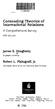 A 362352 Contending Theories of International Relations A Comprehensive Survey Fifth Edition James E. Dougherty St. Joseph's University Robert L. Pfaltzgraff, Jr. The Fletcher School of Law and Diplomacy,
The Study of Conflict in Political Science and International Relations. Stefan Wolff
 The Study of Conflict in Political Science and International Relations Stefan Wolff The Study of Conflict in the Social Sciences Conflict as a social phenomenon of competition between actors with incompatible
Zhang Xiaoming School of International Studies Peking University
 Zhang Xiaoming School of International Studies Peking University IRT was introduced into China from the West, especially from the US. The Chinese IR community started the learning process by importing
Andrea Gilli, PhD Post-doctoral Fellow - Center for Security Studies Metropolitan University Prague
 Andrea Gilli, PhD Post-doctoral Fellow - Center for Security Studies Metropolitan University Prague PH.D. DISSERTATION EXECUTIVE SUMMARY Unipolarity, Technological Change and Arms Manufacturing: Industrial
To What Extent is The Cold War a Result of Two Conflicting Ideologies?
 Rahaf Alwattar Daniela Morales Kiley Smith Madison So To What Extent is The Cold War a Result of Two Conflicting Ideologies? The Cold War was an unceasing state of political and military tensions between
Russian National Security Policy in 2000
 Russian National Security Policy in 2000 Celeste A. January 2000 PONARS Policy Memo 102 Harvard University Although signing a decree granting the new National Security Concept the status of law in January
The Meaning of Russia s Campaign in Syria
 Defense and Intelligence The Meaning of Russia s Campaign in Syria By S.R. Covington Foreword by Kevin Ryan December 2015 Defense and Intelligence The Meaning of Russia s Campaign in Syria By S.R. Covington
Alexander Wendt, Social Theory of International Politics
 Alexander Wendt, Social Theory of International Politics, (Cambridge: Cambridge University Press, 1999), Chs 1 (partial), 3, 4, 6. (pp. 22-44, 92-190, 246-312) Chapter 1, beginning at page 22, A map of
Although the dominant military confrontations of the 20 th century were centered on the
 To what extent were the policies of the United States responsible for the outbreak and development of the Cold War between 1945 and 1949? Although the dominant military confrontations of the 20 th century
International Relations Theory in the Cyber Age 17.445/17.446 Spring 2014
 Spring 2014 Professor Nazli Choucri Department of Political Science MIT-E53-493 617-253-6198 [email protected] Organization & Contents PART I STRUCTURE & PROCESS in INTERNATIONAL RELATIONS Some Fundamentals
Standards Addressed by The Choices Program
 Standards Addressed by The Choices Program National Standards for the Social Studies National Standards for Social Studies are available online at cnets.iste.org/currstands. Strand I: Culture and Cultural
World History Course Summary Department: Social Studies. Semester 1
 World History Course Summary Department: Social Studies All World History courses (Honors or otherwise) utilize the same targets and indicators for student performance. However, students enrolled in Honors
COURSE DESCRIPTION FOR THE BACHELOR DEGREE IN INTERNATIONAL RELATIONS
 COURSE DESCRIPTION FOR THE BACHELOR DEGREE IN INTERNATIONAL RELATIONS Course Code 2507205 Course Name International Relations of the Middle East In this course the student will learn an historical and
Research Project RM 01-01-08. Assumed role of India in the international community in the short and medium
 Assumed role of India in the international community in the short and medium Daniel Novotný Alice Rezková SUMMARY AND CONCLUSION: RECOMMENDATIONS FOR FUTURE STRATEGIC APPROACH OF THE EU TOWARDS INDIA Assessment
International Relations, Principal Theories
 International Relations, Principal Theories Anne-Marie Slaughter TABLE OF CONTENTS A. Introduction... 1 B. Realism... 2 C. Institutionalism... 8 D. Liberalism... 14 E. Constructivism... 19 F. The English
Political Science 1300: Global Politics Spring 2014
 Political Science 1300: Global Politics Spring 2014 Online No classroom component Instructor: Kathleen Powers Email: [email protected] Office Hours: Thurs 10:00am-12:00pm; in person AND Gchat; also available
CHAPTER 1 SOME BASIC CONCEPTS AND APPROACHES IN THE STUDY OF INTERNATIONAL RELATIONS
 CHAPTER 1 SOME BASIC CONCEPTS AND APPROACHES IN THE STUDY OF INTERNATIONAL RELATIONS Robert Robin H. Dorff T he study, analysis and planning of strategy require a basic familiarity with some essential
RPOS 370: International Relations Theory
 RPOS 370: International Relations Theory Professor: Bryan R. Early Class Times: MWF 11:30-12:25 Room: Humanities Building, Room 137 Email: [email protected] Office Hours: Uptown, Humanities Building B16
Yale University Department of Political Science. Syllabus INTERNATIONAL RELATIONS THEORY (Seminar)
 Yale University Department of Political Science Syllabus INTERNATIONAL RELATIONS THEORY (Seminar) Nuno P. Monteiro Class: Tuesdays 3:30 5:20 Political Science 155 / 654 Office hours: Rosenkranz #226, Wednesdays
Grading Breakdown: Class Participation: 10% Literature Critiques: 30% (10% each) Oral Presentation: 10% Research Paper: 50%
 International Relations GOVT 540-002, Spring 2014 George Mason University Department of Public and International Affairs Wednesdays 7:20-10:00 PM in Robinson Hall A206 Professor: Joseph Kochanek (email:
ORIGINAL: ENGLISH 11th May, 1967 DOCUMENT DPC/D(67)23. DEFENCE PLANNING COMMITTEE Decisions of Defence Planning Committee in Ministerial Session
 ORIGINAL: ENGLISH 11th May, 1967 DOCUMENT DEFENCE PLANNING COMMITTEE Decisions of Defence Planning Committee in Ministerial Session Note by the Chairman I attach for your information a list of the decisions
Working Paper 5. The Luxembourg Process Five Years On Bernhard Jansen
 Working Paper 5 The Luxembourg Process Five Years On Bernhard Jansen I am very pleased and honoured to have been given the opportunity to write about the subject The Luxembourg Process Five Years On. Rather
Political Science 857 Fall 2011 Tuesday 2-4 PM 422 North Hall
 THEORIES OF INTERNATIONAL RELATIONS Political Science 857 Fall 2011 Tuesday 2-4 PM 422 North Hall Mark Copelovitch Assistant Professor 306 North Hall [email protected] Office hours: Wednesday 10-12
The School of Policy, Government, and International Affairs (SPGIA) GOVT 322 002 CRN 75997 International Relations Theory. Overview.
 The School of Policy, Government, and International Affairs (SPGIA) GOVT 322 002 CRN 75997 International Relations Theory Fall 2014 Wednesday 7:20 pm 10:00 pm in Planetary Hall room 206 Instructor: Prof.
Theory of Complex Interdependence: A Comparative Analysis of Realist and Neoliberal Thoughts
 International Journal of Business and Social Science Vol. 6, No. 2; February 2015 Theory of Complex Interdependence: A Comparative Analysis of Realist and Neoliberal Thoughts Waheeda Rana PhD Scholar at
Training journalists. The development of journalism education in Sweden, 1944-1970
 Training journalists. The development of journalism education in Sweden, 1944-1970 Elin Gardeström The thesis Training journalists analyses the interaction between various interests in Swedish society
POL 140-A INTERNATIONAL RELATIONS. Fall 2009. Instructor: Dr. Gilbert Gagné Office: N 102 Tel: 822-9600, ext. 2439
 POL 140-A INTERNATIONAL RELATIONS Fall 2009 Tuesday - Thursday 8:30-10:00 Bishop Williams Hall Instructor: Dr. Gilbert Gagné Office: N 102 Tel: 822-9600, ext. 2439 Office Hours: Tuesday 14:30-17:00 E-mail:
The Globalization of World Politics
 The Globalization of World Politics An introduction to international relations Second Edition Edited by John Baylis and Steve Smith OXFORD UNIVERSITY PRESS Detailed contents Introduction i From international
Policy Experimentation in China s Economic Rise (abstract)*
 China Analysis 59 April 2008 www.chinapolitik.de Policy Experimentation in China s Economic Rise (abstract)* *The full version can be found in print and online in Studies in Comparative International Development
DIU - Dubrovnik International University Theories of International Relations - Syllabus. Course Objectives
 DIU - Dubrovnik International University Theories of International Relations - Syllabus Course Objectives To become familiar with the theoretical and historical background of international politics. To
POLS 5203: International Relations Theory Monday 5:00-7:40@WALEED-CP61 Professor Ezzedine Choukri FISHERE [email protected]
 POLS 5203: International Relations Theory Monday 5:00-7:40@WALEED-CP61 Professor Ezzedine Choukri FISHERE [email protected] Office hours: Monday and Thursday @ HUSS 2015 12:00-1:00 (Or by appointment)
First Semester Compulsory Courses
 First Semester Compulsory Courses CODE TITLE UNITS POL 101 Introduction to Pol Sci. 3 POL 102 Nigerian Constitutional Development 3 SOC 111 Introduction to Sociology 4 PSY 100 Introduction to Psychology
Role theory in International Relations
 Role theory in International Relations Talk given at Tsinghua University, Beijing Department of International Relations #1 Outline 1. The theoretical argument 2. Role theory: between IR + Foreign Policy
An Interactive Planning Approach to Shaping U.S.-Russian Relations
 An Interactive Planning Approach to Shaping U.S.-Russian Relations PONARS Eurasia Policy Memo No. 172 September 2011 Dmitry Gorenburg Harvard University U.S. policy toward Russia, as toward the rest of
May 2009 syllabus. Syllabus revised October 2009. For first examinations in May 2011
 This is an edited version of the subject guide, for use with extended essay candidates. Assessment details for the subject are not included: please refer to the assessment criteria in the Extended Essay
INTRODUCTION TO INTERNATIONAL RELATIONS Political Science 2100 Course Syllabus
 POLS 2100-001 Second Summer Session 2014 INTRODUCTION TO INTERNATIONAL RELATIONS Political Science 2100 Course Syllabus Summer Term Second Session 2014 Section 001 Orson Spencer Hall (OSH) 130 day & day,
Professor W B Walker. *Defence Studies (distance-learning course) International Political Thought International Security Studies
 School of International Relations Head of School Degree Programmes Graduate Diploma: M.Litt.: M.Phil.: Professor W B Walker *Defence Studies (distance-learning course) International Political Thought International
National Security and International Relations
 National Security and International Relations School of International Studies Jawaharlal Nehru University Winter Semester 2014 MA Optional Course Course No: IS 557N Happymon Jacob, Ph.D. Room - 236, SIS,
MARTHA FINNEMORE. CURRENT POSITION University Professor of Political Science and International Affairs George Washington University
 MARTHA FINNEMORE Department of Political Science and Elliott School of International Affairs The George Washington University Washington, DC 20052 (202) 994-8617 [email protected] http://home.gwu.edu/~finnemor/
How To Study Political Science At Pcj.Edu
 Political Science Courses-1 American Politics POL 110/American Government Examines the strengths and weaknesses, problems and promise of representative democracy in the United States. Surveys the relationships
The battle to contain fraud is as old as
 22 SPONSORED FEATURE COMBATTING DIGITAL FRAUD Combatting digital fraud Combatting digital fraud has become a strategic business issue for today s CIOs. The battle to contain fraud is as old as business
Compass Interdisciplinary Virtual Conference 19-30 Oct 2009
 Compass Interdisciplinary Virtual Conference 19-30 Oct 2009 10 Things New Scholars should do to get published Duane Wegener Professor of Social Psychology, Purdue University Hello, I hope you re having
Export Credit Insurance: Business as Usual or a New Approach?
 4 Export Credit Insurance: Business as Usual or a New Approach? LORENZ SCHOMERUS The answer to the question posed above in this chapter s title is clear and simple: Business as usual will never be enough
The main object of my research is :
 The main object of my research is : «War» I try to analyse the mutual impacts between «new wars» and the evolution of the international system More especially my research is about what we call»cyber-war«or»cyber-conflicts«is
Why China s Rise Will Not Be Peaceful
 Can China Rise Peacefully John Mearsheimer September 17, 2004 Why China s Rise Will Not Be Peaceful The question at hand is simple and profound: can China rise peacefully? My answer is no. If China continues
YAN XUETONG ON CHINESE REALISM, THE TSINGHUA SCHOOL OF INTERNATIONAL RELATIONS, AND THE IMPOSSIBILITY OF HARMONY
 Theory Talks Presents THEORY TALK #51 YAN XUETONG ON CHINESE REALISM, THE TSINGHUA SCHOOL OF INTERNATIONAL RELATIONS, AND THE IMPOSSIBILITY OF HARMONY Theory Talks is an interactive forum for discussion
The MIT Press is collaborating with JSTOR to digitize, preserve and extend access to International Organization. http://www.jstor.
 Anarchy in International Relations Theory: The Neorealist-Neoliberal Debate Neorealism and its Critics. by Robert O. Keohane; Neorealism and Neoliberalism: The Contemporary Debate. by David A. Baldwin
Why a Floating Exchange Rate Regime Makes Sense for Canada
 Remarks by Gordon Thiessen Governor of the Bank of Canada to the Chambre de commerce du Montréal métropolitain Montreal, Quebec 4 December 2000 Why a Floating Exchange Rate Regime Makes Sense for Canada
THE CULTURE OF INNOVATION AND THE BUILDING OF KNOWLEDGE SOCIETIES. - Issue Paper -
 THE CULTURE OF INNOVATION AND THE BUILDING OF KNOWLEDGE SOCIETIES - Issue Paper - UNESCO, Bureau of Strategic Planning September 2003 1 I. The past and present scope of innovation During the last two decades,
CHAPTER 13: International Law, Norms, and Human Rights
 CHAPTER 13: International Law, Norms, and Human Rights MULTIPLE CHOICE 1. Why did the former Secretary General of the United Nations, Kofi Annan, state that the US invasion of Iraq in 2003 was illegal?
Political Science. 222 2014-2016 Haigazian University
 Political Science Coordinator: Maximilian Felsch, Ph.D. The Faculty of Social and Behavioral Sciences offers the Bachelor of Arts (B.A.) degree in Political Science. On completion of the degree in Political
Foreign Affairs and National Security
 Foreign Affairs and National Security Objectives: TLW understand and explain the following questions as it relates to the Foreign affairs of the American Government What is foreign policy? What is the
Double Master s Degree Program in International Relations between The University of Haifa and The University of Warsaw
 Double Master s Degree Program in International Relations between The University of Haifa and The University of Warsaw Beginning in October 2015, students at the University of Haifa will have an opportunity
Educational Leadership in Europe John West-Burnham.
 Educational Leadership in Europe John West-Burnham. Education systems are one of the most explicit and direct manifestations of national cultures, identities and social and economic priorities. Indeed
SAMPLE COURSE OUTLINE
 SAMPLE COURSE OUTLINE MODERN HISTORY ATAR YEAR 12 Unit 4 Elective 1: The changing European world since 1945 Copyright School Curriculum and Standards Authority, 2015 This document apart from any third
Global Dimensions of Nonprofit Law. By Lester M. Salamon and Susan L.Q. Flaherty
 Global Dimensions of Nonprofit Law By Lester M. Salamon and Susan L.Q. Flaherty As grantmakers move beyond their own borders, they face a complicated legal patchwork. In this new era of globalization,
Une nouvelle gouvernance mondiale pour le développement durable. The Exhaustion of Sovereignty: International Shaping of Domestic Authority Structures
 Une nouvelle gouvernance mondiale pour le développement durable Taking the Initiative on Global Governance and Sustainable Development Paris, 13-14 avril 2003. The Exhaustion of Sovereignty: International
AN INSIGHT TO CYBER WORLD WITH PROF. MICHAEL E.SMITH
 AN INSIGHT TO CYBER WORLD WITH PROF. MICHAEL E.SMITH by Veronika Macková and Viktória Sučáková As we kick of spring of 2014, GNC Team is starting quarterly insight to cyber world from the point of view
Introduction. Bargaining - whether over arms control, the terms of a peace settlement, exchange rate
 Bargaining in International Relations Introduction Bargaining - whether over arms control, the terms of a peace settlement, exchange rate coordination, alliances, or trade agreements - is a central feature
Is China Catching Up with the US?
 12 Is China Catching Up with the US? Kenneth Lieberthal Opinion Kenneth Lieberthal Is China Catching Up with the US? While China has emerged as a key player in global affairs, significant challenges to
Contemporary Security Studies
 SUB Hamburg B/120487 Contemporary Security Studies THIRD EDITION Edited by Alan Collins OXFORD UNIVERSITY PRESS Notes on Contributors List of Figures List of Tables List of Boxes Guided Tour of Learning
MMH and MAH Application Package
 Since becoming the Program Director for Norwich s Graduate History programs, I have reviewed hundreds of application files. During that time, I have been very impressed with the quality and diverse backgrounds
CHAPTER 11: The Problem of Global Inequality
 CHAPTER 11: The Problem of Global Inequality MULTIPLE CHOICE 1. The claim that poverty is unethical is essentially a. Normative c. political b. theoretical d. scientific 2. Self-interest is an important
APPROVED VERSION. Centro de Estudios Estratégicos de la Defensa Consejo de Defensa Suramericano Unión de Naciones Suramericanas.
 CEED S PRELIMINARY REPORT TO THE SOUTH AMERICAN DEFENSE COUNCIL ON THE TERMS OF REFERENCE FOR THE CONCEPTS OF SECURITY AND DEFENSE IN THE SOUTH AMERICAN REGION The Centre for Strategic Defense Studies
Designing Law Enforcement: Adaptive Strategies for the Complex Environment
 Designing Law Enforcement: Adaptive Strategies for the Complex Environment John A. Bertetto, Police Officer, Chicago Police Department Crime Control Strategies As law enforcement professionals, we often
Schusterman Visiting Israeli Assistant Professor of Government, Government Department, Claremont McKenna College
 ILAI Z. SALTZMAN Government Department International Relations Program Claremont McKenna College Kravis Center 245 (909) 607 3798 [email protected] CURRENT POSITION Schusterman Visiting
ECONOMICS OF PEACE AND SECURITY Global and Regional Security Alliances - Carlos Seiglie and Sylvie Matelly UNESCO EOLSS
 GLOBAL AND REGIONAL SECURITY ALLIANCES Carlos Seiglie Rutgers University, NJ, USA Sylvie Matelly Université Pierre Mendes France, Grenoble, France Keywords: collective action, public good, regional security
Strategy is about organizational change.1 An action is strategic when it allows a
 0 0 0 I NTRODUCTION Different views of strategy Strategy is about organizational change. An action is strategic when it allows a firm to become better than its competitors, and when this competitive advantage
Inhibition of an Arms Race in Outer Space
 Inhibition of an Arms Race in Outer Space Introduction Jinseong Joo The exploration and use of outer space shall be for peaceful purposes and should be carried out for the benefit and in the interest of
Are we there yet? Charting the world s progress towards global accounting standards Hans Hoogervorst, Hong Kong, 5 June 2013
 Are we there yet? Charting the world s progress towards global accounting standards Hans Hoogervorst, Hong Kong, 5 June 2013 The term globalisation was introduced into the business lexicon by Harvard Professor
history (his) History
 history (his) Mark R. Correll, Chair Mark T. Edwards David Rawson Charles E. White The fundamental purpose of the department of history, politics, and geography is to aid the student in gaining an understanding
Since the 1990s, accountability in higher education has
 The Balanced Scorecard Beyond Reports and Rankings More commonly used in the commercial sector, this approach to strategic assessment can be adapted to higher education. by Alice C. Stewart and Julie Carpenter-Hubin
Class on Hedley Bull. 1. Some general points about Bull s view
 Class on Hedley Bull 1. Some general points about Bull s view A central claim in Bull s argument is that anarchy understood as interaction between and among agents, whether individuals or states, in the
THE DEPARTMENT OF SOCIAL AND BEHAVIORAL SCIENCES POLITICAL SCIENCE PROGRAM HANDBOOK
 THE DEPARTMENT OF SOCIAL AND BEHAVIORAL SCIENCES POLITICAL SCIENCE PROGRAM HANDBOOK MAY 2015 Political Science Objectives 1. To study the structure and functions of government. 2. To understand political
CSCAP MEMORANDUM NO. 26 Towards an Effective Regional Security Architecture for the Asia Pacific
 CSCAP MEMORANDUM NO. 26 Towards an Effective Regional Security Architecture for the Asia Pacific A Memorandum from the Council for Security Cooperation in the Asia Pacific (CSCAP) June 2014 Council for
UNDERSTANDING NATO THE ORIGINS OF THE ALLIANCE
 UNDERSTANDING NATO THE ORIGINS OF THE ALLIANCE In the aftermath of the Second World War, East and West Europe found themselves separated by the ideological and political divisions of the Cold War. Eastern
INTERNATIONAL RELATIONS
 INTERNATIONAL RELATIONS ACADEMIC YEAR: DEGREE COURSE YEAR: 1º SEMESTER 2º SEMESTER CATEGORY: CORE COMPULSORY OPTIONAL NO. OF CREDITS (ECTS): 6 LANGUAGE: English TUTORIALS: FORMAT: PREREQUISITES: 1- SUBJECT
International Relations / International Studies / European Studies
 International Relations / International Studies / European Studies Degree Courses BA International Relations and Politics 166 BA International Relations and Modern History 167 BA International Studies
CYBER SECURITY AND CYBER DEFENCE IN THE EUROPEAN UNION OPPORTUNITIES, SYNERGIES AND CHALLENGES
 CYBER SECURITY AND CYBER DEFENCE IN THE EUROPEAN UNION OPPORTUNITIES, SYNERGIES AND CHALLENGES By Wolfgang Röhrig, Programme Manager Cyber Defence at EDA and Wg Cdr Rob Smeaton, Cyber Defence Staff Officer
How To Change A Business Model
 SOA governance and organizational change strategy White paper November 2007 Enabling SOA through organizational change Sandy Poi, Global SOA Offerings Governance lead, associate partner, Financial Services
Final. Mark Scheme. General Certificate of Education June 2013. A2 History 2041 HIS3N Unit 3N. Aspects of International Relations, 1945 2004
 Version 1.0: 0613 General Certificate of Education June 2013 A2 History 2041 HIS3N Unit 3N Aspects of International Relations, 1945 2004 Final Mark Scheme Mark schemes are prepared by the Principal Examiner
Business. Democratic Socialism. Sponsoring Faculty Member: Professor Cindi Bearden. Levi Evans
 Business Levi Evans Democratic Socialism Sponsoring Faculty Member: Professor Cindi Bearden Levi Evans Democratic presidential primary candidate, Bernie Sanders, wants America to adopt the political and
GREECE S FOREIGN POLICY IN THE 21 ST CENTURY By George A. Papandreou 1
 GREECE S FOREIGN POLICY IN THE 21 ST CENTURY By George A. Papandreou 1 Abstract Greece is committed to embracing all those nations who strive for democracy within their frontiers, and peaceful cooperation
The Need to Share: The U.S. Intelligence Community and Law Enforcement
 The Need to Share: The U.S. Intelligence Community and Law Enforcement A White Paper prepared by the AFCEA Intelligence Committee April 2007 Serving Intelligence Professionals and their Community The Need
Methodological Approach: Typologies of Think Tanks
 Methodological Approach: Typologies of Think Tanks Unlike Stone, Donald Abelson applies a typology of think tanks by focusing on four distinctive periods of think tanks development to recognise the major
Structural Realism JOHN J. MEARSHEIMER. Chapter contents. Reader s guide. 05-IRT-Chap04.qxd 31/07/06 03:03 PM Page 71
 05-IRT-Chap04.qxd 31/07/06 03:03 PM Page 71 4 Structural Realism Chapter contents Introduction Why do states want power? How much power is enough? What causes great power war? Conclusion Reader s guide
Life Cycle Asset Allocation A Suitable Approach for Defined Contribution Pension Plans
 Life Cycle Asset Allocation A Suitable Approach for Defined Contribution Pension Plans Challenges for defined contribution plans While Eastern Europe is a prominent example of the importance of defined
COURSE SYLLABUS. Contact information: [email protected], 3rd period conference
 AP European History INSTRUCTOR: Michael Withers 2015-2016 SCHOOL YEAR COURSE SYLLABUS COURSE INFORMATION This is an accelerated elective course covering the history of Europe from the Renaissance to the
Management Practice & Productivity: Why they matter
 Management Practice & Productivity: Why they matter November 2007 Nick Bloom Stanford University Stephen Dorgan McKinsey & Company John Dowdy McKinsey & Company John Van Reenen Centre for Economic Performance,