
2/3 81% 67% Millennials and money. Key insights. Millennials are optimistic despite a challenging start to adulthood
|
|
|
- Briana Boyd
- 10 years ago
- Views:
Transcription
1 2/3 Proportion of Millennials who believe they will achieve a greater standard of living than their parents 81% Percentage of Millennials who believe they need to pay off their debts before they can begin to save for retirement Millennials and money Highlights from the 2013 Wells Fargo Millennial Survey Key insights The purpose of this Wells Fargo survey was to gauge the financial attitudes, behaviors, and perspectives of Millennials aged For financial advisors, the findings offer insights to best strategies for reaching this next generation of asset accumulators. Results uncovered six key attributes of Millennials and their relationship with money. In general, they are: Confident in their prospects for the future and feel they are in control. Most concerned about their student loan debt. Still aspiring for higher education, but some question the cost/benefit. Confident in their retirement outlook but use employer retirement plans like piggy banks. More risk averse than Boomers when it comes to investing. Not averse to working with a financial advisor but are skeptical about working with financial institutions. 67% Percentage of Millennials who prefer to work one-on-one with a financial advisor CONTENTS Key findings General outlook... 1 Managing debt Saving and retirement. 3 Seeking financial guidance... 6 About the survey Methodology and background... 8 Millennials are optimistic despite a challenging start to adulthood Millennial Americans entered early adulthood in the wake of the Great Recession and know all too well the effects of a struggling economy. More than half, 54%, of Millennials say debt is their biggest financial concern currently, surpassing day-to-day expenses. And 42% of Millennials say their debt is overwhelming, twice the rate of Boomers who were also surveyed for comparison. Despite concerns about debt, 72% of Millennials have confidence in their future and believe they can achieve their goals: 77% say that if they lost their job today, they have confidence they could find a comparable one. 75% agree the best way to get ahead financially is to work for a company that offers a career path, versus 25% of Millennials who feel the best way to get ahead financially is to break out on my own and start a business. Two-thirds of Millennials believe they will achieve a greater standard of living than their parents. The contents of this report are for information purposes only. They should not be construed as professional, legal, or tax advice or opinions. These can be properly rendered only in the context of specific facts. In all cases, you should consult your professional, legal, or tax advisors if you have questions about your individual situation. Neither Wells Fargo, nor any of its representatives, may give legal or tax advice.

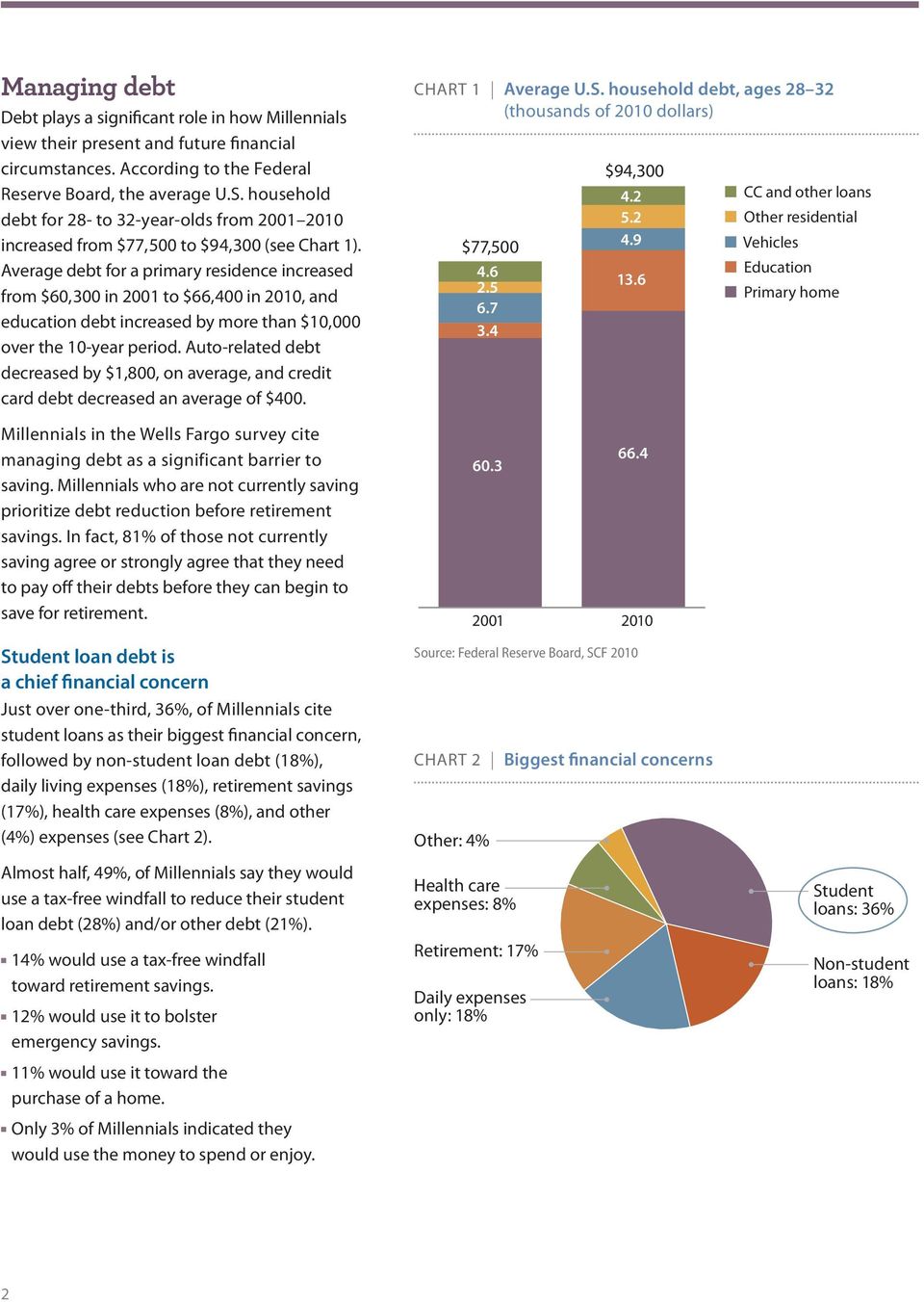
2 Managing debt Debt plays a significant role in how Millennials view their present and future financial circumstances. According to the Federal Reserve Board, the average U.S. household debt for 28- to 32-year-olds from increased from $77,500 to $94,300 (see Chart 1). Average debt for a primary residence increased from $60,300 in 2001 to $66,400 in 2010, and education debt increased by more than $10,000 over the 10-year period. Auto-related debt decreased by $1,800, on average, and credit card debt decreased an average of $400. CHART 1 Average U.S. household debt, ages (thousands of 2010 dollars) $77, $94, CC and other loans Other residential Vehicles Education Primary home Millennials in the Wells Fargo survey cite managing debt as a significant barrier to saving. Millennials who are not currently saving prioritize debt reduction before retirement savings. In fact, 81% of those not currently saving agree or strongly agree that they need to pay off their debts before they can begin to save for retirement Student loan debt is a chief financial concern Just over one-third, 36%, of Millennials cite student loans as their biggest financial concern, followed by non-student loan debt (18%), daily living expenses (18%), retirement savings (17%), health care expenses (8%), and other (4%) expenses (see Chart 2). Almost half, 49%, of Millennials say they would use a tax-free windfall to reduce their student loan debt (28%) and/or other debt (21%). 14% would use a tax-free windfall toward retirement savings. 12% would use it to bolster emergency savings. 11% would use it toward the purchase of a home. Only 3% of Millennials indicated they would use the money to spend or enjoy. Source: Federal Reserve Board, SCF 2010 CHART 2 Biggest financial concerns Other: 4% Health care expenses: 8% Retirement: 17% Daily expenses only: 18% Student loans: 36% Non-student loans: 18% 2
3 Student loan debt vs. the value of education When asked about the cost of a college education and the opportunities a degree provides, two in five Millennials, 43%, rate the value of their education as a great value and 45% say somewhat of a value. About one-third of Millennials, 31%, feel they would have been better off working instead of going to college and paying tuition. More than half of Millennials, 64%, say they financed school through student loans, as compared with only 29% of Boomers who financed through loans. According to the Consumer Financial Protection Bureau, total student loan debt outstanding was more than $1 trillion at the end of More than half, 59%, of Millennials say they paid for school through grants and scholarships, while 46% say they paid education costs by working while attending school. Millennials say financial literacy should be taught in school A majority of Millennials think personal finance should be taught by high school (79%), college (73%), and their parents (70%). The top four personal finance topics that Millennials wished they learned more about in school are: basic investing (70%), how to save for retirement (60%), how loans work (59%), and impacts on credit scores (58%) (see Chart 3). CHART 3 Topics Millennials wished they learned in school Basic investing 70% How to save for retirement How loans work Understanding impacts on credit scores How to acquire credit Insurance topics How to pay for college Household budgeting 52% 51% 51% 50% CHART 4 Average share of financial responsibility for retirement Employer 60% 59% 58% Self 57% 25% Saving and retirement On average, Millennials accept most of the responsibility for financing their retirement Millennials place 57% of the responsibility on themselves when asked, Who should be financially responsible for your retirement? They believe that employers, on average, are responsible for 25% of their retirement and that the government s share is 18% (see Chart 4). Government 18% 3

4 Millennials don t expect Social Security to be a significant income source when they retire Only 5% of Millennials expect Social Security to provide more than half of their income in retirement, while 37% expect that Social Security will not be available as a source of income for them in retirement (see Chart 5). As a result, Millennials anticipate the need to be more self-reliant when it comes to their retirement income than Boomers. When it comes to saving behaviors, reality and perception are not fully aligned Despite their stated self-reliance, only 49% of Millennials say they are currently saving for retirement (see Chart 6). More than half, 54%, of those who say they are saving are men, compared with 43% of Millennial women. CHART 5 Expected (or actual) share of retirement income coming from Social Security More than half One-fourth to one-half Less than one-fourth None/Social Security won't exist I have no idea 5% 8% Millennials 16% 14% 17% 20% 21% 29% Nonretired Boomers 34% 37% While less than half are currently saving for retirement, 61% label themselves as savers (see Chart 7) and 72% of all Millennials (savers and nonsavers) say they are in control and are confident they can reach their financial goals, compared with 56% of Boomers. The remaining 28% of Millennials express a less confident view, saying that no matter how hard they work, other factors the economy and the country s leadership threaten to undermine their future, compared with 44% of Boomers who share the same fears. CHART 6 Less than half of Millennials are saving for retirement No: 51% Yes: 49% Of the early savers, when asked what was their biggest trigger to start saving for retirement, one in three Millennials, 34%, say they realized that starting early can result in a bigger nest egg down the road, and more than onefourth of Millennials (29%) indicated that the presence of a workplace retirement plan was the motivation. CHART 7 61% of Millennials label themselves savers For the half of Millennials (52%) who haven t started saving, the median age they predict they will start saving is 30. They strongly agree that reasons for not saving are that they don t have Spender: 39% Saver: 61% 4

5 enough money to save right now and will start saving when they have more money (52%), they need to pay off their debts first (48%), and they have more immediate things to save for (39%). 401(k) uses and abuses Priorities concerning debt management and the need for greater financial education may both play a role in how Millennials view their 401(k) or similar employer retirement plans. With Millennials believing they are responsible for generating 57% of their income in retirement themselves, attitudes and behaviors among those currently saving for retirement may threaten to undermine their efforts. For the subset of Millennials with various retirement savings vehicles: 72% say they are in employer-sponsored retirement plans, 40% say they are in an IRA, and 33% say they are in a bank savings account. Of those Millennials who have accumulated retirement savings and are currently saving, almost half (47%) are saving between 1% and 5% of their income for retirement, 31% are saving 6% to 10%, 14% are saving more than 10%, and 8% are no longer saving. Millennials are willing to use their 401(k) as a piggy bank Unlike Boomers, many Millennials use their 401(k) for financial hardships (63%); job losses (45%); paying down debt (23%); paying for a child s tuition (20%); and big-ticket items like a home (19%), a wedding, or a new car (12%). Only 19% of Millennials say it is never appropriate to borrow from their 401(k) accounts, versus 34% of Boomers (see Chart 8). CHART 8 Appropriate scenarios for early cash-out of workplace retirement plan Financial hardship Job loss Pay off debt (loans, credit cards) Pay for child's tuition Down payment on a house Pay for wedding or new car None/ never appropriate 1% 5% 8% 23% 20% 19% 10% 12% Millennials 19% 31% 34% Boomers CHART 9 Terminated employees taking cash distribution by age 53% 44% 41% 45% 52% Average: 42% 32% 32% 31% 63% Cashing out a 401(k) when changing jobs is particularly common among younger investors According to a 2011 Hewitt study, Millennials also tend to view job changes as an opportunity to cash out a 401(k). More than half of Millennials say they have cashed out a 401(k) when changing jobs, compared with just over 30% of those aged 50 and older (see Chart 9) Source: Hewitt,

6 Seeking financial guidance CHART 10 Sources for advice or guidance when investing Millennials first ask parents for investment advice but will consider many sources More than half, 57%, of Millennials say their parents had the most influence on them and the way they view money. According to the Wells Fargo study, 79% say they learned a great deal or somewhat from their parents about personal finance. In fact, Millennials ranked their parents at the top for seeking out investment advice (see Chart 10). Parents or other family Friends Professional investment advisor/broker Investment firm (mutual, brokerage) 17% 27% 41% 38% 38% 38% 51% 60% When it comes to guidance from financial institutions, 63% of all Millennials say they have no idea which firms know how to best provide financial services to their age group (see Chart 11). Millennials expressed skepticism about working with financial institutions, with 35% saying they expect to be disappointed when dealing with financial institutions, compared with Boomers at 24%. Over half, 57%, of Millennials believe financial institutions do not act in the customer s best interests, compared with 54% of Boomers. Among the reasons for their skepticism, Millennials share the following perceptions: Online sites Bank Millennials 14% 20% 27% Boomers 37% Millennials are more likely to consider banks. CHART 11 Types of firms that best know how to provide financial services to Millennials No idea/all the same 63% 57% feel that financial institutions are more focused on making money for themselves and not helping customers. 28% believe the recent recession was caused by irresponsible practices by major financial institutions. 8% fear potential security breaches affecting their accounts. Nonetheless, Millennials have specific preferences regarding financial advisor relationships and the manner in which financial services are delivered. While 11% believe banks are best positioned to provide them with the financial services they need, fewer believe that registered investment advisory (RIA) and brokerage firms, mutual fund companies, and online brokerage services know how to meet those needs. Banks RIA firms Full service brokerage Mutual fund companies Online brokerage 11% 10% 7% 5% 4% 6

7 Millennials lack confidence in the stock market and are more risk averse than Boomers Despite being further from retirement, Millennials are more risk averse than Boomers. More than half of Millennials, 52%, say they are not very confident or not at all confident in the stock market as a place to invest for retirement. This is particularly true for Millennial women 67% are not very confident or not at all confident in the market versus 38% of Millennial men. For those saving for retirement, one-third of Millennials are not sure how much of their savings are invested in stocks or mutual funds. Nearly one in five (18%) of Millennials say they are invested 100% in stocks/mutual funds, 14% say 75% stocks/mutual funds, 10% say 50% stocks/mutual funds, 15% say 25% stocks/ mutual funds, and 11% say they are all in cash/ bonds (see Chart 12). Millennials favor experienced advisors Only 8% of Millennials say they currently work with a financial advisor. Within that group, 76% report using a seasoned, experienced advisor, while 12% describe their advisor as someone with less experience but who is up on trends. An additional 12% are working with someone closer to their own age. The remaining 92% of Millennials were asked to describe the ideal advisor for them. More than half, 57%, say a seasoned, experienced advisor would be preferable, while 22% would be comfortable with an advisor with less experience who is up on trends. An additional 21% say they would prefer to work with someone closer to their own age. Millennials prefer face-to-face financial relationships When asked how they prefer to interact with financial institutions or advisors in the establishment of a new investment account or financial plan, a large majority of Millennials and Boomers were on the same page, both CHART 12 Percentage of retirement savings in stocks/mutual funds* 32% 18% 14% 10% 15% 11% Millennials Not sure 100% mutual funds 75% in stocks/funds 42% with at least half of assets in stocks/funds Significantly higher difference *Percentage excludes not sure responses 19% 20% 24% 16% 13% 8% Baby Boomers 50% in stocks/funds 25% in stocks/funds No stocks/mutual funds opting for face-to-face engagement. More than two-thirds, 67% of Millennials and 70% of Boomers, prefer to work one-on-one with a financial representative to set up a new investment account, and 74% of Millennials and 79% of Boomers prefer the same method for establishing a financial plan. Only 21% of Millennials expressed a preference for online engagement in the new account setup process (versus 15% of Boomers), and 15% preferred online engagement in establishing a financial plan (versus 11% of Boomers). Less than 10% of both groups say they prefer phone or when establishing accounts. No more than 3% in either generation chose snail mail for establishing a new investment account or a financial plan. 60% with at least half of assets in stocks/funds 7

8 About the survey Methodology On behalf of Wells Fargo, Market Probe, a full-service global marketing research and consulting firm, conducted a survey of just over 1,400 Millennials (aged 22 32) and 1,009 Baby Boomers (aged 48 66) to gauge savings and investing attitudes and behaviors among today s young Americans. Baby Boomers were included in the survey for comparison purposes. All respondents reported being the sole or joint financial decision-maker for their household. The online surveys were completed via survey panels provided by Ypulse Inc. (for the Millennial sample) and Research Now (for the Baby Boomer sample) between February 6 and February 15, Background This survey was a collaborative effort across many Wells Fargo divisions, including Retirement; Wells Fargo Advantage Funds; and Wealth, Brokerage & Retirement Marketing, Communications, and Market Research. We are focused on producing timely and relevant research and insights on topics of critical importance to advisors and their clients. Convert these findings into asset-gathering opportunities Call your regional director at Strength. Expertise. Partnership. Wells Fargo Advantage Funds skillfully guides institutions, financial advisors, and individuals through the investment terrain to help them reach their financial objectives. Everything we do on behalf of our investors is built on the standards of integrity and service established by our parent company, Wells Fargo & Company; the expertise of our independent investment teams and rigorous ongoing investment review; and the collaborative level of superior service that is our trademark. Carefully consider a fund s investment objectives, risks, charges, and expenses before investing. For a current prospectus and, if available, a summary prospectus, containing this and other information, call your investment professional or visit wellsfargoadvantagefunds.com. Read the prospectus carefully before investing. Wells Fargo Funds Management, LLC, a wholly owned subsidiary of Wells Fargo & Company, provides investment advisory and administrative services for Wells Fargo Advantage Funds. Other affiliates of Wells Fargo & Company provide subadvisory and other services for the funds. The funds are distributed by Wells Fargo Funds Distributor, LLC, Member FINRA/SIPC, an affiliate of Wells Fargo & Company. FOR INSTITUTIONAL INVESTOR USE ONLY NOT FOR USE WITH THE RETAIL PUBLIC Wells Fargo Funds Management, LLC. All rights reserved. FAEE
2014 Wells Fargo Millennial Study
 2014 Wells Fargo Millennial Study Overview Table of contents Overview 1 Key findings 2 Background and methodology 7 The contents of this report are for information purposes only. They should not be construed
The Ariel/Schwab Black Investor Survey:
 The Ariel/Schwab Black Investor Survey: Saving and Investing Among Higher Income and Americans Ariel Investments, LLC and The Charles Schwab Corporation are non-affiliated entities, but co-sponsor the
Saving and Investing Among Higher Income African-American and White Americans
 The Ariel Investments 2010 Black Investor Survey: Saving and Investing Among Higher Income African-American and Americans July 21, 2010 1 For further information, contact Merrillyn J. Kosier at Ariel Investments
AFRICAN AMERICAN FINANCIAL EXPERIENCE
 The AFRICAN AMERICAN FINANCIAL EXPERIENCE 2015-16 Prudential Research Foreword It has been four years since Prudential released the findings of our first African American Financial Experience survey, and
The Voya Retire Ready Index TM
 The Voya Retire Ready Index TM Measuring the retirement readiness of Americans Table of contents Introduction...2 Methodology and framework... 3 Index factors... 4 Index results...6 Key findings... 7 Role
2015 Wells Fargo Retirement Study
 2015 Wells Fargo Retirement Study Table of contents Overview 1 Key findings 2 Background and methodology 8 Harris Poll conducted the survey online of 1,993 affluent investors, ages 30 75 who have $250,000
2015 Wells Fargo Affluent Investor Survey
 2015 Wells Fargo Affluent Investor Survey Table of contents Overview 1 Key findings 2 Background and methodology 8 Harris Poll conducted the survey online of 1,993 affluent investors, ages 30 75 who have
9 TH ANNUAL COLLEGE SAVINGS INDICATOR EXECUTIVE SUMMARY OF KEY FINDINGS
 9 TH ANNUAL COLLEGE SAVINGS INDICATOR EXECUTIVE SUMMARY OF KEY FINDINGS INTRODUCTION This summary presents key findings from Fidelity Investments 9th Annual College Savings Indicator Study. The study was
Ready. Set. Retire. Exploring the path to and through retirement. A Retirement Experience study from the Voya Retirement Research Institute.
 Ready. Set. Retire. Exploring the path to and through retirement. A Retirement Experience study from the Voya Retirement Research Institute. Ready. Set. Retire. This study is a fresh look at the experience
Financial health in the United States
 Financial health in the United States Table of contents Overview 1 Key findings 2 Background and methodology 7 The contents of this report are for information purposes only. They should not be construed
Financial Experience & Behaviors Among Women
 Financial Experience & Behaviors Among Women 2010 2011 Prudential Research Study TENTH ANNIVERSARY E D I T I O N A report prepared by Prudential Research 0182849-00001-00 Acknowledgment A Decade of Progress
ENGAGED INVESTORS READY FOR LONGER LIVES
 ENGAGED INVESTORS READY FOR LONGER LIVES Three years into BlackRock s Global Investor Pulse Survey, we ve begun to see some consistent themes. One of the most striking is the high level of cash Americans
The Ariel Mutual Funds/Charles Schwab & Co., Inc. Black Investor Survey. Saving and Investing Among High Income African-American and White Americans
 The Ariel Mutual Funds/Charles Schwab & Co., Inc. Black Investor Survey: Saving and Investing Among High Income African-American and Americans April, 2000 0 Prepared for Ariel Mutual Funds and Charles
Online Survey of Employees Without Workplace Retirement Plans
 Online Survey of Employees Without Workplace Retirement Plans Report of Findings Conducted for: State of California October 2015 Prepared by Greenwald & Associates 2015 1 Table of Contents Methodology
Affluent Insights Survey
 Merrill Lynch Global Wealth Management E X A M I N I N I N G T H E V A L U E S, F I N A N C I A L P R I O R I T I E S A N D C O N C E R N S O F A F F L U E N T A M E R I C A N S ABOUT THE AFFLUENT INSIGHTS
The LearnVest Personal Finance Review
 The LearnVest Personal Finance Review Financial Goals of 2015 The LearnVest Personal Finance Review examines and explores how people nationwide approach their money. 1 LearnVest is a program for your money.
Advisor Value A Voya Retirement Research Institute Study quantifies the benefits of working with a financial advisor
 Advisor Value A Voya Retirement Research Institute Study quantifies the benefits of working with a financial advisor In the Voya Retirement Revealed1 study of 4,050 working Americans, just 28% of study
Investment Company Institute Research In Brief
 Fundamentals Investment Company Institute Research In Brief Vol. 9 / No. July 000 0 H Street, NW Suite 00 Washington, DC 0005 0/6-5800 www.ici.org Mutual Fund Shareholders Use of the Internet M utual fund
The Allianz American Legacies Pulse Survey
 The Allianz American Legacies Pulse Survey Exploring the impact of the financial crisis on legacy strategies Allianz Life Insurance Company of North America Allianz Life Insurance Company of New York ENT-1371-N
Money At Work 1: Foundations of investing
 It s not about how much money you earn. It s about how much you save and invest. November 12, 2015 A TIAA-CREF Financial Essentials Workshop Bill Thorne TIAA-CREF Money At Work 1: Foundations of investing
The 2009 Consumer Financial Literacy Survey Final Report. The National Foundation for Credit Counseling
 The 2009 Consumer Financial Literacy Survey Final Report Prepared For: The National Foundation for Credit Counseling Prepared By: Harris Interactive Inc. Public Relations Research Summary At this time
2014 MILLENNIALS RESEARCH STUDY
 2014 MILLENNIALS RESEARCH STUDY In response to interest about the financial needs and challenges of younger employees, Voya Financial conducted an online survey among roughly 2000 young adults aged 20-34
Investor Guide Wells Fargo Advantage Absolute Return Fund. Explore a nontraditional approach to asset allocation
 Investor Guide Wells Fargo Advantage Absolute Return Fund Explore a nontraditional approach to asset allocation Is it time to consider a nontraditional approach to investing? The fund s strategy has allowed
WOMEN S PERSPECTIVES ON SAVING, INVESTING, AND RETIREMENT PLANNING
 WOMEN S PERSPECTIVES ON SAVING, INVESTING, AND RETIREMENT PLANNING 1 WOMEN S PERSPECTIVES ON SAVING, INVESTING, AND RETIREMENT PLANNING November 2015 Insured Retirement Institute 2 WOMEN S PERSPECTIVES
Individual Retirement Plans Investor guide to traditional and Roth IRAs. Individual Retirement Plans: Investor Guide
 Individual Retirement Plans Investor guide to traditional and Roth IRAs a Individual Retirement Plans: Investor Guide Individual Retirement Plans An individual retirement plan may be a beneficial addition
WHO IS HD VEST? SUPPORTING ADVISORS WHO SUPPORT YOU
 WHO IS HD VEST? SUPPORTING ADVISORS WHO SUPPORT YOU HD VEST A QUIET BRAND WITH A BIG PRESENCE For the last 30 years of our firm s history, our sole purpose has been to support independent Advisors providing
16 th Annual Transamerica Retirement Survey Influences of Educational Attainment on Retirement Readiness
 th Annual Transamerica Retirement Survey Influences of Educational Attainment on Retirement Readiness August 0 TCRS 0--0 Transamerica Institute, 0 Welcome to the th Annual Transamerica Retirement Survey
Think you know the Next Gen investor?
 UBS Investor Watch Analyzing investor sentiment and behavior 1Q 2014 Think you know the Next Gen investor? Think again. a b See what s really on their minds 2 UBS Investor Watch Lazy. Entitled. Narcissistic.
T. Rowe Price 7TH ANNUAL PARENTS, KIDS & MONEY SURVEY
 T. Rowe Price 7TH ANNUAL PARENTS, KIDS & MONEY SURVEY Detailed Results / March 2015 Contents Family Financial Profile 3 Financial Knowledge 12 Parenting 17 Discussing Financial Matters 30 Habits & Priorities
Boomer Expectations for Retirement 2015. Fifth Annual Update on the Retirement Preparedness of the Boomer Generation
 Boomer Expectations for Retirement 2015 Fifth Annual Update on the Retirement Preparedness of the Boomer Generation April 2015 About the Insured Retirement Institute: The Insured Retirement Institute (IRI)
INVEST IN YOURSELF FINANCIAL PLANNING FOR WOMEN
 INVEST IN YOURSELF FINANCIAL PLANNING FOR WOMEN When They Engage a Financial Advisor, Women Want I To forge relationships based on trust, I To be sure that discussions of their needs and goals will be
May 2015. Missing out: How much employer 401(k) matching contributions do employees leave on the table?
 May 2015 Missing out: How much employer 401(k) matching contributions do employees leave on the table? Table of contents Introduction Executive summary 1 Role of employer 401(k) matching contributions
2012 HOUSEHOLD FINANCIAL PLANNING SURVEY
 2012 HOUSEHOLD FINANCIAL PLANNING SURVEY A Summary of Key Findings July 23, 2012 Prepared for: Certified Financial Planner Board of Standards, Inc. and the Consumer Federation of America Prepared by: Princeton
INVESTING IN YOURSELF
 Investment Planning INVESTING IN YOURSELF Women are different from men. So are your financial planning needs. 2 INVESTING IN YOURSELF WOMEN & MONEY There are many reasons why you might require a different
You re the Finance Person You are SUPPOSED to Know!
 You re the Finance Person You are SUPPOSED to Know! JOHN TUOHY, CPA DEPUTY TREASURER, ARLINGTON COUNTY ANNE GIBSON POARCH - FINANCIAL ADVISOR, WELLS FARGO ADVISORS, LLC Disclaimers Anne Poarch Wells Fargo
Protecting Your Loved Ones Every Step of the Way
 Protecting Your Loved Ones Every Step of the Way Gerber Life Insurance Company Gerber Life Insurance Company, White Plains, NY 10605 5/10/2011 Gerber Life Insurance Company is a financially separate affiliate
How To Be Financially Successful
 Employee Financial Wellness Survey 2015 results April 2015 Retirement Employer benefits Financial stress Investing Cash and debt management Risk management About this survey PwC s Employee Financial Wellness
October 2015. The human touch: The role of financial advisors in a changing advice landscape
 October 2015 The human touch: The role of financial advisors in a changing advice landscape Table of contents Executive summary 1 Introduction 3 Survey methodology 4 Key findings 5 Interest in working
Participant Preferences in Target Date Funds: Fresh Insights
 Participant Preferences in Target Date Funds: Fresh Insights Findings, Insights and Opportunities White Paper January 216 Research by Voya Investment Management Not FDIC Insured May Lose Value No Bank
America s retirement score: In fair shape but fixable
 RETIREMENT SAVINGS ASSESSMENT EXECUTIVE SUMMARY America s retirement score: In fair shape but fixable Key Findings What s the state of retirement preparedness in America? 4,650 SURVEY RESPONSES For more
An IRA can put you in control of your retirement, whether you
 IRAs: Powering Your Retirement One of the most effective ways to build and manage funds to help you meet your financial goals is through an Individual Retirement Account (IRA). An IRA can put you in control
Bridging the Financial Literacy Gap: Empowering teachers to support the next generation
 Bridging the Financial Literacy Gap: Empowering teachers to support the next generation About PwC PwC US helps organizations and individuals create the value they re looking for. We re a member of the
CONTENTS ABOUT AIA STUDY BACKGROUND EXECUTIVE SUMMARY. KEY FINDINGS Quality of life Financial security Retirement Family and education
 Report Philippines 2014 CONTENTS ABOUT AIA STUDY BACKGROUND EXECUTIVE SUMMARY KEY FINDINGS Quality of life Financial security Retirement Family and education 4 6 8 10 12 16 18 20 REPORT PHILIPPINES 3
2015 Registered Investment Advisor Study. by Scottrade Advisor Services
 2015 Registered Investment Advisor Study by Scottrade Advisor Services Scottrade Advisor Services commissioned a study of independent registered investment advisors (RIAs) to examine attitudes and behaviors
Sun Life Canadian UnretirementTM
 Sun Life Canadian UnretirementTM Index 2013 Canadian Unretirement Index Report Life s brighter under the sun Table of contents Five years of the Canadian Unretirement Index 2 Section 1: A late retirement
Small Business Owner Report Spring 2015
 Letter from Robb Hilson We are pleased to share the spring 2015 Bank of America, a semiannual study that uncovers the concerns, aspirations and perspectives of small business owners around the country.
EXPLORING YOUR IRA OPTIONS. Whichever you choose traditional or Roth investing in an IRA is a good step toward saving for retirement.
 EXPLORING YOUR IRA OPTIONS Whichever you choose traditional or Roth investing in an IRA is a good step toward saving for retirement. 2 EXPLORING YOUR IRA OPTIONS Planning for retirement can be a challenging
UBS Investor Watch. What is wealthy? Top insights: Analyzing investor sentiment and behavior 3Q 2013
 UBS Investor Watch Analyzing investor sentiment and behavior 3Q 2013 What is wealthy? Top insights: 1. Wealth equals no financial constraints on activities 2. Cash is still king 3. Investors control risk
Self-Direct Brokerage
 Self-Direct Brokerage sdb Direct Advantage sdb Advisor Advantage Your employer is pleased to offer the Self-Direct Brokerage (sdb) service. An sdb account gives you more flexibility in managing your retirement
Retirement on the. Brain. Your Retirement Plan: Don t pass up the perks
 Retirement on the Brain Your Retirement Plan: Don t pass up the perks Retirement on the Brain Your Retirement Plan Understanding the advantages of your retirement plan is crucial in making wise savings
INCOME PLANNING FOR YOUR LIFETIME. THE FACTS ON ANNUITIES
 { INCOME PLANNING FOR YOUR LIFETIME. } THE FACTS ON ANNUITIES ANNUITIES: INCOME PLANNING FOR YOUR LIFETIME Whether you are dreaming of golfing in Arizona or traveling around the world, a financially comfortable
Merrill Lynch Affluent Insights Quarterly
 Merrill Lynch Affluent Insights Quarterly Market-by-Market Comparison Merrill Lynch Affluent Insights Quarterly is a Merrill Lynch Wealth Management survey focused on the values, financial priorities and
Saving for retirement with a 403(b) plan
 Saving for retirement with a 403(b) plan 2 Saving for retirement with a 403(b) plan Saving for retirement with a 403(b) plan Retirement can be a welcome turning point in your life a time to enjoy hobbies,
The Future of Retirement Life after work? Canada Report
 The Future of Retirement Life after work? Canada Report Contents 4 5 6 7 9 11 14 16 Foreword by HSBC Introduction Key findings Part 1 The transition to retirement Part 2 Retirement aspirations versus
The FPA and Ameriprise Value of Financial Planning study: Consumer Attitudes and Behaviors in a Changing Economy
 The FPA and Ameriprise Value of Financial Planning study: Consumer Attitudes and Behaviors in a Changing Economy Conducted by Harris Interactive Consumer confidence is near historic lows, yet one group
FIRST COMMAND FINANCIAL BEHAVIORS INDEX
 FIRST COMMAND FINANCIAL BEHAVIORS INDEX Third Quarter 2015 FIRST COMMAND FINANCIAL SERVICES, INC. with SENTIENT DECISION SCIENCE, INC WWW.SENTIENTDECISIONSCIENCE.COM POSITIVE TRENDING ON THE FINANCIAL
Who May Join the Plan You are eligible to join the Savings Plan/Plus if you are a regular employee who works at least 20 hours per week.
 Congratulations! You are eligible to enroll in Teradyne s retirement plan, the Teradyne, Inc. Savings Plan/Plus (the Plan). Below is a brief summary of the main features of the Plan. For more details,
Small Business Retirement Plans at E*TRADE HELP AND GUIDANCE FOR EVERY SMALL BUSINESS OWNER
 Small Business Retirement Plans at E*TRADE HELP AND GUIDANCE FOR EVERY SMALL BUSINESS OWNER Small Business Plan recommendations Powerful online tools and resources Support from Small Business Retirement
Contents. Methodology. Bank of America Trends in Consumer Mobility Report 2016. Generational Breakdowns. Daily Dependency.
 1 We are pleased to share the findings of the third annual Bank of America Trends in Consumer Mobility Report, a study that explores evolving mobile behaviors and trends among adult consumers across the
2 Always On Americans are falling asleep with their smartphones; can t last a day without them
 1 We are pleased to share the second annual Bank of America Trends in Consumer Mobility Report, a study that explores mobile behaviors and trends among adult consumers across the country. This year s results
18 March 2013. The Online Investing Knowledge Gap 2013 Investment Literacy Survey
 18 March 2013 The Online Investing Knowledge Gap 2013 Investment Literacy Survey Table of Contents Introduction and Executive Summary... 3 Key Findings... 3 Methodology... 4 Breakdown of Survey Results...
Methodology. Bank of America Small Business Owner Report November 2012
 We are pleased to share the Fall 2012 Small Business Owner Report, a semi-annual study that uncovers the concerns, aspirations and perspectives of small business owners across the country. This study examines
universal life UNIVERSAL LIFE INVESTOR PROFILER QUESTIONNAIRE
 universal life UNIVERSAL LIFE INVEST PROFILER QUESTIONNAIRE UNIVERSAL LIFE INVEST PROFILER QUESTIONNAIRE Universal life combines the benefits of cost-effective life insurance protection with tax-advantaged
SOCIETY OF ACTUARIES THE AMERICAN ACADEMY OF ACTUARIES RETIREMENT PLAN PREFERENCES SURVEY REPORT OF FINDINGS. January 2004
 SOCIETY OF ACTUARIES THE AMERICAN ACADEMY OF ACTUARIES RETIREMENT PLAN PREFERENCES SURVEY REPORT OF FINDINGS January 2004 Mathew Greenwald & Associates, Inc. TABLE OF CONTENTS INTRODUCTION... 1 SETTING