
RETIREMENT ACCOUNTS. Alternative Retirement Financial Plans and Their Features
|
|
|
- Alexia Atkins
- 10 years ago
- Views:
Transcription
1 RETIREMENT ACCOUNTS The various retirement investment accounts discussed in this document all offer the potential for healthy longterm returns with substantial tax advantages that will typically have the effect of substantially reducing your taxes over the lifetime of your investments. Which type of account is suitable for you or will be offered to you really depends upon which type of account for which you are eligible. Review the chart below. This chart identifies how these retirement investment accounts differ from each other. Alternative Retirement Financial Plans and Their Features Contributions are deductible from taxable income in the year of the contribution. Income earned by the investment is tax-free or tax-deferred before withdrawals. Upon retirement, withdrawals are taxed as ordinary income. Employer normally makes a partial or entire contribution. Contributions can be made even if employee or spouse has a retirement program at work. Mandatory withdrawals (taxed) must be made after age 70 1/2. Can accept rollover accounts with no tax penalty from legacy 401-K accounts. Maximum annual contribution under age 50 in Maximum annual contribution age 50 and above in Traditional IRA Spousal IRA Roth IRA 401-K SIMPLE IRA* Yes Yes No Yes Yes Yes Yes Yes Yes Yes Yes Yes No Yes Yes No No No Yes Yes No Yes** Yes N/A N/A Yes Yes No Yes Yes if no longer employed. Yes No No N/A No $5,000 $5,000 $5,000 **** $16,000 $10,000 $6,000 $6,000 $6,000 $21,000 $12,500 *A Simple IRA is designed for small businesses with 40l-K plans to contribute to their employees' own IRA account. These accounts are administered by the employee and not the employer. They are designed primarily for businesses with less than 100 employees (but are not absolutely restricted to that). **The spouse of an employee with a retirement plan can make the maximum contribution if he or she is not employed. ***Above a certain taxable income there is a phase-out limit where this maximum annual contribution is reduced, ultimately to zero. See the text for discussion. **** There are some restrictions to Roth IRA contributions if contributions are already made to Traditional IRAs or Adjusted Gross Income is above a certain limit. See text for explanation. Most of you who will work for corporations and many non-profits will be offered a 401-K retirement plan and that will constitute the bulk if not the entirety of your retirement funding outside of whatever equity you have in your home. The Traditional IRA (Individual Retirement Account) is available to you as a retirement
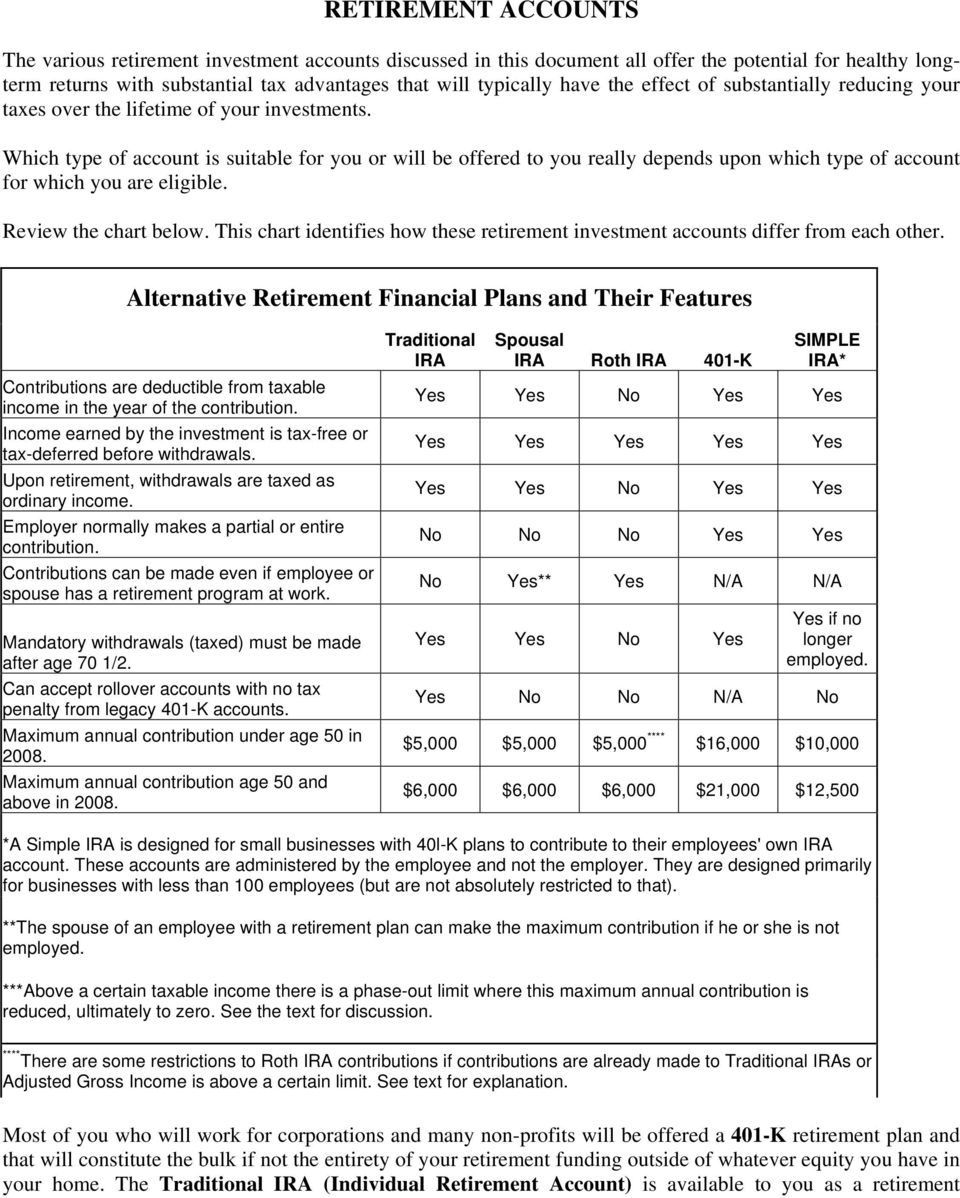
2 investment account if you do not contribute to a 401-K because you are self-employed or because your employer offers no retirement plan. The SIMPLE IRA is a retirement investment account that is sometimes offered to the employees of small businesses (less than 100 employees) instead of a 401-K plan. The Spousal IRA is a traditional IRA that is available to an unemployed spouse even if the primary breadwinner in the household has an adequate retirement account. Finally, the popular Roth IRA is a supplemental retirement investment account available to anyone who does not exceed upper income limits, including someone who already is contributing to a 401-K. Here is more information about these retirement investment accounts: 401-K retirement investment plans Most larger employers who offer a retirement plan offer it in the form of a 401-K plan. Usually the plan is designed as a dedicated mutual fund family offering the investor some limited choices in portfolio options. For example, the employee might be allowed to choose between a mix of yield-bearing funds, index funds, money market funds and perhaps a selection of growth and income funds. Normally the choices offered are much narrower than those available through a direct investment in a large mutual fund family. Typically the employee will contribute some of the contribution from his or her income and the employer will make a matching contribution or even a larger contribution, such as 75% of the full contribution. The relative contribution made by each is determined by the employment contract. The contribution made by the employer is not taxed as income in the year of the contribution. Additionally, any amount contributed by the employee reduces the employee s taxable income in the year of the contribution by the amount of the contribution. In other words, if the employee contributes $4,000 to his or her 401-K from paychecks throughout the year, his or her taxable income for that year is reduced by the $4,000 which will result in a direct tax savings for that year. On the other hand, withdrawals from the 401-K retirement investment account, which cannot begin until the retiree is 59½ years of age and must begin once the retiree has reached 70½ years of age, are taxed as earned income in the year of the withdrawal. In other words, if you take out $6,000 from your 401-K in any given year after you retire, your taxable income for that year will rise by $6,000 which may (probably will) incur a tax liability. Likewise, after age 70½, the minimum withdrawal that you are required to take is determined by a formula that is based upon the life expectancy of the retiree s age. See the chart above for the maximum annual contribution that can be made to a 401-K account. As is the case for most retirement investment accounts, the maximum contribution that can be made is higher for a contributor above age 50 (this is treated in the tax code as a catch-up provision). Before reaching retirement a working person may have been employed by many employers offering 401-K accounts. Tax laws allow a former employee of an employer who offered a 401-K program to transfer the funds of the old 401-K account into a traditional IRA account without any tax liability. This rollover, as it is called, is advisable for a person who has worked at a number of different companies because it allows the worker to gain complete control of his or her retirement funds in a single, manageable account. The fees that 401-K administrators charge can be high, even unreasonably so, and can be ended or reduced with a rollover into a Traditional IRA. General advice about 401-K retirement investment accounts: Because of the importance of this retirement account to one s retirement, because the employer typically makes a contribution (free money) and given the

3 tax treatment of contributions, one should strive to maximize earnings contributions from the first day of employment until the last. For reasons discussed above, old 401-K plans should rolled over into a Traditional IRA. The Roth IRA The Roth IRA is a generous (in terms of tax treatment) supplemental retirement investment account that is available even to those who are fully vesting in another retirement plan such as a 401-K. In other words, you can be enrolled and contributing to a 401-K retirement account at your place of employment and still supplement your retirement savings by making additional contributions to a Roth IRA account. Contributions to the Roth IRA are not deductible from the contributor s taxable earnings as is the case with a Traditional IRA (see below) but investment earnings are never taxed (except in the case of early withdrawals, described below). They are not taxed in the year that they are earned and withdrawals are not taxed upon retirement. Over a long investment horizon this feature can generate a substantial tax savings. The maximum annual contribution to a Roth IRA, which is higher for a person above age 50, is shown in the chart. If contributing to both a Traditional IRA and a Roth IRA, the two contributions combined cannot exceed the limits for a Traditional IRA. Also, the maximum contribution allowable for a Roth IRA is reduced for Adjusted Gross Income above $159,000 for married couples filing jointly and above $101,000 for single filers. Unlike Traditional IRAs (described below) one can withdraw the principal value of the IRA account at any time. However, one cannot withdraw any income earned on the principal value prior to age 59½ without paying an early withdrawal penalty equal to 10% of the amount withdrawn. For example, if the saver contributes $10,000 to the Roth IRA over the years and the Roth IRA has earned $2,000 in income, the saver may withdraw up to $10,000 from the account without a tax penalty. If the entire account is liquidated the saver must pay a tax penalty of $200 on the $2,000 of earned income and that $2,000 must also be counted as taxable income in the year of the withdrawal. Roth IRAs also have a phase-out feature that begins to restrict that maximum allowable contribution above a certain income and phases it out altogether for incomes above a certain level. In 2007 the maximum contribution available to single taxpayers is reduced if adjusted gross income is greater than $95,000 and is eliminated altogether if adjusted gross income is greater than $110,000. For married filing jointly the equivalent numbers are $150,000 and $160,000. Contributions to a Roth IRA can be made at any age, including past the age of 70½. Withdrawals are not mandatory (because they are not taxed) so Roth IRAs are very suitable investments if the intent is to leave the account to heirs upon the death of the contributor (see below for rules about inheritance of retirement accounts). The Traditional IRA The Traditional IRA is designed for the self-employed and others who are not funding a retirement account by other means, such as through a 401-K plan. Income contributed to a Traditional IRA can be deducted from taxable income earned in the same year as the contribution and up until April 15 th of the following year. In other words, if the IRA contributor contributes $1,000 in December 2007 and another $1,000 in March 2008, $2,000 can be deducted from the contributor s taxable income for Obviously this can result in a sizeable tax savings in the year of the contribution. Income earned by the investments made in the Traditional IRA, whether from capital gains or interest earned, are tax deferred until withdrawals are made from the IRA.
4 After age 59 ½, withdrawals can be made from the Traditional IRA. The amount of the withdrawal is taxed as earned income in the year of the withdrawal. In other words, if a retiree takes $10,000 out of his retirement account, $10,000 is added to his taxable income in the year of his withdrawal. Early withdrawals (prior to age 59 ½) are also taxed as earned income in the year of the withdrawal. In addition to that an early-withdrawal penalty of 10% of the amount withdrawn is added to the tax. In other words, if a retiree withdraws $10,000 from his IRA account when he is 55, the $10,000 is added to his taxable income in that year which will generate a higher tax liability for that year, and an additional $1,000 will be added to his tax bill on top of that. Minimum withdrawals from a Traditional IRA must begin once a retiree reaches the age of 70½. The amount of the withdrawal is determined by the remaining life expectancy of the retiree (more or less), which is provided by the IRS under the title Uniform Lifetime Table (see IRS Publication 590 or any of many sources on the internet to view a complete, current table). The number of remaining years is called the Distribution Period. The Distribution Period is the same for both genders (even though women generally outlive men). The minimum required withdrawal is equal to the account balance of the Traditional IRA divided by the number of years on the Distribution Period for the retiree s age. For example, in 2007 a 80-year-old retiree consulting the Uniform Lifetime Table will find a Distribution Period of 18.7 years for that age. If the retiree has $200,000 in her IRA account, she must make a withdrawal of at least $10,695 (200,000/18.7). That amount will be counted as taxable income in that year. Unlike a Roth IRA, contributions cannot be made to a Traditional IRA after age 70½. If the retiree dies before the IRA account is exhausted (the typical case) the remaining balance can be inherited by heirs as an IRA account with no tax penalty so long as the IRA is rolled into a special IRA account called an Inherited IRA Beneficiary Distribution Account. If this is done properly no tax is paid at the time of the rollover (although the estate might be subject to an estate tax, a subject not discussed here). Normally taxable withdrawals must begin in the tax year following the retiree s death. Setting up an Inherited IRA Beneficiary Distribution Account can be complicated, especially if there are multiple heirs, and minimum withdrawal requirements are variable and complicated, so a tax accountant should be consulted before rolling over an inherited IRA account, and should be consulted soon after the death of the retiree. The annual contribution limits to Traditional IRAs is shown in the table at the beginning of this document. The SIMPLE IRA The SIMPLE (the acronym stands for Savings Incentive Match Plan for Employees) IRA can be established by employers who have no more than 100 employees who earned no more than $5,000 in the previous calendar year. It is meant to be a substitute for a 401-K plan and is usually much easier to administer. Generally, all employees who work for a small business who offers a SIMPLE IRA plan and who make more than $5,000 per year are eligible for the SIMPLE IRA. The employer must contribute to the SIMPLE IRA plan for all eligible employees. Typically the employer contributes to the plan and the employee is allowed to invest an amount that matches the employer s contribution (hence the acronym). The employee, however, has the option of investing less than this amount or contributing nothing at all The employer is allowed to set up a plan that does not match employee contributions, but only if the employer makes a minimum contribution equaling 2% of the employees salary for
5 the calendar year. The maximum contribution allowed (the sum of the employer s and employee s contribution) is shown in the table at the beginning of this document. The employer determines what financial institution (usually a mutual fund) will receive the deposits and manage the fund, much like a 401-K. Rules for withdrawal and tax deferments are the same as they are for the Traditional IRA. The rules for the inheritance of a SIMPLE IRA are slightly different than they are for a Traditional IRA. As is the case with any IRA that is to be inherited, a tax accountant should be consulted soon after the death of the deceased. The Spousal IRA The Spousal IRA is simply a Traditional IRA that is available to a married person who is not employed. This IRA is available to the unemployed spouse regardless of whether the employed spouse contributes to a retirement plan. (In most cases the funding for the contribution to the Spousal IRA will come from the income of the employed spouse). The Spousal IRA can greatly enhance the retirement savings and tax breaks for a married couple when one works and the other doesn t. The maximum annual contribution limits are different the traditional IRA and are shown in the table at the beginning of this document. The rules for withdrawal, tax deferments, and inheritance are the same for the Spousal IRA as they are for the Traditional IRA. IRA Investment Options Traditional, Roth, and Spousal IRAs are managed by the investor. The investor therefore gets to choose where the investment is to be made. Once the investment is made, the investor must choose between managing the account himself, hiring someone like a financial advisor to do it, or accept the general investment advice of the fund in which he is invested. Generally fees will be much higher if the investor does not manage the funds himself and over the years these fees can substantially reduce the size of the retirement nest egg. There are few limitations on the types of investments available to IRA accounts. Contributions to the IRA can be invested in mutual funds, directly in stocks in a stock brokerage account, bank deposits like CDs, life insurance products like variable annuities, even real estate, so long as the account created for the investment is specifically identified as an IRA account. IRAs can also be mixed among many different types of accounts. An active investor might place 80% of her Roth IRA in a safe and diversified family of mutual funds and 20% in an online stock trading account. Disclaimer You should not rely upon this document to make any important decisions about retirement accounts. This information was current only by the date below and might also include errors. For current law consult IRS Publication 590, Individual Retirement Arrangements, available in pdf format at the IRS website (c) Gary R. Evans, , January 2009.
RETIREMENT ACCOUNTS (c) Gary R. Evans, 2006-2011, September 24, 2011. Alternative Retirement Financial Plans and Their Features
 RETIREMENT ACCOUNTS (c) Gary R. Evans, 2006-2011, September 24, 2011. The various retirement investment accounts discussed in this document all offer the potential for healthy longterm returns with substantial
Alternative Retirement Financial Plans and Their Features
 RETIREMENT ACCOUNTS Gary R. Evans, 2006-2013, November 20, 2013. The various retirement investment accounts discussed in this document all offer the potential for healthy longterm returns with substantial
NOT FDIC INSURED NO BANK GUARANTEE MAY LOSE VALUE. Tax-advantaged IRAs. Invest in your retirement savings while reducing taxes
 NOT FDIC INSURED NO BANK GUARANTEE MAY LOSE VALUE Taxadvantaged IRAs Invest in your retirement savings while reducing taxes Find the answers inside Why invest for retirement? p. 1 Discover three good reasons
Basics of IRAs ING FINANCIAL SOLUTIONS. Your future. Made easier. SM
 Basics of IRAs t FDIC/NCUA Insured t A Deposit Of A Bank t Bank Guaranteed May Lose Value t Insured By Any Federal Government Agency ING FINANCIAL SOLUTIONS Your future. Made easier. SM Traditional IRA
IRAs Traditional Individual Retirement Accounts. 2008 and 2009. Questions & Answers
 IRAs Traditional Individual Retirement Accounts 2008 and 2009 Questions & Answers What is the purpose of this brochure? It summarizes the primary laws which govern traditional IRAs for 2008 and 2009. What
IRA Opportunities. Traditional IRA vs. Roth IRA: Which is right for you? What kind of retirement funding vehicle is right for you?
 IRA Opportunities. Traditional IRA vs. Roth IRA: Which is right for you? What kind of retirement funding vehicle is right for you? Now more than ever, an Individual Retirement Account (IRA) may help provide
How much can I deduct if I am an active participant in a qualified plan?... 2
 Table of Contents What is an Individual Retirement Account (IRA)?...................................... 1 Who may establish a Traditional IRA?............................................... 1 How much
IRA opportunities at UBS
 IRA opportunities at UBS IRAs are highly popular and effective retirement savings vehicles that give your investment earnings the benefit of tax-favored treatment and provide an ideal supplement to employer-sponsored
Table of contents. 2 Federal income tax rates. 12 Required minimum distributions. 4 Child credits. 13 Roths. 5 Taxes: estates, gifts, Social Security
 2015 Tax Guide Table of contents 2 Federal income tax rates 4 Child credits 5 Taxes: estates, gifts, Social Security 6 Rules on retirement plans 8 Saver s credit 12 Required minimum distributions 13 Roths
EXPLORING YOUR IRA OPTIONS. Whichever you choose traditional or Roth investing in an IRA is a good step toward saving for retirement.
 EXPLORING YOUR IRA OPTIONS Whichever you choose traditional or Roth investing in an IRA is a good step toward saving for retirement. 2 EXPLORING YOUR IRA OPTIONS Planning for retirement can be a challenging
An IRA can put you in control of your retirement, whether you
 IRAs: Powering Your Retirement One of the most effective ways to build and manage funds to help you meet your financial goals is through an Individual Retirement Account (IRA). An IRA can put you in control
Part VII Individual Retirement Accounts
 Part VII are a retirement planning tool that virtually everyone should consider. The new IRA options also have made selecting an IRA a bit more complicated. IRA Basics The Traditional IRA is an Individual
Roth IRAs The Roth IRA. 2011 and 2012. Questions & Answers
 Roth IRAs The Roth IRA 2011 and 2012 Questions & Answers What is a Roth Individual Retirement Account (Roth IRA)? A Roth IRA is a type of tax-preferred savings and investment account authorized by Internal
Roth IRAs The Roth IRA
 Roth IRAs The Roth IRA 2010 and 2011 Questions & Answers What is a Roth Individual Retirement Account (Roth IRA)? A Roth IRA is a type of tax-preferred savings and investment account authorized by Internal
IRAs. AKD Consultants Adam Dworkin CPA 188 Whiting Street Suite 10 Hingham, MA 02043 781-556-5554 [email protected]
 AKD Consultants Adam Dworkin CPA 188 Whiting Street Suite 10 Hingham, MA 02043 781-556-5554 [email protected] IRAs October 01, 2013 Page 1 of 8, see disclaimer on final page Both traditional and
chart retirement plans 8 Retirement plans available to self-employed individuals include:
 retirement plans Contributing to retirement plans can provide you with financial security as well as reducing and/or deferring your taxes. However, there are complex rules that govern the type of plans
NORTHEAST INVESTORS TRUST. 125 High Street Boston, MA 02110 Telephone: 800-225-6704
 NORTHEAST INVESTORS TRUST traditional IRA INVESTOR S KIT 125 High Street Boston, MA 02110 Telephone: 800-225-6704 Table of Contents NORTHEAST INVESTORS TRUST TRADITIONAL IRA DISCLOSURE STATEMENT...1 INTRODUCTION...1
Your Guide to. Individual Retirement Accounts
 Your Guide to Individual Retirement Accounts Your Guide to Individual Retirement Accounts (IRAs) TRADITIONAL AND ROTH IRAs ROLLOVERS A CONSUMER S GUIDE TO IRA ELIGIBILITY AND BENEFIT CHART Only 10% of
Take Another Step for Your Financial Future ICMA-RC s Payroll Roth IRA
 Take Another Step for Your Financial Future ICMA-RC s Payroll Roth IRA Open an ICMA-RC Payroll Roth IRA It s quick and easy to open a Payroll Roth IRA. It takes two easy steps: Send ICMA-RC the completed
Retirement Plan Distributions Choices & Opportunities
 Retirement Plan Distributions Choices & Opportunities Leaving Your Job: Things to Think About» What you want to do next Work full time? Part time? Retire? How much will your lifestyle cost?» Continuing
Roth IRAs The Roth IRA
 Roth IRAs The Roth IRA 2014 and 2015 Questions & Answers What is a Roth Individual Retirement Account (Roth IRA)? A Roth IRA is a type of tax-preferred savings and investment account authorized by Internal
IRA / Retirement Plan Accounts
 IRA / Retirement Plan Accounts Retirement plans are tax advantaged savings plans that have been created by the US government to encourage investors to save for their retirement. Some investments selected
Traditional and Roth IRAs. Invest for retirement with tax-advantaged accounts
 Traditional and Roth IRAs Invest for retirement with tax-advantaged accounts Your Retirement It is your ultimate reward for a lifetime of hard work and dedication. It is a time when you should have the
MFS Retirement Strategies Stretch IRA and distribution options READY, SET, RETIRE. Taking income distributions during retirement
 MFS Retirement Strategies Stretch IRA and distribution options READY, SET, RETIRE Taking income distributions during retirement ASSESS YOUR NEEDS INCOME WHEN YOU NEED IT Choosing the right income distribution
The Federal Thrift Savings Plan
 Vertex Wealth Management, LLC Michael J. Aluotto, CRPC President Private Wealth Manager 1325 Franklin Ave., Ste. 335 Garden City, NY 11530 516-294-8200 [email protected] www.vertexwm.com The Federal
Roth 403(b) Contribution Option
 Roth 403(b) Contribution Option Frequently Asked Questions George Mason University offers a Roth 403(b) contribution option under the George Mason University Tax Deferred Savings Plan (the Plan ). The
PERSONAL FINANCE. individual retirement accounts (IRAs)
 PERSONAL FINANCE individual retirement accounts (IRAs) 1 our mission To lead and inspire actions that improve financial readiness for the military and local community. table of contents The Basics Of IRAs...
GENERAL INCOME TAX INFORMATION
 NEW YORK STATE TEACHERS RETIREMENT SYSTEM GENERAL INCOME TAX INFORMATION TABLE OF CONTENTS Taxes on Loans from the Annuity Savings Fund 1 (Tier 1 and 2 Members Only) Taxes on the Withdrawal of the Annuity
2. The following is substituted for the answer to the question How do I apply for a loan? in the Section entitled Loans:
 TO OUR EMPLOYEES: We wish to announce that the Mission Health System Employee Retirement Plan ( Plan ) has been amended, effective June 1, 2015, to change the automatic form of benefit. Therefore, in order
BMO Funds State Street Bank and Trust Company Universal Individual Retirement Account Disclosure Statement. Part One: Description of Traditional IRAs
 BMO Funds State Street Bank and Trust Company Universal Individual Retirement Account Disclosure Statement Part One: Description of Traditional IRAs Part One of the Disclosure Statement describes the rules
Retirement and Estate Planning
 6P A R T Retirement and Estate Planning Should you invest in a retirement plan? Chapter 19 Retirement Planning Chapter 20 Estate Planning How much should you contribute to your retirement plan? How should
South Carolina Deferred Compensation Program Features and Highlights
 Retire from work, not life.. South Carolina Deferred Compensation Program Features and Highlights The South Carolina Deferred Compensation Program is a powerful tool to help you reach your retirement dreams.
Chapter 19 Retirement Products: Annuities and Individual Retirement Accounts
 Chapter 19 Retirement Products: Annuities and Individual Retirement Accounts Overview Thus far we have examined life insurance in great detail. Life insurance companies also market a product that addresses
Strength of Many. Convenience of One. Voya Select Advantage IRA. Mutual Fund Custodial Account
 Strength of Many. Convenience of One. Voya Select Advantage IRA Mutual Fund Custodial Account Life brings change. C hange often comes from life events such as switching jobs or retiring. What impact will
MFS. Retirement Strategies Stretch IRA & distribution options. Ready, set, retire. Taking income distributions during retirement
 MFS Retirement Strategies Stretch IRA & distribution options Ready, set, retire Taking income distributions during retirement ASSESS YOUR NEEDS Income when you need it Choosing the right income distribution
10 common IRA mistakes
 10 common mistakes Help protect your valuable retirement assets Not FDIC Insured May Lose Value No Bank Guarantee Not Insured by Any Government Agency You ve worked hard to build your retirement assets......
REVIEWING YOUR TIAA-CREF INCOME CHOICES A GUIDE TO YOUR PAYMENT OPTIONS
 REVIEWING YOUR TIAA-CREF INCOME CHOICES A GUIDE TO YOUR PAYMENT OPTIONS FLEXIBILITY & CHOICE TIAA-CREF UNDERSTANDS YOUR FINANCIAL PRIORITIES can change over time, which is why we offer you a wide range
Converting taxable income into tax-free income
 Converting taxable income into tax-free income Important information for people who still own a traditional IRA Consider the future impact of your IRA Do you own a traditional IRA? Many people nearing
MOAA Caregivers Guide: Planning For Retirement
 MOAA Caregivers Guide: Planning For Retirement To obtain financial security during your retirement years, start planning for it now. The most powerful factor is time. Starting to invest now for retirement
Retire from work, not life..
 Retire from work, not life.. Program Features and Highlights The South Carolina Deferred Compensation Program (Program) is a powerful tool to help you reach your retirement dreams. As a supplement to other
Preparing for Your Retirement: An IRA Review
 Preparing for Your Retirement: An IRA Review How much of your earning power will be available for your use when you retire? What will happen to your standard of living when your income ceases at retirement?
Traditional and Roth IRAs
 Traditional and Roth IRAs Information Kit, Disclosure Statement and Custodial Agreement NOT FDIC INSURED \ NO BANK GUARANTEE \ MAY LOSE VALUE FRM-IRADISC(1/11) State Street Bank and Trust Company Universal
Understanding IRAs. Thad Johnson, AIF, MBA 222 2nd Ave SE Hutchinson, MN 55350 320-587-3444 [email protected]
 Thad Johnson, AIF, MBA 222 2nd Ave SE Hutchinson, MN 55350 320-587-3444 [email protected] Understanding IRAs Page 1 of 5, see disclaimer on final page Understanding IRAs An individual
Thrift Savings Plan. Plan Overview. Investment Options. Contribution Limits. Withdrawal Options
 Plan Overview Investment Options Contribution Limits Withdrawal Options (TSP) Contents Investment Options... Life Cycle Funds... TSP Contributions - Tax Treatment... Agency Contributions... Over 50 Catch-up
29. Retirement Planning 4: Individual and Small-Business Plans
 29. Retirement Planning 4: Individual and Small-Business Plans Introduction Whether you work for a large or a small company or are self-employed, you need to plan for retirement. This chapter will discuss
Important Tax Information About Your TSP Withdrawal and Required Minimum Distributions
 Important Tax Information About Your TSP Withdrawal and Required Minimum Distributions The Thrift Savings Plan (TSP) is required by law to provide you with this notice. However, because the tax rules covered
REQUIRED MINIMUM DISTRIBUTIONS
 MAKING ADVISED CHOICES RETIREMENT UN D E R S TA N D I N G REQUIRED MINIMUM DISTRIBUTIONS PRUDENTIAL CAN HELP Prudential has developed this guide to help you avoid common and costly mistakes, provide valuable
Understanding Annuities
 Annuities, 06 5/4/05 12:43 PM Page 1 Important Information about Variable Annuities Variable annuities are offered by prospectus, which you can obtain from your financial professional or the insurance
Traditional IRA s Contribution rules-
 A Traditional IRA is a retirement plan that allows you to save money for retirement. In the case of a traditional IRA, you may also be offered an immediate tax shelter for the contributions that you make
SHENANDOAH LIFE ANNUITIES
 ANNUITIES AGENT GUIDE SHENANDOAH LIFE ANNUITIES FOR AGENT USE ONLY This piece is not intended to create public interest in an insurance product, an insurer, or an agent. SHENANDOAH LIFE ANNUITIES For
Supplement to IRA Custodial Agreements
 Supplement to IRA Custodial Agreements Effective December 31, 2014, the update below will be made to the American Century Custodial agreements for the following retirement accounts: Traditional IRAs, Roth
Important Tax Information About Payments From Your TSP Account
 Important Tax Information About Payments From Your TSP Account Before you decide how to receive the money in your Thrift Savings Plan (TSP) account, you should review the important information in this
Traditional IRA/Roth IRA
 premiere select Traditional IRA/Roth IRA Invest in your retirement today. Saving for your retirement. 01 Important Section in head any lorem market. ipsum dolore sit amet If you re planning for your future,
The IRA Rollover. Making Sense Out of Your Retirement Plan Distribution
 The IRA Rollover Making Sense Out of Your Retirement Plan Distribution Expecting a Distribution? You have been a participant in your employer s retirement plan for a number of years, and you have earned
Distribution Options for IRA Beneficiaries. Choose the option that s best for you
 Distribution Options for IRA Beneficiaries Choose the option that s best for you Let Us Help You Make An Informed Decision Before you begin It s important to understand your choices and the best options
SCHNEIDER FUNDS INDIVIDUAL RETIREMENT ACCOUNT (IRA) TRADITIONAL IRA SEP IRA ROTH IRA
 SCHNEIDER FUNDS INDIVIDUAL RETIREMENT ACCOUNT (IRA) TRADITIONAL IRA SEP IRA ROTH IRA BNY MELLON INVESTMENT SERVICING TRUST COMPANY Supplement to the Traditional and Roth Individual Retirement Account (IRA)
WHICH TYPE OF IRA MAKES THE MOST SENSE FOR YOU?
 WHICH TYPE OF IRA MAKES THE MOST SENSE FOR YOU? In 1974, when IRAs were first created, they were rather simple and straightforward. Now, 35 years later, it s challenging to know the best way to save more
Individual Retirement Plans Investor guide to traditional and Roth IRAs. Individual Retirement Plans: Investor Guide
 Individual Retirement Plans Investor guide to traditional and Roth IRAs a Individual Retirement Plans: Investor Guide Individual Retirement Plans An individual retirement plan may be a beneficial addition
Rules for Taking Distributions from Tax-Deferred Retirement Savings Plans
 Rules for Taking Distributions from Tax-Deferred Retirement Savings Plans Putting money into an employer s retirement plan or IRA is just the first step toward financial security in retirement. How you
Tables: Retirement Savings Plans
 Tables: Retirement Savings Plans Table #1: Individual Plans Individual retirement savings plans have tax benefits that make them attractive ways to save for retirement on your own, either in addition to
Your 403(b). Made better.
 Your 403(b). Made better. A unique opportunity for tax-free retirement income. Your future. Made easier. The Roth 403(b) contribution option. I m ready to Roth. I m still more of a traditional type. Is
Consider the advantages of the Roth 403(b)
 Consider the advantages of the Roth 403(b) Your plan offers a way of saving for retirement known as the Roth 403(b) What is it? It s a way to get your money tax-free in retirement. You can make tax-free
The SIMPLE IRA Plan. Savings Made Simple For Your Employees. Retirement Plans
 The SIMPLE IRA Plan Savings Made Simple For Your Employees Retirement Plans About Stifel Nicolaus Stifel Nicolaus is a full-service Investment firm with a distinguished history of providing securities
RETIREMENT SAVING OPTIONS FOR INDIVIDUALS
 RETIREMENT SAVING OPTIONS FOR INDIVIDUALS For Traditional, Rollover, SEP or Roth IRA BUFFALO FUNDS We re pleased that you have chosen the Buffalo Funds for your retirement investment. These Funds are professionally
Schwab Individual 401(k) Plan Summary Plan Description
 Schwab Individual 401(k) Plan Summary Plan Description Employer Instructions 1. Complete the Summary Plan Description (SPD) in accordance with the elections you made on the Adoption Agreement. 2. Provide
PRIVACY POLICIES, DISCLOSURES, INSTRUCTIONS & AGREEMENTS FOR: INDIVIDUAL RETIREMENT ACCOUNT (IRA) TRADITIONAL IRA SEP IRA ROTH IRA
 Fairholme Funds Inc. PRIVACY POLICIES, DISCLOSURES, INSTRUCTIONS & AGREEMENTS FOR: INDIVIDUAL RETIREMENT ACCOUNT (IRA) TRADITIONAL IRA SEP IRA ROTH IRA FAIRHOLME FUNDS, INC. INDIVIDUAL RETIREMENT ACCOUNT