
Lecture Note on Auctions
|
|
|
- Ashley Cole
- 10 years ago
- Views:
Transcription
1 Lecture Note on Auctions Takashi Kunimoto Department of Economics McGill University First Version: December 26 This Version: September 26, 28 Abstract. There has been a tremendous growth in both the number of internet auction websites, where individuals can put up items for sale under common auction rules, and the value of goods sold there. The objective of auction theory is to rigorously understand the properties and implications of auctions used in the real world. I mainly investigate four auction forms: (1) The open ascending price or English auction; (2) the open descending price or Dutch auction; (3) the sealed-bid first-price auction; and (4) the sealed-bid second-price auction. The topics which will be covered include games with incomplete information, the revenue equivalence principle, mechanism design, efficient and optimal mechanisms, auctions with interdependent values, the revenue ranking (linkage) principle, and multiple objects auctions. I am thankful to the students for their comments, questions, and suggestions. Of course, all remaining errors are my own. Department of Economics, McGill University, 855 Sherbrooke Street West, Montreal, Quebec, H3A2T7, CANADA, [email protected] URL:

2 Syllabus Econ 577: Mathematical Economics I Fall 27, McGill University Tuesdays and Thursdays, 4:5pm - 5:25pm; at Leacock 21 Instructor: Takashi Kunimoto [email protected] 3 Class Web: the WebCT 4 Office: Leacock 438 COURSE DESCRIPTION: The theme of Econ 577 is auction theory. There has been a tremendous growth in both the number of internet auction websites, where individuals can put up items for sale under common auction rules, and the value of goods sold there. The objective of this course is to rigorously understand the properties and implications of auctions used in the real world. This course investigates three main auction forms: (1) The open ascending price or English auction; (2) the sealed-bid first-price auction; and (3) the sealed-bid second-price auction. The topics which will be covered include games with incomplete information, the revenue equivalence principle, mechanism design, efficient and optimal mechanisms, interdependent values auctions, and multiple object auctions. At the same time, I will touch on experimental and empirical results of auctions with special emphasis on practical relevances of auction theory. This course is designed to be self-contained. Besides, the level of mathematics will be adjusted according to the students understanding during the course. READING: The first three books listed below are available at the McGill bookstore and reserved in the library. 1. Lecture Note on Auctions, by Takashi Kunimoto (Main course material; This note is largely based on Krishna s Auction Theory and is available at the WebCT.) 2. Auction Theory, by Vijay Krishna, Academic Press, 22 (Main Textbook) 5 3. Putting Auction Theory to Work, by Paul Milgrom, Cambridge University Press, 24 (Supplementary) 3 In the semester, I might send s to all students through the WebCT. But, do not (or reply to) me through the WebCT. You should directly use [email protected] to contact me. 4 I will not answer how to use the WebCT. 5 In this course, the contents of the book will be simplified to some extent. 1

3 4. Auctions: Theory and Practice, by Paul Klemperer, Princeton University Press, 24. (Supplementary) 5. Auctions: A Survey of Experimental Research, by John H. Kagel in The Handbook of Experimental Economics, Princeton University Press, (Supplementary; this article is available upon request.) 6. Empirical Models of Auctions, by Susan Athey and Philip A. Haile in Advances in Economics and Econometrics, Theory and Applications: The Ninth World Congress of the Econometric Society, Cambridge University Press (Supplementary; I make this paper available at the WebCT). 7. An Empirical Perspective on Auctions, by Ken Hendricks and Robert H. Porter forthcoming in Handbook of Industrial Organization, vol 3 (Supplementary; I make this paper available at the WebCT). 8. Lecture Note on Mathematics for Economists, by Takashi Kunimoto (Supplementary; If you don t have good mathematical background, you might find this helpful; I make this note available at the WebCT). REFERENCES ON GAME THEORY: Auction theory is exclusively based on the language of game theory. Therefore, I want to introduce you to some references on game theory. There are two books which are, based on my choices (or bias?), considered introductory. You can find these two books in the reserve desk at the (McLennan? I think) library. As far as this course is concerned, you can completely skip any argument on mixed strategy. An Introduction to Game Theory by Martin J. Osborne, Oxford University Press, (24); Consult only Chapter 1(this is introduction if you wish to read), 2, 3, and 9; This book is regarded as a (significantly) less mathematical version of A Course in Game Theory by Osborne and Rubinstein; Exercises in the book can be helpful for your understanding game theory and there are answers for some of exercises at Osborne s website at Department of Economics, University of Toronto. Game Theory for Applied Economists by Robert Gibbons, Princeton University Press, (1992); Consult only Chapter 1 and 3. If you want to skip lots of definitions and theorems and immediately go to applications of game theory, this book might be for you. I picked out two advanced textbooks for this course. These two books are also reserved in the library. A Course in Game Theory by Martin J. Osborne and Ariel Rubinstein, the MIT press, (1994); Consult only Chapter 1 (this is again an introduction, which 2

4 is very interesting, though), and 2. You can completely ignore the section on strictly competitive (i.e., zero-sum two person) games. If you go to, again, Martin J. Osborne s website, you will find the solution manual for exercises in the book. Nevertheless, it is not an easy job to understand what the solution manual says. Don t blame yourself if you don t understand it. Note that this book takes preferences as a primitive and deduce payoff functions as a representation for preferences. Game Theory: Analysis of Conflict by Roger B. Myerson, Harvard University Press, (1991); Consult only Chapter 1 (A very good introduction to game theory and a very detailed discussion on the single person decision theory), 2 (you can ignore 2.9), and 3 (you can ignore 3.5 throughout up to the end of the chapter except 3.11, which is about auctions). Exercises are very tough. You don t have to try them. Do you want to know more? If so, please don t hesitate to talk to me. OFFICE HOURS: Tuesdays and Thursdays, 5:3pm - 6:3pm ASSESSMENT: There are three ingredients which determine your final grade: (1) Problem Sets 1%; (2) midterm exam 3% and (3) final exam 6%. 6 Only if he/she has a serious reason why he/she cannot take the midterm exam, the grade of that person will be solely based on the problem sets and the final exam. However, this treatment is very exceptional. You must take both exams. Moreover, both midterm and final exams are given in the take-home style. PROBLEM SETS: There will be approximately 5 problem sets. Problem sets are essential to help you understand the course and to develop your skill to analyze economic problems. Besides, it should be expected that these problem sets are very good proxies for the exams. The solution to each problem set will be reviewed in the class. 6 McGill University values academic integrity. Therefore all students must understand the meaning and consequences of cheating, plagiarism and other academic offences under the code of student conduct and disciplinary procedures (See for more information). 3

5 Contents 1 Introduction Game Theory What is an Auction? Some Common Auction Forms The English Auction The Dutch Auction The Sealed-Bid First-Price Auction The Sealed-Bid Second-Price Auction Valuations Equivalent Auctions Revenue versus Efficiency Games with Complete Information Rational Behaviors Strategic Games Common Knowledge Nash Equilibrium Examples Existence of Nash Equilibrium Sealed-Bid Auctions with Complete Information The First Price Sealed-Bid Auction The Second Price Sealed-Bid Auction Discontinuity of Payoff Functions in First Price Auctions Games with Incomplete Information A Motivating Example Bayesian Games Formalizing Bayesian Games Example: Second-Price Auction Independent Private Values (IPV) Auctions with Symmetric Bidders Continuous Distributions

6 CONTENTS 4.2 Order Statistics Highest Order Statistic Second-Highest Order Statistic The Symmetric Model Second Price Sealed-Bid Auctions The expected payment of Second Price Auctions First Price Sealed-Bid Auctions Symmetric Equilibrium of First Price Auctions Expected Payment in First Price Auctions Multiple Integrals and Stochastic Dominance Multiple Integrals First-Order Stochastic Dominance Second-Order Stochastic Dominance Revenue Equivalence between the First and Second Price Auctions Revenue Comparison between the First and Second Price Auctions Hazard Rates Reserve Price Reserve Prices in Second Price Auctions Reserve Prices in First Price Auctions Revenue Effects of Reserve Prices The Optimal Reserve Price in a Second Price Auction Entry Fees as a Substitute of Reserve Prices The Revenue Equivalence Principle Applications of the Revenue Equivalence Principle Equilibrium of All-Pay Auctions Equilibrium of Third Price Auctions Uncertain Number of Bidders Extensions of Independent Private Values Auctions Auctions with Risk-Averse Bidders Auction with Budget Constrained Bidders Budget Constraints Second Price Auctions First Price Auctions Revenue Comparison Auctions with Asymmetric Bidders Asymmetric First Price Auctions with Two Bidders Hazard Rate Dominance Reverse Hazard Rate Dominance Weakness Leads to Aggressive Behaviors Efficiency Comparison Resale Experimental Analysis for IPV Sealed-Bid Auctions Experimental Procedures
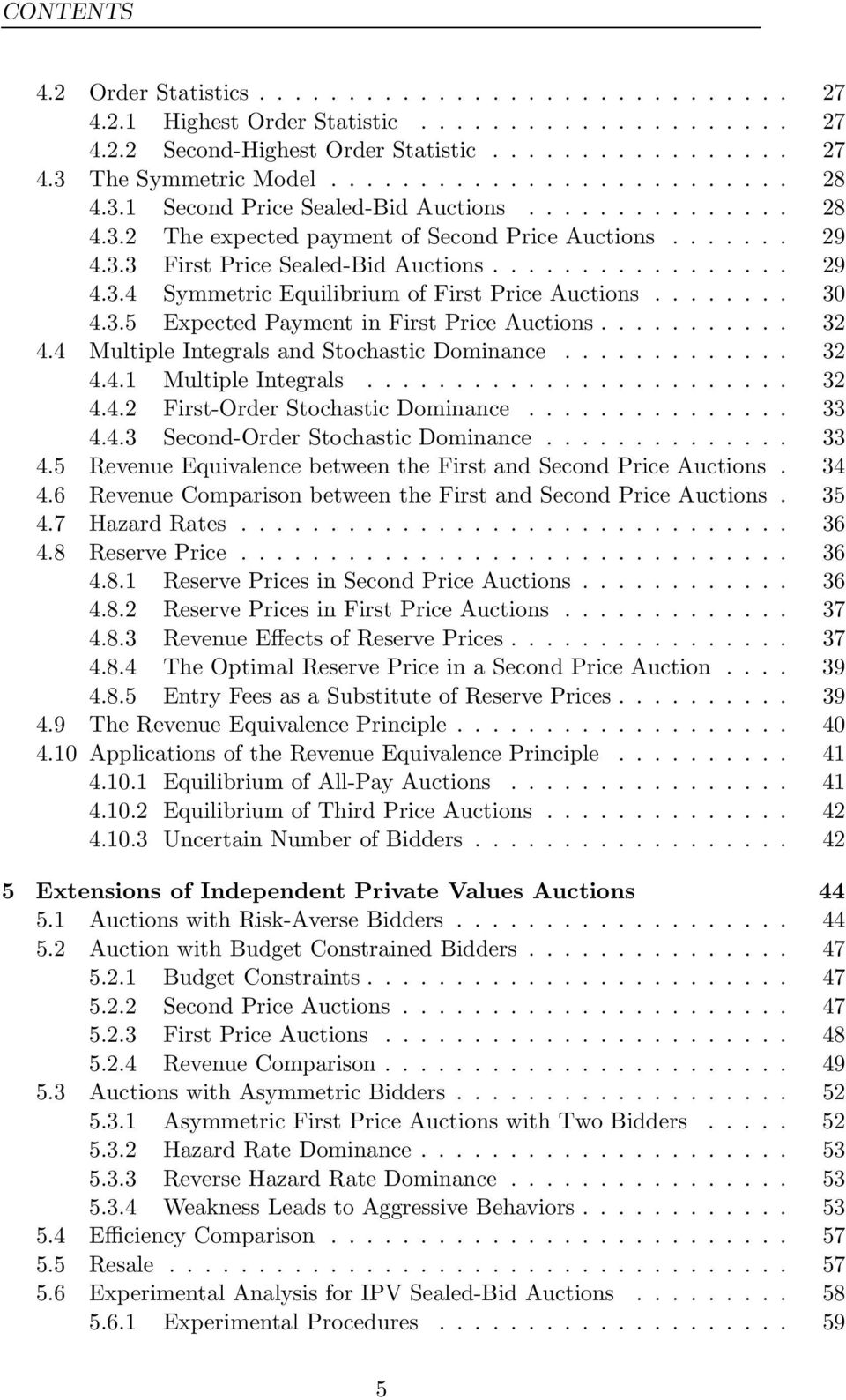
7 CONTENTS Tests of the Second Price Auctions Tests of the Strategic Equivalence of Second Price and English Auctions Tests of the First Price Auctions Tests of the Strategic Equivalence of First Price and Dutch Auctions Tests of Efficiency of Auctions Empirical Analysis for IPV Sealed-Bid Auctions Structural Analysis of Second Price Auctions Structural Analysis of First Price Auctions Mechanism Design The Mechanism Design Approach Mechanisms The Revelation Principle Incentive Compatibility Characterizations of Incentive Compatible Direct Mechanisms Revenue Equivalence Individual Rationality Optimal Mechanisms Setup Solution Discussion and Interpretation of the Optimal Mechanisms Efficient Mechanisms The VCG Mechanism Budget Balance Bilateral Trade Auctions with Interdependent Values Interdependent Values Correlated Signals The Symmetric Model Second Price Auctions with Interdependent Values An Example of Common Value Auctions English Auctions Constructing the Symmetric Equilibrium in an English Auction Characteristics of the Symmetric Equilibrium Ex Post Equilibrium Affiliation Log-Supermodularity Monotone Likelihood Ratio Property Likelihood Ratio Dominance First Price Auctions with Interdependent Values Technical Notes on Differential Equations

8 CONTENTS 7.9 Revenue Ranking English versus Second Price Auctions Second Price versus First Price Auctions An Example Affiliated Signals Revenue Ranking Efficiency The Revenue Ranking ( Linkage ) Principle First Price versus Second Price Auctions The Revenue Equivalence Principle Revisited Value of Public Information When Public Information is not Available When Public Information is Available Public Information in a First Price Auction Existence of Symmetric Equilibria When Public Information is Available Public Information in Second Price and English Auctions The Extended Revenue Ranking Principle Ranking All-Pay Auctions Asymmetries and Other Complications The Symmetry Assumption Second Price Auctions First Price Auctions Failures of the Revenue Ranking Principle Asymmetric Uniform Distributions Second Price Auctions First Price Auctions Revenue in the First Price Auction Failure of the Revenue Ranking between English and Second Price Auctions Equilibrium and Revenues in a Second Price Auction Equilibrium and Revenues in an English Auction Appendix Efficiency and the English Auction The Single Crossing Condition Two-Bidder Auctions The Average Crossing Condition Three or More Bidders Generalized Single Crossing Condition English Auctions with Reentry Appendix for the Proof of Proposition

9 CONTENTS 1 Mechanism Design with Interdependent Values Efficient Mechanisms The Generalized VCG Mechanism The Working of the Generalized VCG Mechanism Optimal Mechanisms Full Surplus Extraction Comments on the CM mechanism

10 Chapter 1 Introduction 1.1 Game Theory Auction theory is exclusively based on the language of game theory. So, let me start by describing what game theory is. Game theory is a bag of analytical tools designed to help us understand the phenomena that we observe when decision makers interact. Game theory is sometimes called interactive decision theory. The basic assumptions that underlie the theory are that decision makers pursue well-defined exogenous objectives (they are rational) and take into account their knowledge or expectations of other decision makers behavior (they reason strategically). A game is a description of strategic interaction that includes the constraints on the actions that the players can take and the players interests, but does not specify the actions that the players do take. A solution is a systematic description of the outcomes that may emerge in a family of games. Game theory suggests reasonable solutions for classes of games and examines their properties. Auction theory models the decision problems collectively facing bidders in an auction as a game of incomplete information. A game with incomplete information is a game in which, at the first point in time when the players can begin to plan their moves in the game, some players already have private information about the game that other players do not know. 1.2 What is an Auction? An auction format is a mechanism to allocate resources among a group of bidders. An auction model includes three major parts: a description of the potential bidders, the set of possible resource allocations (describing the number of goods of each type, whether the goods are divisible, and whether there are legal or other restrictions on how the goods may be allocated), and the values of various resource allocations to each participant. Thus, a wide variety of selling institutions fall under the rubric of an auction. A common aspect of auction-like mechanisms is that they elicit 9
11 CHAPTER 1. INTRODUCTION information, in the form of bids, from potential buyers regarding their willingness to pay and the outcome - that is, who wins what and pays how much - is determined solely on the basis of the received information. An implication of this is that auctions are universal in the sense that they may be used to sell any good. A second important aspect of auction-like mechanisms is that they are anonymous. By this I mean that the identities of the bidders play no role in determining who wins the object and who pays how much. 1.3 Some Common Auction Forms The English Auction The English auction is the open ascending price auction. In one variant of the English auction, the sale is conducted by an auctioneer who begins by calling out a low price and raises it, typically in small increments, as long as there are at least two interested bidders. The auction stops when there is only one interested bidder The Dutch Auction The Dutch auction is the open descending price counterpart of the English auction. Here the auctioneer begins by calling out a price high enough so that presumably no bidder is interested in buying the object at that price. This price is gradually lowered until some bidder indicates her interest The Sealed-Bid First-Price Auction In this auction form, bidders submit bids in sealed envelopes; the person submitting the highest bid wins the object and pays what he bid The Sealed-Bid Second-Price Auction As its name suggests, once again bidders submit bids in sealed envelopes; the person submitting the highest bid wins the object but pays not what he bid, but the second highest bid. 1.4 Valuations Auctions are used precisely because the seller is unsure about the values that bidders attach to the object being sold - the maximum amount each bidder is willing to pay. If each bidder knows the value of the object to himself at the time of bidding, the situation is called one of private values. Implicit in this situation is that no bidder knows with certainty the values attached by other bidders and knowledge of other 1

12 CHAPTER 1. INTRODUCTION bidders values would not affect how much the object is worth to a particular bidder. The assumption of private values is most plausible when the value of the object to a bidder is derived from its consumption or use alone. In many situations, how much the object is worth is unknown at the time of the auction to the bidder himself. He may have only an estimate of some sort or some privately known signal - such as an expert s estimate or a test result - that is correlated with the true value. Indeed, other bidders may possess information, that if known, would affect the value that a particular bidder attaches to the object. Such a specification is called one of interdependent values and is particularly suited for situations in which the object being sold is an asset that can possibly be resold after the auction. 1.5 Equivalent Auctions Open auctions requires that the bidders collect in the same place, whereas sealed bids may be submitted by mail, so a bidder may observe the behavior of other bidders in one format and not in another. For rational decision makers, however, some of these differences are superficial. The Dutch open descending price auction is strategically equivalent to the first-price sealed-bid auction. When values are private, the English open ascending auction is also (not strategically) equivalent to the second-price sealed-bid auction. 1.6 Revenue versus Efficiency The main questions that guide auction theory involve a comparison of the performance of different auction formats as economic institutions. From the perspective of the seller, a natural yardstick in comparing different auction forms is the revenue, or the expected selling price, that they fetch. From the perspective of society as a whole, however, efficiency - that the object end up in the hands of the person who values it the most ex post - may be more important. 11
13 Chapter 2 Games with Complete Information 2.1 Rational Behaviors The models we study assume that each decision maker is rational in the sense that he is aware of his alternatives, forms expectations about any unknown, has clear preferences, and chooses his action deliberately after some process of optimization. In the absence of uncertainty the following elements constitute a model of rational choice. A set A of actions from which the decision maker makes a choice. A set C of possible consequences of these actions. A consequence function g : A C that associates a consequence with each action. A utility function u : C R. Given any set B A of actions that are feasible in some particular case, a rational decision maker chooses an action a B (i.e., feasible) and optimal in the sense that a is the solution to max a B u(g(a)). In the models we study, individuals often have to make decisions under uncertainty. The players may be uncertain about the objective parameters of the environment imperfectly informed about events that happen in the game uncertain about actions of the other players that are not deterministic uncertain about the reasoning of the other players. 12

14 CHAPTER 2. GAMES WITH COMPLETE INFORMATION To model decision making under uncertainty, we adopt the theories of von Neumann and Morgenstern (1944) and of Savage (1954). That is, if the consequence function is stochastic and known to the decision maker (i.e., for each a A, the consequence g(a) is a lottery (probability distribution) on C) then the decision maker is assumed to behave as if he maximizes the expected value of a (von Neumann- Morgenstern utility) function that attaches a number to each consequence. If the stochastic connection between actions and consequences is not given, the decision maker is assumed to behave as if he has in mind a state space Ω, a probability measure over Ω, a function g : A Ω C, and a utility function u : C R; heis assumed to choose an action a that maximizes the expected value of u(g(a, ω)) with respect to the probability measure. 2.2 Strategic Games Here I follow A Course in Game Theory, by Martin J. Osborne and Ariel Rubinstein (1994, the MIT Press). A strategic game is a model of interactive decision making in which each decision-maker chooses his plan of action once and for all, and these choices are made simultaneously. Definition 2.1 A strategic game consists of a finite set N (the set of players) for each player i N a nonempty set A i (the set of actions available to player i) for each player i N, apayoff function u i : A R, where A = A 1 A n. If the set A i of actions of every player i is finite then the game is called finite. When we analyze a game, we say that a player in the game is intelligent if he knows everything that we know about the game and he can make any inferences about the situation that we can make. In game theory, we generally assume that players are intelligent in this sense. 2.3 Common Knowledge Following Aumann (1976), we say that a fact is common knowledge among the players if every player knows it, every players knows every player knows it, and so on ad infinitum. In general, whatever model of a game we may choose to study, the methods of game theory compel us to assume that this model must be common knowledge among the players. To understand why, recall the intelligent assumption. This assumption implies that, whatever model of the game we may study, we must assume that the players know this model, too. Furthermore, because we know that the players all know the model, the intelligent players must also know that they all know 13

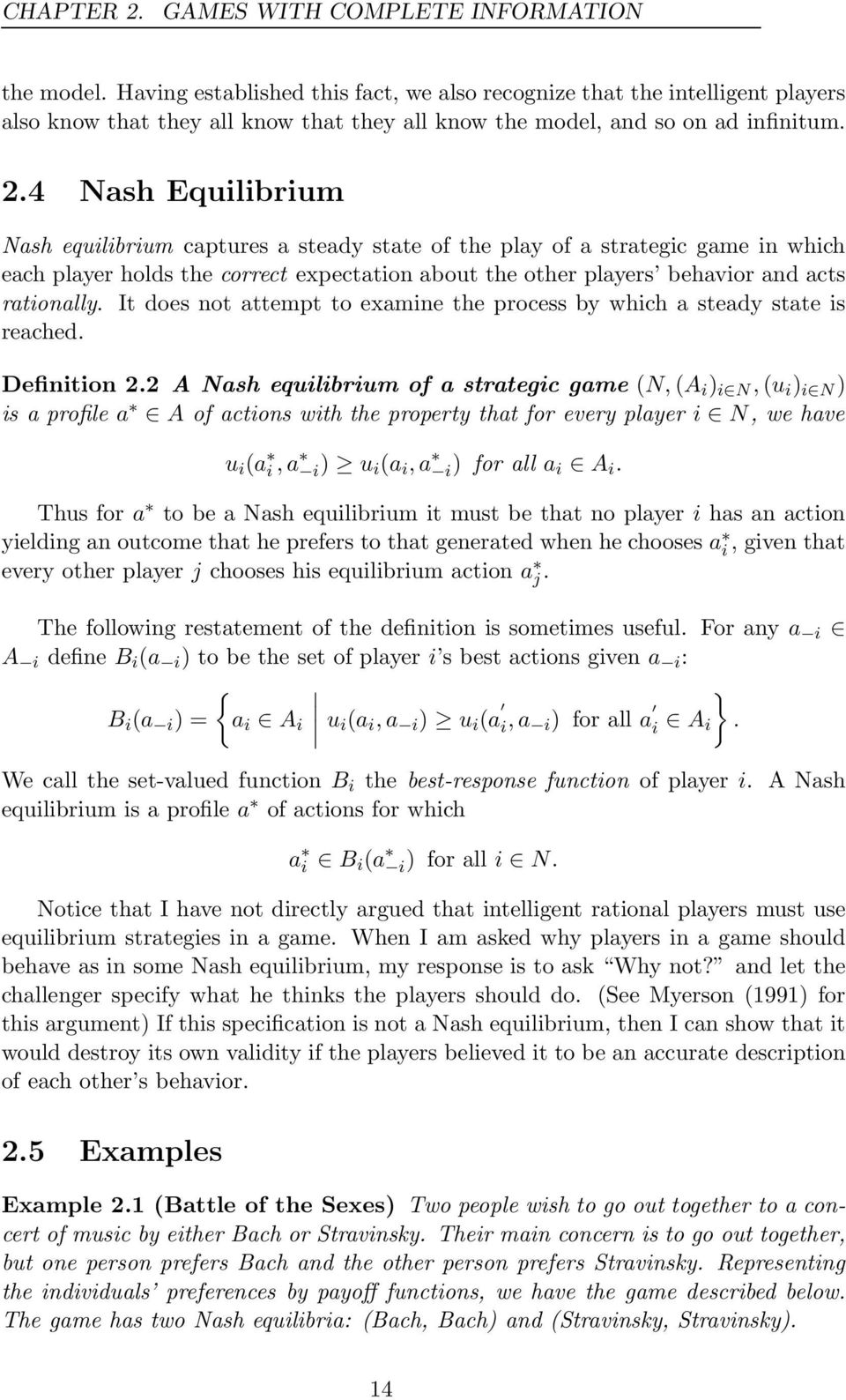
15 CHAPTER 2. GAMES WITH COMPLETE INFORMATION the model. Having established this fact, we also recognize that the intelligent players also know that they all know that they all know the model, and so on ad infinitum. 2.4 Nash Equilibrium Nash equilibrium captures a steady state of the play of a strategic game in which each player holds the correct expectation about the other players behavior and acts rationally. It does not attempt to examine the process by which a steady state is reached. Definition 2.2 A Nash equilibrium of a strategic game (N,(A i ) i N, (u i ) i N ) is a profile a A of actions with the property that for every player i N, we have u i (a i,a i) u i (a i,a i) for all a i A i. Thus for a to be a Nash equilibrium it must be that no player i has an action yielding an outcome that he prefers to that generated when he chooses a i, given that every other player j chooses his equilibrium action a j. The following restatement of the definition is sometimes useful. For any a i A i define B i (a i ) to be the set of player i s best actions given a i : { } B i (a i )= a i A i u i (a i,a i ) u i (a i,a i) for all a i A i. We call the set-valued function B i the best-response function of player i. A Nash equilibrium is a profile a of actions for which a i B i (a i) for all i N. Notice that I have not directly argued that intelligent rational players must use equilibrium strategies in a game. When I am asked why players in a game should behave as in some Nash equilibrium, my response is to ask Why not? and let the challenger specify what he thinks the players should do. (See Myerson (1991) for this argument) If this specification is not a Nash equilibrium, then I can show that it would destroy its own validity if the players believed it to be an accurate description of each other s behavior. 2.5 Examples Example 2.1 (Battle of the Sexes) Two people wish to go out together to a concert of music by either Bach or Stravinsky. Their main concern is to go out together, but one person prefers Bach and the other person prefers Stravinsky. Representing the individuals preferences by payoff functions, we have the game described below. The game has two Nash equilibria: (Bach, Bach) and (Stravinsky, Stravinsky). 14
16 CHAPTER 2. GAMES WITH COMPLETE INFORMATION Player 2 Bach Stravinsky Player 1 Bach 2, 1, Stravinsky, 1, 2 Example 2.2 (The Prisoner s Dilemma) Two suspects in a crime are put into separate cells. If they both confess, each will be sentenced to three years in prison. If only one of them confess, he will be freed and used as a witness against the other, who will receive a sentence of four years. If neither confess, they will both be convicted of a minor offense and spend one year in prison. Player 2 Don t confess Confess Player 1 Don t confess 3, 3, 4 Confess 4, 1, 1 Whatever one player does, the other prefers Confess to Don t confess, so that the game has a unique Nash equilibrium (Confess, Confess). Definition 2.3 An action a i is said to (weakly) dominate a i if for all a i A i, u i (a i,a i ) u i (a i,a i ), with a strict inequality for some a i A i. The strategy a i is weakly dominant if it (weakly) dominates every other action a i. If every player has a dominant action a i, then we will refer to a as a dominant strategy equilibrium. It is important to note that the unique Nash equilibrium of the Prisoner s dilemma is a dominant strategy equilibrium. 2.6 Existence of Nash Equilibrium Example 2.3 (Matching Pennies) Each of two people chooses either Head or Tail. If the choices differ, player 1 pays player 2 a dollar; if they are the same, player 2 pays player 1 a dollar. Each player cares only about the amount of money that he receives. A game that models this situation is shown below. The game Matching Pennies has no Nash equilibrium. Player 2 Head Tail Player 1 Head 1, 1 1, 1 Tail 1, 1 1, 1 Not every strategic game has a Nash equilibrium, as the game Matching Pennies shows. I now present some conditions under which the set of Nash equilibria of a 15

17 CHAPTER 2. GAMES WITH COMPLETE INFORMATION game is nonempty. An existence result has two purposes. First, if we have a game that satisfies the hypothesis of the result, then we know that there is some hope that our efforts to find an equilibrium will meet with success. Second, and more important, the existence of an equilibrium shows that the game is consistent with a steady state solution. To show that a game has a Nash equilibrium, it suffices to show that there is a profile a of actions such that a i B i (a i ) for all i N. Define the set valued function B : A A by B(a) = i N B i (a i ). Fixed point theorems give conditions on B under which there indeed exists a value of a for which a B(a ). The fixed point theorem that we use is due to Kakutani (1941). Lemma 2.1 (Kakutani s fixed point theorem (1941)) Let X be a compact convex subset of R n and let f : X X be a set valued function for which for all x X, the set f(x) is nonempty and convex the graph of f is closed (i.e., for all sequences {x n } and {y n } such that y n f(x n ) for all n, x n x and y n y, we have y f(x)). Then, there exists x X such that x f(x ). I omit the proof of Kakutani s fixed point theorem. A function u i : A R is said to be quasi-concave on A i if for any a i A i and any a i,a i A i, we have u i (βa i +(1 β)a i,a i) min{u i (a i,a i ),u i (a i,a i)} for any β [, 1]. Proposition 2.1 The strategic game (N,(A i ) i N, (u i ) i N ) has a (pure strategy) Nash equilibrium if for all i N, the set A i of actions of player i is a nonempty compact convex subset of a Euclidean space and the payoff function u i is continuous quasi-concave on A i. Proof of Proposition 2.1: Define B : A A by B(a) = i N B i (a i ) (where B i is the best response function of player i). For every i N, the set B i (a i )is nonempty since u i is continuous and A i is compact. This follows from Weierstrass s theorem: Any continuous real-valued function whose domain is a compact nonempty set has both the maximum and minimum of it. B i (a i ) is convex because u i is quasiconcave on A i. We shall check this. Let a i,a i B i(a i ). Set βa i +(1 β)a i for β [, 1]. This implies that u i (a i,a i ) u i (ã i,a i ) ã i A i u i (a i,a i ) u i (ã i,a i ) ã i A i 16

18 CHAPTER 2. GAMES WITH COMPLETE INFORMATION Since u i is quasi-concave on A i, we conduct the following computation: u i (βa i +(1 β)a i ) min{u i(a i,a i ),u i (a i,a i) u i (ã i,a i ) ã i A i This implies that βa i +(1 β)a i B i(a i ). Furthermore, B has a closed graph since u i is continuous. To see why, consider the following: we shall prove this by contradiction. Consider sequences {a n } and {b n } such that b n B(a n ) for each n, a n a and b n b as n, but we have b/ B(a). Then, there exists player i for whom b i is not a best response to a i. From this hypothesis, there is no loss of generality to assume that b i is a better response to a i than b i. Then, we have u i (b i,a i) >u i (b i,a i ). On the other hand, the fact that b n B(a n ) for each n implies that u i (b n i,a n i) u i (b i,a n i) n. This implies that u i exhibits a discontinuity at (b i,a i ), which contradicts the hypothesis that u i is continuous. Thus, by Kakutani s theorem, B has a fixed point. We have noted that any fixed point is a Nash equilibrium of the game. Note that this result asserts that a strategic game satisfying certain conditions has at least one Nash equilibrium. 2.7 Sealed-Bid Auctions with Complete Information An object is to be assigned to a player in the set {1,...,n} in exchange for a payment. Player i s valuation of the object is v i, and v 1 >v 2 > >v n >. The mechanism used to assign the object is a sealed-bid auction: the players simultaneously submit bids (nonnegative numbers), and the object is given to the player with the lowest index among those who submit the highest bid, in exchange for a payment The First Price Sealed-Bid Auction In a first-price auction, the payment that the winner makes is the price that he bids. I shall formulate the first price auction as a game with complete information. N = {1,...,n}: The set of players (bidders). B i =[, ) for each i N: The set of possible bids by player i. A generic bid by player i is denoted b i B i. u i (b) =u i (b 1,...,b n )=v i b i if player i is the lowest index among those who submit b i = max j N b j ; and u i (b) = otherwise: player i s payoff function. Claim 2.1 Player 1 obtains the object in all Nash equilibria. 17

19 CHAPTER 2. GAMES WITH COMPLETE INFORMATION Proof of Claim 2.1: Fix a Nash equilibrium b B 1 B n. Suppose, on the contrary, that player 1 does not obtain the object. Assume that player j 1is the winner. Because of rationality of player j, we have b j [,v j]. Set b 1 = b j + ε for ε> small enough so that v 1 > b 1 = b j + ε. Then, we have u 1 ( b 1,b 1) =v 1 b 1 >u 1 (b )=. This contradicts the hypothesis that b is a Nash equilibrium The Second Price Sealed-Bid Auction In a second price auction, the payment that the winner makes is the highest bid among those submitted by the players who do not win (so that if only one player submits the highest bid then the price paid is the second highest bid). I shall formulate the second price auction. N = {1,...,n}: The set of players (bidders). B i =[, ) for each i N: The set of possible bids by player i. A generic bid by player i is denoted b i B i. u i (b) =u i (b 1,...,b n )=v i max j i b j if b i > max j i b j ; and u i (b) = otherwise: player i s payoff function. Claim 2.2 In a second price auction, the bid v i of any player i is a weakly dominant action. Proof of Claim 2.2: Let b i = v i. Let b i be any other bid than b i. Consider two cases: (Case 1) b i >v i and (Case 2) b i <v i. Case 1: u i (b i,b i) = > u i ( b i,b i ) for b i B i with the property that bi > max j i b j >v i. For any other b i, we have u i (b i,b i) u i ( b i,b i ). Case 2: u i (b i,b i) =v i max j i b j > =u i ( b i,b i ) for any b i B i with the property that v i > max j i b j > b i. For any other b i, we have u i (b i,b i) u i ( b i,b i ). With the consideration of cases 1 and 2, we can conclude that b i = v i is a weakly dominant action. Claim 2.3 In a second price auction, there is a(n) ( inefficient ) Nash equilibrium in which the winner is not player 1. Proof of Claim 2.3: We construct the following action profile b : b j >v 1; 18

20 CHAPTER 2. GAMES WITH COMPLETE INFORMATION b 1 <v j; b i = for any i/ {1,j}. It remains to show that b is indeed a Nash equilibrium. It is relatively easy to check that no player has any profitable deviation Discontinuity of Payoff Functions in First Price Auctions Here I will illustrate that in first price auctions, the payoff functions may be discontinuous. This prevents us from using Kakutani s fixed point theorem to guarantee the existence of Nash equilibrium. To make this point, I will check all the conditions for Proposition 2.1. It turns out that all other conditions are satisfied except the continuity of payoff functions. In a first-price auction, the payment that the winner makes is the price that he bids. I shall formulate the first price auction as a game with complete information. Claim 2.4 B i is compact and convex. Proof of Claim 2.4: It is straightforward to see that the set [, b i ] is compact and convex. (Do you see why it is straightforward?) Claim 2.5 u i : B R is quasi-concave on B i. Proof of Claim 2.5: We focus on player i. Fix any other players bids b i B i. Let any two bids by player i be b i,b i B i. We consider the following cases: Case 1: Player i is the winner both when the submitted bids are (b i,b i ) and (b i,b i). Note that b i max j i b j and b i max j i b j. Note also that u i (b i,b i )=v i b i and u i (b i,b i) = v i b i. Set αb i +(1 α)b i for α [, 1]. We know that αb i +(1 α)b i max j i b j. Hence, i is the winner when the submitted bids are (αb i +(1 α)b i,b i). The resulting payoff of player i is examined as follows: u i ( αb i +(1 α)b i,b i ) [ ] = v i αb i +(1 α)b i v i max{b i,b i} = min{v i b i,v i b i } = min{u i (b i,b i ),u i (b i,b i)}. Case 2: Player i is not the winner both when the submitted bids are (b i,b i ) and (b i,b i). 19
21 CHAPTER 2. GAMES WITH COMPLETE INFORMATION Note that max j i b j b i and max j i b j b i. Note also that u i(b i,b i ) = u i (b i,b i) =. Set αb i +(1 α)b i for α [, 1]. Then, we know that max j i b j αb i +(1 α)b i. Hence player i is not the winner for the object. Namely, ) u i (αb i +(1 α)b i,b i ==u i (b i,b i )=u i (b i,b i). Case 3: Player i is the winner when the submitted bids are (b i,b i ) and is not the winner when the submitted bids are (b i,b i). Note that b i max j i b j and max j i b j b i. Note also that u i(b i,b i )=v i b i and u i (b i,b i) =. Set αb i +(1 α)b i for α [, 1]. Then, we have [ ] ) u i (αb i +(1 α)b i,b v i αb i +(1 α)b i if i is the winner i = ( ) = u i (b i,b i) otherwise Since b i b i, we know [ ] v i αb i +(1 α)b i v i b i = u i (b i,b i ). Thus, we can conclude ) u i (αb i +(1 α)b i,b i min{u i (b i,b i ),u i (b i,b i)}. Claim 2.6 u i : B R is not continuous. Proof of Claim 2.6: Consider the first price auction in which there are two bidders. Let v 1 = 3 and v 2 = 2 as the valuations for the object of player 1 and 2, respectively. Focus on a particular bidding strategies: b 1 = b 2 = 1. Set bk 2 = b 2 +1/k. Consider a sequence of bids by player 1 and 2 as {b k 1,bk 2 } k=1 for which bk 1 = b 1 = 1 for each k. Note that (b k 1,bk 2 ) (b 1,b 2 )ask. Consider player 2 s payoff function. Observe that player 2 is the winner for the object whenever the submitted bids are (b k 1,bk 2 ) for any k<. Therefore, we have that for any k<, u 2 (b k 1,b k 2)=v 2 b k 2 =1 1/k. Thus, u 2 (b k 1,bk 2 ) 1ask. On the other hand, player 1 is the winner for the object when the submitted bids are (b 1,b 2 )=(1, 1). Then, we have u 2(b 1,b 2 )=. Hence, u 2 displays a discontinuity at (b 1,b 2 ). 2
22 Chapter 3 Games with Incomplete Information 3.1 A Motivating Example This example is adapted from An Introduction to Game Theory by Martin J. Osborne. Consider a variant of the situation modeled by Battle of the Sexes in which player 1 (a man) is unsure whether player 2 (a woman) prefers to go out with him (player 1) or to avoid him, whereas player 2, as before, knows player 1 s preferences. Namely, player 1 always wants to go out with her. Specifically, suppose player 1 thinks that with probability 1/2, player 2 wants to go out with him, and with probability 1/2, player 2 wants to avoid him. 2 wishes to meet 1 Player 2 w.p. 1/2 Bach Stravinsky Player 1 Bach 2, 1, Stravinsky, 1, 2 2 wishes to avoid 1 Player 2 w.p. 1/2 Bach Stravinsky Player 1 Bach 2,, 2 Stravinsky, 1 1, I can think of there being two states, one in which the players payoffs are given in the top table and one in which the players payoffs are given in the bottom table. The notion of Nash equilibrium for a strategic game models a steady state in which each player s beliefs about other players actions are correct, and each player 21
23 CHAPTER 3. GAMES WITH INCOMPLETE INFORMATION acts optimally, given his beliefs. I wish to generalize this notion to fit the current situation. From player 1 s point of view, player 2 has two possible types, one whose preferences are given in the top table and one whose preferences are given in the bottom table. Player 1 does not know player 2 s type, so to choose an action rationally, he needs to form a belief about the action of each type of player 2. The expected payoff Player 2 of player 1 (B,B) (B,S) (S,B) (S,S) Player 1 B S 1/2 1/2 1 For this situation I define a (pure strategy) Nash equilibrium to be a triple of actions, one for each player 1 and one for each type of player 2, with the property that the action of player 1 is optimal, given the actions of the two types of player 2 (and player 1 s belief about the state) the action of each type of player 2 is optimal, given the action of player 1. Claim 3.1 (B,(B,S)) constitutes a Nash equilibrium of the extended game. I omit the proof of Claim Bayesian Games A game with incomplete information is a game in which, at the first point in time when the players can begin to plan their moves in the game, some players already have private information about the game that other players do not know. There are several basic issues in a strategic situation about which players might have different information: How many players are actually in the game? What actions are feasible for each player? How will the outcome depend on the actions chosen by the players? And what are the players preferences over the set of possible outcomes? Harsanyi ( ) argued that all of these issues can be modeled in a unified way. Uncertainty about whether a player is in the game can be converted into uncertainty about his set of feasible actions, by allowing him only one feasible action ( non-participation ) when he is supposed to be out of the game. Uncertainty about whether a particular action is feasible for player i can in turn be converted into uncertainty about how outcomes depend on actions, by saying that player i will get some very bad outcomes if he uses an action that is supposed to be infeasible. (i.e., I can set u i (a i,a i )= for any a i A i if a i is infeasible.) Uncertainty about 22
24 CHAPTER 3. GAMES WITH INCOMPLETE INFORMATION how outcomes depend on actions and uncertainty about preferences over outcomes can be unified by modeling each player s utility as a function directly from the set of profiles of players actions to the set of possible utility payoffs. Thus, we can model all the basic uncertainty in the game as uncertainty about how utility payoffs depend on profiles of actions. This uncertainty can be represented formally by introducing an unknown parameter ω into the utility function. 3.3 Formalizing Bayesian Games The model of a Bayesian game is designed for dealing with incomplete information. As for a strategic game, two primitives of a Bayesian game are a set N of players and a profile (A i ) i N of set of actions. We model the players uncertainty about each other by introducing a set Ω of possible states of nature, each of which is description of all the players relevant characteristics. For convenience, we assume that Ω is finite. Each player i has a prior belief about the state of nature given by a probability measure p i on Ω. In any given play of the game, some state of nature ω Ω is realized. We model the players information about the state of nature by introducing a profile (τ i ) i N of signal functions, τ i (ω) being the signal that player i observes, before choosing his action, when the state of nature is ω. Let T i be the set of all possible values of τ i ; we refer to T i as the set of types of player i. We assume that p i (τi 1 (t i )) > for all t i T i (player i assigns positive prior probability to every member of T i ). If player i receives the signal t i T i then he deduces that the state is in the set τi 1 (t i ); his posterior belief about the state that has been realized assigns to each state ω Ω the probability p i (ω)/p i (τi 1 (t i )) if ω τi 1 (t i ) and the probability zero otherwise (the probability of ω conditional on τi 1 (t i )). As an example, if τ i (ω) =ω for all ω Ω then player i has full information about the state of nature. Alternatively, if Ω = i N T i and for each player i the probability measure p i is a product measure on Ω and τ i (ω) =ω i then the players signals are independent and player i does not learn from the signal anything about the other players information. Definition 3.1 A Bayesian game consists of a finite set N (the set of players) a finite set Ω (the set of states) and for each player i N a set A i (the set of actions available to player i) a finite set T i (the set of signals that may be observed by player i) and a function τ i :Ω T i (the signal function of player i) 23
25 CHAPTER 3. GAMES WITH INCOMPLETE INFORMATION a probability measure p i on Ω (the prior belief of player i) for which p i (τ 1 i (t i )) > for all t i T i. a payoff function u i : A Ω R, where A = j N A j. Note that this definition allows the players to have different prior beliefs. Harsanyi (1968) call a Bayesian game consistent when p 1 = = p n. Namely, a consistent Bayesian game describes a situation in which all players share a common prior on Ω. The common prior assumption is called the Harsanyi s doctrine in Aumann (1987). Harsanyi (1968) argued eloquently that differences in subjective probabilities should be traced exclusively to differences in information - that there is no rational basis for people who have always been fed precisely the same information to maintain different subjective probabilities. Frequently the model is used in situations in which a state of nature is a profile of the players valuations of an object. Definition 3.2 A Nash equilibrium of a Bayesian game (N,Ω, (A i ) i N, (T i ) i N, (τ i ) i N, (u i ) i N ) is a Nash equilibrium of the strategic game defined as follows: The set of players is the set of all pairs (i, t i ) for i N and t i T i. The set of actions of each player (i, t i ) is A i. The payoff function of each player (i, t i ) is defined by ( p i ω τ 1 i (t i ) ) u i (a; ω), ω τ 1 i (t i ) ( where p i ω τ 1 i (t i ) ) is the probability of ω conditional on τi 1 ( (t i ), i.e., p i ω τ 1 i (t i ) ) = p i (ω)/p i (τi 1 (t i )). In a Nash equilibrium of a Bayesian game, each player chooses the best action available to him given the signal that he receives and his belief about the state and the other players actions that he deduces from this signal. 3.4 Example: Second-Price Auction Consider a variant of the second price sealed-bid auction in which each player i knows his own valuation v i but is uncertain of the other players valuations. Specifically, suppose that the set of possible valuations is the finite set V and each player believes that every other player s valuation is drawn independently from the same distribution over V. We can model this situation as the Bayesian game in which the set N of players is {1,...,n} the set Ω of states is V n (the set of profiles of valuations) 24
26 CHAPTER 3. GAMES WITH INCOMPLETE INFORMATION the set A i of actions of each player i is R + the set T i of signals that i can receive is V the signal function τ i of i is defined by τ i (v 1,...,v n )=v i the prior belief p i of i is given by p i (v 1,...,v n )=Π n j=1 π(v j) for some probability distribution π over V player i s payoff function is represented by { vi max u i (a; v 1,...,v n )= j i a j if i is the lowest index for whom a i a j j otherwise. Exercise 3.1 Confirm that this game has a Nash equilibrium a in which a (i, v i )= v i for all i N and v i V = T i (each player bids his valuation). Show also that this Nash equilibrium is a weakly dominant equilibrium. 25
27 Chapter 4 Independent Private Values (IPV) Auctions with Symmetric Bidders 4.1 Continuous Distributions Given a random variable X, which takes on values in [,ω], we define its cumulative distribution function F :[,ω] [, 1] by F (x) = Prob [X x] the probability that X takes on a value not exceeding x. By definition, the function F is nondecreasing and satisfies F () = and F (ω) = 1 (if ω =, then lim x F (x) = 1). In this course, we always suppose that F is increasing and continuously differentiable. The derivative of F is called the associated probability density function and is usually denoted by the corresponding lowercase letter f F. By assumption, f is continuous and we will suppose that for all x (,ω), f(x) is positive. The interval [,ω] is called the support of the distribution. If X is distributed according to F, then the expectation of X is E(X) = ω xf(x)dx and if γ :[,ω] R is some arbitrary function, then the expectation of γ(x) is analogously defined as E[γ(X)] = ω γ(x)f(x)dx 26
28 CHAPTER 4. INDEPENDENT PRIVATE VALUES (IPV) AUCTIONS WITH SYMMETRIC BIDDERS The conditional expectation of X given that X < x is 4.2 Order Statistics E [X X<x]= 1 F (x) x tf(t)dt. Let X 1,X 2,...,X n be n independently draws from a distribution F with associated density f. Let Y (n) 1,Y (n) 2,...,Y n (n) be a rearrangement of these so that Y (n) 1 Y (n) 2 Y (n) n. The random variables Y (n) k, k = 1, 2,..., n are referred to as order statistics. Let F (n) k denote the distribution of Y (n) k, with corresponding probability density. When the sample size n is fixed and there is no ambiguity, I will function f (n) k simply write Y k instead of Y (n) k, F k instead of F (n) k and f k instead of f (n) k. We will typically be interested in properties of the highest and second highest order statistics, Y 1 and Y Highest Order Statistic The event that Y 1 y is the same as the event: for all k, X k y. Since each X k is an independent draw from the same distribution F, we have that F 1 (y) =[F (y)] n = F (y) n The associated probability density function is f 1 (y) =nf (y) n 1 f(y) Second-Highest Order Statistic The event that Y 2 is less than or equal to y is the union of the following disjoint events: (1) all X k s are less than or equal to y, and (2) n 1 of the X k s are less than or equal to y and one is greater than y. There are n different ways in which (2) can occur, so we have that F 2 (y) = F (y) n + nf (y) n 1 (1 F (y)) } {{ } } {{ } (1) (2) = nf (y) n 1 (n 1)F (y) n. The associated probability density function is f 2 (y) =n(n 1)(1 F (y))f (y) n 2 f(y) 27
29 CHAPTER 4. INDEPENDENT PRIVATE VALUES (IPV) AUCTIONS WITH SYMMETRIC BIDDERS 4.3 The Symmetric Model There is a single object for sale and n potential buyers are bidding for the object. Bidder i assigns a value of X i to the object - the maximum amount bidder i is willing to pay for the object. Each X i is independently and identically distributed (sometimes abbreviated as i.i.d.) on some interval [,ω] according to the increasing distribution function F. It is assumed that F admits a continuous density f F and has full support. It is also assumed that E(X i ) <. Bidder i knows the realization x i of X i and only that other bidders values are independently distributed according to F. Bidders seek to maximize their expected profits. All components of the model other than the realized values are assumed to be commonly known to all bidders. In particular, the distribution F is common knowledge, as is the number of bidders. Finally, it is also assumed that bidders are not subject to any liquidity or budget constraints. Thus, each bidder is both willing and able to pay up to his or her value. I emphasize that the distribution of values is the same for all bidders and I will refer to this situation as one involving symmetric bidders. Both a first price sealedbid and a second price sealed-bid auction formats determine a Bayesian game among the bidders. A strategy for bidder i is a function β i :[,ω] R +, which determines his bid for any value. I will be interested in comparing the outcomes of a symmetric equilibrium - an equilibrium in which all bidders follow the same strategy - of one auction with a symmetric equilibrium of the other. We ask the following questions: 1. What are symmetric equilibrium strategies in a first price auction (I) and a second price auction (II)? 2. From the point of view of the seller, which of the two auction formats yields a higher expected selling price in equilibrium? Second Price Sealed-Bid Auctions In a second price auction, each bidder submits a sealed bid of b i, and given these bids, the payoffs are: { xi max Π i = j i b j if b i > max j i b j if b i < max j i b j I assume that if there is a tie, so that b i = max j i b j, the object goes to each winning bidder with equal probability. Proposition 4.1 In a second-price sealed-bid auction, it is a weakly dominant strategy to bid according to β II (x) =x. 28
30 CHAPTER 4. INDEPENDENT PRIVATE VALUES (IPV) AUCTIONS WITH SYMMETRIC BIDDERS Proof of Proposition 4.1: Consider a bidder i, with no loss of generality, and suppose that p = max j i b j is the highest competing bid. By bidding x i, bidder i will win if x i >pand not if x i <p. Suppose, by way of contradiction, that he bids z i <x i.ifx i >z i p, then he still wins and his profit is still x i p. Ifp>x i >z i, he still loses. However, if x i >p>z i, then he loses. However, if he had bid x i,he would have made a positive profit. Thus, bidding less than x i can never increase his profit but in some circumstances may actually decrease it. A similar argument shows that it is not profitable to bid more than x i. It should be noted that the argument in Proposition 4.1 relied neither on the assumption that bidders values were independently distributed nor the assumption that they were identically so. Only the assumption of private values is important The expected payment of Second Price Auctions Fix a bidder, say 1, and let the random variable Y 1 Y (n 1) 1 denote the highest value among the n 1 remaining bidders. (i.e., Y (n 1) 1 is the highest order statistic of X 2,X 3,...,X n. Let G denote the distribution function of Y (n 1) 1. Then, for all y, we have G(y) =F (y) n 1. In a second price auction, the expected payment by a bidder with value x can be written as m II (x) = Prob[Win] E [2nd highest bid x is the highest bid] = Prob[Win] E [2nd highest bid x is the highest value] = G(x) E [ Y 1 Y1 <x ] First Price Sealed-Bid Auctions In a first price auction, each bidder submits a sealed bid of b i, and given these bids, the payoffs are { xi b Π i = i if b i > max j i b j if b i < max j i b j If there is more than one bidder with the highest bid the object goes to each such bidder with equal probability. In a first price auction, no bidder would bid an amount equal to his value since this would only guarantee a payoff of. Fixing the bidding behavior of others, the bidder faces a simple trade off - an increase in the bid will increase the probability of winning while, at the same time reducing the gains from winning. Suppose that all bidders j 1 follow the symmetric, increasing and differentiable equilibrium strategy β I β :[,ω] [, ). Suppose bidder 1 receives a signal, X 1 = x, and bids b. I wish to determine the optimal b. Claim 4.1 b β(ω) and β() =. 29
31 CHAPTER 4. INDEPENDENT PRIVATE VALUES (IPV) AUCTIONS WITH SYMMETRIC BIDDERS Proof of Claim 4.1: It can never be optimal to choose a bid b>β(ω) since in that case, the bidder would win for sure and could do better by reducing his bid slightly so that he still wins for sure but pays less. A bidder with value would never submit a positive bid since he would make a loss if he were to win the auction. Bidder 1 wins the auction whenever he submits the highest bid - that is, whenever max j 1 β(x j ) <b. Since β is increasing, max j 1 β(x j )=β(max j 1 X j )=β(y 1 ), where as before, Y 1 Y (n 1) 1, the highest of n 1 values. Bidder 1 wins whenever β(y 1 ) <bor equivalently, whenever Y 1 <β 1 (b). His expected payoff is therefore G ( β 1 (b) ) (x b), where, G is the distribution of Y 1. Maximizing this with respect to b yields the first order condition: g ( β 1 (b) ) β (β 1 (b)) (x b) G ( β 1 (b) ) =, where g = G is the density of Y 1. 1 At a symmetric equilibrium, b = β(x), and thus the above first order condition yields the differential equation or equivalently, and since β() =, we have G(x)β (x)+g(x)β(x) =xg(x) d (G(x)β(x)) = xg(x) dx x 1 β(x) = yg(y)dy G(x) = E [Y 1 Y 1 <x] Symmetric Equilibrium of First Price Auctions Suppose that all bidders j 1 follow the symmetric, increasing and differentiable equilibrium strategy β I :[,ω] [, ). Proposition 4.2 Symmetric equilibrium strategies in a first price auction are given by β I (x) =E [Y 1 Y 1 <x] where Y 1 is the highest of n 1 independently drawn values. 1 Define y = β 1 (b). Then, we have b = β(y) and obtain db/dy = β (y) =β (β 1 (b)) after taking differentiation with respect to b. 3
32 CHAPTER 4. INDEPENDENT PRIVATE VALUES (IPV) AUCTIONS WITH SYMMETRIC BIDDERS Proof of Proposition 4.2: Suppose that all but bidder i follow the strategy β I β given above. We will argue that in that case it is optimal for bidder i to follow β also. First, notice that β is an increasing and continuous function. Thus, in equilibrium the bidder with the highest value submits the highest bid and wins the auction. Denote by z = β 1 (b) the value for which b is the equilibrium bid, that is, β(z) =b. In other words, bidder i pretends to receive signal z by bidding b even when he receives x as the true signal. Then we can write bidder i s expected payoff from bidding b = β(z) when his value is x as follows: Π(b, x) =Π(β(z),x) = G(z)[x β(z)] = G(z)x G(z)E [Y 1 Y 1 <z] In particular, we have = G(z)x z yg(y)dy = G(z)x G(z)z + = G(z)(x z)+ Π(β(x),x)= z x z G(y)dy ( integration by parts). G(y)dy G(y)dy. Then, what we want is Π(β(x),x) Π(β(z),x). We calculate Π(β(x),x) Π(β(z),x)=G(z)(z x) z x G(y)dy, regardless of whether z x or z x. To see why this is true, look at Figure 2.1 in p 18 of Krishna s book (22). This implies that β is a symmetric equilibrium strategy. Using integration by parts, the equilibrium bid can be rewritten as Observe β I (x) =x G(y) G(x) = x G(y) dy x. G(x) [ ] F (y) n 1. F (x) Then, as the number of bidders (i.e., n) increases, the equilibrium bid β I (x) approaches x. 31
33 CHAPTER 4. INDEPENDENT PRIVATE VALUES (IPV) AUCTIONS WITH SYMMETRIC BIDDERS Example 4.1 Values are uniformly distributed on [, 1]. Then we know that F (x) = x. Thus, G(x) =F (x) n 1 = x n 1. g(x) =G (x) =(n 1)x n 2. [ β I (x) = E Y (n 1) ] (n 1) 1 Y 1 <x x 1 = yg(y)dy G(x) 1 x = x n 1 (n 1)y n 1 dy [ ] 1 (n 1)y n x = x n 1 n = n 1 n x Expected Payment in First Price Auctions In a first price auction, the winner pays what he bid and thus the expected payment by a bidder with value x is [ ] m I (x) = Prob{Win} Amount bid = F (x) (n 1) E Y (n 1) 1 Y (n 1) 1 <x. This is the same as in a second price auction. 4.4 Multiple Integrals and Stochastic Dominance Multiple Integrals Let X R and Y R. Let h : X Y R. For any x X, we can define h x : Y R with the property that h x (y) =h(x, y). We can analogously define h y : X R for any y Y. Theorem 4.1 (Fubini s Theorem) Consider a real-valued function h : X Y R satisfying the following two properties h x (y)dy < x X Y h y (x)dx < y Y. X Then, the integration of h over X Y does not depend on the order of integration. Namely, [ ] h(x, y)dxdy = h(x, y)dy dx X Y X Y [ ] = h(x, y)dx dy. I omit the proof of Fubini s theorem. 32 Y X
34 CHAPTER 4. INDEPENDENT PRIVATE VALUES (IPV) AUCTIONS WITH SYMMETRIC BIDDERS First-Order Stochastic Dominance Given two distribution functions F and G, I say that F (first-order) stochastically dominates G if for all z [,ω], F (z) G(z) Suppose u :[,ω] R is an increasing and differentiable function. If X stochastically dominates Y, and these have distribution functions F and G, respectively, then = E[u(X)] E[u(Y )] ω u(z)[f(z) g(z)] dz ω = [u(z)(f (z) G(z))] ω u (z)[f (z) G(z)] dz ( integration by parts) = ω u (z)[f (z) G(z)] dz ( u > and F G) Second-Order Stochastic Dominance Suppose X is a random variable with distribution function F. Let Z be a random variable whose distribution conditional on X = x, H( X = x) is such that for all x, E[Z X = x] =. Suppose Y = X + Z is the random variable obtained from first drawing X from F and then for each realization X = x, drawing a Z from the conditional distribution H( X = x) and adding it to X. Let G be the distribution of Y so defined. I will then say that G is a mean-preserving spread of F. Definition 4.1 f : D R is a concave function if for all x, y D, f (αx +(1 α)y) αf(x)+(1 α)f(y) α [, 1]. While the random variables X and Y have the same mean - that is, E[X] =E[Y ] - the variable Y is more spread-out than X since it is obtained by adding a noise variable Z to X. Now suppose u :[,ω] R is a concave function. Then I have the following Jensen s inequality. Jensen s Inequality: Suppose that u :[,ω] R is concave. Then, Using Jensen s inequality, I obtain E[u(X)] u (E[X]) [ E Y [u(y )] = E X EZ [u(x + Z)] ] X = x [ ( [ ])] E X u EZ X + Z X = x = E X [u(x)] 33
35 CHAPTER 4. INDEPENDENT PRIVATE VALUES (IPV) AUCTIONS WITH SYMMETRIC BIDDERS Given two distributions F and G with the same mean, I say that F second-order stochastically dominates G if for all concave functions u :[,ω] R, ω u(x)f(x)dx ω u(y)g(y)dy. Second-order stochastic dominance is also equivalent to the statement that for all x, with an equality when x = ω. x G(y)dy x F (x)dx 4.5 Revenue Equivalence between the First and Second Price Auctions I will show the revenue equivalence between first price and second price auctions below. Proposition 4.3 (Revenue Equivalence) With independently and identically distributed private values, the expected revenue in a first price auction is the same as the expected revenue in a second price auction. Proof of Proposition 4.3: Let G(x) = F (x) n 1 be the probability that a particular bidder wins the auction and let g(x) =G (x) =(n 1)F (x) n 2 f(x) be the associated density function. The ex ante expected payment of a particular bidder in either auction is E [ m A (X) ] ω = m A (x)f(x)dx ω ( x ) = yg(y)dy f(x)dx, where A = I or II. Interchanging the order of integration, I obtain that E [ m A (X) ] ω ( ω ) = f(x)dx yg(y)dy = ω y y(1 F (y))g(y)dy The expected revenue accruing to the seller E [ R A] is just n (i.e., the number of bidders) times the ex ante expected payment of an individual bidder, E [ R A] = n E [ m A (X) ] = n = ω ω = E [Y2 n ], 34 y(1 F (y))g(y)dy yf n 2 (y)dy
36 CHAPTER 4. INDEPENDENT PRIVATE VALUES (IPV) AUCTIONS WITH SYMMETRIC BIDDERS where f n 2 (y) =n(n 1)(1 F (y))f (y)n 2 f(y) and g(y) =(n 1)F (y) n 2 f(y). In either case, the expected revenue is just the expectation of the second highest value. 4.6 Revenue Comparison between the First and Second Price Auctions The next proposition shows that the risk averse, revenue maximizing seller prefers first price auction to second price auction. Proposition 4.4 With independently and identically distributed private values, the distribution of equilibrium prices in a second price auction is a mean-preserving spread of the distribution of equilibrium prices in a first price auction. Proof of Proposition 4.4: The revenue in a second price auction is just the random variable ( R II ) = Y (n) 2 ; the revenue in a first price auction is the random variable R I = β Y (n) 1, where β β I is the symmetric equilibrium strategy. Now we can write E [ R II R I = p ] [ ] = E Y (n) 2 Y (n) 1 = β 1 (p) But for all y, we know [ E Since Y (n) 2 Y (n) ] 1 = y Y (n) 1 Using this, we can write E [ R II R I = p ] [ = E [ = E Y (n 1) 1 n 1 { }} { Y (n) 2 Y n (n) Y (n 1) y Y (n 1) 1 Y (n 1) n 1 } {{ } n 1 Y (n 1) 1 Y (n 1) ] 1 <y ] 1 <β 1 (p) = β ( β 1 (p) ) ( β I (x) =E[Y 1 Y 1 <x] ) = p Since E [ R II R I = p ] = p, there exists a random variable Z such that the distribution of R II is the same as that of R I + Z and E[Z R I = p] =. Therefore, the distribution of R II is a mean-preserving spread of that of R I. 35
37 CHAPTER 4. INDEPENDENT PRIVATE VALUES (IPV) AUCTIONS WITH SYMMETRIC BIDDERS 4.7 Hazard Rates Let F be a distribution function with support [,ω]. The hazard rate of F is the function λ :[,ω) R + defined by λ(x) f(x) 1 F (x) If F represents the probability that some event will happen before time x, then the hazard rate at x represents the instantaneous probability that the event will happen at x, given that it has not happened until time x. Note that λ(x) as x ω. Observe λ(x) = d ln(1 F (x)). dx Solving this differential equation, we have F (x) =1 exp ( x ) λ(t)dt. This shows that any arbitrary function λ :[,ω) R + such that for all x<ω, x λ(t)dt < and x lim x ω λ(t)dt = is the hazard rate of some distribution. If for all x, λ(x) is constant, say λ(x) λ>, then, the associated distribution results in the exponential distribution whose expectation E[X] = 1/λ. 4.8 Reserve Price F (x) =1 exp( λx) In the analysis so far, I have implicitly assumed that the seller parts with the object at whatever price it will be sold. In many instances, sellers reserve the right to not sell the object if the price determined in the auction is lower some threshold amount, say r>. Such a price is called the reserve price. What I will show here is to extend the revenue equivalence to the equivalence between the first and second price auctions with reserve price Reserve Prices in Second Price Auctions Since the price at which the object is sold can never be lower than r, no bidder with a value x<rcan make a positive profit in the auction. In a second price auction, a reserve price makes no difference to the behavior of the bidders. The expected 36
38 CHAPTER 4. INDEPENDENT PRIVATE VALUES (IPV) AUCTIONS WITH SYMMETRIC BIDDERS payment of a bidder with value r is now just rg(r), and the expected payment of a bidder with value x r is m II (x, r) =rg(r)+ x r yg(y)dy since the winner pays the reserve price r whenever the second-highest bid is below r Reserve Prices in First Price Auctions If β I is a symmetric equilibrium of the first price auction with reserve price r, it must be that β I (r) =r. In all other respects, the analysis of a first price auction is unaffected, and we obtain a symmetric equilibrium bidding strategy for any bidder with value x r is [ β I (x) = E max{y (n 1) 1,r} ] Y (n 1) 1 <x r 1 = rg(y)dy + 1 G(x) G(x) = r G(r) G(x) + 1 x yg(y)dy G(x) The expected payment of a bidder with value x r is m I (x, r) = G(x) β I (x) r = rg(r)+ x r x r yg(y)dy yg(y)dy Thus, we conclude that the revenue equivalence theorem can be generalized to the reserve price auctions Revenue Effects of Reserve Prices Let A denote either the first (A = I) or second (A = II) price auction. In both, the expected payment of a bidder with value r is rg(r). Recall that the expected payment of a bidder with value x r is m A (x, r) =rg(r)+ x r yg(y)dy. 37
39 CHAPTER 4. INDEPENDENT PRIVATE VALUES (IPV) AUCTIONS WITH SYMMETRIC BIDDERS Analogous to the previous calculation for revenue equivalence, the ex ante expected payment of a bidder is now E [ m A (X, r) ] = ω r = rg(r) m A (x, r)f(x)dx ω r f(x)dx + = r(1 F (r))g(r)+ = r(1 F (r))g(r)+ ω r ω r ω r ( x ) yg(y)dy r ( ω ) f(x)dx y y(1 F (y))g(y)dy f(x)dx yg(y)dy ( Fubini s theorem) Suppose that the seller would derive a value x [,ω] from its use. The the overall expected payoff of the seller from setting a reserve price r x is Π = n E [ m A (X, r) ] + F (r) n x = nr(1 F (r))g(r)+n ω r y(1 F (y))g(y)dy + F (r) n x In order to investigate the revenue maximizing reserve price from the seller s perspective, we differentiate Π with respect to r, and thereafter do the following computation: dπ dr = n(1 F (r))g(r) nrf(r)g(r)+nr(1 F (r))g(r)+n d dr + nf (r) n 1 f(r)x [ ω = n [1 F (r) rf(r)] G(r)+nF (r) n 1 f(r)x = n [1 F (r) rf(r)] G(r)+nG(r)f(r)x ( G(r) =F (r) n 1 ) = n [1 (r x )f(r)/(1 F (r))] (1 F (r))g(r) = n [1 (r x )λ(r)] (1 F (r))g(r) Note that [ d ω ] y(1 F (y))g(y)dy = r(1 F (r))g(r). dr r Do you see why? Let H (y) =y(1 F (y))g(y). Then, we have [ d ω ] y(1 F (y))g(y)dy = d dr r dr [H(ω) H(r)] = H (r). If we evaluate the derivative of Π at r = x, we obtain dπ dr = n(1 F (x ))G(x ) r=x > if x > 38 r ] y(1 F (y))g(y)dy
40 CHAPTER 4. INDEPENDENT PRIVATE VALUES (IPV) AUCTIONS WITH SYMMETRIC BIDDERS If x =, we have dπ dr = n [1 rλ(r)] (1 F (r))g(r) Observe that dπ /dr = if r =. Now, consider r very close to such that λ(r) <. Then, for such a small r, we have dπ /dr >. On the other hand, if we take r big enough, we have dπ /dr <. Thus, regardless of whether x > or x =,a revenue maximizing seller should always set a reserve price that exceeds his value The Optimal Reserve Price in a Second Price Auction Consider a second price auction with two bidders and suppose x =. By setting a positive reserve price r, the seller faces a trade-off between the following two events: 1. (LOSS) if the highest value among the bidders, Y 1, is smaller than r, the object will remain unsold. 2. (GAIN) while the highest value Y 1 exceeds r, the second-highest value, Y 2,is smaller than r. The probability of the first event is F (r) 2 and the loss is at most r. So for small r, the expected loss is at most rf(r) 2. The probability of the second event is 2F (r)(1 F (r)) (Do you see why?), and for small r, the gain is of order r, so the expected gain is of order 2rF(r)(1 F (r)). Thus, the expected gain from setting a small reserve price exceeds the expected loss. The relevant first-order condition implies that the optimal reserve price r must satisfy r λ(r )=1 r = 1 λ(r ) If λ( ) is increasing, this condition is also sufficient and it is remarkable that the optimal reserve price does not depend on the number of bidders Entry Fees as a Substitute of Reserve Prices An alternative instrument that the seller can also use to exclude buyers with low values is an entry fee a fixed and non-refundable amount that bidders must pay the seller prior to the auction in order to be able to submit bids. An entry fee is the price of admission to the room of bidders can be excluded by asking each bidder to pay an entry fee e such that e = r G(y)dy Thus, the exclusion effect of a reserve price r can be replicated with an entry fee of e as determined above. 39
41 CHAPTER 4. INDEPENDENT PRIVATE VALUES (IPV) AUCTIONS WITH SYMMETRIC BIDDERS 4.9 The Revenue Equivalence Principle We say that an auction is standard if the rules of the auction dictate that the person who bids the highest amount is awarded the object. An example of a nonstandard method is a lottery in which the chances that a particular bidder wins is the ratio of his bid to the total bid by all. Given a standard auction form, A, and a symmetric equilibrium β A of the auction, let m A (x) be the equilibrium expected payment by a bidder with value x. Proposition 4.5 (The Revenue Equivalence Principle) Suppose that values are independently and identically distributed and all bidders are risk neutral. Then any symmetric and increasing equilibrium of any standard auction, such that the expected payment of a bidder with value zero is zero, yields the same expected revenue to the seller. Proof of Proposition 4.5: Consider a standard auction form, A, and fix a symmetric equilibrium β of A. Let m A (x) be the equilibrium expected payment in auction A by a bidder with value x. Suppose that β is such that m A () =. Consider a particular bidder i and suppose other bidders are following the equilibrium strategy β. Suppose that bidder i with value x contemplates a different bid β(z) instead of the equilibrium bid β(x). This means that bidder i with value x pretends that he received a different value z in order to seek a profitable deviation. Bidder i wins when his bid β(z) exceeds the highest competing bid β(y 1 ), or when z>y 1. His expected payoff is Π A i (z,x) =G(z)x ma i (z) where G(z) F (z) n 1 is the distribution of Y 1, i.e., the probability that bidder i will be the winner. Differentiating Π i with respect to z, we obtain the first order condition for maximizing profit. z ΠA i (z,x) =g(z)x d dz ma i (z) = At an equilibrium it is optimal to report z = x, so we obtain that for all y, d dy ma i (y) =g(y)y Solving the above differential equation with the condition that m A i () =, we have m A i (x) = x yg(y)dy = G(x) E [Y 1 Y 1 <x]. Since m A i proof. does not depend upon the particular auction form A, this complete the 4
42 CHAPTER 4. INDEPENDENT PRIVATE VALUES (IPV) AUCTIONS WITH SYMMETRIC BIDDERS 4.1 Applications of the Revenue Equivalence Principle Equilibrium of All-Pay Auctions In an all-pay auction, each bidder submits a bid and the highest bidder wins the object. Hence, the all-pay auction is a standard auction. The non-standard aspect of an all-pay auction is, however, that all bidders pay what they bid. Why should we be bothered by the all-pay auction? Because it is a useful model of lobbying activity. In such models, different interest group spend money - their bids - in order to influence government policy and the group spending the most - the highest bidder - is able to tilt policy in its favored direction, thereby, winning the auction. Since money spent on lobbying is a sunk cost borne by all groups regardless of which group is successful in obtaining its preferred policy, such situations have a natural all-pay aspect. Suppose for the moment that there is a symmetric, increasing equilibrium β β AP of the all-pay auction with the property that β() =. Now in an all-pay auction, the expected payment of a bidder with value x is the same as his bid - he forfeits his bid regardless of whether he wins or not - and so the equilibrium of the all-pay auction must be β AP (x) = m A (x) = x yg(y)dy To verify that this indeed constitutes an equilibrium of the all-pay auction, suppose that all bidders but i are following the strategy β β AP. If he bids an amount β(z), the expected payoff of a bidder i with value x is Π AP i (β(z),x)=g(z)x β(z) =G(z)x z yg(y)dy. Integrating the second term of the right hand side of the above equation 2, we obtain Π AP i (β(z),x)=g(z)(x z)+ z G(y)dy, which is the same as the payoff obtained in a first-price auction by bidding β I (z) against other bidders who are following β I. 3 Therefore, this is maximized by 2 z z z yg(y)dy = [yg(y)] z G(y)dy = zg(z) G(y)dy. 3 See Proposition 4.2 for confirming this. 41
43 CHAPTER 4. INDEPENDENT PRIVATE VALUES (IPV) AUCTIONS WITH SYMMETRIC BIDDERS choosing z = x. Namely, we have Π AP i (β(x),x)= x G(y)dy =Π I i (β(x),x) Equilibrium of Third Price Auctions Suppose that there are at least three bidders. Consider a sealed-bid auction in which the highest bidder wins the object but pays a price equal to the third-highest bid. A third price auction, as it is called, is a purely theoretical construct: there is no known instance of such a mechanism actually being used. It is an interesting construct nevertheless equilibria of such an auction display some unusual properties and leads to a better understanding of the workings of the standard auction forms. Proposition 4.6 Suppose that there are at least three bidders and F ( ) is log-concave. Symmetric equilibrium strategies in a third price auction are given by β III (x) =x + F (x) (N 2)f(x) (4.1) An important feature of the equilibrium in a third price auction is worth noting: the equilibrium bid exceeds the value. Comparing equilibrium bids in first, second, and third price auctions in case of symmetric private values, we have seen that β I (x) <β II (x) =x<β III (x) (assuming, of course, that the distribution of values is log-concave). Proof of Proposition 4.6: Suppose that there is a symmetric, increasing equilibrium of the third price auction, say β III with m III () =, which is needed to apply Proposition 4.5. Then, we have that for all x, the expected payment in a third price auction is m III (x) = x Uncertain Number of Bidders yg(y)dy (4.2) Let N = {1, 2,...,N} denote the set of potential bidders and let A N be the set of actual bidders that is, those that participate in the actual auction. All potential bidders draw their values independently from the same distribution F ( ). Consider an actual bidder i A and let p n denote the probability that any participating bidder assigns to the event that he is facing n other bidders. Thus, bidder i assigns the probability p n that the number of actual bidder is n+1. What is important is that the exact process by which the set of actual bidders be symmetric so that every actual bidder holds the same beliefs about how many other bidders 42
44 CHAPTER 4. INDEPENDENT PRIVATE VALUES (IPV) AUCTIONS WITH SYMMETRIC BIDDERS he faces. It is also important that the set of actual bidders does not depend on the realized values. Consider a standard auction A and a symmetric and increasing equilibrium β of the auction. Consider the expected payoff of a bidder with value x who holds β(z) instead of the equilibrium bid β(x). When he faces n other bidders, he wins if Y (n) 1, the highest of n values drawn from F ( ), is less than z and the probability of this event is G (n) (z) =F (z) n. The overall probability that he will win when he bids β(z) is therefore G(z) = N 1 n= p n G (n) (z) His expected payoff from bidding β(z) when his value is x is then Π A (z,x) =G(z)x m A (z) and the remainder of the argument is the same as in Proposition 4.5. Thus, I conclude that the revenue equivalence principle holds even if there is uncertainty about the number of bidders. 43
45 Chapter 5 Extensions of Independent Private Values Auctions The revenue equivalence principle is a very powerful result but based on the following key assumptions: 1. Risk Neutrality - all bidders seek to maximize their expected profits. 2. No Budget Constraints - all bidders have the ability to pay up to their respective values. 3. Symmetry - the values of all bidders are distributed according to same distribution function F. I will relax each assumption while keep other two to see how the revenue equivalence principle breaks down. 5.1 Auctions with Risk-Averse Bidders I argue that if bidders are risk-averse, but all other assumptions are retained, the revenue equivalence principle no longer holds. 1 Suppose that each bidder has a von- Neumann-Morgenstern utility function u : R + R that satisfies u() =, u > and u <. The next proposition says that if bidders are risk-averse, the revenue maximizing seller should use a first price auction over a second price auction. Proposition 5.1 Suppose that bidders are risk-averse with the same utility function. With symmetric, independent private values, the expected revenue in a first price auction is greater than in a second price auction. 1 All other assumptions include independence of values, symmetry among bidders, and the absence of budget constraints. 44
46 CHAPTER 5. AUCTIONS EXTENSIONS OF INDEPENDENT PRIVATE VALUES Proof of Proposition 5.1: Notice that risk aversion makes no difference in a second price auction. So, let us examine a first price auction. Suppose that when bidders are risk averse and have the utility function u, the equilibrium strategies are given by an increasing and differentiable function γ :[,ω] R + satisfying γ() =. If all other bidders follow this strategy, then bidder i will never bid more than γ(ω) (Do you see why?). Given a value x, bidder i s problem is summarized as follows: max G(z)u (x γ(z)), z [,ω] where G F n 1 is the distribution of the highest of n 1 values. The first-order condition for this maximization problem is g(z) u (x γ(z)) G(z) γ (z) u (x γ(z)) =. In a symmetric equilibrium, it must be optimal to choose z = x. Hence we get γ (x) = u(x γ(x)) u (x γ(x)) g(x) G(x) With risk neutrality, u(x) = x, the counterpart of the above condition is given β (x) =(x β(x)) g(x) G(x) where β denotes the equilibrium strategy with risk-neutral bidders. Since u is strictly concave (i.e., u < ) and u() =, we know that u(y) >u (y)y for any y>. To see this, we should draw the graph. Therefore, setting y = x γ(x), we obtain γ (x) = u(x γ(x)) u (x γ(x)) g(x) g(x) > (x γ(x)) G(x) G(x) What we want to show here is that γ(x) β(x) for any x>. Because if this is the case, the equilibrium bid will be increased, and therefore the expected revenue will be also increased. Claim 5.1 γ(x) β(x) for any x>. Proof of Claim 5.1: We prove this claim by contradiction. If, to the contrary, β(x) >γ(x) for some x>, we have This means that γ (x) > (x γ(x)) g(x) g(x) > (x β(x)) G(x) G(x) = β (x). β(x) >γ(x) β (x) <γ (x). 45
47 CHAPTER 5. AUCTIONS EXTENSIONS OF INDEPENDENT PRIVATE VALUES β(x),γ(x) x β(x) β(x) =(1/2)x γ(x) γ(x) O x X Figure 5.1: The bidding strategy when he is risk-neutral (β) and risk averse (γ). In order to derive a contradiction, assume that there are only two bidders and values are uniformly distributed on [, 1], namely, we effectively assume that n =2,ω =1, F (x) =x and G(x) =x n 1 = x ( n = 2). Then, we know that β(x) = n 1 n x = 1 2 x Assume also that u(x) =x 1/2. It is easy to check that u() = and u u <. Thus, u( ) is strictly concave. Then, we have > and γ (x) = u(x γ(x)) u (x γ(x)) g(x) G(x) =2(x γ(x)) 1 x. It is also easy to check that a linear function γ(x) =(2/3)x + K is the solution to the above differential equation where K is an integration constant. This is also consistent with β (x) <γ (x). Our hypothesis that β(x) >γ(x) implies that K<. But this contradicts the fact that β() = γ() =. To see this, draw the graph. This completes the proof of Claim 5.1. From this Claim 5.1, in a first price auction, risk aversion causes an increase in equilibrium bids. Since bids are increased, the expected revenue are also increased. This completes the proof of the proposition. 46
48 CHAPTER 5. AUCTIONS EXTENSIONS OF INDEPENDENT PRIVATE VALUES 5.2 Auction with Budget Constrained Bidders Budget Constraints Until now I have implicitly assumed that bidders are able to pay the seller up to amounts equal to their values. I continue with the basic symmetric independent private value setting in which there is a single object for sale and n potential buyers are bidding for the object. As before, bidder i assigns a value of X i to the object. In addition, each bidder is subject to an absolute budget of W i. I suppose that there is no circumstance in which a bidder with value-budget pair (x i,w i ) pay more than w i. So, if bidder i bids more than w i and he becomes the winner, then he is no longer eligible to obtain the object (because he cannot pay the money he is supposed to pay) and a small penalty would be imposed. Each bidder s value-budget pair (X i,w i ) is independently and identically distributed on [, 1] [, 1] according to the density function f. 2 Bidder i knows the realized value-budget pair (x i,w i ) and only that other bidders value-budget pairs are independently distributed according to the same f. Bidders are assumed to be risk neutral. I will refer to the pair (x i,w i ) as the type of bidder i. In any auction form A, (either a first (A = I) or second price (A = II) auction), a bidder s strategy is a function of the form B A :[, 1] [, 1] R + that determines the amount bid depending on both his value and his budget Second Price Auctions Proposition 5.2 In a second price auction, it is a dominant strategy to bid according to B II (x, w) = min{x, w}. Proof of Proposition 5.2: First, notice that it is dominated to bid above one s budget. Set b i >w i. What we want to show is that such b i is dominated by w i. Suppose that b i > max j i b j >w i. Then, he is the winner and has to pay more than w i for the object. In this case, he does not obtain the object and pays some penalty so that he is worse off than he bids w i. In all other cases, no such b i cannot be better than w i. (Can you see why?) As long as x i w i, then the budget constraint does not bind and the same argument goes through as if he faces no financial constraint. If x i >w i, the previous argument equally applies here so that any bid more than w i is dominated by w i. The strategy I adopt here to analyze the behavior of financially constrained bidders is to transform such constrained bidders into financially unconstrained bidders who still make the same bid. This approach is valid. After all, what we can observe is not their types but their bids. 2 The independence holds only across bidders. The possibility that for each bidder the values and budgets are correlated is admitted. For example, the less value he assigns to the object, the more severely budget constrained he can be. 47
49 CHAPTER 5. AUCTIONS EXTENSIONS OF INDEPENDENT PRIVATE VALUES For every type (x, w), define x = min{x, w} and consider the type (x, 1). Notice that a bidder of type (x, 1) effectively never faces a financial constraint. Since min{x, 1} = x = min{x, w}, we have that B II (x, w) = B II (x, 1). Let m II (x, w) denote the expected payment of a bidder of type (x, w) in a second price auction. Since B II (x, w) =B II (x, 1), we have m II (x, w) =m II (x, 1). Now define { } L II (x )= (X, W) BII (X, W) <B II (x, 1) to be the set of types who bid less than type (x, 1) in a second price auction. Define F II (x )= f(x, W)dXdW L II (x ) to be the probability that a type (x, 1) will out-bid one other bidder. Note that this is indeed the distribution function of the random variable X = min{x, W}. The probability that a type (x, 1) will actually win the auction is just (F II (x )) n 1 G II (x ). We can write the expected utility of a type (x, 1) when bidding B II (z,1) as G II (z)x m II (z,1) In equilibrium, it is optimal to bid B II (x, 1) when the true type is (x, 1) and so that we have m II (x, 1) = x yg II (y)dy where g II is the density function associated with G II. The ex ante expected payment of a bidder in a second price auction with financial constraints can be written as 1 R II = m II (x, 1)f II (x )dx [ ] = E Y II(n) 2 where Y II(n) 2 is the second highest of N draws from the distribution F II First Price Auctions Suppose that in a first price auction, the equilibrium strategy is of the form B I (x, w) = min{β(x),w} 48
50 CHAPTER 5. AUCTIONS EXTENSIONS OF INDEPENDENT PRIVATE VALUES for some increasing function β(x). Recall that β(x) <x. For every type (x, w) define x to be a value such that β(x ) = min{β(x),w} and consider the type (x, 1). Since min{β(x, 1} = β(x ) = min{β(x),w}, we have that B I (x, w) =B I (x, 1). Thus, in a first price auction the type (x, 1) would submit a bid identical to that submitted by type (x, w). Now define { } L I (x )= (X, W) BI (X, W) <B I (x, 1) and define m I,F I, and G I in an analogous way. The ex ante expected payment of a bidder in a first price auction with financial constraints can be written as [ ] E[R I ]=E Y I(n) 2 where Y I(n) 2 is the second highest of n draws from the distribution F I Revenue Comparison Proposition 5.3 (Che and Gale (1998)) Suppose that bidders are subject to financial constraints. If the first price auction has a symmetric equilibrium of the form B I (x, w) = min{β(x),w}, then the expected revenue in a first price auction is greater than the expected revenue in a second price auction. Proof of Proposition 5.3: To compare the expected payments in the two auctions, notice that since β(x) <xfor all x, the definition of L II (x) and L I (x) imply that L I (x) L II (x). See Figure 2 to check this. Then, by definition, F I (x) F II (x) and a strict inequality holds for all x (, 1). Then we conclude that F I first-order stochastically dominates F II. Let G I (F I ) n 1 and G II (F II ) n 1. This implies that G I first-order stochastically dominates G II. Hence, for any x [, 1], we obtain m I (x, 1) x yg I (y)dy x yg II (y)dy m II (x, 1) In effect, m I (x, 1) m II (x, 1) for any x [, 1]. This implies that [ ] 1 1 E n m I (x, 1)f I (x)dx > n Y I(n) 2 This completes the proof. 3 [ m II (x, 1)f II (x)dx E 3 See the definition of first-order stochastic dominance in Section Y II(n) 2 ]. 49
51 CHAPTER 5. AUCTIONS EXTENSIONS OF INDEPENDENT PRIVATE VALUES W 1 β II (x) =x β I (x) <x w O x x x 1 X Figure 5.2: First and Second Price Auctions with Budget Constraints. 5
52 CHAPTER 5. AUCTIONS EXTENSIONS OF INDEPENDENT PRIVATE VALUES W 1 β II (x) =x L I (x) L II (x) L I (x) β I (x) <x O x 1 X Figure 5.3: L I (x) L II (x). 51
53 CHAPTER 5. AUCTIONS EXTENSIONS OF INDEPENDENT PRIVATE VALUES 5.3 Auctions with Asymmetric Bidders Asymmetric First Price Auctions with Two Bidders Suppose there are two bidders with values X 1 and X 2, which are independently distributed according to the functions F 1 on [,ω 1 ] and F 2 on [,ω 2 ], respectively. Assume further that there is an equilibrium of the first price auction in which the two bidders follow the strategies β 1 and β 2, respectively. As usual, these are increasing and differentiable and have inverses φ 1 β1 1 and φ 2 β2 1. Claim 5.2 β 1 () = β 2 () = Proof of Claim 5.2: Let b i >. If b i >b j for j i, bidder i is the winner and suffers from negative profit. In all other cases, the payoff will be the same between b i and. Hence, any positive bid is dominated by when his valuation is zero. Claim 5.3 β 1 (ω 1 )=β 2 (ω 2 ) Proof of Claim 5.3: I argue by contradiction. Suppose not, that is, β 1 (ω 1 ) > β 2 (ω 2 ). Then, bidder 1 would win the auction with probability one when his value is ω 1. If instead, bidder 1 bids b 1 for which β 1 (ω 1 ) >b 1 >β 2 (ω 2 ), he is still the winner and pays less than before. This contradicts the fact that β 1 and β 2 constitute an equilibrium. Let b β 1 (ω 1 )=β 2 (ω 2 ) be the common highest bid submitted by either bidder. Given that bidder j =1, 2 is following the strategy β j, the expected payoff of bidder i j when his value is x i and he bids an amount b< b is Π i (b, x i ) = F j (φ j (b))(x i b) = H j (b)(x i b) where H j ( ) F j (φ j ( )) denotes the distribution of bidder j s bids. Since it is optimal to bid b = β i (x i ), equivalently, x i = βi 1 (b) =φ i (b), the first order condition for bidder i requires that h j (b)(φ i (b) b) =H j (b) b < b where j i and h j (b) H j (b) =f j(φ j (b))φ j (b) is the density of j s bids. This can be rearranged as φ j (b) =F j(φ j (b)) f j (φ j (b)) 1 (φ i (b) b) ( ) A solution to the system of the above differential equation ( ) - one for each bidder - together with the relevant boundary conditions (Claims 5.2, 5.3) constitutes an equilibrium of the first price auction. Unfortunately, an explicit solution can be obtained only in some special classes which I am going to discuss below. But before doing this, I will briefly review some relevant mathematical stuff. 52
54 CHAPTER 5. AUCTIONS EXTENSIONS OF INDEPENDENT PRIVATE VALUES Hazard Rate Dominance Let F be a distribution function with support [,ω]. The hazard rate of F is the function λ :[,ω) R + defined by λ(x) f(x) 1 F (x). Suppose that F and G are two distributions with hazard rates λ F and λ G, respectively. F is said to dominate G in terms of the hazard rate if λ F (x) λ G (x) for all x. This order is referred in short as hazard rate dominance. IfF dominates G in terms of the hazard rate, then, we have ( F (x) }{{} = 1 exp Def x ) λ F (t)dt where Def stands for Definition. (FOSD) G. 4 ( 1 exp Reverse Hazard Rate Dominance x ) λ G (t)dt }{{} = G(x) Def Hence, F first order stochastically dominates The so-called reverse hazard rate of F is the function σ :(,ω] R + defined by σ(x) f(x) F (x). Suppose that F and G are two distributions with reverse hazard rates σ F and σ G, respectively. F dominates G in terms of the reverse hazard rate if σ F (x) σ G (x) for all x. IfF reverse hazard rate dominates (RHRD) G, we have ( F (x) }{{} = exp Def x ) ( σ F (t)dt exp x ) σ G (t)dt }{{} = G(x). Def Once again, this implies that F first order stochastically dominates G Weakness Leads to Aggressive Behaviors Suppose that bidder 1 s values are first order stochastically higher than those of bidder 2. Namely, bidder 1 is more likely to be a stronger bidder than bidder 2. The assumption that F 1 dominates F 2 in terms of the reverse hazard rate implies that ω 1 ω 2 and for all x (,ω 2 ), f 1 (x) F 1 (x) > f 2(x) F 2 (x). ( ) 4 See Lecture note 14 for the properties of the hazard rate of a given distribution F. 53
55 CHAPTER 5. AUCTIONS EXTENSIONS OF INDEPENDENT PRIVATE VALUES Proposition 5.4 Suppose that the value distributions of bidder 1 dominates that of bidder 2 in terms of the reverse hazard rate. Then in a first price auction, the weak bidder 2 bids more aggressively than the strong bidder 1 - that is, β 1 (x) <β 2 (x) x (,ω 2 ). Proof of Proposition 5.4: First, notice that if there exists a c such that <c< b and φ 1 (c) =φ 2 (c) z, then ( ) and ( ) imply that φ 2(c) = F 2(z) 1 f 2 (z) (z c) > F 1(z) 1 f 1 (z) (z c) = φ 1(c). Since φ i (c) =1/β i (z), this is equivalent to saying that if there exists a z such that β 1 (z) =β 2 (z), then β 1 (z) >β 2 (z). In other words, if the curves β 1 and β 2 ever intersect, the former is steeper than the latter and this implies that they intersect at most once. Draw the graph if you don t see why. You cannot draw the two curves intersect more than once while you must satisfy the condition that β 1 >β 2. We argue by contradiction. So, suppose that there exists an x (,ω 2 ) such that β 1 (x) β 2 (x). Then either β 1 and β 2 do not intersect at all so that β 1 >β 2 everywhere; or they intersect only once at some value z (,ω 2 ) and for all x such that z<x<ω 2,β 1 (x) >β 2 (x). 5 In either case, for all x close to ω 2, β 1 (x) >β 2 (x). If ω 1 >ω 2, from Claim 5.3 we have β 1 (ω 1 )=β 2 (ω 2 ) so that β 1 (ω 2 ) <β 2 (ω 2 ). This contradicts the fact that β 1 (x) >β 2 (x) for all x close to ω 2. Suppose that ω 1 = ω 2 ω. If we write β 1 (ω) =β 2 (ω) = b, then in terms of the inverse bidding strategies we have that φ 1 (b) <φ 2 (b) for all b close to b. 6 This implies that for all b close to b, we have H 1 (b) =F 1 (φ 1 (b)) }{{} F 1 (φ 2 (b)) }{{} F 2 (φ 2 (b)) = H 2 (b). φ 1 (b)<φ 2 (b) FOSD Since H 1 ( b) =H 2 ( b) = 1, it must be that h 1 (b) >h 2 (b) for b close to b. To see why, again you should draw the graph. Recall the first order condition we derived a long time ago: h j (b)(φ i (b) b) =H j (b) φ i (b) = H j(b) h j (b) + b Using this, we obtain for all b close to b, we have φ 1 (b) = H 2(b) h 2 (b) + b>h 1(b) h 1 (b) + b = φ 2(b) which is a contradiction. 7 5 To see why, recall the argument we have made in the previous paragraph. 6 This is equivalent to saying that β 1(x) >β 2(x) for x close to ω. Do you agree with this? 7 Do you see what is a contradiction? This is a contradiction to the condition (derived a moment ago) that φ 1(b) <φ 2(b) for all b close to b. 54
56 CHAPTER 5. AUCTIONS EXTENSIONS OF INDEPENDENT PRIVATE VALUES Bid b β 1 (x) β 2 (x) β 1 (z) =β 2 (z) Valuation O z ω Figure 5.4: β 1 and β 2 when ω = ω 1 = ω 2. 55
57 CHAPTER 5. AUCTIONS EXTENSIONS OF INDEPENDENT PRIVATE VALUES H 1,H 2 1 H 2 (b) H 1 (b) H 2 (b) H 1 (b) Bid O b b Figure 5.5: The transformed distribution functions H 1 and H 2. 56
58 CHAPTER 5. AUCTIONS EXTENSIONS OF INDEPENDENT PRIVATE VALUES 5.4 Efficiency Comparison An auction is said to be efficient if the object always ends up in the hands of the person who values it the most ex post. In a second price auction, it is a weakly dominant strategy for a bidder to bid his value recall that this is true even when bidders are asymmetric so the winning bidder is also the one with the highest value. Thus, the second price auction is always efficient under the assumption of private values. First, I remark the proposition below with no proof. Proposition 5.5 With independently and identically distributed private values, efficiency is achieved as a symmetric equilibrium in both first price and second price auctions. This must be straightforward if you understand the materials in environments with private independent values. If bidders are asymmetric, however, this is not true any more for first price auctions. Next, I claim the following. You need not follow the proof below unless you are interested in it. Proposition 5.6 With asymmetrically distributed private values, a second price auction always allocates the object efficiently, whereas with positive probability, a first price auction does not. Proof of Proposition 5.6: First, we should note that it is a weakly dominant strategy for a bidder to bid his value in a second price auction even when bidders are asymmetric. To see this, we just try to remember that the proof for the truth telling as a dominant strategy does not rely on the symmetry assumption at all. In contrast, asymmetries inevitably lead to inefficient allocations in a first price auction. Suppose that there are two bidders and (β 1,β 2 ) is an equilibrium of the first price auction such that both strategies are continuous and increasing. Assume without loss of generality that β 1 (x) <β 2 (x) for some x. Since both strategies are continuous and increasing, there exists ε> small enough so that β 1 (x + ε) <β 2 (x ε). This means that with positive probability the allocation is inefficient since bidder 2 would win the auction even though he has a lower value than bidder Resale In the previous section, I confirmed that asymmetries among bidders lead to inefficient allocations in first price auctions. Achieving an efficient allocation may well be an important policy goal of the seller, especially if the seller is a government undertaking the privatization of some public asset. This seems to imply that such a seller should use an efficient auction with private values, say a second price auction. An argument against this point of view, in the Chicago school vein, is that even if 57
59 CHAPTER 5. AUCTIONS EXTENSIONS OF INDEPENDENT PRIVATE VALUES the outcome of the auction is inefficient, post-auction transactions among buyers resale will result in an efficient final allocation. To illustrate the role of resale in auctions, I discuss Asymmetric Auctions with Resale, by Isa Hafalir and Vijay Krishna (27). A model of the first price auction with resale is the following: There are only two bidders. The bidders first participate in a standard sealed-bid first price auction. The winning bid is publicly announced. I assume as is common in real-world auctions that the losing bid is not announced. In the second stage, the winner of the auction say j may, if he wishes to, offer to sell the object to the other bidder i j at some price p. If the offer is accepted by i, a sale ensues. If the offer is rejected, the original owner j retains the object. Thus, resale takes place via take-it-or-leave-it offer by the winner of the auction. Theorem 5.1 (Hafalir and Krishna (27)) The first-price auction with resale has a unique increasing equilibrium. Proposition 5.7 (Hafalir and Krishna (27)) There is an ex post equilibrium of the second price auction with resale in which both bidders bid their values and the outcome is efficient. Although there might be other ex post equilibria, I restrict my attention from now on to the unique ex post equilibrium outcome of the second price auction with resale in which bidders bid bid their values and the outcome is efficient. The model is the same as the first price auction with resale except for the change in the auction format that is, there is a second price auction and then the winner, if he so wishes, can resell the object to the other bidder via a take-it-or-leave-it offer. There is one important difference, however. Under second price rules, the winner of the auction inevitably knows the losing bid after all this is the price he pays in the auction. This, of course, considerably simplifies the inference problem faced by a winning bidder and puts the losing bidder in a weak position during resale. Theorem 5.2 (Hafalir and Krishna (27)) The seller s revenue from a first price auction with resale is at least as great as that from a second price auction with resale. We usually think that the possibility of resale makes our analysis very complicated. Paradoxically, the above result shows that the possibility of resale makes our analysis much simpler and the revenue comparison possible. However, there is no clear way of extending these results to the environments where there are more than two bidders. 5.6 Experimental Analysis for IPV Sealed-Bid Auctions Given a specific auction mechanism, the positive role of theory is to describe how to bid rationally, which usually involves characterizing the Bayesian Nash equilibrium 58
60 CHAPTER 5. AUCTIONS EXTENSIONS OF INDEPENDENT PRIVATE VALUES (BNE) of the bidding game. The goal of experimental work is to answer questions such as how agents behave, and whether their valuations are correlated and if so, the sources of the correlation. Given the auction environment, a bidder s strategy is a mapping from his private information to a bid. Hence, a realization of bidders signals induces a distribution of bids. One can then ask whether an observed bid distribution is consistent with BNE, and test for such properties as independence. With experimental data, the researcher knows what signals were received, but not the preferences of the bidders, and one can compare predicted to actual bids under different assumptions concerning preferences Experimental Procedures An experimental session typically consists of several auction periods in each of which a number of subjects bid for a single unit of a commodity under a given pricing rule. Subjects valuations are determined randomly prior to each auction period and are private information. Valuations are typically independent and identical (i.i.d) draws from a uniform distribution on [x, x], where x and x are common knowledge. In each period, the highest bidder earns a profit equal to the value of the item less the price; other bidders earn zero profit for that auction period. Bids are commonly restricted to be nonnegative and rounded to the nearest penny. In sealed bid auctions, after all bids have been collected, the winning bid is announced. Some researchers provide additional information: for example, they reported all bids, listed from highest to lowest, along with the underlying resale values and profits of the high bidder (subject identification numbers are suppressed, however), whereas others reported only the highest bid. In implementing these auctions, subjects are sometimes provided with examples of valuations and bids along with profit calculations to illustrate how the auction works. Sometimes, reliance is placed exclusively on dry runs, with no money stake, to familiarize subjects with the auction procedures. Sometimes both examples and dry runs are employed Tests of the Second Price Auctions Proposition 4.1 shows that bidding the true valuation is a weakly dominant strategy in a second price auction. This result is quite robust because only crucial assumption is private value. Kagel, Harstad, and Levin (1987) experimentally show that in second price auctions, prices averaged 11% above the dominant strategy price. This result has since been replicated in IPV auctions with both experienced and inexperienced bidders. Bidding above the dominant strategy in second price auctions is relatively wide spread. For example, Kagel and Levin (1993) report that 3 percent of all bids were essentially at the dominant strategy price (within 5 cents of it), 62 percent of all bids were above the dominant strategy price, and only 8 percent of all bids were below it. 59
61 CHAPTER 5. AUCTIONS EXTENSIONS OF INDEPENDENT PRIVATE VALUES A number of economists have expressed surprise and/or concern regarding subjects failure to follow consistently the dominant strategy in second price auctions. The first thing to remember is that the dominant strategy is far from transparent to the inexperienced bidders in second price auctions. Note also that there is a small literature by psychologists showing that dominance is often violated in individual choice setting when it is not transparent (See Tversky and Kahneman (1986)). Further, there is little doubt that if presented with clear enough examples embodying the dominant strategy equilibrium, subjects would follow the dominant strategy. In spite of the bidding above valuations observed in second price auctions, I argue that the theoretical prediction in second price auctions is consistent with experimental results. I provide three answers below: 1. If they bid even higher, the likelihood of winning when they don t want to win increases. 2. Kagel and Levin (1993) note that if we declare a bid within $.5 of a player s private valuation as corresponding to the dominant bidding strategy, then, approximately 3 percent of all bids are at the dominant strategy. This is well above the frequency of bidding within $.5 of private valuations in first price and third price auctions, which average less than 3 percent in both cases. 3. Increasing the number of bidders from five to ten, while holding the distribution of resale values constant, does result in higher (more aggressive) bidding in first-price auctions, yet produces no change, or a possible modest reduction, in bids in second price auctions, which is what the theory predicts Tests of the Strategic Equivalence of Second Price and English Auctions Nobody literally believes the strategic equivalence between second price and English auctions with private values. One important question is rather to clarify exactly the way the equivalence breaks down. Some studies show that, compared to second price auctions, market prices rapidly converge to the dominant strategy price in English auctions. The structure of the English auction would seem to make it relatively transparent to bidders that they should not bid above their valuations. First, in contrast to second price auctions, any time you win and bid above your valuation in an English auction, you necessarily lose money. This element of the English auction would appear to play some role because Kagel et al (1987) observed some early overbidding, which collapsed immediately after losses or when losses would have been earned in the dry-run period. Second, the real time nature of the English auction would seem ideal for producing observational learning, learning without actually having to lose money, since in comparing the going price with their private value, subjects are 6
62 CHAPTER 5. AUCTIONS EXTENSIONS OF INDEPENDENT PRIVATE VALUES likely to see that they will lose money, should they win, whenever the price exceeds their private value Tests of the First Price Auctions Bidding was significantly above the risk-neutral BNE in first price auctions for all n>3, with mean prices in auctions with three bidders being only slightly above the risk-neutral BNE. In most theoretical auction models, the number of competing bidders is assumed to be fixed and known to all bidders. McAfee and McMillan (1987) and Mathews (1987) show that in IPV first price auctions, if the number of bidders is unknown and bidders have constant or decreasing absolute risk aversion, then expected revenue is greater if the actual number of bidders is concealed rather than revealed. In contrast, if bidders are risk neutral, expected revenue is the same whether the actual number of bidders is revealed or concealed. Examining the effects of numbers uncertainty provides an internal consistency test of the hypothesis that bidding above the risk-neutral BNE in first price auctions reflects, at least in part, elements of risk aversion. Dyer, Kagel, and Levin (1989) compared a contingent versus a non-contingent bidding procedure. The contingent bidding procedure served to reveal the number of bidders by permitting each bidder to submit a vector of bids, with each bid in the vector corresponding to a specific number of rivals, and with that bid binding when the realized number of rivals matched the number of the contingent bid. In the noncontingent bidding procedure, only a single bid was permitted and had to be made prior to the random determining the number of active bidders in the market, thereby concealing information about the number of rivals. The market revenue predictions of the theory were clearly satisfied as the non-contingent bidding procedure raised more revenue than the contingent procedure, with a mean difference of $.31 (which is significant at the 1 percent level) on an average revenue base of $2.67. Dyer et al. (1989) score these results as a partial success for the theory. This evaluation is based on the evidence reported and on the fact that the theory assumes symmetry (identical bid functions) and that all bidders, no matter how small the expected gain, will find it worthwhile to adjust their bids, assumptions which are unlikely to be strictly satisfied, so that it is probably asking too much to expect the point predictions of the theory to be exactly satisfied. In response to the observation that bidding is typically above the risk-neutral BNE in first price auctions, Cox, Smith, and Walker (1988) developed a model of heterogeneous bidders with constant relative risk averse (CRRA) utility functions (hereafter referred to as CRRAM). The objective of CRRAM is to provide a unified account of bidding above the risk-neutral BNE in first price private value auctions in terms of the maintained hypotheses of risk aversion and equilibrium bidding. This has led to a number of criticisms: 61
63 CHAPTER 5. AUCTIONS EXTENSIONS OF INDEPENDENT PRIVATE VALUES 1. CRRAM fails as a maintained hypothesis even in terms of characterizing risk aversion in first price auctions. 2. Harrison (1989) has argued that the conclusions of Cox et al. (1988) regarding risk aversion are not well supported, as the expected cost of deviating from the risk-neutral BNE bidding is quite small (less than $.5 at the median), so that in terms of expected monetary payoffs, many subjects had little to lose from such deviations (the flat maximum critique). 3. Although risk aversion organizes bidding in some private value auction environments, it fails in others. This casts doubt on risk aversion as the primary causal factor behind bidding above the risk-neutral BNE in first price auctions. 4. Assuming that subjects maximize expected utility, experimenters can, at least in theory, use a binary lottery procedure to induce risk preferences of their choosing (See Roth and Malouf (1979) for example). However, the failure of the binary lottery technique to eliminate higher than predicted bids in first price auctions calls into questions the joint hypothesis of risk aversion and equilibrium bidding (however, results here are sensitive to the way the technique is introduced and statistical procedures used to evaluate it). In sum, with respect to the role of risk aversion in first price auctions, it is probably safe to say that risk aversion is one element, but far from the only element, generating bidding above the risk-neutral BNE Tests of the Strategic Equivalence of First Price and Dutch Auctions Cox, Roberson, and Smith (1982) report higher prices in first price compared to Dutch auctions, with these higher prices holding across auctions with different numbers of bidders. Price differences averaged $.31 per auction period, with Dutch prices approximately 5 percent lower, on average, than in first price auctions. First price and Dutch auctions varied systematically with respect to efficiency levels, with 88 percent of the first price auctions being efficient, compared to 8 percent of the Dutch auctions (Cox et al(1982)). Cox et al (1982) offer two alternative explanations for the lower bidding in Dutch versus first price auctions. One model is based on the assumption that there is a positive utility of suspense associated with playing the waiting game in the Dutch auction which is additive with respect to the expected utility of income from the auction. The other is a real time model of the Dutch auction in which bidders update their estimates of their rivals valuations, mistakenly assuming them to be lower than they initially anticipated as a consequence of no one having taken the item as the clock ticks down. 62
64 CHAPTER 5. AUCTIONS EXTENSIONS OF INDEPENDENT PRIVATE VALUES Tests of Efficiency of Auctions Efficiency in private value auctions can be measured in terms of the percentage of auctions where the highest value holder wins the item. The frequency of efficient outcomes in second price auctions is quite comparable to first price auctions. For example, 82 percent of the first price auctions and 79 percent of the second price auctions are efficient (See Kagel and Levin (1993)). 5.7 Empirical Analysis for IPV Sealed-Bid Auctions Recent empirical research has had two main goals: The first is to test the behavioral theory, called reduced form approach: Do potential buyers bid according to a Bayesian Nash equilibrium (BNE)? If the valuations of potential buyers and the probability law determining these valuations are known to the researcher, then this question is easily addressed by comparing the bids submitted with those predicted by the equilibrium bidding strategy. This approach is followed in experiments where researchers choose the probability law and draw the valuations for potential buyers. Experimental studies, however, suffer from the problem that the behavior of subjects in an experiment may differ from that of agents who participate in real-world markets. Consequently, while informative, experimental studies are not a substitute for the careful analysis of field data. The difficulty with field data, on the other hand, is that neither the valuations of potential buyers nor the probability law determining these valuations is observed by the researchers. The second goal of recent empirical research is to identify the probability law governing the valuations of potential buyers, called structural approach. This exercise is central to implementing optimal selling mechanisms. The literature concerning mechanism design has been criticized as lacking practical value because the optimal mechanism depends upon random variables whose distributions are typically unknown to the designer. In auctions, the equilibrium bid strategy of a potential buyer is usually an increasing function of his valuation. Consequently, if the researcher assumes that potential buyers bid according to Bayesian Nash equilibrium (BNE) strategies, then it may be possible to estimate the underlying probability law of valuations using bid data from a cross-section of auctions. The estimated distribution can be used to determine the revenue-maximizing selling mechanism Structural Analysis of Second Price Auctions The structural econometric exercise I consider consists of finding F, the joint distribution of private signals and the payoff relevant random variable, V, that best rationalizes the bidding data. Consider first the case of sealed-bid auction with symmetric independent private values. The mechanism generating the data consists of the identity function, β(x) = 63
65 CHAPTER 5. AUCTIONS EXTENSIONS OF INDEPENDENT PRIVATE VALUES x, for signals above the reserve price r. Denote the common distribution of bidder values by F X, which I wish to estimate. Note that the bid levels at which bidders drop out of the auction are often not observed with the exception of the bidder with the second-highest valuation. Suppose therefore that the only data available are: {w t,n t,r t } T t=1 if m t 1, where w t denotes the winning bid, n t the number of potential bidders, and r t the reserve price in auction t =1,...,T. Here m t denotes an unobserved variable, the number of bidders who are active, i.e., those whose values exceed the reserve price, and therefore submit bids. We assume that we observe data only from auctions in which at least one bid is submitted. The winning bid w t = max{y (nt) 2,r r }, the maximum of the second highest order statistic from a sample of n t valuations and the reserve price. Donald and Paarsch (1996) describe how to construct the likelihood function. The researcher needs to taken into account three possible outcomes: 1. If m t =,Pr{m t =} = F X (r t ) nt. 2. If m t = 1, then w t = r t and Pr{m t =1} = n t F X (r t ) nt 1 [1 F X (r t )]. 3. If m t > 1, then w t f (t) 2 (w) =n t(n t 1)F X (w) nt 2 [1 F X (w)]f X (w). The fist outcome occurs when no bids are submitted at an auction. We interpret this event as evidence that all of the bidders valuations are below the reserve price. The second outcome occurs when the winning bid in the auction is the reserve price. We interpret this event as the case where only one bidder values the item more than the reserve price. The third outcome arises when the winning bid exceeds the reserve price. In this case, n t 2 bidders have valuations below w t, the winning bidder s valuation exceeds w t, and the second-highest valuation is equal to w t. Let { 1 if mt =1 D t = if m t > 1 Then, the likelihood function for the data set, which includes only auctions in which bids are submitted, is: [ ] T f (t) 2 L = (w t) 1 Dt Pr{m t =1} Dt 1 Pr{m t =} t=1 Estimation then might proceed by choosing a family for F X ( θ), parameterized by θ, and recovering the distribution function F X above r using maximum likelihood methods. Identification informs the interpretation of reduced form estimates of comparative static properties. The model presented above is identified by functional form 64
66 CHAPTER 5. AUCTIONS EXTENSIONS OF INDEPENDENT PRIVATE VALUES assumptions but may not be nonparametrically identified. Nonparametric identification reduces to the following question: given an equilibrium, is there a one-to-one relationship between the joint distribution of bidder values and the joint distribution of bids. Theory provides some insight on how bidder and auction characteristics should affect bidders valuations, but it offers little guidance on the functional form of the distribution of the idiosyncratic component. Yet the latter is often the primary source of bidder s rents and the focus of mechanism design. Consequently, it is believed among many researchers that it is desirable for auction models to be identified nonparametrically. Athey and Haile (22) synthesize a literature on identification of the distribution of bidders values (or information) in a variety of auction settings, including English and second price auctions. They show when non-parametric identification of valuations is possible, and if so, what kinds of data are needed. The necessary data depends on whether the value distribution is symmetric or asymmetric, whether values are correlated, and whether the correlating factors are observed. In IPV second price auctions, the bid function is the identity function, so bids have a clear interpretation, as losing bids correspond to valuations, and the winning bidder s valuation must not be less than the winning bid. Athey and Haile (22) show, however, that the general private value model is not identified unless all bids are observed Structural Analysis of First Price Auctions Suppose the data consists of {w t,r r,n t } T t=1 for the sample where the number of submitted bids m t 1. Donald and Paarsch (1993) rely on functional form assumptions, as the class of distributions considered guarantee that (β,η), where η β 1, have closed form representations. The winning bid w t is observed if and only if the highest signal Y (nt) 1 r t, otherwise no bids are observed. The probability of the latter event is F X (r t ) nt. The probability density function of w is f (t) 1 (w) =n tf X (η t (w)) nt 1 f X (η t (w))η t(w) = n tf X (η t (w)) nt (n t 1)(η t (w) w). Therefore, the likelihood function is L = [ T t=1 f (t) 1 (w t) 1 F X (r t ) nt The parameters of F X are chosen to maximize L subject to w t β t (ω) for all t, where ω is the highest possible signal. The main difficult with this estimation approach lies in computing the inverse η t, which is typically nonlinear and often does not have a closed form solution. Another technical issue associated with the maximum likelihood method is that the asymptotic distribution of the estimator is non-standard, since the upper bound of the support of the bid distribution depends upon the parameters of interest. Moreover, the likelihood function may be discontinuous at the associated boundary of the parameter space. 65 ]
67 CHAPTER 5. AUCTIONS EXTENSIONS OF INDEPENDENT PRIVATE VALUES Laffont and Vuong (1996) discuss identification in first price sealed bid auctions. In the symmetric IPV model, the optimal bid by bidder 1 with signal x 1 = η(b) satisfies η(b) =b + G(b) (n 1)g(b). It then follows that F X is identified from G if η is strictly increasing and lim b r η(b) = r, there is not a mass point in the bid distribution at r. The identification requires G/g to be well behaved, which is an equilibrium requirement of the data. Furthermore, a distribution G can be rationalized by F if and only if η satisfies the above properties. 66
68 Chapter 6 Mechanism Design 6.1 The Mechanism Design Approach The mechanism design approach distinguishes sharply between the apparatus under the control of the designer, which I call a mechanism, and the world of things that are beyond the designer s control, which I call the environment. A mechanism consists of rules that govern what the participants are permitted to do and how these permitted actions determine outcomes. An environment comprises three lists: a list of the participants or potential participants, another of the possible outcomes, and another of the participants possible types - that is, their capabilities, preferences, information, and beliefs. The theory of mechanism design evaluates alternative designs based on their comparative performance. Formally, performance is the function that maps environments into outcomes. The goal of mechanism design is to determine what performance is possible and how mechanisms can best be designed to achieve the designer s goals. Mechanism design addresses three common questions: 1. Is it possible to achieve a certain kind of performance, for instance a map that picks an efficient (yet to be defined) allocation for every possible environment in some class?; 2. What is the complete set of performance functions that are implementable by some mechanism?; and 3. What mechanism optimizes performance (according to the mechanism designer s performance criterion)? A seller has one indivisible object, to sell and there are N risk-neutral potential buyers from the set N = {1, 2,...,n}. Buyers have private values and these are independently distributed. Buyer i s value X i is distributed over the interval X i = [,ω i ] according to the distribution function F i with associated density function f i. 67
69 CHAPTER 6. MECHANISM DESIGN For the sake of simplicity, I suppose that the value of the object to the seller is. Let X = N j=1 X j denote the product of the sets of buyers values. 6.2 Mechanisms A selling mechanism (B,π,μ) has the following components: a set of possible messages B i for each buyer; an allocation rule π : B [, 1] n, where for any b B, (π 1 (b),...,π n (b)) [, 1] n satisfies the property that i N π i(b) 1 and π i (b) denotes the probability that buyer i obtains the object when the message profile is b. 1 ; and a payment rule μ : B R n. An allocation rule determines, as a function of all n messages, the probability π i (b) that i will get the object. A payment rule determines, as a function of all n messages, for each buyer i, the expected payment μ i (b) that i must make. Every mechanism defines a game of incomplete information among the buyers. An n-tuple of strategies β i : X i B i is an equilibrium of a mechanism if, for all i N and for all x i X i, given the strategies β i of other buyers, β i (x i ) maximizes i s expected payoff The Revelation Principle A direct mechanism (Q, M) consists of a pair of functions Q : X [, 1] n and M : X R N where, for any signal realization x X, Q i (x) denotes the probability that i will get the object and M i (x) denotes the expected payment by i. Furthermore, I require that i N Q i(x) 1 for any x X. If it is an equilibrium for each buyer to reveal his true value, then the direct mechanism is said to have a truthful equilibrium. I will refer to the pair (Q(x),M(x)) as the outcome of the mechanism at a signal realization x X. Proposition 6.1 (Revelation Principle) Given a mechanism and an equilibrium for that mechanism, there exists a direct mechanism in which (1) it is an equilibrium for each buyer to report his value truthfully and (2) the truthful equilibrium outcomes of the direct mechanism are the same as in the given equilibrium of the original mechanism. Proof of Proposition 6.1: Fix an arbitrary mechanism (B,π,μ) and an equilibrium β of that mechanism. Let Q : X [, 1] n and M : X R n be defined as follows: Q(x) = π(β(x)) and M(x) = μ(β(x)). Conclusions (1) and (2) can now be verified routinely Incentive Compatibility Given a direct mechanism (Q, M), define q i (z i )= Q i (z i,x i )f i (x i )dx i (6.1) X i 1 This formulation allows the seller to keep the object with positive probability. 68
70 CHAPTER 6. MECHANISM DESIGN to be the probability that i will get the object when he reports his value to be z i and all other buyers report their values truthfully. Similarly, define m i (z i )= M i (z i,x i )f i (x i )dx i (6.2) X i to be the expected payment of i when his report is z i and all other buyers tell the truth. The expected payoff of buyer i when his true value is x i and he reports z i, assuming that all other buyers tell the truth, can then be written as q i (z i )x i m i (z i ) (6.3) The direct mechanism (Q, M) is said to be incentive compatible (IC) if for all i, for all x i and for all z i, U i (x i ) q i (x i )x i m i (x i ) q i (z i )x i m i (z i ) (6.4) I will refer to U i as the equilibrium payoff function Characterizations of Incentive Compatible Direct Mechanisms Thanks to the revelation principle, I can focus only on incentive compatible direct mechanisms, without loss of generality. Thus, in this section, I investigate the implications for studying incentive compatible direct mechanisms. 1. (Convexity of Value Functions): For each reported value z i, the expected payoff q i (z i )x i m i (z i ) is an affine function of the true value x i. Then, incentive compatibility implies that U i (x i ) = max z i X i {q i (z i )x i m i (z i )} that is, U i is a maximum of a family of affine functions, therefore U i is a convex function. This is due to the envelope theorems. 2 Fix x i,x i X i and α [, 1]. What we want to show is that U i (αx i +(1 α)x i ) αu i(x i )+(1 α)u i (x i ). This can be shown by computation below: { ( ) U i (αx i +(1 α)x i) = max q i (z i ) αx i +(1 α)x i z i X i } m i (z i ) { = max α [q i (z i )x i m i (z i )] + (1 α) z i X i [ q i (z i )x i m i(z i ) { α max {q i (z i )x i m i (z i )} +(1 α) max q i (z i )x i m i (z i ) z i X i z i X i = αu i (x i )+(1 α)u i (x i ). 2 For example, in intermediate microeconomics, we learned that a family of short-run cost curves are supported by a long-run cost curve. ]} } 69
71 CHAPTER 6. MECHANISM DESIGN 2. (IC q i is nondecreasing in x i ): For all x i and z i, I can write U i (z i ) q }{{} i (x i )z i m i (x i ) = q i (x i )x i m i (x i )+q i (x i )(z i x i ) IC = U i (x i )+q i (x i )(z i x i ) ( U i (x i )=q i (x i )x i m i (x i )) Thus, incentive compatibility is equivalent to the requirement that for all x i and z i, U i (z i ) U i (x i )+q i (x i )(z i x i ) (6.5) This implies that for all x i, q i (x i ) is the slope of a line that supports the function U i at the point x i. See also Figure 5.2 in p.64 of Krishna (22). That is, U i (z i ) U i (x i ) q i (x i ) z i x i A convex function is absolutely continuous and thus it is differentiable almost everywhere in the interior of its domain. 3 Thus, at every point that U i is differentiable, I have This is summarized as: U i (z i ) U i (x i ) lim = q i (x i ) z i x i z i x i U i (x i )=q i (x i ). (6.6) Since U i is convex, this implies that q i is a nondecreasing function. 4 If U i is twice differentiable and q i is differentiable, it follows that U i (x i)=q i (x i). 3 A real-valued function U defined on an interval [,ω] is said to be absolutely continuous if for all ε>, there exists a δ> such that n i=1 U(x i) U i(x i) <ε for every finite collection {(x i,x i)} n i=1 of non-overlapping intervals satisfying n i=1 x i x i <δ Every convex function is absolute continuous. An absolutely continuous function is differentiable almost everywhere and is the integral of its derivative. 4 U i is convex if and only if, for all z i,x i X i, U i(z i) U i(x i) U i (x i)(z i x i). 7
72 CHAPTER 6. MECHANISM DESIGN 3. (Payoff Equivalence): Since every absolutely continuous function is the definite integral of its derivative, we have U i (x i )=U i () + xi q i (t i )dt i (6.7) which implies that up to an additive constant, the expected payoff to a buyer in an incentive compatible direct mechanism (Q, M) depends only on the allocation rule Q. If (Q, M) and (Q, M) are two incentive compatible mechanisms with the same allocation rule Q but different payment rules, then the equilibrium payoff functions associated with the two mechanisms, U i and Ūi, respectively, differ by at most a constant the two mechanisms are payoff equivalent. 4. (q i is nondecreasing in x i IC): IC U i (z i ) U i (x i )+q i (x i )(z i x i ) U i (z i ) U i (x i ) q i (x i )(z i x i ) [ zi ] [ xi ] U i () + q i (t i )dt i U i () + q i (t i )dt i q i (x i )(z i x i ) } {{ } } {{ } =U i (z i ) =U i (x i ) zi zi q i (t i )dt i xi q i (t i )dt i q i (x i )(z i x i ) q i (t i )dt i q i (x i )(z i x i ) x i With the help of the figure, very similar to Figure 2.1 in p.18 of Krishna (22), the last inequality holds if q i is nondecreasing. 5 What I want to show is that the last inequality holds if and only if q i is nondecreasing. Suppose, on the contrary, that there are z i,x i with z i >x i such that q i (z i ) <q i (x i ). No matter how I draw the graph, I obtain q i (x i )(z i x i ) > z i x i q i (t i )dt i, which is a contradiction Revenue Equivalence Proposition 6.2 (Revenue Equivalence) If the direct mechanism (Q, M) is incentive compatible, then for all i and x i, the expected payment is m i (x i )=m i () + q i (x i )x i xi q i (t i )dt i (6.8) Thus, the expected payments in any two incentive compatible mechanisms with the same allocation rule are equivalent up to constant. Proof of Proposition 6.2: Since U i (x i ) = q i (x i )x i m i (x i ) and U i () = m i (), the equality in (6.7) can be rewritten as (6.8). 5 Consider q i as a distribution function F. 71
73 CHAPTER 6. MECHANISM DESIGN Individual Rationality The direct mechanism (Q, M) is said to be individually rational (IR) if for all i and x i, the equilibrium expected payoff U i (x i ). I am implicitly assuming here that by not participating, a buyer can guarantee himself a payoff of zero. If the mechanism is incentive compatible, U i ( ) is nondecreasing in x i. This means that U i (x i ) U i () for any x i [,ω i ]. Then individual rationality is equivalent to the requirement that U i (), and since U i () = m i (), this is equivalent to the requirement that m i (). 6.3 Optimal Mechanisms Setup Suppose that the seller uses the direct mechanism (Q, M). The expected revenue of the seller is E[R] = i N E[m i (X i )] where the ex ante expected payment of buyer i is E[m i (X i )] = ωi m i (x i )f i (x i )dx i ωi = m i () + q i (x i )x i f i (x i )dx i ( m i (x i )=m i () + q i (x i )x i ωi = m i () + q i (x i )x i f i (x i )dx i ωi ωi xi xi ωi ωi q i (t i )f i (x i )dt i dx i ) q i (t i )dt i q i (t i ) ( ωi t i f i (x i )dx i = m i () + q i (x i )x i f i (x i )dx i (1 F i (t i ))q i (t i )dt i ωi ( = m i () + x i 1 F ) i(x i ) q i (x i )f i (x i )dx i ( Replace t i with x i.) f i (x i ) ( = m i () + x i 1 F ) i(x i ) Q i (x)f(x)dx X f i (x i ) ( ) q i (x i )= Q i (x i,x i )f i (x i )dx i X i The seller s objective therefore is to find a mechanism that maximizes m i () + ( x i 1 F ) i(x i ) Q i (x)f(x)dx i N i N X f i (x i ) subject to the constraint that the mechanism is incentive compatible q i is nondecreasing and individually rational m i (). 72 ) dt i ( Fubini s theorem)
74 CHAPTER 6. MECHANISM DESIGN Solution Define ψ i (x i ) x i 1 F i(x i ) f i (x i ) to be the virtual valuation of a buyer with value x i. Appealing to integration by parts, I obtain E[ψ i (X i )] = = = ωi ωi ωi x i f i (x i )dx i (1 F i (x i ))dx i { ωi } x i f i (x i )dx i [x i (1 F i (x i ))] ω i + x i f i (x i )dx i The design problem is said to be regular if for all i N, the virtual valuation ψ i ( ) is an increasing function of the true value x i. Since ψ i (x i )=x i 1 λ i (x i ) where λ i (x i ) f i (x i )/(1 F i (x i )) is the hazard rate function associated with F i,a sufficient condition for regularity is that for all i, λ i ( ) is increasing. In what follows, I assume that the design problem is regular. The seller should choose (Q, M) to maximize ( ) m i () + ψ i (x i )Q i (x) f(x)dx (6.9) X i N i N Temporarily neglect the IC and IR constraints, and consider the expression ψ i (x i )Q i (x) (6.1) i N from the second term in (6.9). The function Q is then like a weighting function, and clearly it is best to give weight only to those ψ i (x i ) that are maximal, provided they are positive. This would maximize the function in (6.1) at every point x and so also maximize its integral. With this in mind, consider a mechanism (Q, M) where the allocation rule Q is that the object goes to buyer i with positive probability if and only if ψ i (x i ) = max j N ψ j (x j ); thus, Q i (x) > ψ i (x i ) = max j N ψ j(x j ) (6.11) 73
75 CHAPTER 6. MECHANISM DESIGN the payment rule M is M i (x) =Q i (x)x i xi Q i (z i,x i )dz i (6.12) I claim that (6.11) and (6.12) define an optimal mechanism. First, notice that the resulting q i is a nondecreasing function. Suppose z i <x i. Then by the regularity condition, ψ i (z i ) <ψ i (x i ) and thus for all x i, it is also the case that Q i (z i,x i ) Q i (x i,x i ). By construction of the payment rule M, it is the case that M i (, x i )= for all x i and hence m i () =. Therefore, the proposed mechanism is both incentive compatible and individually rational. It is also optimal since it separately maximizes the two terms in (6.9) over all Q(x) Δ(N). In other words, the maximized value of the expected revenue is E [max {ψ 1 (X 1 ),ψ 2 (X 2 ),...,ψ N (X N ), }] A more intuitive formula may be obtained by writing y i (x i ) = inf {z i ψ i (z i ) and ψ i (z i ) ψ j (x j ) j i} defined as the smallest value for i that wins against x i. Then, I can rewrite the proposed mechanism (Q, M) as { 1 if zi >y Q i (z i,x i )= i (x i ) if z i <y i (x i ) which results in xi and so Q i (z i,x i )dz i = M i (x) = { xi y i (x i ) if x i >y i (x i ) if x i <y i (x i ) { yi (x i ) if Q i (x) =1 if Q i (x) = Thus, only the winning buyer pays anything; he pays the smallest value that would result in his winning. Thus, I obtain the main result of this section: Proposition 6.3 (Myerson (1981)) Suppose the design problem is regular. Then, the following is an optimal mechanism: { 1 if ψi (x Q i (x) = i ) > max j i ψ j (x j ) and ψ i (x i ) if ψ i (x i ) < max j i ψ j (x j ) and M i (x) = { yi (x i ) if Q i (x) =1 if Q i (x) =. 74
76 CHAPTER 6. MECHANISM DESIGN Suppose that f i = f and ψ i = ψ for all i. Then, we have { } y i (x i ) = max ψ 1 (), max x j j i Thus, the optimal mechanism is a second price auction with a reserve price r = ψ 1 (). 6.4 Discussion and Interpretation of the Optimal Mechanisms The optimal mechanism derived in the previous section is typically inefficient, and there are two separate sources of inefficiency. First, the optimal mechanism calls on the seller to retain the object if the highest virtual valuation is negative. Since buyers values are always nonnegative and the value to the seller is, this means that with positive probability, the object is not allocated to one of the buyers even though there would be social gains from doing so. Second, even when the object is allocated, it is allocated to the buyer with the highest virtual valuation and, in the asymmetric case, this need not be the buyer with the highest value. In this section, I will therefore investigate why it is optimal to allocate the object on the basis of virtual valuations. The argument in this section follows Bullow and Roberts (1989). Suppose the seller makes a take-it-or-leave-it offer to a buyer at a price of p. The probability that the buyer will accept the offer is just 1 F (p), the probability that his value exceeds p. We can think of the probability of purchase as the quantity demanded by i and thus write the buyer s implied demand curve as q(p) 1 F (p). The inverse demand curve is then p(q) F 1 (1 q). The resulting revenue function facing the seller is p(q) q = qf 1 (1 q) and differentiating the revenue with respect to q Since F 1 (1 q) =p we have that d dq (p(q) q) =F 1 q (1 q) F (F 1 (1 q) MR(p) p 1 F (p) f(p) = ψ(p) the virtual valuation of i at p(q) =p. Thus, the virtual valuation of a buyer ψ(p) can be interpreted as a marginal revenue, and recall that we have assumed that ψ is strictly increasing. Facing this buyer in isolation, the seller would set a monopoly price of r by setting MR(p) =MC, the marginal cost. Since the latter is assumed to be zero, MR(r )=ψ(r ) =, or r = ψ 1 (). 75
77 CHAPTER 6. MECHANISM DESIGN When facing many buyers, the optimal mechanism calls for the seller to set discriminatory reserve prices of ri = ψi 1 () for the buyers. If no buyer s value x i exceeds his reserve price ri, the seller keeps the object. Otherwise, it is allocated to the buyer with the highest marginal revenue and this winning buyer is asked to pay p i = y i (x i ), the smallest value such that he would still win. 6.5 Efficient Mechanisms In the context of a sale of an object to many potential buyers, I have argued that a second price auction (without a reserve price) will always allocate the object efficiently. This section concerns a generalization of the second price auction that is applicable to other contexts. I generalize our setup very slightly to allow the values of agents to lie in some interval X i =[α i,ω i ] R, thereby allowing, when α i <, for the possibility of negative values. An allocation rule Q : X Δ is said to be efficient if it maximizes social welfare that is, for all x X, Q (x) arg max Q j x j. Q Δ j N Any mechanism with an efficient allocation rule is said to be efficient. Given an efficient allocation rule Q, define the maximized value of social welfare by W (x) j N Q j (x)x j when the values are x. Similarly, define W i (x) j i Q j (x)x j as the welfare of agents other than i The VCG Mechanism The Vickrey-Clarke-Groves, or VCG mechanism (Q,M V ), is an efficient mechanism with the payment rule M V : X R N given by M V i (x) =W (α i,x i ) W i (x) M V i (x) is thus the difference between social welfare at i s lowest possible value α i and the welfare of other agents at i s reported value x i ; assuming in both cases that the efficient allocation rule Q is employed. 76
78 CHAPTER 6. MECHANISM DESIGN In the context of auctions, α i = and it is straightforward to see that the VCG mechanism is the same as a second price auction. In the auction context, Mi V (x) =W i(,x i ) W i (x), and this is positive if and only if x i max j i x j. In that case, Mi V (x) is equal to max j i x j, the second highest value. The VCG mechanism is incentive compatible. Indeed, truth-telling is a weakly dominant strategy in the VCG mechanism. I sometimes say that the VCG mechanism is dominant strategy incentive compatible (DSIC). If the other buyers report values x i, then by reporting a value of z i, agent i s payoff is Q i (z i,x i )x i M V i (z i,x i )= j N Q j (z i,x i )x j W (α i,x i ) The definition of Q implies that for all x i, the first term is maximized by choosing z i = x i ; and since the second term does not depend on z i, it is optimal to report z i = x i. Thus, i s equilibrium payoff when the values are x is Q i (x)x i M V i (x) =W (x) W (α i,x i ) which is just the difference in social welfare induced by i when he reports his true value x i as opposed to his lowest possible value α i. Since the VCG mechanism is incentive compatible, the equilibrium expected payoff function Ui V associated with the VCG mechanism, U V i (x i)=e [W (x i,x i ) W (α i,x i )] is convex and increasing. Clearly, U V i (α i) = and the monotonicity of U V i now implies that the VCG mechanism is also individually rational. The next proposition shows that the VCG mechanism is the optimal mechanism among those satisfying IC, IR and Eff. This implies that if one requires a mechanism to be individually rational and efficient, one will not obtain extra flexibility for the class of mechanisms by weakening DSIC into the usual IC. Proposition 6.4 (Krishna and Perry (2)) Among all mechanisms for allocating a single object that are efficient, incentive compatible, and individually rational, the VCG mechanism maximizes the expected payment of each agent. Proof of Proposition 6.4: If(Q,M) is some other efficient mechanism that is also incentive compatible, then by the payoff equivalence we know that for all i, the expected payoff functions for this mechanism, say U i, differ from Ui V by at most an additive constant, say c i.if(q,m) is also individually rational, then this constant must be nonnegative that is, c i = U i (x i ) U V i (x i ). 77
79 CHAPTER 6. MECHANISM DESIGN This is because otherwise we would have U i (α i ) <U V i (α i) =, contradicting that (Q,M) was individually rational. Since the expected payoffs in (Q,M) are greater than in the VCG mechanism, and the two have the same allocation rule, the expected payments must be lower. So far, I showed that the VCG mechanism is dominant strategy incentive compatible (DSIC), individually rational (IR), and efficient (Eff). Here, one interesting question we can ask is if the VCG mechanism is the unique (only) mechanisms that are dominant strategy incentive compatible, individually rational, and efficient. The answer to this question is Yes in a certain sense. Namely, among all mechanisms that are DSIC, IR, and Eff, there are no other mechanisms than the VCG mechanism. Definition 6.1 The domain X = i N X i is said to be convex if, for all i N, all x i,x i X i, it follows that λx i +(1 λ)x i X i for all λ [, 1]. In this section, I have assumed that X i =[α i,ω i ] which is a closed interval on the real line (one dimensional space). Thus, our domain is indeed convex. Holmstrom also proposed the class of smoothly connected domains which is a generalization of convex domains. Interested reader should be referred to Grove s Scheme on Restricted Domains in Econometrica, 47, (1979). The formal result is given below: Theorem 6.1 (Green and Laffont (1979), Holmstrom (1979), and Walker (1978)) If X is a convex domain, then, the VCG mechanism is the only mechanism that is dominant strategy incentive compatible, individually rational, and efficient Budget Balance A mechanism is said to balance the budget if for every realization of values, the net payments from agents sum to zero that is, M i (x) = x X i N This means that the seller keeps no surplus. In other words, all the surplus the seller can generate should be re-distributed to the buyers who did not obtain the object. Think about the government as the seller. Note that the VCG mechanism does not always satisfy budget balance. For example, it is easy to construct an example in which there exists a value realization x X such that (x) >. Mi V i N Combining Theorem 6.1 with this fact, Green and Laffont (1979) showed that generally, there is no direct mechanism that is DSIC, IR, Eff, and further budget balanced (B-B). 78
80 CHAPTER 6. MECHANISM DESIGN Theorem 6.2 (Green and Laffont (1979)) Suppose that X i =(, ) for each buyer i N. Then, there is no direct mechanism that is DSIC, IR, Eff, and B-B. With the above impossibility result in mind, I seek for some possibility results by relaxing DSIC into the usual incentive compatibility (IC) but keeping IR, Eff, and B-B. The Arrow-d Aspremont-Gerard-Varet or AGV mechanism (also called the expected externality mechanism) (Q,M A ) is defined by Mi A (x) = 1 { EX j [W j (x j,x j )] } E X i [W i (x i,x i )] n 1 so that for all x, j i Mi A i N This can be illustrated by the following: M A 1 (x) = 1 n 1 M A 2 (x) = 1 n 1 (x) = { EX j [W j (x j,x j )] } E X 1 [W 1 (x 1,X 1 )] j 1 { EX j [W j (x j,x j )] } E X 2 [W 2 (x 2,X 2 )] j 2.. Mn A (x) =... 1 { EX j [W j (x j,x j )] } E X n [W n (x n,x n )] n 1 j n This implies that M A 1 i (x) = n 1 (n 1) E X i [W i (x i,x i )] E X i [W i (x i,x i )] i N i N i N =. Suppose that all other agents are reporting their values x i truthfully. The expected payoff to i from reporting z i when his true value is x i is E X i [Q i (z i,x i )x i + W i (z i,x i )] E X i 1 E X i [W j (X j,x j )] n 1 j i = E X i Q j(z i,x i )x j E X i 1 E X i [W j (X j,x j )] n 1 j N and since the second term is independent of z i, the whole expression is maximized by only maximizing the first term. Since Q is an efficient allocation rule, j i 79
81 CHAPTER 6. MECHANISM DESIGN i N Q i (z i,x i ) is maximized at z i = x i for any x i X i. Thus, the AGV mechanism is IC. It is easy to see that the AGV mechanism may not satisfy IR. The question of whether there are Eff, IC, IR, and B-B can also be answered by means of the VCG mechanism. The next result exploits the fact that the characteristics of the VCG mechanism is very well known compared to the other mechanisms. Proposition 6.5 (Krishna and Perry (2)) There exists an efficient, incentive compatible, and individually rational mechanism that balances the budget if and only if the VCG mechanism results in an expected surplus. Proof of Proposition 6.5: (only if part): This follows from Proposition 6.4: If the VCG mechanism runs a deficit, then any efficient, incentive compatible, and individually rational mechanism must run a deficit. Because the VCG mechanism is the revenue-maximizing (optimal) one among all those mechanisms that are IC, IR, and Eff. (if part): First, consider the VCG mechanism (Q,M V ). Buyer i s equilibrium payoff function in the VCG mechanism is Ui V (x i ) = E [W (x i,x i ) W (α i,x i )] = E[W (x i,x i )] E[W (α i,x i )] ( E[ ] is a linear operator.) = E[W (x i,x i ] c V i where c V i E[W (α i,x i )], which is a constant. Next consider the AGV mechanism (Q,M A ). From the payoff equivalence, we know that there exists a constant c A i such that Ui A (x i)=e[w (x i,x i )] c A i Then, Suppose that the VCG mechanism runs an expected surplus that is, [ ] E Mi V (X) i N [ ] [ ] E Mi V (X) E Mi A (X) = i N i N } {{ } Èi N M i(x)= x Equivalently, [ ] [ ] E Ui V (X i) E Ui A (X i) i N i N i N c V i i N c A i i N c V i i N c A i ( ) 8
82 CHAPTER 6. MECHANISM DESIGN For all i>1, define d i = c A i c V i and let d 1 = N j=2 d j. Consider the mechanism (Q, M) defined by M i (x) =M A i (x) d i i N Then, the equilibrium payoff functions for the two mechanisms are given as follows: Ū i (x) = E[Q i (x i,x i )x i ] E[ M i (x i,x i )] Ui A (x) = E[Q i (x i,x i )x i ] E[Mi A (x i,x i )] By construction, M balances the budget. (Q, M) is also incentive compatible since the payoff to each agent in the mechanism (Q, M) differs from the payoff from an incentive compatible mechanism (Q,M A ) by an additive constant. Thus, it remains to verify that (Q, M) is individually rational. For all i 1, Ū i (x i ) = Ui A (x i )+d i = Ui A (x i )+c A i c V i ( d i = c A i c V i ) = E[W (x i,x i )] c V i ( Ui A (x i)=e[w (x i,x i )] c A i ) = Ui V (x i) ( Ui V (x i)=e[w (x i,x i )] c V i ). ( the VCG mechanism is IR.) By construction i N d i =. Observe from ( ) that Thus, d 1 = d i = i 1 i 1(c V i c A i ) (c A 1 c V 1 ) }{{} ( ) Ū 1 (x 1 ) = U1 A (x 1)+d 1 U1 A (x 1)+c A 1 cv 1 ( d 1 = c A 1 cv 1 ) = E[W (x i,x i )] c V 1 ( U1 A (x 1 )=E[W (x i,x i )] c A 1 ) = U1 V (x 1 ) ( U1 V (x 1 )=E[W (x i,x i )] c V 1 ) ( the VCG mechanism is IR) so that (Q, M) is also individually rational Bilateral Trade Suppose that there is a seller with a privately known cost C [c, c] of producing a single indivisible good. 6 Suppose also that there is a buyer with a privately known value V [v, v] of consuming the good. The cost C and value V are independently distributed, and the prior distributions are commonly known and have full support 6 In the auction context, the cost (value) of the object to the seller is assumed to be common known. 81
83 CHAPTER 6. MECHANISM DESIGN on the respective intervals. Assume that v < c and v c. This assumption implies that there is a possibility that it is efficient not to trade. A mechanism decides whether or not the good is traded. It also decides the amount P the buyer pays for the good and the amount R the seller receives. If the good is traded, the net gain to the buyer is V P, and the net gain to the seller is R C. A mechanism is efficient if whenever V > C, the object is produced and allocated to the buyer. Proposition 6.6 (Myerson and Satterthwaite (1983)) In the bilateral trade problem, there is no mechanism that is efficient, incentive compatible, individually rational, and at the same balances the budget. Proof of Proposition 6.6: The proof is based on Krishna and Perry (2). Similar proof is also found in Williams (1999). First, consider the VCG mechanism, whose operation in this context is as follows: The buyer announces a valuation V and the seller announces a cost C. 1. If V C, the object is not exchanged and no payments are made. 2. If V > C, the object is exchanged. The buyer pays max{c, v} and the seller receives min{v, c}. It is easy to verify that it is a weakly dominant strategy for the buyer to announce V = v and the seller to announce C = c. This mechanism is also efficient since, in equilibrium, the object is transferred whenever v>c. A buyer with value v has an expected payoff of, and any buyer with value v>v has a positive expected payoff. Similarly, a seller with cost c has an expected payoff of, and any seller with cost c< c has a positive expected payoff. Thus, the mechanism is individually rational. Whenever V > C, so there is trade, the fact that v < c implies that the amount the seller receives R = min{v, c} is greater than the amount buyer pays P = max{c, v}. Thus, in this context, the VCG mechanism always runs a deficit, i.e., violates budget balance. Indeed, for any realization of V and C such that V>C, the deficit R P = V C, which is exactly equal to the ex post gains that result from trade. Now suppose that we have some other mechanism that is IC, IR, and Eff. Let m V B (v) and mv S (c) be the equilibrium expected payments of buyer with value and seller with cost c in the VCG mechanism, respectively. Since the VCG mechanism is IR with the condition that v < c, m V B(v) = and m V S ( c) = 82
84 CHAPTER 6. MECHANISM DESIGN Let also m B (v) and m S (c) be the equilibrium expected payments of buyer with value v and seller with cost c in the proposed mechanism, respectively. By the revenue equivalence principle, there are constants K, L R such that for any v, c, m B (v) = m V B (v)+k m S (c) = m V S (c)+l Since the proposed mechanism is individually rational, we have This implies that K and L. m B (v) and m S ( c). The expected deficit under the proposed mechanism is just the expected deficit under the VCG mechanism plus L K. But if the VCG mechanism runs a deficit, we have argued in Proposition 6.4 that every other IC, IR, and Eff mechanism also runs a deficit. Since the choice of the proposed mechanism is arbitrary other than the requirements of incentive compatibility, individual rationality, and efficiency, there exists no mechanism that is IC, IR, Eff, and B-B. 83
85 Chapter 7 Auctions with Interdependent Values 7.1 Interdependent Values There are two fundamental assumptions I have maintained so far: 1. Each bidder s valuation for the object depends solely upon his private information (Private Values) 2. With his private information, each bidder knows nothing about other bidders private information. (Independence) From now on, I will relax these two assumptions all together. First, I focus on the first assumption. I assume that each bidder has some (but not necessarily all) private information concerning the value of the object. Bidder i s private information is summarized as the realization of the random variable X i [,ω i ], called i s signal. It is assumed that the value of the object to bidder i, V i, can be expressed as a function of all bidders signals and I will write V i = v i (X 1,X 2,...,X n ) where the function v i is bidder i s valuation and is assumed to be nondecreasing in all its variables and twice continuously differentiable. In addition, it is assumed that v i is strictly increasing in X i. 1 This specification presupposes that the value is completely determined by the signals. In a more general setting, suppose that V 1,V 2,...,V n denote the n (unknown) values to the bidders; and S denotes a signal available only to the seller. Then, I denote v i = V i (X 1,X 2,...,X n,s). In this case, I can define v i (x 1,x 2,...,x n ) E [V i X 1 = x 1,X 2 = x 2,...,X n = x n ] 1 This implies that for any i, j N and x j, wehavev i(x j,x j) v i(x j,x j) whenever x j >x j with strict inequality for j = i. 84
86 CHAPTER 7. AUCTIONS WITH INTERDEPENDENT VALUES as the expected value to bidder i conditional on all the information available to bidders. With either specification, I suppose that v i (,,...,) = and that E[V i ] <. I continue to assume that bidders are risk neutral each bidder maximizes the expectation of V i p i, where p i is the price paid. This specification of the values includes, as a special case, the private values model of earlier chapters in which v i (X 1,...,X n )=X i. Another special case is a pure common value in which all bidders assign the same value V = v(x 1,X 2,...,X n ) to the object the valuations of the bidders are identical. 7.2 Correlated Signals I also relax the second assumption that bidders information is independently distributed by allowing for the possibility that bidders signals are correlated. I generally assume that the random variables X 1,X 2,...,X n are distributed on some product of interval X = i N [,ω i ] R n according to the joint density function f. Later, I will impose more structures on the class of joint density functions. 7.3 The Symmetric Model It is assumed that all signals X i are drawn from the same interval [,ω] and that the valuations of the bidders are symmetric in the following sense. For all i, I can write these in the form v i (X) =u(x i,x i ) and the function u, which is the same for all bidders, is symmetric in the last n 1 components. This means that from the perspective of a particular bidder i, the signals of other bidders can be interchanged without affecting the value. 2 It is also assumed that the joint density function of the signals f, defined on [,ω] n, is a symmetric function of its arguments and the signals are affiliated. The joint density function f is said to be symmetric in its arguments if f(x 1,...,x n )= f(x π(1),...,x π(n) ) for any x [,ω] n and any permutation π : {1,...,n} {1,...,n}. Note that a permutation π is a one-to-one, onto mapping from {1,...,n} into itself. Define the function v(x, y) =E [V 1 X 1 = x, Y 1 = y] 2 when n = 3, for all x, y, and z the symmetry implies that u(x, y, z) =u(x, z, y). 85
87 CHAPTER 7. AUCTIONS WITH INTERDEPENDENT VALUES to be the expectation of the value to bidder 1 when his signal is x and the highest signal among the other bidders, Y 1,isy. Given the assumptions we have made so far, v is a nondecreasing function of x and y. In fact, I will assume that v is strictly increasing in x. 3 Moreover, since u(,,...,) =, we know that v(, ) =. 7.4 Second Price Auctions with Interdependent Values Proposition 7.1 Symmetric equilibrium strategies in a second price auction are given by: β II (x) =v(x, x). Proof of Proposition 7.1: Suppose all other bidders j i follow the strategy β β II. Bidder i s expected payoff when his signal is x and he bids an amount b is Π(b, x) = = β 1 (b) β 1 (b) (v(x, y) β(y)) g(y x)dy (v(x, y) v(y, y)) g(y x)dy where g( x) is the density of Y 1 max j i X j conditional on X 1 = x. Since v is increasing in the first argument, we know that v(x, y) v(y, y) > for all y<x; and v(x, y) v(y, y) < for all y>x. Thus, Π is maximized by choosing b so that β 1 (b) =x. This proposition applies to the special case of private values where v(x, x) = x. With general interdependent values, the strategy β II identified above is not a dominant strategy. Claim 7.1 β II (x) =v(x, x) is the unique symmetric equilibrium strategy. Proof of Claim 7.1: Let β be an increasing symmetric equilibrium strategy. For an arbitrary bid b, one can define z such that b = β(z). Define the expected payoff of bidder i as follows: Π(z,x) = z Differentiating Π with respect to z gives (v(x, y) β(y)) g(y x)dy. dπ(z,x) dz =(v(x, z) β(z)) g(z x) 3 v is strictly increasing in x if v(x, y) >v(x,y) for any y whenever x>x. 86
88 CHAPTER 7. AUCTIONS WITH INTERDEPENDENT VALUES Our equilibrium hypothesis requires that the first-order condition be satisfied at z = x. Thus, the solutions must satisfy the following equality. v(x, x) β(x) =. Since v is strictly increasing in the first argument, the solution is unique. 7.5 An Example of Common Value Auctions The previous section is aimed at arguing how to generalize the model of private independent values into the one with interdependent values. Here I only relax the private value assumption while keep assuming the independence of signals of bidders. To fix the idea, I am going to discuss Example 6.1 in Krishna (22, p.88). Suppose that there are three bidders with a common value V for the object that is uniformly distributed on [, 1]. Given V = v, bidders signals X i are uniformly and independently distributed on [, 2v]. Let X =(X 1,X 2,X 3 ) and Z max{x 1,X 2,X 3 }. The density of X i conditional on V = v is 1/2v on the interval [, 2v], so the joint density of (V,X) is1/8v 3 on the set {(V,X) X i 2V i =1, 2, 3}. Note that the only information about V that knowledge of X 1,X 2,X 3 provides is that V Z/2. Thus, the joint density of X =(X 1,X 2,X 3 )is f(x 1,x 2,x 3 ) = 1 z/2 1 8v 3 dv [ 1 16v 2 ] 1 = z/2 = z 2 = 4 z2 16z 2 where z = max{x 1,x 2,x 3 }. Thus, the density of V conditional on X = x is the same as the density of V conditional on Z = z, so f(v X = x) = f(v Z = z) = 1 f(x 1,x 2,x 3 ) 1 8v 3 = 1 8v 3 16z2 4 z 2 87
89 CHAPTER 7. AUCTIONS WITH INTERDEPENDENT VALUES on the interval [z/2, 1]. Thus, E[V X = x] = E[V Z = z] = 1 z/2 = 16z2 4 z 2 = 16z2 4 z 2 vf(v Z = z)dv 1 z/2 [ 1 8v 1 8v 2 dv = 16z2 4 z 2 2 z 8z 2z = 2+z Let Y 1 = max{x 2,X 3 }. Then we have Z = max{x 1,Y 1 }. ] 1 z/2 Thus, we obtain v(x, y) = E[V X 1 = x, Y 1 = y] = E[V Z = max{x, y}] = 2 max{x, y} 2 + max{x, y} β II (x) =v(x, x) = 2x 2+x. 7.6 English Auctions In an English auction, an auctioneer sets the price at zero and gradually raises it. The current price is observed by all and bidders signal their willingness to buy by pushing a button that controls light. At any time, the set of active bidders is commonly known. Bidders may drop out at any time, but once they do so, they cannot reenter the auction at a higher price. The auction ends when there is only one active bidder. A symmetric equilibrium strategy in an English auction is thus a collection β = (β n,β n 1,...,β 2 )ofn 1 functions β k :[,ω] R+ n k R +, for 1 <k n, where β k (x, p k+1,...,p n ) is the price at which bidder 1 will drop out if the number of bidders who are still active is k, his own signal is x, and the prices at which the other n k bidders dropped out were p k+1 p k+2... p n. 88
90 CHAPTER 7. AUCTIONS WITH INTERDEPENDENT VALUES Constructing the Symmetric Equilibrium in an English Auction When all bidders are active, let β n (x) =u(x,x,...,x) ( ) } {{ } n where β n ( ) is a continuous and increasing function. Suppose that bidder n, say, is the first to drop out at some price p n and let x n be the unique signal such that β n (x n )=p n. When some bidder drops out at a price p n, let the remaining n 1 bidders who are still active follow the strategy β n 1 (x, p n )=u(x,...,x,x } {{ } n ) n 1 where β n (x n ) = p n. The function β n 1 (,p n ) is also continuous and increasing. Proceeding recursively in this way, for all k such that 2 k < n suppose that bidders n, n 1,...,k+1 have dropped out of the auction at prices p n,p n 1,...,p k+1, respectively. Let the remaining k bidders who are still active follow the strategy β k (x, p k+1,...,p } {{ n )=u(x,...,x,x } } {{ } k+1,...,x n ) ( ) } {{ } n k k n k where β k+1 (x k+1,p k+2,...,p n )=p k Characteristics of the Symmetric Equilibrium Suppose that bidders k +1,k +2,...,n have dropped out, so only k bidders are still active. Then, the signals x k+1,x k+2,...,x n of the bidders who have dropped out become known to the other bidders. Consider a particular bidder, say 1, with signal x, and suppose the other bidders are following β k. Bidder 1 evaluates whether or not he should drop out at the current price p and does the following mental calculation. He asks what would happen if he were to win the good at the current price p. Now the only way this can happen is if all the other k 1 bidders drop out at p. In that case, bidder 1 would infer that each of their signals were equal to a y such that β k (y, p k+1,...,p n )=p. The value of the object would then be inferred to be u(x,y,...,y,x } {{ } k+1,x k+2,...,x n ). } {{ } k 1 n k Proposition 7.2 Symmetric equilibrium strategies in an English auction are given by β defined in ( ) and ( ). 89
91 CHAPTER 7. AUCTIONS WITH INTERDEPENDENT VALUES Proof of Proposition 7.2: Consider bidder 1 with signal X 1 = x and suppose that all other bidders follow the strategy β. Define Y 1,Y 2,...,Y n 1 to be the largest, second-largest,..., smallest of X 2,X 3,...,X n, respectively. Suppose that the realizations of Y 1,...,Y n 1, denoted by y 1,...,y n 1, respectively, are such that bidder 1 wins the object if he also follows the strategy β. Then it must be that x>y 1. Because the strategy is increasing. The price that bidder 1 pays is the price at which the bidder with the second highest signal, y 1, drops out. From ( ), the price is u(y 1,y 1,...,y n 1 ). Since x>y 1 and u is strictly increasing in the first argument, bidder 1 s payoff upon winning is u(x, y 1,y 2,...,y n 1 ) u(y 1,y 1,y 2,...,y n 1 ) >. Bidder 1 cannot affect the price he pays and winning yields a positive profit. Thus, he cannot do better than to follow β. Next, suppose that the realizations of Y 1,...,Y n 1 are such that bidder 1 does not win the object by following β. Then it must be that x<y 1. Again, because the strategy is increasing. The only way he can change the outcome is that he does not drop out and wins the auction. Then, from the price he pays is u(y 1,y 1,...,y n 1 ). But since u is strictly increasing in the first argument, we have u(x, y 1,y 2,...,y n 1 ) u(y 1,y 1,y 2,...,y n 1 ) <. which makes bidder 1 worse off than dropping out of the auction. So, bidder 1 cannot do better than to drop out by following β Ex Post Equilibrium The equilibrium strategy β defined by ( ) and ( ) depends only on the valuation functions u( ) and not on the underlying distribution of signals f. In other words, the strategies form an ex post equilibrium. This means that for any realization of the signals, the bidders have no cause to regret the outcome even if, all signals were to become publicly known. Here I briefly review the definition of ex post equilibrium. A game of incomplete information Γ consists of set N of players; nonempty set A i of actions for each player i N; set of signals X i for each player i N; payoff function u i : A X R for each player i N, where A = j N A j and X = j N X j 9
92 CHAPTER 7. AUCTIONS WITH INTERDEPENDENT VALUES probability distribution f over the product set of signals X. In this course, we assume that A i = R + and X i =[,ω] for each i N A (pure) strategy for player i is a function α i : X i A i mapping signals into actions. Definition 7.1 A (pure strategy) Bayesian Nash equilibrium of a game of incomplete information Γ is a vector of strategies α such that for all x i X i and for all a i A i, E [u i (α (X),X) X i = x i ] E [ u i ( ai,α i (X i),x ) X i = x i ]. Definition 7.2 An ex post equilibrium is a Bayesian Nash equilibrium α with the property that for all i N, for all x X and all a i, 7.7 Affiliation u i (α (x),x) u i (a i,α i (x i),x). In what follows, I focus on a special class of correlated signal distributions. The variables X =(X 1,X 2,...,X n ) are said to be affiliated if for all x,x X, f(x x )f(x x ) f(x )f(x ) ( ) where x x = ( max{x 1,x 1 },...,max{x n,x n } ) denotes the component-wise maximum of x and x, and ( ) x x = min{x 1,x 1 },...,min{x n,x n } denotes the component-wise minimum of x say that f is affiliated. and x. If ( ) is satisfied, then I also Log-Supermodularity A function g is said to be supermodular if g(x x )+g(x x ) g(x )+g(x ). The concept of supermodularity is very useful and powerful and therefore getting popular in economic theory. 4 Suppose that the density function f : X R + is strictly positive in the interior of X and twice continuously differentiable. It is easy to verify that f is supermodular if and only if, for all i j, 2 f. x i x j Here, I will claim that f is affiliated if and only if ln f is supermodular. 4 If you are interested in this concept, you should go to Paul Milgrom s website, 91
93 CHAPTER 7. AUCTIONS WITH INTERDEPENDENT VALUES x 2 x 2 x x x x 2 x x x O x 1 x 1 x 1 Figure 7.1: Component-Wise Maxima and Minima. 92
94 CHAPTER 7. AUCTIONS WITH INTERDEPENDENT VALUES Claim 7.2 f is affiliated if and only if for all i j, 2 x i x j ln f. Proof of Claim 7.2: Assume that there are only two random variables, X 1,X 2. The essentially same argument will be applied to the general n random variable case. For Δx 1 > small enough, For Δx 2 > small enough, ln f x 1 1 Δx 1 [ln f(x 1 +Δx 1,x 2 ) ln f(x 1,x 2 )] 2 ln f [ln f(x 1 +Δx 1,x 2 +Δx 2 ) ln f(x 1,x 2 +Δx 2 )] [ln f(x 1 +Δx 1,x 2 ) ln f(x 1,x 2 )] x 2 x 1 Δx 1 Δx 2 Δx 1 Δx 2 Then, we have 2 ln f x 2 x 1 ln f(x 1,x 2 ) ln f(x 1,x 2 ) (x 1 x 1 )(x 2 x 2 ) ln f(x1,x 2 ) ln f(x 1,x 2 ) (x 1 x 1 )(x 2 x 2 ) ( x 1 x 1,x 1 x 1 +Δx 1,x 2 x 2, and x 2 x 2 +Δx 2 ) ln f(x x ) ln f(x ) (x 1 x 1 )(x 2 x 2 ) [ ] ln f(x x ) ln f(x ) ( (x 1 x 1)(x 2 x 2) > ln f(x ) ln f(x x ) (x 1 x 1 )(x 2 x 2 ) [ ) ] ln f(x ) ln f(x x ) ln f(x x )+lnf(x x ) ln f(x )+lnf(x ) ( See Figure 7.1) Monotone Likelihood Ratio Property Suppose the two random variables X and Y have a joint density f :[,ω] 2 R. If X and Y are affiliated, then for all x x and y y, f(x,y)f(x, y ) f(x, y)f(x,y ) f(x, y ) f(x, y) f(x,y ) f(x,y) ( ) Let F ( x) F Y ( X = x) denote the conditional distribution of Y given X = x and let f( x) f Y ( X = x) denote the corresponding density function. Then by Bayes rule, ( ) is equivalent to f(y x)f(x) f(y x)f(x) f(y x )f(x ) f(y x )f(x ) f(y x) f(y x) f(y x ) f(y x ) 93
95 CHAPTER 7. AUCTIONS WITH INTERDEPENDENT VALUES Thus, I determine that if X and Y are affiliated, then for all x x, the likelihood ratio f( x ) f( x) is increasing and this is referred to as the monotone likelihood ratio property Likelihood Ratio Dominance The distribution function F dominates G in terms of the likelihood ratio if for all x<y, f(x) g(x) f(y) g(y). Thus, the fact that X and Y are affiliated implies that whenever x x, F ( x ) dominates F ( x) in terms of likelihood ratio. This is equivalent to This implies that for all y, y f(x) f(y) dx y f(x) f(y) g(x) g(y). g(x) F (y) dx g(y) f(y) G(y) F (y) g(y) f(y) G(y) g(y) which is the same as σ F (y) σ G (y). See Section for the detail for the reverse hazard rate dominance. Therefore, likelihood ratio dominance implies the reverse hazard rate dominance. First, define the random variables Y 1,Y 2,...,Y n 1 to be the largest, second largest,..., smallest from among X 2,X 3,...,X n. If the variables X 1,X 2,...,X n are affiliated, then the variables X 1,Y 1,...,Y n 1 are also affiliated. Let G( x) denote the distribution of Y 1 conditional on X 1 = x. Then the fact that X 1 and Y 1 are affiliated implies that if x >x, then G( x ) dominates G( x) in terms of the reverse hazard rate that is, for all y, g(y x ) G(y x ) g(y x) G(y x) If γ is any increasing function, then x >ximplies that E[γ(Y 1 ) X 1 = x ] E[γ(Y 1 ) X 1 = x]. Recall that the reverse hazard rate dominance implies the first-order stochastic dominance. But the converse is not true. 94
96 CHAPTER 7. AUCTIONS WITH INTERDEPENDENT VALUES 7.8 First Price Auctions with Interdependent Values Suppose all other bidders j i follow the increasing and differentiable strategy β. Let G( x) denote the distribution of Y 1 max j i X j conditional on X i = x and let g( x) be the associated conditional density function. The expected payoff to bidder i when his signal is x and he bids β(z) is Π i (z,x) = = The first-order condition is z z (v(x, y) β(z)) g(y x)dy v(x, y)g(y x)dy β(z)g(z x) (v(x, z) β(z)) g(z x) β (z)g(z x) =. By our equilibrium hypothesis, the above first-order condition must be satisfied when z = x. Thus, we obtain the following differential equation. β (x) =(v(x, x) β(x)) g(x x) G(x x) ( ) Claim 7.3 β() = Proof of Claim 7.3: We argue v(x, x) β(x) x. Suppose not, then, to bid is better. Since by assumption, v(, ) =, we must have β() =. Proposition 7.3 [Milgrom and Weber (1982)] Symmetric equilibrium strategies in a sealed-bid first price auction are given by where β I (x) = x v(y, y)dl(y x) ( x ) g(t t) L(y x) = exp y G(t t) dt Proof of Proposition 7.3: The proof consists of four steps. Step 1: L( x) is a distribution function with support [,x]. 95
97 CHAPTER 7. AUCTIONS WITH INTERDEPENDENT VALUES Because of affiliation, for all t>, we have g(t t) G(t t) g(t ) G(t ). This allows us to do the following computation: x g(t t) x G(t t) dt g(t ) G(t ) dt x d = (ln G(t )) dt dt = lng( ) ln G(x ) = ( ln G( ) = ln = and < ln G(x ) < ) Applying the exponential function to both sides implies that L( x) =. Moreover, L(x x) = 1 and L( x) is nondecreasing. Therefore, L( x) is a distribution function. Step 2: x β(x) = x v(y, y)dl(y x) We execute the following computation. x v(y, y)dl(y x) = v(y, y) dl(y x) dy dy x = v(y, y) g(y y) G(y y) L(y x)dy x [ = β (y)l(y x)+β(y) g(y y) ] G(y y) L(y x) dy ( from ( )) = x [β(y)l(y x)] dy. y ( L(y x) = L (y x) = g(y y) y G(y y) L(y x) = [β(y)l(y x)] x = β(x)l(x x) β()l( ) = β(x) ( L(x x) = 1 and β() = from Claim 7.3) Step 3: (FOSD) L(y x ) L(y x) for all y [,x]ifx >x β I ( ) is increasing. Assume that x >x. Then, one can execute a series of computations as follows: ( exp x y x y x y g(t t) G(t t) dt x y x g(t t) G(t t) dt ) g(t t) G(t t) dt exp g(t t) G(t t) dt y g(t t) G(t t) dt ( x L(y x ) L(y x) y y y [,x] ( x >x) y ) g(t t) G(t t) dt y [,x] ( exp( ) is a increasing function.) ) 96
98 CHAPTER 7. AUCTIONS WITH INTERDEPENDENT VALUES Step 4: β I β constitutes an equilibrium. Since β is increasing, the expected payoff of a bidder with signal x who bids β(z) can be written as Π(z,x) = = z z Differentiating this with respect to z yields Π z (v(x, y) β(z)) g(y x)dy v(x, y)g(y x)dy β(z)g(z x) = (v(x, z) β(z)) g(z x) β (z)g(z x) [ = G(z x) (v(x, z) β(z)) g(z x) ] G(z x) β (z) If z<x, then since v(x, z) >v(z,z) and because of affiliation, g(z x) G(z x) > g(z z) G(z z) we obtain [ Π z >G(z x) (v(z,z) β(z)) g(z z) ] G(z z) β (z) = ( from ( )) Similarly, if z>x, then Π/ z <. Thus, Π(z,x) is maximized when z = x Technical Notes on Differential Equations In this section, I will explicitly derive the symmetric equilibrium strategy of the first price auction with interdependent values. There is a usual caution: This section is only designed for students who want to know where the solution to the differential equation comes from. You don t have to be bothered by this technicality at all. We are given the following differential equation. β (x) =(v(x, x) β(x)) g(x x) G(x x) ( ) Let z = β(x), dz/dx = β (x),p(x) =g(x x)/g(x x), and Q(x) =v(x, x)g(x x)/g(x x). Then, ( ) is reexpressed as dz + P (x)z = Q(x) dx So, this is a linear differential equation of the first order. This solution is known to be ( z = exp x ) x ( y ) ( P (t)dt exp P (t)dt Q(y)dy + c exp 97 x ) P (t)dt
99 CHAPTER 7. AUCTIONS WITH INTERDEPENDENT VALUES where c is an integration constant. To see why, please consult any book on ordinary differential equations. Since we have the boundary condition that β() =, c =. Thus, we do the following computation. z = exp = β(x) = = = = x x x x x ( x Q(y) exp ) x P (t)dt ( x v(y, y) g(y y) G(y y) exp [ ( exp v(y, y) y ( ( v(y, y)d exp v(y, y)dl(y x) 7.9 Revenue Ranking y ( y Q(y) exp ) P (t)dt ( x y x y x y dy ) g(t t) dy G(t t) )] g(t t) G(t t) dt dy )) g(t t) G(t t) dt English versus Second Price Auctions ) P (t)dt dy In this section, I will show that under the assumption that signals are affiliated, the English auction out-performs the second price auction. The formality of this is given as a proposition below. Proposition 7.4 The expected revenue from an English auction is at least as great as the expected revenue from a second price auction. Proof of Proposition 7.4: Recall that symmetric equilibrium strategies in a second price auction are given by β II (x) =v(x, x). If x>y, we have v(y, y) = E [u(x 1,Y 1,Y 2,...,Y n 1 ) X 1 = y, Y 1 = y] = E [u(y 1,Y 1,Y 2,...,Y n 1 ) X 1 = y, Y 1 = y] E [u(y 1,Y 1,Y 2,...,Y n 1 ) X 1 = x, Y 1 = y] where the last inequality follows from that fact that x>y, u( ) is increasing in all its arguments and signals are affiliated. The expected revenue in a second price auction 98
100 CHAPTER 7. AUCTIONS WITH INTERDEPENDENT VALUES can be written as E[R II ] = E [ β II ] (Y 1 ) X 1 >Y 1 = E [v(y 1,Y 1 ) X 1 >Y 1 ] = E [ E [u(y 1,Y 1,Y 2,...,Y n 1 ) X 1 = y, Y 1 = y] ] X1 >Y 1 E [ E [u(y 1,Y 1,Y 2,...,Y n 1 ) X 1 = x, Y 1 = y] ] X1 >Y 1 = E [u(y 1,Y 1,Y 2,...,Y n 1 ) X 1 >Y 1 ] ( x>y) = E [ β 2 (Y 1,Y 2,...,Y n 1 ) ] = E[R Eng ] Second Price versus First Price Auctions Proposition 7.5 The expected revenue from a second price auction is at least as great as the expected revenue from a first price auction. Proof of Proposition 7.5: The payment of a bidder with signal x upon winning the object in a first price auction is just his bid β I (x). The expected payment of a bidder with signal x upon winning the object in a second price auction is E [ β II (Y 1 ) X 1 = x, Y 1 <x ] E [ β II (Y 1 ) X 1 = x, Y 1 <x ] = E [v(y 1,Y 1 ) X 1 = x, Y 1 <x] and where for all y<x, K(y x) = x 1 G(x x) G(y x) v(y, y)dk(y x) Note that K( x) is a distribution function with support [,x]. Recall that β I (x) = x v(y, y)dl(y x) where L( x) is also a distribution function with support [,x]. Now, I claim the following. Claim 7.4 (FOSD) K(y x) L(y x) for all y<x. 99
101 CHAPTER 7. AUCTIONS WITH INTERDEPENDENT VALUES If this claim is correct, we conclude x v(y, y)dk(y x) x v(y, y)dl(y x) = E[R II ] E[R I ] Proof of Claim 7.4: Because of affiliation, for all t<x, g(t t) G(t t) g(t x) G(t x) Hence, for all y<x, we execute a series of computations. This implies that ( exp x y x y g(t t) G(t t) dt ) g(t t) G(t t) dt = We complete the proof of the proposition. x y x y g(t x) G(t x) dt d (ln G(t x)) dt dt = lng(y x) ln G(x x) ( ) G(y x) = ln G(x x) 1 G(y x) = L(y x) K(y x) G(x x) Corollary 7.1 In the symmetric model with interdependent values and affiliated signals, the English, second price, and first price auctions can be ranked in terms of expected revenue as follows: E[R Eng ] E[R II ] E[R I ]. When the symmetric equilibria of English, the second-price, and the first price auctions, respectively, are only considered, the above corollary shows that, among three auction forms, most information will be revealed in English auctions and least information will be revealed in the first price auction. The second price auction lies somewhere between these two. One important implication of this revenue raking is that the more information is revealed, the more expected revenue is generated. 7.1 An Example Affiliated Signals To get a concrete idea about affiliated signals, I follow Example 6.2 in Krishna (22, p95). 1
102 CHAPTER 7. AUCTIONS WITH INTERDEPENDENT VALUES T X i =2 1 X i =1 X i = increasing O 1 S i Figure 7.2: The Signal Structure of Bidder i. T Y 1 2 X 2 =1+x 1 X 1 =1 2 X 1 1+x y x x y S 2 1 x O x 1 S 1 Figure 7.3: The Signal Structure of Both Bidders When X 1 = x<1. 11
103 CHAPTER 7. AUCTIONS WITH INTERDEPENDENT VALUES 2 x Y y x 1 T x 1 x 2 X 1 1+y x S 2 1 x 1 O 1 S 1 Figure 7.4: The Signal Structure of Both Bidders When X 1 = x>1. Suppose that S 1,S 2, and T are uniformly and independently distributed on [, 1]. There are two bidders. Bidder 1 receives the signal X 1 = S 1 +T, and bidder 2 receives the signal X 2 = S 2 + T. See the figure below. The object has a common value V = 1 2 (X 1 + X 2 ) for both bidders. Without loss of generality, I focus on bidder 1. Since there are only two bidders, Y 1 = X 2. The joint density of X 1 and Y 1 is given in the figure below. For all x [, 2], we have g(x x) = x G(x x) = x2 2 g(x x) = 2 G(x x) x 12
104 CHAPTER 7. AUCTIONS WITH INTERDEPENDENT VALUES Then, for all y [,x], we have L(y x) = exp ( x ( = exp y x ( = exp 2[lnt] x y y ) g(t t) G(t t) dt ) 2 t dt ) = exp (2(ln y ln x)) ( ( y 2 )) = exp ln = y2 x 2 Note that v(x, y) =(x + y)/2. Therefore, we obtain β I (x) = = = x x x x 2 v(y, y)dl(y x) y L(y x) dy y y 2y x 2 dy = 1 x x 2 2y 2 dy = 1 2x 3 x 2 3 = 2 3 x<x= v(x, x) =βii (x) Revenue Ranking In a second price auction the equilibrium bidding strategy is β II (x) =x The expected revenue in a second price auction is E[R II ] = E [min{x 1,X 2 ] = E [min{s 1,S 2 }]+E[T ] 1 ( x ) 1 ( y = ydy dx + } {{ } = 1 x<y x 2 2 dx + 1 = = 5 6 ) xdx } {{ } x>y y 2 2 dy dy
105 CHAPTER 7. AUCTIONS WITH INTERDEPENDENT VALUES y 2 2 y x = y 1+x y 2 x 1 x 1+y x y O 1 2 x Figure 7.5: The Joint Density of X 1 and Y 1. 14
106 CHAPTER 7. AUCTIONS WITH INTERDEPENDENT VALUES Recall that we already derived the equilibrium bidding strategy in a first price auction. β I (x) = 2 3 x The expected revenue in a first price auction is [ { 2 E[R I ] = E max 3 X 1, 2 }] 3 X 2 = 2 3 E [max{s 1,S 2 }]+ 2 3 E[T ] = 7 9 The above calculation is based upon the following. 1 ( 1 ) E [max{s 1,S 2 }] = ydy dx + x } {{ } = = = x>y 1 x 2 2 [ 1 2 x x3 6 1 dx + Thus, we conclude E[R II ]=15/18 > 14/18 = E[R I ] Efficiency ] ( 1 y ) xdx dy } {{ } x<y 1 y 2 dy 2 [ 1 2 y y3 6 An auction is said to allocate efficiently if the bidder with the highest value is awarded the object. In the context of the symmetric model with interdependent values, the winning bidder is the one with the highest signal in all three of the auction forms. It is important to note that the bidder with the highest signal need not be the one with the highest value. First, I consider an example with interdependent values where symmetric equilibria may be inefficient. This is Example 6.4 from Krishna (22, p.1). If the valuations in a two-bidder symmetric situation are ] 1 v 1 (x 1,x 2 ) = 1 3 x x 2 v 2 (x 1,x 2 ) = 2 3 x x 2 I remark the following important fact. 15
107 CHAPTER 7. AUCTIONS WITH INTERDEPENDENT VALUES Valuation v i (,x i ) v j (,x i ) O x i Figure 7.6: The Single Crossing Condition. Fact 7.1 v 1 >v 2 x 2 >x 1 and v 1 <v 2 x 2 <x 1 This fact implies that the bidder with the higher signal is the one with the lower value, so all three auctions forms, almost always, allocate the object inefficiently. The reason for this inefficiency follows form the fact that each bidder s signal has a greater influence on the other bidder s valuation than it does on his own valuation. Here I introduce a condition which turns out to be sufficient for all three auction forms to possess symmetric equilibria that are efficient. Definition 7.3 The valuations satisfy the single crossing condition if for all i and j i and for all x, v i (x) v j (x) x i x i The single crossing condition implies that, keeping all other signals fixed, i s valuation as a function of i s signal x i is steeper than j s valuation. That is, the two cross at most once. Proposition 7.6 With symmetric, interdependent values and affiliated signals, suppose the single crossing condition is satisfied. Then the second price, English, and first price auctions all have symmetric equilibria that are efficient. 16
108 CHAPTER 7. AUCTIONS WITH INTERDEPENDENT VALUES x j x i = x j x i α() α(t) x j α(1) O x j x i x i Figure 7.7: The Construction of α(t). Proof of Proposition 7.6: In the symmetric model with interdependent values, the value to bidder i is written as v i (x) =u(x i,x i ) Let u 1 denote the partial derivative of u with respect to its first argument and let u j denote the partial derivative of u with respect to its j-th argument. In the symmetric case, the single crossing condition reduces that u 1 u j for all j 1. Since u( ) is symmetric in the last n 1 arguments and strictly increasing its first argument, the single crossing condition implies that u 1 >u 2. Suppose that x i >x j and define α(t) =(1 t)(x j,x i,x ij )+t(x i,x j,x ij )to be the line joining the points x (x j,x i,x ij ) and x 1 (x i,x j,x ij ). Using the fundamental theorem of calculus, we can write x 1 i x 1 j u(x i,x j,x ij ) = u(x j,x i,x ij )+ u( x i, x j,x ij )d x i d x j = u(x j,x i,x ij )+ x i 1 x j u(α(t)) α (t)dt ( integration by substitution) 17
109 CHAPTER 7. AUCTIONS WITH INTERDEPENDENT VALUES u(α(t)) u(α()) = u(x j,x i,x ij ) u(α(1)) = u(x i,x j,x ij ) u(α(1)) u(α()) O 1 t Figure 7.8: u(x i,x j,x ij ) >u(x j,x i,x ij )ifx i >x j. where u(α(t)) α (t) = u 1 (α(t))(x i x j )+u 2 (α(t))(x j x i ) ] = [u 1 (α(t)) u 2 (α(t)) (x i x j ) > ( x i >x j and u 1 >u 2 Single Crossing) where Thus, we conclude α (t) = x i x j,x j x i,,..., } {{ } n 2 This completes the proof. u(x i,x j,x ij ) >u(x j,x i,x ij ) The Revenue Ranking ( Linkage ) Principle Suppose A is a standard auction in which the highest bid wins the object and that it has a symmetric equilibrium, β A. Consider bidder 1 and suppose that all other 18
110 CHAPTER 7. AUCTIONS WITH INTERDEPENDENT VALUES bidders follow the symmetric equilibrium strategy. Let W A (z,x) denote the expected price paid by bidder 1 if he is the winning bidder when his signal is x but bids as if his signal were z, i.e., bids β(z). In a first price auction, the winning bidder pays exactly what he bid, so W I (z,x) =β I (z) where β I is the symmetric equilibrium strategy in the auction. In a second price auction, the amount he will have to pay is uncertain, so the expected payment upon winning is W II (z,x) =E [ β II (Y 1 ) X 1 = x, Y 1 <z ] where β II is the symmetric equilibrium strategy in the second price auction. Let W A 2 (z,x) denote the partial derivative of the function W A (, ) with respect to its second argument, evaluated at the point (z,x). I propose the revenue ranking principle below. Proposition 7.7 (The Revenue Ranking Principle) Let A and B be two auctions in which the highest bidder wins and only he pays a positive amount. Suppose that each has a symmetric and increasing equilibrium such that (i) for all x, W A 2 (x, x) W B 2 (x, x); (ii) W A (, ) = = W B (, ). Then the expected revenue in A is at least as large as the expected revenue in B. Proof of the Revenue Ranking Principle: Consider auction A and suppose that all bidders j 1 follow the symmetric equilibrium strategy β A. The probability that bidder 1 with signal x who bids β A (z) will win is G(z x) Prob {Y 1 <z X 1 = x}. Thus, each bidder in auction A maximizes z v(x, y)g(y x)dy G(z x)w A (z,x). In equilibrium it is optimal to choose z = x, so the relevant first-order condition is g(x x)v(x, x) g(x x)w A (x, x) G(x x)w A 1 (x, x) = where W1 A denotes the partial derivative of W A with respect to its first argument. This can be rearranged so that W1 A (x, x) = g(x x) g(x x) v(x, x) G(x x) G(x x) W A (x, x) 19
111 CHAPTER 7. AUCTIONS WITH INTERDEPENDENT VALUES Similarly, and hence Define so that W A 1 (x, x) W B 1 W1 B (x, x) = g(x x) g(x x) v(x, x) G(x x) G(x x) W B (x, x) g(x x) [ (x, x) = W A (x, x) W B (x, x) ] ( ) G(x x) Δ(x) =W A (x, x) W B (x, x) Δ (x) = [ W A 1 (x, x) W B 1 (x, x) ] + [ W A 2 (x, x) W B 2 (x, x) ] Using ( ) and ( ) yields Δ (x) = g(x x) G(x x) Δ(x)+[ W A 2 (x, x) W B 2 (x, x) ] } {{ } ( ) Observe that equation ( ) says that, for any x, Δ(x) < = Δ (x). What we want to show is Δ(x) for all x. We argue by contradiction. Suppose not, there exists x> such that Δ(x) < because we know that Δ() =, which follows from our hypothesis that W A (, ) = W B (, ). Since Δ( ) is continuous (because Δ( ) is differentiable), by the mean value theorem, there must exist x with <x <xfor which Δ (x ) < and Δ (x ) <, which contradicts the confirmed condition that Δ(x) < = Δ (x) First Price versus Second Price Auctions For the first price auction, W I (z,x) =β I (z) which is a function of z not x, where β I is the symmetric equilibrium bidding strategy. Thus, W2 I (x, x) = for all x. For the second price auction, W II (z,x) = E [ β II (Y 1 ) X 1 = x, Y 1 <z ] = E [v(y 1,Y 1 ) X 1 = x, Y 1 <z] where β II is the symmetric equilibrium bidding strategy in the second price auction. Since β II is increasing, affiliation implies that W2 II (x, x) for all x. Thus, from the revenue ranking principle, I conclude that the revenue from the second price auction is no less than that of the first price auction. Namely, E[R II ] E[R I ] ( ) 11
112 CHAPTER 7. AUCTIONS WITH INTERDEPENDENT VALUES The Revenue Equivalence Principle Revisited Here, I reproduce the statement of the revenue equivalence principle. Proposition 7.8 (The Revenue Equivalence Principle) Suppose that values are independently and identically distributed and all bidders are risk neutral. Then any symmetric and increasing equilibrium of any standard auction, such that the expected payment of a bidder with value zero is zero, yields the same expected revenue to the seller. It is important to note that the private value assumption does not appear in the above proposition, although I explicitly used that assumption for proving it (See Proposition 4.6). The revenue ranking principle highlights the fact that the private value assumption is unimportant for revenue equivalence, as long as the bidders signals are independently distributed. I argue why this is true. If signals are independently distributed, then in any auction A satisfying the preceding hypotheses, W A (z,x) does not depend on x. Therefore, W2 A (z,x) == W2 B(z,x) for any two auctions A and B. Besides, W A (, ) = W B (, ) =. The revenue ranking principle, then implies that W A (x, x) W B (x, x) for all x. Recall that in the proof of the revenue ranking principle (Proposition 7.7), we defined Δ(x) =W A (x, x) W B (x, x). Then, what we have already shown is Δ(x) for all x. What we want to show now is that Δ(x) = for all x if signals are independently distributed. I argue by contradiction. Suppose not, there exists x> such that Δ(x) > because I know Δ() =. By the mean value theorem, there exists x with <x <xfor which Δ(x ) > and Δ (x ) >. I reproduce the expression used in the revenue ranking principle (Proposition 7.7) here. Δ (x) = g(x x) G(x x) Δ(x)+[ W2 A (x, x) W2 B (x, x) ] = g(x) G(x) Δ(x) ( W A 2 (x, x) =W B 2 (x, x) = from Independence) This shows that Δ(x ) > implies Δ (x ) <, which is a contradiction Value of Public Information Let S be a random variable that denotes the information available to the seller. Now, the valuations of the bidders are a function of the n + 1 signals V i = v i (S, X 1,X 2,...,X n ) with v i (,...,) = for all i =1,...,n. The symmetric assumption allows me to write v i (S, X) =u(s, X i,x i ) 111
113 CHAPTER 7. AUCTIONS WITH INTERDEPENDENT VALUES where u( ) is a symmetric function its last n 1 arguments. The variables S, X 1,...,X n are assumed to be affiliated and distributed according to a joint density function f, which is a symmetric function of its last n arguments When Public Information is not Available When public information is not available, the bidders do not know the realization of S before bidding, so we can define v(x, y) =E[V i X 1 = x, Y 1 = y] This is the same as before so that no results change When Public Information is Available Now suppose that the seller reveals the information to the public in a non-strategic manner. As a result, the bidders know the realization of S before bidding and I can define ˆv(s, x, y) =E[V i S = s, X 1 = x, Y 1 = y] Public Information in a First Price Auction When public information is available, a bidder s strategy is a function of both the public information S and his own signal X i. Suppose that there exists a symmetric equilibrium bidding strategy of the form ˆβ(s, x) which is increasing in both variables. The expected payment of a winning bidder with signal x who bids as if his signal were z bids ˆβ(s, z) for all s S is [ ] Ŵ I (z,x) =E ˆβ(S, z) X 1 = x so that Ŵ I 2 (z,x) because S and X 1 are affiliated, that is, the higher x is, the higher s is likely to be, so, the higher the equilibrium bid is. Because ˆβ is increasing in s. When public information is not available, I have that if β β I is the symmetric equilibrium bidding strategy in a first price auction, so that W2 1 (z,x) =. Thus, I have W I (z,x) =β(z) Ŵ I 2 (x, x) W I 2 (z,x) The revenue ranking principle then implies that the expected revenue from a first price auction is higher when public information is available than when it is not. 112
114 CHAPTER 7. AUCTIONS WITH INTERDEPENDENT VALUES Existence of Symmetric Equilibria When Public Information is Available So far, I have just assumed the symmetric equilibrium bidding strategy when public information is available. I can show this by mimicking the argument in the section of first price auctions with Interdependent Values. The answer is very similar to the equilibrium bidding strategy when public information is not available. I won t reproduce the argument here. Just accept the results below. It is very intuitive. where ˆβ I (s, x) = x ˆv(s, y, y)dˆl(y s, x) ( x ) g(t s, t) ˆL(y s, x) = exp y G(t s, t) dt Public Information in Second Price and English Auctions The release of public information also raises revenues in both second price and English auctions, as almost the same argument applies The Extended Revenue Ranking Principle The revenue ranking principle I have established applies to auctions in which only the winner pays a positive amount. In particular, it does not apply to all-pay auctions and war of attrition auctions. 5 Here I shall extend the revenue ranking principle into such auctions. Let M A (z,x) be the expected payment by a bidder with signal x who bids as if his signal were z in an auction A. Recall that for an all-pay auction, M AP (z,x) = β AP (z), where β AP is a symmetric and increasing equilibrium bidding strategy. For auctions in which only the winner pays, I define M A (z,x) =G(z x)w A (z,x), where G( x) is a probability distribution of Y 1 conditional on x. So, in a first price auction, M I (z,x) =G(z x)β I (z). Proposition 7.9 (The Extended Revenue Ranking Principle) Let A and B be two standard auctions in which the highest bidder wins. Suppose that each has a symmetric and increasing equilibrium such that (i) M2 A(x, x) M 2 B (x, x) for all x; (ii) M A (, ) = = M B (, ). Then the expected revenue in A is at least as large as the expected revenue in B. Proof of Proposition 7.9: The expected payoff of a bidder with signal x who bids β A (z) is z 5 You must have seen this in the problem sets. v(x, y)g(y x)dy M A (z,x) 113
115 CHAPTER 7. AUCTIONS WITH INTERDEPENDENT VALUES In equilibrium, it is optimal to choose z = x and the resulting first-order conditions imply M A 1 (x, x) =v(x, x)g(x x) ( ) It is important to notice that the above expression of M1 A (x, x) does not depend upon the auction form A. Define Δ(x) =M A (x, x) M B (x, x). Using ( ), we deduce Δ (x) = M1 A (x, x) M 1 B (x, x)+m 2 A (x, x) M 2 B (x, x) = v(x, x)g(x x) v(x, x)g(x x)+m2 A (x, x) M 2 B (x, x) = M2 A (x, x) M 2 B (x, x) ( by our hypothesis) Since Δ() = again, by our hypothesis, we conclude that Δ(x) for all x, as desired Ranking All-Pay Auctions In a first price auction, I note M I (z,x) =G(z x)β I (z) So, I have M2 I (z,x) = [ G(z x)β I (z) ] < x since affiliation implies that the first order stochastic dominance (FOSD), which thus implies that G(z x) is decreasing in x for all z. Suppose that there is a symmetric, increasing equilibrium in the all-pay auction β AP. Then, so that M AP (z,x) =β AP (z) M2 AP (z,x) = x βap (z) = Since M2 AP (x, x) >M2 I (x, x), the extended revenue ranking principle implies that the expected revenue from an all-pay auction is greater than that from a first price auction, provided that the all-pay auction has an increasing equilibrium. The theorem below establishes sufficient conditions for the existence of the symmetric, increasing equilibrium. Theorem 7.1 (Krishna and Morgan (1997)) Suppose that v(,y)g(y ) is increasing for all y. Then, the following is a symmetric increasing equilibrium of the all-pay auction: β AP (x) = x v(y, y)g(y y)dy 114
116 CHAPTER 7. AUCTIONS WITH INTERDEPENDENT VALUES Corollary 7.2 (E[R AP ] E[R I ]) Suppose that v(,y)g(y ) is increasing for all y. Then, the expected revenue from an all-pay auction is at least as great as that from a first price auction. 115
117 Chapter 8 Asymmetries and Other Complications 8.1 The Symmetry Assumption So far I have discussed auctions with interdependent values and affiliated signals in which the symmetry assumption appears in one form or another in a number of places. In the next step I would like to extend all the analyses into asymmetric situations. Before doing that, I summarize a set of various symmetric assumptions. All bidders have the same value function: v i (x 1,...,x n )=u(x 1,...,x n ) for all i N Other bidders signals matter in terms of payoff only up to its distribution: Define π : N\{i} N\{i} as a permutation of all the bidders names but i s. For any i N and (x i,x i ) [,ω] n, we have v i (x i,x i )=v i (x i,x π(i) ) for any permutation π. Here x π(i) = j i x π(j). Each bidder s belief about other bidders signals matters only up to its distribution: Let f : [,ω] n R be a joint density function of all bidders signals. Define σ : N N as a permutation of all bidders names. Then f(x 1,...,x n )=f(x σ(1),...,x σ(n) ) for any permutation σ. All bidders use the same strategy: Let β i :[,ω] R be bidder i s equilibrium bidding strategy. Then, there exists β :[,ω] R such that β i (x) =β(x) for any x [,ω] and i N. 116
118 CHAPTER 8. ASYMMETRIES AND OTHER COMPLICATIONS x. Define G( x) is the distribution function of Y 1 max j 1 X j conditional on X 1 = G(z x) = Prob {Y 1 <z X 1 = x} = Prob {β(y 1 ) <β(z) X 1 = x} if β is increasing { ( ) } = Prob β max X j <β(z) j 1 X 1 = x ( Y 1 max X j) j 1 { } = Prob max {β(x 2),β(X 3 ),...,β(x n )} <β(z) j 1 X 1 = x { = Prob { b2, b } } 2,..., b n <b 1 X 1 = x max j 1 where b 1 = β(z) and b j = β(x j ) for all j 1. Assume further that all other bidders use the same bidding strategy β which is increasing. Then, G(z x) is the probability that bidder 1 with signal x wins the object when he bids β(z) Second Price Auctions Suppose all other bidders j 1 follow the increasing bidding strategy β. Bidder 1 s expected payoff when his signal is x and he bids an amount β(z) is Π 1 (z,x) = z (v(x, y) β(y)) g(y x)dy where v(x, y) =E[V 1 X 1 = x, Y 1 = y] and g( x) G ( x) is the density of Y 1 max j 1 X j conditional on X 1 = x First Price Auctions Suppose all other bidders j 1 follow the increasing bidding strategy β. Bidder 1 s expected payoff when his signal is x and he bids an amount β(z) is Π 1 (z,x) = = z z (v(x, y) β(z)) g(y x)dy v(x, y)g(y x)dy β(z)g(z x) where v(x, y) =E[V 1 X 1 = x, Y 1 = y] and g( x) G ( x) is the density of Y 1 max j 1 X j conditional on X 1 = x. 8.2 Failures of the Revenue Ranking Principle Here I consider the two-bidder auctions with independent private values. First, I reproduce the proposition shown in Lecture Note 2 (February 17 just before the study break) 1. 1 You don t have to remember the proof of the proposition. But I expect you to check the content of the result and the intuition behind it. 117
119 CHAPTER 8. ASYMMETRIES AND OTHER COMPLICATIONS Suppose there are two bidders with values X 1 and X 2, which are independently distributed according to the functions F 1 on [,ω 1 ] and F 2 on [,ω 2 ], respectively. Let β 1 and β 2 be the equilibrium bidding strategy of bidder 1 and bidder 2 in the first price auction, respectively. Assume further that these are increasing and differentiable and have inverses φ 1 β1 1 and φ 2 β2 1, respectively. In Lecture Note 2, I established the two claims: β 1 () = β 1 () = β 1 (ω 1 )=β 2 (ω 2 )= b Proposition 8.1 (Weakness Leads to Aggressive Behaviors) Suppose that the value distribution of bidder 1 dominates that of bidder 2 in terms of the reverse hazard rate. Then in a first price auction, the weak bidder 2 bids more aggressively than the strong bidder 1 - that is, for any x (,ω 2 ), β 1 (x) <β 2 (x) This proposition says that the weak bidder (bidder 2) bids more aggressively than the strong bidder (bidder 1). The intuition is as follows. The weak bidder knows that given his valuation, it is more likely that the valuation of the strong bidder is higher than his. Then, if both use the same increasing strategy, it is more likely that the weak bidder bids less than the strong bidder so that it is more likely that the weak person cannot get the object. In order to increase the probability that the weak person will be the winner, he ends up behaving aggressively provided that both bidders have the same valuation. 8.3 Asymmetric Uniform Distributions Suppose bidder 1 s value X 1 is uniformly distributed on [, 1/(1 α)] and bidder 2 s value X 2 is uniformly distributed on [, 1/(1 + α)] and α [, 1). Then F 1 (x) = (1 α)x and F 2 (x) = (1 + α)x and f 1 (x) =1 α and f 2 (x) =1+α. Note that F 1 first order stochastically dominates (FOSD) F 2. To see why, you should draw the graph of the distribution functions. In other words, bidder 1 is stronger than bidder 2. Recall that α = corresponds to the symmetric case Second Price Auctions It is still a dominant strategy for each bidder to bid his valuation, i.e., β i (x) =x for i =1, 2. Given the assumptions I have made, I conclude in the last class E[R II α= ] >E[RII α> ]. 118
120 CHAPTER 8. ASYMMETRIES AND OTHER COMPLICATIONS First Price Auctions Let β 1 and β 2 be the equilibrium bidding strategy of bidder 1 and bidder 2 in the first price auction, respectively. Assume further that these are increasing and differentiable and have inverses φ 1 β1 1 and φ 2 β2 1, respectively. In Lecture Note 2, I established the two claims: β 1 () = β 1 () = β 1 (ω 1 )=β 2 (ω 2 )= b The analysis developed in Krishna s book (pp ) reveals that the symmetric equilibrium bidding strategy of a first price auction is as follows: where φ i (b) = 2b 1+k i b 2 i =1, 2 k i = 1 ω 2 i 1 ω 2 j Define b as the common highest bid submitted by either bidder. Then, the book says ω 1 ω 2 b = ω 1 + ω 2 Here I accept all the results and conclusions without checking the computation in the book. I hope you are fine (or happy) with this treatment. If you are not, you should consult the book Revenue in the First Price Auction Since ω 1 =1/(1 α) and ω 2 =1/(1+ α), the highest amount that either bidder bids is b =1/2. Moreover, I have that k 1 = 4α and k 2 =4α. Please check this yourself. The inverse equilibrium bidding strategies are: for all b [, 1/2], φ 1 (b) = 2b 1 4αb 2 φ 2 (b) = 2b 1+4αb 2 The distribution of the equilibrium prices in a first price auction is L I α (p) = Prob {max{β 1(X 1 ),β 2 (X 2 )} p} where p [, 1/2]. I execute the following computation. L I α(p) = Prob{β 1 (X 1 ) p} Prob{β 2 (X 2 ) p} = F 1 (φ 1 (p)) F 2 (φ 2 (p)) = 2p (1 α) 1 4αp 2 (1 + α) 2p 1+4αp 2 = (1 α2 )(2p) 2 1 α 2 (2p) 4 119
121 CHAPTER 8. ASYMMETRIES AND OTHER COMPLICATIONS What I want to show is If this is correct, L I α> implies L I α> (p) <LI α= (p) p first order stochastically dominates (FOSD) LII α=, which thus E[R I α>] >E[R I α=] For this final objective, it suffices to show that L I α(p) is decreasing in α. Do you see why? Here is the computation. L I α (p) α = 2α(2p)2 (1 α 2 (2p) 4 )+(1 α 2 )(2p) 2 2α(2p) 4 (1 α 2 (2p) 4 ) 2 = 2α(2p)2 +2α 3 (2p) 6 +2α(2p) 6 2α 3 (2p) 6 (1 α 2 (2p) 4 ) 2 1 = (1 α 2 (2p) 4 ) 2 2α(2p) 2 [1 (2p) 4 ] } {{ } } {{ } > p 1/2 < < With the help of the revenue equivalence principle, I conclude E[R I α>] >E[R I α=] =E[R II α=] >E[R II α>] This shows that the expected revenue from an asymmetric first price auction is greater than that from an asymmetric second price auction. 8.4 Failure of the Revenue Ranking between English and Second Price Auctions Here I remind you of the revenue comparison between the English auctions and the second price auctions. E[R Eng ] E[R II ] This is true in environments with affiliated signals in which the symmetric signal, valuation, and bidding strategy are considered. This revenue comparison does not extend to the case of asymmetric bidders. Since the two auctions are strategically equivalent when there are only two bidders or/and values are private, I necessarily have to consider the auctions with interdependent values in which there are at least three bidders so as to derive the failure of the revenue ranking between English and second price auctions. 12
122 CHAPTER 8. ASYMMETRIES AND OTHER COMPLICATIONS Suppose that there are three bidders. Bidder 1 and 2 attach a common value to the object, whereas bidder 3 has private values. Specifically, v 1 (x 1,x 2,x 3 ) = 1 2 x x 2 v 2 (x 1,x 2,x 3 ) = 1 2 x x 2 v 3 (x 1,x 3,x 3 ) = x 3 Assume further that X 1,X 2, and X 3 are independently and uniformly distributed on [, 1] Equilibrium and Revenues in a Second Price Auction Since he has private values, it is a weakly dominant strategy for bidder 3 to bid his value. Let β denote the symmetric bidding strategy for bidders 1 and 2 and suppose that β is increasing and continuous. Suppose that for i =1, 2, β(x i )=kx i where k> is a constant. You might ask: How do I know that the equilibrium strategy is linear? The answer is we don t know. Here I just propose the linear strategy as a candidate for the equilibrium and thereafter confirm that it is indeed the equilibrium. So, hang on for the moment. Given that bidder 2 bids according to β(x 2 )=kx 2 and bidder 3 bids his value x 3, the price that bidder 1 pays upon winning is max{kx 2,X 3 }. The expected payoff of bidder 1 when his signal is x 1 and he bids b is b/k kx2 ( ) x1 + x b ( ) 2 x1 + x 2 Π 1 (b, x 1 )= kx 2 dx 3 + x 3 dx 3 2 kx } {{ } 2 2 dx 2 } {{ } kx 2 >X 3 kx 2 <X 3 I compute each term inside Π 1 (b, x 1 ) below. kx2 b kx 2 ( ) x1 + x 2 kx 2 dx 3 = 2 [ ( )] x1 + x x3 =kx 2 2 x 3 kx 2 2 x 3 = = kx 2(x 1 + x 2 ) k 2 x ( ) [ x1 + x 2 x3 (x 1 + x 2 ) x 3 dx 3 = x = b(x 1 + x 2 ) ] x3 =b x 3 =kx 2 b2 2 kx 2(x 1 + x 2 ) + k2 x
123 CHAPTER 8. ASYMMETRIES AND OTHER COMPLICATIONS Combining these two, I obtain kx2 ( x1 + x 2 2 = kx 2(x 1 + x 2 ) 2 = b(x 1 + x 2 ) 2 Then, Π 1 (b, x 1 ) reduces to Π 1 (b, x 1 ) = ) b ( ) x1 + x 2 kx 2 dx 3 + x 3 dx 3 kx 2 2 k 2 x b(x 1 + x 2 ) 2 b2 2 k2 x = = b2 2 kx 2(x 1 + x 2 ) + k2 x b/k ( b 2 x 1 + b 2 x 2 b2 2 k2 x 2 ) 2 dx 2 2 [ b 2 x 1x 2 + b 4 x2 2 b2 2 x 2 k2 x 3 ] x3 =b/k 2 6 x 3 = 1 ( 6x1 12k 2 b 2 k +3b 3 8b 3 k ) Maximizing this with respect to b yields the first-order condition below: 12x 1 bk +9b 2 24b 2 k = 4x 1 k +3b 8bk = b = 4k 8k 3 x 1 Hence, the optimal bidding strategy of bidder 1 is a linear function in x 1. When I set k =7/8, both bidder 1 and 2 use the same strategy β(x) =7x/8. This means that there was no loss of generality to assume that bidder 1 and 2 uses the same linear strategy for establishing the symmetric equilibrium. The price is then the second highest of kx 1,kX 2,X 3. following conditional probability shown in the table below. First, I calculate the Price The probability conditional on the 2nd highest bid kx 1 Prob{kx 2 >kx 1 }Prob{x 3 <kx 1 }+ Prob{kx 2 <kx 1 }Prob{x 3 >kx 1 } kx 2 Prob{kx 1 >kx 2 }Prob{x 3 <kx 2 }+ Prob{kx 1 <kx 2 }Prob{x 3 >kx 2 } x 3 Prob{kx 1 >x 3 }Prob{kx 2 <x 3 }+ Prob{kx 1 <x 3 }Prob{kx 2 >x 3 } 122
124 CHAPTER 8. ASYMMETRIES AND OTHER COMPLICATIONS Then, the distribution of price is computed as follows: for any p k, L II (p) Prob { R II p } p/k ( 1 kx1 ) p/k ( x1 1 ) = dx 2 dx 3 dx 1 + dx 2 dx 3 dx 1 x 1 kx } {{ } } {{ 1 } kx 2 >kx 1 >X 3 X 3 >kx 1 >kx 2 p/k ( 1 kx2 ) p/k ( x2 1 ) + dx 1 dx 3 dx 2 + dx 1 dx 3 dx 2 x 2 kx } {{ } } {{ 2 } kx 1 >kx 2 >X 3 X 3 >kx 2 >kx 1 ( p 1 ) x3 /k ( p x3 /k ) 1 + dx 1 dx 2 dx 3 + dx 1 dx 2 dx 3 x 3 /k } {{ } kx 1 >X 3 >kx 2 I further compute L II (p) below. x 3 /k } {{ } kx 2 >X 3 >kx 1 L II (p) = + + = + + p/k p/k p p/k kx 1 (1 x 1 )dx 1 + kx 2 (1 x 2 )dx 2 + x ( 3 1 x 3 k k [ k 2 x2 1 k 3 x3 1 [ k 2 x2 2 k 3 x3 2 [ 1 2k x k 2 x3 3 ] p/k ] p/k = p2 +2kp 2 2p 3 k 2 ) dx 3 + p/k p x 3 k x 1 (1 kx 1 )dx 1 x 2 (1 kx 2 )dx 2 ( 1 x 3 k [ x2 1 k ] p/k 3 x3 1 [ x2 2 k ] p/k 3 x3 2 [ 1 + 2k x k 2 x3 3 ] p ] p ) dx 3 123
125 CHAPTER 8. ASYMMETRIES AND OTHER COMPLICATIONS Thus, I can calculate the expected revenue. E[R II ] = = k k pdl II (p) p LII (p) dp p = 1 k k 2 (2p 2 +4kp 2 6p 3 )dp = 1 k 2 [ 2 3 p3 + 4k 3 p3 3 2 p4 ] k = 2 3 k k2 3 2 k2 = ( k =7/8) Equilibrium and Revenues in an English Auction Since he has private values, it is a weakly dominant strategy for bidder 3 to drop out at his value regardless of the history and who else is active. The following strategies constitute an ex post equilibrium: Active Bidders {1, 2, 3} {1, 2} {1, 3} {2, 3} 1 Bidder s Bidder 1 x 1 x 1 2 x x 2 N\A 1 Strategy Bidder 2 x 2 x 2 N\A 2 x x 2 Bidder 3 x 3 N\A x 3 x 3 Here I assume that this strategy profile constitutes an ex post equilibrium. If you want to know why this is an ex post equilibrium, feel free to come to my office. However, if you don t want to know, that is totally fine with me. Just understand the ex post equilibrium of the symmetric English auction. Recall that an ex post equilibrium is a Bayesian Nash equilibrium with no regret Even if the entire signal profile is known to all, the players have no incentive to change their original bidding strategies. This is a very strong property because each bidder has to commit to the bidding strategy before knowing the true signal profile but his. In this very sense, ex post equilibrium is robust to the specification of the signal structure. Figure 2 depicts the resulting equilibrium outcomes. Bidder 1 wins if and only if 1. he is not the first to drop out when all the bidders are active, i.e., x 1 > min{x 2,x 3 }; 124
126 X 2 X 3 CHAPTER 8. ASYMMETRIES AND OTHER COMPLICATIONS 1 1 2x 3 2 is the winner 1 is the winner x 3 X 3 = x 3 < 1/2 3 is the winner O x 3 2x 3 1 X 1 Figure 8.1: Who the Winner is When X 3 = x 3 < 1/2. 125
127 X 2 X 3 CHAPTER 8. ASYMMETRIES AND OTHER COMPLICATIONS 1 1 2x 3 x 3 x 1 x 2 x 3 X 3 = x 3 < 1/2 1 2 x x 2 x 3 O x 3 2x 3 1 X 1 Figure 8.2: The Equilibrium Price when X 3 = x 3 < 1/2. 2. if x 2 >x 3, so that bidder 3 drops out first, then x 1 >x 2 and the price is x 2 ; and 3. if x 2 <x 3, so that bidder 2 drops out first, then x 1 /2+x 2 /2 >x 3 and the price is x 3. Let m 1 be the expected payment of bidder 1 with signal x 1. From the seller s point of view, bidder 1 s ex ante expected payment is E[m 1 (X 1 )] = = 1 1 m 1 (x 1 )dx 1 {1,2} {1,3} x1 { }} { { }} { x2 1 2 x x 2 x 2 dx 3 + x 3 dx 3 x 2 dx 2 dx 1 = } {{ } m 1 (x 1 ) 126
128 CHAPTER 8. ASYMMETRIES AND OTHER COMPLICATIONS By symmetry, bidder 2 s ex ante expected payment is the same as bidder 1 s. So, E[m 2 (X 2 )] = 1 m 2 (x 2 )dx 2 = Finally, consider Bidder 3. Bidder 3 wins if and only if x 3 >x 1 /2+x 2 /2, and in that case, the price is x 1 /2+x 2 /2. Bidder 3 s ex ante expected payment is m 3 (x 3 ) = + x3 x1 {1,3} { ( }} { 1 2 x ) 2 x 2 dx 2 dx 1 + } {{ } Region I x3 x2 x3 = 2 {2,3} min{2x3,1} 2x3 x 1 {1,3} { ( }} { 1 x 3 2 x x 2 } {{ } Region II {2,3} ) dx 2 dx 1 { ( }} { 1 2 x ) min{2x3,1} { }} { 2x1 x 2 ( 1 2 x 2 dx 1 dx 2 + x } {{ } 3 2 x ) 2 x 2 dx 1 dx 2 } {{ } Region III Region IV x1 ( 1 2 x ) min{2x3,1} 2x3 x 1 ( 1 2 x 2 dx 2 dx 1 +2 x } {{ } 3 2 x ) 2 x 2 dx 2 dx 1 } {{ } Region I Region II ( symmetry between x 1 and x 2 ) E[m 3 (X 3 )] = = 1 1 m 3 (x 3 )dx 3 1 1/2 5 1 ( 2 x3 3dx x /2 6 x3 3 +2x ) dx 3 6 = = 5 24 The total revenue in an English auction is E[R Eng ]=E[m 1 (X 1 )] + E[m 2 (X 2 )] + E[m 3 (X 3 )] = 7 16 It may be verified that E[R Eng ]= 7 16 = = < = E[RII ] 127
129 X 2 X 3 CHAPTER 8. ASYMMETRIES AND OTHER COMPLICATIONS 1 1 2x 3 IV x 3 III X 3 = x 3 < 1/2 I II O x 3 2x 3 1 X 1 Figure 8.3: The region where Bidder 3 is the winner. 128
130 CHAPTER 8. ASYMMETRIES AND OTHER COMPLICATIONS Appendix Here I provide some computations I omitted in the main argument. x3 x1 ( 1 2 x ) x3 2 x 3 2 dx 2 dx 1 = 4 x2 1dx 1 = 1 4 x3 3 = 2x3 2x3 x 1 x 3 2x3 x 3 [ x x2 1 ( 1 2 x ) 2 x 2 dx 2 dx 1 (if x 3 < 1/2) ] dx 1 = 5 12 x3 3 = 1 2x3 x 1 x 3 1 x 3 [ x x2 1 = x3 3 + x = = 1 1/2 [ 11 ( 11 ( 1 2 x ) 2 x 2 dx 2 dx 1 (if x 3 1/2) ] dx 1 6 x3 3 +2x x x3 3 x 3 6 ( ) 6 = = ] x3 =1 ) dx 3 x 3 =1/2 ( ) 129
131 Chapter 9 Efficiency and the English Auction It is assumed that the valuations v i (x) are continuously differentiable functions of all the signals and that v i () =. Furthermore, I have assumed that for all i, j, with a strict inequality when i = j. v i x j 9.1 The Single Crossing Condition The single crossing condition embodies the notion that a bidder s own information has a greater influence on his own value than it does on some other bidder s value. Definition 9.1 For a given profile of signal x, the winners circle I(x) is the set of bidders satisfying the following property: i I(x) V i (x) = max V j(x). j N Thus, the object is allocated efficiently at x, if the person it goes to the winner belongs to the winners circle I(x). The valuations v( ) satisfy the pairwise single crossing condition if at any x with #I(x) 2, for all i, j I(x), v j (x) > v i (x) x j x j at every x such that v i (x) =v j (x) = max k N v k (x), so that the values of i and j are equal and maximal. It will be convenient to denote the partial derivative of bidder i s valuation with respect to bidder j s signal by v ij, that is, v ij(x) v i x j (x) 13
132 CHAPTER 9. EFFICIENCY AND THE ENGLISH AUCTION 9.2 Two-Bidder Auctions Proposition 9.1 (Maskin (1992)) Suppose that the valuations v satisfy the single crossing condition. Then, there exists an ex post equilibrium of the two-bidder English auction that is efficient. Proof of Proposition 9.1: Suppose that there exist continuous and increasing functions φ 1 and φ 2 such that for all p min i φ i (ω i ), these solve the following pair of equations: v 1 (φ 1 (p),φ 2 (p)) = p v 2 (φ 1 (p),φ 2 (p)) = p ( ) If we define β i :[,ω i ] R +, setting β i = φ 1 i an equilibrium. guarantees that φ 1 1 and φ 1 2 form Step 1: Existence of Ex Post Equilibrium Suppose that there exists such a solution to the equations ( ) and, without loss of generality, suppose that β 1 (x 1 )=p 1 >p 2 = β 2 (x 2 ). Then, ( ) implies v 1 (φ 1 (p 2 ),φ 2 (p 2 )) = p 2 and since x 1 = φ 1 (p 1 ) >φ 1 (p 2 ) and φ 2 (p 2 )=x 2, v 1 (x 1,x 2 ) >p 2 because, by assumption, v 11 >. This implies that the winning bidder makes an ex post profit when he wins and since he cannot affect the price he pays, he cannot do better. It is also the case that v 2 (φ 1 (p 1 ),φ 2 (p 1 )) = p 1 and since φ 2 (p 1 ) >φ 2 (p 2 )=x 2 and φ 1 (p 1 )=x 1, v 2 (x 1,x 2 ) <p 1 because v 22 >. This implies that the losing bidder has no incentive to raise his bid since if he were to do so and win the auction, it would be at a price that is too high. Thus, if there is an increasing solution to ( ), there exists an ex post equilibrium. Step 2: Efficiency The equilibrium constructed here is efficient because from ( ) v 1 (φ 1 (p 2 ),φ 2 (p 2 )) = v 2 (φ 1 (p 2 ),φ 2 (p 2 )) 131
133 CHAPTER 9. EFFICIENCY AND THE ENGLISH AUCTION and again since x 1 = φ 1 (p 1 ) >φ 1 (p 2 ) and φ 2 (p 2 )=x 2, v 1 (x 1,x 2 ) >v 2 (x 1,x 2 ) because v 11 >v 21 by the single crossing condition. In two-bidder auctions, the single crossing condition guarantees that there is a pair of continuous and increasing functions (φ 1,φ 2 ) satisfying ( ) and in that case, (β 1,β 2 )=(φ 1 1,φ 1 2 ) constitutes an efficient ex post equilibrium. We omit a proof of the existence of such functions as this is implied by a more general result to follow. Note that ( ) asks a bidder, say 1, to stay in until a price β 1 (x 1 ) such that if bidder 2 were to drop out at β 1 (x 1 ), and his signal x 2 = φ 2 (β 1 (x 1 )) were inferred, bidder 1 would just break even since v 1 (x 1,φ 2 (β 1 (x 1 ))) = β 1 (x 1 ) The equations ( ) will thus be referred to as the break-even conditions. Maskin (1992) also show that the single crossing condition is necessary in a certain sense for the existence of efficient ex post equilibrium in the English auction with two bidders. Claim 9.1 (Maskin (1992)) Suppose that the pairwise single-crossing condition is violated at some interior signal profile. Then, the English auction with n 2 bidders does not possess an efficient ex post equilibrium. This claim is indicated in Maskin (1992). The following example illustrates that efficient equilibria may exists even when the single crossing condition is violated on the boundary of the signals domain. Example 9.1 Consider the English auction with two bidders with value functions of the form V 1 = 2 3 x x 2, V 2 = x 1 + x 2. There exists an efficient ex post equilibrium. At the point x 1 = x 2 =, V 1 = V 2, the pairwise single crossing condition is violated, while at any other x, it is vacuously satisfied. Strategies β 1 (x 1 )=x 1 and β 2 (x 2 )= (bidder 2 never drops out first) form an ex post equilibrium, which is efficient. The next example illustrates the following: When there are three or more bidders, the single crossing condition by itself is not sufficient to guarantee that the English auction is efficient. 132
134 CHAPTER 9. EFFICIENCY AND THE ENGLISH AUCTION Example 9.2 With three or more bidders, there may not exists an efficient equilibrium of the English auction even if the single crossing condition is satisfied. There are three bidders whose signals x i [, 1] and whose valuations are v 1 (x 1,x 2,x 3 ) = x 1 +2x 2 x 3 + α(x 2 + x 3 ) v 2 (x 1,x 2,x 3 ) = 1 2 x 1 + x 2 v 3 (x 1,x 2,x 3 ) = x 3 where α<1/18 is a parameter. 9.3 The Average Crossing Condition The single crossing condition is a bilateral condition it is separately applied to pairs of bidders and, as we have seen, is not sufficient to guarantee that the English auction has an efficient equilibrium once there are three or more bidders. I now introduce a multilateral extension of the single crossing condition, called the average crossing condition, that links the valuations of all the bidders more closely and guarantees the existence of an efficient equilibrium in the English auction for any number of bidders. For any subset of bidders A N, define v A (x) = 1 v i (x) A to be the average of the values of the bidders in A when the signals are x. The average crossing condition is just a single crossing condition between a bidder s value v i and the average value v A with respect to signals x j of other bidders j A. The valuations v are said to satisfy the average crossing condition if for all A N, for all i, j Awith i j, i A v A x j (x) > v i x j (x) at every x such that for all l A, v l (x) = max k N v k (x), so that the values of bidders in A are maximal. The average crossing condition requires that the influence of any bidder s signal on some other bidder s value be smaller than its influence on the average of all the bidder s values. Since all influences cannot be below average, it must be that for all i, j Awith i j, v j x j (x) > v A x j (x) > v i x j (x) 133
135 CHAPTER 9. EFFICIENCY AND THE ENGLISH AUCTION e 2 e 2 S 2 A 2 S 3 S 1 A 3 A 1 e 3 e 1 Single e 3 e 1 Average Figure 9.1: A Comparison of the Crossing Conditions at every x such that for all l A, v l (x) = max k N v k (x). Thus, the average crossing condition implies the single crossing condition and is equivalent to it when there are only two bidders. 9.4 Three or More Bidders With three bidders, the single crossing and average crossing conditions can be conveniently represented as the figure below. For j =1, 2, 3, define v j =(v 1j,v 2j,v 3j ) to be the vector of influences of bidder j s signal x j on all three bidders. Suppose further that these are re-scaled so that they lie in the unit simplex Δ (the labels on the vertices, e 1,e 2 and e 3, denote the three unit vectors). The single crossing condition requires that each v j S j = {t Δ t i <t j i j}. Because of the re-scaling, the average of the elements of v j is just 1/3 and the average crossing condition requires that each v j A j = {t Δ t i < 1/3 i j} The average crossing condition is flexible enough to accommodate both pure private values that is, for all i, v i (x) =u i (x i ) and, as a limiting case, pure common values that is, for all i, v i (x) =w(x). In the figure, these correspond to the vertices and the center of the simplex, respectively. More generally, if the valuations are additively separable into a private value and a common value component that is, for all i, v i (x) =u i (x i )+w(x), where u i >, then the average crossing condition is satisfied. Formally, a bidding strategy for bidder i is a collection of functions β A i :[,ω i ] R N\A + R + 134
136 CHAPTER 9. EFFICIENCY AND THE ENGLISH AUCTION where i A N and A > 1. The function βi A determines the price βi A(x i, p N\A at which i will drop out when the set of active bidders, including i, isa; his own signal is x i ; and the bidders in N\A have dropped out at prices p N\A =(p j ) j N \A. We will require that β A i (x i, p N\A ) > max {p j j N \A} Let β =((βi A) i A) A N be the collection of all bidders strategies. If there is an equilibrium β such that the functions βi A are increasing in x i and bidder i drops out at some price p i = βi A(x i, p N\A ), the all remaining bidders j i would deduce that X i = x i. In that case, with a slight abuse of notation, we will write β A i (x i, x N\A ) β A i (x i, p N\A ) Finally, let Γ(A, x N\A ) denote the subauction in which the set of active bidders is A N and the signals of the bidders in the set N\A, who have dropped out, are x N\A. Proposition 9.2 (Krishna (23)) Suppose that the valuations v( ) satisfy the average crossing condition. Then, there exists an ex post equilibrium of the English auction that is efficient. Proof of Proposition 9.2: The proof consists of three lemmas. Lemma 9.1 Suppose that for all A N and for all x N\A, there exists a unique set of continuous and increasing functions φ i : R + [,ω i ] for each i Asuch that for all p min i A φ 1 i (ω i ) and for all j A, v j (φ A (p), x N\A )=p ( ) Define β A i :[,ω i ] j N \A [,ω j] R + by β A i (x i, x N\A )=φ 1 i (x i ) Then, β is an ex post equilibrium of the English auction. Proof of Lemma 9.1: Consider bidder 1, say, and suppose that all other bidders i 1 are following the strategies βi A as specified above. Suppose that bidder 1 gets the signal x 1 but deviates and decides to drop out at some price other than β1 A(x i). We will argue that no such deviation is profitable. For purpose of exposition, the arguments that follow assume that it is never the case that two bidders drop out simultaneously at the same price. First, suppose that bidder 1 gets the signal x 1 and wins the object by following the strategy β 1 as prescribed above. Bidder 1 cannot affect the price he pays for the object. So, the only way that a deviation could be profitable is if winning leads to 135
137 CHAPTER 9. EFFICIENCY AND THE ENGLISH AUCTION a loss for bidder 1 and the deviation causes him to drop out. Suppose that he wins the object when the set of active bidders is A = {1, 2} and bidder 2 drops out at price p = β A 2 (x 2) Since the equilibrium strategies in every subauction are increasing, the signals of the inactive bidders can be perfectly inferred from the prices at which they dropped out. The break-even conditions ( ) imply that v 1 (φ 1 (p ),φ 2 (p ),x N\A )=p By definition, φ 2 (p )=x 2 and since β1 A(x 1) >p and x 1 >φ 1 (p ). >, this implies that v 11 Now since v 1 (x 1, x i ) >p showing that in equilibrium, bidder 1 makes an ex post profit whenever he wins with a bid of β A 1 (x 1). Thus, any deviation that causes him to drop out is not profitable. Second, suppose that the strategy β 1 calls on bidder 1 to drop out at some price p 1 but bidder 1 deviates and remains active longer than βa 1 (x 1)=p 1 in some subauction Γ(A, x N\A ). This makes a difference only if he stays active until all other bidders have dropped out and he actually wins the object. So, suppose this is the case and suppose, without loss of generality, that the bidders in A = {1, 2,...,A} drop out in the order A, (A 1),...,2 at prices p A p A 1... p 2, respectively, so that bidder 1 wins the object at a price of p 2. We will argue that such a deviation cannot be profitable for him. When bidder j +1 Adrops out at price p j+1,( ) implies that ( ) v 1 φ j+1 1 (p j+1 ),φ j+1 2 (p j+1 ),...,φ j+1 j+1 (p j+1),x j+2,...,x N = p j+1 where φ j+1 i are the inverse bidding strategies being played when the set of active bidders is {1, 2,...,j +1}, and since bidder j + 1 drops out at p j+1 for which φ j+1 j+1 (p j+1) =x j+1. But the break-even conditions when the set of active bidders is {1, 2,...,j} imply that ( ) v 1 φ j 1 (p j+1),φ j 2 (p j+1),...,φ j j (p j+1),x j+1,x j+2,...,x N = p j+1 Thus, for all j<aand i =1, 2,...,j, φ j i (p j+1) =φ j+1 i (p j+1 ) and since p j p j+1, this implies that for all j<aand i =1, 2,...,j, φ j i (p j) φ j+1 i (p j+1 ) ( ) 136
138 CHAPTER 9. EFFICIENCY AND THE ENGLISH AUCTION Similarly, at the last stage, when bidder 2 drops out it must be that v 1 (φ 2 1(p 2 ),x 2,x 3,...,x N )=p 2 and now applying ( ) repeatedly when i = 1 results in φ 2 1(p 2 ) φ 3 1(p 3 )... φ A 1 (p A ) But p A >p 1,soφA 1 (p A) >φ A 1 (p 1 )=x 1. Thus, φ 2 1 (p 2) >x 1 and since v 11 >, v 1 (x 1,x 2,...,x N ) <p 2 and by staying in and winning the object at a price p 2, bidder 1 makes a loss. Thus, bidder 1 cannot benefit by remaining active longer than β A 1 (x 1). Finally notice that none of these arguments would be affected if the signals x were common knowledge. Thus, we have shown that β is an ex post equilibrium. Lemma 9.2 Suppose that the valuations v( ) satisfy the average crossing condition. Then, for all A N and for all x N\A, there exists a unique set of differentiable and increasing functions φ i : R + [,ω i ] for each i Asuch that for all p min φ 1 i (ω i ) and for all j A, v j (φ A (p), x N\A )=p ( ) Proof of Lemma 9.2: First, consider A = N. Then, the break-even conditions ( ) may be compactly written as v(φ(p)) = pe ( ) where e R N is a vector of 1 s. Recall that v() =, so when p =, it is possible to set φ() =. Differentiating ( ) with respect to p results in Dv(φ(p))φ (p) =e where Dv [v ij ] is the N N matrix of partial derivatives of v and φ (p) ( φ i (p) ) N i=1 A differentiable and increasing solution φ to ( ) exists if and only if there is an increasing solution to the system of differential equations Dv(φ)φ = e φ() = The fundamental theorem of differential equations guarantees that there exists a unique solution φ to this system for all p min i N φ 1 i (ω i ). In the appendix, we will ensure that φ (p). 137
139 CHAPTER 9. EFFICIENCY AND THE ENGLISH AUCTION The same argument can be applied in a subauction Γ(A, x N\A ) once the initial conditions are chosen with some care. As an example, consider the subauction where one of the bidders, say N, with signal x N has dropped out. Let A = N\{N} and consider the subauction Γ(A,x N ). From the solution to the game Γ(N ) as above, this must have been at a price p N such that φ N N (p N)=x N. For all i A, let x i = φ N i (p N), where φ N i are the inverse bidding strategies in Γ(N ). Then in the subauction Γ(A,x N ), a solution to the system Dv A (φ A )φ A = e φ A (p N ) = x A determines the inverse bidding strategies. This has a solution and we will show in the appendix that the average crossing condition guarantees that φ A. Proceeding recursively in this way results in strategies satisfying ( ) in all subauctions. Lemmas 9.1 and 9.2 together imply that under the average crossing condition, there exists an ex post equilibrium satisfying the break-even condition ( ). To complete the proof, we now show that the equilibrium is efficient. Lemma 9.3 Suppose that the valuations v( ) satisfy the average crossing condition and β is an equilibrium of the English auction such that βi A are continuous and increasing functions whose inverses satisfy the break-even conditions ( ). Then, β is efficient. Proof of Lemma 9.3: Consider the case when all bidders are active. To economize on notation, let βi N β i and φ i βi 1. Suppose that the signals are x 1,x 2,...,x N and that β i (x i )=p i. Without loss of generality, suppose that p 1 p 2... p N 1 >p N so that bidder N is the first to drop out. Now ( ) implies that for all i, v i (φ 1 (p N ),φ 2 (p N ),...,φ N (p N )) = p N that is, all the values at φ(p N ) are the same. Thus, they all equal the average value, so, in particular, v N (φ 1 (p N ),...,φ N (p N )) = v(φ 1 (P N ),...,φ N (p N )) Since φ N (p N )=x N and for all i N, φ i (p i ) >φ i (p N ), the average crossing condition implies that v N (x 1,x 2,...,x N ) < v(x 1,x 2,...,x N ) Since the ex post value of bidder N is less than the average ex post value of all the bidders, it must be that v N (x 1,x 2,...,x N ) < max v i (x 1,x 2,...,x N ) i 138
140 CHAPTER 9. EFFICIENCY AND THE ENGLISH AUCTION Thus, the person who is the first to drop out does not have the highest value. The same argument can be made in every subauction Γ(A, x N\A ), so that at no state does the bidder with the highest value drop out. Thus, the equilibrium is efficient. Example 9.3 In an efficient equilibrium of the English auction, bidders need not drop out in order of their ex post values. Example 9.4 There may be an efficient equilibrium of the English auction that does not satisfy the break-even conditions. Proposition 9.3 With three or more bidders, the second price auction may not have an efficient equilibrium. 9.5 Generalized Single Crossing Condition Proposition 9.2 shows that average crossing condition is sufficient for an efficient ex post equilibrium in the English auction with n 2 bidders. However, the average crossing condition is far from necessary. In this section, I will close the gap between the necessity and sufficiency for an efficient ex post equilibrium. The analysis in this section is based on On Efficiency of the English Auction by Oleksii Birulin and Sergei Izmalkov (23). For an arbitrary vector u R n, consider u V k (x) the derivative of V k in the direction u, where ( Vk V k (x) =, V k,..., V ) k x 1 x 2 x n is the gradient of V k (x). Definition 9.2 (Birulin and Izmalkov (23)) The generalized single crossing (GSC) condition is satisfied if at any x with #I(x) 2, for any subset of bidders A I(x), u V k (x) max j A {u V j(x)}, for any bidder k I(x)\A and any direction u, such that u i > for all i Aand u j =for all j A. In words, select any group A of bidders from I(x) bidders who have equal and maximal values. Increase the signals of bidders from A only. Consider the corresponding increments to the values of bidders from I(x). GSC condition requires that the increments to the values of bidders from I(x)\A are at most as high as the highest increment among the bidders from A. Or stated differently, at least one bidder from A should be in the resulting winner s circle. 139
141 CHAPTER 9. EFFICIENCY AND THE ENGLISH AUCTION Proposition 9.4 (Sufficiency: Birulin and Izmalkov (23)) Suppose that value functions satisfy the GSC condition. Then, there exists an efficient ex post equilibrium in the n-bidder English auction. Definition 9.3 GSC condition is violated at the signal profile x for the proper subset A I(x) and bidder k I(x)\A if there exists a vector u, with u i > for all i A and u j =for all j/ A, such that u V k (x) > max i A {u V i(x)}. Proposition 9.5 (Necessity: Birulin and Izmalkov (23)) Suppose that the GSC condition is violated at some interior signal profile. Then, there is no efficient equilibrium in the n-bidder English auction. Lemma 9.4 Suppose value functions satisfy the average crossing condition. Then, the GSC condition is satisfied. Lemma 9.5 One can construct an efficient ex post equilibrium in the n-bidder English auction in which the average crossing condition is violated but the GSC must be satisfied at any interior signal profile. I might find such an example in the literature. Otherwise, such an example must be constructed. 9.6 English Auctions with Reentry Izmalkov (23) proposes an alternative model of the English auction. In this model, the bidders are allowed to reenter become active again after they dropped out. He shows that the English auction with reentry is efficient under the conditions that are weaker than the generalized single crossing (GSC) condition. Definition 9.4 (Signal Intensity) For all x and i I(x), there exists an ε> such that for all x satisfying (1) x i < x i < x i + ε; (2) V j (x ) = V j (x) for all j I(x)\{i}; and (3) for all k/ I(x), x k = x k, it is the case that I(x )={i}. The signal intensity condition requires that if we increase the signal x i of some member i of the winner s circle I(x) and change the signals x j of other players j I(x) in a way that their values are unchanged, offsetting the effect of the change in x i, then i s value goes up (the signals of all players k/ I(x) are kept fixed). In other words, the combined effect on player i s value, directly from the increase in his own signal and indirectly through the changes in signals of other members of the winners circle, is positive: the direct effect outweighs the indirect effect. Theorem 9.1 (Izmalkov (23)) Under the single crossing and the signal intensity conditions, the English auction with reentry has an ex post equilibrium that is efficient. 14
142 CHAPTER 9. EFFICIENCY AND THE ENGLISH AUCTION The GSC condition would imply that no reentry happens in the efficient equilibrium. Theorem 9.2 (Izmalkov (23)) If the standard English auction without reentry has an en efficient equilibrium, then so does the English auction with reentry. 9.7 Appendix for the Proof of Proposition 9.2 An n n matrix A satisfies the dominant average condition if in every column the off-diagonal terms are less than the average of the column, a ij < 1 n n a kj i j (9.1) k=1 and the average of each column is positive, 1 n a kj > n j (9.2) k=1 Let e i R denote the i-th unit vector and let e = n i=1 ei denote the vector of 1 s. Although the same symbols will be used for different n, the sizes of these vectors will be apparent from the context. Lemma 9.6 Suppose A is an n n matrix that satisfies the dominant average condition. Then, there exists a unique x such that Ax = e (9.3) Proof of Lemma 9.6: We first show that there is a strictly positive solution to (1). This portion will be verified by three steps (Step 1 through 3). Thereafter, we will show that the solution to (1) is indeed unique. This will be done by Step 4 and 5. Step 1 The proof is by induction on n. For n = 1, the fact that there is a strictly positive solution is immediate. Now suppose that the result holds for all matrices of size n 1. Let A be an n n matrix. Define A i to be the (n 1) (n 1) matrix obtained from deleting the i-th row and the i-th column of A. From the induction hypothesis, for each i =1, 2,...,n, there exists an x i such that A i x i = e 141
143 CHAPTER 9. EFFICIENCY AND THE ENGLISH AUCTION which is the same as: for all k i, a kj x i j = 1 (9.4) j i Let a ij x i j = c i (9.5) j i Step 2 Adding the n 1 equations (4) with (5) results in ( n ) a kj x i j =(n 1) + c i > j i k=1 which is positive because of (2) and the fact that x i. computations: We do the following c i a ij x i j j i < 1 a kj x i j ( (1)) n 1 j i k i = ( ) 1 a kj x i j n 1 k i j i = 1 ( (4)) Step 3 Since (n 1) + c i > and c i < 1, for all i, so, 1 1 c i > 1 n n i=1 1 1 c i > 1 (9.6) Now let y i R n + be the vector obtained by appending in the i-th coordinate to x i R++ n 1. Then, (4) and (5) can be compactly rewritten as follows: for all i, Ay i = e (1 c i )e i 142
144 CHAPTER 9. EFFICIENCY AND THE ENGLISH AUCTION Dividing through by the positive quantity (1 c i ) results in ( ) 1 A y i = 1 e e i 1 c i 1 c i Adding the n such equation systems, one for each i yields ( n ) ( n ) [( n ) ] 1 A y i 1 1 = e e = 1 e 1 c i 1 c i 1 c i or equivalently, i=1 A i=1 n i=1 1 K(1 c i ) yi = e i=1 where [( n ) ] 1 K = y i 1 > ( (6)) 1 c i i=1 Since each y i with only the i-th component equal to zero, and (1 c i ) >, we determine that x = n i=1 1 K(1 c i ) yi is a solution to the system (3). Thus, there is a strictly positive solution to (3). Step 4 We now verify that the solution is unique by arguing that det A, and hence x = A 1 e. Again, the proof is by induction on n. Forn = 1, it is immediate that the solution is unique. Now suppose that for all matrices of size n 1, there is a unique solution to the system. Let A be of size n and let x be such that Ax = e. If A is singular, then there exists a column, say the k-th, which is a linear combination of the other n 1 columns that is, for all j k there exists a z j such that for all i, a ik = j k a ij z j (9.7) and since a kk >, not all the z j can be zero. Of course, (3) is equivalent to n a ij x j =1 j=1 i 143
145 CHAPTER 9. EFFICIENCY AND THE ENGLISH AUCTION and substituting from (7) yields that a ij (z j x k + x j )=1 i (9.8) j k As before, let A k be the (n 1) (n 1) matrix obtained from A by eliminating the k-th row and k-th column of A. From the induction hypothesis, there exists a unique y such that A k y = e, which is equivalent to a ij y j =1 i k (9.9) j k Since the solution is unique, comparing (9) and the equations in (8) for i k implies that z j x k + x j = y j j k and the k-th equation in (8) can be rewritten as a kj y j = 1 (9.1) Step 5 j k Now adding the n 1 equations in (9) and dividing by n 1 results in 1 a ij y j = 1 (9.11) n 1 j k j k But (1) implies that a kj < 1 n 1 a ij j (9.12) i k and since y j >, Plugging (12) into (11) yields a kj y j < 1 j k which contradicts (1. Thus, A is not singular and Ax = e has a unique solution. 144
146 Chapter 1 Mechanism Design with Interdependent Values Denote by X i the set of signals that buyer i can receive and let X = j N X j. Let Δ denote the set of probability distributions over the set of buyers N. The revelation principle allows us to restrict attention to mechanisms of the form (Q, M) consisting of a pair of functions Q : X Δ and M : X R N, where Q i (x) is the probability that i will get the object and M i (x) is the payment that i is asked to make. 1.1 Efficient Mechanisms Example 1.1 If the single crossing condition does not hold, then there may be no mechanism that allocates the object efficiently. Suppose that there exists an efficient mechanism with an ex post equilibrium. Then, by a version of the revelation principle, there exists an efficient direct mechanism in which truth-telling is an ex post equilibrium. We will now argue that the valuation functions must satisfy the single crossing condition. Denote by x i the signals of all buyers other than i. If regardless of his signal x i, buyer i either always wins or always loses, then the single crossing condition holds vacuously for x i. Otherwise, we will say that buyer i is pivotal at x i if there exist signals y i and z i such that v i (y i, x i ) > max j i v j(y i, x i ) and v i (z i, x i ) < max j i v j(z i, x i ). Ex post incentive compatibility requires that when his signal is y i, it be optimal for i to report y i rather than z i, so that v i (y i, x i ) M i (y i, x i ) M i (z i, x i ) Likewise, when his signal is z i, it is optimal to report z i rather than y i, so that M i (z i, x i ) v i (y i, x i ) M i (y i, x i ). 145
147 CHAPTER 1. VALUES MECHANISM DESIGN WITH INTERDEPENDENT Combining the two conditions results in v i (y i, x i ) M i (y i, x i ) M i (z i, x i ) v i (z i, x i ) Thus, a necessary condition for ex post incentive compatibility is v i (y i, x i ) v i (z i, x i ) Keeping others signals fixed, an increase in buyer i s value that results from a change in his own signal cannot cause him to lose if he were winning earlier. Thus, ex post incentive compatibility implies that the mechanism must be monotonic in values. Efficiency now requires that if i has the highest value, and he wins the object, the should still have the highest value, and win the object, if his signal increases. This in turn requires that at any x i such that v i (x i, x i )=v j (x i, x i ), we must have v i (x i, x i ) > v j (x i, x i ) x i x i Thus, the single crossing condition is necessary for efficiency. 1.2 The Generalized VCG Mechanism I now show that the single crossing condition is also sufficient to guarantee efficiency. If it is satisfied, then a generalization of the Vickrey-Clarke-Groves (VCG) mechanism to the interdependent values environment accomplishes the task. Consider the following direct mechanism. Each buyer is asked to report his signal. The object is then awarded efficiently relative to these reports it is awarded to the buyer whose value is the highest when evaluated at the reported signals. Formally, { Q 1 if vi (x) > max i (x) = j i v j (x) if v i (x) < max j i v j (x) and if more than one buyer has the highest value, the object is awarded to each of these buyers with equal probability. The buyer who gets the object pays an amount M i (x) =v i (y i (x i ), x i ) where y i (x i ) = inf { } z i v i (z i, x i ) max v j(z i, x i ) j i is the smallest signal such that given the reports x i of the other buyers, it would still be efficient for buyer to get the object. A buyer who does not obtain the object does not pay anything. 146
148 CHAPTER 1. VALUES MECHANISM DESIGN WITH INTERDEPENDENT values v i v i (x i, x i ) v j (x i, x i ) v j p y i (x i ) x i X i Figure 1.1: The Generalized VCG Mechanism The Working of the Generalized VCG Mechanism At the signal x i, buyer i has the highest value. In particular, it exceeds that of buyer j. The signal y i (x i ) <x i is the smallest signal such that his value is at least as large as that of another buyer, i.e., buyer j and buyer i is asked to pay an amount p = v i (y i (x i ), x i ). The generalized VCG mechanism adapts the workings of a second price auction with private values to the interdependent values setting. If a buyer i, who obtains the object were asked to pay the second highest value at the reported signals, say v j (x i, x i ), then he would have the incentive to report a lower signal in order to lower the price paid. The generalized VCG mechanism restores the incentive to tell the truth by asking the winning buyer to pay v j (y i (x i ), x i ), in stead of v j (x i, x i ). The key point is that, as in a second price auction with private values, the reports of a buyer influence whether or not he obtains the object but do not influence the price paid if indeed he does so. Proposition 1.1 Suppose that the valuations v( ) satisfy the single crossing condition. Then, truth-telling is an efficient ex post equilibrium of the generalized VCG mechanism (Q,M ). Proof of Proposition 1.1: Suppose that when all buyers report their signals truthfully, buyer i s value is the highest when evaluated at the reported signals so that v i (x i, x i ) max j i v j(x i, x i ) Buyer i pays an amount v i (y i (x i ), x i ), which is no greater than the true value 147
149 CHAPTER 1. VALUES MECHANISM DESIGN WITH INTERDEPENDENT of the object, so he makes a nonnegative surplus. If buyer i reports a z i such that z i >y i (x i ), then by the single crossing condition, v i (z i, x i ) > max j i v j (z i, x i ), so he would still obtain the object and pay the same amount as if he had reported x i. If he reports a z i <y i (x i ), then he is no longer the winner so that his surplus is zero. This also cannot be a profitable deviation. Finally, consider the case where z i = y i (x i ). By construction, we have x i y i (x i ). Thus, z i x i requires that x i >z i = y i (x i ). Then, by the single crossing condition, buyer i is strictly worse off by announcing such z i. Thus, no z i x i can be a profitable deviation in the circumstances that it is efficient for i to win the object. Now suppose that when all buyers report their signals truthfully, there exists buyer i for whom v i (x i, x i ) < max v j(x i, x i ) j i and so that buyer i s payoff is zero. This means that x i <y i (x i ) and for him to win, the single crossing condition ensures that buyer i would have to report a z i y i (x i ) >x i. In that case, he would pay an amount Mi (z i, x i )=v i (y i (x i ), x i ) >v i (x) and so this would not be profitable either. In the case of private value, the generalized VCG mechanism reduces to the ordinary second price auction and in that case, truth-telling is a dominant strategy. Furthermore, when there are only two buyers, the generalized VCG mechanism is the direct mechanism that corresponds to the efficient equilibrium of the English auction. In the generalized VCG mechanism, the mechanism designer is assumed to have knowledge of the valuation functions v i and the mechanism is then able to elicit information regarding the signals x i that is privately held by the buyers. 1.3 Optimal Mechanisms In this section we assume that each buyer s signal X i is drawn at random from a finite set X i = {, Δ, 2Δ,...,(t i 1)Δ} with t i possible signals. Buyers values are determined by the joint signal via the valuation functions v i : X R + satisfying v i () =. We suppose that u i (x j +Δ, x j ) v i (x j, x j ) with strict inequality if i = j. The discrete version of the single crossing condition is as follows: for all i, j with i j, v i (x i, x i ) v j (x i, x i )= v i (x i +Δ, x i ) v j (x i +Δ, x i ) and if the former is a strict inequality, then so is the latter. 148
150 CHAPTER 1. VALUES MECHANISM DESIGN WITH INTERDEPENDENT Full Surplus Extraction The optimal (=revenue maximizing) mechanism when values are interdependent and buyers signals are statistically correlated is a modification of the generalized VCG mechanism. Although the optimal mechanism shares many important features with the generalized VCG mechanism, it depends critically on the distribution of signals unlike the generalized VCG mechanism. Recall that the efficiency properties of the generalized VCG mechanism did not depend upon the distribution of signals but only upon the valuation functions v i. Let Π denote the joint probability distribution of buyers signals: Π(x) is the probability that X = x. Let Π i be a matrix with t i rows and j i t j columns whose elements are the conditional probabilities π(x i x i ). Each row of Π i corresponds to a signal x i of buyer i, whereas each column corresponds to a vector of signals x i of the other buyers. The entry π(x i x i ) then represents the beliefs of buyer i regarding the signals of the other buyers conditional on his own information. We will refer to Π i as the matrix of beliefs of buyer i. If the signals are independent, buyer i s own signal provides no information about the signals of the other buyers. As a result, with independent signals, the rows of Π i are identical and hence Π i is of rank one. Proposition 1.2 Suppose that signals are discrete and the valuations v( ) satisfy the single crossing condition. If for every i, the matrix of beliefs Π i is of full rank, then there exists a mechanism in which truth-telling is an efficient ex post equilibrium in which the expected payoff of every buyer is exactly zero. Proof of Proposition 1.2: Consider the generalized VCG mechanism (Q,M ). Define Ui (x i )= π(x i x i )[Q i (x)v i (x) Mi (x)] x i to be the expected payoff of buyer i with signal x i in the truth-telling equilibrium of the generalized VCG mechanism. Let u i denote the t i sized column vector (Ui (x i)) xi X i. Since the matrix Π i is of full row rank t i, there exists a column vector c i = (c i (x i )) x i X i of size j i t j such that Π i c i = u i Equivalently, for all x i, x i π(x i x i )c i (x i )=U i (x i ) 149
151 CHAPTER 1. VALUES MECHANISM DESIGN WITH INTERDEPENDENT Consider the Cremer-McLean (CM) mechanism (Q,M C ) defined by M C i (x) =M i (x)+c i(x i ) Now observe that truth-telling is also an ex post equilibrium of the CM mechanism. This is because the allocation rule Q is the same as in the generalized VCG mechanism and the payment rule M C i for buyer i differs from M i by an amount that does not depend on his own report. In this equilibrium, the expected payoff of buyer i with signal x i is U C i (x i )= x i π(x i x i ) [ Q i (x)v i (x) M C i (x) ] = by construction Comments on the CM mechanism 1. If there are private values but these are correlated, then the payment in the CM mechanism is a just the payment in a second price auction plus the terms c i (x i ). In that case, truth-telling is a dominant strategy in the optimal auction as well. 2. The CM mechanism (Q,M C ) has two separate components: the generalized VCG mechanism and the additional lottery c i (x i ) that buyer i faces and the outcomes of this lottery the amounts he is asked to pay are determined by the reports of the other buyers. How buyer i evaluates this lottery depends on his own signal since, given the statistical dependence among signals, for different realization of X i, the expected payment implicit in the lottery is different. 3. For some realizations of all the signals, a buyer s payoffs may be negative. Therefore, the CM mechanism is not ex post individually rational. Of course, by construction, the CM mechanism is interim individually rational. 4. While the conditions of the full surplus extraction result require only that the matrix of beliefs be of full rank, when buyers signals are almost independent, the lottery c i (X i ) may involve, with small probabilities, very large payments. 15
Chapter 7. Sealed-bid Auctions
 Chapter 7 Sealed-bid Auctions An auction is a procedure used for selling and buying items by offering them up for bid. Auctions are often used to sell objects that have a variable price (for example oil)
Optimal Auctions Continued
 Lecture 6 Optimal Auctions Continued 1 Recap Last week, we... Set up the Myerson auction environment: n risk-neutral bidders independent types t i F i with support [, b i ] residual valuation of t 0 for
ECON 459 Game Theory. Lecture Notes Auctions. Luca Anderlini Spring 2015
 ECON 459 Game Theory Lecture Notes Auctions Luca Anderlini Spring 2015 These notes have been used before. If you can still spot any errors or have any suggestions for improvement, please let me know. 1
Next Tuesday: Amit Gandhi guest lecture on empirical work on auctions Next Wednesday: first problem set due
 Econ 805 Advanced Micro Theory I Dan Quint Fall 2007 Lecture 6 Sept 25 2007 Next Tuesday: Amit Gandhi guest lecture on empirical work on auctions Next Wednesday: first problem set due Today: the price-discriminating
8 Modeling network traffic using game theory
 8 Modeling network traffic using game theory Network represented as a weighted graph; each edge has a designated travel time that may depend on the amount of traffic it contains (some edges sensitive to
Hybrid Auctions Revisited
 Hybrid Auctions Revisited Dan Levin and Lixin Ye, Abstract We examine hybrid auctions with affiliated private values and risk-averse bidders, and show that the optimal hybrid auction trades off the benefit
6.254 : Game Theory with Engineering Applications Lecture 2: Strategic Form Games
 6.254 : Game Theory with Engineering Applications Lecture 2: Strategic Form Games Asu Ozdaglar MIT February 4, 2009 1 Introduction Outline Decisions, utility maximization Strategic form games Best responses
Cournot s model of oligopoly
 Cournot s model of oligopoly Single good produced by n firms Cost to firm i of producing q i units: C i (q i ), where C i is nonnegative and increasing If firms total output is Q then market price is P(Q),
CPC/CPA Hybrid Bidding in a Second Price Auction
 CPC/CPA Hybrid Bidding in a Second Price Auction Benjamin Edelman Hoan Soo Lee Working Paper 09-074 Copyright 2008 by Benjamin Edelman and Hoan Soo Lee Working papers are in draft form. This working paper
Computational Learning Theory Spring Semester, 2003/4. Lecture 1: March 2
 Computational Learning Theory Spring Semester, 2003/4 Lecture 1: March 2 Lecturer: Yishay Mansour Scribe: Gur Yaari, Idan Szpektor 1.1 Introduction Several fields in computer science and economics are
Unraveling versus Unraveling: A Memo on Competitive Equilibriums and Trade in Insurance Markets
 Unraveling versus Unraveling: A Memo on Competitive Equilibriums and Trade in Insurance Markets Nathaniel Hendren January, 2014 Abstract Both Akerlof (1970) and Rothschild and Stiglitz (1976) show that
A Theory of Auction and Competitive Bidding
 A Theory of Auction and Competitive Bidding Paul Milgrom and Rober Weber Econometrica 1982 Presented by Yifang Guo Duke University November 3, 2011 Yifang Guo (Duke University) Envelope Theorems Nov. 3,
Bayesian Nash Equilibrium
 . Bayesian Nash Equilibrium . In the final two weeks: Goals Understand what a game of incomplete information (Bayesian game) is Understand how to model static Bayesian games Be able to apply Bayes Nash
2. Information Economics
 2. Information Economics In General Equilibrium Theory all agents had full information regarding any variable of interest (prices, commodities, state of nature, cost function, preferences, etc.) In many
An Analysis of the War of Attrition and the All-Pay Auction*
 journal of economic theory 72, 343362 (1997) article no. ET962208 An Analysis of the War of Attrition and the All-Pay Auction* Vijay Krishna Department of Economics, Pennsylvania State University, University
AN INTRODUCTION TO GAME THEORY
 AN INTRODUCTION TO GAME THEORY 2008 AGI-Information Management Consultants May be used for personal purporses only or by libraries associated to dandelon.com network. MARTIN J. OSBORNE University of Toronto
Moral Hazard. Itay Goldstein. Wharton School, University of Pennsylvania
 Moral Hazard Itay Goldstein Wharton School, University of Pennsylvania 1 Principal-Agent Problem Basic problem in corporate finance: separation of ownership and control: o The owners of the firm are typically
Games of Incomplete Information
 Games of Incomplete Information Yan Chen November 16, 2005 Games of Incomplete Information Auction Experiments Auction Theory Administrative stuff Games of Incomplete Information Several basic concepts:
17.6.1 Introduction to Auction Design
 CS787: Advanced Algorithms Topic: Sponsored Search Auction Design Presenter(s): Nilay, Srikrishna, Taedong 17.6.1 Introduction to Auction Design The Internet, which started of as a research project in
Lecture 15. Ranking Payoff Distributions: Stochastic Dominance. First-Order Stochastic Dominance: higher distribution
 Lecture 15 Ranking Payoff Distributions: Stochastic Dominance First-Order Stochastic Dominance: higher distribution Definition 6.D.1: The distribution F( ) first-order stochastically dominates G( ) if
6.254 : Game Theory with Engineering Applications Lecture 1: Introduction
 6.254 : Game Theory with Engineering Applications Lecture 1: Introduction Asu Ozdaglar MIT February 2, 2010 1 Introduction Optimization Theory: Optimize a single objective over a decision variable x R
How to Sell a (Bankrupt) Company
 How to Sell a (Bankrupt) Company Francesca Cornelli (London Business School and CEPR) Leonardo Felli (London School of Economics) March 2000 Abstract. The restructuring of a bankrupt company often entails
1 Uncertainty and Preferences
 In this chapter, we present the theory of consumer preferences on risky outcomes. The theory is then applied to study the demand for insurance. Consider the following story. John wants to mail a package
Economic background of the Microsoft/Yahoo! case
 Economic background of the Microsoft/Yahoo! case Andrea Amelio and Dimitrios Magos ( 1 ) Introduction ( 1 ) This paper offers an economic background for the analysis conducted by the Commission during
Internet Advertising and the Generalized Second Price Auction:
 Internet Advertising and the Generalized Second Price Auction: Selling Billions of Dollars Worth of Keywords Ben Edelman, Harvard Michael Ostrovsky, Stanford GSB Michael Schwarz, Yahoo! Research A Few
THE FUNDAMENTAL THEOREM OF ARBITRAGE PRICING
 THE FUNDAMENTAL THEOREM OF ARBITRAGE PRICING 1. Introduction The Black-Scholes theory, which is the main subject of this course and its sequel, is based on the Efficient Market Hypothesis, that arbitrages
1.4 Hidden Information and Price Discrimination 1
 1.4 Hidden Information and Price Discrimination 1 To be included in: Elmar Wolfstetter. Topics in Microeconomics: Industrial Organization, Auctions, and Incentives. Cambridge University Press, new edition,
Online Appendix Feedback Effects, Asymmetric Trading, and the Limits to Arbitrage
 Online Appendix Feedback Effects, Asymmetric Trading, and the Limits to Arbitrage Alex Edmans LBS, NBER, CEPR, and ECGI Itay Goldstein Wharton Wei Jiang Columbia May 8, 05 A Proofs of Propositions and
ALMOST COMMON PRIORS 1. INTRODUCTION
 ALMOST COMMON PRIORS ZIV HELLMAN ABSTRACT. What happens when priors are not common? We introduce a measure for how far a type space is from having a common prior, which we term prior distance. If a type
How To Play A Static Bayesian Game
 Advanced Microeconomics Static Bayesian games Harald Wiese University of Leipzig Harald Wiese (University of Leipzig) Advanced Microeconomics / 7 Part E. Bayesian games and mechanism design Static Bayesian
An Introduction to Sponsored Search Advertising
 An Introduction to Sponsored Search Advertising Susan Athey Market Design Prepared in collaboration with Jonathan Levin (Stanford) Sponsored Search Auctions Google revenue in 2008: $21,795,550,000. Hal
Managerial Economics
 Managerial Economics Unit 8: Auctions Rudolf Winter-Ebmer Johannes Kepler University Linz Winter Term 2012 Managerial Economics: Unit 8 - Auctions 1 / 40 Objectives Explain how managers can apply game
Selling assets: When is the whole worth more than the sum of its parts?
 Selling assets: When is the whole worth more than the sum of its parts? Robert Marquez University of California, Davis Rajdeep Singh University of Minnesota October, 214 Abstract When is it better to sell
Choice under Uncertainty
 Choice under Uncertainty Part 1: Expected Utility Function, Attitudes towards Risk, Demand for Insurance Slide 1 Choice under Uncertainty We ll analyze the underlying assumptions of expected utility theory
Persuasion by Cheap Talk - Online Appendix
 Persuasion by Cheap Talk - Online Appendix By ARCHISHMAN CHAKRABORTY AND RICK HARBAUGH Online appendix to Persuasion by Cheap Talk, American Economic Review Our results in the main text concern the case
Optimal Auctions. Jonathan Levin 1. Winter 2009. Economics 285 Market Design. 1 These slides are based on Paul Milgrom s.
 Optimal Auctions Jonathan Levin 1 Economics 285 Market Design Winter 29 1 These slides are based on Paul Milgrom s. onathan Levin Optimal Auctions Winter 29 1 / 25 Optimal Auctions What auction rules lead
6.207/14.15: Networks Lectures 19-21: Incomplete Information: Bayesian Nash Equilibria, Auctions and Introduction to Social Learning
 6.207/14.15: Networks Lectures 19-21: Incomplete Information: Bayesian Nash Equilibria, Auctions and Introduction to Social Learning Daron Acemoglu and Asu Ozdaglar MIT November 23, 25 and 30, 2009 1 Introduction
National Responses to Transnational Terrorism: Intelligence and Counterterrorism Provision
 National Responses to Transnational Terrorism: Intelligence and Counterterrorism Provision Thomas Jensen October 10, 2013 Abstract Intelligence about transnational terrorism is generally gathered by national
Chapter 9. Auctions. 9.1 Types of Auctions
 From the book Networks, Crowds, and Markets: Reasoning about a Highly Connected World. By David Easley and Jon Kleinberg. Cambridge University Press, 2010. Complete preprint on-line at http://www.cs.cornell.edu/home/kleinber/networks-book/
The Cumulative Distribution and Stochastic Dominance
 The Cumulative Distribution and Stochastic Dominance L A T E X file: StochasticDominance Daniel A. Graham, September 1, 2011 A decision problem under uncertainty is frequently cast as the problem of choosing
A Simple Model of Price Dispersion *
 Federal Reserve Bank of Dallas Globalization and Monetary Policy Institute Working Paper No. 112 http://www.dallasfed.org/assets/documents/institute/wpapers/2012/0112.pdf A Simple Model of Price Dispersion
Not Only What But also When: A Theory of Dynamic Voluntary Disclosure
 Not Only What But also When: A Theory of Dynamic Voluntary Disclosure Ilan Guttman, Ilan Kremer, and Andrzej Skrzypacz Stanford Graduate School of Business September 2012 Abstract The extant theoretical
MASSACHUSETTS INSTITUTE OF TECHNOLOGY 6.436J/15.085J Fall 2008 Lecture 5 9/17/2008 RANDOM VARIABLES
 MASSACHUSETTS INSTITUTE OF TECHNOLOGY 6.436J/15.085J Fall 2008 Lecture 5 9/17/2008 RANDOM VARIABLES Contents 1. Random variables and measurable functions 2. Cumulative distribution functions 3. Discrete
Games of Incomplete Information
 Games of Incomplete Information Jonathan Levin February 00 Introduction We now start to explore models of incomplete information. Informally, a game of incomplete information is a game where the players
Sharing Online Advertising Revenue with Consumers
 Sharing Online Advertising Revenue with Consumers Yiling Chen 2,, Arpita Ghosh 1, Preston McAfee 1, and David Pennock 1 1 Yahoo! Research. Email: arpita, mcafee, [email protected] 2 Harvard University.
Working Paper Series
 RGEA Universidade de Vigo http://webs.uvigo.es/rgea Working Paper Series A Market Game Approach to Differential Information Economies Guadalupe Fugarolas, Carlos Hervés-Beloso, Emma Moreno- García and
Financial Markets. Itay Goldstein. Wharton School, University of Pennsylvania
 Financial Markets Itay Goldstein Wharton School, University of Pennsylvania 1 Trading and Price Formation This line of the literature analyzes the formation of prices in financial markets in a setting
1 Nonzero sum games and Nash equilibria
 princeton univ. F 14 cos 521: Advanced Algorithm Design Lecture 19: Equilibria and algorithms Lecturer: Sanjeev Arora Scribe: Economic and game-theoretic reasoning specifically, how agents respond to economic
On the optimality of optimal income taxation
 Preprints of the Max Planck Institute for Research on Collective Goods Bonn 2010/14 On the optimality of optimal income taxation Felix Bierbrauer M A X P L A N C K S O C I E T Y Preprints of the Max Planck
Notes V General Equilibrium: Positive Theory. 1 Walrasian Equilibrium and Excess Demand
 Notes V General Equilibrium: Positive Theory In this lecture we go on considering a general equilibrium model of a private ownership economy. In contrast to the Notes IV, we focus on positive issues such
1. (First passage/hitting times/gambler s ruin problem:) Suppose that X has a discrete state space and let i be a fixed state. Let
 Copyright c 2009 by Karl Sigman 1 Stopping Times 1.1 Stopping Times: Definition Given a stochastic process X = {X n : n 0}, a random time τ is a discrete random variable on the same probability space as
Online Appendix for Student Portfolios and the College Admissions Problem
 Online Appendix for Student Portfolios and the College Admissions Problem Hector Chade Gregory Lewis Lones Smith November 25, 2013 In this online appendix we explore a number of different topics that were
1 if 1 x 0 1 if 0 x 1
 Chapter 3 Continuity In this chapter we begin by defining the fundamental notion of continuity for real valued functions of a single real variable. When trying to decide whether a given function is or
Economics of Insurance
 Economics of Insurance In this last lecture, we cover most topics of Economics of Information within a single application. Through this, you will see how the differential informational assumptions allow
Why do merchants accept payment cards?
 Why do merchants accept payment cards? Julian Wright National University of Singapore Abstract This note explains why merchants accept expensive payment cards when merchants are Cournot competitors. The
Credible Discovery, Settlement, and Negative Expected Value Suits
 Credible iscovery, Settlement, and Negative Expected Value Suits Warren F. Schwartz Abraham L. Wickelgren Abstract: This paper introduces the option to conduct discovery into a model of settlement bargaining
Equilibrium: Illustrations
 Draft chapter from An introduction to game theory by Martin J. Osborne. Version: 2002/7/23. [email protected] http://www.economics.utoronto.ca/osborne Copyright 1995 2002 by Martin J. Osborne.
Infinitely Repeated Games with Discounting Ù
 Infinitely Repeated Games with Discounting Page 1 Infinitely Repeated Games with Discounting Ù Introduction 1 Discounting the future 2 Interpreting the discount factor 3 The average discounted payoff 4
Second degree price discrimination
 Bergals School of Economics Fall 1997/8 Tel Aviv University Second degree price discrimination Yossi Spiegel 1. Introduction Second degree price discrimination refers to cases where a firm does not have
Labor Economics, 14.661. Lecture 3: Education, Selection, and Signaling
 Labor Economics, 14.661. Lecture 3: Education, Selection, and Signaling Daron Acemoglu MIT November 3, 2011. Daron Acemoglu (MIT) Education, Selection, and Signaling November 3, 2011. 1 / 31 Introduction
Oligopoly: How do firms behave when there are only a few competitors? These firms produce all or most of their industry s output.
 Topic 8 Chapter 13 Oligopoly and Monopolistic Competition Econ 203 Topic 8 page 1 Oligopoly: How do firms behave when there are only a few competitors? These firms produce all or most of their industry
LATE AND MULTIPLE BIDDING IN SECOND PRICE INTERNET AUCTIONS: THEORY AND EVIDENCE CONCERNING DIFFERENT RULES FOR ENDING AN AUCTION
 LATE AND MULTIPLE BIDDING IN SECOND PRICE INTERNET AUCTIONS: THEORY AND EVIDENCE CONCERNING DIFFERENT RULES FOR ENDING AN AUCTION AXEL OCKENFELS ALVIN E. ROTH CESIFO WORKING PAPER NO. 992 CATEGORY 9: INDUSTRIAL
UCLA. Department of Economics Ph. D. Preliminary Exam Micro-Economic Theory
 UCLA Department of Economics Ph. D. Preliminary Exam Micro-Economic Theory (SPRING 2011) Instructions: You have 4 hours for the exam Answer any 5 out of the 6 questions. All questions are weighted equally.
Game Theory: Supermodular Games 1
 Game Theory: Supermodular Games 1 Christoph Schottmüller 1 License: CC Attribution ShareAlike 4.0 1 / 22 Outline 1 Introduction 2 Model 3 Revision questions and exercises 2 / 22 Motivation I several solution
Théorie de la décision et théorie des jeux Stefano Moretti
 héorie de la décision et théorie des jeux Stefano Moretti UMR 7243 CNRS Laboratoire d'analyse et Modélisation de Systèmes pour l'aide à la décision (LAMSADE) Université Paris-Dauphine email: [email protected]
Week 7 - Game Theory and Industrial Organisation
 Week 7 - Game Theory and Industrial Organisation The Cournot and Bertrand models are the two basic templates for models of oligopoly; industry structures with a small number of firms. There are a number
A Dynamic Mechanism and Surplus Extraction Under Ambiguity 1 Subir Bose University of Leicester, Leicester, UK
 A Dynamic Mechanism and Surplus Extraction Under Ambiguity 1 Subir Bose University of Leicester, Leicester, UK Arup Daripa Birkbeck College, London University Bloomsbury, London, UK Final Revision: January
0.0.2 Pareto Efficiency (Sec. 4, Ch. 1 of text)
 September 2 Exercises: Problem 2 (p. 21) Efficiency: p. 28-29: 1, 4, 5, 6 0.0.2 Pareto Efficiency (Sec. 4, Ch. 1 of text) We discuss here a notion of efficiency that is rooted in the individual preferences
No-Betting Pareto Dominance
 No-Betting Pareto Dominance Itzhak Gilboa, Larry Samuelson and David Schmeidler HEC Paris/Tel Aviv Yale Interdisciplinary Center Herzlyia/Tel Aviv/Ohio State May, 2014 I. Introduction I.1 Trade Suppose
4: SINGLE-PERIOD MARKET MODELS
 4: SINGLE-PERIOD MARKET MODELS Ben Goldys and Marek Rutkowski School of Mathematics and Statistics University of Sydney Semester 2, 2015 B. Goldys and M. Rutkowski (USydney) Slides 4: Single-Period Market
Principal Agent Model. Setup of the basic agency model. Agency theory and Accounting. 2 nd session: Principal Agent Problem
 Principal Agent Model 2 nd session: Principal Agent Problem This lecture is mostly based on: IMSc in Business Administration October-November 2007 Richard A. Lambert, Contracting Theory and Accounting,
Analyzing the Demand for Deductible Insurance
 Journal of Risk and Uncertainty, 18:3 3 1999 1999 Kluwer Academic Publishers. Manufactured in The Netherlands. Analyzing the emand for eductible Insurance JACK MEYER epartment of Economics, Michigan State
Multi-unit auctions with budget-constrained bidders
 Multi-unit auctions with budget-constrained bidders Christian Borgs Jennifer Chayes Nicole Immorlica Mohammad Mahdian Amin Saberi Abstract We study a multi-unit auction with multiple agents, each of whom
Information in Mechanism Design
 Dirk Bergemann and Juuso Valimaki Econometric Society World Congress August 2005 Mechanism Design Economic agents have private information that is relevant for a social allocation problem. Information
Fuzzy Probability Distributions in Bayesian Analysis
 Fuzzy Probability Distributions in Bayesian Analysis Reinhard Viertl and Owat Sunanta Department of Statistics and Probability Theory Vienna University of Technology, Vienna, Austria Corresponding author:
Cheap Talk : Multiple Senders and Multiple Receivers
 Corso di Laurea in Economia indirizzo Models and Methods of Quantitative Economics Prova finale di Laurea Cheap Talk : Multiple Senders and Multiple Receivers Relatore Prof. Piero Gottardi Laureando Arya
A Portfolio Model of Insurance Demand. April 2005. Kalamazoo, MI 49008 East Lansing, MI 48824
 A Portfolio Model of Insurance Demand April 2005 Donald J. Meyer Jack Meyer Department of Economics Department of Economics Western Michigan University Michigan State University Kalamazoo, MI 49008 East
FIRST YEAR CALCULUS. Chapter 7 CONTINUITY. It is a parabola, and we can draw this parabola without lifting our pencil from the paper.
 FIRST YEAR CALCULUS WWLCHENW L c WWWL W L Chen, 1982, 2008. 2006. This chapter originates from material used by the author at Imperial College, University of London, between 1981 and 1990. It It is is
Lecture V: Mixed Strategies
 Lecture V: Mixed Strategies Markus M. Möbius February 26, 2008 Osborne, chapter 4 Gibbons, sections 1.3-1.3.A 1 The Advantage of Mixed Strategies Consider the following Rock-Paper-Scissors game: Note that
Lecture 11 Uncertainty
 Lecture 11 Uncertainty 1. Contingent Claims and the State-Preference Model 1) Contingent Commodities and Contingent Claims Using the simple two-good model we have developed throughout this course, think
Follow links for Class Use and other Permissions. For more information send email to: [email protected]
 COPYRIGHT NOTICE: Ariel Rubinstein: Lecture Notes in Microeconomic Theory is published by Princeton University Press and copyrighted, c 2006, by Princeton University Press. All rights reserved. No part
Online Appendix to Stochastic Imitative Game Dynamics with Committed Agents
 Online Appendix to Stochastic Imitative Game Dynamics with Committed Agents William H. Sandholm January 6, 22 O.. Imitative protocols, mean dynamics, and equilibrium selection In this section, we consider
MA651 Topology. Lecture 6. Separation Axioms.
 MA651 Topology. Lecture 6. Separation Axioms. This text is based on the following books: Fundamental concepts of topology by Peter O Neil Elements of Mathematics: General Topology by Nicolas Bourbaki Counterexamples
Chapter 21: The Discounted Utility Model
 Chapter 21: The Discounted Utility Model 21.1: Introduction This is an important chapter in that it introduces, and explores the implications of, an empirically relevant utility function representing intertemporal
Sharing Online Advertising Revenue with Consumers
 Sharing Online Advertising Revenue with Consumers Yiling Chen 2,, Arpita Ghosh 1, Preston McAfee 1, and David Pennock 1 1 Yahoo! Research. Email: arpita, mcafee, [email protected] 2 Harvard University.
Regret and Rejoicing Effects on Mixed Insurance *
 Regret and Rejoicing Effects on Mixed Insurance * Yoichiro Fujii, Osaka Sangyo University Mahito Okura, Doshisha Women s College of Liberal Arts Yusuke Osaki, Osaka Sangyo University + Abstract This papers
Buyer Search Costs and Endogenous Product Design
 Buyer Search Costs and Endogenous Product Design Dmitri Kuksov [email protected] University of California, Berkeley August, 2002 Abstract In many cases, buyers must incur search costs to find the
2.3 Convex Constrained Optimization Problems
 42 CHAPTER 2. FUNDAMENTAL CONCEPTS IN CONVEX OPTIMIZATION Theorem 15 Let f : R n R and h : R R. Consider g(x) = h(f(x)) for all x R n. The function g is convex if either of the following two conditions