
Labor Economics, Lecture 3: Education, Selection, and Signaling
|
|
|
- Hester Morton
- 10 years ago
- Views:
Transcription
1 Labor Economics, Lecture 3: Education, Selection, and Signaling Daron Acemoglu MIT November 3, Daron Acemoglu (MIT) Education, Selection, and Signaling November 3, / 31

2 Introduction Introduction Introduction So far, no issues of imperfect information. But two workers with college degrees rarely have the same skills. Are these differences observable to the econometrician? Are these differences observable to the employer? The first of these leads to models with selection, which requires us to model selection of workers conditional on unobservables into jobs and different occupations. The second leads to models with asymmetric information. Daron Acemoglu (MIT) Education, Selection, and Signaling November 3, / 31
3 Introduction Introduction Introduction (continued) We start with a simple model of selection. We then discuss the leading alternative to the human capital view, that education is purely or partly as a signal. Other models with asymmetric information will be discussed next week and thereafter. Daron Acemoglu (MIT) Education, Selection, and Signaling November 3, / 31
4 Selection and Wages Selection and Wages Selection and Wages The One-Factor Model Theoretical model of selection bias. Important for discussion of selection of workers into occupations and estimation biases from unobserved heterogeneity. Useful for migration and labor market equilibria. Contrast to signaling model. Daron Acemoglu (MIT) Education, Selection, and Signaling November 3, / 31

5 Selection and Wages Selection and Wages Selection and Wages The One-Factor Model (continued) Suppose that individuals are distinguished by an unobserved type, z. z is observed by the employer (no asymmetric information). Suppose z is distributed uniformly between 0 and 1. Individuals decide whether to obtain education, which costs c. The wage of an individual of type z when he has no education is When he obtains education: w 0 (z) = z w 1 (z) = α 0 + α 1 z, (1) where α 0 > 0 and α 1 > 1. Therefore: α 0 is the main effect of education on earnings α 1 interacts with ability. The assumption that α 1 > 1 implies that education is complementary to ability (is this reasonable?) Daron Acemoglu (MIT) Education, Selection, and Signaling November 3, / 31

6 Selection and Wages Selection and Wages Selection and Wages The One-Factor Model (continued) Optimal investment. Education if z > z c α 0 α 1 1. Daron Acemoglu (MIT) Education, Selection, and Signaling November 3, / 31

7 Selection and Wages Selection and Wages Selection and Wages The One-Factor Model (continued) Equilibrium observed wages We have w 0 = c α 0 2 (α 1 1) w 1 = α 0 + α 1 α c α 0 2 (α 1 1) w 1 w 0 > α 0, so the wage gap between educated and uneducated groups is greater than the main effect of education. Daron Acemoglu (MIT) Education, Selection, and Signaling November 3, / 31

8 Selection and Wages Selection and Wages Selection and Wages The One-Factor Model (continued) This reflects two components. 1 the return to education is not α 0, but it is α 0 + α 1 z for individual z. Therefore, for a group of mean ability z, the return to education is w 1 ( z) w 0 ( z) = α 0 + (α 1 1) z, which we can simply think of as the return to education evaluated at the mean ability of the group. 2 the average ability of the two groups is not the same, and the earning differences resulting from this ability gap are being counted as part of the returns to education high-ability individuals are selected into education increasing the wage differential. Daron Acemoglu (MIT) Education, Selection, and Signaling November 3, / 31

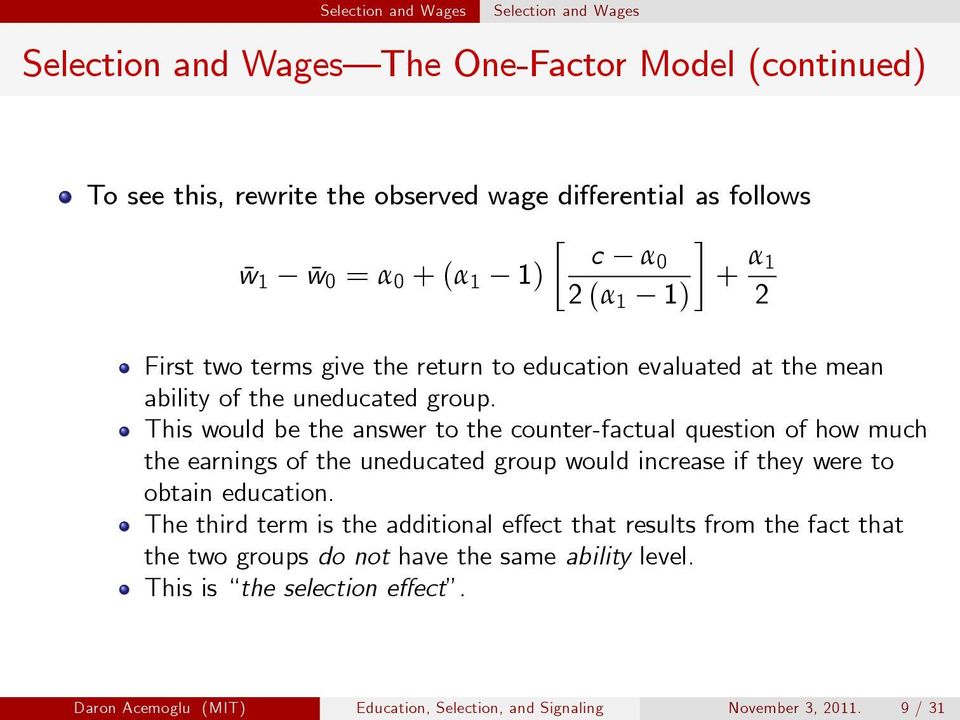
9 Selection and Wages Selection and Wages Selection and Wages The One-Factor Model (continued) To see this, rewrite the observed wage differential as follows [ ] c α0 w 1 w 0 = α 0 + (α 1 1) + α 1 2 (α 1 1) 2 First two terms give the return to education evaluated at the mean ability of the uneducated group. This would be the answer to the counter-factual question of how much the earnings of the uneducated group would increase if they were to obtain education. The third term is the additional effect that results from the fact that the two groups do not have the same ability level. This is the selection effect. Daron Acemoglu (MIT) Education, Selection, and Signaling November 3, / 31
10 Selection and Wages Selection and Wages Selection and Wages The One-Factor Model (continued) Alternatively, we could have written w 1 w 0 = α 0 + (α 1 1) [ α1 1 + c α 0 2 (α 1 1) ] + 1 2, Now the first two terms give the return to education evaluated at the mean ability of the educated group, which is greater than the return to education evaluated at the mean ability level of the uneducated group. So the selection effect is somewhat smaller, but still positive. Daron Acemoglu (MIT) Education, Selection, and Signaling November 3, / 31

11 Baseline Signaling Model Baseline Signaling Model Consider the following simple model to illustrate the issues. There are two types of workers, high ability and low ability. The fraction of high ability workers in the population is λ. Workers know their own ability, but employers do not observe this directly. High ability workers always produce y H, low ability workers produce y L. Daron Acemoglu (MIT) Education, Selection, and Signaling November 3, / 31

12 Baseline Signaling Model Baseline Signaling Model (continued) Workers can invest in education, e {0, 1}. The cost of obtaining education is c H for high ability workers and c L for low ability workers. Crucial assumption ( single crossing ) c L > c H That is, education is more costly for low ability workers. This is often referred to as the single-crossing assumption, since it makes sure that in the space of education and wages, the indifference curves of high and low types intersect only once. For future reference, I denote the decision to obtain education by e = 1. To start with, suppose that education does not increase the productivity of either type of worker. Once workers obtain their education, there is competition among a large number of risk-neutral firms, so workers will be paid their expected productivity. Daron Acemoglu (MIT) Education, Selection, and Signaling November 3, / 31

13 Baseline Signaling Model Baseline Signaling Model (continued) Game of incomplete information Perfect Bayesian Equilibrium Two (extreme) types of equilibria in this game. 1 Separating, where high and low ability workers choose different levels of schooling. 2 Pooling, where high and low ability workers choose the same level of education. Daron Acemoglu (MIT) Education, Selection, and Signaling November 3, / 31

14 Separating Equilibrium Separating Equilibrium Suppose that we have This is clearly possible since c H < c L. y H c H > y L > y H c L (2) Then the following is an equilibrium: all high ability workers obtain education, and all low ability workers choose no education. Wages (conditional on education) are: w (e = 1) = y H and w (e = 0) = y L Notice that these wages are conditioned on education, and not directly on ability, since ability is not observed by employers. Daron Acemoglu (MIT) Education, Selection, and Signaling November 3, / 31

15 Separating Equilibrium Separating Equilibrium (continued) Let us now check that all parties are playing best responses. Given the strategies of workers, a worker with education has productivity y H while a worker with no education has productivity y L. So no firm can change its behavior and increase its profits. What about workers? If a high ability worker deviates to no education, he will obtain w (e = 0) = y L, but w (e = 1) c H = y H c H > y L. Daron Acemoglu (MIT) Education, Selection, and Signaling November 3, / 31

16 Separating Equilibrium Separating Equilibrium (continued) If a low ability worker deviates to obtaining education, the market will perceive him as a high ability worker, and pay him the higher wage w (e = 1) = y H. But from (2), we have that y H c L < y L. Therefore, we have indeed an equilibrium. In this equilibrium, education is valued simply because it is a signal about ability. Is single crossing important? Daron Acemoglu (MIT) Education, Selection, and Signaling November 3, / 31
17 Pooling Equilibrium Pooling Equilibrium The separating equilibrium is not the only one. Consider the following allocation: both low and high ability workers do not obtain education, and the wage structure is w (e = 1) = (1 λ) y L + λy H and w (e = 0) = (1 λ) y L + λy H Let us strengthen the condition (2) to y H c H > (1 λ) y L + λy H and y L > y H c L (3) Again no incentive to deviate by either workers or firms. Is this Perfect Bayesian Equilibrium reasonable? Daron Acemoglu (MIT) Education, Selection, and Signaling November 3, / 31

18 Pooling Equilibrium Pooling Equilibrium (continued) The answer is no. This equilibrium is being supported by the belief that the worker who gets education is no better than a worker who doesn t. But education is more costly for low ability workers, so they should be less likely to deviate to obtaining education. This can be ruled out by various different refinements of equilibria. Daron Acemoglu (MIT) Education, Selection, and Signaling November 3, / 31

19 Pooling Equilibrium Pooling Equilibrium (continued) Simplest refinement: Intuitive Criterion by Cho and Kreps. The underlying idea: if there exists a type who will never benefit from taking a particular deviation, then the uninformed parties (here the firms) should deduce that this deviation is very unlikely to come from this type. This falls within the category of forward induction where rather than solving the game simply backwards, we think about what type of inferences will others derive from a deviation. Daron Acemoglu (MIT) Education, Selection, and Signaling November 3, / 31
20 Pooling Equilibrium Pooling Equilibrium (continued) Take the pooling equilibrium above. Consider a deviation to e = 1. There is no circumstance under which the low type would benefit from this deviation, since y L > y H c L, and the low ability worker is now getting (1 λ) y L + λy H. Therefore, firms can deduce that the deviation to e = 1 must be coming from the high type, and offer him a wage of y H. Then (2) ensures that this deviation is profitable for the high types, breaking the pooling equilibrium. Daron Acemoglu (MIT) Education, Selection, and Signaling November 3, / 31
21 Pooling Equilibrium Pooling Equilibrium (continued) The reason why this refinement is called The Intuitive Criterion is that it can be supported by a relatively intuitive speech by the deviator along the following lines: you have to deduce that I must be the high type deviating to e = 1, since low types would never ever consider such a deviation, whereas I would find it profitable if I could convince you that I am indeed the high type). Of course, this is only very loose, since such speeches are not part of the game, but it gives the basic idea. The overall conclusion: separating equilibria, where education is a valuable signal, may be more likely than pooling equilibria. When would this not be the case? Daron Acemoglu (MIT) Education, Selection, and Signaling November 3, / 31
22 Generalizations Generalizations Suppose education is continuous e [0, ). Cost functions for the high and low types are c H (e) and c L (e), which are both strictly increasing and convex, with c H (0) = c L (0) = 0. The single crossing property is that c H (e) < c L (e) for all e [0, ), that is, the marginal cost of investing in a given unit of education is always higher for the low type (why is this the right condition?). Suppose that the output of the two types as a function of their educations are y H (e) and y L (e), with y H (e) > y L (e) for all e. Daron Acemoglu (MIT) Education, Selection, and Signaling November 3, / 31
23 Generalizations (continued) Generalizations The single crossing property: Daron Acemoglu (MIT) Education, Selection, and Signaling November 3, / 31
24 Generalizations Generalizations (continued) Again there are many Perfect Bayesian Equilibria, some separating, some pooling and some semi-separating. But applying a stronger form of the Intuitive Criterion reasoning, we will pick the Riley equilibrium of this game, which is a particular separating equilibrium. Riley equilibrium: first find the most preferred (first-best) education level for the low type in the perfect information case y L (e l ) = c L (e l ). Daron Acemoglu (MIT) Education, Selection, and Signaling November 3, / 31
25 Generalizations (continued) Generalizations First best diagrammatically: Daron Acemoglu (MIT) Education, Selection, and Signaling November 3, / 31
26 Generalizations Generalizations (continued) Then we can write the incentive compatibility constraint for the low type, such that when the market expects low types to obtain education e l, the low type does not try to mimic the high type. y L (e l ) c L (e l ) w (e) c L (e) for all e, (4) Let e h be the level of education for high type such that this constraint holds as an equality : y L (e l ) c L (e l ) = y H (e h ) c L (e h ). Question: why did rewrite w (e h ) = y H (e h )? Then the Riley equilibrium is such that low types choose e l and obtain the wage w (e L) = y L (e l ), and high types choose e h and obtain the wage w (e h ) = y H (e h ). Daron Acemoglu (MIT) Education, Selection, and Signaling November 3, / 31
27 Generalizations (continued) Generalizations Riley equilibrium diagrammatically: Daron Acemoglu (MIT) Education, Selection, and Signaling November 3, / 31
28 Generalizations Generalizations (continued) Why are high types are happy to do this? From the single-crossing property: y H (e h ) c H (e h ) = y H (e h ) c L (e h ) (c H (e h ) c L (e h )) > y H (e h ) c L (e h ) (c H (e l ) c L (e l )) = y L (e l ) c L (e l ) (c H (e l ) c L (e l )) = y L (e l ) c H (e l ), High ability workers investing in schooling more than they would have done in the perfect information case, in the sense that e h characterized here is greater than the education level that high ability individuals chosen with perfect information, given by y H (e h ) = c H (e h ). Daron Acemoglu (MIT) Education, Selection, and Signaling November 3, / 31
29 Evidence on Labor Market Signaling Evidence on Labor Market Signaling Evidence on Labor Market Signaling For different types of evidence: 1 Do degrees matter? 2 Do compulsory schooling laws affect schooling levels for higher grades? 3 Returns to GED? 4 Investigation of negative externalities Why are these informative about signaling? Which ones are more convincing? Daron Acemoglu (MIT) Education, Selection, and Signaling November 3, / 31
30 Evidence on Labor Market Signaling Evidence on Labor Market Signaling Evidence on Labor Market Signaling (continued) Third approach: Tyler, Murnane and Willett. Passing grades in the Graduate Equivalent Degree (GED) differ by state. So an individual with the same grade in the GED exam will get a GED in one state, but not in another. If the score in the exam is an unbiased measure of human capital, and there is no signaling, these two individuals should get the same wages. If the GED is a signal, and employers do not know where the individual took the GED exam, these two individuals should get different wages. Daron Acemoglu (MIT) Education, Selection, and Signaling November 3, / 31
31 Evidence on Labor Market Signaling Evidence on Labor Market Signaling Evidence on Labor Market Signaling (continued) Using this methodology, the authors estimate that there is a percent return to a GED signal. An interesting result that Tyler, Murnane and Willett find is that there are no GED returns to minorities. This is also consistent with the signaling view, since it turns out that many minorities prepare for and take the GED exam in prison. Therefore, GED would be not only a positive signal, but also likely a signal that the individual was at some point incarcerated. Hence not a good signal at all. Daron Acemoglu (MIT) Education, Selection, and Signaling November 3, / 31
Unraveling versus Unraveling: A Memo on Competitive Equilibriums and Trade in Insurance Markets
 Unraveling versus Unraveling: A Memo on Competitive Equilibriums and Trade in Insurance Markets Nathaniel Hendren January, 2014 Abstract Both Akerlof (1970) and Rothschild and Stiglitz (1976) show that
Economics of Insurance
 Economics of Insurance In this last lecture, we cover most topics of Economics of Information within a single application. Through this, you will see how the differential informational assumptions allow
6.207/14.15: Networks Lectures 19-21: Incomplete Information: Bayesian Nash Equilibria, Auctions and Introduction to Social Learning
 6.207/14.15: Networks Lectures 19-21: Incomplete Information: Bayesian Nash Equilibria, Auctions and Introduction to Social Learning Daron Acemoglu and Asu Ozdaglar MIT November 23, 25 and 30, 2009 1 Introduction
Moral Hazard. Itay Goldstein. Wharton School, University of Pennsylvania
 Moral Hazard Itay Goldstein Wharton School, University of Pennsylvania 1 Principal-Agent Problem Basic problem in corporate finance: separation of ownership and control: o The owners of the firm are typically
2. Information Economics
 2. Information Economics In General Equilibrium Theory all agents had full information regarding any variable of interest (prices, commodities, state of nature, cost function, preferences, etc.) In many
Chapter 18. Asymmetric Information. The buyer needs a hundred eyes, the seller not one. George Herbert (1651)
 Chapter 18 Asymmetric Information The buyer needs a hundred eyes, the seller not one. George Herbert (1651) Chapter 18 Outline 18.1 Problems Due to Asymmetric Information 18.2 Responses to Adverse Selection
Perfect Bayesian Equilibrium
 Perfect Bayesian Equilibrium When players move sequentially and have private information, some of the Bayesian Nash equilibria may involve strategies that are not sequentially rational. The problem is
The Signaling Value of a High School Diploma
 The Signaling Value of a High School Diploma Paco Martorell RAND Damon Clark Princeton University, University of Florida, NBER, IZA PRELIMINARY AND INCOMPLETE: PLEASE DO NOT CITE WITHOUT AUTHORS PERMISSION
6.207/14.15: Networks Lecture 15: Repeated Games and Cooperation
 6.207/14.15: Networks Lecture 15: Repeated Games and Cooperation Daron Acemoglu and Asu Ozdaglar MIT November 2, 2009 1 Introduction Outline The problem of cooperation Finitely-repeated prisoner s dilemma
EconS 503 - Advanced Microeconomics II Handout on Cheap Talk
 EconS 53 - Advanced Microeconomics II Handout on Cheap Talk. Cheap talk with Stockbrokers (From Tadelis, Ch. 8, Exercise 8.) A stockbroker can give his client one of three recommendations regarding a certain
Lecture Note 1 8 Education, Human Capital, and Labor Market Signaling
 Lecture Note 1 8 Education, Human Capital, and Labor Market Signaling 14.03/14.003, Microeconomic Theory and Public Policy, Fall 2009 David Autor, Massachusetts Institute of Technology December 5, 2010
Imperfect information Up to now, consider only firms and consumers who are perfectly informed about market conditions: 1. prices, range of products
 Imperfect information Up to now, consider only firms and consumers who are perfectly informed about market conditions: 1. prices, range of products available 2. characteristics or relative qualities of
Optimal insurance contracts with adverse selection and comonotonic background risk
 Optimal insurance contracts with adverse selection and comonotonic background risk Alary D. Bien F. TSE (LERNA) University Paris Dauphine Abstract In this note, we consider an adverse selection problem
Screening by the Company You Keep: Joint Liability Lending and the Peer Selection Maitreesh Ghatak presented by Chi Wan
 Screening by the Company You Keep: Joint Liability Lending and the Peer Selection Maitreesh Ghatak presented by Chi Wan 1. Introduction The paper looks at an economic environment where borrowers have some
Financial Markets. Itay Goldstein. Wharton School, University of Pennsylvania
 Financial Markets Itay Goldstein Wharton School, University of Pennsylvania 1 Trading and Price Formation This line of the literature analyzes the formation of prices in financial markets in a setting
Price Dispersion. Ed Hopkins Economics University of Edinburgh Edinburgh EH8 9JY, UK. November, 2006. Abstract
 Price Dispersion Ed Hopkins Economics University of Edinburgh Edinburgh EH8 9JY, UK November, 2006 Abstract A brief survey of the economics of price dispersion, written for the New Palgrave Dictionary
Prices versus Exams as Strategic Instruments for Competing Universities
 Prices versus Exams as Strategic Instruments for Competing Universities Elena Del Rey and Laura Romero October 004 Abstract In this paper we investigate the optimal choice of prices and/or exams by universities
University of Oslo Department of Economics
 University of Oslo Department of Economics Exam: ECON3200/4200 Microeconomics and game theory Date of exam: Tuesday, November 26, 2013 Grades are given: December 17, 2013 Duration: 14:30-17:30 The problem
Game Theory: Supermodular Games 1
 Game Theory: Supermodular Games 1 Christoph Schottmüller 1 License: CC Attribution ShareAlike 4.0 1 / 22 Outline 1 Introduction 2 Model 3 Revision questions and exercises 2 / 22 Motivation I several solution
Competitive Screening in Credit Markets with Adverse Selection: A Cover Version of Bester s Model
 Competitive Screening in Credit Markets with Adverse Selection: A Cover Version of Bester s Model Ran Spiegler April 18, 2013 Abstract This note presents a simple model of competitive screening in a credit
ECON 312: Oligopolisitic Competition 1. Industrial Organization Oligopolistic Competition
 ECON 312: Oligopolisitic Competition 1 Industrial Organization Oligopolistic Competition Both the monopoly and the perfectly competitive market structure has in common is that neither has to concern itself
??? Signaling Games???
 ??? Signaling Games??? In incomplete information games, one player knows more information than the other player. So far, we have focused on the case where the type of the more informed player was known
Price Discrimination: Part 2. Sotiris Georganas
 Price Discrimination: Part 2 Sotiris Georganas 1 More pricing techniques We will look at some further pricing techniques... 1. Non-linear pricing (2nd degree price discrimination) 2. Bundling 2 Non-linear
Working Paper Series
 RGEA Universidade de Vigo http://webs.uvigo.es/rgea Working Paper Series A Market Game Approach to Differential Information Economies Guadalupe Fugarolas, Carlos Hervés-Beloso, Emma Moreno- García and
ECONOMICS AND FINANCE OF PENSIONS Lecture 8
 ECONOMICS AND FINANCE OF PENSIONS Lecture 8 ANNUITIES MARKETS Dr David McCarthy Today s lecture Why study annuities? Annuity demand Theoretical demand for annuities The demand puzzle Asymmetric information
Chapter 7. Sealed-bid Auctions
 Chapter 7 Sealed-bid Auctions An auction is a procedure used for selling and buying items by offering them up for bid. Auctions are often used to sell objects that have a variable price (for example oil)
Online Appendix Feedback Effects, Asymmetric Trading, and the Limits to Arbitrage
 Online Appendix Feedback Effects, Asymmetric Trading, and the Limits to Arbitrage Alex Edmans LBS, NBER, CEPR, and ECGI Itay Goldstein Wharton Wei Jiang Columbia May 8, 05 A Proofs of Propositions and
Why Do Firms Announce Open-Market Repurchase Programs?
 Why Do Firms Announce Open-Market Repurchase Programs? Jacob Oded, (2005) Boston College PhD Seminar in Corporate Finance, Spring 2006 Outline 1 The Problem Previous Work 2 3 Outline The Problem Previous
Credible Termination Threats, Reputation and Private Monitoring.
 Credible Termination Threats, Reputation and Private Monitoring. Olivier Compte First Version: June 2001 This Version: April 2005 Abstract In repeated principal-agent relationships, termination threats
FINAL EXAM, Econ 171, March, 2015, with answers
 FINAL EXAM, Econ 171, March, 2015, with answers There are 9 questions. Answer any 8 of them. Good luck! Problem 1. (True or False) If a player has a dominant strategy in a simultaneous-move game, then
Do not open this exam until told to do so.
 Do not open this exam until told to do so. Department of Economics College of Social and Applied Human Sciences K. Annen, Winter 004 Final (Version ): Intermediate Microeconomics (ECON30) Solutions Final
Economics 159: Introduction to Game Theory. Summer 2015: Session A. Online Course
 Economics 159: Introduction to Game Theory Summer 2015: Session A Online Course *Syllabussubjecttochange.Checkcoursewebpageforup-to-dateinformation* This course is an introduction to game theory and strategic
Chapter 23: Asymmetric Information
 Chapter 23: Asymmetric Information Asymmetric Information Adverse Selection Moral Hazard Lemons Market Second-Best Mechanism Designs Principal Agent Market Failure Signaling Screening Insurance Employer/
The Plaintiff s Attorney in the Liability Insurance Claims Settlement Process: A Game Theoretic Approach
 The Plaintiff s Attorney in the Liability Insurance Claims Settlement Process: A Game Theoretic Approach Lisa L. Posey * Abstract: The decision of a claimant to obtain legal counsel, the timing of this
NTA s and the annuity puzzle
 NTA s and the annuity puzzle David McCarthy NTA workshop Honolulu, 15 th June 2010 hello Today s lecture Was billed as Pension Economics But I teach a 70-hour course on pension economics and finance at
A Simple Model of Price Dispersion *
 Federal Reserve Bank of Dallas Globalization and Monetary Policy Institute Working Paper No. 112 http://www.dallasfed.org/assets/documents/institute/wpapers/2012/0112.pdf A Simple Model of Price Dispersion
Work incentives and household insurance: Sequential contracting with altruistic individuals and moral hazard
 Work incentives and household insurance: Sequential contracting with altruistic individuals and moral hazard Cécile Aubert Abstract Two agents sequentially contracts with different principals under moral
Principal Agent Model. Setup of the basic agency model. Agency theory and Accounting. 2 nd session: Principal Agent Problem
 Principal Agent Model 2 nd session: Principal Agent Problem This lecture is mostly based on: IMSc in Business Administration October-November 2007 Richard A. Lambert, Contracting Theory and Accounting,
Reputation in repeated settlement bargaining
 Reputation in repeated settlement bargaining Jihong Lee Birkbeck College, London and Yonsei University Qingmin Liu Cowles Foundation and University of Pennsylvania PRELIMINARY and INCOMPLETE commets welcome!
Oligopoly: How do firms behave when there are only a few competitors? These firms produce all or most of their industry s output.
 Topic 8 Chapter 13 Oligopoly and Monopolistic Competition Econ 203 Topic 8 page 1 Oligopoly: How do firms behave when there are only a few competitors? These firms produce all or most of their industry
Second degree price discrimination
 Bergals School of Economics Fall 1997/8 Tel Aviv University Second degree price discrimination Yossi Spiegel 1. Introduction Second degree price discrimination refers to cases where a firm does not have
The Specific-Factors Model: HO Model in the Short Run
 The Specific-Factors Model: HO Model in the Short Run Rahul Giri Contact Address: Centro de Investigacion Economica, Instituto Tecnologico Autonomo de Mexico (ITAM). E-mail: [email protected] In this
Pricing and Persuasive Advertising in a Differentiated Market
 Pricing and Persuasive Advertising in a Differentiated Market Baojun Jiang Olin Business School, Washington University in St. Louis, St. Louis, MO 63130, [email protected] Kannan Srinivasan Tepper
Capital Structure. Itay Goldstein. Wharton School, University of Pennsylvania
 Capital Structure Itay Goldstein Wharton School, University of Pennsylvania 1 Debt and Equity There are two main types of financing: debt and equity. Consider a two-period world with dates 0 and 1. At
Competition and Regulation. Lecture 2: Background on imperfect competition
 Competition and Regulation Lecture 2: Background on imperfect competition Monopoly A monopolist maximizes its profits, choosing simultaneously quantity and prices, taking the Demand as a contraint; The
National Responses to Transnational Terrorism: Intelligence and Counterterrorism Provision
 National Responses to Transnational Terrorism: Intelligence and Counterterrorism Provision Thomas Jensen October 10, 2013 Abstract Intelligence about transnational terrorism is generally gathered by national
Finance 400 A. Penati - G. Pennacchi Market Micro-Structure: Notes on the Kyle Model
 Finance 400 A. Penati - G. Pennacchi Market Micro-Structure: Notes on the Kyle Model These notes consider the single-period model in Kyle (1985) Continuous Auctions and Insider Trading, Econometrica 15,
Equilibrium in Competitive Insurance Markets: An Essay on the Economic of Imperfect Information
 Equilibrium in Competitive Insurance Markets: An Essay on the Economic of Imperfect Information By: Michael Rothschild and Joseph Stiglitz Presented by Benjamin S. Barber IV, Xiaoshu Bei, Zhi Chen, Shaiobi
ECON 459 Game Theory. Lecture Notes Auctions. Luca Anderlini Spring 2015
 ECON 459 Game Theory Lecture Notes Auctions Luca Anderlini Spring 2015 These notes have been used before. If you can still spot any errors or have any suggestions for improvement, please let me know. 1
Two Papers on Internet Connectivity and Quality. Abstract
 Two Papers on Internet Connectivity and Quality ROBERTO ROSON Dipartimento di Scienze Economiche, Università Ca Foscari di Venezia, Venice, Italy. Abstract I review two papers, addressing the issue of
Universidad de Montevideo Macroeconomia II. The Ramsey-Cass-Koopmans Model
 Universidad de Montevideo Macroeconomia II Danilo R. Trupkin Class Notes (very preliminar) The Ramsey-Cass-Koopmans Model 1 Introduction One shortcoming of the Solow model is that the saving rate is exogenous
SOCIAL AND NONMARKET BENEFITS FROM EDUCATION IN AN ADVANCED ECONOMY
 Discussion SOCIAL AND NONMARKET BENEFITS FROM EDUCATION IN AN ADVANCED ECONOMY Daron Acemoglu* The extensive literature on individual returns to education has been very influential on the thinking of economists
6.254 : Game Theory with Engineering Applications Lecture 1: Introduction
 6.254 : Game Theory with Engineering Applications Lecture 1: Introduction Asu Ozdaglar MIT February 2, 2010 1 Introduction Optimization Theory: Optimize a single objective over a decision variable x R
All these models were characterized by constant returns to scale technologies and perfectly competitive markets.
 Economies of scale and international trade In the models discussed so far, differences in prices across countries (the source of gains from trade) were attributed to differences in resources/technology.
Why Plaintiffs Attorneys Use Contingent and Defense Attorneys Fixed Fee Contracts
 Why Plaintiffs Attorneys Use Contingent and Defense Attorneys Fixed Fee Contracts Winand Emons 1 Claude Fluet 2 1 Department of Economics University of Bern, CEPR, CIRPEE 2 Université du Québec à Montréal,
Chapter 21: The Discounted Utility Model
 Chapter 21: The Discounted Utility Model 21.1: Introduction This is an important chapter in that it introduces, and explores the implications of, an empirically relevant utility function representing intertemporal
Stochastic Inventory Control
 Chapter 3 Stochastic Inventory Control 1 In this chapter, we consider in much greater details certain dynamic inventory control problems of the type already encountered in section 1.3. In addition to the
Labor Economics, 14.661. Lectures 6 and 7: Moral Hazard and Applications
 Labor Economics, 14.661. Lectures 6 and 7: Moral Hazard and Applications Daron Acemoglu MIT November 7 and 11, 2014. Daron Acemoglu (MIT) Moral Hazard November 7 and 11, 2014. 1 / 63 Introduction Introduction
Competition and Fraud in Online Advertising Markets
 Competition and Fraud in Online Advertising Markets Bob Mungamuru 1 and Stephen Weis 2 1 Stanford University, Stanford, CA, USA 94305 2 Google Inc., Mountain View, CA, USA 94043 Abstract. An economic model
Not Only What But also When: A Theory of Dynamic Voluntary Disclosure
 Not Only What But also When: A Theory of Dynamic Voluntary Disclosure Ilan Guttman, Ilan Kremer, and Andrzej Skrzypacz Stanford Graduate School of Business September 2012 Abstract The extant theoretical
Market Supply in the Short Run
 Equilibrium in Perfectly Competitive Markets (Assume for simplicity that all firms have access to the same technology and input markets, so they all have the same cost curves.) Market Supply in the Short
Labor Demand The Labor Market
 Labor Demand The Labor Market 1. Labor demand 2. Labor supply Assumptions Hold capital stock fixed (for now) Workers are all alike. We are going to ignore differences in worker s aptitudes, skills, ambition
Information Exchanges Among Firms and their Impact on Competition*
 Information Exchanges Among Firms and their Impact on Competition* Kai-Uwe Kühn Xavier Vives Institut d'anàlisi Econòmica (CSIC) Barcelona June 1994 Revised December 1994 *We are grateful to Paco Caballero,
Competitive Insurance Markets Under Asymmetric Information. When Agents Make Mistakes
 Competitive Insurance Markets Under Asymmetric Information When Agents Make Mistakes Mark Browne 1, Richard Peter 2, Andreas Richter 3 Abstract: We analyze a competitive insurance market under asymmetric
Switching Cost, Competition, and Pricing in the Property/Casualty Insurance Market for Large Commercial Accounts
 Switching Cost, Competition, and Pricing in the Property/Casualty Insurance Market for Large Commercial Accounts Lisa L. Posey * Abstract: With large commercial accounts, a small number of insurers negotiate
Module 7: Debt Contracts & Credit Rationing
 Module 7: Debt Contracts & Credit ationing Information Economics (Ec 515) George Georgiadis Two Applications of the principal-agent model to credit markets An entrepreneur (E - borrower) has a project.
Lecture Notes. 1 What is Asymmetric Information and why it matters for Economics?
 Lecture Notes The most important development in economics in the last forty years has been the study of incentives to achieve potential mutual gain when the parties have different degrees of knowledge.
Week 7 - Game Theory and Industrial Organisation
 Week 7 - Game Theory and Industrial Organisation The Cournot and Bertrand models are the two basic templates for models of oligopoly; industry structures with a small number of firms. There are a number
ECO 199 GAMES OF STRATEGY Spring Term 2004 March 23 ADVERSE SELECTION SCREENING AND SIGNALING. EXAMPLE 1 FAILURE OF EQUILIBRIUM Akerlof s Lemons
 ECO 199 GAMES OF STRATEGY Spring Term 2004 March 23 ADVERSE SELECTION SCREENING AND SIGNALING EXAMPLE 1 FAILURE OF EQUILIBRIUM Akerlof s Lemons Private used car market Car may be worth anywhere between
Modeling Insurance Markets
 Modeling Insurance Markets Nathaniel Hendren Harvard April, 2015 Nathaniel Hendren (Harvard) Insurance April, 2015 1 / 29 Modeling Competition Insurance Markets is Tough There is no well-agreed upon model
Optimal Income Taxation with Multidimensional Types
 1 Optimal Income Taxation with Multidimensional Types Kenneth L. Judd Hoover Institution NBER Che-Lin Su Northwestern University (Stanford Ph. D.) PRELIMINARY AND INCOMPLETE November, 2006 2 Introduction
Practice Set #4 and Solutions.
 FIN-469 Investments Analysis Professor Michel A. Robe Practice Set #4 and Solutions. What to do with this practice set? To help students prepare for the assignment and the exams, practice sets with solutions
Notes on indifference curve analysis of the choice between leisure and labor, and the deadweight loss of taxation. Jon Bakija
 Notes on indifference curve analysis of the choice between leisure and labor, and the deadweight loss of taxation Jon Bakija This example shows how to use a budget constraint and indifference curve diagram
The Timing of Signaling: To Study in High School or in College?
 The Timing of Signaling: To Study in High School or in College? Sanghoon Lee 1 University of British Columbia, Canada Abstract American students study harder in college than in high school while East Asian
Optimal Auctions Continued
 Lecture 6 Optimal Auctions Continued 1 Recap Last week, we... Set up the Myerson auction environment: n risk-neutral bidders independent types t i F i with support [, b i ] residual valuation of t 0 for
Credible Discovery, Settlement, and Negative Expected Value Suits
 Credible iscovery, Settlement, and Negative Expected Value Suits Warren F. Schwartz Abraham L. Wickelgren Abstract: This paper introduces the option to conduct discovery into a model of settlement bargaining
CARLETON ECONOMIC PAPERS
 CEP 14-14 Employment Gains from Minimum-Wage Hikes under Perfect Competition: A Simple General-Equilibrium Analysis Richard A. Brecher and Till Gross Carleton University November 2014 CARLETON ECONOMIC
Fixed-Effect Versus Random-Effects Models
 CHAPTER 13 Fixed-Effect Versus Random-Effects Models Introduction Definition of a summary effect Estimating the summary effect Extreme effect size in a large study or a small study Confidence interval
ECON 443 Labor Market Analysis Final Exam (07/20/2005)
 ECON 443 Labor Market Analysis Final Exam (07/20/2005) I. Multiple-Choice Questions (80%) 1. A compensating wage differential is A) an extra wage that will make all workers willing to accept undesirable
Econ 101: Principles of Microeconomics
 Econ 101: Principles of Microeconomics Chapter 16 - Monopolistic Competition and Product Differentiation Fall 2010 Herriges (ISU) Ch. 16 Monopolistic Competition Fall 2010 1 / 18 Outline 1 What is Monopolistic
Market Power and Efficiency in Card Payment Systems: A Comment on Rochet and Tirole
 Market Power and Efficiency in Card Payment Systems: A Comment on Rochet and Tirole Luís M. B. Cabral New York University and CEPR November 2005 1 Introduction Beginning with their seminal 2002 paper,
Lecture notes for Choice Under Uncertainty
 Lecture notes for Choice Under Uncertainty 1. Introduction In this lecture we examine the theory of decision-making under uncertainty and its application to the demand for insurance. The undergraduate
Department of Economics The Ohio State University Economics 817: Game Theory
 Department of Economics The Ohio State University Economics 817: Game Theory Syllabus and Reading List James Peck M-W 11:30-1:18 Autumn 2011 Arps Hall 177 www.econ.ohio-state.edu/jpeck/econ817.htm Office
The vertical differentiation model in the insurance market: costs structure and equilibria analysis
 The vertical differentiation model in the insurance market: costs structure and equilibria analysis Denis V. Kuzyutin 1, Maria V. Nikitina, Nadezhda V. Smirnova and Ludmila N. Razgulyaeva 1 St.Petersburg
ECON 40050 Game Theory Exam 1 - Answer Key. 4) All exams must be turned in by 1:45 pm. No extensions will be granted.
 1 ECON 40050 Game Theory Exam 1 - Answer Key Instructions: 1) You may use a pen or pencil, a hand-held nonprogrammable calculator, and a ruler. No other materials may be at or near your desk. Books, coats,