
Home Energy Solutions Evaluation Final Report Submitted By Nexant To Connecticut Energy Efficiency Board March, 2011
|
|
|
- Timothy Stafford
- 10 years ago
- Views:
Transcription
1 Home Energy Solutions Evaluation Final Report Submitted By Nexant To Connecticut Energy Efficiency Board March, 2011 Home Energy Solutions Evaluation March, 2011 i

2 CONTENTS EXECUTIVE SUMMARY...1 OVERVIEW OF HOME ENERGY SOLUTIONS PROGRAM... 1 EVALUATION OBJECTIVES... 1 RATIONALE FOR EVALUATION METHODOLOGY... 2 KEY FINDINGS... 3 Gross Program Impact... 3 Engineering Adjusted Billing Analysis Study... 3 Program Savings Document (PSD) Review... 5 Program Comprehensiveness and Participant Satisfaction... 5 Contractor Surveys... 5 Recommendations... 5 SECTION 1 INTRODUCTION HES PROGRAM Overview Delivery Participation EVALUATION GOALS AND OBJECTIVES Estimation of Gross Savings Engineering Adjusted Billing Analysis Study PSD Review Program Comprehensiveness Evaluation SECTION 2 EVALUATION METHODOLOGY GROSS SAVINGS ESTIMATION Site Inspection and Data Validation Sampling Gross Savings Data Data Analysis Lighting Pipe Insulation Water Measures Modeling analysis Infiltration measures Realization Rate BILLING ANALYSIS STUDY Control Group Ratio Utility Data Sampling Company Monthly Billing Records HES Participation Databases PROGRAM COMPREHENSIVENESS EVALUATION SUMMARY OF EVALUATION METHODOLOGIES VALIDITY AND RELIABILITY SECTION 3 GROSS IMPACT EVALUATION RESULTS SURVEY RESULTS MEASURE-SPECIFIC SAVINGS RESULTS Lighting Pipe Insulation Water Measures Infiltration measures Home Energy Solutions Evaluation March, 2011 i

3 CONTENTS Gas Heated Homes Electric Heated Homes Oil Heated Homes REALIZATION RATES SECTION 4 ENGINEERING ADJUSTED BILLING ANALYSIS RESULTS PARTICIPANT AND NON-PARTICIPANT RETROFIT ENERGY USE CONTROL GROUP RATIO ENGINEERING ADJUSTED BILLING ANALYSIS RESULTS ENGINEERING ADJUSTED BILLING ANALYSIS VERSUS GROSS IMPACT RESULTS SECTION 5 PROGRAM SAVINGS DOCUMENT REVIEW LIGHTING PIPE INSULATION WATER MEASURES INFILTRATION BLOWER DOOR SECTION 6 PROGRAM COMPREHENSIVENESS ASSESSMENT PROGRAM COMPREHENSIVENESS Lighting Measures Infiltration Measures Pipe Insulation Water Measures SATISFACTION AND GENERAL FEEDBACK Participants Vendors SECTION 7 CONCLUSIONS & RECOMMENDATIONS GROSS IMPACTS NET IMPACTS PROGRAM COMPREHENSIVENESS PSD REVIEW FINDINGS AND RECOMMENDATIONS RECOMMENDATIONS FOR FUTURE EVALUATIONS APPENDIX A SITE INSPECTION PROTOCOLS APPENDIX B DATA COLLECTION FORMS B.1 ON-SITE DATA COLLECTION FORM& RESIDENT INTERVIEW FORM B.2 VENDOR INTERVIEW FORM APPENDIX C PROJECT SPECIFIC SUMMARY C.1 PROJECT SUMMARY SHEETS C.2 PROJECT SAVINGS SUMMARY TABLE APPENDIX D EQUEST MODEL RESULTS D.1 MODEL DETAILS D.2 EQUEST MODEL RESULTS APPENDIX E BILLING ANALYSIS PROCEDURE Home Energy Solutions Evaluation March, 2011 ii

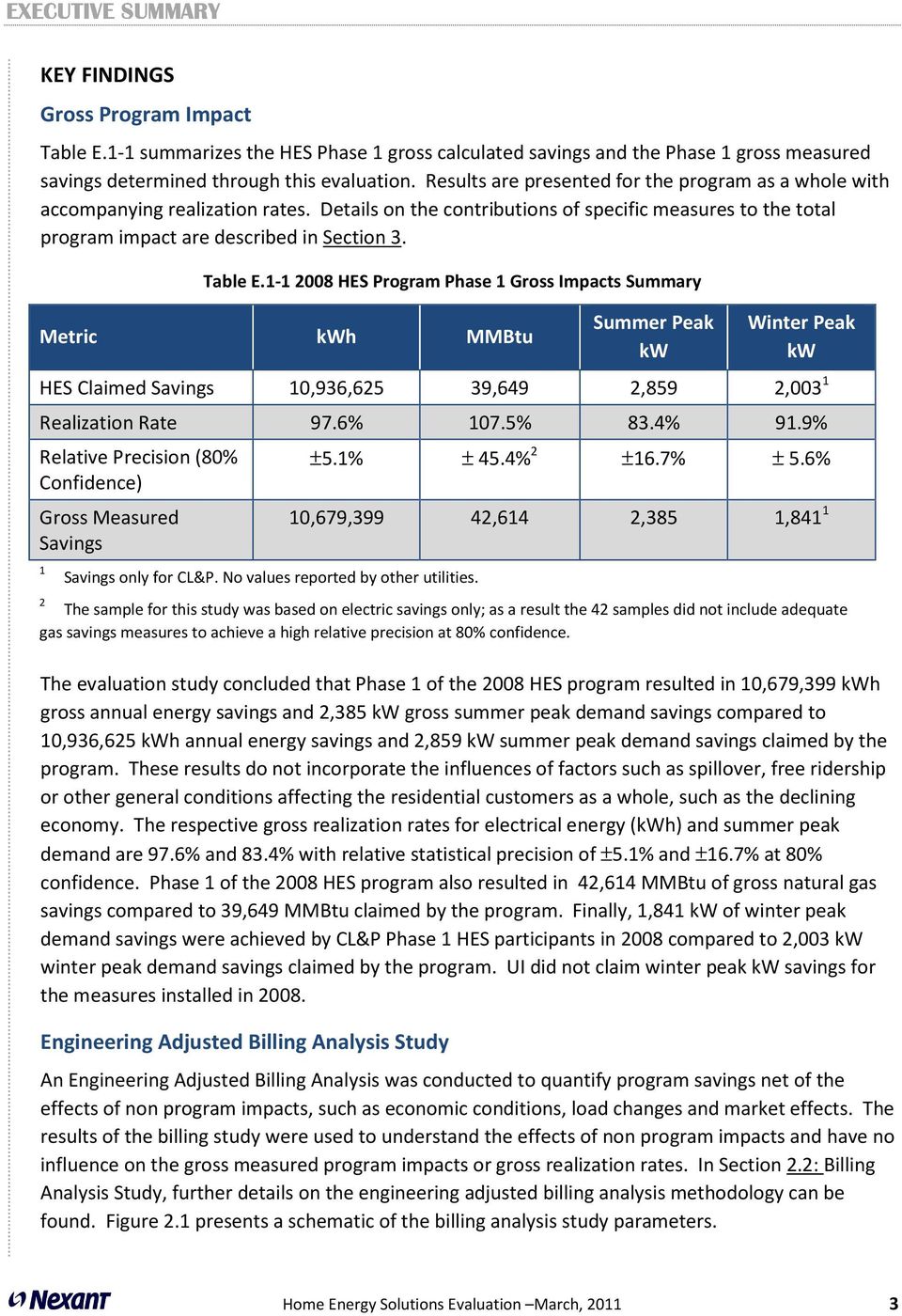
4 EXECUTIVE SUMMARY In 2009, Nexant was retained by the Connecticut Energy Efficiency Board (EEB) to conduct an impact evaluation of the 2008 Home Energy Solutions (HES) program as provided by the United Illuminating Company (UI), Connecticut Light and Power Company (CL&P), Yankee Gas Services (Yankee), the Southern Connecticut Gas Company (SCG), and the Connecticut Natural Gas Company (CNG). This report contains findings regarding the program s impact, including electrical demand and energy savings, natural gas savings, and an assessment of the comprehensiveness of the program. OVERVIEW OF HOME ENERGY SOLUTIONS PROGRAM The HES program is designed to reduce total energy use and electric system peak demand in existing homes, in addition to reducing natural gas usage in participant s homes utilizing fossil fuels. Phase 1 of the program provides direct installation of efficiency measures in residences, while Phase 2 offers participants rebates for implementation of additional high efficiency measures. The 2008 program year had 9,107 Phase 1 participants, resulting in calculated gross energy savings of 10,936,625 kwh and 39,649 MMBtu, along with summer and winter peak demand reductions of 2,859 kw and 2,003 kw, respectively HES Phase 2 participation included 1,182 customers who took advantage of appliance and home insulation rebates resulting in a calculated gross energy savings of 415,238 kwh and 1,526 MMBtu. EVALUATION OBJECTIVES The specific goals of this evaluation are: Estimate the program s gross energy savings for electric and gas measures Estimate total, peak seasonal, and extreme seasonal demand savings Estimate Net Savings Affirm or improve the 2010 Program Savings Document (PSD) as informed by the results of this study Assess program comprehensiveness This evaluation is based on (1) detailed on-site examination of a sample of forty-two (42) Phase 1 projects that were selected using statistical sampling techniques and expanded to represent the 2008 population of HES projects, (2) statistical analysis of the monthly utility bills of 300 participants and a pre-program consumption-matched sample of 300 non-participants to isolate program from non-program impacts, and (3) results of surveys conducted with both participants and installers. Excluding central air conditioning rebates, which were not part of this study, Phase 2 measures account for less than 5% of the 2008 HES program claimed savings. No identified Phase 2 customers agreed to participate in this study; therefore, Phase 2 impacts are not included. The methodology used to accomplish each evaluation objective can be found in Section 2 and a summary of all evaluation methodologies can be found in Table 2-2. Home Energy Solutions Evaluation March,

5 RATIONALE FOR EVALUATION METHODOLOGY This study employs an Engineering-Adjusted Billing Analysis (EABA) to assess net savings. The EABA incorporates the results of two other processes site visits with metering and engineering modeling (Engineering) along with a statistical analysis of billing-measured usage into a unified construct that provides estimates of net program savings. The results of the interim steps are also provided. The Gross Savings Engineering assessment is the most comparable measure to the savings estimated by the Companies through the PSD. It therefore allows for a side-by-side comparison about expected gross savings with what was found and measured in the participant homes. Similar comparison can be made across various programs. The gross impacts study describes the savings associated with the measures installed. These are the savings that the participating customers see reflected in their energy bills. However, it cannot fully represent the savings caused by the program, because it doesn t include measurements of what participating customers would have consumed/saved even without the HES program (due to free-ridership or other cost-reducing behaviors). Without the program, they may still have installed CFLs or purchased new appliances, or lowered their thermostats, and so on. In fact many of their neighbors did so without participating in and perhaps without knowing about the existence of HES. The Engineering adjusted Billing Analysis was conducted to measure program impacts net of these other influences. The results of the study reflect the savings that the program caused. For this study, the Sponsors decided to use existing free-ridership and persistence figures and thereby created a shortcoming to the Engineering Adjusted Billing Analysis. The final results do not reflect any influence the program had on non-participants. Some of the neighbors discussed above made some of their decisions because they had heard about CFLs, caulking, etc from the HES program. Their decisions might reflect all kinds of other things such as national promotions or advertising unrelated to Connecticut s programs. The existing data on free-ridership and persistence does not include any measure of the program impacts on non-participants the relative size of program vs non-program impacts in the Control Group is unknowable within the context of this study. All we know is that net savings may be somewhat understated if there is more spillover than free ridership. None-the-less, the EABA approach does produce a reasonable net savings estimate. Throughout this document, results of the EABA net impact study and the Engineering gross impact study are presented. Neither piece supplies a full picture of the savings associated with the HES program. Separately each has its strengths. Together, reliable results to estimate the impacts of both measure installations and program intervention can be assessed. 1 1 Engineering Adjusted Billing Analysis is not always appropriate. The selection of this methodology for the HES study makes sense because HES program participants are fairly homogenous and the types of measures installed are likewise homogenous. These two characteristics are prerequisite for any whole-program use of EABA. For other programs, one participant facility and the measures incorporated in it may have little if any similarity to those of any other participant. In these cases statistical approaches may be far less efficient. Home Energy Solutions Evaluation March,

6 KEY FINDINGS Gross Program Impact Table E.1-1 summarizes the HES Phase 1 gross calculated savings and the Phase 1 gross measured savings determined through this evaluation. Results are presented for the program as a whole with accompanying realization rates. Details on the contributions of specific measures to the total program impact are described in Section 3. Table E HES Program Phase 1 Gross Impacts Summary Metric kwh MMBtu Summer Peak kw Winter Peak kw HES Claimed Savings 10,936,625 39,649 2,859 2,003 1 Realization Rate 97.6% 107.5% 83.4% 91.9% Relative Precision (80% Confidence) Gross Measured Savings 1 2 Savings only for CL&P. No values reported by other utilities. ±5.1% ± 45.4% 2 ±16.7% ± 5.6% 10,679,399 42,614 2,385 1,841 1 The sample for this study was based on electric savings only; as a result the 42 samples did not include adequate gas savings measures to achieve a high relative precision at 80% confidence. The evaluation study concluded that Phase 1 of the 2008 HES program resulted in 10,679,399 kwh gross annual energy savings and 2,385 kw gross summer peak demand savings compared to 10,936,625 kwh annual energy savings and 2,859 kw summer peak demand savings claimed by the program. These results do not incorporate the influences of factors such as spillover, free ridership or other general conditions affecting the residential customers as a whole, such as the declining economy. The respective gross realization rates for electrical energy (kwh) and summer peak demand are 97.6% and 83.4% with relative statistical precision of ±5.1% and ±16.7% at 80% confidence. Phase 1 of the 2008 HES program also resulted in 42,614 MMBtu of gross natural gas savings compared to 39,649 MMBtu claimed by the program. Finally, 1,841 kw of winter peak demand savings were achieved by CL&P Phase 1 HES participants in 2008 compared to 2,003 kw winter peak demand savings claimed by the program. UI did not claim winter peak kw savings for the measures installed in Engineering Adjusted Billing Analysis Study An Engineering Adjusted Billing Analysis was conducted to quantify program savings net of the effects of non program impacts, such as economic conditions, load changes and market effects. The results of the billing study were used to understand the effects of non program impacts and have no influence on the gross measured program impacts or gross realization rates. In Section 2.2: Billing Analysis Study, further details on the engineering adjusted billing analysis methodology can be found. Figure 2.1 presents a schematic of the billing analysis study parameters. Home Energy Solutions Evaluation March,
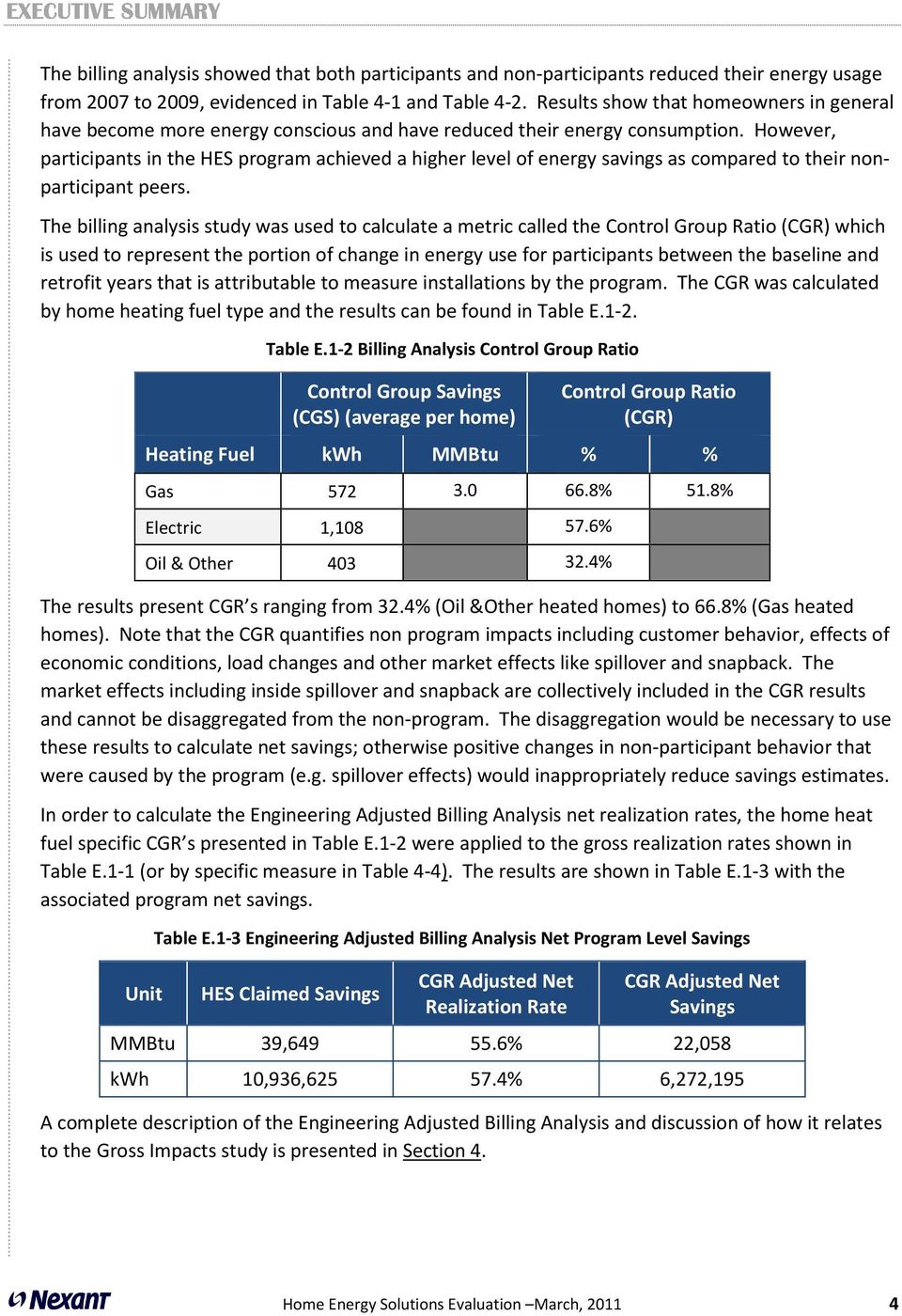
7 The billing analysis showed that both participants and non-participants reduced their energy usage from 2007 to 2009, evidenced in Table 4-1 and Table 4-2. Results show that homeowners in general have become more energy conscious and have reduced their energy consumption. However, participants in the HES program achieved a higher level of energy savings as compared to their nonparticipant peers. The billing analysis study was used to calculate a metric called the Control Group Ratio (CGR) which is used to represent the portion of change in energy use for participants between the baseline and retrofit years that is attributable to measure installations by the program. The CGR was calculated by home heating fuel type and the results can be found in Table E.1-2. Table E.1-2 Billing Analysis Control Group Ratio Control Group Savings (CGS) (average per home) Control Group Ratio (CGR) Heating Fuel kwh MMBtu % % Gas % 51.8% Electric 1, % Oil & Other % The results present CGR s ranging from 32.4% (Oil &Other heated homes) to 66.8% (Gas heated homes). Note that the CGR quantifies non program impacts including customer behavior, effects of economic conditions, load changes and other market effects like spillover and snapback. The market effects including inside spillover and snapback are collectively included in the CGR results and cannot be disaggregated from the non-program. The disaggregation would be necessary to use these results to calculate net savings; otherwise positive changes in non-participant behavior that were caused by the program (e.g. spillover effects) would inappropriately reduce savings estimates. In order to calculate the Engineering Adjusted Billing Analysis net realization rates, the home heat fuel specific CGR s presented in Table E.1-2 were applied to the gross realization rates shown in Table E.1-1 (or by specific measure in Table 4-4). The results are shown in Table E.1-3 with the associated program net savings. Unit Table E.1-3 Engineering Adjusted Billing Analysis Net Program Level Savings HES Claimed Savings CGR Adjusted Net Realization Rate CGR Adjusted Net Savings MMBtu 39, % 22,058 kwh 10,936, % 6,272,195 A complete description of the Engineering Adjusted Billing Analysis and discussion of how it relates to the Gross Impacts study is presented in Section 4. Home Energy Solutions Evaluation March,
8 Program Savings Document (PSD) Review The PSD calculation approach for all Phase 1 measures (CFLs, pipe insulation, water measures, infiltration reduction testing) studied in association with this evaluation was examined. The calculation methodologies, as presented in the PSD for CFLs and infiltration measures, are appropriate as presented. However, changes in calculation methodologies for other measures are recommended. For pipe insulation, Nexant recommends an alternative method for calculating pipe insulation savings. For water measures, Nexant recommends incorporating water usage metrics from industry-accepted sources. Details are presented in Section 5. Program Comprehensiveness and Participant Satisfaction The on-site inspections revealed that measures indicated in project documents generally matched what was found in the field, and that contractor execution was comprehensive and thorough. However, information gathered during on-site inspections and contractor interviews indicated that program constraints (caps) prevented cost-effective savings from being attained. In general, most customers reported a high level of satisfaction with the HES program. On a scale of one to five, with one representing not satisfied and five representing completely satisfied, the average response was 3.9. Details can be found in Section 6. Contractor Surveys Telephone surveys were administered to a total of seven contractors that agreed to have a discussion regarding their HES participation. The general opinion of the contractors was that the HES program does a good job of achieving savings through cost-effective measures, but they all agreed that more opportunities to save energy exist at all homes. Contractors had constructive comments on how program improvements could be achieved, including feedback regarding program measures, non-program measures, program-imposed limits, and compensation structure. Details can be found in Section 6. Recommendations Based on the general findings presented above, Nexant recommends the following changes to the HES program: Develop a well-organized enterprise relational database system at CL&P and Yankee Gas that more cleanly links gas and electric account data. Create a consistent database system for all HES program administrators that allow the HES participant records from multiple companies to be compiled easily. Marketing of the HES program should be redirected to attract a greater quantity of casual, less energy-conscious participants. HES marketing material should include more non-energy benefits such as better air quality, greater occupant comfort and more even temperature distribution. This would result in greater savings per home and more cost effective sitevisits. Estimates of recommended Phase 2 energy savings (in dollars) per measure should be included in marketing literature. Home Energy Solutions Evaluation March,

9 The program caps placed on CFLs in the UI HES program should be removed in order to capture the missed savings opportunities observed during home inspections. The program caps placed on air sealing should be removed and replaced with a cap that considers both CFM improvement and ACH50. Contractors should be incentivized for CFM improvement on a $/CFM basis, without limit, up to an ACH50 value of 10 which corresponds to LBL 2 leakage Class F. Details can be found in Section An incentive premium should be offered to contractors for self-generated leads. To promote greater participation in Phase 2 offerings, contractors should be encouraged to follow up with homeowners approximately one month following the on-site assessment. The application deadlines on Phase 2 offerings should be extended, to allow homeowners additional time to plan for large expenditures in their budgets. The PSD savings calculations for pipe insulation and water measures should be revised according to the suggestions in Section 5.2 and 5.3. Measures that achieve natural gas savings should be evaluated separately using an on-site inspection sample based on gas savings so that their impacts can be reported with better statistical precision. Future evaluation studies should include a Net-to-Gross study to quantify market effects including free-ridership, spillover and snapback to better isolate the effects of non program impacts like economic price fluctuations and load changes. Phase 2 measures should be studied using an independent, statistically valid, home inspection sample. 2 Lawrence Berkeley Laboratory, The Use of Blower Door Data, March, Home Energy Solutions Evaluation March,

10 Section 1 INTRODUCTION This report evaluates the performance of the HES program for Program Year (PY) This section provides background information on the HES program and the specific objectives of the evaluation. 1.1 HES PROGRAM The HES program is designed to reduce both electric and natural gas energy use in existing homes through direct measure installation and rebates for additional equipment. Direct-install measures include lighting retrofits, water fixture retrofits, and weatherization measures. Measures for which customer rebates are offered include appliance replacement and building envelope upgrades, particularly insulation, doors, and windows Overview The two phases of the HES program are described below: FIRST PHASE: Assessment and Direct Installation On-site opportunity assessment Customer-specific energy recommendations Direct installation of identified opportunities - Air leak sealing and duct sealing - Lighting retrofits - Water fixture retrofits - Pipe insulation Recommendations for additional measures and appliance replacements for which rebates are available SECOND PHASE: Customer Rebates for Purchases of Capital Items Appliance replacement Refrigerators Dishwashers Clothes washers Water heaters Insulation upgrades Door and window replacement Power Cost Monitors and TOU Education In the first phase of the HES program, an energy assessment is performed at each house, including a blower-door test to identify drafts and air leaks. Some opportunities for energy savings identified during the assessment are installed directly with the homeowner s consent. Incandescent light Home Energy Solutions Evaluation March,

11 Section 1 Introduction bulbs are replaced with compact fluorescent (CFL) bulbs. Low-flow water fixtures are installed on sink faucets and shower heads. Air leaks are eliminated by direct installation of caulking, weatherstripping and other air sealing techniques. Duct passages are also assessed using duct blasting tests, and sealed. During the energy assessment, the customer is also informed of additional opportunities for which rebates are available under the second phase of the HES program. Phase 2 seeks to promote and inform customers about rebates for heating, cooling, and appliance upgrades and to provide education to reduce energy consumption Delivery CL&P and UI provide the framework and funding for the program, while implementation contractors execute the program s two phases. Local energy services companies and fuel oil dealers act as implementation contractors. In general, the program is conducted as follows: Customer contact. Customers are enlisted in the program through letters, utility bill inserts, cold calling, or door-to-door marketing. In many cases, customers directly contact either the utility or implementation contractor after learning about the program through word-ofmouth. Utilities also distribute leads to HES implementation contractors. On-site assessment. The implementation contractor performs an assessment, installs appropriate Phase 1 measures, and introduces and suggests appropriate Phase 2 energy savings opportunities. The customer is educated about the potential upgrades and the associated energy benefits. Work order form. All installed Phase 1 measures are recorded on HES work order forms. The customer provides a signature to verify that all information is accurate, and a copy is distributed to utilities for program tracking. Phase 2 participation. If the customer decides to install suggested Phase 2 measures, he or she may arrange installation with the implementation contractor or use rebates to make the equipment purchase from another vendor. HES program staff interacts with implementation contractors through regular meetings and letters outlining program updates or changes Participation In 2008, the HES program was delivered by numerous implementation contractors. The efforts of these contractors resulted in Phase 1 upgrades in a total of 9,107homes. The projects were primarily CFL lighting retrofits and air sealing upgrades, though water conservation and pipe insulation measures were also installed. Table 1-1 shows the number of Phase 1 and Phase 2 participants in the 2008 program year. Home Energy Solutions Evaluation March,

12 1 Introduction Table HES Quantity of Participants CL&P Phase 1 Participants 6,768 2,339 Phase 2 Participants: Appliance Rebates Phase 2 Participants: Insulation The first phase had significantly higher participation than the second phase and therefore provides a large portion of the energy savings of the program. The 2008 program year had 9,107 Phase 1 participants, resulting in calculated gross energy savings of 10,936,625 kwh and 39,649 MMBtu HES Phase 2 participation included 1,182 customers who took advantage of appliance and home insulation rebates resulting in a calculated gross energy savings of 415,238 kwh and 1,526 MMBtu. 1.2 EVALUATION GOALS AND OBJECTIVES The goals of this evaluation are as follows: Estimate the program s gross energy and demand savings - Estimate annual electric and gas savings - Estimate savings occurring during peak consumption periods - Estimate savings associated with individual program measures and groups thereof Estimate total, peak season and extreme seasonal demand savings Examine participant savings net of temporal effects (such as economic changes or overall market effects). Affirm or improve the 2010 Program Savings Document (PSD) as informed by the results of this study Assess the degree to which the program realized all available savings opportunities. Assess Participant satisfaction Estimation of Gross Savings Gross impacts are the energy and demand savings that are found at a customer site as the result of measure implementation. Data collected during on-site assessments were used as inputs to engineering analyses to calculate gross impacts of HES-installed measures. The results of these analyses are compared to the savings attributed to each measure by the HES program using assumptions found in the PSD Engineering Adjusted Billing Analysis Study When programs are implemented using rate payer funding, it is important to assess to what degree the savings or peak reduction result from the program efforts, isolated from the outside influences like changing economic conditions, increase in energy price values and general energy cost UI Home Energy Solutions Evaluation March,

13 1 Introduction awareness among customers. For example, if a customer would have installed measures to reduce energy consumption without any assistance from the program, or the customer would have reduced annual energy use due to economic conditions and increased awareness, those savings should not be counted towards the savings achieved as a result of the direct intervention of the program. Net impacts can add to or subtract from a program s direct results. The current study did not examine free-ridership, spillover or persistence explicitly. Instead, a statistical billing analysis study was conducted to provide a composite comparison between energy usage of program participants and similar non-participants before, during and after program participation PSD Review The objectives of the PSD review are to assess all developed assumptions for each measure in the program and to make recommendations for revisions where appropriate. This review encompassed both results from this evaluation and vetted results from other studies in other jurisdictions Program Comprehensiveness Evaluation This evaluation focuses on understanding and evaluating the level of completeness of measure installation. Possible reasons for incomplete installations include: The contractor may not have informed the customer of, recommended, or installed all eligible measures. The contractor may have reached program limits on the amount of sealing or CFLs allowed under program guidelines. The customer may have declined recommended measures for a variety of reasons. Surveys of program participants were conducted to assess program comprehensiveness. Separate surveys were also conducted of installers. The surveys for both groups include questions to gauge satisfaction and gather general feedback. Home Energy Solutions Evaluation March,
14 Section 2 EVALUATION METHODOLOGY The evaluation of the HES program involved two separate analyses: 1) A building inspection and measure metering impact evaluation to determine gross program realization rates by measure and 2) A billing analysis evaluation to determine net savings by comparing changes in energy use between program participants and non-participants. Gross impacts are the energy and demand savings that are found at a customer site as the direct result of a measure implementation. The billing analysis study sought to net out the effects of external behavioral influences like economic conditions and load changes. 2.1 GROSS SAVINGS ESTIMATION Nexant engineers examined measure installations and conducted blower door tests to collect information on individual, installed program measures. These data became inputs in equest models and other engineering analyses. The results of the analyses were combined to produce savings estimations by measure, home heating fuel type, and Company providing the program Site Inspection and Data Validation Sampling ISO NE requires saving estimates at an 80% confidence interval with a 10% margin of error at the portfolio level. Nexant agreed that level of precision is a reasonable goal for an accurate and defensible evaluation of the HES program. These confidence and precision levels offer a balance between cost and rigor for a program of this size and the budget allocated to this study. The HES program is designed so that the energy measures to be implemented and/or recommended are limited and discrete, which minimizes variability among installations. Assuming a coefficient of variation of 0.5, a sample size of 41 homes was determined to meet the desired precision. The sample population was split between the utilities based on a ratio estimation approach, by using the weighted proportion of the program-estimated electrical demand savings in each Company s territory (32homes for CL&P, 9 homes for UI). A total sample of 160 program participants was drawn from the project database, to account for potential obstacles in performing site visits, such as unwilling participants and scheduling difficulties. Also, for a home to remain in the evaluation, its energy consumption profile must have remained relatively stable since participation in the HES program (e.g. installation of solar panels would eliminate the home). This was only found in two of the sampled participants. Contact letters were mailed to 160 program participants, including 17 Phase 2 participants. However, Nexant was unable to recruit any Phase 2 participants. The contact letter noted that the visit would take up to 2 hours to investigate all measures and would include a blower door test. Fifty dollar incentive checks were offered to any homeowner agreeing to the on-site inspection. Follow-up phone calls were made to schedule appointments. Home Energy Solutions Evaluation March,

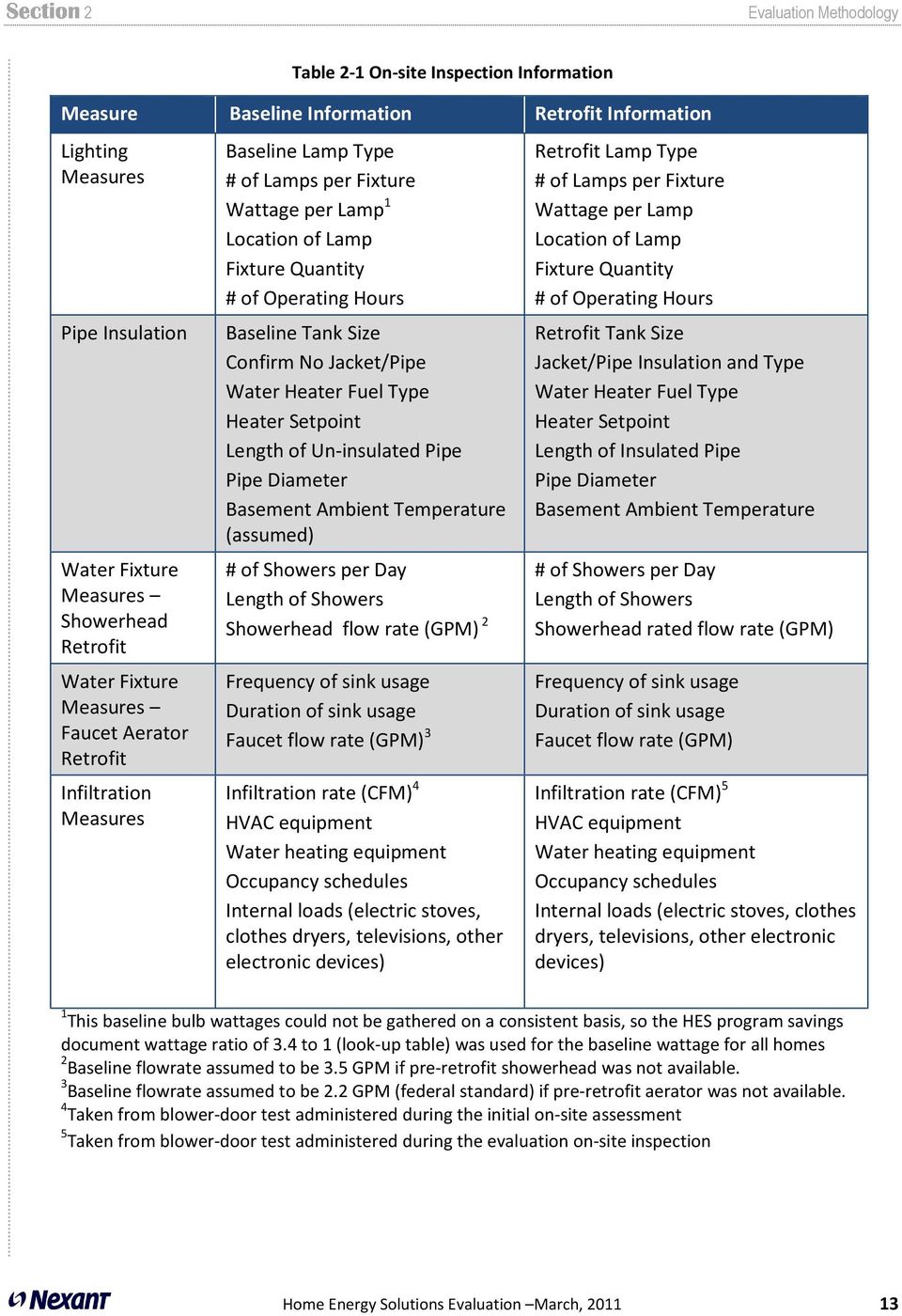
15 2 Evaluation Methodology Gross Savings Data For the calculation of gross savings, site inspectors gathered information on baseline and retrofit equipment, as well as actual operating conditions. Data gathered at all residences for the measures installed under HES is described in Table 2-1. A complete copy of the data collection tool is provided in Appendix B. Home Energy Solutions Evaluation March,

16 2 Evaluation Methodology Table 2-1 On-site Inspection Information Measure Baseline Information Retrofit Information Lighting Measures Pipe Insulation Water Fixture Measures Showerhead Retrofit Water Fixture Measures Faucet Aerator Retrofit Infiltration Measures Baseline Lamp Type # of Lamps per Fixture Wattage per Lamp 1 Location of Lamp Fixture Quantity # of Operating Hours Baseline Tank Size Confirm No Jacket/Pipe Water Heater Fuel Type Heater Setpoint Length of Un-insulated Pipe Pipe Diameter Basement Ambient Temperature (assumed) # of Showers per Day Length of Showers Showerhead flow rate (GPM) 2 Frequency of sink usage Duration of sink usage Faucet flow rate (GPM) 3 Infiltration rate (CFM) 4 HVAC equipment Water heating equipment Occupancy schedules Internal loads (electric stoves, clothes dryers, televisions, other electronic devices) Retrofit Lamp Type # of Lamps per Fixture Wattage per Lamp Location of Lamp Fixture Quantity # of Operating Hours Retrofit Tank Size Jacket/Pipe Insulation and Type Water Heater Fuel Type Heater Setpoint Length of Insulated Pipe Pipe Diameter Basement Ambient Temperature # of Showers per Day Length of Showers Showerhead rated flow rate (GPM) Frequency of sink usage Duration of sink usage Faucet flow rate (GPM) Infiltration rate (CFM) 5 HVAC equipment Water heating equipment Occupancy schedules Internal loads (electric stoves, clothes dryers, televisions, other electronic devices) 1 This baseline bulb wattages could not be gathered on a consistent basis, so the HES program savings document wattage ratio of 3.4 to 1 (look-up table) was used for the baseline wattage for all homes 2 Baseline flowrate assumed to be 3.5 GPM if pre-retrofit showerhead was not available. 3 Baseline flowrate assumed to be 2.2 GPM (federal standard) if pre-retrofit aerator was not available. 4 Taken from blower-door test administered during the initial on-site assessment 5 Taken from blower-door test administered during the evaluation on-site inspection Home Energy Solutions Evaluation March,
17 2 Evaluation Methodology Data Analysis For less complex measures such as lighting, pipe insulation, and water measures, stipulated engineering algorithms were used to calculate the measure-specific gross savings. The algorithms produced demand and energy savings by utilizing site-specific data collected during the site visits, project documentation, and industry literature. The data gathered during home inspections allowed accurate inputs to be used for measure specific, home-by-home engineering calculations. For less complex measures, gross electrical peak demand savings and typical gas peak day (and extreme peak day) savings were calculated by applying coincidence factors to connected electrical demand reduction, annual electric energy savings, or gas savings. For summer and winter electrical demand savings, the seasonal peak is determined by the NE-ISO definition as follows: The seasonal peak is defined as non-holiday week days when the Real-Time System Hourly Load is equal to or greater than 90% of the most recent 50/50 System Peak Load Forecast for the summer season. The summer on-peak period is defined as 1:00PM 5:00PM nonholiday weekdays in June, July and August. The winter on-peak period is defined as 5:00 7:00PM non-holiday weekdays in December and January. The typical gas peak day and extreme gas peak day are defined as follows: Typical Peak Day 30 year average coldest day Extreme Peak Day coldest day over the last 30 years A more complex engineering analysis was performed for energy savings from reduced infiltration, using equest building energy simulation models. Gross electrical peak demand savings due to infiltration measures were extracted directly from the hourly simulation results produced by equest. Typical peak day and extreme peak day gross gas savings due to infiltration measures were calculated by applying space heating-specific gas peak factors (typical peak day and extreme peak day) to annual gas savings predicted by the simulation. The following subsections explain the engineering algorithms used to calculate gross savings for the lighting, pipe insulation and water measures. Detailed explanation of the equest modeling used for infiltration measures in available in Appendix D Lighting The summer and winter on-peak demand savings calculation algorithm is shown in Equation 2-1. Equation 2-1 Where: = Watts = Wattage reduction from retrofitting incandescent bulbs with CFL. Baseline Wattage taken from incandescent-to-cfl ratio of HES PSD Home Energy Solutions Evaluation March,

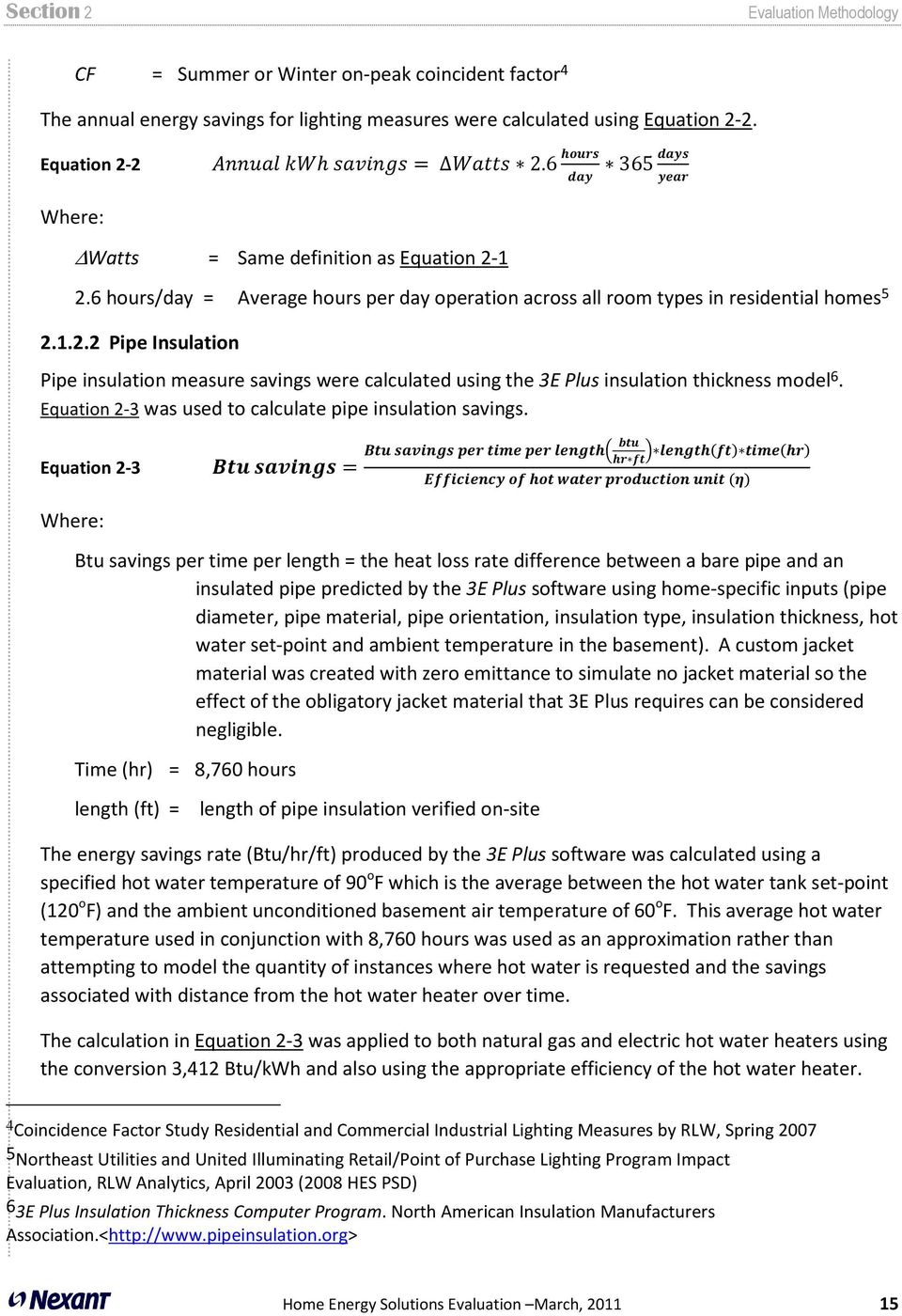
18 Section 2 Evaluation Methodology CF = Summer or Winter on-peak coincident factor 4 The annual energy savings for lighting measures were calculated using Equation 2-2. Equation 2-2 h = Where: Watts = Same definition as Equation hours/day = Average hours per day operation across all room types in residential homes Pipe Insulation Pipe insulation measure savings were calculated using the 3E Plus insulation thickness model 6. Equation 2-3 was used to calculate pipe insulation savings. Equation 2-3 = Where: Btu savings per time per length = the heat loss rate difference between a bare pipe and an insulated pipe predicted by the 3E Plus software using home-specific inputs (pipe diameter, pipe material, pipe orientation, insulation type, insulation thickness, hot water set-point and ambient temperature in the basement). A custom jacket material was created with zero emittance to simulate no jacket material so the effect of the obligatory jacket material that 3E Plus requires can be considered negligible. Time (hr) = 8,760 hours length (ft) = length of pipe insulation verified on-site The energy savings rate (Btu/hr/ft) produced by the 3E Plus software was calculated using a specified hot water temperature of 90 o F which is the average between the hot water tank set-point (120 o F) and the ambient unconditioned basement air temperature of 60 o F. This average hot water temperature used in conjunction with 8,760 hours was used as an approximation rather than attempting to model the quantity of instances where hot water is requested and the savings associated with distance from the hot water heater over time. The calculation in Equation 2-3 was applied to both natural gas and electric hot water heaters using the conversion 3,412 Btu/kWh and also using the appropriate efficiency of the hot water heater. 4 Coincidence Factor Study Residential and Commercial Industrial Lighting Measures by RLW, Spring Northeast Utilities and United Illuminating Retail/Point of Purchase Lighting Program Impact Evaluation, RLW Analytics, April 2003 (2008 HES PSD) 6 3E Plus Insulation Thickness Computer Program. North American Insulation Manufacturers Association.< Home Energy Solutions Evaluation March,
19 Section 2 Evaluation Methodology Typical peak day gas savings were calculated using Equation 2-4. Equation 2-4 Where: = Peak gas factor = for typical peak day For pipe insulation measures, extreme peak day savings will be equivalent to typical peak day savings because the supply water (ground water or city water) temperature is equivalent on a typical peak day and extreme peak day. Electrical peak demand savings for pipe insulation measures were calculated using Equation 2-5. Equation 2-5 Where: = Seasonal Peak CF = W/kWh Summer; W/kWh Winter Water Measures Water measures consisted of low-flow showerheads and faucet aerators. Equation 2-6 was used to calculate energy savings due to installation of low flow showerheads: Equation 2-6 Where: = = minutes per day usage 9 = difference between baseline showerhead flowrate and low-flow showerhead flow rate = 8.31; density of water = 1.0; specific heat of water = difference in temperature of domestic hot water tank set-point and cold water supply Although minutes per day usage was gathered through interview with participants, the results are not extrapolated across all participants since the data was based on subjective responses (opinion) and not metered data. Also, the 22 homes in this evaluation that contained water measures were PSD Table PSD Section : Pipe Insulation 9 Table 3, LBNL-35475, "The effect of Efficiency Standards on Water Usage and Water Heating Energy Use in the U.S.: A Detailed End-use Treatment", May 1994 Home Energy Solutions Evaluation March,

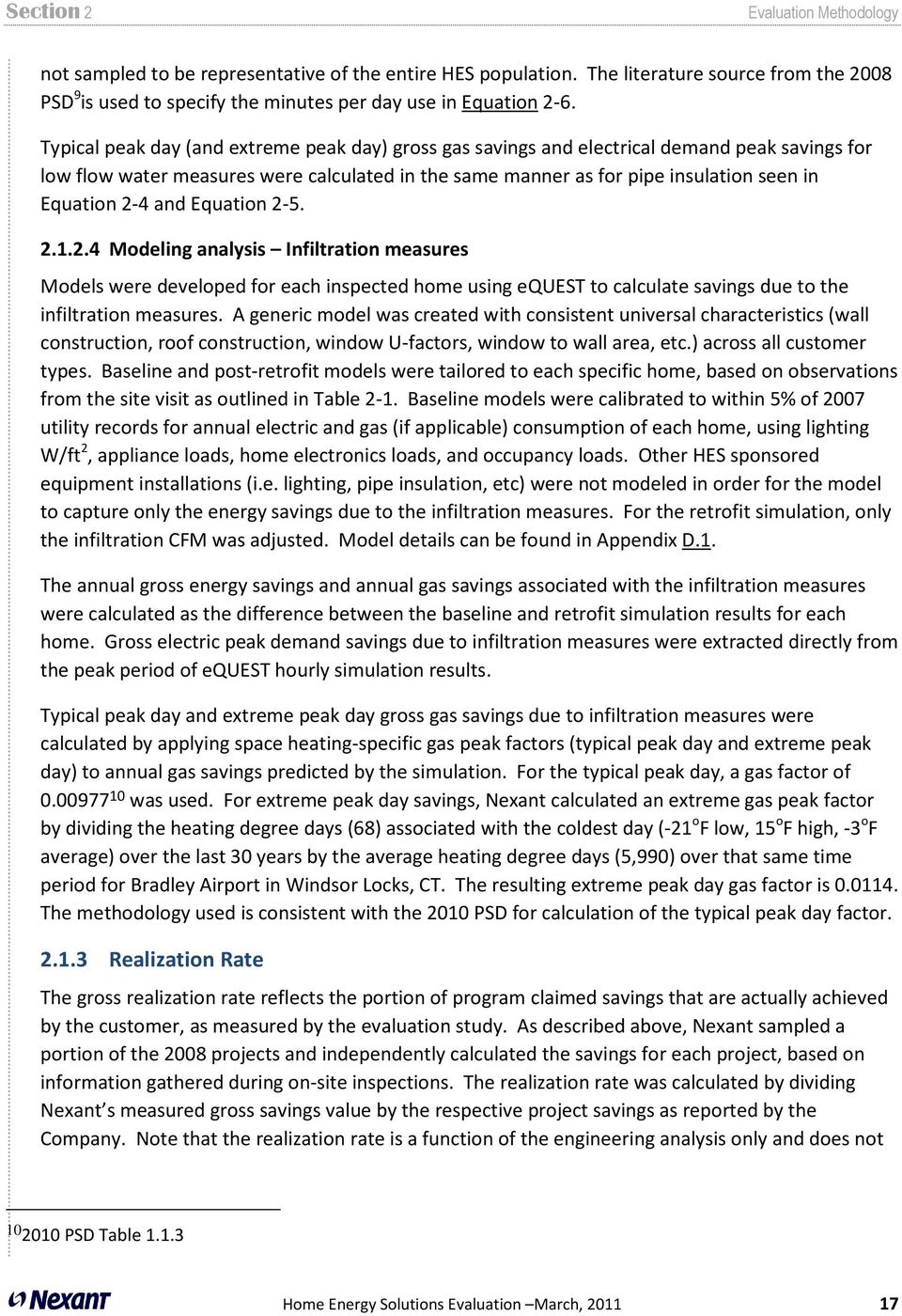
20 Section 2 Evaluation Methodology not sampled to be representative of the entire HES population. The literature source from the 2008 PSD 9 is used to specify the minutes per day use in Equation 2-6. Typical peak day (and extreme peak day) gross gas savings and electrical demand peak savings for low flow water measures were calculated in the same manner as for pipe insulation seen in Equation 2-4 and Equation Modeling analysis Infiltration measures Models were developed for each inspected home using equest to calculate savings due to the infiltration measures. A generic model was created with consistent universal characteristics (wall construction, roof construction, window U-factors, window to wall area, etc.) across all customer types. Baseline and post-retrofit models were tailored to each specific home, based on observations from the site visit as outlined in Table 2-1. Baseline models were calibrated to within 5% of 2007 utility records for annual electric and gas (if applicable) consumption of each home, using lighting W/ft 2, appliance loads, home electronics loads, and occupancy loads. Other HES sponsored equipment installations (i.e. lighting, pipe insulation, etc) were not modeled in order for the model to capture only the energy savings due to the infiltration measures. For the retrofit simulation, only the infiltration CFM was adjusted. Model details can be found in Appendix D.1. The annual gross energy savings and annual gas savings associated with the infiltration measures were calculated as the difference between the baseline and retrofit simulation results for each home. Gross electric peak demand savings due to infiltration measures were extracted directly from the peak period of equest hourly simulation results. Typical peak day and extreme peak day gross gas savings due to infiltration measures were calculated by applying space heating-specific gas peak factors (typical peak day and extreme peak day) to annual gas savings predicted by the simulation. For the typical peak day, a gas factor of was used. For extreme peak day savings, Nexant calculated an extreme gas peak factor by dividing the heating degree days (68) associated with the coldest day (-21 o F low, 15 o F high, -3 o F average) over the last 30 years by the average heating degree days (5,990) over that same time period for Bradley Airport in Windsor Locks, CT. The resulting extreme peak day gas factor is The methodology used is consistent with the 2010 PSD for calculation of the typical peak day factor Realization Rate The gross realization rate reflects the portion of program claimed savings that are actually achieved by the customer, as measured by the evaluation study. As described above, Nexant sampled a portion of the 2008 projects and independently calculated the savings for each project, based on information gathered during on-site inspections. The realization rate was calculated by dividing Nexant s measured gross savings value by the respective project savings as reported by the Company. Note that the realization rate is a function of the engineering analysis only and does not PSD Table Home Energy Solutions Evaluation March,
21 Section 2 Evaluation Methodology take in to account any findings obtained from the billing analysis study. Gross realization rates are calculated for specific measures, as well as for the program as a whole. The overall program realization rate (calculated as a weighted average of all projects and measures) was then applied to the entire population of savings. Equation 2-7 shows the basic formula for calculating gross measured savings. Equation 2-7 Savingsmeas = Savingscalc Realization Rate Where: Savings meas = Gross savings measured by Nexant for the program Savings calc = Gross savings calculated for the program, as calculated using PSD data Realization Rate = Averaged Savings meas /Savings calc for each sample project A realization rate of 1.0 occurs when the measured savings were equivalent to the savings calculated by the program. Realization rates greater or less than 1.0 indicates that actual operating conditions, equipment installation, and/or baseline conditions were greater than or less then (respectively) the assumptions in the PSD. 2.2 BILLING ANALYSIS STUDY A billing analysis study was performed to estimate net savings from the program as a whole. The billing analysis compared billing trends between program participants and non-participants to draw conclusions about consumer behavior in the current energy market. The results of the billing analysis study do not affect the gross measured savings or reported realization rates. The gross measured savings calculated through engineering analyses represent the savings realized through measure installation at participant homes. Non-program influences, such as changes in the economy and energy costs, affect customer behavior. To quantify the effect of outside influences, utility billing data from program participants and non-participants, both before and after program installation, were collected and comparatively analyzed using a regression based billing analysis. The results of billing analyses were used to determine the percentage of the impact that can be attributed to the HES program Control Group Ratio Results from the billing analysis were used to calculate a control group ratio (CGR).The CGR can be used to isolate non program influences and study the effect of economic conditions on participant behavior. The methodology is presented below and the results can be found in Section 4.2. While program participants are expected to display reduced energy consumption, non-participants may also adjust their energy consumption because of influences such as changes in the economy, employment status, the price of energy, or other factors. Comparing the energy consumption of a group of non-program participants during the same time periods shows the effects of conditions outside of the influence of the program. Program participants are equally likely to have been influenced by these external factors. Thus, if the change in energy consumption of participants is compared to changes in non-participants energy consumption, the effects of non-program external Home Energy Solutions Evaluation March,
22 Section 2 Evaluation Methodology influences can be separated from the effects of the program itself. Figure 2.1 is a schematic illustrating the control group ratio analysis method, using the non-participant data as a control group. The calculation for the Impact Rate (IR), Control Group Savings (CGS) and the Control Group Ratio (CGR) can also be seen in Figure 2.1. Figure 2.1 Control Group Impact Analysis Schematic As noted in the figure, the Impact Rate (IR) of the program is equal to the energy savings rate of participants less the energy savings rate of non-participant. The Control Group Savings (CGS) is equal to the Impact Rate (IR) multiplied by the participant baseline energy consumption (E b ). Finally, the Control Group Ratio (CGR) is equal to the Control Group Savings (CGS) divided by the difference between pre and post program annual energy consumption (E b -E a ). If savings are attributable to the program, then the value of the IR is positive. For instance, if the non-participant s consumption of electricity decreased by 3% and the participant s decreased by 9%, the net savings attributable to the program would be 6% of the sum of the participant s baseline year consumption. The resulting CGR would be 6% multiplied by the baseline year s consumption (E b ) divided by the difference between pre and post program annual energy consumption (E b -E a ). An assessment of the general energy climate was performed using the described billing analysis method. The billing analysis was conducted using a regression model to compare twelve months of pre and post-retrofit energy use for participants and non-participants, based on a control group method. A control group (non-participant group) of homes in the same area, experiencing the same weather and with similar pre-program energy consumption characteristics is a very robust and appropriate baseline. It reflects both the behavior and the market changes in a very similar group of homes. The energy consumption from utility billing records for program participants and non-participants in the baseline year of 2007 and the post-retrofit year of 2009, across all three home heating fuel types was analyzed. The 2009 electricity and gas consumptions were normalized based on a weather Home Energy Solutions Evaluation March,
23 2 Evaluation Methodology regression of the 2007 electricity and gas consumptions. Cooling degree days or heating degree days were used as the independent variable, depending on the season, to calculate the relationship used to normalize the 2009 energy consumption. Details on the weather adjustments are described in Appendix E Utility Data Sampling Assistance and input from CL&P and UI allowed the samples for participants and non-participants to be drawn using a single, uniform method. Both utilities were able to identify the home heating fuel type of non-participants, using billing rate identifiers and seasonal consumption thresholds. The goal was to have 100 participant homes and 100 non-participant homes in each of the 3 home heating fuel categories (600 homes total) from which to calculate savings. Out of the 100 homes in each home heating fuel category, 78 were from CL&P and 22 from UI, which was based on the weighted proportion of the program s estimated electrical demand savings in each Company s territory. A summary of actual account energy consumption quantities for the sampled homes can be found in Appendix E. Twelve months of utility bills were collected for each home in the same zip code area, from each of the 2007 (pre-retrofit) and 2009 (post-retrofit) time periods. There were some challenges involved in determining the heating fuel type for non-participants since this characteristic is not tracked explicitly in the Company billing databases. The procedures used to identify home heating fuel type for non-participants can be found in Appendix E. The gas billing analysis was conducted only for Yankee gas customer accounts since the utility billing records from SCG and CNG could not be obtained. The Yankee gas customer account profiles were assumed to be representative of all gas customers who participated in the HES program. The shortcoming did not affect the engineering impact analysis since the measure level gas savings for the HES participants in the on-site sample were available in the project records Company Monthly Billing Records The companies provided electronic spreadsheets that contained monthly billing records of the sampled accounts during the 2007 to 2009 time period. CL&P provided monthly electric billing records as well as corresponding Yankee Gas monthly billing records for its customers and UI provided monthly electric billing records for its customers. The CL&P and Yankee Gas billing database underwent a major overhaul in 2008 that required billing data to be combined from two different database systems. The earlier system, named C2, included data through March 2008 for Yankee Gas accounts and through September 2008 for CL&P electric accounts. Billing records more recent than the database system conversion dates were stored in the new database system, named Report Mart. Billing data was delivered to Nexant in separate spreadsheet files by year (2007, 2008, 2009) and energy type (kwh, CCF). An additional file was delivered that contained two unique identifiers, derived from meter numbers, to link data provided in one database system to the other and also between gas and electric accounts. The following protocol was used to assemble a single consumer bill usable for the billing analysis: Home Energy Solutions Evaluation March,
24 2 Evaluation Methodology 1. Obtain monthly electric data from 2007 legacy data system spreadsheet file. Ensure that consumption records exist for each month and that bill from and bill to dates span one month. Check for multiple meter readings within a single month or meter readings that span multiple months. Collapse or split these types of meter readings accordingly. Split percentages can be obtained using ratios in the corresponding months in 2008 or 2009 billing data, if available. Missing month s meter readings can be accommodated with scaled 2008 data if available and can only be obtained for a maximum of one missing month. Accounts with more than one missing month in 2007 were eliminated from the billing analysis. 2. Use unique identifier provided to link 2007 legacy C2 electric data to 2008 and 2009 Report Mart electric data for the same account. Obtain monthly electric data from 2009 Report Mart data system spreadsheet file. Repeat step 1. Make adjustments as necessary. 3. Use unique identifier provided to link CL&P electric account to Yankee Gas account. 4. Obtain monthly gas data from 2007 legacy data system spreadsheet file. Repeat step 1. Make adjustments as necessary. 5. Obtain monthly gas data from the 2009 data system spreadsheet file. Repeat step 1. Make adjustments as necessary. 6. Billing records are now in suitable format for billing analysis. Organizing the billing records for CL&P and Yankee Gas data presented several challenges that required each account s monthly meter readings to be manually inspected. The three largest issues encountered were 1) Missing monthly readings, 2) Single months with multiple readings and 3) Meter readings that spanned multiple months. Each issue is discussed in greater detail below along with Nexant s resolution strategy. Meter readings for early 2007 months were missing for several accounts. In order to provide an estimate of the missing records, 2008 data was used and scaled if available. Another issue was a single month that contained multiple meter readings. The most common month to experience this issue was December There was often a portion of December 2007 data recorded in the January 2008 data file, usually labeled system derived usage. For example, the 2007 data file would contain a December reading from 12/2/2007 to 12/23/2007 while all other months contained readings through the end of the month. Inspection of the 2008 monthly data file would reveal a reading from the missing portion of December 2007 which would need to be manually added to the meter reading in 2007 to obtain an accurate energy consumption value. Meter readings that spanned multiple months was another issue encountered, although less frequent than the two previous issues. In all such cases, the meter readings spanned two months. In order to split the meter reading in to its monthly components, the ratio of the energy consumption in the corresponding 2008 monthly data was used. In addition to the issues encountered in the monthly data, the unique identifiers that linked the old and new database systems introduced another level of complexity. Significant additional time and Home Energy Solutions Evaluation March,
25 2 Evaluation Methodology effort was needed to assemble monthly billing records. Specifically for gas heated homes, certain accounts had complete electric billing records, but their corresponding gas billing records were incomplete. These issues significantly increased the level of effort needed to assemble billing records of all accounts (over 600 accounts total). Several difficulties associated with organizing the CL&P and Yankee Gas data in to a suitable format for billing analysis were due to the conversion of database systems that occurred in However, the billing data of several accounts in both systems contained inconsistencies. The electric monthly billing data provided by UI was delivered in a consistent and clean format readily usable for billing analysis. A single spreadsheet was provided that contained well organized information. Southern Connecticut Gas and Connecticut Natural Gas companies were unable to provide billing data HES Participation Databases CL&P and UI delivered HES participation databases (Microsoft Excel files) to Nexant that included Phase 1 measure specific participation data itemized by account number (homeowner name and address). Separate databases were also provided for Phase 2 participation data for appliance and insulation rebates. Although the HES application used by vendors to administer home assessments is uniform across the Companies, CL&P and UI use drastically different electronic databases to store the participation information. Structurally, the HES participation database used by CL&P contained one row per account (participant) and each column represented a Phase 1 measure parameter or home characteristic parameter (name, address, account number, square footage, home heat fuel type, etc). Parameters specific to HES energy conservation measures included details on installed measures such as quantity and type of lights installed, CFM reduction, quantity (in feet) of pipe insulation and associated energy savings (kwh, seasonal kw and MMBtu), etc. The database was logically organized and allowed participation details to be easily exported and studied. The HES participation database used by UI was structured differently from that of CL&P and contained multiple rows per account (participant). A column labeled proddesc (product description) was used to itemize installed HES measures and several other columns were used to specify associated electric energy savings. This database structure contained several redundant rows for many columns that are common to the participant (name, address, account number, etc) and made analyzing the data difficult. UI also provided a completely separate file titled nonelectric benefit report that included natual gas savings in addition to fuel oil and water savings. Combining the information available in both databases required significant additional time and effort. The CL&P HES participant database was more convenient to work with and allowed analysis to be performed easier and faster. The Companies should consider standardizing the HES participant database to a format currently used by CL&P. Home Energy Solutions Evaluation March,
26 2 Evaluation Methodology 2.3 PROGRAM COMPREHENSIVENESS EVALUATION Program comprehensiveness was evaluated through interviews with program participants during inspection visits and observation of how thorough each installation was when completed. A survey was developed and administered to a sample of participants to determine the reasons why some measures may not have been implemented despite their technical feasibility. Separate interviews were conducted with program implementers and installers via telephone. Both utilities provided lists of program implementers and contact information. A questionnaire was developed as a guide to investigate program comprehensiveness with installers. Both groups were surveyed for satisfaction levels and for any additional program feedback. The survey used with participant homeowners is included in Appendix B.1. The survey used with vendors is included in Appendix B SUMMARY OF EVALUATION METHODOLOGIES To recap, Table 2-2 summarizes the methodologies used for each component of this evaluation. Method / Objective Table 2-2 Summary of Evaluation Methodologies Used On-Site Inspection and Measurement Vendor Interviews Participant Interviews Engineering Models Annual Gross Electric and Gas Savings Peak Period(s) Gross Savings Statistical Analysis of Utility Bills Net Savings Study Comprehensiv eness and Program Satisfaction Secondary Research PSD Review 2.5 VALIDITY AND RELIABILITY Energy efficiency evaluations are subject to several sources of potential bias. A short description of potential biases for the HES evaluation and a brief explanation of how each potential bias was minimized follows. Home Energy Solutions Evaluation March,
27 2 Evaluation Methodology Participant Recruitment for the Inspection Visit Letters were sent to 160 HES participants, under Company letterhead and signed by HES program staff, offering a $50 rebate for agreeing to allow an inspector to visit the home, with a target of inspecting 41 homes. A potential bias exists that some homeowners were willing to agree to the inspection visit simply to receive the monetary incentive. Some homeowners were motivated enough to volunteer for inspection by searching online for Nexant s contact information, despite it not being provided in the contact letter. In order to avoid selecting an inordinate quantity of these fast-responders, a protocol was instituted to pool all homeowners who volunteered for inspection by calling Nexant directly. Only a few of these homeowners were selected for inspections. Enthusiastic homeowners who voluntarily contacted Nexant were kept to a minimum, so as to not bias the evaluation. Most homeowners were recruited for inspection by receiving a phone call directly from Nexant scheduling staff. Care was also taken to select a broad range of homeowners: retirees, families, couples, stay-at-home moms, work from home, etc. Infiltration Measurement Since Nexant performed the blower door test to measure home envelope infiltration at a later date than the initial assessment, there is potential for several parameters to have an effect on the results. Outdoor temperature and other natural conditions (wind levels, time of day) would change the blower door test results. The state of the home envelope would also have a significant impact on the infiltration rates if envelope changes occurred after the initial assessment was completed by the contractor. The effect of natural conditions is not as critical as the state of the home s envelope. In order to minimize any potential bias and error due to changes in the home envelope, Nexant inspectors interviewed homeowners to ensure the home was in the same configuration as when the initial assessment was conducted. The blower door testing equipment was well calibrated and all on-site inspectors were trained to ensure that the test was administered correctly and to minimize bias and error. Choosing an appropriate comparison group for billing analysis Care was taken in selecting the participants and control groups (non-participants) for the billing analysis. Cooperation with the Companies was needed to identify the home heating fuel of nonparticipant accounts. Characteristics used to match participants and non-participants were annual baseline year consumption and basic geographic grouping by zip code. Appendix E provides further information. Vendor Recruitment Contact s were sent out to participating HES vendors asking to arrange a time for an interview. Naturally, vendors who offered negative feedback of the program were motivated to respond quickly and to participate in the comprehensiveness survey, while vendors who were content with their involvement in the program were not as motivated about giving feedback. There is a potential for greater participation from vendors who had negative feedback. In order to minimize this effect, Nexant attempted to contact all vendors in a uniform fashion so as to achieve consistent results. Home Energy Solutions Evaluation March,
28 2 Evaluation Methodology Slow to respond vendors were contacted multiple times so that negative feedback from fast responders did not bias overall results. Billing Data Availability The home heating fuel type of the non-participants was estimated using Company rate identifiers and/or seasonal consumption thresholds. The evaluators worked with Company staff to determine the most accurate means to identify home heating fuel type for the purposes of providing Company data for the billing analysis. The gas billing analysis was conducted only for Yankee gas customer accounts since the utility billing records from SCG and CNG could not be obtained. The Yankee gas customer account profiles were assumed to be representative of all gas customers who participated in the HES program, although the loss of the SCG and CNG data had a strong negative impact on the precision of the results. As discussed in Section 2.2.2, this shortcoming did not affect the engineering impact analysis since the measure level gas savings for the HES participants in the on-site sample were available in the project records. Home Energy Solutions Evaluation March,
29 Section 3 GROSS IMPACT EVALUATION RESULTS The gross impact evaluation investigates the energy and demand savings that result from measure implementation. The current evaluation study only includes Phase 1 measures. Although participants who installed Phase 2 measures were attempted to be included in the home inspection sample, Nexant was unable to recruit any Phase 2 participants. Phase 2 measures represent less than 5% of the program s claimed savings, excluding rebates for central air conditioning, so the net effect of variations in this population on the program realization rate are minimal. 3.1 SURVEY RESULTS Nexant performed site visits for a total of 42 residences, split between the utilities based on the weighted proportions of the program-estimated electric demand savings in each Company s territory (33 homes for CL&P, 9 homes for UI). Two inspected homes (both CL&P) were removed from the realization rate calculation, because their energy consumption profiles changed significantly since HES participation (one installed solar panels, the other a pellet stove heater). The surveyed projects included a variety of installed measures. Table 3-1 shows the distribution of installed measures in the surveyed projects. None of the 42 homes inspected availed themselves of rebate measures. Table 3-1 Quantity of Homes with Installed Measures in Surveyed Projects, by heating type Measure Natural Gas Electric Oil & Other Total Qty of Homes by Heat fuel Lighting Measures Pipe Insulation Water Measures Infiltration Measures The entries in Table 3-1 are quantity of homes with each measures type. Table 3-2 summarizes measure installation in the entire sample. Table 3-2 Total Installed Measures in Surveyed Projects Measure Lighting Measures Pipe Insulation Water Measures Infiltration Measures Measures per Home 24 bulbs per residence, on average 70 ft total across all 10 homes 3 total fixtures per residence, on average Varied by site 3.2 MEASURE-SPECIFIC SAVINGS RESULTS Measure-specific analyses using standard engineering algorithms were conducted to calculate energy savings for lighting, pipe insulation, and water measures for all projects surveyed. All Home Energy Solutions Evaluation March,
30 3 Gross Impact Evaluation Results instances where gross measured savings differed from gross calculated savings were categorized in to the following adjustment categories: Technology adjustment (TECH_ADJ) accounts for all discrepancies between the technology (equipment type, efficiency, system configuration, etc.) identified in the paperwork and that observed in the field. Adjustments to baseline assumptions are also contained in this technology adjustment factor. Quantity adjustment (QTY_ADJ) reflects any discrepancies between the quantity or size of the documented equipment versus the measures observed in the field Lighting Table 3-3 shows the evaluation measured gross savings and HES program calculated gross savings for lighting measures, incorporating all of the surveyed projects. Since the baseline in the PSD was assumed to be the best estimate of the baseline, all discrepancies are the result of differences in the type or quantity of lights installed. Unit of Savings Table 3-3 Lighting Measured Savings Gross Measured Savings - Nexant Gross Calculated Savings - Companies Realization Rate kwh 35,962 36,178 99% Summer Peak kw % Winter Peak kw % Nexant examined each project to determine the cause of the discrepancy between the measured value and HES s reported value. The primary reasons include: Inaccurate bulb quantities: 11 homes contained bulb quantity deficiencies when compared to project records and can be seen in Table 3-4 under the column labeled Qty_Adj. Two homes contained a slight surplus of bulbs as compared to project records. A negative quantity in column Qty_Adj indicates Nexant found fewer bulbs onsite than indicated in project records; a positive quantity estimate found more. Bulb type discrepancies: 16 homes contained discrepancies in bulb type when compared to project records and can be seen in Table 3-4 under the column labeled Tech_Adj. In these cases, implementation contractors installed different wattage CFL s to replace the same type of incandescent bulb within the same home depending on the lighting demand of the space and what they had in stock. Table 3-4 lists the project specific savings for all homes that contained lighting measures and their categorized adjustment factors. Home Energy Solutions Evaluation March,
31 Section 3 Gross Impact Evaluation Results Home Identifier Lighting kwh Nexant Table 3-4 Project Specific Savings: Lighting Lighting kwh HES Lighting Summer Peak kw Nexant Lighting Summer Peak kw HES Lighting Winter Peak kw Nexant Lighting Winter Peak kw HES Tech_Adj Qty_Adj ,373 2, (-2) (-2) ,146 1, (-3) 8 1,196 1, ,929 2, (-2) ,797 2, (+4) 16 1,455 1, (-3) (-1) (-1) ,180 1, ,754 1, (-3) 29 2,257 2, ,326 1, (+1) 31 1,437 1, ,772 1, N/A N/A 34 1,123 1, N/A N/A (-1) N/A N/A N/A 39 1,203 1, N/A (-8) N/A (-1) Sum 35,962 36, Pipe Insulation The gross measured savings are presented in Table 3-5 for pipe insulation measures installed at 8 homes with gas domestic hot water heaters and 2 homes with electric domestic hot water heaters. Home Energy Solutions Evaluation March,
32 3 Gross Impact Evaluation Results Table 3-5 Pipe Insulation Measured Savings Hot Water Heater Fuel Type Gas Electric Unit Gross Measured Savings Gross CalculatedSavings Realization Rate MMBtu % MMBtu (typical peak day) N/A MMBtu (extreme peak day) N/A kwh % Summer Peak kw % Winter Peak kw % Nexant examined each project to determine the cause of the discrepancy between the measured value and HES s calculated value. The primary reason was: Variation in savings calculation methodology: The HES program savings document uses a look-up table to assign energy savings for pipe insulation measures, while the Nexant calculations used the 3E Plus insulation software to calculate the Btu savings, with direct inputs to the software from conditions recorded on-site. Recommended savings for 10 linear feet of pipe and a comparison of the two methodologies can be found in Section 5.2, which presents a review of pipe insulation calculation of the PSD. Length of pipe insulation: The length of pipe insulation installed was found to match project records in all but two homes. Table 3-6 shows the project specific savings for all homes that contained pipe insulation with associated gas domestic hot water (DHW) heaters and their categorized adjustment factors. Home Energy Solutions Evaluation March,
33 3 Gross Impact Evaluation Results Table 3-6 Project Specific Savings: Pipe Insulation (Gas DHW Heater) Home Identifier Pipe Insulation MMBtu Nexant Pipe Insulation MMBtu HES Pipe Insulation Typical Peak Day MMBtu Nexant Pipe Insulation Extreme Peak Day MMBtu HES Qty_Adj (-9ft) (-6ft) Sum Home identifier 28 contained 3 feet of pipe insulation while project records indicated 9 feet, a deficiency of 6 feet. Home identifier 22 contained no pipe insulation, while project records specified 9 feet. Table 3-7 shows the project specific savings for all homes that contained pipe insulation with associated electric domestic hot water (DHW) heaters and their categorized adjustment factors. Home Identifier Table 3-7 Project Specific Savings: Pipe Insulation (Electric DHW Heater) Pipe Insulation kwh Nexant Pipe Insulation kwh HES Pipe Insulation Summer Peak kw Nexant Pipe Insulation Summer Peak kw HES Pipe Insulation Winter Peak kw Nexant Pipe Insulation Winter Peak kw HES Sum Tech_Adj The home associated with Home Identifier 20, contained the correct length of pipe insulation (6 feet), however the domestic hot water was provided via propane gas therefore no electrical savings are achieved Water Measures The evaluation measured gross savings and HES program calculated gross savings for homes with natural gas and electric hot water heaters are shown in Table 3-8. Home Energy Solutions Evaluation March,
34 3 Gross Impact Evaluation Results Table 3-8 Water Measures Measured Savings Hot Water Heater Fuel Type Natural Gas Electric Unit Gross Measured Savings Gross Calculated Savings Realization Rate MMBtu % Typical Peak Day MMBtu 0.18 N/A Extreme Peak Day MMBtu 0.18 N/A kwh 2, , % Summer Peak kw % Winter Peak kw % Nexant examined each project to determine the cause of the discrepancy between the Nexant calculated value and HES s calculated value. The primary reasons include: Missing equipment: Project records specified that 62 low flow devices were installed in the sampled homes. However, Nexant found 52 measures still installed. Participants reported removing two of these measures. In both cases the participant removed a programsponsored low flow showerhead and switched back to the standard flow showerhead due to dissatisfaction with the flow rate. The remaining 8 measures are included as Quantity Adjustments to the calculated savings. Differences in water heater energy factor: Where available, Nexant used the actual efficiency of the hot water heater found on-site, which sometimes differed from the efficiencies assumed in the 2008 PSD (90%, 60%, and 50%for electric, gas, and oil water heaters, respectively). Water usage discrepancy: For faucet aerators, Nexant used an annual water usage reduction of 256 gallons based on the source associated with the 2010 PSD 9, while the tracked savings used an annual water reduction of 2,730 gallons associated with the 2008 PSD. The effects of quantity discrepancy and water usage discrepancy outweighed the effect of the differences in water heater energy factor, resulting in measured savings shown in Table 3-8. Project specific discrepancies in quantity (Qty_Adj) and water heater efficiency (Tech_Adj) are shown in Table 3-9 and Table 3-10 for gas and electric hot water heaters respectively. Home Energy Solutions Evaluation March,
35 3 Gross Impact Evaluation Results Table 3-9 Project Specific Savings: Water Measures (Gas DHW Heater) Home Identifier Home identifier Water Measures MMBtu Nexant Water Measures MMBtu HES Water Measures Typical Peak MMBtu Nexant Water Measures Extreme Peak MMBtu Nexant Tech_Adj Qty_Adj (-1) (-2) (-1) (-1) (-2) (-1) (-1) Sum Water Measures kwh Nexant Table 3-10 Project Specific Savings: (Electric DHW Heater) Water Measures kwh HES Water Measures Summer Peak kw Nexant Water Measures Summer Peak kw HES Water Measures Winter Peak kw Nexant Water Measures Winter Peak kw HES Tech_Adj Qty_Adj (-1) Sum 2,812 3, The home associated with Home Identifier 27 in Table 3-10, contained the correct quantity of water reduction measures, however the domestic hot water was provided via fuel oil; therefore no electrical savings are achieved Infiltration measures Infiltration (home envelope air sealing) measures were installed at 19 gas heated homes, 6 electric heated homes and 2 oil-heated homes as shown in Table 3-1. The details of each category are presented in Sections , and respectively Gas Heated Homes The gross measured savings and gross calculated savings for the 19 gas-heated homes with central air are shown in Table Home Energy Solutions Evaluation March,
36 3 Gross Impact Evaluation Results Table 3-11 Infiltration Measured Savings (Gas Heated Homes) Fuel Source Natural Gas Electric Unit Gross Measured Savings Gross Calculated Savings Realization Rate MMBtu % Typical Peak Day MMBtu 0.63 N/A Extreme Peak Day MMBtu 0.73 N/A * No winter demand savings claimed. kwh 3,050 2, % Summer Peak kw % Winter Peak kw 0.15 N/A* Table 3-11 shows that Nexant measured an average savings of 3.9 MMBtu per home and 160 kwh per home. Nexant examined each project to determine the cause of the discrepancy between the measured value and HES s calculated value. The primary reasons are: CFM differences: Nexant s CFM figures obtained through on-site blower door testing were lower than HES CFM baseline figures (CFM Pre HES) in 15 of 19 homes. For these homes Nexant calculated positive electric and gas savings. In cases where Nexant s CFM figures were greater than baseline HES CFM figures (i.e. infiltration was greater), Nexant calculated negative savings. Seasonal differences: The outside air temperature affects the CFM figures obtained during blower door tests. In many cases Nexant did not necessarily perform the blower door tests at the same outside air temperature conditions as the initial HES visits. Variation in simulation models: Nexant s equest model relied on home-specific information gathered during on-site visits, as opposed to the HES program model, which used generic home characteristics to specify savings for an average home in Connecticut. The impact of differences in CFM and variation in simulation models dominated any seasonal differences that may have occurred. Across all homes, the gross measured energy savings were slightly higher than the gross calculated savings while the summer peak demand savings showed the opposite trend. This can be explained by the homes in the sample achieving most of their energy (MMBtu) savings during non-peak periods. The simulations showed lower savings during the summer peak periods mainly due to lower equipment operating hours. A summary of CFM rates of infiltration and project specific savings are presented in Table 3-12 and Table 3-13 respectively. Home Energy Solutions Evaluation March,
37 3 Gross Impact Evaluation Results Table 3-12 Project Specific Infiltration Summary (Gas Heated Homes) Home CFM Pre CFM Post CFM Post Identifier HES HES Nexant CFM HES CFM Nexant 1 2,025 1,872 1, ,523 3,934 5, ,913 2,690 2, ,584 2,315 2, ,402 3,186 2, ,686 4,034 3, , ,971 4,259 3, , ,891 1,718 2, ,413 4,115 3, ,296 2,073 2, ,180 1,930 1, ,532 3,216 3, ,261 2,803 3, ,583 3,063 4, ,120 6,548 4, , ,150 2,942 2, , ,001 3,757 3, ,904 3,727 3, ,025 1,910 1, The column in Table 3-12 labeled CFM HES is the CFM reduction, measured with blower door equipment, that was recorded in project records by the implementation contractor that performed the initial HES assessment (CFM Pre HES CFM Post HES). The column labeled CFM Nexant is the difference between the baseline HES infiltration rate (CFM Pre HES) and the infiltration rate obtained by Nexant engineers during evaluation site inspection visits (CFM Post Nexant). A negative value for CFM Nexant indicates that Nexant engineers measured a higher infiltration rate than the baseline infiltration rate (CFM Pre HES) obtained by HES implementation contractors. A complete examination of air sealing comprehensiveness and lost opportunity can be found in Section Home Identifier Blower Door MMBtu Nexant Table 3-13 Project Specific Savings: Infiltration (Gas Heated Homes) Blower Door MMBtu HES Blower Door Typical Peak MMBtu Nexant Blower Door Extreme Peak MMBtu Nexant Blower Door kwh Nexant Blower Door kwh HES Blower Door Summer Peak kw Nexant Blower Door Summer Peak kw HES Blower Door Winter Peak kw Nexant 1* * ** N/A N/A N/A Blower Door Winter Peak kw HES Home Energy Solutions Evaluation March,
38 3 Gross Impact Evaluation Results N/A N/A N/A Sum ,050 2, *Home Identifier 1 and 23 did not have equest models created because billing records were not available to accurately calibrate the models. Program calculated savings were accepted for these accounts. **The home associated with Home Identifier 33 had a significant renovation that occurred since the initial HES visit which changed the homes infiltration characteristics. Program calculated savings were accepted for this account. Table 3-12 shows that Nexant measured CFM values for 8 homes (Home Identifier 9, 10, 14, 18, 24, 33, 34,36) that were less than the post CFM indicated in project records. For these homes, Table 3-13 shows that Nexant calculated greater electrical energy savings than program reported savings with the exception of one account (Home Identifier 33) where program reported savings were accepted due a change in the home s envelope characteristics since the HES assessment. Table 3-12 also shows that Nexant measured CFM values for 7 homes (Home Identifier 1, 4, 8, 23, 28, 37, 38) that were greater than the post CFM indicated in project records. For these homes Table 3-13 shows the Nexant gross measured savings were lower compared to program calculated savings with the exception of Home Identifier 37 where program reported savings in the database appear to be unusually low and could be a reporting mistake. Nexant measured a total of 4 homes (Home Identifier 3, 15, 21, 30) where CFM values were greater than the pre CFM indicated in project records. This indicates that when Nexant performed the blower door test, the home had more infiltration than the implementation contractor measured in the baseline case. For these homes Table 3-13 shows Nexant calculated negative energy savings. The lower savings represent a lost opportunity which should be captured during future program cycles. The HES program did not assign winter demand savings for the 19 gas heated homes that were studied in this evaluation. Nexant calculated winter peak demand savings due to reduced fan run time associated with forced air heating systems that occurred during the winter peak period Electric Heated Homes The evaluation measured gross savings and HES program calculated gross savings for the 6 electric heated homes are shown in Table Home Energy Solutions Evaluation March,
39 3 Gross Impact Evaluation Results Table 3-14 Infiltration Measured Savings (Electric Heated Homes) Fuel Source Electric Unit Gross Measured Savings Gross Calculated Savings Realization Rate kwh 2,004 2,507 80% Summer Peak kw % Winter Peak kw % Table 3-14 shows that Nexant measured an average savings of 334 kwh per home and 0.16 summer peak kw per home. Nexant examined each project to determine the cause of the discrepancy between the measured value and HES s calculated value. The primary reasons are: CFM differences: Nexant s CFM figures obtained through on-site blower door testing were lower than HES CFM baseline figures in 5 of 6 homes. For these homes Nexant calculated positive electric and gas savings. Variation in simulation models: Nexant s equest model relied on home-specific information gathered during on-site visits, as opposed to the HES program model, which used generic home characteristics to specify savings for an average home in Connecticut. Seasonal differences: The outside air temperature affects the CFM figures obtained during blower door tests. In many cases Nexant did not necessarily perform the blower door tests at the same outside air temperature conditions as the initial HES visits. Seasonal differences are less of a concern since the impact of differences in CFM and variation in simulation models dominated any seasonal differences that may have occurred. Across all homes, the gross measured energy savings and winter peak savings were lower than their gross calculated counterparts, while the summer peak demand savings showed the opposite trend. The summer demand difference in trend is mainly attributable to Home Identifier 13 that had a large summer demand savings due to a combination of the efficiency of the cooling equipment and set-point temperatures in the summer months. A summary of CFM rates of infiltration and project specific savings are presented in Table 3-15 and Table 3-16 respectively. Table 3-15 Project Specific Infiltration Summary (Electric Heated Homes) Home Identifier CFM Pre HES CFM Post HES CFM Post Nexant CFM HES CFM Nexant 12 2,715 2,535 2, ,642 3,238 3, ,894 2,506 2, ,940 2,730 3, ,875 1,661 1, ,169 1,082 1, Home Energy Solutions Evaluation March,
40 3 Gross Impact Evaluation Results Table 3-16 Project Specific Savings: Infiltration (Electric Heated Homes) Home Identifier Blower Door kwh Nexant Blower Door kwh HES Blower Door Summer Peak kw Nexant Blower Door Summer Peak kw HES Blower Door Winter Peak kw Nexant Blower Door Winter Peak kw HES CFM HES CFM Nexant E E * * E E Sum 2,004 2, * Home Identifiers 16 and 17did not have equest models created because billing records were not available to accurately calibrate the models. Program calculated savings were accepted for these accounts. Table 3-15 shows that Nexant measured 2 homes (Home Identifier 16, 20) whose CFM values were less than the post CFM indicated in project records. Table 3-16 shows Nexant calculated energy savings for Home Identifier 20 less than program calculated energy savings despite Nexant measured a greater reduction in CFM. This is because the resident supplements their home heating with a wood stove and keeps a very low set-point on the electrical heating system. This set-point behavior was built into the simulation for this account and is the reason why the Nexant calculated energy savings are lower than program calculated energy savings. Table 3-15 shows that Nexant measured 3 homes (Home Identifier 12, 13, 25) whose CFM values were less than the pre CFM indicated in project records but greater than the post CFM indicated in project records. For these homes Table 3-16 shows Nexant calculated energy savings less than program calculated savings with the exception of Home Identifier 25 where the Nexant energy savings is approximately 9% higher than program calculated energy savings and can be attributed to the simulation model sensitivity and calibration noise. Table 3-15 shows that Nexant measured 1 home (Home Identifier 17) whose CFM value was greater than the pre CFM indicated in project records. This indicates that when Nexant performed the blower door test, the home had more infiltration than the implementation contractor measured in the baseline case. Due to a lack of available billing records for this account, Nexant could not accurately calibrate an equest model, therefore the program calculated savings were accepted. The Nexant calculated winter peak kw savings were negligible for all homes in electric heat category compared to those assigned by the program. This can be attributed to the Nexant simulation models showing that the heating equipment operated at the same peak capacity during the winter peak period for the baseline and retrofit configurations Oil Heated Homes The evaluation measured gross savings and HES program calculated gross savings for the two oil heated homes with central air conditioning are shown in Table Oil savings were not examined as part of this evaluation. The electric savings shown below are due to savings associated with the electric central air system. Home Energy Solutions Evaluation March,
41 3 Gross Impact Evaluation Results Table 3-17 Infiltration Measured Savings (Oil Heated Homes) Fuel Source Electric Unit Gross Measured Savings Gross Calculated Savings Realization Rate kwh % Summer Peak kw % Winter Peak kw Nexant examined each project to determine the cause of the discrepancy between the measured value and HES s calculated value. The primary reasons are: CFM differences: Nexant s CFM figures obtained through on-site blower door testing were lower than HES CFM baseline figures in both oil heated homes. For these homes Nexant calculated positive electric savings. Seasonal differences: The outside air temperature affects the CFM figures obtained during blower door tests. In many cases Nexant did not necessarily perform the blower door tests at the same outside air temperature conditions as the initial HES visits. Variation in simulation models: Nexant s equest model relied on home-specific information gathered during on-site visits, as opposed to the HES program model, which used generic home characteristics to specify savings for an average home in Connecticut. The impact of differences in CFM and variation in simulation models dominated any seasonal differences that may have occurred. Across all homes, the gross measured energy savings were slightly higher than the gross calculated savings while the summer peak demand savings showed the opposite trend. This can be explained by the homes in the sample achieving most of their energy savings (kwh) during non-peak periods. The simulations showed lower savings during the summer peak periods mainly due to lower equipment operating hours. A summary of CFM rates of infiltration and project specific savings are presented in Table 3-18 and Table 3-19 respectively. Table 3-18 Project Specific Infiltration Summary (Oil Heated Homes) Home Identifier CFM Pre HES CFM Post HES CFM Post Nexant CFM HES CFM Nexant 2 3,373 2,895 2, ,426 2,296 1, Home Energy Solutions Evaluation March,
42 3 Gross Impact Evaluation Results Table 3-19 Project Specific Savings: Infiltration (Oil Heated Homes) Home Identifier Blower Door kwh Nexant Blower Door kwh HES Blower Door Summer Peak kw Nexant Blower Door Summer Peak kw HES Blower Door Winter Peak kwnexant Blower Door Winter Peak kw HES CFM HES CFM Nexant * Sum * Home Identifier 27 did not have an equest model created because billing records were not available to accurately calibrate the model. Program calculated savings were accepted for this account. Table 3-18 shows that Nexant measured 2 homes (Home Identifier 2, 27) whose CFM values were less than the post CFM indicated in project records. Home Identifier 27 could not be evaluated because billing records were not available to accurately calibrate an equest model. Table 3-19 shows Nexant- calculated energy savings for Home Identifier 2 to be greater than programcalculated energy savings despite Nexant measuring a greater reduction in CFM. This result can be attributed to the simulation model sensitivity and calibration noise. 3.3 REALIZATION RATES Table 3-20 presents a summary of the Nexant gross measured energy savings by measure for all inspected homes in the sample. Table 3-20 Summary of Nexant Gross Measured Savings in Sample MMBtu kwh Summer kw Winter kw Measure Nexant HES Nexant HES Nexant HES Nexant HES Lighting 35, , Pipe Insulation Water Measures , , Infiltration - Gas , , Infiltration - Electric 2, , Infiltration - Oil Duct Blasting , , Total , , The Work Plan developed by Nexant and the Companies states that Duct Blaster testing would not be performed due to the specialized equipment, time and effort involved in conducting this type of test. Nexant reviewed the PSD s methodology for crediting duct sealing savings and found no inconsistencies. Savings due to duct sealing were achieved in 6 homes in the sample and accepted as claimed. Table 3-21 presents the evaluation gross measured savings and program gross calculated savings by energy unit for all measures across all inspected homes with corresponding realization rates. The realization rates shown can be reported with a confidence interval of 80% at precision levels stated. The project specific saving summary table can be found in Appendix C.2. Home Energy Solutions Evaluation March,
43 3 Gross Impact Evaluation Results Table 3-21 Overall HES Sample Realization Rates Unit Gross Measured Savings Gross Calculated Savings Realization Rate Relative Precision (80% Confidence) MMBtu % ±45.4% 1 kwh 45,313 46, % ±5.1% Summer Peak kw % ±16.7% Winter Peak kw % ±5.6% 2 Typical Peak Day MMBtu Extreme Peak Day MMBtu 0.82 N/A N/A N/A 0.92 N/A N/A N/A 1 The relative precision for MMBtu was based on 25 data points. 2 The relative precision for winter peak kw was based on 31 datapoints. The majority of the kwh savings (80%) in the sample were derived from lighting measures, whose gross measured savings tracked extremely closely to gross calculated savings as shown in Table 3-3. Discrepancies in kwh were due primarily to water measures (Table 3-8) and infiltration measures (Table 3-11 and Table 3-14). Summer peak kw discrepancy was also most notable for infiltration projects in gas heated homes (Table 3-11). The surplus in MMBtu savings for projects sampled can be found in the savings associated with infiltration testing for gas heated homes (Table 3-11). The MMBtu savings associated with infiltration reduction measures accounted for over 50% of the sampled savings, with water measures comprising 28%, duct sealing 20% and pipe insulation 2%. Applying the realization rates to the total calculated program savings yields the following results shown in Table The HES program calculated savings were summed from the 2008 Phase 1 HES installation databases provided by the utilities. Table 3-22 HES Calculated and Measured Program Savings Unit GrossCalculated Savings Gross Measured Savings MMBtu 39,649 42,614 kwh 10,936,625 10,679,399 Summer Peak kw 2,859 2,385 Winter Peak kw 2,003 1,841 Home Energy Solutions Evaluation March,
44 Section 4 ENGINEERING ADJUSTED BILLING ANALYSIS RESULTS The results of the engineering adjusted billing analysis study, which sought to measure net electric and natural gas savings, are described below. The Engineering Adjusted Billing Analysis uses the results of two separate means of examining program impacts in order to assess savings caused by the program, i.e. net of consumption changes that would have occurred even if the program had not existed. The two processes used are the statistically-based Billing Analysis and On-Site Measurement (Engineering) Approach. Results of the billing analysis evaluation were combined with the engineering based gross impact evaluation to provide a broad estimate of program and measure level savings combining non program impacts such as customer behavior and economic price changes. The engineering adjusted billing approach consisted of applying the Control Group Ratio (CGR) to the realization rates from the engineering-based impact analysis in order to produce CGR adjusted realization rates. 4.1 PARTICIPANT AND NON-PARTICIPANT RETROFIT ENERGY USE The energy consumption was examined from Company billing records for a sample of program participants and non-participants, in the baseline year of 2007 and the retrofit year of 2009, across all three home heating fuel types. The average energy use and the percent savings for participants and non-participants are shown in Table 4-1 and Table 4-2. The % Savings columns are calculated by subtracting the retrofit energy use from the baseline energy use and dividing by the baseline energy use. Table 4-1 HES Participant average per-home use and percent savings Baseline Year 2007 Post-Retrofit Year 2009 Heating Fuel Energy Use (kwh) Gas Use (MMBtu) Energy Use (kwh) Gas Use (MMBtu) % Savings (kwh) % Savings (MMBtu) Gas 8, , % 6.8% Electric 15,929 14, % Oil & Other 14,088 12, % Table 4-2 Non-Participant average per-home use and percent savings Baseline Year 2007 Post-Retrofit Year 2009 Heating Fuel Energy Use (kwh) Gas Use (MMBtu) Energy Use (kwh) Gas Use (MMBtu) % Savings (kwh) % Savings (MMBtu) Gas 8, , % 3.3% Electric 16,119 15, % Oil & Other 8,677 8, % Gas heated homes in the billing analysis sample contained gas consumption data only for customers of Yankee Gas, however the electric data for gas heated homes was provided by CL&P and UI. Home Energy Solutions Evaluation March,
45 4 Engineering Adjusted Billing Analysis Results Electric and Oil & Other heated homes also contained electric data from both CL&P and UI. It should be noted that there were decreases in energy use for both non-participants and participants across all home heating types. 4.2 CONTROL GROUP RATIO An important step in the billing analysis study was to take the difference in percent change between participants and non-participants usage to calculate the Impact Rate (IR), as is shown in Figure 2.1. The Impact Rate was multiplied by the 2007 energy consumption to calculate the Control Group Savings (CGS). It should be noted that the Control Group Savings (CGS) is the savings achieved by the participants, with the control group s savings netted out. The Control Group Ratio (CGR) can now be expressed as the ratio of the Control Group Savings to the participant energy bill difference between the baseline and retrofit years. The Impact Rate (IR), Control Group Savings and Control Group Ratio results are shown in Table 4-3. Table 4-3 Heating fuel specific Billing Analysis Parameters Impact Rate (IR) Control Group Savings (CGS) (per home) Control Group Ratio (CGR) Heating Fuel kwh (%) MMBtu(%) kwh MMBtu % % Gas 7.0% 3.5% % 51.1% Electric 7.0% 1, % Oil & Other 2.8% % The 7.0% Impact Rate (IR) for electrically heated homes in Table 4-3 was calculated by subtracting the non-participant percent savings (5.1%) in Table 4-2 from the participant percent savings (12.1%) in Table 4-1. The Impact Rate (IR) says that participants in electrically heated homes in this sample used 7.0% less energy than similar nonparticipants between baseline and retrofit years. The Control Group Savings (CGS) for electric heated homes, 1,108 kwh, in Table 4-3 is calculated by multiplying the Impact Rate (IR), 7.0%, by the baseline year consumption per participant household of 15,929 kwh as found in Table 4-1. The Control Group Ratio (CGR) for electric heated homes, 57.9%, is calculated by dividing the Control Group Savings (CGS), 1,108 kwh, by the difference in participant consumption between baseline and retrofit years (15,929 14,004 = 1,925 kwh) found in Table ENGINEERING ADJUSTED BILLING ANALYSIS RESULTS The results of the billing analysis were combined with the engineering based impact evaluation to provide a broad estimate of program and measure level savings combining non program impacts such as customer behavior and economic price changes. The engineering adjusted billing approach consisted of applying the Control Group Ratio (CGR) to the realization rates from the engineering- Home Energy Solutions Evaluation March,
46 4 Engineering Adjusted Billing Analysis Results based impact analysis in order to produce CGR adjusted realization rates. Table 4-4 illustrates the home heat fuel specific CGRs being applied to measure specific realization rates presented in Section 3 in order to produce the CGR adjusted realization rates. Measure Table 4-4 Control Group Adjusted Savings by Measure Heat Fuel CGR adjusted Net Gross Measured CGR Measured Realization Realization Rates Rates kwh MMBtu kwh MMBtu kwh MMBtu Lighting Gas 101% 66.6% 67% Lighting Electric 98% 57.9% 57% Lighting Oil/Other 95% 31.7% 30% Pipe Insulation Gas 345% 51.1% 176% Pipe Insulation Electric 92% 57.9% 53% Water Measures Gas 80% 51.1% 41% Water Measures Electric 82% 57.9% 47% Infiltration Gas 106% 136% 66.6% 51.1% 71% 69% Infiltration Electric 80% 57.9% 46% Infiltration Oil/Other 120% 31.7% 38% Duct Blasting Gas 100% 100% 66.6% 51.1% 66.6% 51.1% Overall RR 97.6% 107.5% 57.2% 54.9% In a similar manner, the CGR adjusted gross measured savings can be calculated by applying the CGR s to the gross measured savings. Table 4-5 shows the home heat fuel specific CGR s being applied to the gross measured savings to produce the resulting CGR adjusted gross measured savings. Home Energy Solutions Evaluation March,
47 4 Engineering Adjusted Billing Analysis Results Table 4-5 Net Measured Savings Realization Rates Measure Heat Fuel Gross Measured CGR adjusted Net CGR Savings Measured Savings kwh MMBtu kwh MMBtu kwh MMBtu Lighting Gas 23, % 15,734.2 Lighting Electric 4, % 2,644.1 Lighting Oil/Other 7, % 2,466.8 Pipe Insulation Gas % 1.4 Pipe Insulation Electric % 29.2 Water Measures Gas % 22.8 Water Measures Electric 2, % 1,628.0 Infiltration Gas 3, % 51.1% 2, Infiltration Electric 2, % 1,160.1 Infiltration Oil/Other % Duct Blasting Gas 1, % 51.1% Total 45, , Applying the overall CGR gross measured realization rates to the gross calculated program savings yields the results shown in Table 4-6. The HES program calculated savings were obtained from the 2008 Phase 1 HES installation databases provided by the utilities. Unit Table 4-6 Net Measured Program Level Savings Gross Calculated Savings CGR Adjusted Net Measured Realization Rate CGR Adjusted Net Measured Savings MMBtu 39, % 21,767 kwh 10,936, % 6,255,749 The CGR adjusted net measured savings represent the net savings attained by the program through measure installations at participant homes taking in to account the effect of non-participant behavior witnessed in the utility bills. The CGR analysis is a combination of the on-site engineering based impact analysis and the regression based billing analysis conducted to understand the effect of non program impacts on the program and measure level savings. The results of this analysis can be used to study non-program influences such as customer behavior, load changes and energy price increases on program savings. While market attribution factors such as free-ridership, spillover, snapback etc. that have an effect on the program s net savings are included in the total effects, the effect of each cannot be assessed separately. Therefore, free-ridership appears as an increase in savings a contradictory result. Likewise spillover appears as a reduction of savings, rather than an increase. These two factors offset one another, but the degree to which they offset is unknowable. Home Energy Solutions Evaluation March,
48 4 Engineering Adjusted Billing Analysis Results 4.4 ENGINEERING ADJUSTED BILLING ANALYSIS VERSUS GROSS IMPACT RESULTS The Engineering Adjusted Billing Analysis realization rates shown in Table 4-6 are vastly different from the Gross Impact realization rates shown in Table This is because the Gross Impact analysis is an engineering based calculation that quantifies the savings associated with installed measures while the Engineering Adjusted Billing Analysis is a Net analysis that seeks to isolate the savings due solely to the program by removing the effect of what participants would have done regardless of the program s intervention. Table 4-7 shows a comparison of the Engineering Adjusted Billing Analysis realization rates to the Gross Impact realization rates. Unit Table 4-7 Gross versus Net Realization Rates Gross Impact Realization Rate Engineering Adjusted Net Realization Rate MMBtu 107.5% 54.9% kwh 97.6% 57.2% The Gross Impact analysis calculated the savings accruing to the individual participants as a result of the installation of measures. However, it does not include measurements of what participating customers would have consumed or conserved regardless of the program s intervention. The Engineering Adjusted Billing Analysis was conducted with the goal of quantifying the net effect of the program by subtracting out participant behavioral effects and load changes. The magnitude of these effects was quantified by analyzing the billing records of participants and comparable nonparticipants in pre and post program years. The trends observed in non-participant billing records were subtracted from the trends observed in participant billing records to calculate savings with behavioral and other influences netted out. It is important to note that because some programrelated behaviors such as spillover and free ridership remain in the analysis, the savings are not defined unambiguously. The reported net savings may be understated to some extent due to the fact that all savings due to non-participant behavior were subtracted from the participant savings, including spillover impacts (behaviors caused by the program but without participating in the program). Alternatively savings may be overstated by the inclusion of free-ridership in the savings estimation, even though savings from free ridership would have been obtained even without a program. In order to completely quantify the magnitude of behavioral savings directly achieved by the intervention of the HES program, a formal attribution study would need to be conducted to quantify free ridership, spillover, snapback and other customer factors. Important findings from both the Gross Impact analysis and Engineering Adjusted Billing Analysis can be deduced from this evaluation. The Gross Impact realization rates quantify the magnitude of savings from measures installed. The Engineering Adjusted Billing Analysis quantifies the savings caused by the program by eliminating factors that affect both participants and non-participants equally, such as increased awareness and economic conditions. The net Engineering Adjusted Billing Analysis combined with the Gross Impact analysis quantifies the portion of HES participant bill savings that are attributable to program interventions. Home Energy Solutions Evaluation March,
49 Section 5 PROGRAM SAVINGS DOCUMENT REVIEW A review of the PSD for the measures studied in association with the HES evaluation was completed for the 2010 PSD. The PSD assignment of savings for CFL lighting, water reduction measures and infiltration (blower door) measure changed between 2008 and 2010 versions. The goal of this review was to improve the accuracy of the algorithms, the ease of their implementation, and the quality of the applicable assumptions. The following section includes measure-specific reviews and recommendations for improvements. 5.1 LIGHTING The savings attributed to residential light bulb replacement in the 2010 PSD are reasonable and conservative. The program incorporates the use of a ratio of incandescent to CFL wattage to determine the baseline fixture wattage, since the specifications of the baseline fixture cannot always be known. This ratio was increased from 3.4 to 1 in 2008 to 4.0 to 1 in PSD energy savings for residential direct install CFLs gross are currently calculated by taking the product of the installed CFL wattage, the delta incandescent to CFL wattage ratio, and the annual hours of operation. The PSD source for the incandescent to CFL wattage ratio is a Nexus Market Research 11 study and the source for residential lighting operating hours is an NU analysis 12, itemized by room type. The gross demand savings are calculated by taking the product of the incandescent to delta CFL wattage ratio (3.0 to 1), the CFL fixture wattage and the appropriate seasonal coincident factor. The coincident factors used are from a study by RLW Analytics 13 done directly for the utilities in Moving forward the most appropriate calculation methodology for lighting measures can be taken from the Nexus Market Research study which includes hours of operation and coincidence factors by room type. HES project applications are now collecting sufficient room type information for this methodology to be carried out. 5.2 PIPE INSULATION The PSD assigns savings for pipe insulation through a look-up table based on pipe diameter, pipe length, and fuel type of the equipment that generates hot water. The reference provided for the energy savings entries of the tables does not provide further details of the calculation assumptions and other modeling parameters. The savings methodology for pipe insulation presented in Section of this report was used to calculate the savings shown in Table 5-1. The savings values are listed by pipe diameter and assume 11 Residential Lighting Markdown Impact Evaluation, Nexus Market Research, January 20, Northeast Utilities SPECTRUM Lighting Catalog and Retail Lighting Programs Hours of Use Re-Analysis, December 20, Coincidence Factor Study Residential and Commercial & Industrial Lighting Measures, RLW Analytics, Spring 2007 Home Energy Solutions Evaluation March,
50 5 Program Savings Document Review 10 feet of installed pipe insulation. The savings values from the 2010 PSD are shown for comparison. Table 5-1 3EPLUS Annual Savings for 10 feet* of Pipe Insulation Pipe Diameter (in) kwh Therms PSD Nexant PSD Nexant * Savings for less than 10 feet can be linearly scaled. Nexant recommends that, at a minimum, the program review its current PSD approach for calculating pipe insulation savings as they are much lower than those predicted by 3EPLUS. Nexant has used 3EPLUS for evaluations in other jurisdictions and found it proved to be an accurate predictor of steady state heat loss from an insulated, fluid carrying pipe. The current approach used for 3EPLUS involved using a hot water temperature of 90 o F, which is the average between the hot water tank set-point, 120 o F, and the ambient unconditioned basement air temperature of 60 o F. This average hot water temperature used in conjunction with 8,760 hours was used as an approximation, rather than attempting to model the quantity of instances where hot water is requested and the savings associated with distance from the hot water heater over time. These two parameters will drive the savings achieved by installation of pipe insulation, but quantifying the timing and instances of hot water use is a home-specific parameter. The 3EPLUS approach used to average hot water temperature over annual operating hours is a conservative approximation. Nexant recommends that CL&P claim no peak demand savings for pipe insulation measures, as they are negligible. UI currently does not claim demand savings for this measure. 5.3 WATER MEASURES The PSD approach to calculate savings due to low-flow shower heads and faucet aerators are similar, in that both are driven by the difference in flow rate between the baseline fixture and retrofit fixture. The low-flow showerhead savings are determined by selecting 1 of 5 baseline flow rates, from 3.0 gpm to 5.0 gpm, and the fuel source of the hot water heater. The faucet aerator savings are determined by assuming the baseline flow rate is 2.2 gpm (mandated by Federal Energy Policy Act of 1992) and the retrofit flow rate is 1.5 gpm. The low-flow showerhead savings assumptions are reasonable and conservative. The hot water temperature setpoint is assumed to be 50 o F higher than groundwater, and energy factors (efficiencies) for electric, gas, and oil fired hot water heaters are provided. The water usages for showers and faucets are taken from a 1994 study, 14 which is acceptable. However, an alternative that could be considered is a somewhat newer (1999) study from the American Water Work 14 LBNL-35475, "The Effect of Efficiency Standards on Water Usage and Water Heating Energy Use in the U.S.: A Detailed End-use Treatment", May 1994 Home Energy Solutions Evaluation March,
51 5 Program Savings Document Review Association (AWWA) 15 that lists per capita water usage for faucets, showers and dishwashers among others. Another source for shower usage is the EPA, 16 which specifies an average of 30 gallons per household per day for shower use only. The AWWA source provides per capita water consumption estimates that are based on metered flow-rate data, interviews and water utility record analysis and is considered a more accurate study than the current source of the PSD. Nexant recommends using the FEMP source for shower usage. Nexant recommends using the AWWA source (Figure ES.1, Page xxv) of 10.9 gallons per day, per capita for faucet aerator measures. 5.4 INFILTRATION BLOWER DOOR The PSD assigns savings to infiltration reduction measures for retrofit homes according to discrete savings entries listed in tabular format itemized by measure (electric heat, heat pump, air handler, cooling, etc). The savings in this table 17 were developed by a simulation model in REM/Rate 18. Nexant would need to be able to review the assumptions for REM/Rate model to assess their validity. The use of modeling and simulation to calculate savings due to building envelope modifications is appropriate, as long as the model is an accurate representation of the home in question and is calibrated using baseline billing determinants. The program approach for calculating savings is an accurate and cost-effective alternative to developing home-specific models. 15 Residential End Uses of Water, AWWA Research Foundation, Peter W. Mayer, William B. DeOreo, Table 2 in Section of 2010 PSD, p REM/Rate analysis done by Vinay Ananthachar, Northeast Utilities, August 2008 Home Energy Solutions Evaluation March,
52 Section 6 PROGRAM COMPREHENSIVENESS ASSESSMENT Program comprehensiveness was investigated to determine the extent to which the HES program has installed all appropriate and agreed-upon measures, captured available savings in each home to limit lost opportunities and to uncover any barriers to comprehensive installations. Included in this section are the Phase 1 measure-specific results gathered through on-site inspections, as well as results from surveys conducted with both participants and vendors. 6.1 PROGRAM COMPREHENSIVENESS For over 90% of inspected homes, participants reported that contractors were diligent about investigating the implementation of all possible HES Phase 1 measures. Installed measures were always discussed with residents, so that they understood the effectiveness of the measures and approved their installation. Residents appreciated the program s offerings. Many stated that their participation left a lasting positive impression. Kitchen table wrap-up discussions ensured that the residents understood all measures and offered the contractor an opportunity to introduce both Phase 2 and other measures. Participants did indicate that having information on the monetary savings associated with recommended measures would allow them to make a more informed decision and they would like to see more dollar-per-measure saving estimates in program literature. The on-site visit inspections revealed that measures indicated in program documents generally matched what was found in the field and that contractor execution was comprehensive and thorough. The level of comprehensiveness is discussed below using a measure specific approach Lighting Measures All projects inspected on-site included lighting retrofits to some degree. In all cases, contractors installed the replacement CFLs and left the removed incandescent bulbs with the resident. The quantity of bulb replacements listed in project documentation was found to be accurate in over 70% of projects surveyed. Approximately 7of the 40 surveyed homes still had remaining incandescent bulbs that should have been replaced, based on program specifications, but were not generally due to participant preference. Some residents thought the CFLs were too dim for bathroom lighting or a reading light. Two homes were encountered in which the resident stated that the contractor ran out of CFLs and therefore could not replace all the incandescent bulbs. In the UI program, where the number of CFLs installed was limited to 14, approximately 80% (7 out of 9) of projects surveyed reached the maximum allotted quantity of CFLs, but all still had remaining lighting opportunities unaddressed. Among these (7) homes, an average of 13 additional incandescent light bulbs per home were observed as missed opportunities. This observation agrees with the feedback offered by installation contractors (Section 6.2.2) that the programs caps on lighting were overly restrictive and left potential lighting savings unrealized. Program-installed CFLs were removed or replaced after contractor installation in five projects (12% of inspected homes). Four residents replaced failed CFLs with their old incandescent bulbs. The quantity of replaced bulbs was three or fewer. One resident replaced three operational program CFLs with incandescent bulbs due to unacceptably low light levels. Home Energy Solutions Evaluation March,
53 6 Program Comprehensiveness Assessment Infiltration Measures Many residents reported less drafty homes and a more comfortable living environment, as a result of the installed infiltration measures. Residents indicated and Nexant inspectors verified that contractors were thorough in providing the following: door sweeps weather-stripping expandable foam gaskets for attic hatches sealant around pipe entrances under sinks sealing around any other large sources of air leakage In order to quantify the level of comprehensiveness of infiltration reduction measures, the blower door measured infiltration results obtained during on-site inspection were compared to the standards established in a 1998 study by the Lawrence Berkeley Laboratory (LBL) 19. Table 6-1 presents the characterization of all homes where a blower door test was performed in order to measure infiltration. Leakag e Class Min.NAC H Table 6-1 Characterization of Measured Home Infiltration Rates Max.NAC H Typical ACH50 Homes w/ Air Sealing Homes w/o Air Sealing Total Homes in Sample % of Measured Sample Leakage Class Description A % Airtight - ventilation needed B % Looser, but still considered C % tight construction - ventilation needed D % Leaky, but still likely to require E % added ventilation F % Sufficiently leaky to not require G % added ventilation H % I % J % Total % Homes in this range usually represent opportunities for cost-effective tightening The LBL study presents the leakage classes shown in Table 6-1 which correspond to levels of Natural Air Changes Per Hour (NACH) or the Typical Air Changes per Hour at 50 Pascals (ACH50). The ACH50 was calculated for each home as the blower door test CFM divided by the home s volume in ft 3 multiplied by 60 minutes/hour. The LBL leakage classes A, B and C represent blower door results 19 Lawrence Berkeley Laboratory, The Use of Blower Door Data, March, Home Energy Solutions Evaluation March,
54 6 Program Comprehensiveness Assessment that suggest a home is too tight and requires ventilation while leakage classes H, I and J represent homes where opportunity for implementation of cost-effective air sealing measures exist. Table 6-1 indicates that 76% of homes tested were categorized between classes D and G which are considered to have appropriate levels of natural infiltration. The remaining 24% were categorized between classes H and I which suggest that additional opportunities for implementation of costeffective air sealing measures still exist. Examining homes that did not receive air sealing showed that only two homes fell in to the range suggesting air sealing opportunities still exist. This seems to indicate that implementation vendors did a sufficient job of not leaving cost effective opportunities unaddressed. Alternatively, of homes that received air sealing, seven were categorized as having additional cost-effective air sealing opportunities that still existed. Of these seven homes, five showed CFM improvements over the program cap of 10%, but still had remaining opportunity for cost effective infiltration reduction. The data suggests that there is considerable, but not excessive opportunity for additional infiltration measures at homes which received air sealing up to program caps. In addition to the measurement data suggesting lost opportunity for air sealing, contractors also offered qualitative feedback indicating that some homes left some portion cost-effective air sealing on the table due to program caps. In order to capture this missed savings opportunity, Nexant recommends removing the 10% CFM improvement cap and instituting a cap that considers both CFM improvement and ACH50. Contractors should be incentivized for CFM improvement on a $/CFM basis, without limit, up to an ACH50 value of 10 (corresponds to LBL 20 leakage Class F) Pipe Insulation Pipe insulation was installed in 10 of the 40 homes that were inspected. In 9 of the 10 homes that received pipe insulation, contractors were able to insulate the entire length of bare pipe within the program limit of 10 feet. The remaining home contained approximately 14 feet of un-insulated pipe, but was only provided 10 feet of insulation through the program. This indicates that the program cap of 10 feet is appropriate, especially considering that associated savings further than 10 feet away from the hot water tank become increasingly negligible. Only one home was encountered in which the installed length was shorter than the stated length in the project record (3 feet installed, 9 feet stated). Of the 30 sites that did not receive pipe insulation, bare hot water pipes in the form of lost opportunity were found in two homes, or about 7%. In both of these cases, the exposed length of pipe was less than 5 feet. This indicates that contractors were thorough in assessing this measure and implementing it appropriately. Contractors installed insulation primarily on domestic hot water piping exiting a hot water heater. In some cases, hot water baseboard heating pipes were insulated near their point of origin at the 20 Lawrence Berkeley Laboratory, The Use of Blower Door Data, March, Home Energy Solutions Evaluation March,
55 6 Program Comprehensiveness Assessment boiler or hot water heater. The tubular foam insulation was uniform across all homes and fairly easy to spot during inspection Water Measures Low-flow water measures were installed in 22 of the 40 homes that were inspected. Of the 18 homes visited where low-flow measures were not installed, the following observations were made: Two residents stated they rejected installation of low-flow showerheads or faucet aerators, due to preference in maintaining their current flow levels. One resident declined this measure for aesthetic reasons, stating that the program equipment would disrupt the decorative theme of the bathroom or kitchen. One resident who was willing to install a low-flow showerhead said that contractors indicated that they could not complete the installation, due to fear of breaking the supply pipe on the difficult-to-remove existing showerhead. During the inspection visit for this particular home, rust was visible on the exposed threads of the supply pipe, just above the existing showerhead. It is very plausible that the contractor attempted to remove it, but decided not to after encountering excessive difficulty. 6 residents stated that, to their recollection, the contractor did not investigate this measure. In each of these homes Nexant observed all flow-rates to be standard; ie. faucet aerators (2.2 GPM or higher) and showerheads (3.0 GPM or higher). 8 residents already had low-flow equipment installed on their most frequently used faucets and showerheads. Of the 22 residents who agreed to install these low-flow measures, 2 reported having to take longer showers and 1 stated that more effort was required to hand-wash dishes, but that this change was acceptable to them. Two homes were found where residents initially agreed to these two measures, but quickly switched back to their original showerhead and/or faucet heads because of dissatisfaction with the low-flow program equipment. 6.2 SATISFACTION AND GENERAL FEEDBACK Interviews with participant homeowners and installation vendors were completed that allowed each party to provide feedback about their HES experience. Separate survey instruments were developed for homeowners and vendors to capture satisfaction levels and to allow for any feedback Participants The HES program left a positive impression with participating homeowners. Question 17 of the resident interview form asked homeowners to rate their satisfaction level of the program on a scale Home Energy Solutions Evaluation March,
56 6 Program Comprehensiveness Assessment of 1 to 5 (1: Not satisfied; 5: Completely satisfied). The average response was 3.9. The median response was 4 and there were a total of 6 responses for either 1 or 2. As a result of their HES experience, more than half of homeowners indicated their level of education and energy awareness had increased, and they will likely install more energy efficiency measures in the future. Most residents felt that their home was thoroughly evaluated and that contractors did a good job explaining the program and the effectiveness of the measures. Residents also provided positive feedback regarding the kitchen table wrap-up discussion and welcomed the opportunity to discuss home energy issues with the contractor. Many residents stated that contractors offered advice about Phase 2 measures and non-program sponsored measures that would offer not only reduction in energy costs, but also improve the comfort of the home. A total of 5 residents indicated intent to use program distributed rebates, but the time period for which the rebates were valid did not allow them significant time to make such a large purchase. These residents indicated that a 1 to 1.5 year lead time would allow them to secure finances to take advantage of a Phase 2 rebate. Most residents reported that contractors usually arrived in teams of two. The average reported visit time was approximately three hours. Residents expressed satisfaction that two-person teams allowed one technician to execute tests and install measures, while the other team member explained the process and spent more time interviewing the resident. Due to the high volume of information presented in a relatively short assessment, some participants suggested that contractors perform follow-up consultation on installed measures or follow-up phone calls for further education regarding Phase 2 measures. Fewer than 10% of residents had critical feedback regarding the contractor and/or the program. One resident reported looking forward to the blower door test and associated infiltration measures, but the contractor stated that the home was not eligible, due to the fuel oil boiler and not having central AC. Two residents indicated dissatisfaction that program caps prevented them from replacing all incandescent bulbs. Negative feedback was not prevalent for any particular contractor. Residents were generally pleased with program offerings and the method of implementation. Approximately 50% of participants indicated that they were energy conscious to some degree and operated their home in a manner to conserve energy. Operational behavior commonly included being diligent about turning off lights in unoccupied rooms and setting the thermostat at comfortable but not excessive levels. Their motivation was mostly rooted in financial concerns but some expressed environmental reasons as well. These residents were also more likely to have some existing CFL s and programmable thermostats. All indicated that they welcomed the opportunity to participate in HES in hopes of learning something new and reducing their energy consumption. As a way to recruit a greater quantity of less energy conscious potential participants Nexant recommends including more non-energy benefits in the marketing material. For instance, better air quality, greater occupant comfort and a more even temperature distribution could be listed as possible advantages for participating in the HES program. Home Energy Solutions Evaluation March,
57 6 Program Comprehensiveness Assessment Vendors A list of 20 HES implementation vendors was received from the utilities and telephone surveys were administered to gather vendor feedback. A total of seven vendors agreed to have a discussion regarding their HES participation. The general opinion of the vendors was that the HES program does a good job of achieving savings through cost-effective measures, but they all agreed that more opportunities to save energy exist at all homes and that the vendor compensation structure and administrative aspects of the vendor- Company relationship could be improved. Most vendors had constructive comments on how program improvements could be achieved, including feedback regarding program measures, nonprogram measures, program-imposed limits, and compensation structure. One theme that was common among all vendors comments was that there were generally two types of HES program participants: Energy efficiency enthusiasts - identified by already having basic energy efficiency measures (CFLs, programmable thermostats, door sweeps, etc.) installed in their homes and a greater knowledge of the advantages of an energy-efficient home. Casual program participants - generally unaware of basic energy-efficiency measures and owned homes that included only incandescent light bulbs and manual HVAC operation. Vendors stated that there was more incentive and opportunity for them to perform assessments complete installations for homeowners they categorized as casual participants. Program Caps Vendors considered all current HES Phase 1 measures to be effective, but most thought these measures could be implemented to a greater extent. For instance, vendors felt the UI limits for CFLs (10 specialty bulbs, 4 regular bulbs) were overly restrictive and left potential lighting savings unrealized. Vendors also expressed concerns regarding program caps for air sealing and duct sealing measures. Vendors were unanimously of the opinion that it is more cost-effective to seal all air and duct leaks while they are performing the blower door test and duct sealing test, irrespective of the program CFM reduction caps. The time intensive set-up involved for these tests warrants a thorough sealing job. For example, achieving a 10% CFM reduction by only installing a door sweep on the interior basement door is leaving a lot of potential savings on the table. One vendor proposed a tiered compensation structure for air and duct sealing measures suggesting $1/CFM up to 20% reduction and $0.50/CFM for further reductions. This structure would motivate vendors to install more difficult, time consuming infiltration measures, such as stud sealing in attic corners or other difficultto-access areas. Measures and Services Vendors also suggested that the HES program was missing an element of homeowner involvement and accountability. Installed measures are sometimes uninstalled after vendor installation, and there is little homeowner follow-through. Vendors said that homeowners sometimes agree to the Home Energy Solutions Evaluation March,
58 6 Program Comprehensiveness Assessment installation of free measures without seriously considering changes the measures could introduce. This was most common for low-flow showerheads and faucet aerators where homeowners initially agreed to have them, but shortly switched back to their original fixtures. Vendors suggested that if homeowners had a stake in their energy reduction, they would be more likely to maintain the installed measures or give serious consideration to measures before agreeing to have them installed. Suggestions for ensuring savings persistence included requiring payment of a fee on the front end of HES site visit or applying a monetary incentive if their bills showed a year-over-year reduction. Finally, while vendors liked the idea of the kitchen table wrap-up, they felt that many homeowners do not have the endurance to absorb more information after an intensive 3-4 hour visit. It was suggested that perhaps written documentation for Phase 2 measures could be provided, for the homeowner to review at a later time. The vendor could then make a follow-up phone call after the homeowner has reviewed the provided information. Other measures that vendors would like to see offered by the program could be categorized as safety-related and efficiency-related. Safety measures included carbon monoxide sensors, checking for asbestos, checking for lead paint, and inspecting smoke alarm functionality. Proposed energy efficiency measures included refrigerator coil service (cleaning and brushing), occupancy sensors, bathroom fan timers, kwh meter on Company meter, attic hatch covers, power strips with kill switch for TVs and electronics, audible whistle for furnace filter change, window air conditioning covers, and LED lighting. Lead Generation For some issues, vendor responses diverged based on size and experience. Larger and more established vendors with greater experience preferred finding their own leads and suggested that utilities should provide a bonus for these enrollees. These vendors were also not interested in Company-sponsored marketing of their businesses. Smaller vendors with less experience and confidence who routinely receive leads from the utilities were more likely to express contentment with the compensation structure. All of the smaller vendors were interested in Company sponsored marketing for their businesses. Compensation Lag All vendors indicated that it took the utilities too long to provide payment for completed HES visits. Most quoted a day timeframe to receive payment, which they felt was unacceptable. One vendor was willing to pay a slight premium for expedited payments. The different reporting rules and forms between the two utilities was also something suggested by all vendors as a cause of delay on their end. A more uniform reporting structure would be appreciated by all vendors. Home Energy Solutions Evaluation March,
59 Section 7 CONCLUSIONS & RECOMMENDATIONS The evaluation of the HES program sought to measure energy impacts, provide gross realization rates, identify the level of comprehensiveness, and gauge participant satisfaction. 7.1 GROSS IMPACTS The gross realization rates were calculated and can be applied at the program level with a confidence interval of 80% at the precision levels shown. These rates are summarized in Table 7-1. Unit Table 7-1 Realization Rate Summary Realization Rate Relative Precision MMBtu 107.5% ±45.4% kwh 97.6% ±5.1% Summer Peak kw 83.4% ±16.7% Winter Peak kw 91.9% ±5.6% Differences in gross measured summer peak kw savings and program claimed savings were primarily due to Nexant s simulation model calculating lower peak kw savings for cooling equipment in association with air sealing measures. The realization rate for gas savings was dominated by equest model results, where Nexant savings were greater than program savings. 7.2 NET IMPACTS The CGR adjusted net realization rate and associated net savings are summarized in Table 7-2. Unit Table 7-2 Net Measured Program Level Savings HES Claimed Savings CGR Adjusted Net Realization Rate CGR Adjusted Net Savings MMBtu 39, % 21,767 kwh 10,936, % 6,255,749 The purpose of the billing analysis study was to separate out non-program effects from those attributable to the program. The billing analysis study showed that both participants and nonparticipants across all fuel categories reduced their energy usage from 2007 to The results speak loudly of the economic climate during this timeframe, in that many homeowners have become more energy conscious. They have become aware that a large percentage of their monthly costs are rooted in home energy consumption and the way they operate the HVAC equipment and lighting fixtures. Home Energy Solutions Evaluation March,
60 7 Conclusions & Recommendations 7.3 PROGRAM COMPREHENSIVENESS Site inspection visits and interviews with participants suggested that the program is being delivered in a thorough and comprehensive manner. Implementation vendors, however, believe that program caps, need for additional measures and the long assessment visit cause opportunities to be left on the table. Nexant s comparison of the measured infiltration rates against the standards established by the Lawrence Berkeley Laboratory suggested approximately 25% of homes studied showed remaining opportunity for cost-effective infiltration reduction above the current program cap. Nexant found few instances where measures were not installed according to program protocol and or in numbers different from those reported in project documentation. Homeowners reported that they felt well-informed throughout the assessment process and had gotten substantial information on the benefits of accepting program measures. Permission was always sought by implementation vendors prior to installation. Program implementation vendors praised the program for what they thought it was doing correctly, but they also offered constructive criticism for perceived shortcomings. Vendors would like to see caps removed from the program for air sealing and duct sealing measures. Increased marketing was something that all smaller vendors would be interested in, while larger vendors preferred to be receive increased compensation for self-generated leads. All vendors expressed concern with the timeframe in which they receive payment. Some volunteered to pay an additional accounting fee if payments could be provided faster. 7.4 PSD REVIEW The calculation methodology in the PSD for CFLs and infiltration measures are appropriate as presented. Savings calculations associated with CFLs are using region-specific studies for parameters such as delta wattage factors and hours of operation. Infiltration results are calculated using a simulation model calibrated to the HES service territories. Nexant has made recommendations suggesting an alternative method to calculate pipe insulation savings. It is based on the approach used in this evaluation that uses the pipe insulation software, 3EPLUS. Sources for residential water consumption, in association with water reduction measures, have also been recommended, faucet use from a study done by AWWA and shower use from FEMP. 7.5 FINDINGS AND RECOMMENDATIONS The following summarizes the major findings of the evaluation and presents their corresponding recommendations. Nexant recommends the following changes to the HES program: Finding: Difficulty assembling monthly energy consumption records for billing analysis. Recommendation: Develop a well-organized enterprise relational database system at CL&P and Yankee Gas that more cleanly links gas and electric account data. Finding: HES database systems are not uniform across Companies. Home Energy Solutions Evaluation March,
61 7 Conclusions & Recommendations Recommendation: Create a consistent database system for all HES program administrators that allows the HES participant records from multiple companies to be compiled easily. Finding: Vendor and participant interviews indicated that a large percentage of HES participants identified themselves as being energy conscious and operating their home to conserve energy. These customers generally have limited additional opportunities for savings and are more likely to be free-riders. Recommendation: Marketing of the HES program should be redirected to attract a greater quantity of casual, less energy-conscious participants. HES marketing material should include more non-energy benefits such as better air quality, greater occupant comfort and more even temperature distribution. This would result in greater savings per home and more cost effective site-visits. Finding: Participants indicated that having more information on the monetary savings associated with recommended Phase 2 measures would allow them to make a more informed decision about potential installation and they would like to see more dollar per savings information in program literature. Recommendation: Estimates of recommended Phase 2 energy savings (in dollars) per measure should be included in marketing literature. Finding: Under the UI HES program, where a 14 CFL per-home cap exists for lighting measures, approximately 80% of inspected homes reached the cap, but still had unaddressed lighting opportunities that remained. Recommendation: The program caps placed on CFLs in the UI HES program should be removed in order to capture the missed savings opportunities observed during home inspections. Finding: Table 6-1 showed that approximately 24% of homes inspected were categorized as having additional opportunities for implementation of cost-effective air sealing measures, derived from their blower door test results. Recommendation: The program caps placed on air sealing should be removed and replaced with a cap that considers both CFM improvement and ACH50. Contractors should be incentivized for CFM improvement on a $/CFM basis, without limit, up to an ACH50 value of 10 which corresponds to LBL 21 leakage Class F. See details in Section Finding: Vendors indicated a need to be compensated for self-generated leads. As the HES program matures and gains greater market penetration, new participants will be more difficult to acquire. Recommendation: An incentive premium should be offered to contractors for selfgenerated leads Lawrence Berkeley Laboratory, The Use of Blower Door Data, March, Home Energy Solutions Evaluation March,
62 7 Conclusions & Recommendations Finding: Due to the high volume of information presented in a relatively short home assessment, some participants indicated the need to have contractors perform follow-up consultation on installed measures or follow-up phone calls for further education regarding Phase 2 measures. Recommendation: To promote greater participation in Phase 2 offerings, contractors should be encouraged to follow up with homeowners approximately one month following the on-site assessment. Finding: A total of 5 residents indicated intent to use program distributed rebates, but the time period for which the rebates were valid did not allow them significant time to make such a large purchase. Recommendation: The application deadlines on Phase 2 offerings should be extended, to allow homeowners additional time to plan for large expenditures in their budgets. Finding: Nexant found significant differences between the savings verified for pipe insulation measures and water reduction measures and what is currently stipulated by the HES PSD. Recommendation: The PSD savings calculations for pipe insulation and water measures should be revised according to the suggestions in Section 5.2 and RECOMMENDATIONS FOR FUTURE EVALUATIONS Future evaluations of the HES program should incorporate enhancement to improve precision, and eliminate roadblocks identified in this study. Nexant recommends: Measures that achieve natural gas savings should be evaluated separately using an on-site inspection sample based on gas savings so that their impacts can be reported with better statistical precision. Moreover, it is essential that full data be available to document gas savings The billing analysis showed that comparable non-participants exhibited a large decrease in their energy bills from 2007 to The change in energy usage of non-participants was similar to the participants and was deducted from the installed measure savings to calculate net savings. The effects of market attributes like spillover and free ridership were included in this analysis and could not be isolated due to the lack of attribution results. Future evaluation studies should include a Net-to-Gross study to quantify market effects including free-ridership, spillover and snapback to better isolate the effects of non program impacts like economic price fluctuations and load changes. The instant study could not include the impacts of Phase 2 measures due to limited numbers and difficulty recruiting participants who elected to install Phase 2 measures. Phase 2 measures should be studied using an independent, statistically valid, home inspection sample. Home Energy Solutions Evaluation March,
63 Appendix A SITE INSPECTION PROTOCOLS The following guide was used for HES home site inspection visits to supplement the Residential Inspection Form, by providing the Nexant inspector with additional guidance for each of the measures below. CT HES Evaluation Home Inspection Guide - CL&P Measures 1. Lighting Retrofits 2. Water Retrofits (low-flow shower heads, faucet aerators) 3. Pipe insulation 4. DHW temperature turn-down and tank wrap 5. Blower Door 1. Lighting Retrofits In the project database (for CL&P projects), there is a field labeled Number of Bulbs, which is the total number of CFLs installed by the contractor. There are also fields such as 60-Watt Light Bulb which indicate how many 60W bulbs were replaced with CFL equivalents. If possible, look at fixtures in the immediate area to see that they were replaced. Ask if they are replacing dead CFLs with the old incandescent or not. 2. Water Retrofits In the project database (for CL&P projects) there is a field labeled Number of Water Widgets. The most common application of this measure was low-flow shower heads and faucet nozzles in kitchens and bathrooms. Ask the resident how many were installed, where they are and if they are still in operation. Ask about the average quantity showers/day and minutes/shower or average faucet use per day; quantity/day and minutes/quantity. Ask to see baseline fixtures if still on-site. 3. Pipe Insulation In the project database (for CL&P projects) there is a field labeled Number of Feet of Insulation, which is the pipe insulation that was placed on the domestic hot water pipes. The most common location of this insulation is on the first 6-10ft of pipe exiting the domestic hot water boiler. Program sponsored insulation is dark gray and about ½ inch in thickness. It is usually attached with black electrical tape or some other heat resistant tape. Determine setpoint temperature on DHW heater. Estimate ambient temperature in basement. Note if piping in is conditioned or unconditioned space. Use IR gun to get temperature of any exposed pipe. Use thermometer to get estimate of ambient basement temperature. 4. DHW Tank turn-down or tank insulation In the project database (for CL&P projects) there is a field labeled Number of Tanks Turned Down and Number of Tanks Wrapped. For Number of Tanks Turned Down the contractor should have indicated the number of degrees Fahrenheit that the tank was turned down. Ask the resident if this was done, and if they know the number of degrees that the set-point was reduced. Ask if the tank has Home Energy Solutions Evaluation March,
64 !""#$%&'A Site Inspection Protocols remained at this reduced set-point or if they have subsequently increased it. Check against what is specified in the project database. Note any discrepancies. For Number of Tanks Wrapped, the contractor should have listed the quantity of domestic hot water tanks wrapped. If this measure was implemented, check to see if the tank is wrapped and ask the resident if he or she recalls the measure being installed as part of HES. 5. Blower Door In the project database (for CL&P projects) the fields relevant to the blower door test are: CFM(Initial) CFM(Post) Natural ACH(Initial) Natural ACH(Post) CFM Reduction The following procedure should be executed when administering the blower door test. The following steps are meant to supplement the procedures listed in the blower door equipment manual. 1. Prepare the home a. Make sure all exterior doors and windows are closed b. Interior doors and windows should be open. Bedroom, bathroom, etc. c. Closet doors are not a big deal, if open or closed d. Make sure the fireplace flue, wood stove flue or gas stove flue are in the closed position. Put newspaper on any ashes resting in the fireplace so they don t blow around during the test e. For natural gas domestic hot water heaters, engage the PILOT setting f. Ask the resident to turn off any HVAC systems g. Ask the resident if they recall any infiltration measures that the contractor installed, such as: i. Door sweeps ii. Weather stripping iii. Caulking around windows/doors iv. Expandable foam in bigger leaky areas in attics or basements v. Sealing of pipes underneath kitchen sinks/bathroom sinks vi. Take note of what was done 2. Prepare the door where the blower-door equipment will be deployed a. Open the door and make sure the any storm door is in its most open, propped position b. Plan to put the blower door frame where the door lies, in its closed position c. Open the gun case and situate the (4) aluminum beams. Attach them with the springpegs and make sure the rubber knobs are loose d. Place the aluminum BD frame in the door frame and extend to a snug position, using the rubber knobs to lock the lengths in place e. Find a nice spot to lay the red canvas on the ground. Ensure that the logo is facing up so the velcro can be attached f. Remove the BD frame and place it on top of the canvas with the knobs facing up g. Start velcroing the canvas to the BD frame. Start at the bottom and work your way up, pulling the canvas horizontally and vertically to ensure a snug fit Home Energy Solutions Evaluation March,
65 !""#$%&'A Site Inspection Protocols h. Raise the BD frame/canvas to vertical position and place NEAR the door frame i. Before you lock yourself inside ensure that the following is done i. The fan and other BD equipment is all inside ii. You have pen and paper with you, all inside iii. Run the red tube from the fluke through the hole in the lower portion of the canvas and ensure it s in a nice spot outside the door. Make sure it won t get wet and that it s not too close to the fan j. Now lock yourself inside by placing the BD frame/canvas in the door frame. k. Engage the (4) locking cams. Poke your head through the elastic hole to ensure snugness of BD frame to door frame. Look at all four corners l. Find the cross-bar (BD frame piece #5) and install it horizontally in the top set of slots. Make sure its snug and engage its locking cam m. Wrestle the fan out of the box. Make sure the direction of the fan is blowing air out of the house. Employ the A and B plates for average size (~2,000ft2) homes. Grab the fan at 3 and 9 o clock. There s a little hook at the bottom of the fan which you should attempt to catch on the 6 o clock portion of the elastic ring. With this accomplished, allow the fan to rest on the bottom BD frame bar and your knees. Now position both your hands at 6 o clock and between the fan and the elastic ring. Run your hands from 6 o clock to 12 o clock, ensuring that the elastic ring remains snug on the fan s outer case. If all went okay, the elastic ring should be sealed against the fan case. n. Undo the piece of velcro on the cross bar and loop it through the carrying handle on top of the fan. The fan should be resting in the correct position without any assistance now o. Holder 3. Connect all the fluke tubes and power cords for the fluke and fan 4. Make sure the fluke, your briefcase, shoes, fan box or anything else is not in front of the fan 5. Turn on the fluke and do the following a. Hit Exit to go to home screen b. Make sure the device is correct Retrotech 2000 c. Make sure time averaging is ON d. Do a baseline e. Set mode to AirChg/hr i. Hit Enter ii. Enter home volume (from project database or use ft 2 * 8) iii. Hit Enter f. Hit Set Pressure g. Set pressure to 10Pa, hit enter h. Fan should start up i. When PrA hits 10Pa take the readings for the following parameters. Use the Mode button to toggle through i. Flow ii. EqLa (in 2 ) iii. AirChg/hr iv. Fan speed %(lower right hand corner) j. Now hit Toggle. Hit the up arrow to change the set pressure to 20Pa. The toggle arrows will increase the pressure in increments of 5Pa. k. Once PrA hits 20Pa, record the same four parameters listed above Home Energy Solutions Evaluation March,
66 !""#$%&'A Site Inspection Protocols l. Do this for set pressures of 30Pa, 40Pa and 50Pa i. IF the fan speed gets to 100% and the pressure is not reached, remove the B plate and run the test again. Remove the A plate if fan still cannot reach the target pressure ii. IF the fluke says FLOW TOO LOW, insert the C plate and run the test again m. Once the fan reaches the 50Pa set pressure, give the resident the opportunity to walk around the house to investigate any suspected leaky windows and/or doors n. After this, hit Exit to stop the fan. Hit ON/OFF to turn off the fluke o. Remove the fan and BD frame in reverse order p. Pack all away, nicely. Home Energy Solutions Evaluation March,
67 Appendix B DATA COLLECTION FORMS B.1 On-site Data Collection Form& Resident Interview Form Inspector Date Time Site Information: Name Address City Zip Phone # GENERAL BUILDING INFORMATION: Home Age [yrs] Heated ft 2 # Stories # Occupants Home Type SFD 2-4 units > 4 units Mobile Notes: Make special note to record any missed energy conservation opportunities found during the inspection. Heating Systems: Htg % of System home # Fuel Type heated Age Eff* Mgft Model # Retrofit/Existing Equipment Capacity [Btu/hr output] Cond g or Sealed Comb.? Distr Sys. Baseline Equipment (if applicable) *indicate AFUE or combustion efficiency Home Energy Solutions Evaluation March,
68 !""#$%&'B Data Collection Forms Cooling Systems: Clg % of System Home Age # Type Cooled [yrs] Eff* Retrofit/Existing Equipment Capacity [Btu/hr output] Mgft Model # Baseline Equipment (if applicable) * indicate EER or SEER Ducts (if applicable): # Ducts sealed? Insulated? Location* Sealed by HES? *i.e. unconditioned crawlspace, conditioned crawlspace, attic, etc. Distribution Systems Code Description FA Forced Air BB HW Baseboard HWR HW Radiator SR Steam Radiator R Radiant FC Fan Coil Heating Systems Cooling Systems Fuels Code Code Code Description Code Description F Furnace CAC Central AC FO Fuel Oil HWB HW Boiler WAC Window AC NG Natural Gas SB Steam Boiler HP Heat Pump E Electricity HP Heat Pump DE Direct Evaporative P Propane EBB Elec. Baseboard IE In-direct Evaporative W Wood SH, Non-venting space CAC,W Central AC, water cooled C Coal NV heater condenser SH,V Venting space S Solar heater ST Stove OT Other S Solar OT Other Home Energy Solutions Evaluation March,
69 !""#$%&'B Data Collection Forms Thermostat Schedule Current T-stat setting Approximately what temperature is it outside when the AC first comes on in the summer? Approximately what temperature is it outside when the heating comes on in the fall? Enter all data for the hour ending indicated in the table. For instance, under the column labeled 8am, enter the T-stat setting in place from 7 am till 8 am. Start Month End Month AM PM Day Mon Tues Wed Thur Fri Sat Sun Start Month End Month AM PM Day Mon Tues Wed Thur Fri Sat Sun Start Month End Month AM PM Day Mon Tues Wed Thur Fri Sat Sun Home Energy Solutions Evaluation March,
70 Data Collection Forms!""#$%&'B DHW Heaters: # Fuel System Type Age Energy Factor % of DHW load met Hot Water Temp Tank Size [gal] Tank height [in] Tank diam. [in] DHW Heaters (cont) # Tank Insul Type Tank Insul thickness [in] Mfg. Model # DHW Tank and Pipe Insulation Tank Wrap Tank Tank Wrap Wrap Insul. Thickness Supplied # Type [in] by HES? Pipe Insulation HW Pipe Insul. Type Pipe diameter [in] HW Pipe Insul. Thickness [in] Pipe Insulation Length [ft] Supplied by HES? DHW Fixtures: Measure the flow rates for the following fixtures and note ay low flow devices. End Use Flow Rate [gpm] Low flow device? Supplied by HES? Kitchen Faucet Bath Faucet #1 Bath Faucet #2 Bath Faucet #3 Shower #1 Shower #2 Shower #3 Insulation Type Code DHW Heater Types Code Fiberglass FG Tank T Foam F Instantaneous tankless I Low Flow Device Code Faucet Head On/Off On/Off Dual Thread DT Flip Swivel FS Home Energy Solutions Evaluation March,
71 APPENDIX B Data Collection Forms Lighting: Collect as much baseline information as you can. Post Retrofit Room Lamp Type Length [in]* Watts Qty Baseline** Lamp Length Type [in]* Watts Qty *For fluorescent tubes ** Discuss with site contact to make your best estimate. Lamp Codes Type Code Incandescent Incan Compact Fluorescent CFL T5 Fluorescent T5 T8 Fluorescent T8 T12 Fluorescent T12 Light Emitting Diode LED Home Energy Solutions Evaluation March,
72 ())*+,-.B Data Collection Forms Appliances: Appliance Age [yrs] E-Star? Bought with HES Rebate? Age of Baseline Unit [yrs] Exterior Walls: Constr. # Type Orientation* Area [ft2] Retrofit/Existing Insulation Insul. Layer #1 Insul. Layer #2 Insul. Insul. Insul. Thickness Insul. Thickness Type [in] Type [in] Baseline Insulation (if applicable) *N = 0 deg, E = 90 deg, etc. CT s approx. magnetic declination is 13 deg W of true N. Windows: # Wall # # glazing Frame Material Low-e? (1) Storm Windows? Storms Used? (1) Low-e coatings and the number of panes of glass can be determined using a lighter or a flashlight. The number of reflections equals the number of panes and reflections with a greenish cast indicate a surface coated with a low-e coating. Attic/Ceiling: # Constr. Type Area [ft 2 ] Retrofit/Existing Insulation Insulation Type Insulation Thickness [in] Vented? Baseline Insulation (if applicable) Home Energy Solutions Evaluation March,
73 ())*+,-.B Data Collection Forms Foundation: Floor insulation Foundation Insulation # Type % of Footprint Heated? Type * Thickness [in] Placement Type * Thickness [in] Retrofit/Existing Insulation Baseline Insulation (if applicable) * use insulation codes Construction Type Codes Insulation Type Codes Attic/Ceiling Insulation Construction Type Code Form Insulation Type Code Attic A Batts Fiberglass FB Cathedral C Batts Mineral Wool MWB Batts Cotton CTB Wall Construction Types Code Loose Cellulose CL 2x4, 16 O.C. 2x4,16 Loose Fiberglass FL 2x4, 16 O.C, foam 2x4,16,F Loose Mineral Wool MWL 2x6, 16 O.C 2x6,16 Loose Perlite PL 2x6, 16: O.C., foam 2x6,16,F Loose Vermiculite VL Structurally insulated SIP Board Molded Expanded MEPS panels Polystyrene Solid masonry, ext SM,E Board Extruded Polystyrene XPS insulation Solid masonry, interior SM,I Board Polyisocyanurate PIR insulation Insulated Concrete ICF Board Polyurethane PUR,Bd Forms Blown Polyurethane foam, PUR,B blown Blown Icyene foam, blown ICE,B Foil Radiant/reflective R barrier See for descriptions and photos of the various insulation types. Home Energy Solutions Evaluation March,
74 ())*+,-.B Data Collection Forms Blower Door Test Follow the project s blower door testing procedure. Ducts are not to be isolated from the test. Time of Test Inside Air Temperature [F] Outside Air Temperature [F] Wind Conditions Calm Breezy Gusty Strong Conditioned Volume of Home [ft3] Shielding * Well Normal Exposed # Stories * Shielding Definitions Well Shielded is defined as urban areas with high buildings or sheltered areas, and building surrounded by trees, bermed earth, or higher terrain. Normal is defined as buildings in a residential neighborhood or subdivision setting, with yard space between buildings % of houses fall in this category. Exposed is defined as buildings in an open setting with few buildings or trees around and buildings on top of a hill or ocean front, exposed to winds. Record the flow rate at each of the pressures in the table. If you are unable to achieve these pressures, record the flow rates for the pressures you do achieve. Be sure to record the pressure at 50 [Pa] if at all possible. Test Pressure # [Pa] CFM EqLa (in 2 ) AirChg/hr % Fan Home Energy Solutions Evaluation March,
75 ())*+,-.B Data Collection Forms Program Comprehensiveness: Questions for the resident 1) Did you/do you make the decision of whether to install energy conservation measures in your home? 2) As part of the HES program the installer might have recommended the following energy measures if they were needed in your home. Were the following measures covered during your initial consultation? Measure Recommended? Implemented? and Explanation Lighting (Blower door) Caulking/weatherstripping/ door sweeps Water saving devices such as shower heads or faucet aerators Pipe insulation Hot water tank insulation 3) The following measures might have been suggested to you as items you might want to install with a rebate from your utility. Were the following measures and their associated rebates introduced to you at the time of you consultation? Measure Windows Appliances Insulation Recommended? Implemented? and Explanation 4) Did you install any of the recommended during this year (2009)? Why did you decide to install them? Please list: 5) Are you still planning to install some of the recommended measures that haven t been installed? Please list: Home Energy Solutions Evaluation March,
76 ())*+,-.B Data Collection Forms 6) Are there energy conservation opportunities that you would like to be available through the program in the future? What are they? 7) Are there energy conservation opportunities in your home that you feel the program overlooked? Home Energy Solutions Evaluation March,
77 ())*+,-.B Data Collection Forms Program Attitudes and Impressions: Please respond to the following questions on a scale of 1 to 5 with 1 being I do not agree at all and 5 being I agree completely. ATTITUDES 8) I received my rebate payment promptly (if applicable) ) My opinion of my electric utility has improved since participating in the Home Energy Solutions program. 10) My opinion of my natural gas supplier has improved since participating in the Home Energy Solutions program. 11) The program should offer support for more types of conservations measures. 12) My cost for participating in this program was reasonable ) I believe my electrical energy consumption is lower since participating in the program. 14) I believe my gas/oil energy consumption is lower since participating in the program. 15) I pay closer attention to my electrical consumption since participating ) I pay closer attention to my gas/oil consumption since participating ) I am satisfied with the program ) I am satisfied with the quality of the work performed by the contractor ) My contractor kept their appointment on time ) My contractor s appearance was professional ) My contractor s behavior was professional ) I am satisfied with my contractor overall EFFECTS 23) I pay more attention to my electrical expenses since participating ) I pay more attention to my natural gas expenses since participating ) Participation in the program has increased how likely I am to install more energy efficiency measures in the future. 26) I recommend this program to my neighbors, friends, family, and/or coworkers ) I am more likely to encourage my neighbors, friends, family, and/or coworkers to install energy conservation measures now than I was before the program. 28) My home is more comfortable since participating in the program Home Energy Solutions Evaluation March,
78 ())*+,-.B Data Collection Forms 29) Have you changed the temperature you usually heat or cool your house since participating in the program? If so, how much and in what seasons? Season Summer Winter *Denote decreases with a negative sign (-) ΔT* 30) Have you changed how you use your new lights? If so, what changes did you make? 31) Have you installed energy conservation measures since participating in the program that the program didn t help pay for or recommend? Please list: 32) Do you have suggestions for how the Home Energy Solutions program be improved? Inspection Kit Step ladder (accessing attics) Dust masks (N95) Safety glasses Gloves Multi-end screwdriver including nut drivers Pliers 6 adjustable wrench Compass, preferably with magnetic declination Flashlight Inspection mirror on adjustable arm 100 tape measure (ext home dimensions) Ultrasonic distance measurement tool (interior dimensions) Thermometer (measuring water temperature) Quart container (sink flow rates) Gallon container (shower flow rates) Stop watch/timer (flow rates) Clip board Forms Digital camera Home Energy Solutions Evaluation March,
79 ())*+,-.B Data Collection Forms B.2 Vendor Interview Form Intervie wer Installer D a t e Ti me Introduction: Hi, I m from Nexant. Our company has been hired by Northeast Utilities and United Illuminating to help improve and evaluate the Home Energy Solutions Program your firm has provided services for. May I speak with (installer contact name) please? If yes continue to questions section If no or he/she isn t in right now, ask when would be a good time to call back and ask to leave a message. Questions: Hi (installer contact name), my name is and I m calling from Nexant. We re an energy consultant company hired by Northeast Utilities and United Illuminating to talk with contractors who know the Home Energy Solutions program on how to improve the program s effectiveness.. We d like to take about 10 minutes of your time to discuss your experience with the program. The results of our discussions will be included in our report, but the identities of the people we talk with and their companies will be kept strictly confidential. Of course, answers will have no effect on your participation in the program or your payment. Would you be willing to spend a few minutes with me on the phone to help improve the program? If, yes, continue with the questions below. If no, ask if there might be a better time to call. If still no, thanks them for their time and end call. Thanks. Ok, let s get started. 1) Are there are significant cost effective opportunities for energy conservation left at homes after program services are complete? 2) What are the most significant opportunities being missed by the program in your opinion? 3) What percentage of homes would you estimate have significant, cost effective, energy conservation opportunities remaining after the program services are complete? 4) What are the most important reasons that some energy conservation opportunities aren t implemented? Home Energy Solutions Evaluation March,
80 ())*+,-.B Data Collection Forms 5) Are there cases when your crews don t or haven t recommended all the eligible measures? Why? 6) What are the most common reasons your crew may not have been able to fully implement all eligible measures at a home? 7) Have there been cases when the program rules have prevented you from implementing all the possible energy conservation measures at a home? For instance, do program limits on the number of CFLs or the final infiltration rate cause you to leave some opportunities? 8) Approximately what fraction of homes have work limited by the program rules rather than the opportunities for energy conservation at the site? 9) Are there cases where your crews didn t have enough materials with them to treat the house up to the program limits? How is this handled? How often does this happen? 10) Are there some free measures that residents seem to reject? What are they? 11) What are some of the most common reasons you hear from customers for NOT agreeing to implement recommended conservation measures? 12) Do you talk to customers about rebates available for Tier 2 measures? What information do you provide on cost/rebates/savings/where to buy/what to look for? 13) Does the program s payment structure encourage your crews to capture all the eligible energy conservation opportunities? 14) Would you recommend changes to the program s installer payment structure that would encourage more comprehensive implementation of the eligible measures? 14b) (IF APPROPRIATE) Other than increasing the installer monetary incentive what other forms of compensation or recognition would encourage greater implementation? Would increased marketing of your business through utility avenues be something that would motivate you to further implement measures? If more discretion was given to you on which measures to place emphasis on a homeby-home basis, do you believe you could achieve more savings? 15) Do you have any recommendations for changes to the program that you think would cost effectively improve the fraction of the potential conservation measures that get implemented? 16) Do you have any other suggestions for improving the program? Thanks for your time. Nexant and the Energy Conservation Management Board appreciate you spending your time with us and appreciate your efforts to help us improve the Home Energy Solutions program. Home Energy Solutions Evaluation March,
81 ())*+,-.C Appendix C Project Specific Summary PROJECT SPECIFIC SUMMARY C.1 Project Summary Sheets CT Home Energy Solutions Evaluation Acct 7 Measures HES Nexant Lighting Annual kw savings n/a Summer Peak kw savings Winter Peak kw savings Annual kwh savings Pipe Insulation Annual MMBtu Savings Typical peak day gas savings (MMBtu) Water Widgets Annual MMBtu Savings CT Home Energy Solutions Evaluation Acct 9 Measures HES Nexant Lighting Annual kw savings n/a Summer Peak kw savings Winter Peak kw savings Annual kwh savings Pipe Insulation Annual MMBtu Savings Typical peak day gas savings (MMBtu) Water Widgets Annual MMBtu Savings Home Energy Solutions Evaluation March,
82 ())*+,-.C Project Specific Summary CT Home Energy Solutions Evaluation Acct 12 Measures HES Nexant Lighting Annual kw savings n/a Summer Peak kw savings Winter Peak kw savings Annual kwh savings Pipe Insulation Annual MMBtu Savings n/a n/a Water Widgets Annual kwh savings Summer Peak kw savings Winter Peak kw savings CT Home Energy Solutions Evaluation Acct 15 Measures HES Nexant Lighting Annual kw savings n/a Summer Peak kw savings Winter Peak kw savings Annual kwh savings Duct Sealing Annual MMBtu Savings Annual kwh Savings Summer kw Winter kw Home Energy Solutions Evaluation March,
83 ())*+,-.C Project Specific Summary CT Home Energy Solutions Evaluation Acct 14 Measures HES Nexant Lighting Annual kw savings n/a Summer Peak kw savings Winter Peak kw savings Annual kwh savings Pipe Insulation Annual MMBtu Savings Typical peak day gas savings (MMBtu) Duct Sealing Water Widgets Annual MMBtu Savings Annual kwh Savings Summer kw Winter kw Annual MMBtu Savings Peak Gas Savings CT Home Energy Solutions Evaluation Acct 6 Measures HES Nexant Lighting Annual kw savings N/A Summer Peak kw savings Winter Peak kw savings Annual kwh savings Pipe Insulation Annual MMBtu Savings Water Widgets Annual MMBtu Savings Home Energy Solutions Evaluation March,
84 ())*+,-.C Project Specific Summary CT Home Energy Solutions Evaluation Acct 32 Measures HES Nexant Lighting Annual kwh Savings Annual kw Savings Summer Peak kw savings Winter Peak kw savings n/a in UI db Pipe Insulation Annual MMBtu Savings Water Widgets Annual MMBtu Savings Peak Gas Savings CT Home Energy Solutions Evaluation Acct 29 Measures HES Nexant Lighting Annual kw savings n/a Summer Peak kw savings Winter Peak kw savings Annual kwh savings Pipe Insulation Annual MMBtu Savings Water Widgets Annual MMBtu Savings Home Energy Solutions Evaluation March,
85 ())*+,-.C Project Specific Summary CT Home Energy Solutions Evaluation Acct 9 Measures HES Nexant Lighting Annual kw savings n/a Summer Peak kw savings Winter Peak kw savings Annual kwh savings Pipe Insulation Annual MMBtu Savings Water Widgets Annual kwh savings Summer Peak kw savings Winter Peak kw savings CT Home Energy Solutions Evaluation Acct 26 Measures HES Nexant Lighting Annual kw savings n/a Summer Peak kw savings Winter Peak kw savings Annual kwh savings Pipe Insulation Annual MMBtu Savings Water Widgets Annual MMBtu Savings Home Energy Solutions Evaluation March,
86 ())*+,-.C Project Specific Summary CT Home Energy Solutions Evaluation Acct 35 Measures HES Nexant Lighting Annual kwh Savings Annual kw Savings Summer Peak kw savings Winter Peak kw savings N/A Pipe Insulation Annual MMBtu Savings Water Widgets Annual MMBtu Savings CT Home Energy Solutions Evaluation Acct 17 Measures HES Nexant Lighting Annual kw savings n/a Summer Peak kw savings Winter Peak kw savings Annual kwh savings Pipe Insulation Annual MMBtu Savings Summer Peak kw savings Winter Peak kw savings Water Widgets Annual MMBtu Savings Home Energy Solutions Evaluation March,
87 ())*+,-.C Project Specific Summary CT Home Energy Solutions Evaluation Acct 20 Measures HES Nexant Lighting Annual kw savings n/a Summer Peak kw savings Winter Peak kw savings Annual kwh savings Pipe Insulation Annual MMBtu Savings Summer Peak kw savings Winter Peak kw savings Water Widgets Annual MMBtu Savings CT Home Energy Solutions Evaluation Acct 36 Measures HES Nexant Lighting Annual kwh Savings Annual kw Savings Summer Peak kw savings Winter Peak kw savings n/a in UI db Duct Sealing Annual MMBtu Savings 2.31 Annual kwh Savings 65 Summer kw Water Widgets Annual MMBtu Savings Peak Gas Savings Home Energy Solutions Evaluation March,
88 ())*+,-.C Project Specific Summary CT Home Energy Solutions Evaluation Acct 38 Measures HES Nexant Lighting Annual kwh Savings Annual kw Savings Summer Peak kw savings Winter Peak kw savings n/a Pipe Insulation Annual MMBtu Savings Water Widgets Annual MMBtu Savings Peak Gas Savings CT Home Energy Solutions Evaluation Acct 34 Measures HES Nexant Lighting Annual kwh Savings Annual kw Savings Summer Peak kw savings Winter Peak kw savings n/a Pipe Insulation Annual MMBtu Savings Water Widgets Annual MMBtu Savings Peak Gas Savings Home Energy Solutions Evaluation March,
89 ())*+,-.C Project Specific Summary CT Home Energy Solutions Evaluation Acct 19 Measures HES Nexant Lighting Annual kw savings n/a Summer Peak kw savings Winter Peak kw savings Annual kwh savings Pipe Insulation Annual MMBtu Savings Water Widgets Annual MMBtu Savings CT Home Energy Solutions Evaluation Acct 28 Measures HES Nexant Lighting Annual kw savings n/a Summer Peak kw savings Winter Peak kw savings Annual kwh savings Pipe Insulation Annual MMBtu Savings Typical peak day gas savings (MMBtu) Water Widgets Annual MMBtu Savings Peak Gas Savings Home Energy Solutions Evaluation March,
90 ())*+,-.C Project Specific Summary CT Home Energy Solutions Evaluation Acct 33 Measures HES Nexant Lighting Annual kwh Savings Annual kw Savings Summer Peak kw savings Winter Peak kw savings n/a Pipe Insulation Annual MMBtu Savings Water Widgets Annual MMBtu Savings CT Home Energy Solutions Evaluation Acct 4 Measures HES Nexant Lighting Annual kw savings n/a Summer Peak kw savings Winter Peak kw savings Annual kwh savings Pipe Insulation Annual MMBtu Savings Water Widgets Annual MMBtu Savings Home Energy Solutions Evaluation March,
91 ())*+,-.C Project Specific Summary CT Home Energy Solutions Evaluation Acct 24 Measures HES Nexant Lighting Annual kw savings n/a Summer Peak kw savings Winter Peak kw savings Annual kwh savings Pipe Insulation Annual MMBtu Savings Duct Sealing Annual MMBtu Savings Annual kwh Summer kw.821 Winter kw.075 CT Home Energy Solutions Evaluation Acct 11 Measures HES Nexant Lighting Annual kw savings N/A Summer Peak kw savings Winter Peak kw savings Annual kwh savings Pipe Insulation Annual MMBtu Savings Peak Gas Savings Water Widgets Annual MMBtu Savings Peak Gas Savings Home Energy Solutions Evaluation March,
92 ())*+,-.C Project Specific Summary CT Home Energy Solutions Evaluation Acct 40 Measures HES Nexant Lighting Annual kwh Savings Annual kw Savings Summer Peak kw savings Winter Peak kw savings n/a Pipe Insulation Annual MMBtu Savings Water Widgets Annual kwh Savings Summer Peak kw savings Winter Peak kw savings n/a - CT Home Energy Solutions Evaluation Acct 27 Measures HES Nexant Lighting Annual kw savings n/a Summer Peak kw savings Winter Peak kw savings Annual kwh savings Duct Sealing Annual MMBtu Savings Annual kwh Savings Summer kw Winter kw Water Widgets Annual kw savings Summer Peak kw savings Winter Peak kw savings Home Energy Solutions Evaluation March,
93 ())*+,-.C Project Specific Summary CT Home Energy Solutions Evaluation Acct 8 Measures HES Nexant Lighting Annual kw savings n/a Summer Peak kw savings Winter Peak kw savings Annual kwh savings Pipe Insulation Annual MMBtu Savings Water Widgets Annual MMBtu Savings Peak Gas Savings CT Home Energy Solutions Evaluation Acct 10 Measures HES Nexant Lighting Annual kw savings n/a Summer Peak kw savings Winter Peak kw savings Annual kwh savings Pipe Insulation Annual MMBtu Savings Water Widgets Annual MMBtu Savings Home Energy Solutions Evaluation March,
94 ())*+,-.C Project Specific Summary CT Home Energy Solutions Evaluation Acct 1 Measures HES Nexant Lighting Annual kw savings n/a Summer Peak kw savings Winter Peak kw savings Annual kwh savings Pipe Insulation Annual MMBtu Savings Typical peak day gas savings (MMBtu) Water Widgets Annual MMBtu Savings CT Home Energy Solutions Evaluation Acct 23 Measures HES Nexant Lighting Annual kw savings n/a Summer Peak kw savings Winter Peak kw savings Annual kwh savings Pipe Insulation Annual MMBtu Savings Water Widgets Annual MMBtu Savings Peak Gas Savings Home Energy Solutions Evaluation March,
95 ())*+,-.C Project Specific Summary CT Home Energy Solutions Evaluation Acct 25 Measures HES Nexant Lighting Annual kw savings n/a Summer Peak kw savings Winter Peak kw savings Annual kwh savings Pipe Insulation Annual MMBtu Savings Water Widgets Annual kwh savings Summer Peak kw savings Winter Peak kw savings CT Home Energy Solutions Evaluation Acct 5 Measures HES Nexant Lighting Annual kw savings N/A Summer Peak kw savings Winter Peak kw savings Annual kwh savings Duct Sealing Annual MMBtu Savings Annual kwh Savings Summer kw Water Widgets Annual MMBtu Savings Peak Gas Savings Home Energy Solutions Evaluation March,
96 ())*+,-.C Project Specific Summary CT Home Energy Solutions Evaluation Acct 31 Measures HES Nexant Lighting Annual kw savings n/a Summer Peak kw savings Winter Peak kw savings Annual kwh savings Pipe Insulation Annual MMBtu Savings Water Widgets Annual MMBtu Savings CT Home Energy Solutions Evaluation Acct 21 Measures HES Nexant Lighting Annual kw savings n/a Summer Peak kw savings Winter Peak kw savings Annual kwh savings Pipe Insulation Annual MMBtu Savings N/A N/A Water Widgets Annual MMBtu Savings Peak Gas Savings Home Energy Solutions Evaluation March,
97 ())*+,-.C Project Specific Summary CT Home Energy Solutions Evaluation Acct 22 Measures HES Nexant Lighting Annual kw savings n/a Summer Peak kw savings Winter Peak kw savings Annual kwh savings Pipe Insulation Annual MMBtu Savings Water Widgets Annual MMBtu Savings Peak Gas Savings CT Home Energy Solutions Evaluation Acct 16 Measures HES Nexant Lighting Annual kw savings n/a Summer Peak kw savings Winter Peak kw savings Annual kwh savings Pipe Insulation Annual MMBtu Savings Water Widgets Annual kwh savings Summer Peak kw savings Winter Peak kw savings Home Energy Solutions Evaluation March,
98 ())*+,-.C Project Specific Summary CT Home Energy Solutions Evaluation Acct 18 Measures HES Nexant Lighting Annual kw savings n/a Summer Peak kw savings Winter Peak kw savings Annual kwh savings Pipe Insulation Annual MMBtu Savings Typical peak day gas savings (MMBtu) Water Widgets Annual MMBtu Savings Peak Gas Savings CT Home Energy Solutions Evaluation Acct 3 Measures HES Nexant Lighting Annual kw savings n/a Summer Peak kw savings Winter Peak kw savings Annual kwh savings Pipe Insulation Annual MMBtu Savings Water Widgets Annual MMBtu Savings Home Energy Solutions Evaluation March,
99 ())*+,-.C Project Specific Summary CT Home Energy Solutions Evaluation Acct 37 Measures HES Nexant Lighting Annual kwh Savings Annual kw Savings Summer Peak kw savings Winter Peak kw savings n/a in UI db Pipe Insulation Annual MMBtu Savings Water Widgets Annual MMBtu Savings Peak Gas Savings CT Home Energy Solutions Evaluation Acct 39 Measures HES Nexant Lighting Annual kwh Savings Annual kw Savings Summer Peak kw savings Winter Peak kw savings n/a in UI db 0.3 Pipe Insulation Annual MMBtu Savings Water Widgets Annual MMBtu Savings Home Energy Solutions Evaluation March,
100 ())*+,-.C Project Specific Summary CT Home Energy Solutions Evaluation Acct 30 Measures HES Nexant Lighting Annual kw savings n/a Summer Peak kw savings Winter Peak kw savings Annual kwh savings , Pipe Insulation Annual MMBtu Savings Typical peak day gas savings (MMBtu) Water Widgets Annual MMBtu Savings Peak Gas Savings CT Home Energy Solutions Evaluation Acct 2 Measures HES Nexant Lighting Annual kw savings N/A Summer Peak kw savings Winter Peak kw savings Annual kwh savings Pipe Insulation Annual MMBtu Savings Water Widgets Annual MMBtu Savings Home Energy Solutions Evaluation March,
101 ())*+,-.C Project Specific Summary Acct # C.2 Project Savings Summary Table Summary savings table for all projects. Total kwh Nexant Total kwh HES Total Summer kw Nexant Total Summer kw HES Total Winter kw Nexant Total Winter kw HES Total MMBtu Nexant Total MMBtu HES Total Typical Peak MMBtu Nexant Total Extreme Peak MMBtu Nexant ,413 2, ,146 1, ,266 1, , ,229 1, ,929 2, ,475 1, ,826 1, ,913 1, ,728 2, ,263 2, , ,248 1, ,798 1, , ,874 1, ,257 2, , ,437 1, ,772 1, ,125 1, ,343 1, , ,203 1, ,268 1, Sum 45,313 46, Home Energy Solutions Evaluation March,
102 ())*+,-.D Appendix D equest Model Results EQUEST MODEL RESULTS D.1 Model Details Presented in this section are details of the equest model simulations created as part of the HES program evaluation. Physical home-specific properties that were entered in to each model were number of floors, home square footage and basement type. Some of the generic characteristics entered for each home were: The floor heights were specified as 8ft floor to ceiling and 9 ft floor to floor for all homes. Wood frame construction was specified for all homes with exterior wall construction that consisted of fiberboard and polystyrene. Interior walls and ceilings were specified as standard drywall. The windows were modeled as double-pane, clear glass and the window to wall ratio was 6.4% for the entire home. The HVAC system associated with all homes that were gas furnace heat and central air conditioning. were set up to auto-size the unit between 4-6 tons based on the size of the home. The AFUE for heating mode and the SEER for cooling mode were set according to the nameplate of the equipment gathered onsite. The fans were modeled containing VSDs and were allowed to run during shoulder seasons based on temperature set-points. Return ducts were modeled and 1 WG static pressure was used to specify minimum design supply airflow. Electric heated homes had electric baseboard heat modeled which was encountered in all (4) electric heated homes which had simulation models created. None of the homes had vents so return air was not modeled. (2) of the homes contained window air conditioners whose efficiencies were modeled according to nameplate information gathered onsite. One home was modeled with oil heat and central air conditioning. The nameplate information (efficiencies) gathered onsite for both units were input to the model. Occupancy schedules were gathered onsite during interview with residents and were input in to each simulation. This included when the home s occupants were home and the temperature set points used throughout the year. Minor adjustments (+/- 3 o F) in temperature set point schedule were used as a variable to calibrate the models energy consumption to match billing records. Domestic hot water fuel type was natural gas for all homes. Hot water use was specified as 12 gallons/person per day as a starting point. Hot water use was conservatively adjusted based on the occupant types (single family, quantity of children, retirees, etc) in order to provide another variable to match gas bills. The loads for lighting and miscellaneous electric loads were relied on to match electric bills. The occupant type of each home was taken in to consideration while adjusting W/ft 2 in a conservative manner. Due to time constraints, the inspector could not collect explicit information for all miscellaneous electric loads at each home. A consistent W/ft 2 value for lighting and miscellaneous electric loads could not be used across all homes due to the variability of billing records. Home Energy Solutions Evaluation March,
103 ())*+,-.D equest Model Results Homeowner behavioral and operational patterns as well as differences in miscellaneous electronic loads necessitated the need to have home-specific The approach used to calibrate each model to actual billing records included many considerations. When adjusting any of the variables listed above, the occupant type and occupant schedule was considered to ensure any adjustments made were reasonable. In order to calculate savings predicted by the model, two simulations were performed: 1. Baseline and 2. Retrofit. The baseline model was calibrated to the baseline year s billing records and the baseline CFM (prior to installation of air sealing measures) from HES project records was used as the infiltration rate in to the home. The retrofit simulation was identical to the baseline year simulation except the CFM infiltration result obtained through blower door testing onsite. The energy difference between the baseline and retrofit simulations is the energy savings associated with the project. Home Energy Solutions Evaluation March,
104 ())*+,-.D equest Model Results D.2 equest Model Results CL&PGas Heat / Central AC : Account 15 Baseline Case: Electric Consumption (kwh x000) Space Cool Vent. Fans Pumps & Aux Lights &Misc Total Gas Consumption (Btu x000,000) Space Heat Hot Water Total Retrofit Case: Electric Consumption (kwh x000) Space Cool Vent. Fans Pumps & Aux Lights &Misc Total Gas Consumption (Btu x000,000) Space Heat Hot Water Total Home Energy Solutions Evaluation March,
105 ())*+,-.D equest Model Results CL&PGas Heat / Central AC : Account 8 Baseline Case: Electric Consumption (kwh x000) Space Cool Vent. Fans Pumps & Aux Lights &Misc Total Gas Consumption (Btu x000,000) Space Heat Hot Water Total Retrofit Case: Electric Consumption (kwh x000) Space Cool Vent. Fans Pumps & Aux Lights &Misc Total Gas Consumption (Btu x000,000) Space Heat Hot Water Total Home Energy Solutions Evaluation March,
106 ())*+,-.D equest Model Results CL&PGas Heat / Central AC : Account 10 Baseline Case: Electric Consumption (kwh x000) Space Cool Vent. Fans Pumps & Aux Lights &Misc Total Gas Consumption (Btu x000,000) Space Heat Hot Water Total Retrofit Case: Electric Consumption (kwh x000) Space Cool Vent. Fans Pumps & Aux Lights &Misc Total Gas Consumption (Btu x000,000) Space Heat Hot Water Total CL&P Gas Heat / Central AC : Account 21 Home Energy Solutions Evaluation March,
107 ())*+,-.D equest Model Results Baseline Case: Electric Consumption (kwh) Space Cool , Vent. Fans Pumps & Aux Lights &Misc Total , Gas Consumption (Btu x000,000) Space Heat Hot Water Total Retrofit Case: Electric Consumption (kwh) Space Cool , Vent. Fans Pumps & Aux Lights &Misc Total , Gas Consumption (Btu x000,000) Space Heat Hot Water Total Home Energy Solutions Evaluation March,
108 ())*+,-.D equest Model Results CL&P Gas Heat / Central AC: Account 9 Baseline Case: Electric Consumption (kwh x000) Space Cool Vent. Fans Pumps & Aux Lights &Misc Total Gas Consumption (Btu x000,000) Space Heat Hot Water Total Retrofit Case: Electric Consumption (kwh x000) Space Cool , Vent. Fans , Pumps & Aux Lights &Misc , Total , Gas Consumption (Btu x000,000) Space Heat Hot Water Total Home Energy Solutions Evaluation March,
109 ())*+,-.D equest Model Results CL&P Gas Heat / Central AC: Account 24 Baseline Case: Electric Consumption (kwh x000) Space Cool Vent. Fans Pumps & Aux Lights &Misc Total Gas Consumption (Btu x000,000) Space Heat Hot Water Retrofit Case: Total Electric Consumption (kwh x000) Space Cool Vent. Fans Pumps & Aux Lights &Misc Total Gas Consumption (Btu x000,000) Space Heat Hot Water Total Home Energy Solutions Evaluation March,
110 ())*+,-.D equest Model Results CL&P Gas Heat / Central AC: Account 14 Baseline Case: Electric Consumption (kwh x000) Space Cool Vent. Fans Pumps & Aux Lights &Misc Total Gas Consumption (Btu x000,000) Space Heat Hot Water Total Retrofit Case: Electric Consumption (kwh x000) Space Cool Vent. Fans Pumps & Aux Lights &Misc Total Gas Consumption (Btu x000,000) Space Heat Hot Water Total Home Energy Solutions Evaluation March,
111 ())*+,-.D equest Model Results CL&P Gas Heat / Central AC: Account 18 Baseline Case: Electric Consumption (kwh x000) Space Cool Vent. Fans Pumps & Aux Lights &Misc Total Gas Consumption (Btu x000,000) Space Heat Hot Water Retrofit Case: Total Electric Consumption (kwh x000) Space Cool Vent. Fans Pumps & Aux Lights &Misc Total Gas Consumption (Btu x000,000) Space Heat Hot Water Total Home Energy Solutions Evaluation March,
112 ())*+,-.D equest Model Results CL&P Gas Heat / Central AC: Account 3 Baseline Case: Electric Consumption (kwh x000) Space Cool Vent. Fans Pumps & Aux Lights &Misc Total Gas Consumption (Btu x000,000) Space Heat Hot Water Total Retrofit Case: Electric Consumption (kwh x000) Space Cool Vent. Fans Pumps & Aux Lights &Misc Total Gas Consumption (Btu x000,000) Space Heat Hot Water Total CL&P Gas Heat / Central AC: Account 28 Home Energy Solutions Evaluation March,
113 ())*+,-.D equest Model Results Baseline Case: Electric Consumption (kwh x000) Space Cool Vent. Fans Pumps & Aux Lights &Misc Total Gas Consumption (Btu x000,000) Space Heat Hot Water Total Retrofit Case: Electric Consumption (kwh x000) Space Cool Vent. Fans Pumps & Aux Lights &Misc Total Gas Consumption (Btu x000,000) Space Heat Hot Water Total CL&P Gas Heat / Central AC:Account 30 Baseline Case: Home Energy Solutions Evaluation March,
114 ())*+,-.D equest Model Results Electric Consumption (kwh x000) Space Cool Vent. Fans Pumps & Aux Lights &Misc Total Gas Consumption (Btu x000,000) Space Heat Hot Water Retrofit Case: Total Electric Consumption (kwh x000) Space Cool Vent. Fans Pumps & Aux Lights &Misc Total Gas Consumption (Btu x000,000) Space Heat Hot Water Total CL&P Gas Heat / Central AC: Account 4 Baseline Case: Home Energy Solutions Evaluation March,
115 ())*+,-.D equest Model Results Electric Consumption (kwh x000) Space Cool Vent. Fans Pumps & Aux Lights &Misc Total Gas Consumption (Btu x000,000) Space Heat Hot Water Total Retrofit Case: Electric Consumption (kwh x000) Space Cool Vent. Fans Pumps & Aux Lights &Misc Total Gas Consumption (Btu x000,000) Space Heat Hot Water Total UI Gas Heat / Central AC : Account 34 Baseline Case: Home Energy Solutions Evaluation March,
116 ())*+,-.D equest Model Results Electric Consumption (kwh x000) Space Cool Vent. Fans Pumps & Aux Lights &Misc Total Gas Consumption (Btu x000,000) Space Heat Hot Water Retrofit Case: Total Electric Consumption (kwh x000) Space Cool Vent. Fans Pumps & Aux Lights &Misc Total Gas Consumption (Btu x000,000) Space Heat Hot Water Total UI Gas Heat / Central AC : Account 36 Baseline Case: Home Energy Solutions Evaluation March,
117 ())*+,-.D equest Model Results Electric Consumption (kwh) Space Cool , Vent. Fans Pumps & Aux Lights &Misc , Total , Gas Consumption (Btu x000,000) Space Heat Hot Water Total Retrofit Case: Electric Consumption (kwh) Space Cool Vent. Fans Pumps & Aux Lights &Misc , Total , Gas Consumption (Btu x000,000) Space Heat Hot Water Total UI Gas Heat / Central AC : Account 37 Baseline Case: Home Energy Solutions Evaluation March,
118 ())*+,-.D equest Model Results Electric Consumption (kwh x000) Space Cool Vent. Fans Pumps & Aux Lights &Misc Total Gas Consumption (Btu x000,000) Space Heat Hot Water Retrofit Case: Total Electric Consumption (kwh x000) Space Cool Vent. Fans Pumps & Aux Lights &Misc Total Gas Consumption (Btu x000,000) Space Heat Hot Water Total UI Gas Heat / Central AC : Account 38 Baseline Case: Home Energy Solutions Evaluation March,
119 ())*+,-.D equest Model Results Electric Consumption (kwh) Space Cool Vent. Fans Pumps & Aux Lights &Misc , Total , Gas Consumption (Btu x000,000) Space Heat Hot Water Total Retrofit Case: Electric Consumption (kwh) Space Cool Vent. Fans Pumps & Aux Lights &Misc , Total , Gas Consumption (Btu x000,000) Space Heat Hot Water Total Electric Heat : Account 12 Baseline Case: Home Energy Solutions Evaluation March,
120 ())*+,-.D equest Model Results Retrofit Case: Electric Consumption (kwh x000) Space Cool Space Heat Hot Water Vent. Fans Misc. Equip Area Lights Total Electric Consumption (kwh x000) Space Cool Space Heat Hot Water Vent. Fans Misc. Equip Area Lights Total Electric Heat : Account 13 Home Energy Solutions Evaluation March,
121 ())*+,-.D equest Model Results Baseline Case: Retrofit Case: Electric Consumption (kwh x000) Space Cool Space Heat Hot Water Vent. Fans Misc. Equip Area Lights Total Electric Consumption (kwh x000) Space Cool Space Heat Hot Water Vent. Fans Misc. Equip Area Lights Total Home Energy Solutions Evaluation March,
122 ())*+,-.D equest Model Results Electric Heat : Account 20 Baseline Case: Retrofit Case: Electric Consumption (kwh x000) Space Heat Hot Water Misc. Equip Area Lights Total Electric Consumption (kwh x000) Space Heat Hot Water Misc. Equip Area Lights Total Electric Heat : Account 25 Home Energy Solutions Evaluation March,
123 ())*+,-.D equest Model Results Baseline Case: Retrofit Case: Electric Consumption (kwh x000) Space Cool Space Heat Hot Water Vent. Fans Misc. Equip Area Lights Total Electric Consumption (kwh x000) Space Cool Space Heat Hot Water Vent. Fans Misc. Equip Area Lights Total Oil Heat : Account 2 Home Energy Solutions Evaluation March,
124 ())*+,-.D equest Model Results Baseline Case: Electric Consumption (kwh x000) Space Cool Vent. Fans Pumps & Aux Area Lights Total Oil Consumption (Btu x000,000) Space Heat Hot Water Total Retrofit Case: Electric Consumption (kwh x000) Space Cool Vent. Fans Pumps & Aux Area Lights Total Oil Consumption (Btu x000,000) Space Heat Hot Water Total Home Energy Solutions Evaluation March,
125 Appendix E BILLING ANALYSIS PROCEDURE Control groups composed of randomly selected homes with similar pre-program energy consumption patterns were created for each electric utility. The percent change in electrical and natural gas consumption from 2007 billing data to weather adjusted 2009 billing data was computed for the participants and non-participants. The percentage change in the non-participants was subtracted from the percentage change in the participants. The resulting percentage difference was multiplied by the 2007 consumption of the participant group to obtain the energy savings of the participant group. Savings were calculated for electricity and natural gas for each of the electric utilities by home heat fuel type. A month-by-month comparison of the savings was made to investigate the temperature dependence of the savings. Sampling Details Cooperation with CL&P and UI allowed the samples for participants and non-participants to be drawn uniformly. Both utilities were able to identify the home heating fuel type of non-participants with acceptable accuracy, using billing rate identifiers and seasonal consumption thresholds. The goal was to have 100 homes in each home heating fuel category from which to calculate savings. Out of the 100 homes, 78 were from CL&P and 22 from UI. This was based on the weighted proportion of the program estimated electrical demand savings in each utility s territory. There were some compromises in matching electric consumption that had to be made in order to match zip codes. There were also challenges associated with identifying the home heat fuel type of the non-participants. This primarily affected CL&P oil/other heated homes and UI electric heat and oil/other heated homes. The procedure for identifying non-participant CL&P oil/other heated homes was to create a list of accounts with the CL&P rate identifier Rate 001, which means that the home is heated with gas, oil or other fuel. From this list, the gas-heated homes had to be removed. The list was manually culled by CL&P staff to remove all accounts with gas service. The remaining homes were heated with oil or other fuel. From this truncated list, emphasis was placed on matching zip codes (while matching consumption as closely as possible) with a corresponding participant sample since geographic proximity will be a more significant matching parameter than magnitude of consumption. Homes in the same geographic area have a greater chance of being in the same economic standing and the operational patterns of the homes should be similar. The procedure for identifying non-participant UI electric heated homes was to use the utility billing record database Rate A designation, which identifies a home as having electric heat. The data delivered contained annual consumption ranging from 16,000 kwh to 30,000 kwh. There was difficulty matching participants in this consumption range for any range of closely located zip codes. Again, emphasis was placed on matching zip codes (while matching consumption as closely as possible) with the participant sample since geographic proximity will be a more significant matching parameter than magnitude of consumption. While not having the magnitude of energy consumption match between participants and nonparticipants will introduce bias due to homes with larger energy consumption potentially having Home Energy Solutions Evaluation March,
126 APPENDIX E Billing Analysis Procedure different behavioral patterns than homes with lower energy consumption, homes in the same geographic region will have a stronger probability of responding similarly to changing economic conditions. It is more detrimental comparing homes in different geographic area (zip codes) attempting to make a close match in consumption magnitude than comparing homes in the same geographic area even though their energy consumption magnitudes (participants vs. nonparticipants) may be different. Southern Connecticut Gas and Connecticut Natural Gas were unable to provide billing data, so all billing analysis study gas results are based on Yankee Gas billing records provided by CL&P. Regression Details For gas heated homes, account-specific correlations (linear trendlines) were made between the monthly 2007 gas consumption figures and the monthly 2007 HDDs (Heating Degree Days) for the heating months (defined as HDD>CDD). The R 2 for these correlations were always above 0.75; therefore the monthly 2009 HDDs for heating months were inserted in to the 2007 trendline, in place of 2007 HDDs, to calculate the adjusted monthly 2007 gas consumption figures. Gas savings were calculated for the heating months, as the difference between the adjusted 2007 consumption and the actual 2009 gas consumption, for each account. Monthly savings were summed to calculate annual savings. For gas heated homes, account-specific correlations (linear trendlines) were made between the monthly 2007 electric consumption figures and the monthly 2007 CDDs (Cooling Degree Days) for the cooling months (defined as CDD>HDD). If the resulting trendline had an R 2 value greater than 0.5 for that particular account, the monthly 2009 CDDs for cooling months were inserted in to the 2007 trendline to calculate the adjusted monthly 2007 electric consumption figures. If the resulting trendline had an R 2 value less than 0.5, no weather correlation was deemed to exist, and the monthly 2007 electric consumption figures were not adjusted. An R 2 of 0.5 was chosen as the cutoff because the trendline can be said to more likely represent a trend, than not. Using trendlines with low R 2 can cause energy consumptions scaled with that trendline to be very inaccurate. Electric savings were calculated for the cooling months, as the difference between the adjusted 2007 electric consumption and the actual 2009 electric consumption, for each account. Monthly savings were summed to calculate annual savings. For electric heated homes, account-specific correlations (linear trendlines) were made between the monthly 2007 electric consumption figures and the monthly 2007 HDDs (Heating Degree Days) for the heating months (defined as HDD>CDD). The R 2 for these correlations were greater than 0.5 for all accounts, so the monthly 2009 HDDs for heating months were inserted in to the 2007 trendline to calculate the adjusted monthly 2007 electric consumption figures. Electric savings were calculated for the heating months, as the difference between the adjusted 2007 electric consumption and the actual 2009 electric consumption, for each account. Monthly savings were summed to calculate annual savings. For electric heated homes, account-specific correlations (linear trendlines) were made between the monthly 2007 electric consumption figures and the monthly 2007 CDDs (Cooling Degree Days) for Home Energy Solutions Evaluation March,
127 APPENDIX E Billing Analysis Procedure the cooling months (defined as CDD>HDD). If the resulting trendline had an R 2 value greater than 0.5 for that particular account, the monthly 2009 CDDs for cooling months were inserted in to the 2007 trendline to calculate the adjusted monthly 2007 electric consumption figures. If the resulting trendline had an R 2 value less than 0.5, no weather correlation was deemed to exist, and the monthly 2007 electric consumption figures were not adjusted. Electric savings were calculated for the cooling months, as the difference between the adjusted 2007 electric consumption and the actual 2009 electric consumption, for each account. Monthly savings were summed to calculate annual savings. For oil and other heated homes, there were no adjustment for 2007 electric consumption figures for the heating months (defined as HDD>CDD). For oil and other heated homes, account-specific correlations (linear trendlines) were made between the monthly 2007 electric consumption figures and the monthly 2007 CDDs (Cooling Degree Days) for the cooling months (defined as CDD>HDD). If the resulting trendline had an R 2 value greater than 0.5 for that particular account, the monthly 2009 CDDs for cooling months were inserted in to the 2007 trendline to calculate the adjusted monthly 2007 electric consumption figures. If the resulting trendline had an R 2 value less than 0.5, no weather correlation was deemed to exist, and the monthly 2007 electric consumption figures were not adjusted. Electric savings were calculated for the cooling months, as the difference between the adjusted 2007 electric consumption and the actual 2009 electric consumption, for each account. Monthly savings were summed to calculate annual savings. The same process for regression/normalization was used for participants and non-participants. Average annual consumptions were calculated by taking the simple arithmetic average for each fuel type for participants and non-participants across all accounts used. CL&P Billing Analysis Savings Results Gas Heated Electric Heated Oil Heated Participants Non-Participants Participants Non-Participants Participants Non-Participants Average Annual Baseline Gas Consumption Average Annual Retrofit Gas Consumption Sum of Annual Baseline Gas Consumption 64,168 74,036 Sum of Annual Retrofit Gas Consumption 59,774 71,591 Average Annual Baseline Electric Consumption 7,896 8,240 17,028 15,016 14,447 8,603 Average Annual Retrofit Electric Consumption 7,099 8,080 15,210 14,138 13,197 7,938 Sum of Annual Baseline Electric Consumption 600, ,462 1,328,182 1,246, , ,189 Sum of Annual Retrofit Electric Consumption 539, ,468 1,186,389 1,173, , ,658 Average Annual Gas Savings Sum of Annual Gas Savings 4,394 2,445 Average Annual Electric Savings , , Sum of Annual Electric Savings 60,554 12, ,793 72,808 86,297 46,531 R 2 Heating (Gas: CCF vs HDD, Other: kwh vs HDD) R 2 Cooling (kwh vs CDD) Sample Size Home Energy Solutions Evaluation March,
128 APPENDIX E Billing Analysis Procedure Average Monthly Gas Savings Average Monthly Electrical Savings January February March April May June July August September October November December January February March April May June July August September October November December UI Billing Analysis Savings Results Average Annual Baseline Gas Consumption Average Annual Retrofit Gas Consumption Sum of Annual Baseline Gas Consumption Sum of Annual Retrofit Gas Consumption Gas Heated Electric Heated Oil Heated Participants Non- Non- Participants Participants Participants Participants Non-Participants Average Annual Baseline Electric Consumption 8,853 8,364 12,634 19,642 13,204 8,904 Average Annual Retrofit Electric Consumption 7,830 7,642 10,384 18,974 11,973 8,830 Sum of Annual Baseline Electric Consumption 230, , , , , ,782 Sum of Annual Retrofit Electric Consumption 203, , , , , ,079 Average Annual Gas Savings Sum of Annual Gas Savings Average Annual Electric Savings , , Sum of Annual Electric Savings ,320 58,488 17,356 34,478 1,703 R 2 Heating (kwh vs HDD) R 2 Cooling (kwh vs CDD) Sample Size Monthly Gas Savings January February March April May June July August September Home Energy Solutions Evaluation March,
129 / E Billing Analysis Procedure October November December Monthly Electrical Savings January February March April May June July August September October November December The results from both utilities were combined based on their percentage weights and shown in the following tables. Participant Average per home annual consumption (NU & UI) Baseline Retrofit Average HES % change Program Savings Home Heating Fuel kwh CCF kwh CCF kwh CCF kwh CCF Gas 8, , , % 6.8% Electric 15,929 14,004 1, % Oil / Other 14,088 12,843 1, % Non-Participant Average per home annual consumption (NU& UI) Baseline Retrofit % change Home Heating Fuel kwh CCF kwh CCF kwh CCF Gas 8, , % 3.3% Electric 16,119 15, % Oil / Other 8,677 8, % Finally the control group ratio was calculated and can be seen in the following table. Control Group Ratio % Change Difference Nexant Program Savings Control group Ratio Home Heating Fuel kwh CCF kwh CCF kwh CCF Gas 7.0% 3.5% % 51.8% Electric 7.0% 1, % Oil / Other 2.9% % Home Energy Solutions Evaluation March,
130 Nexant, Inc. 44 South Broadway 4 th Floor White Plains, NY T) F) The Power of Experience
RHODE ISLAND SMALL BUSINESS ENERGY EFFICIENCY PROGRAM PRESCRIPTIVE LIGHTING STUDY
 RHODE ISLAND SMALL BUSINESS ENERGY EFFICIENCY PROGRAM PRESCRIPTIVE LIGHTING STUDY Final Report National Grid Prepared by DNV GL Date: July, 2015 Prepared by: Jeff Zynda, Sr. Consultant I (PM) Verified
Connecticut Energy Efficiency Fund Home Performance Program Application (Tier II)
 9111 05-10 Connecticut Energy Efficiency Fund Home Performance Program Application (Tier II) This application is for energy efficiency retrofit proposals for existing residential unit(s). The application
Home Energy Evaluation Report
 Home Energy Evaluation Report Nate Begeman, 1550 Saint Francis Dr San Jose, CA 95125 Air Infiltration Current Air Leakage 2,852 Current Air Changes Per Hour 0.91 Recommended Air Changes Per Hour 0.35 Percent
Energy Efficiency for the Homeowner
 Efficiency for the Homeowner How to Reduce Your Home s Bills October 2009 National Mall Washington, DC A Quick Test Using Efficient Products and Practices Can: A. Make your home more affordable B. Make
Home Energy Efficiency and Conservation: Call to Action. July 23, 2015 Dave Blake and David Wood REEP Green Solutions
 Home Energy Efficiency and Conservation: Call to Action July 23, 2015 Dave Blake and David Wood REEP Green Solutions Today s Agenda Background Understanding where you are: Energy Usage EnerGuide Home Energy
Sample Customer 123 Conservation Way TAMPA FL 33626 Tracking Number: 000675309
 Thank you for completing the Online Home Energy Audit. Based on the answers that you provided in the questionnaire, the following is a complete analysis of your household's energy consumption. We have
PENNSYLVANIA GREEN ENERGY LOAN FUND
 PENNSYLVANIA GREEN ENERGY LOAN FUND Procedures Manual for Quantifying Energy Savings A. Introduction A building project applying for a GELF energy loan must demonstrate that it will result in a 25% reduction
Final Report. Connecticut Energy Efficiency Board Evaluation Committee. Prepared by KEMA, Inc. April 2014
 Final Report C9: Impact Evaluation of the Connecticut Small Business Energy Advantage (SBEA) Program Connecticut Energy Efficiency Board Evaluation Committee Prepared by KEMA, Inc. April 2014 Table of
First Time Home Buyers Energy Efficiency Workshop Guide
 First Time Home Buyers Energy Efficiency Workshop Guide Why is efficiency important when buying a home? Affordability: lower utility bills Environmental responsibility: reduces your carbon footprint and
Energy Upgrade California TM Incentive Reservation Form
 Energy Upgrade California TM Incentive Reservation Form Receive incentives in just a few easy steps! Southern California Gas Company customers that are property owners of single-family, detached homes
BGE Smart Energy Savers Program Energy Efficiency and Demand Response Programs December 4, 2012 USEA Global Workshop On Clean Energy Development
 BGE Smart Energy Savers Program Energy Efficiency and Demand Response Programs December 4, 2012 USEA Global Workshop On Clean Energy Development Ruth C. Kiselewich, Director Demand Side Management Programs
Home Performance with ENERGY STAR
 2012 Home Performance with ENERGY STAR Evaluation of Austin Energy s Home Performance with ENERGY STAR (HPwES) Program September 2012 Prepared by: Table of Contents TABLE OF CONTENTS I 1 EXECUTIVE SUMMARY
The Potential for Energy Retrofits within the City of Sacramento s Rental Housing Inspection Program
 PNNL-20343 Prepared for the U.S. Department of Energy under Contract DE-AC05-76RL01830 The Potential for Energy Retrofits within the City of Sacramento s Rental Housing Inspection Program MM Iverson S
Current Programs available to Limited Income Customers. Residential and Multifamily
 Current Programs available to Limited Income Customers Residential and Multifamily CAP Program- Residential and Multifamily The City of Austin offers programs to help customers facing temporary and long-term
Process and Impact Evaluation of Roseville Electric s Residential New Construction, HVAC Retrofit and Commercial Custom Rebate Programs: FY2007/08
 Process and Impact Evaluation of Roseville Electric s Residential New Construction, HVAC Retrofit and Commercial Custom Rebate Programs: FY2007/08 Submitted to: Roseville Electric February 27, 2009 Final
Energizing Indiana Commercial and Industrial Prescriptive Incentive Program
 Duke Energy Indiana Smart $aver Incentive Program 2012 Program Expansion Energizing Indiana Commercial and Industrial Prescriptive Incentive Program 2012 Program Introduction Overview of New Energy Efficiency
Market Potential Study for Water Heater Demand Management
 Market Potential Study for Water Heater Demand Management Rebecca Farrell Troutfetter, Frontier Associates LLC, Austin, TX INTRODUCTION Water heating represents between 13 and 17 percent of residential
GUIDE TO NET ENERGY METERING. www.heco.com
 GUIDE TO NET ENERGY METERING www.heco.com Welcome to Net Energy Metering As a Net Energy Metering (NEM) customer, you are helping Hawaii reach its clean energy goals. Your photovoltaic (PV) system should
2015 Demand Side Management Energy Efficiency Programs
 2015 Demand Side Management Energy Efficiency Programs 2015 Commercial and Industrial Energy Efficiency Programs Custom Natural Gas and Electric Incentive Prescriptive Natural Gas and Electric Incentive
Chapter Seven RESNET Standards
 Chapter Seven RESNET Standards 700 RESNET NATIONAL STANDARD FOR HOME ENERGY AUDITS 701 GENERAL PROVISIONS 701.1 Purpose The provisions of this Standard are intended to define a framework for a home energy
Energy-Saving Tips. Energy Saving Tips
 Energy-Saving Tips Energy Saving Tips TABLE OF CONTENTS How Do You Spend Your Energy Dollars?.. 1 Easy Ways to Save... 2 Investing in Energy Savings... 6 EarthCents... 7 How Do You Spend Your Energy Dollars?
Small Business Energy Advantage Northeast Utilities (CL&P, WMEC)
 Program Synopsis The Program (SBEA) provides conservation and load management turnkey services and incentives for cost-effective custom measures installed by small (
energy-saving checklist a guide for rental property owners
 energy-saving checklist a guide for rental property owners taking responsibility As an individual, your efficient use of energy brings benefits such as lower bills, improved comfort levels in your home
Energy Efficiency Market Transformation Opportunities for Texas
 Energy Efficiency Market Transformation Opportunities for Texas September 13, 2007 A Public Example: Investing in Energy Efficiency FRED YEBRA, P.E., MBA, DirectorofDemand of Demand Side Management Austin
Appendix 4. Energy Smart Program Description
 Energy Smart Description Page 1 of 41 Objective Description Target Market(s) Residential Solutions The objective of the Residential Solutions program is to improve the energy efficiency of homes in New
2014/15-2016/17 ELECTRICITY EFFICIENCY PLAN
 2014/15-2016/17 ELECTRICITY EFFICIENCY PLAN PLAN OVERVIEW Prepared for the New Brunswick Department of Energy and Mines with the assistance of Dunsky Energy Consulting July 2014 This page intentionally
Energy Efficiency. Energy Efficient Water Heating: Purchasing a new electric water heater. Hot water use has a significant impact on your bill.
 Energy Efficiency Energy Efficient Water Heating: Purchasing a new electric water heater. Water heating accounts for about 18 percent of your home energy bill. Only space heating and cooling account for
Simplified M&V Guidelines for Lighting Efficiency Measures
 1 Simplified M&V Guidelines for Lighting Efficiency Measures Overview This measurement and verification (M&V) procedure is appropriate for projects that involve the replacement of existing fixtures, lamps,
Smart Ideas(R) Energy Efficiency Program for ComEd Customers
 October 2015 CUBFacts Smart Ideas(R) Energy Efficiency Program for ComEd Customers **New Appliance and Smart Thermostat Rebates Available!** Discounts on Energy Efficient Lighting You can receive instant
EarthCents (DSM) Program Summary
 EarthCents (DSM) Program Summary Renewable Energy EarthCents Programs Solar Water Heating This program is available to residential customers for the installation of a qualifying solar thermal water heater.
SAVE ENERGY AT HOME INSULATE AND AIR SEAL
 SAVE ENERGY AT HOME INSULATE AND AIR SEAL Check the roof insulation level and add insulation to maintain minimum R-38 (6 of blown cellulose or equal). Use R-19 between frame or R-10 rigid insulation for
ELECTRIC ENERGY EFFICIENCY POTENTIAL FOR PENNSYLVANIA
 GDS Associates, Inc. Engineers and Consultants ELECTRIC ENERGY EFFICIENCY POTENTIAL FOR PENNSYLVANIA Final Report Prepared for: PENNSYLVANIA PUBLIC UTILITY COMMISSION May 10, 2012 Prepared by GDS Associates
Entergy Arkansas, Inc. 2015 Home Energy Solutions FAQs & Program Summary
 2015 Home Energy Solutions FAQs & Program Summary PREPARED BY: CLEAResult Contact the Energy Efficiency Solutions Center at (877) 212-2420 Email: HomeEnergySolutionsEAI@CLE AResult.com Revision Date: 1/12/2015
Building Energy Services Program Xenergy
 Program Synopsis implements the Building Energy Services (BEST) program, part of the Oakland Energy Partnership, in the small and very small commercial market (100 kw or less). A key objective of this
Mississippi. Energy and Cost Savings. for New Single and Multifamily Homes: 2009 and 2012 IECC as Compared to the 2006 IECC
 BUILDING TECHNOLOGIES PROGRAM Mississippi Energy and Cost Savings for New Single and Multifamily Homes: 2009 and 2012 IECC as Compared to the 2006 IECC 1 2009 AND 2012 IECC AS COMPARED TO THE 2006 IECC
Small Business Energy Savings Program PY6 Evaluation Report
 Small Business Energy Savings Program PY6 Evaluation Report Final Energy Efficiency / Demand Response Plan: Plan Year 6 (6/1/2013-5/31/2014) Presented to Commonwealth Edison Company December 23, 2014 Prepared
Energy Saving Opportunities for Businesses. Presented by Anna Selgert, Outreach Representative
 Energy Saving Opportunities for Businesses Presented by Anna Selgert, Outreach Representative Where Energy Efficiency Started... Part of Illinois energy legislation passed in 2007 Utility companies required
Commercial Energy Efficiency Program. Save money, reduce energy use and earn incentives. Save money, reduce energy use and qualify for incentives
 Save money, reduce energy use and earn incentives by improving the energy efficiency of your business. Georgia Power s Commercial Energy Efficiency Program makes incorporating energy-efficient improvements
CHAPTER 9: WATER HEATING
 Chapter 9: Water Heating 145 CHAPTER 9: WATER HEATING Energy costs for water heating can be as great as the costs for heating, for an energy efficient house, in a mild climate. Estimating hot water usage
Energy Efficiency and Renewable Program Offerings
 Energy Efficiency and Renewable Program Offerings 1 Our energy conservation programs are especially valuable because they give our customers options to save energy and money and to make their own contribution
Indiana Energy and Cost Savings
 BUILDING TECHNOLOGIES PROGRAM Indiana Energy and Cost Savings for New Single and Multifamily Homes: 2012 IECC as Compared to the 2009 IECC 1 2012 IECC AS COMPARED TO THE 2009 IECC Indiana Energy and Cost
ENERGY STAR Certified Homes, Version 3 Cost & Savings Estimates
 November 1, 2013 Contents ENERGY STAR Certified Homes, Version 3 Section 1: Executive Summary... 3 Section 2: Detailed Incremental Cost Estimates... 6 Section 3: Incremental Cost & Savings of the Thermal
Nicor Gas Business Custom Incentive Program GPY3 Evaluation Report
 Nicor Gas Business Custom Incentive Program GPY3 Evaluation Report Final Energy Efficiency Plan: Gas Plan Year 3 (6/1/2013-5/31/2014) Presented to Nicor Gas Company July 28, 2015 Prepared by: Lorraine
Natural Gas Energy Efficiency Programs Patrick McDonnell
 Natural Gas Energy Efficiency Programs Patrick McDonnell 165,000 customers 22 Communities > 160 years 165,000 customers 22 Communities > 160 years 375,000 customers 17 Communities > 115 years 37,000 +
Small Business Services (SBS) Program National Grid
 Program Synopsis The, formerly known as the Small Commercial and Industrial Programs,seeks to provide energy efficiency services to the harder to reach small commercial customer market. The program provides
Colorado Energy and Cost Savings
 BUILDING TECHNOLOGIES PROGRAM Colorado Energy and Cost Savings for New Single and Multifamily Homes: 2009 and 2012 IECC as Compared to the 2006 IECC 1 2009 AND 2012 IECC AS COMPARED TO THE 2006 IECC Colorado
Analysis of 2009 International Energy Conservation Code Requirements for Residential Buildings in Kansas City, Missouri
 PNNL-20699 Prepared for the U.S. Department of Energy under Contract DE-AC05-76RL01830 Analysis of 2009 International Energy Conservation Code Requirements for Residential Buildings in Kansas City, Missouri
FINAL REPORT: PHASE 2 EVALUATION OF THE EFFICIENCY VERMONT RESIDENTIAL PROGRAMS
 FINAL REPORT: PHASE 2 EVALUATION OF THE EFFICIENCY VERMONT RESIDENTIAL PROGRAMS Prepared for Vermont Department of Public Service Montpelier, Vermont Prepared by KEMA, Inc. Burlington, MA December 2005
Tennessee. Energy and Cost Savings. for New Single and Multifamily Homes: 2009 and 2012 IECC as Compared to the 2006 IECC
 BUILDING TECHNOLOGIES PROGRAM Tennessee Energy and Cost Savings for New Single and Multifamily Homes: 2009 and 2012 IECC as Compared to the 2006 IECC 1 2009 AND 2012 IECC AS COMPARED TO THE 2006 IECC Tennessee
Small Guide to BIG Savings: Energy Efficiency for your Small Business. Julia Sander Leidos Engineering, LLC
 Small Guide to BIG Savings: Energy Efficiency for your Small Business Julia Sander Leidos Engineering, LLC TWO KEY MESSAGES 1. Every dollar saved is a profit of one dollar to your business» If you save
Alternatives for the Residential Energy Consumption Baseline
 Alternatives for the Residential Energy Consumption Baseline Executive Summary. Should the baseline for energy consumption in the Northeast Neighborhoods development area be changed from the current citywide
Energy Audit Data Collection Form
 SAVING ENERGY IN COMMERCIAL BUILDINGS Energy Audit Data Collection Form Site Data Building Name Address Building Square Footage (ft 2 ) Age of Building (years) Date of Last Major Renovation Purpose of
Energy Audits. Good energy management begins with an energy audit
 Energy Audits Good energy management begins with an energy audit Effective management of energy-consuming systems can lead to significant cost and energy savings as well as increased comfort, lower maintenance
Southern California Gas Company 2010-12 Programs and Rebates
 Southern California Gas Company 2010-12 Programs and Rebates This information is provided solely for informational purposes. Although Southern California Gas Company (SoCalGas ) has used reasonable efforts
Connecticut Program Savings Document
 Connecticut Program Savings Document 8 th Edition for 2013 Program Year The United Illuminating Company 180 Marsh ill Road Orange, CT 06477 877-ISE-USE www.uinet.com Connecticut Light & Power Company PO
Building Energy Management: Using Data as a Tool
 Building Energy Management: Using Data as a Tool Issue Brief Melissa Donnelly Program Analyst, Institute for Building Efficiency, Johnson Controls October 2012 1 http://www.energystar. gov/index.cfm?c=comm_
Worship Facility Matching Grant Program 2010 Program Manual
 Worship Facility Matching Grant Program 2010 Program Manual Chapter 1 Introduction TABLE OF CONTENTS 1 1 INTRODUCTION 4 1.1 DEFINITIONS... 4 1.2 PROGRAM GOALS... 4 1.3 PROGRAM PARTICIPANTS... 5 1.3.1 PROGRAM
CHAPTER 25. SUBSTANTIVE RULES APPLICABLE TO ELECTRIC SERVICE PROVIDERS. ENERGY EFFICIENCY AND CUSTOMER-OWNED RESOURCES.
 25.181. Energy Efficiency Goal. (a) (b) (c) Purpose. The purpose of this section is to ensure that: (1) electric utilities administer energy efficiency incentive programs in a market-neutral, nondiscriminatory
Sustain GRANT. accepted.***
 City of Atlanta Sustain able Initiative Challenge Grants Program GRANT TS APPLICATION PACKET The Submissions Deadline for Applications is January 3, 2014 ***Incomplete applications and those received after
Chapter 10: Peak Demand and Time-Differentiated Energy Savings Cross-Cutting Protocols
 Chapter 10: Peak Demand and Time-Differentiated Energy Savings Cross-Cutting Protocols Frank Stern, Navigant Consulting Subcontract Report NREL/SR-7A30-53827 April 2013 Chapter 10 Table of Contents 1 Introduction...2
Certified Residential Energy Auditor (REA) Study Guide
 Certified Residential Energy Auditor (REA) Study Guide This guide provides an overview of the Certified Residential Energy Auditor (REA) Program, including how to register for the REA Training Seminar
M & V Guidelines for HUD Energy Performance Contracts Guidance for ESCo-Developed Projects 1/21/2011
 M & V Guidelines for HUD Energy Performance Contracts Guidance for ESCo-Developed Projects 1/21/2011 1) Purpose of the HUD M&V Guide This document contains the procedures and guidelines for quantifying
Energy Efficiency Improvements in New & Existing Homes
 Energy Efficiency Improvements in New & Existing Homes Matthew Phillips Residential Energy Efficiency Program [email protected] Austin Energy awarded: & Sustained Excellence Award 2007-2009
PERFORMANCE OF SIDE-BY-SIDE SOUTH TEXAS HOMES Isolating the Contribution of Spray Polyurethane Foam Insulation
 PERFORMANCE OF SIDE-BY-SIDE SOUTH TEXAS HOMES Isolating the Contribution of Spray Polyurethane Foam Insulation INTRODUCTION As the use of spray polyurethane foam (SPF) insulation is increasing in both
1 Customer and Contact Information
 Appalachian Power Commercial Program Rebate Application Before you start Review the eligibility detail requirements, and terms and conditions located at the end of the application to verify that you are
Training Course Catalog
 Training Course Catalog Our courses are designed and taught by industry experts who have hands-on experience across the nation, bringing the most current and practical knowledge to our students. With 30
Energy Conservation Audits for Six Performing Arts Facilities A Toronto s Green Theatres Project
 Energy Conservation Audits for Six Performing Arts Facilities A Toronto s Green Theatres Project Anthony Marshall, P.Eng., CEM January 2012 For Creative Trust for Arts & Culture Table of Contents Introduction
Identify ways to save energy in the home, either through energy efficiency or energy conservation.
 Home Energy Audit TEACHER GUIDE Students will learn about energy conservation and energy efficiency. By conducting an audit of their own homes, they will learn to identify energy-efficient features and
City of Cornwall Social Housing Division Top 10 Energy & Water Saving Tips. in Multi-Unit Residential Buildings
 City of Cornwall Social Housing Division Top 10 Energy & Water Saving Tips in Multi-Unit Residential Buildings Duncan Hill Canada Mortgage and Housing Corporation Andrew Pride Minto Developments Inc. Energy