
System Description for MX-ONE Telephony System-Telephony Switch
|
|
|
- Marion Christina Todd
- 10 years ago
- Views:
Transcription
1 EBC/BEES/ADP Pierre Karlsson EBC /BEES/ADT (J. Åkerman) 1(217) System Description for MX-ONE Telephony System-Telephony Switch Contents Page 1 Introduction System structure System overview Hardware structure Principles of the control system Software structure Telephony system, ACS General Traffic capacity Numbering Service system, SES General Characteristics Control System Switch system I/O Subsystem, IOS Bus system and device configurations System security LIM features Exchange features Extension features Created by: EBCINSV 8 Telephone features Digital system telephone features Cordless telephone features IP telephone features ISDN telephone features Analogue telephone features Common equipment ISDN extension General ETSI ISDN S Continued

2 2(217) 9.3 National ISDN S ISDN / Datacom (TAU2680) Interworking PABX operator features PABX operator console Dialog 4224 operator console with graphical display OWS/PC-based operator console Features Add on features kbit switching and multiplexing Access Agent Account Code Agent Call Account Buffer, ACAB Automatic Call Distribution, ACD Automatic Network Call Distribution, ANCD Authorization code for extension Boss-secretary Call Information Logging, CIL CAS extension, EL Choice of Language CIL over Ethernet CIL buffer on HDU CSTA (Computer Supported Telecommunication Applications) Dial by Name Direct Inward System Access, DISA DNIS for ACD Digital Residential Gateway, DRG DSS1 Network side Dual access extension interface Dynamic Route Allocation, DRA Enterprise Branch Node, EBN Ericsson Enterprise Branch Gateway, EEBG Electronic Mail Estimated waiting time announcement for ACD FAX III recognition Fixed remote extension Free seating GICI over Ethernet HL Hospitality Integrated Trunk Gateway, ITG Interception Service IP extension IP networking Least Cost Routing, LCR Least Cost Routing, Time of Day, LCR-ToD MD Disk Tool Mobile extension Mobility Music on Hold, MoH Name and Number Log Continued

3 3(217) Name Identity Network services Original A-number Personal Number QSIG Call offer Recorded Voice Announcement Remote digital extender Repeated Individual Diversion, RID Routing Server Short Message Service, SMS Simplified interception SNMP Agent Static Semi-Permanent Connection, SSPC TAU-D Traffic recording Voice Compression Voice Mail Private network features Overview of features System features User features Operational security and reliability General Duplication of common functions Load sharing Backup hard disk unit Flash memory Duplicated Group Switch System hardware reliability Operation and maintenance Maintenance functions in the ASB Passwords and authority classes I/O log Supervision Fault effect limitation Fault localization Exchange level software program changes Board level software program changes FW changes in connected telephones Configuration of time slots Input and output functions Alarms and alarm handling Key for marking service personnel present Alarm interface board (ALU2) Traffic recording ISDN trunk protocol data Overview of hardware General Continued

4 4(217) 15.2 Line Interface Module, LIM Boards in the LIM Group Switch Module, GSM Boards in the Group Switch Power supply systems Main Distribution Frame, MDF PABX operator consoles Telephones Other interworking units Power supply Voltage Battery and charging Distribution system requirements Logic circuits power supply Mechanical design Mechanical packaging structure Mechanical structure of the cabinet Main Distribution Frame, MDF Installation General Loading of programs Programming of exchange data Testing Environmental conditions General Climatic Environment Electromagnetic compatibility, Safety and Telecom Environmental and ecological properties of ASB Transmission Line adaptations Extension interfaces IP extension interface Cordless extension interface PABX operator interface ISDN S0 interfaces External line interfaces Tone and ring signals System security Power dissipation Supported functions Features Hardware

5 5(217) 1 Introduction The MX-ONE Telephony System Telephony Switch system description is divided into three documents: - System description - x/ Capacity description - x/1551-asb /n Uen Application system description x = edition, 1 = R1, 2 = R2 etc. n = application system This document describes the features and functions applicable for ASB R12. The document covers only features and hardware that are possible to order for new delivery. For features and hardware that are not orderable, but still supported, see section 25 Supported functions. For capacities see description for CAPACITY FOR MX-ONE TELEPHONY SYSTEM-TELEPHONY SWITCH. For acronyms, abbreviations and glossary, see description for ASB , ACRONYMS, ABBREVIATIONS AND GLOSSARY. All the procedures, suffix digits, tone messages and times used in this document are according to the standard application system. The ASB is an IP enabled PABX featuring functionality for both circuit switched and packet switched terminals and trunks. Characteristic of the ASB is a modularity and flexibility that makes it possible, within the framework of the basic system, to meet varying requirements regarding size, function contents, software security, traffic capacity, physical placing using geographically dispersed units, etc. The ASB functions are licensed to the customer with a Right to Use. In addition, the ASB licences are technically protected. In short, a licence file stored on the ASB hard disk unit enables only those Sales Objects ordered, which means the customer can only use purchased Sales Objects. The licence file is created in the Licence Control System. Each ASB site is given an identity code. The licence file is tied to this specific identity code and does not work on any other ASB installation. When a system is upgraded to ASB R12 or a new system is installed, unlimited number of ports and all functionality can be used during a test period to find out the number of ports and the functionality that are required. The ASB is built up using two superior types of units, namely Line Interface Modules, LIMs, and a Group Switch, GS.

6 6(217) The LIM is a microprocessor controlled unit that can be equipped with any combination of line circuits and other telephony devices. Each LIM has its own control system and switch, and can function as an autonomous PABX or as an integrated part in a larger system. The capacity of a LIM in normal traffic conditions is approximately extensions. see section 15 Overview of hardware. To build larger systems, the LIMs are interconnected via a Group Switch and 32 channel PCM (Pulse Code Modulation) lines for traffic and control procedures. Two LIMs can be interconnected directly, whereas the Group Switch is required in larger systems, see Figure: 1-1. Three or more LIMs interconnected via a Group Switch.

7 7(217) LIM LIM Public or private network Public or private network Public or private network LAN Group Switch LIM Public or private network LIM Public or private network Figure: 1-1. LAN LIM Three or more LIMs interconnected via a Group Switch Local Area Network Line Interface Module

8 8(217) The Group Switch is a modular expandible digital switch whose task is to transmit PCM voice, data and control signals between LIMs. The Group Switch has no control equipment itself, but is fully controlled by the connected LIMs. The program structure used in the ASB , i.e. function-related modules in program units, makes the PABX operationally reliable and easy to administer. The expression Intelligent Private Network is used in the documentation to describe a private network with two or more ASB exchanges interconnected via the Digital Private Network Signalling System, DPNSS, or ISDN (Integrated Services Digital Network) external lines which are capable of sending and receiving standard or proprietary messages. The fact that the ASB is an SPC-PABX allows it to offer numerous features to extensions and PABX operators. Preparations are made in the basic PABX for those features that also require additional hardware as well as extra software. It is possible to connect ASB Digital System Telephones, DECT cordless telephones and IP extensions through a TCP/IP (Transmission Control Protocol/Internet Protocol) network. DTMF (Dual Tone Multi Frequency) keyset (push button) telephones complying with ITU-T (International Telecommunication Union - Telecommunications) recommendations, and rotary dial telephones can also be connected to the PABX in any combination and used concurrently. The ASB is housed in a 19-inch cabinet floor standing package. The printed board assemblies (hereafter = boards) are placed in the magazines. The wiring between the boards in a magazine takes place principally via the back plane of the magazine. The back planes are of the printed circuit board type. The wiring between magazines and to the Main Distribution Frame, MDF, always uses plug-ended cables, that are connected to the front of the relevant boards. In certain cases front connection is also used for the wiring of boards in the same magazine. The exchange can also be a building block in a private network using digital or analogue signalling systems between the nodes, see Figure: 1-2. Example of configurations without a Group Switch, see Figure: 1-3. Example of a configuration with a Group Switch and see Figure: 1-4. Example of a circuit switched network configuration for various configurations.

9 9(217) A S B LIM LIM LIM extensions extensions (Maximum 640 per LIM) LAN Figure: 1-2. LAN LIM Example of configurations without a Group Switch Local Area Network Line Interface Module


10 10(217) Figure: 1-3. GS LAN LIM PSTN Example of a configuration with a Group Switch Group Switch Local Area Network Line Interface Module Public Switched Telephone Network

11 11(217) LAN ASB * LIM PSTN PSTN * LIM LAN ASB PSTN PSTN ASB *) remote LIM Figure: 1-4. LAN LIM PSTN Example of a circuit switched network configuration Local Area Network Line Interface Module Public Switched Telephone Network

12 12(217) LAN ASB * LIM IPLU PSTN PSTN * LIM IP WAN LAN IPLU ASB PSTN PSTN IPLU ASB *) remote LIM Figure: 1-5. Example of an IP network configuration

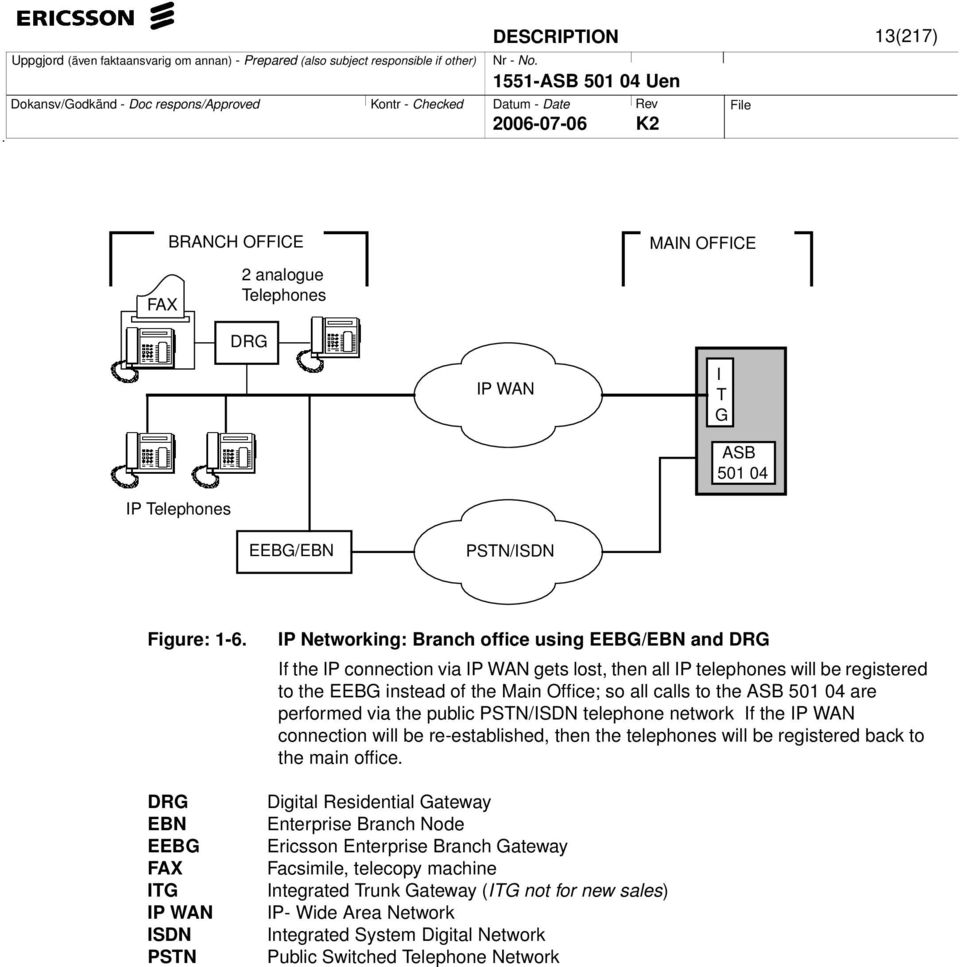
13 13(217) FAX BRANCH OFFICE 2 analogue Telephones MAIN OFFICE DRG IP WAN I T G ASB IP Telephones EEBG/EBN PSTN/ISDN Figure: 1-6. DRG EBN EEBG FAX ITG IP WAN ISDN PSTN IP Networking: Branch office using EEBG/EBN and DRG If the IP connection via IP WAN gets lost, then all IP telephones will be registered to the EEBG instead of the Main Office; so all calls to the ASB are performed via the public PSTN/ISDN telephone network If the IP WAN connection will be re-established, then the telephones will be registered back to the main office. Digital Residential Gateway Enterprise Branch Node Ericsson Enterprise Branch Gateway Facsimile, telecopy machine Integrated Trunk Gateway (ITG not for new sales) IP- Wide Area Network Integrated System Digital Network Public Switched Telephone Network
14 14(217) 2 System structure 2.1 System overview Functional structure The functional structure of the ASB forms a hierarchy with six levels, see Figure: 2-1. Levels in the functional structure. The system documentation is also related to this structure. System level 1 ASB System level 2 ACS SES Subsystems Function blocks and downloadable firmware Program units Hardware units and firmware Figure: 2-1. ACS SES Levels in the functional structure Advanced Communication System Service System The ASB is divided into two systems: the Advanced Communication System, ACS, which contains telephony and features, and the Service System, SES, which contains processor, switch and monitoring functions. In their turn, these two systems are divided into a number of subsystems that contain the main functions of the system, see Figure: 2-2. Functional structure. Each subsystem contains a number of function blocks. These blocks constitute natural design objects that are built up from program units, boards or both. Analogue and digital extension lines, DECT cordless telephones, IP telephones, PABX operator lines and different types of external lines are thus represented by their own individual function blocks. These include the terminal boards corresponding to the line type as well as a number of program units. Number Analysis and Abbreviated Dialling are examples of function blocks which only contain program units.

15 15(217) The functional modularity considerably simplifies the administration of the system in respect of adaptation, installation and operation and maintenance. The ASB thereby meets the demands of a modern PABX in that, for example: - system hardware and software can be expanded without operational disturbance; - alterations of programs and data in respect of a specific function does not disturb other functions in the PABX; - programs in the system can be identified by the program's product numbers and revision status; - effective fault locating and maintenance work can be performed while the PABX is in operation; - disturbances or faults can be confined to prevent them from influencing other parts of the PABX.

16 16(217) ACS SES DCS SWS EGS TES ELS OPS PRS SUS SMS TCS IOS Public exchange or other PABX TRS Figure: 2-2. Functional structure ACS Advanced Communication System (telephony system) SES Service System (operating system) DCS Data Communication Subsystem SWS Switching Subsystem EGS Extension Group Subsystem TES Test Environment Subsystem ELS Extension Line Subsystem PRS Processor Subsystem OPS PABX Operator Subsystem SMS Service and Maintenance Subsystem SUS Support System Interface Subsystem IOS Input/Output Subsystem TCS Traffic Control Subsystem TRS Trunk Line and Routing Subsystem

17 17(217) 2.2 Hardware structure The LIM is the unit in the ASB to which extension lines, PABX operator lines and external lines are connected, see Figure: 2-3. Block diagram for a Line Interface Module, LIM. A LIM can function as an autonomous PABX or as an integrated unit in a larger system. The basic hardware, which can be duplicated, consists of the control system and time switch. In addition, it is possible to equip the LIM with an arbitrary mixture of analogue extension lines, digital extension lines, IP extension lines and analogue external lines, digital external lines, IP trunk lines as well as devices for tone sending, tone reception and conference calls. A Group Switch and an I/O (Input/Output) terminal may also be installed.

18 18(217) Base station Interface Public exchange or other PABX TCP/IP network connection TCP/IP network connection IP extension interface IP network interface Analogue Line Digital Line Tone Senders Tone Receivers Switch Public exchange or other PABX Public exchange or other PABX Group Switch or other LIM Conference Devices Analogue Trunk Lines Digital 2 Mbit/s and 1.5 Mbit/s Trunk Lines GS terminal boards 2 Mbit/s Branch node LAN connection IP Gateway I/O Interface boards Control System Figure: 2-3. GS Block diagram for a Line Interface Module, LIM Group Switch

19 19(217) I/O LAN LIM PABX TCP/IP Input/Output Local Area Network Line Interface Module Private Automatic Branch Exchange Transport Control Protocol/Internet Protocol Control system The control system comprises a processor board, LIM Processor Unit, LPU, with internal memory, expandable to 64 Mbyte. Each LPU contains a processor system built around two commercial microprocessors. A 32 bit processor is used as the LIM's main processor while a 16 bit processor is used as the communication processor whose task is to administer the direct communications with the control circuits of the switch and with telephony devices. Each device board contains a microprocessor, i.e. a device processor, that controls the detection and operational functions on the board and also administers communications with the communication processor. Use of device processors has facilitated the introduction of a standardized interface with the backplane of the magazines. LIM Switch The switch is non-blocking with 1024 time slots (multiple positions) and consists of one basic board, LIM Switch Unit, LSU, and up to four distribution boards, Distribution Switch Units, DSUs. Line devices Analogue line boards, Extension Line Units, ELU-A, are used to connect conventional telephones for decadic signalling or DTMF signalling, and Analogue Trunk Line Units are used to connect the traditional type of exchange lines and lines to other PABXes. Analogue/digital conversion takes place on the boards through single channel coders. The design of the line circuits and external line circuits is influenced by signal systems and other market requirements. One Analogue Extension Line Unit normally contains sixteen line circuits and one Analogue Trunk Line Unit contains from two to eight external line circuits. Digital line boards, Extension Line Unit, ELU-D, are used to connect PABX operator consoles or digital telephones via normal 2-wire lines with the aid of a special technique, burst signalling, whereby the information packet is sent alternately to and from the console or telephone. One Digital Extension Line Unit normally contains sixteen digital line circuits. Digital external lines with channel-associated or common channel signalling can be used for connection to the public exchange or for interworking PABXes. Cordless extension line boards, ELU31, are used to connect Ericsson Radio Base stations (DECT). Up to 8 Base Stations can be connected to one board. The Base station interface uses burst signalling to communicate with the base station. Functions for the synchronization of several line boards in a ring are provided on all boards. The IP extension line boards, IPLU, are used as network interfaces towards an IP network in order to facilitate voice over IP traffic in the ASB Networks based on 10 Mbit/s and 100 Mbit/s Ethernet interfaces can be connected directly to the IP extension line boards and only H.323- compliant terminals can be connected to these TCP/IP networks.

20 20(217) IPLU boards are also used to provide the IP networking feature, that is, mutlimedia communications and networking between ASB systems and between ASB and BusinessPhone systems. Not only do H.323 external lines allow connection to interworking PABXes, but to public exchanges as well. The group switch terminal devices, GJUs, serve as terminals for 30/32 channel PCM lines and each device occupies one board. Each LIM equipped with GJU is normally equipped with two GJU boards for connection to the Group Switch, GS. This board for GS connection, GJU-L, has a design that permits the PCM line to be connected to two parallel group switches for security reason. The Network Interface Unit board, NIU2, is an I/O interface which consists of one board. The NIU2 board permits the connection of CompactFlash, hard disk units or PCs for program and data backup, as well as three V.24 terminals for operation and maintenance purposes, and one Ethernet interface (10BaseT). One I/O interface is always included in new deliveries of the ASB , more NIU2 boards can be connected to the system, if needed. Telephony devices A Tone and Multiparty Unit, TMU, is used for digital generation and reception of tones as well as providing multiparty (Conference) functionality to the LIM. The TMU consists of one board and provides totally 32 inputs (receivers) and 32 outputs (senders). When Mobile and Fixed remote extensions are used, each active call requires a dedicated DTMF receiver. The SPU4 boards are used for mobile and fixed remote extensions, because the SPU4 board is in contrast to the TMU board a dedicated DTMF receivers board. Group Switch, GS The Group Switch is expandable from 1 to 8 Group Switch Modules, GSMs, each of which is housed as a separate module in a LIM cabinet in smaller exchanges and in separate cabinets in larger exchanges. One Group Switch Module can comprise 31 PCM lines and a fully expanded non-duplicated Group Switch comprises 8 Group Switch Modules. The Group Switch can be duplicated and a fully expanded Group Switch comprises 2 x 8 Group Switch Modules.

21 21(217) 2.3 Principles of the control system The control functions in the ASB have been designed such that the LIMs are as autonomous as possible, while at the same time working so that the system functions as one coordinated PABX when seen from the outside. This means that the LIM must not constitute a limit for extension numbering facilities, operation and maintenance facilities, accessibility to external line circuits and other telephony devices, etc. The required control characteristics have been achieved by the dispersal of the software functions in the distributed control system that the LIM processors together form. The possibility of rapid, reliable signal transmission offered by the signal channels of the PCM lines is a basic prerequisite for the interworking of LIM processors. The software in the ASB has been designed in accordance with the following principles: 1. It must be possible to use the same software in single LIM systems as in multi-lim systems. 2. As far as possible the processor load in a LIM must be independent of the total number of LIMs in the system. 3. Inter-LIM signalling must be as low as possible. 4. A LIM that is isolated from the remainder of the system must be capable of functioning as a separate PABX. 5. The number of duplicated programs and data must be minimized, although in a manner that does not contradict the above mentioned principles. The following examples show how these general principles have been considered when implementing some familiar functions in the system. For obvious reasons each LIM is equipped with its own set of program units that administer signalling, supervision of connections etc., for the connected telephony devices. Number Analysis Number Analysis is a function to which all LIMs frequently require access. The data volume is moderate and independent of the system size. This function is placed in each LIM in accordance with the principles 2, 3 and 4, and without seriously disregarding principle 5. Directory Number Translation The translation of directory numbers into line numbers is a function whose data volume grows as the number of extensions grows. If each LIM were to have a complete set of data for translation of all directory numbers in the system, the data volume would grow very large in bigger PABXes. The function has therefore been divided into a central part and a regional part. The regional part exists in each LIM and contains a complete set of data for all extensions connected to the LIM. The central part exists identically in all LIMs in the system, but contains only information specifying to which LIM each directory number in the system belongs.
22 22(217) Thus the regional parts in the system's existing LIMs are not affected by the addition of more LIMs to the system. However, the data volume of the central part does grow. Due to the small amount of data on each directory number contained in the central part, it only grows moderately as the system grows. Other examples of functions that, to a greater or less degree, have been designed as common functions are: - selection of outgoing external lines. - queue to PABX operators. - memory loading. - man-machine communication. 2.4 Software structure The software is divided into regional and central units. As the characteristics of the system are such that each LIM can function as an individual unit irrespective of other LIMs, each LIM is furnished with all the software needed for its internal function. This software constitutes the regional software. For certain inter-lim and general system functions central software is used. A central function is placed in one LIM in the system. The system contains several central functions. For a multi-lim system these are distributed among several LIMs. A program unit, central or regional, is divided into a program part and a data part. The data part can only be managed from the program part of the program unit. All interworking between program units, within LIMs and between LIMs, is achieved using formal messages, i.e. program signals. The signal channels of the PCM lines are used to send program signals between program units in different LIMs. A program signal contains the addressee and the data. Both the sending and receiving program units know the arrangement of the data fields in the program signal. Thus, only the variable values (and not references to variables) are conveyed in the program signal. In this manner the program signals become the most important medium for defining the interface between different program units. Each program unit is encapsulated and has its own data and program code. Writing outside its own program unit is prevented by the hardware. A program unit is subordinate to a function block which can contain several program units. The system contains numerous function blocks. By confining the implementation of a function to one function block, the block can be managed irrespective of other function blocks in the system. One function block can contain several functions. The great majority of the programs are written in PLEX-M, which is a high-level language developed for real time applications and to support the defined principles for unit division and signalling. There are also a few programs written in either C++ or C.
23 23(217) 3 Telephony system, ACS 3.1 General The telephony and data communication parts of the ASB are implemented in the Advanced Communication System, ACS, which contains all requisite functions for the establishment of voice and data connections between extensions connected in the same LIM or different LIMs, and also between extensions and public network subscribers. Within the ACS the functions have been split with the intention of solving the traffic functions in a general manner, irrespective of the signal system on the line from which the facility is called. Consequently the ACS is divided into signal system functions and traffic functions. This division of functions is reflected in the seven subsystems: - The Traffic Control Subsystem, which contains traffic functions comprising traffic control and facilities. - Six other subsystems, which contain all signalling on the lines. The implementation of products can consist of both hardware and software. The hardware consists of extension line circuits, external line circuits, tone senders, tone receivers, Conference equipment, etc. DCS EGS ELS OPS SUS TCS TRS The Data Communications Subsystem is responsible for execution of data communication and related functions. The Extension Group Subsystem is responsible for distributing calls to extension groups and for administrating data of the groups and their members. The Extension Line Subsystem is responsible for execution of all extension line related functions. The PABX Operator Subsystem is responsible for execution of all PABX operator traffic and related functions. The Support Subsystem is responsible for traffic measurement, call information logging, charging and generalized information computer interface functions and other support functions. The Traffic Control Subsystem is responsible for distributing calls between parties and monitoring of established calls. The Trunk line and Routing Subsystem is responsible for handling of incoming and outgoing external traffic via external lines.
24 24(217) 3.2 Traffic capacity Due to the modular structure of the system and the flexible equipment configuration it is possible to vary the traffic capacity extensively. The internal LIM switch and the Group Switch are nonblocking. The traffic capacity is therefore mainly defined by the number of external lines and PCM lines between the LIM and the Group Switch. Up to 256 external lines can be connected to each LIM and the LIMs can be connected to the Group Switch via up to eight 32-channel PCM lines. However, all 256 external lines cannot use the same signalling system. 3.3 Numbering The ASB offers a flexible numbering system. This means that the available number series, , can be assigned in an arbitrary manner and, furthermore, directory numbers are not associated to permanent multiple positions in the switch. Call and answer number codes are defined by programming from the I/O terminal. Permitted number length Facility/number Number of digits Directory number of extensions 2 to 5 Common call number to PABX operator(s) 1 to 5 Individual call number to PABX operator(s) 1 to 5 Calls to public exchange 1 to 5 Calls to other PABXes 1 to 5 Abbreviated Dialling - Common number 2 to 5 Abbreviated Dialling - Individual number 1 + # or ** + 1 Internal Group Hunting Group number 2 to 5 Service codes 1 to 5 Service codes are the numbers used for procedures. Also rotary dial telephones (decadic pulsing) can use these procedures. The following procedures are applicable with decadic pulsing: - Direct Diversion, to order the facility. - Direct Diversion, to cancel the facility. - Call Pick-up of a call signalled on common signal devices. - Answer from any extension to a call signalled on common signal devices.
25 25(217) 4 Service system, SES 4.1 General The Service System, SES, has been designed to facilitate its adaptation to different communication systems. The service system contains all the requisite basic equipment for the operation of a system such as the Advanced Communication System, ACS: - LIM processor. - storage device for the LIM processor. - LIM and Group Switch. - fault locating equipment. - I/O interface boards. The software in the SES is composed of: - operating system for job handling. - I/O programs. - operation and maintenance routines. - switch control. PRS IOS SWS SMS TES The Processor Subsystem is responsible for the processor and time related functions. The Input/Output Subsystem is responsible for operation and maintenance related functions. The Switching Subsystem is responsible for switching and synchronization related functions. The Service Maintenance Subsystem is responsible for system supervision and fault handling related functions. The Test Environment Subsystem is responsible for system test related functions.
26 26(217) 4.2 Characteristics The Service System has a modular design which provides the communication system with the basic hardware, expandable in stages in accordance with the following, see Figure: 4-1. Example of the Service System : - A LIM is the smallest unit and is contained in one cabinet. - A LIM contains all requisite basic equipment such as processor, storage device and LIM Switch. It can function autonomously. - Up to 36 boards (approximately) for a communication system can be placed in one LIM. The upper limit varies depending on whether the LIM possesses I/O interface boards, the quantity of PCM lines included in the basic equipment, etc. - Generally all positions for communication system boards are identical to facilitate arbitrary positioning. - The LIMs are interconnected by one or more standard 30/32 channel PCM lines via a Group Switch or LIM-LIM. - The Group Switch can be expanded by modules, so that up to eight Group Switch Modules can be connected. One Group Switch Module can handle up to 31 PCM lines. This means that the PABX can be expanded to a maximum of 124 LIMs if each LIM is installed with two PCM lines. - Without extra transmission equipment a PCM line between a LIM and a Group Switch can have a cable length of maximum 350 metres/1148 feet. For longer distances other transmission media with a requisite number of repeaters must be used.
27 27(217) Communication system LIM 1 LS GJUL LPU GJUG GS/GSM 30/32 channel PCM line Communication system LIM n LS GJUL LPU Figure: 4-1. GJUG GJUL GS GSM LIM LPU LS PCM Example of the Service System The Service System offers the communication system basic equipment that can be expanded in stages. Group Junctor Unit - Group switch side Group Junctor Unit - LIM side Group Switch Group Switch Module Line Interface Module LIM Processor Unit LIM Switch Pulse Code Modulation
28 28(217) 4.3 Control System Single system A basic characteristic of the ASB is that each LIM can function as an autonomous unit or as a single PABX. The requirement for autonomy in every LIM has resulted in each LIM possessing its own control system. LIMs that are interworked via PCM lines and the Group Switch are one system. This requires information transmission between LIMs to an extent which in other PABX systems only occurs within a processor. This has been achieved via the Group Switch which has a high inter-lim signalling capacity. The inter-lim signalling speed is 64 kbit/s. The control system comprises one LIM Processor Unit, LPU, with a 64 Mbyte internal memory. The LPU is based on two commercial microprocessors. One processor functions as the LIM's main processor (32-bit) while the other works as the communication processor (16-bit), whose task is to administer the direct communications with the control circuits of the switch and with the telephony devices. To see the hardware organization of the control system and the connection to the communication processor that extends signals to and from the devices, see Figure: 4-2. Hardware structure and interface of the control system.

29 29(217) Figure: 4-2. GJC GS LIM LP LS PCM PRS Hardware structure and interface of the control system Group Junction Circuit Group Switch Line Interface Module Main LIM Processor LIM Switch Pulse Code Modulation Processor Subsystem
30 30(217) SWS Switch Subsystem 4.4 Switch system General The function of the switch system is to provide data and speech connections, signalling paths, and synchronization between the LIMs in the ASB The switch network in the ASB consists of LIM Switches, PCM lines and a Group Switch. Both the LIM Switch and the Group Switch are digital, single stage time switches. The LIM Switch is used: to connect time slots between devices both within the LIM and towards channels on the PCM line. to distribute signals between the operating system and devices within the LIM. to keep the LIM synchronized with the rest of the system. The PCM lines are used to transfer data, speech and inter LIM signals between the Group Switch and the LIM, or between LIM Switches. It also carries synchronization information. The Group Switch supplies data and speech paths, and conveys program signals between the LIMs. The Group Switch also provides synchronization LIM switch The switch is non-blocking and consists of one LIM Switch Unit, LSU, and four Distribution Switch Units, DSUs, for a 1024 x 1024 time slot switch. It contains the speech and control memories for the time switch, and a microprocessor that controls the internal functions of the switch. It maintains contact with the communication processor. The LIM Switch Unit, LSU, is also equipped with a clock unit that has hold-over capabilities. Holdover means that the external synchronization frequency can be memorized, and synchronization maintained even if the external synchronization is lost for a short while. The LSU/DSU take synchronization from one selected device board. Each of the Distribution Switch Units, DSUs, serves 256 time slots and performs serial/parallel conversion of the PCM signals to and from the device boards. Internally the LIM Switch consists of a control memory and a speech memory. The control memory stores the connection information while the speech memory stores speech samples. The LIM Switch also has the facility to attenuate or amplify the sample that is switched through. Sixteen alternative levels are accessible in the LSU/DSU for A-law coding.
31 31(217) -6, -3, 0, +3, +6, +9, +12, +15 db are predefined, where + means attenuation, and - means amplification. The rest may be customer defined to meet specific requirements. There are also defined levels for mu-law coding PCM line The LIMs are connected to each other in a two LIM system or to a Group Switch in a multi LIM system via 30/32 channel PCM lines. Time slot channels T1-T15 and T17-T31 are used for voice and data, T16 for control signals and T0 for synchronization information Group Switch The task of the Group Switch is to switch voice, data and control signals between the LIMs. It also has functions to maintain system synchronization. The LIMs are connected to a Group Switch via 30/32 channel PCM lines. The Group Switch is expandible from 1 to 8 Group Switch Modules, GSMs. Each module is housed in a separate subrack and can comprise up to 31 PCM lines. The Group Switch synchronization function is situated on the Group Switch Clock Unit, GCU. The clock unit has hold-over capabilities which means that the external synchronization frequency can be memorized, and synchronization maintained even if the external synchronization is lost for a short while. In a Group Switch with more than one Group Switch Module, the GCUs are connected via a bus. The bus is used for synchronization and communication between the clock units. A Group Switch is non-blocking and comprises one or a number of Time Switch Modules, TSMs, with 1024 ports. The modules are arranged in a matrix, see Figure: 4-3. Block diagram for a Group Switch. The time switch operates in accordance with the same principles as the LIM Switch. However, no attenuation or amplification takes place. The PCM lines from the LIMs are connected via terminal boards, i.e. Group Junctor Units. The Time Switch Module, TSM, has a capacity of 31 PCM lines, i.e. 2 x 2 TSMs are required for 62 PCM lines, etc. A Group Switch can be expanded to a maximum of8x8tsmsandcanhandle 248 PCM lines. A Group Switch is controlled from the connected LIMs. The Group Junctor Unit - Group switch side, GJUG, contains a microprocessor that handles the communications with the connected LIM via time slot T16. The processors on the GJU boards convey control information internally within the Group Switch. The establishment of a connection between two LIMs starts with the LIM processors informing each other of which time slots have been selected on the respective PCM line. The Group Junctor Unit processors are then instructed to establish the connections via the relevant time switch modules. A connection through a Group Switch is by its nature one way and it is therefore necessary to establish two paths through the switch in order to obtain a two-way connection, see Figure: 4-3. Block diagram for a Group Switch. In the illustration the path from LIM A to LIM B proceeds via Time Switch Module TSM 1/2, while the path from LIM B to LIM A proceeds via Time Switch Module TSM 2/1.
32 32(217) GSM 0 LIM A GJU 1/1 TSM 1/1 TSM 1/2 TSM 1/8 GJU 1/2 GJU 1/30 LIM B GJU 2/1 GSM 1 7 GJU 2/2 TSM 2/1 TSM 2/2 TSM 2/8 GJU 2/30 Figure: 4-3. GJU GSM LIM TSM Block diagram for a Group Switch Group Junctor Unit Group Switch Module Line Interface Module Time Switch Module Inter LIM signalling Inter LIM signals are signals sent from one LIM to another LIM via the signal channel (time slot 16) on a PCM line which is located in a device board position. In establishing the signalling paths in a system, the following principles apply in order:
33 33(217) 1 There shall be only one path between any two LIMs. 2 Signal transaction (both sending and receiving) between two LIMs shall take place on the same path. 3 A maximum of two links can be used for signalling. 4 In choosing a specific link, a link with long signalling capability will be considered as the first priority. 5 Should one link be chosen in one magazine, another link in a different magazine will be preferred for the second link selection. For instance, in a 124-LIM system where the I/O LIM has four PCM lines and the rest have two PCM lines per LIM, two PCM lines will be used in each LIM. The lines with long signalling capacity will be chosen in the I/O LIM, if the I/O LIM is equipped that way. Applying the principle in another example, a two-lim system will only use one PCM line for inter LIM signalling. In a three-lim system, the maximum of two PCM lines per LIM will be used for inter LIM signalling. The above principle also applies for manual blocking, faulty line handling and recovery. If a PCM line is manually blocked or any line in service becomes faulty, another line will be used for inter LIM signalling to allow a maximum of two PCM lines per LIM. When a faulty PCM line is recovered, the PCM line can be automatically put in-service if the LIM had not been utilizing two PCM lines. The inter LIM signal packet size varies depending on the hardware of the path. 4.5 I/O Subsystem, IOS General A PABX requires a number of aids for external administration of programs and data. For example, by using commands it is possible to correct program errors and revise exchange data from a terminal. Data can be stored on a CompactFlash or hard disk unit. In the ASB these functions have been implemented within function blocks in the I/O Subsystem. The primary task of the I/O Subsystem is to distribute the commands, programs and data to appropriate parts of the system. The I/O Subsystem consists of hardware and software, the hardware permits the connection of different types of I/O devices. All communications with the PABX take place via an I/O terminal. The following I/O board is used: - NIU2 with a Compact Flash or hard disk unit (HDU) memory backup, see Figure: 4-4. IOS, Input/Output Subsystem of the NIU2 board.
34 34(217) Commands Printouts = = = = CI I/O board (NIU2) External device Commands Printouts = = = = Commands Printouts = = = = Buffer Transfer System initiated LIM reload = = = = = = = = OC IC IN LD TW LB BU Ethernet 10BaseT V.24/ 2Mbit (HDLC) V.24 V.24 LAN Terminal /LSU Terminal /Modem Terminal /Modem tty-1/lsu async/sync tty-2 tty-3 debug System initiated PU & data reload Handling = = = = = = = = DR IO ATA Storage device (HDU) Data output = = = = FI DATA Storage device (Compact Flash) IOS Call information logging file handling = = = = ED * SIU * V.24 Terminal or Computer = = = = = General IOS interface towards user = Interworking blocks (interwork can also take place via the general IOS interface) * = Only for sustaining Figure: Base2 IOS, Input/Output Subsystem of the NIU2 board A Baseband Medium specification defined by the standard IEEE Commonly known as 50 Ohm Coax Media for an Ethernet LAN.
35 35(217) 10BaseT ATA BU CI CF DR Debug ED FI HDU IC IN IO IOS LAN LB LD NIU2 OC PU SIU tty TW A Baseband Medium specification defined by the standard IEEE Commonly known as Twisted Pair Media for an Ethernet LAN. AT Attachment (IDE); a disk drive interface standard for data storage. BackUp Command Interface Compact Flash card, a diskless data storage device Dump/Reload Checking a computer program for errors. External Dump Administration Hard Disk Unit Input Control Information Transfer Input/Output Administration Input/Output Subsystem Local Area Network Local Backup Loader Network Interface Unit, ATA Output Control Program Unit Serial Interface Unit (old: TeleTYpe) serial data I/O device, interface to a terminal or PC TypeWriter
36 36(217) Functions The following functions are implemented in the various function blocks belonging to the I/O Subsystem: Terminal administration - log on/off. - passwords. - user accounts. - break functions. The terminal is a PC with start/stop protocol and V.24/V.28 connection. Hard disk unit administration - format administration for the hard disk unit. - control of the hard disk unit. The hard disk unit: - If using the NIU2 board for I/O, the hard disk unit must have the ATA/CF interface as used on the HDU7/1 board. The PC used for initial loading and for safety backup purposes is then connected via the Ethernet interface or via one of the 3 available serial asynchronous interfaces. The ATA/CF interface permits as maximum the connection of 2 data storage units. This units can be either 2 hard disk drives of the type HDU7/1, or a CompactFlash card (CF, 128 or 256 MByte) and then as maximum one single hard disk drive of the type HDU7/1. The Compact Flash has always the data priority (master device), the hard disk drive is then automatically the secondary device (slave). The CF card can be easily unplugged from the NIU2 board and inserted in a PC for uploading of data (system firmware!). But the CF may never be plugged/unplugged while the ASB system is active (switched ON). If by mistake a previous hard disk unit (SCSI version) is connected to the NIU2, then the NIU2 protection logic generates an error message to the system user. Command administration - syntax checking. - existence checking. - authorization checking. - program debugging. The command language constitutes a subset of ITU-T s MML (Man Machine Language).
37 37(217) Printout administration - administration of standard printouts. - administration of printout formats. Loading functions - initial load of PABX/LIM/program unit. - reload of PABX/LIM/program unit. Dumping functions - dump of system/program unit. - dump of backup data (program and exchange data). administration - directories listing the contents of various backup media. Buffer administration - booking of buffers. - establishment of transfer path for buffers. - transfer of data over speech channels Initial loading The initial loading is made from a hard disk unit. The information comprises: - the disposition of software per LIM. - the target code for the software. - initial data. - the commands used to generate exchange data. This disposition of the software across LIMs and the generation of exchange data can be made directly in the PABX by command, or with the aid of a command file or floppy disk prepared in advance System backup The security of software stored in the RAM (random access memory) is provided by a backup unit. The software is dumped to this after the initial loading of the PABX. If serious errors occur during
38 38(217) program execution certain parts or all of the dumped code can be reloaded. On Reload the relevant software is read into the PABX from the backup unit Internal local backup A local backup of the LIM's data exists in the LIM's RAM memory in order to decrease the time needed to reload data External local backup The external backup unit is a hard disk unit in the PABX Safety backup A safety copy of the backup may be copied to a PC or a hard disk unit (If using NIU2 and HDU7 an additional safety copy can be stored on a second set of NIU2/HDU7) Dump of alterations Dumps of the data and programs which may have been altered can take place at predefined time intervals, or by commands at any time I/O LIM I/O devices can be connected to all LIMs in the system provided that the I/O interface boards and requisite control programs exist in each LIM. Each system has a specific LIM that is defined as the I/O LIM. This LIM contains all necessary I/O functions such as I/O checks, buffer administration, load/reload functions, file administration for the hard disk unit, and control programs for the hard disk unit and printer terminals. I/O terminals An I/O terminal is a PC or other type of visual display unit. An I/O terminal can be connected locally to one of the V.24/V.28 interfaces on the Network Interface Unit, NIU2. For remote connection via the NIU2 the following options exist: - Non-network connection via a modem connected to a V.24/V.28 interface. - Network connection by using Telnet over the PPP (Point-to-Point Protocol) via a modem connected to a V.24/V.28 interface. - Network connection by using Telnet via the Ethernet port.
39 39(217) Six terminals can be logged on concurrently, but the entire PABX permits a maximum of 20 connected terminals. For connections via V.24/V.28 the terminal cable can be a maximum of 15 metres (50 feet). The transmission rate over V.24/V.28 ports can vary from 300 bit/s to 9600 bit/s Communications language The command and printout language is a subset of ITU-T's MML (Man Machine Language). For a definition consult ITU-T recommendations Z.311 to Z.341. A complete command consists of a command code part and a parameter part. The command code part is a five letter mnemonic code that specifies the action to be taken. The parameter part consists of one or more parameter names in which each parameter name is followed by the relevant parameter value. Generally, printouts are initiated by command, i.e. they are not spontaneous. Printout after command initiation can take place on the stated terminal immediately or may be delayed. Alarms may be printed spontaneously as they occur Monitoring communications To prevent operational disturbance and to guarantee the administration of I/O devices, built-in checks exist in the interworking software. For example, all commands and associated parameters are checked to verify that they exist and are authorized for use in the requested combination. The parameter formats and values are then checked to see that they are within the defined limits. The characters and control characters from I/O terminals that are not used in the I/O Subsystem are ignored and an error message is issued. The built-in checks, together with the detailed operational instructions, eliminate operational disturbance and allow the maintenance operator to handle the system in a logical, simple manner throughout Authorization classes Each individual command can be freely assigned one of eight authorization classes, which are assigned an alterable password with a maximum of 16 characters (digits and letters). Depending on the class to which a command belongs, it can be changed to another authorization class as required by circumstances.
40 40(217) User accounts 64 user accounts may be initiated with individual passwords, authority levels and expiration dates. Passwords and user names can each be 4-20 characters long. Each I/O port can be assigned an individual authority level Hard disk unit NIU2 boards are equipped with an ATA (AT Attachment (IDE)) interface to the HDU. The HDU is used primarily for system backup and is placed in the same magazine as the I/O board Hard disk unit backup on PC A PC may be used either to create a safety backup of a hard disk or to update a hard disk unit, HDU, with new software. The PC is connected to the system s HDU either via a SCSI (Small Computer System Interface) board or an ATA interface in the PC. The contents of the PC's hard disk are copied from the system s HDU to create a safety backup. The contents of the PC's hard disk are copied to the system s HDU to recover a backup or upgrade the system. The system is then loaded/reloaded from the system s HDU Command functions The ASB contains commands for the following functions (sorted by the command names): - Automatic Call Distribution, AC - Abbreviated Dialling, AD - Alarm, AL - Account Code, AO - Application System Parameters, AS - Authorization Code for Extension, AU - Blocking, BL - Calendar Data, CA - Common Bell Group (Call Pick-up - common signal devices), CB - Call Diversion, CD - Command Read, CF - Charging (Call Metering), CH - Call Information Logging, CL - Configuration, CN - Common Public Directory Number, CP - Computer Supported Telecommunications Applications, CS - Call Tracing, CT - Cordless Extension, CX - Dynamic Route Allocation, DA - Duplicated Control system, DC
41 41(217) - Data Group, DG - Data Extension, DT - Dumping, DU - External Dump, ED - Electronic Mail, EM - Analogue Extension, EX - Functional Change, FC - Administration, FI - Function Test, FT - Group Do Not Disturb, GD - Generic Extension, GE - Internal Group Hunting, GH - Group Junctor Lines, GJ - Group Call Pickup, GP - Group Switch, GS - History, HI - Information Systems, IC - Inter LIM signalling, IL - I/O Data, IO - IP extension, IP - ISDN Trunk Protocol Data, IR - Interception Service, IS - ISDN Terminal, IT - Integrated Voice Mail, IV - Digital Key System Telephone, KS - Loading, LA - Least Cost Routing, LC - Licence Server, LI - LIM-switch, LS - Modem Group, MG - Memory Handling, MH - Short Message Service, MS - Message Transfer Part Data, MT - Number Analysis, NA - Automatic Network Call Distribution, NC - Name Identity, NI - Night Service, NS - Number Conversion and Bearer Capability Substitution, NU - PABX Operator Traffic, OP - Object Status, OS - Paging, PA - Program Correction, PC - Repeated Deflection (Personal number), PE - Power Failure, PF - Parallel Ringing, PL - Program Tracing, PT - Recorded Voice Announcement, RA - Mobile and fixed remote extension, RE - Restart, RF - IP Networking (H.323 Routes), RI - Route Data, RO - Storage Administration, SA
42 42(217) - Synchronization, SC - System Diagnostics, SD - Static Semi Permanent Connection, SE - Start, SF - Signal Generator, SG - Symbolic Signal Names, SN - Special Purpose Extension, SP - Signal Tracing, ST - System User Information, SU - System Data, SY - Traffic Connection Matrix, TC - Traffic Recording, TR - Voice Compression, VC - Voice Mail, VM - Programming from Operator Console
43 43(217) 4.6 Bus system and device configurations Two types of bus system exist for the interchange of information between the various units in a LIM: - control system bus. - device bus. The control system bus is the interface between the LIM processor and the LIM Processor Unit, LPU. The device bus is the interface between the device boards and the LIM Switch. The address bus is 32 bits wide, which provides an addressable area of 4 Gbytes. The data bus is 36 bits wide. The device bus is a 128 kbit/s or 2 Mbit/s serial channel used for the two way transmission of control information between devices and the LPU. The bus consists of two wires, one for each transmission direction. The interface between the device position and the wiring in the LIM magazine s backplane is general. Each device position can serve up to 32 individuals (time slots in the LIM Switch). The distribution of the switch time slots to the device boards in a LIM is shown in the schematic drawing, see Figure: 4-5. Bus system and distribution of time slots within a LIM with two magazines. All of a LIM's device board positions can be used for all board types requiring up to 16 time slots, i.e. foremost line circuits and external lines. Device boards requiring 32 time slots must be placed on board positions ending with a 0 such as 00, 10, 20 and excluding the rest in the group. Each magazine only has 32 time slots and the board positions are from 00 to 70.
44 44(217) Maximum Device Bus Time slots 8-32 DSU GJU * * Maximum Device Bus Time slots 8-32 DSU GJU LPU * TMU ** ** LSU Figure: 4-5. DSU GJU LPU LSU TEU TMU Bus system and distribution of time slots within a LIM with two magazines Distributed Switch Unit Group Junctor Unit LIM Processor Unit LIM Switch Unit Test Unit Tone and Multiparty Unit * Arbitrary device boards with 8-32 time slots (foremost extension line circuits and external line circuits) 4.7 System security see 13 Operational security and reliability.
45 45(217) 5 LIM features Relevant details are entirely dependent on the PABX revision and are to be found in the revision associated description, see description for CAPACITY FOR MX-ONE TELEPHONY SYSTEM-TELEPHONY SWITCH.
46 46(217) 6 Exchange features Relevant details are entirely dependent on the PABX revision and are to be found in the capacity description, see description for CAPACITY FOR MX-ONE TELEPHONY SYSTEM-TELEPHONY SWITCH. Alternative Routing Call Metering - Individual Call Metering - Maximum charging cost - Metering group - Via PABX operator Customer Group Digital Residential Gateway, DRG see Digital Residential Gateway, DRG Direct In-dialling, DID Direct-in lines Direct Inward System Access, DISA DNIS for ACD Dynamic Route Allocation, DRA Enterprise Branch Node, EBN see Direct Inward System Access, DISA see DNIS for ACD see Dynamic Route Allocation, DRA see Enterprise Branch Node, EBN Ericsson Enterprise Branch Gateway, EEBG see Ericsson Enterprise Branch Gateway, EEBG Facility Restriction Level/Travelling Class Mark, FRL/TCM Generic Extension see 12 Private network features Integrated Trunk Gateway, ITG Least Cost Routing, LCR Name Identity Night Service see Integrated Trunk Gateway, ITG see Least Cost Routing, LCR see Name Identity - Universal - Common - Individual - Flexible (temporary) Number Analysis
47 47(217) Number Conversion and Bearer Capability Substitution see 12 Private network features Original A-number see Original A-number Private Network Routing, PNR Repeated Deflection Rerouting Routing Server see Routing Server Transit Traffic Trunk Call Discrimination, TCD Voice Compression see Voice Compression ALTERNATIVE ROUTING Programming The ability to reach external destinations via different routes. Alternative routes and their pre-digits are programmed from the I/O terminal. Every route can have seven alternative routes. The system uses sequential hunting on the ordinary route and the alternative routes, i.e. when the ordinary is fully occupied, the system starts hunting in the first alternative route and so on. The system can add and discriminate programmed pre-digits, i.e. if a route to another PABX is fully occupied and the call has to be switched via the PSTN, the system adds the extra digits needed. A maximum of 20 pre-digits can be added to each alternative route, and the total code may not consist of more than 34 digits. CALL METERING Programming The ability to detect, store and read stored metering pulses from the public exchange. The metering routes and lines are defined from the I/O terminal as well as individuals in the metering groups. A number of external lines can be equipped with hardware for the detection of metering pulses from the public exchange. The pulses are stored per extension, PABX operator and (possibly) calling external line. Reading can be ordered per individual or metering group. A metering group can consist of extensions, PABX operators
48 48(217) and/or external lines (that can call outgoing lines with the Call Metering function). Individual Call Metering The metering pulses are stored and added together per individual. If a metered call is transferred, the metering pulses for the first part of the call are added to the meter of the transferring party while the subsequent metering pulses are added to the metering of the transferee. A metered Conference call is registered at the meter of the Conference leader. Maximum charging cost It is possible to limit the charging cost per call for an extension. Metering group Each calling party who can be connected to outgoing public lines with metering pulse reception can be defined as a member of a metering group. Call Metering via PABX operator The PABX operator can extend outgoing external traffic by means of a specific procedure for metered calls. When such a call is terminated the PABX operator is recalled by an indication that a metered call has ended. The PABX operator can then read the extension number and number of registered meter pulses of the call on the console display. The PABX operator monitored calls cannot be transferred to another extension without the aid of the PABX operator. If the PABX operator extends a metered call to another extension the PABX operator must write down the metering data for the first extension and start a new registration of metering pulses for the new extension. The PABX operator can initiate recall from the first free line if all outgoing external lines with reception of metering pulses are busy. Equipment Boards for detection of 50 Hz, 12 khz or 16 khz meter pulses for analogue trunks. CUSTOMER GROUP A PABX can contain a number of customers. These customers can be completely separated with regard to telephony. The customers are arranged in one customer group. The ASB only supports one customer group per exchange.
49 49(217) Programming Customers are programmed from the I/O terminal. Each customer virtually has their own PABX. Customers within the customer group can have their own resources, such as routes and PABX operator groups, but also have features for utilizing common PABX resources within the customer group. DIGITAL RESIDENTIAL GATEWAY, DRG see Digital Residential Gateway, DRG DIRECT IN-DIALLING, DID The incoming external line (PSTN) calls can be routed directly to extensions with Direct In-dialling. Programming Type of signalling, indication of origin and rerouting in certain traffic cases are programmed from the I/O terminal for each route. The extension number is transmitted from the public exchange and the digits are analysed to find out whether the extension has a Class of Service that allows Direct In-dialling or not. Note: The call can be rerouted to, for example a PABX operator who gets information about dialled number and reason for rerouting, if the extension does not answer, is busy, the number is vacant, the extension is blocked for Direct Indialling, is in line lockout state, or congestion occurs. Rerouting, see 12 Private network features. DIRECT-IN LINES Programming The ability to program incoming calls on manual external lines for direct connection to predefined extensions, PABX groups, Common Bell groups, PABX operator or Paging system. From the I/O terminal. Every manual external line in the system is given one day address and one night address. The address can be an individual call number or a group number. A direct-in line that is not answered within 30 seconds is rerouted to the PABX operator. DIRECT INWARD SYSTEM ACCESS, DISA see Direct Inward System Access, DISA.
50 50(217) DNIS FOR ACD see DNIS for ACD. DYNAMIC ROUTE ALLOCATION, DRA see Dynamic Route Allocation, DRA. ENTERPRISE BRANCH NODE, EBN see Enterprise Branch Node, EBN ERICSSON ENTERPRISE BRANCH GATEWAY, EEBG see Ericsson Enterprise Branch Gateway, EEBG FACILITY RESTRICTION LEVEL/TRAVELLING CLASS MARK, FRL/TCM see 12 Private network features. GENERIC EXTENSION Unlike a traditional extension which is affiliated to an equipment position, a Generic Extension is affiliated to a LIM, directory number and a terminal which enables the implementation of features such as free seating and Mobility. A number of categories are affiliated to a Generic Extension. Those categories are collected in a number of Common Service Profiles, CSP and every Generic Extension must be affiliated to a CSP. Programming - A virtual Generic Extension is created when a directory number with a CSP is initiated in the exchange. The virtual Generic Extension then exists in the exchange and when a terminal is affiliated, it is changed into a Generic Extension. A virtual Generic Extension can be used by temporary users such as, for example, consultants who normally do not have a wired extension. The number of virtual Generic Extensions is related to the number of directory numbers per LIM and not to the physical number of terminals or positions. After the basic setup has been initiated for the directory number, different applications can be defined to affiliate this directory number to a terminal. INTEGRATED TRUNK GATEWAY, ITG
51 51(217) see Integrated Trunk Gateway, ITG LEAST COST ROUTING, LCR see Least Cost Routing, LCR. NAME IDENTITY see Name Identity. NIGHT SERVICE Programming Incoming calls during the night are routed to preprogrammed answering positions. Type of Night Service and the assignment of answering positions are programmed from the I/O terminal. Night Service is activated by one of the following conditions: a b c d All the PABX operators are marked absent. A Night Service procedure is entered from a PABX operator console. A PABX operator is automatically marked absent and no other PABX operator is busy. A PABX operator is automatically marked absent if an incoming call is not answered within a certain time. The exchange is set to Night Service because a predefined time is reached. Universal Night Service Incoming calls are signalled on a common alerting system, e.g. bells, and answered from non-restricted extension positions by dialling a digit. Calls are queued on the signalling device if more than one call is waiting for answer. Common Night Service Incoming external calls are routed to one common answering position. The answering position can be an extension, an extension group, a Call Pick-up group or answered from any extension (Universal Night Service). Transfer before answer is always possible with this type of Night Service. New calls are automatically camped on and a Call Waiting tone sent if the answering position is busy.
52 52(217) Individual Night Service Incoming calls are routed to a preprogrammed answering position for the respective manual line. The answering position can be an extension or an extension group. Transfer before answer is always possible with this type of Night Service. New calls are automatically camped on and a Call Waiting tone sent if the answering position is busy. Flexible (temporary) Night Service Programming The ability to have incoming calls routed per manual line or routed to answering positions that are programmed on a day-to-day basis. Answering positions are addressed by the PABX operator or the extensions. A number of manual external lines can be used for Flexible Night Service. An extension can either ask the PABX operator to program one of these for Night Service to this particular extension position or program this from their own telephone by using a simple procedure. This type of Night Service is automatically cancelled one hour after the exchange has been switched back to day service provided that Flexible Night Service has been operative for at least one hour. NUMBER ANALYSIS Programming The ability to analyse dialled or received numbers, and feature codes, including separators. Number series are programmed from the I/O terminal. When a user makes a call, or when certain features are executed, the dialled or received digits or characters are analysed regarding number type, length and range. NUMBER CONVERSION AND BEARER CAPABILITY SUBSTITUTION see 12 Private network features. ORIGINAL A-NUMBER see Original A-number PRIVATE NETWORK ROUTING, PNR
53 53(217) Programming The feature provides high capacity routing and Number Conversion capabilities for the private network. Private network destinations and their required individual number translations are programmed from the I/O terminal. Private Network Routing is basically a preprocessor to the existing routing software. Alternative routing is performed based on the dialled number which is compared with entries in the Private Network Routing data base. If the route choice is specified to use individual translation, the translation number is fetched from the Private Network Routing data base. REPEATED DEFLECTION The purpose of the Repeated Deflection function is to provide the exchange with a platform for the Repeated Individual Diversion and Personal Number features. The user does not need to initiate anything because the Repeated Deflection feature does not provide any service by itself. Programming - Both Repeated Individual Diversion and Personal Number can only be defined on individual directory numbers. That directory number is called a Personal Number. Each Personal Number can have one or more lists. Each list contains answering positions. When that directory number is called and any of those services is active, the call is deflected to the answering positions until any of them answers the call, or the call is stopped for any other reason. If none of the two services is active, the calls are distributed to the assigned terminal as for a normal call. REROUTING Programming When a call from an external line, e.g. encounters Congestion, Vacant Number, Busy, Not Available or No Reply, it is possible to program routes or individual external lines for rerouting to an answering position. Route programming is executed from the I/O terminal. Depending on the incoming route category, when a call encounters Congestion, Vacant Number, Busy, Not Available or No Reply, a decision is made as to whether the call is to be rerouted. Different rerouting numbers can be set for a day or night switched exchange. Different rerouting numbers can be set per customer in the customer group. The function can be networked, see 12 Private network features.
54 54(217) Limitations The local rerouting numbers have the following priority order: - Local answer position for calls to vacant numbers. - Local answer position for individual external line. - Local PABX operator/local day answer position. - Local night answer position for individual external line. - Local night answer position. ROUTING SERVER see Routing Server. TRANSIT TRAFFIC Programming Equipment The ability to transit switching in the exchange. The route programming is done from the I/O terminal. Incoming external line calls can be switched to other external lines, either automatically or by the PABX operator. A special hardware and software combination depending on the type of signalling system used. TRUNK CALL DISCRIMINATION, TCD Programming The ability to block extensions primarily from calling certain parts of the public network. Each extension can be programmed for external line call discrimination with one of 15 possible categories for day traffic and 15 possible categories for night traffic. A number table is also programmed for the 15 categories. Programming is done from the I/O terminal. An extension is assigned to one of 15 possible categories for verifying dialled digits on outgoing calls. Extensions can be assigned separate categories for day and night switched systems. The check can continue for up to ten dialled digits and include internal as well as outgoing external destinations. If an extension attempts to call a forbidden number a tone message is received and thereafter the call is placed in the line lockout state. VOICE COMPRESSION see Voice Compression.
55 55(217) 7 Extension features Abbreviated Dialling Account Code - Common Numbers - Individual Numbers see 11.3 Account Code Alarm Extension Authorization Code Automatic Callback Automatic Call Distribution Automatic Network Call Distribution Call Diversion and Follow-me (internal) Call Pick-up see 11.7 Authorization code for extension - On Busy Extension - On No Reply - On Not Available - On Busy Outgoing Lines see 11.5 Automatic Call Distribution, ACD see 11.6 Automatic Network Call Distribution, ANCD - Common Call Diversion - Individual Call Diversion - On No Reply - On Busy - Direct Diversion - Follow-me - Diversion Bypass - Diversion On Origin - Common Bell Group - Group Call Pick-up - Individual Call Pick-up Call Waiting Indication Choice of Language see Choice of Language Class of Service, COS Conference - Three party conference - More than three parties Customer Identity Storage Data Privacy Dial by Name Do Not Disturb see Dial by Name - Individual - Group
56 56(217) Emergency Switching External Follow-me Free Seating see Free seating General Cancellation Incoming Automatic Inter-PABX Calls Incoming Calls Via PABX Operator Inquiry Internal Basic Calls Internal Group Hunting Intrusion Last External Number Redial Malicious Call Tracing Manual Message Waiting, MMW Message Waiting Message Waiting Indication Message Diversion Mobility see Interception Service see Mobility Multiple Directory Number, MDN Multiple represented directory number with telephone Name Selection, MNS Name and Number Log Non-dialled Connection (hot line) see Name and Number Log - Direct Hot Line - Delayed Hot Line Outgoing Automatic Calls Outgoing Calls via the PABX Operator Parallel Ringing Parking with Individual Call Pick-up Peripheral Units on Extension Positions
57 57(217) Personal Number see Personal Number Refer Back Repeated Individual Diversion Short Message Service, SMS see Repeated Individual Diversion, RID see Short Message Service, SMS Single Number Indication Suffix Dialling (End-to-End DTMF) Transfer Trunk Line through Connection at Power Failure ABBREVIATED DIALLING Programming The ability for extensions and PABX operators to make calls by dialling an abbreviated number which is automatically translated to a full number and sent out by the exchange. Programming of full numbers and corresponding abbreviated numbers is done from the I/O terminal. Individual numbers can also be programmed from the extension. Common numbers A common abbreviated number is a 2-5 digit number. Common numbers are divided into four tables and extensions can be allowed to use some or all tables. Abbreviated Dialling can be made semi-automatic by programming incomplete numbers, where the extension can add digits to complete the number. For example, when an extension in one exchange makes a Direct In-dialling call to an extension in another exchange, the abbreviated number to the other exchange is used and thereafter adds the called party's extension number. Individual number This can be made semi-automatic in the same way as described for common Abbreviated Dialling. Limitations The system based individual abbreviated dialling is not applicable for generic extensions. ACCOUNT CODE see 11.3 Account Code. ALARM EXTENSION
58 58(217) Programming Equipment The ability to have alarm extensions in the system. Alarm extensions are programmed from the I/O terminal. An alarm extension can have seven calls connected concurrently. Eight circuits in the Tone and Multi Party Unit, TMU, are reserved for the alarm centre extension when the feature is programmed. Tone and Multi Party Unit, TMU. AUTHORIZATION CODE see 11.7 Authorization code for extension. AUTOMATIC CALLBACK On Busy extension Programming Limitations The ability for an extension to initiate supervision on a busy extension, and be automatically rung when the dialled extension becomes free. Class of Service code. Programmed from the I/O terminal. The calling party dials a suffix digit when the busy tone is received. A confirmation tone is sent to acknowledge the supervision. Both parties are supervised and, whenever concurrently free, a connection is established. The calling party is rung with a special Callback ringing signal. If the calling party does not answer within a predefined time, the supervision is cancelled. Cancellation of a Callback order is done via a procedure from the telephone. For IP terminals it is only Ericsson IP telephones that can request Callback. On No Reply Programming Limitations The ability to establish supervision of an extension that does not answer a call. Class of Service code. Programmed from the I/O terminal. Supervision is established when the calling extension dials a suffix digit when the ringing tone is received. Both parties are supervised and the calling party is rung with the Callback signal as soon as the called party replaces the handset after having used the telephone. Callback is cancelled with a procedure from the telephone. For IP terminals it is only Ericsson IP telephones that can request Callback. On Not Available
59 59(217) Programming Limitations The ability for an extension in one exchange to initiate supervision of an unavailable extension in another exchange, and to be rung automatically when the called extension becomes available and free. Class of Service code. Programmed from the I/O terminal. An extension which has called an unavailable extension in a terminating exchange can, while receiving busy tone, initiate Callback/Call Completion by means of a suffix digit. When the supervised party becomes free, the calling party is called back. When the calling party answers, ringing starts at the called party. For IP terminals it is only Ericsson IP telephones that can request Callback. On Busy outgoing lines Programming Limitations The ability for an extension to initiate supervision on a busy route and be automatically rung when an external line becomes free. Class of Service code. Programmed from the I/O terminal. The extension dials a suffix digit when the busy tone is received. The dial tone is sent to the extension which now dials the route number plus all or part of the external number completed by #, and replaces the handset. The extension is rung, if free, when an external line becomes free and all the digits dialled except the last. The last digit is sent when the extension answers the Callback. If the extension does not answer within a predefined time, the supervision is cancelled. Cancellation of a Callback order is via a procedure from the telephone. For IP terminals it is only Ericsson IP telephones that can request Callback. AUTOMATIC CALL DISTRIBUTION see 11.5 Automatic Call Distribution, ACD. AUTOMATIC NETWORK CALL DISTRIBUTION see 11.6 Automatic Network Call Distribution, ANCD. CALL DIVERSION AND FOLLOW-ME (INTERNAL) Common Call Diversion The ability for an extension to have calls diverted to a common answering position.
60 60(217) Programming Class of Service code. Allocation of an answering position is done from the I/O terminal. Diversion is activated and cancelled by the extension, the answering position or the PABX operator. A diverted extension that initiates a call receives a special dial tone to indicate that the diversion state prevails. Limitations Not applicable for generic extensions (except in case of Message Diversion). Individual Call Diversion The ability for an extension to have calls diverted to an individual answering position. The answer position selection can be dependent on call origin (public, private, internal) and the call is then diverted to either the individual position or to the common position specified for that origin. Programming Class of Service code. Allocation of answering positions is done from the I/O terminal. Diversion is activated and cancelled by the extension, the answering position or the PABX operator. A diverted extension that initiates a call receives a special dial tone to indicate that the diversion state prevails. Limitations Not applicable for generic extensions. Use the Personal Number feature for similar functionality. Diversion on No Reply Programming The ability for an extension with Individual Call Diversion to have calls diverted on No Reply. Class of Service code. Programmed from the I/O terminal. Diversion is activated and cancelled by the extension or the PABX operator. Diversion can be activated automatically at the initiation of an Individual Call Diversion position. A call to an extension with Individual Call Diversion that is not answered within 14 seconds is diverted to the answering position. Subsequent calls are diverted after 8 seconds provided the extension has not initiated a call in the meantime.
61 61(217) Limitations Not applicable for generic extensions. Diversion on Busy Programming The ability for an extension with Individual Call Diversion to have calls diverted when busy. Class of Service code. Programmed from the I/O terminal. Diversion is activated and cancelled by the extension or the PABX operator. Diversion can be activated automatically at the initiation of an Individual Call Diversion position. Limitations Calls to a busy extension with Individual Call Diversion are diverted to the answering position. Not applicable for generic extensions. Direct Diversion Programming The ability for an extension temporarily to move incoming calls to another (extension) position or PABX operator. Class of Service code. Programmed from the I/O terminal. Diversion is activated and cancelled by the extension or the PABX operator. The diversion destination is set from the I/O terminal. Diversion can be activated automatically at the initiation of an Individual Call Diversion position. Limitations Calls to a free or busy extension with Direct Diversion are diverted to the answering position. Not applicable for generic extensions. Follow-me The ability for an extension to temporarily move incoming calls to another extension position. Programming - Activated and cancelled by the extension, the answering position or the PABX operator. The extension receives a special dial tone to indicate, when initiating a call, that the Follow-me state is active. Diversion Bypass The ability to bypass the diversion state.
62 62(217) Programming - The answering position can always reach the diverted extension by dialling the diverted number. An extension that has a Class of Service code allowing Intrusion is also allowed to use Diversion Bypass. Diversion On Origin Programming Limitations The ability for voice extension users to divert their calls to different answering positions depending on the origin of the call, i.e. if it is an internal, external or private network call. The function uses common or individual diversion numbers and an extension Class of Service which is programmed via an I/O terminal. Calls to an extension which has Diversion On Origin can be diverted to three different numbers depending on the origin type. Diversion can also be avoided for example for one origin. The normal diversion procedures are valid. Not applicable for generic extensions. Rules for repeated diversion On a call to directory number B the call is diverted either to C or directory number D as defined below: NEW New call ACT Activation of Callback, Call Announcing, Intrusion or Call Waiting (ACT) DIVNOREP Diversion to C (or D) on No Reply DIVBUSY Diversion to C (or D) on Busy DIRDIV Diversion to C (or D) always, Direct Diversion FM Follow-me to C (or D) NODFM No diversion or Follow-me C is B is DIVNOREP free, has not replied within 14 seconds DIVBUSY, busy DIRDIV, free or busy FM, free or busy The call is ==> NEW ACT NEW ACT NEW ACT NEW ACT NODFM free C B C B C C C C NODFM busy B B B B C C C C DIVNOREP free, reply within 14 s C B C B C C C C
63 63(217) DIVNOREP free, No C B C B D D D D Reply within 14 s DIVNOREP busy B B B B C C C DIVBUSY free C B C B C C C C DIVBUSY busy B B B B C C C C DIRDIV free B B B B C C C C DIRDIV busy B B B B C C C C FM to free D B D B D D C C FM to busy B B B B D D C C Example: A-party calls a busy B-party that has activated diversion on busy to C-party. C-party is free and has no diversion activated. In the second column under B is, DIVBUSY busy can be found, which means that B-party has diversion on busy activated and is busy. On the first line under Cis, NODFM free can be found, which means that C-party is free and has no diversions activated or no follow-me is activated. At the crosspoint there is a C under NEW and a B under ACT. A new call will in this traffic case be diverted to the C-party. If for example callback is activated when ringing on C-party, the callback will be executed to the B-party. CALL PICK-UP Common Bell Group Programming The ability for any extension within a defined group to pick-up calls to the group. The calls are indicated on a common signal device (e.g. bell). Groups are initiated from the I/O terminal. Incoming calls are answered by dialling a service code. Incoming calls can be queued and as long as waiting calls exist they are signalled. Calls to the group can be diverted either directly or by the Follow-me procedure. Group Call Pick-up Programming The ability for a member of a defined group to pick-up a call to another member in the group. The initiation of groups and alternative answering groups (if any) is done from the I/O terminal.
64 64(217) Calls to one extension within a group can be answered by any other group member by dialling a service code. Each group can have three alternative answering groups and, if no calls to its own group exist, calls to the alternative groups are answered with the same procedure. It is not possible to answer Callback to another party member, nor is answer permitted if both calling and answering parties have a parked party. If the same procedure is used for a Common Bell Group, Answer Group and Universal Night Service, the stated order of priority applies for all calls to these facilities. Individual Call Pick-up The ability for an extension to answer a call to any other extension from their own telephone. Programming - A call to an extension can be answered from any telephone by dialling the extension number followed by a suffix digit when the busy tone is received. CALL WAITING INDICATION Programming The ability for an extension to send and receive an audible indication that an internal or external call is waiting. The ability to send and receive a Call Waiting tone is given individually by Class of Service. A calling extension initiates Call Waiting Indication by dialling a suffix digit. Call Waiting Indication is automatically sent on calls routed via the PABX operator or on Direct In-dialling lines, if this is programmed. The ring tone is sent for 30 seconds to the calling party and the extension can during this time answer the waiting call by terminating, parking or transferring of the ongoing call. Limitations Call Waiting cannot be invoked if the called party is in one of the following states: - has a party on hold. - another call is already waiting. - busy but not in speech state, e.g. dialling, waiting for answer, ringing. - has invoked the Data Privacy feature. - is participating in a Conference and is not the Conference leader. - connected to Paging equipment. - connection is a serial call or is marked for charging.
65 65(217) For IP terminals it is only Ericsson IP telephones that can initiate Call Waiting Indication. CHOICE OF LANGUAGE see Choice of Language. CLASS OF SERVICE, COS Programming The ability to give every extension an individual Class of Service code that is equated with allowed or denied types of calls and/or facilities. Class of Service code is programmed from the I/O terminal. The Class of Service code consists of common classes and individual classes. Common classes are assigned as system parameters and affect all extensions in the system. Individual classes are given per extension and open up or close the possibility of using facilities, e.g. Intrusion. CONFERENCE Three party Conference The ability for an extension, having an established call, to include a third party. Programming - The extension initiates an Inquiry call and dials a suffix digit when the call is established. A warning tone is issued to all participants at regular intervals during the Conference. Any of the parties can withdraw from the conversation by replacing the handset. The original call and the third party can be internal or external parties. Limitations For IP terminals it is only Ericsson IP telephones that can be Conference leader. Conference with more than three parties Programming The ability to establish Conference calls with more then three parties. The number of permitted participants can vary from 3 to 8 and the number of participating external lines from 0-8.
66 66(217) This type of Conference call can either be set up by an extension or by the PABX operator, provided the category of participants allows Conference calls. The participants can be internal or external in any combination within the limitations stated above. A warning tone is issued to all participants at regular intervals during the call. Only the Conference leader in an extension initiated Conference can use the Inquiry and Refer Back facility, and receive Call Waiting Indications during the Conference. The Conference leader can, by using the Inquiry and Intrusion facility on one of the participants, temporarily place both parties outside the Conference. One or both can return to the Conference depending on the procedure used by the Conference leader. Limitations For IP terminals it is only Ericsson IP telephones that can be Conference leader. CUSTOMER IDENTITY STORAGE This feature allows a Customer Identity, CID, to be associated with an external caller (customer). Programming - The feature is used mostly with Automatic Call Distribution, ACD, in connection with Computer Supported Telecommunications Applications, CSTA, where the calling party's identity is needed when the call is presented to the ACD agent. The identity may be received automatically, or manually entered by the calling party using the DTMF keypad. If the call is transferred, for instance via a voice server, the CID is transferred with the call. Limitations Not available for IP terminals. DATA PRIVACY The ability for an extension to be protected against features such as Intrusion and Call Waiting for the duration of that call. Programming - Limitations By dialling a procedure prior to a call, data privacy restrictions remain in place until the call is cleared. Not available for generic extensions. DIAL BY NAME
67 67(217) see Direct Inward System Access, DISA. DO NOT DISTURB Individual The ability for an authorized extension to prevent calls from being signalled at the telephone set. Programming - Limitations An extension can invoke the feature by dialling a procedure. No further calls to the extension are permitted, but Direct In-dialling calls are rerouted to the PABX operator and the PABX operator has the ability to bypass this condition. Not available for generic extensions. Group Programming Limitations The Group Do Not Disturb feature allows a PABX operator or a master extension to mark a group of extensions as Group Do Not Disturb, i.e. calls to extensions in the group are not signalled on the telephone instruments. Groups are initiated from the I/O terminal. If the extension has any diversion activated or an individual divertee position, the call is diverted. If the extension has no diversion and the incoming call is a Direct In-dialling call which has a Class of Service permitting rerouting, it is rerouted to a PABX operator. Bypass of Group Do Not Disturb can be done with the Diversion Bypass procedure from a PABX operator or a master extension. Not available for generic extensions. EMERGENCY SWITCHING Programming The ability to switch the system into an emergency state. Extensions can, by I/O command, be assigned a category which allows calls to be made during the emergency state. The system can be switched into the emergency state from the PABX operator console. When the system is in the emergency state only extensions categorized for emergency traffic are allowed to make calls and receive transferred outgoing calls.
68 68(217) EXTERNAL FOLLOW-ME Programming The ability for an extension temporarily to divert calls to non- Common Channel Signalling, CCS, private networks and to the PSTN or public ISDN. Class of Service code. Programmed from the I/O terminal. An extension or the PABX operator can order and cancel the external Follow-me diversion feature by use of a procedure. Incoming calls to the extension are then diverted (rerouted) to the external destination. However, Follow-me calls cannot be camped on to the external destination, i.e. if the external destination is busy with an ongoing call, a subsequent call encounters a busy tone. Charging (meter) pulses and call information logging are registered for the extension that activated the external Follow-me. Limitations To facilitate the interconnection of an incoming and an outgoing external line, the prerequisites relating to the traffic group matrix and line signal diagrams (release mode) must be complied with. An extension with an ongoing external Follow-me diverted call cannot participate in a multiparty call. FREE SEATING see Free seating. GENERAL CANCELLATION The ability to deactivate all activated features such as Callback, Follow-me, Message Diversion and Do Not Disturb, with only one procedure. Programming - An extension or PABX operator can dial a procedure which erases or deactivates all services that have been requested by or for the extension. INCOMING AUTOMATIC INTER-PABX CALLS Programming Incoming calls from other PABXes can be routed directly to an extension. Acceptance of automatic direct calls is programmed per route from the I/O terminal.
69 69(217) The route can be programmed to accept calls from other private exchanges. Automatic calls from other private exchanges are processed as Direct In-dialling calls from the public network. Note: The call can be rerouted, for example, to a PABX operator who gets information about the dialled number and reason for rerouting if the extension does not answer, is busy, the number is vacant, the extension is blocked for Direct Indialling, or is in line lockout state, or congestion occurs. Rerouting, see 12 Private network features. INCOMING CALLS VIA PABX OPERATOR Programming Incoming calls can be routed to the PABX operator. Programming of routes is done from the I/O terminal. Incoming calls are signalled visually and acoustically on the console. The PABX operator accepts the call and extends it to the wanted extension. INQUIRY The ability for an extension to park a call and make an Inquiry call. Programming - Limitations The original call (internal or external) is parked by the extension using the procedure for Inquiry. The required number (internal, external or PABX operator) is dialled. The parked party cannot overhear the Inquiry call. Referral to the parked party is done by using the Refer Back procedure. For IP terminals it is only Ericsson IP telephones that can request Inquiry. INTERNAL BASIC CALLS The ability for an extension to call another extension or the PABX operator. Programming - The extension lifts the handset and dials the required number on receipt of the dial tone. If the extension fails to dial within a certain time (8 s) or the pause between two digits exceeds a certain time (8 s), a disconnection signal is sent. INTERNAL GROUP HUNTING A group of extensions can be called with a common number.
70 70(217) Programming Allocation of extensions to hunting groups is done from the I/O terminal. A group of extension can be called with a 2-5 digit number. Incoming calls are routed to a free extension in the group, either with sequential hunting or evenly distributed. All extensions in a group keep their own private number and Class of Service. Limitations - An extension can be a member of several hunting groups. An extension can temporarily withdraw from the group by activating Follow-me to its own telephone. Calls to a group from which all members have excluded themselves are diverted to the group's divertee position. INTRUSION Programming Limitations Limitations The ability for an extension calling a busy extension to intrude on the established call. Any extension can be given one of four different Intrusion classes, and any extension can by Class of Service code be protected from Intrusion. Programmed from the I/O terminal. Intrusion is initiated by a suffix digit. A warning tone is issued to indicate that a third party has intruded. Intrusion cannot be used on extensions protected from Intrusion, e.g. data lines. For IP terminals it is only Ericsson IP telephones that can request Intrusion. LAST EXTERNAL NUMBER REDIAL Dialled external numbers are automatically stored and can be retransmitted by the extension using a simple code. Programming - All outgoing external numbers from each extension are stored. A stored number is erased when a new external number is dialled. The extension uses a certain code to retransmit the stored number. MALICIOUS CALL TRACING
71 71(217) Programming Limitations The ability for an extension or a PABX operator, who is or has been participating in an incoming public ISDN call, to request tracing of a malicious call, e.g. a bomb threat. The extension Class Of Service code is programmed from the I/O terminal per extension. The incoming route must also have the appropriate I/O controlled categories. The feature is requested by putting the call on hold, and then dialling a procedure (or pressing a predefined key on a Digital System Telephone). The request to trace is sent to the public network which performs the actual tracing. Not available for IP terminals. MANUAL MESSAGE WAITING, MMW Programming The ability for an extension or PABX operator manually to notify an extension that a message is waiting. An extension Class of Service code is programmed from the I/O terminal per extension. A specific MMW key can also be programmed. The feature is requested by dialling a specific procedure or pressing the MMW key. The destination extension then switches on the Message Waiting Indication. When the extension which received the indication becomes aware that there is a waiting message, a call can automatically be set up back to the party who requested the MMW indication. MESSAGE WAITING Message Waiting is a function for notifying an extension of messages that have not yet been read or recorded, and which are stored in one or several information systems. Programming - An information system consists of a peripheral unit, that is connected to the ASB via the General Information Computer Interface, GICI. The Message Waiting function can be utilized by several information systems connected in parallel to the PABX. An information system can be in the form of an interception computer, a Voice Mail system or a text message system. The function can be introduced even if not all information systems connected are capable of handling the signalling required for Message Waiting. If the Message Waiting function is chosen it can be made available either to all extensions
72 72(217) or to Digital System Telephones only, as defined by an I/O command. When a message has been registered in an information system it is signalled to the ASB which then notifies the relevant extension. After a message has been presented to the receiving party, or cancelled by other means, the message system informs the sending party and the notification ceases unless other messages to the extension exist. MESSAGE WAITING INDICATION, MWI Programming Limitations The ability for an extension to receive a Message Waiting Indication, MWI, in the form of an LED, a display message or a special dial tone at Off-hook, depending on type of extension. An extension Class of Service code is programmed from the I/O terminal per extension. A specific MWI key can also be programmed. The feature is requested by an interception computer system for a particular extension when there is at least one message waiting for that extension user. For IP terminals it is only for Ericsson IP telephones that Message Waiting Indication is provided. MESSAGE DIVERSION see Interception Service. MOBILITY see Mobility. MULTIPLE REPRESENTED DIRECTORY NUMBER, MDN Programming The ability to multiple represent a directory number provides a function which is also called Specific line pick-up. The MDN function makes it possible to answer (pick up) or make calls on behalf of the telephone which is multiple represented (using the line of the multiple represented extension). The multiple represented extension cannot receive further incoming calls when it is being used by an MDN. MDN and which key to assign the MDN to is controlled by I/O commands. A directory number on a digital extension, analogue extension, CAS extension or digital POTS can be multiple represented with the
73 73(217) traffic function Specific line pick-up, in one or more digital extensions other than the extension on which the number is Own Directory Number or Additional Directory Number. Each MDN is assigned to an optional function key which becomes an MDN key. The LED indicates the traffic status of the represented number. Limitations Generic extensions cannot be multiple represented with MDN. MULTIPLE REPRESENTED DIRECTORY NUMBER WITH TELEPHONE NAME SELECTION, MNS Programming Limitations The ability to multiple represent a directory number without using its line provides a function which is also called Specific line pick-up with telephone name selection. The MNS function makes it possible to answer (pick up) calls addressed to the telephone which is multiple represented. MNS and which key to assign the MNS to is controlled by I/O commands. A directory number on a digital extension, analogue extension, CAS extension, digital POTS, cordless extension, IP extension or remote extension can be multiple represented with the traffic function Specific line pick-up with telephone name selection, in one or more digital extensions or IP terminals other than the extension on which the number is Own Directory Number or Additional Directory Number. Each MNS is assigned to an optional function key which becomes an MNS key. The LED associated to the MNS key indicates the traffic status of the represented number. The MNS key works as a Telephone Name Selection (TNS) key when there are no incoming calls to its multiple represented directory number. For IP terminals, only Ericsson IP telephones support programmable keys where the MNS function can be initiated. NAME AND NUMBER LOG see Name and Number Log. NON-DIALLED CONNECTION (HOT LINE) Direct hot line connection Programming The ability for an extension to be automatically connected to a predefined position immediately after lifting the handset. The connection position (address) is programmed from the I/O terminal per extension. Ringing is sent to the preprogrammed party (another extension, PABX operator, common abbreviated number etc.) when the extension lifts the handset.
74 74(217) Limitations Not applicable for generic extensions. Delayed hot line connection Programming Limitations The ability for an extension to be connected automatically to a predefined position after the handset has been lifted for a certain time. The connection position (address) is programmed from the I/O terminal per extension. The delay time for the entire system can be altered from the I/O terminal. Ringing is sent to the preprogrammed party (another extension, PABX operator, common abbreviated number, etc.) a certain time after the extension lifts the handset. Before that time, the extension can dial as any normal extension. Not applicable for generic extensions. OUTGOING AUTOMATIC CALLS Programming The ability for an extension to make outgoing calls without assistance from the PABX operator. The Class of Service code is programmed from the I/O terminal. The extension dials the route access code and normally, on receipt of a dial tone, the wanted external number. A supervisory tone is sent after the route access code if the extension is barred from making outgoing calls or using the route access code. OUTGOING CALLS VIA THE PABX OPERATOR Programming The ability for an extension to make an outgoing call with assistance from the PABX operator. The Class of Service code is programmed from the I/O terminal. For this traffic case, three subcases can apply: 1 The extension replaces the handset after ordering the call. 2 The extension does not replace the handset after ordering the call. 3 The PABX operator extends with the dial tone. The extension dials the PABX operator access code: 1 After having ordered the call the extension replaces the handset.the PABX operator dials the required number, awaits
75 75(217) answer, calls then the extension, awaits answer and finally extends the call. 2 The PABX operator dials the required number and extends the call without the extension having to replace the handset. 3 The PABX operator dials the route access code, awaits dial tone from the called exchange and extends the call, i.e. allowing the extension to dial the actual destination. Limitations Either the PABX operator's or the calling extension's Trunk Call Discrimination, TCD, category can be used in subcase 3. If the PABX operator uses a Least Cost Routing, LCR, access code, the PABX operator has to dial all destination digits required to complete the Least Cost Routing destination analysis. PARALLEL RINGING See operational directions for PARALLEL RINGING. Programming The Parallel Ringing service allows up to three voice extensions (grouped as a parallel ringing list) related to the same user to ring simultaneously when the user receives an incoming call. The incoming call to the list can be answered by any of the extensions. Extensions are grouped from the I/O terminal. Parallel Ringing has the following characteristics: 1 The extensions which are to ring simultaneously are grouped as a parallel ringing list. A parallel ringing list consists of one main extension and up to two secondary extensions. 2 A call to a parallel ringing list is made through the main extension number. 3 A call made to a secondary extension on the parallel ringing list, will not initiate parallel ringing. 4 An extension cannot be defined in more than one parallel ringing list. 5 If any of the extensions in the parallel ringing list is busy, then the status of the list is reported as busy to an incoming call to the main extension. 6 When a call is made to the parallel ringing list it is possible to transfer the call to a secondary extension, but not to the main extension. PARKING WITH INDIVIDUAL CALL PICK-UP
76 76(217) The ability to park a call and pick it up from any telephone. Programming - Limitations The extension uses the procedure for Inquiry and goes On-hook to park the call. The call can be picked up from any telephone by dialling the extension s number followed by a suffix digit. If the call is still parked after 30 seconds, the extension s telephone starts ringing. For IP terminals it is only Ericsson IP telephones that can park a call and pick it up from any telephone. This feature is not used for Mobile and Fixed remote extensions. PERIPHERAL UNITS ON EXTENSION POSITIONS Programming The ability to connect peripheral units to extension positions. The Class of Service is programmed from the I/O terminal. The equipment, e.g. dictation equipment, answering machines and modems, is reached as a normal extension. Transmission of digits to the peripheral unit is possible if the caller has a keyset telephone and the equipment is capable of detecting DTMF signals. The peripheral unit is called by a ringing signal and, when the calling party clears, disconnection takes place by means of a time break of the current feed to the peripheral unit. PERSONAL NUMBER see Personal Number. REFER BACK The ability for an extension in Inquiry mode to refer back and forth between the inquiree and the original call. Programming - Limitations Every time the extension wants to alternate an Inquiry call, the Refer Back procedure is used. For IP terminals it is only Ericsson IP telephones that this is applicable. REPEATED INDIVIDUAL DIVERSION see Repeated Individual Diversion, RID. SHORT MESSAGE SERVICE, SMS
77 77(217) see Short Message Service, SMS. SINGLE NUMBER INDICATION Programming The feature Single Number Indication allows an additional number to be set to an extension which can be used to display on other party's display. This means that the B-extension always receives the same directory number independent of which telephone the A- extension is using, if all the telephones of A has the same additional number. To offer this possibility, each extension should have both a directory number and an additional number. This feature is programmed from the I/O terminal - SUFFIX DIALLING (END TO END DTMF) The ability for an extension or PABX operator in speech state to dial suffix digits/characters, for example to control an external equipment. Programming - Limitations The feature is automatically available to analogue extensions and IP terminals in speech, but PABX operators, Digital System Telephones and Cordless extensions must request DTMF mode manually, except when the connected party is a Voice Mail machine. For IP terminals it is only Ericsson IP telephones that can dial suffix digits/characters in speech state. TRANSFER Programming The ability for an extension to transfer a call to another extension, PABX operator or external line. Whether transfer to outgoing trunk is permitted is programmed from the I/O terminal. Limitations The extension first initiates an Inquiry call and when the call is established the Transfer procedure is used. If the exchange is programmed for Transfer After Answer and the extension tries to transfer the call before the called party has answered, the extension is immediately called back. If this call is not answered within 30 seconds, it is rerouted to the PABX operator. For IP terminals it is only Ericsson IP telephones that can transfer a call to another extension, PABX operator or external line.
78 78(217) TRUNK LINE THROUGH CONNECTION AT POWER FAILURE Automatic connection of analogue external lines to predefined analogue extensions in the event of power failure or processor malfunction. Programming - Limitations The Failure Transfer Unit, FTU2, connects external lines directly to predefined extensions. Rotary dial telephones must be used if the public exchange only accepts decadic signalling.
79 79(217) 8 Telephone features 8.1 Digital system telephone features Generally speaking an extension equipped with a Digital System Telephone can utilize the PABX features in an easier way than extensions equipped with analogue telephones. As the system telephones are equipped with pre-programmed keys for the most used features and programmable keys for other features (the most advanced also so called soft-keys and display), the features can be used without dialling procedures. For a full list of the available features, see description for CAPACITY FOR MX-ONE TELEPHONY SYSTEM-TELEPHONY SWITCH. The Digital System Telephone is connected via a 2-wire telephone cable to a digital line board. Transmission between the telephone and the PABX uses burst signalling, in which speech and signalling between the telephone and the PABX have their own, mutually independent channels. A Digital System Telephone can also be used with a Dual Access extension interface. This means that a Digital System Telephone and an ISDN S 0 Terminal may be connected to the same 2-wire line via an adapter. The telephone then shares the directory number with an S 0 interface, see Dual access extension interface. All the permanent and programmable functions of the Digital System Telephone are loaded in special function blocks in the LIM. This permits great flexibility and the stage-by-stage development and enhancement of the functions of the Digital System Telephone. The DBC 22x family is currently supported. For detailed information about buttons (keys), LEDs, programming, features, etc. See the appropriate Directions for Use. There are a number of features that are available to many Digital System Telephone models, these features are for example: Display features, such as: - Message Diversion Information. - Advice of Charge. - Name. - Calling/Connected Line Identity. - Time and Date Display. - Soft-keys. - Call Progress Information. and other features, such as: - Multi Directory Diversion. - Multiple represented Directory Number, MDN. - Automatic Call Distribution functions for agent and supervisor. - Additional Directory Number, ADN.
80 80(217) - Choice of Language. - Dial by function key. 8.2 Cordless telephone features Cordless telephones are available with and without Short Message Service, SMS. For more information, see Mobility and see Short Message Service, SMS. 8.3 IP telephone features DBC , DBC , and DBC are the IP telephones from Ericsson. These telephones are used to access the PABX features via the IP network. For a complete list with the available PABX features that can be accessed from the IP telephone, see the extra facility description for IP EXTENSION. The IP telephones support the following features when connected towards ASB : Basic functionality according to H.323v2 standard. Inherent Free Seating allowing users to log on any IP telephone (not the extra facility Free Seating). Wireless Application Protocol (WAP) is used between the ASB and the telephone to implement the features. The WAP protocol is used on top of H.323 to access the PABX features. 10/100 Mbit/s (auto sense). Built-in 2-port Ethernet switch (to share a LAN cable/port with a PC). Support of Power over LAN (according to IEEE 802.3AF). VLAN support according to IEEE p&q. Support for power class (for VLAN according to IEEE 802.3AF). Support of G.711, G.723.1, G.729a and G.729ab codecs. New features and corrections via software updates from a web server (the telephone is automatically updated with the software from the web server at the start of the telephone). IP address assignment automatically from a DHCP server or manually entered. IP address of the gatekeeper can be received via an automatic gatekeeper discovery function. Programmable buttons Volume control for handset, loudspeaker, ringing signals Choice of different languages Priority of speech packets according to Diffserv Built-in Hearing aid support (ITU-T P.370 (8/96) and FCC Part 68, subpart D). Support of RTCP and possibility to view Quality of Service (QoS) statistics via the web interface. Built-in web-server makes it possible to use a web browser in a PC for handling of the data in the telephone, e.g. contacts, call list, programmable keys etc. Also see IP extension. DBC 425 features are:
81 81(217) Flexible graphical six-line display. The display has adjustable viewing angle and contrast. Backlight display. The telephone can be equipped with extra key panels. Internet access with the WAP browser (no WAP gateway is needed) Search in the D.N.A. Corporate Directory (no WAP gateway is needed) Full duplex hands-free speaking with Acoustic Echo Cancellation (AEC). Built-in headset port (with dedicated headset switching key). Local call list storing the latest outgoing and incoming calls. List of Contacts. Support of emergency calls, SOS calls from a non logged on telephone. Absence services menu support. Central storage in a server of the Contacts. LAN access control according IEEE 802.1x. Programmable keys that can be initiated as TNS or MNS. Merge Contacts from Microsoft Outlook to the Contacts in the telephone. DBC 422 features are: Graphical two-line display with up to 20 characters. Built-in web-server makes it possible to use a web browser in a PC for handling of the data in the telephone, call list, programmable keys etc. Built-in headset port (with dedicated headset switching key). Support of emergency calls, SOS calls from a non logged on telephone. Support for one extra key panel (KPU). Support for Handsfree mode (but not loudspeaking mode). Full duplex handsfree speaking with Accoustic Echo Cancellation. Local phone book. Support for option unit (OPU). LAN access control according IEEE 802.1x. Programmable keys that can be initiated as TNS or MNS. Merge Contacts from Microsoft Outlook to the Contacts in the telephone. DBC 420 features are: The basic features mentioned above. 8.4 ISDN telephone features see 9 ISDN extension. 8.5 Analogue telephone features Analogue telephones with DTMF signalling and FSK signalling can utilize all the PABX features that can be executed by dialling procedures that consist of digits, star (*), hash (#) and R. Analogue telephones with rotary dialling can utilize all the PABX features that can be executed by dialling procedures that consist of digits and R (if this key exists). Telephones with a message lamp can be used. The key is switched on to indicate a new message.
82 82(217) Analogue telephones can use their built-in functions that are specific for each type of telephone, such as programmable keys for abbreviated dialling, hands free etc. 8.6 Common equipment The CD-ROM based program for PC, Designation Card Manager (DCM), is available to design, store and print localized or customized key designation cards in one version for the DBC 200 telephones, and another version for the DBC 22x telephones, the Dialog 4224 operator console the DBC 425, DBC 422 and DBC 420 IP telephones. The CD-ROMs are delivered together with a number of pre-cut papers to fit the different telephone types and the extra key panel. The precut papers for each version can be ordered separately.
83 83(217) 9 ISDN extension 9.1 General The integrated S 0 interface supports the appropriate ETSI and National ISDN standards for basic call control and services for voice and data. The ISDN S 0 terminal supports connection over the S reference point. The interface can be in a configuration for both point-to-point mode of operation and for point-to-multipoint. It should be noted that the term ISDN S 0 terminal is not necessarily a telephone. It is used as a common term for all sorts of equipment connected to the user side of the interface. It includes terminal equipment with an S 0 interface or a terminal adapter with a connected non-isdn terminal. An ISDN S 0 terminal can thus be e.g. a telefax GP4, PC with ISDN board, PC with ISDN board and a telephone, terminal adapter with a handset, video telephone, Local Area Network, LAN, connection or an ISDN telephone. An ISDN S 0 terminal has access or partly access to most of the ASB specific extension features using Keypad, i.e. a string of IRA (International Reference Alphabet) characters. The busy state related services such as Callback, Call Waiting, Diversion on Busy, Individual Call Pickup, PABX group membership, Call Announcement, Extending and Intrusion are however not supported. System related features available for other extensions are also available for an ISDN extension. No proprietary ASB extension features using keypad procedures are supported for ISDN terminals connected to the National ISDN S 0 interface. System related features and features independent of keypad (command initiated) are however available for such terminals. National ISDN S 0 terminals can also become involved in a number of services, but not request them. 9.2 ETSI ISDN S 0 The integrated S 0 interface supports the appropriate ETSI standards for basic call control for voice and data. To control the supplementary services, the generic keypad protocol specified by ETSI is used. The Generic Functional protocol is only used for the control of Hold and Terminal Portability supplementary services. The ISDN S 0 terminal can interwork with Analogue, Digital and Data extensions (TAU2680) and the PABX operator. The ISDN S 0 terminal also interworks with the public ISDN network over the T reference point and within private networks over the Q reference point. Some of the ASB specific services listed below are only partly supported for an ISDN extension.
84 84(217) Basic services Interworking and networking. Bearer Services. Teleservices. Display Handling. Generic Keypad Protocol. Generic Functional Protocol ETSI standardized supplementary services Calling Line Identification, Presentation, CLIP. Calling Line Identification, Restriction, CLIR. Connected Line Identification, Presentation, COLP. Connected Line Identification, Restriction, COLR. Hold and Retrieve. Multiple Subscriber Number, MSN. Subaddressing. Terminal Portability, TP. User-to-User Signalling, UUS. Calling Line Identification Calling Line Identification consists of two parts, i.e. presentation and restriction. The basic functions to support this supplementary service are accessible from the ISDN terminal interface, but a parameter set in the ASB can override the information sent from the terminal. Connected Line Identification Connected Line Identification consists of two parts, i.e. presentation and restriction. The basic functions to support this supplementary service are accessible from the ISDN terminal interface, but a parameter set in the ASB can override the information sent from the terminal. Hold and Retrieve This supplementary service allows a user to interrupt on an existing call and then subsequently, if desired, to re-establish the communications. Multiple Subscriber Number This supplementary service is defined as the ability to apply a set of different directory numbers (up to 32) to an access. Each directory number has its own Class of Service. This service is valid for both point-to-point and point-to-multipoint configuration.
85 85(217) Subaddressing This supplementary service allows a user to send and receive extra address information in the form of a subaddress related to the called/calling/connected party number. This information is transferred transparently through the ASB Terminal Portability This supplementary service allows a user to move a terminal from one telephone wall socket to another within Basic Rate Access, BRA, during the active state of a call. It also allows a user to move a call from one terminal to another terminal within BRA during the active state of a call. User-to-User Signalling This supplementary service allows a user to send and receive a limited amount of information to and from another user. Only services 1 (call set-up) and 3 (active phase) are supported. Service 2 (alerting phase) is not supported ISDN supplementary services not according to standard Advice of Charge (call cost display). Name Identification (name display). Malicious call Identification. Negotiation.
86 86(217) ASB specific extension services Abbreviated Dialling Account Code Activation of End-to-End DMTF Authorization Code - Common Numbers - Individual Numbers - Common - Individual Call Diversion (speech and data) Call Metering Call Pick-up Class of Service, COS Conference Customer Group Data Privacy Do Not Disturb External Follow-me General Cancellation Last External Number Redial Manual Message Waiting Message Diversion Message Waiting Non-dialled Connection (hot line) - Common Call Diversion - Individual Call Diversion - Diversion Bypass - Follow-me - Verification of Diversion - Common Bell Group - Group Call Pick-up - Individual - Group - Direct - Delayed Personal Number
87 87(217) Repeated Individual Diversion Transfer ASB specific services not or only partly supported Alarm Extension (an ISDN terminal cannot be initiated as an alarm extension). Automatic Callback. Call Announcing. Call Waiting Indication, Call Offer (OK when third party). Diversion on Busy and No Answer (when calling an ISDN). Extending on Busy. Individual Call Pick-up. Intrusion (OK when third party). Member in Group Hunting. Parallel Ringing. Rerouting on Busy and No Answer (when calling an ISDN). Recorded Voice Announcement. Single Number Indication. 9.3 National ISDN S 0 The integrated S 0 interface supports the appropriate BELLCORE National ISDN-1 and National ISDN-2 standards for basic call control for voice and data. The interface can be in a configuration for point-to-multipoint mode of operation. The Number Identification services are supported according to present standards. No other supplementary services are supported. The ISDN terminal can interwork with Analogue, Digital and Datacom (TAU2680) extensions and the PABX operator. The ISDN terminal also interworks with public ISDN networks over the T reference point and within private networks over the Q reference point. This extension can use some ASB services that are valid for all types of extensions (command initiated or system features). It can also be included in services as the invoked party Basic services Interworking and networking. Bearer services. Teleservices.
88 88(217) National standardized supplementary services Multiple Subscriber Number. Calling Line Identification, Presentation, CLIP. Calling Line Identification, Restriction, CLIR. Connected Line Identification, Presentation, COLP. Connected Line Identification, Restriction, COLR. Subaddressing. 9.4 ISDN / Datacom (TAU2680) Interworking Compatibility verification. Negotiation. Speed matching.
89 89(217) 10 PABX operator features 10.1 PABX operator console The ASB can be provided with two types of PABX operator consoles. Dialog 4224, a DBC 224 based PABX operator console. Operator Work Station (OWS), a PC-based operator console. All types of PABX operator consoles can operate concurrently in the same system. The console is connected to the LIM via a single pair of wires and does not require any external power connections except for the PC based OWS.
90 90(217) 10.2 Dialog 4224 operator console with graphical display Dialog 4224 operator console The LCD module provides a fully graphical display corresponding to an alphanumeric display with 5x40 characters. Eight language-specific character sets can be programmed from the exchange. It is possible to upgrade the operator console with new alphabets Dialog 4224 operator keyboard The Dialog 4224 keyboard is similar to the normal DBC 22x digital system telephones, except for that four buttons have been removed to give more room for large sized speech buttons and clear buttons. For detailed information about buttons etc., see directions for use for DIALOG 4224 PABX OPERATOR CONSOLE. Figure: Dialog 4224 operator console
91 91(217) 10.3 OWS/PC-based operator console This console provides an alternative solution to traditional operator consoles and has additional directory assistance functionality. It is an application which runs on a Windows NT/2000/XP compatible PC. The connection to the exchange is via a COM port on the PC and a TAU-D. The TAU-D allows the PC to communicate with the exchange through the Operator Interface. At the same time, it provides the speech path for the operator through a Digital Telephone Set. The directory functionality depends on the directory data maintained by the Directory Manager application.
92 92(217) 10.4 Features Abbreviated Dialling see 7 Extension features Alarm Indication Automatic Call Acceptance Automatic Call Extending Bypass Call Diversion and Do Not Disturb Busy Verification Call Announcing Call Splitting Camp on Busy see 7 Extension features, Call diversion and Followme Choice of language see Choice of Language Emergency Calls to PABX Operator Emergency Switching Extension Status Indication Fast OPI extending Grouping of PABX Operators Intrusion Last External Number Redial Malicious Call Tracing Manual Message Waiting Message Diversion Information Name Identity Night Service - Intrusion on Busy Extension or External Line - Forced Release see 7 Extension features see 7 Extension features see 7 Extension features see Interception Service see Name Identity see 7 Extension features, System features and see System features
93 93(217) Parking and Retrieval of Parked Calls Programming from the PABX Operator Console Queue Indication Recall to PABX Operator Selection of Individual External Line Serial Call Suffix Dialling (End-to-End DMTF) Supervision (Callback) see 7 Extension features see 7 Extension features, Automatic Callback Three Call Queues (alphanumeric OPI) Transfer of Incoming Calls to Other PABX Operators Assistance from the PABX Operator Console - Abbreviated Numbers - Account Code - Authorization Code (Lock/Unlock) - Call Metering - Conference - Diversion - External Follow-me - Flexible Night Service - Follow-me to Individual Paging - Free Seating - General Cancellation - Group Hunting Features - Internal Follow-me - Message Diversion - Personal Number - Repeated Individual Diversion ABBREVIATED DIALLING see 7 Extension features.
94 94(217) ALARM INDICATION Programming The ability for the PABX operator to receive an alarm indication on the console when a fault occurs in the exchange. Allocation of fault types to specific alarm classes is done from the I/O terminal. Three different alarm classes can be shown on the console. A fault is indicated with a flashing alarm indicator and a digit on the display unit. The PABX operator can acknowledge the alarm and contact the service personnel. On acknowledgement of the alarm the flashing indicator glows steadily. AUTOMATIC CALL ACCEPTANCE Programming The ability to answer incoming calls without having to press the answer key. Programmed from the I/O terminal. The PABX operator presses a key on the console to activate the facility. Voice contact from the incoming call is thereby automatically made with the PABX operator. AUTOMATIC CALL EXTENDING Programming The ability for a PABX operator to extend calls without having to press the extending key. Programmed from the I/O terminal. The PABX operator presses a key on the console to activate the facility. All calls to free extensions are thereby automatically extended. BYPASS CALL DIVERSION AND DO NOT DISTURB see 7 Extension features. BUSY VERIFICATION The PABX operator can identify the party connected to a busy extension, for example if an extension has been busy for an exceptionally long time, or to check the connected user prior to an Intrusion attempt. Programming - The identification request is done by pressing the speech key, while only one side of the console is used, and the called party is busy. In
95 95(217) that case the identity of the party connected to the busy extension is displayed on the console. CALL ANNOUNCING The ability for the PABX operator to announce incoming calls to a busy extension. Programming - The PABX operator uses the key for manual ringing if the extension is free. A specific supervision link can be used if the extension is busy. The PABX operator is hereby recalled as soon as the wanted extension becomes free and the PABX operator uses the key for manual ringing. The extension must be in the operator's exchange. CALL SPLITTING After initiating a three-way speech connection where the operator can listen to both connected parties, then put one on hold and talk to the other. Programming - Three-way speech can be initiated with a specific key, when the PABX operator has answered calls on both sides. Call splitting is done by pressing one of the speech direction keys while in a threeway speech situation. CAMP ON BUSY The ability for the PABX operator to camp on a call to a busy extension. Programming - The PABX operator extends the call in the normal way and the waiting call is automatically connected to the extension when the call in progress is finished. The call is routed back to the PABX operator if not answered within 60 seconds. CHOICE OF LANGUAGE see Choice of Language.
96 96(217) EMERGENCY CALLS TO PABX OPERATOR Programming A special type of incoming call to the PABX operator which is given the highest priority. Emergency numbers must be initiated via the I/O terminal. Extensions and tie lines can initiate calls with the highest priority by dialling a predefined emergency number. EMERGENCY SWITCHING Programming The ability for the PABX operator to put the exchange into the emergency state. Programmed for the Operator Interface from the I/O terminal. The emergency state is initiated from the console and indicated on all console displays. Some extensions, depending on their Class of Service, cannot initiate calls or receive transferred outgoing calls. Incoming traffic is however permitted. Other extensions, PABX operators and external lines are not affected by the emergency situation. EXTENSION STATUS INDICATION The PABX operator is notified of the extension status through information on the display. Programming - A PABX operator who calls an extension is automatically informed of the status of the extension and of status changes. The display information can show e.g. whether the extension is busy, busy and camped on, free (reserved), ringing, blocked or vacant. FAST OPI EXTENDING Programming The ability for a PABX operator to extend calls to a busy ACD/CTI group or GH group without pressing the extending key. The extending is performed quickly, to enable the caller to listen to all the messages that are played from the groups. Programming from the I/O terminal. The PABX operator presses a key on the console to activate the facility. All calls to busy ACD/CTI or GH groups are thereby automatically extended.
97 97(217) GROUPING OF PABX OPERATORS Programming The ability to group PABX operators with respect to the traffic they are to serve. The allocation of groups is done from the I/O terminal but can thereafter be checked from the consoles. A PABX operator group is defined by its call number, connected routes and types of call, e.g. calls via public lines, via private lines, diverted calls. Incoming calls are routed to the PABX operator in the group who has been free longest. A call that has not been answered within 30 seconds is routed to a second choice PABX operator group. If the called group has no on duty PABX operator, new calls can be diverted to the PABX operator who has been free longest irrespective of group affiliation. INTRUSION Intrusion on busy extension or external line The ability for the PABX operator to intrude on the conversation of an engaged extension or external line. Programming - The PABX operator uses a specific key to enter the ongoing conversation. An Intrusion tone is heard by all parties. Forced release Programming The ability for a PABX operator, after Intrusion, to force release the third party. Programmed from the I/O terminal. The PABX operator can force release the third party by pressing the Intrusion key once more. Forced release cannot be initiated earlier than one second after Intrusion.
98 98(217) LAST EXTERNAL NUMBER REDIAL see 7 Extension features. MALICIOUS CALL TRACING see 7 Extension features. MANUAL MESSAGE WAITING see 7 Extension features. MESSAGE DIVERSION INFORMATION see Interception Service. NAME IDENTITY see Name Identity. NIGHT SERVICE see 7 Extension features, System features and see System features. PARKING AND RETRIEVAL OF PARKED CALLS The ability for the PABX operator to park calls while answering other calls. Programming - The PABX operator has three methods available to park a call 1 If the extend key is used the call is parked for 30 seconds and then be signalled as a recall. 2 Use of one of the supervision links. A call parked on a supervision link can be retrieved at any time. 3 Use of the monitoring (listening) link. A call parked on the monitoring link can be retrieved at any time.
99 99(217) PROGRAMMING FROM THE PABX OPERATOR CONSOLE Programming The PABX operator is always able to program relevant functions via a specific function key and visual indications on the console. The programming facility is initiated per PABX operator from the I/O terminal. The following functions can be programmed from the console. 1 Acknowledgement of alarms on the consoles. 2 Reading the alarm log and acknowledgement of alarms. 3 Blocking and deblocking of certain switching devices in the PABX. 4 Reading of blocked devices in the PABX. 5 Assigning and removing origin groups for incoming calls to PABX operator. 6 Reading of origin groups for a PABX operator. 7 Initiating correct time in the system. Limitations Not available for Dialog QUEUE INDICATION The ability for the PABX operator(s) to see the number of calls queued to common operators. Programming - The total number of queuing calls is shown on all PABX operator consoles, either the whole queue or the individual queue. The presentation type is set by command. All PABX operators also have an individual queue that shows recalls and calls to the PABX operator's individual number. RECALL TO PABX OPERATOR Extended calls not answered within a certain time recall the PABX operator. Programming - A call extended by the PABX operator, which has been camped on for 60 seconds or not answered within 30 seconds, recalls the PABX operator. A recall is indicated with a specific indication. Parked calls also lead to PABX operator recall.
100 100(217) SELECTION OF INDIVIDUAL EXTERNAL LINE The ability for the PABX operator to choose a specific line in a specific route for outgoing calls. Programming - The PABX operator can pick up a specific line. If the line in question is busy the PABX operator can initiate monitoring and be recalled as soon as the wanted line becomes free. At the same time the line is blocked for other calls. Alternatively intrusion can be used. SERIAL CALL The ability for a PABX operator to regain an external call when the called party terminates the call. Programming - Incoming and outgoing external calls can be serial call marked. When the not serial call marked party terminates the call, the PABX operator is recalled. If the serial call marked party terminates the call the PABX operator is not recalled or informed. SUFFIX DIALLING (END TO END DMTF) see 7 Extension features. SUPERVISION (CALLBACK) see 7 Extension features, Automatic Callback.
101 101(217) THREE CALL QUEUES (ALPHANUMERIC OPI) Up to three types of incoming calls may be presented on the PABX operator console display at the same time from which the operator may make a selection. Programming - PABX operator presses the appropriate key to answer one of the incoming calls. Only valid for Alphanumeric OPI and OPI Limitations Not available for Dialog TRANSFER OF INCOMING CALLS TO OTHER PABX OPERATORS The ability for a PABX operator to transfer an incoming call to another PABX operator. Programming - The individual internal call number of the required PABX operator is dialled. ASSISTANCE FROM THE PABX OPERATOR CONSOLE For each feature, see 7 Extension features.
102 102(217) 11 Add on features For detailed information about functions, capacities, etc. of the features listed below, see the appropriate extra Facility Description and the description for CAPACITY FOR MX- ONE TELEPHONY SYSTEM-TELEPHONY SWITCH. Note: Depending on the feature, different things are needed to put the feature into service: - additional hardware - additional software - licence for the feature. For some features, the administration of the feature is handled by commands kbit switching and multiplexing See also the extra facility description for 16KBIT SWITCHING AND MULTIPLEXING. 16 kbit/s switching and multiplexing is a feature that can be used in conjunction with Voice Compression. The feature makes it possible to multiplex sub-rate data in a Voice Compression board and then switch the sub-rate data through the exchange. It also allows compressed speech calls to be switched through transit exchanges in compressed format in order to avoid poor speech quality in transit calls. Voice Compression by itself only provides node-to-node compression which may result in poor speech quality if the call has to pass several transit nodes. It is also possible to use transit switching of 16 kbit/s without compression/decompression. Four 16 kbit/s channels may be multiplexed into one outgoing 64 kbit/s channel. With the optional feature 16 kbit Switching and Multiplexing, the end-to-end compression facility can also be used in a network without decompression and compression in the transit nodes. This feature also provides data which can be switched in a 16 kbit/s format Access Agent See also the extra facility description for ACCESS AGENT. The Access Agent consists of hardware and software components. The Access Agent hardware can be mounted in the LIM as a standard circuit board and use power from the LIM. The board has an Ethernet interface. The Access Agent software includes a real time operating system with file system, security control and communication protocols. The Access Agent can provide general TCP/IP functionality, such as V.24 to Telnet, Transfer Protocol, Telnet and Point-to-Point Protocol. The SNMP Agent and/or Agent Call Account Buffer applications can be run on top of the Access Agent.
103 103(217) 11.3 Account Code See also the extra facility description for ACCOUNT CODE. The primary purposes of the usage of Account Code with verification are: - To provide the extension with the ability to charge a call to an Account Code, which may represent a particular project, department or client, instead of charging the calling extension s number. - To provide a means of preventing unauthorized usage by forcing the extension to enter an Account Code before dialling an external number. An extension dials a procedure and the Account Code prior to the destination number Agent Call Account Buffer, ACAB See also the extra facility description for AGENT CALL ACCOUNT BUFFER, ACAB. The optional Agent Call Account Buffer application is a buffer that can be set up for Call Information Logging, CIL, data which can be stored in compressed or uncompressed format, and further transferred via the Transfer Protocol, FTP. The Agent Call Account Buffer requires the Access Agent Automatic Call Distribution, ACD See also the extra facility description for AUTOMATIC CALL DISTRIBUTION General ACD is an automated solution used to distribute a large quantity of incoming calls to a service controlled by the number dialled by the calling party. Each service is connected to an ACD group consisting of one or more agents who handle these calls. In this way it is possible to handle a large number of incoming calls without the need for PABX operators to route the calls. The agents are assigned as members of, and can answer calls from, one or more ACD groups. The selection of an agent can be based on selection priority and type of selection.
104 104(217) ACD Group 1 ACD members ACD Group 2 Agent Position 1 ACD Group 3 Agent Position 2 Figure: Example of an ACD configuration Facilities The following facilities are available: - Agent Log-On/Off - Temporarily Unavailable - Agent Unavailable Indication - Clerical Time - Free Member Selection - Delay Call Selection - No Answer Handling - Dynamic Queue length - False B-answer - Overflowed Calls - ACD Group Follow-me - ACD Group Do Not Disturb - Supervisor Intrusion - Help Line - Group Name Display - Call Qualification - Member/Queue Display - ACD Back-up groups 11.6 Automatic Network Call Distribution, ANCD See also the extra facility description for AUTOMATIC NETWORK CALL DISTRIBUTION.
105 105(217) General ANCD provides the ability to distribute calls intelligently to ACD groups located in the same or different nodes of an ASB ISDN network. ANCD is a powerful complement to the basic ACD feature. Incoming calls may be distributed to different ACD groups based on the status of the ACD groups that are handling the required services. The distribution functionality can be used to provide the best answering capability at any moment, and it can also be used to redistribute calls from one ACD group to another in overflow situations. Incoming call ANCD ANCD ANCD ACD ACD ACD ACD ACD ACD AGENTS AGENTS AGENTS AGENTS AGENTS AGENTS Figure: Example of an ANCD configuration Facilities Distribution of Calls The distribution of calls from an ANCD group to a satellite group, i.e. an ACD group or another ANCD group, is based on the current status of the satellite group. This is to enable distribution of a call to the satellite group which is best suited to answer the call. Satellite Group Selection There are four principles for selecting a satellite group with free agents: Initiation order Searching for a satellite group with free member in the ANCD group is performed in the order in which the satellite groups were initiated into the ANCD group. Rotating order Satellite group with free members is selected by rotation. Highest number of free agents The satellite group which has the highest number of free agents is always selected.
106 106(217) Load sharing The selection of a satellite group with free members is based on percentage load sharing. A distributed call is not allowed to be overflowed to superior ANCD group. Overflow of Calls New calls received in a satellite group where there is no possible selection (no free agent and no free queue position), or where the overflow time would be exceeded, are overflowed to the superior ANCD group. If there is no available superior ANCD group the call is diverted to an individual divertee position for the satellite group, if defined. If no individual divertee position is defined the call is rerouted if possible, otherwise it is rejected. An overflowed call to a superior ANCD group is treated as a new call and distribution takes place. Supervisor Control of Close/Open Traffic Distribution to a Satellite ACD Group Supervisor Position is any digital extension with ACD supervisor Class of Service. It allows the supervisor to open and close traffic distribution from an ANCD group to a satellite ACD group located in the same node as the supervisor position. A supervisor can open and close traffic distribution to any satellite ACD group in the node independent of which ANCD network the ACD group belongs Authorization code for extension See also the extra facility description for AUTHORIZATION CODE FOR EXTENSION. There are two types of authorization code available to control or limit access to an extension. Both types of code can be used from an analogue extension, a digital extension, a cordless extension, an IP terminal or an ISDN terminal. Common Authorization Code This is a code that does not have to be affiliated to any directory number in the system, but it can be limited to one instrument. The code cannot be changed by the user. Two different functions are provided: - Locking/unlocking an extension. When locked, a lower common category code or common service profile is used. - Authorization code dialling. This enables the calling party to use other categories or service profiles than those with which the extension is programmed. Individual Authorization Code This is a code that is always affiliated to a directory number in the system. In addition to those types of extension already mentioned, it can also be used from a PABX operator console for locking and unlocking purposes. In addition to the functions available to common codes, individual codes also have the following function:
107 107(217) - Changing the authorization code from the instrument. This enables the authorization code user to change the code when required Boss-secretary See also the extra facility description for BOSS-SECRETARY. The purpose of the feature Boss-secretary is to allow the boss and secretary to control the diversion of incoming calls for the boss telephone. While the function is active, the calls to the boss telephone will be deflected to the secretary's telephone, and the corresponding PEN key LED will indicate that the service is on for both the boss and secretary telephones. The service can be activated/deactivated by both boss and secretaries by pressing the previously defined PEN key. When the function is active, the PEN key LED turns on at both boss and secretary telephones. When the function is inactive, the PEN key LED turns off at both the boss and secretary telephones. The PEN keys are only available on DTS telephones. The boss telephone needs to be a DTS telephone with PEN keys. The secretary can either be a DTS, ATS CXN, RXN or IPeX. Only the DTS boss/secretary can activate or deactivate the service using PEN key Call Information Logging, CIL See also the extra facility description for CALL INFORMATION LOGGING General The PABX can provide data for all types of calls and mobility events. Data records for the calls and mobility events are generated in the PABX and, after the end of the call or occurrence of mobility event, the required data are output via a special channel to a peripheral unit. Abandoned incoming trunk call to the Hunt Group, Automatic Call Distribution group, extension, or PABX operator due to no answer, are also registered. Possible peripheral units are: - Printer for direct printout. - Post processing equipment, e.g. a computer. - Storage media for external processing. Call Information Logging is also the base for the CIL over Ethernet feature and the CIL buffer on HDU feature.
108 108(217) Logging of data The following data are logged in internal data records: 1 Date (year, month, date). 2 Time at start of call (hour, minute and second). 3 Time at end of call (hour, minute and second). 4 Call duration. 5 Number of meter pulses, if a pulse receiver exists. 6 Identity of calling party (extension or PABX operator directory number), incoming external line number or, if an authorization code has been entered, the extension number affiliated to the code. 7 Dialled external line route number. 8 Selected external line route number. 9 Dialled number (maximum 20 digits). 10 Address of answering party (when it deviates from dialled number). 11 Queue time to PABX operator. 12 Information status for call (type of call). 13 Account code. 14 Data calls. 15 Authorization code. 16 External line, call direction, incoming/outgoing. 17 Route access code for selected route. 18 Ring time duration. 19 Queue time duration. 20 Mobility event. 21 Board position. 22 Individual on a board (Radio fixed Part Number for cordless extension) Output of data The types of call or which types of mobility event output can be defined by command. The call output criteria are: 1 All calls. 2 The call time exceeds a predefined value (long call time). 3 Identity of the calling party (A-number). 4 Dialled number (B-number). 5 A-number in combination with B-number. 6 A-number in combination with long call time. 7 B-number in combination with long call time. 8 A- and B-numbers in combination with long call time. The mobility output criteria are: 1 All mobility events. 2 Identity of the involved party (A-number). 3 LIM number. 4 Board position. 5 Mobility event.
109 109(217) 6 A-number in combination with mobility event. 7 A-number in combination with LIM number. 8 A-number in combination with board position. 9 LIM number in combination with mobility event. 10 Board position in combination with mobility event. 11 A-number and board position in combination with mobility event. 12 A-number and LIM number in combination with mobility event. Call data are output via the Network Interface Unit, NIU/NIU2, at a speed between bit/s (ITU-T V.24/V.28 or V.24/V.10). The output can be requested in four different fixed formats and it is possible to select from a number of different interface character sets. For output of call data via Ethernet, see see CIL over Ethernet and see CIL buffer on HDU. A flexible format may be defined where the individual fields in a call record can be selected by command. In case of mobility logging only flexible formats can be used CAS extension, EL7 See also the extra facility description for CAS EXTENSION, EL General The Channel Associated Signalling, CAS, extension interface provides a digital connection to external equipment and offers them, through PCM lines, the functionality of analogue extensions. The interface supports 1.5 and 2 Mbit/s digital systems. Each 2 Mbit/s interface handles 30 extensions and each 1.5 Mbit/s interface up to 23 extensions. Both, 2 Mbit and 1.5 Mbit, can be handled simultaneously in the same ASB system. Different signalling systems are also handled simultaneously thus allowing connections of a variety of external equipment to an ASB system, e.g. cordless switch, digital multiplexers, voice mail, etc Function The functionality of the analogue extension is only limited by the connected external equipment, e.g. if the external equipment does not support Hook-flash or Message Waiting. Besides the analogue extension functionality, the CAS extension offers the ability to switch data from 64 kbit clear-channel data-interfaces connected to the external equipment. This is applicable, for example where a multiplexer, MUX, is used as a simple remote unit and permits connections from multiplexed data extensions to other ASB data interfaces such as ISDN external lines and Digital Private Network Signalling System, DPNSS, external lines, but not to internal data extension.
110 110(217) Synchronization can be received via the external equipment clock source. This is only advisable when the ASB is not linked to digital exchanges in an external network, and when the external equipment clock stability is better than the ASB internal clock Choice of Language See also the extra facility description for CHOICE OF LANGUAGE General The purpose of the Choice of Language feature is to allow every user of a Digital System Telephone with a display, an Ericsson IP telephone a OPI 3214 or an Dialog 4224 to select the language in which the text messages appear. The telephone user can select one of ten available languages by dialling a procedure from the telephone. The system administrator can specify the language for any digital telephone or IP terminal from the ten available languages or set it as the exchange language. The PABX operator using the OPI 3214 or Dialog 4224 can select one of the five available languages (English, French, German, Spanish and Italian) by dialling a procedure from the operator console Functions This feature allows the text strings in the display in the Digital System Telephone s display, Ericsson IP telephone s display, OPI 3214 console s display or Dialog 4224 on a per-user basis to be selected. Any user can change the language for the extension or OPI 3214, Dialog 4224 console by dialling a procedure from that particular terminal. There is a separate set of eight special characters per language. The exchange administrator can define and view the special characters in any of the languages CIL over Ethernet See also the extra facility description for CIL OVER ETHERNET. Via this feature, Call Information Logging data can be output through the Ethernet port of the Network Interface Unit, NIU, using the TCP/IP (Transport Control Protocol/Internet Protocol) to the Call Information Logging server on the network. This feature must be used in conjunction with the Call Information Logging feature see 11.9 Call Information Logging, CIL. Through the Ethernet, Call Information Logging can communicate with its server using the high Ethernet bandwidth as compared to the low bandwidth of V.24 based serial communication. This feature can only use the TCP/IP.
111 111(217) The advantage of using the Ethernet connection is that the higher bandwidth enables the data to be collected remotely by users from different locations CIL buffer on HDU See also the extra facility description for CIL BUFFER ON HDU. With this feature, call information logging output data can be stored on the HDU(s) for processing later. The data can be grouped into daily, weekly or monthly files. This feature must be used in conjunction with the CIL feature see 11.9 Call Information Logging, CIL CSTA (Computer Supported Telecommunication Applications) See also the extra facility description for COMPUTER SUPPORTED TELECOMMUNICATIONS APPLICATIONS (CSTA), CS. CSTA is an application protocol which enables a computer domain to communicate with a telephony domain. It supports applications or services normally provided by one domain to be available to the other domain which usually cannot support such an application without major enhancement or redesign.
112 112(217) ASB IP network (LAN) NIU2 Ethernet Application Link (protocol conversion) CTI application Figure: General CSTA configuration The main type of application for this feature is the Call Centre, where agents handling incoming calls can view screen updates synchronized with the telephone call. When a call arrives at an agent position, a message is sent from the exchange to the computer to inform it of the event. The message contains information such as which agent received the call, who is calling and which number was dialled. The computer typically uses this information to perform a data base search and then update the agent s screen with the information retrieved. Other types of application are outbound Call Centres such as telemarketing and debt collection. The following traffic cases can be handled: - Directory Number Verification Service. - Monitoring of: Analogue extensions.
113 113(217) Channel Associated Signalling, CAS, extensions. Digital extensions (Own Directory Number/Additional Directory Number). Automatic Call Distribution groups. Automatic Network Call Distribution groups. Analogue telephone set. DECT cordless telephones. IP-extension Mobile and Fixed remote extensions - Telephony services for digital extensions (Own Directory Number/Additional Directory Number) e.g.: Make call. Press programmable key. Press fixed function key. Transfer. Conference. Call deflection. Single step transfer. - Telephony service for cordless extensions e.g.: Make call. Transfer. Conference. Call deflection. Single step transfer Dial by Name See also the extra facility description for DIAL BY NAME. The Dial by Name function allows a user to initiate a call by entering the other party s name, or just the beginning of it, via a standard keypad with letter designations and soft-keys. The function provides a directory of names with their associated telephone numbers. Numbers in the directory can be internal or external. The Dial by Name function is only available for digital telephones of DBC 203/213/223/225 type via a standard keypad with letter designations and soft-keys. There is one interface for the digital telephone user and another interface for the system administrator: The digital telephone user interface allows searching in the name list by use of the keypad and soft-keys. Two of the soft-keys are used to scroll up or down in the list and one soft-key is used to execute the call when the requested name is found.
114 114(217) Via the I/O terminal, the system administrator interface allows the addition, editing, printing and removal of names in the list Direct Inward System Access, DISA Direct Inward System Access is a facility allowing external users (voice calls) to call in to a PABX and get access to the PABX s features. A DISA call can be established by the use of Direct In-dialling external lines or manual external lines. These lines have to be connected to a DTMF code receiver to provide end-to-end signalling. The DISA is programmed via the I/O terminal. A DISA number is a unique number within the numbering plan for that specific PABX. DISA is accessed by dialling this unique number followed by the feature code, the authorization code and the desired number. There is only one call access to DISA. After a call has been terminated the user must clear down before the next call setup. All costs incurred are charged to the Call Information Logging code tied to the common authorization code dialled. The authorization code can be omitted DNIS for ACD See also the extra facility description for DNIS FOR ACD. Dialled Number Information Service for Automatic Call Distribution. This service which provides the ability for the Automatic Call Distribution groups to identify different customers based on the number the customer is dialling. When the call is presented to the agent, i.e. when it is ringing on the digital telephone and after answer, the DNIS number and name are displayed on the telephone set together with the calling party number and name. This is applicable if the DNIS name, and the calling party number and name are available for presentation on the digital telephone s display. Each DNIS number is stored together with its affiliated name and service group number. The service group number can be either an Automatic Call Distribution group or Automatic Network Call Distribution group. An incoming DNIS call fetches its stored name and the call is sent to its specified service group number. When the call is presented to an agent the DNIS number and name are presented on the digital telephone s display.
115 115(217) DNIS 1 DNIS 2 DNIS 3 ANCD Group DNIS 4 DNIS 5 ACD Group ACD Group DNIS 6 ACD Agent ACD Agent ACD Agent ACD Agent Figure: Example of DNIS for ACD Digital Residential Gateway, DRG See also the extra facility description for DIGITAL RESIDENTIAL GATEWAY, DRG The Digital Residential Gateway (DRG) connects analogue telephones from a branch office, that only has an IP-link via a LAN or WAN connection to the main office and the ASB there. It provides a maximum of 2 analogue telephone ports. The two analogue lines are used for e.g. G3 Fax units, wireless telephones or other analogue telephone equipment. The DRG registers itself to the Gatekeeper similar to an IP telephone. For information about the EEBG, see Ericsson Enterprise Branch Gateway, EEBG.For information about the EBN, see Enterprise Branch Node, EBN
116 116(217) BRANCH OFFICE Analogue FAX Telephones MAIN OFFICE DRG IP WAN I T G ASB IP Telephones EEBG/EBN PSTN/ISDN Figure: DRG EBN EEBG FAX ITG IP WAN ISDN PSTN IP Networking: Branch office using EEBG/EBN and DRG Digital Residential Gateway Enterprise Branch Node Ericsson Enterprise Branch Gateway Facsimile, telecopy machine Integrated Trunk Gateway (ITG not for new sales) IP- Wide Area Network Integrated System Digital Network Public Switched Telephone Network DSS1 Network side See also the extra facility description for DSS1 NETWORK SIDE. Primarily for Branch office applications, the ASB can act as the network side of the Digital Signalling System 1 protocol, for example to connect external products such as Inverse Multiplexers, Video Conference units, Routers, LAN gateways, and Data Conference units, primarily designed for use in public networks. The following services are supported: - Basic Call (with bearer capabilities Speech, 3.1 khz Audio, 7 khz Audio, and 64 kbit/s unrestricted digital information). - Calling Line Identity (presentation/restriction). - Connected Line Identity (presentation/restriction). - Direct Dialling In. - Multiple Subscriber Number. - Subaddressing. - User to User Signalling. - Advice Of Charge (during/end).
117 117(217) Public ISDN ASB ASB , other PABX or branch node user side user side network side network side Figure: Example of DSS1 Network side Dual access extension interface See also the extra facility description for DUAL ACCESS EXTENSION INTERFACE General A Dual access (ISDN-Digital Telephone System) extension provides the following functionality to a desktop via the Ericsson proprietary Digital Adapter for Subscriber Loops (2B+D) interface: - Digital telephone functionality. - Personal Screen Call in a PC with or without voice capabilities and signalling in multimedia protocol via V.24 interface. - The same ISDN services as available via ISDN S 0 Terminal Interface.
118 118(217) Figure: Example of a Dual access extension interface Function A dual access (ISDN-Digital Telephone System) extension has a unique Own Directory Number for the whole interface and is handled with standard commands. When calling to a dual access extension, the calls are distributed depending on the bearer capability and high layer compatibility of the call: - Speech calls are sent to the Digital Telephone System. - Data calls are sent to the ISDN interface (e.g. video telephony, telefax group 4 or digital information). - Audio 3.1 khz calls are distributed to the Digital Telephone System or ISDN depending on an extension parameter. Additional Directory Numbers can be affiliated to both the Digital Telephone System and the ISDN interface. Besides the facilities provided by digital telephones, this type of extension offers a Redirection facility which permits all incoming calls to the Digital Telephone System to be forwarded to the ISDN interface. This is controlled by a dedicated key in the Digital Telephone System. Additionally it is also possible to switch a call between the Digital Telephone System and an active Personal Screen Call application (Ericsson proprietary) running on a PC connected at the ISDN interface.
119 119(217) Dynamic Route Allocation, DRA See also the extra facility description for DYNAMIC ROUTE ALLOCATION. The Dynamic Route Allocation provides very flexible route allocation, via digital public or private networks. Logically the dynamic route is identical to a tie line or Virtual Private Network route supporting all the extension and operator services otherwise available via an ISDN tie line. Integrated Voice Compression and Traffic recording are also supported. B-channels are set-up depending on the traffic situation and the dynamic bandwidth allocation. 64 kbit/s clear channels are offered automatically for facsimile transmission. Dynamic Route Allocation provides switched interconnections over public ISDN networks or digital Channel Associated Signalling networks with full networking functionality without placing requirements on or impacting intervening networks. There is no requirement for user to user capabilities in the network and it is well suited for the integration of small sites into the corporate network. It enables ASB networking to encompass small (branch) nodes, or nodes with low intra site traffic, where the leasing of lines is not an option due to the cost. It also offers potentially large cost reductions for any operator of a private network Enterprise Branch Node, EBN See also the extra facility description for ENTERPRISE BRANCH NODE, EBN The EBN, is a solution addressing private networks deploying IP telephony in the main node and where the EBN act as a local survivability gateway in case of networks outage. Under normal conditions, IP telephones at a branch office are supported by the main node which they are registered to. In case of a breakdown of the IP network, the IP telephones automatically re-register to the EBN node. Thus, the IP telephones keep a full capacity for handling local calls as well as external calls routed through the local EBN public trunk lines. Upon restoration of the IP network, IP telephones automatically register back to their main node and recover normal operating conditions. In addition, the fact that an EBN node is a truly IP enabled PABX system, following services may be also obtained from the EBN solution: Local Presence, which means that all external calls will be done locally. To make this services available the IP Networking feature must also be installed at the main office (ASB ). Offering a remote long-distance toll bypass for any remote users in the corporate network. Taking advantage of the public trunk lines available in an EBN the node may be used to route outgoing public calls issued from any part of the IP private network, using the EBN node as a public network gateway, as reduced public call costs considerations may dictate. The EBN node is either a wall mounted or a rack mounted system running a software version R8.0C or higher. The EBN may also serve as a local gateway for emergency calls, so that 112/911 calls are routed automatically to the nearest emergency response centre.
120 120(217) Ericsson Enterprise Branch Gateway, EEBG See also the extra facility description for ERICSSON ENTERPRISE BRANCH GATEWAY, EEBG Isolated branch offices utilise the existing data connection via Ethernet LAN/WAN also for telephone purposes using IP telephones. In case of LAN/WAN interruption the EEBG registers the IP telephones and replaces the LAN/WAN transmission path with an PSTN/ISDN telephone line. Analogue telephones connected to the IP network with a DRG cannot reroute over the EEBG; see Digital Residential Gateway, DRG BRANCH OFFICE Analogue FAX Telephones MAIN OFFICE DRG IP WAN I T G ASB IP Telephones EEBG PSTN/ISDN Figure: DRG EEBG FAX ITG IP WAN ISDN PSTN IP Networking: Branch office using EEBG and DRG Digital Residential Gateway Ericsson Enterprise Branch Gateway Facsimile, telecopy machine Integrated Trunk Gateway IP- Wide Area Network Integrated System Digital Network Public Switched Telephone Network Electronic Mail See also the extra facility description for ELECTRONIC MAIL. An Electronic Mail System is used for storing messages in the users' mailboxes and for sending them to and from these mailboxes. Interworking between the mail system and the PABX enables waiting messages to be announced, i.e. messages that have not yet been read or printed out.
121 121(217) When a message has been registered in a mail system the message is signalled to the ASB which notifies the relevant extension. The signalling is performed via the Network Interface Unit, NIU. After a message has been presented to the receiving party, or cancelled by other means, the message system informs the sending party and the notification ceases unless other messages to the extension are waiting to be announced. Apart from the mail system itself, the following hardware is required for connection to the ASB : - Network Interface Unit, NIU (or Information Computer Unit, ICU). - Cables. - Modems for data transmission if the cable length exceeds 15 metres (50 feet) Estimated waiting time announcement for ACD See also the extra facility description for ESTIMATED WAITING TIME ANNOUNCEMENT FOR ACD. The Estimated Waiting Time announcement for Automatic Call Distribution feature works in conjunction with the Recorded Voice Announcement feature. When a call enters the Automatic Call Distribution group queue, different messages can be provided instead of a standard group announcement. The selection of the messages is based on the estimation of the time the calling party is likely to wait before the call is answered. Appropriate messages can be assigned to various wait time ranges by commands. These commands can also be used to select whether to play a standard group queue announcement, or the wait time messages for a particular Automatic Call Distribution group. If the system is unable to provide an appropriate announcement for the estimated waiting time, the standard group queue announcement is provided FAX III recognition See also the extra facility description for FAX III RECOGNITION. FAX III recognition is a feature which makes it possible to transmit FAX group 3 traffic over lines with Voice Compression. The use of FAX III recognition is controlled with FAX licences handled by the Licence Server. The number of simultaneously ongoing FAX calls in a system are controlled by the Licence Server. The total number of installed FAX licences can be further divided into several pools (one pool in each LIM) by command. The usage of FAX licences in combination with the Voice Compression board makes it possible to transmit FAX group 3 calls over external lines with Voice Compression. The V.27t, V.29 and V.17 FAX group III protocols are supported.
122 122(217) Fixed remote extension See also the extra facility description for MOBILE AND FIXED REMOTE EXTENSION. The fixed remote extension feature makes it possible to have public terminals with hot-line or delayed hot-line functionality as extensions in ASB When the public terminal lifts the handset a call is established to a predefined number in the PABX. After validation of the received public A-number, a dial tone will be sent to the public terminal. The public terminal will then get fully access to the functionality and features as for a generic extension. Also internal parties which make calls to the fixed remote extension retain full functionality, such as call back, camp on from operator, etc. Note: The public terminal can be a member in a call centre solution (not ACD or ANCD) Free seating See also the extra facility description for FREE SEATING. Free seating is a service that allows the user to log on to any available telephone (DTS, CXN, ATS), and get the user s personal categories, calls and messages. When initiating the virtual generic extension for a Personal number, which must be done for the Free seating feature, a licence for Free seating is seized. The user logs on/off by using procedures. Log off can also be done remotely from a PABX operator and DISA. An individual authorization code must be used. When logged on, the user s set of function keys will be used, but only certain functions will follow the user. Some functions are barred, e.g. Internal group hunting, ACD and ADN/MDN. A special dial tone is used to indicate that the user is logged on GICI over Ethernet See also the extra facility description for GICI OVER ETHERNET. This feature, General Information Computer Interface over Ethernet, enables applications such as Voice Mail, Electronic Mail and Interception Service to communicate with their respective application computers through the Ethernet port of a Network Interface Unit, NIU, using the TCP/ IP (Transport Control Protocol/Internet Protocol). The Ethernet interface can co-exist with the V.24 based GICI and the Information Computer Unit, ICU. All three types of interface may exist in the system at the same time. More than one application of the same type, for example three Voice Mail systems, may be set up to use any combination of the three types of interface. The advantage of using Ethernet is that it provides higher bandwidth thereby improving performance. The feature requires no additional hardware other than the NIU, for example.
123 123(217) HL 950 See quick installation guide for HL 950 The HL950 offers integrated data and voice services. It provides a complete set of services - ranging from basic access provisioning to advanced voice and exchange functionality. The hardware consists of a base unit and up to four interface modules. The HL 950 enables the following software services. All services are unlockable on-demand by licence key activation via any network management interface. Leased Line Replacement (CESoATM) Leased Line Replacement (CESoIP) IP networking, Routing and Management Ethernet LAN Bridging and Switch IP VPN IP Firewall IP QoS Package - Guarantee of Service (GoS) Voice over ATM Hospitality See also the extra facility description for HOSPITALITY APPLICATION. The Hospitality Application offers functionality especially aimed for the Hospitality industry, i.e. Hotels, Hospitals, Cruise ships, Exhibition centres and Convention centres etc. Functionality is provided within the following areas: guest check-in, guest rooms and Service quarters.

124 124(217) Figure: Hospitality System For guest check-in the following functionality is provided: - Information about the guest can be entered. The information could be language, VIP-status, credit card information, room number etc. - The guest can choose if name presentation will be allowed or restricted. For guest rooms the following functionality is provided: - The rooms can be either vacant or occupied. - The rooms can be equipped with various types of extensions. - Some features are barred to prevent improper use. For Service quarters the following functionality is provided: - The name of the guest will always be displayed at the Service Quarter Telephone even if the guest has name presentation restriction. - The information that is entered when a guest checks in will be displayed at the Service Quarter Telephone Integrated Trunk Gateway, ITG See also the extra facility description for IP GATEWAY WITH ITG
125 125(217) ITG (Integrated Trunk Gateway) is a board for ASB that provides an IP Gateway function. This enables VoIP connections, via an IP network, between ASB systems using QSIG. Two E1 ports are supported on the ITG board. In general, the IP Gateway replaces the TDM connection (Time Division Multiplex) between the different ASB systems by transporting necessary signalling and voice streams via the IP network. As the IP Gateway performs routing based on the received address information, it becomes a point-to-multi-point configuration. Therefore it will be enough to have one route towards the IP Gateway, which will further on route the call to the relevant terminating IP Gateway Interception Service See also the extra facility description for INTERCEPTION SERVICE General Message Diversion is activated by an extension procedure containing an interception message. The interception message is sent to the connected interception computer. All new calls to an extension which has activated interception diversion are diverted directly to an answering position programmed as the Message Diversion position. The purpose is to provide answering position personnel with a better means of giving callers meaningful interception messages A prerequisite for using Interception Services is that an external interception computer is connected to the PABX via the general interface (V.24/V.28) for information systems or Network Interface Unit (V.24/V.28) or Ethernet Function An individual or common diversion position must be chosen as the Message Diversion position which is also used for Direct Diversion. An extension, internal group hunting group number, a line pick-up group (Common Bell group), an individual PABX operator or a group of PABX operators may be used as the Message Diversion position. Message Diversion is activated and cancelled either from the interception terminal or by a procedure from the extension. Note: The feature cannot be activated on a rotary dial telephone. When an extension has several types of diversion activated at the same time, they have the following priority order: 1. The latest activated of Direct Diversion and Follow-me. 2. Message Diversion. 3. Diversion on Busy or No Answer. The relative priority of 1 and 2 may be reversed.
126 126(217) Message Diversion can also be activated/cancelled for another extension from a Follow-me position. The procedure for booking Message Diversion includes an interception message which is sent direct to the interception computer IP extension See also the extra facility description for IP EXTENSION. The IP extension is a facility in the ASB that allows to merge the two networks that usually exist in an office (networks for voice and data communication) into one and the same network; the IP network. It allows employees to work remotely and also employees at remote small offices to connect their terminals to the system. The ASB will grant access and provide services for these extensions. It is important to point out that the IP extension makes use of the IP network (a LAN typically) to transmit the voice. This IP network uses TCP/IP as the underlying protocol and therefore the voice is converted into packets in order to be transmitted via the IP network, and then unpacked in the other end. The use of the LAN to transmit voice may reduce transmission costs, and allows the transmission of different media (voice, video, data) over the IP network. The IP terminals connected to the IP network, can be either IP telephones or IP PC-clients. The IP terminals, that use a proprietary protocol to communicate with the ASB and thus have the possibility to request some services and show call progress and service information in a display, are referred as Ericsson IP terminal IP networking See also extra facility description for IP NETWORKING. The IP networking facility allows multimedia communications between ASB systems and between ASB and BusinessPhone systems, making use of the IP network to transmit the media. So, it allows that an ASB can be connected through the data network to remote PABXes in multisite organisations (tie lines, VPN), to the public IP network. The IP network uses TCP/IP as the underlying protocol and therefore the voice is converted into packets in order to be transmitted via the IP network, and then unpacked in the other end. The use of the IP network to transmit voice may reduce transmission costs, and allows the transmission of different media (voice, video, data) Least Cost Routing, LCR See also the extra facility description for LEAST COST ROUTING.
127 127(217) General Least Cost Routing allows the system to select the most economical route for an outgoing public call. Least Cost Routing numbers are programmed from the I/O terminal Function Least Cost Routing performs analysis of the dialled number including the Least Cost Routing access code and attempts to route the call over the most economic available route at any time based on the following: - external line availability. - user's Routing Class of Service. - user's Trunk Call Discrimination Class of Service. The routing capabilities are applicable to both voice and data traffic Least Cost Routing, Time of Day, LCR-ToD This is an additional feature to Least Cost Routing. See also the extra facility description for LEAST COST ROUTING, TIME OF DAY. Least Cost Routing, Time of Day is a function that allows the system to make the selection of the most economical route for an outgoing call dependent on the time of day and the day within the week. This means that it is always possible to select the most economical route even if the cost relations between the different routes vary with the time of day and day within the week MD Disk Tool MD Disk Tool is a Windows application, available via the service tool box Mobile extension See also the extra facility description for MOBILE AND FIXED REMOTE EXTENSION. The mobile extension feature makes it possible to have public terminals as extensions in ASB Any public terminal which calls a predefined number in the PABX by dialling either manually, using the phone book or the calling card service and after executed validation or by entering a valid PINcode will receive dial tone from the PABX.
128 128(217) The public terminal will then get fully access to the functionality and features as for a generic extension. Also internal parties which make calls to the mobile extension retain full functionality, such as call back, camp on from operator, etc. It is possible to define additional public terminals which can alternate as answering position by dialling a procedure. Note: The public terminal can be a member in a call center solution (not ACD or ANCD) Mobility See also the extra facility description for MOBILITY General The Integrated DECT interface provides connection of a DECT equivalent Radio Fixed Part i.e. a base station, directly to the ASB The interface between the Radio Fixed Part and the ASB is an Ericsson proprietary interface. The physical terminal, the Portable Part (cordless telephone), is carried around and has radio connection using a DECT air-interface to one of the Radio Fixed Parts. The air-interface supports the Generic Access Profile, GAP, and the Cordless Terminal Mobility Access Profile, CAP, standards (subsets of the DECT standard). The ASB provides the Portable Part with the ability to have messages displayed, such as whether to have a feature activated, the state of the call, calling/connected name, calling/ connected number, Message Waiting Indication, etc. If and how the information is displayed on the terminal depends on its capabilities.
129 129(217) ASB RFP WRS Synchronization cable RFP BS370 ELU31 LIM 1 RFP RFP DECT Air interface PP ELU31 RFP LIM 2 RFP RFP Figure: Configuration of a DECT system in a single ASB exchange DECT ELU LIM PP RFP WRS Digital Enhanced Cordless Telecommunications Extension Line Unit Line Interface Module Portable Part = cordless telephone Radio Fixed Part Wireless Relay Station Function Basic traffic The Integrated DECT interface supports incoming and outgoing voice calls. Before a cordless extension can make or receive a call, the location of the extension has to be known by the ASB Portables that are out of radio range, switched off, or not located, are marked as Not Available in the ASB
130 130(217) Location procedures The location registration procedure makes the location of the extension known to the ASB , and makes it possible for Portable Parts to move between different Radio Fixed Parts in the same ASB system and still be reached by the ASB The Detach function is initiated when the Portable Part is switched off in order to mark it as Not Available in the ASB Handover Handover is the process of switching a call in speech from one physical channel to another physical channel. In the ASB environment calls can be handed over between Radio Fixed Parts that are located in the same LIM or in different LIMs within the same ASB exchange. Security procedures The security procedures consist of the Access-rights, Authentication and Ciphering procedures. The Access Rights procedure supplies the Portable Part with parameters needed for access to the ASB This procedure is the on-air-subscription and is executed before the location registration procedure. It has to be done before any calls can be made to or from the Portable Part. The Authentication procedure verifies the identity of the Portable Part and/or the Radio Fixed Part. This procedure is always invoked in connection with the Location registration procedure. The voice and signalling channels over the air-interface are encrypted (ciphering) to prevent other radio equipment from listening to the conversation or from tapping data. Features The integrated cordless extensions have access to most of the services and features that are offered to other extension types in the ASB The services are supported according to DECT standards. In addition the portables can have implemented terminal specific features. The ASB provides the portable with display messages such as feature activated, the state of the call, calling/connected name, calling/connected number, message waiting indication, date and time etc. If and how the information is displayed on the terminal depends on its capabilities. Short Message Service, SMS, is supported point-to-point.
131 131(217) Music on Hold, MoH See also the extra facility description for MUSIC-ON-HOLD. Music on Hold is a facility for relaying sound such as music or marketing information, for example, to a parked or queued subscriber or extension. The sound information is transmitted from a tape recorder or a radio set. Music on Hold/Wait is not available to PABX operators or for calls queued to PABX operator. Two different boards may be used for Music on Hold: - a multi-purpose Tone and Multipart Unit, TMU, for auxiliary devices with two analogue inputs for the connection of sound equipment. - a special Tone Sender Unit, TSU, equipped with three analogue inputs for the connection of sound equipment. Each sound equipment unit is connected to the Main Distribution Frame from where a cable runs to the Tone and Multipart Unit in all LIMs in the PABX. The following hardware is required for the installation of Music on Hold: - TMU board. - cables. If three different Music on Hold messages are to be used in the same LIM, two or more TMU boards are required. Recorded voice announcement as Music on Hold, MoH, see Recorded Voice Announcement.
132 132(217) Name and Number Log See also the extra facility description for NAME AND NUMBER LOG. Name and Number Log is a software feature for logging unanswered calls. By use of the soft-keys on a DBC 203/213/223/225 digital telephone, the user can display, dial and delete the stored numbers. A programmable key with a LED is used by this feature to inform the user that a new unanswered call has been logged Name Identity See also the extra facility description for NAME IDENTITY, NI. The Name Identity function is used to associate an easily recognisable name to various individual items that are normally identified in the system by a number which may not be generally known. The function is also useful when applied to incoming and outgoing external calls where the external number exceeds the length of the field reserved for it in the display. The calling/connected Name Identity function allows the assignment of a name to the following individuals: Analogue extensions (primary and secondary). CAS extensions (primary and secondary). Cordless extensions. Digital extensions (Own Directory Number and Additional Directory Number). Digital POTS extensions (primary and secondary). DNIS numbers. Dual access extensions. Groups (PBX, ACD, ANCD and Common Bell). Individual PABX operators. Ericsson IP telephone ISDN extensions. The function also allows the name associated with an individual to be conveyed through the system, together with its number, so that both the number and name are displayed together. The Name Identity of the parties involved in a call is transferred. For external calls this is via an ISDN private or public network Network services See also the extra facility description for NETWORK SERVICES. The Private Network Routing function has to be loaded in order to use intelligent network services in a private network. By itself it does not offer any intelligent network services, but it opens up the possibility for using them.
133 133(217) Original A-number See also the extra facility description for ORIGINAL A-NUMBER. The Original A-number feature allows the diverted-to party (the C-party) to see the calling party s (the A-party s) number in the following cases: - the B-party has external follow me to the C-party activated. - the C-party is an answer position in the B-party s active list for personal number. Note: It might not be allowed to send received A-party information to a public or mobile network without concession from the network operator. Charging and prefixing can be other issues that might have to be considered Personal Number See also the extra facility description for PERSONAL NUMBER General A Personal Number is an extension directory number with a terminal of any type assigned, which has the Repeated Deflection service available. The aim of Personal Number is to provide system users (voice extensions) with different possible answering positions for the incoming calls Functions The Personal Number service has the following characteristics: - Every Personal Number can have up to 5 different lists available, but only one of them can be active. - Each list can be set up with up to 10 different answering positions that are selected depending on the user location (e.g. at the office, at home). - The user can activate and deactivate the service or change the active list via a procedure. - When the Personal Number service is activated, incoming calls to the Personal Number are deflected to the positions in the active list, until the call is answered or is stopped for any reason. - When the Personal Number service is not activated, all incoming calls to the Personal Number are distributed to the assigned terminal as in a normal call.
134 134(217) QSIG Call offer See also the extra facility description for QSIG CALL OFFER. The Call offer service makes it possible for the calling user to invoke call waiting over a network to a busy user Recorded Voice Announcement See also the extra facility description for RECORDED VOICE ANNOUNCEMENT General There are two kinds of announcement machines used for Recorded Voice Announcement feature. - A peripheral Recorded Voice Announcement machine connected to the PABX via an E&M tie line interface. - A LIM-mounted circuit board voice server unit Functions The RVA feature allows announcements to be supplied to incoming calls to a PABX operator (operator announcement). It also allows announcements to be supplied to a calling party, with the exception of PABX operator calls and data calls, for the following call cases: - Called party has activated Follow-me, Direct Diversion and Diversion on Busy to an extension. - Called party has activated external Follow-me. - Called party has activated Follow-me, Direct Diversion, Diversion on Busy and diversion at no answer to Paging. - Called party is an Internal Group Hunting Group. - Called party is an Automatic Call Distribution group. The group queue announcement can be a fixed queue announcement or can be a variable announcement based on the estimated waiting time. - The call is placed in an Automatic Call Distribution, Internal Group Hunting Group or PABX operator queue for a specified amount of time. - Vocal guidance. An analogue, digital or cordless user can receive a recorded announcement when the caller encounters certain traffic cases. - A call to an individual PABX operator can receive a continuous announcement.
135 135(217) When there is no available RVA machine in an announcement group, the call is still processed but with no voice announcement being supplied to the calling party. It is possible to use Recorded voice announcement for Music on Hold/wait. The recorded announcement must then be set up for continuous playing Remote digital extender See also the installation guide for REMOTE DIGITAL EXTENDER 3000 The Ericsson extender series provide remote workers and small branch offices seamless connectivity to the ASB and to the corporate LAN. Remote employees can, at the same time, establish data sessions (e.g. connect to the Internet service provider or access their corporate LAN), while at the same time use their telephone. There are two data communication methods: Dial-up or Ethernet. A switch module and a remote module that is all needed to provide an off-premise employee with full voice and data functionality Repeated Individual Diversion, RID See also the extra facility description for REPEATED INDIVIDUAL DIVERSION General The aim of the Repeated Individual Diversion is to provide users, i.e. voice extensions, with different possible answering positions for the incoming calls. Each individual extension directory number having a terminal assigned, can have RID applied. This feature is standard for cordless and IP terminals Functions The service has the following characteristics: - Every user can have one list available which can be active or inactive. - The list can be set up with up to 10 different answering positions that can be selected depending on the user location (e.g. at the office, at home). - The user can activate or deactivate the service via a procedure. - When the service is activated, incoming calls to the user are deflected to the positions in the list until the call is answered or stopped for any reason.
136 136(217) - When the service is not activated, all incoming calls to the user are distributed to the assigned terminal as in a normal call Routing Server See also the extra facility description for ROUTING SERVER. In a private network comprising IP trunks interconnecting the nodes, the Routing Server feature provides the capability to store all IP routing information and alternative routing information, for the entire network, in one central database. This information can then be retrieved by routing server enabled nodes (clients) in the network to route calls to the desired destination. This provides one central point at which all network routing management may be carried out without the necessity of individually reconfiguring each node in the network whenever network changes are required. In addition to providing IP routing information for routing calls within the private network, the Routing Server feature can also provide alternative routing information for the routing of calls over non-ip routes (e.g. the public network) in the event of network failure or congestion Short Message Service, SMS See also the extra facility description for SHORT MESSAGE SERVICE General The DECT-SMS service makes it possible to send and/or retrieve SMS messages (paging) on the ASB integrated DECT terminals to/from one SMS master server and associated SMS slave servers. It is also possible to send and/or retrieve SMS messages portable to portable (if the portable supports it). The ASB gives a fully transparent information channel. It is the functionality of the SMS- SC and DECT-terminals that sets the functionality for the end user.
137 137(217) SMS Master Server ASB LAN Extensions Supporting SMS RFP RFP ASB SMS SW ASB basic SW SMS Slave Server 1 SMS Slave Server 2 SMS Slave Server n PC Figure: Example of an SMS configuration LAN SW TCP/IP Local Area Network Software Transport Control Protocol/Internet Protocol Functions The SMS-SC is an application running over a proprietary Ericsson API that can be installed on a Windows NT server, connected to the ASB via a TCP/IP interface. The messages can be distributed/routed through the ASB to specified (by extension number) DECT terminals. The messages can be sent to individuals or to groups of extensions, controlled by the SMS-SC. The messages can also be sent from the DECT terminals to SMS-SC, controlled by the functionality of the DECT terminals. The SMS messages can be received and sent in all call states as well as in an idle state. The DECT-SMS follows the GSM standards 03.40, and The proprietary Ericsson API makes it possible to custom design SMS-SC solutions, e.g. connection to Internet or other external interfaces such as , alarm inputs or relay switches Simplified interception See also the extra facility description for SIMPLIFIED INTERCEPTION.
138 138(217) General Simplified interception is a version of the interception computer facilities which requires no extra equipment. The facility is provided to make telephone interception, i.e. diversion, more effective. The PABX operator is given better information to give to callers. The interception message specifies the reason for diversion and the estimated date and time of return Functions General The Message Diversion facility is accessible to all voice extensions and is ordered individually per extension. A message diverted call is diverted directly to a predefined divertee position programmed from an I/O terminal. If the divertee position is a PABX operator, the diversion information is presented on the PABX operator console when the call is answered. Ordering and cancelling Message Diversion Message Diversion is ordered and cancelled by the extension via a procedure (not available from rotary dial telephones) or via the PABX operator. Concurrent active diversions are prioritised in the same way as in the full Interception Service. Message Diversion can also be ordered and cancelled for another extension from a divertee position. Updating Once a day, the message on the message diverted digital telephone can be updated by the system. I/O commands are used to set up the time and absence codes to be updated SNMP Agent See also the extra facility description for SNMP AGENT. A standardized management system for the entire network is based on the industry-standard Simple Network Management Protocol using the TCP/IP (Transport Control Protocol/Internet Protocol) and the PPP (Point-to-Point Protocol) over a Local Area Network or via a modem. The network management agent provides functionality to the ASB and is required if a SNMP Manager, such as HP OpenView, is to be used. The agent, which requires the Access Agent, provides support for the six external alarm connections on the AAU2 board Static Semi-Permanent Connection, SSPC See also the extra facility description for STATIC SEMIPERMANENT CONNECTION. The SSPC function provides and maintains a static connection between two individuals, for example external line or data extensions, in the same ASB using I/O commands. Attempts
139 139(217) to re-establish a broken connection are generated periodically until the causes of the fault are removed and the SSPC is recovered successfully TAU-D See also the description for TAU-D. TAU-D is a Computer Telephony Adapter (interface) that enables voice transmission and signal channel access over a two wire digital extension line. It is intended for the connection of facilities such as Operator Work Station and Personal Screen Call to a digital telephone. Signal channel access is made possible by the adaptation of the V.24/V.28 terminal interface connected between a port on the TAU-D to the exchange signal channel data format. This format allows the transmission of asynchronous data. The signals are transmitted and received using a proprietary layered protocol. Voice transmission is enabled over the digital extension line to a digital telephone via a TAU-D, both of which are powered from the exchange Traffic recording See also the extra facility description for TRAFFIC RECORDING General A maximum of 250 independent simultaneous measurements can be made. Objects within each measurement are specified by means of commands from an I/O terminal. Up to 124 LIMs can be included in one group. A Traffic Measurement can continue for a number of consecutive days with a maximum of one break. The break can be for one or several consecutive days. The maximum number of days for a measurement is limited only by the storage capacity of the external storage medium. The measurement period starts and terminates at the same time every day during the period. This period is divided in a number of 15 minute cycles Functions Print initiated measurements The following data is printed for each initiated measurement: - Measurement number. - Type of object. - Specification of individuals (e.g. all individuals within a LIM, in a group of LIMs or in the complete exchange). - Start and terminating times (date, hours and minutes).
140 140(217) Print results The results can be presented in three different ways. Which way is decided at the time of printout: - Hourly intervals starting every 15 minutes, including the busy hour minute intervals, including the busy hour. - Busy hour only. The busy hour is defined as the four consecutive 15 minute periods during a day which had the heaviest traffic. Storage of results Results are written to a hard disk unit file whenever the temporary memory buffers are full. The time between file updates depends on the volume of measurement data but, with the maximum number of continuously ongoing measurements and a temporary memory space of 16 Kbyte, the output process takes place at approximately seven hour intervals. Results are always written to disk at the end of each day, even if the temporary buffers are not full. Interruption of measurement An ongoing measurement can be interrupted by command from the I/O terminal, but it cannot be restarted, other than by cancellation and re-initiation. Data from interrupted measurements is retained. Cancellation of measurement Cancellation of measurement is achieved by command from the I/O terminal. This can be done during the measurement period and at measurement termination. The results from a cancelled measurement are not available for print out at an I/O terminal. Measurement objects The following objects can be measured: - Voice extensions - Data extensions - Internal group hunting groups - Common bell groups - Modem groups - Routes - External lines - PABX operators - Tone receivers - Dial tone delay - Key code receivers for DTMF - Key code senders for DTMF - Code receivers for MFC - Code senders for MFC
141 141(217) - Multi-party units - System PCM lines - Paging - Cordless extension, traffic - Cordless extension, mobility - IP extension/ip networking boards Voice Compression See also the extra facility description for VOICE COMPRESSION. Voice Compression between two nodes is achieved by the compression of speech into 64 kbit/s channels. The facility is provided by a VCU2 board and an associated program. Voice Compression is a feature that makes it possible to have several voice calls transmitted in compressed format over one channel in order to reduce the cost of expensive leased lines between nodes. The VCU2 board handles the compression and decompression and also merges the compressed channels into a 64 kbit/s channel. It also provides a 16 kbit/s or 64 kbit/s ISDN ECMA QSIG signalling channel, where the 16 kbit/s channel can be brought inband, together with the voice channels. With the optional feature 16 kbit Switching and Multiplexing, the end-to-end compression facility can also be used in a network without decompression and compression in the transit nodes. This feature also provides data which can be switched in a 16 kbit/s format Voice Mail See also the extra facility description for VOICE MAIL. The provision of Voice Mail features requires the connection of an external Voice Mail system to the PABX. The Voice Mail system is used for storing recorded messages and for sending them to and from the users' voice mailboxes. Traditional voice mail systems are connected to the PABX both via a signal interface (Network Interface Unit, NIU2) and via analogue or CAS extensions. The extension lines are used for setting up calls to the Voice Mail system, and the signal interface is used for sending information about calls in progress, as well as information indicating which users have messages waiting. IP based Voice mail systems are connected to IP extensions in the PABX. These systems do not require any separate signal interface via the NIU2 board as the signalling is embedded in the call signalling protocol. When a message has been registered in a Voice Mail system it is signalled to the ASB which then notifies the relevant extension.
142 142(217) After a message has been presented to the receiving party, or cancelled by other means, the message system informs the sending party and the notification ceases unless other messages to the extension exist. A call that is being transferred by the Voice Mail system to the PABX operator will present the originally dialled number and the message diversion information if activated. The feature also prevents auto-extending from the PABX operator console to a voice answering position, so the PABX operator can have the option to tell the A-party the reason for the message diversion. The connected Voice Mail system must support the feature, also known as VIM flash-up. 12 Private network features General In the ASB a number of network features have been introduced. Two groups of network features are distinguishable, i.e. system and user features (covering both extension and PABX operator features). In order to utilize the network features fully, a signalling system that can convey the necessary information is needed. For analogue and digital connections with Channel Associated Signalling, CAS, usually only system features are applicable. For connections with Common Channel Signalling, CCS, such as the Digital Private Network Signalling System, DPNSS and ISDN, system features as well as user features are applicable. For connections with packet-based signalling, such as H.323, system features as well as user features are applicable. To be able to use network features the add on Network Services feature needs to be loaded into the system. For both DPNSS and ISDN there are network features which are implemented according to standards (ISO or ETSI), and features which are proprietary, and use NSI (DPNSS) or UUI (ISDN) messages. For H.323 network features that are implemented in a proprietary manner (ISDN-QSIG messages that are embedded into H.323 messages). See operational directions for NETWORKING for details on which features are according to standard, and which are proprietary. Private Networking Signalling over ISDN conforms to ISO-QSIG standard only. A user has no ability to affect the system features by using a procedure, a suffix, etc. User features may be affected by the user. The system features are used by an exchange or exchanges in order to route a call in a controlled, rapid manner to the called destination. Calls, for example from the PSTN in a satellite exchange or from an extension, can be rerouted or diverted to the exchange where the centralized PABX operator function has been introduced. Answer positions can be specified per exchange with a maximum of two local, e.g. own part time PABX operator or Night Service extension, and a maximum of three centralized PABX operators. The exchanges are informed about present local PABX operators and centralized PABX operators,
143 143(217) and select an answer position in a descending order of priority from exchanges with active PABX operators. Telephony via private IP network A private IP network (LAN, WAN) can also transport telephony calls (IP telephony, Voice over IP = VoIP). E.g. small branch offices needing only a few trunk lines (5-6 lines) can have additional benefit of already existing IP network instead of using leased telephone lines; see Digital Residential Gateway, DRG and see Ericsson Enterprise Branch Gateway, EEBG, see Integrated Trunk Gateway, ITG and see IP networking.
144 144(217) 12.1 Overview of features System features Examples of system features that can be of interest in a private network are: Call Information Logging, CIL see 11.9 Call Information Logging, CIL Calling/Connected Line Identity Calling/Connected Name Identity Common Information Customer Identity in Network, CID Day/Night Switching - Notification - Rerouting Expensive Route Warning Tone (ERWT) Facility Restriction Level / Travelling Class Mark, FRL/TCM Message Waiting Night Service Number Conversion and Bearer Capability Substitution On/Off-hook Queuing (for Least Cost Routing) Priority Routing Private Network Routing, PNR Release Principles see 6 Exchange features - First Party - Calling Party - Called Party Rerouting Route Optimization / Path Replacement Routing - Overflow - Alternative Routing - Rerouting (Crank Back) - Return Block - Repeat Attempt Semi-permanent Connections
145 145(217) User features Extension features Abbreviated Dialling Advice of Charge, AOC Automatic Callback / Call Completion - On Busy - On No Reply - On Outgoing Routes - On Not Available Call Diversion / Call Forwarding Call Offer Conference Inquiry Intrusion Message Waiting Outgoing Calls via the central PABX Operator Refer Back Transfer / Call Transfer PABX operator features Automatic Extending / Call Transfer Camp On Busy and Call Offer Intrusion and Forced Release Manual Extending / Call Transfer Monitoring (Supervision) / Call completion - On Busy - On No Reply - On Not Available - On Outgoing Routes and Lines Night Service Diversion
146 146(217) Recall Rerouting see 10 PABX operator features See System features Serial Calls CSTA features Deflect/Single Step Transfer
147 147(217) 12.2 System features CALL INFORMATION LOGGING, CIL see 11.9 Call Information Logging, CIL. CALLING/CONNECTED LINE IDENTITY Calling line identity Automatic transfer of the calling party's number to the called party's exchange. Programming - Limitations During call set up the calling party's number is transmitted automatically to the called party's exchange. Applicable if the DPNSS or ISDN is used as the inter-exchange signalling system, and also for some MFC systems. Connected line identity Automatic transfer of the connected party's number to the calling party's exchange. Programming - During call set up the connected party's number is transmitted automatically to the calling party's exchange. Example: After transfer and when a Conference has returned to a two-party conversation the remaining parties are updated with the correct number information. Limitations Only applicable if the DPNSS or ISDN is used as the inter-exchange signalling system.
148 148(217) CALLING/CONNECTED NAME IDENTITY Calling Name Identity Programming Limitations Automatic transfer of the calling party's name to the called party. Names are initiated from the I/O terminal. During call setup the calling party's name is transmitted automatically to the called party. Only applicable for ISDN. Connected Name Identity Programming Limitations Automatic transfer of the connected party's name to the calling party. Names are initiated from the I/O terminal. During call connection the connected party's name is transmitted automatically to the calling party. Only applicable for ISDN COMMON INFORMATION Common information is a so called ISDN additional network feature which has been implemented according to the ISO QSIG standards ISO/IEC and ISO/IEC The service conveys, on a per call basis, information on which ISDN services are supported for one involved party, and the type of party. This information can be used, for example, to reduce signalling in the network by filtering service requests that would fail anyway. CUSTOMER IDENTITY IN NETWORK, CID Limitations Transfer the customer identity in a network. Only applicable for ISDN network. DAY/NIGHT SWITCHING The condition for Day/Night Service can be specified to be dependent on the presence or absence of a local PABX operator or a specific centralized PABX operator. The setting of the Day/Night Service condition is necessary, for example, for the Day/Night Service Class of Service function. Notification
149 149(217) An exchange classified in the exchange data as a centralized PABX operator exchange notifies a maximum of 64 specified exchanges about its presence/absence. In this way, dependent exchanges are aware of which of the specified centralized PABX operator exchanges are manned and can serve incoming calls. Rerouting For each exchange in the network, the following information relating to alternative answer positions is specified in descending order of priority. Which answer position is active is controlled by the Day/ Night Service switching and notification. Subcases 1), 2), 3), 4) and 5) are applicable if the DPNSS/ISDN or H.323 is used as inter-exchange signalling system. Subcase 1) can be applicable also with other inter-exchange signalling systems. The common PABX operator number and the four Night Service diversion numbers have the following priority order: 1 Local operator/local day answer position. 2 Central operator/external answer position 1. 3 Central operator/external answer position 2. 4 Central operator/external answer position 3. 5 Night answer position. Programming Programming from the I/O terminal. - Limitations Applicable if the DPNSS/ISDN or H.323 is used as the interexchange signalling system. EXPENSIVE ROUTE WARNING TONE (ERWT) A special tone is returned to the calling party when a call is overflowed to an alternative route which is marked as expensive. Programming - - FACILITY RESTRICTION LEVEL/TRAVELLING CLASS MARK, FRL/TCM Programming Facility Restriction Level/Travelling Class Mark, FRL/TCM, is used to restrict user access to routes in the private network. Programming from the I/O terminal. The FRL is associated as a Class of Service to all users and is sent as a TCM in the private network. Before a transit exchange permits
150 150(217) a call attempt on the chosen route, the level of the outgoing route is checked. The mark must be greater than or equal to this level. MESSAGE WAITING see 7 Extension features. NIGHT SERVICE see 10 PABX operator features. NUMBER CONVERSION AND BEARER CAPABILITY SUBSTITUTION Programming Limitations Number conversion and Bearer capability substitution are services that from data base tables perform conversion of sent and received numbers and of Bearer capabilities and Teleservices. The data base contents and route class of service are initiated from I/O terminal. For a call that needs number conversion or Bearer capability substitution, this is done automatically by the PABX. The functions may be useful for example when an ISDN network shall interwork with another network. ISDN's Type Of Number is used to determine how the conversion shall be done. Only applicable to ISDN. ON-/OFFHOOK QUEUING (FOR LEAST COST ROUTING) On-/Offhook queuing are features that facilitate queuing on the least costly route, in case all available external lines are busy. Least Cost Routing shall be initiated. The feature availability and extension class of service are initiated from I/O terminal. Offhook queuing is initiated automatically by the PABX, while onhook queuing is invoked like Callback, manually. The features limit/delay the access to more expensive routes. Limitation Only applicable when Least Cost Routing is used. PRIORITY ROUTING It is possible to classify circuits within a route, or a whole route with respect to permitted access from an extension or an incoming external line. A specific Class of Service, routing access, is associated with extensions, data extensions, external lines and PABX operators. This information is used when selecting an outgoing circuit in the own exchange and is sent forward with the call request.
151 151(217) Programming Limitations Class of Service code. Programmed from the I/O terminal. Privileged users can be given a route of their own to a destination. Applicable in a private network if the signalling system used can convey the routing access information (Class of Service). PRIVATE NETWORK ROUTING, PNR see 6 Exchange features. RELEASE PRINCIPLES First Party Release Programming An established connection is released when either the calling or the called party terminates the call. Route programming from the I/O terminal. When any party goes On-hook (or equivalent action) the connection is automatically released. The remaining party is given busy a tone. Calling Party Release Programming An established connection is released when the calling party terminates the call. Route programming from the I/O terminal. When the calling party goes On-hook first the connection is released automatically. The called party, if still remaining, is given a busy tone. If the called party goes On-hook first the connection remains. Time supervision is started in the calling party's exchange. If the called party goes Off-hook before the time supervision expires, speech connection is again established. If time supervision expires, the connection is released. Called Party Release Programming An established connection is released when the called party terminates the call. Route programming from the I/O terminal
152 152(217) When the called party goes On-hook first, the connection is released automatically. The calling party, if still remaining, is given a busy tone. If the calling party goes On-hook first, the connection remains. Time supervision is started in the called party's exchange. If the calling party goes Off-hook before time supervision expires, speech connection is again established. If time supervision expires, the connection is released. Limitations The calling party is not allowed to initiate an Inquiry call if Called Party Release is valid. REROUTING Programming It is possible to program routes or individual external lines for rerouting to an answering position when a call from external line e.g. encounters Congestion, Vacant Number, Busy, Not Available or No Reply. Route programming is executed from the I/O terminal. For the traffic case which involves rerouting to an answering position (usually PABX operator), three subcases can apply: 1 the answering position is placed in the same exchange as the incoming route and the called party. 2 the answering position is placed in the same exchange as the incoming route but the called party is in another exchange. 3 the answering position is placed in another exchange than the incoming route and the called party. A decision is made, depending on the incoming route category in the relevant PABX, whether the call is to be rerouted when a call encounters Congestion, Vacant Number, Busy, Not Available or No Reply. If no rerouting is the decision in the terminating PABX, a signal or message is sent to the exchange with the originating incoming route. If that route is programmed for rerouting, it is carried out from the origin PABX to the answering position. If rerouting is the decision, the call is either rerouted in the relevant PABX if an answering position is available, or the call is rerouted to an exchange where the answering position is placed.
153 153(217) The rerouting numbers can be set per customer in the customer group. Limitations Subcases 1), 2) and 3) are applicable if the DPNSS/ISDN or H.323 is used as the inter-exchange signalling system. Subcases 1) and 2) can be applicable also with other inter-exchange signalling systems. The rerouting numbers have the following priority order: - Local answer position for calls to vacant numbers. - Local day answer position for specific external line. - Local day answer position. - Central day answer position 1, customer specific. - Central day answer position 2, customer specific. - Central (external) answer position 1. - Central answer position 2. - Central answer position 3. - Local night answer position, customer specific. - Local night answer position for specific external line. - Local night answer position. ROUTE OPTIMIZATION / PATH REPLACEMENT Route optimization is carried out in certain situations when, for example, transfer or alternative routing has occurred, in order to facilitate better utilization of the lines in a network. Programming - Limitations Route optimization is carried out after a network call has been answered. A new optimum route between the parties is selected, the parties are relinked and the original route is disconnected. Only applicable if the DPNSS or ISDN is used as the inter-exchange signalling system. Path replacement is only applicable for ISDN ISO-QSIG. ROUTING Overflow Programming The process of routing a call automatically via another (second choice) route from the exchange when a call cannot find a free circuit in a first choice route.there may also be overflow, at the same exchange, from a second choice route to a third choice, and so on. See Alternative routing, below. If there are no free circuits in the requested route, overflow can occur to alternative routes. In the originating exchange overflow can
154 154(217) occur to a maximum number of seven alternative routes, i.e. the originating exchange permits eight choices to the requested destination. Alternative routing Programming When a route via which overflow traffic is routed involves at least one exchange not involved in the previous route choice. Alternative routes and their predigits are programmed from the I/O terminal. Every route can have seven alternative routes. The system uses sequential hunting on the ordinary route and the seven alternatives, i.e. when the ordinary route is fully occupied the system starts hunting in the first alternative route and so on. The system can add and discriminate digits, i.e. if a route to another PABX is fully occupied, and the call has to be switched via the PSTN, the system adds the extra digits needed. Rerouting (crank back) The process of routing a call automatically via another route from an outgoing exchange, when congestion occurs at a transit exchange on a previous routing, or when a congestion signal has been received from the transit exchange. Programming - In order to use the rerouting feature the signalling system has to provide backward signals that can be interpreted as congestion signals by the originating exchange. Return block An exchange is not permitted to route the call to another circuit in the route from which the call originated. Programming - - Repeat attempt The process whereby another attempt to set up a connection for a call, from the point where the first attempt took place when difficulty is encountered in the setting up of the connection. Programming -
155 155(217) A repeat attempt can be made if, for example, the seize acknowledgement signal is received either too early or not at all. If the acknowledgement signal is not received at all, it is interpreted either as a line fault or that the seized exchange is unable to respond to the seize signal. SEMI-PERMANENT CONNECTIONS Semi-permanent connection is a public network facility to replace separate leased lines. D over B is used when the ASB has a number of semi-permanent connections on a digital trunk interface, through a Public Network (non-isdn or ISDN), to another ASB to provide a tie line with DPNSS/ISDN functionality. One of the semi-permanent B-channels is selected to be the D over B signalling channel. The remaining B-channels carry speech or data. In order to establish a semi-permanent connection between two ASB PABXes, two different methods can be utilized: - Semi-permanent connections with signalling. - Semi-permanent connections without signalling. Programming Programmed from the I/O terminal.
156 156(217) 1. Semi-permanent connections with signalling. An initiated semi-permanent B-channel allows the ASB to receive call establishment information from the public ISDN and then use channel negotiation to ensure a semi-permanent connection with a given Connection Identity is established on a known B-channel. 2. Semi-permanent connections without signalling. A semi-permanent B-channel connection without signalling means that the ASB utilises the semi-permanent connection on the assumption that the connection is always available. In both cases the D over B signalling is performed over a V.24 connection from the Signalling Line Unit interface, SLU (only for sustaining), to a switched mode synchronous modem, operating in full duplex mode. The switched mode synchronous modem is connected to an extension line programmed to make a hot line call to a manual trunk when the modem goes offhook. Limitations This functionality is only supported for 2 Mbit/s digital circuits.
157 157(217) 12.3 User features Extension features ABBREVIATED DIALLING see 7 Extension features. ADVICE OF CHARGE, AOC Programming Limitations Advice of Charge is a PABX service that provides charging information (in currency) received from the public ISDN network and displays it on the charged extension (which must have an appropriate display). The information is conveyed through the private homogenous ISDN/H.323 network. Only Advice of Charge requested at call setup is supported, and only the public ISDN services AOC-During and AOC-End are available. Class of Service codes, programmed from the I/O terminal. An extension which has Class of Service for AOC, and makes a call using public ISDN, can obtain charging information and display it during the call and at the end of the call, or alternatively only at the end of the call. Only applicable to ISDN ISO-QSIG and H.323. Multi-party calls, calls set up using External Follow-me and calls set up via a Virtual Private Network do not get AOC information. Calls that have been transferred or extended to a party not located in transferring extension's node, or calls that have been Route optimized, also cease to receive AOC information. AUTOMATIC CALLBACK / CALL COMPLETION On Busy extension Programming Limitations The ability for an extension in an exchange to initiate supervision of a busy extension in another exchange, and to be rung automatically when the called extension becomes free. Class of Service code. Programmed from the I/O terminal. An extension which has called a busy extension in a terminating exchange can, while receiving busy tone, initiate Callback/Call Completion by means of a suffix digit. When the supervised party becomes free, the calling party is called back. When the calling party answers, ringing starts at the supervised party. Callback is only applicable if the DPNSS/ISDN or H.323 is used as the inter-exchange signalling system.
158 158(217) Call Completion is only applicable if ISDN ISO-QSIG is used as the inter-exchange signalling system. On No Reply Programming Limitations The ability for an extension in one exchange to initiate supervision of an extension in another exchange on No Reply. Class of Service code. Programmed from the I/O terminal. An extension which has called a free extension in the terminating exchange can, while receiving ringing tone initiate Callback/Call Completion by means of a suffix digit. When the supervised party has gone Off/On-hook the calling party is called back. When the calling party answers, ringing starts at the supervised party. See On busy extension, above. On outgoing routes see 7 Extension features. Not valid for Call Completion. On Not Available Programming Limitations The ability for an extension in one exchange to initiate supervision of a busy extension in another exchange and to be rung automatically when the called extension becomes available and free. Class of Service code. Programmed from the I/O terminal. An extension which has called a Not Available extension in a terminating exchange can, while receiving busy tone, initiate Callback/Call Completion by means of a suffix digit. When the supervised party becomes free, the calling party is called back. When the calling party answers, ringing starts at the supervised party. Callback is only applicable if the DPNSS or ISDN is used as the inter-exchange signalling system. Call Completion is only applicable if ISDN ISO-QSIG is used as the inter-exchange signalling system. CALL DIVERSION / CALL FORWARDING see 7 Extension features. Limitations Only applicable if the DPNSS or ISDN is used as the inter-exchange signalling system.
159 159(217) Call forwarding is only applicable for ISDN ISO-QSIG and H.323. CALL OFFER Programming The ability for an extension in a network to receive and send an audible indication that a new call is offered when the called extension is busy. The ability to receive and send call offer (Call Waiting) tone is given individually by Class of Service code. Programmed from the I/O terminal. The calling extension initiates the call offer indication by dialling a suffix digit when the called extension is busy. The ringing tone is sent for 30 seconds to the calling party and during this time the called extension can answer the waiting call by terminating, parking or transferring the ongoing call. Limitations Call offer (Call Waiting) tone is not sent to an extension that: 1 has a party on hold. 2 has another call already waiting. 3 is busy but not in speech state, e.g. dialling, waiting for answer, ringing. 4 has invoked the Data Privacy feature. 5 is participating in a Conference and is not the Conference leader. 6 is connected to Paging equipment. 7 is involved in a serial call or a call marked for charging. Only applicable if the DPNSS/ISDN or H.323 is used as the interexchange signalling system. CONFERENCE The ability for an extension, having an established call, to include additional parties in another exchange. Programming - The extension initiates an Inquiry call and uses the procedure for a Conference when the call is established. The Conference leader's exchange becomes the branching point.
160 160(217) INQUIRY The ability for an extension to park a call and initiate an Inquiry call to another exchange. Programming - The original call (internal or external) is parked by the extension using the procedure for Inquiry. The required number (internal, external or the PABX operator) is dialled. The parked party cannot overhear the Inquiry call. Refer Back to the parked party is achieved by using the Refer Back procedure. An Inquiry is processed in the network as a completely new call i.e. if the Inquiry call uses the same route as a parked call, the line already used is not utilized. INTRUSION Programming The ability for an extension to intrude on the conversation of a busy extension in another exchange. Class of Service code from the I/O terminal. If the sought extension is busy, the intruding extension can request Intrusion by using a procedure. If the busy extension becomes free before Intrusion is requested, it is called as if it was an ordinary call. When Intrusion is permitted a Conference is set up between the two parties in speech and the incoming tie line used by the intruding exchange. All parties receive a warning tone. If the intruding party goes On-hook, the original two parties return to their previous two party speech. If the sought extension goes On-hook, it is recalled by the intruding extension and the third party is released. If the third party goes On-hook, the intruding and sought extension remain in two party speech. Limitations Only applicable if the DPNSS/ISDN or H.323 is used as the interexchange signalling system. MESSAGE WAITING Message Waiting is supported for the DPNSS/ISDN or H.323. This function is similar to the internal Message Waiting function except that the Message Waiting notification is sent to the remote end via a DPNSS virtual call connection or an ISDN virtual connection.
161 161(217) Programming Programming is done from the I/O terminal in the same way as for internal Message Waiting. Same as internal Message Waiting. OUTGOING CALLS VIA THE CENTRALIZED PABX OPERATOR The ability for an extension in a sub-exchange to make an outgoing call with assistance from the centralized PABX operator. Programming - For this traffic case, three subcases can apply: 1 The extension replaces the handset after ordering the call. 2 The extension does not replace the handset after ordering the call. 3 The centralized PABX operator extends the call with dial tone. The extension in the sub-exchange dials the centralized PABX operator access code. 1 After ordering the call the extension replaces the handset. The centralized PABX operator dials the required number, awaits answer, calls the extension, awaits answer and finally extends the call. 2 The centralized PABX operator dials the required number and extends the call without the extension having to replace the handset. 3 The centralized PABX operator dials the route access code, awaits dial tone from the called exchange and extends the call, i.e. allowing the extension to dial the actual destination. Limitations An answer must have been received from at least one of the called parties before extending can be performed. The outgoing external line must have received an answer signal from the called party. One of the involved external lines must have a clear signal. If the central PABX operator uses a Least Cost Routing, LCR, access code, the PABX operator has to dial all destination digits required to complete the LCR destination analysis. REFER BACK
162 162(217) The ability for an extension in Inquiry mode to switch back and forth between the inquiree and the original call. Programming - Every time the extension wants to refer back, it uses the Refer Back procedure. TRANSFER / CALL TRANSFER Programming The ability for an extension to transfer a call to another extension, PABX operator or external line. Transfer before answer or Transfer after answer is programmed from the I/O terminal. Transfer to outgoing external lines can be barred from the I/O terminal. The extension first initiates an Inquiry call and when the call is established the procedure for transfer is used. If the exchange is programmed for Transfer after answer and the extension tries to transfer the call before the called party has answered, the extension is immediately called back. If this call is not answered within 30 seconds, it is rerouted to the PABX operator. If Transfer before answer is programmed and the call is not answered within 30 seconds it is rerouted to the PABX operator. Account is taken only of traffic group categories for connected parties/external lines in the inquiring party's exchange. Limitations Call transfer is only applicable for ISDN ISO-QSIG or H.323.
163 163(217) PABX operator features AUTOMATIC EXTENDING / CALL TRANSFER The ability for the PABX operator to automatically extend a call to a free extension in another exchange. Programming - When a call is made by a PABX operator to a free extension in the network on behalf of a connected party, the extension is rung and the following indications are displayed on the PABX operator console: - a free extension has been called. - a ringing signal has been sent. If the PABX operator has programmed the console for automatic extending, this occurs 0.5 seconds after the number of the required extension has been acknowledged by terminating PABX. Limitations Automatic extending does not take place if the PABX operator has set up both parties or has initiated Paging. Call transfer is only applicable for ISDN ISO-QSIG or H.323. CAMP ON BUSY AND CALL OFFER The ability for the PABX operator to camp on to a call to a busy extension in another exchange. Programming - On a call to a busy extension in the network a check is made to verify if the incoming external line category permits net service facilities, and if the external originating party is a PABX operator. If this is the case the call is camped on in the terminating exchange. When a PABX operator with a connected party calls a busy extension in the terminating exchange, a message is provided stating whether extending of the connected party is possible. An indication is displayed on the console indicating whether the camp on was successful. The PABX operator extends the call in the normal way and the waiting call is indicated to the called party. It is connected automatically to the extension when the call in progress has finished. The call is routed back to the PABX operator if not answered within 60 seconds. Limitations Only applicable if the DPNSS/ISDN or H.323 is used as the interexchange signalling system.
164 164(217) INTRUSION AND FORCED RELEASE The ability for the PABX operator to intrude on the conversation of a busy extension in another exchange and force release the third party, if necessary. Programming - If the sought extension is busy, the PABX operator, can request Intrusion by pressing a key. Four levels of protection and capability are used. If the busy extension becomes free before Intrusion is requested the extension is rung. The PABX operator is notified of this and can then extend the call. When Intrusion is permitted a Conference is set up between the two parties in speech and the incoming tie line used by the PABX operator in the originating exchange. All parties in the call receive a warning tone. If the sought extension goes On-hook the extension is recalled by the PABX operator, the third party is cleared down and the indication for a free extension with ringing signal is displayed on the console. If the PABX operator clears the Intrusion the original call proceeds as a two-party call. When the third party goes On-hook in the Intrusion state the indication for single speech connection is displayed on the console. It is possible to force release the third party. Limitations Only applicable if the DPNSS/ISDN or H.323 is used as the interexchange signalling system. MANUAL EXTENDING / CALL TRANSFER The ability for the PABX operator to manually extend a call to a free or camped on extension in another exchange. Programming - When a call is made by a PABX operator to a free or camped on extension in the network on behalf of a connected party, the extension is rung and the following indications are displayed on the PABX operator console: - a free extension has been called. - a ringing signal has been sent. If the PABX operator console is programmed for manual extending this is carried out by pressing the extending key.
165 165(217) If the wanted extension answers before extending this is indicated by the appropriate indication. Limitations Only for symbolic operator consoles and OPI 3213/3214 and Dialog Call transfer is only applicable for ISDN ISO-QSIG or H.323. MONITORING (SUPERVISION) / CALL COMPLETION Monitoring a busy extension The ability for a PABX operator in one exchange to initiate monitoring on a busy extension in another exchange and be recalled automatically when the called extension becomes free. Programming - If the called extension is busy the PABX operator can initiate monitoring by pressing the announcing key followed by the extending key. When the monitored extension becomes free, the PABX operator is recalled. The indications for recall and free extension are displayed. After the PABX operator has answered the recall, a call is set up to the monitored called party in the terminating exchange. The called party may have become busy again in the mean time. Limitations Only applicable if the DPNSS or ISDN is used as the inter-exchange signalling system. Call completion is only applicable for ISDN ISO-QSIG or H.323. Monitoring on No Reply The ability for a PABX operator in one exchange to initiate supervision of an extension in another exchange at No Reply. Programming - A PABX operator who has called a free extension in the terminating exchange can, when receiving a ringing confirmation message, initiate monitoring by pressing the announcing key followed by the extending key. When the monitored extension has gone Off/On-hook, the PABX operator is recalled. After the PABX operator has answered the recall, a call is set up to the called party in the terminating exchange. The called party may have become busy again in the mean time.
166 166(217) Limitations See Monitoring a busy extension, above. Monitoring on Not Available The ability for a PABX operator in one exchange to initiate supervision of an extension in another exchange when the extension is an unavailable generic extension. Programming - A PABX operator who has called an extension in the terminating exchange and received a Not Available (busy) message can initiate monitoring by pressing the announcing key followed by the extending key. When the monitored extension has becomes available and free, the PABX operator is recalled. After the PABX operator has answered the recall, a call is set up to the called party in the terminating exchange. The called party may have become busy (or Not Available) again in the mean time. Limitations See Monitoring a busy extension, above. Monitoring on outgoing routes and lines This can only be done if the external line or route, and the PABX operator are located in the same exchange. See Extension features, Automatic Callback. NIGHT SERVICE DIVERSION Programming The ability, when a call encounters a night switched PABX operator group, to program alternative answer positions, and to re-direct the call to such an answer position located in the same or in another PABX. PABX operator call origin group programming is executed from the I/O terminal. For Night Service diversion to an answering position, three subcases can apply: 1 The answering position is placed in the same exchange as the incoming route or calling party, and the called PABX operator group. 2 The answering position is placed in the same exchange as the incoming route or calling party, but the called PABX operator group is in another exchange.
167 167(217) 3 The answering position is placed in a different exchange than the incoming route or calling party, and the called PABX operator group. When a call encounters a night switched PABX operator group, a Night Service diversion can be executed. It functions similar to Direct Diversion. Limitations Subcases 1), 2) and 3) are applicable if the DPNSS/ISDN or H.323 is used as the inter-exchange signalling system. Subcase 1) is also applicable with other inter-exchange signalling systems. The common PABX operator number and the four Night Service diversion numbers have the following priority order: - Local operator/local day answer position. - Customer centralized operator 1 Customer centralized operator 2 - Central operator/external answer position 1. - Central operator/external answer position 2. - Central operator/external answer position 3. - Local night answer position. RECALL see 10 PABX operator features. REROUTING The answering position is often a PABX operator. see 12.2 System features SERIAL CALLS The ability for a PABX operator to regain a call when the called party in another exchange terminates the call. Programming - An external line connected to the PABX operator's exchange is marked as being in use for serial calls when the PABX operator presses the serial call key. If a party in the connection is marked for serial calls, the PABX operator is recalled after the speech connection has been terminated, provided this party has not gone On-hook. The PABX operator is notified of which party, marked for serial calls, was the last connected party CSTA features DEFLECT/SINGLE STEP TRANSFER
168 168(217) From Computer Supported Telecommunications Applications a monitored call is deflected, or single step transferred, from an extension or queue to another destination within the ISDN network. Programming - - Limitations Only applicable for ISDN network.
169 169(217) 13 Operational security and reliability 13.1 General The ASB is a distributed system with independent, small and large modules that prevents any faults that may occur from spreading to the entire system. If a unit stops functioning, other parts and/or functions normally remain active and, in certain cases, take over the work of the malfunctioning unit. Within a LIM all connection units for lines are, for example, independent and in a multi-lim PABX each LIM has all the requisites for its internal functions. Furthermore, the distribution of power and connection to other LIMs, usually with a minimum of two PCM lines is, to a certain extent, fault restricting Duplication of common functions A LIM s program units are divided between regional and common functions. Regional programs serve only the LIM in which they are loaded, whereas common programs are used by all LIMs. Normally most or all of the common program units in all multi-lim systems are duplicated. Furthermore, they are distributed over as large a number of LIMs as is practically possible. This means that a fault in a LIM with a common program unit does not affect traffic in other LIMs. Duplication of a common unit means that it is loaded in two different LIMs so that the program is active in one LIM and passive in another. When a fault occurs in the active LIM the common program unit in this LIM is marked passive in all other LIMs and a previously passive program unit becomes active. No ongoing calls are disconnected during this operation Load sharing Many common functions are divided among several autonomous function units that can take over the duties of one another in the event of a fault or other functional disturbance. The traffic capacity of the relevant function decreases but traffic does not cease if only a few units are affected. An example of load sharing in the ASB is connection of LIMs to the Group Switch via a minimum of two PCM lines. This feature can also be used for loading purposes i.e. one of two PCM lines can be used for loading the system while the other maintains traffic. Other examples are outgoing external routes with several lines and/or alternative routing, several tone receivers and Conference units.
170 170(217) 13.4 Backup hard disk unit The ASB is equipped with a hard disk unit that contains all LIM programs and data for the PABX. If some or all of the programs in the PABX are corrupted for some reason, the programs can be reloaded from this backup unit. Reload can also be ordered manually from an I/O terminal. Programs and programmed data relevant to the exchange in question are stored in the backup unit. If exchange data is stored then both the last and prior versions are stored for safety. Both versions of the exchange data for a certain LIM are also stored locally in that LIM's internal memory on the LIM Processor Unit, LPU board. This is to decrease the reload time. Alterations to programs and exchange data are made directly in the exchange and dumped to the backup unit Flash memory The ASB can be equipped with the NIU2 board providing flash memory units and ATA-hard disk units for the program and data storage. The 2 available memory capacities (128, 256 MByte) of the flash memory units depend on the number of LIMs. For large systems the ATA-hard disk units are used. A maximum of 2 memory units can be connected to the NIU2 board (e.g. 1 flash memory and 1 ATA-hard disk, or 2 hard disks) see 4.5 I/O Subsystem, IOS and see I/O LIM Duplicated Group Switch All LIMs in a PABX can be connected to two identical and independent Group Switches. The active Group Switch is registered in each LIM but each connection to the Group Switch takes place to both in parallel. The difference between the connections to the active and passive Group Switch is that reception of information takes place on the active side only. When a fault occurs on the active side a signal is sent to all LIMs to change side simultaneously, i.e. the passive Group Switch becomes active and vice versa. A duplicated Group Switch is normally connected using two PCM lines from each of the Group Junctor Unit, GJUL, in a LIM. One of the lines is connected to each of the two Group Switches. If remote LIMs are used with expensive PCM lines (system lines), it is possible to connect a PCM line in these LIMs to only one Group Switch with the aid of a special connection between the two Group Switches.
171 171(217) 13.7 System hardware reliability For information about MTBF (Mean Time Between Failures) figures for individual boards and telephones, and informations about MTBCF (Mean Time Between Critical Failures) figures on the system level, see description for SYSTEM HARDWARE RELIABILITY. 14 Operation and maintenance 14.1 Maintenance functions in the ASB Operation and maintenance embraces those functions required to supervise and administer the system, thus permitting normal traffic without disturbance. Should any fault occur, the effect is minimized. When a fault occurs an alarm is raised and information is stored about the nature and location of the fault. Service is possible while the system is in operation. It is also possible to manage exchange data during operation without traffic disturbance. The operation and maintenance functions can be used locally and/or from a remote operation and maintenance centre. Implementation Operation and maintenance in the ASB is implemented in different subsystems, together with other traffic functions. The Input/Output Subsystem, IOS, and the Service and Maintenance Subsystem, SMS, only contain operation and maintenance functions. All communication between the maintenance staff and the exchange takes place via the IOS which handles the control of all I/O devices, the control of the command language (regarding syntax and authority) and also the transfer of command data to the right program unit. Supervisory functions are concentrated in the special supervision block within the SMS from which all alarms are raised Passwords and authority classes Password A password is used to prevent unauthorized access to the system. There are three types of password: account password, system password, and IPU password. Account password
172 172(217) An account password is a password assigned to a user account. An account password and an account name are used to access the system via Man-Machine Language, MML, ports on the Network Interface Unit, NIU, or to access the NIU directly. System password A system password is a password assigned to an authority class and is used to access the system via MML ports on the I/O board. There can be up to eight different system passwords, each of which corresponds to a unique authority class. IPU password The IPU password, of which there is only one in the system, is a password assigned to all I/O boards and is used to access the boards directly Account name An account name is used to identify individual user accounts Authority class An authority class is used to restrict access to MML commands. It has a value from 0 to 7, where 7 is the highest. An authority class is assigned to each user account, system password, MML port, and MML command. The default user account and system password are given the highest authority class. The initial authority classes for MML commands are defined in advance I/O log The I/O log function consists of the following logs: - Command log The command log enables the analysis of terminal activities. It can also be edited and used to regenerate the data that were changed since the last dump, or to synchronize data between the system and an external data base. A command log stores records of the entered commands and related data. The command log logs the following events: - entered MML commands and their execution result - Data reload - Periodic system dump - Logon log The logon log is activated automatically when the system is put into service.
173 173(217) The logon log enables the analysis of system access. A logon log stores records of logon events, both successful and unsuccessful, and logoff events. Logging of logon/logoff events is automatically initiated; it does not have to be initiated via MML command Supervision Scope The supervisory functions are grouped into the following areas: - LIM level. - System level. - Group Switch level. Purpose The supervisory functions: - Check the functional performance for preventive purpose. - Detect faults. - Initiate measures for connections. - Isolate faulty units. - Handle alarms. LIM Level Supervision This function contains routines implemented in every LIM for supervision of the following functions: - Program execution, supervised by means of a hardware implemented time circuit, i.e. a watchdog function. - Signal execution, supervised by means of a signal chain. - Parity check when reading in the memory. - Checksum check of program and semi permanent data. - Write protection. A faulty write order is changed into a read order. - An address control. As a protection against badly addressed signals, the address in the signal is assigned an address control variable, valid for a certain call.
174 174(217) - Cross address control check. All data areas involved in a certain call are checked if the information is common. - Check of signal format, exceeded pointer values, routing control. - Disturbance counter for the control system. Some of the faults discovered within the control system are not serious enough to cause an alarm. Instead information about the fault is stored and an internal disturbance counter is increased. When the disturbance counter exceeds a predefined value the LIM is restarted. - Testing the communication processor and the device processors. The ability of the LIM processor to communicate with the devices and the communication processor is checked on a routine basis. - Routine testing of the LIM Switch. There is also a disturbance counter, which is increased when there are faults in the speech and control memories, or if the through connection fails. In the latter case a new connection attempt is tried. - Routine testing of the device boards. - Checking the parity control circuitry. - Watchdog circuitry check (at LIM load/reload). - Ring generator. - Power. System Level LIM supervision - LIM-LIM communication. The communication between different LIMs is checked routinely. - Supervision of system tables: Common Function Table, CFT. PCM Line Distribution Table, PDT. Broadcast Link Table, BLT. The copies of these tables held in different LIMs are compared routinely. If a fault is discovered the faulty table is corrected. The broadcast function is used for the distribution of information to all LIMs. - Supervision of congestion. All traffic handling devices can be supervised from the congestion aspect. Group Switch Level Supervision Supervision of the Group Switch is achieved mainly by means of: - Periodic loop tests.
175 175(217) - Alarm signals from the PCM line terminal equipment, i.e. Group Junctor Units - LIM side, GJUL, and Group Junctor Units - Group Switch side, GJUG. The following alarm information exists: - Loss of frame alignment (ITU-T). - AIS - Alarm Indication Signal (ITU-T). - Slip - Transmission problems caused by inconsistent bit transfer (ITU-T). - Framing word error rate (ITU-T). - Alarm from remote end (ITU-T). - Loss of signal in GJCL (buffer full). - Loss of signal in GJCG (no receiver). - Signalling channel fault (T16). - Parity fault in the Group Switch. - Internal clock alarm in Group Switch (clock bus fault). - Clock control alarm in Group Switch (incomplete master Group Switch Module clock identification). - Restart in the GJUL. Furthermore the speech paths are controlled by means of parity checks before each through connection. Remaining test functions The following tests are carried out in different parts of the system: - Routine tests and commands for checking tone senders with tone receivers. - Routine tests of MFC equipment. - Routine tests of Conference equipment (connection of tone sender to tone receiver via the Conference equipment). - Digital instruments are tested by means of a communication check of the processor's communication ability. - Trunk line supervision: Disturbance ratio. Loss of idle current.
176 176(217) - Supervision if the automatic system dump has failed Fault effect limitation A number of activities take place to limit the effects of faults on ongoing traffic. The following activities are implemented: - Automatic failure transfer emergency switching. When there is a processor failure or a power failure, certain manual external lines and analogue extensions are connected together via relay equipment. - Automatic Reload. The system can be reloaded at the following levels: Program LIM System data Restoration of data for a single program unit - Automatic Restart. The system can be restarted at the following levels: Device board Program LIM - Automatic Side-change Duplicated Group Switch - Automatic Blocking: LIM PCM line Device board - Disturbance marking (disturbance marked unit is selected as the last choice): PCM line Device individuals - Manual Blocking: Individual Blocking Blocking of board (all individuals on a board) Blocking of LIM (all device boards in a LIM) Group Switch Module
177 177(217) 14.6 Fault localization Fault localization is initiated in order to localize one or several faults that need to be eliminated. It is initiated from a Maintenance Centre, on site I/O equipment or a portable I/O terminal. Print out of fault locating information The following data can be printed out: - Alarm log. - Device status, e.g. disturbance marking blocked units. - Statistics, e.g. disturbance counter for the control system. - Call Tracing. All devices in a certain call are printed out. - History log. - Group Switch fault log. Function test A function test is used for fault localization and the verification of performed repairs. The following types of function tests are available: - Program controlled test. - Faultman's ring back. All program controlled tests working with low periodicity may be initiated by commands. They are: - Tone sender/tone receiver. - Check sum. - Group Switch. - Conference equipment. - MFC equipment. - PCM line test. - LIM Switch. - Parity circuitry test. Signal tracing The following signals can be printed out for further analysis:
178 178(217) - All signals input and output from a program unit. - Signal sequence initiated from a call from an extension or an external line. - Signal sequence followed by a specified signal. - Signal trace for one individual on a device board. System status dump The system area, SYAR, dump is used to progress fault localization in the software by dumping the system area before a Reload or Restart of a LIM. By analysing the dump, including the data from the active system with the latest job, signals and their program units, it is possible to obtain a detailed overview of the situation.
179 179(217) 14.7 Exchange level software program changes Some program faults detected during operation must be corrected immediately. Therefore a correction area can be allocated to each program unit. This correction area or patch area is automatically increased to the size of the current patches. The patch function is also provided with a disassembler, a log and an editing function. There is also a correspondence check between the patch and the program revision state. A program unit, i.e. the code part, or the code and data parts, can be updated by replacement using commands in order to update the program function. It is also possible to load or remove separate program units Board level software program changes Many device boards contain complex programs which must be changed during upgrade to a new system release, to add or change functionality of the board, or to resolve an operational fault. This feature allows the user to download board level software from a hard disk to specific boards or to devices connected to the board as long as downloading is supported by these boards and devices. Downloading is ordered via Man-Machine Language, MML, command. There are also commands to switch over to a designated version of the software, confirm the switch over, terminate the download and change the software from one state to another. The R-state information for the board and external device can also be read via a command FW changes in connected telephones Many of the connected telephones contain programs which must be changed to add or change functionality of the telephone, or to resolve an operational fault. This feature allows the user to download telephone firmware from a hard disk to a specific telephone as long as downloading is supported by these boards and devices. Downloading is ordered via Man-Machine Language, MML, command. The R-state information for the telephone can be read via a command or a procedure on the telephone Configuration of time slots The number of time slots which are used for loading and buffer transfer is defined by the positioning of the LIM Processor Unit, LPU, and the I/O board. The maximum number of time slots for this is 16, and is achieved when both the LIM Processor Unit and I/O boards are positioned where 16 time slots are available for each board. The time slots can also be categorized for different purposes, see 4.4 Switch system.
180 180(217) Input and output functions All communication with the exchange is achieved via an I/O terminal connected to an interface board. The following functions are provided to facilitate communication with the exchange from the terminal in the most flexible way. System backup and loading functions (initial loading and reloading) are carried out from hard disk. Terminal handling functions - Log on/off procedures, including exchange identity. - Password. It is possible to handle up to eight authority levels connected to passwords with 4-20 characters each, see 14.2 Passwords and authority classes. - Break procedures. The ability to break a list, break an input and release a locked command. Regeneration Primarily, regeneration is provided to support upgrades within and between releases of the ASB software, and secondly, as an emergency fall back position if all backups have failed. This regeneration is implemented outside the system as a PC application package. Regeneration is done from a set of loadable data base files which contains all the data needed to duplicate the original system. For the regenerated commands with new parameters which do not exist in the source system, a default value is used for that new parameter and comments about the default values are included in the output files. This also applies in the case where the regenerated parameter has a broader meaning than the original parameter. Loading and Dumping functions The system is provided with the following Loading and Dumping functions: - Initial load of, by means of command: Exchange. Addition of LIM. Program units. - Reload of, both program controlled and by means of command: Exchange. LIMs. Program units. Data. - Dump of: System (initial format). System (changed or complete data and backup dump).
181 181(217) Program unit, only by means of command. - Creation of backup: In a test exchange without the exact device board configuration of the target exchange, it is possible to create a backup directory, e.g. to decrease the down time when changing to a new release.
182 182(217) Alarms and alarm handling General A number of different functions in the system are supervised by the system itself. An alarm is issued when a fault is detected, and measures are taken to guarantee a certain predefined level of service. Alarms are stored in the alarm log where they are sorted into different alarm classes and can be printed. As soon as an alarm signal is sent to the alarm log, the actual alarm class is presented on the PABX operator console and/or on an external alarm display Alarm classes The system is provided with five alarm classes, 0-4. Classes 2-4, one at a time, are displayed on the PABX operator console. Alarm class 0 is used for alarms acknowledged by the system itself. Class 1 is used for information alarms which do not require immediate action from maintenance personnel. All the alarm classes are displayed on the external alarm display Alarm sources All the different alarm sources (supervision functions) can be freely allocated to one out of the four alarm classes, 1-4. Each alarm source is represented by a fault code. This fault code is the information printed on the alarm log. The fault codes are divided into three groups depending on their origin. Codes: correspond to faults in the Service System, SES correspond to faults in the Advanced Communication System, ACS correspond to faults from external alarms.
183 183(217) Alarm display PABX operator consoles of 4224 type An alarm is indicated with a flashing LED. The PABX operator can check the class of the alarm by pressing the alarm button. The alarm class will then appear on the display, where the digit indicates the relevant alarm class. When the alarm button is pressed the alarm will be acknowledged and the LED will change to steady light. When the alarm key is pressed and EXG SERV is displayed, the exchange is under service by service personnel. This is operated by means of a switch in the exchange room. When EXG SERV is shown, no new fault indications will disturb the PABX operator. Figure: The alarm button (left side) and service indication on the Dialog 4224
184 184(217) External alarm display An alarm is indicated by a steady light that is extinguished when the alarm is acknowledged. One of five alarm classes can be allocated to each outlet on the Alarm Unit board, ALU, or each fault code can be allocated to unique output ports Alarm log Every alarm and its reason is recorded in an alarm log. The following information, per alarm class, can be obtained via the alarm log: - Exchange identity. - Date and time when the fault was discovered. - Fault code and explanation. Indicates type of fault discovered. - Fault localization. The unit identified as faulty. - Sender. The unit that discovered the fault. - Status. Indicates whether the fault is acknowledged by the system or whether it has still not been dealt with. If the alarm log is full and a new alarm is given, the oldest alarm in the lowest alarm class is overwritten Watchdog function The system is provided with a supervision function on the watchdog principle for the processors in those LIMs where the Alarm Unit boards, ALU2, are located. If one of these LIMs becomes faulty it is possible that no alarm is displayed. This supervision function is connected to a special alarm which is assigned a special outlet on the Alarm Unit board Receiving and acknowledging alarms An alarm is issued immediately when a fault is detected and sent to the PABX operator console, the external alarm display (if used) and the alarm log Network management centre access to the ASB The ASB system interfaces are accessed through asynchronous V.24 ports. A function oriented command-response type of language, the Man Machine Language, MML, is used to exchange information between a user or Network Management system, and the ASB
185 185(217) The Network Management system uses a VT type terminal or a work station (normally a PC) with some type of ASCII terminal emulation interface. The Network Management system can be connected locally to the exchange or remotely through a standard modem. The ASB provides the Spontaneous Alarm Print and Heart Beat features for alarm surveillance from remote Network Management Systems. The Spontaneous Alarm Print feature, upon alarm condition occurrence in the exchange, dials a predefined location over a modem and sends a message with the ASB alarm text. The Heart Beat feature in the exchange regularly dials a predefined location and delivers a message containing the current alarm status in the exchange. Another solution that is often used is to connect some type of external device to the exchange alarm indicators (A0-A4) on the Alarm Unit board. Upon activation of an alarm indicator the device dials a Remote Network Management system and reports the alarm condition. For Account Management the ASB has a Call Information Logging interface. Over this interface (an asynchronous V.24 port) the exchange sends a continuous stream of call detail records. Some type of external buffering unit is normally connected to the Call Information Logging ports. A centrally located Account Management system regularly dials into the buffer via a modem and retrieves the call detail records for further processing and statistics report generation. See section see 11.2 Access Agent, see SNMP Agent and see 11.4 Agent Call Account Buffer, ACAB Receiving the alarm A new alarm is displayed on all the PABX operator consoles by means of a flashing alarm symbol. The digit indicates the alarm class. The alarm is indicated on the external display by means of a steady light showing the actual alarm class PABX operator acknowledgement The PABX operator can acknowledge the alarm displayed by using a specific procedure. The flashing symbol changes to a steady state. The external display is not affected. This acknowledgement does not erase the entry from the log Manual acknowledgement When the fault has been solved it is acknowledged by a command from the technician. This acknowledgement erases the entry from the log. Both the PABX operator's display and the external display are extinguished.
186 186(217) System acknowledgement The system itself discovers that a fault has been eliminated and advises the alarm log accordingly. The entry in the alarm log remains, but is moved from the relevant alarm class to the lowest alarm class (0 = system acknowledgement). Alternatively, the system acknowledgement can be freely allocated to one of the four other alarm classes, if required. All the alarm displays are extinguished (except external display for class 0 if existing) Receiving additional alarms If an alarm is already displayed and acknowledged by the PABX operator, but not erased from the alarm log when a new alarm is issued due to a new fault, the following happens: - The alarm symbol on the PABX operators console starts flashing if the alarm class is higher than the previous class. The digit in the symbol indicates the new class. - The previous alarm indication on the PABX operator console remains if the alarm class is lower or of the same level. - The new alarm class is also indicated on the external alarm display. It is also possible to indicate new faults within already activated alarm classes. These new faults are presented on a dedicated outlet on the Alarm Unit board, ALU Acknowledgement of additional alarms Acknowledgement of an additional alarm is carried out in the same way as mentioned above. The only difference is that the new alarm class is displayed on the PABX operator console if its class is higher. Otherwise the previous indication remains. When an alarm has been acknowledged manually or by the system, the next lower alarm class is displayed, class by class. If all alarm classes are acknowledged at the same time all displays are extinguished External alarm The system can take care of external alarm sources, e.g. fire alarms, in the same way as for internal alarms. The alarm sources are connected to the inlets of the Alarm Unit board, ALU2, which detects the alarm status. Information is then sent to the alarm handling program in exactly the same way as for an internal alarm signal. The external alarms are treated in exactly the same way as internal alarms. This means that they are precounted in the alarm log with fault codes between They can also be sent to unique output ports on the ALU2. The alarm log is updated and the alarm is signalled on the display and the PABX operator console. The alarm is acknowledged in the normal way.
187 187(217) Command file Command files can be created on the disk which are executed at the detection or clearing of specific alarm codes. The commands can be reconfiguration commands, etc Coded external alarm The status of four external alarm inputs can constitute a coded external alarm. The four input states are interpreted as: 0101 = Alarm 1010 = No alarm All other values are invalid Heart Beat Short information about the condition of the system can be provided at a specified interval. The information includes: - System identity - Date and time - Number of alarms in alarm classes Presence/absence of maintenance personnel - Error codes for the last alarm in alarm classes 1-4 This Heart Beat indication can be printed or sent to an Operation and Maintenance centre Spontaneous alarm When an alarm is stored in the alarm log it can automatically be printed or sent to an Operation and Maintenance centre. It is possible to specify the alarm classes for which a spontaneous alarm is given Key for marking service personnel present In order not to distract the PABX operator while servicing the PABX it is possible to disconnect the alarm symbol on the PABX operator console by means of a switch in the exchange room. The maintenance symbol is lit and the alarm symbol is extinguished. The switch does not affect the external alarm display.
188 188(217) If a new alarm appears in the meantime it is then only indicated on the external alarm display, both visually and acoustically. When switched back, new alarms are again presented on the PABX operator console. In addition it is also possible to indicate new faults (via a separate outlet on the Alarm Unit) to service personnel while they are working on the system. A short acoustic signal is given every time a new fault is generated Alarm interface board (ALU2) The ALU2 board sends and receives alarms. There are seven outputs for either 0 V or loop feeding and one output for the watchdog function for 0 V or loop. Alarm lamps or other types of presentation units, e.g. bells, can be connected to these outputs. Each outlet is provided with a relay for 250 V, 1 A. A maximum of 0.1 A can be drawn from the outlets (a typical alarm lamp requires 25 ma). The watchdog function has a trigger interval of: s (internal) s (external). Power consumption for the ALU2 is approximately 1.3 W. One ALU2 board should be installed in the main PABX and in one LIM in every remote site Traffic recording see Traffic recording ISDN trunk protocol data It is possible by command to print the ISDN protocol related data. Since the ISDN protocol related data controls the behaviour of ISDN protocols, the feature is especially handy for ISDN fault locating.
189 189(217) 15 Overview of hardware 15.1 General The hardware in the ASB can be divided into the following mechanical units: A 19-inch cabinet, consisting of either one or two LIM configurations, or a Group Switch configuration. A Line Interface Module, LIM. Boards for equipping a Line Interface Module, LIM. Group Switch, GS, consisting of a maximum of eight Group Switch Modules, GSMs, with either a maximum five modules in one cabinet or modules maximum of two cabinets, see Figure: GSM with External Power and see Figure: GSM with Internal Power and Batteries. Boards for equipping a Group Switch Module, GSM. Internal power, units for AC/DC power supply inclusive batteries and power distribution. Main Distribution Frame, MDF. Fan Unit Telephones, Terminal Adapters, PABX operator instruments. Group Switch is required if three or more LIMs are included in the PABX. The -48 V power supply to LIM and GSM/GS as well as the MDF is not necessarily specific to the ASB
190 190(217) 15.2 Line Interface Module, LIM The LIM consists of one or two subracks with magazines intended for power, control system, switch and device boards. Extensions, PABX operator(s), external lines and Group Switch Module(s) are connected to the LIM directly to the device board. The current subrack type is LBP22. The subrack(s) are mounted in a 19-inch cabinet. The subrack power i.e. DC/DC converter is fed from a power distribution unit, internal or external to the LIM. In the external power case, the DC is fed from an external power system to the LIM(s). Terminals (if any) for operation and maintenance, and a PC (if any) for backup are connected to the Network Interface Unit in the respective PABX. Prefabricated plug-ended cables are used for the internal cabling inside the LIM. A single LIM can constitute a complete PABX or be part of a larger PABX of up to 124 LIMs.
191 191(217) 15.3 Boards in the LIM The following boards can be included in a LIM: AAU2 ALU2 DSU ELU FTU2 GJUL4 HDU7/1 ITG LPU5 LSU MFU NIU2 Span Conv. SPU4 The Access Agent Unit is used to provide general TCP/IP functionality, such as V.24 to Telnet routing, Transfer Protocol, Telnet and Point-to-Point Protocol. The Alarm Unit (normally one per site) is used to detect the alarm status. Alarm sources are connected to the inlets of the Alarm Unit board. The Distributed Switch Unit is a part of a 1024 time slot LIM Switch, one board per magazine. Extension Line Units, i.e connection board for extensions. Different versions exist for both analogue extensions with different line signalling and current feed requirements, and also for the connection of Digital System Telephones, cordless telephones, IP terminals through an IP network and PABX operator consoles. (see 21.1 Extension interfaces ). The Failure Transfer Unit is used for the switch-over of external analogue lines (maximum 8) directly to standard extension telephones (maximum 8) in the event of emergency fault. Group Junctor Unit - LIM side, for the connection of a system line to the Group Switch Module. A hard disk is used for storage of voice messages. It is connected directly to the VMU board via an ATA interface. Integrated Trunk Gateway. Used for interconnecting systems via IP Networking. LIM Processor Unit with 64 Mbyte internal memory. The LIM Switch Unit is a part of a 1024 time slot LIM Switch, one or two per LIM single/duplicated control system. The Multi Frequency signalling Unit is a transceiver for in-band register signalling. A Network Interface Unit is an I/O board and has three V.24 ports, one Ethernet port, (10BaseT), and an interface for memory storage units (Compact Flash disk/ ATA hard disk). The Span Converter is a K2 board designed to provide carrier adaptation between T1 transmission (1.544 Mbit/s, PCM24) and E1 transmission (2.048 Mbit/s, PCM30 ETSI) This digital signal processing unit SPU4 will be used together with mobile extension and IP Networking. The SPU4 is equipped with 32 key code receivers.
192 192(217) TLU TMU VCU2 VSU The Trunk Line Unit is a board for external lines. Different versions exist for different line signalling systems in analogue or digital form, see 21.6 External line interfaces. The Tone and Multi-party Unit contains tone receivers for dial tones and DMTF signalling, tone senders, multi party and inputs for Music on Hold, MoH. The Voice Compression Unit is used for compression/decompression (ratio: 2 x 4:1/1:4), signal terminal for ISDN channels and multiplexer/demultiplexer for 16 kbit/s channels. The VCU2 is used for the FAX III recognition feature. The VCU2 contains an application on the SPU2 platform. Voice Server Unit for voice announcement Group Switch Module, GSM A Group Switch Module houses 31 PCM lines and one Group Switch can have one to eight Group Switch Modules with a maximum of 248 PCM lines. The current Group Switch Module type is GBP11 and is mounted as a subrack in a 19-inch cabinet Boards in the Group Switch GCU2 GJUG5 GSU GPU Span Conv. Group Switch Clock Unit used for synchronizing the switching. Group Junctor Unit-Group switch side, used for the connection of one to four PCM lines from the GJUL4 in the LIM. It is also used for the connection of a remote LIM to a duplicated Group Switch so that PCM lines from this LIM need not be duplicated. Group Switch Unit used for handling the switching of PCM data. There is one board per Group Switch Module in each GSM. Group Switch Power Unit, DC/DC converter -48 V to +5 V for GCU2. The Span Converter is a K2 board designed to provide carrier adaptation between T1 transmission (1.544 Mbit/s, PCM24) and E1 transmission (2.048 Mbit/s, PCM30 ETSI) 15.6 Power supply systems Rectifier denotes mains operated power rectification supplying -48 V DC. The telephone system can be distributed over several sites. References to size and power requirements apply tor each site. For small telephone systems, a built in power supply system is recommended.
193 193(217) 15.7 Main Distribution Frame, MDF The Main Distribution Frame is the location where the PABX and the cable network (internal and external) are connected together. see 17.3 Main Distribution Frame, MDF PABX operator consoles The PABX operator console is connected via two wires and is powered from the PABX. The Dialog 4224 (OPI based on DBC 224) and the PC-based OWS are operator consoles that can be connected to an ELU33 board Telephones Telephones specific to the system Digital System Telephones can generally be divided into Basic, Medium and High facility models. They are connected via two wires which provide both the digital signalling and the current supply. The Digital System Telephone consists of a base unit and a handset with plug connection. The base section contains a pushbutton unit and function keys for the basic functionality. Different types of loudspeaker facilities and displays are available on the more advanced Medium and High facility models Analogue telephones Telephones with decadic or DMTF signalling interwork with the PABX. The telephone should have a recall key with earth signal or timed break. The electrical characteristics of the analogue telephones (impedance, current feed, nominal reception and transmission levels, bell impedance etc.) sometimes require special adaptation boards and signalling conditions in the PABX, see 21 Line adaptations. For number presentation, FSK signalling is supported ISDN telephones ISDN telephones fulfilling ETSI or National ISDN standards may be connected to the S 0 interface of the ASB see 9.2 ETSI ISDN S0 and see 9.3 National ISDN S0.
194 194(217) Cordless telephones Cordless portable telephones following the Generic Access Profile, GAP, or the Cordless Terminal Mobility Access Profile, CAP, standards can be used in the system. Ericsson portable telephones provide enhanced functionality in addition to the standard protocols. Cordless portable telephones interface with the Ericsson Radio Base stations that are connected to the system through an Upn interface. Upn is an ISDN-like protocol IP terminals Terminals compliant with the H.323 ITU-T recommendation for packet-based multimedia communication systems. These terminals can be either IP telephones (such as the Ericsson IP telephone) or IP PC-clients (a PC with H.323 compliant software). They are connected to the ASB through an IP network (physically connected via IPLU boards). see IP extension Other interworking units Hard disk units or a PC may be used for program backup. They are connected directly to a Network Interface Unit, NIU2, in the I/O LIM via a maximum 10 metres (30 feet) long cable. I/O terminals or a PC with appropriate connection and programs can be connected to an NIU2 in a LIM for programming and monitoring of exchange data, or for checking exchange functions. A registration unit for the Call Information Logging function can be connected to a Network Interface Unit in a LIM. The simplest equipment consists of a printer. Peripheral Paging equipment can be connected via a Trunk Line Unit, TLU (E&M signalling) from one or more LIMs. A number of recorded message answering machines can be connected via a TLU to one or more LIMs.
195 195(217) 16 Power supply 16.1 Voltage The nominal voltage is -48 V with the positive rail connected to earth. The allowed supply voltage is within the range -44 to V. The equipment continues to work down to V. Battery disconnect is employed. The disconnect level is approximately -44 V Battery and charging For the provision of uninterrupted operation, battery backup is required. The power supply system is required to be able to operate the telephone exchange with or without batteries. When batteries are connected, the power supply system must provide battery charging and protect the battery from deep discharging Distribution system requirements The telephone exchange is designed to be used with a transient limiting distribution system, that is, a distribution system where a short circuit in one part of the exchange (for example, a subrack) has limited effect on other parts of the exchange and where the transient, when a fuse blows, is limited. For a view of how the -48 V distribution voltage, provided by the rectifiers, is distributed to the telephone exchange, see Figure: Distribution principle. Mains Mains Mains AC/DC system Plug-in AC/DC Plug-in AC/DC Plug-in AC/DC a) b) e) Subracks and other equipment c) d) 12V 12V 12V 12V 12V 12V 12V 12V Figure: Distribution principle
196 196(217) a) Common -48 V bus b) Distribution fuses/circuit breakers c) Low voltage battery disconnect device d) Battery fuses/circuit breakers (one or two) e) Resistances limiting the short circuit current The resistances limit the short circuit current so that a voltage drop in the battery, which can disturb the traffic, and a large energy, which can release a heavy transient when the fuse blows, are avoided. The resistance of the distribution cables are normally part ot the resistances. In some power systems, the resistances are replaced by electronic current limiters, possibly in separate units, see Figure: Distribution principle, electronic current limiting. f) Electronic current limiting power distribution unit Mains Mains Mains AC/DC system Plug-in AC/DC Plug-in AC/DC Plug-in AC/DC a) b) f) Subracks and other equipment c) d) f) 12V 12V 12V 12V Figure: Distribution principle, electronic current limiting 16.4 Logic circuits power supply The -48 V supply is used for current feed to telephones. For logic circuits, the -48 V supply is converted in DC/DC units, situated in subracks or on printed boards, to +5 V, -5 V, +12 V and -12 V.
197 197(217) 17 Mechanical design 17.1 Mechanical packaging structure Printed board assemblies The components used in the ASB are mounted on double or multilayer printed board assemblies (hereafter referred to as boards), Ericsson types ROF 131 or 137. The boards are furnished with connectors for connection to the backplane of the magazine. The majority of the boards are also equipped with connectors on the front for the connection of cables to outgoing lines, etc. The board dimensions are: height 221 mm and depth 143 mm Subracks The boards are placed in one or more subracks of the BFD 761, LIM (LBP22) or Group Switch Module (GBP11) type. Each subrack is a 19 inch rack mountable module. In a LIM configuration, each subrack is divided into two logical units called magazine. Each magazine supports up to 256 channels Cabinet The subracks are mounted in the cabinet as follows: Height Width Depth Weight (mm) (mm) (mm) (kg) *) **) see Figure: Exchange Cabinets and see Figure: Group Switch Cabinet. *) Cabinet inclusive equipment **) Maximum weight excluding any weight estimates for a DC/AC inverter, since this weight varies according to the customer s choice of inverter. Cabling between subracks within a cabinet utilises prefabricated cables that are plugged into connectors situated at the front edges of the boards. The cabinet requires forced cooling, i.e. with a fan unit for cooling of the LBP22 subrack. For GSM modules, no forced cooling is needed.
198 198(217) Cabling All the cables are prefabricated, plug ended cables which are connected to contacts situated at the front edges of the boards. This simplifies the installation, expansion and maintenance of the PABX. The extent of the cabling depends on the size and variant of the PABX and its type. The majority of the cables in a system are between the PABX and the Main Distribution Frame, MDF. The interconnection of boards within or between the different subracks in a LIM or Group Switch Module (GSM) and also between GSM cabinets, is via a few prefabricated cables. Connection of a LIM to GSM is via twisted pair cables. The PABX operator consoles have a 2-wire connection similar to telephones Mechanical structure of the cabinet There are two types of cabinet configurations, a LIM configuration or a GSM configuration. Both configuration types are designed to fit in a 19-inch cabinet LIM cabinet A LIM cabinet can be equipped with one or two subracks of type LBP22, a fan unit, an AC/DC converter and optionally a battery string for power backup, or with four subracks and two fan units, see Figure: Exchange Cabinets.
199 199(217) Figure: Exchange Cabinets
200 200(217) Group Switch Cabinet A Group Switch cabinet can be equipped with a minimum of three and a maximum of five Group Switch Modules depending on if the cabinet will also house any internal power equipment. For a view of the GS cabinet, see Figure: Group Switch Cabinet. Figure: Group Switch Cabinet
201 201(217) Dimensions Subrack dimensions regardless of type (LIM or GSM): Height 450 mm 17.7 inches Width 310 mm 12.2 inches Depth 315 mm 12.4 inches Group Switch Module Variants The maximum number of GBP11-magazines that can be connected together is 3 if the first cabinet contains internal power. For a recommended GSM-cabinets configuration with internal power, and extra battery backup (maximum 186 PCM lines), see Figure: GSM with Internal Power and Batteries. Figure: GSM with Internal Power and Batteries For a recommended GSM-cabinet configuration when the cabinets are going to be fed with power from an external power source (maximum 248 PCM lines), see Figure: GSM with External Power. The power source is preferably from a cabinet nearby.
202 202(217) Figure: GSM with External Power 17.3 Main Distribution Frame, MDF The MDF is used to cross-connect the extension lines and external lines for a PABX and exists in the following versions: BAB 326 NBL 323 Rack mounted Main Distribution Frame for installations of up to extensions. The Main Distribution Frame equipment consists of a number of 10-pair terminal blocks with quick-slip contacts. The lines can be equipped with over-voltage protection and current fuses. Wall mounted Main Distribution Frame for installations of 100 to 900 extensions. There are two sizes, one with room for sixty 10-pair terminal blocks with quick-slip contacts, the other with room for 120. The lines can be equipped with over-voltage protection. The Main Distribution Frame must be situated within a maximum cable distance of 20 metres (65 feet) from the PABX if pre-fabricated cables are used.
203 203(217) 18 Installation 18.1 General The tasks relevant to installation can be divided into four phases: - Assembly and interconnection of cabinets in the PABX room. - Loading programs. - Programming exchange data. - Testing. Assembly and interconnection of cabinets in the PABX room The cabinets are placed in the PABX room in accordance with the floor plan, see Figure: Single row configuration and see Figure: Multiple row configuration provide examples of floor plans for PABXes. One Group Switch Module, GSM, has the capacity of maximum 31 PCM lines. There can be up to eight GSMs (8x31 PCM lines). During the assembly of the cabinets, the product numbers and R-states of the different items must be checked and any necessary alterations performed. The power supply, i.e. rectifiers, batteries and charging equipment, are checked and connected. The greater part of the PABX cabling is prefabricated to facilitate rapid interconnection of the system. LIM and GSMs are subject to extensive testing as fully equipped units before leaving the factory and consequently program loading can commence immediately after connection work has been completed.

204 204(217) Figure: Single row configuration For a floor plan with a single row cabinet, see Figure: Single row configuration. The Group Switch Module cabinet must be located in the same row.
205 205(217) Figure: Multiple row configuration For a multiple LIM row with duplicated Group Switch, see Figure: Multiple row configuration Loading of programs The loading of PABX programs is performed via a hard disk unit (HDU), flash memory, or a PC connected to the I/O LIM. Loading takes place in two stages. First the programs for communications, command handling and program distribution are loaded into the I/O LIM. Instructions are then issued by commands stating how the programs are to be distributed among the different LIMs, the content of the LIM disposition table and how the LIMs are to be synchronized. The LIM disposition table is distributed from the I/O LIM to other LIMs and thereafter the remaining programs are loaded via the I/O LIM. During loading the function of LIMs and Group Switch Modules in the system is supervised by routine test programs and any faults printed.
206 206(217) 18.3 Programming of exchange data The programming of exchange data, relevant to outgoing lines or facilities, etc. is achieved via I/O terminal commands. The commands are structured in accordance with the Man-Machine Language, MML, and consist of a command slogan with five characters followed by a number of named parameters. In order to save time on-site it is possible to generate a command file in advance which may be loaded via a PC Testing The functions and programming of the PABX are tested by function test routines. All extensions are tested towards the PABX operator console, in conjunction with which directory numbers and transmission are checked. Traffic towards the public exchange and interworking PABXes is checked. The programming of extension Class of Service, number length, external line call discrimination, Night Service, Abbreviated Dialling etc. is checked for a limited number of extensions.
207 207(217) 19 Environmental conditions 19.1 General The exchange consists of different Ericsson components. The exchange is designed to operate in and comply with regulations in force for enterprise (light industry) locations. Special measures may be required if the exchange is installed in other locations or if the environmental parameters deviate from the values described in this document or in other documents referred to Climatic Environment Table: Temperature Range and Humidity Product In Operation Storage LBP22, Group Switch and Fan unit Temperature range +5 C to + 40 C IEC , -2, -14 and -56; ETSI EN Class 3.1, Table 1, Normal climatic limits Relative humidity +5% to 85% IEC , -2, -14 and -56; ETSI EN Class 3.1, Normal climatic limits (no condensation) -5 C to +55 C IEC , -2 and -56; ETSI EN Class 3.1, Table 1 Maximum +95% ETSI EN Class 3.1(condensation) AC/DC power unit As specified above As specified by supplier
208 208(217) Table: Product LBP22, Group Switch and Fan unit Mechanical Range Seismic exposure (product in operation) VERTEQ II IEC , -27, - 64 and GR-63-CORE; ETSI EN Class 3.2 Table 5 Transport Random and bump IEC , -32 and -64; ETSI Class 2.2 Table 4 AC/DC power unit As specified above As specified above 19.3 Electromagnetic compatibility, Safety and Telecom For Ericsson products, refer to Supplier s Declaration of Conformity, located at For the AC/DC unit, refer to documentation delivered with the product or contact Power-One for details Environmental and ecological properties of ASB For Ericsson products, refer to Environmental Declarations, located at solutions/enterprise/library/eco.shtml. For the AC/DC unit, refer to documentation delivered with the product or contact Power-One for details. 20 Transmission The values in this section refer to the Application System Standard. These values are based on ITU-T Recommendations Q.551 to Q.554 (1996). These recommendations specify most transmission performance characteristics on a half connection basis, i.e. the performance from an analogue interface to a digital test interface (input connection), and from a digital test interface to an analogue interface (output connection) are specified separately. The ITU-T limits are not repeated here, however for some parameters such as impedance and relative levels there is a certain freedom of choice permitting adaptation to national conditions. Only for such parameters are values quoted here. The ASB also complies with ETSI standard ETS (1996). Coding A-law or µ-law PCM coding. Nominal impedance (analogue interfaces) 600 ohms
209 209(217) Relative levels of 2-wire interfaces Extension interface Input relative level Li = Output relative level Lo = 0 dbr -6 dbr Exchange line interface Input relative level Li = -3 dbr (short exchange line) -5 dbr (long exchange line) Output relative level Lo = -3 dbr (short exchange line) -1 dbr (long exchange line) Note: A short exchange line is defined here as a line having not more than 3 db loss at the reference frequency (1020 Hz).
210 210(217) Transmission loss between analogue 2-wire interfaces The relative levels quoted above imply that the nominal losses between analogue 2-wire interfaces are: extension - extension: extension - short exchange line: extension - long exchange line: 6 db 3 db 1 db Compromise balance Extension interface 600 ohms Exchange line interface Equivalent to the impedance of the following network 330 ohms + (830 ohms/180 nf) or 600 ohms (selected by straps or by software)
211 211(217) 21 Line adaptations 21.1 Extension interfaces EL6 EL7 EL8 KL1 Interface to telephones for analogue signalling, decadic pulsing and DMTF signalling. Depending on the hardware (ELU-A) a board can possess connection functions for 2 to 32 lines. Interface to external equipment, through PCM lines, using Channel Associated Signalling extensions. Standard Trunk Line Unit boards are used, and possesses connection functions for 30 lines (2 Mbit/s) and for 23 lines (1.5 Mbit/s). Digital signalling interface for POTS. Standard ELU-D board is used and possesses connection functions for sixteen lines. Interface for Digital System Telephones for digital signalling. Standard ELU-D board is used and possesses connection functions for 32 lines IP extension interface IPL Interface for IP extensions. This interface makes use of the H.323 packet-based multimedia communication protocol, H call signalling protocol and H.245 control signalling protocol to establish the voice communication between the IP terminal and the ASB The IPLU board is the hardware used to connect the IP network to the PABX Cordless extension interface CTL Cordless terminal line. Interface to cordless telephones using the DECT standard. The hardware (one ELU31) possesses connection functions for sixteen calls, shared by up to eight base stations (Radio Fixed Parts) PABX operator interface OL Interface to the PABX Operator Work Station and Dialog Standard ELU33 board is used and possesses connection functions for 32 lines ISDN S 0 interfaces ITL Interface to ETSI ISDN S 0 terminals using standardized ISDN signalling. Standard ELU26 board is used and handles connection functions for four lines.
212 212(217) ITLB Interface to National ISDN S 0 terminals using standardized ISDN signalling. Standard ELU26 board is used and handles connection functions for four lines External line interfaces Circuit-switched networks Analogue exchange (external) line Analogue Direct In-dialling Analogue exchange line, End-to-End DTMF Digital exchange line Digital exchange line, ITU-T R2 discontinuous Digital exchange line, ISDN Digital exchange line, CCSS7 Analogue tie line, continuous E&M Analogue tie line, discontinuous E&M Analogue tie line, loop/disconnect signalling Analogue tie line, LB-line signalling Analogue tie line, balanced battery (midpoint signalling) Analogue tie line, CEPT L1 Analogue tie line, APNSS Digital tie line, E&M Digital tie line, based on ITU-T R2 Digital tie line, ASB network specific Digital tie line, DPNSS Digital tie line, ISDN (QSIG) Packet-switched networks H.323 exchange line H.323 tie line 22 Tone and ring signals Details under this heading are entirely dependent on the application system employed. The details are to be found in section Tone messages, ringing signals and optical signals in the relevant application system affiliated system description.
213 213(217) 23 System security The ASB has built-in security functionality that prevents unwanted access to the system on interfaces such as external lines and O&M ports. See description for SYSTEM SECURITY. 24 Power dissipation The details of the power requirement and dissipation of an ASB system can be viewed in the Power dissipation description. See description for POWER DISSIPATION. 25 Supported functions 25.1 Features The following features are not possible to order for new delivery, but are still supported in ASB R12, if they are already installed in existing cabinets: - Analogue DPNSS (APNSS) - Data Traffic, DT and DG - Duplicated Control System, DC - Enhanced CAS interface for mobility - Integrated Voice mail, IV and LVP - Inverter - IP Gateway with Webswitch - IP Gateway with BusinessPhone - Modem Group, MG - Operator console for PABX operator with impaired vision - Paging, PA - Power Hub
214 214(217) 25.2 Hardware The following hardware are not possible to order for new delivery, but are still supported in ASB R12, if they are already installed in existing cabinets: Note: The list only covers hardware that are removed or replaced between ASB R11 and ASB R12. For earlier removed or replaced hardware refer to actual Phase out News. System telephones - Diavox Courier DBA DBA DBC DBC DBC DBC IP telephones - DBC 413 PABX Operator consoles - Symbolic display - Alphanumeric display - OPI 3203 and OPI OPI II Function boxes - All types Magazines - GBP10 - LBP20 Power equipment
215 215(217) - Rectifier BML /2 - Rectifier BML Rectifier BML /8 - Rectifier BML /1 - Rectifier BML RG5DC - BFU2 - CL5 - CL10 - CL10D - Battery frame - Power distribution module Modules - ACM - OAM - PDM - MDM - HSM - PSM - IFM - PBM - PWM Main distribution frames, MDF - MDM - BAB 380 Test equipment
216 216(217) - HWST - Initial test tape, ITT - Program tracing, PT - Emulator Printed circuit boards - ELU22 - ELU28 - ELU29 - ELU30 - ELU31/1 and ELU31/2 - ELU32 - FBUS - FTU2/1 - GJUL4/1 and GJUL4/2 - HDU7/2 - LSU/5 - NIU - PGU2 - SLU1 - TEU-D - TEU-M - TLU21 - TLU25 - TLU34 - TLU76/1-4 - TLU79/2
217 217(217) - TMU/2
4. H.323 Components. VOIP, Version 1.6e T.O.P. BusinessInteractive GmbH Page 1 of 19
 4. H.323 Components VOIP, Version 1.6e T.O.P. BusinessInteractive GmbH Page 1 of 19 4.1 H.323 Terminals (1/2)...3 4.1 H.323 Terminals (2/2)...4 4.1.1 The software IP phone (1/2)...5 4.1.1 The software
D.N.A. 5.6 MANAGEMENT APPLICATIONS
 D.N.A. 5.6 MANAGEMENT APPLICATIONS The D.N.A. suite of is composed of management specific and end user. The management allow administrators to maintain, monitor, and adjust configurations and data to maximize
White paper. Reliable and Scalable TETRA networks
 Abstract The evolution of TETRA networks towards an all- IP architecture is now a reality and has been accepted by even the most demanding users of TETRA technology. Although circuit switch based TETRA
Function Description Ascom IP-DECT System
 Function Description Contents 1 Introduction... 1 1.1 Abbreviations and Glossary... 1 2 Technical Solution... 2 2.1 System Size... 2 2.2 LDAP Server... 3 2.3 Supported Protocols... 3 2.4 Power the Base
PRImaGate Switch RACK 3U
 From 8 to 32 channels Integrated LCR / Router Voice Call Back SMS Server VOIP RACK 3U SMS PRESENTATION Specially designed for big companies, call-centres and companies whom GSM traffic is high, PRImaGate
1. OVERVIEW...4. 1.1 SPECIFICATIONS...4 1.2 HARDWARE OVERVIEW...6 1.2.1 Front Panel and LED Indication...6 1.2.2 Back Panel...7
 epbx-100 User s Manual V.1.1 1. OVERVIEW...4 1.1 SPECIFICATIONS...4 1.2 HARDWARE OVERVIEW...6 1.2.1 Front Panel and LED Indication...6 1.2.2 Back Panel...7 2. START TO CONFIGURE EPBX-100...8 2.1 STEP 1...8
How To Use The Meridian 1 Option 61C On A Microsoft V2.2.1 (Ios) With A Microtower (Microtower) And A Microsonic (Microsonic) Phone (Micros) With An
 Meridian 1 Option 61C PBX General Information: https://en.wikipedia.org/wiki/nortel_meridian Google Images: https://www.google.com/search?q=meridian+1+61c++pbx&biw=1421&bih=901&source=lnms&tbm=isch& sa=x&ved=0cagq_auoamovchmiy9uhhtpaxgivcxg-
Introducing the Panasonic TD500
 Introducing the Panasonic TD500 Designed for the medium to large organisation. The TD500 is a fully featured, Digital PABX, that is affordable, expandable, and built with the quality you have come to expect
VoIP became simpler. Prima IP PBX
 VoIP became simpler Prima IP PBX Adjust to your needs Prima VoIP became simpler Prima IP PBX as an element of the ICT system Integration of traditional telephone communications with Internet calls Platan
RASC Start of Operation RASC
 businessphone RASC Start of Operation RASC Remote Access Supervision and Configuration The information in this document is subject to change without notice. No part of this document may be reproduced or
Operation Manual Voice Overview (Voice Volume) Table of Contents
 Operation Manual Voice Over (Voice Volume) Table of Contents Table of Contents Chapter 1 Voice Over... 1-1 1.1 Introduction to VoIP... 1-1 1.1.1 VoIP System... 1-1 1.1.2 Basic VoIP Call Flow... 1-2 1.1.3
Course 1. General view on the fixed telephone network. Digital networks. General aspects. Definitions.
 Course 1. General view on the fixed telephone network. Digital networks. General aspects. Definitions. 1. General view on the fixed telephone network Communication network dedicated to voice transmission;
CONNECTING YOUR BUSINESS WITH TOMORROW KX-TD
 CONNECTING YOUR BUSINESS WITH TOMORROW KX-TD Digital business telephone system range KX-TD range Digital super hybrid systems For today The Panasonic brand has been built upon years of manufacturing top
STUDY PAPER on IP PABX. (IP based PRIVATE AUTOMATIC BRANCH EXCHANGE) Table of Contents. 1. Introduction... 2. 2. History & Evolution of PABX...
 STUDY PAPER on IP PABX (IP based PRIVATE AUTOMATIC BRANCH EXCHANGE) Table of Contents 1. Introduction... 2 2. History & Evolution of PABX... 2 3. The Basic Architecture, its Functions and Interfaces...
FacetPhone IP-PBX. IP From the Ground Up
 FacetPhone IP-PBX IP From the Ground Up FacetPhone: FacetPhone is a completely new phone system designed for small to medium size businesses. Facet- Phone is an IP-PBX that completely integrates the company
Glossary of Telco Terms
 Glossary of Telco Terms Access Generally refers to the connection between your business and the public phone network, or between your business and another dedicated location. A large portion of your business
VALIANT COMMUNICATIONS LIMITED
 VALIANT COMMUNICATIONS LIMITED TM VCL-EC T1 Echo Canceller 1U, 19 inch Version with Telnet T1, 1U Echo Canceller Product Brochure & Data Sheet 1 Product Overview Valiant offers a compact, robust and cost
Mitel MiVoice Business 3300 Controllers
 Mitel MiVoice Business 3300 Controllers Purpose Built Hardware Designed to Address a Variety of Business Needs Your business is unique, therefore it has unique needs. This could entail the requiring of
GSM GATEWAY PRI / E1 RACK 3U
 PRIma GATE GSM GATEWAY From 8 to 32 channels Integrated LCR / Router Voice Call Back SMS Server RACK 3U PRESENTATION Specially designed for big companies, call-centres and companies whom GSM traffic is
Benefits Of Upgrading To The Latest CIX Processor
 Benefits Of Upgrading To The Latest CIX Processor The Bits: This document is a reference to help you discover the benefits of selling existing Strata CIX system upgrading to release 4 processor: ACTU3A,
Computer Network. Interconnected collection of autonomous computers that are able to exchange information
 Introduction Computer Network. Interconnected collection of autonomous computers that are able to exchange information No master/slave relationship between the computers in the network Data Communications.
MITEL 3300 CONTROLLERS
 DATA SHEET MITEL 3300 CONTROLLERS Providing feature-rich IP communication and advanced user applications to corporate local and wide area networks MITEL 3300 CONTROLLERS 3300 CX II / Maximum number of
CONNECTING YOUR BUSINESS WITH TOMORROW KX-TD. Digital business telephone system range
 CONNECTING YOUR BUSINESS WITH TOMORROW KX-TD Digital business telephone system range KX-TD range Digital super hybrid systems For today The Panasonic brand has been built upon years of manufacturing top
ATA: An Analogue Telephone Adapter is used to connect a standard telephone to a high-speed modem to facilitate VoIP and/or calls over the Internet.
 KEY VOIP TERMS 1 ACD: Automatic Call Distribution is a system used to determine how incoming calls are routed. When the ACD system receives an incoming call it follows user-defined specifications as to
AP200 VoIP Gateway Series Design Features & Concept. 2002. 3.5 AddPac R&D Center
 AP200 VoIP Gateway Series Design Features & Concept 2002. 3.5 AddPac R&D Center Contents Design Features Design Specifications AP200 Series QoS Features AP200 Series PSTN Backup Features AP200 Series Easy
Cisco CCNA Optional Semester 4 Labs Wide Area Networking LAB 1 T1 TSU WAN LINK OVERVIEW - Instructor Guide (Estimated time: 30 minutes)
 CNAP @ VCC 1 of 8 LAB 1 T1 TSU WAN LINK OVERVIEW - Instructor Guide (Estimated time: 30 minutes) Objectives: Understand the function of a T1 Service Unit (TSU) in network telecommunications Connect routers
E1-GSM RION ORION TELECOM NETWORKS INC. E1 Channel Bank with 30 X GSM Wireless Interface(s) TELECOM NETWORKS
 RION TELECOM NETWORKS ORION TELECOM NETWORKS INC. E1-GSM TM E1 Channel Bank with 30 X GSM Wireless Interface(s) Product Overview Features & Highlights Ordering Information Product Specifications 1. E1
Integrate VoIP with your existing network
 Integrate VoIP with your existing network As organisations increasingly recognise and require the benefits voice over Internet Protocol (VoIP) offers, they stop asking "Why?" and start asking "How?". A
MD110 AND THE MX-ONE TELEPHONY SYSTEM TELEPHONY SWITCH Call Center
 MD110 AND THE MX-ONE TELEPHONY SYSTEM TELEPHONY SWITCH Call Center MD110 PBX, as well as the MX-ONE Telephony System Telephony Switch, offers an integrated call distribution package, that provides a flexible,
MD 110-A DIGITAL SPC PABX DIGITAL SIGNAL PROCESSING IN SYSTEM MD 110 NORDIC PUBLIC DATA NETWORK WITH AXB 30 CONTROL AND SUPERVISION SYSTEM FOR
 ERICSSON REVIEW 1 1982 MD 110-A DIGITAL SPC PABX DIGITAL SIGNAL PROCESSING IN SYSTEM MD 110 NORDIC PUBLIC DATA NETWORK WITH AXB 30 CONTROL AND SUPERVISION SYSTEM FOR RAILWAY TRAFFI' ERICSSON SUNWIND AXE
MITEL MiVOICE BUSINESS 3300 CONTROLLERS
 DATA SHEET MITEL MiVOICE BUSINESS 3300 CONTROLLERS Mitel MiVoice Business (formerly Mitel Communications Director) deployed on Mitel 3300 Controller provides businesses with a feature-rich IP communication
Telecommunications Switching Systems (TC-485) PRACTICAL WORKBOOK FOR ACADEMIC SESSION 2011 TELECOMMUNICATIONS SWITCHING SYSTEMS (TC-485) FOR BE (TC)
 PRACTICAL WORKBOOK FOR ACADEMIC SESSION 2011 TELECOMMUNICATIONS SWITCHING SYSTEMS (TC-485) FOR BE (TC) Department of Electronic Engineering NED University of Engineering and Technology, Karachi LABORATORY
City of Milwaukie VoIP RFP
 VENDOR QUESTIONS If vendors need further clarification on the following answers please indicate in your RFP response and we will address them as necessary. 1. In order to provide sufficient detail and
Contents. Specialty Answering Service. All rights reserved.
 Contents 1 Introduction... 2 2 PBX... 3 3 IP PBX... 4 3.1 How It Works... 4 3.2 Functions of IP PBX... 5 3.3 Benefits of IP PBX... 5 4 Evolution of IP PBX... 6 4.1 Fuelling Factors... 6 4.1.1 Demands from
TDS Series. Enterprise Class Hybrid IP Communication System. A High Performance Communication System for Midsize to Large Enterprises 40 TO1280 PORTS
 TDS Series Enterprise Class Hybrid IP Communication System A High Performance Communication System for Midsize to Large Enterprises 40 TO1280 PORTS TDS Series Enterprise Class Communication System Support
 Controller 5000GL Controller 5000GL provides flexible system architecture with options of GBUS and LOCAL BUS communications to field devices, to meet a wide range of site requirements. GGBUS L LOCAL BUS
Configuration Guide for connecting the Eircom Advantage 4800/1500/1200 PBXs to the Eircom SIP Voice platform.
 Configuration Guide for connecting the Eircom Advantage 4800/1500/1200 PBXs to the Eircom SIP Voice platform. 1 Contents Introduction.... 3 Installing the Applications Module... 4 Ordering a Licence for
Choosing a Dialogic Product Option for Creating a PSTN-HMP Interface
 Whitepaper PSTN-HMP Interface Options Choosing a Dialogic Product Option for Creating a PSTN-HMP Interface Environment Helps Determine Product Choice for TDM-IP Hybrid Media Server System with Dialogic
ICE 008 IP PBX. 1. Product Information. 1.1. New Mini PBX. 1.2. Features 1.2.1. System Features
 1. Product Information 1.1. New Mini PBX ICE 008 IP PBX ICE008 is new generation office communication equipment that delivers traditional PBX (private branch exchange) functions and more with advanced
Link Gate SIP. (Firmware version 1.20)
 Link Gate SIP (Firmware version 1.20) User guide v1.0 1 Content 2 1. Technical parameters - Dimensions 133 x 233 x 60 mm - Weight 850 g - Operating position various - Operating condition temperature: +5
Traditional Telephony
 Traditional Telephony Basic Components of a Telephony Network This topic introduces the components of traditional telephony networks. Basic Components of a Telephony Network 3 A number of components must
3300 IP Communications Platform
 DATA SHEET MITEL 00 IP Communications Platform Providing feature-rich IP communication and advanced user applications to corporate local and wide area networks Controllers 00 CX / CXi 00 MXe II Standard
ehealth and VoIP Overview
 ehealth and VoIP Overview Voice over IP (VoIP) configurations can be very complex. Your network could contain a variety of devices, applications, and configuration capabilities to support voice traffic.
VCL-PRI ISDN VALIANT COMMUNICATIONS LIMITED. Primary Rate (Euro-ISDN) Multiplexer. Product Brochure & Data Sheet
 VALIANT COMMUNICATIONS LIMITED VCL-PRI ISDN Primary Rate (Euro-ISDN) Multiplexer Product Brochure & Data Sheet 1 INDEX S.No. Particulars Pg. No. 1. Product Overview - VCL-PRI ISDN (Euro ISDN Multiplexer)
8086 Telephony Training Systems
 8086 Telephony Training Systems LabVolt Series Datasheet Festo Didactic en 120 V - 60 Hz 01/2016 Table of Contents General Description 2 Topic Coverage 6 Features & Benefits 6 List of Available Training
Mitel MiVoice Business 3300 Controllers. Purpose Built Hardware Designed to Address a Variety of Business Needs
 Mitel MiVoice Business 3300 Controllers Purpose Built Hardware Designed to Address a Variety of Business Needs When it comes to your communications solution, sometimes it needs to provide support for more
IP- PBX. Functionality Options
 IP- PBX Functionality Options With the powerful features integrated in the AtomOS system from AtomAmpd, installing & configuring a cost- effective and extensible VoIP solution is easily possible. 4/26/10
Chapter 2 - The TCP/IP and OSI Networking Models
 Chapter 2 - The TCP/IP and OSI Networking Models TCP/IP : Transmission Control Protocol/Internet Protocol OSI : Open System Interconnection RFC Request for Comments TCP/IP Architecture Layers Application
Lab Testing Summary Report
 Lab Testing Summary Report April 2007 Report 070409 Product Category: SMB IP-PBX Vendor Tested: Avaya Product Tested: Avaya Distributed Office Key findings and conclusions: Interconnected IP-PBX targeted
SPRINT HOSTED IP PBX PRODUCT ANNEX
 SPRINT HOSTED IP PBX PRODUCT ANNEX The following terms and conditions in this Sprint Hosted IPPBX Product Annex ( Annex ), together with applicable Sprint service agreement ( Agreement ), govern Sprint
EZLoop IP-PBX Enterprise SIP Server
 EZLoop IP-PBX Enterprise SIP Server Copyright 2007 Teletronics International, Inc. 2 Choke Cherry Road, Rockville, MD 20850 [email protected] www.teletronics.com CH1. Overview...4 1.1 Specifications...4
Global Enterprise Documentation Catalog
 Global Enterprise Documentation Catalog TM October 2004 Global Enterprise Documentation Catalog Page 3 Revision history November 2004 Standard 6.00. This document is up-issued for Communication Server
KX-TD connection diagram
 KX-TD connection diagram Application Software Ask for a brochure and/or quotation PanaStat (Call Management Software) Desktop Telephony Assistant (3rd Party CTI solution) Integrated Headsets Optional Features:
Providing feature-rich IP communication and advanced user applications to corporate local and wide area networks
 DATA SHEET Mitel 3300 Controllers Providing feature-rich IP communication and advanced user applications to corporate local and wide area networks Mitel 3300 Controllers 3300 CX II / Maximum number of
LDK STEP INTO THE FUTURE
 LDK STEP INTO THE FUTURE READY FOR THE FUTURE IS YOUR BUSINESS BENEFITING FROM THE EVOLUTION IN COMMUNICATIONS? n Use an IP phone at home or when you are travelling to make and receive calls as if you
ADSL or Asymmetric Digital Subscriber Line. Backbone. Bandwidth. Bit. Bits Per Second or bps
 ADSL or Asymmetric Digital Subscriber Line Backbone Bandwidth Bit Commonly called DSL. Technology and equipment that allow high-speed communication across standard copper telephone wires. This can include
Configuring Interoperability between Avaya IP Office and Avaya Communication Manager
 Configuring Interoperability between Avaya IP Office and Avaya Communication Issue 01.01 Contents 1.0 Introduction... 3 1.1 Supported Features... 3 1.2 Network Diagram... 6 1.3 Supported Phones... 6 1.4
MITEL SX3300 AX Controller w/ NSU or Internal T1 Card
 Avaya Modular Messaging Configuration Note 88035 Version C (7/09) MITEL SX3300 AX Controller w/ NSU or Internal T1 Card T1/QSIG MITEL 3300 AX w/outboard NSU or internal T1 card Avaya MM The PBX and MM
TECHNICAL SPECIFICATION TSPE 2084 U 0 INTERFACE FOR ISDN BASIC ACCESS
 TECHNICAL SPECIFICATION TSPE 2084 U 0 INTERFACE FOR ISDN BASIC ACCESS This document is subject to the rights exercised by ČESKÝ TELECOM, a.s. and constitutes its intellectual property. This document or
Telephony Systems Trainer CODITEL
 Technical Teaching Equipment Telephony Systems Trainer CODITEL Always included in the supply: Teaching Technique used EDIBON Computer Control System 2 Computer Control Software Computer (not included in
SPRINT NEXTEL HOSTED CONTACT CENTER PRODUCT ANNEX
 SPRINT NEXTEL HOSTED CONTACT CENTER PRODUCT ANNEX 1. The following terms and conditions in this Sprint Hosted Contact Center Product Annex ( Annex ), together with the Sprint Standard Terms and Conditions
Management Summary for Unified Communications IP PBX
 Management Summary for Unified Communications IP PBX Prepared By for YOU of General: The Unified Communication Internet Protocol Private Branch Exchange (UCIPPBX) is a fully realised 3 rd generation office
MAGIC TH6. System Configuration SW Version 2.000
 MAGIC TH6 System Configuration SW Version 2.000 1 Basic Settings Starting the Windows PC Software Line interface settings Operating Mode Audio lines Hold Signal Signal Processing Database Connection 2
Using Asterisk with Odin s OTX Boards
 Using Asterisk with Odin s OTX Boards Table of Contents: Abstract...1 Overview...1 Features...2 Conclusion...5 About Odin TeleSystems Inc...5 HeadQuarters:...6 Abstract Odin TeleSystems supports corporate
Type of Party on Hold. SIP Trunk, / ISDN CO/ ISDN Trunk via FXO gateway (Incoming) SIP Trunk, ISDN CO/ ISDN Trunk via FXO gateway (Outgoing)
 OVERVIEW This feature provides music or tone to a station or line that is held by a station with Line Hold or Consultation Hold and the speech path is released. The system has a total of fifteen sources
TAXONOMY OF TELECOM TERMS
 TAXONOMY OF TELECOM TERMS Prepared by TUFF Ltd This short taxonomy is designed to describe the various terms used in today s telecommunications industry. It is not intended to be all embracing but to describe
Getting Started KX-TDA5480
 4-Channel VoIP Gateway Card Getting Started KX-TDA5480 Model KX-TDA0484 Thank you for purchasing the Panasonic 4-Channel VoIP Gateway Card, KX-TDA5480/KX-TDA0484. Please read this manual carefully before
WHY IP-PBX SYSTEMS ARE GOOD FOR BUSINESS
 Position Paper AN INTRODUCTION TO NETWORK TELEPHONY WHY IP-PBX SYSTEMS ARE GOOD FOR BUSINESS www.techknowpartners.com Position Paper AN INTRODUCTION TO NETWORK TELEPHONY WHY IP-PBX SYSTEMS ARE GOOD FOR
Internet Telephony Terminology
 Internet Telephony Terminology Understanding the business phone system world can be a daunting task to a lay person who just wants a system that serves his or her business needs. The purpose of this paper
Converged Telephony Solution. Technical White Paper
 CTS White Paper Page 1 of 11 Converged Telephony Solution Technical White Paper ٠ May 2004 CTS White Paper Page 2 of 11 Converged Telephony Solution White Paper The focus of this white paper is to explain
Network support for tele-education
 Network support for tele-education Aiko Pras Centre for Telematics and Information Technology University of Twente (UT) http://wwwtios.cs.utwente.nl/~pras This paper discusses the state of the art in networking,
Introducing STAR-GATE Enhancements for Packet Cable Networks
 STAR-GATE TM Annex: Intercepting PacketCable Compliance with CALEA and ETSI Delivery and Administration Standards. In this document USA Tel: +1-703-818-2130 Fax: +1-703-818-2131 E-mail: [email protected]
IP PBX. SD Card Slot. FXO Ports. PBX WAN port. FXO Ports LED, RED means online
 1 IP PBX SD Card Slot FXO Ports PBX LAN port PBX WAN port FXO Ports LED, RED means online 2 Connect the IP PBX to Your LAN Internet PSTN Router Ethernet Switch FXO Ports 3 Access the PBX s WEB GUI The
KX-T7735 KX-T7730 KX-T7720 KX-T7750
 Advanced H y b r i d S y s t e m KXTEB308 The telephone is your main source of communication your link to business partners, customers, friends, and even your family members both inside and outside the
Providing feature-rich IP communication and advanced user applications to corporate local and wide area networks. 3300 MXe II Standard
 DATA SHEET MITEL Controllers Providing feature-rich IP communication and advanced user applications to corporate local and wide area networks Controllers of devices including software agents 1 of IP phones
GSM Architecture Training Document
 Training Document TC Finland Nokia Networks Oy 1 (20) The information in this document is subject to change without notice and describes only the product defined in the introduction of this documentation.
V o i c e Processing S y s t e m
 V o i c e Processing S y s t e m Bursting with new and improved messaging features for the Networking age, Panasonic introduces and - two voice processing systems (VPS) with knockout features designed
3300 Controllers. Providing feature-rich IP communication and advanced user applications to corporate local and wide area networks.
 DATA SHEET MITEL 3300 Controllers Providing feature-rich IP communication and advanced user applications to corporate local and wide area networks 3300 Controllers 3300 CX II / 3300 CXi II MXe III Standard
NXU RoIP Link to Eliminate Voice-Grade Leased Line
 NXU RoIP Link to Eliminate Voice-Grade Leased Line Purpose This Application Note will describe a method at which Network Extension Units (NXUs) can be utilized on an existing digital network to eliminate
2N OfficeRoute. 2N OfficeRoute & Siemens HiPath (series 3000) connected via SIP trunk. Quick guide. www.2n.cz. Version 1.00
 2N OfficeRoute 2N OfficeRoute & Siemens HiPath (series 3000) connected via SIP trunk Quick guide Version 1.00 www.2n.cz 1 2N OfficeRoute has these parameters: IP address 192.168.1.120 Incoming port: 5060
Norstar/Companion Alarm & Event Code Manual
 Norstar/Companion Alarm & Event Code Manual Introduction Introduction / 1 This manual lists alarm codes and event messages for all Norstar and Companion systems, except for Norstar Compact systems which
Voice Processing Features
 Voice Processing Features CONTENTS PAGE 1. Introduction........................................................ 4-3 A. Voice Processing Applications....................................... 4-3 B. Time Slot
Crash Course in Asterisk
 Crash Course in Asterisk Despite its name, Asterisk is no mere footnote to the IP-PBX market. The open source product is one of the most disruptive technologies in the industry. Here s what you need to
TECHNICAL SPECIFICATION FOR CORDLESS TELEPHONE SYSTEMS
 TECHNICAL SPECIFICATION FOR CORDLESS TELEPHONE SYSTEMS Suruhanjaya Komunikasi dan Multimedia Malaysia Off Pesiaran Multimedia, 63000 Cyberjaya, Selangor Darul Ehsan, Malaysia Copyright of SKMM, 2007 FOREWORD
Telephony Fundamentals
 + Telephony Fundamentals Basic Telephony general terms Central Office (CO) - the telephone facility where telephone users lines are joined together to switching equipment that connects telephone users
Inbound Routing with NetSatisFAXTion
 Inbound Routing with NetSatisFAXTion Routing Terms DID Direct Inward Dialing (DID) is a service of a local phone company (or local exchange carrier) that provides a block of telephone numbers for calling
VisorALARM-Manager Application Quick Guide. (Ver. 1.3) Dm 380-I. V:3.0
 VisorALARM-Manager Application Quick Guide. (Ver. 1.3) Dm 380-I. V:3.0 1. Installation Requirements 1.1. PC Pentium III processor or higher. Minimum RAM memory: 128 Mbytes Operating system: Windows XP
DIGITAL SUPER HYBRID TELEPHONE SYSTEM KX-TD308. XDP extra Device Port. Caller ID Display. Voice Mail Integration. Toll Restriction
 DIGITAL SUPER HYBRID TELEPHONE SYSTEM KX-TD308 XDP extra Device Port Caller ID Display Voice Mail Integration Toll Restriction KX-TD308 The Adaptable Digital Solution for Your Small Business or Home Office
G1E Series eri 40 Port P Hy H brid IP I Communication System
 G1E Series 40 Port Hybrid IP Communication System Outside Line Interfaces PSTN (Public Switch Telephone Network) Traditional and familiar loop start telephone lines. Caller ID is supported. ISDN (Integrated
Application Note: Extending a TSP s Analog Capabilities Using an Access Bank I
 22116 23 rd Drive SE Bothell, WA 98021-4413, USA Toll free 800-426-3926 425-487-1515 Fax 425-487-2288 E-mail [email protected] www.teltone.com Application Note: Extending a s Analog Capabilities Using an
Quick Setup Guide. Integration of Aastra MX-ONE / Aastra 700 and Microsoft Lync Server 2010
 Quick Setup Guide Integration of Aastra MX-ONE / Aastra 700 and Microsoft Lync Server 2010 Aastra MX-ONE TM and Aastra 700 running Telephony Server software V.4.1 SP3 and later Aastra Telecom Sweden AB
VOICE PROCESSING SYSTEM KX-TVM50AL KX-TVM200AL. the voice of business
 VOICE PROCESSING SYSTEM the voice of business SYSTEM HIGHLIGHTS The human voice is still the best way to communicate. With the Panasonic and KX- TVM200AL, Panasonic introduces two feature-packed Voice
ETSI ETR 363 TECHNICAL January 1997 REPORT
 ETSI ETR 363 TECHNICAL January 1997 REPORT Source: ETSI TC-SMG Reference: DTR/SMG-101020Q ICS: 33.020 Key words: Digital cellular telecommunications system, Global System for Mobile communications (GSM)
White Paper: Voice Over IP Networks
 FREE FREE One One Hour Hour VoIPonline VoIPonline Seminar TM Seminar TM For additional information contact: Terry Shugart - [email protected] http://www.analogic.com/cti TEL: 978-977-3000 FAX: 978-977-6813
SIP Trunking and Voice over IP
 SIP Trunking and Voice over IP Agenda What is SIP Trunking? SIP Signaling How is Voice encoded and transported? What are the Voice over IP Impairments? How is Voice Quality measured? VoIP Technology Confidential
The WestNet Advantage: -- Textbooks, ebooks, ecourses -- Instructor Resourse Center -- Student Resource Center
 The WestNet Advantage: -- Textbooks, ebooks, ecourses -- Instructor Resourse Center -- Student Resource Center The entire cost of the program is funded by the textbook, ebook or ecourse purchase by your
Meridian Integrated Conference Bridge (MICB)
 Meridian Integrated Conference Bridge (MICB) Overview Meridian Integrated Conference Bridge (MICB) is a server based Intelligent Peripheral Equipment (IPE) application that provides an integrated audio
WAN Technology. Heng Sovannarith [email protected]
 WAN Technology Heng Sovannarith [email protected] Introduction A WAN is a data communications network that covers a relatively broad geographic area and often uses transmission facilities provided
SOUL S DIGITAL VOICE 30
 SOUL S DIGITAL VOICE 30 SOUL S CONVERGENT NETWORK SOUL S DIGITAL VOICE 30 Soul is a new age telecommunications company capable of delivering both voice and data via an IP network to offer our customers