
AUGMENTATIVE/ALTERNATIVE COMMUNICATION (AAC) EVALUATION CHECKLIST
|
|
|
- Annis Holt
- 10 years ago
- Views:
Transcription
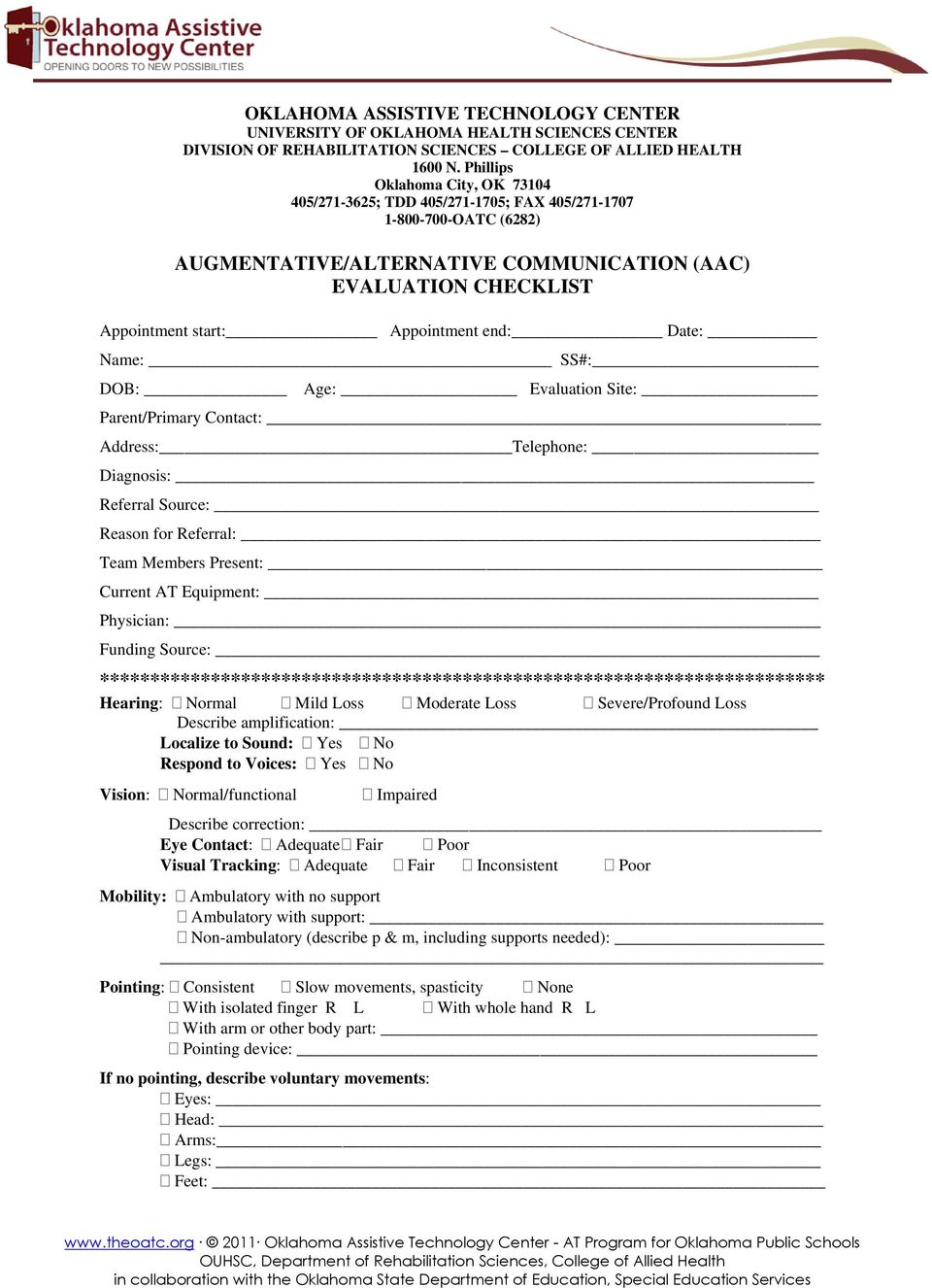
1 OKLAHOMA ASSISTIVE TECHNOLOGY CENTER UNIVERSITY OF OKLAHOMA HEALTH SCIENCES CENTER DIVISION OF REHABILITATION SCIENCES COLLEGE OF ALLIED HEALTH 1600 N. Phillips Oklahoma City, OK / ; TDD 405/ ; FAX 405/ OATC (6282) AUGMENTATIVE/ALTERNATIVE COMMUNICATION (AAC) EVALUATION CHECKLIST Appointment start: Appointment end: Date: Name: SS#: DOB: Age: Evaluation Site: Parent/Primary Contact: Address: Telephone: Diagnosis: Referral Source: Reason for Referral: Team Members Present: Current AT Equipment: Physician: Funding Source: ************************************************************************ Hearing: Normal Mild Loss Moderate Loss Severe/Profound Loss Describe amplification: Localize to Sound: Yes No Respond to Voices: Yes No Vision: Normal/functional Impaired Describe correction: Eye Contact: Adequate Fair Poor Visual Tracking: Adequate Fair Inconsistent Poor Mobility: Ambulatory with no support Ambulatory with support: Non-ambulatory (describe p & m, including supports needed): Pointing: Consistent Slow movements, spasticity None With isolated finger R L With whole hand R L With arm or other body part: Pointing device: If no pointing, describe voluntary movements: Eyes: Head: Arms: Legs: Feet: AT Program for Oklahoma Public Schools OUHSC, Department of Rehabilitation Sciences, College of Allied Health in collaboration with the Oklahoma State Department of Education, Special Education Services
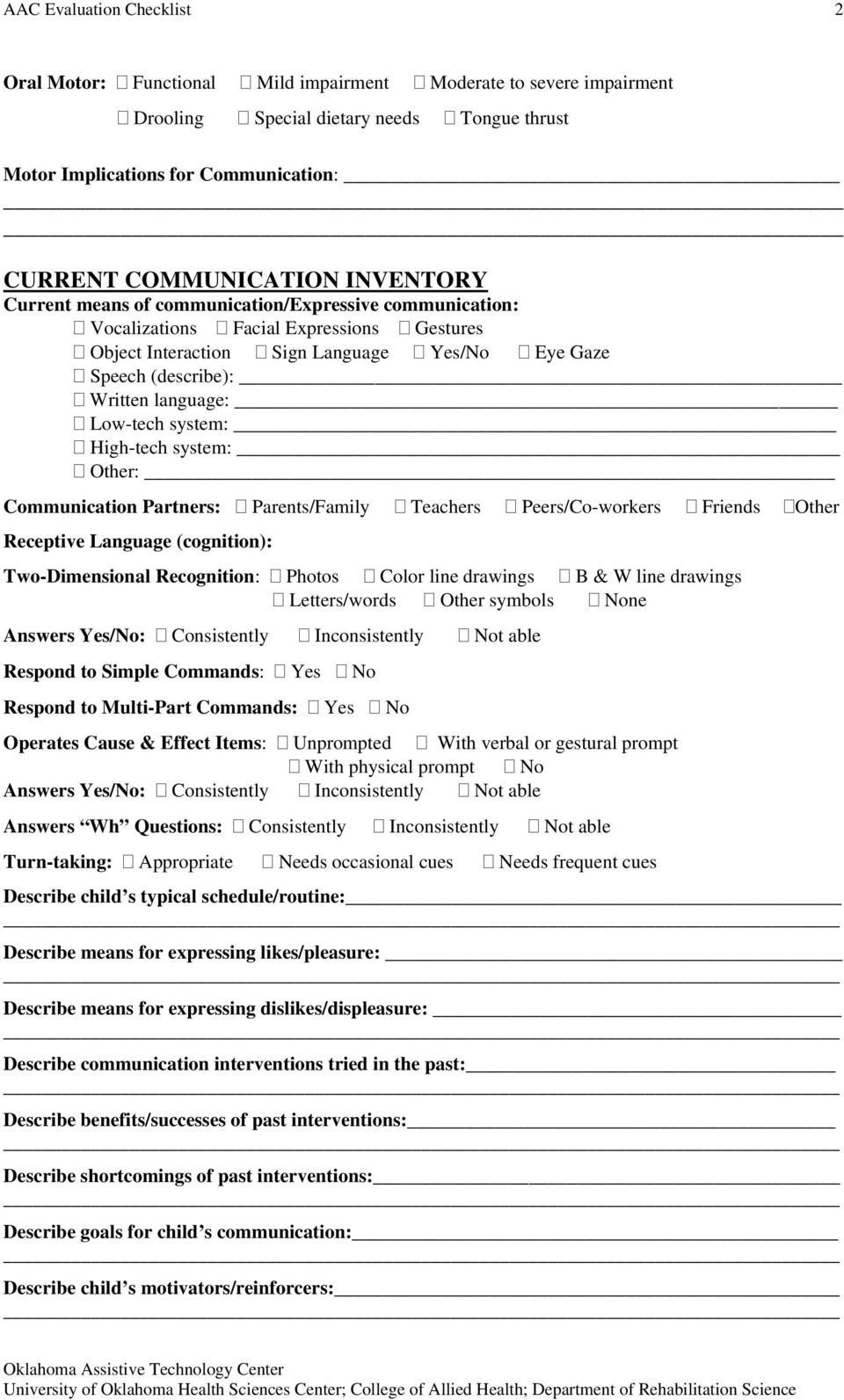
2 AAC Evaluation Checklist 2 Oral Motor: Functional Mild impairment Moderate to severe impairment Drooling Special dietary needs Tongue thrust Motor Implications for Communication: CURRENT COMMUNICATION INVENTORY Current means of communication/expressive communication: Vocalizations Facial Expressions Gestures Object Interaction Sign Language Yes/No Eye Gaze Speech (describe): Written language: Low-tech system: High-tech system: Other: Communication Partners: Parents/Family Teachers Peers/Co-workers Friends Other Receptive Language (cognition): Two-Dimensional Recognition: Photos Color line drawings B & W line drawings Letters/words Other symbols None Answers Yes/No: Consistently Inconsistently Not able Respond to Simple Commands: Yes No Respond to Multi-Part Commands: Yes No Operates Cause & Effect Items: Unprompted With verbal or gestural prompt With physical prompt No Answers Yes/No: Consistently Inconsistently Not able Answers Wh Questions: Consistently Inconsistently Not able Turn-taking: Appropriate Needs occasional cues Needs frequent cues Describe child s typical schedule/routine: Describe means for expressing likes/pleasure: Describe means for expressing dislikes/displeasure: Describe communication interventions tried in the past: Describe benefits/successes of past interventions: Describe shortcomings of past interventions: Describe goals for child s communication: Describe child s motivators/reinforcers:
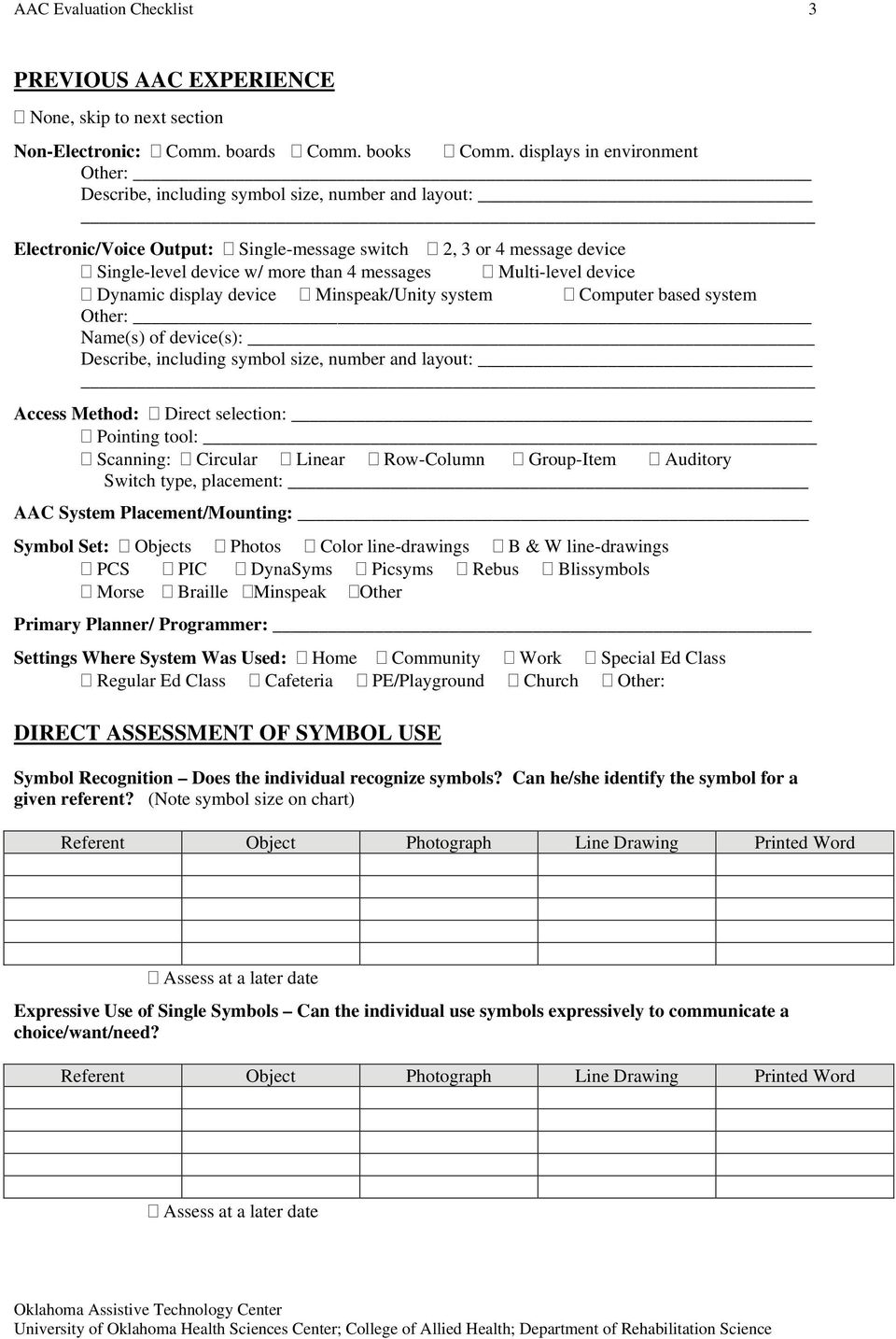
3 AAC Evaluation Checklist 3 PREVIOUS AAC EXPERIENCE None, skip to next section Non-Electronic: Comm. boards Comm. books Comm. displays in environment Other: Describe, including symbol size, number and layout: Electronic/Voice Output: Single-message switch 2, 3 or 4 message device Single-level device w/ more than 4 messages Multi-level device Dynamic display device Minspeak/Unity system Computer based system Other: Name(s) of device(s): Describe, including symbol size, number and layout: Access Method: Direct selection: Pointing tool: Scanning: Circular Linear Row-Column Group-Item Auditory Switch type, placement: AAC System Placement/Mounting: Symbol Set: Objects Photos Color line-drawings B & W line-drawings PCS PIC DynaSyms Picsyms Rebus Blissymbols Morse Braille Minspeak Other Primary Planner/ Programmer: Settings Where System Was Used: Home Community Work Special Ed Class Regular Ed Class Cafeteria PE/Playground Church Other: DIRECT ASSESSMENT OF SYMBOL USE Symbol Recognition Does the individual recognize symbols? Can he/she identify the symbol for a given referent? (Note symbol size on chart) Referent Object Photograph Line Drawing Printed Word Expressive Use of Single Symbols Can the individual use symbols expressively to communicate a choice/want/need? Referent Object Photograph Line Drawing Printed Word
4 AAC Evaluation Checklist 4 Symbol Sequencing Can the individual sequence 2 or more symbols to create a phrase? (Assess if individual is not already sequencing with present system but does use symbols expressively): List symbol sequences attempted: 1 symbol messages 2 symbol messages 3 symbol messages Symbol Categorization and Association Can the individual assign symbols to categories or groups? (Assess if individual does use symbols expressively): Classify by: Object name Function Part/whole Category Place Association Color None Complex symbol sequencing Can the individual use categorization and sequencing abilities together? (Assess if the individual can sequence and categorize): Concrete Phrase or Sentence Symbol Sequence Letter Recognition (R=Reported, O=Observed): Knows all upper case R O Knows all lower case R O Knows some upper and lower case but not all R O Unsure None Reading: Reported reading level: Some sight words Reads sentences Reads connected text (approx. level: ) Unsure None If unsure, directly assess. Use Glennen s Sight Word Reading Checklist Pre-Primer Primer Level 1 Level 2 Spelling: None reported Emerging skills Adequate, with some mistakes Proficient, few mistakes Unsure If unsure, directly assess. Use Glennen s Letter Spelling procedure. Level 1 Level 2 Level 3 Writing: None Writes name, functional words Writes sentences Writes connected text Unsure Handwriting: Legible Legible but slow, effortful Legible only if familiar Illegible (attach sample) Word Prediction: Already uses Unsure None If unsure, assess using Glennen s Word Prediction procedure. Score: # correct /# missed Abbreviation Expansion: Already uses Unsure None If unsure, directly assess using Glennen s Memory for Abbreviation Expansion Procedure. Easy sequences # correct: Difficult sequences # correct: Single words # correct: Family/Caregiver/Teacher comments about potential AAC system:

5 AAC Evaluation Checklist 5 ACCESS METHOD Direct Selection: None Exerts adequate pressure Consistently accesses targets Uses eyes Requires significant response time Requires large target area Has difficulty crossing midline Has difficulty accessing a portion of array: top bottom left side right side Requires use of pointing tool: Can use standard mouse Can use joystick Can use head mouse or eye gaze mouse Can use alternative keyboard Can use trackball/trackpad If unable to use direct selection: Can use single switches (complete switch assessment) Can use multiple switches (complete switch assessment) Switch Activation Site Location/ Mount Activate Hold/ Maintain Release Reactivate Scanning Method: Direct Inverse Auditory Visual: Circular Linear Row-column Group-item FEATURE MATCH AAC System Inventory: System Features Direct Selection Alternative mouse or keyboard access Visual scanning Auditory scanning Voice output Printed output Text to speech Minspeak Activity based overlays Dynamic displays Compatible with ECU Portable Lightweight Wheelchair Mountable Ease of programming Durable / Moisture-Resistant Complete at a later date Required Desired (Not Required) Systems that have required and desired features: Decide at a later date Not Required If Required, Give Rationale

6 AAC Evaluation Checklist 6 Recommendations: Follow-up: Completed by: Name & Title Date

To persons completing this application:
 To persons completing this application: Thank you for your interest in the Toronto Rehabilitation Institute s Augmentative and Alternative Communication (AAC) Clinic. Who we see: Our mandate is to help
AUGMENTATIVE COMMUNICATION EVALUATION
 AUGMENTATIVE COMMUNICATION EVALUATION Date: Name: Age: Date of Birth: Address: Telephone: Referral Source: Diagnosis: Participants: Social History and Current Services: lives with his in a private home
REFERRAL FORM / CLIENT PROFILE
 Augmentative Communication Services Child Development Centre Hotel Dieu Hospital 166 Brock Street Kingston, Ont. K7L 5G2 CDC# HDH CR# REFERRAL FORM / CLIENT PROFILE Date: Name: Diagnosis: Birthdate: Age:
COMMUNICATION AIDS - GLOSSARY OF TERMS. AAC See Augmentative and Alternative Communication
 COMMUNICATION AIDS - GLOSSARY OF TERMS AAC See Augmentative and Alternative Communication AAC System An integrated group of components, including symbols, aids, strategies and techniques used by individuals
Assistive Technology Considerations for Students: AAC
 SET-BC works in partnership with BC schools to provide assistive technology (AT) services for students with physical disabilities, autism spectrum disorders, moderate to profound intellectual disabilities,
Assistive Technology: A System of Support for Including Students with Disabilities within General Education Programs
 Assistive Technology: A System of Support for Including Students with Disabilities within General Education Programs A General Overview Presented by: Melanie O Dea Special Education Consultant Learning
Switch Assessment and Planning Framework for Individuals with Physical Disabilities
 Guidance Notes Pre- assessment: It is important to gather together appropriate information before the assessment to inform on possible starting points for the assessment. The Pre-Assessment Form should
Evaluation Report Structure for Funding of Speech Generating Devices
 Evaluation Report Structure for Funding of Speech Generating Devices Request for Speech Generating Device (SGD) Funding: Section 1: Demographic Information Patient: full name, complete address & telephone
Assistive Technology and Augmentative and Alternative Communication Policies and Procedures for the Moriarty Edgewood School District
 Assistive Technology and Augmentative and Alternative Communication Policies and Procedures for the Moriarty Edgewood School District 1 Purpose The purpose of this manual is to assist teachers, case managers,
Schools for All Children
 Position Paper No. Schools for All Children LOS ANGELES UNIFIED SCHOOL DISTRICT John Deasy, Superintendent Sharyn Howell, Executive Director Division of Special Education Spring 2011 The Los Angeles Unified
ENVIRONMENTAL CONTROL, COMPUTER ACCESS AND PERSONAL ALERT SYSTEMS
 ENVIRONMENTAL CONTROL, COMPUTER ACCESS AND PERSONAL ALERT SYSTEMS Group 2 Disability-specific: Included Equipment Environmental control systems (ECS) such as environmental control units (ECU), accessories,
TOOLS for DEVELOPING Communication PLANS
 TOOLS for DEVELOPING Communication PLANS Students with disabilities, like all students, must have the opportunity to fully participate in all aspects of their education. Being able to effectively communicate
Section 6. Writing Assistive Technology Into the IEP
 ` Section 6 Writing Assistive Technology Into the IEP 2013 90 Overview of Assistive Technology and the IEP The IEP is a collaboratively created document designed to help guide the delivery of special education
Possibilities For Wording Of IEP Goals and Objectives For Alignment Charts
 Motivation and Interest Maintain attention to a literacy-related activity for minutes. Literacy Interactions Print and Book Awareness will stay with the adult while they look at or read the book for at
Chapter 3 Assistive Technology for Communication
 Introduction...1 Getting Started with AAC...2 Using the Decision Making Guide...6 Decision Making Guide...7 SETT Process...8 AT Continuum for Communication...27 Continuum Expanded...28 SETT Solution Selection...41
All About Apps for AAC
 All About Apps for AAC K E L L Y K A M P W E R T H, M. A., C C C - SLP C H A R L E S T O N C O U N T Y S C H O O L D I S T R I C T K E L L Y _ K A M P W E R T H @ C H A R L E S T O N. K 1 2. S C. U S Learning
OUR PLACE SCHOOLS The Orchard, Bransford, Worcester, WR6 5JE Tel: 01886 833378 Email. [email protected]
 OUR PLACE SCHOOLS The Orchard, Bransford, Worcester, WR6 5JE Tel: 01886 833378 Email. [email protected] www.ourplaceschools.com Total Communications Policy Total Communications Policy A Total Communication
Ohio Department of Medicaid CERTIFICATE OF MEDICAL NECESSITY/PRESCRIPTION SPEECH GENERATING DEVICE (SGD) INITIAL CERTIFICATION
 Ohio Department of Medicaid CERTIFICATE OF MEDICAL NECESSITY/PRESCRIPTION SPEECH GENERATING DEVICE (SGD) INITIAL CERTIFICATION Name of Provider Provider NPI # Medicaid Legacy # Instructions: The Certificate
Explanation of Testing Accommodations for Students with Disabilities - Assistive Technology Accommodations
 Explanation of Testing for Students with Disabilities - Assistive Technology According to the Regulations Governing Special Education Programs for Children with Disabilities in Virginia, assistive technology
EARLY INTERVENTION: COMMUNICATION AND LANGUAGE SERVICES FOR FAMILIES OF DEAF AND HARD-OF-HEARING CHILDREN
 EARLY INTERVENTION: COMMUNICATION AND LANGUAGE SERVICES FOR FAMILIES OF DEAF AND HARD-OF-HEARING CHILDREN Our child has a hearing loss. What happens next? What is early intervention? What can we do to
COMPUTER SUPPORT STAFF TIPS FOR DISABILITY ETIQUETTE
 COMPUTER SUPPORT STAFF TIPS FOR DISABILITY ETIQUETTE COMPUTER SUPPORT STAFF TIPS FOR DISABILITY ETIQUETTE Norman Coombs, CEO EASI EASI: Equal Access to Software and Information 2011 (this document may
SPECIFIC LEARNING DISABILITY
 I. DEFINITION "Specific learning disability" means a disorder in one or more of the basic psychological processes involved in understanding or in using language, spoken or written, that may manifest itself
CDDH FACT SHEET. Working with people with intellectual disabilities in healthcare settings
 CDDH FACT SHEET Working with people with intellectual disabilities in healthcare settings People with intellectual disabilities have the same right as other community members to access community based
Technology in Music Therapy and Special Education. What is Special Education?
 Technology in Music Therapy and Special Education What is Special Education? Disabilities are categorized into the following areas: o Autism, visual impairment, hearing impairment, deaf- blindness, multiple
Holland Bloorview Kids Rehabilitation Hospital
 Holland Bloorview Kids Rehabilitation Learning Objectives As a result of this activity, participants will be able to: If the Book Fits, I ll Use It! Customizing Communication Books for Varying Physical
Practice Test for Special Education EC-12
 Practice Test for Special Education EC-12 1. The Individualized Educational Program (IEP) includes: A. Written evaluation B. Assessment tests C. Interviews 2. Learning disabilities include: A. Cerebral
Categories of Exceptionality and Definitions
 7. CATEGORIES and DEFINITIONS of EXCEPTIONALITIES Purpose of the standard To provide the ministry with details of the categories and definitions of exceptionalities available to the public, including parents
The Special Education Technology Center of Washington State
 1 The Special Education Technology Center of Washington State Jerry Connolly Director, SETC A Statewide Needs Project Funded by the Office of the Superintendent of Public Instruction Administered by Central
Student Centred Appraisal of Need
 Student Centred Appraisal of Need Booklet for parents, carers and staff January 2010 INTRODUCTION The Student Centred Appraisal of Need provides a consistent approach in determining educational needs of
communication Tips for successful communication at all stages of Alzheimer's disease
 communication Tips for successful communication at all stages of Alzheimer's disease Communication and dementia As the disease progresses, the communication skills of a person with Alzheimer's disease
Infant-Toddler Alignment. Preschool Alignment. HighScope Educational Research Foundation
 COR Advantage HighScope s newest research-based assessment tool is highly compatible with many national and state early learning standards, including those of the state of Arizona. This document shows
Tool for Analysis of Language and Communication (TALC)
 Tool for Analysis of Language and Communication (TALC) Language Sampling Tool for Multimodal Communicators Student: Date: Partner Name / Relationship Activity: Learning Context: SG= Small Group, LG= Large
The Road to Rehabilitation
 The Road to Rehabilitation Part 5 Crossing the Communication Bridge: Speech, Language & Brain Injury Written by Jean L. Blosser, EdD, CCC/SCLP Roberta DePompei, PhD, CCC/SCLP Content reveiwed by Gregory
EPPING SCHOOL DISTRICT OCCUPATIONAL THERAPIST JOB DESCRIPTION
 EPPING SCHOOL DISTRICT OCCUPATIONAL THERAPIST JOB DESCRIPTION TITLE: OCCUPATIONAL THERAPIST (OT) GENERAL DESCRIPTION: The Occupational Therapist provides services for the purpose of promoting health and
Unit 3. Effective Communication in Health and Social Care. Learning aims
 Unit 3 Effective Communication in Health and Social Care Learning aims In this unit you will: investigate different forms of communication. investigate barriers to communication in health and social care.
Assistive Technology Considerations for Students: Math
 SET-BC works in partnership with BC schools to provide assistive technology (AT) services for students with physical disabilities, autism spectrum disorders, moderate to profound intellectual disabilities,
Common Educational Tests used for Assessments for Special Education
 Cognition/Intelligence Ability to reason, to think abstractly, and to solve problems. Wechsler tests: WISC-III, WAIS-R, WPPSI-R Stanford-Binet: Fourth Edition Differential Ability Scales (DAS) Verbal Intelligence
Writing IEP Goals and Objectives for Authentic Communication - for Children with Complex Communication Needs
 Writing IEP Goals and Objectives for Authentic Communication - for Children with Complex Communication Needs Adopt and Share Beliefs and Basic Assumptions about Communication: Not having speech is not
More AAC Solutions for People with Severe Disabilities: Part I
 More AAC Solutions for People with Severe Disabilities: Part I Cathy Binger, Ph.D., CCC-SLP June 11-12, 2009 WATR workshop Binger 2009 1 Overview What is AAC? What is Low Tech AAC? Who needs AAC? Who needs
Advice for Class Teachers. Moderating pupils reading at P 4 NC Level 1
 Advice for Class Teachers Moderating pupils reading at P 4 NC Level 1 Exemplars of writing at P Scales and into National Curriculum levels. The purpose of this document is to provide guidance for class
Why use a visual schedule?
 Why use a visual schedule? As teachers or parents working with children with disabilities, we often assume that the child knows the daily schedule. Do they really know? Think how lost you would be if someone
62 Hearing Impaired MI-SG-FLD062-02
 62 Hearing Impaired MI-SG-FLD062-02 TABLE OF CONTENTS PART 1: General Information About the MTTC Program and Test Preparation OVERVIEW OF THE TESTING PROGRAM... 1-1 Contact Information Test Development
Innovative Tools and Technology to use during Aural Rehabilitation Therapy
 Innovative Tools and Technology to use during Aural Rehabilitation Therapy Jodi Creighton, M.S.,CCC-A,LSLS Cert. AVT Cincinnati Children s Hospital Medical Center As one parent I know said, You are not
Guide for families of infants and children with hearing loss
 With early detection, Early Intervention can begin! Guide for families of infants and children with hearing loss Birth to 3 2008 Cover photograph Geneva Marie Durgin was born January 20, 2007. She lives
OCPS Curriculum, Instruction, Assessment Alignment
 OCPS Curriculum, Instruction, Assessment Alignment Subject Area: Grade: Strand 1: Standard 1: Reading and Language Arts Kindergarten Reading Process The student demonstrates knowledge of the concept of
SO, HOW DOES IT WORK?
 Communication Supports Inventory-Children and Youth (CSI-CY) for children who rely on augmentative and alternative communication (AAC) Charity Rowland, Ph. D., Melanie Fried-Oken, Ph. D., CCC-SLP and Sandra
UNILATERAL SPATIAL NEGLECT Information for Patients and Families
 UNILATERAL SPATIAL NEGLECT Information for Patients and Families What is unilateral spatial neglect? Unilateral spatial neglect (USN) is the inability to pay attention to things on the side that is affected
Create stories, songs, plays, and rhymes in play activities. Act out familiar stories, songs, rhymes, plays in play activities
 PRESCHOOL Language Arts Literacy Expectation 1 Children listen and respond to environmental sounds, directions, and conversations. NJCCC K-12 Standard 3.4 Listening Strand A: Active Listening Strand B:
SPEECH OR LANGUAGE IMPAIRMENT EARLY CHILDHOOD SPECIAL EDUCATION
 I. DEFINITION Speech or language impairment means a communication disorder, such as stuttering, impaired articulation, a language impairment (comprehension and/or expression), or a voice impairment, that
Voluntary Product Accessibility Template
 Date: April 15, 2008 Name of Product: Summit Central Version 4 Contact for more Information: http://www.miesoftware.com Summary Table Section 1194.21 Software Applications and Operating. Please refer to
Evaluative Case Study of the Use of Soundbeam in an Irish Special School
 Evaluative Case Study of the Use of Soundbeam in an Irish Special School Name of Authors: Majella Ffrench O Connor, Orlagh Mahon, Eilish Brennan. School: Kolbe Special School, Block Road, Portlaoise, Co.
Reaching Vulnerable Populations with Critical Health and Medical Information: Media Formats and Mediums
 Reaching Vulnerable Populations with Critical Health and Medical Information: Media Formats and Mediums Developed and revised by the Florida Vulnerable Populations Communications Work Group on April 26,
Appendix C: Protocol for the Use of the Scribe Accommodation and for Transcribing Student Responses
 : Protocol for the Use of the Scribe Accommodation and for Transcribing Student Responses Scribing a student s responses by an adult test administrator is a response accommodation that allows students
Assistive Technology Solutions for Communication
 Assistive Technology Solutions for Communication Heather Blalock, MA., CCC-SLP MNPS - Assistive Technology Team IDEA states that assistive technology is any item, piece of equipment or product system,
PRINT AWARENESS ASSESSMENT. Instructions and Teacher Recording Form
 PRINT AWARENESS ASSESSMENT Instructions and Teacher Recording Form Instructions: This form includes instructions for each section and allows room for the teacher or assessor to write comments while the
Augmentative Communication Technology: Strategies, Features, and Rehabilitation Approaches through Lingraphica Devices, Programs, and Apps!
 Augmentative Communication Technology: Strategies, Features, and Rehabilitation Approaches through Lingraphica Devices, Programs, and Apps! Andrew Jinks, MA CCC-SLP, ATP! Speech-Language Pathologist! Augmentative
Question Specifications for the Cognitive Test Protocol
 Question Specifications for the Cognitive Test Protocol Core Questions These are the 6 disability questions to be tested in the interview. All of the other questions in the cognitive test protocol are
Care Pathway for Rehabilitation Team (Following allocation of Cochlear Implant surgery date)
 Care Pathway for Rehabilitation Team (Following allocation of Cochlear Implant surgery date) Home information session (Carried out by a member of the CI team) Rehabilitationist allocated to family Cochlear
The Keyboarding Dilemma. Jan Kurtz, MS, OTR/L Baltimore County Schools Assistive Technology Team Closing the Gap 2006 [email protected] www.bcps.
 The Keyboarding Dilemma Jan Kurtz, MS, OTR/L Baltimore County Schools Assistive Technology Team Closing the Gap 2006 [email protected] www.bcps.org The Dilemma Much time and energy spent on discussion Whether
Standards Based IEP s for Preschool Children. Special Education Services Alabama State Department of Education
 Standards Based IEP s for Preschool Children Special Education Services Alabama State Department of Education Speaking Whale http://www.youtube.com/watch?v=ckwwtkhoa2o http://alex.state.al.us/specialed/presentations.html
WRITING MEASURABLE IEP GOALS
 WRITING MEASURABLE IEP GOALS AT THIS SESSION, YOU WILL LEARN The four components of a measurable goal. Terms to use that are measurable. How to write clear goal descriptions. How to match target criteria
Local School District 1234 Our Address Ave. (222) 333-4444 INDIVIDUALIZED EDUCATION PROGRAM (IEP)
 : : : : PRESENT LEVEL OF EDUCATIONAL PERFORMANCE AND NEEDS Educational: How does this child/student perform within the general curriculum (content standards) and on age appropriate tasks and benchmarks?
Neurogenic Disorders of Speech in Children and Adults
 Neurogenic Disorders of Speech in Children and Adults Complexity of Speech Speech is one of the most complex activities regulated by the nervous system It involves the coordinated contraction of a large
ASSISTIVE TECHNOLOGY
 ASSISTIVE TECHNOLOGY VI- 1 Assistive Technology and Transition Planning Many students with disabilities require assistive technology to participate in and benefit from their educational programs. Students
Functional Auditory Performance Indicators (FAPI)
 Functional Performance Indicators (FAPI) An Integrated Approach to Skill FAPI Overview The Functional (FAPI) assesses the functional auditory skills of children with hearing loss. It can be used by parents,
Growing Up With Epilepsy
 Teaching Students with Epilepsy: Children with epilepsy often experience learning issues as a result of their seizures. These may include ongoing problems with motor skills or cognitive functions, as well
PROTOCOLS FOR SPEECH THERAPY PROVIDERS
 PROTOCOLS FOR SPEECH THERAPY PROVIDERS Type of Services Provided Services provided by Speech Therapy (or Speech Pathology) providers are covered for Santa Barbara Health Initiative (SBHI), San Luis Obispo
Special Needs Profiling Instrument. Guide for Schools, Parents and Carers
 Special Needs Profiling Instrument Guide for Schools, Parents and Carers Updated January 2010 INTRODUCTION The needs-based model of resource allocation for students with disability is recommended by the
Assessing A Student s Need for Assistive Technology: Where to Start?
 Assessing A Student s Need for Assistive Technology: Where to Start? When the question of a student s need for AT leads to an assessment, the first action is to identify a team of people to address that
GUIDELINE: DEVELOPING INDIVIDUAL EDUCATIONAL ACCESS PLANS
 GUIDELINE: DEVELOPING INDIVIDUAL EDUCATIONAL ACCESS PLANS The University has chosen to adopt and adapt the principles of the International Classification of Functioning, Disability and Health (ICF; WHO,
OCR Levels 2 and 3 in Supporting Teaching and Learning in Schools. Unit 39 Support pupils with communication and interaction needs
 OCR Levels 2 and 3 in Supporting Teaching and Learning in Schools Unit 39 Support pupils with communication and interaction needs UNIT SUMMARY Who is this unit for? This unit is for those who provide support
What Exactly Is Assistive Technology?
 What Exactly Is Assistive Technology? The legal definition as it appears in IDEA is "any service that directly assists an individual with a disability in the selection, acquisition, or use of an assistive
Any Town Public Schools Specific School Address, City State ZIP
 Any Town Public Schools Specific School Address, City State ZIP XXXXXXXX Supertindent XXXXXXXX Principal Speech and Language Evaluation Name: School: Evaluator: D.O.B. Age: D.O.E. Reason for Referral:
Chaffey College Disability Programs & Services LD Referral Form
 Chaffey College Disability Programs & Services LD Referral Form Date: Name: Student ID#: Address: City: Zip: Phone: Alternate #: DOB: Referring DPS Counselor: Who referred you for LD testing? E-mail: 1.
Wisconsin Assistive Technology Initiative Competency Self Rating
 Directions: 1. Use the following codes when completing competency: P = Where I was three years ago N = Where I am now F = Where I want to be in the future Wisconsin Assistive Technology Initiative Competency
Preschool Development Assessment
 Preschool Development Assessment Child s Name: DOB: Completed by: Date began: This document may be copied for classroom use only. Not to be sold or used on any other website. Property of www.re-teach.com.
Contact for more Information: http://www.dameware.com or http://www.dameware.com/products/vpat.asp
 Date: 2/10/2003 Name of Product: Contact for more Information: http://www.dameware.com or http://www.dameware.com/products/vpat.asp Summary Table Criteria Supporting Features Remarks and explanations Section
Avaya Speech Analytics Desktop Client 2.0
 Avaya Speech Analytics Desktop Client 2.0 Voluntary Product Accessibility Template (VPAT) Avaya Speech Analytics Desktop Client is a thick client desktop application for the Microsoft Windows operating
Tablet Computers and Apps as Informal Assessment Tools. by Gloria Rodriguez-Gil CDBS Educational Specialist
 resources Spring 2014 (Vol. 19 No. 1) Tablet Computers and Apps as Informal Assessment Tools by Gloria Rodriguez-Gil CDBS Educational Specialist *The contents herein are mostly based upon a previous article
Collaborative Teaming for students who require AT/AAC
 Collaborative Teaming for students who require AT/AAC Working effectively to meet the needs of students who require AAC/AT in the educational setting Marilyn J. Buzolich, Ph.D., CCC- SLP ACTS What is Collaborative
Measurable Annual Goals
 Measurable Annual Goals This document was developed to help special education teachers begin transitioning from standards based IEP goals to measurable annual goals that are specific to individual student
Questions to Consider in UDL Observations of Early Childhood Environments
 Questions to Consider in UDL Observations of Early Childhood Environments Universally Designed Learning (UDL) environments provide considerations for the widest diversity of learners possible so that all
Region 14 - Hopewell Center Consultation/Evaluation Referral Packet For Children 3 to 22 Years Old
 Region 14 - Hopewell Center Consultation/Evaluation Referral Packet For Children 3 to 22 Years Old Please use this packet to request the following Hopewell services: Motor Evaluation (Adapted Physical
Universal Tools, Supports, and Accommodations For MSP Science Online Assessment, 2015-2016
 Universal Tools, Supports, and Accommodations For MSP Science Online Assessment, 2015-2016 Table 1: Universal Tool Amplification Highlighter Keyboard Navigation Mark for Review Strikethrough Table 2: Universal
What is cerebral palsy?
 What is cerebral palsy? This booklet will help you to have a better understanding of the physical and medical aspects of cerebral palsy. We hope it will be a source of information to anyone who wishes
MICHIGAN TEST FOR TEACHER CERTIFICATION (MTTC) TEST OBJECTIVES FIELD 062: HEARING IMPAIRED
 MICHIGAN TEST FOR TEACHER CERTIFICATION (MTTC) TEST OBJECTIVES Subarea Human Development and Students with Special Educational Needs Hearing Impairments Assessment Program Development and Intervention
Universal Design for Learning (UDL) Checklist for Early Childhood Environments
 Universal Design for Learning (UDL) Checklist for Early Childhood Environments Universally Designed Learning (UDL) environments are designed from the onset in consideration of the widest diversity of learners