
Massage Therapy Practice.com Client Self Care Manual
|
|
|
- Alberta Ashlynn Hampton
- 10 years ago
- Views:
Transcription
1 Massage Therapy Practice.com Client Self Care Manual Massage Therapy Basics The Muscular Imprint of Tension Muscle Pain and Massage Stages of Recovery From Injury Stretching Basics Hydrotherapy Epsom Salts Bath Therapeutic Use of Heat and Cold Cold Abdominal Wash Breathing Breathing Techniques Diaphragmatic Breathing Pranayama Breathing Sandbag Breathing Low Back: Self Care Sheets Recovery Position for Acute Disc Pain Low Back Pain & Trigger Points Assessing Core Muscle Strength Low Back (and Hips): Techniques Low Back Release Low Back Side Release Releasing the Gluteals Releasing the Hip Flexors Releasing the Piriformis Awakening Core Stabilization Abdominal Strengthening Recruiting the Glutes Lengthening the Hamstrings Stretching the TFL Upper Body Problems: Self Care Sheets Neck Pain and Headaches Improving Head and Neck Posture TMJ Problems Shoulder Tendonitis and Impingement Frozen Shoulder Carpal Tunnel Syndrome Upper Body: Techniques Serenity Breathing Suboccipital Release Upper Trapezius Release Levator Scapula Release Scalene Muscle Release Strengthening the Neck Book Balancing Stabilization of the Jaw Releasing the Pectoral Muscles Supraspinatus Release Rotator Cuff Strengthening: Ext Rotation Rotator Cuff Strengthening: Int Rotation Releasing the Forearms Hot Pack for Frozen Shoulder Shoulder Circles Shoulder Distraction and Glides Wall Crawling Inter-scapular Release Stabilizing the Shoulder Blades Lower Extremity: Self Care Sheets Shin Splints Plantar Fascitis Lower Extremity: Techniques Releasing the Shin Stretching the Calf Short Foot This manual is intended only as a reference tool and has been developed for health care professionals to distribute to their clients for appropriate use as determined by the individual health care professional. The manual was not developed nor intended to be a medical manual. It is not a substitute for any type of treatment that may be prescribed by a physician. The author, publishers and distributors of this material specifically disclaim any liability, injury, risk or loss incurred by the use and application of any of the contents of this manual. All responsibility for liability, injury, risk or loss related to the use of this material is assumed by the health care professional who distributes the material to their clients. The individual handouts may be reproduced to give to clients or use in promoting your practice. The material in this manual may not be modified either physically or electronically. Copyright 2009, by Doug Alexander

2 The following pages are excerpted from the Client Self Care Manual sold by TouchU.ca also known as MassageTherapyPractice.com Buy your own Self Care Manual personalized with you Clinic Name, Address, and Contact Information. Each Self Care Manual is a 73 page PDF that you download to your computer and print as needed. The Self Care Manual template never wears out, or gets dogeared from photocopying. Clients understand and are supported in their role in their healing. Your clients are empowered and your practice is promoted. Order from TouchU Product Page today! Copyright 2009, by Doug Alexander 2

3 Self Care for Neck Pain and Headaches Neck pain and/or headaches are usaully caused by myofascial trigger points in neck muscles, poor posture and stress and tension. These issues are often interwoven with the choices we make in our lives, from what we eat and drink, to how we plan (or don t plan!) our day. Massage therapy is invaluable at helping unravel the tangle of tense muscles, anxious thoughts and bad habits that set the stage for neck pain and headaches. Your massage therapist can help you relax and let go of tension. After each treatment she can teach you one or two strategies that you can use to deepen and prolong the effects of the massage. Over a treatment series you can gradually release your pattern of stress. Stretching exercises can help release trigger points and tension that create pain in the head, neck or face. Stretching is probably the commonest strategy to release tension. Muscles that commonly produce pain are the upper trapezius, levator scapula and the suboccipital muscles. Breathe In Belly Out Breathing techniques release tense thoughts and feelings. When we breathe with the neck and shoulder muscles, breath re-training promises the first holiday these muscles have had in decades! This can be especially important if you are trying to recover from a whiplash injury. There are three common breathing techniques: diaphragmatic, pranayama and sandbag breathing. Postural improvement can take excessive loading off the neck muscles and spinal joints. This mechanical unloading decreases the physical stress on the neck and jaw. Postural improvement is achieved by stretching short muscles, strengthening weak muscles and increasing body awareness. Copyright 2009, by Doug Alexander 3

4 Self Care for Neck Pain and Headaches, cont d Relaxation and shifting the balance of the nervous system toward reflection, balance and healing is vital in overcoming long standing neck pain and headaches. Serenity Breathing 3 6 This is a complex task that is supported in the massage therapy process as well as through self care such as periodic Epsom Salts baths, serenity rolling and cold abdominal washes. 2 Breathe In Breathe Out Breathe In Breathe Out Diet is very important in controlling stress and tension. 1 8 (Proceed to 1) Regular meals, plenty of water, avoidance of candy, coffee and alcohol are vital habits for people wishing to improve their health and well being. Good self care habits are important. Pacing to our day, regular exercise, sufficient sleep and the ability to say No are basic skills and habits most of us need to practice. Everyone needs time for family, friends and relaxation. Sometimes we need to book this time and guard it protectively! Massage therapy should be part of everyone s wellness plan! The following questions are important to consider in terms of your treatment plan: What frequency of massage is necessary when you are trying to change old patterns of long standing tension and stress behaviors? Don t make taking better care of yourself something to get tense about! What frequency is necessary to support continued wellness? There should be increasing ease and lightness in both your body and your mind if you are going about this the right way! What frequency is necessary when you are experiencing increased stress or challenges? Copyright 2009, by Doug Alexander

5 Improving Head and Neck Posture The postural alignment of the neck is very important in terms of avoiding neck tension and headaches. Poor posture can even cause pain, tingling and numbness in the shoulders, arms or hands. How we hold our body day to day is an automatic process. This is good, because we have many other things to think about! However, if we have awkward patterns or bad habits, they tend to be maintained over the months and years of our lives. This is true even if we exercise at a gym. Whatever posture we have when we exercise will tend to imprint itself further in our body. There is also an intimate relationship between how we think and feel about ourselves and how we hold our bodies. If we are tense and anxious, then we tend to carry our shoulders up around our ears and draw our head forward. If we try to stretch tight muscles, but we don t dismantle habitually anxious thought patterns then we will not make lasting change in our bodies. Sometimes it is tightness or weakness in muscle that is maintaining poor posture. Sometimes it is tense and anxious thoughts that are the key factor. Usually it is a bit of both factors. Recognizing this helps both the client and massage therapist assume their rightful roles in the therapeutic process. The massage therapist doesn t have to become a muscular steamroller squishing and stretching stubborn muscles. And the client doesn t have to be a passive and dependent recipient of therapy. Breathe In Belly Out Breathing Techniques Most people with head forward posture use their neck and shoulder muscles to breathe with. This pattern of breathing pulls the head down and forward. And the posture will not change if the breathing pattern doesn t change. There are three common breathing techniques: diaphragmatic, pranayama and sandbag breathing. Stretching releases tension within the muscles that are pulling your posture out of alignment. The muscles that normally need to be stretched in head forward posture include the upper trapezius, levator scapula, scalenes, suboccipitals and pectoral muscles. Copyright 2009, by Doug Alexander

6 Improving Head and Neck Posture, cont d Strengthening muscles Once tight muscles have stopped distorting our posture, we still need strength to hold ourselves up! Muscles that commonly need to be strengthened include the inter scapular muscles and the muscles at the back of the neck. Changes in Awareness We need to become conscious of our posture. Balancing a book on the head is a good way to do this. We may also need to slow the pace of our lives (e.g. Epsom Salts baths) and re framing how we conceive of the challenges in our lives are very helpful. Many people start the postural improvement process in order to avoid neck pain or shoulder tendonitis. However, as the cat s cradle of tense and tangled muscles unravel and the breath flows in a more relaxed natural way the body starts to decompress and people often find a lightness, ease and calm that they have never experienced before. Feeling good rather than avoiding feeling pain then becomes the motivational force for better self care! Postural Improvement Checklist Category of Intervention Intervention Intervention Intervention Breathing Abdominal Pranayama Sandbag Stretching Upper Trapezius Levator Scapula Suboccipital Muscles Scalenes Pectoral Muscles Any other muscles? Strengthening Inter-scapular Muscles Neck Extensors Opening Salute Awareness Book Balancing Epsom Salts Bath Alt. Awareness Practice? Massage Therapy / week or month to release postural patterns / month or year for maintanence / week or month during stressful times Copyright 2009, by Doug Alexander

7 Purpose 2 Breathe In 1 3 Breathe Out 6 Breathe In Breathe Out 8 (Proceed to 1) Serenity Breathing To release tension in the mind and the neck when... Many muscles in the neck are tight The muscles have forgotten how to relax The neck is painful and sustained stretching is too challenging You are trying to restore a healthy relationship between breathing and neck muscle movements Sit with a comfortable upright posture. Allow your head to fall slowly toward your chest until the first feeling of tightness at the back of your neck. At the same time breathe out slowly and deeply. Now, slowly roll your head and neck toward the right shoulder as you breathe in (arrows # 1, 2 above). Roll your head as far as you comfortably can, guided by a feeling of pulling on the opposite side of your neck (the left) or a bit of compression on the same side of your neck (the right). Stop at the point where your head is beside the shoulder. Don t roll backward from here! At this point, allow your head and neck to slowly roll toward the centerline again, as you breathe out (# 3, 4). Time your exhalation and your motion to coincide so that you have finished breathing out by the time your head is flexed forward in the midline of your body. Continue the rolling motion toward the left shoulder as you begin inhaling again (# 5, 6). Complete the inhalation and the rolling at the same time. Now neck roll toward the midline and exhale at the same time (#7,8). Continue rolling from side to side, inhaling as you roll toward the shoulders and exhaling as you roll toward the midline. As you proceed with the movements, let yourself breathe and move more and more slowly. Eventually, it should feel like your neck is moving without effort, almost as if it is the breath that moves the neck. Do the serenity roll for a couple minutes the first time and slowly work your way up to 5 minutes. Rolling 1 or 2x/day Changes in Symptoms? Copyright 2009, by Doug Alexander 7

8 Suboccipital Release Purpose To unlock tension in the muscles at the base of the skull To relieve headaches at the base of the skull To begin to change head forward posture Look Up Breathe In We can use our reflexive responses to breathing and eye movements to unlock muscles in this frequently stubborn region. As we look upward and breathe in, the muscles at the base of the skull become more tense. As we relax our gaze and breathe out these muscles relax. To release these muscles allow your head to fall toward your chest to the first feeling of tension in the neck and/or the base of the skull. At this point without changing the position of the head and neck look up into your eyebrows. Take a deep breath in. Hold the gaze and hold the breath, just as long as you comfortably can (5 10 seconds is usually sufficient). Then exhale and let your eyes relax and unfocus. You should feel that your head and neck fall gently to a lower position. Allow this to happen. At this point, look up again and breathe in. Study the tension in the base of your skull and back of the neck, for a moment. Then relax by exhaling and allowing your eyes to relax and unfocus. Repeat this exercise several times until you feel substantially more relaxed at the base of the skull. Breathe Out Relax Eyes You should talk to your massage therapist if your suboccipital region doesn t stay released. You may need more precise guidance or you may need to unravel a pattern of head forward posture that is putting chronic tension into these muscles. Release am + pm? Changes in Symptoms? Copyright 2009, by Doug Alexander 8

9 Upper Trapezius Release The upper trapezius is released by anchoring the shoulder girdle (by gently holding the chair seat) and pulling the head and neck away from the tight side. As you do this you should rotate your head toward the direction you came from (i.e. the tight side). You should feel a gentle pulling from the base of the skull and along the neck outward to the top of the shoulder girdle. Breathe steadily and fully. As you breathe in you should feel the upper trapezius tensing slightly. As you breathe out the muscle should soften and lengthen slightly. Your head will naturally move a little more fully into the stretch position. Allow this to happen and continue for several breathing cycles. Make sure all the muscles in your body that are not needed to hold you in this position are fully relaxed. If you feel pain during this process you are probably pulling too firmly. Purpose: To relieve neck pain and temple headaches To bring the shoulders down from the ears To begin decompressing a very tense neck To help unravel head forward posture that may be causing headaches, jaw problems and nerve problems in the hands Don t try to force the release you need to work with your body; not against it. If you get pain, tingling or numbness in the neck or hand, you should stop doing the exercise until you can check in with your massage therapist. You may need to do the stretch differently or do a less challenging neck stretch such as Serenity Breathing. Upper Trap Release Changes in Symptoms? Copyright 2009, by Doug Alexander 9

10 Levator Scapula Release Muscle Being Stretched Purpose: To relieve neck pain and burning at the shoulder blade To relieve neck stiffness that occurs when you turn your head toward the tight side To bring the shoulders down from the ears and decompress the neck To help unravel head forward posture Regular Stretch Position The levator scapula muscle is released by lowering the scapula or shoulder blade as we turn our head and neck away from the tight muscle. The head is always turned toward the armpit opposite the side of the muscle you are releasing. Make sure all the muscles in your body that are not needed to hold you in this position are fully relaxed. Make sure you breathe fully, deeply and slowly. As you feel the muscle relax you will notice your head moves more fully into the stretch position. Allow this to happen, as this signals that the muscle is relaxing and lengthening. There are several options to the stretch position. The first option is to wrap your hand around the side of the neck to stabilize the facet joints that the levator scapula muscle attaches close to. Another option is to rotate your shoulder upward. This actually lowers the attachment point of the muscle on the shoulder blade. This variation can be a little tricky. If it doesn t work for you, that is fine. You ve got the other two options to work with. Stabilizing the Facet Joints If you are on the phone a lot, consider purchasing a hands free head set. Then you won t be tempted to hold the phone with your shoulder and tense up the levator scapula muscle! Upwardly rotating the Shoulder to Lower the Muscle Insertion Point on the Scapula Levator Scapula Releases Changes in Symptoms? Copyright 2009, by Doug Alexander 10

11 Scalene Muscle Release Purpose: Muscle being stretched To relieve neck pain and tingling/numbness in the arms/hands To decompress the neck To help unravel head forward posture. Middle Scalene: Ear to opposite shoulder The scalene muscles are released by stretching the head and neck to the opposite shoulder. Allow your head and neck to move just far enough to feel a comfortable stretch in the side you are moving away from. Hold the position for several breaths. If your breathing is full and relaxed, the scalenes will often release of their own accord. The first component of the release is for the middle scalenes (upper picture at right). Just allow your ear to move toward the opposite shoulder. After you have achieved some good release with the middle scalene, turn your face to the direction from which you came to release the anterior scalenes (middle picture at right). These are the two parts of the muscle that are capable of compressing the nerves to the hands, so if you have carpal tunnel syndrome, it will be most important to achieve release in these two divisions of the muscle. Anterior Scalene: Turn head toward side you are stretching The last scalene you may need to release is the posterior scalene. From the middle scalene release position, rotate your head slightly toward the shoulder that you are leaning toward (picture at right). Posterior Scalene: Turn head away from side you are stretching Duration/ Frequency Changes in Symptoms Copyright 2009, by Doug Alexander 11

12 Strengthening the Neck Purpose: To strengthen the neck Help undo head forward posture Relieve chronic post exercise soreness and fatigue in the back of the neck Provide stability for people with hypermobile neck joints Put one or two hands behind your head and let your head tip forward slightly. At this point, slowly breathe in and push your head upward and backward against the resistance of your hand(s). Bring your head and neck fully upright as you complete the in breath. Then let yourself exhale as the hand(s) slowly overpowers the neck and the head is brought to the original forward position. To summarize: Inhale, let the head overpower the hand as your spine lengthens and is brought to a tall position. Exhale, let the hand overpower the head and go forward into the head forward position. Repeat the cycle 8 12 times. You should do this exercise once or twice a day for two weeks or until you can easily carry your head with good posture. At first, give your head and neck only gentle resistance with your hands since your neck muscles are not used to this type of exercise. At no point should you feel any buckling or straining sensations in the neck! Neck Strengthening Changes in Symptoms? Copyright 2009, by Doug Alexander 12

13 Book Balancing Purpose: To increase awareness of head and neck posture To learn a new habit of carrying the head and neck with a relaxed buoyancy Balancing a book or a bean bag or bag of rice on your head is a time honored way to become aware of your posture. Place the object on your head and gently push it up toward the ceiling by lengthening your neck muscles. Hold this position for a minute or two. When you can easily lift the object toward the ceiling whether you are standing or sitting, you can practice holding it in this way when you transition from sitting to standing and standing to sitting. Also practice while you walk. Practice this awareness intervention with a light touch, making sure your body isn t rigid but light and flexibly responding. When to Practice: Once or twice a day for two weeks or until you automatically carry your head and neck with good alignment. Imagine the book on your head during the course of the day. Let your body respond to the invisible book whatever you are doing. Book Balancing Changes in Symptoms Copyright 2009, by Doug Alexander 13

Carpal Tunnel Pain. STRETCH YOUR: 1) Wrist Flexors 2) Wrist Extensors 3) Wrist Decompression 4) Neck (see other chapters for more examples)
 Carpal Tunnel Pain STRETCH YOUR: 1) Wrist Flexors 2) Wrist Extensors 3) Wrist Decompression 4) Neck (see other chapters for more examples) wrist flexors wrist extensors carpal tunnel Athletic Edge - www.athleticedge.biz
Cervical Exercise: How important is it? What can be done? The Backbone of Spine Treatment. North American Spine Society Public Education Series
 Cervical Exercise: The Backbone of Spine Treatment How important is it? What can be done? North American Spine Society Public Education Series Important: If you have had an accident that started your neck
X-Plain Neck Exercises Reference Summary
 X-Plain Neck Exercises Reference Summary Introduction Exercising your neck can make it stronger, more flexible and reduce neck pain that is caused by stress and fatigue. This reference summary describes
CHAPTER 3: BACK & ABDOMINAL STRETCHES. Standing Quad Stretch Athletic Edge - www.athleticedge.biz - (650) 815-6552
 CHAPTER : BACK & ABDOMINAL STRETCHES Standing Quad Stretch ) Stand and grasp right ankle with same hand, use a wall or chair to Lower maintain Back balance with left hand. Maintain an upright Stretches
McMaster Spikeyball Therapy Drills
 BODY BLOCKS In sequencing Breathing and Tempo Flexibility / Mobility and Proprioception (feel) Upper body segment Middle body segment Lower body segment Extension / Static Posture Office / Computer Travel
A Stretch-Break Program for Your Workplace! www.healthyworkplaceweek.ca
 www.healthyworkplaceweek.ca A Stretch-Break Program for Your Workplace! Why is stretching at work important? Sitting at a desk or computer; or standing at your work station for extended periods of time
COMMON OVERUSE INJURIES ATTRIBUTED TO CYCLING, AND WAYS TO MINIMIZE THESE INJURIES
 COMMON OVERUSE INJURIES ATTRIBUTED TO CYCLING, AND WAYS TO MINIMIZE THESE INJURIES Listed are a few of the most common overuse injuries associated with cycling long distances. 1. Cervical and upper back
Spine Conditioning Program Purpose of Program
 Prepared for: Prepared by: OrthoInfo Purpose of Program After an injury or surgery, an exercise conditioning program will help you return to daily activities and enjoy a more active, healthy lifestyle.
Rehabilitation after shoulder dislocation
 Physiotherapy Department Rehabilitation after shoulder dislocation Information for patients This information leaflet gives you advice on rehabilitation after your shoulder dislocation. It is not a substitute
SHOULDER PULL DOWNS. To learn efficient use of the shoulder blades and arms while maintaining a neutral spine position.
 SHOULDER INTRODUCT ION Welcome to your shoulder exercise program The exercises in the program are designed to improve your shoulder mobility, posture and the control of the muscles in your neck and shoulder
Schiffert Health Center www.healthcenter.vt.edu. Neck Pain (Cervical Strain) COMMON CAUSES: QUICK TREATMENT : NECK PAIN TREATING NECK PAIN:
 Schiffert Health Center www.healthcenter.vt.edu Patient Information: Neck Pain (Cervical Strain) COMMON CAUSES: Neck pain may be triggered by a specific event, such a sport injury or motor vehicle accident.
Sheet 1A. Treating short/tight muscles using MET. Pectorals. Upper trapezius. Levator scapula
 Sheet 1A Treating short/tight muscles using MET Pectorals Once daily lie at edge of bed holding a half-kilo can, arm out sideways. Raise arm and hold for 10 seconds, then allow arm to hang down, stretching
ROTATOR CUFF HOME EXERCISE PROGRAM
 ROTATOR CUFF HOME EXERCISE PROGRAM Contact us! Vanderbilt Sports Medicine Medical Center East, South Tower, Suite 3200 1215 21st Avenue South Nashville, TN 37232-8828 For more information on this and other
How To Stretch Your Body
 Exercise Module A New Leaf Choices for Healthy Living University of North Carolina at Chapel Hill 2007 Center for Health Promotion and Disease Prevention Physical Activity Exercises for Keeping Active
For Deep Pressure Massage
 T H E R A C A N E O W N E R S M A N U A L For Deep Pressure Massage Thera Cane is a self massager used to apply pressure to sore muscles. The unique design of the Thera Cane lets you apply deep pressure
KNEE EXERCISE PROGRAM
 KNEE PROGRAM INTRODUCT ION Welcome to your knee exercise program. The exercises in the program are designed to improve your knee stability and strength of the muscles around your knee and hip. The strength
Take a few minutes for yourself and incorporate some Office Yoga into your daily routine.
 OFFICE YOGA Working in an office or at a computer for prolonged periods of time can put strain on the neck, shoulder and back muscles which in turn can lead to tension and stiffness. This tension can cause
DRAFT OUTLINE YOGA IN HOSPICE CARE PRESENTATION Michele Hoffman, E-RYT, CYT April 21, 2015
 DRAFT OUTLINE YOGA IN HOSPICE CARE PRESENTATION Michele Hoffman, E-RYT, CYT April 21, 2015 1. What is Yoga? Holistic practice over 5,000 years old which works on all levels of being mind, body and spirit.
UNDERSTANDING STRESS AND YOUR BODY
 UNDERSTANDING STRESS AND YOUR BODY Life s demands create stress and although some stress may be good, too much can cause health problems. Most people equate stress with high blood pressure, a heart attack
Wellness Workbook. Journaling your way to a healthier life! By Tamiko Arbuckle http://myfoggybrain.com
 Wellness Workbook Journaling your way to a healthier life! By Tamiko Arbuckle http://myfoggybrain.com Please send any questions/ feedback to [email protected] Here s to your Wellness! Welcome and
STRESS. Health & Wellness The Newsletter About Achieving and Maintaining Optimal Well-being UNDERSTANDING AND YOUR BODY. www.neorthopt.
 Health & Wellness The Newsletter About Achieving and Maintaining Optimal Well-being UNDERSTANDING STRESS AND YOUR BODY Life s demands create stress and although some stress may be good, too much can cause
Don t. Hamstrings. Calf Muscles. both legs 2-3 times. stretch is felt in the back of the calf. Repeat with both legs 2-3 times.
 Remember to: Warm-up your muscles first before stretching (e.g. stretch after walking). Stretch until you feel mild discomfort, not pain. Never bounce or force a stretch. Hold the stretch for 10-30 seconds
MOON SHOULDER GROUP. Rotator Cuff Home Exercise Program. MOON Shoulder Group
 MOON Shoulder Group For information regarding the MOON Shoulder Group, talk to your doctor or contact: Rosemary Sanders 1215 21 st Avenue South 6100 Medical Center East Vanderbilt University Medical Center
Rotator Cuff and Shoulder Conditioning Program. Purpose of Program
 Prepared for: Prepared by: OrthoInfo Purpose of Program After an injury or surgery, an exercise conditioning program will help you return to daily activities and enjoy a more active, healthy lifestyle.
Psoas Syndrome. The pain is worse from continued standing and from twisting at the waist without moving the feet.
 Psoas Syndrome The iliopsoas muscle is a major body mover but seldom considered as a source of pain. Chronic lower back pain involving the hips, legs, or thoracic regions can often be traced to an iliopsoas
Injury Prevention for the Back and Neck
 Injury Prevention for the Back and Neck www.csmr.org We have created this brochure to provide you with information regarding: Common Causes of Back and Neck Injuries and Pain Tips for Avoiding Neck and
Rotator Cuff Home Exercise Program MOON SHOULDER GROUP
 Rotator Cuff Home Exercise Program MOON SHOULDER GROUP Introduction The MOON Shoulder group is a Multi-center Orthopaedic Outcomes Network. In other words, it is a group of doctors from around the country
Fact sheet Exercises for older adults undergoing rehabilitation
 Fact sheet Exercises for older adults undergoing rehabilitation Flexibility refers to the amount of movement possible around a joint and is necessary for normal activities of daily living such as stretching,
UPPER QUADRANT PAC. Do only those exercises that I have checked off for you to do independently. THINGS TO AVOID
 UPPER QUADRANT PAC Most common pain / disfunction syndromes occur as a result of a combination of poor posture habit and imbalanced muscle groups. The following exercise protocols will address the most
Info. from the nurses of the Medical Service. LOWER BACK PAIN Exercise guide
 Info. from the nurses of the Medical Service LOWER BACK PAIN Exercise guide GS/ME 03/2009 EXERCISE GUIDE One of the core messages for people suffering with lower back pain is to REMAIN ACTIVE. This leaflet
Range of Motion. A guide for you after spinal cord injury. Spinal Cord Injury Rehabilitation Program
 Range of Motion A guide for you after spinal cord injury Spinal Cord Injury Rehabilitation Program This booklet has been written by the health care providers who provide care to people who have a spinal
Operating Instructions
 Operating Instructions Table of Contents IMPORTANT INFORMATION 1-2 1 The backrack TM 3-6 Introduction 3 What does it do? 4 How do I use it? 5 How often should I use it? 6 2 Getting On 7-10 3 Basic Exercises
Stretching in the Office
 Stretching in the Office Legs: Quads, Hamstrings, IT band, Hip flexors, Gluts, Calves Quads: Standing @ desk maintaining upright posture, grab one leg @ a time by foot or ankle and bring it towards backside
Lateral pterygoid muscle Medial pterygoid muscle
 PATIENT INFORMATION BOOKLET Trismus Normal Jaw Function The jaw is a pair of bones that form the framework of the mouth and teeth. The upper jaw is called the maxilla. The lower jaw is called the mandible.
TRIGGER POINTS. Trigger Point Therapy Can Be Used To Help You With These Common Conditions: MIGRAINES TENSION HEADACHE NECK AND JAW PAIN
 TRIGGER POINTS Muscles account for more than 60% of the human body mass, making up the largest part of our bodies. They are responsible for all movement of the human body. With such an enormous responsibility,
ADVICE FOR PATIENTS WITH NECK PAIN
 ADVICE FOR PATIENTS WITH NECK PAIN Patient Information Leaflet Physiotherapy Department (Information sheet code SHOT/SHOA) A SMOKING FREE ENVIRONMENT WAHT-TH-007-1 - Version 1.2 Dear Patient This advice
total hip replacement
 total hip replacement EXCERCISE BOOKLET patient s name: date of surgery: physical therapist: www.jointpain.md Get Up and Go Joint Program Philosophy: With the development of newer and more sophisticated
by Ellen Saltonstall and Dr. Loren Fishman
 10 Yoga Poses for Low Back Pain Prevention by Ellen Saltonstall and Dr. Loren Fishman Introduction This series of poses is designed to prevent future back pain and also to relieve back pain that you may
Chronic Headache Problem
 Integrative Manual Therapy and Headaches In This Issue 2 HEADACHES Risk factors and what to do. 3 TIPS & TRICKS Exercises to minimize problems with headaches. 4 FAQ Most frequently asked questions about
Premier patient information. Whiplash. Whiplash Exercises
 Premier patient information Whiplash Whiplash Exercises Keep moving! It may be painful but you ll get back to normal much quicker. Moving forward (in fact - moving in any direction!) Movement is the key
Care at its Best! Foam Roller Exercise Program
 Foam Roller Exercise Program Foam rollers are a popular new addition the gym, physical therapy clinics or homes. Foam rollers are made of lightweight polyethyline foam. Cylindrical in shape, foam rollers
Myofit Massage Therapy Stretches for Cycling
 Guidelines for Stretching Always assume the stretch start position and comfortably apply the stretch as directed. Think Yoga - gently and slowly, no ballistic actions or bouncing at joint end range. Once
A proper warm-up is important before any athletic performance with the goal of preparing the athlete both mentally and physically for exercise and
 A proper warm-up is important before any athletic performance with the goal of preparing the athlete both mentally and physically for exercise and competition. A warm-up is designed to prepare an athlete
How to treat your injured neck
 How to treat your injured neck Exceptional healthcare, personally delivered Your neck is made up of a number of bones bound together by strong discs and ligaments. It is also protected by strong muscles.
SELF-MASSAGE HANDOUTS
 SELF-MASSAGE HANDOUTS Self-Massage for the Head and Face Self-Massage for the Low Back and Buttocks Self-Massage for Runners Self-Massage for the Neck Self-Massage for the Feet Self-Massage for the Arms
8 Power Moves for Perfect Posture By Dr. Kareem Samhouri
 8 Power Moves for Perfect Posture By Dr. Kareem Samhouri 2008 www.backinjuryguide.com All rights reserved. No portion of this manual may be used, reproduced or transmitted in any form or by any means,
Cervical Spine Stretches
 Cervical Spine Stretches Stretching exercises help to restore joint range of motion by lengthening shortened muscles and connective tissue, which helps to reduce pain and tightness. Instructions: 1. Perform
Lumbar/Core Strength and Stability Exercises
 Athletic Medicine Lumbar/Core Strength and Stability Exercises Introduction Low back pain can be the result of many different things. Pain can be triggered by some combination of overuse, muscle strain,
STANDARD OPERATING PROCEDURES (SOP) FOR COMPUTER WORK, DESK TOP
 STANDARD OPERATING PROCEDURES (SOP) FOR COMPUTER WORK, DESK TOP General Guidelines-Best Practices: The following guidelines are applicable to office workers who sit at a desk and/or work on computers.
Cardiac Rehab Program: Stretching Exercises
 Cardiac Rehab Program: Stretching Exercises Walk around the room, step side to side, ride a bike or walk on a treadmill for at least 5 minutes to warm up before doing these stretches. Stretch warm muscles
Rehabilitation. Rehabilitation. Walkers, Crutches, Canes
 Walkers, Crutches, Canes These devices provide support through your arms to limit the amount of weight on your operated hip. Initially, after a total hip replacement you will use a walker to get around.
Exercises for Low Back Injury Prevention
 DIVISION OF AGRICULTURE RESEARCH & EXTENSION University of Arkansas System Family and Consumer Sciences Increasing Physical Activity as We Age Exercises for Low Back Injury Prevention FSFCS38 Lisa Washburn,
Flexibility Assessment and Improvement Compiled and Adapted by Josh Thompson
 Flexibility Assessment and Improvement Compiled and Adapted by Josh Thompson Muscles must have a full and normal range of motion in order for joints and skeletal structure to function properly. Flexibility
Whiplash Associated Disorder (WAD)
 Information for patients Whiplash Associated Disorder (WAD) Physiotherapy Department Tel: 01473 703312 DPS ref: 05731-14(RP) Issue 3: December 2014 Review date: November 2017 The Ipswich Hospital NHS Trust,
DSM Spine+Sport - Mobility
 To set yourself up for success, practice keeping a neutral spine throughout all of these movements. This will ensure the tissue mobilization is being applied to the correct area, and make the techniques
Preventing Overuse Injuries at Work
 Preventing Overuse Injuries at Work The Optimal Office Work Station Use an adjustable chair with good lumbar support. Keep your feet flat on a supportive surface (floor or foot rest). Your knees should
EGOSCUE CLINIC PAIN/POSTURE STRETCHES 1. Standing Arm Circles: Helps Restore Upper Body Strength
 EGOSCUE CLINIC PAIN/POSTURE STRETCHES 1. Standing Arm Circles: Helps Restore Upper Body Strength Two sets of 40 repetitions each. Stand with your feet pointed straight and hip-width apart. Place your fingertips
Exercise 1: Knee to Chest. Exercise 2: Pelvic Tilt. Exercise 3: Hip Rolling. Starting Position: Lie on your back on a table or firm surface.
 Exercise 1: Knee to Chest Starting Position: Lie on your back on a table or firm surface. Action: Clasp your hands behind the thigh and pull it towards your chest. Keep the opposite leg flat on the surface
How To Roll Out
 THE GUIDE: ROLLING OUT WHAT IS THE MYOFASCIAL SYSTEM? The Myofascial System is a superficial fascia (a thin sheath of silvery tissue) that wraps around the outer surface of muscles and individual muscle
Headaches!!! What can Physical Therapy do??? Paul Wortley PT Rocky Mountain Therapy Services
 Headaches!!! What can Physical Therapy do??? Paul Wortley PT Rocky Mountain Therapy Services Take 2 Aspirin and Call Me in the Morning FACTS During the past year, nearly 90-95% men and women have had a
TheraCane. Owner's Manual
 TheraCane Owner's Manual THERA CANE 411 Thera Cane is a therapeutic massager that allows you to apply pressure to treat muscle dysfunction. Benefits of using the Thera Cane Eliminate painful knots in your
The Neck: Whiplash & Central Ligament Sprains. Presented by Dr. Ben Benjamin
 Debilitating Orthopedic Injury Sampler #1 The Neck: Whiplash & Central Ligament Sprains Presented by Dr. Ben Benjamin Instructor: Ben Benjamin, Ph.D. 2 1 Instructor: Ben Benjamin, Ph.D. [email protected]
General Guidelines. Neck Stretch: Side. Neck Stretch: Forward. Shoulder Rolls. Side Stretch
 Stretching Exercises General Guidelines Perform stretching exercises at least 2 3 days per week and preferably more Hold each stretch for 15 20 seconds Relax and breathe normally Stretching is most effective
Mike s Top Ten Tips for Reducing Back Pain
 Mike s Top Ten Tips for Reducing Back Pain The following article explains ways of preventing, reducing or eliminating back pain. I have found them to be very useful to myself, my clients and my patients.
WHIPLASH! Therapeutic Massage by Lucy Lucy Dean, LMT, NMT, MMT. Helpful and effective treatment with Neuromuscular Therapy. What does Whiplash mean?
 WHIPLASH! Helpful and effective treatment with Neuromuscular Therapy Therapeutic Massage by Lucy Lucy Dean, LMT, NMT, MMT What does Whiplash mean? Whiplash is a non-medical term used to describe neck pain
BRUGGER'S POSTURAL RELIEF EXERCISE
 BRUGGER'S POSTURAL RELIEF EXERCISE Brugger's Postural Relief Exercise strengthens your muscles. lt promotes stability and relaxes tight muscles that tighten due to postural stress (see Figure 2). Check
SAMPLE WORKOUT Full Body
 SAMPLE WORKOUT Full Body Perform each exercise: 30 secs each x 2 rounds or 2-3 sets of 8-12 reps Monday & Wednesday or Tuesday & Thursday Standing Squat Muscles: glutes (butt), quadriceps (thigh) Stand
HOME-BASED EXERCISE PROGRAMME FOR PEOPLE WITH SPINAL CORD INJURY
 HOME-BASED EXERCISE PROGRAMME FOR PEOPLE WITH SPINAL CORD INJURY By Lisa Hodge, Physiotherapy student at Otago University Summer Studentship 2003/2004 Produced by the Spinal Trust 1 Introduction Spinal
Australian Centre for Agricultural Health and Safety. Farming with Back Pain
 Australian Centre for Agricultural Health and Safety Farming with Back Pain 2008 Australian Centre for Agricultural Health and Safety All rights reserved Title: Farming with Back Pain Authors: Boughton
he American Physical Therapy Association would like to share a secret with you. It can help you do more with less effort breathe easier feel great.
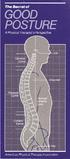 The Secret... T he American Physical Therapy Association would like to share a secret with you. It can help you do more with less effort breathe easier feel great. The secret is about good posture, which
Preventing Falls. Strength and balance exercises for healthy ageing
 Preventing Falls Strength and balance exercises for healthy ageing Exercise should be comfortable and fun. To get the most out of your home exercise book, join a class for older people to check your exercises
HELPFUL HINTS FOR A HEALTHY BACK
 HELPFUL HINTS FOR A HEALTHY BACK 1. Standing and Walking For correct posture, balance your head above your shoulders, eyes straight ahead, everything else falls into place. Try to point toes straight ahead
Chair Exercises For Older Adults
 Chair Exercises For Older Adults Many of these exercises were adapted from these sources: National Institute on Aging, Exercise: A Guide from the National Institute on Aging, 2001, http://www.nia.nih.gov/healthinformation/publications/exerciseguide/.
Ensure that the chair you use is sturdy and stable. Wear comfortable clothes and supportive footwear.
 Page 1 Safety Ensure that the chair you use is sturdy and stable. Wear comfortable clothes and supportive footwear. Prepare a space and have your exercise band and a glass of water (for afterwards) ready
EXERCISE INSTRUCTIONS 1
 EXERCISE INSTRUCTIONS 1 Contents ANKLE TOUCHES... 4 BACK EXTENSIONS... 4 BACK REVERSE FLYES... 4 BALL ROLL... 4 BASKETBALL SQUATS... 4 BEAR CRAWL... 4 BICEP CURL (Resistance Band)... 4 BOXING JABS... 5
Fact Sheet: Occupational Overuse Syndrome (OOS)
 Fact Sheet: Occupational Overuse Syndrome (OOS) What is OOS? Occupational Overuse Syndrome (OOS) is the term given to a range of conditions characterised by discomfort or persistent pain in muscles, tendons
Neck Pain HealthshareHull Information for Guided Patient Management
 HealthshareHull Information for Guided Patient Management Index Introduction 2 The neck (cervical spine) anatomy 2 What are the common types of neck pain? 3 What are the common symptoms associated with
Healing (and Preventing) Wrist Injuries
 { asana solutions } Healing (and Preventing) Wrist Injuries Proper alignment of the hands and balanced muscle tone in the forearms can protect vulnerable wrists. By doug keller Few things put the brakes
BALANCED BODYWORKS LA Rejuvenate. Heal. Restore.
 Tools For Myofascial Self Massage and Stretching Foam Roller Lacrosse Ball (Hard) Stretch Strap What is Foam Rolling? Foam Rolling or Self Myofascial Release, is a form of soft tissue massage. Similar
Exercises for older people
 Exercise for older people Exercises for older people Sitting Getting started If you ve not done much physical activity for a while, you may want to get the all-clear from a GP before starting. For the
Emergency Department. Whiplash neck sprain. Advice for patients
 Emergency Department Whiplash neck sprain Advice for patients What is a whiplash neck sprain? A whiplash neck sprain occurs when your head is suddenly jolted backwards and forwards in a whip-like movement.
ALL ABOUT SPASTICITY. www.almirall.com. Solutions with you in mind
 ALL ABOUT SPASTICITY www.almirall.com Solutions with you in mind WHAT IS SPASTICITY? The muscles of the body maintain what is called normal muscle tone, a level of muscle tension that allows us to hold
Functional rehab after breast reconstruction surgery
 Functional rehab after breast reconstruction surgery UHN A guide for women who had DIEP, latissimus dorsi with a tissue expander or implant, or two-stage implant based breast reconstruction surgery Read
Self-Myofascial Release Foam Roller Massage
 How it works. Self-Myofascial Release Foam Roller Massage Traditional stretching techniques simply cause increases in muscle length and can actually increase your chances of injury. Self-myofascial release
Self-mobilization methods
 Self-mobilization methods 5 Muscle energy techniques, as outlined in previous chapters, provide us with an excellent series of methods for relaxation and stretching of specific tight, shortened, contracted
PERFORMANCE RUNNING. Piriformis Syndrome
 Piriformis Syndrome Have you started to experience pain in your hip or down your leg while beginning or advancing your fitness program? This pain may be stemming from the piriformis muscle in your hip.
Whiplash and Whiplash- Associated Disorders
 Whiplash and Whiplash- Associated Disorders North American Spine Society Public Education Series What Is Whiplash? The term whiplash might be confusing because it describes both a mechanism of injury and
CORRECTIVE CHIROPRACTIC EXERCISES
 CORRECTIVE CHIROPRACTIC EXERCISES J O W E T T & M O U L T O N C h i r o p r a c t o r s introduction This booklet, presented by Jowett and Moulton Chiropractors, is designed to provide you with a general
Self Management Program. Ankle Sprains. Improving Care. Improving Business.
 Ankle Sprains Improving Care. Improving Business. What is an ankle sprain? Ligaments attach to the ankle bones and allow for normal movement and help prevent too much motion within the joint. Ankle sprains
Rehabilitation. Rehabilitation. Walking after Total Knee Replacement. Continuous Passive Motion Device
 Walking after Total Knee Replacement After your TKR, continue using your walker or crutches until your surgeons tells you it is okay to stop using them. When turning with a walker or crutches DO NOT PIVOT
Otago Exercise Program
 Otago Exercise Program Edited Version Exercise Booklet Created by: Genesee County Coalition Supported by a grant from the Health Foundation for Western and Central New York Otago Exercise Program to Prevent
The Power Plate is the innovative, time saving and results driven way to improve your fitness and well being.
 Welcome to the world of Power Plate Exercise The Power Plate is the innovative, time saving and results driven way to improve your fitness and well being. It works by accelerating the body s natural response
INTRODUCTION TO POSITIONING. MODULE 3: Positioning and Carrying
 MODULE 3: Positioning and Carrying Blankets, pillows and towels, sandbags, carpet on the floor, a doll with floppy limbs that can be positioned i.e. not a hard plastic doll, display materials. Icebreaker
Living Room Bodyweight Workout Week 1 March or jog in place for 1 min to increase heart rate and lubricate joints.
 Warm Up- Living Room Bodyweight Workout Week 1 March or jog in place for 1 min to increase heart rate and lubricate joints. Protocol- All exercises will be done for 2 sets of 10 repetitions. After the
Physical & Occupational Therapy
 In this section you will find our recommendations for exercises and everyday activities around your home. We hope that by following our guidelines your healing process will go faster and there will be
SHOULDER EXERCISE ROUTINE
 8 SHOULDERS The shoulders are the key to many full-bodied movements. Skill in such sports as swimming, baseball, golf, and tennis and other racquet sports is improved with the help of strong shoulders.
Neck Exercises for Car Accident Victims 3 Steps to a Healthier Neck
 Neck Exercises for Car Accident Victims 3 Steps to a Healthier Neck DR BARRY L. MARKS CHIROPRACTOR AUTHOR LECTURER Neck Exercises for Car Accident Victims 3 Steps to a Healthier Neck 2012 Dr. Barry L.
The Process of Strength and Conditioning for Golfers
 The Process of Strength and Conditioning for Golfers The use of different sporting activities and resistance work to develop a strength and conditioning program specific to golf. Many club golfers are