
Qualitative Research Methods CRIM 7316 Advanced Topics in Criminal Justice Spring 2016
|
|
|
- Dorothy Riley
- 10 years ago
- Views:
Transcription
1 Qualitative Research Methods CRIM 7316 Advanced Topics in Criminal Justice Spring 2016 Meeting Times & Location: Wednesday 5:30-8:00 Room 301 Churchill Hall Contact Information: Office Hours: Required Texts: Professor Amy Farrell 400 Churchill Hall Monday: Noon-1:00 Wednesday: 4:00-5:00 Creswell, John Qualitative Inquiry and Research Design: Choosing Among Five Traditions, 3rd Edition. Thousand Oaks, CA: Sage Publications. Miller, Jody and Wilson Palacios Qualitative Research in Criminology. New Brunswick, NJ: Transaction Publishers. Miles, Matthew, Michael Huberman and Jonny Saldana Qualitative Data Analysis: An Expanded Sourcebook, 3 rd Edition. Thousand Oaks, CA: Sage Publications. Weiss, Robert Learning from Strangers: The Art and Method of Qualitative Interview Studies. New York, NY: Free Press. Additional readings will be posted on the Blackboard Web Page for the course. Course Introduction This is a graduate level course is designed to provide students with an introduction to the principles and use of common qualitative methods used in social science research with a particular focus on the field of criminal justice. Throughout the course we will cover the basics of qualitative research including: the paradigms that underlie qualitative inquires; principles of qualitative inquiries such as ethnography and participant observation, interviewing, case studies and qualitative evaluation analysis; and analytic strategies for Qualitative Research Methods
2 qualitative data analysis to help transform qualitative data into written research documents. Students will engage in primary data collection and learn how to use a variety of analytic techniques including transcription, field note preparation, memoing, development of coding schemes and conceptual frameworks and data verifying techniques. The course will mix theory and practice. At the same time as we are discussing analytic techniques you will be collecting and analyzing data. As a result, students will be expected to spend 4-6 weeks in the field collecting data (e.g. conducting interviews, observing social settings, and collecting documents) that will be used to complete assignments for the course. Requirements and Assignments 1. Class discussion and participation (10 percent) Participation in the discussion of assigned class readings is an important part of this course. Students will be responsible for the discussion of all assigned materials and active engagement in classroom discussions. 2. Book review assignment (10 percent) Students complete a 5-7 page review of a social science monograph, which utilizes qualitative research techniques as the primary source of data. The reviews will include a description of the study, including the research methods utilized; a discussion of the research findings and critical evaluation of the strengths and limitations of the research methods utilized and conclusions drawn from the research. The book review should generally look like those found in academic journals, with the exception of having a stronger focus on the method used. A list of potential monographs will be provided on the course Blackboard web page (due March 2 nd ). 3. Mini Fieldwork Assignments (10 percent) Three assignments will be completed throughout the semester to demonstrate students understanding of non-participant observations, ethnographic observations and interviewing. These assignments will combine in-class and out-of-class exercises. 4. Qualitative Research Project Assignments (45 percent) To grasp the principles and methods of qualitative data collection and analysis it is critical for students to undergo the process of collecting and analyzing primary qualitative data. Throughout the course, students will engage in a practice research project that utilizes at least one source of qualitative data (interviews, participant observation, ethnography, secondary documents, etc). It is understood that students will not be able to conduct a full-fledged qualitative research project during the time of the course, however, it is anticipated that students will be able to collect a minimum level of qualitative data upon which to practice conducting preliminary analysis and reporting. Qualitative Research Methods

3 A number of assignments will be completed throughout the course to help walk students through the process of collecting and analyzing qualitative data. Project description and research questions (5%) Students will complete a one-paragraph description of the general area in which they intend to conduct a short qualitative study during the semester. The description should include a general idea of the potential area of study and possible research settings. The assignment should also include a central question and short list of sub questions to guide the proposed research (due electronically January 27 th ) Practice Human Subject Application (10%) Students will complete a draft copy of Northeastern University s Application for the Protection of Human Subjects required by Northeastern University s Office of Research Integrity, including consent forms or other documents that would be required by your intended research activities. Assignment includes completion of National Institute of Justice online IRB certification (due February 10 th, note: if you plan to go through formal IRB approval see Professor Farrell about deadlines). Guidelines for this application can be found at: Note: Like any other form of research inquiry that involves human subjects, qualitative studies require Institutional Review Board (IRB) approval. To help students understand how IRB regulations impact modes of qualitative inquiry students will be required to prepare a mock application to the Northeastern University IRB as an assignment for the course. I would additionally recommend avoiding research with populations under the age of 18 or other special groups (e.g. prisoners, mentally ill) that require additional human subjects protections when developing their assigned research project for the course. In general, students will not be required to seek official Northeastern University IRB approval for class based project; however, if you have any thought that your research project may turn out to be something that you would like to pursue further and eventually write up, publish or share beyond this class we will need to secure IRB approval prior to conducting research. For more information about Northeastern University s policies regarding human subjects protections, see the Policies and Procedure for Human Research Protections publication at the Office of Research Integrity website ( Fieldwork and Interviews February 17 th through March 30th o Field note/transcript project I and II (15%) Students will conduct research at their selected research site for four to six weeks. If the methodology involves observation students should conduct at least four observations for one hour each. Students conducting observations will turn in two sets of field notes. If the methodology involves interviews students should conduct at least two interviews with key subjects. Two Qualitative Research Methods

4 interviews should be transcribed and submitted for review (due March 16th and March 23rd). o Coding project (15%) Students will develop a preliminary analytic framework for the analysis of their data including the construction of a coding scheme and demonstration of coding for the data submitted in the fieldnote/transcript project. Codes will be created and entered using the qualitative data analysis program QSR NVivo (due March 30th). 5. Final project paper (25 percent) A final page research will be produced which brings together the literature review, research questions, description of methodology, findings and conclusions for the research project conducted throughout the course of the semester. The final project paper will be due Monday April 25th at noon and should be submitted through Blackboard. Class Schedule January 13 th Introduction and Understanding the Paradigm of Qualitative Inquiry Creswell, Chapter 2 Philosophical Assumptions and Interpretive Frameworks pp Ferrell, Jeff Kill Method: A Provocation Journal of Theoretical and Philosophical Criminology 1(1): (Blackboard). Lincoln, Yvonna and Egon Guba Naturalistic Inquiry, Newbury Park, CA: Sage Publications. Chapter 1, Positivism and the Naturalist Paradigm, pp (Blackboard) January 20 th Doing Qualitative Research Creswell, Chapters 3, 4 and 6 Designing a Qualitative Study pp , Five Approaches to Inquiry pp and Introducing and Focusing the Study pp Geertz, Clifford. Thick Description: Toward and Interpretive Theory of Culture in Emerson, pp (Blackboard). Manning, Peter. Qualitative Research as Theorizing, in Miller and Palacios, pp January 27 th Ethics and the Protection of Human Subjects in Qualitative Research Belmont Report. Office of Human Research Protections, U.S. Department of Health and Human Services Qualitative Research Methods
5 Proposed Changes to the Common Rule, Office of Human Research Protections, U.S. Department of Health and Human Services y.html Van Maanen, John. (1983). The moral fix: On the ethics of fieldwork. In R. M. Emerson (Ed.), Contemporary field research (pp ). Prospect Heights, IL: Waveland Press. (Blackboard) Miles, Huberman and Saldana, Chapter 2. Ethical Issues in Analysis pp Note: Now would be a good time to complete your NIH certification if you do not already have certification. To complete the program go to: Project description and preliminary research questions should be submitted electronically February 3 rd What is Qualitative Data? Adler, Patricia and Peter Adler Observational Techniques in Denzin and Lincoln (eds) Handbook of Qualitative Research, Thousand Oaks, CA: Sage Publications, pp (Blackboard) Creswell, Chapter 7. Data Collection pp Emerson, Ralph, Rachel Fretz, and Linda Shaw In the Field: Participating, Observing and Jotting Notes in In Writing Ethnographic Fieldnotes. Chicago, IL; University of Chicago Press, pp (Blackboard) Presser, Lois and Sveinung Sandberg. Research Strategies for Narrative Criminology in Miller and Palacios, pp Write-up of Non-Participant Observation Assignment (posted to Blackboard by February 1 st ) February 10 th Representing Realities - Ethnography Atkinson, Paul. Ethnography and the Representation of Reality in Emerson, pp Hammersley, Martyn. Ethnography and Realism in Emerson, pp Weiss, Chapters 1-3, pp Qualitative Research Methods
6 Sandberg, Sveinung What Can Lies Tell Us About Life? Notes Toward a Framework of Narrative Criminology Journal of Criminal Justice Education, 21(4): (Blackboard) NU Institutional Review Board Application and NIH certificate February 17 th Relational and Personal Processes in Ethnography and Participant Observation Bucerius, Sandra Being Trusted with Insider Knowledge : Ethnographic Research with Male Muslim Drug Dealers in Miller and Palacios, pp Contreras, Randol. Recalling to Life: Understanding Stickup Kids through Insider Qualitative Research in Miller and Palacios, pp McCorkel, Jill and Kristen Myers What Difference Does Difference Make? Position and Privilege in the Field Qualitative Sociology, 26(2): (Blackboard). Fine, Gary Ten Lies of Ethnography: Moral Dilemmas of Field Research. Journal of Contemporary Ethnography, 22(3), (Blackboard) Assignment Due Write up of Ethnographic Field Note Assignment (Posted to Blackboard by February 15 th ) February 24 th Interviewing and Asking Questions Fontana, Andrea and James Frey Interviewing: The Art of Science in Denzin and Lincoln (eds) The Handbook of Qualitative Research, Edition. Thousand Oaks, CA: Sage Publications, pp (Blackboard) Spradley, James Asking Descriptive Questions in Pogrebin, Mark (ed), Qualitative Approaches to Criminal Justice: Perspectives from the Field. Thousand Oaks, CA: Sage Publications, pp (Blackboard) Weiss, Chapters 4-5, pp In class interviewing and feedback assignment. March 2 nd Studying Cases and Analyzing Content Stake, Robert. Qualitative Case Studies in Denzin and Lincoln (eds) The Sage Handbook of Qualitative Research, 3 rd Edition. Thousand Oaks, CA: Sage Publications. (Blackboard) Qualitative Research Methods

7 Yin, Robert The Case Study Crisis: Some Answers. Administrative Science Quarterly, 26 (1): (Blackboard) Miles, Matthew Qualitative Data as an Attractive Nuisance: The Problem of Analysis. Administrative Science Quarterly, 24 (4): (Blackboard) Assignment Due: Book review March 9 th March 16 th Spring Break No Class Data Reduction and Analysis: Building Conceptual Frameworks From Data Creswell, Chapter 8, Data Analysis and Representation, pp Miles, Huberman and Saldana, Chapter 4, Fundamentals of Qualitative Data Analysis pp Weiss, Chapter 6, Analysis of Data pp Field note/transcript project I due March 23 rd Qualitative Data Analysis: Data Display: Coding, Memoing and Ordering Data Miles, Huberman, and Saldana, Chapters 6 and 7, Methods of Exploring pp and Method of Describing pp Straus, Anslem Codes and Coding. Pp in Qualitative Analysis for Social Scientists. Cambridge University Press. (Blackboard) Fleisher, Mark. The Culture of Violent Behavior: Language, Culture and Worldview of Prison Rape in Miller and Palacios, pp Field note/transcript project II due March 30 th Drawing Conclusions and Verifying Creswell, Chapter 10, Standards of Quality and Verification, pp Miles, Huberman and Saldana, Chapter 9 Methods of Explaining pp Qualitative Research Methods
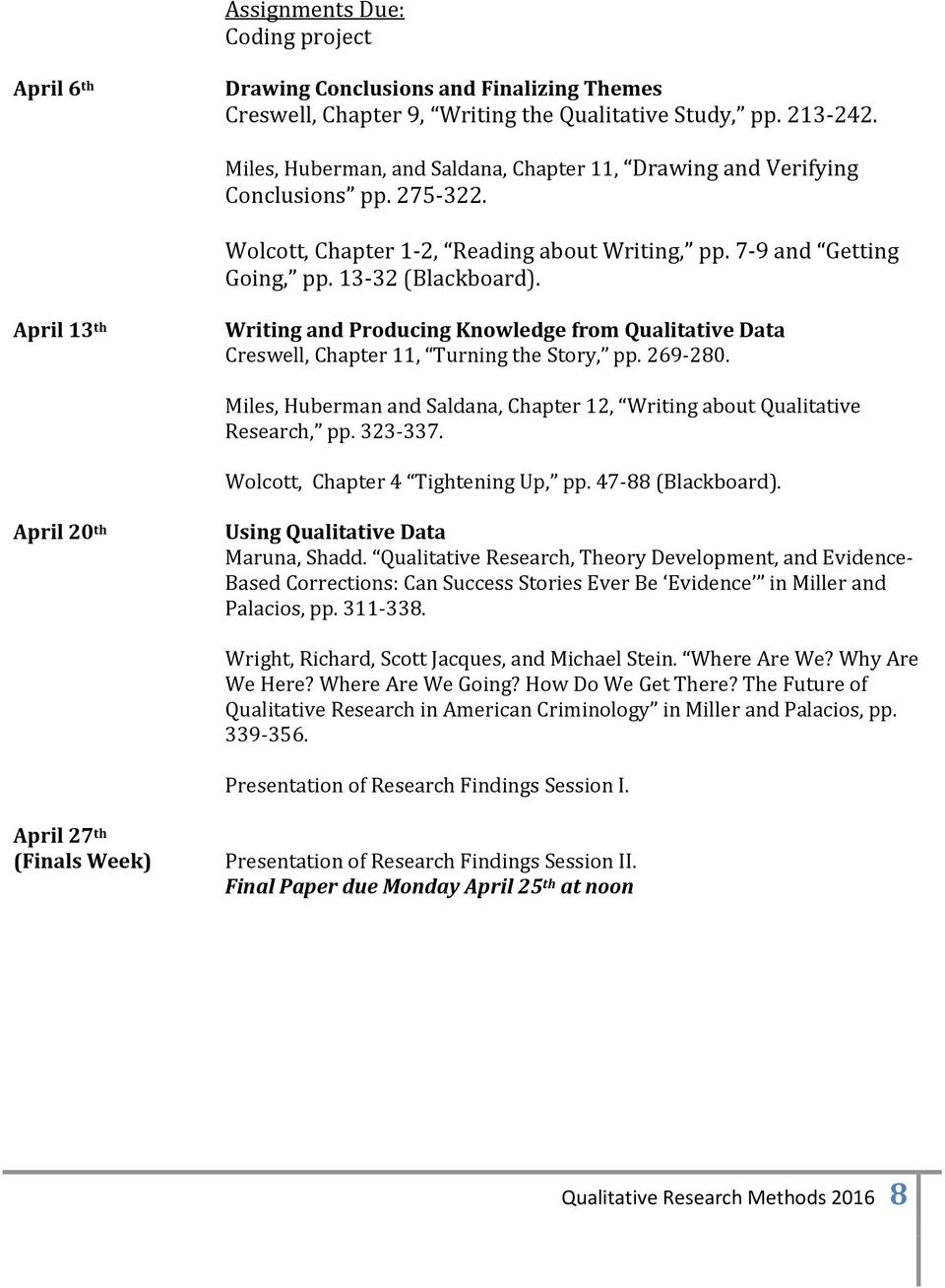
8 Coding project April 6 th Drawing Conclusions and Finalizing Themes Creswell, Chapter 9, Writing the Qualitative Study, pp Miles, Huberman, and Saldana, Chapter 11, Drawing and Verifying Conclusions pp Wolcott, Chapter 1-2, Reading about Writing, pp. 7-9 and Getting Going, pp (Blackboard). April 13 th Writing and Producing Knowledge from Qualitative Data Creswell, Chapter 11, Turning the Story, pp Miles, Huberman and Saldana, Chapter 12, Writing about Qualitative Research, pp Wolcott, Chapter 4 Tightening Up, pp (Blackboard). April 20 th Using Qualitative Data Maruna, Shadd. Qualitative Research, Theory Development, and Evidence- Based Corrections: Can Success Stories Ever Be Evidence in Miller and Palacios, pp Wright, Richard, Scott Jacques, and Michael Stein. Where Are We? Why Are We Here? Where Are We Going? How Do We Get There? The Future of Qualitative Research in American Criminology in Miller and Palacios, pp Presentation of Research Findings Session I. April 27 th (Finals Week) Presentation of Research Findings Session II. Final Paper due Monday April 25 th at noon Qualitative Research Methods
SESP 372 Methods of Observing Human Behavior
 SESP 372 Methods of Observing Human Behavior Winter 2006 12:00-1:20 AM, Mon. & Wed. Annenberg G02 Prof. Eva Lam TA: Vandna Sinha Annenberg 314 626 Library Place Rm 32 847-491-3483 847-467-4059 [email protected]
University of Texas at Arlington Spring 2013 SOCI 5341.001 QUALITATIVE RESEARCH METHODS M 3:00-5:50
 University of Texas at Arlington Spring 2013 SOCI 5341.001 QUALITATIVE RESEARCH METHODS M 3:00-5:50 Instructor: Dr. Heather Jacobson Office: 423 University Hall Office Hours: M 10:05-12:05 and by appointment
SOCIOLOGY 523: QUALITATIVE METHODS
 SOCIOLOGY 523: QUALITATIVE METHODS Professor Jennifer Sherman Spring 2016 Wednesdays, 2:50-5:20pm, Wilson-Short 201 Email: [email protected] Office: 215 Wilson-Short Office Phone: 509-335-4163 Office
Juliet Corbin and Anselm Strauss. Basics of Qualitative Research: Grounded Theory Procedures and Techniques 3 rd edition (Sage 2008)
 Qualitative Data Analysis PP&D U213 MGMT 291 POLSCI 273 SOCIOL 223 Winter term, 2009 Time: Friday, 9:30a - 12:20p Location: Social Ecology I Room 200 Professor Martha S. Feldman [email protected] Office:
Computer-Assisted Qualitative Data Analysis (CAQDAS) and the Internet Digital Social Research: Methods Options - Group B
 Computer-Assisted Qualitative Data Analysis (CAQDAS) and the Internet Digital Social Research: Methods Options - Group B Academic Year: 2015-16, Hilary Term Day and time: Weeks 6-9, Mondays 11:30-1:30
Syllabus EDRS 812: Qualitative Methods in Educational Research George Mason University Spring 2004. Course Goals
 Syllabus EDRS 812: Qualitative Methods in Educational Research George Mason University Spring 2004 Instructor: Jenny Gordon Office: Robinson A 322 Office hours: By appointment Phone: 703-993-3794 Email:
SSS 955 ADVANCED QUALITATIVE RESEARCH METHODOLOGIES
 THE CATHOLIC UNIVERSITY OF AMERICA CUA National Catholic School of Social Service Washington, DC 20064 202-319-5458 Fax 202-319-5093 SSS 955 ADVANCED QUALITATIVE RESEARCH METHODOLOGIES I. COURSE PURPOSE
By the end of the semester, the student will complete a small qualitative study and should be able to
 Qualitative Research Methods Unique Number: 63170 Office Number: SWB 3.212D Semester: Spring, 2006 Office Phone: (home) 512-471-9248 email: [email protected] Fax Number: 512-471-9514 I. STANDARDIZED
Office Hours: By appointment: call (773) 508-1076 office or (773) 343-7809 mobile
 PUB HLTH 439 (section 20) Spring 2011 Day/Time: Tuesdays, 6:00 9:00 PM Classroom Location: McGaw 2-403 Course Instructor: Madelyn Iris, Ph.D. Adjunct Associate Professor, Department of Psychiatry and Department
USING CONCEPT MAPS IN QUALITATIVE RESEARCH
 Concept Maps: Theory, Methodology, Technology Proc. the First Int. Conference on Concept Mapping Pamplona, Spain 2004 USING CONCEPT MAPS IN QUALITATIVE RESEARCH Barbara J. Daley, University Wisconsin Milwaukee
Iowa State University Educational Leadership and Policy Studies RESEV 550XA: Educational Research
 Iowa State University Educational Leadership and Policy Studies RESEV 550XA: Educational Research Meeting Times: Wednesdays: 2/27, 3/6, 3/13, 3/27, 4/3 from 5:30pm-9:30pm Saturdays: 4/13, 4/20, AND 5/4,
Qualitative Research Methods in Psychology - Lab Department of Psychology
 Qualitative Research Methods in Psychology - Lab Department of Psychology Lab Objectives: (1) Develop skills in interview transcription for the purposes of qualitative analysis. (2) Develop skills in inductive
Sociology 5083 Methods of Field Research
 Sociology 5083 Methods of Field Research Fall 2009 Tuesday 2 4:50 Room 329 Main Instructor: J. Gaber, 220 Main (575 7509), [email protected] Office hours: Monday and Friday 1 to 3, or by appointment Description
Principles of Qualitative Research: Designing a Qualitative Study
 Principles of Qualitative Research: Designing a Qualitative Study John W. Creswell, Ph.D. Vicki L. Plano Clark, M.S. Objectives As a group activity, to plan a qualitative study on the topic of leadership
Qualitative Interviewing. Lea Sgier Department of Political Science Central European University. MA Programme in Political Science (elective)
 Qualitative Interviewing Lea Sgier Department of Political Science Central European University MA Programme in Political Science (elective) Autumn semester 2014-15 (2 credits) Class meetings : Friday 11:00-12:40
Using the SAS System and QSR NUD*IST for qualitative data analysis (QDA)
 Using the SAS System and QSR NUD*IST for qualitative data analysis (QDA) Robert G. Stewart, East Tennessee State University, Johnson City, TN Abstract With the advent of mixed-method inquiry (i.e., the
Qualitative Methods: Coding & Data Analysis
 Qualitative Methods: Coding & Data Analysis Michele Andrasik, Ph.D. Sarah Frey, MSW Meheret Endeshaw, MPH CFAR SPRC Qualitative Methods Workshop Series Outline for Today 2 1. Data Management 2. Coding
FLR 607 (CRN 25424): SEMINAR FOLKLORE FIELDWORK WINTER 2008, W 2:00-4:50, 206 FR
 FLR 607 (CRN 25424): SEMINAR FOLKLORE FIELDWORK WINTER 2008, W 2:00-4:50, 206 FR Professor: Lisa Gilman E-mail: [email protected] Office Phone: 541-346-3967 Office hours: M 1:00-3:00 pm, T 12:00-2:00
 Assessment: Getting Started with Interviewing Dave Baca, PhD University of Arizona ALA Annual 2006 Why Interview? When interpersonal contact is important When you need more in-depth data When you need
For participants/students in MPH, other health education programs, researchers and other interested health professionals.
 QUALITATIVE RESEARCH METHDOLOGY Module Outline Code: QRM ( ) Duration: 1 week The module will comprise a total of thirty hours teaching. Credits: 3 Description: The Qualitative research method module is
The Relevance of Glaserian and Straussian Grounded Theory Approaches in Researching Human Resource Development
 2011 International Conference on Financial Management and Economics IPEDR vol.11 (2011) (2011) IACSIT Press, Singapore The Relevance of Glaserian and Straussian Grounded Theory Approaches in Researching
Realizing the Potential of Qualitative Designs: A Conceptual Guide for Research and Practice. Wayne A. Babchuk and Manijeh Badiee.
 Realizing the Potential of Qualitative Designs: A Conceptual Guide for Research and Practice Wayne A. Babchuk and Manijeh Badiee Abstract: This inquiry is based on the collaboration of the authors who
University of Manitoba Department of Sociology
 Soc 7420 Qualitative Research Methods (3 credit hours) Thursdays, 11:30-2:30, 335 Isbister Dr. Laura Funk: [email protected] Office hours (307 Isbister) by appointment Calendar Course Description
Curriculum Vitae 31 August 2004. CHRISTOPHER R. WILLIAMS, Ph.D. Email: [email protected] EDUCATION SUMMARY
 Curriculum Vitae 31 August 2004 CHRISTOPHER R. WILLIAMS, Ph.D. Email: [email protected] EDUCATION SUMMARY 2000 Ph.D. in Forensic Psychology Specialization in Law and Public Policy Alliant International
Sociology 503 Qualitative Research Design and Techniques
 University of British Columbia Sociology 503 Qualitative Research Design and Techniques Term I: September December 2014 Class Time: Tuesdays Class Location: SOWK 324 1:30 4:30pm Instructor: Professor Wendy
More on analysis + Going Online: Social Media and Social Groups
 More on analysis + Going Online: Social Media and Social Groups INF5220 April 24th 2015 Guri Verne, Design group (Based on Sisse Finken s lecture notes) Analysis starts early Analysis starts early in the
USAGE OF NVIVO SOFTWARE FOR QUALITATIVE DATA ANALYSIS
 USAGE OF NVIVO SOFTWARE FOR QUALITATIVE DATA ANALYSIS Muhammad Azeem Assessment Expert, PEAS University of Education, Lahore PAKISTAN [email protected] Naseer Ahmad Salfi Doctoral Research Fellow
Sociology 6963-001 Qualitative Methods
 1 Sociology 6963-001 Qualitative Methods Fall 2013 Section 001: M,2:00pm-5:00pm, 315 BEHS Instructor: Todd L. Goodsell Office Phone: 801-581-6153 Office Location: 303 BEHS Email: Office Hours: MW 9:00am
SOME IMPORTANT NOTES ON QUALITATIVE RESEARCH. Prof. Dr. Andreas Budihardjo August, 2013
 SOME IMPORTANT NOTES ON QUALITATIVE RESEARCH Prof. Dr. Andreas Budihardjo August, 2013 CHECKLIST ( LOFLAND & LOFLAND, 1995) Basic organization How well is the article written or presented? Data & Methods
Course Description: Required texts: Course Requirements: Course evaluation will be based on a number of different elements described briefly below.
 HRD 313: Program and Organizational Evaluation Human Resources Design Program Claremont Graduate University Spring, 2008, Modules 1 and 2 Saturday, 1-3:50pm Instructor: Jill Nemiro, Ph.D. E-mail: [email protected]
Analyzing Qualitative Data
 Analyzing Qualitative Data The purpose of coding qualitative data is to take an overwhelmingly large amount of words or artifacts and organize them into manageable chunks. Following the steps in this outline
* Learn to recognize the connection between public policy on crime, political ideology, and criminological theory.
 ADVANCED CRIMINOLOGY FALL 2005 Dr. Ron Kramer Office Hours: Mon 2-4; 2406 Sangren Hall Tue and Wed 9:30-12:00; 387-5284 and by appointment E-mail: [email protected] COURSE OBJECTIVES: Advanced Criminology
QUALITATIVE RESEARCH DESIGNS: A CONCEPTUAL FRAMEWORK
 QUALITATIVE RESEARCH DESIGNS: A CONCEPTUAL FRAMEWORK DR. PRASHANT KUMAR ASTALIN Department of education, DDE, Madurai kamaraj university, Madurai-625021, india. Abstract The design of qualitative research
Qualitative Research Methods Sociology 584 Syllabus Spring 2013
 Qualitative Research Methods Sociology 584 Syllabus Spring 2013 Contact Information Instructor Ronald L. Mize, Ph.D. Visiting Professor Department of Sociology Office: BSS 530 Office, Phone & Email Office
Developing an R Series Plan that Incorporates Mixed Methods Research
 Developing an R Series Plan that Incorporates Mixed Methods Research / 16 Developing an R Series Plan that Incorporates Mixed Methods Research primary mechanism for obtaining NIH grants to conduct mixed
Criminology CRJU 2004 B Department of Criminal Justice College of Arts & Letters University of North Georgia
 1 Criminology CRJU 2004 B Department of Criminal Justice College of Arts & Letters University of North Georgia Instructor: Dr. Samantha Balemba Email: [email protected] Office: 329 Hansford Hall
Dr. Kevin Roy SPH Building, Room 0142X Phone: 301-405-6348 E-mail: [email protected]
 FMSC 780 Qualitative Methods in Family and Health Research Department of Family Science University of Maryland, College Park School of Public Health Spring 2010 Thursday, 2:00-4:45 pm Dr. Kevin Roy SPH
SOCIOL 3O03: QUALITATIVE RESEARCH METHODS Winter, 2012
 SOCIOL 3O03: QUALITATIVE RESEARCH METHODS Winter, 2012 Thursday 15:30-17:20 and Tuesday 16:30-17:20 in BSB/106 Professor: Dr. Melanie Heath Office hours: Th 2:00pm-3:00pm Office: KTH 638 (or by appointment)
Research Methods: Qualitative Approach
 Research Methods: Qualitative Approach Sharon E. McKenzie, PhD, MS, CTRS, CDP Assistant Professor/Research Scientist Coordinator Gerontology Certificate Program Kean University Dept. of Physical Education,
Spiropoulos, Georgia V. (2014). The State of the State: Crime Trends in California. C. Gardiner & P. Fiber,
 Division of Politics, Administration & Justice College of Humanities & Social Sciences California State University, Fullerton 800 N State College Blvd Fullerton, CA 92831 Office: (657) 278 8249; Fax: (657)
DYNAMIC SUPPLY CHAIN MANAGEMENT: APPLYING THE QUALITATIVE DATA ANALYSIS SOFTWARE
 DYNAMIC SUPPLY CHAIN MANAGEMENT: APPLYING THE QUALITATIVE DATA ANALYSIS SOFTWARE Shatina Saad 1, Zulkifli Mohamed Udin 2 and Norlena Hasnan 3 1 Faculty of Business Management, University Technology MARA,
ED.D. Doctorate of Education Fall 15 Textbooks. On Campus:
 ED.D. Doctorate of Education Fall 15 Textbooks On Campus: All sections of ED 610 will use the same textbooks. ED 610 Ethics for Educational Leaders Required Book: Centering Educational Administration:
Sociology 600: Qualitative Research Methods 1 Winter 2014
 Sociology 600: Qualitative Research Methods 1 Winter 2014 Class Location: Leacock 819 Class Meeting Time: Mondays 9:35-11:25 a.m. Professor: Elaine Weiner Office Address: Leacock 732 Office Hours: Mondays
A Practical Iterative Framework for Qualitative Data Analysis
 Insider Insights A Practical Iterative Framework for Qualitative Data Analysis Prachi Srivastava, DPhil, Assistant Professor, School of International Development and Global Studies, University of Ottawa,
Qualitative Data Analysis
 Qualitative Data Analysis Module No POLS 305 Level 5 Credits 5 Pre-requisite Social Science Research Methods Student study hours Module leader Email Phone Number Office 60 hrs approx. 20 hrs lecture and
15 Methods of Data Analysis in Qualitative Research
 15 Methods of Data Analysis in Qualitative Research Compiled by Donald Ratcliff 1. Typology - a classification system, taken from patterns, themes, or other kinds of groups of data. (Patton pp. 393,398)
Grounded Theory and Qualitative Research
 Grounded Theory and Qualitative Research DEBORAH R. DILLON What Is Grounded Theory? Grounded theory (GT) is a term used by many researchers to describe a general method of developing theoretical constructs
Agricultural Extension Agents Perceptions of Effective Teaching Strategies for Adult Learners in the Master Beef Producer Program
 Agricultural Extension Agents Perceptions of Effective Teaching Strategies for Adult Learners in the Master Beef Producer Program Robert Strong Graduate Assistant University of Florida Gainesville [email protected]
Conducting Interviews in Qualitative Social Science Research
 Conducting Interviews in Qualitative Social Science Research Types: individual face-to-face (choose non-shy participants willing to share) telephone (not ideal but used when direct access not possible)
What is Grounded Theory? Dr Lynn Calman Research Fellow School of Nursing, Midwifery and Social Work
 What is Grounded Theory? Dr Lynn Calman Research Fellow School of Nursing, Midwifery and Social Work Grounded theory The aim of grounded theory is: to generate or discover a theory (Glaser and Strauss,
Degree Programme in International Business Management (Masters Degree) Management and Business Research Strategies
 Page 1 of 13 Degree Programme in International Business Management (Masters Degree) Management and Business Research Strategies Code: MGT2LG011 Extent: 6 ECTS 1st semester English core studies compulsory
SYLLABUS COUN 509 Action Research in Education A SOLES-Global Course School of Leadership & Education Sciences University of San Diego.
 SYLLABUS COUN 509 Action Research in Education A SOLES-Global Course School of Leadership & Education Sciences University of San Diego Fall 2011 LONNIE ROWELL, Ph.D. OFFICE: MRH 143 PHONE: (619) 260-4212
Note Taking and Analyzing Qualitative Data. Roxanne Ezzet-Lofstrom URBP 298A, Fall 2009 San Jose State University
 Note Taking and Analyzing Qualitative Data Roxanne Ezzet-Lofstrom URBP 298A, Fall 2009 San Jose State University Overview How to take notes What to do with those notes How to analyze qualitative data Outline
ELA 4000-01 A Delicate Balance Spring 2009
 ELA 4000-01 A Delicate Balance Spring 2009 Instructor Ron Steffens Email [email protected] Course Description What does it mean to be an engaged citizen? What will we ask of such citizens -- of each
How to Do Case Study Research
 University of Massachusetts - Amherst ScholarWorks@UMass Amherst School of Nursing Faculty Publication Series College of Nursing 2009 How to Do Case Study Research Donna M. Zucker University of Massachusetts
Analyzing Qualitative Data For Assessment October 15, 2014
 Analyzing Qualitative Data For Assessment October 15, 2014 Jeremy Penn, Ph.D. Director Resources Data Analysis, Chapter 6 in Schuh book (pages 158-168) Creswell (2002) or (1998) you can borrow from me
Lynn M. Pazzani, Ph.D. Department of Criminology University of West Georgia Carrollton, GA 30118 678-839-6328 (office) lpazzani@westga.
 Lynn M. Pazzani, Ph.D. Department of Criminology University of West Georgia Carrollton, GA 30118 678-839-6328 (office) [email protected] August 2015 CURRENT POSITION 2014- present Assistant Professor.
Seminar in Qualitative Content Analysis
 Seminar in Qualitative Content Analysis 1 Soc. 715-5 Spring, 2009 Monday, 1:30-4 p.m. Location, Saunders 242 Prof. Patricia G. Steinhoff Office Hours: Wednesday, 1:30-4, 240 Saunders X67676 [email protected]
CRIM 335-01 Spring 2012 CRIMINOLOGY
 CRIM 335-01 Spring 2012 CRIMINOLOGY Instructor Information Course Information Dr. Helen Ahn Lim Swenson 124 Office: Swenson 218 MWF 11:00-12:05 Phone: 493-3550 Office Hours: MWF 10:00-10:55 Email: [email protected]
Assistant Professor EDUCATION. University of Cincinnati, 2007. Criminal Justice. Northeastern University, 1999
 Division of Politics, Administration & Justice College of Humanities & Social Sciences California State University, Fullerton 800 N State College Blvd Fullerton, CA 92831 Office: (657) 278 8249; Fax: (657)
Case Study Methodology
 Case Study Methodology Rolf Johansson Architect SAR/MSA, Associate Professor. Royal Institute of Technology Infrastructure / Urban Studies / Built Environment Analysis [email protected] A key
Dr. JoAnna Schilling, VP Academic Affairs/Assistant Superintendent
 TO: FROM: Dr. JoAnna Schilling, VP Academic Affairs/Assistant Superintendent Dr. Amy Holzgang, Professor of Sociology DATE: December 9, 2014 SUBJECT: REQUEST FOR SABBATICAL LEAVE I. REQUEST FOR SABBATICAL
2012 Present Assistant Professor, School of Criminal Justice, University of Baltimore, MD
 Andrea Cantora, Ph.D. Assistant Professor School of Criminal Justice, College of Public Affairs University of Baltimore 1420 North Charles Street Baltimore, MD 21201 Email: [email protected] EDUCATION
Using NVivo to Analyze Qualitative Data. Anette M. DeNardo, Ed.D. California University of Pennsylvania. Lisa Lopez Levers, Ph.D. Duquesne University
 1 Using NVivo to Analyze Qualitative Data Anette M. DeNardo, Ed.D. California University of Pennsylvania Lisa Lopez Levers, Ph.D. Duquesne University Abstract Analyzing data gathered by qualitative means
Guidelines for Critical Review Form: Qualitative Studies (Version 2.0)
 Guidelines for Critical Review Form: Qualitative Studies (Version 2.0) Letts, L., Wilkins, S., Law, M., Stewart, D., Bosch, J., & Westmorland, M., 2007 Introduction These guidelines accompany the Critical
Sociology 105: Research Design and Sociological Methods Spring 2014 Dr. Christopher Sullivan
 Sociology 105: Research Design and Sociological Methods Spring 2014 Dr. Christopher Sullivan Lectures: Wednesday 2pm 5pm, 475 Barrows Hall Labs: Mondays, 12pm 2pm, 64 Barrows Hall (Basement Computing Lab)
4. Is the study design appropriate for the research question and objectives?
 Guidelines for Critical Review of Qualitative Studies Based on Guidelines for Critical Review Form-Qualitative Studies by Law, M., Stewart, D., Letts, L., Pollock, N., Bosch, J., & Westmorland, M., 1998
Teachers' Art Assessment Practices: Relationship to Expertise, Experience, Beliefs and Confidence
 Marilyn Zurmuehlen Working Papers in Art Education ISSN: 2326-7070 (Print) ISSN: 2326-7062 (Online) Volume 11 Issue 1 (1992) pps. 73-79 Teachers' Art Assessment Practices: Relationship to Expertise, Experience,
COMMUNICATION 7434 8434: QUALITATIVE RESEARCH METHODS
 COMMUNICATION 7434 8434: QUALITATIVE RESEARCH METHODS Professor: Dr. Larry Frey Office: 143C Theatre Communication Building Office Phone: (901) 678 3171 Office Fax: (901) 678 4331 Email: [email protected]
Fundamentals of Qualitative Research. Joan LaFrance AIHEC NARCH Meeting Dinѐ College June 25, 2015
 Fundamentals of Qualitative Research Joan LaFrance AIHEC NARCH Meeting Dinѐ College June 25, 2015 What is Qualitative Research The meaning is socially constructed by individuals in their interaction with
Methods in Case Study Analysis
 Methods in Case Study Analysis Linda T. Kohn, Ph.D. The Center for Studying Health System Change Technical Publication No. 2 June 1997 Methods in Case Study Analysis Linda T. Kohn, Ph.D. The Center for
POLS 7014: Intermediate Political Methodology. Spring 2016
 POLS 7014: Intermediate Political Methodology Spring 2016 Instructor Class Schedule Dr. Michael S. Lynch Monday 3:35 6:35 Office: Baldwin Hall 409 Candler Hall 214 Email: [email protected] Office Hours: Wednesday
De Montfort University. Course Template
 De Montfort University Course Template 1. Basic information Course Name: Criminology and Criminal Justice Course Code: PA081T Level (UG, PG): Postgraduate Doctorate Academic Period: 2015 Faculty: HLS -
Qualitative methods. Sara Svensson Visiting Professor School of Public Policy Oktober u. 6/7 bldg: room 336 H-1051 Budapest svenssons@ceu.
 Qualitative methods Sara Svensson Visiting Professor School of Public Policy Oktober u. 6/7 bldg: room 336 H-1051 Budapest [email protected] Simona Torotcoi Teaching assistant Doctoral School of Political
Anthropology 410b: Ethnographic Field Methods & Practicum
 Anthropology 410b: Ethnographic Field Methods & Practicum Spring 2016 Lecture 10641D M 2-4:50PM KAP 134 Professor: Lanita Jacobs Office: Kaprielian Hall (KAP) 356 Email: Office Hours: Course Website: Required
DPLS 722 Quantitative Data Analysis
 DPLS 722 Quantitative Data Analysis Spring 2011 3 Credits Catalog Description Quantitative data analyses require the use of statistics (descriptive and inferential) to summarize data collected, to make
Research Methods. Fall 2011
 Research Methods Fall 2011 Instructor: 陳 憶 寧,Dr. Yi-Ning Katherine Chen ([email protected], TEL: 67214) Class Time: Monday, 2-5 p.m. Classroom: 310309, Communication Building Office: Rm 414, Communication
The Use of Film, Television, and Music in Teaching Graduate Nursing Students Concepts of Qualitative Research
 The Use of Film, Television, and Music in Teaching Graduate Nursing Students Concepts of Qualitative Research Michelle L. Edmonds, PhD, ARNP, CEN, CNE Jacksonville University Jacksonville, FL Problem Qualitative
Examining Washback in Multi exam Preparation Classes in Greece: (A Focus on Teachers Teaching practices)
 Examining Washback in Multi exam Preparation Classes in Greece: (A Focus on Teachers Teaching practices) Irini Papakammenou EALTA CONFERENCE TURKEY 2013 24 May 2013 Structure of the Presentation Introduction
Using Qualitative & Quantitative Research Methods to Answer your Research Questions
 Using Qualitative & Quantitative Research Methods to Answer your Research Questions Elena T. Carbone, DrPH, RD, LDN Associate Professor, Department of Nutrition Director, Community-Engaged Research Program
Dissertation Concept Paper. Timothy M. Eklin. Antioch University. Ph.D. in Leadership and Change Program. Submitted. March 2, 2011
 Running head: DISSERTATION CONCEPT PAPER 1 Dissertation Concept Paper Timothy M. Eklin Antioch University Ph.D. in Leadership and Change Program Submitted March 2, 2011 DISSERTATION CONCEPT PAPER 2 Dissertation
Programme Specification. M.Sc. in Criminology and Criminal Justice. Entry requirements: Aims and Objectives. Course Content and Structure
 Programme Specification M.Sc. in Criminology and Criminal Justice Entry requirements: Candidates should normally have at least a second class honours degree from a British university, or its equivalent,
Andrea Lamont-Mills, Department of Psychology, University of Southern Queensland,
 Complete Citation: Lamont-Mills, Andrea (2004). Computer-aided qualitative research: A NUD*IST 6 approach. In Herbert Haag (Ed.), Research methodology for sport and exercise science: a comprehensive introduction