
Financial Statements of Electricity Companies
|
|
|
- Briana Perkins
- 10 years ago
- Views:
Transcription
1 7 Financial Statements of Electricity Companies Unit 1: Relevant Legal and Administrative Provisions Learning Objectives After studying this unit, you will be able to: Know the legal framework applicable for electricity companies. Understand the composition and purposes of various statutory authorities. Know the Regulations applicable for electricity companies. Understand the policies applicable to the Power Sector. Understand how accounting is done in electricity companies 1.1 Introduction The electricity industry in India was guided by the Indian Electricity Act, 1910 and the Electricity (Supply) Act, The Indian Electricity Act, 1910 introduced a licensing system for the electricity industry and the Electricity (Supply) Act, 1948 introduced greater state involvement in the industry, facilitating regional coordination through state-owned, vertically integrated units called State Electricity Boards (SEBs) to develop a Grid System. The SEBs were responsible for generation, transmission and distribution of electricity within each state of the Indian Union. In the early 1990s, the power sector was liberalised by permitting private participation in the generation and transmission sectors and establishing regional load dispatch centres (RLDCs). In 1998, the Electricity Regulatory Commissions Act, 1998 (the ERC Act) established independent electricity regulatory commissions (ERC) at the central and state levels, with the objective of rationalising the electricity tariff regime and promoting and regulating the electricity industry. The ERC Act, which has been replaced by the Electricity Act, 2003 provided for the formation of state electricity regulatory commissions (SERCs) in the respective states for the rationalisation of energy tariffs.

2 Financial Statements of Electricity Companies Historical Background of Legislative Initiatives The Indian Electricity Act, 1910 provided basic framework for electric supply industry in India. It made provisions for growth of the sector through licensees. The Act covered the provisions for licence by State Government, provision for licence for supply of electricity in a specified area, legal framework for lying down of wires and other works, provisions laying down relationship between licensee and consumer. The Electricity (Supply) Act, 1948 mandated creation of State Electricity Boards (SEBs) and need for the State to step in (through SEBs) to extend electrification (so far limited to cities) across the country. Later on this Act was amended to enable generation in Central sector and to bring in commercial viability in the functioning of SEBs -- especially section 59 was amended to make the earning of a minimum return of 3% on fixed assets a statutory requirement (w.e.f ). Further amendment was made in 1991 to open generation to private sector and establishment of RLDCs and another amendment in 1998 was made to provide for private sector participation in transmission, and also provision relating to Transmission Utilities. The Electricity Regulatory Commission Act, 1998 lays down the provision for setting up of Central / State Electricity Regulatory Commission with powers to determine tariffs. Further, it emphasized on the constitution of SERC optional for States and distancing of Government from tariff determination. 1.2 Electricity Act, 2003 The Electricity Act, 2003 (the Electricity Act) is a central legislation relating to generation, transmission, distribution, trading and use of electricity, that seeks to replace the multiple legislations that governs the Indian power sector. The most significant reform initiative under the Electricity Act was the move towards a multi-buyer, multi-seller system as opposed to the existing structure which permitted only a single buyer to purchase power from power generators. In addition, the Electricity Act grants the ERCs freedom in determining tariffs, without being constrained by rate-of-return regulations. Under the Electricity Act, no licence is required for generation of electricity if the generating station complies with the technical standards relating to connectivity with the grid. The Electricity Act was amended in 2007 to exempt captive power generation plants from licensing requirements for supply to any licensee or consumer. The Electricity Act was amended in 2010 by notification dated 3 March 2010 to provide that any developer of a special economic zone notified under the Special Economic Zones Act, 2005 shall be deemed to be a licensee under the Electricity Act Objectives The objectives of the Act are "to consolidate the laws relating to generation, transmission, distribution, trading and use of electricity and generally for taking measures conducive to development of electricity industry, promoting competition therein, protecting interest of consumers and supply of electricity to all areas, rationalization of electricity tariff, ensuring transparent policies regarding subsidies, promotion of efficient and environmentally benign

3 7.3 Advanced Accounting policies, constitution of Central Electricity Authority, Regulatory Commissions and establishment of Appellate Tribunal and for matters connected therewith or incidental thereto. The Electricity Act 2003 provides electricity market for private investments for increasing generation capacity and efficient network use in India. It encourages captive generation, nondiscriminatory open access to transmission and distribution system and de-licensing generation Under the Electricity Act 2003, activities like generation, transmission and distribution have been separately identified. Now, no person shall (a) transmit electricity; or (b) distribute electricity; or (c) undertake trading in electricity, unless he is authorised to do so by a license issued under section 14, or is exempt under section Licensing The Electricity Act stipulates that no person can transmit, distribute or undertake trading in electricity, unless he is authorised to do so by a licence issued under, or is exempt under, the Electricity Act. The Electricity Act provides for transmission licensees, distribution licensees and licensees for electricity trading. There can be a private distribution licensee as well Generation As per sec 2(29), "generate" means to produce electricity from a generating station for the purpose of giving supply to any premises or enabling a supply to be so given. Currently, any electricity generating company can establish, operate and maintain a generating station if it complies with the technical standards relating to connectivity with grid. Approvals from the Government, the state government and the techno-economic clearance from the Central Electricity Authority (CEA) are no longer required, except for hydroelectric projects. Generating companies are now permitted to sell electricity to any licensees and where permitted by State Electricity Regulatory Commissions (SERCs), to consumers. In addition, no restriction is placed on the setting up of captive power plants by any consumer or group of consumers for their own consumption. Under the Electricity Act, no surcharge is required to be paid on wheeling of power from the captive plant to the destination of the use by its owner. This provides financial incentive to large consumers to set up their own captive plants. Through an amendment in 2007, Section 9 was amended to state that no separate licence is required for the supply of electricity generated from the captive power plant to any licensee or the consumer. The ERCs determine the tariff for the supply of electricity from a generating company to any distribution licensee, transmission of electricity, wheeling of electricity and retail of electricity. The Central Electricity Regulatory Commission (CERC) has jurisdiction over generating companies owned or controlled by the Government and those generating companies who have entered into or otherwise have a composite scheme for generation and sale in more than one state. SERCs have jurisdiction over generating stations within the state boundaries, except those under the CERC s jurisdiction.

4 Financial Statements of Electricity Companies Transmission Transmission being a regulated activity involves the intervention of various players. The Government is responsible for facilitating the transmission and supply of electricity, particularly inter-state, regional and inter-regional transmission. The Electricity Act vests the responsibility of efficient, economical and integrated transmission and supply of electricity with the Government and empowers it to make regional demarcations of the country for the same. In addition, the Government will facilitate voluntary inter-connections and coordination of facilities for the inter-state, regional and inter-regional generation and transmission of electricity. The CEA is required to prescribe certain grid standards under the Electricity Act and every transmission licensee must comply with such technical standards of operation and maintenance of transmission lines. In addition, every transmission licensee is required to obtain a licence from the CERC and the SERCs, as the case may be. The Electricity Act requires the Government to designate one government company as the central transmission utility (CTU), which would be deemed as a transmission licensee. Similarly, each state government is required to designate one government company as state transmission utility (STU), which would also be deemed as a transmission licensee. The CTU and STUs are responsible for transmission of electricity, planning and co-ordination of the transmission system, providing non-discriminatory open access to any users and developing a coordinated, efficient and integrated inter-state and intra-state transmission system respectively. The Electricity Act prohibits the CTU and STUs from engaging in the business of generation or trading in electricity. Under the Electricity Act, a transmission licensee may with prior intimation to the appropriate ERC engage in any business for the optimum utilisation of its assets. Under the Electricity Act, the Government was empowered to establish the national load despatch centre (NLDC) and regional load despatch centre RLDCs for optimum scheduling and despatch of electricity among the RLDCs. The RLDCs are responsible for (a) optimum scheduling and despatch of electricity within the region, in accordance with the contracts entered into with the licensees or the generating companies operating in the region; (b) monitoring grid operations; (c) keeping accounts of the quantity of electricity transmitted through the regional grid; (d) exercising supervision and control over the inter-state transmission system; and (e) carrying out real time operations for grid control and despatch of electricity within the region through secure and economic operation of the regional grid in accordance with the grid standards and grid code. The transmission licensee is required to comply with the technical standards of operation and maintenance of transmission lines specified by the CEA. The Electricity Act allows IPPs open access to transmission lines. The provision of open access is subject to the availability of adequate transmission capacity as determined by the CTU or STU. The Electricity Act also

5 7.5 Advanced Accounting lays down provisions for intra-state transmission, where the state commission facilitates and promotes transmission, wheeling and inter-connection arrangements within its territorial jurisdiction for the transmission and supply of electricity by economical and efficient utilisation of the electricity Trading The Electricity Act specifies trading in electricity as a licensed activity. Trading has been defined as the purchase of electricity for resale. This may involve wholesale supply (i.e. purchasing power from the generators and selling to the distribution licensees) or retail supply (i.e. purchasing from generators or distribution licensees for sale to end consumers). The licence to engage in electricity trading is required to be obtained from the appropriate ERC. The CERC, by notification dated 16 February 2009, issued the CERC (Procedure, Terms and Conditions for Grant of Trading License and Other Related Matters) Regulations, 2009 (the Trading Licence Regulations) to regulate the inter-state trading of electricity. The Trading Licence Regulations define inter-state trading as transfer of electricity from the territory of one state for resale to the territory of another state and includes electricity imported from any other country for resale in any state of India. Under the Trading Licence Regulations, any person desirous of undertaking inter-state trading in electricity shall apply to the CERC for the grant of a licence. The Trading Licence Regulations set out various qualifications for the grant of a licence for undertaking electricity trading, including certain technical and professional qualifications, and net worth requirements. An applicant is required to publish notice of his application in daily newspapers to receive objections, if any, to be filed before the CERC. Further, a licensee is subject to certain conditions including the extent of trading margin, maintenance of records and submission of auditors report. The existing licensees are required to meet the net worth, current ratio and liquidity ratio criteria and are required to pay the licence fee as specified by the CERC, from time to time. The eligibility criteria include norms relating to capital adequacy and technical parameters. However, the NLDC and RLDCs, CTUs, STUs and other transmission licensees are not allowed to trade in power, to prevent unfair competition. The relevant ERCs also have the right to fix a ceiling on trading margins in intra-state trading. The CERC has issued a draft amendment to the Trading Licence Regulations dated 7 May 2012 and entitled CERC (procedure, terms and conditions for grant of trading licence and other related matters) (First Amendment) Regulations, 2012 (the Draft TL Amendment Regulations) under which the number categories of trading licenses have been increased from three to four categories and the traders are additionally required to furnish information relating to the volume of electricity proposed to be traded during fiscal 2013 supported by special balance sheets so that the trader s risk may be viewed by the CERC in a more holistic manner. The Draft TL Amendment Regulations will also introduce a code of conduct for the trading licensees to encourage fair and transparent trading practices.

6 Financial Statements of Electricity Companies Distribution and Retail Supply The Electricity Act does not make any distinction between distribution and retail supply of electricity. Distribution is a licensed activity and distribution licensees are allowed to undertake trading without any separate licence. Under the Electricity Act, no licence is required for the purposes of the supply of electricity. Thus, a distribution licensee can undertake three activities: trading, distribution and supply, through one licence. The distribution licensee with prior permission of the appropriate commission may engage itself in any other activities for optimal utilisation of its assets Unregulated Rural Markets The licensing requirement does not apply in cases where a person intends to generate and distribute electricity in rural areas as notified by a state government. However, the supplier is required to comply with the requirements specified by the CEA such as protecting the public from dangers involved, eliminating or reducing the risks of injury and providing notifications of accidents and failures of transmission and supplies of electricity. It shall also be required to comply with system specifications for supply and transmission of electricity. The Electricity Act mandates formulation of national policies governing rural electrification and local distribution and rural off-grid supply including those based on renewable and other non-conventional energy sources. This policy initiative is expected to give impetus to rural electrification and also conceptualise rural power as a business opportunity. 1.3 Tariff Principles The Electricity Act, 2003 has introduced significant changes in terms of tariff principles applicable to the electricity industry. Under the Electricity Act, the appropriate ERCs are empowered to determine the tariff for: Supply of electricity by a generating company to a distribution licensee, provided that the appropriate commission may, in case of a shortage of supply of electricity, fix the minimum and maximum ceiling of tariff for sale or purchase of electricity in pursuance of an agreement, entered into between a generating company and a licensee or between licensees, for a period not exceeding one year to ensure reasonable prices of electricity; Transmission of electricity; Wheeling of electricity; and Retail of electricity, provided that in case of distribution of electricity in the same area by two or more distribution licensees, the appropriate commission may, for promoting competition among distribution licensees, fix only the maximum ceiling of tariff for retail of electricity. The appropriate ERC is required to be guided by the following while determining tariff: The principles and methodologies specified by the CERC for the determination of the tariff applicable to generating companies and licensees;

7 7.7 Advanced Accounting That the generation, transmission, distribution and supply of electricity are conducted on commercial principles; The factors which would encourage competition, efficiency, economical use of the resources, good performance and optimum investments; Safeguarding consumers interest and also ensure recovery of the cost of electricity in a reasonable manner; The principles rewarding efficiency in performance; Multi-year tariff principles; That the tariff progressively reflects the cost of supply of electricity, at an adequate and improving level of efficiency; That the tariff progressively reduces and eliminates cross-subsidies in the manner to be specified by the CERC; The promotion of co-generation and generation of electricity from renewable sources of energy; and The NEP and the Tariff Policy. The Electricity Act provides that the ERC shall adopt such tariff that has been determined through a transparent process of bidding in accordance with the guidelines issued by the Government. The MoP has issued detailed guidelines for competitive bidding as well as standard bidding documents for competitive bid projects. The determination of tariff for a particular power project would depend on the mode of participation in the project. Broadly, the tariffs can be determined in two ways: (i) based on the tariff principles prescribed by the CERC (cost plus basis consisting of a capacity charge, an energy charge, an unscheduled interchange charge and incentive payments); or (ii) competitive bidding route where the tariff is purely market based. 1.4 CERC (Terms and Conditions of Tariff) Regulations, 2009 The CERC (Terms and Conditions of Tariff) Regulations, 2009 (the CERC Tariff Regulations) apply where the tariff for a generating station or a unit (other than those based on nonconventional energy sources) and the transmission system is yet to be determined by the CERC. Tariff for the supply of electricity from a thermal generating station shall comprise two parts, namely, capacity charge (for recovery of annual fixed cost) and energy charge (for recovery of primary fuel cost and limestone cost (where applicable). Tariff for the supply of electricity from a hydro generating station shall comprise capacity charge and energy charge, for recovery of annual fixed cost through the two charges. Tariff for transmission of electricity on the inter-state transmission system shall comprise transmission charge for recovery of annual fixed cost.

8 Financial Statements of Electricity Companies 7.8 Tariff in respect of a generating station may be determined for the whole generating station or a stage, unit or block of the generating station, and tariff for the transmission system may be determined for the whole of the transmission system or the transmission line or sub-station. For determination of tariff, the capital cost of the project may be broken into stages and distinct units or blocks, transmission lines and sub-systems forming part of the project, if required, provided that where break-up of the capital cost of the project for different stages, units or blocks and transmission lines or sub-stations is not available and in case of on-going projects, the common facilities shall be apportioned on the basis of the installed capacity of the units, line length and number of bays and that in relation to multi-purpose hydro schemes with irrigation, flood control and power components, the capital cost chargeable to the power component of the scheme only shall be considered for determination of tariff. The generating company or the transmission licensee, as the case may be, may apply for determination of tariff in respect of units of the generating station or the transmission lines or sub-stations of the transmission system, completed or projected to be completed within six months from the date of the application. In the case of existing projects, the generating company or the transmission licensee, as the case may be, shall continue to provisionally bill the beneficiaries or the long-term customers with the tariff approved by the CERC and applicable as on 31 March 2009 for the period starting from 1 April, 2009 until approval of tariff by the CERC in accordance with the CERC Tariff Regulations. The CERC (Terms and Conditions of Tariff) (Second Amendment) Regulations, 2011 specify that, where the tariff provisionally billed exceeds or falls short of the final tariff approved by the CERC under the CERC Tariff Regulations, the generating company, or the transmission licensee, shall refund to (or recover from) the beneficiaries or the transmission customers within six months, together with simple interest, at the State Bank of India base rate during the previous year plus 350 basis points (for the years 2012 to 2013 and 2013 to 2014) for the period from the date of provisional billing to the date of issue of the final tariff order of the CERC monthly average. Where an application for the determination of the tariff of an existing or a new project has been filed before the CERC in accordance with clauses (1) and (2) of the CERC Tariff Regulations, the CERC may consider in its discretion to grant a provisional tariff of up to 95.0 per cent. of the annual fixed cost of the project claimed in the application, subject to adjustment as per the proviso to clause (3) of the CERC Tariff Regulations after the final tariff order has been issued, provided that the recovery of capacity charge and energy charge or transmission charge, as the case may be, in respect of the existing or new project for which provisional tariff has been granted, shall be made in accordance with the relevant provisions of the CERC Tariff Regulations.

9 7.9 Advanced Accounting Learning Objectives Unit 2 : Preparation of Financial Statements After studying this unit, you will be able to: Understand relevant transaction of an electricity company such as security deposit, capital service line contribution, Accelerated Power Development and Reforms Program loan and grant and depreciation. Understand Reporting of financial statements of Electricity Company as per Schedule VI. Understand method of depreciation for replacement of asset i.e. the optimised depreciated replacement cost [ODRC] method. 2.1 Formats of Financial Statements Section 616 of the Companies Act, 1956 provides that the provisions of the Companies Act, 1956 shall not apply to companies engaged tn generation or supply of electricity except in so far as the said provisions are inconsistent with the provisions of the Indian Electricity Act 1910 or the Electricity (Supply) Act, The Indian Electricity Act 1910 or the Electricity (Supply) Act, 1948 have been repealed and Electricity Act, 2003 has been enacted in their place. Accordingly in section 616 of the Companies Act instead of the Indian Electricity Act 1910 or the Electricity (Supply) Act, 1948, the Electricity Act, 2003 can be read. Therefore it is clear that for the companies in the business of generation or supply of electricity, provisions of Companies Act, 1956 shall apply except in so far as the said provisions are inconsistent with the provisions of the Electricity Act, Electricity Act, 2003 does not prescribe any formats of financial statements to be followed by the electricity companies. Whereas, the Companies Act, 1956 provides that every company shall prepare its financial statements as per the Schedule VI to the Companies Act, Therefore, the electricity companies shall be required to prepare their accounts as per the Schedule VI to the Companies Act, Specific Transactions of Electricity Supply Company Security Deposit As provided in section 47 of the Act, the Distribution Licensee may require from any person, who requires a supply of electricity to his premises in pursuance of section 43 of the Act, to deposit sufficient security against the estimated payment which may become due to him - (1) In respect of electricity supplied to such person (including Energy Charges, Fixed / Demand Charges, Fuel Price and Power Purchase Adjustment (FPPPA) charges, Electricity Duty and any other charges as may be levied from time to time), or
![Understand Reporting of financial statements of Electricity Company as per Schedule VI. Understand method of depreciation for replacement of asset i.e. the optimised depreciated replacement cost [ODRC] method.](/docs-images/41/1485439/images/page_9.jpg "2.1 Formats of Financial Statements Section 616 of the Companies Act, 1956 provides that the provisions of the Companies Act, 1956 shall not apply to companies engaged tn generation or supply of")
10 Financial Statements of Electricity Companies 7.10 (2) Where any electric line or electric plant or electric meter is to be provided for supplying electricity to such person, in respect of the provision of such line or plant or meter. (3) The distribution licensee shall pay interest equivalent to the bank rate or more, as may be specified by the concerned State Commission, on the security referred to in sub-section (1) and refund such security on the request of the person who gave such security. (4) A distribution licensee shall not be entitled to require security in pursuance of clause (a) of sub-section (1) if the person requiring the supply is prepared to take the supply through a pre-payment meter. Interest on Security Deposit The Licensee shall pay interest to the consumer at the Reserve Bank of India bank rate prevailing on the I s1 of April for the year, payable annually on the consumer's security deposit with effect from date of such deposit in case of new connections energized after the date of this notification, or in other cases, from the date of notification of this Code. The interest accrued during the year shall be adjusted in the consumer's bill for the first quarter of the ensuing financial year. Accounting and Reporting of Security Deposit Journal Entry Amount to be debited / credited When security deposit is received 1. For amount received Bank A/c Dr. Actual amount received To Security Deposit A/c Note: Balance of Security Deposit A/c at the end of the accounting period should be disclosed as Non-current liability in the Balance Sheet since the same is, in substance, not repayable within a period of 12 months from the reporting date and hence does not satisfy any of the conditions for classifying a liability as current Journal Entry Amount to be debited / credited (a) Interest accrued on security deposit at the end of the accounting period 2. Interest on security deposit at bank rate or more, as may be specified by the concerned State Commission Interest Expense A/c Dr. To Interest Accrued on Security Deposit A/c Note: Balance of Interest Accrued on Security Deposit A/c at the end of the accounting period should be disclosed as Non-current liability in the Balance Sheet since the same is, in substance, not repayable within a period of 12 months from the reporting date and hence does not satisfy any of the conditions for classifying a liability as current

11 7.11 Advanced Accounting Journal Entry Amount to be debited / credited (b) Adjustment of accrued Interest on security deposit in the consumer's bill 3. The interest accrued during the year shall be adjusted in the consumer's bill for the first quarter of the ensuing financial year Interest Accrued on Security Deposit A/c To Sales Turnover Advance against Depreciation (AAD) Advance against depreciation (AAD) was an element of tariff provided under the Tariff Regulations for and to facilitate debt servicing by the generators since it was considered that depreciation recovered in the tariff considering a useful life of 25 years is not adequate for debt servicing. Though this amount is not repayable to the customers by the electricity companies, keeping in view the matching principle, and in line with the opinion of the Expert Advisory Committee (EAC) of the Institute of Chartered Accountants of India (ICAI), this is to be treated as deferred revenue to the extent depreciation chargeable in the accounts is considered to be higher than the depreciation recoverable in tariff in future years Accounting for Exchange Rate Variations on the Foreign Currency Borrowings Foreign exchange rate variation (FERV) on foreign currency loans and interest thereon is recoverable from/payable to the customers on actual payment in line with the Tariff Regulations. Keeping in view the opinion of the EAC of ICAI, the deferred foreign currency fluctuation asset is to be recognised by corresponding credit to deferred income from foreign currency fluctuation in respect of the FERV on foreign currency loans or interest thereon adjusted in the cost of fixed assets, which is recoverable from the customers in future years on actual repayment. This amount will be recognized as revenue corresponding to the depreciation charge in future years Assets under 5 KM scheme of the Government of India Ministry of Power has launched a scheme for electrification of villages within 5 km periphery of generation plants of Central Public Sector Undertakings (CPSUs) for providing reliable and quality power to the project affected people. The scheme provides free electricity connections to below poverty line (BPL) households. The scheme will cover all existing and upcoming power plants of CPSUs. The cost of the scheme will be borne by the CPSU to which the plant belongs. This cost will be booked by the CPSU under the project cost and will be considered by the CERC for determination of tariff Capital Service Line Contributions Different State Commissions prescribes such Service line cum Development (SLD) Charges norms as per section 47 of the Act. Norms of Delhi Electricity Supply Code Regulations, 2012 Chapter IV are given below for reference: Dr.

12 Financial Statements of Electricity Companies 7.12 Service line cum Development (SLD) Charges: ln case the area/colony is electrified by the Licensee, the SLD charges shall be payable by all consumers irrespective of whether it is electrified or un-electrified area. SLD charges, as given in Table-4, shall be leviable. Service Line cum Development Charge S.No. Sanctioned Load (kw) Amount (`) 1 Upto 5 3,000 2 More than 5 upto 10 7,000 3 More than 10 upto 20 11,000 4 More than 20 upto 50 16,000 5 More than 50 upto ,000 6 More than 100 kw (at 11 kv) 50% of the cost of HT cables/line/switchgear Accounting for this source of funds of Electricity Company requires special attention as the following different accounting and reporting practices are noticed in published Financial Statements of some companies. 1. Amount received from consumer towards capital/service line contributions is accounted as liability and subsequently recognized as income over the life of the asset; 2. Amount received from consumer towards capital / service line contributions is accounted as reserves as the amount is not refundable and reported under the head reserves and surplus without transferring any proportionate amount to the income statement over the life of asset; 3. Amount received from consumer towards capital / service line contributions is accounted as capital reserve as the amount is not refundable and subsequently proportionate amount is transferred to income statement during the expected life of the asset to match against depreciation on total cost of such asset; 4. Amount received from consumer towards capital/service line contributions is accounted as reduction in the cost of non-current asset and depreciation may be provided on such reduced cost. Accounting entry for the 3 rd option is as follows Journal Entry Amount to be debited / credited (c) When amount received from consumers towards capital / service line contributions 4. For amount received Bank A/c Dr. To Capital / service line contributions A/c Actual amount received

13 7.13 Advanced Accounting Note: Balance of capital / service line contributions A/c at the end of the accounting period should be disclosed under Capital Reserve under Reserves and Surplus as in substance it is not redeemable to consumers. Journal Entry Amount to be debited / credited (d) When proportionate amount is transferred to income statement during the expected life of the asset from capital / service line contributions A/c 5. For amount received Capital / service line contributions A/c To Profit and Loss A/c Dr. Note: Balance of capital / service line contributions A/c at the end of the accounting period should be disclosed as Capital Reserve under Reserves and Surplus wherein this transfer is shown as deduction. The amount transferred matches proportionately against depreciation charged on total cost of such asset in the Statement of Profit and Loss. Return on equity shall be computed in rupee terms, on the equity base determined in accordance with regulation 12. Equity Base should not include the amount contributed by the consumers towards such capital investment. Consumer contribution for such capital investment is not brought out in the ARR. 2.3 Implementation of Accelerated Power Development and Reforms Program (APDRP) Government identified need for electricity distribution reforms in light of existing poor distribution network, huge transmission and distribution losses due to un-metered supply and theft, high LT/HT line ratio, overloaded DT/lines etc. For this Government introduced Accelerated Power Development Program (APDP) in February, The main objective of this program was to initiate a financial turnaround in the performance of the state owned power sector. Two years of working experience of APDP showed that it had several limitations. Therefore, in the Union Budget APDP was re-christened as Accelerated Power Development and Reforms Program (APDRP) with the stipulation that access of the States to the fund will be on the basis of agreed reform programmes the center piece of which would be narrowing and ultimate elimination of the gap between unit cost of supply and revenue realization within a specific time frame Objectives of APDRP APDRP has now been given much wider scope than APDP. It aims at strengthening and upgradation of the Sub-Transmission, and Distribution system in the country with the following objectives:

14 Financial Statements of Electricity Companies 7.14 i. Reducing Aggregate Technical and Commercial (AT&C) losses; ii. Improving quality of supply of power; iii. Increasing revenue collection; and iv. Improving consumer satisfaction. Union Government provide funds under the programme as additional central assistance over and above the normal Central Plan Allocation to those States who commit to a time bound programme of reforms as elaborated in the Memorandum of Understanding (MoU) and Memorandum of Agreement (MoA). The funds under the programme are provided under two components: i Investment component- Assistance for strengthening and upgradation of sub-transmission and distribution system. Focus is on high density urban areas to achieve quick result as losses in absolute term are very high in such areas. ii. Incentive component It is a grant for States/Utilities to encourage them to reduce their cash losses on yearly basis. Investment component Funds are provided through a combination of grant and loan. For this purpose States have been categorized as Special Category States and Non-Special Category States. 100% of the project cost in special category States (all North Eastern States, Sikkim, Uttaranchal, Himachal Pradesh and Jammu & Kashmir) in the ratio of 90% grant and 10% soft loan is financed. In respect of other States (Non-special category) Union Government finance 50% of the project cost and the ratio of grant and loan is 1:1. SEBs and Utilities have to arrange remaining 50% of the fund from Power Finance Corporation (PFC) and Rural Electrification Corporation (REC) or other financial institutions or from their own resources as counter-part funds. Incentive component: - This component has been introduced to motivate SEBs/Utilities to reduce their cash losses. State Governments are incentivised upto 50% of the actual cash loss reduction by SEBs/ Utilities as grant. The year is the base year for the calculation of loss reduction, in subsequent years. The losses are calculated net of subsidy and receivable. Funds under incentive components are provided as 100% grant to all the States (special category and nonspecial category) as Additional Plan Assistance. The following table will make the funding modalities more clear: S.No. Category of States % of Projects / Scheme Cost from APDRP as Grant Loan % of Projects Scheme Cost from PFC/REC/ Own/ Other Sources 1 Special Category States Non-special category States

15 7.15 Advanced Accounting Funding Pattern Funds under the Accelerated Power Development Reforms Programme (APDRP) are released to the State Government as below: i. Non-special category States: a. 25 percent of the APDRP amount after approval of project under APDRP and on tie up of counterpart funds from financial institutions and release of matching fund by financial institutions (FIs) b. On utilization of the 25 percent of sanctioned project cost, 50 percent of the APDRP amount is released. c. On utilization of 75 percent of the sanctioned project cost, balance 25 percent is released ii. Special Category States: (namely all North-Eastern States, Sikkim, Uttaranchal, Himachal Pradesh and Jammu & Kashmir): a. 25 percent of the APDRP amount after approval of project b. On utilization of 25 percent of the project cost, 50 percent of the APDRP amount is released c. On utilization of 75 percent of the project cost, balance 25 percent of the APDRP amount is released Accounting of Grant received under APDRP Grant received under the Accelerated Power Development and Reforms Programme (APDRP) of the Ministry of Power, Government of India towards capital expenditure, is treated as capital receipt and accounted as Capital Reserve and subsequently adjusted as income (by transfer to the Statement of Profit and Loss) in the same proportion as the depreciation written off on the assets acquired out of the grant. The depreciation for the year debited to the statement of Profit and Loss on asset acquired out of grant match against portion of grant transferred from Capital Reserve. The unadjusted balance of capital reserve is disclosed under Reserves and Surplus in balance sheet. In the Cash Flow Statement grant received under APDRP is reported under Financing Activity. At any time if the ownership of the assets acquired, out of the grants, vest with the Government, the grants (capital reserve) are adjusted in the carrying cost of such assets. The grant-in-aid assistance received by the utility under APDRP and its utilisation shown under the head capital expenditure made during the year is not considered for calculation of Annual Revenue Requirement (ARR) of the utility for the year. 2.4 Depreciation Depreciation requires special consideration for an electricity company for following reasons: 1. As already discussed, for the companies in the business of generation or supply of electricity, provisions of Companies Act, 1956 shall apply except in so far as the said provisions are inconsistent with the provisions of the Electricity Act, 2003.

16 Financial Statements of Electricity Companies The rates of depreciation has been prescribed by the Central Electricity Regulatory Commission (CERC) under the tariff regulations, 2009 which has been notified under the powers given under the Electricity Act, The rates of depreciation as prescribed by CERC for the purpose of tariff are different from those prescribed under Schedule XIV to the Companies Act, 1956; 4. As per 2004 Regulations, the Central Electricity Regulatory Commission has observed that different rates of depreciation are already being allowed for the purpose of accounts and income-tax. This being so, following different depreciation rates for the purpose of tariff was considered fully justified. 5. As per 2009 Regulations, it has been stated in the Tariff Policy that the depreciation rates for the assets shall be specified by the Central Electricity Regulatory Commission and this rate of depreciation shall be applicable for the purpose of tariff as well as accounting. 6. The Office of the Comptroller & Auditor General of India has expressed an opinion that power sector companies shall be governed by the rates of depreciation notified by the CERC for providing depreciation in respect of generating assets in the accounts instead of the rates as per the Companies Act, Accordingly, a Company should revise its accounting policies relating to charging of depreciation w.e.f. 1 st April 2009 considering the rates and methodology notified by the CERC for determination of tariff through Regulations, 2009 (Ref. 35 th Annual Report for FY of NTPC Ltd page 59) Purpose of Depreciation For the treatment of depreciation, three views are generally expressed The first is that it represents a cash flow for repayment of loan; The second is that it represents a return of capital subscribed; and The third is that it represents a replacement of capital or a charge for the replacement of the assets consumed. As per 2004 Regulations, depreciation represents a cash flow for repayment of loan and allowed Advance Against Depreciation. (Explained in following paragraphs). As per 2009 Regulations, depreciation represents a cash flow for repayment of loan not by allowing Advance against Depreciation but by prescribing higher rates of depreciation for initial years of loan redemption explained in following paragraphs Philosophy of depreciation The philosophy of depreciation as adopted by the Commission in the existing norms as result of detailed study, prescribes following two methods of depreciation. (a) The Straight Line method by application of a fixed rate over the fair life of the asset; (b) Optimized Depreciated Replacement Cost (ODRC) based method under which the depreciation could be a method for replacement of the asset.

17 7.17 Advanced Accounting
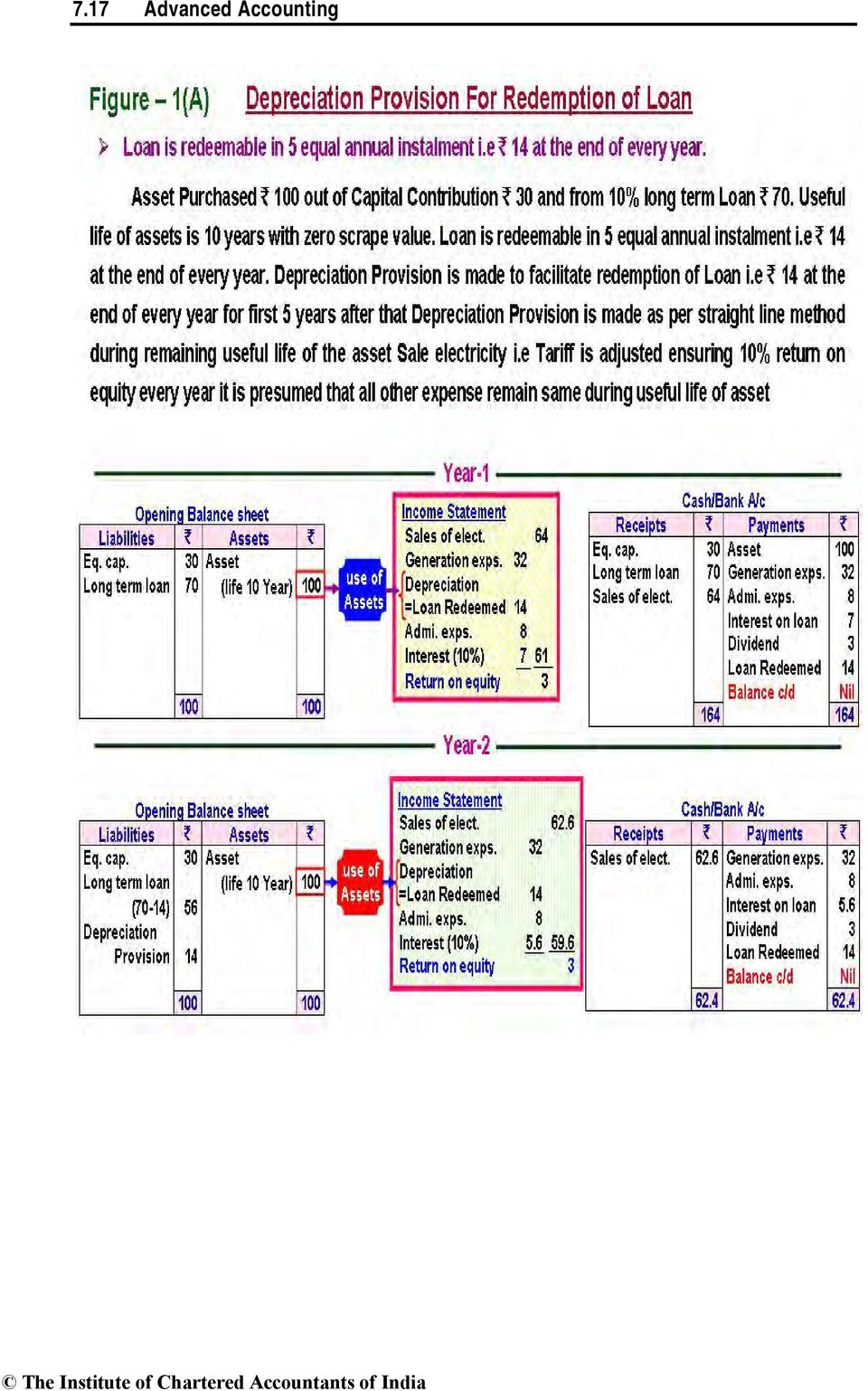
18 Financial Statements of Electricity Companies 7.18

19 7.19 Advanced Accounting

20 Financial Statements of Electricity Companies 7.20

21 7.21 Advanced Accounting
22 Financial Statements of Electricity Companies CERC (Terms and Conditions of Tariff) Regulations, 2009 Statement of Objects and Reasons CERC has issued CERC (Terms and Conditions of Tariff) Regulations, 2009 Statement of Objects and Reasons. The following are relevant observations: 1. As per the 2004 regulations. Value Base for the purpose of depreciation is historical cost of the asset which includes additional capitalization and FERV up to Depreciation is calculated by applying the depreciation rates notified by the Commission using Straight Line Method over the useful life of the asset and considering salvage value of 10%. On repayment of entire loan, the remaining depreciable value is spread over the balance useful life of the asset. Depreciation is chargeable from the first year of operation. In case of operation of the asset for part of the year, depreciation is charged on pro rata basis. To provide cash flow to the utilities to make them repay their debt, Advance against Depreciation (AAD) is allowed subject to certain conditions. 2. While determining the tariff, the Regulators have to ensure that: (i) capital is refunded to the investors over estimated life of assets, i.e. refund of capital: (ii) capital invested in the regulated business is allowed sufficient return so that the investors find the business attractive enough to invest, i.e. return on investment; and (iii) reasonable amount of operation and maintenance expenses is allowed, i.e. reimbursement of O&M expenses. And one of the major components of capital deployed is loan. As such it is important for the Commission to ensure availability of sufficient cash flow in the hands of the utilities to take care of the loan repayment obligation. For the control period , the Commission took care of this cash flow requirement by allowing AAD, in case normative depreciation amount is not sufficient to meet the loan repayment obligations. 3. The Commission has proposed gearing of 70% investment with 30% equity in future so that the burden on the consumers on account of cost of capital would be reduced. From the experience it is found that long tern loans are available for the power sector for the period years. In the absence of AAD, the amount of depreciation calculated as per the existing methodology will not be enough to meet the loan repayment obligations. 4. The Commission has proposed gearing of 70% investment with 30% equity in future so that the burden on the consumers on account of cost of capital would be reduced. From the experience it is found that long tern loans are available for the power sector for the period years. In the absence of AAD, the amount of depreciation calculated as per the existing methodology will not be enough to meet the loan repayment obligations. 5. The Tariff policy stipulates that the Commission may notify the rates of depreciation in respect of generation and transmission assets. The depreciation rates so notified would also be applicable for distribution with appropriate modification as may be evolved by the Forum of Regulators. The rates of depreciation so notified would be applicable for the purpose of tariffs as well as accounting. There should be no need for any advance against depreciation. Benefit of reduced tariff after the assets have been fully depreciated should remain available to the
23 7.23 Advanced Accounting consumers. It is also the responsibility of the Commission to see that sufficient cash flow is available to the generators and transmission licenses to meet their loan obligations arising due to high gearing. 6. As per the Accounting Standard 6 Depreciation (AS 6) issued by Institute of Chartered Accountants of India, 'Useful life is the period over which a depreciable asset is expected to be used by the enterprise'. As per section 205 and 350 of Companies Act, companies are required to provide depreciation in the books of accounts based on the useful life of asset. These rates are specified in Schedule XIV to the Act. However, in power sector the practice of considering depreciation towards the repayment of loan has been in vogue for quite sometime and has come to stay. The fact is that AAD is allowed over and above the rate arrived at on the basis of useful life to take care of repayment of loan has not given enough incentive for generating companies to look forward to long term loans. While on one hand it is argued that the Indian debt market is not having depth and the availability of long term loan is limited, it is imperative that the infrastructure companies, particularly power sector investors, who contract a sizeable amount of funding through loan should be able to facilitate long term funding with tenure of at least 12 years, if not more to be made available by the banks and financial institutions. The entities should use their propensity to avail large amounts of loans with the FIs/banks, and negotiate for long term low cost funding. 7. In a regulatory environment, the Commission has to protect the interest of the consumers while determining tariff and at the same time it is to be seen that the investors are having sufficient liquidity and revenue to meet then commercial commitment. Apart from paying regular dividend to the shareholders the utilities should have sufficient liquidity to cater to the loan repayment obligation. The Commission is aware of the burden of repayment of loan that will accrue over the initial years of the project life. Linking depreciation to the useful life of the assets may not provide sufficient cash flow to the utilities to meet their loan repayment obligation. Normally, the projects are having a debt component of 50% to 70% and are repayable over a period of 12 years. If higher depreciation is allowed over a period of initial 12 years, the debt repayment obligation can easily be met by the utilities. Once the loans are repaid, the benefit of reduced tariff should go to the consumers. 8. Accordingly, the Commission felt that the loan repayment period be treated as 12 years for all normative loans and accordingly this repayment period of 12 years be linked to depreciation. For 12 years during which the loan capital would be refunded to the investors in the form of depreciation, the rate of depreciation shall be as specified in appendix-iii of the regulation and thereafter the remaining depreciable value shall be spread over the balance useful life of the assets.
24 Financial Statements of Electricity Companies Comparison between depreciation as per provision of Schedule XIV to the Companies Act, 1956 and as per tariff policy under Electricity Supply Act, Depreciation to be provided as per Schedule XIV to the Companies Act, Schedule XIV does not have specific rate of depreciation that can be applied directly for generation, transmission and distribution assets used in electricity business. Therefore, it may not be possible to maintain uniformity in calculation of depreciation amongst the various utilities in electricity business. This can also affect comparability. 2 The Companies Act, 1956 also allows calculation of depreciation when the asset is ready for use i.e. when asset is ready for commercial production. 3 As per the Companies Act, 1956 in case of revaluation of assets, the revalued cost is to be used for calculation of depreciation 4 As per Companies Act, 1956 and the notified accounting standards, spares are not capitalized (except in case of insurance spares or those acquired alongwith the asset). Such spares are depreciated alongwith the main asset. Other spares acquired are normally charged to statement of Profit and Loss as and when consumed. 5 Depreciation rates are prescribed in Schedule XIV of the Companies Act, 1956 and are based on estimated useful life. Depreciation to be provided as per tariff policy under Electricity Supply Act Since 1948, rates of depreciation have been specified for various assets used in electricity business separately either by Government of India or the Commission. This ensures uniformity in calculation of depreciation amongst the various utilities in electricity business and also allows comparability. Under regulatory system, depreciation is provided only when the asset is put to use. Under regulatory system, for determination of tariff, depreciation is calculated on the capital cost admitted by the Commission and does not consider revalued cost of the asset. Under regulatory system all spares are included in the value base for calculation of depreciation The depreciation rates for different assets have been so assigned as to arrive at the weighted average rate approximating 5.28%. The depreciation rates as given in Appendix-III of the regulation have no bearing on the useful life of the projects as defined in regulation 3(42).
25 7.25 Advanced Accounting Note: Some companies engaged in generation of electricity are using the rates specified for Plant and Machinery under Continuous Process given in schedule XIV for their thermal generating assets for the purpose of accounting whereas hydro generating companies and transmission licensees are applying the depreciation rates specified by the Commission for the purpose of accounting as well as tariff Regulations These regulations may be called the Central Electricity Regulatory Commission (Terms and Conditions of Tariff) Regulations, 2009 has also maintained the first view that Depreciation represents cash flow for the repayment of loan in a modified form as compared to 2004 regulation Depreciation provisions as per CERC Regulations, 2009 Regulation 17 of the CERC Regulations, 2009 provides the provisions related to the depreciation. It states the following: 1. The value base for the purpose of depreciation shall be the capital cost of the asset admitted by the Commission. 2. The salvage value of the asset shall be considered as 10% and depreciation shall be allowed up to maximum of 90% of the capital cost of the asset. (This is at variance from Companies Act, 1956 where the salvage value is considered as 5% and the depreciation is allowed up to maximum of 95% of the capital cost of the asset) Provided that in case of hydro generating stations, the salvage value shall be as provided in the agreement signed by the developers with the State Government for creation of the site: Provided further that the capital cost of the assets of the hydro generating station for the purpose of computation of depreciable value shall correspond to the percentage of sale of electricity under long-term power purchase agreement at regulated tariff. 3. Land other than the land held under lease and the land for reservoir in case of hydro generating station shall not be a depreciable asset and its cost shall be excluded from the capital cost while computing depreciable value of the asset. 4. Depreciation shall be calculated annually based on Straight Line Method and at rates specified in Appendix-III to these regulations for the assets of the generating station and transmission system: Provided that, the remaining depreciable value as on 31 st March of the year closing after a period of 12 years from date of commercial operation shall be spread over the balance useful life of the assets. 5. In case of the existing projects, the balance depreciable value as on shall be worked out by deducting the cumulative depreciation as admitted by the Commission upto from the gross depreciable value of the assets.
26 Financial Statements of Electricity Companies Depreciation shall be chargeable from the first year of commercial operation. In case of commercial operation of the asset for part of the year, depreciation shall be charged on pro rata basis Appendix-III of the Regulations, 2009 The rates of depreciation are provided under Appendix-III of the Regulations, 2009 and are as under: Sr. No. Asset Particulars Depreciation Rate (Salvage Value=10%) SLM A Land under full ownership 0.00% B Land under lease (a) for investment in the land 3.34% (b) For cost of clearing the site 3.34% (c ) Land for reservoir in case of hydro generating station 3.34% C Assets purchased new (a) Pl & Machinery in generating stations (i) Hydro electric 5.28% (ii) Steam electric NHRB & waste heat recovery boilers 5.28% (iii) Diesel electric and gas plant 5.28% (b) Cooling towers & circulating water systems 5.28% (c) Hydraulic works forming part of the Hydro (i) Dams, Spillways, Weirs, Canals, Reinforced concrete 5.28% flumes and syphons (ii) Reinforced concrete pipelines and surge tanks, steel 5.28% pipelines, sluice gates, steel surge tanks, hydraulic control valves and hydraulic works (d) Building & Civil Engineering works of a (i) Offices and showrooms 3.34% (ii) Containing thermo-electric generating plant 3.34% (iii) Containing hydro-electric generating plant 3.34% (iv) Temporary erections such as wooden structures % (v) Roads other than Kutcha roads 3.34%
27 7.27 Advanced Accounting (e) (vi) Others 3.34% Transformers, Kiosk, sub-station equipment & other fixed apparatus (including plant (i) Transformers including foundations having rating of 100 KVA and over 5.28% (ii) Others 5.28% f Switchgear including cable connections 5.28% g Lightning arrestor (i) Station type 5.28% (ii) Pole type 5.28% (iii) Synchronous condensor 5.28% h Batteries 5.28% i (i) Underground cable including joint boxes and disconnected boxes 5.28% (ii) Cable duct system 5.28% (i) (ii) Overhead lines including cable support Lines on fabricated steel operating at terminal voltages higher than 66 KV Lines on steel supports operating at terminal voltages higher than 13.2 KV but not exceeding 66 KV 5.28% 5.28% (iii) Lines on steel on reinforced concrete support 5.28% (iv) Lines on treated wood support 5.28% j Meters 5.28% k Self propelled vehicles 9.50% l Air Conditioning Plants (i) Static 5.28% (ii) Portable 9.50% m (i) Office furniture and furnishing 6.33% n (ii) Office equipment 6.33% (iii) Internal wiring including fittings and apparatus 6.33% (iv) Street Light fittings 5.28% Apparatus let on hire
28 Financial Statements of Electricity Companies 7.28 o (i) Other than motors 9.50% (ii) Motors 6.33% Communication equipment (i) Radio and high frequency carrier system 6.33% (ii) Telephone lines and telephones 6.33% p I. T equipments 15.00% q Any other assets not covered above 5.28% It is to be noted that these rates are applicable for the first 12 years and the remaining depreciable value as on 31 st March of the year closing after a period of 12 years from date of commercial operation shall be spread over the balance useful life of the assets. Illustration 1 From the following details of assets calculate weighted average rate of depreciation considering the rates as per Appendix-III Particulars Closing balance at cost Land (a) Freehold 6,69,800 (b) Leasehold 2,15,450 Buildings 36,85,350 Railway Sidings 11,700 Plant and Machinery (a) Steam Station 1,41,64,950 (b) Others Including "Switchgears and Transformers" 1,02,89,450 Transmission and Distributing Systems (a) Overhead 21,21,450 (b) Underground 84,48,050 Electrical Fittings 2,50,650 and Apparatus Furniture, Fixture and Office Equipments 3,51,800 Vehicles 1,07,400 Total 4,03,16,050
29 7.29 Advanced Accounting Solution Particulars Land Closing balance at cost Rate of depreciation Depreciation (a) Freehold 6,69, (b) Leasehold 2,15, % 7, Buildings 36,85, % 1,23, Railway Skiing 11, % Plant and Machinery (a) Steam Station 1,41,64, % 7,47, (b) Others including "Switchgears and Transformers" 10,289, % 5,43, Transmission and Distributing Systems (a) Overhead 2,121, % 1,12, (b) Underground 8,448, % 4,46, Electrical Fittings and Apparatus 2,50, % 15, Furniture, Fixture and Office Equipments 3,51, % 22, Vehicles 1,07, % 5, Total (other than freehold land ) 3,96,46,250 20,23, Weighted average rate of depreciation = 20,23, ,96,46, = % x 100 Illustration 2 Calculate depreciation as per 2009 regulations from the following information of Barh Generation project (1) Date of commercial operation, i.e (2) The details of actual expenditure incurred up to the date of commercial operation, i.e and projected expenditure to be incurred from the date of commercial operation to for the assets under Barh Transmission System. The details of apportioned
30 Financial Statements of Electricity Companies 7.30 approved cost as on the date of commercial operation and projected expenditure to be incurred for the above mentioned assets is summarized below:- (3) Apportioned approved cost Actual cost incurred as on the date of commercial operation Proposed expenditure from the date of commercial operation to Proposed expenditure for Total estimated completion cost Average Rate of Depreciation calculated as per rates specified in Appendix-III % % % % Solution As per 2009 regulations, ''cut-off date means 31 March of the year closing after 2 years of the year of commercial operation of the project, and in-case of the project is declared under commercial operation in the last quarter of the year, the cut-off date shall be 31 s March of the year closing after 3 years of the year of commercial operation". Therefore, cut-off date for the above mentioned assets is Illustration 3 From the following information calculate: (a) Average capital cost (b) Return on equity (c) Interest on loan (d) Depreciation as per Regulation 14 of the Central Electricity Regulatory Commission (Terms and Conditions of Tariff) Regulations, Date of commercial operation or COD = 1, April, Approved opening Capital cost as on = ` 1,42, Consider weighted average rate of depreciation of 5.28% 4. Details of allowed additional capital expenditure, Weighted average rate of interest on loan is as follows:
31 7.31 Advanced Accounting ` ` ` ` Additional capital expenditure (allowed above) (B) 9, , , , Weighted Average Rate of Interest on Loan % % % % Solution a) Average capital cost Capital Cost ` ` ` ` Opening capital cost (A) 1,42, ,52, ,54, ,56, Additional capital expenditure (allowed above) (B) 9, , , , Closing Capital cost (A)+(B) 1,52, ,54, ,56, ,58, Average Capital cost 1,47, ,53, ,55, ,57, b) Return on equity Debt-Equity ratio Debt-Equity ratio for the purpose of return on equity for the period is 70: Opening Capital cost (A) 1,42, ,52, ,54, ,56, Equity-Opening considered now ((A)*0.30) = (B) 42, , , , Additional allowable capital expenditure (C) 9, , , , Addition of Equity due to admitted additional capital expenditure ((C)*0.30)=(D) 2, Equity-Closing ((B)+(D))=(E) 45, , , ,494.71
32 Financial Statements of Electricity Companies 7.32 Average equity [(B)+(E)]/2 = (F) 44, , , , Return on % of (F) c) Interest on loan Opening Capital cost (A) 1,42, ,52, ,54, ,56, Gross Opening loan - considered at 70% of (A)=(B) 99, ,06, ,08, ,09, Cumulative Repayment of Loan upto previous year (C) , , , Net Loan Opening (B)- (C)=(D) 99, , , , Additional capital expenditure (allowed above) (E) 9, , , , Addition of loan due to approved additional capital expenditureconsidered at 70% of (E)=(F) 6, , , , Repayment of loan during the year (net)(g) 7, , , , Net Loan Closing(D)+(F)- (G)=(H) 98, , , Average Loan{(D)+(H)}/2=I 99, , , , Weighted Average Rate of Interest on Loan (J) % % % % Interest on Loan(I) x (J) d) Depreciation Weighted average rate of depreciation is considered as 5.28% and retained for the purpose of tariff. The necessary calculations are as under.
33 7.33 Advanced Accounting Opening capital cost 1,42, ,52, ,54, ,56, Closing capital cost 1,52, ,54, ,56, ,58,315.7 Average capital cost(a) 1,47, ,53, ,55, ,57, Weighted Average Rate of depreciation % Depreciation (annualized) 7, , , , Depreciable 90% of (A) 1,32, ,38, ,40, ,41, Cumulative depreciation at the beginning , , , Balance depreciable 1,32, ,30, ,24, ,17, value (at the beginning) Depreciation to be 7, , , , Recovered 2.8 Additional Capital Expenditure As per Regulation 9(1) of 2009 regulations- "Additional Capitalization: (1) The capital expenditure incurred or projected to be incurred, on the following counts within the original scope of work, after the date of commercial operation and up to the cut-off date may be admitted by the Commission, subject to prudence check: (i) Undischarged liabilities: (ii) XXX (iii) XXX (iv) XXX (v) XXX" Additional capital expenditure of` lakh has been considered out of ` lakh for the year and no further additional capital expenditure has been considered as capital cost has been restricted to apportioned approved cost in the absence of revised capital expenditure. The date of commercial operation of the transmission system was Accordingly, it will complete 12 years beyond and thus depreciation has been calculated annually based on Straight Line Method and at rates specified in Appendix-Ill to the 2009 regulations.
34 Financial Statements of Electricity Companies 7.34 Details of the depreciation worked out are as under- (` in lakh) Opening Gross Block 1,95, ,05, ,05, ,05, Addition during due to Projected Additional Capitalization 9, Closing Gross Block 2,05, ,05, ,05, ,05, Average Gross Block 2,00, ,05, ,05, ,05, Rate of Depreciation % % % % Period 7 months 1 year 1 year 1 year Depreciation 6, , , , Illustration 4 Calculate depreciation as per 2009 regulations from the following information of H.B.H. Hydro Power Generation Project Date of commercial operation /Work Completed Date 11-Jan-95 Beginning of Current year 1-Apr-2010 Useful life 35 Years S.N. (Figures in ` crores) 1 Capital Cost at beqinning of the Year Additional Capltiisation during the year Value of Land Depreciation recovered up to Depreciation recovered in Note : Capital cost at the beginning of the year accumulated depreciation are as per tariff order FY Solution Name of the Hydro Power Station H.B.H. Hydro Power Generation Project Date of commercial operation /Work Completed Date 11-Jan-95 Beginning of Current year 1-Apr-10 Useful life 35 Years Remaining Useful Life 20 Years
35 7.35 Advanced Accounting (Figures in ` crores) S.N Capital cost at beqinning of the year Additional capitalisation during the year Closing capital cost Average capital cost Less : Value of Land Capital cost for depreciation (1-2) Depreciable value (90% of 3) Depreciation recovered up to Depreciation recovered in Depreciation recovered upto previous year (5+6) Balance depreciation to be recovered (4-7) Balance useful life of 35 years Yearly depreciation from (8/9) Depreciation recovered upto the year (7+10) Note : Capital cost at the beginning of the year accumulated depreciation are as per tariff order FY ODRC Method (Optimised Depreciated Replacement Cost) Third view is that depreciation represents a replacement of capital or a charge for the replacement of the assets consumed. This view has been evaluated by the Commission and is as per Discussion Paper on Depreciation norms of ICRA Advisory Services(a division of ICRA Ltd) April, 2000 mentioned in following paragraphs: The optimised depreciated replacement cost [ODRC] method involves (i) assessment of the gross current replacement cost of modern equivalent assets (ii) making an adjustment for over design, over capacity and redundant assets and then, (iii) depreciating this optimum gross current replacement cost to reflect the anticipated effective working life of the asset from new, the age of the asset and the estimated residual value at the end of the asset's working life. The effective working life of an asset is the estimated life of the asset, assuming continued use in its present function, as a part of a continuing business. The ODRC method comprises the following steps:
36 Financial Statements of Electricity Companies Preparing a detailed asset register. Asset registers should contain data on quantity, location physical condition, age and maintenance of the assets. 2. Calculation of the replacement cost. This refers to the cost of replacing the assets with modern equivalent assets. 3. Assessment of depreciation. The new assets at replacement costs identified earlier need to be depreciated in case the life of the existing asset is lower than the life of the new asset. 4. System Optimisation: This is done to measure the most cost effective way of delivering service, in terms of capacity and quality to meet the requirements. This involves three levels; Capacity Optimisation both in size and number Optimisation of spares Optimisation of unit costs Under an ODRC valuation methodology, depreciation would be greater than the capital expenditure likely to be incurred during the proposed regulatory period when the assets that exist in the system are old. For instance- generating machinery set up in the 70s would be due for replacement in the present decade and a switch to the ODRC valuation basis would result in higher depreciation charges due to higher current replacement costs. The implementation of the ODRC would impart a significant shock to the system but this would be more gradual than under the HC system. The shocks can be further minimised if the period between adoption of the ODRC method and replacement of assets is spaced out. This would therefore require an immediate implementation of the ODRC valuation method Recommendation To minimise the price shocks arising as a result of the lumpiness in capital expenditure and resultant fluctuations in depreciation, the asset valuation method adopted should to the greatest extent reflect current economic replacement cost. This approach will also enhance price signalling which is best done by using the ODRC valuation. We however recommend that the historical cost be used as the basis for the short term (the exact time frame to be arrived based on discussion between CERC and the utilities) and thereafter shift to the ODRC method. We do not recommend an immediate shift to the ODRC method due to 1. Problems in producing a detailed asset register 2. The absence of norms for standard lives of assets 3. The absence of construction cost estimates 4. Lack of data on future load growth
37 7.37 Advanced Accounting The transition period should help utilities reorganise their management information systems to provide data for the implementation of the new valuation method. The ODRC method would be better because 1. Little attention has been paid to replacing assets in India and many of these will be due for replacement in the coming decade. An adoption of the ODRC method will ensure that the price shocks are gradually administered to the customers. 2. This will ensure greater acceptability to users (State Electricity Boards and their successors) since over capacity issues will be addressed and cost reductions possible from new technologies will be incorporated in the valuation 3. Since the valuation will reflect the cost of replacement utilities will be able to assess the timing and financing requirements with a greater degree of certainty Application of Accounting Standards in Electricity Companies The objective of financial statements is to provide information about the financial position, performance and cash flows of an enterprise that is useful to a wide range of users in making economic decisions. Financial statements prepared for this purpose meet the common needs of most users. However, financial statements do not provide all the information that users may need to make economic decisions since (a) these largely portray the financial effects of past events, and (b) do not necessarily provide non-financial information. Financial statements also show the results of the stewardship of management, or the accountability of management for the resources entrusted to it. The users may wish to assess the stewardship or accountability of management in order to make economic decisions; these decisions may include, for example, whether to hold or sell their investment in the enterprise or whether to reappoint or replace the management. Considering the various uses and to achieve a standardised comparability of the financial statements over a period of time or across organizations, the accounting standards have been promulgated. The management of any company is mandated as per the Companies Act, 1956 to declare that the company has followed the Accounting Standards prescribed under section 211 of the companies Act, Considering these issues it is important that the requirements of these Standards are complied with in the accounting functions to the extent applicable. Although all the accounting standards are applicable to the electricity companies, some of the specific applications have been discussed below:
38 Financial Statements of Electricity Companies (AS) 2 Valuation of Inventories The revised standard came into effect in respect of accounting periods commencing on or after and is mandatory in nature. The Standard mandates the following: 1. Inventories should be valued at the lower of cost and net realisable value. 2. The cost of inventories should comprise all costs of purchase, costs of conversion and other costs incurred in bringing the inventories to their present location and condition. Specific issues relating to electricity companies: i) The unique feature of Power sector is that electricity cannot be stored and hence there are no finished goods or work in progress in stock. The inventories would generally comprise materials, stores and supplies and fuels. As per AS 2 these are required to be valued at lesser of cost or Net Realisable Value (NRV). Generally, the materials, stores and supplies and fuels are valued at cost. ii) The cost of purchase of materials especially coal and fuel which forms major part of inventory should include: - All duties and taxes (except those that are subsequently recoverable from the taxing authorities) - Freight inwards on an actual basis. - All expenditure attributable to bring the inventories to the current location and condition which includes freight cost, handling cost and other direct costs (like coal handling costs, cost of employees involved in transportation of fuel and converting it to the consumable stage) Accounting Standard (AS) 6 Depreciation Accounting This Standard deals with depreciation accounting and applies to all depreciable assets, except the following items to which special considerations apply: 1. Forests, plantations and similar regenerative natural resources 2. Wasting assets including expenditure on the exploration for and extraction of minerals, oils, natural gas and similar non-regenerative resources 3. Expenditure on research and development 4. Goodwill 5. Livestock This statement also does not apply to land unless it has a limited useful life for the enterprise. The depreciable amount of a depreciable asset should be allocated on a systematic basis to each accounting period during the useful life of the asset.
39 7.39 Advanced Accounting Specific issue relating to electricity companies: Under the provisions of the Electricity Act, depreciation has to be provided at the rates prescribed by the Government of India / Regulatory Commission so as to ensure that 90% of the cost of each asset is provided for during its useful life. In respect of assets for which no specific rates have been prescribed by the regulatory authorities depreciation shall be provided for as per the minimum rates prescribed under Schedule XIV to the Companies Act, The provisions regarding depreciation have already been discussed in detail Accounting Standard (AS) 9 Revenue Recognition This Accounting Standard is mandatory for all companies. In case of electricity companies, significant revenues are from the sale of power. It should be ensured that the revenue from units generated is recognised commencing hours as on 1st April. Power generation utility business is highly capital intensive. Adequate care should be taken to ensure that the capital and revenue expenses are differentiated and accounted for. The capitalisation principles should be applied as a test to ensure that the capital expenses are accounted properly in accordance with the standard Miscellaneous Illustrations Illustration 5 The trial balance of Noida Electric Supply Ltd. for the year ended 31st March, 2012 is as below: (` 000) Particulars Dr. Cr. Share Capital : Equity Shares of ` 10 each 250,00 14% Preference Shares of ` 100 each 75,00 Patents and trade mark 12,52 15% Debentures 123,50 16% Term Loan 76,50 Land (additions during the year 10,25) 62,25 Building (additions during the year 25,40) 175,67 Plant & Machinery 285,29 Mains 22,62 Meters 15,75 Electrical Instrument 7,65
40 Financial Statements of Electricity Companies 7.40 Office furniture 12,25 Capital reserve 25,10 Contingency reserves 60,15 Transformers 82,20 Net revenue account 26,75 Stock in hand 60,25 Sundry debtors 31,23 Contingency reserve investment 60,05 Cash & Bank 16,27 Public lamps 15,20 Depreciation fund 129,08 Sundry Creditors 32,62 Proposed dividend 60,50 859,20 859,20 During , ` ( 000) 50,00 of 14% preference shares were redeemed at a premium of 10% out of proceeds of fresh issue of equity shares of necessary amounts at a premium of 10%. Prepare Balance Sheet as on 31st March, 2012 as per the revised Schedule VI. Solution Balance Sheet of Noida Electric Supply Ltd. for the year ended March 31, 2012 Particulars Note No ` ('000) Equity and Liabilities 1 Shareholders' funds a Share capital 1 32,500 b Reserves and Surplus 2 11,200 2 Non-current liabilities a Long-term borrowings 3 20,000 3 Current liabilities a Trade Payables 3,262 b Short-term provisions 4 6,050 Total 73,012
41 7.41 Advanced Accounting Assets 1 Non-current assets a Fixed assets i Tangible assets 5 54,980 ii Intangible assets 1,252 b Other non-current assets Current assets a Inventories 6,025 b Trade receivables 3,123 c Cash and cash equivalents 1,627 Total 73,012 Notes to financial statements ` ('000) 1. Share Capital Equity share capital Authorised 2,500,000 Equity shares of ` 10 each 25,000 Issued & subscribed 2,000,000 Equity shares of ` 10 each 20, ,000 Equity shares of ` 10 each issued during the year (A) 5,000 25,000 Preference share capital Authorised 125,000 14% Preference shares of ` 100 each 12,500 Issued & subscribed 125,000 14% Preference shares of ` 100 each 12,500 50,000 Preference shares of ` 100 each redeemed during the year (B) (5,000) 7,500 Total (A+B) 32, Reserves and Surplus Capital reserve 2,510 Contingency Reserve 6,015 Balance of net return A/c 2,675 Total 11,200
42 Financial Statements of Electricity Companies Long-term borrowings Secured 15% Debentures 12,350 16% Term Loan (considered secured) 7,650 Total 20, Short-term provisions Proposed dividend 6,050 Total 6, Tangible assets Land 5,200 Addition during the year 1,025 6,225 Building 15,027 Addition during the year 2,540 17,567 Plant & Machinery Steam Power Plant 28,529 Transformers 8,220 Mains 2,262 Meters 1,575 Public Lamps 1,520 42,106 General Equipments Electrical Instruments 765 Office Furniture 1,225 1,990 Less: Depreciation fund (12,908) Total 54, Other non-current assets Contingency Reserve Investment (assumed as non-current item) 6,005 Illustration 6 Following is the Trial Balance of Torrent Power Ltd as on 31-March-2012 Particulars Dr. Cr. ` ` Share Capital Authorized: 10,00,000 Equity Shares of `10 each 1,00,00,000 Issued, Subscribed and Paid up: 2,36,225 Equity Shares of `10 each 23,62,250
43 7.43 Advanced Accounting Service Line Contributions As per the last Balance Sheet 11,86,800 Contributions during the year 4,32,750 Grant in Aid under Accelerated Power Development and Reform Programme As per the last Balance Sheet 2,46,250 Contingency Reserve As per the last Balance Sheet 3,05,500 Tariff and Dividend Control Reserve As per the last Balance Sheet 57,950 General Reserve As per the last Balance Sheet 1,31,45,000 Secured Term Loans From Financial Institutions 58,72,500 From Banks 82,20,050 Service Line and Security Deposits from Consumers 23,29,600 Term Loan from Government of India under Accelerated Power Development and Reform Programme 2,75,150 Short Term Loan from Financial Institution 8,75,000 Loan from Bank 54,800 Closing balance of Non-current Assets Land (a) Freehold 6,69,800 (b) Leasehold 2,15,450 Buildings 36,85,350 Railway Skiing 11,700 Plant and Machinery (a) Steam Station 1,41,64,950 (b) Others Including "Switchgears and Transformers" 1,02,89,450 Transmission and Distribution Systems (a) Overhead 21,21,450
44 Financial Statements of Electricity Companies 7.44 (b) Underground 84,48,050 Electrical Fittings and Apparatus 2,50,650 Furniture, Fixture and Office Equipments 3,51,800 Vehicles 1,07,400 Intangible Assets Software 87,400 32,300 Capital Work-in-Progress 26,88,550 Contingency Reserve Investments (Quoted) ICICI Bonds ,05,500 Other Investments Quoted 100 Unquoted Investment in Subsidiary Companies 39,98,050 Equity Shares AEC Cements & Constructions Limited 100 Birla Sun Life Cash Plus 2,06,800 Kotak Floater Short Term 3,10,250 Interest Accrued on Investments 1,050 Debts / Receivables Secured - Considered Good 9,91,650 Unsecured - Considered Good 20,54,850 Considered Doubtful 5,03,050 Inventories (Coal, Oil, Stores and Spares) 13,17,250 Cash and Cheques on hand 15,800 Balances with scheduled banks In Current Accounts 3,77,850 Fixed Deposits Accounts 42,37,350 Balances with other Banks in Current Accounts 350 Advances recoverable in cash or in kind or for value to be received 6,50,000 Advances and Loans to Subsidiary Companies 68,850 Balance with Government Authority 5,750 Advance Tax and Tax deducted at source (Net of Provision for Taxation) 94,400 Provision for Gratuity and other fund 2,71,900 Provision for Leave Encashment 3,33,700
45 7.45 Advanced Accounting Provision for Taxation 96,100 Provision for Indirect Tax 52,550 Proposed Dividend 12,04,850 Provision for Corporate Dividend Tax 2,10,750 Sundry Creditors 45,06,000 Due to Subsidiary Company 23,750 Investor Education and Protection Fund (Unclaimed Dividends) 13,700 Consumers' Benefit Account 60,050 Credit Balances of Consumers 1,63,550 Interest Accrued but not due on Loans and Security Deposits 1,04,550 Opening balance of Profit and loss account 18,93,450 Profit during the year before adjustment * 1,39,00,200 5,82,31,000 5,82,31,000 *Sservice line contribution ` 92,250 has to be transferred to Statement of Profit and Loss. 1. Transfer from Accelerated Power Development and Reform Programme to profit and loss account 2. Provide for depreciation on tangible assets at the following rates of Appendix III Particulars Rate of depreciation as per Appendix Land (a) Freehold 0 (b) Leasehold 3.34% Buildings 3.34% Railway sidings 3.34% Plant and Machinery (a) Steam Station 5.28% (b) Others Including "Switchgears and Transformers" 5.28% Transmission and Distributing Systems (a) Overhead 5.28% (b) Underground 5.28% Electrical Fittings and Apparatus 6.33% Furniture, Fixture and Office Equipments 6.33% Vehicles 5.28%
46 Financial Statements of Electricity Companies Transfer to Contingency Reserve ` 5,000 and to general reserve ` 20,00,000 from to statement of profit and loss. 4. Loss on Contingency Reserve Investment 8, Debts include outstanding for a period exceeding six months. Secured - Considered Good ` 43,400 Unsecured - Considered Good ` 66,250 - Considered Doubtful ` 1,24,850 Make a provision for debts considered doubtful. Prepare balance sheet as per Schedule VI and also mention the effect of adjustments on the profit in a working note. Solution Balance Sheet of Torrent Power Pvt. Ltd. as on 31 st March, 2012 EQUITY AND LIABILITIES Notes ` Shareholders' funds (a) Share capital 1 23,62,250 (b) Reserves and surplus 2 28,633,055 Non-current liabilities (a) Long-term borrowings 3 1,52,97,500 (b) Service Line and Security Deposits from Consumers 23,29,600 (c) Long-term provisions 4 6,05,600 Current liabilities (a) Short-term borrowings 5 23,750 (b) Trade payables 6 45,06,000 (c) Other current liabilities 7 15,46,700 (d) Short-term provisions 8 3,59,400 Total 5,56,63,855 ASSETS Non-current assets (a) Fixed assets (i) Tangible assets 9 3,82,92,305
47 7.47 Advanced Accounting (ii) Intangible assets (87,400 32,300) 55,100 (iii) Capital work-in-progress 26,88,550 (iv) Intangible assets under development (b) Non-current investments 10 42,95,700 Current assets (a) Current investments 11 5,17,050 (b) Inventories (Coal, Oil, Stores ) 13,17,250 (c) Trade receivables 12 30,46,500 (d) Cash and cash equivalents 13 46,31,350 (e) Short-term loans and advances 14 8,19,000 (f) Other current assets (Int. accrued) 1,050 Note to Financial Statements: Total 5,56,63, Share Capital Particulars Amount Authorised: 10,00,000 Equity shares of ` 10 each 1,00,00,000 Issued, subscribed and paid up: 2,36,225 Equity shares of ` 10 each 23,62,250 2 Reserve and surplus Particulars Amount Amount Capital Reserves Service Line Contributions As pet last Balance Sheet 11,86,800 Add: Contributions during the year 4,32,750 16,19,550 Less: Transfer to Profit and Loss Account (92,250) 15,27,300 Grant in Aid under Accelerated Power Development and Reform Programme 2,46,250 As per last Balance Sheet Received during the year - 2,46,250 Less: Transfer to Profit and Loss Account (16,150) 2,30,100
48 Financial Statements of Electricity Companies 7.48 Statutory Reserves Contingency Reserve As per last Balance Sheet 3,05,500 Less: Loss on Contingency Reserve Investments (8,050) 2,97,450 Add: Transfer from Profit and Loss Account 5,000 3,02,450 Tariff and Dividend Control Reserve As per last Balance Sheet 57,950 Other Reserves General Reserve As per last Balance Sheet 1,31,45,000 Add: Transfer from Profit and Loss Account 20,00,000 1,51,45,000 Profit and Loss Opening balance of Statement of Profit and loss 1,89,3450 Profit during the year before adjustment 1,39,00,200 Less: Profit and loss Adjustments - Add: Service line contribution 92,250 Grant in Aid under Accelerated Power Development and Reform Program 16,150 1,08,400 1,59,02,050 Less: Contingency reserve 5,000 General reserve 20,00,000 Bad-debt reserve 5,03,050 Depreciation 20,23,745 (45,31,795) 1,13,70,255 2,86,33, Long term borrowings Amount Secured Term Loans From Financial Institutions 5,872,500 From Banks 8,220,050 (i) 1,40,92,550
49 7.49 Advanced Accounting In the absence of details of security, disclosure for the same has not been made. Particulars Amount Term Loan from Government of India under Accelerated Power Development and Reform Program 2,75,150 Short Term Loan from Financial Institutions 8,75,000 Loan from Bank 54,800 (ii) 12,04,950 Total (i) + (ii) 1,52,97, Long-term provisions Particulars Amount Provision for Gratuity and other funds 2,71,900 Provision for Leave Encashment 3,33,700 6,05, Short Term Borrowings Particulars Amount Due to Subsidiary Company 23, Trade Payables Particulars Amount Sundry Creditors 4,506, Other current Liabilities Particulars Amount Investor Education and Protection Fund (Unclaimed Dividends) 13,700 Consumers' Benefit Account 60,050 Credit Balances of Consumers 1,63,550 Interest Accrued but not due on Loans and Security Deposits 1,04,550 Proposed Dividend 12,04,850 15,46,700 It is assumed that there is no current maturity of long term loans.
50 Financial Statements of Electricity Companies Short Term Provisions Particulars Amount Provision for Taxation 96,100 Provision for Indirect Tax 52,550 Provision for Corporate Dividend Tax 2,10, Tangible Fixed Assets Land Particulars Closing bal. At cost Provision for depreciation 3,59,400 Net block (a) Freehold 6,69, ,69,800 (b) 2,15,450 7, ,08,254 36,85,350 1,23, ,62,259 Railway 11, ,309 Plant and Machinery (a) Steam 1,41,64,950 7,47, ,34,17,041 (b) Others Including "Switchgears and 1,02,89,450 5,43, ,46,167 Transmission & Distributing Systems (a) 21,21,450 1,12, ,09,437 (b) 84,48,050 4,46, ,01,993 Electrical Fittings and Apparatus@ 6.33% 2,50,650 15, ,34,784 Furniture, Fixture and Office Equipments@ 6.33% 3,51,800 22, ,29, % 1,07,400 5, ,01,729 Total 4,03,16,050 2,023,745 38,292,305 Difference is due to approximation of decimal to nearest rupee.
51 7.51 Advanced Accounting 10. Non-current investments Particulars Amount Contingency Reserve Investments (Quoted) ICICI Bond (3,05,500 8,050) 2,97,450 Other Investments Quoted 100 Unquoted Investment in Subsidiary Companies 39,98,050 Equity Shares AEC Cements & Constructions Limited ,95, Current Investments Particulars Amount Unquoted Birla Sun Life Cash Plus 2,06,800 Kotak Floater Short Term 3,10,250 5,17, Trade Receivables Particulars Amount Amount Debts outstanding for a period exceeding six months Secured - Considered Good 43,400 Unsecured - Considered Good 66,250 Considered Doubtful 1,24,850 2,34,500 Other Debts Secured - Considered Good (9,91,650 43,400) 9,48,250 Unsecured - Considered Good (20,54,850 66,250) 19,88,600 Considered Doubtful (5,03,050 1,24,850) 3,78,200 33,15,050 Less: Provision for Doubtful Debts (5,03,050) 30,46,500
52 Financial Statements of Electricity Companies Cash and Cash equivalents Particulars Amount Cash and Cheques on hand 15,800 Balances with scheduled banks In Current Accounts 3,77,850 Fixed Deposits Accounts 42,37,350 Balances with other Banks in Current Accounts ,31, Short-term loans and advances Particulars Amount Unsecured (Considered Good Unless Otherwise Stated) Advances recoverable in cash or in kind or for value to be received 6,50,000 Advances and Loans to Subsidiary Companies 68,850 Balance with Government Authority 5,750 Advance Tax and Tax deducted at source 94,400 8,19,000
DRAFT KERALA STATE ELECTRICITY REGULATORY COMMISSION, NOTICE. No. 442/CT/2014/KSERC Dated, Thiruvananthapuram 31 st March, 2015
 DRAFT 31.3.2015 KERALA STATE ELECTRICITY REGULATORY COMMISSION, NOTICE 442/CT/2014/KSERC Dated, Thiruvananthapuram 31 st March, 2015 The Kerala State Electricity Regulatory Commission hereby publishes
DELHI ELECTRICITY REGULATORY COMMISSION
 DELHI ELECTRICITY REGULATORY COMMISSION DELHI ELECTRICITY REGULATORY COMMISSION (RENEWABLE PURCHASE OBLIGATION AND RENEWABLE ENERGY CERTIFICATE FRAMEWORK IMPLEMENTATION) REGULATIONS, 2011 No. Dated:. NOTIFICATION
Renewable Energy Certificate Mechanism for India. ABPS Infrastructure Advisory. Background
 Renewable Energy Certificate Mechanism for India Background ABPS Infrastructure Advisory India is abundantly gifted with a variety of renewable energy (RE) sources. However, not all states are endowed
National Electricity Policy 03-Feb-2005
 National Electricity Policy 03-Feb-2005 Under the provisions of section 3(1) of the Electricity Act, 2003, the Central Government is required to prepare the National Electricity Policy for development
THE ELECTRICITY ACT, 2003. [No. 36 OF 2003]
![THE ELECTRICITY ACT, 2003. [No. 36 OF 2003]](/thumbs/24/2664732.jpg "THE ELECTRICITY ACT, 2003. [No. 36 OF 2003]") THE ELECTRICITY ACT, 2003 [No. 36 OF 2003] An Act to consolidate the laws relating to generation, transmission, distribution, trading and use of electricity and generally for taking measures conducive
THE ELECTRICITY ACT, 2003 [No. 36 OF 2003] An Act to consolidate the laws relating to generation, transmission, distribution, trading and use of electricity and generally for taking measures conducive
CENTRAL ELECTRICITY REGULATORY COMMISSION NEW DELHI NOTIFICATION. No. L-1/(3)/2009-CERC Dated the 7 th August 2009
 CENTRAL ELECTRICITY REGULATORY COMMISSION NEW DELHI NOTIFICATION No. L-1/(3)/2009-CERC Dated the 7 th August 2009 In exercise of powers conferred by section 178 of the Electricity Act, 2003 and all other
KERALA STATE ELECTRICITY REGULATORY COMMISSION
 KERALA STATE ELECTRICITY REGULATORY COMMISSION Notification No. 2096/KSERC/CT/2014 Dated, Thiruvananthapuram 10 th June 2014. In exercise of the powers conferred under sections 66, 86 (1) (e) and 181 of
Solar Power Policy Uttar Pradesh 2012 Suggestions to be sent to : [email protected] [email protected]
 Draft ver2 Solar Power Policy Uttar Pradesh 2012 Suggestions to be sent to : [email protected] [email protected] 1 TABLE OF CONTENTS S.No Contents Page No 1. PREAMBLE 3 2. OBJECTIVES 3 3. OPERATIVE
Model Renewable Energy Wheeling Agreement under Renewable Energy Certificate (REC) scheme
 Model Renewable Energy Wheeling Agreement under Renewable Energy Certificate (REC) scheme This agreement made at on this day of two thousand between M/s. (Renewable Energy Generator name and address) hereinafter
THE ELECTRICITY ACT, 2003. [No. 36 OF 2003]
![THE ELECTRICITY ACT, 2003. [No. 36 OF 2003]](/thumbs/29/13496763.jpg "THE ELECTRICITY ACT, 2003. [No. 36 OF 2003]") THE ELECTRICITY ACT, 2003 [No. 36 OF 2003] An Act to consolidate the laws relating to generation, transmission, distribution, trading and use of electricity and generally for taking measures conducive
THE ELECTRICITY ACT, 2003 [No. 36 OF 2003] An Act to consolidate the laws relating to generation, transmission, distribution, trading and use of electricity and generally for taking measures conducive
Report on Significant Accounting Policies
 Report on Significant Accounting Policies After the unbundling from the State Government s Electricity Department, PETCO ( Puducherry Electricity Transmission Company ) and PESCO ( Puducherry Electricity
IREDA-NCEF REFINANCE SCHEME
 IREDA-NCEF REFINANCE SCHEME REVIVAL OF THE OPERATIONS OF EXISTING BIOMASS POWER & SMALL HYDRO POWER PROJECTS AFFECTED DUE TO UNFORSEEN CIRCUMSTANCES SUPPORTED BY THE NATIONAL CLEAN ENERGY FUND IREDA NCEF
Indian Accounting Standard (Ind AS) 7 Statement of Cash Flows
 Contents Indian Accounting Standard (Ind AS) 7 Statement of Cash Flows Paragraphs OBJECTIVE SCOPE 1 3 BENEFITS OF CASH FLOW INFORMATION 4 5 DEFINITIONS 6 9 Cash and cash equivalents 7 9 PRESENTATION OF
The levy of VAT is administered by the Goa Value Added Tax Act, 2005 and the rules made thereunder.
 Frequently Asked Questions 1. What is VAT? VAT is the short form of Value Added Tax. VAT is the tax that has replaced the earlier levy of Sales Tax. Under the earlier first point system of levy of tax,
FIXED CHARGE: This is a cost that goes towards making the service available, including
 ELECTRICITY BILL COMPONENTS FIXED CHARGE: This is a cost that goes towards making the service available, including installation and maintenance of poles, power lines and equipment, and 24-hour customer
TARIFF DETERMINATION METHODOLOGY FOR THERMAL POWER PLANT
 TARIFF DETERMINATION METHODOLOGY FOR THERMAL POWER PLANT 1. Background The Electricity Act 2003 has empowered the Central Electricity Regulatory Commission (CERC) to specify the terms and conditions for
Analysis of state-wise RPO Regulation across India
 The Renewable Purchase Obligations (RPO) has been the major driving force in India to promote the renewable energy sector. But the State Electricity Regulatory Commissions (SERCs) have defined their respective
ANDHRA PRADESH ELECTRICITY REGULATORY COMMISSION
 ANDHRA PRADESH ELECTRICITY REGULATORY COMMISSION RENEWABLE POWER PURCHASE OBLIGATION (COMPLIANCE BY PURCHASE OF RENEWABLE ENERGY / RENEWABLE ENERGY CERTIFICATES) REGULATIONS, 2012 Regulation No. 1 of 2012
CHAPTER 13 COMPLIANCE
 CHAPTER 13 COMPLIANCE By a Trading Member / Clearing Member 13.1 Annual Accounts and Audit 13.1.1 Every trading member / clearing member shall prepare annual accounts for each financial year ending on
Fixed Assets. Name: SudhirJain M. No.: 213157
 Fixed Assets Name: SudhirJain M. No.: 213157 Agenda AS- 10 Accounting for Fixed Assets Introduction & Scope Definitions and other relevant provisions Relevant provisions of other Accounting Standards applicable
NEPAL ACCOUNTING STANDARDS ON CASH FLOW STATEMENTS
 NAS 03 NEPAL ACCOUNTING STANDARDS ON CASH FLOW STATEMENTS CONTENTS Paragraphs OBJECTIVE SCOPE 1-3 BENEFITS OF CASH FLOWS INFORMATION 4-5 DEFINITIONS 6-9 Cash and cash equivalents 7-9 PRESENTATION OF A
IREDA-NCEF REFINANCE SCHEME REFINANCE SCHEME FOR PROMOTION OF RENEWABLE ENERGY SUPPORTED BY THE NATIONAL CLEAN ENERGY FUND
 IREDA-NCEF REFINANCE SCHEME REFINANCE SCHEME FOR PROMOTION OF RENEWABLE ENERGY SUPPORTED BY THE NATIONAL CLEAN ENERGY FUND IREDA NCEF REFINANCE SCHEME REFINANCE SCHEME FOR PROMOTION OF RENEWABLE ENERGY
KERALA STATE ELECTRICITY REGULATORY COMMISSION THIRUVANANTHAPURAM IN THE MATTER OF
 KERALA STATE ELECTRICITY REGULATORY COMMISSION THIRUVANANTHAPURAM PRESENT: Shri. K.J.Mathew, Chairman Shri. C. Abdulla, Member Shri. M.P.Aiyappan, Member Petition No. CT/SOLAR JNNSM/KSERC/2010 August 4,
Statement of Cash Flows
 STATUTORY BOARD FINANCIAL REPORTING STANDARD SB-FRS 7 Statement of Cash Flows This version of SB-FRS 7 does not include amendments that are effective for annual periods beginning after 1 January 2014.
Japan. Nagahide Sato and Sadayuki Matsudaira Nishimura & Asahi
 Nagahide Sato and Sadayuki Matsudaira Nishimura & Asahi 1 Policy and law What is the government policy and legislative framework for the electricity sector? The electricity sector in is governed by the
PUBLIC FINANCE MANAGEMENT ACT NO. 1 OF 1999
 PUBLIC FINANCE MANAGEMENT ACT NO. 1 OF 1999 [ASSENTED TO 2 MARCH, 1999] [DATE OF COMMENCEMENT: 1 APRIL, 2000] (Unless otherwise indicated) (English text signed by the President) NATIONAL TREASURY This
PROCEDURE FOR ISSUANCE OF RENEWABLE ENERGY CERTIFICATE TO THE ELIGIBLE ENTITY BY CENTRAL AGENCY
 PROCEDURE FOR ISSUANCE OF RENEWABLE ENERGY CERTIFICATE TO THE ELIGIBLE ENTITY BY CENTRAL AGENCY 1. OBJECTIVE 1.1. This procedure shall provide guidance to the entities to implement Renewable Energy Certificate
INFORMATION BROCHURE. Refinance Scheme for Scheduled Banks for their lending for Housing, 2003
 INFORMATION BROCHURE Refinance Scheme for Scheduled Banks for their lending for Housing, 2003 1. Introduction The objective of the scheme is to provide refinance assistance to Scheduled Banks (SBs) in
PUBLIC FINANCE MANAGEMENT ACT NO. 1 OF 1999
 PUBLIC FINANCE MANAGEMENT ACT NO. 1 OF 1999 as amended by Public Finance Management Amendment Act, No. 29 of 1999 ACT To regulate financial management in the national government and provincial governments;
Consolidated financial statements
 Summary of significant accounting policies Basis of preparation DSM s consolidated financial statements have been prepared in accordance with International Financial Reporting Standards (IFRS) as adopted
The following Accounting Standards Interpretation (ASI) relates to AS 7. ASI 29 Turnover in case of Contractors
 108 Accounting Standard (AS) 7 (revised 2002) Construction Contracts Contents OBJECTIVE SCOPE Paragraph 1 DEFINITIONS 2-5 COMBINING AND SEGMENTING CONSTRUCTION CONTRACTS 6-9 CONTRACT REVENUE 10-14 CONTRACT
RAJASTHAN ELECTRICITY REGULATORY COMMISSION JAIPUR
 RAJASTHAN ELECTRICITY REGULATORY COMMISSION JAIPUR NOTIFICATION 23 rd December, 2010 No.RERC/Secy/Reg. 82 : In exercise of powers conferred under sections 61, 66, 86(1)(e) and 181 of the Electricity Act,
International Accounting Standard 7 Statement of cash flows *
 International Accounting Standard 7 Statement of cash flows * Objective Information about the cash flows of an entity is useful in providing users of financial statements with a basis to assess the ability
Sri Lanka Accounting Standard-LKAS 7. Statement of Cash Flows
 Sri Lanka Accounting Standard-LKAS 7 Statement of Cash Flows CONTENTS SRI LANKA ACCOUNTING STANDARD-LKAS 7 STATEMENT OF CASH FLOWS paragraphs OBJECTIVE SCOPE 1 3 BENEFITS OF CASH FLOW INFORMATION 4 5 DEFINITIONS
DRAFT REGULATIONS FOR ANDHRA PRADESH ELECTRICITY REGULATORY COMMISSION UNDER SECTION 86(1)(e) OF THE ACT NOTIFICATION
 DRAFT REGULATIONS FOR ANDHRA PRADESH ELECTRICITY REGULATORY COMMISSION UNDER SECTION 86(1)(e) OF THE ACT No. Dated: -12-2011 NOTIFICATION In exercise of powers conferred under sections 61, 66, 86(1)(e)
Statement of Cash Flows
 HKAS 7 Revised February November 2014 Hong Kong Accounting Standard 7 Statement of Cash Flows HKAS 7 COPYRIGHT Copyright 2014 Hong Kong Institute of Certified Public Accountants This Hong Kong Financial
Welcome to workshop on revised schedule VI. K. Chandra Sekhar Company Secretary Ace Designers Limited, Bangalore
 Welcome to workshop on revised schedule VI K. Chandra Sekhar Company Secretary Ace Designers Limited, Bangalore 1 Relevant provisions Indian Companies Act, 1956 Rules Notifications Circulars Accounting
Companies (Acceptance of Deposits) Rules, 1975
 Companies (Acceptance of Deposits) Rules, 1975 In exercise of the powers conferred by section 58A, read with section 642 of the Companies Act, 1956(1 of 1956), the Central Government, in consultation with
Schedule 22: Significant Accounting Policies
 Schedule 22: Significant Accounting Policies 1. Accounting Concepts : - The accounts are prepared on historical cost concept based on accrual method of accounting as going concern, and consistent with
DRAFT MODEL REGULATIONS for STATE ELECTRICITY REGULATORY COMMISSION UNDER SETION 86 (1) (e) OF THE ACT. No. Dated: October, 2009 NOTIFICATION (DRAFT)
 DRAFT MODEL REGULATIONS for STATE ELECTRICITY REGULATORY COMMISSION UNDER SETION 86 (1) (e) OF THE ACT No. Dated: October, 2009 NOTIFICATION (DRAFT) In exercise of powers conferred under sections 61, 66,
Cash Flow Statements
 Compiled Accounting Standard AASB 107 Cash Flow Statements This compiled Standard applies to annual reporting periods beginning on or after 1 July 2007. Early application is permitted. It incorporates
Roche Capital Market Ltd Financial Statements 2009
 R Roche Capital Market Ltd Financial Statements 2009 1 Roche Capital Market Ltd, Financial Statements Reference numbers indicate corresponding Notes to the Financial Statements. Roche Capital Market Ltd,
How To Account For Construction Contracts In Indian Accounting Standard (Indas)
 Contents Indian Accounting Standard (Ind AS) 11 Construction Contracts Paragraphs OBJECTIVE SCOPE 1 2 DEFINITIONS 3 6 COMBINING AND SEGMENTING CONSTRUCTION CONTRACTS 7 10 CONTRACT REVENUE 11 15 CONTRACT
Standard conditions of the Electricity Distribution Licence
 Gas and Electricity Markets Authority ELECTRICITY ACT 1989 Standard conditions of the Electricity Distribution Licence Standard conditions of the Electricity Distribution Licence 30 October 2015 SECTION
IGAS 3. Cash Flow Statements. Government Accounting Standards Advisory Board. Contents
 Cash Flow Statements Government Accounting Standards Advisory Board Contents Description Page Number 1. Introduction 3 2. Objective 3 3. Scope 3 4. Benefits of Cash Flow Information 4 5. Definitions 4
INDEX S. No. PARTICULARS Note:
 INDEX S. No. PARTICULARS T1 Profit & Loss Account - Transmission Business T2 Profit & Loss Account - SLDC Business T3 Annual Revenue Requirement - Transmission Business T4 Annual Revenue Requirement -
Preliminary Results for the year ended 31 march 2010
 Preliminary Results for the year ended 31 march 2010 Portsmouth Water Limited, a supplier of water to Hampshire and West Sussex, announced its results for the year to 31 March 2010. Highlights During the
CHAPTER 16 INVESTMENT ENTITIES
 CHAPTER 16 INVESTMENT ENTITIES Introduction 16.1 This Chapter sets out the requirements for the listing of the securities of investment entities, which include investment companies, unit trusts, closed-end
INDIRECT TAXES. Some of the indirect taxes are:
 INDIRECT TAXES Indirect Taxes are the charges levied by the State on consumption, expenditure, privilege, or right but not on income or property. Customs duties levied on imports, excise duties on production,
a) Whether there is a need to revisit the existing approach for debt: equity ratio or to continue with the existing composition?
 Summary of the comments and suggestions received on Approach Paper on Terms and Conditions of Tariff Regulations for the tariff period 1.4.2014 to 31.3.2019 ( Ref No. 20/2013/CERC/Fin(Vol-I)/Tariff Reg/CERC
Indian Accounting Standard (Ind AS) 12. Income Taxes
 Indian Accounting Standard (Ind AS) 12 Contents Income Taxes Paragraphs Objective Scope 1 4 Definitions 5 11 Tax base 7 11 Recognition of current tax liabilities and current tax assets 12 14 Recognition
A CONSOLIDATED VERSION OF THE PUBLIC DEBT MANAGEMENT ACT
 M. OOZEER A CONSOLIDATED VERSION OF THE PUBLIC DEBT MANAGEMENT ACT 14 May 2015 2 A CONSOLIDATED VERSION OF THE PUBLIC DEBT MANAGEMENT ACT Act No. 5 of 2008 [Amended 14/2009, 10/2010, 36/2011, 38/2011,
Namibia. Koep & Partners. Introduction
 Koep & Partners Introduction Key legislation and regulatory structure Once largely ignored by international oil and gas companies, has in recent times been called one of the last frontiers of oil and gas
Part 1 National Treasury
 PUBLIC FINANCE MANAGEMENT ACT 1 OF 1999 [ASSENTED TO 2 MARCH 1999] [DATE OF COMMENCEMENT: 1 APRIL 2000] (Unless otherwise indicated) (English text signed by the President) as amended by Public Finance
Exposure Draft. Guidance Note on Accounting for Derivative Contracts
 Exposure Draft Guidance Note on Accounting for Derivative Contracts (Last date of comments: January 21, 2015) Issued by Research Committee The Institute of Chartered Accountants of India (Set up by an
Accounting and Reporting Policy FRS 102. Staff Education Note 14 Credit unions - Illustrative financial statements
 Accounting and Reporting Policy FRS 102 Staff Education Note 14 Credit unions - Illustrative financial statements Disclaimer This Education Note has been prepared by FRC staff for the convenience of users
SSAP 24 STATEMENT OF STANDARD ACCOUNTING PRACTICE 24 ACCOUNTING FOR INVESTMENTS IN SECURITIES
 SSAP 24 STATEMENT OF STANDARD ACCOUNTING PRACTICE 24 ACCOUNTING FOR INVESTMENTS IN SECURITIES (Issued April 1999) The standards, which have been set in bold italic type, should be read in the context of
EXCHANGE CONTROL IN FIJI
 [A] EXCHANGE CONTROL IN FIJI INTRODUCTION Exchange Control encompasses Government s regulations with regard to the buying and selling of foreign currency and related transactions between Fiji and the rest
Generation Cost Calculation for 660 MW Thermal Power Plants
 P P IJISET - International Journal of Innovative Science, Engineering & Technology, Vol. 1 Issue 10, December 2014. Generation Cost Calculation for 660 Thermal Power Plants 1 1* 2 Vilas S. MotghareP P,
LONG TERM FINANCIAL PLAN (INTERIM) 2012/13 to 2022/23
 LONG TERM FINANCIAL PLAN (INTERIM) 2012/13 to 2022/23 INTRODUCTION Long term financial planning is a key element of the Integrated Planning and Reporting Framework. It is the mechanism that enables local
RATLOU LOCAL MUNICIPALITY
 RATLOU LOCAL MUNICIPALITY CREDIT CONTROL AND DEBT COLLECTION POLICY Original Council Approval Date of Council Approval Resolution Number Effective Date Amended CONTENTS CREDIT CONTROL AND DEBT COLLECTION
International Accounting Standard 12 Income Taxes. Objective. Scope. Definitions IAS 12
 International Accounting Standard 12 Income Taxes Objective The objective of this Standard is to prescribe the accounting treatment for income taxes. The principal issue in accounting for income taxes
Information Paper 16. Long-term Financial Plan (A Model Format for Financial Information)
 Information Paper 16 Long-term Financial (A Model Format for Financial Information) February 2008 LGA Long-term Financial (A Model Format for Financial Information) Information Paper Introduction The LGA
SAMPLE TERMS OF REFERENCE FOR ELECTRICITY SECTOR PRIVATIZATION TRANSACTION ADVISORY SERVICES
 SAMPLE TERMS OF REFERENCE FOR ELECTRICITY SECTOR PRIVATIZATION TRANSACTION ADVISORY SERVICES Table of Contents 1st. INTRODUCTION... 3 2nd. ELECTRICITY SECTOR BACKGROUND. 4 3rd. SCOPE OF WORK. 6 PHASE :
AGANANG LOCAL MUNICIPALITY. Credit Control and Debt Collection Policy. Credit control and debt collection policy
 AGANANG LOCAL MUNICIPALITY Credit Control and Debt Collection Policy 1 1. PREAMBLE Whereas Section 96(a) of the Local Government: Municipal Systems Act, No 32 of 2000 (hereinafter referred to as the Systems
International Accounting Standard 12 Income Taxes
 EC staff consolidated version as of 21 June 2012, EN IAS 12 FOR INFORMATION PURPOSES ONLY International Accounting Standard 12 Income Taxes Objective The objective of this Standard is to prescribe the
MASTER CIRCULAR ON INTEREST RATES ON ADVANCES
 MASTER CIRCULAR ON INTEREST RATES ON ADVANCES A. Purpose To consolidate the directives on interest rates on advances issued by Reserve Bank of India from time to time. B. Classification A statutory directive
Application for financial assistance from Sugar Development Fund towards promoters' contribution for financing modernization/rehabilitation scheme:
 FORM II [See Rule 16(2)] Application for financial assistance from Sugar Development Fund towards promoters' contribution for financing modernization/rehabilitation scheme: I. Name of applicant II Address:
RANBAXY EGYPT COMPANY (L.L.C.) FINANCIAL STATEMENTS FOR THE YEAR ENDED 31 MARCH 2015 TOGETHER WITH AUDITOR S REPORT
 FINANCIAL STATEMENTS FOR THE YEAR ENDED 31 MARCH 2015 TOGETHER WITH AUDITOR S REPORT Translation of Auditor s report AUDITOR S REPORT TO THE SHAREHOLDERS OF Report on the Financial Statements We have audited
Construction Contracts
 STATUTORY BOARD FINANCIAL REPORTING STANDARD SB-FRS 11 Construction Contracts This version of SB-FRS 11 does not include amendments that are effective for annual periods beginning after 1 January 2015.
Regulations for Determination of Pipeline Tariff for Natural Gas Pipelines
 Draft Regulations for Determination of Pipeline Tariff for Natural Gas Pipelines Petroleum & Natural Gas Regulatory Board, New Delhi November 29, 2007 Reader may please note that this document is the property
ENERGY ADVISORY COMMITTEE. Electricity Market Review : Electricity Tariff
 ENERGY ADVISORY COMMITTEE Electricity Market Review : Electricity Tariff The Issue To review the different tariff structures and tariff setting processes being adopted in the electricity supply industry,
How To Get An Insurance License In Neepal
 Insurance Regulation, 2049 (1993) Date of publication 2049.12.17 BS (1993.4.1!.D.) First Amendment 2053.9.15 BS (1996.12.30 AD) Second amendment 2060.1.18 BS (2003.05.01AD) In exercise of the power conferred
16 BUSINESS ACCOUNTING STANDARD CONSOLIDATED FINANCIAL STATEMENTS AND INVESTMENTS IN SUBSIDIARIES I. GENERAL PROVISIONS
 APPROVED by Resolution No. 10 of 10 December 2003 of the Standards Board of the Public Establishment the Institute of Accounting of the Republic of Lithuania 16 BUSINESS ACCOUNTING STANDARD CONSOLIDATED
CHAPTER II INCIDENCE AND LEVY OF TAX
 CHAPTER II INCIDENCE AND LEVY OF TAX Incidence Tax 3 (1) Liability: - Subject to other provisions of this Act, every dealer - (a) whose turnover during the year immediately preceding the commencement of
After section 80B of the Income-tax Act, the following section shall be inserted with effect from the 1st day of April, 2006, namely:
 Insertion of new section 80C. After section 80B of the Income-tax Act, the following section shall be inserted with effect from the 1st day of April, 2006, namely: 80C. Deduction in respect of life insurance
Tamil Nadu WiNd ENErgy ProfilE
 Tamil Nadu WiNd ENErgy ProfilE Wind energy in Tamil Nadu has witnessed tremendous growth propelling the State to the number one position in India in terms of renewables. However the challenge that remains
GUIDANCE NOTES for Insurance Business
 GUIDANCE NOTES for Insurance Business INTRODUCTION 1. The Isle of Man Government is fully committed to encouraging the development of insurance business carried on from within the Island provided it is
IPSAS 2 CASH FLOW STATEMENTS
 IPSAS 2 CASH FLOW STATEMENTS Acknowledgment This International Public Sector Accounting Standard (IPSAS) is drawn primarily from International Accounting Standard (IAS) 7, Cash Flow Statements published
TACTEX F1 PRIVATE EQUITY FUND LP SUMMARY OF PRINCIPAL TERMS
 TACTEX F1 PRIVATE EQUITY FUND LP SUMMARY OF PRINCIPAL TERMS Certain terms and attributes of Tactex F1 Private Equity Fund LP (the Partnership ) are highlighted below. This summary is qualified in its entirety
Sri Lanka Accounting Standard LKAS 12. Income Taxes
 Sri Lanka Accounting Standard LKAS 12 Income Taxes CONTENTS paragraphs SRI LANKA ACCOUNTING STANDARD-LKAS 12 INCOME TAXES OBJECTIVE SCOPE 1 4 DEFINITIONS 5 11 Tax base 7 11 RECOGNITION OF CURRENT TAX LIABILITIES
NEPAL ACCOUNTING STANDARDS ON INVESTMENT IN ASSOCIATES
 NAS 25 NEPAL ACCOUNTING STANDARDS ON INVESTMENT IN ASSOCIATES CONTENTS Paragraphs SCOPE 1-2 DEFINITIONS 3-13 Significant influence 7-11 Equity method 12-13 APPLICATION OF THE EQUITY METHOD 14-33 Impairment
NEPAL ACCOUNTING STANDARDS ON CONSTRUCTION CONTRACTS
 NAS 13 NEPAL ACCOUNTING STANDARDS ON CONSTRUCTION CONTRACTS CONTENTS Paragraphs OBJECTIVE SCOPE 1 2 DEFINITIONS 3 6 COMBINING AND SEGMENTING CONSTRUCTION CONTRACTS 7 10 CONTRACT REVENUE 11 15 CONTRACT
The attached is a draft of the type of working capital facility document that National Australia Bank, Mumbai branch, might enter into with its
 The attached is a draft of the type of working capital facility document that National Australia Bank, Mumbai branch, might enter into with its customers. The draft is not meant to be, nor should it be
NAS 09 NEPAL ACCOUNTING STANDARDS ON INCOME TAXES
 NAS 09 NEPAL ACCOUNTING STANDARDS ON INCOME TAXES CONTENTS Paragraphs OBJECTIVE SCOPE 1-4 DEFINITIONS 5-11 Tax Base 7-11 RECOGNITION OF CURRENT TAX LIABILITIES AND CURRENT TAX ASSETS 12-14 RECOGNITION
PUBLIC FINANCE MANAGEMENT ACT
 LAWS OF KENYA PUBLIC FINANCE MANAGEMENT ACT CHAPTER 412C Revised Edition 2014 [2013] Published by the National Council for Law Reporting with the Authority of the Attorney-General www.kenyalaw.org [Rev.
Chapter 3 Financial Year
 [PART 6 FINANCIAL STATEMENTS, ANNUAL RETURN AND AUDIT Chapter 1 Preliminary 269. What this Part contains and use of prefixes - Companies Act and IFRS. 270. Overall limitation on discretions with respect
How To Account For An Amalgamation
 144 Accounting Standard (AS) 14 Accounting for Amalgamations Contents INTRODUCTION Paragraphs 1-3 Definitions 3 EXPLANATION 4-27 Types of Amalgamations 4-6 Methods of Accounting for Amalgamations 7-13
Accounting Standard AASB 1020 December 1999. Income Taxes. Issued by the Australian Accounting Standards Board
 Accounting Standard AASB 1020 December 1999 Income Taxes Issued by the Australian Accounting Standards Board Obtaining a Copy of this Accounting Standard Copies of this Standard are available for purchase
WIPRO DOHA LLC FINANCIAL STATEMENTS AS AT AND FOR THE YEAR ENDED MARCH 31, 2016
 WIPRO DOHA LLC FINANCIAL STATEMENTS AS AT AND FOR THE YEAR ENDED MARCH 31, 2016 WIPRO DOHA LLC BALANCE SHEET (Amount in ` except share and per share data, unless otherwise stated) As at March 31, 2016
Guide to Profit Sharing Schemes
 Guide to Profit Sharing Schemes PROFIT SHARING SCHEMES This booklet describes the provisions of Chapter 1 of Part 17, Taxes Consolidation Act, 1997 and Schedule 11 of that Act, incorporating all amendments