
Translating Generalized Algebraic Data Types to System F
|
|
|
- Estella Owen
- 10 years ago
- Views:
Transcription
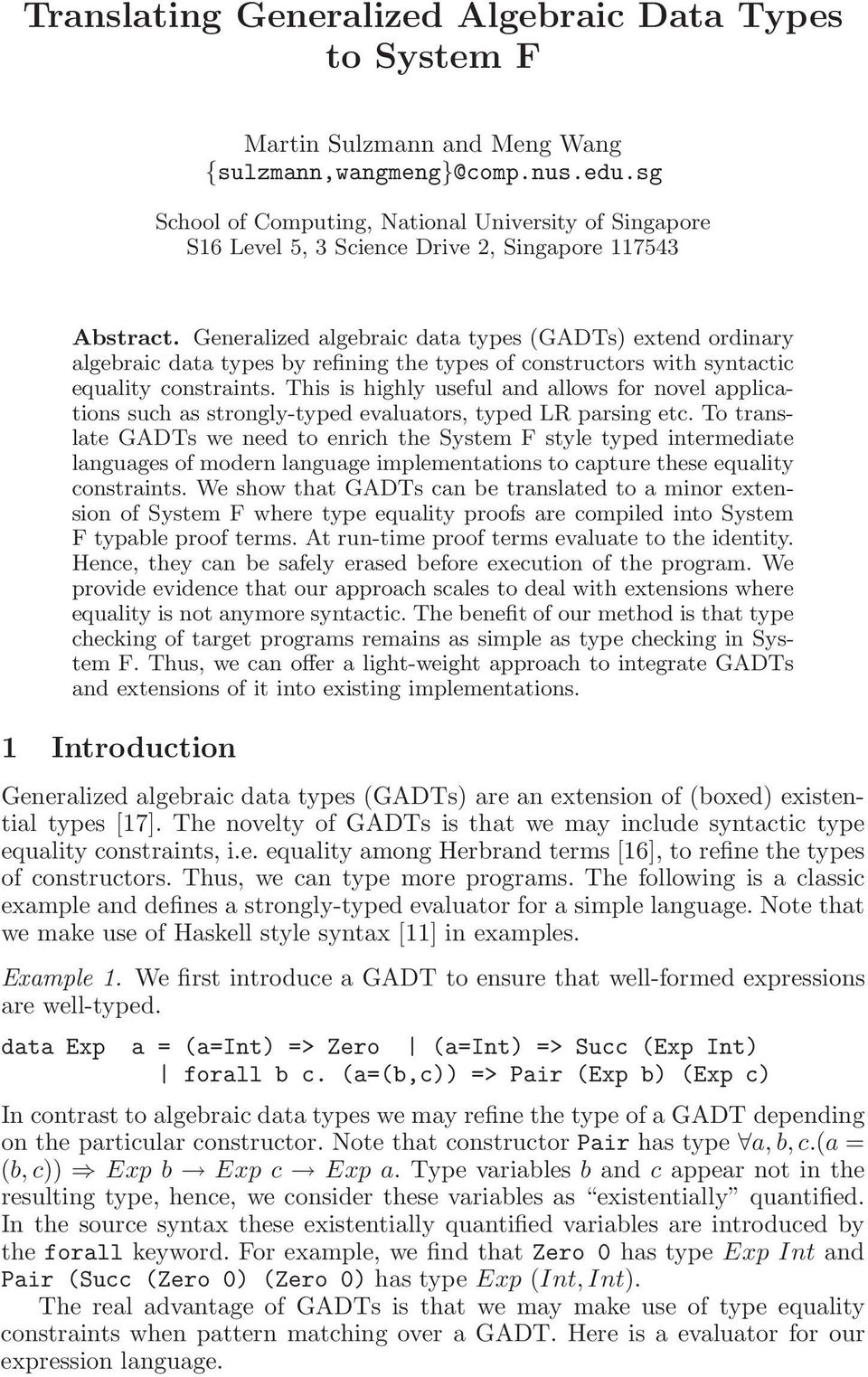
1 Translating Generalized Algebraic Data Types to System F Martin Sulzmann and Meng Wang {sulzmann,wangmeng}@comp.nus.edu.sg School of Computing, National University of Singapore S16 Level 5, 3 Science Drive 2, Singapore Abstract. Generalized algebraic data types (GADTs) extend ordinary algebraic data types by refining the types of constructors with syntactic equality constraints. This is highly useful and allows for novel applications such as strongly-typed evaluators, typed LR parsing etc. To translate GADTs we need to enrich the System F style typed intermediate languages of modern language implementations to capture these equality constraints. We show that GADTs can be translated to a minor extension of System F where type equality proofs are compiled into System F typable proof terms. At run-time proof terms evaluate to the identity. Hence, they can be safely erased before execution of the program. We provide evidence that our approach scales to deal with extensions where equality is not anymore syntactic. The benefit of our method is that type checking of target programs remains as simple as type checking in System F. Thus, we can offer a light-weight approach to integrate GADTs and extensions of it into existing implementations. 1 Introduction Generalized algebraic data types (GADTs) are an extension of (boxed) existential types [17]. The novelty of GADTs is that we may include syntactic type equality constraints, i.e. equality among Herbrand terms [16], to refine the types of constructors. Thus, we can type more programs. The following is a classic example and defines a strongly-typed evaluator for a simple language. Note that we make use of Haskell style syntax [11] in examples. Example 1. We first introduce a GADT to ensure that well-formed expressions are well-typed. data Exp a = (a=int) => Zero (a=int) => Succ (Exp Int) forall b c. (a=(b,c)) => Pair (Exp b) (Exp c) In contrast to algebraic data types we may refine the type of a GADT depending on the particular constructor. Note that constructor Pair has type a, b, c.(a = (b, c)) Exp b Exp c Exp a. Type variables b and c appear not in the resulting type, hence, we consider these variables as existentially quantified. In the source syntax these existentially quantified variables are introduced by the forall keyword. For example, we find that Zero 0 has type Exp Int and Pair (Succ (Zero 0) (Zero 0) has type Exp (Int, Int). The real advantage of GADTs is that we may make use of type equality constraints when pattern matching over a GADT. Here is a evaluator for our expression language.
2 eval :: Exp a -> a eval Zero = 0 eval (Succ e) = (eval e) + 1 eval (Pair x y) = (eval x, eval y) At first look it may be surprising thateval has type a.exp a a. Consider the first clause. We matchzero against type Exp a which gives rise to constraint a = Int. We type the right-hand side of the function definition under the constraint a = Int. Hence, we can convert0 s type which is Int to the type a. Note that the constraint a = Int does not affect other parts of the program. Similar reasoning applies to the other clauses. Hence, eval s annotation is correct. The above is one of the many examples [20,30,24,25] that show how to write more expressive programs and transformations with GADTs. Hence, it is desirable that GADTs become a standard feature supported by todays modern programming languages such as ML [19] and Haskell [11]. An important question is what impact GADTs have on existing language implementations such as GHC [7] and FLINT/ML [27]. The widely adopted translation scheme for typed source languages is to maintain types by means of a sufficiently rich typed target language. It is well-known how to translate Hindley/Milner to System F [10]. The advantage of System F [8, 26] is that type abstraction and application can be made explicit. Thus, the more complicated Hindley/Milner type inference process can be turned into some simple System F type checking. In case of GADTs we clearly need a richer variant of System F. There is a huge variety of System F variants we can choose from, e.g. consider [28] and the references therein. Previous work [14] suggests to extend System F with GADTs itself. We believe that a simpler extension is sufficient. GADT type checking involves verifying statements such as C t 1 = t 2 where refers to Boolean implication, C contains a set of type constraints and t 1 and t 2 are types. Our idea is to apply the proofs are programs principle (a.k.a. Curry- Howard isomorphism) and turn the proof for C t 1 = t 2 into a System F typable proof term (f, g) such that C t 1 = t 2 iff Γ (f, g) : (t 1 t 2, t 2 t 1 ) where Γ is a type environment representing C. Thus, we can translate GADTs to System F s, a simple variant of System F with (boxed) existential types [18] where we insert proof terms to represent type conversions. Here is the translation of Example 1 to System F s. data Exp a = Zero <(a->int,int->a)> Succ <(a->int,int->a)> (Exp Int) Pair b c <(a->(b,c),(b,c)->a)> (Exp b) (Exp c) eval = Λ a. λ x:exp a. case x of Zero <(f,g)> -> <g> 0 Succ <(f,g)> e -> <g> ((eval [Int] e) + 1) Pair bc <(f,g)> x y -> <g> (eval [b] x, eval [c] y) Note that proof terms are marked via <>. Our choice of notation is deliberate and resembles the staging operator found in the area of multi-stage programming [35]. Staged proof terms do not interact with the real program text. This is enforced by the System F s typing rules and the only difference compared to System F. Proof terms are only used for typing purposes. E.g., consider the 2
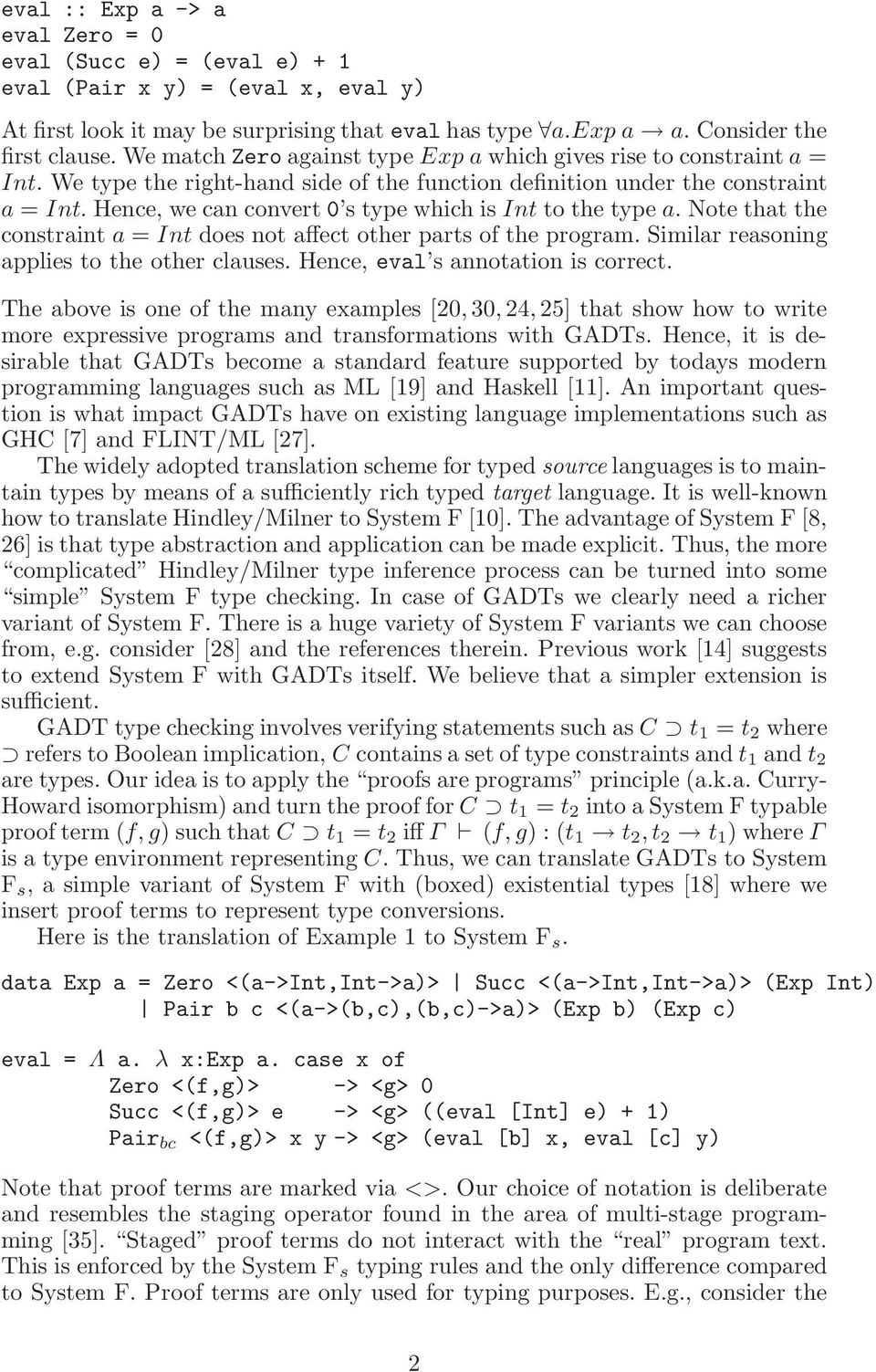
3 first clause where proof term g, representing the GADT type conversion from Int to a, is applied to 0. This guarantees that the resulting System F s program is well-typed. At run-time proof terms turn out to be equivalent to the identity function. Hence, we can safely erase them before execution of the program (similar to the way we erase types). Here is the above program after erasing types and proof terms. eval = λ x. case x of Zero -> 0 Succ e -> (eval e) + 1 Pair x y -> (eval x, eval y) Our translation scheme extends to systems with user-specifiable type constraints [29, 2]. Hence, we can identify a minimal extension of System F which is sufficiently rich to host a variety of GADT style source languages. In summary, our contributions are: We define an extension of System F with staged typing to which we refer to as System F s (Section 4.1). We introduce a proof system to represent type equations and their proofs. We show that all derivable proof terms are well-typed in System F and their evaluation cannot go wrong (Section 4.2). We give a type-directed translation from GADTs to System F s where GADT type equation proofs are represented by staged System F expressions. We show that the resulting System F s program preserves types and the semantic meaning of the original GADT program. We also guarantee that the System F s program cannot go wrong. Thus, we obtain an alternative type soundness result for GADTs (Section 4.3). We establish sufficient conditions under which GADT programs can be directly translated to (boxed) existential types (Section 5). We explore how to extend our translation method to variants of GADTS where type equality is user-specifiable, i.e. not anymore syntactic (Section 6). Section 2 spells out some basic assumptions and notations used throughout the paper. Section 3 provides some background information on GADTs. We conclude in Section 7. We discuss related work where appropriate. Further details such as proofs will appear in a forthcoming technical report. For the time being, we refer the interested reader to a preliminary technical report [34]. 2 Preliminaries For the purpose of this paper, we neglect the issue of type inference for GADTs which is known to be a hard problem [31,32]. Hence, we assume that programs are sufficiently type annotated. We make use of System F extended with Odersky and Läufer style boxed existential types [17, 18] (commonly referred to as existential types for short). We assume familiarity with the standard methods and techniques to establish syntactic type soundness [23, 38] which implies that well-typed programs cannot go wrong. 3
4 (x : ā.c t ) Γ (Var) C [t/a]c (App) C, Γ x : [t/a]t C, Γ e 2 : t 2 C, Γ e 1 : t 2 t C, Γ e 1 e 2 : t (Abs) C, Γ.x : t 1 e : t 2 C, Γ λx.e : t 1 t 2 ( Intro) (Eq) C 1 C 2, Γ e : t ā fv(c 1, Γ) = C 1 ā.c 2, Γ e : ā.c 2 t (Pat) C, Γ e : t C t = t C, Γ e : t (Case) p : t 1 b.(c p Γ p) b fv(c, Γ, t2) = C C p, Γ Γ p e : t 2 C, Γ p e : t 1 t 2 (Let) C, Γ e 1 : σ C, Γ {g : σ} e 2 : t 2 C, Γ let g = e 1 in e 2 : t 2 C, Γ e : t 1 C, Γ p i e i : t 1 t 2 for i I C, Γ case e of [p i e i] i I : t 2 (P-Var) x : t (True {x : t}) K : ā, b.c t 1... t n F ā b ā = (P-K) p i : [t /a]t i b i.(c i Γ pi ) for i = 1,..., n K p 1...p n : F t b 1,..., b n, b.(c 1... C n [t /a]c Γ p1... Γ pn ) Fig.1. GADT Typing Rules We assume familiarity with the concepts of substitutions, unifiers etc [16]. We write ō as a short-hand for a sequence of objects o 1,..., o n (e.g. expressions, types etc). We write [o/a]o to denote applying substitution [o/a] on o, i.e. simultanously replacing all occurrences of variables a i by object o i in o for i = 1,..., n. We write o 1 = o 2 to specify equality among object o 1 and o 2 (a.k.a. unification problem). Sometimes, we write o 1 o 2 to denote syntactic equivalence between two objects o 1 and o 2 in order to avoid confusion with =. We write fv(o) to denote the free variables in some object o. 3 Background: Generalized Algebraic Data Types GADTs first appeared under the name guarded recursive data types [39] and first-class phantom types [6]. Although, the idea of GADTs appears in some even earlier work [40]. Here, we use the more popular becoming name generalized algebraic data types [14]. Our formulation of GADTs as an extension of Hindley/Milner is closest to [31]. Note that all existing variations of GADTs are largely equivalent. The language of expressions, types and constraints is as follows. Expressions e ::= K x λx.e e e let g = e in e case e of [p i e i ] i I Patterns p ::= x K p Types t ::= a t t F t Constraints C ::= t = t C C Type Schemes σ ::= t ᾱ.c t 4
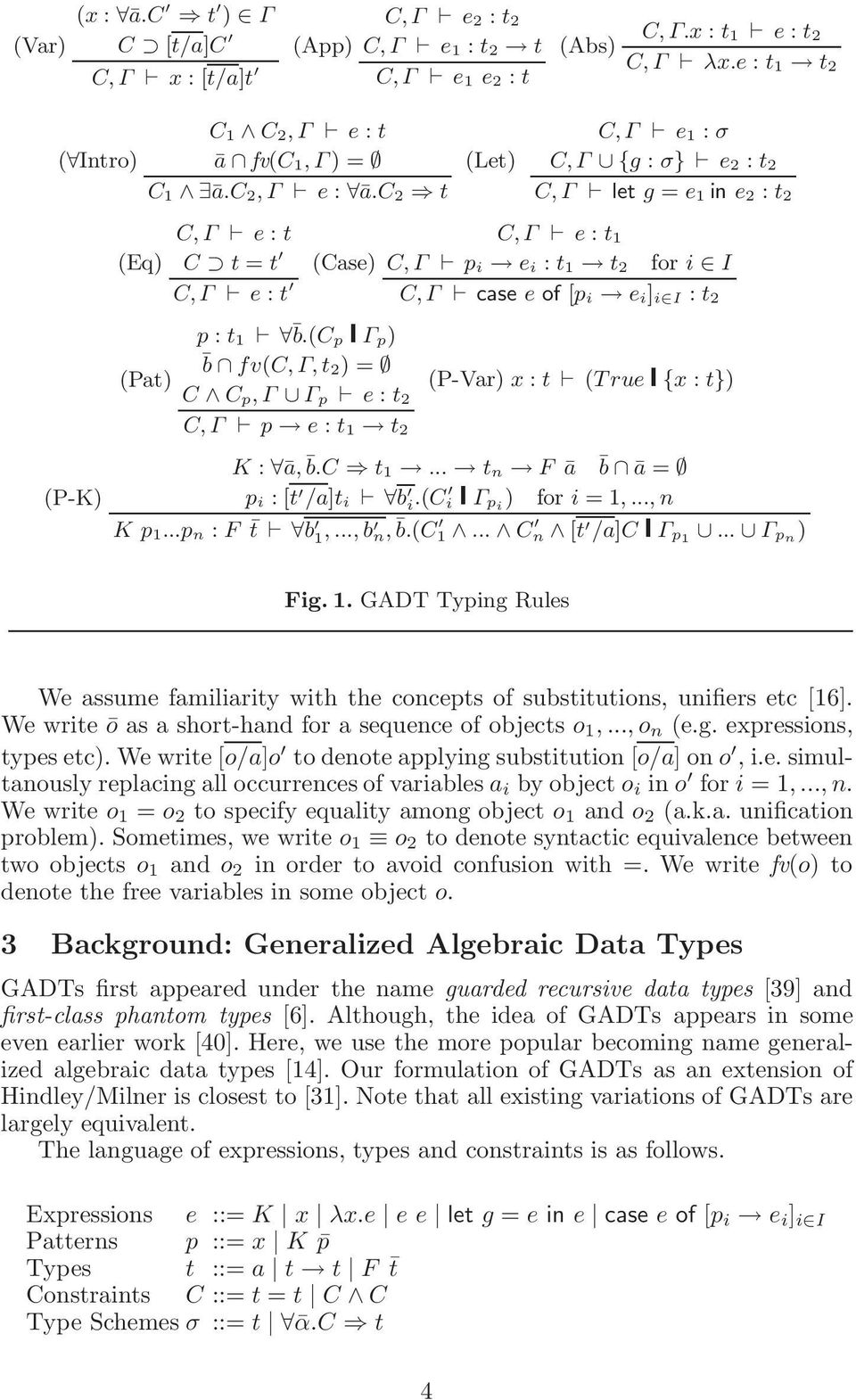
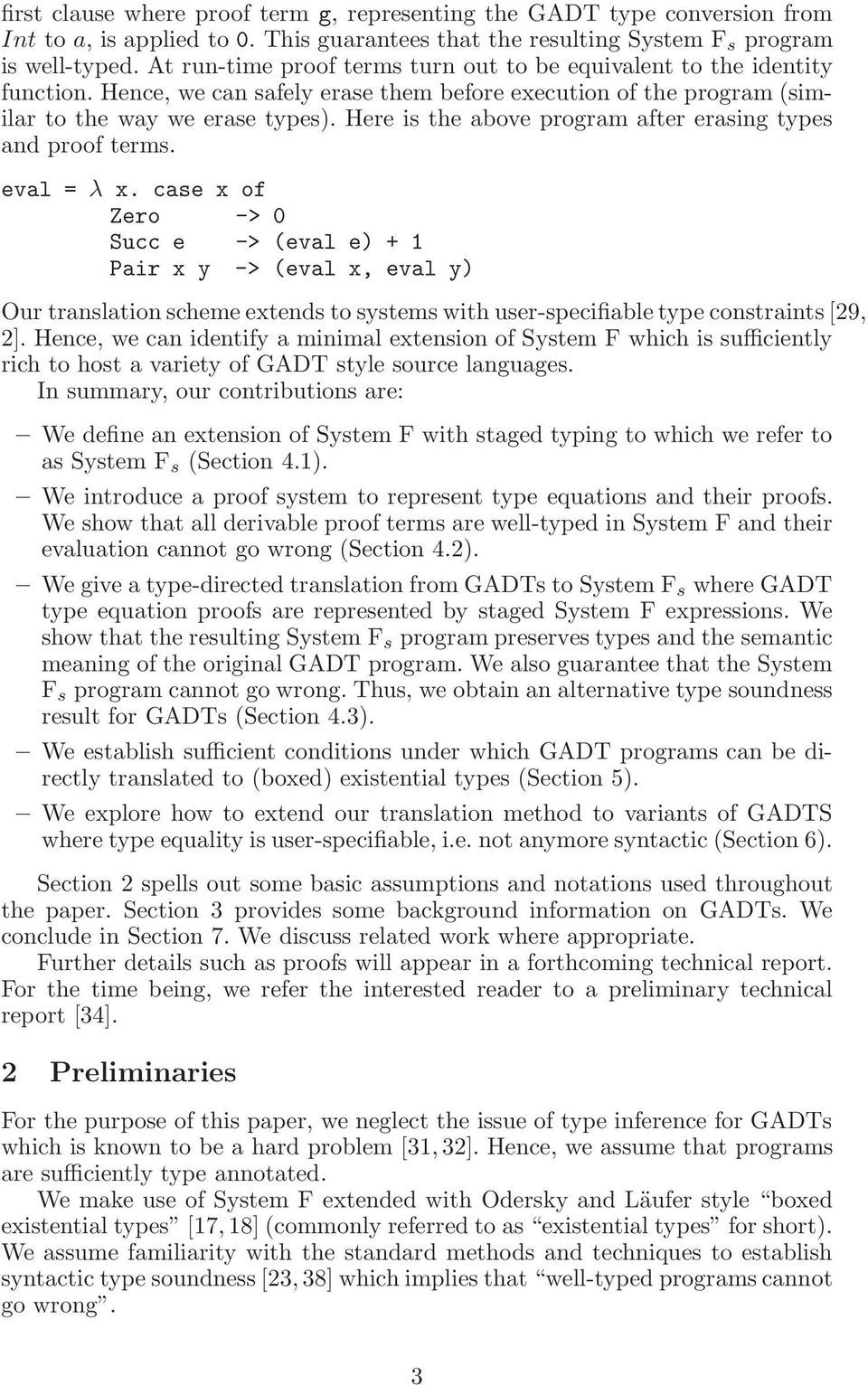
5 For simplicity, we leave out type annotations and recursive function definitions but may make use of them in examples. Pattern matching syntax used in examples can be straightforwardly expressed in terms of case expressions. We assume that K refers to constructors of user-defined data types F ā. Basic types such as booleans, integers, tuples and lists are predefined and their constructors are recorded in some initial environment Γ init. As usual patterns are assumed to be linear, i.e., each variable occurs at most once. We use True as a short-hand for some always satisfiable constraint, e.g. Int = Int. We assume that GADT definitions are pre-processed and the types of their constructors recorded in some initial environment Γ init. E.g., the GADT from Example 1 implies constructors Zero : a.(a = Int) Exp a, Succ : a.(a = Int) Exp Int Exp a and Pair : a, b, c.(a = (b, c)) Exp b Exp c Exp a. This explains the need for constrained type schemes of the form ā.c t. The typing rules describing well-typing of expressions are in Figure 1. We introduce judgments C, Γ e : t to denote that expression e has type t under constraint C and environment Γ which holds a set of type bindings of the form x : σ. A judgment is valid if we find a derivation w.r.t. the typing rules. In rule (Var), we build a type instance of a type scheme by demanding that the instantiated constraint is entailed by the given constraint. This is formally expressed by C [t/a]c. Note that C t 1 = t 2 holds iff (1) C does not have a unifier, or (2) for any unifier φ of C we have that φ(t 1 ) = φ(t 2 ) holds. Rule ( Intro) is the familiar HM(X) [21, 33] quantifier introduction rule. Note that our constraint language does not support existential quantification explicitly. However, w.l.o.g. the constraint ā.c 2 is equivalent to some constraint C 3 consisting of type equations only. Rules (Abs), (App), (Case) and (Let) are standard. The only worth mentioning point is that we consider p e as a (special purpose) expression only appearing in intermediate steps. Next, we consider the GADT specific rules. In rule (Eq) we are able to change the type of an expression. 1 In rule (Pat) we make use of an auxiliary judgment p : t b.(c p Γ p ) which establishes a relation among pattern p of type t, the constraint C p arising out of p and the binding Γ p of variables in p. Variables b refer to all existential variables. Logically, these variables must be considered as universally quantified. Hence, we write b. The side condition b fv(c, Γ, t 2 ) = prevents existential variables from escaping. A common property for typing derivations involving constraints is that if the constraint in the final judgment is satisfiable all constraints arising in intermediate judgments are satisfiable too. This property is lost here as the following variation of Example 1 shows. eval :: Exp Bool -> (Int->Int) eval Zero = 0 Matching the pattern Zero against the type Exp Bool leads to the temporary type constraint Bool = Int. This constraint is equivalent to False. Thus, we can 1 Some formulations allow to change the type of (sub)patterns [31]. This may matter if patterns are nested. For brevity, we neglect such an extension. Note that in case patterns are evaluated in a certain order, say from left-to-right, we can simply translate a nested pattern into a sequence of shallow patterns. This is done in GHC. 5

6 give any type to 0 and therefore eval s rather strange looking type is correct. Note that False does not appear in the final judgment. Cheney and Hinze [6] observed that such programs are meaningless because there is no value of type Exp Bool. Hence, we can never apply eval (under its new type) to a concrete value. We can rule out such meaningless programs by demanding that all constraints in a typing derivation must be satisfiable, i.e. have a unifier. Assumption 1 W.l.o.g. we assume that for any GADT typing derivation we have that all constraints in typing judgments have a unifier. The important consequence is that the entailment test between constraints is now constructive. We exploit this fact in the following section where we represent type equation proofs via well-typed programs. 4 Translating Generalized Algebraic Data Types We proceed in three steps. First, we introduce the syntax and static semantics of System F s. Typing in System F s is staged whereas the dynamic semantics remains essentially unchanged compared to System F. Then, we define a proof system to represent GADT type equations by proof terms typable in System F. Finally, we give a type-directed translation scheme from GADTs to System F s where we insert proof terms to mimic GADT type conversions. Proof terms are staged and evaluate to the identity at run-time. Hence, we can safely remove them without affecting the semantic meaning of the original GADT program. Note that we could achieve our technical results using System F directly. However, we feel that System F s helps to understand the separation between proof terms representing type conversions and the real program text. 4.1 An Extension of System F with Staged Typing System F s inherits the syntax of expressions and types from System F. Target E ::= x E E λx : T.E E [T] Λā.E < E > let g : T = E in E case (T)E of [P i E i ] i I Patterns P ::= (x : T) K b P < P > Types T ::= a T T < T > ā.t The only extension is the staging operator <> which allows us to form staged expressions, patterns and types. We assume that type bindings (x : l T) and judgments E : T carry some stage information; a natural number l. The typing rules in Figure 2 guarantee that lower staged expressions/patterns cannot affect the type of higher staged expressions/patterns and vice versa. See rules (Var), (<> ) and (P-<>). The only exception is rule (<> ) where a staged expression has a unstaged type. As we will see, via this rule we will mimic the GADT (Eq) rule. Note that constructors are explicitly annotated with the set of existential variables. See rule (P-K). The remaining rules contain no surprises as they leave the stage l unchanged. Commonly, we write {x 1 : T 1,..., x n : T n } Fs E : T as a short-hand for {x 1 : 1 T 1,..., x n : 1 T n } 1 F s E : T. We write Γ F E : T to denote a System F 6
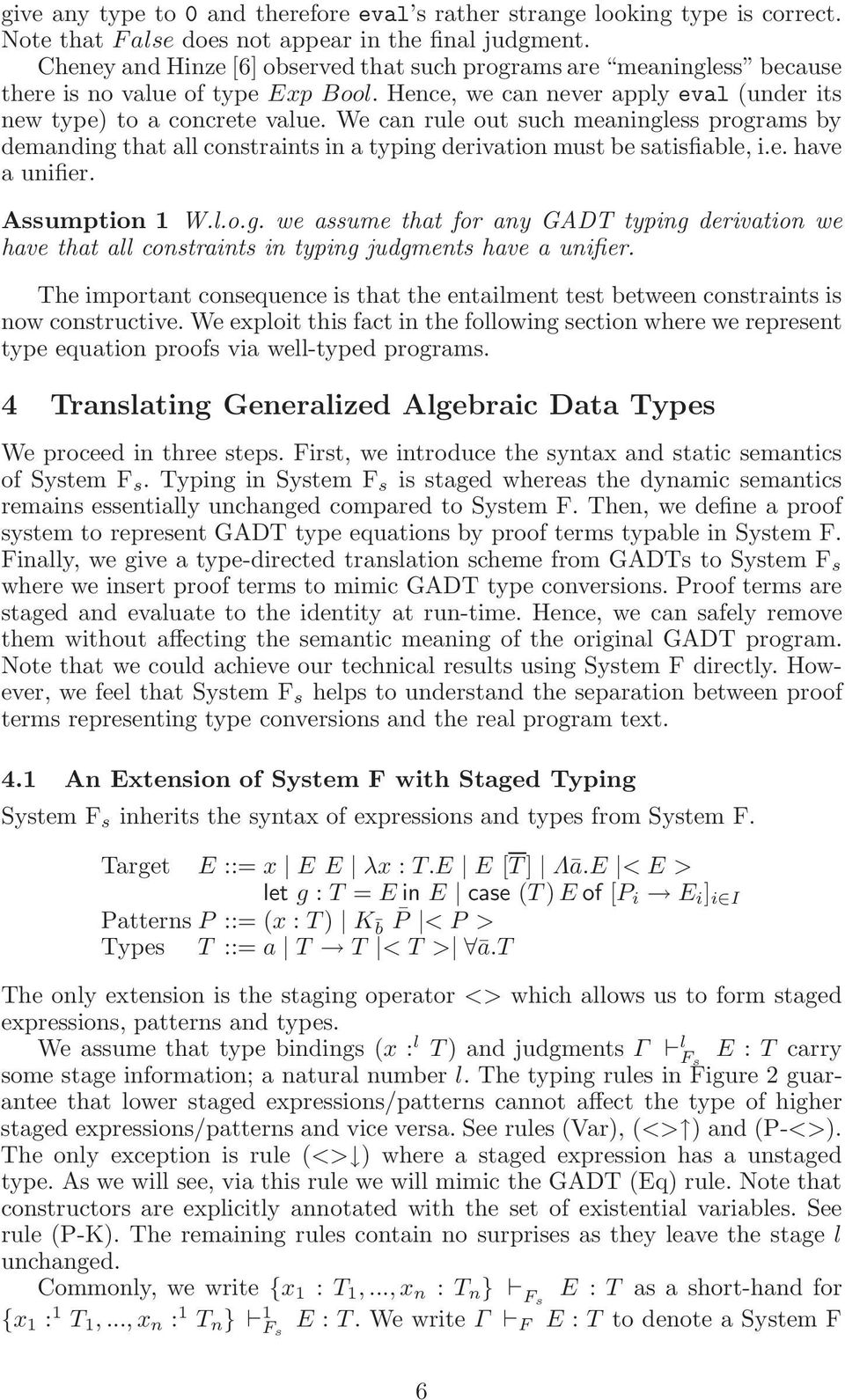
7 (Abs) Γ {x : l T 1} l F s E : T 2 λx : T 1.E : T 1 T 2 (App) Γ l F s E 1 : T 1 T 2 E 2 : T 1 E 1 E 2 : T 2 (T-Abs) Γ l F s E : T ā fv(γ) = Λā.E : ā.t (Var) (x :l ā.t) Γ x : ā.t (Let) E : T (Case) P i E i : T T for i I case (T )E of [P i E i] i I : T Γ l F (T-App) s E : ā.t E [T] : [T/a]T E : ā.t Γ {g : l ā.t } l F s E : T let g : ā.t = E in E : T (Pat) P : T 1 l F s b.γ P b fv(γ, T2) = Γ P E : T 2 P E : T 1 T 2 Γ l+1 F (<> ) s E : T < E >:< T > (<> ) Γ l+1 F s E : T 1 T 2 < E >: T 1 T 2 (P-Var) (x : T) : T l F s {x : l T } P : T l+1 F (P-<>) s b.γ < P >:< T > l F s b.γ K b : ā, b.t 1... T n F ā b ā = P i : [T /a]t i l F (P-K) s b i.γp i for i = 1,..., n c = b 1,..., b n, b Γ = Γ P1... Γ Pn K b b P1...P n : F [T /a] l F s c.γ Fig.2. System F s Typing Rules derivation where we do not make use of the staged rules (<> ), (<> ) and (P-<>). We explain the dynamic semantics of System F s in terms of a standard single-step rewriting semantics [38] written E E. This gives rise to a system of reductions where each expression E either reduces (or evaluates) to a value v, written E v, or we encounter failure (this includes the case that the reduction gets stuck). We assume that staged expressions and patterns follow the same evaluation rules. That is, we simply replace < E > by E and < P > by P before evaluation. The entire development is standard and can be found elsewhere [38,23]. Hence, we omit the details. 4.2 Proof Terms for Type Equations We define a proof system for representing (syntactic) equality among types where type equations carry proof terms. We write (f : g) : t 1 = t 2 to denote that (f, g) is the proof for t 1 = t 2. Depending on the context, we may silently drop proof terms if they do not matter. The proof rules are formulated in terms of judgments C = (f, g) : t 1 = t 2. They are directly derived from a constructive formulation of type equality. Details are in Figure 3. Rule (Var) looks up an equality constraint. For convenience, we interpret a constraint as a set of type equations. Rules (Ref) and (Sym) describe reflexivity and symmetry of equality. In rule (Trans), we write f g as a short-hand for 7

8 (Var) (f, g) : t 1 = t 2 C C = (f, g) : t1 = t2 (Ref) C = (λx.x,λx.x) : t = t (Sym) C = (f, g) : t 1 = t 2 C = (g, f) : t 2 = t 1 (Trans) C = (f1, g1) : t1 = t2 C = (f2, g2) : t2 = t3 C = (f 2 f 1, g 1 g 2) : t 1 = t 3 (F ) C = (f, g) : F t 1...t n = F t (F 1...t n i) C = (decompff i [ t t ] (f, g),decompfg i [ t t ] (f, g)) : t i = t i C = (f i, g i) : t i = t i for i = 1,..., n C = (compff [ t t ] (f 1, g 1)...(f n, g n),compfg [ t t ] (f 1, g 1)...(f n, g n)) : F t = F t Fig.3. Type Equation Proof System λx.f (g x) to define a proof term representing transitivity. Rules (F ) and (F i ) deal with user-defined types F ā (including the function type). Recall that t and t are short-hands for t 1,..., t n and t 1,..., t n. We have that F t 1...t n = F t 1...t n iff t i = t i for i = 1,..., n. Our task is to associate appropriate proof terms to each type equation. For this purpose, we assume the following set of composition and decomposition functions whose types are recorded in some initial proof environment Γ proof compff : a, b.(a 1 b 1, b 1 a 1 )... (a n b n, b n a n ) (F ā F b) compfg : a, b.(a 1 b 1, b 1 a 1 )... (a n b n, b n a n ) (F b F ā) decompff i : a, b.(f ā F b, F b F ā) (a i b i ) decompfg i : a, b.(f ā F b, F b F ā) (b i a i ) It is straightforward to verify that proof terms are typable in System F. Let C (f 1, g 1 ) : t 1 = t 1... (f n, g n ) : t n = t n. We write C Γ to denote the conversion of constraint C into a type environment Γ = {f 1 : t 1 t 1, g 1 : t 1 t 1,..., f n : t n t n, g n : t n t n }. Lemma 1 (Typability). Let C = (E 1, E 2 ) : t = t such that C Γ. Then, Γ Γ proof F E 1 : t t and Γ Γ proof F E 2 : t t. Next, we show that well-typed proof terms are sound. We follow [38] and give meaning to primitive functions such as decompff i,decompfg i,compff and compfg in terms of a function δ : (Primitive ClosedVal) ClosedVal that interprets the application of primitive functions to closed input values and yields closed output values. Thus, we define the rewrite rule primitive v 1...v n δ(c v 1...v n ) if δ(primitive v 1...v n ) is defined For each composition and decomposition primitive for type F a 1...a n we define δ(compff [t 1...t n t 1...t n ] (v 1, v 1 )...(v n, v n )) = λx.x δ(compff [t 1...t n t 1...t n ] (v 1, v 1 )...(v n, v n )) = λx.x δ(decompff i [t 1...t n t 1...t n ] (v 1, v 2 )) = λx.x δ(decompfg i [t 1...t n t 1...t n] (v 1, v 2 )) = λx.x 8
![..t n i) C = (decompff i [ t t ] (f, g),decompfg i [ t t ] (f, g)) : t i = t i C = (f i, g i) : t i = t i for i = 1,..., n C = (compff [ t t ] (f 1, g 1)...(f n, g n),compfg [ t t ] (f 1, g 1).](/docs-images/50/14769050/images/page_8.jpg "..(f n, g n)) : F t = F t Fig.3. Type Equation Proof System λx.f (g x) to define a proof term representing transitivity.")
9 if t j t j (i.e. t j and t j are syntactically equal) for j = 1,..., n. Note that the δ function is undefined in case t j and t j are syntactically different. Hence, there is the danger that the reduction of well-typed proof terms gets stuck. The important observation is that = (E 1, E 2 ) : t 1 = t 2 implies that t 1 and t 2 must be syntactically equal. Hence, during the reduction of proof terms E 1 and E 2 we can guarantee that whenever one of the above primitives is applied to a sequence of closed values [t 1...t n t 1...t n] v 1...v n the condition t j t j for j = 1,..., n is always satisfied. This observation is formalized in the following result. For clarity, we enumerate the individual statements. Lemma 2 (Subject Reduction). Let C = (E 1, E 2 ) : t 1 = t 2 such that (1) for each (f, g) : t = t C we have that t t, (2) E 1 E 1, (3) E 2 E 2 and (4) C Γ for some E 1, E 2 and Γ. Then, (5) t 1 t 2, (6) Γ Γ proof F E 1 : t 1 t 2 and (7) Γ Γ proof F E 2 : t 2 t 1. In order to obtain type soundness, we yet need to verify that well-typed proof terms do not get stuck. We omit the straightforward details. We summarize the results of this section. Proof terms are well-typed and evaluate to the identity function. 2 Theorem 1. Let = (E 1, E 2 ) : t 1 = t 2. Then, (1) t 1 t 2, (2) Γ proof F E 1 : t 1 t 2, (3) Γ proof F E 2 : t 2 t 1, (4) E 1 λx.x and (5) E 2 λx.x. Note that proof term construction is decidable. That is, given C and t 1, t 2 where C has a unifier, there is a decidable algorithm which either finds E 1 and E 2 such that C = (E 1, E 2 ) : t 1 = t 2 or C t 1 = t 2 does not hold. Due to space limitations, we refer the interested reader to [34]. 4.3 Type-Directed Translation Scheme We are in the position to define the translation of GADTs to System F s. For translation purposes, we assume that type constraints t 1 = t 2 in GADT constructors are annotated with proof terms (f, g) where f and g are distinct variables. In a preprocessing step, we translate each GADT constructor K : ā, b.(f 1, g 1 ) : t 1 = t 1... (f n, g n ) : t n = t n ) t 1... t n F ā to a System F s constructor K b : ā, b. < (t 1 t 1, t 1 t 1,..., t n t n, t n t n) > t 1... t n F ā where type constraints are turned into additional (staged) arguments. The actual translation scheme is formulated in terms of judgments C, Γ e : t E. For simplicity, we only consider the most interesting rules. Details are in Figure 4. In rule (Var), we must provide proof terms to satisfy the instantiated constraint [t/a]c. For convenience, we assume that there is a fixed order among 2 Strictly speaking, when applied to a value proof terms behave like the identity function, see rule (Trans) in Figure 3. Though, we could introduce a transitivity primitive which always evaluates to the identity similar to the composition and decomposition primitives. 9
![Hence, during the reduction of proof terms E 1 and E 2 we can guarantee that whenever one of the above primitives is applied to a sequence of closed values [t 1...t n t 1...t n] v 1.](/docs-images/50/14769050/images/page_9.jpg "..v n the condition t j t j for j = 1,..., n is always satisfied. This observation is formalized in the following result. For clarity, we enumerate the individual statements.")
10 (Var) (Eq) (x : ā.c t ) Γ C (f 1, g 1) : t 1 = t 1... (f n, g n) : t n = t n for each t i = t i [t/a]c we have that C = (E i, E i) : t i = t i C, Γ x : [t/a]t x [t] < (E 1, E 1,..., E n, E n) > C, Γ e : t E C = (E, E ) : t = t C, Γ e : t < E > E ( Intro) C 1 C 2, Γ e : t E ā fv(c 1, Γ) = C 2 (f 1, g 1) : t 1 = t 1... (f n, g n) : t n = t n C 1 ā.c 2, Γ e : ā.c 2 t Λā.λ < (f 1, g 1,..., f n, g n) >:< (t 1 t 1, t 1 t 1,..., t n t n, t n t n) >.E (Pat) (P-Var) (P-K) p : t 1 b.(c p Γ p) P b fv(c, Γ, t2) = C C p, Γ Γ p e : t 2 E C, Γ p e : t 1 t 2 P E x : t (True {x : t}) x K : ā, b.c t 1... t n F ā C (f 1, g 1) : t 1 = t 1... (f n, g n) : t n = t n ) b ā = p i : [t /a]t i b i.(c i Γ pi ) P i for i = 1,..., n ( K p 1...p n : F t b 1,..., b n, b.c 1... C n [t /a]c Γ p1... Γ pn ) K b < (f 1, g 1,..., f n, g n) > P 1...P n Fig. 4. Type-Directed Translation (interesting cases) type equations t i = t i in [t/a]c. We are a bit sloppy here and simply drop the proof terms associated to t i = t i. Based on Assumption 1 we know that C = E i : t i = t i holds iff C t i = t i. The same observations applies in case of rule (Eq) where we apply proof term E to maintain well-typing of expressions. In rule ( Intro), we turn constraints in type schemes into additional proof term parameters. For convenience, we use pattern syntax in λ-abstraction. The main tasks of rules (Pat), (Pat-Var) and (Pat-K) are to translate patterns which now may contain proof terms. The left out rules are the familiar ones for translating Hindley/Milner to System F [10]. We can verify that resulting expressions are typable in System F s. E.g., consider rule (Eq). Let C Γ C. We write ΓC 2 and Γ proof 2 to denote that the type bindings are at stage 2. Then, ΓC 2 Γ proof 2 2 F s E : t t (follows from Lemma 1). Via the System F s rules (<> ) and (App), we can conclude that ΓC 2 Γ proof 2 Γ 1 F s < E > E : t. Similar reasoning steps apply to the other rules. We can also verify that the evaluation of resulting expressions cannot go wrong. System F s inherits the System F type soundness result. By construction, 10

11 the evaluation of proof terms is independent of the surrounding program text (this is explicitly enforced by the System F s typing rules). Hence, Theorem 1 (proof terms cannot go wrong) is applicable and therefore the translated program cannot go wrong. We summarize. Theorem 2 (Type Preservation and Soundness). Let True, e : t E. Then, Γ 2 proof 1 F s E : t and E v for some value v. 3 Theorem 1 (proof terms evaluate to the identity) also guarantees that proof terms do not affect the semantic meaning of the GADT program. Hence, we can safely erase them. Hence, the original GADT program is equivalent to the resulting System F s program after erasing proof terms and types. Corollary 1. Let e : t E. Then, E(E) = e. The erasure function E() is defined following the structure of possible target and pattern terms: E(E [T]) = E(E) E(Λā.E) = E(E) E(E 1 E 2 ) = E(E 1 ) E(E 2 ) E(λx : T.E) = λx.e(e) E(< E 1 > E 2 ) = E(E 2 ) E(x [T] < E >) = x E(let g : T = E in E ) = let g = E(E)in E(E ) E(x) = x E(case (T)E of [P i E i ] i I ) = case E(E)of [E(P i ) E(E i )] i I E(K < E > P 1...P n ) = K E(P 1 )...E(P n ) E(x : T) = x Another immediate consequence is the following result. Corollary 2. Well-typed GADT programs cannot go wrong. 5 Direct Translation of GADTs to Existential Types A number of authors [1, 4,5, 22,37] have shown by example that GADT style behavior can often be directly encoded in terms of existing languages such as Haskell [11]. The following (non-sensical) example shows that a source-level encoding is not always possible. Example 2. Consider data Erk a = (Int->Int=a->Int) => I a f :: Erk a->a f (I x) = 0 which is clearly type correct. Note that Int Int = a Int iff Int = a. Our translation method yields data Erk a = I <((Int->Int)->(a->Int),(a->Int)->(Int->Int))> a f = Λ y:erk a.case y of I <(f,g)> x -> <decomp [a Int Int Int] (f,g)> 0 3 In case we extend the source language with recursive functions we need the additional case that reduction of E may not terminate. 11

12 where decomp : a 1, a 2, a 3, a 4.((a 1 a 2 ) (a 3 a 4 ), (a 3 a 4 ) (a 1 a 2 )) (a 1 a 3 ) and δ(decomp [t 1 t 2 t 3 t 4 ](v 1, v 2 )) = λx.x if t 1 t 3 and t 2 t 4. Assume we want to represent the System F s program in Haskell. Then, we need to find a closed definition of decomp. However, there seems to be no Haskell expression of type a 1, a 2, a 3, a 4.((a 1 a 2 ) (a 3 a 4 ), (a 3 a 4 ) (a 1 a 2 )) (a 1 a 3 ). The decomposition issue has already been pointed out by Chen, Zhu and Xi [4]. 4 The methods developed here allow us to establish sufficient conditions under which a translation from GADT to existential types is possible. Definition 1 (Decomposition). We say a GADT program satisfies the decomposition condition if all proof terms arising in a GADT typing derivation are well-typed in a system with existential types. Immediately, we can derive the following result from Theorem 2. Corollary 3. GADTs can be translated to existential types if the decomposition condition is satisfied. We have conducted a survey of all (sensible) GADT examples we found in the literature. The surprising observation is that all examples satisfy the decomposition condition. Hence, a translation to existential types is possible in theory. A selection of GADT programs and their translation to existential types can be found here [34]. Obviously, the direct encoding of GADTs in terms of existential types (if possible at all) is not practical due to a high run-time overhead of proof terms. We know that at run-time all proof terms evaluate to the identity. However, in order to ensure that composition/decomposition functions are well-typed with existential types, we have to traverse structured data (such as lists, trees etc) and repeatedly apply (proof term) functions to each element to get the types right. E.g., here is the closed definition of the composition function for lists. (List ) C = (f, g) : a = b C = (λx.map f x, λx.map g x) : [a] = [b] On the other hand, the composition/decomposition primitives in System F s never inspect the structure of the input arguments. They immediately evaluate to the identity. In this context, it is interesting to point out that the type-preserving defunctionalization transformation of polymorphic programs to System F extended with GADTs by Pottier and Gauthier [24] always satisfies the decomposition condition. This follows straightforwardly from their formal results (proofs of Lemmas 4.1 and 4.2 in [24]). More details can be found here [34]. 4 This is hardly surprising given that similar situations arise when translating type class programs [9]. E.g., we cannot decompose the equality type class Eq [a] into Eq a for any a. 12
![((a 1 a 2 ) (a 3 a 4 ), (a 3 a 4 ) (a 1 a 2 )) (a 1 a 3 ). The decomposition issue has already been pointed out by Chen, Zhu and Xi [4].](/docs-images/50/14769050/images/page_12.jpg "4 The methods developed here allow us to establish sufficient conditions under which a translation from GADT to existential types is possible. Definition 1 (Decomposition).")
13 6 Extensions with User-Specifiable Type Equality We provide evidence that our translation method scales to extensions where type equality is user-specifiable. For concreteness, we use the associated types (AT) formalism [2] to represent type equality definitions. Our task is to represent AT type definitions by extending the proof system in Section 4.2. As a simple example, we define a extended GADT to represent a while language which satisfies a resource usage policy specified in terms of a DFA. The DFA transitions are specified via AT type functions. In the extended GADT, we make use of these type functions. Example 3. Here is an excerpt of a possible specification. -- states type S0; type S1 -- alphabet type Open; type Write; type Close -- transition function type Delta S0 Open = S1 -- (1) type Delta S1 Close = S0 -- (2) type Delta S1 Write = S1 -- (3) -- Resource GADT data Cmd p q = forall r. Seq (Cmd p r) (Cmd r q) ITE Exp (Cmd p q) (Cmd p q) (p=q) => While Exp (Cmd p q) -- while state is invariant (Delta p Open = q) => OpenF (Delta p Close = q) => CloseF (Delta p Write = q) => WriteF We introduce type function Delta and some type constants to specify the resource DFA in terms of (type) function definitions (1-3). We make use of these assumptions when defining the GADT Cmd p q where type parameters p and q represent the input and output state, before and after execution of the command. We can translate programs making use of such extended GADTs by appropriately extending our proof system in Section 4.2. For the above example, we define (D1) C = (f 1, g 1 ) : Delta S0 Open = S1 (D2) C = (f 2, g 2 ) : Delta S1 Close = S0 (D3) C = (f 3, g 3 ) : Delta S1 Write = S1 where f 1 : Delta S0 Open S1, g 1 : S1 Delta S0 Open etc are in Γ proof, and δ(f 1 v) = λx.x if typeof (v) = S1, δ(g 1 v) = λx.x if typeof (v) = Delta S0 Open etc. Function typeof () retrieves the type of a value. Let s consider another (contrived) example. We define type F [a] = [F a], i.e. for any a we have that F [a] and [F a] are equal. The corresponding proof rule is as follows. (F) C = (upf [t], downf [t]) : F [t] = [F t] 13

14 where upf : a.f [a] [F a], downf : a.[f a] F [a] Γ proof and δ(upf [t] v) = λx.x, δ(downf [t] v) = λx.x if F [t] = [F t]. Note that the additional primitives complicate the semantics of System F s. E.g., when executing primitive upf in context [t] v we need to test that F [t] = [F t] holds. Depending on the set of AT definitions deciding type equality may become undecidable (e.g. consider type F [a] = [F [a]]). The important point to note is that the test for type equality is only necessary to verify soundness of our (extended) translation scheme. At run-time proof terms evaluate to the identity. They can be safely erased and therefore they do not incur any additional run-time cost. A second important point is that our target language can host source programs with a in general undecidable equational theory. We only require that when translating a specific source program we must provide a (type equality) proof which can be translated into a proof term. 7 Conclusion We have shown how to translate GADTs to System F s, a minor extension of System F with existential types and staged proof terms. The advantage of our method is that type equality is only necessary to establish soundness of the translation scheme. Type inference on the source program has already done all the hard work for us, e.g. verifying type equality. There seems no point in repeating such tests in the target language. Instead, we apply the proofs are programs principle and compile type equation proofs into System F typable proof terms. We could provide evidence that our methods extends to systems where type equality is user-specifiable as long as we find a suitable System F representation. Thus, type checking of target programs remains as simple as type checking in System F. At run-time, proof terms evaluate to the identity, therefore, they can be safely erased. Hence, our method does not impose any additional run-time overhead. In case of user-specifiable type equality we need to ensure that the additional proof rules still satisfy Theorem 1 which is crucial to guarantee soundness of our translation method. In this context, it may be worthwhile to consider extending System F itself with some form of type equality. These are interesting topics which deserve further studies in the future. We also established sufficient conditions under which GADTs can be translated to existential types as found in Haskell (Section 5). This result is not of high practical relevance, but confirms the observation made by a number of authors [1, 4, 5, 22, 37] that the concepts of GADTs and existential types are fairly close and often equivalent in terms of expressive power. We note that System F s is more general than necessary. To host GADT programs, we only need two stage expressions, patterns and types (see Section 4). However, we envision extensions of GADTs where types are classified by kinds (in the same way values are classified by types). Then, type equation proof terms may contain (staged) kind proof terms. We believe that System F s is already equipped to deal with the translation of such cases. References 1. A. I. Baars and S. D. Swierstra. Typing dynamic typing. In Proc. of ICF 02, pages ACM Press,
15 2. M. Chakravarty, G. Keller, and S. Peyton Jones. Associated types synonyms. In Proc. of ICFP 05, pages ACM Press, M. Chakravarty, G. Keller, S. Peyton Jones, and S. Marlow. Associated types with class. In Proc. of POPL 05, pages ACM Press, C. Chen, D. Zhu, and H. Xi. Implementing cut elimination: A case study of simulating dependent types in Haskell. In Proc. of PADL 04, volume 3057 of LNCS, pages Springer-Verlag, J. Cheney and R. Hinze. A lightweight implementation of generics and dynamics. In Proc. of Haskell Workshop 02, pages ACM Press, J. Cheney and R. Hinze. First-class phantom types. Technical Report CUCIS TR , Cornell University, Glasgow haskell compiler home page J. Girard. Interpretation fonctionnelle et elimination des coupures de l arithmetique d ordre superieur. Thèse d état, Université Paris 7, June C. V. Hall, K. Hammond, S. Peyton Jones, and P. Wadler. Type classes in Haskell. In ESOP 94, volume 788 of LNCS, pages Springer-Verlag, April R. Harper and J. C. Mitchell. On the type structure of standard ML. ACM Transactions on Programming Languages and Systems, 15(2): , Haskell 98 language report. revised/haskell98-report-html/. 12. M. P. Jones. Simplifying and improving qualified types. In FPCA 95: Conference on Functional Programming Languages and Computer Architecture. ACM Press, M. P. Jones. Type classes with functional dependencies. In Proc. of ESOP 00, volume 1782 of LNCS. Springer-Verlag, S. Peyton Jones, G. Washburn, and S. Weirich. Wobbly types: type inference for generalised algebraic data types, Submitted to POPL S. Kaes. Parametric overloading in polymorphic programming languages. In In Proc. of ESOP 88, volume 300 of LNCS, pages Springer-Verlag, J. Lassez, M. Maher, and K. Marriott. Unification revisited. In Foundations of Deductive Databases and Logic Programming. Morgan Kauffman, K. Läufer and M. Odersky. An extension of ML with first-class abstract types. In ACM SIGPLAN Workshop on ML and its Applications, pages 78 91, K. Läufer and M. Odersky. Polymorphic type inference and abstract data types. ACM Trans. Program. Lang. Syst., 16(5): , Robin Milner, Mads Tofte, and David Macqueen. The Definition of Standard ML. MIT Press, H. Nilsson. Dynamic optimization for functional reactive programming using generalized algebraic data types. In Proc. of ICFP 05, pages ACM Press, M. Odersky, M. Sulzmann, and M Wehr. Type inference with constrained types. Theory and Practice of Object Systems, 5(1):35 55, E. Pasalic. The Role of Type Equality in Meta-Programming. PhD thesis, Oregon Health & Science University, OGI School of Science & Engineering, September B. Pierce. Types and Programming Languages. The MIT Press, F. Pottier and N. Gauthier. Polymorphic typed defunctionalization. In Proc. of POPL 04, pages ACM Press, January F. Pottier and Y. Rgis-Gianas. Towards efficient, typed LR parsers. Draft paper, September J. C. Reynolds. Towards a theory of type structure. In Programming Symposium, Proceedings Colloque sur la Programmation, pages Springer-Verlag, Z. Shao. An overview of the FLINT/ML compiler. In Proc. of ACM SIGPLAN Workshop on Types in Compilation (TIC 97), Z. Shao, B. Saha, V. Trifonov, and N. Papaspyrou. A type system for certified binaries. In Proc. of POPL 02, pages ACM Press,
16 29. T. Sheard. Omega. sheard/omega/index.html. 30. T. Sheard. Languages of the future. SIGPLAN Not., 39(10): , V. Simonet and F. Pottier. Constraint-based type inference for guarded algebraic data types. Research Report 5462, INRIA, January P. J. Stuckey and M. Sulzmann. Type inference for guarded recursive data types. sulzmann, Draft. 33. M. Sulzmann. A General Framework for Hindley/Milner Type Systems with Constraints. PhD thesis, Yale University, Department of Computer Science, May M. Sulzmann and M. Wang. A systematic translation of guarded recursive data types to existential types. Technical Report TR22/04, The National University of Singapore, W. Taha. Multi-Stage Programming: Its Theory and Applications. PhD thesis, Oregon Graduate Institute of Science and Technology, P. Wadler and S. Blott. How to make ad-hoc polymorphism less ad-hoc. In Proc. of POPL 89, pages ACM Press, S. Weirich. Type-safe cast: (functional pearl). In Proc. of ICFP 00, pages ACM Press, A. K. Wright and M. Felleisen. A syntactic approach to type soundness. Inf. Comput., 115(1):38 94, H. Xi, C. Chen, and G. Chen. Guarded recursive datatype constructors. In Proc. of POPL 03, pages ACM Press, C. Zenger. Indizierte Typen. PhD thesis, Universität Karlsruhe, A Translating Type Classes in the Presence of Type Improvement User-specifiable type equations also arise in the context of type classes [36, 15] with type improvement [12]. For concreteness, we consider the associated types (ATs) [3, 2] (improvement) formalism. Similar observations apply to other formalisms such as functional dependencies [13]. Example 4. Consider the following AT program class C a where type F a -- (1) class D a where d :: C a => F a->f a instance C Int where type F Int = Bool -- (2) instance D Int where d x = x && True -- (3) Type class C introduces a type function F (see (1)) whose concrete definitions are provided by the instance declarations (see (2)). Effectively, we state that the type F Int can be improved to Int and vice versa. Type class D introduces a method which is locally constrained by the type class C. Note that the second input and result type are constrained by the type F a. We verify type correctness of instance definition (3). Let us assume thatxhas type F Int. Based on (2) we can improve x s type to Bool. Hence, expression x && True has type Bool. which can be improved to F Int. Hence, the definition is correct. 16
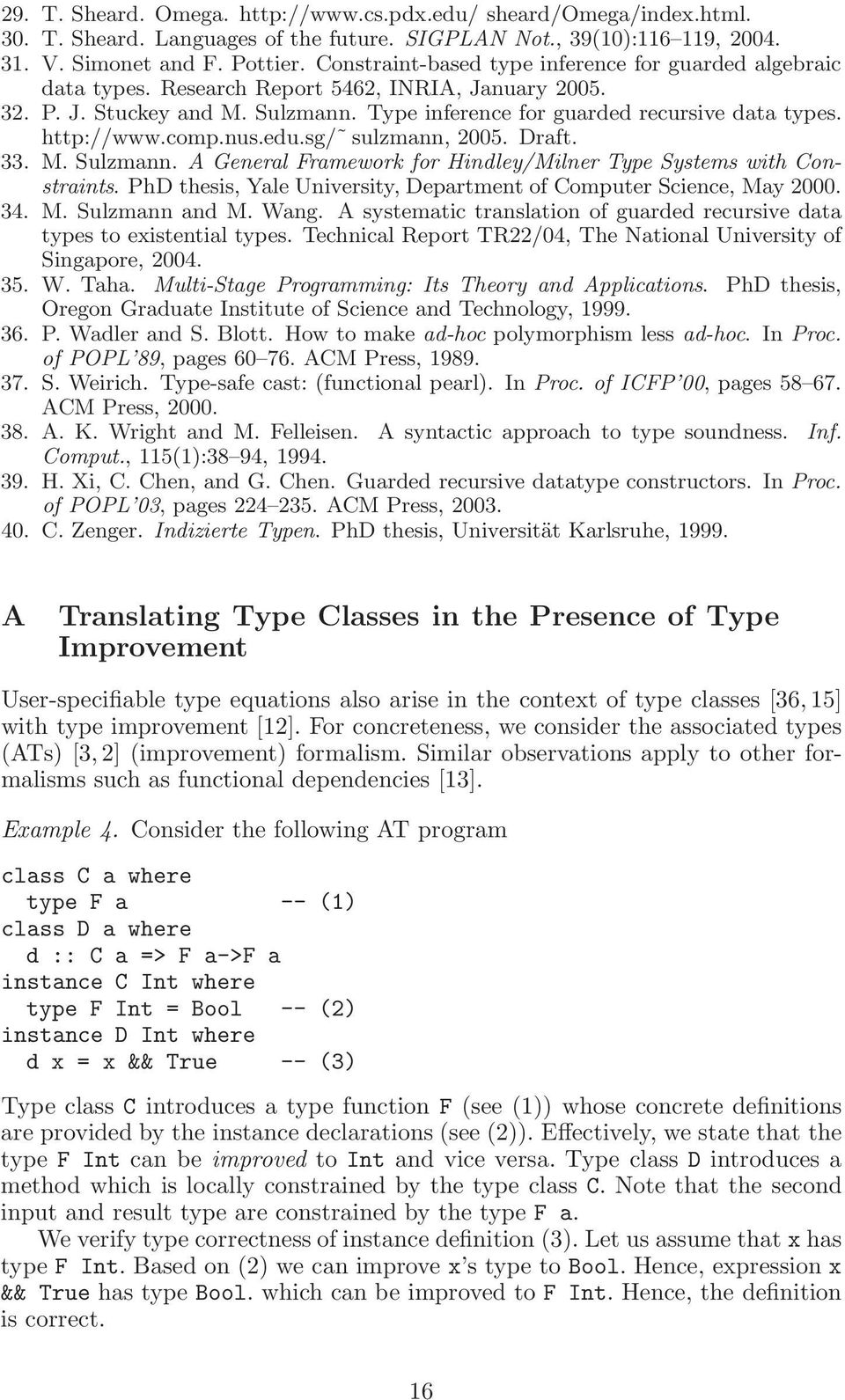
17 Existing translation schemes [3, 2] use System F as their target language. For the above program, the only choice we have is to replace type F a by a universally quantified variable b and add b as a parameter to type class C. Then, the translation of definition (3) is as follows. data C a b =... d = Λ b λ d:c b. λ x:b. x && True However, the above translation is not type correct. Variable x has the universal type b but is conjoined with True. Thus, x must have type Bool which leads to a contradiction. The above program is contrived, but similar examples crop up all the time on the Haskell mailing list. The bottom line is this. Existing implementations [7] rely on System F as their target language. Hence, some sensible programs are rejected. On the other hand, in a translation scheme based on System F s we can represent the type equation F Int=Bool via primitives f1:f Int->Bool and g1:bool->f Int. Thus, definition (3) can be translated as follows while preserving well-typing. d = λ d:c Int. λ x:f Int. <g1>((<f1> x) && Bool) Here is another AT example. Example 5. Consider type F a data G a = forall b. (F a=b) => K (b->b) f (K h1) (K h2) = K (h1.h2) translates to data G a = forall b. (F a=b) => K (F a->b,b->f a) (b->b) f (K <(f1,g1)> h1) (K <(f2,g2>) h2) = K <(f2,g2)> (\x->(<f2> (<g1> (h1 (<f1> (<g2> (h2 x))))))) 17

Adding GADTs to OCaml the direct approach
 Adding GADTs to OCaml the direct approach Jacques Garrigue & Jacques Le Normand Nagoya University / LexiFi (Paris) https://sites.google.com/site/ocamlgadt/ Garrigue & Le Normand Adding GADTs to OCaml 1
OutsideIn(X) Modular type inference with local assumptions
 Under consideration for publication in J. Functional Programming 1 OutsideIn(X) Modular type inference with local assumptions 11 April 2011 Dimitrios Vytiniotis Microsoft Research Simon Peyton Jones Microsoft
Aspect-Oriented Programming with Type Classes
 Aspect-Oriented Programming with Type Classes Martin Sulzmann School of Computing, National University of Singapore S16 Level 5, 3 Science Drive 2, Singapore 117543 [email protected] Meng Wang School
POLYTYPIC PROGRAMMING OR: Programming Language Theory is Helpful
 POLYTYPIC PROGRAMMING OR: Programming Language Theory is Helpful RALF HINZE Institute of Information and Computing Sciences Utrecht University Email: [email protected] Homepage: http://www.cs.uu.nl/~ralf/
Type Classes with Functional Dependencies
 Appears in Proceedings of the 9th European Symposium on Programming, ESOP 2000, Berlin, Germany, March 2000, Springer-Verlag LNCS 1782. Type Classes with Functional Dependencies Mark P. Jones Department
First Class Overloading via Insersection Type Parameters
 First Class Overloading via Insersection Type Parameters Elton Cardoso 2, Carlos Camarão 1, and Lucilia Figueiredo 2 1 Universidade Federal de Minas Gerais, [email protected] 2 Universidade Federal de
The countdown problem
 JFP 12 (6): 609 616, November 2002. c 2002 Cambridge University Press DOI: 10.1017/S0956796801004300 Printed in the United Kingdom 609 F U N C T I O N A L P E A R L The countdown problem GRAHAM HUTTON
Introduction to type systems
 Introduction to type systems p. 1/5 Introductory Course on Logic and Automata Theory Introduction to type systems [email protected] Based on slides by Jeff Foster, UMD Introduction to type systems
Types, Polymorphism, and Type Reconstruction
 Types, Polymorphism, and Type Reconstruction Sources This material is based on the following sources: Pierce, B.C., Types and Programming Languages. MIT Press, 2002. Kanellakis, P.C., Mairson, H.G. and
Parametric Domain-theoretic models of Linear Abadi & Plotkin Logic
 Parametric Domain-theoretic models of Linear Abadi & Plotkin Logic Lars Birkedal Rasmus Ejlers Møgelberg Rasmus Lerchedahl Petersen IT University Technical Report Series TR-00-7 ISSN 600 600 February 00
Chapter 7: Functional Programming Languages
 Chapter 7: Functional Programming Languages Aarne Ranta Slides for the book Implementing Programming Languages. An Introduction to Compilers and Interpreters, College Publications, 2012. Fun: a language
Journal of Functional Programming, volume 3 number 4, 1993. Dynamics in ML
 Journal of Functional Programming, volume 3 number 4, 1993. Dynamics in ML Xavier Leroy École Normale Supérieure Michel Mauny INRIA Rocquencourt Abstract Objects with dynamic types allow the integration
Lecture 2: Universality
 CS 710: Complexity Theory 1/21/2010 Lecture 2: Universality Instructor: Dieter van Melkebeek Scribe: Tyson Williams In this lecture, we introduce the notion of a universal machine, develop efficient universal
Programming Languages Featherweight Java David Walker
 Programming Languages Featherweight Java David Walker Overview Featherweight Java (FJ), a minimal Javalike language. Models inheritance and subtyping. Immutable objects: no mutation of fields. Trivialized
Continued Fractions and the Euclidean Algorithm
 Continued Fractions and the Euclidean Algorithm Lecture notes prepared for MATH 326, Spring 997 Department of Mathematics and Statistics University at Albany William F Hammond Table of Contents Introduction
CS510 Software Engineering
 CS510 Software Engineering Propositional Logic Asst. Prof. Mathias Payer Department of Computer Science Purdue University TA: Scott A. Carr Slides inspired by Xiangyu Zhang http://nebelwelt.net/teaching/15-cs510-se
Translating a Subset of OCaml into System F. Jonatha Protzenk under the dire ion of François Po ier
 Translating a Subset of OCaml into System F Jonatha Protzenk under the dire ion of François Po ier June I Some background 1 Motivations Contents I Some background 2 1 Motivations 2 2 A high-level description
Functional Programming. Functional Programming Languages. Chapter 14. Introduction
 Functional Programming Languages Chapter 14 Introduction Functional programming paradigm History Features and concepts Examples: Lisp ML 1 2 Functional Programming Functional Programming Languages The
Fun with Phantom Types
 1 Fun with Phantom Types RALF HINZE Institut für Informatik III, Universität Bonn Römerstraße 164, 53117 Bonn, Germany Email: [email protected] Homepage: http://www.informatik.uni-bonn.de/~ralf
6.045: Automata, Computability, and Complexity Or, Great Ideas in Theoretical Computer Science Spring, 2010. Class 4 Nancy Lynch
 6.045: Automata, Computability, and Complexity Or, Great Ideas in Theoretical Computer Science Spring, 2010 Class 4 Nancy Lynch Today Two more models of computation: Nondeterministic Finite Automata (NFAs)
THREE DIMENSIONAL GEOMETRY
 Chapter 8 THREE DIMENSIONAL GEOMETRY 8.1 Introduction In this chapter we present a vector algebra approach to three dimensional geometry. The aim is to present standard properties of lines and planes,
Unboxed Polymorphic Objects for Functional Numerical Programming
 Unboxed Polymorphic Objects for Functional Numerical Programming Christopher Rodrigues [email protected] Wen-Mei Hwu [email protected] IMPACT Technical Report IMPACT-12-02 University of Illinois at
Chapter II. Controlling Cars on a Bridge
 Chapter II. Controlling Cars on a Bridge 1 Introduction The intent of this chapter is to introduce a complete example of a small system development. During this development, you will be made aware of the
CHAPTER 7 GENERAL PROOF SYSTEMS
 CHAPTER 7 GENERAL PROOF SYSTEMS 1 Introduction Proof systems are built to prove statements. They can be thought as an inference machine with special statements, called provable statements, or sometimes
System Description: Delphin A Functional Programming Language for Deductive Systems
 System Description: Delphin A Functional Programming Language for Deductive Systems Adam Poswolsky 1 and Carsten Schürmann 2 1 Yale University [email protected] 2 IT University of Copenhagen [email protected]
A Framework for the Semantics of Behavioral Contracts
 A Framework for the Semantics of Behavioral Contracts Ashley McNeile Metamaxim Ltd, 48 Brunswick Gardens, London W8 4AN, UK [email protected] Abstract. Contracts have proved a powerful concept
OPERATIONAL TYPE THEORY by Adam Petcher Prepared under the direction of Professor Aaron Stump A thesis presented to the School of Engineering of
 WASHINGTON NIVERSITY SCHOOL OF ENGINEERING AND APPLIED SCIENCE DEPARTMENT OF COMPTER SCIENCE AND ENGINEERING DECIDING JOINABILITY MODLO GROND EQATIONS IN OPERATIONAL TYPE THEORY by Adam Petcher Prepared
Moving from CS 61A Scheme to CS 61B Java
 Moving from CS 61A Scheme to CS 61B Java Introduction Java is an object-oriented language. This document describes some of the differences between object-oriented programming in Scheme (which we hope you
[Refer Slide Time: 05:10]
![[Refer Slide Time: 05:10]](/thumbs/29/13447118.jpg "[Refer Slide Time: 05:10]") Principles of Programming Languages Prof: S. Arun Kumar Department of Computer Science and Engineering Indian Institute of Technology Delhi Lecture no 7 Lecture Title: Syntactic Classes Welcome to lecture
Principles of Programming Languages Prof: S. Arun Kumar Department of Computer Science and Engineering Indian Institute of Technology Delhi Lecture no 7 Lecture Title: Syntactic Classes Welcome to lecture
The Student-Project Allocation Problem
 The Student-Project Allocation Problem David J. Abraham, Robert W. Irving, and David F. Manlove Department of Computing Science, University of Glasgow, Glasgow G12 8QQ, UK Email: {dabraham,rwi,davidm}@dcs.gla.ac.uk.
Chapter 15 Functional Programming Languages
 Chapter 15 Functional Programming Languages Introduction - The design of the imperative languages is based directly on the von Neumann architecture Efficiency (at least at first) is the primary concern,
Formal Engineering for Industrial Software Development
 Shaoying Liu Formal Engineering for Industrial Software Development Using the SOFL Method With 90 Figures and 30 Tables Springer Contents Introduction 1 1.1 Software Life Cycle... 2 1.2 The Problem 4 1.3
Formal Verification Coverage: Computing the Coverage Gap between Temporal Specifications
 Formal Verification Coverage: Computing the Coverage Gap between Temporal Specifications Sayantan Das Prasenjit Basu Ansuman Banerjee Pallab Dasgupta P.P. Chakrabarti Department of Computer Science & Engineering
The Goldberg Rao Algorithm for the Maximum Flow Problem
 The Goldberg Rao Algorithm for the Maximum Flow Problem COS 528 class notes October 18, 2006 Scribe: Dávid Papp Main idea: use of the blocking flow paradigm to achieve essentially O(min{m 2/3, n 1/2 }
Programming Language Rankings. Lecture 15: Type Inference, polymorphism & Type Classes. Top Combined. Tiobe Index. CSC 131! Fall, 2014!
 Programming Language Rankings Lecture 15: Type Inference, polymorphism & Type Classes CSC 131 Fall, 2014 Kim Bruce Top Combined Tiobe Index 1. JavaScript (+1) 2. Java (-1) 3. PHP 4. C# (+2) 5. Python (-1)
A Propositional Dynamic Logic for CCS Programs
 A Propositional Dynamic Logic for CCS Programs Mario R. F. Benevides and L. Menasché Schechter {mario,luis}@cos.ufrj.br Abstract This work presents a Propositional Dynamic Logic in which the programs are
Simulation-Based Security with Inexhaustible Interactive Turing Machines
 Simulation-Based Security with Inexhaustible Interactive Turing Machines Ralf Küsters Institut für Informatik Christian-Albrechts-Universität zu Kiel 24098 Kiel, Germany [email protected]
Advanced Functional Programming (9) Domain Specific Embedded Languages
 Advanced Functional Programming (9) Domain Specific Embedded Languages Advanced Functional Programming (9) Domain Specific Embedded Languages, Universiteit Utrecht http://www.cs.uu.nl/groups/st/ February
InvGen: An Efficient Invariant Generator
 InvGen: An Efficient Invariant Generator Ashutosh Gupta and Andrey Rybalchenko Max Planck Institute for Software Systems (MPI-SWS) Abstract. In this paper we present InvGen, an automatic linear arithmetic
A Note on Context Logic
 A Note on Context Logic Philippa Gardner Imperial College London This note describes joint work with Cristiano Calcagno and Uri Zarfaty. It introduces the general theory of Context Logic, and has been
Practical Generic Programming with OCaml
 Practical Generic Programming with OCaml Jeremy Yallop LFCS, University of Edinburgh ML Workshop 2007 Instead of this... type α tree = Node of α Branch of (α tree) (α tree) val show_tree : (α string) (α
The Clean programming language. Group 25, Jingui Li, Daren Tuzi
 The Clean programming language Group 25, Jingui Li, Daren Tuzi The Clean programming language Overview The Clean programming language first appeared in 1987 and is still being further developed. It was
Regular Expressions with Nested Levels of Back Referencing Form a Hierarchy
 Regular Expressions with Nested Levels of Back Referencing Form a Hierarchy Kim S. Larsen Odense University Abstract For many years, regular expressions with back referencing have been used in a variety
263-2200 Types and Programming Languages
 263-2200 Types and Programming Languages 1 / 49 Outline Types Evaluation Rules Typing Rules Properties of the Typing Relation The Inversion Lemma Prolog Implementation Reasoning Involving Types Progress
Predicate Logic Review
 Predicate Logic Review UC Berkeley, Philosophy 142, Spring 2016 John MacFarlane 1 Grammar A term is an individual constant or a variable. An individual constant is a lowercase letter from the beginning
Verifying Semantic of System Composition for an Aspect-Oriented Approach
 2012 International Conference on System Engineering and Modeling (ICSEM 2012) IPCSIT vol. 34 (2012) (2012) IACSIT Press, Singapore Verifying Semantic of System Composition for an Aspect-Oriented Approach
Object-Oriented Software Specification in Programming Language Design and Implementation
 Object-Oriented Software Specification in Programming Language Design and Implementation Barrett R. Bryant and Viswanathan Vaidyanathan Department of Computer and Information Sciences University of Alabama
Regular Expressions and Automata using Haskell
 Regular Expressions and Automata using Haskell Simon Thompson Computing Laboratory University of Kent at Canterbury January 2000 Contents 1 Introduction 2 2 Regular Expressions 2 3 Matching regular expressions
The gradual typing approach to mixing static and dynamic typing
 1/38 The gradual typing approach to mixing static and dynamic typing Jeremy G. Siek University of Colorado =) Indiana University TFP 2013 at Provo, Utah, May 2013 The Goals of Gradual Typing I Enjoy the
Semantic Analysis: Types and Type Checking
 Semantic Analysis Semantic Analysis: Types and Type Checking CS 471 October 10, 2007 Source code Lexical Analysis tokens Syntactic Analysis AST Semantic Analysis AST Intermediate Code Gen lexical errors
ML for the Working Programmer
 ML for the Working Programmer 2nd edition Lawrence C. Paulson University of Cambridge CAMBRIDGE UNIVERSITY PRESS CONTENTS Preface to the Second Edition Preface xiii xv 1 Standard ML 1 Functional Programming
Computability Theory
 CSC 438F/2404F Notes (S. Cook and T. Pitassi) Fall, 2014 Computability Theory This section is partly inspired by the material in A Course in Mathematical Logic by Bell and Machover, Chap 6, sections 1-10.
Deterministic Discrete Modeling
 Deterministic Discrete Modeling Formal Semantics of Firewalls in Isabelle/HOL Cornelius Diekmann, M.Sc. Dr. Heiko Niedermayer Prof. Dr.-Ing. Georg Carle Lehrstuhl für Netzarchitekturen und Netzdienste
Idris, a General Purpose Dependently Typed Programming Language: Design and Implementation
 Under consideration for publication in J. Functional Programming 1 Idris, a General Purpose Dependently Typed Programming Language: Design and Implementation EDWIN BRADY School of Computer Science, University
Andrew Pitts chapter for D. Sangorgi and J. Rutten (eds), Advanced Topics in Bisimulation and Coinduction, Cambridge Tracts in Theoretical Computer
 Andrew Pitts chapter for D. Sangorgi and J. Rutten (eds), Advanced Topics in Bisimulation and Coinduction, Cambridge Tracts in Theoretical Computer Science No. 52, chapter 5, pages 197 232 ( c 2011 CUP)
Indexed Types in Object-Oriented Programming
 Indexed Types in Object-Oriented Programming Joana Campos and Vasco T. Vasconcelos University of Lisbon, Faculty of Sciences, LaSIGE Abstract. Dependent type systems allow semantic properties to be expressed
Software quality improvement via pattern matching
 Software quality improvement via pattern matching Radu Kopetz and Pierre-Etienne Moreau INRIA & LORIA {Radu.Kopetz, [email protected] Abstract. Nested if-then-else statements is the most common
A first step towards modeling semistructured data in hybrid multimodal logic
 A first step towards modeling semistructured data in hybrid multimodal logic Nicole Bidoit * Serenella Cerrito ** Virginie Thion * * LRI UMR CNRS 8623, Université Paris 11, Centre d Orsay. ** LaMI UMR
ON FUNCTIONAL SYMBOL-FREE LOGIC PROGRAMS
 PROCEEDINGS OF THE YEREVAN STATE UNIVERSITY Physical and Mathematical Sciences 2012 1 p. 43 48 ON FUNCTIONAL SYMBOL-FREE LOGIC PROGRAMS I nf or m at i cs L. A. HAYKAZYAN * Chair of Programming and Information
Introduction to Automata Theory. Reading: Chapter 1
 Introduction to Automata Theory Reading: Chapter 1 1 What is Automata Theory? Study of abstract computing devices, or machines Automaton = an abstract computing device Note: A device need not even be a
Transformation Techniques for Constraint Logic Programs with Applications to Protocol Verification
 UNIVERSITÀ DEGLI STUDI DI ROMA TOR VERGATA FACOLTÀ DI INGEGNERIA DOTTORATO DI RICERCA IN INFORMATICA ED INGEGNERIA DELL AUTOMAZIONE XX CICLO Transformation Techniques for Constraint Logic Programs with
Integrating Formal Models into the Programming Languages Course
 Integrating Formal Models into the Programming Languages Course Allen B. Tucker Robert E. Noonan Computer Science Department Computer Science Department Bowdoin College College of William and Mary Brunswick,
A SOUND TYPE SYSTEM FOR SECURE FLOW ANALYSIS
 Journal of Computer Security draft printout, (17 Sep 2009), 1 20 IOS Press 1 A SOUND TYPE SYSTEM FOR SECURE FLOW ANALYSIS Dennis Volpano Computer Science Department Naval Postgraduate School Monterey,
Checking Access to Protected Members in the Java Virtual Machine
 Checking Access to Protected Members in the Java Virtual Machine Alessandro Coglio Kestrel Institute 3260 Hillview Avenue, Palo Alto, CA 94304, USA Ph. +1-650-493-6871 Fax +1-650-424-1807 http://www.kestrel.edu/
An Exception Monitoring System for Java
 An Exception Monitoring System for Java Heejung Ohe and Byeong-Mo Chang Department of Computer Science, Sookmyung Women s University, Seoul 140-742, Korea {lutino, [email protected] Abstract. Exception
Type and Effect Systems
 Type and Effect Systems Flemming Nielson & Hanne Riis Nielson Department of Computer Science, Aarhus University, Denmark. Abstract. The design and implementation of a correct system can benefit from employing
Boolean Algebra Part 1
 Boolean Algebra Part 1 Page 1 Boolean Algebra Objectives Understand Basic Boolean Algebra Relate Boolean Algebra to Logic Networks Prove Laws using Truth Tables Understand and Use First Basic Theorems
There is no degree invariant half-jump
 There is no degree invariant half-jump Rod Downey Mathematics Department Victoria University of Wellington P O Box 600 Wellington New Zealand Richard A. Shore Mathematics Department Cornell University
THE TURING DEGREES AND THEIR LACK OF LINEAR ORDER
 THE TURING DEGREES AND THEIR LACK OF LINEAR ORDER JASPER DEANTONIO Abstract. This paper is a study of the Turing Degrees, which are levels of incomputability naturally arising from sets of natural numbers.
Temporal Logics. Computation Tree Logic
 Temporal Logics CTL: definition, relationship between operators, adequate sets, specifying properties, safety/liveness/fairness Modeling: sequential, concurrent systems; maximum parallelism/interleaving
1 Introduction. 2 An Interpreter. 2.1 Handling Source Code
 1 Introduction The purpose of this assignment is to write an interpreter for a small subset of the Lisp programming language. The interpreter should be able to perform simple arithmetic and comparisons
Notes on Determinant
 ENGG2012B Advanced Engineering Mathematics Notes on Determinant Lecturer: Kenneth Shum Lecture 9-18/02/2013 The determinant of a system of linear equations determines whether the solution is unique, without
Termination Checking: Comparing Structural Recursion and Sized Types by Examples
 Termination Checking: Comparing Structural Recursion and Sized Types by Examples David Thibodeau Decemer 3, 2011 Abstract Termination is an important property for programs and is necessary for formal proofs
Syntax Check of Embedded SQL in C++ with Proto
 Proceedings of the 8 th International Conference on Applied Informatics Eger, Hungary, January 27 30, 2010. Vol. 2. pp. 383 390. Syntax Check of Embedded SQL in C++ with Proto Zalán Szűgyi, Zoltán Porkoláb
Towards Interface Types for Haskell
 Towards Interface Types for Haskell Work in Progress Peter Thiemann Joint work with Stefan Wehr Universität Freiburg, Germany WG 2.8 Meeting, Nesjavellir, Island, 17.07.2007 What is a type class? A type
The Needle Programming Language
 The Needle Programming Language The Needle Programming Language 1 What is Needle? Needle is an object-oriented functional programming language with a multimethod-based OO system, and a static type system
How To Understand The Theory Of Computer Science
 Theory of Computation Lecture Notes Abhijat Vichare August 2005 Contents 1 Introduction 2 What is Computation? 3 The λ Calculus 3.1 Conversions: 3.2 The calculus in use 3.3 Few Important Theorems 3.4 Worked
INF5140: Specification and Verification of Parallel Systems
 INF5140: Specification and Verification of Parallel Systems Lecture 7 LTL into Automata and Introduction to Promela Gerardo Schneider Department of Informatics University of Oslo INF5140, Spring 2007 Gerardo
3515ICT Theory of Computation Turing Machines
 Griffith University 3515ICT Theory of Computation Turing Machines (Based loosely on slides by Harald Søndergaard of The University of Melbourne) 9-0 Overview Turing machines: a general model of computation
From Workflow Design Patterns to Logical Specifications
 AUTOMATYKA/ AUTOMATICS 2013 Vol. 17 No. 1 http://dx.doi.org/10.7494/automat.2013.17.1.59 Rados³aw Klimek* From Workflow Design Patterns to Logical Specifications 1. Introduction Formal methods in software
Non-deterministic Semantics and the Undecidability of Boolean BI
 1 Non-deterministic Semantics and the Undecidability of Boolean BI DOMINIQUE LARCHEY-WENDLING, LORIA CNRS, Nancy, France DIDIER GALMICHE, LORIA Université Henri Poincaré, Nancy, France We solve the open
DEGREES OF ORDERS ON TORSION-FREE ABELIAN GROUPS
 DEGREES OF ORDERS ON TORSION-FREE ABELIAN GROUPS ASHER M. KACH, KAREN LANGE, AND REED SOLOMON Abstract. We construct two computable presentations of computable torsion-free abelian groups, one of isomorphism
Computing divisors and common multiples of quasi-linear ordinary differential equations
 Computing divisors and common multiples of quasi-linear ordinary differential equations Dima Grigoriev CNRS, Mathématiques, Université de Lille Villeneuve d Ascq, 59655, France [email protected]
Novel Data Extraction Language for Structured Log Analysis
 Novel Data Extraction Language for Structured Log Analysis P.W.D.C. Jayathilake 99X Technology, Sri Lanka. ABSTRACT This paper presents the implementation of a new log data extraction language. Theoretical
Making Standard ML a Practical Database Programming Language
 Making Standard ML a Practical Database Programming Language Atsushi Ohori Katsuhiro Ueno Research Institute of Electrical Communication Tohoku University {ohori, katsu}@riec.tohoku.ac.jp Abstract Integrating
Tutorial on Writing Modular Programs in Scala
 Tutorial on Writing Modular Programs in Scala Martin Odersky and Gilles Dubochet 13 September 2006 Tutorial on Writing Modular Programs in Scala Martin Odersky and Gilles Dubochet 1 of 45 Welcome to the
Chapter 7 Application Protocol Reference Architecture
 Application Protocol Reference Architecture Chapter 7 Application Protocol Reference Architecture This chapter proposes an alternative reference architecture for application protocols. The proposed reference
Certifying the Security of Android Applications with Cassandra
 1 15 th International School on Foundations of Software Security and Design August 31 st, 2015, Bertinoro Certifying the Security of Android Applications with Cassandra Steffen Lortz, Heiko Mantel, David
C H A P T E R Regular Expressions regular expression
 7 CHAPTER Regular Expressions Most programmers and other power-users of computer systems have used tools that match text patterns. You may have used a Web search engine with a pattern like travel cancun
Annotated bibliography for the tutorial on Exploring typed language design in Haskell
 Annotated bibliography for the tutorial on Exploring typed language design in Haskell Oleg Kiselyov 1 and Ralf Lämmel 2 1 Fleet Numerical Meteorology and Oceanography Center, Monterey, CA 2 Universität
Design by Contract beyond class modelling
 Design by Contract beyond class modelling Introduction Design by Contract (DbC) or Programming by Contract is an approach to designing software. It says that designers should define precise and verifiable
Relations: their uses in programming and computational specifications
 PEPS Relations, 15 December 2008 1/27 Relations: their uses in programming and computational specifications Dale Miller INRIA - Saclay & LIX, Ecole Polytechnique 1. Logic and computation Outline 2. Comparing