
Inpatient and Outpatient. Waiting Times & Patients Access Policy
|
|
|
- Mildred Lucas
- 10 years ago
- Views:
Transcription
1 Inpatient and Outpatient Waiting Times & Patients Access Policy Authors Piers Young Author s Job Title Interim Planned Care Programme Lead Department Surgery Version number Version 14 Ratifying Committee Business Integrated Standards Executive Ratified Date March 14 Review Date March 16 Manager responsible for review Chief Operating Officer Manager Job Title Chief Operating Officer address of Source of Evidence (if applicable) N/A Level of Evidence indicated N/A Key Words (to aid searching) Waiting Times Policy The Trust is committed to promoting an environment that values diversity. All staff are responsible for ensuring that all patients and their carers are treated equally and fairly and not discriminated against on the grounds of race, sex, disability, religion, age, sexual orientation or any other unjustifiable reason in the application of this policy, and recognising the need to work in partnership with and seek guidance from other agencies and services to ensure that special needs are met. 1

2 Revision History Date Document Version Details and Section(s) Updated October 2013 V1 All sections updated in line with national guidance. December 2013 V2 Further updates added in line with national guidance January 2014 V14 Further updates added in line with national guidance Updated By Piers Young, Interim Planned Care Programme Lead Piers Young, Interim Planned Care Programme Lead Piers Young, Interim Planned Care Programme Lead 2

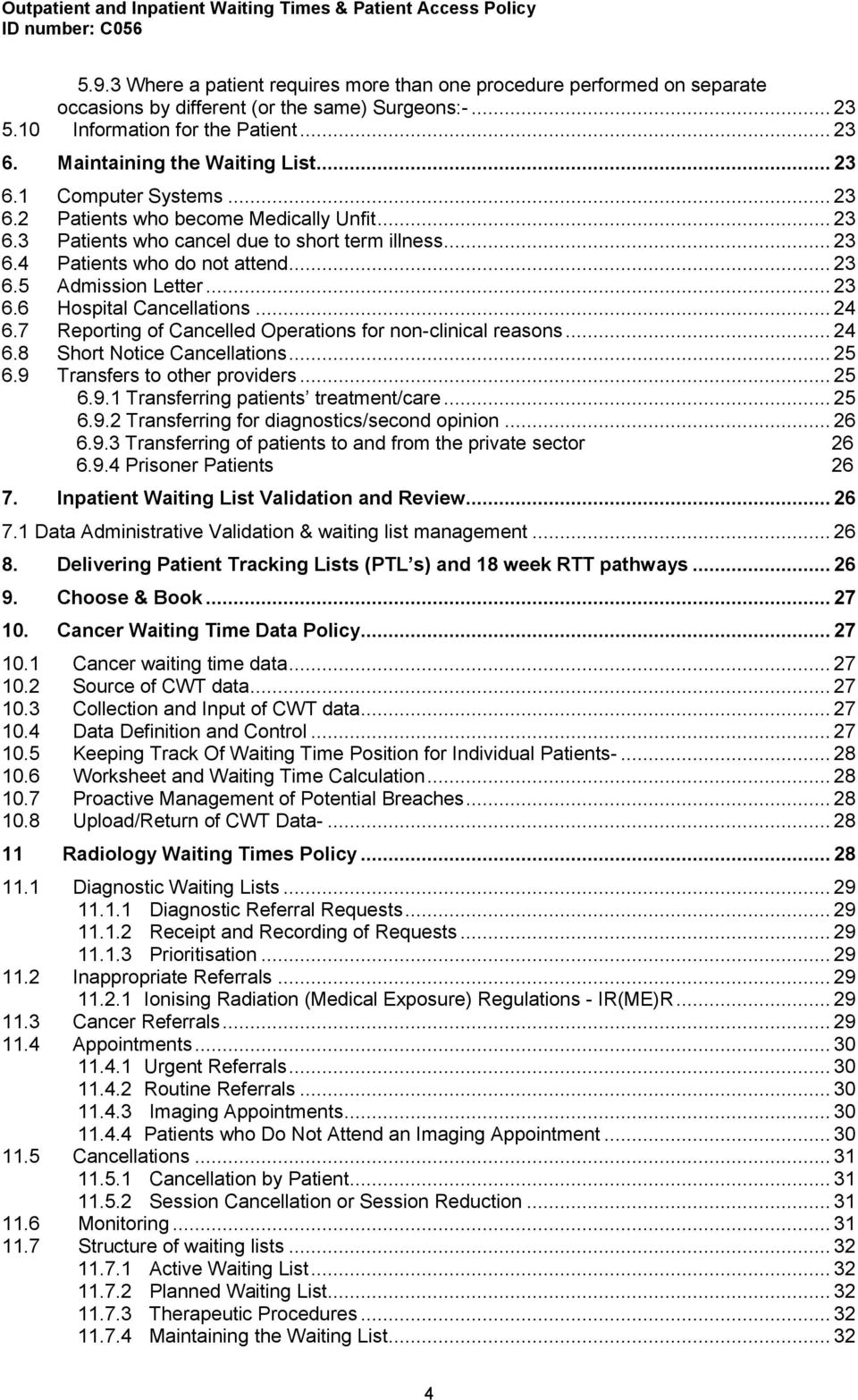
3 Contents Page Executive Summary & Policy Statement Introduction Targets Adherence to national waiting times targets: Current practice Key Principles Outpatient Waiting Lists Referral Letters Routine & urgent referrals Cancer 2 week wait referrals (including 2 week wait Breast Symptom referrals) Rapid Access Chest Pain Clinic (RACPC) referrals Transient Ischaemic Attack (TIA) Clinic referrals Management of referrals Paper referrals Choose & Book referrals Referrals Requiring Commissioners approval Low Priority Treatments (LPT) Overseas Visitors Access to Health for Military Veterans Inappropriate referrals Managing Consultant to Consultant referrals Managing referrals from AAU and Wards Managing referrals within 6 months of discharge from last outpatient appointment Information about the patient Clinical Assessment and Treatment Services Booking Outpatient Appointments Cancer Referrals Booking Outpatient Appointments Definitions and Use of Booking Type Data Input Field Failed Appointments Patients who cancel an Outpatient Appointment Patients who are cancelled by the hospital Reconciling Outpatient Clinics In-Patient Waiting List Principles of List Management The Patient Pathway to Pre- Operative Assessment Adults: Paediatrics: Active Waiting List Who should be added to a Waiting List? Removal of the use of medical suspensions Planned Patients on Waiting List Patients requiring Commissioner funding approval Adding Patients to Active Inpatient/Daycase Waiting Lists Daycase Patients Listed for more than one procedure Where there is more than one procedure to be performed at one time by the same Surgeon: Where different Surgeons working together will perform more than one procedure: 22 3

4 5.9.3 Where a patient requires more than one procedure performed on separate occasions by different (or the same) Surgeons: Information for the Patient Maintaining the Waiting List Computer Systems Patients who become Medically Unfit Patients who cancel due to short term illness Patients who do not attend Admission Letter Hospital Cancellations Reporting of Cancelled Operations for non-clinical reasons Short Notice Cancellations Transfers to other providers Transferring patients treatment/care Transferring for diagnostics/second opinion Transferring of patients to and from the private sector Prisoner Patients Inpatient Waiting List Validation and Review Data Administrative Validation & waiting list management Delivering Patient Tracking Lists (PTL s) and 18 week RTT pathways Choose & Book Cancer Waiting Time Data Policy Cancer waiting time data Source of CWT data Collection and Input of CWT data Data Definition and Control Keeping Track Of Waiting Time Position for Individual Patients Worksheet and Waiting Time Calculation Proactive Management of Potential Breaches Upload/Return of CWT Data Radiology Waiting Times Policy Diagnostic Waiting Lists Diagnostic Referral Requests Receipt and Recording of Requests Prioritisation Inappropriate Referrals Ionising Radiation (Medical Exposure) Regulations - IR(ME)R Cancer Referrals Appointments Urgent Referrals Routine Referrals Imaging Appointments Patients who Do Not Attend an Imaging Appointment Cancellations Cancellation by Patient Session Cancellation or Session Reduction Monitoring Structure of waiting lists Active Waiting List Planned Waiting List Therapeutic Procedures Maintaining the Waiting List
5 Patient Discharged Treatment not Taken Place Appendix 1 - Glossary of Terms Appendix 2-18 Week Referral to Treatment Codes Appendix 3 Cancer Waiting Times Targets for all newly diagnosed cancer patients Appendix 4 Pre-Operative Assessment Process Appendix 5 Prior Approval Forms Process

6 Executive Summary & Policy Statement The policy describes how the Trust manages access to its key services and ensures fair treatment for all patients. The successful management of patient waiting lists is key to achieving NHS England s objectives in reducing waiting times and improving Patient Choice. This document is intended to be used by all staff in the local health economy dealing with waiting list management. It will ensure that patients will be treated in order of clinical priority, and that patients of the same clinical priority will be seen in turn. It will also help provide equity of access within specialties across sites throughout the Trust. The NHS Plan emphasised that what patients want is effective, appropriate health care without having to wait an unacceptably long time. It set out targets for reducing waiting times for both outpatients and inpatients. The NHS Constitution 2010 provides patients with legal entitlements with regards to their waiting times for treatment from 1 st April The NHS Constitution sets out the following rights: to access certain services commissioned by NHS bodies within maximum waiting times, or for the NHS to take all reasonable steps to offer patients a range of suitable alternative providers if this is not possible; start your consultant-led treatment within a maximum of 18 weeks from referral for nonurgent conditions; be seen by a cancer specialist within a maximum of two weeks from GP referral for urgent referrals where cancer is suspected. In particular, patients have the right to start definitive treatment within 18 weeks for Consultant led elective care and to be seen at an outpatient appointment within 2 weeks for urgent suspected cancer referrals. The purpose of this policy is to state the arrangements for the management of waiting lists. It includes guidelines and procedures to ensure that waiting lists are managed effectively, a high quality of service to patients is maintained, and optimum use is made of resources at all locations within the Trust. The policy is not intended to replace local and departmental operational policies and procedures including defined Patient Administration System processes set out in Clinicom user guides, but act as a framework to support them. It will be reviewed annually to ensure that it accurately reflects changing local, regional and national priorities. The over-riding principle is that of getting patients treated not keeping them waiting. The process of managing waiting lists must be transparent to the public. 6

7 1. Introduction This Integrated Waiting Times & Patients Access Policy for West Hertfordshire Hospitals NHS Trust has been developed and reviewed through investigation of best practice in the country together with consultation and good practice throughout the local health economy. This has included partnership working with Clinical Commissioning Groups (CCGs), and the Patients Access Team. The aim of this document is: - To establish a consistent approach to Patient Access across the Trust. To ensure that National, and local standards of care are met through clarity of definition and procedure as detailed in the target section. To provide an operational guide for all areas to consistently work to in conjunction with local operational procedures, which cover the detail of the day-to-day administrative process. This policy does not replace local operational procedures but seeks to support them. Hospital medical staff, managers and clerical staff have an important role in managing waiting times effectively. Treating patients and delivering a high quality, efficient and responsive service ensuring prompt communications with patients is a core responsibility of the Trust, each hospital site, all staff and the wider local health community. Staff must ensure that national standards are met and that all notification rules are adhered to. These are detailed throughout the policy and summarised below for ease of reference. 2. Targets For English Patients (from an individual patient perspective) the current maximum waiting times for elective care are set out in the NHS Constitution and the handbook to the NHS Constitution. This can be found at: NHS Constitution _Constitution.pdf Handbook to the NHS Constitution book_to_the_nhs_constitution.pdf In addition to the individual patient rights as set out in the NHS Constitution (and its supporting handbook) there is a set of waiting time performance measures for which the NHS is held accountable for delivering by NHS England. These measures are set out in the current NHS England document: Everyone Counts: Planning for Patients 2013/14. This can be found at:

8 2.1 Adherence to national waiting times targets: The current maximum waiting times must be adhered to. A maximum wait of 18-weeks from referral to first definitive treatment for a consultant led service. There are three Referral to Treatment (RTT) standards which the Trust must deliver at speciality level: o 90% of all admitted patients being treated within 18 weeks from referral o 95% of all non admitted patient being treated within 18 weeks from referral o 92% of patients on an incomplete pathway waiting less than 18 weeks from referral A maximum wait of 6 weeks for the 15 key diagnostic procedures from when the request for a diagnostic test or procedure is made. National Target 100% of outpatient and elective admissions to be pre-booked, giving choice and agreement of date. Choice at point of referral From December 2005 all patients requiring referral to Secondary Care will be offered choice of providers and consultant when they are referred by their GP for treatment. These providers could include different NHS trusts, Diagnostic and Treatment Centres and independent sector hospitals. Patients who are unable to book a convenient appointment through Choose & Book will be contacted by the Trust within 14 days of the Trust being notified of the unavailability of outpatient appointment slots, and given an appointment that is acceptable to them. The cancer waiting times service standards are: A. Maximum two weeks from: I. urgent GP (GMP or GDP) referral for suspected cancer to first outpatient attendance [Operational Standard of 93%]; II. referral of any patient with breast symptoms (where cancer not suspected) to first hospital assessment [Operational Standard of 93%]; B. Maximum one month (31 days) from: I. decision to treat to first definitive treatment [Operational Standard of 96%]; II. decision to treat/earliest clinically appropriate date to start of second or subsequent treatment(s) for all cancer patients including those diagnosed with a recurrence where the subsequent treatment is: surgery [Operational Standard of 94%] drug treatment [Operational Standard of 98%] radiotherapy [Operational Standard of 94%] C. Maximum two months (62 days) from: I. urgent GP (GMP or GDP) referral for suspected cancer to first treatment (62 day classic) [Operational Standard of 85%]; II. III. urgent referral from NHS Cancer Screening Programmes (breast, cervical and bowel) for suspected cancer to first treatment [Operational Standard of 90%]; consultant upgrade of urgency of a referral to first treatment [No Operational Standard as yet]; D. Maximum one month (31 days) from urgent GP referral to first treatment for children s cancer, testicular cancer, and acute leukaemia [No separate Operational Standard Monitored within 62 day classic]. 2.2 Current practice In adhering to the above targets the Trust will use the following as policy for notifying patients of their appointment dates: Inpatient / Outpatient notification Two offers of dates on different days for routine appointments will be given with three weeks reasonable notice given to patients. All offers of dates are to be recorded on Clinicom. All patients cancelled on the day of admission/operation to have a guaranteed readmission date within 28 days or to be offered treatment at a hospital of their choice. 8

9 All patients to be treated within 18 weeks or for the NHS to take all reasonable steps to offer patients a range of suitable alternative providers if this is not possible unless the patient has chosen to wait longer than 18 weeks for treatment or there are clinical reasons as to why it would not be appropriate to treat the patient within 18 weeks. 3. Key Principles The policy will be applied consistently and without exception across the Trust. This will ensure that all patients are treated equitably and according to their clinical need. All staff employed by West Hertfordshire Hospitals NHS Trust will adhere to the Waiting Times and Patient Access Policy. All stakeholders including, CCG s, Area Teams, patient representatives, patients and others will have access to this policy Patients will be treated in strict order of clinical priority and chronological waiting time. Patients of the same clinical priority will be seen in turn according to Trust Targets and standards. Patients will be invited to choose an appointment date/time within the defined booking period. Patients will agree at the time of attendance the date/time of their next appointment. The policy will be reviewed annually. By so doing it will accurately reflect changing local, regional and national priorities and plans. 4. Outpatient Waiting Lists 4.1 Referral Letters Routine & urgent referrals All Routine and Urgent Referral letters should be sent to the outpatient booking office. The referrals can be received by the Trust in two forms; paper referrals and electronic Choose and Book referrals. Both of these referral forms fall into two categories: Open referrals to pooled waiting lists in a given specialty Consultant specific referrals. Where appropriate GPs should be encouraged to use open or generic letters. While it is recognised that some referrals are appropriately sent to a specific Consultant because a specialised opinion is required, it is in the interest of all patients that as many referrals as possible fall into the former category. This allows greater flexibility in terms of the booking of the patient s appointment. As a general principle, open referrals will be sent to the Consultant with the shortest waiting time in that specialty. However, it is the patient s right to request a named Consultant Cancer 2 week wait referrals (including 2 week wait Breast Symptom referrals) To meet required NHS standards, 2 week cancer referrals must be seen by a cancer specialist within 14 days of the Trust receiving the referral. To help ensure that this is achieved: GPs and GDPs must use the designated 2-week wait proforma. These can be found at asp GPs and GDPs will ensure that appropriate information regarding the urgent 2- week wait cancer referral is provided to the patient and the importance of being seen quickly communicated to the patient as well. 9

10 GP s and GDP s will ensure that patients are given the information sheet attached to all 2WW referral proforma that explains the urgency of the referral Referrals must be faxed by the GP within 24 hours of the patient being seen and be sent to the appropriate receiving point Central Booking Office- St Albans City Hospital Fax Number , who will liaise with the Consultant to ensure that all patients will be offered a date within 14 days. Choose & Book referrals for 2 week waits will be booked into an appointment slot within 14 days by the GP or patient. In the rare event of no slots being available on Choose & Book, the GP can use the defer to provider function on the Choose and Book system to notify the Trust of such an event. The Choose and Book team will then liaise with the relevant Assistant Divisional Manager to ensure that all patients are offered a date within 14 days. For restricted 2 week wait services the GP must contact the Choose and Book team with the patient s Unique Booking reference Number (UBRN). The patient will be contacted with either an out-patient appointment or an appointment for a diagnostic procedure. GP s GDP s should endeavour (or should be encouraged) to find out if their patients will not be available to take an appointment within the following 2 weeks. If so GP s and GDP s should consider whether it is appropriate to defer the referral until such time that their patient will be able to attend an out-patient appointment within 2 weeks of being referred. Patient should not be referred back to their GP because they are unable to accept an appointment within 2 weeks i.e. once a referral has been received by secondary care it should not be returned due to patient unavailability. The appointment offered should be logged on PAS. An appointment that the patient can attend will then be offered and recorded on PAS. Where difficulty in meeting the booking guidelines is encountered, this must be escalated through the relevant Assistant Divisional Manager and Divisional Manager for action and resolution. The Cancer Unit Manager must also be kept informed. This should remain as it is down to the division to advise on capacity in these circumstances Two week wait referrals can only be downgraded by the GP - if a consultant thinks the two week wait referral is inappropriate this should be discussed with the GP and the GP asked to withdraw the two week wait referral status a GP should not be asked to downgrade a patient (or withdraw the referral) simply because they are unavailable to accept an appointment within two weeks Patients should not be referred back to their GP after first DNA (Did Not Attend) of their first appointment and should be automatically rebooked. It is good practice for the Trust to contact the GP to make them aware the patient DNA d their 2WW appointment and ask them to find out why. Patients can be referred back to their GP after multiple (two or more) DNAs; Patients should not be referred back to their GP after a single appointment cancellation Patients should not be referred back to their GP after multiple (two or more) appointment cancellations unless this has been agreed with the patient by cancelling an appointment a patient has shown a willingness to engage with the NHS. GPs who send referrals under this protocol will receive a faxed back confirmation of receipt of the referral. The quality of suspected cancer referrals will be the subject of regular audit, (with appropriate feedback to individual GPs and the CCG) and reporting to the Trust Board. If there is evidence of training needs in general practice in relation to Cancer referrals, or that this route is being misused to secure fast-track appointments for inappropriate patients, appropriate action will be agreed with the CCG. Guidance is contained in a separate policy. 10

11 4.1.3 Rapid Access Chest Pain Clinic (RACPC) referrals To meet required NHS standards, RACPC referrals must be seen by a specialist within 14 days of the Trust receiving the referral. To help ensure that this is achieved: Referrals from GPs will be by referral protocol only. GPs will ensure that appropriate information regarding the RACPC referral is provided to the patient and the importance of being seen quickly communicated to the patient as well. Referrals must be sent by the GP within 24 hours of the patient being seen and be sent to the RACPC who will liaise with the Consultant to ensure that all patients will be offered a date within 14 days. Choose & Book referrals for RACPC referrals will be booked into an appointment slot within 14 days by the GP or patient. In the rare event of no slots being available on Choose & Book, the GP must send the referral to the appropriate receiving point, who will liaise with the Consultant to ensure that all patients will be offered a date within 14 days. If a patient cannot make themselves available within 2 weeks for an appointment, the GP can delay making the referral until the patient is available to be seen within 2 weeks. The appointment offered should be logged on PAS and then recorded as cancelled by the patient. An appointment that the patient can attend will then be offered and recorded on PAS. If a patient declines a second reasonable offer they should be discharged back to their GP indicating failure to accept two reasonable offers. The GP will be responsible for contacting the patient to determine whether referral is necessary. The management of patient DNAs will be in line with section Where difficulty in meeting the booking guidelines is encountered, this must be escalated to the relevant Assistant Divisional Manager and Divisional Manager for action and resolution. The quality of RACPC referrals will be the subject of regular audit, (with appropriate feedback to individual GPs and the CCG). If there is evidence of training needs in general practice in relation to RACPC referrals, or that this route is being misused to secure fasttrack appointments for inappropriate patients, appropriate action will be agreed with the CCG. Guidance is contained in a separate policy Transient Ischaemic Attack (TIA) Clinic referrals To meet NHS standards all high risk TIA patients should be seen and treated as medical emergency within 24 hours of first contact with a healthcare professional. All low risk TIA patients should be seen and treated within 7 days of first contact with a healthcare professional. Stroke is the third biggest killer in England and patients who have experienced a TIA are at a higher risk of stroke. Referrals from GPs will be by referral protocol only and must be accompanied by a completed ABCD2 score pro-forma. Patient scoring 4 or above on the ABCD2 should be referred to the high risk clinic within 24 hours of first contact. GPs must contact the TIA referral hotline and an urgent appropriate appointment will be agreed for the patient whilst still in consultation with the GP. Patients who score below 4 on the ABCD2 should be referred as low risk and will be given an appointment in the TIA clinic within 7 calendar days of contact. GPs must fax referrals over to the Stroke Office who will contact the patient to agree an appropriate appointment date and time. The quality of TIA referrals will be the subject of regular audit, (with appropriate feedback to individual GPs and the CCG). If there is evidence of training needs in general practice in 11
12 relation to TIA referrals, or that this route is being misused to secure fast-track appointments for inappropriate patients, appropriate action will be agreed with the CCG. Guidance is contained in a separate policy. 4.2 Management of referrals All Outpatient Waiting Lists must be managed using the PAS/Choose & Book Systems Paper referrals All paper referrals must be date stamped upon receipt at point of entry to the Trust. They must then follow the agreed referral-processing route as outlined below. All paper referral letters will be entered onto PAS at this point reflecting recorded date by the Trust. For patients referred by paper referrals this is the point that the Referral to Treatment (RTT) clock starts on waiting time standards and 18-week pathway. Referrals will be sent to Clinical teams for prioritisation. The only acceptable prioritisation should be recorded as 'Urgent' or Routine' in line with national guidelines. All patients should be given appointments within the agreed maximum timeframe for each specialty as agreed at Executive Level. Appointments will be made on a first come first served basis to ensure equity of access. This process should take no more than five working days Choose & Book referrals All Choose & Book referrals must be reviewed and accepted or rejected within 24 hours for an urgent referral and 48 hours for a routine referral by Clinical Teams. In instances where there is a delay with the reviewing of these referrals all referrals will be accepted by the centralised booking team in St Albans City Hospital. The Trust will endeavour to provide a Choose and Book appointment at the hospital site of the patient s choice, however if this is not possible the patient will be offered an appointment at one of the other sites within the Trust. If a patient s appointment has been incorrectly booked on the Choose and Book system into the wrong service by the referrer, the Choose and Book team will re-direct the patient to the correct service and a confirmation letter of the appointment change will be sent. If the Choose and Book referral for a service is not provided by the Trust the referral will be rejected back to the referring GP advising that the patient needs to be referred elsewhere. If a patient is referred via the Choose and Book system and there are no slots available for the selected service they will be deferred to the provider and appear on the Appointment Slot Issue (ASI) work list. When a patient appears on the ASI list they will be contacted within 14 days and offered an appointment as soon as one becomes available. If they cannot attend the appointment offered they will stay on the list until another is available. If they cannot attend the 2 nd appointment offered they will be sent a 3 rd appointment offer in the post. If a patient is referred via Choose and Book and appears on the ASI list but when the patient is contacted with an appointment offer they say the appointment is not needed as their symptoms have improved the patient will be removed from the waiting list and discharged back to the GP Referrals Requiring Commissioners approval Low Priority Treatments (LPT) Patients referred for treatment outside of existing Contracting agreements will follow the agreed protocol as laid out in the Host Commissioner s Low Priority Treatment Policy before booking. This applies to NHS Hertfordshire patients only. However, other 12

13 Commissioners may also seek to apply such processes and these will be communicated as required Overseas Visitors Separate guidance should be referred to when managing the treatment of overseas visitors, as access to the Health Service may be limited. Department of Heath guidance on overseas visitors may be found at: Access to Health Services for Military Veterans In line with December 2007 guidance from the Department of Health all veterans and war pensioners should receive priority access to NHS care for any conditions which are related to their service subject to the clinical needs of all patients. Military veterans should not need first to have applied and become eligible for a war pension before receiving priority treatment. GPs should notify the Trust of the patient s condition and its relation to military service when they refer the patient so that the Trust can ensure that it meets the current guidance for priority service over other patients with the same level of clinical need. In line with clinical policy patients with more urgent clinical needs will continue to receive clinical priority Inappropriate referrals If a referral has been made and the special interest of the Consultant does not match the needs of the patient the Consultant should advise the GP direct so that appropriate treatment can be sought. If the opinion of a different specialty is required this should be made in agreement with the patient s registered GP and an onward referral made. This does not constitute a new referral. The original referral must be changed to reflect the change of consultant. If the referral is for a service not provided by the Trust then the referral letter will he returned to the referring GP with a note advising that the patient needs to be referred elsewhere. Such patients will not be registered by the Trust Managing Consultant to Consultant referrals Consultant-to-Consultant referrals must follow the strict Referral Protocol process as agreed with the CCG. This is at present as defined below: - Consultant-to-Consultant referrals will be accepted in the following circumstances, consultant to consultant outpatient referral or accident and emergency to consultant outpatient referral is considered of benefit to the patient when a different specialist consultant opinion is needed to advance the management of the presenting or associated condition: - When the referral is for investigation, management or treatment of cancer, or a suspected cancer - Symptoms or signs suggest a life threatening or urgent condition - Surgical assessment of an established medical condition with a view to surgical treatment - Medical assessment of an established surgical condition with a view to medical management - Anaesthetic risk assessment - A&E referrals to fracture clinic - Referrals that are part of the continuation of investigation/treatment of the condition for which the patient was referred. These will continue their existing pathway. - Suspected cancer referral. This will be vetted and dated by the receiving consultant and upgraded if deemed necessary. Once upgraded the patient will 13

14 be treated within 62 days of the date the referral was received by consultant. (See Appendix 5) - Management of pain where surgical intervention is not yet appropriate All other referrals will be returned to the referring consultant to be referred back to the patients GP practice. Where possible Consultant-to-Consultant referrals will be kept to a minimum and must relate to the referred condition. Any need for treatment other than the referred condition must be identified back to the GP for onward refer to a different specialist Managing referrals from AAU and Wards Patients requiring an outpatient appointment following an admission to AAU or to an inpatient ward will be managed in the following way: Patients who require an outpatient appointment with the Consultant Team that was responsible for their care during their inpatient stay will be booked as follow-up appointments. These patients do not need to be placed on an 18 week RTT pathway. Appointments should be agreed with the patient and booked by the ward before the patient is discharged Patients who require an outpatient appointment with a different specialty or new Consultant Team following an inpatient admission will be booked as New appointments. These patients fall under the 18 week RTT requirements, and a RTT clock will start at this point. Waiting times standards as detailed in section 2.1 and will apply to these patients. Appointments should be agreed with the patient and booked by the ward before the patient is discharged Patients who require an outpatient appointment with a different specialty or new Consultant Team following an inpatient admission who are already under the care of that Consultant Team for out-patient treatment will be booked as follow-up appointments. The appointment should be booked under the existing outpatient registration for that Consultant Team. The guidance on Consultant-to-Consultant referrals as set out in Section must be applied when booking appointments for this group of patients Managing referrals within 6 months of discharge from last outpatient appointment Patients requiring an outpatient appointment with the same clinical team within 6 months of being discharged from their last outpatient appointment will be managed in the following way: All patients will be booked a New appointment and the process as outlined in section followed, unless the Consultant agrees it is appropriate for the patient to be seen as a Follow-up appointment All New patients will be placed on an 18 week RTT pathway and the waiting times standard as detailed in section will apply to these patients All Follow-up patients will not be placed on an 18 week RTT pathway and the waiting times standards as detailed in section will not apply until a new or substantively different course of treatment is recommended by the Consultants Information about the patient All staff that have contact with the patient need to confirm the patient's details as follows: postal address (including postcode) Referring General Practitioner. It is essential that the correct name of the referring GP/GDP be recorded for that episode of care to ensure clinical letters are sent to the appropriate referrer. Patient s home, work, mobile or a daytime telephone contact number. 14

15 Any special circumstances requiring longer notice than usual for admission (e.g. caring for elderly relative, transport arrangements etc.). Co-ordination with Social Services or direct with the patients GP may be needed in certain circumstances Clinical Assessment and Triage Services (CATS) Referrals CATS are services that provide intermediary levels of clinical triage, assessment and treatment between traditional primary and secondary care. At the Trust there are CATS for dermatology and musculoskeletal conditions. A referral in to a CATS starts an 18 week RTT clock. If the patient is referred on to the Trust having not received any treatment or non-treatment clock stop in the service the Trust inherits the 18 week RTT wait for the patient. Minimum Data Set forms must be used to transfer 18 week information about the patient to the Trust. The Trust will ensure these are in place to manage patient s care. 4.3 Arranging Outpatient Appointments Cancer Referrals See also Section 10 for cancer waiting time data policy Booking Outpatient Appointments All patients will be offered appointments within the current guidelines for patient choice and in line with the national guidance for waiting times. A written appointment to a patient must be deemed reasonable. A reasonable offer is defined as a minimum of 3 weeks notice with an offer of 2 different dates. It is accepted that while all offers have to be reasonable it is possible some patients may be willing to attend at short notice, often to fill gaps caused by late cancellations that may otherwise be wasted. However if a patient declines such an offer the patient cannot be selfdeferred, their 18 week RTT waiting time must continue. Staff must be satisfied that all reasonableness has been demonstrated prior to self-deferral being implemented. All patients who are not referred via Choose & Book will receive an invite or acknowledgement letter confirming their first outpatient appointment. Patients will be booked for their first outpatient appointment in line with the speciality s internal milestone which is line with delivering 18 the RTT national standards. They will be booked according to guidance or contacted by the Trust to agree an appointment date. Choose & Book patients will receive a confirmation letter from the Trust once the referral letter has been reviewed and accepted by the Clinical Team Definitions and Use of Booking Type Data Input Field. The following definitions apply at the point that all outpatient bookings are made and must be entered to allow data reports required to reflect booking targets. A pre-booked admission or appointment is one where the patient negotiates the time and date with the hospital. If this is done within one working day of the decision to refer, or on the day of consultation for a follow up appointment, this constitutes full booking. If the interval is longer, then this is partial booking. If no negotiation with the patient has taken place this cannot be counted and should be recorded as zero. Indicators on the Clinicom system must be completed to reflect the type of booking made based on the above definition. This field must be completed at the point the appointment is allocated. This could be by telephone conversation with patient requiring an urgent booking or contact from the patient after receiving a partial booking invite letter or face-to-face contact with patient following an Outpatient visit. 15

16 Where every effort to contact a patient to agree a date has been made, but without success, it is then appropriate to send an appointment on the letter format that states that we have tried to make contact and still record this unsuccessful attempt as PART. This process must only be used where it can be recorded that successive attempts to make contact have failed. The following indicators define the data entry and must be completed accurately to enable the Trust to make accurate returns against national standards for booking. Where changes are made to a previous booked entry the coding must be updated to reflect the changes made. 0 No patient choice offered. Not an agreed option agree date PART FULL To be entered where partial booking lists are operational and the date of the appointment has been negotiated either face to face or by telephone with the patient or the patient s representative. This may also be used where an unsuccessful attempt was made. To be entered only where negotiation takes place within 1 working day of the decision to refer by the GP or for a follow up appointment after an outpatient consultation. This can also be entered if the patient makes contact to rearrange their previous agreed appointment date. 4.4 Failed Appointments Patients who Do Not Attend (DNA) an Outpatient Appointment. Where it has been assessed as clinically important the Trust currently allows patients to rebook once following a DNA of an elective 18 week outpatient appointment before discharging the patient back to the care of their GP. The GP will be informed by an explanatory letter that their patient has DNA d their appointment and has been discharged. Discharging or rebooking the patient without taking this step is insufficient to ensure proper care is delivered. This is provided the Trust can demonstrate the following: i. the Trust can demonstrate that the appointment was clearly communicated to the patient; ii. discharging the patient is not contrary to their best clinical interests; iii. discharging the patient is carried out according to the local, publicly available, policy on DNAs; iv. Discharging the patient does not affect their clinical interests. In particular this includes, vulnerable patients (e.g. children) and it has been agreed with clinicians, commissioners, patients and other relevant stakeholders that it is safe to discharge the patient back to the care of their GP. There are important differences for the management of 2WW patients who DNA and cancel. Please see section for further details. If a patient DNAs their first appointment their 18 week RTT clock is nullified and the hospital will manage the patient in accordance with this policy. If the patient calls up to rebook and it is agreed another appointment can be given, a new appointment will be made and a new 18 week clock will start from the date the appointment is rebooked. If the patient fails to attend the second appointment they will be removed from the waiting list and discharged. Their GP will be informed of their removal. 16

17 In accordance with the Trust s responsibility to ensure that any child referred to our services is safe, should there be any Safeguarding concerns about the child who has missed an appointment, Safeguarding Practice Guidelines will be followed. With children who do not attend, the GP will be asked to consider why the child did not attend and to include safeguarding concerns within this. For children who already have safeguarding issues, the failure to attend will be highlighted to the appropriate professionals. In accordance with the Trust s responsibility to ensure that any vulnerable adult referred to our services is safe, should there be any Safeguarding concerns about the adult who has missed an appointment, Protection of Vulnerable Adult Practice Guidelines will be followed. In vulnerable adults who do not attend, the GP will be asked to consider why they did not attend and to include safeguarding concerns within this. For adults who already have safeguarding issues, the failure to attend will be highlighted to the appropriate professionals. These changes have the benefit of the clinical team being able to prompt action as appropriate and ensure that those patients who may need a further encouragement or real need for an appointment are not missed. 4.5 Patients who cancel an Outpatient Appointment Patients who cancel their appointment should be given an alternative date at the time of cancellation. The Trust allows patients to cancel and rebook their outpatient appointments (first and follow-up appointments) twice. If a patient cancels more than twice their appointment their case notes should be reviewed by medical staff to ensure that there is no clinical risk involved in not treating the patient. Following agreement by the clinician whose care the patient is under, the patient should be removed from the waiting list and discharged back to their GP with the appropriate reason recorded on system. If a patient cancels their outpatient appointment this does not affect their 18 week RTT clock unless the patient is discharged and returned to the care of their GP. If a patient cancels an appointment and does not wish to arrange another, the referral must be discharged from PAS. The patient s 18 week RTT clock will stop with patient declined treatment recorded as the reason. There are important differences for the management of 2WW patients who DNA and cancel. Please see section for further details. 4.6 Patients who are cancelled by the hospital. Patients who are cancelled by the hospital must be offered an alternative date which is within the next two weeks and their 18 week RTT breach date. The only acceptable reason for any clinic to be cancelled is due to absence of medical staff. This can result from planned annual/study leave/ audit sessions, planned on call rotation or unplanned sickness absence. Clinics should not be cancelled for any other purpose unless there are exceptional circumstances. A minimum of six weeks notice of planned annual leave or study leave should in normal circumstances be given when a consultant requires a clinic to be cancelled or reduced. Only leave approved by the clinical lead for the service will be accepted. 17

18 Where cancelled sessions are planned well in advance, these should be communicated as soon as they are known to the relevant departments (outpatients, diagnostics and admissions). This information must be written on the appropriate clinic cancellation form and passed to the administrative/clerical manager for action. No other forms of communication will be acceptable unless there are exceptional circumstances. Action on these forms should be taken as soon as possible after receipt, and within a maximum of five working days. Where patients have to be cancelled following consultants giving 6 weeks noticed of planned leave, the consultants should identify with the booking teams where to rebook patients based on their clinical priority and waiting time. Where extreme circumstances prevent the six-week rule being applied clinicians are required to inform the relevant divisional manager in writing of the reason for the late notification as soon as possible. Where patients have to be cancelled at short notice (on the day) due to sickness/absence the case notes must be reviewed by medical staff and a further appointment offered to the patient within the agreed maximum waiting times. This appointment should be offered within 48 hours of the original appointment cancellation. Wherever possible, patients that have been previously cancelled should not be cancelled a second time. When clinics have to be unavoidably cancelled at short notice, liaison with nursing staff, the Outpatient Manager and relevant Assistant Divisional Manager is essential. Identifying appropriate capacity for these patients to be rebooked remains the responsibility of the consultants and the division, not the outpatient department. The identified short notice cancellation clinic code on PAS must be utilised in such circumstances. 4.7 Reconciling Outpatient Clinics All Outpatient Clinic attendances must have a definitive outcome recorded on PAS. This information should be recorded in real time and no later than 24 hours after the clinic. This includes an accurate 18 week RTT clinic outcome based on the information on the clinic outcome 18 week form. It should be clear to staff what the outcome of an appointment is. This process also applies to urgent walk-in patients and follow up patients whose initial appointment may not have been recorded prior to attendance. There can be no other exceptions. 5. In-Patient Waiting List 5.1 Principles of List Management No patient should be added to the waiting list unless fit and available for treatment. Patients who are not fit and available for treatment will be discharged back to their GP with a full explanation to the GP as to the parameters that need to be met in order for the patient to be re-referred for treatment at a later date. Patients will be made two reasonable offers for dates for treatment. If a patient declines both dates for their treatment a patient pause can be applied to the pathway. The patient s 18 week RTT clock will be paused for the period from the first reasonable offer and when the patient makes themselves available again for admission providing this is within 12 weeks. Where a patient has requested a pause for 12 weeks or more the consultant the patient is listed under must be informed to ensure there are no clinical risks to the patient delaying their admission for 12 weeks. Patients not available within 12 weeks will be discharged back to their GP. NB: A reasonable offer is an offer of a time and date with 3 or more weeks from the time that the offer is made. The Admissions Office will ensure that all appointments offered are recorded on Clinicom. The Admissions Office will also ensure that all clock 18

19 pauses that apply are recorded on Infoflex at the time the admission date is agreed with the patient. If it is discovered that the patient has underling comorbidities or medical conditions which will prevent the patient having the surgery they have been listed for, they should be discharged back to the GP. A full explanation as to the parameters that need to be met in order for the patient to be re-referred for treatment at a later date will be included in correspondence that is sent to the GP when the patient is discharged to ensure that appropriate re-referral takes place. The GP may refer the patient back to the same stage of the pathway when fit providing that this is within 12 weeks of being discharged. The patient will start a new 18 week RTT clock at the point the decision to admit is made. For those patients re-referred less than 12 weeks of their discharge and with the consultant s agreement will not be expected to repeat any outpatient appointments. Any patient who is re-referred over 12 weeks from the date of discharge for an admission, will be booked as a new appointment and reassessed by a clinician. A cough, cold or transient condition does not count as a reason to discharge the patient back to their GP with a decision not to treat. These patients should be rebooked and their 18 week RTT clock will continue to tick. The national tolerances take in to account clinical complex pathways. For patients who require bi-lateral operations, a new 18-wk clock should start only when the patient is fit and ready for the second procedure. This applies particularly to ophthalmic and orthopaedic conditions. 5.2 The Patient Pathway to Pre- Operative Assessment Full guidance on the pathway to Pre-Operative Assessment process can be found within the Policy for Patient Preparation of adult patients due to undergo Elective Surgery. The main points of this policy in terms of patient access are summarized below for ease of reference Adults: Patients will be given a date for pre-operative assessment on the date that they are added to the waiting list in outpatients. Pre-operative assessment will take place within 7 days of decision to admit. If prior approval is required for the treatment that the patient has been listed for, the prior approval process in section 5.7 and Appendix 4 must be followed. If the patient is deemed fit for treatment and prior approval is not required, the patient will be added to the waiting list. The TCI card will be sent to the admissions department who will negotiate a date for treatment with the patient. The patient will be treated within their 18-week pathway unless this is not clinically appropriate or the patient chooses to wait longer for treatment. If the patient is not fit for treatment (as per guidance in section 5.1) their 18-week RTT clock will be stopped and their care returned to the referring clinician or GP. Within 12 weeks the patient can return to POA for a review and to be added to the waiting list. A new 18 week RTT clock will start at this point. Over 12 weeks, the patient will need a new referral to out-patients. They will only be added to the waiting list again when they are fit, willing and available for treatment. Patients who DNA their pre-operative assessment appointment will be discharged from the waiting list after the first DNA episode if a further review appointment is assessed as not clinically important. The 18 week RTT clock will stop at this point decision not to treat. The referring consultant, patient and GP will be notified by letter of this action. If it is assessed as clinically important for the patient who has DNA d to be seen, appropriate action should be taken. This might include communication with the GP, 19

20 other Primary Healthcare Team professional or directly with the patient. Issuing a further appointment without taking this step is insufficient to ensure that proper care is delivered. However, only one re-appointment will be given in these circumstances. If following this second offer of appointment the patient fails to attend they will be removed from the waiting list, discharged and the GP and referring Consultant informed of their removal (clock stop). It will then be the responsibility of the GP to manage the patient s condition. Correspondence with the GP in this circumstance will explicitly include details around, which appointments have been missed, which clinician has reviewed the notes, why the problem had been considered clinically important and that the condition is being returned to the GP for them to manage Paediatrics: Patients will be given a date for treatment Pre-Op Assessment will take place 2 weeks before the date that the patient is listed for treatment. If the patient is deemed fit for treatment, they will go ahead with their treatment as planned. If the patient is not fit for treatment (as per guidance in section 5.1) they will be Waiting List Cancelled and returned to the care of the referring clinician or GP. Their 18 week RTT clock will stop at this point. They will only be added to the waiting list again when they are fit, willing and available for treatment where a new 18 week RTT clock will start. Patients who DNA their pre-operative assessment appointment will be discharged from the waiting list after the first DNA episode if a further review appointment is assessed as not clinically important. At this point the 18 week RTT clock will stop. The referring Consultant, patient and GP will be notified by letter of this action. If it is assessed as clinically important for the patient who has DNA d to be seen, appropriate action should be taken. This might include communication with the GP, other primary healthcare team professional or directly with the patient. Issuing a further appointment without taking this step is insufficient to ensure that proper care is delivered. However, only one re-appointment will be given in these circumstances. If following this second offer of appointment the patient fails to attend they will be removed from the waiting list, discharged and the GP and referring Consultant informed of their removal. The patient s 18 week RTT clock will stop at this point. It will then be the responsibility of the GP to manage the patient s condition. Correspondence with the GP in this circumstance will explicitly include details around, which appointments have been missed, which clinician has reviewed the notes, why the problem had been considered clinically important and that the condition is being returned to the GP for them to manage. Should there be any Safeguarding concerns about the child who has missed an appointment; Safeguarding Practice Guidelines will be followed. With children who do not attend, the GP will be asked to consider why the child did not attend and to include safeguarding concerns within this. For children who already have safeguarding issues, the failure to attend will be highlighted to the appropriate professionals. 5.3 Active Waiting List The Active Waiting List should consist of patients awaiting inpatient or day case admission, who are currently fit and available to come in for treatment. This includes local anaesthetic procedures and first endoscopic procedures. All patients irrespective of procedure form part of the elective waiting list and must be treated in line with Department of Health guidance. Clinical priority should be defined as URGENT or ROUTINE only. To aid both the clinical and administrative management of the Waiting List, Elective waiting lists and planned lists will be listed separately but must be managed in line with this policy guidance and the intended management. 20

21 5.4 Who should be added to a Waiting List? The decision to add a patient to a Waiting List must be made by a Consultant, or under an arrangement agreed with the Consultant. Patients who are added must be fit, willing and able for admission on the day the decision is made i.e., if there was a bed available tomorrow in which to admit a patient - they are medically fit, and able to come in. Patients who are not medically fit (as per guidance and definition in section 5.1), must not be added to the Waiting List. They must either be returned to the care of their GP or re-referred back to POA. The consultant may choose to continue to review them in outpatient department but take them off the waiting list for surgery. This includes patients with a high BMI, smokers, drug users and heavy drinkers. A decision not to treat or active monitoring clock stop should be applied following the clinician s decision to the patient s 18 week RTT pathway. The use of effective early pre-operative clinics (POA) forms the basis of efficient waiting list management. The attendance at a POA clinic following the decision to treat determines the suitability and fitness to treat at an early stage. In cases where fitness is an issue continuing care via POA may be appropriate. 5.5 Suspended Waiting List medical suspensions No patients can be suspended on a waiting list for medical reasons at any time. If a patient becomes unfit for treatment at any point or is not willing to have treatment at any point, the guidance in Section 5.1 above needs to be followed and implemented with no exception. These rules allow waiting list co-ordinators to effectively manage their lists and to comply with National Waiting Times Standards. 5.6 Planned Patients on Waiting List Patients should only be added to a planned list where clinically they need to wait for a period of time. This includes planned diagnostic tests (e.g. check cystoscopy) or treatments or a series of procedures carried out as part of a treatment plan - which are required for clinical reasons to be carried out at a specific time or repeated at a specific frequency. Patients on planned lists should be booked in for an appointment at the clinically appropriate time and they should not have to wait a further period after this time has elapsed. For example, a patient due to have a re-test in six months time should be booked in around six months later and they should not get to six months, then have to wait again for non-clinical reasons. This is not an acceptable use of a planned list. When patients on planned lists are clinically ready for their care to commence and reach the date for their planned appointment, they should either receive that appointment or be transferred to an active waiting list and a RTT waiting time clock should start (and be reported in the relevant waiting time return). The key principle is that where patients' treatment can be started immediately, then they should start treatment or be added to an active waiting list. For Endoscopy, these Elective Planned (EP) patients need to have repeat endoscopies at clinically indicated intervals. The Consultant Gastroenterologist with reference to the British Society for Gastroenterology (Guidelines BSG) decides the interval. The Endoscopy Booking Clerk enters the date for repeat endoscopy into a diary system. A 'bring forward' system is then used by the Endoscopy Booking Clerk to ensure patients are contacted at the appropriate interval. Dedicated surveillance lists are run, and each patient is allowed to 21
22 choose their date of attendance on one of these lists. Please refer to the Department s Policy Booking Policy in Endoscopy for further details on the management of planned patients on a waiting list. The booking clerk and ADM will review regularly any planned lists for their service to ensure that patient safety and standards of care are not compromised to the detriment of outcomes for patients. Patients should also be given written confirmation if they are placed on such lists, including the review date. The unifying factor in all of these cases is that the required procedure cannot take place until a clinically specified time. Only these defined patients would be classed as planned admissions and as such they will not be part of the Trust s active waiting list. 5.7 Patients requiring Commissioner funding approval When funding prior approval for treatment is required this must be obtained before adding a patient to the active waiting list. The 18 week RTT clock will continue to tick whilst approval is sort. The process for obtaining approval to treat must be followed as outlined in Appendix 5. This applies to NHS Hertfordshire patients only, but may be extended to other Commissioners following negotiation. 5.8 Adding Patients to Active Inpatient/Daycase Waiting Lists Inpatient The definition of an inpatient is any patient admitted electively or by other means with the expectation that they will remain in hospital for at least one night, including any patient admitted with this intention who leaves hospital for any reason without staying overnight Daycase The definition of a day case can be found within the description of the NHS Data Dictionary attribute Patient Classification: A patient admitted electively during the course of a day with the intention of receiving care who does not require the use of a hospital bed overnight and who returns home as scheduled. If this original intention is not fulfilled and the patient stays overnight, such a patient should be counted as an ordinary admission. It follows from this and other related NHS Data Dictionary definitions that: A day case must be an elective admission, for which someone with Rights Of Admission has made a Decision To Admit. A Consultant is responsible for the patient s medical care The patient uses a hospital bed for recovery purposes. If a bed or trolley is used for a specific short procedure rather than because of the patient s condition, this does not count as a hospital bed. The patient is not intended to occupy a hospital bed overnight, and does not actually occupy a bed overnight. 5.9 Patients Listed for more than one procedure & use of planned list Where there is more than one procedure to be performed at one time by the same Surgeon: Add procedure to the Waiting List with additional procedures noted Where different Surgeons working together will perform more than one procedure: Add patient to the Waiting List of the Consultant Surgeon for the priority procedure with additional procedures noted. 22
23 5.9.3 Where a patient requires more than one procedure performed on separate occasions by different (or the same) Surgeons:- The patient should be added to the active waiting list for the Primary (1 st ) procedure. The patient should not be added to the waiting list for any subsequent procedures, as they are not fit or willing to proceed with any additional treatment at this stage. When the 1st procedure is complete and the patient is fit, willing and able to undergo the 2nd procedure add the patient to the waiting list for this procedure. A new 18 week RTT clock will start at this point 5.10 Information for the Patient Whenever possible, information will be given to the patient in clinic both about the intended procedure and about what they should do if their circumstances change in relation to their position on the waiting list e.g. unwell, holidays, change of address etc. This may be sent out to the patient following their addition to the waiting list. 6. Maintaining the Waiting List Waiting Lists should be kept up to date by waiting list co-ordinators or identified staff managing individual lists using the 18 week RTT Patient Tracking List (PTL) They need to ensure that patients are listed promptly and that the list does not contain patients who no longer need their procedures. 6.1 Computer Systems To ensure consistency and the standardisation of reporting with Commissioners and the NHS Executive, all waiting lists are to be maintained in the PAS system. Manual card based systems remain only as a backup to the main database. A full audit trail must be kept updated on the system. Details of listed patients must be entered onto the computer system within 24 hours of the decision to admit being made. Patients will be added to the waiting list with the date the decision to admit was made. The waiting list episode needs to be attached to the correct 18 week RTT pathway. Failure to do this will lead to incorrect assessment of Waiting List size when the monthly census is taken. All Patients on the Active Waiting List must be fit, willing and available to be treated. 6.2 Patients who become Medically Unfit If a patient becomes medically unfit for treatment they should be removed from the waiting list and discharged to the care of their GP or relevant Secondary Care Consultant. If they are likely to still be treated then a personal treatment plan needs to be implemented to improve the patient s health to enable treatment to take place. When the patient is deemed to be fit for treatment they can be added directly to the waiting list again within a 12-week period. Any delay over 12 weeks will require a new referral to the Outpatient Department from the GP. 6.3 Patients who cancel due to short term illness If a patient cancels due to short-term illness (e.g. cough or a cold) they will be rebooked and their 18 week RTT clock will continue. Patients cannot have their pathways paused for medical reasons. 6.4 Patients who do not attend Where a patient does not attend a reasonably offered TCI date they should be removed from the waiting list and returned to the care of their GP. 6.5 Admission Letter An invite to contact letter will be sent prior to expected TCI date This will contain the minimum dataset below:- 23
24 Patients name and casenote/hospital number Date of letter Who to contact and when named contact where possible Response required from patient and timeframe Details of what will happen if no contact is made (removed from list GP or referrer informed) This letter should be clear and precise. Following contact and an agreed booking date, this should be followed up with a confirmation letter detailing any explicit instructions. This letter is known as To Come In Letter (TCl) and should follow the agreed booking it will contain the following core details: Patient's name Date letter sent to patient Date, day and time of admission Arrangements for transport Where to report on arrival Response required from the patient if any since this confirms a previously agreed date Clear named contact telephone number for queries relating to admission or to advise of unavailability or late cancellation Reference to instructions for admission and/or booklet if not already advised at POA. Request to check bed is available on day of admission (if appropriate) Reasons for checking bed availability (if appropriate) Information about the planned treatment if not already advised They should be sent out in the name of the Consultant or contain the Consultant s name. Letters must be sent out on the day of preparation from the PAS system, if there is a delay they must be double-checked to ensure that the patient has not already been admitted in the intervening period. For a written appointment or admission offer to a patient to be deemed reasonable, the patient is to be offered an appointment or admission date with a minimum of three weeks notice. For inpatient/daycase admission a minimum of two TCI dates. For an outpatient appointment a minimum offer of two different dates. These dates must be agreed with the patient or patient s representative verbally, recorded on Clinicom and confirmed by letter. It is accepted that though all offers have to be reasonable, some patients may be willing to attend at short notice, often to fill gaps caused by late cancellations that may otherwise be wasted. However if a patient declines such an offer the patient cannot be self-deferred, their waiting time must continue. Staff must be satisfied that all reasonableness has been demonstrated prior to self-deferral being implemented. 6.6 Hospital Cancellations Every effort is made to ensure patients TCI dates are not cancelled. If a TCI date is cancelled before a patient is admitted, an alternative date should be agreed at the time of cancellation. This must be within the target wait. 6.7 Reporting of Cancelled Operations for non-clinical reasons When a patient s operation is cancelled by the Hospital for non-clinical reasons on the day of admission or day of operation, the Trust must offer another binding date within a maximum of 28 days or if requested offer to fund the patient s treatment at the time and hospital of the patient s choice when appropriate. All offers must be made in accordance 24
25 with this policy and adhering to guidance in section Breaches to this standard must be identified and reported to the chief operating officer. Counts must be kept of last minute cancellations; these must be reported to the Waiting Times Office daily on appropriate forms or entered on the information system for inclusion in weekly reporting process, sitrep reports and quarterly returns as cancellations. Returns are made on the basis of elective cancelled patients only. Counts are made of the number of breaches of the standard in the quarter. A breach is counted at the point it occurs if after 28 days of a last minute cancellation the patient has not been treated then the breach should be recorded. The breach could have occurred in the previous or same quarter. The 28-day period does not stop at quarter end but is continuous. All planned or elective operations should be counted including daycases. An operation, which is rescheduled to a time within 24 hours of the original scheduled operation, should be recorded as a postponement and not as a cancellation. Infoflex reports are produced to report hospital cancellations. A summary of choices made by the patient where a breach occurs must also be recorded. Count the number of patients who choose: To remain on list at existing NHS Trust To be treated at another NHS Trust To be treated at a private hospital To be treated abroad Other alternatives for treatment The number and outcome of breaches must be validated, recorded and returned quarterly. 6.8 Short Notice Cancellations Patients who do not respond to an offer of admission by the stated date should be replaced on the admission and operating lists by patients who have indicated that they may he able to come in at short notice. Patients who have previously said they are available should always be contacted by telephone and must confirm as soon as possible that they are available for treatment on the date offered. However if a patient declines such an offer the patient cannot be self-deferred, their 18 week RTT waiting time must continue. The guidelines in Section 5.1 must be followed. Staff must be satisfied that all reasonableness has been demonstrated prior to self-deferral being implemented. The Admissions Department should contact the patients who do not respond either by telephone or letter to confirm their intentions. Where time permits, attempts should also be made to replace patients who DNA. 6.9 Transfers to other providers Transferring patients treatment/care Where a patient needs to be transferred to another provider for treatment a minimum data set form (MDS) must be completed and faxed/ ed to the relevant provider within 48 hours of the decision to transfer being made. This includes details of the patient s 18 week RTT status and waiting time. The patient s 18-week clock will transfer to the alternative provider at this stage. A copy of the MDS form must be kept in the patient s notes and a further copy kept in a central file within the department. 25
26 6.9.2 Transferring for diagnostics/second opinion Where a patient needs to be transferred to another provider for advice or diagnostic tests a minimum data set form (MDS) must be completed and faxed/ ed to the relevant provider within 48 hours of the decision to transfer being made. The patient s 18-week clock will remain with the Trust. A copy of the MDS form must be kept in the patient s notes and a further copy kept in a central file within the department Private patients transferring to the NHS Patients can choose to convert between an NHS and private status at any point during their treatment without prejudice. The Trust s policy states all patients wishing to transfer from the private service to the NHS, must be returned to their GP to be offered choice and onwards referral to an NHS provider. No patient should be referred direct to the Trust from the private service. Patients who are referred via their GPs from a private service can be added direct to the NHS waiting list on the referral received date. They do not need an NHS appointment prior to addition. For patients that are seen privately but then transfer to the NHS, if they are transferring on to a RTT pathway, the RTT clock should start at the point at which the clinical responsibility for the patient's care transfers to the NHS, i.e. the date when WHHT accepts the referral for the patient Prisoner Patients All elements of the access policy are relevant to the population of Her Majesty Prison Services, however all hospital appointments will need to be managed within the prison regime and the Trust Waiting Times and Patient Access Policy and standard operating procedures. No adjustments or clock stops can be made to the pathways of patients who are prisoners due to the unavailability of prisoner escort services when this affects the ability of the patient attending their appointment or admission. 7. Inpatient Waiting List Validation and Review The Trust will ensure that ALL waiting lists are regularly validated by Waiting List Coordinators prior to booking. This process will ensure that lists are always as up-to-date as possible, and that the most efficient use is made of the Trust s inpatient and day case resources. This process ensures that patient s circumstances and conditions do not change during the waiting time period. 7.1 Data Administrative Validation & waiting list management This is an internal process, which is carried out on a weekly basis. It involves a review of the active waiting lists to ensure that all data held is up-to-date, and that patients are recorded appropriately. 8. Delivering Patient Tracking Lists (PTL s) and 18 week RTT pathways The 18 week RTT PTL shows all patients waiting for treatment by weeks waited for both admitted and non-admitted pathways. The PTL should be used to book patients appointments and dates for surgery using the patient s 18 week RTT breach date Patients should be dated by clinical urgency and then in chronological order. The PTL is available on the Trust s intranet site ( under the management tool ireporter. The PTL should be used to provide early warning to the possibility that a patient will not be treated before their 18 weeks breach date. Guidance on how to use the ireporter 18 week RTT PTL can be found on the RTT webpage. The PTL should be shared with clinicians to promote discussion around managing patient s 26
27 treatment and identifying capacity gaps. The identified ADMs will take responsibility to ensure national and local targets are met for their services with priority and shortfalls identified well in advance at regular patient access meetings. 9. Choose & Book This section will be updated to reflect local procedures as they change. Choose and Book is a national service that combines electronic booking and a choice of place, date and time for first outpatient appointments. It revolutionises our current booking system, with patients able to choose their initial hospital appointment. Choose and Book (C&B) lets patients pick the place and time of their first outpatient appointment (GP referrals only), and book an appointment electronically from the GP Surgery using a national computer system. Patients book themselves directly into clinic slots without consultant input. The national IT system offers choice of services and individual consultants. Patients have a choice of any Acute Trust, Foundation Trust or Independent Sector Treatment Centre in the country. Clinic descriptions and capacity displayed on the national system must be accurate and precise. Referral protocols are in place to avoid inappropriate blocking of slots. Patients can move more readily between providers. Trusts must accept referrals from all Clinical Commissioning Groups (CCGs). Patients who cancel or DNA appointments are still subject to the rules outlined in this access policy. 10. Cancer Waiting Time Data Policy 10.1 Cancer waiting time data NHS Cancer Plan 2000 set a specific goal of reducing cancer-waiting times (CWT) in UK. In achieving this goal all NHS organisation providing care to cancer patients are required to collect and return patient data for the CWT targets see section 2.1 for the full list of the standards Source of CWT data GP referral proforma, Trust PAS system, Pathology and Radiology diagnostic reports, Patient waiting cards, Treatment reports, Patient case notes, MDT meeting records, communication/ correspondence between clinicians etc containing patient level information will be used as the primary source for collection and validation of CWT data Collection and Input of CWT data MDT Co-ordinators are responsible to collect site-specific CWT data from the above sources. MDT co-ordinators are responsible to input collected CWT data into designated cancer waiting time INFOFLEX database in the Trust. The INFOFLEX is an agreed computerised clinical database system for collection, storage, analysis and return and or upload of CWT data onto the OPEN EXETER the National Cancer Waiting Time system database. Clinical Informatics Department in the Trust will be responsible for the development and maintenance of INFOFLEX database including user training Data Definition and Control In general MDT coordinators and Admission Booking Staff are required to follow the West Hertfordshire Hospitals NHS Trust Out patient and Inpatient Waiting Times and Patient 27
28 Access Policy guidelines The definition of the data items in the National Cancer Waiting Times system are controlled by HSC 2002/005, National Cancer Waiting Times User Manual and the relevant national guidance on NHS plan and performance target. Further information is also available following the publication of Going Further on Cancer Wait version8 at Cancer%20Waits%20A%20Guide%20Version%208.0.pdf 10.5 Keeping Track Of Waiting Time Position for Individual Patients- In addition to the INFOFLEX database a purpose-built WORKSHEET equipped with formulae to calculate waiting time targets is available for the MDT Co-ordinators to record the patient s journey with key events in their cancer pathway Worksheet and Waiting Time Calculation The Worksheet has been developed to help keep track of patients in 3 categories suspected, diagnosed and waiting for treatment categories and to monitor waiting time targets. This allows potential breaches to be predicted (hence avoided). The Waiting time target calculation is designed to inform the following. 2 week wait is for patients referred urgently by the GP or GDP with the suspicion of a cancer. It is measured from the date the referral is received to the date first seen, which should be within 14 days 62 days treatment wait is for all newly diagnosed cancer patients referred through the 2 week wait referral route. It is measured from the date the referral is received to the start date of 1 st cancer treatment 31 days treatment wait is for all newly diagnosed cancer patients. It is measured from the date of decision to treat to the start date of 1 st cancer treatment. Hence it applies to patints from both referral routes. In tracking 2 week wait patients it is important to be aware that if those patients have a diagnosis but no date of decision to treat, they could potentially breach the 62 days target. This is particularly relevant to Consultant Upgrades whereby this group of patients are only uploaded if they have a positive cancer diagnosis and are treated in our Trust and their date starts from the date the referrals were upgraded Proactive Management of Potential Breaches Although Service Managers can access and read these worksheets to extract information, which is very important for them in managing potential breaches proactively, MDT Coordinator s play a vital part in informing the Service Managers of any potential breaches on a regular basis Upload/Return of CWT Data- The Cancer Unit will be responsible for analysis, validation and upload/return of cancer waiting times data including national and local reporting requirements. 11 Radiology Waiting Times Policy This section of the Waiting Times Policy relates to Radiology Waiting Times and aims To establish a consistent approach to Radiology Access across the Trust. To ensure that National, key radiology waiting time targets are met through clarity of definition and procedure. To provide an operational guide for all modalities to work consistently with local operational and administrative procedures. 28
29 11.1 Diagnostic Waiting Lists Diagnostic Referral Requests Referrals received from both primary and secondary care clinicians for diagnostic imaging should be received on the appropriate request forms, correctly completed and signed. A dedicated form should be used for MRI Including patient safety questionnaire. Wherever possible Order Communications should be used to refer all patients for radiology tests. There will be a few services where this is not possible (insert examples) Receipt and Recording of Requests Referral forms should be addressed to the Radiology Department and/or appropriate modality, where they will be date stamped on receipt, the request form scanned and added to the CRIS request received list. The diagnostic waiting time clock starts when the request for a diagnostic test or procedure is made. This is when the request for a diagnostic procedure is entered on to Order Communications or by using the date written on the diagnostic request form by the referring clinician. The appropriate administration process for distribution for prioritisation will follow. Incomplete forms should be returned to the referrer for correct completion. These requests should be entered on CRIS, if patient demographics allow, as request received and the status up-dated to record awaiting clinical information, this provides a clear audit trail if required. For direct access referrals, where it is the responsibility of the patient to arrange booking of the diagnostic appointment, the diagnostic waiting time should start at the point when the patient contacts the Trust to arrange the diagnostic appointment. For Choose & Book, this will be the point when the UBRN (Unique Booking Reference Number) is converted Prioritisation Referral requests are allocated to the appropriate clinician for prioritisation according to protocol for each modality. Once requests have been allocated to a specific clinician, patients will be treated equally. Following acceptance of the request the CRIS status requires up dating to record Request Accepted. This applies to both GP and Consultantto-Consultant referrals, where they exist. It should be noted that outpatient imaging may be offered to a patient at any site within the Trust, although consideration will be given to the patient s place of residence where possible Inappropriate Referrals If a referral has been made that does not follow the referral protocols the radiologist should advise the referring clinician the reasons why the referral is considered inappropriate. If the referral is for a service not provided by the Trust then the referral request will be returned to the referring clinician advising of the reason. The request status on CRIS requires updating by entering Requested Unjustified or Request Rejected ensuring that the reason for rejection is recorded in the comments box providing a clear audit trail should the reason for rejection be required in the future Ionising Radiation (Medical Exposure) Regulations - IR(ME)R If the referral does not comply with the Ionising Radiation (Medical Exposure) Regulations 2000 (IR(ME)R) then the request will be returned to the referring Clinician. A Non- Justification Proforma letter will be attached to the request form detailing the reason for rejection Cancer Referrals Cancer referrals are received from hospital consultants into the Radiology Department in the same way as all other referrals and should be clearly marked as a cancer referral. The diagnostic waiting time clock starts when the request for a diagnostic test or procedure is made. This is when the request for a diagnostic procedure is entered on to Order Communications or by using the date written on the diagnostic request form by the referring 29
30 clinician and confirmed as a cancer referral by the vetting Radiologist. An urgent appointment is made for the patient in order to meet the 31 day National Cancer Waiting Times Target. This appointment should be made within a maximum of 14 days from receipt of the imaging request. Should insufficient capacity exist in order to meet the target, immediate escalation is required to the Radiology Services Manager Appointments Urgent Referrals Referrals justified as urgent by a Radiologist or Sonographer must be given priority, regular review of session templates must take place to ensure best use of available slots Routine Referrals Routine referrals should be given appointments in turn providing equity of access Imaging Appointments Following prioritisation of referral requests, patients are contacted by telephone to arrange a convenient appointment or an appointment letter is sent directly to the patient confirming the appointment. All offered and declined appointments will be recorded on CRIS. If a patient turns down reasonable offers of appointments, then the clock for the 6 week diagnostic standard can be re-set from the last appointment offered. Organisations should seek to fulfil reasonableness criteria when offering patients appointments for diagnostic tests/procedures. In summary, this means they should be offered at least two appointment dates and have at least 3 weeks notice of the appointment. If a patient turns down appointments that do not meet these criteria, then no clock re-set against the 6 week diagnostic standard is allowed. Please note any adjustment to the 6 week diagnostic standard as outlined above does not affect the patient s 18 week RTT clock in they are on an active RTT pathway. Their RTT clock will continue to tick. It is therefore important that ADMs are aware of patients who are on both a diagnostic 6 week and 18 week RTT pathway and that their care is delivered in line with both national standards Patients who Do Not Attend an Imaging Appointment Standard Radiology DNA protocol will apply when a patient fails to attend their appointment. 1. Send a copy of the request form plus the CRIS generated DNA letter to the referring Consultant/GP. Patient discharged on CRIS. 2. Complete 18-week non-clinic clock stop pro-forma because the patient is being discharged and forward to 18-week team. This should be done on a weekly basis. 3. If a further appointment is requested treat as a new referral ensuring a new request received date is entered accordingly. Patients who DNA should NOT be re-appointed unless by consultant agreement or there are exceptional circumstances-see below. If a patient does not attend their diagnostic appointment but is then rebooked under the instruction of the consultant, then the diagnostic waiting time for that test/procedure is set to zero and the waiting time starts again from the date of the appointment that the patient missed. This adjustment has no effect on the patient s 18 week RTT pathway. Booking methods will allow greater flexibility in patient choice and failing to attend an agreed appointment date will result in the patient being discharged. The Referrer will be informed of the failure to attend and removal. The patient may be re-referred at the General Practitioner's/referrer s discretion. 30
31 Exceptions to this rule may include, for example, children, patients with suspected cancer and urgent short notice appointments, which were sent by post. These should all be followed up by telephone where possible or patients should be asked to confirm they will attend the new offer made. Consultants must be included in this process where clinical priority was given to patients (this also refers to urgent patients and children). If a patient who is on a suspected cancer pathway DNAs their diagnostic appointment, the lead radiographer will notify the referring team for the patient or GP and look to rebook the appointment Cancellations Cancellation by Patient Patients who cancel their appointment once should be given an alternative date at the time of cancellation. If a patient cancels more than twice their appointment the imaging request should be returned to the referring clinician as per DNA policy and the patient discharged. They should be removed from the Waiting List and discharged with the appropriate reason recorded on system. An 18-week non-clinic clock stop pro-forma should be completed and this will stop their 18 week RTT pathway. All patient cancellations should be recorded by following the patient cancellation process on CRIS. Suspected cancer patients who DNA will be offered one further appointment before the above process is followed Session Cancellation or Session Reduction The only acceptable reason for any imaging session to be cancelled is due to equipment breakdown or absence of clinical staff due to planned annual/study leave (following the Consultant Radiologist and Radiology Associate Specialist Annual/Study Leave Guidelines), WHHT Clinical Governance sessions or un-planned sickness absence. Sessions should not be cancelled for any other purpose unless there are exceptional circumstances. When a session has to be unavoidably cancelled, rebooking should take place within 5 working days. Whenever the Hospital cancels a diagnostic test or procedure on the day for non-medical reasons the patient should be given a re-arranged date as soon as possible and within the current waiting times standard. This should be noted on the Waiting List record to ensure that this patient is not cancelled again. Non-compliance to this standard must be reported Monitoring The diagnostic waiting time clock starts when the request for a diagnostic test or procedure is made. This is when the request for a diagnostic procedure is entered on to Order Communications or by using the date written on the diagnostic request form by the referring clinician. This date is entered onto CRIS at the point of entry of the request form. For direct access referrals, where it is the responsibility of the patient to arrange booking of the diagnostic appointment, the diagnostic waiting time should start at the point when the patient contacts the Trust to arrange the diagnostic appointment. For Choose & Book, this will be the point when the UBRN (Unique Booking Reference Number) is converted. All attendances must be recorded on CRIS. This information should be recorded as soon as possible following the attendance. Session templates must be adhered to; these will be continually monitored by Superintendents who will ensure changes are made optimising the most effective use of session time. 31
32 CRIS will be the only tool for waiting list management, manual card or diaries alone are not acceptable they relate to manual backup only Structure of waiting lists To aid both the clinical and administrative management of the Waiting List, lists are subdivided into a limited number of smaller lists, differentiating between active lists and others. Care and consideration must be given to the procedures set to manage these lists in line with departmental policy and this guidance Active Waiting List The active waiting list should consist of patients awaiting diagnostic tests/procedures, who are available to attend within the waiting time standard Planned Waiting List For some patients, the timing of their diagnostic test is dependent upon other appropriate clinical factors. In these circumstances patients are called for an appointment at the clinically indicated time and they are classed as being planned. Examples of these patients are those that require follow-up imaging. These patients will be classed as planned attendances and will not be part of the Radiology Active Waiting List. When patients on planned lists are clinically ready for their test to commence and reach the date for their planned appointment, they should either receive that appointment or be transferred to an active waiting list and a waiting time clock should start (and be reported in the relevant waiting time return). Patients should also be given written confirmation if they are placed on such lists by the referring speciality, including the review date. Effective communication removes uncertainty for patients and ongoing review ensures that patients' treatment is not delayed inappropriately Therapeutic Procedures The following procedures carried out within the Radiology Department are therapeutic procedures and not diagnostic procedures, therefore, the current waiting times standards do not apply. These procedures are governed by the 18 Week RTT target. Ultrasound guided steroid injections Angioplasty Maintaining the Waiting List Waiting lists should be kept up to date by identified staff managing individual lists. They need to ensure that patients are listed promptly and that the list does not contain patients who no longer need their imaging appointment Patient Discharged Treatment not Taken Place In the event of a patient not being able to tolerate the examination at the time this is entered onto CRIS detailing the reason and the referrer notified. Examples of this would be claustrophobia. Where possible consideration will be given to an alternative imaging procedure. 32
33 Appendix 1 - Glossary of Terms ASI (appointment Slot Issues) Active Waiting List Area Team Booked Admissions Booked Patients Choice CATS Cancer Waiting Times (CWT) CCG Day cases DTA DTC S Did Not Attend (DNA) List of patients who were not able to book an appointment through the Choose and Book system because there were no appointment slots available Patients awaiting elective admission and are currently available i.e. fit, able and ready, to be called for admission at entry to waiting list. Replaced SHAs manage care and provide assurance on services commissioned by CCGs Patients who are have the opportunity to book their admission or treatment date immediately following their clinic appointment or very shortly after. Patients awaiting elective admission who have been given an admission date at the time of the decision to admit. These patients form part of the active waiting list. Elective Booked. Patients Value Choice to be offered to all patients waiting for 6 months for elective care by summer Choice at point of referral for elective care by December Clinical Assessment and Treatment Services interface services providing an intermediate level of clinical assessment and triage/treatment of patients which sit in between primary and secondary care. NHS cancer plan 2000 has set a specific goal of reducing cancer-waiting times (CWT) in UK. Clinical Commissioning Group replaced PCTs with the local commissioning of services and acute care Patients who required admission to the hospital for treatment and will need the use of a bed but who are not intended to stay in hospital overnight. Decision to Admit. Diagnostic Treatment Centres Patients who have been informed of their admission date (inpatients/day cases) or appointment date (outpatients) and who without notifying the hospital did not attend admission /outpatient appointment. Inpatients Outpatients Partial Booking List or waiting list Planned Admissions PAS PTL Referral to Treatment (RTT) Patients who require admission to the hospital for treatment and are intended to remain in hospital for at least one night Patients referred by a General Practitioner, General Dental Practitioner or another Consultant for clinical advice or treatment. A holding list for patients waiting for an Outpatient Appointment. This process ensures patients are seen in chronological order and have the opportunity to choose a convenient date. Patients who are to be admitted as part of a planned sequence of treatment or where they clinically have to wait for treatment/investigation. Patients on planned lists should be booked in for an appointment at the clinically appropriate time. They are not counted as part of the active waiting list or are on an 18 week RTT pathway Patient Administration System Clinicom. Patient Tracking List a tactical tool used to deliver 18 week RTT national operational standards. The Trust s current tool is ireporter. 18-week pathway from referral from GP to commencement of treatment in secondary care. 33
34 Self-deferrals SITREPS TCI Patients, who, on receipt offer of admission, notify the hospital that they are unable to come in. Situation Reports made to Area Teams on current indicators. To come in date or letter. Appendix 2-18 Week Referral to Treatment Codes Status Code Patient Status 30 Start of First Definitive Treatment Patient has received First Definitive Treatment that is intended to manage their disease, condition or injury 32 Active Monitoring/Watchful Waiting start of active monitoring initiated by the CARE PROFESSIONAL not to be used for thinking time 33 - DNA failure to attend - the PATIENT failed to attend the first CARE ACTIVITY after the referral 34 Decision not to treat Patient does not require treatment 35 Patient declined treatment Patient not treated but discharged 90 Activity following First Treatment first treatment occurred previously (e.g. admitted as an emergency from A&E or the activity is after the start of treatment) (ongoing management post treatment) 91 Activity following a clock stop/during CARE ACTIVITY during period of active monitoring Active monitoring/watchful waiting 10 first activity in a REFERRAL TO TREATMENT PERIOD Not yet treated (awaiting test results/add to waiting list/refer for outpatient treatment or diagnostics) 20 Transfer to another WHHT Clinician subsequent activity during a REFERRAL TO TREATMENT PERIOD - further activities anticipated 21 Transfer to another provider Not yet treated - subsequent activity during a REFERRAL TO TREATMENT PERIOD anticipated by another Health Care Provider - clock still ticks Status Code Patient Status 97 Form returned but wrongly completed Patient not treated (as far as PAS is aware) 98 Not Applicable ACTIVITY not applicable to REFERRAL TO TREATMENT PERIODS 99 Form not returned Patient not treated (as far as PAS is aware) 11 - active monitoring end - first activity at the start of a new REFERRAL TO TREATMENT PERIOD following active monitoring 12 - consultant referral - the first activity at the start of a new REFERRAL TO TREATMENT PERIOD following a decision to refer directly to the CONSULTANT for a separate condition 31 - start of active monitoring initiated by the PATIENT 34
35 Appendix 3 Cancer Waiting Times Targets for all newly diagnosed cancer patients 2 week wait (2WW) Fax Referrals from GP s (62 day pathway) EXISTING CANCER WAITING TIME STANDARDS DAY 0 Date of Receipt of Referral DAY 14 Target date for 1 st appt DAY 62 Target date for 1 st Treatment 31 DAYS maximum: From Decision to Treat (DTT) to 1 st Treatment All other sources of Referral (31 day pathway) DAY 0 Decision to Treat (DTT) (This is when the Consultant discusses treatment options with patient). DAY 31 Target date for 1 st Treatment Acute leukaemia/ testicular cancers and children s cancers (31 day pathway) DAY 0 Date of Receipt of Urgent GP Referral DAY 31 Target date for 1 st Treatment ADJUSTMENTS TO EXISTING AND NEW STANDARDS ALLOWED PAUSES: For 2WW & 62 Day Standards - Patient DNA s initial outpatient appt - clock pauses from Receipt of Referral to date upon which the patient rebooks appt Patient declines reasonable appointment* for an admitted treatment e.g. on holiday (provided date offered is within start and end of standard) pause is allowed only between the admission date offered and the date the patient is available from for an alternative appointment. NO PAUSES ALLOWED FOR: OTHER NOTES: Medical suspensions at any point in pathway ie admissions for unrelated illnesses National guidance suggests a handover of care at 42 days in the case of For 62-Day standards: Between date first seen and DTT i.e. diagnostic phase shared cases. This would be a local agreement between Trusts. For waits for treatment in outpatient setting i.e. non-admitted chemo and radiotherapy EXPECTED NAT. AVERAGES: to be confirmed June 2009 For patient or hospital cancellations i.e. if patient agrees to TCI date then cancels Two week waits targets 93% For DNA s following diagnosis 31 day targets 96% 62 day targets 85% *The definition of what a reasonable offer of admission (which is slightly different from that employed for 18 weeks) is: "the offer is for any APPOINTMENT for treatment in a Cancer Treatment Period" (DSCN 20/2008, pages 18 and 19).
36 NEW EXPANDED CANCER WAITING TIME STANDARDS Two-week wait standard for patients referred with BREAST SYMPTOMS not currently covered by two week wait referrals for suspected breast cancer (62 day pathway). Includes referrals from ALL sources, not just GP s DAY 0 Referral Received Date DAY 14 Target date for patient to attend 1 st appointment All cancer patients, (with primary diagnosis and recurrences) receiving SUBSEQUENT/adjuvant TREATMENT of treatment, chemo. radiotherapy or other treatments to have their subsequent treatment started within 31 Days DAY 0 2 nd Decision to Treat (DTT) date. (This is when the Consultant discusses treatment options with patient) Or The Earliest Clinically Appropriate Date (ECAD) date (This is a date previously agreed with the patient that is a clinically appropriate period of delay before the patient will be fit for next treatment to commence) The DTT or ECAD date must be relayed to the appropriate MDT Coordinator ASAP or at MDT Meeting or Subsequent Treatment form to be completed and placed in MDT tray at Clinic Reception DAY 31 Target date for subsequent treatment to start All non-2ww patients UPGRADED by a Consultant, or authorized member of the Consultant s team, on to fast track pathway for, suspected primary cancer, to receive their 1 st treatment by Day 62 DAY 0 The date the Consultant or team member decides to upgrade. This date may be when the Consultant reads the referral or at consultation or on receipt of test results, but should be on or before MDT where the care plan subsequently agreed with patient is discussed i.e. prior to DTT. Upgrade Proforma to be completed and copy sent to respective MDTC. DAY 62 Target date for patient to have received 1 st treatment 31 DAYS maximum: From Decision to Treat (DTT) to 1 st Treatment All patients URGENTLY referred from NHS Breast, Bowel and Cervical Cancer Screening Services, to receive 1 st treatment by Day 62 DAY 0 Date referral received within the respective screening service Breast - for further assessment Bowel for appt to discuss suitability for colonoscopy with nurse practitioner Cervical for colposcopy appt DAY 62 Target date for patients to start 1 st Treatment 31 DAYS maximum From Decision to Treat (DTT) to 1 st Treatment 36
37 Appendix 4 Pre-Operative Assessment Process (POA to Admission should not exceed 12 weeks. Admission after this time will require a second POA) OPD to POA First available appointment usually within 48 hours GP referral. Patient should have comorbidities optimised prior to referral. Patient should be willing and able to attend within 18-weeks. OPD Consultation results in recommendation of treatment W/L card to W/L coordinator. Notes to secretaries KEY: GP General Practitioner OPD Outpatients Department POA Preoperative Assessment TCI Admission date (To Come In) W/L Waiting List DNA Did not attend for appointment Notes/Waiting list card in to yellow bag ready for POA Patient given POA brochure, which is also the POA appointment card POA appt is made by OPD reception. If OPD closed, then patient should contact POA direct to book appointment TCI date negotiated with patient at time of POA unless prior approval form required. Secretary completes clinic letter. If patient unfit / DNA / declines op then consultant is able to amend clinic letter as appropriate. Patient attends POA Clinics at SACH, HHGH WGH Secretaries send notes to Admissions for admission for TCI Patient cleared FIT for admission TCI date negotiated Added to W/L Anaesthetic or cardiology opinion may be sought to confirm further investigations / fitness. If results are fit to proceed then patient proceeds as above. If not fit then see below. Patient not fit. Discharge to GP. 18 week clock stops. If fit within 12 weeks of discharge date, patient should be reviewed at POA and added to waiting list. Over 12 weeks, re-referral by the GP to out-patients will be required. It is not appropriate to discharge and stop a clock if patient has a cough or a cold. Pt unavailable/declines op within 18 weeks. Discharge to GP. 18 week clock stops. If patient then makes themselves available within 12 weeks of discharge date, they should be reviewed at POA and added to waiting list. Over 12 weeks, re-referral by the GP to out-patients will be required. DNA X 1 potential further appt made DNA X 2 referral back to GP. Clock stopsdecision not to treat
38 Appendix 5 Prior Approval Forms Process The 18 week RTT clock continues to tick during this process. From Monday, 19th April 2010, the process for prior approval will be as follows: The notes, waiting list card and prior approval form must be handed to the outpatient nurse. The outpatient nurse will check that both the waiting list card and prior approval form have been completed immediately after the patient has been seen in Outpatients. No Yes If either the waiting list card or prior approval form has not been fully completed the outpatient nurse will hand it back to the doctor to complete before the next patient is seen. The nurse must write "prior approval form completed" on the waiting list card. The prior approval form will remain in Outpatients. Complete No Yes At the end of each day the POA staff will collect all prior approval forms from an agreed central area in Outpatients. If any doctor declines to complete either the waiting list card or the prior approval form, the relevant assistant divisional manager must be informed. Patient Declined Prior approval forms will be sent to Prior Approval Coordinator first thing the next morning (using the green route that leaves at 9.15am for Watford and Hemel Hempstead). The Prior Approval Co-ordinator will process the forms and send to the PCT within 24 hours. PCT fail to respond within 2/52 Patient Approved The patient can be treated as though approval received. Note to be made that approval not received. Patient approved - patient is contacted and TCI date confirmed. Patient declined approval - PCT will send a letter to the patient and GP. The patient is waiting list cancelled and the pathway closed. More information needed - if the form has been fully completed, it contains all the information the PCT requires. Patients will, therefore, be deemed to be declined. A letter is sent to the patient. The letter needs to be taken by the patient to their GP. The patient is waiting list cancelled and the pathway closed. If form not completed to be returned to Consultant to complete.
Outpatient and Inpatient Waiting Times. & Patients Access Policy
 Outpatient and Inpatient Waiting Times & Patients Access Policy Date Approved by Version V2 Procedure/Policy Number Procedure/Policy type Date Equality impact assessment completed: Issue Date September
PATIENT ACCESS POLICY
 . PATIENT ACCESS POLICY TITLE Patient Access Policy APPLICABLE TO All administrative / clerical / managerial staff involved in the administration of patient pathway. All medical and clinic staff seeing
Patient Access. UCLH policy
 Patient Access UCLH policy Version 3.2 Version Date June 2014 Version Approved By EB Policy Approval Sub-Group Publication Date July 2013 Author Kevin Nicholson Review By Date June 2016 Responsible Director
Patient Access Policy
 Patient Access Policy NON-CLINICAL POLICY ACE 522 Version Number: 2 Policy Owner: Lead Director: Assistant Director of Operations Director of Operations Date Approved: Approved By: Management Executive
Patient Access Policy
 Patient Access Policy SECTION 1 - INTRODUCTION AND OVERVIEW 1.1. Introduction The principles and definitions of the 18 week target count the referral to treatment (RTT) waiting times in totality. Spire
PATIENT ACCESS POLICY V3
 PATIENT ACCESS POLICY V3 State whether the document is: x Trust wide Business Group Local State Document Type: x Policy Standard Operating Procedure Guideline Protocol APPROVAL & VALIDATION Assurance Risk
Patient Access Referral To Treatment (RTT) Policy
 Patient Access Referral To Treatment (RTT) Policy Policy to be agreed by the Operational Implementation Group & 18 Weeks Project Board Last Review Date: December 2009 Next Review Date: December 2010 CONTENTS
Patient Access User Manual
 Patient Access User Manual Table of Contents. 1 Summary 7 2 Key Principles 7 3 Corporate Roles and Responsibilities 9 4 National Access Targets and Standards 10 4.1 Referral to Treatment (RTT) Standard
Patient Access Policy (18 Week Referral to Treatment (RTT) and Cancer Waiting Times)
 Patient Access Policy (18 Week Referral to Treatment (RTT) and Cancer Waiting Times) To whom this document applies: All Administrative Staff, Clerical Staff, Clinicians, Clinical Nurse Specialists, Service
PATIENT ACCESS POLICY
 PATIET ACCESS POLICY This policy can be made available in other formats and languages upon request to the PALS office on 01708 435454 Contents Include: Management of Patients with Suspected or Confirmed
Patient Access Policy. Version 2.0
 Version 2.0 November 2013 Table of Contents 1. Introduction... 3 2. Purpose of this Policy/Procedure... 3 3. Scope... 3 4. Definitions / Glossary... 3 5. Ownership and Responsibilities... 4 5.1. Role of
Patient Access, Booking and Choice Policy for Moorfields City Road and all Moorfields satellites
 Patient Access, Booking and Choice Policy for Moorfields City Road and all Moorfields satellites Policy Summary This policy is intended to provide guidance on the approved process for managing patients
REFERRAL TO HOSPITAL ACCESS POLICY INCLUDING DID NOT ATTEND (DNA) AND COULD NOT ATTEND (CNA)
 REFERRAL TO HOSPITAL ACCESS POLICY INCLUDING DID NOT ATTEND (DNA) AND COULD NOT ATTEND (CNA) Last Review Date September 2014 Approving Bodies NHS Doncaster Clinical Commissioning Group Doncaster & Bassetlaw
How To Ensure That All Patients Get Access To Care
 ELECTIVE TREATMENT ACCESS POLICY Policy Title Version: Version 2 Approved by: Elective Treatment Access Policy Trust Board or Committee of the Board Date of approval: 30th January 2014 Policy supersedes:
PATIENT ACCESS POLICY
 PATIENT ACCESS POLICY Page 1 of 44 Printed Copies may become out of date. Check online to ensure you have CONTENTS AND PAGE NUMBERS Patient Access Policy... 1 Contents And page numbers... 2 EXECUTIVE SUMMARY/
Report to the NHS Fife Board on 25 June 2013 NHS FIFE S PATIENT ACCESS POLICY
 9.2b Report to the NHS Fife Board on 25 June 2013 NHS FIFE S PATIENT ACCESS POLICY 1. PURPOSE OF REPORT 1.1 Following NHS Fife s performance against Treatment Time Guarantee (TTG) during the winter months,
PATIENT ACCESS POLICY VERSION 4.0
 Type of Document Code Policy Sponsor Lead Executive Recommended by PATIENT ACCESS POLICY VERSION 4.0 Trust Policy STHK0075 Donna McLaughlin Donna McLaughlin Operational Team Date Recommended January 2012
Managing and Minimising Appointment Slot Issues
 NHS e-referral Service Managing and Minimising Appointment Slot Issues What is an Appointment Slot Issue? When no clinic appointment is available for patients to book in the NHS e-referral Service, the
Accessing Outpatient, Inpatient and Day Case Services in Acute Hospitals in Ireland
 Accessing Outpatient, Inpatient and Day Case Services in Acute Hospitals in Ireland January 2014 an ciste náisiúnta um cheannach cóireála the national treatment purchase fund Contents Introduction 2 Accessing
Elective Care Guide. Referral to Treatment Pathways: A Guide for Managing Efficient Elective Care. Second edition (January 2014)
 Elective Care Guide Referral to Treatment Pathways: A Guide for Managing Efficient Elective Care Second edition (January 2014) Contents page 1. Introduction 1.1. How the guide works and its intended audience
PATIENT ACCESS POLICY
 PATIENT ACCESS POLICY Completed Review Date: June 2015 Date for Review June 2016 1 NHS LANARKSHIRE PATIENT ACCESS POLICY 1. BACKGROUND NHS Lanarkshire is required by Scottish Government to deliver a consistent,
Cancer Services Operational Policy (Patient Access) Version number 2.1
 Cancer Services Operational Policy (Patient Access) V2.1 Cancer Services Operational Policy (Patient Access) Version number 2.1 Lead executive Name / title of author: Chief Operating Officer Karen Blackburn,
PATIENT ACCESS POLICY
 PATIENT ACCESS POLICY Document Type Policy Document Number Version Number 1.0 Approved by NHS Borders Board on 18 October 2012 Issue date Nov 2012 Review date Nov 2013 Distribution Prepared by Developed
PROTOCOL THE MANAGEMENT OF OUTPATIENT SERVICES
 Outpatient Performance Improvement Programme, 2012-2015 PROTOCOL THE MANAGEMENT OF OUTPATIENT SERVICES JANUARY 2013 EDITION 1.0 Authors DOCUMENT CONTROL PROTOCOL FOR THE MANAGEMENT OF OUTPATIENT SERVICES
Appointment Non-Attendance (Did Not Attend) Procedure
 () Procedure 1. Purpose This Procedure outlines the procedural requirements to be observed by all West Coast District Health Board (WCDHB) staff (excluding Mental Health Service) to ensure all patient
National Clinical Programmes
 National Clinical Programmes Section 3 Background information on the National Clinical Programmes Mission, Vision and Objectives July 2011 V0. 6_ 4 th July, 2011 1 National Clinical Programmes: Mission
Recording and reporting referral to treatment (RTT) waiting times for consultant-led elective care: Frequently Asked Questions
 Recording and reporting referral to treatment (RTT) waiting times for consultant-led elective care: Frequently Asked Questions Recording and reporting referral to treatment (RTT) waiting times for consultant-led
Everyone counts Ambitions for GCCG for 7 key outcome measures
 Everyone counts s for GCCG for 7 key outcome measures Outcome ambition Outcome framework measure Baseline 2014/15 Potential years of life lost to 1. Securing additional years of conditions amenable to
Standard QH-IMP-300-1:2016
 Specialist outpatient services Standard QH-IMP-300-1:2016 1. Statement The Specialist Outpatient Services Implementation Standard outlines the suite of business rules and processes required to ensure that
AVOIDING UNPLANNED ADMISSIONS ENHANCED SERVICE: PROACTIVE CASE FINDING AND CARE REVIEW FOR VULNERABLE PEOPLE GUIDANCE AND AUDIT REQUIREMENTS
 April 2014 AVOIDING UNPLANNED ADMISSIONS ENHANCED SERVICE: PROACTIVE CASE FINDING AND CARE REVIEW FOR VULNERABLE PEOPLE GUIDANCE AND AUDIT REQUIREMENTS A programme of action for general practice and clinical
Patient Choice Strategy
 Patient Choice Strategy Page 1 of 14 Contents Page 1 Background 4 2 Putting Patients and the Public at the Heart of Health and 5 Healthcare in West Lancashire 3 Where are we now and where do we need to
Frequently Asked Questions on the Referral to Treatment (RTT) data collection
 Frequently Asked Questions on the Referral to Treatment (RTT) data collection How to use this document This document contains answers to frequently asked questions on RTT measurement and the RTT data collection.
Fife NHS Board Activity NHS FIFE. Report to the Board 24 February 2015 ACTIVITY REPORT
 1 AIM OF THE REPORT NHS FIFE Report to the Board 24 February 2015 ACTIVITY REPORT This report provides a snapshot of the range of activity that underpins the achievement of key National Targets and National
Defining the Boundaries between NHS and Private Healthcare (Adapted from NHS Commissioning Board Interim Commissioning Policy: NHSCB cp-12)
 Defining the Boundaries between NHS and Private Healthcare (Adapted from NHS Commissioning Board Interim Commissioning Policy: NHSCB cp-12) Produced by: Trish Campbell Version control: V2 March 2013 v1
Appendix D- Monoclonal Gammopathy of Undetermined Significance (MGUS)
 Local Enhanced Service: Primary care management of stable haematological patients Monoclonal Gammopathy of Undetermined Significance (MGUS) 1. Introduction Monoclonal Gammopathy of Undetermined Significance
Process for reporting and learning from serious incidents requiring investigation
 Process for reporting and learning from serious incidents requiring investigation Date: 9 March 2012 NHS South of England Process for reporting and learning from serious incidents requiring investigation
MID STAFFORDSHIRE NHS FOUNDATION TRUST
 MID STAFFORDSHIRE NHS FOUNDATION TRUST Report to: Report of: Joint Health Scrutiny Accountability Session Antony Sumara Chief Executive Date: 20 April 2011 Subject: Mid Staffordshire NHS Foundation Trust
Commissioning Policy (EMSCGP005V2) Defining the boundaries between NHS and Private Healthcare
 Commissioning Policy (EMSCGP005V2) Defining the boundaries between NHS and Private Healthcare Although Primary Care Trusts (PCTs) and East Midlands Specialised Commissioning Group (EMSCG) were abolished
PROTOCOL FOR DUAL DIAGNOSIS WORKING
 PROTOCOL FOR DUAL DIAGNOSIS WORKING Protocol Details NHFT document reference CLPr021 Version Version 2 March 2015 Date Ratified 19.03.15 Ratified by Trust Protocol Board Implementation Date 20.03.15 Responsible
PRESCRIBING OF NHS MEDICATION RECOMMENDED DURING OR AFTER A PRIVATE EPISODE OF CARE
 East Surrey CCG Guildford & Waverley CCG North West Surrey CCG Surrey Downs CCG Surrey Heath CCG PRESCRIBING OF NHS MEDICATION RECOMMENDED DURING OR AFTER A PRIVATE EPISODE OF CARE Version: 2.2 Name of
Type of change. V02 Review Feb 13. V02.1 Update Jun 14 Section 6 NPSAS Alerts
 Document Title Reference Number Lead Officer Author(s) (name and designation) Ratified By Central Alerting System (CAS) Policy NTW(O)17 Medical Director Tony Gray Head of Safety and Patient Experience
About public outpatient services
 About public outpatient services Frequently asked questions What are outpatient services? Victoria s public hospitals provide services to patients needing specialist medical, paediatric, obstetric or surgical
The CCG Assurance Framework: 2014/15 Operational Guidance. Delivery Dashboard Technical Appendix DRAFT
 The CCG Assurance Framework: 2014/15 Operational Guidance Delivery Dashboard Technical Appendix DRAFT 1 NHS England INFORMATION READER BOX Directorate Medical Operations Patients and Information Nursing
CLINICAL PROTOCOL FOR X-RAYS AND CLINICAL IMAGING
 CLINICAL PROTOCOL FOR X-RAYS AND CLINICAL IMAGING RATIONALE The aim of this Protocol is to provide guidance and good practice recommendations for health care professionals involved in clinical imaging
NHS England London Southside 4th Floor 105 Victoria Street London SW1E 6QT. 24 th July 2014. Dear Daniel, Nicola and Sue, Re: CCG Annual Assurance
 NHS England London Southside 4th Floor 105 Victoria Street London SW1E 6QT 24 th July 2014 Dear Daniel, Nicola and Sue, Re: CCG Annual Assurance Many thanks for meeting with us on 6 th June 2014 to discuss
Improving Emergency Care in England
 Improving Emergency Care in England REPORT BY THE COMPTROLLER AND AUDITOR GENERAL HC 1075 Session 2003-2004: 13 October 2004 LONDON: The Stationery Office 11.25 Ordered by the House of Commons to be printed
Data Quality Policy. The Trust will aim to achieve and maintain the highest standards contained within the Information Governance Toolkit.
 Trust Policy Department / Service: Information Department Originator: Information Governance Manager Accountable Director: Director of Finance/SIRO Approved by: Trust Management Committee Date of approval:
Private Patient Policy. Documentation Control
 Documentation Control Reference Date approved Approving Body Trust Board Implementation Date July 2009 NUH Private Patient and Supersedes Overseas Visitor Policy Private Patient Advisory Group, Consultation
Progress on the System Sustainability Programme. Submitted to: NHS West Norfolk CCG Governing Body, 31 July 2014
 Agenda Item: 9.1 Subject: Presented by: Progress on the System Sustainability Programme Dr Sue Crossman, Chief Officer Submitted to: NHS West Norfolk CCG Governing Body, 31 July 2014 Purpose of Paper:
Integrated Performance Report
 Integrated Performance Report Southwark Social Services and Southwark Primary Care Trust 2003/04 Provisional Indicators Integrated Performance Report: 2003/04 Provisional Indicators 1. Recommendation 1.1
Commissioning Policy: Defining the boundaries between NHS and Private Healthcare April 2013 Reference : NHSCB/CP/12
 Commissioning Policy: Defining the boundaries between NHS and Private Healthcare April 2013 Reference : NHSCB/CP/12 NHS Commissioning Board Commissioning Policy: Defining the Boundaries between NHS and
Defining the boundaries between NHS and Private Healthcare
 West Midlands Strategic Commissioning Group Commissioning Policy (WM/13) Defining the boundaries between NHS and Private Healthcare Version 1 April 2010 1. Definitions Private patients are patients who
Consultation on amendments to the Compliance Framework. Dated 31 January 2008
 Consultation on amendments to the Compliance Framework Dated 31 January 2008 1. Introduction 1.1. Developing the regulatory framework Monitor continues to develop a regulatory framework within which boards
Quality and Safety Programme Fractured neck of femur services
 Quality and Safety Programme Fractured neck of femur services London quality standards February 2013 1 Introduction The case for change for fractured neck of femur services in London demonstrates that
GP Round Up Introduction by Alistair Flowerdew Medical Director
 GP Round Up Issue 55 October 2014 Contents GP Round Up Introduction by Alistair Flowerdew Medical Director... 1 Observation ward opens in Emergency Department... 2 Orthopaedic Elective Centre to open in
Time to Act Urgent Care and A&E: the patient perspective
 Time to Act Urgent Care and A&E: the patient perspective May 2015 Executive Summary The NHS aims to put patients at the centre of everything that it does. Indeed, the NHS Constitution provides rights to
NON-EMERGENCY PATIENT TRANSPORT POLICY AND PROCEDURES
 NON-EMERGENCY PATIENT TRANSPORT POLICY AND PROCEDURES Title Non Emergency Patient Transport Policy and Procedures. Policy No TRAN 001 Version 001 Target Audience Authors Name Lead Executive All Staff and
Business Continuity Management Policy and Plan
 Business Continuity Management Policy and Plan Version No Author Date of Update 0.3 Allan Jude and Charmaine Grundy 05/06/2015 1 P a g e Contents Contents... 2 1. Introduction... 3 2. Purpose... 4 3. Definitions...
DELIVERING CANCER WAITING TIMES. A Good Practice Guide. Page 0 of 68
 DELIVERING CANCER WAITING TIMES A Good Practice Guide Page 0 of 68 TABLE OF CONTENTS Introduction 5 Overview 5 How the guide works and its intended audience 5 Key to the guide 6 Understanding principles
Code of Practice for Records Management NHSLA Risk Management Standards Contributes to Care Quality Commission: Outcome 4
 Cardiac Nurse Practitioner Clinical Operational Policy Policy Register No: 09143 Public Developed in response to: Information Governance Toolkit Code of Practice for Records Management NHSLA Risk Management
Big Chat 4. Strategy into action. NHS Southport and Formby CCG
 Big Chat 4 Strategy into action NHS Southport and Formby CCG Royal Clifton Hotel, Southport, 19 November 2014 Contents What is the Big Chat? 3 About Big Chat 4 4 How the event worked 4 Presentations 5
Measuring quality along care pathways
 Measuring quality along care pathways Sarah Jonas, Clinical Fellow, The King s Fund Veena Raleigh, Senior Fellow, The King s Fund Catherine Foot, Senior Fellow, The King s Fund James Mountford, Director
Ward Manager, Day Care Sister and Clinical Services
 JOB DESCRIPTION Job Title : Line Manager: Responsible to: Manager Department : Staff Nurse (Day Care) Day Care Sister Ward Manager, Day Care Sister and Clinical Services Day Care Unit Probationary Period
North Middlesex University Hospital NHS Trust. Annual Audit Letter 2005/06. Report to the Directors of the Board
 North Middlesex University Hospital NHS Trust Annual Audit Letter 2005/06 Report to the Directors of the Board 1 Introduction The Purpose of this Letter 1.1 The purpose of this Annual Audit Letter (letter)
ATTENDANCE MANAGEMENT POLICY
 ATTENDANCE MANAGEMENT POLICY Co-ordinator: Director of HR Reviewer: Grampian Area Partnership Forum Approver: Grampian Area Partnership Forum Signature Signature Signature Identifier: NHSG/POL/39/HR Review
JOB DESCRIPTION. Specialist Hospitals, Women & Child Health Directorate. Royal Belfast Hospital for Sick Children
 JOB DESCRIPTION Title of Post: Patient Flow Coordinator Grade/ Band: Band 7 Directorate: Reports to: Accountable to: Location: Hours: Specialist Hospitals, Women & Child Health Directorate Assistant Service
Managing the boundaries of NHS and privately funded healthcare Policy on the separation of private and NHS treatments
 South Central Priorities Committees (Oxfordshire PCT) Policy Statement 67a: Managing the boundaries of NHS and privately-funded healthcare Clinical Executive decision: September 2009 Date of Issue: April
Lung Cancer Multidisciplinary Meeting Toolkit. National Lung Cancer Working Group
 Lung Cancer Multidisciplinary Meeting Toolkit National Lung Cancer Working Group September 2014 Contents Introduction 1 Multidisciplinary meetings 1 Toolkit for implementing high-quality lung cancer MDMs
NHS North Somerset Clinical Commissioning Group
 NHS North Somerset Clinical Commissioning Group HR Policies Managing Sickness Absence Approved by: Quality and Assurance Group Ratification date: September 2013 Review date: September 2016 Elaine Edwards
Submitting a Decision Support Tool for Ratification
 1.0 Introduction Submitting a Decision Support Tool for Ratification 1.1 This guidance sets out the procedure to be followed once an assessment for continuing healthcare has been submitted to NHS Sheffield
Allscripts PAS is a part of our product family that covers all aspects of patient management and care ALLSCRIPTS PATIENT ADMINISTRATION SYSTEM (PAS)
 allscripts.com ALLSCRIPTS PATIENT ADMINISTRATION SYSTEM (PAS) Allscripts PAS is a part of our product family that covers all aspects of patient management and care PATIENT ADMINISTRATION SYSTEM (PAS) Allscripts