
INSTITUTO POLITÉCNICO NACIONAL
|
|
|
- Lily Sanders
- 10 years ago
- Views:
Transcription
1 SYNTHESIZED SCHOOL PROGRAM ACADEMIC UNIT: ACADEMIC PROGRAM: Escuela Superior de Cómputo Ingeniería en Sistemas Computacionales LEARNING UNIT: Software Engineering for Mobile Devices LEVEL: III AIM OF THE LEARNING UNIT: The student develops software systems for mobile devices through different platforms. CONTENTS: I. Introduction to mobile applications development II. User Interface for mobile applications III. Mobile design IV. Mobil applications process development V. Case study TEACHING PRINCIPLES: The teacher will apply a Projects-Based learning process, through heuristic method, which will be the development of inquiry skills,, analysis and design of the different elements that make up the design environment of mobile applications, using the different techniques of modeling and design appropriate to the different platforms. The activities to be carried out in class will encourage in students some techniques, such as: collaborative work, participatory, brainstorming, graphic organizers, inquiry documentary, worksheets, an exhibition of complementary subjects directed discussion. Moreover, an autonomous learning will be encouraged by the development of a final software project. EVALUATION AND PASSING REQUIREMENTS: The program will evaluate the students in a continuous formative and summative way, which will lead into the completion of learning portfolio. Some other assessing methods will be used, such as revisions, practical s, class participation, exercises, learning evidences and a final project. Other means to pass this Unit of Learning: Evaluation of acknowledges previously acquired, with base in the issues defined by the academy. Official recognition by either another IPN Academic Unit of the IPN or by a national or international external academic institution besides IPN. REFERENCES: Ballard, B. (2009). Designing the Mobile User Experience. England : John Wiley & Sons Ltd. ISBN B Far, R. (2005). Mobile Computing Principles. México: United Kingdom. Ed. Cambridge University Press. ISBN Filing, B. (2009). Mobile Design and Development. Estados Unidos de América: Ed. O Reilly. ISBN: Lee, V. (2004). Mobile Applications. Estados Unidos de América: Prentice Hall. ISBN Mehta, N. (2008). Mobile Web Development. Estados Unidos de América: Packt Publishing ISBN

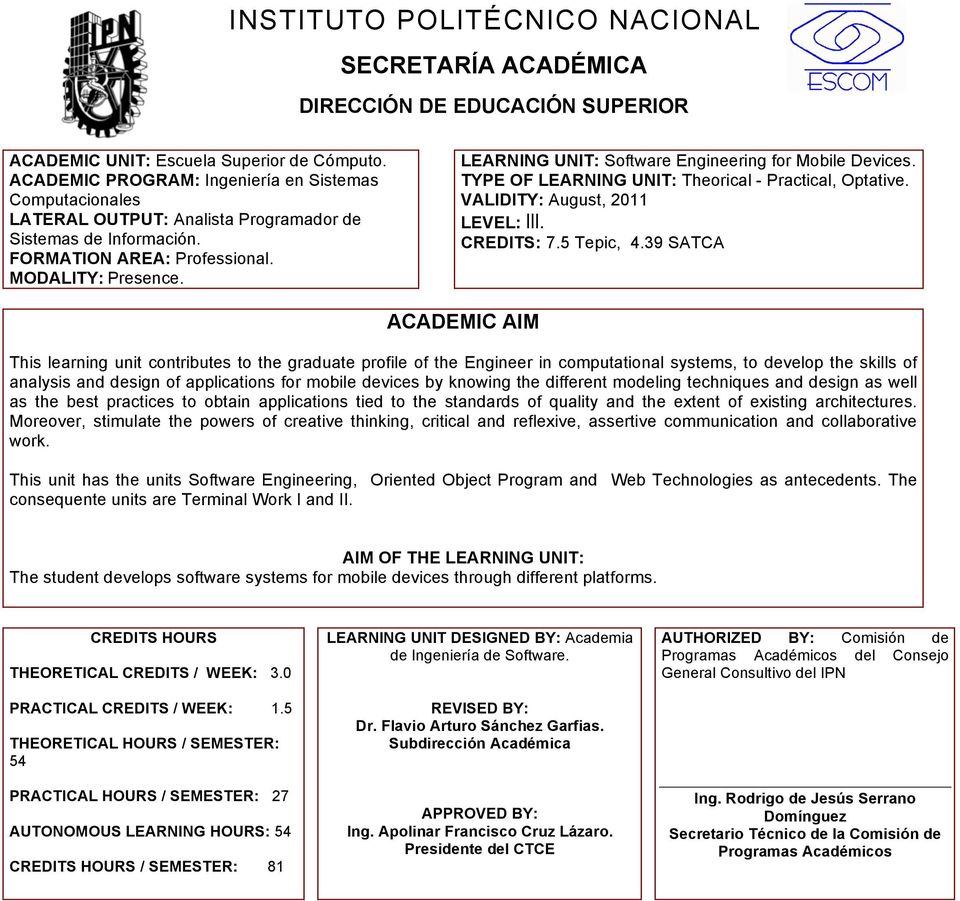
2 ACADEMIC UNIT: Escuela Superior de Cómputo. ACADEMIC PROGRAM: Ingeniería en Sistemas Computacionales LATERAL OUTPUT: Analista Programador de Sistemas de Información. FORMATION AREA: Professional. MODALITY: Presence. LEARNING UNIT: Software Engineering for Mobile Devices. TYPE OF LEARNING UNIT: Theorical - Practical, Optative. VALIDITY: August, 2011 LEVEL: III. CREDITS: 7.5 Tepic, 4.39 SATCA ACADEMIC AIM This learning unit contributes to the graduate profile of the Engineer in computational systems, to develop the skills of analysis and design of applications for mobile devices by knowing the different modeling techniques and design as well as the best practices to obtain applications tied to the standards of quality and the extent of existing architectures. Moreover, stimulate the powers of creative thinking, critical and reflexive, assertive communication and collaborative work. This unit has the units Software Engineering, Oriented Object Program and Web Technologies as antecedents. The consequente units are Terminal Work I and II. AIM OF THE LEARNING UNIT: The student develops software systems for mobile devices through different platforms. CREDITS THEORETICAL CREDITS / WEEK: 3.0 PRACTICAL CREDITS / WEEK: THEORETICAL / SEMESTER: 54 PRACTICAL / SEMESTER: 27 AUTONOMOUS LEARNING : 54 CREDITS / SEMESTER: 81 LEARNING UNIT DESIGNED BY: Academia de Ingeniería de Software. REVISED BY: Dr. Flavio Arturo Sánchez Garfias. Subdirección Académica APPROVED BY: Ing. Apolinar Francisco Cruz Lázaro. Presidente del CTCE AUTHORIZED BY: Comisión de Programas Académicos del Consejo General Consultivo del IPN Ing. Rodrigo de Jesús Serrano Domínguez Secretario Técnico de la Comisión de Programas Académicos
3 LEARNING UNIT: Software Engineering for Mobile Devices PAGE: 3 OUT OF 10 THEMATIC UNIT: I TITLE: Introduction to mobile applications development UNIT OF COMPETENCE The student compares the elements that make up different environments for the development of mobile applications on the basis of the requirements posed by the client. CONTENTS Teacher ledinstruction Autonomous Learning REFERENCES KEY T P T P History of Mobile Devices Elements of mobile applications Nertworks types Devices Platforms Operating Systems Application Frameworks Services Users Types of Mobile Applications SMS Mobile web applications Native Applications Games Mobile Information Architecture 3.5 1B,2B,3B,4B Subtotals: TEACHING PRINCIPLES This thematic unit must begin with a framing of the course and the formation of teams, will be Projects-Based learning strategy, trough heuristic method, what will allow for the consolidation of the following learning techniques: brainstorming, inquiry documentary, comparative tables, directed discussion, mental maps, project proposal (taking into account the collection of requirements posed by the client), exhibition in team of supplementary issues and implementation of practices. LEARNING EVALUATION Diagnostic Test Project Portfolio: Charts Mind Maps Cooperative Presentation Proposal of project Report of Practicals Self-Evaluation Rubrics Cooperative Evaluation Written Learning Evidence 1 30%

4 LEARNING UNIT: Software Engineering for Mobile Devices PAGE: 4 OUT OF 10 THEMATIC UNIT:II TITLE: User Interface for mobile applications UNIT OF COMPETENCE The student designs the graphical user interface based on design standards. CONTENTS Teacher ledinstruction Autonomous Learning REFERENCES KEY T P T P The elements of mobile design Context Designing mobile generic user interface Designing for different screen sizes Using UML for modeling generic user interface Modeling multimodal user interfaces Mobile Design tools 1B,2B,5B,7C Subtotals: TEACHING PRINCIPLES Will be Projects-Based learning strategy, trough heuristic method, what will allow for the consolidation of the following learning techniques: brainstorming, inquiry documentary, comparative tables, directed discussion, comparative tables, UML diagrams, exhibition in team of supplementary issues, advance of the project and practical and the production of the learning evidences. EVALUATION OF THE LEARNING Project Portfolio: Charts UML diagrams Advance of the Project Cooperative Presentation Report of Practicals Self-Evaluation Rubrics Cooperative Evaluation Written Learning Evidence 1

5 LEARNING UNIT: Software Engineering for Mobile Devices PAGE: 5 OUT OF 10 THEMATIC UNIT:III TITLE: Mobile Design UNIT OF COMPETENCE The student designs mobile applications on the basis of the development cycle and the Unified modeling language. CONTENTS Teacher ledinstruction Autonomous Learning REFERENCES KEY Mobile Web Applications versus Native Applications Mobile 2.0 Web standars Designing for multiple web browsers UML-Based development cycle for mobile applications Mobile design principles Architectural patterns for mobile applications Wireless Connectivity Characteristics and Quality of Service Synchronization and Replication of Mobile Data Using UML to represent data replication and synchronization schemes Modeling security with UML Mobility and location-based services Representing location with UML T P T P 3.0 1B,2B,3B,4B,6C 8B,11C Subtotals: TEACHING PRINCIPLES Will be Projects-Based learning strategy, trough heuristic method, what will allow for the consolidation of the following learning techniques: brainstorming, inquiry documentary, comparative tables, directed discussion, comparative tables, UML diagrams, exhibition in team of supplementary issues, advance of the project documentation, and practical and the production of the learning evidences. EVALUATION OF THE LEARNING Project Portfolio: Charts Cooperative Presentation Advance of the Project Report of Practicals UML diagrams Self-Evaluation Rubrics Cooperative Evaluation Written Learning Evidence 30%

6 LEARNING UNIT: Software Engineering for Mobile Devices PAGE: 6 OUT OF 10 THEMATIC UNIT:IV TITLE: Mobile applications process development UNIT OF COMPETENCE The student compares the programming languages that enable the deployment of mobile applications, based on its advantages and disadvantages CONTENTS Applying the wisdow methodology to moble development UML-based developmet cycle Problems with building location-based applications Best practices of development Programming languages and testing mobile applications Validating the mobile uses cases before development Stress testing and scalability issues Testing location-based functionality Teacher ledinstruction Autonomous Learning T P T P 3.0 REFERENCES KEY 2B,3B,6C, 7C,10C,11C Subtotals: TEACHING PRINCIPLES Will be Projects-Based learning strategy, trough heuristic method, what will allow for the consolidation of the following learning techniques: brainstorming, inquiry documentary, comparative tables, directed discussion, comparative tables, UML diagrams, exhibition in team of supplementary issues, implementation y validation of project, and practical and the production of the learning evidences. EVALUATION OF THE LEARNING Project Portfolio: Charts Comparative Chart Final Project Cooperative Presentation Report of Practicals Self-Evaluation Rubrics Cooperative Evaluation 1 40%

7 LEARNING UNIT: Software Engineering for Mobile Devices PAGE: 7 OUT OF 10 THEMATIC UNIT: V UNIT OF COMPETENCE The student applies for best development practices based on the type of mobile application. CONTENTS Teacher ledinstruction Autonomous Learning TITLE: Case study REFERENCES KEY T P T P Mobile developer frameworks Case Study Location based application Web Social features Emergency responce application Entreteiment applications Adapting to devices Best practices in mobile application developmet B,2B,7C,12C Subtotals: TEACHING PRINCIPLES Will be Projects-Based learning strategy, trough heuristic method, what will allow for the consolidation of the following learning techniques: brainstorming, inquiry documentary, comparative tables, directed discussion, comparative tables, UML diagrams, exhibition in team of supplementary issues, implementation of best practices in the project, and practical and the production of the learning evidences EVALUATION OF THE LEARNING Project Portfolio: Charts Comparative Chart Cooperative Presentation Final project with best practices integrated Report of Practicals Self-Evaluation Rubrics Cooperative Evaluation 1 40%

8 LEARNING UNIT: Software Engineering for Mobile Devices PAGE: 8 OUT OF 10 RECORD OF PRACTICALS 1 NAME OF THE PRACTICAL Framework for mobile applications THEMATIC UNITS I DURATION 4.5 ACCOMPLISHMENT LOCATION Computer Labs. 2 Graphic User Interface II Native Applications III Mobile device game implementation IV Adapting the practical 4 to another device V 3.0 TOTAL OF 27.0 EVALUATION AND PASSING REQUIREMENTS: The practical are considered mandatory to pass this unit of learning. The practical mean in each thematic unit.

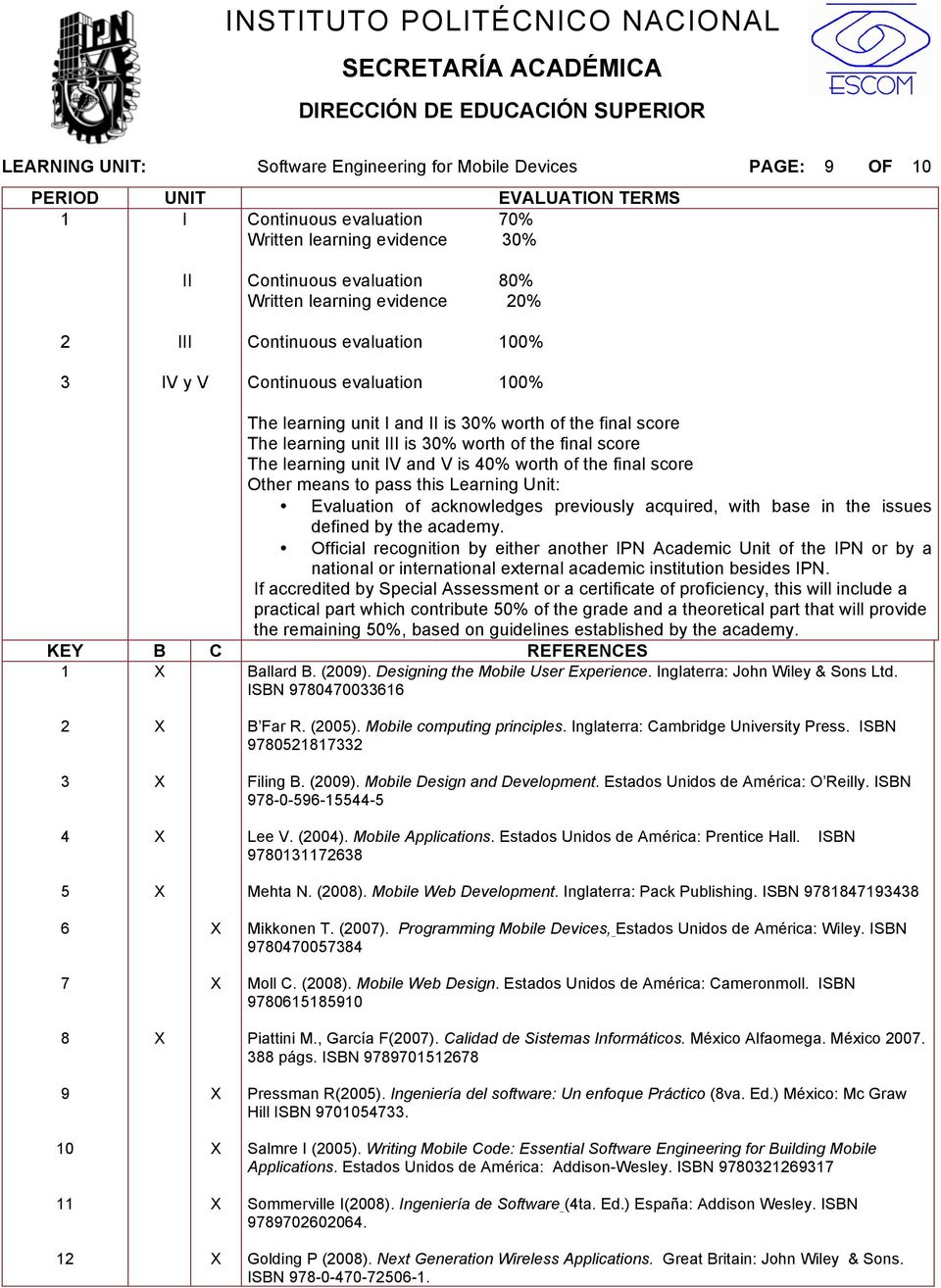
9 LEARNING UNIT: Software Engineering for Mobile Devices PAGE: 9 OF 10 PERIOD UNIT EVALUATION TERMS 1 I Continuous evaluation 70% Written learning evidence 30% 2 3 II III IV y V Continuous evaluation 80% Written learning evidence Continuous evaluation 100% Continuous evaluation 100% The learning unit I and II is 30% worth of the final score The learning unit III is 30% worth of the final score The learning unit IV and V is 40% worth of the final score Other means to pass this Learning Unit: Evaluation of acknowledges previously acquired, with base in the issues defined by the academy. Official recognition by either another IPN Academic Unit of the IPN or by a national or international external academic institution besides IPN. If accredited by Special Assessment or a certificate of proficiency, this will include a practical part which contribute 50% of the grade and a theoretical part that will provide the remaining 50%, based on guidelines established by the academy. KEY B C REFERENCES 1 Ballard B. (2009). Designing the Mobile User Experience. Inglaterra: John Wiley & Sons Ltd. ISBN B Far R. (2005). Mobile computing principles. Inglaterra: Cambridge University Press. ISBN Filing B. (2009). Mobile Design and Development. Estados Unidos de América: O Reilly. ISBN Lee V. (2004). Mobile Applications. Estados Unidos de América: Prentice Hall ISBN 5 Mehta N. (2008). Mobile Web Development. Inglaterra: Pack Publishing. ISBN Mikkonen T. (2007). Programming Mobile Devices, Estados Unidos de América: Wiley. ISBN Moll C. (2008). Mobile Web Design. Estados Unidos de América: Cameronmoll. ISBN Piattini M., García F(2007). Calidad de Sistemas Informáticos. México Alfaomega. México págs. ISBN Pressman R(2005). Ingeniería del software: Un enfoque Práctico (8va. Ed.) México: Mc Graw Hill ISBN Salmre I (2005). Writing Mobile Code: Essential Software Engineering for Building Mobile Applications. Estados Unidos de América: Addison-Wesley. ISBN Sommerville I(2008). Ingeniería de Software (4ta. Ed.) España: Addison Wesley. ISBN Golding P (2008). Next Generation Wireless Applications. Great Britain: John Wiley & Sons. ISBN
10 TEACHER EDUCATIONAL PROFILE PER LEARNING UNIT 1. GENERAL INFORMATION ACADEMIC UNIT: Escuela Superior de Cómputo ACADEMIC PROGRAM: Ingeniería en Sistemas Computacionales LEVEL III FORMATION AREA: Institutional Basic Scientific Professional Terminal and Integration ACADEMY: Ingeniería de Software LEARNING UNIT: Software Engineering for Mobile Devices SPECIALTY AND ACADEMIC REQUIRED LEVEL: Masters Degree or Doctor in Computer Science. 2. AIM OF THE LEARNING UNIT: The student develops software systems for mobile devices through different platforms. 3. PROFESSOR EDUCATIONAL PROFILE: KNOWLEDGE Unified Modeling Language Software Engineering Programming Languages. Web Technologies English Knowledge of the Institutional Educational Model. PROFESSIONAL EPERIENCE Two years in Analisys and design Web Applications. Two years handling Web Technologies. Two years in collaborative work. A year experience in the Institutional Educational Model ABILITIES Cooperative Leadership Fluidez verbal de ideas Capacidad de traspasar conocimientos Manejo de estrategias para fomentar el aprendizaje autónomo en el alumno Manejo de estrategias didácticas centradas en el aprendizaje Applications of Institutional Educational Model. APTITUDES Responsible Honest Respectful Tolerant Assertiv Collaborative Participative DESIGNED BY REVISED BY AUTHORIZED BY M. en C. Mónica Rivera de la Rosa. COORDINATING PROFESOR Ing. José Marco Antonio Rueda Meléndez M. en C. Chadwick Carreto Arellano. COLLABORATING PROFESSORS Dr. Flavio Arturo Sánchez Garfias Subdirector Académico Ing. Apolinar Francisco Cruz Lázaro Director Date: 2011

INSTITUTO POLITÉCNICO NACIONAL
 SYNTHESIZED SCHOOL PROGRAM ACADEMIC UNIT: ACADEMIC PROGRAM: Escuela Superior de Cómputo Ingeniería en Sistemas Computacionales LEARNING UNIT: Web Application Development LEVEL: AIM OF THE LEARNING UNIT:
How To Teach Embedded Systems
 SYNTHESIZED SCHOOL PROGRAM ACADEMIC UNIT ACADEMIC PROGRAM: Escuela Superior de Cómputo Ingeniería en Sistemas Computacionales LEARNING UNIT: Embedded Systems LEVEL: AIM OF THE LEARNING UNIT: The student
INSTITUTO POLITÉCNICO NACIONAL
 SYNTHESIZED SCHOOL PROGRAM ACADEMIC UNIT: ACADEMIC PROGRAM: LEARNING UNIT: Escuela Superior de Cómputo Ingeniería en Sistemas Computacionales. Advanced Computing Systems Programming LEVEL: III AIM OF THE
INSTITUTO POLITÉCNICO NACIONAL
 SYNTHESIZED SCHOOL PROGRAM ACADEMIC UNIT: ACADEMIC PROGRAM: Escuela Superior de Cómputo Ingeniería en Sistemas Computacionales. LEARNING UNIT: IT Financial Engineering LEVEL: III AIM OF THE LEARNING UNIT
Active methodology in the Audiovisual communication degree
 Available online at www.sciencedirect.com Procedia Social and Behavioral Sciences 2 (2010) 4487 4491 WCES-2010 Active methodology in the Audiovisual communication degree J.L Gimenez-Lopez a *, T. Magal
Ackoff, R.L. (1967). Management misinformation systems. Management science, 14(4),
 6.- REFERENCIAS 1 REFERENCIAS Ackoff, R.L. (1967). Management misinformation systems. Management science, 14(4), B147-B156. Badham, R., Clegg, C. & Wall, T. (2000). Socio-technical theory. Recuperado Enero
INSTITUTO POLITÉCNICO NACIONAL MEXICO
 INSTITUTO POLITÉCNICO NACIONAL MEICO ACADEMIC OFFER IN ENGLISH HIGHER SCHOOL OF COMPUTING (COMPUTER SYSTEMS ENGINEERING) UNDERGRADUATE (5th Semester Upwards) 1 Bioinformatics 22 Graphical User Interfaces
UNIVERSIDAD TÉCNICA DEL NORTE ARTÍCULO CIENTÍFICO (INGLÉS)
 UNIVERSIDAD TÉCNICA DEL NORTE FACULTAD DE INGENIERÍA EN CIENCIAS APLICADAS CARRERA DE INGENIERÍA EN SISTEMAS COMPUTACIONALES TRABAJO DE GRADO PREVIO A LA OBTENCIÓN DEL TÍTULO DE INGENIERO EN SISTEMAS COMPUTACIONALES
Master in Science, specialty in Information Systems. ITESM. México, June 1984.
 LAURA CRUZ REYES Instituto Tecnológico de Cd. Madero División de Estudios de Posgrado e Investigación Juventino Rosas y Jesús Urueta Cd. Madero Tamaulipas México CP. 89440 Tel/Fax (52) 833 215 85 44 e-mail:
Towards a Methodology for the Design of Intelligent Tutoring Systems
 Research in Computing Science Journal, 20: 181-189 ISSN 1665-9899 Towards a Methodology for the Design of Intelligent Tutoring Systems Enrique Sierra, Ramón García-Martínez, Zulma Cataldi, Paola Britos
Transport Demands Models
 ESCUELA DE INGENIEROS DE CAMINOS, CANALES Y PUERTOS. Curso académico 2015-16 Pág. 1 de 8 Transport Demands Models 1. General overview UPM Code Credits Type Specialization Language 43000411 4,5 Optional
City University of Hong Kong Course Syllabus. offered by Department of Computer Science with effect from Semester A 2015/16
 City University of Hong Kong Course Syllabus offered by Department of Computer Science with effect from Semester A 2015/16 Part I Course Overview Course Title: Software Engineering Principles and Practice
Spanish Grammar II. Tierra Encantada Charter School. Contact Number: (505) 983-3337
 Spanish Grammar II Tierra Encantada Charter School Mr. Arruga Contact Number: (505) 983-3337 Course Description/Objectives / Descripcion del curso / Objetivos: La asignatura de Gramatica espanola pretende
UNIVERSIDAD DE GUADALAJARA
 UNIVERSIDAD DE GUADALAJARA CENTRO UNIVERSITARIO DE CIENCIAS ECONÓMICO ADMINISTRATIVAS MASTER BUSINESS ADMINISTRATION COURSE PROGRAM 1. - SUBJECT Economic Environment 2. - SUBJECT CODE NRC D0812 3. - PREREQUISITES
Beck, L., L., Chizhik, A.W., and McElroy, A.C. 2005. Cooperative learning
 Referencias Beck, L., L., Chizhik, A.W., and McElroy, A.C. 2005. Cooperative learning techniques in CS1: design and experimental evaluation. Proceedings of the 36th SIGCSE technical symposium on Computer
IMPLEMENTATION OF A MANAGEMENT AND QUALITY CONTROL SYSTEM UNDER ISO STANDARDS 9001:2000, 19113, 19114,19138 AND 19115 IN CARTOGRAPHIC PRODUCTION
 IMPLEMENTATION OF A MANAGEMENT AND QUALITY CONTROL SYSTEM UNDER ISO STANDARDS 9001:2000, 19113, 19114,19138 AND 19115 IN CARTOGRAPHIC PRODUCTION SUMMARY INTRODUCTION JOSELYN A. ROBLEDO CEBALLOS [email protected]
E-ASSESSMENT IN A MASTER ONLINE COURSE. A CASE STUDY
 E-ASSESSMENT IN A MASTER ONLINE COURSE. A CASE STUDY Inés Gil-Jaurena, Teresa Aguado, Beatriz Malik, Pilar Cucalón Universidad Nacional de Educación a Distancia (UNED) (SPAIN) Abstract E-assessment is
Teaching guide ECONOMETRICS
 Teaching guide ECONOMETRICS INDEX CARD Subject Data Código Titulación Nombre Carácter Ciclo 1313.- Grado en Administración y Dirección de Empresas, Mención Creación y Dirección de Empresas, Itinerario
THE BENEFITS OF THE USE OF INDUCTION VIRTUAL COMMUNITIES IN SUPPORTING NEW STUDENTS IN DISTANCE EDUCATION UNIVERSITIES
 THE BENEFITS OF THE USE OF INDUCTION VIRTUAL COMMUNITIES IN SUPPORTING NEW STUDENTS IN DISTANCE EDUCATION UNIVERSITIES Angeles Sánchez-Elvira Paniagua,UNED, Spain Co-authors: Marcela Paz González Brignardello,
Academic Guide. Strategic Management 4th year Degree in Marketing and Sales Management (TSDMC) Academic Year 2014 /2015
 Academic Guide Strategic Management 4th year Degree in Marketing and Sales Management (TSDMC) Academic Year 2014 /2015 Campus: Pozuelo (Madrid) Professors: Academic Period: Year: Type: Language Segundo
UNIVERSIDAD DE GUADALAJARA
 MAS CENTRO UNIVERSITARIO DE CIENCIAS ECONÓMICO ADMINISTRATIVAS TER BUSINESS ADMINISTRATION COURSE PROGRAM 1. - SUBJECT Human Capital 2. - SUBJECT CODE D0847 3. - PREREQUISITES None 4. - SERIATION None
Methodologies development and software quality metrics in educational applications
 Methodologies development and software quality metrics in educational applications JOAN F. CHIPIA LOBO Maestría en Educación mención Informática y Diseño Instruccional Universidad de Los Andes La Liria,
Entry to Year 7 - Information for Parents
 Entry to Year 7 - Information for Parents Key Names: Mrs Elizabeth Batchelor - Head of the Secondary School Mr Darren Roth - Head of Key Stage Three Miss Karen Britcliffe - Head of Pastoral Care Groupings
COMPARISON OF PROFESSIONAL CERTIFICATION SYSTEMS FOR PROJECT MANAGEMENT
 Dante Guerrero; Anthony Cardoza; Ignacio De los Ríos COMPARISON OF PROFESSIONAL CERTIFICATION SYSTEMS FOR PROJECT MANAGEMENT Dante Guerrero; Anthony Cardoza; Ignacio De los Ríos Shangai, 02 de junio de
Course Computer Science Academic year 2012/2013 Subject Software Engineering II ECTS 6
 Course Computer Science Academic year 2012/2013 Subject Software Engineering II ECTS 6 Type of course Compulsory Year 3rd Semester 1st semester Student Workload: Professor(s) Maria Clara Silveira Total
Causes of desertion in the English teaching and translation bachelors degree programs and prevention mechanisms 2002-1-2005-2
 Causes of desertion in the English teaching and translation bachelors degree programs and prevention mechanisms 2002-1-2005-2 Martha E. Guzmán O. - Responsible for the Coordination of Educative and Psychological
Syllabus PRODUCT MANAGEMENT 3 rd Year HIGHER DEGREE IN MARKETING AND BUSINESS MANAGEMENT (TSDMC)
 Syllabus PRODUCT 3 rd Year HIGHER DEGREE IN MARKETING AND BUSINESS (TSDMC) Academic year 2013/2014 Professor: Madrid Campus:Luis Sánchez Villa Valencia Campus: Bruno Arnau Period of classes and year: Quarter
1313.- Grado en Administración y Dirección de Empresas, Mención Creación y Dirección de Empresas, Itinerario Emprendedores
 Guía Docente 35802 Estrategia de Marketing / Marketing Strategy FICHA IDENTIFICATIVA Datos de la Asignatura Código 35802 Titulación Nombre Carácter Ciclo Curso 1313.- Grado en Administración y Dirección
270015 - IES - Introduction to Software Engineering
 Coordinating unit: 270 - FIB - Barcelona School of Informatics Teaching unit: 747 - ESSI - Department of Service and Information System Engineering Academic year: Degree: 2015 BACHELOR'S DEGREE IN INFORMATICS
820031 - SICSB - Information Systems and Communications for Health Services
 Coordinating unit: 820 - EUETIB - Barcelona College of Industrial Engineering Teaching unit: 707 - ESAII - Department of Automatic Control Academic year: Degree: 2015 BACHELOR'S DEGREE IN BIOMEDICAL ENGINEERING
Software Engineering
 1 Software Engineering Lecture 2: Software Life Cycles Stefan Hallerstede Århus School of Engineering 25 August 2011 2 Contents Naive Software Development Code & Fix Towards A Software Process Software
SOFTWARE QUALITY MODEL BASED ON SOFTWARE DEVELOPMENT APPROACHES
 OFTWARE QUALITY MODEL BAED ON OFTWARE DEVELOPMENT APPROACHE Kenyer Domínguez, María Pérez, Anna C. Grimán, Maryoly Ortega, Luis E. Mendoza Laboratorio de Investigación en istemas de Información (LII),
Dr. Mérida C. Mercado Inter American University of Puerto Rico Arecibo Campus [email protected]. Prof. Nicolás Ramos
 What software is in almost every desktop pc? MS Excel: Academic analytics of historical retention patterns for decision-making using customized software for Excel Dr. Mérida C. Mercado Inter American University
COMPLEMENTOS PARA LA FORMACIÓN DISCIPLINAR EN INGLÉS. Máster en Formación del Profesorado. Universidad de Alcalá
 COMPLEMENTOS PARA LA FORMACIÓN DISCIPLINAR EN INGLÉS Máster en Formación del Profesorado Universidad de Alcalá Curso Académico 2015/2016 GUÍA DOCENTE Nombre de la asignatura: Complementos para la formación
Process Management and Control
 ANTIOQUIA SCHOOL OF ENGINEERING Process Management and Control ACADEMIC DOMAIN CURRICULUM FIELD PREREQUISITE(S) COREQUISITE(S) Administration/Management (UNDERGRADUATE AND MASTERS) General Management and
Evaluation of an exercise for measuring impact in e-learning: Case study of learning a second language
 Evaluation of an exercise for measuring impact in e-learning: Case study of learning a second language J.M. Sánchez-Torres Universidad Nacional de Colombia Bogotá D.C., Colombia [email protected]
PROBLEM-BASED LEARNING IN MATERIALS AND MANUFACTURING ENGINEERING EDUCATION ACCORDING TO THE ITESM-2015
 PROBLEM-BASED LEARNING IN MATERIALS AND MANUFACTURING ENGINEERING EDUCATION ACCORDING TO THE ITESM-2015 Eduardo Cárdenas Alemán, César Alberto Núñez López, Juan Oscar Molina Solís Monterrey Institute of
Software Development Emphasis in Informatics Engineering Curriculum
 CREATIVE MATH. 13 (2004), 127-132 Software Development Emphasis in Informatics Engineering Curriculum Cristian Rusu and Jorge Bozo Abstract. A six-year undergraduate program in Informatics Engineering
California State University, Stanislaus Doctor of Education (Ed.D.), Educational Leadership Assessment Plan
 California State University, Stanislaus Doctor of Education (Ed.D.), Educational Leadership Assessment Plan (excerpt of the WASC Substantive Change Proposal submitted to WASC August 25, 2007) A. Annual
2014 New Jersey Core Curriculum Content Standards - Technology
 2014 New Jersey Core Curriculum Content s - Technology Content Area Grade Content Statement Students will: Technology A. Technology Operations and Concepts: Students demonstrate a sound understanding of
Mobile Technology. Woods, D. Independent study (including assessment) COM N/A
 MODULE TITLE: MODULE CODE: DATE OF REVISION: 2013-14 MODULE LEVEL: 6 CREDIT POINTS: 20 MODULE STATUS: SEMESTER: 1 LOCATION: E-LEARNING: PREREQUISITE(S): CO-REQUISITE(S): Mobile Technology COM594 Optional
Economic- Management. None. None
 ANTIOQUIA SCHOOL OF ENGINEERING General Management ACADEMIC DOMAIN CURRICULUM FIELD (POSTGRADUATE AND MASTERS) PREREQUISITE(S) COREQUISITE(S) SUBJECT CREDITS - COLOMBIANS - ECTS (COLOM x1.8) DIRECT TEACHING
DEGREE CURRICULUM SOFTWARE ARCHITECTURES Degree in Computer Engineering. Teaching staff: GIL IRANZO, ROSA MARIA GARCIA GONZALEZ, ROBERTO
 Academic year 2014-15 DEGREE CURRICULUM SOFTWARE ARCHITECTURES Degree in Computer Engineering Teaching staff: GIL IRANZO, ROSA MARIA GARCIA GONZALEZ, ROBERTO Subject's general information Subject name
The documentation in support of the museum management and knowledge management
 The documentation in support of the museum management and knowledge management 1 INTRODUCTION 1.1 The science, technology and knowledge The use of new technologies in Latin American countries, has profoundly
Agent-Based Software and Practical Case of Agent-Based Software Development
 Agent-Based Software and Practical Case of Agent-Based Software Development Course 2008/2009 SUBJECTS: AGENT-BASED SOFTWARE and PRACTICAL CASE OF AGENT-BASED SOFTWARE DEVELOPMENT EUROPEAN MASTER on SOFTWARE
City University of Hong Kong Course Syllabus. offered by Department of Computer Science with effect from Semester A 2015/16
 City University of Hong Kong Course Syllabus offered by Department of Computer Science with effect from Semester A 2015/16 Part I Course Overview Course Title: Problem Solving and Programming Course Code:
Profesor: M.T.I. Juvencio Mendoza Castelán
 Área Académica: Licenciatura En Sistemas Computacionales Tema: Introduction To Database Profesor: M.T.I. Juvencio Mendoza Castelán Periodo: July / December/2011 Keywords. Database / Concept Tema: Introduction
Curriculum Reform in Computing in Spain
 Curriculum Reform in Computing in Spain Sergio Luján Mora Deparment of Software and Computing Systems Content Introduction Computing Disciplines i Computer Engineering Computer Science Information Systems
240EO036 - Business Project Management
 Coordinating unit: 240 - ETSEIB - Barcelona School of Industrial Engineering Teaching unit: 736 - PE - Department of Engineering Design Academic year: Degree: 2015 MASTER'S DEGREE IN MANAGEMENT ENGINEERING
Global Economy and International Environment in Business Administration
 ESCUELA DE INGENIEROS DE CAMINOS, CANALES Y PUERTOS. Curso académico 2015-16 Pág. 1 de 8 Global Economy and International Environment in Business Adistration 1. General overview UPM Code Credits Type Specialization
KINGDOM OF SAUDI ARABIA KING SAUD UNIVERSITY COLLEGE OF APPLIED UNIVERSITY NURSING DEPARTMENT MASTER OF SCIENCE IN NURSING DEGREE PROGRAM:
 KINGDOM OF SAUDI ARABIA KING SAUD UNIVERSITY COLLEGE OF APPLIED UNIVERSITY NURSING DEPARTMENT MASTER OF SCIENCE IN NURSING DEGREE PROGRAM: The department of nursing is one of several departments of the
5.2 A Software Process Improvement Solution for Small and Medium-Size Enterprises
 5.2 A Software Process Improvement Solution for Small and Medium-Size Enterprises Authors Jose A. Calvo-Manzano, Gonzalo Cuevas Agustin, Ivan Garcia Pacheco, Tomas San Feliu Gilabert, and Ariel Serrano
Adaptación de MoProSoft para la producción de software en instituciones académicas
 Adaptación de MoProSoft para la producción de software en instituciones académicas Adaptation of MoProSoft for software production in academic institutions Gabriela Alejandra Martínez Cárdenas Instituto
MEA 116. Electronic Medical Records. Course Package
 MEA 116 Electronic Medical Records Course Package Approved: December 3, 2010 EFFECTIVE DATE: Spring 2011 COURSE PACKAGE FORM Team Leader and Members Carol Elledge, Lori Howell, Jeff Turner, Lori Hogue
ISSUES OF STRUCTURED VS. OBJECT-ORIENTED METHODOLOGY OF SYSTEMS ANALYSIS AND DESIGN
 ISSUES OF STRUCTURED VS. OBJECT-ORIENTED METHODOLOGY OF SYSTEMS ANALYSIS AND DESIGN Mohammad A. Rob, University of Houston-Clear Lake, [email protected] ABSTRACT In recent years, there has been a surge of
Definition of a Technological Ecosystem for Scientific Knowledge Management in a PhD Programme
 Definition of a Technological Ecosystem for Scientific Knowledge Management in a PhD Programme Alicia García-Holgado Francisco J. García-Peñalvo Mª José Rodríguez-Conde Research Group in InterAction and
Pontificia Universidad Católica del Ecuador Facultad de Comunicación, Lingüística y Literatura Escuela de Lenguas Sección de Inglés
 Facultad de Comunicación, Lingüística y Literatura Escuela de Lenguas Sección de Inglés E-MAIL: [email protected] Fax:593-2 2 991595 Teléf.: 2991700. Ext 1243 1. DATOS INFORMATIVOS: MATERIA INGLÉS CÓDIGO:
TEACHING AND LEARNING JURIDICAL SCIENCES BY MEANS OF CONCEPTUAL MAPS. A TRIAL WITH CMAPTOOLS
 TEACHING AND LEARNING JURIDICAL SCIENCES BY MEANS OF CONCEPTUAL MAPS. A TRIAL WITH CMAPTOOLS María de la Sierra Flores Doña y Marta Blanco Carrasco Facultad de Derecho, Universidad Complutense Madrid,
SYLLABUS CIS 3660: OBJECT-ORIENTED SYSTEM ANALYSIS AND DESIGN SPRING 2010
 SYLLABUS CIS 3660: OBJECT-ORIENTED SYSTEM ANALYSIS AND DESIGN SPRING 2010 Instructor: Dr. Silvana Faja Office: WDE 2400 Office Hours: 9:30 10:45 and 1:30 3:00, Tuesday and Thursday and by appointment Office
Methods to Assist in Teaching Planning and Scheduling
 Methods to Assist in Teaching Planning and Scheduling Kris G. Mattila, Ph.D., P.E. Visiting Professor, USAFA, CO Michigan Technological University Houghton, Michigan James B. Pocock, Ph.D., R.A. Patrick
Human ingenuity: Supporting international-mindedness through university initiatives for teachers. Developing international-mindedness
 Human ingenuity: Supporting international-mindedness through university initiatives for teachers Presentation at the Association of Australian International Baccalaureate Schools Conference Prince Alfred
Ph.D. in Philosophy (History and Geography), Universidad Autónoma, Madrid, 1994
 Juan Carlos Ocaña Head of the Bilingual Section IES Parque de Lisboa Alcorcón (Spain) E-mail: [email protected] Web site: http://www.historiasiglo20.org ACADEMIC PREPARATION: Ph.D. in Philosophy
MATHEMATICS KNOWLEDGE FOR TEACHING WITHIN A FUNCTIONAL PERSPECTIVE OF PRESERVICE TEACHER TRAINING
 MATHEMATICS KNOWLEDGE FOR TEACHING WITHIN A FUNCTIONAL PERSPECTIVE OF PRESERVICE TEACHER TRAINING Pedro Gómez Universidad de Granada C/. Alisios 17, Albolote 18820, Spain Phone/Fax: (34)958537304 [email protected]
DIRECT PH.D. (POST B.S.) IN COMPUTER SCIENCE PROGRAM
 DIRECT PH.D. (POST B.S.) IN COMPUTER SCIENCE PROGRAM OVERVIEW ADMISSION REQUIREMENTS PROGRAM REQUIREMENTS OVERVIEW FOR THE DIRECT PH.D. IN COMPUTER SCIENCE The Direct Ph.D. in Computer Science program
Syllabus Subject: Relational, Direct and Interactive Marketing (II) Degree: Titulación Superior en Dirección de Marketing y Gestión Comercial
 Syllabus Subject: Relational, Direct and Interactive Marketing (II) Degree: Titulación Superior en Dirección de Marketing y Gestión Comercial Academic year 2012/2013 Teachers: Oscar VEGA Period of classes
How To Create A Tutorial System For Computer Science And Telecommunication Engineering Students
 A New Tutorial System for Computer Science and Telecommunication Engineering Students Rico Castro, Nuria 3 ; Castillo Valdivieso, Pedro Ángel 1 ; Rubio Escudero, Miguel Ángel 5 ; Paderewski Rodríguez,
Development of a Relational Database Management System.
 Development of a Relational Database Management System. Universidad Tecnológica Nacional Facultad Córdoba Laboratorio de Investigación de Software Departamento de Ingeniería en Sistemas de Información
Criteria for Approval of Online Providers and Courses to Satisfy UC Subject ( a-g ) Requirements
 Criteria for Approval of Online Providers and Courses to Satisfy UC Subject ( a-g ) Requirements Approved by BOARS Articulation & Evaluation Subcommittee on July 27, 2006 Approved by BOARS on October 6,
Bachelor Degree in Informatics Engineering Master courses
 Bachelor Degree in Informatics Engineering Master courses Donostia School of Informatics The University of the Basque Country, UPV/EHU For more information: Universidad del País Vasco / Euskal Herriko