
Better Living with Obstructive Pulmonary Disease A Patient Guide
|
|
|
- Vernon Hancock
- 10 years ago
- Views:
Transcription
1 Better Living with Obstructive Pulmonary Disease A Patient Guide Second Edition November 2012 Queensland Health The State of Queensland (Queensland Health) and The Australian Lung Foundation 2012 a

2 Better Living with Chronic Obstructive Pulmonary Disease A Patient Guide is a joint project of the Statewide COPD Respiratory Network, Clinical Practice Improvement Centre, Queensland Health and The Australian Lung Foundation, COPD National Program. This work is copyright and copyright ownership is shared between the State of Queensland (Queensland Health) and The Australian Lung Foundation It may be reproduced in whole or in part for study, education or clinical purposes subject to the inclusion of an acknowledgement of the source. It may not be reproduced for commercial use or sale. Reproduction for purposes other than those indicated above requires written permission from both Queensland Health and The Australian Lung Foundation. The State of Queensland (Queensland Health) and The Australian Lung Foundation For further information contact Statewide Respiratory Clinical Network, Patient Safety and Quality Improvement Service, [email protected] or phone: (07) and The Australian Lung Foundation, [email protected] or phone: For permissions beyond the scope of this licence contact: Intellectual Property Offi cer, Queensland Health, ip_offi [email protected] or phone (07) To order resources or to provide feedback please [email protected] or phone Queensland Health Statewide Respiratory Clinical Network and The Australian Lung Foundation, COPD National Program Better Living with Chronic Obstructive Pulmonary Disease A Patient Guide, ISBN b Chapter 5: Your role in managing your chronic obstructive pulmonary disease

3 chapter 12 Breathlessness, breathing control and energy conservation This chapter will help you to understand: What the causes of breathlessness are. How to better control or reduce your breathlessness. Why energy conservation is important. How you can conserve your energy. What are the causes of breathlessness? Who becomes breathless? Breathlessness (or dyspnoea) is common in people with lung or heart conditions, as well as in people who are overweight or unfi t. People who are overweight or unfi t will have to work harder during everyday activities and, as a result, will fatigue more quickly. As people get older, their lung function declines owing to changes in their lungs, their chest wall and the strength of their breathing muscles. These changes contribute to older people becoming more breathless when performing activities. Those with lung diseases like COPD will experience breathlessness as the disease affects the breathing tubes or airways and the lungs. The feelings of breathlessness may increase as the disease progresses. How do people feel about their breathlessness? In mild forms of lung disease, breathlessness may occur when walking up hills or stairs. As the disease becomes more severe, breathlessness can occur on minimal exertion such as when walking slowly along fl at ground or even at rest. Daily activities become more diffi cult as the lung condition gets worse. It is not surprising that people who have COPD can become frustrated, anxious and depressed. These emotions can make breathing problems worse. Importantly, for people who have lung conditions, such as COPD, there are things they can do to make life easier. It is important not to stop doing things altogether but to try to stay as active as possible. When do you notice your breathing change? We are not usually aware of our breathing, but there are times when we do become aware. The breathing centre in the brain is constantly receiving signals from your body about the amount of oxygen that is needed. The oxygen requirements of your body will depend on many factors, such as: 1. The severity of your lung condition and the ability of oxygen to pass through your lungs into your blood stream for use by the body. 2. The level of activity you are currently doing will affect the amount of oxygen your body will need. For instance, when you are resting quietly, the oxygen demand is less than when performing strenuous activities, such as walking up stairs or hills. 3. Your fitness or conditioning will also affect your oxygen requirements during an activity. A person The State of Queensland (Queensland Health) and The Australian Lung Foundation

4 with a better fi tness level will generally be more effi cient in moving oxygen around their body, and their muscles will require less oxygen to do the same activity than a person who is unfi t. Healthy Person 4% 10% - 15% Resting Exercising COPD Person 15% 35% - 40% 4. Stress or anxiety, or a low mood, can affect your breathing rate. These mood states can make you focus on your breathlessness and make you more aware of your breathing. 5. If you are unwell more effort is required to breathe. COPD and breathlessness COPD affects both the lungs and the body. As a result, breathlessness can be caused by a combination of reasons: 1. In COPD, the lungs lose their natural elasticity as they become damaged and over-expanded. This can make it harder for someone who has COPD to breathe air out fully. 2. As a result of being unable to breathe air out fully, the trapped air leads to an over-expansion of the lungs. This is often called a barrel chest (hyperinfl ation). Hyperinfl ation changes the way your muscles and chest wall work. The breathing muscles of a person who is hyperinfl ated will have to work harder and as a result, will fatigue more quickly. Other muscle groups can be used to help people breathe; these muscles are known as accessory muscles. The neck muscles are an example of these accessory muscles. 3. The muscles used for breathing, like all muscles in the body, require oxygen to be able to work. A person who has COPD may have a higher oxygen requirement just to continue breathing. 4. The narrowing or swelling of the breathing tubes or airways, in combination with producing larger amounts of sputum, can restrict the fl ow of air in The cycle of inactivity 53 Chapter 12: Breathlessness, breathing control and energy conservation

5 and out of the lungs. Airway clearance techniques can help to keep the breathing tubes or airways clearer and assist in making breathing easier (see chapter 13). 5. When you are living with COPD, you may be unable to continue your normal level of activity, which can result in a cycle of inactivity (see the previous diagram). Frequently, this will lead you to reduce your physical activities, causing you to become unfi t or poorly conditioned. Being unfit or poorly conditioned makes your movements less efficient and requires greater effort to complete everyday activities. 6. People who have COPD often experience increased anxiety about becoming breathless or short of breath. This anxiety can lead to a fear of undertaking activities. In summary, people with COPD need to work harder than others to breathe. How do you better control or reduce your breathlessness? There are many treatment options and management strategies that can help you control or reduce your breathlessness. 1. Medication Using your reliever, maintenance and preventer medication can assist in controlling breathlessness. It is important that medications are used correctly to ensure their effectiveness. For more details on medications and inhalation devices, refer to chapter 7 Knowing your medication and chapter 8 Using your inhalation devices. 2. Relaxed breathing People who have COPD have more diffi culty breathing out fully. The body s normal reaction when breathlessness occurs is to breathe faster and shallower. However, faster and shallow breathing is not an effective way to regain control of your breathing. You could practice relaxed breathing any time you are trying to catch your breath. For example, relaxed breathing may be useful after coughing or exercising. Aim to breathe out slowly and without force. As you breathe out, let your shoulders and neck muscles relax. Most of your breathing should occur by the lower ribcage expanding and relaxing, rather than in the upper chest. By breathing out fully, you will be able to breathe in better. You may fi nd it useful to practice relaxed breathing when you are at rest so that you are familiar with the technique. To practice relaxed breathing, place one hand on your chest and one hand on your stomach at the level of your navel while sitting. When you take a deep breath in, the hand on your stomach, Relaxed breathing technique rather than the hand on your chest, should move fi rst. Practice breathing so that the hand on your stomach moves fi rst. 3. Prolonged expiration breathing The purpose of prolonged expiration breathing is to try to reduce the amount of air trapped in the lungs and reduce airway collapse by prolonged breathing out (unforced expiration). Breathing out should take longer than breathing in. Breathing out through pursed lips is an example of this technique. Pursed lips (lips that are closer together than usual, as if you were whistling or kissing somebody) create a smaller opening for the air to fl ow through. 4. Recovery positions Good posture is very important. The more you slump, the more you squash your lungs and stomach, and the harder it is to breathe. Try taking a deep breath while slumped. Now try again while standing or sitting fully upright with a tall spine. Can you notice a difference? A comfortable recovery position is important. Typically, recovery positions are upright with your arms supported. Common examples of recovery positions are shown in the images on the following page. The State of Queensland (Queensland Health) and The Australian Lung Foundation

6 Aim to find a rate of breathing that matches your effort. If you fi nd an activity too hard to do, simply stop and recover before restarting the activity at a slower pace. 6. Improve your fitness Better fi tness levels or improved tolerance to exercise will enable a decrease in the effort required to perform everyday activities. Resting against a sign 7. Manage your anxiety Learning how to manage or control your anxiety, or situations that cause your anxiety, can assist your breathing control (see chapter 18 Managing stress, anxiety and depression, page 76). Resting against a tree 5. Pace yourself This is a very important skill and is often overlooked. If you have breathing problems and are noticing that you are more short of breath than previously, you will need to slow down to get your tasks done. If you rush and try to beat the shortness of breath, you will spend longer trying to catch your breath. If you go slowly and pace yourself, you will go a lot further before needing a rest. For example: While walking, try to establish a pattern of breathing that matches your steps and that you can maintain easily. For example, you may breathe with every step or over a number of steps depending on your level of breathlessness and fi tness. If you change your pace of walking, you will need to adjust your breathing pattern. Before you begin climbing stairs or walking up hills, it is important to gain breathing control. Do not hold your breath and rush through the task to get it over with as this will only make you more short of breath. Why do you need energy conservation? With lung disease, the body is no longer as effi cient in meeting the body s demand for oxygen. When the body receives less oxygen, energy supplies become limited. This can cause fatigue, shortness of breath and possible anxiety or panic with everyday activities. By learning to conserve energy with everyday tasks, you will be able to perform many activities with less effort and less shortness of breath. Along with exercise, keeping active in normal daily activities is an important part of maintaining your fi tness. Before stopping an activity, consider whether you could make it easier by using the following energy saving techniques. By learning to conserve energy with everyday tasks, you will be able to perform many activities with less effort and less shortness of breath. 55 Chapter 12: Breathlessness, breathing control and energy conservation

7 1. Control and coordinate your breathing with daily activities People with lung disease use more energy simply to breathe. Therefore, it is important to coordinate your breathing with all activities. Even the simplest tasks use energy. Standing Up: Breathe in before you move. Breathe out as you rise up from your seat. Lifting an object above your head: Breathe in before you lift. Breathe out as you lift your arms above you. Putting on shoes: Breathe in before you move. Breathe out as you bend down to put on your shoe. Breathe IN before you start Breathe OUT as you complete the activity If you go slowly and pace yourself, you will go a lot further before needing a rest. If you rush and try to beat the shortness of breath, you will spend longer trying to catch your breath. When you are feeling short of breath, use recovery positions to help regain control of your breathing. 2. Reduce strenuous movements Keep your arms and body close to the activity you are performing: Carry objects close to your body. Organise equipment or food to be within easy reach. Keep most activities between waist and shoulder level: Store commonly used items on middle shelves between your waist and shoulders. Work at benches that are at waist height. Use long handled equipment (for example, long handled reachers, long handled pruning shears, a broom, a dressing stick, a sock aid and a bathing brush). Bring your feet to you (for example, rest your foot on your knee to towel dry, put on socks, and tie up your laces). Avoid heavy lifting: Use trolleys; push rather than pull; slide rather than lift. Let your bigger muscles do the work squat with your legs, avoid bending your back. Ask for help. Divide the load eg. groceries, half fi ll the kettle. 3. Sit when possible to perform activities Standing uses more energy than sitting. When possible, consider sitting while ironing, washing dishes, showering, chopping vegetables, gardening, making a phone call or working in the shed. Keep a high stool or chair for you to use in your kitchen or at your work bench. 4. Take frequent rest breaks Continuing to work until you are out of breath may then take you longer to recover. So take regular breaks to rest and recover while working. Don t wait until you need a break. 5. Plan and prepare before you perform tasks High expectations can lead to frustration, so be patient with yourself and set achievable goals. Challenge old habits. Ask yourself Is it essential that this task be performed in the usual way? Plan for rest breaks and interruptions. Break jobs into smaller steps. For example, rather than cut the entire lawn in one go, do it in two or three goes. Prepare and prioritise. Use a diary or calendar to plan daily, weekly and monthly tasks. Put items where they can be found easily and quickly. Keep most frequently used items between waist and shoulder level. Use equipment that makes the job easier, eg. light weight crockery, long handled reachers, long-handled garden equipment, stools, trolleys, velcro shoes, buttonless shirts and clothes that don t need ironing. The State of Queensland (Queensland Health) and The Australian Lung Foundation

8 6. Pace yourself: Use slow, rhythmic movements. Alternate light and heavy activities Spread heavier tasks throughout the day, week and month. Learn to ask for help, or get someone else to do the task, such as family members, community services, neighbours, volunteers or friends. Asking for help does not mean you are dependent, it means you are using your energy to its best advantage. 7. Avoid extremes of temperature Hot or cold environments place greater demand on the body which may increase feelings of breathlessness, fatigue, discomfort and anxiety. Avoid strenuous tasks, particularly in hot weather. Where possible, control the temperature in your environment. Use fans, air conditioners, heaters. Avoid extremes in temperature. Reduce steam open doors, windows. 8. Avoid activity after a meal Avoid strenuous activity after meals. 9. Relax When you feel worried, anxious or uptight your body uses a greater amount of energy. This can add to feelings of being tired or breathless. Relaxation can help restore energy. Concentrate on relaxing your muscles and slowing down your breathing. When breathlessness or fatigue limits your ability to commence, continue or complete an activity remember to PLAN, PREPARE, PACE & PAUSE PLAN how you will carry out the task. PREPARE all the items you will need to complete the task. PACE yourself and slow down during the task. PAUSE and rest whenever needed. 57 Chapter 12: Breathlessness, breathing control and energy conservation

MANAGING BREATHLESSNESS
 12 Leaflet issued by: Pulmonary Rehabilitation Service Anglian Community Enterprise (CIC) Kennedy House Kennedy Way, Clacton-on-sea Essex CO15 4AB Tel: 01255 206263 MANAGING BREATHLESSNESS On request,
Better Breathing with COPD
 Better Breathing with COPD People with Chronic Obstructive Pulmonary Disease (COPD) often benefit from learning different breathing techniques. Pursed Lip Breathing Pursed Lip Breathing (PLB) can be very
Help Yourself Breathe. Tender Loving Care for Your Lungs. Department of Physiotherapy. PD 1359 (Rev 06-2009) File: peyles
 Help Yourself Breathe Tender Loving Care for Your Lungs PD 1359 (Rev 06-2009) File: peyles Department of Physiotherapy Why are you breathless? Chronic Airflow Limitation or Obstruction is a decrease in
Physiotherapy for COPD. Chronic Obstructive Pulmonary Disease (COPD) Healthcare you can Trust. Pulmonary Rehabilitation
 Pulmonary Rehabilitation Pulmonary rehabilitation is a course of exercise and education designed to help people with COPD get fitter, cope with their symptoms and understand their condition better. Evidence
Managing my Breathlessness
 James Paget University Hospitals NHS Foundation Trust Managing my Breathlessness Patient Information Contents Living with breathlessness 3 Battery life 4 How can I control my breathlessness? 5 Simple breathing
Stem cell transplant, you and your rehabilitation Information for patients and their carers
 Oxford University Hospitals NHS Trust Physiotherapy department Stem cell transplant, you and your rehabilitation Information for patients and their carers Stem cell transplant exercise handout Thank you
Functional rehab after breast reconstruction surgery
 Functional rehab after breast reconstruction surgery UHN A guide for women who had DIEP, latissimus dorsi with a tissue expander or implant, or two-stage implant based breast reconstruction surgery Read
CONTENTS. Note to the Reader 00. Acknowledgments 00. About the Author 00. Preface 00. Introduction 00
 Natural Therapies for Emphysema By Robert J. Green Jr., N.D. CONTENTS Note to the Reader 00 Acknowledgments 00 About the Author 00 Preface 00 Introduction 00 1 Essential Respiratory Anatomy and Physiology
Breathlessness. www.roycastle.org. What is breathlessness? What causes breathlessness?
 What is breathlessness? All of us at some time in our lives have experienced shortness of breath, perhaps from over exertion, the after effects of a chest cold or when feeling particularly anxious or excited.
Living with a lung condition:
 Living with a lung condition: how exercise and eating well can make a difference to your life This information is for people living with a lung condition in the UK and your family and carers. It will help
Otago Exercise Program
 Otago Exercise Program Edited Version Exercise Booklet Created by: Genesee County Coalition Supported by a grant from the Health Foundation for Western and Central New York Otago Exercise Program to Prevent
General Home Activity and Exercise Guidelines
 General Home Activity and Exercise Guidelines After a Heart Attack / Angina Angioplasty / Stent Heart Failure Heart Health Risk Reduction Program Vancouver Island Health Authority Created January 2002;
CARDIAC REHABILITATION Follow-up Options & Dismissal Instructions Open Heart Surgery
 CARDIAC REHABILITATION Follow-up Options & Dismissal Instructions Open Heart Surgery For patients of Jeffrey Kramer, MD As you re discharged from the hospital, you may have questions about your continuing
Fact sheet Exercises for older adults undergoing rehabilitation
 Fact sheet Exercises for older adults undergoing rehabilitation Flexibility refers to the amount of movement possible around a joint and is necessary for normal activities of daily living such as stretching,
Better Living with Obstructive Pulmonary Disease A Patient Guide
 Better Living with Obstructive Pulmonary Disease A Patient Guide Second Edition November 2012 Queensland Health The State of Queensland (Queensland Health) and The Australian Lung Foundation 2012 a Better
UPPER QUADRANT PAC. Do only those exercises that I have checked off for you to do independently. THINGS TO AVOID
 UPPER QUADRANT PAC Most common pain / disfunction syndromes occur as a result of a combination of poor posture habit and imbalanced muscle groups. The following exercise protocols will address the most
Section 2. Breathlessness Management
 Section 2 Breathlessness Management Breathlessness Management Breathing techniques There are various techniques for coping with breathlessness. If you practice these every day when sitting, as you become
PATIENT HANDBOOK AND JOURNAL POST SURGERY
 PATIENT HANDBOOK AND JOURNAL POST SURGERY POST ANESTHESIA CARE UNIT (PACU) After surgery you will be moved from the Operating Room directly to a special recovery room, called the Post Anesthesia Care Unit
CARDIAC REHABILITATION HOME EXERCISE ADVICE
 CARDIAC REHABILITATION HOME EXERCISE ADVICE Introduction Exercise is a very important as part of your rehabilitation and your future health. You will need to exercise at least three times per week, minimum,
LIVING WITH CHRONIC OBSTRUCTIVE PULMONARY DISEASE (COPD)*: MANAGING YOUR DIET, FITNESS, AND MOODS
 LIVING WITH CHRONIC OBSTRUCTIVE PULMONARY DISEASE (COPD)*: MANAGING YOUR DIET, FITNESS, AND MOODS Boehringer Ingelheim Pharmaceuticals, Inc. has no ownership interest in any other organization that advertises
Patient Information. and Physical Activity Diary. Wythenshawe Hospital Cardiac Rehabilitation. Name:... The ticker club Registered Charity No.
 Wythenshawe Hospital Cardiac Rehabilitation Patient Information Remember : Lifelong regular physical activity - 0 minutes, five times per week is important for your general health. I feel so much better
Sue Schuerman, PT, GCS, PhD UNLVPT
 Sue Schuerman, PT, GCS, PhD UNLVPT Exercise & Physical Activity (Your Everyday Guide from the National Institute on Aging) Go4Life Retain our physical and mental health Continue to do the things we enjoy
There is no cure for COPD Chronic Bronchitis Emphysema
 Live Well With COPD Chronic Obstructive Pulmonary Disease, or COPD is a lung disease. People with COPD have a hard time getting air in and out of their lungs. There is no cure for COPD. COPD is also commonly
HELPFUL HINTS FOR A HEALTHY BACK
 HELPFUL HINTS FOR A HEALTHY BACK 1. Standing and Walking For correct posture, balance your head above your shoulders, eyes straight ahead, everything else falls into place. Try to point toes straight ahead
Strength Training HEALTHY BONES, HEALTHY HEART
 Strength Training HEALTHY BONES, HEALTHY HEART No matter what your age, strength training can improve your bone health and your balance. As we age, our bones lose both tissue and strength. This condition
Chronic Obstructive Pulmonary Disease Patient Guidebook
 Chronic Obstructive Pulmonary Disease Patient Guidebook The Respiratory System The respiratory system consists of the lungs and air passages. The lungs are the part of the body where gases are exchanged
Anxiety and breathing difficulties
 Patient information factsheet Anxiety and breathing difficulties Breathing is something that we all automatically do and we often take this for granted. Some chronic health conditions, for example asthma
Breathing techniques to help breathlessness 1
 Breathing techniques to help breathlessness 1 Breathing techniques to help breathlessness This information is from the booklet Managing breathlessness. You may find the full booklet helpful. We can send
Summary Guide. Living Well. Living Well. www.livingwellwithcopd.com. Chronic Obstructive Pulmonary Disease. Chronic Obstructive Pulmonary Disease
 Living Well withcopd Chronic Obstructive Pulmonary Disease BreathWorks toll-free Helpline 1-866-717-COPD (2673) www.lung.ca/breathworks Living Well withcopd Chronic Obstructive Pulmonary Disease www.livingwellwithcopd.com
Pulmonary Rehabilitation in Chronic Obstructive Pulmonary Disease (COPD)
 Pulmonary Rehabilitation in Chronic Obstructive Pulmonary Disease (COPD) Development of disability in COPD The decline in airway function may initially go unnoticed as people adapt their lives to avoid
Living With Chronic Obstructive Pulmonary Disease (COPD) * Managing Your Diet, Fitness, and Moods. *Includes chronic bronchitis, emphysema, or both.
 DISEASE MANAGEMENT Living With Chronic Obstructive Pulmonary Disease (COPD) * Managing Your Diet, Fitness, and Moods *Includes chronic bronchitis, emphysema, or both. Learning to Live Well With COPD To
Living With Chronic Obstructive Pulmonary Disease (COPD) * Managing Your Diet, Fitness, and Moods. *Includes chronic bronchitis, emphysema, or both.
 DISEASE MANAGEMENT Living With Chronic Obstructive Pulmonary Disease (COPD) * Managing Your Diet, Fitness, and Moods *Includes chronic bronchitis, emphysema, or both. Learning to Live Well With COPD To
BREATHING TECHNIQUES for BREATHLESS MANAGEMENT in CHRONIC RESPIRATORY CONDITIONS
 BREATHING TECHNIQUES for BREATHLESS MANAGEMENT in CHRONIC RESPIRATORY CONDITIONS AIM To be able to safely and effectively teach and supervise a service user undertaking techniques to minimise breathlessness
A Guide to Controlled Breathing (Pursed Lips Breathing)
 A Guide to Controlled Breathing (Pursed Lips Breathing) Your doctor or nurse may suggest that you learn how to do controlled breathing. This can help to ease shortness of breath (breathlessness) caused
Why Back Safety is Important
 Back Safety Why Back Safety is Important Back injuries are considered by OSHA (the Occupational Safety and Health Administration) as the nation's #1 workplace safety problem. Back Injuries are often: Very
Pulmonary Rehabilitation Educational Booklet Energy Conservation Techniques Hospital Authority Coordinating Committee in Occupational Therapy,
 Pulmonary Rehabilitation Educational Booklet Energy Conservation Techniques Hospital Authority Coordinating Committee in Occupational Therapy, Hospital Authority Foreword This booklet is complied by Occupational
Session 13: Overview. Quick Fact: Session 13: Jump Start Your Activity Plan. Jump Start Your Routine. Adding Variety
 Session 13: Overview Jump Start Your Routine After a while, your activity routine might become a little boring. Boredom is a problem because it may cause you to slip back into old habits. It is important
Activity and Exercise Guide for Heart Patients
 Template: After Surgery Heart Health Program Activity and Exercise Guide for Heart Patients A guide for people recovering from heart attack, angina, angioplasty or cardiac stent insertion Your name: 01-05
We as COPD ers have to deal with our breathing on so many levels: (1). The psychology of breathing - How anxiety affects our breathing.
 This is from a letter that a member of COPD-International and others, Filcab, developed for publication and sharing with everyone. He would like everyone either who has COPD or works with COPDers to have
Using an Inhaler. Breathe in through your mouth slowly and deeply this should take 3 4 seconds
 Using an Inhaler Without a spacer Remove the cap Shake the inhaler for 3 4 seconds Place your middle finger on the sprayer Place your thumb on the bottom of the inhaler Stand up and tilt your head back
Breathing Exercises and Clearing Your Chest
 Information for patients Breathing Exercises and Clearing Your Chest Physiotherapy Department Tel: 01473 702073 DMI ref: 1898-08.indd(RP) Issue 1: October 2008 The Ipswich Hospital NHS Trust, 2008. All
Breathlessness. and anxiety. Being anxious can make breathlessness feel worse. Not being able to catch your breath can be very frightening
 Breathlessness and anxiety Being anxious can make breathlessness feel worse Not being able to catch your breath can be very frightening Learning to relax and slow down can help to build your confidence
total hip replacement
 total hip replacement EXCERCISE BOOKLET patient s name: date of surgery: physical therapist: www.jointpain.md Get Up and Go Joint Program Philosophy: With the development of newer and more sophisticated
Pulmonary Rehabilitation Program - Home Exercise Program
 Pulmonary Rehabilitation Program - Home Exercise Program Getting Started Regular exercise should be a part of life for everyone. Exercise improves the body's tolerance to activity and work, and strengthens
KNEE EXERCISE PROGRAM
 KNEE PROGRAM INTRODUCT ION Welcome to your knee exercise program. The exercises in the program are designed to improve your knee stability and strength of the muscles around your knee and hip. The strength
Basic techniques of pulmonary physical therapy (I) 100/04/24
 Basic techniques of pulmonary physical therapy (I) 100/04/24 Evaluation of breathing function Chart review History Chest X ray Blood test Observation/palpation Chest mobility Shape of chest wall Accessory
Welcome to your LOW BACK PAIN treatment guide
 Welcome to your LOW BACK PAIN treatment guide You are receiving this guide because you have recently experienced low back pain. Back pain is one of the most common musculoskeletal problems treated in medicine
Breathe Well and Live Well with COPD. preview
 Breathe Well and Live Well with COPD of related interest Chair Yoga Seated Exercises for Health and Wellbeing Edeltraud Rohnfeld ISBN 978 1 84819 078 8 eisbn 978 0 85701 056 8 How to Give Clients the Skills
Do s and Don ts with Low Back Pain
 Do s and Don ts with Low Back Pain Sitting Sit as little as possible and then only for short periods. Place a supportive towel roll at the belt line of the back especially when sitting in a car. When getting
Stair Workouts Get in Shape: Step up
 Stair Workouts Get in Shape: Step up Warning: If you feel any knee pain, refrain from continuing that particular exercise. Avoid the no pain, no gain motto and modify with regular walking or any activity
How To Stretch Your Body
 Exercise Module A New Leaf Choices for Healthy Living University of North Carolina at Chapel Hill 2007 Center for Health Promotion and Disease Prevention Physical Activity Exercises for Keeping Active
Asthma and COPD Awareness
 Asthma and COPD Awareness Molina Breathe with Ease sm and Chronic Obstructive Pulmonary Disease Molina Healthcare of Michigan Fall 2012 Importance of Controller Medicines Asthma is a disease that causes
Sensory Sanctuary Staff Occupational Therapy Stress Management Program [email protected]
 Abdominal Breathing Technique How it s done: With one hand on the chest and the other on the belly, take a deep breath in through the nose, ensuring the diaphragm (not the chest) inflates with enough air
Otago Exercise Program Activity Booklet
 Head Movements Stand up tall and look ahead. Slowly turn your head as far as you can to the right. Slowly turn your head as far as you can to the left. Repeat five times to each side. 44 Neck Movements
HealthandSafetyOntario.ca. Hazards. Introduction. Legislation
 Manual Materials handling Introduction Manual materials handling operations are carried out in most workplaces. Each handling task poses unique demands on the worker. However, workplaces can help workers
Material 1. Dolly, hand cart, wheel cart, large box, back belt
 29CFR 1926.20(b)-Accident Reduction, 29CFR 1926.21- Safety Training & Education Back and Lifting Safety Preparation 1. Read Applicable Background information and related Company Policy Chapter. 2. Make
chronic obstructive pulmonary disease self care workbook information and tools to help manage your condition and improve your health!
 COPD chronic obstructive pulmonary disease self care workbook information and tools to help manage your condition and improve your health! COPD self care workbook Table of Contents UNDERSTANDING COPD 1
Schiffert Health Center www.healthcenter.vt.edu. Neck Pain (Cervical Strain) COMMON CAUSES: QUICK TREATMENT : NECK PAIN TREATING NECK PAIN:
 Schiffert Health Center www.healthcenter.vt.edu Patient Information: Neck Pain (Cervical Strain) COMMON CAUSES: Neck pain may be triggered by a specific event, such a sport injury or motor vehicle accident.
Exercise Principles and Guidelines for Persons with Cerebral Palsy and Neuromuscular Disorders
 Exercise Principles and Guidelines for Persons with Cerebral Palsy and Neuromuscular Disorders INTRODUCTION: Health and well being are the result of many factors: Physical activity is one of these factors.
You will be having surgery to remove a tumour(s) from your liver.
 Liver surgery You will be having surgery to remove a tumour(s) from your liver. This handout will help you learn about the surgery, how to prepare for surgery and your care after surgery. Surgery can be
Take a few minutes for yourself and incorporate some Office Yoga into your daily routine.
 OFFICE YOGA Working in an office or at a computer for prolonged periods of time can put strain on the neck, shoulder and back muscles which in turn can lead to tension and stiffness. This tension can cause
How to treat your injured neck
 How to treat your injured neck Exceptional healthcare, personally delivered Your neck is made up of a number of bones bound together by strong discs and ligaments. It is also protected by strong muscles.
Basic Training Exercise Book
 Basic Training Exercise Book Basic Training Exercise Book Instructions The exercises are designed to challenge the major muscles groups every day, approximately every 2 to 3 hours., for a total of 6 times
Physiotherapy for Video Assisted Thoracic Surgery Patients
 Physio for VATS patients Royal Devon and Exeter NHS Foundation Trust Physiotherapy for Video Assisted Thoracic Surgery Patients July 2008 (Review date: July 2011) Physiotherapy Department...01392 402438
Australian Centre for Agricultural Health and Safety. Farming with Back Pain
 Australian Centre for Agricultural Health and Safety Farming with Back Pain 2008 Australian Centre for Agricultural Health and Safety All rights reserved Title: Farming with Back Pain Authors: Boughton
Physical & Occupational Therapy
 In this section you will find our recommendations for exercises and everyday activities around your home. We hope that by following our guidelines your healing process will go faster and there will be
Safe Lifting and Carrying
 PART 1 Basic Lifts Proper lifting and handling will help protect against injury and make your job easier. It takes training and practice to do it right. The following are basic steps in safe lifting and
he American Physical Therapy Association would like to share a secret with you. It can help you do more with less effort breathe easier feel great.
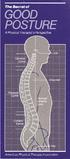 The Secret... T he American Physical Therapy Association would like to share a secret with you. It can help you do more with less effort breathe easier feel great. The secret is about good posture, which
Strengthen Your Spirit
 Diabetes... Now What? Strengthen Your Spirit Self Assessment and Tools for Healthy Coping of Negative Emotions This product was developed by the Advancing Diabetes Self Management Program at Marshall University
Department of Surgery
 Thoracic Surgery After Your Lung Surgery Patient Education Discharge Information You have just had lung surgery. The following are definitions of terms you may hear in connection with your surgery: THORACOTOMY
Cast removal what to expect #3 Patient Information Leaflet
 Cast removal what to expect #3 Patient Information Leaflet SM466 Now your cast is off, self help is the key! Follow the advice given to you by your doctor and the staff in the clinic. Your skin will be
Cervical Exercise: How important is it? What can be done? The Backbone of Spine Treatment. North American Spine Society Public Education Series
 Cervical Exercise: The Backbone of Spine Treatment How important is it? What can be done? North American Spine Society Public Education Series Important: If you have had an accident that started your neck
Enhancing your recovery after cardiac surgery
 Enhancing your recovery after cardiac surgery Steps you can take to get better sooner Patient s name:... Consultant s name:... Admission date:... Planned discharge date:... Type of operation:... Date of
Stair Workouts Get in Shape: Step up!
 Stair Workouts Get in Shape: Step up! Warning: If you feel any knee pains, refrain from continuing that particular exercise. Avoid the no pain, no gain motto and modify with regular walking or any activity
Aquatic Exercises: Upper Body Strengthening
 Aquatic Exercises: Upper Body Strengthening These exercises will strengthen your muscles in your arms, shoulders, chest and neck. Exercising in water allows you to have less stress on your joints. When
try Elise s toning exercise plan
 try Elise s toning exercise plan Whether you want to start things off slow and gradually build up your fi tness, or begin with a challenge, Elise s toning exercise programme is designed for all levels.
Good manual handling practice
 Health and Safety Services Good manual handling practice If you lift, carry, push or pull as part of your job, the following guidance is for you Injuries caused Poor lifting technique and work methods
Reduce Stress with This 15-Minute Restorative Yoga Sequence
 Reduce Stress with This 15-Minute Restorative Yoga Sequence Try this short, stress-busting restorative yoga sequence to ease tension around the holidays, at work, and more Stress it s something everyone
Manage cancer related fatigue:
 Manage cancer related fatigue: For People Affected by Cancer In this pamphlet: What can I do to manage fatigue? What is cancer related fatigue? What causes cancer related fatigue? How can my health care
Exercises for older people
 Exercise for older people Exercises for older people Sitting Getting started If you ve not done much physical activity for a while, you may want to get the all-clear from a GP before starting. For the
Rehabilitation. Rehabilitation. Walking after Total Knee Replacement. Continuous Passive Motion Device
 Walking after Total Knee Replacement After your TKR, continue using your walker or crutches until your surgeons tells you it is okay to stop using them. When turning with a walker or crutches DO NOT PIVOT
COPD What Is It? Why is it so hard to catch my breath? What does COPD feel like? What causes COPD? What is an exacerbation (ig-zas-er-bay-shun)?
 Attitudes and Beliefs 4 COPD What Is It? Why is it so hard to catch my breath? COPD is a disease that damages the lungs. In a healthy lung, the airways are open and the air sacs fill up with air. Then
IMGPT: Exercise After a Heart Attack 610 944 8140 805 N. RICHMOND ST (Located next to Fleetwood HS) Why is exercise important following a heart
 Why is exercise important following a heart attack? Slow progression back into daily activity is important to strengthen the heart muscle and return blood flow to normal. By adding aerobic exercises, your
Preparation Guide: Post-Offer Physical Assessment Lineman Line of Progression
 Preparation Guide: Post-Offer Physical Assessment Lineman Line of Progression The Physical Assessment is designed to determine if your physical abilities match the physical requirements of the job. Please
General Guidelines. Neck Stretch: Side. Neck Stretch: Forward. Shoulder Rolls. Side Stretch
 Stretching Exercises General Guidelines Perform stretching exercises at least 2 3 days per week and preferably more Hold each stretch for 15 20 seconds Relax and breathe normally Stretching is most effective
MINDING OUR BODIES. Healthy Eating and Physical Activity for Mental Health
 MINDING OUR BODIES Healthy Eating and Physical Activity for Mental Health Facilitators Guide: Background Information (note: tell participants to consult with their doctor before starting to exercise) What
Returning to fitness after heart surgery
 Returning to fitness after heart surgery A patient s guide 1 Increasing activity After your operation, your heart function should be improved and so your ability to exercise will also be improved. However,
GOING HOME AFTER YOUR TAVR PROCEDURE
 GOING HOME AFTER YOUR TAVR PROCEDURE HENRY FORD HOSPITAL CENTER FOR STRUCTURAL HEART DISEASE GOING HOME After your TAVR procedure, you will need help when you go home. It is hard to predict how much help
ROTATOR CUFF HOME EXERCISE PROGRAM
 ROTATOR CUFF HOME EXERCISE PROGRAM Contact us! Vanderbilt Sports Medicine Medical Center East, South Tower, Suite 3200 1215 21st Avenue South Nashville, TN 37232-8828 For more information on this and other
Emphysema. Introduction Emphysema is a type of chronic obstructive pulmonary disease, or COPD. COPD affects about 64 million people worldwide.
 Emphysema Introduction Emphysema is a type of chronic obstructive pulmonary disease, or COPD. COPD affects about 64 million people worldwide. Emphysema involves damage to the air sacs in the lungs. This
Your Recovery After a Cesarean Delivery
 Your Recovery After a Cesarean Delivery It is normal to have many questions about your care after delivery. Cesarean delivery is surgery and your body needs time to heal and recover for the next 6 weeks,
UNIVERSAL FITNESS NETWORK, Inc. 2315 West Monica Dunlap, IL 61525 (309)-360-5615 [email protected] FACTS ABOUT THE PHYSICAL FITNESS ASSESSMENT TESTS
 UNIVERSAL FITNESS NETWORK, Inc. 2315 West Monica Dunlap, IL 61525 (309)-360-5615 [email protected] FACTS ABOUT THE PHYSICAL FITNESS ASSESSMENT TESTS Universal Fitness Network, Inc. specializes in physical
Understanding COPD Questionnaire
 Further information about the UCOPD questionnaire is available from http://www.science.ulster.ac.uk/ucopd/ or by contacting Dr Brenda O Neill ([email protected]) Understanding COPD Questionnaire Patient
The Breathe Better resource has been developed in partnership with Wintec s Centre for Sport Science and Human Performance with funding provided by
 BREATHE BETTER The Breathe Better resource has been developed in partnership with Wintec s Centre for Sport Science and Human Performance with funding provided by the Wintec Research Office through a research
WHEN COPD* SYMPTOMS GET WORSE
 WHEN COPD* SYMPTOMS GET WORSE *Includes chronic bronchitis, emphysema, or both. Boehringer Ingelheim Pharmaceuticals, Inc. has no ownership interest in any other organization that advertises or markets
Injuries from lifting, loading, pulling or pushing can happen to anyone in any industry. It is important to be aware of the risks in your workplace.
 Workplace safety: lifting One of the biggest concerns in the workplace is lifting and loading. When you lift something, the load on your spine increases and your spine can only bear so much before it is
back care TIPS FOR DAILY ACTIVITIES
 back care TIPS FOR DAILY ACTIVITIES TIPS FOR DAILY ACTIVITIES INTRODUCTION When your back hurts, the way you hold and move your body is important. Your muscles can become more tense and painful depending
UNDERSTANDING STRESS AND YOUR BODY
 UNDERSTANDING STRESS AND YOUR BODY Life s demands create stress and although some stress may be good, too much can cause health problems. Most people equate stress with high blood pressure, a heart attack