
Cost Benefit Analysis for Electricity Balancing ISP harmonisation scoping paper
|
|
|
- Leslie Baldwin Higgins
- 10 years ago
- Views:
Transcription
1 Cost Benefit Analysis for Electricity Balancing ISP harmonisation scoping paper A paper for consultation Prepared by Frontier Economics and Consentec 20 February 2015

2 1. Contents 1. Contents Introduction... 3 Context and scope of paper...3 Organisation of this paper Role of ISPs Choice of planning cases... 5 Use of planning cases...5 Defining planning cases...6 Choice of ISP duration...6 Status quo ISP durations...6 Choice of counterfactual...7 Implementation date Possible costs and benefits Context overview of CBA process...14 Possible costs of ISP harmonisation...15 One off cash costs of changing ISP duration...15 Ongoing cash costs of shorter ISP duration...17 Non-cash costs...17 Possible benefits of ISP harmonisation...18 Benefits from shorter ISP...18 Benefits from harmonising ISPs

3 2. Introduction Context and scope of paper The Network Code on Electricity Balancing (NC EB) 1 covers three major aspects of balancing namely: Procurement of balancing services; Reservation and use of cross zonal capacity for balancing; and TSO settlements. The NC EB requires a cost benefit analysis (CBA) be undertaken in support of various decisions: European Integration Model (Articles 14(3), 16(4), 18(4), 20(3)): CBAs to support TSOs proposal to modify the European integration model (Replacement Reserves (RR), Frequency Restoration Reserves with manual activation (FRR-m), Frequency Restoration Reserves with automatic activation (FRR-a), and the imbalance netting process); Application of a TSO-BSP model (Article 38): CBA to indicate the implications of the application of a TSO-BSP model for the exchange of balancing capacity or the exchange of balancing energy (RR and FRR) for at least the responsibility area or scheduling area when appropriate for the contracting TSO and the connecting TSO; and Harmonisation of Imbalance Settlement Period (Articles 21(2) and 21(5)): CBA on harmonisation of the imbalance settlement period (ISP) within and between synchronous areas. This CBA shall be submitted by TSOs to NRAs no later than 2 years after entry into force of the NC EB. After a decision is taken by NRAs about harmonisation of ISPs, specific CBAs might be performed by TSOs that have a proposal which deviates from the decision taken. ENTSO-E has asked Frontier to develop a general methodology for TSOs in relation to the completion of the CBAs envisaged in the NC EB, and a specific methodology for the completion of the CBA for ISP harmonisation: General methodology for performing CBAs this task covers the development of a general framework for performing a CBA in the context of the NC EB. Specific methodology for the CBA for ISP harmonisation this task covers the development of a specific methodology for performing the CBA for ISP harmonisation. This methodology should be consistent with the design of the general methodology for performing CBAs. In this draft scoping paper we deal with the second task, with regard to the methodology for the CBA for ISP harmonisation. We deal with the first task (the general methodology for performing CBAs) in a separate report. ISP harmonisation relates to the duration of ISPs (and to the time as to when each ISP starts). Therefore, this paper focuses on those aspects of the power market directly affected by ISP duration. 1 ENTSO-E Network Code on Electricity Balancing, Version 3.0, 06 August

4 In principle, the CBA for ISP harmonisation should follow the general methodology for performing CBAs under the NC EB. Therefore, this paper only elaborates on the specifics of the CBA for ISP harmonisation that are not defined by the general methodology. Organisation of this paper This paper is organised as follows: Section 3 describes the role of the ISPs so as to provide a common understanding for the framework for thinking about the remainder of the paper. Section 4 describes the planning cases to use for the CBA. Section 5 identifies possible costs and benefits arising from ISP harmonisation. 3. Role of ISPs In this short section we describe the role of the Imbalance Settlement Period so as to provide a common understanding for the framework for thinking about the remainder of the paper. The ISP is defined by the NC EB as the time units for which Balancing Responsible Parties Imbalance is calculated. A market entity (or representative) is responsible for its imbalances, where the imbalance is calculated for each ISP and is the difference between: The physical volume of energy injected or taken off the system allocated to a market entity (or representative); and The volume of energy from commercial transactions or scheduled energy injection or withdrawal of the market entity (or representative), adjusted for balancing transactions with the TSO. The TSO financially settles imbalances with the responsible market entity (or representative) at the imbalance price for the relevant ISP. The pricing of the settlement of imbalances is typically designed to incentivise parties to reach a balanced energy position over the ISP. There is no incentive provided by the settlement of imbalances to achieve any particular power profile within an ISP. Therefore the ISP defines the period over which parties seek to manage their energy balance. Since parties can only trade with the TSO in real time, the ISP also determines the minimum duration of commodity product which is traded between participants since there is no incentive to trade a shorter duration product. 2 The choice of ISP duration therefore affects the organisation of the market in terms of the definition of the finest granularity of traded products. 2 This is different from the gas market where parties are able to trade between themselves in real time. This means that parties may wish to trade products with shorter duration that the settlement period, e.g. they may wish to trade rest of day products part way through the day in the case of a daily settlement period. 4

5 The ISP may have other roles in some countries, although these are not necessary roles of the ISP. For example, the highest granularity of information provided to the TSO about physical production and consumption plans may be defined as the ISP duration. The ISP may also affect the definition of reserve products and the approach to the TSO procuring those products. 4. Choice of planning cases Use of planning cases The NC EB requires TSOs to harmonise the main features of imbalance settlement and in this context TSOs shall submit a proposal to all NRAs based on a CBA for ISP harmonisation. The Framework Guidelines for Electricity Balancing (FG EB) contemplate ENTSO-E undertaking the CBA. The geographic scope of the CBA must be defined so as to capture all of the relevant cost and benefits. This means that the geographic scope of the CBA should be set to include all countries materially affected by ISP harmonisation. The scope of affected countries would be wider than solely those countries for which the ISP is changed since changing ISP duration could have cross border effects. If a change to ISP affected security of supply and frequency quality it would affect the whole synchronous network, by affecting balancing incentives the ISP is likely to affect intraday trade volumes both within a country and across borders, etc. The NC EB applies to all transmission systems and interconnections in the EU, except for those transmission systems on islands which are not connected with other transmission systems. Cyprus is the only country in the EU which is not currently interconnected with other transmission systems. However, there are plans for an electricity interconnector between Cyprus and Greece. 3 Therefore, we suggest that in the case of ISP harmonisation the CBA should extend to all 28 countries of the EU. If the NC EB is of EEA relevance or of relevance to the single market, the scope of the CBA would need to include further countries (i.e. Iceland, Liechtenstein and Norway in the case of EEA relevance, and in addition Switzerland in the case of relevance to the single market). The fact that the CBA must cover many countries is important for the definition of the planning cases, a point that we return to below. The potential for the choice of ISP in one country to have cross border affects means that it would not make sense for an independent CBA to be done for each country. Instead a collective CBA on ISP harmonisation should be done, as is contemplated by the NC EB. The costs and benefits of ISP harmonisation will vary from one country to another because, for example, the current ISP duration differs by country, and some countries already have the same ISP duration as their neighbours while others have a different ISP duration to their neighbours. This means it is quite possible that the results of the CBA (in terms of optimal ISP duration) differ by country. Therefore, the optimal outcome may be to have different ISP durations in different countries. The three key points (the CBA must be done for multiple countries, the CBA should be done collectively for the countries and the optimal CBA may differ from one country to another) suggest that, in theory, all reasonable combinations of ISP duration should be tested for all countries in order to identify the optimal 3 The EuroAsia project would link Israel, Cyprus and Greece with a 1,000km long sub-sea cable. The EC adopted the project as a project of common interest (PCI) in See 5

6 set of ISPs for all countries (as constrained by the requirements of the NC EB, i.e. that no ISP is greater than 30 minutes and that no country be required to increase its ISP duration). However, it is impractical to test all combinations of ISP duration as part of the CBA. Therefore, it is necessary to define a limited number of planning cases, consisting of a combination of ISPs in different countries, to test using the CBA. The planning cases form the factual for the CBA, with the counterfactual being the business as usual combination of ISPs. Since there are multiple planning cases, there will be multiple factuals tested and ranked by the CBA in order to choose the preferred case. By business as usual we mean the ISPs that would prevail in the absence of ISP harmonisation. As each country or, to be more correct, balancing zone 4 can define only one ISP, the planning cases are mutually exclusive. This means that the CBA needs to provide a ranking of the planning cases (and a comparison to the counterfactual). This is an important difference to other CBAs that ENTSO-E is required to undertake which are required to compare a single factual to the counterfactual, e.g. when assessing Projects of Common Interest (PCI). Defining planning cases Choice of ISP duration A planning case consists of the set of the new ISP duration for each country within the scope of the CBA. As described above, the CBA will be used to compare a limited number of planning cases to one another and to the counterfactual. The planning cases should be designed such that the best planning case resulting from the CBA is also the optimal combination of ISP durations. To decide upon the design of the planning cases we start with the status quo, consider the counterfactual and then choose the planning cases (factual) to test different hypotheses about possible drivers of costs and benefits. Status quo ISP durations The set of ISP durations as of 2013 for all countries is depicted in Figure In the remainder of the paper we refer to the ISP for a country. However, we recognise that a balancing zone need not be defined by a country s borders, for example, the Single Electricity Market (SEM) covers Ireland and part of the UK, i.e. Northern Ireland. 5 The NC EB would not apply to the transmission networks of Bosnia, Serbia, Kosovo and FYROM, which are included in the map. However, these countries are likely to be affected by the choice of ISP duration for their neighbours. While we suggest the scope of the CBA be limited to the EU 28 (or possibly the EEA or EFTA region), there could be an argument for extending it further to include non-eu countries in the Balkan region or elsewhere. 6

7 Figure 1. ISP duration 2013 Source: ENTSO-E 2013 Survey on Ancillary Services and Balancing Market Design, and TSO websites Note: Italy has a 15 minute duration ISP for generation and a 60 minute ISP for consumption Choice of counterfactual The choice of the counterfactual is important since the costs and benefits of ISP harmonisation are identified as the change in costs and benefits between the counterfactual and the factual. This means that any costs and benefits that have already been derived in implementing and applying the counterfactual are ignored for the purposes of this CBA. These are sunk costs and benefits. In deciding upon the counterfactual for the CBA, it needs to be considered whether the current status of ISP duration will continue to exist absent the proposed harmonization or whether, irrespective of harmonization, ISPs would change at some point in time. For example, in line with the roll-out of smart meters some countries may already have plans to change the ISP duration. Given the difficulty in predicting future changes, we suggest that the current status of ISP duration be used as the counterfactual for the CBA. Choice of factual (planning cases) To apply the CBA the factual or planning cases need to be unambiguously defined. In selecting a limited number of planning cases, the objective should be to choose cases that are likely to include the optimal planning case. Without doing a full CBA this is impossible to know with certainty. However, we can select planning cases that are likely to be optimal if certain hypotheses about the drivers or costs and benefits were true. Therefore, in what follows we consider different possible drivers of costs and benefits and select a planning case accordingly. 7

8 We expect that a key cost driver under the CBA is a change to the ISP duration in a country. It is possible that a key driver of the benefits under the CBA is the duration of the ISP. However, it is also possible that a driver of benefits under the CBA is the harmonisation of ISP duration between countries. These theories about possible drivers of costs and benefits suggest at least three planning case designs that could potentially be the optimal planning case: Minimise costs by minimising change with the possibility of missing out on some benefits related to minimising ISP duration or maximising harmonisation; Maximise net benefits by significant ISP harmonisation with minimal change, with the possibility of missing out on some benefits related to minimising ISP duration; and Maximise benefits through full harmonisation by shortening ISP duration, with the possibility of incurring high costs. In selecting planning cases, we also aim to choose the ISP duration such that any country s ISP duration is an integer multiple of the duration of any country with a shorter ISP duration. This would facilitate coordination of cross border trade. Given that current shortest duration ISP is 15 minutes, and the NC EB requires that no ISP be longer than 30 minutes, we explore planning cases with 15 and 30 minute duration ISPs. To understand whether there are additional benefits of an even shorter ISP duration, we also explore a planning case that maximises benefits through full harmonisation by shortening ISP duration to below 15 minutes. It is possible for a country to use a different ISP for generation and load, as is the case today for Italy. However, in defining the planning cases we assume that the same ISP is applied in a country to both generation and to load. Therefore, in total we define four planning cases. We discuss each possible planning case in more detail below. Minimise costs by minimising change As noted above, it is possible that a key cost driver will be the change to the ISP in a country. If the ISP is changed software and metering devices would most likely need to be modified in many countries, some of which could be done remotely and some of which may require a site visit. This planning case is selected to try to minimize those costs by changing ISP duration for as few countries as possible, and thereby test whether net benefits in the CBA are maximised by trying to minimise costs. To be clear, the CBA will be performed using the same approach for all planning cases, i.e. the CBA will assess benefits and costs of moving from the counterfactual to the planning case. In additional, as noted above, the CBA is applied to all countries. The NC EB defines a maximum ISP of 30 minutes, which means that ISP changes in countries which currently use 60 minutes ISP are unavoidable. This planning case therefore assumes that all countries currently with an ISP of 30 minutes or shorter retain their ISP duration. Countries currently with an ISP of more than 30 minutes could either reduce their ISP duration to 15 minutes or reduce their ISP duration to 30 minutes. Before the CBA is applied the planning case must be unambiguously defined because we suggest that a plethora of additional planning is not defined in order to test different possible combinations in order to keep the effort required to undertake the CBA manageable. This means TSOs collectively or ENTSO-E need to decide either in the consultation of the CBA methodology or as the first stage of the CBA itself 8

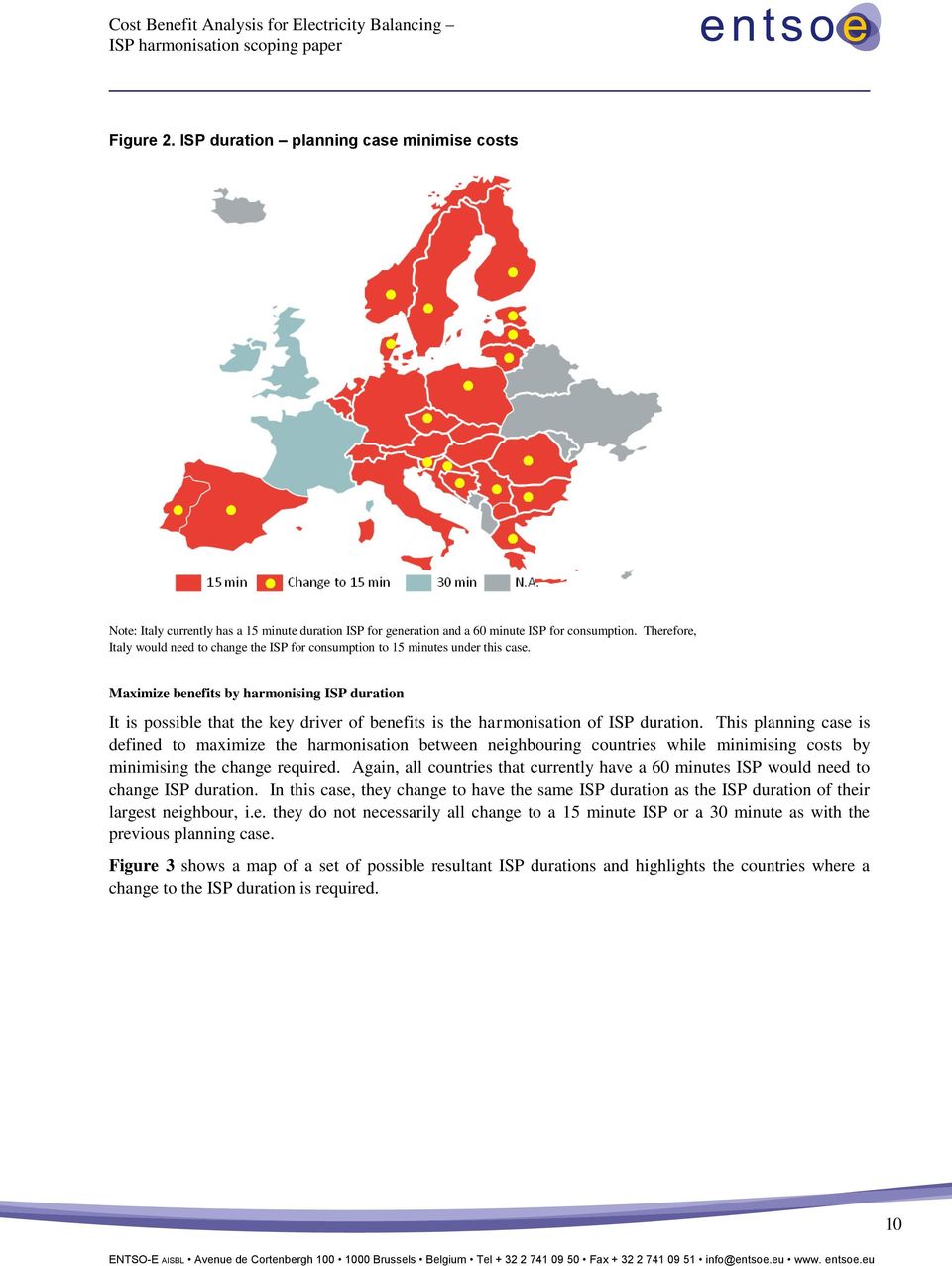
9 whether a country currently with an ISP duration of greater than 30 minutes moves to a 15 or 30 minute ISP for this planning case. Issues to be considered in taking the decision are as follows: Whether a single rule is applied to all countries or the rule can vary by country; Whether a 15 minute or 30 minute ISP duration likely to be the optimal solution in terms of benefits and costs; Whether a country s neighbour(s) has a 15 minute or 30 minute ISP duration (in order to maximise harmonisation); Whether a country s neighbour(s) that currently has a 60 minute ISP duration is assumed to move to a 15 minute or 30 minute ISP duration; and The planning case should distinct from the other planning cases so as to provide more information about the optimal set of ISP durations from the CBA. In considering the second of the issues listed above note that this planning case is intended to test whether the main cost driver is the change to ISP duration, as opposed to the ISP duration per se. If it is assumed that the benefits from a shorter ISP exceed the benefits from a longer ISP and that these benefits are likely to exceed the costs of the incremental change to a 15 minute ISP, this suggests moving all countries currently with a 60 minute ISP to 15 minutes for this planning case. If this assumption were correct, this planning case would dominate (i.e. have greater net benefits) than a planning case whereby all countries with an ISP of more than 30 minutes reduced the ISP duration to 30 minutes. Figure 2 shows a map of the ISP durations resulting from the planning case assuming that all countries with a 60 minute ISP move to a 15 minute ISP (noting that the TSOs and ENTSO-E may design the planning case such that some or all countries with a 60 minute ISP move to a 30 minute ISP). The figure also highlights the countries where a change to the counterfactual is required. 9

10 Figure 2. ISP duration planning case minimise costs Note: Italy currently has a 15 minute duration ISP for generation and a 60 minute ISP for consumption. Therefore, Italy would need to change the ISP for consumption to 15 minutes under this case. Maximize benefits by harmonising ISP duration It is possible that the key driver of benefits is the harmonisation of ISP duration. This planning case is defined to maximize the harmonisation between neighbouring countries while minimising costs by minimising the change required. Again, all countries that currently have a 60 minutes ISP would need to change ISP duration. In this case, they change to have the same ISP duration as the ISP duration of their largest neighbour, i.e. they do not necessarily all change to a 15 minute ISP or a 30 minute as with the previous planning case. Figure 3 shows a map of a set of possible resultant ISP durations and highlights the countries where a change to the ISP duration is required. 10
11 Figure 3. ISP duration planning case maximize benefits by harmonising ISP Note: Italy currently has a 15 minute duration ISP for generation and a 60 minute ISP for consumption. Therefore, Italy would need to change the ISP for consumption to 15 minutes under this case. In this planning case Spain and Portugal would align their ISPs with France, resulting in one harmonised south-western region with 30 minute ISPs. As an alternative, France could select a 15 minute ISP duration to align with its neighbours to the East, to which it has relatively strong connections, and not to align to its neighbours to the West and North to which it has relatively weak connections. All countries in central Europe move to an ISP of 15 minutes, as is already the case in Germany and other countries in the region. The Nordic and Baltic countries shorten their ISP, but can choose between a 15 minute or 30 minute ISP. For these countries there is no clear neighbouring country with which to harmonise and they have a relatively weak connection to the rest of Europe. This planning case also needs to be unambiguously defined either prior to the CBA or as the first step of the CBA. The issues to consider are similar to those listed for the previous planning case with the exception that the intention of this planning case is to test the optimality of limiting costs incurred in ISP harmonisation. Maximise benefits through full harmonisation by shortening ISP duration It is possible that the benefits of changing ISP duration arise both from reducing duration and from harmonising duration. This planning case attempts to maximise benefits by all countries moving to the shortest existing ISP duration, which is 15 minutes in every country. The CBA will test with this planning case whether the benefits of the short duration ISP outweigh the costs of changing ISP. 11

12 By not reducing duration below the current shortest duration ISP, the number of countries that need to change ISP duration is reduced, possibly increasing net benefits by reducing costs relative to moving to an even shorter ISP duration. Figure 4 shows a map of the resultant ISP duration and highlights the countries where a change to ISP duration is required. Figure 4. ISP duration planning case maximize benefits by shortening ISP Note: Italy currently has a 15 minute duration ISP for generation and a 60 minute ISP for consumption. Therefore, Italy would need to change the ISP for consumption to 15 minutes under this case. Maximise benefits through full harmonisation by shortening ISP duration to below current minimum As with the previous planning case, this case attempts to maximise net benefits by reducing ISP duration and maximising harmonisation for all countries. However, instead of moving all countries to the shortest current ISP duration, all countries are moved to a 5 minute ISP duration, as shown by Figure 5. The CBA will test with this planning case whether the benefits of an even shorter duration ISP outweigh the costs of reducing ISP duration. A possible advantage with a 5 minute duration ISP over, say, a 10 minute duration ISP is that current systems are based around periods that are an integer multiple of 5 minutes, e.g. traded contract durations. However, it is possible that a 5 minute duration ISP is not optimal if some countries found it difficult to change their equipment to this duration. Therefore, if moving all countries to a 5 minute ISP had positive net benefits (or small negative net benefits), it may also be worth exploring whether it is even more beneficial to move all countries to a 10 minute duration ISP. Therefore, this planning case would be all countries move to a 5 minute ISP and if this has positive net benefits then re-apply the CBA to all countries moving to a 10 minute ISP. 12

13 Figure 5. ISP duration planning case maximize benefits by shortening ISP Summary of planning cases In summary, the CBA would compare four planning cases and the counterfactual: Counterfactual (status quo); Planning case 1 (minimise costs by minimising change); Planning case 2 (maximize benefits by harmonising ISP duration); Planning case 3 (maximise benefits through full harmonisation by shortening ISP duration); and Planning case 4 (maximise benefits through full harmonisation by shortening ISP duration to below current minimum). As noted above, planning cases 1 and 2 would need to be unambiguously specified as part of the consultation or as the first step of the CBA itself. Implementation date The date at which changes to ISP duration are implemented also needs to be defined for each planning case since this could affect the net benefits of the case, in particular if the implementation date varied by planning case. In addition, all countries may implement the change under a planning case simultaneously or the timing for the change may differ by country. Where the timing for the change differed by country, additional costs could arise or benefits could be reduced if the transitional period reduced harmonisation and created confusion. 13

14 In practical terms it would add significant complexity to the CBA to consider the effect of different timings for the introduction of the change to the ISP duration. Therefore, we suggest that for the purposes of the CBA all countries are assumed to implement the planning case at the same time, and that a single implementation date be assumed for all planning cases. The choice of implementation date assumed for the CBA should take account of the period of time required to undertake the CBA, take a decision as to ISP duration and implement a change to ISP duration. 5. Possible costs and benefits In this section we identify possible costs and benefits of ISP harmonisation that need to be considered as part of the CBA and, if possible, monetised. We first provide context by giving a brief overview of the CBA process. Context overview of CBA process As discussed in the report on the general CBA methodology, a CBA compares costs and benefits for a defined geographic region for two cases: A factual, which is the world with the design option being assessed (in this case a change to the ISP duration); and A counterfactual, which is the business as usual world without the design option being assessed. As discussed above, costs and benefits that have already been derived in implementing and applying the counterfactual are ignored for the purposes of the CBA since these are sunk costs and benefits. As also discussed in the report on the general CBA methodology, the overall European social welfare is the relevant objective of the NC EB. Nevertheless, the CBAs under the NC EB shall report on regional and country effects for information purposes but should not take account of these effects in the overall CBA assessment. In the report on the general CBA methodology we also discuss three different approaches to the overall evaluation to use for the CBA: Standard CBA In a standard CBA only those costs and benefits that can be monetized are included. Augmented CBA The augmented CBA considers those costs and benefits that can be monetized and augments this result with an assessment of costs and benefits that cannot be monetized. The latter are considered by the decision maker without a formal process. However, an understanding of the broad scale of the non-monetised elements is needed. Multi Criteria Analysis The MCA considers those costs and benefits that can be monetized and those that cannot be monetised. The MCA recognises that there may be multiple objectives, devises a set of assessment criteria to reflect those objectives, and establishes a set of weights and a scoring system that allows formal account to be taken of the full set of costs and benefits (monetised and nonmonetised). Although a more formal process than the augmented CBA, the MCA requires potentially subjective decisions about weights and scores. 14

15 The general CBA methodology concluded that as a general principle as many of the costs and benefits should be monetised as is possible. Having done this the most appropriate CBA approach then depends on an assessment of the relative importance of monetised and non-monetised benefits and costs. The process to be applied to determine whether to apply a pure CBA, augmented CBA or MCA for the CBA for ISP harmonisation is as follows: Firstly, identify and group objectives into similar categories; Secondly, map possible costs and benefits onto those categories of objectives; and Thirdly, consider the ability to monetise those objectives that are measurable. Having decided upon the overall approach to the CBA, the way in which each objective will be modelled (to estimate a monetary value) or otherwise assessed and scored must be decided. Scenarios and data sources must be chosen and a process for collecting data defined. Weights and a scoring approach must be chosen in the case of a MCA. Then the analysis must be undertaken, reviewed and a decision taken. Stakeholder consultation would be made at different points in the process. Possible costs of ISP harmonisation Here we scope out possible costs of ISP harmonisation that will need to be estimated for each of the planning cases. Costs due to a change in ISP duration are likely to mainly result from cash costs (one-off costs of a change to the ISP duration and ongoing additional costs of data management) and non-cash costs. One off cash costs of changing ISP duration The one-off cash costs of a change to ISP duration (i.e. a reduction in duration) are likely to include the following: Scheduling and settlement systems. TSOs, DSOs, PXs, BSPs and BRPs would need to adapt their scheduling and settlement systems to the new ISP duration. This cost largely relates to developing new IT systems or modifying existing systems. The incremental cost of implementing a change to ISP duration will depend on the lifetime of IT systems, including software, and the transitional period allowed to implement a change to the ISP duration. This cost is likely to relate mainly to the need for a change per se rather than to the duration of the ISP period. Therefore the cost is likely to be lower for those planning cases for which fewer countries change ISP duration. Metering systems. In many cases the change in ISP duration will require a software update or a physical exchange of existing meters. However, where load profiles are used to allocate metered consumption to individual ISPs for settlement purposes, those meters would not require modification or replacement due to a change to the ISP duration (although the settlement system would need modification with respect to those meters). The cost of modifying metering systems, where applicable, would relate to the following: When switching to another metering period, if devices that can be updated are reset and the metering history forgotten, historic data would need to be read out and saved before the change. 15

16 The metering period could in most cases be switched by remote control, avoiding the cost of a site visit. However, in some (not all) countries there are legal barriers to doing so. For example, in Germany (although note that Germany has a 15 minute ISP) such a change must be done under supervision of the authorities such as the office of weights and measures. This requires the meters to be physically removed from the site, taken to the authorities where the metering period is changed and the meter then reinstalled at the site. Those meters that cannot be updated will need to be physically replaced. There will be additional costs of adapting systems for collecting and storing metering data. Consumption profiles may have to be updated. The relevant cost of changes to metering systems depends on current practices around regular meter calibration, replacement and the updating of consumption profiles. For example, where meters must be recalibrated every few years and recalibration is all that is required to adapt the meter to a change in the ISP duration, a change to the ISP duration would have no additional costs if an implementation period equal to or longer than the recalibration period were allowed. An approach to reducing costs could be to allow customers to choose whether to have their meters upgraded when the ISP changes. The choice could be between updating the meter to the new ISP duration or for the meter to read consumption data over two ISPs (e.g. to read over 30 minutes instead of over the 15 minute ISP) and for a standard load pattern to be applied to the two ISP information to determine deemed metered data over each of the individual new ISPs. There may be additional costs for the transitional arrangements, especially for settlement systems. However, the longer ISPs are always a multiple of the shorter ISPs, which should allow the use of meters with shorter and longer timescales until the moment all meters are compatible with the shorter ISP duration. The relevant costs might also be affected by the (planned) roll-out of smart meters. Similar to regular replacements and recalibration, when smart meters are to be rolled out regardless of the change to ISP, the CBA would not attribute these roll-out costs to ISP harmonisation. The planning cases should therefore consider what would be: An acceptable time horizon for implementation; and The most economic scenario for roll-out (which may differ by country) given the time horizon and any expected smart meter roll-out. Metering costs could relate both to the need for a change per se and to the duration of the ISP period, if the latter affected whether a meter needed to be physical changed or adapted as opposed to remotely adjusted. The cost is likely to be lower for those planning cases for which fewer countries change ISP duration and may be higher for those planning cases with shorter ISP durations. Documentation changes. Centralised codes and agreements affected by a change to ISP duration will need to be updated, including for example European-wide agreements, e.g. TSO-TSO agreements and operational handbooks. Bilateral agreements will also need to be updated, e.g. standard contracts for the sale and purchase of power and contracts for the sale and purchase of options over flexible power plants. Costs for forecasting and shifting energy balancing responsibility. A reduction in ISP duration may result in a shift of balancing effort from the TSO to market entities with respect to the reserve 16

17 replacement process. With a shorter ISP, BRPs might become responsible for energy balance at an earlier stage of the process of reserve provision and replacement. Balancing by the TSO and by the BRP have different costs: A more centralized forecast by the TSO has advantages in that the forecast is undertaken by a single party and the forecast is for the net position of the system. TSOs typically have their own demand and intermittent generation forecasting tools. This cost may not necessarily change with a change to ISP duration. A decentralised forecast by market entities has the disadvantage that it is undertaken by many different parties (incurring greater costs than if undertaken by a single party), each of whom is forecasting a sub-set of the overall system. The individual market entities will have better insights than the TSO about their own load and generation patterns. It is possible that a shift of balancing from the TSO to market entities increases the cost and effort expended by market entities in forecasting systems as the time period for energy balance responsibility might change (i.e. increase for market entities). Furthermore, costs incurred by market entities might increase due to the need to implement a more complex process in order to fulfil their obligations of energy balancing for reserve replacement. There is also a trade-off between achieving efficient cost outcomes through competition between market participants or by regulating TSOs. Absent a clear market failure, competition is usually thought to achieve more efficient outcomes than regulation, in part due to the information asymmetries inherent in regulation. Ongoing cash costs of shorter ISP duration In addition to one off cash costs there may be ongoing cash costs related to a shorter ISP duration. These are likely to include the following: Scheduling and settlement systems. TSOs, DSOs, PXs, BSPs and BRPs would need to handle more data on an ongoing basis and this is likely to come at an increased cost of processing and storing. Metering systems. Metering systems would be required to handle more data on an ongoing basis and this may come at an increased cost of data collection and storage. Non-cash costs The one-off non-cash costs of a change to ISP duration are likely to include the following: Uncertainty during transition. A change to the ISP duration will add uncertainty among industry participants during the transitional phase to the new ISPs. This is particularly critical during a period of significant investment needs for the sector. In addition, there will be uncertainty during the period prior to a definitive decision having been made as to the future ISP duration. The issue with uncertainty is that it could increase the return required for investment in generation and other parts of the sector. The size of this cost would be difficult to estimate and an indication could be obtained from a survey of market entities. Loss of liquidity. Some BRPs, particularly those with inflexible plants may find it difficult to participate in markets with finer granularities if there are no options to trade block bids, discouraging trade in those markets. In addition, the sharper imbalance price signals provided by a shorter ISP duration may encourage small BRPs to aggregate their load and consumption with other BRPs or to vertically integrate. This could have the effect of reducing participation in certain markets, reducing liquidity. 17

18 Liquidity is not a benefit in itself. Rather liquidity affects the efficiency of markets and would ideally be measured in the form of social welfare. However, it is difficult to model the welfare effect of higher or lower liquidity and therefore it may be necessary to measure liquidity using a non-monetary indicator, e.g. churn rates, or to measure the effect of a planning case on liquidity using a qualitative measure such as traffic lights. In addition, there may be an effect on certain market entities / BRPs that could be beneficial or detrimental, as described below: Wider access to balancing markets. A shorter ISP duration may allow less controllable generation and loads to participate in the balancing market where they could not with a longer ISP duration. Whether the ISP duration affects the ability to participate in the balancing market depends on the specific rules of the market. Possible higher costs for certain market entities. Sharper imbalance price signals provided by a shorter ISP duration could mean that BRPs with disproportionately high imbalances (e.g. small BRPs or BRPs with less controllable generation or loads) are perceived as facing disproportionately higher imbalance cost than BRPs with more predictable and controllable generation and loads. However, this would be a potential issue only if imbalance prices were excessive compared to the TSO s costs of balancing the system. Possible benefits of ISP harmonisation Here we scope out possible benefits of ISP harmonisation that will need to be estimated for each of the planning cases. There are likely to be different benefits from a shorter ISP duration and from ISP harmonisation per se. Benefits from shorter ISP The main benefits of shorter ISPs are likely to include the following: Improved system frequency quality. There may be an interaction between the ISP duration and deviations in system frequency. 6 For example, with hourly ISP and therefore hourly management of balances by participants, it is often possible to observe large changes in overall system balance at the boundary between hours, as participants adjust their position to achieve balance over the preceding hour and optimise their position for the coming hour. Particularly in systems with high renewable generation (especially solar) penetration, these changes at hour boundaries can be of such magnitude that they are not possible to address with secondary control. They may therefore result in frequency deviations. By reducing ISP duration, the scale of changes by participants may be expected to reduce. This could be viewed as an improvement in frequency quality. Frequency deviations could be addressed with greater volumes of faster ramping plant on the system, so this could also be viewed as a cost saving. Similarly, shorter duration ISPs may be expected to result in smaller changes to cross border trades from one ISP to another, also helping to reduce frequency deviations. 7 6 For example, see Eurelectric and ENTSO-E, Deterministic frequency deviations root causes and proposals for potential solutions, December See Eurelectric and ENTSO-E, Deterministic frequency deviations root causes and proposals for potential solutions, December Page

19 Reduced imbalance. Shorter ISPs tend to incentivise market entities to reduce their imbalance positions. The question is how strong the incremental incentive is and which parties are able to react to those incentives. If shorter ISPs brings a reduction in imbalance positions, it would result in: Lower demand for reserve capacity. If the maximum imbalance on the system is reduced the TSO may be able to reduce the amount of reserves held. Better optimisation of regulating power. The TSO may be able to better optimise its dispatch of regulating and reserve plants if it receives better information about generation plans (i.e. plans with finer granularity). The better optimisation allows the TSO to reduce the costs of meeting demand. A question is how the information flow from the market entity to the TSO is related to the ISP duration. Sharper price signals. The costs of managing the system imbalance are signalled (or recovered) through the imbalance price among those parties that are out of balance in aggregate over the ISP. Since parties have no obligation to balance within the ISP, the minute by minute balance position of parties could vary significantly from the aggregate position over the ISP. However, these minute by minute variations do cause real costs to be incurred by the TSO in managing the system balance. At least some of these costs are reflected in imbalance prices imposed on those entities with an imbalance in aggregate over the ISP, which can be materially different from the minute by minute deviations that caused the costs. Reducing the ISP duration means that more balancing costs are imposed on those entities with unforeseen minute by minute deviations (which contributed to the additional balancing costs), because the scope for entities to offset their own minute by minute deviations within the shorter ISP is reduced. To avoid imbalance prices with the shorter ISP duration, a market entity could: Improve its forecast and use the information to manage its imbalance position by physical actions and through trade. Trade is the mechanism by which the market identifies the most efficient generation to meet demand. Respond to the sharper incentives by putting more effort into managing its imbalance position in relation to the reduced ISP by physical actions and trade. A possible result, if market entities can react to the incentives, is that balancing actions will shift from TSO actions post gate closure to market entity actions pre-gate closure. Shifting balancing actions from the TSO to the market is likely to increase the efficiency of imbalance management (and ultimately meeting demand). Market trade will provide information about the shape and level of demand to be met with longer lead times than in the case of post gate closure TSO actions, which could only call upon generation that is immediately available to change output. 8 Wider access to balancing markets. As noted above, a shorter ISP duration may allow less controllable generation and loads to participate in the balancing market where they could not have done so with a longer ISP duration. However, this effect depends on the specific rules of the balancing market. Benefits from harmonising ISPs 8 In some countries TSOs are able to take pre-gate closure actions to ready plant to provide reserves, which would potentially reduce this benefit of reduced ISP duration. 19

20 The benefits from harmonising ISPs should be treated separately from the benefits from shortening ISPs. As a thought-experiment the benefits originating from harmonization should also occur when the ISP duration is increased to achieve harmonisation. Although not permitted by the network code, hypothetically moving countries from a 15 minutes ISP to a 30 minutes ISP in line with their neighbours would ensure the identified benefits are purely benefits from harmonization. The benefits of harmonisation are likely to include the following: Allow efficient generation to be dispatched. Harmonizing ISPs will result in the same duration of programmed transfers on interconnectors as the ISPs in both countries. Currently, programmed transfers are typically set equal to the longer ISP. This prevents market entities from being credited or debited with energy over the duration of the shorter ISP, as only the energy delivered in aggregate during the longer ISP can be verified. This prevents market entities with a shorter ISP from contracting potentially cheaper generation from abroad to manage their imbalances within the shorter ISP timescales. However, we note that it may not necessarily be efficient to move to a shorter ISP, something which the choice of planning cases is intended to test. A generator in country A with a 30 minute ISP duration may find it difficult to use its generation to fully participate in the market in an interconnected country, country B, with a 15 minute ISP duration. When the generator delivers into country B, if it is credited with a flat profile of power over the 30 minute period (i.e. 2 x 15 minute ISPs in country B), it will be difficult for the generator to manage its balance position in country B or for its output to be used to manage another party s balance position in country B. This barrier depends on the granularity of interconnector products. Improved secondary market outcomes. The shortest duration wholesale market traded product in each country is equal to the duration of the ISP. Market entities cannot trade with one another in real time during the ISP and therefore they have no incentive to trade products with a duration less than the ISP. Harmonisation may bring benefits from liquidity of short duration wholesale market products since the number of participants in the market for short-term products should increase with harmonisation. However, it is possible that liquidity moves from one product to another, e.g. trading in 15 minute products increases while trading in 60 minute products decreases. (In addition, sharper price signals from shorter duration ISPs are likely to result in an overall increase in trade in short term products as market entities use the traded market to manage their imbalance positions. The increased trade brings liquidity benefits and increased costs of trading). If liquidity does increase, it would make it easier for all market participants to determine the efficient price, increasing trust in the market and encouraging efficient investments in flexible generation and demand side response. Market power may also decrease with more participants in the market for short term products, leading to more competitive prices for those products. All of these benefits are not due to liquidity per se but rather due to the increased efficiency in dispatch and investment that ultimately stems from greater liquidity. Uniformity of information. Apart from dispatch and market effects there could be more simple benefits due to creating information on a uniform basis. This would mean trading systems all over Europe only need to deal with one harmonized product definition. However, this benefit is likely to be small since traders participating in multiple countries are likely to have designed their systems already to cope with different ISP durations. 20

Cost Benefit Analysis for Electricity Balancing ISP harmonisation methodology
 Cost Benefit Analysis for Electricity Balancing ISP harmonisation methodology A report for ENTSO-E Prepared by Frontier Economics and Consentec 20 October 2015 1. Contents 1. Contents... 2 2. Introduction...
Cost Benefit Analysis for Electricity Balancing general methodology
 Cost Benefit Analysis for Electricity Balancing general methodology A report for consultation Prepared by Frontier Economics and Consentec 20 February 2015 1. Contents 1. Contents... 2 2. Introduction...
A new electricity market for Northern Ireland and Ireland from 2016 - Integrated Single Electricity Market (I-SEM)
 A new electricity market for Northern Ireland and Ireland from 2016 - Integrated Single Electricity Market (I-SEM) Non-technical summary High level design Draft Decision Paper SEM -14-047 June 2014 1 INTRODUCTION
European Distribution System Operators for Smart Grids
 European Distribution System Operators for Smart Grids Response to the European Commission s public consultation on a new energy market design October 2015 Executive summary The European Distribution System
Main variations of business models for Flexible Industrial Demand combined with Variable Renewable Energy
 Innovative Business Models for Market Uptake of Renewable Electricity unlocking the potential for flexibility in the Industrial Electricity Use Main variations of business models for Flexible Industrial
CAPACITY MECHANISMS IN EU POWER MARKETS
 CAPACITY MECHANISMS IN EU POWER MARKETS Can we progress to bilateral energy options? Simon Bradbury Ultimately, European renewable targets mean that prices and dispatch patterns will be dictated by wind
Specific amendments to the Capacity Allocation and Congestion Management Network Code
 Annex: Specific amendments to the Capacity Allocation and Congestion Management Network Code I. Amendments with respect to entry into force and application The Network Code defines deadlines for several
June 2015. Position Paper Contribution to the debate on electricity market design and capacity markets
 June 2015 Position Paper Contribution to the debate on electricity market design and capacity markets Eurogas is the association representing the European gas wholesale, retail and distribution sectors.
Pilot Framework Guidelines on Electricity Grid Connection Ref: E10-ENM-18-04 7 December 2010
 Pilot Framework Guidelines on Electricity Grid Connection Ref: E10-ENM-18-04 7 December 2010 European Regulators Group for Electricity and Gas Contact: Council of European Energy Regulators ASBL 28 rue
Operational Security Network Code
 Amstelveenseweg 998 1081 JS Amsterdam Phone: + 31 20 520 7970 Fax: + 31 346 283 258 Email: [email protected] Website: www.efet.org Operational Security Network Code Public consultation 3 November 2012
Harmonisation of electricity generation transmission tariffs. A EURELECTRIC contribution to ACER s scoping exercise
 Harmonisation of electricity generation transmission tariffs A EURELECTRIC contribution to ACER s scoping exercise December 2015 EURELECTRIC is the voice of the electricity industry in Europe. We speak
SCOPING TOWARDS POTENTIAL HARMONISATION OF ELECTRICITY
 SCOPING TOWARDS POTENTIAL HARMONISATION OF ELECTRICITY TRANSMISSION TARIFF STRUCTURES AGENCY FOR COOPERATION OF ENERGY REGULATORS (ACER) JUNE 2015 DRAFT FINAL REPORT Prepared by: Cambridge Economic Policy
How To Create A Power Market In European Power Markets
 THEMA Report 2011-15 ISBN no. 978-82-93150-07-7 Market design and the use of FTRs and CfDs A report prepared for Energy Norway September 2011 CONTENT 1 SUMMARY AND CONCLUSIONS...3 2 INTRODUCTION...4 3
EURELECTRIC presentation. EURELECTRIC contribution to a reference model for European capacity markets. DG COMP workshop 30 June 2015
 EURELECTRIC presentation EURELECTRIC contribution to a reference model for European capacity markets DG COMP workshop 30 June 2015 EURELECTRIC believes that energy, flexibility and capacity are all needed
market design policy paper
 market design policy paper 15 September 2014 1 introduction Ensuring economic growth, jobs, secure coverage of basic needs at an affordable and competitive price, and sustainable use of limited resources
R. A. C. van der Veen, A. Abbasy, and R. A. Hakvoort
 1 A comparison of imbalance settlement designs and results of Germany and the Netherlands R. A. C. van der Veen, A. Abbasy, and R. A. Hakvoort Abstract Imbalance settlement is a vital part of the balancing
ESRI Research Note. The Irish Electricity Market: New Regulation to Preserve Competition Valeria di Cosmo and Muireann Á. Lynch
 ESRI Research Note The Irish Electricity Market: New Regulation to Preserve Competition Valeria di Cosmo and Muireann Á. Lynch Research Notes are short papers on focused research issues. They are subject
Feedback from Nordenergi on PCG target model and roadmap propositions
 Our ref. CHS PCG/ERGEG Regional Initiatives Group, [email protected] ERI Northern region [email protected] Copenhagen, 30 October 2009 Feedback from Nordenergi on PCG target model and roadmap propositions Dear Madam/Sir,
Data Communications Company (DCC) price control guidance: process and procedures
 Guidance document Contact: Tricia Quinn, Senior Economist Publication date: 27 July 2015 Team: Smarter Metering Email: [email protected] Overview: The Data and Communications Company (DCC) is required
How To Make A Harmonised Power Control System Work
 Supporting Document for the Network Code on Load-Frequency Control and Reserves 28.06.2013 TABLE OF CONTENTS 1 Introduction to the Supporting Document... 4 1.1 Document Structure... 4 1.2 Legal Status
Rule change request. 18 September 2013
 Reform of the distribution network pricing arrangements under the National Electricity Rules to provide better guidance for setting, and consulting on, cost-reflective distribution network pricing structures
ESB NATIONAL GRID RESPONSE TO CER/03/266 INTERCONNECTOR TRADING PRINCIPLES IN THE MAE
 ESB NATIONAL GRID RESPONSE TO CER/03/266 INTERCONNECTOR TRADING PRINCIPLES IN THE MAE ESB NATIONAL GRID PAGE 1 EXECUTIVE SUMMARY There are a number of considerations to be made in relation to interconnector
Final Draft Framework Guidelines on Capacity Allocation and Congestion Management for Electricity Ref: E10-ENM-20-03 3 February 2011
 Final Draft Framework Guidelines on Capacity Allocation and Congestion Management for Electricity Ref: E10-ENM-20-03 3 February 2011 European Regulators Group for Electricity and Gas Contact: Council of
ENTSO-E Network Code on Emergency and Restoration
 ENTSO-E Network Code on Emergency and Restoration Notice 25 March 2015 This Network Code represents ENTSO-E s final proposals in line with the ACER Framework Guidelines on Electricity System Operation
D 6.4 and D7.4 Draft topics of EEGI Implementation Plan 2016-2018 Revision: Definitive
 Project no.: 282794 Project acronym GRID+ Project title: Supporting the Development of the European Electricity Grids Initiative (EEGI) Instrument: Coordination and support action Thematic priority: ENERGY.2011.7.3-1:
Nordic Balance Settlement
 Nordic Balance Settlement Handbook for Market Participants (DRAFT) 17.12.2013 Business process: Nordic Balance settlement Version: 0 Status: For review and comments Date: December 17st, 2013 Nordic Balance
VALUING FLEXIBILITY 20 May 2014 Florence Forum Stephen Woodhouse, Director, Pöyry Management Consulting
 VALUING FLEXIBILITY 20 May 2014 Florence Forum Stephen Woodhouse, Director, Pöyry Management Consulting THE NEED FOR FLEXIBILITY IS GROWING With new forms of generation. prices and dispatch patterns will
Potential cross-border balancing cooperation between the Belgian, Dutch and German electricity Transmission System Operators
 Potential cross-border balancing cooperation between the Belgian, Dutch and German electricity Transmission System Operators 50Hertz Transmission GmbH, Amprion GmbH, Elia System Operator NV, TenneT TSO
European Distribution System Operators for Smart Grids. Flexibility: The role of DSOs in tomorrow s electricity market
 European Distribution System Operators for Smart Grids Flexibility: The role of DSOs in tomorrow s electricity market 1 Executive summary A core element of the transformation of energy systems around Europe
BUSINESS RULES FOR CHAPTER VII DAILY IMBALANCE CHARGES
 BUSINESS RULES FOR CHAPTER VII DAILY IMBALANCE CHARGES 1. General 1.1. The TSO shall publish its imbalance charge methodology and update it accordingly as any changes are made. This methodology must contain:
ACER scoping document for Rules for Trading
 ENTSOG response to ACER questionnaire on scoping for Rules for 12 May 2014 Final ACER scoping document for Rules for ENTSOG response to the ACER questionnaire Since some of the questions are addressed
Forward Risk-Hedging Products PC_2012_E_13
 Answer to public consultation Petteri Haveri 26.10.2012 1(5) Agency for the cooperation of energy regulators [email protected] Forward Risk-Hedging Products PC_2012_E_13 The Finnish Energy
Different types of electricity markets modelled using PLEXOS Integrated Energy Model The UK Balancing Market example
 Different types of electricity markets modelled using PLEXOS Integrated Energy Model The UK Balancing Market example Peny Panagiotakopoulou, Senior Power Systems Consultant, Energy Exemplar Europe Overview
SUPPORTING PAPER FOR THE OPERATIONAL SECURITY NETWORK CODE 31.08.2012 FOR PUBLIC CONSULTATION
 SUPPORTING PAPER FOR THE OPERATIONAL SECURITY NETWORK CODE 31.08.2012 FOR PUBLIC CONSULTATION 1 1 PURPOSE AND OBJECTIVES OF THIS DOCUMENT...3 1.1 PURPOSE OF THE DOCUMENT... 3 1.2 1.3 STRUCTURE OF THE DOCUMENT...
Energy storage in the UK and Korea: Innovation, Investment and Co-operation Appendix 4.1: Stakeholder interviews from Korea
 Energy storage in the UK and Korea: Innovation, Investment and Co-operation Appendix.1: Stakeholder interviews from Korea Peter Taylor & Lloyd Davies, University of Leeds Appendix.1: Stakeholder interviews
ENTSO-E Working Draft Network Code on Emergency and Restoration
 ENTSO-E Working Draft Network Code on Emergency and Restoration DRAFT FOR THE FOURTH PUBLIC WORKSHOP Notice 22 January 2015 This document reflects the status of the work of Transmission System Operator
paragraph 3(e) introduces a new requirement upon the information licensee to provide the licensee s best view of the capacity, about the
 Respondent details: Jonny Hosford, National Grid European Business Development Telephone: 07776 448231 email: [email protected] No. Condition number Condition name Page/Paragraph Ref Comments
SINGLE ELECTRICITY MARKET COMMITTEE
 SINGLE ELECTRICITY MARKET COMMITTEE Integrated Single Electricity Market (I-SEM) SEM Committee Decision on High Level Design Impact Assessment SEM-14-085b 17 September 2014 Table of Contents 1 SUMMARY...
COMPETITIVE ELECTRIC ENERGY MARKET IN GREECE
 NATIONAL TECHNICAL UNIVERSITY OF ATHENS (NTUA) GREECE COMPETITIVE ELECTRIC ENERGY MARKET IN GREECE EVANGELOS DIALYNAS Professor NTUA Director of Electric Power Division 1 Competitive Electric European
Perspectives for ESS in Germany and Europe legal situation and applications StoREgio energy storage system association
 Perspectives for ESS in Germany and Europe legal situation and applications StoREgio energy storage system association Dr. Peter Eckerle Managing Director [email protected] Topics Who is StoREgio?
Terms of Access to Payment Systems
 1 Terms of Access to Payment Systems The Different Positions of Small and Large Banks English summary of Swedish Competition Authority report 2006:1 2 Summary The Swedish banking market is dominated by
Response by NIE Energy (PPB)
 NIE Energy Limited Power Procurement Business (PPB) Review of K factors & Supply Margins and Tariff Structure Review Consultation Paper CER-09-093 Response by NIE Energy (PPB) 11 September 2009. Introduction
Summary: Gas Balancing Study Austria
 : On behalf of: Energie-Control Austria, Rudolfsplatz 13a, 1010 Wien, Austria Prepared by: KEMA Consulting GmbH, Kurt-Schumacher-Str. 8 53113 Bonn, Germany Bonn, May 2012 Copyright 2012, KEMA Consulting
Investing in the Infrastructure for Energy Markets
 Investing in the Infrastructure for Energy Markets Executive Summary: The European Commission, energy ministers and energy regulatory authorities have recognised that, if the European electricity and gas
EAI Response to ISEM Draft Decision
 EAI Response to ISEM Draft Decision SEM-14-045 Electricity Association of Ireland Markets Committee Status: Submitted Date: 25 th July 2014 127 Baggot Street Lower Dublin 2 EU Transparency Register No:
Second Political Declaration of the Pentalateral Energy Forum of 8 June 2015
 PENTALATERAL ENERGY FORUM Second Political Declaration of the Pentalateral Energy Forum of 8 June 2015 The Ministers of the Pentalateral Energy Forum, consisting of Austria, Belgium, France, Germany, Luxembourg,
CAPACITY REMUNERATION MECHANISMS AND THE INTERNAL MARKET FOR ELECTRICITY
 Pursuant to Article 11 of Regulation (EC) No 713/2009, THE AGENCY FOR THE COOPERATION OF ENERGY REGULATORS reports on: CAPACITY REMUNERATION MECHANISMS AND THE INTERNAL MARKET FOR ELECTRICITY of 30 July
Electricity settlement reform moving to halfhourly
 Electricity settlement reform moving to halfhourly settlement Launch Statement Publication date 4 April 2014 Contact: Jonathan Amos and Jeremy Adams- Strump Team: Smarter Markets Tel: 0207 901 7000 Email:
Study on the Development of Best practice Recommendations for Imbalance Settlement. Electricity
 Study on the Development of Best practice Recommendations for Imbalance Settlement Electricity LDK Consultants Engineers and Planners S.A January 2013 www.energy-community.org This report was financed
REDUCTION OF BUREAUCRATIC BARRIERS FOR SUCCESSFUL PV DEPLOYMENT IN THE EU KEY RECOMMENDATIONS
 REDUCTION OF BUREAUCRATIC BARRIERS FOR SUCCESSFUL PV DEPLOYMENT IN THE EU KEY RECOMMENDATIONS September 2011 THE PV LEGAL PROJECT Many countries have already recognised the potential of solar energy and
Overview of points that must be included to get a useful Guidelines for. Good TPA Practice
 Overview of points that must be included to get a useful Guidelines for Good TPA Practice Statement of purpose to provide the quality of services needed by the TSO s customers systems and processes implemented
Generator Optional. Timeline including the next steps. A practical example. Potential benefits of OFA? Key implications. How might OFA work?
 Generator Optional Firm Access Rights Australian Energy Market Commission announces terms of reference for detailed design work On the 6 March 2014, the Australian Energy Market Commission (AEMC) released
Nordic Balance Settlement (NBS)
 Nordic Balance Settlement (NBS) Common Balance & Reconciliation Settlement Design December 22 nd, 2011 Content Terminology...4 Executive Summary...6 1 Introduction... 8 1.1 Scope of the Nordic Balance
A new energy market design
 A new energy market design Public Consultation of the European Commission, 15.07.2015 Berlin, 25. September 2015. We greatly appreciate the European Commission s initiative to consult on questions of Europe
Study to support the definition of a CBA methodology for gas
 Study to support the definition of a CBA methodology for gas A REPORT PREPARED FOR EUROPEAN COMMISSION BY FRONTIER ECONOMICS June 2014 Date: 1/07/2014 Contents EXECUTIVE SUMMARY... 5 1. INTRODUCTION...
Nordic Imbalance Settlement Handbook. Instructions and Rules for Market Participants 12.12.2014
 Nordic Imbalance Settlement Handbook Instructions and Rules for Market Participants Business process: Nordic Imbalance Settlement Version: 2.0 Status: For implementation Date: December 12st, 2014 2 Foreword
COMMISSION STAFF WORKING DOCUMENT SUMMARY OF THE IMPACT ASSESSMENT. Accompanying the document
 EUROPEAN COMMISSION Brussels, 7.3.2012 SWD(2012) 23 final COMMISSION STAFF WORKING DOCUMENT SUMMARY OF THE IMPACT ASSESSMENT Accompanying the document Proposal for a Regulation of the European Parliament
Nordic Imbalance Settlement Model
 Nordic Imbalance Settlement Model Contents Executive Summary Nordic Imbalance Settlement Model Settlement Structure Management Metering Settlement Data Reporting Imbalance Settlement Invoicing Communication
European Distribution System Operators for Smart Grids
 European Distribution System Operators for Smart Grids Integrating electricity storage in distribution grids May 2016 Introduction Since the start of mass-electrification, the electricity industry has
The Liberalized Electricity Market
 1. The market When the electricity market is liberalized, electricity becomes a commodity like, for instance, grain or oil. At the outset, there is as in all other markets a wholesale market and a retail
Power Trading and Retail System. empowering. smarter trading. across the energy value chain. Smart energy. Powering progress
 Power Trading and Retail System empowering smarter trading across the energy value chain Smart energy. Powering progress In today s turbulent and increasingly complex energy markets, Atos Worldgrid PTRS
European Distribution System Operators for Smart Grids. Position paper on Electric Vehicles Charging Infrastructure
 European Distribution System Operators for Smart Grids Position paper on Electric Vehicles Charging Infrastructure European Distribution System Operators for Smart Grids Position paper on ELECTRIC VEHICLES
ENTSO-E Network Code on Emergency and Restoration
 ENTSO-E Network Code on Emergency and Restoration 25 March 2015 Notice This Network Code represents ENTSO-E s final proposals in line with the ACER Framework Guidelines on Electricity System Operation
Economic Concepts for Pricing Electricity Network Services A Report for the Australian Energy Market Commission
 Economic Concepts for Pricing Electricity Network Services A Report for the Australian Energy Market Commission 21 July 2014 Project Team Adrian Kemp Oliver Nunn Martin Chow Stephanie Gainger NERA Economic
European Distribution System Operators for Smart Grids
 European Distribution System Operators for Smart Grids Data Management: The role of Distribution System Operators in managing data June 2014 1 Executive Summary The European Union (EU) has set ambitious
An ERGEG Public Consultation Paper on Draft Guidelines of Good Practice on Regulatory Aspects of Smart Metering for Electricity and Gas
 ERGEG Date: Contact: Per Hallberg Phone: 03.09.2010 Email: [email protected] Fax: An ERGEG Public Consultation Paper on Draft Guidelines of Good Practice on Regulatory Aspects of Smart Metering
BRIEF POLICY. Cost-benefit analysis for gasinfrastructure. Authors: Nico Keyaerts, Jean-Michel Glachant. Issue 2014/03 February 2014.
 FLORENCE SCHOOL OF REGULATION ISSN 1977-3919 Issue 2014/03 February 2014 Cost-benefit analysis for gasinfrastructure projects Authors: Nico Keyaerts, Jean-Michel Glachant POLICY BRIEF Highlights To reinvigorate
PV GRID. Efficient Grid Integration of European PV: Project Results. Jörg Mayer, Managing Director German Solar Industry Association (BSW-Solar)
 PV GRID Efficient Grid Integration of European PV: Project Results Jörg Mayer, Managing Director German Solar Industry Association (BSW-Solar) 16th September 2014 1 PV GRID Key facts An Intelligent Energy
The ABI s response to the European Commission s Consultation Document on Foreign Exchange Financial Instruments
 The ABI s response to the European Commission s Consultation Document on Foreign Exchange Financial Instruments The ABI The UK Insurance Industry The UK insurance industry is the third largest in the world
Electricity, Gas and Water: The European Market Report 2014
 Brochure More information from http://www.researchandmarkets.com/reports/2876228/ Electricity, Gas and Water: The European Market Report 2014 Description: The combined European annual demand for electricity,
E U R O P E A N E C O N O M I C A R E A
 E U R O P E A N E C O N O M I C A R E A S T A N D I N G C O M M I T T E E O F T H E E F T A S T A T E S Distribution: EEA EFTA 20 March 2012 SUBCOMMITTEE I ON THE FREE MOVEMENT OF GOODS EEA EFTA Comment
Non Traditional Business Models: Supporting transformative change in the energy market
 Non Traditional Business Models: Supporting transformative change in the energy market Response by Community Energy England, Regen SW, Community Energy Coalition and 10:10 SUMMARY This is a collaborative
Bidding zone configuration A REPORT PREPARED FOR THE MARKET PARTIES PLATFORM. November 2013. Frontier Economics Ltd, London.
 Bidding zone configuration A REPORT PREPARED FOR THE MARKET PARTIES PLATFORM November 2013 Frontier Economics Ltd, London. November 2013 Frontier Economics / Consentec i Bidding zone configuration Executive
Nordic Imbalance Settlement Handbook
 Nordic Imbalance Settlement Handbook Instructions and Rules for Market Participants Business process: Nordic Imbalance Settlement Version: 2.01 Status: For implementation Date: April 24th 2015 2 Foreword
SCHEDULE 1. Scheduling, System Control and Dispatch Service
 Seventh Revised Volume No. 5 (MT) Original Sheet No. 71 SCHEDULE 1 Scheduling, System Control and Dispatch Service This service is required to schedule the movement of power through, out of, within, or
Reliability Options in Ireland and Northern Ireland Obligations and Penalties
 Reliability Options in Ireland and Northern Ireland Obligations and Penalties European Commission Technical Working Group on Energy: Subgroup on generation adequacy 14 April, Brussels Background Single