
CEB High-Level Committee on Programmes
|
|
|
- Posy Hoover
- 10 years ago
- Views:
Transcription
1 United Nations system CEB High-Level Committee on Programmes High Level Committee on Programmes Thirtieth Session UN HQs (New York) (CR-11) October 2015 CONFERENCE ROOM PAPER CEB/2015/HLCP-30/CRP.5 21 September 2015 Draft Strategy for Global Initiative on Decent Jobs for Youth by HLCP Task Team on the Global Initiative on Decent Jobs for Youth

2 The Global Initiative on Decent Jobs for Youth The strategy document (21 September 2015) Submitted to HLCP by ILO, chair of the Task Team composed of: FAO, ITC, ITU, UNCTAD, UNDESA, UNDP, UNEP, UNESCO, UNFPA, UN-Habitat, UNICEF, UNIDO, UNRWA, UN-WOMEN, UNWTO, WIPO, the World Bank Group and (ex officio) the Office of the Secretary-General's Envoy on Youth. 1

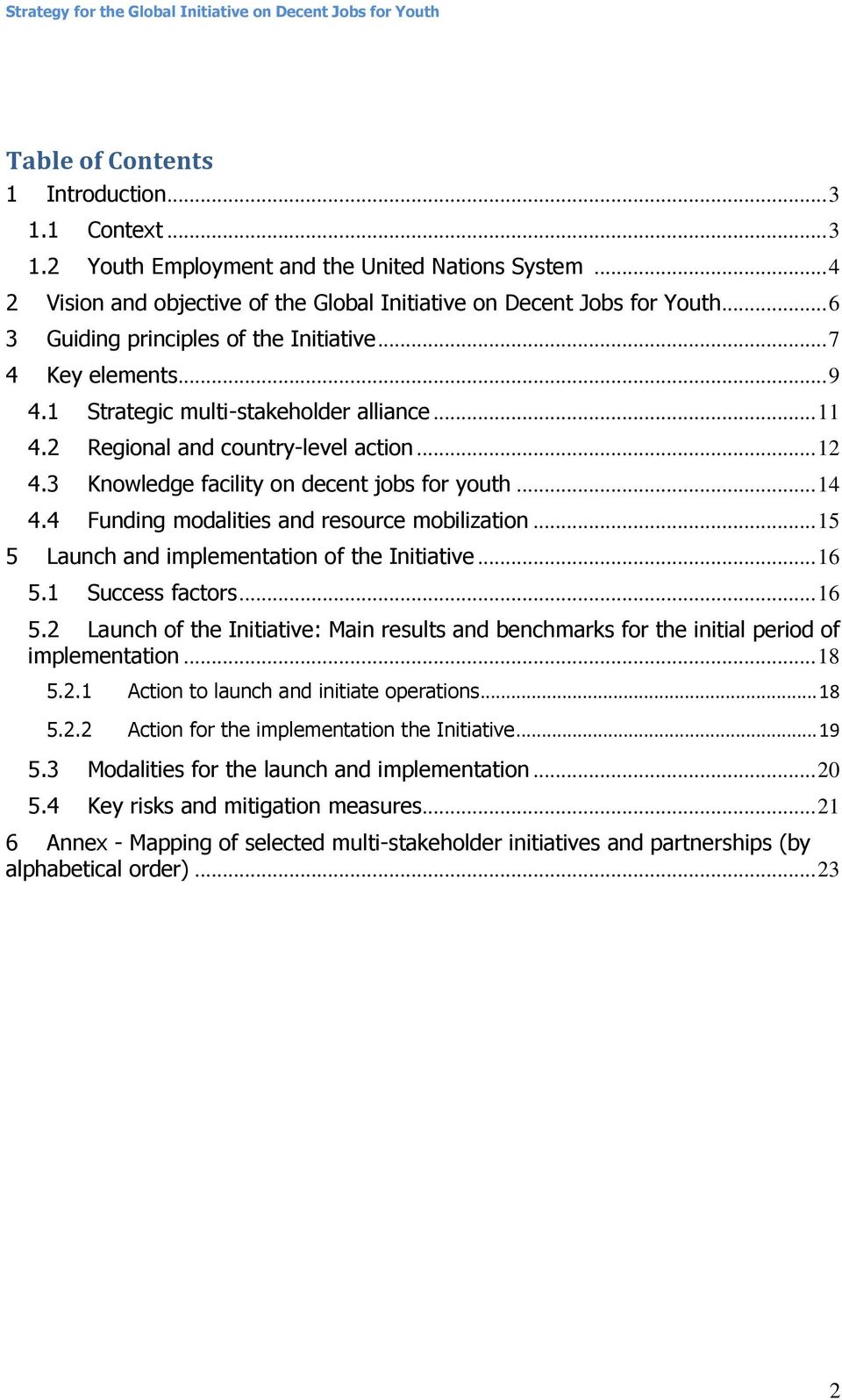
3 Table of Contents 1 Introduction Context Youth Employment and the United Nations System Vision and objective of the Global Initiative on Decent Jobs for Youth Guiding principles of the Initiative Key elements Strategic multi-stakeholder alliance Regional and country-level action Knowledge facility on decent jobs for youth Funding modalities and resource mobilization Launch and implementation of the Initiative Success factors Launch of the Initiative: Main results and benchmarks for the initial period of implementation Action to launch and initiate operations Action for the implementation the Initiative Modalities for the launch and implementation Key risks and mitigation measures Annex - Mapping of selected multi-stakeholder initiatives and partnerships (by alphabetical order)
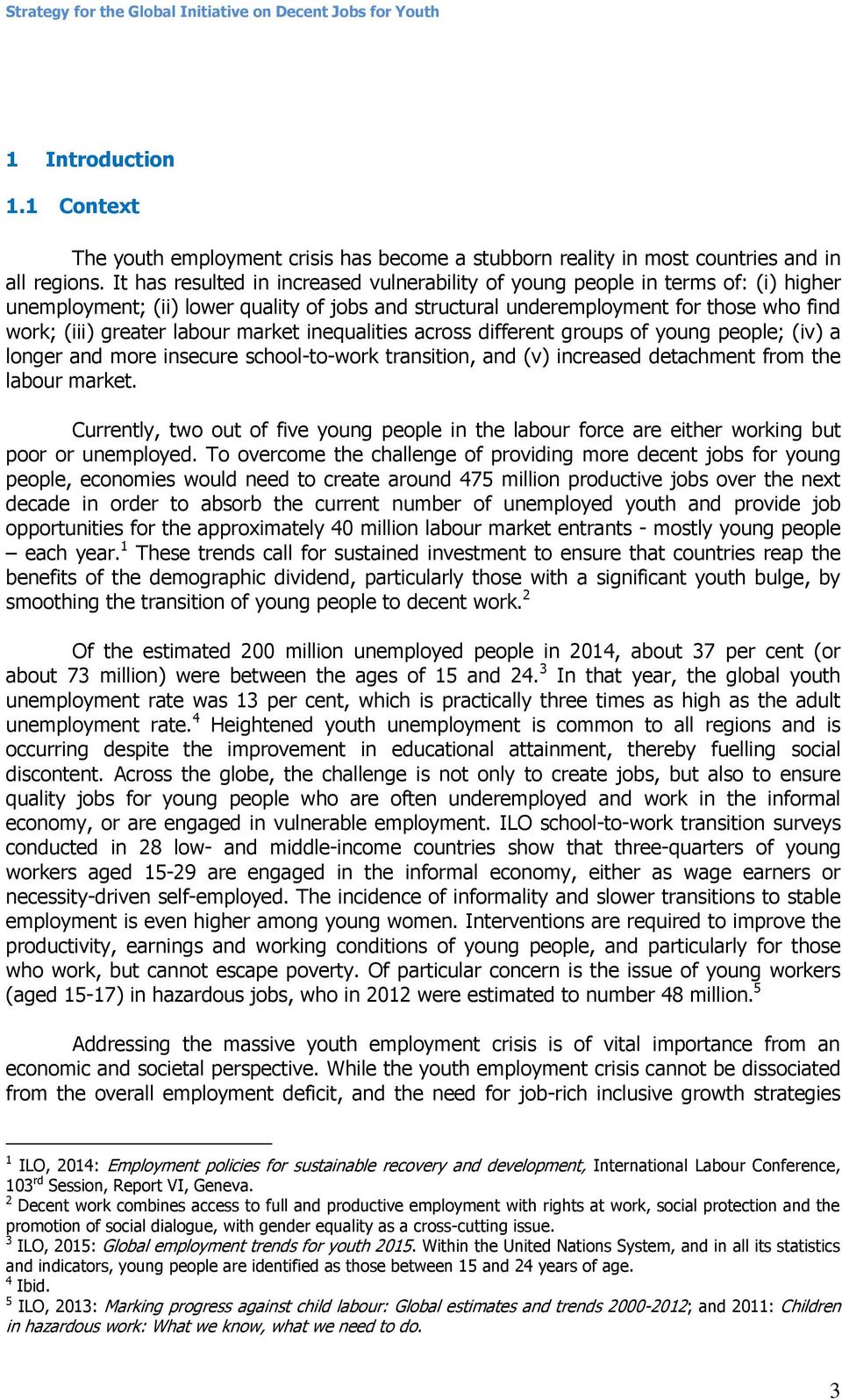
4 1 Introduction 1.1 Context The youth employment crisis has become a stubborn reality in most countries and in all regions. It has resulted in increased vulnerability of young people in terms of: (i) higher unemployment; (ii) lower quality of jobs and structural underemployment for those who find work; (iii) greater labour market inequalities across different groups of young people; (iv) a longer and more insecure school-to-work transition, and (v) increased detachment from the labour market. Currently, two out of five young people in the labour force are either working but poor or unemployed. To overcome the challenge of providing more decent jobs for young people, economies would need to create around 475 million productive jobs over the next decade in order to absorb the current number of unemployed youth and provide job opportunities for the approximately 40 million labour market entrants - mostly young people each year. 1 These trends call for sustained investment to ensure that countries reap the benefits of the demographic dividend, particularly those with a significant youth bulge, by smoothing the transition of young people to decent work. 2 Of the estimated 200 million unemployed people in 2014, about 37 per cent (or about 73 million) were between the ages of 15 and In that year, the global youth unemployment rate was 13 per cent, which is practically three times as high as the adult unemployment rate. 4 Heightened youth unemployment is common to all regions and is occurring despite the improvement in educational attainment, thereby fuelling social discontent. Across the globe, the challenge is not only to create jobs, but also to ensure quality jobs for young people who are often underemployed and work in the informal economy, or are engaged in vulnerable employment. ILO school-to-work transition surveys conducted in 28 low- and middle-income countries show that three-quarters of young workers aged are engaged in the informal economy, either as wage earners or necessity-driven self-employed. The incidence of informality and slower transitions to stable employment is even higher among young women. Interventions are required to improve the productivity, earnings and working conditions of young people, and particularly for those who work, but cannot escape poverty. Of particular concern is the issue of young workers (aged 15-17) in hazardous jobs, who in 2012 were estimated to number 48 million. 5 Addressing the massive youth employment crisis is of vital importance from an economic and societal perspective. While the youth employment crisis cannot be dissociated from the overall employment deficit, and the need for job-rich inclusive growth strategies 1 ILO, 2014: Employment policies for sustainable recovery and development, International Labour Conference, 103 rd Session, Report VI, Geneva. 2 Decent work combines access to full and productive employment with rights at work, social protection and the promotion of social dialogue, with gender equality as a cross-cutting issue. 3 ILO, 2015: Global employment trends for youth Within the United Nations System, and in all its statistics and indicators, young people are identified as those between 15 and 24 years of age. 4 Ibid. 5 ILO, 2013: Marking progress against child labour: Global estimates and trends ; and 2011: Children in hazardous work: What we know, what we need to do. 3
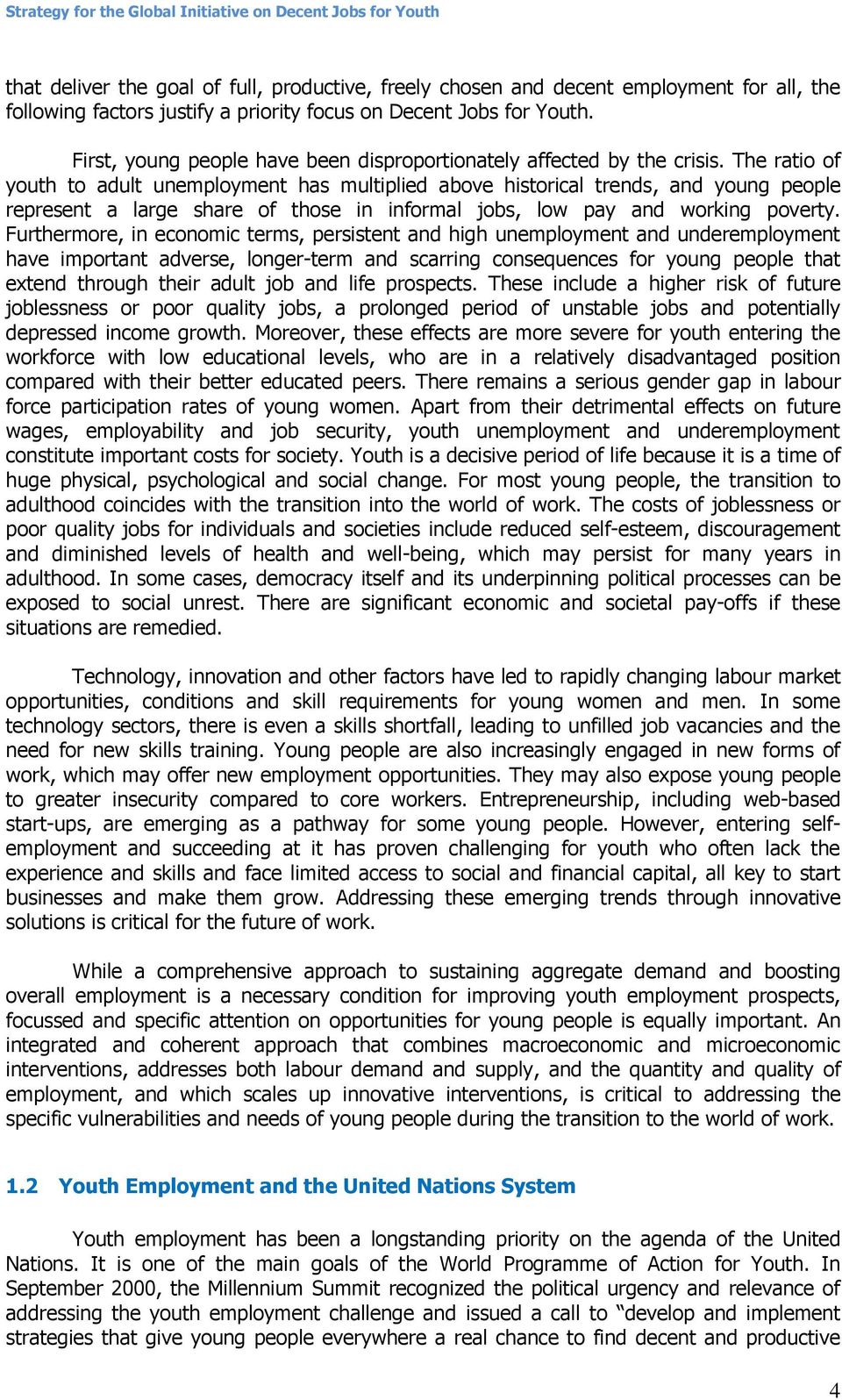
5 that deliver the goal of full, productive, freely chosen and decent employment for all, the following factors justify a priority focus on Decent Jobs for Youth. First, young people have been disproportionately affected by the crisis. The ratio of youth to adult unemployment has multiplied above historical trends, and young people represent a large share of those in informal jobs, low pay and working poverty. Furthermore, in economic terms, persistent and high unemployment and underemployment have important adverse, longer-term and scarring consequences for young people that extend through their adult job and life prospects. These include a higher risk of future joblessness or poor quality jobs, a prolonged period of unstable jobs and potentially depressed income growth. Moreover, these effects are more severe for youth entering the workforce with low educational levels, who are in a relatively disadvantaged position compared with their better educated peers. There remains a serious gender gap in labour force participation rates of young women. Apart from their detrimental effects on future wages, employability and job security, youth unemployment and underemployment constitute important costs for society. Youth is a decisive period of life because it is a time of huge physical, psychological and social change. For most young people, the transition to adulthood coincides with the transition into the world of work. The costs of joblessness or poor quality jobs for individuals and societies include reduced self-esteem, discouragement and diminished levels of health and well-being, which may persist for many years in adulthood. In some cases, democracy itself and its underpinning political processes can be exposed to social unrest. There are significant economic and societal pay-offs if these situations are remedied. Technology, innovation and other factors have led to rapidly changing labour market opportunities, conditions and skill requirements for young women and men. In some technology sectors, there is even a skills shortfall, leading to unfilled job vacancies and the need for new skills training. Young people are also increasingly engaged in new forms of work, which may offer new employment opportunities. They may also expose young people to greater insecurity compared to core workers. Entrepreneurship, including web-based start-ups, are emerging as a pathway for some young people. However, entering selfemployment and succeeding at it has proven challenging for youth who often lack the experience and skills and face limited access to social and financial capital, all key to start businesses and make them grow. Addressing these emerging trends through innovative solutions is critical for the future of work. While a comprehensive approach to sustaining aggregate demand and boosting overall employment is a necessary condition for improving youth employment prospects, focussed and specific attention on opportunities for young people is equally important. An integrated and coherent approach that combines macroeconomic and microeconomic interventions, addresses both labour demand and supply, and the quantity and quality of employment, and which scales up innovative interventions, is critical to addressing the specific vulnerabilities and needs of young people during the transition to the world of work. 1.2 Youth Employment and the United Nations System Youth employment has been a longstanding priority on the agenda of the United Nations. It is one of the main goals of the World Programme of Action for Youth. In September 2000, the Millennium Summit recognized the political urgency and relevance of addressing the youth employment challenge and issued a call to develop and implement strategies that give young people everywhere a real chance to find decent and productive 4
6 work. 6 This call was followed in 2001 by the establishment of the Youth Employment Network (YEN), a joint initiative of the United Nations Secretary-General, the Director- General of the ILO and the President of the World Bank, aimed at building international consensus and influencing the international agenda by engaging, educating and motivating actors for improved youth employment opportunities. In July 2011, the United Nations High-level Meeting on Youth reiterated the urgency of addressing the global challenge of youth employment through strategies for decent and productive work. 7 It also encouraged member States to develop partnerships involving governments, employers organizations, trade unions, the private sector, institutions of education at all levels, youth organizations and civil society. This was reaffirmed by the United Nations Conference on Sustainable Development, held in Rio de Janeiro in June In 2012, the United Nations Secretary-General outlined working with and for women and young people as one of the five generational imperatives of his five-year agenda. The United Nations, through its Inter-Agency Network on Youth Development (IANYD), has developed a System-wide Action Plan on Youth (Youth-SWAP), one of the five priorities of which is youth employment and entrepreneurship. The most recent ILO resolution on youth employment, adopted in June 2012, calls for urgent action to tackle the unprecedented youth employment crisis through a multi-pronged approach geared to pro-employment growth and decent job creation, together with targeted interventions for disadvantaged youth. 9 Much progress has been made, including through the development of the Youth- SWAP, awareness-raising by the Secretary-General s Envoy on Youth, the YEN and successful examples of joint programming, including under the Achievement Fund of the Millennium Development Goals (MDG-F). A number of lessons have emerged from joint initiatives on youth employment. These include: the need to expand partnerships beyond the multilateral system at both the international and country levels by involving a range of key youth employment stakeholders; the need to balance the global, inclusive approach with and an agile action oriented platform; the importance of clear roles and responsibilities for all members, including national and other partners engaged in the development and implementation of initiatives; the development of policy and programme initiatives that extend over the long term; the enhancement of capacity to formulate evidence-based policies and programmes that can scale up innovative action; and the predictability of funding. It is in this context that, in October 2014, the High-level Committee on Programmes (HLCP) discussed decent jobs for youth, along with the urban agenda, as an area deserving its priority attention. The HLCP selected youth employment as a prototype for an issuebased initiative that applies the five key elements of the post-2015 development agenda identified by the United Nations System Chief Executives Board for Coordination (CEB), while 6 A/RES/55/2, para A/RES/65/ A/RES/66/ The youth employment crisis: A call for action, resolution adopted by the 101 st Session of the International Labour Conference,

7 supporting fit-for purpose efforts by mobilizing the capacity of the United Nations system and operationalizing issue-based partnerships. 10 Following these discussions, the HLCP supported the establishment of a time-bound Inter-Agency Task Team, open to all HLCP members, to develop and launch a Global Initiative on Decent Jobs for Youth. The Initiative aims to foster system-wide cooperation, strengthen policy coherence and coordination, mobilize and engage external partners, and enhance linkages between the normative and operational aspects of United Nations efforts for improved programming and delivery. The Task Team is chaired by the ILO and its core members are: FAO, ITC, ITU, UNDESA, UNDP, UNEP, UNESCO, UNFPA, UN- Habitat, UNICEF, UNIDO, UNRWA, UN-WOMEN, UNWTO, the World Bank Group and (ex officio) the Office of the Secretary-General's Envoy on Youth. UNCTAD and WIPO have joined recently. As a follow up to the call made by the HLCP, this paper proposes a Global Initiative on Decent Jobs for Youth and its related strategy. This draft is submitted by 31 August 2015 for comments by the HLCP. Following this discussion, the Task Team will further refine the proposal and initiate consultations with relevant actors engaged in the development and implementation of youth employment policies and programmes. The Sustainable Development Goals (SDGs) provide an opportunity to scale up action on youth employment. Together with the achievement of relevant targets under Goal 8 on the promotion of sustained, inclusive and sustainable economic growth, full and productive employment and decent work for all, youth employment outcomes can be expanded by leveraging the targets of several SDGs, including through the implementation of a global strategy for youth employment. 2 Vision and objective of the Global Initiative on Decent Jobs for Youth The vision of the Global Initiative on Decent Jobs for Youth is a world in which young women and men have greater access to decent jobs everywhere. The objective of the Initiative is to facilitate increased impact and expanded country-level action on decent jobs for youth through multi-stakeholder partnerships, the dissemination of evidence-based policies and the scaling up of effective and innovative interventions. This objective is directly linked to the achievement of the SDGs relating to youth employment and more specifically to the outcome document of the United Nations Summit for the adoption of the post-2015 development agenda titled Transforming our World: The 2030 Agenda for Sustainable Development, annexed in draft resolution A/69/L.85. The outcome document includes the following youth employment targets: (i) 4.4 By 2030, increase the number of youth and adults who have relevant skills, including technical and vocational skills, for employment, decent jobs and entrepreneurship ; (ii) 8.5: By 2030, achieve full and productive employment and decent work for all women and men, including 10 See Summary of conclusions of the 28th Session of the High-level Committee on Programmes, New York, October The key elements the post-2015 development agenda were: (i) universality, (ii) integration, (iii) equality, (iv) human rights, and (v) data revolution. The outcome document of the United Nations Summit for the adoption of the post 2015 development agenda was agreed by consensus by the member states on 2 August

8 for young people and persons with disabilities, and equal pay for work of equal value ; and (iii) 8.6: By 2020, substantially reduce the proportion of youth not in employment, education or training. 11 The objective will be pursued by using the power of the United Nations system to convene multi-stakeholder partnerships and by pooling cutting-edge advice, expertise, resources and support. More specifically, the objective will be operationalized by: a) engaging stakeholders and world leaders in high-level policy action on youth employment; b) expanding and scaling up context-specific interventions at the national and regional levels for systematic and coherent policies and interventions on youth employment; c) pooling existing expertise and enhancing knowledge development and dissemination on what works for youth employment, including through the development of tools and capacity building; and d) leveraging resources from existing facilities and mobilizing additional resources. 3 Guiding principles of the Initiative The Initiative aims to support efforts for the achievement of the 2030 Agenda for Sustainable Development in the area of youth employment by building on past and on-going experience gained from joint action, lessons learned and good practice on youth employment. The following principles have been identified as guidance for the Initiative and its implementation: a) Multi-dimensional and multi-sectoral approach. The strategy of the Initiative will be built on a multi-dimensional approach to ensure that young women and men in different contexts and situations, including in fragile states and states in protracted crisis, as well as among displaced populations, benefit from coordinated support. This reflects the universal nature of the proposed SDGs. b) Rights-based approach. The Initiative will strengthen the links between the United Nations normative frameworks and operational activities. It will facilitate the effective application of standards and norms to operations on the ground. The rights-based approach will promote respect for human rights and the application of international labour standards and other United Nations normative frameworks relevant to the promotion of decent jobs for young people. c) Promotion of gender equality. The Initiative will mainstream gender equality concerns throughout its implementation. The interventions supported will pay particular attention to gender issues and their underpinning socio-economic 11 With respect to means of implementation, the proposal of the Open Working Group (paragraph 8.b) indicates By 2020, develop and operationalize a global strategy for youth employment and implement the Global Jobs Pact of the International Labour Organization. 7

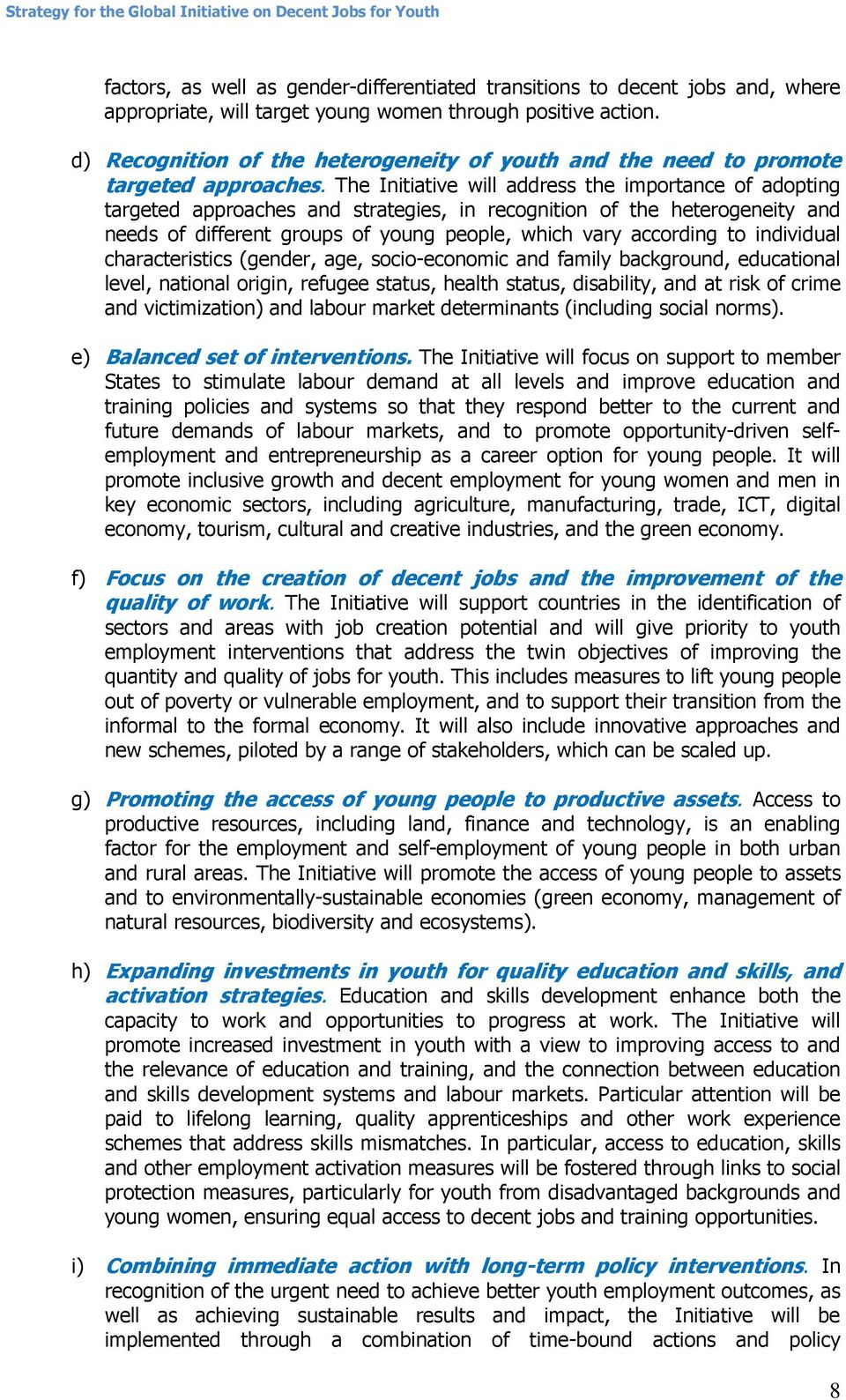
9 factors, as well as gender-differentiated transitions to decent jobs and, where appropriate, will target young women through positive action. d) Recognition of the heterogeneity of youth and the need to promote targeted approaches. The Initiative will address the importance of adopting targeted approaches and strategies, in recognition of the heterogeneity and needs of different groups of young people, which vary according to individual characteristics (gender, age, socio-economic and family background, educational level, national origin, refugee status, health status, disability, and at risk of crime and victimization) and labour market determinants (including social norms). e) Balanced set of interventions. The Initiative will focus on support to member States to stimulate labour demand at all levels and improve education and training policies and systems so that they respond better to the current and future demands of labour markets, and to promote opportunity-driven selfemployment and entrepreneurship as a career option for young people. It will promote inclusive growth and decent employment for young women and men in key economic sectors, including agriculture, manufacturing, trade, ICT, digital economy, tourism, cultural and creative industries, and the green economy. f) Focus on the creation of decent jobs and the improvement of the quality of work. The Initiative will support countries in the identification of sectors and areas with job creation potential and will give priority to youth employment interventions that address the twin objectives of improving the quantity and quality of jobs for youth. This includes measures to lift young people out of poverty or vulnerable employment, and to support their transition from the informal to the formal economy. It will also include innovative approaches and new schemes, piloted by a range of stakeholders, which can be scaled up. g) Promoting the access of young people to productive assets. Access to productive resources, including land, finance and technology, is an enabling factor for the employment and self-employment of young people in both urban and rural areas. The Initiative will promote the access of young people to assets and to environmentally-sustainable economies (green economy, management of natural resources, biodiversity and ecosystems). h) Expanding investments in youth for quality education and skills, and activation strategies. Education and skills development enhance both the capacity to work and opportunities to progress at work. The Initiative will promote increased investment in youth with a view to improving access to and the relevance of education and training, and the connection between education and skills development systems and labour markets. Particular attention will be paid to lifelong learning, quality apprenticeships and other work experience schemes that address skills mismatches. In particular, access to education, skills and other employment activation measures will be fostered through links to social protection measures, particularly for youth from disadvantaged backgrounds and young women, ensuring equal access to decent jobs and training opportunities. i) Combining immediate action with long-term policy interventions. In recognition of the urgent need to achieve better youth employment outcomes, as well as achieving sustainable results and impact, the Initiative will be implemented through a combination of time-bound actions and policy 8
10 interventions addressing both cyclical and structural economic and social issues, and new emerging trends. j) Complementarity and coherence between public policies and private sector initiatives. Recognizing the key role of the private sector in job creation, the Initiative will actively engage the private sector and promote complementarity and coherence between public policy and private investment. k) Involvement of organizations representing the interests of young people. The Initiative will facilitate the involvement of these organizations in relevant policy and planning discussions by pursuing active engagement with organizations that represent young people and their interests in rural and urban areas. l) Focus on achieving impact at the country level and pursuing regional perspectives, where appropriate. The Initiative will be practically minded and focused on the end goal of achieving impact on the ground. The mobilization of and engagement with the United Nations country-based presence and coordination mechanisms is of key importance. m) Leveraging existing platforms and lessons learned. The initiative will build on past and/or existing youth employment networks and platforms, including those implemented through South-South and triangular cooperation mechanisms. n) Expanded multi-stakeholder partnerships. The implementation of the Initiative will involve multi-stakeholder partnerships, both within and outside the United Nations system. Partners will bring their own expertise and added value and will engage from the initial phase of the Initiative and throughout its implementation. 4 Key elements The strategy includes the following inter-connected elements: (i) A strategic multi-stakeholder alliance. The Initiative addresses decent jobs for youth as an issue of global concern which requires the highest possible level of policy attention and action. It is a development imperative that builds on and transcends the action of any individual organization or actor. The alliance will be set up by leveraging the convening power of the United Nations system, its overarching policy frameworks and its multiple and diverse partners from governments and non-governmental entities. It will bring together major actors of substantive significance to the issue of decent jobs for youth, including national institutions, the private sector, the United Nations system and other multilateral organizations, representatives of academia, representatives of the social partners and youth organizations. It will be an umbrella forum for global advocacy and will raise existing activities on youth employment to a higher level of action and impact. The main functions of the alliance will be to: (1) advocate high-level policy commitment and action on youth employment; (2) support policy convergence and coherence; and (3) stimulate innovative thinking and resource mobilization to scale up youth employment interventions and their impact. 9

11 (ii) Expanded and scaled up regional and country level action on decent jobs for youth. The Initiative will promote and monitor multi-pronged interventions through broad partnerships and joint action on decent jobs for youth. These interventions will focus on scalable and innovative solutions that have proved effective in improving youth employment outcomes at the regional and national levels with a view to developing sustainable policies and institutions. This element will respond to national development priorities, support United Nations country programming and be implemented through broad multistakeholder partnerships under the leadership of United Nations Country Teams (UNCTs). It will involve governmental and non-governmental institutions, private sector actors, representatives of the social partners, youth and other organizations active in the region and/or country. In particular, support will be provided to UNCTs that are engaged in the implementation of the employment and entrepreneurship priority of the Youth-SWAP. (iii) Knowledge facility on decent jobs for youth. The knowledge facility will promote the sharing of knowledge and experience, capacity building and peer learning, including through South-South and triangular cooperation mechanisms. It will facilitate the exchange of information and good practice on what works for youth employment, support the testing and evaluation of policy packages, encourage the development and implementation of innovative strategies and disseminate broadly evidence, guidelines and tools for the replication of effective and scalable youth employment responses. It will identify and document successful practices in the design, implementation, monitoring and evaluation of interventions for decent jobs for youth. Finally, it will support policy and multistakeholder dialogue during the implementation of youth employment initiatives in pilot countries. (iv) Funding modalities and resource mobilization. This component will pool domestic resources and those available from existing funds. 12 It will mobilize additional resources where required. Funding will support innovative initiatives that have the potential for wide replication and high impact in selected countries. 13 Resources will principally be used to support youth employment action at the country and local levels, including work undertaken through the knowledge facility that is instrumental for country-level implementation. Resources management will be based on the criteria of efficiency, costeffectiveness, accountability and transparency. 12 The recent discussion on financing for development and the 2030 Agenda for Sustainable Development emphasize the need for investment and mobilization of domestic resources. 13 An example of funding facility on youth employment that was successfully implemented in the recent past is the Achievement Fund of the Millennium Development Goals (MDG-F). Funded by the Government of Spain, the MDG-F provided financial and technical support to 15 UNCTs to pilot joint initiatives on youth employment and migration. These initiatives resulted in more integrated approaches in the operationalization of national youth employment priorities through partnerships involving national institutions and organizations and the UNCTs. They also helped build collective knowledge and expertise on effective approaches and develop tools for joint programming on youth employment. 10

12 4.1 Strategic multi-stakeholder alliance Achieving decent and productive work for young people is a global concern that requires political attention and collaboration on a global scale. A strong global initiative on decent jobs for youth responds to the call by countries for the implementation of a global strategy for youth employment. The international community, including the multilateral system, has an important role to play in creating global awareness of the importance of investing in youth employment and of concerted action to promote decent jobs for young people. This support is needed to build international consensus around youth employment and to mobilize political leaders in as many countries as possible with a view to making action on youth employment a top priority. A global strategic alliance around the issue of decent jobs for youth will give visibility, create synergies and promote coherence among youth employment actors and initiatives. In view of the magnitude of the youth employment crisis, the alliance will function as an umbrella for existing youth employment activities and partnerships with a view to fostering coherence and bringing them to a higher level of action and impact. To this effect, the alliance will leverage existing platforms and interventions. It will serve as a global forum on decent jobs for youth and will offer the opportunity to connect existing youth employment related platforms, networks and interventions (see Annex 1 for a summary of these entities). Synergies across these platforms and networks will be established through the collaboration of various entities that are members of both the Global Initiative on Decent Jobs for Youth and of thematic platforms and networks, including the United Nations IANYD, Solutions for Youth Employment (S4YE), the Partnership for Action on Green Economy (PAGE) and the Global Partnership for Education. The supporting and embracing role of the alliance amid a multitude of efforts is an important value addition of the Initiative. The alliance will build on the lessons learned from networks and interventions implemented by the United Nations in the area of youth employment. It will particularly draw on the experience gained from the YEN by enhancing global advocacy for country-level and evidence-based action. It will also build on experiences from other initiatives including the Youth Employment Inventory (YEI), which serves as a repository of evidence from youth employment programmes implemented worldwide; and the recently-established S4YE partnership, which seeks to promote the evidence-based use of existing and additional resources, increase coordination for impact and align resources to scale up proven demonstrations. It will also use the lessons learned from other global partnerships on specific issues, such as education, health, nutrition, sustainable energy, green growth and the digital economy. The lessons learnt point to the importance of balancing the need for inclusive engagement and participation of key stakeholders and coordination efforts with an agile governance structure that enables rapid deployment and scaling up action within reasonable time frames, using the specialised expertise of different partners in a coherent and transparent platform. The alliance will be a flexible and nimble mechanism to leverage the collective capacity of the United Nations system and its multiple partners, including private sector and non-governmental actors. It will galvanize high-level attention on the need to take urgent action on youth employment and will disseminate messages and ideas on new approaches and partnerships for more effective ways to tackle the youth employment challenge. Its members will advocate increased efforts for the achievement of the youth employment targets emerging from the 2030 Agenda for Sustainable Development, particularly in developing countries and fragile states. 11

13 Convened by the United Nations, the alliance will involve world leaders and personalities from various backgrounds that are significant in the global quest for decent jobs for youth. Its members will act as global advocates for decent jobs for youth. They will discuss, with members of academia, parliamentarians and other national and global policy shapers, how to address the global drivers of change that may have an impact on youth employment. They will provide vision and guidance. The main tasks of the members of the alliance will include: (i) the promotion of youth employment as a top priority on global, regional and national policy agendas; (ii) global advocacy for sustained and coordinated investment in youth employment through the mobilization of existing and new resources; (iii) consultation with a range of organizations, leaders and experts on practical approaches and innovative scalable solutions in the area of youth employment; (iv) support for the establishment of country-level multi-stakeholder platforms to steer action on youth employment; and (v) the preparation of a global report on youth employment, with recommendations for action. 4.2 Regional and country-level action Regional level action At the regional level, the Initiative will promote regional partnerships for decent jobs for youth. Work at the regional level will include the development of regional programmes, capacity building, cross-country learning, resource mobilization and advocacy. Regional cooperation can expand the impact of national efforts to improve youth employment outcomes. Action at the regional level will include the sharing of good practice and experience with a view to replicating approaches that have proved effective in other countries in the region. The Initiative will promote regional capacity-building action to expand knowledge of evidence-based policies and interventions for youth employment. It will promote the establishment of broad partnerships and cross-country networks involving the regional networks of the IANYD, regional organizations and banks, national policy-makers and practitioners, youth and other civil society organizations. The regional component of the Initiative will also be implemented through South- South and triangular cooperation modalities. Country-level action Country responses to the youth employment crisis have differed. Almost every country in the world has sought to address the issue, and a wealth of approaches has been implemented at the national level. However, many interventions have been confined to specific programmes that are narrow in scope and limited in time. The priority attached to them varies over time, and many programmes have failed to address the multiple aspects of the youth employment challenge and have focussed on labour market entrants, particularly in urban areas, while paying little attention to the poor working conditions of many young people. Finally, there is excessive fragmentation of interventions, with little coordination between implementing actors. 12

14 The Initiative will promote strong national ownership. Youth employment actors at the national and local levels will own the process from the outset, including requests for support by the Initiative. Support by the Initiative will place emphasis on advancing action on youth employment by expanding and scaling up interventions through coordinated responses involving multiple stakeholders. The main focus will be on the development and implementation of national policies and strategies, and on interventions at the country and local levels, with a view to achieving impact on both the quantity and quality of jobs for young people, and their operationalization through large-scale youth employment interventions. This will be done through the development of time-bound national plans or programmes for decent jobs for youth, as well as interventions led by cities and municipalities. These plans, programmes and initiatives will be implemented through both public and private investment and will be instrumental in: (i) linking youth employment to national development plans and vision strategies, employment and job creation policies; (ii) bringing up to scale innovative initiatives that have worked in the country of implementation and in other countries for replication purposes; and (iii) forging broad partnerships for joint action. Country and local level interventions will focus on scalable solutions that have proved effective in improving youth employment outcomes. The knowledge element of the strategy will therefore seek to identify scalable solutions. Subject to age-group definitions and types of interventions in the various national contexts, the ultimate beneficiaries will be young people aged between 15 and 24, with particular emphasis on disadvantaged and underprivileged youth. Based on requests for support from countries, along the same lines as the alliance at the global level, a multi-stakeholder partnership will be set up to support the implementation of youth employment interventions. The partnership will own the interventions and will include government institutions, United Nations entities, international bilateral and regional organizations and banks, non-governmental organizations (NGOs), private sector actors, representatives of the social partners and youth organizations active in the country. During the initial period, in close collaboration with the UNCTs, the Initiative will identify a number of pilot countries for implementation. Priority will be given to countries with explicit interest in youth employment already reflected in national development plans and strategies and employment policies as well as countries wishing to focus on decent jobs for youth in national policy-making. Special attention will be paid to requests channelled through the UNCTs for implementation through collaborative undertakings, as advocated by Youth-SWAP 14 and/or in line with the United Nations Development Assistance Framework (UNDAF). At the local level, action will be overseen by the UNCTs and implementation will involve local actors. Special emphasis will be placed on action in fragile states and contexts characterized by protracted crises with a view to contributing to peace-building processes and enhanced resilience through job opportunities for young women and men and improved risk management. The Initiative will also contribute to identifying and scaling up effective interventions to improve the economic and job opportunities of youth living in urban areas. In view of the high share of young women and men in informal jobs, the Initiative will focus in facilitating the transition from the informal to the formal economy. Similarly, attention will 14 See: 13

15 focus on rural areas where levels of youth underemployment and working poverty are particularly pronounced. In developing and emerging economies, the Initiative will provide support to national stakeholders to give effect to national priorities to address the youth employment challenge through the scaling up of innovative interventions. In advanced economies, the Initiative will disseminate knowledge on what works for youth employment and will support the development of innovative replicable solutions. As there is no-one-size fits all approach to addressing the youth employment crisis, interventions will be tailored to the specific country or local context. They will be based on the guiding principles of the Initiative and the broad policy framework of the call for action on the youth employment crisis adopted by the 185 member States of the International Labour Conference in June Particular emphasis will be given in this context to the role that sectoral policies play in promoting youth employment. Country-level support will combine technical assistance to strengthen the policymaking process with direct measures to scale up youth employment interventions. All interventions will be gender sensitive and focus on: (i) reviewing the effectiveness of policies, institutions and programmes, and applying lessons from evaluation and good practices; (ii) developing policies that assign national priority to decent jobs for youth; (iii) implementing interventions through time-bound national plans for productive and decent jobs for youth and/or programmes backed by public and private investments with a view to turning commitment into action; and (iv) monitoring and evaluating interventions. Country and local level initiatives will be linked to the knowledge and advocacy component of the Initiative, which will analyse and disseminate effective practices, provide technical assistance and capacity building and support resource mobilization. 4.3 Knowledge facility on decent jobs for youth Policy-makers, practitioners and the global development community are seeking solutions to the youth employment crisis. They are looking for innovation and evidence of what works and how to improve labour market outcomes for young men and women. In view of the scope of the challenge, the demand largely focusses on scalable and sustainable solutions that can enhance programming and policy-making, including through the exchange of practices amongst actors. This element of the Initiative will leverage the collective experience of the United Nations and other partners to spur innovation and facilitate knowledge development and sharing in the field of youth employment. The demand for effective youth employment solutions has drawn attention to sources of information on the youth labour market and measures to support youth in the transition to decent jobs. 15 Seeking to maximize its added value, the knowledge facility will: (i) capitalize on the longstanding collective experience and knowledge of the United Nations and other organizations in supporting young people through decent jobs; (ii) serve as a meta-website mapping and linking knowledge on youth 15 Some of the most recognized global information platforms on the subject are: (i) YouthStats, a database with reliable labour market statistics to inform policies on youth employment worldwide; (ii) Youth Employment Inventory, a comprehensive, live database of youth employment programmes worldwide; and (iii) YouthPOL, a global repository of youth employment policies. Global knowledge platforms that, in addition to being outside the youth employment spectrum, offer good opportunities for synergies include: the Green Growth Knowledge Platform (GGKP) and the Portal on Multilateral Environment Agreements (InforMEA). 14

16 employment across the globe; (iii) link and expand the work of the various knowledge platforms; (iv) strengthen national capacity for the design, implementation and monitoring and evaluation of youth employment policies and programmes; and (v) communicate the objectives and results achieved by the Initiative and disseminate knowledge with a view to improving evidence-based policy-making. These objectives are described briefly below. Knowledge generation and sharing: building on the current state of the evidence, the facility will support the testing and evaluation of innovative policy packages and interventions across sectors. It will prioritize the generation of knowledge in areas where evidence from evaluation is scarce, including what works to: (i) promote job-centred growth, particularly in sectors with a high youth employment potential; (ii) improve youth labour market outcomes in conflict-affected and disaster-prone settings; (iii) support youth employment in rural areas; (iv) promote gender equality in employment, training, and occupations; (v) support disadvantaged youth; and (vi) support young women and men through entrepreneurship and self-employment. The generation of knowledge will advocate rigorous and innovative methods of evaluation, experimentation and rapid assessment. The facility will position the Initiative as a youth employment knowledge gateway leading to the exchange of information and good practice on what works, why and how in youth employment. It will also identify and document research on youth employment, showcase youth employment and youth development databases, and share successful practices of the monitoring and evaluation of youth employment policies and programmes. In addition to the virtual exchange of information, the Initiative will also focus on the face-to-face sharing of knowledge and experience. Regional and country level work will be strongly linked to and supported by the knowledge platform. Capacity development: the facility will act as a professional collaborative venue for experts and practitioners at all levels. It will provide tailored support and facilitate capacity building on the design, implementation, monitoring and evaluation of youth employment policies and programmes. In particular, it will promote peer learning, including through South-South and triangular cooperation mechanisms. It will also serve as a one-stop shop for capacity building and the strengthening of initiatives in the area of youth employment, focussing on efforts by United Nations organizations and other key stakeholders. Special attention will be given to strengthening the capacity of the range of stakeholders involved at the national level in the design, implementation and gender-sensitive monitoring of evidence-based youth employment interventions. Communication: the facility will serve as a communication channel for the Initiative, showcasing interventions and achievements at the various levels, featuring technical discussions and the voices of young people, policy-makers, practitioners, the social partners, United Nations organizations and all other players active in the promotion of decent jobs for youth. 4.4 Funding modalities and resource mobilization The proposed SDGs and the related youth employment targets can only be achieved through coherent and coordinated strategies and plans that are able to attract funding from diverse sources, particularly domestic, in both the public and private sectors. The relative 15
17 significance of each source, and the associated leveraging challenges, differ between countries. The Initiative aims to pool resources in support of youth employment interventions that have the potential for wider replication and higher impact at the country level. It will support the identification of strategic country-level opportunities that demonstrate the capacity to generate youth employment and will mobilize resources for the implementation of multi-stakeholder interventions on decent jobs for youth. Support will also be provided for knowledge development and dissemination purposes, particularly of good practice, capacity building, product development and the evaluation of policy packages. The Initiative will follow a two-track funding approach by mainstreaming youth employment concerns and priorities into existing domestic and global facilities and funds, as well as mobilizing additional resources and funding mechanisms, including in relation to the Financing for Development and the SDGs which have placed a central focus on youth employment strategies. 16 Where appropriate, it will also facilitate the channelling of current and future investments in youth employment action, including through a thematic multidonor facility. The various elements of the Initiative have different funding needs. Resources are required to support: (i) the generation and dissemination of global public goods, and the implementation of foundational activities and capacity building in pilot countries; and (ii) the implementation of youth employment interventions that operationalize policy priorities through action. Resources will be managed and allocated based on the criteria of efficiency, cost-effectiveness, accountability and transparency. Contributions from multiple resource partners will be pooled and allocated to technical partners to support implementation. Funding for regional and country-level action will be used to operationalize policy and investment priorities, and to scale up action on decent jobs for youth. The mix of domestic and foreign, public and private sources will correspond to the specific country context and youth employment challenge. Country-level efforts will be assisted through the identification and mobilization of resources. The partners of the Initiative will be called upon to assist in linking youth employment action to existing funding facilities at both the global and national levels, and to develop a dedicated fund-raising strategy. 5 Launch and implementation of the Initiative 5.1 Success factors The Initiative aims to expand action at the national, regional and global levels through transformational, innovative and evidence-based policies and approaches and to 16 The Outcome Document (Paragraph 16) adopted at the Third International Conference on Financing for Development, Addis Ababa, July 2015, indicates that To enable all people to benefit from growth, we will include full and productive employment and decent work for all as a central objective in our national development strategies. We will encourage the full and equal participation of women and men, including persons with disabilities, in the formal labour market. We note that micro, small and medium-sized enterprises, which create the vast majority of jobs in many countries, often lack access to finance. Working with private actors and development banks, we commit to promoting appropriate, affordable and stable access to credit to micro, small and medium-sized enterprises, as well as adequate skills development training for all, particularly for youth and entrepreneurs. We will promote national youth strategies as a key instrument for meeting the needs and aspirations of young people. We also commit to developing and operationalizing, by 2020, a global strategy for youth employment and implementing the International Labour Organization (ILO) Global Jobs Pact. 16

18 facilitate the scaling up of practical interventions that have an impact on youth employment outcomes. It is based on the diagnosis of youth labour markets in the aftermath of the global financial and economic crisis and is focused on the proposals of the 2030 Agenda for Sustainable Development. It also builds on the assessment of and lessons learned from the present architecture and from the results achieved at the global, regional and country levels. The four mutually supportive elements of the Initiative are intended to fill in the gaps identified, particularly in relation to the scale, pace and coherence of action. The strategy aims to facilitate systemic action on youth employment in the medium- to long term, while at the same time taking a pragmatic approach by making full use of existing thematic facilities that can be leveraged to contribute to the same objective in the immediate and short term, as well as tapping into emerging opportunities as they arise. In this respect, it proposes an 18-month plan to start operations and the implementation of action at the global, regional and country levels. During this period, the Initiative will develop a longerterm operational roadmap to be reviewed on a regular basis and adopted every three years. The following factors will be pivotal in determining the success of the Initiative: (i) full ownership of the Initiative by countries in different regional and development contexts; (ii) the ability and readiness of the United Nations system to act rapidly and effectively as a global convenor and facilitator, reaching out to non-united Nations actors, mobilizing resources and building capacities and knowledge in support of country-level action; and (iii) the active engagement and coordinated action of diverse stakeholders (including Parliamentarians, the private sector and other non-state actors, youth organizations and other NGOs and academia) under the overarching umbrella of the alliance. Another critical success factor is coordination of the mobilization of existing and new funding with a view to achieving scale and impact. A number of concrete and practical schemes have been identified with a view to kickstarting implementation as soon as the Initiative is endorsed by the CEB and launched. Other schemes covering specific themes, regions and countries may be identified during the implementation of the Initiative. The proposed implementation strategy includes parallel and simultaneous action on the four elements of the Initiative, which will engage a large number of United Nations entities, governmental and non-governmental actors, and on issue-based innovative pilots, each of which will involve a more limited number of agencies and country coverage. The 2016 edition of the Youth Forum 17, which will take place from 1-2 February 2016, will look at ways that in which young people could contribute to implementation of the 2030 Agenda for Sustainable Development, including youth employment. In this context, the Global Initiative will be featured as an initiative by the UN System to respond to the global priority of job opportunities. The full impact of the Initiative will be realized when all of these elements are in place and interconnected coherently, and the shared responsibilities and duties of the partners are clearly established and owned at all levels by the participating agencies, regional organizations and governments. 17 The youth employment crisis has emerged as the one constant challenge which young people have addressed in their dialogue with policy-makers at the intergovernmental level during the annual ECOSOC Youth Forum. The Youth Forum, launched in 2012, has become an apex Forum for channeling the views of young people from around the world on a range of sustainable development challenges. 17

19 The operational framework of the Initiative will establish the foundations for the coherence of youth employment action at the global, regional and country levels. The synergies established across the elements of the Initiative and through strong coordination between the various actors involved in youth employment will lead to the higher-level impact of policies and programmes on decent jobs for youth. 5.2 Launch of the Initiative: Main results and benchmarks for the initial period of implementation This section describes the action to be taken to launch and initiate operations, and action for implementation during the first 18 months of the Initiative Action to launch and initiate operations The action taken to launch and initiate operations during the first 18 months of the Initiative, including the expected deliverables and benchmarks, will produce the following results: Strategic multi-stakeholder alliance established and operational. A guidance note/memorandum of Understanding will be prepared on the composition, rules of engagement, roles and responsibilities of the multi-stakeholder alliance at the global level. A consultation process will be launched to contact and engage leaders and personalities from various backgrounds and institutional affiliations who are of substantive significance to the global quest for decent jobs for youth. It is expected that, by the end of year one, the alliance will be established, will have held at least two meetings and adopted the three-year operational roadmap. Global Initiative on Decent Jobs for Youth launched. A number of high-profile events to launch the Initiative will be identified, a communication strategy devised and proposals made on the most suitable event for participation by the United Nations Secretary-General, the ILO Director-General and the Principals of participating United Nations entities, government representatives and members of the multi-stakeholder alliance. Three-year operational roadmap finalized. A roadmap will be developed and endorsed detailing the operations and expected results of the Initiative over a threeyear period. It will highlight priorities, achievable targets, measurable results and related indicators, timelines, the financial and human resources available and gaps for which additional resources may be required. The roadmap will be the main instrument for monitoring the implementation of the Initiative and reporting on its achievements. This result will be considered as achieved once the roles and rules of accountability have been endorsed by the different partners engaged in the implementation of the Initiative. A knowledge facility established to share evidence about what works in youth employment and to strengthen capacity building initiatives. The knowledge facility will serve as a one-stop shop to strengthen the capacity of policy makers and practitioners to develop effective youth employment interventions. This result will be produced once the virtual knowledge facility is operational and effective youth employment interventions have been proposed in support of policy and multi- 18
20 stakeholder dialogue in at least five countries. Details of the management of the facility will be included in the operational roadmap. Existing and new evidence on innovative and effective youth employment interventions broadly disseminated. The participating entities will collect, analyse and disseminate existing and new evidence with a view to supporting regional and country-level action through the exchange of information and good practice on what works, why and how in youth employment, and particularly on innovative and scalable interventions. The results of this work will be packaged in a practical toolkit and will be accessible through the knowledge facility. This result will be achieved once the toolkit has been developed and disseminated in the regions and countries involved in the Initiative Action for the implementation the Initiative The action to be taken for the implementation of the Initiative during its first 18 months of operations, including the expected deliverables and benchmarks, will produce the following results: At least two regional partnerships established under the Initiative. A consultation process will be conducted with regional organizations, regional banks and the regional networks of the IANYD to launch partnerships, including concrete action in at least two regions, with the aim of enabling cross-country learning, the development of regional programmes and capacity-building initiatives. This result will be produced once the partnerships have been established and an operational plan, including planned resource mobilization and advocacy efforts, has been developed for each region. A guidance note for country-level action developed. This note will detail the models of country-level engagement that work best, including the processes and expected outcomes of country-level action. It will also provide guidance on the establishment of multi-stakeholder platforms at the country level and on implementation modalities. This result will be produced in consultation with the Development Operations Coordination Office (DOCO) to ensure consistency with existing United Nations Development Group guidance and with the engagement of selected UNCTs and United Nations agencies. Scaled up action at the country and local levels on youth employment initiated in at least five prototype countries. A main deliverable of the Initiative is to assist in embedding youth employment priorities in national development plans and visions, setting up multi-stakeholder support groups at the country level, and embedding and reinforcing the priorities in common country programming documents. This action will be implemented in at least five countries during the first 18 months of operations. When identifying the countries, priority will be given to national commitment and ownership, and resource mobilization, supported by UNCTs that have already expressed interest in implementing the Youth-SWAP. This result will be produced once the country-level multi-stakeholder platform has taken full ownership of the country-level action and has developed a plan of action on decent work for youth, including priority sectors of intervention, major programmes to be implemented, roles and responsibilities during implementation and the domestic and other resources mobilized that are required for implementation. Interventions will be 19

21 evaluated to gauge their impact on youth employment outcomes and to identify good practice for evidence-based policy-making. A capacity development programme developed and tested in at least five countries. The Initiative will develop a training programme and the related training materials to strengthen the in-country capacity of youth employment stakeholders, UNCTs and other development partners for the development and implementation of policies and programmes for decent work for youth. This result will be produced once the capacity development programme and training materials have been tested in at least five countries. Thematic and/or sectoral work led by members of the Task Team. This work will be piloted based on the mandate and expertise of participating United Nations and non-united Nations entities in support of country-level action and using the funding modalities as outlined in Section 4.4 above. At least three of the following thematic initiatives will be initiated during the first 18 months: (i) Green jobs for youth in collaboration with the Partnership for Action on Green Economy (PAGE); (ii) Quality apprenticeships in collaboration, inter alia, with the Global Apprenticeships Network (GAN); (iii) Digital skills and tech-hubs to improve decent job opportunities for youth in the digital economy; (iv) Youth in fragile states; (v) Youth in the informal economy, also in synergy with the current urbanization issue-based process initiated by HLCP/CEB in support of Habitat III; (vi) Youth in the rural economy; (vii) Linkages to global markets and investments to improve opportunities for young entrepreneurs, also with the Youth and Trade Initiative; (viii) Transition to decent work for young workers (15-17) in hazardous occupations. A resource mobilization strategy developed and implemented. The resource mobilization strategy will: (i) include modalities for the mobilization and use of domestic resources; (ii) identify engagement rules and establish administrative procedures to mainstream youth employment for funding already available under existing facilities of the multilateral system; (iii) convene a high-level event to mobilize additional resources for the implementation of the Initiative and its operational roadmap; and (iv) explore the feasibility of setting up a thematic multidonor facility linked to the SDG process (such as the previous MDG Fund). This result will be produced once the funding gap has been filled. 5.3 Modalities for the launch and implementation The following mechanisms will be put in place to support the launch of the Initiative and the delivery of results during its first year of operation. A Steering Committee will be established to provide guidance during implementation. The Committee will be composed of senior management of the United Nations entities participating in the Task Team which commit core human and financial resources for the achievement of the deliverables of the Initiative. This will allow the Initiative to work in an 20
22 agile manner, but with a dedicated team and seed funds. Regular communication will be maintained with the entire Task Team, currently composed of 17 entities, until the multistakeholder alliance is set up and its operational rules established. The Initiative will be co-led and managed by the ILO as permanent Chair, together with a rotating United Nations or non-united Nations co-chair. Each component of the Initiative and specific thematic and regional work will be led by a dedicated United Nations agency and co-managed (after the first pilots) by an entity outside the United Nations system. National ownership of the Initiative is essential for the sustainability of country and local-level action. Ownership of the Initiative by the Principals of United Nations entities will also be essential to ensure the highest possible level of policy attention and the dedication of technical staff and other resources by each entity for successful implementation. A communication strategy will be established to explain, mobilize support and promote the Initiative. 5.4 Key risks and mitigation measures The strategy relies on the convening power of the United Nations system and the extensive technical knowledge, experience, tools and funding facilities across the system that are or could potentially be deployed in support of youth employment. It also builds on the experience acquired through previous partnerships and the explored complementarities with existing initiatives. This platform and its further development need the support, political commitment and leadership of national and local governments, parliamentarians, social partners, non-governmental entities, the private sector, personalities and opinion leaders. The personal engagement of CEB Principals in advocating and ensuring the support of key leaders among the partners of the multi-stakeholder alliance and in their respective constituencies will be key for the success of the Initiative as a major facilitator of the achievement of the SDGs and their related targets on decent jobs for youth. Investment by a high number of entities (17) in the development and implementation of the Initiative is a positive indicator of the strong interest of all stakeholders in achieving impact on decent jobs for youth. This high number may also represent a risk of time-consuming coordination mechanisms, with significant transaction costs that may delay action and reduce impact. While working on coordination and coherence, the Initiative should remain agile and able to respond rapidly to emerging opportunities. There needs to be a clear explanation strategy across the United Nations system at the global and country levels on the rules of engaging with the Initiative and a good understanding of the shared responsibilities. With regard to existing United Nations inter-agency networks and other partnerships, the Task Team has clearly identified the scope of the Initiative as embracing and supporting networks and partnerships which pursue common objectives with a view to maximizing impact, avoiding duplication, internalizing lessons learned and strengthening links, synergies and complementarities. A thorough review of the existing efforts (Annex) confirms the need and unique value added of this Initiative. The communication strategy will promote the Initiative as an overarching umbrella that engages and supports relevant action by participating entities and the participation and/or membership of these networks in the multi-stakeholder alliance. 21
23 While the Initiative will rely in its initial stages on the allocation of resources from within the entities participating in the Task Team, the main risk is that insufficient human and financial resources will be identified and redeployed by the entities in a timely manner. This can be mitigated through the full endorsement of the Initiative by CEB Principals and the follow-up implementation strategy of each individual entity. In any case, delivery of results and monitoring during the first year will require seed funding to supplement the resources deployed by the entities. As the resources pledged for youth employment are already significant, although too frequently spread around numerous small-scale interventions, the challenge is to mobilize resources to scale up successful, innovative and experimental action. The mitigation approach involves setting up a dedicated funding mechanism in the medium term (building on the experience of the MDG Fund) involving public-private partnerships. This mechanism will be governed by transparent eligibility criteria and will be open to all initiatives that support innovative solutions and the scaling up of effective interventions to ensure greater access to decent jobs for young people everywhere. 22
24 6 Annex - Mapping of selected multi-stakeholder initiatives and partnerships (by alphabetical order) Overview Partners Mission Governance Comments 1. Consultative Group to Assist the Poor (CGAP) CGAP is a global Various member partnership to advance organizations [a]. financial inclusion through practical research and active engagement with financial service providers, policy makers and funders. 2. Global Apprenticeships Network (GAN) GAN is a business-driven alliance where private sector companies, business federations and associations share best practices and commit to action around youth employability and skills development. Various international companies, employer s federations and international organizations including ILO and OECD. [b] 3. Global Education First Initiative (GEFI) GEFI is an initiative of the SG to accelerate progress towards the Education for All goals and educationrelated MDGs. It aims to rally a broad spectrum of actors. UNFPA, UNICEF, UN- Women, United Nations Special Envoy for Global Education, the World Bank, Global Partnership for Education, Educate A Child, Education International, Global Campaign for Education, philanthropic and business institutions. Improve the lives of poor people by spurring innovations and advancing knowledge and solutions that promote responsible, sustainable and inclusive financial markets. Encouraging and linking business initiatives on skills and employment opportunities for youth, notably apprenticeship. Priority 1: Put Every Child in School; Priority 2: Improve the Quality of Learning; and Priority 3: Foster Global Citizenship. Council of Governors (governance body); Executive Committee (board); Operational Team; Annual Meeting to review strategy and work plan. General Council (decision-making body); Management Board (strategic directions); Auditors. Coordinated by the IOE and the OECD's Business and Industry Advisory Committee (BIAC) with the support of the ILO. The Steering Committee provides strategic direction and guidance to the SG (chaired by SG); A group of MS serves as Champion Countries ; Youth Advocacy Group; The Secretariat provides overall support. Implementing partner of the G20 GPFI; Annual Microfinance Funder Survey; Focus areas include: digital financial services, graduation into sustainable livelihoods, financial inclusion. Driven by business leaders; National networks; Principles: strengthen apprenticeships and internships, share best practices and encourage a network of committed companies and organizations. UNESCO holds the Secretariat. Eighteen young people serve as Youth Advocacy Group. It is supported by the United Nations Special Envoy for Global Education.
25 Overview Partners Mission Governance Comments 4. Global Entrepreneurship Week (GEW) GEW is a global initiative for the promotion of youth entrepreneurship through a dedicated week of advocacy on the topic. UNCTAD, ILO, UNIDO, ITC, WIPO, Kauffman Foundation, and Dell. Promote youth entrepreneurship through global simultaneous activities, from large-scale competitions to events and fairs. Annual Congress and Coordinating Committees at national level. Active in 130 counties. 5. Global Partnership for Education (GPE) GPE is a global partnership that helps developing country partners to develop and implement education sector plans. Developing countries (60), donor governments, international organizations, the private sector, teachers, and civil society/ngo groups. Youth engagement through advocacy team. To galvanize and coordinate a global effort to deliver a good quality education to all girls and boys, prioritizing the poorest and most vulnerable. The Board of Directors sets policies and strategies. Four Committees on coordination, grants, governance and strategy/policy; The Secretariat provides administrative and operational support. Financed mainly through MDTF ($3.7 billion as of 2013); Used for activities at the global and national (e.g. Education Sector Plans) levels; Governments provide majority of the funds for the operationalization of these plans. [c] 6. Green Growth Knowledge Platform (GGKP) GGKP is a global network that identifies and addresses knowledge gaps on green growth and offers policy guidance, good practices, tools, and data on the transition to a green economy. Partnership for knowledge development and sharing among institutions and organizations active in the areas of green growth and economy; Identify knowledge gaps and provide policy analysis, guidance, information and data in support of a transition to a green economy. Steering Committee: Global Green Growth Institute (GGGI), OECD, UNEP, and World Bank; GGGI and UNEP manage day-to-day operations; Independent Advisory Committee for strategic advice and guidance on research programmes. GGGI and UNEP provide staff time and consultants; Office has been established. 24
26 Overview Partners Mission Governance Comments 7. Inter-Agency Network on Youth Development (IANYD) The IANYD is a United Nations inter-agency network that brings together United Nations entities working in the area of youth development. Over 40 United Nations entities. Increase the effectiveness of United Nations work in youth development by strengthening collaboration and exchange among all relevant United Nations entities, while respecting and harnessing the benefits of their individual strengths and unique approaches and mandates. The Network is chaired by UN DESA s as permanent co-chair. There is a rotating co-chair (currently UNDP) and thematic working groups. The Network has monthly and annual meetings. UN-led. It spearheaded the development of the Youth-SWAP, which has been endorsed by the CEB. It works with non-united Nations partners, in particular at the level of working groups. It promotes similar networks at the regional and country levels. 8. Partnership for Action on Green Economy (PAGE) PAGE is a response to the outcome document of Rio+20. It represents a mechanism to coordinate UN action on green economy and aims to support national green economy strategies. UNEP, ILO, UNIDO, UNITAR, UNDP. PAGE aims to support 30 countries over seven years to 2020 in building national green economy strategies that will generate new jobs and skills, promote clean technologies, and reduce environmental risks and poverty. Management Board; Technical Team; Donor Steering Committee; Secretariat hosted by UNEP; Country focal points. UN-led; Brings together networks of the participating agencies; Platform for exploring partnerships and exchanging experience, technical information and knowledge. 9. Social Protection Inter-Agency Cooperation Board (SPIAC-B) SPIAC-B is an inter-agency coordination mechanism for enhanced coordination and advocacy on social protection and international cooperation. Several international and bilateral organizations as well as NGOs. [d] Aims to better organize the efforts of the international development community at the global and country levels on social protection initiatives. The Secretariat rotates between the ILO and the World Bank (co-chairs) and has been based in the ILO Office in NY. Co-chaired by the ILO and the World Bank. It builds on the CEB Social Protection Floor Initiative with a focus on promotion, policy coherence, coordination and knowledge sharing. 25
27 Overview Partners Mission Governance Comments 10. Solutions for Youth Employment (S4YE) Solutions for Youth Employment (S4YE) is a multi-stakeholder coalition of public sector, private sector, and civil society actors that aims to provide leadership and resources for catalytic action to increase the number of young people engaged in productive work. Founding partners: The World Bank Group, Accenture, International Youth Foundation, Plan International, RAND Corporation, Youth Business International and the International Labour Organization. [e] To provide leadership and catalytic action and mobilise efforts to significantly increase the number of young people engaged in productive work by The Board of Directors provides highlevel strategic guidance. The Executive Committee is responsible for executive managerial decisions. The Secretariat manages the day-to-day operations. Partnership is a network of governments, foundations, private sector, civil, society, international organisations and youth networks. Vision: A world where all youth have access to work opportunities that empower them to escape poverty, thus boosting shared prosperity worldwide. Goal: To provide catalytic support to employment and productive work for 150 million youth by Understanding Children s Work (UCW) UCW is an inter-agency research cooperation to support statistical information on child labour and related policy approaches. UNICEF, World Bank, and ILO. Produce research aimed at informing policies in the areas of child labour and youth employment. A Steering Committee comprising with representatives from the partner agencies is responsible for the Programme s overall strategic direction and goals. [f] Policy oriented research platform for research cooperation, policy dialogue, partnership building and knowledge exchange. 12. Youth Employment Funders Group (YEFG) A group of donors and multilateral organizations working together to improve knowledge on what works while securing funding coordination and collaboration among members. Core partners include USAID, Inter-American Development Bank/Multilateral Investment Fund, and the ILO; with a broader attendance from other donor agencies and foundations. To generate and share more and better evidence on what works in the field of youth employment and act on that knowledge through each funder s technical capacity and funding mechanisms. A Steering Committee comprised by technical experts from USAID, Inter- American Development Bank/Multilateral Investment Fund, and the ILO is responsible for the group s strategic activities. The Committee is supported by one coordinator. Platform for coordination of youth employment investments. Important outreach among donor agencies and philanthropic foundations. 26
28 Overview Partners Mission Governance Comments 13. Youth Employment Inventory (YEI) YEI is a database with comparative information on the design, implementation, monitoring and evaluation of over 800 youth employment interventions to improve the evidence base for effective youth employment interventions. ILO, World Bank, and the German Ministry of Economic Cooperation and Development (BMZ). Improve knowledge on youth employment interventions and their achieved results in order to increase the impact of interventions, expand its scope, disseminate information and facilitate public access to the data. Managed by a Secretariat and supervised by a Steering Committee. The Secretariat is appointed on a rotating basis among the partners of the YEI consortium. Web based platform. Based on existing documentation and evaluations of youth employment programs. Not confined to success stories. [g] Notes: [a] See: [b] See: [c] As per FAO case study [d] See: [e] See: [f] As per: [g] See: 27
Education 2030: Towards inclusive and equitable quality education and lifelong learning for all. ED/WEF2015/MD/3 Original: English
 Education 2030: Towards inclusive and equitable quality education and lifelong learning for all ED/WEF2015/MD/3 Original: English 1. We, Ministers, heads and members of delegations, heads of agencies and
G20 LABOUR AND EMPLOYMENT MINISTERIAL DECLARATION MELBOURNE, 10-11 SEPTEMBER 2014
 Introduction G20 LABOUR AND EMPLOYMENT MINISTERIAL DECLARATION MELBOURNE, 10-11 SEPTEMBER 2014 Preventing structural unemployment, creating better jobs and boosting participation 1. We, the Ministers of
social protection floor initiative
 social protection floor initiative TER SECURITY PROTECTION HILDREN FAMILY PARTICIPATE SFERS SECURITY COUNTRY OWNERSHIP The human right to social security Sufficient income for adequate food, housing, water
Executive Board of the United Nations Entity for Gender Equality and the Empowerment of Women
 United Nations UNW/2015/CRP.8 Executive Board of the United Nations Entity for Gender Equality and the of Women Distr.: Limited 23 April 2015 Original: English Annual session of 2015 30 June - 2 July 2015
192 EX/6. Executive Board Hundred and ninety-second session
 Executive Board Hundred and ninety-second session 192 EX/6 PARIS, 31 July 2013 Original: English Item 6 of the provisional agenda PROPOSAL FOR A GLOBAL ACTION PROGRAMME ON EDUCATION FOR SUSTAINABLE DEVELOPMENT
Having undertaken a general discussion on the basis of Report IV, Small and medium-sized enterprises and decent and productive employment creation,
 International Labour Conference Provisional Record 104th Session, Geneva, June 2015 11-1 Fourth item on the agenda: Small and medium-sized enterprises and decent and productive employment creation Reports
Joint UN Statement 1 st Preparatory Committee Meeting (PREPCOM) for the Third UN World Conference on Disaster Risk Reduction, 14-15 July 2014, Geneva
 FINAL VERSION Joint UN Statement 1 st Preparatory Committee Meeting (PREPCOM) for the Third UN World Conference on Disaster Risk Reduction, 14-15 July 2014, Geneva PLEASE CHECK AGAINST DELIVERY Excellencies,
GLOBAL ALLIANCE FOR CLIMATE-SMART AGRICULTURE (GACSA)
 GLOBAL ALLIANCE FOR CLIMATE-SMART AGRICULTURE (GACSA) FRAMEWORK DOCUMENT Version 01 :: 1 September 2014 I Vision 1. In today s world there is enough food produced for all to be well-fed, but one person
GLOBAL CONSULTATION GENEVA, 14-16 OCTOBER 2015 CO-CHAIRS SUMMARY
 OCHA/Iason Athanasiadis GLOBAL CONSULTATION OF THE WORLD HUMANITARIAN SUMMIT GLOBAL CONSULTATION CO-CHAIRS SUMMARY Given the growing scale of humanitarian needs around the world and an ever more complex
Discussion Paper on Follow-up and Review of the Post-2015 Development Agenda - 12 May 2015
 Discussion Paper on Follow-up and Review of the Post-2015 Development Agenda - 12 May 2015 Introduction This discussion paper outlines some key elements on follow-up and review which have emerged from
OUTLINE. Source: 36 C/Resolution 16, 190 EX/Decision 9 and 192 EX/Decision 6.
 37th Session, Paris, 2013 37 C 37 C/57 4 November 2013 Original: English Item 5.19 of the provisional agenda PROPOSAL FOR A GLOBAL ACTION PROGRAMME ON EDUCATION FOR SUSTAINABLE DEVELOPMENT AS FOLLOW-UP
ACTION. emerging from the IIEP Policy Forum 16-18 October 2012, Paris ENGAGING YOUTH IN PLANNING EDUCATION FOR SOCIAL TRANSFORMATION
 AGENDA ACTION FOR emerging from the IIEP Policy Forum 16-18 October 2012, Paris ENGAGING YOUTH IN PLANNING EDUCATION FOR SOCIAL TRANSFORMATION This document has been written through a consultative process
Joint conclusions of the Spanish Presidency EU Youth Conference youth employment and social inclusion, Jerez, Spain 13-15 April 2010
 Joint conclusions of the Spanish Presidency EU Youth Conference youth employment and social inclusion, Jerez, Spain 13-15 April 2010 Youth Employment is the common theme of the three EU Youth Conferences
E Distr. LIMITED E/ESCWA/2015/EC.2/4(Part IV) 17 November 2015 ORIGINAL: ENGLISH
 UNITED NATIONS ECONOMIC AND SOCIAL COUNCIL E Distr. LIMITED E/ESCWA/2015/EC.2/4(Part IV) 17 November 2015 ORIGINAL: ENGLISH Economic and Social Commission for Western Asia (ESCWA) Executive Committee Second
Terms of Reference. Food Security. Sector Coordination-Lebanon
 Terms of Reference Food Security Sector Coordination-Lebanon Background Lebanon hosts the largest Syrian refugee population in the region. Since the outset of the influx in 2011, the Government of Lebanon
Ongoing ITU research suggests that at present, around 43% of national strategies reference youth.
 YOUTH AND ICT HIGHLIGHTS Almost half the world's population is under the age of 25 and nearly a quarter are aged 12 to 24. Of those aged 12-24, nearly 40% live on less than two dollars a day. Youth employment
Centre International de Droit Comparé de l Environnement CIDCE. Comments on the Zero draft of the Post 2015 framework for disaster risk reduction
 Centre International de Droit Comparé de l Environnement CIDCE Comments on the Zero draft of the Post 2015 framework for disaster risk reduction Paragraph n (1,2,3,...), page Comments A. Preambule 5. page
The youth employment crisis: A call for action Resolution and conclusions of the 101st Session of the International Labour Conference, Geneva, 2012
 The youth employment crisis: A call for action Resolution and conclusions of the 101st Session of the International Labour Conference, Geneva, 2012 International Labour Office Geneva ISBN 978-92-2-126492-7
The United Nations Environment Programme and the 2030 Agenda. Global Action for People and the Planet
 The United Nations Environment Programme and the 2030 Agenda Global Action for People and the Planet Unemployment, resource scarcity, climate change, food insecurity and inequity all signal the need for
TUNIS COMMITMENT. Document WSIS-05/TUNIS/DOC/7 -E 18 November 2005 Original: English
 Document WSIS-05/TUNIS/DOC/7 -E 18 November 2005 Original: English TUNIS COMMITMENT 1. We, the representatives of the peoples of the world, have gathered in Tunis from 16-18 November 2005 for this second
Guidelines for a just transition towards environmentally sustainable economies and societies for all 1
 INTERNATIONAL LABOUR ORGANIZATION Tripartite Meeting of Experts on Sustainable Development, Decent Work and Green Jobs MESDDW/2015 Geneva 5 9 October 2015 Guidelines for a just transition towards environmentally
Health in the 2030 Agenda for Sustainable Development
 EXECUTIVE BOARD EB138/CONF./8 138th session 27 January 2016 Agenda item 7.2 Health in the 2030 Agenda for Sustainable Development Draft resolution proposed by Japan, Panama, South Africa, Thailand, United
How To Help The World
 The World We Want A North-East Asian Youth Vision This Declaration was handed to His Excellency Kim Sung-hwan, Minister of Foreign Affairs and Trade of the Republic of Korea, in Seoul on 9 th of January
Realizing the Future We Want for All
 Realizing the Future We Want for All Realizing the Future We Want for All Report of the UN System Task Team to the Secretary General: June 2012 First set of recommendations on contours of the post 2015
Rio Political Declaration on Social Determinants of Health
 Rio Political Declaration on Social Determinants of Health Rio de Janeiro, Brazil, 21 October 2011 1. Invited by the World Health Organization, we, Heads of Government, Ministers and government representatives
As of 2010, an estimated 61 million students of primary school age 9% of the world total - are out of school vi.
 YOUTH AND EDUCATION HIGHLIGHTS 10.6% of the world s youth (15-24 years old) are non-literate i. Data from 2011 indicates that in developing countries, the percentage of non-literate youth is 12.1%, with
FOSTERING DIALOGUE AND MUTUAL UNDERSTANDING
 FOSTERING DIALOGUE AND MUTUAL UNDERSTANDING The crucial role of young women and men in advancing intercultural dialogue and understanding is increasingly recognized within the global development agenda.
Recognizing that women smallholder farmers constitute the majority of food producers, but remain vulnerable and require targeted support;
 DECLARATION OF THE HIGH-LEVEL MEETING Toward African Renaissance: Renewed Partnership for a Unified Approach to End Hunger in Africa by 2025 under the Framework the Comprehensive Africa Agriculture Development
THE SECRETARY-GENERAL S FIVE-YEAR ACTION AGENDA
 U N I T E D N A T I O N S N A T I O N S U N I E S THE SECRETARY-GENERAL S FIVE-YEAR ACTION AGENDA 25 JANUARY 2012 The currents of change are transforming our human and physical geography. Demographic transformation,
G20 Labour and Employment Ministers Declaration Moscow, 18-19 July 2013
 G20 Labour and Employment Ministers Declaration Moscow, 18-19 July 2013 1. We, the Ministers of Labour and Employment from G20 countries met in Moscow on July 18-19, 2013 to discuss the global labour market
Rationale for UNESCO involvement
 Complementary Additional Programme 2014-2015 / Concept note Title: Development of the UNESCO Inclusive Policy Lab a global space for inclusive policy analysis and policy innovation Geographical country(ies):
Summary of UNICEF Private Fundraising and Partnerships Plan 2014-2017
 Summary of UNICEF Private Fundraising and Partnerships Plan 2014-2017 1. Introduction The Private Fundraising and Partnerships Plan supports the UNICEF Strategic Plan 2014 2017 and other organizational
SHANGHAI CONSENSUS. Building skills for work and life
 United Nations Cultural Organization Third International Congress on Technical and Vocational Education and Training Shanghai, People s Republic of China, 14-16 May 2012 SHANGHAI CONSENSUS Transforming
PSYCHOLOGICAL CONTRIBUTIONS TO THE ERADICATION OF POVERTY. The Psychology Coalition at the United Nations, New York
 1 PSYCHOLOGICAL CONTRIBUTIONS TO THE ERADICATION OF POVERTY The Psychology Coalition at the United Nations, New York Submitted on the occasion of the United Nations International Day for the Eradication
Summary. Developing with Jobs
 Do not publish or DiStribute before 00:01 Gmt on tuesday 27 may 2014 Summary Developing with Jobs World of Work Report 2014 Developing with jobs Executive Summary INTERNATIONAL LABOUR ORGANIZATION RESEARCH
Diversity of Cultural Expressions INTERGOVERNMENTAL COMMITTEE FOR THE PROTECTION AND PROMOTION OF THE DIVERSITY OF CULTURAL EXPRESSIONS
 Diversity of Cultural Expressions 1.EXT.IGC Distribution limited CE/08/1.EXT.IGC/Dec. Rev. 2 Paris, 20 August 2008 Original: English / French INTERGOVERNMENTAL COMMITTEE FOR THE PROTECTION AND PROMOTION
How To Be Sustainable With Tourism
 QUÉBEC DECLARATION ON ECOTOURISM In the framework of the UN International Year of Ecotourism, 2002, under the aegis of the United Nations Environment Programme (UNEP) and the World Tourism Organization
How To Understand The Power Of Culture
 Culture: a driver and an enabler of sustainable development Thematic Think Piece UNESCO The views expressed in this paper are those of the signing agencies and do not necessarily reflect the views of the
Resolution on ''Science and Technology for Development''
 UNITED NATIONS ECONOMIC AND SOCIAL COUNCIL (ECOSOC) July 2009 Session 2009/8 Resolution on ''Science and Technology for Development'' Resolution 2009/8 Science and technology for development The Economic
Figure 1: UN SWAP reporting framework 5 Figure 2: Example of the UN SWAP reporting framework 17
 1. Introduction 1 1.1 Background 1.2 Conceptual basis of the UN SWAP 1.3 Process of developing the UN SWAP 1.4 Outline of the UN SWAP 2. UN SWAP reporting framework 5 2.1 UN SWAP matrix of Performance
HABITAT III ISSUE PAPERS
 HABITAT III ISSUE PAPERS 12 LOCAL ECONOMIC DEVELOPMENT New York, 31 May 2015 (not edited version 2.0) ISSUE PAPER ON LOCAL ECONOMIC DEVELOPMENT (LED) KEY WORDS local economic development, competitiveness,
09 Our Strategy. Part 2: Strategy, areas of action, practical info
 09 Our Strategy Part 2: Strategy, areas of action, practical info 09 Our Strategy Connect 2020 Agenda for global telecommunication/ict development Connect 2020 Vision An information society, empowered
National Health Research Policy
 National Health Research Policy The establishment of a Department of Health Research (DHR) in the Ministry of Health is recognition by the GOI of the key role that health research should play in the nation.
Governing Body 313th Session, Geneva, 15 30 March 2012
 INTERNATIONAL LABOUR OFFICE Governing Body 313th Session, Geneva, 15 30 March 2012 Policy Development Section Employment and Social Protection Segment GB.313/POL/2 POL Date: 15 February 2012 Original:
Draft Resolution on Science, technology and innovation for development
 1 Draft Resolution on Science, technology and innovation for development The Economic and Social Council, Recognizing the role of the Commission on Science and Technology for Development as the United
Scaling Up Nutrition (SUN) Movement Strategy [2012-2015]
![Scaling Up Nutrition (SUN) Movement Strategy [2012-2015]](/thumbs/27/12344538.jpg "Scaling Up Nutrition (SUN) Movement Strategy [2012-2015]") Scaling Up Nutrition (SUN) Movement Strategy [2012-2015] September 2012 Table of Contents Synopsis... 3 A: SUN Movement Vision and Goals... 4 B: Strategic Approaches and Objectives... 4 C: Principles of
Scaling Up Nutrition (SUN) Movement Strategy [2012-2015] September 2012 Table of Contents Synopsis... 3 A: SUN Movement Vision and Goals... 4 B: Strategic Approaches and Objectives... 4 C: Principles of
TAP Network Response to the Post-2015 Zero Draft
 [LOGOS FOR ENDORSEMENT] TAP Network Response to the Post-2015 Zero Draft The Zero Draft of the Outcome Document for the Post-2015 Development Agenda represents a critical juncture in laying out a new sustainable
United Nations Programme on Youth. Interagency Expert Group Meeting on. Goals and Targets for Monitoring the Progress of Youth in the Global Economy
 BACKGROUND PAPER United Nations Programme on Youth Interagency Expert Group Meeting on Goals and Targets for Monitoring the Progress of Youth in the Global Economy New York, 30-31 May 2007 INTRODUCTION
REMARKS BY H.E. MARTHA POBEE ON WOMEN AND YOUTH ENTREPRENEURSHIP IN AFRICA: THE IMPACT OF ENTREPRENEURIAL EDUCATION ON DEVELOPMENT
 REMARKS BY H.E. MARTHA POBEE ON WOMEN AND YOUTH ENTREPRENEURSHIP IN AFRICA: THE IMPACT OF ENTREPRENEURIAL EDUCATION ON DEVELOPMENT UNITED NATIONS, NEW YORK, 13TM JUNE, 2016 I thank the co-sponsors for
CONCEPT NOTE. High-Level Thematic Debate
 CONCEPT NOTE High-Level Thematic Debate Advancing Gender Equality and Empowerment of Women and Girls for a Transformative Post-2015 Development Agenda 6 March 2015 Introduction The UN and the international
Draft Concept Note Ministry of Foreign Affairs, Republic of Korea. The 2014 Busan Global Partnership Workshop 6-7 November, Seoul. 1.
 Draft Concept Note Ministry of Foreign Affairs, Republic of Korea The 2014 Busan Global Partnership Workshop 6-7 November, Seoul 1. Background 1.1. Global Partnership for Effective Development Co-Operation
Fact Sheet: Information and Communication Technology
 Fact Sheet: Information and Communication Technology Approximately one billion youth live in the world today. This means that approximately one person in five is between the age of 15 to 24 years; The
Proposed medium-term plan for the period 2002-2005
 United Nations A/55/6 (Prog. 9) General Assembly Distr.: General 18 April 2000 Original: English Fifty-fifth session Item 120 of the preliminary list* Programme planning Contents Proposed medium-term plan
Co-operatives for Europe: Moving forward together
 Co-operatives for Europe: Moving forward together 3 In Finland, 75% of the population are members of a co-operative enterprise. In Belgium, when you enter a pharmacy, there is a 1 in 5 chance that you
Lessons Learned from MDG Monitoring From A Statistical Perspective
 Lessons Learned from MDG Monitoring From A Statistical Perspective Report of the Task Team on Lessons Learned from MDG Monitoring of the IAEG-MDG United Nations March 2013 The views expressed in this paper
Employment creation in innovative public work programs: Phase III
 EPr1 Employment creation in innovative public work programs: Phase III 129 130 As of the end of October 2014, Egypt was host to some 140,000 registered Syrian refugees. While the influx of refugees has
A NEW DEAL for engagement in fragile states
 A NEW DEAL for engagement in fragile states THE FACTS 1.5 billion people live in conflict-affected and fragile states. About 70% of fragile states have seen conflict since 1989. Basic governance transformations
Web Annex 6: Output indicators and targets 2016-17
 CL 153/3 Web Annex 6 1 Web Annex 6: Output indicators and targets 2016-17 SO1: Contribute to the eradication of hunger, food insecurity and malnutrition 1.1 Member countries and their 1.1.1 Improving capacities
Terms of Reference for the Education Sector Working Group - Lebanon
 Terms of Reference for the Education Sector Working Group - Lebanon Background Since April 2011, due to the conflict in Syria, people started fleeing to neighboring countries including Lebanon. Recent
Fact Sheet: Youth and Education
 Fact Sheet: Youth and Education 11% of the world s youth (15-24 years old) are non-literate. Data from 2005-2008 indicates that in developing countries, the percentage of nonliterate youth is 13%, with
Ninth session. Intergovernmental Council for the Information for All Programme
 IFAP-2016/COUNCIL.IX/Inf 7 Paris, 4 April 2016 Original : English Distribution limited Ninth session Intergovernmental Council for the Information for All Programme 30-31 May 2016 UNESCO House, Paris (Fontenoy
Draft Resolution on Science, technology and innovation for development
 Draft Resolution on Science, technology and innovation for development The Economic and Social Council, Recognizing the role of the Commission on Science and Technology for Development as the United Nations
SUMMARY OF NATIONAL VOLUNTARY REVIEW PROCESS INDEPENDENT STATE OF SAMOA
 SUMMARY OF NATIONAL VOLUNTARY REVIEW PROCESS INDEPENDENT STATE OF SAMOA The Government of the Independent State of Samoa strongly supports the launch of the United Nations Sustainable Development Goals
Peace operations 2010 reform strategy (excerpts from the report of the Secretary-General)
 Peace operations 2010 reform strategy (excerpts from the report of the Secretary-General) Reporting to the General Assembly on 24 February 2006 on the financing of the United Nations peacekeeping operations
Information-gathering instrument on United Nations standards and norms related primarily to the prevention of crime
 Annex Informationgathering instrument on United Nations standards and norms related primarily to the prevention of crime Pursuant to Economic and Social Council resolution 2004/28 of 21 July 2004, the
Recommendation 195. Recommendation concerning Human Resources Development: Education, Training and Lifelong Learning
 Recommendation 195 International Labour Office Geneva Recommendation concerning Human Resources Development: Education, Training and Lifelong Learning Recommendation 195 Recommendation concerning Human
Annex A: Administrative Agent Financial Report on One UN Coherence Fund for 2013
 Annex A: Administrative Agent Financial Report on One UN Coherence Fund for 2013 This chapter presents financial data and analysis of the Albania One UN Coherence Fund using the passthrough funding modality
A proposal for measures under Norwegian foreign and international development policy to combat the global health workforce crisis
 A proposal for measures under Norwegian foreign and international development policy to combat the global health workforce crisis Report by the workgroup headed by the Ministry of Foreign Affairs, with
Decision PC.2/dc.1 on the Interim Work Programme 2009/2010
 PREPARATORY COMMISSION FOR THE INTERNATIONAL RENEWABLE ENERGY AGENCY Annex 8: Decision on the Interim Work Programme 2009/2010 Report Annex 7 Second session Monday, 29 June 2009 Sharm El Sheikh International
Evolution of informal employment in the Dominican Republic
 NOTES O N FORMALIZATION Evolution of informal employment in the Dominican Republic According to official estimates, between 2005 and 2010, informal employment fell from 58,6% to 47,9% as a proportion of
Adelaide Statement on Health in All Policies moving towards a shared governance for health and well-being
 Taking account of health means more effective government More effective government means improved health Report from the International Meeting on Health in All Policies, Adelaide 2010 The Adelaide Statement
MAPUTO ACTION PLAN ADOPTED 27 JUNE 2014
 MAPUTO ACTION PLAN ADOPTED 27 JUNE 2014 INTRODUCTION The States Parties reaffirm their unqualified commitment to ending the suffering and casualties caused by anti-personnel mines for all people for all
WHO Consultation on the Zero Draft Global Mental Health Action Plan 2013-2020 International Diabetes Federation (IDF) Submission
 WHO Consultation on the Zero Draft Global Mental Health Action Plan 2013-2020 International Diabetes Federation (IDF) Submission The International Diabetes Federation (IDF), an umbrella organisation of
G20 Agriculture Ministers Meeting Communiqué
 G20 Agriculture Ministers Meeting Communiqué Xi an, 3 June 2016 1. We, the G20 Agriculture Ministers, met today in Xi an to discuss how G20 members can promote food security, nutrition, sustainable agricultural
CONSULTANT - CALL FOR APPLICATIONS: EXPERTS AND TRAINERS ROSTER (UN WOMEN GLOBAL)
 CONSULTANT - CALL FOR APPLICATIONS: EXPERTS AND TRAINERS ROSTER (UN WOMEN GLOBAL) Location : Application Deadline : Type of Contract : Post Level : Languages Required : Duration of Initial Contract : To
A FRAMEWORK FOR NATIONAL HEALTH POLICIES, STRATEGIES AND PLANS
 A FRAMEWORK FOR NATIONAL HEALTH POLICIES, STRATEGIES AND PLANS June 2010 A FRAMEWORK FOR NATIONAL HEALTH POLICIES, STRATEGIES AND PLANS June 2010 This paper reviews current practice in and the potential
Governing Body 310th Session, Geneva, March 2011 TC FOR DECISION
 INTERNATIONAL LABOUR OFFICE Governing Body 310th Session, Geneva, March 2011 Committee on Technical Cooperation GB.310/TC/1 TC FOR DECISION FIRST ITEM ON THE AGENDA Operational strategies for capacity
The Bangkok Charter for Health Promotion in a Globalized World
 The Bangkok Charter for Health Promotion in a Globalized World Introduction Scope The Bangkok Charter identifies actions, commitments and pledges required to address the determinants of health in a globalized
Preparations for 2012 Quadrennial comprehensive policy review of the General Assembly
 Terms of Reference Preparations for 2012 Quadrennial comprehensive policy review of the General Assembly Study on Results-Based Management Office for ECOSOC Support and Coordination Department for Economic
Turkey. Country Fact Sheet. The MDG- F in Turkey. Joint Programmes Information. Joint Programmes: 4 Total Budget: USD 17,311,930
 Turkey Country Fact Sheet The MDG- F in Turkey s: 4 Total : USD 17,311,930 National Steering Committee Members: Ministry of Development, UN Resident Coordinator, representative of the Spanish Government.
Workers health: global plan of action
 Workers health: global plan of action Sixtieth World Health Assembly 2 SIXTIETH WORLD HEALTH ASSEMBLY SIXTIETH WORLD HEALTH ASSEMBLY WHA60.26 Agenda item 12.13 23 May 2007 Workers health: global plan of
IOE PERSPECTIVES ON THE POST 2015 DEVELOPMENT AGENDA JANUARY 2013
 IOE PERSPECTIVES ON THE POST 2015 DEVELOPMENT AGENDA JANUARY 2013 INTERNATIONAL ORGANISATION OF EMPLOYERS Disclaimer Articles posted on the website are made available by the UNCTAD secretariat in the form
Original: English Rio de Janeiro, Brazil 20-22 June 2012
 United Nations A/CONF.216/5* Distr.: General 19 June 2012 Original: English Rio de Janeiro, Brazil 20-22 June 2012 Item 10 of the provisional agenda** Outcome of the Conference Letter dated 18 June 2012
Benin, Bosnia and Herzegovina, Chile, Costa Rica, Georgia, Guatemala, Jordan, Nicaragua, Norway, Portugal and Qatar: draft resolution
 United Nations A/64/L.58 General Assembly Distr.: Limited 30 June 2010 Original: English Sixty-fourth session Agenda item 114 Follow-up to the Outcome of the Millennium Summit Benin, Bosnia and Herzegovina,
WH+ST. Action Plan 2013-2015. UNESCO World Heritage and Sustainable Tourism Programme
 UNESCO World Heritage and Sustainable Tourism Programme WH+ST Action Plan 2013-2015 The new WH+ST Programme will bring together a broad set of World Heritage and tourism stakeholders in the implementation
CONCLUSIONS AND IMPLICATIONS. 1. Jobs, an urgent challenge. 2. Opportunities for job creation
 CHAPTER 11 CONCLUSIONS AND IMPLICATIONS 1. Jobs, an urgent challenge The world is facing an enormous jobs challenge, a challenge that is twofold. First, 600 million jobs must be created by 2020. Second,
Ref: 044-2015/JF/pj New York, 14 July 2015
 Ref: 044-2015/JF/pj New York, 14 July 2015 Subject: UNDG LAC Support to UNDAF Dear Jorge, As you advance on the important exercise of formulating a new United Nations Development Assistant Framework (UNDAF)
Resolution adopted by the General Assembly on 19 December 2014. [on the report of the Second Committee (A/69/465)]
![Resolution adopted by the General Assembly on 19 December 2014. [on the report of the Second Committee (A/69/465)]](/thumbs/40/21877235.jpg "Resolution adopted by the General Assembly on 19 December 2014. [on the report of the Second Committee (A/69/465)]") United Nations A/RES/69/204 General Assembly Distr.: General 21 January 2015 Sixty-ninth session Agenda item 16 Resolution adopted by the General Assembly on 19 December 2014 [on the report of the Second
United Nations A/RES/69/204 General Assembly Distr.: General 21 January 2015 Sixty-ninth session Agenda item 16 Resolution adopted by the General Assembly on 19 December 2014 [on the report of the Second
Second International Conference on Health Promotion, Adelaide, South Australia, 5-9 April 1998
 Second International Conference on Health Promotion, Adelaide, South Australia, 5-9 April 1998 Adelaide Recommendations on Healthy Public Policy (WHO/HPR/HEP/95.2) The adoption of the Declaration of Alma-Ata
The Bordeaux Communiqué
 The Bordeaux Communiqué on enhanced European cooperation in vocational education and training Communiqué of the European Ministers for vocational education and training, the European social partners and
Economic and Social Council
 United Nations African Union Economic and Social Council African Union E/ECA/CM/48/6 Economic Commission for Africa Conference of African Ministers of Finance, Planning and Economic Development Forty-eighth
Council conclusions on a transformative post-2015 agenda. General Affairs Council meeting Brussels, 16 December 2014
 Council of the European Union PRESS EN COUNCIL CONCLUSIONS Brussels, 16 December 2014 Council conclusions on a transformative post-2015 agenda General Affairs Council meeting Brussels, 16 December 2014
Outcome Document The New Delhi Declaration on Inclusive ICTs for Persons with Disabilities: Making Empowerment a Reality
 United Nations Educational, Scientific and Cultural Organization Organisation des Nations Unies pour l éducation, la science et la culture Outcome Document The New Delhi Declaration on Inclusive ICTs for
Launch the Forum, create a web site, and begin a list of stakeholder groups. organizations, and academic institutions
 CONCEPT NOTE Forum on Investing in Young Children Globally An activity of the Board on Children, Youth, and Families and Board on Global Health at Institute of Medicine and National Research Council of
HOUSING AND LAND RIGHTS NETWORK H a b i t a t I n t e r n a t i o n a l C o a l i t i o n
 HOUSING AND LAND RIGHTS NETWORK H a b i t a t I n t e r n a t i o n a l C o a l i t i o n National Habitat III Parallel-reporting Tool Evaluation of Habitat II Implementation Following the commitments
Y20 Australia 2014 Delegates Declaration
 Y20 Australia 2014 Delegates Declaration We, the delegates of the 2014 G20 Youth Summit; Convened in Sydney on 12-15 July 2014 to discuss growth and job creation, global citizenship and mobility, and sustainable
The IBIS Education for Change strategy states the overall objective
 CONCEPT PAPER: YOUTH EDUCATION & TRAINING 1 Concept Paper youth education & training Photo: Ricardo Ramirez The IBIS Education for Change strategy states the overall objective of IBIS work with education