
To Virtualize or Not? The Importance of Physical and Virtual Components in Augmented Reality Board Games
|
|
|
- Felix McCormick
- 10 years ago
- Views:
Transcription
1 To Virtualize or Not? The Importance of Physical and Virtual Components in Augmented Reality Board Games Jessica Ip and Jeremy Cooperstock, Centre for Intelligent Machines, McGill University, Montreal, Canada {Jessica.Ip, Abstract. Whereas traditional games have employed entirely physical interfaces, computer games provide a generally virtual alternative. Motivated by interest in supporting conventional gameplay in the computer environment, we investigate the benefits of game interaction techniques based on gestures applied to tangible objects, comparing the user experience with that resulting from more virtualized interaction. Our study is applied in the context of a basic roll-and-move game and German-style board game, Settlers of Catan. User preferences and quality of player interaction, revealed through our experiments, suggest a number of important design factors relevant to the decision of digitization for game interface components. Significant findings indicate a preference for tangible components for complex interaction tasks. Keywords: Augmented Reality, Tangible User Interfaces, Augmented Gaming, Multi-user Interaction 1 Introduction Computer games can be extremely powerful and dynamic, simulating complex physical environments, modeling situations that are impossible in real-life, and taking on the role of either moderator, intelligent opponent, or both. Moreover, the computer can automate repetitive, mundane tasks such as shuffling, point-counting, and memorizing rules, factors that may detract from the enjoyment of certain games. Despite their design flaws, computer games have thus been highly popular for several decades, and for many players, a preferred alternative to traditional board games. In the computer domain, input devices such as keyboards, mice, and hand-held controllers were until recently the norm, substituting the natural interaction techniques from the physical world with often arbitrary mappings to complex game actions such as lifting and throwing objects. We are interested in the impact of interaction techniques on the success of different forms of games, in part to learn whether this explains the success of gesture-based
2 platforms, but more significantly, in the hopes that a better understanding of these issues can inform the design of games that appeal to even wider audiences. 2 Related Work As an alternative to both traditional board games and purely computer-focused video games, hybrid board/video games offer the potential to enhance the social gaming experience of the physical world with the benefits of computer augmentation. This is typically achieved by a tangible user interface (TUI) paradigm, which couples physical game pieces to the computer through some sensing mechanism. Using these pieces as input devices that afford manipulation, spatial reasoning skills can be exercised while parallel operation and collaboration is supported between single and multiple users (Fitzmaurice, Ishii, & Buxton, 1995) (Underkoffler & Ishii, 1999). In addition, augmented or mixed reality techniques can provide real world interaction in a more integrated manner than can a pure video game. Typically, graphics are projected into the same space where the tangible interfaces are used, e.g., on a table. The combined interaction-display format of tangible user interfaces with augmented reality, or Tangible Augmented Reality (TAR) (Billinghurst & Kato, 2002), enhances face-to-face communications of multi-player games, while allowing players to interact in a natural manner. This idea of merging pre-existing, everyday knowledge with digital interaction techniques arises from the Reality-Based Interaction (RBI) framework, which provides techniques for analyzing and comparing components used for this style of interaction (Jacob, et al., 2008). 3 Experiments Within this RBI framework, we designed a TAR system to investigate the important question of whether tangible or digital components are preferred in social gaming situations. In general, we believe tangible components will be favored due to their affordances for natural interaction. Digital equivalents may be considered if they greatly improve efficiency and ergonomics, or decrease cognitive load. From a gaming perspective, computerization should be used to reduce the number of fatiguing or menial tasks and provide passive assistance such as organization and notification in strategic situations. Our hypothesis is that non-strategic (or set ) actions such as game setup and piece sorting will favor automation through virtualization. Moreover, for situations where strategy or multi-player interaction is required, we expect that tangible objects will be preferred due to their assistance with planning through spatialization (Kirsh, 1995) (Kirsh & Maglio, 1994) (Patten & Ishii, 2000) and support of parallel actions between multiple people (Fitzmaurice, Ishii, & Buxton, 1995). To test this hypothesis, we designed a Settlers of Catan TAR prototype that facilitates the use of tangible objects in addition to automating and assisting players on low-cognition tasks. Traditionally, Settlers is a multi-player strategy game that involves cooperation, negotiation, and logic.
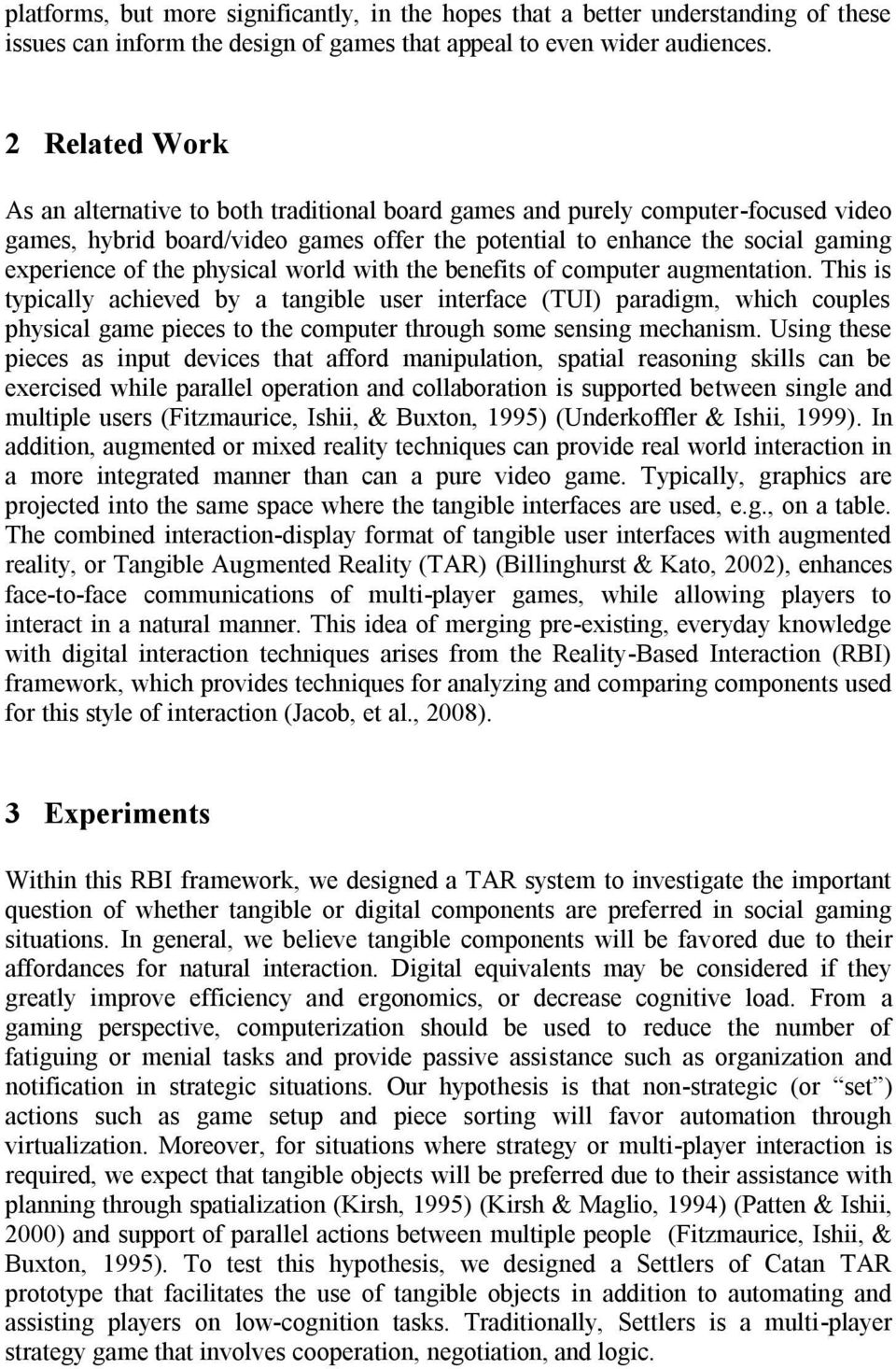
3 3.1 Settlers of Catan Prototype The comparison study for Settlers of Catan is presented on the classic board game version, our developed TAR version, and a digitized version on the Apple ipad. As we move from the classic to the digitized version, the number of tangible components decreases as the amount of automation and rule enforcement increases. Fewer rules are enforced when tangible components are present to accommodate rich object manipulation techniques. For tasks where no tangible handle is available, computer automation and rule enforcement are used to guide and inform the player of the actions available. (a) (b) (c) Fig. 1: Settlers of Catan Classic, TAR, and Digital mode. 3.2 Design The experiment comprised the three conditions as described above. Our subject pool consisted of nine participants, two female and seven male, ranging from 23 to 30 years of age. The participants were randomly assigned to one of three groups of three players. The groups were presented with every condition, with each group experiencing the conditions in a different order. A modified Latin square was used where each condition appeared in every slot of the ordering. The post-test questionnaire was completed immediately after each gameplay session. Once all three conditions were complete, players were asked to choose what they considered to be the best overall condition. The post-test questionnaire was comprised of questions from FUGA's Game Experience and Social Presence in Gaming Questionnaire (GEQ and SPGQ) (de Kort, IJsselsteijn, & Poels, 2007) (IJsselsteijn, et al., 2008) and O'Brien's User Engagement Scale (O'Brien, 2010). 4 Results and Analysis The questionnaire was comprised of two high level categories: personal game experience and social experience. These reflect the single-user experience and between-player experience, respectively. One or more questions make up each of the listed sections in both personal and social game experience. The responses within each category were averaged to form the associated mean score, as shown in Table 1, separated by subject and condition for analysis. As seen, the TAR condition was rated the highest most frequently in the questionnaire, an overwhelming preference that was also reflected in the qualitative feedback. All
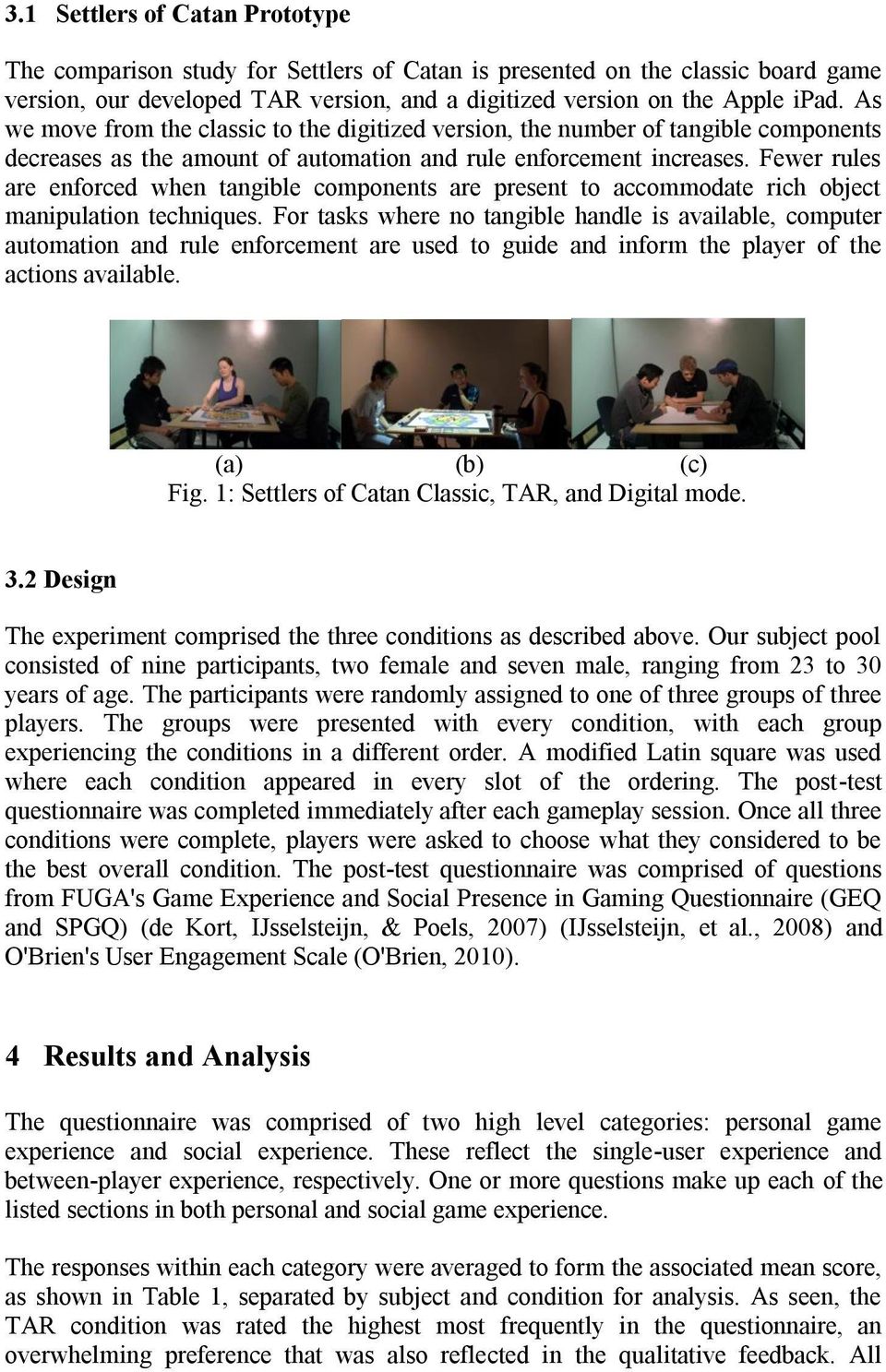
4 players chose TAR as their favorite condition in the final questionnaire. In general, players found tangible components essential for complex interaction tasks such as negotiation and resource trading. At the same time, players preferred the efficient, automatic board setup for its organized presentation where the board components could not be disrupted. The computer-assisted task of illuminating dice rolls was also desired because it located and reminded players to collect resources. Questionnaire Results Section Mean Classic Digital TAR Personal Game Experience Perceived Usability Aesthetics Focused Attention Sensory and Imag Immersion Endurability Negative Affect Positive Affect Social Experience Empathy Negative Feelings Behavioural Involvement Table 1: Mean score averaged over all subjects. 5 Conclusion The study described in this paper tested different implementations of Settlers of Catan to determine the appropriateness of digitizing various physical elements commonly used in board games. Our approach in this regard is to retain tangible components used for making strategic choices while digitizing pieces used for simple, mundane tasks such as the ones required for board setup. These qualities resulted in the TAR condition being the highest rated in many portions of the survey and unanimously chosen by players as their favorite. Preference of tangible components over digital equivalents for complex interaction tasks such as card trading was demonstrated by the significant differences between the virtual and tangible (identical in both classic and TAR) conditions in many areas of the questionnaire.
5 References 1. Billinghurst, M., & Kato, H. (2002). Collaborative Augmented Reality. Communications of the ACM, de Kort, Y., IJsselsteijn, W., & Poels, K. (2007). Digital games as social presence technology: Development of the Social Presence in Gaming Questionnaire (SPGQ). 3. Fitzmaurice, G., Ishii, H., & Buxton, W. (1995). Bricks: laying the foundations for graspable user interfaces. Proc. SIGCHI Conference on Human Factors In Computing Systems, (pp ). 4. IJsselsteijn, W., van den Hoogen, W., Klimmt, C., de Kort, Y., Lindley, C., Mathiak, K., et al. (2008). Measuring the experience of digital game enjoyment. Proceedings of the 2008 Measuring Behavior Conference. 5. Jacob, R. J., Girouard, A., Hirshfield, L. M., Horn, M. S., Shaer, O., Solovey, E. T., et al. (2008). Reality-based interaction: a framework for post-wimp interfaces. CHI '08: Proceeding of the twenty-sixth annual SIGCHI conference on HUman factors in computing systems (pp ). New York, NY: ACM. 6. Kirsh, D. (1995). The Intelligent use of space. Artificial Intelligence, Kirsh, D., & Maglio, P. (1994). On distinguishing epistemic from pragmatic action. Cognitive Science, O'Brien, H. L. (2010). Is there a universal instrument for measuring interactive information retrieval?: the case of the user engagement scale. IIiX '10: Proceeding of the third symposium on Information interaction in context (pp ). New York, NY: ACM. 9. Patten, J., & Ishii, H. (2000). A comparison of spatial organization strategies in graphical and tangible user interfaces. In Proc. Designing Augmented Reality Environments (pp ). ACM. 10. Underkoffler, J., & Ishii, H. (1999). Urp: a luminous-tangible workbench for urban planning and design. CHI '99: Proceedings of the SIGCHI conference on Human factors in computing systems (pp ). New York, NY: ACM.
BUILD-IT: an intuitive simulation tool for multi-expert layout processes
 BUILD-IT: an intuitive simulation tool for multi-expert layout processes Morten Fjeld Institute for Hygiene and Applied Physiology (IHA) ETH-Z, Clausiusstr. 25, CH-8092 Zurich, SWITZERLAND phone: +41-1-6323983,
Morten Fjeld. Designing for Tangible Interaction. Man-Machine Interaction IHA, ETH Zurich
 Morten Fjeld Designing for Tangible Interaction Man-Machine Interaction IHA, ETH Zurich Morten Fjeld, ETH Zürich LMU München, 3. November 2003 1/23 Overview What is Tangible Interaction? Collaborative
Video Games and Academic Performance. Ronny Khadra. Cody Hackshaw. Leslie Mccollum. College of Coastal Georgia
 Video Games and Academic Performance Ronny Khadra Cody Hackshaw Leslie Mccollum College of Coastal Georgia Introduction and Background The development of video games goes back to the 1940s and 1950s. Computer
Inherent Advantages of Augmented Reality for K 12 Education
 Inherent Advantages of Augmented Reality for K 12 Education A Review of Augmented Reality Learning Experiences Marc Ericson C. Santos, Angie Chen, Takafumi Taketomi, Goshiro Yamamoto, Jun Miyazaki, Hirokazu
Reading with Mobile Phone & Large Display
 Reading with Mobile Phone & Large Display Roswitha Gostner Computing Department Lancaster University, [email protected] Hans Gellersen Computing Department Lancaster University Lancaster, LA1 4WY, UK
Exploring Social Interaction in Co-located Multiplayer Games
 Exploring Social Interaction in Co-located Multiplayer Games Dennis L. Kappen [email protected] John Gregory [email protected] Daniel Stepchenko [email protected] Rina R. Wehbe University
Interactive Cards A game system in Augmented Reality
 Interactive Cards A game system in Augmented Reality João Alexandre Coelho Ferreira, Instituto Superior Técnico Abstract: Augmented Reality can be used on innumerous topics, but the point of this work
Human Computer Interaction
 Dr Mark Wright - Informatics HCI Course 2012/13 Human Computer Interaction Dr Mark Wright University of Edinburgh and Edinburgh College of Art Semester 1 2012/2013 Principles and Overview Lecture 1 Key
Medical Imaging Specialists and 3D: A Domain Perspective on Mobile 3D Interactions
 Medical Imaging Specialists and 3D: A Domain Perspective on Mobile 3D Interactions Teddy Seyed [email protected] Frank Maurer [email protected] Francisco Marinho Rodrigues [email protected]
Michael Cline. University of British Columbia. Vancouver, British Columbia. [email protected]. bimanual user interface.
 Higher Degree-of-Freedom Bimanual User Interfaces for 3-D Computer Graphics Michael Cline Dept. of Computer Science University of British Columbia Vancouver, British Columbia Canada V6T 1Z4 [email protected]
A Conceptual Approach to Data Visualization for User Interface Design of Smart Grid Operation Tools
 A Conceptual Approach to Data Visualization for User Interface Design of Smart Grid Operation Tools Dong-Joo Kang and Sunju Park Yonsei University [email protected], [email protected] Abstract
Settlers of Catan Analysis
 Math 401 Settlers of Catan Analysis Peter Keep. 12/9/2010 Settlers of Catan Analysis Settlers of Catan is a board game developed by Klaus Teber, a German board game designer. Settlers is described by Mayfair
Research and Digital Game- based Play: A Review of Martha Madison
 Research and Digital Game- based Play: A Review of Martha Madison White Paper Compiled by Anne Snyder, Ph.D. Second Avenue Learning is a certified women- owned business, specializing in the creation of
ANALYZING THE BENEFITS OF USING TABLET PC-BASED FLASH CARDS APPLICATION IN A COLLABORATIVE LEARNING ENVIRONMENT A Preliminary Study
 ANALYZING THE BENEFITS OF USING TABLET PC-BASED FLASH CARDS APPLICATION IN A COLLABORATIVE LEARNING ENVIRONMENT A Preliminary Study YoungJoo Jeong Human Computer Interaction Institute, Carnegie Mellon
Single Display Gaming: Examining Collaborative Games for Multi-User Tabletops
 Single Display Gaming: Examining Collaborative Games for Multi-User Tabletops Sebastian Pape, Laura Dietz, Peter Tandler Fraunhofer Integrated Publication and Information Systems Institute (IPSI) Dolivostrasse
Blended Shelf: Reality-based Presentation and Exploration of Library Collections
 Blended Shelf: Reality-based Presentation and Exploration of Library Collections Eike Kleiner Human-Computer Interaction Group University of Konstanz Universitätsstraße 10, Box D73 78457 Konstanz, Germany
Computational Modeling and Simulation for Learning an Automation Concept in Programming Course
 Computational Modeling and Simulation for Learning an Automation Concept in Programming Course Yong Cheon Kim, Dai Young Kwon, and Won Gyu Lee Abstract Computational thinking is a fundamental skill for
Lessons of Lucasfilm's Habitat. Chip Morningstar F. Randall Farmer
 Lessons of Lucasfilm's Habitat Chip Morningstar F. Randall Farmer What is Habitat? a "multi-player online virtual environment" (its purpose is to be an entertainment medium; consequently, the users are
Comparing Recommendations Made by Online Systems and Friends
 Comparing Recommendations Made by Online Systems and Friends Rashmi Sinha and Kirsten Swearingen SIMS, University of California Berkeley, CA 94720 {sinha, kirstens}@sims.berkeley.edu Abstract: The quality
Enhancing Player Experience in MMORPGs with Mobile Features
 Enhancing Player Experience in MMORPGs with Mobile Features Elina M.I. Koivisto Nokia Research Center Visionkatu 1 33720 Tampere Finland +358504821630 [email protected] Christian Wenninger SonyNetservices
Dong-Joo Kang* Dong-Kyun Kang** Balho H. Kim***
 Visualization Issues of Mass Data for Efficient HMI Design on Control System in Electric Power Industry Visualization in Computerized Operation & Simulation Tools Dong-Joo Kang* Dong-Kyun Kang** Balho
Screen Design : Navigation, Windows, Controls, Text,
 Overview Introduction Fundamentals of GUIs Screen Design : Navigation, Windows, Controls, Text, Evaluating GUI Performance - Methods - Comparison 1 Example: Automotive HMI (CAR IT 03/2013) 64, 68, 69 2
Eye-contact in Multipoint Videoconferencing
 Eye-contact in Multipoint Videoconferencing Birgit Quante and Lothar Mühlbach Heinrich-Hertz-Institut für Nachrichtentechnik Berlin GmbH (HHI) Einsteinufer 37, D-15087 Berlin, Germany, http://www.hhi.de/
KS3 Computing Group 1 Programme of Study 2015 2016 2 hours per week
 1 07/09/15 2 14/09/15 3 21/09/15 4 28/09/15 Communication and Networks esafety Obtains content from the World Wide Web using a web browser. Understands the importance of communicating safely and respectfully
The Board Game Development Kit. Joseph Collard. [email protected]
 The Board Game Development Kit Joseph Collard [email protected] Executive Summary Currently, there are many applications that board game developers use when they develop board, card or table top games;
PULP Scription: A DSL for Mobile HTML5 Game Applications
 PULP Scription: A DSL for Mobile HTML5 Game Applications Mathias Funk and Matthias Rauterberg Department of Industrial Design, Eindhoven University of Technology, Den Dolech 2, 5600MB Eindhoven, The Netherlands
Game Designs that Enhance Motivation and Learning for Teenagers
 Game Designs that Enhance Motivation and Learning for Teenagers Laura Batson & Susan Feinberg Illinois Institute of Technology Abstract Educational computer games, also known as e-learning games, are slowly
Running Head: COMPARISON OF ONLINE STUDENTS TO TRADITIONAL 1. The Comparison of Online Students Education to the
 Running Head: COMPARISON OF ONLINE STUDENTS TO TRADITIONAL 1 The Comparison of Online Students Education to the Traditional Students of Classroom Education Brent Alan Neumeier The University of Arkansas
Gender and Gaming: A Literature Review
 Gender and Gaming: A Literature Review Danae Romrell Idaho State University 643 Meadowbrook Rexburg, ID 83440 [email protected] Descriptors: Gender, Gaming Abstract Educational games are commonly used to
Game Design From Concepts To Implementation
 Game Design From Concepts To Implementation Overview of a Game Engine What is a Game Engine? (Really) Technical description of game: A Soft real-time interactive agent-based computer simulation A game
Gamification from the perspective of service marketing
 Gamification from the perspective of service marketing Kai Huotari School of Information, UC Berkeley. California, USA Hanken School of Economics, Helsinki, Finland Helsinki Institute for Information Technology
Measurement of E-service Quality in University Website
 Measurement of E-service Quality in University Website 1 Sayyed Aliakbar Ahmadi 2 Naser Barkhordar 3 Amirhossein Moradi Firoozabadi 4 Asadollah Dolatkhah 1 Associate Professor, Department of Management
Electronic Performance Support Systems (EPSS): An Effective System for Improving the Performance of Libraries
 Electronic Performance Support Systems (EPSS): An Effective System for Improving the Performance of Libraries Madhuresh Singhal & T S Prasanna National Centre for Science Information Indian Institute of
app design & development
 FOR MOBILE BUSINESS app design & development SMARTPHONES AND TABLETS App Market Revolution $9B $8B $7B $6B $5B $4B News and Business $3B $2B $1B $0B 2008 2009 2010 2011 2012 2013 2014 From Apple s App
CS 6795 Introduction to Cognitive Science Spring 2012 Homework Assignment 3
 THE GEORGIA INSTITUTE OF TECHNOLOGY CS 6795 Introduction to Cognitive Science Spring 2012 Homework Assignment 3 Mason Nixon 23rd February, 2012 Assignment In class we discussed some of your ideas designing
Adaptive Thinking & Leadership Training for Cultural Awareness and Communication Competence
 Interactive Technology & Smart Education (2005) 2: 127 130 2005 Troubador Publishing Ltd. SERIOUS GAME REPORT Adaptive Thinking & Leadership Training for Cultural Awareness and Communication Competence
Designing Flexible EMR Systems for Recording and Summarizing Doctor- Patient Interactions
 Designing Flexible EMR Systems for Recording and Summarizing Doctor- Patient Interactions Kyle Larkin Arts Media and Engineering Arizona State University 699 South Mill Avenue #396 Tempe, AZ 85281 USA
THE FUTURE OF HIGHER EDUCATION A CANADIAN VIEW
 THE FUTURE OF HIGHER EDUCATION A CANADIAN VIEW ACCESS INNOVATION COLLABORATION November 2015 www.contactnorth.ca Evolving Context 2 This is a time of change in higher education in Canada. David Agnew,
Preproduction in the Game Development Process
 Preproduction in the Game Development Process From Proposal to Prototype Instructor Sara R. Farr Preproduction At this point, you already have an approved game proposal outlining your game. Preproduction
[Name of the game] Game Design Document. Created by [Name of the team]:
![[Name of the game] Game Design Document. Created by [Name of the team]:](/thumbs/33/16655894.jpg "[Name of the game] Game Design Document. Created by [Name of the team]:") [Name of the game] Game Design Document Created by [Name of the team]: [Name of each team member] [Company logo] [Company name] [Date] Table of content 1 Overview... 4 1.1 Game abstract... 4 1.2 Objectives
[Name of the game] Game Design Document Created by [Name of the team]: [Name of each team member] [Company logo] [Company name] [Date] Table of content 1 Overview... 4 1.1 Game abstract... 4 1.2 Objectives
User Studies of a Multiplayer First Person Shooting Game with Tangible and Physical Interaction
 User Studies of a Multiplayer First Person Shooting Game with Tangible and Physical Interaction ZhiYing Zhou, Jefry Tedjokusumo, Stefan Winkler, and Bingbing Ni Interactive Multimedia Lab Department of
Using the Cognitive Dimensions Framework to evaluate the usability of a class library
 In M. Petre & D. Budgen (Eds) Proc. Joint Conf. EASE & PPIG 2003 Pages 359-366 Using the Cognitive Dimensions Framework to evaluate the usability of a class library Steven Clarke and Curtis Becker Microsoft
Effects of Teaching through Online Teacher versus Real Teacher on Student Learning in the Classroom
 Effects of Teaching through Online Teacher versus Real Teacher on Student Learning in the Classroom Sirous Hadadnia Islamic Azad University-Mamasani Branch, Iran Norouz Hadadnia Zargan Office of Education,
Presentation of Visual Art in Interactive 3D Environments
 Presentation of Visual Art in Interactive 3D Environments Jeni Maleshkova Queen Mary University of London Media and Arts Technology DTC School of Electronic Engineering and Computer Science [email protected]
Using Second Life in an English Course: Designing Class Activities to Address Learning Objectives
 Citation: Mayrath, M., Sanchez, J., Traphagan, T., Heikes, J. & Trivedi, A. Using Second Life in an English Course: Designing Class Activities to Address Learning Objectives Proceedings of World Conference
The Effectiveness of Games as Assignments in an Introductory Programming Course
 The Effectiveness of Games as Assignments in an Introductory Programming Course Abstract - Computer games are an often cited motivational tool used as assignments in introductory programming courses. This
The Workflow Management Coalition Specification Workflow Management Coalition Terminology & Glossary
 The Workflow Management Coalition Specification Workflow Management Coalition Terminology & Glossary Workflow The automation of a business process, in whole or part, during which documents, information
E-Learning at school level: Challenges and Benefits
 E-Learning at school level: Challenges and Benefits Joumana Dargham 1, Dana Saeed 1, and Hamid Mcheik 2 1. University of Balamand, Computer science department [email protected], [email protected]
Release Your App on Sunday Eve: Finding the Best Time to Deploy Apps
 Release Your App on Sunday Eve: Finding the Best Time to Deploy Apps Niels Henze University of Oldenburg Escherweg 2 Oldenburg, Germany [email protected] Susanne Boll University of Oldenburg
2 AIMS: an Agent-based Intelligent Tool for Informational Support
 Aroyo, L. & Dicheva, D. (2000). Domain and user knowledge in a web-based courseware engineering course, knowledge-based software engineering. In T. Hruska, M. Hashimoto (Eds.) Joint Conference knowledge-based
NETS for Teachers: Achievement Rubric
 NETS for Teachers: Achievement Rubric DRAFT (March 18, 2005) Purpose: This draft version of the NETS for Teachers: Achievement Rubric is available online for educational technology professionals to review
Video Game Design Chapter 5 Game Evaluation
 Video Game Design Chapter 5 Game Evaluation Witcha Feungchan How can we know is a game good or bad? Game industry reviews Usually based on expert reviews (opinions) Reviews are done after games are released
Adaptation of Rapid Prototyping Model for Serious Games Development
 Journal of Computer Science and Information Technology June 2014, Vol. 2, No. 2, pp. 173-183 ISSN: 2334-2366 (Print), 2334-2374 (Online) Copyright The Author(s). 2014. All Rights Reserved. Published by
USABILITY TEST. Appendix A. May 2001 TECHSOURCE COLLEGE LIBRARY (TCL)
 Appendix A USABILITY TEST May 2001 TECHSOURCE COLLEGE LIBRARY (TCL) Contents This is the summary of test results conducted on the new online catalog for TCL s newly established library. The summary includes
An Investigation on Learning of College Students and the Current Application Situation of the Web-based Courses
 2011 International Conference on Computer Science and Information Technology (ICCSIT 2011) IPCSIT vol. 51 (2012) (2012) IACSIT Press, Singapore DOI: 10.7763/IPCSIT.2012.V51.127 An Investigation on Learning
Concealing the Medicine: Information Security Education through Game Play Thomas Monk, Johan van Niekerk and Rossouw von Solms
 Concealing the Medicine: Information Security Education through Game Play Thomas Monk, Johan van Niekerk and Rossouw von Solms Institute for ICT Advancement, Nelson Mandela Metropolitan University [email protected],
Eye Contact in Leisure Video Conferencing. Annick Van der Hoest & Dr. Simon McCallum Gjøvik University College, Norway.
 Eye Contact in Leisure Video Conferencing Annick Van der Hoest & Dr. Simon McCallum Gjøvik University College, Norway 19 November 2012 Abstract This paper presents systems which enable eye contact in leisure
ABSTRACT. Keywords Virtual Reality, Java, JavaBeans, C++, CORBA 1. INTRODUCTION
 Tweek: Merging 2D and 3D Interaction in Immersive Environments Patrick L Hartling, Allen D Bierbaum, Carolina Cruz-Neira Virtual Reality Applications Center, 2274 Howe Hall Room 1620, Iowa State University
MICHIGAN TEST FOR TEACHER CERTIFICATION (MTTC) TEST OBJECTIVES FIELD 050: COMPUTER SCIENCE
 MICHIGAN TEST FOR TEACHER CERTIFICATION (MTTC) TEST OBJECTIVES Subarea Educational Computing and Technology Literacy Computer Systems, Data, and Algorithms Program Design and Verification Programming Language
Computer Assisted Language Learning
 Computer Assisted Language Learning!" # $ % &'$#($ Abstract $$ $ $ "$"" " "$ $ $ # "$ ( '$$ $ $ " " '' $ $" $ # $"$'" "" '"$' "$$ ) "*$"" +$# "$",-+../$ $$ # "-+..'$' "# "#$ " $$0#$$"$ $""-+.. $ Key words:
1. Scope of Games and Game Systems. 2. Evolution of Current Game Designs. 3. New Game Forms Utilising New and Emerging Technical Media
 Game Development in Networks of the Future Craig Lindley [email protected] Game Design, Cognition and Artificial Intelligence Research Group Department of Game Design, Narrative and Time-Based Media
CODESPARK TEACHER S GUIDE Hour of Code
 CODESPARK TEACHER S GUIDE Hour of Code Dear codespark Teacher, Thank you for your interest in teaching computer science to your kids! As you know, knowledge of computer science and algorithmic thinking
Kathy Au Billy Yi Fan Zhou Department of Electrical and Computer Engineering University of Toronto { kathy.au, billy.zhou }@utoronto.
 ECE1778 Project Report Kathy Au Billy Yi Fan Zhou Department of Electrical and Computer Engineering University of Toronto { kathy.au, billy.zhou }@utoronto.ca Executive Summary The goal of this project
Data Protection in a Virtualized Environment
 The Essentials Series: Virtualization and Disaster Recovery Data Protection in a Virtualized Environment sponsored by by J. Peter Bruzzese Da ta Protection in a Virtualized Environment... 1 An Overview