
FEDERAL ACQUISITION CIRCULAR
|
|
|
- Milton Powell
- 10 years ago
- Views:
Transcription
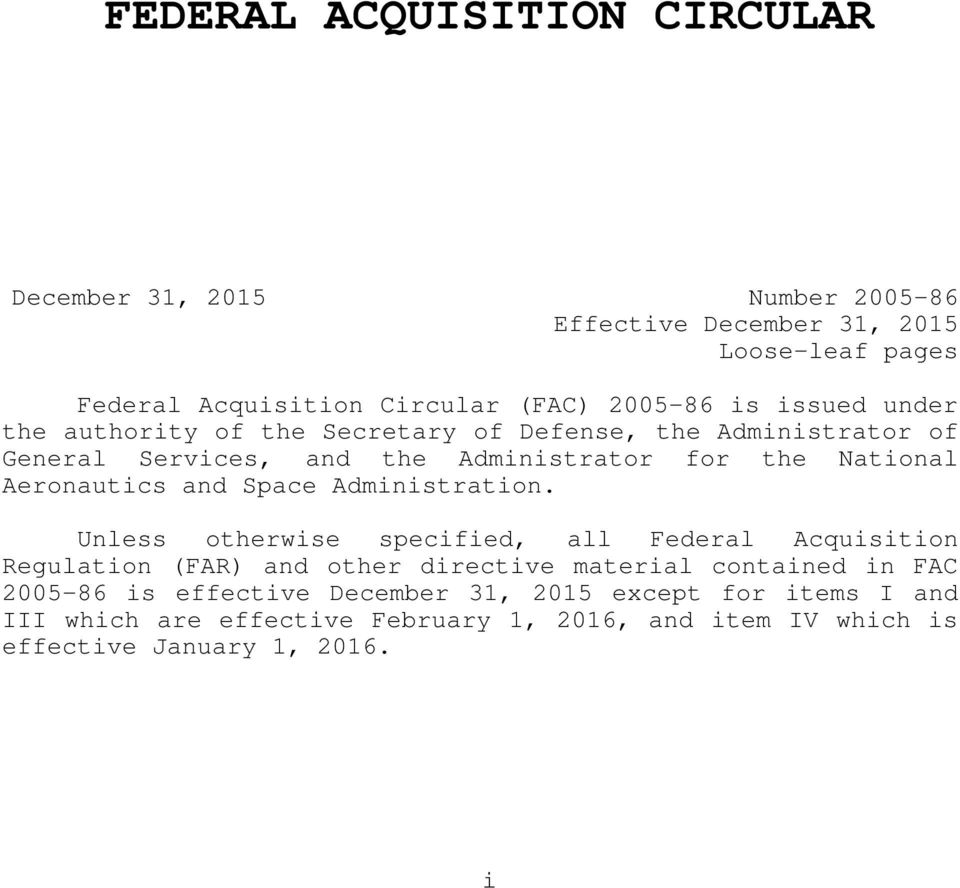
1 FEDERAL ACQUISITION CIRCULAR December 31, 2015 Number Effective December 31, 2015 Loose-leaf pages Federal Acquisition Circular (FAC) is issued under the authority of the Secretary of Defense, the Administrator of General Services, and the Administrator for the National Aeronautics and Space Administration. Unless otherwise specified, all Federal Acquisition Regulation (FAR) and other directive material contained in FAC is effective December 31, 2015 except for items I and III which are effective February 1, 2016, and item IV which is effective January 1, i
2 ii (BLANK PAGE)

3 FAC List of Subject Item Title Page I II III Definition of Multiple-Award Contract Sole Source Contracts for Women- Owned Small Businesses (Interim) New Designated Countries Montenegro and New Zealand v v vi IV Trade Agreements Thresholds vi iii

4 iv (BLANK PAGE)

5 FAC SUMMARY OF ITEM Federal Acquisition Circular (FAC) amends the Federal Acquisition Regulation (FAR) as specified below: Item I Definition of Multiple-Award Contract (FAR Case ) This rule amends the FAR to define multiple-award contract. This rule implements the definition established by the Small Business Administration (SBA) in its final rule that published in the Federal Register at 78 FR on October 2, SBA s final rule implements the statutory definition of the term from section 1311 of the Small Business Jobs Act of 2010, Pub. L This final rule does not place any new requirements on small entities. Replacement pages: THE PAGES WILL BE POSTED ON THEIR EFFECTIVE DATE OF February 1, Item II Sole Source Contracts for Women-Owned Small Businesses (FAR Case ) (Interim) This interim rule amends the FAR to implement regulatory changes made by the Small Business Administration (SBA) in its final rule as published in the Federal Register at 80 FR 55019, on September 14, SBA s final rule implements the statutory requirements of paragraph (a)(3) of section 825 of the Carl Levin and Howard P. Buck McKeon National Defense Authorization Act for Fiscal Year 2015, Public Law , which grants contracting officers the authority to award sole source contracts to economically disadvantaged women-owned small business (EDWOSB) concerns and to women-owned small business (WOSB) concerns eligible under the WOSB Program. The anticipated price, including options, must not exceed $6.5 million for manufacturing NAICS codes, or $4 million for other NAICS codes. This interim rule may have a positive economic impact on women-owned small businesses. Replacement pages: and ; and 4.8-2; and 6.3-4; TOC pp and 18-2; thru ; TOC pp and 19-2; thru ; and ; thru ; TOC pp and 52-4; thru ; and ; and and v

6 Item III New Designated Countries Montenegro and New Zealand (FAR Case ) This final rule amends the FAR to add Montenegro and New Zealand as new designated countries under the World Trade Organization Government Procurement Agreement (WTO GPA). The rule also updates the list of parties to the Agreement on Trade in Civil Aircraft by adding Montenegro. This final rule has no significant impact on the Government and contractors, including small business entities. Replacement pages: THE PAGES WILL BE POSTED ON THEIR EFFECTIVE DATE OF February 1, Item IV Trade Agreements Thresholds (FAR Case ) This final rule amends the FAR to adjust the thresholds for application of the World Trade Organization Government Procurement Agreement and the Free Trade Agreements as determined by the United States Trade Representative, according to a predetermined formula under the agreements. Replacement pages: THE PAGES WILL BE POSTED ON THEIR EFFECTIVE DATE OF January 1, vi

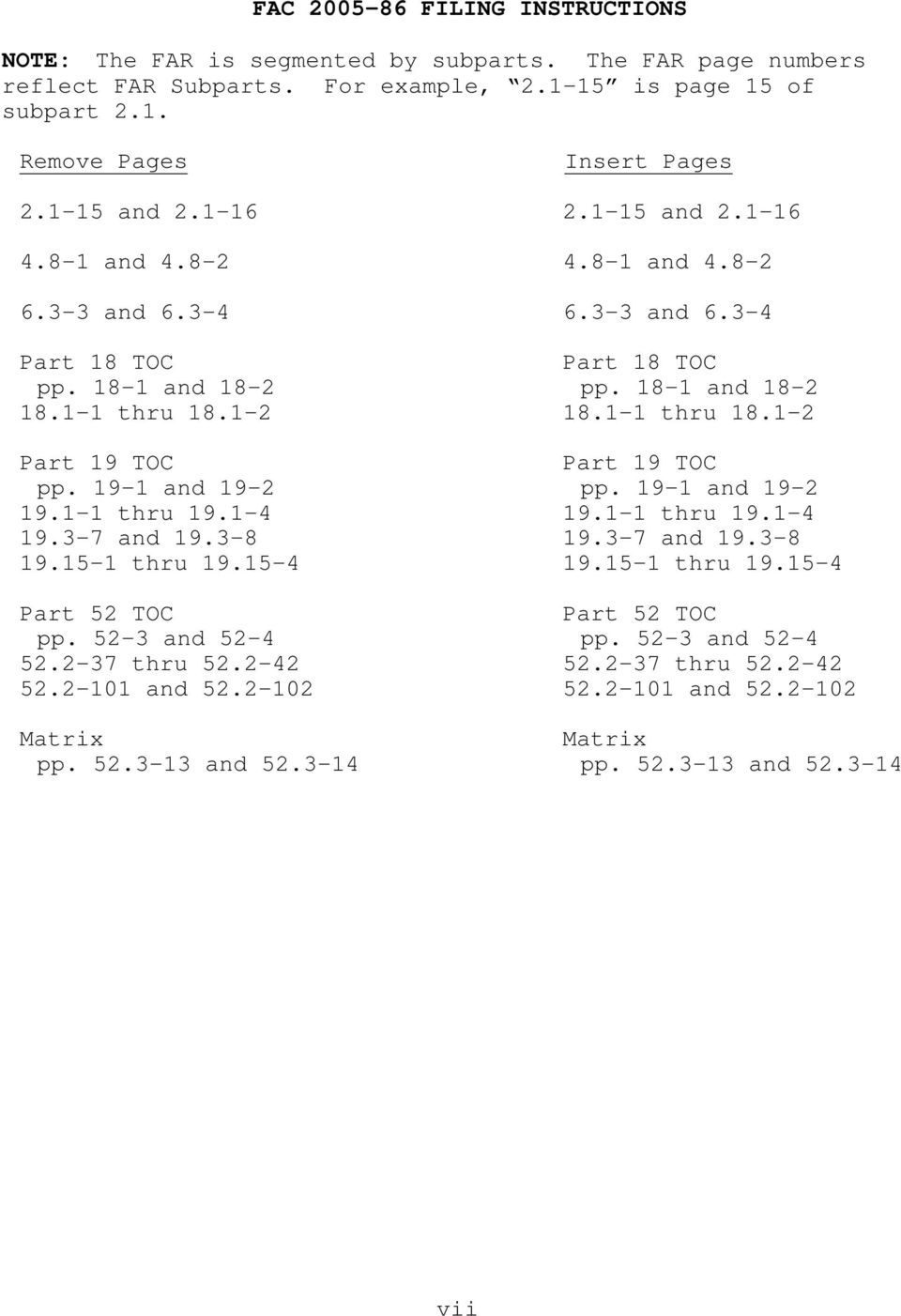
7 FAC FILING INSTRUCTIONS NOTE: The FAR is segmented by subparts. The FAR page numbers reflect FAR Subparts. For example, is page 15 of subpart 2.1. Remove Pages Insert Pages and and and and and and Part 18 TOC Part 18 TOC pp and 18-2 pp and thru thru Part 19 TOC Part 19 TOC pp and 19-2 pp and thru thru and and thru thru Part 52 TOC Part 52 TOC pp and 52-4 pp and thru thru and and Matrix Matrix pp and pp and vii
8 viii (BLANK PAGE)

9 SUBPART 2.1 DEFINITIONS Terminated portion of the contract means the portion of a contract that the contractor is not to perform following a partial termination. For construction contracts that have been completely terminated for convenience, it means the entire contract, notwithstanding the completion of, and payment for, individual items of work before termination. Unallowable cost means any cost that, under the provisions of any pertinent law, regulation, or contract, cannot be included in prices, cost-reimbursements, or settlements under a Government contract to which it is allocable. Unique and innovative concept, when used relative to an unsolicited research proposal, means that (1) In the opinion and to the knowledge of the Government evaluator, the meritorious proposal (i) Is the product of original thinking submitted confidentially by one source; (ii) Contains new, novel, or changed concepts, approaches, or methods; (iii) Was not submitted previously by another; and (iv) Is not otherwise available within the Federal Government. (2) In this context, the term does not mean that the source has the sole capability of performing the research. United States, when used in a geographic sense, means the 50 States and the District of Columbia, except as follows: (1) For use in subpart 3.10, see the definition at (2) For use in subpart 22.8, see the definition at (3) For use in subpart 22.10, see the definition at (4) For use in subpart 22.12, see the definition at (5) For use in subpart 22.13, see the definition at (6) For use in subpart 22.16, see the definition at (7) For use in subpart 22.17, see the definition at (8) For use in subpart 22.18, see the definition at (9) For use in part 23, see definition at (10) For use in part 25, see the definition at (11) For use in part 27, see the definition at (12) For use in subpart 47.4, see the definition at Unsolicited proposal means a written proposal for a new or innovative idea that is submitted to an agency on the initiative of the offeror for the purpose of obtaining a contract with the Government, and that is not in response to a request for proposals, Broad Agency Announcement, Small Business Innovation Research topic, Small Business Technology Transfer Research topic, Program Research and Development Announcement, or any other Government-initiated solicitation or program. Value engineering means an analysis of the functions of a program, project, system, product, item of equipment, building, facility, service, or supply of an executive agency, performed by qualified agency or contractor personnel, directed at improving performance, reliability, quality, safety, and lifecycle costs (41 U.S.C. 1711). For use in the clause at , see the definition at (b). Value engineering change proposal (VECP) (1) Means a proposal that (i) Requires a change to the instant contract to implement; and (ii) Results in reducing the overall projected cost to the agency without impairing essential functions or characteristics, provided, that it does not involve a change (A) In deliverable end item quantities only; (B) In research and development (R&D) items or R&D test quantities that are due solely to results of previous testing under the instant contract; or (C) To the contract type only. (2) For use in the clauses at (i) , see the definition at (b); and (ii) , see the definition at (b). Veteran-owned small business concern means a small business concern (1) Not less than 51 percent of which is owned by one or more veterans (as defined at 38 U.S.C. 101(2)) or, in the case of any publicly owned business, not less than 51 percent of the stock of which is owned by one or more veterans; and (2) The management and daily business operations of which are controlled by one or more veterans. Virgin material means (1) Previously unused raw material, including previously unused copper, aluminum, lead, zinc, iron, other metal or metal ore; or (2) Any undeveloped resource that is, or with new technology will become, a source of raw materials. Voluntary consensus standards means common and repeated use of rules, conditions, guidelines or characteristics for products, or related processes and production methods and related management systems. Voluntary Consensus Standards are developed or adopted by domestic and international voluntary consensus standard making bodies (e.g., International Organization for Standardization (ISO) and ASTM- International). See OMB Circular A-119. Warranty means a promise or affirmation given by a contractor to the Government regarding the nature, usefulness, or condition of the supplies or performance of services furnished under the contract. Waste reduction means preventing or decreasing the amount of waste being generated through waste prevention, recycling, or purchasing recycled and environmentally preferable products. (FAC )

10 FAC DECEMBER 31, FEDERAL ACQUISITION REGULATION Water consumption intensity means water consumption per square foot of building space. Women-owned small business concern means (1) A small business concern (i) That is at least 51 percent owned by one or more women; or, in the case of any publicly owned business, at least 51 percent of the stock of which is owned by one or more women; and (ii) Whose management and daily business operations are controlled by one or more women; or (2) A small business concern eligible under the Women- Owned Small Business Program in accordance with 13 CFR part 127 (see subpart 19.15). Women-Owned Small Business (WOSB) Program. (1) Women-Owned Small Business (WOSB) Program means a program that authorizes contracting officers to limit competition, including award on a sole source basis, to (i) Economically disadvantaged women-owned small business (EDWOSB) concerns eligible under the WOSB Program for Federal contracts assigned a North American Industry Classification Systems (NAICS) code in an industry in which the Small Business Administration (SBA) has determined that WOSB concerns are underrepresented in Federal procurement; and (ii) WOSB concerns eligible under the WOSB Program for Federal contracts assigned a NAICS code in an industry in which SBA has determined that WOSB concerns are substantially underrepresented in Federal procurement. (2) Economically disadvantaged women-owned small business (EDWOSB) concern means a small business concern that is at least 51 percent directly and unconditionally owned by, and the management and daily business operations of which are controlled by, one or more women who are citizens of the United States and who are economically disadvantaged in accordance with 13 CFR part 127. It automatically qualifies as a women-owned small business (WOSB) concern eligible under the WOSB Program. (3) Women-owned small business (WOSB) concern eligible under the WOSB Program means a small business concern that is at least 51 percent directly and unconditionally owned by, and the management and daily business operations of which are controlled by, one or more women who are citizens of the United States (13 CFR part 127). Writing or written (see in writing )

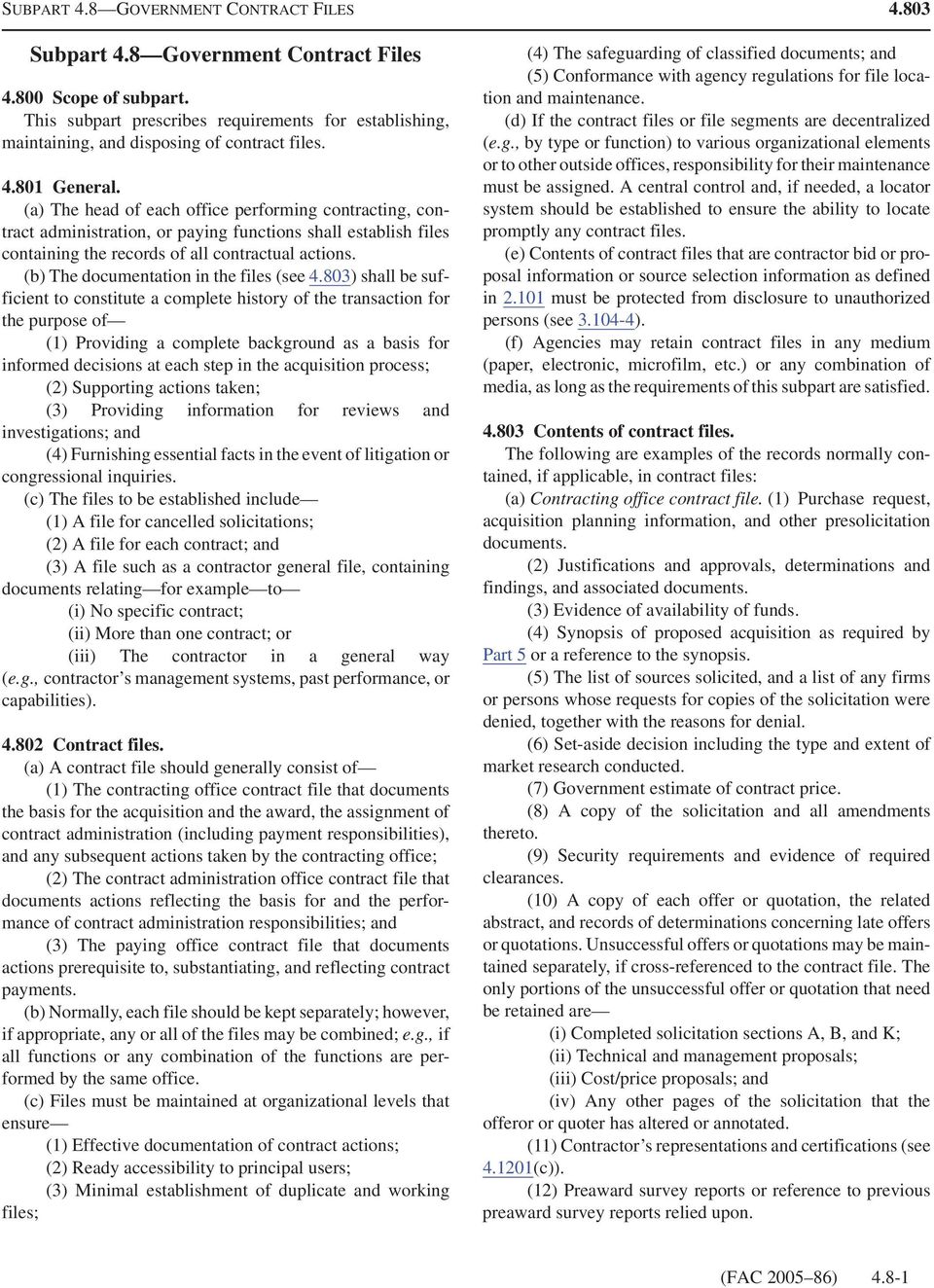
11 SUBPART 4.8 GOVERNMENT CONTRACT FILES Subpart 4.8 Government Contract Files Scope of subpart. This subpart prescribes requirements for establishing, maintaining, and disposing of contract files General. (a) The head of each office performing contracting, contract administration, or paying functions shall establish files containing the records of all contractual actions. (b) The documentation in the files (see 4.803) shall be sufficient to constitute a complete history of the transaction for the purpose of (1) Providing a complete background as a basis for informed decisions at each step in the acquisition process; (2) Supporting actions taken; (3) Providing information for reviews and investigations; and (4) Furnishing essential facts in the event of litigation or congressional inquiries. (c) The files to be established include (1) A file for cancelled solicitations; (2) A file for each contract; and (3) A file such as a contractor general file, containing documents relating for example to (i) No specific contract; (ii) More than one contract; or (iii) The contractor in a general way (e.g., contractor s management systems, past performance, or capabilities) Contract files. (a) A contract file should generally consist of (1) The contracting office contract file that documents the basis for the acquisition and the award, the assignment of contract administration (including payment responsibilities), and any subsequent actions taken by the contracting office; (2) The contract administration office contract file that documents actions reflecting the basis for and the performance of contract administration responsibilities; and (3) The paying office contract file that documents actions prerequisite to, substantiating, and reflecting contract payments. (b) Normally, each file should be kept separately; however, if appropriate, any or all of the files may be combined; e.g., if all functions or any combination of the functions are performed by the same office. (c) Files must be maintained at organizational levels that ensure (1) Effective documentation of contract actions; (2) Ready accessibility to principal users; (3) Minimal establishment of duplicate and working files; (4) The safeguarding of classified documents; and (5) Conformance with agency regulations for file location and maintenance. (d) If the contract files or file segments are decentralized (e.g., by type or function) to various organizational elements or to other outside offices, responsibility for their maintenance must be assigned. A central control and, if needed, a locator system should be established to ensure the ability to locate promptly any contract files. (e) Contents of contract files that are contractor bid or proposal information or source selection information as defined in must be protected from disclosure to unauthorized persons (see ). (f) Agencies may retain contract files in any medium (paper, electronic, microfilm, etc.) or any combination of media, as long as the requirements of this subpart are satisfied Contents of contract files. The following are examples of the records normally contained, if applicable, in contract files: (a) Contracting office contract file. (1) Purchase request, acquisition planning information, and other presolicitation documents. (2) Justifications and approvals, determinations and findings, and associated documents. (3) Evidence of availability of funds. (4) Synopsis of proposed acquisition as required by Part 5 or a reference to the synopsis. (5) The list of sources solicited, and a list of any firms or persons whose requests for copies of the solicitation were denied, together with the reasons for denial. (6) Set-aside decision including the type and extent of market research conducted. (7) Government estimate of contract price. (8) A copy of the solicitation and all amendments thereto. (9) Security requirements and evidence of required clearances. (10) A copy of each offer or quotation, the related abstract, and records of determinations concerning late offers or quotations. Unsuccessful offers or quotations may be maintained separately, if cross-referenced to the contract file. The only portions of the unsuccessful offer or quotation that need be retained are (i) Completed solicitation sections A, B, and K; (ii) Technical and management proposals; (iii) Cost/price proposals; and (iv) Any other pages of the solicitation that the offeror or quoter has altered or annotated. (11) Contractor s representations and certifications (see (c)). (12) Preaward survey reports or reference to previous preaward survey reports relied upon. (FAC ) 4.8-1
12 FAC DECEMBER 31, FEDERAL ACQUISITION REGULATION (13) Source selection documentation. (14) Contracting officer s determination of the contractor s responsibility. (15) Small Business Administration Certificate of Competency. (16) Records of contractor s compliance with labor policies including equal employment opportunity policies. (17) Data and information related to the contracting officer s determination of a fair and reasonable price. This may include (i) Certified cost or pricing data; (ii) Data other than certified cost or pricing data; (iii) Justification for waiver from the requirement to submit certified cost or pricing data; or (iv) Certificates of Current Cost or Pricing Data. (18) Packaging and transportation data. (19) Cost or price analysis. (20) Audit reports or reasons for waiver. (21) Record of negotiation. (22) Justification for type of contract. (23) Authority for deviations from this regulation, statutory requirements, or other restrictions. (24) Required approvals of award and evidence of legal review. (25) Notice of award. (26) The original of (i) The signed contract or award; (ii) All contract modifications; and (iii) Documents supporting modifications executed by the contracting office. (27) Synopsis of award or reference thereto. (28) Notice to unsuccessful quoters or offerors and record of any debriefing. (29) Acquisition management reports (see subpart 4.6). (30) Bid, performance, payment, or other bond documents, or a reference thereto, and notices to sureties. (31) Report of postaward conference. (32) Notice to proceed, stop orders, and any overtime premium approvals granted at the time of award. (33) Documents requesting and authorizing modification in the normal assignment of contract administration functions and responsibility. (34) Approvals or disapprovals of requests for waivers or deviations from contract requirements. (35) Rejected engineering change proposals. (36) Royalty, invention, and copyright reports (including invention disclosures) or reference thereto. (37) Contract completion documents. (38) Documentation regarding termination actions for which the contracting office is responsible. (39) Cross-references to pertinent documents that are filed elsewhere. (40) Any additional documents on which action was taken or that reflect actions by the contracting office pertinent to the contract. (41) A current chronological list identifying the awarding and successor contracting officers, with inclusive dates of responsibility. (42) When limiting competition, or awarding on a sole source basis, to economically disadvantaged women-owned small business (EDWOSB) concerns or women-owned small business (WOSB) concerns eligible under the WOSB Program in accordance with subpart 19.15, include documentation (i) Of the type and extent of market research; and (ii) That the NAICS code assigned to the acquisition is for an industry that SBA has designated as (A) Underrepresented for EDWOSB concerns; or (B) Substantially underrepresented for WOSB concerns. (b) Contract administration office contract file.(1) Copy of the contract and all modifications, together with official record copies of supporting documents executed by the contract administration office. (2) Any document modifying the normal assignment of contract administration functions and responsibility. (3) Security requirements. (4) Certified cost or pricing data, Certificates of Current Cost or Pricing Data, or data other than certified cost or pricing data; cost or price analysis; and other documentation supporting contractual actions executed by the contract administration office. (5) Preaward survey information. (6) Purchasing system information. (7) Consent to subcontract or purchase. (8) Performance and payment bonds and surety information. (9) Postaward conference records. (10) Orders issued under the contract. (11) Notice to proceed and stop orders. (12) Insurance policies or certificates of insurance or references to them. (13) Documents supporting advance or progress payments. (14) Progressing, expediting, and production surveillance records. (15) Quality assurance records. (16) Property administration records. (17) Documentation regarding termination actions for which the contract administration office is responsible. (18) Cross reference to other pertinent documents that are filed elsewhere. (19) Any additional documents on which action was taken or that reflect actions by the contract administration office pertinent to the contract. (20) Contract completion documents. (c) Paying office contract file.(1) Copy of the contract and any modifications

13 SUBPART 6.3 OTHER THAN FULL AND OPEN COMPETITION (ii) To establish or maintain an essential engineering, research, or development capability to be provided by an educational or other nonprofit institution or a federally funded research and development center; or (iii) To acquire the services of an expert or neutral person for any current or anticipated litigation or dispute. (b) Application.(1) Use of the authority in paragraph (a)(2)(i) of this subsection may be appropriate when it is necessary to (i) Keep vital facilities or suppliers in business or make them available in the event of a national emergency; (ii) Train a selected supplier in the furnishing of critical supplies or services; prevent the loss of a supplier s ability and employees skills; or maintain active engineering, research, or development work; (iii) Maintain properly balanced sources of supply for meeting the requirements of acquisition programs in the interest of industrial mobilization (when the quantity required is substantially larger than the quantity that must be awarded in order to meet the objectives of this authority, that portion not required to meet such objectives will be acquired by providing for full and open competition, as appropriate, under this part); (iv) Create or maintain the required domestic capability for production of critical supplies by limiting competition to items manufactured in (A) The United States or its outlying areas; or (B) The United States, its outlying areas, or Canada. (v) Continue in production, contractors that are manufacturing critical items, when there would otherwise be a break in production; or (vi) Divide current production requirements among two or more contractors to provide for an adequate industrial mobilization base. (2) Use of the authority in paragraph (a)(2)(ii) of this subsection may be appropriate when it is necessary to (i) Establish or maintain an essential capability for theoretical analyses, exploratory studies, or experiments in any field of science or technology; (ii) Establish or maintain an essential capability for engineering or developmental work calling for the practical application of investigative findings and theories of a scientific or technical nature; or (iii) Contract for supplies or services as are necessary incident to paragraphs (b)(2)(i) or (ii) of this subsection. (3) Use of the authority in paragraph (a)(2)(iii) of this subsection may be appropriate when it is necessary to acquire the services of either (i) An expert to use, in any litigation or dispute (including any reasonably foreseeable litigation or dispute) involving the Government in any trial, hearing, or proceeding before any court, administrative tribunal, or agency, whether or not the expert is expected to testify. Examples of such services include, but are not limited to: (A) Assisting the Government in the analysis, presentation, or defense of any claim or request for adjustment to contract terms and conditions, whether asserted by a contractor or the Government, which is in litigation or dispute, or is anticipated to result in dispute or litigation before any court, administrative tribunal, or agency; or (B) Participating in any part of an alternative dispute resolution process, including but not limited to evaluators, fact finders, or witnesses, regardless of whether the expert is expected to testify; or (ii) A neutral person, e.g., mediators or arbitrators, to facilitate the resolution of issues in an alternative dispute resolution process. (c) Limitations. Contracts awarded using this authority shall be supported by the written justifications and approvals described in and International agreement. (a) Authority.(1) Citations: 10 U.S.C. 2304(c)(4) or 41 U.S.C. 3304(a)(4). (2) Full and open competition need not be provided for when precluded by the terms of an international agreement or a treaty between the United States and a foreign government or international organization, or the written directions of a foreign government reimbursing the agency for the cost of the acquisition of the supplies or services for such government. (b) Application. This authority may be used in circumstances such as (1) When a contemplated acquisition is to be reimbursed by a foreign country that requires that the product be obtained from a particular firm as specified in official written direction such as a Letter of Offer and Acceptance; or (2) When a contemplated acquisition is for services to be performed, or supplies to be used, in the sovereign territory of another country and the terms of a treaty or agreement specify or limit the sources to be solicited. (c) Limitations. Except for DoD, NASA, and the Coast Guard, contracts awarded using this authority shall be supported by written justifications and approvals described in and Authorized or required by statute. (a) Authority.(1) Citations: 10 U.S.C. 2304(c)(5) or 41 U.S.C. 3304(a)(5). (2) Full and open competition need not be provided for when (i) A statute expressly authorizes or requires that the acquisition be made through another agency or from a specified source; or (ii) The agency s need is for a brand name commercial item for authorized resale. (FAC ) 6.3-3

14 FAC DECEMBER 31, FEDERAL ACQUISITION REGULATION (b) Application. This authority may be used when statutes, such as the following, expressly authorize or require that acquisition be made from a specified source or through another agency: (1) Federal Prison Industries (UNICOR) 18 U.S.C (see subpart 8.6). (2) Qualified nonprofit agencies for the blind or other severely disabled 41 U.S.C. chapter 85, Committee for Purchase From People Who Are Blind or Severely Disabled (see subpart 8.7). (3) Government Printing and Binding 44 U.S.C , 1121 (see subpart 8.8). (4) Sole source awards under the 8(a) Program (15 U.S.C. 637), but see for requirements for justification and approval of sole-source 8(a) awards over $22 million. (See subpart 19.8). (5) Sole source awards under the HUBZone Act of U.S.C. 657a (see ). (6) Sole source awards under the Veterans Benefits Act of 2003 (15 U.S.C. 657f). (7) Sole source awards under the WOSB Program 15 U.S.C. 637(m) (see ). (c) Limitations.(1) This authority shall not be used when a provision of law requires an agency to award a new contract to a specified non-federal Government entity unless the provision of law specifically (i) Identifies the entity involved; (ii) Refers to 10 U.S.C. 2304(k) for armed services acquisitions or 41 U.S.C for civilian agency acquisitions; and (iii) States that award to that entity shall be made in contravention of the merit-based selection procedures in 10 U.S.C. 2304(k) or 41 U.S.C. 3105, as appropriate. However, this limitation does not apply (A) When the work provided for in the contract is a continuation of the work performed by the specified entity under a preceding contract; or (B) To any contract requiring the National Academy of Sciences to investigate, examine, or experiment upon any subject of science or art of significance to an executive agency and to report on those matters to the Congress or any agency of the Federal Government. (2) Contracts awarded using this authority shall be supported by the written justifications and approvals described in and 6.304, except for (i) Contracts awarded under (a)(2)(ii) or (b)(2) of this subsection; (ii) Contracts awarded under (a)(2)(i) of this subsection when the statute expressly requires that the procurement be made from a specified source. (Justification and approval requirements apply when the statute authorizes, but does not require, that the procurement be made from a specified source); or (iii) Contracts less than or equal to $22 million awarded under (b)(4) of this subsection. (3) The authority in (a)(2)(ii) of this subsection may be used only for purchases of brand-name commercial items for resale through commissaries or other similar facilities. Ordinarily, these purchases will involve articles desired or preferred by customers of the selling activities (but see 6.301(d)) National security. (a) Authority.(1) Citations: 10 U.S.C. 2304(c)(6) or 41 U.S.C. 3304(a)(6). (2) Full and open competition need not be provided for when the disclosure of the agency s needs would compromise the national security unless the agency is permitted to limit the number of sources from which it solicits bids or proposals. (b) Application. This authority may be used for any acquisition when disclosure of the Government s needs would compromise the national security (e.g., would violate security requirements); it shall not be used merely because the acquisition is classified, or merely because access to classified matter will be necessary to submit a proposal or to perform the contract. (c) Limitations.(1) Contracts awarded using this authority shall be supported by the written justifications and approvals described in and (2) See 5.202(a)(1) for synopsis requirements. (3) This statutory authority requires that agencies shall request offers from as many potential sources as is practicable under the circumstances Public interest. (a) Authority.(1) Citations: 10 U.S.C. 2304(c)(7) or 41 U.S.C. 3304(a)(7). (2) Full and open competition need not be provided for when the agency head determines that it is not in the public interest in the particular acquisition concerned. (b) Application. This authority may be used when none of the other authorities in apply. (c) Limitations.(1) A written determination to use this authority shall be made in accordance with subpart 1.7, by (i) The Secretary of Defense, the Secretary of the Army, the Secretary of the Navy, the Secretary of the Air Force, the Secretary of Homeland Security for the Coast Guard, or the Administrator of the National Aeronautics and Space Administration; or (ii) The head of any other executive agency. This authority may not be delegated. (2) The Congress shall be notified in writing of such determination not less than 30 days before award of the contract. (3) If required by the head of the agency, the contracting officer shall prepare a justification to support the determination under paragraph (c)(1) of this subsection. (4) This Determination and Finding (D&F) shall not be made on a class basis

15 FAC DECEMBER 31, 2015 PART 18 EMERGENCY ACQUISITIONS Sec Scope of part Definition. Subpart 18.1 Available Acquisition Flexibilities General System for Award Management Synopses of proposed contract actions Unusual and compelling urgency Federal Supply Schedules (FSSs), multi-agency blanket purchase agreements (BPAs), and multiagency indefinite delivery contracts Acquisitions from Federal Prison Industries, Inc. (FPI) AbilityOne specification changes Qualifications requirements Priorities and allocations Soliciting from a single source Oral requests for proposals Letter contracts Interagency acquisitions Contracting with the Small Business Administration (The 8(a) Program) HUBZone sole source awards Service-disabled Veteran-owned Small Business (SDVOSB) sole source awards Awards to economically disadvantaged womenowned small business concerns and womenowned small business concerns eligible under the Women-Owned Small Business Program Overtime approvals Trade agreements Use of patented technology under the North American Free Trade Agreement Bid guarantees Advance payments Assignment of claims Electronic funds transfer Protest to GAO Contractor rent-free use of Government property Extraordinary contractual actions. Subpart 18.2 Emergency Acquisition Flexibilities Contingency operation Defense or recovery from certain attacks Emergency declaration or major disaster declaration Resources. 18-1

16 18-2 This page intentionally left blank.

17 SUBPART 18.1 AVAILABLE ACQUISITION FLEXIBILITIES Scope of part. (a) This part identifies acquisition flexibilities that are available for emergency acquisitions. These flexibilities are specific techniques or procedures that may be used to streamline the standard acquisition process. This part includes (1) Generally available flexibilities; and (2) Emergency acquisition flexibilities that are available only under prescribed circumstances. (b) The acquisition flexibilities in this part are not exempt from the requirements and limitations set forth in FAR Part 3, Improper Business Practices and Personal Conflicts of Interest. (c) Additional flexibilities may be authorized in an executive agency supplement to the FAR Definition. Emergency acquisition flexibilities, as used in this part, means flexibilities provided with respect to any acquisition of supplies or services by or for an executive agency that, as determined by the head of an executive agency, may be used (a) In support of a contingency operation as defined in 2.101; (b) To facilitate the defense against or recovery from nuclear, biological, chemical, or radiological attack against the United States; or (c) When the President issues an emergency declaration, or a major disaster declaration. Subpart 18.1 Available Acquisition Flexibilities General. The FAR includes many acquisition flexibilities that are available to the contracting officer when certain conditions are met. These acquisition flexibilities do not require an emergency declaration or designation of contingency operation System for Award Management. Contractors are not required to be registered in the System for Award Management (SAM) database for contracts awarded to support unusual and compelling needs or emergency acquisitions. (See ). However, contractors are required to register with SAM in order to gain access to the Disaster Response Registry. Contracting officers shall consult the Disaster Response Registry via to determine the availability of contractors for debris removal, distribution of supplies, reconstruction, and other disaster or emergency relief activities inside the United States and outlying areas. (See ) Synopses of proposed contract actions. Contracting officers need not submit a synopsis notice when there is an unusual and compelling urgency and the Government would be seriously injured if the agency complied with the notice time periods. (See 5.202(a)(2).) Unusual and compelling urgency. Agencies may limit the number of sources and full and open competition need not be provided for contracting actions involving urgent requirements. (See ) Federal Supply Schedules (FSSs), multi-agency blanket purchase agreements (BPAs), and multiagency indefinite delivery contracts. Streamlined procedures and a broad range of goods and services may be available under Federal Supply Schedule contracts (see subpart 8.4), multi-agency BPAs (see (a)(6)), or multi-agency, indefinite-delivery contracts (see (a)(8)). These contracting methods may offer agency advance planning, pre-negotiated line items, and special terms and conditions that permit rapid response Acquisitions from Federal Prison Industries, Inc. (FPI). Purchase from FPI is not mandatory and a waiver is not required if public exigency requires immediate delivery or performance (see 8.605(b)) AbilityOne specification changes. Contracting officers are not held to the notification required when changes in AbilityOne specifications or descriptions are required to meet emergency needs. (See 8.712(d).) Qualifications requirements. Agencies may determine not to enforce qualification requirements when an emergency exists. (See ) Priorities and allocations. The Defense Priorities and Allocations System (DPAS) supports approved national defense, emergency preparedness, and energy programs and was established to facilitate rapid industrial mobilization in case of a national emergency. (See subpart 11.6.) Soliciting from a single source. For purchases not exceeding the simplified acquisition threshold, contracting officers may solicit from one source under certain circumstances. (See (b).) Oral requests for proposals. Oral requests for proposals are authorized under certain conditions. (See (f).) (FAC )

18 FAC DECEMBER 31, FEDERAL ACQUISITION REGULATION Letter contracts. Letter contracts may be used when contract performance must begin immediately. (See ) Interagency acquisitions. Interagency acquisitions are authorized under certain conditions. (See subpart 17.5.) Contracting with the Small Business Administration (The 8(a) Program). Contracts may be awarded to the Small Business Administration (SBA) for performance by eligible 8(a) firms on either a sole source or competitive basis. (See subpart 19.8.) HUBZone sole source awards. Contracts may be awarded to Historically Underutilized Business Zone (HUBZone) small business concerns on a sole source basis. (See ) Service-disabled Veteran-owned Small Business (SDVOSB) sole source awards. Contracts may be awarded to Service-disabled Veteranowned Small Business (SDVOSB) concerns on a sole source basis. (See ) Awards to economically disadvantaged womenowned small business concerns and women-owned small business concerns eligible under the Women- Owned Small Business Program. Contracts may be awarded to economically disadvantaged women-owned small business (EDWOSB) concerns and women-owned small business (WOSB) concerns eligible under the WOSB Program on a competitive or sole source basis. (See subpart ) Overtime approvals. Overtime approvals may be retroactive if justified by emergency circumstances. (See (i).) Trade agreements. The policies and procedures of FAR 25.4 may not apply to acquisitions not awarded under full and open competition (see (a)(5)) Use of patented technology under the North American Free Trade Agreement. Requirement to obtain authorization prior to use of patented technology may be waived in circumstances of extreme urgency or national emergency. (See ) Bid guarantees. The chief of the contracting office may waive the requirement to obtain a bid guarantee for emergency acquisitions when a performance bond or a performance bond and payment bond is required. (See (c).) Advance payments. Agencies may authorize advance payments to facilitate the national defense for actions taken under Public Law (see subpart 50.1, Extraordinary Contractual Actions). These advance payments may be made at or after award of sealed bid contracts, as well as negotiated contracts. (See ) Assignment of claims. The use of the no-setoff provision may be appropriate to facilitate the national defense in the event of a national emergency or natural disaster. (See (d).) Electronic funds transfer. Electronic funds transfer payments may be waived for acquisitions to support unusual and compelling needs or emergency acquisitions. (See (e).) Protest to GAO. When urgent and compelling circumstances exist, agency protest override procedures allow the head of the contracting activity to determine that the contracting process may continue after GAO has received a protest. (See (b) and (c).) Contractor rent-free use of Government property. Rental requirements do not apply to items of Government production and research property that are part of a general program approved by the Federal Emergency Management Agency and meet certain criteria. (See ) Extraordinary contractual actions. subpart 50.1 prescribes policies and procedures for entering into, amending, or modifying contracts in order to facilitate the national defense under the extraordinary emergency authority granted by Public Law (50 U.S.C ). This includes (a) Amending contracts without consideration (see (a)); (b) Correcting or mitigating mistakes in a contract (see (b)); and (c) Formalizing informal commitments (See (c))

19 FAC DECEMBER 31, 2015 PART 19 SMALL BUSINESS PROGRAMS Sec Scope of part Definitions. Subpart 19.1 Size Standards Explanation of terms Size standards. Subpart 19.2 Policies General policy Specific policies Encouraging small business participation in acquisitions Locating small business sources Equal low bids Solicitation Data collection and reporting requirements Determination of fair market price Relationship among small business programs. Subpart 19.3 Determination of Small Business Status for Small Business Programs Representations and rerepresentations Representation by the offeror Rerepresentation by a contractor that represented itself as a small business concern Rerepresentation by a contractor that represented itself as other than a small business concern Protesting a small business representation or rerepresentation Determining North American Industry Classification System codes and size standards Small disadvantaged business status Reviews and protests of SDB status Protesting a firm s status as a HUBZone small business concern Protesting a firm s status as a service-disabled veteran-owned small business concern Protesting a firm s status as an economically disadvantaged women-owned small business concern or women-owned small business concern eligible under the Women-Owned Small Business Program Solicitation provisions and contract clauses. Subpart 19.4 Cooperation with the Small Business Administration General Small Business Administration procurement center representatives Small Business Administration breakout procurement center representative. Subpart 19.5 Set-Asides for Small Business General Setting aside acquisitions Requirements for setting aside acquisitions Total small business set-asides Partial set-asides Multiple-award contracts and small business setasides Methods of conducting set-asides Insufficient causes for not setting aside an acquisition Setting aside a class of acquisitions for small business Inclusion of Federal Prison Industries, Inc Rejecting Small Business Administration recommendations Withdrawing or modifying small business setasides Automatic dissolution of a small business setaside Solicitation provisions and contract clauses. Subpart 19.6 Certificates of Competency and Determinations of Responsibility General Procedures Referral Issuing or denying a Certificate of Competency (COC) Resolving differences between the agency and the Small Business Administration Awarding the contract. Subpart 19.7 The Small Business Subcontracting Program Definitions Statutory requirements Eligibility requirements for participating in the program Subcontracting plan requirements Responsibilities of the contracting officer under the subcontracting assistance program General support of the program Determining the need for a subcontracting plan Preparing the solicitation Reviewing the subcontracting plan Awards involving subcontracting plans Postaward responsibilities of the contracting officer Liquidated damages Responsibilities of the cognizant administrative contracting officer The Small Business Administration s role in carrying out the program Contract clauses. 19-1

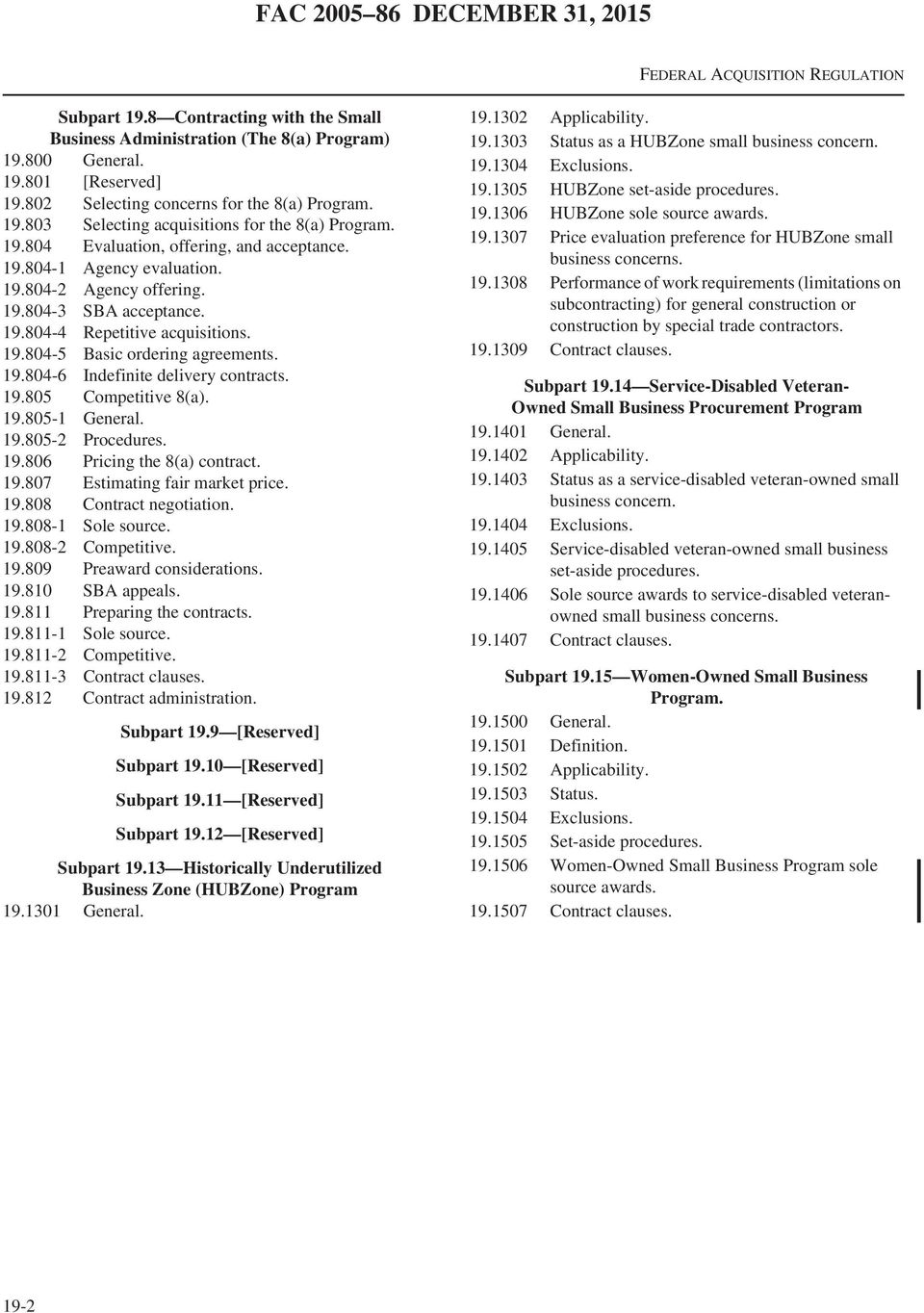
20 FAC DECEMBER 31, 2015 FEDERAL ACQUISITION REGULATION Subpart 19.8 Contracting with the Small Business Administration (The 8(a) Program) General [Reserved] Selecting concerns for the 8(a) Program Selecting acquisitions for the 8(a) Program Evaluation, offering, and acceptance Agency evaluation Agency offering SBA acceptance Repetitive acquisitions Basic ordering agreements Indefinite delivery contracts Competitive 8(a) General Procedures Pricing the 8(a) contract Estimating fair market price Contract negotiation Sole source Competitive Preaward considerations SBA appeals Preparing the contracts Sole source Competitive Contract clauses Contract administration. Subpart 19.9 [Reserved] Subpart [Reserved] Subpart [Reserved] Subpart [Reserved] Subpart Historically Underutilized Business Zone (HUBZone) Program General Applicability Status as a HUBZone small business concern Exclusions HUBZone set-aside procedures HUBZone sole source awards Price evaluation preference for HUBZone small business concerns Performance of work requirements (limitations on subcontracting) for general construction or construction by special trade contractors Contract clauses. Subpart Service-Disabled Veteran- Owned Small Business Procurement Program General Applicability Status as a service-disabled veteran-owned small business concern Exclusions Service-disabled veteran-owned small business set-aside procedures Sole source awards to service-disabled veteranowned small business concerns Contract clauses. Subpart Women-Owned Small Business Program General Definition Applicability Status Exclusions Set-aside procedures Women-Owned Small Business Program sole source awards Contract clauses. 19-2
21 FAC DECEMBER 31, 2015 SUBPART 19.1 SIZE STANDARDS Scope of part. (a) This part implements the acquisition-related sections of the Small Business Act (15 U.S.C. 631, et seq.), applicable sections of the Armed Services Procurement Act (10 U.S.C. 2302, et seq.), 41 U.S.C. 3104, and Executive Order 12138, May 18, It covers (1) The determination that a concern is eligible for participation in the programs identified in this part; (2) The respective roles of executive agencies and the Small Business Administration (SBA) in implementing the programs; (3) Setting acquisitions aside for exclusive competitive participation by small business, 8(a) business development participants, HUBZone small business concerns, service-disabled veteran-owned small business concerns, and economically disadvantaged women-owned small business (EDWOSB) concerns and women-owned small business (WOSB) concerns eligible under the WOSB Program; (4) The certificate of competency program; (5) The subcontracting assistance program; (6) The 8(a) business development program (hereafter referred to as 8(a) program), under which agencies contract with the SBA for goods or services to be furnished under a subcontract by a small disadvantaged business concern; (7) The use of a price evaluation preference for HUB- Zone small business concerns; (8) The use of veteran-owned small business concerns; and (9) Sole source awards to HUBZone small business concerns, service-disabled veteran-owned small business concerns, and EDWOSB concerns and WOSB concerns eligible under the WOSB Program. (b) This part, except for Subpart 19.6, applies only in the United States or its outlying areas. Subpart 19.6 applies worldwide Definitions. As used in this part Concern means any business entity organized for profit (even if its ownership is in the hands of a nonprofit entity) with a place of business located in the United States or its outlying areas and that makes a significant contribution to the U.S. economy through payment of taxes and/or use of American products, material and/or labor, etc. Concern includes but is not limited to an individual, partnership, corporation, joint venture, association, or cooperative. For the purpose of making affiliation findings (see ), include any business entity, whether organized for profit or not, and any foreign business entity, i.e., any entity located outside the United States and its outlying areas. Fair market price means a price based on reasonable costs under normal competitive conditions and not on lowest possible cost (see ). Industry means all concerns primarily engaged in similar lines of activity, as listed and described in the North American Industry Classification System (NAICS) manual. Nonmanufacturer rule means that a contractor under a small business set-aside or 8(a) contract shall be a small business under the applicable size standard and shall provide either its own product or that of another domestic small business manufacturing or processing concern (see 13 CFR ). Subpart 19.1 Size Standards Explanation of terms. As used in this subpart Affiliates. Business concerns are affiliates of each other if, directly or indirectly, either one controls or has the power to control the other, or another concern controls or has the power to control both. In determining whether affiliation exists, consideration is given to all appropriate factors including common ownership, common management, and contractual relationships; provided, that restraints imposed by a franchise agreement are not considered in determining whether the franchisor controls or has the power to control the franchisee, if the franchisee has the right to profit from its effort, commensurate with ownership, and bears the risk of loss or failure. Any business entity may be found to be an affiliate, whether or not it is organized for profit or located in the United States or its outlying areas. (1) Nature of control. Every business concern is considered as having one or more parties who directly or indirectly control or have the power to control it. Control may be affirmative or negative and it is immaterial whether it is exercised so long as the power to control exists. (2) Meaning of party or parties. The term party or parties includes, but is not limited to, two or more persons with an identity of interest such as members of the same family or persons with common investments in more than one concern. In determining who controls or has the power to control a concern, persons with an identity of interest may be treated as though they were one person. (3) Control through stock ownership.(i) A party is considered to control or have the power to control a concern, if the party controls or has the power to control 50 percent or more of the concern s voting stock. (ii) A party is considered to control or have the power to control a concern, even though the party owns, controls, or has the power to control less than 50 percent of the concern s voting stock, if the block of stock the party owns, controls, or has the power to control is large, as compared with any other outstanding block of stock. If two or more parties each owns,
22 FEDERAL ACQUISITION REGULATION controls, or has the power to control, less than 50 percent of the voting stock of a concern, and such minority block is equal or substantially equal in size, and large as compared with any other block outstanding, there is a presumption that each such party controls or has the power to control such concern; however, such presumption may be rebutted by a showing that such control or power to control, in fact, does not exist. (iii) If a concern s voting stock is distributed other than as described above, its management (officers and directors) is deemed to be in control of such concern. (4) Stock options and convertible debentures. Stock options and convertible debentures exercisable at the time or within a relatively short time after a size determination and agreements to merge in the future, are considered as having a present effect on the power to control the concern. Therefore, in making a size determination, such options, debentures, and agreements are treated as though the rights held thereunder had been exercised. (5) Voting trusts. If the purpose of a voting trust, or similar agreement, is to separate voting power from beneficial ownership of voting stock for the purpose of shifting control of or the power to control a concern in order that such concern or another concern may qualify as a small business within the size regulations, such voting trust shall not be considered valid for this purpose regardless of whether it is or is not valid within the appropriate jurisdiction. However, if a voting trust is entered into for a legitimate purpose other than that described above, and it is valid within the appropriate jurisdiction, it may be considered valid for the purpose of a size determination, provided such consideration is determined to be in the best interest of the small business program. (6) Control through common management. A concern may be found as controlling or having the power to control another concern when one or more of the following circumstances are found to exist, and it is reasonable to conclude that under the circumstances, such concern is directing or influencing, or has the power to direct or influence, the operation of such other concern. (i) Interlocking management. Officers, directors, employees, or principal stockholders of one concern serve as a working majority of the board of directors or officers of another concern. (ii) Common facilities. One concern shares common office space and/or employees and/or other facilities with another concern, particularly where such concerns are in the same or related industry or field of operation, or where such concerns were formerly affiliated. (iii) Newly organized concern. Former officers, directors, principal stockholders, and/or key employees of one concern organize a new concern in the same or a related industry or field operation, and serve as its officers, directors, principal stockholders, and/or key employees, and one concern is furnishing or will furnish the other concern with subcontracts, financial or technical assistance, and/or facilities, whether for a fee or otherwise. (7) Control through contractual relationships (i) Definition of a joint venture for size determination purposes. A joint venture for size determination purposes is an association of persons or concerns with interests in any degree or proportion by way of contract, express or implied, consorting to engage in and carry out a single specific business venture for joint profit, for which purpose they combine their efforts, property, money, skill, or knowledge, but not on a continuing or permanent basis for conducting business generally. A joint venture is viewed as a business entity in determining power to control its management. (A) For bundled requirements, apply size standards for the requirement to individual persons or concerns, not to the combined assets, of the joint venture. (B) For other than bundled requirements, apply size standards for the requirement to individual persons or concerns, not to the combined assets, of the joint venture, if (1) A revenue-based size standard applies to the requirement and the estimated contract value, including options, exceeds one-half the applicable size standard; or (2) An employee-based size standard applies to the requirement and the estimated contract value, including options, exceeds $10 million. (ii) HUBZone joint venture. A HUBZone joint venture of two or more HUBZone small business concerns may submit an offer for a HUBZone contract as long as each concern is small under the size standard corresponding to the NAICS code assigned to the contract, provided one of the following conditions apply: (A) The aggregate total of the joint venture is small under the size standard corresponding to the NAICS code assigned to the contract. (B) The aggregate total of the joint venture is not small under the size standard corresponding to the NAICS code assigned to the contract and either (1) For a revenue-based size standard, the estimated contract value exceeds half the size standard corresponding to the NAICS code assigned to the contract; or (2) For an employee-based size standard, the estimated contract value exceeds $10 million. (iii) Joint venture. Concerns submitting offers on a particular acquisition as joint ventures are considered as affiliated and controlling or having the power to control each other with regard to performance of the contract. Moreover, an ostensible subcontractor which is to perform primary or vital requirements of a contract may have a controlling role such to be considered a joint venturer affiliated on the contract with the prime contractor. A joint venture affiliation finding is lim (FAC )
23 SUBPART 19.1 SIZE STANDARDS ited to particular contracts unless the SBA size determination finds general affiliation between the parties. The rules governing 8(a) Program joint ventures are described in 13 CFR (iv) Where a concern is not considered as being an affiliate of a concern with which it is participating in a joint venture, it is necessary, nevertheless, in computing annual receipts, etc., for the purpose of applying size standards, to include such concern s share of the joint venture receipts (as distinguished from its share of the profits of such venture). (v) Franchise and license agreements. If a concern operates or is to operate under a franchise (or a license) agreement, the following policy is applicable: In determining whether the franchisor controls or has the power to control and, therefore, is affiliated with the franchisee, the restraints imposed on a franchisee by its franchise agreement shall not be considered, provided that the franchisee has the right to profit from its effort and the risk of loss or failure, commensurate with ownership. Even though a franchisee may not be controlled by the franchisor by virtue of the contractual relationship between them, the franchisee may be controlled by the franchisor or others through common ownership or common management, in which case they would be considered as affiliated. (vi) Size determination for teaming arrangements. For size determination purposes, apply the size standard tests in paragraphs (7)(i)(A) and (B) of this section when a teaming arrangement of two or more business concerns submits an offer, as appropriate. Annual receipts. (1) Annual receipts of a concern which has been in business for 3 or more complete fiscal years means the annual average gross revenue of the concern taken for the last 3 fiscal years. For the purpose of this definition, gross revenue of the concern includes revenues from sales of products and services, interest, rents, fees, commissions and/or whatever other sources derived, but less returns and allowances, sales of fixed assets, interaffiliate transactions between a concern and its domestic and foreign affiliates, and taxes collected for remittance (and if due, remitted) to a third party. Such revenues shall be measured as entered on the regular books of account of the concern whether on a cash, accrual, or other basis of accounting acceptable to the U.S. Treasury Department for the purpose of supporting Federal income tax returns, except when a change in accounting method from cash to accrual or accrual to cash has taken place during such 3-year period, or when the completed contract method has been used. (i) In any case of change in accounting method from cash to accrual or accrual to cash, revenues for such 3-year period shall, prior to the calculation of the annual average, be restated to the accrual method. In any case, where the completed contract method has been used to account for revenues in such 3-year period, revenues must be restated on an accrual basis using the percentage of completion method. (ii) In the case of a concern which does not keep regular books of accounts, but which is subject to U.S. Federal income taxation, annual receipts shall be measured as reported, or to be reported to the U.S. Treasury Department, Internal Revenue Service, for Federal income tax purposes, except that any return based on a change in accounting method or on the completed contract method of accounting must be restated as provided for in the preceding paragraphs. (2) Annual receipts of a concern that has been in business for less than 3 complete fiscal years means its total receipts for the period it has been in business, divided by the number of weeks including fractions of a week that it has been in business, and multiplied by 52. In calculating total receipts, the definitions and adjustments related to a change of accounting method and the completed contract method of paragraph (1) of this definition, are applicable. Number of employees is a measure of the average employment of a business concern and means its average employment, including the employees of its domestic and foreign affiliates, based on the number of persons employed on a full-time, part-time, temporary, or other basis during each of the pay periods of the preceding 12 months. If a business has not been in existence for 12 months, number of employees means the average employment of such concern and its affiliates during the period that such concern has been in existence based on the number of persons employed during each of the pay periods of the period that such concern has been in business. If a business has acquired an affiliate during the applicable 12-month period, it is necessary, in computing the applicant s number of employees, to include the affiliate s number of employees during the entire period, rather than only its employees during the period in which it has been an affiliate. The employees of a former affiliate are not included, even if such concern had been an affiliate during a portion of the period Size standards. (a)(1) The SBA establishes small business size standards on an industry-by-industry basis. (See 13 CFR Part 121). Small business size standards matched to industry NAICS codes are published by the Small Business Administration and are available at (2) NAICS codes are updated by the Office of Management and Budget through its Economic Classification Policy Committee every five years. New NAICS codes are not available for use in Federal contracting until the Small Business Administration publishes corresponding industry size standards (see (a)(1)). (b) Small business size standards are applied by (FAC )
24 FAC DECEMBER 31, FEDERAL ACQUISITION REGULATION (1) Classifying the product or service being acquired in the industry whose definition, as found in the North American Industry Classification System (NAICS) Manual (available at best describes the principal nature of the product or service being acquired; (2) Identifying the size standard SBA established for that industry; and (3) Specifying the size standard in the solicitation so that offerors can appropriately represent themselves as small or large. (c) For size standard purposes, a product or service shall be classified in only one industry, whose definition best describes the principal nature of the product or service being acquired even though for other purposes it could be classified in more than one. (d) When acquiring a product or service that could be classified in two or more industries with different size standards, contracting officers shall apply the size standard for the industry accounting for the greatest percentage of the contract price. (e) If a solicitation calls for more than one item and allows offers to be submitted on any or all of the items, an offeror must meet the size standard for each item it offers to furnish. If a solicitation calling for more than one item requires offers on all or none of the items, an offeror may qualify as a small business by meeting the size standard for the item accounting for the greatest percentage of the total contract price. (f) Any concern submitting a bid or offer in its own name, other than on a construction or service contract, that proposes to furnish an end product it did not manufacture (a nonmanufacturer ), is a small business if it has no more than 500 employees, and (1) Except as provided in paragraphs (f)(4) through (f)(7) of this section, in the case of Government acquisitions set-aside for small businesses, furnishes in the performance of the contract, the product of a small business manufacturer or producer. The end product furnished must be manufactured or produced in the United States or its outlying areas. The term nonmanufacturer includes a concern that can, but elects not to, manufacture or produce the end product for the specific acquisition. For size determination purposes, there can be only one manufacturer of the end product being acquired. The manufacturer of the end product being acquired is the concern that, with its own forces, transforms inorganic or organic substances including raw materials and/or miscellaneous parts or components into the end product. However, see the limitations on subcontracting at that apply to any small business offeror other than a nonmanufacturer for purposes of setasides and 8(a) awards, for HUBZone set-asides and HUBZone sole source awards, for SDVOSB setasides and SDVOSB sole source awards, for economically disadvantaged women-owned small business (EDWOSB) set-asides and EDWOSB sole source awards, and for set-asides and sole source awards to women-owned small business (WOSB) concerns eligible under the WOSB Program. (2) A concern which purchases items and packages them into a kit is considered to be a nonmanufacturer small business and can qualify as such for a given acquisition if it meets the size qualifications of a small nonmanufacturer for the acquisition, and if more than 50 percent of the total value of the kit and its contents are accounted for by items manufactured by small business. (3) For the purpose of receiving a Certificate of Competency on an unrestricted acquisition, a small business nonmanufacturer may furnish any domestically produced or manufactured product. (4) In the case of acquisitions set aside for small business or awarded under section 8(a) of the Small Business Act, when the acquisition is for a specific product (or a product in a class of products) for which the SBA has determined that there are no small business manufacturers or processors in the Federal market, then the SBA may grant a class waiver so that a nonmanufacturer does not have to furnish the product of a small business. For the most current listing of classes for which SBA has granted a waiver, contact an SBA Office of Government Contracting. A listing is also available on SBA s Internet Homepage at Contracting officers may request that the SBA waive the nonmanufacturer rule for a particular class of products. For procedures in requesting a waiver see 13 CFR (5) For a specific solicitation, a contracting officer may request a waiver of that part of the nonmanufacturer rule which requires that the actual manufacturer or processor be a small business concern if no known domestic small business manufacturers or processors can reasonably be expected to offer a product meeting the requirements of the solicitation. (6) Requests for waivers shall be sent to the Associate Administrator for Government Contracting United States Small Business Administration Mail Code Third Street, SW Washington, DC (7) The SBA provides for an exception to the nonmanufacturer rule if (i) The procurement of a manufactured end product processed under the procedures set forth in Part 13 (A) Is set aside for small business; and (B) Is not anticipated to exceed $25,000; and (ii) The offeror supplies an end product that is manufactured or produced in the United States or its outlying areas. (8) For non-manufacturer rules pertaining to HUBZone contracts, see (e)
25 SUBPART 19.3 DETERMINATION OF SMALL BUSINESS STATUS FOR SMALL BUSINESS PROGRAMS protest both the small business size and service-disabled veteran-owned small business status of an apparent successful offeror shall file two separate protests. (d) All protests must be in writing and must state all specific grounds for the protest. (1) SBA will consider protests challenging the service disabled veteran-owned status or the ownership and control of a concern if (i) For status protests, the protester presents evidence supporting the contention that the owner(s) cannot provide documentation from the Department of Veterans Affairs, Department of Defense determinations, or the U.S. National Archives and Records Administration to show that they meet the definition of service-disabled veteran or service disabled veteran with a permanent and severe disability as set forth in 13 CFR 125.8; or (ii) For ownership and control protests, the protester presents evidence that the concern is not 51 percent owned and controlled by one or more service-disabled veterans. In the case of a veteran with a permanent and severe disability, the protester presents evidence that the concern is not controlled by the veteran, spouse, or permanent caregiver of such veteran. (2) Assertions that a protested concern is not a servicedisabled veteran-owned small business concern, without setting forth specific facts or allegations, will not be considered by SBA (see 13 CFR (b)). (e) Protest by an interested party. (1) An offeror shall submit its protest to the contracting officer (i) To be received by close of business on the fifth business day after bid opening (in sealed bid acquisitions); or (ii) To be received by close of business on the fifth business day after notification by the contracting officer of the apparently successful offeror for negotiated acquisitions). (2) Any protest received after the designated time limits is untimely, unless it is from the contracting officer or SBA. (f)(1) The contracting officer shall forward all protests to SBA. The protests are to be submitted to SBA s Director, Office of Government Contracting, U.S. Small Business Administration, 409 Third Street, SW, Washington, DC or by fax to , Attn: Service-Disabled Veteran Status Protest. (2) The protest shall include a referral letter written by the contracting officer with information pertaining to the solicitation. The referral letter must include the following information to allow SBA to determine timeliness and standing: (i) The solicitation number (or an electronic link to or a paper copy of the solicitation). (ii) The name, address, telephone number, fax number, and address of the contracting officer. (iii) Whether the contract was sole-source or setaside. (iv) Whether the protestor submitted an offer. (v) Whether the protested concern was the apparent successful offeror. (vi) When the protested concern submitted its offer. (vii) Whether the acquisition was conducted using sealed bid or negotiated procedures. (viii) The bid opening date, if applicable. (ix) The date the contracting officer received the protest. (x) The date the protestor received notification about the apparent successful offeror, if applicable. (xi) Whether a contract has been awarded. (g) SBA will notify the protester and the contracting officer of the date SBA received the protest. (h) Before SBA decision. (1) After receiving a protest involving the apparent successful offeror's status as a servicedisabled veteran-owned small business concern, the contracting officer shall either (i) Withhold award of the contract until SBA determines the status of the protested concern; or (ii) Award the contract after receipt of the protest but before SBA issues its decision if the contracting officer determines in writing that an award must be made to protect the public interest. (2) SBA will determine the merits of the status protest within 15 business days after receipt of a protest, or within any extension of time granted by the contracting officer. (3) If SBA does not issue its determination within 15 business days, or within any extension of time that is granted, the contracting officer may award the contract after determining in writing that there is an immediate need to award the contract and that waiting until SBA makes its determination will be disadvantageous to the government. This determination shall be provided to the SBA's Director, Office of Government Contracting and a copy shall be included in the contract file. (i) After SBA decision. SBA will notify the contracting officer, the protester, and the protested concern of its determination. The determination is effective immediately and is final unless overturned on appeal by SBA s Office of Hearings and Appeals (OHA) pursuant to 13 CFR part 134. (1) If the contracting officer has withheld contract award and SBA has determined that the protested concern is an eligible SDVOSB or dismissed all protests against the protested concern, the contracting officer may award the contract to the protested concern. If OHA subsequently overturns the SBA Director for Government Contracting s determination or dismissal, the contracting officer may apply the OHA decision to the procurement in question. (2) If the contracting officer has withheld contract award, SBA has sustained the protest and determined that the concern is not an SDVOSB, and no OHA appeal has been (FAC )
26 FAC DECEMBER 31, FEDERAL ACQUISITION REGULATION filed, then the contracting officer shall not award the contract to the protested concern. (3) If the contracting officer has made a written determination in accordance with (h)(1)(ii) or (h)(3) of this section, the contract has been awarded, and SBA s ruling sustaining the protest is received after award (i) The contracting officer shall terminate the contract, unless the contracting officer has made a written determination that termination is not in the best interests of the Government. However, the contracting officer shall not exercise any options or award further task or delivery orders; (ii) The contracting officer shall update the FPDS to reflect the final SBA decision; and (iii) The concern must remove its designation in the System for Award Management (SAM) as a SDVOSB concern, and shall not submit an offer as a SDVOSB concern, until SBA issues a decision that the ineligibility is resolved. (4) If the contracting officer has made a written determination in accordance with (h)(1)(ii) or (h)(3) of this section and awarded the contract to the protested firm, SBA has sustained the protest and determined that the concern is not a SDVOSB, and a timely OHA appeal has been filed, then the contracting officer shall consider whether performance can be suspended until an OHA decision is rendered. (5) If OHA affirms the SBA Director for Government Contracting s determination finding the protested concern is ineligible (i) The contracting officer shall terminate the contract unless the contracting officer has made a written determination that it is not in the best interest of the Government. However, the contracting officer shall not exercise any options or award further task or delivery orders; (ii) The contracting officer shall update the FPDS to reflect OHA s decision; and (iii) The concern shall remove its designation in SAM as a SDVOSB concern, until SBA issues a decision that the ineligibility is resolved or OHA finds the concern is eligible on appeal. (6) A concern found to be ineligible may not submit future offers as an SDVOSB concern until the concern demonstrates to SBA s satisfaction that it has overcome the reason for the protest and SBA issues a decision to this effect. (j) Appeals of SDVOSB status determinations. The protested SDVOSB small business concern, the protester, or the contracting officer may file appeals of protest determinations to OHA. OHA must receive the appeal no later than 10 business days after the date of receipt of the protest determination. SBA will dismiss an untimely appeal. See Subpart E Rules of Practice for Appeals From Service-Disabled Veteran Owned Small Business Concerns Protests at 13 CFR through for SBA s appeals regulations. (k) The appeal must be in writing. The appeal must identify the protest determination being appealed and must set forth a full and specific statement as to why the SDVOSB protest determination is alleged to be based on a clear error of fact or law, together with an argument supporting such allegation. (l) The party appealing the decision must provide notice of the appeal to (1) The contracting officer; (2) Director, Office of Government Contracting, U.S. Small Business Administration, 409 Third Street, SW., Washington, DC 20416, facsimile ; (3) The protested SDVOSB concern or the original protester, as appropriate; and (4) Associate General Counsel for Procurement Law, U.S. Small Business Administration, 409 Third Street, SW., Washington, DC 20416, facsimile , or at [email protected]. (m) OHA will make its decision within 15 business days of the receipt of the appeal, if practicable. SBA will provide a copy of the decision to the contracting officer, the protester, and the protested SDVOSB small business concern. The OHA decision regarding the status of the concern is final and is binding on the parties Protesting a firm s status as an economically disadvantaged women-owned small business concern or women-owned small business concern eligible under the Women-Owned Small Business Program. (a) Definition. Interested party, as used in this section, has the meaning given in 13 CFR (b)(1) For sole source acquisitions, the contracting officer or SBA may protest the offeror s status as an economically disadvantaged women-owned small business (EDWOSB) concern or as a WOSB concern eligible under the WOSB Program. For all other acquisitions, an interested party (see 13 CFR ) may protest the apparent successful offeror s EDWOSB or WOSB status. (2) SBA s protest regulations are found in subpart F Protests at 13 CFR through (c) Protests relating to small business size status are subject to the procedures of An interested party seeking to protest both the small business size and WOSB or EDWOSB status of an apparent successful offeror shall file two separate protests. (d) All protests shall be in writing and must state all specific grounds for the protest. (1) SBA will consider protests challenging the status of a concern if (i) The protest presents evidence that the concern is not at least 51 percent owned and controlled by one or more women who are United States citizens; or (ii) The protest presents evidence that the concern is not at least 51 percent owned and controlled by one or more economically disadvantaged women, when it is in connection with an EDWOSB contract
27 FAC DECEMBER 31, 2015 SUBPART WOMEN-OWNED SMALL BUSINESS PROGRAM Subpart Women-Owned Small Business Program General. (a) Section 8(m) of the Small Business Act (15 U.S.C. 637(m)) created the Women-Owned Small Business (WOSB) Program. (b) The purpose of the WOSB Program is to ensure women-owned small business concerns have an equal opportunity to participate in Federal contracting and to assist agencies in achieving their women-owned small business participation goals (see 13 part CFR 127). (c) An economically disadvantaged women-owned small business (EDWOSB) concern or WOSB concern eligible under the WOSB Program is a subcategory of women-owned small business concern as defined in Definition. WOSB Program Repository means a secure, Web-based application that collects, stores, and disseminates documents to the contracting community and SBA, which verify the eligibility of a business concern for a contract to be awarded under the WOSB Program Applicability. The procedures in this subpart apply to all Federal agencies that employ one or more contracting officers Status. (a) Status as an EDWOSB concern or WOSB concern eligible under the WOSB Program is determined in accordance with 13 CFR part 127. (b) The contracting officer shall verify that the offeror (1) Is registered in the System for Award Management (SAM); (2) Is self-certified as an EDWOSB or WOSB concern in SAM; and (3) Has submitted documents verifying its eligibility at the time of initial offer to the WOSB Program Repository. The contract shall not be awarded until all required documents are received. (c)(1) An EDWOSB concern or WOSB concern eligible under the WOSB Program that has been certified by a SBA approved third party certifier, (which includes SBA certification under the 8(a) Program), must provide the following eligibility requirement documents (i) The third-party certification; (ii) SBA s WOSB Program Certification form (SBA Form 2413 for WOSB concerns eligible under the WOSB Program and SBA Form 2414 for EDWOSB concerns); and (iii) The joint venture agreement, if applicable. (2) An EDWOSB concern or WOSB concern eligible under the WOSB Program that has not been certified by an SBA approved third party certifier or by SBA under the 8(a) Program, must provide the following documents: (i) The U.S. birth certificate, naturalization documentation, or unexpired U.S. passport for each woman owner. (ii) The joint venture agreement, if applicable. (iii) For limited liability companies, articles of organization (also referred to as certificate of organization or articles of formation) and any amendments, and the operating agreement and any amendments. (iv) For corporations, articles of incorporation and any amendments, by-laws and any amendments, all issued stock certificates, including the front and back copies, signed in accord with the by-laws, stock ledger, and voting agreements, if any. (v) For partnerships, the partnership agreement and any amendments. (vi) For sole proprietorships, corporations, limited liability companies and partnerships if applicable, the assumed/fictitious name certificate(s). (vii) SBA s WOSB Program Certification form (SBA Form 2413 for WOSB concerns eligible under the WOSB Program and SBA Form 2414 for EDWOSB concerns). (viii) For EDWOSB concerns, in addition to the above, the SBA Form 413, Personal Financial Statement, available to the public at index.html, for each woman claiming economic disadvantage. (d)(1) A contracting officer may accept a concern s selfcertification as accurate for a specific procurement reserved for award under this subpart if (i) The apparent successful WOSB eligible under the WOSB Program or EDWOSB offeror provided the required documents; (ii) There has been no protest or other credible information that calls into question the concern s eligibility as an EDWOSB concern or WOSB concern eligible under the WOSB Program; and (iii) There has been no decision issued by SBA as a result of a current eligibility examination finding the concern did not qualify as an EDWOSB concern or WOSB concern eligible under the WOSB Program at the time it submitted its initial offer. (2) The contracting officer shall file a status protest in accordance with if (i) There is information that questions the eligibility of a concern; or (ii) The concern fails to provide all of the required documents to verify its eligibility. (e) If there is a decision issued by SBA as a result of a current eligibility examination finding that the concern did not qualify as an EDWOSB concern or WOSB concern eligible under the WOSB Program, the contracting officer may termi
28 FAC DECEMBER 31, FEDERAL ACQUISITION REGULATION nate the contract, and shall not exercise any option nor award further task or delivery orders. The contracting officer shall not count or include the award toward the small business accomplishments for an EDWOSB concern or WOSB concern eligible under the WOSB Program and must update FPDS from the date of award. (f) A joint venture may be considered an EDWOSB concern or WOSB concern eligible under the WOSB Program if it meets the requirements of 13 CFR (g) An EDWOSB concern or WOSB concern eligible under the WOSB Program that is a non-manufacturer, as defined in 13 CFR (b), may submit an offer on a requirement set aside for an EDWOSB concern or a WOSB concern eligible under the WOSB Program with a NAICS code for supplies, if it meets the requirements under the nonmanufacturer rule set forth in that regulation Exclusions. This subpart does not apply to (a) Requirements that an 8(a) concern is currently performing under the 8(a) Program or that SBA has accepted for performance under the authority of the 8(a) Program, unless SBA has consented to release the requirements from the 8(a) Program; (b) Requirements that can be satisfied through award to (1) Federal Prison Industries, Inc. (see subpart 8.6); or (2) AbilityOne participating non-profit agencies for the blind or severely disabled (see subpart 8.7); (c) Orders under indefinite-delivery contracts (see subpart 16.5). (But see (b)(2)(i)(F) for discretionary set-asides of orders); or (d) Orders against Federal Supply Schedules (see subpart 8.4). (But see for discretionary set-asides of orders.) Set-aside procedures. (a) The contracting officer (1) Shall comply with before deciding to set aside an acquisition under the WOSB Program. (2) May set aside acquisitions exceeding the micro-purchase threshold for competition restricted to EDWOSB concerns or WOSB concerns eligible under the WOSB Program when the acquisition (i) Is assigned a NAICS code in which SBA has determined that WOSB concerns are underrepresented in Federal procurement; or (ii) Is assigned a NAICS code in which SBA has determined that WOSB concerns are substantially underrepresented in Federal procurement, as specified on SBA s Web site at (b) For requirements in NAICS codes designated by SBA as underrepresented, a contracting officer may restrict competition to EDWOSB concerns if the contracting officer has a reasonable expectation based on market research that (1) Two or more EDWOSB concerns will submit offers for the contract and; (2) Contract award will be made at a fair and reasonable price. (c) A contracting officer may restrict competition to WOSB concerns eligible under the WOSB Program (including EDWOSB concerns), for requirements in NAICS codes designated by SBA as substantially underrepresented if there is a reasonable expectation based on market research that (1) Two or more WOSB concerns eligible under the WOSB Program (including EDWOSB concerns), will submit offers and; (2) Contract award may be made at a fair and reasonable price. (d) The contracting officer may make an award, if only one acceptable offer is received from a qualified EDWOSB concern or WOSB concern eligible under the WOSB Program. (e) The contracting officer must check whether the apparently successful offeror filed all the required eligibility documents, and file a status protest if any documents are missing. See (d)(2). (f) If no acceptable offers are received from an EDWOSB concern or WOSB concern eligible under the WOSB Program, the set-aside shall be withdrawn and the requirement, if still valid, must be considered for set aside in accordance with and subpart (g) If the contracting officer rejects a recommendation by SBA s Procurement Center Representative (1) The contracting officer shall notify the procurement center representative as soon as practicable; (2) SBA shall notify the contracting officer of its intent to appeal the contracting officer s decision no later than five business days after receiving notice of the contracting officer s decision; (3) The contracting officer shall suspend further action regarding the procurement until the head of the agency issues a written decision on the appeal, unless the head of the agency makes a written determination that urgent and compelling circumstances which significantly affect the interests of the United States compel award of the contract; (4) Within 15 business days of SBA s notification to the head of the contracting activity, SBA shall file a formal appeal to the head of the agency, or the appeal will be determined withdrawn; and (5) The head of the agency, or designee, shall specify in writing the reasons for a denial of an appeal brought under this section Women-Owned Small Business Program sole source awards. (a) A contracting officer shall consider a contract award to an EDWOSB concern on a sole source basis (see
29 FAC DECEMBER 31, 2015 SUBPART WOMEN-OWNED SMALL BUSINESS PROGRAM (b)(7)) before considering small business set-asides (see and subpart 19.5) provided none of the exclusions at apply and (1) The acquisition is assigned a NAICS code in which SBA has determined that WOSB concerns are underrepresented in Federal procurement; (2) The contracting officer does not have a reasonable expectation that offers would be received from two or more EDWOSB concerns; and (3) The conditions in paragraph (c) of this section exist. (b) A contracting officer shall consider a contract award to a WOSB concern (including EDWOSB concerns) eligible under the WOSB Program on a sole source basis (see (b)(7)) before considering small business set-asides (see and subpart 19.5) provided none of the exclusions at apply and (1) The acquisition is assigned a NAICS code in which SBA has determined that WOSB concerns are substantially underrepresented in Federal procurement; (2) The contracting officer does not have a reasonable expectation that offers would be received from two or more WOSB concerns (including EDWOSB concerns); and (3) The conditions in paragraph (c) of this section exist. (c)(1) The anticipated award price of the contract, including options, will not exceed (i) $6.5 million for a requirement within the NAICS codes for manufacturing; or (ii) $4 million for a requirement within any other NAICS codes. (2) The EDWOSB concern or WOSB concern has been determined to be a responsible contractor with respect to performance. (3) The award can be made at a fair and reasonable price. (d) The SBA has the right to appeal the contracting officer s decision not to make a sole source award to either an EDWOSB concern or WOSB concern eligible under the WOSB program Contract clauses. (a) The contracting officer shall insert the clause , Notice of Set-Aside for, or Sole Source Award to, Economically Disadvantaged Women-owned Small Business Concerns, in solicitations and contracts for acquisitions that are set aside or reserved for, or awarded on a sole source basis to, EDWOSB concerns under (b) or (a). This includes multiple-award contracts when orders may be set aside for EDWOSB concerns as described in and (b)(2)(i)(F). (b) The contracting officer shall insert the clause , Notice of Set-Aside for, or Sole Source Award to, Women-Owned Small Business Concerns Eligible Under the Women-Owned Small Business Program, in solicitations and contracts for acquisitions that are set aside or reserved for, or awarded on a sole source basis to WOSB concerns under (c) or (b). This includes multiple-award contracts when orders may be set aside for WOSB concerns eligible under the WOSB Program as described in and (b)(2)(i)(F). * * * * * *
30 This page intentionally left blank.
31 FAC DECEMBER 31, 2015 FEDERAL ACQUISITION REGULATION Requirements for Certified Cost or Pricing Data and Data Other Than Certified Cost or Pricing Data Requirements for Certified Cost or Pricing Data and Data Other Than Certified Cost or Pricing Data Modifications Limitations on Pass-Through Charges Identification of Subcontract Effort Limitations on Pass-Through Charges Type of Contract Economic Price Adjustment Standard Supplies Economic Price Adjustment Semistandard Supplies Economic Price Adjustment Labor and Material Price Redetermination Prospective Price Redetermination Retroactive Allowable Cost and Payment Fixed Fee Fixed Fee Construction Incentive Fee Cost Contract No Fee Cost-Sharing Contract No Fee [Reserved] [Reserved] Predetermined Indirect Cost Rates Incentive Price Revision Firm Target Incentive Price Revision Successive Targets Ordering Order Limitations Definite Quantity Requirements Indefinite Quantity Execution and Commencement of Work Limitation of Government Liability Contract Definitization Payments of Allowable Costs Before Definitization Single or Multiple Awards Multiple Awards for Advisory and Assistance Services Time-and-Materials/Labor-Hour Proposal Requirements Non-Commercial Item Acquisition With Adequate Price Competition Time-and-Materials/Labor-Hour Proposal Requirements Non-Commercial Item Acquisition Without Adequate Price Competition Time-and-Materials/Labor-Hour Proposal Requirements Commercial Item Acquisition [Reserved] Cancellation Under Multi-year Contracts Evaluation Exclusive of Options Evaluation of Options Exercised at Time of Contract Award Evaluation of Options Option for Increased Quantity Option for Increased Quantity Separately Priced Line Item Option to Extend Services Option to Extend the Term of the Contract [Reserved] Small Business Program Representations Equal Low Bids Notice of HUBZone Set-Aside or Sole Source Award Notice of Price Evaluation Preference for HUBZone Small Business Concerns [Reserved] Notice of Total Small Business Set-Aside Notice of Partial Small Business Set-Aside Utilization of Small Business Concerns Small Business Subcontracting Plan Incentive Subcontracting Program Special 8(a) Contract Conditions Special 8(a) Subcontract Conditions Notice of Set-Aside of Orders Limitations on Subcontracting [Reserved] Liquidated Damages Subcontracting Plan Section 8(a) Award Notification of Competition Limited to Eligible 8(a) Concerns [Reserved] [Reserved] [Reserved] [Reserved] [Reserved] [Reserved] [Reserved] [Reserved] Notice of Service-Disabled Veteran-Owned Small Business Set-Aside Post-Award Small Business Program Rerepresentation Notice of Set-Aside for, or Sole Source Award to, Economically Disadvantaged Women-Owned Small Business Concerns Notice of Set-Aside for, or Sole Source Award to, Women-Owned Small Business Concerns Eligible Under the Women-Owned Small Business Program [Reserved] [Reserved] Notice to the Government of Labor Disputes Payment for Overtime Premiums. 52-3
32 FEDERAL ACQUISITION REGULATION Convict Labor Contract Work Hours and Safety Standards Overtime Compensation Construction Wage Rate Requirements Secondary Site of the Work Construction Wage Rate Requirements Withholding of Funds Payrolls and Basic Records Apprentices and Trainees Compliance with Copeland Act Requirements Subcontracts (Labor Standards) Contract Termination Debarment Compliance with Construction Wage Rate Requirements and Related Regulations Disputes Concerning Labor Standards Certification of Eligibility Approval of Wage Rates Nondisplacement of Qualified Workers Certification Regarding Knowledge of Child Labor for Listed End Products Child Labor Cooperation with Authorities and Remedies Contracts for Materials, Supplies, Articles, and Equipment Exceeding $15, Prohibition of Segregated Facilities Previous Contracts and Compliance Reports Notice of Requirement for Affirmative Action to Ensure Equal Employment Opportunity for Construction Preaward On-Site Equal Opportunity Compliance Evaluation Affirmative Action Compliance Equal Opportunity Affirmative Action Compliance Requirements for Construction [Reserved] Notification of Visa Denial Construction Wage Rate Requirements Price Adjustment (None or Separately Specified Method) Construction Wage Rate Requirements Price Adjustment (Percentage Method) Construction Wage Rate Requirements Price Adjustment (Actual Method) Notice of Requirement for Project Labor Agreement Project Labor Agreement Equal Opportunity for Veterans Equal Opportunity for Workers with Disabilities Employment Reports on Veterans Compliance with Veterans Employment Reporting Requirements [Reserved] Notification of Employee Rights Under the National Labor Relations Act Service Contract Labor Standards Statement of Equivalent Rates for Federal Hires Fair Labor Standards Act and Service Contract Labor Standards Price Adjustment (Multiple Year and Option Contracts) Fair Labor Standards Act and Service Contract Labor Standards Price Adjustment [Reserved] Evaluation of Compensation for Professional Employees [Reserved] Exemption from Application of the Service Contract Labor Standards to Contracts for Maintenance, Calibration, or Repair of Certain Equipment-Certification Service Contract Labor Standards Place of Performance Unknown Combating Trafficking in Persons Exemption from Application of the Service Contract Labor Standards to Contracts for Maintenance, Calibration, or Repair of Certain Equipment Requirements Exemption from Application of the Service Contract Labor Standards to Contracts for Certain Services Certification Exemption from Application of the Service Contract Labor Standards to Contracts for Certain Services Requirements Employment Eligibility Verification Minimum Wages Under Executive Order Certification Regarding Trafficking in Persons Compliance Plan Biobased Product Certification Affirmative Procurement of Biobased Products Under Service and Construction Contracts Hazardous Material Identification and Material Safety Data Recovered Material Certification Pollution Prevention and Right-to-Know Information Drug-Free Workplace Notice of Radioactive Materials [Reserved] Estimate of Percentage of Recovered Material Content for EPA-Designated Items Waste Reduction Program Ozone-Depleting Substances Refrigeration Equipment and Air Conditioners Acquisition of EPEAT Registered Imaging Equipment Acquisition of EPEAT -Registered Televisions (FAC )
33 SUBPART 52.2 TEXT OF PROVISIONS AND CLAUSES (B) Affected contract number and delivery order number, if applicable; (C) Affected contract line item or subline item, if applicable; and (D) Contractor point of contact. (ii) Provide a copy of the remittance and supporting documentation to the Contracting Officer. (6)(i) All amounts that become payable by the Contractor to the Government under this contract shall bear simple interest from the date due until paid unless paid within 30 days of becoming due. The interest rate shall be the interest rate established by the Secretary of the Treasury, as provided in 41 U.S.C. 7109, which is applicable to the period in which the amount becomes due, and then at the rate applicable for each six month period as established by the Secretary until the amount is paid. (ii) The Government may issue a demand for payment to the Contractor upon finding a debt is due under the contract. (iii) Final Decisions. The Contracting Officer will issue a final decision as required by if (A) The Contracting Officer and the Contractor are unable to reach agreement on the existence or amount of a debt in a timely manner; (B) The Contractor fails to liquidate a debt previously demanded by the Contracting Officer within the timeline specified in the demand for payment unless the amounts were not repaid because the Contractor has requested an installment payment agreement; or (C) The Contractor requests a deferment of collection on a debt previously demanded by the Contracting Officer (see FAR ). (iv) If a demand for payment was previously issued for the debt, the demand for payment included in the final decision shall identify the same due date as the original demand for payment. (v) Amounts shall be due at the earliest of the following dates: (A) The date fixed under this contract. (B) The date of the first written demand for payment, including any demand for payment resulting from a default termination. (vi) The interest charge shall be computed for the actual number of calendar days involved beginning on the due date and ending on (A) The date on which the designated office receives payment from the Contractor; (B) The date of issuance of a Government check to the Contractor from which an amount otherwise payable has been withheld as a credit against the contract debt; or (C) The date on which an amount withheld and applied to the contract debt would otherwise have become payable to the Contractor. (vii) The interest charge made under this clause may be reduced under the procedures prescribed in of the Federal Acquisition Regulation in effect on the date of this contract. (viii) Upon receipt and approval of the invoice designated by the Contractor as the completion invoice and supporting documentation, and upon compliance by the Contractor with all terms of this contract, any outstanding balances will be paid within 30 days unless the parties agree otherwise. The completion invoice, and supporting documentation, shall be submitted by the Contractor as promptly as practicable following completion of the work under this contract, but in no event later than 1 year (or such longer period as the Contracting Officer may approve in writing) from the date of completion. (7) Release of claims. The Contractor, and each assignee under an assignment entered into under this contract and in effect at the time of final payment under this contract, shall execute and deliver, at the time of and as a condition precedent to final payment under this contract, a release discharging the Government, its officers, agents, and employees of and from all liabilities, obligations, and claims arising out of or under this contract, subject only to the following exceptions. (i) Specified claims in stated amounts, or in estimated amounts if the amounts are not susceptible to exact statement by the Contractor. (ii) Claims, together with reasonable incidental expenses, based upon the liabilities of the Contractor to third parties arising out of performing this contract, that are not known to the Contractor on the date of the execution of the release, and of which the Contractor gives notice in writing to the Contracting Officer not more than 6 years after the date of the release or the date of any notice to the Contractor that the Government is prepared to make final payment, whichever is earlier. (iii) Claims for reimbursement of costs (other than expenses of the Contractor by reason of its indemnification of the Government against patent liability), including reasonable incidental expenses, incurred by the Contractor under the terms of this contract relating to patents. (8) Prompt payment. The Government will make payment in accordance with the Prompt Payment Act (31 U.S.C. 3903) and prompt payment regulations at 5 CFR part (9) Electronic Funds Transfer (EFT). If the Government makes payment by EFT, see (b) for the appropriate EFT clause. (10) Discount. In connection with any discount offered for early payment, time shall be computed from the date of the invoice. For the purpose of computing the discount earned, payment shall be considered to have been made on the date that appears on the payment check or the specified payment date if an electronic funds transfer payment is made. (l) Termination for the Government s convenience. The Government reserves the right to terminate this contract, or any part hereof, for its sole convenience. In the event of such termination, the Contractor shall immediately stop all work hereunder and shall immediately cause any and all of its suppliers and subcontractors to cease work. Subject to the terms of this contract, the Contractor shall be paid an amount for direct labor (FAC )
34 FAC DECEMBER 31, FEDERAL ACQUISITION REGULATION hours (as defined in the Schedule of the contract) determined by multiplying the number of direct labor hours expended before the effective date of termination by the hourly rate(s) in the contract, less any hourly rate payments already made to the Contractor plus reasonable charges the Contractor can demonstrate to the satisfaction of the Government using its standard record keeping system that have resulted from the termination. The Contractor shall not be required to comply with the cost accounting standards or contract cost principles for this purpose. This paragraph does not give the Government any right to audit the Contractor s records. The Contractor shall not be paid for any work performed or costs incurred that reasonably could have been avoided. (m) Termination for cause. The Government may terminate this contract, or any part hereof, for cause in the event of any default by the Contractor, or if the Contractor fails to comply with any contract terms and conditions, or fails to provide the Government, upon request, with adequate assurances of future performance. In the event of termination for cause, the Government shall not be liable to the Contractor for any amount for supplies or services not accepted, and the Contractor shall be liable to the Government for any and all rights and remedies provided by law. If it is determined that the Government improperly terminated this contract for default, such termination shall be deemed a termination for convenience Contract Terms and Conditions Required to Implement Statutes or Executive Orders Commercial Items. As prescribed in (b)(4), insert the following clause: CONTRACT TERMS AND CONDITIONS REQUIRED TO IMPLEMENT STATUTES OR EXECUTIVE ORDERS COMMERCIAL ITEMS (DEC 2015) (a) The Contractor shall comply with the following Federal Acquisition Regulation (FAR) clauses, which are incorporated in this contract by reference, to implement provisions of law or Executive orders applicable to acquisitions of commercial items: (1) , Prohibition on Contracting with Inverted Domestic Corporations (NOV 2015) (2) , Protest After Award (AUG 1996) (31 U.S.C. 3553). (3) , Applicable Law for Breach of Contract Claim (OCT 2004)(Public Laws and (19 U.S.C note)). (b) The Contractor shall comply with the FAR clauses in this paragraph (b) that the Contracting Officer has indicated as being incorporated in this contract by reference to implement provisions of law or Executive orders applicable to acquisitions of commercial items: [Contracting Officer check as appropriate.] (1) , Restrictions on Subcontractor Sales to the Government (SEPT 2006), with Alternate I (OCT 1995) (41 U.S.C and 10 U.S.C. 2402). (2) , Contractor Code of Business Ethics and Conduct (OCT 2015) (41 U.S.C. 3509)). (3) , Whistleblower Protections under the American Recovery and Reinvestment Act of 2009 (JUNE 2010) (Section 1553 of Pub. L ). (Applies to contracts funded by the American Recovery and Reinvestment Act of 2009.) (4) , Reporting Executive Compensation and First-Tier Subcontract Awards (OCT 2015) (Pub. L ) (31 U.S.C note). (5) [Reserved]. (6) , Service Contract Reporting Requirements (JAN 2014) (PUB. L , section 743 OF DIV. C). (7) , Service Contract Reporting Requirements for Indefinite-Delivery Contracts (JAN 2014) (PUB. L , section 743 OF DIV. C). (8) , Protecting the Government s Interest When Subcontracting with Contractors Debarred, Suspended, or Proposed for Debarment. (OCT 2015) (31 U.S.C note). (9) , Updates of Publicly Available Information Regarding Responsibility Matters (JUL 2013) (41 U.S.C. 2313). (10) [Reserved]. (11)(i) , Notice of HUBZone Set-Aside or Sole-Source Award (NOV 2011) (15 U.S.C. 657a). (ii) Alternate I (NOV 2011) of (12)(i) , Notice of Price Evaluation Preference for HUBZone Small Business Concerns (OCT 2014) (if the offeror elects to waive the preference, it shall so indicate in its offer) (15 U.S.C. 657a). (ii) Alternate I (JAN 2011) of (13) [Reserved] (14)(i) , Notice of Total Small Business Set-Aside (NOV 2011) (15 U.S.C. 644). (ii) Alternate I (NOV 2011). (iii) Alternate II (NOV 2011). (15)(i) , Notice of Partial Small Business Set-Aside (JUNE 2003) (15 U.S.C. 644). (ii) Alternate I (OCT 1995) of (iii) Alternate II (MAR 2004) of (16) , Utilization of Small Business Concerns (OCT 2014) (15 U.S.C. 637(d)(2) and (3)). (17)(i) , Small Business Subcontracting Plan (OCT 2015) (15 U.S.C. 637(d)(4)). (ii) Alternate I (OCT 2001) of (iii) Alternate II (OCT 2001) of (iv) Alternate III (OCT 2015) of (18) , Notice of Set-Aside of Orders (NOV 2011) (15 U.S.C. 644(r)). (19) , Limitations on Subcontracting (NOV 2011) (15 U.S.C. 637(a)(14)). (20) , Liquidated Damages Subcontracting Plan (JAN 1999) (15 U.S.C. 637(d)(4)(F)(i))
35 FAC DECEMBER 31, 2015 SUBPART 52.2 TEXT OF PROVISIONS AND CLAUSES (21) , Notice of Service-Disabled Veteran- Owned Small Business Set-Aside (NOV 2011) (15 U.S.C. 657 f). (22) , Post Award Small Business Program Rerepresentation (JUL 2013) (15 U.S.C. 632(a)(2)). (23) , Notice of Set-Aside for, or Sole Source Award to, Economically Disadvantaged Women- Owned Small Business Concerns (DEC 2015) (15 U.S.C. 637(m)). (24) , Notice of Set-Aside for, or Sole Source Award to, Women-Owned Small Business Concerns Eligible Under the Women-Owned Small Business Program (DEC 2015) (15 U.S.C. 637(m)). (25) , Convict Labor (JUNE 2003) (E.O ). (26) , Child Labor Cooperation with Authorities and Remedies (JAN 2014) (E.O ). (27) , Prohibition of Segregated Facilities (APR 2015). (28) , Equal Opportunity (APR 2015) (E.O ). (29) , Equal Opportunity for Veterans (OCT 2015)(38 U.S.C. 4212). (30) , Equal Opportunity for Workers with Disabilities (JUL 2014) (29 U.S.C. 793). (31) , Employment Reports on Veterans (OCT 2015) (38 U.S.C. 4212). (32) , Notification of Employee Rights Under the National Labor Relations Act (DEC 2010) (E.O ). (33)(i) , Combating Trafficking in Persons (MAR 2015) (22 U.S.C. chapter 78 and E.O ). (ii) Alternate I (MAR 2015) of (22 U.S.C. chapter 78 and E.O ). (34) , Employment Eligibility Verification (OCT 2015). (Executive Order 12989). (Not applicable to the acquisition of commercially available off-the-shelf items or certain other types of commercial items as prescribed in ) (35)(i) , Estimate of Percentage of Recovered Material Content for EPA Designated Items (MAY 2008) (42 U.S.C. 6962(c)(3)(A)(ii)). (Not applicable to the acquisition of commercially available off-the-shelf items.) (ii) Alternate I (MAY 2008) of (42 U.S.C. 6962(i)(2)(C)). (Not applicable to the acquisition of commercially available off-the-shelf items.) (36)(i) , Acquisition of EPEAT -Registered Imaging Equipment (JUN 2014) (E.O.s and 13514). (ii) Alternate I (OCT 2015) of (37)(i) , Acquisition of EPEAT -Registered Televisions (JUN 2014) (E.O.s and 13514). (ii) Alternate I (JUN 2014) of (38) , Energy Efficiency in Energy- Consuming Products (DEC 2007) (42 U.S.C. 8259b). (39)(i) , Acquisition of EPEAT - Registered Personal Computer Products (OCT 2015) (E.O.s and 13514). (ii) Alternate I (JUN 2014) of (40) , Encouraging Contractor Policies to Ban Text Messaging While Driving (AUG 2011) (E.O ). (41) , Buy American Supplies (MAY 2014) (41 U.S.C. chapter 83). (42)(i) , Buy American Free Trade Agreements Israeli Trade Act (MAY 2014) (41 U.S.C. chapter 83, 19 U.S.C note, 19 U.S.C note, 19 U.S.C note, 19 U.S.C note, Pub. L , , , , , , , , , , , and (ii) Alternate I (MAY 2014) of (iii) Alternate II (MAY 2014) of (iv) Alternate III (MAY 2014) of (43) , Trade Agreements (NOV 2013) (19 U.S.C. 2501, et seq., 19 U.S.C note). (44) , Restrictions on Certain Foreign Purchases (JUNE 2008) (E.O. s, proclamations, and statutes administered by the Office of Foreign Assets Control of the Department of the Treasury). (45) , Contractors Performing Private Security Functions Outside the United States (JUL 2013) (Section 862, as amended, of the National Defense Authorization Act for Fiscal Year 2008; 10 U.S.C Note). (46) , Notice of Disaster or Emergency Area Set-Aside (NOV 2007) (42 U.S.C. 5150). (47) , Restrictions on Subcontracting Outside Disaster or Emergency Area (NOV 2007) (42 U.S.C. 5150). (48) , Terms for Financing of Purchases of Commercial Items (FEB 2002) (41 U.S.C. 4505, 10 U.S.C. 2307(f)). (49) , Installment Payments for Commercial Items (OCT 1995) (41 U.S.C. 4505, 10 U.S.C. 2307(f)). (50) , Payment by Electronic Funds Transfer System for Award Management (JUL 2013) (31 U.S.C. 3332). (51) , Payment by Electronic Funds Transfer Other than System for Award Management (JUL 2013) (31 U.S.C. 3332). (52) , Payment by Third Party (MAY 2014) (31 U.S.C. 3332). (53) , Privacy or Security Safeguards (AUG 1996) (5 U.S.C.552a). (54)(i) , Preference for Privately Owned U.S.-Flag Commercial Vessels (FEB 2006) (46 U.S.C. Appx. 1241(b) and 10 U.S.C. 2631). (ii) Alternate I (Apr 2003) of (c) The Contractor shall comply with the FAR clauses in this paragraph (c), applicable to commercial services, that the Contracting Officer has indicated as being incorporated in this contract by reference to implement provisions of law or Executive orders applicable to acquisitions of commercial items:
36 FEDERAL ACQUISITION REGULATION [Contracting Officer check as appropriate.] (1) , Nondisplacement of Qualified Workers (MAY 2014)(E.O ). (2) , Service Contract Labor Standards (May 2014) (41 U.S.C. chapter 67). (3) , Statement of Equivalent Rates for Federal Hires (MAY 2014) (29 U.S.C. 206 and 41 U.S.C. chapter 67). (4) , Fair Labor Standards Act and Service Contract Labor Standards-Price Adjustment (Multiple Year and Option Contracts) (MAY 2014) (29 U.S.C. 206 and 41 U.S.C. chapter 67). (5) , Fair Labor Standards Act and Service Contract Labor Standards Price Adjustment (MAY 2014) (29 U.S.C. 206 and 41 U.S.C. chapter 67). (6) , Exemption from Application of the Service Contract Labor Standards to Contracts for Maintenance, Calibration, or Repair of Certain Equipment Requirements (MAY 2014) (41 U.S.C. chapter 67). (7) , Exemption from Application of the Service Contract Labor Standards to Contracts for Certain Services Requirements (MAY 2014) (41 U.S.C. chapter 67). (8) , Minimum Wages Under Executive Order (DEC 2015) (E.O ). (9) , Promoting Excess Food Donation to Nonprofit Organizations (MAY 2014) (42 U.S.C. 1792). (10) , Accepting and Dispensing of $1 Coin (SEPT 2008) (31 U.S.C. 5112(p)(1)). (d) Comptroller General Examination of Record. The Contractor shall comply with the provisions of this paragraph (d) if this contract was awarded using other than sealed bid, is in excess of the simplified acquisition threshold, and does not contain the clause at , Audit and Records Negotiation. (1) The Comptroller General of the United States, or an authorized representative of the Comptroller General, shall have access to and right to examine any of the Contractor s directly pertinent records involving transactions related to this contract. (2) The Contractor shall make available at its offices at all reasonable times the records, materials, and other evidence for examination, audit, or reproduction, until 3 years after final payment under this contract or for any shorter period specified in FAR Subpart 4.7, Contractor Records Retention, of the other clauses of this contract. If this contract is completely or partially terminated, the records relating to the work terminated shall be made available for 3 years after any resulting final termination settlement. Records relating to appeals under the disputes clause or to litigation or the settlement of claims arising under or relating to this contract shall be made available until such appeals, litigation, or claims are finally resolved. (3) As used in this clause, records include books, documents, accounting procedures and practices, and other data, regardless of type and regardless of form. This does not require the Contractor to create or maintain any record that the Contractor does not maintain in the ordinary course of business or pursuant to a provision of law. (e)(1) Notwithstanding the requirements of the clauses in paragraphs (a), (b), (c), and (d) of this clause, the Contractor is not required to flow down any FAR clause, other than those in this paragraph (e)(1) in a subcontract for commercial items. Unless otherwise indicated below, the extent of the flow down shall be as required by the clause (i) , Contractor Code of Business Ethics and Conduct (OCT 2015) (41 U.S.C. 3509). (ii) , Utilization of Small Business Concerns (OCT 2014) (15 U.S.C. 637(d)(2) and (3)), in all subcontracts that offer further subcontracting opportunities. If the subcontract (except subcontracts to small business concerns) exceeds $700,000 ($1.5 million for construction of any public facility), the subcontractor must include in lower tier subcontracts that offer subcontracting opportunities. (iii) , Nondisplacement of Qualified Workers (MAY 2014) (E.O ). Flow down required in accordance with paragraph (l) of FAR clause (iv) , Prohibition of Segregated Facilities (APR 2015) (v) , Equal Opportunity (APR 2015) (E.O ). (vi) , Equal Opportunity for Veterans (OCT 2015) (38 U.S.C. 4212). (vii) , Equal Opportunity for Workers with Disabilities (JUL 2014) (29 U.S.C. 793). (viii) , Employment Reports on Veterans (OCT 2015) (38 U.S.C. 4212) (ix) , Notification of Employee Rights Under the National Labor Relations Act (DEC 2010) (E.O ). Flow down required in accordance with paragraph (f) of FAR clause (x) , Service Contract Labor Standards (MAY 2014) (41 U.S.C. chapter 67). (xi) (A) , Combating Trafficking in Persons (MAR 2015) (22 U.S.C. chapter 78 and E.O 13627). (B) Alternate I (MAR 2015) of (22 U.S.C. chapter 78 and E.O 13627). (xii) , Exemption from Application of the Service Contract Labor Standards to Contracts for Maintenance, Calibration, or Repair of Certain Equipment-Requirements (MAY 2014) (41 U.S.C. chapter 67). (xiii) , Exemption from Application of the Service Contract Labor Standards to Contracts for Certain Services-Requirements (MAY 2014) (41 U.S.C. chapter 67). (xiv) , Employment Eligibility Verification (OCT 2015) (E.O ). (xv) , Minimum Wages Under Executive Order (DEC 2015) (E.O ). (xvi) , Contractors Performing Private Security Functions Outside the United States (JUL 2013) (Section 862, as amended, of the National Defense Authorization Act for Fiscal Year 2008; 10 U.S.C Note). (xvii) , Promoting Excess Food Donation to Nonprofit Organizations (MAY 2014) (42 U.S.C. 1792). Flow (FAC )
37 SUBPART 52.2 TEXT OF PROVISIONS AND CLAUSES down required in accordance with paragraph (e) of FAR clause (xviii) , Preference for Privately Owned U.S.-Flag Commercial Vessels (FEB 2006) (46 U.S.C. Appx. 1241(b) and 10 U.S.C. 2631). Flow down required in accordance with paragraph (d) of FAR clause (2) While not required, the contractor may include in its subcontracts for commercial items a minimal number of additional clauses necessary to satisfy its contractual obligations. (End of clause) Alternate I (Feb 2000). As prescribed in (b)(4)(i), delete paragraph (d) from the basic clause, redesignate paragraph (e) as paragraph (d), and revise the reference to paragraphs (a), (b), (c), or (d) of this clause in the redesignated paragraph (d) to read paragraphs (a), (b), and (c) of this clause. Alternate II (Oct 2015). As prescribed in (b)(4)(ii), substitute the following paragraphs (d)(1) and (e)(1) for paragraphs (d)(1) and (e)(1) of the basic clause as follows: (d)(1) The Comptroller General of the United States, an appropriate Inspector General appointed under section 3 or 8G of the Inspector General Act of 1978 (5 U.S.C. App.), or an authorized representative of either of the foregoing officials shall have access to and right to (i) Examine any of the Contractor s or any subcontractors records that pertain to, and involve transactions relating to, this contract; and (ii) Interview any officer or employee regarding such transactions. (e)(1) Notwithstanding the requirements of the clauses in paragraphs (a), (b), and (c), of this clause, the Contractor is not required to flow down any FAR clause in a subcontract for commercial items, other than (i) Paragraph (d) of this clause. This paragraph flows down to all subcontracts, except the authority of the Inspector General under paragraph (d)(1)(ii) does not flow down; and (ii) Those clauses listed in this paragraph (e)(1). Unless otherwise indicated below, the extent of the flow down shall be as required by the clause (A) , Contractor Code of Business Ethics and Conduct (Oct 2015) (41 U.S.C. 3509). (B) , Whistleblower Protections Under the American Recovery and Reinvestment Act of 2009 (Jun 2010) (Section 1553 of Pub. L ). (C) , Utilization of Small Business Concerns (Oct 2014) (15 U.S.C. 637(d)(2) and (3)), in all subcontracts that offer further subcontracting opportunities. If the subcontract (except subcontracts to small business concerns) exceeds $700,000 ($1.5 million for construction of any public facility), the subcontractor must include in lower tier subcontracts that offer subcontracting opportunities. (D) , Prohibition of Segregated Facilities (Apr 2015). (E) , Equal Opportunity (Apr 2015) (E.O ). (F) , Equal Opportunity for Veterans (Oct 2015) (38 U.S.C. 4212). (G) , Equal Opportunity for Workers with Disabilities (Jul 2014) (29 U.S.C. 793). (H) , Notification of Employee Rights Under the National Labor Relations Act (Dec 2010) (E.O ). Flow down required in accordance with paragraph (f) of FAR clause (I) , Service Contract Labor Standards (May 2014) (41 U.S.C. chapter 67). (J) (1) , Combating Trafficking in Persons (Mar 2015) (22 U.S.C. chapter 78 and E.O 13627). (2) Alternate I (Mar 2015) of (22 U.S.C. chapter 78 and E.O 13627). (K) , Exemption from Application of the Service Contract Labor Standards to Contracts for Maintenance, Calibration, or Repair of Certain Equipment Requirements (May 2014) (41 U.S.C. chapter 67). (L) , Exemption from Application of the Service Contract Labor Standards to Contracts for Certain Services Requirements (May 2014) (41 U.S.C. chapter 67). (M) , Employment Eligibility Verification (Oct 2015) (Executive Order 12989). (N) , Minimum Wages Under Executive Order (Dec 2015) (E.O ). (O) , Promoting Excess Food Donation to Nonprofit Organizations. (May 2014) (42 U.S.C. 1792). Flow down required in accordance with paragraph (e) of FAR clause (P) , Preference for Privately Owned U.S.-Flag Commercial Vessels (Feb 2006) (46 U.S.C. Appx. 1241(b) and 10 U.S.C. 2631). Flow down required in accordance with paragraph (d) of FAR clause Fast Payment Procedure. As prescribed in , insert the following clause: FAST PAYMENT PROCEDURE (MAY 2006) (a) General. The Government will pay invoices based on the Contractor s delivery to a post office or common carrier (or, if shipped by other means, to the point of first receipt by the Government). (b) Responsibility for supplies.(1) Title to the supplies passes to the Government upon delivery to (i) A post office or common carrier for shipment to the specific destination; or (ii) The point of first receipt by the Government, if shipment is by means other than Postal Service or common carrier. (2) Notwithstanding any other provision of the contract, order, or blanket purchase agreement, the Contractor shall (FAC )
38 FEDERAL ACQUISITION REGULATION (i) Assume all responsibility and risk of loss for supplies not received at destination, damaged in transit, or not conforming to purchase requirements; and (ii) Replace, repair, or correct those supplies promptly at the Contractor s expense, if instructed to do so by the Contracting Officer within 180 days from the date title to the supplies vests in the Government. (c) Preparation of invoice.(1) Upon delivery to a post office or common carrier (or, if shipped by other means, the point of first receipt by the Government), the Contractor shall (i) Prepare an invoice as provided in this contract, order, or blanket purchase agreement; and (ii) Display prominently on the invoice FAST PAY. Invoices not prominently marked FAST PAY via manual or electronic means may be accepted by the payment office for fast payment. If the payment office declines to make fast payment, the Contractor shall be paid in accordance with procedures applicable to invoices to which the Fast Payment clause does not apply. (2) If the purchase price excludes the cost of transportation, the Contractor shall enter the prepaid shipping cost on the invoice as a separate item. The Contractor shall not include the cost of parcel post insurance. If transportation charges are stated separately on the invoice, the Contractor shall retain related paid freight bills or other transportation billings paid separately for a period of 3 years and shall furnish the bills to the Government upon request. (3) If this contract, order, or blanket purchase agreement requires the preparation of a receiving report, the Contractor shall either (i) Submit the receiving report on the prescribed form with the invoice; or (ii) Include the following information on the invoice: (A) Shipment number. (B) Mode of shipment. (C) At line item level (1) National stock number and/or manufacturer s part number; (2) Unit of measure; (3) Ship-To Point; (4) Mark-For Point, if in the contract; and (5) FEDSTRIP/MILSTRIP document number, if in the contract. (4) If this contract, order, or blanket purchase agreement does not require preparation of a receiving report on a prescribed form, the Contractor shall include on the invoice the following information at the line item level, in addition to that required in paragraph (c)(1) of this clause: (i) Ship-To Point. (ii) Mark-For Point. (iii) FEDSTRIP/MILSTRIP document number, if in the contract. (5) Where a receiving report is not required, the Contractor shall include a copy of the invoice in each shipment. (d) Certification of invoice. The Contractor certifies by submitting an invoice to the Government that the supplies being billed to the Government have been shipped or delivered in accordance with shipping instructions issued by the ordering officer, in the quantities shown on the invoice, and that the supplies are in the quantity and of the quality designated by the contract, order, or blanket purchase agreement. (e) FAST PAY container identification. The Contractor shall mark all outer shipping containers FAST PAY When outer shipping containers are not marked FAST PAY, the payment office may make fast payment. If the payment office declines to make fast payment, the Contractor shall be paid in accordance with procedures applicable to invoices to which the Fast Payment clause does not apply. (End of clause) Invoices. As prescribed in (b), insert the following clause: INVOICES (APR 1984) The Contractor s invoices must be submitted before payment can be made. The Contractor will be paid on the basis of the invoice, which must state (a) The starting and ending dates of the subscription delivery; and (b) Either that orders have been placed in effect for the addressees required, or that the orders will be placed in effect upon receipt of payment. (End of clause) Notice to Supplier. As prescribed in (c), insert the following clause: NOTICE TO SUPPLIER (APR 1984) This is a firm order ONLY if your price does not exceed the maximum line item or total price in the Schedule. Submit invoices to the Contracting Officer. If you cannot perform in exact accordance with this order, WITHHOLD PERFORMANCE, and notify the Contracting Officer immediately, giving your quotation. (End of clause) Terms and Conditions Simplified Acquisitions (Other Than Commercial Items). As prescribed in (d), insert the following clause: TERMS AND CONDITIONS SIMPLIFIED ACQUISITIONS (OTHER THAN COMMERCIAL ITEMS) (DEC 2015) (a) The Contractor shall comply with the following Federal Acquisition Regulation (FAR) clauses that are incorporated by reference: (1) The clauses listed below implement provisions of law or Executive order: (i) , Convict Labor (JUN 2003) (E.O ) (FAC )
39 FAC DECEMBER 31, 2015 SUBPART 52.2 TEXT OF PROVISIONS AND CLAUSES In determining whether dominance exists, consideration shall be given to all appropriate factors, including volume of business, number of employees, financial resources, competitive status or position, ownership or control of materials, processes, patents, license agreements, facilities, sales territory, and nature of business activity. (b) If the Contractor represented that it was a small business concern prior to award of this contract, the Contractor shall rerepresent its size status according to paragraph (e) of this clause or, if applicable, paragraph (g) of this clause, upon the occurrence of any of the following: (1) Within 30 days after execution of a novation agreement or within 30 days after modification of the contract to include this clause, if the novation agreement was executed prior to inclusion of this clause in the contract. (2) Within 30 days after a merger or acquisition that does not require a novation or within 30 days after modification of the contract to include this clause, if the merger or acquisition occurred prior to inclusion of this clause in the contract. (3) For long-term contracts (i) Within 60 to 120 days prior to the end of the fifth year of the contract; and (ii) Within 60 to 120 days prior to the date specified in the contract for exercising any option thereafter. (c) The Contractor shall rerepresent its size status in accordance with the size standard in effect at the time of this rerepresentation that corresponds to the North American Industry Classification System (NAICS) code assigned to this contract. The small business size standard corresponding to this NAICS code can be found at (d) The small business size standard for a Contractor providing a product which it does not manufacture itself, for a contract other than a construction or service contract, is 500 employees. (e) Except as provided in paragraph (g) of this clause, the Contractor shall make the representation required by paragraph (b) of this clause by validating or updating all its representations in the Representations and Certifications section of the System for Award Management (SAM) and its other data in SAM, as necessary, to ensure that they reflect the Contractor's current status. The Contractor shall notify the contracting office in writing within the timeframes specified in paragraph (b) of this clause that the data have been validated or updated, and provide the date of the validation or update. (f) If the Contractor represented that it was other than a small business concern prior to award of this contract, the Contractor may, but is not required to, take the actions required by paragraphs (e) or (g) of this clause. (g) If the Contractor does not have representations and certifications in SAM, or does not have a representation in SAM for the NAICS code applicable to this contract, the Contractor is required to complete the following rerepresentation and submit it to the contracting office, along with the contract number and the date on which the rerepresentation was completed: The Contractor represents that it? is,? is not a small business concern under NAICS Code assigned to contract number. [Contractor to sign and date and insert authorized signer s name and title]. (End of clause) Notice of Set-Aside for, or Sole Source Award to, Economically Disadvantaged Women-Owned Small Business Concerns. As prescribed in , insert the following clause: NOTICE OF SET-ASIDE FOR, OR SOLE SOURCE AWARD TO, ECONOMICALLY DISADVANTAGED WOMEN-OWNED SMALL BUSINESS CONCERNS. (DEC 2015) (a) Definitions. Economically disadvantaged womenowned small business (EDWOSB) concern means A small business concern that is at least 51 percent directly and unconditionally owned by, and the management and daily business operations of which are controlled by, one or more women who are citizens of the United States and who are economically disadvantaged in accordance with 13 CFR part 127. It automatically qualifies as a women-owned small business (WOSB) concern eligible under the WOSB Program. WOSB Program Repository means a secure, Web-based application that collects, stores, and disseminates documents to the contracting community and SBA, which verify the eligibility of a business concern for a contract to be awarded under the WOSB Program. (b) Applicability. This clause applies only to (1) Contracts that have been set aside or reserved for, or awarded on a sole source basis to, EDWOSB concerns; (2) Part or parts of a multiple-award contract that have been set aside for EDWOSB concerns; and (3) Orders set aside for EDWOSB concerns under multiple-award contracts as described in and (b)(2)(i)(F). (c) General. (1) Offers are solicited only from EDWOSB concerns. Offers received from concerns that are not EDWOSB concerns will not be considered. (2) Any award resulting from this solicitation will be made to an EDWOSB concern. (3) The contracting officer will ensure that the apparent successful offeror has provided all required documents to the WOSB Program Repository. The contract will not be awarded until all required documents are received. (d) Agreement. An EDWOSB concern agrees that in the performance of the contract for
40 FAC DECEMBER 31, FEDERAL ACQUISITION REGULATION (1) Services (except construction), the concern will perform at least 50 percent of the cost of the contract incurred for personnel with its own employees; (2) Supplies or products (other than procurement from a non-manufacturer in such supplies or products), the concern will perform at least 50 percent of the cost of manufacturing the supplies or products (not including the costs of materials); (3) General construction, the concern will perform at least 15 percent of the cost of the contract with its own employees (not including the costs of materials); and (4) Construction by special trade contractors, the concern will perform at least 25 percent of the cost of the contract with its own employees (not including the cost of materials). (e) Joint Venture. A joint venture may be considered an EDWOSB concern if (1) It meets the applicable size standard corresponding to the NAICS code assigned to the contract, unless an exception to affiliation applies pursuant to 13 CFR (h)(3); (2) The EDWOSB participant of the joint venture is designated in the System for Award Management as an EDWOSB concern; (3) The parties to the joint venture have entered into a written joint venture agreement that contains provisions (i) Setting forth the purpose of the joint venture; (ii) Designating an EDWOSB concern as the managing venturer of the joint venture, and an employee of the managing venturer as the project manager responsible for the performance of the contract; (iii) Stating that not less than 51 percent of the net profits earned by the joint venture will be distributed to the EDWOSB; (iv) Specifying the responsibilities of the parties with regard to contract performance, sources of labor, and negotiation of the EDWOSB contract; and (v) Requiring the final original records be retained by the managing venturer upon completion of the EDWOSB contract performed by the joint venture. (4) The joint venture performs the applicable percentage of work required in accordance with paragraph (d) above; and (5) The procuring activity executes the contract in the name of the EDWOSB or joint venture. (f) Nonmanufacturer. An EDWOSB concern that is a nonmanufacturer, as defined in 13 CFR (b) or (f), may submit an offer on an EDWOSB requirement with a NAICS code for supplies, if it meets the requirements under the non-manufacturer rule set forth in those regulations. (End of clause) Notice of Set-Aside for, or Sole Source Award to, Women-Owned Small Business Concerns Eligible Under the Women-Owned Small Business Program. As prescribed in , insert the following clause: NOTICE OF SET-ASIDE FOR, OR SOLE SOURCE AWARD TO, WOMEN-OWNED SMALL BUSINESS CONCERNS ELIGIBLE UNDER THE WOMEN-OWNED SMALL BUSINESS PROGRAM. (DEC 2015) (a) Definitions. Women-owned small business (WOSB) concern eligible under the WOSB Program (in accordance with 13 CFR 127), means a small business concern that is at least 51 percent directly and unconditionally owned by, and the management and daily business operations of which are controlled by, one or more women who are citizens of the United States. WOSB Program Repository means a secure, Web-based application that collects, stores, and disseminates documents to the contracting community and SBA, which verify the eligibility of a business concern for a contract to be awarded under the WOSB Program. (b) Applicability. This clause applies only to (1) Contracts that have been set aside or reserved for, or awarded on a sole source basis to, WOSB concerns eligible under the WOSB Program; (2) Part or parts of a multiple-award contract that have been set aside for WOSB concerns eligible under the WOSB Program; and (3) Orders set aside for WOSB concerns eligible under the WOSB Program, under multiple-award contracts as described in and (b)(2)(i)(F). (c) General.(1) Offers are solicited only from WOSB concerns eligible under the WOSB Program. Offers received from concerns that are not WOSB concerns eligible under the WOSB program shall not be considered. (2) Any award resulting from this solicitation will be made to a WOSB concern eligible under the WOSB Program. (3) The Contracting Officer will ensure that the apparent successful offeror has provided the required documents to the WOSB Program Repository. The contract shall not be awarded until all required documents are received. (d) Agreement. A WOSB concern eligible under the WOSB Program agrees that in the performance of the contract for (1) Services (except construction), the concern will perform at least 50 percent of the cost of the contract incurred for personnel with its own employees; (2) Supplies or products (other than procurement from a non-manufacturer in such supplies or products), the concern will perform at least 50 percent of the cost of manufacturing the supplies or products (not including the costs of materials); (3) General construction, the concern will perform at least 15 percent of the cost of the contract with its own employees (not including the costs of materials); and (FAC )
41 SUBPART 52.3 PROVISION AND CLAUSE MATRIX PRINCIPLE TYPE AND/OR PURPOSE OF CONTRACT PROVISION OR CLAUSE PRESCRIBED IN P OR C Evaluation Exclusive of Options Evaluation of Options Exercised at Time of Contract Award (a) P Yes M A A A A A A A A (b) P Yes M A A A A A A A A Evaluation of Options (c) P Yes M A A A A A A A A Option for Increased Quantity (d) C Yes I A A A A A Option for Increased Quantity Separately Priced Line Item (e) C Yes I A A A A A Option to Extend Services (f) C Yes I A A A A A Option to Extend the Term of the Contract Small Business Program Representations (g) C No I A A A A A (a)(1) P No K A A A A A A A A A A A A A A A A A A Alternate I (a)(2) P No K A A A A A A A A A A A A A A A A A A Equal Low Bids (b) P No K A A A A A A A A A Notice of HUBZone Set-Aside or Sole Source Award. IBR UCF FP SUP CR SUP FP R&D (a) C Yes I A A A A A A A A A A A A A A A A A A A Alternate I (a)(1) C Yes I A A A A A A A A A A A A A A A A A A A Notice of Price Evaluation (b) C Yes I A A A A A A A A A A A A A A A A A A Preference for HUBZone Small Business Concerns. Alternate I (b)(1) C Yes I A A A A A A A A A A A A A A A A A A A Notice of Total Small Business (c) C Yes I A A A A A A A A A A A A A A A A A A Set-Aside. Alternate I (c) C Yes I A A A Alternate II (c) C Yes I A A A Notice of Partial Small (d) C Yes I A A A A A A A A A A A A A A A A A Business Set-Aside. Alternate I (d) C Yes I A A Alternate II (d) C Yes I A A Utilization of Small Business (a) C Yes I A A A A A A A A A A A A A A A A A Concerns Small Business (b) C Yes I A A A A A A A A A A A A A A A A A A Subcontracting Plan. Alternate I (b)(1) C Yes I A A A A A A A A A Alternate II (b)(1) C Yes I A A A A A A A A A A A A A A A A A A Alternate III (b)(1)(iii) C Yes I A A A A A A A A A A A A A A A A A A Incentive Subcontracting Program (c)(1) C Yes I O O O O O O O O O O O 0 O O O O O CR R&D FP SVC CR SVC FP CON CR CON T&M LH LMV COM SVC DDR A&E FAC IND DEL TRN SAP UTL SVC CI (FAC )
42 FAC DECEMBER 31, FEDERAL ACQUISITION REGULATION PRINCIPLE TYPE AND/OR PURPOSE OF CONTRACT PROVISION OR CLAUSE PRESCRIBED IN P OR C Special 8(a) Contract Conditions. (See Note 2.) Special 8(a) Subcontract Conditions. (See Note 2.) Notice of Set-Aside of Orders Limitations on Subcontracting. (See Note 2.) Liquidated Damages Subcontracting Plan Section 8(a) Award. (See Note 2.) (a) C Yes I (b) C No I (f) C No I A (e) or (e) IBR UCF FP SUP C Yes I A A A A A A A A A A A A A A A A A (b)(2) C Yes I A A A A A A A A A A A A A A A A A (c) C No I CR SUP FP R&D Notification of Competition (d) C No I Limited to Eligible 8(a) Concerns. (See Note 2.) Alternate I (See Note 2.) (d)(1) C No I Alternate II (See Note 2.) (d)(2) C No I Notice of Service-Disabled C Yes I A A A A A A A A A A A A A A A A A A A Veteran-Owned Small Business Set Aside Post-Award Small Business (c) C Yes I A A A A A A A A A A A A A A A A A A A Program Rerepresentation Notice of Set-Aside for, or (a) C Yes I A A A A A A A A A A A A A A A A A A A Sole Source Award to, Economically Disadvantaged Women-Owned Small Business Concerns Notice of Set-Aside for, or (b) C Yes I A A A A A A A A A A A A A A A A A A A Sole Source Award to, Women-Owned Small Business Concerns Eligible Under the Women-Owned Small Business Program Notice to the Government of (a) C Yes I A A A A A A A A A A A A A A A A A A Labor Disputes Payment for Overtime (b) C Yes I A A A A A A A A A Premiums Convict Labor C Yes I A A A A A A A A A A A A A A A A A A Contract Work Hours and C Yes I A A A A A A A A A A A A A A A A Safety Standards Overtime Compensation Construction Wage Rate Requirements Secondary Site of the Work (h) P No L A A A CR R&D FP SVC CR SVC FP CON CR CON T&M LH LMV COM SVC DDR A&E FAC IND DEL TRN SAP UTL SVC CI
PART 619 - SMALL BUSINESS PROGRAMS
 PART 619 - SMALL BUSINESS PROGRAMS 619.000 Scope of part. Subpart 619.2 - Policies 619.201 General policy. 619.202 Specific policies. 619.202-70 The Department of State Mentor-Protégé Program. Subpart
Procurement Center Representative:
 Procurement Center Representative: An Advocate, A Resource Octavia Turner U.S. Small Business Administration Procurement Center Representative [email protected] 1 What PCRs Do Coordinate with contracting
How To Buy A Government Contract
 Simplified Acquisition Procedures for Federal Purchases Ronald L. Straight, Professor School of Business, Howard University 202/806-1531; [email protected] 89 th Annual International Supply Management
Attachment II FLOW-DOWN CLAUSES APPLICABLE TO PURCHASE ORDERS INVOLVING FUNDS FROM A FEDERAL GOVERNMENT CONTRACT OR GRANT
 Attachment II FLOW-DOWN CLAUSES APPLICABLE TO PURCHASE ORDERS INVOLVING FUNDS FROM A FEDERAL GOVERNMENT CONTRACT OR GRANT If the Order involves funds from a Federal government contract or funds from a
2004 Small Business Pocket Guide
 2004 Small Business Pocket Guide The Air Force Office of Small and Disadvantaged Business Utilization (SAF/SB), the Small Business Administration, and the Veteran s Administration are pleased to team up
Memorandum. Department of Veterans Affairs. Acting Deputy Senior Procurement Executive
 Department of Veterans Affairs Memorandum Date: July 25, 2016 From: Subj: To: Acting Deputy Senior Procurement Executive Implementation of the as a Result of the U.S. Supreme Court Decision ( Veterans
Sean F. Crean Director, Office of Government Contracting Small Business Administration June, 2016
 Sean F. Crean Director, Office of Government Contracting Small Business Administration June, 2016 Government Contracting and Business Development Functional Organization Chart Government Contracting Business
Open FAR Cases 7:58:07AM
 Open FAR Cases as of 2015 7:58:07AM Open FAR Cases as of 2015-031 52.219-18 Addressing Policy on 8(a) Joint Ventures Clarify that 8(a) joint ventures are not "certified" into the 8 (a) program and that
MD 11.4 NRC SMALL BUSINESS PROGRAM DT-14-13
 U.S. NUCLEAR REGULATORY COMMISSION MANAGEMENT DIRECTIVE (MD) MD 11.4 NRC SMALL BUSINESS PROGRAM DT-14-13 Volume 11: Approved by: Procurement Mark A. Satorius Executive Director for Operations Date Approved:
SECTION K - REPRESENTATIONS, CERTIFICATIONS, AND OTHER STATEMENTS OF OFFERORS. Updated through FAC 2005-86 Last updated: 02/2016
 SECTION K - REPRESENTATIONS, CERTIFICATIONS, AND OTHER STATEMENTS OF OFFERORS Updated through FAC 2005-86 Last updated: 02/2016 This SECTION is made up of six parts as follows: 1. Annual Representations
SECTION K REPRESENTATIONS, CERTIFICATIONS, AND OTHER STATEMENTS OF OFFERORS
 SECTION K REPRESENTATIONS, CERTIFICATIONS, AND OTHER STATEMENTS OF OFFERORS Updated through FAC 2005 65 Last updated: 2/2013 This SECTION is made up of six parts as follows: 1. Annual Representations and
PART 252 SERVICE-DISABLED VETERAN-OWNED-BUSINESS ENTERPRISE PROGRAM. (Statutory authority: Executive Law, 200, 369-i[5])
![PART 252 SERVICE-DISABLED VETERAN-OWNED-BUSINESS ENTERPRISE PROGRAM. (Statutory authority: Executive Law, 200, 369-i[5])](/thumbs/29/13317715.jpg "PART 252 SERVICE-DISABLED VETERAN-OWNED-BUSINESS ENTERPRISE PROGRAM. (Statutory authority: Executive Law, 200, 369-i[5])") PART 252 SERVICE-DISABLED VETERAN-OWNED-BUSINESS ENTERPRISE PROGRAM Sec. (Statutory authority: Executive Law, 200, 369-i[5]) 252.1 Definitions. 252.2 State agency responsibilities: purpose, scope and applicability.
PART 252 SERVICE-DISABLED VETERAN-OWNED-BUSINESS ENTERPRISE PROGRAM Sec. (Statutory authority: Executive Law, 200, 369-i[5]) 252.1 Definitions. 252.2 State agency responsibilities: purpose, scope and applicability.
24 CFR PART 85 85.36 Procurement. States. Procurement standards.
 85.36 Procurement. (a) States. When procuring property and services under a grant, a State will follow the same policies and procedures it uses for procurements from its non-federal funds. The State will
An organization which employs, or is about to employ, any of the above, has a financial or other interest in the firm selected for award.
 85.36 Procurement (a) States. When procuring property and services under a grant, a State will follow the same policies and procedures it uses for procurements from its non-federal funds. The State will
UNIT 20: SOLICITATION PREPARATION
 UNIT CERTIFICATION Statement of Completion has satisfactorily completed training in the duty of this Unit under the conditions described below and in accordance with the overall standard(s) for this Unit.
CHAPTER 23. Contract Management and Administration
 Date Issued: June 12, 2009 Date Last Revised: September 28, 2015 CHAPTER 23. Contract Management and Administration Table of Contents CHAPTER 23. Contract Management and Administration... 23-1 23.1 Policy...
REPRESENTATIONS AND CERTIFICATIONS SAVANNAH RIVER REMEDIATION LLC
 SRR-PPS-2009-00012 REV. 0 REPRESENTATIONS AND CERTIFICATIONS SAVANNAH RIVER REMEDIATION LLC SECTION A, APPLICABLE TO ALL OFFERS...2 1. Certification and Agreement...2 2. Authorized Negotiators...2 3. Type
Government Contracting 101 Part 1
 U.S. Small Business Administration Office of Government Contracting and Business Development Government Contracting 101 Part 1 Overview of Small Business Programs March 2015 (Revised) Page1 Slide 1 Government
SMALL BUSINESS JOBS ACT AND NATIONAL DEFENSE AUTHORIZATION ACT FOR FISCAL YEAR 2013 F O R P U B L I C R E L E A S E 1
 SMALL BUSINESS JOBS ACT AND NATIONAL DEFENSE AUTHORIZATION ACT FOR FISCAL YEAR 2013 F O R P U B L I C R E L E A S E 1 Overview Small Business Jobs Act of 2010 Pending Regulations Accelerated Payments to
WOMEN-OWNED SMALL BUSINESS PROGRAM. Certifier Oversight and Additional Eligibility Controls Are Needed
 United States Government Accountability Office Report to Congressional Requesters October 2014 WOMEN-OWNED SMALL BUSINESS PROGRAM Certifier Oversight and Additional Eligibility Controls Are Needed GAO-15-54
52.219-8 -- Utilization of Small Business Concerns.
 MINORITY BUSINESS ENTERPRISE (MBE)/ WOMEN BUSINESS ENTERPRISE (WBE) Policy Honeywell has committed, in connection with certain of its contracts with the U.S. Government, to award subcontract work to small
Procurement Standards 2 CFR 200.317-326
 2 CFR 200 Uniform Guidance Procurement Standards Kris Rhodes, Director Sponsored Project Services 1 Procurement Standards 2 CFR 200.317-326 200.317 Procurement by states 200.318 General procurement standards
Frequently Asked Questions About Federal Procurement
 Frequently Asked Questions About Federal Procurement 1. What is a small business? A small business is a concern that is organized for profit, with a place of business in the United States, and which operates
Page 1 of 7. Corporate Form CC009 Rev 13, Dated 31 Jan 2015
 1. When the materials or products furnished are for use in connection with a U.S. Government contract or subcontract, in addition to the L-3 General Terms and Conditions (Corp Form CC008), the following
USING JOINT VENTURES TO CAPTURE FEDERAL GOVERNMENT CONTRACTING OPPORTUNITIES
 USING JOINT VENTURES TO CAPTURE FEDERAL GOVERNMENT CONTRACTING OPPORTUNITIES by Mark A. Amadeo, Esq. January 2012 Frederick, MD Washington, DC 5235 Westview Drive 1629 K Street, N.W. Suite 100 Suite 300
SMALL BUSINESS SUBCONTRACTING PLAN FORM (January 2015)
 SMALL BUSINESS SUBCONTRACTING PLAN FORM (January 2015) A Small business Subcontracting Plan will be required to be submitted prior to award by the successful offeror (unless award is being made to a small
REPRESENTATIONS AND CERTIFICATIONS SAVANNAH RIVER NUCLEAR SOLUTIONS, LLC
 REPRESENTATIONS AND CERTIFICATIONS SAVANNAH RIVER NUCLEAR SOLUTIONS, LLC SECTION A, APPLICABLE TO ALL OFFERS... 2 1. Certification and Agreement... 2 2. Authorized Negotiators... 2 3. Type of Business
General Terms and Conditions of Purchase
 General Terms and Conditions of Purchase Supplement 1 Federal Acquisition Regulation (FAR) Government Contract Provisions 1. When the materials or products furnished are for use in connection with a U.S.
Supplement 1 Federal Acquisition Regulation (FAR) Government Contract Provisions
 General Terms and Conditions of Purchase Supplement 1 Federal Acquisition Regulation (FAR) Government Contract Provisions 1. When the products or services furnished are for use in connection with a U.S.
CHAPTER 7 PUBLIC PURCHASES, PURCHASE OF LAND OR STRUCTURES AND INVENTORY OF FIXED ASSETS
 7-1 CHAPTER 7 PUBLIC PURCHASES, PURCHASE OF LAND OR STRUCTURES AND INVENTORY OF FIXED ASSETS The "Public Purchasing Law" applies to every expenditure of public funds by a governmental body, unless specifically
Small Business Contracting at Marine Corps Systems Command Needs Improvement
 Inspector General U.S. Department of Defense Report No. DODIG-2016-019 NOVEMBER 10, 2015 Small Business Contracting at Marine Corps Systems Command Needs Improvement INTEGRITY EFFICIENCY ACCOUNTABILITY
OFFICE OF ACQUISITION AND MATERIEL MANAGEMENT INFORMATION LETTER
 DEPARTMENT OF VETERANS AFFAIRS Deputy Assistant Secretary for Acquisition and Materiel Management Washington, DC 20420 IL 049-07-08 OFFICE OF ACQUISITION AND MATERIEL MANAGEMENT INFORMATION LETTER TO:
Lawrence University Procurement Policy for Federally Sponsored Projects
 Lawrence University Procurement Policy for Federally Sponsored Projects PURPOSE Federal grants are taxpayer dollars entrusted to Lawrence University for the advancement of public good. It is incumbent
10/30/2015. Procurement Under the New Requirements. Why This Session Is Needed. Lesson Overview & Module Objectives. Changes to conflict of interest
 Requirements Procurement under the New Requirements 1 1 Why This Session Is Needed New provisions in Uniform Guidance Changes to conflict of interest requirements in Uniform Guidance Distinctions between
USING JOINT VENTURES TO CAPTURE FEDERAL GOVERNMENT CONTRACTING OPPORTUNITIES
 USING JOINT VENTURES TO CAPTURE FEDERAL GOVERNMENT CONTRACTING OPPORTUNITIES by Mark A. Amadeo, Esq. September 2011 Frederick, MD Washington, DC White Plains, MD 5235 Westview Drive 1629 K Street, N.W.
Government Contracting 101 PART 2. Text File. Welcome to SBA s training program, Government Contracting 101, Part 2.
 Slide 1 Government Contracting 101 Part 2 How the Government Buys SBA U.S. Small Business Administration November 2011 Government Contracting 101 PART 2 Text File Welcome to SBA s training program, Government
Federal Acquisition Regulation Subcontract Flowdown Provisions
 Federal Acquisition Regulation Subcontract Flowdown Provisions Clause Title Title Applicability 52.203-6, Alt 1 Restrictions on Subcontractor Sales to the (if subcontract over $150,000) Government (SEP
The Bureau of Indian Affairs is advertising its need for the following: CLIN QTY Description Total 0001 2 Manufacturer Part: FC-AC-CEM-10/A
 ForeScout CounterAct Active Care Annual Maintenance The Bureau of Indian Affairs is advertising its need for the following: CLIN QTY Description Total 0001 2 Manufacturer Part: FC-AC-CEM-10/A ActiveCare
CHAPTER 8. Table of Contents
 July 29, 2015 8(1) Paragraph CHAPTER 8 Table of Contents 8-000 Cost Accounting Standards Page 8-001 Scope of Chapter... 801 8-100 Section 1 --- Overview - Cost Accounting Standards Board (CASB) Rules and
SMALL BUSINESS PROGRAM GUIDE FOR GOVERNMENT AND INDUSTRY
 SMALL BUSINESS PROGRAM GUIDE FOR GOVERNMENT AND INDUSTRY It is the declared policy of Congress that the government should aid, counsel, assist, and protect, insofar as is possible, the interests of small-business
Defense Information Systems Agency and Defense Logistics Agency Information Technology Contracts Awarded Without Competition Were Generally Justified
 Inspector General U.S. Department of Defense Report No. DODIG 2015 152 JULY 29, 2015 Defense Information Systems Agency and Defense Logistics Agency Information Technology Contracts Awarded Without Competition
UNIT 34: COST ACCOUNTING STANDARDS
 UNIT CERTIFICATION Statement of Completion has satisfactorily completed training in the duty of this Unit under the conditions described below and in accordance with the overall standard(s) for this Unit.
Federal Small Business Subcontracting Plan Compliance Training Webinar
 Federal Small Business Subcontracting Plan Compliance Training Webinar RLI Design Professionals Design Professionals Learning Event Reggie Jones & Nick Solosky Fox Rothschild LLP November 5, 2014 RLI Design
PROCUREMENT GUIDELINES OF THE DISTRICT OF COLUMBIA COURTS
 PROCUREMENT GUIDELINES OF THE DISTRICT OF COLUMBIA COURTS APPROVED BY THE JOINT COMMITTEE ON JUDICIAL ADMINISTRATION EFFECTIVE JUNE 24, 1996 MARCH 21, 2011, AS AMENDED TABLE OF CONTENTS PAGE CHAPTER 1
Model Business Associate Agreement
 Model Business Associate Agreement Instructions: The Texas Health Services Authority (THSA) has developed a model BAA for use between providers (Covered Entities) and HIEs (Business Associates). The model
STATE UNIVERSITY CONSTRUCTION FUND GUIDELINES FOR AWARD OF PROCUREMENT CONTRACTS
 STATE UNIVERSITY CONSTRUCTION FUND GUIDELINES FOR AWARD OF PROCUREMENT CONTRACTS Section I. Purpose The purpose of these Guidelines is to describe the methods and procedures governing the use, awarding,
INSURANCE REQUIREMENTS FOR FEDERAL CONTRACTORS
 INSURANCE REQUIREMENTS FOR FEDERAL CONTRACTORS This document is provided to supply you with information regarding insurance requirements on Government contracts. Please be advised that the samples are
SUPPLIER DIVERSITY PROGRAM
 SMITHSONIAN DIRECTIVE 216 August 18, 2005 SUPPLIER DIVERSITY PROGRAM Introduction 1 Background 1 Policy 2 Smithsonian Procurement Preference Goals 3 Program Administration and Oversight 4 Smithsonian Unit
Federal Acquisition Service. U.S. General Services Administration
 Federal Acquisition Service U.S. General Services Administration This course is sponsored by the GSA Federal Acquisition Service in association with the Federal Acquisition Institute 2 Welcome! Introductions
15-213. Procurement practices of school districts and charter schools; definitions
 ARIZONA AUTHORITY 15-213. Procurement practices of school districts and charter schools; definitions A. The state board of education shall adopt rules prescribing procurement practices for all school districts
Small Business Program Handbook. U.S. Department of the Treasury
 Small Business Program Handbook U.S. Department of the Treasury April, 2002 Foreword Historically, the Department of the Treasury has been a leader in fostering our nation s economic development. The small
http://agnis/sites/amsissuances/shared%20documents/201.1.htm
 Page 1 of 11 Directive 201.1 11/4/91 ASSISTANCE DOCUMENTS AND MEMORANDUMS OF UNDERSTANDING TABLE OF CONTENTS Page I. PURPOSE... 2 II. REPLACEMENT HIGHLIGHTS... 2 III. POLICY... 2 IV. DEFINITIONS... 2 V.
Small Business Administration
 2014 SAME INDUSTRY DAY 8-ON-8 Most Recent Changes Small Business contracting rules June 26, 2014 Small Business Administration Matthew Varilek, SBA Region VIII Administrator Area V, Government Contracting
Checklist for Reviewing Procurements by Federal Grant Recipients and Subrecipients
 Checklist for Reviewing Procurements by Federal Grant Recipients and Subrecipients This checklist was created to assist FEMA recipients and subrecipients in complying with the federal requirements that
Policy Number: 3-803 Policy Name: Bidding and Source Selection Procedures
 Page 1 3-803 Bidding and Source Selection Procedures A. Definitions In ABOR Policies 3-803 (Bidding and Source Selection Procedures) and 3-804 (Professional Services and Construction Services Procurement):
SECTION I (Applies to all offers)
 REPRESENTATIONS & CERTIFICATIONS FOR GOVERNMENT ORDERS (Form 119-48 Rev. 8/15) Procurement of material, services and supplies for a United States Government contract requires that prime contractors, subcontractors
Government Contracting 101 PART 1. Text File. Designed to help small businesses understand government contracting programs
 Slide 1 Government Contracting 101 Part1 Government Contracting 101 PART 1 Text File Welcome to SBA s training program, Government Contracting 101, Part 1. Jim O Connor November 12, 2011 Slide 2 Introduction
Final FAR Rule For Implementing Section 508 of the Rehab Act Electronic and Information Technology Accessibility for Persons with Disabilities
 Final FAR Rule For Implementing Section 508 of the Rehab Act Electronic and Information Technology Accessibility for Persons with Disabilities As published in the Federal Register April 25, 2001 DEPARTMENT
CHAPTER 7 COST PRINCIPLES
 CHAPTER 7 COST PRINCIPLES 7101. Cost Principles. (a) Definitions. (1) Actual Costs are all direct and indirect costs which have been incurred for services rendered, supplies delivered, or construction
Small Business Administration
 Vol. 78 Wednesday, No. 191 October 2, 2013 Part V Small Business Administration 13 CFR Parts 121, 124, 125, et al. Acquisition Process: Task and Delivery Order Contracts, Bundling, Consolidation; Final
Current as of 4/1/16
 Checklist for Reviewing Procurements Under Grants by Non-Federal Entities (States, local and tribal governments, Institutions of Higher Education, Hospitals, and private non-profit organizations) 2 CFR
Guide to SBIR/STTR Program Eligibility
 Guide to SBIR/STTR Program Eligibility Updated: January 2013 U.S. Small Business Administration This document is published by the U.S. Small Business Administration as the official compliance guide for
PENDING CLASS ADVANCE WAIVER PROVISIONS
 PENDING CLASS ADVANCE WAIVER PROVISIONS A Class Advance Waiver for FastForward Subcontracts is pending authorization by the Department of Energy. Upon receipt of that authorization, LLNS will amend the
Department of Defense INSTRUCTION
 Department of Defense INSTRUCTION NUMBER 7640.02 April 15, 2015 IG DoD SUBJECT: Policy for Follow-Up on Contract Audit Reports References: See Enclosure 1 1. PURPOSE. This instruction reissues DoD Instruction
Basis for SBA Procurement Assistance Programs
 Small Business Administration Contract Assistance Programs Presented By Charles C. Summers, Jr. Regional Administrator U.S. Small Business Administration Region I (New England) May 9th, 2006 Basis for
SBA s Small Business Programs
 U.S. Small Business Administration Helping small businesses to start, grow and succeed. SBA s Small Business Programs Daniel Lucero SBA NC District Office 704 344-6396 What is a Small Business? According
INSTRUCTION NUMBER 7640.02 August 22, 2008
 Department of Defense INSTRUCTION NUMBER 7640.02 August 22, 2008 IG DoD SUBJECT: Policy for Follow-up on Contract Audit Reports References: See Enclosure 1 1. PURPOSE. This Instruction: a. Reissues DoD
7 CFR Parts 3400, 3401, 3402, 3403, 3405, 3406, 3407, 3415, 3430, and 3431
 This document is scheduled to be published in the Federal Register on 02/16/2016 and available online at http://federalregister.gov/a/2016-02473, and on FDsys.gov Billing Code: 3410-KS-P DEPARTMENT OF
APPENDIX H SMALL BUSINESS SUBCONTRACTING PLAN. Applicable to the Operations of Brookhaven National Laboratory
 APPENDIX H SMALL BUSINESS SUBCONTRACTING PLAN Applicable to the Operations of Brookhaven National Laboratory FY2015 SMALL BUSINESS SUBCONTRACTING PLAN January 5, 2015 through September 30, 2015 Identification
Attachment 32c THE FOLLOWING PROVISIONS APPLY: Applies to orders of any amount
 Attachment 32c FEDERAL PROVISIONS APPLICABLE WHEN SUBCONTRACTOR (COMMERCIAL ENTITY) IS IN POSSESSION OF GOVERNMENT PROPERTY GOVERNMENT SUBCONTRACT PROVISIONS INCORPORATED IN ALL SUBCONTRACTS/PURCHASE ORDERS
COMMUNICATIONS & POWER INDUSTRIES ( CPI ) TERMS AND CONDITIONS OF PURCHASE
 COMMUNICATIONS & POWER INDUSTRIES ( CPI ) TERMS AND CONDITIONS OF PURCHASE Supplement 1 U.S. Government Contract Provisions from the Federal Acquisition Regulation (FAR) 1. When the materials or products
Purchase Requisition & Purchase Order Policy
 Purchase Requisition & Purchase Order Policy Effective Date: July 9, 2012 Policy Statement The following provides policy guidance to faculty, staff, students and others with respect to the use of a Purchase
How To Get A Contract From The Federal Government
 Checklist for Reviewing Procurements by Federal Grant Grantees and Subgrantees This checklist was created to assist FEMA grantees and subgrantees in complying with the federal requirements that procurements
Benefit Analysis Guidebook
 Benefit Analysis Guidebook A Reference to Assist the Department of Defense Acquisition Strategy Teams in Performing a Benefit Analysis before Consolidating or Bundling Contract Requirements Department
Getting Certified as a Small Business. Self-certify or certify your business to successfully compete for government contracts
 Getting Certified as a Small Business Self-certify or certify your business to successfully compete for government contracts Learning Objectives At the end of this module, you will be able to: Identify
Contract Clauses Appendix B: Contract
 Sam Appendix B: Contract Clauses Appendix B: Contract Clauses Section 1 General............................................ 359 B.1.1 Applicability........................................ 359 B.1.2 Numbering
FEDERAL ELECTION COMMISSION. 11 CFR Parts 8 and 111. [Notice 2010 - XX]
![FEDERAL ELECTION COMMISSION. 11 CFR Parts 8 and 111. [Notice 2010 - XX]](/thumbs/36/17424859.jpg "FEDERAL ELECTION COMMISSION. 11 CFR Parts 8 and 111. [Notice 2010 - XX]") -01-P 1 FEDERAL ELECTION COMMISSION CFR Parts and 1 [Notice - XX] Collection of Administrative Debts; Collection of Debts Arising from Enforcement and Administration of Campaign Finance Laws 1 1 1 1 AGENCY:
-01-P 1 FEDERAL ELECTION COMMISSION CFR Parts and 1 [Notice - XX] Collection of Administrative Debts; Collection of Debts Arising from Enforcement and Administration of Campaign Finance Laws 1 1 1 1 AGENCY:
Disabled Veteran 3% Comment [A1]: These will have to HUB Zone 3%
![Disabled Veteran 3% Comment [A1]: These will have to HUB Zone 3%](/thumbs/24/2303172.jpg "Disabled Veteran 3% Comment [A1]: These will have to HUB Zone 3%") Model Small Business Subcontracting Plan SMALL BUSINESS SUBCONTRACTING PLAN OUTLINE (MODEL) (For information purposes only. The following outline meets the minimum requirements of Section 8(d) and the
Model Small Business Subcontracting Plan SMALL BUSINESS SUBCONTRACTING PLAN OUTLINE (MODEL) (For information purposes only. The following outline meets the minimum requirements of Section 8(d) and the
TABLE OF CONTENTS. 1. Understanding 1. 2. Subcontracting Goals 2. 3. Method Used to Develop Subcontracting Goals 2. 4. Master Subcontracting Plan 2
 TABLE OF CONTENTS Page 1. Understanding 1 2. Subcontracting Goals 2 3. Method Used to Develop Subcontracting Goals 2 4. Master Subcontracting Plan 2 5. Master Subcontracting Plan Administration 4 6. Opportunities
Contract Compliance and the Federal Acquisition Regulation (FAR)
 Contract Compliance and the Federal Acquisition Regulation (FAR) ORA CERTIFICATE PROGRAM (MODULE 11) 27 MAY 2015 Learning Objectives Participants will learn about the history of the Federal Acquisition
Bell Standard Purchase Order Terms and Conditions - FAR/DFARS Clause Flow-Downs in Fulfillment of a U.S. Government Contract
 Section I FEDERAL ACQUISITION REGULATION (A) Seller agrees to negotiate with Buyer to incorporate additional provisions herein or to change provisions as Buyer reasonably deems necessary to comply with
HOW TO DO BUSINESS WITH THE STATE OF ALASKA
 State of Alaska Department of Administration Division of General Services HOW TO DO BUSINESS WITH THE STATE OF ALASKA REVISED AUGUST 2013 PREPARED BY THE DIVISION OF GENERAL SERVICES, PURCHASING SECTION:
INDEPENDENT CONTRACTOR AGREEMENT
 INDEPENDENT CONTRACTOR AGREEMENT This Independent Contractor Agreement ( Agreement ) is entered between Nordstrom, Inc. ( Nordstrom ), with a business address at 1700 Seventh Avenue, Suite 1000, Seattle,
Terms and Conditions of Purchase TC-03 (Government Contract Flowdown Provisions Fixed Price Procurement)
 Applicable to all Purchase Orders Supporting a US Government Contract/Subcontract: The following clauses from the Federal Acquisition Regulations (FAR), the Department of Defense (DOD) FAR Supplement (DFARS),
Legislative Language
 Legislative Language SEC. 1. COORDINATION OF FEDERAL INFORMATION SECURITY POLICY. (a) IN GENERAL. Chapter 35 of title 44, United States Code, is amended by striking subchapters II and III and inserting
PARTNERSHIP AGREEMENT Between The U.S. Small Business Administration And The Commodity Futures Trading Commission
 PARTNERSHIP AGREEMENT Between The U.S. Small Business Administration And The Commodity Futures Trading Commission Sections 7(j) and 8(a) of the Small Business Act (the Act) (15 U.S.C. 636 (j) and 637(a))