
Contract Clauses Appendix B: Contract
|
|
|
- Hugh Shelton
- 10 years ago
- Views:
Transcription
1 Sam Appendix B: Contract Clauses Appendix B: Contract Clauses Section 1 General B.1.1 Applicability B.1.2 Numbering of Clauses Section 2 Clause Prescriptions B.2.1 Clauses Prescribed in this Appendix B.2.2 Clauses Prescribed in Chapters Section 3 Clauses Publication 41, TL-8, July 12,

2 Sam Procurement Manual 2 Appendix B: Contract Clauses SECTION 1 GENERAL B.1.1 Applicability This appendix sets forth general clauses to be included in solicitations and contracts for supplies and services, including construction, but excluding mail transportation. Special clauses may be prescribed and set forth in handbooks or directives implementing or supplementing this manual (see b). Applicable clauses must be included in sections A through H of the solicitation and the contract, following the format prescribed in A.2.1. B.1.2 Numbering of Clauses Procurement Manual clauses are numbered with a prefix indicating the Procurement Manual chapter or appendix prescribing their use. Thus, Clause 9-6, Rights in Technical Data, is prescribed in chapter 9, and Clause B-1, Definitions, is prescribed in this appendix. In parentheses to the right of the clause title is a reference to the chapter (or appendix), section, and part where the clause is prescribed. Other clauses are numbered or identified as set forth in the relevant handbook. SECTION 2 CLAUSE PRESCRIPTIONS B.2.1 Clauses Prescribed in this Appendix a. Include the following clauses in all contracts not awarded using simplified procedures (see 4.3): (1) Clause B-1, Definitions (2) Clause B-2, Changes; or, for construction, Clause 11-26, Changes (Construction) (3) Clause B-5, Certificate of Conformance (4) Clause B-8, Assignment of Claims (5) Clause B-9, Claims and Disputes Publication 41, TL-8, July 12,

3 2 Procurement Manual (6) Clause B-10, Pricing of Adjustments (7) Clause B-14, Examination of Records (8) Clause B-15, Notice of Delay (9) Clause B-16, Suspensions and Delays (10) Clause B-19, Excusable Delays (11) Clause B-20, Invoices (12) Clause B-21, Change-Order Accounting (13) Clause B-22, Interest (14) Clause B-25, Advertising of Contract Awards (15) Clause B-29, Order of Precedence (16) Clause B-30, Permits and Responsibilities (Services) b. In addition to the clauses in paragraph a above, include the following clauses in all fixed-price contracts not awarded using simplified procedures: (1) Clause B-11, Termination for Convenience (2) Clause B-13, Termination for Default c. In addition to the clauses in paragraphs a and b above, include the following clauses in all fixed-price supply contracts not awarded using simplified procedures: (1) Clause B-4, Variation in Quantity (2) Clause B-7, Responsibility for Supplies d. In addition to the clauses in paragraph a above, include the following clauses in all non-fixed-priced contracts: (1) Clause B-12, Termination for Convenience or Default (2) Clause B-17, Disallowance of Costs (3) Clause B-18, Subcontracts e. Include the following clauses in contracts when applicable, following guidance in the relevant handbook: (1) Clause B-23, Guaranteed Shipping Weight (2) Clause B-24, Frequency Authorization (3) Clause B-26, Protection of Postal Service Buildings, Equipment, and Vegetation (4) Clause B-27, Performance at Occupied Postal Premises (5) Clause B-28, Safety and Health Standards f. Include Clause B-3, Contract Type, in all contracts awarded without the issuance of a written solicitation. g. Include Clause B-30, Permits and Responsibilities (Services), in all service contracts performed on Postal Service premises. B.2.2 Clauses Prescribed in Chapters 1 through 12 Instructions for clauses prescribed in chapters 1 through 12 are found by the parenthetical reference to the right of each clause title. 360 Publication 41, TL-8, July 12,

4 Procurement Manual 2 SECTION 3 CLAUSES No. Title Page B-1 Definitions B-2 Changes B-3 Contract Type B-4 Variation in Quantity B-5 Certificate of Conformance B-6 Receiving Reports B-7 Responsibility for Supplies B-8 Assignment of Claims B-9 Claims and Disputes B-10 Pricing of Adjustments B-11 Termination for Convenience B-12 Termination for Convenience or Default B-13 Termination for Default B-14 Examination of Records B-15 Notice of Delay B-16 Suspensions and Delays B-17 Disallowance of Costs B-18 Subcontracts B-19 Excusable Delays B-20 Invoices B-21 Change-Order Accounting B-22 Interest B-23 Guaranteed Shipping Weight B-24 Frequency Authorization B-25 Advertising of Contract Awards B-26 Protection of Postal Service Buildings, Equipment, and Vegetation B-27 Performance at Occupied Postal Premises B-28 Safety and Health Standards B-29 Order of Precedence B-30 PermitsandResponsibilitis (Services) Privacy Act Advance Payments Progress Payments (Reserved) Gratuities or Gifts Contingent Fees Non-Disclosure of Address Information Inspection Fixed-Price Publication 41, TL-8, July 12,

5 2 Procurement Manual 2-2 Inspection Non-Fixed-Price Quality Assurance First Article Approval Contractor Testing First Article Approval Postal Service Testing Delayed Acceptance Incorporation of Warranty Warranty Definition of Delivery Terms and Contractor s Responsibilities Liquidated Damages Postal Service Property Fixed-Price Postal Service Property Short Form Postal Service Property Non-Fixed-Price Postal Service Property Furnished As Is Special Tooling Special Test Equipment Option for Increase Quantity Option Item Option to Extend Services Option to Extend the Term of the Contract Component Parts Value Engineering Incentive Notice to Suppliers Payment Fixed-Price Incentive Price Revision Economic Price Adjustment Labor and Materials Allowable Cost and Payment Limitation of Cost Limitation of Funds Cost Contract No Fee Cost-Sharing Contract No Fee Incentive Fee Fixed Fee Ordering Delivery-Order Limitations Definite Quantity Indefinite Quantity Requirements Payment (Time-and-Materials and Labor-Hour Contracts) Execution and Commencement of Work Limitation of Postal Service Liability Contract Definitization Payment of Allowable Costs before Definitization Publication 41, TL-8, July 12,

6 Procurement Manual Predetermined Indirect Cost Rates Price Reduction for Defective Cost or Pricing Data Subcontractor Cost or Pricing Data Bankruptcy Patent Infringement Bond Requirements Additional Bond Security Deposit of Assets Instead of Surety Bonds Insurance Errors and Omissions Federal, State, and Local Taxes Federal, State, and Local Taxes (Short Form) Federal, State, and Local Taxes (Noncompetitive Contract) State and Local Taxes (Indefinite Delivery Equipment Rental) Nondisclosure (Professional Services) Conflict of Interest Inspection of Professional Services Invoices (Professional Services) Records Ownership Key Personnel Inspection and Acceptance Systems Liquidated Damages Industrial Supply or Service Items Not Ready for Use Use of Hardware or Software Monitors Site Preparation Software License Warranty and Indemnification Software Development Warranty Warranty Exclusion and Limitation of Damages Organizational Conflict of Interest Patent Rights Authorization and Consent Notice and Assistance Regarding Patent and Copyright Infringement Patent Indemnity Waiver of Indemnity Rights in Technical Data Withholding Payment (Technical Data and Computer Software) Additional Data Requirements Rights in Computer Software Rights in Data Special Works Rights in Data Existing Works Refund of Royalties Intellectual Property Rights Acquisition of Additional Rights in Data Publication 41, TL-8, July 12,

7 2 Procurement Manual 9-15 Patent Rights - Contractor Retention Postal Service Title in Technical Data and Computer Software Delivery of Limited Rights and Restricted Computer Software Manufacture of Repair Parts Participation of Small, Minority-owned and Woman-owned Business Small, Minority-owned and Woman-owned Business Subcontracting Requirements Convict Labor Contract Work Hours and Safety Standards Act Overtime Compensation Davis-Bacon Act Compliance by States with Labor Standards Contract Work Hours and Safety Standards Act Safety Standards Walsh-Healey Public Contracts Act Equal Opportunity Affirmative Action Compliance Requirements for Construction Equal Opportunity Preaward Clearance of Subcontracts Service Contract Act Service Contract Act Short Form Fair Labor Standards Act and Service Contract Act Price Adjustments Affirmative Action for Handicapped Workers Affirmative Action for Disabled Veterans and Veterans of the Vietnam Era Preference for Domestic Supplies Preference for Domestic Construction Materials Clean Air and Water Drug-Free Workplace Conditions Affecting the Work Differing Site Conditions Performance of Work by Contractor Superintendence by Contractor Materials and Workmanship Use of Premises Other Contracts Subcontracts (Construction) Permits and Responsibilities Payment (Construction) Inspection and Acceptance (Construction) Building Codes, Fees, and Charges Protection of Existing Vegetation, Structures, Utilities, and Improvements Heat Publication 41, TL-8, July 12,

8 Procurement Manual Debris and Cleanup Measurements Survey Monuments and Bench Marks Specifications and Drawings Standard References Shop Drawings, Coordination Drawings, and Schedules Record As Built Drawings Spare-Parts Data Construction Progress Chart Postal Service Occupancy Warranty (Construction) Changes (Construction) Accident Prevention Samples Clause B-1 Definitions (June 1988) (B.2.1) As used in this contract, the following terms have the following meanings: a. Contracting officer. The person executing this contract on behalf of the Postal Service, and any other officer or employee who is a properly designated contracting officer; the term includes, except as otherwise provided in the contract, the authorized representative of a contracting officer acting within the limits of the authority conferred upon that person. b. Subcontracts. Except as otherwise provided in the contract, the term includes purchase orders under this contract. Clause B-2 Changes (October 1987) (B.2.1) a. The contracting officer may, in writing, without notice to any sureties, order changes within the general scope of this contract in the following: (1) Drawings, designs, or specifications when supplies to be furnished are to be specially manufactured for the Postal Service in accordance with them. (2) Statement of work or description of services. (3) Method of shipment or packing. (4) Place of delivery of supplies or performance of services. (5) Delivery or performance schedule. (6) Postal Service-furnished property or facilities. b. Any other written or oral order (including direction, instruction, interpretation, or determination) from the contracting officer that causes a change will be treated as a change order under this clause, provided that the contractor gives the contracting officer written notice stating (1) the date, circumstances, and source of the order and (2) that the contractor regards the order as a change order. c. If any such change affects the cost of performance or the delivery schedule, the contract will be modified to effect an equitable adjustment. Publication 41, TL-8, July 12,

9 2 Procurement Manual d. The contractor s claim for equitable adjustment must be asserted within 30 days of receiving a written change order. A later claim may be acted upon but not after final payment under this contract if the contracting officer decides that the facts justify such action. e. Failure to agree to any adjustment is a dispute under the Claims and Disputes clause. Nothing in that clause excuses the contractor from proceeding with the contract as changed. Clause B-3 Contract Type (February 1991) (B.2.1) This is a contract. (insert type of contract) Clause B-4 Variation in Quantity (October 1987) (B.2.1) a. No variation in the quantity of any item called for by this contract will be accepted unless caused by conditions of loading, shipping, or packing, or allowances in the manufacturing process, and then only to any extent specified elsewhere in the contract. b. The contractor is responsible for delivering each item quantity within any allowable variations. If the contractor delivers, and the Postal service receives, quantities of any item in excess of the quantity called for (after considering any allowable variation in quantity), these excess quantities will be treated as being delivered for the contractor s convenience. c. The Postal Service may retain excess quantities up to $100 in value without compensating the contractor for them, and the contractor waives all right, title, or interests in them. Quantities in excess of $100 will, at the option of the Postal Service, either be returned at the contractor s expense or retained and paid for at the contract unit price. d. If this contract calls for deliveries at different times, this clause applies to each delivery rather than to the aggregate of all deliveries under the contract. Clause B-5 Certificate of Conformance (October 1987) (B.2.1) a. When authorized in writing by the contracting officer, the contractor may use a Certificate of Conformance for supplies or services that would otherwise require inspection. The right of inspection under the inspection provisions of this contract is not prejudiced by this procedure. b. The contractor s signed certificate must be attached to the inspection or receiving report. c. The Postal Service has the right to reject defective supplies or services within a reasonable time after delivery, by written notification to the contractor. The contractor must promptly replace, correct, or repair the rejected supplies or services at the contractor s expense. d. I certify that on (Contractor insert date), the (Insert contractor s name) furnished the supplies or services called for by Contract No. via (Carrier) on (Identify the bill of lading or shipping document) in accordance with all applicable requirements. I further certify that the supplies or 366 Publication 41, TL-8, July 12,

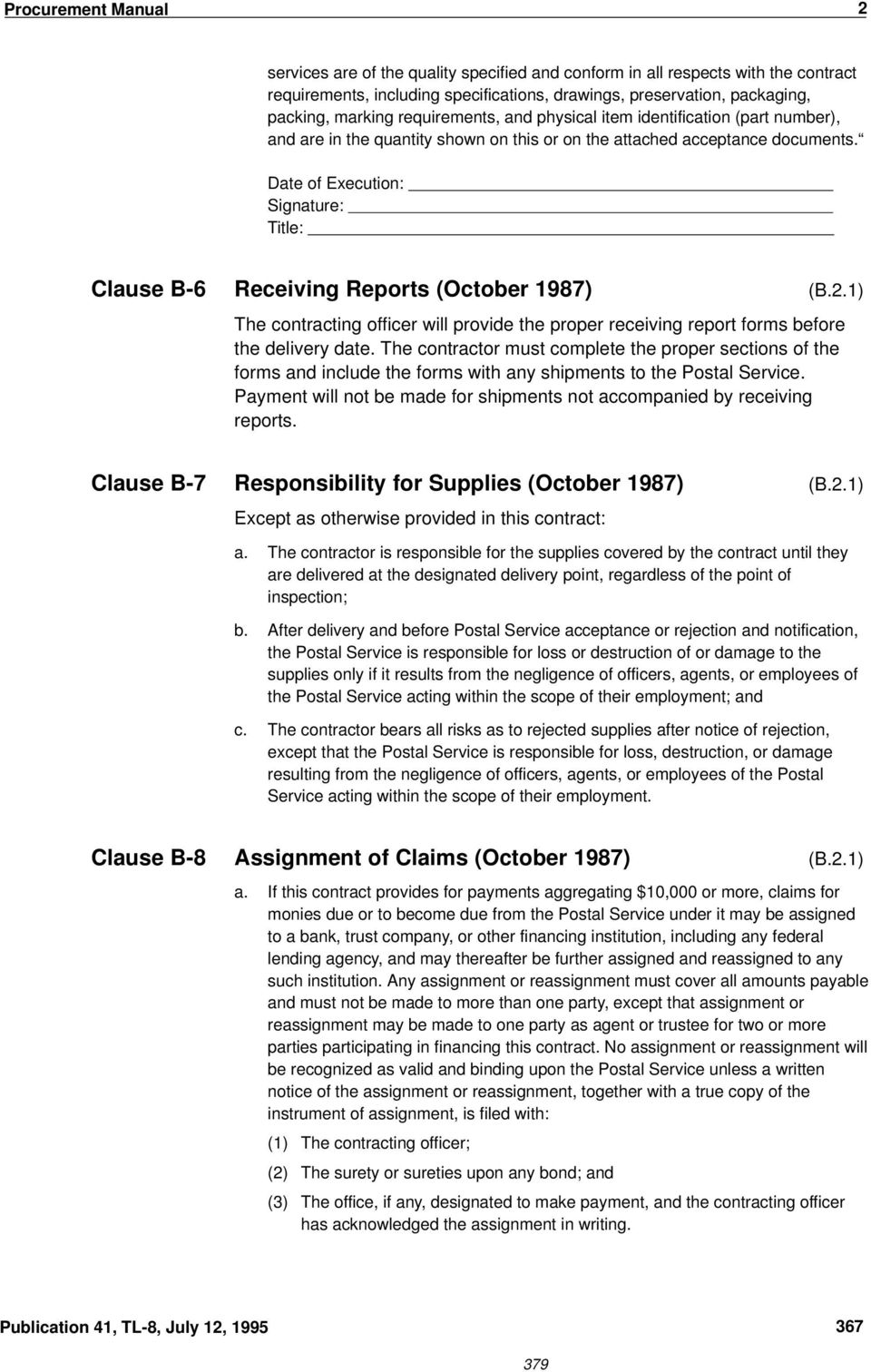
10 Procurement Manual 2 services are of the quality specified and conform in all respects with the contract requirements, including specifications, drawings, preservation, packaging, packing, marking requirements, and physical item identification (part number), and are in the quantity shown on this or on the attached acceptance documents. Date of Execution: Signature: Title: Clause B-6 Receiving Reports (October 1987) (B.2.1) The contracting officer will provide the proper receiving report forms before the delivery date. The contractor must complete the proper sections of the forms and include the forms with any shipments to the Postal Service. Payment will not be made for shipments not accompanied by receiving reports. Clause B-7 Responsibility for Supplies (October 1987) (B.2.1) Except as otherwise provided in this contract: a. The contractor is responsible for the supplies covered by the contract until they are delivered at the designated delivery point, regardless of the point of inspection; b. After delivery and before Postal Service acceptance or rejection and notification, the Postal Service is responsible for loss or destruction of or damage to the supplies only if it results from the negligence of officers, agents, or employees of the Postal Service acting within the scope of their employment; and c. The contractor bears all risks as to rejected supplies after notice of rejection, except that the Postal Service is responsible for loss, destruction, or damage resulting from the negligence of officers, agents, or employees of the Postal Service acting within the scope of their employment. Clause B-8 Assignment of Claims (October 1987) (B.2.1) a. If this contract provides for payments aggregating $10,000 or more, claims for monies due or to become due from the Postal Service under it may be assigned to a bank, trust company, or other financing institution, including any federal lending agency, and may thereafter be further assigned and reassigned to any such institution. Any assignment or reassignment must cover all amounts payable and must not be made to more than one party, except that assignment or reassignment may be made to one party as agent or trustee for two or more parties participating in financing this contract. No assignment or reassignment will be recognized as valid and binding upon the Postal Service unless a written notice of the assignment or reassignment, together with a true copy of the instrument of assignment, is filed with: (1) The contracting officer; (2) The surety or sureties upon any bond; and (3) The office, if any, designated to make payment, and the contracting officer has acknowledged the assignment in writing. Publication 41, TL-8, July 12,
11 2 Procurement Manual b. Assignment of this contract or any interest in this contract other than in accordance with the provisions of this clause will be grounds for termination of the contract for default at the option of the Postal Service. Clause B-9 Claims and Disputes (June 1988) (B.2.1) a. This contract is subject to the Contract Disputes Act of 1978 (41 U.S.C ) ( the Act ). b. Except as provided in the Act, all disputes arising under or relating to this contract must be resolved under this clause. c. Claim, as used in this clause, means a written demand or written assertion by one of the contracting parties seeking, as a matter of right, the payment of money in a sum certain, the adjustment or interpretation of contract terms, or other relief arising under or relating to this contract. However, a written demand or written assertion by the contractor seeking the payment of money exceeding $50,000 is not a claim under the Act until certified as required by subparagraph d.2 below. A voucher, invoice, or other routine request for payment that is not in dispute when submitted is not a claim under the Act. The submission may be converted to a claim under the Act by complying with the submission and certification requirements of this clause, if it is disputed either as to liability or amount is not acted upon in a reasonable time. d. (1) A claim by the contractor must be made in writing and submitted to the contracting officer for a written decision. A claim by the Postal Service against the contractor is subject to a written decision by the contracting officer. (2) For contractor claims exceeding $50,000, the contractor must submit with the claim a certification that: (a) The claim is made in good faith; (b) Supporting data are accurate and complete to the best of the contractor s knowledge and belief; and (c) The amount requested accurately reflects the contract adjustment for which the contractor believes the Postal Service is liable. (3) (a) If the contractor is an individual, the certification must be executed by that individual. (b) If the contractor is not an individual, the certification must be executed by: (i) A senior company official in charge at the contractor s plant or location involved; or (ii) An officer or general partner of the contractor having overall responsibility for the conduct of the contractor s affairs. e. For contractor claims of $50,000 or less, the contracting officer must, if requested in writing by the contractor, render a decision within 60 days of the request. For contractor-certified claims over $50,000, the contracting officer must, within 60 days, decide the claim or notify the contractor of the date by which the decision will be made. 368 Publication 41, TL-8, July 12,

12 Procurement Manual 2 f. The contracting officer s decision is final unless the contractor appeals or files a suit as provided in the Act. g. The Postal Service will pay interest in the amount found due and unpaid from: (1) The date the contracting officer receives the claim (properly certified, if required); or (2) The date payment otherwise would be due, if that date is later, until the date of payment. h. Simple interest on claims will be paid at a rate determined in accordance with the Interest clause. i. The contractor must proceed diligently with performance of this contract, pending final resolution of any request for relief, claim, appeal, or action arising under the contract, and comply with any decision of the contracting officer. Clause B-10 Pricing of Adjustments (October 1987) (B.2.1) When costs are a factor in determining any contract price adjustment under the Changes clause or any other provision of this contract, chapter 5 of the USPS Procurement Manual in effect on the date of this contract will serve as a guide in negotiating the adjustment. Clause B-11 Termination for Convenience (October 1987) (B.2.1) a. Performance under this contract may be terminated by the Postal Service in whole or in part whenever the contracting officer determines that termination is in the interest of the Postal Service. A termination may be effected by delivery to the contractor of a notice of termination specifying the extent of work terminated, and the effective date of the termination. b. Upon receipt of a notice of termination, unless otherwise directed by the contracting officer, the contractor must take the following actions: (1) Stop work to the extent specified in the notice. (2) Place no further orders or subcontracts for materials, services, or facilities except as may be necessary for completion of the unterminated work. (3) Terminate all orders and subcontracts to the extent that they relate to the work terminated. (4) Assign to the Postal service, as directed by the contracting officer, all right, title, and interest of the contractor under the orders and subcontracts terminated. The Postal Service has the right, in its discretion, to settle or pay claims arising out of these terminations. (5) Settle all outstanding liabilities and claims arising out of the termination of orders and subcontracts, with the approval or ratification of the contracting officer. The contracting officer s decision is final for the purposes of this clause. (6) Transfer title to the Postal Service and deliver as directed by the contracting officer: (a) Work in process, completed work, and other material produced as a part of or acquired for the work terminated; and Publication 41, TL-8, July 12,

13 2 Procurement Manual (b) The completed or partially completed plans, drawings, information, and other property that, if the contract had been completed, would have been furnished to the Postal Service. (7) Use its best efforts to sell as directed by the contracting officer any property of the types referred to in subparagraph b.6 above, provided that the contractor may acquire property under the conditions prescribed and at prices approved by the contracting officer, and the proceeds of any such transfer will be applied in reduction of any payments to be made by the Postal Service to the contractor, or be credited to the price or cost of the work covered by this contract, or be paid in any manner directed by the contracting officer. (8) Complete performance of the work not terminated. (9) Take any action that may be necessary, or that the contracting officer may direct, for protecting and preserving any property related to this contract that is in the possession of the contractor and in which the Postal Service has or may acquire an interest. c. At any time, the contractor may submit to the contracting officer a list, certified as to quantity and quality, of termination inventory not previously disposed of and may request the Postal Service to remove inventory items or enter into a storage agreement covering them. Not later than 15 days after receiving this request, the Postal Service will accept title to the items and remove them or enter into a storage agreement. The list will be subject to verification by the contracting officer upon removal of the items or, if the items are stored, within 45 days after submission of the list. d. After termination, the contractor must submit to the contracting officer a termination claim in the form and with the certification prescribed by the contracting officer. The claim must be submitted promptly, but in no event more than one year after the effective date of termination, unless an extension in writing is granted by the contracting officer. However, if the contracting officer determines that the facts justify such action, any termination claim may be received and acted upon at any time after the one-year period. Upon failure of the contractor to submit a termination claim within the time allowed, the contracting officer may determine, on the basis of the information available, the amount, if any, due the contractor by reason of the termination and will pay that amount. e. If the contractor and the contracting officer fail to agree on the amount to be paid to the contractor by reason of the termination, the contracting officer will determine the amount, if any, due the contractor and pay the contractor the contract price for completed and accepted supplies or services not previously paid for (adjusted for any saving of freight and other charges) and, with respect to all other contract work performed before the effective date of termination, the total of: (1) The cost of such work; (2) The cost of settling and paying claims arising out of the termination of work under subcontracts; and (3) A profit on e.1 above, determined by the contracting officer to be fair and reasonable; but if it appears that the contractor would have sustained a loss on the entire contract had it been completed, no profit will be included, and an appropriate adjustment will be made reducing the amount of the settlement to reflect the indicated rate of loss. 370 Publication 41, TL-8, July 12,

14 Procurement Manual 2 f. The total sum to be paid to the contractor may not exceed the total contract price as reduced by the payments made and as further reduced by the contract price of work not terminated. Except for normal spoilage, and except to the extent that the Postal Service expressly assumed the risk of loss, there will be excluded from the amounts payable to the contractor under paragraph e above, the fair value, as determined by the contracting officer, of property destroyed, lost, stolen, or damaged so as to become undeliverable to the Postal Service, or to a buyer. g. Any determination of costs will be governed by the cost principles set forth in chapter 5 of the USPS Procurement Manual in effect on the effective date of termination. h. The contractor has the right of review under the Claims and Disputes clause of any determination made by the contracting officer under paragraph d or e above, except that, if the contractor has failed to submit its termination claim within the time provided in paragraph d above and has failed to request an extension of time, there may be no right of review. i. In arriving at the amount due the contractor, there must be deducted: (1) All unliquidated advance or other payments to the contractor applicable to the terminated portion of this contract; (2) Any claim that the Postal Service may have against the contractor under this contract; and (3) The agreed price for or the proceeds of sale of materials, supplies, or other things kept by the contractor or sold and not recovered by or credited to the Postal Service. j. If the termination is partial, the contractor must file with the contracting officer a request in writing for an equitable adjustment of the price specified in the contract relating to the continued portion of the contract. k. The Postal Service may, under the terms and conditions it prescribes, make partial payments and payments on account in connection with the terminated portion of this contract whenever the aggregate of these payments is within the amount to which the contractor is entitled. l. Unless otherwise provided in this contract, or by statute, the contractor, for a period of three years after final settlement, must preserve and make available to the Postal Service at all reasonable times at the contractor s office, all books, records, documents, and other evidence bearing on the costs and expenses of the contractor under this contract and relating to the work terminated. If the contracting officer approves, photographs, microphotographs, or other authentic reproductions may be maintained instead of the originals. Clause B-12 Termination for Convenience or Default (October 1987) a. Performance under this contract may be terminated by the Postal Service in whole or in part whenever: (B.2.1) (1) The contractor defaults in performing this contract (including in the term default any refusal or failure to prosecute the work diligently enough to ensure its completion within the time specified or any extension), and fails to cure the default within ten days (or for a longer period as the contracting officer may allow) after receipt from the contracting officer of a notice specifying the default; or Publication 41, TL-8, July 12,

15 2 Procurement Manual (2) The contracting officer determines that termination is in the best interests of the Postal Service. A termination may be effected by delivery to the contractor of a notice of termination specifying whether the termination is for default or for the convenience of the Postal Service, the extent of work terminated, and the effective date of the termination. If, after notice of termination for default under subparagraph a.1 above, it is determined that the contractor was not in default or that the delay was excusable, the notice of termination will be deemed to have been issued for the convenience of the Postal Service. b. Upon receipt of a notice of termination, unless otherwise directed by the contracting officer, the contractor must take the following actions: (1) Stop work under the contract to the extent specified in the notice. (2) Place no further orders or subcontracts for materials, services, or facilities except as necessary for completion of the unterminated work. (3) Terminate all orders and subcontracts to the extent that they relate to the work terminated. (4) Assign to the Postal Service, as directed by the contracting officer, all right, title, and interest of the contractor under the orders and subcontracts terminated. The Postal Service has the right, in its discretion, to settle or pay claims arising out of these terminations. (5) Settle all outstanding liabilities and all claims arising out of the termination of orders and subcontracts, with the approval or ratification of the contracting officer. The contracting officer s decision is final for the purposes of this clause. (6) Transfer title to the Postal Service and deliver as directed by the contracting officer: (a) Work in process, completed work, and other material produced as a part of or acquired for the work terminated; and (b) The completed or partially plans, drawings, information, and other property that, if the contract had been completed, would have been furnished to the Postal Service. (7) Use its best efforts to sell as directed by the contracting officer any property of the types referred to in subparagraph b.6 above, provided that the contractor may acquire property under the conditions prescribed and at prices approved by the contracting officer, and the proceeds of any such transfer will be applied in reduction of any payments to be made by the Postal Service to the contractor, or be credited to the price or cost of the work covered by this contract or paid in any manner directed by the contracting officer. (8) Complete performance of the work not terminated. (9) Take any action that may be necessary, or that the contracting officer may direct, for protecting and preserving any property related to this contract that is in the possession of this contractor and in which the Postal Service has or may acquire an interest. c. At any time, the contractor may submit to the contracting officer a list, certified as to quantity and quality, of termination inventory not disposed of and may request the Postal Service to remove inventory items or enter into a storage agreement covering them. Not later than 15 days after receiving this request, the Postal Service will accept title to the items and remove them or enter into a storage 372 Publication 41, TL-8, July 12,

16 Procurement Manual 2 agreement. The list will be subject to verification by the contracting officer upon removal of the items or, if the items are stored, within 45 days after submission of the list. d. After termination, the contractor must submit to the contracting officer a termination claim in the form and with the certification prescribed by the contracting officer. The claim must be submitted promptly, but in no event more than 180 days after the effective date of termination, unless an extension in writing is granted by the contracting officer. However, if the contracting officer determines that the facts justify such action, any termination claim may be received and acted upon at any time after the 180-day period. Upon failure of the contractor to submit a termination claim within the time allowed, the contracting officer may determine, on the basis of information available, the amount, if any, due the contractor by reason of the termination and will pay that amount. e. Subject to the provision of paragraph d above, the contractor and the contracting officer may agree upon the whole or any part of the amount to be paid (including and allowance for the fee) to the contractor by reason of the termination. f. If the contractor and the contracting officer fail to agree on the amount with respect to cost or fee, the contracting officer will determine, on the basis of information available, the amount, if any, due the contractor and pay the contractor as follows: (1) If the settlement includes cost and fee: (a) All costs and expenses reimbursable in accordance with this contract, not previously paid to the contractor and such as may continue for a reasonable time after termination; (b) The cost of settling and paying claims arising out of the termination of work under subcontracts or orders; (c) The reasonable costs of settlement, including accounting, legal, clerical, and other expenses reasonably necessary for the preparation of settlement claims, together with reasonable storage, transportation, and other costs incurred in connection with protecting or disposing of the termination inventory (however, if the termination is for default, there must not be included any amount for the preparation of the contractor s settlement proposal); and (d) A portion of the fee payable under the contract, determined as follows: (i) In the event of termination for convenience, a percentage of the fee equivalent to the percentage of the completion of work contemplated by the contract, but exclusive of subcontract effort included in subcontractor s termination claims, less fee payments previously made; or (ii) In the event of termination for default, that proportionate part of the fee (or, if this contract calls for articles of different types, of such part of the fee as is reasonably allocable to the type of article under consideration) as the total number of articles accepted bears to the total number of articles of a like kind called for by this contract. If the amount determined under this subparagraph (2) is less than the total payment already made to the contractor, the contractor must repay to the Postal Service the excess. (2) If the settlement includes only the fee, its amount will be determined in accordance with f.1(d) above. Publication 41, TL-8, July 12,

17 2 Procurement Manual g. Costs claimed, agreed to, or determined pursuant to paragraphs c, d, and e above must be in accordance with chapter 5 of the USPS Procurement Manual in effect on the effective date of termination. The final settlement is limited as provided in the Limitation of Cost clause of this contract. h. The contractor has the right of review, under the Claims and Disputes clause, of any determination made by the contracting officer under paragraph d or f above, except that if the contractor fails to request an extension of time, the contractor will have no right of review. In any case where the contracting officer determines the amount due under paragraph d or f above, the Postal Service must pay to the contractor the following: (1) If there is no right of review under this clause or if no timely review has been taken, the amount determined by the contracting officer; or (2) If a review has been taken, the amount finally determined. i. There will be deducted: (1) All unliquidated advance or other payments made to the contractor applicable to the terminated portion of this contract; (2) Any claim the Postal Service may have against the contractor; and (3) The agreed price for, or the proceeds of sale of, any materials, supplies, or other things acquired by the contractor or sold in accordance with this clause. j. If the termination is partial, the portion of the fee payable for the continued portion of the contract must be equitably adjusted by agreement between the contractor and the contracting officer. k. The Postal Service may, under the terms and conditions it may prescribe, make partial payments against costs incurred by the contractor in connection with the terminated portion of the contract whenever, in the opinion of the contracting officer, the aggregate of the partial payments is within the amount to which the contractor will be entitled. If the total of these payments exceeds the amount finally determined to be due under this clause, the excess must be repaid to the Postal Service upon demand, together with interest calculated in accordance with the Interest clause of this contract, for the period from the date the excess payment is received by the contractor to the date on which the excess is repaid to the Postal Service. However, no interest will be charged with respect to an excess payment attributable to a reduction in the contractor s claim by reason of retention or other disposition of termination inventory, until ten days after the date of the retention or disposition. Clause B-13 Termination for Default (October 1987) (B.2.1) a. (1) The Postal Service may, subject to paragraphs c and d below, by written notice of default to the contractor, terminate this contract in whole or in part if the contractor fails to: (a) Complete the requirements of this contract within the time specified in the contract or any extension; (b) Make progress, so as to endanger performance of this contract (but see paragraph d below); or (c) Perform any of the other provisions of this contract (but see subparagraph a.2 following). 374 Publication 41, TL-8, July 12,

18 Procurement Manual 2 (2) The Postal Service s right to terminate this contract under a.1(b) and (c) above may be exercised if the contractor does not cure the failure within ten days (or more if authorized in writing by the contracting officer) after receipt of the notice from the contracting officer specifying the failure. b. If the Postal Service terminates this contract in whole or in part, it may acquire similar supplies or services or complete the work, and the contractor will be liable to the Postal Service for any excess costs. However, the contractor must continue the work not terminated. c. Except for defaults of subcontractors at any tier, the contractor is not liable for any excess costs if the failure to perform the contract arises from causes beyond the control and without the fault or negligence of the contractor. d. If the failure to perform is caused by the default of a subcontractor at any tier, and if the cause of the default is beyond the control of both the contractor and subcontractor, and without the fault or negligence of either, the contractor is not liable for any excess costs for failure to perform, unless the subcontractor supplies or services were obtainable from other sources in sufficient time for the contractor to meet the required delivery schedule. e. If this contract is terminated for default, the Postal Service may require the contractor to transfer title and deliver to the Postal Service, as directed by the contracting officer, any completed supplies, partially completed supplies, and materials, parts, tools, dies, jigs, fixtures, plans, drawings, information, and contract rights that the contractor has specifically produced or acquired for the terminated portion of this contract. Upon direction of the contracting officer, the contractor must also protect and preserve property in its possession in which the Postal Service has an interest. f. The Postal Service will pay the contract price for completed items delivered and accepted. The contractor and contracting officer may agree on the amount of payment for items delivered and accepted under paragraph e above for the protection and preservation of the property. Failure to agree will be a dispute under the Claims and Disputes clause. The Postal Service may withhold from these amounts any sum the contracting officer determines to be necessary to protect the Postal Service against loss because of outstanding claims. g. If, after termination, it is determined that the contractor was not in default, or that the delay was excusable, the rights and obligations of the parties will be the same as if the termination had been issued for convenience. h. The rights and remedies of the Postal Service under this clause are in addition to any other rights and remedies provided by law or under this contract. Clause B-14 Examination of Records (October 1987) (B.2.1) a. The Postal Service and its authorized representatives will, until three years after final payment under this contract, or for any shorter period specified for particular records, have access to and the right to examine any directly pertinent books, documents, papers, or other records of the contractor involving transactions related to this contract. b. The contractor agrees to include in all subcontracts under this contract a provision to the effect that the Postal Service and its authorized representatives will, until three years after final payment under the subcontract, or for any shorter specified period for particular records, have access to and the right to examine any directly pertinent books, documents, papers, or other records of the Publication 41, TL-8, July 12,

19 2 Procurement Manual subcontractor involving transactions related to the subcontract. The term subcontract as used in this clause excludes: (1) Purchase orders; and (2) Subcontracts for public utility services at rates established for uniform applicability to the general public. Clause B-15 Notice of Delay (October 1987) (B.2.1) Immediately upon becoming aware of any difficulties that might delay deliveries under this contract, the contractor will notify the contracting officer in writing of them. The notification must identify the difficulties, the reasons for them, and the estimated period of delay anticipated. Failure to give notice may preclude later consideration of any request for an extension of contract time. Clause B-16 Suspensions and Delays (October 1987) (B.2.1) a. If the performance of all or any part of the work of this contract is suspended, delayed, or interrupted by: (1) An order or act of the contracting officer in administering this contract; or (2) By a failure of the contracting officer to act within the time specified in this contract or within a reasonable time if not specified an adjustment will be made for any increase in the cost of performance of this contract caused by the delay or interruption (including the costs incurred during any suspension or interruption). An adjustment will also be made in the delivery or performance dates and any other contractual term or condition affected by the suspension, delay, or interruption. However, no adjustment may be made under this clause for any delay or interruption to the extent that performance would have been delayed or interrupted by any other cause, including the fault or negligence of the contractor, or for which an adjustment is provided or excluded under any other term or condition of this contract. b. A claim under this clause will not be allowed: (1) For any costs incurred more than 20 days before the contractor has notified the contracting officer in writing of the act or failure to act involved; and (2) Unless the claim, in an amount stated, is asserted in writing as soon as practicable after the termination of the delay or interruption, but not later than the day of final payment under the contract. Clause B-17 Disallowance of Costs (October 1987) (B.2.1) a. The contracting officer may at any time issue the contractor a written notice of intent to disallow specified costs under this contract that have been determined not to be allowable under the contract terms. b. The contractor may, after receiving a notice of intent to disallow costs, submit a written response to the contracting officer, with justification for allowance of the costs. If the contractor does respond within 60 days, the contracting officer will, within 60 days of receiving the response, either make a written withdrawal of the notice or issue a written decision. 376 Publication 41, TL-8, July 12,

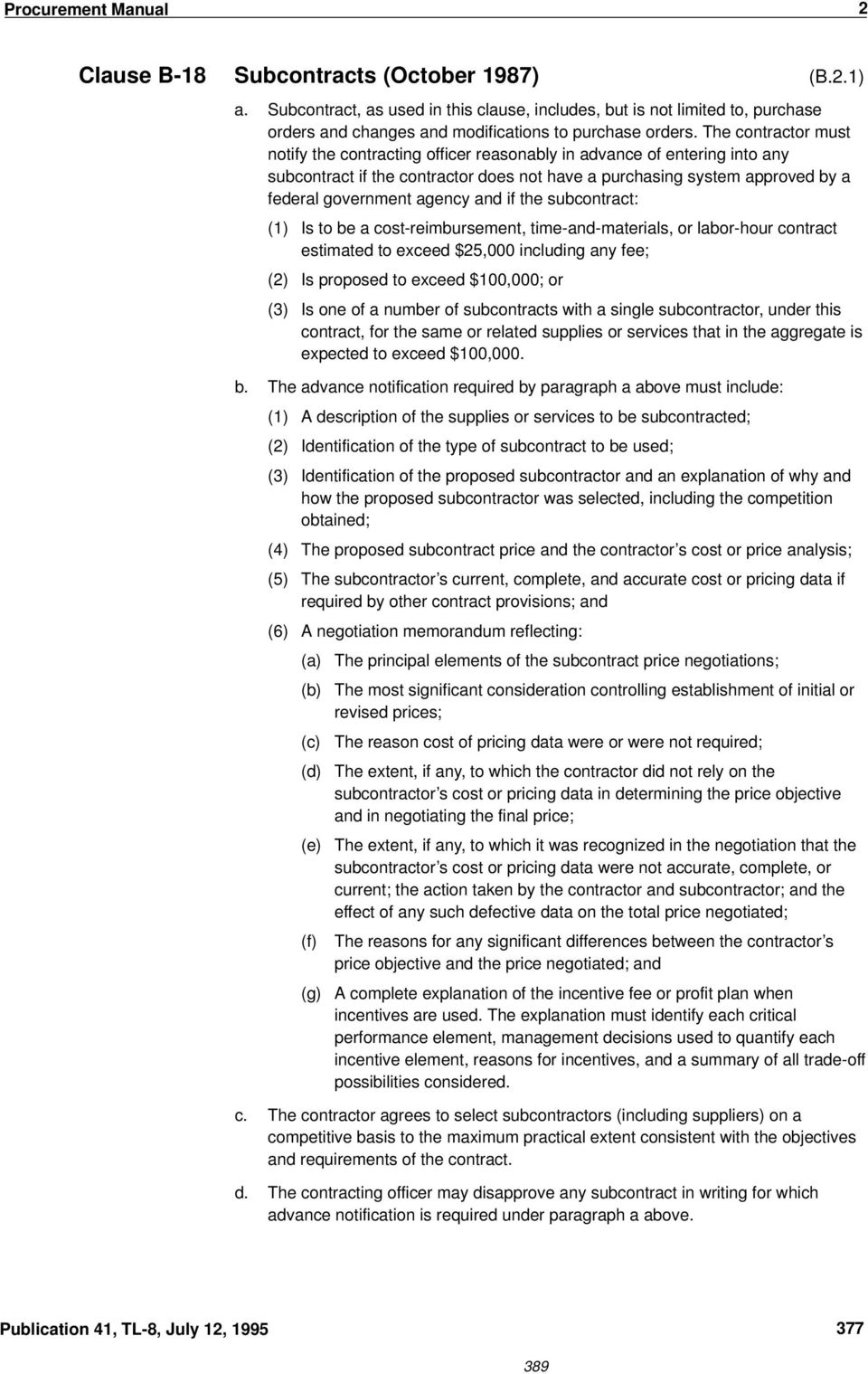
20 Procurement Manual 2 Clause B-18 Subcontracts (October 1987) (B.2.1) a. Subcontract, as used in this clause, includes, but is not limited to, purchase orders and changes and modifications to purchase orders. The contractor must notify the contracting officer reasonably in advance of entering into any subcontract if the contractor does not have a purchasing system approved by a federal government agency and if the subcontract: (1) Is to be a cost-reimbursement, time-and-materials, or labor-hour contract estimated to exceed $25,000 including any fee; (2) Is proposed to exceed $100,000; or (3) Is one of a number of subcontracts with a single subcontractor, under this contract, for the same or related supplies or services that in the aggregate is expected to exceed $100,000. b. The advance notification required by paragraph a above must include: (1) A description of the supplies or services to be subcontracted; (2) Identification of the type of subcontract to be used; (3) Identification of the proposed subcontractor and an explanation of why and how the proposed subcontractor was selected, including the competition obtained; (4) The proposed subcontract price and the contractor s cost or price analysis; (5) The subcontractor s current, complete, and accurate cost or pricing data if required by other contract provisions; and (6) A negotiation memorandum reflecting: (a) The principal elements of the subcontract price negotiations; (b) The most significant consideration controlling establishment of initial or revised prices; (c) The reason cost of pricing data were or were not required; (d) The extent, if any, to which the contractor did not rely on the subcontractor s cost or pricing data in determining the price objective and in negotiating the final price; (e) The extent, if any, to which it was recognized in the negotiation that the subcontractor s cost or pricing data were not accurate, complete, or current; the action taken by the contractor and subcontractor; and the effect of any such defective data on the total price negotiated; (f) The reasons for any significant differences between the contractor s price objective and the price negotiated; and (g) A complete explanation of the incentive fee or profit plan when incentives are used. The explanation must identify each critical performance element, management decisions used to quantify each incentive element, reasons for incentives, and a summary of all trade-off possibilities considered. c. The contractor agrees to select subcontractors (including suppliers) on a competitive basis to the maximum practical extent consistent with the objectives and requirements of the contract. d. The contracting officer may disapprove any subcontract in writing for which advance notification is required under paragraph a above. Publication 41, TL-8, July 12,
21 2 Procurement Manual e. Even if the contractor s purchasing system has been approved, the contractor must obtain the contracting officer s written consent before placing subcontracts that have been selected for special surveillance and so identified in the Schedule of the contract. f. The lack of disapproval does not constitute a determination: (1) Of the acceptability of any subcontract terms or conditions; (2) Of the acceptability of any subcontract price or of any amount paid under any subcontract; or (3) To relieve the contractor of any responsibility for performing this contract. g. No subcontract under this contract may provide for payment on a cost-plus-a-percentage-of-cost basis. Clause B-19 Excusable Delays (October 1987) (B.2.1) a. Except with respect to defaults of subcontractors, the contractor will not be in default by reason of any failure in performing this contract in accordance with its terms (including any failure by the contractor to make progress in the prosecution of the work that endangers performance) if the failure arises out of causes beyond the control and without the fault or negligence of the contractor. Such causes may include, but are not restricted to, acts of God or of the public enemy, acts of the government in its sovereign capacity or of the Postal Service in its contractual capacity, fires, floods, epidemics, quarantine restrictions, strikes, freight embargoes, and unusually severe weather, but in every case the failure to perform must be beyond the control and without the fault or negligence of the contractor. b. If failure to perform is caused by the failure of a subcontractor to perform or make progress and arises out of causes beyond the control of both the contractor and subcontractor, and without the fault or negligence of either of them, the contractor will not be deemed to be in default, unless: (1) The supplies or services to be furnished by the subcontractor are obtainable from other sources; (2) The contracting officer orders the contractor in writing to procure the supplies or services from other sources; and (3) The contractor fails to comply reasonably with the order. c. Upon request of the contractor, the contracting officer shall ascertain the facts and extent of failure, and if the contracting officer determines that any failure to perform was occasioned by any of the said causes, the delivery schedule shall be revised accordingly, subject to the rights of the Postal Service under any termination clause included in this contract. d. As used in this clause, the terms subcontractor and subcontractors mean subcontractor(s) at any tier. Clause B-20 Invoices (June 1988) (B.2.1) a. The contractor s invoices must be submitted before payment can be made. b. The contractor agrees that submission of an invoice to the Postal Service for payment is a certification that: 378 Publication 41, TL-8, July 12,
22 Procurement Manual 2 (1) Any services being billed for have been performed in accordance with the contract requirements; and (2) Any supplies for which the Postal Service is being billed have been shipped or delivered in accordance with shipping instructions issued by the contracting officer in the quantities shown on the invoice, and that the supplies are in the quantity and of the quality designated in the contract. c. To ensure prompt payment, an invoice must be submitted for each destination and each shipment. Each invoice must contain: (1) The contractor s name and address; (2) The contract number; (3) Any applicable task or delivery order number; (4) A description of the supplies or services and the dates delivered or performed; (5) The point of shipment or delivery; (6) Any applicable unit prices and extensions; (7) Shipping and payment terms; and (8) Any additional information required by the contract. Clause B-21 Change-Order Accounting (October 1987) (B.2.1) The contracting officer may require change-order accounting whenever the estimated cost of a change or series of related changes exceeds $100,000. The contractor, for each change or series of related changes, must maintain separate accounts, by job order or other suitable accounting procedure, of all incurred segregable, direct costs (less allocable credits) or work, both changed and not changed, allocable to the change. The contractor will maintain such accounts until the parties agree to an equitable adjustment for the changes ordered by the contracting officer or the matter is finally disposed of in accordance with the Claims and Disputes clause. Clause B-22 Interest (December 1989) (B.2.1) The Postal Service will pay interest on late payments and unearned prompt payment discounts in accordance with the Prompt Payment Act, 31 U.S.C et. seq., as amended by the Prompt Payment Act Amendments of 1988, P.L Clause B-23 Guaranteed Shipping Weight (October 1987) (B.2.1) a. This clause applies if this contract contains a guaranteed shipping-weight provision. b. The contractor is responsible for the actual weight at the time of shipment. If the shipping weight exceeds the specified guaranteed shipping weight, the contractor will be liable for any resulting excess transportation costs. c. The contractor must determine the excess transportation costs and deduct them from the invoice, making reference on it to the applicable bill of lading numbers. Publication 41, TL-8, July 12,
23 2 Procurement Manual d. When the excess transportation costs are not known and timely notification is not made to the contracting officer for possible price adjustment, 2 percent of the invoice amount covering each shipment with excess weight may be withheld until the Postal Service can calculate the excess costs. In this case, an administrative-cost fee of $50 per shipment will be assessed in addition to any excess transportation costs incurred. Clause B-24 Frequency Authorization (October 1987) (B.2.1) a. Authorization of radio frequencies required in support of this contract must be obtained through the contracting officer by the contractor or subcontractor in need thereof. Frequency-management procedures prescribed in the schedule of this contract must be followed in obtaining radio frequency authorization. b. For any experimental, developmental, or operational equipment for which the appropriate frequency allocation has not been made, the contractor or subcontractor must provide technical operating characteristics of the proposed electromagnetic radiating device to the contracting officer during the initial planning, experimental, or developmental phases of contractual performance. c. This clause, including this paragraph c, must be included in all subcontracts that call for developing, producing, testing, or operating a device for which a radio-frequency authorization is required. Clause B-25 Advertising of Contract Awards (June 1988) (B.2.1) Except with the contracting officer s prior approval, the contractor agrees not to refer in its commercial advertising to the fact that it was awarded a Postal Service contract or to imply in any manner that the Postal Service endorses its products. Clause B-26 Protection of Postal Service Buildings, Equipment, and Vegetation (October 1987) (B.2.1) The contractor must use reasonable care to avoid damaging buildings, equipment, and vegetation (such as trees, shrubs, and grass) on the Postal Service installation. If the contractor fails to do so and damages any buildings, equipment, or vegetation, the contractor must replace or repair the damage at no expense to the Postal Service, as directed by the contracting officer. If the contractor fails or refuses to make repair or replacement, the contractor will be liable for the cost of repair or replacement, which may be deducted from the contract price. Clause B-27 Performance at Occupied Postal Premises (October 1987) a. In performing this contract, the contractor must: (B.2.1) (1) Comply with applicable Occupational Safety and Health Standards (29 CFR 1910) promulgated pursuant to the authority of the Occupational Safety and Health Act of 1970; 380 Publication 41, TL-8, July 12,
24 Procurement Manual 2 (2) Comply with any other applicable federal, state, or local regulations governing work-place safety to the extent they do not conflict with a.1 above; and (3) Take all other proper precautions to protect the safety and health of the contractor s employees, Postal Service employees, and the public. b. The contractor must coordinate its use of the premises with the installation head or other representative designated by the contracting officer. Subjects of this coordination include the designation of work and storage areas; the extent, if any, of use by the contractor of Postal Service tools and equipment; the furnishing by the contractor of appropriate signs and barricades to exclude unauthorized personnel from the work areas and to call attention to hazards and dangers; and other matters relating to the protection of Postal Service employees and property. Clause B-28 Safety and Health Standards (October 1987) (B.2.1) a. Materials, supplies, articles, or equipment manufactured or furnished under this contract or order must conform to the Occupational Safety and Health Standards (29 CFR 1910) pursuant to authority in the Occupational Safety and Health Act of 1970 (OSHA), and to other safety and health requirements specified in this contract or order. b. If no OSHA standard exists, federal or other nationally recognized standards apply. Copies of current Occupational Safety and Health Standards are available from regional and/or area offices of the U.S. Department of Labor, Occupational Safety and Health Administration. c. If this contract or order contains a Postal Service standard and an OSHA standard covering the same general area of applicability, the Postal Service standard governs and takes precedence, unless the OSHA standard contains more rigorous or stringent safety requirements, in which case the OSHA standard governs and takes precedence. d. Upon delivery of the first article under the contract or order, or if none, upon delivery of the first production quantity, the contractor must execute a certification in a form acceptable to the contracting officer, attesting to the conformance of the delivered items to the requirements of this clause. Clause B-29 Order of Precedence (February 1991) (B.2.1) Any inconsistency in the provisions of a solicitation, a contract awarded under a solicitation, or a contract awarded without the issuance of a written solicitation will be resolved by giving precedence in the following order: a. The Schedule. b. The solicitation provisions and instructions. c. Special clauses and general clauses. d. Provisions contained in attachments or incorporated by reference. Clause B-30 Permits and Responsibilities (Services) (April 1993) (B.2.1) The contractor is responsible, without additional expense to the Postal Service, for obtaining any necessary licenses and permits, and for complying Publication 41, TL-8, July 12,
25 2 Procurement Manual with any applicable federal, state, and municipal laws, codes, and regulations in connection with the performance of the contract. The contractor is responsible for all damage to persons or property, including environmental damage, that occurs as a result of its omission(s) or negligence. The contractor must take proper safety and health precautions to protect the work, the workers, the public, the environment, and the property of others. Clause 1-1 Privacy Act (October 1987) (1.7.5) a. This contract requires the contractor to design, develop, or operate a system of records on individuals to accomplish a Postal Service function. Section 3 of the Privacy Act of 1974 (5 U.S.C. 552a) and 39 CFR apply to this system of records. Violation of the Act may subject the violator to criminal penalties (5 U.S.C. 552a(m)). b. The contractor agrees to: (1) Comply with the Act, and Postal Service regulations issued under it, in designing, developing, or operating any system of records on individuals to accomplish a Postal Service function, when the contract specifically identifies (a) the system of records and (b) the work the contractor is to perform in designing, developing, or operating it; (2) Design or develop the system in such a way that it can be operated in accordance with the Act and regulations; and (3) Include this clause, including this subparagraph b.3, in all subcontracts under this contract that require designing, developing, or operating such a system. c. The Privacy Act safeguards the individual s right of privacy concerning any system of records operated under this contract. Records must be current and accurate for the intended use, and adequate safeguards must be provided to prevent misuse of personal information. d. Violations of the Act may subject the Postal Service to civil liability, and its officers or employees to criminal liability. For purposes of the criminal penalties only, the contractor and its employees operating a system of records on individuals to accomplish a Postal Service function are considered employees of the Postal Service. e. As used in this clause: (1) Operating a system of records means performing any of the activities associated with managing the system of records, including the collection, revision, and dissemination of records; (2) Records means any item, collection, or grouping of information about an individual maintained by the Postal Service, including, but not limited to, education, financial transactions, medical history, and criminal or employment history, and containing the individual s name or a number, symbol, or other identifying particular assigned to the individual, such as a fingerprint, voiceprint, or photograph; and (3) System of records on individuals means a group of any records under the control of the Postal Service from which information is retrieved by the name of the individual or by some number, symbol, or other identifying particular assigned to the individual. 382 Publication 41, TL-8, July 12,
26 Procurement Manual 2 Clause 1-2 Advance Payments (June 1988) (1.7.6) a. Requirements for Payments. Upon contractor submission of properly certified invoices or vouchers and contracting officer approval, advance payments will be made under this contract. The contractor will apply terms similar to those of this clause to any advance payments to subcontractors. b. Use of Funds. The contractor may pay only for properly allocable, allowable, and reasonable costs incurred. Determinations of whether costs are properly allocable, allowable, and reasonable will be in accordance with generally accepted accounting principles, subject to chapter 5, section 2, of the USPS Procurement Manual as in effect on the date of this contract. c. Repayment to the Postal Service. At any time, the contractor may repay all or part of the funds advanced by the Postal Service. When requested in writing to do so by the administering office, the contractor must repay to the Postal Service any part of unliquidated advance payments considered by the administering office to exceed the contractor s current requirements or an amount calculated in accordance with paragraph d below. d. Maximum Payment. When the sum of all unliquidated advance payments exceeds 80 percent of the contract price, the Postal Service will withhold further payments. On contract completion or termination, the Postal Service will deduct from the amount due the contractor all interest charges payable. If previous payments to the contractor exceed the amount due, the excess amount must be paid to the Postal Service on demand. For purposes of this paragraph d, the contract price is the contract price stated at time of award, less any subsequent price reductions under the contract, plus any price increases resulting from any terms of the contract. Any payments withheld under this paragraph will be applied to reduce the unliquidated advance payments. If full liquidation has been made, payments under the contract will resume. e. Interest (1) The contractor must pay interest to the Postal Service on the daily balance of unliquidated advance payments at the daily rate specified in subparagraph e.3 below. Interest will be computed at the end of each calendar month for the actual number of days involved. For the purpose of computing interest: (a) Advance payments will be considered as increasing the unliquidated balance as of the date of the advance payment check; (b) Repayment of the contractor s check will be considered as decreasing the unliquidated balance as of the date on which the check is received by the Postal Service authority designated by the contracting officer; and (c) Liquidations by deductions from Postal Service payments to the contractor will be considered as decreasing the unliquidated balance as of the date of the check for the reduced payment. (2) Interest charges resulting from the monthly computation will be deducted from payments, other than advance payments, due the contractor. If the accrued interest exceeds the payment due, any excess interest will be carried forward and deducted from subsequent payments. Interest carried forward will not be compounded. Interest on advance payments will cease to accrue upon satisfactory completion or termination of the contract for the convenience of the Postal Service. The Postal Service will charge interest on advance payments to subcontractors in the manner described above. Publication 41, TL-8, July 12,
27 2 Procurement Manual (3) If interest is required under the contract, it will be paid at the rate determined in accordance with the Interest clause of this contract. (4) If the full amount of interest charged under this paragraph e has not been paid by deduction or otherwise upon completion or termination of this contract, the contractor must pay the remaining interest to the Postal Service on demand. f. Lien on Property under Contract (1) All advance payments under this contract, together with interest charges, must be secured, when made, by a lien in favor of the Postal Service, paramount to all other liens, on the supplies or other things covered by the contract and on all material and other property acquired for or allocated to its performance, except to the extent that the Postal Service already has valid title to the supplies, materials, or other property as against the contractor s other creditors. (2) The contractor will prepare any documents necessary to perfect liens on such property required in any jurisdiction in which any such property is kept. The documents must be approved by the contracting officer and, upon approval, filed with appropriate jurisdictions. The contractor must pay any fees required for filing. (3) The contractor must identify, by marking or segregation, all property subject to a lien in favor of the Postal Service by virtue of this contract so as to indicate that it is subject to a lien and has been acquired for or allocated to performing the contract. If, for any reason, the property is not identified by marking or segregation, the Postal Service will have a lien to the extent of the Postal Service s interest under the contract on any mass of property with which the supplies, materials, or other property are commingled. The contractor must maintain adequate accounting control over the property on its books and records. (4) If, under any termination clause in this contract, the contracting officer authorizes the contractor to sell or retain termination inventory, the approval constitutes a release of the Postal Service s lien to the extent that: (a) The termination inventory is sold or retained; and (b) The sale proceeds or retention credits are applied to reduce any outstanding advance payments. (5) If the contractor delivers to a third party any property on which the Postal Service has a lien, the contractor must notify the third party of the lien and obtain a receipt in duplicate acknowledging the existence of the lien. The contractor must give the contracting officer one copy of the receipt. g. Insurance. The contractor warrants that it maintains with responsible insurance carriers: (1) Insurance on plant and equipment against fire and other hazards, to the extent that similar properties are usually insured by others operating plants and properties of similar character in the same general locality; (2) Adequate insurance against liability on account of damage to persons or property; and (3) Adequate insurance under all applicable workers compensation laws. The contractor agrees that, until work under this contract has been completed and all advance payments made under the contract have been liquidated, it will maintain this insurance; maintain adequate insurance on all materials, 384 Publication 41, TL-8, July 12,
28 Procurement Manual 2 parts, assemblies, subassemblies, supplies, equipment, and other property acquired for or allocable to this contract and subject to the Postal Service lien under paragraph f above; and furnish any certificate with respect to its insurance that the contracting officer may require. h. Default (1) By written notice to the contractor, the Postal Service may withhold further payments on this contract in the event of: (a) Termination for default; (b) A finding by the contracting officer that the contractor will be unable to perform or has failed to: (i) Observe any conditions of the advance payment terms; (ii) Comply with any material term of the contract; (iii) Make progress or maintain a financial condition adequate for performance of the contract; (iv) Limit inventory allocated to the contract to reasonable requirements; or (v) Avoid delinquency in payment of taxes or of the costs of performing this contract in the ordinary course of business; or (c) The appointment of a trustee, receiver, or liquidator for any substantial part of the contractor s property, or the institution of proceedings by or against the contractor for bankruptcy, reorganization, arrangement, or liquidation. (2) If any of the events described in subparagraph h.1 above continues for 30 days after the notice to the contractor, the Postal Service may take any of the following actions: (a) Charge interest, in the manner prescribed in paragraph e above, on outstanding advance payments during the period of the event. (b) Demand immediate repayment by the contractor of the unliquidated balance of advance payments. (c) Take possession of and sell any property on which the Postal Service has a lien under the contract and, after deducting any expenses incident to the sale, apply the proceeds to reduce the unliquidated balance of advance payments or other claims against the contractor. (3) The actions described in this clause are in addition to any other rights of the Postal Service. i. Prohibition Against Assignment. Notwithstanding any other terms of this contract, the contractor may not assign it, any interest in it, or any claim under it to any party. j. Information and Access to Records. The contractor must furnish to the administering office (1) monthly (or at other intervals as required) signed or certified balance sheets and profit and loss statements in the form prescribed by the contracting officer; and (2) if requested, other information concerning the operation of the contractor s business. The contractor must provide authorized Postal Service representatives proper facilities for inspecting the contractor s books, records, and accounts. Publication 41, TL-8, July 12,
29 2 Procurement Manual k. Other Security. If the contracting officer considers the security inadequate, the contractor must furnish additional security satisfactory to the contracting officer to the extent it is available. l. Representations and Warranties. (1) The balance sheet, the profit and loss statement, and any other supporting financial statements furnished the contracting officer fairly reflect the contractor s financial condition at the date shown or during the period covered, and there has been no subsequent materially adverse change; (2) No litigation or proceedings are presently pending or threatened against the contractor, except as shown in the statements; (3) The contractor has disclosed all contingent liabilities in the statements; (4) None of the terms in this clause conflict with the authority under which the contractor is doing business or with the provision of any existing indenture, assignment, or agreement of the contractor; (5) The contractor has the power to enter into this contract and to accept advance payments, and has taken all necessary action to authorize their acceptance under the terms of the contract; (6) The contractor s assets are not subject to any lien or encumbrance except for current taxes not delinquent or as shown in the statements; (7) All information furnished in connection with each request for advance payments is true and correct; and (8) These representations and warranties are continuing and are considered to have been repeated by the submission of each invoice for advance payment. m. Notice. The contractor must notify the contracting officer in writing within 30 days of any material change in anything represented or warranted in paragraph 1 above. n. Covenants. While any advance payments made under this contract remain outstanding, the contractor, without the prior written consent of the contracting officer, may not: (1) Mortgage, pledge, or otherwise encumber or allow to be encumbered any of the contractor s assets now owned or subsequently acquired, or permit any preexisting mortgages, liens, or other encumbrances to remain on or attach to any assets allocated to performing this contract with respect to which the Postal Service has a lien under the contract; (2) Sell, assign, transfer, or otherwise dispose of accounts receivable, notes, or claims for amounts due or to become due; (3) Sell, convey, or lease any substantial part of its assets; (4) Make any advance or loan or incur any liability as guarantor, surety, or accommodation endorser for any party; (5) Permit a writ of attachment or any similar process to be issued against its property without getting a release or bonding the property within 30 days after the entry of the writ of attachment or other process; (6) Pay any remuneration to its directors, officers, or key employees at rates higher than provided in existing agreements; (7) Change substantially its management, ownership, or control; 386 Publication 41, TL-8, July 12,
30 Procurement Manual 2 (8) Merge or consolidate with any other firm or corporation, change the type business, or engage in any transaction outside the ordinary course of the contractor s business as presently conducted; (9) Deposit any of its funds except in a bank or trust company insured by the Federal Deposit Insurance Corporation; (10) Create or incur indebtedness for advances (other than those to be made under the terms of this contract) or borrowings; or (11) Permit its net current assets, computed in accordance with generally accepted accounting principles, to become less than 80 percent of the assets shown in the last quarterly financial statement issued before contract award. Clause 1-3 Progress Payments (December 1989) (1.7.6) Progress payments will be made to the contractor when requested as work progresses, but not more often than monthly, in amounts approved by the contracting officer, upon the following terms and conditions: a. Computation of Amounts (1) No progress payments may exceed 80 percent of the amount of the contractor s total costs, plus the amount of progress payments that have been paid to contractor s subcontractors and other divisions. (2) The contractor s total costs must be reasonable, allocable to this contract, and consistent with sound and generally accepted accounting principles and practices. These costs may not include: (a) Any incurred by subcontractors or suppliers; (b) Any payments or amounts payable to subcontractors or suppliers, except for completed work (including partial deliveries) to which the contractor has acquired title and except for amounts paid under cost-reimbursement or time-and-materials subcontracts for work to which the contractor has acquired title; or (c) Costs ordinarily capitalized and subject to depreciation or amortization, except for the properly depreciated or amortized portion of such costs. (3) The aggregate amount of progress payments made must not exceed 80 percent of the total contract price. (4) If at any time a progress payment or the unliquidated progress payments exceed the amount permitted by this paragraph a, the contractor must pay the excess to the Postal Service upon demand. b. Liquidation. Except as provided in the Termination for Convenience clause, all progress payments must be liquidated by deducting from any payment under this contract, other than advance or progress, the amount of unliquidated progress payments, or 80 percent of the gross amount invoiced, whichever is less. Repayment to the Postal Service required by a retroactive price reduction will be made after calculating liquidations and payments on past invoices at the reduced prices and adjusting the unliquidated progress payments accordingly. c. Reduction or Suspension. The contracting officer may reduce or suspend progress payments, or liquidate them at a rate higher than the percentage stated in paragraph b above, or both, whenever the contracting officer finds, upon substantial evidence, that the contractor: Publication 41, TL-8, July 12,
31 2 Procurement Manual (1) Has failed to comply with any material requirement of this contract; (2) Has so failed to make progress, or is in such unsatisfactory financial condition, as to endanger performance of this contract; (3) Has allocated inventory to this contract substantially exceeding reasonable requirements; (4) Is delinquent in payment of the costs of performance of this contract in the ordinary course of business; or (5) Has so failed to make progress that the unliquidated progress payments exceed the fair value of the work accomplished on the endelivered portion of this contract. d. Title (1) Immediately upon the date of this contract, title to all parts; materials; inventories; work in process; special tooling; nondurable (i.e., noncapital) tools, jigs, dies, fixtures, molds, patterns, taps, gauges, test equipment, and other similar manufacturing aids; and drawings and technical data (to the extent that their delivery is required by other provisions of this contract), previously acquired or produced by the contractor and allocated or properly chargeable to this contract under sound and generally accepted accounting principles and practices, will be vested in the Postal Service. Title to all similar property afterwards acquired or produced by the contractor and allocated or properly chargeable to this contract as aforesaid will be vested in the Postal Service upon said acquisition, production, or allocation. (2) Notwithstanding that title to property is in the Postal Service through the operation of this clause, the handling and disposition of such property will be determined by the applicable provisions of this contract (e.g., paragraph h of this Progress Payments clause, and any termination clause included in the contract). Current production scrap may be sold by the contractor without approval of the contracting officer; in this case, the proceeds must be credited against the costs of contract performance. With the consent of the contracting officer, and on terms approved by the contractor, the contractor may acquire or dispose of property to which title is vested in the Postal Service under this clause, and, in that event, the costs allocable to the property so transferred from this contract must be eliminated from the costs of contract performance and the contractor must repay to the Postal Service (by cash or credit memorandum) an amount equal to the unliquidated progress payments allocable to the property so transferred. (3) Upon completion of performance of all the obligations of the contractor under this contract, including liquidation of all progress payments under this clause, title to all property (or the proceeds thereof) not delivered to, and accepted by, the Postal Service under this contract, or not incorporated in supplies delivered and accepted and to which title has been vested in the Postal Service under this clause, will be vested in the contractor. The provisions of this contract referring to or defining liability for Postal Service-furnished property do not apply to property to which the Postal Service acquires title solely by virtue of this clause. e. Risk of Loss. Except to the extent that the Postal Service otherwise expressly assumes the risk of loss of property, title to which is vested in the Postal Service by this clause, in the event of the loss, theft, or destruction of or damage to any such property before its delivery to, and acceptance by, the Postal Service, the contractor must bear the risk of loss and must repay the Postal Service an 388 Publication 41, TL-8, July 12,
32 Procurement Manual 2 amount equal to the unliquidated progress payments on the basis of costs allocable to such lost, stolen, destroyed, or damaged property. f. Control of Costs and Property. The contractor must maintain an accounting system and controls adequate for the proper administration of this clause. g. Reports Access to Records. The contractor must: (1) Furnish promptly such relevant reports, certificates, financial statements, and other information as may be reasonably requested by the contracting officer; and (2) Give the Postal Service reasonable opportunity to examine and verify the contractor s books, records, and accounts. h. Special Provisions Regarding Default. If this contract is terminated for default: (1) The contractor must, upon demand, pay the Postal Service the amount of unliquidated progress payments; and (2) With respect to all property for which the Postal Service elects not to require delivery, title will be vested in the contractor upon full liquidation of progress payments, and the Postal Service will not be liable for payment. i. Reservation of Rights. The rights and remedies of the Postal Service provided in this clause are not exclusive and are in addition to any other rights and remedies provided by law or under this contract. No payment, or vesting of title under this clause, will excuse the contractor from obligations under this contract or constitute a waiver of any of the rights and remedies of the parties under this contract. No delay or failure of the Postal Service in exercising any right, power, or privilege under this clause will affect any such right, power, or privilege; nor will any single or partial exercise thereof preclude or impair any further exercise thereof or the exercise of any other right, power, or privilege of the Postal Service. j. Progress Payments to Subcontractors (1) Progress payments may include reimbursements for unliquidated progress payments paid by the contractor to subcontractors or other divisions under provisions which conform to subparagraph j.2 following. (2) Provisions regarding progress payments must: (a) Be substantially similar to and as favorable to the Postal Service as is this Progress Payments clause, no more favorable to the subcontractor or the other division than this clause is to the contractor, and on a basis of not more than 80 percent of total costs; and (b) Make all rights of the subcontractor with respect to all property to which the Postal Service has title under the subcontract subordinate to the rights of the Postal Service to require delivery of such property to it in the event of default by the contractor under this contract or in the event of the bankruptcy or insolvency of the subcontractor. (3) The Postal Service agrees that any proceeds received by it from property to which it has acquired title by virtue of such provisions in any subcontract must be applied to reduce the amount of unliquidated progress payments made by the Postal Service to the contractor under this contract. In the event that the contractor fully liquidates such progress payments made by the Postal Service to the contractor hereunder and there are unliquidated progress payments to any subcontractors, the contractor must be subrogated to all the Postal Service rights by virtue of such provisions in the Publication 41, TL-8, July 12,
33 2 Procurement Manual subcontract or subcontracts involved as if all such rights had been thereupon assigned and transferred to the contractor. k. Requests. Contractor s requests for progress payments under this clause must be submitted on Form 7305, Contractor s Request for Progress Payment. Clause 1-4 (Reserved) Clause 1-5 Gratuities or Gifts (April 1993) (1.7.9) a. The Postal Service may terminate this contract for default if, after notice and a hearing, the Postal Service Board of Contract Appeals determines that the contractor or the contractor s agent or other representative: (1) Offered or gave a gratuity or gift (as defined in 5 CFR 2635) to an officer or employee of the Postal Service; and (2) Intended by the gratuity or gift to obtain a contract or favorable treatment under a contract. b. The rights and remedies of the Postal Service provided in this clause are in addition to any other rights and remedies provided by law or under this contract. Clause 1-6 Contingent Fees (October 1987) (1.9.2) a. The contractor warrants that no person or selling agency has been employed or retained to solicit or obtain this contract for a commission, percentage, brokerage, or contingent fee, except bona fide employees or bona fide, established commercial or selling agencies employed by the contractor for the purpose of obtaining business. b. For breach or violation of this warranty, the Postal Service has the right to annul this contract without liability or to deduct from the contract price or otherwise recover the full amount of the commission, percentage, brokerage fee, or contingent fee. Clause 1-7 Non-Disclosure of Address Information (January 1991) (1.7.4) a. General. This contract requires the contractor to have access to address information (i.e., addresses and return addresses) that appears on pieces of mail. To ensure the confidentiality of this address information, except as permitted by this clause, no contractor or subcontractor, and no employee or former employee of any contractor or subcontractor may, at any time, during or after the completion of this contract, disclose to any third party any address information obtained in the performance of this contract. This contract does not give the contractor proprietary interest in address information, and the contractor s right to have, use, and disclose address information is restricted by the terms of this clause. b. Restriction of Access. The contractor agrees to control and restrict access to address information to persons who need it to perform work under this contract, and to prohibit the reproduction of this information. 390 Publication 41, TL-8, July 12,
34 Procurement Manual 2 c. Confidentiality and Non-Disclosure Agreement. The contractor must require an employee (including any employee of a subcontractor) to sign the following agreement before the employee is granted access to address information: CONFIDENTIALITY AND NON-DISCLOSURE AGREEMENT I agree to hold in confidence any and all address information (i.e., addresses and return addresses) disclosed by the Postal Service or otherwise obtained or developed in the course of performance under Postal Service contract No.. I understand that no address information may be disclosed to any third party without prior written consent of the United States Postal Service. Signature Date d. Legal Demands for Information. If a legal demand is made for address information (such as by subpoena), the contractor will immediately notify the contracting officer and the nearest office of the postal inspectors. After notification, the Postal Service will then determine whether and to what extent, to resist the legal demand. Should the Postal Service give in to or unsuccessfully resist a legal demand, the contractor may, with the written permission of the contracting officer, release that address information specifically requested by the legal demand. e. Indemnification. The contractor will indemnify the Postal Service, its employees and agents, against all liability (including costs and fees) for damages arising out of the intentional or negligent disclosure of address information other than as permitted by this clause. f. Subcontracts. The contractor must include this clause, modified as necessary, in any subcontract. Clause 2-1 Inspection Fixed-Price (January 1991) (2.2.1) a. The Postal Service may inspect the supplies or service provided under this contract at any stage of contract performance and at any place, including the contractor s facility. b. The Postal Service may reject defective supplies or services and: (1) Require replacement or correction of the defects; (2) Acquire other products and charge the contractor for any costs incurred by the Postal Service; or (3) Accept the supplies or services at a reduced price. c. The Postal Service may terminate the contract for default and seek any remedy allowed by law if the contractor does not maintain an acceptable inspection system or promptly follow Postal Service directions to replace or correct. d. The contractor must provide facilities and reasonable assistance, without charge, to Postal Service inspectors when requested. e. The contractor will be charged at the rate of $50.00 per work-hour for: Publication 41, TL-8, July 12,
35 2 Procurement Manual (1) The total time, including round-trip travel time, lost by Postal Service representatives when the contractor is not ready for inspection at the time inspection and testing is requested by the contractor; and (2) The total time, including round-trip travel time, required by Postal Service representatives for reinspection and retesting necessitated by rejection. Charges other than these, for any retesting caused by rejection, will be the actual laboratory cost as obtained from the National Bureau of Standards or other testing laboratory. f. Inspection does not relieve the contractor of liability for defects. g. The contractor must use a written inspection/quality control system acceptable to the Postal Service. Records of all inspection work must be kept and made available to the Postal Service during performance of this contract and for at least three years after acceptance. The Postal Service has the right to evaluate the acceptability and effectiveness of the contractor s inspection system before award and during contract performance. This evaluation may be used to determine the extent of Postal Service inspection and testing, but this does not waive its right to inspect and test all items. As a minimum, the contractor s inspection/quality control system must reflect controls and record keeping in the following functional areas: (1) Receiving Inspection (2) In-Process Inspection (3) Final Inspection and Test (including packaging) (4) Calibration of Inspection/Test equipment (5) Control or Disposition of Nonconforming Material h. Except as provided in paragraph i below, acceptance of the supplies or services by an authorized Postal Service representative is conclusive except for latent defects, fraud, gross mistakes amounting to fraud, and any warranties included in this contract. i. If nonconforming performance is accepted (1) because it has not been discovered before acceptance, as a result of the difficulty of discovery, or because of the contractor s assurances, or (2) on the basis of a reasonable assumption that it would be cured and it is not cured, the contracting officer may revoke acceptance if the value of performance is substantially impaired. j. Revocation of acceptance must occur within a reasonable time after the contracting officer discovers or should have discovered the ground for it and before any substantial change in the condition of the goods not caused by their own defects takes place. It is not effective until the contracting officer notifies the contractor. k. The Postal Service has the same rights and duties upon revocation as upon rejection. l. Notwithstanding requirements for any Postal Service inspection and test in specifications applicable to this contract, except when specialized inspections or tests are specified to be performed solely by the Postal Service, or by a third party on its behalf, the contractor must perform or have performed the inspections and tests required to substantiate that the supplies and services provided under the contract conform to the drawings, specifications, and requirements listed in the contract, including, if applicable, the technical requirements for the manufacturer s part number specified in the contract. 392 Publication 41, TL-8, July 12,
36 Procurement Manual 2 Clause 2-2 Inspection Non-Fixed-Price (December 1989) (2.2.1) a. The Postal Service may inspect the supplies or services provided under this contract at any stage of contract performance and at any place, including the contractor s facility. If requested by the Postal Service, the contractor must provide all reasonable facilities and assistance to the Postal Service inspectors. Acceptance will be made as promptly as practicable after delivery and will be deemed to have been made no later than 60 days after delivery if not made earlier. b. At any time during contract performance, and for six months after acceptance, the Postal Service may require the contractor to correct or replace any supplies or services that fail to comply with the requirements of this contract. Except as otherwise provided in paragraphs c and d below, reimbursement for the cost of replacement or correction will be determined by the Payments clause of this contract, but the hourly rate for labor hours incurred in replacement or correction will be reduced so as to exclude the portion of this rate attributable to profit. Corrected or replacement supplies or services may not be tendered again unless the former tender and the requirement for correction or replacement are disclosed. If the contractor fails to proceed with reasonable promptness to perform replacement or correction, and if it can be performed within the ceiling price, or the ceiling price as increased by the Postal Service, the Postal Service may: (1) By contract or otherwise perform the replacement or correction, and deduct the increased cost from any amounts due the contractor under this contract (or require repayment of any payments already made); or (2) Terminate this contract for default as provided in the Termination clause of this contract. c. The Postal Service may at any time require the contractor to remedy, by correction or replacement, without cost to the Postal Service, any failure by the contractor to comply with the requirements of this contract, if this failure is due to fraud, lack of good faith, or willful misconduct on the part of any of the contractor s directors or officers or on the part of any of the contractor s managers, superintendents, or other equivalent representatives who have supervision or direction of: (1) All or substantially all of the contractor s business; (2) All or substantially all of the contractor s operation at any one plant or separate location at which this contract is being performed; (3) A separate and complete major industrial operation in connection with the performance of this contract; or (4) All or substantially all of the contractor s operation under this contract. d. The Postal Service may at any time also require the contractor to remedy by correction or replacement, without cost to the Postal Service, any such failure caused by one or more individual employees selected or retained by the contractor after any supervisory person described in paragraph c above has reasonable grounds to believe that the employee is habitually careless or otherwise unqualified. e. The provisions of this clause apply to any corrected or replacement supplies or services. f. The contractor must use a written inspection/quality control system acceptable to the Postal Service. Records of inspections by the contractor must be maintained Publication 41, TL-8, July 12,
37 2 Procurement Manual and available to the Postal Service at all reasonable times during performance of this contract and for at least three years after acceptance. As a minimum, the contractor s inspection/quality control system must reflect controls and record keeping in the following functional areas: (1) Receiving Inspection (2) In-Process Inspection (3) Final Inspection and Test (including packaging) (4) Calibration of Inspection/Test Equipment (5) Control or Disposition of Nonconforming Material g. Notwithstanding requirements for any Postal Service inspection and test in specifications applicable to this contract, except when specialized inspections or tests are specified to be performed solely by the Postal Service, or by a third party on its behalf, the contractor must perform or have performed the inspections and tests required to substantiate that the supplies and services provided under the contract conform to the drawings, specifications, and requirements listed in the contract, including, if applicable, the technical requirements for the manufacturer s part number specified in the contract. Clause 2-3 Quality Assurance (January 1991) (2.2.1) The contractor s inspection system must be in accordance with Specification MIL-I-45208, Inspection System Requirements, of the issue in effect on the solicitation date. Copies of MIL-I may be obtained from: ATTN CODE CDS COMMANDING OFFICER NAVAL PUBLICATIONS AND FORMS CENTER 5801 TABOR AVENUE PHILADELPHIA PA Clause 2-4 First Article Approval Contractor Testing (October 1987) (2.2.2) a. The contractor must test the number of units specified in the Schedule of this contract. The contractor must give the notice specified in the Schedule to the contracting officer, in writing, of the time and location of the testing so that the Postal Service may witness the tests. b. By the date specified in the Schedule, the contractor must submit to the contracting officer the first article test report marked First Article Test Report and identifying the contract number and lot/item number. After the Postal Service receives the test report, the contracting officer will notify the contractor within the time period set forth in the Schedule, in writing, of the conditional approval, approval, or disapproval of the first article. The notice of approval or conditional approval does not relieve the contractor from complying with all requirements of the specifications and all other terms and conditions of this contract. A notice of conditional approval will state any further action required of the contractor. A notice of disapproval will cite reasons for the disapproval. c. If the first article is disapproved, the contractor, upon request of the Postal Service, must repeat any or all first article tests. After each request for additional tests, the contractor must make any necessary changes, modifications, or repairs to the first article or select another first article for testing. All costs related to these tests are to be borne by the contractor, including any and all costs for additional 394 Publication 41, TL-8, July 12,
38 Procurement Manual 2 tests following a disapproval. The contractor must then conduct the tests and deliver another report to the Postal Service under the terms and conditions and within the time specified by the Postal Service. The Postal Service must take action on this report within the same time limit referred to in paragraph b above. The Postal Service reserves the right to require an equitable adjustment of the contract price for any extension of the delivery schedule, or for any additional costs to the Postal Service related to these tests. d. If the contractor fails to deliver any first article report on time, or the contracting officer disapproves any first article, the contractor will be deemed to have failed to make delivery within the meaning of the Default clause. e. Unless otherwise provided in the contract, and if the approved first article is not consumed or destroyed in testing, the contractor may deliver the approved first article as part of the contract quantity if it meets all contract requirements for acceptance. f. If the Postal Service does not act within the time limit referred to in paragraphs b and c above, the contracting officer will, upon timely written request from the contractor, equitably adjust under the Changes clause the delivery or performance dates and/or the contract price, and any other contractual term affected by the delay. g. Before first article approval, acquisition of materials or components for the balance of the contract quantity or commencement of production is at the contractor s sole risk. h. Costs incurred under paragraph g above are not allocable to this contract for progress payments before first article approval or for a termination settlement in the event of termination for convenience before first article approval. Clause 2-5 First Article Approval Postal Service Testing (October 1987) (2.2.2) a. At the time specified for first article testing, the contractor must deliver the units specified in the Schedule to the Postal Service at the testing facility set forth in the Schedule. The shipping documentation accompanying the first article must contain the number of this contract and the lot/item identification. The performance or other characteristics that the first article must meet, and the tests to which it will be subjected, are contained or referenced in this contract. b. The contracting officer must, by written notice to the contractor within the time specified in the Schedule, approve, conditionally approve, or disapprove the first article. The notice of approval or conditional approval does not relieve the contractor from complying with all requirements of the specifications and all other terms and conditions of this contract. A notice of conditional approval will state any further action required of the contractor. A notice of disapproval will cite reasons for the disapproval. c. If the first article is disapproved, the contractor may be required, at the option of the Postal Service, to submit an additional first article for first article approval test. After each notification by the Postal Service to submit an additional first article, the contractor must at no additional cost to the Postal Service make any necessary changes, modifications, or repairs to the first article, or select another first article for testing. The additional first article must be furnished to the Postal Service under the terms and conditions and within the time specified in the notification. The Postal Service must take action on this additional first article Publication 41, TL-8, July 12,
39 2 Procurement Manual within the same time limit referred to in paragraph b above. The costs of additional first article approval tests and all costs related to such tests must be borne by the contractor. The Postal Service reserves the right to require an equitable adjustment of the contract price for any extension of the delivery schedule necessitated by additional first article approval tests. d. If the contractor fails to deliver a first article on time, or if the contracting officer disapproves a first article, the contract may be terminated for default. Waiver of the right to terminate this contract for default does not relieve the contractor of responsibility to meet the delivery schedule for production quantities. e. When the first article is not consumed or destroyed in testing, and unless otherwise provided in this contract, the contractor: (1) May deliver an approved first article as a part of the contract quantity if it meets all terms and conditions of this contract for acceptance; and (2) Is responsible for removal and disposition of any first article from the Postal Service test site at the contractor s expense. f. The contractor is responsible for spare-parts support and repair of the first article during any first article approval test. g. Before first article approval, acquisition of materials or components for the balance of the contract quantity or commencement of production is at the contractor s sole risk. h. Costs incurred under paragraph g above are not allocable to this contract for progress payments before first article approval or for a termination settlement in the event of termination for convenience before first article approval. Clause 2-6 Delayed Acceptance (October 1987) (2.2.3) a. Acceptance under this contract will not occur until the contractor has successfully completed the preacceptance tests set forth in the Schedule. b. The contractor will remove any equipment and material not accepted under this contract and restore the Postal Service facility to its original condition, at no cost to the Postal Service. c. The contractor will pay the costs of testing for all equipment and materials rejected for failure to meet the preacceptance test requirements. Clause 2-7 Incorporation of Warranty (October 1987) (2.2.4) The contractor s standard commercial warranty, as disclosed in the offeror s proposal, is incorporated as a part of this contract. However, any dispute concerning it will be resolved under the Claims and Disputes clause of this contract, notwithstanding any disputes procedure that may be specified in the warranty. Clause 2-8 Warranty (October 1987) (2.2.4) a. The contractor warrants, for the period specified in the Schedule, that all supplies furnished under this contract, including packaging and markings, will be free from defects in material or workmanship and will conform with the specifications and all other requirements of this contract. 396 Publication 41, TL-8, July 12,
40 Procurement Manual 2 b. Within the time specified in the Schedule, the contracting officer must give written notice to the contractor of any breach of warranty and either: (1) Require the prompt correction or replacement of any defective or nonconforming supplies; or (2) Retain them, reducing the contract price by an amount equitable under the circumstances. c. When return for correction or replacement is required, the contractor is responsible for all costs of transportation and for risk of loss in transit. d. If the contractor fails or refuses to correct or replace the defective or nonconforming supplies, the contracting officer may correct or replace them with similar supplies and charge to the contractor any cost to the Postal Service. In addition, the contracting officer may dispose of the nonconforming supplies, with reimbursement from the contractor or from the proceeds for excess costs. e. Any supplies corrected or furnished in replacement are subject to this clause. f. Supplies, as used in this clause, includes related services. g. The rights and remedies of the Postal Service provided in this clause are in addition to, and do not limit, any rights afforded to the Postal Service by any other clause of the contract. Clause 2-9 Definition of Delivery Terms and Contractor s Responsibilities (February 1990) (2.2.5) a. If the contract specifies f.o.b. destination, the following apply: (1) F.o.b. destination means delivery, free of expense to the Postal Service, to the specified delivery point. (2) F.o.b. destination, within the consignee s premises means delivered free of expense to the Postal Service, within the doors of the specified building, including delivery to specific rooms when specified. (3) The contractor must: (a) Pack and mark shipments to comply with contract specifications or, in their absence, prepare shipments in accordance with carrier requirements; (b) Prepare and distribute commercial bills of lading; (c) Be responsible for loss or damage occurring before receipt at the specified point of delivery; (d) Furnish a delivery schedule and designate mode of delivery; (e) Bear all delivery costs to the specified point of delivery; and (f) Deliver goods, that meet the prescribed physical limitations of the current USPS Domestic Mail Manual, either by its own personnel/equipment or by use of the United States Postal Service, unless the contracting officer grants a waiver of this requirement. b. If the contract specifies delivered postal facility, door, platform, or private siding, the following apply: (1) Delivered postal facility, door, platform, or private siding means delivery free of expense to the Postal Service: (a) To the door of postal facilities having no platforms or private siding; Publication 41, TL-8, July 12,
41 2 Procurement Manual (b) On the platform at postal facilities having platforms but no private siding; or (c) On the private siding at postal facilities having private siding. (2) In addition to fulfilling the requirements of the Responsibility for Supplies clause, the contractor must: (a) Pack and mark shipments to protect the goods from normal transportation hazards, promote prompt delivery, and comply with packing and marking specifications of the contract; (b) Unload material at the door or on the platform in the case of b.1(a) and (b) above, free of expense to the Postal Service; (c) Properly prepare and distribute commercial bills of lading; and (d) Be responsible for loss or damage occurring before delivery to the specified delivery point. c. If the contract specifies f.o.b. origin, the following apply: (1) F.o.b. origin means: (a) Delivery on board the indicated type of conveyance of the carrier (or of the Postal Service), free of expense to the Postal Service, to the specified point from which the shipment will be made and from which line haul transportation service (as distinguished from switching, local drayage, or other terminal service) begins; or (b) Delivered by the contractor, free of expense to the Postal Service, to any Postal Service designated point located within the same commercial zone (as prescribed by the Interstate Commerce Commission) as the f.o.b. point named in the contract. (2) The contractor must: (a) Pack and mark shipments to comply with contract specifications or, in their absence, prepare the shipment in accordance with carrier requirements and good commercial practices and secure the lowest applicable transportation charge. (b) Order specified carrier equipment when requested by the Postal Service. Otherwise, order appropriate carrier equipment not in excess of capacity to accommodate the shipment. (c) When loaded by the contractor, load, stow, trim, block, and/or brace shipments as required by the carrier s rules and regulations. (d) Be responsible for loss or damage occurring before delivery to the carrier; and for loss or damage due to improper packing/marking and, when loaded by the contractor, from improper loading, stowing, trimming, blocking, and/or bracing of the shipment. (e) Complete the government bill of lading supplied by the Postal Service or, when none is supplied, prepare a commercial bill of lading or other transportation receipt, to show: (i) A description of the shipment in terms of the governing freight classification or tariff under which the lowest freight rates are applicable; (ii) The seals affixed to the conveyance, including the serial number on them, or other identification; (iii) The length and capacity of cars or trucks ordered and furnished; 398 Publication 41, TL-8, July 12,
42 Procurement Manual 2 (f) (g) (iv) Other pertinent information required to effect prompt delivery to the consignee, including the routing and the name, delivery, and postal address of the consignee; (v) Special instructions or annotations requested by the Postal Service for commercial bills of lading (for example, To be converted to a government bill of lading ); and (vi) The signature of carrier s agent and the date the shipment is received. Distribute the bill of lading, or other transportation receipt, as directed by the Postal Service. Supply with each invoice a memorandum copy of the government bill of lading, clearly indicating the signature of the carrier s agent, date of pickup, and the weight accepted by the carrier. If the weight is determined by the carrier after pickup, it must be annotated on the memorandum copy of the government bill of lading along with the following: I certify that the weight information is that obtained from the carrier. Signed: (3) F.o.b. origin prices include delivery by the contractor, free of expense to the Postal Service, to any Postal Service designated point located within the same commercial zone (as prescribed by the Interstate Commerce Commission) as the f.o.b. point named in the contract. (4) Where delivery is to be made to points not included under paragraph 3 above, either of the following apply: (a) If the Postal Service has not specified otherwise, the contractor must ship on government bills of lading. (b) If the Postal Service specifies that shipment is to be made on endorsed commercial bills of lading for transportation charges up to $100, the contractor will be required to prepay all transportation charges, not to exceed $100, per shipment, as follows: (i) Delivery to the door of the specified destination by freight or express common carriers on articles for which store-to-door delivery is provided free, or subject to a charge pursuant to published tariffs or schedules filed with the federal and/or state regulatory bodies governing such carriers. (ii) Delivery to siding at destination if not covered under (1) above. (iii) Delivery to the freight station nearest destination if not covered under (1) or (2) above. (iv) The contractor must annotate the commercial bill of lading as follows: Property of the United States Postal Service. (v) The actual transportation costs, not to exceed $100 per shipment, will be added to the contractor s invoice as a separate item. The costs must be based on the lowest published rate on file with the Interstate Commerce Commission or any state regulatory body. They must be supported by freight or express receipts marked prepaid. If the receipts are not obtainable, annotate the invoice as follows: Publication 41, TL-8, July 12,
43 2 Procurement Manual I certify that the items identified on this invoice were shipped prepaid, and freight or express receipts in support thereof are not obtainable: Name: Destination: Names of Carriers: Weight of shipment: Transportation charges claimed: (5) The Postal Service reserves the right to specify the mode of transportation and routing to be employed. Clause 2-10 Liquidated Damages (October 1987) (2.2.6) a. If the contractor fails to complete the work, deliver the supplies, or perform the services within the time specified in this contract, or any extension, the contractor must, in place of actual damages, pay to the Postal Service (Contracting officer insert amount) for liquidated damages as agreed for each calendar day of delay. b. Alternatively, if completion, delivery, or performance is delayed beyond the contract dates, the Postal Service may terminate this contract in whole or in part under the Termination for Default clause, and the contractor will be liable for the agreed liquidated damages accruing until the time the Postal Service may reasonably obtain delivery or performance of similar facilities, supplies, or services. The liquidated damages will be in addition to excess costs of reprocurement. c. The contractor will not be charged with liquidated damages when the delay in completion, delivery, or performance arises out of causes beyond the control and without the fault or negligence of the contractor. Clause 2-11 Postal Service Property Fixed-Price (October 1987) (2.2.7) a. Postal Service-Furnished Property (1) The Postal Service will deliver to the contractor, for use in connection with and under the terms of this contract, the property described as Postal Service-furnished property in the Schedule or specifications, together with any related information the contractor may request that may reasonably be required for the intended use of the property (hereinafter referred to as Postal Service-furnished property ). (2) The contract delivery or performance dates are based on the expectation that Postal Service-furnished property suitable for use (except for property furnished as is ) will be delivered at the times stated in the Schedule or, if not so stated, in sufficient time to enable the contractor to meet these delivery or performance dates. If Postal Service-furnished property is not delivered by these times, the contracting officer will, upon timely written request from the contractor, make a determination of any delay occasioned the contractor and will equitably adjust the delivery or performance dates or the contract price, or both, and any other contractual provision affected by the delay, in accordance with the Changes clause. 400 Publication 41, TL-8, July 12,
44 Procurement Manual 2 (3) Except for Postal Service-furnished property furnished as is, if the Postal Service-furnished property is received in a condition not suitable for its intended use, the contractor must notify the contracting officer and (as directed by the contracting officer ) either (a) return it at the expense of the Postal Service or otherwise dispose of it, or (b) effect repairs or modifications. Upon the completion of (a) or (b), the contracting officer (upon written request from the contractor) will equitably adjust the delivery or performance dates or the contract price, or both, and any other affected contractual provision, in accordance with the Changes clause. (4) The provisions for adjustment in this paragraph a are exclusive, and the Postal Service is not liable to suit for breach of contract by reason of any delay in delivery of Postal Service-furnished property or its delivery in a condition not suitable for its intended use. b. Changes in Postal Service-Furnished Property (1) By written notice, the contracting officer may (a) decrease the property provided or to be provided by the Postal Service under this contract, or (b) substitute other Postal Service-owned property for the property to be provided by the Postal Service, or to be acquired by the contractor for the Postal Service under this contract. The contractor must promptly take any action the contracting officer may direct regarding the removal and shipping of the property covered by this notice. (2) In the event of any decrease in or substitution of property pursuant to subparagraph b.1 above, or any withdrawal of authority to use property provided under any other contract or lease, which property the Postal Service had agreed in the Schedule to make available for the performance of this contract, the contracting officer, upon the contractor s written request (or if substitution causes a decrease in the cost of performance on the contracting officer s own initiative), will equitably adjust any contractual provisions affected by the decrease, substitution, or withdrawal, in accordance with the Changes clause. c. Title. Title to all Postal Service-furnished property remains in the Postal Service. To define the obligations of the parties under this clause, title to each item of facilities, special test equipment, or special tooling (other than that subject to a special-tooling clause) acquired by the contractor for the Postal Service under this contract will pass to and vest in the Postal Service when its use in the performance of this contract begins, or upon payment for it by the Postal Service, whichever is earlier, whether or not title was previously vested. All Postal Service-furnished property, together with all property acquired by the contractor, title to which vests in the Postal Service under this paragraph c, is subject to the provisions of this clause and is hereinafter collectively referred to as Postal Service property. Title to Postal Service property is not affected by its incorporation into or attachment to any property not owned by the Postal Service, nor does Postal Service property become a fixture or lose its identity as personal property by being attached to any real property. d. Use of Postal Service Property. The Postal Service property, unless otherwise provided in this contract or approved by the contracting officer, must be used only for performing this contract. e. Utilization, Maintenance, and Repair of Postal Service Property. The contractor must maintain and administer, in accordance with sound industrial practice, a program or system for the utilization, maintenance, repair, protection, and preservation of Postal Service property until it is disposed of in accordance with Publication 41, TL-8, July 12,
45 2 Procurement Manual this clause. If any damage occurs to Postal Service property, the risk of which has been assumed by the Postal Service under this contract, the Postal Service will replace the items or the contractor must make such repairs as the Postal Service directs; provided, however, that if the contractor cannot effect these repairs within the time required, the contractor will dispose of the property in the manner directed by the contracting officer. The contract price includes no compensation to the contractor for performing any repair or replacement for which the Postal Service is responsible, and an equitable adjustment will be made in any contractual provisions affected by such repair or replacement made at the direction of the Postal Service, in accordance with the Changes clause. Any repair or replacement for which the contractor is responsible under the provisions of this contract must be accomplished by the contractor at the contractor s own expense. f. Risk of Loss. Unless otherwise provided in this contract, the contractor assumes the risk of, and becomes responsible for, any loss or damage to Postal Service property provided under this contract upon its delivery to the contractor or upon passage of title to the Postal Service as provided in paragraph c above, except for reasonable wear and tear and except to the extent that it is consumed in performing this contract. g. Access. The Postal Service, and any persons designated by it, must at reasonable times have access to premises where any Postal Service property is located, for the purpose of inspecting it. h. Final Accounting for and Disposition of Postal Service Property. Upon completion, or at such earlier dates as may be fixed by the contracting officer, the contractor must submit, in a form acceptable to the contracting officer, inventory schedules covering all items of Postal Service property not consumed in performing this contract (including any resulting scrap) or not previously delivered to the Postal Service, and will prepare for shipment, deliver f.o.b. origin, or dispose of this property, as the contracting officer may direct or authorize. The net proceeds of disposal will be credited to the contract price or will be paid in such other manner as the contracting officer may direct. i. Restoration of Contractor s Premises and Abandonment. Unless otherwise provided in this contract, the Postal Service: (1) May abandon any Postal Service property in place, whereupon all obligations of the Postal Service regarding it will cease; and (2) Has no obligation with regard to restoration or rehabilitation of the contractor s premises, either in case of abandonment, disposition on completion of need or of the contract, or otherwise, except for restoration or rehabilitation costs properly included in an equitable adjustment under paragraph b or e above. Alternate Paragraph c. (see d.1(a)) c. Title a. (1) Title to all Postal Service-furnished property remains in the Postal Service. To define the obligations of the parties under this clause, title to each item of facilities, special test equipment, or special tooling (other than that subject to a special-tooling clause) acquired by the contractor for the Postal Service under this contract will pass to and vest in the Postal Service when its use in the performance of this contract begins, or upon payment for it by the Postal Service, whichever is earlier, whether or not title was previously vested. 402 Publication 41, TL-8, July 12,
46 Procurement Manual 2 (2) Title to all material purchased by the contractor for whose cost the contractor is entitled to be reimbursed as a direct item of cost under this contract will pass to and vest in the Postal Service upon delivery of the material to the contractor by the vendor. (3) Title to other material whose cost is reimbursable to the contractor under this contract will pass to and vest in the Postal Service upon: (a) Its issuance for use in the performance of this contract; or (b) Reimbursement of its cost by the Postal Service, whichever occurs first. (4) All Postal Service-furnished property, together with all property acquired by the contractor, title to which vests in the Postal Service under this paragraph c, is subject to the provisions of this clause and is hereinafter collectively referred to as Postal Service property. Title to Postal Service property is not affected by its incorporation into or attachment to any property not owned by the Postal Service, nor does Postal Service property become a fixture or lose its identity as personal property by being attached to any real property. Clause 2-12 Postal Service Property Short Form (October 1987) (2.2.7) a. The Postal Service will deliver to the contractor, at the time and locations stated in this contract, the Postal Service property described in the Schedule or specifications. If that property, suitable for its intended use, is not delivered timely to the contractor, the contracting officer must equitably adjust affected provisions of this contract in accordance with the Changes clause when: (1) The contractor submits a timely written request for an equitable adjustment; and (2) The facts warrant an equitable adjustment. b. Title to Postal Service property remains in the Postal Service. The contractor may use the Postal Service property only in connection with this contract. The contractor must maintain adequate property control records in accordance with sound industrial practice and must make them available for Postal Service inspection at all reasonable times. c. Upon delivery of Postal Service property to the contractor, the contractor assumes the risk and responsibility for its loss or damage, except: (1) For reasonable wear and tear; (2) To the extent property is consumed in performing the contract; or (3) As otherwise provided in the contract. d. Upon completing this contract, the contractor must follow the contracting officer s instructions regarding the disposition of all Postal Service property not consumed in performing this contract or previously delivered to the Postal Service. The contractor must prepare for shipment, deliver f.o.b. origin, or dispose of the Postal Service property, as directed or authorized by the contracting officer. The net proceeds of any such disposal will be credited to the contract price or will be paid to the Postal Service as directed by the contracting officer. Publication 41, TL-8, July 12,
47 2 Procurement Manual Clause 2-13 Postal Service Property Non-Fixed-Price (October 1987) (2.2.7) a. Postal Service-Furnished Property (1) Contractor s managerial personnel, as used in paragraph g of this clause, means any of the contractor s directors and officers and any of the contractor s managers, superintendents, or equivalent representatives who have supervision or direction of: (a) All or substantially all of the contractor s business; (b) All or substantially all of the contractor s operation at any one plant or separate location at which the contract is being performed; or (c) A separate and complete major industrial operation connected with performing this contract. (2) The Postal Service will deliver to the contractor, for use in connection with and under the terms of this contract, the property described as Postal Service-furnished property in the Schedule or specifications, together with any related data and information the contractor may request that may be reasonably required for the intended use of the property (hereinafter) referred to as Postal Service-furnished property ). (3) The contract delivery or performance dates are based on the expectation that Postal Service-furnished property suitable for use will be delivered at the times stated in the Schedule, or, if not so stated, in sufficient time to enable the contractor to meet these delivery or performance dates. (4) If Postal Service-furnished property is received in a condition not suitable for its intended use, the contractor will, upon receipt, notify the contracting officer, detailing the facts, and, as directed by the contracting officer and at Postal Service expense, either effect repairs or modifications or return or otherwise dispose of the property. After the directed action is completed and upon written request from the contractor, the contracting officer will make an equitable adjustment as provided in paragraph h of this clause. (5) If Postal Service-furnished property is not delivered by the required time or times, the contracting officer will, upon the contractor s timely written request, make a determination of any delay caused the contractor and will make an equitable adjustment in accordance with paragraph h of this clause. b. Changes in Postal Service-Furnished Property (1) The contracting officer may, by written notice, (a) decrease the property provided or to be provided under this contract or (b) substitute other Postal Service-owned property for the property to be provided by the Postal Service or to be acquired by the contractor for the Postal Service under this contract. The contractor must promptly take any action the contracting officer may direct regarding the removal, shipment, or disposal of the property covered by this notice. (2) Upon the contractor s written request, the contracting officer will make an equitable adjustment to the contract in accordance with paragraph h of this clause, if the Postal Service has agreed in the Schedule to make property available for performing this contract and there is any: (a) Decrease or substitution in this property pursuant to subparagraph b.1 above; or (b) Withdrawal of authority to use property, if provided under any other contract or lease. 404 Publication 41, TL-8, July 12,
48 Procurement Manual 2 c. Title (1) The Postal Service retains title to all Postal Service-furnished property. (2) Title to all property purchased by the contractor for which the contractor is entitled to be reimbursed as a direct item of cost under this contract will pass to and vest in the Postal Service upon the vendor s delivery of such property to the contractor. (3) Title to all other property whose cost is reimbursable to the contractor will pass to and vest in the Postal Service upon: (a) Issuance of the property for use in contract performance; (b) Commencement of processing of the property or its use in contract performance; or (c) Reimbursement of the cost of the property by the Postal Service, whichever occurs first. (4) All Postal Service-furnished property and all property acquired by the contractor, title to which vests in the Postal Service under this paragraph c (collectively referred to as Postal Service property ), is subject to the provisions of this clause. Title to Postal Service property is not affected by its incorporation into or attachment to any property not owned by the Postal Service, nor does Postal Service property become a fixture or lose its identity as personal property by being attached to any real property. d. Use of Postal Service Property. The Postal Service property must be used only for performing this contract, unless otherwise provided in this contract or approved by the contracting officer. e. Property Administration (1) The contractor is responsible and accountable for all Postal Service property provided under the contract and must establish and maintain a program or system for the control, use, maintenance, repair, protection, and preservation of Postal Service property in accordance with sound business practice. (2) If any damage occurs to Postal Service property the risk of which has been assumed by the Postal Service under this contract, the Postal Service will replace the items or the contractor must make such repairs as the Postal Service directs. However, if the contractor cannot effect these repairs within the time required, the contractor will dispose of the property as directed by the contracting officer. When any property for which the Postal Service is responsible is replaced or repaired, the contracting officer will make an equitable adjustment in accordance with paragraph h of this clause. f. Access. The Postal Service and its designees must have access at all reasonable times to the premises where any Postal Service property is located, for the purpose of inspecting it. g. Limited Risk of Loss (1) The contractor is not liable for loss or destruction of, or damage to, the Postal Service property provided under this contract or for expenses incidental to such loss, destruction, or damage, except as provided in subparagraphs 2 and 3 below. (2) The contractor is responsible for any loss or destruction of, or damage to, the Postal Service property provided under this contract (including expenses incidental to such loss, destruction, or damage): Publication 41, TL-8, July 12,
49 2 Procurement Manual (a) That results from a risk expressly required to be insured under this contract, but only to the extent of the insurance required to be purchased and maintained or to the extent of insurance actually purchased and maintained, whichever is greater; (b) That results from a risk that is in fact covered by insurance or for which the contractor is otherwise reimbursed, but only to the extent of such insurance or reimbursement; (c) For which the contractor is otherwise responsible under the express terms of this contract; (d) That results from willful misconduct or lack of good faith on the part of the contractor s managerial personnel; or (e) That results from a failure on the part of the contractor, due to willful misconduct or lack of good faith on the part of the contractor s managerial personnel, to establish and administer a program or system of the control, use, protection, preservation, maintenance, and repair of Postal Service property as required by paragraph e of this clause. (3) (a) If the contractor fails to act, as described in g.2(e) above, after being notified (by certified mail addressed to one of the contractor s managerial personnel) of the Postal Service s disapproval, withdrawal of approval, or nonacceptance of the system or program, it will be conclusively presumed that this failure was due to willful misconduct or lack of good faith on the part of the contractor s managerial personnel. (b) In this event, any loss or destruction of, or damage to, the Postal Service property will be presumed to have resulted from such failure unless the contractor can establish by clear and convincing evidence that the loss, destruction, or damage: (i) Did not result from the contractor s failure to maintain an approved program or system; or (ii) Occurred while an approved program or system was maintained by the contractor. (4) If the contractor transfers Postal Service property to the possession and control of a subcontractor, the transfer does not affect the liability of the contractor for loss or destruction of, or damage to, the property. However, the contractor must require the subcontractor to assume the risk of, and be responsible for, any loss or destruction of, or damage to, the property while in the subcontractor s possession or control, except to the extent that the subcontract, with the advance approval of the contracting officer, relieves the subcontractor from liability. In the absence of approval, the subcontract must contain appropriate provisions requiring the return of all Postal Service property in as good condition as when received, except for reasonable wear and tear or for its use in accordance with the provisions of the prime contract. (5) Upon loss or destruction of, or damage to, Postal Service property provided under this contract, the contractor must so notify the contracting officer and communicate with any loss and salvage organization designated by the contracting officer. With the assistance of any such organization, the contractor must take all reasonable action to protect the Postal Service property from further damage, separate the damaged and undamaged Postal 406 Publication 41, TL-8, July 12,
50 Procurement Manual 2 Service property, put all the affected Postal Service property in the best possible order, and furnish to the contracting officer a statement of: (a) The lost, destroyed, and damaged Postal Service property; (b) The time and origin of the loss, destruction, or damage; (c) All known interests in commingled property of which the Postal Service property is a part; and (d) Any insurance covering any part of or interest in the commingled property. (6) The contractor must repair, renovate, and take any other action with respect to damaged Postal Service property that the contracting officer directs. If the Postal Service property is destroyed or damaged beyond practical repair, or is damaged and so commingled or combined with property of others (including the contractor s) that separation is impractical, the contractor may, with the approval of and subject to any conditions imposed by the contracting officer, sell the property for the account of the Postal Service. Such sales may be made in order to minimize the loss to the Postal Service, to permit the resumption of business, or to accomplish a similar purpose. The contractor is entitled to an equitable adjustment in the contract price for expenditures made in performing its obligations under subparagraph g.5 above and this subparagraph g.6 in accordance with paragraph h of this clause. However, the Postal Service may directly reimburse the loss and salvage organization for any of its charges. The contracting officer will give due regard to the contractor s liability under this paragraph g when making any such equitable adjustment. (7) The contract will not be reimbursed for, and may not include as an item of overhead, the cost of insurance or of any reserve covering risk of loss or destruction of, or damage to, Postal Service property, except to the extent that the Postal Service may have expressly required the contractor to carry such insurance under another provision of this contract. (8) In the event the contractor is reimbursed or otherwise compensated for any loss or destruction of, or damage to, Postal Service property, the contractor must use the proceeds to repair, renovate, or replace the lost, destroyed, or damaged Postal Service property or must otherwise credit the proceeds to, or equitably reimburse, the Postal Service, as directed by the contracting officer. (9) The contractor must do nothing to prejudice the Postal Service s rights to recover against third parties for any loss or destruction of, or damage to, Postal Service property. Upon the request of the contracting officer, the contractor will, at the Postal Service s expense, furnish to the Postal Service all reasonable assistance and cooperation (including the prosecution of suit and the execution of instruments of assignment in favor of the Postal Service) in obtaining recovery. In addition, when a subcontractor has not been relieved from liability for any loss or destruction of, or damage to, Postal Service property, the contractor must enforce this liability of the subcontractor for the benefit of the Postal Service. h. Equitable Adjustment. When this clause specifies an equitable adjustment, it will be made to any affected contract provision in accordance with the procedures of the Changes clause. When appropriate, the contracting officer may initiate an equitable adjustment in favor of the Postal Service. The right to an equitable adjustment shall be the contractor s exclusive remedy. The Postal Service is not liable to suit for breach of contract for: Publication 41, TL-8, July 12,
51 2 Procurement Manual (1) Any delay in delivery of Postal Service-furnished property; (2) Delivery of Postal Service-furnished property in a condition not suitable for its intended use; (3) A decrease in or substitution of Postal Service-furnished property; or (4) Failure to repair or replace Postal Service property for which the Postal Service is responsible. i. Final Accounting for and Disposition of Postal Service Property. Upon completing this contract, or at such earlier dates as may be fixed by the contracting officer, the contractor must submit, in a form acceptable to the contracting officer, inventory schedules covering all items of Postal Service property not consumed in performing this contract or delivered to the Postal Service. The contractor will prepare for shipment, deliver f.o.b. origin, or dispose of the Postal Service property as the contracting officer may authorize or direct. The net proceeds of any disposal will be credited to the cost of the work covered by this contract or paid to the Postal Service as directed by the contracting officer. The foregoing provisions apply to scrap from Postal Service property; provided, however, that the contracting officer may authorize or direct the contractor to omit from the inventory schedules any scrap consisting of faulty castings or forgings or of cutting and processing waste, such as chips, cuttings, borings, turnings, short ends, circles, trimmings, clippings, and remnants, and to dispose of this scrap in accordance with the contractor s normal practice and account for it as a part of general overhead or other reimbursable costs in accordance with the contractor s established accounting procedures. j. Abandonment and Restoration of Contractor s Premises. Unless otherwise provided in this contract, the Postal Service: (1) May abandon any Postal Service property in place, whereupon all obligations of the Postal Service regarding it will cease; and (2) Has no obligation to restore or rehabilitate the contractor s premises under any circumstances (for instance, abandonment, disposition upon completion of need, or contract completion). However, if the Postal Service-furnished property (listed in the Schedule or specifications) is withdrawn or is unsuitable for the intended use, or if other Postal Service property is substituted, then the equitable adjustment under paragraph h of this clause may properly include restoration or rehabilitation costs. k. Communications. All communications under this clause must be in writing. Alternate Paragraph c. (see d.1(c)) c. Title (1) The Postal Service retains title to all Postal Service-furnished property. (2) All Postal Service-furnished property and all property acquired by the contractor, title to which vests in the Postal Service under this paragraph (collectively referred to as Postal Service property ), is subject to the provisions of this clause. Title to Postal Service property is not affected by its incorporation into or attachment to any property not owned by the Postal Service, nor does Postal Service property become a fixture or lose its identity as personal property by being attached to any real property. (3) Title to all property purchased by the contractor for which the contractor is entitled to be reimbursed as a direct item of cost under this contract and that, under the provisions of the contract, is to vest in the Postal Service, will pass to and vest in the Postal Service upon the vendor s delivery of such property 408 Publication 41, TL-8, July 12,
52 Procurement Manual 2 to the contractor. Title to all other property whose cost is to be reimbursed to the contractor under this contract and that under the contract provisions is to vest in the Postal Service, will pass to and vest in the Postal Service upon: (a) Issuance of the property for use in contract performance; (b) Commencement of processing of the property or its use in contract performance; or (c) Reimbursement of the cost of the property by the Postal Service, whichever occurs first. (4) Title to equipment (and other tangible personal property) purchased with funds available for research and having an acquisition cost of less than $5,000 will vest in the contractor upon acquisition or as soon thereafter as feasible; provided, that the contractor has obtained the contracting officer s approval before each acquisition. Title to equipment purchased with funds available for research and having an acquisition cost of $5,000 or more will vest as set forth in the contract. If title to equipment vests in the contractor under this subparagraph c.4, the contractor agrees that no charge will be made to the Postal Service for any depreciation, amortization, or use under any existing or future Postal Service contract or subcontract thereunder. The contractor will furnish the contracting officer a list of all equipment to which title is vested in the contractor under this subparagraph c.4 within 10 days following the end of the calendar quarter during which it was received. (5) Vesting title under subparagraph c.4 above is subject to civil rights legislation, 42 U.S.C. 2000d. Before title is vested and by signing this contract the contractor accepts and agrees that no person in the United States shall, on the ground of race, color, or national origin, be excluded from participation in, be denied the benefits of, or be otherwise subjected to discrimination under the contemplated financial assistance (title to equipment). Clause 2-14 Postal Service Property Furnished As Is (October 1987) (2.2.7) a. The Postal Service makes no warranty whatsoever with respect to Postal Service property furnished as is except that the property is in the same condition when placed at the f.o.b. point specified in the solicitation as when inspected by the contractor pursuant to the solicitation or (if not inspected by the contractor) as when last available for inspection under the solicitation. b. The contractor may repair any property made available to the contractor as is. Repair will be at the contractor s expense except as otherwise provided in this clause. Such property may be modified at the contractor s expense, but only with the written permission of the contracting officer. Any repair or modification of property furnished as is does not affect the title of the Postal Service. c. If there is any change (between the time inspected or last available for inspection under the solicitation to the time placed on board at the location specified in the solicitation) in the condition of Postal Service property furnished as is that will adversely affect the contractor, the contractor must, upon receipt of the property, notify the contracting officer of that fact, and (as directed by the contracting officer) either (1) return the property at the expense of the Postal Service or otherwise dispose of it, or (2) effect repairs to return it to the condition it was in when inspected under the solicitation, or (if not inspected) as it was when last available for inspection under the solicitation. Upon completion of (1) and (2) Publication 41, TL-8, July 12,
53 2 Procurement Manual above, the contracting officer, upon written request from the contractor, will equitably adjust any contractual provisions affected by the return, disposition, or repair, in accordance with the Changes clause. The foregoing provisions for adjustment are exclusive, and the Postal Service is not liable for any delivery of Postal Service property furnished as is in a condition other than that in which it was originally offered. d. Except as otherwise provided in this clause, Postal Service property furnished as is is governed by the Postal Service Property clause of this contract. Clause 2-15 Special Tooling (October 1987) (2.2.7) a. Definition (1) Special tooling means jigs, dies, fixtures, molds, patterns, taps, gauges, other equipment and manufacturing aids, and replacements so specialized that, without substantial modification or alteration, their use is limited to developing or producing particular supplies or performing particular services. The term includes all components of such items, but does not include: (a) Consumable property; (b) Special test equipment; or (c) Buildings, nonseverable structures (except foundations and similar improvements necessary for the installation of special tooling), general or special machine tools, or similar capital items. (2) For the purposes of this clause, special tooling does not include: (a) Items acquired by the contractor before the effective date of this contract, or replacements of such items, whether or not altered or adapted for use in the performance of this contract; or (b) Items specifically excluded by the Schedule. b. Use of Special Tooling. The contractor agrees not to use any items of special tooling purchased or manufactured by the contractor for the performance of this contract except in performing it, or as approved by the contracting officer. c. List of Special Tooling. Within 60 days after delivery of the first production end items under this contract, or such later date as the contracting officer may prescribe, the contractor must (if the contracting officer so requests) furnish the contracting officer a list of all special tooling acquired or manufactured by the contractor for use in the performance of this contract. The list shall specify the nomenclature, tool number, and related product part number or service, and unit or group cost of the special tooling. Upon completion or termination of all or a substantial part of the work under this contract, the contractor must furnish a final list in the same form covering all items not previously reported under this paragraph c; provided, however, that the contracting officer may, by written notice, waive this requirement or extend it until the completion of this contract and other contracts and subcontracts for which approval has been obtained under paragraph b above. Special tooling that has become obsolete as a result of changes in design or specification need not be reported, except as provided for in paragraph d below. d. Changes in Design. If any changes in design or specifications affect interchangeability of parts, the contractor will, unless otherwise agreed to by the contracting officer, give the contracting officer notice of any part that is not interchangeable with the new or superseding part; and the usable special tooling 410 Publication 41, TL-8, July 12,
54 Procurement Manual 2 for each part covered in this notice will be retained by the contractor, subject to the provisions of paragraph i below, pending disposition under paragraph f below. e. Contractor s Offer to Retain Special Tooling. When the contractor furnishes a list or notice under paragraph c or d above, the contractor may designate the items of special tooling (either specifically or by listing the particular products, parts, or services for which they were used or designed) the contractor desires to retain, together with a written offer to retain them: (1) Free and clear of any Postal Service interest, for an amount designated in the offer that should ordinarily not be less than the fair value of the items, which fair value takes into account, among other things, their value to the contractor for use in further work; or (2) For a period of time and under terms and conditions agreed to by the parties, subject to ultimate retention or disposition of these items in accordance with paragraph f below. f. Disposition of Special Tooling (1) Within 90 days after receipt of any list or notice under paragraph c or d above, or such further period as may be agreed upon by the parties, the contracting officer will furnish to the contractor: (a) A list specifying the particular products, parts, or services for which the Postal Service may require special tooling, together with a request that the contractor transfer title (to the extent not previously transferred under any other clause of this contract) and deliver to the Postal Service all usable items of special tooling used or designed for the manufacture or performance of any designated portion of those products, parts, or services and on hand when production of the products or parts, or performance of the services, ceased; (b) An acceptance or rejection of any offer made by the contractor under paragraph e above, or a request for further negotiation with respect to it; (c) A direction to the contractor to sell, or to dispose of as scrap, for the account of the Postal Service, any or all of the special tooling covered by the list; (d) A statement with respect to any or all of the special tooling covered by the list specifying that the Postal Service has no further interest in it and waives its rights in it; or (e) Any combination of the foregoing, as the circumstances warrant. (2) The contractor will promptly comply with any request by the contracting officer under subparagraph f.1 preceding to transfer title to any items of special tooling, and will: (a) Immediately prepare them for shipment by proper packaging, packing, and marking, in accordance with any instruction issued by the contracting officer, promptly delivering them to the Postal Service as directed by the contracting officer; or (b) If a storage agreement has been entered into, prepare them for storage in accordance with that agreement, as directed by the contracting officer. (3) to the extent that compliance with direction to ship or store under subparagraph f.2 preceding may occasion cost to the contractor for which the contractor will not otherwise be compensated, the contract price will be equitably adjusted in accordance with the Changes clause. Any items of special tooling delivered or stored must be accompanied by any operation Publication 41, TL-8, July 12,
55 2 Procurement Manual sheets or other appropriate data necessary to show the manufacturing operations or processes for which the items were used or designed. (4) If the contracting officer has requested further negotiations under f.1(b) above, the contractor agrees to enter into them in good faith with the contracting officer. Any items of special tooling not disposed of by transfer of title and delivery to the Postal Service, or by acceptance of an offer of the contractor made under paragraph e above, or of such offer as modified in the course of negotiations, must be disposed of in the manner set forth in f.1(c) or (d) above. Any failure of the contracting officer to give the required direction within the specified period will be construed as a direction pursuant to f.1(c) above. g. Proceeds of Retention or Disposition of Special Tooling. If the contracting officer accepts an offer of the contractor to retain any items of special tooling, or if any such items are sold to third parties or disposed of as scrap, the net proceeds will be: (1) Deducted from the amounts due to the contractor under this contract and the contract amended accordingly; or (2) Otherwise paid as the contracting officer may direct. h. Property Control. The contractor agrees to follow normal industrial practice in maintaining property-control records on special tooling and to make them available for inspection by the Postal Service at all reasonable times. The contractor further agrees that, to the extent practicable, the contractor will identify by appropriate stamp, tag, or other mark all special tooling subject to this clause. i. Maintenance Pending Disposition. The contractor agrees that, between the date any usable items of special tooling are no longer needed by the contractor, within the meaning of this clause, and the date of their final disposition under this clause, the contractor will take all reasonable steps necessary to maintain their identity and existing condition, unless the contracting officer has directed that they be disposed of as scrap or has given notice under f.1(d) above. The contractor shall not be required to keep any such items in place. j. Special Tooling Provisions for Subcontracts. The contractor agrees, in placing any subcontracts or purchase orders under this contract that involve the use of special tooling whose full cost is charged to the subcontract or purchase order, to include therein appropriate provisions to obtain rights comparable to those granted to the Postal Service by this clause, unless the contracting officer determines, upon the contractor s request, that with respect to any subcontract, purchase order, or class thereof, such rights are not of substantial interest to the Postal Service. The contractor further agrees to exercise any rights for the benefit of the Postal Service as the contracting officer may direct. Clause 2-16 Special Test Equipment (October 1987) (2.2.7) a. Definition. Special test equipment means electrical, electronic, hydraulic, pneumatic, mechanical, or other items or assemblies of equipment so specialized that, without substantial modification or alteration, their use (if they are to be used separately) is limited to testing in the development or production of particular supplies or in the performance of particular services. The term includes all components of any assemblies of such equipment, but does not include: (1) Consumable property; (2) Special tooling; or 412 Publication 41, TL-8, July 12,
56 Procurement Manual 2 (3) Buildings, nonseverable structures (except foundations and similar improvements necessary for the installation of special test equipment), general or special machine tools, or similar capital items. b. Contractor Notice of Intent to Acquire Special Equipment. This contract provides that the contractor will acquire special test equipment for the Postal Service but does not specify its exact nature. Before acquiring any special test equipment or components having an item acquisition cost of $1,000 or more, the contractor must give the contracting officer 30 days notice of intention to do so, including a full description of all such items and a list of alternative items that could be used. The Postal Service may elect within the 30-day period to furnish the special test equipment or any components. If the contractor has not received written notice within the period prescribed, the contractor may proceed to acquire the equipment or components, subject to any other applicable provisions of this contract. c. Postal Service-Furnished Special Test Equipment. If the Postal Service elects to furnish special test equipment or any components pursuant to paragraph b preceding, these items will be furnished subject to the Postal Service Property clause of this contract; provided, however, that the Postal Service is not obligated to deliver them any sooner than the contractor could have procured them after expiration of the 30-day notice period prescribed in paragraph b. d. Equitable Adjustment. If the Postal Service furnishes any special test equipment or components under paragraph c preceding, any affected provision of this contract will be equitably adjusted in accordance with the Changes clause. e. Subcontracts. If special test equipment or components having an item acquisition cost of $1,000 or more are to be acquired for the Postal Service by a subcontractor under this contract, the Postal Service s rights to receive 30 days advance notice from the price contractor, and to furnish the items to the prime contractor and obtain an equitable adjustment of the prime contract therefor, in accordance with paragraphs b, c, and d above, will be preserved. Clause 2-17 Option for Increased Quantity (October 1987) (2.2.8) The Postal Service may increase the quantity of supplies called for in this contract by the amounts stated in the Schedule and at the unit prices specified in the Schedule. The contracting officer may exercise this option, at any time within the period specified in the Schedule, by giving written notice to the contractor. Delivery of the items added by the exercise of this option will continue immediately after, and at the same rate as, delivery of like items called for under this contract, unless the parties otherwise agree. Clause 2-18 Option Item (October 1987) (2.2.8) The Postal Service may increase the quantity of supplies called for in this contract by requiring the delivery of the numbered line item identified in the Schedule as an option item, in the quantity and at the price set forth in the Schedule. The contracting officer may exercise this option, at any time within the period specified in the Schedule, by giving written notice to the contractor. Delivery of the items added by the exercise of this option will continue immediately after, and at the same rate as, delivery of like items called for under this contract, unless the parties otherwise agree. Publication 41, TL-8, July 12,
57 2 Procurement Manual Clause 2-19 Option to Extend Services (October 1987) (2.2.8) The Postal Service may require the contractor to continue to perform any or all items of services under this contract within the limits stated in the Schedule. The contracting officer may exercise this option, at any time within the period specified in the Schedule, by giving written notice to the contractor. The rates set forth in the Schedule will apply to any extension made under this option clause. Clause 2-20 Option to Extend the Term of the Contract (October 1987) (2.2.8) This contract is renewable, at the option of the Postal Service, by the contracting officer giving written notice of renewal to the contractor within the period specified in the Schedule. If the Postal Service exercises this option for renewal, the contract as renewed includes this option clause. The duration of this contract, including renewals, may not exceed the time limit set forth in the Schedule. Clause 2-21 Component Parts (October 1987) (2.3.4) The description of any component parts in the specification by use of brand or manufacturer s names indicates that there are no other acceptable sources for those components known to the Postal Service. Such descriptions are not meant to be restrictive, however, and the contractor may ask the contracting officer to recognize a contractor-proposed component not included in the specifications as equal to one of the specified components and permit its substitution; provided that the contractor submits any request for substitution in a timely manner and with sufficient information to enable the contracting officer to ascertain readily whether the proposed component is in fact equal to the component described in the specifications. The contracting officer s approval or disapproval of the request for substitution is final and not subject to the Claims and Disputes clause. Clause 2-22 Value Engineering Incentive (February 1992) (2.2.10) a. General. The contractor is encouraged to develop and submit value engineering change proposals (VECPs) voluntarily. The contractor will share in savings realized from an accepted VECP as provided in paragraph h below. b. Definitions (1) Value Engineering Change Proposal (VECP). A proposal that: (a) Requires a change to the instant contract; (b) Results in savings to the instant contract; and (c) Does not involve a change in: (i) Deliverable end items only; (ii) Test quantities due solely to results of previous testing under the instant contract; or (iii) Contract type only. 414 Publication 41, TL-8, July 12,
58 Procurement Manual 2 (2) Instant Contract. The contract under which a VECP is submitted. It does not include additional contract quantities. (3) Additional Contract Quantity. An increase in quantity after acceptance of a VECP due to contract modification, exercise of an option, or additional orders (except orders under indefinite-delivery contracts within the original maximum quantity limitations). (4) Postal Service Costs. Costs to the Postal Service resulting from developing and implementing a VECP, such as net increases in the cost of testing, operations, maintenance, logistics support, or property furnished. Normal administrative costs of processing the VECP are excluded. (5) Instant Contract Savings. The estimated cost of performing the instant contract without implementing a VECP minus the sum of (a) the estimated cost of performance after implementing the VECP and (b) Postal Service costs. (6) Additional Contract Savings. The estimated cost of performance or delivering additional quantities without the implementation of a VECP minus the sum of (a) the estimated cost of performance after the VECP is implemented and (b) Postal Service cost. (7) Contractor s Development and Implementation Costs. Contractor s cost in developing, testing, preparing, and submitting a VECP. Also included are the contractor s cost to make the contractual changes resulting from the Postal Service acceptance of the VECP. c. Content. A VECP must include the following: (1) A description of the difference between the existing contract requirement and that proposed, the comparative advantages and disadvantages of each, a justification when an item s function or characteristics are being altered, the effect of the change on the end item s performance, and any pertinent objective test data. (2) A list and analysis of the contract requirements that must be changed if the VECP is accepted, including any suggested specification revisions. (3) A separate, detailed cost estimate for (a) the affected portions of the existing contract requirement and (b) the VECP. The cost reduction associated with the VECP must take into account the contractor s allowable development and implementation costs. (4) A description and estimate of costs the Postal Service may incur in implementing the VECP, such as test and evaluation and operating and support costs. (5) A prediction of any effects the proposed change would have on Postal Service costs. (6) A statement of the time by which a contract modification accepting the VECP must be issued in order to achieve the maximum cost reduction, noting any effect on the contract completion time or delivery schedule. (7) Identification of any previous submissions of the VECP to the Postal Service, including the dates submitted, purchasing offices, contract numbers, and actions taken. d. Submission. The contractor must submit VECPs to the contracting officer. e. Postal Service Action Publication 41, TL-8, July 12,
59 2 Procurement Manual (1) The contracting officer will give the contractor written notification of action taken on a VECP within 60 days after receipt. If additional time is needed, the contracting officer will notify the contractor, within the 60-day period, of the expected date of a decision. The Postal Service will process VECPs expeditiously but will not be liable for any delay in acting upon a VECP. (2) If a VECP is not accepted, the contracting officer will so notify the contractor, explaining the reasons for rejection. f. Withdrawal. The contractor may withdraw a VECP, in whole or in part, at any time before its acceptance. g. Acceptance (1) Acceptance of a VECP, in whole or in part, will be by execution of a supplemental agreement modifying this contract and citing this clause. If agreement on price (see paragraph h below) is reserved for a later supplemental agreement, and if such agreement cannot be reached, the disagreement is subject to the Claims and Disputes clause of this contract. (2) Until a VECP is accepted by contract modification, the contractor must perform in accordance with the existing contract. (3) The contracting officer s decision to accept or reject all or any part of a VECP is final and not subject to the Claims and Disputes clause or otherwise subject to litigation under the Contract Disputes Act of 1978 (41 U.S.C ). h. Sharing. If a VECP is accepted, the contractor will share in the contract savings as follows: (1) Instant Contract Savings. The contractor and the Postal Service will share equally in instant contract savings. Sharing will be accomplished by a modification reducing the contract price by an amount equal to 50 percent of the instant contract savings minus the contractor s allowable VECP development and implementation costs. (2) Additional Contract Savings. Unless this is a construction contract, the contractor will receive 25 percent of additional contract savings. Sharing will be accomplished by negotiating a price for the additional contract quantity that reflects a reduction in price by 75 percent of additional contract savings. (3) Construction Contracts. If this is a construction contract, only instant contract savings will be shared. Sharing will be accomplished in accordance with subparagraph h.1 above. i. Data (1) The contractor may restrict the Postal Service s right to use any part of a VECP or the supporting data by marking the following legend on the affected parts: These data, furnished under the Value Engineering Incentive clause of contract, may not be disclosed outside the Postal Service or duplicated, used, or disclosed, in whole or in part, for any purpose other than to evaluate a value engineering change proposal submitted under the clause. This restriction does not limit the Postal Service s right to use information contained in these data if it has been obtained or is otherwise available from the contractor or from another source without limitation. (2) If a VECP is accepted, the contractor hereby grants the Postal Service unlimited rights in the VECP and supporting data, except that, with respect to 416 Publication 41, TL-8, July 12,
60 Procurement Manual 2 data qualifying and submitted as limited rights technical data, the Postal Service will have the rights specified in the contract modification implementing the VECP and will appropriately mark the data. (The terms unlimited rights and limited rights are defined in chapter 9 of the USPS Procurement Manual.) Additional Paragraph j. (see h) j. Subcontracts. The contractor must include an appropriate value engineering incentive clause in any firm-fixed-price subcontract of $100,000 or more. In calculating any price adjustment for savings under this contract, the contractor s allowable VECP development and implementation costs include any subcontractor s allowable development and implementation costs. Subcontract savings are subject to the sharing arrangements in paragraph h of this clause, and will be taken into account in determining the savings under this contract. Clause 4-1 Notice to Suppliers (February 1992) (4.3.7) a. This is a firm order if the total price does not exceed $ (contracting officer insert monetary limitation). b. Make delivery or perform in accordance with the delivery provisions of this order and submit an invoice to the contracting officer of the purchasing office named in this order. c. If the total price of this order will exceed the above amount or if you cannot furnish supplies or services in exact accordance with the description and delivery schedule, notify the contracting officer immediately, giving your quotation or proposed substitution or changes, and withhold performance pending reply. Clause 5-1 Payment Fixed-Price (October 1987) (5.1.3) The Postal Service will pay the contractor, upon the submission of proper invoices or vouchers, the prices stipulated in this contract for work or supplies delivered and accepted or services rendered and accepted, less any deductions provided for by the contract. Unless the contract otherwise specifies, payment will be made on partial deliveries accepted by the Postal Service if: a. The amount due on the deliveries warrants it; or b. The contractor requests it and the amount due on the deliveries is at least $1,000 or 50 percent of the total contract price, whichever is less. Clause 5-2 Incentive Price Revision (October 1987) (5.1.3) a. General. The supplies or services identified in the Schedule as items (Contracting officer insert Schedule line numbers) are subject to price revision in accordance with the provisions of this clause. In no event may the total final price of such items exceed $ (Contracting officer insert ceiling price). b. Definition. Costs means allowable costs in accordance with chapter 5 of the USPS Procurement Manual in effect on the date of this contract. c. Submission of Data Publication 41, TL-8, July 12,
61 2 Procurement Manual (1) Within days (Contracting officer insert number of days) after the end of the month in which the contractor has delivered the last unit of supplies and completed the services called for by those items referred to in paragraph a above, the contractor must submit, in such form as the contracting officer may require: (a) A detailed statement of all costs incurred up to the end of that month in performing all work under those items; (b) An estimate of costs of such further performance, if any, as may be necessary to complete performance of all work with respect to them; and (c) Any other relevant data the contracting officer may reasonably require. (2) If the contractor fails to submit the data required within the time specified and it is later determined that the Postal Service has overpaid the contractor, the contractor must repay the excess to the Postal Service immediately. Unless repaid within 30 days after the end of the data submittal period, the amount of the excess will bear interest, computed from the date the data were due to the date of repayment, at the rate established In accordance with the Interest clause of this contract. d. Price Revision. Upon receipt by the contracting officer of the data required by paragraph c above, the parties will establish the total final price in accordance with the following: (1) On the basis of the information required by paragraph c above, together with any other pertinent information, the parties will negotiate the total final cost incurred or to be incurred for the supplies delivered (or services performed) and accepted by the Postal Service that are subject to price revision under this clause. (2) The total final price will be established by applying to the total final negotiated cost an adjustment for profit or loss, as follows: (a) If the total final negotiated cost is equal to the total target cost, the adjustment is the total target profit. (b) If the total final negotiated cost is greater than the total target cost, the adjustment is the total target profit less percent (Contracting officer insert percent) of the amount by which the total final negotiated cost exceeds the total target cost. (c) If the final negotiated cost is less than the total target cost, the adjustment is the total target profit plus percent (Contracting officer insert percent) of the amount by which the total final negotiated cost is less than the total target cost. (3) The total final price of the items specified in a above must be evidenced by a modification to this contract, signed by the contractor and the contracting officer. This price is not subject to revision, regardless of any changes in the cost of performing the contract, except to the extent that: (a) The parties agree in writing, before the determination of total final price, to exclude specific elements of cost from this price and to a procedure for subsequent disposition of those elements; and (b) Adjustments or credits are explicitly permitted or required by this or any other clause in this contract. e. Adjusted Billing Price 418 Publication 41, TL-8, July 12,
62 Procurement Manual 2 (1) Pending execution of the contract modification described in subparagraph d.3 above, the contractor must submit invoices or vouchers in accordance with the billing price as provided in this paragraph e. The billing price will be the target price shown in this contract. (2) If at any time it appears that the then-current billing price will be substantially greater than the estimated final price, the parties must negotiate a reduction in the billing price. Similarly, the parties may negotiate an increase in the billing price by any or all of the difference between the target price and the ceiling price, upon the contractor s submission of factual data showing that final cost under this contract will be substantially greater than the target cost. (3) Any billing price adjustment must be reflected in a contract modification and will not affect the determination of the total final price under paragraph d above. After the contract modification establishing the total final price is executed, the total amount paid or to be paid on all invoices or vouchers must be adjusted to reflect the total final price, and any resulting additional payments, refunds, or credits must be made promptly. f. Limitations on Payments. This paragraph f applies until final price revision under this contract has been completed. (1) Within 45 days after the end of each quarter of the contractor s fiscal year in which a delivery is first made (or services are first performed) and accepted by the Postal Service under this contract, and for each quarter thereafter, the contractor must submit to the contracting officer a statement, cumulative from the beginning of the contract, showing: (a) The total contract price of all supplies delivered (or services performed) and accepted by the Postal Service and for which final prices have been established; (b) The total costs (estimated to the extent necessary) reasonably incurred for, and properly allocable solely to, the supplies delivered (or services performed) and accepted by the Postal Service and for which final prices have not been established; (c) The portion of the total target profit (used in establishing the initial contract price or agreed to for the purpose of this paragraph f) that is in direct proportion to the supplies delivered (or services performed) and accepted by the Postal Service for which final prices have not been established increased or decreased in accordance with subparagraph d.2 above, when the amount stated under f.1(b) above differs from the aggregate target cost of the supplies or services; and (d) The total amount of all invoices or vouchers for supplies delivered (or services performed) and accepted by the Postal Service (including amounts applied or to be applied to liquidate progress payments). (2) Regardless of any provision of this contract authorizing greater payments, if on any quarterly statement the amount under f.1(d) above exceeds the sum due the contractor, as computed in accordance with f.1(a), (b) and (c) above, the contractor must immediately refund or credit to the Postal Service the amount of the excess. The contractor may, when appropriate, reduce this refund or credit by the amount of previous refunds or credits effected under this clause. If any portion of the excess has been applied to the liquidation of progress payments, then that portion may, instead of being refunded, be added to the unliquidated progress payment account consistent with the Progress Payments clause. The contractor must provide complete details to support any claimed reductions in refunds. Publication 41, TL-8, July 12,
63 2 Procurement Manual (3) If the contractor fails to submit the quarterly statement within 45 days after the end of each quarter and it is later determined that the Postal Service has overpaid the contractor, the contractor must repay the excess to the Postal Service immediately. Unless repaid within 30 days after the end of the statement submittal period, the amount of the excess will bear interest, computed from the date the quarterly statement was due to the date of repayment, at the rate established in accordance with the Interest clause. g. Subcontracts. No subcontract placed under this contract may provide for payment on a cost-plus-a-percentage-of-cost basis. The contractor must: (1) Insert in each subcontract other than a firm-fixed-price subcontract the substance of paragraph f above, and of this paragraph g, modified to omit mention of the Postal Service and to reflect the position of the contractor as purchaser and of the subcontractor as vendor; and (2) Include in each cost-reimbursement subcontract a requirement that each subcontract other than a firm-fixed-price subcontract contain the substance of paragraph f above and of this paragraph g modified as required by subparagraph g.1 above. h. Disagreements. If the contractor and the contracting officer fail to agree upon the total final price within 60 days (or within such other period as the contracting officer may specify) after the date on which the data required by paragraph c above are to be submitted, the contracting officer must promptly issue a decision in accordance with the Claims and Disputes clause. i. Termination. If this contract is terminated before the total final price is established, prices of supplies or services subject to price revision must be established in accordance with this clause for completed supplies and services accepted by the Postal Service and those supplies and services not terminated under a partial termination. All other elements of the termination must be resolved in accordance with other applicable clauses of this contract. j. Equitable Adjustment Under Other Clauses. If an equitable adjustment in the contract price is made under any other clause of this contract before the total final price is established, the adjustment must be made in the total target cost and may be made in the maximum dollar limit on the total final price, the total target profit, or both. If the adjustment is made after the total final price is established, only the total final price may be adjusted. k. Exclusion from Target Price and Total Final Price. If any clause of this contract provides that the contract price does not or will not include an amount for a specific purpose, then neither any target price nor the total final price may include any amount for that purpose. l. Separate Reimbursement. If any clause of this contract expressly provides that the cost of performance of an obligation will be at Postal Service expense, that expense may not be included in any target price or in the total final price, but must be reimbursed separately. m. Taxes. As used in the Federal, State, and Local Taxes clause of this contract or in any other clause that provides for certain taxes or duties to be included in, or excluded from, the contract price, the term contract price includes the total target price or, if it has been established, the total final price. When any of these clauses requires that the contract price be increased or decreased as a result of changes in the obligation of the contractor to pay or bear the burden of certain taxes or duties, the increase or decrease will be made in the total target price or, if it has 420 Publication 41, TL-8, July 12,
64 Procurement Manual 2 been established, in the total final price, so that it will not affect the contractor s profit or loss on this contract. n. Provisioning and Options. Parts, other supplies, or services that are to be furnished under this contract on the basis of a provisioning document or Postal Service option are subject to price revision in accordance with this clause. Any prices established for these parts, other supplies, or services under a provisioning document or Postal Service option will be treated as target prices. Target cost and profit covering these parts, other supplies, or services may be established separately, in the aggregate, or in any combination, as the parties may agree. Clause 5-3 Economic Price Adjustment Labor and Materials (October 1987) (5.1.3) a. If at any time during the performance of this contract the rates of pay for labor or unit prices for materials set forth in the Schedule increase or decrease, the contractor must notify the contracting officer within 60 days or within such further period as may be approved in writing by the contracting officer, but in any event not later than final payment under the contract. The notice must include the contractor s proposal for an equitable adjustment in the contract unit prices to be negotiated in accordance with paragraph b below and must be accompanied by data, in such form as the contracting officer may require, explaining: (1) The causes; (2) The effective date; and (3) The amount of the increase or decrease and of the contractor s proposal for an equitable adjustment. b. Promptly upon receipt of any notice and data described in paragraph a above, the contractor and the contracting officer will negotiate an equitable adjustment (and its effective date) in the contract unit prices to reflect any change in the cost of performance of this contract due to changes in rates of pay for labor or unit prices for materials set forth in the Schedule; provided, however, that negotiations may be postponed by the contracting officer until an accumulation of changes results in an adjustment allowable under subparagraph c.5 below. The equitable adjustment, and its effective date, will be set forth in an amendment to this contract that also revises the rates of pay for labor or unit prices for materials set forth in the Schedule to reflect the increases or decreases. Pending agreement on, or determination of, any such adjustment and its effective date, the contractor shall continue performance. c. Notwithstanding any other provision of this clause, any price adjustments under this clause are subject to the following limitations: (1) There will be no adjustment for supplies whose production cost is not affected by a change in the rates of pay for labor or unit prices for materials set forth in the Schedule. (2) There will be no adjustment other than for changes in the rates of pay for labor or unit prices of materials set forth in the Schedule. (3) There will be no adjustment for any change in the quantities of labor or materials set forth in the Schedule for each item to be delivered. (4) No upward adjustment will apply to supplies required by the delivery schedule to be delivered before the effective date of the adjustment but actually delivered later, unless the contractor s failure to deliver in Publication 41, TL-8, July 12,
65 2 Procurement Manual accordance with the delivery schedule results from causes beyond the control and without the fault or negligence of the contractor within the meaning of the Default clause, in which case the contract will be amended to make an equitable extension of the delivery schedule. (5) Except as provided in paragraph d below, there will be no adjustment for any change in rates of pay for labor or unit prices for materials that would not result in a net change of at least 3 percent of the then-current total contract price. (6) The aggregate of the increases in any contract unit price made under this clause may not exceed percent (Contracting officer insert percentage no higher than ten percent) of the original contract unit price. d. If, after delivery of the last unit called for by this contract, either party requests negotiation pursuant to paragraph b above, the limitations of subparagraph c.5 above do not apply. e. The final invoice submitted under this contract must include a certification that the contractor has not experienced a decrease in rates of pay for labor or unit prices for materials set forth in the Schedule or that the contractor has given notice of all such decreases in compliance with paragraph a above. f. The contracting officer may examine the contractor s books, records, and other supporting data relevant to the cost of labor and materials during all reasonable times until the expiration of three years from the date of final payment under the contract. g. No subcontract placed under this contract may provide for payment on a cost-plus-a-percentage-of-cost basis. Clause 5-4 Allowable Cost and Payment (October 1987) (5.1.4) a. Invoicing. The Postal Service will make payments to the contractor when requested as work progresses, but not more than monthly, in amounts determined to be allowable by the contracting officer in accordance with chapter 5 of the USPS Procurement Manual in effect on the date of this contract, and the terms of this contract. The contractor must submit an invoice or voucher to the address specified in the Schedule, supported by a statement of claimed allowable costs of performing this contract, in such form and detail as the contracting officer may require. b. Reimbursement (1) For the purpose of reimbursing allowable costs, the term costs includes only: (a) Those recorded costs that, at the time of the request for reimbursement, the contractor has paid by cash, check, or other form of actual payment for items or services purchased directly for the contract; (b) When the contractor is not delinquent in paying costs of contract performance in the ordinary course of business, costs incurred, but not necessarily paid, for: (i) Materials issued from the contractor s inventory and placed in the production process for use on the contract; (ii) Direct labor; (iii) Direct travel; (iv) Other direct in-house costs; and 422 Publication 41, TL-8, July 12,
66 Procurement Manual 2 (v) Properly allocable and allowable indirect costs, as shown in the records maintained by the contractor for purposes of obtaining reimbursement under Postal Service contracts; and (c) The amount of progress payments that have been paid to the contractor s subcontractors under similar cost standards. (2) Notwithstanding the audit and adjustment of invoices or vouchers under paragraph e below, allowable indirect costs under this contract will be obtained by applying indirect cost rates established in accordance with paragraph c below. (3) Any statements in specifications or other documents incorporated by reference in this contract that designate performance of services or furnishing of materials at the contractor s expense or at no cost to the Postal Service will be disregarded for purposes of cost reimbursement under this clause. c. Final Indirect Cost Rates (1) Final annual indirect cost rates and the appropriate bases will be established in accordance with chapter 5 of the USPS Procurement Manual in effect for the period covered by the indirect cost rate proposal. (2) The contractor must, within 90 days after the end of each of its fiscal years, or by a later date approved by the contracting officer, submit to the contracting officer or contracting officer s representative proposed final indirect cost rates for that period and supporting cost data specifying the contract and/or subcontract to which the rates apply. The proposed rates must be based on the contractor s actual cost experience for that period. The contracting officer or contracting officer s representative and the contractor must establish the final indirect cost rates as promptly as practical after receipt of the contractor s proposal. (3) Agreement on final indirect cost rates must be set forth in a written understanding. The understanding may not change any monetary ceiling, contract obligation, or specific cost allowance or disallowance provided for in this contract. The understanding is incorporated into this contract upon execution. The understanding must specify: (a) The agreed-upon final annual indirect cost rates; (b) The bases to which the rates apply; (c) The periods for which the rates apply; (d) Any specific indirect cost items treated as direct costs in the settlement; and (e) The affected contract and/or subcontract, identifying any with advance agreements or special terms and the applicable rates. (4) Failure by the parties to agree on a final annual indirect cost rate will be a dispute within the meaning of the Claims and Disputes clause of this contract. d. Billing Rates. Until final annual indirect cost rates are established for any period, the Postal Service will reimburse the contractor at billing rates established by the contracting officer or the contracting officer s representative, subject to adjustment when the final rates are established. These billing rates: (1) Must be the anticipated final rates; and Publication 41, TL-8, July 12,
67 2 Procurement Manual (2) May be prospectively or retroactively revised by mutual agreement, at either party s request, to prevent substantial overpayment or underpayment. e. Audit. At any time or times before final payment, the contracting officer may have the contractor s invoices or vouchers and statements of cost audited. Any payment may be: (1) Reduced by amounts found by the contracting officer not to constitute allowable costs; or (2) Adjusted for prior overpayments or underpayments. f. Final Payment (1) The contractor must submit a completion invoice or voucher, designated as such, promptly upon completion of the work, but not later than one year (or longer, as the contracting officer may approve in writing) from the completion date. Upon approval of that invoice or voucher, and upon the contractor s compliance with all terms of this contract, the Postal Service will promptly pay any balance of allowable costs and that part of the fee (if any) not previously paid. (2) The contractor must pay to the Postal Service any refunds, rebates, credits, or other amounts (including interest, if any) accruing to or received by the contractor or any assignee under this contract, to the extent that those amounts are properly allocable to costs for which the contractor has been reimbursed by the Postal Service. Reasonable expenses incurred by the contractor for securing refunds, rebates, credits, or other amounts are allowable costs if approved by the contracting officer. Before final payment under this contract, the contractor and each assignee whose assignment is in effect at the time of final payment must execute and deliver: (a) An assignment to the Postal Service, in form and substance satisfactory to the contracting officer, of refunds, rebates, credits, or other amounts (including any interest) properly allocable to costs for which the contractor has been reimbursed by the Postal Service under this contract; and (b) A release discharging the Postal Service and its officers, agents, and employees from all liabilities, obligations, and claims arising out of or under this contract, except: (i) Specified claims stated in exact amounts, or in estimated amounts when the exact amounts are not know; (ii) Claims (including reasonable incidental expenses) based upon liabilities of the contractor to third parties arising out of the performance of this contract, but only if the claims are not known to the contractor on the date of the execution of the release, and only if the contractor gives notice of the claims in writing to the contracting officer within six years following the release date or notice of final payment date, whichever is earlier; and (iii) Claims for reimbursement of costs, including reasonable incidental expenses, incurred by the contractor under the patent clauses of this contract, excluding, however, any expenses arising from the contractor s indemnification of the Postal Service against patent liability. 424 Publication 41, TL-8, July 12,
68 Procurement Manual 2 Clause 5-5 Limitation of Cost (October 1987) (5.1.4) a. The parties estimate that the cost to the Postal Service for performing this contract, exclusive of any fee, will not exceed the estimated cost set forth in the Schedule, and the contractor agrees to use its best efforts to perform the work specified in the Schedule and all obligations under this contract within this estimated cost. b. Whenever the contractor has reason to believe that the costs it expects to incur in performing this contract in the next succeeding 60 days, when added to all costs previously incurred, will exceed 75 percent of the estimated cost then set forth in the Schedule; or that the total cost to the Postal Service for performing this contract will be greater or substantially less than the estimated cost then set forth in the Schedule, the contractor must notify the contracting officer in writing to that effect, giving its revised estimate of the total cost for performing the contract. c. Except as required by other provisions of this contract specifically citing and stated to be an exception to this clause, the Postal Service is not obligated to reimburse the contractor for costs incurred in excess of the estimated cost set forth in the Schedule, and the contractor is not obligated to continue performance (including actions under the Termination clause) or otherwise to incur costs in excess of that estimated cost, unless the contracting officer notifies the contractor in writing that the estimated cost has been increased. No notice, communication, or representation in any other form or from any person other than the contracting officer may affect the estimated cost. In the absence of the specified notice, the Postal Service is not obligated to reimburse the contractor for any costs in excess of the estimated cost set forth in the Schedule, whether incurred during the course of the contract or as a result of termination. To the extent that the estimated cost set forth in the Schedule is increased, any costs incurred in excess of the estimated cost before the increase will be allowable to the same extent as if incurred afterwards, unless the contracting officer issues a termination or other notice directing that the increase is solely for the purpose of covering termination or other specified expenses. d. Change orders issued under the Changes clauses are not an authorization to exceed the estimated cost set forth in the Schedule, in the absence of a statement in the change order or other contractual modification increasing the estimated cost. e. If this contract is terminated or the estimated cost not increased, the Postal Service and the contractor must negotiate an equitable distribution of all property produced or purchased under the contract, based upon the share of costs incurred by each. Clause 5-6 Limitation of Funds (October 1987) (5.1.4) a. The parties estimate that the cost to the Postal Service for performing this contract will not exceed the estimated cost set forth in the Schedule, and the contractor agrees to use its best efforts to perform the work specified in the Schedule and all obligations under this contract within this estimated cost. b. The amount presently available for payment and allotted to this contract, the items covered by this amount, and the period of performance it is estimated the allotted amount will cover are specified in the Schedule. It is contemplated that from time to time additional funds will be allotted to this contract up to the full estimated cost set forth in the Schedule, exclusive of any fee. The contractor Publication 41, TL-8, July 12,
69 2 Procurement Manual agrees to perform or have performed work on this contract up to the point at which the total amount paid and payable by the Postal Service under this contract approximates but does not exceed the total actually allotted to the contract. c. Whenever the contractor has reason to believe that the costs it expects to incur in performing this contract in the next succeeding 60 days (see note 1), when added to all costs previously incurred, will exceed 75 percent (see note 2) of the total amount then allotted to the contract, the contractor must notify the contracting officer in writing to that effect. The notice must state the estimated amount of additional funds required to continue performance for the period set forth in the Schedule. No later than 60 days (see note 1) before the end of the period specified in the Schedule, the contractor must advise the contracting officer in writing as to the estimated amount of additional funds, if any, that will be required for the timely performance of the work under the contract or for such further period as may be specified in the Schedule or otherwise agreed to by the parties. If, after this notification, additional funds are not allotted by the end of the period set forth in the Schedule or an agreed date substituted therefor, the contracting officer will, upon written request by the contractor, terminate this contract on that date, under the Termination clause. If the contractor, exercising reasonable judgement, estimates that the funds available will allow it to continue to discharge its obligations for a period extending beyond that date, the contractor must specify the later date in the request, and the contracting officer, in the contracting officer s discretion, may terminate the contract on that later date. d. Except as required by other provisions of this contract specifically citing and stated to be an exception to this clause, the Postal Service is not obligated to reimburse the contractor for costs incurred in excess of the total amount from time to time allotted to the contract, and the contractor is not obligated to continue performance (including actions under the contract s Termination clause) or otherwise to incur costs in excess of that amount, unless the contracting officer notifies the contractor in writing that the amount has been increased, specifying an increased amount constituting the total amount then allotted to the contract. To the extent that the amount allotted exceeds the estimated cost set forth in the Schedule, the estimated cost must be correspondingly increased. No notice, communication, or representation in any other form or from any person other than the contracting officer may affect the amount allotted. In the absence of the specified notice, the Postal Service is not obligated to reimburse the contractor for any costs in excess of the total amount then allotted, whether incurred during the course of the contract or as a result of termination. To the extent that the amount allotted is increased, any costs incurred in excess of the amount previously allotted will be allowable to the same extent as if incurred afterwards, unless the contracting officer issues a termination or other notice directing that the increase is solely for the purpose of covering termination or other specified expenses. e. Change orders issued under the Changes clause are not an authorization to exceed the amount allotted in the Schedule, in the absence of a statement in the change order or other contractual modification increasing the amount allotted. f. Nothing in this clause affects the right of the Postal Service to terminate this contract. If the contract is terminated, the Postal Service and the contractor must negotiate an equitable distribution of all property produced or purchased under the contract, based upon the share of costs incurred by each. g. If sufficient funds are not allotted to this contract to allow completion of the work contemplated, the contractor will be entitled to a percentage of the fee set forth in 426 Publication 41, TL-8, July 12,
70 Procurement Manual 2 the Schedule equivalent to the percentage of completion of the work contemplated by this contract. Notes: 1. May be varied by contracting officer from 30 to 90 days. 2. May be varied by contracting officer from 75 to 85 percent. Clause 5-7 Cost Contract No Fee (October 1987) a. The Postal Service will not pay the contractor a fee for performing this contract. b. After paying 80 percent of the total estimated cost shown in the Schedule, the contracting officer may withhold further payment of allowable costs until a reserve is set aside in an amount that the contracting officer considers necessary to protect the Postal Service s interest. This reserve may not exceed one percent of the total estimated cost shown in the Schedule or $100,000 (see note), whichever is less. Note: May be changed by the contracting officer to $10,000 in contracts with nonprofit organizations. Clause 5-8 Cost-Sharing Contract No Fee (October 1987) (5.1.4) a. The Postal Service will not pay the contractor a fee for performing this contract. b. After paying 80 percent of the Postal Service share of the total estimated cost of performance shown in the Schedule, the contracting officer may withhold further payment of allowable costs until a reserve is set aside in an amount that the contracting officer considers necessary to protect the Postal Service s interest. This reserve may not exceed one percent of the Postal Service s share of total estimated cost shown in the Schedule or $100,000, whichever is less. Clause 5-9 Incentive Fee (October 1987) (5.1.4) a. General. The Postal Service will pay the contractor for performing this contract a fee determined as provided in the contract. b. Target Cost and Target Fee. The target cost and target fee specified in the Schedule are subject to adjustment if the contract is modified in accordance with paragraph d below. (1) Target cost means the estimated cost of this contract as initially negotiated, adjusted in accordance with paragraph d below. (2) Target fee means the fee initially negotiated on the assumption that this contract would be performed for a cost equal to the estimated cost initially negotiated, adjusted in accordance with paragraph d below. c. Withholding Payment. Normally, the Postal Service will pay the fee to the contractor as specified in the Schedule. However, when the contracting officer considers that performance or cost indicates that the contractor will not achieve target, the Postal Service will pay on the basis of an appropriate lesser fee. When the contractor demonstrates that performance or cost clearly indicates that the contractor will earn a fee significantly above the target fee, the Postal Service may, at the discretion of the contracting officer, pay on the basis of an appropriate higher fee. After payment of 85 percent of the applicable fee, the contracting Publication 41, TL-8, July 12,
71 2 Procurement Manual officer may withhold further payment of fee until a reserve is set aside in an amount that the contracting officer considers necessary to protect the Postal Service s interest. The reserve may not exceed 15 percent of the applicable fee or $100,000, whichever is less. d. Equitable Adjustments. When the work under this contract is increased or decreased by a contract modification or when any equitable adjustment in the target cost is authorized under any other clause, equitable adjustments in the target cost, target fee, minimum fee, and maximum fee, as appropriate, must be stated in a supplemental agreement to this contract. e. Fee Payable (1) The fee payable under this contract will be the target fee increased by cents (Contracting officer insert contractor s participation) for every dollar that the total allowable cost is less than the target cost or decreased by cents (Contracting officer insert contractor s participation) for every dollar that the total allowable cost exceeds the target cost. In no event will the fee be greater than percent or less than percent (Contracting officer insert percentages) of the target cost. (2) The fee will be subject to adjustment, to the extent provided in paragraph d above, and within the minimum and maximum fee limitations in subparagraph e.1 above, when the total allowable cost is increased or decreased as a consequence of: (a) Payments made under assignments; or (b) Claims excepted from the release required by subparagraph f.2 of the Allowable Cost and Payment clause. (3) If this contract is terminated in its entirety, the portion of the target fee payable will not be subject to an increase or decrease as provided in this paragraph e. The termination will be accomplished in accordance with other applicable clauses of this contract. (4) For the purpose of fee adjustment, total allowable cost does not include cost arising out of: (a) Any of the causes covered by the Excusable Delays clause, to the extent that they are beyond the control and without the fault or negligence of the contractor or any subcontractor; (b) The taking effect, after the target cost is negotiated, of a statute, court decision, written ruling, or regulation that results in the contractor s being required to pay or bear the burden of any tax or duty or rate increase in a tax or duty; (c) Any direct cost attributed to the contractor s involvement in litigation as required by the contracting officer under a clause of this contract, including furnishing evidence and information requested under the Notice and Assistance Regarding Patent and Copyright Infringement clause; (d) The purchase and maintenance of additional insurance not in the target cost and required by the contracting officer, or claims for reimbursement for liabilities to third persons under the Insurance clause; or (e) Any claim, loss, or damage resulting from a risk for which the contractor has been relieved of liability by the Postal Service Property clause. 428 Publication 41, TL-8, July 12,
72 Procurement Manual 2 (5) All other allowable costs are included in total allowable cost for fee adjustment in accordance with this paragraph e, unless this contract specifically provides otherwise. f. Contract Modification. The total allowable cost and the adjusted fee determined as provided in this clause will be evidenced by a modification to this contract signed by the contractor and the contracting officer. g. Inconsistencies. In the event of any inconsistencies between this clause and provisioning documents or Postal Service options under this contract, compensation for spare parts or other supplies and services ordered under those documents or options will be determined in accordance with this clause. Clause 5-10 Fixed Fee (October 1987) (5.1.4) a. The Postal Service will pay the contractor for performing this contract the fixed fee specified in the Schedule. b. Payment of the fixed fee will be made as specified in the Schedule. After payment of 85 percent of the fixed fee, the contracting officer may withhold further payment of fee until a reserve is set aside in an amount that the contracting officer considers necessary to protect the Postal Service s interest. This reserve may not exceed 15 percent of the total fixed fee or $100,000, whichever is less. Clause 5-11 Ordering (October 1987) (5.1.5) a. Supplies or services to be furnished under this contract will be ordered by issuance of delivery orders during the period and by the activities specified in the Schedule. b. Orders may be issued in writing, by written telecommunication, or orally. Oral orders will be subject to confirmation in writing. Orders sent by mail are considered issued when placed in the mail. c. All delivery orders are subject to the terms and conditions of this contract. If there is any conflict between a delivery order and this contract, the contract is controlling. Clause 5-12 Delivery-Order Limitations (October 1987) (5.1.5) a. When the Postal Service requires supplies or services covered by this contract in an amount less than (Contracting officer insert minimum dollar amount or quantity), the Postal Service is not obligated to purchase, and the contractor is not obligated to furnish, those supplies or services under this contract. b. The contractor is not obligated to honor: (1) Any order for a single item in excess of (Contracting officer insert maximum dollar amount or quantity); (2) Any order for a combination of items in excess of (Contracting officer insert maximum dollar amount or quantity); or (3) A series of orders from the same ordering office in the course of days (Contracting officer specify) that together call for quantities exceeding the limitations stated in subparagraph b.1 or b.2 above. Publication 41, TL-8, July 12,
73 2 Procurement Manual c. If this is a requirements contract, the Postal Service is not required to order a part of any one requirement from the contractor if that requirement exceeds the limitations stated in paragraph b above. d. If it is the contractor s intent not to honor an order received that exceeds the limitations stated in paragraph b above, the contractor must return the order to the ordering office within days (Contracting officer specify) after issuance, with a written notice rejecting the order and giving the reasons; the Postal Service may then obtain the supplies or services from another source. If the contractor does not return the order with a notice of rejection as required, the contractor must honor the order as issued. Clause 5-13 Definite Quantity (October 1987) (5.1.5) a. This is a definite-quantity, indefinite-delivery contract. The Postal Service will order the quantity of supplies or services specified in the Schedule, and the contractor must furnish those supplies or services when ordered. Delivery or performance must be made at locations designated in orders issued in accordance with the Ordering clause and the contract Schedule. There is no limit on the number of orders that may be issued, unless specified in the Delivery-Order Limitations clause or in the contract Schedule. Orders may require delivery to multiple destinations or performance at multiple locations. b. Any order issued during the effective period of this contract and not completed within that period must be completed by the contractor within the time specified in the order, and the rights and obligations of the contractor and the Postal Service with respect to the order will be the same as if the order were completed during the effective period of the contract. Clause 5-14 Indefinite Quantity (October 1987) (5.1.5) a. This is an indefinite-quantity contract; the quantities of supplies or services specified in the Schedule are not purchased until ordered. b. Delivery or performance must be as directed in orders issued in accordance with the Ordering clause and the contract Schedule. The contractor must furnish to the Postal Service, when ordered, the supplies or services specified in the Schedule up to and including the quantity designated in the Schedule as the maximum. The Postal Service must order at least the quantity of supplies or services designated in the Schedule as the minimum. There is no limit on the number of orders that may be issued, unless specified in the Delivery-Order Limitations clause or in the contract Schedule. Orders may require delivery to multiple destinations or performance at multiple locations. c. Any order issued during the effective period of this contract and not completed within that period must be completed by the contractor within the time specified in the order, and the rights and obligations of the contractor and the Postal Service with respect to the order will be the same as if the order were completed during the effective period of the contract. Clause 5-15 Requirements (October 1987) (5.1.5) a. This is a requirements contract for supplies or services described in the Schedule for the period specified. The supplies or services are not purchased until ordered. If the Postal Service s requirements do not result in orders in the quantities 430 Publication 41, TL-8, July 12,
74 Procurement Manual 2 described as estimated or maximum in the Schedule, that fact may not be the basis for an equitable price adjustment unless specifically provided elsewhere in this contract. b. Delivery or performance must be as directed in orders issued in accordance with the Ordering clause and the contract Schedule. The contractor must furnish to the Postal Service, when ordered, the supplies or services specified in the Schedule, subject to any limitations in the Delivery-Order Limitations clause or in the contract Schedule. Orders may require delivery to multiple destinations or performance at multiple locations. c. Except as otherwise provided in this contract, the Postal Service must order from the contractor all the supplies or services specified in the Schedule that are required to be purchased by the activity or activities identified in the Ordering clause or the Schedule. d. The Postal Service is not required to purchase from the contractor requirements in excess of any limit on total orders under this contract. e. If the Postal Service urgently requires delivery or performance before the earliest date specified under this contract, and if the contractor will not accept an order providing for the accelerated delivery or performance, the Postal Service may purchase the urgently required supplies or services from another source. f. Any order issued during the effective period of this contract and not completed within that period must be completed by the contractor within the time specified in the order, and the rights and obligations of the contractor and the Postal Service with respect to the order will be the same as if the order were completed during the effective period of the contract. Alternate Paragraph c. (see e): c. The estimated quantities are not the total requirements of the activities specified in the Ordering clause or the Schedule, but are estimates of requirements in excess of the quantities that the activities can themselves furnish within their own capabilities. Except as this contract otherwise provides, the Postal Service must order from the contractor all of a designated activity s requirements for supplies and services specified in the Schedule that exceed the quantities that the activity can itself furnish within its own capabilities. Clause 5-16 Payment (Time-and-Materials and Labor-Hour Contracts) (October 1987) (5.1.6) The Postal Service will pay the contractor as follows upon submission of invoices or vouchers approved by the contracting officer: a. Hourly Rate (1) The amounts will be computed by multiplying the appropriate hourly rates prescribed in the Schedule by the number or direct labor hours performed. The rates will include wages, indirect costs, general and administrative expenses, and profit. Fractional parts of an hour will be payable on a prorated basis. Vouchers may be submitted once each month (or at more frequent intervals if approved by the contracting officer). The contractor will substantiate vouchers by evidence of actual payment and by individual daily job timecards, or other substantiation approved by the contracting officer. Promptly after receipt of each substantiated voucher, the Postal Service will, Publication 41, TL-8, July 12,
75 2 Procurement Manual except as otherwise provided in this contract, and subject to the terms of paragraph e below, pay the voucher as approved by the contracting officer. (2) Unless otherwise prescribed in the Schedule, the contracting officer will withhold five percent of the amounts due under this paragraph a, but the total amount withheld may not exceed $50,000. The amounts withheld will be retained until the execution and delivery of any required release by the contractor. (3) Unless the Schedule prescribes otherwise, the hourly rates in the Schedule must not be varied by virtue of the contractor having performed work on an overtime basis. If no overtime rates are provided in the Schedule and overtime work is approved in advance by the contracting officer, overtime rates may be negotiated. If the Schedule provides rates for overtime, the premium portion of those rates will be reimbursable only to the extent the overtime is approved by the contracting officer. b. Materials and Subcontracts (1) Allowable costs of direct materials will be determined by the contracting officer in accordance with chapter 5 of the USPS Procurement Manual in effect on the date of this contract. Reasonable and allocable material handling costs may be included in the charge for material to the extent they are clearly excluded from the hourly rate. (2) The actual costs of subcontracts that are authorized under the Subcontracts clause of this contract are reimbursable; provided, they are consistent with subparagraph 3 following. (3) To the extent possible, the contractor must: (a) Obtain materials at the most advantageous prices available, with due regard to securing prompt delivery of satisfactory materials; and (b) Take all available cash and trade discounts, rebates, allowances, credits, salvage, commissions, and other benefits. When unable to take advantage of the benefits, the contractor will promptly notify the contracting officer and give the reasons. Credit will be given to the Postal Service for cash and trade discounts, rebates, allowances, credits, salvage, the value of any appreciable scrap, commissions, and other amounts that have accrued to the benefit of the contractor, or would have accrued except for the fault or neglect of the contractor. The benefits lost without fault or neglect on the part of the contractor, or lost through no fault of the contracting officer, will not be deducted from gross costs. c. Total Cost. It is estimated that the total cost for performing this contract will not exceed the ceiling price set forth in the Schedule, and the contractor agrees to use its best efforts to perform the work within this ceiling price. Whenever the contractor has reason to believe that the hourly rate payments and material costs that will accrue in performing the contract in the next 30 days, if added to all other payments and costs previously accrued, will exceed 85 percent of the ceiling price, the contractor must notify the contracting officer, giving any revised estimate of the total price for performing this contract, with supporting reasons and documentation. Whenever the contractor has reason to believe that the total price for this contract will be greater than or substantially less than the then-stated ceiling price, the contractor must notify the contracting officer, giving a revised estimate of the total price for performing this contract, with supporting reasons and documentation. Whenever the Postal Service has reason to believe that the work required will be greater than or substantially less than the 432 Publication 41, TL-8, July 12,
76 Procurement Manual 2 then-stated ceiling price, the contracting officer will advise the contractor, giving a revised estimate of the total amount of effort to be required under the contract. d. Ceiling Price. The Postal Service is not obligated to pay the contractor any amount in excess of the ceiling price in the Schedule, and the contractor is not obligated to continue performance if to do so would exceed the ceiling price, until the contracting officer notifies the contractor in writing that the ceiling price has been increased, specifying a revised ceiling price for performance under the contract. When the ceiling price is increased, any hours expended or material costs incurred in excess of the ceiling price before the increase will be allowable to the same extent as if expended or incurred afterwards. e. Audit. At any time or times before final payment, the contracting officer may request audit of the invoices or vouchers and substantiating material. Each payment previously made will be subject to reduction to the extent of amounts, on preceding invoices or vouchers, that are found by the contracting officer not to have been properly payable and will also be subject to reduction for overpayments or to increase for underpayments. Upon receipt and approval of the voucher or invoice designated by the contractor as the completion voucher or completion invoice and substantiating material, and upon compliance by the contractor with any required release and all other terms of this contract, the Postal Service will promptly pay any balance due. The completion invoice or voucher, and substantiating material, must be submitted by the contractor as promptly as practicable following completion of the work under this contract, but in no event later than one year (or such longer period as the contracting officer may approve in writing) from the date of completion. Clause 5-17 Execution and Commencement of Work (October 1987) (5.1.7) The contractor must indicate acceptance of this letter contract by signing three copies of the contract and returning them to the contracting officer not later than (Contracting officer insert date). Upon acceptance by both parties, the contractor must proceed with performance of the work, including purchase of necessary materials. Clause 5-18 Limitation of Postal Service Liability (October 1987) (5.1.7) a. The contractor is not authorized to make expenditures or to incur obligations in performing this contract exceeding $ (Contracting officer insert limit). b. The maximum amount for which the Postal Service will be liable if this contract is terminated is $ (Contracting officer insert maximum liability). Clause 5-19 Contract Definitization (October 1987) (5.1.7) a. A (Contracting officer insert type of contract contemplated) definitive contract is contemplated. The contractor agrees to submit a fixed-price or cost-reimbursement proposal as appropriate, and to negotiate with the contracting officer the terms of a definite contract that will include: (1) All clauses required by the USPS Procurement Manual on the date of execution of this letter contract; Publication 41, TL-8, July 12,
77 2 Procurement Manual (2) All clauses required by law on the date of the execution of the definitive contract; and (3) Other mutually agreeable clauses, terms, and conditions. b. The schedule for definitizing this contract is as follows: (1) Proposal submission date:. (2) Beginning of negotiations:. (3) Definitization target date:. c. If agreement on a definitive contract to supersede this letter contract is not reached by the target date in paragraph b above or any extension of that date by the contracting officer, the contracting officer may determine a reasonable price or fee in accordance with chapter 5 of the USPS Procurement Manual subject to appeal by the contractor as provided in the Claims and Disputes clause. In any event, the contractor must proceed with a completion of the contract, subject only to the Limitation of Postal Service Liability clause. After the date of the contracting officer s determination of price or fee, the contract will be governed by: (1) All clauses required by the USPS Procurement Manual on the date of execution of this letter contract for either fixed-price or cost-reimbursement contracts as determined by the contracting officer under this paragraph c; (2) All clauses required by law as of the date of the contracting officer s determination; (3) Other clauses, terms, and conditions mutually agreed upon; and (4) To the extent consistent with c.1, 2, and 3 above, all other clauses, terms, and conditions included in this letter contract, except those that by their nature are applicable only to a letter contract. d. The price of the definitive contract resulting from this letter contract will in no event exceed $. (See Procurement Manual d.2(c) for applicability of this paragraph d.) Clause 5-20 Payment of Allowable Costs before Definitization (October 1987) (5.1.7) a. Pending the definitization of this letter contract, the Postal Service will promptly reimburse the contractor for all allowable costs under the contract at the following rates: (1) 100 percent of approved costs representing progress payments to subcontractors under fixed-price subcontracts, but not exceeding 80 percent of the allowable costs of those subcontractors. (2) 100 percent of approved costs representing costreimbursement subcontracts, but not exceeding 85 percent of the allowable costs of those subcontractors. (3) 85 percent of all other approved costs. b. To determine amounts payable to the contractor under this letter contract, allowable costs will be determined by the contracting officer in accordance with chapter 5 of the USPS Procurement Manual in effect on the date of this contract. The total reimbursement made under this clause may not exceed 85 percent of the maximum amount of the Postal Service liability stated in the Limitation of Postal Service Liability clause. 434 Publication 41, TL-8, July 12,
78 Procurement Manual 2 c. Once each month (or more often if approved by the contracting officer), the contractor may submit to the contracting officer or an authorized representative, in such form and reasonable detail as may be required, an invoice or voucher supported by a statement of claimed allowable costs incurred by the contractor in performance of this contract. d. For the purpose of determining allowable costs, the term costs includes only: (1) Those recorded costs that, at the time of the request for reimbursement, the contractor has paid by cash, check, or other form of actual payment for items or services purchased directly for the contract; (2) When the contractor is not delinquent in payment of costs of contract performance in the ordinary course of business, costs incurred, but not necessarily paid, for: (a) Materials issued from the contractor s inventory and placed in the production process for use on the contract; (b) Direct labor; (c) Direct travel; (d) Other direct in-house costs; and (e) Properly allocable and allowable indirect costs, as shown in the records maintained by the contractor for purposes of obtaining reimbursement under Postal Service contracts; and (3) The amount of progress payments that have been paid to the contractor s subcontractors under similar cost standards. e. At any time or times before final payment, the contracting officer may have the contractor s invoices or vouchers and statements of cost audited. Any payment may be: (1) Reduced by any amounts found by the contracting officer not to constitute allowable costs; or (2) Adjusted for prior overpayments or underpayments. Clause 5-21 Predetermined Indirect Cost Rates (October 1987) (5.1.12) a. Notwithstanding the Allowable Cost and Payment clause of this contract, allowable indirect costs under this contract will be determined by applying predetermined indirect cost rates established in accordance with chapter 5 of the USPS Procurement Manual. b. Predetermined rate agreements must be incorporated into the contract Schedule and must specify: (1) The predetermined indirect cost rates; (2) The bases to which the rates apply; (3) The fiscal year (or other period) for which the rates apply; and (4) the specific terms treated as direct costs or any changes in the items previously treated as direct costs. c. The predetermined indirect cost rate agreement may not change any monetary ceiling, contract obligation, or specific cost allowance or disallowance provided for in this contract. Publication 41, TL-8, July 12,
79 2 Procurement Manual d. Allowable indirect costs for the period from the beginning of performance until the end of the contractor s fiscal year must be obtained using the predetermined indirect cost rates and the bases shown in the Schedule. Clause 5-22 Price Reduction for Defective Cost or Pricing Data (July 1995) (5.3.3) a. If any price, including profit or fee, negotiated in connection with this contract, or modification to this contract, or any cost reimbursable under this contract, was increased by any significant amount because: (1) The contractor or subcontractor furnished cost or pricing data that were not complete, accurate, and current as of the date of the final agreement on price; (2) A subcontractor or prospective subcontractor furnished the contractor cost or pricing data that were not complete, accurate, and current as of the date of final agreement on price; or (3) Any of these parties furnished data of any description that were not accurate then the price or cost will be reduced accordingly and the contract will be modified to reflect the reduction. b. Any reduction in the contract price under paragraph a above due to defective data from a prospective subcontractor that was not awarded the subcontract will be limited to the amount, plus applicable overhead and profit markup, by which the actual subcontract, or the actual cost to the contractor if there was no subcontract, was less than the prospective subcontract cost estimate submitted by the contractor (provided that the actual subcontract price was not itself affected by defective cost or pricing data). Clause 5-23 Subcontractor Cost or Pricing Data (October 1987) (5.3.3) a. Before awarding any subcontract or pricing any subcontract modification, the contractor must require the subcontractor to submit cost or pricing data whenever cost or pricing data are required by chapter 5 of the USPS Procurement Manual. b. If the subcontractor is required to submit cost or pricing data under paragraph a above, then the contractor must insert the substance of this clause, including this paragraph b, in the subcontract. Clause 6-1 Bankruptcy (January 1991) (6.2.7) In the event the contractor enters into proceedings relating to bankruptcy, whether voluntary or involuntary, the contractor will furnish, by certified mail, written notification of the bankruptcy to the contracting officer responsible for administering the contract. The notification must be furnished within five days of the initiation of the bankruptcy proceedings. The notification must include the date on which the bankruptcy petition was filed, the court in which the petition was filed, and a list of Postal Service contracts and contracting officers for all Postal Service contracts for which final payment has not yet been made. This obligation remains in effect until final payment under this contract. 436 Publication 41, TL-8, July 12,
80 Procurement Manual 2 Clause 7-1 Patent Infringement Bond Requirements (October 1987) (7.1.5) The contractor may be required to submit a patent infringement bond in a penal amount set by the contracting officer and in a form acceptable to the Postal Service. Failure to submit an acceptable bond may be cause for termination of the contract for default. Clause 7-2 Additional Bond Security (October 1987) (7.1.10) If any surety furnishing a bond in connection with this contract becomes unacceptable to the Postal Service or fails to furnish reports on its financial condition as requested by the contracting officer, or if the contract price increases to the point where the security furnished becomes inadequate in the contracting officer s opinion, the contractor must promptly furnish additional security as required to protect the interests of the Postal Service and of persons supplying labor or materials in performance of this contract. Clause 7-3 Deposit of Assets Instead of Surety Bonds (December 1989) (7.1.10) a. If the contractor has deposited assets instead of furnishing sureties for any bond required under this contract and the assets are in the form of checks, currency, or drafts, the contracting officer will hold the assets in an account for the contractor s benefit. b. Upon contract completion, the contractor s funds will be returned as soon as possible, unless the contracting officer determines that part or all of the account is required to compensate the Postal Service for costs it incurs as a result of the contractor s delay, default, or failure to perform. In such a case, the entire account will be available to compensate the Postal Service. Clause 7-4 Insurance (June 1988) (7.2.6) a. During the term of this contract and any extension, the contractor must maintain at its own expense the insurance required by this clause. Insurance companies must be acceptable to the Postal Service. Policies must include all terms and provisions required by the Postal Service. b. The contractor must maintain and furnish evidence of workers compensation, employers liability insurance, and the following general public liability and automobile liability insurance: Bodily Injury General Liability $100,000 per person* $500,000 per accident* Automobile Liability $100,000 per person* $500,000 per accident* *Unless modified in the Schedule Property Damage Per occurrence (as set forth in the Schedule) Aggregate (as set forth in the Schedule) $10,000 per occurrence $10,000 aggregate* Publication 41, TL-8, July 12,
81 2 Procurement Manual c. Each policy must include substantially the following provision: It is a condition of this policy that the company furnish written notice to the U.S. Postal Service 30 days in advance of the effective date of any reduction in or cancellation of this policy. d. The contractor must furnish a certificate of insurance or, if required by the contracting officer, true copies of liability policies and manually countersigned endorsements of any changes. Insurance must be effective, and evidence of acceptable insurance furnished, before beginning performance under this contract. Evidence of renewal must be furnished not later than five days before a policy expires. e. The maintenance of insurance coverage as required by this clause is a continuing obligation, and the lapse or termination of insurance coverage without replacement coverage being obtained will be ground for termination for default. Clause 7-5 Errors and Omissions (October 1987) (7.2.6) a. The contractor warrants that it is insured for $200,000 (unless amount is set forth in the Schedule) for errors and omissions per claim in an amount in excess of the minimum set forth in the Schedule in the performance of this contract. b. Unless the contractor s policy is prepaid, noncancelable, and issued for a period at least equal to the term of this contract on an occurrence basis, the contractor must have the policy amended to include substantially the following provision: It is a condition of this policy that the company furnish written notice to the U.S. Postal Service 30 days in advance of the effective date of any reduction in or cancellation of this policy. c. The contractor must furnish a certificate of insurance or, if required by the contracting officer, true copies of liability policies and manually countersigned endorsements of any changes. Insurance must be effective, and evidence of acceptable insurance furnished, before beginning performance under this contract. Evidence of renewal must be furnished not later than five days before a policy expires. Clause 7-6 Federal, State, and Local Taxes (October 1987) (7.3.4) a. Definitions (1) Contract date. The effective date of this contract or modification. (2) All applicable federal, state, and local taxes and duties. All taxes and duties, in effect on the contract date, that the taxing authority is imposing and collecting on the transactions or property covered by this contract. (3) After-imposed federal tax. Any new or increased federal excise tax or duty, or tax that was exempted or excluded on the contract date but whose exemption is revoked or reduced during the contract period, on the transactions or property covered by this contract that the contractor is required to pay or bear as the result of legislative, judicial, or administrative action taking effect after the contract date. It does not include social security tax or other employment taxes. (4) After-relieved federal tax. Any amount of federal excise tax or duty, except social security or other employment taxes, that would otherwise have been 438 Publication 41, TL-8, July 12,
82 Procurement Manual 2 payable on the transactions or property covered by this contract, but which the contractor is not required to pay or bear, or for which the contractor obtains a refund or drawback, as the result of legislative, judicial, or administrative action taking effect after the contract date. (5) Local taxes. Includes taxes imposed by a possession of the United States or by Puerto Rico. b. The contract price includes all applicable federal, state, and local taxes and duties. c. The contract price will be increased by the amount of any after-imposed federal tax, provided the contractor warrants in writing that no amount for a newly imposed federal excise tax or duty or rate increase was included in the contract price as contingency reserve or otherwise. d. The contract price will be decreased by the amount of any after-relieved federal tax. e. The contract price will be decreased by the amount of any federal excise tax or duty, except social security or other employment taxes, that the contractor is required to pay or bear, or does not obtain a refund of, through the contractor s fault, negligence, or failure to follow instructions of the contracting officer. f. No adjustment will be made in the contract price under this clause unless the amount of the adjustment exceeds $100. g. The contractor must promptly notify the contracting officer of all matters relating to any federal excise tax or duty that reasonably may be expected to result in either an increase or decrease in the contract price and must take appropriate action as the contracting officer directs. h. The Postal Service will, without liability, furnish evidence appropriate to establish exemption from any federal, state, or local tax when the contractor requests such evidence and a reasonable basis exists to sustain the exemption. Clause 7-7 Federal, State, and Local Taxes (Short Form) (June 1988) (7.3.4) Except as this contract may otherwise provide, the contract price includes all applicable federal, state, and local taxes and duties in effect on the contract date but does not include any taxes from which the Postal Service, the contractor, or this transaction is exempt. Upon request of the contractor, the Postal Service must furnish a tax exemption certificate or similar evidence of exemption from any tax not included in the contract price. Contract date means the date of the contractor s proposal or quotation, or, if no proposal or quotation, the date of this purchase order. Clause 7-8 Federal, State, and Local Taxes (Noncompetitive Contract) (October 1987) (7.3.4) a. Definitions (1) Contract date. The effective date of this contract or modification. (2) All applicable federal, state, and local taxes and duties. All taxes and duties, in effect on the contract date, that the taxing authority is imposing and collecting on the transactions or property covered by this contract. Publication 41, TL-8, July 12,
83 2 Procurement Manual (3) After-imposed tax. Any new or increased federal, state or local tax or duty, or tax that was excluded on the contract date but whose exclusion was later revoked or amount of exemption reduced during the contract period, other than an excepted tax, on the transactions or property covered by this contract that the contractor is required to pay or bear as the result of legislative, judicial, or administrative action taking effect after the contract date. (4) After-relieved tax. Any amount of federal, state, or local tax or duty, other than excepted tax, that would otherwise have been payable on the transactions or property covered by this contract, but which the contractor is not required to pay or bear, or for which the contractor obtains a refund or drawback, as the result of legislative, judicial, or administrative action taking effect after the contract date. (5) Excepted tax. Social security or other employment taxes, net income and franchise taxes, excess profits taxes, capital stock taxes, transportation taxes, unemployment compensation taxes, and property taxes. Excepted tax does not include gross income taxes levied on or measured by sales or receipts from sales, property taxes assessed on completed supplies covered by this contract, or any tax assessed on the contractor s possession of, interest in, or use of property to which the Postal Service has title. (6) Local taxes. Includes taxes imposed by a possession of the United States or by Puerto Rico. b. Unless otherwise provided in this contract, the contract price includes all applicable federal, state, and local taxes and duties. c. The contract price will be increased by the amount of any after-imposed tax, or of any tax or duty specifically excluded from the contract price by a term or condition of this contract, that the contractor is required to pay or bear, including any interest or penalty, if the contractor states in writing that the contract price does not include any contingency for such tax and if liability for such tax, interest, or penalty was not incurred through the contractor s fault, negligence, or failure to follow instructions of the contracting officer. d. The contract price will be decreased by the amount of any after-relieved tax. The Postal Service will be entitled to interest received by the contractor incident to a refund of taxes, to the extent that such interest was earned after the contractor was paid by the Postal Service for such taxes. The Postal Service will be entitled to repayment of any penalty refunded to the contractor, to the extent that the penalty was paid by the Postal Service. e. The contract price will be decreased by the amount of any federal, state, or local tax, other than exempted tax, that was included in the contract price and that the contractor is required to pay or bear, or does not obtain a refund of, through the contractor s fault, negligence, or failure to follow instructions of the contracting officer. f. No adjustment will be made in the contract price under this clause unless the amount of the adjustment exceeds $100. g. The contractor must promptly notify the contracting officer of all matters relating to any federal, state, and local taxes and duties that reasonably may be expected to result in either an increase or decrease in the contract price, and the contractor must take appropriate action as the contracting officer directs. The contract price will be equitably adjusted to cover the costs of action taken by the contractor at 440 Publication 41, TL-8, July 12,
84 Procurement Manual 2 the direction of the contracting officer, including any interest, penalty, and reasonable attorney s fees. h. The Postal Service will furnish evidence appropriate to establish exemption from any federal, state, or local tax when the contractor requests an exemption and states in writing that it applies to a tax excluded from the contract price, and a reasonable basis for the exemption exists. Clause 7-9 State and Local Taxes (Indefinite Delivery Equipment Rental) (October 1987) (7.3.4) Notwithstanding the terms of the Federal, State, and Local Taxes clause of this contract, the contract price excludes all state and local taxes levied on or measured by the contractor or rental price of leased equipment furnished under this contract. The contractor will state separately on its invoices any such taxes levied and paid, and the Postal Service agrees either to reimburse the contractor for the amounts of taxes paid or provide evidence necessary to sustain an exemption. Clause 8-1 Nondisclosure (Professional Services) (October 1987) (8.2.1) The contractor acknowledges that confidential information might be generated or made available during the course of performance of this agreement. In addition to the restrictions on disclosure established under the contractor s code of ethics, the contractor specifically agrees not to disclose any information received or generated under this contract, unless its release is approved in writing by the contracting officer. The contractor further agrees to assert any privilege allowed by law and to defend vigorously Postal Service rights to confidentiality. Clause 8-2 Conflict of Interest (October 1987) (8.2.1) a. In addition to the obligations embodied in the contractor s code of ethics, the contractor specifically agrees that there is no conflict of interest arising from the services to be provided under this agreement. The contractor further agrees that no employee, principal, or affiliate is in any such conflict. b. The contractor will immediately notify the contracting officer whenever any non-postal Service client requests or receives any professional advice, representation, or assistance regarding the Postal Service, whether or not related to the services provided under this agreement. c. The Postal Service reserves the right to refuse to allow the contractor to undertake any conflicting agreements with non-postal Service clients, or to terminate this agreement without cost to the Postal Service if the contracting officer determines that a conflict of interest exists. Clause 8-3 Inspection of Professional Service (October 1987) (8.2.1) a. The contracting officer may, at any time or place, inspect the services performed and the products, including documents and reports. No matter what type of contract is employed, and in addition to any specific standards of quality set out Publication 41, TL-8, July 12,
85 2 Procurement Manual in this agreement, the contracting officer may reject any services or products that do not meet the highest standards of professionalism. No payment will be due for any services or products rejected under this clause. b. Acceptance of any product or service does not relieve the contractor of the duties imposed by contractor s code of professional ethics, and the contractor remains liable for the period allowed under federal law for claims by the United States, for any errors or omissions occurring during performance. All partners or principals agree that they will be jointly and severable liable for such errors and omissions. Clause 8-4 Invoices (Professional Services) (October 1987) (8.2.1) a. In addition to the information required elsewhere in this agreement, all invoices for services under this agreement must indicate in detail the following: (1) Person performing service each day by hour and part of an hour. (2) Services performed each day by hour and part of an hour. (3) Rates and charges for each service so detailed. (4) Individual expenses charged, if allowed under this agreement. b. Minimum charges for portions of an hour may be allowed, if such a charging practice has been disclosed before award of this agreement. Clause 8-5 Records Ownership (October 1987) (8.2.1) Notwithstanding any state law providing for retention of rights in the records, the contractor agrees that the Postal Service may, at its option, demand and take without additional compensation all records relating to the services provided under this agreement. The contractor must turn over all such records upon request but may retain copies of documents produced by the contractor. Clause 8-6 Key Personnel (October 1987) (8.2.1) a. To the extent that the statement of work provides for services to be performed by key personnel, those services must be performed by the personnel identified in the contractor s proposal to perform them unless substitutes have been approved in writing by the contracting officer. Use of junior personnel, even under key personnel supervision (for example, associates or student workers), is not authorized unless they are identified in the contractor s proposal by name or position, with a description of their duties. b. This agreement may be terminated if the key personnel named in the contractor s proposal become unavailable for any reason. If the unavailability of key personnel is not the fault of the contractor, the contracting officer may terminate by giving notice of termination. The contractor will be paid for service performed up to the date of termination. If the contracting officer finds that the contractor is at fault for the unavailability of key personnel, the agreement may be terminated for default. 442 Publication 41, TL-8, July 12,
86 Procurement Manual 2 Clause 8-7 Inspection and Acceptance Systems (October 1987) (8.3.4) a. System Acceptance Performance Criteria Postal Service Testing. The proposed system will be considered acceptable to the Postal Service when the Postal Service s personnel have verified that the system has been installed and made ready for use and the performance test has been conducted in accordance with the acceptance performance criteria specified. No system will be certified as ready for use until all equipment and software for that site, as specified on the delivery order, are ready for use. b. Standard of Performance and Acceptance of System. A standard of performance must be met before any system (equipment, software, or other material) is accepted by the Postal Service. These procedures also apply to replacement of substituted equipment, and software, or other material added or field modified after a successful performance trial has been completed on the system. (1) The performance period begins when the contractor has certified that the system and software are ready for use and ends when the system has met the standard of performance period of 30 consecutive calendar days by operating at an effectiveness level of 95 percent or more. (2) In the event the system does not meet the standard of performance during the initial 30 days, the test must continue on a day-by-day basis until the standard of performance is met for a total of 30 consecutive calendar days. (3) If the system hardware or software fails to meet the standard of performance after 90 calendar days from the installation date, the Postal Service may, at its option, request a replacement or terminate the contract. (4) The effectiveness level for a system (as a percentage) is computed by dividing the operational use time by the sum of that time plus system failure downtime and multiplying by 100. (5) The effectiveness level for an added, field-modified, substituted, or replacement machine is a percentage figure. This figure is determined by dividing the operational use time of the machine by the sum of that time plus downtime resulting from equipment or software failure of the machine being tested and multiplying by 100. (6) Operational use time for performance testing of a system is defined as the accumulated time during which the system is in actual operation in accordance with the acceptance test plan. (7) Operational use time for performance testing of a machine added, field-modified, substituted, or replaced is defined as the accumulated time during which the machine is in actual use in accordance with the acceptance test plan. (8) System failure downtime is that period of time when any machine in the system is inoperable because of equipment or software failure. (9) During a period of system downtime, the Postal Service may use operable equipment when such action does not interfere with maintenance of the inoperable equipment. The entire system will be considered down during such periods. (10) Downtime for each incident begins at the time the Postal Service makes a bona fide attempt to contact the contractor s designated representative, at the prearranged contact point, and ends when the system or machine is again operating. Downtime excludes actual travel time required by the Publication 41, TL-8, July 12,
87 2 Procurement Manual contractor s maintenance personnel in excess of two hours on the day the service was requested. (11) As a basis for computing the effectiveness level, a minimum of 100 hours of operation use time for a system with productive or Postal Service-provided simulated work will be required during the performance period. However, in computing the effectiveness level, the actual number of operational hours must be used when in excess of the minimum of 100 hours. (12) The Postal Service maintains appropriate daily records to satisfy the performance requirements and will notify the contractor, in writing, the date of the first day of a successful performance period. (13) Equipment, software, or other material will not be accepted and payment will not be made until the standard of performance is met. The date of acceptance and payment begins the first day of a successful performance period. (14) Operational use time and downtime will be measured in hours and whole minutes. c. Acceptance Test Plan. The offeror s proposal must provide a preliminary version (detailed outline) of an acceptance test plan. A completed plan must be submitted five working days after contract award. The Postal Service will review the plan within ten working days after submission. The Postal Service reserves the right to disapprove the plan, and the offeror must correct unacceptable areas before resubmission. The approved acceptance test plan will form the basis for testing during the performance period. The contractor-furnished plan must include rerunning those portions of the test demonstration applicable to the configuration. The plan must provide for running actual Postal Service work as it is available during the performance period. The execution of the test plan must meet the performance criteria specified in this contract. d. Inspection and Acceptance of Maintenance (1) All services (includes services performed, materials furnished or used in performance or service, and workmanship in the performance of services) is subject to inspection and test by the Postal Service, to the extent practicable at all times and places during the term of the contract. The Postal Service must conduct inspections in such a manner as not to delay work. (2) If any services performed do not conform to the requirements of this contract, the Postal Service may require the contractor to perform the services again in conformity with the contract requirements at no additional increase in total contract price. When the services to be performed are such that the defect cannot be corrected by reperformance, the Postal Service may: (a) Require the contractor to immediately take all necessary steps to ensure future performance of the services in conformity with the contract requirements; (b) Reduce the contract price to reflect the reduced value of the services performed; or (c) Terminate this part of the contract (3) In the event the contractor fails to promptly perform the services again or to take the necessary steps to ensure future performance of the services in conformity with the contract requirements, the Postal Service may terminate this contract for default as provided in the Default clause. 444 Publication 41, TL-8, July 12,
88 Procurement Manual 2 (4) The contractor must provide and maintain an inspection system acceptable to the Postal Service covering the services to be performed. The contractor s records of all inspection work must be kept complete and must be available to the Postal Service during the term of this contract and for such longer period as may be specified elsewhere in this contract. Clause 8-8 Liquidated Damages Industrial Supply or Service Items Not Ready for Use (October 1987) (8.3.4) If individual supply or service items are not ready for use or not delivered but the total system is operational, the contractor will be assessed liquidated damages for each individual item of $ (Contracting officer insert amount) for each day s delay or (Contracting officer insert fraction) of the total monthly charges for that item, whichever is greater. Clause 8-9 Use of Hardware or Software Monitors (October 1987) (8.3.4) a. The contractor must permit inclusion or attachment of such devices as the Postal Service may choose to employ for the purpose of examining or measuring the activity within the computer system. These devices include hardware monitors physically connected to the computer system and software monitors that may require portions of the computer system s control software to be displaced. b. The contractor may not prohibit the installation of these devices unless the particular device will cause significant or permanent damage to the computer system. The contractor must assist the Postal Service in identifying and locating device connections when requested by the Postal Service if the contractor provides the services to other customers. If attachments cause equipment failure, the Postal Service is liable for any damage, and any maintenance credit provisions contained in this contract do not apply. Clause 8-10 Site Preparation (October 1987) (8.3.4) a. The contractor must furnish in writing site preparation specifications, including communications requirements, as part of the systems proposal. These specifications must be in such detail as to ensure that the system to be installed will operate in accordance with the requirements of this contract. b. At the request of the Postal Service and within one week after notification, the contractor must prepare, in cooperation with the Postal Service, a detailed site plan tailored to the Postal Service s facility. The detailed site plan supplements the general specifications furnished as part of the systems proposal. c. The Postal Service will prepare the site as its own expense in accordance with the contractor s specifications and will maintain these site requirements throughout the contract term. d. If any alterations or modifications in site preparation are required involving additional expense to the Postal Service and are due to incomplete or erroneous specifications of the detailed site plan provided by the contractor, those expenses will be assessed to the contractor. Publication 41, TL-8, July 12,
89 2 Procurement Manual e. Unless specified otherwise in the contractor s proposal, the Postal Service will be responsible for procurement, installation, and maintenance of noncontractor communication media necessary for the remote transmission of data. f. The contractor must inspect the site and furnish the Postal Service an inspection report 15 days before the scheduled installation. Clause 8-11 Software License Warranty and Indemnification (October 1987) (8.3.4) a. The contractor warrants that it has full power and authority to grant the rights contained in this contract with respect to the software without the consent of any other person. Neither the performance of the services by the contractor nor the license to and use by the Postal Service of the software and documentation (including copying) will in any way constitute an infringement or other violation of any copyright, trade secret, trademark, patent, invention, proprietary information, nondisclosure, or other rights of any third party. b. The contractor indemnifies and holds harmless (including reasonable attorney s fees) the Postal Service and its employees or agents against all liability to third parties arising from the negligence of the contractor or its agents and the license to or use by the Postal Service of the software, including but not limited to the violation of any third party s trade secrets, proprietary information, trademark, copyright, or patent rights in connection with the licensing of the software. The Postal Service may, at this option, conduct the defense in any third-party action, and the contractor promises fully to cooperate with this defense. This indemnification is limited to the software delivered to the Postal Service or as modified by the contractor, and does not cover third-party claims arising from modifications by the Postal Service not authorized by the contractor. c. If a third-party claim causes the Postal Service s quiet enjoyment and use of the software to be seriously endangered or disrupted, the contractor must either: (1) Replace the software, without additional charge, by a compatible, functionally equivalent, and noninfringing product; (2) Modify the software to avoid the infringement; (3) Obtain a license for the Postal Service to continue use of the software for the term of this contract, and pay for any additional fee required for the license; or (4) If none of these alternatives is possible even after the contractor s best efforts, return a pro rata portion of the license, or ten years, whichever is less. 446 Publication 41, TL-8, July 12,
90 Procurement Manual 2 Clause 8-12 Software Development Warranty (October 1987) (8.3.4) If at any time during the 12-month period immediately following acceptance, the contractor or the Postal Service discovers defects or errors in the software or any other respect in which the software fails to conform to the provisions of any warranty contained in this contract, the contractor must, entirely at its own expense, promptly correct the defects, errors, or nonconformity by, among other things, supplying the Postal Service with corrective codes and making additions, modification, or adjustments to the package as may be necessary to keep the software in operating order in conformity with the warranties in this contract. Appendix B: Contract Clauses Clause 8-13 Warranty Exclusion and Limitation of Damages (October 1987) (8.3.4) a. Except as specifically provided in this contract, there are no warranties express or implied. In no event will the contractor be liable to the Postal Service for consequential damages, which are defined as: (1) Any loss resulting from general or particular requirements and needs known to the contractor at the time of contracting that could not reasonably be prevented by cover or otherwise; and (2) Injury to person or property in proximity resulting from any breach of warranty. b. The provisions of this clause do not apply to the contractor s obligation to indemnify the Postal Service from third-party claims. Clause 8-14 Organizational Conflict of Interest (October 1987) (8.4.8) Note: The following clause will be included in any contract resulting from this solicitation unless an alternative is submitted and negotiated to the satisfaction of the Postal Service. a. Definitions (1) Contractor. The organization signing this agreement. (2) Systems supplier. Any firm furnishing to the Postal Service or its contractors as a prime contractor any production or development of hardware or software components or subassembly of a system; or such a firm s subsidiaries, its parent corporation, or any subsidiary of the parent corporation. (3) Affiliates. Parent corporation, parent corporation subsidiaries, any entity into or with which the contractor may subsequently merge, or any other successor or assignee of the contractor. b. Warranty Against Existing Conflict of Interest.The contractor warrants and represents that, to the best of its knowledge and belief, it does not presently have organizational conflict of interest that would diminish its capacity to provide impartial, technically sound, objective research assistance or advice, or would result in a biased work product, or might result in an unfair competitive advantage, except advantages flowing from the normal benefits of performing this agreement. Publication 41, TL-8, July 12,
91 2 Procurement Manual c. Restrictions on Contracting. The contractor agrees that, during the term of this agreement, any extensions thereto, and for a period of two years thereafter, neither the contractor nor its affiliates will enter into any contracts with the system suppliers: (1) Under which the contractor or its affiliates will sell any system, equipment, or major component thereof for which the contractor prepared any work statements or specifications, or conducted studies or performed any task under this agreement; or (2) To provide any research, support, analysis, or consulting services for which the contractor prepared any work statements or specifications, or conducted studies or performed any task under this agreement. Notwithstanding the foregoing, the contractor is not precluded from furnishing to the Postal Service or the U.S. Government any support, analysis, or consulting service related to any system. d. Information Exclusion. The contractor agrees that during the term of this agreement, any extensions thereto, and for a period of two years thereafter, neither the contractor nor its affiliates will consult with or discuss with the system suppliers any aspect of the work of this agreement except as is necessary for the performance of the hereunder. e. Possible Future Conflicts of Interest.The contractor agrees that, if after award of this agreement, it discovers any organizational conflict of interest that would diminish its capacity to provide impartial, technically sound, objective research assistance or advice, or would result in a biased work product, or might result in an unfair competitive advantage, except advantages flowing from the normal benefits of performing this agreement, the contractor will make an immediate and full disclosure in writing to the contracting officer, including a description of the action the contractor has taken or proposes to take to avoid, eliminate, or neutralize this conflict of interest. f. Nondisclosure of Proprietary Data (1) The contractor recognizes that, in performing orders under this agreement, it may receive information submitted on a proprietary basis by the system suppliers. To the extent that and for as long as this information is proprietary and is identified as such, the contractor agrees to use and examine it exclusively in the performance of these orders and to take the steps necessary to prevent its disclosure to any third party without the prior written consent of the contracting officer. (2) The contractor agrees to indoctrinate its personnel who will have access to proprietary information as to the proprietary nature of the information, and the relationship under which the contractor has possession of this information. (3) The contractor agrees to limit access to the proprietary information obtained, generated, or derived; and to limit participation in the performance of orders under this agreement to those employees whose services are necessary for performing them. g. Postal Remedy.If the contractor breaches or violates any of the warranties, covenants, restrictions, disclosures, or nondisclosure set forth under this Organizational Conflict of Interest clause, the Postal Service may terminate this agreement, in addition to any other remedy it may have for damages or injunctive relief. 448 Publication 41, TL-8, July 12,
92 Procurement Manual 2 Clause 9-1 Patent Rights (October 1987) (9.2.2) a. Definitions Used in This Clause (1) Subject invention. Any invention or discovery, whether or not patentable, conceived or first actually reduced to practice in the course of or under this contract. The term includes, but is not limited to, any art, method, process, machine, manufacture, design, or composition of matter, or any new and useful improvement thereof, or any variety of plant, that is or may be patentable under the patent laws of the United States of America or any foreign country. (2) Postal Service purposes. The right of the Postal Service to practice and have practiced (make or have made, use or have used, sell or have sold) any subject invention throughout the world by or on behalf of the U.S. Postal Service. (3) Contract. Any contract, agreement, or other agreement or subcontract entered into, with, or for the benefit of the Postal Service. (4) Subcontract and subcontractor. Any subcontract or subcontractor of the contractor under this contract and any lower-tier subcontract or subcontractor under the contract. (5) To bring the invention to the point of practical application. To manufacture (in the case of a composition or product), practice (in the case of a process), or operate (in the case of a machine or system) under such conditions as to establish that the invention works and that its benefits are reasonably accessible to the public. b. Rights Granted to the Postal Service. The contractor agrees to grant the Postal Service title in and to each subject invention. Nothing contained in this Patent Rights clause grants any rights with respect to any invention other than a subject invention. c. Subject Invention Disclosure and Reports (1) With respect to subject inventions, the contractor must furnish the contracting officer the items described in (a) through (b) below: (a) A written disclosure of each invention promptly after conception or first actual reduction to practice, whichever occurs first under this contract, sufficiently complete in technical detail to convey to one skilled in the art to which the invention pertains a clear understanding of the nature, purpose, operation, and (to the extent known) the physical, chemical, or electrical characteristics of the invention. When unable to submit a complete disclosure, the contractor must, within three months, submit a disclosure that includes all such technical detail then known; and unless the contracting officer authorizes a different period, submit all other technical detail necessary to complete the disclosure within three additional months. (b) Before final settlement of this contract, a final report listing each invention, including all those previously listed, or certifying that there are no unreported inventions. (This final report and any interim report under (a) above must be submitted on Form 7398, Report of Inventions and Subcontracts, or other format acceptable to the contracting officer). (c) Information in writing, as soon as practicable, of the date and identity of any (1) public use, sale, or publication of the invention made by or Publication 41, TL-8, July 12,
93 2 Procurement Manual known to the contractor or (2) contemplated publication by the contractor. (d) Upon request, any duly executed instruments and other papers (prepared by the Postal Service) necessary to (1) vest in the Postal Service the rights granted it under this clause and (2) enable the Postal Service to apply for and prosecute any patent application, in any country covering the invention, where the Postal Service has the right under this clause to file such an application. (e) Upon request, an irrevocable power of attorney to inspect and make copies of each United States patent application filed by, or on behalf of, the contractor covering the invention. (2) With respect to each subject invention in which the contractor has been granted rights, under license or otherwise, the contractor agrees to provide written reports at reasonable intervals, when requested by the Postal Service, as to: (a) The commercial use being or intended to be made of the invention; (b) Royalties payable to the Postal Service; and (c) The steps taken by the contractor to bring the invention to the point of practical application, or to make the invention available for licensing. d. Subcontracts (1) The contractor must, unless otherwise authorized or directed by the contracting officer, include a patent rights clause containing all the provisions of this Patent Rights clause except paragraph g below in any subcontract where a purpose of the subcontract is the conduct of experimental, developmental, research, or engineering work. If a subcontractor refused to accept this clause, the contractor: (a) Must promptly submit a written report to the contracting officer setting forth the subcontractor s reasons for the refusal and any other pertinent information that may expedite disposition of the matter; and (b) May not proceed with the subcontract without the written authorization of the contracting officer. The contractor may not, in any subcontract, or by using subcontract as consideration thereof, acquire any rights to subject inventions for its own use (as distinguished from rights required to fulfill its contract obligations to the Postal Service in the performance of this contract). Reports, instruments, and other information required to be furnished by a subcontractor to the contracting officer under a patent rights clause in a subcontract may, upon mutual consent of the contractor and the subcontractor (or by direction of the contracting officer), be furnished to the contractor for transmission to the contracting officer. (2) The contractor, at the earliest practicable date, must notify the contracting officer in writing of any subcontract containing a patent rights clause, furnish to the contracting officer a copy of the subcontract, and notify the contracting officer when the subcontract is completed. The Postal Service is a third-party beneficiary of any subcontract granting rights to the Postal Service in subject inventions, and the contractor hereby assigns to the Postal Service all the rights that the contractor would have to enforce the subcontractor s obligations for the benefit of the Postal Service with respect to subject inventions. the contractor is not obligated to enforce the agreements of any 450 Publication 41, TL-8, July 12,
94 Procurement Manual 2 subcontractor relating to the obligation of the subcontractor to the Postal Service regarding subject inventions. e. Domestic Filing of Patent Applications by Contractor (1) If, pursuant to paragraph h below, greater rights are granted in a subject invention to the extent that the contractor may claim the invention, the contractor must file in due form and within six months of the granting of these rights a United States patent application claiming the invention and furnish, as soon as practicable, the serial number and filing date of the application and the patent number of any resulting patent. As to each invention in which the contractor has been given greater rights, the contractor must notify the contracting officer at the end of six-month period if it has failed to file or cause to be filed a patent application covering the invention. If the contractor has filed or caused to filed such an application within the six-month period, but elects not to continue prosecution of the application, it must notify the contracting officer not less than 60 days before the expiration of the response period. In either of these situations, the contractor forfeits all rights previously granted. (2) The following statement must be included in the first paragraph of any patent application filed or patent issued on an invention made under a Postal Service contract or a subcontract under a Postal Service contract: The invention herein described was made in the course of or under a contract or subcontract thereunder with the United States Postal Service. f. Foreign Filing of Patent Applications (1) If the contractor acquires greater rights in a subject invention and has filed a United States patent application claiming the invention, the contractor, or any party other than the Postal Service deriving rights from the contractor, has the exclusive rights, subject to the rights of the Postal Service, to file applications on the inventions in each foreign country within: (a) Six months from the date a corresponding United States patent application is filed; or (b) Such longer period as the contracting officer may approve. (2) The contractor must notify the contracting officer of each foreign application filed and, upon written request of the contracting officer, furnish an English translation of the application and convey to the Postal Service the entire right title and interest in the invention in each foreign country in which an application has not been filed within the time specified in subparagraph f.1. preceding. g. Withholding Payment (1) Final payment under this contract will not be made until the contractor delivers to the contracting officer the reports required by paragraph c above and all information as to subcontracts required by paragraph d above. (2) If action is deemed warranted because of the contractor s performance under the Patent Rights clause of this contract or of other Postal Service contracts, the contracting officer may withhold from payment such sum as considered appropriate, not exceeding $50,000, or ten percent of the amount of this contract, whichever is less, to be held as a reserve until the contractor delivers all the reports, disclosures, and information specified in paragraph c above. Publication 41, TL-8, July 12,
95 2 Procurement Manual h. Contractor s Request for Greater Rights. The contractor, at the time of first disclosing a subject invention pursuant to paragraph c.1(a) above, but not later than three months thereafter, may submit in writing to the contracting officer a request for rights by license or otherwise in any invention. The contracting officer will review the contractor s request for rights and will notify the contractor whether it is granted in whole or in part. Any rights granted the contractor will be subject to, but not necessarily limited to, the provisions of paragraph i following. i. Reservation of Rights to the Postal Service (1) If rights in any subject invention are vested in or granted to the contractor, such rights will, as a minimum, be subject to an irrevocable, nonexclusive, and royalty-free license to practice and have practiced the invention throughout the world for Postal Service purposes, including its practice: (a) In the manufacture, use, and disposition of any article or material; (b) In the use of any method; or (c) In the performance of any service, acquired by or for the Postal Service or with funds otherwise derived through the Postal Service. (2) If rights are vested in the contractor, the contractor agrees to, and grants to the Postal Service the rights to, require the granting of a license to an applicant under any such invention: (a) On a nonexclusive basis, unless the contractor, a licensee, or an assignee demonstrates to the Postal Service, at its request, that (1) effective steps have been taken within three years after a patent issues on the invention to bring the invention to the point of practical application or (2) the invention has been made available for licensing on terms that are reasonable in the circumstances, or can show cause why the title should be retained for a further period of time; or (b) On terms that are reasonable in the circumstances to the extent that the invention is required for public use by Postal Service regulations or as may be necessary to fulfill health needs, or for other public purposes stipulated in the Schedule of this contract. j. Right to Disclose Subject Inventions. The Postal Service may duplicate and disclose reports and disclosures of subject inventions required to be furnished by the contractor pursuant to this Patent Rights clause. k. Forfeiture of Rights in Unreported Subject Inventions. The contractor forfeits to the Postal Service all rights in any subject invention that it fails to report to the contracting officer when or before it: (1) Files or causes to be filed a United States or foreign application thereon; or (2) Submits the final report required by c.1(b) above, whichever occurs later, provided, that the contractor will not forfeit rights in a subject invention if: (a) Contending that the invention is not a subject invention, it nevertheless reports the invention and the facts pertinent to its contention to the contracting officer within the time specified in k.1 or k.2 above; or (b) It establishes that failure to report was due entirely to causes beyond its control and without its fault or negligence. The contractor is deemed to hold any such forfeited subject invention, and the patent applications and patents pertaining to it, in trust for the Postal Service pending written assignment of the invention. The rights accruing to the Postal Service under this paragraph k are in addition to, and do not supersede, any other rights the Postal Service may have in relation to unreported 452 Publication 41, TL-8, July 12,
96 Procurement Manual 2 subject inventions. Nothing contained in this clause may be construed to require the contractor to report any invention that is not in fact a subject invention. l. Examination of Records Relating to Inventions. The contracting officer, or an authorized representative, until the expiration of three years after final payment under this contract, has the right to examine any books, records, documents, and other supporting data of the contractor that the contracting officer or authorized representative reasonably deems directly pertinent to the discovery or identification of subject inventions or to compliance by the contractor with the requirements of this clause. Clause 9-2 Authorization and Consent (October 1987) (9.2.3) a. Research and Development Work. The Postal Service authorizes and consents to all use and manufacture of any invention covered by a U.S. patent in the performance of research, development, or experimental work called for, or performed as a necessary activity, in the performance of this contract or any subcontract, at any tier. b. Supplies and Construction. The Postal Service authorizes and consents to all use and manufacture of any invention covered by a U.S. patent in performing this contract or subcontract, at any tier, that is: (1) Embodied in the structure or composition of any article, the delivery of which is accepted by the Postal Service under this contract; or (2) Used in machinery, tools, or methods whose use necessarily results from compliance by the contractor or subcontractor with (a) specifications or written provisions forming a part of this contract or (b) specific written instructions given by the contracting officer directing the manner of performance. (3) Determination of Liability. The liability of the Postal Service for patent infringement or for the unauthorized use of any patent will be determined by the provisions of any patent indemnity clause included in this contract or in any subcontract under this contract (at any tier) and by any indemnification or warranty (express or implied) otherwise provided by the contractor or subcontractor for similar products or services when supplied to commercial buyers. (4) Flowdown. The contractor must include, and require inclusion of, this clause, suitably modified to identify the parties, in all subcontracts under this contract at any tier that are expected to exceed $50,000. Clause 9-3 Notice and Assistance Regarding Patent and Copyright Infringement (October 1987) (9.2.3) a. The contractor must report to the contracting officer, in writing, promptly and in reasonable detail, any notice, claim, or suit regarding patent or copyright infringement (or unauthorized use of a patent or copyright) based on performance of this contract. b. At the contracting officer s request, the contractor must furnish all evidence and information in its possession pertaining to the suit or claim. The evidence and information will be furnished at the expense of the Postal Service except when the contractor has agreed to indemnify the Postal Service. Publication 41, TL-8, July 12,
97 2 Procurement Manual c. This clause must be included in all subcontracts under this contract, at any tier, over $50,000. Clause 9-4 Patent Indemnity (October 1987) (9.2.4) a. Except as provided in paragraph d below, the contractor indemnifies the Postal Service, its employees, and its agents against liability, including costs and fees, for patent infringement (or unauthorized use) arising from the manufacture, use, or delivery of supplies, the performance of service, the construction or alteration of real property, or the disposal of property by or for the Postal Service, if the supplies, service, or property (with or without relatively minor modifications) have been or are being offered for sale or use in the commercial marketplace by the contractor. b. The Postal Service must promptly notify the contractor of any claim or suit subject to the indemnity of paragraph a above alleging patent infringement or unauthorized use of a patent. c. To the extent allowed by law, the contractor may participate in the defense of any suit to which this clause applies. d. This indemnification does not apply to: (1) Infringements for the unauthorized use of a private patent covered by this indemnity resulting from the contracting officer s specific written direction, compliance with which requires an infringement; or (2) Infringement or unauthorized use claims that are unreasonably settled without the contractor s consent before litigation. e. This clause must be included in all subcontracts under this contract, at any tier, over $50,000. Clause 9-5 Waiver of Indemnity (October 1987) (9.2.4) a. The Postal Service authorized the making and use, solely in performing the contract, of any invention covered by the below-listed patents and waives indemnification by the contractor solely with respect to these patents. b. The specific patents to which this waiver applies are as follows: (Contracting officer list each patent) Clause 9-6 Rights in Technical Data (December 1992) (9.3.5) a. Definitions (1) Data. Recorded information, regardless of the form or the medium on which it may be recorded. The term includes technical data and computer software. The term does not include information incidental to contract administration, such as financial, administrative, cost or pricing, or management information. (2) Form, fit, and function data. Data relating to an item or process that are sufficient to enable physical and functional interchangeability, as well as data identifying source, size, configuration, mating and attachment characteristics, functional characteristics, and performance requirements; except that for computer software, it means data identifying origin, functional characteristics, and performance requirements but specifically excludes the source code, 454 Publication 41, TL-8, July 12,
98 Procurement Manual 2 algorithm, process, formulas, and machine-level flow charts of the computer software. (3) Limited rights data. Data other than computer software developed at private expense, including minor modifications of these data. (4) Technical data. Data other than computer software, of a scientific or technical nature. (5) Unlimited rights. The rights of the Postal Service in technical data and computer software to use, disclose, reproduce, prepare derivative works, distribute copies to the public, and perform and display publicly, in any manner and for any purpose, and to have or permit others to do so. b. Allocation of Rights (1) Except as provided in paragraph c below regarding copyright, the Postal Service has unlimited rights in: (a) Technical data first produced in the performance of this contract (except to the extent that they constitute minor modifications of data that are limited rights data); (b) Form, fit, and function data delivered under this contract; except that all form, fit, and function data describing limited rights data must be delivered with unlimited rights; (c) Technical data delivered under this contract that constitute manuals or instructional and training material for installation, operation, or routine maintenance and repair of items, components, or processes delivered or furnished for use under this contract; and (d) All other technical data delivered under this contract, unless provided otherwise in paragraph g below. (2) The allocation of rights in any computer programs, data bases, and documentation will be determined by the Rights in Computer Software clause, except that limited rights data formatted as computer data bases for delivery to the Postal Service are to be treated as limited rights data under this Rights in Technical Data clause. c. Copyright (1) Unless provided otherwise in paragraph d below, the contractor may establish, without prior approval of the contracting officer, claim to copyright in scientific and technical articles based on, or containing, technical data first produced in the performance of this contract and published in academic, technical, or professional journals, symposia proceedings, or similar works. The prior, express written permission of the contracting officer is required to establish claim to copyright in all other technical data first produced in the performance of this contract. When making claim to copyright, the contractor must affix the applicable copyright notice of 17 U.S.C. 401 or 402. The contractor grants to the Postal Service and others acting on its behalf a paid-up, nonexclusive, irrevocable worldwide license in such copyright data to reproduce, prepare derivative works, distribute copies to the public, and perform and display the data publicly. (2) The contractor may not, without prior written permission of the contracting officer, incorporate in technical data delivered under this contract any data not first produced in the performance of this contract containing the copyright notice of 17 U.S.C. 401 or 402, unless the contractor identifies the data and Publication 41, TL-8, July 12,
99 2 Procurement Manual grants to the Postal Service, or acquires on its behalf at no cost to the Postal Service, a license of the same scope as set forth in subparagraph c.1 above. (3) The Postal Service agrees not to remove any copyright notices placed on data pursuant to this paragraph c, and to include such notices on all reproductions of the data. d. Release, Publication, and Use of Technical Data (1) The contractor has the right to use, release to others, reproduce, distribute, or publish any technical data first produced by the contractor in the performance of this contract, except to the extent these data may be subject to the federal export control or national security laws or regulations, or unless otherwise provided below in this paragraph d.2 following or expressly set forth in this contract. (2) The contractor agrees that if it receives or is given access to data necessary for the performance of this contract that contain restrictive markings, the contractor will treat the data in accordance with the markings unless otherwise specifically authorized in writing by the contracting officer. e. Unauthorized Marking of Data (1) If any technical data delivered under this contract are marked with the notice specified in paragraph g below and the use of such a notice is not authorized by this clause, or if the data bear any other unauthorized restrictive markings, the contracting officer may at any time either return the data or cancel the markings. The contracting officer must afford the contractor at least 30 days to provide a written justification to substantiate the propriety of the markings. Failure of the contractor to timely respond, or to provide written justification, may result in the cancellation of the markings. The contracting officer must consider any written justification by the contractor and notify the contractor if the markings are determined to be authorized. (2) The foregoing procedures may be modified in accordance with Postal Service regulations implementing the Freedom of Information Act (5 U.S.C. 552) if necessary to respond to a request thereunder. In addition, the contractor is not precluded from bringing a claim in connection with any dispute that may arise as the result of a final disposition of the matter by a court of competent jurisdiction. f. Omitted or Incorrect Markings (1) Technical data delivered to the Postal Service without limited rights notice authorized by paragraph g below, or the copyright notice required by paragraph c above, will be deemed to have been furnished with unlimited rights, and the Postal Service assumes no liability for the disclosure outside the Postal Service, the contractor may request, within six months (or a longer time approved by the contracting officer) after delivery of the data, permission to have notices placed on qualifying technical data at the contractor s expense, and the contracting officer may agree to do so if the contractor: (a) Indemnifies the technical data to which the omitted notice is to be applied; (b) Demonstrates that the omission of the notice was inadvertent; (c) Establishes that the use of the proposed notice is authorized; and 456 Publication 41, TL-8, July 12,
100 Procurement Manual 2 (d) Acknowledges that the Postal Service has no liability with respect to the disclosure, use, or reproduction of any such data made before the addition of the notice or resulting from the omission of the notice. (2) The contracting officer may also (a) permit correction at the contractor s expense of incorrect notices if the contractor identifies the technical data on which correction of the notice is to be made and demonstrates that the correct notice is authorized, or (b) correct any incorrect notices. g. Protection of Limited Rights Data. When technical data other than data listed in b.1(a), (b), and (c) above are specified to be delivered under this contract and qualify as limited rights data, if the contractor desires to continue protection of such data, the contractor must affix the following Limited Rights Notice to the data, and the Postal Service will thereafter treat the data, subject to paragraphs e and f above, in accordance with the Notice: LIMITED RIGHTS NOTICE These technical data are submitted with limited rights under Postal Service Contract No. (and subcontract, if appropriate). These data may be reproduced and used by the Postal Service with the express limitation that they will not, without written permission of the contractor, be used for purposes of manufacture or disclosed outside the Postal Service; except that the Postal Service may disclose these data outside the Postal Service for the following purposes, provided that the Postal Service makes such disclosure subject to prohibition against further use and disclosure: 1. Use (except for manufacture) by support service contractors. 2. Evaluation by Postal Service evaluators. 3. Use (except for manufacture) by other contractors participating in the Postal Service s program of which the specific contract is a part, for information and use in connection with the work performed under each contract. 4. Emergency repair or overhaul work. This Notice must be marked on any reproduction of these data, in whole or in part. h. Subcontracting.The contractor has the responsibility to obtain from its subcontractors all data and rights therein necessary to fulfill the contractor s obligations under the contract. If a subcontractor refuses to accept terms affording the Postal Service such rights, the contractor must promptly bring such refusal to the attention of the contracting officer and may not proceed with subcontract award without further authorization. i. Relationship to Patents. Nothing contained in this clause implies a license to the Postal Service under any patent or may be construed as affecting the scope of any license or other right otherwise granted to the Postal Service. Clause 9-7 Withholding Payment (Technical Data and Computer Software) (October 1987) (9.3.5) a. Final payment under this contract will not be made until the contractor delivers all data (technical data and computer software) required by the contract. Publication 41, TL-8, July 12,
101 2 Procurement Manual b. If the contracting officer determines at any time that the contractor is not in full compliance with contract requirements for the delivery or, and rights in, any technical data or computer software, the contracting officer may withhold from payment up to $50,000 as security for the contractor s performance. Withholding may not be made if the failure to make timely delivery or the deficiencies relating to delivered data arise out of causes beyond the control of the contractor and without fault or negligence of the contractor. c. Any amount withheld under this clause not finally paid to the contractor is mitigation of damages and in no way affects the right of the Postal Service to collect actual damages for breach of this contract, including profits from exploitation of any rights in data. d. Nonperformance by a subcontractor does not excuse any failure to comply with this clause. Clause 9-8 Additional Data Requirements (October 1987) (9.3.5) a. In addition to the data specified elsewhere in this contract to be delivered, the contracting officer may, at any time during contract performance or within a period of three years after acceptance of all items to be delivered under this contract, order any first generated or produced in the performance of this contract. b. The Rights in Technical Data and the Rights in Computer Software clauses, or other equivalent data clauses if included in this contact, apply to all data ordered under this Additional Data Requirements clause. Nothing in this clause requires the contractor to deliver any data specifically identified in this contract as not subject to this clause. c. When data are to be delivered under this clause, the contractor will be compensated for converting the data into the prescribed form for reproduction and delivery. d. The contracting officer may release the contractor from the requirements of this clause for specifically identified data items at any time during the three-year period set forth in paragraph a above. Clause 9-9 Rights in Computer Software (December 1992) (9.3.6) a. Definitions (1) Computer Software. Computer programs, computer data bases, and their documentation. (2) Form, fit, and function data. Data identifying origin, functional characteristics, and performance requirements but specifically excludes the source code, algorithm, process, formulas, and machine-level flow charts of the computer software. (3) Restricted computer software. Computer software developed at private expense that is a trade secret, is commercial or financial and confidential or privileged, or is published copyrighted computer software, including minor modifications of this computer software. (4) Restricted rights. The rights of the Postal Service in restricted computer software, as set forth in a Restricted Rights Notice as provided in paragraph g below, or as otherwise may be provided in a collateral agreement incorporated in and made part of this contract. 458 Publication 41, TL-8, July 12,
102 Procurement Manual 2 (5) Unlimited rights. The rights of the Postal Service in computer software to use, disclose, reproduce, prepare derivative works, distribute copies to the public, and perform and display publicly, in any manner and for any purpose, and to have or permit others to do so. b. Allocation of Rights. Except as provided in paragraph c below regarding copyright, the Postal Service has unlimited rights in: (1) Computer software first produced in the performance of this contract (except to the extent that it constitutes minor modifications of computer software that is restricted computer software); (2) Form, fit, and function data delivered under this contract; except that all form, fit, and function data describing limited rights data must be delivered with unlimited rights; (3) All other computer software delivered under this contract, except for restricted computer software provided in accordance with paragraph g below. c. Copyright (1) (a) The prior, express written permission of the contracting officer is required to establish claim to copyright in all computer software or other data first produced in the performance of this contract. When making claim to copyright, the contractor must affix the applicable copyright notice of 17 U.S.C The contractor grants to the Postal Service and others acting on its behalf a paid-up, nonexclusive, irrevocable worldwide license in such copyrighted computer software to reproduce, prepare derivative works, and perform and display the computer software and other data publicly. (b) If the Postal Service desires to obtain copyright in the computer software first produced in the performance of the contract and permission has not been granted pursuant to c.1(a) above, the contracting officer may direct the contractor to establish, or authorize the establishment of, claim to copyright in the computer software and to assign, or obtain the written assignment of, the copyright to the Postal Service or its designated assignee. (2) The contractor may not, without prior written permission of the contracting officer, incorporate in computer software delivered under this contract any computer software not first produced in the performance of this contract containing the copyright notice of 17 U.S.C. 401, unless the contractor identifies the computer software and grants to the Postal Service,or acquires on its behalf at no cost to the Postal Service, a license of the same scope as set forth in c.1.(a) above or as otherwise may be provided in a collateral agreement incorporated in and made part of this contract. (3) The Postal Service agrees not to remove the contractor s copyright notice placed on computer software pursuant to this paragraph c, and to include such notices on all reproduction of the computer software. d. Release, Publication, and Use of Computer Software (1) Unless prior written permission is obtained from the contracting officer or to the extent expressly set forth in this contract, the contractor will not use, release to others, reproduce, distribute, or publish any computer software fist produced by the contractor in the performance of the contract. Publication 41, TL-8, July 12,
103 2 Procurement Manual (2) The contractor agrees that to the extent it receives or is given access to computer software necessary for the performance of this contract that contains restrictive markings, the contractor will treat the computer software in accordance with these markings unless otherwise specifically authorized in writing by the contracting officer. e. Unauthorized Marking of Computer Software (1) If any computer software delivered under this contract is marked with the notice specified in paragraph g below and the use of such a notice is not authorized by this clause, or if the computer software bears any other unauthorized restrictive markings, the contacting officer may at any time either return the computer software or cancel the markings. The contracting officer must afford the contractor at least 30 days to provide a written justification to substantiate the propriety of the markings. Failure of the contractor to timely respond, or to provide written justification, may result in the cancellation of the markings. The contracting officer must consider any written justification by the contractor and notify the contractor if the markings are determined to be authorized. (2) The foregoing procedures may be modified in accordance with Postal Service regulations implementing the Freedom of Information Act (5 U.S.C. 552) if necessary to respond to a request thereunder. In addition, the contractor is not precluded from bringing a claim in connection with any dispute that may arise as the result of the Postal Service s action to remove any markings on computer software, unless this action occurs as a result of a final disposition of the matter by a court of competent jurisdiction. f. Omitted or Incorrect Markings (1) Computer software delivered to the Postal Service without the restricted rights notice authorized by paragraph g below, or the copyright notice required by paragraph c above, will be deemed to have been furnished with unlimited rights, and the Postal Service assumes no liability for the disclose, use or reproduction of such computer software. However, the extent the computer software has not been disclosed outside the Postal Service, the contractor may request, within six months (or a longer time approved by the contracting officer) after delivery of the computer software, permission to have notices placed on qualifying computer software at the contractor s expense, and the contracting officer may agree to do so if the contractor: (a) Identifies the computer software involved; (b) Demonstrates that the omission of the notice was inadvertent; (c) Establishes that the use of the proposed notice is authorized; and (d) Acknowledges that the Postal Service has no liability with respect to the disclosure, use, or reproduction of any such computer software made before the addition of the notice or relisting from the omission of the notice. (2) The contracting officer may also (a) permit correction, at the contractor s expense, of incorrect notices if the contractor identifies the computer software on which correction of the notice is to be made and demonstrates that the correct notice is authorized, or (b) correct any incorrect notices. g. Protection of Restricted Computer Software (1) When computer software other than that listed in subparagraphs b.1 and b.2 above is specified to be delivered under this contract and qualifies as 460 Publication 41, TL-8, July 12,
104 Procurement Manual 2 restricted computer software, if the contractor desires to continue protection of such computer software, the contractor must affix the following Restricted Rights Notice to the computer software, subject to paragraphs e and f above, in accordance with the Notice: RESTRICTED RIGHTS NOTICE a. This computer software is submitted with restricted rights under Postal Service Contract No. (and subcontract, if appropriate). It may not be used, reproduced, or disclosed by the Postal Service except as provided below or as otherwise stated in the contract. b. This computer software may be: 1. Used or copied for use in or with the computer or computers for which it was acquired, including use at any Postal Service installation ot which the computer or computers may be transferred; 2. Used or copied for use in a backup computer if any computer for which it was acquired is inoperative; 3. Reproduced for safekeeping (archives) or backup purposes; 4. Modified, adapted, or combined with other computer software, provided that the modified, adapted, or combined portions of any derivative software incorporating restricted computer software are made subject to the same restricted rights; 5. Disclosed to and reproduced for use by support service contractors in accordance with 1 through 4 above, provided the Postal Service makes such disclosure or reproduction subject to these restricted rights; and 6. Used or copied for use in or transferred to a replacement computer. c. Notwithstanding the foregoing, if this computer software is published copyrighted computer software, it is licensed to the Postal Service, without disclosure prohibitions, with the minimum rights set forth in the preceding paragraph. d. Any other rights or limitations regarding the use, duplication, or disclosure of this computer software are to be expressly stated in, or incorporated in, the contract. e. This Notice must be marked on any reproduction of this computer software, in whole or in part. (2) When it is impracticable to include the above Notice on restricted computer software, the following short-form Notice may be used instead, on condition that the Postal Service s rights with respect to such computer software will be as specified in the above Notice unless otherwise expressly stated in the contract. RESTRICTED RIGHTS NOTICE (SHORT FORM) Use, reproduction, or disclosure is subject to restrictions set forth in Contract No. (and subcontract, if appropriate) with (name of contractor and subcontractor). h. Subcontracting.The contractor has the responsibility to obtain from its subcontractors all computer software and rights in it necessary to fulfill the Publication 41, TL-8, July 12,
105 2 Procurement Manual contractor s obligations under this contract. If a subcontractor refuses to accept terms affording the Postal Service such rights, the contractor must promptly bring such refusal to the attention of the contracting officer and may not proceed with subcontract award without further authorization. i. Standard Commercial License or Lease Agreements. The contractor unconditionally accepts the terms and conditions of this clause unless expressly provided otherwise in this contract or in a collateral agreement incorporated in and made part of this contract. Thus the contractor agrees that, notwithstanding any provisions to the contrary contained in the contractor s standard commercial license or lease agreement pertaining to any restricted computer software delivered under this contract, and irrespective of whether any such agreement has been proposed before or after issuance of this contract of the fact that such agreement may be affixed to or accompany the restricted computer software upon delivery, the Postal Service has the rights set forth in this clause to use, duplicate, or disclose any restricted computer software delivered under this contract. Clause 9-10 Rights in Data Special Works (December 1992) (9.3.7) a. Definition. Works means literary works, including technical reports, studies, and similar documents; musical and dramatic works; and recorded information, regardless of the form or the medium on which it may be recorded. It does not include information incidental to contract administration, such as financial, administrative, cost or pricing, or management information. b. Rights (1) All works first produced in the performance of this contract are the sole property of the Postal Service. The contractor agrees not to assert or authorize others to assert any rights or establish any claim of copyright in these works. (2) The contractor assigns all right, title, and interest to the Postal Service in all works first produced in performance of this contract that are not otherwise works for hire for the Postal Service under Section 201(b) of Title 17, United States Code. The contractor, unless directed otherwise by the contracting officer, must place on all such works delivered under this contract the following notice: Copyright (year of delivery) United States Postal Service (3) The contractor grants to the Postal Service a royalty-fee, nonexclusive, irrevocable license throughout the world to publish, translate, deliver, perform, use, and dispose of in any manner any portion of a work that is not first produced in the performance of this contract but in which copyright is owned by the contractor and that is incorporated in the work finished under this contract, and to authorize others to do so for Postal Service purposes. (4) Unless the contracting officer s written approval is obtained, the contractor may not include in any works prepared for or delivered to the Postal Service under this contract any works of authorship in which copyright is not owned by the contractor or the Postal Service without acquiring for the Postal Service any right necessary to perfect a license of the scope set forth in subparagraph b.3 above. (5) Except as otherwise specifically provided for in this contract, the contractor may not use for purposes other than the performance of this contact, or 462 Publication 41, TL-8, July 12,
106 Procurement Manual 2 release, reproduce, distribute, or publish, any work first produced in the performance of this contract, or authorize others to do so. c. Indemnity. The contractor indemnifies the Postal Service (and its officers, agents, and employees acting for the Postal Service) against any liability, including costs and expenses, (1) for violation of proprietary rights, copyrights, or rights of privacy or publicity, arising out of the creation, delivery,or use of any works furnished under this contract, or (2) based upon any libelous or other unlawful matter contained in these works. These provision do not apply to material furnished by the Postal Service and incorporated in the works to which this clause applies. Clause 9-11 Rights in Data Existing Works (October 1987) (9.3.8) a. Except as otherwise provided in this contract, the contractor grants to the Postal Service, and others acting on its behalf, a paid-up, nonexclusive, irrevocable worldwide license to reproduce, prepare derivative works, and perform and display publicly all the material or subject matter called for under this contract, or for which this clause is specifically made applicable. b. The contractor indemnifies the Postal Service, its employees, and its agents against any liability, including costs and fees, incurred as the result of the violation of trade secrets, copyrights, or right of privacy or publicity, arising out of the creation, delivery, publication, or use of any data furnished under this contract; or any libelous or other unlawful matter contained in such data. This paragraph b does not apply unless the Postal Service notifies the contractor as soon as practicable of any claim or suit, affords the contractor an opportunity under applicable laws or regulations to participate in the defense of it, and obtains the contractor s consent to its settlement (which consent may not be unreasonably withheld). These provisions do not apply to material furnished to the contractor by the Postal Service and incorporated in data to which this clause applies. Clause 9-12 Refund of Royalties (October 1987) (9.3.9) If for any reason before final payment is made on this contract, the contractor does not have to pay part or all of the royalties anticipated, or receives a refund of any royalties paid, the Postal Service must be given a credit equal to the amount not paid or refunded, if the contract price was based on a contingency that the royalties would be payable or if the Postal Service, in fact, reimbursed the contractor for royalties. The credit must be applied to the first invoice submitted to the Postal Service after the contractor learns that the royalty is not payable or is refunded. Clause 9-13 Intellectual Property Rights (October 1987) (9.3.10) All intellectual property rights evolving from studies, reports, or other data delivered under this contract are the sole property of the Postal Service. The contractor agrees to make, execute, and deliver to the Postal Service any papers or other instruments in such terms and contents as may be required for the filing of any required instrument necessary for preserving an intellectual property right and does hereby assign and transfer to the Postal Service the entire right, title, and interest in and to the intellectual property Publication 41, TL-8, July 12,
107 2 Procurement Manual rights. Before final settlement of this contract, a final report must be submitted on Form 7398, Report of Inventions and Subcontracts, or other format acceptable to the contracting officer. Clause 9-14 Acquisition of Additional Rights in Data (October 1987) (9.3.2) a. Unlimited Rights. The contractor grants the Postal Service unlimited rights in all data (technical data and computer software) listed in the Schedule as falling within this clause s unlimited rights provisions. The rights of the parties to these data are governed by the Rights in Technical Data clause of this contract with regard to technical data, and the Rights in Computer Software clause of this contract with regard to computer software. b. Directed License Rights (1) At the contracting officer s direction, the contractor must license other firms or organizations to use all data (technical data and computer software) listed in the Schedule as falling within this clause s directed license rights provisions, for the purpose of performing Postal Service contacts. If necessary, the contractor will provide a reasonable amount of technical assistance to these firms or organizations to enable them to use the data to perform Postal Service contracts. The contracting officer will direct that licenses and technical assistance agreements be given under this clause only to firms and organizations competent to perform the specific Postal Service contracts to which the direction applies. (2) Upon entering into licenses under this clause, the contractor may restrict the use of the data for all other purposes, and may include any other provisions for trade secret or copyrighted material restrictions that are normally found in commercial licenses. Subject to the contracting officer s approval, the license may provide for payment of reasonable amounts for use of the data, in the form of a lump-sum payment, royalties, or both. The contracting officer will withhold approval of the payment only if it is at variance with normal commercial practice. (3) Subject to the contracting officer s approval, any technical assistance agreement under this clause will provide for full compensation of the contractor s costs of providing the assistance, plus a reasonable profit. The contracting officer will withhold approval of the profit only if it is at variance with normal commercial practice. c. Other Rights. Any specific rights other than the unlimited rights or directed license rights treated in paragraphs a and b above are as set forth in the Schedule. Clause 9-15 Patent Rights Contractor Retention (December 1992) (9.2.2) a. Definitions (1) Subject Invention means any invention or discovery of the contractor conceived or first actually reduced to practice in the course of or under this contract, and includes any art, method, process, machine, manufacture, design, or composition of matter, or any new and useful improvement thereof, or any variety of plant, which is or may be patentable under the Patent Laws of the United States of America or any foreign country. 464 Publication 41, TL-8, July 12,
108 Procurement Manual 2 (2) Contract means any contract, agreement, grant, or other arrangement, or subcontract entered into with or for the benefit of the Postal Service where a purpose of the contract is the conduct of experimental, developmental, or research work. (3) States and Domestic Municipal Governments means the states of the United States, the District of Columbia, Puerto Rico, the Virgin Islands, American Samoa, Guam, the Trust Territory of the Pacific Islands, and any political subdivision and agencies thereof. (4) To Bring to the Point of Practical Application means to manufacture in the case of a composition or product, to practice in the case of a process, or to operate in the case of a machine and under such conditions as to establish that the invention is being worked and that its benefits are reasonably accessible to the public. b. Allocation of Principal Rights (1) The contractor may retain the entire right, title, and interest throughout the world or any country thereof in and to each subject invention disclosed pursuant to paragraph e.2.(a) of this clause, subject to the rights obtained by the Postal Service in paragraph c of this clause. The contractor must include with each subject invention disclosure an election as to whether he will retain the entire right, title, and interest in the invention throughout the world or any country thereof. (2) Subject to the license specified in paragraph d of this clause, the contractor agrees to convey to the Postal Service, upon request, the entire domestic right, title, and interest in any subject invention when the contractor: (a) does not elect under paragraph b.1 of this clause to retain such rights; or (b) fails to have a United States patent application filed on the invention in accordance with paragraph j of this clause, or decides not to continue prosecution of such application; or (c) at any time, no longer desires to retain title. (3) Subject to the license specified in paragraph d of this clause, the contractor agrees to convey to the Postal Service, upon request, the entire right, title, and interest in any subject invention in any foreign country when the contractor: (a) does not elect under paragraph b.1 of this clause to retain such rights in the country; or (b) fails to have a patent application filed in the country on the invention in accordance with paragraph k of this clause, or decides not to continue prosecution or to pay any maintenance fees covering the invention. To avoid forfeiture of the patent application or patent, the contractor must notify the contracting officer not less than sixty days before the expiration period for any action required by the foreign patent office. (4) A conveyance, requested pursuant to paragraph b.2 or b.3 of this clause, must be made by delivering to the contracting officer duly executed instruments (prepared by the Postal Service) and such other papers as are deemed necessary to vest in the Postal Service the entire right, title and interest to enable the Postal Service to apply for and prosecute patent applications covering the invention in this or the foreign country, respectively, or otherwise establish its ownership of such invention. Publication 41, TL-8, July 12,
109 2 Procurement Manual c. Minimum Rights Acquired by the Postal Service. With respect to each subject invention to which the contractor retains principal or exclusive rights, the contractor: (1) hereby grants to the Postal Service a nonexclusive, nontransferable, paid-up license to make, use, and sell each subject invention throughout the world by or on behalf of the Postal Service; (2) agrees to grant to responsible applicants, upon request of the Postal Service, a license on terms that are reasonable under the circumstances; (a) unless the contractor, his licensee, or his assignee, demonstrates to the Postal Service that effective steps have been taken within three years after a patent issues on such invention to bring the invention to the point of practical application or that the invention has been made available for licensing royalty-free or on terms that are reasonable in the circumstances, or can show cause why the principal or exclusive rights should be retained for a further period of time, or (b) to the extent that the invention is required for public use by governmental regulations or for other public purposes stipulated in this contract. (3) must submit written reports at reasonable intervals, upon request of the Postal Service during the term of the patent on the subject invention regarding: (a) the commercial use that is being made or is intended to be made of such invention; and (b) the steps taken by the contractor or his transferee to bring the invention to the point of practical application, or to make the invention available for licensing. (4) agrees to arrange, when licensing any subject inventions, to avoid royalty charges on procurements involving the Postal Service and to refund any amounts received as royalty charges on any subject invention in procurements for, or on behalf of, the Postal Service and to provide for such refund in any instrument transferring rights in such invention to any party; and (5) agrees to provide for the Postal Service s paid-up license pursuant to paragraph c.1 of this clause in any instrument transferring rights in a subject invention and to provide for the granting of licenses as required by c.2 of this clause, and for the reporting of utilization information as required by paragraph c.3 of this clause whenever the instrument transfers principal or exclusive rights in any subject invention. (a) Nothing contained in this paragraph c will be deemed to grant to the Postal Service any rights with respect to any invention other than a subject invention. d. Minimum Rights to the Contractor (1) The contractor reserves a revocable, nonexclusive, royalty-free license in each patent application filed in any country on a subject invention and any resulting patent in which the Postal Service acquires title. The license must extend to the contractor s domestic subsidiaries and affiliates, if any, within the corporate structure of which the contractor is a part and must include the right to grant sublicenses of the same scope to the extent the contractor was legally obligated to do so at the time the contract was awarded. The license must be transferable only with approval of the contracting officer, except 466 Publication 41, TL-8, July 12,
110 Procurement Manual 2 when transferred to the successor of that part of the contractor s business to which the invention pertains. (2) The contractor s domestic nonexclusive license retained pursuant to paragraph d.1 of this clause may be revoked or modified to the extent necessary to achieve expeditious practical application of the subject invention. The license will not be revoked in that field of use and/or the geographical areas in which the contractor has brought the invention to the point of practical application and continues to make the benefits of the invention reasonably accessible to the public. The contractor s nonexclusive license in any foreign country reserved pursuant to paragraph d.1 of this clause may be revoked or modified at the discretion of the contracting officer to the extent the contractor or his domestic subsidiaries or affiliates have failed to achieve the practical application of the invention in such foreign country. (3) Before modification or revocation of the license, pursuant to paragraph d.2 of this clause, the contractor will be given written notice of the intent to modify or revoke the license and will be allowed thirty (30) days or such longer period as may be authorized by the contracting officer for good cause shown in writing by the contractor after such notice to show cause why the license should not be modified or revoked. The contractor will have the right to contest any decision concerning the modification or revocation of the license in accordance with the Claims and Disputes clause of this contract. e. Invention Identification, Disclosures and Reports (1) The contractor must establish and maintain active and effective procedures to assure that subject inventions are promptly identified and timely disclosed. These procedures must include the maintenance of laboratory notebooks or equivalent records and other records as are reasonably necessary to document the conception and/or the first actual reduction to practice of subject inventions, and records which show that the procedures for identifying and disclosing the inventions are followed. Upon request, contractors must furnish contracting officers a description of such procedures so that they may evaluate and determine their effectiveness. (2) The contractor must furnish the contracting officer: (a) a complete technical disclosure for each subject invention, within six months after conception or first actual reduction to practice, whichever occurs first in the course of or under the contract, but in any event prior to any on sale, public use, or publication of such invention known to the contractor. The disclosure must identify the contract and inventor(s) and be sufficiently complete in technical detail and appropriately illustrated by sketch or diagram to convey to one skilled in the art to which the invention pertains, a clear understanding of the nature, purpose, operation, and to the extent known, the physical, chemical, biological, or electrical characteristics of the invention; (b) interim reports, preferably on PS Form 882, at least every twelve months from the date of the contract listing subject inventions during that period and certifying that: (i) the contractor s procedures for identifying and disclosing subject inventions as required by this paragraph e have been followed throughout the reporting period; and (ii) all subject inventions have been disclosed or that there are no such inventions; and Publication 41, TL-8, July 12,
111 2 Procurement Manual (c) a final report, preferably on PS Form 882, within three months after completion of the contract work, listing all subject inventions or certifying that there were no such inventions. (3) The contractor must obtain patent agreements to effectuate the provisions of this clause from all persons in his employ who perform any part of the work under this contract except nontechnical personnel, such as clerical and manual labor personnel. (4) The contractor agrees that the Postal Service may duplicate and disclose subject invention disclosures and all other reports and papers furnished or required to be furnished pursuant to this clause. f. Forfeiture of Rights in Unreported Subject Inventions (1) The contractor must forfeit to the Postal Service all rights in any subject invention which he fails to disclose to the contracting officer within six months after the time he: (a) files or causes to be filed a United States or foreign application thereon, or (b) submits the final report required by paragraph e.2.(c) of this clause. (2) However, the contractor must not forfeit rights in a subject invention if, within the time specified in 1.(a) or 1.(b) of this paragraph f, the contractor: (a) prepares a written decision based upon a review of the record that the invention was neither conceived nor first actually reduced to practice in the course of or under the contract; or (b) contending that the invention is not a subject invention, he nevertheless discloses the invention and all facts pertinent to his contention to the contracting officer; or (c) establishes that the failure to disclose did not result from his fault or negligence. (3) Pending written assignment of the patent applications and patents on a subject invention determined by the contracting officer to be forfeited (such determination to be a final decision under the Claims and Disputes clause), the contractor will be deemed to hold the invention and the patent applications and patents pertaining thereto in trust for the Postal Service. The forfeiture provision of this paragraph f will be in addition to and must not supersede other rights and remedies which the Postal Service may have with respect to subject inventions. g. Examination of Records Relating to Inventions (1) The contracting officer or his authorized representative will, until the expiration of three years after final payment under this contract, have the right to examine any books (including laboratory notebooks), records, documents, and other supporting data of the contractor which the contracting officer reasonably deems pertinent to the discovery or identification of subject inventions or to determine compliance with the requirements of this clause. (2) The contracting officer or his authorized representative will have the right to examine all books (including laboratory notebooks), records, and documents of the contractor relating to the conception or first actual reduction to practice of inventions in the same field of technology as the work under this contract, to determine whether any such inventions are subject inventions if the contractor refuses or fails to: 468 Publication 41, TL-8, July 12,
112 Procurement Manual 2 (a) (b) (c) establish the procedures of paragraph e.1 of this clause; or maintain and follow such procedures; or correct or eliminate any material deficiency in the procedures within thirty days after the contracting officer notifies the contractor of such a deficiency. h. Withholding of Payment (Not Applicable to Subcontracts) (1) Any time before final payment of the amount of this contract, the contracting officer may, if he deems such action warranted, withhold payment until a reserve not exceeding $50,000 or five percent of the amount of this contract, whichever is less, will have been set aside if in his opinion the contractor fails to: (a) establish, maintain and follow effective procedures for identifying and disclosing subject inventions pursuant to paragraph e.1 of this clause; or (b) disclose any subject invention pursuant to paragraph e.2.(a) of this clause; or (c) deliver acceptable interim reports pursuant to paragraph e.2.(b) of this clause; or (d) provide the information regarding subcontracts pursuant to paragraph i.5 of this clause. (2) Such reserve or balance will be withheld until the contracting officer has determined that the contractor has rectified whatever deficiencies exist and has delivered all reports, disclosures, and other information required by this clause. (3) Final payment under this contract will not be made before the contractor delivers to the contracting officer all disclosures of subject inventions required by paragraph e.2.(a) of this clause, an acceptable final report pursuant to e.2.(c) of this clause and all past due confirmatory instruments. (4) The contracting officer may, in his discretion, decrease or increase the sums withheld up to the maximum authorized above. If the contractor is a nonprofit organization, the maximum amount that may be withheld under this paragraph will not exceed $50,000 or one percent of the amount of this contract, whichever is less. No amount will be withheld under this paragraph while the amount specified by this paragraph is being withheld under other provisions of the contract. The withholding of any amount or subsequent payment thereof will not be construed as a waiver of any rights accruing to the government under this contract. i. Subcontracts (1) For the purpose of this paragraph, the term contractor means the party awarding a subcontract and the term subcontractor means the party being awarded a subcontract, regardless of tier. (2) The contractor must include this patent rights clause in every subcontract hereunder having as a purpose the conduct of experimental, developmental, or research work, unless directed by the contracting officer to include another particular clause. In the event of a refusal by a subcontractor to accept such clause, the contractor: (a) must promptly submit a written notice to the contracting officer setting forth the subcontractor s reasons for such refusal and other pertinent information which may expedite disposition of the matter; and Publication 41, TL-8, July 12,
113 2 Procurement Manual (b) must not proceed with the subcontract without the written authorization of the contracting officer. (3) The contractor must not, in any subcontract or by using a subcontract as consideration therefor, acquire any rights in his subcontractor s subject invention for his own use (as distinguished from such rights as may be required solely to fulfill his contract obligations to the Postal Service in the performance of this contract). (4) All invention disclosures, reports, instruments, and other information required to be furnished by the subcontractor to the contracting officer under the provisions of a patent rights clause in any subcontract hereunder may, at the discretion of the contracting officer, be furnished to the contractor for transmission to the contracting officer. (5) The contractor must promptly notify the contracting officer in writing upon the award of any subcontract containing a patent rights clause by identifying the subcontractor, the applicable patent rights clause, the work to be performed under the subcontract, and the dates of award and estimated completion. Upon request of the contracting officer, the contractor must furnish a copy of the subcontract. If there are no subcontracts containing patent rights clauses, a negative report must be included in the final report submitted pursuant to paragraph e.2.(c) of this clause. (6) The contractor must identify all subject inventions of the subcontractor of which he acquires knowledge in the performance of this contract and must notify the contracting officer promptly upon the identification of the inventions. (7) It is understood that the Postal Service is a third party beneficiary of any subcontract clause granting rights to the Postal Service subject inventions, and the contractor hereby assigns to the Postal Service all rights that he would have to enforce the subcontractor s obligations for the benefit of the Postal Service with respect to subject inventions. The contractor will not be obligated to enforce the agreements of any subcontractor hereunder relating to the obligations of the subcontractor to the Postal Service in regard to subject inventions. j. Filing of Domestic Patent Applications (1) With respect to each subject invention in which the contractor elects to retain domestic rights pursuant to paragraph b of this clause, the contractor must have a domestic patent application filed within six months after submission of the invention disclosure pursuant to paragraph e.2.(a) of this clause, or such longer period as may be approved in writing by the contracting officer for good cause shown in writing by the contractor. With respect to such invention, the contractor must promptly notify the contracting officer of any decision not to file an application. (2) For each subject invention on which a patent application is filed by or on behalf of the contractor, the contractor must: (a) within two months after such filing, or within two months after submission of the invention disclosure if the patent application previously has been filed, deliver to the contracting officer a copy of the application as filed, including the filing date and serial number; (b) include the following statement in the second paragraph of the specification of the application and any patents issued on the subject invention. 470 Publication 41, TL-8, July 12,
114 Procurement Manual 2 The U.S. Postal Service has rights in this invention pursuant to Contract No. (c) within six months after filing the application, or within six months after submitting the invention disclosure if the application has been filed previously, deliver to the contracting officer a duly executed and approved instrument on a form specified by the contracting officer fully confirmatory of all rights to which the Postal Service is entitled, and provide the Postal Service an irrevocable power to inspect and make copies of the patent application file; (d) provide the contracting officer with a copy of the patent within two months after a patent issues on the application; and (e) not less than thirty days before the expiration of the response period for any action required by the Patent and Trademark Office, notify the contracting officer of any decision not to continue prosecution of the application and deliver to the contracting officer executed instruments granting the government a power of attorney. (3) For each subject invention in which the contractor initially elects not to retain principal domestic rights, the contractor must inform the contracting officer promptly in writing of the date and identity of any on sale, public use, or publication of such invention which may constitute a statutory bar under 35 U.S.C. 102, which was authorized by or known to the contractor, or any contemplated action of this nature. k. Filing of Foreign Patent Applications (1) With respect to each subject invention in which the contractor elects to retain principal rights in a foreign country pursuant to paragraph b.1 of this clause, the contractor must have a patent application filed on the invention in such country, in accordance with applicable statutes and regulations, and within one of the following periods: (a) eight months from the date of a corresponding United States application filed by or on behalf of the contractor, or if such an application is not filed, six months from the date the invention is submitted in a disclosure pursuant to paragraph e.2.(a) of this clause; (b) six months from the date a license is granted by the Commissioner of Patents and Trademarks to file foreign applications when such filing has been prohibited by security reasons; or (c) such longer period as may be approved in writing by the contracting officer. (2) The contractor must notify the contracting officer promptly of each foreign application filed and, upon written request, must furnish an English version of such foreign application without additional compensation. Clause 9-16 Postal Service Title in Technical Data and Computer Software (December 1992) (9.2.2) a. Definitions (1) Data. Data means technical data including drawings, technical reports, studies, and similar documents; computer software and computer software documentation, including but not limited to source code, object code, algorithms, formulas, and, other data that describe design, function, operation, or capabilities, and other recorded information, regardless of the Publication 41, TL-8, July 12,
115 2 Procurement Manual form or the medium on which it may be recorded. It does not include information incidental to contract administration, such as financial, administrative, cost or pricing, or management information. (2) Form, fit, and function data. Data relating to an item or process that are sufficient to enable physical and functional interchangeability, as well as data identifying source, size, configuration, mating and attachment characteristics, functional characteristics, and performance requirements; except that for computer software, it means data identifying origin, functional characteristics, and performance requirements but specifically excludes the source code, algorithm, process, formulas, and machine-level flow charts of the computer software. (3) Limited rights data. Data other than computer software developed at private expense, including minor modifications of these data. (4) Technical data. Data other than computer software, of a scientific or technical nature. (5) Restricted computer software. Computer software developed at private expense that is a trade secret, is commercial or financial and confidential or privileged, or is published copyrighted computer software, including minor modifications of this computer software. (6) Restricted rights. The rights of the Postal Service in restricted computer software, as set forth in a Restricted Rights Notice as provided in paragraph h below, or as otherwise may be provided in a collateral agreement incorporated in and made part of this contract. (7) Unlimited rights. The rights of the Postal Service in technical data and computer software to use, disclose, reproduce, prepare derivative works, distribute copies to the public, and perform and display publicly, in any manner and for any purpose, and to have or permit others to do so. b. Rights (1) The Postal Service has title to all data first produced in the performance of this contract. Accordingly, the contractor assigns all rights, title, and interest to the Postal Service in all data first produced in performance of this contract. The contractor, unless directed otherwise by the contracting officer, must place on all such data delivered under this contract the following notice: This data is the confidential property of the U.S. Postal Service and may not be used, released, reproduced, distributed or published without the express written permission of the U.S. Postal Service. (2) The contractor grants to the Postal Service a royalty-free, nonexclusive, irrevocable license throughout the world to publish, translate, deliver, perform, use, and dispose of in any manner any portion of data that is not first produced in the performance of this contract but in which copyright is owned by the contractor and that is incorporated in the data furnished under this contract, and to authorize others to do so for Postal Service purposes. (3) Unless the contracting officer s written approval is obtained, the contractor may not include in any data prepared for or delivered to the Postal Service under this contract any data which is not owned by the contractor or the Postal Service without acquiring for the Postal Service any right necessary to perfect a license of the scope set forth in subparagraph b.2. c. Indemnity. The contractor indemnifies the Postal Service (and its officers, agents, and employees acting for the Postal Service) against any liability, including costs 472 Publication 41, TL-8, July 12,
116 Procurement Manual 2 and expenses, (1) for violation of proprietary rights, copyrights, or rights of privacy or publicity, arising out of the creation, delivery, or use of any works furnished under this contract, or (2) based upon any libelous or other unlawful matter contained in these works. This provision does not apply to material furnished by the Postal Service and incorporated in the works to which this clause applies. d. Additional Rights in Technical Data (1) Except as provided in paragraph b, the Postal Service has unlimited rights in: (a) Form fit, and function data, including such data developed at private expense, delivered under this contract, and (b) Technical data delivered under this contract that constitute manuals or instructional and training material for installation, operation, or routine maintenance and repair of items, components, or processes delivered or furnished for use under this contract. (2) Copyright (a) The contracting officer may direct the contractor to establish, or authorize the establishment of, claim to copyright in the technical data and to assign, or obtain the written assignment of, the copyright to the Postal Service or its designated assignee. (b) The contractor may not, without prior written permission of the contracting officer, incorporate in technical data delivered under this contract any data not first produced in the performance of this contract containing the copyright notice of 176 U.S.C. 401 or 402, unless the contractor identifies the data and grants to the Postal Service, or acquires on its behalf at no cost to the Postal Service, a paid-up, nonexclusive, irrevocable worldwide license in such copyright data to reproduce, prepare derivative works, distribute copies to the public, and perform and display the data publicly. (c) The Postal Service agrees not to remove any copyright notices placed on data pursuant to this section d, and to include such notices on all reproductions of the data. e. Release, Publication, and Use of Technical Data and Computer Software (1) Unless prior written permission is obtained from the contracting officer or to the extent expressly set forth in this contract, the contractor will not use, release to others, reproduce, distribute, or publish any technical data or computer software first produced by the contractor in the performance of the contract. (2) The contractor agrees that if it receives or is given access to data or software necessary for the performance of this contract that contain restrictive markings, the contractor will treat the data or software in accordance with the markings unless otherwise specifically authorized in writing by the contracting officer. f. Unauthorized Marking of Data or Computer Software (1) If any technical data or computer software delivered under this contract are marked with the notice specified in paragraph h and the use of such a notice is not authorized by this clause, or if the data or computer software bear any other unauthorized restrictive markings, the contracting officer may at any time either return the data or software or cancel the markings. The contracting officer must afford the contractor at least 30 days to provide a Publication 41, TL-8, July 12,
117 2 Procurement Manual written justification to substantiate the propriety of the markings. Failure of the contractor to timely respond, or to provide written justification, may result in the cancellation of the markings. The contracting officer must consider any written justification by the contractor and notify the contractor if the markings are determined to be authorized. (2) The foregoing procedures may be modified in accordance with Postal Service regulations implementing the Freedom of Information Act (5 U.S.C. 552) if necessary to respond to a request thereunder. In addition, the contractor is not precluded from bringing a claim in connection with any dispute that may arise as the result of the Postal Service s action to remove any markings on data or computer sofware, unless this action occurs as the result of a final disposition of the matter by a court of competent jurisdiction. g. Omitted or Incorrect Markings (1) Technical data or computer software delivered to the Postal Service without the limited rights notice or restricted notice authorized by paragraph h, or the data rights notice required by paragraph b, will be deemed to have been furnished with unlimited rights, and the Postal Service assumes no liability for the disclosure, use, or reproduction of such data or computer software. However, to the extent the data or software have not been disclosed outside the Postal Service, the contractor may request, within six months (or a longer time approved by the contracting officer) after delivery of the data or software, permission to have notices placed on qualifying technical data or computer software at the contractor s expense, and the contracting officer may agree to do so if the contractor: (a) Identifies the technical data or computer software to which the omitted notice is to be applied; (b) Demonstrates that the omission of the notice was inadvertent; (c) Establishes that the use of the proposed notice is authorized; and (d) Acknowledges that the Postal Service has no liability with respect to the disclosure, use, or reproduction of any such data or software made before the addition of the notice or resulting from the omission of the notice. (2) The contracting officer may also (a) permit correction of incorrect notices, at the contractor s expense, if the contractor identifies the technical data or computer software on which correction of the notice is to be made and demonstrates that the correct notice is authorized, or (b) correct any incorrect notices. h. Protection of Rights (1) Protection of Limited Rights Data. When technical data other than data listed in section d, above, are specified to be delivered under this contract and qualify as limited rights data, if the contractor desires to continue protection of such data, the contractor must affix the following Limited Rights Notice to the data, and the Postal Service will thereafter treat the data, subject to paragraphs f and g above, in accordance with the Notice: LIMITED RIGHTS NOTICE These technical data are submitted with limited rights under Postal Service Contract No. (and subcontract, if appropriate). These data may be reproduced and used by the Postal Service with the express limitation that they will not, without written permission of the contractor, be used for purposes 474 Publication 41, TL-8, July 12,
118 Procurement Manual 2 of manufacture or disclosed outside the Postal Service; except that the Postal Service may disclose these data outside the Postal Service for the following purposes, provided that the Postal Service makes such disclosure subject to prohibition against further use and disclosure: 1. Use (except for manufacture) by support service contractors. 2. Evaluation by Postal Service evaluators. 3. Use (except for manufacture) by other contractors participating in the Postal Service s program of which the specific contract is a part, for information and in connection with the work performed under each contract. 4. Emergency repair or overhaul work. This Notice must be marked on any reproduction of these data, in whole or in part. (2) Protection of Restricted Computer Software (a) When computer software is specified to be delivered under this contract and qualifies as restricted computer software, if the contractor desires to continue protection of such computer software, the contractor must affix the following Restricted Rights Notice to the computer software, and the Postal Service will thereafter treat the computer software, subject to paragraphs f and g above, in accordance with the Notice: RESTRICTED RIGHTS NOTICE a. This computer software is submitted with restricted rights under Postal Service Contract No. (and subcontract, if appropriate). It may not be used, reproduced, or disclosed by the Postal Service except as provided below or as otherwise stated in the contract. b. This computer software may be: 1. Used or copied for use in or with the computer or computers for which it was acquired, including use at any Postal Service installation ot which the computer or computers may be transferred; 2. Used or copied for use in a backup computer if any computer for which it was acquired is inoperative; 3. Reproduced for safekeeping (archives) or backup purposes; 4. Modified, adapted, or combined with other computer software, provided that the modified, adapted, or combined portions of any derivative software incorporating restricted computer software are made subject to the same a restricted rights; 5. Disclosed to and reproduced for use by support service contractors in accordance with 1 through 4 above, provided the Postal Service makes such disclosure or reproduction subject to these restricted rights; and 6. Used or copied for use in or transferred to a replacement computer. c. Notwithstanding the foregoing, if this computer software is published copyrighted computer software, it is licensed to Publication 41, TL-8, July 12,
119 2 Procurement Manual (b) the Postal Service, without disclosure prohibitions, with the minimum rights set forth in the preceding paragraph. d. Any other rights or limitations regarding the use, duplication, or disclosure of this computer software are to be expressly stated in, or incorporated in, the contract. e. This Notice must be marked on any reproduction of this computer software, in whole or in part. When it is impracticable to include the above Notice on restricted computer software, the following short-form Notice may be used instead, on condition that the Postal Service s rights with respect to such computer software will be as specified in the above Notice unless otherwise expressly stated in the contract. RESTRICTED RIGHTS NOTICE (SHORT FORM) Use, reproduction, or disclosure is subject to restrictions set forth in Contract No. (and subcontract, if appropriate) with (name of contractor and subcontractor). i. Subcontracting. The contractor has the responsibility to obtain from its subcontractors all computer software and technical data and the rights therein necessary to fulfill the contractor s obligations under this contract. If a subcontractor refuses to accept terms affording the Postal Service such rights, the contractor must promptly bring such refusal to the attention of the contracting officer and may not proceed with subcontract award without further authorization. j. Standard Commercial License or Lease Agreements. The contractor unconditionally accepts the terms and conditions of this clause unless expressly provided otherwise in this contract or in a collateral agreement incorporated in and made part of this contract. Thus the contractor agrees that, notwithstanding any provisions to the contrary contained in the contractor s standard commercial license or lease agreement pertaining to any restricted computer software delivered under this contract, and irrespective of whether any such agreement has been proposed before or after issuance of this contract or of the fact that such agreement may be affixed to or accompany the restricted computer software upon delivery, the Postal Service has the rights set forth in this clause to use, duplicate, or disclose any restricted computer software delivered under this contract. k. Relatiionship to Patents. Nothing contained in this clause implies a license to the Postal Service under any patent or may be construed as affecting the scope of any license or other right otherwise granted to the Postal Service. Clause 9-17 Delivery of Limited Rights and Restricted Computer Software (December 1992) (9.3.2) To the extent that the contractor has, in its proposal, identified pre-existing proprietary data or restricted computer software pursuant to the Representation of Rights in Data of the solicitation, the contracting officer, or a duly authorized representative, until the expiration of three years after final payment of this contract, will have the right to examine any books, records, documents or other data supporting the contractor s claim(s) hereunder. Notwithstanding the contractor s rights and claims of, and the 476 Publication 41, TL-8, July 12,
120 Procurement Manual 2 Postal Service s agreement to protect, pre-existing proprietary data or software, the Postal Service will have unlimited or unrestricted rights without additional contractor compensation, to any data or software identified above, that is: (1) obtained independent of this contract; (2) in the public domain; or (3) determined, subsequent to the effective date of this contract, to not have qualified as pre-existing data or software or a derivative of pre-existing data or software to which the contractor would have such proprietary rights. Clause 9-18 Manufacture of Repair Parts (December 1992) (9.3.2) In addition to the Postal Service rights specified in the Limited Rights Notice of the clause entitled Rights in Technical Data paragraph g, the Postal Service has the unilateral right to use competitive procedures to procure repair parts or assemblies for the equipment or supply items being developed under this contract. If the repair parts or assemblies have been identified as being subject to protection under Limited Data Rights or Restricted Computer Software provisions of this contract, the Postal Service will obtain a nondisclosure agreement from interested offerors prior to releasing any drawings, specifications or other descriptive documentation suitable for manufacturing or reproducing such repair parts of assemblies. Clause 10-1 Participation of Small, Minority-owned and Woman-owned Business (December 1989) (10.1.5) a. The policy of the Postal Service is to encourage the participation of small, minority-owned and woman-owned business in its purchases of supplies and services to the maximum extent practicable consistent with efficient contract performance. The contractor agrees to follow the same policy in performing this contract. b. The contractor will submit a report to the contracting officer within 10 calendar days after the end of each quarter, describing all subcontract awards to small, minority-owned, or woman-owned businesses. The contractor agrees to cooperate in any studies or surveys related to small, minority-owned and woman-owned business subcontracting that may be conducted by the Postal Service. Clause 10-2 Small, Minority-owned and Woman-owned Business Subcontracting Requirements (February 1992) (10.1.5) a. Definitions (1) Affiliates. Businesses connected by the fact that one controls or has the power to control the other, or a third party controls or has the power to control both. Factors such as common ownership, common management, and contractual relationships must be considered. Franchise agreements are not considered evidence of affiliation if the franchisee has a right to profit in proportion to its ownership and bears the risk of loss or failure. Publication 41, TL-8, July 12,
121 2 Procurement Manual (2) Commercial product. A product in regular production that is sold in substantial quantities to the general public and/or industry at established catalog or market prices. As used in this clause, it also means any product that, in the opinion of the contracting officer, differs only insignificantly from the contractor s commercial product. (3) Dominant. This includes being a controlling or major influence in a market in which a number of businesses are primarily engaged. Factors such as business volume; number of employees; financial resources; competitiveness; ownership or control of materials, processes, patents, and license agreements; facilities; sales territory; and nature of the business must be considered. (4) Minority-owned business. A business concern at least 51 percent of which is owned by, and whose management and daily business operations are controlled by, one or more members of a socially and economically disadvantaged minority group, namely U.S. citizens who are Black Americans, Hispanic Americans, Native Americans, Asian-Pacific Americans, or Asian-Indian Americans. (Native Americans means American Indians, Eskimos, Aleuts, and Native Hawaiians. Asian-Pacific Americans are U.S. citizens whose origins are Japanese, Chinese, Filipino, Vietnamese, Korean, Somoan, Laotian, Kampuchean, Taiwanese or in the U.S. Trust Territories of the Pacific Islands. Asian-Indian Americans are U.S. citizens whose origins are in the Indian Subcontinent.) (5) Number of employees. Average employment (including domestic and foreign affiliates), based on the number of people employed (whether full-time, part-time, or temporary), during each pay period of the preceding 12 months, or, if the business has been in existence less than 12 months, during each pay period of its existence. (6) Small business.a business, including affiliates, that is independently owned and operated, is not dominant in producing or performing the supplies or services being purchased, and has no more than 500 employees, unless a different size standard has been established by the Small Business Administration (see 13 CFR 121, particularly for different size standards for airline, railroad, and construction companies). For subcontracts of $50,000 or less, a subcontractor having no more than 500 employees qualifies as a small business without regard to other factors. (7) Woman-owned business. A business at least 51 percent of which is owned by a woman (or women) who is a U.S. citizen, controls the firm by exercising the power to make policy decisions, and operates the business by being actively involved in day-to-day management. (8) Subcontract. Any agreement (other than one involving an employer-employee relationship) entered into by a Postal Service contractor or subcontractor calling for supplies or services required for performance of the contract or subcontract. b. All offerors except small businesses must submit and negotiate a subcontracting plan that separately addresses subcontracting with small, minority-owned and woman-owned businesses. This plan will be included in and made a part of the contract. The subcontracting plan must be negotiated within the time specified by the contracting officer. Failure to submit and negotiate the subcontracting plan will make the offeror ineligible for award. c. The offeror s subcontracting plan must include the following: 478 Publication 41, TL-8, July 12,
122 Procurement Manual 2 (1) Goals, in terms of percentages of total planned subcontracting dollars, for the use of small, minority-owned and woman-owned businesses. The offeror must include all subcontracts that contribute to contract performance, and may include a proportionate share of supplies and services that are normally allocated as indirect costs. (2) A statement of the: (a) Total dollars planned to be subcontracted; and (b) Total dollars planned to be subcontracted to small, minority-owned and woman-owned businesses. (c) The plan may also include goals for small and woman-owned business participation. (3) A description of the principal types of supplies and services to be subcontracted, identifying the types planned for subcontracting to small, minority-owned and woman-owned businesses. (4) A description of the method used to develop the subcontracting goals. (5) A description of the method used to identify potential sources for solicitation purposes. (6) A statement as to whether the offer included indirect costs in establishing subcontracting goals, and a description of the method used to determine the proportionate share of indirect costs to be incurred with small, minority-owned and woman-owned businesses. (7) The name of the individual employed by the offeror who will administer the offeror s subcontracting program, and a description of the individual s duties. (8) A description of efforts the offeror will make to ensure that small, minority-owned and woman-owned businesses have an equitable opportunity to compete for subcontracts. (9) Assurances that the offeror will (a) include this clause in all subcontracts expected to exceed $500,000; and (b) require all subcontractors receiving subcontracts in excess of $1,000,000 ($500,000 for construction) to adopt a plan similar to the plan agreed to by the offeror. (10) A recitation of the types of records the offeror will maintain to demonstrate procedures adopted to comply with the requirements and goals in the plan. The records must include at least the following (on a plant-wide or company-wide basis, unless otherwise indicated); (a) Source lists, guides, and other data identifying small, minorityowned and woman-owned businesses; (b) Organizations contacted in an attempt to locate sources that are small, minority-owned and woman-owned businesses; (c) Records on each subcontract solicitation resulting in an award of more than $100,000, indicating whether small, minority-owned or woman-owned businesses were solicited and if not, why not, and whether award was made to a small, minority-owned or woman-owned business; (d) Records to support subcontract award data, including the name, address, and business size of each subcontractor. Contractors having companyor division-wide annual plans need not comply with this requirement. Publication 41, TL-8, July 12,
123 2 Procurement Manual d. In order to implement this plan effectively, the contractor must take the following steps: (1) Assist small, minority-owned and woman-owned businesses by arranging solicitations, time for proposal preparation, quantities, specifications, and delivery schedules so as to facilitate their participation. When the contractor s lists of potential small, minority-owned and woman-owned business subcontractors are excessively long, reasonable effort should be made to give all such businesses an opportunity to compete over a period of time. (2) Consider the abilities of small, minority-owned and woman-owned businesses in all make-or-buy decisions. (3) Counsel and discuss subcontracting opportunities with representatives of small, minority-owned and woman-owned businesses. e. A master subcontracting plan on a plantor division-wide basis containing all the elements required by paragraph c above, except goals, may be incorporated by reference as part of the subcontracting plan required by this clause, provided: (1) The master plan has been approved; (2) The offeror provides to the contracting officer copies of the approved master plan and evidence of approval; and (3) Goals and any deviations from the master plan deemed necessary by the contracting officer to satisfy the requirements of this contract are set forth in the individual subcontracting plan. f. If a commercial product is offered, the subcontracting plan required by this clause may relate to the offeror s production generally, for both commercial and noncommercial products, rather than solely to the Postal Service contract. In these cases, the offeror may, with the concurrence of the contracting officer, submit one company-wide or division-wide annual plan. (1) The annual plan must be reviewed for approval by the Postal Service purchasing office awarding the offeror its prime contract requiring a subcontracting plan during the fiscal year. (2) The approved plan must remain in effect during the offeror s fiscal year for all of the offeror s commercial products. g. The contractor may rely on written representations by subcontractors regarding their status as small, minority-owned or woman-owned business concerns. h. In determining the offeror s responsibility, the contracting officer may consider the offeror s compliance with subcontracting plans under previous contracts. i. Failure of the contractor or subcontractor to comply in good faith with this clause or an approved plan required by this clause will be a material breach of the contract. Clause 10-3 Convict Labor (October 1987) (10.2.2) In connection with the work under this contract, the contractor agrees not to employ any person undergoing sentence of imprisonment, except as provided by Public Law , September 10, 1965 (18 U.S.C. 4082(c)(2)) and Executive Order 11755, December 29, Publication 41, TL-8, July 12,
124 Procurement Manual 2 Clause 10-4 Contract Work Hours and Safety Standards Act Overtime Compensation (April 1989) (10.2.3) a. Overtime Requirements. No contractor or subcontractor contracting for any part of the contract work may require or permit any laborer or mechanic to work more than 40 hours in any workweek on work subject to the provisions of the Contract Work Hours and Safety Standards Act, unless the laborer or mechanic receives compensation at a rate not less than one-and-one-half times the laborer s or mechanic s basic rate of pay for all such hours worked in excess of 40 hours. b. Violation, Liability for Unpaid Wages, and Liquidated Damages. In the event of any violation of paragraph a above, the contractor and any subcontractor responsible for the violation are liable to any affected employee for unpaid wages. The contractor and subcontractor are also liable to the Postal Service for liquidated damages, which will be computed for each laborer or mechanic at $10 for each day on which the employee was required or permitted to work in violation of paragraph a above. c. Withholding for Unpaid Wages and Liquidated Damages. The contracting officer may withhold from the contractor, from any moneys payable to the contractor or subcontractor under this or any other contract with the same prime contractor, or any other federally-assisted contract subject to the Contract Work Hours and Safety Standards Act held by the same prime contractor, sums as may administratively be determined necessary to satisfy any liabilities of the contractor or subcontractor for unpaid wages and liquidated damages pursuant to paragraph b above. d. Records. The contractor or subcontractor must maintain for three years from the completion of the contract for each laborer and mechanic (including watchmen and guards) working on the contract payroll records which contain the name, address, social security number, and classification(s) of each such employee, hourly rates of wages paid, number of daily and weekly hours worked, deductions made, and actual wages paid. The contractor or subcontractor must make these records available for inspection, copying, or transcription by authorized representatives of the contracting officer and the Department of Labor, and must permit such representatives to interview employees during working hours on the job. (The Department of Labor information collection and record keeping requirements in this paragraph d have been approved by the Office of Management and Budget under OMB control numbers and ) e. Subcontracts. The contractor must insert paragraphs a through d of this clause in all subcontracts, and must require their inclusion in all subcontracts at any tier. Clause 10-5 Davis-Bacon Act (April 1989) (10.2.4) a. Minimum Wages. (1) All mechanics and laborers employed in the contract work (other than maintenance work of a recurring, routine nature necessary to keep the building or space in condition to be continuously used at an established capacity and efficiency for its intended purpose) must be paid unconditionally, and not less than once a week, without deduction or rebate (except for deductions permitted by the Copeland Regulations (29 CFR Part 3)), the amounts due at the time of payment computed at rates not less than the aggregate of the basic hourly rates and rates of payments, contributions, Publication 41, TL-8, July 12,
125 2 Procurement Manual or costs for any fringe benefits contained in the wage-determination decision of the Secretary of Labor, attached hereto, regardless of any contractual relationship alleged to exist between the lessor (for construction contracts, use contractor instead of lessor ), or subcontractor and these laborers and mechanics. A copy of the wage-determination decision must be kept posted by the lessor at the site of the work in a prominent place where it can easily be seen by the workers. (2) The lessor may discharge its obligation under this clause to workers in any classification for which the wage-determination decision contains: (a) Only a basic hourly rate of pay, by making payment at not less than that rate, except as otherwise provided in the Copeland Regulations (29 CFR Part 3); or (b) Both a basic hourly rate of pay and fringe-benefit payments, by paying in cash, by irrevocably contributing to a fund, plan, or program for, or by assuming an enforceable commitment to bear the cost of, bona fide fringe benefits contemplated by 40 U.S.C. 276a, or by a combination of these. (3) Contributions made, or costs assumed, on other than a weekly basis (but not less often than quarterly) are considered as having been constructively made for a weekly period. When a fringe benefit is expressed in a wage determination in any manner other than as an hourly rate and the lessor pays a cash equivalent or provides an alternative fringe benefit, the lessor must furnish information with the lessor s payrolls showing how the lessor determined that the cost incurred to make the cash payment or to provide the alternative fringe benefit is equal to the cost of the wage-determination fringe benefits. When the lessor provides a fringe benefit different from that contained in the wage determination, the lessor must show how the hourly rate was arrived at. In the event of disagreement as to an equivalent of any fringe benefit, the contracting officer must submit the question, together with the contracting officer s recommendation, to the Secretary of Labor for final determination. (4) If the contractor does not make payments to a trustee or other third person, the contractor may consider as payment of wages the costs reasonably anticipated in providing bona fide fringe benefits, but only with the approval of the Secretary of Labor pursuant to a written request by the lessor. The Secretary of Labor may require the lessor to set aside assets in a separate account, to meet the lessor s obligations under any unfunded plan or program. (5) The contracting officer will require that any class of laborers or mechanics not listed in the wage-determination but to be employed under the contract will be classified in conformance with the wage determination and report the action taken to the ADMINISTRATOR OF THE WAGE AND HOUR DIVISION EMPLOYMENT STANDARDS ADMINISTRATION US DEPARTMENT OF LABOR WASHINGTON DC for approval. The contracting officer will approve an additional classification and wage rate and fringe benefits therefor only if: (a) The work to be performed by the classification requested is not performed by a classification in the wage determination; (b) The classification is utilized in the area by the construction industry; and 482 Publication 41, TL-8, July 12,
126 Procurement Manual 2 (c) The proposed wage rate, including any bona fide fringe benefits, bears a reasonable relationship to the wage rates contained in the wage determination. (6) If the lessor, the laborers or mechanics to be employed in the classification or their representatives, and the contracting officer do not agree on the proposed classification and wage rate and fringe benefits therefore, the contracting officer must submit the question, together with the views of the interested parties and the contracting officer s recommendation, to the Wage and Hour Administrator for final determination. The Administrator or an authorized representative will, within 30 days of receipt, approve, modify, or disapprove every proposed additional classification action, or issue a final determination if the parties disagree, and so advise the contracting officer or advise that additional time is necessary. The finally approved wage rate (and fringe benefits if appropriate) must be paid to all workers performing work in the classification under the contract from the first day work is performed in the classification. The lessor must post a copy of the final determination of the conformance action with the wage determination at the site of the work. (The Department of Labor information collection and reporting requirements contained in subparagraph a.5 above and in this subparagraph a.6 have been approved by the Office of Management and Budget under OMB control number ) b. Apprentices and Trainees (1) Apprentices may be permitted to work only when (a) registered, individually, under a bona fide apprenticeship program registered with a state apprenticeship agency recognized by the Bureau of Apprenticeship and Training, U.S. Department of Labor, or, if no such recognized agency exists in a state, under a program registered with the Bureau of Apprenticeship and Training; or (b) if not individually registered in the program, certified by the Bureau of Apprenticeship and Training or state agency (as appropriate) to be eligible for probationary employment as an apprentice. Trainees may be permitted to work only if individually registered in a program approved by the Employment and Training Administration, U.S. Department of Labor. (2) The ratio of apprentices to journeymen or trainees to journeymen in any craft classification must not be greater than that permitted for the lessor s entire work force under the registered apprenticeship or trainee program. Apprentices and trainees must be paid at least the applicable wage rates and fringe benefits specified in the approved apprenticeship or trainee program for the particular apprentice s or trainee s level of progress, expressed as a percentage of the journeyman hourly rate specified in the applicable wage determination. If the apprenticeship or trainee program does not specify fringe benefits, apprentices or trainees must be paid the full amount of fringe benefits listed on the wage determination for the applicable classification unless the Administrator of the Wage and Hour Division determines that a different practice prevails. Any employee listed on a payroll at an apprentice or trainee wage rate but not registered, or performing work on the job site in excess of the ratio permitted under the registered program, must be paid the wage rate on the wage determination for the classification or work actually performed. Publication 41, TL-8, July 12,
127 2 Procurement Manual (3) If the Bureau of Apprenticeship and Training or the state agency recognized by the Bureau (as appropriate) withdraws approval of an apprenticeship program, or if the Employment and Training Administration withdraws approval of a trainee program, the contractor will no longer be permitted to utilize apprentices or trainees (as appropriate) at less than the applicable predetermined rate for the work performed until an acceptable program is approved. (See 29 CFR 5.16 for special provisions that apply to training plans approved or recognized by the Department of Labor prior to August 20, 1975.) (4) The utilization of apprentices, trainees, and journeymen must be in conformity with the equal employment opportunity requirements of Executive Order 11246, as amended, and 29 CFR Part 30. c. Overtime Compensation (1) The lessor may not require or permit any laborer or mechanic employed on any work under this contract to work more than 40 hours in any workweek on work subject to the provisions of the Contract Work Hours and Safety Standards Act (40 U.S.C ), unless the laborer or mechanic receives compensation at a rate not less than one-and-one-half times the laborer s or mechanic s basic rate of pay for all such hours worked in excess of 40 hours. (2) For violations for subparagraph c.1 above, the lessor is liable for liquidated damages, which will be computed for each laborer or mechanic at $10 for each day on which the employee was required or permitted to work in violation of subparagraph c.1 above. (3) The contracting officer may withhold from the lessor sums as may administratively be determined necessary to satisfy any liabilities of the lessor for unpaid wages and liquidated damages pursuant to subparagraph c.2 above. d. Payroll and Other Records (1) For all laborers and mechanics employed in the work covered by this clause, the lessor must maintain payrolls and related basic records and preserve them for a period of three years after contract completion. The records must contain the name, address, and social security number of each employee, the employee s correct classification, rate of pay (including rates of contributions for, or costs assumed to provide, fringe benefits), the daily and weekly number of hours worked, deductions made, and actual wages paid. Whenever the lessor has obtained approval from the Secretary of Labor to assume a commitment to bear the cost of fringe benefits under subparagraph a.4 above, the lessor must maintain records showing the commitment and its approval, communication of the plan or program to the employees affected, and the costs anticipated or incurred under the plan or program. Lessors employing apprentices or trainees under approved programs must maintain written evidence of the registration of apprenticeship programs and certification of trainee programs, the registration of the apprentices and trainees, and the ratios and wage rates prescribed in the applicable programs. (The Department of Labor information collection and record keeping requirements in this subparagraph d.1 have been approved by the Office of Management and Budget under OMB control numbers and ). (2) The lessor must submit weekly, for each week in which any work covered by this clause is performed, a copy of all payrolls to the contracting officer. The lessor is responsible for the submission of copies of payrolls of all 484 Publication 41, TL-8, July 12,
128 Procurement Manual 2 subcontractors. The copy must be accompanied by a statement signed by the lessor indicating that the payrolls are correct and complete, that the wage rates contained in them are not less than those determined by the Secretary of Labor, and that the classifications set forth for each laborer or mechanic conform with the work the laborer or mechanic performed. Submission of the Weekly Statement of Compliance (see 29 CFR 5.5(a)(3)(ii)) required under this agreement satisfies this requirement. As required by this clause, the lessor must submit a copy of any approval by the Secretary of Labor. (The Department of Labor information collection and reporting requirements in this subparagraph d.2 have been approved by the Office of Management and Budget under OMB control number ) (3) The lessor s records required under this clause must be available for inspection by authorized representatives of the contracting officer and the Department of Labor, and the lessor must permit the representative to interview employees during working hours on the job. (4) The lessor must comply with the Copeland Regulations of the Secretary of Labor (29 CFR Part 3), which are hereby incorporated in this contract by reference. e. Withholding of Funds.The contracting officer may withhold from the lessor under this or any other contract with the lessor so much of the accrued payments or advances as is considered necessary to pay all laborers and mechanics the full amount of wages required by this contract or any other contract subject to the Davis-Bacon prevailing wage requirements that is held by the lessor. f. Subcontracts (1) If the lessor or any subcontractor fails to pay any laborer or mechanic employed on the site of the work any of the wages required by the contract, the contracting officer may, after written notice to the lessor, suspend further payments or advances to the lessor until violations have ceased. (2) The lessor agrees to insert this clause, including this paragraph f, in all subcontracts hereunder. The term lessor as used in this clause in any subcontract, is deemed to refer to the lower-tier subcontractor. g. Compliance with Davis-Bacon and Related Act Requirements. All rulings and interpretations of the Davis-Bacon Act and related acts contained in 29 CFR Parts 1, 3, and 5 are hereby incorporated by reference in this contract. h. Certification of Eligibility (1) By entering into this contract, the lessor certifies that neither it or any person or firm having an interest in the lessor is ineligible to be awarded contracts by virtue of section 3(a) of the Davis-Bacon Act or 29 CFR 5.12(a)(1). (2) No part of this contract will be subcontracted to any person or firm ineligible for contract award by virtue of section 3(a) of the Davis-Bacon Act or 29 CFR 5.12(a)(1). (3) The penalty for making false statements is prescribed in the U.S. Criminal Code, 18 U.S.C i. Contract Termination and Debarment. A breach of this Davis-Bacon Act clause may be grounds for termination of the contract and debarment as a contractor and subcontractor as provided in 29 CFR j. Disputes Concerning Labor Standards. Disputes arising out of the labor standards provisions of this contract are not subject to the Claims and Disputes clause. They will be resolved in accordance with the procedures of the Publication 41, TL-8, July 12,
129 2 Procurement Manual Department of Labor set forth in 29 CFR Parts 5,6, and 7. Disputes within the meaning of this clause include disputes between the lessor (or any of its subcontractors) and the Postal Service, the U.S. Department of Labor, or the employees or their representatives. Clause 10-6 Compliance by States with Labor Standards (October 1987) (10.2.4) The contractor agrees to comply with the Contract Work Hours and Safety Standards Act Overtime Compensation and Davis-Bacon Act clauses of this contract, to provide for similar compliance in subcontracts with states or political subdivisions thereof, and to insert the clauses in all subcontracts with private persons or firms. Clause 10-7 Contract Work Hours and Safety Standards Act Safety Standards (April 1989) (10.2.4) a. To the extent that the work includes construction, alteration, repair, painting, or decorating, the lessor (for construction contracts, use contractor instead of lessor ) may not require any laborer or mechanic to work in surroundings or under conditions that are unsanitary, hazardous, or dangerous to the laborer s or mechanic s health or safety, as provided under standards promulgated by the Secretary of Labor under the authority of 40 U.S.C. 333 (see 29 CFR 1910 and 1926). b. If the lessor fails to comply with this clause, the Postal Service, at its discretion, may cancel this contract, contract for the balance of the work or term, and charge to the lessor any additional costs incurred. c. The lessor agrees to insert this clause, including this paragraph c, in all subcontracts and to require its inclusion in all subcontracts at any tier. The term lessor, as used in this clause in any subcontract, is deemed to refer to the lower-tier subcontractor. Clause 10-8 Walsh-Healey Public Contracts Act (October 1987) (10.2.5) a. All representations and stipulations required by the Act and related regulations issued by the Secretary of Labor (41 CFR chapter 50) are hereby incorporated in this contract by reference. These representations and stipulations are subject to all applicable rulings and interpretations of the Secretary of Labor. b. All employees whose work relates to this contract must be paid at least the minimum wage prescribed by the Secretary of Labor (41 CFR ), except that learners, student learners, apprentices, and handicapped workers may be employed at less than the prescribed minimum wage (see 41 CFR ) to the same extent as permitted under Section 14 of the Fair labor Standards Act (41 U.S.C. 40). Clause 10-9 Equal Opportunity (October 1987) (10.2.7) a. The contractor may not discriminate against employees or applicants because of race, color, religion, sex, or national origin. The contractor will take affirmative action to ensure that applicants are employed, and that employees are treated 486 Publication 41, TL-8, July 12,
130 Procurement Manual 2 during employment, without regard to race, color, religion, sex, or national origin. This action must include, but not be limited to, employment, upgrading, demotion, or transfer; recruitment or recruitment advertising; layoff or termination; rates of pay or other forms of compensation; and selection for training, including apprenticeship. The contractor agrees to post in conspicuous places, available to employees and applicants, notices provided by the contracting officer setting forth the provisions of this clause. b. The contractor must, in all solicitations or advertisements for employees placed by it or on its behalf, state that all qualified applicants will be considered for employment without regard to race, color, religion, sex, or national origin. c. The contractor must send to each union or workers representative with which the contractor has a collective bargaining agreement or other understanding, a notice, provided by the contracting officer, advising the union or workers representative of the contractor s commitments under this clause, and must post copies of the notice in conspicuous places available to employees and applicants. d. The contractor must comply with all provisions of Executive Order (EO) of September 24, 1965, as amended, and of the rules, regulations, and relevant orders of the Secretary of Labor. e. The contractor must furnish all information and reports required by the Executive Order, and by the rules, regulations, and orders of the Secretary, and must permit access to the contractor s books, records, and accounts by the Postal Service and the Secretary for purposes of investigation to ascertain compliance with these rules, regulations, and orders. f. If the contractor fails to comply with this clause or with any of the said rules, regulations, or orders, this contract may be canceled, terminated, or suspended, in whole or in part; the contractor may be declared ineligible for further contracts in accordance with the Executive Order; and other sanctions may be imposed and remedies invoked under the Executive Order, or by rule, regulation, or order of the Secretary, or as otherwise provided by law. g. The contractor must insert this clause, including this paragraph g, in all subcontracts or purchase orders under this contract unless exempted by Secretary of Labor rules, regulations, or orders issued under the Executive Order. The contractor must take such action with respect to any such subcontract or purchase order as the Postal Service may direct as a means of enforcing the terms and conditions of this clause (including sanctions for noncompliance), provided, however, that if the contractor becomes involved in, or is threatened with, litigation as a result, the contractor may request the Postal Service to enter into the litigation to protect the interest of the Postal Service. h. Disputes under this clause will be governed by the procedures in 41 CFR Clause Affirmative Action Compliance Requirements for Construction (October 1987) (10.2.7) a. Definitions (1) Covered area.the geographical area described in the solicitation for this contract. Publication 41, TL-8, July 12,
131 2 Procurement Manual (2) Director. Director, Office of Federal Contract Compliance Programs (OFCCP), United States Department of Labor, or any person to whom the Director delegates authority. (3) Employer identification number. The federal Social Security number used on the employer s quarterly federal tax return, U.S. Treasury Department Form 941. (4) Minority means: (a) American Indian or Alaskan Native (all persons having origins in any of the original peoples of North America and maintaining identifiable tribal affiliations through membership and participation or community identification); (b) Asian and Pacific Islander (all persons having origins in any of the original peoples of the Far East, Southeast Asia, the Indian Subcontinent, or the Pacific Islands); (c) Black (all persons having origins in any of the Black African racial groups not of Hispanic origin); and (d) Hispanic (all persons of Mexican, Puerto Rican, Cuban, Central or South American, or other Spanish culture or origin, regardless of race). b. If the contractor, or subcontractor at any tier, subcontracts a portion of the work involving any construction trade, each such subcontract in excess of $10,000 must include this clause and the Notice containing the goals for minority and female participation stated in the solicitation for this. c. If the contractor is participating in a Hometown Plan (41 CFR 60-4) approved by the U.S. Department of Labor in a covered area, either individually or through an association, its affirmative action obligations on all work in the plan area (including goals) must comply with the plan for those trades that have unions participating in the plan. Contractors must be able to demonstrate participation in, and compliance with, the provisions of the plan. Each contractor or subcontractor participating in an approved plan is also required to comply with its obligations under the Equal Opportunity clause, and to make a good-faith effort to achieve each goal under the plan in each trade in which it has employees. The overall good-faith performance by other contractors or subcontractors toward a goal in an approved plan does not excuse any contractor s or subcontractor s failure to make good-faith efforts to achieve the plan s goals. d. The contractor must implement the affirmative action procedures set forth in paragraph g below. The goals stated in the solicitation for this contract are expressed as percentages of the total hours of employment and training of minority and female utilization that the contractor should reasonably be able to achieve in each construction trade in which it has employees in the covered area. If the contractor performs construction work in a geographical area located outside of the covered area, it must apply the goals established for the geographical area where that work is actually performed. The contractor is expected to make substantially uniform progress toward its goals in each craft. e. Neither the terms and conditions of any collective bargaining agreement, nor the failure by a union with which the contractor has a collective bargaining agreement, to refer minorities or women will excuse the contractor s obligations under this clause, Executive Order (EO) 11246, as amended, or the regulations under the Executive Order. 488 Publication 41, TL-8, July 12,
132 Procurement Manual 2 f. In order for the nonworking training hours of apprentices and trainees to be counted in meeting the goals, apprentices and trainees must be employed by the contractor during the training period, and the contractor must have made a commitment to employ the apprentices and trainees at the completion of their training, subject to the availability of employment opportunities. Trainees must be trained pursuant to training programs approved by the U.S. Department of Labor. g. The contractor must take affirmative action to ensure equal employment opportunity. The evaluation of the contractor s compliance with this clause will be based upon its effort to achieve maximum results from its actions. The contractor must document these efforts fully and implement affirmative action steps at least as extensive as the following: (1) Ensure a working environment free of harassment, intimidation, and coercion at all sites and in all facilities where the contractor s employees are assigned to work. The contractor, if possible, will assign two or more women to each construction project. The contractor must ensure that foremen, superintendents, and other onsite supervisory personnel are aware of and carry out the contractor s obligation to maintain such a working environment, with specific attention to minority or female individuals working at these sites or facilities. (2) Establish and maintain a current list of sources for minority and female recruitment. Provide written notification to minority and female recruitment sources and community organizations when the contractor or its unions have employment opportunities available, and maintain a record of the organizations responses. (3) Establish and maintain a current file of the names, addresses, and telephone numbers of each minority and female off-the-street applicant, referrals of minorities or females from unions, recruitment sources, or community organizations, and the action taken with respect to each individual. If an individual was sent to the union hiring hall for referral and was not referred back to the contractor by the union or, if referred back, not employed by the contractor, this fact must be documented in the file, along with whatever additional actions the contractor may have taken. (4) Immediately notify the Director when the union or unions with which the contractor has a collective bargaining agreement have not referred back to the contractor a minority or woman sent by the contractor, or when the contractor has other information that the union referral process has impended the contractor s efforts to meet its obligations. (5) Develop on-the-job training opportunities and/or participate in training programs for the area that expressly include minorities and women, including upgrading programs and apprenticeship and trainee programs relevant to the contractor s employment needs, especially those programs funded or approved by the Department of Labor. The contractor must provide notice of these programs to the sources complied under subparagraph 2 above. (6) Disseminate the contractor s equal employment policy by: (a) Providing notice of the policy to unions and to training, recruitment, and outreach programs, and requesting their cooperation in assisting the contractor in meeting its contract obligations; (b) Including the policy in any policy manual and in collective bargaining agreements; Publication 41, TL-8, July 12,
133 2 Procurement Manual (c) Publicizing the policy in such publications as the company newspaper and annual report; (d) Reviewing the policy with all management personnel and with all minority and female employees at least one a year; and (e) Posting the policy on bulletin boards accessible to employees at each location where construction work is performed. (7) Review, at least annually, the contractor s equal employment policy and affirmative action obligations with all employees having responsibility for hiring, assignment, layoff, termination, or other employment decisions. Conduct review of this policy with all onsite supervisory personnel before initiating construction work at a job site. A written record must be made and maintained identifying the time and place of these meetings, persons attending, subject matter discussed, and disposition of the subject matter. (8) Disseminate the contractor s equal employment policy externally by including it in any advertising in the news media, specifically including minority and female news media. Provide written notification to, and discuss this policy with, other contractors and subcontractors which with the contractor does or anticipates doing business. (9) Direct recruitment efforts, both oral and written, to minority, female, and community organizations, to schools with minority and female students, and to minority and female recruitment and training organizations serving the contractor s recruitment area and employment needs. Not later than one month before the date for acceptance of applications for apprenticeship or training by any recruitment source, send written notification to organizations such as the above, describing the openings, screening procedures, and tests to be seud in the selection process. (10) Encourage present minority and female employees to recruit minority persons and women. When feasible, provide after-school, summer, and vacation employment to minority and female youth both on the site and in other areas of the contractor s workforce. (11) Validate all tests and other selection requirements when required under 41 CFR (12) Conduct, at least annually, an inventory and evaluation of all minority and female personnel for promotional opportunities. Encourage these employees to seek or to prepare for, through appropriate training and other activities, opportunities for promotion. (13) Ensure that seniority practices, job classifications, work assignments, and other personnel practices do not have a discriminatory effect by continually monitoring all personnel and employment-related activities to ensure that the contractor s obligations under this contract are being carried out. (14) Ensure that all facilities and company activities are nonsegregated except that separate or single-user toilet and necessary changing facilities shall be provided to assure privacy between the sexes. (15) Maintain a record of solicitations for subcontracts for minority and female construction contractors and suppliers, including circulation of solicitations to minority and female contractor associations and other business associations. (16) Conduct a review, at least annually, of all supervisors adherence to and performance under the contractor s equal employment policy and affirmative action obligations. 490 Publication 41, TL-8, July 12,
134 Procurement Manual 2 h. The contractor is encouraged to participate in voluntary associations that may assist in fulfilling one or more of the affirmative action obligations contained in paragraph g above. The efforts of a contractor association, joint contractor-union, contractor-community, or similar group of which the contractor is a member and participant may be asserted as fulfilling one or more of its obligations under paragraph g above, provided the contractor: (1) Actively participates in the group; (2) Makes every effort to ensure that the group has a positive impact on the employment of minorities and women in the industry; (3) Ensures that concrete benefits of the program are reflected in the contractor s minority and female workforce participation; (4) Makes a good-faith effort to meet its individual goals and timetables; and (5) Can provide access to documentation that demonstrates the effectiveness of actions taken on behalf of the contractor. The obligation to comply is the contractor s, and failure of such a group to fulfill an obligation will not be a defense for the contractor s noncompliance. i. A single goal for minorities and a separate single goal for women must be established. The contractor is required to provide equal employment opportunity and to take affirmative action for all minority groups, both male and female, and all women, both minority and nonminority. Consequently, the contractor may be in violation of EO 11246, if a particular group is employed in a substantially disparate manner. j. The contractor may not use goals or affirmative action standards to discriminate against any person because of race, color, religion, sex, or national origin. k. The contractor may not enter into any subcontract with any person or firm debarred from government contracts under EO l. The contractor must carry out such sanctions and penalties for violation of this clause and of the Equal Opportunity clause, including suspension, termination, and cancellation of existing subcontracts, as may be imposed or ordered under EO 11246, as amended, and its implementing regulations, by the OFCCP. Any failure to carry out these sanctions and penalties as ordered will be a violation of this clause and EO m. The contractor in fulfilling its obligations under this clause must implement affirmative action procedures at least as extensive as those prescribed in paragraph g above, so as to achieve maximum results from its efforts to ensure equal employment opportunity. If the contractor fails to comply with the requirements of EO 11246, the implementing regulations, or this clause, the contracting officer will take action as prescribed in 41 CFR n. The contractor must designate a responsible official to: (1) Monitor all employment-related activity to ensure that the contractor s equal employment policy is being carried out; (2) Submit reports as may be required; and (3) Keep records that at least include for each employee the name, address, telephone number, construction trade, union affiliation (if any), employee identification number, social security number, race, sex, status (mechanic, apprentice, trainee, helper, or laborer), dates of changes in status, hours worked per week in the indicated trade, rate of pay, and locations at which the work was performed. Records must be maintained in an easily Publication 41, TL-8, July 12,
135 2 Procurement Manual understandable and retrievable form; however, to the degree that existing records satisfy this requirement, separate records are not required to be maintained. o. Nothing contained in this clause may be construed as a limitation upon the application of other laws that establish different standards of compliance or upon the requirements for the hiring of local or other area residents (for example, those under the Public Works Employment Act of 1977 and the Community Development Block Grant Program). Clause Equal Opportunity Preaward Clearance of Subcontracts (October 1987) (10.2.7) The contractor may not enter into a first-tier subcontract for an estimated or actual amount of $1 million or more without obtaining in writing from the contracting officer a clearance that the proposed subcontractor is in compliance with equal opportunity requirements and therefore eligible for award. Clause Service Contract Act (April 1989) ( ) a. This contract is subject to the Service Contract Act of 1965, as amended (41 U.S.C. 351 et seq.), and to the following provisions and all other applicable provisions of the Act and regulations of the Secretary of Labor issued under the Act (29 CFR Part 4). b. (1) Each service employee employed in the performance of this contract by the contractor or any subcontractor must be (a) paid not less than the minimum monetary wages and (b) furnished fringe benefits in accordance with the wages and fringe benefits determined by the Secretary of Labor or an authorized representative, as specified in any wage determination attached to this contract. (2) (a) If a wage determination is attached to this contract, the contracting officer must require that any class of service employees not listed in it and to be employed under the contract (that is, the work to be performed is not performed by any classification listed in the wage determination) be classified by the contractor so as to provide a reasonable relationship (that is, appropriate level of skill comparison) between the unlisted classifications and the classifications in the wage determination. The conformed class of employees must be paid the monetary wages and furnished the fringe benefits determined under this clause. (The information collection requirements contained in this paragraph b have been approved by the Office of Management and Budget under OMB control number ) (b) The conforming procedure must be initiated by the contractor before the performance of contract work by the unlisted class of employees. A written report of the proposed conforming action, including information regarding the agreement or disagreement of the authorized representative of the employees involved or, if there is no authorized representative, the employees themselves, must be submitted by the 492 Publication 41, TL-8, July 12,
136 Procurement Manual 2 (c) (d) (e) contractor to the contracting officer no later than 30 days after the unlisted class of employees performs any contract work. The contracting officer must review the proposed action and promptly submit a report of it, together with the agency s recommendation and all pertinent information, including the position of the contractor and the employees, to the Wage and Hour Division, Employment Standards Administration, U.S. Department of Labor, for review. Within 30 days of receipt, the Wage and Hour Division will approve, modify, or disapprove the action, render a final determination in the event of disagreement, or notify the contracting officer that additional time is necessary. The final determination of the conformance action by the Wage and Hour Division will be transmitted to the contracting officer, who must promptly notify the contractor of the action taken. The contractor must give each affected employee a written copy of this determination, or it must be posted as a part of the wage determination. (i) The process of establishing wage and fringe benefit rates bearing a reasonable relationship to those listed in a wage determination cannot be reduced to any single formula. The approach used may vary from determination to determination, depending on the circumstances. Standard wage and salary administration practices ranking various job classifications by pay grade pursuant to point schemes or other job factors may, for example, be relied upon. Guidance may also be obtained from the way various jobs are rated under federal pay systems (Federal Wage Board Pay System and the General Schedule) or from other wage determinations issued in the same locality. Basic to the establishment of conformable wage rates is the concept that a pay relationship should be maintained between job classifications on the basis of the skill required and the duties performed. (ii) If a contract is modified or extended or an option is exercised, or if a contract succeeds a contract under which the classification in question was previously conformed pursuant to this clause, a new conformed wage rate and fringe benefits may be assigned to the conformed classification by indexing (that is, adjusting) the previous conformed rate and fringe benefits by an amount equal to the average (mean) percentage increase change in the wages and fringe benefits specified for all classifications to be used on the contract that are listed in the current wage determination, and those specified for the corresponding classifications in the previously applicable wage determination. If these conforming actions are accomplished before the performance of contract work by the unlisted class of employees, the contractor must advise the contracting officer of the action taken, but the other procedures in b.2(c) above need not be followed. (iii) No employee engaged in performing work on this contract may be paid less than the currently applicable minimum wage specified under section 6(a)(1) of the Fair Labor Standards Act of 1938, as amended. The wage rate and fringe benefits finally determined pursuant to b.2(a) and (b) above must be paid to all employees performing in the classification from the first day on which contract work is performed by Publication 41, TL-8, July 12,
137 2 Procurement Manual them in the classification. Failure to pay unlisted employees the compensation agreed upon by the interested parties and/or finally determined by the Wage and Hour Division retroactive to the date the class of employees began contract work is a violation of the Service Contract Act and this contract. (f) Upon discovery of failure to comply with b.2(a) through (e) above, the Wage and Hour Division will make a final determination of conformed classification, wage rate, and/or fringe benefits that will be retroactive to the date the class of employees commenced contract work. (3) If, as authorized pursuant to section 4(d) of the Service Contract Act, the term of this contract is more than one year, the minimum monetary wages and fringe benefits required to be paid or furnished to service employees will be subject to adjustment after one year and not less often than once every two years, pursuant to wage determinations to be issued by the Wage and Hour Division, Employment Standards Administration of the Department of Labor. c. The contractor or subcontractor may discharge the obligation to furnish fringe benefits specified in the attachment or determined conformably to it by furnishing any equivalent combinations of bona fide fringe benefits, or by making equivalent or differential payments in cash in accordance with the applicable rules set forth in Subpart D of 29 CFR Part 4, and not otherwise. d. (1) In the absence of a minimum-wage attachment for this contract, neither the contractor nor any subcontractor under this contract may pay any person performing work under the contract (regardless of whether they are service employees) less than the minimum wage specified by section 6(a)(1) of the Fair Labor Standards Act of Nothing in this provision relieves the contractor or any subcontractor of any other obligation under law or contract for the payment of a higher wage to any employee. (2) (a) If this contract succeeds a contract subject to the Service Contract Act, under which substantially the same services were furnished in the same locality, and service employees were paid wages and fringe benefits provided for in a collective bargaining agreement, in the absence of a minimum wage attachment for this contract setting forth collectively bargained wage rates and fringe benefits, neither the contractor nor any subcontractor under this contract may pay any service employee performing any of the contract work (regardless of whether or not the employee was employed under the predecessor contract), less than the wages and fringe benefits provided for in the agreement, to which the employee would have been entitled if employed under the predecessor contract, including accrued wages and fringe benefits and any prospective increases in wages and fringe benefits provided for under the agreement. (b) No contractor or subcontractor under this contract may be relieved of the foregoing obligation unless the limitations of section 4.1(b) of 29 CFR Part 4 apply or unless the Secretary of Labor or an authorized representative finds, after a hearing as provided in section 4.10 of 29 CFR Part 4, that the wages and/or fringe benefits provided for in the agreement vary substantially from those prevailing for services of a similar character in the locality, or determines, as provided in section 494 Publication 41, TL-8, July 12,
138 Procurement Manual of 29 CFR Part 4, that the agreement applicable to service employees under the predecessor contract was not entered into as a result of arm s-length negotiations. (c) If it is found in accordance with the review procedures in 29 CFR 4.10 and/or 4.11 and Parts 6 and 8 that wages and/or fringe benefits in a predecessor contractor s collective bargaining agreement vary substantially from those prevailing for services of a similar character in the locality, and/or that the agreement applicable to service employees under the predecessor contract was not entered into as a result of arm s-length negotiations, the Department will issue a new or revised wage determination setting forth the applicable wage rates and fringe benefits. This determination will be made part of the contract or subcontract, in accordance with the decision of the Administrator, the Administrative Law Judge, or the Board of Service Contract Appeals, as the case may be, irrespective of whether its issuance occurs before or after award (53 Comp. Gen. 401 (1973)). In the case of a wage determination issued solely as a result of a finding of substantial variance, it will be effective as of the date of the final administrative decision. e. The contractor and any subcontractor under this contract must notify each service employee starting work on the contract of the minimum monetary wage and any fringe benefits required to be paid pursuant to the contract, or must post the wage determination attached to this contract. The poster provided by the Department of Labor (Publication WH 1313) must be posted in a prominent and accessible place at the worksite. Failure to comply with this requirement is a violation of section 2(a)(4) of the Act and of this contract. (Approved by the Office of Management and Budget under OMB control number ) f. The contractor or subcontractor may not permit services called for by this contract to be performed in buildings or surroundings or under working conditions provided by or under the control or supervision of the contractor or subcontractor that are unsanitary or hazardous or dangerous to the health or safety of service employees engaged to furnish these services, and the contractor or subcontractor must comply with the safety and health standards applied under 29 CFR Part g. (1) The contractor and each subcontractor performing work subject to the Act must maintain for three years from the completion of the work records containing the information specified in (a) through (f) following for each employee subject to the Service Contract Act and must make them available for inspection and transcription by authorized representatives of the Wage and Hour Division, Employment Standards Administration of the U.S. Department of Labor (approved by the Office of Management and Budget under OMB control numbers and ): (a) Name, address, and social security number of each employee. (b) The correct work classification, rate or rates of monetary wages paid and fringe benefits provided, rate or rates of fringe benefit payments in lieu thereof, and total daily and weekly compensation of each employee. (c) The number of daily and weekly hours so worked by each employee. (d) Any deductions, rebates, or refunds from the total daily or weekly compensation of each employee. Publication 41, TL-8, July 12,
139 2 Procurement Manual (e) A list of monetary wages and fringe benefits for those classes of service employees not included in the wage determination attached to this contract but for whom wage rates or fringe benefits have been determined by the interested parties or by the Administrator or authorized representative pursuant to paragraph b above. A copy of the report required by b.2(b) above is such a list. (f) Any list of the predecessor contractor s employees furnished to the contractor pursuant to section 4.6(1)(2) of 29 CFR Part 4. (2) The contractor must also make available a copy of this contract for inspection or transcription by authorized representatives of the Wage and Hour Division. (3) Failure to make and maintain or to make available the records specified in this paragraph g for inspection and transcription is a violation of the regulations and this contract, and in the case of failure to produce these records, the contracting officer, upon direction of the Department of Labor and notification of the contractor, must take action to suspend any further payment or advance of funds until the violation ceases. (4) The contractor must permit authorized representatives of the Wage and Hour Division to conduct interviews with employees at the worksite during normal working hours. h. The contractor must unconditionally pay to each employee subject to the Service Contract Act all wages due free and clear and without subsequent deduction (except as otherwise provided by law or regulations, 29 CFR Part 4), rebate, or kickback on any account. Payments must be made no later than one pay period following the end of the regular pay period in which the wages were earned or accrued. A pay period under the Act may not be of any duration longer than semimonthly. i. The contracting officer must withhold or cause to be withheld from the Postal Service prime contractor under this or any other contract with the prime contractor such sums as an appropriate official of the Department of Labor requests or the contracting officer decides may be necessary to pay underpaid employees employed by the contractor or subcontractor. In the event of failure to pay employees subject to the Act wages or fringe benefits due under the Act, the Postal Service may, after authorization or by direction of the Department of Labor and written notification to the contractor, suspend any further payment or advance of funds until the violations cease. Additionally, any failure to comply with the requirements of this clause may be grounds for termination of the right to proceed with the contract work. In this event, the Postal Service may enter into other contracts or arrangements for completion of the work, charging the contractor in default with any additional cost. j. The contractor agrees to insert this clause in all subcontracts subject to the Act. The term contractor, as used in this clause in any subcontract, is deemed to refer to the subcontractor, except in the term prime contractor. k. Service employee means any person engaged in the performance of this contract other than any person employed in a bona fide executive, administrative, or professional capacity, as those terms are defined in Part 541 of Title 29, Code of Federal Regulations as of July 30, 1976, and any subsequent revision of those regulations. The term includes all such persons regardless of any contractual relationship that may be alleged to exist between a contractor or subcontractor and them. 496 Publication 41, TL-8, July 12,
140 Procurement Manual 2 l. (1) If wages to be paid or fringe benefits to be furnished service employees employed by the prime contractor or a subcontractor under the contract are provided for in a collective bargaining agreement that is or will be effective during any period in which the contract is being performed, the prime contractor must report this fact to the contracting officer, together with full information as to the application and accrual of these wages and fringe benefits, including any prospective increases, to service employees engaged in work on the contract, and furnish a copy of the agreement. The report must be made upon starting performance of the contract, in the case of collective bargaining agreements effective at the time. In the case of agreements or provisions or amendments thereof effective at a later time during the period of contract performance, they must be reported promptly after their negotiation. (Approved by the Office of Management and Budget under OMB control number ) (2) Not less than ten days before completion of any contract being performed at a Postal facility where service employees may be retained in the performance of a succeeding contract and subject to a wage determination containing vacation or other benefit provisions based upon length of service with a contractor (predecessor) or successor (section of Regulations, 29 CFR Part 4), the incumbent contractor must furnish to the contracting officer a certified list of the names of all service employees on the contractor s or subcontractor s payroll during the last month of contract performance. The list must also contain anniversary dates of employment on the contract, either with the current or predecessor contractors of each such service employee. The contracting officer must turn over this list to the successor contractor at the commencement of the succeeding contract. (Approved by the Office of Management and Budget under OMB control number ) m. Rulings and interpretations of the Service Contract Act of 1965, as amended, are contained in Regulations, 29 CFR Part 4. n. (1) By entering into this contract, the contractor and its officials certify that neither they nor any person or firm with a substantial interest in the contractor s firm are ineligible to be awarded government contracts by virtue of the sanctions imposed pursuant to section 5 of the Act. (2) No part of this contract may be subcontracted to any person or firm ineligible for award of a government contract pursuant to section 5 of the Act. (3) The penalty for making false statements is prescribed in the U.S. Criminal Code, 18 U.S.C o. Notwithstanding any of the other provisions of this clause, the following employees may be employed in accordance with the following variations, tolerances, and exemptions, which the Secretary of Labor, pursuant to section 4(b) of the Act before its amendment by Public Law , found to be necessary and proper in the public interest or to avoid serious impairment of the conduct of government business: (1) Apprentices, student-learners, and workers whose earning capacity is impaired by age, or physical or mental deficiency or injury may be employed at wages lower than the minimum wages otherwise required by section 2(a)(1) or 2(b)(1) of the Service Contract Act without diminishing any fringe Publication 41, TL-8, July 12,
141 2 Procurement Manual benefits or cash payments in lieu thereof required under section 2(a)(2) of the Act, in accordance with the conditions and procedures prescribed for the employment of apprentices, student-learners, handicapped persons, and handicapped clients of sheltered workshops under section 14 of the Fair Labor Standards Act of 1938, in the regulations issued by the Administrator (29 CFR Parts 520, 521, 524, and 525). (2) The Administrator will issue certificates under the Service Contract Act for the employment of apprentices, student-learners, handicapped persons, or handicapped clients of sheltered workshops not subject to the Fair Labor Standards Act of 1938, or subject to different minimum rates of pay under the two Acts, authorizing appropriate rates of minimum wages (but without changing requirements concerning fringe benefits or supplementary cash payments in lieu thereof), applying procedures prescribed by the applicable regulations issued under the Fair Labor Standards Act of 1938 (29 CFR Parts 520, 521, 524, and 525). (3) The Administrator will also withdraw, annul, or cancel such certificates in accordance with the regulations in Parts 525 and 528 of Title 29 of the Code of Federal Regulations. p. Apprentices will be permitted to work at less than the predetermined rate for the work they perform when they are employed and individually registered in a bona fide apprenticeship program registered with a State Apprenticeship Agency recognized by the U.S. Department of Labor, or if no such recognized agency exists in a state, under a program registered with the Bureau of Apprenticeship and Training, Employment and Training Administration, U.S. Department of Labor. Any employee not registered as an apprentice in an approved program must be paid the wage rate and fringe benefits contained in the applicable wage determination for the journeyman classification of work actually performed. The wage rates paid apprentices may not be less than the wage rate for their level of progress set forth in the registered program, expressed as the appropriate percentage of the journeyman s rate contained in the applicable wage determination. The allowable ratio of apprentices to journeymen employed on the contract work in any craft classification may not be greater than the ratio permitted to the contractor for its entire workforce under the registered program. q. An employee engaged in an occupation in which he or she customarily and regularly receives more than $30 a month tips may have the amount of tips credited by the employer against the minimum wage required by section 2(a)(1) or section 2(b)(1) of the Act in accordance with section 3(m) of the Fair Labor Standards Act and Regulations, 29 CFR Part 531. However, the amount of this credit may not exceed $1.24 per hour beginning January 1, 1980, and $1.34 per hour after December 31, To utilize this proviso: (1) The employer must inform tipped employees about this tip credit allowance before the credit is utilized; (2) The employees must be allowed to retain all tips (individually or through a pooling arrangement and regardless of whether the employer elects to take a credit for tips received); (3) The employer must be able to show by records that the employee receives at least the applicable Service Contract Act minimum wage through the combination of direct wages and tip credit (approved by the Office of Management and Budget under OMB control number ); and 498 Publication 41, TL-8, July 12,
142 Procurement Manual 2 (4) The use of tip credit must have been permitted under any predecessor collective bargaining agreement applicable by virtue of section 4(c) of the Act. r. Disputes arising out of the labor standards provisions of this contract are not subject to the Claims and Disputes clause but must be resolved in accordance with the procedures of the Department of Labor set forth in 29 CFR Parts 4, 6, and 8. Disputes within the meaning of this clause include disputes between the contractor (or any of its subcontractors) and the Postal Service, the U.S. Department of Labor, or the employees or their representatives. Clause Service Contract Act Short Form (October 1987) ( ) Except to the extent that an exemption, variation, or tolerance would apply if this contract were more than $2,500, the contractor and any subcontractor must pay employees engaged in performing work on the contract at least the minimum wage specified in section 6(a)(1) of the Fair Labor Standards Act of 1938, as amended. Regulations and interpretations of the Service Contract Act of 1965, as amended, are contained in 29 CFR Part 4. Clause Fair Labor Standards Act and Service Contract Act Price Adjustment (October 1987) ( ) a. The contractor warrants that the contract prices do not include allowance for any contingency to cover increased costs for which adjustment is provided under this clause. b. The minimum prevailing wage determination, including fringe benefits, issued under the Service Contract Act of 1965 by the Department of Labor, current at the beginning of each renewal period, applies to any renewal of this contract. When no such determination has been made as applied to this contract, the minimum wage established in accordance with the Service Contract Act clause applies to any renewal of this contract. c. When, as a result of the determination of minimum prevailing wages and fringe benefits applicable at the beginning of the renewal option period, or when an increased or decreased wage determination is otherwise applied to this contract, or when as a result of any amendment to the Fair Labor Standards Act enacted after award that affects minimum wage, and whenever such a determination becomes applicable to this contract under law, the contractor increases or decreases wages or fringe benefits of employees working on the contract to comply, the contract price or unit price labor rates will be adjusted accordingly. This adjustment is limited to increases or decreases in wages or fringe benefits, and the concomitant increases or decreases in Social Security, unemployment taxes, and workers compensation insurance, but may not otherwise include any amount for general and administrative costs, overhead, or profit. d. The contractor must notify the contracting officer of any increases claimed under this clause within 30 days after the effective date of the wage change, unless the contracting officer extends this period in writing. In the case of any decrease under this clause, the contractor must promptly notify the contracting officer of the decrease, but nothing herein precludes the Postal Service from asserting a claim within the period permitted by law. The notice must state the amount claimed and Publication 41, TL-8, July 12,
143 2 Procurement Manual give any relevant supporting data that the contracting officer may reasonably require. Upon agreement of the parties, the contract price or unit price labor rates will be modified in writing. Pending agreement on or determination of any such adjustment and its effective date, the contractor must continue performance. e. The contracting officer or the contracting officer s authorized representative must, for three years after final payment under the contract, be given access to and the right to examine any directly pertinent books, papers, and records of the contractor. Clause Affirmative Action for Handicapped Workers (October 1987) ( ) a. The contractor may not discriminate against any employee or applicant because of physical or mental handicap, in regard to any position for which the employee or applicant is qualified. The contractor agrees to take affirmative action to employ, advance in employment, and otherwise treat qualified handicapped individuals without discrimination in all employment practices, such as employment, upgrading, demotion or transfer, recruitment, advertising, layoff or termination, rates of pay or other forms of compensation, and selection for training (including apprenticeship). b. The contractor agrees to comply with the rules, regulations, and relevant orders of the Secretary of Labor issued pursuant to the Rehabilitation Act of 1973, as amended. c. In the event of the contractor s noncompliance with this clause, action may be taken in accordance with the rules and regulations and relevant orders of the Secretary of Labor. d. The contractor agrees to post in conspicuous places, available to employees and applicants, notices in a form to be prescribed by the Director, Office of Federal Contract Compliance Programs, provided by or through the contracting officer. These notices state the contractor s obligation under the law to take affirmative action to employ and advance in employment qualified handicapped employees and applicants, and the rights of applicants and employees. e. The contractor must notify each union or worker s representative with which it has a collective bargaining agreement or other understanding that the contractor is bound by the terms of section 503 of the Act and is committed to taking affirmative action to employ, and advance in employment, handicapped individuals. f. The contractor must include this clause in every subcontract or purchase order over $2,500 under this contract unless exempted by rules, regulations, or orders of the Secretary issued pursuant to section 503 of the Act, so its provisions will be binding upon each subcontractor or vendor. The contractor must take such action with respect to any subcontract or purchase order as the Director of the Office of Federal Contract Compliance Programs may direct to enforce these provisions, including action for noncompliance. Clause Affirmative Action for Disabled Veterans and Veterans of the Vietnam Era (July 1995) ( ) a. The contractor may not discriminate against any employee or applicant because that employee or applicant is a disabled veteran or veteran of the Vietnam era, in 500 Publication 41, TL-8, July 12,
144 Procurement Manual 2 regard to any position for which the employee or applicant is qualified. The contractor agrees to take affirmative action to employ, advance in employment, and otherwise treat qualified disabled veterans and veterans of the Vietnam era without discrimination in all employment practices, such as employment, upgrading, demotion or transfer, recruitment, advertising, layoff or termination, rates of pay or other forms of compensation, and selection for training (including apprenticeship). b. The contractor agrees to list all employment openings which exist at the time of the execution of this contract and those which occur during the performance of this contract, including those not generated by this contract and including those occurring at an establishment of the contractor other than the one where the contract is being performed, but excluding those of independently operated corporate affiliates, at an appropriate local office of the state employment service where the opening occurs. State and local government agencies holding Postal Service contracts of $10,000 or more will also list their openings with the appropriate office of the state employment service. c. Listing of employment openings with the employment service system will be made at least concurrently with the use of any recruitment source or effort and will involve the normal obligations attaching to the placing of a bona fide job order, including the acceptance of referrals of veterans and nonveterans. The listing of employment openings does not require the hiring of any particular applicant or hiring from any particular group of applicants, and nothing herein is intended to relieve the contractor from any other requirements regarding nondiscrimination in employment. d. Whenever the contractor becomes contractually bound to the listing provisions of this clause, it must advise the employment service system in each state where it has establishments of the name and location of each hiring location in the state. The contractor may advise the state system when it is no longer bound by this clause. e. Paragraphs b, c, and d above do not apply to openings the contractor proposes to fill from within its own organization or under a customary and traditional employer/union hiring arrangement. But this exclusion does not apply to a particular opening once the contractor decides to consider applicants outside its own organization or employer/union arrangements for that opening. f. Definitions (1) All employment openings. This includes all positions except executive and top management, those positions that will be filled from within the contractor s organization, and positions lasting three days or less. This also includes full-time employment, temporary employment of more than three days duration, and part-time employment. Under the most compelling circumstances, an employment opening may not be suitable for listing, including situations in which the needs of the Postal Service cannot reasonably be otherwise supplied, when listing would be contrary to national security. or when listing would not be in the best interest of the Postal Service. (2) Appropriate office of the state employment service. This means the local office of the federal/state national system of public employment offices with assigned responsibility for serving the area where the employment opening is to be filled, including the District of Columbia, Guam, the Commonwealth of Puerto Rico, and the Virgin Islands. Publication 41, TL-8, July 12,
145 2 Procurement Manual (3) Positions that will be filled from within the contractor s own organization. This means employment openings for which no consideration will be given to persons outside the contractor s organization (including any affiliates, subsidiaries and parent companies) and includes any openings which the contractor proposes to fill from regularly established recall lists. (4) Openings the contractor proposes to fill under a customary and traditional employer/union hiring arrangement. Employment openings the contractor proposes to fill from union halls as part of the customary and traditional hiring relationship existing between it and representatives of its employees. g. The contractor agrees to comply with the rules, regulations, and relevant orders of the Secretary of Labor issued pursuant to the Vietnam Era Veterans Readjustment Assistance Act of 1972, as amended. h. In the event of the contractor s noncompliance with this clause, action may be taken in accordance with the rules, regulations, and relevant orders of the Secretary. i. The contractor agrees to post in conspicuous places, available to employees and applicants, notices in a form to be prescribed by the Director, Office of Federal Contract Compliance Programs, provided by or through the contracting officer. These notices state the contractor s obligation under the law to take affirmative action to employ and advance in employment qualified disabled veterans and veterans of the Vietnam era, and the rights of applicants and employees. j. The contractor must notify each union or workers representative with which it has a collective bargaining agreement or other understanding that the contractor is bound by the terms of the Act and is committed to taking affirmative action to employ, and advance in employment, qualified disabled veterans and veterans of the Vietnam era. k. The contractor must include this clause in every subcontract or purchase order of $10,000 or more under this contract unless exempted by rules, regulations, or orders of the Secretary issued pursuant to the Act, so its provisions will be binding upon each subcontractor or vendor. The contractor must take such action with respect to any subcontract or purchase order as the Director of the Office of Federal Contract Compliance Programs may direct to enforce these provisions, including action for noncompliance. Clause Preference for Domestic Supplies (January 1991) (10.3.2) a. A six percent proposal evaluation preference will be given to domestic-source end products in accordance with chapter 10, section 3 of the USPS Procurement Manual. For the purposes of this clause: (1) End products. Articles, materials, and supplies to be acquired under this contract for Postal Service use; (2) Components. Articles, materials, and supplies directly incorporated in end products; and (3) Domestic-source end product. This is (a) an unmanufactured end product mined or produced in the United States, or (b) an end product manufactured in the United States the cost of whose components mined, produced, or manufactured in the United States exceeds 50 percent of the cost of all its components. For procurements in excess of $25,000, components of Canadian origin are treated as domestic. Components of foreign origin of the 502 Publication 41, TL-8, July 12,
146 Procurement Manual 2 kind referred to in subparagraphs b.2 or b.3 below will be treated as components mined, produced, or manufactured in the United States. b. The contractor agrees that there will be delivered under this contract only domestic-source end products, except end products: (1) That the Postal Service determines are not mined, produced, or manufactured in the United States in sufficient and reasonably available commercial quantities and of a satisfactory quality; (2) For which the vice president of Purchasing and Materials determines that domestic preference is inconsistent with the interest of the Postal Service; or (3) For which the vice president of Purchasing and Materials determines the cost to the Postal Service to be unreasonable. Clause Preference for Domestic Construction Materials (December 1989) (10.3.3) a. Preference will be given to domestic construction materials in accordance with chapter 10, section 3 of the USPS Procurement Manual. For the purposes of this clause: (1) Components. Those articles, materials, and supplies incorporated directly into construction materials; (2) Construction materials. Articles, materials, and supplies brought to the construction site for incorporation into the building or work; and (3) Domestic construction material. This is (a) an unmanufactured construction material mined or produced in the United States, or (b) a construction material manufactured in the United States, if the cost of its components mined, produced, or manufactured in the United States exceeds 50 percent of the cost of all its components. Components of foreign origin of the same class or kind as those determined to be unavailable under chapter 10, section 3 of the USPS Procurement Manual will be treated as domestic. (4) Foreign construction material. A construction material other than a domestic construction material. b. The contractor agrees that only domestic construction material will be used by the contractor, subcontractors, materialmen, and suppliers in the performance of this contract, except for foreign construction materials, if any, listed in this contract. Clause Clean Air and Water (October 1987) (10.4.2) The contractor agrees: a. To comply with all the requirements of section 114 of the Clean Air Act (42 U.S.C. 7414) and section 308 of the Clean Water Act (33 U.S.C. 1318) relating to inspection, monitoring, entry, reports, and information, as well as other requirements specified in section 114 of the Clean Air Act and section 308 of the Clean Water Act, and all regulations and guidelines issued to implement those acts before the award of this contract; b. That no portion of the work required by this contract will be performed in a facility listed on the Environmental Protection Agency List of Violating Facilities on the date when this contract was awarded unless and until the EPA eliminates the name of the fallacy from the listing; Publication 41, TL-8, July 12,
147 2 Procurement Manual c. To use its best efforts to comply with clean air standards and clean water standards at the facility in which the contract is being performed; and d. To insert the substance of this clause into any nonexempt subcontract, including this paragraph d. Clause Drug-Fee Workplace (December 1989) (10.5.4) a. Applicability. This clause applies to all contracts with individuals without regard to the dollar amount, and to all other contracts over $50,000. b. Exceptions. This clause does not apply to those contracts that are to be performed completely outside of the United States, its territories, and possessions. c. Definitions. As used in this clause: (1) Controlled substance. Those substances identified in schedules I through V, Section 202 of the Controlled Substances Act (21 U.S.C. 812), and as further defined in 21 CFR Section through (2) Conviction. A finding of guilt (including a finding based on a plea of guilty or a plea of nolo contendere) by any judicial body charged with the responsibility to determine violations of criminal drug statutes. (3) Criminal drug statute. A federal or non-federal criminal statute involving drug abuse. (4) Drug abuse. The unlawful manufacture, distribution, dispensing, possession, or use of a controlled substance. (5) Employee. Any person directly engaged in the performance of work under a Postal Service contract. (6) Individual. A contractor with no employees other than himself or herself. (7) Workplace. Any site where work is being done in connection with this contract. d. Requirements (1) Contractors, except individuals, must provide a drug-free workplace by: (a) Publishing, publicly posting, and furnishing each employee a statement that drug abuse in the workplace is prohibited and specifying what actions will be taken against employees for violations of the prohibition; (b) Establishing a drug-free awareness program to inform all employees about: (i) The dangers of drug abuse in the workplace; (ii) The contractor s policy of maintaining a drug-free workplace; (iii) Any available drug counseling, rehabilitation, and employee assistance programs; and (iv) The penalties that may be imposed upon employees for drug abuse violations occurring in the workplace. (c) Notifying all employees that, as a condition of continued employment on this contract, the employee must: (i) Abide by the contractor s prohibition of drug abuse in the workplace; and 504 Publication 41, TL-8, July 12,
148 Procurement Manual 2 (ii) Notify the contractor of any criminal drug conviction for a violation occurring in the workplace within five (5) days of such conviction; (d) Notifying the contracting officer within ten (10) days of receiving a notice of a conviction from an employee or otherwise; (e) Instituting appropriate personnel action, up to and including termination, against an employee or requiring the employee to satisfactorily complete a drug abuse assistance or rehabilitation program approved by a federal, state, local health, law enforcement, or other appropriate agency within 30 days of receiving a notice of conviction; and (f) Making consistent and good faith efforts to maintain a drug-free workplace through implementation of paragraphs d.1.(a) through d.1.(e), above. (2) The contractor, if an individual, must not engage in drug abuse in the performance of this contract. e. Sanctions. Violations of the terms of this clause may be grounds for the suspension of progress payments, termination for default, and suspension or debarment from eligibility for future Postal Service contracts. Clause 11-1 Conditions Affecting the Work (October 1987) (11.5.5) The contractor is responsible for having taken steps reasonably necessary to ascertain the nature and location of the work, and the general and local conditions that can affect the work or its costs. Any failure by the contractor to have done so does not relieve the contractor from responsibility for successfully performing the work without additional expense to the Postal Service. The Postal Service assumes no responsibility for any understanding or representations concerning conditions made by any of its officers or agents before execution of this contract, unless such understanding or representations by the Postal Service are expressly stated in the contract. Clause 11-2 Differing Site Conditions (October 1987) (11.5.5) a. The contractor must promptly, and before the conditions are disturbed, notify the contracting officer in writing of: (1) Subsurface or latent physical conditions at the site differing materially from those indicated in this contract; or (2) Previously unknown physical conditions at the site of an unusual nature differing materially from those ordinarily encountered and generally recognized as inherent in work of the character required in this contract. b. The contracting officer will promptly investigate the conditions. If they are found to differ materially from those indicated or anticipated and will cause an increase or decrease in the contractor s cost of, or the time required for, performance of any part of the work under this contract (whether or not changed as a result of such conditions), the contractor will be entitled to an equitable adjustment. c. No claim by the contractor for an equitable adjustment under this clause will be allowed if asserted after final payment under this contract. Publication 41, TL-8, July 12,
149 2 Procurement Manual Clause 11-3 Performance of Work by Contractor (October 1987) (11.5.5) The contractor must perform on the site, with its own organization, work equivalent to at least 12 percent (unless otherwise set forth in the Schedule) of the total amount of work to be performed under this contract. The percentage of work required to be performed by the contractor may be reduced with written approval of the contracting officer. Clause 11-4 Superintendence by Contractor (October 1987) (11.5.5) The contractor must give personal superintendence to the work or have a competent foreman or superintendent, satisfactory to the contracting officer, on the work at all times during progress, with authority to act for the contractor. Clause 11-5 Materials and Workmanship (June 1988) (11.5.5) a. Unless otherwise specifically provided, all equipment and materials incorporated in the work must be new and of the most suitable grade for the purpose intended. Unless otherwise specifically provided, reference to any equipment, material, or patented process by brand name, make, or catalog number establishes a standard of quality only. The contractor may substitute any equipment, material, or process that the contracting officer finds to be equal to that named. To obtain approval to use a different equipment, material, or process, the contractor must furnish the contracting officer the manufacturer s name, the model number, and other identifying data and information regarding the nature and performance of the proposed substitute. If requested by the contracting officer, samples must be submitted for approval at the contractor s expense, shipping charges prepaid. Materials or processes substituted without approval may be rejected. b. In the event of substitution in accordance with paragraph a above, the contractor must furnish to the contracting officer for approval the manufacturer s name, the model number, and any other relevant information on the performance, capacity, nature, and rating of equipment or materials proposed for substitution. c. The contractor must obtain the contracting officer s approval of the machinery and mechanical equipment incorporated into the work. The contractor must submit samples of all materials and equipment as directed by the contracting officer or as required by the specifications. d. All work must be performed in a skillful and workmanlike manner. The contracting officer may, in writing, require the contractor to remove from the work any employee the contracting officer deems incompetent, careless, or otherwise objectionable. Clause 11-6 Use of Premises (October 1987) (11.5.5) a. If the premises are occupied, the contractor, any subcontractors, and their employees must comply with the regulations governing access to, operation of, and conduct while on the premises and must perform the work required under this contract so as not to interfere unreasonably interfere with the conduct of Postal Service business or use and occupancy by Postal Service tenants. b. Any requests received by the contractor from occupants to change the sequence of work must be referred to the contracting officer for determination. 506 Publication 41, TL-8, July 12,
150 Procurement Manual 2 c. The contractor, any subcontractors, and their employees will not have access to any building outside the scope of this contract, without permission of the contracting officer. Clause 11-7 Other Contracts (October 1987) (11.5.5) The Postal Service may award other contracts for additional work, and the contractor must cooperate fully with the other contractors and Postal Service employees and carefully fit in its own work as may be directed by the contracting officer. The contractor must no commit or permit any act that will interfere with the performance of work by any other contractor or by Postal Service employees. Clause 11-8 Subcontracts (Construction) (October 1987) (11.5.5) a. Nothing in this contract may be construed to create any contractual relationship between any subcontractors, and the Postal service. The divisions or sections of the specifications are not intended to control the contractor in dividing the work among subcontractor or to limit the work performed by any trade. b. The contractor is responsible to the Postal Service for acts and omissions of its own employees and of subcontractors and their employees. The contractor is also responsible for the coordination of the work of the trades, subcontractors, and suppliers. c. The Postal Service will not undertake to settle any differences among the contractor, subcontractors, or suppliers. Clause 11-9 Permits and Responsibilities (Construction) (October 1987) (11.5.5) The contractor is responsible, without additional expense to the Postal Service, for obtaining any necessary licenses and permits, and for complying with any applicable federal, state, and municipal laws, codes, and regulations in connection with the prosecution of the work. The contractor is responsible for all damage to persons or property that occurs as a result of its negligence. The contractor must take proper safety and health precautions to protect the work, the workers, the public, and the property of others. The contractor is responsible also for all materials delivered and work performed until completion and acceptance of the entire construction work, except for any completed unit of construction that may have been accepted. Clause Payment (Construction) (October 1987) (11.5.5) a. The Postal Service will make progress payments monthly or at more frequent intervals as determined by the contracting officer. Bond costs may be included in the contractor s estimates without proration. Before the first progress payment becomes due, the contractor must prepare a breakdown of the contract price acceptable to the contracting officer. The values in the breakdown will be used for determining progress payments. The contractor s overhead and profit must be prorated through the life of the contract. Publication 41, TL-8, July 12,
151 2 Procurement Manual b. If the contract price is more than $50,000, material delivered that will be incorporated into the structure may be taken into consideration in computing progress payments. Before each payment is made, the contractor must furnish to the contracting officer proof of the quantity, value, and delivery of materials. c. In making progress payments, the contracting officer will ordinarily retain ten percent of the progress payments earned. However, if the contracting officer, at any time after 50 percent of the work has been completed, finds that satisfactory progress is being made, the contracting officer may authorize payment in full of all progress payment earned. Also, if the contracting officer considers the amount retained to be in excess of that adequate for the protection of the Postal Service, the contracting officer may release to the contractor all or a portion of the excess whenever the work is substantially complete. On completion and acceptance of each separate building, public work, or other division of the contract, on which the price is stated separately in the contract, payment may be made without retention. d. All material and work covered by progress payments will be the sole property of the Postal Service. However, this paragraph d does not (1) relieve the contractor of responsibility for all material and work for which payment has been made or for restoration of any damaged work or (2) waive the right of the Postal Service to require fulfillment of all the contract terms. e. Before receiving a progress payment or final payment under this contract, the contractor must certify to the contracting office that payment due subcontractors or suppliers under contractual arrangements with them has been made from the proceeds of prior payments or will be made in timely fashion from the payment then due the contractor. f. Upon completion and acceptance of all work, the amount due the contractor under this contract must be paid upon the presentation of a properly executed invoice, after the contractor has furnished the Postal Service with a release of all claims against the Postal Service arising by virtue of this contract, other than claims in stated amounts that must be specifically excepted by the contractor from the operation of the release. If the contractor s claim to amounts payable under the contract has been assigned as provided in the Assignment of Claims clause, a release may also be required of the assignee. Clause Inspection and Acceptance (Construction) (October 1987) (11.5.5) a. Postal Service inspection of material and workmanship shall be made at reasonable times at the site or off-site as the contracting officer may direct. b. If the contractor does not promptly replace rejected material or correct rejected workmanship, the Postal Service may, by contract or otherwise, replace or correct it and charge the cost to the contractor. c. The contractor must furnish (without charge) all facilities, labor, and materials needed to conduct inspections and tests as required by the contracting officer. The contractor will be charged any additional costs of inspection if material and workmanship are not ready at the time specified by the contractor for inspection. d. The Postal Service may examine completed work by removing or tearing it out. The contractor must replace or correct any work found not to conform to contract requirements. If work is torn out and found to comply with contract requirements, 508 Publication 41, TL-8, July 12,
152 Procurement Manual 2 the contracting officer must make an equitable adjustment for the services provided for the inspection and replacement of the work. e. The Postal Service will inspect the work as soon as practicable after completion. Acceptance by an authorized Postal Service representative is conclusive except in the case of latent defects, fraud, gross mistakes amounting to fraud, or Postal Service rights under any warranty or guarantee. Clause Building Codes, Fees, and Charges (October 1987) (11.5.5) a. State and local building codes and regulations do not apply as a matter of law to work inside the property lines of Postal Service-owned properties but generally do apply to Postal Service-leased properties. In compliance with Postal Service policy, the contractor must comply with all state and local building code requirements unless otherwise specifically provided. b. The contractor must pay all fees and charges for connections to outside services and for use of property outside the site. Clause Protection of Existing Vegetation, Structures, Utilities, and Improvements (October 1987) (11.5.5) a. The contractor will preserve and protect all existing vegetation (such as trees, shrubs, and grass) and structures on or adjacent to the site of work that are not to be removed and that do not unreasonably interfere with the construction work. Care will be taken in removing trees authorized by the contracting officer for removal, to avoid damage to vegetation that will remain in place. Any limbs or branches of trees broken during such operations or by the careless operation of equipment, or by workmen, will be trimmed with a clean cut and painted with an approved tree pruning compound as directed by the contracting officer. b. The contractor will protect from damage all existing improvements or utilities at or near the site of the work, the location of which is or should have been known, and will repair or restore any damage to these facilities resulting from failure to comply with the requirements of this contract or to exercise reasonable care in performing the work. If the contractor fails or refuses to repair any such damage promptly, the contracting officer may have the necessary work performed and charge the cost to the contractor. Clause Heat (October 1987) (11.5.5) Unless otherwise specified, or unless directed otherwise by the contracting officer, the contractor must: a. Provide heat as necessary to protect all work materials and equipment against injury form dampness and cold; b. Protect, cover, and/or heat, as may be necessary to produce and maintain a temperature of not less than 50 degrees Fahrenheit in the concrete during the placing, setting, and curing of concrete, and in the plaster during the application, setting, and curing of plaster; and c. Provide heat as necessary to produce in the area where the work is to be done a temperature of not less than 70 degrees Fahrenheit for the period beginning 10 days before the placing of interior finishes and finish materials and continuing until completion of beneficial occupancy of the area. Publication 41, TL-8, July 12,
153 2 Procurement Manual Clause Debris and Cleanup (October 1987) (11.5.5) a. The contractor must, during the progress of the work, remove and dispose of the resultant dirt and debris and keep the premises clean. b. The contractor will, upon completion of the work, remove all construction equipment and surplus materials (except materials or equipment that are to remain Postal Service property as provided by this contract), and leave the premises in a clean, neat, and orderly condition satisfactory to the contracting officer. Clause Measurements (October 1987) (11.5.5) The contractor must verify all dimensions shown of existing work, and all dimensions required for work that is to connect with work now in place, by actual measurement of the existing work. Any discrepancies between the contract requirements and the existing conditions must be referred to the contracting officer before the contractor performs any work affected by these discrepancies. Clause Survey Monuments and Bench Marks (October 1987) (11.5.5) a. The Postal Service has established, or will establish, such general reference points as will enable the contractor to proceed with the work. The contractor will provide new monuments where shown or specified. If the contractor finds that any previously established reference points have been destroyed or displaced, or that none has been established, the contractor must promptly notify the contracting officer. b. The contractor must protect and preserve established bench marks and monuments and make no changes in locations without the written approval of the contracting officer. Established reference points that may be lost, covered, destroyed, or disturbed in the course of performance of the work under this contract, or that require shifting because of necessary changes in grades or locations, must (subject to prior approval of the contracting officer) be replaced and accurately located or relocated (as appropriate) at the contractor s expense, by a licensed engineer or licensed land surveyor. c. New monuments will be 6 inches square by 3 feet deep (unless otherwise specified), of concrete or stone, with a 3-inch copper or brass pin, 3/8-inch in diameter, in the center, and must be set flush with the ground or pavement in locations indicated on the site plan. d. Monuments will not be required where lines of buildings are coincident with property lines. e. The contractor must verify the figures shown on the survey and site plan before undertaking any construction work and will be responsible for the accuracy of the finished work. f. After completion of construction and before final payment, the contractor must furnish the Postal Service blueprints (in triplicate) of plans showing the exact location of construction survey monuments with reference to true property lines. 510 Publication 41, TL-8, July 12,
154 Procurement Manual 2 Clause Specifications and Drawings (October 1987) (11.5.5) a. The contractor must keep at the site, copies of the drawings and specifications and must at all times give the contracting officer access to them. Anything mentioned in the specifications and not shown on the drawings, or shown on the drawings and not mentioned in the specifications, is of like effect as if shown or mentioned in both. In case of difference between drawings and specifications, the specifications will govern. b. In case of difference between smalland large-scale drawings, the large-scale drawings will govern. Schedules on any contract drawing will take precedence over conflicting information on that or any other contract drawing. On any of the drawings in which a portion of the work is detailed or drawn out and the remainder is shown in outline, the parts detailed or drawn out will apply also to all other like portions of the work. c. When the word similar appears on the drawings, it has a general meaning and must not be interpreted as meaning identical, and all details must be worked out in relation to their location and connection with other parts of the work. d. In case of discrepancy either in figures, drawings, or specifications, the matter must be promptly submitted to the contracting officer, who will promptly make determination in writing. Any adjustment by the contractor without such a determination will be at the contractor s own risk and expense. The contracting officer must furnish from time to time such detailed drawings and other information as may be necessary. Clause Standard References (October 1987) (11.5.5) a. All publications and other documents (such as manuals, handbooks, codes, standards, and specifications) cited in this contract for the purpose of establishing requirements applicable to equipment, materials, or workmanship are hereby incorporated by reference in the contract as fully as if printed and bound with the specifications of this contract, in accordance with the following: (1) Wherever reference is made to standard Specifications of the Public Buildings Service, Interim Federal Specifications, Interim Amendments to Federal Specifications, Interim Federal Standards, or Interim Amendments to Federal Standards, the contractor must comply with the requirements set forth in the issue or edition identified in this contract except as modified or as otherwise provided in the specifications. (2) Wherever reference is made to any document other than those specified in subparagraph a.1 above, the contractor must comply with the requirements set forth in the edition specified in this contract or, if not specified, the latest edition or revision, as well as the latest amendment or supplement in effect on the date of the solicitation except as modified by the specifications of this contract. b. Federal Specifications, Federal Standards, and Standard Specifications of the Public Buildings Service can be obtained from the Business Service Center at any GSA Regional Office. Inquiries regarding Commercial Standards, Product Standards, and Simplified Practice Recommendations should be addressed to: OFFICE OF PRODUCT STANDARDS NATIONAL BUREAU OF STANDARDS WASHINGTON DC Publication 41, TL-8, July 12,
155 2 Procurement Manual Publications of associations referred to in the specifications can be obtained directly from the associations. c. Upon request, the contractor must make available at the job site, within a reasonable time, a copy of any trade manual or standard incorporated by reference in this contract that governs quality and workmanship. Clause Shop Drawings, Coordination Drawings,a and Schedules (October 1987) (11.5.5) a. The contractor will submit shop drawings, coordination drawings, and schedules for approval as required by the specifications or requested by the contracting officer, as follows: (1) Shop drawings will include fabrication, erection, and setting drawings, schedule drawings, manufacturer s scale drawings, wiring and control diagrams, cuts or entire catalogs, pamphlets, descriptive literature, and performance and test data. (2) Drawings and schedules, other than catalogs, pamphlets, and similar printed material, must be submitted in reproducible from with two prints made by a process approved by the contracting officer. Upon approval, the reproducible form will be returned to the contractor which must furnish the number of additional prints, not to exceed ten required by the Special Conditions of the specifications. The contractor must submit shop drawings in catalog, pamphlet, and similar printed form in a minimum of four copies plus as many additional copies as the contractor may desire or need or for use by subcontractors. b. Before submitting shopdrawings on the mechanical and electrical work, the contractor must obtain the contracting officer s approval of lists of mechanical and electrical equipment and materials as required by the specifications. c. The contractor will check the drawings and schedules and coordinate them (by means of coordination drawings whenever required) with the work of all trades involved before submission, indicating approval on them. Drawings and schedules submitted without evidence of the contractor s approval may be returned for resubmission. d. Each shop drawing or coordination drawing must have a blank area of 5 by 5 inches, located adjacent to the title block. The title block must display: (1) Number and title of drawing; (2) Date of drawing or revision; (3) Name of project building or facility; (4) Name of contractor and (if appropriate) of subcontractor submitting drawing; (5) Clear identity of contents and location on the work; and (6) Project title and contract number. e. Unless otherwise provided in this contract, or otherwise directed by the contracting officer, shop drawings, coordination drawings, and schedules must be submitted to the contracting officer, with a letter in triplicate, sufficiently in advance of construction requirements to permit at least 10 working days for checking and appropriate action. f. Except as otherwise provided in paragraph g below, approval of drawings and schedules will be general and may not be construed as: 512 Publication 41, TL-8, July 12,
156 Procurement Manual 2 (1) Permitting any departure from the contract requirements; (2) Relieving the contractor of responsibility for any errors, including details, dimensions, and materials; or (3) Approving departures from full-size details furnished by the contracting officer. g. If drawings or schedules show variations from the contract requirements because of standard shop practice or for other reasons, the contractor must describe the variations in the letter of transmittal. If acceptable, the contracting officer may approve any or all variations and issue an appropriate change order. If the contractor fails to describe these variations, it will not be relieved of the responsibility for executing the work in accordance with the contract, even though the drawings or schedules have been approved. Clause Record As Built Drawings (October 1987) (11.5.5) a. The contractor must, during the progress of the work, keep a master set of prints on the job site, on which is kept a careful and neat record of all deviations from the contract drawings prepared by the architect-engineer made during the course of the work. b. Upon completion of the project, these as built prints must be certified as to their correctness by the signature of the contractor and turned over to the architect-engineer for use in preparing a permanent set of as built drawings. Clause Spare-Parts Data (October 1987) (11.5.5) a. The contractor must furnish spare-parts data for each different item of equipment furnished. The data must include a complete list of parts and supplies, with current unit prices and sources of supply; a list of parts and supplies that are either normally furnished at no extra cost with the purchase of the equipment, or specified to be furnished as part of the contract; and a list of additional items recommended by the manufacturer to ensure efficient operation for a period of 180 days at the particular installation. b. The foregoing does not relieve the contractor of any responsibilities under the guarantees specified. Clause Construction Progress Chart (October 1987) (11.5.5) a. Within 30 days after receiving notice to proceed, the contractor must prepare and submit to the contracting officer for approval six copies of a practical progress chart. The chart must show the principal categories of work, corresponding with those used in the breakdown on which progress payments are based, the order in which the contractor proposes to carry on the work, the date on which it will start each category of work, and the contemplated dates for completion. The chart must be in suitable scale to indicate graphically the total percentage of work scheduled to be in place at any time. At the end of each progress payment period, or at such intervals as directed by the contracting officer, the contractor must: (1) Adjust the chart to reflect any changes in the contract work, completion time, or both, as approved by the contracting officer; (2) Enter on the chart the total percentage of work actually in place; and Publication 41, TL-8, July 12,
157 2 Procurement Manual (3) Submit three copies of the adjusted chart to the contracting officer. b. If in the opinion of the contracting officer the work actually in place falls behind that scheduled, the contractor must take such action as necessary to improve progress. The contracting officer may require the contractor to submit a revised chart demonstrating its program and proposed plan to make up lag in scheduled progress and to ensure completion of work within the contract time. If the contracting officer finds the proposed planunnacceptable, the contractor may be required to submit a new plan. If a statisfactory plan is not agreed upon, the contracting officer may require the contractor to increase the work force, the construction plan and equipment, or the number of work shifts, without additional cost to the Postal Service. c. Failure of the contractor to comply with these requirements will be considered grounds for determination by the contracting officer that the contractor is failing to prosecute the work with such diligence as will ensure its completion within the time specified. Clause Postal Service Occupancy (October 1987) (11.5.5) a. The contracting officer reserves the right of partial occupancy or use of facilities, services, and utilities, before final acceptance, without implying completion or acceptance of any part of the project by the Postal Service. Before such occupancy or use, the contracting officer must furnish the contractor an itemized list of work remaining to be performed or corrected. Failure to list an item will not relieve the contractor of the responsibility for complying with the terms of the contract. b. Costs incurred as a result of such partial occupancy or use of facilities, services, and utilities are subject to equitable adjustment under the Changes clause. Clause Warranty (Construction) (October 1987) (11.5.5) a. Unless otherwise provided in the specifications, the contractor warrants that all work is in accordance with contract requirements and free from defective or inferior materials, equipment, and workmanship for one year after the date of final acceptance under this contract. b. If, within the warranty period, the contracting officer finds that warranted work needs to be repaired or changed because the materials, equipment, or workmanship were inferior, defective, or not in accordance with the contract terms, the contractor must promptly and without additional expense to the Postal Service: (1) Place in a satisfactory condition all of the warranted work; (2) Satisfactorily correct all damage to equipment, the site, the building, or its contents that is the result of such unsatisfactory work; and (3) Satisfactorily correct any work, materials, or equipment disturbed in fulfilling the warranty. c. Should the contractor fail to proceed promptly in accordance with the warranty, the Postal Service may have the work performed at the contractor s expense. d. The contractor must obtain each transferable guarantee or warranty of equipment, materials, or installation furnished by any manufacturer, supplier, or installer in the ordinary course of the business or trade. The contractor must 514 Publication 41, TL-8, July 12,
158 Procurement Manual 2 obtain and furnish to the Postal Service all information required to make any such guarantee or warranty legally binding and effective, and must submit both the information and the guarantee or warranty to the Postal Service in sufficient time to permit the Postal Service to meet any time limit requirements specified in the guarantee or warranty or, if no time limit is specified, before completion and acceptance of all work under this contract. Clause Changes (Construction) (October 1987) (11.5.5) a. The contracting officer may at any time, without notice to any sureties, by written order designated or indicated to be a change order, make changes in the work within the general scope of the contract, including changes: (1) In the specifications (including drawings and designs); (2) In the method or manner of performance of the work; (3) In the Postal Service-furnished facilities, equipment, materials, services, or site; or (4) Directing acceleration in the performance of the work. b. Any other written or oral order (which, as used in this paragraph b, includes direction, instruction, interpretation, or determination) from the contracting officer that causes a change will be treated as a change order under this clause, provided the contractor gives the contracting officer written notice stating (1) the date, circumstances, and source of the order and (2) that the contractor regards the order as a change order. c. Except as provided in this clause, no order, statement, or conduct of the contracting officer may be treated as a change under this clause or entitle the contractor to an equitable adjustment. d. If any change under this clause causes an increase or decrease in the contractor s cost of, or the time required for, the performance of any part of the work under this contract, whether or not changed by any order, the contracting officer will make an equitable adjustment and modify the contract in writing. However, except for claims based on defective specifications, no claim for any change under paragraph b above will be allowed for any costs incurred more than 20 days before the contractor gives written notice as required. In the case of defective specifications for which the Postal Service is responsible, the equitable adjustment will include any increased cost reasonably incurred by the contractor in attempting to comply with the defective specifications. e. The contractor must assert any claim under this clause within 30 days after (1) receipt of a written change order under paragraph a above, or (2) the furnishing of a written notice under paragraph b above, by submitting to the contracting officer a written statement describing the general nature and amount of the claim, unless this period is extended by the Postal Service. The statement of claim may be included in the notice under paragraph b above. f. No claim by the contractor for an equitable adjustment will be allowed if asserted after final payment under this contract. Clause Accident Prevention (June 1988) (11.5.5) a. In performing this contract, the contractor must comply with the Occupational Safety and Health Act of Publication 41, TL-8, July 12,
159 2 Procurement Manual b. The contractor will maintain an accurate record of exposure data and all accidents incident to work performed under this contract resulting in death, traumatic injury, occupational disease, or damage to property, material, supplies, or equipment. The contractor must report the exposure data and accidents as prescribed by the contracting officer. Clause Samples (June 1988) (ll.5.5) a. After contract award, the contractor must furnish samples required by the specifications or by the contracting officer, for the contracting officer s approval. They must be delivered to the contracting officer or to the architect as specified or as directed. The contractor must prepay all shipping charges on samples. Materials or equipment for which samples are required may not be used in the work until the contracting officer approves in writing. b. Each sample must be labeled to show: (1) Name of project building or facility, project title, and contract number; (2) Name of contractor and (if appropriate) subcontractor; (3) Identification of material or equipment, with specification requirement; (4) Place of origin; and (5) Name of producer and brand (if any). c. Samples of finish materials must have additional markings that will identify them under the finish schedules. d. The contractor must mail under separate cover a letter in triplicate submitting each shipment of samples and containing the information required in paragraphs b and c above. The contractor must also enclose a copy of that letter with the shipment and send a copy to the Postal Service representative on the project. Approval of a sample is only for the characteristics or use named in the approval and may not be construed to change or modify any contract requirement. Substitutions are not permitted unless approved in writing by the contracting officer. e. Approved samples not destroyed in testing will be sent to the Postal Service representative at the project. Approved samples of hardware in good condition will be marked for identification and may be used in the work. Materials and equipment incorporated in the work must match the approved samples. Samples not destroyed in testing and not approved will be returned at the contractor s expense if the contractor so requests at the time of submission. f. Failure of any material to pass the specified tests will be sufficient cause for refusal to consider, under this contract, any further samples of the same brand or make of that material. The Postal Service reserves the right to disapprove any material or equipment that has previously proved unsatisfactory in service. g. Samples of materials or equipment delivered on the site or in place may be taken by the Postal Service representative for testing. Failure of a sample to meet contract requirements will automatically void previous approvals of the item tested. The contractor must replace materials or equipment found not to have met contract requirements, or there will be a proper adjustment of the contract price as determined by the contracting officer. h. Except as otherwise specified, if tests are called for in the specifications, the contractor must pay all costs of these tests. When tests are not specifically called 516 Publication 41, TL-8, July 12,
160 Procurement Manual 2 for in the specifications but are required by the Postal Service, the Postal Service will pay all costs of the tests and related engineering services unless the tests indicate that the workmanship or materials used by the contractor are not in conformance with drawings, specifications, approved shop drawings, or the approved materials. In this event, the contractor must pay for the tests, remove all work and material failing to conform, and replace with work and materials in full conformity. All tests pertaining to physical or chemical properties of materials must be made in a laboratory approved by the contracting officer. Publication 41, TL-8, July 12,
IEC Electronics Terms and Conditions
 IEC Electronics Terms and Conditions 1. General: This Purchase Order is placed subject to these terms and conditions including those within the Purchase Order. The terms of any proposal referred to in
Flexible Circuits Inc. Purchase Order Standard Terms and Conditions
 Flexible Circuits Inc. Purchase Order Standard Terms and Conditions 1. Acceptance- This writing, together with any attachments incorporated herein, constitutes the final, complete, and exclusive contract
Page 1 of 7. Corporate Form CC009 Rev 13, Dated 31 Jan 2015
 1. When the materials or products furnished are for use in connection with a U.S. Government contract or subcontract, in addition to the L-3 General Terms and Conditions (Corp Form CC008), the following
COMMUNICATIONS & POWER INDUSTRIES ( CPI ) TERMS AND CONDITIONS OF PURCHASE
 COMMUNICATIONS & POWER INDUSTRIES ( CPI ) TERMS AND CONDITIONS OF PURCHASE Supplement 1 U.S. Government Contract Provisions from the Federal Acquisition Regulation (FAR) 1. When the materials or products
General Terms and Conditions of Purchase
 General Terms and Conditions of Purchase Supplement 1 Federal Acquisition Regulation (FAR) Government Contract Provisions 1. When the materials or products furnished are for use in connection with a U.S.
Memorandum Potentially Affected AIA Contract Documents AIA Document A105 2007 AIA Document B105 2007 Important Information
 Memorandum Important information related to requirements of state or local laws to include additional provisions in residential construction contracts Potentially Affected AIA Contract Documents AIA Document
Supplement 1 Federal Acquisition Regulation (FAR) Government Contract Provisions
 General Terms and Conditions of Purchase Supplement 1 Federal Acquisition Regulation (FAR) Government Contract Provisions 1. When the products or services furnished are for use in connection with a U.S.
CHAPTER 23. Contract Management and Administration
 Date Issued: June 12, 2009 Date Last Revised: September 28, 2015 CHAPTER 23. Contract Management and Administration Table of Contents CHAPTER 23. Contract Management and Administration... 23-1 23.1 Policy...
Terms and Conditions of Offer and Contract (Works & Services) Conditions of Offer
 Conditions of Offer A1 The offer documents comprise the offer form, letter of invitation to offer (if any), these Conditions of Offer and Conditions of Contract (Works & Services), the Working with Queensland
Purchase Order Terms and Conditions Beloit College
 Purchase Order Terms and Conditions Beloit College Accounting Office 608-363-2205 (Tim Miles Controller) 608-363-2206 (Deb Sperry Accounts Payable) 608-363-2897 (fax) The purpose of these terms and conditions
SELLING TERMS AND CONDITIONS
 SELLING TERMS AND CONDITIONS 1. The Agreement. All sales by Sterling Machinery, Inc., an Arkansas corporation (the Seller ) to the purchaser of Seller s Goods (the Buyer ) shall be governed by the following
Attachment 32c THE FOLLOWING PROVISIONS APPLY: Applies to orders of any amount
 Attachment 32c FEDERAL PROVISIONS APPLICABLE WHEN SUBCONTRACTOR (COMMERCIAL ENTITY) IS IN POSSESSION OF GOVERNMENT PROPERTY GOVERNMENT SUBCONTRACT PROVISIONS INCORPORATED IN ALL SUBCONTRACTS/PURCHASE ORDERS
PURCHASE ORDER TERMS AND CONDITIONS
 PURCHASE ORDER TERMS AND CONDITIONS 1. DEFINITIONS: In these Terms and Conditions and all documents related to the Purchase Order: Purchaser means the entity issuing the Purchase Order as identified on
SECTION 2 THE BOEING COMPANY GENERAL PROVISIONS FIXED PRICE SERVICES CONTRACT GP2
 SECTION 2 THE BOEING COMPANY GENERAL PROVISIONS FIXED PRICE SERVICES CONTRACT GP2 SECTION 2 TABLE OF CONTENTS THE BOEING COMPANY GENERAL PROVISIONS FIXED PRICE SERVICES CONTRACT - GP2 1. FORMATION OF CONTRACT.
Century Fasteners & Machine Co., INC. /CFMC PURCHASE ORDER
 Century Fasteners & Machine Co., INC. /CFMC PURCHASE ORDER CONDITIONS AND INSTRUCTIONS A HARDCOPY OF THIS DOCUMENT MAY NOT BE THE DOCUMENT IN EFFECT. SEE CFMC DOCUMENT LIBRARY FOR CURRENT REVISION. 1.
MARYLAND DEPARTMENT OF HOUSING AND COMMUNITY DEVELOPMENT SMALL PROCUREMENT CONTRACT (FOR CONTRACTS OF $25,000 OR LESS) [Insert Contract Name and No.
 MARYLAND DEPARTMENT OF HOUSING AND COMMUNITY DEVELOPMENT SMALL PROCUREMENT CONTRACT (FOR CONTRACTS OF $25,000 OR LESS) [Insert Contract Name and No.] THIS CONTRACT (the Contract ) is made as of the day
CSA CONSTRUCTION, INC. 2314 McAllister Road Houston, Texas 77092 SUBCONTRACTOR AGREEMENT
 CSA CONSTRUCTION, INC. 2314 McAllister Road Houston, Texas 77092 SUBCONTRACTOR AGREEMENT THIS AGREEMENT made this day of Month, Year, by and between CSA CONSTRUCTION, INC., a Texas corporation whose principal
Standard conditions of purchase
 Standard conditions of purchase 1 OFFER AND ACCEPTANCE 2 PROPERTY, RISK & DELIVERY 3 PRICES & RATES The Supplier shall provide all Goods and Services in accordance with the terms and conditions set out
DOC 200 GOVERNMENT SUBCONTRACTS-ALL AGENCIES PROGRESS PAYMENTS
 DOC 200 GOVERNMENT SUBCONTRACTS-ALL AGENCIES PROGRESS PAYMENTS ULA will make progress payments to the CONTRACTOR when requested as work progresses, but not more frequently than monthly in amounts of $2,500
STUDENT LOAN DEFAULT MANAGEMENT SERVICES AGREEMENT Between. and HARRISBURG AREA COMMUNITY COLLEGE
 STUDENT LOAN DEFAULT MANAGEMENT SERVICES AGREEMENT Between and HARRISBURG AREA COMMUNITY COLLEGE This Agreement is made between Harrisburg Area Community College (HACC), whose primary address is One HACC
SURETY. and Title: (Any additional signatures appear on the last page of this Performance Bond.)
 Performance Bond Document A312 2010 CONTRACTOR: (Name, legal status and address) SURETY: (Name, legal status and principal place of business) OWNER: (Name, legal status and address) CONSTRUCTION CONTRACT
AIA Document A312 - Electronic Format. Performance Bond
 AIA Document A312 - Electronic Format Performance Bond THIS DOCUMENT HAS IMPORTANT LEGAL CONSEQUENCES: CONSULTATION WITH AN ATTORNEY IS ENCOURAGED WITH RESPECT TO ITS COMPLETION OR MODIFICATION. AUTHENTICATION
AIA Document A310 TM 2010
 AIA Document A310 TM 2010 Bid Bond CONTRACTOR: OWNER: «Lane County» «125 East Eighth Avenue BOND AMOUNT: $ PROJECT: (Name, location or address, and Project number, if any) «Lane County Adult Corrections
Infineon Technologies North America Corp. Terms and Conditions of Sale
 Infineon Technologies North America Corp. Terms and Conditions of Sale 1. GENERAL 1.1 Contract Terms. These Terms and Conditions of Sale (the Agreement ) shall apply to any offer made by Infineon Technologies
STANDARD SUBCONTRACT AGREEMENT FOR BUILDING CONSTRUCTION
 STANDARD SUBCONTRACT AGREEMENT FOR BUILDING CONSTRUCTION THIS AGREEMENT made at Columbus, Ohio on by and between Lincoln Construction, Inc., hereinafter referred to as the Contractor, and, hereinafter
Chase Lincoln Realty & Property Management Company 7045 Summer Place Charlotte, NC 28213 Phone: 704-921-1912, Fax: 704-921-1914
 Chase Lincoln Realty & Property Management Company 7045 Summer Place Charlotte, NC 28213 Phone: 7049211912, Fax: 7049211914 EXCLUSIVE PROPERTY MANAGEMENT AGREEMENT Longterm Rental Property This Exclusive
QUOTATION DOCUMENTS TERMS AND CONDITIONS OF AGREEMENT
 Page 1 of 5 INTERPRETATION QUOTATION DOCUMENTS TERMS AND CONDITIONS OF AGREEMENT FOR THE SUPPLY AND DELIVERY OF FOODSTUFF OR AMENITIES ITEM(S) FOR THE PERIOD SPECIFIED IN THE AWARD LETTER In these Terms
Four Seasons Property Management Inc 2334 The Plaza Charlotte, NC 28205
 Four Seasons Property Management Inc 2334 The Plaza Charlotte, NC 28205 EXCLUSIVE PROPERTY MANAGEMENT AGREEMENT Long-term Rental Property This Exclusive Property Management Agreement is entered into by
Purchase Order Terms and Conditions
 Purchase Order Terms and Conditions "Avanade" means Avanade Asia Pte Ltd (Company Registration No.: 20005969E), a company incorporated in Singapore, having its offices at 238A Thomson Road, #25-01 Novena
388 Blohm Ave. PO Box 388 Aromas CA 95004-0388 (831)726-3155 FAX (831)726-3951 email [email protected] ADDENDUM NO. 1
 388 Blohm Ave. PO Box 388 Aromas CA 95004-0388 (831)726-3155 FAX (831)726-3951 email [email protected] May 6, 2015 To: All Plan Holders From: Vicki Morris General Manager Subject: Water Serviceline Installation
COMPLIANCE WITH LAWS, CODES, AND STANDARDS
 All products furnished by Jinan Meide Casting Co. Ltd, shall be in accordance with the following terms and conditions unless otherwise agreed to in writing: ACCEPTANCE AND COMPLETE AGREEMENT Buyer s order
Lenovo Service Parts Sales Terms and Conditions New Zealand
 Lenovo Service Parts Sales Terms and Conditions New Zealand Please read these Terms and Conditions carefully as they apply to the purchase of Products and/or Services from Lenovo (Australia and New Zealand)
JRI S STANDARD TERMS OF PURCHASE. Business Day: a day (other than a Saturday, Sunday or public holiday) when banks in London are open for business.
 JRI S STANDARD TERMS OF PURCHASE 1. INTERPRETATION 1.1 Definitions. In these Conditions, the following definitions apply: Business Day: a day (other than a Saturday, Sunday or public holiday) when banks
Kentucky Department of Education Version of Document A312 2010
 Kentucky Department of Education Version of Document A312 2010 Performance Bond CONTRACTOR: (Name, legal status and address) SURETY: (Name, legal status and principal place of business) OWNER: (Name, legal
Construction Performance Bond. THIS CONSTRUCTION PERFORMANCE BOND ( Bond ) is dated, is in the penal sum of. Sample Preview CONTRACTOR: Address
 Construction Performance Bond THIS CONSTRUCTION PERFORMANCE BOND ( Bond ) is dated, is in the penal sum of [which is one hundred percent of the Contract Price], and is entered into by and between the parties
INSURANCE REQUIREMENTS FOR FEDERAL CONTRACTORS
 INSURANCE REQUIREMENTS FOR FEDERAL CONTRACTORS This document is provided to supply you with information regarding insurance requirements on Government contracts. Please be advised that the samples are
No change, modification or revision to this PO shall be valid and binding unless in writing and signed by the authorized representative of Buyer.
 PURCHASE ORDER TERMS AND CONDITIONS 1. Agreement This Purchase Order ( PO ) is an offer to purchase by Gyrus ACMI, Inc., or its direct or indirect subsidiary identified on the front of this PO ( Buyer
AGREEMENT BETWEEN THE UNIVERSITY OF TEXAS HEALTH SCIENCE CENTER AT SAN ANTONIO and PROJECT ARCHITECT for A PROJECT OF LIMITED SIZE OR SCOPE
 AGREEMENT BETWEEN THE UNIVERSITY OF TEXAS HEALTH SCIENCE CENTER AT SAN ANTONIO and PROJECT ARCHITECT for A PROJECT OF LIMITED SIZE OR SCOPE This Agreement is made as of, 20 (the Effective Date ), by and
ARTWORK COMMISSION AGREEMENT
 ARTWORK COMMISSION AGREEMENT THIS AGREEMENT is made the day of in the year BETWEEN the Minister for Works of Level 6, 16 Parkland Road, Osborne Park, WA 6017 being the body corporate created under Section
Purchasing Terms and Conditions
 Purchasing Terms and Conditions ( Terms and Conditions ) Wincor Nixdorf Pte Ltd 1 Purchase Order and Acknowledgement of Order 1.1 These Terms and Conditions shall apply to all orders and/or agreements
PURCHASE TERMS & CONDITIONS North America Greene, Tweed & Co. (Houston, Texas)
 PURCHASE TERMS & CONDITIONS North America (Houston, Texas) 1. Acceptance. Any acceptance of any offer by the seller (ʺSellerʺ) is limited to acceptance by Seller of all the additional and different terms
NOTE: SERVICE AGREEMENTS WILL BE DRAFTED BY RISK SERVICES SERVICE AGREEMENT
 NOTE: SERVICE AGREEMENTS WILL BE DRAFTED BY RISK SERVICES SERVICE AGREEMENT Between: And: XXXXXX (the Contractor") Langara College 100 West 49 th Avenue Vancouver, BC V5Y 2Z6 (the College") The College
TT ELECTRONICS INTEGRATED MANUFACTURING SERVICES LIMITED CONDITIONS OF PURCHASE
 TT ELECTRONICS INTEGRATED MANUFACTURING SERVICES LIMITED CONDITIONS OF PURCHASE DEFINITIONS In these conditions of purchase: the Buyer means TT electronics integrated manufacturing services Ltd., the Supplier
TERMS AND CONDITIONS OF SALE. Quotations, Purchase Orders, Acknowledgements, Packing Lists/Slips, Invoices & Credits
 Quotations, Purchase Orders, Acknowledgements, Packing Lists/Slips, Invoices & Credits All quotations of Seller ( Quotations ) and purchase orders of Buyer ( Purchase Orders ) shall be subject to these
Bond Form Commentary and Comparison
 Bond Form Commentary and Comparison AIA Document A310 2010, Bid Bond, and AIA Document A312 2010, Performance Bond and Payment Bond INTRODUCTION Since the first publication of The Standard Form of Bond
STANDARD FORM OF AGREEMENT BETWEEN OWNER AND DESIGN- BUILDER - LUMP SUM
 DC STANDARD FORM OF AGREEMENT BETWEEN OWNER AND DESIGN- BUILDER - LUMP SUM Document No. 525 Second Edition, 2010 Design-Build Institute of America Washington, Design-Build Institute of America - Contract
Purchase Order Addendum
 [STANDARD TERMS AND CONDITIONS] Purchase Order Addendum This purchase order addendum sets forth the terms and conditions under which an offer is issued to the Seller by the Board of Regents of the University
MASTER AGREEMENT FOR PROJECT MANAGEMENT AND CONSTRUCTION MANAGEMENT SERVICES
 MASTER AGREEMENT FOR PROJECT MANAGEMENT AND CONSTRUCTION MANAGEMENT SERVICES THIS AGREEMENT is made and entered into this day of, 2007, by and between the University of Washington ( Owner ) and, ( Project
THE FOLLOWING ARE INSTRUCTIONS FROM THE FRONT SIDE OF SEAGATE PURCHASE ORDERS:
 THE FOLLOWING ARE INSTRUCTIONS FROM THE FRONT SIDE OF SEAGATE PURCHASE ORDERS: INSTRUCTIONS: Read this entire order form, including the incorporated terms and conditions located at http://www.seagate.com/about/legal-privacy/purchasing-and-pricing/purchase-orders-legal-overview/
STANDARD FORM OF AGREEMENT BETWEEN CONTRACTOR AND SUBCONTRACTOR (Where Contractor and Subcontractor Share Risk of Owner Payment)
 State License #CGC048773 STANDARD FORM OF AGREEMENT BETWEEN CONTRACTOR AND SUBCONTRACTOR (Where Contractor and Subcontractor Share Risk of Owner Payment) This Agreement is made this day of, 200, by and
GENERAL CONDITIONS OF CONTRACT MINOR WORKS AND SERVICES
 GENERAL CONDITIONS OF CONTRACT MINOR WORKS AND SERVICES GENERAL CONDITIONS OF CONTRACT FOR MINOR WORKS PAGE 1 BASE D ON WA LOCAL GOVERNMENT ASSOCIATION MODEL 2010 TABLE OF CONTENTS 1 INTERPRETATION 2 RISE
AGREEMENT FOR FINANCIAL AND ACCOUNTING CONSULTATION SERVICES
 AGREEMENT FOR FINANCIAL AND ACCOUNTING CONSULTATION SERVICES THIS AGREEMENT is made as of December 1, 2003, by and between the San Francisquito Creek Joint Powers Authority, a body corporate and politic
QNX Software Systems or QSS means QNX Software Systems International Corporation.
 INVOICE TERMS AND CONDITIONS OF SALE (QNX Software Systems designated below as "Seller") DEFINITIONS In these Terms: QNX Software Systems or QSS means QNX Software Systems International Corporation. "Software"
An organization which employs, or is about to employ, any of the above, has a financial or other interest in the firm selected for award.
 85.36 Procurement (a) States. When procuring property and services under a grant, a State will follow the same policies and procedures it uses for procurements from its non-federal funds. The State will
Document A312 TM SURETY. (Name, legal status and principal place of business)
 Performance Bond Document A312 TM 2010 CONTRACTOR: (Name, legal status and address) OWNER: (Name, legal status and address) CONSTRUCTION CONTRACT Date: Amount: $ Description: (Name and location) Uninterruptible
PURCHASE ORDER TERMS AND CONDITIONS
 PURCHASE ORDER TERMS AND CONDITIONS This purchase order is subject to the following terms and conditions. The terms and conditions herein set forth constitute an offer by Purchaser and may be accepted
GENERAL CABLE TERMS AND CONDITIONS OF PURCHASE North America
 GENERAL CABLE TERMS AND CONDITIONS OF PURCHASE North America 1. ACCEPTANCE. The purchase order or offer to purchase (the Order ) of General Cable Industries, Inc. ( Buyer ) for the goods specified therein
MEGGITT GLOBAL STANDARD PURCHASING CONDITIONS
 MEGGITT GLOBAL STANDARD PURCHASING CONDITIONS 1. Definitions In these conditions Buyer means the Meggitt company that places the order (acting where relevant through a business division). Seller means
24 CFR PART 85 85.36 Procurement. States. Procurement standards.
 85.36 Procurement. (a) States. When procuring property and services under a grant, a State will follow the same policies and procedures it uses for procurements from its non-federal funds. The State will
THE SUSTAINABLE ENERGY AUTHORITY OF IRELAND PURCHASE ORDER TERMS AND CONDITIONS OF PURCHASE
 THE SUSTAINABLE ENERGY AUTHORITY OF IRELAND PURCHASE ORDER TERMS AND CONDITIONS OF PURCHASE WHEREAS The Sustainable Energy Authority of Ireland (hereinafter called SEAI ) of Wilton Park House, Wilton Place,
INDEPENDENT CONTRACTOR SUPPLIER AGREEMENT. and include your affiliates. We, us, our, and ours refer to ConSol Partners, LLC. Client refers to.
 Parties You, your, and yours refer to INDEPENDENT CONTRACTOR SUPPLIER AGREEMENT and include your affiliates. We, us, our, and ours refer to ConSol Partners, LLC. Client refers to. Services Provided We
EXHIBIT "B" CRITERIA AND BILLING FOR EXTRA SERVICES
 EXHIBIT "B" CRITERIA AND BILLING FOR EXTRA SERVICES The following Extra Services to the Agreement shall be performed by Architect if needed and if authorized or requested by the District: 1. Making revisions
DISTRIBUTOR AGREEMENT
 DISTRIBUTOR AGREEMENT This Distributor Agreement (the "Agreement") is entered into as of, 20 ("Effective Date"), by Absoft Corporation ("Absoft"), 2781 Bond Street, Rochester Hills, Michigan 48309, U.S.A.,
General Terms of Public Procurement in Supply Contracts JYSE 2014 SUPPLIES
 General Terms of Public Procurement in Supply Contracts January 2015 Contents Introduction...3 Issues to be observed in applying...5 General Terms of Public Procurement in Supply Contracts ()...8 1 Definitions...8
PROFESSIONAL/CONSULTING SERVICES AGREEMENT
 This SERVICES AGREEMENT ( Agreement ) is entered into by and between the undersigned, ( Contractor ), (Social Security Number or Federal I.D. No.), located at and Texas Southern University ( TSU ), an
MASTER SERVICES AGREEMENT - DIGITAL ADVERTISING SERVICES
 MASTER SERVICES AGREEMENT - DIGITAL ADVERTISING SERVICES MASTER SERVICES AGREEMENT This Master Services Agreement (the Agreement ) shall govern the provision of services to the undersigned client (the
Conditions of Contract for Consultancy Services
 Conditions of Contract for Consultancy Services INGENIUM PO Box 118, Thames; Ph 07 868 3930, Fax 07 868 3930 www.ingenium.org.nz NZ Transport Agency Private Bag 6995, Wellington 6441; Ph 04 894 5400, Fax:
(C)ONTRACTING (O)FFICER S (R)EPRESENTATIVE HANDBOOK CNIC GUIDE FOR NONAPPROPRIATED FUND PURCHASES
 (C)ONTRACTING (O)FFICER S (R)EPRESENTATIVE HANDBOOK CNIC GUIDE FOR NONAPPROPRIATED FUND PURCHASES TABLE OF CONTENTS 1. INTRODUCTION 1 2. SCOPE 1 3. REFERENCES 1 4. DEFINITIONS 2 a. Acquisition 2 b. Acceptance
BUYING AGENCY AGREEMENT
 THIS AGREEMENT ( Agreement ) is made this day of, 20xx, by and between, with its principal place of business at referred to hereinafter as Buyer, and, with its principal office at, hereinafter referred
INDEPENDENT CONTRACTOR AGREEMENT (ICA)
 INDEPENDENT CONTRACTOR AGREEMENT (ICA) (This agreement is not a construction contract within the meaning of Civil Code section 2783, and is not an agreement for the provision of construction services within
Attachment II FLOW-DOWN CLAUSES APPLICABLE TO PURCHASE ORDERS INVOLVING FUNDS FROM A FEDERAL GOVERNMENT CONTRACT OR GRANT
 Attachment II FLOW-DOWN CLAUSES APPLICABLE TO PURCHASE ORDERS INVOLVING FUNDS FROM A FEDERAL GOVERNMENT CONTRACT OR GRANT If the Order involves funds from a Federal government contract or funds from a
DEMO Version. Owner and Contractor OCNMP103
 Page 1 of 12 AGREEMENT made as of the in the year of (In words, indicate day, month and year) day of BETWEEN the Owner: (Name, address and other information) DEMO Version and the Contractor: (Name, address
Master Software Purchase Agreement
 Master Software Purchase Agreement This Master Software Purchase Agreement ( Agreement ) is entered into as of Wednesday, March 12, 2014 (the Effective Date ) by and between with principal offices at (
EXCLUSIVE PROPERTY MANAGEMENT AGREEMENT Long-term Rental Property
 EXCLUSIVE PROPERTY MANAGEMENT AGREEMENT Long-term Rental Property This Exclusive Property Management Agreement is entered into by and between ( Owner ) and ( Agent ). IN CONSIDERATION of the mutual covenants
POST AWARD CONTRACT MANAGEMENT
 POST AWARD CONTRACT MANAGEMENT POST AWARD CONTRACT MANAGEMENT Overview of Types of Contracts and Award Methods Understanding the Contract Contents of the Contract Contract Performance Designating an agency
ZOETIS STANDARD TERMS AND CONDITIONS
 Page 1 of 6 ZOETIS STANDARD TERMS AND CONDITIONS INTERPRETATION AND DEFINITIONS : "the Purchase Order" means Zoetis's relevant order for the supply of Goods and/or Services by the Seller. the Buyer means
TERMS & CONDITIONS 1. DEFINITIONS & INTERPRETATION DEFINITIONS
 This Agreement governs the supply of any Goods and Services by AV 24/7 Pty Ltd or any of its Related Bodies Corporate ( AV 24/7 ) to you ( the Customer ). Unless otherwise specifically agreed in writing
General Terms and Conditions
 General Terms and Conditions 1. ACCEPTANCE Seller acknowledges and agrees that these General Terms and Conditions are incorporated in, and a part of, this contract and each purchase order. Purchase order
Relocation Services Request for Proposal
 SCOPE OF WORK The University of South Carolina (University) is seeking proposals from qualified entities to provide comprehensive relocation services to interested faculty and staff being employed on any
AGREEMENT FOR ENGINEERING SERVICES (AHTD VERSION LUMP SUM) JOB NO. FEDERAL AID PROJECT ( FAP ) NO. JOB TITLE PREAMBLE
 AGREEMENT FOR ENGINEERING SERVICES (AHTD VERSION LUMP SUM) JOB NO. FEDERAL AID PROJECT ( FAP ) NO. JOB TITLE PREAMBLE THIS AGREEMENT, entered into this day of, by and between the Arkansas State Highway
Terms and Conditions of Sale
 Broadberry Data Systems Limited ("The Company") Terms and Conditions of Sale 1. General a) Unless otherwise expressly agreed in writing by a Director (or authorised executive) of the Company all goods
PURCHASE ORDER TERMS AND CONDITIONS
 PURCHASE ORDER TERMS AND CONDITIONS 1. DEFINITIONS: In these Terms and Conditions and all documents related to the Purchase Order: Purchaser means the entity issuing the Purchase Order as identified on
MODEL CONTRACTS FOR SMALL FIRMS LEGAL GUIDANCE FOR DOING INTERNATIONAL BUSINESS
 MODEL CONTRACTS FOR SMALL FIRMS LEGAL GUIDANCE FOR DOING INTERNATIONAL BUSINESS International Trade Centre, August 2010 Contents Foreword Acknowledgements Introduction Chapter 1 International Contractual
BP NEW ZEALAND PURCHASE ORDER GENERAL TERMS
 BP NEW ZEALAND PURCHASE ORDER GENERAL TERMS 1. DEFINITIONS AND INTERPRETATION 1.1 In these General Terms, the following terms shall have the following meaning: BP Affiliate shall mean the BP entity stated
February 3, 2016 12(1) CHAPTER 12
 February 3, 2016 12(1) CHAPTER 12 Table of Contents Paragraph Page 12-000 Auditing Contract Termination, Delay/Disruption, and Other Price Adjustment Proposals or Claims 12-001 Contract Terminations and
PDQ Workholding LLC Terms and Conditions of Sale
 PDQ Workholding LLC Terms and Conditions of Sale Unless otherwise specifically stated in the offer to sell goods submitted herewith ( Sales Quotation ), these Terms and Conditions establish the rights,
PURCHASE TERMS & CONDITIONS (EFFECTIVE MAY 23, 2014)
 PURCHASE TERMS & CONDITIONS (EFFECTIVE MAY 23, 2014) 1. ACCEPTANCE OF CONTRACT: Campbell Hausfeld ( Buyer ) is not bound by any purchase order until Seller executes and returns to Buyer the acknowledgment
Doral Mineral Sands Pty Ltd. Standard Terms and Conditions
 Doral Mineral Sands Pty Ltd Standard Terms and Conditions 1 Definitions Doral Mineral Sands Pty Ltd Standard Terms & Conditions (2002) 1 1.1 In this Agreement, unless the context otherwise requires: Agreement
General Terms of Public Procurement in service contracts JYSE 2009 SERVICES
 General Terms of Public Procurement in service contracts November 2009 Contents Introduction........................................................................................................................................3
GOODS AND SERVICES AGREEMENT BETWEEN SOUTHERN CALIFORNIA PUBLIC POWER AUTHORITY AND COMPANY/CONTRACTOR NAME
 GOODS AND SERVICES AGREEMENT BETWEEN SOUTHERN CALIFORNIA PUBLIC POWER AUTHORITY AND COMPANY/CONTRACTOR NAME This GOODS AND SERVICES AGREEMENT ("Agreement") is entered into and effective [DATE], by and
COUNTY OF PRINCE WILLIAM 1 County Complex Court, (MC460) Prince William, Virginia 22192-9201 (703) 792-6770 Metro 631-1703 Fax (703) 792-4611
 COUNTY OF PRINCE WILLIAM 1 County Complex Court, (MC460) Prince William, Virginia 22192-9201 (703) 792-6770 Metro 631-1703 Fax (703) 792-4611 FINANCE DEPARTMENT Purchasing Division REQUEST FOR QUOTATION