
A GAME BY ROBERTO DI MEGLIO, MARCO MAGGI & FRANCESCO NEPITELLO
|
|
|
- Bruno Patterson
- 10 years ago
- Views:
Transcription
1 TM TM A GAME BY ROBERTO DI MEGLIO, MARCO MAGGI & FRANCESCO NEPITELLO
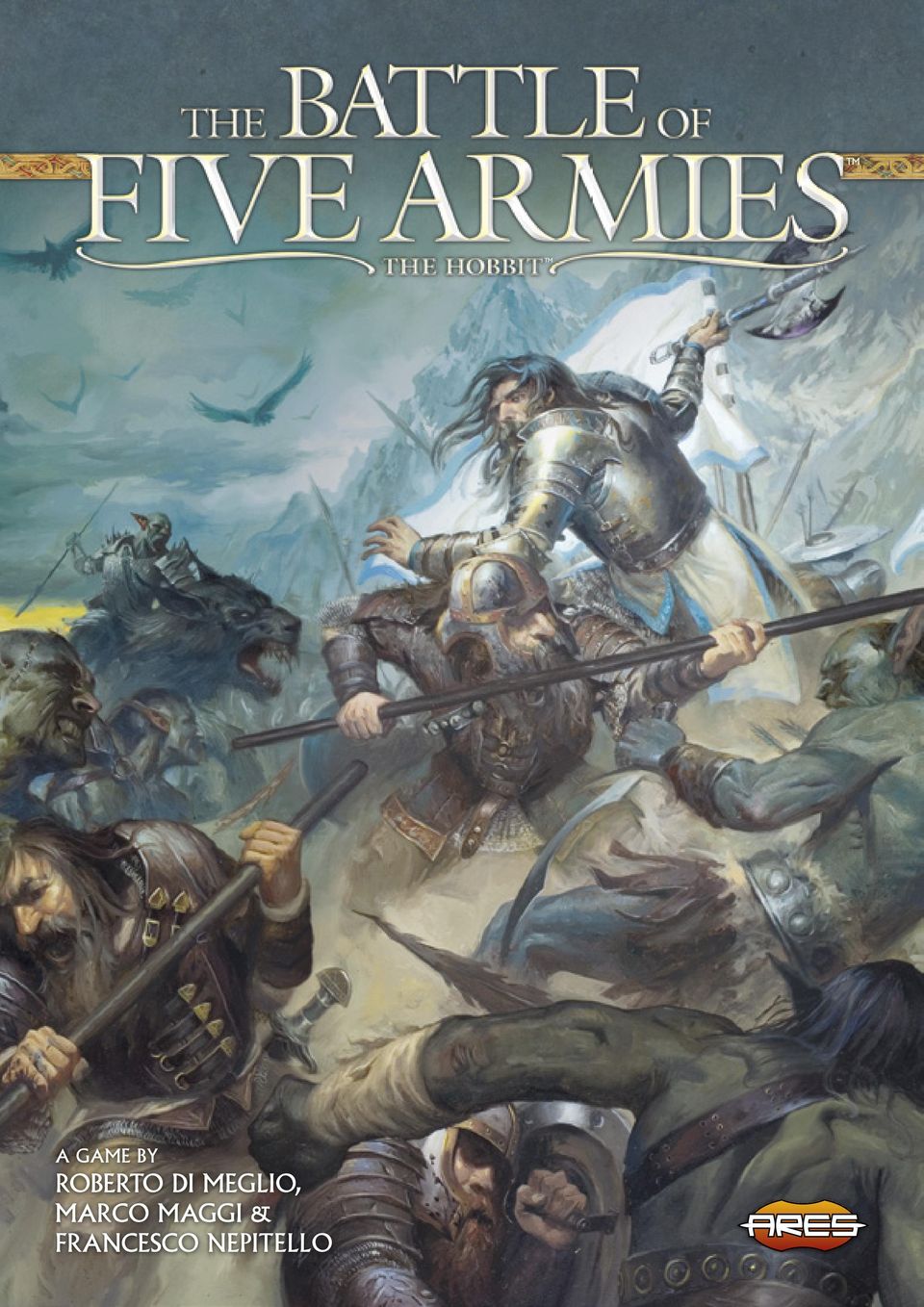
2 2 The Battle of Five Armies CHAPTER I: INTRODUCTION Welcome to The Battle of Five Armies board game. The Battle of Five Armies is a game for two players, based on The Hobbit by J.R.R. Tolkien. The players will recreate the epic conclusion of the book the fierce struggle, witnessed by Bilbo Baggins, that represents the end of the quest for the Lonely Mountain, but also the prelude to the great events of the War of the Ring. The Free Peoples army is placed on the spurs of the Lonely Mountain, while the Shadow horde is advancing into the valley, and the Goblins are scurrying to attack their enemies from above. Unexpected help will come to the Free Peoples the Eagles of the Misty Mountains and Beorn the Skin changer are due to arrive on the scene but will they arrive in time, before the horde of Orcs and Wargs overwhelms the defenders? One player the Shadow player is in command of the Shadow armies, led by Bolg, son of Azog, the King of the Goblins of Mount Gundabad. He will maneuver a host of Orcs, Great Orcs, Goblins and Wargs, reinforced by Great Bats from Mirkwood, in an attempt to vanquish the assembled forces of the Free Peoples and win the dominion of the North. The second player the Free Peoples player controls the hosts of Elves, Dwarves and Men defending the valley between the arms of the Lonely Mountain. He commands the Wood elf archers and spearmen of Thranduil the Elvenking, the stout Dwarves of Dáin Ironfoot and the brave Men of the Lake led by Bard the Bowman, united by Gandalf the Wizard under the threat of a common foe. Many possible variables affect the outcome of the Battle. Can the magic of Gandalf turn the tide for the Free Peoples? Will the Eagles arrive in time, or Beorn come to the rescue? Will Bilbo the Hobbit perish in a last stand on Ravenhill? Note: War of the Ring players may find many of the following rules to be rather familiar, as the core mechanics of The Battle of Five Armies are inspired by the mechanics of War of the Ring. However, many important differences make this rule set a distinct game. We recommend that players read these rules very carefully, even if they have previously played War of the Ring.

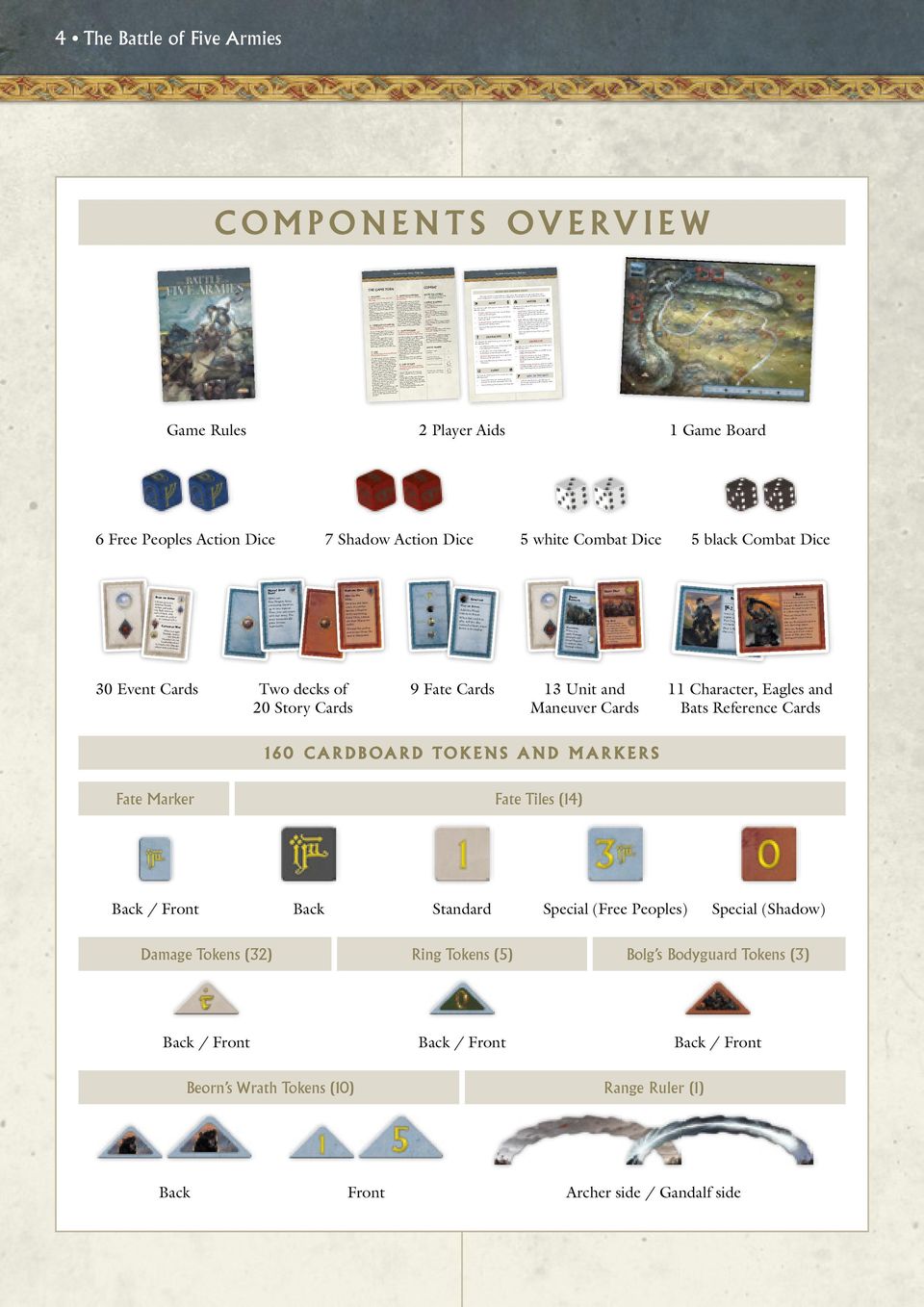
3 Chapter I: Introduction 3 COMPONENTS LIST Inside this game box you find an extensive set of components, listed here: Game Rules 2 Player Aids with a summary of the rules 1 Game Board 6 Free Peoples Action Dice 7 Shadow Action Dice 10 six sided Combat Dice (five white ones and five black ones); 126 figures, representing the Armies and Characters involved in The Battle of Five Armies, including: 72 (red color) figures representing Shadow Army units and the Great Bats 45 (blue color) figures representing Free Peoples Army units and the Eagles 9 (gray color) figures, 8 figures representing Free Peoples Characters and 1 figure representing Bolg 92 cards, including: 1 deck of Event Cards (30 cards) 2 decks of Story cards, one for the Shadow player and one for the Free Peoples player (20 cards each) 1 deck of Fate cards (9 cards) Unit and Maneuver cards (13 cards) 11 double size Reference Cards of the Characters and special troops involved in the Battle 1 Range ruler with plastic stand 160 cardboard tokens and markers including: 14 Fate Tiles 32 Damage tokens 10 Beorn s Wrath tokens (two 5 value tokens, eight 1 value tokens) 5 Ring tokens 3 Bolg s Bodyguard tokens 1 Fate Track marker 6 Free Peoples Leadership tokens 14 Shadow Leadership tokens 3 Activation tokens 1 Concentration token 64 Recruitment tokens (27 Shadow, 17 Dwarves and Men, 20 Elves) 5 Shadow Control markers 2 Closed Mountain Pass markers OVERVIEW In The Battle of Five Armies, one player will achieve victory by making the best strategic choices amidst changing battle conditions, trying to retain control of, or to conquer some key points on the battlefield. Most of the player s choices revolve around the main mechanic of the game, the Action Dice system first used in War of the Ring, customized here around the specific needs of recreating this battle. In each turn, players roll a number of Action Dice, and then alternate using one die each to take actions, within the options allowed by the results of each die. Possible actions include moving, attacking, recruiting new troops, rallying demoralized troops, using characters, and so on. Special cards Story Cards and Event Cards can also be played as actions, to represent unusual events that sometimes let a player break the rules. Since the results of the Action Dice limit the available options, players will face difficult choices each turn. Like a real commander on the field, players cannot ever be completely sure that their troops will follow their orders exactly, and they must have a flexible plan that they adapt to the result of the Action Dice roll. Another central feature in the game is the concept of Fate. Other powers beyond the strategic choices of generals affect the deeds of minions and heroes of Middle earth. These forces can be held responsible for the occurrence of unexpected events, like the timely arrival of the Eagles, or the coming of Beorn, the Skin changer. In the game, the timing of these events is determined by the Fate Track, an erratic clock whose pace may be influenced directly and indirectly by both players. The Free Peoples player at the start of every game turn makes the fundamental choice affecting the Fate Track movement: when multiple Free Peoples Generals are activated to use their special abilities, his army will be stronger but Fate may be slower to advance. A slow Fate is an advantage to the Shadow, as the strongest allies of the Free Peoples will arrive later in the game. The Fate Track movement is also linked to the drawing of Fate Cards, which have a strong influence on the characters in play.

4 1 RECOVERY The players recover Action Dice and draw cards. Each player recovers his Action Dice. The The Shadow player chooses how many Free Peoples player takes 5 dice, or 6 dice Leadership tokens and/or Great Bats if either Thorin or Beorn is in play. The figures he will have available for the turn: Shadow player takes 6 dice, or 7 dice if he the total sum of Leadership tokens and controls two Settlements within the same Great Bats must be equal to the number territory. of dice in the Shadow player Action Dice Then, each player draws 2 cards, one from pool (6 or 7). the Event deck and one from his Story The Shadow player then places his deck. If any player has more than six cards Leadership tokens and Great Bats on the in hand after the draw, he must discard game board. Each Leadership token must down to six cards now. be placed with a different Shadow Army. Great Bats may be placed in any region on the game board: this indicates their presence in the territory containing that The Free People player selects Generals region, not just in that specific region. and places Leadership. The Free Peoples player chooses up to 3 Generals among those in play and places The players roll Action Dice, then one Activation token on their respective alternate in using them to take Actions. reference cards. The Free Peoples player then receives a Both players roll the dice available in their number of Leadership tokens equal to respective Action Dice pool. Then, starting the number of Generals he chose, and with the Free Peoples player, players immediately places them on the game alternate in taking actions, choosing one board. Each Leadership token must be of their Action Dice and using one of the placed with a different Free Peoples Army. possible choices allowed by the die result. The Free Peoples player may use the General ability of one of his activated Generals before each of his Actions. The Shadow Player draws Fate tiles and A player may pass his action if the the Fate Marker advances. opponent has more unused Action Dice than he has. The Shadow player may draw a number of When both players have used all their Fate Tiles, one after the other, up to the Action Dice, proceed to the next phase. number of Activation tokens placed by the Free Peoples player (with a minimum of one). After drawing each tile, the Shadow player may either stop drawing and apply The players check victory conditions the effects of the last drawn tile; or he and remove Leadership tokens, Eagles may set aside the drawn tile and pull and Great Bats. another one from the Fate pool (up to the maximum number of draws allowed). Check if either player has reached his When the Shadow player is done drawing, victory conditions. If not, a new turn the Fate marker is advanced to the right begins. on the Fate Track, as many steps as the Remove all Leadership tokens belonging number on the last drawn Fate tile. If the to both players from the game board. Fate tile shows the Fate icon, the Free Remove any Great Bats figures from play. Peoples player draws a Fate card and Place any Eagle figures on the game board immediately applies its effects. back in the Eagles Eyrie. The chosen tile is discarded after use, while Remove unused Activation tokens from all other tiles drawn this turn are placed the Free Peoples Generals. back in the Fate pool. If the Fate marker reaches the last step (15) of the Fate Track, the Free Peoples player immediately wins the game. 3 FATE The Shadow Player places Leadership 1. Checking Terrain Superiority and Great Bats. 2. Preparing the card hand 5 ACTION ROUND 6 END OF TURN BEFORE THE COMBAT COMBAT SEQUENCE 1) Maneuvering Players simultaneously choose and reveal a card from their hand. 2) Combat Roll Players roll a number of Combat dice equal to the Combat Strength of their respective Armies (up to a maximum of five dice). 3) Leader Re roll Players may re roll once again a number of failed Combat dice up to their Army s Leadership. 4) Apply Damage Players add Damage tokens to the Armies, and remove casualties if necessary. 5) End of Round If neither Army is completely eliminated, the attacker may withdraw to end the combat. If not, the defender may end the combat by retreating or routing. Otherwise, a new round of combat begins. TARGET NUMBER Standard Target 5 Number Defender inside an 6 unbroken Fortification 6 on Defender across a ford the 1st round 6 on Defender in a mountain the 1st region and across a slope round following actions: each to an adjacent region. region and attack. adjacent to the attacked region. Army. the following actions: Leadership up to two regions. characters on the game board. Character. following actions: following actions: regions on the game board, and flip one new units. total Leadership of that Army. Muster. the following actions: Goblin Mustering Point. Goblins to an adjacent region (or from a attack. Muster or Event). FELL RACE are attacking. BURGLAR SON OF AZOG 4 The Battle of Five Armies COMPONENTS OVERVIEW The Battle of Five Armies Player Aid The Battle of Five Armies Player Aid THE GAME TURN COMBAT 2 GENERALS ACTIVATION 4 SHADOW LEADERSHIP A CTION DICE REFERENCE CHART This section provides a quick summary of the actions that each player can take using Action Dice. Note: Additional uses of Action Dice are available when certain characters and special units are in play. ARMY CHARACTER EVENT The Army die result can be used to execute one of the Strategic Movement: Move two of your Armies Attack: Move one of your Armies to an adjacent Combined Attack: Attack using all your Armies Play Card: Play an Event or Story card of type The Character die result can be used to execute one of Fast Movement: Move one of your Armies with Attack: Move one of your Armies with Leadership to an adjacent region and attack. Character Movement: Move any or all of your Play Card: Play an Event or Story card of type The Event die result can be used to execute one of the MUSTER LIDLESS EYE The Muster die result can be used to execute one of the Recruitment: Choose up to two different Recruitment token in each of them to recruit Rally: Make two Rally actions on two different Armies: For each Army, roll a number of dice equal to the number of its units and remove one Damage token for every result of 5 or 6. You can re roll once a number of failed dice up to the Play Card: Play an Event or Story card of type The Lidless Eye die result can be used to execute one of Goblin Recruitment: Place one Goblin in each Goblin Attack: Move one Army containing Mustering Point to a Mountain Pass box) and Goblin Strategic Movement: Move two Armies containing Goblins each to an adjacent region (or from a Mustering Point to a Mountain Pass box). WILL OF THE WEST Draw Cards: Draw one card from the Event deck and one from the appropriate Story deck. Wild Die: May be used as any other type of Play Card: Play an Event or Story card of any type. Free Peoples Action die result (Character, Army, Game Rules 2 Player Aids 1 Game Board 6 Free Peoples Action Dice 7 Shadow Action Dice 5 white Combat Dice 5 black Combat Dice BLOW THE HORNS Choose up to two different friendly Armies, and make one Rally action on each of them, with successes on a roll of 4+ (instead of 5+). CAPTAIN OF WAR When you apply Damage, remove one friendly Character (or one Leadership token) to remove two Damage tokens from your Army. MORIA! DÁIN! DÁIN! Move one Free Peoples Army containing Dwarves up to two regions. Then, you may attack with that army. The army automatically gains Terrain Superiority. HOWLING ORCS Play on the table. Dwarves and Men units, in combat against a Shadow Army containing Great Orcs, cannot use their Maneuver ability. Discard this card as soon as one Great Orc unit is eliminated. GIANT-SIZE Play on Beorn. Add two Wrath tokens to Beorn. When this card is in play, roll five dice (instead of four) when Beorn is in combat. DWARF REGULARS REDOUBTABLE When you apply Damage, eliminate one Dwarf Regular to remove three Damage tokens. GREAT ORCS Add two Damage to the enemy Army, unless your opponent eliminates all Leadership tokens or one Character from that Army. * Any terrain type is considered to be favored when Great Orcs BILBO BAGGINS When ready ready, use a Character die result to place Bilbo in a region containing another Free Peoples character or a Leadership token. 2 Place 5 Ring tokens on this card. BOLG If at least one region in Valley contains a Shadow army, use a Muster die result to place Bolg in a Mustering region. Place one Great Orc in the same region. Flip one Recruitment token in each Mustering region. Place one Bodyguard token on this card; if you control Ruins of Dale, place three Bodyguard tokens instead. 30 Event Cards Two decks of 20 Story Cards 9 Fate Cards 13 Unit and Maneuver Cards 11 Character, Eagles and Bats Reference Cards 160 CARDBOARD TOKENS AND MARKERS Fate Marker Fate Tiles (14) Back / Front Back Standard Special (Free Peoples) Special (Shadow) Damage Tokens (32) Ring Tokens (5) Bolg s Bodyguard Tokens (3) Back / Front Back / Front Back / Front Beorn s Wrath Tokens (10) Range Ruler (1) Back Front Archer side / Gandalf side
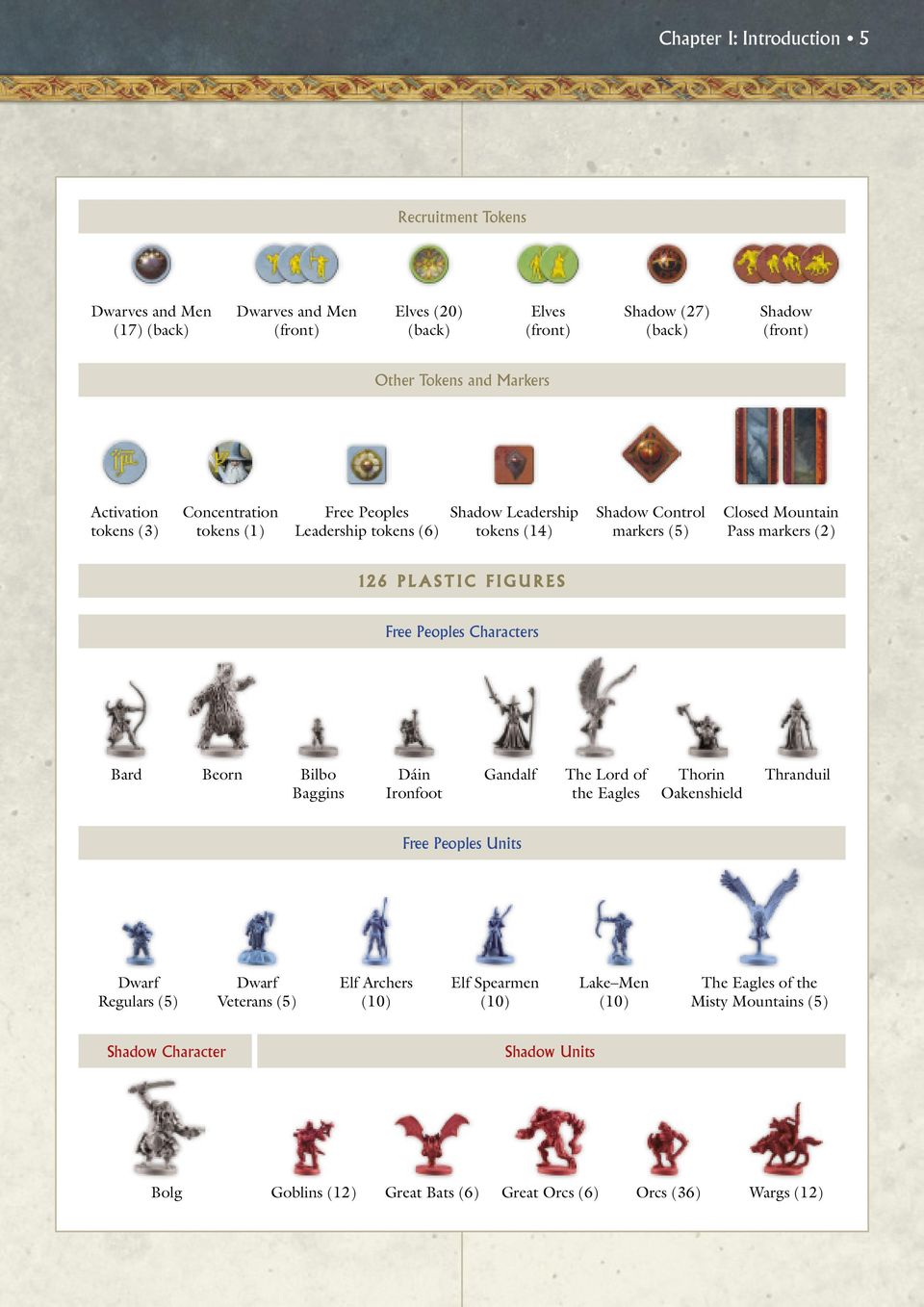
5 Chapter I: Introduction 5 Recruitment Tokens Dwarves and Men (17) (back) Dwarves and Men (front) Elves (20) (back) Elves (front) Shadow (27) (back) Shadow (front) Other Tokens and Markers Activation tokens (3) Concentration tokens (1) Free Peoples Leadership tokens (6) Shadow Leadership tokens (14) Shadow Control markers (5) Closed Mountain Pass markers (2) 126 PLASTIC FIGURES Free Peoples Characters Bard Beorn Bilbo Baggins Dáin Ironfoot Gandalf The Lord of the Eagles Thorin Oakenshield Thranduil Free Peoples Units Dwarf Regulars (5) Dwarf Veterans (5) Elf Archers (10) Elf Spearmen (10) Lake Men (10) The Eagles of the Misty Mountains (5) Shadow Character Shadow Units Bolg Goblins (12) Great Bats (6) Great Orcs (6) Orcs (36) Wargs (12)
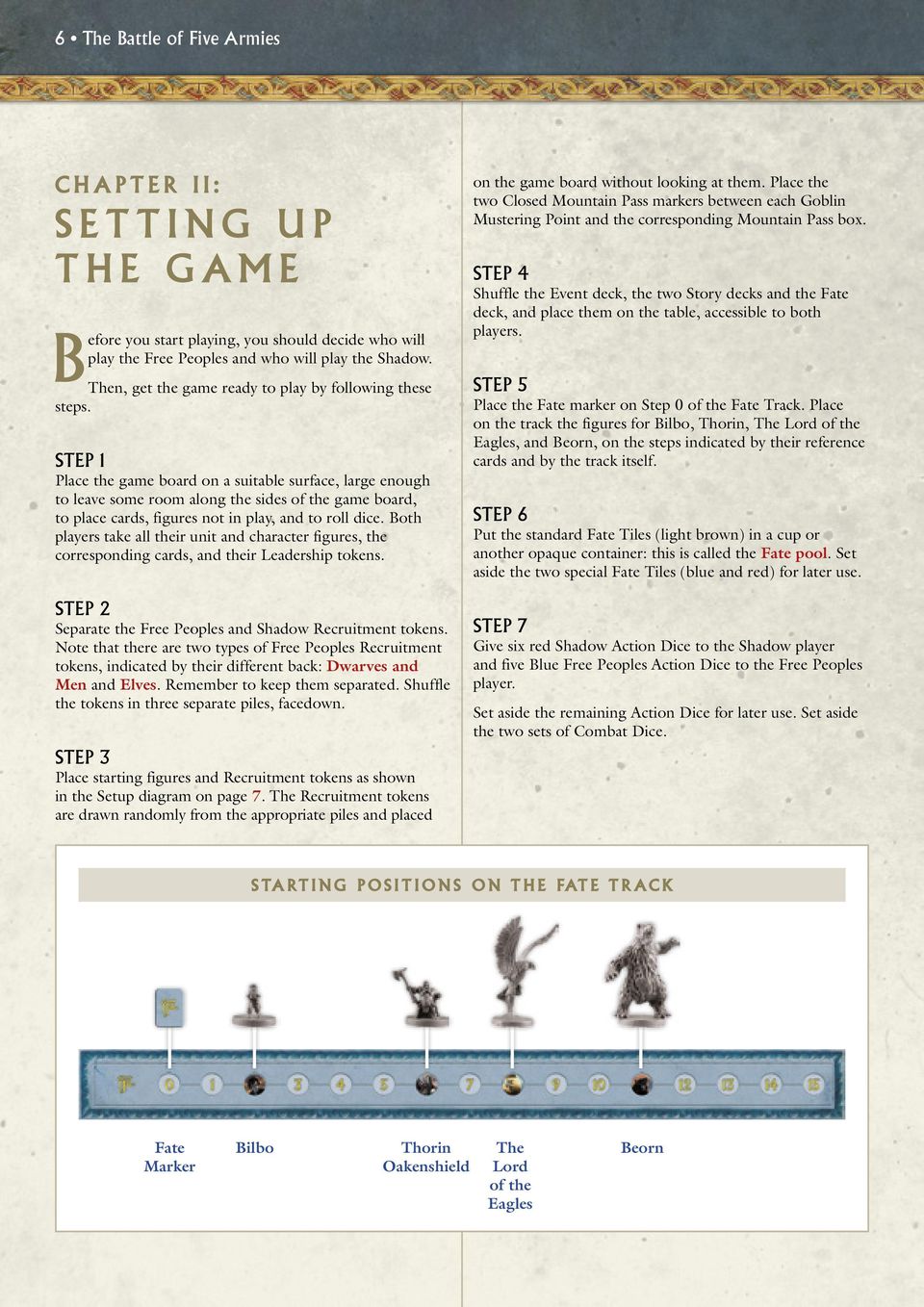
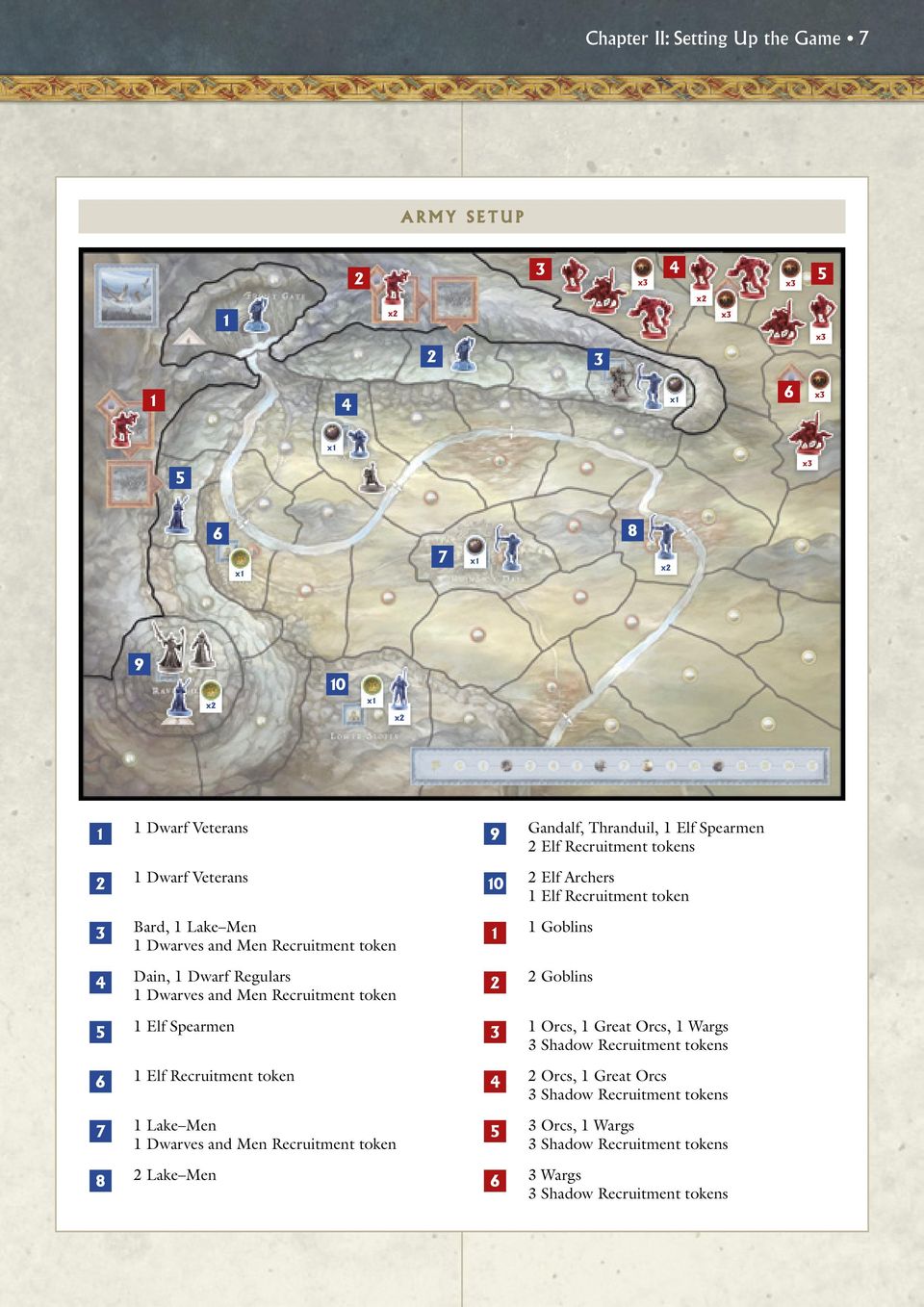
6 6 The Battle of Five Armies CHAPTER II: SETTING UP THE GAME Before you start playing, you should decide who will play the Free Peoples and who will play the Shadow. Then, get the game ready to play by following these steps. STEP 1 Place the game board on a suitable surface, large enough to leave some room along the sides of the game board, to place cards, figures not in play, and to roll dice. Both players take all their unit and character figures, the corresponding cards, and their Leadership tokens. STEP 2 Separate the Free Peoples and Shadow Recruitment tokens. Note that there are two types of Free Peoples Recruitment tokens, indicated by their different back: Dwarves and Men and Elves. Remember to keep them separated. Shuffle the tokens in three separate piles, facedown. STEP 3 Place starting figures and Recruitment tokens as shown in the Setup diagram on page 7. The Recruitment tokens are drawn randomly from the appropriate piles and placed on the game board without looking at them. Place the two Closed Mountain Pass markers between each Goblin Mustering Point and the corresponding Mountain Pass box. STEP 4 Shuffle the Event deck, the two Story decks and the Fate deck, and place them on the table, accessible to both players. STEP 5 Place the Fate marker on Step 0 of the Fate Track. Place on the track the figures for Bilbo, Thorin, The Lord of the Eagles, and Beorn, on the steps indicated by their reference cards and by the track itself. STEP 6 Put the standard Fate Tiles (light brown) in a cup or another opaque container: this is called the Fate pool. Set aside the two special Fate Tiles (blue and red) for later use. STEP 7 Give six red Shadow Action Dice to the Shadow player and five Blue Free Peoples Action Dice to the Free Peoples player. Set aside the remaining Action Dice for later use. Set aside the two sets of Combat Dice. STARTING POSITIONS ON THE FATE TRACK Fate Marker Bilbo Thorin Oakenshield The Lord of the Eagles Beorn
7 Chapter II: Setting Up the Game 7 ARMY SETUP 2 3 x3 4 x3 5 x2 1 x2 x3 x x1 6 x3 x1 5 x3 6 x1 7 x1 8 x2 9 x2 10 x1 x2 1 1 Dwarf Veterans 9 Gandalf, Thranduil, 1 Elf Spearmen 2 Elf Recruitment tokens 2 1 Dwarf Veterans 10 2 Elf Archers 1 Elf Recruitment token 3 Bard, 1 Lake Men 1 Dwarves and Men Recruitment token 1 1 Goblins 4 Dain, 1 Dwarf Regulars 1 Dwarves and Men Recruitment token 2 2 Goblins 5 1 Elf Spearmen 3 1 Orcs, 1 Great Orcs, 1 Wargs 3 Shadow Recruitment tokens 6 1 Elf Recruitment token 4 2 Orcs, 1 Great Orcs 3 Shadow Recruitment tokens 7 1 Lake Men 1 Dwarves and Men Recruitment token 5 3 Orcs, 1 Wargs 3 Shadow Recruitment tokens 8 2 Lake Men 6 3 Wargs 3 Shadow Recruitment tokens
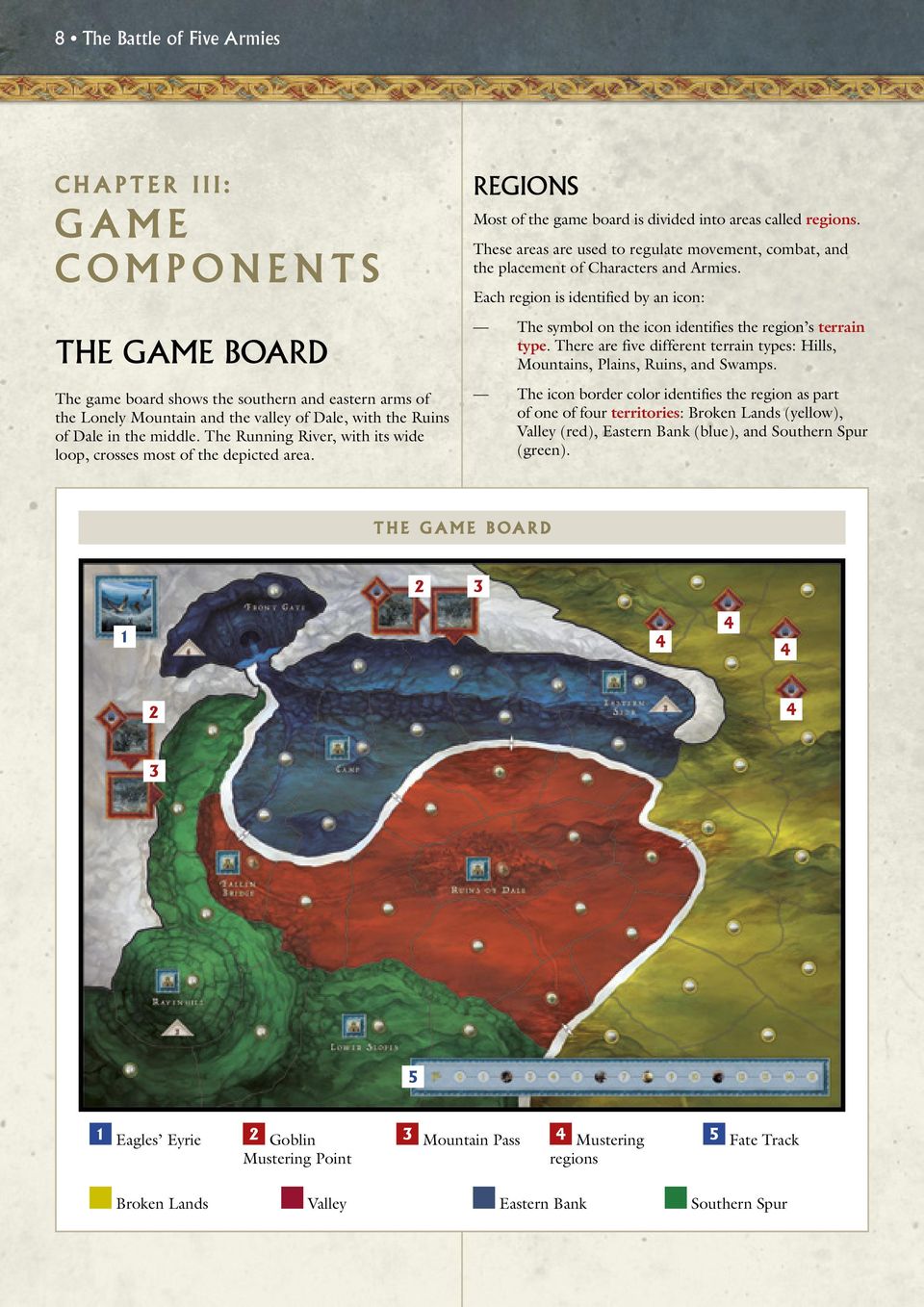
8 8 The Battle of Five Armies CHAPTER III: GAME COMPONENTS THE GAME BOARD The game board shows the southern and eastern arms of the Lonely Mountain and the valley of Dale, with the Ruins of Dale in the middle. The Running River, with its wide loop, crosses most of the depicted area. REGIONS Most of the game board is divided into areas called regions. These areas are used to regulate movement, combat, and the placement of Characters and Armies. Each region is identified by an icon: The symbol on the icon identifies the region s terrain type. There are five different terrain types: Hills, Mountains, Plains, Ruins, and Swamps. The icon border color identifies the region as part of one of four territories: Broken Lands (yellow), Valley (red), Eastern Bank (blue), and Southern Spur (green). THE GAME BOARD Eagles Eyrie 2 Goblin Mustering Point 3 Mountain Pass 4 Mustering regions 5 Fate Track Broken Lands Valley Eastern Bank Southern Spur
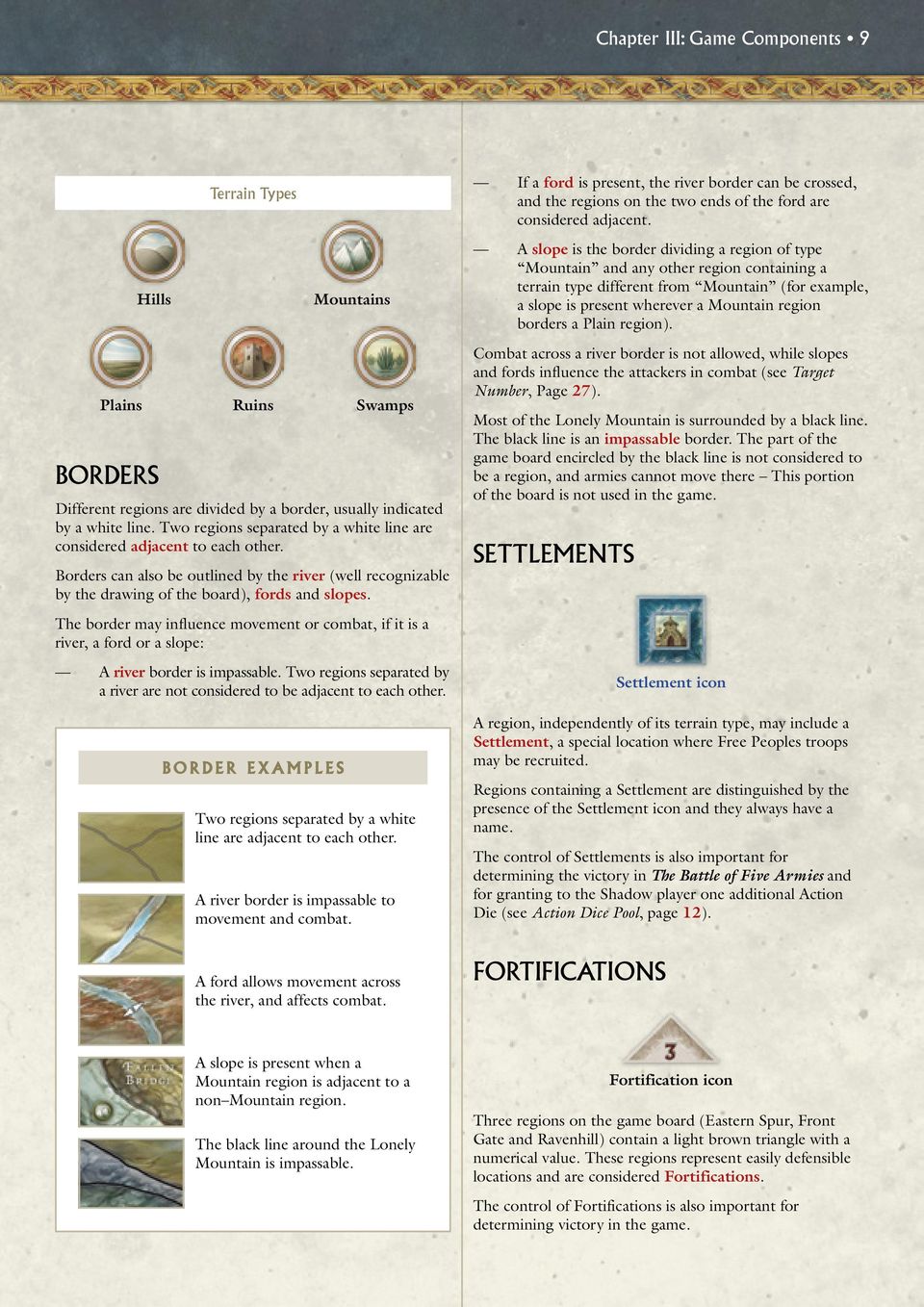
9 Chapter III: Game Components 9 Hills Terrain Types Mountains Plains Ruins Swamps BORDERS Different regions are divided by a border, usually indicated by a white line. Two regions separated by a white line are considered adjacent to each other. Borders can also be outlined by the river (well recognizable by the drawing of the board), fords and slopes. The border may influence movement or combat, if it is a river, a ford or a slope: A river border is impassable. Two regions separated by a river are not considered to be adjacent to each other. BORDER EXAMPLES Two regions separated by a white line are adjacent to each other. A river border is impassable to movement and combat. A ford allows movement across the river, and affects combat. If a ford is present, the river border can be crossed, and the regions on the two ends of the ford are considered adjacent. A slope is the border dividing a region of type Mountain and any other region containing a terrain type different from Mountain (for example, a slope is present wherever a Mountain region borders a Plain region). Combat across a river border is not allowed, while slopes and fords influence the attackers in combat (see Target Number, Page 27). Most of the Lonely Mountain is surrounded by a black line. The black line is an impassable border. The part of the game board encircled by the black line is not considered to be a region, and armies cannot move there This portion of the board is not used in the game. SETTLEMENTS Settlement icon A region, independently of its terrain type, may include a Settlement, a special location where Free Peoples troops may be recruited. Regions containing a Settlement are distinguished by the presence of the Settlement icon and they always have a name. The control of Settlements is also important for determining the victory in The Battle of Five Armies and for granting to the Shadow player one additional Action Die (see Action Dice Pool, page 12). FORTIFICATIONS A slope is present when a Mountain region is adjacent to a non Mountain region. The black line around the Lonely Mountain is impassable. Fortification icon Three regions on the game board (Eastern Spur, Front Gate and Ravenhill) contain a light brown triangle with a numerical value. These regions represent easily defensible locations and are considered Fortifications. The control of Fortifications is also important for determining victory in the game.
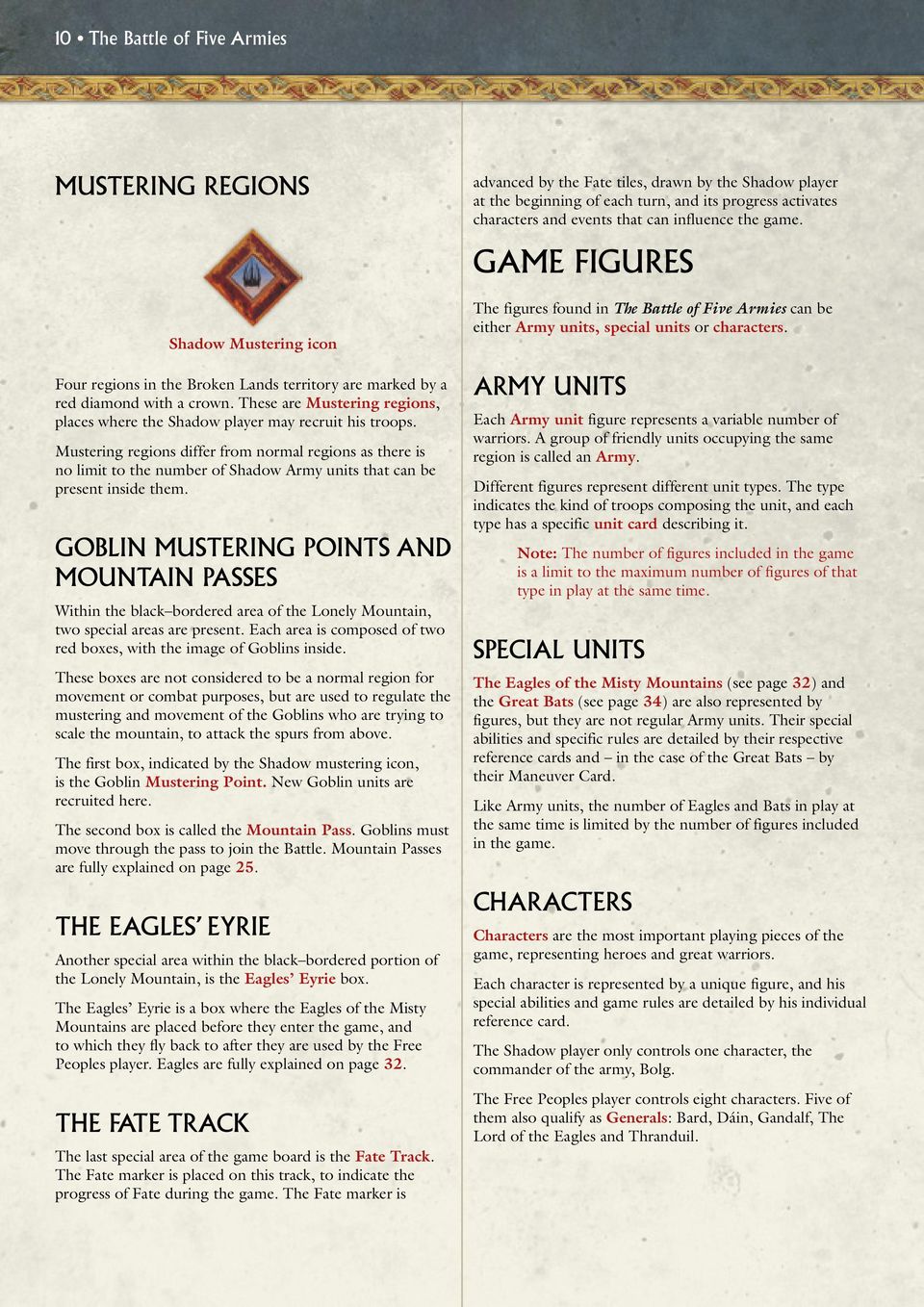
10 10 The Battle of Five Armies MUSTERING REGIONS Shadow Mustering icon Four regions in the Broken Lands territory are marked by a red diamond with a crown. These are Mustering regions, places where the Shadow player may recruit his troops. Mustering regions differ from normal regions as there is no limit to the number of Shadow Army units that can be present inside them. GOBLIN MUSTERING POINTS AND MOUNTAIN PASSES Within the black bordered area of the Lonely Mountain, two special areas are present. Each area is composed of two red boxes, with the image of Goblins inside. These boxes are not considered to be a normal region for movement or combat purposes, but are used to regulate the mustering and movement of the Goblins who are trying to scale the mountain, to attack the spurs from above. The first box, indicated by the Shadow mustering icon, is the Goblin Mustering Point. New Goblin units are recruited here. The second box is called the Mountain Pass. Goblins must move through the pass to join the Battle. Mountain Passes are fully explained on page 25. THE EAGLES EYRIE Another special area within the black bordered portion of the Lonely Mountain, is the Eagles Eyrie box. The Eagles Eyrie is a box where the Eagles of the Misty Mountains are placed before they enter the game, and to which they fly back to after they are used by the Free Peoples player. Eagles are fully explained on page 32. THE FATE TRACK The last special area of the game board is the Fate Track. The Fate marker is placed on this track, to indicate the progress of Fate during the game. The Fate marker is advanced by the Fate tiles, drawn by the Shadow player at the beginning of each turn, and its progress activates characters and events that can influence the game. GAME FIGURES The figures found in The Battle of Five Armies can be either Army units, special units or characters. ARMY UNITS Each Army unit figure represents a variable number of warriors. A group of friendly units occupying the same region is called an Army. Different figures represent different unit types. The type indicates the kind of troops composing the unit, and each type has a specific unit card describing it. Note: The number of figures included in the game is a limit to the maximum number of figures of that type in play at the same time. SPECIAL UNITS The Eagles of the Misty Mountains (see page 32) and the Great Bats (see page 34) are also represented by figures, but they are not regular Army units. Their special abilities and specific rules are detailed by their respective reference cards and in the case of the Great Bats by their Maneuver Card. Like Army units, the number of Eagles and Bats in play at the same time is limited by the number of figures included in the game. CHARACTERS Characters are the most important playing pieces of the game, representing heroes and great warriors. Each character is represented by a unique figure, and his special abilities and game rules are detailed by his individual reference card. The Shadow player only controls one character, the commander of the army, Bolg. The Free Peoples player controls eight characters. Five of them also qualify as Generals: Bard, Dáin, Gandalf, The Lord of the Eagles and Thranduil.
11 Chapter IV: The Game Turn 11 CHAPTER IV: THE GAME TURN The chosen tile is discarded after use, while all other tiles drawn this turn are placed back in the Fate pool. If the Fate marker reaches the last step (15) of the Fate Track, the Free Peoples player immediately wins the game. The Battle of Five Armies is played over a series of turns, until one player wins the game. Each turn is divided into six phases, as follows: PHASE 1 RECOVERY The players recover Action Dice and draw cards. Each player recovers his Action Dice. The Free Peoples player takes 5 dice, or 6 dice if either Thorin or Beorn is in play. The Shadow player takes 6 dice, or 7 dice if he controls two Settlements within the same territory. Then, each player draws 2 cards, one from the Event deck and one from his Story deck. If any player has more than six cards in hand after the draw, he must discard down to six cards now. PHASE 2 GENERALS ACTIVATION The Free Peoples player selects Generals and places Leadership. The Free Peoples player chooses up to 3 Generals among those in play and places one Activation token on their respective reference cards. The Free Peoples player then receives a number of Leadership tokens equal to the number of Generals he chose, and immediately places them on the game board. Each Leadership token must be placed with a different Free Peoples Army. PHASE 3 FATE The Shadow Player draws Fate tiles and the Fate Marker advances. The Shadow player may draw a number of Fate Tiles, one after the other, up to the number of Activation tokens placed by the Free Peoples player (with a minimum of one). After drawing each tile, the Shadow player may either stop drawing and apply the effects of the last drawn tile; or he may set aside the drawn tile and pull another one from the Fate pool (up to the maximum number of draws allowed). When the Shadow player is done drawing, the Fate marker is advanced to the right on the Fate Track, as many steps as the number on the last drawn Fate tile. If the Fate tile shows the Fate icon, the Free Peoples player draws a Fate card and immediately applies its effects. PHASE 4 SHADOW LEADERSHIP The Shadow Player places Leadership and Great Bats. The Shadow player chooses how many Leadership tokens and/or Great Bats figures he will have available for the turn: the total sum of Leadership tokens and Great Bats must be equal to the number of dice in the Shadow player Action Dice pool (6 or 7). The Shadow player then places his Leadership tokens and Great Bats on the game board. Each Leadership token must be placed with a different Shadow Army. Great Bats may be placed in any region on the game board: this indicates their presence in the territory containing that region, not just in that specific region. PHASE 5 ACTION ROUND The players roll Action Dice, then alternate in using them to take Actions. Both players roll the dice available in their respective Action Dice pool. Then, starting with the Free Peoples player, players alternate in taking actions, choosing one of their Action Dice and using one of the possible choices allowed by the die result. The Free Peoples player may use the General ability of one of his activated Generals before each of his Actions. A player may pass his action if the opponent has more unused Action Dice than he has. When both players have used all their Action Dice, proceed to the next phase. PHASE 6 END OF TURN The players check victory conditions and remove Leadership tokens, Eagles and Great Bats. Check if either player has reached his victory conditions. If not, a new turn begins. Remove all Leadership tokens belonging to both players from the game board. Remove any Great Bats figures from play. Place any Eagle figures on the game board back in the Eagles Eyrie. Remove unused Activation tokens from the Free Peoples Generals.
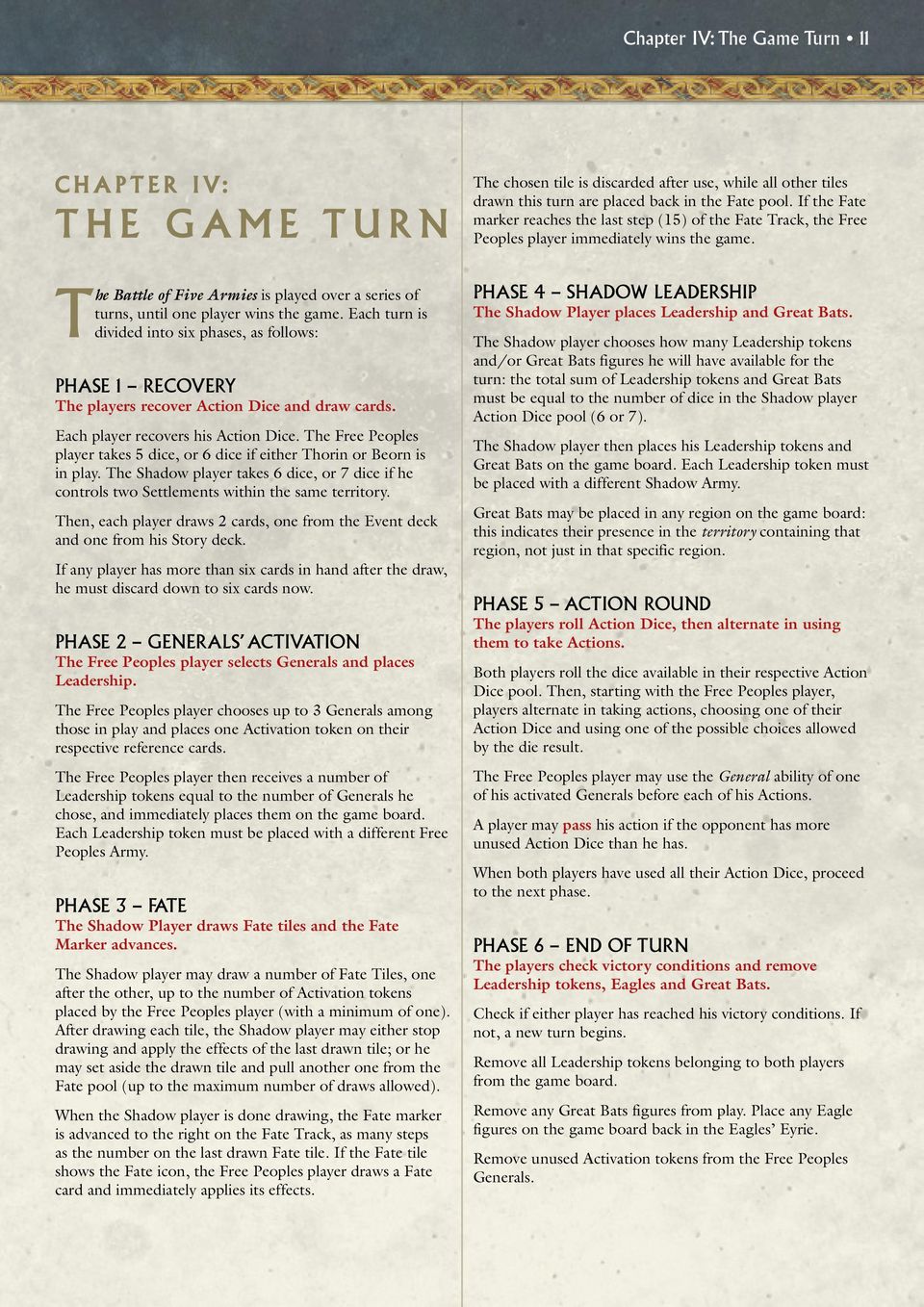
12 12 The Battle of Five Armies CHAPTER V: T HE ACTION DICE The Action Dice play a fundamental role in the game, as they dictate the options available to each player during a turn. These dice have special icons on their faces, with each icon representing a different group of actions from which the players may choose. The different numbers and types of icons appearing on the Free Peoples Action Dice and Shadow Action Dice reflect the different attitudes of the two sides fighting the Battle. The Action Dice Icons table below, shows the meaning of these icons. Character die result Event die result Character die result Event die result ACTION DICE ICONS Free Peoples Army die result* Muster/Army die result Shadow Army die result Muster/Army die result Muster die result Will of the West Muster die result Lidless Eye * Note: The Free Peoples Action Dice have two faces which show the Character result. On these dice, the Army result only appears on a face combined with the Muster result. ACTION DICE POOL The total number of Action Dice rolled by a player in a turn is called his Action Dice pool. The starting dice pool for the Shadow player is composed of six dice, while the starting dice pool of the Free Peoples player is composed of five dice. One additional Action Die can be earned both by the Free Peoples and Shadow player during play. The Free Peoples player gains his additional Action Die if Thorin Oakenshield (or later Beorn) is in play. The Shadow player gains his additional Action Die if two Settlements within the same territory are under Shadow control. Action Dice are only added to the Action Dice pool at the beginning of the turn (during the Recovery phase) after the requirement which adds them is met. They are also removed at the beginning of the turn, if that requirement is no longer applicable for example, Thorin has been eliminated and Beorn is not yet in play; or the Shadow player lost control of a Settlement that granted him an additional die. USING ACTION DICE At the beginning of the Action Round, both players roll all the dice in their respective Action Dice pools. Then, starting with the Free Peoples player, they alternate actions, selecting one die and immediately taking the action made available by its specific die result. Each action is summarized in the Action Dice Reference Chart (see facing page). Note: The effect of an action is never mandatory for example, if an action allows a player to move one Army and attack, he may move only, attack only, or do both, as he prefers. When a player has completed his action, the corresponding die is considered used and is set aside until needed again for the next turn. If a player runs out of Action Dice before his opponent has done the same, the opponent executes his remaining actions, one after the other. If a player has fewer unused Action Dice than his opponent, he can pass instead of taking an action, thus allowing the opponent to choose another die and take another action. Players may also choose to skip an action: they may simply discard one Action Die without effect, instead of using that die to take an action.
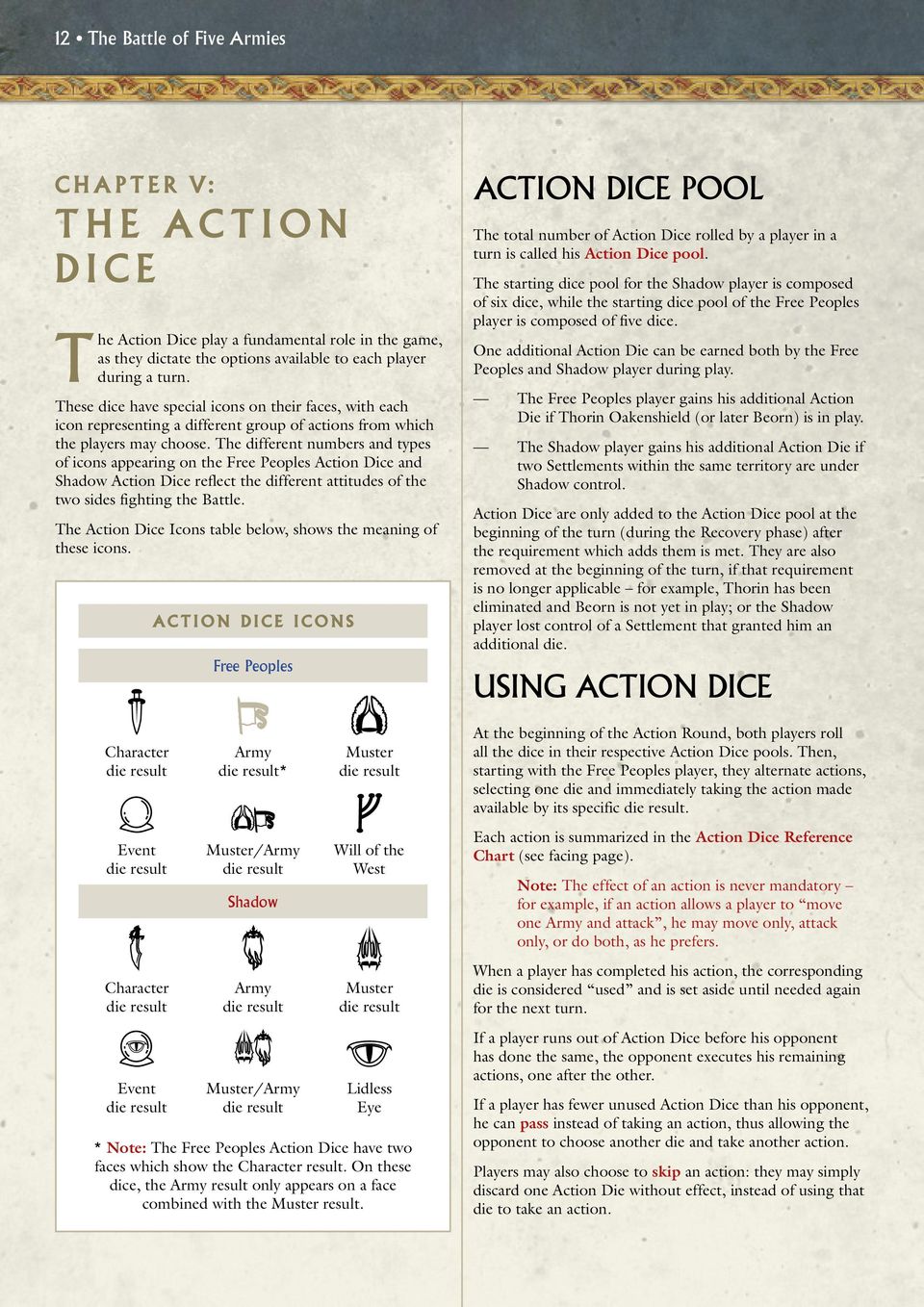
13 Chapter V: The Action Dice 13 ACTION DICE REFERENCE CHART This section provides a quick summary of the actions that each player can take using Action Dice. Note: Additional uses of Action Dice are available when certain characters and special units are in play. ARMY The Army die result can be used to execute one of the following actions: Strategic Movement: Move two of your Armies each to an adjacent region. Attack: Move one of your Armies to an adjacent region and attack. Combined Attack: Attack using all your Armies adjacent to the attacked region. Play Card: Play an Event or Story card of type Army. CHARACTER The Character die result can be used to execute one of the following actions: Fast Movement: Move one of your Armies with Leadership up to two regions. Attack: Move one of your Armies with Leadership to an adjacent region and attack. Character Movement: Move any or all of your characters on the game board. Play Card: Play an Event or Story card of type Character. EVENT The Event die result can be used to execute one of the following actions: Draw Cards: Draw one card from the Event deck and one from the appropriate Story deck. Play Card: Play an Event or Story card of any type. MUSTER The Muster die result can be used to execute one of the following actions: Recruitment: Choose up to two different regions on the game board, and flip one Recruitment token in each of them to recruit new units. Rally: Make two Rally actions on two different Armies: For each Army, roll a number of dice equal to the number of its units and remove one Damage token for every result of 5 or 6. You can re roll once a number of failed dice up to the total Leadership of that Army. Play Card: Play an Event or Story card of type Muster. LIDLESS EYE The Lidless Eye die result can be used to execute one of the following actions: Goblin Recruitment: Place one Goblin in each Goblin Mustering Point. Goblin Attack: Move one Army containing Goblins to an adjacent region (or from a Mustering Point to a Mountain Pass box) and attack. Goblin Strategic Movement: Move two Armies containing Goblins each to an adjacent region (or from a Mustering Point to a Mountain Pass box). WILL OF THE WEST Wild Die: May be used as any other type of Free Peoples Action die result (Character, Army, Muster or Event).
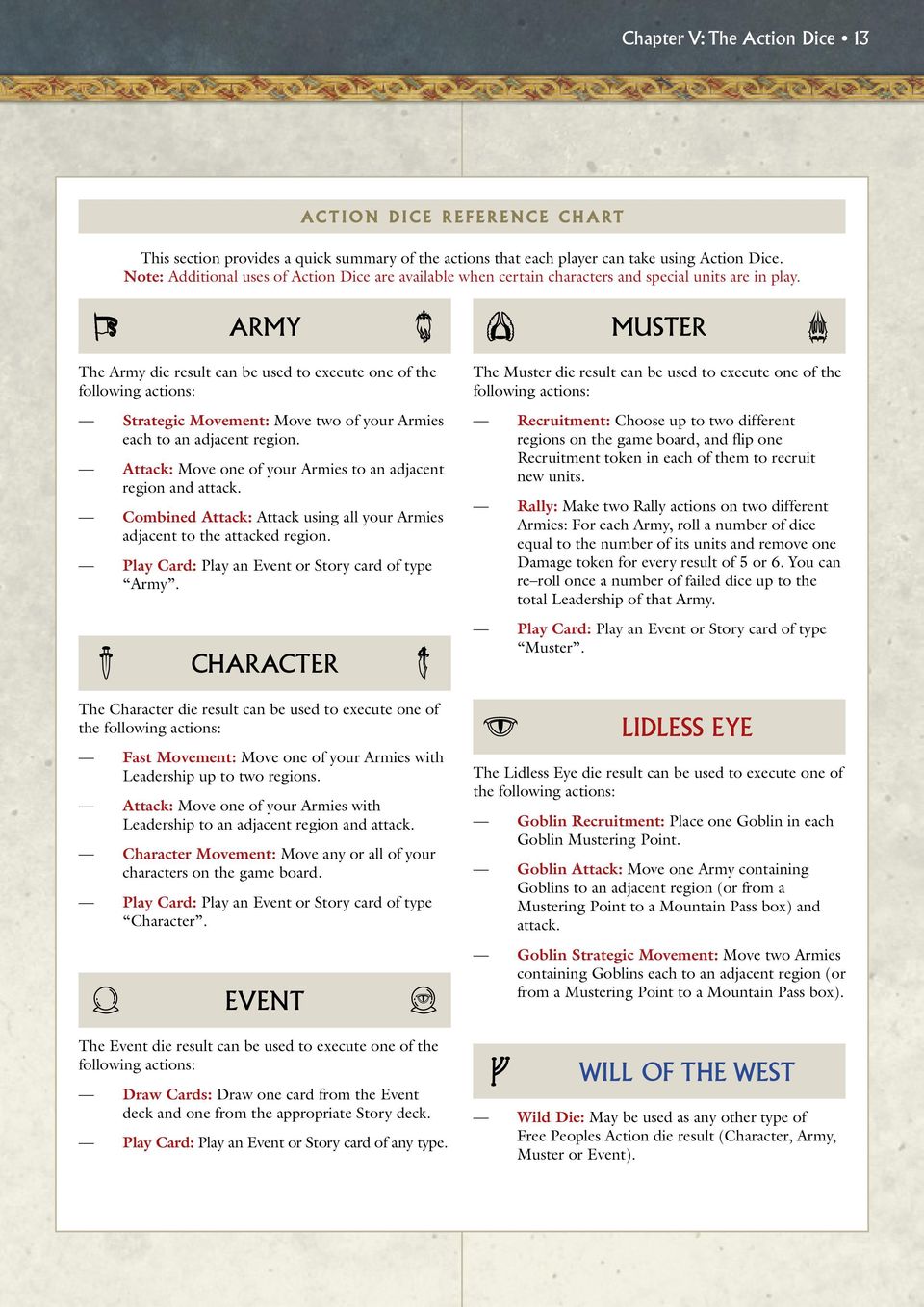
14 14 The Battle of Five Armies CHAPTER VI: EVENT AND STORY CARDS Four different decks of cards are used in this game: Event cards, used by both players; two decks of player specific Story cards; and Fate cards. Fate cards are explained in the Fate chapter (page 16). Event and Story cards are explained here. THE EVENT CARDS AND EVENT DECK Event cards form a single deck of 30 light brown cards, used by both players to draw cards from. Each Event card is used to execute one of two special actions: an Order effect, triggered using an Action Die during the Action Round; or a Combat effect, applied during a combat. An icon on the top right corner of an Event card identifies its Order effect as belonging to one of three types: Army, Character, or Muster. THE STORY CARDS AND STORY DECKS Story cards form two separate decks of 20 cards each, distinguished by their backs: a red Shadow Story deck and a blue Free Peoples Story deck. Players draw Story cards from their respective Story decks. Story cards can be played only using an Action Die during the Action Round (they do not have a Combat effect) and are used to introduce in the game specific narrative elements. Similarly to Event cards, Story cards are divided into three types, identified by an icon on the top right corner of the card Army, Character, or Muster. THE STORY CARD MORIA! DÁIN! DÁIN! Move one Free Peoples Army containing Dwarves up to two regions. Then, you may attack with that army. The army automatically gains Terrain Superiority. 1 THE EVENT CARD 1 BLOW THE HORNS Choose up to two different friendly Armies, and make one Rally action on each of them, with successes on a roll of 4+ (instead of 5+). CAPTAIN OF WAR When you apply Damage, remove one friendly Character (or one Leadership token) to remove two Damage tokens from your Army. 3 2 Free Peoples HOWLING ORCS Play on the table. Dwarves and Men units, in combat against a Shadow Army containing Great Orcs, cannot use their Maneuver ability. Discard this card as soon as one Great Orc unit is eliminated. 1 1 Order Effect 2 Combat Effect Shadow 3 Event Card Type 1 Story Card Type
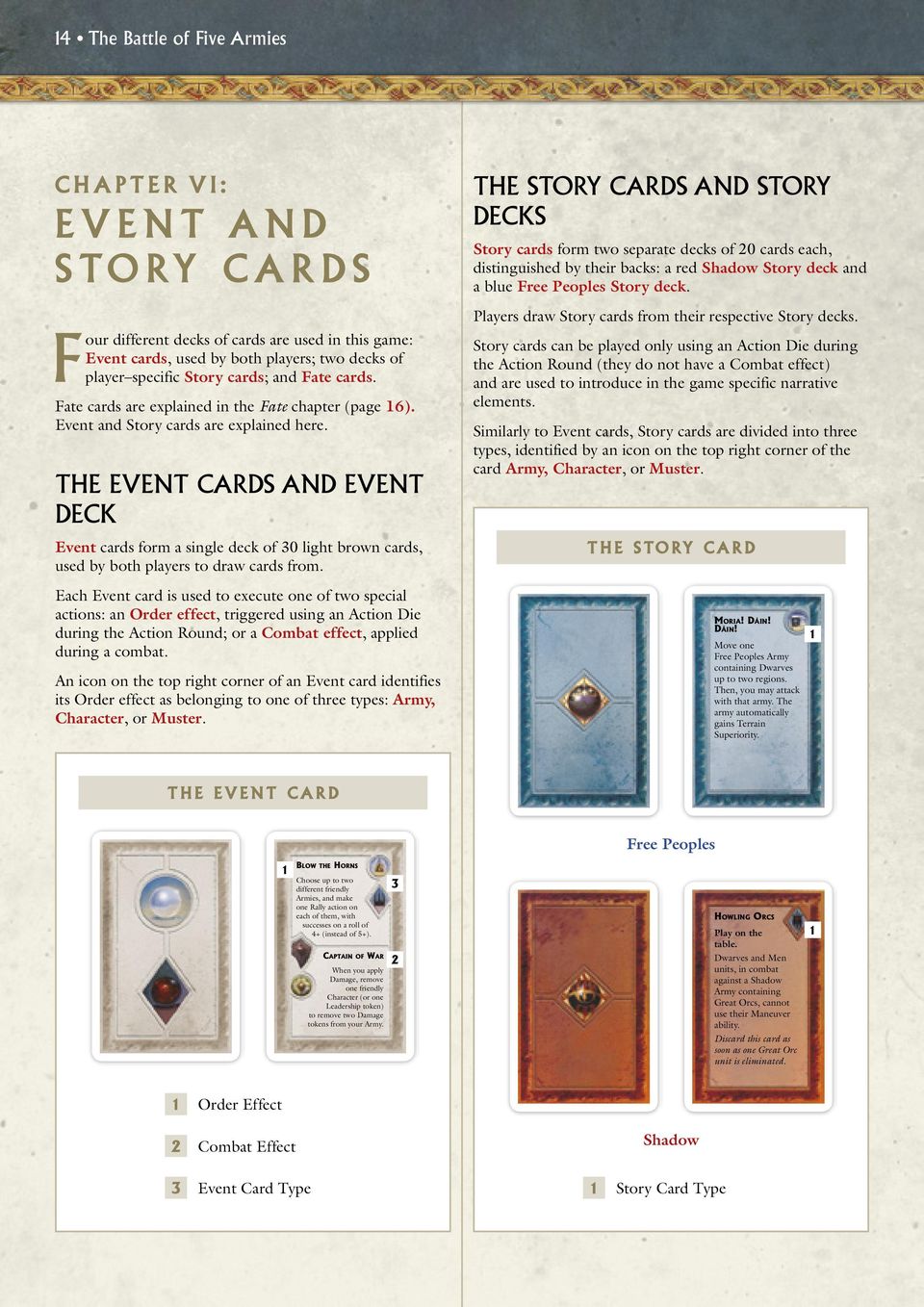
15 Chapter VI: Event and Story Cards 15 DRAWING CARDS Each player draws two cards at the beginning of each turn of play, one from the Event deck and one from his own Story deck. Players may also draw additional cards using an Event die result, during the Action Round, to draw one card from the Event deck and another from the Story deck. The maximum hand size is six cards, counting both Event and Story cards (Fate cards are never added to a player s hand). If at any time a player s hand includes more than six cards, the player must immediately discard down to six cards. Cards are discarded facedown. EXHAUSTING THE CARD DECKS If at any time in the game the Event deck is exhausted, all used and discarded Event cards are shuffled back to form a new deck. In contrast, Story cards are not brought back into play once used or discarded: if a Story deck is exhausted, no more Story cards may be drawn from that deck. PLAYING AN EVENT OR STORY CARD AS AN ACTION As an action, a player may play a Story card, or an Event card for its Order effect. This is possible in two ways: Using an Event die result. Using the die result matching the type of the card: an Army card can be played using an Army die result; a Muster card with a Muster die result; a Character card with a Character die result. Note: An Army/Muster die result can be used to play either an Army or a Muster card; a Will of the West die result can be used to play any type of card by the Free Peoples player. Often, cards allow a player to take an action that violates some of the game rules. All rules that are not expressly replaced by a card effect must be applied normally. REQUIREMENTS FOR PLAYING A CARD Some cards detail a requirement that must be met for the effects of the card to apply; if a requirement is not fully satisfied, the card cannot be played. EVENT AND STORY CARD TYPE Free Peoples Shadow Army Character Muster Example: The card Lucky Number may only be played by the Free Peoples player if Bilbo Baggins is in play. EFFECTS OF A CARD The effects of a card are explained by its text. Normally, all the effects of a card must be applied, unless it is clear that the effect is optional (for example, the card uses the word may ). However, it can happen that the effects of a card cannot be fully applied. In this case, the card can still be played and its effects are applied to the maximum possible extent. Example: The card Great Goblin allows the Shadow player to Place one Great Orc and one Leadership token in a Shadow Army containing Goblins. Then, you may move or attack with that Army. If the player does not have any Great Orc figure to place, he can still play the card and apply the other effects. When the effect of a card inflicts damage to an Army, it is applied in a similar way to Combat damage (see Damage Dealing Effects, page 29). Note: If a card indicates that you can move and attack with an Army, both movement and attack of the Army are optional, not mandatory (similarly to the Attack action done with a Character or Army die result). DISCARDING CARDS AFTER USE Most cards are discarded as soon as their effects are resolved. Cards that read Play on the table are an exception to this rule. These cards are not discarded after they are played, and their effects last until a condition or requirement is met, after which the card is discarded. When in play, they do not count against the maximum hand size.

16 16 The Battle of Five Armies CHAPTER VII: FAT E The Fate mechanics regulate the timely arrival of important characters and units to the scene of the Battle of Five Armies, and may also determine victory for the Free Peoples player (see Victory Conditions, page 31). FATE TILES The effect of Fate on the Battle is measured on the Fate Track and determined by the draw of Fate tiles. Standard Fate tiles (light brown color) are mixed in an opaque container, at the beginning of the game, to form the Fate pool. The two special Fate Tiles (blue and red) are set aside. They are only inserted in the Fate pool during the game, when the appropriate Story cards ( The Arkenstone of Thráin and The Shadow of the Necromancer ) are played. Each Fate tile shows a number, and some of them show the Fate icon (in Elvish writing). THE INFLUENCE OF FATE DRAWING FATE TILES During the Fate phase, the Shadow player proceeds to draw one or more tiles from the Fate pool, depending on the number of Free Peoples General selected for activation by the Free Peoples player in this turn. If the Free Peoples player has activated zero or one General, the Shadow player draws one Fate tile. If the Free Peoples player has chosen more than one General, the Shadow player draws a first tile, then decides either to apply it, or set it aside to draw another tile. The Shadow player may continue to draw tiles, up to the number of Generals with an Activation token. The Shadow player must always apply the effects of the Fate tile he has drawn last. If the Shadow player draws a special tile (blue or red), he must stop drawing immediately, and applies the effect of that tile.

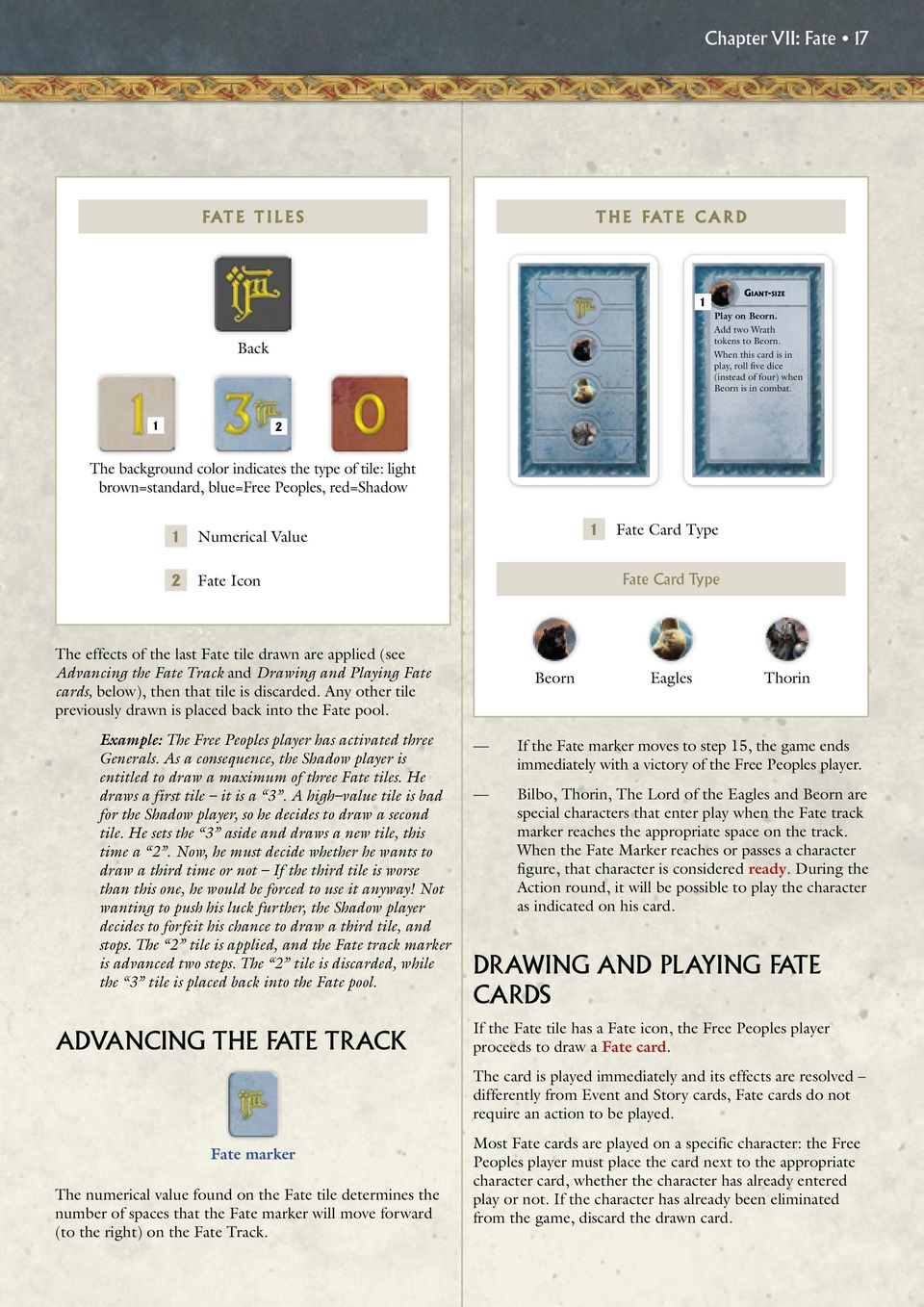
17 Chapter VII: Fate 17 FATE TILES THE FATE CARD Back 1 GIANT-SIZE Play on Beorn. Add two Wrath tokens to Beorn. When this card is in play, roll five dice (instead of four) when Beorn is in combat. 1 2 The background color indicates the type of tile: light brown=standard, blue=free Peoples, red=shadow 1 Numerical Value 2 Fate Icon 1 Fate Card Type Fate Card Type The effects of the last Fate tile drawn are applied (see Advancing the Fate Track and Drawing and Playing Fate cards, below), then that tile is discarded. Any other tile previously drawn is placed back into the Fate pool. Example: The Free Peoples player has activated three Generals. As a consequence, the Shadow player is entitled to draw a maximum of three Fate tiles. He draws a first tile it is a 3. A high value tile is bad for the Shadow player, so he decides to draw a second tile. He sets the 3 aside and draws a new tile, this time a 2. Now, he must decide whether he wants to draw a third time or not If the third tile is worse than this one, he would be forced to use it anyway! Not wanting to push his luck further, the Shadow player decides to forfeit his chance to draw a third tile, and stops. The 2 tile is applied, and the Fate track marker is advanced two steps. The 2 tile is discarded, while the 3 tile is placed back into the Fate pool. ADVANCING THE FATE TRACK Fate marker The numerical value found on the Fate tile determines the number of spaces that the Fate marker will move forward (to the right) on the Fate Track. Beorn Eagles Thorin If the Fate marker moves to step 15, the game ends immediately with a victory of the Free Peoples player. Bilbo, Thorin, The Lord of the Eagles and Beorn are special characters that enter play when the Fate track marker reaches the appropriate space on the track. When the Fate Marker reaches or passes a character figure, that character is considered ready. During the Action round, it will be possible to play the character as indicated on his card. DRAWING AND PLAYING FATE CARDS If the Fate tile has a Fate icon, the Free Peoples player proceeds to draw a Fate card. The card is played immediately and its effects are resolved differently from Event and Story cards, Fate cards do not require an action to be played. Most Fate cards are played on a specific character: the Free Peoples player must place the card next to the appropriate character card, whether the character has already entered play or not. If the character has already been eliminated from the game, discard the drawn card.
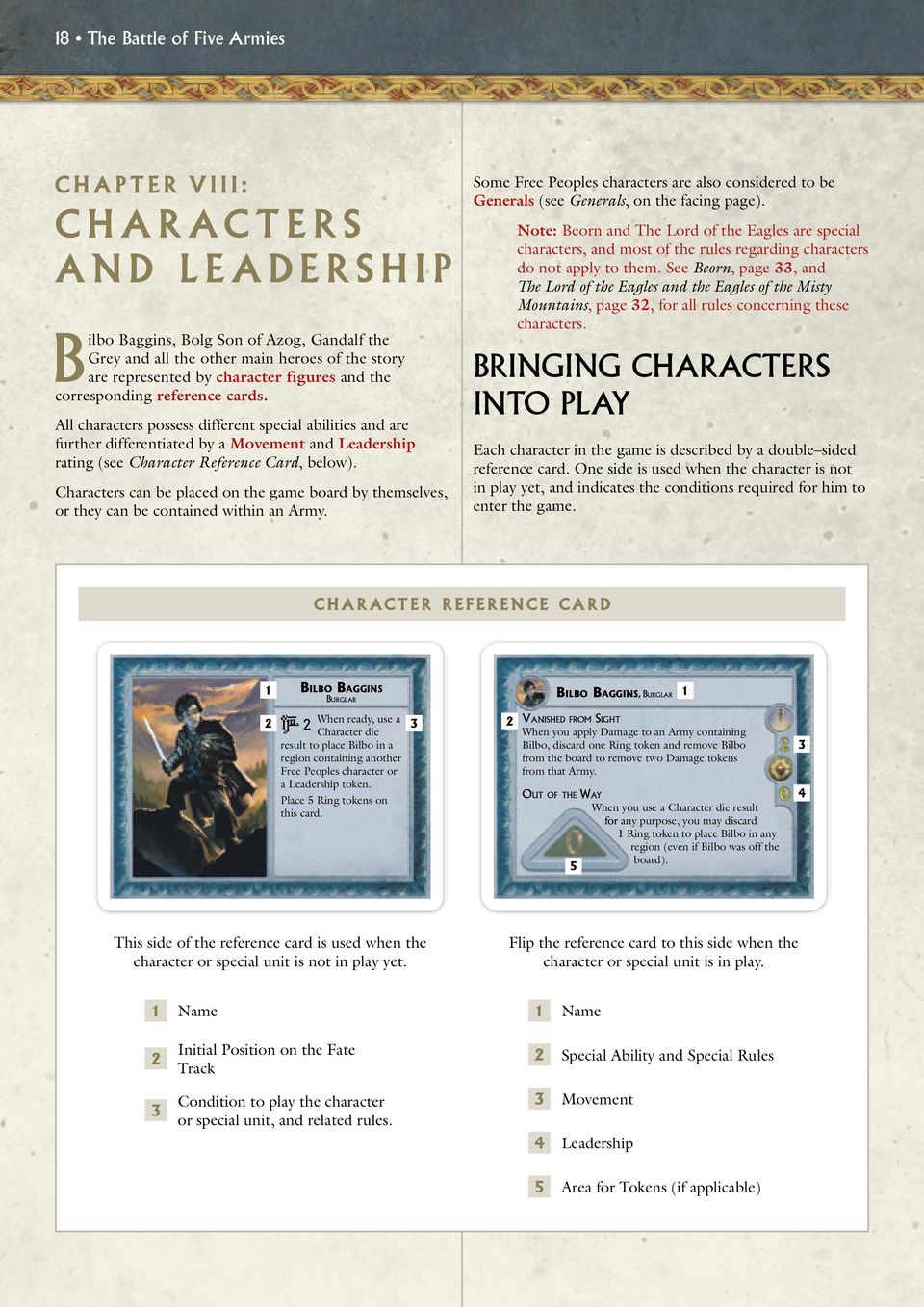
18 18 The Battle of Five Armies CHAPTER VIII: CHARACTERS AND LEADERSHIP Bilbo Baggins, Bolg Son of Azog, Gandalf the Grey and all the other main heroes of the story are represented by character figures and the corresponding reference cards. All characters possess different special abilities and are further differentiated by a Movement and Leadership rating (see Character Reference Card, below). Characters can be placed on the game board by themselves, or they can be contained within an Army. Some Free Peoples characters are also considered to be Generals (see Generals, on the facing page). Note: Beorn and The Lord of the Eagles are special characters, and most of the rules regarding characters do not apply to them. See Beorn, page 33, and The Lord of the Eagles and the Eagles of the Misty Mountains, page 32, for all rules concerning these characters. BRINGING CHARACTERS INTO PLAY Each character in the game is described by a double sided reference card. One side is used when the character is not in play yet, and indicates the conditions required for him to enter the game. CHARACTER REFERENCE CARD 1 2 BILBO BAGGINS BURGLAR When ready, use a 2 Character die result to place Bilbo in a region containing another Free Peoples character or a Leadership token. Place 5 Ring tokens on this card. 3 2 BILBO BAGGINS, BURGLAR VANISHED FROM SIGHT When you apply Damage to an Army containing Bilbo, discard one Ring token and remove Bilbo from the board to remove two Damage tokens from that Army. OUT OF THE WAY When you use a Character die result for any purpose, you may discard 1 Ring token to place Bilbo in any region (even if Bilbo was off the board) This side of the reference card is used when the character or special unit is not in play yet. Flip the reference card to this side when the character or special unit is in play. 1 Name 1 Name 2 3 Initial Position on the Fate Track Condition to play the character or special unit, and related rules. 2 Special Ability and Special Rules 3 Movement 4 Leadership 5 Area for Tokens (if applicable)
19 Chapter VIII: Character and Leadership 19 As indicated on their card, some characters (Bard, Dáin, Gandalf, and Thranduil) are in play at the start of the game. The figures representing these characters are placed on the game board during setup, in the region indicated on the card, and then the card is immediately flipped to show their abilities. The other characters enter in play during the game, and they all require becoming ready in order to be brought in play. Free Peoples characters become ready when the Fate marker is on the same, or a higher, step as their figure. Bolg becomes ready when the Shadow player controls at least one region in Valley. A ready character can be brought into play during the Action Round, by using an Action Die result of the type specified by the reference card. Each reference card may specify further requirements, effects, and special rules that apply. If a character must enter play in a specific region, and that region contains enemy units or is controlled by the enemy, the character cannot enter play. As soon as the character is in play, his card is flipped to the opposite side, to show his abilities and specific rules. Note: A character may become not ready again if the condition for being ready is no longer met and the character has not yet been brought into play. CHARACTERS IN PLAY A character in play may either be alone (or with other characters) in a region, or contained within a friendly Army. When a character is not contained within a friendly Army, he ignores enemy Armies: he cannot attack or be attacked, and he may move without regard to their presence. When a character is contained within a friendly Army, he moves and combats together with that Army. If the Army is attacked, the character is considered to be in that Army. MOVING CHARACTERS Characters can be moved on the game board by using a Character Movement action (see the Action Dice Reference chart, page 13). When using a Character Movement action, a player may move any or all his characters on the game board. Each character may move up to a number of regions equal to its Movement rating. If a character is contained within an Army, he may also move together with the Army whenever that Army moves (see Moving Armies, page 22), or he may be left behind in the Army s starting region. USING CHARACTERS The effect of characters in the game is indicated by their special ability or abilities. They also have the capacity of leading armies (see Armies with Leadership, page 21). Some Free Peoples characters, called Generals, also have a further influence on the Battle (see Generals, below). GENERALS Bard, Thranduil, Gandalf the Grey, Dáin Ironfoot and The Lord of the Eagles are considered Generals of the Free Peoples These characters have a special impact on the Battle. ACTIVATING GENERALS During the Generals Activation phase, the Free Peoples player places up to three Activation tokens on his Generals (no more than one token on each General). This has two effects: The Free Peoples player receives a number of Leadership tokens (see Leadership Tokens, page 20) equal to the number of Generals he activated. Each General has a special ability that can be used only when he has an Activation token on his card. However, as explained in the Fate section, when the number of activated Generals is higher, the Shadow player has the choice of drawing multiple Fate tiles, improving his chances to slow down the progress of Fate. USING GENERALS To use the General ability of a character, the Free Peoples player must discard the Activation token on his card. This is done during the Action Round, just before he chooses and uses one of his Action Die results. The Free Peoples player may only discard one token before using a given Action Die it is not possible to use multiple Generals abilities before the same action. Any unused activation tokens are discarded at the end of the turn.

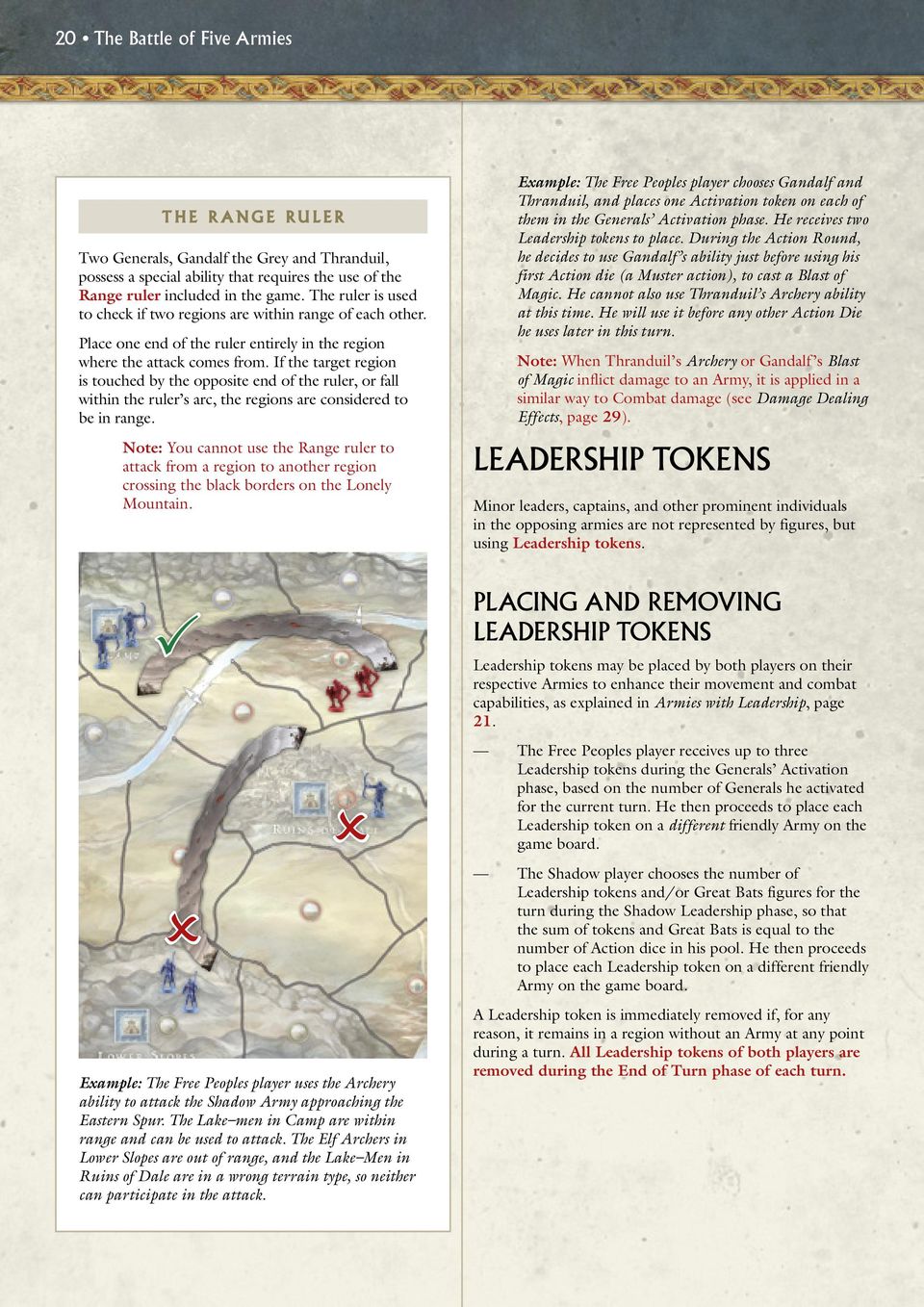
20 20 The Battle of Five Armies THE RANGE RULER Two Generals, Gandalf the Grey and Thranduil, possess a special ability that requires the use of the Range ruler included in the game. The ruler is used to check if two regions are within range of each other. Place one end of the ruler entirely in the region where the attack comes from. If the target region is touched by the opposite end of the ruler, or fall within the ruler s arc, the regions are considered to be in range. Note: You cannot use the Range ruler to attack from a region to another region crossing the black borders on the Lonely Mountain. Example: The Free Peoples player chooses Gandalf and Thranduil, and places one Activation token on each of them in the Generals Activation phase. He receives two Leadership tokens to place. During the Action Round, he decides to use Gandalf s ability just before using his first Action die (a Muster action), to cast a Blast of Magic. He cannot also use Thranduil s Archery ability at this time. He will use it before any other Action Die he uses later in this turn. Note: When Thranduil s Archery or Gandalf s Blast of Magic inflict damage to an Army, it is applied in a similar way to Combat damage (see Damage Dealing Effects, page 29). LEADERSHIP TOKENS Minor leaders, captains, and other prominent individuals in the opposing armies are not represented by figures, but using Leadership tokens. Example: The Free Peoples player uses the Archery ability to attack the Shadow Army approaching the Eastern Spur. The Lake men in Camp are within range and can be used to attack. The Elf Archers in Lower Slopes are out of range, and the Lake Men in Ruins of Dale are in a wrong terrain type, so neither can participate in the attack. PLACING AND REMOVING LEADERSHIP TOKENS Leadership tokens may be placed by both players on their respective Armies to enhance their movement and combat capabilities, as explained in Armies with Leadership, page 21. The Free Peoples player receives up to three Leadership tokens during the Generals Activation phase, based on the number of Generals he activated for the current turn. He then proceeds to place each Leadership token on a different friendly Army on the game board. The Shadow player chooses the number of Leadership tokens and/or Great Bats figures for the turn during the Shadow Leadership phase, so that the sum of tokens and Great Bats is equal to the number of Action dice in his pool. He then proceeds to place each Leadership token on a different friendly Army on the game board. A Leadership token is immediately removed if, for any reason, it remains in a region without an Army at any point during a turn. All Leadership tokens of both players are removed during the End of Turn phase of each turn.
21 Chapter IX: Armies 21 CHAPTER IX: ARMIES An Army is composed of all the friendly Army units that are inside a single region. Characters and Leadership tokens inside a region with a friendly Army are considered to be contained in that Army. STACKING LIMIT Regions have a stacking limit: a region can contain a maximum of 5 Army units. Characters, Leadership tokens, and special units (Eagles and Great Bats) do not count against this limit. Shadow Mustering regions (see page 10) and Goblin Mustering Points (see Mountain Passes, page 25) do not have this limit, and can contain any number of Shadow units. ARMY UNITS ARMIES WITH LEADERSHIP The Leadership of an Army is equal to the sum of the Leadership rating of all characters it contains, plus the number of Leadership tokens with that Army. An Army containing at least one character with a Leadership rating of 1 or more, or at least one Leadership token, is said to be an Army with Leadership (this term often appears on Event and Story cards). The presence of Leadership improves the movement and combat capabilities of an Army, as explained in the next sections. Free Peoples Leadership Tokens Shadow Army units belong to different types each type with specific combat capabilities, weaponry or training. Depending on its type, a unit will behave differently in combat. Each unit type has a corresponding unit card, with a summary of all the values and abilities of that type, and also used during combat as a Maneuver card, to trigger the unit s Maneuver ability. The card indicates one (or more) favored terrain(s), the combat strength and the maneuver ability of that type of unit. A unit s favored terrain is taken into consideration at the start of each combat, to adjudicate terrain superiority (see Checking Terrain Superiority, page 26). The combat strength is used to determine how many combat dice the player will roll in combat (see Combat Roll, page 27). The maneuver ability may be used to give a special bonus in a round of combat (see Maneuvering, page 26). 1 Unit Type 2 Unit Symbol UNIT CARD 3 Combat Strength 1 5 DWARF VETERANS OLD HATRED Add one Damage to the enemy Army, and remove one Leadership token from that Army Favored Terrain(s) 5 Maneuver Ability and Special Rules
22 22 The Battle of Five Armies MOVING ARMIES Armies are moved on the game board one region at a time, from a region to any adjacent region not occupied by an enemy Army. A player may use several different actions to move his Armies: An Army may be moved using an Army (or Army/ Muster) die result. This allows a player to take either: a Strategic Movement action, which lets him move up to two different Armies to an adjacent region, or an Attack action, which lets him move one Army to an adjacent region and then attack with that Army. An Army with Leadership may be moved also using a Character die result. This allows a player to take either: an Attack action, which lets him move one Army to an adjacent region, and then attack with that Army, or a Fast Movement action, which lets him move one Army up to two regions. Armies containing at least one Goblin unit may be moved also using a Lidless Eye die result. This allows the Shadow player to take either: a Strategic Movement action which lets him move two different Armies containing Goblins to an adjacent region (or from a Mustering Point to a Mountain Pass), or an Attack action which lets him move one Army containing Goblins to an adjacent region (or from a Mustering Point to a Mountain Pass), and then attack with that Army. Movement is never mandatory. A player may always forfeit any or all movements allowed by the chosen action. Note: It is possible to move the same Army more than once in a turn, spending multiple Action dice to do so. SPLITTING AN ARMY Before a movement, a player may divide an Army in two different Armies, by opting to move only part of the units composing the Army: the units selected for movement are moved to the region of destination, while the rest remains in the region of origin. EXAMPLE A Shadow army with five units splits using a Strategic Movement action. Two Great Orcs move west using the first of the two movements. Two Orcs move south using the second movement. One Orc is left behind in the starting region. Using a full Strategic Movement action, it is also possible to move each part of a split Army to a different adjacent region, or to split an Army into three parts with two parts moving to adjacent regions and one remaining in the original region. SPECIAL CASES If an Army with Leadership is moved using a Character die result, the units that move must contain Leadership (that is, at least 1 Leadership token, or a character with a Leadership rating of 1 or more). Example: A Shadow Army with three Orcs, two Great Orcs and two Leadership tokens is moved using the Fast Movement action of a Character die result. The Shadow player wants to move only the Great Orcs, and splits the Army. At least one Leadership token must be moved together with the moving Great Orcs. It is not possible to leave both Leadership tokens behind with the three Orcs. If an Army that contains any Damage tokens is split, the Damage tokens must be split in such a way that the number of tokens remaining with each part of the Army is not higher than the number of units in each part.
23 Chapter IX: Armies 23 Example: A Free Peoples Army with one Lake men unit, two Elf Archers units, and two Damage tokens is split by moving the two Elves to an adjacent region. The Lake men unit is left in the starting region. The Free Peoples player can either leave one token with the Lake men and one token with the Elves; or he can leave the Lake men with no damage and the Elves with two tokens. EXAMPLE MERGING ARMIES AFTER MOVEMENT If an Army ends its movement in a region containing another friendly Army, the two Armies must be merged to form a single Army. If this newly formed Army has more than five Army units, it must be reduced to five units. First, the controlling player may eliminate one or more units, removing up to two Damage tokens for each of them (see Taking Casualties, page 28). Then, any remaining units in excess of five are removed. The player has the choice of which units to remove. During an Attack action, the Armies merge after movement, but before any combat is started for this reason, units in excess are removed before combat begins. If a Strategic Movement action is being used, both Armies must complete their movements before any Armies are merged (any individual figure may not move twice in the same action). ARMIES MOVING MORE THAN ONE REGION When a player uses the Fast Movement action of a Character die result, and certain card events or special abilities, he may move an Army more than one region. Each individual movement follows the normal rules, except as noted below. The Army cannot split units, except in the starting region. The Army cannot merge with another friendly Army along the way, or pick up friendly units. If the Army enters a region adjacent to an enemy Army, it must immediately stop its movement. Remember that regions are not considered adjacent if they are separated by an impassable border. Important: If an Army moves through regions containing other friendly Armies, stacking limits are checked only after all the movements have been completed. A Free Peoples Army, with 2 Dwarf units and Dáin, uses a Character die result to do a Fast Movement action. With the first movement, they enter the Ruins of Dale region, where 4 Army units are already present. The total of Army units would now be 6, but the action is not over yet so the stacking limit is not exceeded. With the second movement, the Dwarves move east and finish their action in the region east of Ruins of Dale. There is no Army with more than 5 units at the end of the action, so no units are in excess. If the Dwarves had stopped in Ruins of Dale, the two Armies would merge into one Army with 6 units, so one unit would have to be removed. CONTROLLING FREE PEOPLES SETTLEMENTS When a Shadow Army enters a region containing a Free Peoples Settlement, the Settlement falls under the control of the Shadow player and a Control marker is placed on it to mark this status. If a Free Peoples Army unit (not a character or Eagles) moves into that Settlement later in the game, the Control marker is removed. If an Army moving multiple times crosses a Settlement, it can place (or remove) a Control marker It is not necessary for an Army to end its movement there. Note: Moving into an empty settlement is not considered an attack, even if it s controlled by the enemy. Control marker
24 24 The Battle of Five Armies MUSTERING ARMIES A number of Army units are already in play at the beginning of the game (see Army Setup, page 7). The players will bring additional units in play during the course of the game: Both players may bring new units in play by using the Recruitment action of a Muster (or Army/ Muster) die result. The action allows the player to flip one Recruitment token in each of two different regions (see Using Recruitment tokens, below) The Shadow player may use the Goblins Recruitment action of a Lidless Eye die result, to place one Goblin figure in each of the two Goblin Mustering Point boxes. PLACING RECRUITMENT TOKENS Recruitment tokens are used to bring new units in play. The back of the token indicates if it is a Shadow token, or one of the two groups of Free Peoples tokens Dwarves and Men, or Elves. The front of the token indicates which type of Army unit (or units) it brings into play when the token is flipped. New Recruitment tokens are placed on the game board by various game effects (related to character abilities or events). Both during setup and during the game, Recruitment tokens are always drawn randomly from the appropriate group, and placed on the game board, facedown and unseen to both players. Usually, Recruitment tokens are placed in regions containing a Settlement (for the Free Peoples) or a Mustering region (for the Shadow). Tokens cannot ever be placed in a region containing an enemy Army or an enemy Control Marker. When all tokens in a group have been used, a player may not place more tokens from that group, even if the event or ability would indicate to do so. USING RECRUITMENT TOKENS Whenever a player is instructed to flip a token, the player chooses a region with a Recruitment token of the appropriate type, and turns it face up. Then, a unit (or more, as indicated by the token) of the corresponding type is placed in that region. The token is then discarded permanently from play. Recruitment Tokens (Back) Dwarves and Men Elves Shadow Dwarves and Men Recruitment Tokens (Front) Lake men Dwarf Regulars Dwarf Veterans Elves Recruitment Tokens (Front) Elf Archers Elf Spearmen Shadow Recruitment Tokens (Front) Orcs Two Orcs Wargs Great Orcs Note that the number of figures included in the game is a limit to the maximum number of figures of that type in play at any one time. If, when a player flips a token, a figure of the correct type is not available, the player may choose any other unit from the same group. Example: The Free Peoples player flips a Dwarves and Men token, revealing a Dwarf Regular. All five Dwarf Regulars are already in play, so he may choose to recruit a Lake men unit or a Dwarf Veteran unit instead. Used tokens are permanently removed from the game. ELIMINATING RECRUITMENT TOKENS If, during a movement or after a combat, an Army enters (or moves through) a region that contains enemy Recruitment tokens, those tokens are eliminated (without looking at them). Certain Event cards may also remove tokens from play. Eliminated Recruitment tokens are reshuffled together with the unused tokens of the same type.
25 Chapter IX: Armies 25 DIRECT MUSTERING OF UNITS Special abilities of characters, or the effect of some Event cards, may also bring units directly into play on the game board, without the need for using Recruitment tokens. These units are taken from the figures not in play. If no figures are available, the unit cannot be brought into play. EXCEEDING THE STACKING LIMIT If, as a result of recruiting new units, there are more than five Army units in the same region, units in excess are immediately removed. The controlling player has the choice of which units to remove. Mustering regions are an exception to this rule, as there is no limit to the number of units that can be placed inside them. RALLYING ARMIES Players may remove Damage tokens from a friendly Army by taking a Rally action using a Muster die result. With a Rally action, a player may rally up to two different friendly Armies. For each Army, roll a number of dice equal to the number of units in that Army: For every die result of 5 or 6, remove one Damage token. You can roll again a number of failed dice up to the total Leadership of the Army, applying the new result. After the roll, the player may also take casualties (removing one unit to remove two Damage tokens see Taking Casualties, page 28) if he wants to do so. MOUNTAIN PASSES At the beginning of the game, Mountain Passes are closed Goblins cannot move from the Mustering Point to the Mountain Pass. This is indicated by placing a Closed Mountain Pass marker between each Mustering Point and the corresponding Mountain Pass. A Mountain Pass opens as soon as the connected Mustering Point contains at least five units. Once opened, remove the Closed Mountain Pass marker the Mountain Pass will remain open until the end of the game. The Shadow Army in the Mustering Point may only move to the Mountain Pass connected to it, when it is open, when using any action that allows Army movement. The Shadow Army in the Mountain Pass may only move to the region connected to it. If a Free Peoples Army is in that region, the Shadow Army in the Mountain Pass may attack it normally. The attack is not considered to cross a slope border (see Target Number, page 27). A Shadow Army in a Mountain Pass box cannot participate in a combined attack together with a Shadow Army in a normal region. The connection between a Mountain Pass box and the region it is connected to is one way : the Mountain Pass cannot be entered, retreated, or attacked into, from that region (or any other region on the game board), and is not considered adjacent to it for the purpose of Fast Movement or retreat rules. Note: Event cards that allow recruitment in regions containing Armies may be used in Mountain Passes (and Goblin Mustering Points). x2 x5 At the beginning of the game, the Mountain Pass is closed. After the Mountain Pass opens, Goblins can move from the Mustering Point to the Mountain Pass.
26 26 The Battle of Five Armies CHAPTER X: COMBAT An Army may attack an adjacent region occupied by an enemy Army, initiating a combat. A player may use several different actions to initiate a combat: An Army may start a combat using the Attack action of an Army die result, after moving his Army. An Army may start a combat using the Combined Attack action of an Army die result, attacking a region together with other friendly Armies adjacent to that region. An Army with Leadership may start a combat using the Attack action of a Character die result, after moving his Army. A Shadow Army containing at least one Goblin unit may start a combat using the Attack action of a Lidless Eye die result, after moving his Army. The Army of the active player is called the attacker, and the Army of the other player is called the defender. Note: When there is an impassable border that divides two regions, these regions are not considered adjacent, and attacks across the border are not possible. STARTING A COMBAT The following steps must be taken before the combat begins. 1. Checking Terrain Superiority 2. Preparing the card hand CHECKING TERRAIN SUPERIORITY At the beginning of a combat, players must check the terrain type of the region where the combat is taking place, that is, the region where the defender is located. Count the number of units in each Army which have that terrain type as one of their favored terrains (as indicated by their unit card). The Army with the higher number of units on favored terrain is considered to have Terrain Superiority. Note: The number of units is relevant, not their Combat Strength. The player with Terrain Superiority draws immediately one Event card and adds it to his hand (discarding to six if necessary). In case of a tie, neither player draws a card. PREPARING THE CARD HAND Before combat begins, each player prepares his card hand. He must temporarily set aside any Story cards (not used in combat), and add to the Event cards in his hand: The Unit cards of each unit type composing his Army, to use their Maneuver ability. His Regroup card Special Maneuver cards due to the presence of Thorin Oakenshield and Great Bats (if applicable) These cards will be always discarded at the end of the combat, and they do not count against the hand limit. COMBAT SEQUENCE Combats are fought in rounds. Each round is further divided into steps, as illustrated in the following sequence. Step 1) Maneuvering Players simultaneously choose and reveal a card from their hand. Step 2) Combat Roll Players roll a number of Combat dice equal to the Combat Strength of their respective Armies (up to a maximum of five dice). Step 3) Leader Re roll Players may re roll once again a number of failed Combat dice up to their Army s Leadership. Step 4) Apply Damage Players add Damage tokens to the Armies, and remove casualties if necessary. Step 5) End of Round If neither Army is completely eliminated, the attacker may withdraw to end the combat. If not, the defender may end the combat by retreating or routing. Otherwise, a new round of combat begins. STEP 1) MANEUVERING Both players must choose secretly a card from their hand, and then reveal their choice simultaneously. A player may either play: A Unit card, to use the Maneuver ability of that unit type An Event card, used for its Combat effect A Special Maneuver card The Regroup card
27 Chapter X: Combat 27 USING THE MANEUVER ABILITY OF A UNIT CARD If a Unit card is chosen, the Combat roll (and Leader re roll) during this round may allow the use of the selected unit s maneuver ability (see Combat Roll, below). When a Unit card is selected it is left on the table, face up. It will not be available again to the player in this combat, until a Regroup card is played. USING AN EVENT CARD The Combat effect of the Event card is applied when specified by the card text, usually immediately before or after one of the steps of the Combat sequence. If two cards take effect at the same time, the card played by the defender is resolved first. Event cards are discarded from play after use. USING A SPECIAL MANEUVER CARD There are two Special Maneuver cards ( Thorin s Mighty Strokes and Vampire like ). The effect of these cards is activated automatically, independently of the dice roll. Thorin s Mighty Strokes, like a unit maneuver, is not available again during the combat, until a Regroup card is played. Vampire like remains available for use in every round, as long as there are Great Bats in the territory where the combat takes place. USING THE REGROUP CARD When a Regroup card is played, the player recovers all the Unit cards and Special Maneuver cards he played during this combat (including the Regroup card itself) and adds them to his hand again. In addition, the player may also choose to retreat at the end of the round, without suffering the consequences of a rout (see End of Round, page 29). STEP 2) COMBAT ROLL Players roll dice to score hits against the enemy Army. A player sums together the Combat Strength ratings of all units composing his Army to find its Combat Strength. Each player rolls a number of Combat Dice equal to the total Combat Strength of his Army, up to a maximum of 5 dice. TRIGGERING UNIT MANEUVER ABILITIES If a player has played a unit card during the Maneuvering step, he substitutes a number of white dice with black dice, before the Combat Roll. The number of dice to substitute is equal to the number of units of the selected type (it is not based on their Combat Strength). If, after the Combat Roll and Leader Re roll, at least one of the black dice scored a hit, the player may use the special ability of that unit type. Any hits rolled, both with white and black dice, are applied normally. Example: The Shadow player has an army with 2 Orcs and 1 Great Orc. The Army has a Combat Strength of 4 (1+1+2), so the player uses 4 dice in the combat roll. The Great Orc unit card has been played during the Maneuvering step. So, the Shadow player substitutes one of the 4 white dice with 1 black die, as one Great Orc is present. He will roll 3 white and 1 black die, and if the black die scores a hit, the Great Orc special ability is activated. Note: If necessary, the attacker must declare first whether he wants to use a maneuver ability he activated, then the defender does the same. TARGET NUMBER A hit is scored for every Combat Die result that matches or beats a Target Number. The Target Number is determined before the Combat Roll. Normally, the Target Number is equal to 5, with a few exceptions: The Target Number for an Army attacking a defender inside a Fortification is equal to 6 until the Fortification is broken (see Fortifications, page 28). The Target Number for an Army attacking a defender across a ford is equal to 6, on the first round only. The Target Number for an Army attacking a defender in a Mountains region across a slope is equal to 6, on the first round only (an Army attacking from a Mountains region across a slope does not suffer this penalty). Event cards and special abilities may also modify the Target Number. When this is the case, follow closely the text on the card to see whether the modifier applies to the Combat Roll, the Leader Re roll, or both.
28 28 The Battle of Five Armies Additionally, cards may refer to adding or subtracting from a Combat Roll: this means that the indicated value must be added to each die result produced by the roll. No modification may lower the Target Number below 2 or increase the number to more than 6. STEP 3) LEADER RE ROLL If an Army has Leadership, the player may re roll dice in the Combat Roll that did not score a hit. A player may roll again a number of dice up to the total Leadership of his Army, choosing freely between white or black dice. The new result rolled is final. Dice in the Leader Re roll score a hit in the same way as in the Combat Roll, unless otherwise stated by the text of a card for example, the text of an Event might specify that a Target Number modifier applies only to the Combat Roll or to the Leader Re roll. FORTIFICATIONS Three regions on the game board (Ravenhill, Front Gate and Eastern Spur) are considered Fortifications, and are distinguished by a number, representing the protection value of the Fortification, inscribed within a light brown triangle. Example: The Free Peoples player has an army with 2 Dwarf Regulars, 1 Dwarf Veteran, Dáin, and 1 Leadership token. The combat strength is 4 (2 for the two Regulars, 2 for the Veteran), and the Leadership is 3 (2 for Dáin, 1 for the Leadership token). The Free Peoples player uses the Dwarf Veterans Maneuver ability, so he rolls three white dice and one black die. The roll is 2, 3, 3, 4 no hits are scored. Fortunately, the Free Peoples player may reroll three dice due to his Leadership. He chooses to reroll the black die and two of the white dice. Note: Since the effects of all rolls are considered to apply simultaneously, players may resolve their Combat Rolls and Leader Re rolls in any order (first the attacker rolls his dice, then the defender does the same, or vice versa). STEP 4) APPLY DAMAGE For each hit inflicted on an Army, a Damage token is added to that Army. The token is placed in the region containing the Army. The effects of Damage are dealt with in this step. Several Event cards and special abilities can influence the amount of Damage taken by an Army, by adding, removing or preventing Damage. These effects are determined after adding Damage tokens, and before taking casualties. If a defending Army is attacked while inside a Fortification, any Damage inflicted on that Army is added to the Fortification instead, until the number of Damage tokens reaches its protection value and the Fortification is broken. Any further Damage is inflicted on the defending Army. When the Fortification is broken, the Target Number to hit the army inside reverts to 5 in the following round. The damage on a Fortification is permanent. It cannot ever be removed by a Rally action, the use of an ability, or the effect of a card, unless this is explicitly mentioned by the effect. Note: When an ability cancels damage, or prevents damage to be inflicted (such as the Wall of Spears ability of Elven Spearmen), the ability may be used to cancel or prevent damage against a Fortification. TAKING CASUALTIES During this step, players may eliminate units to reduce the amount of Damage tokens accumulated by their Army. For each unit a player chooses to eliminate from his Army, the player may remove up to two Damage tokens from that Army. Units removed from the game are set aside together with any other unused figures. They may be mustered again when a player uses a Recruitment token or an Event card. MANDATORY CASUALTIES A player is not forced to take casualties, unless the number of Damage tokens exceeds the number of units in his Army, or the Army routs (see End of Round, on the facing page). When the number of Damage tokens on an Army exceeds the number of units composing it, the controlling player must take casualties and lose units (removing two Damage tokens for each unit removed), until the number of Damage tokens is equal to or lower than the number of units in the Army.
29 Chapter X: Combat 29 EXAMPLE An Army with three units already has two Damage tokens on it. During the current combat round suffers three additional hits. The new total of Damage tokens (five) is now higher than the number of units (three), so the player must take casualties. He removes one unit and two Damage tokens. Now he has two units and three Damage tokens, so he must continue to take casualties. He removes another unit and two Damage tokens. Now the total number of surviving units is one, and one Damage token remains, so no additional losses have to be taken. DESTRUCTION OF AN ARMY If all units in an Army are eliminated, all Characters (and Leadership tokens) contained in that Army are eliminated, too. Any eliminated character is permanently out of the game. STEP 5) END OF ROUND A combat ends at the end of a round, if either the attacking or defending Army is completely eliminated, or one of the conditions listed below apply; otherwise, a new round of combat starts. The Attacker Withdraws: The attacker decides to stop attacking. The combat is immediately over. The Defender Retreats: If the defender has played the Regroup card this round, he may retreat at the end of a round, moving the retreating Army to an adjacent region (see Retreating, below). The Defender Routs: If the defender didn t choose the Regroup card this round, he can move to an adjacent region anyway, but must suffer the effects of a Rout (see Routing, page 30). The attacker must declare first if he wants to withdraw. Then, if the attacker wishes to continue, the defender may decide if he wants to retreat or rout. If the defending Army is eliminated, retreats, or routs, the attacker may advance (see Advancing after Combat, page 30). Note: If both Armies are eliminated, the defender retains control of the region where the combat was fought. RETREATING An Army retreats when the defender has played the Regroup card and decides to end the combat at the end of the round. A defending Army is allowed to move to an adjacent region if: That region does not contain an enemy Army, or a Settlement controlled by the enemy; That region is not adjacent to a region containing an enemy Army (including the attacking Army); That region is not across a ford. Exception: An Army may always retreat to an adjacent region, if it contains a friendly Army, or a Settlement under the control of the retreating player. DAMAGE DEALING EFFECTS It is possible for players to inflict damage to an Army outside of combat, due to the use of an Event card or special ability. When this happens, damage is resolved exactly in the same way as during the Apply Damage step of a round of combat, first assigning Damage tokens (and applying defensive effects, if applicable); then, taking mandatory casualties if the number of damage tokens is higher than the number of units in that Army.
30 30 The Battle of Five Armies If the retreating Army cannot move to a region satisfying the conditions listed above, then the attacker, instead of the defender, chooses an adjacent region, and moves the retreating Army there. The retreating Army suffers one additional Damage. The chosen region cannot contain one of the attacker s Armies or a Settlement he controls. If there isn t an available region to move the Army into, retreat is not allowed. ROUTING EXAMPLE A Free Peoples Army north of Ruins of Dale is attacked by a Shadow Army ( A ). In the first round of combat, the Free Peoples player uses the Regroup card, and at the end of the round he chooses to retreat the Army. The Army cannot retreat across the ford and cannot retreat to Ruins of Dale (adjacent to the Shadow Army B and controlled by the Shadow player). The Free Peoples Army can only retreat to the west. An Army routs when the defending player wants to leave the combat but he has not played the Regroup card during the current round. When an Army routs, it must take casualties and lose units until the number of Damage tokens is reduced to 1 or 0. Then, the Army may move to an adjacent region, following the same rules and restrictions which apply to a retreat. B A ADVANCING AFTER COMBAT If a defending Army is eliminated, retreats, or routs, the attacker wins the combat, and he may advance into the now empty region with any units in its Army. The attacker may advance with only some of the units in that Army if he so chooses, thus splitting the Army (see page 22). As usual, if the advancing Army contains any Damage tokens, their number must be split in such a way that the tokens remaining with each part of the Army do not exceed the number of units in each part. COMBINED ATTACKS A combined attack is performed using the Combined Attack action of an Army die result, and can be done when a player has more than one of his Armies adjacent to the attacked region. A combined attack is resolved as a normal combat, with the difference that the attacker chooses, at the start of each round, which one of his Armies among those adjacent to the defenders will fight in the current round. Only the chosen Army s Combat Strength, Leadership, unit type, and other characteristics will be relevant in that combat round, and all hits scored by the defender during the round will be taken by the chosen attacking Army. NOTES ON COMBINED ATTACKS Terrain Superiority is checked only once, before the first combat round, so it will be based on the first Army that attacks. The attacker always recovers any used Unit and Special maneuver card when he switches the attack to a different Army. The Target Number of each Army is affected by a ford or slope only the first time that Army attacks. After a victorious combined attack, the attacker may advance into the now empty region only one of the attacking Armies (or a part of one Army). It is not possible to advance units from more than one of the Armies involved in the combat. If the last attacking Army used to fight in the combined attack is completely eliminated, but the defender is also eliminated, retreats or routs, the combat is still won by the attacker (if at least one attacking Army survives) and one of the attacking Armies involved in the action may advance.
31 Chapter XI: Victory Conditions 31 CHAPTER XI: VICTORY CONDITIONS Victory in The Battle of Five Armies is based on the control of key areas on the game board (Settlements and the Front Gate). The death of Bolg, commander of the Shadow Armies, or the progress of the Fate Track, may also determine victory, as indicated below. Control of the following locations gives Victory Points to the Shadow player: Fortifications (Ravenhill, Front Gate and Eastern Spur) are worth 4 points each; Other Settlements (Ruins of Dale, Camp, Lower Slopes and Fallen Bridge) are worth 2 points each. The Free Peoples player wins immediately, as soon as one of the following conditions applies: Bolg is eliminated from the game. Beorn enters play and the Shadow player has fewer than 6 Victory Points. The Fate Track Marker reaches step 15. The Shadow player wins if he has 10 or more Victory Points at the end of a turn, or immediately if the Shadow has 10 Victory Points and controls Front Gate.
32 32 The Battle of Five Armies CHAPTER XII: ADDITIONAL RULES The abilities of characters and special units are summarized on their reference cards. All characters have special rules, but some of them require additional explanations. THE LORD OF THE EAGLES AND THE EAGLES OF THE MISTY MOUNTAINS The Lord of the Eagles is not a normal character, and the Eagles are not normal Army units. They do not follow the same rules of other characters and units, and only obey the rules specified by their reference cards and by the Story and Fate cards explicitly mentioning them. MUSTERING THE EAGLES Eagles cannot be recruited using a normal action. They are mustered only by: Specific cards (even before the Lord of the Eagles enter play, if indicated by the card text), or Using the Lord of the Eagles General ability (instead of using his ability to move them). THE LORD OF THE EAGLES THE LORD OF THE EAGLES When ready, use a 8 Character die result to place the Lord of Eagles and one Eagle in the Eagles Eyrie. Bring in play the Eagles of the Misty Mountains. General. Before choosing your Action Die, discard the Activation token from this card to place one Eagle in Eagles Eyrie, or to take all the Eagles in Eagles Eyrie and place each of them anywhere on the board. In addition to his General ability, The Lord of the Eagles has the same abilities as normal Eagles of the Misty Mountains. THE EAGLES OF THE MISTY MOUNTAINS The Eagles of the Misty Mountains enter play when the Lord of the Eagles enters play. THE EAGLES OF THE MISTY MOUNTAINS STRONG AND NOBLE-HEARTED Use a Muster die result to move one or more Eagles from the board to Eagles Eyrie. For every Eagle thus moved, attack one Army in a region within the same territory. Each attack must target a different Army. Roll three dice for each attack, and score one hit for each result of 4+. Any die that doesn t score a hit may be re-rolled once again. Eagles on the board are moved back to Eagles Eyrie at the end of every turn. The Lord of the Eagles is activated together with the Eagles and works as one of them. When Eagles are mustered, they are always placed in the Eagles Eyrie box. Note: Eagle figures placed in the Eagles Eyrie due to the effect of a Story or a Fate card cannot be used until Eagles enter play. MOVING THE EAGLES Eagles and the Lord of the Eagles always move back and forth, in every turn, from the Eagles Eyrie to the battlefield. At the beginning of a turn, Eagles are always in the Eyrie. They are moved to the battlefield if and when the Lord of the Eagles General ability is used. At that point, all Eagles (including the Lord) are moved anywhere on the board. The specific region they are moved onto is not relevant only the territory really matters. Eagles are moved back to the Eyrie when they are used (see below). They are always moved back to the Eyrie at the end of a turn when unused. USING THE EAGLES Eagles enter play when the Lord of the Eagles enters play. To be used, Eagles must first be moved out of the Eyrie using the Lord of the Eagles General ability. Then, the Free Peoples player can spend a Muster die result to activate their Strong and noble hearted ability. When he does, he can move one or more Eagles (including the Lord) from the board to Eagles Eyrie. For every Eagle thus moved, he attacks one Shadow Army in a region within the territory where the Eagle was. Each attack must target a different Army. The Free Peoples player rolls three dice for each attack, and scores one hit for each result of 4+. Any die that doesn t score a hit may be re rolled once again. The attack roll cannot be modified in any other way. Note: All Eagles must be moved before any attacks are rolled.
33 Chapter XII: Additional Rules 33 BEORN Beorn is a very powerful character, and in the game he behaves much like an Army. His arrival may grant an immediate victory to the Free Peoples player, if the Shadow player has not got at least 6 Victory Points when he enters play. BEORN, SKIN-CHANGER Wrath tokens are FURY a measure of the attack an adjacent region. superhuman strength and toughness of Beorn. These to zero Beo tokens are placed on his character card when he enters play. Beorn starts with 8 Wrath tokens, and additional tokens can be gained using Fate cards, up to a maximum of 16. BEORN SKIN-CHANGER When ready, use a 11 Character die result to place Beorn in a region adjacent to the southern border of the board. Place 8 Wrath tokens on this card. Add an Action Die when Beorn is in play. While Thorin is in play, Beorn does not add this die to the Action Pool. Use a Will of the West die result, or discard a Wrath token and use a Character die result, to move Beorn. After moving, Beorn may When Beorn attacks, roll four dice and score one hit for each result of 5+. Any die that doesn t score a hit may be re-rolled once again. When in combat, Beorn doesn t use Event or Maneuver cards. Beorn cannot be stacked with Army units. When Beorn takes Damage, remove an equal number of Wrath tokens. If reduced to zero tokens, remove Beorn from play. Beorn cannot be rallied, and he is not affected by the Wargs maneuver ability. STACKING Beorn cannot ever be stacked with Army units, either friendly or enemy. If in the same region with Free Peoples characters without an Army, he is unaffected by their presence. BEORN AND SHADOW ARMIES Beorn cannot move into or through a region containing a Shadow army. For the purpose of moving Shadow Armies, Beorn is equivalent to a Free Peoples Army: A Shadow Army cannot move into or through a region containing Beorn; A Shadow Army cannot use Fast Movement to move through a region adjacent to Beorn: it must stop when entering the adjacent region. Beorn can attack, and be attacked by, Shadow Armies in adjacent regions. Wrath Tokens Back (value of 1) Front (value of 1) Back (value of 5) Front (value of 5) MOVEMENT Beorn can move, up to three regions, using a Will of the West die result. The Free Peoples player may use a Character die result instead, if he also discards one of Beorn s Wrath tokens. Moving Beorn is not a normal Character Movement action other Free Peoples characters are not moved at the same time. After completing his movement, Beorn may attack a Shadow Army in an adjacent region. Note: Beorn may recapture an empty Settlement controlled by the Shadow player by moving through it. BEORN IN COMBAT In most ways, Beorn in combat is treated in a similar way to a Free Peoples Army, with some differences. Terrain superiority is not checked or applied. Beorn doesn t use Event or Maneuver cards in combat. When Beorn is in combat, roll four dice and score one hit for each result of 5+. Any die that doesn t score a hit may be re rolled once again, similarly to an Army with Leadership. Fate cards in play may modify these values. Beorn suffers a penalty when he attacks a Fortification, across a ford or up a slope, just like an Army does. When Beorn takes Damage, instead of applying Damage tokens, remove an equal number of Wrath tokens. If he is reduced to zero tokens, remove him from play. Beorn can retreat, similarly to an Army and with the same limitations and penalties, except that he cannot retreat into a region containing a friendly Army. Beorn cannot ever be rallied. Beorn is not affected by the Wargs maneuver ability. Beorn cannot participate in a combined attack.
34 34 The Battle of Five Armies GREAT BATS The Great Bats are not normal Army units. They do not follow the same rules of other units, and only obey the rules specified by their reference card and by the Event cards explicitly mentioning them. GREAT BATS Great Bats are already in play at the start of the game. one additional damage. Differently from a normal unit maneuver card, if the Shadow player uses the Vampire like card, he takes it back at the end of the combat round. Of course, the card has no effect if, when used, there is no Great Bat figure to discard, so its use is effectively limited by the number of Great Bat figures available in the territory. Any unused Great Bat figure on the board is removed from play at the end of the turn. BOLG PLAYING GREAT BATS Bats on the board are removed at the end of every turn. The number of Great Bats in play is determined during phase 4 of the game turn by the Shadow Player. He can choose how many Great Bat figures are in play (up to the maximum of six), as long as the sum of Great Bats and Leadership tokens is equal to the number of Action dice in his pool. After deciding how many Great Bats to use, he places them on the board. Similarly to Eagles, Bats are assigned to a territory, not to a specific region. No matter the exact region the figure is in, it can be used anywhere in the territory including that region. USING GREAT BATS GREAT BATS BAT CLOUD Use a Muster die result and remove one Great Bat from a territory to choose a friendly Army in the same territory. Move that Army. VAMPIRE-LIKE Add the Vampire-like Maneuver card to your hand in combat, if one or more Great Bats are present in the territory where the combat takes place. There are two different ways to use the Great Bats. The Bat Cloud ability is used during the Action Round, to help the movement of the Shadow Armies. The Shadow player may use a Muster die result and remove one Great Bat from a territory, to move one of his Armies in that territory. This provides additional mobility to the Shadow, as the Muster die result cannot be used for movement, normally. The Vampire like ability is used during combat, as a maneuver. If one or more Great Bat figures are present in the territory where the combat takes place looking at the position of the defending Army the Shadow player adds the special maneuver card of the same name to his hand. He can then decide to play the card as his maneuver during a round. If he does so, and the Shadow Army inflicts at least one damage in that round, the Shadow player can discard one Great Bat figure from the territory to inflict Bolg is the powerful leader of the Shadow Army. He enters play only when a Shadow army is present in at least one region in Valley (red territory), but he will be stronger if he enters when the Shadow army controls Ruins of Dale, as he will start with three Bodyguard tokens instead of one. Bolg is the only character available to the Shadow player. His Bodyguards ability is very important, because if Bolg is killed, the Free Peoples player immediately wins the game. BOLG, SON OF AZOG Bolg s Bodyguards ability allows Bolg to cancel all damage inflicted in one round of combat to the army he is with, by discarding one Bodyguard token. This is essential to keep Bolg alive and also makes the army moving with Bolg extremely tough in combat. Like any other character, Bolg is eliminated when the Army he is with is completely eliminated. He cannot attack or be attacked when he is alone. BOLG SON OF AZOG If at least one region in Valley contains a Shadow army, use a Muster die result to place Bolg in a Mustering region. Place one Great Orc in the same region. Flip one Recruitment token in each Mustering region. Place one Bodyguard token on this card; if you control Ruins of Dale, place three Bodyguard tokens instead. WITH RENEWED FORCE If you control at least two Settlements, use a Muster die result to place one Recruitment token in four different regions in Broken Lands. BODYGUARDS You may discard a Bodyguard token to prevent all Damage inflicted in one round of combat, or by any other type of attack, to an army containing Bolg. Note that the Bodyguards can also protect the army with Bolg from damage not caused by combat (for example, damage inflicted using Thranduil s or Gandalf s special abilities). Bolg s Bodyguards can only negate damage to the Army he is with.
35 Contents 35 CONTENTS CHAPTER I: INTRODUCTION COMPONENTS LIST OVERVIEW COMPONENTS OVERVIEW CHAPTER II: SETTING UP THE GAME Step Step Step Step Step Step Step STARTING POSITIONS ON THE FATE TRACK ARMY SETUP CHAPTER III: GAME COMPONENTS THE GAME BOARD REGIONS BORDERS BORDER EXAMPLES SETTLEMENTS FORTIFICATIONS MUSTERING REGIONS GOBLIN MUSTERING POINTS AND MOUNTAIN PASSES THE EAGLES EYRIE THE FATE TRACK GAME FIGURES ARMY UNITS SPECIAL UNITS CHARACTERS CHAPTER IV: THE GAME TURN Phase 1 Recovery Phase 2 Generals Activation Phase 3 Fate Phase 4 Shadow Leadership Phase 5 Action Round Phase 6 End of Turn CHAPTER V: THE ACTION DICE ACTION DICE POOL USING ACTION DICE ACTION DICE REFERENCE CHART CHAPTER VI: EVENT AND STORY CARDS. 14 THE EVENT CARDS AND EVENT DECK THE STORY CARDS AND STORY DECKS DRAWING CARDS Exhausting the card decks PLAYING AN EVENT OR STORY CARD AS AN ACTION Requirements for playing a card Effects of a card Discarding cards after use CHAPTER VII: FATE FATE TILES THE INFLUENCE OF FATE DRAWING FATE TILES ADVANCING THE FATE TRACK DRAWING AND PLAYING FATE CARDS CHAPTER VIII: CHARACTERS AND LEADERSHIP BRINGING CHARACTERS INTO PLAY CHARACTERS IN PLAY MOVING CHARACTERS USING CHARACTERS GENERALS ACTIVATING GENERALS USING GENERALS THE RANGE RULER LEADERSHIP TOKENS PLACING AND REMOVING LEADERSHIP TOKENS. 20 CHAPTER IX: ARMIES STACKING LIMIT ARMY UNITS ARMIES WITH LEADERSHIP MOVING ARMIES SPLITTING AN ARMY Special cases MERGING ARMIES AFTER MOVEMENT ARMIES MOVING MORE THAN ONE REGION...23 CONTROLLING FREE PEOPLES SETTLEMENTS MUSTERING ARMIES PLACING RECRUITMENT TOKENS USING RECRUITMENT TOKENS ELIMINATING RECRUITMENT TOKENS DIRECT MUSTERING OF UNITS EXCEEDING THE STACKING LIMIT MOUNTAIN PASSES RALLYING ARMIES CHAPTER X: COMBAT STARTING A COMBAT CHECKING TERRAIN SUPERIORITY PREPARING THE CARD HAND COMBAT SEQUENCE STEP 1) MANEUVERING USING THE MANEUVER ABILITY OF A UNIT CARD 27 USING AN EVENT CARD USING A SPECIAL MANEUVER CARD USING THE REGROUP CARD STEP 2) COMBAT ROLL TRIGGERING UNIT MANEUVER ABILITIES TARGET NUMBER STEP 3) LEADER RE ROLL STEP 4) APPLY DAMAGE FORTIFICATIONS TAKING CASUALTIES Mandatory Casualties Destruction of an Army DAMAGE DEALING EFFECTS STEP 5) END OF ROUND RETREATING ROUTING ADVANCING AFTER COMBAT COMBINED ATTACKS NOTES ON COMBINED ATTACKS CHAPTER XI: VICTORY CONDITIONS CHAPTER XII: ADDITIONAL RULES THE LORD OF THE EAGLES AND THE EAGLES OF THE MISTY MOUNTAINS MUSTERING THE EAGLES MOVING THE EAGLES USING THE EAGLES BEORN MOVEMENT STACKING BEORN AND SHADOW ARMIES BEORN IN COMBAT GREAT BATS PLAYING GREAT BATS USING GREAT BATS BOLG
36 A game by ROBERTO DI MEGLIO, MARCO MAGGI and FRANCESCO NEPITELLO TM TM Game Design ROBERTO DI MEGLIO, MARCO MAGGI and FRANCESCO NEPITELLO Art LUCAS GRACIANO, JON HODGSON, BEN WOOTTEN Art Direction & Graphic Design FABIO MAIORANA Sculptures BOB NAISMITH Sculpture Design MATTEO MACCHI and BOB NAISMITH Photos CHRISTOPH CIANCI Production and Editing ROBERTO DI MEGLIO and FABRIZIO ROLLA Additional Editing KRISTOFER BENGTSSON, KEVIN CHAPMAN, ANDREW POULTER, LEONARDO RINA Playtesters: Gabriel Alonso, Kristofer Bengtsson, Rafael Brinner, Kevin Chapman, Melanie Chapman, Steva Fields, Steven D. Fratt, Andrew Poulter, Leonardo Rina, Craig Rose, Ralf Schemmann, Chris Young. Additional Playtesters: Jeremy Aloisi, Amado Angulo, Tim Cottrell, Miguel Antón, Luis D Estrées, Joachim Gallhoff, Xavier Garriga, Michael Hall, Randy Heath, Pepe Jara, Jonathan Kelly, Joshua Kelsey, Peter Bansel Kölsch, Gregori Morell, Nathan Peterson, Manuel Ros, Karl Johan Victor. A Game Created, Published and Distributed Worldwide by ARES GAMES SRL Via dei Metalmeccanici 16, 55041, Capezzano Pianore (LU), Italy Tel , Fax The Battle of Five Armies, Middle-earth, The Lord of the Rings, The War of the Ring, The Hobbit, and the characters, items, events and places therein are trademarks or registered trademarks of The Saul Zaentz Company d/b/a Middle-earth Enterprises and are used under license by Sophisticated Games Ltd and their respective licensees. The Battle of Five Armies Boardgame 2014 Ares Games Srl Sophisticated Games Ltd. Warning! Not suitable for children under three years. Small parts. Choking hazard. Made in China. Retain this information for your records. Version 1.1
Download a huge range of popular boardgame rules summaries, reference sheets and player aids at www.headlesshollow.com
 Another boardgame player aid by Download a huge range of popular boardgame rules summaries, reference sheets and player aids at www.headlesshollow.com Universal Head Design That Works www.universalhead.com
STUDY GUIDE. The Hobbit J.R.R. Tolkien. Chapters 11-19. 7 th Grade Language Arts Mrs. Fiorentino
 STUDY GUIDE The Hobbit J.R.R. Tolkien Chapters 11-19 7 th Grade Language Arts Mrs. Fiorentino Make sure to support the answers to each question below using textual evidence. Chapter 11: On the Doorstep
Command & Colors: Ancients. Game Design by. Richard Borg. 3rd Edition. 2009 GMT Games, LLC
 Command & Colors: Ancients RULE BOOK Game Design by Richard Borg 3rd Edition Command & Colors: Ancients 1. INTRODUCTION The Commands & Colors: Ancients game system allows players to portray important engagements
Algebra Sequence - A Card/Board Game
 Algebra Sequence - A Card/Board Game (Based on the Sequence game by Jax, Ltd. Adapted by Shelli Temple) ASSEMBLY: Print out the game board twice, trim the excess white edges and glue into a file folder.
INTRODUCTION FIND ALLIES AND
 BATMAN INTRODUCTION You re the DARK KNIGHT, the CAPED CRUSADER, the World s Greatest Detective. You re the living proof you don t need super powers to be a superhero you are BATMAN! Together with the other
Game overview this is it!
 Game overview this is it! MOBA (massive outplay battle arena) is a fast-paced, tactical skirmish combat board game in a not-too-serious cartoony fantasy setting. It s designed for two or more players and
C ontents. Introduction
 Introduction There is war in the land of Westeria. For years, the great kingdoms of Stronghelm, Warstone, Courage, and Dredd have kept their uneasy peace - but no longer. Now, their soldiers deploy, their
Army Construction Example: Example: Setup A. Ranged Attack: e Strategy Phase B. Movement Points: C. Toughness: D. Attacks: E.
 TM COMBAT HEX RULES Welcome to The Lord of the Rings! The Combat Hex system has everything you need to start laying waste to your enemies in Middle-earth! THE FIGURES Pick up one of your shiny new gures;
the ability to adapt to a variety of opponents over several Missions. So for example in a 500 point game you may spend 100 points on RD squads.
 In Diesel Powered tournaments, players face off in a series of WARZONE RESURRECTION games and pit their skills against other players to determine who will emerge the victor. Diesel Powered tournaments
Action: Action: Teamwork rumor Injury rumor antarctica III antarctica III antarctica III
 The following are frequently asked questions, errata, and clarifications for Eldritch Horror and its expansions. Last updated on January 23, 2015. Content added in this update is marked in red. Errata
A wargame with dynamic pieces for two to six players. by Jonathan A. Leistiko
 A wargame with dynamic pieces for two to six players. by Jonathan A. Leistiko Object Drive your opponents out of the game by running them out of resources or invading their home base. You Need A MetalTalon
Bring Out Yer Dead is a morbid game of family fun. The head of your family is dead. The will has been read, and you re last on the list.
 Bring Out Yer Dead is a morbid game of family fun. The head of your family is dead. The will has been read, and you re last on the list. The only way for you to get your share is for your family to find
OFFICIAL RULEBOOK Version 9.0
 OFFICIAL RULEBOOK Version 9.0 Table of Contents About the Game... 1 1 Getting Started Things you need to Duel... 2 The Game Mat... 4 2 Game Cards Monster Cards... 6 Effect Monsters... 9 Pendulum Monsters...
Campaigns. Introduction
 Introduction...2 Campaigns...2 End of a Campaign...3 Components...3 Force Counters...4 Force Types...5 Set-Up...6 Sequence of Play...7 French Turn...7 Battle...8 Pre-Battle...8 Battle Overview...11 Battle
THE CAMPAIGN CREATING ARMIES, LEGENDARY HEROES, AND LEGENDARY UNITS CAMPAIGN TYPES CAMPAIGN TOTAL. Organised Play - Campaign Rules.
 THE CAMPAIGN CAMPAIGN TYPES Campaign, the Campaign Total is simply the Glory There are two types of campaigns that can be run. Total of the Empire earned through fighting battles. The simpler is the Mapless
FAQ: Attack! and Expansion [ ]
![FAQ: Attack! and Expansion [ ]](/thumbs/26/8860297.jpg "FAQ: Attack! and Expansion [ ]") Version 1.3 FAQ: Attack! and Expansion [ ] Q1. What information, cards, etc. can a player keep secret? A: Economic cards, including Trade Routes, must be shown during production. Political Action cards,
Version 1.3 FAQ: Attack! and Expansion [ ] Q1. What information, cards, etc. can a player keep secret? A: Economic cards, including Trade Routes, must be shown during production. Political Action cards,
Component List 165 Cards 1 Counter Sheet 1 Rule Book 1 Player Aid Sheet. Game Terms
 Introduction...2 Component List...2 Victory...2 Game Terms...2 Component Details...3 Soldier Cards...3 Action Cards...6 Action Card Descriptions...7...9 Counters...10 Sections...12 Led Sections...12 Unled
RULES PIECES OF THE GAME. How to use money and cards during the game 10+ 3-5. 90 min.
 RULES 3-5 10+ 90 min. Aquileia, the second most important city of the Roman Empire, had been originally founded as an outpost against the Barbarian invaders. From its military origin comes the peculiar
Mille Bornes Rules. About the Theme
 Mille Bornes Rules Since 1962, MILLE BORNES has been nothing short of a sensation among card players in the United States. For a while, it even outsold the greatest game of them all, MONOPOLY. Now, Winning
FAQ Exodus Proxima Centauri 07/2013
 Resources & Population Q: Do I pay tax for the resources I had before together with the new ones? A: No, it is a tax per income, not per fortune. You pay tax for what you get fresh that turn. Q: My stash
rattlebones_rules_mas.indd 1 03.07.14 20:59
 A game for 2-4 players age 14+ 2008-2013 Stephen W. Glenn In Rattlebones, players start with three dice. To begin these dice are standard, but during play the faces may be removed and replaced with other
HIGH PILOTAGE RULES OF THE GAME
 HIGH PILOTAGE RULES OF THE GAME The sky won t wait! Warm up your engines and go ahead. This is the starter set of the Planes game system. To play you will use the models of the characters from the popular
War of the Ring Solitaire
 War of the Ring Solitaire Version 1.2 These guidelines describe how to play a solitaire or cooperative game of War of the Ring. The Free Peoples are played as usual, either by a single player or by two
Shadows over Camelot FAQ 1.0 Oct 12, 2005
 Shadows over Camelot FAQ 1.0 Oct 12, 2005 The following FAQ lists some of the most frequently asked questions surrounding the Shadows over Camelot boardgame. This list will be revised and expanded by the
English Language Arts, English Literature, and Creative Writing courses in grades 8-12.
 Dear Educator: We are delighted to bring you this free teaching kit for The Hobbit, J.R.R. Tolkien s masterpiece of fantasy fiction, which has become one of the most popular novels in middle school and
Special Notice. Rules. Weiss Schwarz Comprehensive Rules ver. 1.64 Last updated: October 15 th 2014. 1. Outline of the Game
 Weiss Schwarz Comprehensive Rules ver. 1.64 Last updated: October 15 th 2014 Contents Page 1. Outline of the Game. 1 2. Characteristics of a Card. 2 3. Zones of the Game... 4 4. Basic Concept... 6 5. Setting
EN AVANT! EN MASSE! Game Control Rules August 2008
 EN AVANT! EN MASSE! Game Control Rules August 2008 A One Brain Cell Diceless Divisional Level Napoleonic Battle System Introduction Based on the En Avant! diceless battalion level game, this takes the
SPECIAL ATTACK AND DEFENSE RULES
 SPECIAL ATTACK AND DEFENSE RULES Some pieces have special attack or defense rules. Using these pieces strategically can mean the difference between victory and defeat! Slayers The pieces ranked S are the
Die Siedler von Catan Cardgame
 Die Siedler von Catan Cardgame Published by Frankh-Kosmos Designed by Klaus Teuber Graphics by Franz Vohwinkel Copyright 1996 Frankh-Kosmos Revised October 12, 1997 A Short Overview of the Game Settle
War! Age of Imperialism Version 27
 GAME COMPONENTS...2 THE GAME BOARD... 2 THE PIECES...2 THE MARKERS... 2 THE DICE... 2 REQUIRED ADDITIONAL COMPONENTS... 2 GAME SET UP...2 TURN SEQUENCE...2 PRODUCTION PHASE... 3 Collect and DP Income...3
PLACE BETS (E) win each time a number is thrown and lose if the dice ODDS AND LAYS HARDWAYS (F) BUY & LAY BETS (G&H)
 craps PASS LINE BET (A) must be rolled again before a 7 to win. If the Point is and the shooter continues to throw the dice until a Point is established and a 7 is rolled before the Point. DON T PASS LINE
Mighty Empires Campaign Rules
 Mighty Empires Campaign Rules Prepared by Jonathan Scothorn, Jon Darlington, and Tom Morrice for the Centretown Warhammer Club Version 1.1, May 2009 Thanks to our playtesters! These rules were first playtested
In the wild rapids of the Niagara River,
 a rapid battle in the river for 3-5 fearless canoers aged 8 and up In the wild rapids of the Niagara River, fearless canoers battle the water and each other to collect gems along the riverbank. Of course,
Age of Wonders I Quick Start Guide
 Age of Wonders I Quick Start Guide Thank you very much for purchasing this Age of Wonders Game. This quick starting guide helps you get acquainted with all the basic controls of the game. Getting Started
Christoph Bauer. Game Components 8 Order cards. reverse. 2 Camerlengo cards. reverse. reverse. 54 Gold cards. reverse.
 Christoph Bauer Players: 3 4 Age: 10 and up Playing time: 30 45 min Game Components 8 Order cards 2 reverse reverse reverse 54 Gold cards 10 20 2 Camerlengo cards 10 10 4 reverse 20 Cardinal cards 3 5
Players: 2-4 Age: up to 10 years Duration: approx. 45 minutes
 Players: 2-4 Age: up to 10 years Duration: approx. 45 minutes AD. 63 Pompeji, the city at the foot of Mount Vesuvius, is heavily damaged by a strong earthquake. Fearing an eruption of the volcano, many
UNDERGROUND TONK LEAGUE
 UNDERGROUND TONK LEAGUE WWW.TONKOUT.COM RULES Players are dealt (5) five cards to start. Player to left of dealer has first play. Player must draw a card from the deck or Go For Low. If a player draws
Meeting the requirements of the Care Certificate is a challenge for all employers of health and social care support workers.
 Contents Each game kit contains: 1 x Game Board 1 x 60 second Timer 1 x Dice 53 Yellow & 53 Red Tokens 2 x Player Counters 106 Care Certificate Question Cards Introduction Meeting the requirements of the
Fast Play Napoleonic Wargame Rules 1.1 by Jon Linney
 Fast Play Napoleonic Wargame Rules 1.1 by Jon Linney These rules provide a fast paced game with simple rule mechanisms that allow players to concentrate on their tactics and enjoy the 'look' of their tabletop
Game components. Take your chances and boost your power! With proper tactics, you may outmanoeuvre your opponents and eventually claim victory.
 110 AD the Roman Empire is at its height of glory, ruled by the Emperor optimus princeps Trajan. All borders are secured and people can focus their attention again on the empire s internal matters - ROME.
MAKING MATH MORE FUN BRINGS YOU FUN MATH GAME PRINTABLES FOR HOME OR SCHOOL
 MAKING MATH MORE FUN BRINGS YOU FUN MATH GAME PRINTABLES FOR HOME OR SCHOOL THESE FUN MATH GAME PRINTABLES are brought to you with compliments from Making Math More Fun at and Math Board Games at Copyright
Escape from Colditz Rules Summary and Clarifications Game Maj. P. R. Reid, M.B.E., M.C. Summary by Daniel U. Thibault <
 Rules Summary and Clarifications Game Maj. P. R. Reid, M.B.E., M.C. Summary by Daniel U. Thibault 2-6 players, 12? years and up INTRODUCTION Escape from Colditz is a great game,
Game Overview. Component Breakdown. Component List. Game Board. Battlestar Galactica
 The Cylons were created to make life easier on the Twelve Colonies. And then the day came when the Cylons decided to kill their masters. After a long and bloody struggle, an armistice was declared and
36 Odds, Expected Value, and Conditional Probability
 36 Odds, Expected Value, and Conditional Probability What s the difference between probabilities and odds? To answer this question, let s consider a game that involves rolling a die. If one gets the face
What s New? THE DICE & HOW TO MOVE On your turn, roll all THREE dice: the two white dice plus the new SPEED DIE.
 ? What s New?? In Monopoly : The Mega Edition? MONEY Each player begins with $2500, including a crisp new $1000 bill, in addition to the standard five each $1 s, $5 s, $10 s, six each $20 s, and two each
Lesson 1. Basics of Probability. Principles of Mathematics 12: Explained! www.math12.com 314
 Lesson 1 Basics of Probability www.math12.com 314 Sample Spaces: Probability Lesson 1 Part I: Basic Elements of Probability Consider the following situation: A six sided die is rolled The sample space
13+ 30-45 www.victorypointgames.com 2-8 Complexity Solitaire
 Nathan Hansen NATHAN HANSEN GAMES Table of Contents Introduction 1 Components 1 Setup 2 How to Play 4 Place Cards 4 Reveal Cards 4 Fire Phase 6 Adjust Speed 7 Roll for Breakup 7 Check for Victory 8 Optional
QUICKSTART RULES Turn Order Rolling Dice 10s Damage Number Caps
 QUICKSTART RULES The actual rules of Terror Network are a little more involved, but here is a simplified rules section to get you started. Terror Network puts you into the role of a counter-terrorism agent.
2urbo Blackjack 21.99. 2 9 Hold their face value
 2urbo Blackjack Type of Game The game of 2urbo Blackjack utilizes a player-dealer position and is a California game. The player-dealer shall collect all losing wagers, pay all winning wagers, and may not
Contents. Preparation. A wild game by Friedemann Friese For 2 to 6 players aged 8 years and up
 Game Rules Do you know where the panda lives? Do you know where the babirusa lives? Do you know what a babirusa is? In the game Fauna, you are not expected to know all the answers, simply gather your wits
Ready, Set, Go! Math Games for Serious Minds
 Math Games with Cards and Dice presented at NAGC November, 2013 Ready, Set, Go! Math Games for Serious Minds Rande McCreight Lincoln Public Schools Lincoln, Nebraska Math Games with Cards Close to 20 -
Peregrination: One Man s Wargame Development Journey, part 2
 Peregrination: One Man s Wargame Development Journey, part 2 2015 by John R. Buck Surdu In part one of this series, I described some of the influences on my game design and how and why I embarked on a
Probability --QUESTIONS-- Principles of Math 12 - Probability Practice Exam 1 www.math12.com
 Probability --QUESTIONS-- Principles of Math - Probability Practice Exam www.math.com Principles of Math : Probability Practice Exam Use this sheet to record your answers:... 4... 4... 4.. 6. 4.. 6. 7..
GAMES WITH ONE DIE Games where you only use a single die can be plenty exciting indeed. Here are two good examples of this!
 [TACTIC rules for dice games] Here are 21 different dice games, with one, two, three or even more dice. We wish you lots of enjoyment! GAMES WITH ONE DIE Games where you only use a single die can be plenty
Gaming the Law of Large Numbers
 Gaming the Law of Large Numbers Thomas Hoffman and Bart Snapp July 3, 2012 Many of us view mathematics as a rich and wonderfully elaborate game. In turn, games can be used to illustrate mathematical ideas.
How to Play. Player vs. Dealer
 How to Play You receive five cards to make your best four-card poker hand. A four-card Straight is a Straight, a four-card Flush is a Flush, etc. Player vs. Dealer Make equal bets on the Ante and Super
BREAST CANCER BRAWL RULE PACK 2015
 BREAST CANCER BRAWL RULE PACK 2015 All funds raised will be going to: Breast Cancer Brawl Leeds Travelling Man 11th October 2015 This is a fun event with a focus on the charity side of things so we hope
Star Wars Customizable Card Game RULEBOOK Version 2.0 November 1998
 Star Wars Customizable Card Game RULEBOOK Version 2.0 November 1998 We all loved Star Wars when we saw it on the big screen. Now the adventure moves from a galaxy far, far away into your own home. This
1. General...3. 2. Black Jack...5. 3. Double Deck Black Jack...13. 4. Free Bet Black Jack...20. 5. Craps...28. 6. Craps Free Craps...
 Table of Contents Sec Title Page # 1. General...3 2. Black Jack...5 3. Double Deck Black Jack...13 4. Free Bet Black Jack...20 5. Craps...28 6. Craps Free Craps...36 7. Roulette...43 8. Poker...49 9. 3-Card
he evening of April 8,
 he evening of April 8, T 1814 in Genoa is one of those spring evenings that already tastes like summer. Standing on the terrace of his palace, Girolamo Costaggia admires the panorama of the gulf, the port,
Sticker sheet (incl. replacement stickers for the base game)
 INTRODUCTION Selling precious fabrics, the finest of spices, and the freshest of fruits in Istanbul was very good for business. But now the customers at the bazaar have discovered a new delicacy: coffee!
Find the indicated probability. 1) If a single fair die is rolled, find the probability of a 4 given that the number rolled is odd.
 Math 0 Practice Test 3 Fall 2009 Covers 7.5, 8.-8.3 MULTIPLE CHOICE. Choose the one alternative that best completes the statement or answers the question. Find the indicated probability. ) If a single
Tasks to Move Students On
 Maths for Learning Inclusion Tasks to Move Students On Part 1 Maths for Learning Inclusion (M4LI) Tasks to Move Students On Numbers 1 10 Structuring Number Maths for Learning Inclusion (M4LI) Tasks to
VS SYSTEM 2PCG FAQ RULES, KEYWORDS AND CARD CLARIFICATIONS
 VS SYSTEM 2PCG FAQ RULES, KEYWORDS AND CARD CLARIFICATIONS CONTENTS GENERAL RULES QUESTIONS... 4 MAIN PHASE & COMBAT... 4 STARTING AN ATTACK... 4 CANCELING A COMBAT... 5 RESOLVING COMBAT... 5 TEAM ATTACKS...
Kings of War (2015) - Official Errata
 Kings of War (2015) - Official Errata Page 56 - Proximity to Enemies: The Gamer s Edition text is wrong. The hardback book is correct. The hardback book text is: Remember that when charging, units don
CHANGE to the following:
 Errata v1.2 (GREEN changes in v1.1 and 1.2, RED changes v1.3) Page 26 add to Power Shot Dice rolls which result in a natural 1 (unmodified result of a 1) are always successful. Armour, Impenetrable Armour
Math Games For Skills and Concepts
 Math Games p.1 Math Games For Skills and Concepts Original material 2001-2006, John Golden, GVSU permission granted for educational use Other material copyright: Investigations in Number, Data and Space,
Elementary Statistics and Inference. Elementary Statistics and Inference. 16 The Law of Averages (cont.) 22S:025 or 7P:025.
 Elementary Statistics and Inference 22S:025 or 7P:025 Lecture 20 1 Elementary Statistics and Inference 22S:025 or 7P:025 Chapter 16 (cont.) 2 D. Making a Box Model Key Questions regarding box What numbers
Soccer Centre Curriculum
 Warm up s Variations of Tig 5 to 7 yrs Toilet tig Players caught stand with arm out for free players to flush and free. Tunnel tig - Players caught stand with legs apart for players to crawl under and
Third Grade Math Games
 Third Grade Math Games Unit 1 Lesson Less than You! 1.3 Addition Top-It 1.4 Name That Number 1.6 Beat the Calculator (Addition) 1.8 Buyer & Vendor Game 1.9 Tic-Tac-Toe Addition 1.11 Unit 2 What s My Rule?
OFFICIAL RULEBOOK Version 8.0
 OFFICIAL RULEBOOK Version 8.0 Table of Contents Table of Contents About the Game 1 1 2 Getting Started Things you need to Duel 2 The Game Mat 4 Monster Cards 6 Effect Monsters 9 Xyz Monsters 12 Synchro
The game of roulette is played by throwing a small ball onto a rotating wheel with thirty seven numbered sectors.
 LIVE ROULETTE The game of roulette is played by throwing a small ball onto a rotating wheel with thirty seven numbered sectors. The ball stops on one of these sectors. The aim of roulette is to predict
6 and up. 2 to 6 players
 INSTRUCTIONS 6 and up 1 2 to 6 players Learning Skills: For 2-6 players ages 6 and up Sharpen your memory and your drawing pencil as you play this fun, fast-paced memory game! Players earn points by sketching
The Terrain and Tactics of If You Survive
 The Terrain and Tactics of If You Survive Mechelle Rouchon Course: History 498 Instructor: Dr. Harry Laver Assignment: Analysis First Lieutenant George Wilson served in the U.S. Army during the last, but
Casino Gaming Rule 2010
 Queensland Office of Liquor and Gaming Regulation Casino Gaming Rule 2010 This Rule is prepared by the Queensland Office of Liquor and Gaming Regulation 2010 V6 1 Queensland Contents Part 1 Preliminary...
LESSON 7. Managing the Trump Suit. General Concepts. General Introduction. Group Activities. Sample Deals
 LESSON 7 Managing the Trump Suit General Concepts General Introduction Group Activities Sample Deals 170 Lesson 7 Managing the Trump Suit GENERAL CONCEPTS Play of the Hand Drawing trumps Playing the trump
Betting systems: how not to lose your money gambling
 Betting systems: how not to lose your money gambling G. Berkolaiko Department of Mathematics Texas A&M University 28 April 2007 / Mini Fair, Math Awareness Month 2007 Gambling and Games of Chance Simple
Chapter 5 A Survey of Probability Concepts
 Chapter 5 A Survey of Probability Concepts True/False 1. Based on a classical approach, the probability of an event is defined as the number of favorable outcomes divided by the total number of possible
BISHOP SCHOOL K 5 MATH FACTS GUIDE
 BISHOP SCHOOL K 5 MATH FACTS GUIDE INTRODUCTION This math fact guide is an outcome of several math related discussions among the staff. There is an agreement that the children need to know their math facts
The year is 2220. Welcome to Panic Station.
 The year is 2220. Government transport fleets have relocated vast numbers of Rain City inhabitants to the mining colonies that form a new ring of power in the far reaches of Sumerius, the economic heart
Magic: The Gathering Comprehensive Rules
 Magic: The Gathering Comprehensive Rules These rules are effective as of May 1, 2011. Introduction This document is designed for people who ve moved beyond the basics of the Magic: The Gathering game.
After 3 races the player with the highest winnings has won that day s racing.
 Jockey 2-6 players Ravensburg Games Contents: 1 playing board 54 jockey cards 4 horses 1 pad of betting sheets play money This exciting game conveys all the suspense of the racetrack. In Jockey the players
How To Play \"Fantasy\"
 Wayward Rulebook Table of contents A game for 1-6 players. Ages 12 and up. Game time 1 to 2 hours Game contents.... 1 Setting up the game.. 2 How to use action chips.. 3,4 Player item cards... 5 Random
AP Stats - Probability Review
 AP Stats - Probability Review Multiple Choice Identify the choice that best completes the statement or answers the question. 1. I toss a penny and observe whether it lands heads up or tails up. Suppose
Netigate User Guide. Setup... 2. Introduction... 5. Questions... 6. Text box... 7. Text area... 9. Radio buttons...10. Radio buttons Weighted...
 Netigate User Guide Setup... 2 Introduction... 5 Questions... 6 Text box... 7 Text area... 9 Radio buttons...10 Radio buttons Weighted...12 Check box...13 Drop-down...15 Matrix...17 Matrix Weighted...18
Add or Subtract Bingo
 Add or Subtract Bingo Please feel free to take 1 set of game directions and master game boards Please feel free to make 1 special game cube (write + on 3 sides and on the remaining 3 sides) You will need
Armylisty LOME Dobro
 Armylisty LOME Dobro ARNOR Arvedui, Last King of Arnor Malbeth the Seer Captain of Arnor Dunedain Warrior of Arnor Ranger of Arnor Hobbit Archer Sojusze: Rivendell, the Grey Havens, Minas Tirith, Khazad-dum
Basic Probability. Probability: The part of Mathematics devoted to quantify uncertainty
 AMS 5 PROBABILITY Basic Probability Probability: The part of Mathematics devoted to quantify uncertainty Frequency Theory Bayesian Theory Game: Playing Backgammon. The chance of getting (6,6) is 1/36.
PRISONER P-09 FREE INFINITY MISSION DOWNLOAD BEASTSOFWAR.COM
 PRISONER P-09 FOR MORE INFO. ABOUT INFINITY VISIT: WWW.INFINITYTHEGAME.COM ALL NAMES, TRADEMARKS, & IMAGES ARE COPYRIGHT OF THEIR RESPECTIVE OWNERS. MISSION OBJECTIVES Prisoner P-09, an agent possessing
STUDY GUIDE. The Hobbit J.R.R. Tolkien. Chapters 1-10. 7 th Grade Language Arts Mrs. Fiorentino
 STUDY GUIDE The Hobbit J.R.R. Tolkien Chapters 1-10 7 th Grade Language Arts Mrs. Fiorentino Make sure to support the answers to each question below using textual evidence. Chapter 1: An Unexpected Party
CARD RPG ADVANCED. Based on CardRPG originally created by Ray of Ash Edited by Stephen A. Rogers ([email protected])
 CARD RPG ADVANCED Based on CardRPG originally created by Ray of Ash Edited by Stephen A. Rogers ([email protected]) A few years back, I came across CardRPG on John McLeod s International Card Games
players on one side of the table and a place for the dealer on the opposite side.
 13:69E-1.10D Switch Hands table; physical characteristics (a) Switch Hands shall be played at a table having betting positions for no more than six players on one side of the table and a place for the
Fun ways to group students
 Fun ways to group students Tips for dividing into groups. Picture Cards: Hand out cards with images on such as strawberries, blueberries, blackberries and other such groups of things. Then get them to
Know it all. Table Gaming Guide
 Know it all. Table Gaming Guide Winners wanted. Have fun winning at all of your favorite games: Blackjack, Craps, Mini Baccarat, Roulette and the newest slots. Add in seven mouthwatering dining options