
North Carolina Substance Abuse Professional Practice Board. Credentialing Procedures Manual
|
|
|
- Albert Hodge
- 10 years ago
- Views:
Transcription
1 North Carolina Substance Abuse Professional Practice Board Credentialing Procedures Manual P.O. Box Raleigh, NC NCSAPPB Credentialing Procedures Manual

2 Table of Contents Forward 3 OVERVIEW OF CREDENTIALING 4 APPLICATION PROCESS for all credentials 5 COUNSELING CREDENTIALS Certified Substance Abuse Counselor (CSAC) 7 Licensed Clinical Addictions Specialist (LCAS)- All Criteria 15 Criteria A 18 Criteria B 21 Criteria C 23 Criteria D 26 SUPERVISION Clinical Supervisor Certification (CCS) 31 SPECIALTY CREDENTIALS Certified Criminal Justice Addictions Professional (CCJP) 35 Prevention Consultant Certification (CSAPC) 41 Certified Residential Facility Director (CRFD) 46 APPENDICES Definitions of Terms 48 ADDITIONAL REQUIREMENTS for CREDENTIALS Residency, Renewal lapses, suspensions 55 IC&RC Examinations 56 Documentation of Education 57 Continuing Education Approval Policy 58 History and Development of the Credentialing Process in North Carolina 61 NCSAPPB General Statute and Administrative rules - links 63 NCSAPPB Credentialing Procedures Manual

3 Forward The North Carolina Substance Abuse Professional Practice Board (NCSAPPB) was established by N.C. General Statute to register, certify and license qualified persons who desire to provide professional substance abuse-related services to the public. The procedures developed to accomplish this mission are codified in Title 21, Chapter 68 of the North Carolina Administrative Code. The information provided in this manual is aimed to aid persons desiring to practice substance abuse-related services in applying, registering and acquiring credentials to do so. Each section describes processes and procedures related to the particular credential. Providing ethical care requires special knowledge and skills that must be obtained in order to earn the status of professional. Substance abuse professionals have an ethical obligation to demonstrate competence and to continue personal growth and development as part of attaining and maintaining professional status. The NCSAPPB is dedicated to protecting the public by ensuring that professionals working in variety of substance abuse-related services are providing safe and competent services. NCSAPPB (hereafter referred to as the Board ) is a member board of the International Certification and Reciprocity Consortium (IC&RC). Professionals already credentialed by a member board may transfer their credentials using the reciprocity process. The credentials offered through the Board are Certified Substance Abuse Counselor (CSAC), Licensed Clinical Addictions Specialist (LCAS), Certified Clinical Supervisor (CCS), Certified Substance Abuse Prevention Consultant (CSAP) and Certified Criminal Justice Addictions Professional (CCJP). In addition a non-ic&rc credential in Residential Facility Direction is offered. Please see the page for each credential for details that define it, the application and registration processes as well as the completion process for acquiring the full credential. The Board administers the IC&RC (International Certification and Reciprocity Consortium) exams for all credentials that have an examination requirement. The Board uses an endorsement process for continuing education in the forms of workshops and conferences that guarantees their acceptance towards re-credentialing. Information on applying for endorsement is contained in this manual. Whether you are an applicant seeking certification or licensure in this profession, an employer hoping to establish competence of your employees through credentialing, or a provider of education services, we hope you will find the information you are seeking here. NCSAPPB Credentialing Procedures Manual

4 OVERVIEW OF CREDENTIALING In order to obtain any of the credentials granted through the Board an applicant must follow the procedures outlined in each of the applicable sections. NOTE: Since Fall 2014 the application and registration process has used an online portal from the Board website called LearningBuilder. To determine which of the credentials the applicant is qualified to seek, locate the page for each credential. Minimum required education levels, special coursework and education are described in those sections as well as on the Board website. Credentials may be granted in stages. For example, after completion of the registration process, qualified applicants are granted Registered status (which may continue up to 5 years, under supervision, while the applicant completes the balance of educational and experience requirements. Individuals MUST REGISTER with the Board prior to providing professional services. Once registered, applicants must complete the remaining requirements before being granted the credential. Education and training are meant to be completed during the registration period. Education requirements may be met through certificates in substance abuse offered by many colleges and universities, though the requirements may also be met through other forms of continuing education as well. The supervised practical training requirements may also be met through such certificate/degree programs. See each individual credential page for specific rules and procedures for acquiring that credential). Credentialing Period and Renewal A granted credential is active for a period of two (2) years by the end of which renewal is necessary to retain the credential. Each earned credential must be renewed every other year from the time it was granted. A minimum number of continuing education credits must be completed by the renewal deadline. Additional requirements (e.g. documentation, supervision agreements (in some cases), fees to be paid) must also be met to prevent a lapse of the credential. The Board cannot issue extensions for renewal. Failure to meet renewal requirements by the end of the credentialing period will result in an expired credential. Failure to renew certification or licensure by the due date and continuing to practice in that area is illegal. Those who practice or aid or abet another to practice with a lapsed credential may be found guilty of a Class 1 misdemeanor. (G.S ) Therefore, it is imperative for credentialed professionals to seek continuing education throughout the time period and to apply in advance of the end of a credentialing cycle. Education and Training Information See the section for each credential for the specific education and training requirements. Examinations testing and retesting Registrants for certification or licensure must pass a computer-based examination developed by the IC&RC designated for the credential for which they are applying before being granted certification or licensure. (Those applying for LCAS under deemed status provisions may be required to take the exam unless an exam was part of the credentialing process of their professional deemed-status organization). Upon the failure of an applicant to achieve a passing score on the examination, an applicant may request a re-examination and pay a non-refundable re-examination fee of one hundred fifty dollars ($150.00) after a period of three months from the date of the failed test. NCSAPPB Credentialing Procedures Manual

5 APPLICATION PROCESS (for all credentials) Individuals now apply for all credentials using a web-based software program called LearningBuilder accessed through the NCSAPPB website. Supportive documentation must be uploaded in a digital format as described below. Before creating a Learning Plan applicants will need: Procedure: Access to an internet-connected computer. Electronic copies of needed documents. (If applicant does not have direct access to a scanner, s/he will need to use a commercial service (e.g. Staples) and save them onto a flash drive to be uploaded.) Accepted formats include:.pdf,.docx,.rtf, or.jpeg. Knowledge of uploading a digital file to a webpage. A credit card (MC, Visa, Discovery, AmEx or a prepaid card) for paying $25 (nonrefundable) application fee (per credential) 1. Applicants will create an account that will be used to complete requirements and to track progress. a. The login i.d. (identification) will be the user s and a user-created password. (The software walks you through this process). b. Applicants will be asked to supply some basic demographic data (address, phone number(s), , date of birth, gender, last 4 of social security number) to create a profile. c. The account will also allow applicants to view documentation uploaded during the application process in the tab My Library. It also keeps a record of s with staff in My Communication. 2. Potential applicants should read the pages associated with each credential to identify the one(s) for which they meet basic qualifications. A non-refundable $25 application fee is required before accessing a particular credential so it is important to choose the correct credential. (Contact the Board staff for assistance before possibly choosing in error.) a. If applying for LCAS an official transcript must be requested to be sent before paying the application fee and continuing the application process. 3. Sign into the Learning Builder platform (once account is created) and choose the name of the credential for which you are interested in applying under the Learning Plans tab. 4. Choose whether you will be applying with a NEW application or with RECIPROCITY (from another state in which you hold an active credential). 5. Pay the $25 application fee (by credit card). Payment of the application fee will open the applicant to the Registration Process for the credential chosen. Background Investigation Every applicant must agree to a criminal background investigation by the State Bureau of Investigation (SBI). (1) Complete the section of the Learning Builder program giving permission by uploading a signed (by both applicant and law enforcement official doing fingerprint scan) Release of Information; (NOTE: Applicants who fail to upload the signed Release or upload the wrong documents (e.g. scanned fingerprint cards are NOT acceptable; this is NOT a LIVESCAN) will delay the Registration Process. NCSAPPB Credentialing Procedures Manual

6 Background Investigation -continued (2) Submit the (non-refundable) fee. (As of 2015, this fee was $38. Please note that a LIVESCAN of an applicant s fingerprints is required as part of the registration process. Applicants must contact a local law enforcement agency (e.g. sheriff s department) to inquire about available times and any associated fees with obtaining the LIVESCAN. A photo ID, such as a driver s license, is required at the time of the LIVESCAN. Applicants will submit this scan to the Board who will arrange for the SBI investigation. REGISTRATION PROCESS For detailed information on completing the registration process, go to the directions for the specific credential you are seeking (see Table of Contents for page numbers). NCSAPPB Credentialing Procedures Manual

7 COUNSELING CREDENTIALS The Board offers two levels of counseling credentials: a more experience-based certification and an advanced licensure for those meeting the higher education requirements. CERTIFIED SUBSTANCE ABUSE COUNSELOR (CSAC) Scope of Practice: The practice of a certified substance abuse counselor consists of the Twelve Core Functions, including screening, intake, orientation, assessment, treatment planning, counseling, case management, crisis intervention, client education, report and record keeping, consultation with other professionals in regard to client treatment and services, and referral to treat addictive disorder or disease and help prevent relapse. Education: The applicant has, at a minimum, a high school diploma or high school equivalency certificate. (This credential applies to those with associate s and bachelor s degrees as well as to those with master s degrees that do not meet the LCAS requirements). Conduct: All applicants should not have engaged in any practice or conduct that would be grounds for disciplinary action under G.S Intern Status: Applicants for CSAC who have met registration requirements but have not completed all of the required supervised experience hours may apply for intern status if they have completed an approved 300-hour Supervised Practical Training (Practicum) (see below, passed the appropriate examination and have contracted with a clinical supervisor (CCS or CSI). Reciprocity: This certification offers reciprocity through the IC&RC/AODA Inc. REGISTRATION PROCESS: FIRST: Go the NCSAPPB website Create an account in LearningBuilder (see APPLICATION PROCESS in the Credential Manual Overview for detailed information to aid application) Applicants will be asked to pay an application fee ($25) before choosing the credential for which they wish to register. Applicants will be asked to provide documentation through scanned and uploaded forms (see LearningBuilder information for acceptable file formats and credit cards). As sections are completed the applicant will receive continuous feedback by from the Board. Documentation is required in the following areas: REGISTRATION FORMS o Resume: Upload a current resume. o Ethics attestation: Agree to adhere to the ethical standards adopted by the Board. o Job Description: Enter a job description that demonstrates that applicant is practicing under the scope of practice for the credential (CSAC). o Fee: Pay $125 (non-refundable) registration fee. 300 HOUR SUPERVISED PRACTICUM o Click IDENTIFY SUPERVISOR and provide the name and address; name of their agency; whether they are credentialed (Y/N); and the number of supervised hours that are planned (up to 300). (You may add an additional supervisor if planning to acquire supervised experience by more than one supervisor). A button will appear stating Pending Contract. NCSAPPB Credentialing Procedures Manual

8 REGISTRATION PROCESS HOUR SUPERVISED PRACTICUM continued i. The supervisor will be notified that they have been requested to verify the supervision contract with the applicant on LearningBuilder. The supervisor will utilize a special link to verify that they have a contract to supervise the applicant. When completed the Button color will change to indicate this step is completed. ii. Upon completion of the 300 supervised hours the applicant should request an evaluation from their supervisor in their Learning Plan of LearningBuilder. The supervisor will receive an asking them to verify through written evaluation the 300 hours of practice, including 30 hours of supervision. The supervisor will use the link to complete the evaluation for their supervisee. (Note: The supervisor will not be able to access their supervisee s Learning Plan by logging into their own LearningBuilder account). BACKGROUND CHECK FEE: Pay the (non-refundable) fee ($38 in 2015). BACKGROUND CHECK FORMS: Complete the following: o Download the Release of Information and Fingerprint Information forms. o Take printed forms to the Law Enforcement Agency, complete and get electronic fingerprints taken and Release form signed by LE official taking fingerprints. You must also sign the form. The fingerprints will be transmitted electronically. o Return to LearningBuilder and UPLOAD SIGNED RELEASE FORM. o Click SUBMIT. ****IMPORTANT NOTE****: You MUST UPLOAD SIGNED RELEASE form before being allowed to continue the Registration Process!!!! EDUCATION: o Click ADD SCHOOL and type in the information into box (type degree, name of school, start date, completion/graduation date, graduation y/n, location). o If highest degree attained is high school or GED, upload a scan of the diploma/ged. o If degree is from college or university, applicant will need to contact the school to request official transcripts be sent directly to the Board. (Schools may now process requests digitally). QUESTIONS: o Criminal history: if ever convicted you will need to provide a statement listing details of conviction(s) including dates and disposition. Indicate if you are currently on probation or have any pending charges. o Professional license history: Acknowledge if you ever held, denied or were revoked legal certification/licensure. ETHICS TRAINING: o A 3-hour Ethics training must be completed to register. Click SELECT to bring up box into which you enter information about the course, completion date, approval code (if any; if none, type NA and enter # hours). o Upload scanned certificate or course transcript to document completed training. NCSAPPB Credentialing Procedures Manual

9 COMPLETING REGISTRATION: Once all required documentation has been uploaded, THE SUBMIT APPLICATION button will TURN ORANGE. o Click SUBMIT APPLICATION when orange and attestation box will open. o Answer the question and CLICK SUBMIT APPLICATION AGAIN. Once all documentation has been submitted and Board staff have reviewed and approved the documentation, the applicant will be notified through that they have been granted REGISTERED STATUS*. Applicants can go to the Board website to verify their status and print documentation, if desired. Registrants may retain this status up to five years while pursuing the required supervised practice hours and substance abuse-specific training. (*NOTE: Registered Intern Status is not achieved until the 300 hour Practicum is completed and the Written Exam is taken and passed). SUPERVISED PRACTICUM Registrants will need to practice their skills in the field under supervision (either paid or volunteer). Initially, 300 hours of Supervised Practice (Practicum) at a ratio of 1 hour supervision for every 10 hours of practice in each of the twelve core functions is required. (see Supervised Practice description below). Once the Practicum has successfully been completed, the Registrant must return to the LearningBuilder Plan and click REQUESTS EVALUATION from the supervisor. (Note: if Registrant completed the 300-hour practicum under more than one supervisor, he/she will need to request evaluation from each identified supervisor and note the number of hours completed with each supervisor). The Clinical Supervisor (CCS or CSI) will receive an to complete an evaluation in LearningBuilder of 300 hours of supervised practice in the 12 core functions and the candidate s suitability for credentialing. for the Registrant. EXAMINATION: When ready to demonstrate knowledge of substance abuse counseling the registrant will apply to take the online computer-based exam. (Upon successful completion of the exam and other Registrant requirements (see above), the Registrant will achieve Intern Status. To apply to take the exam the Registrant completes the following: 1. Log into LearningBuilder CSAC. With the registration process completed, the status will state that the application is Awaiting Exam/Final Docs. 2. Select the Orange Continue button. 3. The second box, Exam Forms should be selected. 4. Pay the (non-refundable) exam fee of $ Request to take the exam. (If accommodations are needed under the ADA, follow instructions on the LearningBuilder site to request them). The Board staff will contact the Registrant by when all the documentation has been approved (~ 1 week). 6. From the registrant will click on the test link to register for the exam. 7. Take and pass the exam. 8. Exam results will appear in the next box within 1-2 weeks after exam is completed. Upon completion of all requirements, the Registrant will be granted CSAC-Intern status, informed by . NCSAPPB Credentialing Procedures Manual

10 RE-TESTING An applicant may request a reexamination and pay a non-refundable reexamination fee of $125 for the written exam if a passing score was not achieved and at least three months have passed from the date of failed test. SUPERVISED PRACTICE AND INTERN STATUS In order to practice in the Intern Status while seeking full certification, interns must practice under supervision for 6,000 hours (in no fewer than 3 years) at a ratio of 1 hour of supervision for every 40 hours of practice; Once successfully completed the Intern must request supervisor evaluation through LearningBuilder. Log into the site, select the CSAC credential and the button to Request Evaluation within the 6,000 hour block. The identified Clinical Supervisor(s) (CCS or CSI) will be sent a link by to verify completion and describe Intern s job duties in LearningBuilder. NOTE: Continuous supervision is required to legally practice. If registrants change supervisors they must immediately inform the Board and provide name and address of their new supervisor within 30 days of ending prior supervision to avoid suspension of credentialing status. CERTIFIED SUBSTANCE ABUSE COUNSELOR (CSAC) To become fully certified, Interns have up to 5 years to complete: EDUCATION: 270 hours of Board-approved education and training. (see description below) o Registrant- Interns will upload documentation of training events into LearningBuilder as they are completed. Note: look for specific dropdown boxes related to the type of training received. REFERENCES: Provide the names and addresses of two (2) co-workers or colleagues who will be asked to provide professional references. When all documentation has been completed, reviewed and approved the Request Credential button will turn orange. The registrant will receive an that he/she will be granted Certification as a Substance Abuse Counselor. The Board will mail a certificate within a month. CERTIFICATION PERIOD and RENEWAL OF CERTIFICATE Certification is for a period of two years. To retain certification past two years counselors must submit a completed renewal Learning Plan. Counselors must log into their LearningBuilder profile, click the Learning Plans tab and submit the following: Documentation of completion at least 60 hours of Board-approved education within the two years of certified practice prior to the requested renewal. (see Continuing Education below for specifics) Application for renewal of certification within a reasonable time from the end of the 2- year cycle and no later than the last day of the last month of the certification period. NOTE: It is the responsibility of the certified professional to know and keep up with the dates of the credentialing period. Pay the (non-refundable) renewal fee of $125. (continued on next page) NCSAPPB Credentialing Procedures Manual

11 CERTIFICATION PERIOD and RENEWAL OF CERTIFICATE - continued Establish a supervision contract with a clinical practice supervisor at the required ratios. o One hour of supervision for every 40 hours for the first 4,000 hours of practice; o One hour of supervision for every 80 hours for the second 4,000 hours of practice; o One hour of supervision for every 160 hours of practice for all subsequent practice. Agree to adhere to the ethical standards adopted by the Board. REMEMBER: Failure to renew certification or licensure by the due date and continuing to practice in that area is illegal. Those who practice or aid or abet another to practice with a lapsed credential may be found guilty of a Class 1 misdemeanor. (G.S ) Therefore, it is imperative for credentialed professionals to seek continuing education throughout the time period and to apply in advance of the end of a credentialing cycle. CONTINUING EDUCATION FOR RENEWAL By the end of a 2-year period of certification and before renewing the Certified Substance Abuse Counselor (CSAC) credential, all those who wish to renew their credentials need to have completed a minimum of 60 hours of continuing education (CE), 30 hours of which need to have been substance-abuse specific. Of the 60 hours, the following topics must be included: 1. Three (3) hours of HIV/AIDS/STDS/TB/Blood-borne pathogens training and education; 2. Three (3) hours professional ethics education; 3. Three (3) hours of education to be selected from the following: Nicotine Dependence Psychopathology Evidence-Based Treatment Approaches Substance Abuse Issues In Older Adults Substance Abuse Issues Affecting Veterans The following limitations apply regarding acceptable formats and percentages: 50% maximum may be acquired in independent or self study 25% maximum may be acquired through in-service events 25% maximum may be acquired through workshop presentation REMEMBER: Failure to renew certification or licensure by the due date and continuing to practice in that area is illegal. Those who practice or aid or abet another to practice with a lapsed credential may be found guilty of a Class 1 misdemeanor. (G.S ) Therefore, it is imperative for credentialed professionals to seek continuing education throughout the time period and to apply in advance of the end of a credentialing cycle. NCSAPPB Credentialing Procedures Manual

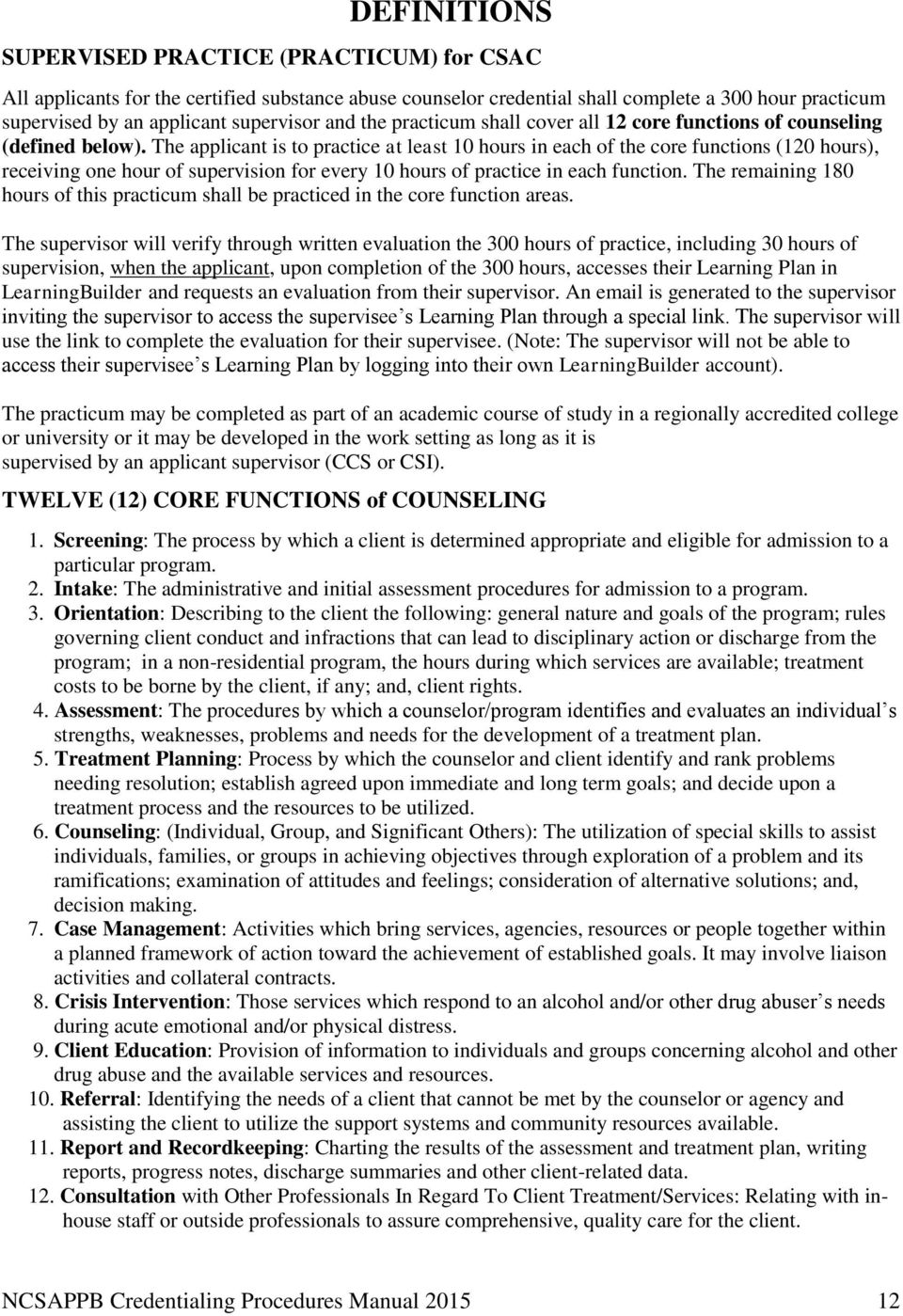
12 DEFINITIONS SUPERVISED PRACTICE (PRACTICUM) for CSAC All applicants for the certified substance abuse counselor credential shall complete a 300 hour practicum supervised by an applicant supervisor and the practicum shall cover all 12 core functions of counseling (defined below). The applicant is to practice at least 10 hours in each of the core functions (120 hours), receiving one hour of supervision for every 10 hours of practice in each function. The remaining 180 hours of this practicum shall be practiced in the core function areas. The supervisor will verify through written evaluation the 300 hours of practice, including 30 hours of supervision, when the applicant, upon completion of the 300 hours, accesses their Learning Plan in LearningBuilder and requests an evaluation from their supervisor. An is generated to the supervisor inviting the supervisor to access the supervisee s Learning Plan through a special link. The supervisor will use the link to complete the evaluation for their supervisee. (Note: The supervisor will not be able to access their supervisee s Learning Plan by logging into their own LearningBuilder account). The practicum may be completed as part of an academic course of study in a regionally accredited college or university or it may be developed in the work setting as long as it is supervised by an applicant supervisor (CCS or CSI). TWELVE (12) CORE FUNCTIONS of COUNSELING 1. Screening: The process by which a client is determined appropriate and eligible for admission to a particular program. 2. Intake: The administrative and initial assessment procedures for admission to a program. 3. Orientation: Describing to the client the following: general nature and goals of the program; rules governing client conduct and infractions that can lead to disciplinary action or discharge from the program; in a non-residential program, the hours during which services are available; treatment costs to be borne by the client, if any; and, client rights. 4. Assessment: The procedures by which a counselor/program identifies and evaluates an individual s strengths, weaknesses, problems and needs for the development of a treatment plan. 5. Treatment Planning: Process by which the counselor and client identify and rank problems needing resolution; establish agreed upon immediate and long term goals; and decide upon a treatment process and the resources to be utilized. 6. Counseling: (Individual, Group, and Significant Others): The utilization of special skills to assist individuals, families, or groups in achieving objectives through exploration of a problem and its ramifications; examination of attitudes and feelings; consideration of alternative solutions; and, decision making. 7. Case Management: Activities which bring services, agencies, resources or people together within a planned framework of action toward the achievement of established goals. It may involve liaison activities and collateral contracts. 8. Crisis Intervention: Those services which respond to an alcohol and/or other drug abuser s needs during acute emotional and/or physical distress. 9. Client Education: Provision of information to individuals and groups concerning alcohol and other drug abuse and the available services and resources. 10. Referral: Identifying the needs of a client that cannot be met by the counselor or agency and assisting the client to utilize the support systems and community resources available. 11. Report and Recordkeeping: Charting the results of the assessment and treatment plan, writing reports, progress notes, discharge summaries and other client-related data. 12. Consultation with Other Professionals In Regard To Client Treatment/Services: Relating with inhouse staff or outside professionals to assure comprehensive, quality care for the client. NCSAPPB Credentialing Procedures Manual
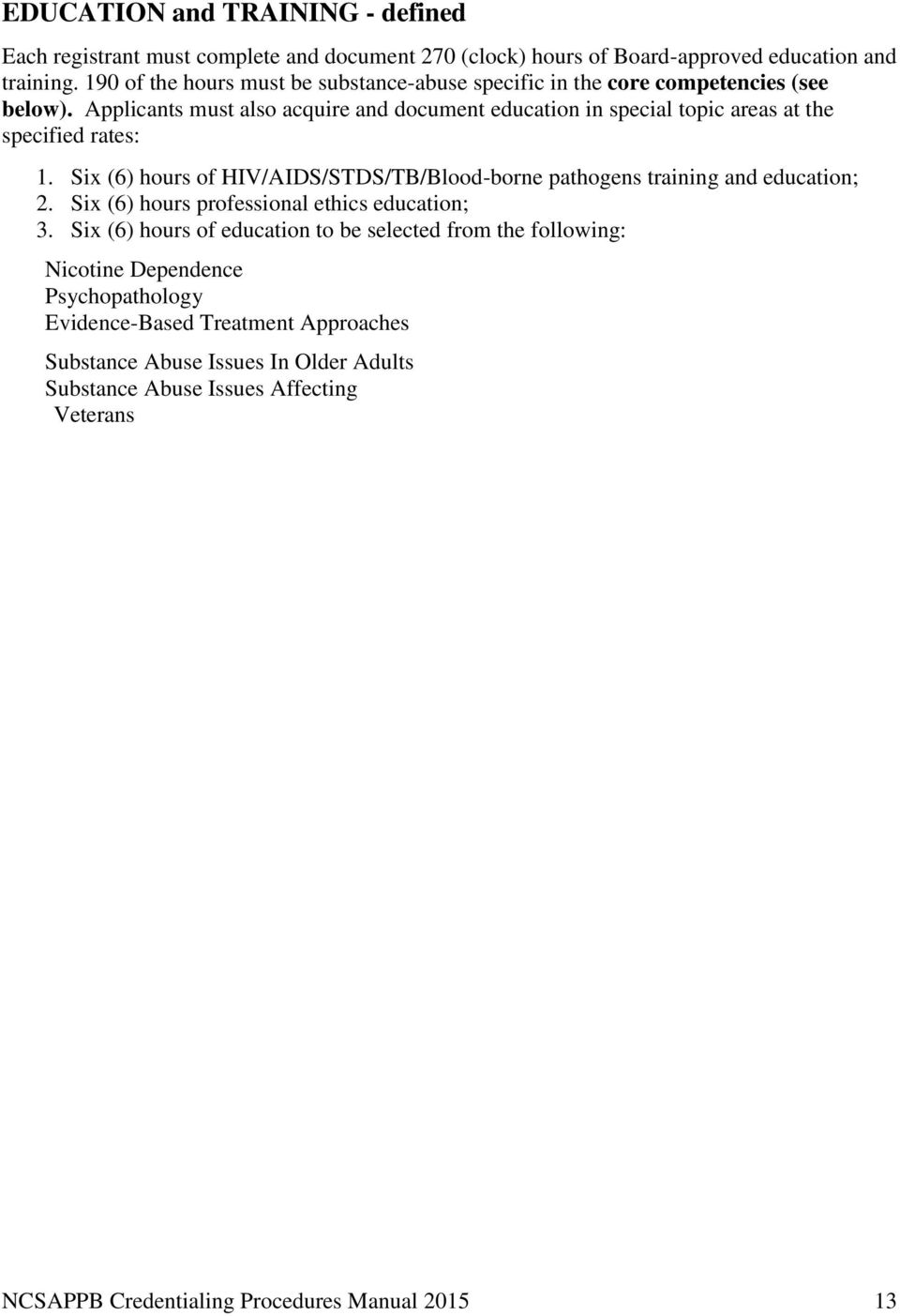
13 EDUCATION and TRAINING - defined Each registrant must complete and document 270 (clock) hours of Board-approved education and training. 190 of the hours must be substance-abuse specific in the core competencies (see below). Applicants must also acquire and document education in special topic areas at the specified rates: 1. Six (6) hours of HIV/AIDS/STDS/TB/Blood-borne pathogens training and education; 2. Six (6) hours professional ethics education; 3. Six (6) hours of education to be selected from the following: Nicotine Dependence Psychopathology Evidence-Based Treatment Approaches Substance Abuse Issues In Older Adults Substance Abuse Issues Affecting Veterans NCSAPPB Credentialing Procedures Manual
14 The other 80 hours may be directed toward general professional skill building to enhance counselor development. Some restrictions apply regarding the types of education allowed: No more than 25% of the 270 hours (67.5 hours) may be in-service education received within your organization by staff of the same employment. No more than 50% of the 270 hours (135 hours) may be in independent study. CORE COMPETENCIES (Counseling) - DEFINED 1. Basic alcoholism and drug addiction knowledge; 2. Screening, intake, orientation and assessment; 3. Individual, group and family counseling and intervention techniques; 4. Case management, treatment planning, reporting and record keeping; 5. Crisis intervention skills; 6. Prevention and education; 7. Consultation, referral and networking that utilizes community resources; 8. Ethics, legal issues, and confidentiality; 9. Special populations which include but are not limited to individuals or groups with specific ethnic, cultural, sexual orientation, and gender characteristics as well as persons dealing with HIV, co-occurring disabilities, persons with criminal justice related issues and perinatal issues; 10. Physiology and pharmacology of alcohol and other drugs that include the licit and illicit drugs, inhalants and nicotine; 11. Psychological, emotional, personality and developmental issues; and 12. Traditions and philosophies of 12-step and other recovery support groups. NCSAPPB Credentialing Procedures Manual

15 COUNSELING CREDENTIALS The Board offers two levels of counseling credentials: a more experience-based certification and advanced licensure for those meeting the higher education requirements. LICENSED CLINICAL ADDICTIONS SPECIALIST (LCAS) Scope of Practice: The practice of a licensed clinical addictions specialist may be independent and consists of the Twelve Core Functions (see Definitions for the list of functions).the licensed clinical addictions specialist may provide supervision to maintain a professional credential as defined by Article 5C. Education: All persons are required at a minimum to hold a master s degree in a human services related field with a clinical application from a regionally accredited college or university. (see definition of clinical application in 21.NCAC (5). Conduct: All applicants should not have engaged in any practice or conduct that would be grounds for disciplinary action under G.S Four Ways (A-D) to Qualify: To apply to be licensed as a Clinical Addictions Specialist applicants should determine which one of the four criteria sets their credentials best meets. The applicant will upload documentation under the particular set of criteria chosen. APPLICANTS SHOULD CONTACT BOARD STAFF BEFORE SELECTING A CRITERIA TO BEGIN REGISTRATION TO ENSURE CORRECT SELECTION. The four criteria sets are generally described below. For detailed information on registering under the chosen criteria see the specific pages for that criteria. CRITERIA A for applicants with a qualifying master s degree who obtained substance abuse-specific training and supervised experience outside of a formal certificate process. 1. Education: A qualifying master s degree (see above definition). 2. Practical Training and supervision: Completion of a minimum of 300 hours of supervised practical training and documentation of a board-approved contract with the clinical supervisor. (see the Supervised Practice section in this manual) 3. Experience: Two years (4,000 hours) supervised post-graduate substance abuse counseling experience. 4. Specific Training: 180 hours of substance abuse-specific training (see Education and Training below for specifics). 5. Examination: A passing score on a master s level IC&RC AADC written exam 6. Ethics: Attestation of intention to adhere fully to the Code of Ethical Conduct of the Board 7. References: Three letters of reference from persons who are licensed clinical addictions specialists (LCAS) or certified substance abuse counselors (CSAC) who have obtained master s degrees. NCSAPPB Credentialing Procedures Manual

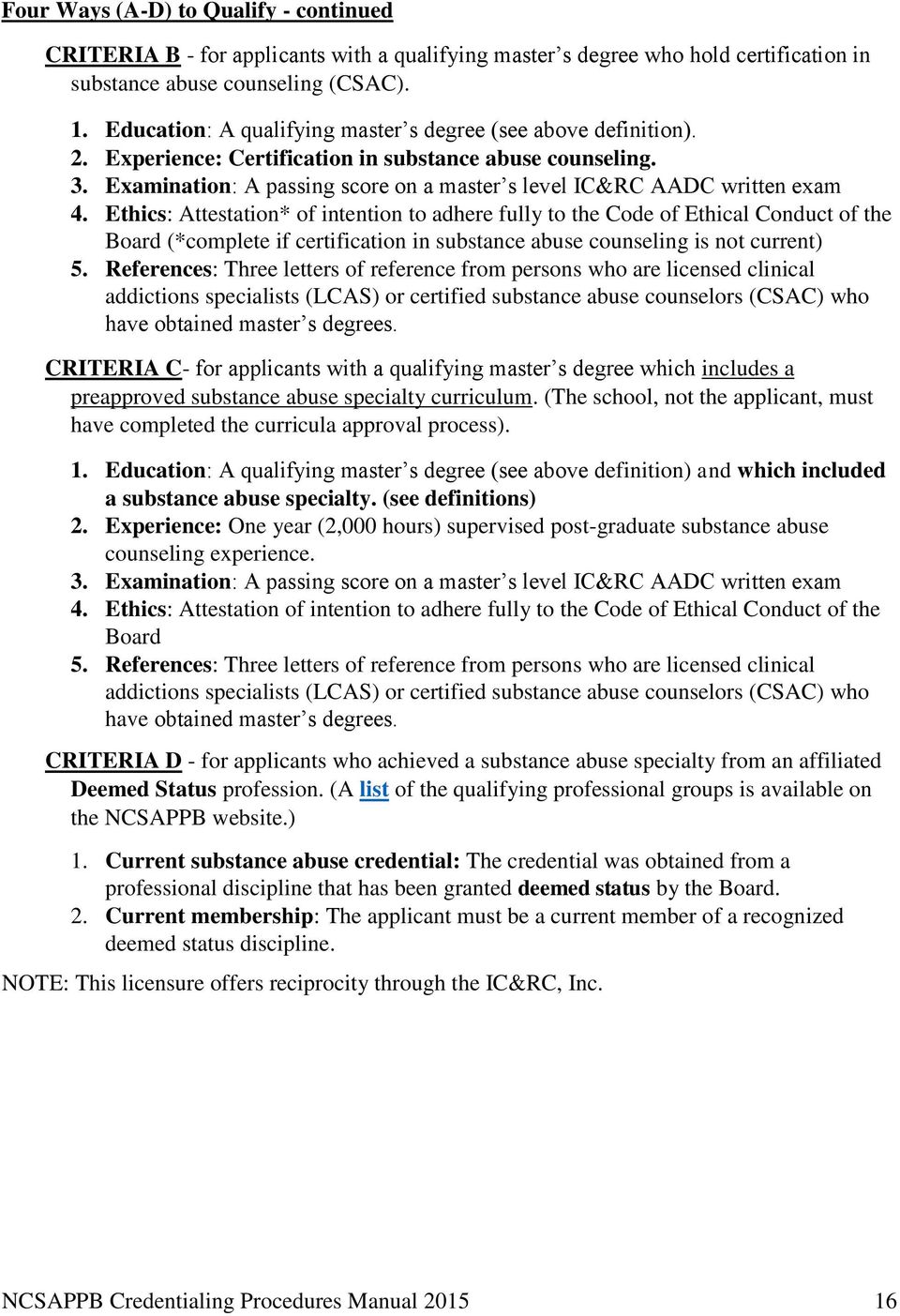
16 Four Ways (A-D) to Qualify - continued CRITERIA B - for applicants with a qualifying master s degree who hold certification in substance abuse counseling (CSAC). 1. Education: A qualifying master s degree (see above definition). 2. Experience: Certification in substance abuse counseling. 3. Examination: A passing score on a master s level IC&RC AADC written exam 4. Ethics: Attestation* of intention to adhere fully to the Code of Ethical Conduct of the Board (*complete if certification in substance abuse counseling is not current) 5. References: Three letters of reference from persons who are licensed clinical addictions specialists (LCAS) or certified substance abuse counselors (CSAC) who have obtained master s degrees. CRITERIA C- for applicants with a qualifying master s degree which includes a preapproved substance abuse specialty curriculum. (The school, not the applicant, must have completed the curricula approval process). 1. Education: A qualifying master s degree (see above definition) and which included a substance abuse specialty. (see definitions) 2. Experience: One year (2,000 hours) supervised post-graduate substance abuse counseling experience. 3. Examination: A passing score on a master s level IC&RC AADC written exam 4. Ethics: Attestation of intention to adhere fully to the Code of Ethical Conduct of the Board 5. References: Three letters of reference from persons who are licensed clinical addictions specialists (LCAS) or certified substance abuse counselors (CSAC) who have obtained master s degrees. CRITERIA D - for applicants who achieved a substance abuse specialty from an affiliated Deemed Status profession. (A list of the qualifying professional groups is available on the NCSAPPB website.) 1. Current substance abuse credential: The credential was obtained from a professional discipline that has been granted deemed status by the Board. 2. Current membership: The applicant must be a current member of a recognized deemed status discipline. NOTE: This licensure offers reciprocity through the IC&RC, Inc. NCSAPPB Credentialing Procedures Manual
17 REGISTRATION PROCESS ALL CRITERIA: FIRST: Go the NCSAPPB website Create an account in LearningBuilder. (see APPLICATION PROCESS in the Credential Manual Overview for detailed information to aid application). To assist in determining which criteria set applies (Criteria A, B, C or D), applicants should call the Board office staff ( ) who will insure correct Criteria is selected. EDUCATION: Enter the LCAS Criteria section chosen and complete the EDUCATION section. Click the Master s Degree button and complete. You will need to request that an official transcript of the master s degree be sent directly to the Board. If you received additional training from a second school, click the blue Add School button to provide more information. Once completed, the button will change to Awaiting Transcript. APPLICATION FEE: After the Board has received and approved the transcript the applicant will receive an that will allow them to proceed. The next step is to pay the $25 application fee (see Application section for accepted credit cards). DOCUMENTATION: Applicants will be asked to provide documentation through scanned and uploaded forms. (see Learning Builder information in the Application section for acceptable file formats). NOTE: For details on registering, go to the specific Criteria Section for which you are applying for LCAS for the specific steps to take to complete Registration for LCAS-Associate and to complete full licensure. NCSAPPB Credentialing Procedures Manual

18 CRITERIA A REGISTRATION PROCESS REGISTRATION FORMS: After the Board has received and approved the transcript the next sections will become available to complete: o Resume: Upload a copy of your current resume. When submitted the button will say Awaiting Review. o Ethics Agreement: Agree (twice) to adhere to the ethical standards adopted by the Board. The button will change to Accepted. o Job Description: Enter information about current job; you may include volunteer work. o Fee: Pay the (non-refundable) Registration Fee ($125) before advancing to the next sections. When paid a BOLDED button will appear that states All Required Payments have been Made. 300 HOUR SUPERVISED PRACTICUM: o Criteria A: Click IDENTIFY SUPERVISOR and provide the name and address; name of their agency; whether they are credentialed (Y/N); and the number of supervised hours that are planned (up to 300). (You may add an additional supervisor if planning to acquire supervised experience by more than one supervisor). A button will appear stating Pending Contract. i. The supervisor will be notified that they have been requested to verify the supervision contract with the applicant on Learning Builder. The supervisor will utilize a special link to verify that they have a contract to supervise the applicant. When completed the Button color will change to indicate this step is completed. (See Completing Registration Process for information on the evaluation of the supervised experience, once completed). BACKGROUND CHECK FEE: Pay the (non-refundable) fee ($38 in 2015). BACKGROUND CHECK FORMS: Complete the following: o Download and print the Release of Information and Fingerprint Information forms. o Take printed forms to the Law Enforcement Agency, complete and get electronic fingerprints taken and Release form signed by LE official taking fingerprints. You must also sign the form. Fingerprints will be sent electronically. (Note: It may take 3-4 weeks for fingerprints to be processed. Applicants will be notified when Board staff have received them.) o Return to LearningBuilder and UPLOAD (scanned) SIGNED RELEASE FORM. o Click SUBMIT. ****IMPORTANT NOTE****: You MUST UPLOAD SIGNED RELEASE form before being allowed to continue the Registration Process!!!! NCSAPPB Credentialing Procedures Manual

19 CRITERIA A REGISTRATION PROCESS continued QUESTIONS: Answer the following: o Criminal history: if ever convicted you will need to complete a criminal history statement listing details of conviction(s) including dates and disposition. Indicate if you are currently on probation or have any pending charges. o Professional license history: Acknowledge if you ever held, denied or were revoked legal certification/licensure. ETHICS TRAINING: o A 3-hour Ethics training must be completed to register. Click SELECT to bring up box into which you enter information about the course, completion date, approval code (if any; if none, type NA and enter # hours). o Upload scanned certificate or course transcript to document completed training. 4,000 HOURS of CLINICAL ADDICTIONS COUNSELING EXPERIENCE: o Click the Identify Supervisor button and provide the name and address of the supervisor; name of their agency; whether they are credentialed (Y/N); and the number of supervised hours that are planned (up to 4,000). (You may add an additional supervisor if planning to acquire supervised experience by more than one supervisor). A button will appear stating Pending Contract. NOTE: You will need to have identified a supervisor BEFORE applying to take the exam. EXAM FORMS o If you will require accommodations for test taking complete the ADA request information. When all the required portions of the application required to take the exam, the REQUEST EXAM button will TURN ORANGE. EXAMINATION: When ready to demonstrate knowledge of addictions the Registrant/ LCAS-A will apply to take the online master s level IC&RC computer-based exam by completing the following: 1. Log into LearningBuilder LCAS-A. With the registration process completed, the status will state that the application is Awaiting Exam/Final Docs. 2. Select the Orange Continue button. 3. Pay the (non-refundable) exam fee of $ Request to take the exam. (If accommodations are needed under the ADA, follow instructions on the LearningBuilder site to request them). 5. Complete the attestation section. Click submit. When staff have completed a review of the exam request you will receive and within ~ a week with a link to the testing site to schedule the exam. Click on the link to: 6. Select the test date and location. 7. Take and pass the exam. 8. Exam results will appear in the next box after exam is completed. NCSAPPB Credentialing Procedures Manual

20 CRITERIA A REGISTRATION PROCESS continued COMPLETING REGISTRATION LCAS-A Designation: Upon completion of the 300 hours of Supervised Experience: (1) The applicant should go to their LCAS Application in Learning Builder and request an evaluation from their supervisor. (2) The supervisor will receive an asking them to verify through written evaluation the 300 hours of practice, including 30 hours of supervision. The supervisor will use the link to download and complete the evaluation and then upload it to their supervisee s Learning Plan. (Note: The supervisor will not be able to access their supervisee s Learning Plan by logging into their own LearningBuilder account). Once all required documentation has been uploaded, THE SUBMIT APPLICATION button will TURN ORANGE. (3) Click SUBMIT APPLICATION when orange and attestation box will open. (4) Answer the question and CLICK SUBMIT APPLICATION AGAIN. Once all documentation has been submitted and Board staff have reviewed and approved the documentation, the Criteria A applicant will be notified through that they have been granted LCAS - ASSOCIATE STATUS. Registrants can go to the Board website to verify their status and print documentation, if desired. Registrants may retain this status up to five years while pursuing the required supervised practice hours. COMPLETING REQUIREMENTS FOR LICENSURE (Criteria A, LCAS-A) SUPERVISED EXPERIENCE: Criteria A Applicants will: o Once 4,000 hours have been successfully completed the LCAS-A must request supervisor evaluation through LearningBuilder. Log into the site, select the LCAS credential and the button to Request Evaluation within the 4,000 hour block. The identified Clinical Supervisor(s) (CCS or CSI) will be notified by to attest to completion of supervised practice in LearningBuilder. REFERENCES: Provide the names and addresses of (3) three persons who are licensed clinical addictions specialists (LCAS) or certified substance abuse counselors (CSAC) who have obtained master s degrees. They will be contacted and asked to provide professional references. Once all documentation has been reviewed and determined to be in order the Registrant (or LCAS-A) will be granted Licensure as a Clinical Addictions Specialist. The Board will send confirming this and mail a certificate within a month. NOTE: This licensure offers reciprocity through the IC&RC/AODA Inc. NCSAPPB Credentialing Procedures Manual

21 CRITERIA B REGISTRATION PROCESS: Applicants who wish to register for LCAS who hold a CSAC credential will enter Learning Builder, select their CURRENT CSAC Learning Plan, and click the LCAS-Application-Criteria B button to ADD TO the CSAC credential. You will need to provide the following: EDUCATION: Click the Master s Degree button and complete. You will need to request that an official transcript of the master s degree be sent directly to the Board. If you received additional training from a second school, click the blue Add School to provide additional information. Once completed, the button will change to Awaiting Transcript. APPLICATION FEE: After the Board has received and approved the transcript the applicant will receive an that will allow them to proceed. The next step is to pay the $25 application fee (see Application section for accepted credit cards). DOCUMENTATION: Applicants will be asked to provide documentation through scanned and uploaded forms. (see Learning Builder information in the Application section for acceptable file formats). REGISTRATION FORMS: After the Board has received and approved the transcript the next sections will become available to complete: o Resume: Upload a copy of your current resume. When submitted the button will say Awaiting Review. o Ethics Agreement: Agree (twice) to adhere to the ethical standards adopted by the Board. The button will change to Accepted. o Job Description: Enter information about current job, including volunteer work. o Fee: Pay the (non-refundable) Registration Fee ($125) before advancing to the next sections. When paid a BOLDED button will appear that states All Required Payments have been Made. BACKGROUND CHECK FEE: Pay the (non-refundable) fee ($38 in 2015). Once paid you will gain access to the forms needed to complete the process. BACKGROUND CHECK FORMS: Complete the following: o Download and print the Release of Information and Fingerprint Information forms. o Take printed forms to the Law Enforcement Agency, complete and get electronic fingerprints taken and Release form signed by LE official taking fingerprints. You must also sign the form. Fingerprints will be sent electronically. (Note: It may take 3-4 weeks for fingerprints to be processed. Applicants will be notified when Board staff have received them.) o Return to LearningBuilder and UPLOAD (scanned) SIGNED RELEASE FORM. o Click SUBMIT. ****IMPORTANT NOTE****: You MUST UPLOAD SIGNED RELEASE form before being allowed to continue the Registration Process!!!! NCSAPPB Credentialing Procedures Manual
22 CRITERIA B REGISTRATION PROCESS continued QUESTIONS: Answer the following: o Criminal history: if ever convicted you will need to complete a criminal history statement listing details of conviction(s) including dates and disposition. Indicate if you are currently on probation or have any pending charges. o Professional license history: Acknowledge if you ever held, denied or were revoked legal certification/licensure. COMPLETING REGISTRATION: Once all required documentation has been uploaded, THE SUBMIT APPLICATION button will TURN ORANGE. o Click SUBMIT APPLICATION when orange and attestation box will open. o Answer the question and CLICK SUBMIT APPLICATION AGAIN. COMPLETING REGISTRATION LCAS-A Designation: Once all documentation has been submitted and Board staff have reviewed and approved the documentation, the Criteria B applicant will be notified through that they have been granted LCAS - ASSOCIATE STATUS. Registrants can go to the Board website to verify their status and print documentation, if desired. Registrants may retain this status up to five years while pursuing the required supervised practice hours. COMPLETING REQUIREMENTS FOR LICENSURE (Criteria B, LCAS-A) EXAMINATION: When ready to demonstrate knowledge of addictions the Registrant/ LCAS-A will apply to take the online master s level IC&RC computer-based exam by completing the following: 1. Log into LearningBuilder LCAS. With the registration process completed, the status will state that the application is Awaiting Exam/Final Docs. 2. Select the Orange Continue button. 3. The second box, Exam Forms should be selected. 4. Pay the (non-refundable) exam fee of $ Request to take the exam. (If accommodations are needed under the ADA, follow instructions on the LearningBuilder site to request them). The Board staff will contact the Registrant when all the documentation has been approved (~ 1 week). 6. Select the test date and location. 7. Take and pass the exam. 8. Exam results will appear in the next box after exam is completed. REFERENCES: Provide the names and addresses of (3) three persons who are licensed clinical addictions specialists (LCAS) or certified substance abuse counselors (CSAC) who have obtained master s degrees. They will be contacted and asked to provide professional references. Once all documentation has been reviewed and determined to be in order the Registrant (or LCAS-A) will be granted Licensure as a Clinical Addictions Specialist (LCAS). The Board will send confirming this and mail a certificate within a month. NOTE: This licensure offers reciprocity through the IC&RC/AODA Inc. NCSAPPB Credentialing Procedures Manual
23 CRITERIA C REGISTRATION PROCESS: Applicants who wish to register for LCAS under Criteria C will begin by requesting that an official transcript of the master s degree be sent directly to the Board. Once completed, the button will change to Awaiting Transcript. APPLICATION FEE: After the Board has received and approved the transcript the applicant will receive an that will allow them to proceed. The next step is to pay the $25 application fee (see Application section for accepted credit cards). DOCUMENTATION: Applicants will be asked to provide documentation through scanned and uploaded forms. (see Application section for acceptable file formats). REGISTRATION FORMS: After the Board has received and approved the transcript the next sections will become available to complete: o Resume: Upload a copy of your current resume. When submitted the button will say Awaiting Review. O Ethics Agreement: Agree to adhere to the ethical standards adopted by the Board. The button will change to Accepted. o Job Description: Enter information about current job, including volunteer work. o Fee: Pay the (non-refundable) Registration Fee ($125) before advancing to the next sections. When paid a BOLDED button will appear that states All Required Payments have been Made. 2,000 HOURS OF CLINICAL ADDICTIONS COUNSELING EXPERIENCE- IDENTIFY SUPERVISOR o Click the Identify Supervisor button and provide the name and address of the supervisor; name of their agency; whether they are credentialed (Y/N); and the number of supervised hours that are planned (up to 2,000). (You may add an additional supervisor if planning to acquire supervised experience by more than one supervisor). A button will appear stating Pending Contract. NOTE: When supervision is completed applicant will request evaluation in LearningBuilder (see Completing Requirements below). BACKGROUND CHECK FEE: Pay the (non-refundable) fee ($38 in 2015). Once paid you will gain access to the forms needed to complete the process. BACKGROUND CHECK FORMS: Complete the following: o Download and print the Release of Information and Fingerprint Information forms. o Take printed forms to the Law Enforcement Agency, complete and get electronic fingerprints taken and Release form signed by LE official taking fingerprints. You must also sign the form. Fingerprints will be sent electronically. (Note: It may take 3-4 weeks for fingerprints to be processed. Applicants will be notified when received by staff). o Return to LearningBuilder and UPLOAD (scanned) SIGNED RELEASE FORM. o Click SUBMIT. **IMPORTANT NOTE****: You MUST UPLOAD SIGNED RELEASE form before being allowed to continue the Registration Process!! NCSAPPB Credentialing Procedures Manual
24 CRITERIA C REGISTRATION PROCESS continued QUESTIONS: Answer the following: o Criminal history: if ever convicted you will need to complete a criminal history statement listing details of conviction(s) including dates and disposition. Indicate if you are currently on probation or have any pending charges. o Professional license history: Acknowledge if you ever held, denied or were revoked legal certification/licensure. ETHICS TRAINING: o A 3-hour Ethics training must be completed to register. Click SELECT to bring up box into which you enter information about the course, completion date, approval code (if any; if none, type NA and enter # hours). o Upload scanned certificate or course transcript to document completed training. COMPLETING REGISTRATION LCAS-A Designation: Once all required documentation has been uploaded, THE SUBMIT APPLICATION button will TURN ORANGE. o Click SUBMIT APPLICATION when orange and attestation box will open. o Answer the question and CLICK SUBMIT APPLICATION AGAIN. Once all documentation has been submitted and Board staff have reviewed and approved the documentation, the Criteria C applicant will be notified through that they have been granted LCAS - ASSOCIATE STATUS. Registrants can go to the Board website to verify their status and print documentation, if desired. Registrants may retain this status up to five years while pursuing the required supervised practice hours. NCSAPPB Credentialing Procedures Manual
25 COMPLETING CRITERIA C REQUIREMENTS FOR LICENSURE SUPERVISED EXPERIENCE: Once the 2,000 hours of supervised experience has been successfully completed the LCAS-A must request supervisor evaluation through LearningBuilder. Log into the site, select the LCAS credential and the button to Request Evaluation within the 2,000 hour block. The identified Clinical Supervisor(s) (CCS or CSI) will be notified by to attest to completion of supervised practice in LearningBuilder. EXAMINATION: o When ready to demonstrate knowledge of addictions the Registrant/ LCAS-A will apply to take the online master s level IC&RC computer-based exam by completing the following: 1. Log into LearningBuilder LCAS. With the registration process completed, the status will state that the application is Awaiting Exam/Final Docs. 2. Select the Orange Continue button. 3. The second box, Exam Forms should be selected. 4. Pay the (non-refundable) exam fee of $ Request to take the exam. (If accommodations are needed under the ADA, follow instructions on the LearningBuilder site to request them). The Board staff will contact the Registrant when all the documentation has been approved (~ 1 week). 6. Select the test date and location. 7. Take and pass the exam. 8. Exam results will appear in the next box after exam is completed. REFERENCES: Provide the names and addresses of (3) three persons who are licensed clinical addictions specialists (LCAS) or certified substance abuse counselors (CSAC) who have obtained master s degrees. They will be contacted and asked to provide professional references. Once all documentation has been reviewed and determined to be in order the Registrant (or LCAS-A) will be granted Licensure as a Clinical Addictions Specialist. The Board will send confirming this and mail a certificate within a month. NOTE: This licensure offers reciprocity through the IC&RC/AODA Inc. NCSAPPB Credentialing Procedures Manual
26 LCAS-CRITERIA D (Deemed Status) REGISTRATION PROCESS: The Board recognizes the credentials offered by a professional discipline who have met the standards of a clinical addictions specialist (see list of approved credentials on the website). Applicants who wish to register for LCAS under Criteria D will begin by requesting that an official transcript of the master s degree be sent directly to the Board. (See Registration Process All Criteria on the 3 rd page of this document for details). Once requested, the button will change to Awaiting Transcript. DOCUMENTATION: Applicants will be asked to provide documentation through scanned and uploaded forms. (see the Application document for acceptable file formats). EDUCATION o Upload a (scanned) copy of the Professional Discipline Certificate of the substance abuse certification from the professional discipline that has been granted deemed status by the Board. (see list at Board website) o Upload a (scanned) copy of a Good Standing Verification Letter or other verification from the applicant s Deemed Status credentialing organization. APPLICATION FEE: After the Board has received and approved the transcript the applicant will receive an that will allow them to proceed. The next step is to pay the $10 application fee (see Application section for accepted credit cards). REGISTRATION FORMS: After the Board has received and approved the transcript and the application fee the next sections will become available to complete: o Resume: Upload a copy of your current resume. When submitted the button will say Awaiting Review. o Ethics Agreement: Agree (twice) to adhere to the ethical standards adopted by the Board. The button will change to Accepted. o Job Description: Enter information about current job, including volunteer work. o Fee: Pay the (non-refundable) Registration Fee ($40) before advancing to the next sections. When paid a BOLDED button will appear that states All Required Payments have been Made. BACKGROUND CHECK FEE: Pay the (non-refundable) fee ($38 in 2015). Once paid you will gain access to the forms needed to complete the process. BACKGROUND CHECK FORMS: Complete the following: o Download and print the Release of Information and Fingerprint Information forms. o Take printed forms to the Law Enforcement Agency, complete and get electronic fingerprints taken and Release form signed by LE official taking fingerprints. You must also sign the form. Fingerprints will be sent electronically. (Note: It may take 3-4 weeks for fingerprints to be processed. Applicants will be notified when Board staff have received them.) o Return to LearningBuilder and UPLOAD (scanned) SIGNED RELEASE FORM. o Click SUBMIT. ****IMPORTANT NOTE****: You MUST UPLOAD SIGNED RELEASE form before being allowed to continue the Registration Process!!!! NCSAPPB Credentialing Procedures Manual
27 REGISTRATION PROCESS Criteria D continued QUESTIONS: Answer the following: o Criminal history: if ever convicted you will need to complete a criminal history statement listing details of conviction(s) including dates and disposition. Indicate if you are currently on probation or have any pending charges. o Professional license history: Acknowledge if you ever held, denied or were revoked legal certification/licensure. COMPLETING REGISTRATION LCAS Designation: Once all documentation has been reviewed and determined to be in order the Registrant will return to LearningBuilder and select the ORANGE SUBMIT APPLICATION BUTTON to complete the process. Complete the attestation question and submit. The Registrant will receive an after staff have reviewed the application. Upon completion, the Registrant will be granted Deemed Status Licensure as a Clinical Addictions Specialist (LCAS). The Board will send confirming this and mail a certificate within a month. NOTE: This licensure offers reciprocity through the IC&RC/AODA Inc. NCSAPPB Credentialing Procedures Manual
28 LICENSURE PERIOD and RENEWAL OF LICENSE CRITERIA A-C Licensure is for a period of two years. To retain licensure past two years addictions specialists renewing under Criteria A-C must: (1) Complete at least 40 hours of Board-approved continuing education within the two years of licensed practice prior to the requested renewal. (see next page for specifics) (2) Apply for renewal of licensure within the last few months of the 2-year cycle. (3) Pay the (non-refundable) renewal fee of $125. (4) Agree to adhere to the ethical standards adopted by the Board. Those renewing under Criteria D Deemed Status. (1) Provide documentation of current substance abuse certification from the deemed status professional discipline. (2) Pay the renewal fee of $35. (3) To maintain LCAS under Deemed Status the applicant must maintain credentialed status with the deemed status organization. REMEMBER: Failure to renew licensure by the due date and continuing to practice in that area is illegal. Those who practice or aid or abet another to practice with a lapsed credential may be found guilty of a Class 1 misdemeanor. (G.S ) Therefore, it is imperative for credentialed professionals to seek continuing education throughout the time period and to apply in advance of the end of a credentialing cycle. CONTINUING EDUCATION FOR RENEWAL 1. By the end of a 2-year period of licensure and before renewing the Licensed Clinical Addictions Specialist (LCAS) credential, all those (who applied under Criteria A-C) who wish to renew their credentials need to have completed a minimum of 40 hours of continuing education (CE), 30 hours of which need to have been substance-abuse specific. This education may include a combination of hours including attending and providing workshops. Of the 40 hours, the 2. Three (3) hours of HIV/AIDS/STDS/TB/Blood-borne pathogens training and education; 3. Three (3) hours professional ethics education; 4. Three (3) hours of education to be selected from among the following: Nicotine Dependence Substance Abuse Issues In Older Adults Psychopathology Substance Abuse Issues Affecting Veterans Evidence-Based Treatment Approaches The following limitations apply regarding acceptable formats and percentages: 50% maximum may be acquired in independent or self study 25% maximum may be acquired through in-service events 25% maximum may be acquired through workshop presentation Notes: (1) Those renewing under deemed status (Criteria D) must meet the renewal requirements of the organization under which they maintain their credential. (2) NCSAPPB accepts CE credits approved by its Board and NAADAC, but other licensing boards do not accept NCSAPPB-only approved credits. (They required NAADAC approval). NCSAPPB Credentialing Procedures Manual
29 DEFINITIONS 12 CORE FUNCTIONS of ADDICTION COUNSELING 1. Screening 2. Intake 3. Orientation 4. Assessment 5. Treatment planning 6. Counseling 7. Case management 8. Crisis intervention 9. Client education 10. Report and record keeping 11. Consultation with other professionals in regard to client treatment and services 12. Referral to reduce the conditions that place individuals at risk of developing addictive disorder or disease with co-occurring disorders, and treatment for addictive disorder or disease. SUPERVISED PRACTICE (Practicum) LCAS Criteria A-C applicants for the licensed addictions specialist credential shall complete a 300 hour practicum supervised by an applicant supervisor and the practicum shall cover all 12 core functions of counseling (see Definitions). The applicant is to practice at least 10 hours in each of the core functions (120 hours), receiving one hour of supervision for every 10 hours of practice in each function. The remaining 180 hours of this practicum shall be practiced in the core function areas. The supervisor will verify this through evaluation. Upon completion of the 300 hours, the applicant is to access their Learning Plan in Learning Builder and request an evaluation from their supervisor. An is generated to the supervisor inviting the supervisor to access the supervisee s Learning Plan through a special link. The supervisor will use the link to download and complete the evaluation, documenting the 300 hours of practice, including 30 hours of supervision, and upload it to their supervisee s Learning Plan. (Note: The supervisor will not be able to access their supervisee s Learning Plan by logging into their own LearningBuilder account). Depending upon which criteria set the applicant is using to seek licensure, the supervised practice will be accomplished in different ways. 1. Under Criteria A, the supervised practice may be completed as part of an academic course of study in a regionally accredited college or university or it may be developed in the work setting as long as it is supervised by an applicant supervisor (CCS or CSI). NCSAPPB Credentialing Procedures Manual
30 SUPERVISED PRACTICE (Practicum) LCAS defined- cont d 2. Under Criteria B, the supervised practice will have been completed as part of CSAC credentialing. 3. Under Criteria C, the supervised practice shall be completed as part of an academic course of study. 4. Note: Criteria D (deemed status) applicants must complete the supervised experience process required by the certification rules of the credentialing organization. EDUCATION AND TRAINING (for licensure) defined Initial licensure requires 180 hours, or the equivalent thereof, of substance abuse specific education and training that covers the following content areas: a. Basic addiction and cross-addiction; physiology and pharmacology of psychoactive drugs that are abused. b. Screening, assessment, and intake of clients. c. Individual, group, and family counseling. d. Treatment, planning, reporting, and record keeping. e. Crisis intervention. f. Case management and treatment resources. g. Ethics, legal issues, and confidentiality. h. Psychological, emotional, personality, and developmental issues. i. Co-occurring physical and mental disabilities. j. Special population issues, including age, gender, race, ethnicity, and health status. k. Traditions and philosophies of recovery treatment models and support groups. Applicants must also acquire and document education in special topic areas at the specified rates: 1. Six (6) hours of HIV/AIDS/STDS/TB/Blood-borne pathogens training and education; 2. Six (6) hours professional ethics education; 3. Six (6) hours of clinical supervision-specific training; 4. Six (6) hours of education to be selected from among the following: Nicotine Dependence Substance Abuse Issues In Older Adults Psychopathology Evidence-Based Treatment Approaches Substance Abuse Issues Affecting Veterans The hours may be included in the 180 hours of substance abuse specific training. Applicants under Criteria B who hold a CSAC credential should have attained this initial training as part of the training and education requirement for that credential. If any parts of this training have not been attained, it is recommended that these LCAS-A applicants acquire additional training in the areas in which they lack training as part of their continuing education requirement. NCSAPPB Credentialing Procedures Manual
31 CLINICAL SUPERVISION CREDENTIAL CERTIFIED CLINICAL SUPERVISOR AND CCS-INTERN The Board created a process to train and identify professional substance abuse supervisors who help to develop clinical skills and competencies in people desiring to work in the professional substance abuse field. Requirement are found in G.S (b) and 21 NCAC They provide supervision to the following groups: 1. Applicants for certification in counseling, criminal justice addictions specialization, prevention consulting, and for licensure as clinical addictions specialists. 2. Licensed specialists (LCAS) seeking the clinical supervision credential. 3. Certified Substance Abuse Counselors (CSACs) and certified criminal justice professionals (CCJPs) who must still function under the supervision of a Practice Supervisor. Scope of Practice - The practice of a Certified Clinical Supervisor is based on knowledge in the performance domains to supervise substance abuse professionals who work to treat, prevent, or reduce the conditions that place individuals at risk of developing addictive disorder or disease and help prevent relapse. REGISTRATION PROCESS for Certified Clinical Supervisor Education and Licensure Requirements An applicant for the supervision credential must have earned a master s degree in a human services field with a clinical application from a regionally accredited college or university and hold an active license in addictions (LCAS). To apply for the CCS credential: 1. The applicant will access their account in Learning Builder where documentation of their license is stored. 2. From the My Account tab, select the CCS application button. 3. Pay a $25.00 application fee before gaining access to the webpage where documentation is added. 4. Upload digital copies of: a. Resume - current b. Ethics Agreement - agree (twice) to abide by the Code of Ethical Conduct of NCSAPPB c. Job Description - enter a job description 5. Pay the Registration fee ($125 as of 2015) Hours of Supervisory Experience - Identify a Certified Clinical Supervisor (CCS) in LearningBuilder who will provide clinical supervision of the 4,000 hours (two years) experience as a substance abuse clinical supervisor. Complete the form including supervisor address and click Send to Supervisor. That section of Learning Builder will change to pending contract until the supervisor responds to the request. 7. Pay the $38 SBI Background Check fee. NCSAPPB Credentialing Procedures Manual
32 REGISTRATION PROCESS for Certified Clinical Supervisor - continued 8. Complete the Background Check Forms. a. Download the Release of Information and Fingerprint Information forms. b. Take printed forms to the Law Enforcement Agency, complete and get electronic fingerprints taken and Release form signed by LE official taking fingerprints. You must also sign the form. The fingerprints will be transmitted electronically. c. Return to LearningBuilder and UPLOAD SIGNED RELEASE FORM. d. Click SUBMIT. ****IMPORTANT NOTE****: You MUST UPLOAD SIGNED RELEASE form before being allowed to continue the Registration Process!!!! 9. Education Click the Enter School button and provide information of the master s degree. 10. Credentialing Training Record Part 1 - Submit documentation of a minimum of 15 hours (50% of 30 hour requirement) of clinical supervision-specific training. These hours should be reflective of the twelve core functions or performance domains in their clinical application and practice as defined by the IC&RC/AODA, Inc. 11. Questions a. Criminal history: if ever convicted you will need to complete a statement listing details of conviction(s) including dates and disposition. Indicate if you are currently on probation or have any pending charges. b. Professional license history: Acknowledge if you ever held, denied or were revoked legal certification/licensure. If yes, explain. 12. Completing Registration a. When Submit Application button has turned ORANGE click the button to submit the application. When box pops up complete the attestation statement ( yes ) and click Submit Application again. b. Once all documents have completed the Review process the applicant will be notified by . CLINICAL SUPERVISOR INTERN (CCS-I) Registered Clinical Supervisor Interns (CCS-I) will be able to practice as a clinical supervisor under the supervision of a certified clinical supervisor for a period not to exceed three years COMPLETING THE CCS PROCESS The CCS-I will have up to 3 years to complete the following: 1. 4,000 hours or 2 years full-time experience as a Substance Abuse Clinical Supervisor, at the rate specified by statute: a ratio of one hour supervision for every 80 hours of practice in the field of alcohol and other drug abuse. o Upon completion of the supervised supervision experience, the CCS intern will request an evaluation via their Learning Plan in LearningBuilder. The supervisor will receive a special link by to evaluate the CCS-I supervisee. NCSAPPB Credentialing Procedures Manual
33 COMPLETING THE CCS PROCESS - continued 2. Credentialing Training Record Part 2 15 additional hours of substance abuse clinical supervision-specific education must be documented. The title of the course must reflect this. Additionally, a course whose content includes the Twelve Core Functions in their clinical application may be substituted. 3. Letters of Reference - Submit names and addresses of three people for references. One person must be a substance abuse professional who can attest to supervisory competence and two may be either substance abuse counselors who have been supervised by the candidate or substance abuse professionals who can attest to the applicant's competence. 4. Exam Forms o If accommodations for testing are required related to disability under the Americans with Disabilities Act of 1990 click request accommodation and provide documentation from a physician, as directed. o Pay the examination fee of $125. o Once the supervisor has completed their portion of the application (an evaluation and/or agreement to provide additional supervision) and the exam fee is paid, the Request Exam button will turn orange. Upon completion of supervised clinical supervision hours, additional training, documentation from references and the supervision examination the registrant/ccs-i will be granted full Certification in Clinical Supervision (CCS). NOTE: This certification offers reciprocity through the IC&RC/AODA, Inc. CERTIFICATION PERIOD and RENEWAL OF CERTIFICATE Certification in Clinical Supervision is for a period of two years. To retain certification past two years supervisors must: (1) Complete at least 15 hours of Board-approved continuing education within the two years of certified practice prior to the requested renewal. Topics should be clinical supervision-specific education and should reflect clinical supervision of practice in the Twelve Core Functions or Performance Domains as defined by the IC&RC/AODA, Inc., (See Definitions page) as well as other clinical supervision topics. Note: Training hours may also be applied to renewal of license in addictions specialization (LCAS). NOTE: For the purpose of re-certification as a Clinical Supervisor, 25 percent of the required total hours may be obtained by providing supervision of a Criminal Justice Addictions Professional, Prevention Consultant, Substance Abuse Counselor or Clinical Addictions Specialist; (2) Apply for renewal of certification within the last few months of the 2-year cycle (and no later than the last day of the last month of the certification practice). (3) Agree to adhere to the ethical standards adopted by the Board. (4) Pay the (non-refundable) renewal fee of $125. NCSAPPB Credentialing Procedures Manual
34 SUPERVISOR AGREEMENTS When a certified counselor supervisor intern (CCS-I) or fully certified supervisor (CCS) agrees to supervise substance abuse professionals who work to treat, prevent, or reduce the conditions that place individuals at risk of developing addictive disorder or disease and help prevent relapse (defined in the G.S B (3), they will agree to provide services according to the requirements for supervision within the credential being sought by the supervisee. To supervise licensed addictions specialists (LCAS) towards a clinical supervision certification (CCS) the supervisor will agree to the following within Learning Builder: 1. To provide clinical supervision in the ratio one hour of supervision for every 80 hours worked; 2. To provide supervision based on knowledge in the performance domains of: a. Counselor Development b. Professional & Ethical Standards c. Program Development & Quality Assurance d. Performance Evaluation e. Administration f. Treatment Knowledge (note: details of the specific objectives to be addressed for each domain may be found in the Appendices Definitions section) 3. To review the Board s Code of Ethical Conduct with the supervisee and help him/her see the active role ethics must play in professional growth. 4. To accept responsibility to report unethical activity engaged in by a supervisee to the Board. 5. To maintain a supervisory file documenting the supervisee s growth and development. 6. On an annual basis, provide the supervisee with a written evaluation summarizing his/her professional development and outline a plan to address areas identified as needing further growth. 7. Provide a copy of this evaluation to the Board, if requested. 8. To present the Board with an accurate representation of the supervisee s readiness for a certification or license when evaluation is requested by the supervisee. For other credentials, review the requirements for supervision described within the Registration and Completion of Credential sections for the particular credential. NCSAPPB Credentialing Procedures Manual
35 SPECIALTY CREDENTIALS CERTIFIED CRIMINAL JUSTICE ADDICTIONS PROFESSIONAL (CCJP) Scope of Practice: The practice of a certified criminal justice addictions professional is based on knowledge in the performance domains of dynamics of addiction in criminal behavior; legal, ethical, and professional responsibility; criminal justice system and processes; screening, intake, and assessment; case management; monitoring; and client supervision and counseling to prevent or reduce the conditions that place individuals at increased risk of developing addictive disorder or disease, treat addictive disorder or disease, and help prevent relapse. Education: The applicant has, at a minimum, a high school diploma or high school equivalency certificate. Conduct: All applicants should not have engaged in any practice or conduct that would be grounds for disciplinary action under G.S REGISTRATION PROCESS: FIRST: Go the NCSAPPB website Create an account in Learning Builder (see APPLICATION PROCESS in the Credential Manual Overview for detailed information to aid application) Applicants will be asked to pay an application fee ($25) before choosing the credential for which they wish to register (CCJP). Applicants will be asked to provide documentation through scanned and uploaded forms areas (see Learning Builder information for acceptable file formats and credit cards) in the following areas: REGISTRATION FORMS o Resume: Upload a current resume. o Job Description: Type (or copy/paste) a job description that demonstrates that applicant is practicing under the scope of practice for the credential (CCJP G.S B (6)). o Ethics attestation: Agree to adhere to the ethical standards adopted by the Board. o Fee: Pay $125 (non-refundable) registration fee. BACKGROUND CHECK FEE: Pay the (non-refundable) fee ($38 in 2015). BACKGROUND CHECK FORMS: Complete the following: o Download the Release of Information and Fingerprint Information forms. o Take printed forms to the Law Enforcement Agency, complete and get electronic fingerprints taken and Release form signed by LE official taking fingerprints. You must also sign the form. The fingerprints will be transmitted electronically. o Return to Learning Builder and UPLOAD SIGNED RELEASE FORM. o Click SUBMIT. ****IMPORTANT NOTE****: You MUST UPLOAD SIGNED RELEASE form before being allowed to continue the Registration Process!!!! NCSAPPB Credentialing Procedures Manual
36 REGISTRATION PROCESS - continued EDUCATION: o Click ADD SCHOOL and type in the information into box (type degree, name of school, start date, completion/graduation date, graduation y/n, location). o If highest degree attained is high school or GED, upload a scan of the diploma/ged. o If degree is from college or university, applicant will need to contact the school to request official transcripts be sent directly to the Board. (Schools may now process requests digitally). QUESTIONS: o Criminal history: if ever convicted you will need to complete a statement listing details of conviction(s) including dates and disposition. Indicate if you are currently on probation or have any pending charges. o Professional license history: Acknowledge if you ever held, denied or were revoked legal certification/licensure. If yes, you will need to complete a criminal history statement as directed in Learning Builder. ETHICS TRAINING: o A 3-hour Ethics training must be completed to register. Click SELECT to bring up box into which you enter information about the course, completion date, approval code (if any; if none, type NA and enter # hours). o Upload scanned certificate or course transcript to document completed training. 300 HOUR SUPERVISED PRACTICUM Applicants for this credential will need to practice their skills in the field under supervision (either paid or volunteer) at the ratios required (see description of Supervised Practical Training in a following section). Complete the following to identify the supervisor for the practicum. o Click IDENTIFY SUPERVISOR. Provide the name and address; name of their agency; whether they are credentialed (Y/N); and the number of supervised hours that are planned (up to 300). (You may add an additional supervisor if planning to acquire supervised experience by more than one supervisor). A button will appear stating Pending Contract. i. The supervisor will be notified that they have been requested to verify the supervision contract with the applicant on Learning Builder. The supervisor will utilize a special link to verify that they have a contract to supervise the applicant. When completed the Button color will change to indicate this step is completed. ii. Upon completion of the 300 supervised hours the applicant should request an evaluation from their supervisor in their Learning Plan of Learning Builder. iii. The supervisor will receive an asking them to verify the successful completion of the practicum. The evaluation will require the supervisor to verify that a minimum of 10 hours of supervision in each criminal justice domain was provided. The supervisor will use the link complete the evaluation within Learning Builder. iv. If the practicum was completed under the supervision of more than one supervisor, click Add Supervisor and identify the person. They will receive a link to agree to supervision and to complete an evaluation as described above. NCSAPPB Credentialing Procedures Manual
37 REGISTRATION PROCESS - continued Once the Evaluation of the 300 Hour Practicum is completed, the button will change to orange and the applicant will be able to complete the next section related to on-going supervision. Required Work Experience o When the Button turns orange complete this section. Click Add Supervisor and select the level of education/degree under which are applying to identify the required length of work experience. Provide the name and address. The supervisor will receive an requesting them to confirm the agreement to supervise. Registrants for CCJP will document work experience through a job description that provides direct services to clients or offenders involved in one of the three branches of the criminal justice system, which includes law enforcement, the judiciary and corrections. The number of supervised hours depends upon the level and type of formal education of the applicant: Supervised Work Experience Requirements for Criminal Justice Addictions Professionals Criteria Level/type of Education # hours of required supervised experience Type of services and time period A High school diploma or GED 6,000 hours (3 years full time) Documented, direct services in criminal justice/addictions services, obtained in past 10 years B Associates degree 5,000 hours (2 ½ years full time) As above C Bachelor's degree 4,000 hours (2 years full time) As above D Master s degree in human 2,000 hours (1 year full time) As above E F services field Master s in human services field with specialty including 180 hours of substance abuse-specific education Licensed Clinical Addictions Specialist 2,000 hours (1 year full time) post-graduate Supervised substance abuse counseling experience 1,000 hours (6 months full time) Documented, direct services in criminal justice/addictions services, obtained in past 10 years NOTE: In order to qualify as Supervised Experience, a criminal justice addictions professional applicant must be supervised by a certified clinical supervisor (CCS) or clinical supervisor intern (CSI). REGISTERED o Once the supervisor has responded to the from the Board with the supervision request, the SUBMIT button will turn orange. o Click SUBMIT when orange and attestation box will open. o Answer the question and CLICK SUBMIT AGAIN. o You will have completed the registration process. Once all documentation has been submitted and Board staff have reviewed and approved the documentation, the applicant will be notified through that they have been granted REGISTERED STATUS*. Applicants can go to the Board website to verify their status and print documentation, if desired. Registrants may retain this status up to five years while pursuing the required supervised practice hours, substance abuse and criminal justice-specific training and taking and completing the examination for CCJP. NCSAPPB Credentialing Procedures Manual
38 TO COMPLETE THE CERTIFICATION PROCESS FOR CCJP Registrants seeking the CCPP credential will need to complete the following within 5 years of registration: Credentialing Training Record To acquire certification as a CCJP registrants must acquire 270 hours of Board-approved education and training*. The hours of education shall be specifically related to the knowledge and skills necessary to perform tasks within the IC&RC criminal justice addictions professional performance domains** as they relate to both adults and juveniles. *Note 1: If the applicant has attained a minimum of a master s degree with a clinical application and a substance abuse specialty from a regionally accredited college or university, then the applicant must only obtain 180 hours of training. **Note 2: The Performance Domains are defined in the Definitions section at the end of this section under Supervised Practical Training. As hours are completed, the Registrant should upload documentation of the education and training events into Learning Builder. Documents are saved in the Applicant s library. Examination When ready to demonstrate knowledge of substance abuse practice as a criminal justice addictions professional the registrant will apply to take the online computer-based exam. To apply to take the exam the Registrant completes the following: 1. Log into Learning Builder CCJP. With the registration process completed, the status will state that the application is Awaiting Exam/Final Docs. 2. Select the Orange Continue button. 3. The second box, Exam Forms should be selected. 4. If accommodation is required due to a disability in accordance with the Americans with Disabilities Act, complete the request. 5. Pay the (non-refundable) exam fee of $125. After Board staff have processed the payment (usually within a couple of days) you will receive an allowing you to proceed to the next step. 6. Request to take the exam. 7. Select the test date and location. 8. Take and pass the exam. Exam results will appear in the next box after exam is completed. Supervised Work Experience Upon completion of the required work experience the registered applicant will return to their Learning Plan in Learning Builder and request an evaluation from their supervisor. The supervisor will receive an to complete the review in Learning Builder. The evaluation will require the supervisor to verify completion of the required hours of supervised experience and to describe the job duties of the supervisee. Ongoing Practice Supervision Just prior to submitting the application the name of the person who will provide ongoing supervision at the appropriate rates must be identified (see Renewal section for details). Once all documentation has been reviewed and determined to be in order the applicant will be granted the Certified Criminal Justice Addictions Professional credential. NCSAPPB Credentialing Procedures Manual
39 CERTIFICATION PERIOD and RENEWAL OF CERTIFICATE Certification is for a period of two years. To retain certification past two years professionals must submit a completed renewal Learning Plan. CCJPs must log into their LearningBuilder profile, click the Learning Plans tab and submit the following: Documentation of completion at least 60 hours of Board-approved education in the criminal justice addictions professional performance domains within the two years of certified practice prior to the requested renewal. (see Definitions for Performance Domains below). Application for renewal of certification within a reasonable time from the end of the 2- year cycle and no later than the last day of the last month of the certification period. NOTE: It is the responsibility of the certified professional to know and keep up with the dates of the credentialing period. Pay the (non-refundable) renewal fee of $125. Establish a supervision contract with a clinical practice supervisor at the ratio of 1 hour of supervision for every 40 hours of practice up to 4,000 hours; 1:80 up to 8,000 hours of practice; over 8,000 practice hours the supervision to practice ratio will be 1:160 hours. Agree to adhere to the ethical standards adopted by the Board. CONTINUING EDUCATION FOR RENEWAL By the end of a 2-year period of certification and before renewing the Criminal Justice Professional (CCJP) credential, all those who wish to renew their credentials need to have completed a minimum of 60 hours of continuing education (CE), 30 hours of which need to have been substance-abuse specific. Of the 60 hours, the following topics must be included: 1. Three (3) hours of HIV/AIDS/STDS/TB/Blood-borne pathogens training and education; 2. Three (3) hours professional ethics education; 3. Three (3) hours of education to be selected from the following: Nicotine Dependence Psychopathology Evidence-Based Treatment Approaches Substance Abuse Issues In Older Adults Substance Abuse Issues Affecting Veterans The following limitations apply regarding acceptable formats and percentages: 50% maximum may be acquired in self study methods 25% maximum may be acquired through in-service educational events 25% maximum may be acquired through workshop presentation as defined in the 21 NCAC Rules. REMEMBER: Failure to renew certification by the due date and continuing to practice in that area is illegal. Those who practice or aid or abet another to practice with a lapsed credential may be found guilty of a Class 1 misdemeanor. (G.S ) Therefore, it is imperative for credentialed professionals to seek continuing education throughout the time period and to apply in advance of the end of a credentialing cycle. NCSAPPB Credentialing Procedures Manual
40 DEFINITIONS SUPERVISED PRACTICAL TRAINING Criminal Justice Addictions Professional All applicants for the Certified Criminal Justice Credential shall complete a 300 hour, Boardapproved supervised practical training, including a minimum of 10 hours of supervision in each criminal justice domains established by the IC&RC/AODA, Inc. The practicum may be completed as part of an academic course of study in a regionally accredited college or university or it may be developed in the work setting as long as it is supervised by an approved supervisor. The practicum shall take place within a criminal justice addiction professional setting to include a workplace for law enforcement, the judiciary, or corrections. The applicant supervisor shall train the criminal justice addictions professional and cover all criminal justice performance domains as set out in CCJP G.S B (6)) and below: Dynamics of addiction in criminal behavior; Legal, ethical, and professional responsibility; Criminal justice system and processes; Screening, intake, and assessment; Case management; Monitoring;Client supervision and counseling to: prevent or reduce the conditions that place individuals at increased risk of developing addictive disorder or disease; to treat addictive disorder or disease, and help prevent relapse. ( , s. 1.) EDUCATION and TRAINING Criminal Justice Addictions Professional Education is defined in G.S (d1) (2) (pp ) as formal, structured instruction in the form of workshops, seminars, institutes, in-services, college/university credit courses and distance learning. One hour of education/training is equal to 60 minutes of continuous instruction. Within the 270 hours of required training (180 if applicant has Board-approved master s degree), the hours of education shall be: 1. Specifically related to the knowledge and skills necessary to perform the tasks within the International Certification and Reciprocity Consortium/Alcohol and Other Drug Abuse, Incorporated, "IC&RC/AODA, Inc.," criminal justice addictions professional performance domains as they relate to both adults and juveniles. 2. Currently (as of December 2015), training in HIV/AIDS/STDS/TB/Blood-borne pathogens is required for re-certification. It is recommended that CCJP seekers become educated in these topics during the initial certification as well (12 hours). 3. Currently (as of December 2015), training in professional ethics is required to become registered (3 hours) and as required for re-certification. It is recommended that CCJP seekers become further educated in this topic during the initial certification as well (6 hours) The other hours may be directed toward general professional skill building to enhance counselor development. Some restrictions apply regarding the types of education allowed: No more than 25% of the 270 hours (67.5 hours) may be in-service education received within your organization by staff of the same employment. No more than 50% of the 270 hours (135 hours) may be in independent study. NCSAPPB Credentialing Procedures Manual
41 CERTIFIED SUBSTANCE ABUSE PREVENTION CONSULTANT (CSAPC) This credential is offered to those persons whose primary responsibilities are to provide prevention/education, alternative activities, community organization/networking and referral. Prevention Consultants may be either based in human service agencies or other appropriate settings. Scope of Practice: The practice of a certified substance abuse prevention consultant is based on knowledge in the performance domains to prevent or reduce the conditions that place individuals at increased risk of developing addictive disorder or disease and help prevent relapse. Education: The applicant has, at a minimum, a high school diploma or high school equivalency certificate. (This credential applies to those with associate s and bachelor s degrees as well as to those with master s degrees that do not meet the LCAS requirements). Conduct: All applicants should not have engaged in any practice or conduct that would be grounds for disciplinary action under G.S REGISTRATION PROCESS: FIRST: Go the NCSAPPB website Create an account in LearningBuilder (see APPLICATION PROCESS in the Credential Manual Overview for detailed information to aid application) Applicants will be asked to pay an application fee ($25) before accessing the registration section for the credential. Applicants will be asked to provide documentation through scanned and uploaded forms areas (see LearningBuilder information for acceptable file formats and credit cards). Once the application fee is processed the following documentation must be provided: REGISTRATION FORMS o Resume: Upload a current resume. o Ethics attestation: Agree to adhere to the ethical standards adopted by the Board. o Job Description: Enter a job description that demonstrates that applicant is practicing under the scope of practice for the credential (CSAC). o Fee: Pay $125 (non-refundable) registration fee. 300 HOUR SUPERVISED PRACTICUM o Click IDENTIFY SUPERVISOR AND provide the name and address of the supervisor with whom you have an agreement to supervise your 300-hour Practice. This person must be a certified CSAPC with minimum 3 years of professional experience or hold a CCS or CS-I. He/she will be sent an to attest to the agreement and to evaluate your performance. A button will appear stating Pending Contract. i. The supervisor will be sent an and a special link to Learning Builder to verify they have agreed to a supervision contract with the applicant. When completed the Button color will change to indicate this step is completed. NCSAPPB Credentialing Procedures Manual
42 REGISTRATION PROCESS HOUR SUPERVISED PRACTICUM continued ii. Upon completion of the 300 supervised hours the applicant should request an evaluation from their supervisor in their Learning Plan of LearningBuilder. The supervisor will receive an asking them to verify through written evaluation the 300 hours of practice, including 30 hours of supervision. The supervisor will use the link to complete the evaluation in Learning Builder. (Note: The supervisor will not be able to access their supervisee s Learning Plan by logging into their own LearningBuilder account). BACKGROUND CHECK FEE: Pay the (non-refundable) fee ($38 in 2015). BACKGROUND CHECK FORMS: Complete the following: o Download the Release of Information and Fingerprint Information forms. o Take printed forms to the Law Enforcement Agency, complete and get electronic fingerprints taken and Release form signed by LE official taking fingerprints. You must also sign the form. The fingerprints will be transmitted electronically. o Return to LearningBuilder and UPLOAD SIGNED RELEASE FORM. o Click SUBMIT. ****IMPORTANT NOTE****: You MUST UPLOAD SIGNED RELEASE form before being allowed to continue the Registration Process!!!! EDUCATION: o Click ADD SCHOOL and type in the information into box (type degree, name of school, start date, completion/graduation date, graduation y/n, location). o If highest degree attained is high school or GED, upload a scan of the diploma/ged. o If degree is from college or university, applicant will need to contact the school to request official transcripts be sent directly to the Board. (Schools may now process requests digitally). QUESTIONS: o Criminal history: if ever convicted you will need to provide a statement listing details of conviction(s) including dates and disposition. Indicate if you are currently on probation or have any pending charges. o Professional license history: Acknowledge if you ever held, denied or were revoked legal certification/licensure. ETHICS TRAINING: o A 3-hour Ethics training must be completed to register. Click SELECT to bring up box into which you enter information about the course, completion date, approval code (if any; if none, type NA and enter # hours). o Upload scanned certificate or course transcript to document completed training. NCSAPPB Credentialing Procedures Manual
43 COMPLETING REGISTRATION: Once all required documentation has been uploaded, THE SUBMIT APPLICATION button will TURN ORANGE. o Click SUBMIT APPLICATION when orange and attestation box will open. o Answer the question and CLICK SUBMIT APPLICATION AGAIN. Once all documentation has been submitted and Board staff have reviewed and approved the documentation, the applicant will be notified through that they have been granted REGISTERED STATUS*. Applicants can go to the Board website to verify their status and print documentation, if desired. Registrants may retain this status up to five years while pursuing the required supervised practice hours and substance abusespecific training. CERTIFIED SUBSTANCE ABUSE PREVENTION CONSULTANT (CSAPC) To become fully certified, Registrants have up to 5 years to complete: SUPERVISED PRACTICUM Registrants will need to practice their skills in the field under supervision (either paid or volunteer). Initially, 300 hours of Supervised Practice (Practicum) at a ratio of 1 hour supervision for every 10 hours of practice in each of the Prevention Performance Domains: 1. Planning and evaluations 2. Education and skill development 3. Community organization 4. Public and organizational policy 5. Professional growth and responsibility. Once the Practicum has successfully been completed, the Registrant must return to the LearningBuilder Plan and click REQUESTS EVALUATION from the supervisor. (Note: if Registrant completed the 300-hour practicum under more than one supervisor, he/she will need to request evaluation from each identified supervisor and note the number of hours completed with each supervisor). The Clinical Supervisor (CSAPC, CCS or CSI) will receive an to complete an evaluation in LearningBuilder of 300 hours of supervised practice in the Prevention Performance Domains and the candidate s suitability for credentialing for the Registrant. EXAMINATION: When ready to demonstrate knowledge of substance abuse prevention consulting the registrant will apply to take the online computer-based exam. Start the process at least 60 days in advance of when you wish to test. To take the exam complete the following: 1. Log into LearningBuilder CSAPC. With the registration process completed, the status will state that the application is Awaiting Exam/Final Docs. 2. Select the Orange Continue button. 3. The second box, Exam Forms should be selected. 4. Pay the (non-refundable) exam fee of $ Request to take the exam. (If accommodations are needed under the ADA, follow instructions on the LearningBuilder site to request them). The Board staff will contact the Registrant by when all the documentation has been approved (~ 1 week). 6. From the registrant will click on the test link to register for the exam. NCSAPPB Credentialing Procedures Manual
44 EXAMINATION - continued: 7. Take and pass the exam. 8. Exam results will appear in the next box within 1-2 weeks after exam is completed. RE-TESTING An applicant may request a reexamination and pay a non-refundable reexamination fee of $125 for the written exam if a passing score was not achieved and at least three months have passed from the date of failed test. SUPERVISED WORK EXPERIENCE Prevention Registrants must practice under supervision for 6,000 hours (3 years, if full time) - paid or volunteer, full or part-time, in the field, in no fewer than 36 months. (The hour requirement is reduced to 4,000 hours if Registrant has a bachelor s degree or higher in a human services field from a regionally accredited college or university). The work should include all of the Prevention Performance Domains. Once successfully completed the Registrant must request supervisor evaluation through LearningBuilder. Log into the site, select the CSAPC credential and the button to Request Evaluation within the 6,000 (or 4,000) hour block. The identified Clinical Supervisor(s) (CSAPC, CCS or CSI) will be sent a link by to verify completion and describe the Registrant s job duties in LearningBuilder. EDUCATION AND TRAINING: 270 hours of board approved academic/didactic training divided in the following manner: o 170 hours in the area of primary prevention and life skills training; o 100 hours in substance abuse specific material which includes six hours of infectious disease (HIV/AIDS/STDS/TB/Blood-borne pathogens) training and education, six hours professional ethics education, and six hours of education to be selected from the following topics: (i) Nicotine Dependence; (ii) Psychopathology; (iii) Evidence-Based Treatment Approaches; (iv) Substance Abuse Issues In Older Adults; and (v) Substance Abuse Issues Affecting Veterans; o All other hours must be in the current Performance Domains as defined by the IC&RC/AODA, Inc. Registrants will upload documentation of training events into LearningBuilder as they are completed. Note: look for specific dropdown boxes related to the type of training received. REFERENCES: Provide the names and addresses of two (2) co-workers or colleagues who will be asked to provide professional references. When all documentation has been completed, reviewed and approved the Request Credential button will turn orange. The registrant will receive an that he/she will be granted Certification as a Substance Abuse Prevention Consultant. The Board will mail a certificate within a month. NOTE: This certification offers reciprocity through the IC&RC/AODA, Inc. NCSAPPB Credentialing Procedures Manual
45 CERTIFICATION PERIOD and RENEWAL OF CERTIFICATE Certification is for a period of two years. To retain certification past two years prevention consultants must submit a completed renewal Learning Plan. Counselors must log into their LearningBuilder profile, click the Learning Plans tab and submit the following: Documentation at least 60 hours of Board-approved continuing education within the two years of certified practice prior to the requested renewal. (see below for specifics) Application for renewal of certification within a reasonable time from the end of the 2- year cycle and no later than the last day of the last month of the certification period. NOTE: It is the responsibility of the certified professional to know and keep up with the dates of the credentialing period. Pay the (non-refundable) renewal fee of $125. (continued on next page) Agree to adhere to the ethical standards adopted by the Board. REMEMBER: Failure to renew certification or licensure by the due date and continuing to practice in that area is illegal. Those who practice or aid or abet another to practice with a lapsed credential may be found guilty of a Class 1 misdemeanor. (G.S ) Therefore, it is imperative for credentialed professionals to seek continuing education throughout the time period and to apply in advance of the end of a credentialing cycle. CONTINUING EDUCATION FOR RENEWAL By the end of a 2-year period of certification and before renewing the Certified Substance Abuse Prevention Consultant (CSAPC) credential, all those who wish to renew their credentials need to have completed a minimum of 60 hours of continuing education (CE), 30 hours of which need to have been substance-abuse specific. Of the 60 hours, the following topics must be included: 1. Three (3) hours of HIV/AIDS/STDS/TB/Blood-borne pathogens training and education; 2. Three (3) hours professional ethics education; 3. Three (3) hours of education to be selected from the following: Nicotine Dependence Psychopathology Evidence-Based Treatment Approaches Substance Abuse Issues In Older Adults Substance Abuse Issues Affecting Veterans The following limitations apply regarding acceptable formats and percentages: 50% maximum may be acquired in independent or self study 25% maximum may be acquired through in-service events 25% maximum may be acquired through workshop presentation NCSAPPB Credentialing Procedures Manual
46 CERTIFIED RESIDENTIAL FACILITY DIRECTOR (CSARFD) This voluntary credential was developed for certified substance abuse counselors or licensed clinical addictions specialists who have developed expertise in residential facilities management. Scope of Practice: This credential is voluntary and offered to those persons whose primary responsibilities combine the twelve core functions of counseling with those of management of residential services. Co-credential: Applicants must also hold either certification in substance abuse counseling (CSAC) or licensure as an addictions specialist (LCAS) in order to qualify to apply for this credential and to retain it. Registration Process: Applicants who hold current certification or licensure may apply for the RFD credential by: 1. Accessing their account in Learning Builder where documentation is stored. 2. From the My Account tab, select the Residential Facility Director application button. 3. Pay a $25.00 application fee. After the Board staff has processed the fee you may access the rest of the Registration process. 4. Supervisor s Evaluation of Experience a. Download the evaluation form and give to the supervisor of the applicant to complete. The supervisor must hold a current CCS or CCS-I credential. b. Scan the completed evaluation and upload the digital copy into Learning Builder. 5. Pay a $125 registration. COMPLETING CERTIFICATION When documentation is complete the Submit Application button will turn orange. Click to continue. The Registrant will have up to five (5) years to complete the certification process: 6. Upload documentation of 50 hours of didactic/academic management-specific training. (note: a maximum of 50% of this training may be acquired through independent study) 7. Reference: Provide the name and address of a colleague who will be asked to provide a professional reference in Learning Builder at the link sent to them by Pay $125 certification fee. Once all documentation has been reviewed and determined to be in order the applicant will be granted certification as a Residential Facility Director. CERTIFICATION PERIOD AND RENEWAL OF CERTIFICATE Certification is for a period of two years. To retain certification past two years certified residential facility directors must: 1. Complete 40 hours continuing education within the two years of certification prior to the requested renewal. (The types of education are not specified in the rule). 2. Apply for renewal of certification within the last few months of the 2-year cycle (and no later than the last day of the last month of the certification period). Anyone who lapses in their credential longer than 3 months will be required to re-apply as a new applicant. 3. Pay the (non-refundable) certification fee of $ Maintain credential in counseling (CSAC or LCAS). NCSAPPB Credentialing Procedures Manual
47 APPENDICES NCSAPPB Credentialing Procedures Manual
48 DEFINITIONS OF TERMS Terms are defined in various sections of the Practice Act (G.S ) and Administrative Code (Title 21 NCAC section 68). TWELVE (12) CORE FUNCTIONS of COUNSELING 4. Screening: The process by which a client is determined appropriate and eligible for admission to a particular program. 5. Intake: The administrative and initial assessment procedures for admission to a program. 6. Orientation: Describing to the client the following: general nature and goals of the program; rules governing client conduct and infractions that can lead to disciplinary action or discharge from the program; in a non-residential program, the hours during which services are available; treatment costs to be borne by the client, if any; and, client rights. 4. Assessment: The procedures by which a counselor/program identifies and evaluates an individual s strengths, weaknesses, problems and needs for the development of a treatment plan. 5. Treatment Planning: Process by which the counselor and client identify and rank problems needing resolution; establish agreed upon immediate and long term goals; and decide upon a treatment process and the resources to be utilized. 6. Counseling: (Individual, Group, and Significant Others): The utilization of special skills to assist individuals, families, or groups in achieving objectives through exploration of a problem and its ramifications; examination of attitudes and feelings; consideration of alternative solutions; and, decision making. 7. Case Management: Activities which bring services, agencies, resources or people together within a planned framework of action toward the achievement of established goals. It may involve liaison activities and collateral contracts. 8. Crisis Intervention: Those services which respond to an alcohol and/or other drug abuser s needs during acute emotional and/or physical distress. 9. Client Education: Provision of information to individuals and groups concerning alcohol and other drug abuse and the available services and resources. 10. Referral: Identifying the needs of a client that cannot be met by the counselor or agency and assisting the client to utilize the support systems and community resources available. 11. Report and Recordkeeping: Charting the results of the assessment and treatment plan, writing reports, progress notes, discharge summaries and other client-related data. 12. Consultation with Other Professionals In Regard To Client Treatment/Services: Relating with in-house staff or outside professionals to assure comprehensive, quality care for the client. NCSAPPB Credentialing Procedures Manual
49 DEFINITIONS OF TERMS - continued CORE COMPETENCIES (Counseling) 1. Basic alcoholism and drug addiction knowledge; 2. Screening, intake, orientation and assessment; 3. Individual, group and family counseling and intervention techniques; 4. Case management, treatment planning, reporting and record keeping; 5. Crisis intervention skills; 6. Prevention and education; 7. Consultation, referral and networking that utilizes community resources; 8. Ethics, legal issues, and confidentiality; 9. Special populations which include but are not limited to individuals or groups with specific ethnic, cultural, sexual orientation, and gender characteristics as well as persons dealing with HIV, co-occurring disabilities, persons with criminal justice related issues and perinatal issues; 10. Physiology and pharmacology of alcohol and other drugs that include the licit and illicit drugs, inhalants and nicotine; 11. Psychological, emotional, personality and developmental issues; and 12. Traditions and philosophies of 12-step and other recovery support groups; PERFORMANCE DOMAINS The International Certification and Reciprocity Consortium (IC&RC) identifies core areas of competence that become the basis for the written examinations used in the certification and licensure processes. Below are listed the current Performance Domains for each credential: Counseling Performance Domains 1. Screening, Assessment and Engagement 2. Treatment planning, collaboration and referral 3. Counseling 4. Professional and Ethical Responsibilities Criminal Justice Addictions Performance Domains 1. Dynamics of addiction in criminal behavior; 2. Legal, ethical, and professional responsibility; 3. Criminal justice system and processes; 4. Screening, intake, and assessment; 5. Case management; 6. Monitoring; 7. Client supervision and counseling to prevent or reduce the conditions that place individuals at increased risk of developing addictive disorder or disease, treat addictive disorder or disease, and help prevent relapse. NCSAPPB Credentialing Procedures Manual
50 DEFINITIONS OF TERMS - continued Prevention Performance Domains 1. Planning and evaluations 2. Education and skill development 3. Community organization 4. Public and organizational policy 5. Professional growth and responsibility. Clinical Supervision Performance Domains 1. Counselor Development Build a supportive and individualized supervisory alliance, which includes teaching the purpose of clinical supervision, using it effectively, and respecting professional boundaries. Maintain a constructive supervisory learning environment that fosters awareness of oneself and others, motivation, self-efficacy, enthusiasm, and two-way feedback. Demonstrate multicultural competencies and help supervisees develop skills of empathy and acceptance specific to working with culturally diverse clients. Provide timely and specific feedback to supervisees on their conceptualization of client needs, attitudes towards clients, clinical skills, and overall performance of assigned responsibilities. Create a professional development plan with supervisees that include mutually approved goals and objectives for improving job performance, a timeline for expected accomplishments, and measurements of progress and goal attainment. Implement a variety of direct supervisory activities to teach and strengthen supervisees theoretical orientation, professional ethics, clinical skills, and personal wellness. Help supervisees recognize, understand, and cope with unique problems of transference and countertransference when working with clients and substance use disorders. Educate supervisees regarding developments in the addictions and behavioral healthcare fields to ensure best practices in consumer care. Encourage and help supervisees develop a personal wellness plan to manage their stress and avoid compassion fatigue and burnout. 2. Professional and Ethical Standards Practice only within one s areas of clinical and supervisory competence. Ensure that supervisors and supervisees are familiar with and are adherent to relevant professional codes of ethics, client s rights documents, and laws and regulations that govern both counseling and clinical supervision practices. Follow due process guidelines when responding to grievances and ensure that supervisees know their rights as employees and understand the organization s employee grievance procedures. Pursue personal and professional development by participating in related professional educational activities in order to improve supervisory competence. NCSAPPB Credentialing Procedures Manual
51 Clinical Supervision Performance Domains - continued 2. Professional and Ethical Standards- continued Recognize the supervisees unique personality, culture, lifestyle, values and attitudes, and other factors to enhance his/her professional development. 5 Ensure that supervisees inform clients about the limits of confidentiality. Ensure that supervisees inform clients about supervision practices and obtain documented informed consent from clients as appropriate. Use and teach supervisees various ethical decision-making models and monitor their use to ensure their ethical treatment of clients. Understand the risks of dual relationships and potential conflicts of interest and maintain appropriate relationships at all times. Provide timely consultation and guidance to supervisees in situations that present moral, legal, and/or ethical dilemmas. Ensure that supervisees maintain complete, accurate, and necessary documentation, including detailed descriptions of critical situations. Understand the reporting process for ethical violations to the appropriate professional organizations or regulatory authorities. Intervene immediately and take action as necessary when a supervisee s job performance appears to present problems. Maintain familiarity with consensus- and evidence-based best practices in the treatment of substance use disorders. Seek supervision and consultation to evaluate one s personal needs for training and education, receive and discuss feedback on supervisory job performance, and implement a professional development plan. Development and maintain a personal wellness plan for physical and mental health. 3. Program Development and Quality Assurance Structure and facilitate staff learning about specific consensus- and evidence-based treatment interventions, program service design, and recovery models relevant to the organization and the population it serves. Understand the balance between fidelity and adaptability when implementing new clinical practices. Advocate within the agency for ongoing quality improvement, including strategies for enhancing client access, engagement, and retention in treatment. Support the organization s quality assurance plan and comply with all monitoring, documenting, and reporting requirements. Develop program goals and objectives that are consistent with the organization s quality assurance plan. Program development methods. Facilitate development and implementation of professional quality improvement guidelines, forms, and instruments to monitor client outcomes and/or upgrade organizational performance. Advocate for the organization s target population throughout the entire continuum of care as an agent of organizational change. NCSAPPB Credentialing Procedures Manual
52 Clinical Supervision Performance Domains - continued 3. Program Development and Quality Assurance - continued Build and maintain relationships with referral sources and other community programs to expand, enhance, and expedite service delivery. Identify and assess program needs and develop a plan to improve clinical services and program development. 4. Performance Evaluation Communicate agency expectations about the job duties and competencies, performance indicators, and criteria used to evaluate job performance. Understand the concept of supervision as a two-way evaluation process with each party providing feedback to the other, including constructive sharing and resolution of disagreements. Assess supervisees professional development, cultural competence, and proficiency in the addiction counseling competencies. Assess supervisees performance of tasks and/or clinical functioning by interviews, observations, review of case records, use of evaluation tools, and client/family feedback. Differentiate between counselor development issues and those requiring corrective action (e.g., ethical violations, incompetence). Assess supervisees preferred learning style, motivation, and suitability for the work setting. Institute an ongoing formalized, proactive process that identifies supervisees training needs, actively involves supervisees in conjointly reviewing goals and objectives, and reinforces performance improvement with positive feedback. Communicate feedback clearly, including timely written feedback, regarding performance deficits, weak competencies, or harmful activities and ensure that supervisees understand the feedback. Address and manage relational issues common to evaluation, including anxiety, disagreements, and full discussion of performance problems. Self-assess for evaluator bias (e.g., leniency, overemphasis on one area of performance, favoritism, stereotyping) and conflict with other supervisory roles. 7 Adhere to professional standards of ongoing supervisory documentation, including written individual development plans, supervision session notes, written documentation of corrective actions, and written recognition of good performance. 5. Administration Ensure that comprehensive orientation is provided to new employees, including areas such as the organization s client population, mission, vision, policies, and procedures. Develop, evaluate, and monitor clinical policies and procedures using regulatory standards to ensure compliance. Involve the supervisees in designing and scheduling their activities to maintain clinically effective service delivery. Participate in the hiring/termination, performance recognition, disciplinary action, and other personnel decisions to maintain high standards of clinical care. Ensure workforce is trained to meet service delivery needs. NCSAPPB Credentialing Procedures Manual
53 Clinical Supervision Performance Domains - continued 6. Treatment Knowledge Have professional experience with and knowledge of the field of addictions, social and behavioral science, and self-help philosophy. Understand the limitation of addiction treatment in general; its relationship to sustained, long-term recovery; and the specific limitation of the models or design in use by supervisees. Understand the principles of addiction prevention and treatment. Understand the addiction process and recovery management. Understand the limitations of and appropriateness of assessment and evaluation tools utilized in the addiction field. Understand the use of pharmacological interventions and interactions. Residential Facility Directors Performance Domains 1. KNOWLEDGE a. Of life skills approach i. Communication techniques ii. Values awareness techniques iii. Problem-solving techniques iv. Decision-making techniques b. Of pharmacology c. Of family dynamics d. Of other community systems i. Schools ii. Courts iii. Churches iv. State/county agencies 2. SKILLS a. Organizational i. Ability to organize and develop programming packages ii. Ability to meet deadlines iii. Managing a schedule b. Writing i. Ability to keep accurate records ii. Ability to write program packages iii. Ability to express oneself c. Verbal i. Ability to communicate knowledge to others ii. Ability to listen effectively iii. Ability to sell ideas d. Leadership i. Ability to conduct workshops and groups ii. Ability to utilize structure and flexibility appropriately iii. Ability to work with others in the agency iv. Ability to utilized good coping skills NCSAPPB Credentialing Procedures Manual
54 Residential Facility Directors Performance Domains continued 2. SKILLS- continued e. Public Relations i. Ability to utilized resources effectively ii. Ability to work with others in community whose services overlay iii. Ability to present oneself in a professional manner iv. Ability to work with under-served populations 3. INTERPERSONAL RELATIONSHIPS with client/others a. Respect b. Care and concern c. Genuineness d. Empathy e. Flexibility f. Judgment g. Spontaneity h. Confrontation (when appropriate) i. Self-disclosure (when appropriate) j. Rapport k. Honesty, including in explaining policies, regulations and confidentiality 4. Other areas of work in Management a. Licensing and Operating Regulations: Understanding of state, federal and local regulations regarding program and facility operations. b. Personnel Management: Understanding of and adherence to personnel laws such as Affirmative Action and EEOC. The ability to manage personnel including hiring, supervising, counseling, disciplining etc. c. Budgeting: Planning, implementing and maintaining an effective program budget d. Business and Accounting Principles: Understanding of and adherence to acceptable business and accounting principles. e. Public Relations: Ability to appropriately address the public and present a program or in-service trainings in a positive, marketable fashion. f. Working with Boards: Understanding how a board of directors operates, and the abilities to effectively work with a program s board. g. Organization: Ability to organized and develop a program, staff, and operations to effectively provide services. h. Planning Skills: Ability to effectively plan services and/or operations on both a short and long-term basis. NCSAPPB Credentialing Procedures Manual
55 ADDITIONAL REQUIREMENTS FOR CREDENTIALS RESIDENCY IC&RC/AODA, Inc. policy states that applicants for any reciprocal-level credentialing must live in and/or reside in the jurisdiction of the board where application is made at least fifty-one (51) percent of the time. RENEWAL OF CREDENTIALS: OTHER REQUIREMENTS Each credential requires those wishing to renew it to apply for renewal at the Board website prior to the last day of the 2-year period covered by the certification or license. UNRENEWED CREDENTIALS AUTOMATICALLY LAPSE. Due to the time it takes to process applications for renewal, the Board recommends that credential holders apply for renewal at least 2 months prior to the last date of their 2-year credentialing period. It is not legal to practice without an active credential so it is very important to apply in advance for renewal. Please see the page for each credential for specific procedures to renew. RENEWING LAPSED CREDENTIALS For those who initiated the process of renewal prior to the last date of the 2-year period for the credential but who failed to complete the process before the last date of the credentialing period may apply to the Board for a time extension to complete the process. THE TIME EXTENSION DOES NOT ALLOW A PERSON TO PRACTICE WHILE THEIR CREDENTIAL IS LAPSED. A late fee of no more than $125 may be charged. Anyone allowing certification to lapse beyond three months of the renewal due date will be required to reapply as a new applicant. SUSPENDED CREDENTIALS Under some circumstances a suspended credential may be able to be renewed. Please see the North Carolina Statute ( A, , and North Carolina Code (21 NCAC 68 Section.0600) for information on grounds for discipline and disciplinary procedures. NCSAPPB Credentialing Procedures Manual
56 IC&RC EXAMINATIONS When a Registrant applies and pays the fee to take the examination related to the credential being sought, information about preparing to take the examination will be sent by . Included is: 1. A statement that the applicant has been pre-registered for the computer-based exam. 2. Information about the requirements from the testing company that will be arriving by a separate The from the testing company will prompt an applicant to choose a date and location to take the exam. 4. Several steps are required to be followed to be allowed to sit for the exam. Registrants will NOT be allowed to take the exam without the following: a. A printed Admission document. i. Registrants will receive an ed prompt to download and print this document. ii. 2 forms of identification to the exam site. 5. Other rules related to examinations: a. Applicants who have paid the examination fee have 365 days from the date of the from the testing company to register for and take this examination. b. Once a test date, time, and location have been selected an applicant will be unable to reschedule without paying the full $125 testing fee unless you can provide documentation of: 1) Medical Illness; 2) Death of a family member; or 3) Military Deployment. c. Applicants who fail to show up at the scheduled time or who do not have proper admissions documents will be considered a no show and EXAMINATION FEES WILL BE FORFEITED. i. Registrants who no show will be required to re-register and pay all fees prior to sitting for the exam. d. Applicants who have previously failed the exam must wait at least 60 days before taking the exam again. The 365 day window will begin after the 60 day wait. NCSAPPB Credentialing Procedures Manual
57 DOCUMENTATION of EDUCATION Applicants must contact each school and/or university to obtain official transcripts when applying for a credential. Schools often use an electronic system that is to be used to connect to the digital transcript. Once the name of the school is entered into the Learning Plan within LearningBuilder instructions will appear on where to send documentation. DOCUMENTATION of Education and training Proper documentation of attendance to establish that an applicant has received continuing education are as follows: (1) Certificate of attendance; or (2) Training cards or sheets signed by a sponsor or presenter. Unacceptable documents: (1) Canceled checks; (2) Receipts; (3) Letters from supervisors who were non-participants in the course; or (4) Program schedules. Independent Study - Any course of study that is not traditional classroom-based that must be preapproved by the Board or any organization that has deemed status with the Board. In-service - education received within the applicant's organization by staff of the same organization; Substance Abuse Specialty (certificate) curricula from a regionally accredited college or university that includes a minimum of 180 hours of substance abuse specific education and training in content areas specified in G.S A, a (2) a-k. Universities intending to provide such curricula are to notify the standards committee of the Board who will review it and make recommendations to assure it meets all standards (21 NCAC ) in order to become approved by the Board. Approved certificate programs allow individual applicants to apply for licensure (LCAS) under Criteria C. Workshop - event pre-approved by the Board and/or meeting particular requirements (see Continuing Education approval policy in NCAC ) Workshop presentation - shall be a part of an event pre-approved by the Board NCSAPPB Credentialing Procedures Manual
58 Continuing Education Approval Policy The North Carolina Substance Abuse Professional Practice Board (NCSAPPB), through guidelines in 21 NCAC approves educational events for professional credentialing in a manner similar to CEU certification given to a course through an accredited college or university. One (1) hour is defined as one (1) contact hour of participation in an organized continuing education experience under responsible sponsorship, capable direction and qualified instruction. (Continuing education used to meet the certification requirements must be reviewed and approved by the Board.) Approval may be requested by an individual applicant or by a sponsor/presenter. If the sponsor does not obtain credit from the Board, the individual participants will be responsible for supplying all of the required information for each session at the time of request for credentialing or renewal. The Standards Committee will review requests once monthly. Submission of approval requests should be postmarked 45 days prior to opening day of the event. I. General Guidelines The following guidelines apply to each type of approval request for obtaining credit for didactic/academic hours for courses, curricula, and training events. Please include all of the following required information: 1. Title of course, date(s), location, sponsor (individual, organization), whether it will be held only once or recurring. 2. Presenter(s) (attach resume outlining expertise in subject area and content of session). 3. Brief but thorough description of contents of track, course, etc. and type of credit hours being requested (substance abuse specific or general skill building). 4. Agenda breakdown of time including a 15 minute break for every two hours of education and amount of time allowed for meals. 5. Application for training approval must include a copy of the objective evaluation tool to be used. 6. A summary of evaluations must be submitted to the board within 45 days following the program date(s). 7. The Board reserves the right to randomly review programs by sending a board member/designee to monitor the event or a portion of the event at no cost. When fulfilling this quality assurance role, the designated person will present a letter of introduction to the presenter from the Board. 8. Hours may be awarded only for actual hours attended. 9. Certificates are not to be released until the event ends and must be modified to reflect actual hours completed. 10. Providers of NCSAPPB approved events are required to document attendance at individual events for schools, courses, curriculums and conferences. 11. Event sponsors must maintain attendance and evaluation records for no less than three (3) years. 12. Training approved by IC&RC, Inc. member boards and organizations granted Deemed Status by the Board will be accepted with appropriate documentation of completion. 13. Self-study courses (i.e.: home study, distance learning, etc.) must be approved by the Board. NCSAPPB Credentialing Procedures Manual
59 Continuing Education Approval Policy - continued Employer In-service events must meet the same requirements as above. In-service definition: Any event provided in the applicant s organization by a person under the same employment as the applicant (military employment is considered within the same department). Education received within the organization by outside trainers is not considered in-service. Credit will not be given for the following: 1. Banquet speakers (unless content meets above requirements) 2. Presentation of one s own case presentations 3. Registration time *The Board has the right to revise or rescind credit hours if information is received documenting that a previously approved event was not presented as it was approved. Definitions related to approval of education events Education Formal classroom education, workshops, seminars, institutes, in-services and college/university work. Such education must be related to the knowledge and skill base associated with the core functions and core competencies. All education must be documented. Substance Abuse Specific Education which directly addresses content focused upon alcohol and other drugs and the substance abusing population and is provided for substance abuse professionals by one whose expertise is in the field of alcohol and other drugs. General Skill Building Education provided to enhance general skills of substance abuse professionals provided by an individual who may or may not be a substance abuse professional. II. Sponsor Guidelines 1. Sponsors/presenters should submit requests for approval prior to the event and should allow the Board 45 days for review and approval. 2. All official approvals from the Board will be in writing and shall include the event approval number. 3. Sponsors are responsible for providing a certificate of attendance which includes the number and number of approved continuing education hours and any subdivision of those hours (i.e.: HIV training, ethics training, etc.). 4. Any event given on a recurring basis (e.g. college courses) can be given approval on a yearly basis. Renewal of credit approval will be based on submission of a new application. Any changes in content, method or instructors must be submitted for review and approval in order to maintain prior approval. When changes have been made in content, method or agenda the fee will be the same as for a new event. 5. Fees for review and approval of events: NCSAPPB Credentialing Procedures Manual
60 Definitions related to approval of education events - continued II. Sponsor Guidelines - continued Hours of Instruction Fee 1 10 hours $ hours $ hours $ hours $ hours $ hours $ Above 100 Special Review Fee not to exceed $ III. Procedures for Approval of Self-Study Courses 1. Self-study courses may be submitted for approval by the vendor. 2. A copy of all documents including test and documentation of completion is required to be submitted with the application. 3. A fee of $ is required for each course. Approval is for one year from date Board approves application. 4. At the end of the year for which the course is approved, a list of all N.C. applicants enrolling for the training with completion outcome will be submitted to the Board. 5. No more than 50% for credentialing and renewal may be completed through self-study programs. 6. Self-study courses may not be repeated for credit within one renewal cycle. NCSAPPB Credentialing Procedures Manual
61 History and Development of the Credentialing Process in North Carolina Beginning in the early 1970 s two voluntary professional organizations, The Addiction Professionals of North Carolina (APNC) and The Association of Drug Abuse Prevention (ADAP) recognized the need to increase accountability and competency in both the programs and the staff who provided substance abuse prevention, intervention and treatment services. Prior to this the state personnel system had established an examination process for alcoholism counselors but it was not popularly believed that this process was assuring competency in the field. Also, drug abuse counselors working in community mental health centers or its contract agencies had no classification within the state personnel system whatsoever. In response, the APNC and ADAP separately appointed study committees to investigate the possibility of establishing independent peer review boards to begin the voluntary process of certification. Both groups proceeded in similar but separate fashion, establishing The North Carolina Alcoholism Certification Board, Inc. in January of 1976 and shortly after, The North Carolina Drug Abuse Professional Certification Board, Inc. in December These two Boards operated apart from, but in cooperation with, their parenting bodies and sought non-profit, nonpartisan and non-political status through legal incorporation. As both became operational, the response from the field indicated that drug and alcohol practitioners supported and endorsed this concept by their active application and participation in the certification process. Historically, the board membership for both groups was established by selection of two practitioners from each of the mental health service regions chosen by the presidents of ADAP and APNC, appointed representatives of the state office and five members who were chosen by the appointees that represented consumers of services, laypersons and other professional disciplines who had an interest in alcohol and drug abuse services. These board members served voluntarily and without pay, as does the current board, to establish the criteria, process for testing and evaluation and policy/procedures for certification in North Carolina. Funding for these early efforts was initially provided by the parenting professional organizations until the respective boards became operational and began to collect fees for the certification process. Additional funding was obtained through the Single State Agency but emphasis has been strong toward gaining financial stability through the established fee process thereby insuring autonomy and independence from any specific grantor, which is critical to maintaining the integrity needed for the objective and non-partisan establishment of standards for professional competence. As both boards continued to certify applicants, it became apparent that trends in the field and the commonalty of the issues involved led to the merger of both groups into one single certifying body. In the spring of 1984, representatives of both certification boards met with officials in the state Department of Human Resources, Division of Mental Health, Developmental Disabilities and Substance Abuse Services to study and evaluate this issue. After much discussion by all concerned, it seemed both financially and organizationally sound to merge into a single board. The needs of both groups, as well as the common interest in substance abuse, seemed to be better served by this merger. NCSAPPB Credentialing Procedures Manual
62 History and Development of the Credentialing Process in North Carolina- continued Concurrent with this movement the state Division of Mental Health, Developmental Disabilities and Substance Abuse Services was reviewing the Standards for Area Programs and their Contract Agencies document that set minimum standards for service delivery. It was the consensus of all parties involved that certification was a necessary and viable process for inclusion in this document. This issue was hotly debated both in the field and at public hearings conducted by North Carolina Substance Abuse Professional Practice Board, Inc., and the Commission for Mental Health, Developmental Disabilities and Substance Abuse Services. Support for inclusion was varied among those outside the mainstream of substance abuse services, but within the field itself there was almost unanimous support and endorsement. This critical point in the evolution of the process presented in this manual will always be hailed as the turning point in the professionalization of substance abuse practice in the State of North Carolina. The North Carolina Substance Abuse Professional Certification Board, Inc. became a duly chartered corporation in August Board members of both existing organizations were chosen by their peers to serve on this new board and equal representation was achieved by the choice of eight from each group. This new Corporation was organized for the following purposes: 1. To establish standards for professional practice in the alcohol and other drug abuse service delivery system, 2. To provide a means by which individuals certified under these standards may be recognized and identified as possessing the competencies necessary to practice as professionals in the alcohol and other drug abuse field, and 3. To establish a means by which alcohol and other drug abuse professionals may demonstrate their integrity and credibility to the general public as well as to other professionals. From the earliest meeting of this new organization, the hope was that those professionals who had supported both pre-existing groups would continue their support and strengthen this new effort as they worked to find common ground between those who worked specifically in alcohol and specifically in drug abuse for the betterment of the entire substance abuse profession. In 1994 the Board amended its by-laws and instituted a system whereby the majority of the members of the Board were to be elected by the certified professionals in the state. The first balloting resulted in the election of four women, each from a different region of the state. This change was made by the Board in order to give more of a voice in the certification process to those persons who were being certified by the Board. On July 14, 1994, the North Carolina General Assembly unanimously passed House Bill 1142 establishing the NCSAPCB as the statutorily-based independent credentialing board for the State. The NCSAPCB is charged by statute with protecting the public from incompetent [substance abuse] practitioners. Then in 1997, passage of Senate Bill 712 added an advanced credential with a degree requirement and, in 1999, a process was added to phase-in supervision of counselor applicants by persons credentialed by the Board as Certified Clinical Supervisors. NCSAPPB Credentialing Procedures Manual
63 History and Development of the Credentialing Process in North Carolina- continued On August 22, 2005, the General Assembly of North Carolina enacted legislation changing the Board s statute from title protection to practice protection. Full licensure was enacted in the state for all addiction professionals. The Board s name changed to The North Carolina Substance Abuse Professional Practice Board. North Carolina s standards are in compliance with the International Certification and Reciprocity Consortium/Alcohol and Other Drug Abuse, Inc. which establishes standards for practice in many of the U.S. states as well as foreign countries. Today there are 2,800 substance abuse professionals credentialed in North Carolina. These persons hold certificates as counselors, clinical addictions specialists, prevention consultants, residential facility directors, criminal justice addictions professionals, and clinical supervisors. Two to three thousand more are in the process of being credentialed The North Carolina Substance Abuse Credentialing Procedures are established by state law: General Statute Chapter 90, Article 5C known as the North Carolina Substance Abuse Professional Practice Act. Further clarification of this Act is also found in the North Carolina Administrative Code, Title 21 (Occupational Licensing Boards), Chapter 68 (Certification Board for Substance Abuse Professionals). Links to these laws and codified rules are below: G.S North Carolina Substance Abuse Professional Practice Act 21 NCAC Chapter 68 Substance Abuse Professional Practice Board NCSAPPB Credentialing Procedures Manual
How To Get A Substance Abuse Counseling License In North Carolina
 North Carolina Substance Abuse Professional Practice Board Credentialing Procedures Manual P.O. Box 10126 Raleigh, NC 27605 www.ncsappb.org 919-832-0975 Credentialing Procedures Manual 2014 Table of Contents
WEST VIRGINIA CERTIFICATION BOARD FOR ADDICTION AND PREVENTION PROFESSIONALS 1400A OHIO AVENUE DUNBAR, WV 25064 (304) 768-2942 (304) 768-1562 FAX
 WEST VIRGINIA CERTIFICATION BOARD FOR ADDICTION AND PREVENTION PROFESSIONALS 1400A OHIO AVENUE DUNBAR, WV 25064 (304) 768-2942 (304) 768-1562 FAX APPLICATION FOR ADDICTION COUNSELOR CERTIFICATION THE ENTIRE
Board Overview and Credentialing. North Carolina Foundation for Alcohol and Drug Studies 2015
 Board Overview and Credentialing North Carolina Foundation for Alcohol and Drug Studies 2015 Today's Facilitators Lynn Inman CSAC, CSAPC Flay J Lee LCAS, CCS Mark Crabtree LCAS, CCS Danny Graves LCAS,
Supervision sessions: Should not be documented as blocks of dates. List each session individually with the corresponding date and time.
 KENTUCKY BOARD OF ALCOHOL AND DRUG COUNSELORS P.O. Box 1360, Frankfort, Kentucky 40602 ~ 911 Leawood Drive, Frankfort, Kentucky 40601 Phone (502) 782-8814 ~ http://adc.ky.gov LICENSURE AS A CLINICAL ALCOHOL
GOVERNMENT OF THE DISTRICT OF COLUMBIA Department of Health Health Professional Licensing Administration (HPLA)
 GOVERNMENT OF THE DISTRICT OF COLUMBIA Department of Health Health Professional Licensing Administration (HPLA) Board of Professional Counseling APPLICATION INSTRUCTIONS AND FORMS TO PRACTICE ADDICTION
CHAPTER 68 - SUBSTANCE ABUSE PROFESSIONAL PRACTICE BOARD SECTION.0100 - GENERAL
 CHAPTER 68 - SUBSTANCE ABUSE PROFESSIONAL PRACTICE BOARD SECTION.0100 - GENERAL 21 NCAC 68.0101 DEFINITIONS As used in the General Statutes or this Chapter, the following terms mean: (1) "Applicant" means
NC General Statutes - Chapter 90 Article 5C 1
 Article 5C. North Carolina Substance Abuse Professional Practice Act. 90-113.30. Declaration of purpose. The North Carolina Substance Abuse Professional Practice Board, established by G.S. 90-113.32, is
Summary of Criteria for LPC, LPC-A, LPC-S, LCAS, CCS and ACS. Licensed Professional Counselor (LPC)
 Summary of Criteria for LPC, LPC-A, LPC-S, LCAS, CCS and ACS Licensed Professional Counselor (LPC) Graduate Degree, Course Work and Counseling Experience (Fee is $100) Graduate degree in a mental health
BREINING INSTITUTE 8894 GREENBACK LANE ORANGEVALE, CALIFORNIA USA 95662-4019 E-mail [email protected] www.breining.
 BREINING INSTITUTE 8894 GREENBACK LANE ORANGEVALE, CALIFORNIA USA 95662-4019 E-mail [email protected] www.breining.edu Registered Addiction Specialist (RAS) Credential Application The nationally-recognized
On-line Continuing Education. Course Material: Exam Questions Packet
 BREINING INSTITUTE On-line Continuing Education Course Material and Exam Questions Packet Course No: CV-1407 Course Title: Twelve Core Functions and TAP 21 Course Objective: Presentation includes an examination
12 Core Functions. Contact: IBADCC PO Box 1548 Meridian, ID 83680 Ph: 208.468.8802 Fax: 208.466.7693 e-mail: [email protected] www.ibadcc.
 Contact: IBADCC PO Box 1548 Meridian, ID 83680 Ph: 208.468.8802 Fax: 208.466.7693 e-mail: [email protected] www.ibadcc.org Page 1 of 9 Twelve Core Functions The Twelve Core Functions of an alcohol/drug
ADDICTION PROFESSIONAL SERVICES 8894 GREENBACK LANE ORANGEVALE, CALIFORNIA USA 95662-4019 E-mail [email protected] www.apscal.
 ADDICTION PROFESSIONAL SERVICES 8894 GREENBACK LANE ORANGEVALE, CALIFORNIA USA 95662-4019 E-mail [email protected] www.apscal.org Certified Addiction Counselor (CAC) Application The Certified Addiction Counselor
3.1 TWELVE CORE FUNCTIONS OF THE CERTIFIED COUNSELLOR
 3.1 TWELVE CORE FUNCTIONS OF THE CERTIFIED COUNSELLOR The Case Presentation Method is based on the Twelve Core Functions. Scores on the CPM are based on the for each core function. The counsellor must
TABLE OF CONTENTS. Scope and Authority 15-001 1. Definitions 15-002 1. Provisional License Requirements 15-003 6. License Requirements 15-004 14
 TITLE 172 CHAPTER 15 PROFESSIONAL AND OCCUPATIONAL LICENSURE LICENSURE OF ALCOHOL AND DRUG COUNSELORS SUBJECT TABLE OF CONTENTS CODE SECTION PAGE Scope and Authority 15-001 1 Definitions 15-002 1 Provisional
SO YOU WANT TO BECOME A SUBSTANCE ABUSE COUNSELOR?
 SO YOU WANT TO BECOME A SUBSTANCE ABUSE COUNSELOR? BROUGHT TO YOU BY ICAADA The Indiana Counselors Association on Alcohol & Drug Abuse 1 So you want to be a substance abuse counselor? No matter the reason,
BREINING INSTITUTE 8894 GREENBACK LANE ORANGEVALE, CALIFORNIA USA 95662-4019 E-mail [email protected] www.breining.
 BREINING INSTITUTE 8894 GREENBACK LANE ORANGEVALE, CALIFORNIA USA 95662-4019 E-mail [email protected] www.breining.edu Registered Addiction Specialist (RAS) Credential Application The nationally-recognized
LICENSED CHEMICAL DEPENDENCY COUNSELOR II FORMAL APPLICATION
 LICENSED CHEMICAL DEPENDENCY COUNSELOR II FORMAL APPLICATION This application must be returned to the Chemical Dependency Professionals Board. It will not be considered complete until all related documents,
How To Get A Master Degree In Chemical Dependency
 Master s Degree Accreditation Manual & Application Chemical Dependency Professionals Board Vern Riffe Center, 77 South High Street, 16th Floor Columbus, OH 43215 Phone: 614-387-1110 Fax: 614-387-1109 www.ocdp.ohio.gov
LICENSURE AS A CLINICAL ALCOHOL AND DRUG COUNSELOR ASSOCIATE (LCADCA) APPLICATION INFORMATION SHEET / CHECKLIST
 KENTUCKY BOARD OF ALCOHOL AND DRUG COUNSELORS P.O. Box 1360, Frankfort, Kentucky 40602 ~ 911 Leawood Drive, Frankfort, Kentucky 40601 Phone (502) 782-8814 ~ http://adc.ky.gov LICENSURE AS A CLINICAL ALCOHOL
Chemical Dependency Professional (CDP) Certification Application Packet
 Chemical Dependency Professional (CDP) Certification Application Packet Contents: 1. 670-061...Contents List/SSN Information/Mailing Information...1 page 2. 670-072...Application Instructions Checklist...
MARYLAND BOARD OF PROFESSIONAL COUNSELORS AND THERAPISTS 4201 PATTERSON AVENUE 316 BALTIMORE, MARYLAND 21215 410-764-4732 www.dhmh.state.md.
 MARYLAND BOARD OF PROFESSIONAL COUNSELORS AND THERAPISTS 4201 PATTERSON AVENUE 316 BALTIMORE, MARYLAND 21215 410-764-4732 www.dhmh.state.md.us/bopc/ INSTRUCTIONS ALCOHOL AND OTHER DRUG COUNSELING OUT OF
PROVIDER CREDENTIALING & RE-CREDENTIALING CRITERIA MEDICAID. Credentialing & Re-Credentialing Criteria Medicaid qmc092314 Page 1 of 15
 PROVIDER CREDENTIALING & RE-CREDENTIALING CRITERIA MEDICAID Credentialing & Re-Credentialing Criteria Medicaid qmc092314 Page 1 of 15 Sandhills Center Credentialing Criteria Agency/Facility: The agency/facility
PLEASE READ. (g) Trainees must notify the Board in writing of any changes in employment and change in address of residence.
 PLEASE READ WHAT YOU NEED TO DO PRIOR TO SENDING YOUR APPLICATION: Before you submit any documentation make copies of all your documents. All materials, once received, become the property of the Board
TEMPORARY CERTIFICATION AS AN. ALCOHOL AND DRUG COUNSELOR (Temporary CADC): APPLICATION INFORMATION SHEET / CHECKLIST
 KENTUCKY BOARD OF ALCOHOL AND DRUG COUNSELORS P.O. Box 1360, Frankfort, Kentucky 40602 ~ 911 Leawood Drive, Frankfort, Kentucky 40601 Phone (502) 782-8814 ~ http://adc.ky.gov TEMPORARY CERTIFICATION AS
2015 (Revised June 4, 2015) Standards Manual of the South Dakota Board of Addiction and Prevention Professionals (BAPP)
 2015 (Revised June 4, 2015) Standards Manual of the South Dakota Board of Addiction and Prevention Professionals (BAPP) The South Dakota Board of Addiction and Prevention Professionals (BAPP) operates
SOUTHWEST CERTIFICATION BOARD
 CERTIFICATION APPLICATION Certified Alcohol & Drug Abuse Counselor (CADC I, II) Checklist This form is provided to help you keep track of the necessary steps and forms required for certification PLEASE
International Certified Co-Occurring Disorders Professional Diplomate (I.C.C.D.P.D) APPLICATION CHECKLIST
 APPLICATION CHECKLIST Please complete all the application material as listed below and submit 3 complete copies of the entire portfolio. The application must be typed or carefully printed, and all requested
Certified. Addiction. Counselor (CAC) Define Yourself as a Professional through Certification. Addiction. This booklet includes:
 Addiction Certified Addiction Counselor (CAC) This booklet includes: 1. Easy to follow instructions. 2. Your personal application form. 3. Mandatory forms to collect training documents and recommendations.
Board of Addiction and Prevention Professionals (BAPP)
 Board of Addiction and Prevention Professionals (BAPP) Overview of Proposed Additions and Changes to the Administrative Rules Chemical dependency will change to addiction throughout the entire document
APPLICATION FOR ADDICTION COUNSELOR TRAINEE RECOGNITION OR ADDICTION COUNSELOR TRAINEE RENEWAL
 Board of Addiction and Prevention Professionals (BAPP) 3101 West 41 st Street, Suite 205, Sioux Falls, SD 57105 Phone: 605-332-2645 Fax: 605-332-6778 Email: [email protected] Web: www.dss.sd.gov/bapp
MICHIGAN S ADDICTION PROFESSIONAL CERTIFICATION : MCBAP Specialty Certification Key Elements
 MICHIGAN S ADDICTION PROFESSIONAL CERTIFICATION : MCBAP Specialty Certification Key Elements Presented by: Karen Youngs Hartley, MPH MCBAP Executive Director December 8, 2015 Michigan Certification Board
CLINICAL SOCIAL WORKER LICENSURE APPLICATION
 P.O. Box 110806, Juneau, Alaska 99811-0806 Telephone: (907) 465-2551 E-mail: [email protected] Website: www.commerce.alaska.gov/occ CLINICAL SOCIAL WORKER LICENSURE APPLICATION READ THESE INSTRUCTIONS
MARYLAND BOARD OF PROFESSIONAL COUNSELORS AND THERAPISTS 4201 PATTERSON AVENUE 316 BALTIMORE, MARYLAND 21215 410-764-4732 www.dhmh.maryland.
 MARYLAND BOARD OF PROFESSIONAL COUNSELORS AND THERAPISTS 4201 PATTERSON AVENUE 316 BALTIMORE, MARYLAND 21215 410-764-4732 www.dhmh.maryland.gov/bopc/ INSTRUCTIONS ALCOHOL AND OTHER DRUG COUNSELING OUT
Board Marriage and Family Therapy
 Michigan Department of Licensing and Regulatory Affairs Bureau of Health Care Services Board of Marriage and Family Therapy PO Box 30670 Lansing MI 48909 (517) 335-0918 www.michigan.gov/healthlicense Page
PART II. LICENSURE BY CREDENTIALS
 State of Alaska P.O. Box 110806, Juneau, Alaska 99811-0806 Telephone: (907) 465-2551 E-mail: [email protected] Website: www.commerce.alaska.gov/occ BACCALAUREATE SOCIAL WORKER LICENSURE APPLICATION READ
Application for Eligibility to Qualify for the CS Examination for Certified Clinical Supervisor (CCS)
 State of Maine STATE BOARD OF ALCOHOL AND DRUG COUNSELORS Application information to assist in completing your application. This information is not designed to include all information on laws and rules
Frequently Asked Questions
 Initial Credentialing and Helpful Suggestions Frequently Asked Questions 1.) What do I need to do to become an alcohol and drug counselor? On the MCB web site at www.missouricb.com on the left side of
Sherry Dockins MASA, LCPC, CADC, ICDVP Substance Abuse Coordinator for Human Services [email protected]
 Sherry Dockins MASA, LCPC, CADC, ICDVP Substance Abuse Coordinator for Human Services [email protected] CADC Becoming a Certified Alcohol and other Drug Abuse Counselor Levels of Certification Certified
AN ACT PROFESSIONS AND OCCUPATIONS. Professions and Occupations
 Ch. 144 Professions and Occupations CHAPTER 144 PROFESSIONS AND OCCUPATIONS SENATE BILL 01-022 BY SENATOR(S) Hagedorn, Hanna, and Hernandez; also REPRESENTATIVE(S) Snook, Boyd, Romanoff, Tochtrop, and
Sherry Dockins MASA, LCPC, CADC, ICDVP Substance Abuse Coordinator for Human Services [email protected]
 Sherry Dockins MASA, LCPC, CADC, ICDVP Substance Abuse Coordinator for Human Services [email protected] CADC Becoming a Certified Alcohol and other Drug Abuse Counselor Levels of Certification Certified
PLEASE READ. Applications may NOT be submitted via fax or email. Please send your application and payment to:
 PLEASE READ WHAT YOU NEED TO DO PRIOR TO SENDING YOUR APPLICATION: Before you submit any documentation make copies of all your documents. All materials, once received, become the property of the Board
Certified Canadian Addiction Counsellor (CCAC) APPLICATION CHECKLIST
 Certified Canadian Addiction Counsellor (CCAC) APPLICATION CHECKLIST Please complete all the application materials as listed below. The application must be typed or carefully printed, and all requested
PLEASE READ BEFORE COMPLETING APPLICATION
 PLEASE READ BEFORE COMPLETING APPLICATION Information for Licensure: SOCIAL WORKER (LSW) Each item on the enclosed application must be completed. Allow 30 days for processing of the application. Failure
APPLICATION FOR A LICENSE BY EXAMINATION TO PRACTICE MARRIAGE AND FAMILY THERAPY
 QUALIFICATIONS STATE BOARD OF SOCIAL WORKERS, MARRIAGE AND FAMILY THERAPISTS AND PROFESSIONAL COUNSELORS P.O. BOX 2649 HARRISBURG, PA 17105-2649 Email [email protected] Website www.dos.pa.gov/social
Table of Contents. Title 46 PROFESSIONAL AND OCCUPATIONAL STANDARDS. Part LXXX. Substance Abuse Counselors
 Table of Contents Title 46 PROFESSIONAL AND OCCUPATIONAL STANDARDS Part LXXX. Substance Abuse Counselors Chapter 1. General Provisions... 1 Chapter 3. Practice... 2 Chapter 5. ADRA Documents and Payment
CAMERON FOUNDATION CHEMICAL DEPENDENCY FELLOWSHIP PROGRAM. Counselor Intern Training Program. Information For Applicants
 CAMERON FOUNDATION CHEMICAL DEPENDENCY FELLOWSHIP PROGRAM Counselor Intern Training Program Information For Applicants Memorial Hermann Prevention and Recovery Center 3043 Gessner Houston, Texas 77080
Certified Criminal Justice Professional (CCJP) International Certification and Reciprocity Consortium (IC&RC) Reciprocal Credential
 Certified Criminal Justice Professional (CCJP) International Certification and Reciprocity Consortium (IC&RC) Reciprocal Credential Applicant Name Scope of Service: The CCJP is an IC&RC reciprocal credential,
COUNSELOR APPLICATION PACKET
 Michigan Department of Licensing and Regulatory Affairs Bureau of Health Care Services Board of Counseling PO Box 30670 Lansing MI 48909 (517) 335-0918 www.michigan.gov/healthlicense Page 1 of 21 COUNSELOR
SPECIALTY CERTIFICATION IN REHABILITATION PSYCHOLOGY AMERICAN BOARD OF REHABILITATION PSYCHOLOGY CERTIFICATION PROCESS MANUAL
 SPECIALTY CERTIFICATION IN REHABILITATION PSYCHOLOGY AMERICAN BOARD OF REHABILITATION PSYCHOLOGY CERTIFICATION PROCESS MANUAL The American Board of Rehabilitation Psychology (ABRP) was incorporated in
Medical Assistant-Phlebotomist Certification Application Packet
 Medical Assistant-Phlebotomist Certification Application Packet Contents: 1. 651-007...Contents List/SSN Information/Mailing Information...1 page 2. 651-008...Application Instructions Checklist... 2 pages
Certified Recovery Support Specialist (CRSS)
 Addiction Certified Recovery Support Specialist (CRSS) This booklet includes: 1. Easy to follow instructions. 2. Your personal application form. 3. Mandatory forms to collect training documents and recommendations.
Mental Health Counselor Associate. Application Packet. Contents: Important Social Security Number Information: In order to process your request:
 Mental Health Counselor Associate License Application Packet Contents: 1. 670-100... Contents List/SSN Information/Mailing Information... 1 page 2. 670-101... Application Instructions Checklist...3 pages
Criminal Justice Counselor
 Criminal Justice Counselor Applicant Name Scope of Service: The Criminal Justice Counselor is designed for the entry-level counselor. Courses required for the CJC can count towards a CADC. It is not a
Licensed Mental Health Counselor Application Packet
 Licensed Mental Health Counselor Application Packet Contents: 1. 670-036... Contents List/SSN Information/Mailing Information... 1 Page 2. 670-018... Application Instruction Checklist... 4 Pages 3. 670-017...
Model Scopes of Practice & Career Ladder for Substance Use Disorder Counseling
 Model Scopes of Practice & Career Ladder for Substance Use Disorder Counseling February 2011 Background and Introduction Treatment of substance use disorders (SUD) is recognized as a multidisciplinary
From the IBC Executive Director
 In This Issue From the IBC Executive Director Application Changes Recertification Changes September-December 2014 From the IBC Executive Director As most of you know by now, this past July IBC made changes
2. Be of good moral character. Have 2 recommendations completed on page 3.
 STATE BOARD OF SOCIAL WORKERS, MARRIAGE AND FAMILY THERAPISTS AND PROFESSIONAL COUNSELORS P.O. BOX 2649 HARRISBURG, PA 17105-2649 717-783-1389 FAX 717-787-7769 Email [email protected] Website www.dos.pa.gov/social
LICENSURE PROCESS HANDBOOK VIRGINIA BOARD OF COUNSELING
 LICENSURE PROCESS HANDBOOK VIRGINIA BOARD OF COUNSELING The DHP mission is to ensure safe and competent patient care by licensing health professionals, enforcing standards of practice, and providing information
School Based-Registered Play Therapist (SB-RPT)
 Credentialing Guide: School Based-Registered Play Therapist (SB-RPT) Applicants The Association for Play Therapy (APT) is a national professional society formed in 1982 to advance the play therapy modality
Certified Addiction Recovery Coach Application
 Certified Addiction Recovery Coach Application A Project of ASAP - Alcoholism & Substance Abuse Providers of New York State 1 Columbia Place, Suite 400 Albany New York 12207 Phone: 518.426.3122 Fax: 518.426.1046
CALIFORNIA CERTIFICATION BOARD OF ALCOHOL & DRUG COUNSELORS CCBADC
 CALIFORNIA CERTIFICATION BOARD OF ALCOHOL & DRUG COUNSELORS C E R T I F I C A T I O N H A N D B O O K CCBADC System for Certification of Alcohol and/or Drug Counselors In the State of California Certification
Social Worker Associate Advanced or Social Worker Associate Independent Clinical License Application Packet
 Social Worker Associate Advanced or Social Worker Associate Independent Clinical License Application Packet Contents: 1. 670-105...Contents List/SSN Information/Mailing Information...1 page 2. 670-106...Application
Application Booklet and Instructions for Addiction Counselor Certification
 Application Booklet and Instructions for Addiction Counselor Certification Alabama Association of Addiction Counselor Certification Board, Inc. P.O. Box 12472 Birmingham, AL 35202-0472 Alabama Association
APPLICATION FOR A LICENSE BY EXAMINATION TO PRACTICE PROFESSIONAL COUNSELING QUALIFICATIONS
 STATE BOARD OF SOCIAL WORKERS, MARRIAGE AND FAMILY THERAPISTS AND PROFESSIONAL COUNSELORS 717-783-1389 FAX: 717-787-7769 Email [email protected] Website www.dos.pa.gov/social APPLICATION FOR A
GENERAL ASSEMBLY OF NORTH CAROLINA SESSION 2001 SESSION LAW 2001-370 SENATE BILL 1062
 GENERAL ASSEMBLY OF NORTH CAROLINA SESSION 2001 SESSION LAW 2001-370 SENATE BILL 1062 AN ACT AMENDING THE NORTH CAROLINA SUBSTANCE ABUSE PROFESSIONAL CERTIFICATION ACT AND AUTHORIZING THE NORTH CAROLINA
PHARMACIST LICENSE APPLICATION
 THE STATE Department Commerce, Community, and Economic Development In accordance with AS 08.80.410, a person may not assume or use the title "pharmacist," or any variation the title, or hold out to be
TITLE 27 LEGISLATIVE RULE BOARD OF EXAMINERS IN COUNSELING SERIES 1 LICENSING RULE
 TITLE 27 LEGISLATIVE RULE BOARD OF EXAMINERS IN COUNSELING SERIES 1 LICENSING RULE 27-1-1. General. 1.1. Scope. -- This rule establishes standards for professional counselors to follow in applying, qualifying,
(a) To qualify as a certified supervised counselor alcohol and drug, an applicant shall: (1) BE OF GOOD MORAL CHARACTER;
 2015 -Legislative Proposal 1- BOPCT Statute amendment: 1. Revise the BOPCT Statute to remove barriers Introduce legislation in collaboration with the Board of Professional Counselors and Therapists (BoPCT)
CHECKLIST FOR ADDICTION COUNSELOR RECIPROCITY
 CHECKLIST FOR ADDICTION COUNSELOR RECIPROCITY To apply for Reciprocity, you must have met the minimum requirements of certification that would otherwise be required of any applicant through the normal
International Certified Co-Occurring Disorders Professional Diplomate (I.C.C.D.P.D) APPLICATION CHECKLIST
 75 Albert St., Suite 508 Ottawa ON K1P 5E7 Phone: 1-866-624-1911 Fax: 1-613-565-1001 Email: [email protected] Web: www.caccf.ca APPLICATION CHECKLIST Please complete all the application material as listed
Alcohol and Drug Counseling Certificate Program
 Alcohol and Drug Counseling Certificate Program ALCOHOL AND DRUG COUNSELING CERTIFICATE PROGRAM The Program The Alcohol and Drug Counseling Certificate Program is designed to help individuals acquire the
Criteria for Certified Alcohol & Drug Counselor (CADC)
 Missouri Credentialing Board (573) 616-2300 www.missouricb.com 428 E. Capitol, 2 nd Floor email: [email protected] Jefferson City, MO 65101 Criteria for Certified Alcohol & Drug Counselor (CADC) I. Criteria
APPLICATION FOR NATIONAL EXAMINATION IN MARITAL & FAMILY THERAPY
 Minnesota Board of Marriage and Family Therapy 2829 University Avenue SE, Suite 400 Minneapolis, MN 55414-3222 Telephone: (612) 617-2220 Fax: (612) 617-2221 Email: [email protected] Website: www.bmft.state.mn.us
Alcohol and Drug Counselor I- Correctional Facility
 COUNTY OF SANTA BARBARA INVITES APPLICATIONS FOR THE POSITION OF: Alcohol and Drug Counselor I- Correctional Facility An Equal Opportunity Employer SALARY $3,528.28 - $4,307.47 Monthly $42,339.32 - $51,689.61
Board Respiratory Care
 Michigan Department of Licensing and Regulatory Affairs Bureau of Health Care Services Board of Respiratory Care PO Box 30670 Lansing MI 48909 (517) 335-0918 www.michigan.gov/healthlicense Page 1 of 14
NEW JERSEY DEPARTMENT OF HUMAN SERVICES, DIVISION OF MENTAL HEALTH AND ADDICTION SERVICES
 Becoming a Licensed Clinical Alcohol and Drug Counselor (LCADC) or Certified Alcohol and Drug Counselor (CADC): Frequently Asked Questions Regarding the LCADC/CADC Process NEW JERSEY DEPARTMENT OF HUMAN
DEMOGRAPHIC INFORMATION
 AKRON SCHOOL OF PRACTICAL NURSING STUDENT APPLICATION APPLICATION FOR FULL-TIME PROGRAMS PROGRAM OF INTEREST FULL TIME DAY LPN PROGRAM August 2013 June 2014 January 2014 January 2015 August 2014 June 2015
REVISED 07-15 STATE BOARD OF SOCIAL WORKERS, MARRIAGE AND FAMILY THERAPISTS AND PROFESSIONAL COUNSELORS P.O. BOX 2649 HARRISBURG, PA 17105-2649
 STATE BOARD OF SOCIAL WORKERS, MARRIAGE AND FAMILY THERAPISTS AND PROFESSIONAL COUNSELORS P.O. BOX 2649 HARRISBURG, PA 17105-2649 Email [email protected] www.dos.pa.gov/social APPLICATION FOR A LICENSE
MASTER'S SOCIAL WORKER LICENSE ENDORSEMENT APPLICATION PACKET
 Michigan Department of Licensing and Regulatory Affairs Bureau of Health Care Services Board of Social Work PO Box 30670 Lansing MI 48909 (517) 335-0918 www.michigan.gov/healthlicense Page 1 of 16 INCLUDED
CERTIFICATION GUIDELINES
 4015 South Cobb Drive, Suite 160, Smyrna, Georgia 30080 770.434.1000 / 770.434.3144 Fax www.gaca.org / [email protected] CERTIFICATION GUIDELINES This guide is intended to provide general information about
Application for New Louisiana Pharmacy Technician Candidate Registration
 Louisiana Board of Pharmacy 3388 Brentwood Drive Baton Rouge, Louisiana 70809-1700 Telephone 225.925.6496 ~ Facsimile 225.925.6499 www.pharmacy.la.gov ~ E-mail: [email protected] Application for New
Marriage & Family Therapist
 Marriage & Family Therapist Student Handbook Board of Behavioral Sciences Table of Contents Part I Obtaining a Marriage & Family Therapist Qualifying Degree Part II Becoming a Marriage & Family Therapist
Social Worker License Application Packet
 Social Worker License Application Packet Contents: 1. 670-085...Contents List/SSN Information/Mailing Information...1 page 2. 670-009...Application Instructions Checklist...4 pages 3. 670-008...Social
Included in the application you submit to the Vermont Certification Board should be the following:
 1 Dear Certified Alcohol and Drug Addiction Counselor: Thank you for your interest in the Clinical Supervisor (CS) credential. This credential was developed by the International Certification and Reciprocity
Dietitian/Nutritionist Certification Application Packet
 Dietitian/Nutritionist Certification Application Packet Contents: 1. 687-007... Contents List/SSN Information/Mailing Information...1 page 2. 687-009... Application Instructions Checklist...2 pages 3.
ARCHIVE. Table of Contents. 24.14.01 - Rules of the State Board of Social Work Examiners
 Table of Contents 24.14.01 - Rules of the State Board 000. Legal Authority (Rule 0).... 2 001. Title And Scope (Rule 1).... 2 002. Written Interpretations (Rule 2).... 2 003. Administrative Appeals (Rule
Revised April 2015 1
 Dear Applicant: Enclosed is your informational and application packet for CADC T. You may duplicate forms as necessary. Please consult your informational packet for details on the requirements for documentation
GOVERNMENT OF THE DISTRICT OF COLUMBIA Department of Health Health Professional Licensing Administration
 GOVERNMENT OF THE DISTRICT OF COLUMBIA Department of Health Health Professional Licensing Administration Board of Professional Counseling APPLICATION INSTRUCTIONS AND FORMS TO PRACTICE PROFESSIONAL COUNSELING
On-line Continuing Education. Course Material: Exam Questions Packet
 BREINING INSTITUTE 8894 Greenback Lane Orangevale, California USA 95662-4019 Telephone (916) 987-2007 Facsimile (916) 987-8823 On-line Continuing Education Course Material and Exam Questions Packet Course
APPLICATION INSTRUCTIONS FOR LICENSED ALCOHOL AND DRUG ABUSE COUNSELOR (LADAC)
 New Mexico Regulation and Licensing Department BOARDS AND COMMISSIONS DIVISION Counseling and Therapy Practice Board PO Box 25101 Santa Fe, New Mexico 87505 (505) 476-4610 Fax (505) 476-4645 www.rld.state.nm.us
Stephen F. Austin State University Department of Human Services. Clinical Mental Health Counselor Education Program
 Stephen F. Austin State University Department of Human Services Clinical Mental Health Counselor Education Program Information Packet Revised January 2016 THE DEPARTMENT OF HUMAN SERVICES Stephen F. Austin
As noted in the preceding chapters, North Carolina should offer communitybased
 Substance Abuse Workforce Chapter 6 As noted in the preceding chapters, North Carolina should offer communitybased prevention programs and early intervention services to prevent people from becoming addicted