
Abbreviation key: NS = natural service breeding system, AI = artificial insemination, BV = breeding value, RBV = relative breeding value
|
|
|
- Rosanna Johns
- 10 years ago
- Views:
Transcription
1 Archiva Zootechnica 11:2, 29-34, Comparison between breeding values for milk production and reproduction of bulls of Holstein breed in artificial insemination and bulls in natural service J. 1, Zlata Lakomá 1, F. Louda 2 1 Research Institute for Cattle Breeding, Ltd., Rapotín, Výz 2 Agroresearch Rapotin ABSTRACT Breeding values of bulls in artificial insemination (AI) and bulls in natural service (NS) in the Czech Republic were evaluated. Examined bulls were of Holstein breed, born between the years 1996 and Concerning a breeding value for kg of milk (AI = ; NS = 50.12) and a relative breeding value (EBV) for kg of protein (AI = ; NS = 97.23) significant higher values (p > 0,05) in AI bulls compared to NS bulls were shown. Other indicators of milk production (kg, % of fat and protein) showed not significant values. NS bulls showed not significant more positive breeding values of reproduction indicators compared to AI bulls. Reproduction indicators involved in the research were: male fertility (AI = -0.45; NS = -0.02), female fertility (AI = -0.91; NS = 0.08) and a relative breeding value for fertility (AI = 99.95; NS = 102.1). Breeding values of AI bulls compared to NS bulls where significant higher in case of the milk production (kg Milk and RBV) but not significant lower in case of the fertility. Keywords: milk production, reproduction, natural service, artificial insemination, Holstein bulls INTRODUCTION Milk production is a key factor in breeding and economics of Holstein cattle. Using the best bulls for artificial insemination (AI) plays an important role in the Czech Republic. Increasing milk production often causes worse reproduction and thus many breeders solve this problem by using herd bulls in natural service (NS). This work has evaluated Holstein bulls in artificial insemination and bulls in natural service in the herds, where both methods of breeding are being used. Several studies have compared reproductive performance between AI and NS breeding systems. Williamson et al., 1978 analyzed dairy herds in Victoria (USA). Pregnancy rates obtained from dairy herd records of cows bred by AI or NS were not different (57.5%; 58.0%) but pregnancy rates from NS were more

2 30 et al. variable in NS herds. Vries et al., 2005 observed dairy herds in Florida and Georgia (USA) and compared efficiency of bulls in artificial insemination and in natural service. Although milk production was less in the natural service herds (7180 ± 135 kg/cow per year), the use of natural service bulls did not necessarily limit increases in herd milk production over the study period (artificial insemination herds 8513 ± 177 kg/cow per year). The results indicated that use of natural service bulls did not result in significant disadvantages in terms of pregnancy rates and changes in milk production over time. Cassell et al. (2002) reported that cows sired by proven artificial insemination sires produced 1400 kg more herd lifetime actual milk and were $148 more profitable when compared with daughters of non artificial insemination sires. Very important are unfavorable genetic correlations between yield and fertility and also low heritability of fertility. Abbreviation key: NS = natural service breeding system, AI = artificial insemination, BV = breeding value, RBV = relative breeding value MATERIAL AND METHODS In the Czech Republic calculation of breeding values of Holstein bulls is being made by the Czech Moravian Breeders Corporation Inc. and its being updated on a regular basis on a website ( Milk production traits: In the Czech Republic there are two separate evaluations of breeding values - for Holstein population and Czech Fleckvieh population. In the model for Holstein breed there are cows included with at least 75% of Holstein or Red-Holstein blood proportion. Routine evaluation for milk production traits is performed quarterly. The same frequency is for publication of results. TDM results are used and published for all bulls born since Final breeding value for bulls is calculated as an average of all 3 lactations if bull has at least 20 daughters at 3 lactations with at least the 3 rd test day records. Breeding values for content of fat and protein are first calculated individually for each lactation. Averages used in equations are lactation averages for corresponding breed. Currently base for the 1 st lactation is set to the year 2000, for the 2 nd lactation to the year 1999 and for the 3 rd lactation to the year Relative breeding values are calculated from average breeding values for milk and protein yield and protein content (%). Fertility: the are two separate evaluations for maiden heifers and cows in the Czech Republic (male and female fertility - conception rate of maiden heifers and cows). A breeding value for a bull can be estimated only separately for maiden heifers and cows. If both the breeding values (for maiden heifers as well as for cows) are estimated they can be joined into an overall fertility breeding value. The overall breeding value is created as a weighting average. Breeding values of bulls are published if at least 20 inseminations of heifers or cows separately are included individually
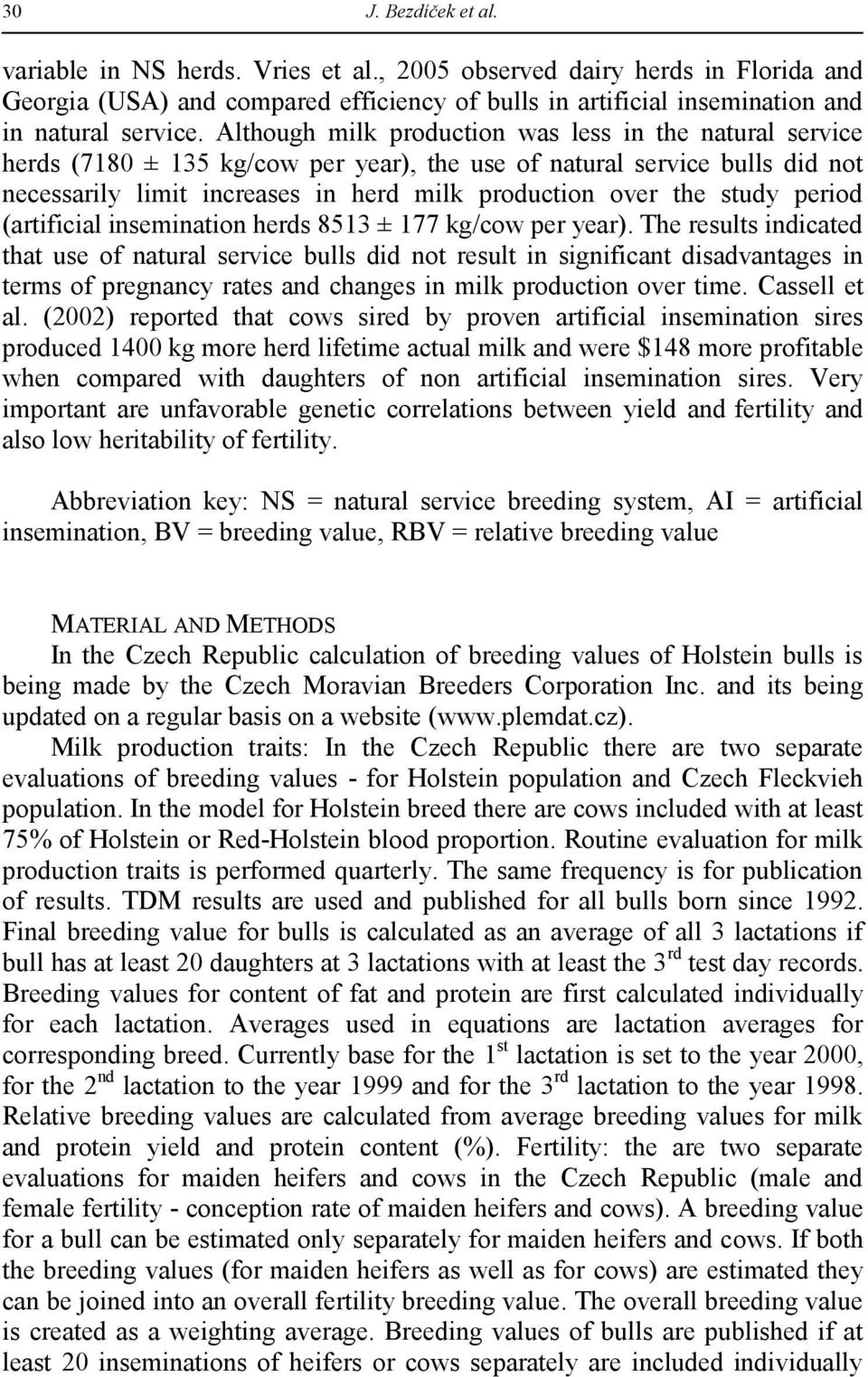
3 Archiva Zootechnica 11:2, 29-34, for male fertility and female fertility. Only bulls born since 1992 are evaluated by the current model. The actual comparison of breeding values between bulls in artificial insemination and natural service has been made by standard mathematical methods using a SPSS 15.0 for Windows, Release (6 Sep 2006) program. Bulls born between the years 1996 and 2001 were included in the evaluation. A minimal rate of the breeding value for milk production reliability in the examined bulls was 65 %. The breeding values of the bulls were counted by April Table 1 Number of bulls in natural service in the Czech Republic recorded in the Herdbook. Czech Fleckvieh 1 Holstein 2 Year Number of bulls recorded in the Herdbook Number of bulls recorded in the Herdbook Total Bulls in natural service Total Bulls in natural service n % n % , , , , , , , , , , , ,67 Mean 158,17 40,50 24,95 358,50 79,17 21, RESULTS AND DISCUSSION Between the years 2000 and 2006 number of bulls in natural service registered in the Herdbook increased in the Czech Republic (Tab. 1). It concerns both the most prevalent dairy cattle strains Czech Fleckvieh and Holstein cattle. From the point of view of kg of milk production, AI bulls showed higher breeding values than NS bulls, especially in kg of milk ( kg; kg), where significant differences were proven (p > 0.05). In case of kg of fat (5.65 kg; 4.06 kg) and kg of protein (6.19 kg; 4.12 kg) the differences were not significant. Concerning a proportional content of milk elements (percentage of fat and protein) AI bulls showed not significant lower values than NS bulls (AI = 0.02%; 0.05; NS = 0.03%; 0.05%), which may be caused by lower milk production in kg of milk in NS bulls. The overall relative breeding value of kg of protein was in AI bulls significant higher (RBV ) than in NS bulls (RBV 97.23). Also other authors have noticed lower milk production in
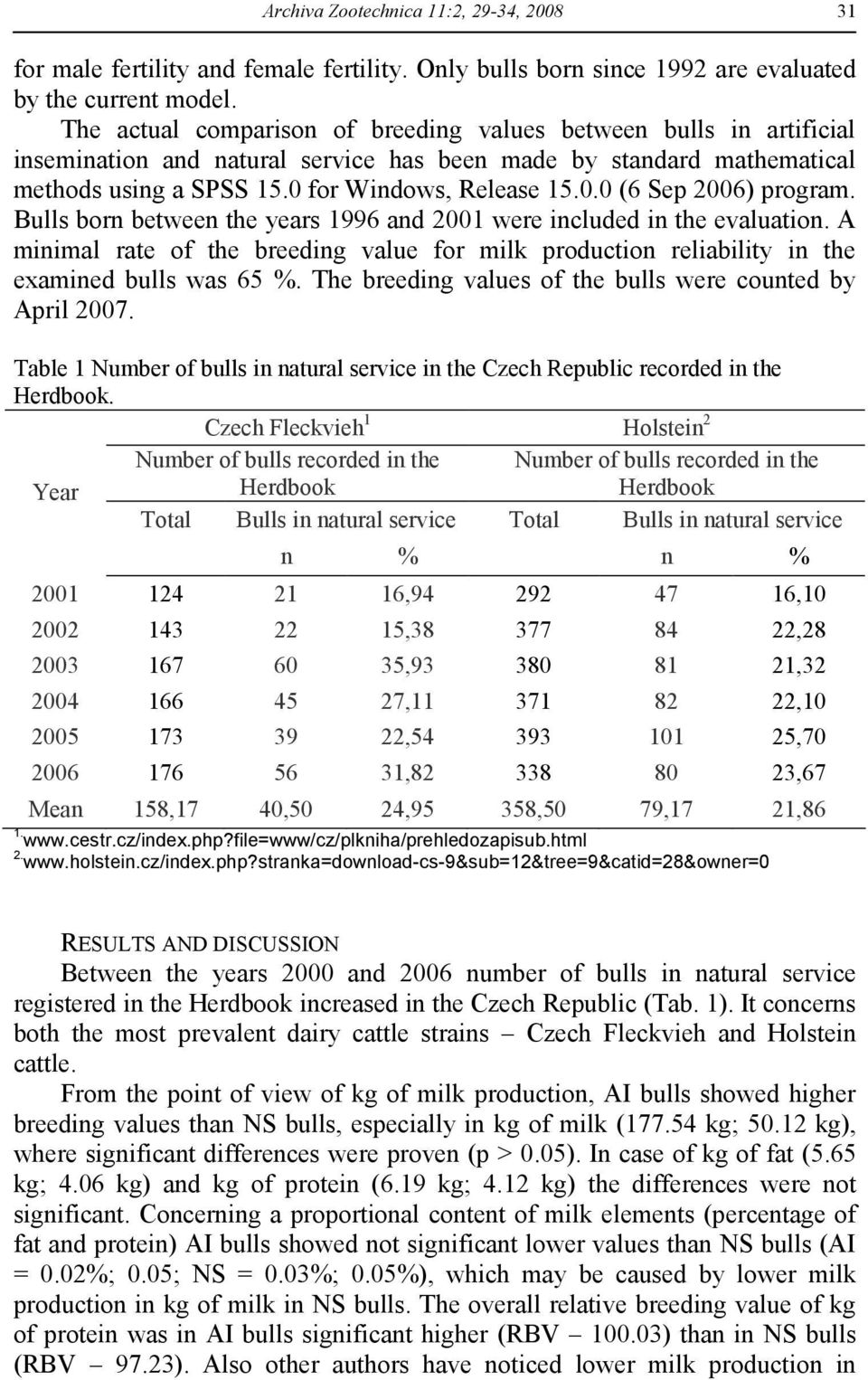
4 32 et al. daughters of NS bulls. Vries et al. (2005) found in dairy herds in Florida and Georgia (USA) milk production of NS bulls' daughters 7180 ± 135 kg/cow per year and milk production of AI bulls' daughters was 8513 ± 177 kg/cow per year. Table 2 Average breeding values of Holstein bulls in artificial insemination and natural service (R > 64.9%) R (%) Daughters Herds BV - Somatic cells count BV - kg Milk BV - % Fat BV - % Protein BV - kg Fet BV - kg Protein Relative breeding value (kg Protein) Male fertility Artificial insemination Female fertility Natural service Relative breeding value (Fertility) Mean s x n Std.Err Mean Mean s x n Std.Err Mean E Difference * * * p > 0.05 Cassell et al. (2002) came to similar conclusions. This author reported that cows sired by proven artificial insemination sires produced 1400 kg more herd lifetime actual milk and were $148 more profitable when compared with daughters of non artificial insemination sires. Evaluated reproduction indicators showed slightly more positive results in NS bulls compared to AI bulls but these differences were not significant. Breeding values of AI bulls where lower in case of male fertility (-0.45; -0.02), female fertility (-0.91; 0.08) and overall relative breeding value for reproduction (99.95; 102.1), too. Williamson et al., 1978 also proved not significant worse reproduction values in AI bulls compared to NS bulls. When pregnancy rates in dairy herds in Victoria (USA) were analyzed, AI and NS cows showed pregnancy rates 57.5%; 58.0% but pregnancy rates of NS were more variable in NS herds. Smith et al., 2004 reported shorter calving interval in herds that used NS bulls. However, the
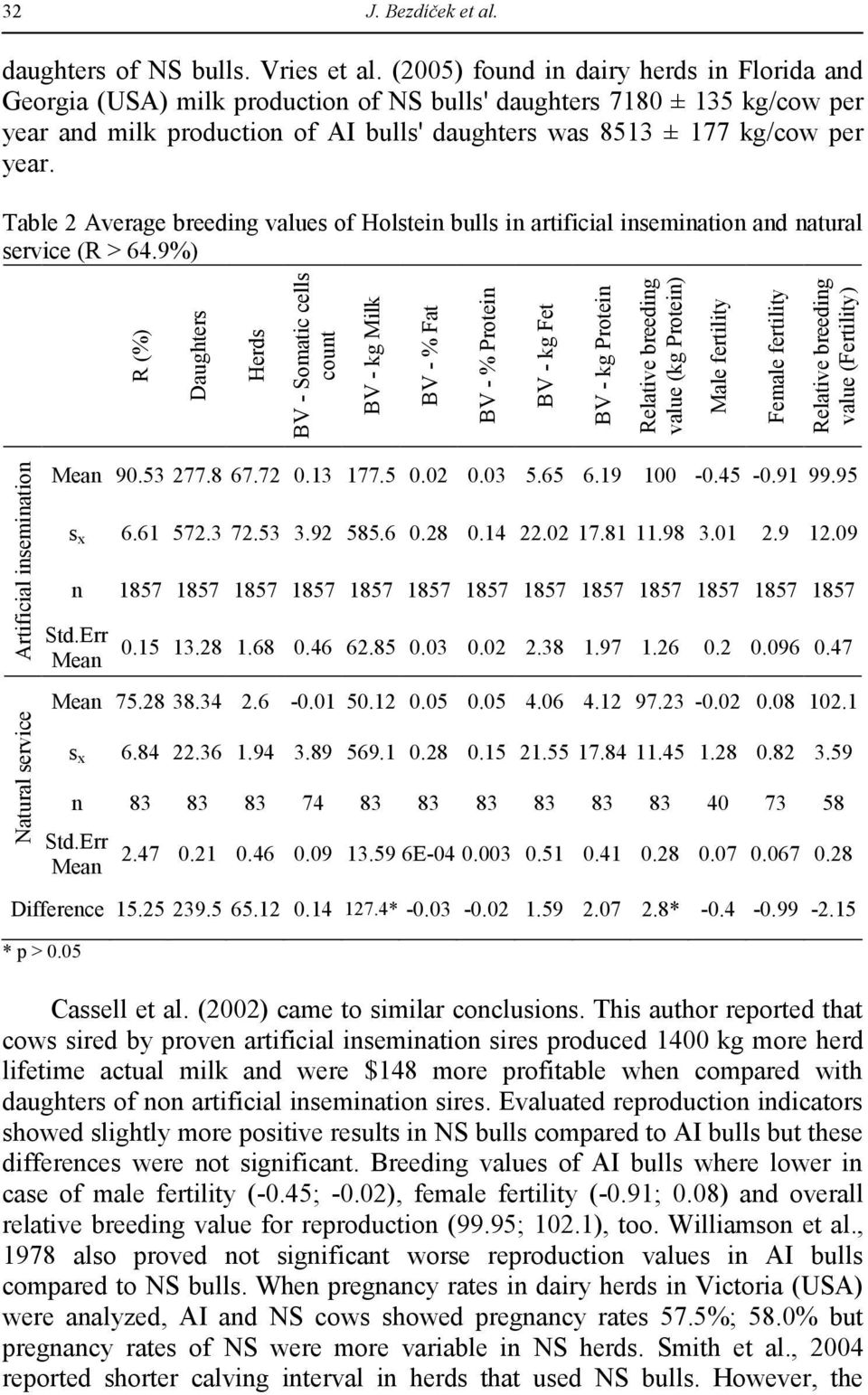
5 Archiva Zootechnica 11:2, 29-34, advantage of a shorter actual calving interval was lost by longer dry days for herds using NS sires and fewer dry periods in the desirable range of 40 to 70 days. Van Raden et al. (2004) found the heritability of days open in first lactation, calculated by calving interval, also Genetic correlations with first lactation milk, fat, and protein were 0.38, 0.33, and 0.32, respectively, indicating that selection for yield reduces fertility. Genetic correlation with productive life was 0.59, indicating that cow fertility plays a major role in longevity. Cow fertility was negatively correlated with milk yield but is a major component of longevity. CONCLUSIONS Concerning a breeding value for kg of milk (AI = ; NS = 50.12) and a relative breeding value for kg of protein (AI = ; NS = 97.23) significant higher values (p > 0.05) in AI bulls compared to NS bulls were shown. Other indicators of milk production (kg, % of protein and fat) showed not significant differences. NS bulls showed not significant more positive breeding values of reproduction indicators compared to AI bulls. Reproduction indicators involved in the research were: male fertility (AI = -0.45; NS = -0.02), female fertility (AI = -0.91; NS = 0.08) and a relative breeding value for fertility (AI = 99.95; NS = 102.1). The NS bulls bring a considerable advantage of conception of problematic cows, calving and start of the next lactation. Supported by the Ministry of Education, Youth and Sports of the Czech Republic (MSM ) and the Ministry of Education, Youth and Sports of the Czech Republic (LA 245). REFERENCES Cassell, B. G., S. M. Jobst, M. L. McGuillard, and R. E. Pearson., 2002: Evaluating sire selection practices using lifetime net income functions. J. Dairy Sci., 85, Smith, J. W., Ely, L. O., Gilson, W. D., Graves, W. M., 2004: Effects of artificial insemination vs. natural service breeding on production and reproduction parameters in dairy herds. Prof. Anim. Sci., 20, SPSS 15.0 for Windows, Release (6 Sep 2006) Van Raden, P. M., Sanders, A. H., Tooker, M. E., Miller R. H., Norman, H. D., Kuhn, M. T., Wiggans, G. R., 2004: Development of a national genetic evaluation for cow fertility. J. Dairy Sci., 87, Vries, de A., Steenholdt, C., Risco, C. A., 2005: Pregnancy Rates and Milk Production in Natural Service and Artificially Inseminated Dairy Herds in Florida and Georgia, J. Dairy Sci., 88, Williamson, N. B., Morris, R.S., Anderson, G. A., 1978: Pregnancy rates and nonreturn rates following artificial and natural breeding in dairy herds. Aust. Vet. J., 54,

6 34 et al. 9&sub=12&tree=9&catid=28&owner=0 Address of Authors: Research Institute for Cattle Breeding, Ltd., Czech Republic Tel ing. Zlata Lakomá Research Institute for Cattle Breeding, Ltd., Czech Republic Výz Tel Prof. Ing. František Louda, DrSc Research Institute for Cattle Breeding, Ltd., Czech Republic Tel

Genetic improvement: a major component of increased dairy farm profitability
 Genetic improvement: a major component of increased dairy farm profitability Filippo Miglior 1,2, Jacques Chesnais 3 & Brian Van Doormaal 2 1 2 Canadian Dairy Network 3 Semex Alliance Agri-Food Canada
Evaluations for service-sire conception rate for heifer and cow inseminations with conventional and sexed semen
 J. Dairy Sci. 94 :6135 6142 doi: 10.3168/jds.2010-3875 American Dairy Science Association, 2011. Evaluations for service-sire conception rate for heifer and cow inseminations with conventional and sexed
Genomic Selection in. Applied Training Workshop, Sterling. Hans Daetwyler, The Roslin Institute and R(D)SVS
 Genomic Selection in Dairy Cattle AQUAGENOME Applied Training Workshop, Sterling Hans Daetwyler, The Roslin Institute and R(D)SVS Dairy introduction Overview Traditional breeding Genomic selection Advantages
Robust procedures for Canadian Test Day Model final report for the Holstein breed
 Robust procedures for Canadian Test Day Model final report for the Holstein breed J. Jamrozik, J. Fatehi and L.R. Schaeffer Centre for Genetic Improvement of Livestock, University of Guelph Introduction
The impact of genomic selection on North American dairy cattle breeding organizations
 The impact of genomic selection on North American dairy cattle breeding organizations Jacques Chesnais, George Wiggans and Filippo Miglior The Semex Alliance, USDA and Canadian Dairy Network 2000 09 Genomic
Scope for the Use of Pregnancy Confirmation Data in Genetic Evaluation for Reproductive Performance
 Scope for the Use of Pregnancy Confirmation Data in Genetic Evaluation for Reproductive Performance J. Jamrozik and G.J. Kistemaker Canadian Dairy Network The data on cow's pregnancy diagnostics has been
NAV routine genetic evaluation of Dairy Cattle
 NAV routine genetic evaluation of Dairy Cattle data and genetic models NAV December 2013 Second edition 1 Genetic evaluation within NAV Introduction... 6 NTM - Nordic Total Merit... 7 Traits included in
MINISTRY OF LIVESTOCK DEVELOPMENT SMALLHOLDER DAIRY COMMERCIALIZATION PROGRAMME. Artificial Insemination (AI) Service
 MINISTRY OF LIVESTOCK DEVELOPMENT SMALLHOLDER DAIRY COMMERCIALIZATION PROGRAMME Artificial Insemination (AI) Service 1 1.0 Introduction The fertility of a dairy cattle is very important for a dairy farmer
Genomics: how well does it work?
 Is genomics working? Genomics: how well does it work? Jacques Chesnais and Nicolas Caron, Semex Alliance The only way to find out is to do some validations Two types of validation - Backward validation
Artificial Insemination (AI) in Cattle
 Artificial Insemination (AI) in Cattle Most dairy cows are bred by AI Less common in beef cattle Commonly, bulls are used for all breeding under pasture conditions Less commonly, bulls are used as clean-up
Major Advances in Globalization and Consolidation of the Artificial Insemination Industry
 J. Dairy Sci. 89:1362 1368 American Dairy Science Association, 2006. Major Advances in Globalization and Consolidation of the Artificial Insemination Industry D. A. Funk ABS Global, Inc., DeForest, WI
ANS 3319C Reproductive Physiology and Endocrinology Artificial Insemination in Cattle. Objectives. What are the advantages and disadvantages of AI?
 ANS 3319C Reproductive Physiology and Endocrinology Artificial Insemination in Cattle Objectives 1) To provide an overview of the process of artificial insemination (AI) in cattle. 2) To gain an understanding
Genetic parameters for female fertility and milk production traits in first-parity Czech Holstein cows
 Genetic parameters for female fertility and milk production traits in first-parity Czech Holstein cows V. Zink 1, J. Lassen 2, M. Štípková 1 1 Institute of Animal Science, Prague-Uhříněves, Czech Republic
Genomic selection in dairy cattle: Integration of DNA testing into breeding programs
 Genomic selection in dairy cattle: Integration of DNA testing into breeding programs Jonathan M. Schefers* and Kent A. Weigel* *Department of Dairy Science, University of Wisconsin, Madison 53706; and
Reproductive technologies. Lecture 15 Introduction to Breeding and Genetics GENE 251/351 School of Environment and Rural Science (Genetics)
 Reproductive technologies Lecture 15 Introduction to Breeding and Genetics GENE 251/351 School of Environment and Rural Science (Genetics) Animal Breeding in a nutshell Breeding objectives Trait measurement
vision evolving guidelines
 vision To foster a collective, industry supported strategy for the future of the Holstein Breed which will act as a tool for Canadian dairy producers to maximize profitability and genetic improvement.
How To Read An Official Holstein Pedigree
 GETTING THE MOST FOR YOUR INVESTMENT How To Read An Official Holstein Pedigree Holstein Association USA, Inc. 1 Holstein Place, PO Box 808 Brattleboro, VT 05302-0808 800.952.5200 www.holsteinusa.com 7
Four Systematic Breeding Programs with Timed Artificial Insemination for Lactating Dairy Cows: A Revisit
 Four Systematic Breeding Programs with Timed Artificial Insemination for Lactating Dairy Cows: A Revisit Amin Ahmadzadeh Animal and Veterinary Science Department University of Idaho Why Should We Consider
SUMMARY Contribution to the cow s breeding study in one of the small and middle sizes exploitation in Dobrogea
 SUMMARY The master s degree named Contribution to the cow s breeding study in one of the small and middle sizes exploitation in Dobrogea elaborated by engineer Gheorghe Neaga, coordinated by the collegiate
Characterization of Pasture- Based Dairy Farms in Florida and Georgia
 Characterization of Pasture- Based Dairy Farms in Florida and Georgia Fei Du Department of Animal Sciences University of Florida Master s defense July 1, 2013 Introduction Most dairy farms in the Southeast
COMPARISON OF FIXED-TIME ARTIFICIAL INSEMINATION VS. NATURAL SERVICE IN BEEF COWS: REPRODUCTIVE EFFICIENCY AND SYSTEM COST
 FACT SHEET #2015.02 COMPARISON OF FIXED-TIME ARTIFICIAL INSEMINATION VS. NATURAL SERVICE IN BEEF COWS: REPRODUCTIVE EFFICIENCY AND SYSTEM COST By: Dr. Bart Lardner, Kathy Larson MSc, and Dr. Daalkhaijav
ANP 504 : ARTIFICIAL INSEMINATION COURSE LECTURERS
 ANP 504 : ARTIFICIAL INSEMINATION COURSE LECTURERS DR. A. O. LADOKUN DR. J. O. DR. J. A. DARAMOLA ABIONA COURSE OUTLINE PART I The Role of AI and Reproduction in Livestock Improvement 1. Advantages and
INTRODUCTION. The identification system of dairy cattle; The recording of production of dairy cattle; Laboratory analysis; Data processing.
 POLISH FEDERATION OF CATTLE BREEDERS AND DAIRY FARMERS INTRODUCTION Polish Federation of Cattle Breeders and Dairy Farmers was established in 1995 as a merger of 20 regional breeding organizations from
PRODUCERS can choose to use natural
 Artificial Insemination PRODUCERS can choose to use natural or artificial means of breeding their animals. Technology has advanced in the last 30 to 40 years to allow animal producers to use means other
A POWERFUL IN VITRO FERTILIZATION
 A POWERFUL During the past 50 years technological advances in the field of bovine reproduction have led to some dramatic changes in the way cattle look, reproduce, perform, and even taste. Artificial Insemination
STRATEGIES FOR DAIRY CATTLE BREEDING TO ENSURE SUSTAINABLE MILK PRODUCTION 1
 STRATEGIES FOR DAIRY CATTLE BREEDING TO ENSURE SUSTAINABLE MILK PRODUCTION 1 Prof. Ntombizakhe Mpofu Department of Agricultural Sciences, Lupane State University, P O Box AC 255, Bulawayo Tel: 09-883830/40;
Dr. G van der Veen (BVSc) Technical manager: Ruminants [email protected]
 Dr. G van der Veen (BVSc) Technical manager: Ruminants [email protected] GENETICS NUTRITION MANAGEMENT Improved productivity and quality GENETICS Breeding programs are: Optimize genetic progress
Breeding for Carcass Traits in Dairy Cattle
 HELSINGIN YLIOPISTON KOTIELÄINTIETEEN LAITOKSEN JULKAISUJA UNIVERSITY OF HELSINKI, DEPT. OF ANIMAL SCIENCE, PUBLICATIONS 53 Breeding for Carcass Traits in Dairy Cattle Anna-Elisa Liinamo Academic dissertation
Presentation by: Ahmad Alsahaf. Research collaborator at the Hydroinformatics lab - Politecnico di Milano MSc in Automation and Control Engineering
 Johann Bernoulli Institute for Mathematics and Computer Science, University of Groningen 9-October 2015 Presentation by: Ahmad Alsahaf Research collaborator at the Hydroinformatics lab - Politecnico di
Investing in genetic technologies to meet future market requirements and assist in delivering profitable sheep and cattle farming
 Investing in genetic technologies to meet future market requirements and assist in delivering profitable sheep and cattle farming B+LNZ GENETICS The Government through its Ministry of Business, Innovation
Increasing Profitability Through an Accelerated Heifer Replacement Program
 Increasing Profitability Through an Accelerated Heifer Replacement Program Robert B. Corbett, D.V.M Dairy Health Consultation Accelerating heifer growth has been a very controversial subject in recent
Impact of reproductive technologies on improved genetics in beef cattle
 Impact of reproductive technologies on improved genetics in beef cattle JE Kinder 1, JM Osborne 1, ME Davis 1, ML Day 1 1 The Ohio State University, Department of Animal Sciences, Columbus, Ohio 43210,
Dairy Data Flow Challenges and Opportunities
 Dairy Data Flow Challenges and Opportunities Farmer Cooperatives Conference November 6, 2015 Minneapolis, MN Jay Mattison CEO National DHIA\Quality Certification Services Hunt and Gather Capture Prepare
Economics of Estrus Synchronization and Artificial Insemination. Dr. Les Anderson and Paul Deaton University of Kentucky
 Economics of Estrus Synchronization and Artificial Insemination Dr. Les Anderson and Paul Deaton University of Kentucky Introduction Few beef producers would disagree that the genetic potential available
The All-Breed Animal Model Bennet Cassell, Extension Dairy Scientist, Genetics and Management
 publication 404-086 The All-Breed Animal Model Bennet Cassell, Extension Dairy Scientist, Genetics and Management Introduction The all-breed animal model is the genetic-evaluation system used to evaluate
::: Check out Poos Stadel Classic s full proof at www.hg.nl ::: Poos Stadel Classic
 BULLetin 1 Poos Stadel Classic Stadel x EX90 Almerson Camera x GP84 Newlands Detective x EX91 Hanover Hill Triple Threat x VG86 Branderlea Citation Topper Poos Stadel Classic is bred from one of the most
RATES OF CONCEPTION BY ARTIFICIAL INSEMINATION OF. 1 Miss. Rohini Paramsothy Faculty of Agriculture University of Jaffna
 RATES OF CONCEPTION BY ARTIFICIAL INSEMINATION OF DAIRY COWS IN JAFFNA DISTRICT 1 Miss. Rohini Paramsothy Faculty of Agriculture University of Jaffna INTRODUCTION Conception rates of dairy cows are influenced
G. Cliff Lamb. North Florida Research and Education Center, Marianna, Florida University of Florida. Introduction
 COST ANALYSIS OF IMPLEMENTING A SYNCHRONIZATION OR AI PROGRAM-USING DECISION-AID TOOLS G. Cliff Lamb North Florida Research and Education Center, Marianna, Florida University of Florida Introduction Estrous
Replacement Heifers Costs and Return on Investment Calculation Decision Aids
 Replacement Heifers Costs and Return on Investment Calculation Decision Aids The purpose of this replacement heifer cost decision aid is to calculate total production costs and return on investment (ROI)
ARTIFICIAL INSEMINATION STUDY
 ARTIFICIAL INSEMINATION STUDY KOSOVO CLUSTER AND BUSINESS SUPPORT PROJECT 30 September 2005 This publication was produced for review by the United States Agency for International Development. It was prepared
ANIMAL SCIENCE RESEARCH CENTRE
 ANIMAL SCIENCE RESEARCH CENTRE Evaluation of progeny from Top 10% (Lorabar Mighty Prince) and Top 70% (Aynho Beck) Terminal Index Aberdeen Angus bulls intensively finished on a cereal beef system TRIAL
1. About dairy cows. Breed of dairy cows
 1. About dairy cows Breed of dairy cows Holstein Holstein is a typical dairy cow, and 99% of dairy cows in Japan are Holsteins. They are originally from the Netherlands and Holstein region of Germany.
Australian Santa Gertrudis Selection Indexes
 Australian Santa Gertrudis Selection Indexes There are currently two different selection indexes calculated for Australian Santa Gertrudis animals. These are: Domestic Production Index Export Production
Dr. Marija Klopčič, Biotechnical Faculty (Department of Animal Science), University of Ljubljana (27 to 28 April 2015)
 ICAR Certificate of Quality: CONVIS société coopérative, Luxembourg Auditor(s) Report for the ICAR Executive Board Name(s) of Auditor(s) and areas audited: Dr. Marija Klopčič, Biotechnical Faculty (Department
REPRODUCTION AND BREEDING Crossbreeding Systems for Beef Cattle
 Beef Cattle REPRODUCTION AND BREEDING Crossbreeding Systems for Beef Cattle Pete Anderson University of Minnesota Beef Team It has been well documented that crossbreeding improves performance of beef cattle.
EFFICIENCY OF TREATMENT OF FOLLICULAR CYSTS IN COWS
 2012 CVŽV ISSN 1337-9984 EFFICIENCY OF TREATMENT OF FOLLICULAR CYSTS IN COWS D. ŠŤASTNÁ, P. ŠŤASTNÝ Slovak University of Agriculture, Nitra, Slovak Republic ABSTRACT The aim of the work was to compare
Third International Scientific Symposium "Agrosym Jahorina 2012"
 10.7251/AGSY1203499B UDK 636.39.087.7(496.5) PRELIMINARY DATA ON COMPARISON OF SMALL AND MEDIUM DAIRY FARMS IN ALBANIA Ylli BIÇOKU 1, Enkelejda SALLAKU 1, Kujtim GJONI 2, Agron KALO 3 1 Agricultural University
Artificial Insemination in Dairy Cattle 1
 Whole Document Navigator (Click Here) Artificial Insemination in Dairy Cattle 1 D. W. Webb 2 Artificial insemination (AI) is a process by which sperm are collected from the male, processed, stored and
Artificial insemination:
 NAFU FARMER TECHNOLOGY Artificial insemination: The best technique to improve your herd by Joel Nkuna, AI technician, Taurus The practice of AI (artificial insemination) with cattle, is one of the few
Herd Navigator and reproduction management
 Herd Navigator and reproduction management 1. Reproductive management Efficient and profitable reproduction management in a dairy herd requires routine and time-consuming manual heat detection and proper
EBLEX BEEF BRP MANUAL 4. Beef production from the dairy herd
 EBLEX BEEF BRP MANUAL 4 Beef production from the dairy herd The information in this booklet was compiled by: Mary Vickers, MLC; Clive Brown and Liz Ford, EBLEX. EBLEX Beef Better Returns Programme is grateful
Natural Breeding vs. Artificial Insemination: A Cost Comparison Analysis. By Patrick Jacobsen
 Natural Breeding vs. Artificial Insemination: A Cost Comparison Analysis By Patrick Jacobsen Table of Contents Introduction Problem Study Assumptions Natural Breeding Costs Artificial Insemination Costs
Sustainability of dairy cattle breeding systems utilising artificial insemination in less developed countries - examples of problems and prospects
 Philipsson Sustainability of dairy cattle breeding systems utilising artificial insemination in less developed countries - examples of problems and prospects J. Philipsson Department of Animal Breeding
New York Science Journal 2014;7(9) http://www.sciencepub.net/newyork
 Perception of Artificial Insemination among Fulani Cattle Rearers in Zuru Local Government Area of Kebbi State, Nigeria Musa D. Baba 1, Aminu M. Sakaba 2, Taibat A. Manga 3 and Musa S. Ribah 2 1 Department
Cattlemen s Corner Beef Newsletter
 Owyhee County Cattlemen s Corner Beef Newsletter May, 2013 Inside this issue: Transferring Cattle to the Next Generation Gestation and Dystocia Lost Rivers Grazing Academy Southwest Idaho Beef Producers
AgSourceDM.com features
 P a g e 1 AgSourceDM.com features Data Entry All data entry to an individual cow s record is performed here. Using the Cow Page-Events screens you can view each individual animal s records. You can enroll
Proceedings, Applied Reproductive Strategies in Beef Cattle September 11 and 12, 2007, Billings, Montana NEW TECHNOLOGIES FOR REPRODUCTION IN CATTLE
 Proceedings, Applied Reproductive Strategies in Beef Cattle September 11 and 12, 2007, Billings, Montana NEW TECHNOLOGIES FOR REPRODUCTION IN CATTLE George E. Seidel, Jr. Animal Reproduction and Biotechnology
Pregnancy Rates Per Artificial Insemination for Cows and Heifers Inseminated at a Synchronized Ovulation or Synchronized Estrus 1
 Pregnancy Rates Per Artificial Insemination for Cows and Heifers Inseminated at a Synchronized Ovulation or Synchronized Estrus 1 J. R. PURSLEY,*,2 M. C. WILTBANK,*,3 J. S. STEVENSON, J. S. OTTOBRE, H.
K.I. SAMEN. With a lot of pleasure we present you the first international newsletter of K.I. SAMEN b.v.
 INTRODUCTION K.I. SAMEN news March 2010 Dear sir, madam, With a lot of pleasure we present you the first international newsletter of K.I. SAMEN b.v. The goal of this newsletter is to inform you all over
Alison Van Eenennaam, Ph.D.
 Is the Market Ready for Milk from Cloned Cows? 3/15/06 Alison Van Eenennaam, Ph.D. Cooperative Extension Specialist Animal Biotechnology and Genomics [email protected] ODI OUTLINE What is a clone?
It is well known that daughters of sires available
 Improving Artificial Insemination Techniques It is well known that daughters of sires available through artificial insemination (A.I.) produce more milk than daughters of sires used in natural service.
Replacement Heifers Costs and Return Calculation Decision Aids
 Replacement Heifers Costs and Return Calculation Decision Aids The purpose of these replacement heifer cost decision aids is to calculate total production costs and return on investment (ROI) to evaluate
Artificial Insemination in Cattle
 Artificial Insemination in Cattle Introduction This slide show is designed to introduce students to artificial insemination in cattle. However, it is only a brief overview and further training is necessary
Estrus Synchronization Protocols for Cows
 Estrus Synchronization Protocols for Cows Cliff Lamb University of Florida Applied Reproductive Strategies in Beef Cattle NCBA Convention January 28, 2010 Estrous Synchronization Protocols Hybrid Synch
Artificial Insemination (AI) and Oestrus Synchronisation of Beef Cattle
 Artificial Insemination (AI) and Oestrus Synchronisation of Beef Cattle Information compiled by Endell Veterinary Group, Paragon Veterinary Group and RAFT Solutions/Bishopton Cattle Breeding Services.
Successful Timed AI Programs: Using Timed AI to Improve Reproductive Efficiency in High Producing Dairy Cattle
 Successful Timed Programs: Using Timed to Improve Reproductive Efficiency in High Producing Dairy Cattle Milo C. Wiltbank, Ph.D. Department of Dairy Science University of Wisconsin, Madison Introduction
Managing the Dairy Farm: Key Performance Indicators
 Managing the Dairy Farm: Key Performance Indicators Thomas Fuhrmann, DVM DairyWorks, PO Box 2800-317, Carefree AZ 85377 Email: [email protected] Take Home Message This paper discusses how to use information
Getting Cows Pregnant: Are Problem Cows Really the Problem?
 Getting Cows Pregnant: Are Problem Cows Really the Problem? Paul M. Fricke, PhD Associate Professor, Department of Dairy Science, University of Wisconsin, Madison, Wisconsin Phone: 608-263-4596 Email:
Animal Birth Registration
 Worksheet 2 Animal Birth Registration All calves must be tagged within 20 days of birth. Within 7 days of tagging all calf births must be registered with the Cattle Movement Monitoring System (CMMS). The
SimHerd a tool to point out a herd specific reproduction strategy
 Sida 1 av 5 How to - point out a reproduction strategy - monitor if it is being followed Søs Ancker, Specialist advisor Knowledge Centre for Agriculture, Cattle department Team Reproduction & Breeding
REPRODUCTION AND BREEDING Influence of Nutrition on Reproduction in the Beef Cow Herd
 Beef Cattle REPRODUCTION AND BREEDING Influence of Nutrition on Reproduction in the Beef Cow Herd G. Cliff Lamb University of Minnesota Beef Team INTRODUCTION The primary goal for cow/calf producers is
FEEDING THE DAIRY COW DURING LACTATION
 Department of Animal Science FEEDING THE DAIRY COW DURING LACTATION Dairy Cattle Production 342-450A Page 1 of 8 Feeding the Dairy Cow during Lactation There are main stages in the lactation cycle of the
Value of Managing Beef Cattle Genetics
 Value of Managing Beef Cattle Genetics Lisa Rees University of Missouri Department of Agricultural and Applied Economics Contact Information: 803 E. Green Meadows, Apt. 102 Columbia, MO 65201 Profile-
BREEDING SOUNDNESS EVALUATION OF BULLS
 Proceedings, Applied Reproductive Strategies in Beef Cattle November 12 and 13, 2005, Texas A&M University, College Station BREEDING SOUNDNESS EVALUATION OF BULLS Derry Magee Clinical Associate Professor
Animal Sciences. Timed-Artificial Insemination in Beef Cows: What are the Options?
 Purdue Extension Animal Sciences AS-575-W Timed-Artificial Insemination in Beef Cows: What are the Options? Allen Bridges, Scott Lake, Ron Lemenager, and Matt Claeys, Purdue Beef Team, Department of Animal
REPRODUCTIVE PERFORMANCE ANALYSIS USING DC305
 REPRODUCTIVE PERFORMANCE ANALYSIS USING DC305 Nigel B. Cook MRCVS University of Wisconsin-Madison Disclaimer: The following analysis guide represents some of the reports and set-up used by the Food Animal
Faculteit Diergeneeskunde. Prof. dr. G. Opsomer Faculty of Veterinary Medicine Ghent University.
 Faculteit Diergeneeskunde Integrated veterinary herd health management as the basis for sustainable animal production (dairy herd health as an example) Prof. dr. G. Opsomer Faculty of Veterinary Medicine
SOME PROBLEMS ASSOCIATED WITH ARTIFICIAL INSEMINATION OF BEEF CATTLE
 SOME PROBLEMS ASSOCIATED WITH ARTIFICIAL INSEMINATION OF BEEF CATTLE D. R. LAMOND* and A. TAKKEN* Summary In October, 1964, beef cows were divided into three groups. One group was run with bulls for four
Cattle. MRDP and Heifer
 Cattle MRDP and Heifer 1. Redwater 2. Blackquarter 3. Lumpy skin 4. Heartwater 5. Gallsickness and Sweating sickness 6. Warts 7. Snotsiekte and Sleeping Sickness 8. Worms and Fluke 9. External parasites
Relationship between weight at puberty and mature weight in beef cattle
 Relationship between weight at puberty and mature weight in beef cattle M.P. Davis and R.P. Wettemann STORY IN BRIEF The relationship between weight at puberty and mature weight was evaluated in Angus
Beef Cattle Breeds and Biological Types Scott P. Greiner, Extension Animal Scientist, Virginia Tech
 publication 400-803 Beef Cattle Breeds and Biological Types Scott P. Greiner, Extension Animal Scientist, Virginia Tech Worldwide there are more than 250 breeds of beef cattle. Over 60 of these breeds
Beef - Key performance indicators. Mary Vickers
 Beef - Key performance indicators Mary Vickers Today Suckler herd KPIs Update on new project Responses KPIs for finishing systems What is a KPI? a business metric used to evaluate factors that are crucial
What is the Cattle Data Base
 Farming and milk production in Denmark By Henrik Nygaard, Advisory Manager, [email protected] Danish Cattle Federation, Danish Agricultural Advisory Centre, The national Centre, Udkaersvej 15, DK-8200
New product approval for Fixed-Time AI. John Lee, DVM Zoetis Dairy Technical Services
 New product approval for Fixed-Time AI John Lee, DVM Zoetis Dairy Technical Services 1 More than two years in the making 2 FACTREL (gonadorelin hydrochloride) Sterile Solution is now approved by the Food
Australian Dairy Herd Improvement Report 2014
 Australian Dairy Herd Improvement Report 2014 ADHIS is an Australian Dairy Farmers Ltd initiative that receives the majority of its funding from Dairy Australia through the Dairy Services Levy. ADHIS acknowledges
ANALYSE OF PURE BRED BELGIAN BLUE BEEF CATTLE POPULATIONS
 VESZPRÉM UNIVERSITY GEORGIKON FACULTY OF AGRICULTURAL SCIENCES Institute of Animal Sciences DEPARTMENT OF ANIMAL HUSBANDRY Supervisor: PROF DR. FERENC SZABÓ D.SC. ANALYSE OF PURE BRED BELGIAN BLUE BEEF
CMSS Newsletter October 2015
 CMSS Newsletter October 2015 OVERAGE REGISTRATION MORATORIUM: DEADLINE EXTENDED As breeders should be aware, the Society announced at the start of the year that we would be putting in place a moratorium
Artificial Insemination
 AS1749 Maximizing Pregnancy Rates When Using Artificial Insemination Carl Dahlen, Beef Cattle Specialist, NDSU Extension Service Dani Black, Graduate Student, NDSU Animal Sciences Department Mellissa Crosswhite,
Using estrus-detection patches to optimally time artificial insemination (AI) and improve pregnancy rates in suckled beef cows in a timed AI program
 Using estrus-detection patches to optimally time artificial insemination (AI) and improve pregnancy rates in suckled beef cows in a timed AI program Hill, S. L., D. M. Grieger, K. C. Olson, J. R. Jaeger,
Key Performance Indicators to Diagnose Poor Farm Performance and Profitability of Smallholder Dairy Farmers in Asia
 1709 Asian-Aust. J. Anim. Sci. Vol. 22, No. 12 : 1709-1717 December 2009 www.ajas.info Key Performance Indicators to Diagnose Poor Farm Performance and Profitability of Smallholder Dairy Farmers in Asia
LIVESTOCK IMPROVEMENT S STUDENT RESOURCE SERIES ARTIFICIAL BREEDING
 LIVESTOCK IMPROVEMENT S STUDENT RESOURCE SERIES ARTIFICIAL BREEDING Introduction This country s dairy industry is one of its biggest export earners. Profit in dairying is made from producing and selling
Business Planning for the Allocation of Milk Quota to New Entrants
 Business Planning for the Allocation of Milk Quota to New Entrants The business plan should start with a comment on where the farm is currently, what is planned over the next number of years and how it