
Understanding Fundamental Issues with TRILL
|
|
|
- Leo Chester Green
- 10 years ago
- Views:
Transcription
1 WHITE PAPER TRILL in the Data Center: Look Before You Leap Understanding Fundamental Issues with TRILL Copyright 2011, Juniper Networks, Inc. 1

2 Table of Contents Executive Summary Introduction What is TRILL? What Do Modern Data Centers Need? Fundamental Issues with TRILL Early Adopters of TRILL Face Vendor Lock-In Conclusion About Juniper Networks Table of Figures Figure 1: s interconnected through an Ethernet cloud Copyright 2011, Juniper Networks, Inc.

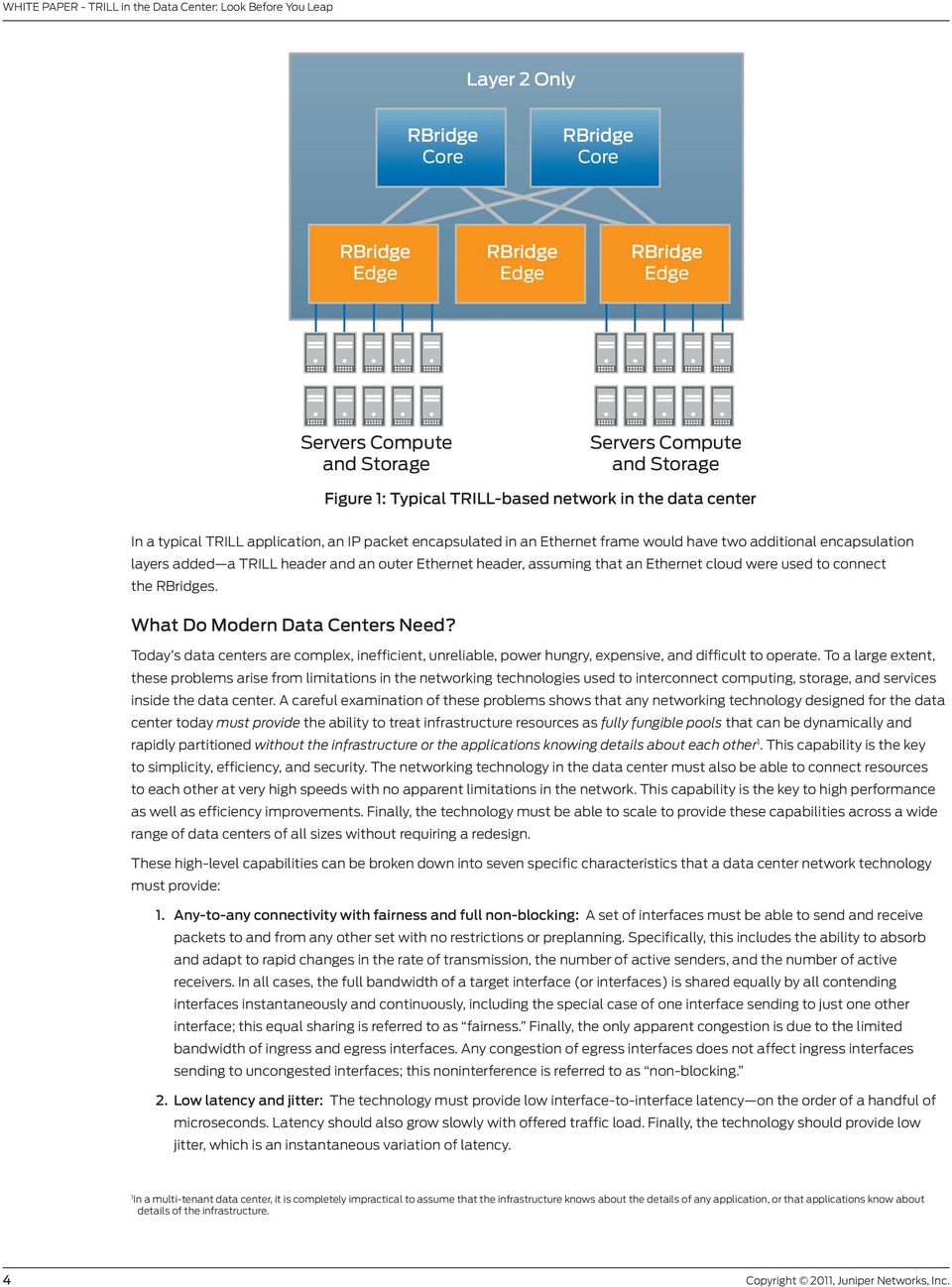
3 Executive Summary Juniper Networks has a long history of supporting industry standards that are mature and enable customers to effectively solve their networking problems. Therefore, before jumping on the Transparent Interconnection of Lots of Links (TRILL) bandwagon, Juniper took a close look at how the protocol proposes to solve the fundamental issues plaguing the data center, specifically as they relate to connecting infrastructure designed for cloud computing. This white paper outlines the results of those reviews and presents Juniper s conclusions about TRILL. Introduction TRILL was originally intended to fix specific scaling deficiencies inherent to Ethernet bridging while retaining its plug-andplay nature. While its primary application was for large distributed campus networks or large Layer 2 networks, TRILL is now being heralded by some experts as a data center solution. However, the requirements of the modern data center such as exceedingly high levels of performance, any-to-any connectivity, virtual machine (VM) mobility, and more are dramatically different than the needs of the campus. The current hype around TRILL is primarily generated by legacy vendors who have a significant presence in the data center an installed base they are desperate to protect. Vendors promoting TRILL in the data center will eventually discover that there are a number of problems that it doesn t solve, and they will attempt to fix those problems through patches, resulting in the same level of complexity that disqualified legacy Ethernet as a data center solution in the first place. Customers who implement TRILL in their data centers will pay dearly for this incremental approach, since they are required to replace their existing infrastructure, which merely increases their costs. While TRILL is a step in the right direction, it increases complexity and prevents fundamental advances that could truly improve the data center network. Customers considering TRILL must ask themselves: Why should we invest in a technology that only supports Layer 2 one that introduces additional cost and complexity to the network when the majority of our data center application traffic is Layer 3? What is TRILL? TRILL is a network protocol invented by Radia Perlman to remove certain deficiencies of bridged Ethernet networks in large Layer 2 campuses. The context of TRILL s creation is important, because it speaks directly to the problems it can and cannot solve. The following quote, from a 2006 interview with Perlman in Network World, is revealing: A couple of years back there was this Boston Globe article about a hospital network melting down and in the middle of it was mentioned the spanning tree algorithm eventually we tracked down the company providing the switches and indeed it was a giant bridged network One of the things I m trying to do now, given that we re stuck with IP, is come up with something that gives you the advantages of bridging so it can be all zero-configuration within a campus and all look like one big prefix and not be confined to just transmitting data along the spanning tree TRILL has since been taken up by the IETF in an attempt to create a new standard. In the meantime, various implementations by various Ethernet switching vendors include a number of differences, even as they operate under the cloak of a single open standard called TRILL. Ironically, contrary to what a standard is supposed to do, these different implementations don t even interoperate with one another. TRILL introduces a new encapsulation layer, a set of associated control plane protocols, and a new network device type called an that sits midway between a router and a bridge. The encapsulation layer adds a hop count, a VLAN tag, and ingress and egress identifiers, along with a few additional control bits. Figure 1 shows a typical TRILL-based network deployment in the data center. Copyright 2011, Juniper Networks, Inc. 3

4 Layer 2 Only Core Core Edge Edge Edge Servers Compute and Storage Servers Compute and Storage Figure 1: Typical TRILL-based network in the data center In a typical TRILL application, an IP packet encapsulated in an Ethernet frame would have two additional encapsulation layers added a TRILL header and an outer Ethernet header, assuming that an Ethernet cloud were used to connect the s. What Do Modern Data Centers Need? Today s data centers are complex, inefficient, unreliable, power hungry, expensive, and difficult to operate. To a large extent, these problems arise from limitations in the networking technologies used to interconnect computing, storage, and services inside the data center. A careful examination of these problems shows that any networking technology designed for the data center today must provide the ability to treat infrastructure resources as fully fungible pools that can be dynamically and rapidly partitioned without the infrastructure or the applications knowing details about each other 1. This capability is the key to simplicity, efficiency, and security. The networking technology in the data center must also be able to connect resources to each other at very high speeds with no apparent limitations in the network. This capability is the key to high performance as well as efficiency improvements. Finally, the technology must be able to scale to provide these capabilities across a wide range of data centers of all sizes without requiring a redesign. These high-level capabilities can be broken down into seven specific characteristics that a data center network technology must provide: 1. Any-to-any connectivity with fairness and full non-blocking: A set of interfaces must be able to send and receive packets to and from any other set with no restrictions or preplanning. Specifically, this includes the ability to absorb and adapt to rapid changes in the rate of transmission, the number of active senders, and the number of active receivers. In all cases, the full bandwidth of a target interface (or interfaces) is shared equally by all contending interfaces instantaneously and continuously, including the special case of one interface sending to just one other interface; this equal sharing is referred to as fairness. Finally, the only apparent congestion is due to the limited bandwidth of ingress and egress interfaces. Any congestion of egress interfaces does not affect ingress interfaces sending to uncongested interfaces; this noninterference is referred to as non-blocking. 2. Low latency and jitter: The technology must provide low interface-to-interface latency on the order of a handful of microseconds. Latency should also grow slowly with offered traffic load. Finally, the technology should provide low jitter, which is an instantaneous variation of latency. 1 In a multi-tenant data center, it is completely impractical to assume that the infrastructure knows about the details of any application, or that applications know about details of the infrastructure. 4 Copyright 2011, Juniper Networks, Inc.
5 3. No packet drops under congestion: When the instantaneous rate of incoming packets exceeds the instantaneous rate of outgoing packets, the technology must signal the source (e.g., servers or VMs) causing the congestion to slow down sufficiently so that the arrival rate matches the departure rate. This throttling should occur rapidly and continuously to ensure that input and output rates are matched in a smooth manner. 4. Linear cost and power scaling: The cost and power consumption of the network infrastructure must increase linearly with the number of server ports N it needs to support. This is in sharp contrast to traditional approaches, where cost and power grow nonlinearly as they scale up 5. Support of virtual networks and services: The technology must implement virtual Layer 2 and Layer 3 networks to support multiple tenants, each running multitier applications. Complex security and services requirements should be supported by the insertion of Layer 4-7 processing at any point in an application s workflow. Full mobility of VMs from any interface to any other interface must also be supported. Virtual network support should not compromise any of the other properties. 6. Modular distributed implementation that is highly reliable and scalable: The technology should be built using modular hardware and software components that are distributed and federated to provide high levels of redundancy. The modular implementation should be designed to permit increasing or decreasing the number of interfaces while the system is running, a property called dynamic scalability. 7. Single logical device: Despite its distributed implementation, the technology should act as a single, logical packet switching device. The complexity of its distributed implementation should be transparent without removing any of the desirable properties such as high reliability or dynamic scalability. Fundamental Issues with TRILL The capabilities provided by any networking technology span four dimensions: The data plane is responsible for forwarding bits. The control plane is responsible for producing the data structures that the data plane uses to forward packets. The services plane specifies how Layer 4-7 services are provided. The management plane supports the way the networking technology is operated by the facilities manager. While TRILL does address some of the issues for the data and control planes, it does nothing for the services and management planes. Specifically, when considered as a solution for data center networking problems, TRILL exhibits the following deficiencies: Layer 2 only: TRILL completely ignores IP packet forwarding. This is a problem, since most packets in the data center originate as IP. One-armed routers attached to the TRILL core perform IP forwarding (unicast and multicast), where they quickly become a bottleneck. The additional cost of these IP routers is never mentioned by vendors pushing TRILL. Multitier architecture with poor economics: Any TRILL-based solution has at least two tiers edge and core where packet processing occurs. Packet processing in the s is more complex than Ethernet forwarding because it involves additional processing steps on both ingress and egress. In real-world deployments, packet processing in the core is just as complex as with traditional core Ethernet switches as requirements that go beyond Layer 2 unicast are added. In large networks, the core itself requires multiple levels of forwarding. This additional complexity means that TRILL can never compete economically with a clean sheet design that is not burdened with this extra processing. Multicast scaling issues: While TRILL does reduce the Layer 2 unicast forwarding state in the network core, it does not reduce the multicast forwarding state. Additionally, the control plane complexity associated with setting up multicast trees is bound to present severe operational and troubleshooting challenges in real deployments. Large broadcast domains: Since crossing VLANs is expensive in a TRILL solution, TRILL inherently pushes a network designer to artificially increase the size of VLANs. This has two consequences: first, large VLANs create flooding issues that are hard to handle; second, this artificial inflation diminishes the effectiveness of VLANs as a mechanism for separating resources belonging to different applications, organizations, or tenants. Security is a grave concern in TRILLbased architectures. Copyright 2011, Juniper Networks, Inc. 5

6 Congestion management remains unsolved: TRILL says nothing about how congestion is handled in the network. In fact, it makes the congestion problem much harder to solve by creating a network with multiple layers of forwarding. The TRILL core elements are in a different address plane than the TRILL edge elements and endpoints, so the core has no idea how to forward congestion messages to endpoints. Additionally, TRILL networks will encounter the same fundamental problem that early Backward Congestion Notification (BCN) schemes faced the time constant of the congestion control loop is greater than the time constant of the congestion events themselves. Multi-tenancy out of scope: Until today, TRILL has not tackled the problem of overlapping IP and Ethernet addresses between organizations, nor has it addressed how to provide for a large number of VLANs. Both of these are prerequisites for data centers that host multiple tenants. Operational simplicity of a fabric: TRILL edges and cores don t present the abstraction of a single logical device. Instead, these TRILL network elements must be configured and managed as individual devices, posing a significant operational burden to data center operators. Orchestration is also a challenge in a TRILL architecture, as the complexity of the network is fully exposed to management applications. Host of other inefficiencies: Dual homing servers, flooding, VM mobility within and across data centers, multi-pathing for Layer 3 and Fibre Channel over Ethernet (FCoE) these are just some of the areas where TRILL is insufficient. Early Adopters of TRILL Face Vendor Lock-In Vendors frequently hijack the standards setting process in order to give the impression of openness for a new technology. In fact, legacy vendors have no interest in creating open standards because this would create a level playing field for their competitors. Customers, on the other hand, like open standards, so the challenge for vendors is to operate under the guise of an open standard while making incompatible or proprietary changes to the technology. Such is the case with TRILL. Incumbent vendors are encouraging customers to rip and replace their existing network gear with proprietary implementations of TRILL, promising that they will be compatible with the eventual TRILL standard in the future. In doing so, incumbent vendors lock customers into their proprietary version of the protocol, effectively forcing them to buy their gear in the future, since the proprietary technology won t cleanly interoperate with the final standard. Conclusion The problem that TRILL sets out to solve was relevant in the days of switch when you can, route when you must a time when routing was so much more expensive than switching that Ethernet networks had to be made as large as possible. Today, forwarding technology has advanced to the point where IP packets can be forwarded as easily and efficiently as Ethernet packets, so there is no need to maximize the scale of Layer 2 networks. In the final analysis, the problems that TRILL was designed to solve represent only a fraction of those faced by modern data centers. While TRILL is a positive step in the right direction, it favors an incremental approach that increases complexity while leaving many issues unresolved. In its present form, TRILL is an immature technology that unnecessarily creates new issues without substantially solving any of the problems in the data center. Juniper will reevaluate this technology when its scope has been broadened to address the networking challenges found in cloud data centers. 6 Copyright 2011, Juniper Networks, Inc.

7 About Juniper Networks Juniper Networks is in the business of network innovation. From devices to data centers, from consumers to cloud providers, Juniper Networks delivers the software, silicon and systems that transform the experience and economics of networking. The company serves customers and partners worldwide. Additional information can be found at Corporate and Sales Headquarters APAC Headquarters EMEA Headquarters To purchase Juniper Networks solutions, Juniper Networks, Inc North Mathilda Avenue Sunnyvale, CA USA Phone: 888.JUNIPER ( ) or Fax: Juniper Networks (Hong Kong) 26/F, Cityplaza One 1111 King s Road Taikoo Shing, Hong Kong Phone: Fax: Juniper Networks Ireland Airside Business Park Swords, County Dublin, Ireland Phone: EMEA Sales: Fax: please contact your Juniper Networks representative at or authorized reseller. Copyright 2011 Juniper Networks, Inc. All rights reserved. Juniper Networks, the Juniper Networks logo, Junos, NetScreen, and ScreenOS are registered trademarks of Juniper Networks, Inc. in the United States and other countries. All other trademarks, service marks, registered marks, or registered service marks are the property of their respective owners. Juniper Networks assumes no responsibility for any inaccuracies in this document. Juniper Networks reserves the right to change, modify, transfer, or otherwise revise this publication without notice EN May 2011 Printed on recycled paper Copyright 2011, Juniper Networks, Inc. 7
Simplifying the Data Center Network to Reduce Complexity and Improve Performance
 SOLUTION BRIEF Juniper Networks 3-2-1 Data Center Network Simplifying the Data Center Network to Reduce Complexity and Improve Performance Challenge Escalating traffic levels, increasing numbers of applications,
Increase Simplicity and Improve Reliability with VPLS on the MX Series Routers
 SOLUTION BRIEF Enterprise Data Center Interconnectivity Increase Simplicity and Improve Reliability with VPLS on the Routers Challenge As enterprises improve business continuity by enabling resource allocation
WHITE PAPER. Copyright 2011, Juniper Networks, Inc. 1
 WHITE PAPER Network Simplification with Juniper Networks Technology Copyright 2011, Juniper Networks, Inc. 1 WHITE PAPER - Network Simplification with Juniper Networks Technology Table of Contents Executive
Demonstrating the high performance and feature richness of the compact MX Series
 WHITE PAPER Midrange MX Series 3D Universal Edge Routers Evaluation Report Demonstrating the high performance and feature richness of the compact MX Series Copyright 2011, Juniper Networks, Inc. 1 Table
DEPLOYING IP TELEPHONY WITH EX SERIES ETHERNET SWITCHES
 APPLICATION NOTE DEPLOYING IP TELEPHONY WITH EX SERIES ETHERNET SWITCHES Optimizing Applications with Juniper Networks Access Switches Copyright 2011, Juniper Networks, Inc. 1 Table of Contents Introduction.....................................................................................................3
White Paper. Juniper Networks. Enabling Businesses to Deploy Virtualized Data Center Environments. Copyright 2013, Juniper Networks, Inc.
 White Paper Juniper Networks Solutions for VMware NSX Enabling Businesses to Deploy Virtualized Data Center Environments Copyright 2013, Juniper Networks, Inc. 1 Table of Contents Executive Summary...3
Monitoring Network Traffic Using sflow Technology on EX Series Ethernet Switches
 APPLICATION NOTE Monitoring Network Traffic Using sflow Technology on EX Series Ethernet Switches Exporting sflow to Collectors Through a Separate Virtual Routing Instance Copyright 2009, Juniper Networks,
MONITORING NETWORK TRAFFIC USING sflow TECHNOLOGY ON EX SERIES ETHERNET SWITCHES
 APPLICATION NOTE MONITORING NETWORK TRAFFIC USING sflow TECHNOLOGY ON EX SERIES ETHERNET SWITCHES Exporting sflow to Collectors Through a Separate Virtual Routing Instance Copyright 2010, Juniper Networks,
SoLuTIoN guide. CLoud CoMPuTINg ANd ThE CLoud-rEAdy data CENTEr NETWork
 SoLuTIoN guide CLoud CoMPuTINg ANd ThE CLoud-rEAdy data CENTEr NETWork Contents BENEfITS of ThE CLoud-rEAdy data CENTEr NETWork............................3 getting ready......................................................................3
Optimizing VoIP Applications with Juniper Networks EX3200 and EX4200 Line of Ethernet Switches
 APPLICATION NOTE Deploying IP Telephony with JUNIPER NETWORKS ETHERNET Switches Optimizing Applications with Juniper Networks EX3200 and EX4200 Line of Ethernet Switches Copyright 2009, Juniper Networks,
Flattening the Data Center Architecture
 WHITE PAPER The Juniper Networks QFabric Architecture: A Revolution in Data Center Network Design Flattening the Data Center Architecture Copyright 2011, Juniper Networks, Inc. 1 Table of Contents Executive
Voice Modules for the CTP Series
 DATASHEET Voice Modules for the CTP Series Product Overview Enterprise organizations are leveraging the cost savings associated with IP transport for a variety of new packet based multimedia services.
Deploying IP Telephony with EX-Series Switches
 Application Note Deploying IP Telephony with EX-Series Switches Optimizing VoIP Applications with EX 3200 and EX 4200 Series Ethernet Switches Juniper Networks, Inc. 1194 North Mathilda Avenue Sunnyvale,
PERFORMANCE VALIDATION OF JUNIPER NETWORKS SRX5800 SERVICES GATEWAY
 APPLICATION NOTE PERFORMANCE VALIDATION OF JUNIPER NETWORKS SRX5800 SERVICES GATEWAY Copyright 2010, Juniper Networks, Inc. Table of Contents Introduction........................................................................................
IF-MAP FEDERATION WITH JUNIPER NETWORKS UNIFIED ACCESS CONTROL
 IF-MAP FEDERATION WITH JUNIPER NETWORKS UNIFIED ACCESS CONTROL An illustrated Guide to Configuring a Simple IF-MAP Federated Network Juniper Networks, Inc. 1 Table of Contents Introduction...3 Scope...3
ENTERPRISE SOLUTION FOR DIGITAL AND ANALOG VOICE TRANSPORT ACROSS IP/MPLS
 SOLUTION BRIEF ENTERPRISE SOLUTION FOR DIGITAL AND ANALOG VOICE TRANSPORT ACROSS IP/MPLS IT Organizations Can Reduce Costly TDM Leased Line Fees Challenge IP networks were not designed to transport bit-synchronous
New Data Centers Require a New Network
 WHITE PAPER Network Fabrics for the Modern Data Center New Data Centers Require a New Network Copyright 2011, Juniper Networks, Inc. 1 Table of Contents Executive Summary........................................................................................................
Security That Ensures Tenants Do Not Pose a Risk to One Another In Terms of Data Loss, Misuse, or Privacy Violation
 White Paper Securing Multi-Tenancy and Cloud Computing Security That Ensures Tenants Do Not Pose a Risk to One Another In Terms of Data Loss, Misuse, or Privacy Violation Copyright 2012, Juniper Networks,
J-Flow on J Series Services Routers and Branch SRX Series Services Gateways
 APPLICATION NOTE Juniper Flow Monitoring J-Flow on J Series Services Routers and Branch SRX Series Services Gateways Copyright 2011, Juniper Networks, Inc. 1 APPLICATION NOTE - Juniper Flow Monitoring
Reasons Enterprises. Prefer Juniper Wireless
 Reasons Enterprises Prefer Juniper Wireless Juniper s WLAN solution meets the mobility needs of today s enterprises by delivering the highest levels of reliability, scalability, management, and security.
Interoperability Test Results for Juniper Networks EX Series Ethernet Switches and NetApp Storage Systems
 APPLICATION NOTE Network Attached Storage Interoperability Testing Interoperability Test Results for Juniper Networks EX Series Ethernet Switches and Storage Systems Copyright 2012, Juniper Networks, Inc.
Introduction to Automatic Multicast Tunneling as a Transition Strategy for Local Service Providers
 WHITE PAPER Unlocking Video Over the Internet with MX Series Routers Introduction to Automatic Multicast Tunneling as a Transition Strategy for Local Service Providers Copyright 2011, Juniper Networks,
EVOLVING ENTERPRISE NETWORKS WITH SPB-M APPLICATION NOTE
 EVOLVING ENTERPRISE NETWORKS WITH SPB-M APPLICATION NOTE EXECUTIVE SUMMARY Enterprise network managers are being forced to do more with less. Their networks are growing in size and complexity. They need
SECURE ACCESS TO THE VIRTUAL DATA CENTER
 SOLUTION BRIEF SECURE ACCESS TO THE VIRTUAL DATA CENTER Ensure that Remote Users Can Securely Access the Virtual Data Center s Virtual Desktops and Other Resources Challenge VDI is driving a unique need
STATE OF THE ART OF DATA CENTRE NETWORK TECHNOLOGIES CASE: COMPARISON BETWEEN ETHERNET FABRIC SOLUTIONS
 STATE OF THE ART OF DATA CENTRE NETWORK TECHNOLOGIES CASE: COMPARISON BETWEEN ETHERNET FABRIC SOLUTIONS Supervisor: Prof. Jukka Manner Instructor: Lic.Sc. (Tech) Markus Peuhkuri Francesco Maestrelli 17
TRILL Large Layer 2 Network Solution
 TRILL Large Layer 2 Network Solution Contents 1 Network Architecture Requirements of Data Centers in the Cloud Computing Era... 3 2 TRILL Characteristics... 5 3 Huawei TRILL-based Large Layer 2 Network
White Paper. Protect Your Virtual. Realizing the Benefits of Virtualization Without Sacrificing Security. Copyright 2012, Juniper Networks, Inc.
 White Paper Five Best Practices to Protect Your Virtual Environment Realizing the Benefits of Virtualization Without Sacrificing Security Copyright 2012, Juniper Networks, Inc. 1 Table of Contents Executive
CONFIGURATION OPTIONS FOR HARDWARE RULE SEARCH (RMS) AND SOFTWARE RULE SEARCH (SWRS)
 APPLICATION NOTE CONFIGURATION OPTIONS FOR HARDWARE RULE SEARCH (RMS) AND SOFTWARE RULE SEARCH (SWRS) Discover Which Juniper Networks ScreenOS Rule Search Works for Your Network Copyright 2010, Juniper
Introduction to Carrier Ethernet VPNs: Understanding the Alternatives
 WHITE AR Introduction to Carrier Ethernet VNs: Understanding the Alternatives Copyright 2009, Juniper Networks, Inc. WHITE AR - Introduction to Carrier Ethernet VNs: Understanding the Alternatives Table
Ultra Low Latency Data Center Switches and iwarp Network Interface Cards
 WHITE PAPER Delivering HPC Applications with Juniper Networks and Chelsio Communications Ultra Low Latency Data Center Switches and iwarp Network Interface Cards Copyright 20, Juniper Networks, Inc. Table
VXLAN: Scaling Data Center Capacity. White Paper
 VXLAN: Scaling Data Center Capacity White Paper Virtual Extensible LAN (VXLAN) Overview This document provides an overview of how VXLAN works. It also provides criteria to help determine when and where
Configuring and Implementing A10
 IMPLEMENTATION GUIDE Configuring and Implementing A10 Networks Load Balancing Solution with Juniper s SSL VPN Appliances Although Juniper Networks has attempted to provide accurate information in this
Juniper Networks QFabric: Scaling for the Modern Data Center
 Juniper Networks QFabric: Scaling for the Modern Data Center Executive Summary The modern data center has undergone a series of changes that have significantly impacted business operations. Applications
Optimizing Data Center Networks for Cloud Computing
 PRAMAK 1 Optimizing Data Center Networks for Cloud Computing Data Center networks have evolved over time as the nature of computing changed. They evolved to handle the computing models based on main-frames,
Data Center Networking Designing Today s Data Center
 Data Center Networking Designing Today s Data Center There is nothing more important than our customers. Data Center Networking Designing Today s Data Center Executive Summary Demand for application availability
Ethernet Fabrics: An Architecture for Cloud Networking
 WHITE PAPER www.brocade.com Data Center Ethernet Fabrics: An Architecture for Cloud Networking As data centers evolve to a world where information and applications can move anywhere in the cloud, classic
TOPOLOGY-INDEPENDENT IN-SERVICE SOFTWARE UPGRADES ON THE QFX5100
 White Paper TOPOLOGY-INDEPENDENT IN-SERVICE SOFTWARE UPGRADES ON THE QFX5100 Juniper Innovation Brings ISSU to Data Center Top-of-Rack Switches Copyright 2014, Juniper Networks, Inc. 1 Table of Contents
OVERLAYING VIRTUALIZED LAYER 2 NETWORKS OVER LAYER 3 NETWORKS
 OVERLAYING VIRTUALIZED LAYER 2 NETWORKS OVER LAYER 3 NETWORKS Matt Eclavea ([email protected]) Senior Solutions Architect, Brocade Communications Inc. Jim Allen ([email protected]) Senior Architect, Limelight
VMWARE VIEW WITH JUNIPER NETWORKS SA SERIES SSL VPN APPLIANCES
 APPLICATION NOTE VMWARE VIEW WITH JUNIPER NETWORKS SA SERIES SSL VPN APPLIANCES Configuring Secure SSL VPN Access in a VMware Virtual Desktop Environment Copyright 2010, Juniper Networks, Inc. 1 Table
Extending Networking to Fit the Cloud
 VXLAN Extending Networking to Fit the Cloud Kamau WangŨ H Ũ Kamau Wangũhgũ is a Consulting Architect at VMware and a member of the Global Technical Service, Center of Excellence group. Kamau s focus at
JUNIPER NETWORKS WIRELESS LAN SOLUTION
 SOLUTION BROCHURE JUNIPER NETWORKS WIRELESS LAN SOLUTION Deliver Secure, Scalable, and Reliable Campus Mobility While Maximizing Performance and Minimizing Cost of Ownership Wireless LAN Solution Overview
Ethernet Fabric Requirements for FCoE in the Data Center
 Ethernet Fabric Requirements for FCoE in the Data Center Gary Lee Director of Product Marketing [email protected] February 2010 1 FCoE Market Overview FC networks are relatively high cost solutions
Networks that know data center virtualization
 Networks that know data center virtualization EBOOK VITRUALIZATION Your ideas. Connected. Copyright August 2014, Juniper Networks, Inc. Preface In both legacy IT data centers and emerging private and public
Implementing Firewalls inside the Core Data Center Network
 IMPLEMENTATION GUIDE Implementing Firewalls inside the Core Data Center Network Best Practices for Implementing Juniper Networks Firewall Devices in the Data Center Core Copyright 2010, Juniper Networks,
NETWORK AND SECURITY MANAGER APPLIANCES (NSMXPRESS AND NSM3000)
 DATASHEET NETWORK AND SECURITY MANAGER APPLIANCES ( AND ) Product Overview Now more than ever, network operators need the ability to easily manage security policies and to have visibility into potential
Secure, Mobile Access to Corporate Email, Applications, and Intranet Resources
 APPLICATION NOTE Juniper NETWORKS SSL VPN and Windows Mobile Secure, Mobile Access to Corporate Email, Applications, and Intranet Resources Table of Contents Introduction.........................................................................................
Virtual PortChannels: Building Networks without Spanning Tree Protocol
 . White Paper Virtual PortChannels: Building Networks without Spanning Tree Protocol What You Will Learn This document provides an in-depth look at Cisco's virtual PortChannel (vpc) technology, as developed
Network and Security. Product Description. Product Overview. Architecture and Key Components DATASHEET
 DATASHEET Network and Security Manager Product Overview Network and Security Manager provides unparalleled capability for device and security policy configuration, comprehensive monitoring, reporting tools,
MIGRATING IPS SECURITY POLICY TO JUNIPER NETWORKS SRX SERIES SERVICES GATEWAYS
 APPLICATION NOTE MIGRATING IPS SECURITY POLICY TO JUNIPER NETWORKS SRX SERIES SERVICES GATEWAYS Migrating Advanced Security Policies to SRX Series Services Gateways Copyright 2009, Juniper Networks, Inc.
Key Strategies for Long-Term Success
 WHITE PAPER Security in the Next- Generation Data Center Key Strategies for Long-Term Success Copyright 2011, Juniper Networks, Inc. 1 Table of Contents Executive Summary........................................................................................................
Technology Overview. Class of Service Overview. Published: 2014-01-10. Copyright 2014, Juniper Networks, Inc.
 Technology Overview Class of Service Overview Published: 2014-01-10 Juniper Networks, Inc. 1194 North Mathilda Avenue Sunnyvale, California 94089 USA 408-745-2000 www.juniper.net Juniper Networks, Junos,
ConnectX -3 Pro: Solving the NVGRE Performance Challenge
 WHITE PAPER October 2013 ConnectX -3 Pro: Solving the NVGRE Performance Challenge Objective...1 Background: The Need for Virtualized Overlay Networks...1 NVGRE Technology...2 NVGRE s Hidden Challenge...3
Juniper Networks WX Series Large. Integration on Cisco
 APPLICATION NOTE Juniper Networks WX Series Large Deployment with WCCP Off-Path Integration on Cisco Integrating Multiple Juniper Networks WX Series Application Acceleration Platforms into a Cisco Infrastructure
WHITE PAPER. Network Virtualization: A Data Plane Perspective
 WHITE PAPER Network Virtualization: A Data Plane Perspective David Melman Uri Safrai Switching Architecture Marvell May 2015 Abstract Virtualization is the leading technology to provide agile and scalable
Fiber Channel Over Ethernet (FCoE)
 Fiber Channel Over Ethernet (FCoE) Using Intel Ethernet Switch Family White Paper November, 2008 Legal INFORMATION IN THIS DOCUMENT IS PROVIDED IN CONNECTION WITH INTEL PRODUCTS. NO LICENSE, EXPRESS OR
JUNIPER CARE PLUS ADVANCED SERVICES CREDITS
 DATASHEET JUNIPER CARE PLUS ADVANCED SERVICES CREDITS Service Overview Today s organizations are under constant pressure to meet dynamic market demands while increasing their return on investment. IT departments
Virtual Private LAN Service (VPLS)
 White Paper Virtual Private LAN Service (VPLS) Scalable Ethernet-Based Enterprise Connectivity and Broadband Delivery Juniper Networks, Inc. 1194 North Mathilda Avenue Sunnyvale, California 94089 USA 408.745.2000
Protecting Physical and Virtual Workloads
 WHITE PAPER An Integrated Security Solution for the Virtual Data Center and Cloud Protecting Physical and Virtual Workloads Copyright 2011, Juniper Networks, Inc. 1 Table of Contents Executive Summary........................................................................................................
Extreme Networks: Building Cloud-Scale Networks Using Open Fabric Architectures A SOLUTION WHITE PAPER
 Extreme Networks: Building Cloud-Scale Networks Using Open Fabric Architectures A SOLUTION WHITE PAPER WHITE PAPER Building Cloud- Scale Networks Abstract TABLE OF CONTENTS Introduction 2 Open Fabric-Based
Limitation of Riverbed s Quality of Service (QoS)
 Application Note Limitation of Riverbed s Quality of Service (QoS) Riverbed s Quality of Service (QoS) configuration and limitations Juniper Networks, Inc. 1194 North Mathilda Avenue Sunnyvale, California
CLOUD NETWORKING FOR ENTERPRISE CAMPUS APPLICATION NOTE
 CLOUD NETWORKING FOR ENTERPRISE CAMPUS APPLICATION NOTE EXECUTIVE SUMMARY This application note proposes Virtual Extensible LAN (VXLAN) as a solution technology to deliver departmental segmentation, business
ALCATEL-LUCENT ENTERPRISE DATA CENTER SWITCHING SOLUTION Automation for the next-generation data center
 ALCATEL-LUCENT ENTERPRISE DATA CENTER SWITCHING SOLUTION Automation for the next-generation data center A NEW NETWORK PARADIGM What do the following trends have in common? Virtualization Real-time applications
PRODUCT CATEGORY BROCHURE. Juniper Networks SA Series
 PRODUCT CATEGORY BROCHURE Juniper Networks SA Series SSL VPN Appliances Juniper Networks SA Series SSL VPN Appliances Lead the Market with Secure Remote Access Solutions That Meet the Needs of Organizations
How To Make A Vpc More Secure With A Cloud Network Overlay (Network) On A Vlan) On An Openstack Vlan On A Server On A Network On A 2D (Vlan) (Vpn) On Your Vlan
 Centec s SDN Switch Built from the Ground Up to Deliver an Optimal Virtual Private Cloud Table of Contents Virtualization Fueling New Possibilities Virtual Private Cloud Offerings... 2 Current Approaches
Product Description. Product Overview
 DATASHEET vgw Gateway Product Overview The vgw Gateway provides a best-in-class virtual firewall to meet the unique security challenges of virtual data centers and clouds. IT teams can now secure their
VMDC 3.0 Design Overview
 CHAPTER 2 The Virtual Multiservice Data Center architecture is based on foundation principles of design in modularity, high availability, differentiated service support, secure multi-tenancy, and automated
Intel Ethernet Switch Converged Enhanced Ethernet (CEE) and Datacenter Bridging (DCB) Using Intel Ethernet Switch Family Switches
 Intel Ethernet Switch Converged Enhanced Ethernet (CEE) and Datacenter Bridging (DCB) Using Intel Ethernet Switch Family Switches February, 2009 Legal INFORMATION IN THIS DOCUMENT IS PROVIDED IN CONNECTION
TRILL for Data Center Networks
 24.05.13 TRILL for Data Center Networks www.huawei.com enterprise.huawei.com Davis Wu Deputy Director of Switzerland Enterprise Group E-mail: [email protected] Tel: 0041-798658759 Agenda 1 TRILL Overview
Network Virtualization for Large-Scale Data Centers
 Network Virtualization for Large-Scale Data Centers Tatsuhiro Ando Osamu Shimokuni Katsuhito Asano The growing use of cloud technology by large enterprises to support their business continuity planning
Junos Space Virtual Control
 Proiduct Overview The proliferation of virtual switches in the data center has presented data center operators with a significant challenge namely, how to manage these virtual network elements in conjunction
Simplify the Data Center with Junos Fusion
 Simplify the Data Center with Junos Fusion Juniper Networks Fabric Technology 1 Table of Contents Executive Summary... 3 Introduction: Network Challenges in the Data Center... 3 Introducing Juniper Networks
Network Configuration Example
 Network Configuration Example Configuring DCBX Application Protocol TLV Exchange Published: 2014-01-10 Juniper Networks, Inc. 1194 North Mathilda Avenue Sunnyvale, California 94089 USA 408-745-2000 www.juniper.net
Juniper Networks Solution Portfolio for Public Sector Network Security
 SOLUTION BROCHURE Juniper Networks Solution Portfolio for Public Sector Network Security Protect against Network Downtime, Control Access to Critical Resources, and Provide Information Assurance Juniper
Scaling 10Gb/s Clustering at Wire-Speed
 Scaling 10Gb/s Clustering at Wire-Speed InfiniBand offers cost-effective wire-speed scaling with deterministic performance Mellanox Technologies Inc. 2900 Stender Way, Santa Clara, CA 95054 Tel: 408-970-3400
Using Multicast Call Admission Control for IPTV Bandwidth Management
 Application Note Using Multicast Call Admission Control for IPTV Bandwidth Management Managing Multicast Bandwidth in IPTV Networks Using Multicast Call Admission Control in the Edge Router Juniper Networks,
SOFTWARE-DEFINED NETWORKING AND OPENFLOW
 SOFTWARE-DEFINED NETWORKING AND OPENFLOW Freddie Örnebjär TREX Workshop 2012 2012 Brocade Communications Systems, Inc. 2012/09/14 Software-Defined Networking (SDN): Fundamental Control
Network Virtualization Solutions
 Network Virtualization Solutions An Analysis of Solutions, Use Cases and Vendor and Product Profiles October 2013 The Independent Community and #1 Resource for SDN and NFV Tables of Contents Introduction
Cloud Networking Disruption with Software Defined Network Virtualization. Ali Khayam
 Cloud Networking Disruption with Software Defined Network Virtualization Ali Khayam In the next one hour Let s discuss two disruptive new paradigms in the world of networking: Network Virtualization Software
NETWORK AND SECURITY MANAGER
 DATASHEET NETWORK AND SECURITY MANAGER Product Overview Juniper Networks Network and Security Manager (NSM) is a unified device management solution for Juniper s network infrastructure of routing, switching
Junos Pulse Secure Access Service Enables Service Providers to Deliver Scalable and On-Demand, Cloud-Based Deployments with Simplicity and Agility
 White Paper Transitioning Enterprise Customers to the Cloud with Junos Pulse Junos Pulse Secure Access Service Enables Service Providers to Deliver Scalable and On-Demand, Cloud-Based Deployments with
Addressing Scaling Challenges in the Data Center
 Addressing Scaling Challenges in the Data Center DELL PowerConnect J-Series Virtual Chassis Solution A Dell Technical White Paper Dell Juniper THIS WHITE PAPER IS FOR INFORMATIONAL PURPOSES ONLY, AND MAY
Fibre Channel over Ethernet in the Data Center: An Introduction
 Fibre Channel over Ethernet in the Data Center: An Introduction Introduction Fibre Channel over Ethernet (FCoE) is a newly proposed standard that is being developed by INCITS T11. The FCoE protocol specification
EX SERIES ETHERNET SWITCHES: QOS-ENABLING THE ENTERPRISE
 WHITE PAPER EX SERIES ETHERNET SWITCHES: QOS-ENABLING THE ENTERPRISE Assuring End-to-End Application Performance Copyright 2012, Juniper Networks, Inc. 1 Table of Contents Executive Summary...3 Introduction...3
Juniper Networks QFX3500
 Implementation Guide Juniper Networks QFX3500 Switch and QLogic Converged Network Implementation Guide Copyright 2012, Juniper Networks, Inc. 1 Table of Contents Introduction...3 Implementing Converged
SOFTWARE-DEFINED NETWORKING AND OPENFLOW
 SOFTWARE-DEFINED NETWORKING AND OPENFLOW Eric Choi < [email protected]> Senior Manager, Service Provider Business Unit, APJ 2012 Brocade Communications Systems, Inc. EPF 7 2012/09/17 Software-Defined Networking
White Paper. Network Simplification with Juniper Networks Virtual Chassis Technology
 Network Simplification with Juniper Networks Technology 1 Network Simplification with Juniper Networks Technology Table of Contents Executive Summary... 3 Introduction... 3 Data Center Network Challenges...