
let s talk bleeds a bleed checklist for haemophilia patients
|
|
|
- Caroline Douglas
- 10 years ago
- Views:
Transcription
1 let s talk bleeds a bleed checklist for haemophilia patients Specific signs of a bleed Watch for Bruising, with or without lumps Difference in the size of arms/legs Difference in movement in arms/legs Feel for th Tenderness over joints and muscles Be alert to Crying or discomfort when picked up Unsettled behaviour for no apparent reason Difficulty rolling, crawling, standing or reaching for objects Bleeds in the following areas are especially serious: Eye Face Throat Hip or groin Call or go to your Haemophilia Treatment Centre as soon as possible Look out for bleeds daily, during nappy changes, bath time and when dressing your child. Your child has two of each joint, so comparing them may help spot any changes. Head/neck* Vomiting and/or fits Difficulty crawling or walking straight Bleeding from the ears or nose Difficulty breathing Irritability, sleepiness, unable to wake-up Stomach Red or brown pee Red or black poo Vomiting blood or black, syrup-like material (may look like coffee grounds)* Joint Child protecting joint Loss of movement Unwillingness to use the affected arm or leg Unable to reach or kick th and swelling of joint area Crying or discomfort when joint moved Inability to put a heel on the floor when walking or standing Spinal cord* Weakness or pain in arms or legs Trouble with urination or bowel movements Muscle Reduced movement or use of arms or legs, possible warmth and tightness when touching area Crying when area moved or touched Unwillingness to use the affected arm or leg Inability to put a heel on the floor when walking or standing In case of any symptom of a bleed, please contact your Haemophilia Treatment Center as soon as possible. *THESE SYMPTOMS REQUIRE ATTENTION FROM EMERGENCY MEDICAL SERVICES

2 let s treat joint bleeds advice for parents of 0 6 year olds TalkingJoints is a programme of information, education and support that talks to healthcare professionals, patients and carers about haemophilia and its impact on joint function. TalkingJoints aims to help individuals detect changes early (feel something) and act accordingly (do something). We hope that by helping people with their joint function we can help improve the way they live with haemophilia, for the better. Joint bleeds cause damage to your child s joints that gets worse over time. This damage can cause pain and reduce your child s mobility. However, there are simple things you can do to actively look after the health of your child s joints and so limit the impact of joint damage. Bleeding episodes can be scary, so it helps to plan in advance. Your Haemophilia Treatment Centre (HTC) can help you make plans that are right for you and your child. It s important to treat bleeds early: Early treatment means less blood in joints. Treat as soon as possible, ideally within the first 2 hours. Sensing when a bleed is happening is the first step in taking action. Like any bleed, joint bleeds should be treated by following the advice from your HTC. Treatment can include administration of clotting factor, either by you at home or at the HTC. What else can you do? P.R.I.C.E. Protection protect the injured joint from further damage, perhaps by using a sling or crutches. Rest rest the joint for at least 24 hours or longer. Quiet games and videos may help to pass the time. Ice applying ice can help ease pain. Wrap crushed ice in a damp towel and apply for mins every two hours. NEVER apply ice directly to the skin. Compression wrap the injured joint in a compression bandage or stocking for the first 24 hours. Check frequently to make sure the wrap is not too tight. Use with caution in young children who may not be able to tell you it is too tight. Elevation elevating the affected joint can help to limit further bleeding and swelling. Choose what works for you and your child. HQMMA/CH/0215/0047 What else can you do? Help your child to a healthy lifestyle Lifestyle choices such as helping your child keep fit and have a healthy weight, and being more aware of what activities help or harm their joints are all part of protecting your child s joints. For major bleeds, if you are in doubt then contact your Haemophilia Treatment Centre. HTC NAME AND ADDRESS: CONTACT NUMBERS: Day: Emergency: References Canadian Hemophilia Society book All about hemophilia chapters 4 and 10. Available WFH guidelines: Srivastava, et al., Haemophilia, 2013; 19(1): e1-47. Changing Possibilities in Haemophilia is a registered trademark owned by Novo Nordisk Health Care AG and the Apis bull logo is a registered trademark of Novo Nordisk A/S

3 let s talk bleeds a bleed checklist for haemophilia patients How do I tell when a bleed is happening? Watch for Bruising, with or without lumps Difference in the size of arms/legs Difference in movement in arms/legs Numbness Weakness Tenderness Tingling Tightness Pain skin Ache Dizziness Call or go to your Haemophilia Treatment Centre as soon as possible if you think you might have a bleed in your Eye Face Throat Hip or groin The more you know about how to SPOT a bleed, the quicker you ll be able to STOP it. Use this checklist of clues to help you. If you find just one of these clues, tell a grown-up immediately Head* Not able to walk properly Blood in my ears or nose Feeling dizzy Feeling very sleepy Blurry vision Tummy Red or brown pee Red or black poo Red or black vomit (may look like coffee grounds)* Muscle Swollen Not able to move my arm or leg properly It hurts, especially when I try to walk Neck and back* Weak or sore arms or legs Trouble going to the toilet Joint (e.g. knee, ankle, shoulder or elbow) Tingling feeling Swollen, larger than the other joint It hurts a little and slowly gets more sore if I don t treat it It hurts, especially when I try to walk Not able to move my arm or leg properly In case of any symptom of a bleed, please contact your Haemophilia Treatment Center as soon as possible. *THESE SYMPTOMS REQUIRE ATTENTION FROM EMERGENCY MEDICAL SERVICES

4 let s treat joint bleeds advice for older children Joint bleeds cause damage to your joints that gets worse over time. This damage can cause pain and reduce your ability to get around. However, there are simple things you can do to actively look after the health of your joints and so limit the impact of joint damage. Bleeding episodes can be scary, so it helps to plan in advance. Your Haemophilia Treatment Centre (HTC) can help you make plans that are right for you. TalkingJoints is a programme of information, education and support that talks to healthcare professionals, patients and carers about haemophilia and its impact on joint function. TalkingJoints aims to help individuals detect changes early (feel something) and act accordingly (do something). We hope that by helping people with their joint function we can help improve the way they live with haemophilia, for the better. It s important to treat bleeds early: Early treatment means less blood in joints. Treat as soon as possible, ideally within the first 2 hours. DO NOT WAIT for pain or joint movement limitations to appear before treating. Sensing when a bleed is happening is the first step in taking action. Like any bleed, joint bleeds should be treated by following the advice from your Haemophilia Treatment Centre (HTC). Treatment can include administration of clotting factor, either by you at home or at the HTC. Treatment at home avoids delays and trips to hospital. Your healthcare professional can help you decide if you are ready to treat yourself. What else can you do? P.R.I.C.E. Protection protect the injured joint from further damage, perhaps by using a sling or crutches. Rest rest the joint for at least 24 hours or longer. Ice applying ice can help ease pain. Wrap crushed ice in a damp towel and apply for mins every two hours. NEVER apply ice directly to your skin. Compression wrap the injured joint in a compression bandage or stocking for the first 24 hours. Check frequently to make sure the wrap is not too tight. Elevation elevating the affected joint can help to limit further bleeding and swelling. HQMMA/CH/0215/0047 What else can you do? Maintain a healthy lifestyle Lifestyle choices such as generally keeping fit, watching your weight and being more aware of what activities help or harm your joints are all part of protecting your joints. Taking early steps to speak to your haemophilia specialist about changes in your joints can make a big difference. For major bleeds, if you are in doubt then contact your Haemophilia Treatment Centre. HTC NAME AND ADDRESS: CONTACT NUMBERS: Day: Emergency: References Canadian Hemophilia Society book All about hemophilia chapters 4 and 10. Available WFH guidelines: Srivastava, et al., Haemophilia, 2013; 19(1): e1-47. Changing Possibilities in Haemophilia is a registered trademark owned by Novo Nordisk Health Care AG and the Apis bull logo is a registered trademark of Novo Nordisk A/S

5 let s talk bleeds a bleed checklist for haemophilia patients How do I tell when a bleed is happening? The more you know about how to SPOT a bleed, the quicker you ll be able to STOP it If you feel something, do something Watch for Bruising, with or without lumps Difference in the size of arms/legs Difference in movement in arms/legs Numbness Weakness Tenderness Tingling Tightness Pain skin Ache Dizziness Call or go to your Haemophilia Treatment Centre as soon as possible if you think you might have a bleed in your Eye Face Throat Hip or groin Head* Not able to walk properly Blood in ears or nose Feeling dizzy Feeling very sleepy Blurry vision Abdomen Red or brown urine Red or black faeces Red or black vomit (may look like coffee grounds)* Muscle Swollen Not able to move arm or leg properly Pain, especially when walking Neck and back* Weak or sore arms or legs Trouble going to the toilet Joint (e.g. knee, ankle, shoulder or elbow) Tingling feeling Swollen, larger than the other joint Gradual increase in pain if untreated Pain, especially when walking Not able to move arm or leg properly In case of any symptom of a bleed, please contact your Haemophilia Treatment Center as soon as possible. *THESE SYMPTOMS REQUIRE ATTENTION FROM EMERGENCY MEDICAL SERVICES

6 let s treat joint bleeds Joint bleeds cause damage to your joints that gets worse over time. This damage can cause pain and reduce your range of motion. However, there are simple things you can do to actively look after the health of your joints and so limit the impact of joint damage. advice for teens and adults TalkingJoints is a programme of information, education and support that talks to healthcare professionals, patients and carers about haemophilia and its impact on joint function. TalkingJoints aims to help individuals detect changes early (feel something) and act accordingly (do something). We hope that by helping people with their joint function we can help improve the way they live with haemophilia, for the better. It s important to treat bleeds early: Early treatment means less blood in joints. Treat as soon as possible, ideally within the first 2 hours DO NOT WAIT for pain or joint movement limitations to appear before treating. Sensing when a bleed is happening is the first step in taking action. Like any bleed, joint bleeds should be treated by following the advice from your Haemophilia Treatment Centre (HTC). Treatment can include administration of clotting factor, either by you at home or at the HTC. Treatment at home avoids delays and trips to hospital. Having a plan of action developed with your HTC can help you respond quickly. If you can treat yourself, then it s a good idea to take factor with you when away from home, both locally and when on holiday. What else can you do? P.R.I.C.E. Protection protect your injury from undue stress perhaps by using a sling or crutches. Rest rest the joint for at least 24 hours or longer. Ice applying ice can limit joint damage as it reduces the temperature of the tissue at the site of the injury and can help ease pain. Wrap crushed ice in a damp towel and apply for mins every two hours. NEVER apply ice directly to the skin. Compression wrap the injured joint in a compression bandage or stocking for the first 24 hours. Check frequently to make sure the wrap is not too tight. Compression helps to control the amount of swelling and may lead to a quicker recovery. HQMMA/CH/0215/0047 Elevation you should elevate the injured area to lower the pressure in the local blood vessels and help to limit the bleeding into the area. Elevating the area will also help to increase drainage of fluids from the injury, which limits swelling. What else can you do? Maintain a healthy lifestyle Lifestyle choices such as generally keeping fit, watching your weight and being more aware of what activities help or harm your joints are all part of protecting your joints. Taking early steps to speak to your haemophilia specialist about changes in your joints can make a big difference. For major bleeds, if you are in doubt then contact your Haemophilia Treatment Centre. HTC NAME AND ADDRESS: CONTACT NUMBERS: Day: Emergency: References Canadian Hemophilia Society book All about hemophilia chapters 4 and 10. Available WFH guidelines: Srivastava, et al., Haemophilia, 2013; 19(1): e1-47. Changing Possibilities in Haemophilia is a registered trademark owned by Novo Nordisk Health Care AG and the Apis bull logo is a registered trademark of Novo Nordisk A/S

Emergency Care for Patients of The James
 PATIENT EDUCATION patienteducation.osumc.edu Emergency Care for Patients of The James Emergency Care During and After Treatment Here are guidelines about when and how to report problems that you may have
Recent Injuries. www.physiofirst.org.uk
 Recent Injuries www.physiofirst.org.uk A recent or acute injury can occur suddenly during any activity, from tripping over the kerb, to making the bed, to playing sport. In some cases, an acute injury
Self Management Program. Ankle Sprains. Improving Care. Improving Business.
 Ankle Sprains Improving Care. Improving Business. What is an ankle sprain? Ligaments attach to the ankle bones and allow for normal movement and help prevent too much motion within the joint. Ankle sprains
HEMOPHILIA WHAT SCHOOL PERSONNEL SHOULD KNOW
 HEMOPHILIA WHAT SCHOOL PERSONNEL SHOULD KNOW TABLE OF CONTENTS Introduction p. 3 What Is Hemophilia p. 4 Common Bleeds p. 5 Superficial Bruising p. 8 Lacerations p. 8 Life-Threatening Bleeds p. 9 Sports
Diuretics: You may get diuretic medicine to help decrease swelling in your brain. This may help your brain get better blood flow.
 Hemorrhagic Stroke GENERAL INFORMATION: What is a hemorrhagic stroke? A hemorrhagic stroke happens when a blood vessel in the brain bursts. This may happen if the blood vessel wall is weak, or sometimes
Cast removal what to expect #3 Patient Information Leaflet
 Cast removal what to expect #3 Patient Information Leaflet SM466 Now your cast is off, self help is the key! Follow the advice given to you by your doctor and the staff in the clinic. Your skin will be
You will be having surgery to remove a tumour(s) from your liver.
 Liver surgery You will be having surgery to remove a tumour(s) from your liver. This handout will help you learn about the surgery, how to prepare for surgery and your care after surgery. Surgery can be
WET, COUGHING AND COLD NEAR RIVER BANK STUNG BY BEE CAUSING ANAPHYLACTIC SHOCK TO WRIST
 GRIT IN EYE BROKEN LEG BONE WET, COUGHING AND COLD NEAR RIVER BANK STUNG BY BEE CAUSING ANAPHYLACTIC SHOCK HEART ATTACK SUFFERING FROM SHOCK CHOKING SEVERE BLEEDING TO WRIST HYPOTHERMIA ANGINA Localised
Is Your Neck Or Back Pain Caused By A Herniated Disc?
 Is Your Neck Or Back Pain Caused By A Herniated Disc? The bones in your spine are called the vertebrae. The vertebrae are held together and in place by ligaments and small discs that act as shock absorbers.
Ankle Sprain. Information and Rehabilitation. Grade II. Grade I. Grade III
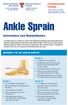 514-412-4400, ext. 23310 2300 Tupper street, C-831, Montreal (Quebec) H3H 1P3 Ankle Sprain Information and Rehabilitation An ankle sprain is a stretch or a tear of the ligaments (bands of tissue that hold
Schiffert Health Center www.healthcenter.vt.edu. Neck Pain (Cervical Strain) COMMON CAUSES: QUICK TREATMENT : NECK PAIN TREATING NECK PAIN:
 Schiffert Health Center www.healthcenter.vt.edu Patient Information: Neck Pain (Cervical Strain) COMMON CAUSES: Neck pain may be triggered by a specific event, such a sport injury or motor vehicle accident.
A Patient s Guide to Post-Operative Physiotherapy. Following Anterior Cruciate Ligament Reconstruction of the Knee
 A Patient s Guide to Post-Operative Physiotherapy Following Anterior Cruciate Ligament Reconstruction of the Knee Introduction The anterior cruciate ligament (ACL) is one of the main supporting ligaments
Be cancer aware. Patient Information
 Be cancer aware Patient Information Author ID: AMK Leaflet Number: CC 041 Version: 1 Name of Leaflet: Be cancer aware Date Produced: November 2015 Review Date: November 2017 Be cancer aware Page 1 of 11
SCRIPT NUMBER 82 SPRAINED ANKLE (TWO SPEAKERS)
 SCRIPT NUMBER 82 SPRAINED ANKLE (TWO SPEAKERS) PROGRAM NAME: HEALTH NUGGETS PROGRAM TITLE: SPRAINED ANKLE PROGRAM NUMBER: 82 SUBJECT: PATHOLOGY, CAUSES, DIAGNOSIS, TREATMENT, PREVENTION OF SPRAINED ANKLES
Elbow Injuries and Disorders
 Elbow Injuries and Disorders Introduction Your elbow joint is made up of bone, cartilage, ligaments and fluid. Muscles and tendons help the elbow joint move. There are many injuries and disorders that
GOING HOME AFTER YOUR TAVR PROCEDURE
 GOING HOME AFTER YOUR TAVR PROCEDURE HENRY FORD HOSPITAL CENTER FOR STRUCTURAL HEART DISEASE GOING HOME After your TAVR procedure, you will need help when you go home. It is hard to predict how much help
Excision of Vaginal Mesh
 What is excision of vaginal mesh? This procedure is done to remove mesh from the vagina. When is this surgery used? If mesh has eroded into the vagina, bladder, urethra, or bowel If there is pain associated
Heat Illnesses. Common Heat Rash Sites
 Heat Illnesses Introduction Heat illnesses happen when the body becomes too hot and cannot cool itself. There are several different types of heat-related illnesses. This includes heat cramps, heat exhaustion,
Presenting the SUTENT Patient Call Center.
 Presenting the SUTENT Patient Call Center. Please see patient Medication Guide and full prescribing information attached. We re here to support you. Dealing with cancer is a journey. Along the way, you
Your Recovery After a Cesarean Delivery
 Your Recovery After a Cesarean Delivery It is normal to have many questions about your care after delivery. Cesarean delivery is surgery and your body needs time to heal and recover for the next 6 weeks,
How to Care for Yourself after Lumbar Posterior Decompression
 How to Care for Yourself after Lumbar Posterior Decompression What is Lumbar Posterior Decompression? Lumbar Posterior Decomposition is the removal of part of or all of the bone that covers the back of
PATIENT HANDBOOK AND JOURNAL DAY OF SURGERY
 PATIENT HANDBOOK AND JOURNAL DAY OF SURGERY PREPARING YOUR SKIN BEFORE SURGERY PRE-OP HIBICLENS BATHING INSTRUCTIONS: General Information: Because the skin is not sterile, it is important to make sure
Prevent Bleeding When Taking Blood Thinners
 PATIENT EDUCATION patienteducation.osumc.edu Prevent Bleeding When Taking Blood Thinners Blood thinners are medicines used to keep harmful blood clots from forming in the body. Blood thinners can also
Initial Management of Acute Sports Injuries. By Martin Meyer Sports Physiotherapist Director APE
 Initial Management of Acute Sports Injuries By Martin Meyer Sports Physiotherapist Director APE Owned and operated by Perth physios with over 20 years experience Sports Medicine Wholesaler Strapping tapes
ORAL ANTICOAGULANTS RIVAROXABAN (XARELTO) FOR PULMONARY EMBOLISM (PE)
 ORAL ANTICOAGULANTS RIVAROXABAN (XARELTO) FOR PULMONARY EMBOLISM (PE) Information Leaflet Your Health. Our Priority. Page 2 of 6 What Are Anticoagulants And What Do They Do? This information leaflet has
Understand nurse aide skills needed to promote skin integrity.
 Unit B Resident Care Skills Essential Standard NA5.00 Understand nurse aide s role in providing residents hygiene, grooming, and skin care. Indicator Understand nurse aide skills needed to promote skin
Premier patient information. Whiplash. Whiplash Exercises
 Premier patient information Whiplash Whiplash Exercises Keep moving! It may be painful but you ll get back to normal much quicker. Moving forward (in fact - moving in any direction!) Movement is the key
Treat Your Feet: Foot care for people with diabetes
 Treat Your Feet: Foot care for people with diabetes UHN People with diabetes often have trouble with their feet. Read this booklet to learn 7 steps to keep your feet healthy. Please visit the UHN Patient
INTRODUCTION TO POSITIONING. MODULE 3: Positioning and Carrying
 MODULE 3: Positioning and Carrying Blankets, pillows and towels, sandbags, carpet on the floor, a doll with floppy limbs that can be positioned i.e. not a hard plastic doll, display materials. Icebreaker
Femoral Hernia Repair
 Femoral Hernia Repair WHAT IS A FEMORAL HERNIA REPAIR? 2 WHAT CAUSES A FEMORAL HERNIA? 2 WHAT DOES TREATMENT/ MANAGEMENT INVOLVE? 3 DAY SURGERY MANAGEMENT 3 SURGICAL REPAIR 4 WHAT ARE THE RISKS/COMPLICATIONS
TIPS and EXERCISES for your knee stiffness. and pain
 TIPS and EXERCISES for your knee stiffness and pain KNEE EXERCISES Range of motion exercise 3 Knee bending exercises 3 Knee straightening exercises 5 STRENGTHENING EXERCISES 6 AEROBIC EXERCISE 10 ADDITIONAL
Headaches in Children
 Headaches in Children A headache is one of the most common complaints of children and teenagers. Fussiness, crankiness and not being able to sleep may be the only signs of head pain in children who are
Sports Injury Treatment
 Sports Injury Treatment Participating in a variety of sports is fun and healthy for children and adults. However, it's critical that before you participate in any sport, you are aware of the precautions
MEDICATION GUIDE ELIQUIS (ELL eh kwiss) (apixaban) tablets
 MEDICATION GUIDE ELIQUIS (ELL eh kwiss) (apixaban) tablets What is the most important information I should know about ELIQUIS? For people taking ELIQUIS for atrial fibrillation: People with atrial fibrillation
ORAL ANTICOAGULANTS - RIVAROXABAN (XARELTO) FOR DEEP VEIN THROMBOSIS (DVT)
 ORAL ANTICOAGULANTS - RIVAROXABAN (XARELTO) FOR DEEP VEIN THROMBOSIS (DVT) Information Leaflet Your Health. Our Priority. Page 2 of 6 What Are Anticoagulants And What Do They Do? This information leaflet
Staying on Track with TUBERCULOSIS. Medicine
 Staying on Track with TB TUBERCULOSIS Medicine What s Inside: Read this brochure to learn about TB and what you can do to get healthy. Put it in a familiar place to pull out and read when you have questions.
Epidural Continuous Infusion. Patient information Leaflet
 Epidural Continuous Infusion Patient information Leaflet April 2015 Introduction You may already know that epidural s are often used to treat pain during childbirth. This same technique can also used as
Neck Surgery (Cervical spine surgery) Remember to bring this handout to the hospital with you.
 Neck Surgery (Cervical spine surgery) Remember to bring this handout to the hospital with you. 1 Neck Surgery (cervical spine surgery) Table of contents Page Why do I need neck surgery?... 2 What kinds
Total Abdominal Hysterectomy
 What is a total abdominal hysterectomy? Is the removal of the uterus and cervix through an abdominal incision (either an up and down or bikini cut). Removal of the ovaries and tubes depends on the patient.
Introduction Hemophilia is a rare bleeding disorder in which the blood does not clot normally. About 1 in 10,000 people are born with hemophilia.
 Hemophilia Introduction Hemophilia is a rare bleeding disorder in which the blood does not clot normally. About 1 in 10,000 people are born with hemophilia. Hemophilia can be mild, moderate, or severe.
MOTOR VEHICLE ACCIDENT QUESTIONNAIRE
 MOTOR VEHICLE ACCIDENT QUESTIONNAIRE Thank you in advance for taking the time to complete this form, this will help us to better assess all of your pain concerns and provide you with the best treatment.
Physiotherapy in Rheumatoid Arthritis. Information for patients Gina Wall Senior Physiotherapist
 Physiotherapy in Rheumatoid Arthritis Information for patients Gina Wall Senior Physiotherapist What do Physiotherapists do? We conduct assessments by asking detailed questions about your symptoms, medical
Laparoscopic Bilateral Salpingo-Oophorectomy
 Laparoscopic Bilateral Salpingo-Oophorectomy What is a? This is a surgery where your doctor uses a thin, lighted camera and small surgical tool placed through a small (1/2 inch) incision usually in the
Chemotherapy Side Effects Worksheet
 Page 1 of 6 Chemotherapy Side Effects Worksheet Medicines or drugs that destroy cancer cells are called cancer chemotherapy. It is sometimes the first choice for treating many cancers. Chemotherapy differs
Knee Arthroscopy Post-operative Instructions
 Amon T. Ferry, MD Orthopedic Surgery Sports Medicine Knee Arthroscopy Post-operative Instructions PLEASE READ ALL OF THESE INSTRUCTIONS CAREFULLY. THEY WILL ANSWER MOST OF YOUR QUESTIONS. 1. You may walk
Orthopaedic Spine Center. Anterior Cervical Discectomy and Fusion (ACDF) Normal Discs
 Orthopaedic Spine Center Graham Calvert MD James Woodall MD PhD Anterior Cervical Discectomy and Fusion (ACDF) Normal Discs The cervical spine consists of the bony vertebrae, discs, nerves and other structures.
Brachial Plexus Palsy
 Patient and Family Education Brachial Plexus Palsy A Therapy Guide for Your Baby Brachial Plexus Palsy is caused by trauma to the nerves of the arm. This trauma may have caused muscle weakness, lack of
PHYSICAL ACTIVITY AND ARTHRITIS: YOU CAN DO IT! Frequently Asked Questions
 PHYSICAL ACTIVITY AND ARTHRITIS: YOU CAN DO IT! Frequently Asked Questions 1. What is the difference between exercise and physical activity? Physical Activity - any body movement beyond sitting or sleeping
V03 Varicose Veins Surgery
 V03 Varicose Veins Surgery What are varicose veins? Varicose veins are enlarged and twisted veins in the leg. They are common and affect up to 3 in 10 people. More women than men ask for treatment, with
X-Plain Inguinal Hernia Repair Reference Summary
 X-Plain Inguinal Hernia Repair Reference Summary Introduction Hernias are common conditions that affect men and women of all ages. Your doctor may recommend a hernia operation. The decision whether or
Surgical removal of fibroids through an abdominal incision-either up and down or bikini cut. The uterus and cervix are left in place.
 What is an abdominal myomectomy? Surgical removal of fibroids through an abdominal incision-either up and down or bikini cut. The uterus and cervix are left in place. When is this surgery used? Treatment
Functional rehab after breast reconstruction surgery
 Functional rehab after breast reconstruction surgery UHN A guide for women who had DIEP, latissimus dorsi with a tissue expander or implant, or two-stage implant based breast reconstruction surgery Read
Hysteroscopy. What is a hysteroscopy? When is this surgery used? How do I prepare for surgery?
 What is a hysteroscopy? This is a procedure where a doctor uses a thin tube with a tiny camera to look inside the uterus. There are no incisions. Saline solution is used to expand the uterus in order to
Other common injuries in orienteering are overuse and acute injuries. Around 80 percent of all injuries occur below the knee.
 INJURIES Injuries in orienteering During the 1980s there was a change in philosophy in the treatment of injuries in the Swedish orienteering team. Earlier doctors had worked with injuries after they happened.
How to treat your injured neck
 How to treat your injured neck Exceptional healthcare, personally delivered Your neck is made up of a number of bones bound together by strong discs and ligaments. It is also protected by strong muscles.
Knee arthroscopy advice sheet
 Knee arthroscopy advice sheet During an arthroscopy, a camera is inserted into the knee through two or three small puncture wounds. It allows the surgeon to look at the joint surfaces, cartilage and the
MEDICATION GUIDE POMALYST (POM-uh-list) (pomalidomide) capsules. What is the most important information I should know about POMALYST?
 MEDICATION GUIDE POMALYST (POM-uh-list) (pomalidomide) capsules What is the most important information I should know about POMALYST? Before you begin taking POMALYST, you must read and agree to all of
X-Plain Varicose Veins Reference Summary
 X-Plain Varicose Veins Reference Summary Introduction Varicose veins are very common, in both women and men. Varicose veins can be painful and unattractive. Vein doctors use non-invasive ultrasound imaging
A Stretch-Break Program for Your Workplace! www.healthyworkplaceweek.ca
 www.healthyworkplaceweek.ca A Stretch-Break Program for Your Workplace! Why is stretching at work important? Sitting at a desk or computer; or standing at your work station for extended periods of time
Inguinal Hernia (Female)
 Inguinal Hernia (Female) WHAT IS AN INGUINAL HERNIA? 2 WHAT CAUSES AN INGUINAL HERNIA? 2 WHAT DOES TREATMENT / MANAGEMENT INVOLVE? 3 DAY SURGERY MANAGEMENT 3 SURGICAL REPAIR 4 WHAT ARE THE RISKS/COMPLICATIONS
Lumbar Laminectomy and Interspinous Process Fusion
 Lumbar Laminectomy and Interspinous Process Fusion Introduction Low back and leg pain caused by pinched nerves in the back is a common condition that limits your ability to move, walk, and work. This condition
Meniscus Tear: Exercises
 Meniscus Tear: Exercises Your Kaiser Permanente Care Instructions Here are some examples of typical rehabilitation exercises for your condition. Start each exercise slowly. Ease off the exercise if you
Lower Back Pain www.spireperform.com 01283 576333
 Lower Back Pain www.spireperform.com 01283 576333 Low back pain can be caused through deficiencies in movement, posture and your lower limbs or pelvis. The advice in this booklet aims to help with relieving
Wrist Fractures Looking for more health information?
 2011 Wrist Fractures Notes Wrist Fractures After your cast is taken off you will likely feel some joint and soft tissue tightness of the injured forearm. You may have one or more of the these wrist and
Tired, Aching Legs? Swollen Ankles? Varicose Veins?
 Tired, Aching Legs? Swollen Ankles? Varicose Veins? Healthy Legs 2006 http://healthylegs.com Page 1 Venous disorders are widespread Leg problems are widespread throughout the world, but what most people
Total Hip Replacement Surgery Home Care Instructions
 Total Hip Replacement Surgery Home Care Instructions Surgery: Date: Doctor: This handout will review the care you need to follow once you are home. If you have any questions or concerns, please ask your
All About Your Peripherally Inserted Central Catheter (PICC)
 All About Your Peripherally Inserted Central Catheter (PICC) General Information Intravenous (IV) therapy is the delivery of fluid directly into a vein. An intravenous catheter is a hollow tube that is
Cardiac Rehab Program: Stretching Exercises
 Cardiac Rehab Program: Stretching Exercises Walk around the room, step side to side, ride a bike or walk on a treadmill for at least 5 minutes to warm up before doing these stretches. Stretch warm muscles
12/5/2012. Introduction. Head, Neck, and Spine Injuries. Recognizing and Caring for Serious Head, Neck and Back Injuries
 Head, Neck, and Spine Injuries Identify the most common causes of head, neck and spinal injuries. List 10 situations that might indicate serious head, neck and spinal injuries. List the signals of head,
It is important that you tell your family and the people closest to you of this increased sensitivity to opioids and the risk of overdose.
 MEDICATION GUIDE VIVITROL (viv-i-trol) (naltrexone for extended-release injectable suspension) Read this Medication Guide before you start receiving VIVITROL injections and each time you receive an injection.
Range of Motion. A guide for you after spinal cord injury. Spinal Cord Injury Rehabilitation Program
 Range of Motion A guide for you after spinal cord injury Spinal Cord Injury Rehabilitation Program This booklet has been written by the health care providers who provide care to people who have a spinal
What muscles do cyclists primarily use?
 Stress & Injury The following information has been taken from freely available articles from British Cycling and other Cycling organisations. Sources are noted at the end of this document. Please note
Pressure Ulcers. Occupational Therapy. This leaflet is for both yourself and Carers
 Pressure Ulcers Occupational Therapy This leaflet is for both yourself and Carers Contents What is a pressure ulcer? 3 Who is at risk of developing a pressure ulcer? 4 How can I avoid developing a pressure
Home Care for Your Nephrostomy Catheter
 Home Care for Your Nephrostomy Catheter This handout covers information about caring for your nephrostomy catheter right after placement and caring for it long term. If you have any questions, please call
For the Patient: Dasatinib Other names: SPRYCEL
 For the Patient: Dasatinib Other names: SPRYCEL Dasatinib (da sa' ti nib) is a drug that is used to treat many types of cancer. It is a tablet that you take by mouth. Tell your doctor if you have ever
Knee sprains. What is a knee strain? How do knee strains occur? what you ll find in this brochure
 what you ll find in this brochure What is a knee strain? How do knee strains occur? What you should do if a knee strain occurs. What rehabilitation you should do. Example of a return to play strategy.
Women s Continence and Pelvic Health Center
 Women s Continence and Pelvic Health Center Committed to Caring 580-590 Court Street Keene, New Hampshire 03431 (603) 354-5454 Ext. 6643 URINARY INCONTINENCE QUESTIONNAIRE The purpose of this questionnaire
Preventing Falls. Strength and balance exercises for healthy ageing
 Preventing Falls Strength and balance exercises for healthy ageing Exercise should be comfortable and fun. To get the most out of your home exercise book, join a class for older people to check your exercises
Orthopaedic Surgery Center of Joint Preservation and Replacement After Total Hip Replacement Discharge Instructions
 Congratulations on your new hip! You are going home after a successful total hip replacement. Although there is still much work to do, we have already achieved a lot. So, when you get home, take a deep
Stepping toward a different treatment option LEARN WHAT ACTHAR CAN DO FOR YOU
 FOR MS RELAPSES Stepping toward a different treatment option LEARN WHAT ACTHAR CAN DO FOR YOU As a person with multiple sclerosis (MS), you know firsthand the profound impact MS relapses can have on your
What You Need to Know About LEMTRADA (alemtuzumab) Treatment: A Patient Guide
 For Patients What You Need to Know About LEMTRADA (alemtuzumab) Treatment: A Patient Guide Patients: Your doctor or nurse will go over this patient guide with you. It is important to ask any questions
Recurrent Varicose Veins
 Information for patients Recurrent Varicose Veins Sheffield Vascular Institute Northern General Hospital You have been diagnosed as having Varicose Veins that have recurred (come back). This leaflet explains
Gemcitabine and Cisplatin
 PATIENT EDUCATION patienteducation.osumc.edu What is Gemcitabine (jem-site-a been)? Gemcitabine is a chemotherapy medicine known as an anti-metabolite. Another name for this drug is Gemzar. This drug is
DID YOU KNOW? A SORE THROAT CAN KILL YOUR STUDENT
 DID YOU KNOW? A SORE THROAT CAN KILL YOUR STUDENT Each year, more than 60 Fijians die of Rheumatic Heart Disease and it all starts with an untreated sore throat. TEACHING PROGRAM FOR SCHOOLS ACROSS FIJI
Pre - Operative Rehabilitation Program for Anterior Cruciate Ligament Reconstruction
 Pre - Operative Rehabilitation Program for Anterior Cruciate Ligament Reconstruction This protocol is designed to assist you with your preparation for surgery and should be followed under the direction
OPERATION:... Proximal tibial osteotomy Distal femoral osteotomy
 AFFIX PATIENT DETAIL STICKER HERE Forename.. Surname NHS Organisation. Responsible surgeon. Job Title Hospital Number... D.O.B.././ No special requirements OPERATION:..... Proximal tibial osteotomy Distal
Deep Vein Thrombosis (DVT) in pregnancy
 Deep Vein Thrombosis (DVT) in pregnancy Information and advice for women and families Maternity What is a deep vein thrombosis (DVT)? A deep vein thrombosis (DVT) is a blood clot that forms in a deep leg
Aquatic Exercises: Upper Body Strengthening
 Aquatic Exercises: Upper Body Strengthening These exercises will strengthen your muscles in your arms, shoulders, chest and neck. Exercising in water allows you to have less stress on your joints. When
Strengthening Exercises - Below Knee Amputation
 Strengthening Exercises - Below Knee Amputation These exercises will help you strengthen your muscles to best use your prosthetic leg. Do these exercises as directed by your therapist or doctor. Do the
Ensure that the chair you use is sturdy and stable. Wear comfortable clothes and supportive footwear.
 Page 1 Safety Ensure that the chair you use is sturdy and stable. Wear comfortable clothes and supportive footwear. Prepare a space and have your exercise band and a glass of water (for afterwards) ready
Self- Lymphatic Massage for Arm, Breast or Trunk Lymphedema
 Self- Lymphatic Massage for Arm, Breast or Trunk Lymphedema Patient Education Improving health through education The lymphatic system is part of our circulatory system. It helps balance the fluids of our
Staff, please note that the Head Injury Routine is included on page 3.
 Staff, please note that the Head Injury Routine is included on page 3. This booklet explains what can happen after a concussion, how to get better and where to go for more information and help if needed.
Cheekbone (zygoma) and/or eye socket (orbit) fracture surgery
 Ambulatory Care & Local Networks Cheekbone (zygoma) and/or eye socket (orbit) fracture surgery Information for patients You have been treated in the Emergency Department for a broken (fractured) cheekbone
Types of electrical injuries
 Types of electrical injuries Electrical injury is a term for all injuries caused by contact with electrical energy. Electrical contact can cause a wide variety of injuries involving most organ systems.
ROTATOR CUFF HOME EXERCISE PROGRAM
 ROTATOR CUFF HOME EXERCISE PROGRAM Contact us! Vanderbilt Sports Medicine Medical Center East, South Tower, Suite 3200 1215 21st Avenue South Nashville, TN 37232-8828 For more information on this and other
HOW TO CHECK YOUR LYMPH NODES
 HOW TO CHECK YOUR LYMPH NODES What are the aims of this leaflet? This leaflet has been written to help you to understand more about how to check your lymph nodes yourself. It tells you why you should be
Head Injury, Age 4 and Older
 Head Injury, Age 4 and Older Table of Contents Topic Overview Check Your Symptoms Home Treatment Prevention Preparing For Your Appointment Related Information Credits Topic Overview Head injury Most injuries