
PROJECT MANUAL AAFS PX ADDITION UTAH NATIONAL GUARD CAMP WILLIAMS, UTAH DFCM #
|
|
|
- Silvia Norton
- 10 years ago
- Views:
Transcription
1 PROJECT MANUAL AAFS PX ADDITION UTAH NATIONAL GUARD CAMP WILLIAMS, UTAH DFCM # L.K. SORENSEN ASSOCIATES, INC DUEHL CIRCLE SALT LAKE CITY, UTAH (801) (801) FAX LKS JOB #0820 DATE JANUARY 25, 2010 Set #

2 PROJECT MANUAL INDEX PROJECT: AAFS PX ADDITION UTAH NATIONAL GUARD CAMP W. G. WILLIAMS, UTAH DFCM PROJECT NO /CONTRACT NO DESCRIPTION PAGES COVER SHEET 1 PROJECT MANUAL INDEX 3 INDEX TO DRAWINGS 1 TECHNICAL SPECIFICATIONS SECT. NO. SECTION TITLE DIVISION 1 - GENERAL REQUIREMENTS SUMMARY PAYMENT PROCEDURES PROJECT MANAGEMENT AND COORDINATION CONSTRUCTION PROGRESS DOCUMENTATION SUBMITTAL PROCEDURES QUALITY REQUIREMENTS REFERENCES TEMPORARY CONSTRUCTION FACILITIES AND CONTROLS PRODUCT REQUIREMENTS PRODUCTS AND SUBSTITUTIONS EXECUTION CUTTING AND PATCHING WARRANTIES AND BONDS CLOSEOUT PROCEDURES OPERATION AND MAINTENANCE DATA PROJECT RECORD DOCUMENTS 2 DIVISION 2 EXISTING CONDITIONS SELECTIVE STRUCTURE DEMOLITION 4 DIVISION 3 CONCRETE CONCRETE FORMWORK CONCRETE REINFORCEMENT CAST-IN-PLACE CONCRETE 5 DIVISION 4 MASONRY EXTERIOR STONE CLADDING UNIT MASONRY ASSEMBLY DIVISION 5 METALS STRUCTURAL STEEL METAL FABRICATIONS 4 DIVISION 6 - WOOD AND PLASTICS ROUGH CARPENTRY SHEATHING SHOP-FABRICATED WOOD TRUSSES INTERIOR FINISH CARPENTRY INTERIOR ARCHITECTURAL WOODWORK 4 AAFS PX ADDITION PROJECT MANUAL INDEX 1

3 DIVISION 7 - THERMAL AND MOISTURE PROTECTION BITUMINOUS DAMPPROOFING THERMAL INSULATION EXTERIOR INSULATION & FINISH SYSTEM ASPHALT SHINGLES SIDING SHEET METAL FABRICATION THROUGH-PENETRATION FIRESTOP SYSTEM JOINT SEALERS 6 DIVISION 8 OPENINGS STEEL DOORS AND FRAMES FLUSH WOOD DOORS ACCESS DOORS OVERHEAD COILING GRILLES ALUMINUM ENTRANCES AND STOREFRONTS AUTOMATIC ENTRANCES DOOR HARDWARE GLAZING MIRROR UNITS LOUVERS AND VENTS 3 DIVISION 9 - FINISHES GYPSUM BOARD ASSEMBLIES TILING ACOUSTICAL PANEL CEILINGS RESILIENT WALL BASE AND ACCESSORIES RESILIENT TILE FLOORING PAINTING FIBERGALSS REINFORCED WALL AND CEILING PANELS 2 DIVISION 10 - SPECIALTIES TOILET AND BATH ACCESSORIES FIRE-PROTECTION SPECIALTIES RETRACTABLE MOTORIZED PATIO AWNING 3 DIVISION 22 PLUMBING BASIC PIPING MATERIALS AND METHODS PLUMBING FIXTURES AND TRIM TESTING INSULATION 2 DIVISION 23 HEATING VENTILATING AND AIR CONDITIONING GENERAL PROVISIONS SEISMIC RESTRAINT BALANCING AUTOMATIC TEMPERATURE CONTROL AIR DISTRIBUTION HEATING / COOLING/ VENTILATING EQUIPMENT 4 DIVISION 26 ELECTRICAL COMMON WORK RESULTS FOR ELECTRICAL MEDIUM-VOLTAGE CABLES LOW-VOLTAGE ELECTRICAL POWER CONDUCTORS AND CABLES GROUNDING AND BONDING FOR ELECTRICAL SYSTEMS HANGERS AND SUPPORTS FOR ELECTRICAL SYSTEMS RACEWAY AND BOXES FOR ELECTRICAL SYSTEMS UNDERGROUND DUCT AND UTILITY STRUCTURES VIBRATION AND SEISMIC CONTROLS FOR ELECTRICAL SYSTEMS IDENTIFICATION FOR ELECTRICAL SYSTEMS 8 AAFS PX ADDITION PROJECT MANUAL INDEX 2

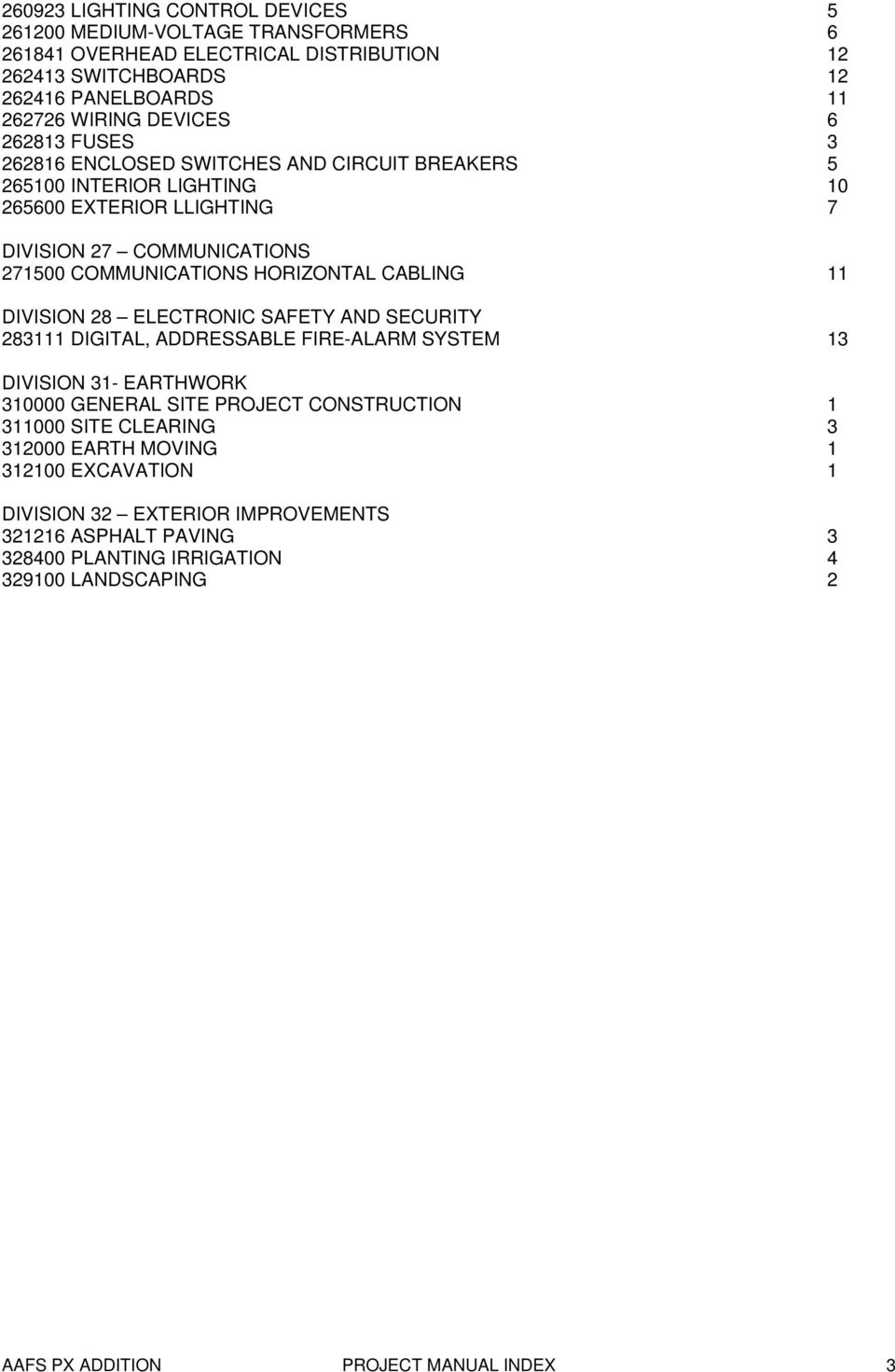
4 LIGHTING CONTROL DEVICES MEDIUM-VOLTAGE TRANSFORMERS OVERHEAD ELECTRICAL DISTRIBUTION SWITCHBOARDS PANELBOARDS WIRING DEVICES FUSES ENCLOSED SWITCHES AND CIRCUIT BREAKERS INTERIOR LIGHTING EXTERIOR LLIGHTING 7 DIVISION 27 COMMUNICATIONS COMMUNICATIONS HORIZONTAL CABLING 11 DIVISION 28 ELECTRONIC SAFETY AND SECURITY DIGITAL, ADDRESSABLE FIRE-ALARM SYSTEM 13 DIVISION 31- EARTHWORK GENERAL SITE PROJECT CONSTRUCTION SITE CLEARING EARTH MOVING EXCAVATION 1 DIVISION 32 EXTERIOR IMPROVEMENTS ASPHALT PAVING PLANTING IRRIGATION LANDSCAPING 2 AAFS PX ADDITION PROJECT MANUAL INDEX 3
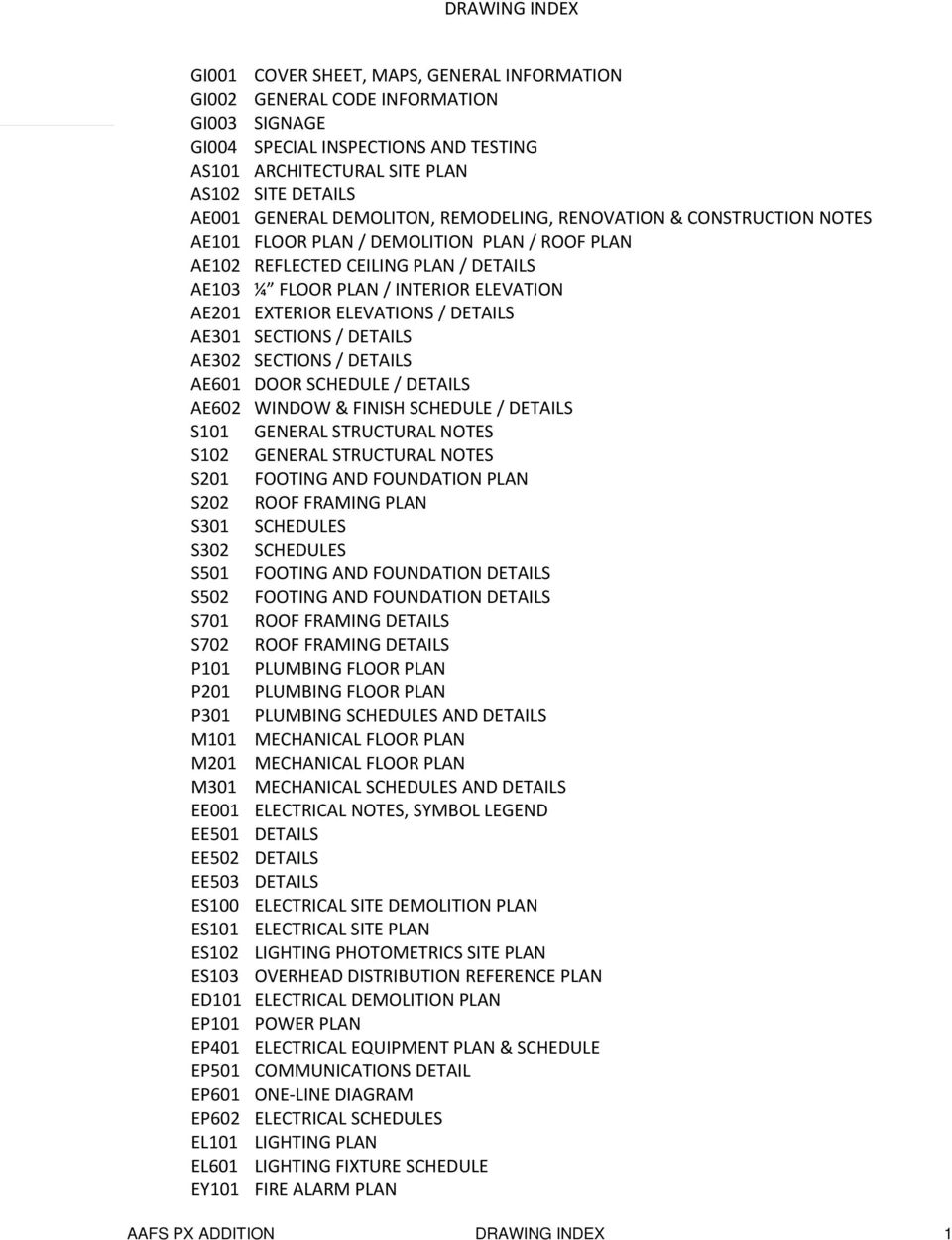
5 DRAWING INDEX GI001 COVER SHEET, MAPS, GENERAL INFORMATION GI002 GENERAL CODE INFORMATION GI003 SIGNAGE GI004 SPECIAL INSPECTIONS AND TESTING AS101 ARCHITECTURAL SITE PLAN AS102 SITE DETAILS AE001 GENERAL DEMOLITON, REMODELING, RENOVATION & CONSTRUCTION NOTES AE101 FLOOR PLAN / DEMOLITION PLAN / ROOF PLAN AE102 REFLECTED CEILING PLAN / DETAILS AE103 ¼ FLOOR PLAN / INTERIOR ELEVATION AE201 EXTERIOR ELEVATIONS / DETAILS AE301 SECTIONS / DETAILS AE302 SECTIONS / DETAILS AE601 DOOR SCHEDULE / DETAILS AE602 WINDOW & FINISH SCHEDULE / DETAILS S101 GENERAL STRUCTURAL NOTES S102 GENERAL STRUCTURAL NOTES S201 FOOTING AND FOUNDATION PLAN S202 ROOF FRAMING PLAN S301 SCHEDULES S302 SCHEDULES S501 FOOTING AND FOUNDATION DETAILS S502 FOOTING AND FOUNDATION DETAILS S701 ROOF FRAMING DETAILS S702 ROOF FRAMING DETAILS P101 PLUMBING FLOOR PLAN P201 PLUMBING FLOOR PLAN P301 PLUMBING SCHEDULES AND DETAILS M101 MECHANICAL FLOOR PLAN M201 MECHANICAL FLOOR PLAN M301 MECHANICAL SCHEDULES AND DETAILS EE001 ELECTRICAL NOTES, SYMBOL LEGEND EE501 DETAILS EE502 DETAILS EE503 DETAILS ES100 ELECTRICAL SITE DEMOLITION PLAN ES101 ELECTRICAL SITE PLAN ES102 LIGHTING PHOTOMETRICS SITE PLAN ES103 OVERHEAD DISTRIBUTION REFERENCE PLAN ED101 ELECTRICAL DEMOLITION PLAN EP101 POWER PLAN EP401 ELECTRICAL EQUIPMENT PLAN & SCHEDULE EP501 COMMUNICATIONS DETAIL EP601 ONE LINE DIAGRAM EP602 ELECTRICAL SCHEDULES EL101 LIGHTING PLAN EL601 LIGHTING FIXTURE SCHEDULE EY101 FIRE ALARM PLAN AAFS PX ADDITION DRAWING INDEX 1
6 EY601 FIRE ALARM RISER AAFS PX ADDITION DRAWING INDEX 1

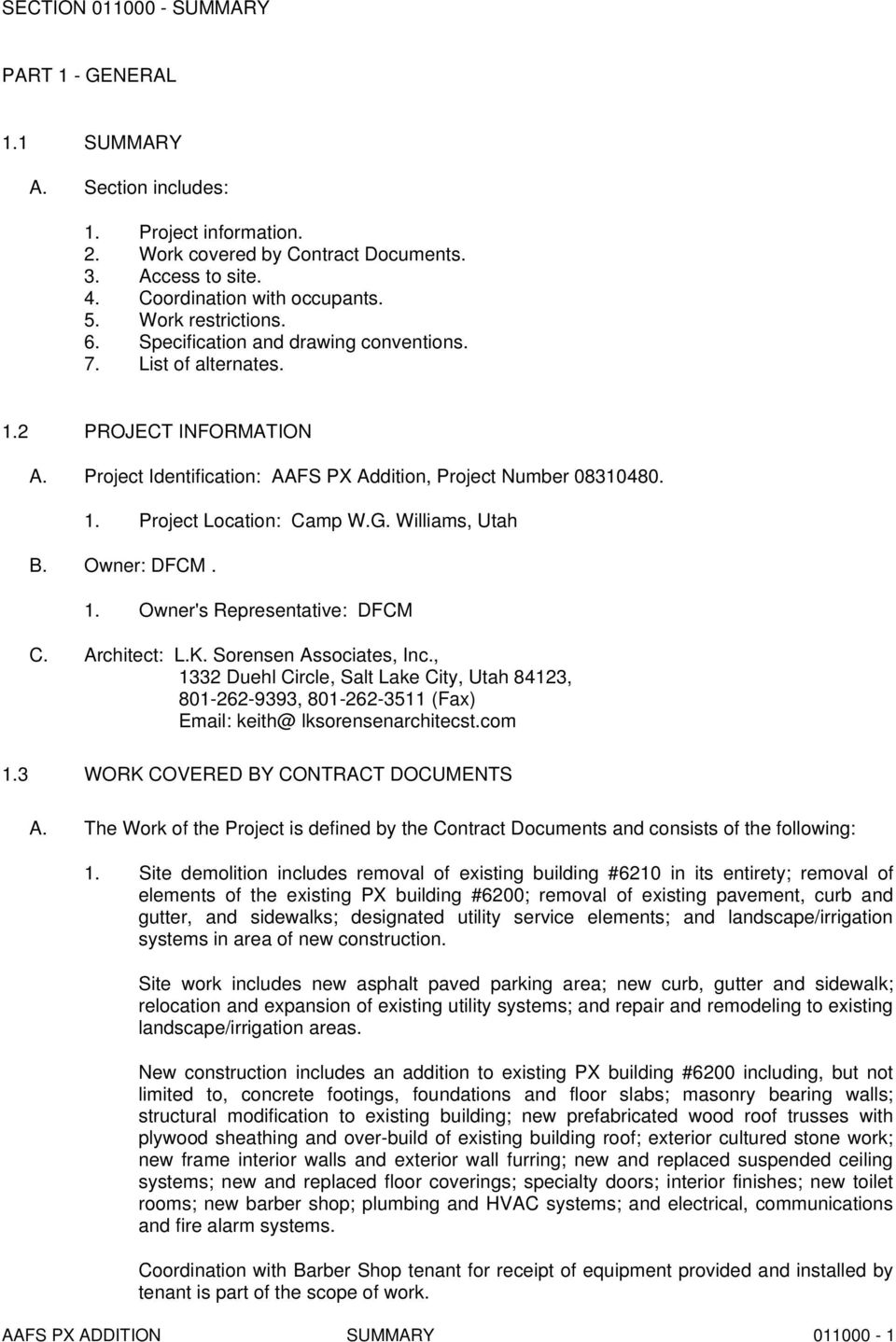
7 SECTION SUMMARY PART 1 - GENERAL 1.1 SUMMARY A. Section includes: 1. Project information. 2. Work covered by Contract Documents. 3. Access to site. 4. Coordination with occupants. 5. Work restrictions. 6. Specification and drawing conventions. 7. List of alternates. 1.2 PROJECT INFORMATION A. Project Identification: AAFS PX Addition, Project Number Project Location: Camp W.G. Williams, Utah B. Owner: DFCM. 1. Owner's Representative: DFCM C. Architect: L.K. Sorensen Associates, Inc., 1332 Duehl Circle, Salt Lake City, Utah 84123, , (Fax) keith@ lksorensenarchitecst.com 1.3 WORK COVERED BY CONTRACT DOCUMENTS A. The Work of the Project is defined by the Contract Documents and consists of the following: 1. Site demolition includes removal of existing building #6210 in its entirety; removal of elements of the existing PX building #6200; removal of existing pavement, curb and gutter, and sidewalks; designated utility service elements; and landscape/irrigation systems in area of new construction. Site work includes new asphalt paved parking area; new curb, gutter and sidewalk; relocation and expansion of existing utility systems; and repair and remodeling to existing landscape/irrigation areas. New construction includes an addition to existing PX building #6200 including, but not limited to, concrete footings, foundations and floor slabs; masonry bearing walls; structural modification to existing building; new prefabricated wood roof trusses with plywood sheathing and over-build of existing building roof; exterior cultured stone work; new frame interior walls and exterior wall furring; new and replaced suspended ceiling systems; new and replaced floor coverings; specialty doors; interior finishes; new toilet rooms; new barber shop; plumbing and HVAC systems; and electrical, communications and fire alarm systems. Coordination with Barber Shop tenant for receipt of equipment provided and installed by tenant is part of the scope of work. AAFS PX ADDITION SUMMARY
8 The existing PX facility will remain in operation during construction. Coordination of operation and protection of the existing facility is part of this work. 1.4 ACCESS TO SITE A. General: Contractor shall have limited use of Project site for construction operations. This is a secure government site with special provisions for access. B. Use of Site: Limit use of Project site to areas within the Contract limits indicated. Do not disturb portions of Project site beyond areas in which the Work is indicated. 1. Driveways, Walkways and Entrances: Keep driveways and entrances serving premises clear and available to Owner, Owner's employees, and emergency vehicles at all times. Do not use these areas for parking or storage of materials. C. List of Alternates a. Schedule deliveries to minimize use of driveways and entrances by construction operations. b. Schedule deliveries to minimize space and time requirements for storage of materials and equipment on-site. 1. Alternate #1: Provide, construct and install parking lot lighting, poles, reinforced concrete bases, electrical power service and control system as shown and required for a compete operating system. 2. Alternate #2: Provide, construct and install the two-section retractable motorized patio cover, including but not limited to, awning cover, columns and beams, footings and foundations, building anchorage, electrical power service and controls as shown and required for a complete, operating system. 1.5 COORDINATION WITH OCCUPANTS A. Full Owner Occupancy: Owner will occupy the site during entire construction period. Cooperate with Owner during construction operations to minimize conflicts and facilitate Owner usage. Perform the Work so as not to interfere with Owner's day-to-day operations. 1.6 WORK RESTRICTIONS A. Work Restrictions, General: Comply with restrictions on construction operations. 1. Comply with limitations on use of public streets and other requirements of authorities having jurisdiction. B. On-Site Work Hours: 1. 7:00 a.m. to 6:00 p.m. Monday thru Saturday upon arrangement with Owner s Representative. C. Existing Utility Interruptions: Do not interrupt utilities serving facilities occupied by Owner or others unless permitted under the following conditions and then only after providing temporary utility services according to requirements indicated: 1. Obtain Owner's written permission before proceeding with utility interruptions. D. Noise, Vibration, and Odors: Coordinate operations that may result in high levels of noise and vibration, odors, or other disruption to Owner occupancy with Owner. AAFS PX ADDITION SUMMARY

9 1.7 SPECIFICATION AND DRAWING CONVENTIONS A. Specification Content: The Specifications use certain conventions for the style of language and the intended meaning of certain terms, words, and phrases when used in particular situations. These conventions are as follows: 1. Imperative mood and streamlined language are generally used in the Specifications. The words "shall," "shall be," or "shall comply with," depending on the context, are implied where a colon (:) is used within a sentence or phrase. 2. Specification requirements are to be performed by Contractor unless specifically stated otherwise. B. Division 01 General Requirements: Requirements of Sections in Division 01 apply to the Work of all Sections in the Specifications. C. Drawing Coordination: Requirements for materials and products identified on the Drawings are described in detail in the Specifications. One or more of the following are used on the Drawings to identify materials and products: 1. Terminology: Materials and products are identified by the typical generic terms used in the individual Specifications Sections. 2. Abbreviations: Materials and products are identified by abbreviations published as part of the U.S. National CAD Standard. 3. Keynoting: Materials and products are identified by reference keynotes referencing Specification Section numbers found in this Project Manual. PART 2 - PRODUCTS (Not Used) PART 3 - EXECUTION (Not Used) END OF SECTION AAFS PX ADDITION SUMMARY

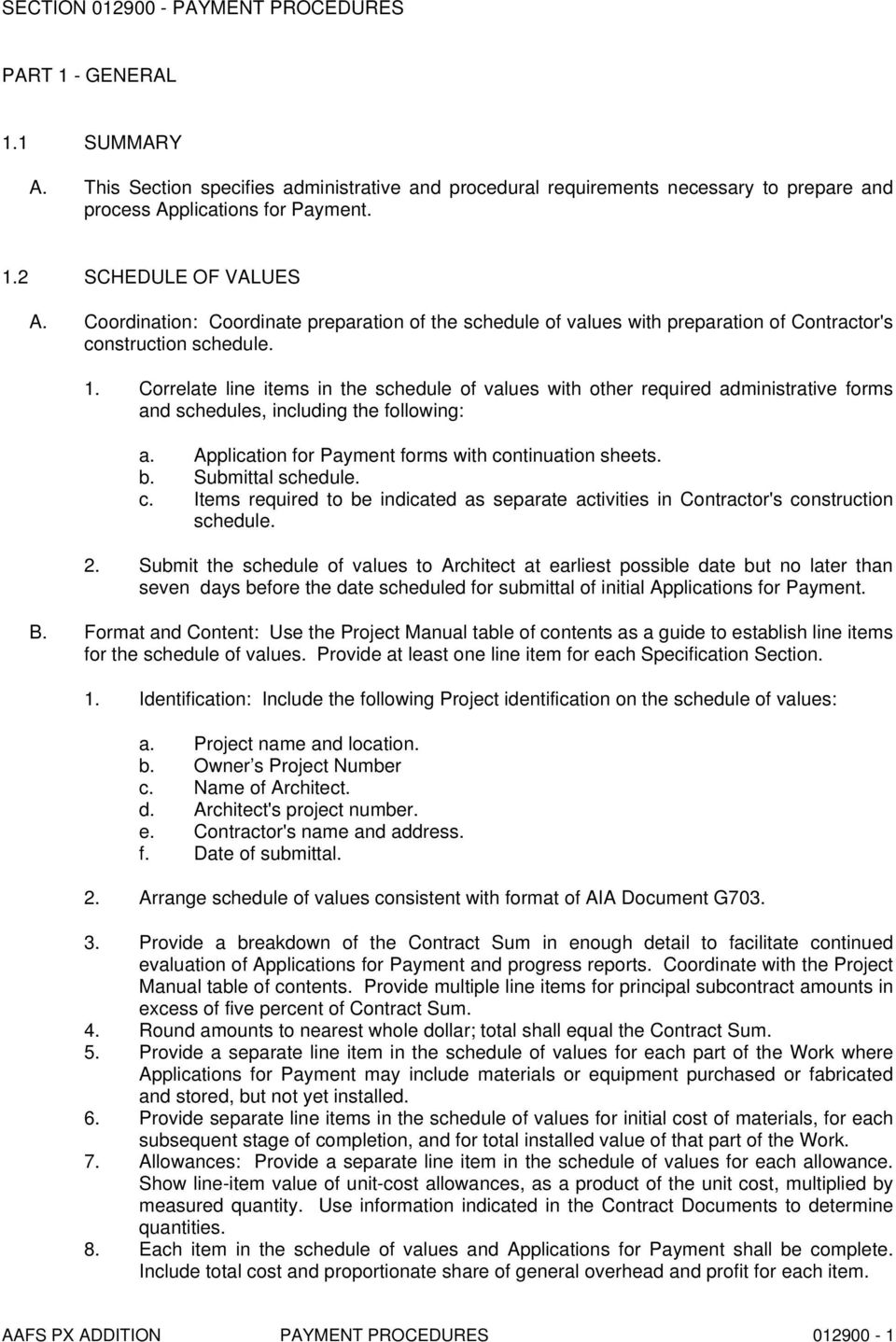
10 SECTION PAYMENT PROCEDURES PART 1 - GENERAL 1.1 SUMMARY A. This Section specifies administrative and procedural requirements necessary to prepare and process Applications for Payment. 1.2 SCHEDULE OF VALUES A. Coordination: Coordinate preparation of the schedule of values with preparation of Contractor's construction schedule. 1. Correlate line items in the schedule of values with other required administrative forms and schedules, including the following: a. Application for Payment forms with continuation sheets. b. Submittal schedule. c. Items required to be indicated as separate activities in Contractor's construction schedule. 2. Submit the schedule of values to Architect at earliest possible date but no later than seven days before the date scheduled for submittal of initial Applications for Payment. B. Format and Content: Use the Project Manual table of contents as a guide to establish line items for the schedule of values. Provide at least one line item for each Specification Section. 1. Identification: Include the following Project identification on the schedule of values: a. Project name and location. b. Owner s Project Number c. Name of Architect. d. Architect's project number. e. Contractor's name and address. f. Date of submittal. 2. Arrange schedule of values consistent with format of AIA Document G Provide a breakdown of the Contract Sum in enough detail to facilitate continued evaluation of Applications for Payment and progress reports. Coordinate with the Project Manual table of contents. Provide multiple line items for principal subcontract amounts in excess of five percent of Contract Sum. 4. Round amounts to nearest whole dollar; total shall equal the Contract Sum. 5. Provide a separate line item in the schedule of values for each part of the Work where Applications for Payment may include materials or equipment purchased or fabricated and stored, but not yet installed. 6. Provide separate line items in the schedule of values for initial cost of materials, for each subsequent stage of completion, and for total installed value of that part of the Work. 7. Allowances: Provide a separate line item in the schedule of values for each allowance. Show line-item value of unit-cost allowances, as a product of the unit cost, multiplied by measured quantity. Use information indicated in the Contract Documents to determine quantities. 8. Each item in the schedule of values and Applications for Payment shall be complete. Include total cost and proportionate share of general overhead and profit for each item. AAFS PX ADDITION PAYMENT PROCEDURES
11 a. Temporary facilities and other major cost items that are not direct cost of actual work-in-place may be shown either as separate line items in the schedule of values or distributed as general overhead expense, at Contractor's option. 9. Schedule Updating: Update and resubmit the schedule of values before the next Applications for Payment when Change Orders or Construction Change Directives result in a change in the Contract Sum. 1.3 APPLICATIONS FOR PAYMENT A. Each Application for Payment shall be consistent with previous applications and payments as certified by Architect and paid for by Owner. 1. Initial Application for Payment, Application for Payment at time of Substantial Completion, and final Application for Payment involve additional requirements. B. Payment Application Times: The date for each progress payment is indicated in the Agreement between Owner and Contractor. The period of construction work covered by each Application for Payment is the period indicated in the Agreement. C. Payment Application Times: Progress payments shall be submitted to Architect by the 10th of the month. The period covered by each Application for Payment is one month, ending on the last day of the month. D. Application for Payment Forms: Use AIA Document G702 and AIA Document G703 as form for Applications for Payment. E. Application Preparation: Complete every entry on form. Notarize and execute by a person authorized to sign legal documents on behalf of Contractor. Architect will return incomplete applications without action. 1. Entries shall match data on the schedule of values and Contractor's construction schedule. Use updated schedules if revisions were made. 2. Include amounts of Change Orders and Construction Change Directives issued before last day of construction period covered by application. F. Transmittal: Submit three signed and notarized original copies of each Application for Payment to Architect by a method ensuring receipt. One copy shall include waivers of lien and similar attachments if required. 1. Transmit each copy with a transmittal form listing attachments and recording appropriate information about application. G. Initial Application for Payment: Administrative actions and submittals that must precede or coincide with submittal of first Application for Payment include the following: 1. List of subcontractors. 2. Schedule of values. 3. Contractor's construction schedule (preliminary if not final). 4. Schedule of unit prices. 5. Submittal schedule (preliminary if not final). 6. Report of preconstruction conference. 7. Certificates of insurance and insurance policies. H. Application for Payment at Substantial Completion: After issuing the Certificate of Substantial Completion, submit an Application for Payment showing 100 percent completion for portion of the Work claimed as substantially complete. 1. Include documentation supporting claim that the Work is substantially complete and a statement showing an accounting of changes to the Contract Sum. AAFS PX ADDITION PAYMENT PROCEDURES

12 2. This application shall reflect Certificates of Partial Substantial Completion issued previously for Owner occupancy of designated portions of the Work. I. Final Payment Application: Submit final Application for Payment with releases and supporting documentation not previously submitted and accepted, including, but not limited, to the following: 1. Evidence of completion of Project closeout requirements. 2. Insurance certificates for products and completed operations where required and proof that taxes, fees, and similar obligations were paid. 3. Updated final statement, accounting for final changes to the Contract Sum. 4. AIA Document G , "Contractor's Affidavit of Payment of Debts and Claims." 5. AIA Document G706A-1994, "Contractor's Affidavit of Release of Liens." 6. AIA Document G , "Consent of Surety to Final Payment." 7. Evidence that claims have been settled. 8. Final meter readings for utilities, a measured record of stored fuel, and similar data as of date of Substantial Completion or when Owner took possession of and assumed responsibility for corresponding elements of the Work. 9. Final liquidated damages settlement statement. PART 2 - PRODUCTS (Not Used) PART 3 - EXECUTION (Not Used) END OF SECTION AAFS PX ADDITION PAYMENT PROCEDURES

13 SECTION PROJECT MANAGEMENT AND COORDINATION PART 1 - GENERAL 1.1 SUMMARY A. Section includes administrative provisions for coordinating construction operations on Project including, but not limited to, the following: 1. Requests for Information (RFIs). 2. Project Web site. 3. Project meetings. 1.2 DEFINITIONS A. RFI: Request from Owner, Architect, or Contractor seeking information from each other during construction. 1.3 COORDINATION A. Coordination: Coordinate construction operations included in different Sections of the Specifications to ensure efficient and orderly installation of each part of the Work. Coordinate construction operations, included in different Sections, that depend on each other for proper installation, connection, and operation. 1. Schedule construction operations in sequence required to obtain the best results where installation of one part of the Work depends on installation of other components, before or after its own installation. 2. Coordinate installation of different components to ensure maximum performance and accessibility for required maintenance, service, and repair. 3. Make adequate provisions to accommodate items scheduled for later installation. B. Prepare memoranda for distribution to each party involved, outlining special procedures required for coordination. Include such items as required notices, reports, and list of attendees at meetings. 1. Prepare similar memoranda for Owner and separate contractors if coordination of their Work is required. C. Administrative Procedures: Coordinate scheduling and timing of required administrative procedures with other construction activities to avoid conflicts and to ensure orderly progress of the Work. Such administrative activities include, but are not limited to, the following: 1. Preparation of Contractor's construction schedule. 2. Preparation of the schedule of values. 3. Installation and removal of temporary facilities and controls. 4. Delivery and processing of submittals. 5. Progress meetings. 6. Preinstallation conferences. 7. Project closeout activities. 8. Startup and adjustment of systems. 9. Project closeout activities. AAFS PX ADDITION PROJECT MANAGEMENT AND COORDINATION
14 1.4 REQUESTS FOR INFORMATION (RFIs) A. General: Immediately on discovery of the need for additional information or interpretation of the Contract Documents, Contractor shall prepare and submit an RFI in the form specified. 1. Architect will return RFIs submitted to Architect by other entities controlled by Contractor with no response. 2. Coordinate and submit RFIs in a prompt manner so as to avoid delays in Contractor's work or work of subcontractors. B. Content of the RFI: Include a detailed, legible description of item needing information or interpretation and the following: 1. Project name. 2. Project number. 3. Date. 4. Name of Contractor. 5. Name of Architect. 6. RFI number, numbered sequentially. 7. RFI subject. 8. Specification Section number and title and related paragraphs, as appropriate. 9. Drawing number and detail references, as appropriate. 10. Field dimensions and conditions, as appropriate. 11. Contractor's suggested resolution. If Contractor's solution(s) impacts the Contract Time or the Contract Sum, Contractor shall state impact in the RFI. 12. Contractor's signature. 13. Attachments: Include sketches, descriptions, measurements, photos, Product Data, Shop Drawings, coordination drawings, and other information necessary to fully describe items needing interpretation. C. RFI Forms: Software-generated form with substantially the same content as indicated above, acceptable to Architect. D. Architect's Action: Architect will review each RFI, determine action required, and respond. Allow seven working days for Architect's response for each RFI. RFIs received by Architect after 1:00 p.m. will be considered as received the following working day. 1. The following RFIs will be returned without action: a. Requests for approval of submittals. b. Requests for approval of substitutions. c. Requests for coordination information already indicated in the Contract Documents. d. Requests for adjustments in the Contract Time or the Contract Sum. e. Requests for interpretation of Architect's actions on submittals. f. Incomplete RFIs or inaccurately prepared RFIs. 2. Architect's action may include a request for additional information, in which case Architect's time for response will date from time of receipt of additional information. 3. Architect's action on RFIs that may result in a change to the Contract Time or the Contract Sum may be eligible for Contractor to submit Change Proposal according to Division 1 Section "Contract Modification Procedures." a. If Contractor believes the RFI response warrants change in the Contract Time or the Contract Sum, notify Architect in writing within 7 days of receipt of the RFI response. E. On receipt of Architect's action, update the RFI log and immediately distribute the RFI response to affected parties. Review response and notify Architect within seven days if Contractor disagrees with response. AAFS PX ADDITION PROJECT MANAGEMENT AND COORDINATION
15 F. RFI Log: Prepare, maintain, and submit a tabular log of RFIs organized by the RFI number. Submit log monthly. Include the following: 1. Project name. 2. Name and address of Contractor. 3. Name and address of Architect. 4. RFI number including RFIs that were dropped and not submitted. 5. RFI description. 6. Date the RFI was submitted. 7. Date Architect's response was received. 8. Identification of related Minor Change in the Work, Construction Change Directive, and Proposal Request, as appropriate. 9. Identification of related Field Order, Work Change Directive, and Proposal Request, as appropriate. 1.5 PROJECT MEETINGS A. General: Schedule and conduct meetings and conferences at Project site, unless otherwise indicated. 1. Attendees: Inform participants and others involved, and individuals whose presence is required, of date and time of each meeting. Notify Owner and Architect of scheduled meeting dates and times. 2. Agenda: Prepare the meeting agenda. Distribute the agenda to all invited attendees. 3. Minutes: Entity responsible for conducting meeting will record significant discussions and agreements achieved. Distribute the meeting minutes to everyone concerned, including Owner and Architect, within three days of the meeting. B. Preconstruction Conference: Architect will schedule and conduct a preconstruction conference before starting construction, at a time convenient to Owner and Architect, but no later than 15 days after execution of the Agreement. 1. Attendees: Authorized representatives of Owner, Architect, and their consultants; Contractor and its superintendent; major subcontractors; suppliers; and other concerned parties shall attend the conference. Participants at the conference shall be familiar with Project and authorized to conclude matters relating to the Work. 2. Agenda: Discuss items of significance that could affect progress, including the following: a. Tentative construction schedule. b. Phasing. c. Critical work sequencing and long-lead items. d. Designation of key personnel and their duties. e. Procedures for processing field decisions and Change Orders. f. Procedures for RFIs. g. Procedures for testing and inspecting. h. Procedures for processing Applications for Payment. i. Distribution of the Contract Documents. j. Submittal procedures. k. Sustainable design requirements. l. Preparation of record documents. m. Use of the premises. n. Work restrictions. o. Working hours. p. Owner's occupancy requirements. q. Responsibility for temporary facilities and controls. r. Procedures for moisture and mold control. s. Procedures for disruptions and shutdowns. t. Construction waste management and recycling. u. Parking availability. v. Office, work, and storage areas. AAFS PX ADDITION PROJECT MANAGEMENT AND COORDINATION

16 w. Equipment deliveries and priorities. x. First aid. y. Security. z. Progress cleaning. 3. Minutes: Entity responsible for conducting meeting will record and distribute meeting minutes. C. Preinstallation Conferences: Conduct a preinstallation conference at Project site before each construction activity that requires coordination with other construction. 1. Attendees: Installer and representatives of manufacturers and fabricators involved in or affected by the installation and its coordination or integration with other materials and installations that have preceded or will follow, shall attend the meeting. Advise Architect of scheduled meeting dates. 2. Agenda: Review progress of other construction activities and preparations for the particular activity under consideration, including requirements for the following: a. Contract Documents. b. Options. c. Related RFIs. d. Related Change Orders. e. Purchases. f. Deliveries. g. Submittals. h. Review of mockups. i. Possible conflicts. j. Compatibility problems. k. Time schedules. l. Weather limitations. m. Manufacturer's written recommendations. n. Warranty requirements. o. Compatibility of materials. p. Acceptability of substrates. q. Temporary facilities and controls. r. Space and access limitations. s. Regulations of authorities having jurisdiction. t. Testing and inspecting requirements. u. Installation procedures. v. Coordination with other work. w. Required performance results. x. Protection of adjacent work. y. Protection of construction and personnel. 3. Record significant conference discussions, agreements, and disagreements, including required corrective measures and actions. 4. Reporting: Distribute minutes of the meeting to each party present and to other parties requiring information. 5. Do not proceed with installation if the conference cannot be successfully concluded. Initiate whatever actions are necessary to resolve impediments to performance of the Work and reconvene the conference at earliest feasible date. D. Progress Meetings: Conduct progress meetings at weekly intervals. 1. Attendees: In addition to representatives of Owner and Architect, each contractor, subcontractor, supplier, and other entity concerned with current progress or involved in planning, coordination, or performance of future activities shall be represented at these meetings. All participants at the meeting shall be familiar with Project and authorized to conclude matters relating to the Work. AAFS PX ADDITION PROJECT MANAGEMENT AND COORDINATION

17 2. Agenda: Review and correct or approve minutes of previous progress meeting. Review other items of significance that could affect progress. Include topics for discussion as appropriate to status of Project. a. Contractor's Construction Schedule: Review progress since the last meeting. Determine whether each activity is on time, ahead of schedule, or behind schedule, in relation to Contractor's construction schedule. Determine how construction behind schedule will be expedited; secure commitments from parties involved to do so. Discuss whether schedule revisions are required to ensure that current and subsequent activities will be completed within the Contract Time. 1) Review schedule for next period. b. Review present and future needs of each entity present, including the following: 1) Interface requirements. 2) Sequence of operations. 3) Status of submittals. 4) Deliveries. 5) Off-site fabrication. 6) Access. 7) Site utilization. 8) Temporary facilities and controls. 9) Progress cleaning. 10) Quality and work standards. 11) Status of correction of deficient items. 12) Field observations. 13) Status of RFIs. 14) Status of proposal requests. 15) Pending changes. 16) Status of Change Orders. 17) Pending claims and disputes. 18) Documentation of information for payment requests. 3. Minutes: Entity responsible for conducting the meeting will record and distribute the meeting minutes to each party present and to parties requiring information. a. Schedule Updating: Revise Contractor's construction schedule after each progress meeting where revisions to the schedule have been made or recognized. Issue revised schedule concurrently with the report of each meeting. PART 2 - PRODUCTS (Not Used) PART 3 - EXECUTION (Not Used) END OF SECTION AAFS PX ADDITION PROJECT MANAGEMENT AND COORDINATION

18 SECTION CONSTRUCTION PROGRESS DOCUMENTATION PART 1 - GENERAL 1.1 SUMMARY A. Section includes administrative and procedural requirements for documenting the progress of construction during performance of the Work, including the following: 1. Contractor's construction schedule. 2. Daily construction reports. 3. Field condition reports. 1.2 DEFINITIONS A. Activity: A discrete part of a project that can be identified for planning, scheduling, monitoring, and controlling the construction project. Activities included in a construction schedule consume time and resources. 1. Critical Activity: An activity on the critical path that must start and finish on the planned early start and finish times. 2. Predecessor Activity: An activity that precedes another activity in the network. 3. Successor Activity: An activity that follows another activity in the network. B. CPM: Critical path method, which is a method of planning and scheduling a construction project where activities are arranged based on activity relationships. Network calculations determine when activities can be performed and the critical path of the Project. C. Critical Path: The longest connected chain of interdependent activities through the network schedule that establishes the minimum overall Project duration and contains no float. 1.3 INFORMATIONAL SUBMITTALS A. Format for Submittals: Submit required submittals in the following format: 1. PDF electronic file. B. Contractor's Construction Schedule: Initial schedule, of size required to display entire schedule for entire construction period. 1. Submit a working electronic copy of schedule, using software indicated, and labeled to comply with requirements for submittals. Include type of schedule (initial or updated) and date on label. C. Daily Construction Reports: Submit at monthly intervals. D. Field Condition Reports: Submit at time of discovery of differing conditions. 1.4 COORDINATION A. Coordinate preparation and processing of schedules and reports with performance of construction activities and with scheduling and reporting of separate contractors. AAFS PX ADDITION CONSTRUCTION PROGRESS DOCUMENTATION
19 PART 2 - PRODUCTS 2.1 CONTRACTOR'S CONSTRUCTION SCHEDULE, GENERAL A. Time Frame: Extend schedule from date established for commencement of the Work to date of Substantial Completion. 1. Contract completion date shall not be changed by submission of a schedule that shows an early completion date, unless specifically authorized by Change Order. B. Activities: Treat each story or separate area as a separate numbered activity for each principal element of the Work. Comply with the following: 1. Activity Duration: Define activities so no activity is longer than 20 days, unless specifically allowed by Architect. 2. Procurement Activities: Include procurement process activities for the following long lead items and major items, requiring a cycle of more than 60 days, as separate activities in schedule. Procurement cycle activities include, but are not limited to, submittals, approvals, purchasing, fabrication, and delivery. 3. Submittal Review Time: Include review and resubmittal times indicated in Division 01 Section "Submittal Procedures" in schedule. Coordinate submittal review times in Contractor's construction schedule with submittal schedule. 4. Startup and Testing Time: Include not less than 15 days for startup and testing. 5. Substantial Completion: Indicate completion in advance of date established for Substantial Completion, and allow time for Architect's administrative procedures necessary for certification of Substantial Completion. 6. Punch List and Final Completion: Include not more than 20 days for punch list and final completion. C. Constraints: Include constraints and work restrictions indicated in the Contract Documents and as follows in schedule, and show how the sequence of the Work is affected. 1. Phasing: Arrange list of activities on schedule by phase. 2. Work under More Than One Contract: Include a separate activity for each contract. 3. Work by Owner: Include a separate activity for each portion of the Work performed by Owner. 4. Work Restrictions: Show the effect of the following items on the schedule: a. Seasonal variations. D. Milestones: Include milestones indicated in the Contract Documents in schedule, including, but not limited to, the Notice to Proceed, Substantial Completion, and final completion. E. Computer Scheduling Software: Prepare schedules using current version of a program that has been developed specifically to manage construction schedules. 1. Utilize acceptable to architect, for Windows XP operating system. 2.2 CONTRACTOR'S CONSTRUCTION SCHEDULE (CPM SCHEDULE) A. General: Prepare network diagrams using AON (activity-on-node) format. B. Start-up Network Diagram: Submit diagram within 14 days of date established for commencement of the Work. Outline significant construction activities for the first 90 days of construction. Include skeleton diagram for the remainder of the Work and a cash requirement prediction based on indicated activities. AAFS PX ADDITION CONSTRUCTION PROGRESS DOCUMENTATION

20 C. CPM Schedule Preparation: Prepare a list of all activities required to complete the Work. Using the start-up network diagram, prepare a skeleton network to identify probable critical paths. 1. Activities: Indicate the estimated time duration, sequence requirements, and relationship of each activity in relation to other activities. Include estimated time frames for the following activities: a. Preparation and processing of submittals. b. Mobilization and demobilization. c. Purchase of materials. d. Delivery. e. Fabrication. f. Utility interruptions. g. Installation. h. Work by Owner that may affect or be affected by Contractor's activities. i. Testing. j. Punch list and final completion. k. Activities occurring following final completion. 2. Critical Path Activities: Identify critical path activities, including those for interim completion dates. Scheduled start and completion dates shall be consistent with Contract milestone dates. 3. Processing: Process data to produce output data on a computer-drawn, time-scaled network. Revise data, reorganize activity sequences, and reproduce as often as necessary to produce the CPM schedule within the limitations of the Contract Time. 4. Format: Mark the critical path. Locate the critical path near center of network; locate paths with most float near the edges. a. Subnetworks on separate sheets are permissible for activities clearly off the critical path. D. Contract Modifications: For each proposed contract modification and concurrent with its submission, prepare a time-impact analysis using a network fragment to demonstrate the effect of the proposed change on the overall project schedule. E. Initial Issue of Schedule: Prepare initial network diagram from a sorted activity list indicating straight "early start-total float." Identify critical activities. Prepare tabulated reports showing the following: 1. Contractor or subcontractor and the Work or activity. 2. Description of activity. 3. Principal events of activity. 4. Immediate preceding and succeeding activities. 5. Early and late start dates. 6. Early and late finish dates. 7. Activity duration in workdays. 8. Average size of workforce. 9. Dollar value of activity (coordinated with the schedule of values). F. Schedule Updating: Concurrent with making revisions to schedule, prepare tabulated reports showing the following: 1. Identification of activities that have changed. 2. Changes in early and late start dates. 3. Changes in early and late finish dates. 4. Changes in activity durations in workdays. 5. Changes in the critical path. 6. Changes in the Contract Time. AAFS PX ADDITION CONSTRUCTION PROGRESS DOCUMENTATION
21 2.3 REPORTS A. Daily Construction Reports: Prepare a daily construction report recording the following information concerning events at Project site: 1. List of subcontractors at Project site. 2. List of separate contractors at Project site. 3. Approximate count of personnel at Project site. 4. Equipment at Project site. 5. Material deliveries. 6. High and low temperatures and general weather conditions, including presence of rain or snow. 7. Accidents. 8. Meetings and significant decisions. 9. Unusual events. 10. Stoppages, delays, shortages, and losses. 11. Meter readings and similar recordings. 12. Emergency procedures. 13. Orders and requests of authorities having jurisdiction. 14. Change Orders received and implemented. 15. Construction Change Directives received and implemented. 16. Services connected and disconnected. 17. Equipment or system tests and startups. 18. Partial completions and occupancies. 19. Substantial Completions authorized. B. Field Condition Reports: Immediately on discovery of a difference between field conditions and the Contract Documents, prepare and submit a detailed report. Submit with a Request for Information. Include a detailed description of the differing conditions, together with recommendations for changing the Contract Documents. PART 3 - EXECUTION 3.1 CONTRACTOR'S CONSTRUCTION SCHEDULE A. Contractor's Construction Schedule Updating: At monthly intervals, update schedule to reflect actual construction progress and activities. Issue schedule with pay request. 1. Revise schedule immediately after each meeting or other activity where revisions have been recognized or made. Issue updated schedule concurrently with the report of each such meeting. 2. Include a report with updated schedule that indicates every change, including, but not limited to, changes in logic, durations, actual starts and finishes, and activity durations. 3. As the Work progresses, indicate final completion percentage for each activity. B. Distribution: Distribute copies of approved schedule to Architect, Owner, separate contractors, testing and inspecting agencies, and other parties identified by Contractor with a need-to-know schedule responsibility. 1. Post copies in Project meeting rooms and temporary field offices. 2. When revisions are made, distribute updated schedules to the same parties and post in the same locations. Delete parties from distribution when they have completed their assigned portion of the Work and are no longer involved in performance of construction activities. END OF SECTION AAFS PX ADDITION CONSTRUCTION PROGRESS DOCUMENTATION
22 SECTION SUBMITTAL PROCEDURES PART 1 - GENERAL 1.1 SUMMARY A. Section includes requirements for the submittal schedule and administrative and procedural requirements for submitting Shop Drawings, Product Data, Samples, and other submittals. B. Related Sections: 1. Division 01 Section "Construction Progress Documentation" for submitting schedules and reports, including Contractor's construction schedule. 2. Division 01 Section "Operation and Maintenance Data" for submitting operation and maintenance manuals. 3. Division 01 Section "Project Record Documents" for submitting record Drawings, record Specifications, and record Product Data. 4. Division 01 Section "Demonstration and Training" for submitting video recordings of demonstration of equipment and training of Owner's personnel. 1.2 DEFINITIONS A. Action Submittals: Written and graphic information and physical samples that require Architect's responsive action. B. Informational Submittals: Written and graphic information and physical samples that do not require Architect's responsive action. Submittals may be rejected for not complying with requirements. 1.3 ACTION SUBMITTALS A. Submittal Schedule: Submit a schedule of submittals, arranged in chronological order by dates required by construction schedule. Include time required for review, ordering, manufacturing, fabrication, and delivery when establishing dates. Include additional time required for making corrections or modifications to submittals noted by the Architect and additional time for handling and reviewing submittals required by those corrections. 1.4 SUBMITTAL ADMINISTRATIVE REQUIREMENTS A. Architect's Digital Data Files: Electronic copies of CAD Drawings of the Contract Drawings may be provided by Architect for Contractor's use in preparing submittals. 1. Architect makes no representations as to the accuracy or completeness of digital data drawing files as they relate to the Contract Drawings. B. Coordination: Coordinate preparation and processing of submittals with performance of construction activities. 1. Coordinate each submittal with fabrication, purchasing, testing, delivery, other submittals, and related activities that require sequential activity. 2. Coordinate transmittal of different types of submittals for related parts of the Work so processing will not be delayed because of need to review submittals concurrently for coordination. AAFS PX ADDITION SUBMITTAL PROCEDURES
23 a. Architect reserves the right to withhold action on a submittal requiring coordination with other submittals until related submittals are received. C. Processing Time: Allow time for submittal review, including time for resubmittals, as follows. Time for review shall commence on Architect's receipt of submittal. No extension of the Contract Time will be authorized because of failure to transmit submittals enough in advance of the Work to permit processing, including resubmittals. 1. Initial Review: Allow 15 days for initial review of each submittal. Allow additional time if coordination with subsequent submittals is required. 2. Intermediate Review: If intermediate submittal is necessary, process it in same manner as initial submittal. 3. Resubmittal Review: Allow 15 days for review of each resubmittal. D. Identification and Information: Place a permanent label or title block on each paper copy submittal item for identification. 1. Indicate name of firm or entity that prepared each submittal on label or title block. 2. Provide a space approximately 6 by 8 inches (150 by 200 mm) on label or beside title block to record Contractor's review and approval markings and action taken by Architect. 3. Include the following information for processing and recording action taken: a. Project name. b. Owner s Project Number. c. Date. d. Name of Architect. e. Name of Construction Manager. f. Name of Contractor. g. Name of subcontractor. h. Name of supplier. i. Name of manufacturer. j. Submittal number or other unique identifier, including revision identifier. 1) Submittal number shall use Specification Section number followed by a decimal point and then a sequential number (e.g., ). Resubmittals shall include an alphabetic suffix after another decimal point (e.g., A). k. Number and title of appropriate Specification Section. l. Drawing number and detail references, as appropriate. m. Location(s) where product is to be installed, as appropriate. n. Other necessary identification. E. Options: Identify options requiring selection by the Architect. F. Deviations: Identify deviations from the Contract Documents on submittals. G. Additional Paper Copies: Unless additional copies are required for final submittal, and unless Architect observes noncompliance with provisions in the Contract Documents, initial submittal may serve as final submittal. 1. Submit one copy of submittal to concurrent reviewer in addition to specified number of copies to Architect. H. Transmittal: Assemble each submittal individually and appropriately for transmittal and handling. Transmit each submittal using a transmittal form. Architect will discard submittals received from sources other than Contractor. 1. Transmittal Form: Use form acceptable to Architect. AAFS PX ADDITION SUBMITTAL PROCEDURES
24 2. On an attached separate sheet, prepared on Contractor's letterhead, record relevant information, requests for data, revisions other than those requested by Architect on previous submittals, and deviations from requirements in the Contract Documents, including minor variations and limitations. Include same identification information as related submittal. I. Resubmittals: Make resubmittals in same form and number of copies as initial submittal. 1. Note date and content of previous submittal. 2. Note date and content of revision in label or title block and clearly indicate extent of revision. 3. Resubmit submittals until they are marked with approval notation from Architect's action stamp. J. Distribution: Furnish copies of final submittals to manufacturers, subcontractors, suppliers, fabricators, installers, authorities having jurisdiction, and others as necessary for performance of construction activities. Show distribution on transmittal forms. K. Use for Construction: Use only final submittals that are marked with approval notation from Architect's action stamp. PART 2 - PRODUCTS 2.1 SUBMITTAL PROCEDURES A. General Submittal Procedure Requirements: 1. Action Submittals: Submit four paper copies of each submittal, unless otherwise indicated. Architect will return two copies. 2. Informational Submittals: Submit four paper copies of each submittal, unless otherwise indicated. Architect will not return copies. 3. Closeout Submittals and Maintenance Material Submittals: Comply with requirements specified in Division 01 Section "Closeout Procedures." 4. Test and Inspection Reports Submittals: Comply with requirements specified in Division 01 Section "Quality Requirements." B. Product Data: Collect information into a single submittal for each element of construction and type of product or equipment. 1. If information must be specially prepared for submittal because standard published data are not suitable for use, submit as Shop Drawings, not as Product Data. 2. Mark each copy of each submittal to show which products and options are applicable. 3. Include the following information, as applicable: a. Manufacturer's catalog cuts. b. Manufacturer's product specifications. c. Standard color charts. d. Statement of compliance with specified referenced standards. e. Testing by recognized testing agency. f. Application of testing agency labels and seals. g. Notation of coordination requirements. h. Availability and delivery time information. 4. For equipment, include the following in addition to the above, as applicable: a. Wiring diagrams showing factory-installed wiring. AAFS PX ADDITION SUBMITTAL PROCEDURES
25 b. Printed performance curves. c. Operational range diagrams. d. Clearances required to other construction, if not indicated on accompanying Shop Drawings. 5. Submit Product Data concurrent with Samples. 6. Submit Product Data in the following format: a. Four paper copies of Product Data, unless otherwise indicated. Architect, will return two copies. C. Shop Drawings: Prepare Project-specific information, drawn accurately to scale. Do not base Shop Drawings on reproductions of the Contract Documents or standard printed data. 1. Preparation: Fully illustrate requirements in the Contract Documents. Include the following information, as applicable: a. Identification of products. b. Schedules. c. Compliance with specified standards. d. Notation of coordination requirements. e. Notation of dimensions established by field measurement. f. Relationship and attachment to adjoining construction clearly indicated. g. Seal and signature of professional engineer if specified. 2. Sheet Size: Except for templates, patterns, and similar full-size drawings, submit Shop Drawings on sheets at least 8-1/2 by 11 inches (215 by 280 mm) but no larger than 24 by 36 inches. 3. Submit Shop Drawings in the following format: a. Four opaque copies of each submittal. Architect will retain two copies; remainder will be returned. D. Samples: Submit Samples for review of kind, color, pattern, and texture for a check of these characteristics with other elements and for a comparison of these characteristics between submittal and actual component as delivered and installed. 1. Transmit Samples that contain multiple, related components such as accessories together in one submittal package. 2. Identification: Attach label on unexposed side of Samples that includes the following: a. Generic description of Sample. b. Product name and name of manufacturer. c. Sample source. d. Number and title of applicable Specification Section. 3. Disposition: Maintain sets of approved Samples at Project site, available for qualitycontrol comparisons throughout the course of construction activity. Sample sets may be used to determine final acceptance of construction associated with each set. a. Samples that may be incorporated into the Work are indicated in individual Specification Sections. Such Samples must be in an undamaged condition at time of use. b. Samples not incorporated into the Work, or otherwise designated as Owner's property, are the property of Contractor. 4. Samples for Initial Selection: Submit manufacturer's color charts consisting of units or sections of units showing the full range of colors, textures, and patterns available. AAFS PX ADDITION SUBMITTAL PROCEDURES
26 a. Number of Samples: Submit one full set(s) of available choices where color, pattern, texture, or similar characteristics are required to be selected from manufacturer's product line. Architect, will return submittal with options selected. E. Product Schedule: As required in individual Specification Sections, prepare a written summary indicating types of products required for the Work and their intended location. Include the following information in tabular form: 1. Submit product schedule in the following format: a. Four paper copies of product schedule or list, unless otherwise indicated. Architect, will return two copies. F. Contractor's Construction Schedule: Comply with requirements specified in Division 01 Section "Construction Progress Documentation." G. Application for Payment: Comply with requirements specified in Division 01 Section "Payment Procedures." H. Schedule of Values: Comply with requirements specified in Division 01 Section "Payment Procedures." I. Subcontract List: Prepare a written summary identifying individuals or firms proposed for each portion of the Work, including those who are to furnish products or equipment fabricated to a special design. 1. Submit subcontract list in the following format: a. Number of Copies: Four paper copies of subcontractor list, unless otherwise indicated. Architect, will return two copies. J. Coordination Drawings: Comply with requirements specified in Division 01 Section "Project Management and Coordination." K. Qualification Data: Prepare written information that demonstrates capabilities and experience of firm or person. Include lists of completed projects with project names and addresses, contact information of architects and owners, and other information specified. L. Welding Certificates: Prepare written certification that welding procedures and personnel comply with requirements in the Contract Documents. Submit record of Welding Procedure Specification and Procedure Qualification Record on American Welding Society (AWS) forms. Include names of firms and personnel certified. M. Installer Certificates: Submit written statements on manufacturer's letterhead certifying that Installer complies with requirements in the Contract Documents and, where required, is authorized by manufacturer for this specific Project. N. Manufacturer Certificates: Submit written statements on manufacturer's letterhead certifying that manufacturer complies with requirements in the Contract Documents. Include evidence of manufacturing experience where required. O. Product Certificates: Submit written statements on manufacturer's letterhead certifying that product complies with requirements in the Contract Documents. P. Material Certificates: Submit written statements on manufacturer's letterhead certifying that material complies with requirements in the Contract Documents. Q. Material Test Reports: Submit reports written by a qualified testing agency, on testing agency's standard form, indicating and interpreting test results of material for compliance with requirements in the Contract Documents. AAFS PX ADDITION SUBMITTAL PROCEDURES
27 R. Product Test Reports: Submit written reports indicating current product produced by manufacturer complies with requirements in the Contract Documents. Base reports on evaluation of tests performed by manufacturer and witnessed by a qualified testing agency, or on comprehensive tests performed by a qualified testing agency. S. Research Reports: Submit written evidence, from a model code organization acceptable to authorities having jurisdiction, that product complies with building code in effect for Project. T. Schedule of Tests and Inspections: Comply with requirements specified in Division 01 Section "Quality Requirements." U. Preconstruction Test Reports: Submit reports written by a qualified testing agency, on testing agency's standard form, indicating and interpreting results of tests performed before installation of product, for compliance with performance requirements in the Contract Documents. V. Compatibility Test Reports: Submit reports written by a qualified testing agency, on testing agency's standard form, indicating and interpreting results of compatibility tests performed before installation of product. Include written recommendations for primers and substrate preparation needed for adhesion. W. Field Test Reports: Submit reports indicating and interpreting results of field tests performed either during installation of product or after product is installed in its final location, for compliance with requirements in the Contract Documents. X. Maintenance Data: Comply with requirements specified in Division 01 Section "Operation and Maintenance Data." Y. Design Data: Prepare and submit written and graphic information, including, but not limited to, performance and design criteria, list of applicable codes and regulations, and calculations. Include list of assumptions and other performance and design criteria and a summary of loads. Include load diagrams if applicable. Provide name and version of software, if any, used for calculations. Include page numbers. 2.2 DELEGATED-DESIGN SERVICES A. Performance and Design Criteria: Where professional design services or certifications by a design professional are specifically required of Contractor by the Contract Documents, provide products and systems complying with specific performance and design criteria indicated. 1. If criteria indicated are not sufficient to perform services or certification required, submit a written request for additional information to Architect. B. Delegated-Design Services Certification: In addition to Shop Drawings, Product Data, and other required submittals, submit four paper copies of certificate, signed and sealed by the responsible design professional, for each product and system specifically assigned to Contractor to be designed or certified by a design professional. 1. Indicate that products and systems comply with performance and design criteria in the Contract Documents. Include list of codes, loads, and other factors used in performing these services. AAFS PX ADDITION SUBMITTAL PROCEDURES
28 PART 3 - EXECUTION 3.1 CONTRACTOR'S REVIEW A. Action and Informational Submittals: Review each submittal and check for coordination with other Work of the Contract and for compliance with the Contract Documents. Note corrections and field dimensions. Mark with approval stamp before submitting to Architect. B. Project Closeout and Maintenance/Material Submittals: Refer to requirements in Division 01 Section "Closeout Procedures." C. Approval Stamp: Stamp each submittal with a uniform, approval stamp. Include Project name and location, submittal number, Specification Section title and number, name of reviewer, date of Contractor's approval, and statement certifying that submittal has been reviewed, checked, and approved for compliance with the Contract Documents. 3.2 ARCHITECT'S ACTION A. General: Architect will not review submittals that do not bear Contractor's approval stamp and will return them without action. B. Action Submittals: Architect will review each submittal, make marks to indicate corrections or modifications required, and return it. Architect will stamp each submittal with an action stamp and will mark stamp appropriately to indicate action. C. Informational Submittals: Architect will review each submittal and will not return it, or will return it if it does not comply with requirements. Architect will forward each submittal to appropriate party. D. Incomplete submittals are not acceptable, will be considered nonresponsive, and will be returned without review. E. Submittals not required by the Contract Documents may not be reviewed and may be discarded. END OF SECTION AAFS PX ADDITION SUBMITTAL PROCEDURES
29 SECTION QUALITY REQUIREMENTS PART 1 - GENERAL 1.1 SUMMARY A. Section includes administrative and procedural requirements for quality assurance and quality control. B. All testing, specimen testing, and other quality control requirements shall be arranged, provided, coordinated and paid for by the contractor. C. Testing and inspecting services are required to verify compliance with requirements specified or indicated. These services do not relieve Contractor of responsibility for compliance with the Contract Document requirements. 1. Specified tests, inspections, and related actions do not limit Contractor's other qualityassurance and -control procedures that facilitate compliance with the Contract Document requirements. 2. Requirements for Contractor to provide and pay for all quality-assurance and -control services required by Architect, Owner, or authorities having jurisdiction are not limited by provisions of this Section. D. Related Sections: 1. Divisions 02 through 49 Sections for specific test and inspection requirements. 1.2 DEFINITIONS A. Quality-Assurance Services: Activities, actions, and procedures performed before and during execution of the Work to guard against defects and deficiencies and substantiate that proposed construction will comply with requirements. B. Quality-Control Services: Tests, inspections, procedures, and related actions during and after execution of the Work to evaluate that actual products incorporated into the Work and completed construction comply with requirements. Services do not include contract enforcement activities performed by Architect. C. Product Testing: Tests and inspections that are performed by an NRTL, an NVLAP, or a testing agency qualified to conduct product testing and acceptable to authorities having jurisdiction, to establish product performance and compliance with specified requirements. D. Source Quality-Control Testing: Tests and inspections that are performed at the source, i.e., plant, mill, factory, or shop. E. Field Quality-Control Testing: Tests and inspections that are performed on-site for installation of the Work and for completed Work. F. Testing Agency: An entity engaged to perform specific tests, inspections, or both. Testing laboratory shall mean the same as testing agency. G. Installer/Applicator/Erector: Contractor or another entity engaged by Contractor as an employee, Subcontractor, or Sub-subcontractor, to perform a particular construction operation, including installation, erection, application, and similar operations. AAFS PX ADDITION QUALITY REQUIREMENTS
30 1. Use of trade-specific terminology in referring to a trade or entity does not require that certain construction activities be performed by accredited or unionized individuals, or that requirements specified apply exclusively to specific trade or trades. H. Experienced: When used with an entity or individual, "experienced" means having successfully completed a minimum of five previous projects similar in nature, size, and extent to this Project; being familiar with special requirements indicated; and having complied with requirements of authorities having jurisdiction. 1.3 CONFLICTING REQUIREMENTS A. Referenced Standards: If compliance with two or more standards is specified and the standards establish different or conflicting requirements for minimum quantities or quality levels, comply with the most stringent requirement. Refer conflicting requirements that are different, but apparently equal, to Architect for a decision before proceeding. B. Minimum Quantity or Quality Levels: The quantity or quality level shown or specified shall be the minimum provided or performed. The actual installation may comply exactly with the minimum quantity or quality specified, or it may exceed the minimum within reasonable limits. To comply with these requirements, indicated numeric values are minimum or maximum, as appropriate, for the context of requirements. Refer uncertainties to Architect for a decision before proceeding. 1.4 REPORTS AND DOCUMENTS A. Test and Inspection Reports: Prepare and submit certified written reports specified in other Sections. Include the following: 1. Date of issue. 2. Project title and number. 3. Name, address, and telephone number of testing agency. 4. Dates and locations of samples and tests or inspections. 5. Names of individuals making tests and inspections. 6. Description of the Work and test and inspection method. 7. Identification of product and Specification Section. 8. Complete test or inspection data. 9. Test and inspection results and an interpretation of test results. 10. Record of temperature and weather conditions at time of sample taking and testing and inspecting. 11. Comments or professional opinion on whether tested or inspected Work complies with the Contract Document requirements. 12. Name and signature of laboratory inspector. 13. Recommendations on retesting and reinspecting. B. Manufacturer's Field Reports: Prepare written information documenting tests and inspections specified in other Sections. Include the following: 1. Name, address, and telephone number of representative making report. 2. Statement on condition of substrates and their acceptability for installation of product. 3. Summary of installation procedures being followed, whether they comply with requirements and, if not, what corrective action was taken. 4. Results of operational and other tests and a statement of whether observed performance complies with requirements. 5. Other required items indicated in individual Specification Sections. C. Permits, Licenses, and Certificates: For Owner's records, submit copies of permits, licenses, certifications, inspection reports, releases, jurisdictional settlements, notices, receipts for fee payments, judgments, correspondence, records, and similar documents, established for compliance with standards and regulations bearing on performance of the Work. AAFS PX ADDITION QUALITY REQUIREMENTS
31 1.5 QUALITY ASSURANCE A. General: Qualifications paragraphs in this article establish the minimum qualification levels required; individual Specification Sections specify additional requirements. B. Manufacturer Qualifications: A firm experienced in manufacturing products or systems similar to those indicated for this Project and with a record of successful in-service performance, as well as sufficient production capacity to produce required units. C. Fabricator Qualifications: A firm experienced in producing products similar to those indicated for this Project and with a record of successful in-service performance, as well as sufficient production capacity to produce required units. D. Installer Qualifications: A firm or individual experienced in installing, erecting, or assembling work similar in material, design, and extent to that indicated for this Project, whose work has resulted in construction with a record of successful in-service performance. E. Professional Engineer Qualifications: A professional engineer who is legally qualified to practice in jurisdiction where Project is located and who is experienced in providing engineering services of the kind indicated. Engineering services are defined as those performed for installations of the system, assembly, or product that are similar to those indicated for this Project in material, design, and extent. F. Specialists: Certain Specification Sections require that specific construction activities shall be performed by entities who are recognized experts in those operations. Specialists shall satisfy qualification requirements indicated and shall be engaged for the activities indicated. 1. Requirements of authorities having jurisdiction shall supersede requirements for specialists. G. Testing Agency Qualifications: An NRTL, an NVLAP, or an independent agency with the experience and capability to conduct testing and inspecting indicated, as documented according to ASTM E 329; and with additional qualifications specified in individual Sections; and where required by authorities having jurisdiction, that is acceptable to authorities. 1. NRTL: A nationally recognized testing laboratory according to 29 CFR NVLAP: A testing agency accredited according to NIST's National Voluntary Laboratory Accreditation Program. H. Manufacturer's Representative Qualifications: An authorized representative of manufacturer who is trained and approved by manufacturer to observe and inspect installation of manufacturer's products that are similar in material, design, and extent to those indicated for this Project. I. Preconstruction Testing: Where testing agency is indicated to perform preconstruction testing for compliance with specified requirements for performance and test methods, comply with the following: 1. Contractor responsibilities include the following: a. Provide test specimens representative of proposed products and construction. b. Submit specimens in a timely manner with sufficient time for testing and analyzing results to prevent delaying the Work. c. Build laboratory mockups at testing facility using personnel, products, and methods of construction indicated for the completed Work. d. When testing is complete, remove test specimens, assemblies, mockups, do not reuse products on Project. 2. Testing Agency Responsibilities: Submit a certified written report of each test, inspection, and similar quality-assurance service to Architect, with copy to Contractor. Interpret tests AAFS PX ADDITION QUALITY REQUIREMENTS
32 and inspections and state in each report whether tested and inspected work complies with or deviates from the Contract Documents. 1.6 QUALITY CONTROL A. Contractor Responsibilities: Tests and inspections are Contractor's responsibility including payment for required services. Perform additional quality-control activities required to verify that the Work complies with requirements, whether specified or not. 1. Engage a qualified testing agency to perform these quality-control services. 2. Notify testing agencies at least 24 hours in advance of time when Work that requires testing or inspecting will be performed. 3. Submit a certified written report, in duplicate, of each quality-control service to the Architect. 4. Testing and inspecting requested by Contractor and not required by the Contract Documents are Contractor's responsibility. 5. Submit additional copies of each written report directly to authorities having jurisdiction, when they so direct. B. Manufacturer's Field Services: Where indicated, engage a manufacturer's representative to observe and inspect the Work. Manufacturer's representative's services include examination of substrates and conditions, verification of materials, inspection of completed portions of the Work, and submittal of written reports. C. Retesting/Reinspecting: Regardless of whether original tests or inspections were Contractor's responsibility, provide quality-control services, including retesting and reinspecting, for construction that replaced Work that failed to comply with the Contract Documents. D. Testing Agency Responsibilities: Cooperate with Architect and Contractor in performance of duties. Provide qualified personnel to perform required tests and inspections. 1. Notify Architect and Contractor promptly of irregularities or deficiencies observed in the Work during performance of its services. 2. Determine the location from which test samples will be taken and in which in-situ tests are conducted. 3. Conduct and interpret tests and inspections and state in each report whether tested and inspected work complies with or deviates from requirements. 4. Submit a certified written report, in duplicate, of each test, inspection, and similar qualitycontrol service through Contractor. 5. Do not release, revoke, alter, or increase the Contract Document requirements or approve or accept any portion of the Work. 6. Do not perform any duties of Contractor. E. Associated Services: Cooperate with agencies performing required tests, inspections, and similar quality-control services, and provide reasonable auxiliary services as requested. Notify agency sufficiently in advance of operations to permit assignment of personnel. Provide the following: 1. Access to the Work. 2. Incidental labor and facilities necessary to facilitate tests and inspections. 3. Adequate quantities of representative samples of materials that require testing and inspecting. Assist agency in obtaining samples. 4. Facilities for storage and field curing of test samples. 5. Delivery of samples to testing agencies. 6. Preliminary design mix proposed for use for material mixes that require control by testing agency. 7. Security and protection for samples and for testing and inspecting equipment at Project site. AAFS PX ADDITION QUALITY REQUIREMENTS
33 F. Coordination: Coordinate sequence of activities to accommodate required quality-assurance and -control services with a minimum of delay and to avoid necessity of removing and replacing construction to accommodate testing and inspecting. 1. Schedule times for tests, inspections, obtaining samples, and similar activities. 1.7 SPECIAL TESTS AND INSPECTIONS A. Special Tests and Inspections: Contractor will engage a qualified testing agency or special inspector to conduct special tests and inspections required by authorities having jurisdiction. B. Special Tests and Inspections: Conducted by a qualified testing agency or special inspector as required by authorities having jurisdiction, as indicated in individual Specification Sections: 1. Verifying that manufacturer maintains detailed fabrication and quality-control procedures and reviewing the completeness and adequacy of those procedures to perform the Work. 2. Notifying Architect and Contractor promptly of irregularities and deficiencies observed in the Work during performance of its services. 3. Submitting a certified written report of each test, inspection, and similar quality-control service to Architect with copy to Contractor and to authorities having jurisdiction. 4. Submitting a final report of special tests and inspections at Substantial Completion, which includes a list of unresolved deficiencies. 5. Interpreting tests and inspections and stating in each report whether tested and inspected work complies with or deviates from the Contract Documents. 6. Retesting and reinspecting corrected work. PART 2 - PRODUCTS (Not Used) PART 3 - EXECUTION 3.1 REPAIR AND PROTECTION A. General: On completion of testing, inspecting, sample taking, and similar services, repair damaged construction and restore substrates and finishes. 1. Provide materials and comply with installation requirements specified in other Specification Sections or matching existing substrates and finishes. Restore patched areas and extend restoration into adjoining areas with durable seams that are as invisible as possible. Comply with the Contract Document requirements for cutting and patching in Division 01 Section "Execution." B. Protect construction exposed by or for quality-control service activities. C. Repair and protection are Contractor's responsibility, regardless of the assignment of responsibility for quality-control services. END OF SECTION AAFS PX ADDITION QUALITY REQUIREMENTS
34 SECTION REFERENCES PART 1 - GENERAL 1.1 DEFINITIONS A. General: Basic Contract definitions are included in the Conditions of the Contract. B. "Approved": When used to convey Architect's action on Contractor's submittals, applications, and requests, "approved" is limited to Architect's duties and responsibilities as stated in the Conditions of the Contract. C. "Directed": A command or instruction by Architect. Other terms including "requested," "authorized," "selected," "required," and "permitted" have the same meaning as "directed." D. "Indicated": Requirements expressed by graphic representations or in written form on Drawings, in Specifications, and in other Contract Documents. Other terms including "shown," "noted," "scheduled," and "specified" have the same meaning as "indicated." E. "Regulations": Laws, ordinances, statutes, and lawful orders issued by authorities having jurisdiction, and rules, conventions, and agreements within the construction industry that control performance of the Work. F. "Furnish": Supply and deliver to Project site, ready for unloading, unpacking, assembly, installation, and similar operations. G. "Install": Operations at Project site including unloading, temporarily storing, unpacking, assembling, erecting, placing, anchoring, applying, working to dimension, finishing, curing, protecting, cleaning, and similar operations. H. "Provide": Furnish and install, complete and ready for the intended use. I. "Project Site": Space available for performing construction activities. The extent of Project site is shown on Drawings and may or may not be identical with the description of the land on which Project is to be built. 1.2 INDUSTRY STANDARDS A. Applicability of Standards: Unless the Contract Documents include more stringent requirements, applicable construction industry standards have the same force and effect as if bound or copied directly into the Contract Documents to the extent referenced. Such standards are made a part of the Contract Documents by reference. B. Publication Dates: Comply with standards in effect as of date of the Contract Documents unless otherwise indicated. C. Copies of Standards: Each entity engaged in construction on Project should be familiar with industry standards applicable to its construction activity. Copies of applicable standards are not bound with the Contract Documents. 1. Where copies of standards are needed to perform a required construction activity, obtain copies directly from publication source. AAFS PX ADDITION REFERENCES
35 1.3 ABBREVIATIONS AND ACRONYMS A. Industry Organizations: Where abbreviations and acronyms are used in Specifications or other Contract Documents, they shall mean the recognized name of the entities indicated in Thomson Gale's "Encyclopedia of Associations" or in Columbia Books' "National Trade & Professional Associations of the U.S." B. Industry Organizations: Where abbreviations and acronyms are used in Specifications or other Contract Documents, they shall mean the recognized name of the entities in the following list. AA AAADM AABC AAMA AASHTO AATCC ABAA ABMA ACI ACPA AEIC AF&PA AGA AGC AHA AHAM AI AIA AISC AISI AITC ALCA ALSC AMCA Aluminum Association, Inc. (The) American Association of Automatic Door Manufacturers Associated Air Balance Council American Architectural Manufacturers Association American Association of State Highway and Transportation Officials American Association of Textile Chemists and Colorists Air Barrier Association of America American Bearing Manufacturers Association American Concrete Institute American Concrete Pipe Association Association of Edison Illuminating Companies, Inc. (The) American Forest & Paper Association American Gas Association Associated General Contractors of America (The) American Hardboard Association (Now part of CPA) Association of Home Appliance Manufacturers Asphalt Institute American Institute of Architects (The) American Institute of Steel Construction American Iron and Steel Institute American Institute of Timber Construction Associated Landscape Contractors of America (Now PLANET - Professional Landcare Network) American Lumber Standard Committee, Incorporated Air Movement and Control Association International, Inc. ANSI American National Standards Institute AAFS PX ADDITION REFERENCES
36 AOSA APA APA APA EWS API ARI ARMA ASCE ASCE/SEI ASHRAE ASME ASSE ASTM AWCI AWCMA AWI AWPA AWS AWWA BHMA BIA BICSI BIFMA BISSC BWF CCC Association of Official Seed Analysts, Inc. Architectural Precast Association APA - The Engineered Wood Association APA - The Engineered Wood Association; Engineered Wood Systems (See APA - The Engineered Wood Association) American Petroleum Institute Air-Conditioning & Refrigeration Institute Asphalt Roofing Manufacturers Association American Society of Civil Engineers American Society of Civil Engineers/Structural Engineering Institute (See ASCE) American Society of Heating, Refrigerating and Air-Conditioning Engineers ASME International (American Society of Mechanical Engineers International) American Society of Sanitary Engineering ASTM International (American Society for Testing and Materials International) Association of the Wall and Ceiling Industry American Window Covering Manufacturers Association (Now WCMA) Architectural Woodwork Institute American Wood Protection Association (Formerly: American Wood Preservers' Association) American Welding Society American Water Works Association Builders Hardware Manufacturers Association Brick Industry Association (The) BICSI, Inc. BIFMA International (Business and Institutional Furniture Manufacturer's Association International) Baking Industry Sanitation Standards Committee Badminton World Federation (Formerly: IBF - International Badminton Federation) Carpet Cushion Council AAFS PX ADDITION REFERENCES
37 CDA CEA CEA CFFA CGA CIMA CISCA CISPI CLFMI CRRC CPA CPPA CRI CRSI CSA CSA CSI CSI CSSB CTI DHI EIA EIMA EJCDC EJMA ESD ETL SEMCO FIBA Copper Development Association Canadian Electricity Association Consumer Electronics Association Chemical Fabrics & Film Association, Inc. Compressed Gas Association Cellulose Insulation Manufacturers Association Ceilings & Interior Systems Construction Association Cast Iron Soil Pipe Institute Chain Link Fence Manufacturers Institute Cool Roof Rating Council Composite Panel Association Corrugated Polyethylene Pipe Association Carpet and Rug Institute (The) Concrete Reinforcing Steel Institute Canadian Standards Association CSA International (Formerly: IAS - International Approval Services) Cast Stone Institute Construction Specifications Institute (The) Cedar Shake & Shingle Bureau Cooling Technology Institute (Formerly: Cooling Tower Institute) Door and Hardware Institute Electronic Industries Alliance EIFS Industry Members Association Engineers Joint Contract Documents Committee Expansion Joint Manufacturers Association, Inc. ESD Association (Electrostatic Discharge Association) Intertek ETL SEMCO (Formerly: ITS - Intertek Testing Service NA) Federation Internationale de Basketball (The International Basketball Federation) AAFS PX ADDITION REFERENCES
38 FIVB FM Approvals FM Global FMRC FRSA FSA FSC GA GANA GRI GS GSI HI HI HMMA HPVA HPW IAS IBF ICEA ICRI IEC IEEE IESNA IEST IGCC IGMA ILI Federation Internationale de Volleyball (The International Volleyball Federation) FM Approvals LLC FM Global (Formerly: FMG - FM Global) Factory Mutual Research (Now FM Global) Florida Roofing, Sheet Metal & Air Conditioning Contractors Association, Inc. Fluid Sealing Association Forest Stewardship Council Gypsum Association Glass Association of North America (Part of GSI) Green Seal Geosynthetic Institute Hydraulic Institute Hydronics Institute Hollow Metal Manufacturers Association (Part of NAAMM) Hardwood Plywood & Veneer Association H. P. White Laboratory, Inc. International Approval Services (Now CSA International) International Badminton Federation (Now BWF) Insulated Cable Engineers Association, Inc. International Concrete Repair Institute, Inc. International Electrotechnical Commission Institute of Electrical and Electronics Engineers, Inc. (The) Illuminating Engineering Society of North America Institute of Environmental Sciences and Technology Insulating Glass Certification Council Insulating Glass Manufacturers Alliance Indiana Limestone Institute of America, Inc. AAFS PX ADDITION REFERENCES
39 ISO ISSFA ITS ITU KCMA LMA LPI MBMA MFMA MFMA MH MHIA MIA MPI MSS NAAMM NACE NADCA NAGWS NAIMA NBGQA NCAA NCMA NCPI NCTA NEBB NECA NeLMA International Organization for Standardization Available from ANSI International Solid Surface Fabricators Association Intertek Testing Service NA (Now ETL SEMCO) International Telecommunication Union Kitchen Cabinet Manufacturers Association Laminating Materials Association (Now part of CPA) Lightning Protection Institute Metal Building Manufacturers Association Maple Flooring Manufacturers Association, Inc. Metal Framing Manufacturers Association, Inc. Material Handling (Now MHIA) Material Handling Industry of America Marble Institute of America Master Painters Institute Manufacturers Standardization Society of The Valve and Fittings Industry Inc. National Association of Architectural Metal Manufacturers NACE International (National Association of Corrosion Engineers International) National Air Duct Cleaners Association National Association for Girls and Women in Sport North American Insulation Manufacturers Association National Building Granite Quarries Association, Inc. National Collegiate Athletic Association (The) National Concrete Masonry Association National Clay Pipe Institute National Cable & Telecommunications Association National Environmental Balancing Bureau National Electrical Contractors Association Northeastern Lumber Manufacturers' Association AAFS PX ADDITION REFERENCES
40 NEMA NETA NFHS NFPA NFRC NGA NHLA NLGA NOFMA NOMMA NRCA NRMCA NSF NSSGA NTMA NTRMA NWWDA OPL PCI PDCA PDI PGI PLANET PTI RCSC RFCI RIS National Electrical Manufacturers Association InterNational Electrical Testing Association National Federation of State High School Associations NFPA (National Fire Protection Association) National Fenestration Rating Council National Glass Association National Hardwood Lumber Association National Lumber Grades Authority NOFMA: The Wood Flooring Manufacturers Association (Formerly: National Oak Flooring Manufacturers Association) National Ornamental & Miscellaneous Metals Association National Roofing Contractors Association National Ready Mixed Concrete Association NSF International (National Sanitation Foundation International) National Stone, Sand & Gravel Association National Terrazzo & Mosaic Association, Inc. (The) National Tile Roofing Manufacturers Association (Now TRI) National Wood Window and Door Association (Now WDMA) Omega Point Laboratories, Inc. (Now ITS) Precast/Prestressed Concrete Institute Painting & Decorating Contractors of America Plumbing & Drainage Institute PVC Geomembrane Institute Professional Landcare Network (Formerly: ACLA - Associated Landscape Contractors of America) Post-Tensioning Institute Research Council on Structural Connections Resilient Floor Covering Institute Redwood Inspection Service AAFS PX ADDITION REFERENCES
41 SAE SDI SDI SEFA SEI/ASCE SGCC SIA SIGMA SJI SMA SMACNA SMPTE SPFA SPIB SPRI SSINA SSPC STI SWI SWRI TCA TCNA TIA/EIA TMS TPI TPI TRI SAE International Steel Deck Institute Steel Door Institute Scientific Equipment and Furniture Association Structural Engineering Institute/American Society of Civil Engineers (See ASCE) Safety Glazing Certification Council Security Industry Association Sealed Insulating Glass Manufacturers Association (Now IGMA) Steel Joist Institute Screen Manufacturers Association Sheet Metal and Air Conditioning Contractors' National Association Society of Motion Picture and Television Engineers Spray Polyurethane Foam Alliance (Formerly: SPI/SPFD - The Society of the Plastics Industry, Inc.; Spray Polyurethane Foam Division) Southern Pine Inspection Bureau (The) Single Ply Roofing Industry Specialty Steel Industry of North America SSPC: The Society for Protective Coatings Steel Tank Institute Steel Window Institute Sealant, Waterproofing, & Restoration Institute Tile Council of America, Inc. (Now TCNA) Tile Council of North America, Inc. Telecommunications Industry Association/Electronic Industries Alliance The Masonry Society Truss Plate Institute, Inc. Turfgrass Producers International Tile Roofing Institute AAFS PX ADDITION REFERENCES
42 UL UNI USAV USGBC USITT WASTEC WCLIB WCMA WCSC WDMA WI WIC WMMPA WSRCA WWPA Underwriters Laboratories Inc. Uni-Bell PVC Pipe Association USA Volleyball U.S. Green Building Council United States Institute for Theatre Technology, Inc. Waste Equipment Technology Association West Coast Lumber Inspection Bureau Window Covering Manufacturers Association Window Covering Safety Council (Formerly: WCMA - Window Covering Manufacturers Association) Window & Door Manufacturers Association (Formerly: NWWDA - National Wood Window and Door Association) Woodwork Institute (Formerly: WIC - Woodwork Institute of California) Woodwork Institute of California (Now WI) Wood Moulding & Millwork Producers Association Western States Roofing Contractors Association Western Wood Products Association C. Code Agencies: Where abbreviations and acronyms are used in Specifications or other Contract Documents, they shall mean the recognized name of the entities in the following list. IAPMO ICC ICC-ES UBC International Association of Plumbing and Mechanical Officials International Code Council ICC Evaluation Service, Inc. Uniform Building Code (See ICC) D. Federal Government Agencies: Where abbreviations and acronyms are used in Specifications or other Contract Documents, they shall mean the recognized name of the entities in the following list. Names, telephone numbers, and Web sites are subject to change and are believed to be accurate and up-to-date as of the date of the Contract Documents. CE CPSC DOC DOD DOE Army Corps of Engineers Consumer Product Safety Commission Department of Commerce Department of Defense Department of Energy EPA Environmental Protection Agency AAFS PX ADDITION REFERENCES
43 FAA FCC FDA GSA HUD LBL NCHRP NIST OSHA PBS PHS RUS SD TRB USDA USPS Federal Aviation Administration Federal Communications Commission Food and Drug Administration General Services Administration Department of Housing and Urban Development Lawrence Berkeley National Laboratory National Cooperative Highway Research Program (See TRB) National Institute of Standards and Technology Occupational Safety & Health Administration Public Buildings Service (See GSA) Office of Public Health and Science Rural Utilities Service (See USDA) State Department Transportation Research Board Department of Agriculture Postal Service E. Standards and Regulations: Where abbreviations and acronyms are used in Specifications or other Contract Documents, they shall mean the recognized name of the standards and regulations in the following list. Names, telephone numbers, and Web sites are subject to change and are believed to be accurate and up-to-date as of the date of the Contract Documents. ADAAG CFR DOD DSCC FED-STD FS Americans with Disabilities Act (ADA) Architectural Barriers Act (ABA) Accessibility Guidelines for Buildings and Facilities Available from U.S. Access Board Code of Federal Regulations Available from Government Printing Office Department of Defense Military Specifications and Standards Available from Department of Defense Single Stock Point Defense Supply Center Columbus (See FS) Federal Standard (See FS) Federal Specification Available from Department of Defense Single Stock Point AAFS PX ADDITION REFERENCES
44 Available from Defense Standardization Program Available from General Services Administration Available from National Institute of Building Sciences FTMS MIL MIL-STD MILSPEC UFAS Federal Test Method Standard (See FS) (See MILSPEC) (See MILSPEC) Military Specification and Standards Available from Department of Defense Single Stock Point Uniform Federal Accessibility Standards Available from Access Board F. State Government Agencies: Where abbreviations and acronyms are used in Specifications or other Contract Documents, they shall mean the recognized name of the entities in the following list. Names, telephone numbers, and Web sites are subject to change and are believed to be accurate and up-to-date as of the date of the Contract Documents. CBHF State of California, Department of Consumer Affairs Bureau of Home Furnishings and Thermal Insulation CCR California Code of Regulations CPUC California Public Utilities Commission TFS Texas Forest Service Forest Resource Development PART 2 - PRODUCTS (Not Used) PART 3 - EXECUTION (Not Used) END OF SECTION AAFS PX ADDITION REFERENCES
45 SECTION TEMPORARY FACILITIES AND CONTROLS PART 1 - GENERAL 1.1 SUMMARY A. Section includes requirements for temporary utilities, support facilities, and security and protection facilities. 1.2 USE CHARGES A. General: Installation and removal of and use charges for temporary facilities shall be included in the Contract Sum unless otherwise indicated. Allow other entities to use temporary services and facilities without cost, including, but not limited to, Owner's construction forces, Architect, testing agencies, and authorities having jurisdiction. B. Water and Sewer Service from Existing System: Water from Owner's existing water system is available for use without metering and without payment of use charges. Provide connections and extensions of services as required for construction operations. C. Electric Power Service from Existing System: Electric power from Owner's existing system is available for use without metering and without payment of use charges. Provide connections and extensions of services as required for construction operations. 1.3 INFORMATIONAL SUBMITTALS A. Site Plan: Show temporary facilities, utility hookups, staging areas, and parking areas for construction personnel. B. Erosion- and Sedimentation-Control Plan: Show compliance with requirements of EPA Construction General Permit or authorities having jurisdiction, whichever is more stringent. 1.4 QUALITY ASSURANCE A. Electric Service: Comply with NECA, NEMA, and UL standards and regulations for temporary electric service. Install service to comply with NFPA 70. B. Tests and Inspections: Arrange for authorities having jurisdiction to test and inspect each temporary utility before use. Obtain required certifications and permits. 1.5 PROJECT CONDITIONS A. Temporary Use of Permanent Facilities: Engage installer of each permanent service to assume responsibility for operation, maintenance, and protection of each permanent service during its use as a construction facility before Owner's acceptance, regardless of previously assigned responsibilities. AAFS PX ADDITION TEMPORARY FACILITIES AND CONTROLS
46 PART 2 - PRODUCTS 2.1 MATERIALS A. Portable Chain-Link Fencing: Minimum 2-inch (50-mm), inch- (3.8-mm-) thick, galvanized steel, chain-link fabric fencing; minimum 6 feet (1.8 m) high with galvanized steel pipe posts; minimum 2-3/8-inch- (60-mm-) OD line posts and 2-7/8-inch- (73-mm-) OD corner and pull posts, with 1-5/8-inch- (42-mm-) OD top and bottom rails. Provide concrete bases for supporting posts. 2.2 TEMPORARY FACILITIES A. Field Offices, General: Prefabricated or mobile units with serviceable finishes, temperature controls, and foundations adequate for normal loading. B. Storage and Fabrication Sheds: Provide sheds sized, furnished, and equipped to accommodate materials and equipment for construction operations. 2.3 EQUIPMENT A. Fire Extinguishers: Portable, UL rated; with class and extinguishing agent as required by locations and classes of fire exposures. B. HVAC Equipment: Unless Owner authorizes use of permanent HVAC system, provide vented, self-contained, liquid-propane-gas or fuel-oil heaters with individual space thermostatic control. 1. Use of gasoline-burning space heaters, open-flame heaters, or salamander-type heating units is prohibited. 2. Heating Units: Listed and labeled for type of fuel being consumed, by a testing agency acceptable to authorities having jurisdiction, and marked for intended use. PART 3 - EXECUTION 3.1 INSTALLATION, GENERAL A. Locate facilities where they will serve Project adequately and result in minimum interference with performance of the Work. Relocate and modify facilities as required by progress of the Work. 1. Locate facilities to limit site disturbance as specified in Division 01 Section "Summary." B. Provide each facility ready for use when needed to avoid delay. Do not remove until facilities are no longer needed or are replaced by authorized use of completed permanent facilities. 3.2 TEMPORARY UTILITY INSTALLATION A. General: Install temporary service or connect to existing service. 1. Arrange with utility company, Owner, and existing users for time when service can be interrupted, if necessary, to make connections for temporary services. B. Sewers and Drainage: Provide temporary utilities to remove effluent lawfully. AAFS PX ADDITION TEMPORARY FACILITIES AND CONTROLS
47 1. Connect temporary sewers to system indicated as directed by authorities having jurisdiction. C. Water Service: Install water service and distribution piping in sizes and pressures adequate for construction. D. Water Service: Connect to existing water service facilities. Clean and maintain water service facilities in a condition acceptable to Owner. At Substantial Completion, restore these facilities to condition existing before initial use. E. Sanitary Facilities: Provide temporary toilets, wash facilities, and drinking water for use of construction personnel. Comply with requirements of authorities having jurisdiction for type, number, location, operation, and maintenance of fixtures and facilities. 1. Toilets: Use of Owner's existing toilet facilities will be permitted, as long as facilities are cleaned and maintained in a condition acceptable to Owner. At Substantial Completion, restore these facilities to condition existing before initial use. F. Heating: Provide temporary heating required by construction activities for curing or drying of completed installations or for protecting installed construction from adverse effects of low temperatures or high humidity. Select equipment that will not have a harmful effect on completed installations or elements being installed. G. Electric Power Service: Connect to Owner's existing electric power service. Maintain equipment in a condition acceptable to Owner. H. Electric Power Service: Provide electric power service and distribution system of sufficient size, capacity, and power characteristics required for construction operations. 1. Install electric power service underground, unless otherwise indicated. 2. Connect temporary service to Owner's existing power source, as directed by Owner. I. Lighting: Provide temporary lighting with local switching that provides adequate illumination for construction operations, observations, inspections, and traffic conditions. 1. Install and operate temporary lighting that fulfills security and protection requirements without operating entire system. J. Telephone Service: Provide temporary telephone service in common-use facilities for use by all construction personnel. Install one telephone line(s) for each field office. 1. At each telephone, post a list of important telephone numbers. a. Police and fire departments. b. Ambulance service. c. Contractor's home office. d. Architect's office. e. Engineers' offices. f. Owner's office. g. Principal subcontractors' field and home offices. 2. Provide superintendent with cellular telephone or portable two-way radio for use when away from field office. 3.3 SUPPORT FACILITIES INSTALLATION A. General: Comply with the following: AAFS PX ADDITION TEMPORARY FACILITIES AND CONTROLS
48 1. Provide construction for temporary offices, shops, and sheds located within construction area or within 30 feet (9 m) of building lines that is noncombustible according to ASTM E 136. Comply with NFPA Maintain support facilities until Architect schedules Substantial Completion inspection. Remove before Substantial Completion. Personnel remaining after Substantial Completion will be permitted to use permanent facilities, under conditions acceptable to Owner. B. Temporary Roads and Paved Areas: Construct and maintain temporary roads and paved areas adequate for construction operations. Locate temporary roads and paved areas on Drawings. 1. Provide dust-control treatment that is nonpolluting and nontracking. Reapply treatment as required to minimize dust. C. Temporary Use of Permanent Roads and Paved Areas: Locate temporary roads and paved areas in same location as permanent roads and paved areas. Construct and maintain temporary roads and paved areas adequate for construction operations. Extend temporary roads and paved areas, within construction limits indicated, as necessary for construction operations. 1. Coordinate elevations of temporary roads and paved areas with permanent roads and paved areas. 2. Prepare subgrade and install subbase and base for temporary roads and paved areas according to Division 31 Section "Earth Moving." 3. Recondition base after temporary use, including removing contaminated material, regrading, proofrolling, compacting, and testing. 4. Delay installation of final course of permanent hot-mix asphalt pavement until immediately before Substantial Completion. Repair hot-mix asphalt base-course pavement before installation of final course according to Division 32 Section "Asphalt Paving." D. Traffic Controls: Comply with requirements of authorities having jurisdiction. 1. Protect existing site improvements to remain including curbs, pavement, and utilities. 2. Maintain access for fire-fighting equipment and access to fire hydrants. E. Dewatering Facilities and Drains: Comply with requirements of authorities having jurisdiction. Maintain Project site, excavations, and construction free of water. 1. Dispose of rainwater in a lawful manner that will not result in flooding Project or adjoining properties nor endanger permanent Work or temporary facilities. 2. Remove snow and ice as required to minimize accumulations. F. Waste Disposal Facilities: Provide waste-collection containers in sizes adequate to handle waste from construction operations. Comply with requirements of authorities having jurisdiction. Comply with Division 01 Section "Execution" for progress cleaning requirements. G. Lifts and Hoists: Provide facilities necessary for hoisting materials and personnel. 1. Truck cranes and similar devices used for hoisting materials are considered "tools and equipment" and not temporary facilities. 3.4 SECURITY AND PROTECTION FACILITIES INSTALLATION A. Environmental Protection: Provide protection, operate temporary facilities, and conduct construction as required to comply with environmental regulations and that minimize possible air, waterway, and subsoil contamination or pollution or other undesirable effects. AAFS PX ADDITION TEMPORARY FACILITIES AND CONTROLS
49 B. Temporary Erosion and Sedimentation Control: Provide measures to prevent soil erosion and discharge of soil-bearing water runoff and airborne dust to undisturbed areas and to adjacent properties and walkways, according to [erosion- and sedimentation-control Drawings] [requirements of 2003 EPA Construction General Permit or authorities having jurisdiction, whichever is more stringent]. C. Stormwater Control: Comply with requirements of authorities having jurisdiction. Provide barriers in and around excavations and subgrade construction to prevent flooding by runoff of stormwater from heavy rains. D. Tree and Plant Protection: Install temporary fencing located as indicated or outside the drip line of trees to protect vegetation from damage from construction operations. Protect tree root systems from damage, flooding, and erosion. E. Site Enclosure Fence: Prior to commencing earthwork, furnish and install site enclosure fence in a manner that will prevent people and animals from easily entering site except by entrance gates. 1. Extent of Fence: As required to enclose entire Project site or portion determined sufficient to accommodate construction operations. F. Barricades, Warning Signs, and Lights: Comply with requirements of authorities having jurisdiction for erecting structurally adequate barricades, including warning signs and lighting. G. Temporary Enclosures: Provide temporary enclosures for protection of construction, in progress and completed, from exposure, foul weather, other construction operations, and similar activities. Provide temporary weathertight enclosure for building exterior. 1. Where heating or cooling is needed and permanent enclosure is not complete, insulate temporary enclosures. H. Temporary Fire Protection: Install and maintain temporary fire-protection facilities of types needed to protect against reasonably predictable and controllable fire losses. Comply with NFPA Prohibit smoking in construction areas. 2. Supervise welding operations, combustion-type temporary heating units, and similar sources of fire ignition according to requirements of authorities having jurisdiction. 3. Develop and supervise an overall fire-prevention and -protection program for personnel at Project site. Review needs with local fire department and establish procedures to be followed. Instruct personnel in methods and procedures. Post warnings and information. 4. Provide temporary standpipes and hoses for fire protection. Hang hoses with a warning sign stating that hoses are for fire-protection purposes only and are not to be removed. Match hose size with outlet size and equip with suitable nozzles. 3.5 MOISTURE AND MOLD CONTROL A. Contractor's Moisture Protection Plan: Avoid trapping water in finished work. Document visible signs of mold that may appear during construction. B. Exposed Construction Phase: Before installation of weather barriers, when materials are subject to wetting and exposure and to airborne mold spores, protect materials from water damage and keep porous and organic materials from coming into prolonged contact with concrete. AAFS PX ADDITION TEMPORARY FACILITIES AND CONTROLS
50 3.6 OPERATION, TERMINATION, AND REMOVAL A. Supervision: Enforce strict discipline in use of temporary facilities. To minimize waste and abuse, limit availability of temporary facilities to essential and intended uses. B. Maintenance: Maintain facilities in good operating condition until removal. 1. Maintain operation of temporary enclosures, heating, cooling, humidity control, ventilation, and similar facilities on a 24-hour basis where required to achieve indicated results and to avoid possibility of damage. C. Temporary Facility Changeover: Do not change over from using temporary security and protection facilities to permanent facilities until Substantial Completion. D. Termination and Removal: Remove each temporary facility when need for its service has ended, when it has been replaced by authorized use of a permanent facility, or no later than Substantial Completion. Complete or, if necessary, restore permanent construction that may have been delayed because of interference with temporary facility. Repair damaged Work, clean exposed surfaces, and replace construction that cannot be satisfactorily repaired. 1. Materials and facilities that constitute temporary facilities are property of Contractor. Owner reserves right to take possession of Project identification signs. 2. At Substantial Completion, repair, renovate, and clean permanent facilities used during construction period. Comply with final cleaning requirements specified in Division 01 Section "Closeout Procedures." END OF SECTION AAFS PX ADDITION TEMPORARY FACILITIES AND CONTROLS
51 SECTION PRODUCT REQUIREMENTS PART 1 - GENERAL 1.1 SUMMARY A. Section includes administrative and procedural requirements for selection of products for use in Project; product delivery, storage, and handling; manufacturers' standard warranties on products; special warranties; and comparable products. B. Related Section: 1. Division 01 Section "Substitution Procedures" for requests for substitutions. 1.2 DEFINITIONS A. Products: Items obtained for incorporating into the Work, whether purchased for Project or taken from previously purchased stock. The term "product" includes the terms "material," "equipment," "system," and terms of similar intent. 1. Named Products: Items identified by manufacturer's product name, including make or model number or other designation shown or listed in manufacturer's published product literature, that is current as of date of the Contract Documents. 2. New Products: Items that have not previously been incorporated into another project or facility. Products salvaged or recycled from other projects are not considered new products. 3. Comparable Product: Product that is demonstrated and approved through submittal process to have the indicated qualities related to type, function, dimension, in-service performance, physical properties, appearance, and other characteristics that equal or exceed those of specified product. B. Basis-of-Design Product Specification: A specification in which a specific manufacturer's product is named and accompanied by the words "basis-of-design product," including make or model number or other designation, to establish the significant qualities related to type, function, dimension, in-service performance, physical properties, appearance, and other characteristics for purposes of evaluating comparable products of additional manufacturers named in the specification. 1.3 ACTION SUBMITTALS A. Comparable Product Requests: Submit request for consideration of each comparable product. Identify product or fabrication or installation method to be replaced. Include Specification Section number and title and Drawing numbers and titles. 1. Architect's Action: If necessary, Architect will request additional information or documentation for evaluation within one week of receipt of a comparable product request. Architect will notify Contractor of approval or rejection of proposed comparable product request within 10 days of receipt of request, or seven days of receipt of additional information or documentation, whichever is later. a. Form of Approval: As specified in Division 01 Section "Submittal Procedures." b. Use product specified if Architect does not issue a decision on use of a comparable product request within time allocated. AAFS PX ADDITION PRODUCT REQUIREMENTS
52 B. Basis-of-Design Product Specification Submittal: Comply with requirements in Division 01 Section "Submittal Procedures." Show compliance with requirements. 1.4 QUALITY ASSURANCE A. Compatibility of Options: If Contractor is given option of selecting between two or more products for use on Project, select product compatible with products previously selected, even if previously selected products were also options. 1.5 PRODUCT DELIVERY, STORAGE, AND HANDLING A. Deliver, store, and handle products using means and methods that will prevent damage, deterioration, and loss, including theft and vandalism. Comply with manufacturer's written instructions. B. Delivery and Handling: 1. Schedule delivery to minimize long-term storage at Project site and to prevent overcrowding of construction spaces. 2. Coordinate delivery with installation time to ensure minimum holding time for items that are flammable, hazardous, easily damaged, or sensitive to deterioration, theft, and other losses. 3. Deliver products to Project site in an undamaged condition in manufacturer's original sealed container or other packaging system, complete with labels and instructions for handling, storing, unpacking, protecting, and installing. 4. Inspect products on delivery to determine compliance with the Contract Documents and to determine that products are undamaged and properly protected. C. Storage: 1. Store products to allow for inspection and measurement of quantity or counting of units. 2. Store materials in a manner that will not endanger Project structure. 3. Store products that are subject to damage by the elements, under cover in a weathertight enclosure above ground, with ventilation adequate to prevent condensation. 4. Store foam plastic from exposure to sunlight, except to extent necessary for period of installation and concealment. 5. Comply with product manufacturer's written instructions for temperature, humidity, ventilation, and weather-protection requirements for storage. 6. Protect stored products from damage and liquids from freezing. 1.6 PRODUCT WARRANTIES A. Warranties specified in other Sections shall be in addition to, and run concurrent with, other warranties required by the Contract Documents. Manufacturer's disclaimers and limitations on product warranties do not relieve Contractor of obligations under requirements of the Contract Documents. 1. Manufacturer's Warranty: Written warranty furnished by individual manufacturer for a particular product and specifically endorsed by manufacturer to Owner. 2. Special Warranty: Written warranty required by the Contract Documents to provide specific rights for Owner. B. Special Warranties: Prepare a written document that contains appropriate terms and identification, ready for execution. 1. Manufacturer's Standard Form: Modified to include Project-specific information and properly executed. AAFS PX ADDITION PRODUCT REQUIREMENTS
53 2. Specified Form: When specified forms are included with the Specifications, prepare a written document using indicated form properly executed. 3. Refer to Divisions 02 through 49. Sections for specific content requirements and particular requirements for submitting special warranties. C. Submittal Time: Comply with requirements in Division 01 Section "Closeout Procedures." PART 2 - PRODUCTS 2.1 PRODUCT SELECTION PROCEDURES A. General Product Requirements: Provide products that comply with the Contract Documents, are undamaged and, unless otherwise indicated, are new at time of installation. 1. Provide products complete with accessories, trim, finish, fasteners, and other items needed for a complete installation and indicated use and effect. 2. Standard Products: If available, and unless custom products or nonstandard options are specified, provide standard products of types that have been produced and used successfully in similar situations on other projects. 3. Owner reserves the right to limit selection to products with warranties not in conflict with requirements of the Contract Documents. 4. Where products are accompanied by the term "as selected," Architect will make selection. 5. Descriptive, performance, and reference standard requirements in the Specifications establish salient characteristics of products. B. Product Selection Procedures: 1. Product: Where Specifications name a single manufacturer and product, provide the named product that complies with requirements. Comparable products or substitutions for Contractor's convenience will not be considered. 2. Manufacturer/Source: Where Specifications name a single manufacturer or source, provide a product by the named manufacturer or source that complies with requirements. Comparable products or substitutions for Contractor's convenience will not be considered. 3. Products: a. Restricted List: Where Specifications include a list of names of both manufacturers and products, provide one of the products listed that complies with requirements. Comparable products or substitutions for Contractor's convenience will be considered. b. Nonrestricted List: Where Specifications include a list of names of both available manufacturers and products, provide one of the products listed, or an unnamed product, that complies with requirements. Comply with requirements in "Comparable Products" Article for consideration of an unnamed product. 4. Manufacturers: a. Restricted List: Where Specifications include a list of manufacturers' names, provide a product by one of the manufacturers listed that complies with requirements. Comparable products or substitutions for Contractor's convenience will be considered. b. Nonrestricted List: Where Specifications include a list of available manufacturers, provide a product by one of the manufacturers listed, or a product by an unnamed manufacturer, that complies with requirements. Comply with requirements in "Comparable Products" Article for consideration of an unnamed manufacturer's product. AAFS PX ADDITION PRODUCT REQUIREMENTS
54 5. Basis-of-Design Product: Where Specifications name a product, or refer to a product indicated on Drawings, and include a list of manufacturers, provide the specified or indicated product or a comparable product by one of the other named manufacturers. Drawings and Specifications indicate sizes, profiles, dimensions, and other characteristics that are based on the product named. Comply with requirements in "Comparable Products" Article for consideration of an unnamed product by one of the other named manufacturers. C. Visual Matching Specification: Where Specifications require "match Architect's sample", provide a product that complies with requirements and matches Architect's sample. Architect's decision will be final on whether a proposed product matches. 1. If no product available within specified category matches and complies with other specified requirements, comply with requirements in Division 01 Section "Substitution Procedures" for proposal of product. D. Visual Selection Specification: Where Specifications include the phrase "as selected by Architect from manufacturer's full range" or similar phrase, select a product that complies with requirements. Architect will select color, gloss, pattern, density, or texture from manufacturer's product line that includes both standard and premium items. 2.2 COMPARABLE PRODUCTS A. Conditions for Consideration: Architect will consider Contractor's request for comparable product when the following conditions are satisfied. If the following conditions are not satisfied, Architect may return requests without action, except to record noncompliance with these requirements: 1. Evidence that the proposed product does not require revisions to the Contract Documents, that it is consistent with the Contract Documents and will produce the indicated results, and that it is compatible with other portions of the Work. 2. Detailed comparison of significant qualities of proposed product with those named in the Specifications. Significant qualities include attributes such as performance, weight, size, durability, visual effect, and specific features and requirements indicated. 3. Evidence that proposed product provides specified warranty. 4. List of similar installations for completed projects with project names and addresses and names and addresses of architects and owners, if requested. 5. Samples, if requested. PART 3 - EXECUTION (Not Used) END OF SECTION AAFS PX ADDITION PRODUCT REQUIREMENTS
55 SECTION PRODUCTS AND SUBSTITUTIONS 1.1 GENERAL A. Source Limitations: To the fullest extent possible, provide products of the same generic kind, from a single source, for each unit of work. Where it is not possible to do so, match separate procurement as closely as possible to the extent that the product selection process is under the Contractor's control. B. "Products" are items purchased for incorporation in the Work, whether purchased for the Project or taken from previously purchased stock. C. "Named Products" are items identified by manufacturer's product name, including make or model designation indicated in the manufacturer's product literature. D. "Materials" are products that are shaped, cut, worked, mixed, finished, refined or otherwise fabricated, processed, or installed to form a part of the Work. E. "Equipment" is a product with operational parts, whether motorized or manually operated, that requires service connections such as wiring or piping. F. Nameplates: Except for required labels and operating data, do not attach manufacturer's nameplates or trademarks on surfaces exposed to view in occupied spaces or on the exterior. G. Equipment Nameplates: Provide a permanent nameplate on each item of service-connected or power-operated equipment. Locate on an inconspicuous accessible surface. The nameplate shall contain the following information and essential operating data: 1. Name of product and manufacturer. 2. Model and serial number. 3. Capacity, Speed and Ratings. H. Product Delivery, Storage, and Handling: Deliver, store and handle products in accordance with manufacturer's recommendations, using methods that will prevent damage, deterioration and loss. 1. Schedule delivery to minimize long-term storage and prevent overcrowding construction spaces. Coordinate with installation to ensure minimum holding time for items that are flammable, hazardous, easily damaged, or sensitive to deterioration, theft and other losses. 2. Deliver products in manufacturer's original sealed container or packaging system, complete with labels and instructions for handling, storing, unpacking, protecting and installing. 3. Inspect products on delivery to ensure compliance with Contract Documents, and to ensure that products are undamaged and properly protected. 4. Store products to facilitate inspection and measurement of quantity or counting of units. Store heavy materials away from the structure in a manner that will not endanger supporting construction. 5. Store products subject to damage by the elements above ground, under cover in a weathertight enclosure, with ventilation adequate to prevent condensation. Maintain temperature and humidity within range required by manufacturer's instructions. I. Product Selection: Provide products that comply with the Contract Documents, are undamaged and unused at installation. 1. Provide products complete with all accessories, trim, finish, safety guards and other devices and details needed for a complete installation and for the intended use and effect. J. Descriptive Specification Requirements: Where Specifications describe a product, listing characteristics required, with or without use of a brand name, provide a product that provides the characteristics and otherwise complies with requirements as approved by the Architect. K. Performance Specification Requirements: Where Specifications require compliance with AAFS PX ADDITION PRODUCTS & SUBSTITUTIONS
56 performance requirements, provide products that comply and are recommended for the application as approved by the Architect. L. Compliance with Standards: Where Specifications require compliance with a standard, select a product that complies with the standard specified. M. Visual Matching: Where Specifications require matching a Sample, the Architect's decision on whether a proposed product matches is final. Where requirements include the phrase "...as selected from manufacturer's standard colors, patterns, textures..." or a similar phrase, select a product that complies with other requirements. The Architect will select color, pattern and texture from the product line selected. N. Substitutions - Conditions: The Contractor's requests for substitutions may be considered when they are reasonable, timely, fully documented, and when they are approved by the architect. O. Submittals: Include the following information, as appropriate, in each request for substitution: 1. Provide complete product documentation, including product data and samples, where appropriate. 2. Provide detailed performance comparisons and evaluation, including testing laboratory reports where applicable. 3. Provide coordination information indicating the effect of the substitution on other work and the time schedule. 4. Provide cost information for the proposed change order. 5. Provide the Contractor's general certification of the recommended substitution. P. Change Order: Approval of substitutions is possible only by the change order procedure. Q. Delivery, Storage, and Handling: Receive, store and handle products, materials and equipment in a manner which will prevent loss, deterioration and damage. Schedule deliveries so as to minimize long-term storage at the project site. 1.2 PRODUCTS (Not used) 1.3 EXECUTION A. Installation of Products: Comply with manufacturer's instructions and recommendations for installation of products. Anchor each product securely in place, accurately located and aligned with other Work. Clean exposed surfaces and protect to ensure freedom from damage and deterioration at time of Substantial Completion. END OF SECTION AAFS PX ADDITION PRODUCTS & SUBSTITUTIONS
57 SECTION EXECUTION PART 1 - GENERAL 1.1 SUMMARY A. Section includes general administrative and procedural requirements governing execution of the Work including, but not limited to, the following: 1. Construction layout. 2. Field engineering and surveying. 3. Installation of the Work. 4. Cutting and patching. 5. Coordination of Owner-installed products. 6. Progress cleaning. 7. Starting and adjusting. 8. Protection of installed construction. 9. Correction of the Work. B. Related Sections: 1. Division 01 Section "Closeout Procedures" for submitting final property survey with Project Record Documents, recording of Owner-accepted deviations from indicated lines and levels, and final cleaning. 1.2 INFORMATIONAL SUBMITTALS A. Certificates: Submit certificate signed by land surveyor certifying that location and elevation of improvements comply with requirements. B. Landfill Receipts: Submit copy of receipts issued by a landfill facility, licensed to accept hazardous materials, for hazardous waste disposal. C. Certified Surveys: Submit four copies signed by land surveyor. 1.3 QUALITY ASSURANCE A. Land Surveyor Qualifications: A professional land surveyor who is legally qualified to practice in jurisdiction where Project is located and who is experienced in providing land-surveying services of the kind indicated. B. Cutting and Patching: Comply with requirements for and limitations on cutting and patching of construction elements. 1. Structural Elements: When cutting and patching structural elements, notify Architect of locations and details of cutting and await directions from the Architect before proceeding. Shore, brace, and support structural element during cutting and patching. Do not cut and patch structural elements in a manner that could change their load-carrying capacity or increase deflection. 2. Operational Elements: Do not cut and patch operating elements and related components in a manner that results in reducing their capacity to perform as intended or that results in increased maintenance or decreased operational life or safety. 3. Other Construction Elements: Do not cut and patch other construction elements or components in a manner that could change their load-carrying capacity, that results in AAFS PX ADDITION EXECUTION
58 reducing their capacity to perform as intended, or that results in increased maintenance or decreased operational life or safety. 4. Visual Elements: Do not cut and patch construction in a manner that results in visual evidence of cutting and patching. Do not cut and patch exposed construction in a manner that would, in Architect's opinion, reduce the building's aesthetic qualities. Remove and replace construction that has been cut and patched in a visually unsatisfactory manner. 1.4 WARRANTY A. Existing Warranties: Remove, replace, patch, and repair materials and surfaces cut or damaged during installation or cutting and patching operations, by methods and with materials so as not to void existing warranties. PART 2 - PRODUCTS 2.1 MATERIALS A. General: Comply with requirements specified in other Sections. 1. For projects requiring compliance with sustainable design and construction practices and procedures, utilize products for patching that comply with requirements of Division 01 Section "Sustainable Design Requirements." B. In-Place Materials: Use materials for patching identical to in-place materials. For exposed surfaces, use materials that visually match in-place adjacent surfaces to the fullest extent possible. 1. If identical materials are unavailable or cannot be used, use materials that, when installed, will provide a match acceptable to the Architect for the visual and functional performance of in-place materials. PART 3 - EXECUTION 3.1 EXAMINATION A. Existing Conditions: The existence and location of underground and other utilities and construction indicated as existing are not guaranteed. Before beginning sitework, investigate and verify the existence and location of underground utilities and other construction affecting the Work. 1. Before construction, verify the location and invert elevation at points of connection of sanitary sewer, storm sewer, and water-service piping; underground electrical services, and other utilities. 2. Furnish location data for work related to Project that must be performed by public utilities serving Project site. B. Examination and Acceptance of Conditions: Before proceeding with each component of the Work, examine substrates, areas, and conditions, with Installer or Applicator present where indicated, for compliance with requirements for installation tolerances and other conditions affecting performance. Record observations. 1. Verify compatibility with and suitability of substrates, including compatibility with existing finishes or primers. AAFS PX ADDITION EXECUTION
59 2. Examine roughing-in for mechanical and electrical systems to verify actual locations of connections before equipment and fixture installation. 3. Examine walls, floors, and roofs for suitable conditions where products and systems are to be installed. 4. Proceed with installation only after unsatisfactory conditions have been corrected. Proceeding with the Work indicates acceptance of surfaces and conditions. 3.2 PREPARATION A. Existing Utility Information: Furnish information to Owner that is necessary to adjust, move, or relocate existing utility structures, utility poles, lines, services, or other utility appurtenances located in or affected by construction. Coordinate with authorities having jurisdiction. B. Field Measurements: Take field measurements as required to fit the Work properly. Recheck measurements before installing each product. Where portions of the Work are indicated to fit to other construction, verify dimensions of other construction by field measurements before fabrication. Coordinate fabrication schedule with construction progress to avoid delaying the Work. C. Space Requirements: Verify space requirements and dimensions of items shown diagrammatically on Drawings. D. Review of Contract Documents and Field Conditions: Immediately on discovery of the need for clarification of the Contract Documents caused by differing field conditions outside the control of the Contractor, submit a request for information to Architect according to requirements in Division 01 Section "Project Management and Coordination." 3.3 CONSTRUCTION LAYOUT A. Verification: Before proceeding to lay out the Work, verify layout information shown on Drawings, in relation to the property survey and existing benchmarks. If discrepancies are discovered, notify Architect and Construction Manager promptly. B. General: Engage a land surveyor to lay out the Work using accepted surveying practices. 1. Establish benchmarks and control points to set lines and levels at each story of construction and elsewhere as needed to locate each element of Project. 2. Establish dimensions within tolerances indicated. Do not scale Drawings to obtain required dimensions. 3. Inform installers of lines and levels to which they must comply. 4. Check the location, level and plumb, of every major element as the Work progresses. 5. Notify Architect when deviations from required lines and levels exceed allowable tolerances. 6. Close site surveys with an error of closure equal to or less than the standard established by authorities having jurisdiction. C. Site Improvements: Locate and lay out site improvements, including pavements, grading, fill and topsoil placement, utility slopes, and rim and invert elevations. D. Building Lines and Levels: Locate and lay out control lines and levels for structures, building foundations, column grids, and floor levels, including those required for mechanical and electrical work. Transfer survey markings and elevations for use with control lines and levels. Level foundations and piers from two or more locations. E. Record Log: Maintain a log of layout control work. Record deviations from required lines and levels. Include beginning and ending dates and times of surveys, weather conditions, name and duty of each survey party member, and types of instruments and tapes used. Make the log available for reference by Architect. AAFS PX ADDITION EXECUTION
60 3.4 FIELD ENGINEERING A. Reference Points: Locate existing permanent benchmarks, control points, and similar reference points before beginning the Work. Preserve and protect permanent benchmarks and control points during construction operations. B. Benchmarks: Establish and maintain a minimum of two permanent benchmarks on Project site, referenced to data established by survey control points. Comply with authorities having jurisdiction for type and size of benchmark. 1. Record benchmark locations, with horizontal and vertical data, on Project Record Documents. 3.5 INSTALLATION A. General: Locate the Work and components of the Work accurately, in correct alignment and elevation, as indicated. 1. Make vertical work plumb and make horizontal work level. 2. Where space is limited, install components to maximize space available for maintenance and ease of removal for replacement. 3. Conceal pipes, ducts, and wiring in finished areas, unless otherwise indicated. B. Comply with manufacturer's written instructions and recommendations for installing products in applications indicated. C. Install products at the time and under conditions that will ensure the best possible results. Maintain conditions required for product performance until Substantial Completion. D. Conduct construction operations so no part of the Work is subjected to damaging operations or loading in excess of that expected during normal conditions of occupancy. E. Tools and Equipment: Do not use tools or equipment that produce harmful noise levels. F. Templates: Obtain and distribute to the parties involved templates for work specified to be factory prepared and field installed. Check Shop Drawings of other work to confirm that adequate provisions are made for locating and installing products to comply with indicated requirements. G. Attachment: Provide blocking and attachment plates and anchors and fasteners of adequate size and number to securely anchor each component in place, accurately located and aligned with other portions of the Work. Where size and type of attachments are not indicated, verify size and type required for load conditions. 1. Mounting Heights: Where mounting heights are not indicated, mount components at heights directed by Architect. 2. Allow for building movement, including thermal expansion and contraction. 3. Coordinate installation of anchorages. Furnish setting drawings, templates, and directions for installing anchorages, including sleeves, concrete inserts, anchor bolts, and items with integral anchors, that are to be embedded in concrete or masonry. Deliver such items to Project site in time for installation. H. Joints: Make joints of uniform width. Where joint locations in exposed work are not indicated, arrange joints for the best visual effect. Fit exposed connections together to form hairline joints. I. Hazardous Materials: Use products, cleaners, and installation materials that are not considered hazardous. AAFS PX ADDITION EXECUTION
61 3.6 CUTTING AND PATCHING A. Cutting and Patching, General: Employ skilled workers to perform cutting and patching. Proceed with cutting and patching at the earliest feasible time, and complete without delay. 1. Cut in-place construction to provide for installation of other components or performance of other construction, and subsequently patch as required to restore surfaces to their original condition. B. Temporary Support: Provide temporary support of work to be cut. C. Protection: Protect in-place construction during cutting and patching to prevent damage. Provide protection from adverse weather conditions for portions of Project that might be exposed during cutting and patching operations. D. Adjacent Occupied Areas: Avoid interference with use of adjoining areas or interruption of free passage to adjoining areas. E. Existing Utility Services: Where existing services/systems are required to be removed, relocated, or abandoned, bypass such services/systems before cutting to prevent interruption. F. Cutting: Cut in-place construction by sawing, drilling, breaking, chipping, grinding, and similar operations, including excavation, using methods least likely to damage elements retained or adjoining construction. If possible, review proposed procedures with original Installer; comply with original Installer's written recommendations. 1. In general, use hand or small power tools designed for sawing and grinding, not hammering and chopping. Cut holes and slots neatly to minimum size required, and with minimum disturbance of adjacent surfaces. Temporarily cover openings when not in use. 2. Finished Surfaces: Cut or drill from the exposed or finished side into concealed surfaces. 3. Concrete and Masonry: Cut using a cutting machine, such as an abrasive saw or a diamond-core drill. 4. Excavating and Backfilling: Comply with requirements in applicable Division 31 Sections where required by cutting and patching operations. 5. Mechanical and Electrical Services: Cut off pipe or conduit in walls or partitions to be removed. Cap, valve, or plug and seal remaining portion of pipe or conduit to prevent entrance of moisture or other foreign matter after cutting. 6. Proceed with patching after construction operations requiring cutting are complete. G. Patching: Patch construction by filling, repairing, refinishing, closing up, and similar operations following performance of other work. Patch with durable seams that are as invisible as practicable. Provide materials and comply with installation requirements specified in other Sections, where applicable. 1. Inspection: Where feasible, test and inspect patched areas after completion to demonstrate physical integrity of installation. 2. Exposed Finishes: Restore exposed finishes of patched areas and extend finish restoration into retained adjoining construction in a manner that will minimize evidence of patching and refinishing. 3. Floors and Walls: Where walls or partitions that are removed extend one finished area into another, patch and repair floor and wall surfaces in the new space. Provide an even surface of uniform finish, color, texture, and appearance. Remove in-place floor and wall coverings and replace with new materials, if necessary, to achieve uniform color and appearance. 4. Ceilings: Patch, repair, or rehang in-place ceilings as necessary to provide an evenplane surface of uniform appearance. 5. Exterior Building Enclosure: Patch components in a manner that restores enclosure to a weathertight condition. H. Cleaning: Clean areas and spaces where cutting and patching are performed. Remove paint, mortar, oils, putty, and similar materials from adjacent finished surfaces. AAFS PX ADDITION EXECUTION
62 3.7 PROGRESS CLEANING A. General: Clean Project site and work areas daily, including common areas. Enforce requirements strictly. Dispose of materials lawfully. 1. Comply with requirements in NFPA 241 for removal of combustible waste materials and debris. 2. Do not hold waste materials more than seven days during normal weather or three days if the temperature is expected to rise above 80 deg F (27 deg C). 3. Containerize hazardous and unsanitary waste materials separately from other waste. Mark containers appropriately and dispose of legally, according to regulations. B. Site: Maintain Project site free of waste materials and debris. C. Work Areas: Clean areas where work is in progress to the level of cleanliness necessary for proper execution of the Work. 1. Remove liquid spills promptly. 2. Where dust would impair proper execution of the Work, broom-clean or vacuum the entire work area, as appropriate. D. Installed Work: Keep installed work clean. Clean installed surfaces according to written instructions of manufacturer or fabricator of product installed, using only cleaning materials specifically recommended. If specific cleaning materials are not recommended, use cleaning materials that are not hazardous to health or property and that will not damage exposed surfaces. E. Concealed Spaces: Remove debris from concealed spaces before enclosing the space. F. Exposed Surfaces in Finished Areas: Clean exposed surfaces and protect as necessary to ensure freedom from damage and deterioration at time of Substantial Completion. G. Waste Disposal: Do not bury or burn waste materials on-site. Do not wash waste materials down sewers or into waterways. H. During handling and installation, clean and protect construction in progress and adjoining materials already in place. Apply protective covering where required to ensure protection from damage or deterioration at Substantial Completion. I. Clean and provide maintenance on completed construction as frequently as necessary through the remainder of the construction period. Adjust and lubricate operable components to ensure operability without damaging effects. J. Limiting Exposures: Supervise construction operations to assure that no part of the construction, completed or in progress, is subject to harmful, dangerous, damaging, or otherwise deleterious exposure during the construction period. 3.8 STARTING AND ADJUSTING A. Start equipment and operating components to confirm proper operation. Remove malfunctioning units, replace with new units, and retest. B. Adjust equipment for proper operation. Adjust operating components for proper operation without binding. C. Test each piece of equipment to verify proper operation. Test and adjust controls and safeties. Replace damaged and malfunctioning controls and equipment. AAFS PX ADDITION EXECUTION
63 3.9 PROTECTION OF INSTALLED CONSTRUCTION A. Provide final protection and maintain conditions that ensure installed Work is without damage or deterioration at time of Substantial Completion. B. Comply with manufacturer's written instructions for temperature and relative humidity CORRECTION OF THE WORK A. Repair or remove and replace defective construction. Restore damaged substrates and finishes. 1. Repairing includes replacing defective parts, refinishing damaged surfaces, touching up with matching materials, and properly adjusting operating equipment. B. Restore permanent facilities used during construction to their specified condition. C. Remove and replace damaged surfaces that are exposed to view if surfaces cannot be repaired without visible evidence of repair. D. Repair components that do not operate properly. Remove and replace operating components that cannot be repaired. E. Remove and replace chipped, scratched, and broken glass or reflective surfaces. END OF SECTION AAFS PX ADDITION EXECUTION
64 SECTION CUTTING AND PATCHING PART 1 - GENERAL 1.1 SUMMARY A. This Section includes procedural requirements for cutting and patching. B. See Divisions 2 through 16 Sections for specific requirements and limitations applicable to cutting and patching individual parts of the Work. C. See Division 7 Section "Through-Penetration Firestop Systems" for patching fire-rated construction. 1.2 SUBMITTALS A. Cutting and Patching Proposal: Submit a proposal describing procedures at least 10 days before the time cutting and patching will be performed, requesting approval to proceed. Include the following information: 1. Extent: Describe cutting and patching, show how they will be performed, and indicate why they cannot be avoided. 2. Changes to In-Place Construction: Describe anticipated results. Include changes to structural elements and operating components as well as changes in building's appearance and other significant visual elements. 3. Products: List products to be used and firms or entities that will perform the Work. 4. Dates: Indicate when cutting and patching will be performed. 5. Utility Services and Mechanical/Electrical Systems: List services/systems that cutting and patching procedures will disturb or affect. List services/systems that will be relocated and those that will be temporarily out of service. Indicate how long services/systems will be disrupted. 6. Structural Elements: Where cutting and patching involve adding reinforcement to structural elements, submit details and engineering calculations showing integration of reinforcement with original structure. 7. Architect's Approval: Obtain approval of cutting and patching proposal before cutting and patching. Approval does not waive right to later require removal and replacement of unsatisfactory work. 1.3 QUALITY ASSURANCE A. Structural Elements: Do not cut and patch structural elements in a manner that could change their load-carrying capacity or load-deflection ratio. 1. Operational Elements: Do not cut and patch operating elements and related components in a manner that results in reducing their capacity to perform as intended or that results in increased maintenance or decreased operational life or safety. 2. Miscellaneous Elements: Do not cut and patch miscellaneous elements or related components in a manner that could change their load-carrying capacity, that results in reducing their capacity to perform as intended, or that results in increased maintenance or decreased operational life or safety. AAFS PX ADDITION CUTTING AND PATCHING
65 B. Visual Requirements: Do not cut and patch construction in a manner that results in visual evidence of cutting and patching. Do not cut and patch construction exposed on the exterior or in occupied spaces in a manner that would, in Architect's opinion, reduce the building's aesthetic qualities. Remove and replace construction that has been cut and patched in a visually unsatisfactory manner. 1.4 WARRANTY A. Existing Warranties: Remove, replace, patch, and repair materials and surfaces cut or damaged during cutting and patching operations, by methods and with materials so as not to void existing warranties. PART 2 - PRODUCTS 2.1 MATERIALS A. General: Comply with requirements specified in other Sections. B. In-Place Materials: Use materials identical to in-place materials. For exposed surfaces, use materials that visually match in-place adjacent surfaces to the fullest extent possible. 1. If identical materials are unavailable or cannot be used, use materials that, when installed, will match the visual and functional performance of in-place materials. PART 3 - EXECUTION 3.1 EXAMINATION A. Examine surfaces to be cut and patched and conditions under which cutting and patching are to be performed. 1. Compatibility: Before patching, verify compatibility with and suitability of substrates, including compatibility with in-place finishes or primers. 2. Proceed with installation only after unsafe or unsatisfactory conditions have been corrected. 3.2 PREPARATION A. Temporary Support: Provide temporary support of Work to be cut. B. Protection: Protect in-place construction during cutting and patching to prevent damage. Provide protection from adverse weather conditions for portions of Project that might be exposed during cutting and patching operations. C. Adjoining Areas: Avoid interference with use of adjoining areas or interruption of free passage to adjoining areas. D. Existing Utility Services and Mechanical/Electrical Systems: Where existing services/systems are required to be removed, relocated, or abandoned, bypass such services/systems before cutting to minimize interruption to occupied areas. AAFS PX ADDITION CUTTING AND PATCHING
66 3.3 PERFORMANCE A. General: Employ skilled workers to perform cutting and patching. Proceed with cutting and patching at the earliest feasible time, and complete without delay. 1. Cut in-place construction to provide for installation of other components or performance of other construction, and subsequently patch as required to restore surfaces to their original condition. B. Cutting: Cut in-place construction by sawing, drilling, coring grinding, and similar operations, using methods least likely to damage elements retained or adjoining construction. If possible, review proposed procedures with original Installer; comply with original Installer's written recommendations. 1. In general, use hand or small power tools designed for sawing and grinding, not hammering and chopping. Cut holes and slots as small as possible, neatly to size required, and with minimum disturbance of adjacent surfaces. Temporarily cover openings when not in use. 2. Finished Surfaces: Cut or drill from the exposed or finished side into concealed surfaces. 3. Concrete, Masonry: Cut using a cutting machine, such as an abrasive saw or a diamondcore drill. 4. Excavating and Backfilling: Comply with requirements in applicable Division 2 Sections where required by cutting and patching operations. 5. Mechanical and Electrical Services: Cut off pipe or conduit in walls or partitions to be removed. Cap, valve, or plug and seal remaining portion of pipe or conduit to prevent entrance of moisture or other foreign matter after cutting. 6. Proceed with patching after construction operations requiring cutting are complete. C. Patching: Patch construction by filling, repairing, refinishing, closing up, and similar operations following performance of other Work. Patch with durable seams that are as invisible as possible. Provide materials and comply with installation requirements specified in other Sections. 1. Inspection: Where feasible, test and inspect patched areas after completion to demonstrate integrity of installation. 2. Exposed Finishes: Restore exposed finishes of patched areas and extend finish restoration into retained adjoining construction in a manner that will eliminate evidence of patching and refinishing. 3. Floors and Walls: Where walls or partitions that are removed extend one finished area into another, patch and repair floor and wall surfaces in the new space. Provide an even surface of uniform finish, color, texture, and appearance. Remove in-place floor and wall coverings and replace with new materials, if necessary, to achieve uniform color and appearance. 4. Ceilings: Patch, repair, or rehang in-place ceilings as necessary to provide an evenplane surface of uniform appearance. 5. Exterior Building Enclosure: Patch components in a manner that restores enclosure to a weathertight condition. D. Cleaning: Clean areas and spaces where cutting and patching are performed. Completely remove paint, mortar, oils, putty, and similar materials. END OF SECTION AAFS PX ADDITION CUTTING AND PATCHING
67 SECTION WARRANTIES AND BONDS 1.1 GENERAL A. Standard product warranties are preprinted written warranties published by individual manufacturers for particular products and are specifically endorsed by the manufacturer to the Owner. B. Special warranties are written warranties required by or incorporated in the Contract Documents, either to extend time limits provided by standard warranties or to provide greater rights for the Owner. 1. Refer to the General Conditions for terms of the Contractor's period for correction of the Work. C. Disclaimers and Limitations: Manufacturer's disclaimers and limitations on product warranties do not relieve the Contractor of the warranty on the Work that incorporates the products. Manufacturer's disclaimers and limitations on product warranties do not relieve suppliers, manufacturers, and subcontractors required to countersign special warranties with the Contractor. D. Related Damages and Losses: When correcting failed or damaged warranted construction, remove and replace construction that has been damaged as a result of such failure or must be removed and replaced to provide access for correction of warranted construction. 1. Reinstatement of Warranty: When Work covered by a warranty has failed and been corrected by replacement or rebuilding, reinstate the warranty by written endorsement. The reinstated warranty shall be equal to the original warranty with an equitable adjustment for depreciation. 2. Replacement Cost: Upon determination that Work covered by a warranty has failed, replace or rebuild the Work to an acceptable condition complying with requirements of the Contract Documents. The Contractor is responsible for the cost of replacing or rebuilding defective Work regardless of whether the Owner has benefited from use of the Work through a portion of its anticipated useful service life. 3. Owner's Recourse: Expressed warranties made to the Owner are in addition to implied warranties and shall not limit the duties, obligations, rights, and remedies otherwise available under the law. Expressed warranty periods shall not be interpreted as limitations on the time in which the Owner can enforce such other duties, obligations, rights, or remedies. 4. Rejection of Warranties: The Owner reserves the right to reject warranties and to limit selection to products with warranties not in conflict with requirements of the Contract Documents. 5. Where the Contract Documents require a special warranty, or similar commitment, the Owner reserves the right to refuse to accept the Work, until the Contractor presents evidence that entities required to countersign such commitments are willing to do so. E. Submit written warranties to the Architect prior to the date certified for Substantial Completion. If the Architect's Certificate of Substantial Completion designates a commencement date for warranties other than the date of Substantial Completion, submit written warranties upon request of the Architect. 1. When the Contract Documents require the Contractor, or the Contractor and a subcontractor, supplier or manufacturer to execute a special warranty, prepare a written document that contains appropriate terms and identification, ready for execution by the required parties. Submit a draft to the Owner, through the Architect, for approval prior to final execution. 2. Refer to Divisions 2 through 16 Sections for specific content requirements and particular requirements for submitting special warranties. F. Bind warranties and bonds in heavy-duty, commercial-quality, durable 3-ring, vinyl-covered loose-leaf binders, thickness as necessary to accommodate contents, and sized to receive 8-1/2-by-11-inch (115-by- 280-mm) paper. 1. Provide heavy paper dividers with celluloid covered tabs for each separate warranty. Mark the tab to identify the product or installation. Provide a typed description of the product or installation, including the name of the product, and the name, address, and telephone number of the Installer. 2. Identify each binder on the front and spine with the typed or printed title "WARRANTIES," Project title or name, and name of the Contractor. 3. Provide four (4) copies of the warranties. AAFS PX ADDITION WARRANTIES AND BONDS
68 1.2 PRODUCTS (Not Applicable) 1.3 EXECUTION A. Provide warranties on products and installations as specified in all Sections of the Specifications: END OF SECTION AAFS PX ADDITION WARRANTIES AND BONDS
69 SECTION CLOSEOUT PROCEDURES PART 1 - GENERAL 1.1 SUMMARY A. Section includes administrative and procedural requirements for contract closeout, including, but not limited to, the following: 1. Substantial Completion procedures. 2. Final completion procedures. 3. Warranties. 4. Final cleaning. B. Related Sections: 1. Division 01 Section "Project Record Documents" for submitting Record Drawings, Record Specifications, and Record Product Data. 2. Division 01 Section "Demonstration and Training" for requirements for instructing Owner's personnel. 3. Divisions 02 through 49 Sections for specific closeout and special cleaning requirements for the Work in those Sections. 1.2 SUBSTANTIAL COMPLETION A. Preliminary Procedures: Before requesting inspection for determining date of Substantial Completion, complete the following. List items below that are incomplete with request. 1. Prepare a list of items to be completed and corrected (punch list), the value of items on the list, and reasons why the Work is not complete. 2. Advise Owner of pending insurance changeover requirements. 3. Submit specific warranties, workmanship bonds, maintenance service agreements, final certifications, and similar documents. 4. Obtain and submit releases permitting Owner unrestricted use of the Work and access to services and utilities. Include occupancy permits, operating certificates, and similar releases. 5. Prepare and submit Project Record Documents, operation and maintenance manuals, final completion construction photographic documentation, damage or settlement surveys, property surveys, and similar final record information. 6. Deliver tools, spare parts, extra materials, and similar items to location designated by Owner. Label with manufacturer's name and model number where applicable. 7. Make final changeover of permanent locks and deliver keys to Owner. Advise Owner's personnel of changeover in security provisions. 8. Complete startup testing of systems. 9. Submit test/adjust/balance records. 10. Terminate and remove temporary facilities from Project site, along with mockups, construction tools, and similar elements. 11. Advise Owner of changeover in heat and other utilities. 12. Submit changeover information related to Owner's occupancy, use, operation, and maintenance. 13. Complete final cleaning requirements, including touchup painting. 14. Touch up and otherwise repair and restore marred exposed finishes to eliminate visual defects. B. Inspection: Submit a written request for inspection for Substantial Completion. On receipt of request, Architect will either proceed with inspection or notify Contractor of unfulfilled AAFS PX ADDITION CLOSEOUT PROCEDURES
70 requirements. Architect will prepare the Certificate of Substantial Completion after inspection or will notify Contractor of items, either on Contractor's list or additional items identified by Architect, that must be completed or corrected before certificate will be issued. 1. Reinspection: Request reinspection when the Work identified in previous inspections as incomplete is completed or corrected. 2. Results of completed inspection will form the basis of requirements for final completion. 1.3 FINAL COMPLETION A. Preliminary Procedures: Before requesting final inspection for determining final completion, complete the following: 1. Submit a final Application for Payment according to Division 01 Section "Payment Procedures." 2. Submit certified copy of Architect's Substantial Completion inspection list of items to be completed or corrected (punch list), endorsed and dated by Architect. The certified copy of the list shall state that each item has been completed or otherwise resolved for acceptance. 3. Submit evidence of final, continuing insurance coverage complying with insurance requirements. 4. Submit pest-control final inspection report and warranty. 5. Instruct Owner's personnel in operation, adjustment, and maintenance of products, equipment, and systems. B. Inspection: Submit a written request for final inspection for acceptance. On receipt of request, Architect will either proceed with inspection or notify Contractor of unfulfilled requirements. Architect will prepare a final Certificate for Payment after inspection or will notify Contractor of construction that must be completed or corrected before certificate will be issued. 1. Reinspection: Request reinspection when the Work identified in previous inspections as incomplete is completed or corrected. 1.4 LIST OF INCOMPLETE ITEMS (PUNCH LIST) A. Organization of List: Include name and identification of each space and area affected by construction operations for incomplete items and items needing correction including, if necessary, areas disturbed by Contractor that are outside the limits of construction. 1. Organize list of spaces in sequential order, 2. Organize items applying to each space by major element, including categories for ceiling, individual walls, floors, equipment, and building systems. 3. Submit list of incomplete items in the following format: a. Four paper copies, unless otherwise indicated. Architect will return two copies. 1.5 WARRANTIES A. Submittal Time: Submit written warranties on request of Architect for designated portions of the Work where commencement of warranties other than date of Substantial Completion is indicated. B. Organize warranty documents into an orderly sequence based on the table of contents of the Project Manual. AAFS PX ADDITION CLOSEOUT PROCEDURES
71 1. Bind warranties and bonds in heavy-duty, 3-ring, vinyl-covered, loose-leaf binders, thickness as necessary to accommodate contents, and sized to receive 8-1/2-by-11-inch (215-by-280-mm) paper. 2. Provide heavy paper dividers with plastic-covered tabs for each separate warranty. Mark tab to identify the product or installation. Provide a typed description of the product or installation, including the name of the product and the name, address, and telephone number of Installer. 3. Identify each binder on the front and spine with the typed or printed title "WARRANTIES," Project name, and name of Contractor. 4. Scan warranties and bonds and assemble complete warranty and bond submittal package into a single indexed electronic PDF file with links enabling navigation to each item. Provide table of contents at beginning of document. C. Provide additional copies of each warranty to include in operation and maintenance manuals. PART 2 - PRODUCTS 2.1 MATERIALS A. Cleaning Agents: Use cleaning materials and agents recommended by manufacturer or fabricator of the surface to be cleaned. Do not use cleaning agents that are potentially hazardous to health or property or that might damage finished surfaces. 1. Use cleaning products that meet Green Seal GS-37, or if GS-37 is not applicable, use products that comply with the California Code of Regulations maximum allowable VOC levels. PART 3 - EXECUTION 3.1 FINAL CLEANING A. General: Perform final cleaning. Conduct cleaning and waste-removal operations to comply with local laws and ordinances and Federal and local environmental and antipollution regulations. B. Cleaning: Employ experienced workers or professional cleaners for final cleaning. Clean each surface or unit to condition expected in an average commercial building cleaning and maintenance program. Comply with manufacturer's written instructions. 1. Complete the following cleaning operations before requesting inspection for certification of Substantial Completion for entire Project or for a portion of Project: a. Clean Project site, yard, and grounds, in areas disturbed by construction activities, including landscape development areas, of rubbish, waste material, litter, and other foreign substances. b. Sweep paved areas broom clean. Remove petrochemical spills, stains, and other foreign deposits. c. Rake grounds that are neither planted nor paved to a smooth, even-textured surface. d. Remove tools, construction equipment, machinery, and surplus material from Project site. e. Remove snow and ice to provide safe access to building. f. Clean exposed exterior and interior hard-surfaced finishes to a dirt-free condition, free of stains, films, and similar foreign substances. Avoid disturbing natural weathering of exterior surfaces. Restore reflective surfaces to their original condition. AAFS PX ADDITION CLOSEOUT PROCEDURES
72 g. Remove debris and surface dust from limited access spaces, including roofs, plenums, shafts, trenches, equipment vaults, manholes, attics, and similar spaces. h. Sweep concrete floors broom clean in unoccupied spaces. i. Clean transparent materials, including mirrors and glass in doors and windows. Remove glazing compounds and other noticeable, vision-obscuring materials. Replace chipped or broken glass and other damaged transparent materials. Polish mirrors and glass, taking care not to scratch surfaces. j. Remove labels that are not permanent. k. Touch up and otherwise repair and restore marred, exposed finishes and surfaces. Replace finishes and surfaces that cannot be satisfactorily repaired or restored or that already show evidence of repair or restoration. 1) Do not paint over "UL" and other required labels and identification, including mechanical and electrical nameplates. l. Wipe surfaces of mechanical and electrical equipment and similar equipment. Remove excess lubrication, paint and mortar droppings, and other foreign substances. m. Replace parts subject to operating conditions during construction that may impede operation or reduce longevity. n. Clean plumbing fixtures to a sanitary condition, free of stains, including stains resulting from water exposure. o. Clean light fixtures, lamps, globes, and reflectors to function with full efficiency. Replace burned-out bulbs, and those noticeably dimmed by hours of use, and defective and noisy starters in fluorescent and mercury vapor fixtures to comply with requirements for new fixtures. p. Leave Project clean and ready for occupancy. END OF SECTION AAFS PX ADDITION CLOSEOUT PROCEDURES
73 SECTION OPERATION AND MAINTENANCE DATA PART 1 - GENERAL SUMMARY A. This Section includes administrative and procedural requirements for preparing operation and maintenance manuals, including the following: 1. Operations and Maintenance manuals for the care and maintenance of materials, finishes, systems and equipment. B. See Divisions 02 through 49 Sections for specific operation and maintenance manual requirements for the Work in those Sections. PART 2 - PRODUCTS 2.1 MANUALS, GENERAL A. Organization: Unless otherwise indicated, organize each manual into a separate section for each system and subsystem, and a separate section for each piece of equipment not part of a system. Each manual shall contain a title page, table of contents, and manual contents. B. Title Page: Enclose title page in transparent plastic sleeve. Include the following information: 1. Subject matter included in manual. 2. Name and address of Project. 3. Name and address of Owner. 4. Date of submittal. 5. Name, address, and telephone number of Contractor. 6. Name and address of Architect. 7. Cross-reference to related systems in other operation and maintenance manuals. C. Table of Contents: List each product included in manual, identified by product name, indexed to the content of the volume, and cross-referenced to Specification Section number in Project Manual. D. Manual Contents: Organize into sets of manageable size. Arrange contents alphabetically by system, subsystem, and equipment. If possible, assemble instructions for subsystems, equipment, and components of one system into a single binder. 1. Binders: Heavy-duty, 3-ring, vinyl-covered, loose-leaf binders, in thickness necessary to accommodate contents, sized to hold 8-1/2-by-11-inch (215-by-280-mm) paper; with clear plastic sleeve on spine to hold label describing contents and with pockets inside covers to hold folded oversize sheets. a. Identify each binder on front and spine, with printed title "OPERATION AND MAINTENANCE MANUAL," Project title or name, and subject matter of contents. Indicate volume number for multiple-volume sets. 2. Dividers: Heavy-paper dividers with plastic-covered tabs for each section. Mark each tab to indicate contents. Include typed list of products and major components of equipment included in the section on each divider, cross-referenced to Specification Section number and title of Project Manual. 3. Protective Plastic Sleeves: Transparent plastic sleeves designed to enclose diagnostic software diskettes for computerized electronic equipment. 4. Drawings: Attach reinforced, punched binder tabs on drawings and bind with text. AAFS PX ADDITION OPERATION AND MAINTENANCE DATA
74 a. If oversize drawings are necessary, fold drawings to same size as text pages and use as foldouts. b. If drawings are too large to be used as foldouts, fold and place drawings in labeled envelopes and bind envelopes in rear of manual. At appropriate locations in manual, insert typewritten pages indicating drawing titles, descriptions of contents, and drawing locations. 2.2 OPERATION MANUALS A. Content: In addition to requirements in this Section, include operation data required in individual Specification Sections and equipment descriptions, operating standards, operating procedures, operating logs, wiring and control diagrams, and license requirements. B. Descriptions: Include the following: 1. Product name and model number. 2. Manufacturer's name. 3. Equipment identification with serial number of each component. 4. Equipment function. 5. Operating characteristics. 6. Limiting conditions. 7. Performance curves. 8. Engineering data and tests. 9. Complete nomenclature and number of replacement parts. C. Operating Procedures: Include start-up, break-in, and control procedures; stopping and normal shutdown instructions; routine, normal, seasonal, and weekend operating instructions; and required sequences for electric or electronic systems. D. Systems and Equipment Controls: Describe the sequence of operation, and diagram controls as installed. E. Piped Systems: Diagram piping as installed, and identify color-coding where required for identification. 2.3 PRODUCT MAINTENANCE MANUAL A. Content: Organize manual into a separate section for each product, material, and finish. Include source information, product information, maintenance procedures, repair materials and sources, and warranties and bonds, as described below. B. Source Information: List each product included in manual, identified by product name and arranged to match manual's table of contents. For each product, list name, address, and telephone number of Installer or supplier and maintenance service agent, and cross-reference Specification Section number and title in Project Manual. C. Product Information: Include the following, as applicable: 1. Product name and model number. 2. Manufacturer's name. 3. Color, pattern, and texture. 4. Material and chemical composition. 5. Reordering information for specially manufactured products. D. Maintenance Procedures: Include manufacturer's written recommendations and inspection procedures, types of cleaning agents, methods of cleaning, schedule for cleaning and maintenance, and repair instructions. AAFS PX ADDITION OPERATION AND MAINTENANCE DATA
75 E. Repair Materials and Sources: Include lists of materials and local sources of materials and related services. F. Warranties and Bonds: Include copies of warranties and bonds and lists of circumstances and conditions that would affect validity of warranties or bonds. 2.4 SYSTEMS AND EQUIPMENT MAINTENANCE MANUAL A. Content: For each system, subsystem, and piece of equipment not part of a system, include source information, manufacturers' maintenance documentation, maintenance procedures, maintenance and service schedules, spare parts list and source information, maintenance service contracts, and warranty and bond information, as described below. B. Source Information: List each system, subsystem, and piece of equipment included in manual, identified by product name and arranged to match manual's table of contents. For each product, list name, address, and telephone number of Installer or supplier and maintenance service agent, and cross-reference Specification Section number and title in Project Manual. C. Manufacturers' Maintenance Documentation: Manufacturers' maintenance documentation including maintenance instructions, drawings and diagrams for maintenance, nomenclature of parts and components, and recommended spare parts for each component part or piece of equipment: D. Maintenance Procedures: Include test and inspection instructions, troubleshooting guide, disassembly instructions, and adjusting instructions that detail essential maintenance procedures: E. Maintenance and Service Schedules: Include service and lubrication requirements, list of required lubricants for equipment, and separate schedules for preventive and routine maintenance and service with standard time allotment. F. Spare Parts List and Source Information: Include lists of replacement and repair parts, with parts identified and cross-referenced to manufacturers' maintenance documentation and local sources of maintenance materials and related services. G. Maintenance Service Contracts: Include copies of maintenance agreements with name and telephone number of service agent. H. Warranties and Bonds: Include copies of warranties and bonds and lists of circumstances and conditions that would affect validity of warranties or bonds. PART 3 - EXECUTION 3.1 MANUAL PREPARATION A. Operation and Maintenance Manuals: Assemble a complete set of operation and maintenance data indicating operation and maintenance of each system, subsystem, and piece of equipment not part of a system. Provide three (3) copies. B. Manufacturers' Data: Where manuals contain manufacturers' standard printed data, include only sheets pertinent to product or component installed. Mark each sheet to identify each product or component incorporated into the Work. If data include more than one item in a tabular format, identify each item using appropriate references from the Contract Documents. Identify data applicable to the Work and delete references to information not applicable. C. Drawings: Prepare drawings supplementing manufacturers' printed data to illustrate the relationship of component parts of equipment and systems and to illustrate control sequence AAFS PX ADDITION OPERATION AND MAINTENANCE DATA
76 and flow diagrams. Coordinate these drawings with information contained in Record Drawings to ensure correct illustration of completed installation. 1. Do not use original Project Record Documents as part of operation and maintenance manuals. D. Comply with Division 01 Section "Closeout Procedures" for schedule for submitting operation and maintenance documentation. END OF SECTION AAFS PX ADDITION OPERATION AND MAINTENANCE DATA
77 SECTION PROJECT RECORD DOCUMENTS PART 1 - GENERAL 1.1 SUMMARY A. This Section includes administrative and procedural requirements for Project Record Documents, including the following: 1. Record Drawings. 2. Record Specifications. B. See Division 01 Section "Operation and Maintenance Data" for operation and maintenance manual requirements. C. See Divisions 02 through 49 Sections for specific requirements for Project Record Documents of the Work in those Sections. 1.2 SUBMITTALS A. Record Drawings: Comply with the following: 1. Number of Copies: Submit one set(s) of marked-up Record Prints. B. Record Specifications: Submit one copy of Project's Specifications, including addenda and contract modifications. PART 2 - PRODUCTS 2.1 RECORD DRAWINGS A. Record Prints: Maintain one set of blue- or black-line white prints of the Contract Drawings and Shop Drawings. 1. Preparation: Mark Record Prints to show the actual installation where installation varies from that shown originally. Require individual or entity who obtained record data, whether individual or entity is Installer, subcontractor, or similar entity, to prepare the marked-up Record Prints. a. Give particular attention to information on concealed elements that would be difficult to identify or measure and record later. b. Record data as soon as possible after obtaining it. Record and check the markup before enclosing concealed installations. 2. Mark the Contract Drawings or Shop Drawings, whichever is most capable of showing actual physical conditions, completely and accurately. If Shop Drawings are marked, show cross-reference on the Contract Drawings. 3. Mark record sets with erasable, red-colored pencil. Use other colors to distinguish between changes for different categories of the Work at same location. 4. Note Construction Change Directive numbers, alternate numbers, Change Order numbers, and similar identification, where applicable. B. Format: Identify and date each Record Drawing; include the designation "PROJECT RECORD DRAWING" in a prominent location. AAFS PX ADDITION PROJECT RECORD DOCUMENTS
78 1. Record Prints: Organize Record Prints and newly prepared Record Drawings into manageable sets. Bind each set with durable paper cover sheets. Include identification on cover sheets. 2. Identification: As follows: a. Project name. b. Date. c. Designation "PROJECT RECORD DRAWINGS." d. Name of Architect. e. Name of Contractor. 2.2 RECORD SPECIFICATIONS A. Preparation: Mark Specifications to indicate the actual product installation where installation varies from that indicated in Specifications, addenda, and contract modifications. 1. Give particular attention to information on concealed products and installations that cannot be readily identified and recorded later. 2. Mark copy with the proprietary name and model number of products, materials, and equipment furnished, including substitutions and product options selected. 3. Record the name of manufacturer, supplier, Installer, and other information necessary to provide a record of selections made. 4. Note related Change Orders and Record Drawings where applicable. 2.3 MISCELLANEOUS RECORD SUBMITTALS A. Assemble miscellaneous records required by other Specification Sections for miscellaneous record keeping and submittal in connection with actual performance of the Work. Bind or file miscellaneous records and identify each, ready for continued use and reference. PART 3 - EXECUTION 3.1 RECORDING AND MAINTENANCE A. Recording: Maintain one copy of each submittal during the construction period for Project Record Document purposes. Post changes and modifications to Project Record Documents as they occur; do not wait until the end of Project. B. Maintenance of Record Documents and Samples: Store Record Documents and Samples in the field office apart from the Contract Documents used for construction. Do not use Project Record Documents for construction purposes. Maintain Record Documents in good order and in a clean, dry, legible condition, protected from deterioration and loss. Provide access to Project Record Documents for Architect's reference during normal working hours. END OF SECTION AAFS PX ADDITION PROJECT RECORD DOCUMENTS
79 SECTION SELECTIVE STRUCTURE DEMOLITION PART 1 - GENERAL 1.1 SUMMARY A. Section Includes: 1. Demolition and removal of selected portions of building or structure. 2. Demolition and Removal of existing building. 3. Demolition and removal of selected site elements. 4. Salvage of existing items to be reused or recycled. 1.2 DEFINITIONS A. Remove: Detach items from existing construction and legally dispose of them off-site unless indicated to be removed and salvaged or removed and reinstalled. B. Remove and Reinstall: Detach items from existing construction, prepare for reuse, and reinstall where indicated. C. Existing to Remain: Existing items of construction that are not to be permanently removed and that are not otherwise indicated to be removed, removed and salvaged, or removed and reinstalled. 1.3 PREINSTALLATION MEETINGS A. Predemolition Conference: Conduct conference at Project site. 1.4 INFORMATIONAL SUBMITTALS A. Qualification Data: For refrigerant recovery technician. B. Predemolition Photographs or Video: Submit before Work begins. C. Statement of Refrigerant Recovery: Signed by refrigerant recovery technician. 1.5 CLOSEOUT SUBMITTALS A. Landfill Records: Indicate receipt and acceptance of hazardous wastes by a landfill facility licensed to accept hazardous wastes. 1.6 QUALITY ASSURANCE A. Refrigerant Recovery Technician Qualifications: Certified by an EPA-approved certification program. 1.7 FIELD CONDITIONS A. Owner will occupy portions of building immediately adjacent to selective demolition area. Conduct selective demolition so Owner's operations will not be disrupted. AASF PX ADDITION SELECTIVE STRUCTURE DEMOLITION
80 B. Conditions existing at time of inspection for bidding purpose will be maintained by Owner as far as practical. C. Notify Architect of discrepancies between existing conditions and Drawings before proceeding with selective demolition. D. Hazardous Materials: It is not expected that hazardous materials will be encountered in the Work. 1. Hazardous materials will be removed by Owner before start of the Work. 2. If suspected hazardous materials are encountered, do not disturb; immediately notify Architect and Owner. Hazardous materials will be removed by Owner under a separate contract. E. Storage or sale of removed items or materials on-site is not permitted. F. Utility Service: Maintain existing utilities indicated to remain in service and protect them against damage during selective demolition operations. 1. Maintain fire-protection facilities in service during selective demolition operations. 1.8 WARRANTY A. Existing Warranties: Remove, replace, patch, and repair materials and surfaces cut or damaged during selective demolition, by methods and with materials so as not to void existing warranties. PART 2 - PRODUCTS 2.1 PEFORMANCE REQUIREMENTS A. Regulatory Requirements: Comply with governing EPA notification regulations before beginning selective demolition. Comply with hauling and disposal regulations of authorities having jurisdiction. B. Standards: Comply with ANSI/ASSE A10.6 and NFPA 241. PART 3 - EXECUTION 3.1 EXAMINATION A. Verify that utilities have been disconnected and capped before starting selective demolition operations. B. Survey existing conditions and correlate with requirements indicated to determine extent of selective demolition required. C. When unanticipated mechanical, electrical, or structural elements that conflict with intended function or design are encountered, investigate and measure the nature and extent of conflict. Promptly submit a written report to Architect. D. Survey of Existing Conditions: Record existing conditions by use of preconstruction photographs. AASF PX ADDITION SELECTIVE STRUCTURE DEMOLITION
81 3.2 UTILITY SERVICES AND MECHANICAL/ELECTRICAL SYSTEMS A. Existing Services/Systems to Remain: Maintain services/systems indicated to remain and protect them against damage. 1. Comply with requirements for existing services/systems interruptions specified in Division 01 Section "Summary." B. Existing Services/Systems to Be Removed, Relocated, or Abandoned: Locate, identify, disconnect, and seal or cap off indicated utility services and mechanical/electrical systems serving areas to be selectively demolished. 1. Owner will arrange to shut off indicated services/systems when requested by Contractor. 2. Arrange to shut off indicated utilities with utility companies. 3. If services/systems are required to be removed, relocated, or abandoned, provide temporary services/systems that bypass area of selective demolition and that maintain continuity of services/systems to other parts of building. 4. Disconnect, demolish, and remove fire-suppression systems, plumbing, and HVAC systems, equipment, and components indicated to be removed. a. Piping to Be Removed: Remove portion of piping indicated to be removed and cap or plug remaining piping with same or compatible piping material. b. Piping to Be Abandoned in Place: Drain piping and cap or plug piping with same or compatible piping material. c. Equipment to Be Removed: Disconnect and cap services and remove equipment. d. Equipment to Be Removed and Reinstalled: Disconnect and cap services and remove, clean, and store equipment; when appropriate, reinstall, reconnect, and make equipment operational. e. Ducts to Be Removed: Remove portion of ducts indicated to be removed and plug remaining ducts with same or compatible ductwork material. C. Refrigerant: Remove refrigerant from mechanical equipment to be selectively demolished according to 40 CFR 82 and regulations of authorities having jurisdiction. 3.3 PREPARATION A. Site Access and Temporary Controls: Conduct selective demolition and debris-removal operations to ensure minimum interference with roads, streets, walks, walkways, and other adjacent occupied and used facilities. 1. Comply with requirements for access and protection specified in Division 01 Section "Temporary Facilities and Controls." B. Temporary Facilities: Provide temporary barricades and other protection required to prevent injury to people and damage to adjacent buildings and facilities to remain. C. Temporary Shoring: Provide and maintain shoring, bracing, and structural supports as required to preserve stability and prevent movement, settlement, or collapse of construction and finishes to remain, and to prevent unexpected or uncontrolled movement or collapse of construction being demolished. 3.4 SELECTIVE DEMOLITION, GENERAL A. General: Demolish and remove existing construction only to the extent required by new construction and as indicated. Use methods required to complete the Work within limitations of governing regulations and as follows: 1. Neatly cut openings and holes plumb, square, and true to dimensions required. Use cutting methods least likely to damage construction to remain or adjoining construction. AASF PX ADDITION SELECTIVE STRUCTURE DEMOLITION
82 Use hand tools or small power tools designed for sawing or grinding, not hammering and chopping, to minimize disturbance of adjacent surfaces. Temporarily cover openings to remain. 2. Cut or drill from the exposed or finished side into concealed surfaces to avoid marring existing finished surfaces. 3. Do not use cutting torches until work area is cleared of flammable materials. At concealed spaces, such as duct and pipe interiors, verify condition and contents of hidden space before starting flame-cutting operations. Maintain[ fire watch and] portable fire-suppression devices during flame-cutting operations. 4. Locate selective demolition equipment and remove debris and materials so as not to impose excessive loads on supporting walls, floors, or framing. 5. Dispose of demolished items and materials promptly. B. See Section Earth Moving for compacted fill requirement for all sub-grade demolition areas. 3.5 DISPOSAL OF DEMOLISHED MATERIALS A. General: Except for items or materials indicated to be recycled, reused, salvaged, reinstalled, or otherwise indicated to remain Owner's property, remove demolished materials from Project site and legally dispose of them in an EPA-approved landfill. 1. Do not allow demolished materials to accumulate on-site. 2. Remove and transport debris in a manner that will prevent spillage on adjacent surfaces and areas. B. Burning: Do not burn demolished materials. C. Disposal: Transport demolished materials off Owner's property and legally dispose of them. 3.6 CLEANING A. Clean adjacent structures and improvements of dust, dirt, and debris caused by selective demolition operations. Return adjacent areas to condition existing before selective demolition operations began. END OF SECTION AASF PX ADDITION SELECTIVE STRUCTURE DEMOLITION
83 SECTION CONCRETE FORM WORK 1.1 GENERAL A. Related Work Described Elsewhere: 1. Concrete reinforcement Section Concrete Section Embedded metal items Section Other items Electrical Division 26 B. Qualifications of Workman: Provide at least one person who shall be present at all times during execution of this portion of the work and who shall be thoroughly familiar with the type of materials being installed, who shall direct all work performed under this section. C. Codes and Standards (latest edition): In addition to complying with all pertinent codes and regulations including the 2006 edition of the INTERNATIONAL BUILDING CODE, comply with all pertinent recommendations contained in "Recommended Practice for Concrete FORM WORK", publication ACI 347 of the American Concrete Institute, latest edition. 1. Where provisions of pertinent codes and standards conflict with the requirements of this Section of these Specifications the more stringent provisions shall govern. D. Protection: Use all means necessary to protect FORM WORK materials before, during and after installation and to protect the installed work and materials of all other trades. E. Placements: In the event of damage, immediately make all repairs and replacements necessary to the approval of the Owner and at no additional costs to the Owner. 1.2 PRODUCTS A. Products: Use approved removable panel type metal forms. Recondition and lean before reusing. Do not oil or apply material which will stain exposed concrete. 1. All form sealers shall be first quality of their respective kinds and subject to the approval of the Owner containing no oil or paraffin. B. Ties and Spreaders: All form ties shall be AA type which does not leave an open hole through the concrete and which permits neat and solid patching at every hole. Ties shall have a 1 ½" break back. 1. When forms are removed, all metal shall be not less than one inch from the surface. 2. Do not use wire ties and wood spreaders. 3. Alternate forming systems may be used subject to the approval of the Architect. 4. All other materials, not specifically described but required for proper completion of concrete FORM WORK, shall be as selected by the Contractor subject to the advance approval of the Architect EXECUTION A. Execution: Prior to all work of this Section, carefully inspect the installed work of all other trades and verify that all such work is complete to the point where this installation may properly commence. AAFS PX ADDITION CONCRETE FORM WORK
84 1. Verify that forms may be constructed in accordance with all pertinent codes and regulations, the referenced standards, and the original design. 2. In the event of discrepancy, immediately notify the Architect. 3. Do not proceed with installation in areas of discrepancy until all such discrepancies have been fully resolved. B. Construction of Forms: Construct all required forms to be substantial, sufficiently tight to prevent leakage of mortar, and able to prevent excessive deflection when filled with wet concrete. 1. Form all footings. 2. Form required for all cast-in-place concrete to the shapes, sizes, lines, and dimensions indicated on the Drawings. 3. Exercise particular care in the layout of forms to avoid necessity for cutting of concrete after it is in place. 4. Make proper provision for all openings, offsets, recesses, anchorage, blocking, and other features of the work as shown or required. 5. Perform all forming required for work of other trades and do all cutting and repairing of forms required to permit such installation. 6. Carefully examine the Drawings and Specifications and consult with other trades as required relative to provision for openings, reglets, chases, and other items in the forms. 7. Set all required steel frames, angles, grilles, bolts, inserts, and other such items required to be anchored in the concrete before the concrete is placed. 8. Properly brace and tie the forms together so as to maintain position and shape and to ensure safety to personnel. 9. Construct all bracing, supporting members, and centering of ample size and strength to safely carry, without excessive deflection all dead and live loads to which they may be subjected. 10. Properly space the forms apart and securely tie them together, using metal spreader ties that give positive tieing and accurate spreading. 11. Construct all forms straight, true, plumb, and square within a tolerance horizontally of one in 200 and tolerance vertically of one in Keep forms sufficiently wetted to prevent joints opening up before concrete is placed. 13. During pour, maintain continuous surveillance to adjust for horizontal and vertical form deflections. C. Footing Forms: All footing forms shall be wood unless otherwise specifically approved by the Architect. D. Re-Use of Forms: Re-use of wood forms shall be subject to advance approval of the Owner. 1. Except as specifically approved in advance by the Architect, re-use of forms shall in no way delay or change the schedule for placement of concrete from the schedule obtainable if all forms were new. 2. Except as specifically approved in advance by the Architect re-use of forms shall in no way impart less structural stability to the forms nor less acceptable appearance to finish concrete. 3. Wood forms shall not be re-used where concrete is exposed. E. Removal of Forms: In general side forms of footings may be removed after structural stability is gained, but surfaces must be coated with curing compound or continuously damp earth. 1. Use all means necessary to protect workmen, passers-by, the installed work and materials of other trades, and the complete safety of the structure. 2. Cut nails and tie wires or form ties off flush, and leave all surfaces smooth and clean. 3. Remove metal spreader ties on exposed concrete by removing or snapping off inside the wall surface and pointing up and rubbing the resulting pockets to match the surrounding areas. 4. Flush all holes resulting from the use of spreader rods and sleeve nuts, using water, and then solidly pack throughout the wall thickness with cement grout applied under pressure by AAFS PX ADDITION CONCRETE FORM WORK
85 means of a grouting gun, grout shall be one part Portland cement to 2 ½ parts sand, apply grout immediately after removing forms. END OF SECTION AAFS PX ADDITION CONCRETE FORM WORK
86 SECTION CONCRETE REINFORCEMENT 1.1 GENERAL A. Related Work Described Elsewhere: 1, Placement of other embedded items Section Cast-in-place Concrete Section B. Qualifications of Workmen: Provide at least one person who shall be present at all times during execution of this portion of the work and who shall be thoroughly familiar with the type of materials being installed and the best methods for their installation and who shall direct all work performed under this section. 1. Conform with General Notes in Contract Documents. 2. Codes and Standards (latest edition): In addition to complying with all pertinent codes, ACI and 2006 International Building Code and regulations, comply with all pertinent recommendations contained in "Manual of Standard Practice for Detailing Reinforced Concrete Structures", publication ACI 315 of the American Concrete Institute, latest edition. 3. Where provisions of pertinent codes and standards conflict with this Specification, the more stringent provisions shall govern. C. Shop Drawings: Within 10 days after award of Contract, and before any concrete reinforcement materials are delivered to the job site, submit Shop Drawings to the Architect in accordance with Section of these Specifications. 1. Do not deliver concrete reinforcement to the job site until receipt of Shop Drawings approval from the Architect. D. Samples and Certificates: Provide all data and access required for testing as described in Section of these Specifications. E. Product Protection: Use all means necessary to protect concrete reinforcement before, during, and after installation, and to protect the installed work and materials of all other trades. 1. Store in a manner to prevent excessive rusting and fouling with dirt, grease, and other bond-breaking coatings. 2. Use all necessary precautions to maintain identification after the bundled are broken. G. Replacements: In the event of damage, immediately make all repairs and replacements necessary to the approval of the Architect at no additional cost to the Owner PRODUCTS: A. Concrete Reinforcement: All concrete reinforcement materials shall be new, free from rust, and complying with the following reference standards: 1. Bars for reinforcement: "Specifications for Deformed and Plain Billet-Steel Bars for Concrete Reinforcement", ASTM A , grade 60, unless noted otherwise in general notes. 2. Wire fabric: Specification for Welded Steel Wire Fabric for Concrete Reinforcement ", ASTM A-185. AAFS PX ADDITION CONCRETE REINFORCEMENT
87 3. All other materials not specifically described but required for a complete and proper installation of concrete reinforcement shall be as selected by the Contractor subject to the approval of the Architect EXECUTION: A. Surface Conditions - Inspection: Prior to installation of the work of this Section, carefully inspect the installed work of all other trades and verify that all such work is complete to the point where this installation may properly commence. 1. Verify that concrete reinforcement may be installed in strict accordance with all pertinent codes and regulations, the approved Shop Drawings, and the original design. B. Bending: Fabricate all reinforcement in strict accordance with the approved Shop Drawings. 1. Do not use bars with kinks or bends not shown on the Drawings or on the approved Shop Drawings. 2. Do not bend or straighten steel in a manner that will injure the material. 3. Bend all bars cold. 4. Make bends for stirrups and ties around a pin having a diameter not less than four times the minimum thickness of the bar. 5. Make for other bars, including hooks, around a pin having a diameter not less than six times the minimum thickness of the bar. C. Placing: Before the start of concrete placement, accurately place all concrete reinforcement positively securing and supporting by concrete blocks, metal chairs and spacers, or by metal hangers. 1. Preserve clear space between bars of not less than the nominal diameter of round bars. 2. In no case let the clear distance be less than 1 2 inch nor less than 1 1/3 times the maximum size of aggregate. 3. Provide the following minimum concrete covering of reinforcement, unless noted otherwise. 4. Concrete below ground 5. deposited against forms Two (2) inches 6. Concrete deposited against earth Three (3) inches 7. Slabs on grade with mesh Two (2) inches 8. Concrete elsewhere as indicated on the drawings or otherwise approved by the architect. D. Splicing Horizontal Bars: Place bars in horizontal members with minimum laps at splices sufficient to develop the strength of the bars. 1. Bars may be wired together at laps except at points of support of the member, at which points preserve the clear space described above. 2. Wherever possible, stagger the splices of adjacent bars. 3. Splice 48 bar diameters in masonry unless otherwise noted, minimum 1'-6". E. Splicing wire fabric: Lap all splices in wire fabric at least one mesh wide. F. Other Splices: Make only those other splices that are indicated on the approved Shop Drawings or specifically approved by the Architect. G. Placing Dowels: Place all required steel dowels and securely anchor them into position before the concrete is placed. AAFS PX ADDITION CONCRETE REINFORCEMENT
88 H. Obstructions: In the event conduits, piping inserts, sleeves, or any other items interfere with placing reinforcement as indicated on the Drawings or as otherwise required, immediately consult the Architect and obtain approval of new procedure before placing concrete. I. Support and Typing: Bars shall be double-loop tied and twisted at each perpendicular intersection with bars in the same plane. 1. All reinforcing shall be supported and adjusted to exact heights before pouring commences. 2. Support footing reinforcing on 2000 PSI concrete block chairs (4" x 4" maximum) or on property protected and anchored metal supports and tie in place. 3. Mesh for slabs on grade shall be continuously hooked up to the slab centerline. J. Cleaning Reinforcement: Steel reinforcement, at the time concrete is placed around it, shall be free from rust scale, loose mill scale, oil paint, and all other coatings which will destroy or reduce bond between steel and concrete. K. Protection of Concrete: No aluminum conduit or product containing aluminum or any metal injurious to concrete shall be embedded in concrete. END OF SECTION AAFS PX ADDITION CONCRETE REINFORCEMENT
89 SECTION CAST-IN-PLACE CONCRETE 1.1 GENERAL 1. The General Provisions/Conditions and Division One apply to this section. 2. Work Included: Cast-in-place concrete required for this work is indicated on the Drawings and includes, but is not necessarily limited to: 1. Site concrete work 2. Footings and foundations 3. Concrete walls 4. Slabs on grade and suspended slabs 5. Exterior flat work 3. Related work described elsewhere: 1. Testing laboratory services: Section Concrete form work: Section Concrete reinforcement: Section Qualifications of workmen: Provide at least one person who shall be present at all times during execution of this portion of the work and who shall be thoroughly trained and experienced in placing the types of concrete specified and who shall direct all work performed under this Section. 1. For finishing of exposed surfaces of the concrete, use only thoroughly trained and experienced journeyman concrete finishers. E. Codes and Standards (latest edition): Comply with all pertinent recommendations of "Structural Concrete for Building" publication ACI 301, "Recommended practice for measuring, mixing, transporting and placing concrete" ACI 340 of the American Concrete Institute and the 2006 edition of the INTERNATIONAL BUILDING CODE. 1. Concrete shall be "Ready Mix" type complying with ASTM C94-81 unless a higher standard is called for. 2. Where provisions of pertinent codes and standards conflict with this Specification, the more stringent provisions shall govern. 6. Materials List: Within 10 days after award of Contract, and before any concrete is delivered to the job site, submit to the Owner, in accordance with General Conditions of these Specifications, a complete list of all materials proposed to be furnished and installed under this portion of the Work, showing manufacturer's name and catalog number of all items such as admixture and membrane, and the name and address of transit-mix concrete supplier. G. Transit-mix delivery slips: The following information shall be furnished on each and every delivery ticket for each and every load of ready-mix concrete. 1. Number of cubic yards. 2. The exact amount of cement (this can be indicated either by weight or quantity). 3. The amount of mixing water, including moisture in aggregates (this can be indicated either by weight or quantity). 4. If water is added at job site, note amount. 5. Amount of slump in inches. 6. Type of cement. 7. Amount of air entrainment (if any) when delivered at job site. 8. Do aggregates meet ASTM specified--yes or no. Indicated maximum size aggregate. 9. Amount and brand (or ASTM) of admixture other than air entraining agent (if any). 10. These tickets shall be given to the resident inspector and if he is not on the job, the AAFS PX ADDITION CAST-IN-PLACE CONCRETE
90 superintendent or foreman shall obtain these tickets and see that they are mailed to the Architect once a week. The foreman shall note location of concrete on job. 11. Keep a record at the job site showing time and place of each pour of concrete, together with transit-mix delivery slip certifying contents of the pour. 12. Make a record available to the Architect and Owner for his inspection upon request. 13. Upon completion of this portion of the Work, deliver the record and the delivery slips to the Architect. 14. Concrete delivered to the site not conforming to the requirements of this Specification will be rejected prior to - during - after placement as applicable without lost responsibility to owner, owner's representative and/or Architect. 8. Protection: Use all means necessary to protect cast-in-place concrete materials before, during, and after installation and to protect the installed work and materials of all other trades. 1. Replacements: In the event of damage, immediately make all repairs and replacements necessary to the approval of the Owner at no additional cost to the Owner PRODUCTS: 1. General: All concrete, unless otherwise specifically permitted by the Architect/Engineer, shall be transit-mixed in accordance with ASTM S The control of concrete production shall be under supervision of an approved testing laboratory selected and paid for as described in Section of these Specifications. This laboratory may inspect batched aggregates and transit-mixed concrete at the mixing plant and distribution plant. 2. Quality Control: 1. Sampling: ASTM C Slump: ASTM C143, minimum one test for each and every load at point of discharge. 3. Air Content: ASTM C173, minimum one for each set of compressive strength specimens. 4. All concrete, ASTM C39, minimum one set for each 10 cubic yards or fraction thereof for each class of concrete, shall have the following minimum compressive strength. Test one specimen at 7 days, one specimen at 28 days and retain one for later testing approved by the Architect. Comply with ASTM C31 for making and curing cylinders. Location of Min. Max. size Max. slump Water/Cement Bags: concrete: 28 days: aggregate: in inches: Ratio: Footings inch /2 Foundation walls inch /2 Building slab on grade: /4 inch /2 Exterior slabs & site work: /4 inch /2 Suspended slabs on decking /4 inch /2 Test results will be reported in writing to the Owner, Architect, Structural Engineer, Contractor and Concrete Producer on same day tests are made. 3. All cement shall be Portland cement conforming to ASTM C-150, type II, low alkali and shall be the product of one manufacturer, the temperature of cement delivered to the plant shall not exceed 150 degrees F. 4. All aggregates shall conform to ASTM C-33-82, uniformly graded as follows: 1. Flat work: 1/4" minimum to 3/4" maximum 2. All other: 1/4" minimum to 1" maximum AAFS PX ADDITION CAST-IN-PLACE CONCRETE
91 5. Coarse aggregate shall be crushed with a minimum of three (3) crushed faces and a minimum cleanliness value of 75%. It shall be composed of hard rocks containing no more than 10% shale or other soft materials. No measurable amount of included alkali will be acceptable. 6. Fine aggregate shall contain a minimum of 75% sharp, washed sand. Sand shall pass a 3/8" sieve and be graded coarse to fine. 7. All water shall be clean and free from deleterious matter, drinkable. 8. Air-Entraining Admixture: ASTM C /2% +/- 1-1/2% for 3/4" aggregate. 9. Water Reducing Admixture: ASTM C Only use admixtures which have been tested and accepted in mix designs, unless otherwise acceptable. Do not use calcium chloride. a. Fly Ash Will Not Be Allowed 10. Concrete floor seal: Ashford Formula by Curecrete Chemical where finished flooring material is not required. Alternate materials will must receive approval by the Architect/Engineer prior to bidding. a. Floor seal is not required where finished flooring is shown. 11. Membrane-Forming Curing Compound: ASTM C309-81, Type I. 12. Joint Fillers: See Division All other materials not specifically described but required for a complete and proper installation of cast-in-place concrete shall be as selected by the Contractor subject to the approval of the Architect EXECUTION: A. Inspection: Prior to all work of this Section, carefully inspect the installed work of all other trades and verify that all such work is complete to the point where this installation may properly commence. 1. Verify that all items to be embedded in concrete are in place. 2. Verify that concrete may be placed to the lines and elevations indicated on the Drawings with all required clearance from reinforcements. B..Discrepancies: In the event of discrepancy, immediately notify the Owner. 1. Do not proceed with installation in areas of discrepancy until all such discrepancies have been fully resolved. C. PREPARATION: Remove all wood scraps and debris from the areas in which concrete will be placed. 1. Thoroughly clean the areas to ensure proper placement and bonding of concrete. 2. Thoroughly wet the forms (except in freezing weather), or oil them, remove all standing water. 3. Thoroughly clean all transporting and handling equipment. D. Notification: Notify the Architect at least 48 hours before placing concrete and do not commence pours in inspector's absence unless granted permission from him. Place all concrete in forms within 1 hour after water added to mix. E. Concrete Placing Method: Convey concrete from mixer to place of final deposit by methods that will prevent separation and loss of materials. AAFS PX ADDITION CAST-IN-PLACE CONCRETE
92 1. For chuting, pumping, and pneumatically conveying concrete, use only equipment of such size and design as to ensure a practically continuous flow of concrete at the delivery end without loss or separation of materials. 2. Do not overwork concrete nor allow water to sit on the surface. 3. Do not dust the surface with cement. 4. Comply with ACI 304, placing concrete in a continuous operation within planned joints or sections. Do not begin placement until work of other trades affecting concrete is completed. Place all embedded items. Place all concrete within 1 2 hours after water is added to mix. 5. Consolidate placed concrete using mechanical vibrating equipment with hand rodding and tamping, so that concrete is work around reinforcement and other embedded items and into all parts of forms. Do not use "gandy" or similar type tool on slabs. Maintain spare vibration on job. Do not vibrate forms or reinforcing. 6. Do not use retempered concrete or concrete that has been contaminated by foreign materials. F. Make and locate construction joints so as to not impair the strength of the structure. 1. Place isolation and control joints in slabs, on-ground to stabilize differential settlement and random cracking. 2. Obtain the Architect's approval of location of all construction joints and control joints in the Work prior to start of concrete placement. G. Finishing: Unless otherwise indicated on the Drawings, make all slabs even and uniform in appearance and where no slope is required, level within plus or minus 1/8 inch in ten feet. 1. Where floor drains or floor slopes are indicated, slope slabs uniformly to provide even fall for drainage, floors must completely drain. 2. Trowel all interior slabs to a smooth, hard finish, free of trowel marks, for seal or resilient floor covering. 3. Apply floor sealing agent in accordance with manufacturer's recommendations. H. Exterior Surface Finishes: Where "broom finish" is indicated on the Drawings, and where no other exterior slab finish is indicated on the Drawings, finish the exposed concrete surface by lightly combing with a medium stiff broom, after light troweling is completed, perpendicular to the direction of traffic. 1. Do not dust with Portland cement or work excessive fines to surface. 2. Exposed foundation wall shall have a rubbed finish free of form. Patch any honeycomb (where allowed) and fill tie holes. Color is to match. Cure patching per PCA recommendations. 3. Cure all interior slabs by fog mist until curing membrane has been installed. 4. Immediately upon finishing a slab area, apply a fog mist above the finished concrete surface, using fog nozzles of a type approved by Architect to keep the air humid and to prevent loss of moisture from the concrete surface. 5. Provide an appearance of wet sheen on the concrete but do not permit concentration of water in one place. Do not dust with cement or work excessive lines to surface. 6. Continue fogging until membrane has been installed, minimum 7 days. I. Concrete floor seal shall be applied to all interior concrete slabs to be left exposed and the exterior concrete surfaces of the loading ramp and lube rack. J. Membrane-Forming Curing Compound shall be applied to all exterior concrete slabs. K. HOT WEATHER REQUIREMENTS: Comply with ACI 306R Do not use concrete with a placing temperature that will cause difficulty from loss of slump, AAFS PX ADDITION CAST-IN-PLACE CONCRETE
93 flash set, or cold joints. 2. Provide and use all required windbreaks, fog sprays, and other devices to protect the concrete. L. COLD WEATHER REQUIREMENTS: Comply with ACI 305R Do not place concrete on earth when frost is present. Do not place in forms until all frost is melted from forms and reinforcing. 2. If any concrete shows any evidence of freezing, such as sanding, flaking, or crumbing, the Owner can require all of that concrete to be replaced at no extra cost or extension of completion date. 3. Protection methods and materials shall be approved by Architect. 4. Below grade, manufactured insulating blankets are permissible for freeze protection above 25 degrees F outside ambient. 5. Immediately after forms and curing membranes have been removed, inspect all concrete surfaces and patch all pour joints, voids, rock pockets, form tie holes, and other imperfections before the concrete is thoroughly dry. 6. Do not patch until concrete has been inspected by the Architect. M. Patching Minor Defective Areas: Upon approval of Architect, chip away to a depth of about one inch, leaving edges perpendicular to the surface, wet the area to be patched and a space of at least six (6) inches wide around it to prevent water being absorbed out of the mortar. 1. Coat the area to be patched with cement wash consisting of neat cement and a solution of one part "Konset", or equal approved by the Architect, to four parts of water; apply the patching mortar immediately. 2. Patching mortar shall consist of one part cement to three parts water, to a consistency as dry as possible within the requirements of handling and placing; thoroughly compact the mortar by ramming it into place. 3. Screed off so as to leave the patch lightly higher than surrounding surfaces; leave undisturbed for a period of one to two hours to permit initial shrinkage, and then perform final finishing. 4. Finish the patch to match adjacent surfaces and keep wet for at least three (3) days, provide and install required protective covering. N, Patching Major Defective Areas: (where allowed by the Architect). If the defects are serious or affect the strength of the structure, or if patching does not satisfactorily restore the quality and appearance of the surface, Architect may require "cement gun concrete" to be used or the concrete to be removed and replaced complete in accordance with the provisions of this Section; all at no additional cost to the Owner. O. TWO (2) YEAR WRITTEN GUARANTEE: Provide to OWNER a two year written guarantee, in a form approved by the Architect, at the Contractor's expense. Promptly remove and/or replace defective concrete occurring within two years after date of "substantial completion" at Contractor's expense, and as directed by Owner. Spalling, pitting and cracking of concrete shall be considered defective work. END OF SECTION AAFS PX ADDITION CAST-IN-PLACE CONCRETE
94 SECTION EXTERIOR STONE CLADDING PART 1 - GENERAL 1.1 SUMMARY A. This Section includes stone veneer in the following applications: 1. Anchored to cold-formed metal framing and sheathing. 1.2 SUBMITTALS A. Product Data: For each type of product indicated. B. Stone Samples: For each color, grade, finish, and variety of stone required. C. Colored Mortar Samples: For each color required. D. Qualification Data: For Installer. 1.3 QUALITY ASSURANCE A. Installer Qualifications: An installer who employs experienced stone masons and stone fitters who are skilled in installing stone veneer assemblies similar in material, design, and extent to those indicated for this Project and whose projects have a record of successful in-service performance. B. Mockups: Build mockups to verify selections made under sample Submittals and to demonstrate aesthetic effects and qualities of materials and execution. 1. Build mockups for each type of stone veneer assembly in sizes approximately 48 inches (1200 mm) long by 48 inches (1200 mm) high by full thickness, including face and backup. 1.4 PROJECT CONDITIONS A. Protection of Stone Veneer Assemblies: During construction, cover tops of walls, projections, and sills with waterproof sheeting at end of each day's work. B. Stain Prevention: Immediately remove mortar and soil to prevent them from staining the face of stone veneer assemblies. C. Cold-Weather Requirements: Do not use frozen materials or materials mixed or coated with ice or frost. Do not build on frozen subgrade or setting beds. Comply with cold-weather construction requirements contained in ACI 530.1/ASCE 6/TMS Cold-Weather Cleaning: Use liquid cleaning methods only when air temperature is 40 deg F (4 deg C) and above and will remain so until masonry has dried. D. Hot-Weather Requirements: Comply with hot-weather construction requirements contained in ACI 530.1/ASCE 6/TMS 602. AAFS PX ADDITION EXTERIOR STONE CLADDING
95 PART 2 - PRODUCTS 2.1 STONE SOURCES A. Varieties and Sources: Subject to compliance with requirements, provide stone of the following variety and from the following source: 1. Stone Type Owens / Corning cultured stone Tudor Old Country Filed Stone CSV or matching equal approved by architect prior to bidding. 2.2 MORTAR MATERIALS A. Portland Cement: ASTM C 150, Type I or II, except Type III may be used for cold-weather construction. Provide natural color or white cement as required to produce mortar color as selected by architect from full range of colors. 1. Low-Alkali Cement: Not more than 0.60 percent total alkali when tested according to ASTM C 114. B. Hydrated Lime: ASTM C 207, Type S. C. Masonry Cement: ASTM C 91. D. For pigmented mortar, use a colored cement formulation as required to produce color as selected from manufacturer's standard formulations. 1. Available Products: a. Colored Portland Cement-Lime Mix: 1) Blue Circle Cement; Eaglebond. 2) Glen-Gery Corporation; Color Mortar Blend. 3) Holnam, Inc.; Rainbow Mortamix Custom Color Cement/Lime. 4) Lafarge Corporation; Centurion Colorbond PL. 5) Lehigh Portland Cement Co.; Lehigh Custom Color Portland/Lime. 6) Riverton Corporation (The); Riverton Portland Cement Lime Custom Color. E. Aggregate: ASTM C 144 and as follows: 1. For pointing mortar, use aggregate graded with 100 percent passing No. 16 (1.18-mm) sieve. 2. Colored Aggregates: Natural-colored sand or ground marble, granite, or other sound stone; of color necessary to produce required mortar color. F. Mortar Pigments: Natural or synthetic iron oxides, compounded for use in mortar mixes and with a record of satisfactory performance in stone masonry mortars. 1. Available Products: G. Water: Potable. a. Bayer Corporation, Industrial Chemicals Div.; Bayferrox Iron Oxide Pigments. b. Davis Colors; True Tone Mortar Colors. c. Lafarge Corporation; Centurion Pigments. d. Solomon Colors; SGS Mortar Colors. AAFS PX ADDITION EXTERIOR STONE CLADDING
96 2.3 VENEER ANCHORS A. Materials: 1. Hot-Dip Galvanized Steel Wire: ASTM A 82, with ASTM A 153/A 153M, Class B Hot-Dip Galvanized Steel Sheet: ASTM A 366/A 366M, cold-rolled, carbon-steel sheet hotdip galvanized after fabrication to comply with ASTM A 153/A 153M, Class B-2. B. Adjustable Veneer Anchors: 2-piece assemblies that allow vertical or horizontal adjustment but resist tension and compression forces perpendicular to wall, for attachment over sheathing to wood or metal studs, and that are capable of withstanding a 100-lbf (445-N) load in both tension and compression without deforming or developing play in excess of 0.05 inch (1.3 mm). 1. Seismic Veneer Anchors: Units with rib-stiffened, sheet metal anchor section with screw holes top and bottom and with raised rib-stiffened strap stamped into center to provide a slot for a connector section designed to engage continuous wire embedded in the veneer mortar joint. a. Available Products: 1) Dur-O-Wal, a Dayton Superior Company; D/A 213S. 2) Hohmann & Barnard, Inc.; DW-10-X-Seismiclip. 3) Masonry Reinforcing Corporation of America; RJ-711 with Wire-Bond Clip. 2.4 EMBEDDED FLASHING MATERIALS A. Contractor's Option for Concealed Flashing: For flashing partly exposed to the exterior, use metal flashing specified above. For flashing not exposed to the exterior, use the following, unless otherwise indicated: 1. Rubberized-Asphalt Flashing: Composite flashing product consisting of a pliable and highly adhesive rubberized-asphalt compound, bonded to a high-density, cross-laminated polyethylene film to produce an overall thickness of inch (0.8 mm). a. Available Products: 1) Dur-O-Wal, a Dayton Superior Company; Dur-O-Barrier. 2) Grace, W. R. & Co., Construction Products Division; Perm-A-Barrier Wall Flashing. 3) Hohmann & Barnard, Inc.; Textroflash. 4) Polyguard Products, Inc.; Polyguard ) Polytite Manufacturing Corp.; Poly-Barrier Self-Adhering Wall Flashing. 6) Williams Products, Inc.; Everlastic MF MISCELLANEOUS MASONRY ACCESSORIES A. Weep Holes: 1. Round Plastic Tubing: Medium-density polyethylene, 3/8-inch (10-mm) OD by thickness of stone veneer assembly. 2. Wicking Material: Cotton or polyester rope, 1/4 to 3/8 inch (6 to 10 mm) in diameter, in length required to produce 2-inch (50-mm) exposure on exterior and 18 inches (450 mm) in cavity behind stone veneer assembly. B. Cavity Drainage Material: As required by stone manufacturer. AAFS PX ADDITION EXTERIOR STONE CLADDING
97 2.6 MASONRY CLEANERS A. Proprietary Acidic Cleaner: Manufacturer's standard-strength cleaner designed for removing mortar/grout stains, efflorescence, and other new construction stains from stone masonry surfaces without discoloring or damaging masonry surfaces; expressly approved for intended use by stone producer. 2.7 STONE FABRICATION A. General: Fabricate stone in sizes and shapes necessary to comply with requirements indicated, including details on Drawings. B. Finish exposed faces and edges of stone to comply with requirements indicated for finish and to match approved samples and mockups. 2.8 MORTAR MIXES A. General: Do not use admixtures, including pigments, air-entraining agents, accelerators, retarders, water-repellent agents, antifreeze compounds, or other admixtures, unless otherwise indicated. 1. Do not use calcium chloride. 2. Mixing Pointing Mortar: Thoroughly mix cementitious and aggregate materials together before adding water. Then mix again, adding only enough water to produce a damp, unworkable mix that will retain its form when pressed into a ball. Maintain mortar in this dampened condition for one to two hours. Add remaining water in small portions until mortar reaches desired consistency. Use mortar within 30 minutes of final mixing; do not retemper or use partially hardened material. B. Mortar for Stone Masonry: Comply with ASTM C 270, Proportion Specification. 1. Limit cementitious materials in mortar to portland cement, mortar cement, and lime. 2. Mortar for Setting Stone: Type S. 3. Mortar for Pointing Stone: Type N. C. Latex-Modified Portland Cement Setting Mortar: Proportion and mix portland cement, aggregate, and latex additive to comply with latex-additive manufacturer's written instructions. D. Pigmented Mortar: Select and proportion pigments with other ingredients to produce color required. 1. Pigments shall not exceed 10 percent of portland cement by weight. PART 3 - EXECUTION 3.1 SETTING OF STONE VENEER, GENERAL A. Accurately mark stud centerlines on face of building paper or building wrap before beginning stone installation. B. Perform necessary field cutting as stone is set. Use power saws to cut stone. Cut lines straight and true, with edges eased slightly to prevent snipping. C. Arrange and trim stone panels and install in accordance with manufacturers recommendations. D. Maintain uniform joint widths except for variations due to different stone sizes and where minor variations are required to maintain bond alignment, if any. AAFS PX ADDITION EXTERIOR STONE CLADDING
98 E. Install embedded flashing and weep holes at shelf angles, lintels, ledges, other obstructions to downward flow of water in wall, and where indicated. 1. At framed walls, extend flashing from exterior face of veneer, through the veneer, up the face of sheathing at least 8 inches (200 mm), and behind building paper or building wrap. 2. Extend sheet metal flashing 1/2 inch (13 mm) beyond face of masonry at exterior and turn flashing down to form a drip. 3. Cut flashing flush with face of wall after masonry wall construction is completed. F. Place weep holes and vents in joints where moisture may accumulate, including at base of cavity walls, above shelf angles, and at flashing. 1. Use round plastic tubing to form weep holes. 2. Space weep holes formed from plastic tubing 16 inches (400 mm) o.c. 3.2 CONSTRUCTION TOLERANCES A. Variation from Plumb: For vertical lines and surfaces, do not exceed 1/4 inch in 10 feet (6 mm in 3 m), 3/8 inch in 20 feet (10 mm in 6 m), or 1/2 inch in 40 feet (13 mm in 12 m) or more. For external corners, expansion joints, control joints, and other conspicuous lines, do not exceed 1/4 inch in 20 feet (6 mm in 6 m) or 1/2 inch in 40 feet (13 mm in 12 m) or more. B. Variation from Level: For bed joints and lines of exposed lintels, sills, parapets, horizontal grooves, and other conspicuous lines, do not exceed 1/4 inch in 20 feet (6 mm in 6 m) or 1/2 inch in 40 feet (13 mm in 12 m) or more. C. Variation of Linear Building Line: For position shown in plan, do not exceed 1/2 inch in 20 feet (13 mm in 6 m) or 3/4 inch in 40 feet (19 mm in 12 m) or more. 3.3 INSTALLATION OF ANCHORED STONE VENEER ASSEMBLIES A. Anchor stone veneer to cold-formed metal framing with seismic veneer anchors as follows: 1. Fasten each anchor section through sheathing to framing with two screws. 2. Embed connector section in mortar joints to within 1-1/2 inches (38 mm) of face. B. Space veneer anchors not more than 18 inches (450 mm) o.c. vertically and 32 inches (800 mm) o.c. horizontally, with not less than 1 veneer anchor per 2.67 sq. ft. (0.25 sq. m) of wall area. Install additional veneer anchors within 12 inches (300 mm) of openings, sealant joints, and perimeter at intervals not exceeding 12 inches (300 mm). C. Set stone in full bed of mortar with full head joints, unless otherwise indicated. Build veneer anchors into mortar joints as stone is set. D. Fill space between back of veneer and building wrap with mortar as stone is set. E. Rake out joints for pointing with mortar to depth of not less than 1/2 inch (13 mm). Rake joints to uniform depths with square bottoms and clean sides. 3.4 POINTING A. Prepare stone-joint surfaces for pointing with mortar by removing dust and mortar particles. Where setting mortar was removed to depths greater than surrounding areas, apply pointing mortar in layers not more than 3/8 inch (10 mm) deep until a uniform depth is formed. AAFS PX ADDITION EXTERIOR STONE CLADDING
99 B. Point stone joints by placing and compacting pointing mortar in layers not more than 3/8 inch (10 mm) deep. Compact each layer thoroughly and allow to become thumbprint hard before applying next layer. C. Tool joints, when pointing mortar is thumbprint hard, with a smooth jointing tool to produce the following joint profile: 1. Joint Profile: Flush, with a 3/8-inch (10-mm) half-round raised bead in middle of joint As indicated. 3.5 ADJUSTING AND CLEANING A. In-Progress Cleaning: Clean stone veneer assemblies as work progresses. Remove mortar fins and smears before tooling joints. B. Final Cleaning: After mortar is thoroughly set and cured, clean stone veneer assemblies as follows: 1. Remove large mortar particles by hand with wooden paddles and nonmetallic scrape hoes or chisels. 2. Test cleaning methods on mockup; leave one-half of panel uncleaned for comparison purposes. 3. Protect adjacent stone and nonmasonry surfaces from contact with cleaner. 4. Wet wall surfaces with water before applying cleaner; remove cleaner promptly by rinsing thoroughly with clear water. 5. Clean stone veneer assemblies by bucket and brush hand-cleaning method described in BIA Technical Note No. 20 Revised II, using job-mixed detergent solution. 3.6 EXCESS MATERIALS AND WASTE A. Disposal as Fill Material: Dispose of clean masonry waste, including mortar and excess or soilcontaminated sand, by crushing and mixing with fill material as fill is placed. 1. Do not dispose of masonry waste as fill within 18 inches (450 mm) of finished grade. END OF SECTION AAFS PX ADDITION EXTERIOR STONE CLADDING
100 SECTION UNIT MASONRY ASSEMBLIES PART 1 - GENERAL A. SUMMARY 1. This Section includes unit masonry assemblies consisting of the following: Concrete masonry units. 2. See Division 5 Section "Structural Steel" for installing anchor sections of adjustable masonry anchors for connecting to structural frame. 3. See Division 5 Section "Metal Fabrications" for furnishing steel installed in unit masonry assemblies. B. SUBMITTALS 1. Product Data: For each masonry unit, accessory, and other manufactured product indicated. 2. Shop Drawings: For masonry reinforcing bars; comply with ACI 315, "Details and Detailing of Concrete Reinforcement." 3. Material Test Reports: For each type of masonry unit, mortar, and grout required. 4. Material Certificates: For each type of masonry unit required. C. QUALITY ASSURANCE 1. See Section Quality Control. a. Concrete Masonry Units: ASTM C 140. b. Mortar: For properties per ASTM C 270. c. Grout: For compressive strength per ASTM C D. PROJECT CONDITIONS 1. Cold-Weather Requirements: Do not build on frozen substrates. Remove and replace unit masonry damaged by frost or by freezing conditions. Comply with cold-weather construction requirements in ACI 530.1/ASCE 6/TMS Hot-Weather Requirements: When ambient temperature exceeds 100 deg F (38 deg C), or 90 deg F (32 deg C) with a wind velocity greater than 8 mph (13 km/h), do not spread mortar beds more than 48 inches (1200 mm) ahead of masonry. Set masonry units within one minute of spreading mortar. PART 2 - PRODUCTS A. MANUFACTURERS 1. Products: Subject to compliance with requirements, provide one of the products specified. B. MASONRY UNITS AAFS PX ADDITION UNIT MASONRY ASSEMBLIES
101 1. Concrete Masonry Units: ASTM C 90. a. Unit Compressive Strength: 2150-psi- (14.8-MPa-) minimum, average net-area compressive strength. b. Weight Classification: Normal weight. c. Type: II, nonmoisture-controlled units. d. Special Shapes: Provide for lintels, corners, jambs, sash, control joints, headers, bonding, and other special conditions. C. MORTAR AND GROUT MATERIALS 1. Portland Cement: ASTM C 150, Type I or II, except Type III may be used for cold-weather construction. 2. Hydrated Lime: ASTM C 207, Type S. 3. Mortar Cement: ASTM C Available Products. 4. Masonry Cement: ASTM C Pigmented Mortar: Colored cement or cement-lime formulation as required to produce the color indicated. a. Colored Mortar Cement: Available Products: Grey to match Concrete Masonry Units. 6. Aggregate for Mortar: ASTM C 144; except for joints less than 1/4 inch (6.5 mm) thick, use aggregate graded with 100 percent passing the No. 16 (1.18-mm) sieve. a. Colored-Mortar Aggregates: Natural-colored sand or ground marble, granite, or other sound stone; of color necessary to produce required mortar color. 7. Aggregate for Grout: ASTM C Mortar Pigments: Natural and synthetic iron oxides and chromium oxides, compounded for use in 9. Water: Potable. D. REINFORCING 1. Uncoated Steel Reinforcing Bars: ASTM A 615/A 615M; ASTM A 616/A 616M, including Supplement 1; or ASTM A 617/A 617M, Grade 60 (Grade 400). 2. Masonry Joint Reinforcement: ASTM A 951; mill galvanized, carbon-steel wire for interior walls and hot-dip galvanized, carbon-steel wire for exterior walls. a. Wire Size for Side Rods: W2.8 or inch (4.8-mm) diameter. b. Wire Size for Cross Rods: W1.7 or inch (3.8-mm) diameter. c. Single-Wythe Masonry: Use either ladder or truss type with single pair of side rods and cross rods spaced not more than 16 inches (407 mm) o.c. E. TIES AND ANCHORS 1. Materials, General: As follows, unless otherwise indicated: a. Galvanized Carbon-Steel Wire: ASTM A 82; with ASTM A 153, Class B-2 coating for exterior walls and Class 1 coating for interior walls. AAFS PX ADDITION UNIT MASONRY ASSEMBLIES
102 F. EMBEDDED FLASHING MATERIALS 1. Metal Flashing and Accessories: Fabricated to complying with requirements specified in Division 7 Section "Sheet Metal Flashing and Trim." G. MISCELLANEOUS MASONRY ACCESSORIES 1. Compressible Filler: Premolded filler strips complying with ASTM D 1056, Grade 2A1; compressible up to 35 percent; formulated from neoprene urethane or PVC. 2. Preformed Control-Joint Gaskets: Designed to fit standard sash block and to maintain lateral stability in masonry wall. Made from styrene-butadiene-rubber compound complying with ASTM D 2000, Designation M2AA-805. H. INSULATION 1. Loose-Granular Fill Insulation: Perlite complying with ASTM C 549, Type II or IV. I. MASONRY CLEANERS 1. Job-Mixed Detergent Solution: Solution of 1/2-cup (0.14-L) dry measure tetrasodium polyphosphate and 1/2-cup (0.14-L) dry measure laundry detergent dissolved in 1 gal. (4 L) of water. 2. Proprietary Acidic Cleaner: Manufacturer's standard-strength cleaner designed for removing mortar/grout stains, efflorescence, and other new construction stains from new masonry without discoloring or damaging masonry surfaces. Use product approved for intended use by cleaner manufacturer and manufacturer of masonry units being cleaned. J. MORTAR AND GROUT MIXES 1. General: Do not use admixtures, unless otherwise indicated. Do not use calcium chloride in mortar or grout. 2. Mortar for Unit Masonry: Comply with ASTM C 270, Proportion Specification. 3. Grout for Unit Masonry: Comply with ASTM C 476. a. Use grout of type indicated or, if not otherwise indicated, of type (fine or coarse) that will comply with Table 5 of ACI 530.1/ASCE 6/TMS 602 for dimensions of grout spaces and pour height. (1) Provide grout with a slump of 8 to 11 inches (200 to 280 mm) as measured according to ASTM C 143. K. Precast concrete masonry wall caps. Factory fabricated, minimum 24 length. Two direction pitched cap over-lap masonry wall minimum ½ inch each side. L. SOURCE QUALITY CONTROL 1. See Section Quality Control. 2. Concrete Masonry Unit Tests: For each type of concrete masonry unit indicated, units will be tested according to ASTM C 140. AAFS PX ADDITION UNIT MASONRY ASSEMBLIES
103 PART 3- EXECUTION A. INSTALLATION, GENERAL 1. Cut masonry units with motor-driven saws. Allow units cut with water-cooled saws to dry before placing, unless wetting of units is specified. Install cut units with cut surfaces and, where possible, cut edges concealed. 2. Select and arrange units for exposed unit masonry to produce a uniform blend of colors and textures. 3. Comply with tolerances in ACI 530.1/ASCE 6/TMS 602 and the following: a. For conspicuous vertical lines, such as external corners, door jambs, reveals, and expansion and control joints, do not vary from plumb by more than 1/4 inch in 20 feet (6 mm in 6 m), nor 1/2 inch (12 mm) maximum. b. For conspicuous horizontal lines, such as exposed lintels, sills, parapets, and reveals, do not vary from level by more than 1/4 inch in 20 feet (6 mm in 6 m), nor 1/2 inch (12 mm) maximum. B. LAYING MASONRY WALLS 1. Lay out walls in advance for accurate spacing of surface bond patterns with uniform joint thicknesses and for accurate location of openings, movement-type joints, returns, and offsets. Avoid using less-than-half-size units, particularly at corners, jambs, and, where possible, at other locations. 2. Bond Pattern for Exposed Masonry: Lay exposed masonry in running bond pattern; do not use units with less than nominal 4-inch (100-mm) horizontal face dimensions at corners or jambs. 3. Built-in Work: As construction progresses, build in items specified under this and other Sections of the Specifications. Fill in solidly with masonry around built-in items. 4. Fill cores in hollow concrete masonry units with grout 24 inches (600 mm) under bearing plates, beams, lintels, posts, and similar items, unless otherwise indicated. C. MORTAR BEDDING AND JOINTING 1. Lay hollow masonry units as follows: a. With full mortar coverage on horizontal and vertical face shells. b. Bed webs in mortar in starting course on footings and in all courses of piers, columns, and pilasters, and where adjacent to cells or cavities to be filled with grout. (2) For starting course on footings where cells are not grouted, spread out full mortar bed, including areas under cells. 2. Tool exposed joints slightly concave when thumbprint hard, using a jointer larger than the joint thickness, unless otherwise indicated. D. MASONRY JOINT REINFORCEMENT 1. Provide continuous masonry joint reinforcement as indicated. Install with a minimum cover of 5/8 inch (16 mm) on exterior side of walls, 1/2 inch (13 mm) elsewhere. Lap reinforcement a minimum of 6 inches (150 mm). 2. Provide continuity at corners and wall intersections by using prefabricated "L" and "T" sections. AAFS PX ADDITION UNIT MASONRY ASSEMBLIES
104 E. ANCHORING MASONRY 1. Anchor masonry to structural members where masonry abuts or faces structural members in accordance with the structural drawings. F. LINTELS 1. Provide masonry lintels where shown. G. REINFORCED UNIT MASONRY INSTALLATION 1. Temporary Formwork and Shores: Construct formwork and shores to support reinforced masonry elements during construction. a. Do not remove forms and shores until reinforced masonry members have hardened sufficiently to carry their own weight and other temporary loads that may be placed on them during construction. 2. Placing Reinforcement: Comply with requirements in ACI 530.1/ASCE 6/TMS Grouting: Do not place grout until entire height of masonry to be grouted has attained sufficient strength to resist grout pressure. a. Comply with requirements in ACI 530.1/ASCE 6/TMS 602 for cleanouts and for grout placement, including minimum grout space and maximum pour height. H. FIELD QUALITY CONTROL 1. See section Quality Control. a. Testing Frequency: Tests and Evaluations listed in these subparagraphs will be performed during construction for each 5000 sq. ft. (465 sq. m) of wall area or portion thereof. b. Mortar: Properties will be tested per ASTM C 780. c. Grout: Sampled and tested for compressive strength per ASTM C d. Concrete Masonry Unit Tests: For each type of concrete masonry unit indicated, units will be tested according to ASTM C 140. I. CLEANING 1. Clean unit masonry by dry brushing to remove mortar fins and smears before tooling joints, as work progresses. 2. After mortar is thoroughly set and cured, clean exposed masonry as follows: a. Test cleaning methods on sample wall panel; leave one-half of panel uncleaned for comparison purposes. b. Protect adjacent surfaces from contact with cleaner. c. Clean concrete masonry by cleaning method indicated in NCMA TEK 8-2 applicable to type of stain on exposed surfaces. END OF SECTION AAFS PX ADDITION UNIT MASONRY ASSEMBLIES
105 SECTION STRUCTURAL STEEL 1. GENERAL A. Structural Performance: Engineer structural steel connections required by the Contract Documents to be selected or completed by the fabricator to withstand design loadings indicated. B. Submittals: In addition to Product Data and mill test reports on structural steel and bolts, submit Shop Drawings detailing fabrication of structural steel components, including connections, splices, holes, welds, and bolts. C. Comply with applicable provisions of the following specifications and documents: 1. AISC's "Specification for Structural Steel Buildings--Allowable Stress Design and Plastic Design." 2. ASTM A 6 (ASTM A 6M) "Specification for General Requirements for Rolled Steel Plates, Shapes, Sheet Piling, and Bars for Structural Use." 3. Research Council on Structural Connections' (RCSC) "Specification for Structural Joints Using ASTM A 325 or A 490 Bolts." D. Welding Standards: Comply with applicable provisions of AWS D1.1 "Structural Welding Code--Steel." 1. Present evidence that each welder has satisfactorily passed AWS qualification tests for welding processes involved and, if pertinent, has undergone recertification. E. Store materials to permit easy access for inspection and identification. Keep steel members off ground by using pallets, platforms, or other supports. Protect steel members and packaged materials from erosion and deterioration. 1. Store fasteners in a protected place. Clean and relubricate bolts and nuts that become dry or rusty before use. 2. PRODUCTS A. Structural Steel Shapes, Plates, and Bars: ASTM A 36 (ASTM A 36M), carbon steel. ASTM A572, Grade 50 for W shapes. B. Cold-Formed Structural Steel Tubing: ASTM A 500, Grade B. C. Anchor Rods, Bolts, Nuts: ASTM A 36 (ASTM A 36M), unheaded rods. D. Nonhigh-Strength Bolts, Nuts, and Washers: ASTM A 307, Grade A (ASTM F 568, Property Class 4.6); carbon-steel, hex-head bolts; carbon-steel nuts; and flat, unhardened steel washers, uncoated. E. High-Strength Bolts, Nuts, and Washers: ASTM A 325 (ASTM A 325M), Type 1, heavy hex steel structural bolts, heavy hex carbon-steel nuts, and hardened carbon-steel washers, uncoated. F. Primer: Fabricator's standard lead- and chromate-free, nonasphaltic, rust-inhibiting primer. G. Nonmetallic, Shrinkage-Resistant Grout: Premixed, ASTM C 1107, of consistency suitable for application. H. Fabrication: Fabricate and assemble structural steel in shop to greatest extent possible. Fabricate structural steel according to AISC specifications referenced in this Section and in Shop Drawings. 1. Comply with fabrication tolerance limits of AISC's "Code of Standard Practice for Steel Buildings and Bridges" for structural steel. 2. Shop install and tighten nonhigh-strength bolts, except where high-strength bolts are AAFS PX ADDITION STRUCTURAL STEEL
106 indicated. 3. Shop install and tighten high-strength bolts according to RCSC's "Specification for Structural Joints Using ASTM A 325 or A 490 Bolts." a. Connection Type: Snug tightened, unless indicated as slip-critical, direct-tension, or tensioned shear/bearing connections. 4. Weld Connections: Comply with AWS D1.1 for procedures, appearance and quality of welds, and methods used in correcting welding work. Welders shall be currently certified in accordance with AWS requirements within the 12 months of performance of the work. Also conform with the requirements included in the General Notes on the Drawings. I. Shop Priming: Shop prime steel, except surfaces embedded in concrete or mortar, surfaces to be field welded, surfaces to be high-strength bolted with slip-critical connections, and surfaces to receive sprayed-on fireproofing. Apply prime paint to provide a minimum dry film thickness on 2.0 mils. 1. Surface Preparation: SSPC-SP 2 "Hand Tool Cleaning" or SSPC-SP 3 "Power Tool Cleaning." 2. Priming: Immediately after surface preparation, apply primer according to manufacturer's instructions and at rate recommended by SSPC to provide a dry film thickness of not less than 1.5 mils (0.038 mm). Use priming methods that result in full coverage of joints, corners, edges, and exposed surfaces. 3. EXECUTION A. Erect structural steel accurately in locations and to elevations indicated and according to AISC specifications referenced in this Section. B. Base and Bearing Plates: Clean concrete and masonry bearing surfaces of bond-reducing materials and roughen surfaces prior to setting base and bearing plates. Clean bottom surface of base and bearing plates and set on wedges, shims, or setting nuts as required. 1. Tighten anchor bolts, cut off wedges or shims flush with edge of base or bearing plate, and pack grout solidly between bearing surfaces and plates. C. Maintain erection tolerances of structural steel within AISC's "Code of Standard Practice for Steel Buildings and Bridges." D. Install and tighten nonhigh-strength bolts, except where high-strength bolts are indicated. E. Install and tighten high-strength bolts according to RCSC's "Specification for Structural Joints Using ASTM A 325 or A 490 Bolts." 1. Connection Type: Snug tightened, unless indicated as slip-critical, direct-tension, or tensioned shear/bearing connections. F. Weld Connections: Comply with AWS D1.1 for procedures, appearance and quality of welds, and methods used in correcting welding work. G. Shop and Field Quality Control: Owner will engage an independent testing and inspecting agency to perform shop and field inspections and tests and to prepare test reports. 1. Correct deficiencies in or remove and replace structural steel that inspections and test reports indicate do not comply with specified requirements. 2. Additional testing, at Contractor's expense, will be performed to determine compliance of corrected Work with specified requirements. 3. High-strength bolted connections will be tested and inspected according to RCSC's "Specification for Structural Joints Using ASTM A 325 or A 490 Bolts." 4. In addition to visual inspection, welded connections will be inspected and tested according to AWS D1.1 procedures. AAFS PX ADDITION STRUCTURAL STEEL
107 END OF SECTION AAFS PX ADDITION STRUCTURAL STEEL
108 SECTION METAL FABRICATIONS PART 1 - GENERAL 1.1 SUMMARY A. This Section includes the following: 1. Miscellaneous steel framing and supports. 2. Shelf angles. 3. Loose bearing and leveling plates. 4. Steel weld plates and angles. 5. Miscellaneous steel trim. 6. Metal bollards. 7. Loose steel lintels. B. See Division 05 Section "Pipe and Tube Railings" for metal pipe and tube railings. C. See Division 05 Section "Metal Gratings" for metal gratings. D. See Division 05 Section "Decorative Metal Railings" for ornamental metal railings. 1.2 SUBMITTALS A. Product Data: For the following: 1. Grout. B. Shop Drawings: Include plans, elevations, sections, and details of metal fabrications and their connections. Show anchorage and accessory items. C. Templates: For anchors and bolts. PART 2 - PRODUCTS 2.1 MANUFACTURERS A. In other Part 2 articles where titles below introduce lists, the following requirements apply to product selection: 1. Available Products: Subject to compliance with requirements, products that may be incorporated into the Work include, but are not limited to, products specified. 2. Products: Subject to compliance with requirements, provide one of the products specified. 3. Available Manufacturers: Subject to compliance with requirements, manufacturers offering products that may be incorporated into the Work include, but are not limited to, manufacturers specified. 4. Manufacturers: Subject to compliance with requirements, provide products by one of the manufacturers specified. 2.2 METALS A. Metal Surfaces, General: Provide materials with smooth, flat surfaces without blemishes. AAFS PX ADDITION METAL FABRICATIONS
109 B. Ferrous Metals: 1. Steel Plates, Shapes, and Bars: ASTM A 36/A 36M. 2. Stainless-Steel Bars and Shapes: ASTM A 276, Type [304] [316L]. 3. Rolled-Steel Floor Plate: ASTM A 786/A 786M, rolled from plate complying with ASTM A 36/A 36M or ASTM A 283/A 283M, Grade C or D. 4. Steel Tubing: ASTM A 500, cold-formed steel tubing. 5. Steel Pipe: ASTM A 53/A 53M, standard weight (Schedule 40), unless another weight is indicated or required by structural loads. 6. Cast Iron: ASTM A 48/A 48M, Class 30, unless another class is indicated or required by structural loads. 2.3 FASTENERS A. General: Type 304 stainless-steel fasteners for exterior use and zinc-plated fasteners with coating complying with ASTM B 633, Class Fe/Zn 5, at exterior walls. Provide stainless-steel fasteners for fastening aluminum. Select fasteners for type, grade, and class required. B. Cast-in-Place Anchors in Concrete: Threaded or wedge type; galvanized ferrous castings, either ASTM A 47/A 47M malleable iron or ASTM A 27/A 27M cast steel. Provide bolts, washers, and shims as needed, hot-dip galvanized per ASTM A 153/A 153M. 2.4 MISCELLANEOUS MATERIALS A. Zinc-Rich Primer: Complying with SSPC-Paint 20 or SSPC-Paint 29 and compatible with topcoat. 1. Available Products: a. Benjamin Moore & Co.; Epoxy Zinc-Rich Primer CM18/19. b. Carboline Company; Carbozinc 621. c. ICI Devoe Coatings; Catha-Coat 313. d. International Coatings Limited; Interzinc 315 Epoxy Zinc-Rich Primer. e. PPG Architectural Finishes, Inc.; Aquapon Zinc-Rich Primer f. Sherwin-Williams Company (The); Corothane I GalvaPac Zinc Primer. g. Tnemec Company, Inc.; Tneme-Zinc B. Galvanizing Repair Paint: SSPC-Paint 20, high-zinc-dust-content paint for regalvanizing welds in steel. C. Nonshrink, Nonmetallic Grout: Factory-packaged, nonstaining, noncorrosive, nongaseous grout complying with ASTM C D. Concrete Materials and Properties: Comply with requirements in Division 03 Section "Cast-in- Place Concrete" for normal-weight, air-entrained, ready-mix concrete with a minimum 28-day compressive strength of 3000 psi (20 MPa), unless otherwise indicated. 2.5 FABRICATION A. General: Preassemble items in the shop to greatest extent possible. Use connections that maintain structural value of joined pieces. 1. Cut, drill, and punch metals cleanly and accurately. Remove burrs and ease edges. Remove sharp or rough areas on exposed surfaces. 2. Weld corners and seams continuously. Use materials and methods that minimize distortion and develop strength and corrosion resistance of base metals. Obtain fusion AAFS PX ADDITION METAL FABRICATIONS
110 without undercut or overlap. Remove welding flux immediately. Finish exposed welds smooth and blended. 3. Form exposed connections with hairline joints, flush and smooth, using concealed fasteners where possible. Locate joints where least conspicuous. 4. Fabricate seams and other connections that will be exposed to weather in a manner to exclude water. Provide weep holes where water may accumulate. 5. Where units are indicated to be cast into concrete or built into masonry, equip with integrally welded steel strap anchors, not less than 24 inches (600 mm) o.c. B. Miscellaneous Framing and Supports: Provide steel framing and supports not specified in other Sections as needed to complete the Work. Fabricate units from steel shapes, plates, and bars of welded construction. Cut, drill, and tap units to receive hardware, hangers, and similar items. C. Loose Steel Lintels: Fabricate loose steel lintels from steel angles and shapes of size indicated for openings and recesses in masonry walls and partitions at locations indicated. 1. Lintels in Exterior Walls: Galvanize. D. Shelf Angles: Fabricate shelf angles of sizes indicated and for attachment to framing. Fabricate with horizontally slotted holes to receive 3/4-inch (19-mm) bolts, spaced not more than 6 inches (150 mm) from ends and 24 inches (600 mm) o.c. 1. Shelf Angles in Exterior Walls: Galvanize. 2. Furnish wedge-type concrete inserts, complete with fasteners, to attach shelf angles to cast-in-place concrete. E. Loose Bearing and Leveling Plates: Provide loose bearing and leveling plates for steel items bearing on masonry or concrete construction. Drill plates to receive anchor bolts. F. Miscellaneous Steel Trim: Fabricate units from steel shapes, plates, and bars of profiles shown with continuously welded joints and smooth exposed edges. Miter corners and use concealed field splices where possible. Provide cutouts, fittings, and anchorages as needed to coordinate assembly and installation with other work. 1. Exterior Miscellaneous Steel Trim: Galvanize. G. Metal Bollards: Fabricate from Schedule 40 steel pipe H. Retain subparagraph below if required; delete if bollards are concrete filled. 1. Cap bollards with 1/4-inch- (6-mm-) thick steel plate. Minimum 8 diameter. 2. Fabricate bollards with 3/8-inch- (10-mm-) thick steel baseplates for bolting to concrete slab. Drill baseplates at all four corners for 3/4-inch (19-mm) anchor bolts. 3. Fabricate sleeves for bollard anchorage from steel [pipe] [or] [tubing] with 1/4-inch- (6- mm-) thick steel plate welded to bottom of sleeve. 2.6 FINISHES A. Comply with NAAMM's "Metal Finishes Manual for Architectural and Metal Products" for recommendations for applying and designating finishes. Finish metal fabrications after assembly. B. Steel and Iron Finishes: 1. Hot-dip galvanize items as indicated to comply with ASTM A 123/A 123M or ASTM A 153/A 153M as applicable. 2. Preparation for Shop Priming: Prepare uncoated ferrous-metal surfaces to comply with requirements indicated below for environmental exposure conditions of installed metal fabrications: AAFS PX ADDITION METAL FABRICATIONS
111 a. Exteriors (SSPC Zone 1B) and Items Indicated to Receive Zinc-Rich Primer: SSPC-SP 6/NACE No. 3, "Commercial Blast Cleaning." b. Interiors (SSPC Zone 1A): SSPC-SP 3, "Power Tool Cleaning." 3. Shop Priming: Apply shop primer to uncoated surfaces of metal fabrications, except those with galvanized finishes and those to be embedded in concrete, sprayed-on fireproofing, or masonry, to comply with SSPC-PA 1, "Paint Application Specification No. 1: Shop, Field, and Maintenance Painting," for shop painting. PART 3 - EXECUTION 3.1 INSTALLATION A. General: Perform cutting, drilling, and fitting required for installing metal fabrications. Set metal fabrications accurately in location, with edges and surfaces level, plumb, and true. 1. Fit exposed connections accurately together. Weld connections that are not to be left as exposed joints but cannot be shop welded. Do not weld, cut, or abrade surfaces of exterior units that have been hot-dip galvanized after fabrication. 2. Provide anchorage devices and fasteners where metal fabrications are required to be fastened to in-place construction. 3. Provide temporary bracing or anchors in formwork for items that are to be built into concrete, masonry, or similar construction. B. Set bearing and leveling plates on cleaned surfaces using wedges, shims, or leveling nuts. After bearing members have been positioned and plumbed, tighten anchor bolts and pack solidly with nonshrink, nonmetallic grout. C. Bollards: 1. Anchor bollards in place with concrete footings. Place concrete and vibrate or tamp for consolidation. Support and brace bollards in position until concrete has cured. 2. Fill bollards solidly with concrete, mounding top surface to shed water. D. Touch up surfaces and finishes after erection. 1. Painted Surfaces: Clean field welds, bolted connections, and abraded areas and touch up paint with the same material as used for shop painting. 2. Galvanized Surfaces: Clean field welds, bolted connections, and abraded areas and repair galvanizing to comply with ASTM A 780. END OF SECTION AAFS PX ADDITION METAL FABRICATIONS
112 SECTION ROUGH CARPENTRY PART 1 - GENERAL 1.1 SUMMARY A. This Section includes the following: 1. Framing with dimension lumber. 2. Framing with engineered wood products. 3. Rooftop equipment bases and support curbs. 4. Wood blocking and nailers. 5. Wood furring. 6. Wood sleepers. 7. Plywood backing panels. 1.2 SUBMITTALS A. Product Data: For each type of process and factory-fabricated product. 1. Include data for wood-preservative and fire-retardant treatment from chemical treatment manufacturer and certification by treating plant that treated materials comply with requirements. B. Material Certificates: For dimension lumber specified to comply with minimum allowable unit stresses. Indicate species and grade selected for each use and design values approved by the American Lumber Standards Committee Board of Review. C. Research/Evaluation Reports: For the following, showing compliance with building code in effect for Project: 1. Wood-preservative-treated wood. 2. Engineered wood products. 3. Power-driven fasteners. 4. Powder-actuated fasteners. 5. Expansion anchors. 6. Metal framing anchors. PART 2 - PRODUCTS 2.1 WOOD PRODUCTS, GENERAL A. Lumber: DOC PS 20 and applicable rules of grading agencies indicated. If no grading agency is indicated, provide lumber that complies with the applicable rules of any rules-writing agency certified by the ALSC Board of Review. Provide lumber graded by an agency certified by the ALSC Board of Review to inspect and grade lumber under the rules indicated. 1. Factory mark each piece of lumber with grade stamp of grading agency. 2. For exposed lumber indicated to receive a stained or natural finish, omit grade stamp and provide certificates of grade compliance issued by grading agency. 3. Provide dressed lumber, S4S, unless otherwise indicated. AAFS PX ADDITION ROUGH CARPENTRY
113 B. Engineered Wood Products: Provide engineered wood products acceptable to authorities having jurisdiction and for which current model code research or evaluation reports exist that show compliance with building code in effect for Project. 1. Allowable Design Stresses: Provide engineered wood products with allowable design stresses, as published by manufacturer, that meet or exceed those indicated. Manufacturer's published values shall be determined from empirical data or by rational engineering analysis and demonstrated by comprehensive testing performed by a qualified independent testing agency. 2.2 WOOD-PRESERVATIVE-TREATED LUMBER A. Preservative Treatment by Pressure Process: AWPA C2 except that lumber that is not in contact with the ground and is continuously protected from liquid water may be treated according to AWPA C31 with inorganic boron (SBX). 1. Preservative Chemicals: Acceptable to authorities having jurisdiction and containing no arsenic or chromium. B. Kiln-dry lumber after treatment to a maximum moisture content of 19 percent. C. Mark lumber with treatment quality mark of an inspection agency approved by the ALSC Board of Review. D. Application: Treat items indicated on Drawings, and the following: 1. Wood cants, nailers, curbs, equipment support bases, blocking, stripping, and similar members in connection with roofing, flashing, vapor barriers, and waterproofing. 2. Wood sills, sleepers, blocking, and similar concealed members in contact with masonry or concrete. 3. Wood framing and furring attached directly to the interior of below-grade exterior masonry or concrete walls. 4. Wood floor plates that are installed over concrete slabs-on-grade. 2.3 DIMENSION LUMBER FRAMING A. Maximum Moisture Content: 19 percent. B. Non-Load-Bearing Interior Partitions: Construction, Stud, or No. 3 grade of any species. C. Framing Other Than Non-Load-Bearing Interior Partitions: Construction or No. 2 grade and any of the following species: 1. Hem-fir (north); NLGA. 2. Southern pine; SPIB. 3. Douglas fir-larch; WCLIB or WWPA. 4. Mixed southern pine; SPIB. 5. Spruce-pine-fir; NLGA. 6. Douglas fir-south; WWPA. 7. Hem-fir; WCLIB or WWPA. 8. Douglas fir-larch (north); NLGA. 9. Spruce-pine-fir (south); NeLMA, WCLIB, or WWPA. D. Framing Other Than Non-Load-Bearing Interior Partitions: Any species and grade with a modulus of elasticity of at least 1,500,000 psi ( MPa) and an extreme fiber stress in bending of at least 1000 psi (6.9 MPa) for 2-inch nominal (38-mm actual) thickness and 12-inch nominal (286-mm actual) width for single-member use. AAFS PX ADDITION ROUGH CARPENTRY
114 2.4 ENGINEERED WOOD PRODUCTS A. Laminated-Veneer Lumber: Structural composite lumber made from wood veneers with grain primarily parallel to member lengths, evaluated and monitored according to ASTM D 5456 and manufactured with an exterior-type adhesive complying with ASTM D 2559 and containing no urea formaldehyde. 1. Extreme Fiber Stress in Bending, Edgewise: 3100 psi (21.3 MPa) for 12-inch nominal- (286-mm actual-) depth members. 2. Modulus of Elasticity, Edgewise: 2,000,000 psi ( MPa). B. Wood I-Joists: Prefabricated units, I-shaped in cross section, made with solid or structural composite lumber flanges and wood-based structural panel webs, let into and bonded to flanges. Provide units complying with material requirements of and with structural capacities established and monitored according to ASTM D Provide I-joists manufactured without urea formaldehyde. 2. Web Material: Either oriented strand board or plywood, complying with DOC PS 1 or DOC PS 2, Exposure Structural Properties: Provide units with depths and design values not less than those indicated. 4. Provide units complying with APA PRI-400, factory marked with APA trademark indicating nominal joist depth, joist class, span ratings, mill identification, and compliance with APA standard. C. Rim Boards: Product designed to be used as a load-bearing member and to brace wood I-joists at bearing ends, complying with research/evaluation report for I-joists. 1. Material: Product made from any combination solid lumber, wood strands, and veneers. 2. Thickness: 1 inch (25 mm). 3. Provide performance-rated product complying with APA PRR-401, rim board grade, factory marked with APA trademark indicating thickness, grade, and compliance with APA standard. 2.5 MISCELLANEOUS LUMBER A. General: Provide miscellaneous lumber indicated and lumber for support or attachment of other construction, including the following: 1. Blocking. 2. Nailers. 3. Rooftop equipment bases and support curbs. 4. Cants. 5. Furring. 6. Grounds. B. For items of dimension lumber size, provide Construction or No. 2 grade lumber with 19 percent maximum moisture content of any species. 2.6 PLYWOOD BACKING PANELS A. Telephone and Electrical Equipment Backing Panels: DOC PS 1, Exposure 1, C-D Plugged, in thickness indicated or, if not indicated, not less than 1/2-inch (13-mm) nominal thickness. AAFS PX ADDITION ROUGH CARPENTRY
115 2.7 FASTENERS A. General: Provide fasteners of size and type indicated that comply with requirements specified. 1. Where rough carpentry is exposed to weather, in ground contact, pressure-preservative treated, or in area of high relative humidity, provide fasteners with hot-dip zinc coating complying with ASTM A 153/A 153M. B. Power-Driven Fasteners: NES NER-272. C. Bolts: Steel bolts complying with ASTM A 307, Grade A (ASTM F 568M, Property Class 4.6); with ASTM A 563 (ASTM A 563M) hex nuts and, where indicated, flat washers. 2.8 METAL FRAMING ANCHORS A. Available Manufacturers: Subject to compliance with requirements, manufacturers offering products that may be incorporated into the Work include, but are not limited to, the following: 1. Alpine Engineered Products, Inc. 2. Cleveland Steel Specialty Co. 3. Harlen Metal Products, Inc. 4. KC Metals Products, Inc. 5. Simpson Strong-Tie Co., Inc. 6. Southeastern Metals Manufacturing Co., Inc. 7. USP Structural Connectors. B. Allowable Design Loads: Provide products with allowable design loads, as published by manufacturer, that meet or exceed those indicated. Manufacturer's published values shall be determined from empirical data or by rational engineering analysis and demonstrated by comprehensive testing performed by a qualified independent testing agency. C. Galvanized Steel Sheet: Hot-dip, zinc-coated steel sheet complying with ASTM A 653/A 653M, G60 (Z180) coating designation. 1. Georgia-Pacific Gypsum LLC: a. Fire-Rated Fiberglass Mat Faced Gypsum Board: DensArmor Plus Fireguard or approved equal. 2.9 MISCELLANEOUS MATERIALS A. Sill-Sealer Gaskets: Glass-fiber-resilient insulation, fabricated in strip form, for use as a sill sealer; 1-inch (25-mm) nominal thickness, compressible to 1/32 inch (0.8 mm); selected from manufacturer's standard widths to suit width of sill members indicated. PART 3 - EXECUTION 3.1 INSTALLATION A. Set rough carpentry to required levels and lines, with members plumb, true to line, cut, and fitted. Fit rough carpentry to other construction; scribe and cope as needed for accurate fit. Locate furring, nailers, blocking, and similar supports to comply with requirements for attaching other construction. B. Framing Standard: Comply with AF&PA's "Details for Conventional Wood Frame Construction," unless otherwise indicated. AAFS PX ADDITION ROUGH CARPENTRY
116 C. Framing with Engineered Wood Products: Install engineered wood products to comply with manufacturer's written instructions. D. Metal Framing Anchors: Install metal framing to comply with manufacturer's written instructions. E. General: In accordance with ASTM C 840, GA-214 and the manufacturer s recommendations. 1. Manufacturer s Recommendations: Current Product Catalog Georgia-Pacific Gypsum, LLC. F. Do not splice structural members between supports, unless otherwise indicated. G. Comply with AWPA M4 for applying field treatment to cut surfaces of preservative-treated lumber. H. Securely attach rough carpentry work to substrate by anchoring and fastening as indicated, complying with the following: 1. NES NER-272 for power-driven fasteners. 2. Table , "Fastening Schedule," in ICC's International Building Code. 3. Table 602.3(1), "Fastener Schedule for Structural Members," and Table 602.3(2), "Alternate Attachments," in ICC's International One- and Two-Family Dwelling Code. 3.2 PROTECTION A. Protect wood that has been treated with inorganic boron (SBX) from weather. If, despite protection, inorganic boron-treated wood becomes wet, apply EPA-registered borate treatment. Apply borate solution by spraying to comply with EPA-registered label. END OF SECTION AAFS PX ADDITION ROUGH CARPENTRY
117 SECTION SHEATHING PART 1 - GENERAL 1.1 SUMMARY A. Section Includes: 1. Wall sheathing. 2. Roof sheathing. 3. Sheathing joint and penetration treatment. 1.2 ACTION SUBMITTALS A. Product Data: For each type of process and factory-fabricated product. Indicate component materials and dimensions and include construction and application details. PART 2 - PRODUCTS 2.1 WOOD PANEL PRODUCTS A. Certified Wood: For the following wood products, provide materials produced from wood obtained from forests certified by an FSC-accredited certification body to comply with FSC STD , "FSC Principles and Criteria for Forest Stewardship." 1. Plywood. 2. Oriented strand board. B. Plywood: Either DOC PS 1 or DOC PS 2 unless otherwise indicated. C. Oriented Strand Board: DOC PS WALL SHEATHING A. Plywood Wall Sheathing: Exterior, Structural I sheathing. B. Oriented-Strand-Board Wall Sheathing: Exposure 1, Structural I sheathing. C. Georgia-Pacific Gypsum LLC Fire-Rated Fiberglass Mat Faced Gypsum Board: DensArmor Plus Fireguard or approved equal. 1. 5/8 Inch Fire-Rated Fiberglass Mat Faced Gypsum Board: a. Thickness: 5/8 inch. b. Width: 4 feet. c. Length: 8 feet. d. Weight: 2570 pounds per M square feet. e. Edges: Tapered. f. Surfacing: Coated fiberglass mat on face, back and long edges. g. Flexural Strength, Parallel (ASTM C 473, ASTM C 1658): Not less than 100 lbf. h. Flexural Strength, Perpendicular (ASTM C 473, ASTM C 1658) Not less than 140 lbf. AAFS PX ADDITION SHEATHING
118 i. R-Value (ASTM C 518): Not less than j. Nail Pull Resistance (ASTM C 473, ASTM C 1658): Not less than 90 lbf. k. Humidified Deflection (ASTM C 473, ASTM C 1658): Not more than 1/8 inch. l. Hardness Core, Edges, and Ends (ASTM C 473, ASTM C 1396): Not less than 15. m. Water Absorption (ASTM C 630, ASTM C 1396, ASTM C 1658): Less than 5 percent of weight. n. Mold Resistance (ASTM D 3273): 10, in a test as manufactured. o. Acceptable Products: 2.3 ROOF SHEATHING A. Plywood Roof Sheathing: Exterior, Structural I sheathing. B. Oriented-Strand-Board Roof Sheathing: Exposure 1, Structural I sheathing. 2.4 FASTENERS A. General: Provide fasteners of size and type indicated that comply with requirements specified in this article for material and manufacture. 1. For roof and wall sheathing, provide fasteners with hot-dip zinc coating complying with ASTM A 153/A 153M. 2.5 MISCELLANEOUS MATERIALS A. Adhesives for Field Gluing Panels to Framing: Formulation complying with ASTM D 3498 that is approved for use with type of construction panel indicated by manufacturers of both adhesives and panels. 1. Adhesives shall have a VOC content of 50 g/l or less when calculated according to 40 CFR 59, Subpart D (EPA Method 24). PART 3 - EXECUTION 3.1 INSTALLATION, GENERAL A. Do not use materials with defects that impair quality of sheathing or pieces that are too small to use with minimum number of joints or optimum joint arrangement. Arrange joints so that pieces do not span between fewer than three support members. B. Cut panels at penetrations, edges, and other obstructions of work; fit tightly against abutting construction unless otherwise indicated. C. Securely attach to substrate by fastening as indicated, complying with the following: 1. NES NER-272 for power-driven fasteners. 2. Table , "Fastening Schedule," in ICC's "International Building Code." 3. Table R602.3(1), "Fastener Schedule for Structural Members," and Table R602.3(2), "Alternate Attachments," in ICC's "International Residential Code for One- and Two- Family Dwellings." D. Coordinate wall and roof sheathing installation with flashing and joint-sealant installation so these materials are installed in sequence and manner that prevent exterior moisture from passing through completed assembly. AAFS PX ADDITION SHEATHING
119 3.2 WOOD STRUCTURAL PANEL INSTALLATION A. General: Comply with applicable recommendations in APA Form No. E30, "Engineered Wood Construction Guide," for types of structural-use panels and applications indicated. B. Fastening Methods: Fasten panels as indicated below: 1. Wall and Roof Sheathing: a. Nail or staple to wood framing. Apply a continuous bead of glue to framing members at edges of wall sheathing panels. b. Screw to cold-formed metal framing. c. Space panels 1/8 inch (3 mm) apart at edges and ends. END OF SECTION AAFS PX ADDITION SHEATHING
120 SECTION SHOP-FABRICATED WOOD TRUSSES PART 1 - GENERAL 1.1 SUMMARY A. This Section includes the following: 1. Wood roof trusses. 2. Wood truss bracing. 3. Metal truss accessories. 1.2 PERFORMANCE REQUIREMENTS A. Structural Performance: Provide metal-plate-connected wood trusses capable of withstanding design loadsindicated. Comply with requirements in TPI SUBMITTALS A. Product Data: For metal-plate connectors, metal truss accessories, and fasteners. B. Shop Drawings: Show fabrication and installation details for trusses. 1. Show location, pitch, span, camber, configuration, and spacing for each type of truss required. 2. Indicate sizes, stress grades, and species of lumber. 3. Indicate locations of permanent bracing required to prevent buckling of individual truss members due to design loads. 4. Indicate type, size, material, finish, design values, orientation, and location of metal connector plates. 5. Show splice details and bearing details. 6. For installed products indicated to comply with design loads, include structural analysis data signed and sealed by the qualified professional engineer responsible for their preparation. C. Qualification Data: For metal-plate manufacturer professional engineer fabricator and Installer. D. Research/Evaluation Reports: For the following, showing compliance with building code in effect for Project: 1. Metal-plate connectors. 2. Metal truss accessories. 1.4 QUALITY ASSURANCE A. Metal Connector-Plate Manufacturer Qualifications: A manufacturer that is a member of TPI and that complies with quality-control procedures in TPI 1 for manufacture of connector plates. 1. Manufacturer's responsibilities include providing professional engineering services needed to assume engineering responsibility. 2. Engineering Responsibility: Preparation of Shop Drawings and comprehensive engineering analysis by a qualified professional engineer. AAFS PX ADDITION SHOP-FABRICATED WOOD TRUSSES
121 B. Fabricator Qualifications: Shop that participates in a recognized quality-assurance program that complies with quality-control procedures in TPI 1 and that involves third-party inspection by an independent testing and inspecting agency acceptable to Architect and authorities having jurisdiction. C. Comply with applicable requirements and recommendations of the following publications: 1. TPI 1, "National Design Standard for Metal Plate Connected Wood Truss Construction." 2. TPI DSB, "Recommended Design Specification for Temporary Bracing of Metal Plate Connected Wood Trusses." 3. TPI HIB, "Commentary and Recommendations for Handling, Installing & Bracing Metal Plate Connected Wood Trusses." D. Wood Structural Design Standard: Comply with applicable requirements in AF&PA's "National Design Specifications for Wood Construction" and its "Supplement." PART 2 - PRODUCTS 2.1 DIMENSION LUMBER A. Lumber: DOC PS 20. Provide lumber that complies with the applicable rules of any rules writing agency certified by the ALSC Board of Review. Provide lumber graded by an agency certified by the ALSC Board of Review to inspect and grade lumber under the rules indicated. 1. Provide dry lumber with 19 percent maximum moisture content at time of dressing. B. Grade and Species: For truss chord and web members, provide dimension lumber of any species, graded visually or mechanically, and capable of supporting required loads without exceeding allowable design values according to AF&PA's "National Design Specifications for Wood Construction" and its "Supplement." C. Permanent Bracing: Provide wood bracing that complies with requirements for miscellaneous lumber in Division 06 Section[Rough Carpentry.][Miscellaneous Rough Carpentry.] 2.2 METAL PRODUCTS A. Connector Plates: Fabricate connector plates to comply with TPI 1 from hot-dip galvanized steel sheet complying with ASTM A 653/A 653M; Structural Steel (SS), high-strength low-alloy steel Type A (HSLAS Type A), or high-strength low-alloy steel Type B (HSLAS Type B); G60 (Z180) coating designation; and not less than inch (0.9 mm) thick. 1. Available Manufacturers: Subject to compliance with requirements, manufacturers offering products that may be incorporated into the Work include, but are not limited to, the following: a. Alpine Engineered Products, Inc. b. Cherokee Metal Products, Inc.; Masengill Machinery Company. c. CompuTrus, Inc. d. Eagle Metal Products. e. Jager Building Systems, Inc. f. MiTek Industries, Inc.; a subsidiary of Berkshire Hathaway Inc. g. Robbins Engineering, Inc. h. TEE-LOK Corporation; a subsidiary of Berkshire Hathaway Inc. i. Truswal Systems Corporation. AAFS PX ADDITION SHOP-FABRICATED WOOD TRUSSES
122 B. Fasteners: Where trusses are exposed to weather, in ground contact, or in area of high relative humidity, provide fasteners with hot-dip zinc coating complying with ASTM A 153/A 153M. 1. Nails, Brads, and Staples: ASTM F Power-Driven Fasteners: NES NER Wood Screws: ASME B Lag Bolts: ASME B (ASME B M). 5. Bolts: Steel bolts complying with ASTM A 307, Grade A (ASTM F 568M, Property Class 4.6); with ASTM A 563 (ASTM A 563M) hex nuts and, where indicated, flat washers. C. Metal Truss Accessories: Provide truss accessories made from hot-dip, zinc-coated steel sheet complying with ASTM A 653/A 653M, G60 (Z180) coating designation. 1. Available Manufacturers: Subject to compliance with requirements, manufacturers offering products that may be incorporated into the Work include, but are not limited to, the following: 2. Allowable Design Loads: Provide products with allowable design loads, as published by manufacturer, that meet or exceed those indicated. Manufacturer's published values shall be determined from empirical data or by rational engineering analysis and demonstrated by comprehensive testing performed by a qualified independent testing agency. 2.3 FABRICATION A. Assemble truss members in design configuration indicated; use jigs or other means to ensure uniformity and accuracy of assembly with joints closely fitted to comply with tolerances in TPI 1. Position members to produce design camber indicated. 1. Fabricate wood trusses within manufacturing tolerances in TPI 1. B. Connect truss members by metal connector plates located and securely embedded simultaneously in both sides of wood members by air or hydraulic press. PART 3 - EXECUTION 3.1 INSTALLATION A. Install wood trusses only after supporting construction is in place and is braced and secured. B. If trusses are delivered to Project site in more than one piece, assemble trusses before installing. C. Hoist trusses in place by lifting equipment suited to sizes and types of trusses required, exercising care not to damage truss members or joints by out-of-plane bending or other causes. D. Install and brace trusses according to TPI recommendations and as indicated. E. Anchor trusses securely at bearing points; use metal truss tie-downs or floor truss hangers as applicable. Install fasteners through each fastener hole in truss accessories according to manufacturer's fastening schedules and written instructions. F. Install and fasten permanent bracing during truss erection and before construction loads are applied. Anchor ends of permanent bracing where terminating at walls or beams. AAFS PX ADDITION SHOP-FABRICATED WOOD TRUSSES
123 1. Install bracing to comply with Division 06 Section Rough Carpentry. 2. Install and fasten strongback bracing vertically against vertical web of parallel-chord floor trusses at centers indicated. G. Install wood trusses within installation tolerances in TPI 1. H. Do not cut or remove truss members. I. Replace wood trusses that are damaged or do not meet requirements. END OF SECTION AAFS PX ADDITION SHOP-FABRICATED WOOD TRUSSES
124 SECTION INTERIOR FINISH CARPENTRY PART 1 - GENERAL 1.1 SUMMARY A. This Section includes the following: 1. Interior standing and running trim. B. See Division 06 Section "Interior Architectural Woodwork" for interior woodwork not specified in this Section. 1.2 SUBMITTALS A. Product Data: For each type of process and factory-fabricated product. B. Samples: For each type of paneling indicated. PART 2 - PRODUCTS 2.1 MATERIALS, GENERAL A. Lumber: DOC PS 20 and applicable grading rules of inspection agencies certified by ALSC's Board of Review. B. Softwood Plywood: DOC PS 1. C. Hardboard: AHA A STANDING AND RUNNING TRIM A. Softwood Lumber Trim: 1. Species and Grade: Eastern white, Idaho white, lodgepole, ponderosa, radiata, or sugar pine; C Select (Choice) ; NeLMA, NLGA, or WWPA. 2. Maximum Moisture Content: 19 percent. B. Moldings for Opaque Finish (Painted): Made to patterns included in WMMPA WM Softwood Moldings: WMMPA WM 4, P-grade. C. Molding Patterns: a. Species: Eastern white, Idaho white, lodgepole, ponderosa, radiata, or sugar pine. b. Maximum Moisture Content: 15 percent. 1. Base Pattern: WM 623, 9/16-by-3-1/4-inch (14-by-83-mm) ogee base. AAFS PX ADDITION INTERIOR FINISH CARPENTRY
125 2.3 MISCELLANEOUS MATERIALS A. Glue: Aliphatic-resin, polyurethane, or resorcinol wood glue. 1. Use wood glue that has a VOC content of 30 g/l or less when calculated according to 40 CFR 59, Subpart D (EPA Method 24). PART 3 - EXECUTION 3.1 PREPARATION A. Before installing interior finish carpentry, condition materials to average prevailing humidity in installation areas for a minimum of 24 hours. 3.2 INSTALLATION, GENERAL A. Install interior finish carpentry level, plumb, true, and aligned with adjacent materials. Use concealed shims where necessary for alignment. 1. Scribe and cut interior finish carpentry to fit adjoining work. 2. Countersink fasteners, fill surface flush, and sand where face fastening is unavoidable. 3. Install to tolerance of 1/8 inch in 96 inches (3 mm in 2438 mm) for level and plumb. Install adjoining interior finish carpentry with 1/32-inch (0.8-mm) maximum offset. 3.3 STANDING AND RUNNING TRIM INSTALLATION A. Install with minimum number of joints practical, using full-length pieces from maximum lengths of lumber available. Cope at returns and miter at corners to produce tight-fitting joints. Use scarf joints for end-to-end joints. END OF SECTION AAFS PX ADDITION INTERIOR FINISH CARPENTRY
126 SECTION INTERIOR ARCHITECTURAL WOODWORK PART 1 - GENERAL 1.1 SUMMARY A. This Section includes the following: 1. Plastic-laminate cabinets. 2. Plastic-laminate countertops. 3. Shop finishing of woodwork. B. Interior architectural woodwork includes wood furring, blocking, shims, and hanging strips unless concealed within other construction before woodwork installation. 1.2 SUBMITTALS A. Product Data: For cabinet hardware and accessories and finishing materials and processes. B. Shop Drawings: Show location of each item, dimensioned plans and elevations, large-scale details, attachment devices, and other components. C. Samples: 1. Plastic-laminates, for each type, color, pattern, and surface finish. 2. Thermoset decorative panels, for each type, color, pattern, and surface finish. 1.3 QUALITY ASSURANCE A. Installer Qualifications: Fabricator of woodwork. B. Quality Standard: Unless otherwise indicated, comply with AWI's "Architectural Woodwork Quality Standards." 1.4 PROJECT CONDITIONS A. Environmental Limitations: Do not deliver or install woodwork until building is enclosed, wet work is complete, and HVAC system is operating and maintaining temperature and relative humidity at occupancy levels during the remainder of the construction period. PART 2 - PRODUCTS 2.1 WOODWORK FABRICATORS A. Fabricators: Subject to compliance with requirements, provide interior architectural woodwork by one of the following: 2.2 MATERIALS A. Wood Products: 1. Hardboard: AHA A AAFS PX ADDITION INTERIOR ARCHITECTURAL WOODWORK
127 2. Medium-Density Fiberboard: ANSI A208.2, Grade MD, made with binder containing no urea formaldehyde. 3. Particleboard: ANSI A208.1, Grade M-2-Exterior Glue. 4. Softwood Plywood: DOC PS 1, Medium Density Overlay. B. Thermoset Decorative Panels: Particleboard or medium-density fiberboard finished with thermally fused, melamine-impregnated decorative paper complying with LMA SAT-1. C. High-Pressure Decorative Laminate: NEMA LD 3, grades as indicated or, if not indicated, as required by woodwork quality standard. 2.3 CABINET HARDWARE AND ACCESSORIES A. General: Provide cabinet hardware and accessory materials associated with architectural woodwork, except for items specified in Division 08 Section "Door Hardware (Scheduled by Describing Products)." B. Frameless Concealed Hinges (European Type): BHMA A156.9, B01602, 100 degrees of opening, self-closing. C. Back-Mounted Pulls: BHMA A156.9, B D. Wire Pulls: Back mounted, solid metal, 4 inches (100 mm) long, 5/16 inch (8 mm) in diameter. E. Catches: Magnetic catches, BHMA A156.9, B F. Drawer Slides: BHMA A156.9, B Heavy Duty (Grade 1HD-100 and Grade 1HD-200): Side mounted; full-overtravelextension type; zinc-plated steel ball-bearing slides. 2. Box Drawer Slides: Grade 1; for drawers not more than 6 inches (150 mm) high and 24 inches (600 mm) wide. 3. File Drawer Slides: Grade 1HD-100; for drawers more than 6 inches (150 mm) high or 24 inches (600 mm) wide. 4. Pencil Drawer Slides: Grade 2; for drawers not more than 3 inches (75 mm) high and 24 inches (600 mm) wide. G. Door Locks: BHMA A156.11, E H. Drawer Locks: BHMA A156.11, E I. Exposed Hardware Finishes: For exposed hardware, provide finish that complies with BHMA A for BHMA finish number indicated. 1. Satin Stainless Steel: BHMA MISCELLANEOUS MATERIALS A. Furring, Blocking, Shims, and Hanging Strips: Softwood or hardwood lumber, kiln-dried to less than 15 percent moisture content. B. Adhesives, General: Do not use adhesives that contain urea formaldehyde. 2.5 FABRICATION A. General: Complete fabrication to maximum extent possible before shipment to Project site. Where necessary for fitting at site, provide allowance for scribing, trimming, and fitting. AAFS PX ADDITION INTERIOR ARCHITECTURAL WOODWORK
128 1. Interior Woodwork Grade: Premium. 2. Shop cut openings to maximum extent possible. Sand edges of cutouts to remove splinters and burrs. Seal edges of openings in countertops with a coat of varnish. B. Plastic-Laminate Cabinets: 1. AWI Type of Cabinet Construction: Flush overlay. 2. WI Construction Style: Style A, Frameless. 3. WI Construction Type: Type I, multiple self-supporting units rigidly joined together. 4. WI Door and Drawer Front Style: Flush overlay. 5. Reveal Dimension: 1/2 inch (13 mm). 6. Laminate Cladding for Exposed Surfaces: High-pressure decorative laminate as follows: a. Horizontal Surfaces Other Than Tops: Grade HGS. b. Postformed Surfaces: Grade HGP. c. Vertical Surfaces: Grade HGS. d. Edges: Grade HGS PVC T-mold matching laminate in color, pattern, and finish. 7. Materials for Semiexposed Surfaces Other Than Drawer Bodies: High-pressure decorative laminate, Grade VGS. 8. Drawer Sides and Backs: Thermoset decorative panels. 9. Drawer Bottoms: Thermoset decorative panels. 10. Colors, Patterns, and Finishes: As selected by Architect from laminate manufacturer's full range of patterns and finish. 11. Provide dust panels of 1/4-inch (6.4-mm) plywood or tempered hardboard above compartments and drawers, unless located directly under tops. C. Plastic-Laminate Countertops: 1. High-Pressure Decorative Laminate Grade: HGP. 2. Colors, Patterns, and Finishes: As selected by Architect from laminate manufacturer's full range of patterns and finish. 3. Edge Treatment: Same as laminate cladding on horizontal surfaces. 4. Core Material at Sinks: Particleboard made with exterior glue. PART 3 - EXECUTION 3.1 INSTALLATION A. Before installation, condition woodwork to average prevailing humidity conditions in installation areas. Examine shop-fabricated work for completion and complete work as required, including removal of packing and backpriming. B. Grade: Install woodwork to comply with requirements for the same grade specified in Part 2 for fabrication of type of woodwork involved. C. Scribe and cut woodwork to fit adjoining work, refinish cut surfaces, and repair damaged finish at cuts. D. Anchor woodwork to anchors or blocking built in or directly attached to substrates. Secure with countersunk, concealed fasteners and blind nailing as required for complete installation. Use fine finishing nails or finishing screws for exposed fastening, countersunk and filled flush with woodwork and matching final finish if transparent finish is indicated. E. Standing and Running Trim: Install with minimum number of joints possible, using full-length pieces (from maximum length of lumber available) to greatest extent possible. Scarf running AAFS PX ADDITION INTERIOR ARCHITECTURAL WOODWORK
129 joints and stagger in adjacent and related members. Fill gaps, if any, between top of base and wall with plastic wood filler, sand smooth, and finish same as wood base if finished. F. Cabinets: Install without distortion so doors and drawers fit openings properly and are accurately aligned. Adjust hardware to center doors and drawers in openings and to provide unencumbered operation. 1. Fasten wall cabinets through back, near top and bottom, at ends and not more than 16 inches (400 mm) o.c. with No. 10 wafer-head screws sized for 1-inch (25-mm) penetration into wood framing, blocking, or hanging strips. G. Countertops: Anchor securely by screwing through corner blocks of base cabinets or other supports into underside of countertop. Calk space between backsplash and wall with sealant specified in Division 07 Section "Joint Sealants." END OF SECTION AAFS PX ADDITION INTERIOR ARCHITECTURAL WOODWORK
130 SECTION BITUMINOUS DAMPPROOFING PART 1 - GENERAL 1.1 SUMMARY A. This Section includes the following: 1. Cold-applied, cut-back asphalt dampproofing. 1.2 SUBMITTALS A. Product Data: For each type of product indicated. 1.3 PROJECT CONDITIONS A. Ventilation: Provide adequate ventilation during application of dampproofing in enclosed spaces. Maintain ventilation until dampproofing has cured. PART 2 - PRODUCTS 2.1 COLD-APPLIED, EMULSIFIED-ASPHALT DAMPPROOFING A. Available Manufacturers: Subject to compliance with requirements, manufacturers offering products that may be incorporated into the Work include, but are not limited to, the following: 1. ChemMasters Corp. 2. Degussa Building Systems; Sonneborn Brand Products. 3. Gardner Gibson, Inc. 4. Henry Company. 5. Karnak Corporation. 6. Koppers Inc. 7. Malarkey Roofing Products. 8. Meadows, W. R., Inc. 9. Tamms Industries, Inc. B. Trowel Coats: ASTM D 1227, Type II, Class 1. C. Fibered Brush and Spray Coats: ASTM D 1227, Type II, Class 1. D. Brush and Spray Coats: ASTM D 1227, Type III, Class 1. E. VOC Content: 0.25 lb/gal. (30 g/l) or less. 2.2 PROTECTION COURSE A. Protection Course, Roll-Roofing Type: Smooth-surfaced roll roofing complying with ASTM D 6380, Class S, Type III. AAFS PX ADDITION BITUMINOUS DAMPPROOFING
131 2.3 MISCELLANEOUS MATERIALS A. Emulsified-Asphalt Primer: ASTM D 1227, Type III, Class 1, except diluted with water as recommended by manufacturer. B. Asphalt-Coated Glass Fabric: ASTM D 1668, Type I. PART 3 - EXECUTION 3.1 PREPARATION A. Clean substrates of projections and substances detrimental to work; fill voids, seal joints, and apply bond breakers if any, as recommended by prime material manufacturer. 3.2 APPLICATION, GENERAL A. Comply with manufacturer's written recommendations unless more stringent requirements are indicated or required by Project conditions to ensure satisfactory performance of dampproofing. B. Apply dampproofing to footings and foundation walls where opposite side of wall faces building interior. 1. Apply from finished-grade line to top of footing, extend over top of footing, and down a minimum of 6 inches (150 mm) over outside face of footing. 2. Extend 12 inches (300 mm) onto intersecting walls and footings, but do not extend onto surfaces exposed to view when Project is completed. 3.3 COLD-APPLIED, EMULSIFIED-ASPHALT DAMPPROOFING A. On Concrete Foundations[ and Parged Masonry Foundation Walls]: Apply 2 brush or spray coats at not less than 1.5 gal./100 sq. ft. (0.6 L/sq. m) for first coat and 1 gal./100 sq. ft. (0.4 L/sq. m) for second coat, 1 fibered brush or spray coat at not less than 3 gal./100 sq. ft. (1.2 L/sq. m), or 1 trowel coat at not less than 4 gal./100 sq. ft. (1.6 L/sq. m). B. On Unexposed Face of Concrete Retaining Walls: Apply 1 brush or spray coat at not less than 1.25 gal./100 sq. ft. (0.5 L/sq. m). 3.4 INSTALLATION OF PROTECTION COURSE A. Where indicated, install protection course over completed-and-cured dampproofing. Comply with dampproofing material manufacturer's written recommendations for attaching protection course. 1. Support protection course with spot application of adhesive of type recommended by protection board manufacturer over cured coating. 2. Install protection course on same day of installation of dampproofing (while coating is tacky) to ensure adhesion. END OF SECTION AAFS PX ADDITION BITUMINOUS DAMPPROOFING
132 SECTION THERMAL INSULATION PART 1 - GENERAL 1.1 SUMMARY A. This Section includes the following: 1. Perimeter insulation under slabs-on-grade. 2. Perimeter wall insulation (supporting backfill). 3. Concealed building insulation. 4. Vapor retarders on exterior building walls. 1.2 PERFORMANCE REQUIREMENTS A. Plenum Rating: Provide glass-fiber insulation where indicated in ceiling plenums whose test performance is rated as follows for use in plenums as determined by testing identical products per "Erosion Test" and "Mold Growth and Humidity Test" described in UL 181, or on comparable tests from another standard acceptable to authorities having jurisdiction. 1. Erosion Test Results: Insulation shows no visible evidence of cracking, flaking, peeling, or delamination of interior surface of duct assembly, after testing for 4 hours at 2500-fpm (13-m/s) air velocity. 2. Mold Growth and Humidity Test Results: Insulation shows no evidence of mold growth, delamination, or other deterioration due to the effects of high humidity, after inoculation with Chaetomium globosium on all surfaces and storing for 60 days at 100 percent relative humidity in the dark. 1.3 SUBMITTALS A. Product Data: For each type of product indicated. B. Samples for Verification: Full-size units for each type of exposed insulation indicated. 1.4 QUALITY ASSURANCE A. Retain ASTM test method below based on product and kind of fire-resistance characteristic specified for each product in Part 2. Fire-Test-Response Characteristics: Provide insulation and related materials with the fire-test-response characteristics indicated, as determined by testing identical products per ASTM E 84 for surface-burning characteristics, by UL or another testing and inspecting agency acceptable to authorities having jurisdiction. Identify materials with appropriate markings of applicable testing and inspecting agency. PART 2 - PRODUCTS 2.1 MANUFACTURERS A. In other Part 2 articles where titles below introduce lists, the following requirements apply to product selection: AASF PX ADDITION THERMAL INSULATION
133 1. Available Products: Subject to compliance with requirements, products that may be incorporated into the Work include, but are not limited to, products specified. 2. Available Manufacturers: Subject to compliance with requirements, manufacturers offering products that may be incorporated into the Work include, but are not limited to, manufacturers specified. 2.2 FOAM-PLASTIC BOARD INSULATION A. Extruded-Polystyrene Board Insulation: ASTM C 578, Type IV, 1.60 lb/cu. ft. (26 kg/cu. m) 1-1/2 inch thick at foundations and floor slabs. Minimum 24 inch width for interior floor slabs with maximum flame-spread and smoke-developed indexes of 75 and 450, respectively: 1. Available Manufacturers: a. DiversiFoam Products. b. Dow Chemical Company. c. Owens Corning. d. Pactiv Building Products Division. 2.3 GLASS-FIBER BLANKET INSULATION A. Available Manufacturers: 1. CertainTeed Corporation. 2. Guardian Fiberglass, Inc. 3. Johns Manville. 4. Knauf Fiber Glass. 5. Owens Corning. B. Unfaced, Glass-Fiber Blanket Insulation: ASTM C 665, Type I (blankets without membrane facing); consisting of fibers; with maximum flame-spread and smoke-developed indexes of 25 and 50, respectively; passing ASTM E 136 for combustion characteristics. 3-1/2 inch acoustical in walls and ceilings at toilet room perimeter and barbershop perimeter. C. Faced, Glass-Fiber Blanket Insulation: ASTM C 665, Type III (blankets with reflective membrane facing), Class A (membrane-faced surface with a flame-spread index of 25 or less); Category 1 (membrane is a vapor barrier), faced with vapor-retarder membrane on 1 face. R- 30 at roof deck. R-19 in furred walls. 2.4 VAPOR RETARDERS A. Polyethylene Vapor Retarders: ASTM D 4397, 6 mils (0.15 mm) thick, with maximum permeance rating of 0.13 perm (7.5 ng/pa x s x sq. m). B. Vapor-Retarder Tape: Pressure-sensitive tape of type recommended by vapor-retarder manufacturer for sealing joints and penetrations in vapor retarder. C. Vapor-Retarder Fasteners: Pancake-head, self-tapping steel drill screws; with fender washers. D. Adhesive for Vapor Retarders: Product recommended by vapor-retarder manufacturer and with demonstrated capability to bond vapor retarders securely to substrates indicated. AASF PX ADDITION THERMAL INSULATION
134 2.5 AUXILIARY INSULATING MATERIALS A. Eave Ventilation Troughs: Preformed, rigid fiberboard or plastic sheets designed and sized to fit between roof framing members and to provide cross ventilation between insulated attic spaces and vented eaves. 2.6 INSULATION FASTENERS A. Mechanical anchors in accordance with manufacturer s recommendations. PART 3 - EXECUTION 3.1 INSTALLATION, GENERAL A. Comply with insulation manufacturer's written instructions applicable to products and application indicated. B. Install insulation that is undamaged, dry, and unsoiled and that has not been left exposed at any time to ice, rain, and snow. C. Extend insulation in thickness indicated to envelop entire area to be insulated. Cut and fit tightly around obstructions and fill voids with insulation. Remove projections that interfere with placement. D. Water-Piping Coordination: If water piping is located within insulated exterior walls, coordinate location of piping to ensure that it is placed on warm side of insulation and insulation encapsulates piping. E. For preformed insulating units, provide sizes to fit applications indicated and selected from manufacturer's standard thicknesses, widths, and lengths. Apply single layer of insulation units to produce thickness indicated unless multiple layers are otherwise shown or required to make up total thickness. 3.2 INSTALLATION OF PERIMETER AND UNDER-SLAB INSULATION A. On vertical surfaces, set insulation units in adhesive applied according to manufacturer's written instructions. Use adhesive recommended by insulation manufacturer. 1. If not otherwise indicated, extend insulation a minimum of 24 inches (610 mm) below exterior grade line. B. On horizontal surfaces, loosely lay insulation units according to manufacturer's written instructions. Stagger end joints and tightly abut insulation units. C. Protect below-grade insulation on vertical surfaces from damage during backfilling by applying protection course with joints butted. Set in adhesive according to insulation manufacturer's written instructions. D. Protect top surface of horizontal insulation from damage during concrete work by applying protection course with joints butted. AASF PX ADDITION THERMAL INSULATION
135 3.3 INSTALLATION OF GENERAL BUILDING INSULATION A. Apply insulation units to substrates by method indicated, complying with manufacturer's written instructions. If no specific method is indicated, bond units to substrate with adhesive or use mechanical anchorage to provide permanent placement and support of units. B. Seal joints between foam-plastic insulation units by applying adhesive, mastic, or sealant to edges of each unit to form a tight seal as units are shoved into place. Fill voids in completed installation with adhesive, mastic, or sealant as recommended by insulation manufacturer. C. Install mineral-fiber insulation in cavities formed by framing members according to the following requirements: 1. Use insulation widths and lengths that fill the cavities formed by framing members. If more than one length is required to fill cavity, provide lengths that will produce a snug fit between ends. 2. Place insulation in cavities formed by framing members to produce a friction fit between edges of insulation and adjoining framing members. 3. Maintain 3-inch (76-mm) clearance of insulation around recessed lighting fixtures. 4. Install eave ventilation troughs between roof framing members in insulated attic spaces at vented eaves. 5. For metal-framed wall cavities where cavity heights exceed 96 inches (2438 mm), support unfaced blankets mechanically and support faced blankets by taping flanges of insulation to flanges of metal studs. 6. For wood-framed construction, install mineral-fiber blankets according to ASTM C 1320 and as follows: a. With faced blankets having stapling flanges, secure insulation by inset, stapling flanges to sides of framing members. b. With faced blankets having stapling flanges, lap blanket flange over flange of adjacent blanket to maintain continuity of vapor retarder once finish material is installed over it. D. Install board insulation on concrete substrates by adhesively attached, spindle-type insulation anchors as follows: 1. Fasten insulation anchors to concrete substrates with insulation anchor adhesive according to anchor manufacturer's written instructions. Space anchors according to insulation manufacturer's written instructions for insulation type, thickness, and application indicated. 2. Apply insulation standoffs to each spindle to create cavity width indicated between concrete substrate and insulation. 3. After adhesive has dried, install board insulation by pressing insulation into position over spindles and securing it tightly in place with insulation-retaining washers, taking care not to compress insulation below indicated thickness. 4. Where insulation will not be covered by other building materials, apply capped washers to tips of spindles. 3.4 INSTALLATION OF VAPOR RETARDERS A. General: Extend vapor retarder to extremities of areas to be protected from vapor transmission. Secure in place with adhesives or other anchorage system as indicated. Extend vapor retarder to cover miscellaneous voids in insulated substrates, including those filled with loose-fiber insulation. B. Seal vertical joints in vapor retarders over framing by lapping not less than two wall studs. Fasten vapor retarders to wood framing at top, end, and bottom edges; at perimeter of wall openings; and at lap joints. Space fasteners 16 inches (400 mm) o.c. AASF PX ADDITION THERMAL INSULATION
136 C. Before installing vapor retarder, apply urethane sealant to flanges of metal framing including runner tracks, metal studs, and framing around door and window openings. Seal overlapping joints in vapor retarders with vapor-retarder tape according to vapor-retarder manufacturer's written instructions. Seal butt joints with vapor-retarder tape. Locate all joints over framing members or other solid substrates. D. Firmly attach vapor retarders to metal framing and solid substrates with vapor-retarder fasteners as recommended by vapor-retarder manufacturer. E. Seal joints caused by pipes, conduits, electrical boxes, and similar items penetrating vapor retarders with vapor-retarder tape to create an airtight seal between penetrating objects and vapor retarder. F. Repair tears or punctures in vapor retarders immediately before concealment by other work. Cover with vapor-retarder tape or another layer of vapor retarder. END OF SECTION AASF PX ADDITION THERMAL INSULATION
137 SECTION EXTERIOR INSULATION AND FINISH SYSTEMS GENERAL: A. System in this section refers to Class PB insulation and finish system consisting of adhesive mixture, insulation board, reinforcing mesh, base coat and finish. Plywood supporting substrate is specified in section Class PB is the designation developed by the Exterior Insulation Manufacturers Association (EIMA). a. System shall include venting layer in accordance with details provided and manufacturer's recommendations for moisture discharge. 2. See Section Air Infiltration Barrier requirements. B. Submittals: In addition to product data, submit the following: 1. Samples of protective finish coating for each finish, color, and texture indicated. Minimum of four colors and/or textures will be used. a. Test reports for system from independent testing laboratory. b. Installer certificates signed by system manufacturer. 2. Installer Qualifications: Certified in writing by system manufacturer as qualified for installation of systems indicated. C. Field-Constructed Mock-Up: Upon approval of system, applicator/contractor shall erect a 3'x 3' sample wall panel that shall fully represent the completed EIFS, demonstrating proposed colors, textures and workmanship and all ancillary details including window abutments. This panel will be approved in writing by the architect and retained throughout the construction process to serve as a guide for completed EIFS work. D. Warranty: After satisfactory completion the manufacturer shall issue a 7 year limited warranty for materials and a lifetime warranty against rust. E. System shall have been tested to meet or exceed the following: 1. Abrasion Resistance: (ASTM D 968); no deleterious effects after 114 gallons of sand. 2. Absorption Freeze: Accelerated Weathering ASTM G hour, no deterioration 3. Impact Resistance: ASTM E 695, no cracks up to 6 feet 4. Mildew Resistance: Mil Standard 810B - no growth 5. Moisture Resistance: ASTM D 2247; no deleterious effects for 14 days 6. Water Infiltration: ASTM E 547 Full scale mock-up test 7. Water Vapor Transmission ASTM E 96 Water methods procedure Structural Tests: Full scale structural tests: ASTM E Fire Tests: ASTM E 84 on coatings and insulation board. Modified ASTM E 108. ASTM E 119 Standard Fire test for building materials. ULC - S101 Type exposure for 15 minutes PRODUCTS: A. Manufacturers: Subject to compliance with requirements, provide Class PB systems of one of the following: 1. Bonsal; W.R. Bonsal Co. 2. Dryvit Systems, Inc. 3. ISPO USA, Inc. 4. Pleko Products, Inc. 5. Senergy Inc. AAFS PX ADDITION EXTERIOR INSULATION & FINISH SYSTEMS
138 6. Simplex Div., Anthony Industries, Inc. 7. STO Industries, Inc. 8. TEC Inc., an H.B. Fuller Co. 9. Thoro System Products. 10. Vitricon Div., Polymer Plastics Corp. B. Provide colors and texture of protective coating selected by Architect from manufacturer's full range of standard colors and textures. A minimum of four colors/textures will be used for this project. C. Surface Sealer: System manufacturer's standard adhesion intermediary for improving bond between supporting substrates and adhesive for application of insulation. D. Adhesive for Application of Insulation: System manufacturer's standard formulation complying with the following requirements: 1. Job-mixed formulation of portland cement complying with ASTM C 150, Type 1, and polymerbased adhesive specified for base coat. 2. Factory-mixed formulation designed for adhesive attachment of insulation to substrates of type indicated. 3. Either job-mixed or ready-mixed formulation indicated above. E. Molded Polystyrene Board Insulation: ASTM C 578, Type I; thickness as indicated (not less than 1-1/2"), and complying with system manufacturer's requirements for material qualities. F. Ventilation layer: Provide manufacturer's recommended venting mesh layer in accordance with details provided for moisture discharge. G. Reinforcing Fabric: Balanced, alkali-resistant open-weave glass-fiber fabric approved by system manufacturer and complying with ASTM D 578 and the following requirements for minimum weight: 1. Intermediate Reinforcing Fabric: 15.0 oz. per sq. yd. 2. Strip Reinforcing Fabric: 3.75 oz. per sq. yd. H. Base Coat Materials: System manufacturer's standard, job-mixed formulation of portland cement complying with ASTM C 150, Type I, white or natural color; and system manufacturer's standard polymer-based adhesive designated for base coat use. I. Finish Coat Materials: System manufacturer's standard mixture complying with the following requirements: 1. Factory-mixed formulation of polymer emulsion admixture, colorfast mineral pigments, sound stone particles, and fillers. a. Water: Clean and potable. J. Mechanical Fasteners: System manufacturer's standard corrosion-resistant fastener assemblies, complete with washer and shaft attachments of type required for secure attachment to substrates provided. K. Elastomeric Sealants: Chemically curing, elastomeric sealant as listed and recommended by system manufacturer for use indicated, compatible with joint fillers, joint substrates, and other related materials, and complying with requirements of Division 7 Section "Joint Sealers" for products corresponding to description indicated below EXECUTION: A. Installation, General: Comply with system manufacturer's current published instructions for AAFS PX ADDITION EXTERIOR INSULATION & FINISH SYSTEMS
139 installation of system as applicable to each type of substrate indicated. 1. Mechanically attach insulation to substrates. 2. Apply insulation boards over dry substrates in courses. 3. Stagger vertical joints in successive courses to produce running bond pattern. 4. Offset joints of insulation from joints in sheathing. 5. Interlock ends at internal and external corners. Prepare joints in gypsum wall board sheathing per manufacturer's recommendation. 6. Abut boards tightly at joints. 7. Rasp or sand flush entire surface to remove irregularities projecting more than 1/32 inch from surface of insulation; do not create depressions deeper than 1/16 inch. 8. Cut insulation to fit openings, corners, and projections and to produce edges and shapes conforming to details indicated. 9. Cut grooves, rabbets, and other features in outside face of insulation with high-speed router and bit. Do not reduce insulation thickness at features to less than 3/4 inch. 10. Form joints for sealant application. 11. Treat exposed edges of insulation board by encapsulating with base coat, reinforcing fabric, and finish coat. 12. Coordinate flashing installation with installation of insulation. B. Apply base coat to exposed surfaces in thickness specified by system manufacturer. C. Fully embed intermediate reinforcing fabric in wet base coat. D. Apply finish coat over dry base coat in thickness required by system manufacturer to produce a finish of uniform texture and color matching approved sample. E. Prepare joints and apply sealants, of type and at locations indicated, or as required for expansion control, to comply with applicable requirements of Division 7 Section "Joint Sealers" and with "EIMA Joint Sealant Specification for Exterior Insulation and Finish Systems." END OF SECTION AAFS PX ADDITION EXTERIOR INSULATION & FINISH SYSTEMS
140 SECTION ASPHALT SHINGLES PART 1 - GENERAL A. Submittals: Provide the following: 1. Product Data: Include dimensions of individual components, profiles, textures, and colors. 2. Samples: Two full-size shingles showing the full range of variations expected in these characteristics. B. Quality Assurance: Identify each bundle of shingles with appropriate markings of applicable testing and inspecting agency. 1. Fire-Test-Response Classification: Provide shingles classified according to ASTM E 108 or UL 790 and listed by UL or another testing and inspecting agency acceptable to authorities having jurisdiction. 2. Wind-Resistance-Test Characteristics: Where wind-resistant shingles are indicated, provide products identical to those that have passed tests according to ASTM D 3161 or UL 997. PART 2 - PRODUCTS A. Manufacturers: Subject to compliance with requirements, manufacturers offering asphalt shingles that may be incorporated in the Work include, but are not limited to, the following: 1. Bird, Inc. 2. (The) Celotex Corporation. 3. GAF Building Materials Corporation. 4. Georgia-Pacific Corp. 5. (Herbert) Malarkey Roofing Co. 6. Owens-Corning Fiberglas Corp. 7. Tamko Asphalt Products, Inc. B. Products: Match existing shingles on existing building. Subject to compliance with requirements, products that may be incorporated in the Work include, but are not limited to, the following: 1. Ridge Vents: a. Ridge Filter Shinglevent; Air Vent, Inc. b. Ridge Filtervent; Air Vent, Inc. (for Class A). c. Cobra Ridge Vent; GAF Building Materials Corporation. d. Roll Vent; Obdyke: Benjamin Obdyke, Inc. e. Trimline; Trimline Roof Ventilation Systems. 2. Waterproof Underlayment: a. Bituthene Ice and Water Shield; Grace: W.R. Grace & Co. b. Nordshield Ice and WaterGard; Nord Bitumi US, Inc. c. Polyguard Deck Guard; Polyguard Products, Inc. d. Moisture Guard; Tamko Asphalt Products, Inc. e. Weather Watch; GAF Building Materials Corporation. f. Ice Guard Membrane No. 108-AG; Royston Laboratories, Inc. C. Asphalt Shingles: Match existing shingles on existing building. Three-Dimensional, Fiberglass, Laminated Strip Shingles: Mineral-surfaced, self-sealing, laminated, multi-ply overlay AAFS PX ADDITION ASPHALT SHINGLES
141 construction, fiberglass-based, strip shingles, complying with both ASTM D 3018, Type I, and ASTM D Provide shingles with a Class A fire-test-response classification that pass the wind-resistance-test requirements of ASTM D 3161 and have a 35-year warranty. 1. Fungus Resistant: Surface treated to remain free of fungus and algae growth for at least 5 years. 2. Hip and Ridge Shingles: Job-fabricated or factory-precut units to match shingles. 3. Color, texture and pattern to be selected by Architect from manufacturer s full range of samples. D. Sheet Metal Materials: Furnish the following sheet metal materials: 1. Galvanized-Steel Sheets: ASTM A 526, G 90 (ASTM A 526M, Z 275) hot-dip galvanized steel with coating designation according to ASTM A 525 (ASTM A 525M), mill phosphatized where indicated for painting; inch (0.55 mm) thick, unless otherwise indicated. E. Metal Drip Edge: Brake-formed sheet metal with at least a 2-inch (50-mm) roof deck flange and a 1-1/2-inch (38-mm) fascia flange with a 3/8-inch (9.6-mm) drip at lower edge. Furnish in lengths of 8 or 10 feet (2.5 or 3 m). 1. Material: Galvanized-steel sheets. F. Metal Flashing: Job-cut to sizes and configurations required. Material: Galvanized-steel sheets. G. Vent Pipe Flashing: Lead conforming to ASTM B 749, Type L51121, at least 1/16 inch (1.6 mm) thick, unless otherwise indicated. H. Metal colors to be selected by Architect from manufacturer s full range of colors. I. Glass-Felt Underlayment: ASTM D 2178, Type IV. J. Waterproof Underlayment: Minimum 40-mil- (1-mm-) thick, self-adhering, polymer-modified, bituminous sheet membrane, complying with ASTM D K. Ridge Vent: High-density polypropylene, nonwoven modified polyester, or other UV-stabilized plastic. L. Asphalt Plastic Cement: ASTM D M. Nails: Aluminum or hot-dip galvanized steel conventional roofing nails of sufficient length to penetrate 3/4 inch (19 mm) into solid decking or at least 1/8 inch (3 mm) through plywood sheathing. PART 3 - EXECUTION A. Examine substrate for compliance with requirements for conditions affecting performance of asphalt shingles. Do not proceed with installation until unsatisfactory conditions have been corrected. B. Clean substrates of projections and cover knotholes or other minor voids in substrate with sheet metal flashing. C. Coordinate installation with flashings and other adjoining work to ensure proper sequencing. AAFS PX ADDITION ASPHALT SHINGLES
142 D. Installation: Comply with manufacturer's instructions and recommendations but not less than those recommended by ARMA's "Residential Asphalt Roofing Manual" or "The NRCA Steep Roofing Manual." E. Waterproof Underlayment: Apply waterproof underlayment at eaves. Cover deck from eaves to at least 30 inches (600 mm) inside exterior wall line. F. Flashing: Install metal flashing and trim according to details and recommendations of the "Asphalt Roofing" section of "The NRCA Steep Roofing Manual" and ARMA's "Residential Asphalt Roofing Manual." G. Shingles: Install shingles, beginning at roof's lower edge, with a starter strip. Fasten shingles in the desired weather exposure pattern with number of fasteners per shingle as recommended by manufacturer. Cut and fit shingles at valleys, ridges, and edges to provide maximum weather protection. Provide same weather exposure at ridges as specified for roof. 1. Pattern: 1/3 shingle spacing offset at succeeding courses. H. Ridge Vents: Install ridge vents according to manufacturer's instructions. I. Replace damaged materials installed under this Section with new materials that meet specified requirements. END OF SECTION AAFS PX ADDITION ASPHALT SHINGLES
143 SECTION SIDING PART 1 - GENERAL 1.1 SUMMARY A. Section includes aluminum siding. 1.2 SUBMITTALS A. Product Data: For each type of product indicated. B. Samples: For siding including related accessories. C. Qualification Data: For qualified vinyl siding Installer. D. Maintenance data. E. Warranty: Sample of special warranty. 1.3 QUALITY ASSURANCE A. Source Limitations: Obtain each type, color, texture, and pattern of siding, including related accessories, from single source from single manufacturer. B. Preinstallation Conference: Conduct conference at Project site. 1.4 WARRANTY A. Warranty: Standard form in which manufacturer agrees to repair or replace siding that fail(s) in materials or workmanship within specified warranty period. 1. Warranty Period: 10 years from date of Substantial Completion. PART 2 - PRODUCTS 2.1 ALUMINUM SIDING A. General: Formed and coated aluminum siding complying with AAMA Manufacturers: Subject to compliance with requirements, available manufacturers offering products that may be incorporated into the Work include, but are not limited to, the following: a. Alcoa Home Exteriors, Inc. b. Gentek Building Products, Inc. c. Kaycan Ltd. d. Norandex/Reynolds Distribution; an Owens Corning company. e. Rollex Corporation. B. Horizontal Pattern: 8-inch (203-mm) exposure in plain, double, 4-inch (102-mm) board style. AAFS PX ADDITION SIDING
144 C. Texture: Wood grain. D. Nominal Thickness: inch (0.5 mm). E. Insulation: Manufacturer's standard integral insulation panels. F. Finish: Manufacturer's standard three-coat PVDF. 1. Colors: As selected by Architect from manufacturer's full range of industry colors. 2.2 ACCESSORIES A. Siding Accessories, General: Provide starter strips, edge trim, outside and inside corner caps, and other items as recommended by siding manufacturer for building configuration. 1. Provide accessories [made from same material as] [matching color and texture of] adjacent siding unless otherwise indicated. B. Aluminum Accessories: Where aluminum accessories are indicated, provide accessories complying with AAMA Texture: Wood grain. 2. Nominal Thickness: inch (0.5 mm). 3. Finish: Manufacturer's standard three-coat PVDF. C. Fasteners: 1. For fastening to wood, use ribbed bugle-head screws of sufficient length to penetrate a minimum of 1 inch (25 mm) into substrate. PART 3 - EXECUTION 3.1 EXAMINATION A. Examine substrates for compliance with requirements for installation tolerances and other conditions affecting performance of siding and related accessories. B. Proceed with installation only after unsatisfactory conditions have been corrected. 3.2 INSTALLATION A. General: Comply with siding manufacturer's written installation instructions applicable to products and applications indicated unless more stringent requirements apply. 1. Do not install damaged components. 2. Center nails in elongated nailing slots without binding siding to allow for thermal movement. B. Install aluminum siding and related accessories according to AAMA Install fasteners no more than 24 inches (600 mm) o.c. C. Install joint sealants as specified in Division 7 Section "Joint Sealants" and to produce weathertight installation. AAFS PX ADDITION SIDING
145 D. Where aluminum siding will contact dissimilar metals, protect against galvanic action by painting contact surfaces with primer or by applying sealant or tape or installing nonconductive spacers as recommended by manufacturer for this purpose. 3.3 ADJUSTING AND CLEANING A. Remove damaged, improperly installed, or otherwise defective materials and replace with new materials complying with specified requirements. B. Clean finished surfaces according to manufacturer's written instructions and maintain in a clean condition during construction. END OF SECTION AAFS PX ADDITION SIDING
146 SECTION SHEET METAL FABRICATION 1.1 GENERAL A. Conform to profiles and sizes shown, and comply with "Architectural Sheet Metal Manual" by SMACNA, for each general category of work required. Match existing building. 1. Flashing, drips, and trim 2. Fascia and soffit 3. Gutter and Downspouts. 4. Roof Gravity Ventilations. B. Color for all exposed flashing, drips and trim, gutter and downspouts, and Fascia and Soffit to be selected by Architect from a minimum twelve color pallet to be provided as typical colors available from manufacturer. Note that a minimum of two colors will be used for this project. 1.2 PRODUCTS A. Galvanized Steel Sheet: Hot-dip zinc-coated steel sheet complying with ASTM A 446 with G90 coating complying with ASTM A 525, Grade C or to suit manufacturer's standards. 1. Provide sheet manufacturer's standard smooth sheet finish. B. Fluoropolymer Coating: Manufacturer's standard two-coat, thermo-cured, full-strength 70 percent "Kynar 500" coating consisting of a primer and a minimum 0.75-mil dry film thickness with a total minimum dry film thickness of 0.9 mil and 30 percent reflective gloss when tested in accordance with ASTM D 523. C. Durability: Provide coating that has been field tested under normal range of weathering conditions for minimum of 20 years without significant peel, blister, flake, chip, crack, or check in finish; without chalking in excess of No. 8 in accordance with ASTM D 659; and without fading in excess of 5 NBS units. 1. Flashing - 24 gauge minimum 2. Drips - 22 gauge minimum 3. Trim - 24 gauge minimum 4. Gutter - 24 gauge minimum 5. Downspouts - 24 gauge minimum D. Fabricate fascia and soffits in sizes and profiles required to fit applications indicated and to remain watertight. Include provisions for controlled expansion of fascia and soffits components relative to themselves and to adjoining dissimilar materials. 1. Fascia Panel Systems: Manufacturer's standard modular panels of type, and in shapes, sizes and thicknesses indicated, with trim, attachment clips and other accessories indicated or required for installation as follows. a. Galvanized steel, 26 gauge, 1.25 ounce coating (G90) conforming to ASTM A525. Prefinished color as selected by Architect from manufacture's standard colors. 2. Soffit Panel System: Galvanized steel, 26 gauge, 1.25 ounce coating (G90) conforming to ASTM A525. Soffit to be factory perforated for ventilation. Include framing as show or as required for anchorage. Prefinished color as selected by Architect from manufacture's standard colors. E. Fabricate gutter and downspouts to fit applications indicated and to remain watertight. Include provisions for controlled expansion of components relative to themselves and to adjoining dissimilar AAFS PX ADDITION SHEET METAL FABRICATION
147 materials. 1. Gutter: 4" by 4" 2. Downspouts: 3" by 3" or manufacturer s standard. F. Coat back-side of fabricated sheet metal with 15-mil sulfur-free bituminous coating, FS TT-C-494 or SSPC-Paint 12, where required to separate metals from corrosive substrates including cementitious materials, wood or other absorbent materials; or provide other permanent separation. G. Provide for thermal expansion of running sheet metal work, by overlaps or expansion joints in fabricated work. Where required for water-tight construction, provide hooked flanges filled with polyisobutylene mastic for 1" embedment of flanges. Space joints at intervals of not more than 50' for steel. F. Gravity Roof Ventilations: 1. Hood: Galvanized steel, reinforced with angle bracing when required. 2. Base: 18ga. Galvanized steel with continuous welded seams. 3. Screen: ½ x ½ x 19ga. Galvanized steel mesh. 4. Support angles: 1 x 1 x 1/8 angles on units with less than 4 square feet. 1 ½ x 1 ½ x 1/8 on units over 4 square feet. 5. Finish: Factory finish color selected by Architect. 6. Minimum size: 12 round or square. 1.3 EXECUTION A. Flashing, drip and trim installation: Install with uniform alignment. Miter corners and end terminations to eliminate sharp corners and/or edges. B. Fascia/Soffit Installation: Comply with manufacturer's instructions. Coordinate installation to provided a watertight assembly capable of withstanding inward and outward loading pressures, and thermal and lateral loads. Isolate metals from dissimilar metals or corrosive substrates using bituminous coatings or other means of permanent separation to prevent electrolytic corrosion. C. Gutter and Downspout installation: Comply with manufacturer's instructions. Coordinate installation to provided a watertight assembly capable of withstanding inward and outward loading pressures, and thermal and lateral loads. Isolate metals from dissimilar metals or corrosive substrates using bituminous coatings or other means of permanent separation to prevent electrolytic corrosion. D. Anchor work in place with noncorrosive fasteners, adhesives, setting compounds, tapes and other materials and devices as recommended by manufacturer of each material or system. Provide for thermal expansion and building movements. Comply with recommendations of "Architectural Sheet Metal Manual" by SMACNA. E. Seal moving joints in metal work with elastomeric sealants, complying with FS SS-T-00227, , or F. Clean metal surfaces of substances which could cause corrosion. END OF SECTION AAFS PX ADDITION SHEET METAL FABRICATION
148 SECTION THROUGH-PENETRATION FIRESTOP SYSTEMS 1.1 GENERAL A. Performance Requirements: Provide through-penetration firestop systems that are produced and installed to resist spread of fire according to requirements indicated, resist passage of smoke and other gases, and maintain original fire-resistance rating of assembly penetrated. 1. F-Rated Systems: Provide through-penetration firestop systems with F-ratings indicated, as determined per ASTM E 814, but not less than that equaling or exceeding fire-resistance rating of constructions penetrated. 2. For through-penetration firestop systems exposed to view, traffic, moisture, and physical damage, provide products that after curing do not deteriorate when exposed to these conditions both during and after construction. a. For piping penetrations for plumbing and wet-pipe sprinkler systems, provide moisture-resistant through-penetration firestop systems. b. For floor penetrations with annular spaces exceeding 4 inches (100 mm) in width and exposed to possible loading and traffic, provide firestop systems capable of supporting floor loads involved either by installing floor plates or by other means. c. For penetrations involving insulated piping, provide through-penetration firestop systems not requiring removal of insulation. B. Submittals: In addition to Product Data for each type of product specified, submit the following: 1. Shop Drawings: For each through-penetration firestop system, show each kind of construction condition penetrated, relationships to adjoining construction, and kind of penetrating item. Include firestop design designation of testing and inspecting agency acceptable to authorities having jurisdiction. 2. Product Certificates: Signed by manufacturers of through-penetration firestop system products certifying that products furnished comply with requirements. 3. Product Test Reports: From a qualified testing agency indicating through-penetration firestop system complies with requirements, based on comprehensive testing of current products. C. Fire-Test-Response Characteristics: Provide through-penetration firestop systems that comply with the requirements of the Uniform Building Code and the office of the Utah State Fire Marshal. 1.2 PRODUCTS A. Products: Subject to compliance with requirements, provide one of the through-penetration firestop systems indicated for each application that are produced by one of the following manufacturers: 1. A/D Fire Protection Systems Inc. 2. DAP Inc. 3. Firestop Systems Inc. 4. Hilti Construction Chemicals, Inc. 5. Instant Firestop Mfg. Inc. 6. International Protective Coatings Corp. 7. Isolatek International. 8. Nelson Firestop Products. 9. NUCO Industries. 10. RectorSeal Corporation (The). 11. Specified Technologies Inc M Fire Protection Products. 13. Tremco. 14. United States Gypsum Company. B. Firestopping, General: Provide through-penetration firestop systems that are compatible with one another, with the substrates forming openings, and with the items, if any, penetrating AAFS PX ADDITION THROUGH-PENETRATION FIRESTOP SYSTEMS
149 through-penetration firestop systems, under conditions of service and application, as demonstrated by through-penetration firestop system manufacturer based on testing and field experience. C. Accessories: Provide components for each through-penetration firestop system that are needed to install fill materials and to comply with "Performance Requirements" Paragraph. Use only components specified by through-penetration firestop system manufacturer and approved by the qualified testing and inspecting agency for firestop systems indicated. Accessories include, but are not limited to, the following items: 1. Permanent forming/damming/backing materials. 2. Temporary forming materials. 3. Substrate primers. 4. Collars. 5. Steel sleeves. 1.3 EXECUTION A. General: Install through-penetration firestop systems to comply with "Performance Requirements" Paragraph and firestop system manufacturer's written installation instructions and published drawings for products and applications indicated. B. Install forming/damming/backing materials and other accessories of types required to support fill materials during their application and in the position needed to produce cross-sectional shapes and depths required to achieve fire ratings indicated. END OF SECTION AAFS PX ADDITION THROUGH-PENETRATION FIRESTOP SYSTEMS
150 SECTION JOINT SEALANTS PART 1 - GENERAL 1.1 SUMMARY A. Section Includes: 1. Silicone joint sealants. 2. Latex joint sealants. 3. Acoustical joint sealants. 1.2 PRECONSTRUCTION TESTING A. Preconstruction Compatibility and Adhesion Testing: Submit to joint-sealant manufacturers six samples of materials that will contact or affect joint sealants. Use manufacturer's standard test method to determine whether priming and other specific joint preparation techniques are required to obtain rapid, optimum adhesion of joint sealants to joint substrates. B. Preconstruction Field-Adhesion Testing: Before installing sealants, field test their adhesion to Project joint substrates. Test joint sealants according to Method A, Field-Applied Sealant Joint Hand Pull Tab, in Appendix X1 in ASTM C 1193 or Method A, Tail Procedure, in ASTM C SUBMITTALS A. Product Data: For each joint-sealant product indicated. B. Samples: For each kind and color of joint sealant required. C. Joint-Sealant Schedule: Include the following information: 1. Joint-sealant application, joint location, and designation. 2. Joint-sealant manufacturer and product name. 3. Joint-sealant formulation. 4. Joint-sealant color. D. Product test reports. E. Preconstruction compatibility and adhesion test reports. F. Warranties. 1.4 QUALITY ASSURANCE A. Preinstallation Conference: Conduct conference at Project site. 1.5 WARRANTY A. Special Installer's Warranty: Manufacturer's standard form in which Installer agrees to repair or replace joint sealants that do not comply with performance and other requirements specified in this Section within specified warranty period. AAFS PX ADDITION JOINT SEALANTS
151 1. Warranty Period: Two years from date of Substantial Completion. PART 2 - PRODUCTS 2.1 MATERIALS, GENERAL A. VOC Content of Interior Sealants: Provide sealants and sealant primers for use inside the weatherproofing system that comply with the following limits for VOC content when calculated according to 40 CFR 59, Part 59, Subpart D (EPA Method 24): 1. Architectural Sealants: 250 g/l. 2. Sealant Primers for Nonporous Substrates: 250 g/l. 3. Sealant Primers for Porous Substrates: 775 g/l. B. Stain-Test-Response Characteristics: Where sealants are specified to be nonstaining to porous substrates, provide products that have undergone testing according to ASTM C 1248 and have not stained porous joint substrates indicated for Project. C. Suitability for Contact with Food: Where sealants are indicated for joints that will come in repeated contact with food, provide products that comply with 21 CFR SILICONE JOINT SEALANTS A. Mildew-Resistant Neutral-Curing Silicone Joint Sealant [SS-<#>]: ASTM C Manufacturers: Subject to compliance with requirements, available manufacturers offering products that may be incorporated into the Work include, but are not limited to, the following: 2. Basis-of-Design Product: Subject to compliance with requirements, provide comparable product by one of the following: a. BASF Building Systems. b. Dow Corning Corporation. c. GE Advanced Materials - Silicones. d. May National Associates, Inc. e. Pecora Corporation. f. Polymeric Systems, Inc. g. Schnee-Morehead, Inc. h. Sika Corporation; Construction Products Division. i. Tremco Incorporated. 3. Type: Single component (S). 4. Grade: Pourable (P) or nonsag (NS). 5. Class: 100/ Uses Related to Exposure: Traffic (T). 2.3 LATEX JOINT SEALANTS A. Latex Joint Sealant: Acrylic latex or siliconized acrylic latex, ASTM C 834, Type OP, Grade NF. 1. Manufacturers: Subject to compliance with requirements, available manufacturers offering products that may be incorporated into the Work include, but are not limited to, the following: AAFS PX ADDITION JOINT SEALANTS
152 2. Basis-of-Design Product: Subject to compliance with requirements, provide comparable product by one of the following: a. BASF Building Systems. b. Bostik, Inc. c. May National Associates, Inc. d. Pecora Corporation. e. Schnee-Morehead, Inc. f. Tremco Incorporated. 2.4 ACOUSTICAL JOINT SEALANTS A. Acoustical Joint Sealant: Manufacturer's standard nonsag, paintable, nonstaining latex sealant complying with ASTM C 834. Product effectively reduces airborne sound transmission through perimeter joints and openings in building construction as demonstrated by testing representative assemblies according to ASTM E Manufacturers: Subject to compliance with requirements, available manufacturers offering products that may be incorporated into the Work include, but are not limited to, the following: 2. Basis-of-Design Product: Subject to compliance with requirements, provide comparable product by one of the following: a. Pecora Corporation. b. USG Corporation. 2.5 JOINT SEALANT BACKING A. Cylindrical Sealant Backings: ASTM C 1330, Type C (closed-cell material with a surface skin), and of size and density to control sealant depth and otherwise contribute to producing optimum sealant performance. B. Bond-Breaker Tape: Polyethylene tape or other plastic tape recommended by sealant manufacturer. 2.6 MISCELLANEOUS MATERIALS A. Primer: Material recommended by joint-sealant manufacturer where required for adhesion of sealant to joint substrates indicated, as determined from preconstruction joint-sealant-substrate tests and field tests. B. Cleaners for Nonporous Surfaces: Chemical cleaners acceptable to manufacturers of sealants and sealant backing materials. C. Masking Tape: Nonstaining, nonabsorbent material compatible with joint sealants and surfaces adjacent to joints. PART 3 - EXECUTION 3.1 PREPARATION A. Surface Cleaning of Joints: Clean out joints immediately before installing joint sealants to comply with joint-sealant manufacturer's written instructions. AAFS PX ADDITION JOINT SEALANTS
153 1. Remove laitance and form-release agents from concrete. 2. Clean nonporous joint substrate surfaces with chemical cleaners or other means that do not stain, harm substrates, or leave residues capable of interfering with adhesion of joint sealants. B. Joint Priming: Prime joint substrates where recommended by joint-sealant manufacturer or as indicated by preconstruction joint-sealant-substrate tests or prior experience. Apply primer to comply with joint-sealant manufacturer's written instructions. Confine primers to areas of jointsealant bond; do not allow spillage or migration onto adjoining surfaces. C. Masking Tape: Use masking tape where required to prevent contact of sealant or primer with adjoining surfaces that otherwise would be permanently stained or damaged by such contact or by cleaning methods required to remove sealant smears. Remove tape immediately after tooling without disturbing joint seal. 3.2 INSTALLATION A. Sealant Installation Standard: Comply with recommendations in ASTM C 1193 for use of joint sealants as applicable to materials, applications, and conditions indicated. B. Install sealant backings of kind indicated to support sealants during application and at position required to produce cross-sectional shapes and depths of installed sealants relative to joint widths that allow optimum sealant movement capability. 1. Do not leave gaps between ends of sealant backings. 2. Do not stretch, twist, puncture, or tear sealant backings. 3. Remove absorbent sealant backings that have become wet before sealant application and replace them with dry materials. C. Install bond-breaker tape behind sealants where sealant backings are not used between sealants and backs of joints. D. Install sealants using proven techniques that comply with the following and at the same time backings are installed: 1. Place sealants so they directly contact and fully wet joint substrates. 2. Completely fill recesses in each joint configuration. 3. Produce uniform, cross-sectional shapes and depths relative to joint widths that allow optimum sealant movement capability. E. Tooling of Nonsag Sealants: Immediately after sealant application and before skinning or curing begins, tool sealants according to requirements specified in subparagraphs below to form smooth, uniform beads of configuration indicated; to eliminate air pockets; and to ensure contact and adhesion of sealant with sides of joint. 1. Remove excess sealant from surfaces adjacent to joints. 2. Use tooling agents that are approved in writing by sealant manufacturer and that do not discolor sealants or adjacent surfaces. 3. Provide concave joint profile per Figure 8A in ASTM C 1193, unless otherwise indicated. F. Acoustical Sealant Installation: Comply with ASTM C 919 and with manufacturer's written recommendations. G. Clean off excess sealant or sealant smears adjacent to joints as the Work progresses by methods and with cleaning materials approved in writing by manufacturers of joint sealants and of products in which joints occur. AAFS PX ADDITION JOINT SEALANTS
154 3.3 FIELD QUALITY CONTROL A. Field-Adhesion Testing: Field test joint-sealant adhesion to joint substrates as follows: 1. Extent of Testing: Test completed and cured sealant joints as follows: a. Perform 6 tests for the first 1000 feet (300 m) of joint length for each kind of sealant and joint substrate. b. Perform 1 test for each 1000 feet (300 m) of joint length thereafter or 1 test per each floor per elevation. 2. Test Method: Test joint sealants according to Method A, Field-Applied Sealant Joint Hand Pull Tab, in Appendix X1 in ASTM C 1193 or Method A, Tail Procedure, in ASTM C B. Evaluation of Field-Adhesion Test Results: Sealants not evidencing adhesive failure from testing or noncompliance with other indicated requirements will be considered satisfactory. Remove sealants that fail to adhere to joint substrates during testing or to comply with other requirements. Retest failed applications until test results prove sealants comply with indicated requirements. 3.4 JOINT-SEALANT SCHEDULE A. Joint-Sealant Application: Exterior joints in horizontal traffic surfaces. 1. Joint Locations: a. Control and expansion joints in brick pavers. b. Isolation and contraction joints in cast-in-place concrete slabs. 2. Joint Sealant: Silicone. 3. Joint-Sealant Color: As selected by Architect from manufacturer's full range of colors. B. Joint-Sealant Application: Exterior joints in vertical surfaces and horizontal nontraffic surfaces. 1. Joint Locations: a. Construction joints in cast-in-place concrete. b. Joints in dimension stone cladding. c. Joints in exterior insulation and finish systems. d. Joints between different materials listed above. e. Perimeter joints between materials listed above and frames of doors windows and louvers. f. Control and expansion joints in ceilings and other overhead surfaces. g. Other joints as indicated. 2. Joint Sealant: Silicone. 3. Joint-Sealant Color: As selected by Architect from manufacturer's full range of colors. C. Joint-Sealant Application: Interior joints in horizontal traffic surfaces. 1. Joint Locations: a. Control and expansion joints in brick flooring. b. Other joints as indicated. 2. Joint Sealant: Silicone. 3. Joint-Sealant Color: As selected by Architect from manufacturer's full range of colors. AAFS PX ADDITION JOINT SEALANTS
155 D. Joint-Sealant Application: Interior joints in vertical surfaces and horizontal nontraffic surfaces. 1. Joint Locations: a. Control and expansion joints on exposed interior surfaces of exterior walls. b. Perimeter joints of exterior openings. c. Perimeter joints between interior wall surfaces and frames of interior doors windows and elevator entrances. d. Other joints as indicated. 2. Joint Sealant: Latex. 3. Joint-Sealant Color: As selected by Architect from manufacturer's full range of colors. E. Joint-Sealant Application: Mildew-resistant interior joints in vertical surfaces and horizontal nontraffic surfaces. 1. Joint Sealant Location: a. Joints between plumbing fixtures and adjoining walls, floors, and counters. b. Tile control and expansion joints where indicated. c. Other joints as indicated. 2. Joint Sealant: Silicone. 3. Joint-Sealant Color: As selected by Architect from manufacturer's full range of colors. F. Joint-Sealant Application: Interior acoustical joints in vertical surfaces and horizontal nontraffic surfaces. 1. Joint Location: a. Acoustical joints. 2. Joint Sealant: Acoustical. 3. Joint-Sealant Color: As selected by Architect from manufacturer's full range. END OF SECTION AAFS PX ADDITION JOINT SEALANTS
156 SECTION STANDARD STEEL DOORS AND FRAMES PART 1 - GENERAL 1.1 SUMMARY A. This Section includes standard hollow-metal steel doors and frames. 1.2 SUBMITTALS A. Product Data: Include construction details, material descriptions, core descriptions, label compliance, fire-resistance rating, and finishes for each type of steel door and frame specified. B. Shop Drawings: Provide a schedule of standard steel doors and frames using same reference numbers for details and openings as those on Drawings. C. Product test reports. 1.3 QUALITY ASSURANCE A. Fire-Rated Door and Sidelight Frame Assemblies: Assemblies complying with NFPA 80 that are listed and labeled by a testing and inspecting agency acceptable to authorities having jurisdiction, for fire-protection ratings indicated. 1. Test Pressure: Test at atmospheric (neutral) pressure according to NFPA 252 or UL 10B. 2. Temperature-Rise Rating: At exit enclosures, provide doors that have a temperature-rise rating of 450 deg F (250 deg C) maximum in 30 minutes of fire exposure. B. Preinstallation Conference: Conduct conference at Project site. 1.4 DELIVERY, STORAGE, AND HANDLING A. Deliver doors and frames palletized, wrapped, or crated to provide protection during transit and Project-site storage. Do not use nonvented plastic. B. Deliver welded frames with two removable spreader bars across bottom of frames, tack welded to jambs and mullions. PART 2 - PRODUCTS 2.1 MANUFACTURERS A. Available Manufacturers: Subject to compliance with requirements, manufacturers offering products that may be incorporated into the Work include, but are not limited to, the following: B. Manufacturers: Subject to compliance with requirements, provide products by one of the following: 1. Amweld Building Products, LLC. 2. Benchmark Doors; a division of General Products Co., Inc. AAFS PX ADDITION STANDARD STEEL DOORS AND FRAMES
157 3. Ceco Door Products; an ASSA ABLOY Group Company. 4. CURRIES Company; an ASSA ABLOY Group Company. 5. Deansteel Manufacturing, Inc. 6. Fleming Door Products Ltd.; an ASSA ABLOY Group Company. 7. Kewanee Corporation (The). 8. Mesker Door Inc. 9. Pioneer Industries, Inc. 10. Republic Builders Products Company. 11. Steelcraft; an Ingersoll-Rand Company. 12. Manufacture approved by Architect. 2.2 MATERIALS A. Cold-Rolled Steel Sheet: ASTM A 1008/A 1008M, Commercial Steel (CS), Type B; suitable for exposed applications. B. Hot-Rolled Steel Sheet: ASTM A 1011/A 1011M, Commercial Steel (CS), Type B; free of scale, pitting, or surface defects; pickled and oiled. C. Metallic-Coated Steel Sheet: ASTM A 653/A 653M, Commercial Steel (CS), Type B; with minimum A40 (ZF180) zinc-iron-alloy (galvannealed) coating designation. D. Electrolytic Zinc-Coated Steel Sheet: ASTM A 591/A 591M, Commercial Steel (CS), Class B coating; mill phosphatized. E. Supports and Anchors: After fabricating, galvanize units to be built into exterior walls according to ASTM A 153/A 153M, Class B. F. Inserts, Bolts, and Fasteners: Provide items to be built into exterior walls, hot-dip galvanized according to ASTM A 153/A 153M. G. Powder-Actuated Fasteners in Concrete: Fastener system of type suitable for application indicated, fabricated from corrosion-resistant materials, with clips or other accessory devices for attaching standard steel door frames of type indicated. H. Mineral-Fiber Insulation: ASTM C 665, Type I (blankets without membrane facing); consisting of fibers manufactured from slag or rock wool with 6- to 12-lb/cu. ft. (96- to 192-kg/cu. m) density; with maximum flame-spread and smoke-developed indexes of 25 and 50 respectively; passing ASTM E 136 for combustion characteristics. I. Glazing: Comply with requirements in Division 8 Section "Glazing." 2.3 STANDARD STEEL DOORS A. General: Provide doors of design indicated, not less than thickness indicated; fabricated with smooth surfaces, without visible joints or seams on exposed faces. Comply with ANSI A Core Construction: Manufacturer's standard kraft-paper honeycomb, polystyrene, polyurethane, mineral-board, or vertical steel-stiffener core that produces doors complying with ANSI A Vertical Edges for Single-Acting Doors: Beveled edge. a. Beveled Edge: 1/8 inch in 2 inches (3 mm in 50 mm). 3. Top and Bottom Edges: Closed with flush or inverted inch- (1.0-mm-) thick end closures or channels of same material as face sheets. AAFS PX ADDITION STANDARD STEEL DOORS AND FRAMES
158 B. Interior Doors: Face sheets fabricated from cold-rolled steel sheet, unless otherwise indicated to comply with exterior door requirements. Provide doors complying with requirements indicated below by referencing ANSI A250.8 for level and model and ANSI A250.4 for physicalendurance level: 1. Level 1 and Physical Performance Level C, (Standard Duty), Model 1 (Full Flush). 2.4 STANDARD STEEL FRAMES A. General: Comply with ANSI A250.8 and with details indicated for type and profile. B. Interior Frames: Fabricated from cold-rolled steel sheet, unless otherwise indicated to comply with exterior frame requirements. 1. Fabricate frames with mitered or coped and welded face corners and seamless face joints. 2. Frames for Level 1 Steel Doors: inch- (1.0-mm-) thick steel sheet. 3. Frames for Borrowed Lights: inch- (1.0-mm-) thick steel sheet. C. Supports and Anchors: Fabricated from electrolytic zinc-coated or metallic-coated steel sheet. D. Jamb Anchors: Masonry, stud-wall, compression, or postinstalled expansion type; not less than inch (1.0 mm) thick. E. Floor Anchors: Formed from same material as frames, not less than inch (1.0 mm) thick. F. Plaster Guards: Formed from same material as frames, not less than inch (0.4-mm) thick. 2.5 STOPS AND MOLDINGS A. Fixed Frame Moldings: Formed integral with standard steel frames, minimum 5/8 inch (16 mm) high, unless otherwise indicated. 2.6 FABRICATION A. General: Fabricate standard steel doors and frames to be rigid and free of defects, warp, or buckle. Accurately form metal to required sizes and profiles, with minimum radius for thickness of metal. Where practical, fit and assemble units in manufacturer's plant. To ensure proper assembly at Project site, clearly identify work that cannot be permanently factory assembled before shipment. B. Standard Steel Doors: 1. Openings: Factory cut openings in doors and factory installed. C. Standard Steel Frames: Where frames are fabricated in sections due to shipping or handling limitations, provide alignment plates or angles at each joint, fabricated of same thickness metal as frames. 1. Welded Frames: Weld flush face joints continuously; grind, fill, dress, and make smooth, flush, and invisible. 2. Sidelight Frames: Provide closed tubular members with no visible face seams or joints; fabricated from same material as door frame. Fasten members at crossings and to jambs by butt welding. 3. Provide countersunk, flat- or oval-head exposed screws and bolts for exposed fasteners, unless otherwise indicated. AAFS PX ADDITION STANDARD STEEL DOORS AND FRAMES
159 4. Plaster Guards: Weld guards to frame at back of hardware mortises in frames installed in concrete or masonry. 5. Floor Anchors: Weld anchors to bottom of jambs and mullions with at least four spot welds per anchor. 6. Jamb Anchors: Locate anchors not more than 18 inches (457 mm) from top and bottom of frame. Space anchors not more than 32 inches (813 mm) o.c. 7. Door Silencers: Except on weather-stripped doors, drill stops to receive door silencers as follows. Provide plastic plugs to keep holes clear during construction. D. Hardware Preparation: Factory prepare standard steel doors and frames to receive templated mortised hardware; include cutouts, reinforcement, mortising, drilling, and tapping, according to the Door Hardware Schedule and templates furnished as specified in Division 8 Section "Door Hardware." 1. Comply with applicable requirements in ANSI A250.6 and ANSI/DHI A115 Series specifications for door and frame preparation for hardware. Locate hardware as indicated on Shop Drawings or, if not indicated, according to ANSI A E. Stops and Moldings: Provide stops and moldings around glazed lites where indicated. Form corners of stops and moldings with butted or mitered hairline joints. 1. Provide fixed stops and moldings welded on secure side of door or frame. 2. Provide loose stops and moldings on inside of doors and frames. 2.7 FINISHES A. Steel Finish: Factory priming for field-painted finish. 1. Shop Primer: Manufacturer's standard, fast-curing, lead- and chromate-free primer complying with ANSI A acceptance criteria. PART 3 - EXECUTION 3.1 INSTALLATION A. Remove welded-in shipping spreaders installed at factory. B. Provide doors and frames of sizes, thicknesses, and designs indicated. Install standard steel doors and frames plumb, rigid, properly aligned, and securely fastened in place; comply with Drawings and manufacturer's written instructions. C. Standard Steel Frames: Install standard steel frames for doors, sidelights, borrowed lights and other openings, of size and profile indicated. Comply with SDI Set frames accurately in position; plumbed, aligned, and braced securely until permanent anchors are set. After wall construction is complete, remove temporary braces, leaving surfaces smooth and undamaged. a. At fire-protection-rated openings, install frames according to NFPA 80. b. Apply bituminous coating to backs of frames that are filled with mortar, grout, and plaster containing antifreezing agents. 2. Metal-Stud Partitions: Solidly pack mineral-fiber insulation behind frames. 3. Masonry Walls: Coordinate installation of frames to allow for solidly filling space between frames and masonry with mortar as specified in Division 4 Section "Unit Masonry Assemblies." AAFS PX ADDITION STANDARD STEEL DOORS AND FRAMES
160 4. Concrete Walls: Solidly fill space between frames and concrete with grout. Install grout in lifts and take precautions, including bracing frames, to ensure that frames are not deformed or damaged by grout forces. D. Standard Steel Doors: Fit hollow-metal doors accurately in frames. Shim as necessary. 1. Fire-Rated Doors: Install doors with clearances according to NFPA 80. E. Final Adjustments: Check and readjust operating hardware items immediately before final inspection. Leave work in complete and proper operating condition. Remove and replace defective work, including standard steel doors or frames that are warped, bowed, or otherwise unacceptable. F. Prime-Coat Touchup: Immediately after erection, sand smooth rusted or damaged areas of prime coat and apply touchup of compatible air-drying primer. END OF SECTION AAFS PX ADDITION STANDARD STEEL DOORS AND FRAMES
161 SECTION FLUSH WOOD DOORS 1.1 GENERAL A. Submittals: In addition to Product Data, submit the following: 1. Shop Drawings: Indicate location, size, and hand of each door; fire ratings; construction details; location and extent of hardware blocking, mortises, holes, and cutouts; requirements for veneer matching and factory finishing; and other pertinent data. 2. Samples of actual materials in small sections for each face material and finish. B. AWI Quality Standard: AWI's "Architectural Woodwork Quality Standards" for grade of door, core, construction, finish, and other requirements. C. Fire-Rated Wood Doors: Doors that are listed and labeled by a testing and inspecting agency acceptable to authorities having jurisdiction. 1.2 PRODUCTS A. Manufacturers: Subject to compliance with requirements, provide products by one of the following or as approved by the Architect in accordance with DIVISION 1: 1. Algoma Hardwoods Inc. 2. Ampco Products, Inc. 3. Buell Door Co. 4. Cal-Wood Door Div.; Timberland Ind., Inc. 5. Eggers Industries; Architectural Door Division. 6. Fenestra Corp. 7. Glen-Mar Door Mfg. Co. 8. Graham Manufacturing Corp. 9. Vancouver Door Company, Inc. 10. Weyerhaeuser Co. B. Doors for Transparent Finish: As follows: 1. Grade: Custom (Grade A faces). 2. Faces: Red oak, plain sliced.3. Match between Veneer Leaves: Pleasing match. 4. Pair and Set Match: Provide for pairs of doors and for doors hung in adjacent sets. C. Interior Solid-Core Veneer-Faced Doors: As follows: 1. Core: Particle board core. 2. Construction: Seven plies with minimum 2" stiles and rails bonded to core, then entire unit abrasive planed before veneering. D. Fire-Rated Doors: As follows: 1. Construction: Construction and core specified above for type of face indicated or manufacturer's standard mineral-core construction as required to provide fire rating indicated. 2. Edge Construction: Manufacturer's standard laminated-edge construction with improved screw-holding capability and split resistance. 3. Pairs: Furnish formed-steel edges and astragals for pairs of fire-rated doors, unless otherwise indicated.4. Pairs: Provide fire-rated pairs with fire-retardant stiles that are labeled and listed for kinds of applications indicated without formed-steel edges and astragals. E. Blocking: Provide blocking for Particle board-core doors as necessary to eliminate need for through-bolting hardware. AAFS PX ADDITION FLUSH WOOD DOORS
162 F. Fabricate flush wood doors in sizes indicated for Project site fitting. G. Openings: Cut and trim openings through doors to comply with applicable requirements of referenced standards for kind(s) of door(s) required. 1. Light Openings: Trim openings with moldings of material and profile indicated. 2. Glazing: Comply with requirements of Division 8 Section Glazing. H. Shop seal faces and edges of doors for transparent finish with stain (if required), other required pretreatments, and first coat of finish as specified in Division 9 Section "Painting." 1.3 EXECUTION A. Install wood doors to comply with manufacturer's written instructions, referenced quality standard, and as indicated. 1. Install fire-rated doors in corresponding fire-rated frames according to NFPA 80. B. Align and fit doors in frames with uniform clearances and bevels as indicated below; do not trim stiles and rails in excess of limits set by manufacturer or permitted with fire-rated doors. Machine doors for hardware. Seal cut surfaces after fitting and machining. END OF SECTION AAFS PX ADDITION FLUSH WOOD DOORS
163 SECTION ACCESS DOORS 1.1 GENERAL A. Submittals: In addition to product data, submit the following: 1. Access door schedule including types, general locations, sizes, wall and ceiling details, latching or locking provisions, and other pertinent installation data. 2. Shop drawings showing fabrication and installation of customized access doors and frames. B. Quality Assurance: Provide fire-rated access doors that comply with NFPA 80, are identical to door and frame assemblies tested for fire-test-response characteristics per test method as indicated below, and are labeled and listed by UL, Warnock Hersey, or another testing and inspecting agency acceptable to authorities having jurisdiction. 1. Test Method for Vertical Installations: ASTM E Test Method for Horizontal Installations: ASTM E PRODUCTS A. Manufacturers: Subject to compliance with requirements, provide products by one of the following: 1. Acudor Products Inc. 2. Bar-Co, Inc. Div., Alfab, Inc. 3. Cesco Products. 4. Elmdor Manufacturing Co. 5. J.L. Industries. 6. Karp Associates, Inc. 7. Larsen's Manufacturing Co. 8. Milcor, Inc. 9. Nystrom, Inc. 10. The Williams Bros. Corporation of America. B. Steel Sheet: ASTM A 366/A 366M commercial-quality, cold-rolled steel sheet with baked-on, rust-inhibitive primer. C. Zinc-Coated Steel Sheet: ASTM A 591/A 591M, Electrolytic zinc-coated steel sheet with Class C coating and phosphate treatment to prepare surface for painting. D. Insulated, Fire-Rated Access Doors: Self-latching units consisting of frame, trim, door, insulation, and hardware, including automatic closer, interior latch release, and 24 x24 complying with the following requirements: 1. Fire-Protection Rating for Walls: 1-1/2 hours. 2. Fire-Protection Rating for Ceilings: 3 hours for combustible assemblies. E. Trimless, Flush Access Doors for Gypsum Board: Units consisting of frame, concealed edge trim, door, hardware, and complying with the following requirements: 1. Hinge: Continuous type. 2. Latches: Bolt type, operated by either a ring turn or flush key device (keyed alike). 3. Locks: Key-operated cylinder lock. 1.3 EXECUTION A. Preparation: Advise Installers of other work about specific requirements relating to access door installation, including sizes of openings to receive access door and frame, as well as locations of supports, inserts, and anchoring devices. Furnish inserts and anchoring devices for access doors that must be built into other construction. Coordinate delivery with other work to avoid delay. AAFS PX ADDITION ACCESS DOORS
164 B. Installation: Comply with manufacturer's instructions for installing access doors. Set frames accurately in position and attach securely to supports with plane of face panels aligned with adjacent finished surfaces. Install concealed-frame access doors flush with adjacent finish surfaces. C. Adjust and clean hardware and panels after installation for proper operation. D. Remove and replace panels or frames that are warped, bowed, or otherwise damaged. END OF SECTION AAFS PX ADDITION ACCESS DOORS
165 SECTION OVERHEAD COILING GRILLES PART 1 - GENERAL 1.1 RELATED DOCUMENTS A. Drawings and general provisions of the Contract, including General and Supplementary Conditions and Division 01 Specification Sections, apply to this Section. 1.2 SUMMARY A. Section includes open-curtain overhead coiling grilles. B. Related Section: 1. Division 05 Section "Metal Fabrications" for miscellaneous steel supports. 1.3 PERFORMANCE REQUIREMENTS A. Seismic Performance: Overhead coiling grilles shall withstand the effects of earthquake motions determined according to SEI/ASCE SUBMITTALS A. Product Data: For each type and size of overhead coiling grille and accessory. B. Shop Drawings: For each installation and for special components not dimensioned or detailed in manufacturer's product data. Include plans, elevations, sections, details, and attachments to other work. 1. Detail equipment assemblies and indicate dimensions, weights, loads, required clearances, method of field assembly, components, and location and size of each field connection. 2. Wiring Diagrams: For power, signal, and control wiring. C. Samples: For each exposed product and for each color and texture specified. D. Seismic Qualification Certificates: For overhead coiling grilles, accessories, and components, from manufacturer. E. Maintenance data. 1.5 QUALITY ASSURANCE A. Installer Qualifications: Manufacturer's authorized representative who is trained and approved for both installation and maintenance of units required for this Project. B. Electrical Components, Devices, and Accessories: Listed and labeled as defined in NFPA 70, by a qualified testing agency, and marked for intended location and application. AAFS PX ADDITION OVERHEAD COILING GRILLES
166 PART 2 - PRODUCTS 2.1 GRILLE CURTAIN MATERIALS AND CONSTRUCTION A. Open-Curtain Grilles: Fabricate metal grille curtain as an open network of horizontal rods, spaced at regular intervals, that are interconnected with vertical links, which are formed and spaced as indicated and are free to rotate on the rods. B. Bottom Bar: Manufacturer's standard continuous channel or tubular shape, finished to match grille. 1. Astragal: Equip each grille bottom bar with a replaceable, adjustable, continuous, compressible gasket of flexible vinyl, rubber, or neoprene as a cushion bumper. 2. Provide motor-operated grilles with combination bottom astragal and sensor edge. C. Grille Curtain Jamb Guides: Manufacturer's standard shape having curtain groove with return lips or bars to retain curtain. Provide continuous integral wear strips to prevent metal-to-metal contact and to minimize operational noise; with removable stops on guides to prevent overtravel of curtain. 2.2 HOODS AND ACCESSORIES A. General: Form sheet metal hood to entirely enclose coiled curtain and operating mechanism at opening head. Contour to fit end brackets to which hood is attached. Roll and reinforce top and bottom edges for stiffness. Form closed ends for surface-mounted hoods and fascia for any portion of between-jamb mounting that projects beyond wall face. Equip hood with intermediate support brackets as required to prevent sagging. 1. Removable Metal Soffit: Of same material and finish as curtain if hood is mounted above ceiling, unless otherwise indicated. B. Mounting Frame: Manufacturer's standard mounting frame designed to support grille; factory fabricated from ASTM A 36/A 36M structural-steel tubes or shapes, hot-dip galvanized per ASTM A 123/A 123M; fastened to floor and structure above grille; to be built into wall construction; and complete with anchors, connections, and fasteners. C. Push/Pull Handles: Equip each emergency-operated grille with lifting handles on each side of grille, finished to match grille. Provide pull-down straps or pole hooks for grilles more than 84 inches (2130 mm) high. 2.3 LOCKING DEVICES A. Locking Device Assembly: Fabricate with cylinder lock, spring-loaded dead bolt, operating handle, cam plate, and adjustable locking bars to engage through slots in tracks. 1. Lock Cylinders: Provide cylinders specified in Division 08 Section "Door Hardware." and keyed to building keying system. 2. Keys: Three for each cylinder. B. Safety Interlock Switch: Equip power-operated grilles with safety interlock switch to disengage power supply when grille is locked. 2.4 COUNTERBALANCING MECHANISM A. General: Counterbalance grilles by means of manufacturer's standard mechanism with an adjustable-tension, steel helical torsion spring mounted around a steel shaft and contained in a AAFS PX ADDITION OVERHEAD COILING GRILLES
167 spring barrel connected to top of curtain with barrel rings. Use grease-sealed bearings or selflubricating graphite bearings for rotating members. B. Brackets: Manufacturer's standard mounting brackets of either cast iron or cold-rolled steel plate. 2.5 ELECTRIC GRILLE OPERATORS A. General: Electric grille operator assembly of size and capacity recommended and provided by grille manufacturer for grille specified, with electric motor and factory-prewired motor controls, starter, gear-reduction unit, solenoid-operated brake, clutch, remote-control stations, control devices, integral gearing for locking grille, and accessories required for proper operation. 1. Comply with NFPA Provide control equipment complying with NEMA ICS 1, NEMA ICS 2, and NEMA ICS 6, with NFPA 70 Class 2 control circuit, maximum 24 V, ac or dc. B. Usage Classification: Electric operator and components capable of operating for not less than number of cycles per hour indicated for each grille. C. Electric Motors: Comply with NEMA designation, temperature rating, service factor, enclosure type, and efficiency requirements specified in Division 11 Section "Common Motor Requirements for Equipment" unless otherwise indicated. 1. Electrical Characteristics: a. Phase: Polyphase. b. Volts: 230 V. c. Hertz: Motor Type and Controller: Reversible motor and controller (disconnect switch) for motor exposure indicated. 3. Motor Size: Minimum size as indicated. If not indicated, large enough to start, accelerate, and operate grille in either direction from any position, at a speed not less than 8 in./sec. (203 mm/s) and not more than 12 in./sec. (305 mm/s), without exceeding nameplate ratings or service factor. 4. Operating Controls, Controllers (Disconnect Switches), Wiring Devices, and Wiring: Manufacturer's standard unless otherwise indicated. D. Obstruction Detection Device: Equip motorized grille with indicated external automatic safety sensor capable of protecting full width of grille opening. Activation of sensor immediately stops and reverses downward grille travel. 1. Sensor Edge: Automatic safety sensor edge, located within astragal or weather stripping mounted to bottom bar. Contact with sensor activates device. Connect to control circuit using manufacturer's standard take-up reel or self-coiling cable. Provide self-monitoring capability designed to interface with grille operator control circuit to detect damage to or disconnection of sensing device. E. Remote-Control Station: Momentary-contact, three-button control station with push-button controls labeled "Open," "Close," and "Stop"; interior units, full-guarded, surface-mounted, heavy-duty type, with general-purpose NEMA ICS 6, Type 1 enclosure. F. Emergency Manual Operation: Equip each electrically powered grille with capability for emergency manual operation. Design manual mechanism so required force for grille operation does not exceed 25 lbf (111 N). G. Emergency Operation Disconnect Device: Equip operator with hand-operated disconnect mechanism for automatically engaging manual operator and releasing brake for emergency manual operation while disconnecting motor without affecting timing of limit switch. Mount AAFS PX ADDITION OVERHEAD COILING GRILLES
168 mechanism so it is accessible from floor level. Include interlock device to automatically prevent motor from operating when emergency operator is engaged. H. Motor Removal: Design operator so motor may be removed without disturbing limit-switch adjustment and without affecting emergency manual operation. I. Audible and Visual Signals: Audible alarm and visual indicator lights in compliance with regulatory requirements for accessibility. J. Emergency-Egress Release: Flush, wall-mounted handle mechanism, for ADA-ABA-compliant egress feature, not dependent on electric power. The release allows an unlocked grille to partially open without affecting limit switches to permit passage, and it automatically resets motor drive upon return of handle to original position. 2.6 OPEN-CURTAIN GRILLE ASSEMBLY A. Open-Curtain Grille: Overhead coiling grille with a curtain having a network of horizontal rods that interconnect with vertical links. 1. Manufacturers: Subject to compliance with requirements, available manufacturers offering products that may be incorporated into the Work include, but are not limited to, the following: 2. Basis-of-Design Product: Subject to compliance with requirements, provide overhead door company motorized 671 series grill or comparable product by one of the following: a. ACME Rolling Doors. b. Alpine Overhead Doors, Inc. c. AlumaTek, Inc. d. City-Gates. e. Cookson Company. f. Cornell Iron Works, Inc. g. Dynaflair Corporation. h. Dynamic Closures Corp. i. Lawrence Roll-Up Doors, Inc. j. Mahon Door Corporation. k. McKeon Rolling Steel Door Company, Inc. l. Metro Door. m. Overhead Door Corporation. n. Raynor. o. Windsor Door. B. Operation Cycles: Not less than 10,000. C. Grille Curtain Material: Aluminum. 1. Space rods at approximately 1-1/2 inches (38 mm) o.c. 2. Space links approximately 3 inches (76 mm) apart in a straight in-line pattern. 3. Spacers: Metal tubes matching curtain material. D. Curtain Jamb Guides: Aluminum with exposed finish matching curtain slats. Provide continuous integral wear strips to prevent metal-to-metal contact and to minimize operational noise. E. Hood: Match curtain material and finish. 1. Shape: Square. 2. Mounting: Face of wall. F. Locking Devices: Equip grille with locking device assembly. AAFS PX ADDITION OVERHEAD COILING GRILLES
169 1. Locking Device Assembly: Single-jamb side locking bars, operable from inside and outside with cylinders. G. Electric Grille Operator: 1. Usage Classification: Heavy duty, 60 to 90 cycles per hour. 2. Emergency Manual Operation: Push-up type. 3. Obstruction-Detection Device: Automatic electric sensor edge on bottom bar. 4. Remote-Control Station: Where directed by Architect within 10-feet of door. H. Grille Finish: 1. Aluminum Finish: Clear anodized. PART 3 - EXECUTION 3.1 INSTALLATION A. Install overhead coiling grilles and operating equipment complete with necessary hardware, anchors, inserts, hangers, and equipment supports; according to manufacturer's written instructions and as specified. B. Adjust hardware and moving parts to function smoothly so that grilles operate easily, free of warp, twist, or distortion. Lubricate bearings and sliding parts as recommended by manufacturer. 3.2 DEMONSTRATION A. Engage a factory-authorized service representative to train Owner's maintenance personnel to adjust, operate, and maintain overhead coiling grilles. END OF SECTION AAFS PX ADDITION OVERHEAD COILING GRILLES
170 SECTION ALUMINUM ENTRANCES AND STOREFRONTS 1.1 GENERAL A. System Description: Provide aluminum entrance and storefront systems capable of withstanding loads and thermal and structural movement requirements indicated without failure, based on testing manufacturer's standard units in assemblies similar to those indicated for this Project. Failure includes air infiltration and water penetration exceeding specified limits; and framing members transferring stresses, including those caused by thermal and structural movement, to glazing units. Aluminum entrance and storefront types required include: 1. Exterior Entrance doors 2. Storefront systems B. Glazing: Physically and thermally isolate glazing from framing members. See Section Glazing. C. Thermally Broken Construction: Provide systems that isolate aluminum exposed to exterior from aluminum exposed to interior with a material of low thermal conductance. D. Wind Loads: Provide entrance and storefront systems, including anchorage, capable of withstanding wind-load design pressures calculated according to requirements of authorities having jurisdiction or the American Society of Civil Engineers' ASCE 7, "Minimum Design Loads for Buildings and Other Structures," 6.4.2, "Analytical Procedure," whichever are more stringent. 1. Wind Load: Withstand uniform test pressure of 25 psf inward and outward when tested in accordance with ASTM E Deflection of framing members in a direction normal to wall plane is limited to 1/175 of clear span or 3/4 inch (19 mm), whichever is smaller, unless otherwise indicated. E. Dead Loads: Provide entrance- and storefront-system members that do not deflect an amount which will reduce glazing bite below 75 percent of design dimension when carrying full dead load. Provide a minimum 1/8-inch (3.18-mm) clearance between members and top of glazing or other fixed part immediately below. Provide a minimum 1/16-inch (1.59-mm) clearance between members and operable windows and doors. F. Air Infiltration: Provide entrance and storefront systems with permanent resistance to air leakage through fixed glazing and frame areas of not more than 0.06 cfm/sq. ft. (0.3 L/s/sq. m) of fixed wall area when tested according to ASTM E 283 at a static-air-pressure difference of 1.57 lbf/sq. ft. (75.2 Pa). G. Water Penetration: Provide entrance and storefront systems that do not evidence water leakage through fixed glazing and frame areas when tested according to ASTM E 331 at minimum differential pressure of 20 percent of inward-acting wind-load design pressure as defined by ASCE 7, "Minimum Design Loads for Buildings and Other Structures," but not less than 6.24 lbf/sq. ft. (299 Pa). H. Thermal Movements: Provide entrance and storefront systems, including anchorage, that accommodate thermal movements of systems and supporting elements resulting from the following maximum change (range) in ambient and surface temperatures without buckling, damaging stresses on glazing, failure of joint sealants, damaging loads on fasteners, failure of doors or other operating units to function properly, and other detrimental effects. 1. Temperature Change (Range): 120 deg F (67 deg C), ambient; 180 deg F (100 deg C), material surfaces. I. Condensation Resistance: Provide storefront systems with condensation resistance factor (CRF) of not less than 45 when tested according to AAMA J. Average Thermal Conductance: Provide storefront systems with average U-values of not more than AAFS PX ADDITION ALUMINUM ENTRANCES & STOREFRONTS
171 0.63 Btu/sq. ft. x h x deg F (3.57 W/sq. m x K) when tested according to AAMA K. Submittals: Product Data for each product specified and the following: 1. Shop Drawings: Show details of fabrication and installation, including plans, elevations, sections, details of components, provisions for expansion and contraction, and attachments to other work. a. For entrance systems, include hardware schedule and indicate operating hardware types, quantities, and locations. b. For Automatic Entrance doors, provide fully detailed information for door installation, power service requirements and locations, and operating device requirements and locations. 2. Samples for Verification: Of each type of exposed finish required in manufacturer's standard sizes. Where finishes involve normal color and texture variations, include Sample sets showing the full range of variations expected. 3. Product Test Reports: Based on evaluation of tests performed by manufacturer and witnessed by a qualified independent testing agency, indicate compliance of entrance and storefront systems with requirements based on comprehensive testing of current systems. L. Installer Qualifications: Engage an experienced installer to perform work of this Section who has specialized in installing entrance and storefront systems similar to those required for this Project and who is acceptable to manufacturer. M. Product Options: Drawings indicate size, profiles, and dimensional requirements of entrance and storefront systems and are based on the specific systems indicated. Other manufacturers' systems with equal performance characteristics may be considered. Refer to Division 1 Section "Substitutions." N. Welding Standards: Comply with applicable provisions of AWS D1.2, "Structural Welding Code--Aluminum." 1.2 PRODUCTS A. Aluminum Entrance and Storefront Manufacturers: Subject to compliance with requirements, provide products by one of the following or as approved by the Architect in accordance with DIVISION 1: 1. Arch Amarlite. 2. Butler Manufacturing Company; Vistawall Architectural Products. 3. CMI Architectural Products, Inc. 4. Commercial Architectural Products, Inc. 5. EFCO Corporation. 6. International Aluminum Corporation; U.S. Aluminum. 7. Kawneer Company, Inc. 8. Pittco Architectural Metals, Inc. 9. WCI Company; Waltek. B. Materials: As follows: 1. Aluminum: Alloy and temper recommended by manufacturer for type of use and finish indicated, complying with the requirements of standards indicated below. a. Sheet and Plate: ASTM B 209 (ASTM B 209M). b. Extruded Bars, Rods, Shapes, and Tubes: ASTM B 221 (ASTM B 221M). c. Extruded Structural Pipe and Tubes: ASTM B 429. d. Bars, Rods, and Wire: ASTM B 211 (ASTM B 211M). e. Welding Rods and Bare Electrodes: AWS A Steel Reinforcement: Complying with ASTM A 36 (ASTM A 36M) for structural shapes, plates, and bars; ASTM A 611 for cold-rolled sheet and strip; or ASTM A 570 (ASTM A 570M) for hot-rolled sheet and strip. AAFS PX ADDITION ALUMINUM ENTRANCES & STOREFRONTS
172 3. Glazing as specified in Section "Glazing." 4. Glazing Gaskets: Manufacturer's standard pressure-glazing system of black, resilient glazing gaskets, setting blocks, and shims or spacers, fabricated from an elastomer of type and in hardness recommended by system and gasket manufacturer to comply with system performance requirements. Provide gasket assemblies that have corners sealed with sealant recommended by gasket manufacturer. 5. Framing system gaskets, sealants, and joint fillers as recommended by manufacturer for joint type. 6. Sealants and joint fillers for joints at perimeter of entrance and storefront systems as specified in Division 7 Section "Joint Sealants." 7. Bituminous Paint: Cold-applied asphalt-mastic paint complying with SSPC-Paint 12 requirements, except containing no asbestos, formulated for 30-mil (0.762-mm) thickness per coat. C. Components: As follows: 1. Doors: Provide manufacturer's standard 1-3/4-inch- (44.5-mm-) thick glazed doors with minimum inch- (3.2-mm-) thick, extruded tubular rail and stile members. Mechanically fasten corners with reinforcing brackets that are deep penetration and fillet welded or that incorporate concealed tie-rods. Provide manufacturer's standard snap-on extruded-aluminum glazing stops and preformed gaskets. 2. Stiles and Top Rails: 8-1/2 inches by 1-3/4 inches by inches thick nominal. 3. Bottom rail: 10 inches minimum by 1-3/4 inches by inches thick nominal. 4. Brackets and Reinforcements: Provide manufacturer's standard brackets and reinforcements that are compatible with adjacent materials. Provide nonstaining, nonferrous shims for aligning system components. 5. Fasteners and Accessories: Manufacturer's standard corrosion-resistant, nonstaining, nonbleeding fasteners and accessories compatible with adjacent materials. a. Reinforce members as required to retain fastener threads. b. Do not use exposed fasteners, except for hardware application. For hardware application, use countersunk Phillips flat-head machine screws finished to match framing members or hardware being fastened, unless otherwise indicated. 6. Concealed Flashing: Manufacturer's standard corrosion-resistant, nonstaining, nonbleeding flashing, compatible with adjacent materials, and of type recommended by manufacturer. 7. Weather Stripping: Manufacturer's standard replaceable weather stripping. D. Hardware: Provide heavy-duty hardware units indicated in sizes, number, and type recommended by manufacturer for entrances indicated. Finish exposed parts to match door finish, unless otherwise indicated. Coordinate with Division 8 Section A Door Hardware. E. Fabrication: Fabricate components that, when assembled, will have accurately fitted joints with ends coped or mitered to produce hairline joints free of burrs and distortion. After fabrication, clearly mark components to identify their locations in Project according to Shop Drawings. 1. Forming: Form shapes with sharp profiles, straight and free of defects or deformations, before finishing. 2. Prepare components to receive concealed fasteners and anchor and connection devices. 3. Fabricate components to drain water passing joints and condensation and moisture occurring or migrating within the system to the exterior. 4. Welding: Weld components to comply with referenced AWS standard. Weld before finishing components to greatest extent possible. Weld in concealed locations to greatest extent possible to minimize distortion or discoloration of finish. Remove weld spatter and welding oxides from exposed surfaces by descaling or grinding. 5. Metal Protection: Where aluminum will contact dissimilar metals, protect against galvanic action by painting contact surfaces with primer or by applying sealant or tape recommended by manufacturer for this purpose. Where aluminum will contact concrete or masonry, protect against corrosion by painting contact surfaces with bituminous paint. 6. Storefront: Fabricate framing in profiles indicated for flush glazing (without projecting stops). Provide subframes and reinforcing of types indicated or, if not indicated, as required for a complete system. Factory assemble components to greatest extent possible. Disassemble components only as necessary for shipment and installation. 7. Entrances: Fabricate door framing in profiles indicated. Reinforce as required to support imposed AAFS PX ADDITION ALUMINUM ENTRANCES & STOREFRONTS
173 loads. Factory assemble door and frame units and factory install hardware to greatest extent possible. Reinforce door and frame units as required for installing hardware indicated. Cut, drill, and tap for factory-installed hardware before finishing components. a. Exterior Doors: Provide compression weather stripping at fixed stops. At other locations, provide sliding weather stripping retained in adjustable strip mortised into door edge. F. Aluminum Finishes: Comply with NAAMM's "Metal Finishes Manual for Architectural and Metal Products" for recommendations relative to applying and designating finishes. 1. Class I, Clear Anodic Finish: AA-M12C22A41 (Mechanical Finish: nonspecular as fabricated; Chemical Finish: etched, medium matte; Anodic Coating: Architectural Class I, clear coating mm or thicker) complying with AAMA G. Steel Priming: Comply with NAAMM's "Metal Finishes Manual for Architectural and Metal Products" for recommendations relative to applying primer. Perform manufacturer's standard cleaning operations to remove dirt, oil, grease, or other contaminants that could impair paint bond. Remove mill scale and rust, if present, from uncoated steel. Apply manufacturer's standard corrosion-resistant primer immediately after surface preparation and pretreatment. 1.3 EXECUTION A. Installation, General: Comply with manufacturer's written instructions for protecting, handling, and installing entrance and storefront systems. Do not install damaged components. Fit frame joints to produce hairline joints free of burrs and distortion. Rigidly secure nonmovement joints. Seal joints watertight. B. Metal Protection: Where aluminum will contact dissimilar metals, protect against galvanic action by painting contact surfaces with primer or by applying sealant or tape recommended by manufacturer for this purpose. Where aluminum will contact concrete or masonry, protect against corrosion by painting contact surfaces with bituminous paint. C. Install components to drain water passing joints and condensation and moisture occurring or migrating within the system to the exterior. D. Set continuous sill members and flashing in a full sealant bed to provide weathertight construction, unless otherwise indicated. Comply with requirements of Division 7 Section "Joint Sealants." E. Install framing components plumb and true in alignment with established lines and grades without warp or rack of framing members. F. Install entrances plumb and true in alignment with established lines and grades without warp or rack. Lubricate operating hardware and other moving parts according to hardware manufacturers' written instructions. 1. Install surface-mounted hardware according to manufacturer's written instructions using concealed fasteners to greatest extent possible. G. Install glazing to comply with requirements of Section "Glazing," unless otherwise indicated. H. Install perimeter sealant to comply with requirements of Division 7 Section "Joint Sealants,". I. Erection Tolerances: Install entrance and storefront systems to comply with the following maximum tolerances: 1. Variation from Plane: Limit variation from plane or location shown to 1/8 inch in 12 feet (3 mm in 3.7 m); 1/4 inch (6 mm) over total length. 2. Alignment: Where surfaces abut in line, limit offset from true alignment to 1/16 inch (1.5 mm). Where surfaces meet at corners, limit offset from true alignment to 1/32 inch (0.8 mm). AAFS PX ADDITION ALUMINUM ENTRANCES & STOREFRONTS
174 3. Diagonal Measurements: Limit difference between diagonal measurements to 1/8 inch (3 mm). J. Adjust doors and hardware to provide tight fit at contact points and weather stripping, smooth operation, and weathertight closure. K. Remove excess sealant and glazing compounds, and dirt from surfaces. L. See Section for Hardware Schedule. END OF SECTION AAFS PX ADDITION ALUMINUM ENTRANCES & STOREFRONTS
175 SECTION AUTOMATIC ENTRANCES PART 1 - GENERAL 1.1 SUMMARY A. Section Includes: 1. Exterior and interior, sliding, power-operated automatic entrances. 1.2 PERFORMANCE REQUIREMENTS A. Windborne-Debris-Impact-Resistance-Test Performance: Provide automatic entrances that pass small missile-impact and cyclic-pressure tests of ASTM E 1996 according to the IBC. B. Opening-Force Requirements: 1. Power-Operated Doors: Not more than 50 lbf (222 N) required to manually set door in motion if power fails, and not more than 15 lbf (67 N) required to open door to minimum required width. 2. Breakaway Device for Power-Operated Doors: Not more than 50 lbf (222 N) required for a breakaway door or panel to open. 3. Accessible Interior Doors: Not more than 5 lbf (22 N) to fully open door. C. Entrapment Force Requirements: 1. Power-Operated Sliding Doors: Not more than 30 lbf (133 N) required to prevent stopped door from closing. 1.3 SUBMITTALS A. Product Data: For each type of product indicated. B. Shop Drawings: For automatic entrances. Include plans, elevations, sections, details, hardware mounting heights, and attachments to other work. 1. Wiring Diagrams: For power, signal, and control wiring. 2. Activation and safety devices. 3. Include hardware schedule and indicate hardware types, functions, quantities, and locations. C. Sample: For each exposed product and for each color and texture specified. D. Product certificates. E. Product test reports. F. Field quality-control reports. G. Maintenance data. H. Warranties: Sample of special warranties. AAFS PX ADDITION AUTOMATIC ENTRANCES
176 1.4 QUALITY ASSURANCE A. Installer Qualifications: Manufacturer's authorized representative who is trained and approved for installation and maintenance of units required for this Project. B. Certified Inspector Qualifications: Certified by AAADM. C. Electrical Components, Devices, and Accessories: Listed and labeled as defined in NFPA 70, by a qualified testing agency, and marked for intended location and application. D. Power-Operated Door Standard: BHMA A E. Emergency-Exit Door Requirements: Comply with requirements of authorities having jurisdiction for automatic entrances serving as a required means of egress. F. Preinstallation Conference: Conduct conference at Project site. 1.5 WARRANTY A. Special Warranty: Manufacturer's standard form in which manufacturer agrees to repair or replace components of automatic entrances that fail in materials or workmanship within specified warranty period. 1. Warranty Period: Two years from date of Substantial Completion. B. Special Finish Warranty: Manufacturer's standard form in which manufacturer agrees to repair or replace components that show evidence of deterioration of factory-applied finishes within specified warranty period. 1. Warranty Period: 20 years from date of Substantial Completion. PART 2 - PRODUCTS 2.1 MATERIALS A. Aluminum: Alloy and temper recommended by manufacturer for type of use and finish indicated. 1. Extruded Bars, Rods, Profiles, and Tubes: ASTM B 221 (ASTM B 221M). 2. Sheet and Plate: ASTM B 209 (ASTM B 209M). B. Steel Reinforcement: With manufacturer's standard corrosion-resistant primer complying with SSPC-PS Guide No applied immediately after surface preparation and pretreatment. Select surface preparation methods according to recommendations in SSPC-SP COM and prepare surfaces according to applicable SSPC standard. 1. Structural Shapes, Plates, and Bars: ASTM A 36/A 36M. 2. Cold-Rolled Sheet and Strip: ASTM A 1008/A 1008M. 3. Hot-Rolled Sheet and Strip: ASTM A 1011/A 1011M. C. Stainless-Steel Bars: ASTM A 276 or ASTM A 666, Type 304. D. Stainless-Steel Tubing: ASTM A 554, Grade MT 304. E. Glazing: As specified in Division 08 Section "Glazing." AAFS PX ADDITION AUTOMATIC ENTRANCES
177 F. Sealants and Joint Fillers: As specified in Division 07 Section "Joint Sealants." G. Nonmetallic, Shrinkage-Resistant Grout: Premixed, nonmetallic, noncorrosive, nonstaining grout; complying with ASTM C 1107; of consistency suitable for application. H. Bituminous Paint: Cold-applied, asphalt-mastic paint complying with SSPC-Paint 12 requirements, except containing no asbestos; formulated for 30-mil (0.76-mm) thickness per coat. I. Fasteners and Accessories: Manufacturer's standard corrosion-resistant, nonstaining, nonbleeding fasteners and accessories compatible with adjacent materials. 2.2 SLIDING AUTOMATIC ENTRANCES A. General: Provide manufacturer's standard automatic entrances including doors, sidelites, framing, headers, carrier assemblies, roller tracks, door operators, activation and safety devices, and accessories required for a complete installation. B. Sliding Automatic Entrance: 1. Manufacturers: Subject to compliance with requirements, available manufacturers offering products that may be incorporated into the Work include, but are not limited to, the following: a. Biparting-Sliding Units: 1) Besam Automated Entrance Systems, Inc.; an ASSA ABLOY Group company. 2) DORMA Automatics; Div. of DORMA Group North America. 3) Gildor, Inc. 4) Horton Automatics; Div. of Overhead Door Corporation. 5) KM Systems, Inc. 6) Nabco Entrances Inc. 7) Sierra Automatic Doors, Inc. 8) Stanley Access Technologies; Div. of The Stanley Works. 9) Tormax Technologies, Inc. 2. Configuration: Single Biparting Single-telescoping Biparting-telescoping- sliding door(s), with transom and pocketed sidelite(s). a. Traffic Pattern: Two way. b. Emergency Breakaway Capability: Sliding leaf(leaves) only. c. Mounting: Between jambs. 3. Operator Features: a. Power opening and closing. b. Drive System: Chain. c. Adjustable opening and closing speeds. d. Adjustable hold-open time between 0 and 30 seconds. e. Obstruction recycle. f. On-off/hold-open switch to control electric power to operator. 4. Sliding Door Carrier Assemblies and Overhead Roller Tracks: Manufacturer's standard carrier assembly that allows vertical adjustment; consisting of nylon- or delrin-covered, ball-bearing-center steel wheels operating on a continuous roller track, or ball-bearingcenter steel wheels operating on a nylon- or delrin-covered, continuous roller track. Support doors from carrier assembly by cantilever and pivot assembly. AAFS PX ADDITION AUTOMATIC ENTRANCES
178 a. Rollers: Minimum of two ball-bearing roller wheels and two antirise rollers for each active leaf. 5. Sliding Door Threshold: Manufacturer's standard threshold members and bottom-guide track system, with stainless-steel, ball-bearing-center roller wheels. a. Configuration: No threshold across door opening and recessed guide track system at sidelites. 6. Combination Activation and Safety Device: Combination motion/presence sensor. 7. Activation Device: Motion sensors mounted on door header to detect pedestrians in activating zone to activate door operator. 8. Safety Devices: Two photoelectric beams mounted in sidelite jambs to detect pedestrians in presence zone and to prevent door from closing. 9. Sidelite Safety Device: Presence sensor, mounted above each sidelite on side of door opening through which doors travel, to detect obstructions and to prevent door from opening. 10. Finish: Finish framing, door(s), sidelite(s), and header Class I, color anodic finish. a. Color: Medium bronze. 2.3 ENTRANCE COMPONENTS A. Framing and Transom Members: Manufacturer's standard extruded aluminum, minimum inch (3.2 mm) thick and reinforced as required to support imposed loads. 1. Nominal Size: 1-3/4 by 4-1/2 inches (45 by 115 mm. 2. Extruded Glazing Stops and Applied Trim: Minimum inch (1.6-mm) wall thickness. B. Stile and Rail Doors: Manufacturer's standard 1-3/4-inch- (45-mm-) thick, glazed doors with minimum inch- (3.2-mm-) thick, extruded-aluminum tubular stile and rail members. Mechanically fasten corners with reinforcing brackets that are welded, or incorporate concealed tie-rods that span full length of top and bottom rails. 1. Glazing Stops and Gaskets: Beveled, snap-on, extruded-aluminum stops and manufacturer's standard preformed gaskets. 2. Stile Design: Wide stile, more than 4-inch (100-mm) nominal width. 3. Rail Design: 5-inch (125-mm) nominal height. 4. Muntin Bars: Horizontal tubular rail member for each door; match stile design and finish. C. Sidelite(s) and Transom: Manufacturer's standard 1-3/4-inch- (45-mm-) deep with minimum inch- (3.2-mm-) thick, extruded-aluminum tubular stile and rail members matching door design and finish. 1. Glazing Stops and Gaskets: Same materials and design as for stile and rail door. 2. Glazing Stops and Gaskets: Beveled, snap-on, extruded-aluminum stops and manufacturer's standard preformed gaskets. 3. Muntin Bars: Horizontal tubular rail members for each sidelite; match stile design. D. Headers: Fabricated from minimum inch- (3.2-mm-) thick, extruded aluminum and extending full width of automatic entrance units to conceal door operators and controls. Provide hinged or removable access panels for service and adjustment of door operators and controls. Secure panels to prevent unauthorized access. 1. Mounting: Surface mounted. 2. Capacity: Capable of supporting doors up to 175 lb (79 kg) per leaf over spans up to 14 feet (4.3 m) without intermediate supports. AAFS PX ADDITION AUTOMATIC ENTRANCES
179 a. Provide sag rods for spans exceeding 14 feet (4.3 m). E. Signage: Affixed to both sides of each door as required by BHMA A for type of door and its operation. 1. Application Process: Door manufacturer's standard process. 2.4 DOOR OPERATORS AND ACTIVATION AND SAFETY DEVICES A. Door Operators: Provide door operators of size recommended by manufacturer for door size, weight, and movement; for condition of exposure; and for long-term, maintenance-free operation under normal traffic load for type of occupancy indicated. 1. Door Operator Performance: Provide door operators that will open and close doors and maintain them in fully closed position when subjected to Project's design wind loads. 2. Electromechanical Operators: Concealed, self-contained, overhead unit powered by fractional-horsepower, permanent-magnet dc motor; with closing speed controlled mechanically by gear train and dynamically by braking action of electric motor; with solidstate microprocessor controller; UL 325; and with manual operation with power off. B. Motion Sensors: Self-contained, K-band-frequency, microwave-scanner units with metal or plastic housing; adjustable to provide detection field sizes and functions required by BHMA A156.10; with relay hold time of not less than 2 to 10 seconds. 1. Provide capability for switching between bidirectional and unidirectional detection. 2. For one-way-traffic entrances, sensor on egress side shall not be active when doors are fully closed. C. Presence Sensors: Self-contained, infrared-scanner units with metal or plastic housing; adjustable to provide detection field sizes and functions required by BHMA A156.10; with relay hold time of not less than 2 to 10 seconds. Sensors shall remain active at all times. D. Combination Motion/Presence Sensors: Self-contained units; consisting of both motion and presence sensors in a single metal or plastic housing; adjustable to provide detection field sizes and functions required by BHMA A Motion Sensor: K-band-frequency, microwave-scanner units; with relay hold time of not less than 2 to 10 seconds. a. Provide capability for switching between bidirectional and unidirectional detection. b. For one-way-traffic entrances, sensor on egress side shall not be active when doors are fully closed. 2. Presence Sensor: Infrared-scanner units; with relay hold time of not less than 2 to 10 seconds. Sensors shall remain active at all times. E. Photoelectric Beams: Pulsed infrared, sender-receiver assembly for recessed mounting. Beams shall not be active when doors are fully closed. F. Push-Plate Switch: Momentary-contact door control switch with flat push-plate actuator with contrasting-colored, engraved message. 1. Configuration: Round push plate with 4-by-4-inch (100-by-100-mm junction box. a. Mounting: Surface mounted on wall. 2. Push-Plate Material: Stainless steel as selected by Architect from manufacturer's full range. AAFS PX ADDITION AUTOMATIC ENTRANCES
180 3. Message: International symbol of accessibility. G. Electrical Interlocks: Unless units are equipped with self-protecting devices or circuits, provide electrical interlocks to prevent activation of operator when door is locked, latched, or bolted. 2.5 HARDWARE A. General: Provide units in sizes and types recommended by automatic entrance and hardware manufacturers for entrances and uses indicated. Finish exposed parts to match door finish[ unless otherwise indicated]. B. Breakaway Device for Power-Operated Doors: Provide breakaway device that allows door to swing out in direction of egress to full 90 degrees from any operating position. Maximum force to open door shall be 50 lbf (222 N) according to BHMA A Interrupt powered operation of door operator while in breakaway mode. C. Dustproof Strikes for All-Glass Sliding Doors: As specified in Division 08 Section "Door Hardware." D. Thresholds: BHMA A156.21, extruded-aluminum raised thresholds; with beveled edges with a slope of not more than 1:2 and a maximum height of 1/2 inch (13 mm). Provide cutouts as required for door operating hardware. E. Weather Stripping: Manufacturer's standard replaceable components. 1. Sliding Type: AAMA 701, made of wool, polypropylene, or nylon woven pile with nylonfabric or aluminum-strip backing. 2. Weather Sweeps: Manufacturer's standard nylon brush sweep mounted to underside of door bottom. F. Finger Guards: Manufacturer's standard collapsible neoprene or PVC gasket. 2.6 ACCESSORIES A. Guide Rails: Fabricated from anodized-aluminum, minimum 30 inches (762 mm) high; positioned and projecting from face of door jamb for distance as indicated, but not less than that required by BHMA A for type of door and direction of travel; with filler panel. 1. Filler Panel: Expanded aluminum mesh. 2. Provide intermediate guide rail suitable for supporting photoelectric beams. 3. Mounting: Floor, freestanding. 2.7 FABRICATION A. General: Factory fabricate automatic entrance components to designs, sizes, and thicknesses indicated and to comply with indicated standards. B. Framing: Provide automatic entrances as prefabricated assemblies. Complete fabrication, assembly, finishing, hardware application, and other work before shipment to Project site. C. Doors: Factory fabricated and assembled in profiles indicated. Reinforce as required to support imposed loads and for installing hardware. D. Door Operators: Factory fabricated and installed in headers, including adjusting and testing. AAFS PX ADDITION AUTOMATIC ENTRANCES
181 E. Glazing: Fabricate framing with minimum glazing edge clearances for thickness and type of glazing indicated, according to GANA's "Glazing Manual." F. Hardware: Factory install hardware to greatest extent possible; remove only as required for final finishing operation and for delivery to and installation at Project site. Cut, drill, and tap for factory-installed hardware before applying finishes. 1. Provide sliding-type weather stripping, mortised into door, at perimeter of doors and breakaway sidelites. 2. Provide compression-type weather stripping at fixed stops of exterior doors. At locations without fixed stops, provide sliding-type weather stripping retained in adjustable strip mortised into door edge. 3. Provide weather sweeps mounted to underside of door bottoms of exterior doors. 4. Provide finger guards at each pivoted entrance door that has clearance at hinge side greater than 1/4 inch (6 mm) and less than 3/4 inch (19 mm) with door in any position. Anchor guards to hinge-jamb frame. G. Activation and Safety Devices: 1. General: Factory install devices in doors and headers as required by BHMA A for type of door and direction of travel. 2. Install photoelectric beams in vertical jambs of sidelites, with dimension above finished floor as follows: a. Top Beam: 48 inches (1219 mm). b. Bottom Beam: 24 inches (610 mm). 3. Install photoelectric beams in sides of guide rails, with dimension above finished floor not less than 24 inches (610 mm). 2.8 ALUMINUM FINISHES A. Color Anodic Finish: AAMA 611, AA-M12C22A42/A44, Class I, mm or thicker. PART 3 - EXECUTION 3.1 INSTALLATION A. General: Do not install damaged components. Fit frame joints to produce hairline joints free of burrs and distortion. Rigidly secure nonmovement joints. Seal joints watertight. 1. Where aluminum will contact dissimilar metals, protect against galvanic action by painting contact surfaces with primer or by applying sealant or tape recommended by manufacturer for this purpose. 2. Where aluminum will contact concrete or masonry, protect against corrosion by painting contact surfaces with bituminous paint. B. Entrances: Install automatic entrances plumb and true in alignment with established lines and grades without warp or rack of framing members and doors. Anchor securely in place. 1. Install surface-mounted hardware using concealed fasteners to greatest extent possible. 2. Set headers, carrier assemblies, tracks, operating brackets, and guides level and true to location with anchorage for permanent support. 3. Install components to drain water passing joints, condensation occurring within framing members, and moisture migrating within system to exterior. 4. Level recesses for recessed thresholds using nonshrink grout. AAFS PX ADDITION AUTOMATIC ENTRANCES
182 C. Door Operators: Connect door operators to electrical power distribution system as specified in Division 26 Sections. D. Access-Control Devices: Connect access-control devices to access-control system as specified in Division 28 Sections. E. Activation and Safety Devices: Install and adjust devices to provide detection field and functions indicated. F. Guide Rails: Install rails according to BHMA A including Appendix A and manufacturer's written instructions unless otherwise indicated. G. Glazing: Install glazing as specified in Division 08 Section "Glazing." H. Sealants: Comply with requirements specified in Division 07 Section "Joint Sealants" to provide weathertight installation. 1. Set bottom-guide track system, ]framing members and flashings in full sealant bed. 2. Seal perimeter of framing members with sealant. I. Signage: Apply signage on both sides of each door as required by referenced door standards. J. Wiring within Automatic Entrance Enclosures: Bundle, lace, and train conductors to terminal points with no excess and without exceeding manufacturer's written limitations on bending radii. Provide and use lacing bars and distribution spools. K. Inspection: Engage Installer's certified inspector to test and inspect automatic entrances and prepare test and inspection reports. 1. Certified inspector shall test and inspect each automatic entrance to determine compliance of installed systems with applicable BHMA standards. 2. Field Quality-Control Report: Certified inspector shall submit report in writing to Architect and Contractor within 24 hours after inspection. 3. Work will be considered defective if it does not pass tests and inspections. L. Adjusting: Adjust door operators, controls, and hardware for smooth and safe operation and for weathertight closure; comply with requirements in BHMA A Readjust door operators and controls after repeated operation of completed installation equivalent to 3 days' use by normal traffic (100 to 300 cycles). Lubricate hardware, operating equipment, and other moving parts. M. Demonstration: Engage a certified inspector to train Owner's maintenance personnel to adjust, operate, and maintain automatic entrances. END OF SECTION AAFS PX ADDITION AUTOMATIC ENTRANCES
183 SECTION DOOR HARDWARE 1.1 GENERAL A. Acceptable Manufacturers/Products: Acceptable manufacturers for various types of products are listed below. An asterisk (*) following a manufacturer's name designates manufacturer whose products are indicated in Finish Hardware Schedule. Such products are listed in the schedule by specific reference to manufacturers catalog numbers. Except as otherwise indicated, products of equivalent quality, design and function by other listed manufacturers may be used, subject to approval of Architect. B. Submit final hardware schedule organized by "hardware sets", to indicate specifically the product to be furnished for each item required on each door. 1. Furnish templates to each fabricator of doors and frames, as required for preparation to receive hardware. C. Provide full information on all specific hardware items including, installation information, security requirements, and power or other utility requirements. General contractor is responsible to coordinate all required trades for complete installation. D. For fire-rated openings provide hardware tested and listed by UL or FM (NFPA Standard 80). On panic exit devices, provide UL or FM label indicating "Fire Exit Hardware". E. Submit samples of hardware items, showing each required finish from each manufacturer (for acceptance of color and texture only). F. Comply with all requirements of the Americans with Disabilities Act requirements for all door hardware. 1.2 PRODUCTS A. Finish and base material designations are indicated in accordance with ANSI A or the nearest traditional U.S. commercial finish. Finish shall match the existing building hardware finish. B. Hinges and Pivots: 1. Mfrs. of Butts: McKinney, Hager, Stanley. 2. Mfrs. of Pivots: Jackson Exit Device, LCN, Norton, Rixson- Firemark, Russwin, Stanley. 3. Provide full-mortise type hinges on each door, except as otherwise indicated, and except as otherwise needed for proper support and operation of doors. a. Provide stainless steel pins, except steel pins with steel hinges; non-removable for exterior and public interior exposure, non-rising for non-security exposure, flat button with matching plugs. b. Ball-bearing Function: Swaged, inner leaf beveled, square corners. c. Plain-bearing Function: Swaged, inner leaf beveled, rounded corners; except provide ball-bearing for doors equipped with closers. C. Locks, Latches and Bolts: 1. Mfrs. of Lock/Latch Sets, Including Cylinders: Match existing lock and keying system. 2. Mfrs. of Exit Devices: Sargent, Von Duprin. 3. Mfrs. of Door Bolts: Quality, Ives, Russwin, Sargent, Stanley. 4. Strikes: Wrought box strikes, with extended lip for latch bolts. Provide dust-proof strikes for foot bolts. 5. Equip exit devices with dogging devices where door has closer, except when door is fire-rated. D. Locks: Equip lock sets with 6-pin tumbler type lock cylinders, in a master key system, to be designated by Owner. AAFS PX ADDITION DOOR HARDWARE
184 1. Construction Locks: Either temporary cylinders for construction period, or temporary construction keying which is automatically voided through use of Owner's keys. 2. Provide 3 change keys for each lock, plus 5 masterkeys for each master key system. Stamp keys "DO NOT DUPLICATE". 3. Provide key control system, including metal cabinet with 150% capacity, envelopes, labels, tags, clips, forms, card index and markers; standard system with keys installed and index prepared by key control manufacturer. E. Push/Pull Units: 1. Mfrs. of Push/Pull Units: Quality, Builders Brass Works, Russwin, Triangle Brass. F. Door Control Devices: 1. Mfrs. of Closers: LCN, Sargent. 2. Mfrs. of Holders, Stops, Bumpers: Quality, Builders Brass Works, Corbin, Sargent or Stanley. 3. Provide grey rubber exposed resilient parts. G. Finish exposed metal to match hardware, except finish floor plates to match thresholds. 1. Provide recessed plates, wherever possible, to receive insert of floor finish. H. Size and mount units indicated or, if not indicated, to comply with mfr.'s recommendations for the exposure condition. Reinforce the substrate as recommended. 1. Where parallel-arm closers are indicated, provide units one size larger than recommended for standard-arm units. I. Silencers: Provide silencers in metal door frames, unless not permitted for fire rating, or unless bumper-type weatherstripping is provided; 3 per single-door frame, 4 per double-door frame. J. Coordinators: Provide coordinator device for pairs of doors with closers, wherever there is the possibility of leaves closing in wrong sequence. K. Miscellaneous Door Hardware: 1. Mfrs. of Miscellaneous Hardware: Provide plates, trim, viewers, and similar units as indicated, produced by Quality*, Baldwin, Builders Brass Works or Ives. 2. Fabricate plates and edge trim units 1/16" to 1/2" smaller than actual door dimension. Install with self-tapping screws. L. Weatherstripping: a. Provide.050 thick (18 ga.) steel with beveled edges for kick plates, armor plates, and edge protection stripping. Finish to match all other hardware. 1. Mfrs. of Weatherstripping: Pemko, Reese. 2. Provide manufacturer s standard weatherstripping of type, size and profile indicated, continuous at head and jamb edges of each exterior door opening. Provide non-corrosive fasteners. M. Thresholds: Comply with ADA requirements. 1. Mfrs. of Thresholds: Pemko*, Reese. 2. Provide extruded aluminum threshold of type, design and profile indicated, complete with replaceable resilient vinyl wiper-type insert. Provide non-corrosive fasteners. 1.3 EXECUTION AAFS PX ADDITION DOOR HARDWARE
185 A. Hardware Mounting Heights: Door and Hardware Institute "Recommended Locations for Builders Hardware for Standard Steel Doors and Frames", and current ADA requirements. B. Install each hardware item to comply with manufacturer's instructions and recommendations. C. Set thresholds where required for interior and exterior doors in full bed of butyl-rubber or polyisobutylene mastic sealant. Remove excess sealant and clean adjacent surfaces. D. Hardware Adjustment: Return to project one month after Owner's occupancy, and adjust hardware for proper operation and function. Instruct Owner's personnel in proper maintenance and adjustment. HARDWARE GROUPS: NOTE: MATCH EXISTING FINISH HW 1 Outside Entrance Door (01, 02, 03 Auto), 11 Swing 1 Rim Cylinder Best All Hardware by Door Manufacturer HW 2 Barber Shop Hinges FBB179 4 ½ x 4 ½ US26D 1 Lockset 93K7 AB 15C Best 1 Wall Stop 236W US26D 1 Door Silencers 1229A HW 3 Mechanical Equipment 08 / Storage 05 / Prep Room Hinges FBB179 4 ½ x 4 ½ US26D 1 Lockset 93K7 AB 15C Best 1 Closer PR8501 SN Wall Stop 236W US26D 1 Sets Gaskets PK 55D x17 HW 4 Toilet Door 06, Hinges FBB179 4 ½ x 4 ½ US26D 1 Privacy 93K0L 15C Best 1 Wall Stop 236W US26D HW 5 Double HM Doors 09 2 Continuous Hinges HD Clear 1 Exit Device Exit Device 7710xAU 626F x Lockset Best 2 Closer CPS Kickplates 10x2 LDW Threshold 171 A 1 W/strip 303 AV 2 Door Sweeps 345 ANB 1 Astragals CNB HW 6 Overhead Grille 12 1 Cyclinder All other hardware by Door Manufacturer NOTE: ALL LOCKS SHALL BE BEST LOCKS END OF SECTION AAFS PX ADDITION DOOR HARDWARE
186 SECTION GLAZING PART 1 - GENERAL 1.1 SUMMARY A. This Section includes glazing for the following products and applications, including those specified in other Sections where glazing requirements are specified by reference to this Section: 1. Glazed entrances. 2. Interior borrowed lites. 1.2 DEFINITIONS A. Interspace: Space between lites of an insulating-glass unit that contains dehydrated air or a specified gas. B. Deterioration of Coated Glass: Defects developed from normal use that are attributed to the manufacturing process and not to causes other than glass breakage and practices for maintaining and cleaning coated glass contrary to manufacturer's written instructions. Defects include peeling, cracking, and other indications of deterioration in metallic coating. C. Deterioration of Insulating Glass: Failure of hermetic seal under normal use that is attributed to the manufacturing process and not to causes other than glass breakage and practices for maintaining and cleaning insulating glass contrary to manufacturer's written instructions. Evidence of failure is the obstruction of vision by dust, moisture, or film on interior surfaces of glass. 1.3 PERFORMANCE REQUIREMENTS A. General: Provide glazing systems capable of withstanding normal thermal movement and wind and impact loads (where applicable) without failure, including loss or glass breakage attributable to the following: defective manufacture, fabrication, and installation; failure of sealants or gaskets to remain watertight and airtight; deterioration of glazing materials; or other defects in construction. B. Glass Design: Glass thickness designations indicated are minimums and are for detailing only. Confirm glass thicknesses by analyzing Project loads and in-service conditions. Provide glass lites in the thickness designations indicated for various size openings, but not less than thicknesses and in strengths (annealed or heat treated) required to meet or exceed the following criteria: 1. Glass Thicknesses: Select minimum glass thicknesses to comply with ASTM E 1300, according to the following requirements: a. Specified Design Wind Loads: 90 mph. b. Minimum Glass Thickness for Exterior Lites: Not less than 6.0 mm. c. Thickness of Tinted and Heat-Absorbing Glass: Provide the same thickness for each tint color indicated throughout Project. C. Thermal Movements: Provide glazing that allows for thermal movements resulting from the following maximum change (range) in ambient and surface temperatures acting on glass AAFS PX ADDITION GLAZING
187 framing members and glazing components. Base engineering calculation on surface temperatures of materials due to both solar heat gain and nighttime-sky heat loss. 1. Temperature Change (Range): 120 deg F (67 deg C), ambient; 180 deg F (100 deg C), material surfaces. D. Thermal and Optical Performance Properties: Provide glass with performance properties specified based on manufacturer's published test data, as determined according to procedures indicated below: 1. For monolithic-glass lites, properties are based on units with lites 6.0 mm thick. 2. For insulating-glass units, properties are based on units of thickness indicated for overall unit and for each lite 6.0 mm thick and a nominal 1/2-inch- (12.7-mm-) wide interspace. 3. Center-of-Glass Values: Based on using LBL WINDOW 5.0 computer program for the following methodologies: a. U-Factors: NFRC 100 expressed as Btu/ sq. ft. x h x deg F (W/sq. m x K). b. Solar Heat Gain Coefficient: NFRC 200. c. Solar Optical Properties: NFRC SUBMITTALS A. Product Data: For each glass product and glazing material indicated. B. Samples: 12-inch- (300-mm-) square, for each type of glass product indicated, other than monolithic clear float glass. C. Glazing Schedule: Use same designations indicated on Drawings. 1.5 QUALITY ASSURANCE A. Preconstruction Adhesion and Compatibility Testing: Submit to elastomeric glazing sealant manufacturers, for testing according to ASTM C 1087, samples of each glazing material type, tape sealant, gasket, glazing accessory, and glass-framing member that will contact or affect elastomeric glazing sealants: B. Safety Glazing Products: Comply with testing requirements in 16 CFR 1201 and, for wired glass, ANSI Z97.1. C. Glazing Publications: Comply with published recommendations of glass product manufacturers and organizations below, unless more stringent requirements are indicated. Refer to these publications for glazing terms not otherwise defined in this Section or in referenced standards. 1. GANA Publications: GANA's "Glazing Manual." 2. AAMA Publications: AAMA GDSG-1, "Glass Design for Sloped Glazing," and AAMA TIR- A7, "Sloped Glazing Guidelines." 3. IGMA Publication for Sloped Glazing: IGMA TB-3001, "Sloped Glazing Guidelines." 4. IGMA Publication for Insulating Glass: SIGMA TM-3000, "Glazing Guidelines for Sealed Insulating Glass Units." D. Insulating-Glass Certification Program: Permanently marked either on spacers or on at least one component lite of units with appropriate certification label of the Insulating Glass Certification Council. AAFS PX ADDITION GLAZING
188 1.6 WARRANTY A. Manufacturer's Special Warranty for Coated-Glass Products: Manufacturer's standard form, made out to Owner and signed by coated-glass manufacturer agreeing to replace coated-glass units that deteriorate as defined in "Definitions" Article, f.o.b. the nearest shipping point to Project site, within specified warranty period indicated below. 1. Warranty Period: 10 years from date of Substantial Completion. B. Manufacturer's Special Warranty on Insulating Glass: Manufacturer's standard form, made out to Owner and signed by insulating-glass manufacturer agreeing to replace insulating-glass units that deteriorate as defined in "Definitions" Article, f.o.b. the nearest shipping point to Project site, within specified warranty period indicated below. 1. Warranty Period: 10 years from date of Substantial Completion. PART 2 - PRODUCTS 2.1 MANUFACTURERS A. In other Part 2 articles where titles below introduce lists, the following requirements apply to product selection: 1. Available Products: Subject to compliance with requirements, products that may be incorporated into the Work include, but are not limited to, products specified. 2. Available Manufacturers: Subject to compliance with requirements, manufacturers offering products that may be incorporated into the Work include, but are not limited to, manufacturers specified. 2.2 GLASS PRODUCTS A. Annealed Float Glass: ASTM C 1036, Type I (transparent flat glass), Quality-Q3; of class indicated. All exterior windows and doors entrance. 1. Ultra-Clear (Low-Iron) Float Glass: Class I (clear); with a minimum 91 percent visible light transmission and a minimum solar heat gain coefficient of a. Available Products: 1) AFG Industries Inc.; Krystal Klear. 2) Pilkington Building Products North America; Optiwhite. 3) PPG Industries, Inc.; Starphire. B. Heat-Treated Float Glass: ASTM C 1048; Type I (transparent flat glass); Quality-Q3; of class, kind, and condition indicated. Interior windows and entrance doors. 1. Fabrication Process: By horizontal (roller-hearth) process with roll-wave distortion parallel to bottom edge of glass as installed, unless otherwise indicated. 2. Provide Kind HS (heat-strengthened) float glass in place of annealed float glass where needed to resist thermal stresses induced by differential shading of individual glass lites and to comply with glass design requirements specified in Part 1 "Performance Requirements" Article. 3. For uncoated glass, comply with requirements for Condition A. 4. For coated vision glass, comply with requirements for Condition C (other uncoated glass). 5. Provide Kind FT (fully tempered) float glass in place of annealed or Kind HS (heatstrengthened) float glass where safety glass is indicated. AAFS PX ADDITION GLAZING
189 C. Insulating-Glass Units, General: Factory-assembled units consisting of sealed lites of glass separated by a dehydrated interspace, and complying with ASTM E 774 for Class CBA units and with requirements specified in this Article and in Part 2 "Insulating-Glass Units" Article. 1. Provide Kind HS (heat-strengthened) float glass in place of annealed glass where needed to resist thermal stresses induced by differential shading of individual glass lites and to comply with glass design requirements specified in Part 1 "Performance Requirements" Article. 2. Overall Unit Thickness and Thickness of Each Lite: Dimensions indicated for insulatingglass units are nominal and the overall thicknesses of units are measured perpendicularly from outer surfaces of glass lites at unit's edge. 3. Sealing System: Dual seal. 4. Spacer Specifications: Manufacturer's standard spacer material and construction. 5. Spacer Specifications: Manufacturer's standard spacer material and construction complying with the following requirements: a. Spacer Material: Aluminum with bronze, color anodic finish. b. Corner Construction: Manufacturer's standard corner construction. 2.3 GLAZING GASKETS A. Dense Compression Gaskets: Molded or extruded gaskets of material indicated below, complying with standards referenced with name of elastomer indicated below, and of profile and hardness required to maintain watertight seal: 1. Neoprene, ASTM C EPDM, ASTM C Silicone, ASTM C Thermoplastic polyolefin rubber, ASTM C Any material indicated above. B. Soft Compression Gaskets: Extruded or molded, closed-cell, integral-skinned gaskets of material indicated below; complying with ASTM C 509, Type II, black; and of profile and hardness required to maintain watertight seal: 1. Neoprene. 2. EPDM. 3. Silicone. 4. Thermoplastic polyolefin rubber. 5. Any material indicated above. 2.4 GLAZING SEALANTS A. General: Provide products of type indicated, complying with the following requirements: 1. Compatibility: Select glazing sealants that are compatible with one another and with other materials they will contact, including glass products, seals of insulating-glass units, and glazing channel substrates, under conditions of service and application, as demonstrated by sealant manufacturer based on testing and field experience. 2. Suitability: Comply with sealant and glass manufacturers' written instructions for selecting glazing sealants suitable for applications indicated and for conditions existing at time of installation. 3. VOC Content: For sealants used inside of the weatherproofing system, not more than 250 g/l when calculated according to 40 CFR 59, Subpart D (EPA Method 24). 4. Colors of Exposed Glazing Sealants: B. Elastomeric Glazing Sealants: Comply with ASTM C 920 and other requirements indicated for each liquid-applied chemically curing sealant specified, including those referencing AAFS PX ADDITION GLAZING
190 ASTM C 920 classifications for type, grade, class, and uses related to exposure and joint substrates. 1. Single-Component Neutral- and Basic-Curing Silicone Glazing Sealants: a. Type and Grade: S (single component) and NS (nonsag). b. Class: 50. c. Use Related to Exposure: NT (nontraffic). d. Uses Related to Glazing Substrates: M, G, A, and, as applicable to glazing substrates indicated, O. 2.5 GLAZING TAPES A. Back-Bedding Mastic Glazing Tapes: Preformed, butyl-based elastomeric tape with a solids content of 100 percent; nonstaining and nonmigrating in contact with nonporous surfaces; with or without spacer rod as recommended in writing by tape and glass manufacturers for application indicated; packaged on rolls with a release paper backing; and complying with ASTM C 1281 and AAMA 800 for products indicated below: 1. AAMA tape, where indicated. 2. AAMA tape, for glazing applications in which tape is subject to continuous pressure. 3. AAMA tape, for glazing applications in which tape is not subject to continuous pressure. B. Expanded Cellular Glazing Tapes: Closed-cell, PVC foam tapes; factory coated with adhesive on both surfaces; packaged on rolls with release liner protecting adhesive; and complying with AAMA 800 for the following types: 1. Type 1, for glazing applications in which tape acts as the primary sealant. 2. Type 2, for glazing applications in which tape is used in combination with a full bead of liquid sealant. 2.6 MISCELLANEOUS GLAZING MATERIALS A. General: Provide products of material, size, and shape complying with referenced glazing standard, requirements of manufacturers of glass and other glazing materials for application indicated, and with a proven record of compatibility with surfaces contacted in installation. B. Cleaners, Primers, and Sealers: Types recommended by sealant or gasket manufacturer. C. Setting Blocks: Elastomeric material with a Shore, Type A durometer hardness of 85, plus or minus 5. D. Spacers: Elastomeric blocks or continuous extrusions with a Shore, Type A durometer hardness required by glass manufacturer to maintain glass lites in place for installation indicated. E. Edge Blocks: Elastomeric material of hardness needed to limit glass lateral movement (side walking). F. Cylindrical Glazing Sealant Backing: ASTM C 1330, Type O (open-cell material), of size and density to control glazing sealant depth and otherwise produce optimum glazing sealant performance. 2.7 FABRICATION OF GLAZING UNITS A. Fabricate glazing units in sizes required to glaze openings indicated for Project, with edge and face clearances, edge and surface conditions, and bite complying with written instructions of AAFS PX ADDITION GLAZING
191 product manufacturer and referenced glazing publications, to comply with system performance requirements. 2.8 MONOLITHIC WIRED-GLASS UNITS A. Polished Wired-Glass Units: Form 1 (wired glass, polished both sides), Quality-Q6, Mesh 1 (M1) (Diamond), 6.0 mm thick. All interior windows. 1. Available Manufacturers: a. Asahi/AMA Glass Corp.; affiliated with AFG Industries, Inc. b. Central Glass Co., Ltd.; distributed by Northwestern Industries Inc. c. Pilkington Sales (North America) Ltd. 2.9 INSULATING-GLASS UNITS A. Passive Solar Low-E Insulating-Glass Units: All exterior windows. 1. Overall Unit Thickness and Thickness of Each Lite: 25 and 6.0 mm. 2. Interspace Content: Argon. 3. Outdoor Lite: Class 1 (clear) float glass. a. Annealed or Kind HS (heat strengthened). b. Self-Cleaning, Low-Maintenance Coating: Pyrolytic coating on first surface. 4. Indoor Lite: Class 1 (clear) ultra-clear (low-iron) float glass. a. Annealed Kind FT (fully tempered). 5. Low-E Coating: Pyrolytic on second surface. 6. Low-E-Coated Film: Suspended in the interspace. 7. Winter Nighttime U-Factor: 0.35 maximum. 8. Summer Daytime U-Factor: 0.38 maximum. 9. Solar Heat Gain Coefficient: 0.61 maximum. PART 3 - EXECUTION 3.1 GLAZING A. General: Comply with combined written instructions of manufacturers of glass, sealants, gaskets, and other glazing materials, unless more stringent requirements are indicated, including those in referenced glazing publications. 1. Glazing channel dimensions, as indicated on Drawings, provide necessary bite on glass, minimum edge and face clearances, and adequate sealant thicknesses, with reasonable tolerances. Adjust as required by Project conditions during installation. 2. Protect glass edges from damage during handling and installation. Remove damaged glass from Project site and legally dispose of off Project site. Damaged glass is glass with edge damage or other imperfections that, when installed, could weaken glass and impair performance and appearance. 3. Apply primers to joint surfaces where required for adhesion of sealants, as determined by preconstruction sealant-substrate testing. 4. Install setting blocks in sill rabbets, sized and located to comply with referenced glazing publications, unless otherwise required by glass manufacturer. Set blocks in thin course of compatible sealant suitable for heel bead. 5. Do not exceed edge pressures stipulated by glass manufacturers for installing glass lites. AAFS PX ADDITION GLAZING
192 6. Provide spacers for glass lites where length plus width is larger than 50 inches (1270 mm). 7. Provide edge blocking where indicated or needed to prevent glass lites from moving sideways in glazing channel, as recommended in writing by glass manufacturer and according to requirements in referenced glazing publications. B. Tape Glazing: Position tapes on fixed stops so that, when compressed by glass, their exposed edges are flush with or protrude slightly above sightline of stops. Install tapes continuously, but not necessarily in one continuous length. Do not stretch tapes to make them fit opening. 1. Cover vertical framing joints by applying tapes to heads and sills first and then to jambs. Cover horizontal framing joints by applying tapes to jambs and then to heads and sills. 2. Place joints in tapes at corners of opening with adjoining lengths butted together, not lapped. Seal joints in tapes with compatible sealant approved by tape manufacturer. 3. Apply heel bead of elastomeric sealant. 4. Center glass lites in openings on setting blocks and press firmly against tape by inserting dense compression gaskets formed and installed to lock in place against faces of removable stops. Start gasket applications at corners and work toward centers of openings. 5. Apply cap bead of elastomeric sealant over exposed edge of tape. C. Gasket Glazing (Dry): Fabricate compression gaskets in lengths recommended by gasket manufacturer to fit openings exactly, with allowance for stretch during installation. 1. Insert soft compression gasket between glass and frame or fixed stop so it is securely in place with joints miter cut and bonded together at corners. 2. Center glass lites in openings on setting blocks and press firmly against soft compression gasket by inserting dense compression gaskets formed and installed to lock in place against faces of removable stops. Start gasket applications at corners and work toward centers of openings. Compress gaskets to produce a weathertight seal without developing bending stresses in glass. Seal gasket joints with sealant recommended by gasket manufacturer. 3. Install gaskets so they protrude past face of glazing stops. D. Sealant Glazing (Wet): Install continuous spacers, or spacers combined with cylindrical sealant backing, between glass lites and glazing stops to maintain glass face clearances and to prevent sealant from extruding into glass channel and blocking weep systems until sealants cure. Secure spacers or spacers and backings in place and in position to control depth of installed sealant relative to edge clearance for optimum sealant performance. 1. Force sealants into glazing channels to eliminate voids and to ensure complete wetting or bond of sealant to glass and channel surfaces. 2. Tool exposed surfaces of sealants to provide a substantial wash away from glass. 3.2 CLEANING AND PROTECTION A. Protect exterior glass from damage immediately after installation by attaching crossed streamers to framing held away from glass. Do not apply markers to glass surface. Remove nonpermanent labels, and clean surfaces. Protect glass from contact with contaminating substances resulting from construction operations, including weld splatter. If, despite such protection, contaminating substances do come into contact with glass, remove substances immediately as recommended by glass manufacturer. B. Remove and replace glass that is broken, chipped, cracked, or abraded or that is damaged from natural causes, accidents, and vandalism, during construction period. END OF SECTION AAFS PX ADDITION GLAZING
193 SECTION MIRROR UNITS 1 - GENERAL A. Submittals: Manufacturer's product data and installation instructions. B. Provide shop drawings showing mirror unit sizes, construction and locations. C. Warranty: Provide manufacturer's written 5-year warranty against silver spoilage of mirrors. D. General: Provide mirror units produced by single manufacturer for entire project. 1. Provide Bobrick Model no. B-1556, frameless, stainless steel mirror, or equal by one of the manufacturers listed. 2 - PRODUCTS A. Manufacturers: Subject to compliance with requirements, provide mirror units as manufactured by one of the following: 1. A & J United Machine & Metal Products Corp. 2. American Specialties, Inc. 3. Bobrick Washroom Equipment, Inc. 4. Bradley Corp. 5. Hallmack-NuTone/Div. Scovill. 6. M. Ketcham Company, Inc. 7. F.H. Lawson Co. 8. Meek Manufacturing Co., Inc. 9. McKinney/Kidde, Inc. 10. Parker-Scovill. 11. P.D. Metal Industries. 12. Tubular Specialties Mfg., Inc. 13. Watrous, Inc. B. Stainless Steel: AISI Type 302/304, with bright, polished No. 4 finish. Mirror to have 1/4" minimum return to conceal 1/4" minimum tempered hardboard backing bonded to mirror back. Furnish with not less than six mounting screws. 3 - EXECUTION A. Installation: Secure mirrors to walls with tamper proof hangers, toggle bolts, or screws. Set units plumb, level, and square at locations indicated, in accordance with manufacturer's instructions for type of substrate involved. 1. Installation mounting heights shall conform with current ADA requirements. B. Clean exposed surfaces of mirror units in compliance with manufacturer's recommendations. END OF SECTION AASF PX ADDITION MIRROR UNITS
194 SECTION LOUVERS AND VENTS PART 1 - GENERAL 1.1 SUMMARY A. This Section includes extruded-aluminum louvers. B. See Division 15 Sections for louvers that are a part of mechanical equipment. 1.2 PERFORMANCE REQUIREMENTS A. Structural Performance: Provide louvers capable of withstanding the effects of gravity loads and wind loads based on a uniform pressure of 30 lbf/sq. ft. (1436 Pa), acting inward or outward, without permanent deformation of louver components, noise or metal fatigue caused by louver blade rattle or flutter, or permanent damage to fasteners and anchors. B. Seismic Performance: Provide louvers capable of withstanding the effects of earthquake motions determined according to ASCE 7, "Minimum Design Loads for Buildings and Other Structures": Section 9, "Earthquake Loads." 1. Seismic Design Criteria: IBC Seismic Zone III. C. Thermal Movements: Provide louvers that allow for thermal movements resulting from a temperature change (range) of 120 deg F (67 deg C), ambient; 180 deg F (100 deg C), material surfaces, by preventing buckling, opening of joints, overstressing of components, failure of connections, and other detrimental effects. D. Air-Performance, Water-Penetration, and Wind-Driven Rain Ratings: As demonstrated by testing manufacturer's stock units according to AMCA 500-L. 1.3 SUBMITTALS A. Shop Drawings: Include plans, elevations, sections, details, and attachments to other Work. 1. Verify louver openings by field measurements before fabrication and indicate measurements on Shop Drawings. B. Product test reports. PART 2 - PRODUCTS 2.1 MANUFACTURERS A. Available Manufacturers: Subject to compliance with requirements, manufacturers offering products that may be incorporated into the Work include, but are not limited to, the following: 1. Louvers: a. Airline Products Co. b. Airolite Company (The). c. American Warming and Ventilating, Inc. d. Arrow United Industries. AAFS PX ADDITION LOUVERS AND VENTS
195 e. Carnes Company, Inc. f. Cesco Products. g. Construction Specialties, Inc. h. Dowco Products Group; Safe-Air of Illinois, Inc. i. Greenheck. j. Industrial Louvers, Inc. k. Louvers & Dampers, Inc. l. Metal Form Manufacturing Company, Inc. m. NCA Manufacturing, Inc. n. Nystrom Building Products. o. Reliable Products; Hart & Cooley, Inc. p. Ruskin Company; Tomkins PLC. q. Vent Products Company, Inc. 2.2 MATERIALS A. Aluminum Extrusions: ASTM B 221 (ASTM B 221M), alloy 6063-T5 or T-52. B. Aluminum Sheet: ASTM B 209 (ASTM B 209M), alloy 3003 or C. Fasteners: Of same basic metal and alloy as fastened metal or 300 Series stainless steel. D. Bituminous Paint: Cold-applied asphalt emulsion complying with ASTM D FABRICATION, GENERAL A. Fabricate frames to fit in openings of sizes indicated, with allowances made for fabrication and installation tolerances, adjoining material tolerances, and perimeter sealant joints. B. Join frame members to each other and to louver blades with fillet welds, threaded fasteners, or both, as standard with louver manufacturer, concealed from view. 2.4 FIXED, EXTRUDED-ALUMINUM LOUVERS A. Horizontal Storm-Resistant Louver 1. Frame and Blade Nominal Thickness: Not less than inch (1.5 mm) for blades and inch (2.0 mm) for frames. 2. Performance Requirements: a. Free Area: Not less than 6.0 sq. ft. (0.56 sq. m) for 48-inch- (1.2-m-) wide by 48- inch- (1.2-m-) high louver. b. Air Performance: Not more than 0.10-inch wg (25-Pa) static pressure drop at 600- fpm (3.0-m/s) free-area velocity. c. Wind-Driven Rain Performance: Not less than 95 percent effectiveness when subjected to a rain fall rate of 8 inches (200 mm) per hour and a wind speed of 50 mph (22.4 m/s) at a core area intake velocity of 300 fpm (1.5 m/s). 2.5 LOUVER SCREENS A. General: Provide screen at interior face of each exterior louver. B. Louver Screen Frames: Same kind and form of metal as indicated for louver to which screens are attached. C. Louver Screening: AAFS PX ADDITION LOUVERS AND VENTS
196 1. Bird Screening: Aluminum, 1/2-inch- (12.7-mm-) square mesh, inch (1.6-mm) wire. 2.6 FINISHES A. Aluminum, Anodic Finish: Class I, color anodic coating complying with AAMA Color: As selected from full range of industry colors and densities. PART 3 - EXECUTION 3.1 INSTALLATION A. Locate and place louvers and vents level, plumb, and at indicated alignment with adjacent work. B. Use concealed anchorages where possible. Provide brass or lead washers fitted to screws where required to protect metal surfaces and to make a weathertight connection. C. Provide perimeter reveals and openings of uniform width for sealants and joint fillers, as indicated. D. Repair damaged finishes so no evidence remains of corrective work. Return items that cannot be refinished in the field to the factory, make required alterations, and refinish entire unit or provide new units. E. Protect galvanized and nonferrous-metal surfaces from corrosion or galvanic action by applying a heavy coating of bituminous paint on surfaces that will be in contact with concrete, masonry, or dissimilar metals. END OF SECTION AAFS PX ADDITION LOUVERS AND VENTS
197 SECTION GYPSUM BOARD ASSEMBLIES 1.1 GENERAL A. Work included in this section: 1. Gypsum Drywall 2. Metal Support and Partition Systems B. See Section , Rough Carpentry for exterior wall sheathing. C. Fire-Test-Response Characteristics: Where fire-resistance-rated gypsum board assemblies are indicated, provide gypsum board assemblies that are identical to assemblies tested for fire resistance according to ASTM E 119 by an independent testing and inspecting agency acceptable to authorities having jurisdiction. 1.2 PRODUCTS A. Manufacturers: Subject to compliance with requirements, provide products by one of the following: 1. Steel Framing and Furring: a. Clark Steel Framing, Inc. b. Consolidated Systems, Inc. c. Dale Industries, Inc. d. Dietrich Industries, Inc. e. Marino/Ware (formerly Marino Industries Corp.). f. National Gypsum Co.; Gold Bond Building Products Division. g. Unimast, Inc. 2. Grid Suspension Assemblies: a. Armstrong World Industries, Inc. b. Chicago Metallic Corp. c. USG Interiors, Inc. d. Worthington Steel Company (formerly National Rolling Mills). 3. Gypsum Board and Related Products: a. Domtar Gypsum. b. Georgia-Pacific Corp. c. National Gypsum Co.; Gold Bond Building Products Division. d. United States Gypsum Co. B. Steel Framing Components for Suspended and Furred Ceilings: Provide components complying with ASTM C 754 for conditions indicated. 1. Wire Ties: ASTM A 641 (ASTM A 641M), Class 1 zinc coating, soft temper, inch (1.6 mm) thick.2. Hanger Wires and Rods: Mild steel and zinc coated or protected with rust-inhibitive paint. Size conforming with UBC requirements, not less than inch (4.19 mm) (10 gage) for suspension wires. 2. Channels: Cold-rolled steel, inch (1.5-mm) minimum thickness of base metal and 7/16-inch- (11.1-mm-) wide flanges, and as follows: a. Carrying Channels: 2 inches (50.8 mm) deep, 590 lb/1000 feet (88 kg/100 m), unless otherwise indicated. AAFS PX ADDITION GYPSUM BOARD ASSEMBLIES
198 b. Furring Channels: 3/4 inch (19.1 mm) deep, 300 lb/1000 feet (45 kg/100 m), unless otherwise indicated. c. Finish: ASTM A 653, G 60 (ASTM A 653M, Z 180) hot-dip galvanized coating for framing for exterior soffits and where indicated. 3. Steel Studs for Furring Channels: ASTM C 645, 3.5 inches min depth unless otherwise indicated and with inch (0.45-mm)(26 gage) minimum base metal thickness, unless otherwise indicated. a. Protective Coating: ASTM A 653, G 40 (ASTM A 653M, Z 90) hot-dip galvanized coating for framing for exterior soffits and ceiling suspension members in areas within 10 feet (3 m) of exterior walls. b. Provide minimum 2" X 6" solid blocking for installation of wall mounted equipment, fixtures and/or devices. Blocking requirements shall be coordinated with requirements of other Sections. 4. Steel Resilient Furring Channels: Standard product fabricated from steel sheet complying with ASTM A 653 (ASTM A 653M) or ASTM A 568 (ASTM A 568M) to form 2-inch- (12.7-mm-) deep channel of the following configuration: a. Double-Leg Configuration: Hat-shaped channel with 1-1/2-inch- (38.1-mm-) wide face connected to flanges by double-slotted or expanded-metal legs (webs). 5. Grid Suspension System for Interior Ceilings: ASTM C 645, manufacturer's standard direct-hung system conforming with UBC requirements for size. C. Steel Framing for Walls and Partitions: Provide steel framing members complying with the following requirements: 1. Protective Coating: ASTM A 653, G 40 (ASTM A 653M, Z 90) hot-dip galvanized coating for framing members attached to and within 10 feet (3 m) of exterior walls.2. Steel Studs and Runners: ASTM C 645, in depth indicated and with inch (0.45-mm) (Minimum 26 gage) base metal thickness, unless otherwise indicated. a. Provide inch (0.84-mm) minimum base metal thickness for head runner, sill runner, jamb, and cripple studs at door and other openings. b. Provide inch (0.84-mm) minimum base metal thickness in locations to receive cementitious backer units. 2. Steel Resilient Furring Channels: Manufacturer's standard product fabricated from steel sheet complying with ASTM A 653 (ASTM A 653M) or ASTM A 568 (ASTM A 568M) to form 2 ½ inch Z type units. D. Fasteners for Metal Framing: Type, material, size, corrosion resistance, holding power, and other properties required to fasten steel framing and furring members securely to substrates involved; complying with the recommendations of gypsum board manufacturers for applications indicated. E. Gypsum Board Products: Types indicated in maximum lengths available that will minimize end-to-end butt joints in each area indicated to receive gypsum board application. 1. Gypsum Wallboard: ASTM C 36, 5/8 inch thickness unless otherwise indicated. a. Type: Type X for fire-resistance-rated assemblies b. Edges: Tapered. F. Accessories for Interior Installation: Cornerbead, edge trim, and control joints complying with ASTM C 1047, formed metal, with metal complying with the following requirement: 1. Steel sheet zinc coated by hot-dip process or rolled zinc. AAFS PX ADDITION GYPSUM BOARD ASSEMBLIES
199 G. Joint Treatment Materials: Provide joint treatment materials complying with ASTM C 475 and the recommendations of both the manufacturers of sheet products and of joint treatment materials for each application indicated. 1. Joint Tape for Gypsum Board: Paper reinforcing tape, unless otherwise indicated. 2. Joint Tape for Cementitious Backer Units and Exterior Water-Resistant Backing Board: As recommended by cementitious backer unit manufacturer. 3. Setting-Type Joint Compounds for Gypsum Board: Factory-packaged, job-mixed, chemical-hardening powder products formulated for uses indicated. a. For prefilling gypsum board joints, use formulation recommended by gypsum board manufacturer. b. For filling joints and treating fasteners of backing board behind base for ceramic tile, use formulation recommended by gypsum board manufacturer. c. For topping compound, use sandable formulation. 4. Drying-Type Joint Compounds for Gypsum Board: Factory-packaged vinyl-based products complying with the following requirements for formulation and intended use. a. Ready-Mixed Formulation: Factory-mixed product. 1) All-purpose compound formulated for both taping and topping compounds. 5. Joint Compound for Cementitious Backer Units: Material recommended by cementitious backer unit manufacturer. H. Acoustical Sealant for Exposed and Concealed Joints: Manufacturer's standard nonsag, paintable, nonstaining latex sealant complying with ASTM C 834 that is effective in reducing airborne sound transmission through perimeter joints and openings in building construction as demonstrated by testing representative assemblies according to ASTM E 90. I. Miscellaneous Materials: Provide auxiliary materials for gypsum board construction that comply with referenced standards and recommendations of gypsum board manufacturer. 1. Steel drill screws complying with ASTM C 954 for fastening gypsum board to steel members from to inch (0.84 to 2.84 mm) thick. 2. Steel drill screws of size and type recommended by unit manufacturer for fastening cementitious backer units. 3. Asphalt-Saturated Organic Felt: ASTM D 226, Type I (No. 15 asphalt felt), nonperforated. 4. Sound-Attenuation Blankets: Unfaced mineral-fiber blanket insulation to comply with ASTM C 665 for Type I. 5. Thermal Insulation: See Section EXECUTION A. Install steel framing to comply with ASTM C 754 and with ASTM C 840 requirements that apply to framing installation. 1. Install supplementary framing, blocking, and bracing at terminations in gypsum board assemblies to support fixtures, equipment services, heavy trim, grab bars, toilet accessories, furnishings, or similar construction. 2. Isolate steel framing from building structure at locations indicated to prevent transfer of loading imposed by structural movement. a. Where building structure abuts ceiling perimeter or penetrates ceiling. b. Where partition framing and wall furring abut structure, except at floor. 3. Do not bridge building control and expansion joints with steel framing or furring members. Independently frame both sides of joints with framing or furring members as indicated. AAFS PX ADDITION GYPSUM BOARD ASSEMBLIES
200 B. Installing Steel Framing for Suspended and Furred Ceilings: As follows: 1. Sway-brace suspended steel framing with hangers used for support.2. Install suspended steel framing components in sizes and at spacings indicated, but not less than that required by the referenced steel framing installation standard. 3. Grid Suspension System: Attach perimeter wall track or angle where grid suspension system meets vertical surfaces. Mechanically join main beam and cross-furring members to each other and butt-cut to fit into wall track.4. For exterior soffits, install cross-bracing and additional framing to resist wind uplift. 4. Installing Steel Framing for Walls and Partitions: Install steel studs and furring at spacing of 16 inches on-center unless otherwise indicated. 5. Where studs are installed directly against exterior walls, install asphalt felt strips or foam gaskets between studs and wall. 6. Extend partition framing full height to structural supports or substrates above suspended ceilings, except where partitions are indicated to terminate at suspended ceilings. Continue framing over frames for doors and openings and frame around ducts penetrating partitions above ceiling to provide support for gypsum board. 7. Cut studs 2 inch (13 mm) short of full height to provide perimeter relief. 8. For STC-rated and fire-resistance-rated partitions that extend to the underside of floor/roof slabs and decks or other continuous solid structural surfaces to obtain ratings, install framing around structural and other members extending below floor/roof slabs and decks, as needed, to support gypsum board closures needed to make partitions continuous from floor to underside of solid structure. 9. Frame door openings to comply with GA-219, and with applicable published recommendations of gypsum board manufacturer, unless otherwise indicated. 10. Frame openings other than door openings to comply with details indicated or, if none indicated, as required for door openings. Install framing below sills of openings to match framing required above door heads. 11. Install thermal insulation as indicated and to comply with requirements of manufacturer's directions. C. Gypsum Board Application and Finishing Standards: Install and finish gypsum panels to comply with ASTM C 840 and GA Install sound-attenuation blankets, where indicated, prior to installing gypsum panels unless blankets are readily installed after panels have been installed on one side. 2. Install ceiling board panels across framing to minimize the number of abutting end joints and to avoid abutting end joints in the central area of each ceiling. Stagger abutting end joints of adjacent panels not less than one framing member. 3. Spot grout hollow metal door frames for solid-core wood doors, hollow metal doors, and doors over 32 inches (813 mm) wide. Apply spot grout at each jamb anchor clip and immediately insert gypsum panels into frames. 4. Form control and expansion joints at locations indicated and as detailed, with space between edges of adjoining gypsum panels, as well as supporting framing behind gypsum panels. 5. Isolate perimeter of nonload-bearing gypsum board partitions at structural abutments, except floors, as detailed. Provide 1/4- to 2-inch- (6.4- to 12.7-mm-) wide spaces at these locations and trim edges with U-bead edge trim where edges of gypsum panels are exposed. Seal joints between edges and abutting structural surfaces with acoustical sealant. 6. Where STC-rated gypsum board assemblies are indicated, seal construction at perimeters, behind control and expansion joints, openings, and penetrations with a continuous bead of acoustical sealant including a bead at both faces of the partitions. Comply with ASTM C 919 and manufacturer's recommendations for location of edge trim and closing off sound-flanking paths around or through gypsum board assemblies. 7. Space fasteners in gypsum panels according to referenced gypsum board application and finishing standard and manufacturer's recommendations. 8. Space fasteners in panels that are tile substrates a maximum of 8 inches (203.2 mm) o.c. 9. Install cementitious backer units to comply with ANSI A and manufacturer's installation instructions. 10. Install water-resistant gypsum backing board panels where indicated. Install with 1/4-inch AAFS PX ADDITION GYPSUM BOARD ASSEMBLIES
201 (6.4-mm) open space where panels abut other construction or penetrations. 11. Acoustical Tile Base: Where gypsum panels form the base for adhesively applied acoustical tile, install gypsum wallboard panels with tapered edges taped and finished to produce a flat surface. 12. Single-Layer Fastening Methods: Apply gypsum panels to supports as follows: a. Fasten with screws. D. Installing Trim Accessories: For trim accessories with back flanges, fasten to framing with the same fasteners used to fasten gypsum board. Otherwise, fasten trim accessories according to accessory manufacturer's directions for type, length, and spacing of fasteners. 1. Install cornerbead at external corners. 2. Install edge trim where edge of gypsum panels would otherwise be exposed. Provide edge trim type with face flange formed to receive joint compound, except where other types are indicated. a. Install LC-bead where gypsum panels are tightly abutted to other construction and back flange can be attached to framing or supporting substrate. b. Install U-bead where indicated. c. Install control joints according to ASTM C 840 and manufacturer's recommendations and in specific locations approved by Architect for visual effect. E. Finishing Gypsum Board Assemblies: Treat gypsum board joints, interior angles, flanges of cornerbead, edge trim, control joints, penetrations, fastener heads, surface defects, and elsewhere as required to prepare gypsum board surfaces for decoration. 1. Prefill open joints, rounded or beveled edges, and damaged areas using setting-type joint compound. 2. Apply joint tape over gypsum board joints and to flanges of trim accessories as recommended by trim accessory manufacturer. 3. Levels of Gypsum Board Finish: Provide the following levels of gypsum board finish per GA-214. a. Level 4 for gypsum board surfaces, unless otherwise indicated. 4. For Level 4 gypsum board finish, embed tape in joint compound and apply first, fill (second), and finish (third) coats of joint compound over joints, angles, fastener heads, and accessories. Touch up and sand between coats and after last coat as needed to produce a surface free of visual defects and ready for decoration. 5. Finish water-resistant gypsum backing board to comply with ASTM C 840 and gypsum board manufacturer's directions. 6. Finish cementitious backer units to comply with unit manufacturer's directions. END OF SECTION AAFS PX ADDITION GYPSUM BOARD ASSEMBLIES
202 SECTION TILING PART 1 - GENERAL 1.1 SUMMARY A. Section Includes: 1. Ceramic tile. 2. Stone thresholds. 3. Waterproof membrane. 4. Tile backing panels. 5. Metal edge strips. 1.2 SUBMITTALS A. Product Data: For each type of product indicated. B. Samples: 1. Each type and composition of tile and for each color and finish required. 2. Assembled samples, with grouted joints, for each type and composition of tile and for each color and finish required. 3. Stone thresholds in 6-inch (150-mm) lengths. 1.3 EXTRA MATERIALS A. Furnish extra materials that match and are from same production runs as products installed and that are packaged with protective covering and identified with labels describing contents. 1. Tile and Trim Units: Furnish quantity of full-size units equal to 3 percent of amount installed for each type, composition, color, pattern, and size indicated. PART 2 - PRODUCTS 2.1 TILE PRODUCTS A. ANSI Ceramic Tile Standard: Provide Standard grade tile that complies with ANSI A137.1 for types, compositions, and other characteristics indicated. B. Tile Type Glazed square-edged quarry tile. 1. Manufacturers: Subject to compliance with requirements, available manufacturers offering products that may be incorporated into the Work include, but are not limited to, the following: a. American Olean; Division of Dal-Tile International Inc. b. Daltile; Division of Dal-Tile International Inc. c. Florida Brick & Clay Company Inc. d. Florida Tile Industries, Inc. e. Interceramic. f. Metropolitan Ceramics. AAFS PX ADDITION TILING
203 g. Quarry Tile Co. h. Seneca Tiles, Inc. i. Summitville Tiles, Inc. j. United States Ceramic Tile Company. 2. Face Size: 8 by 3-7/8 inches (203 by 98 mm). 3. Thickness: 1/2 inch (12.7 mm). 4. Wearing Surface: Abrasive aggregate embedded in surface. 5. Finish: Mat, opaque glaze. 6. Tile Color and Pattern: As selected by Architect from manufacturer's full range. 7. Grout Color: As selected by Architect from manufacturer's full range. 8. Trim Units: Coordinated with sizes and coursing of adjoining flat tile where applicable and matching characteristics of adjoining flat tile. Provide shapes as follows, selected from manufacturer's standard shapes: a. Base: Coved with surface bullnose top edge, face size 6 by 6 inches (152 by 152 mm). C. Tile Type: Glazed paver tile. 1. Manufacturers: Subject to compliance with requirements, available manufacturers offering products that may be incorporated into the Work include, but are not limited to, the following: a. American Olean; Division of Dal-Tile International Inc. b. Crossville, Inc. c. Daltile; Division of Dal-Tile International Inc. d. Florida Tile Industries, Inc. e. Florim USA. f. Interceramic. g. Lone Star Ceramics Company. h. Seneca Tiles, Inc. i. United States Ceramic Tile Company. 2. Composition: Porcelain. 3. Face Size: 7-7/8 by 7-7/8 inches (200 by 200 mm) 4. Thickness: 1/4 inch (6.35 mm). 5. Face: Plain with cushion edges. 6. Finish: Bright, opaque glaze. 7. Tile Color and Pattern: As selected by Architect from manufacturer's full range. 8. Grout Color: As selected by Architect from manufacturer's full range. D. Tile Type: Glazed wall tile. 1. Manufacturers: Subject to compliance with requirements, available manufacturers offering products that may be incorporated into the Work include, but are not limited to, the following: a. American Olean; Division of Dal-Tile International Inc. b. Daltile; Division of Dal-Tile International Inc. c. Florida Tile Industries, Inc. d. Florim USA. e. Seneca Tiles, Inc. f. United States Ceramic Tile Company. 2. Module Size: 6 by 6 inches (152 by 152 mm). 3. Thickness: 5/16 inch (8 mm). 4. Face: Plain with cushion edges. 5. Finish: Bright, opaque glaze. 6. Tile Color and Pattern: As selected by Architect from manufacturer's full range. 7. Grout Color: As selected by Architect from manufacturer's full range. AAFS PX ADDITION TILING
204 8. Mounting: Factory, back mounted. 9. Trim Units: Coordinated with sizes and coursing of adjoining flat tile where applicable and matching characteristics of adjoining flat tile. Provide shapes as follows, selected from manufacturer's standard shapes: a. Base: Coved, module size 6 by 6 inches (152 by 152 mm). b. Wainscot Cap: Bullnose cap, module size 6 by 6 inches (152 by 152 mm). c. External Corners for Thin-Set Mortar Installations: Bullnose shape, same size as adjoining flat tile. d. Internal Corners: Field-butted square corners. For coved base and cap use angle pieces designed to fit with stretcher shapes. E. Accessories: Provide vitreous china accessories of type and size indicated, suitable for installing by same method as adjoining wall tile. 1. One soap holder for each shower and tub indicated. 2. Color and Finish: Match adjoining glazed wall tile 2.2 THRESHOLDS A. General: Fabricate to sizes and profiles indicated or required to provide transition between adjacent floor finishes. 1. Bevel edges at 1:2 slope, with lower edge of bevel aligned with or up to 1/16 inch (1.5 mm) above adjacent floor surface. Finish bevel to match top surface of threshold. Limit height of threshold to 1/2 inch (12.7 mm) or less above adjacent floor surface. B. Marble Thresholds: ASTM C 503, with a minimum abrasion resistance of 10 per ASTM C 1353 or ASTM C 241 and with honed finish. 1. Description: Match Architect's sample. 2. Description: As selected by Architect from manufacturer s full range of colors. 2.3 TILE BACKING PANELS A. Cementitious Backer Units: ANSI A118.9 or ASTM C Products: Subject to compliance with requirements, available products that may be incorporated into the Work include, but are not limited to, the following: a. C-Cure; C-Cure Board 990. b. Custom Building Products; Wonderboard. c. FinPan, Inc.; Util-A-Crete Concrete Backer Board. d. USG Corporation; DUROCK Cement Board. 2. Thickness: 5/8 inch (15.9 mm). 2.4 WATERPROOF MEMBRANE A. General: Manufacturer's standard product that complies with ANSI A and is recommended by the manufacturer for the application indicated. B. Fabric-Reinforced, Modified-Bituminous Sheet: Self-adhering, SBS-modified-bituminous sheet with woven reinforcement facing; inch (1.01-mm) nominal thickness. 1. Products: Subject to compliance with requirements, available products that may be incorporated into the Work include, but are not limited to, the following: AAFS PX ADDITION TILING
205 a. National Applied Construction Products, Inc.; Strataflex. 2.5 SETTING MATERIALS A. Portland Cement Mortar (Thickset) Installation Materials: ANSI A B. Dry-Set Portland Cement Mortar (Thin Set): ANSI A Manufacturers: Subject to compliance with requirements, available manufacturers offering products that may be incorporated into the Work include, but are not limited to, the following: a. Laticrete International, Inc. b. MAPEI Corporation. c. Southern Grouts & Mortars, Inc. d. Summitville Tiles, Inc. e. TEC; a subsidiary of H. B. Fuller Company. 2. For wall applications, provide nonsagging mortar. C. Latex-Portland Cement Mortar (Thin Set): ANSI A Manufacturers: Subject to compliance with requirements, available manufacturers offering products that may be incorporated into the Work include, but are not limited to, the following: a. Laticrete International, Inc. b. MAPEI Corporation. c. Mer-Kote Products, Inc. d. Southern Grouts & Mortars, Inc. e. Summitville Tiles, Inc. f. TEC; a subsidiary of H. B. Fuller Company. 2. Prepackaged, dry-mortar mix to which only water must be added. 3. For wall applications, provide nonsagging mortar. D. EGP (Exterior Glue Plywood) Latex-Portland Cement Mortar (Thin Set): ANSI A Manufacturers: Subject to compliance with requirements, available manufacturers offering products that may be incorporated into the Work include, but are not limited to, the following: a. Laticrete International, Inc. b. MAPEI Corporation. c. Southern Grouts & Mortars, Inc. d. Summitville Tiles, Inc. e. TEC; a subsidiary of H. B. Fuller Company. 2. Prepackaged, dry-mortar mix to which only water must be added. 3. Prepackaged, dry-mortar mix combined with liquid-latex additive. E. Water-Cleanable, Tile-Setting Epoxy: ANSI A Manufacturers: Subject to compliance with requirements, available manufacturers offering products that may be incorporated into the Work include, but are not limited to, the following: a. Atlas Minerals & Chemicals, Inc. b. Laticrete International, Inc. c. MAPEI Corporation. AAFS PX ADDITION TILING
206 d. Mer-Kote Products, Inc. e. Southern Grouts & Mortars, Inc. f. Summitville Tiles, Inc. g. TEC; a subsidiary of H. B. Fuller Company. F. Organic Adhesive: ANSI A136.1, Type I. 1. Manufacturers: Subject to compliance with requirements, available manufacturers offering products that may be incorporated into the Work include, but are not limited to, the following: a. DAP Inc. b. Laticrete International, Inc. c. MAPEI Corporation. d. Southern Grouts & Mortars, Inc. e. Summitville Tiles, Inc. f. TEC; a subsidiary of H. B. Fuller Company. 2.6 GROUT MATERIALS A. Sand-Portland Cement Grout: ANSI A B. Polymer-Modified Tile Grout: ANSI A Manufacturers: Subject to compliance with requirements, available manufacturers offering products that may be incorporated into the Work include, but are not limited to, the following: a. Laticrete International, Inc. b. MAPEI Corporation. c. Southern Grouts & Mortars, Inc. d. Summitville Tiles, Inc. e. TEC; a subsidiary of H. B. Fuller Company. 2. Polymer Type: Dry, redispersible form, prepackaged with other dry ingredients. C. Water-Cleanable Epoxy Grout: ANSI A Manufacturers: Subject to compliance with requirements, available manufacturers offering products that may be incorporated into the Work include, but are not limited to, the following: a. Atlas Minerals & Chemicals, Inc. b. Laticrete International, Inc. c. MAPEI Corporation. d. Mer-Kote Products, Inc. e. Southern Grouts & Mortars, Inc. f. Summitville Tiles, Inc. g. TEC; a subsidiary of H. B. Fuller Company. D. Grout for Pregrouted Tile Sheets: Same product used in factory to pregrout tile sheets. 2.7 ELASTOMERIC SEALANTS A. General: Provide sealants, primers, backer rods, and other sealant accessories that comply with the following requirements and with the applicable requirements in Division 07 Section "Joint Sealants." AAFS PX ADDITION TILING
207 1. Use sealants that have a VOC content of 250 g/l or less when calculated according to 40 CFR 59, Subpart D (EPA Method 24). B. One-Part, Mildew-Resistant Silicone Sealant: ASTM C 920; Type S; Grade NS; Class 25; Uses NT, G, A, and, as applicable to nonporous joint substrates indicated, O; formulated with fungicide, intended for sealing interior ceramic tile joints and other nonporous substrates that are subject to in-service exposures of high humidity and extreme temperatures. 1. Products: Subject to compliance with requirements, available products that may be incorporated into the Work include, but are not limited to, the following: a. DAP Inc.; 100 percent Silicone Kitchen and Bath Sealant. b. Dow Corning Corporation; Dow Corning 786. c. GE Silicones, a division of GE Specialty Materials; Sanitary d. Laticrete International, Inc.; Latasil Tile & Stone Sealant. e. Pecora Corporation; Pecora 898 Sanitary Silicone Sealant. f. Tremco Incorporated; Tremsil 600 White. 2.8 MISCELLANEOUS MATERIALS A. Trowelable Underlayments and Patching Compounds: Latex-modified, portland cement-based formulation provided or approved by manufacturer of tile-setting materials for installations indicated. B. Metal Edge Strips: Angle or L-shape, nickel silver exposed-edge material. C. Grout Sealer: Manufacturer's standard silicone product for sealing grout joints and that does not change color or appearance of grout. 1. Products: Subject to compliance with requirements, available products that may be incorporated into the Work include, but are not limited to, the following: a. MAPEI Corporation; KER 003, Silicone Spray Sealer for Cementitious Tile Grout. b. Southern Grouts & Mortars, Inc.; Silicone Grout Sealer. c. Summitville Tiles, Inc.; SL-15, Invisible Seal Penetrating Grout and Tile Sealer. d. TEC, a subsidiary of H. B. Fuller Company; TA-256 Penetrating Silicone Grout Sealer. PART 3 - EXECUTION 3.1 EXAMINATION A. Examine substrates, areas, and conditions where tile will be installed, with Installer present, for compliance with requirements for installation tolerances and other conditions affecting performance of installed tile. 1. Verify that substrates for setting tile are firm, dry, clean, free of coatings that are incompatible with tile-setting materials including curing compounds and other substances that contain soap, wax, oil, or silicone; and comply with flatness tolerances required by ANSI A for installations indicated. 3.2 PREPARATION A. Fill cracks, holes, and depressions in concrete substrates for tile floors installed with adhesives or thin-set mortar with trowelable leveling and patching compound specifically recommended by tile-setting material manufacturer. AAFS PX ADDITION TILING
208 B. Where indicated, prepare substrates to receive waterproofing by applying a reinforced mortar bed that complies with ANSI A108.1A and is sloped 1/4 inch per foot (1:50) toward drains. C. Blending: For tile exhibiting color variations, use factory blended tile or blend tiles at Project site before installing. D. Field-Applied Temporary Protective Coating: If indicated under tile type or needed to prevent grout from staining or adhering to exposed tile surfaces, precoat them with continuous film of temporary protective coating, taking care not to coat unexposed tile surfaces. 3.3 INSTALLATION A. Comply with TCA's "Handbook for Ceramic Tile Installation" for TCA installation methods specified in tile installation schedules. Comply with parts of the ANSI A108 Series "Specifications for Installation of Ceramic Tile" that are referenced in TCA installation methods, specified in tile installation schedules, and apply to types of setting and grouting materials used. 1. For the following installations, follow procedures in the ANSI A108 Series of tile installation standards for providing 95 percent mortar coverage: a. Tile floors in wet areas. b. Tile swimming pool decks. c. Tile floors in laundries. d. Tile floors composed of tiles 8 by 8 inches (200 by 200 mm) or larger. B. Extend tile work into recesses and under or behind equipment and fixtures to form complete covering without interruptions unless otherwise indicated. Terminate work neatly at obstructions, edges, and corners without disrupting pattern or joint alignments. C. Accurately form intersections and returns. Perform cutting and drilling of tile without marring visible surfaces. Carefully grind cut edges of tile abutting trim, finish, or built-in items for straight aligned joints. Fit tile closely to electrical outlets, piping, fixtures, and other penetrations so plates, collars, or covers overlap tile. D. Jointing Pattern: Lay tile in grid pattern unless otherwise indicated. Lay out tile work and center tile fields in both directions in each space or on each wall area. Lay out tile work to minimize the use of pieces that are less than half of a tile. Provide uniform joint widths unless otherwise indicated. E. Joint Widths: Unless otherwise indicated, install tile with the following joint widths: 1. Quarry Tile: 1/4 inch (6.35 mm). 2. Paver Tile: 1/4 inch (6.35 mm). 3. Glazed Wall Tile: 1/16 inch (1.6 mm). 4. Decorative Thin Wall Tile: 1/16 inch (1.6 mm). F. Lay out tile wainscots to dimensions indicated or to next full tile beyond dimensions indicated. G. Expansion Joints: Provide expansion joints and other sealant-filled joints, including control, contraction, and isolation joints, where indicated. Form joints during installation of setting materials, mortar beds, and tile. Do not saw-cut joints after installing tiles. 1. Where joints occur in concrete substrates, locate joints in tile surfaces directly above them. 2. Prepare joints and apply sealants to comply with requirements in Division 07 Section "Joint Sealants." H. Stone Thresholds: Install stone thresholds in same type of setting bed as adjacent floor unless otherwise indicated. AAFS PX ADDITION TILING
209 1. At locations where mortar bed (thickset) would otherwise be exposed above adjacent floor finishes, set thresholds in latex-portland cement mortar (thin set). I. Grout Sealer: Apply grout sealer to cementitious grout joints in tile floors according to groutsealer manufacturer's written instructions. As soon as grout sealer has penetrated grout joints, remove excess sealer and sealer from tile faces by wiping with soft cloth. J. Install cementitious backer units and treat joints according to ANSI A and manufacturer's written instructions for type of application indicated. Use latex-portland cement mortar for bonding material unless otherwise directed in manufacturer's written instructions. K. Install waterproofing to comply with ANSI A and manufacturer's written instructions to produce waterproof membrane of uniform thickness and bonded securely to substrate. 3.4 INTERIOR TILE INSTALLATION SCHEDULE A. Interior Floor Installations, Concrete Subfloor: 1. Tile Installation F112: Cement mortar bed (thickset) bonded to concrete; TCA F Tile Installation F113: Thin-set mortar; TCA F Tile Installation F115: Thin-set mortar; epoxy grout; TCA F115. B. Interior Wall Installations, Wood Studs or Furring: 1. Tile Installation W244: Thin-set mortar on cementitious backer units; TCA W Tile Installation W245: Thin-set mortar, Organic adhesive on coated glass-mat, waterresistant gypsum backer board; TCA W245. a. C. Interior Wall Installations, Metal Studs or Furring: 1. Tile Installation W243: Thin-set mortar on gypsum board; TCA W Tile Installation W244: Thin-set mortar on cementitious backer units; TCA W Tile Installation W245: Thin-set mortar, Organic adhesive on coated glass-mat, waterresistant gypsum backer board; TCA W245. D. Bathtub Wall Installations, Wood or Metal Studs or Furring: 1. Tile Installation B413: Thin-set mortar, Organic adhesive on water-resistant gypsum board; TCA B413. E. Shower Receptor and Wall Installations, Wood or Metal Studs or Furring: 1. Tile Installation B415: Thin-set mortar on cementitious backer units/fiber cement underlayment; TCA B415. END OF SECTION AAFS PX ADDITION TILING
210 SECTION ACOUSTICAL PANEL CEILINGS PART 1 - GENERAL 1.1 SUMMARY A. This Section includes acoustical panels and exposed suspension systems for ceilings. 1.2 SUBMITTALS A. Product Data: For each type of product indicated. B. Coordination Drawings: Drawn to scale and coordinating acoustical panel ceiling installation with hanger attachment to building structure and ceiling mounted items: C. Samples: For each exposed finish. D. Product test reports. E. Research/evaluation reports. F. Maintenance data. 1.3 QUALITY ASSURANCE A. Acoustical Testing Agency Qualifications: An independent testing laboratory or an NVLAPaccredited laboratory. B. Fire-Test-Response Characteristics: 1. Fire-Resistance Characteristics: Where indicated, provide acoustical panel ceilings identical to those of assemblies tested for fire resistance per ASTM E 119 by UL or another testing and inspecting agency acceptable to authorities having jurisdiction. a. Identify materials with appropriate markings of applicable testing and inspecting agency. 2. Surface-Burning Characteristics: Acoustical panels complying with ASTM E 1264 for Class A materials, when tested per ASTM E 84. a. Smoke-Developed Index: 450 or less. C. Seismic Standard: Comply with the following: 1. Standard for Ceiling Suspension Systems Requiring Seismic Restraint: Comply with ASTM E 580. D. Mockups: Build mockups to verify selections made under sample submittals and to demonstrate aesthetic effects and set quality standards for materials and execution. 1. Approved mockups may become part of the completed Work if undisturbed at time of Substantial Completion. AAFS PX ADDITION ACOUSTICAL PANEL CEILING
211 E. Preinstallation Conference: Conduct conference at Project site. 1.4 EXTRA MATERIALS A. Furnish extra materials described below that match products installed and that are packaged with protective covering for storage and identified with labels describing contents. 1. Acoustical Ceiling Panels: Full-size panels equal to 2.0 percent of quantity installed. 2. Suspension System Components: Quantity of each exposed component equal to 2.0 percent of quantity installed. PART 2 - PRODUCTS 2.1 ACOUSTICAL PANEL CEILINGS, GENERAL A. Acoustical Panel Standard: Comply with ASTM E B. Metal Suspension System Standard: Comply with ASTM C 635. C. Attachment Devices: Size for five times the design load indicated in ASTM C 635, Table 1, "Direct Hung," unless otherwise indicated. Comply with seismic design requirements. 1. Power-Actuated Fasteners in Concrete: Fastener system of type suitable for application indicated, fabricated from corrosion-resistant materials, with clips or other accessory devices for attaching hangers of type indicated, and with capability to sustain, without failure, a load equal to 10 times that imposed by ceiling construction, as determined by testing per ASTM E 1190, conducted by a qualified testing and inspecting agency. D. Wire Hangers, Braces, and Ties: Zinc-coated carbon-steel wire; ASTM A 641/A 641M, Class 1 zinc coating, soft temper. 1. Size: Select wire diameter so its stress at 3 times hanger design load (ASTM C 635, Table 1, "Direct Hung") will be less than yield stress of wire, but provide not less than inch- (2.69-mm-) diameter wire. E. Seismic perimeter stabilizer bars, seismic struts, and seismic clips. F. Metal Edge Moldings and Trim: Type and profile indicated or, if not indicated, manufacturer's standard moldings for edges and penetrations that comply with seismic design requirements; formed from sheet metal of same material, finish, and color as that used for exposed flanges of suspension system runners. 2.2 ACOUSTICAL PANELS FOR ACOUSTICAL PANEL CEILING A. Available Products: Subject to compliance with requirements, products that may be incorporated into the Work include, but are not limited to, the following: 1. Armstrong World Industries, Inc. 2. BPB USA. 3. Chicago Metallic Corporation. 4. Ecophon CertainTeed, Inc. 5. Tectum Inc. 6. USG Interiors, Inc. B. Classification: Provide panels complying with ASTM E 1264 for type and form as follows: AAFS PX ADDITION ACOUSTICAL PANEL CEILING
212 1. Type and Form: Type III, mineral base with painted finish; Form 4, cast or molded. 2. Type and Form: Type IV, mineral base with membrane-faced overlay; Form 1, nodular; with washable vinyl-film overlay in food service and preparation areas. C. Color: White. D. LR: Not less than LRI (75% and over). E. NRC: Not less than 55, Type E-400 mounting per ASTM E 795. F. CAC: Not less than G. Edge/Joint Detail: Square. H. Thickness: 5/8 inch (15 mm). I. Modular Size: 24 by 24 inches (610 by 610 mm) and 24 by 48 inches (610 by 1220 mm). 2.3 METAL SUSPENSION SYSTEM FOR ACOUSTICAL PANEL CEILING A. Available Products: Subject to compliance with requirements, products that may be incorporated into the Work include, but are not limited to, the following: B. Products: Subject to compliance with requirements, provide one of the following: 1. Armstrong World Industries, Inc. 2. BPB USA. 3. Chicago Metallic Corporation. 4. Ecophon CertainTeed, Inc. 5. USG Interiors, Inc. C. Double-Web Steel Suspension System: Main and cross runners roll formed from cold-rolled steel sheet, prepainted, electrolytically zinc coated, or hot-dip galvanized according to ASTM A 653/A 653M, not less than G30 (Z90) coating designation, with prefinished 15/16-inch- (24-mm-) wide metal caps on flanges. 1. Structural Classification: Intermediate-duty system. 2. End Condition of Cross Runners: Override stepped or butt-edge type. 3. Cap Material: Steel cold-rolled sheet. 4. Cap Finish: Painted white. PART 3 - EXECUTION 3.1 INSTALLATION A. Comply with ASTM C 636 and seismic design requirements indicated, per manufacturer's written instructions and CISCA's "Ceiling Systems Handbook." B. Measure each ceiling area and establish layout of acoustical panels to balance border widths at opposite edges of each ceiling. Avoid using less-than-half-width panels at borders. C. Suspend ceiling hangers from building's structural members, plumb and free from contact with insulation or other objects within ceiling plenum. Splay hangers only where required to miss obstructions; offset resulting horizontal forces by bracing, countersplaying, or other equally effective means. Where width of ducts and other construction within ceiling plenum produces AAFS PX ADDITION ACOUSTICAL PANEL CEILING
213 hanger spacings that interfere with location of hangers, use trapezes or equivalent devices. When steel framing does not permit installation of hanger wires at spacing required, install carrying channels or other supplemental support for attachment of hanger wires. 1. Do not support ceilings directly from permanent metal forms or floor deck; anchor into concrete slabs. 2. Do not attach hangers to steel deck tabs. D. Install edge moldings and trim of type indicated at perimeter of acoustical ceiling area and where necessary to conceal edges of acoustical panels. Screw attach moldings to substrate at intervals not more than 16 inches (400 mm) o.c. and not more than 3 inches (75 mm) from ends, leveling with ceiling suspension system to a tolerance of 1/8 inch in 12 feet (3.2 mm in 3.6 m). Miter corners accurately and connect securely. E. Install suspension system runners so they are square and securely interlocked with one another. Remove and replace dented, bent, or kinked members. F. Install acoustical panels with undamaged edges and fit accurately into suspension system runners and edge moldings. Scribe and cut panels at borders and penetrations to provide a neat, precise fit. END OF SECTION AAFS PX ADDITION ACOUSTICAL PANEL CEILING
214 SECTION RESILIENT WALL BASE AND ACCESSORIES PART 1 - GENERAL 1.1 SUMMARY A. This Section includes the following: 1. Wall base. 2. Molding accessories. 1.2 SUBMITTALS A. Product Data: For each product indicated. B. Samples: For each type of product indicated, in manufacturer's standard-size Samples but not less than 12 inches (300 mm) long, of each resilient product color, texture, and pattern required. 1.3 PROJECT CONDITIONS A. Maintain temperatures within range recommended by manufacturer, but not less than 70 deg F (21 deg C) or more than 95 deg F (35 deg C), in spaces to receive floor tile during the following time periods: hours before installation. 2. During installation hours after installation. B. After postinstallation period, maintain temperatures within range recommended by manufacturer, but not less than 55 deg F (13 deg C) or more than 95 deg F (35 deg C). C. Install resilient products after other finishing operations, including painting, have been completed. 1.4 EXTRA MATERIALS A. Furnish extra materials described below that match products installed and that are packaged with protective covering for storage and identified with labels describing contents. 1. Furnish not less than 10 linear feet (3 linear m) for every 500 linear feet (150 linear m) or fraction thereof, of each type, color, pattern, and size of resilient product installed. PART 2 - PRODUCTS 2.1 MANUFACTURERS A. Available Products: Subject to compliance with requirements, products that may be incorporated into the Work include, but are not limited to, products listed in other Part 2 articles. B. Products: Subject to compliance with requirements, provide one of the products listed in other Part 2 articles. AAFS PX ADDITION RESILIENT WALL BASE AND ACCESSORIES
215 2.2 COLORS AND PATTERNS A. Colors and Patterns: As selected from manufacturer's full range. 2.3 RESILIENT WALL BASE A. Wall Base: ASTM F Armstrong World Industries, Inc. 2. Azrock Commercial Flooring, DOMCO. 3. Burke Mercer Flooring Products. 4. Johnsonite. 5. Marley Flexco (USA), Inc. 6. Roppe Corporation. 7. VPI, LLC, Floor Products Division. B. Type (Material Requirement): TS (rubber, vulcanized thermoset). C. Group (Manufacturing Method): I (solid, homogeneous) or II (layered). D. Style: Cove (with top-set toe). E. Minimum Thickness: inch (3.2 mm). F. Height: 4 inches (102 mm) or 6 inches (152 mm) in toilet rooms. G. Lengths: Coils in manufacturer's standard length. H. Outside Corners: Premolded. I. Inside Corners: Premolded. J. Surface: Smooth. 2.4 RESILIENT MOLDING ACCESSORY A. Description: Reducer strip for resilient floor covering. 1. Burke Mercer Flooring Products. 2. Johnsonite. 3. Marley Flexco (USA), Inc.. 4. Roppe Corporation. B. Material: Rubber. C. Profile and Dimensions: Minimum 1-inch. 2.5 INSTALLATION MATERIALS A. Trowelable Leveling and Patching Compounds: Latex-modified, portland cement based or blended hydraulic cement based formulation provided or approved by resilient product manufacturers for applications indicated. B. Adhesives: Water-resistant type recommended by manufacturer to suit resilient products and substrate conditions indicated. AAFS PX ADDITION RESILIENT WALL BASE AND ACCESSORIES
216 PART 3 - EXECUTION 3.1 PREPARATION A. Prepare substrates according to manufacturer's written recommendations to ensure adhesion of resilient products. B. Remove substrate coatings and other substances that are incompatible with adhesives and that contain soap, wax, oil, or silicone, using mechanical methods recommended by manufacturer. Do not use solvents. C. Use trowelable leveling and patching compound to fill cracks, holes, and depressions in substrates. D. Move resilient products and installation materials into spaces where they will be installed at least 48 hours in advance of installation. 1. Do not install resilient products until they are the same temperature as the space where they are to be installed. E. Sweep and vacuum clean substrates to be covered by resilient products immediately before installation. After cleaning, examine substrates for moisture, alkaline salts, carbonation, and dust. Proceed with installation only after unsatisfactory conditions have been corrected. 3.2 RESILIENT WALL BASE INSTALLATION A. Apply wall base to walls, columns, pilasters, casework and cabinets in toe spaces, and other permanent fixtures in rooms and areas where base is required. B. Install wall base in lengths as long as practicable without gaps at seams and with tops of adjacent pieces aligned. C. Tightly adhere wall base to substrate throughout length of each piece, with base in continuous contact with horizontal and vertical substrates. D. Do not stretch wall base during installation. E. On masonry surfaces or other similar irregular substrates, fill voids along top edge of wall base with manufacturer's recommended adhesive filler material. F. Premolded Corners: Install premolded corners before installing straight pieces. 3.3 RESILIENT ACCESSORY INSTALLATION A. Resilient Molding Accessories: Butt to adjacent materials and tightly adhere to substrates throughout length of each piece. Install reducer strips at edges of floor coverings that would otherwise be exposed. 3.4 CLEANING AND PROTECTION A. Perform the following operations immediately after completing resilient product installation: 1. Remove adhesive and other blemishes from exposed surfaces. 2. Sweep and vacuum surfaces thoroughly. 3. Damp-mop surfaces to remove marks and soil. AAFS PX ADDITION RESILIENT WALL BASE AND ACCESSORIES
217 a. Do not wash surfaces until after time period recommended by manufacturer. B. Protect resilient products from mars, marks, indentations, and other damage from construction operations and placement of equipment and fixtures during remainder of construction period. Use protection methods recommended in writing by manufacturer. END OF SECTION AAFS PX ADDITION RESILIENT WALL BASE AND ACCESSORIES
218 SECTION RESILIENT TILE FLOORING 1.1 GENERAL A. Submittals: As follows: 1. Product Data: For each type of product specified. 2. Samples: Of each different color and pattern of resilient product specified. 3. Maintenance Data: For resilient floor tile to include in the maintenance manuals specified in Division 1. B. Extra Materials: Deliver extra materials to Owner as follows: 1. Furnish not less than one box for each 50 boxes or fraction thereof, of each type, color, pattern, class, wearing surface, and size of resilient tile flooring installed 2. Furnish not less than 10 linear feet (3 linear m) for each 500 linear feet (150 linear m) or fraction thereof, of each type, color, pattern, and size of resilient accessory installed. 1.2 PRODUCTS A. Available Products: Subject to compliance with requirements, products that may be incorporated into the Work include, but are not limited to, those indicated in the Resilient Tile Flooring Schedule at the end of this Section. B. Vinyl Composition Floor Tile: Products complying with ASTM F 1066 and with requirements specified in the Resilient Tile Flooring Schedule. C. Rubber Accessory Moldings: Products complying with requirements specified in the Resilient Tile Flooring Schedule. D. Trowelable Leveling and Patching Compounds: Latex-modified, portland-cement-based formulation provided or approved by flooring manufacturer for applications indicated. E. Adhesives: Water-resistant type recommended by manufacturer to suit resilient products and substrate conditions indicated. F. Metal Edge Strips: Extruded aluminum with mill finish of width shown, of height required to protect exposed edge of tiles, and in maximum available lengths to minimize running joints. 1.3 EXECUTION A. Examine substrates, areas, and conditions where installation of resilient products will occur, with Installer present, for compliance with manufacturer's requirements. Verify that substrates and conditions are satisfactory for resilient product installation and comply with requirements specified. 1. Concrete Subfloors: Verify that concrete slabs comply with ASTM F 710 and are dry and free of curing compounds, sealers, hardeners, and other materials that may interfere with adhesive bond. Determine adhesion and dryness characteristics by performing bond and moisture tests recommended by flooring manufacturer.2. Do not proceed with installation until unsatisfactory conditions have been corrected. B. Preparation: Comply with resilient product manufacturer's written installation instructions for preparing substrates indicated to receive resilient products. C. Tile Installation: Comply with tile manufacturer's written installation instructions. 1. Lay out tiles from center marks established with principal walls, discounting minor offsets, so tiles at opposite edges of room are of equal width. Adjust as necessary to avoid using cut AAFS PX ADDITION RESILIENT TILE FLOORING
219 widths that equal less than one-half of a tile at perimeter. a. Lay tiles square with room axis, unless otherwise indicated. 2. Match tiles for color and pattern by selecting tiles from cartons in the same sequence as manufactured and packaged, if so numbered. a. Lay tiles in basket-weave pattern with grain direction alternating in adjacent tiles. D. Resilient Accessory Installation: Install resilient accessories according to manufacturer's written installation instructions. 1. Place resilient accessories so they are butted to adjacent materials and bond to substrates with adhesive. Install reducer strips at edges of flooring that would otherwise be exposed. 2. Apply resilient products to stairs. E. Clean and protect resilient products according to manufacturer's written recommendations. Clean resilient products after installation and not more than 4 days before dates scheduled for inspections intended to establish date of Substantial Completion in each area of Project. END OF SECTION AAFS PX ADDITION RESILIENT TILE FLOORING
220 SECTION PAINTING PART 1 - GENERAL 1.1 SUMMARY A. This Section includes surface preparation and field painting of exposed exterior and interior items and surfaces. 1.2 SUBMITTALS A. Product Data: For each product indicated. B. Samples: For each type of finish-coat material indicated. 1.3 QUALITY ASSURANCE A. Benchmark Samples (Mockups): Provide a full-coat benchmark finish sample for each type of coating and substrate required. Comply with procedures specified in PDCA P5. 1. Wall Surfaces: Provide samples on at least 50 sq. ft. (5 sq. m). 2. Small Areas and Items: Architect will designate items or areas required. 3. Final approval of colors will be from benchmark samples. 1.4 PROJECT CONDITIONS A. Store materials not in use in tightly covered containers in a well-ventilated area at a minimum ambient temperature of 45 deg F (7 deg C). Maintain storage containers in a clean condition, free of foreign materials and residue. B. Apply waterborne paints only when temperatures of surfaces to be painted and surrounding air are between 50 and 90 deg F (10 and 32 deg C). C. Apply solvent-thinned paints only when temperatures of surfaces to be painted and surrounding air are between 45 and 95 deg F (7 and 35 deg C). D. Do not apply paint in snow, rain, fog, or mist; or when relative humidity exceeds 85 percent; or at temperatures less than 5 deg F (3 deg C) above the dew point; or to damp or wet surfaces. 1.5 EXTRA MATERIALS A. Furnish extra paint materials from the same production run as the materials applied and in the quantities described below. Package with protective covering for storage and identify with labels describing contents. Deliver extra materials to Owner. 1. Quantity: 3 percent, but not less than 1 gal. (3.8 L) or 1 case, as appropriate, of each material and color applied. AAFS PX ADDITION PAINTING (PROFESSIONAL LINE PRODUCTS)
221 PART 2 - PRODUCTS 2.1 MANUFACTURERS A. Manufacturers' Names: Shortened versions (shown in parentheses) of the following manufacturers' names are used in other Part 2 articles: 1. ICI Dulux Paint Centers (ICI Dulux Paints). 2. PPG Industries, Inc. (Pittsburgh Paints). 3. Sherwin-Williams Co. (Sherwin-Williams). 4. Manufacturer s approval by Architect prior to bidding. 2.2 PAINT MATERIALS, GENERAL A. Material Compatibility: Provide block fillers, primers, and finish-coat materials that are compatible with one another and with the substrates indicated under conditions of service and application, as demonstrated by manufacturer based on testing and field experience. B. Material Quality: Provide manufacturer's best-quality paint material of the various coating types specified that are factory formulated and recommended by manufacturer for application indicated. Paint-material containers not displaying manufacturer's product identification will not be acceptable. C. Colors: As selected from manufacturer's full range. 2.3 PREPARATORY COATS A. Concrete Unit Masonry Block Filler: High-performance latex block filler of finish coat manufacturer and recommended in writing by manufacturer for use with finish coat and on substrate indicated. B. Exterior Primer: Exterior alkyd or latex-based primer of finish coat manufacturer and recommended in writing by manufacturer for use with finish coat and on substrate indicated. 1. Ferrous-Metal and Aluminum Substrates: Rust-inhibitive metal primer. 2. Zinc-Coated Metal Substrates: Galvanized metal primer. 3. Where manufacturer does not recommend a separate primer formulation on substrate indicated, use paint specified for finish coat. C. Interior Primer: Interior latex-based or alkyd primer of finish coat manufacturer and recommended in writing by manufacturer for use with finish coat and on substrate indicated. 1. Ferrous-Metal Substrates: Quick drying, rust-inhibitive metal primer. 2. Zinc-Coated Metal Substrates: Galvanized metal primer. 3. Where manufacturer does not recommend a separate primer formulation on substrate indicated, use paint specified for finish coat. 2.4 EXTERIOR FINISH COATS A. Exterior Semigloss Acrylic Enamel: 1. ICI Dulux Paints; 2406-XXXX Dulux Professional Exterior 100 Percent Acrylic Semi- Gloss Finish. 2. Pittsburgh Paints; Series SpeedHide Exterior House & Trim Semi-Gloss Acrylic Latex Paint. 3. Sherwin-Williams; A-100 Latex Gloss A8 Series. AAFS PX ADDITION PAINTING (PROFESSIONAL LINE PRODUCTS)
222 B. Exterior Full-Gloss Acrylic Enamel for Ferrous and Other Metals: 1. ICI Dulux Paints; 3028-XXXX Dulux Interior/Exterior Acrylic Gloss Finish. 2. Pittsburgh Paints; Series Pitt-Tech One Pack Interior/Exterior High Performance Waterborne High Gloss DTM Industrial Enamels. 3. Sherwin-Williams; DTM Acrylic Coating Gloss (Waterborne) B66W100 Series. 2.5 INTERIOR FINISH COATS A. Interior Semigloss Acrylic Enamel: All metal only. 1. ICI Dulux Paints; 1406-XXXX Dulux Professional Acrylic Semi-Gloss Interior Wall & Trim Enamel. 2. Pittsburgh Paints; Series SpeedHide Interior Semi-Gloss Latex. 3. Sherwin-Williams; ProMar 200 Interior Latex Semi-Gloss Enamel B31W200 Series. B. Interior Semigloss Alkyd Enamel: 1. ICI Dulux Paints; 1516-XXXX Ultra-Hide Alkyd Semi-Gloss Interior Wall & Trim Enamel. 2. Pittsburgh Paints; Series SpeedHide Interior Enamel Wall & Trim Semi-Gloss Oil. 3. Sherwin-Williams; ProMar 200 Interior Alkyd Semi-Gloss Enamel B34W200 Series. 2.6 INTERIOR WOOD STAINS AND VARNISHES A. Open-Grain Wood Filler: 1. ICI Dulux Paints; none required. 2. Pittsburgh Paints; none required. 3. Sherwin-Williams; Sher-Wood Fast-Dry Filler. 4. Sherwin-Williams; none recommended. B. Interior Wood Stain: Alkyd based. 1. ICI Dulux Paints; 1700-XXX WoodPride Interior Solventborne Wood Finishing Stain. 2. Pittsburgh Paints; Rez Interior Semi-Transparent Oil Stain. 3. Sherwin-Williams; Wood Classics Interior Oil Stain A-48 Series. C. Clear Sanding Sealer: Fast-drying alkyd based. 1. ICI Dulux Paints; WoodPride Interior Satin Polyurethane Varnish. 2. Pittsburgh Paints; 6-10 SpeedHide Quick-Drying Interior Sanding Wood Sealer and Finish. 3. Sherwin-Williams; Wood Classics Fast Dry Sanding Sealer B26V43. D. Interior Alkyd- or Polyurethane-Based Clear Satin Varnish: 1. ICI Dulux Paints; WoodPride Interior Satin Polyurethane Varnish. 2. Pittsburgh Paints; 77-7 Rez Varnish, Interior Satin Oil Clear. 3. Sherwin-Williams; Wood Classics Fast Dry Oil Varnish, Satin A Series. PART 3 - EXECUTION 3.1 APPLICATION A. Examine substrates, areas, and conditions, with Applicator present, for compliance with requirements for paint application. AAFS PX ADDITION PAINTING (PROFESSIONAL LINE PRODUCTS)
223 B. Coordination of Work: Review other Sections in which primers are provided to ensure compatibility of the total system for various substrates. On request, furnish information on characteristics of finish materials to ensure use of compatible primers. C. Remove hardware and hardware accessories, plates, machined surfaces, lighting fixtures, and similar items already installed that are not to be painted. If removal is impractical or impossible because of size or weight of the item, provide surface-applied protection before surface preparation and painting. 1. After completing painting operations in each space or area, reinstall items removed using workers skilled in the trades involved. D. Surface Preparation: Clean and prepare surfaces to be painted according to manufacturer's written instructions for each particular substrate condition and as specified. 1. Provide barrier coats over incompatible primers or remove and reprime. 2. Cementitious Materials: Remove efflorescence, chalk, dust, dirt, grease, oils, and release agents. Roughen as required to remove glaze. If hardeners or sealers have been used to improve curing, use mechanical methods of surface preparation. 3. Wood: Clean surfaces of dirt, oil, and other foreign substances with scrapers, mineral spirits, and sandpaper, as required. Sand surfaces exposed to view smooth and dust off. a. Scrape and clean small, dry, seasoned knots, and apply a thin coat of white shellac or other recommended knot sealer before applying primer. After priming, fill holes and imperfections in finish surfaces with putty or plastic wood filler. Sand smooth when dried. b. Prime, stain, or seal wood to be painted immediately on delivery. Prime edges, ends, faces, undersides, and back sides of wood, including cabinets, counters, cases, and paneling. c. If transparent finish is required, backprime with spar varnish. d. Backprime paneling on interior partitions where masonry, plaster, or other wet wall construction occurs on back side. e. Seal tops, bottoms, and cutouts of unprimed wood doors with a heavy coat of varnish or sealer immediately on delivery. 4. Ferrous Metals: Clean ungalvanized ferrous-metal surfaces that have not been shop coated; remove oil, grease, dirt, loose mill scale, and other foreign substances. Use solvent or mechanical cleaning methods that comply with SSPC's recommendations. a. Blast steel surfaces clean as recommended by paint system manufacturer and according to SSPC-SP 6/NACE No. 3. b. Treat bare and sandblasted or pickled clean metal with a metal treatment wash coat before priming. c. Touch up bare areas and shop-applied prime coats that have been damaged. Wire-brush, clean with solvents recommended by paint manufacturer, and touch up with same primer as the shop coat. 5. Galvanized Surfaces: Clean galvanized surfaces with nonpetroleum-based solvents so surface is free of oil and surface contaminants. Remove pretreatment from galvanized sheet metal fabricated from coil stock by mechanical methods. E. Material Preparation: 1. Maintain containers used in mixing and applying paint in a clean condition, free of foreign materials and residue. 2. Stir material before application to produce a mixture of uniform density. Stir as required during application. Do not stir surface film into material. If necessary, remove surface film and strain material before using. AAFS PX ADDITION PAINTING (PROFESSIONAL LINE PRODUCTS)
224 F. Exposed Surfaces: Include areas visible when permanent or built-in fixtures, grilles, convector covers, covers for finned-tube radiation, and similar components are in place. Extend coatings in these areas, as required, to maintain system integrity and provide desired protection. 1. Paint surfaces behind movable equipment and furniture the same as similar exposed surfaces. Before final installation of equipment, paint surfaces behind permanently fixed equipment or furniture with prime coat only. 2. Paint interior surfaces of ducts with a flat, nonspecular black paint where visible through registers or grilles. 3. Paint back sides of access panels and removable or hinged covers to match exposed surfaces. 4. Finish exterior doors on tops, bottoms, and side edges the same as exterior faces. 5. Finish interior of wall and base cabinets and similar field-finished casework to match exterior. G. Sand lightly between each succeeding enamel or varnish coat. H. Scheduling Painting: Apply first coat to surfaces that have been cleaned, pretreated, or otherwise prepared for painting as soon as practicable after preparation and before subsequent surface deterioration. 1. Omit primer over metal surfaces that have been shop primed and touchup painted. 2. If undercoats, stains, or other conditions show through final coat of paint, apply additional coats until paint film is of uniform finish, color, and appearance. I. Application Procedures: Apply paints and coatings by brush, roller, spray, or other applicators according to manufacturer's written instructions. J. Minimum Coating Thickness: Apply paint materials no thinner than manufacturer's recommended spreading rate. Provide total dry film thickness of the entire system as recommended by manufacturer. K. Mechanical and Electrical Work: Painting of mechanical and electrical work is limited to items exposed in equipment rooms and occupied spaces. L. Block Fillers: Apply block fillers to concrete masonry block at a rate to ensure complete coverage with pores filled. M. Prime Coats: Before applying finish coats, apply a prime coat, as recommended by manufacturer, to material that is required to be painted or finished and that has not been prime coated by others. Recoat primed and sealed surfaces where evidence of suction spots or unsealed areas in first coat appears, to ensure a finish coat with no burn-through or other defects due to insufficient sealing. N. Pigmented (Opaque) Finishes: Completely cover surfaces as necessary to provide a smooth, opaque surface of uniform finish, color, appearance, and coverage. Cloudiness, spotting, holidays, laps, brush marks, runs, sags, ropiness, or other surface imperfections will not be acceptable. O. Transparent (Clear) Finishes: Use multiple coats to produce a glass-smooth surface film of even luster. Provide a finish free of laps, runs, cloudiness, color irregularity, brush marks, orange peel, nail holes, or other surface imperfections. P. Stipple Enamel Finish: Roll and redistribute paint to an even and fine texture. Leave no evidence of rolling, such as laps, irregularity in texture, skid marks, or other surface imperfections. AAFS PX ADDITION PAINTING (PROFESSIONAL LINE PRODUCTS)
225 3.2 CLEANING AND PROTECTING A. At the end of each workday, remove empty cans, rags, rubbish, and other discarded paint materials from Project site. B. Protect work of other trades, whether being painted or not, against damage from painting. Correct damage by cleaning, repairing or replacing, and repainting, as approved by Architect. C. Provide "Wet Paint" signs to protect newly painted finishes. After completing painting operations, remove temporary protective wrappings provided by others to protect their work. 1. After work of other trades is complete, touch up and restore damaged or defaced painted surfaces. Comply with procedures specified in PDCA P EXTERIOR PAINT SCHEDULE A. Concrete or Unit Masonry: 1. Acrylic Finish: Two finish coats over a block filler. a. Block Filler: Concrete unit masonry block filler. b. Finish Coats: Exterior semigloss acrylic enamel. B. Exterior Gypsum Soffit Board: 1. Acrylic Finish: Two finish coats over an exterior alkyd- or alkali-resistant primer. C. Wood Trim: a. Primer: Exterior gypsum soffit board primer. b. Finish Coats: Exterior semigloss acrylic enamel. 1. Acrylic-Enamel Finish: One finish coat over a primer. D. Ferrous Metal: a. Primer: Exterior wood primer for acrylic enamels. b. Finish Coats: Exterior semigloss acrylic enamel. 1. Alkyd-Enamel Finish: Two finish coats over a rust-inhibitive primer. a. Primer: Exterior ferrous-metal primer (not required on shop-primed items). b. Finish Coats: Exterior full-gloss alkyd enamel. E. Zinc-Coated Metal: 1. Alkyd-Enamel Finish: Two finish coats over a galvanized metal primer. a. Primer: Exterior galvanized metal primer. b. Finish Coats: Exterior full-gloss alkyd enamel. 3.4 INTERIOR PAINT SCHEDULE A. Gypsum Board: 1. Acrylic Finish: Two finish coats over a primer. AAFS PX ADDITION PAINTING (PROFESSIONAL LINE PRODUCTS)
226 B. Wood: a. Primer: Interior gypsum board primer. b. Finish Coats: Interior semigloss acrylic enamel. 1. Acrylic-Enamel Finish: Two finish coats over a primer. C. Ferrous Metal: a. Primer: Interior wood primer for acrylic-enamel and semigloss alkyd-enamel finishes. b. Finish Coats: Interior semigloss acrylic enamel. 1. Alkyd-Enamel Finish: Two finish coats over a primer. a. Primer: Interior ferrous-metal primer. b. Finish Coats: Interior semigloss alkyd enamel. D. Zinc-Coated Metal: 1. Alkyd-Enamel Finish: Two finish coats over a primer. a. Primer: Interior zinc-coated metal primer. b. Finish Coats: Interior semigloss alkyd enamel. E. All-Service Jacket over Insulation: 1. Acrylic Finish: Two finish coats. Add fungicidal agent to render fabric mildew proof. a. Finish Coats: Interior flat latex-emulsion size. 3.5 INTERIOR STAIN AND NATURAL-FINISH WOODWORK SCHEDULE A. Stain-Varnish Finish: Three finish coats of varnish over a sealer coat and interior wood stain. Wipe wood filler before applying stain. 1. Filler Coat: Open-grain wood filler. 2. Stain Coat: Interior wood stain. 3. Sealer Coat: Clear sanding sealer. 4. Finish Coats: Interior alkyd- or polyurethane-based clear satin varnish. END OF SECTION AAFS PX ADDITION PAINTING (PROFESSIONAL LINE PRODUCTS)
227 SECTION FIBERGLASS REINFORCED WALL AND CEILING PANELS GENERAL A. Types of FRP surfaced paneling for Toilet Room wainscot. 1. Minimum 1/8" FRP board bonded to 5/8" Gypsum Wall Board with full-buttered adhesive and mechanical anchors. B. Product Data: Submit for each paneling specified. Include installation and maintenance instructions, durability, fade resistance, physical characteristics, and flame resistance characteristics. C. Shop Drawings: Show location and extent of each paneling specified; include indication of termination points. Show installation details at nonstandard conditions. 1. Submit manufacturer's standard 4 by 4 inch samples showing full range of color specified and patterns available. D. Maintenance Data: Submit maintenance instructions for each paneling for inclusion in Operating and Maintenance Manual. 1. Include methods and frequency recommended for maintaining optimum condition and precautions on use of cleaning materials which could be detrimental to finishes or might damage paneling PRODUCTS A. Wall panel 1. approved manufacturer's: a. Kemply FRP by Kemlite Company, b. Tufliner by BP Chemicals, Inc., c. Lasco Panel Products, d. Nudo Products, Inc., e. Sequentia Inc., f. Stennex by United Panel, Howe Building Products, Color and texture shall be selected by the Architect from manufacturer=s full range of colors and textures. 3. Panels shall have normal water absorption property of 0.4% and normal coefficient of linear expansion of 1.7 x 10(-5). 4. Panels shall meet flame spread and smoke development ratings specified for Class C(III) interior (exterior) finish under the 1994 Uniform Building Code. B. Moldings: Furnish moldings and trim fabricated by the same manufacturer as the paneling for vertical and horizontal joints and for perimeter edging. All joints and edges shall receive trim. Color to match panel color. C. Anchorage Devices: Factory manufactured anchors finished to match panel provided by panel manufacturer. Panel anchorage shall be spaced not to exceed 12" O/C parallel to framing members and 24" O/C at right angles to framing members. Edges shall be anchored at 12" O/C. Conceal fasteners. D. Adhesive: In accordance with manufacturer's requirements to bond FRP panel to backing. AAFS PX ADDITION FIBERGLASS REINFORCED WALL &CEILING PANELS
228 1.3 - EXECUTION A. Store inside in original undamaged packaging, in a well-ventilated area protected from weather, moisture, soiling, extreme temperatures and humidity. Do not store rolled goods upright; lay flat, blocked off the ground to prevent sagging and warping. Maintain temperature in storage area above 40 deg F (4 deg C). B. Maintain constant minimum temperature of 60 deg F (16 deg C) in installation areas at least 10 days before and 10 days after application of materials. C. Illuminate installation areas using the permanent lighting system; temporary lighting alone will not be acceptable. D. Schedule installation to minimize damage and soiling. E. Replacement Materials: After completion, deliver not less than 16 square feet of each paneling type, color, and pattern and from the same run as materials installed. 1. Package with protective wrapping, identified with appropriate labels as replacement material. F. Paneling Installation: Install wall and ceiling in accordance with manufacturer's recommendations using concealed mechanical anchorage and adhesive as directed by the manufacturer for this expressed purpose. 1. Install factory manufactured anchors finished to match panel surface at maximum 24" o/c in each direction in field of panel. Provide additional anchors at panel edges to prevent panel sag. 2. No sags will be allowed in installation. G. Molding installation: Install in longest practicable lengths, by concealed mechanical anchors at maximum 18" o/c to substrate in accordance with manufacturer's instructions. Tightly butt end joints and miter all corners. 1. Install continuous edge trim on all exposed edges. 2. Assure uniform alignment of trim. H. Remove surplus materials, rubbish, and debris resulting from wall covering installation upon completion of work, and leave areas of installation in neat, clean condition. 1. Clean all adhesive and other residue from panel surfaces. I. Provide protection needed to ensure that wall and ceiling paneling will be without deterioration or damage at time of substantial completion. END OF SECTION AAFS PX ADDITION FIBERGLASS REINFORCED WALL &CEILING PANELS
229 SECTION TOILET AND BATH ACCESSORIES 1. GENERAL A. Submittals: Manufacturer's Product Data. Include construction details, material descriptions and thicknesses, dimensions, profiles, fastening and mounting methods, specified options, and finishes for each type of accessory specified. 2. PRODUCTS A. Manufacturers: Subject to compliance with requirements, provide accessories by one of the following: 1. Toilet and Bath Accessories: a. A & J Washroom Accessories, Inc. b. American Specialties, Inc. c. Bobrick Washroom Equipment, Inc. d. Bradley Corporation. e. General Accessory Manufacturing Co. (GAMCO). f. McKinney/Parker Washroom Accessories Corp. 2. Underlavatory Guards: a. Brocar Products, Inc. b. Truebro, Inc. B. Materials: As follows: 1. Stainless Steel: ASTM A 666, Type 304, with No. 4 finish (satin), in inch (0.8-mm) minimum nominal thickness, unless otherwise indicated. 2. Sheet Steel: ASTM A 366/A 366M, cold rolled, commercial quality, inch (0.9-mm) minimum nominal thickness; surface preparation and metal pretreatment as required for applied finish. 3. Galvanized Steel Sheet: ASTM A 653/A 653M, G60 (Z180). 4. Chromium Plating: ASTM B 456, Service Condition Number SC 2 (moderate service), nickel plus chromium electrodeposited on base metal. 5. Baked-Enamel Finish: Factory-applied, gloss-white, baked-acrylic-enamel coating. 6. Mirror Glass: ASTM C 1036, Type I, Class 1, Quality q2, nominal 6.0 mm thick, with silvering, electroplated copper coating, and protective organic coating complying with FS DD-M Galvanized Steel Mounting Devices: ASTM A 153/A 153M, hot-dip galvanized after fabrication. 8. Fasteners: Screws, bolts, and other devices of same material as accessory unit, tamper and theft resistant when exposed, and of galvanized steel when concealed. 9. Keys: Provide universal keys for internal access to accessories for servicing and resupplying. Provide minimum of six keys to Owner's representative. 3. EXECUTION A. Install accessories according to manufacturers' written instructions, using fasteners appropriate to substrate indicated and recommended by unit manufacturer. Install units level, plumb, and firmly anchored in locations and at heights indicated. 1. Secure mirrors to walls in concealed, tamper-resistant manner with special hangers, toggle bolts, or screws. Set units level, plumb, and square at locations indicated, according to manufacturer's written instructions for substrate indicated. 2. Install grab bars to withstand a downward load of at least 250 lbf (1112 N), when tested AAFS PX ADDITION TOILET AND BATH ACCESSORIES
230 according to method in ASTM F 446. B. Adjust accessories for unencumbered, smooth operation and verify that mechanisms function properly. Replace damaged or defective items. C. Remove temporary labels and protective coatings. D. Clean and polish exposed surfaces according to manufacturer's written recommendations. E. TOILET AND BATH ACCESSORY SCHEDULE: 1. The following are included in this section: a. MU (Mirror Units) titled type in patient rooms and public toilets only b. MBH (Mop and Broom Holder) c. RH (Robe Hooks) d. GB (Surface, wall mounted Grab Bars conforming with ADA requirements and configuration shown on the drawings.) 2. Fixed-Tilt, Stainless Steel Framed Mirror Units: Fabricate frame of not less than 0.04-inch (20-gage) stainless steel, with all joints mitered, welded, and ground smooth. Construct frame so that taper is not less than 3 inches from top to bottom. Provide filler to match mirror frames at mirror perimeter when installed on wainscot. 3. Mop and Broom Holder: Wall mounted, 18-gage (.050-inch) type 304 stainless steel "hat" channel with spring-loaded rubber cam-type mop/broom holders. Provide 2-units 24- inches long and complete with 3 holders at each custodial sink location. Bobrick B-223 or equal. 4. Double Robe Hooks: Heavy-duty satin finished stainless steel double-prong robe hooks; rectangular wall bracket with back plate for concealed mounting. Furnish one unit in each Toilet Room. 5. Grab Bars: Heavy-duty, 1-1/2-inch diameter satin finished stainless steel, tamper-proof anchorage, conforming with ADA requirements and configuration shown on drawings. END OF SECTION AAFS PX ADDITION TOILET AND BATH ACCESSORIES
231 SECTION FIRE-PROTECTION SPECIALTIES PART 1 - GENERAL 1.1 SUMMARY A. All fire extinguisher cabinets shall match existing in building. B. This Section includes the following: 1. Portable fire extinguishers. 2. Fire-protection cabinets. 3. Mounting brackets for fire extinguishers. 1.2 SUBMITTALS A. Product Data: For each type of product indicated. 1. Fire Extinguishers: Include rating and classification. 2. Fire-Protection Cabinets: Include door hardware, cabinet type, trim style, panel style, and details of installation. B. Samples: For each exposed cabinet finish. C. Maintenance data. 1.3 QUALITY ASSURANCE A. NFPA Compliance: Fabricate and label fire extinguishers to comply with NFPA 10, "Portable Fire Extinguishers." B. Fire Extinguishers: Listed and labeled for type, rating, and classification by an independent testing agency acceptable to authorities having jurisdiction. C. Fire-Rated Fire-Protection Cabinets: Listed and labeled to comply with requirements of ASTM E 814 for fire-resistance rating of walls where they are installed. 1.4 COORDINATION A. Coordinate size of fire-protection cabinets to ensure that type and capacity of fire extinguishers indicated are accommodated. B. Apply decals on field-painted fire-protection cabinets after painting is complete. 1.5 WARRANTY A. Special Warranty: Manufacturer's standard form in which manufacturer agrees to repair or replace components of portable fire extinguishers that fail in materials or workmanship within specified warranty period. 1. Failures include, but are not limited to, the following: AAFS PX ADDITION FIRE-PROTECTION SPECIALTIES
232 a. Failure of hydrostatic test according to NFPA 10. b. Faulty operation of valves or release levers. 2. Warranty Period: Six years from date of Substantial Completion. PART 2 - PRODUCTS 2.1 MANUFACTURERS A. In other Part 2 articles where titles below introduce lists, the following requirements apply to product selection: 1. Available Manufacturers: Subject to compliance with requirements, manufacturers offering products that may be incorporated into the Work include, but are not limited to, manufacturers specified. 2.2 MATERIALS A. Cold-Rolled Steel Sheet: ASTM A 1008/A 1008M, Commercial Steel (CS), Type B. B. Aluminum: Alloy and temper recommended by aluminum producer and manufacturer for type of use and finish indicated, and as follows: 1. Sheet: ASTM B 209 (ASTM B 209M). 2. Extruded Shapes: ASTM B 221 (ASTM B 221M). C. Tempered Float Glass: ASTM C 1048, Kind FT, Condition A, Type I, Quality q3, 3 mm thick, Class 1 (clear). 2.3 PORTABLE FIRE EXTINGUISHERS A. Available Manufacturers: 1. Amerex Corporation. 2. Ansul Incorporated. 3. Badger Fire Protection. 4. Buckeye Fire Equipment Company. 5. Fire End & Croker Corporation. 6. General Fire Extinguisher Corporation. 7. JL Industries, Inc. 8. Kidde Fyrnetics. 9. Larsen's Manufacturing Company. 10. Modern Metal Products; Div. of Technico. 11. Moon American. 12. Potter Roemer; Div. of Smith Industries, Inc. 13. Watrous; Div. of American Specialties, Inc. 14. Manufacturer approved by Architect. B. General: Provide fire extinguishers of type, size, and capacity for each fire-protection cabinet and mounting bracket indicated. 1. Instruction Labels: Include pictorial marking system complying with NFPA 10, Appendix B and bar coding for documenting fire extinguisher location, inspections, maintenance, and recharging. AAFS PX ADDITION FIRE-PROTECTION SPECIALTIES
233 C. Multipurpose Dry-Chemical Type in Steel Container: UL-rated 4-A:60-B:C, 10-lb (4.5-kg) nominal capacity, with monoammonium phosphate-based dry chemical in enameled-steel container. 2.4 FIRE-PROTECTION CABINET A. Available Manufacturers: 1. Fire End & Croker Corporation. 2. General Accessory Mfg. Co. 3. JL Industries, Inc. 4. Kidde Fyrnetics. 5. Larsen's Manufacturing Company. 6. Modern Metal Products; Div. of Technico. 7. Moon American. 8. Potter Roemer; Div. of Smith Industries, Inc. 9. Watrous; Div. of American Specialties, Inc. 10. Manufacturer approved by Architect. B. Cabinet Type: Suitable for fire extinguisher. C. Cabinet Construction: 1-hour fire rated. D. Cabinet Material Aluminum sheet. E. Semirecessed Cabinet: Cabinet box partially recessed in walls of shallow depth to suit style of trim indicated; with one-piece combination trim and perimeter door frame overlapping surrounding wall surface with exposed trim face and wall return at outer edge (backbend). 1. Rolled-Edge Trim: 2-1/2-inch (64-mm)] [4-inch (102-mm) backbend depth. F. Cabinet Trim Material: Steel sheet. G. Door Material: Extruded-aluminum shapes. H. Door Style: Fully glazed panel with frame. I. Door Glazing: Tempered break glass. J. Door Hardware: Manufacturer's standard door-operating hardware of proper type for cabinet type, trim style, and door material and style indicated. 1. Provide manufacturer's standard. 2. Provide manufacturer's standard hinge permitting door to open 180 degrees. K. Accessories: 1. Mounting Bracket: Manufacturer's standard steel, designed to secure fire extinguisher to fire-protection cabinet, with plated or baked-enamel finish. 2. Break-Glass Strike: Manufacturer's standard metal strike, complete with chain and mounting clip, secured to cabinet. 3. Door Lock: Cylinder lock, keyed alike to other cabinets. 4. Identification: Lettering complying with authorities having jurisdiction for letter style, size, spacing, and location. Locate as indicated by Architect. a. Identify fire extinguisher in fire-protection cabinet with the words "FIRE EXTINGUISHER." 1) Location: Applied to cabinet glazing]. AAFS PX ADDITION FIRE-PROTECTION SPECIALTIES
234 2) Application Process: Pressure-sensitive vinyl letters. 3) Lettering Color: Black. 4) Orientation: Vertical. L. Finishes: 1. Aluminum: Class I, color anodic coating complying with AAMA 611. a. Color and Texture: Dark bronze. 2.5 MOUNTING BRACKETS A. Available ]Manufacturers: 1. Amerex Corporation. 2. Ansul Incorporated. 3. Badger Fire Protection. 4. Buckeye Fire Equipment Company. 5. Fire End & Croker Corporation. 6. General Fire Extinguisher Corporation. 7. JL Industries, Inc. 8. Larsen's Manufacturing Company. 9. Potter Roemer; Div. of Smith Industries, Inc. B. Mounting Brackets: Manufacturer's standard galvanized steel, designed to secure fire extinguisher to wall or structure, of sizes required for types and capacities of fire extinguishers indicated, with plated or baked-enamel finish. 1. Color: Black. C. Identification: Lettering complying with authorities having jurisdiction for letter style, size, spacing, and location. Locate as indicated by Architect. 1. Identify bracket-mounted fire extinguishers with the words "FIRE EXTINGUISHER" in red letter decals applied to mounting surface. a. Orientation: Vertical. 2.6 FABRICATION A. Fire-Protection Cabinets: Provide manufacturer's standard box (tub), with trim, frame, door, and hardware to suit cabinet type, trim style, and door style indicated. Weld joints and grind smooth. 1. Construct fire-rated cabinets with double walls fabricated from inch- (1.1-mm-) thick, cold-rolled steel sheet lined with minimum 5/8-inch- (16-mm-) thick, fire-barrier material. Provide factory-drilled mounting holes. B. Cabinet Doors: Fabricate doors according to manufacturer's standards, from materials indicated and coordinated with cabinet types and trim styles selected. 1. Fabricate door frames with tubular stiles and rails and hollow-metal design, minimum 1/2 inch (13 mm) thick. 2. Miter and weld perimeter door frames. C. Cabinet Trim: Fabricate cabinet trim in one piece with corners mitered, welded, and ground smooth. AAFS PX ADDITION FIRE-PROTECTION SPECIALTIES
235 PART 3 - EXECUTION 3.1 INSTALLATION A. Examine walls and partitions for suitable framing depth and blocking where semirecessed cabinets will be installed. B. Examine fire extinguishers for proper charging and tagging. Remove and replace damaged, defective, or undercharged units. C. Prepare recesses for semirecessed fire-protection cabinets as required by type and size of cabinet and trim style. D. Install fire-protection specialties in locations and at mounting heights indicated or, if not indicated, at heights acceptable to authorities having jurisdiction. E. Fire-Protection Cabinets: Fasten fire-protection cabinets to structure, square and plumb. 1. Unless otherwise indicated, provide recessed fire-protection cabinets. If wall thickness is not adequate for recessed cabinets, provide semirecessed fire-protection cabinets. 2. Provide inside latch and lock for break-glass panels. 3. Fasten mounting brackets to inside surface of fire-protection cabinets, square and plumb. F. Mounting Brackets: Fasten mounting brackets to surfaces, square and plumb, at locations indicated. Provide blocking in wall to resolve mounting. G. Identification: Apply vinyl lettering at locations indicated. H. Adjust fire-protection cabinet doors to operate easily without binding. Verify that integral locking devices operate properly. I. Replace fire-protection cabinets that have been damaged or have deteriorated beyond successful repair. END OF SECTION AAFS PX ADDITION FIRE-PROTECTION SPECIALTIES
236 SECTION RETRACTABLE MOTORIZED PATIO AWNING PART 1 - GENERAL 1.1 RELATED DOCUMENTS A. Drawings and general provisions of the Contract, including General and Supplementary Conditions and Division 01 Specification Sections, apply to this Section. 1.2 SUMMARY A. Section includes retractable motorized patio awning. B. Related Section: 1. Division 05 Section "Metal Fabrications" for miscellaneous steel supports. 1.3 PERFORMANCE REQUIREMENTS A. Seismic Performance: Retractable motorized patio awning shall withstand the effects of earthquake motions determined according to SEI/ASCE SUBMITTALS A. Product Data: For each type and size of retractable motorized patio awning and accessory. B. Shop Drawings: For each installation and for special components not dimensioned or detailed in manufacturer's product data. Include plans, elevations, sections, details, and attachments to other work. 1. Detail equipment assemblies and indicate dimensions, weights, loads, required clearances, method of field assembly, components, and location and size of each field connection. 2. Wiring Diagrams: For power, signal, and control wiring. C. Samples: For each exposed product and for each color and texture specified. D. Seismic Qualification Certificates: For retractable motorized patio awning, accessories, and components, from manufacturer. E. Maintenance data. 1.5 QUALITY ASSURANCE A. Installer Qualifications: Manufacturer's authorized representative who is trained and approved for both installation and maintenance of units required for this Project. B. Electrical Components, Devices, and Accessories: Listed and labeled as defined in NFPA 70, by a qualified testing agency, and marked for intended location and application. AAFS PX ADDITION RETRACTABLE MOTOTIZED PATIO AWNING
237 PART 2 - PRODUCTS 2.1 BASIC FOR DESIGN A. Pergola Retractable Motored Patio Awning by Sunair Awnings and Screens, Awnings Unlimited, Inc., P.O. Box , TR. 175, Jessup, MD 20794, B. Other equal products will be considered with approval prior to bidding by Architect. 2.2 GENERAL DESPCRIPTION A. General: Permanent sun shading system with motorized, retractable fabric awning complete with tubular motor assembly, a system to keep fabric taunt, while moving or stationary, a pitched track system integral with support frame and columns with built-in gutter systems, units to be 16 feet wide with 20 foot projection 2.3 FABRIC A. Pergola Firesist flame resistant acrylic fabric. Color and pattern to be selected by Architect from full range of colors. 2.4 SIDE GUIDES, COLUMNS AND BOX A. Manufacturer s standard, powder-coated aluminum. Color selected by Architect from full range of colors. 2.5 ELECTRIC OPERATORS A. General: Electric operator assembly of size and capacity recommended and provided by manufacturer for awning specified, with electric motor and factory-prewired motor controls, starter, gear-reduction unit, solenoid-operated brake, clutch, remote-control stations, control devices, integral gearing for locking, and accessories required for proper operation. Also see Electrical drawings and specifications. 1. Comply with NFPA Provide control equipment complying with NEMA ICS 1, NEMA ICS 2, and NEMA ICS 6, with NFPA 70 Class 2 control circuit, maximum 24 V, ac or dc. B. Usage Classification: Electric operator and components capable of operating for not less than number of cycles per hour indicated for each awning. C. Electric Motors: Comply with NEMA designation, temperature rating, service factor, enclosure type, and efficiency requirements specified in Electrical drawings and specifications. 1. Electrical Characteristics: a. Phase: Polyphase. b. Volts: 110 V. c. Hertz: Motor Type and Controller: Reversible motor 660 or 660R2 and controller with disconnect switch for motor exposure indicated. AAFS PX ADDITION RETRACTABLE MOTOTIZED PATIO AWNING
238 3. Motor Size: Minimum size as indicated. If not indicated, large enough to start, accelerate, and operate awning. 4. Operating Controls, Controllers (Disconnect Switches), Wiring Devices, and Wiring: Manufacturer's standard unless otherwise indicated. D. Remote-Control Station: Momentary-contact, manufacturer s standard control station with labeled push-button controls, recess-mounted, heavy-duty type, with NEMA enclosure. E. Emergency Manual Operation: Equip each electrically powered awning with capability for emergency manual operation. PART 3 - EXECUTION 3.1 INSTALLATION A. Install awning and operating equipment complete with necessary hardware, anchors, inserts, hangers, and equipment supports; according to manufacturer's written instructions and as specified. B. Adjust hardware and moving parts to function smoothly so that the awning operate easily, free of warp, twist, or distortion. Lubricate bearings and sliding parts as recommended by manufacturer. 3.2 DEMONSTRATION A. Engage a factory-authorized service representative to train Owner's maintenance personnel to adjust, operate, and maintain retractable motorized patio awning. END OF SECTION AAFS PX ADDITION RETRACTABLE MOTOTIZED PATIO AWNING
239 SECTION BASIC PIPING MATERIALS AND METHODS PART 1-GENERAL 1.1 RELATED DOCUMENTS: A. Drawings and general provisions of the Contract, including General and Supplementary Conditions and other Division 1 Specification Sections, apply to this Section. 1.2 DESCRIPTION: A. This section specifies the basic materials and methods to be used in Division 15. B. All materials shall be new and undamaged. Protect all materials to keep free from foreign materials. C. All materials shall be made in the United States, with a UL label. No foreign materials will be accepted. 1.2 CUTTING AND PATCHING A. Any cutting, patching, or filling necessary for the proper execution of this work, except as noted on drawings, shall be done by this contractor. Where any other part of the building is involved, it shall be done by a competent workman in a neat and workmanlike manner. No rough or unsightly work will be allowed, and cutting of structural members shall be done only on approval of the Owner's Representative. B. The attention of the contractor is directed to the requirements of running pipe through concrete slabs, walls, and beams. These conditions are to be anticipated and sleeves installed as provided for under "Sleeves". Sleeves shall be placed in structural members only where approved by the Owner's Representative. 1.3 PIPE SLEEVES AND COLLARS: A. Pack sleeves in sound and fire partitions with US West approved fireproofing material and provide cover flange each side. 1.4 PIPE LOCATION AND ARRANGEMENT: A. All piping shall be properly racked and supported to run straight and true. All changes in direction shall be made with approved fittings. 1.5 PIPE JOINING: A. All joints shall be made to assure liquid-tight connections. Pipe shall be reamed at ends and free of all burrs. Clean the ends to be soldered with abrasive cloth, and apply noncorrosive flux. Solder with lead-free solder, "Silvabrite 100" or approved alternate. Underground copper pipe connections shall be brazed. 1.6 SCREWED CONNECTIONS: A. All pipe shall be reamed at the ends and free of all inside scale or burrs. Threads shall be cut clean and sharp, and to a length equal to 1-1/8 the length of the female thread receiving the pipe. The pipe shall be screwed in full length of the female thread. 1.7 PIPE GRADING AND SLOPE: A. Piping shall be uniformly graded in direction of flow as noted below: AAFS PX ADDITION BASIC MATERIALS AND METHODS
240 PART 2 - PRODUCTS Piping Fall/Rise Direction Per/Run Water 1" Up 40' Waste 1/4" Down 1' 2.1 PIPING AND FITTINGS: A. Culinary cold water piping above grade shall be ASTM B88-78 Type "L" copper with soldered wrought copper fittings. The same piping below grade shall be Type "K". Solder fittings with lead-free solder. B. Waste and vent piping shall be ASTM A74-82 no-hub cast iron. C. Gas piping shall be shall be Schedule 40 ASTM A black steel piping. D. ACR Refrigerant Piping: a. Meet requirements of ASTM B , "Specification for Seamless Copper Tube for Air Conditioning & Refrigeration Field Service", hard drawn straight lengths. Where tubing is used for furnace unit, the tubing shall be softdrawn seamless, run continuous from the evap coil to the condenser without joints. Sizes, routing, traps, and details shall be by the equipment manufacturer. b. Pre-charged refrigerant lines not acceptable. E. Refrigerant Fittings: a. Wrought copper with long radius elbows. b. Approved Manufacturers: Mueller Streamline F. Suction Line Traps: a. Manufactured standard one-piece traps. G. Connection Material: I. Notes: a. For Brazing - Sil-Fos b. For Soldering - 95/5 or Sta-Bright. c. Flux: Handy & Harmon. 1. Do not install refrigerant piping underground or in tunnels. 2. Slope suction lines down toward compressor one inch/10 feet. Locate traps at vertical rises against flow in suction lines. VERIFY WITH MANUFACTURER BEFORE INSTALLATION. 3. Refrigeration system connections shall be copper-to-copper type properly cleaned and brazed. Use flux only where necessary. a. No soft solder connections will be allowed in system. If used, refrigerant piping will be rejected and will be required to be re-piped with new piping AAFS PX ADDITION BASIC MATERIALS AND METHODS
241 and brazed joints. 4. Braze valve, sight glass, and flexible connections. 5. Circulate dry nitrogen through tubes being brazed to eliminate formation of copper oxide during brazing operation. 6. Conduct tests at 70 deg. F ambient temperature or above. 7. Do not run systems until above tests have been made and systems started up as specified. Inform Owner's Representative of status of systems at time of final inspection and schedule start-up and testing if prevented by outdoor conditions before this time. 8. After testing, fully charge system with refrigerant and conduct test with Halide Leak Detector. J. Refrigerant System Specialties: a. Filter-Drier: On lines 3/4 inches outside diameter and larger, filter-drier shall be replaceable core type with non-ferrous casing and Schraeder type valve. On lines smaller than 3/4 inch outside diameter, filter-drier shall be a sealed type using sweat copper fittings. Size shall be full line size. Approved Manufacturers - Alco,Mueller, Sporlan, Virginia. b. Sight Glass: Combination moisture and liquid indicator with protection cap. Sight glass shall be full line size. Sight glass connections shall be solid copper or brass, no copper-coated steel sight glasses allowed. Approved Manufacturers: Alco, Asco, Mueller, Sporlan. c. Manual Refrigerant Shut-Off Valve: Ball valves designed for refrigeration service and full line size. Valve shall have cap seals. Valves with hand wheels are not acceptable. Provide service valve on each liquid and suction line at compressor. If service valves come as integral part of condensing unit, additional service valves shall not be required. Approved Manufacturers: ConBraCo (Apollo), Henry, Mueller, Superior, Virginia. 2.2 VALVES AND STRAINERS A. All valves and strainers shall be by one manufacturer. Approved valve manufacturers are Crane, Stockham, Jenkins, Walworth, W.C. Norris, or Powell. Crane numbers are used for convenience. B. Domestic Hot and Cold Water 1. Gate Valves Do not use gate valves; use ball valves. C. Globe Valves 1. Valves 1-1/2" and smaller shall be Crane No. 7TF, bronze, screwed, 200#, WOG globe valve with a replaceable teflon disc and teflon packing. The disc shall be suitable for hot water up to 360 degrees F. at 150 psi. D. Check Valves 1. Valves 1-1/2" and smaller shall be Crane No. 37, bronze, screwed, Y-pattern 200# WOG swing check valve. E. Ball Valves AAFS PX ADDITION BASIC MATERIALS AND METHODS
242 1. For hot and cold domestic water service: Valves shall be Watts B-6000 for threaded joints and Watts B-6001 for soldered joints. F. Strainers 2.3 VACUUM BREAKERS 1. Strainers 1-1/2" and smaller shall be Crane No /2, iron body, screwed Y- pattern, 200# WOG, sediment separators with a 20-mesh Monel screen. A. Vacuum breakers shall comply with requirements of the Utah State Plumbing Code for the actual installed duty. 2.4 UNIONS 1. Vacuum breakers shall be of the type, style, and arrangement approved by the Plumbing Code. A. Ground joint unions shall be installed on pipe 2-1/2" and under where indicated on drawings. Whenever piping is connected to a major piece of apparatus, unions shall be provided as near as practical on each side of the apparatus. 2.5 ISOLATION FITTINGS A. Approved isolation fittings shall be installed at the junction of all copper and steel piping to prevent electrolytic action. Fittings shall be as manufactured by Walter Vallett Co., Corrosion Services, or approved alternate. 2.6 HANGERS AND SUPPORTS: A. Vertical Piping: 1. Attachment - Vertical piping shall be secured at sufficiently close intervals to keep the pipe in alignment and to carry the weight of the pipe and contents. Stacks shall be supported at their bases. B. Horizontal Piping: 1. Supports - Horizontal piping shall be supported at sufficiently close intervals to keep it in alignment and prevent sagging. Screwed pipe (IPS) shall be supported at approximately 8-foot intervals. Where piping is run adjacent to walls or steel columns, it shall be supported from steel brackets or vertical channel hangers. 2. Use unistrut brackets to attach to ceiling where called for on the plans. C. Furnish all hangers, inserts, brackets, anchors, etc., and all auxiliary steel necessary for the installation. All supports shall be designed in accordance with the AISC Steel Handbook and painted with one with one coat of primer and two coats enamel. D. Plumbers' tape, chain, or wire will not be permitted. PART 3 - EXECUTION 3.1 TESTING: A. All piping shall be tested in accordance with Section prior to applying insulation or concealing in partitions, wall, etc. 3.2 ACCESS: A. All valves and equipment shall be located to allow easy access for inspection, test and AAFS PX ADDITION BASIC MATERIALS AND METHODS
243 balance, and operation. B. Locate piping, valves, etc., to allow easy access to and maintenance of equipment. END OF SECTION AAFS PX ADDITION BASIC MATERIALS AND METHODS
244 SECTION PLUMBING FIXTURES AND TRIM PART 1 - GENERAL 1.1 RELATED DOCUMENTS: A. Drawings and general provisions of the Contract, including General and Supplementary Conditions and other Division 1 Specification Sections, apply to this Section. 1.2 GENERAL CONDITIONS: A. Complete installation of each fixture shall include trap and accessories with accessible stop or control valve in each hot and cold water branch supply line. Caulk between fixture and countertop with white silicone non-absorbent caulking compound. Point all edges. B. Install fixtures and fittings per local codes and manufacturer's instructions. Do not use plastic flexible water piping to connect to fixtures. PART 2 - PRODUCTS 2.1 P-1 WATER CLOSET A. Kohler white K-3496 "Cimarron", 1.28 gallon Class Five flush, elongated bowl, close coupled tank, vitreous china. Kohler K4650 open front seat and cover, K /8" angle supply and stop, Frost supply pipe. B. Approved alternate by American Standard or Eljer. Moen Approved for trim. 2.2 P-2 WALL HUNG LAVATORY A. Kohler K-2030, "Greenwich", 20" x 18" wall hung, vitreous china, dual front overflow, D- shaped bowl, 8" centers, Finesse K H with wrist blade handles and aerator, and 0.5 GPM flow restrictor, Chicago 327 open grid drain; chrome plated flexible supplies with loose key stops, cast brass P-trap with cleanout plug, concealed arm chair carrier with foot support. Provide Smith Prime-Eze tail piece trap primer for floor drain. B. Approved alternate by American Standard, or Eljer. 2.3 P-3 SERVICE SINK A. Kohler K Bannon with K-8905-RP rough-plated fixture mounted faucet, stainless steel rim guard, and 2 trap and chrome plated strainer. B. Approved alternate by American Standard, or Eljer. 2.4 P-4 WASHING MACHINE UTILITY BOX A. Plastic constructed box with standpipe connection and brass valves. B. Oatey Model or approved equal by Guy Gray Co. 2.5 P-5 ELECTRIC WATER COOLER A. Cabinet shall be heavy ga. steel painted with baked on enamel. Top shall be stainless steel. Unit shall deliver 7.5 GPH of 50-degree water at 80-degree ambient and 80-degree inlet water temperature. Pushdown bars to be on front and sides of cooler. Cooler shall built to meet ARI Standard , and shall be barrier-free in accordance with ADA. Mount one cooler at standard height and one at wheel chair level. AAFS PX ADDITION PLUMBING FIXTURES AND TRIM
245 B. Sunroc model NWC-8A or approved alternate by Halsey Taylor, Haws, Elkay, or Oasis. 2.6 P-6 MEDIUM DUTY FLOOR DRAIN A. Smith 2010-A-B cast iron 6" diameter drain with slotted sediment bucket and medium duty nickel bronze grate, flashing collar, caulk outlet. Deep seal P-trap. Trap primer fitting. B. Approved alternate by Josam, Wade, or Zurn. 2.7 NON-FREEZE WALL HYDRANT A. Smith 5609 non-freeze wall hydrant for wall thickness shown on plan. Hydrant shall have polished bronze face, 3/4" connection with brass casing, integral self-draining vacuum breaker, and loose key. B. Approve alternate by Zurn or Watts. 2.8 P-8 FLOOR SINK A. Smith Fig " deep, 12" square top, 3/4 grate. B. Approved alternate by Josam, Wade, or Zurn. 2.9 P-9 HAND SINK A. Advanced Tabco Model 7-PS-20. Stainless steel, 14 x 10 bowl, complete with backsplash, faucet and drain P-10 3-COMPARTMENT SINK A. Provided and installed by plumbing contractor. See architectural specifications for detailed information. Plumbing contractor to also provide faucet and drains for this sink P-11 2-COMPARTMENT SINK A. Provided and installed by plumbing contractor. See architectural specifications for detailed information. Plumbing contractor to also provide faucet and drains for this sink P-12 DISPOSER A. Grind Chamber: Corrosion Resistant Stainless Steel B. Mounting: 3/4" (19.1 mm) rubber mounting above grinding chamber isolates sound and eliminates vibration. Mounting is enclosed in chrome plated covers for sanitation and appearance. C. Motor: 1-1/2 1 HP Induction Motor, 1725 RPM, totally enclosed to provide protection against outside moisture. Controlled power air flow cools motor for effciency and longer life. Built-in thermal overload protection. D. Cutting Elements: Stationary and rotating shredding elements made from cast nickel chrome alloy for long life and corrosion resistance, designed for reverse action grinding. E. Main Bearings: Double-tapered Timken roller bearings provide a shock absorbing cushion. F. Motor Seals: Triple lip seal protects motor from water damage. Secondary spring-loaded AAFS PX ADDITION PLUMBING FIXTURES AND TRIM
246 oil seal provides double protection against water and loss of grease. G. Finish: All Stainless Steel and Chrome plated. Paint-free for lasting sanitation. H. Warranty: 1 year full warranty from date of installation. I. Disposer Package to Include: 1 Mounting/Bowl Assembly, 1 Electrical Control, 1 Syphon Breaker, 1 Solenoid Valve, and 1 Flow Control Valve. The standard Flow Control Valve will be sent with the unit unless the optional valve is ordered. K. Provide with Insinkerator CC-101 auto reversing control center, push button control. L. Disposer to be Insinkerator SS-200 with 2 HP motor; /230 volt, 1-phase motor. Provide submittal for engineer approved alternate P-13 SALON SINK A. Veeco Model #3000DA shampoo bowl complete with sprayer and hose. Provide chrome plated cast brass P-trap, hair strainer, chrome plated angle stops and supplies, and tempering valve CLEANOUTS: A. Floor type - Zurn Z B. Wall Type - Zurn Z C. Resilient Flooring - Zurn Z D. Exposed drain lines - Zurn Z-1440-A. E. General purpose - Zurn Z-1440-A GAS-FIRED WATER HEATER A. Water heater(s) shall be of glass-lined design, and gas-fired, equipped to burn natural gas and design certified by the American Gas Association and CSA under Volume III tests. First hour thermal efficiency to be 80%. Recovery efficiency to be in compliance with AGA ANSI Z B. Steel tank to be hydrostatically tested at 300 PSI and shall have a 150 PSI working pressure, and shall have a ceramically lined tank. Tank shall have a 4" dia. boiler-type inspection port/cleanout, a commercial limefighter-type scale reducer, and a AGA/CSA/CGA approved pressure and temperature relief valve factory installed. C. The controls shall be millivolt type. Complete with anodes for cathodic protection. D. The outer jacket shall have a baked enamel finish. The tank shall be insulated with an EPA-approved, non CFC material. The heater shall be UL Listed and exceed the minimum efficiency requirements of ASHRAE/IES 901.b The heater shall have a 3- year limited tank warranty. E. Approved manufacturers: Bradford White, American, A.O.Smith, Ruud, Rheem, or approved equal. F. Install "Quakemaster" or equal floor mounted seismic restraint on water heater. PART 3 - EXECUTION AAFS PX ADDITION PLUMBING FIXTURES AND TRIM
247 3.1 INSTALLATION: A. Install accordance with all codes and manufacturer's instructions. END OF SECTION AAFS PX ADDITION PLUMBING FIXTURES AND TRIM
248 SECTION TESTING PART 1 - GENERAL 1.1 RELATED DOCUMENTS: A. Drawings and general provisions of the Contract, including General and Supplementary Conditions and other Division 1 Specification Sections, apply to this Section. 1.2 VERIFICATION: A. All tests shall be verified by the Owner's Representative. The contractor shall test the operation of each safety and high limit control to insure proper installation and operation. Any defective devices shall be replaced. 1.3 TESTS AND ADJUSTMENTS: A. Before any piping is covered, tests shall be made in the presence of the Owner's Representative and any leaks or defective work corrected. No caulking of threaded work will be permitted. Following minimum pressures shall be used for testing: B. Before application of insulation covering, and as far as practical before concealing any piping, all piping shall be hydrostatically tested and proved tight. Stubs shall be capped and all control valves shall be removed during the test. System may be tested in sections, providing connections to last section tested are included in each succeeding test. Following minimum pressures shall be used for testing: PART 2 - PRODUCTS 2.2 TEST EQUIPMENT: 1. Water Piping - 50 PSIG for 4 hours. 2. Gas Piping - 50 PSIG for 4 hours. 3. Waste and vent piping - fill to 10' above highest level. A. The mechanical contractor shall furnish all necessary gauges, plugs, test fans, pumps, etc., as required to conduct the tests. PART 3 - EXECUTION 3.1 PROCEDURE: A. The contractor shall be responsible to conduct all tests in a safe manner, protecting the work of other trades from water or physical damage. The tests, as indicated, shall be in addition to any test as required by any governing agency. Submit all approved tests as required by any governing agency to the Owner's Representative. Each test and any necessary repairs and retest shall be performed by the contractor which installed the system. 3.2 REPORTS A. The contractor shall give the Owner's Representative one week notice prior to performing the tests. All tests shall be witnessed and recorded, and reports given to the Owner. END OF SECTION AAFS PX ADDITION TESTING
249 SECTION INSULATION PART 1 - GENERAL 1.1 RELATED DOCUMENTS: A. Drawings and general provisions of the Contract, including General and Supplementary Conditions and other Division 1 Specification Sections, apply to this Section. 1.2 WORK INCLUDED: A. It is the intent of this Section of the specifications that all hot and cold surfaces of mechanical system components be insulated, unless specifically excluded herein, including existing. B. Insulate all new heating water lines and existing heating water lines where insulation is disturbed for construction. PART 2 - PRODUCTS 2.1 COMPLIANCE: A. All insulation shall conform to the requirements of the building code and have a flame spread rating of less than 25 and smoke developed less than 50. Insulation shall be as manufactured by Johns-Manville, Owens-Corning, Armstrong, or Gustin Bacon. 2.2 WATER PIPING : A. All piping shall be insulated with 2-piece heavy density pipe insulation having an average "K" factor of.25 BTU at 70 degrees F mean, with all-service jacket. Thickness of insulation shall be as follows: B. Hot and Cold Water piping: 1" thick. C. Pipe insulation shall be mechanically fastened to pipe systems. The insulation shall be covered with an all-service jacket. Fittings shall be insulated with mitered segments of insulation material and finished with a 1/4" layer of insulating cement. Flanges and valves shall be insulated with removable and replaceable covers fabricated from oversized pipe insulation and finished with an all-service PVC jacket. Valves shall be insulated as specified for fittings. 2.3 ROUND AND RECTANGULAR DUCTS: A. The exterior surface of all round and rectangular low pressure supply, return, fresh air, and combustion air ducts in unconditioned spaces shall be wrapped with one layer of 1-1/2" thick fiberglass, having an average "K" factor of.23 BTU at 75 deg. F. mean. The insulation shall meet standards NFPA No. 90A and No. 90B and shall have the Underwriters' Laboratories, Inc., label. Leave marker tag where balancing dampers exist so that they may be found under insulation. 2.4 REFRIGERANT PIPING INSULATION: A. Flexible Foamed Pipe Insulation: a. Thickness 1) ½ inch thick for one inch outside diameter and smaller pipe. 2) 3/4 inch thick for 1-1/8 through two inch outside diameter pipe. AAFS PX ADDITION INSULATION
250 3) One inch thick for 2-1/8 inch outside diameter and larger pipe (two layers of ½ inch). 4) One inch thick sheet for fittings as recommended by Manufacturer. b. Approved Manufacturers:Insulation: Armaflex, Rubatex, CSG "Ultrafoam", Halstead "Insul-tube", Therma-Cel. Joint Sealer: Armaflex 520, BFG Construction Adhesive #105, Therma-Cel 950 c. Installation: 1) Insulation shall fit in snug contact with pipe and be installed in accordance with Manufacturer's recommendations. Stagger joints on layers insulation. Slip insulation on tubing before tubing sections and fittings are assembled keeping slitting of insulation to a minimum. Seal joints in insulation. Insulate flexible pipe connectors. Provide six inch long, 20 gauge galvanized steel sleeve around pipe insulation at each support. Extend insulation through pipe support clamps. Insulation exposed outside building shall have "slit" joint seams placed on bottom of pipe and given two coats of gray adhesive finish. Insulate fittings with sheet insulation and as recommended by Manufacturer. The insulation shall be covered with an all-service jacket. Valves shall be insulated as specified for fittings. 2.5 OUTDOOR PIPING INSULATION COVERS A. All outdoor insulation shall be jacketed with a minimum thickness of.016 inch aluminum. The insulation and aluminum shall be secured to place by a continuous friction type joint to provide a positive weatherproof seal long the entire length of the aluminum jacket. Then, an aluminum preformed strap containing a permanently plastic weatherproof sealant, shall be centered over each circumferential joint, and secured by tightening on a clip, or by use of separate ½ inch wide stainless steel banding (.015 inch minimum thickness). PART 3 - EXECUTION 3.1 GENERAL: A. The contractor shall provide a complete installation which is neat in appearance and functional. Remove all excess materials and packaging from job site. 3.2 INSULATION WORKMANSHIP: A. All insulation shall be applied by specialists experienced in the field, and shall be neat in appearance. Neatness in appearance shall be equated to proper insulation application procedures. END OF SECTION AAFS PX ADDITION INSULATION
251 SECTION GENERAL PROVISIONS PART 1 - GENERAL 1.1 RELATED DOCUMENTS: A. Drawings and general provisions of the Contract, including General and Supplementary Conditions and other Division 1 Specification Sections, apply to this Section. 1.2 GENERAL CONDITIONS: A. The contractor shall carefully read the General Conditions of the Contract and all information to bidders which, with the following specifications for heating, cooling, plumbing, exhaust, ventilation, and temperature control are a part of the Contract. B. The Test and Balance Contractors shall submit their bids to the General Contractors. 1.3 WORK INCLUDED: A. The work to be done under this section includes the furnishing of all labor, materials, equipment, accessories required to complete all heating, air conditioning, ventilating, plumbing, and other mechanical systems as show on plans and described in these specifications or required to properly complete the entire work. 1.4 CODES AND ORDINANCES: A. The work shall be installed in accordance with the following codes: 2006 IBC, 2006 IMC, 2006 IPC, 2008 NEC, 2006 International Energy Code, latest Utah Pressure Vessel code, and any other state, local or government code or ordinance that governs the type of work covered by these specifications. Should the drawings conflict with the code, the code shall govern the proper installation of the work, and no extra charge shall be made for such change. 1.5 SUBSTITUTIONS AND PACKAGE PRICING: A. No substitutions or prior approvals are allowed for mechanical equipment. Suppliers who group products into packages for package pricing must breakout individual prices at the request of the contractor, engineer, or owner. Suppliers who refuse to breakout prices, especially those who may have a sole-source item, will not be allowed to submit prices to the contractors, and the engineer will issue an addendum to omit their products from the project. 1.6 FEES AND PERMITS: A. This contractor shall obtain all necessary permits and pay all fees required in connection with the work. 1.7 SITE INSPECTION AND EXAMINATION OF DRAWINGS: A. The contractor shall carefully study all drawings and specifications pertaining to the work. If any of the work as laid out, indicated, or specified is contrary or conflicts with any governing ordinances or regulations, the same shall be reported to the Owner's representative before submitting a bid. The Owner's representative will then issue instructions as to procedure. The contractor shall carefully examine the building site and compare the drawings with existing conditions. By the act of submitting a bid, the contractor shall be deemed to have made such examination, and to have accepted such conditions, and to have made allowance therefore in preparing his bid. 1.8 RECORD DRAWINGS: AAFS PX ADDITION GENERAL PROVISIONS
252 A. The contractor shall provide and keep up to date a complete record set of ozalid prints which shall be corrected daily to show change from the original drawings and specifications, the size and kind of equipment, and runs of all pipes, etc. Prints for this purpose will be furnished by the Owner's Representative. This set of drawings shall be kept on the work and shall be used only as record set. Upon completion of the work, the set of record drawings shall be turned over to the Owner's Representative. 1.9 GUARANTEE: A. By the acceptance of the contract award for the work herein described, the contractor assumes the full responsibility imposed by the guarantee as set forth herein and should protect himself through proper guarantee from equipment and specialty manufacturers and subcontractors as their interests may appear. B. All materials and equipments provided and installed under this division of the specifications shall be guaranteed for a period of one (1) year from the date of substantial completion and acceptance by the Owner, unless specifically noted elsewhere in the specification. Should any trouble develop during this period due to defective materials to correct the trouble without any cost noticed at the time of installation and/or during the guarantee period shall be corrected immediately to the entire satisfaction of the Owner's Representative PAINTING: A. All equipment which is to be furnished in factory prefinished conditions by the mechanical contractor shall be left without mark, scratch, or impairment to finish upon completion of job. Any necessary refinishing to match original shall be done. Do not paint over nameplates, serial numbers, or other identifying marks. Paint all bare piping and bare steel brackets, etc. with one coat primer and two coats enamel. Color by Architect. Paint walls in all places where the mechanical contractor is called to do so on the plans because of new penetrations, etc SCHEDULES, MATERIALS, AND EQUIPMENT: A. As soon as practicable, and within 14 days after date of award of contract, and before commencement of work, a complete schedule of equipment and materials proposed for installation shall be submitted to the Owner's Representative. The schedule shall include catalogs, cuts, drawings, and such other descriptive data or samples that are requested by the Owner's Representative. Schedules shall include all items of equipment used. No partial submittals will be accepted. Provide four copies minimum OPERATING INSTRUCTIONS AND CATALOG INFORMATION: A. This contractor shall compile in loose-leaf binders catalogs containing the following: Master index, contractor and vendor list and phone numbers and addresses, general HVAC description, startup procedures, ATC schematics, maintenance instructions, balancing reports, and all equipment data sheets. Four copies shall be given to the Engineer for his approval. PART 2 - PRODUCTS 2.1 MATERIALS, EQUIPMENT AND ACCESSORIES: A. Unless otherwise specified, all equipment, accessories, and materials shall be new and undamaged, and the workmanship shall be of the best quality for the use intended and shall be acceptable to the Owner's Representative. Equipment, accessories, and materials shall be essentially the standard products of the manufacturer, or as specified herein. Where two or more units of the same class of new equipment are required, these units shall be products of a single manufacturer. 2.2 MAGNETIC STARTERS: AAFS PX ADDITION GENERAL PROVISIONS
253 A. Contractor furnishing packaged equipment with ½ HP and larger in size (except fan coils) shall furnish factory-mounted magnetic starters on all motors. Magnetic starters shall provide both overload and under voltage protection and shall have integral hand-off-auto switch, auxiliary contacts, and pilot. Starters for all motors furnished under the mechanical section of the work will be furnished and installed by the electrical contractor. Provide heater index for all starters furnished under this division. 2.3 SLEEVES AND BOXES: A. For pipes passing through masonry or concrete construction, provide sleeves at least two pipe sizes larger than the pipe passing through and made from selections of steel pipe. Provide galvanized iron sleeves with collar on each side of wall for all ducts passing through similar constructions. B. For pipes passing through finished partitions, or ceilings, provide galvanized sheet iron sleeves of suitable size. The sleeves shall be fastened to construction to prevent creep along pipe and the sleeve ends shall be flush with finished surfaces. Provide escutcheon plates at each side of finish wall or floor or ceiling for all pipes passing through same. 2.4 ACCESS DOORS: A. Install access doors at all fire/smoke dampers and fire dampers. Access doors to be 12" x 12" minimum clear opening size. PART 3 - EXECUTION 3.1 FUNCTIONING AND OPERATION OF EQUIPMENT: A. Each Contractor is to be prepared to show the actual operation of each piece of equipment in its completed working condition. 3.2 CLEANING BY MECHANICAL CONTRACTOR: A. The contractor shall remove all stains or grease marks on walls or elsewhere caused by his workman or for which he is responsible. He shall also remove all rubbish resulting from his work, shall remove all stickers on fixtures, adjust all valves, etc., and leave the premises in first-class order. 3.3 SAFETY REGULATION: A. The contractor shall comply with all State, Utah National Guard, local, and OSHA safety requirements in performance with this work. (See General Conditions). This contractor shall be required to provide equipment, supervision, construction, procedures, and all other necessary items to assure safety to life or property. 3.4 EQUIPMENT IDENTIFICATION A. All mechanical equipment shall be identified with a plastic engraved label permanently attached by screws or rivets. The identification shall match the same callout as used in the plans and specifications e.g., F-1, CU-1, etc. B. Valves on piping shall be tagged with engraved brass tags attached with small link chain. END OF SECTION AAFS PX ADDITION GENERAL PROVISIONS
254 SECTION SEISMIC RESTRAINT PART 1 - GENERAL 1.1 RELATED DOCUMENTS: A. Drawings and general provisions of the Contract, including General and Supplementary Conditions and other Division 1 Specification Sections, apply to this Section. 1.2 WORK INCLUDED: A. All equipment, piping, and ductwork shall be adequately restrained to resist seismic forces. Restraint of rigidly mounted ductwork and piping may conform to "Guidelines for Seismic Restraints of Mechanical Systems and Plumbing Piping Systems", SMACNA/PPIC, Latest Edition, and calculations need not be submitted for restraint systems conforming to these guidelines. Also follow requirements of 2006 IBC. PART 2 - PRODUCTS 2.1 MATERIALS: A. Products shall be made expressly for the purpose of seismic restraint, and shall be manufactured by Mason or Amber/Booth or equal. PART 3 - EXECUTION 3.1 WORK: A. All work is to be done in conformance with the aforementioned Codes and References. END OF SECTION AAFS PX ADDITION SEISMIC RESTRAINT
255 SECTION BALANCING PART 1 - GENERAL 1.1 RELATED DOCUMENTS: A. Drawings and general provisions of the Contract, including General and Supplementary Conditions and other Division 1 Specification Sections, apply to this Section. 1.2 WORK INCLUDED: A. The General Contractor shall employ an AABC certified contractor to test and balance the HVAC systems and the dust collection system. The air balancing contractor shall not be a subcontractor to the mechanical contractor. B. As a part of this contract, the mechanical contractor shall make all changes in the sheaves, belts, and dampers, including the addition of dampers required for correct balance as required by the TAB firm, at no additional cost to the Owner. 1.3 SERVICES OF MECHANICAL CONTRACTOR: A. The mechanical contractor shall have all systems complete, calibrated, and in operational readiness prior to notifying the TAB firm that the project is ready for their services, and the contractor shall so certify in writing to the Owner that such a condition exists. B. Should the TAB firm be so notified and the TAB work commenced and the systems are found to not be in readiness or a dispute occurs as to the readiness of the systems, the mechanical contractor shall request an inspection be made by a duly appointed representative of the Owner, TAB firm, and the mechanical contractor. This inspection shall establish to the satisfaction of the represented parties whether or not the systems meet the basic requirements for TAB services. Should the inspection reveal the TAB services notification to have been premature, all costs of the inspection and work previously accomplished by the TAB firm shall be paid for by the project mechanical contractor. 1.4 SERVICES OF THE TAB FIRM: A. Act as liaison between the Owner, Owner's Representative, and contractor and inspect the installation of mechanical piping systems, sheet metal work, temperature controls and other component parts of the heating, air conditioning and ventilating systems. The inspection of the work will cover that part relating to proper arrangement and adequate provisions for the checking and balancing. B. Upon completion of the installation and start-up of the mechanical equipment, to check, adjust, and balance system components to obtain optimum conditions on each conditional space in the building. C. Prepare and submit to the Owner (or his delegated representative) complete reports on the balance and operations of the systems. PART 2 - PRODUCTS (Not Applicable) PART 3 - EXECUTION 3.1 EQUIPMENT AND INSTRUMENTS: A. This contractor shall provide all necessary labor, equipment, scaffolding, instruments, and materials required to adjust, balance, and check all systems. AASF PX ADDITION BALANCING
256 3.2 REPORT: A. The activities, as described hereinbefore, will culminate in a report to be provided to the Owner or his delegated representative. This report shall be furnished in four (4) copies. The intent of the final report is to provide a reference of actual operating conditions for the Owner's operating personnel. END OF SECTION AASF PX ADDITION BALANCING
257 SECTION AUTOMATIC TEMPERATURE CONTROL PART 1 - GENERAL 1.1 RELATED DOCUMENTS: A. Drawings and general provisions of the Contract, including General and Supplementary Conditions and other Division 1 Specification Sections, apply to this Section. 1.2 QUALIFIED CONTRACTORS: A. Only contractors who have been in the temperature control business for a minimum of 2 years and have completed at least 5 similar projects are qualified to bid this project. 1.3 SYSTEM DESCRIPTION: A. The new system is to be low voltage programmable thermostats. All controls, space sensors, damper motors, enclosures, etc. shall be furnished and installed by the ATC contractor. 1.4 WORK INCLUDED: A. The work shall include, but is not necessarily limited to, the following: The control system shall consist of all equipment for a completely installed system of automatic temperature controls and motor starting circuits for the building. Furnish and install actuator motors for all dampers. B. Interlock furnaces with condensing units so that condensing units cannot operate if the associated furnace fan is not running. C. In addition to items listed above, provide the following: 1. Control wiring and conduits. 2. Programming, documentation, and instruction. 1.5 WORK TO BE PERFORMED BY OTHERS: A. The electrical contractor shall furnish and install all single phase and multiphase electrical power wiring to magnetic starters and motors. 1.6 INSTALLATION BY TEMPERATURE CONTROL CONTRACTOR: A. The temperature control contractor shall install all necessary electrical control wiring of all temperature controls, heating and ventilating equipment, motor starting circuit controls, and all electrical control interlock for same. B. All line and low voltage electrical wiring shall be installed in EMT conduit, and comply with Division SUBMITTALS: A. After award of contract, submit for approval four (4) copies of control diagrams. Submittal shall include complete diagrams and schematics showing control equipment, terminal identifications, materials list, and sequence of control. B. Control submittals must follow the specifications format in an orderly and sequential manner. Complete submittal data shall be included on all items of equipment under the proper headings, with features called for in the specifications clearly identified. All control panels shall be drawn up to scale. AAFS PX ADDITION AUTOMATIC TEMPERATURE CONTROLS
258 C. Control schematics shall be provided for each control sequence specified, with all components clearly identified. Below each schematic shall be a copy of the written control sequence which incorporate (by number or description) each control component shown on the schematic. 1.8 OWNER INSTRUCTION UPON COMPLETION OF PROJECT: A. Upon completion of the project, the temperature control contractor's representative shall spend two hours as scheduled by the building's operating personnel to instruct them on the operation of the system. 1.9 GUARANTEE: A. All components, parts, and assemblies shall be guaranteed against defects in materials and workmanship for a period of one year after acceptance. Expressed warranties are conditionally based on the requirement that the items covered within the guarantee are used and maintained in accordance with the manufacturer's recommendations. B. The material guarantee commences at the time of the acceptance and continues for the previously indicated duration. PART 2 - PRODUCTS 2.1 SPACE THERMOSTATS: A. Thermostats for furnaces shall be Honeywell or equal thermostat provided by furnace equipment manufacturer. All thermostats shall be located as shown on the plan. They shall be programmed with in accordance with Owner s instructions. Thermostats shall have fan-run position also. B. No thermostat shall be located on outside walls. C. Mount thermostats 5'-0" above floor. 2.2 SAFETY EQUIPMENT A. Each furnace shall have a 24 volt AC fire 'stat installed in the furnace. The fire stat shall turn the furnace system off in the event of fire. B. To be furnished and installed by ATC Contractor. 2.3 CONTROL DAMPERS: A. Control dampers in all applications shall be furnished and installed by Mechanical Contractor. 2.4 ACTUATOR/MOTORS: A. Actuators to be furnished and installed by ATC contractor. Electric actuators shall be heavy duty, and sized with 150% of starting torque required to initiate opening a closed damper with air pressure against it. Voltage to be compatible with a Alerton system. Coordinate with Mechanical Contractor. Honeywell or Belimo. PART 3 - EXECUTION 3.1 VERIFICATION OF CONTROL: AAFS PX ADDITION AUTOMATIC TEMPERATURE CONTROLS
259 A. The control contractor shall show the Owner's Representative that all controls work functionally. The contract shall not be complete until this demonstration is made. Instruct the Owner in the proper calibration and operation of all equipment. The contractor shall demonstrate to the Engineer that all systems function as designed and shall take the system through all sequences using a portable PC connected to the DDC system. 3.2 SEQUENCE OF CONTROL: A. FURNACES 1. The unit shall respond to the programmable thermostat in each space to provide cooling or heating based upon the occupied and unoccupied setpoints of the thermostat. Heating/cooling changeover shall be automatic. The fan shall run continuously during occupied hours. Setpoints shall be as required by the Owner for the various spaces. The units shall have factory installed internal controls to regulate the operation of the heating and cooling functions of the gas burners and compressors. 2. The motorized fresh air damper shall open whenever the supply fan is running, and shall close when the fan is off. END OF SECTION AAFS PX ADDITION AUTOMATIC TEMPERATURE CONTROLS
260 SECTION AIR DISTRIBUTION PART 1 - GENERAL 1.1 RELATED DOCUMENTS: A. Drawings and general provisions of the Contract, including General and Supplementary Conditions and other Division 1 Specification Sections, apply to this Section. 2.2 WORK INCLUDED: A. Work shall include ventilation, and duct systems, and all materials, equipment, and labor required to complete the system shown on plans and specified herein. PART 2 - PRODUCTS 2.1 HVAC DUCTWORK: A. Construct all ducts, plenums, etc., of the gauges specified below, unless otherwise shown. Sheets shall be free from blisters, slivers, pits, and imperfectly galvanized spots. Construct ducts using double or Pittsburgh corner seams. All seams shall be hammered and made airtight. Joints shall be caulked to prevent air leakage, using Duradyne or Hardcast sealers. B. Duct construction details shall comply with the latest edition of the SMACNA "2002 Duct Construction Standards" manual. Ducts shall be constructed as Seal Class "C" and 2" Pressure Class, unless otherwise indicated on plans. C. Flange-type systems such as Ductmate are approved. Such systems must be installed so that joints are true and airtight with gaskets or duct sealer. Flange bolts are to be installed with lock washers or jam nuts. D. Round ducts and fittings shall be 24 gauge, United Sheet Metal Co., Metco, or Ventline. Fittings are to be constructed of 24 gauge zinc-coated steel with welded or soldered joints. All fittings shall be made by same manufacturer as the spiral lockseam conduit to facilitate a tight fit. All field joints shall be sealed with high pressure duct sealer. E. Vanes with 1" long trailing edge shall be installed in all 90E elbows. F. Sheet metal ducts shall be properly braced and reinforced with galvanized steel angles or other structural members, and where they protrude above roof, they shall be properly flashed. Internal ends of all clip joints shall be installed in direction of flow. 2.2 ACCESS DOORS: A. As indicated on the drawings and as required by code, for proper access to dampers, filter access space, etc., provide and install sheet metal access doors of the size as noted or as required for proper access to the equipment. 2.3 AIR INLETS AND OUTLETS: A. Furnish and install all diffusers, registers, and grilles shown and specified on the drawings. All units to have opposed blade balancing dampers. 22 ga. steel construction with white finish unless special finish is requested. Perforated-face supply diffusers are not allowed. 2.4 MANUAL VOLUME DAMPERS: AAFS PX ADDITION AIR DISTRIBUTION
261 A. Dampers in ducts up to 16"/16" may be single blade butterfly type. Larger dampers are to be opposed blade, airfoil type. Nailor Series 1400 or equal by Krueger, Greenheck or Titus. 2.5 FIRE DAMPERS, SMOKE DAMPERS, AND SMOKE/FIRE DAMPERS: A. Fire dampers shall be dynamic type, low pressure rating, 1-1/2 hour rating with 165Ε links, galvanized steel, and Type "B" (curtain out of airstream). Greenheck DFD-150 or engineer approved equal. Mount in accordance with code, with sleeve and breakaway construction. Provide hinged, gasketed access door near damper, 12" x 12" minimum size; Greenheck model HAD or equal by Ruskin or Nailor. PART 3 - EXECUTION 3.1 INSPECTION: A. Verify that the work of this section may be installed in accordance with all pertinent Codes, regulations, and plans & specifications. B. Dust collection system shall be installed in accordance with latest edition of the Industrial Ventilation Manual of Recommended Practice. END OF SECTION AAFS PX ADDITION AIR DISTRIBUTION
262 SECTION HEATING/COOLING/VENTILATING EQUIPMENT PART 1 - GENERAL 1.1 RELATED DOCUMENTS: A. Drawings and general provisions of the Contract, including General and Supplementary Conditions and other Division 1 Specification Sections, apply to this Section. 1.2 SCOPE: A. The installation covers the furnishing and installing of cooling, heating, and exhaust systems, and all necessary trim and specialties, etc., as specified and shown on drawings and as required to provide the complete heating and cooling systems. B. The contractor shall obtain a permit from the Utah State Department of Air Quality upon completion of the project. PART 2 - PRODUCTS 2.1 EQUIPMENT: A. All equipment shall be the capacity at 4500 ft. elevation and type shown on the drawings. Equipment manufacturers shall be as specified. 2.2 HIGH EFFICIENCY FURNACES: A. Upflow furnaces shall be factory assembled units certified by AGA and set up for natural gas, complete with blower section, vertical flow furnace section, steel casing, piped, and wired. B. Blower section shall consist of cabinet, blower, and motor. 1. Cabinet shall be of 22 gauge minimum cold rolled steel and have finish coat of baked-on enamel. 2. Blower shall be Class 1, full DIDW, statically and dynamically balanced. C. Cooling coil shall consist of heavy gauge steel cabinet with baked-on enamel finish to match furnace. 1. Coil shall have aluminum fins bonded to seamless copper tubing. 2. Coil shall be ARI rated. Provide drains pans with connections at either end. D. Filters shall be 1" thick throw-away type. Provide furnace with air filter in return duct; do not use filters inside of fan cabinet. E. Automatic controls shall consist of: % cut-off safety pilot. 2. Manual gas shut-off valve. 3. Operating automatic valve. 4. Solid state type fan and thermal limit controls volt transformer. AAFS PX ADDITION HEATING / COOLING / VENTILATING EQUIPMENT
263 6. Electronic ignition system. 7. Pressure switch safety for induced draft fan. F. Blower shall be driven by motor with adjustable pitch V-belt drive or by a multi-speed direct driven motor. Vertical counter furnace section shall be enclosed in 22 gauge minimum enameled steel casing lined with foil covered insulation. G. Heat Exchanger 1. Ceramic or glass coated, stainless steel, or 18 gauge aluminized steel year minimum limited warranty. F. Gas burners shall be aluminized steel. Rated at 90% minimum AFUE (Annual Fuel Utilization Efficiency) calculated in accordance with DOE test procedures. G. PVC intake of outside air and PVC combustion product exhaust with sealed combustion, two pipe direct vent system with termination kit. H. Approved Manufacturers: Carrier as shown on the plans, or approved equal by Day and Night, Bryant, Payne, Trane. I. NOTES: Furnace Manufacturer's representative shall start up and check out furnace equipment as follows: 1. Verity proper gas orifice sizing for altitude. 2. Clock gas meter for rated input. 3. Verify and set gas pressure at furnace. 4. Check and measure temperature rise. 5. Check safety controls for proper operation. 2.3 AIR-COOLED CONDENSING UNITS: A. SEER shall be 13.0 or higher. Charge with HCFC-22 or R-410A. B. Condenser coil shall have aluminum plate fins mechanically bonded to seamless copper or aluminum tubes. 1. Provide coil guard for unit. 2. Units having side inlets shall have coil guards. C. Fans shall be direct driven propeller upflow type. 1. Fan motor shall be two speed, thermostatically controlled, permanently lubricated, and designed with permanent protection. 2. Motors shall be resiliently mounted. 3. Each fan shall have a safety guard. D. Units shall be operable down to 35 deg. F outdoor temperature with standard controls, and each unit shall have a low-ambient kit. Compressor shall be of hermetic design with the following features. Each condenser unit shall have one compressor. 1. Externally mounted brass service valves with charging connection. AAFS PX ADDITION HEATING / COOLING / VENTILATING EQUIPMENT
264 2. Crankcase heater. 3. Resilient rubber mounts. 4. Compressor motor overload protection. 5. Noise enclosure on compressor 6. Low ambient kit E. Controls F. Casing 1. Factory wired and located in separate enclosure. 2. Safety devices shall consist of high and low pressure cutout and condenser fan motor overload devices. 3. Unit wiring shall incorporate positive-acting timer to prevent shortcycling of compressor and shall prevent compressor from restarting for 5 minutes if power is interrupted. 1. Fully weatherproof for outdoor installation. Finish shall be weather resistant. 2. Openings shall be provided for power and refrigerant connections. 3. Panels shall be removable for servicing. G. Expansion Valves 1. Stainless steel diaphragm and same refrigerant in thermostatic element. 2. Size valves to provide full rated capacity of cooling coil served. 3. Furnished by evaporator coil/condensing unit supplier and coordinated to provide bleed holes for system pressure equalization, if required. H. All condensing units shall use the same refrigerant. Only one liquid line, one suction line, and one power connection shall be made to each unit. Provide charging valves. EER rating as defined by ARI shall be not less than I. Set each unit on neoprene isolation pads located at each corner and having a minimum size of 4" x 4" x 3/4" high, and anchor to pad. J. Requirements of Regulatory Agencies: Each unit shall be UL labeled. K. Guarantee: Provide 5-year limited warranty on coil and compressor and two year limited warranty on parts; with permanent label on unit showing expiration date. L. Approved Manufacturers: Trane, Carrier, Bryant, Day & Night, York, or Lennox. 2.4 CEILING MOUNTED EXHAUST FANS A. Complete with acoustically insulated housing, AMCA seal and UL label, shatterproof integral backdraft damper with no metal to metal contact, true centrifugal wheels. B. Entire fan, motors and wheel assembly shall be easily removable without disturbing housing. Suitably ground motors and mount on rubber-in shear vibration isolators. 2.9 sones or less. AAFS PX ADDITION HEATING / COOLING / VENTILATING EQUIPMENT
265 C. Approved Manufacturers: Acme, Penn, Loren Cook, Greenheck. PART 3 - EXECUTION 3.1 COORDINATION: A. All equipment and piping shall be arranged to allow for easy maintenance. 3.2 PROTECTION AGAINST THE ELEMENTS: A. The Contractor shall, at all times, take reasonable and adequate precautions to protect his work and all stored materials and equipment from damage by the elements, including flooding, windstorms, etc., and shall not expose the work of any other Contractor to such damage. 3.3 ANCHORING: A. All mechanical equipment shall be securely mounted. All outdoor units shall be anchored to concrete pads. 3.4 STARTUP REPORT: A. Provide the Owner with a startup report including gas orifice size, manifold pressure, and flue gas analysis. END OF SECTION AAFS PX ADDITION HEATING / COOLING / VENTILATING EQUIPMENT
266 UTAH NATIONAL GUARD DFCM PROJECT PX FACILITY ADDITION CAMP WILLIAMS SECTION COMMON WORK RESULTS FOR ELECTRICAL PART 1 - GENERAL 1.1 RELATED DOCUMENTS A. Drawings and general provisions of the Contract, including General and Supplementary Conditions and Division 01 Specification Sections, apply to this Section. 1.2 SUMMARY A. Section Includes: 1. Electrical equipment coordination and installation. 2. Sleeves for raceways and cables. 3. Sleeve seals. 4. Grout. 5. Common electrical installation requirements. 1.3 DEFINITIONS A. EPDM: Ethylene-propylene-diene terpolymer rubber. B. NBR: Acrylonitrile-butadiene rubber. 1.4 SUBMITTALS A. Product Data: For sleeve seals. 1.5 COORDINATION A. Coordinate arrangement, mounting, and support of electrical equipment: 1. To allow maximum possible headroom unless specific mounting heights that reduce headroom are indicated. 2. To provide for ease of disconnecting the equipment with minimum interference to other installations. 3. To allow right of way for piping and conduit installed at required slope. 4. So connecting raceways, cables, wireways, cable trays, and busways will be clear of obstructions and of the working and access space of other equipment. B. Coordinate installation of required supporting devices and set sleeves in cast-in-place concrete, masonry walls, and other structural components as they are constructed. COMMON WORK RESULTS FOR ELECTRICAL
267 UTAH NATIONAL GUARD DFCM PROJECT PX FACILITY ADDITION CAMP WILLIAMS C. Coordinate location of access panels and doors for electrical items that are behind finished surfaces or otherwise concealed. Access doors and panels are specified in Division 08 Section "Access Doors and Frames." D. Coordinate sleeve selection and application with selection and application of firestopping specified in Division 07 Section "Penetration Firestopping."." PART 2 - PRODUCTS 2.1 SLEEVES FOR RACEWAYS AND CABLES A. Cast-Iron Pipe Sleeves: Cast or fabricated "wall pipe," equivalent to ductile-iron pressure pipe, with plain ends and integral waterstop, unless otherwise indicated. B. Sleeves for Rectangular Openings: Galvanized sheet steel. 1. Minimum Metal Thickness: a. For sleeve cross-section rectangle perimeter less than 50 inches (1270 mm) and no side more than 16 inches (400 mm), thickness shall be inch (1.3 mm). b. For sleeve cross-section rectangle perimeter equal to, or more than, 50 inches (1270 mm) and 1 or more sides equal to, or more than, 16 inches (400 mm), thickness shall be inch (3.5 mm). 2.2 SLEEVE SEALS A. Description: Modular sealing device, designed for field assembly, to fill annular space between sleeve and raceway or cable. 1. Manufacturers: Subject to compliance with requirements, available manufacturers offering products that may be incorporated into the Work include, but are not limited to, the following: a. Advance Products & Systems, Inc. b. Calpico, Inc. c. Metraflex Co. d. Pipeline Seal and Insulator, Inc. 2. Sealing Elements: EPDM interlocking links shaped to fit surface of cable or conduit. Include type and number required for material and size of raceway or cable. 3. Pressure Plates: Stainless steel. Include two for each sealing element. 4. Connecting Bolts and Nuts: Stainless steel of length required to secure pressure plates to sealing elements. Include one for each sealing element. COMMON WORK RESULTS FOR ELECTRICAL
268 UTAH NATIONAL GUARD DFCM PROJECT PX FACILITY ADDITION CAMP WILLIAMS 2.3 GROUT A. Nonmetallic, Shrinkage-Resistant Grout: ASTM C 1107, factory-packaged, nonmetallic aggregate grout, noncorrosive, nonstaining, mixed with water to consistency suitable for application and a 30-minute working time. PART 3 - EXECUTION 3.1 COMMON REQUIREMENTS FOR ELECTRICAL INSTALLATION A. Comply with NECA 1. B. Measure indicated mounting heights to bottom of unit for suspended items and to center of unit for wall-mounting items. C. Headroom Maintenance: If mounting heights or other location criteria are not indicated, arrange and install components and equipment to provide maximum possible headroom consistent with these requirements. D. Equipment: Install to facilitate service, maintenance, and repair or replacement of components of both electrical equipment and other nearby installations. Connect in such a way as to facilitate future disconnecting with minimum interference with other items in the vicinity. E. Right of Way: Give to piping systems installed at a required slope. 3.2 SLEEVE INSTALLATION FOR ELECTRICAL PENETRATIONS A. Electrical penetrations occur when raceways, cables, wireways, cable trays, or busways penetrate concrete slabs, concrete or masonry walls, or fire-rated floor and wall assemblies. B. Concrete Slabs and Walls: Install sleeves for penetrations unless core-drilled holes or formed openings are used. Install sleeves during erection of slabs and walls. C. Use pipe sleeves unless penetration arrangement requires rectangular sleeved opening. D. Fire-Rated Assemblies: Install sleeves for penetrations of fire-rated floor and wall assemblies unless openings compatible with firestop system used are fabricated during construction of floor or wall. E. Cut sleeves to length for mounting flush with both surfaces of walls. F. Extend sleeves installed in floors 2 inches (50 mm) above finished floor level. G. Size pipe sleeves to provide 1/4-inch (6.4-mm) annular clear space between sleeve and raceway or cable, unless indicated otherwise. COMMON WORK RESULTS FOR ELECTRICAL
269 UTAH NATIONAL GUARD DFCM PROJECT PX FACILITY ADDITION CAMP WILLIAMS H. Seal space outside of sleeves with grout for penetrations of concrete and masonry 1. Promptly pack grout solidly between sleeve and wall so no voids remain. Tool exposed surfaces smooth; protect grout while curing. I. Interior Penetrations of Non-Fire-Rated Walls and Floors: Seal annular space between sleeve and raceway or cable, using joint sealant appropriate for size, depth, and location of joint. Comply with requirements in Division 07 Section "Joint Sealants.". J. Fire-Rated-Assembly Penetrations: Maintain indicated fire rating of walls, partitions, ceilings, and floors at raceway and cable penetrations. Install sleeves and seal raceway and cable penetration sleeves with firestop materials. Comply with requirements in Division 07 Section "Penetration Firestopping." K. Roof-Penetration Sleeves: Seal penetration of individual raceways and cables with flexible boot-type flashing units applied in coordination with roofing work. L. Aboveground, Exterior-Wall Penetrations: Seal penetrations using cast-iron pipe sleeves and mechanical sleeve seals. Select sleeve size to allow for 1-inch (25-mm) annular clear space between pipe and sleeve for installing mechanical sleeve seals. M. Underground, Exterior-Wall Penetrations: Install cast-iron pipe sleeves. Size sleeves to allow for 1-inch (25-mm) annular clear space between raceway or cable and sleeve for installing mechanical sleeve seals. 3.3 SLEEVE-SEAL INSTALLATION A. Install to seal exterior wall penetrations. B. Use type and number of sealing elements recommended by manufacturer for raceway or cable material and size. Position raceway or cable in center of sleeve. Assemble mechanical sleeve seals and install in annular space between raceway or cable and sleeve. Tighten bolts against pressure plates that cause sealing elements to expand and make watertight seal. 3.4 FIRESTOPPING A. Apply firestopping to penetrations of fire-rated floor and wall assemblies for electrical installations to restore original fire-resistance rating of assembly. Firestopping materials and installation requirements are specified in Division 07 Section "Penetration Firestopping." END OF SECTION COMMON WORK RESULTS FOR ELECTRICAL
270 UTAH NATIONAL GUARD DFCM PROJECT PX FACILITY ADDITION CAMP WILLIAMS SECTION MEDIUM-VOLTAGE CABLES PART 1 - GENERAL 1.1 RELATED DOCUMENTS A. Drawings and general provisions of the Contract, including General and Supplementary Conditions and Division 1 Specification Sections, apply to this Section. 1.2 SUMMARY A. This Section includes cables and related splices, terminations, and accessories for medium-voltage electrical distribution systems. 1.3 SUBMITTALS A. Product Data: For each type of cable indicated. Include splices and terminations for cables and cable accessories. 1. Include manufacturer s recommended voltage for high pot testing. B. Samples: 16-inch (400-mm) lengths of each type of cable indicated. C. Qualification Data: For testing agency. D. Source quality-control test reports. E. Material Certificates: For each cable and accessory type, signed by manufacturers, certifying that cables comply with requirements specified in Part 2 Article "Source Quality Control." F. Field quality-control test reports. G. Maintenance Data: For cables and accessories to include in the maintenance manuals in Division 1: 1. Include source tests. 2. Include operation of fault indicators, separable insulated connectors, and accessories. 1.4 QUALITY ASSURANCE A. Installer: Engage a cable splicer, trained and certified by splice material manufacturer, to install, splice, and terminate medium-voltage cable. B. Testing Agency Qualifications: Testing agency as defined by OSHA in 29 CFR or a member company of the InterNational Electrical Testing Association and that is acceptable to authorities having jurisdiction. MEDIUM-VOLTAGE CABLES
271 UTAH NATIONAL GUARD DFCM PROJECT PX FACILITY ADDITION CAMP WILLIAMS 1. Testing Agency's Field Supervisor: Person currently certified by the InterNational Electrical Testing Association or the National Institute for Certification in Engineering Technologies to supervise testing specified in Part 3. C. Source Limitations: Obtain cables and accessories through one source from a single manufacturer. D. Electrical Components, Devices, and Accessories: Listed and labeled as defined in NFPA 70, Article 100, by a testing agency acceptable to authorities having jurisdiction, and marked for intended use. E. Comply with IEEE C2 and NFPA PROJECT CONDITIONS A. Existing Utilities: Do not interrupt utilities serving facilities occupied by Owner or others unless permitted under the following conditions and then only after arranging to provide temporary utility services according to requirements indicated: 1. Notify Engineer and Owner at least fifteen days in advance of proposed utility interruptions. 2. Do not proceed with utility interruptions without Owners' written permission. 1.6 WARRANTY A. General Warranty: Special warranty specified in this Article shall not deprive Owner of other rights Owner may have under other provisions of the Contract Documents and shall be in addition to, and run concurrent with, other warranties made by Contractor under requirements of the Contract Documents. B. Special Warranty: Written warranty, executed by manufacturer agreeing to repair or replace medium voltage cables that fail in materials or workmanship within specified warranty period. 1. Warranty Period: Twenty years from date of Substantial Completion. PART 2 - PRODUCTS 2.1 MANUFACTURERS A. Manufacturers: Subject to compliance with requirements, provide products by one of the following: 1. Cables: a. BICC General Cable Company. b. Kerite Co. (The); Hubbell Incorporated. c. Okonite Company (The). 2. Cable Splicing and Terminating Products and Accessories: a. G&W Electric Co. b. MPHusky. c. Raychem Corp.; Telephone Energy and Industrial Division. d. RTE Components; Cooper Power Systems, Inc. MEDIUM-VOLTAGE CABLES
272 UTAH NATIONAL GUARD DFCM PROJECT PX FACILITY ADDITION CAMP WILLIAMS 2.2 CABLES e. Thomas & Betts Corporation. f. Thomas & Betts/Elastimold. g. 3M Company; Electrical Products Division. A. Cable Type: MV-105. B. Phase Conductor: Copper. C. Conductor Stranding: Compact round, concentric lay, Class B). D. Neutral Conductor: same material as phase conductor 1. 1/3 concentric neutral for each conductor E. Conductor Insulation: Ethylene-propylene rubber complying with AEIC CS 6 and NEMA WC Voltage Rating: 15 kv. 2. Insulation Thickness: 133 percent insulation level. F. Shielding: Copper tape, helically applied over semiconducting insulation shield. G. Three-Conductor Cable Assembly: Three insulated, shielded conductors cabled together with ground conductors. 1. Circuit Identification: Color-coded tape (black, red, orange) under the metallic shielding. H. Cable Armor: Impervious, continuous, corrugated aluminum C-L-X per UL 1072 and UL applied over cable.. I. Cable Jacket: Sunlight-resistant PVC over cable or MC covering as required. 2.3 SPLICE KITS A. Connectors and Splice Kits: Comply with IEEE 404; type as recommended by cable or splicing kit manufacturer for the application. 1. Solderless connection of the cables shielding system. 2. Ratings: Match cable rating and must be rated by the manufacturer for use on the system voltage. 3. Size and material: match size and material of conductors being spliced. 4. Materials: suitable for prevailing environmental conditions for cables being spliced and terminated. 5. Epoxy Resign kits: a. Compatible with cable insulations and jackets to make the splices watertight and submersible. b. Thermosetting and generate its own heat so that external fire or heat will not be required. MEDIUM-VOLTAGE CABLES
273 UTAH NATIONAL GUARD DFCM PROJECT PX FACILITY ADDITION CAMP WILLIAMS B. Splicing Products: As recommended, in writing, by splicing kit manufacturer for specific sizes, ratings, and configurations of cable conductors. Include all components required for complete splice, with detailed instructions. 1. Heat-shrink splicing kit of uniform, cross-section, polymeric construction with outer heat-shrink jacket. 2. Premolded, cold-shrink-rubber, in-line splicing kit. 3. Premolded EPDM splicing body kit with cable joint sealed by interference fit of mating parts and cable. 2.4 SEPARABLE INSULATED CONNECTORS A. Description: Modular system, complying with IEEE 386, with disconnecting, singlepole, cable terminators and with matching, stationary, plug-in, dead-front terminals designed for cable voltage and for sealing against moisture. 1. Metallic Shield Grounding: solderless connector enclosed in a watertight rubber housing covering the entire assembly. 2. Applications: suitable for indoor, outdoor, submersible or direct-burial. B. Terminations at Distribution Points: Modular type, consisting of terminators installed on cables and modular, dead-front, terminal junctions for interconnecting cables. C. Load-Break Cable Terminators: Elbow-type units with 200-A load make/break and continuous-current rating; coordinated with insulation diameter, conductor size, and material of cable being terminated. Include test point on terminator body that is capacitance coupled. Include bushing inserts as accessory components for making connections to bushings and bushing wells. D. Dead-Break Cable Terminators: Elbow-type unit with 600-A continuous-current rating; designed for de-energized disconnecting and connecting; coordinated with insulation diameter, conductor size, and material of cable being terminated. Include test point on terminator body that is capacitance coupled. Include bushing inserts as accessory components for making connections to bushings and bushing wells. E. Dead-Front Terminal Junctions: Modular bracket-mounted groups of dead-front stationary terminals that mate and match with above cable terminators. Two-, three-, or four-terminal units as indicated, with fully rated, insulated, watertight conductor connection between terminals and complete with grounding lug, manufacturer's standard accessory stands, stainless-steel mounting brackets, and attaching hardware. 1. Protective Cap: Insulating, electrostatic-shielding, water-sealing cap with drain wire. 2. Portable Feed-Through Accessory: Two-terminal, dead-front junction arranged for removable mounting on accessory stand of stationary terminal junction. 3. Grounding Kit: Jumpered elbows, portable feed-through accessory units, protective caps, test rods suitable for concurrently grounding three phases of feeders, and carrying case. 4. Standoff Insulator: Portable, single dead-front terminal for removable mounting on accessory stand of stationary terminal junction. Insulators suitable for fully insulated isolation of energized cable-elbow terminator. MEDIUM-VOLTAGE CABLES
274 UTAH NATIONAL GUARD DFCM PROJECT PX FACILITY ADDITION CAMP WILLIAMS F. Test-Point Fault Indicators: Applicable current-trip ratings and arranged for installation in test points of load-break separable connectors, and complete with self-resetting indicators capable of being installed with shotgun hot stick and tested with test tool. G. Tool Set: Shotgun hot stick with energized terminal indicator, fault-indicator test tool, and carrying case. 2.5 ARC-PROOFING MATERIALS A. Tape for First Course on Metal Objects: 10-mil- (250-micrometer-) thick, corrosionprotective, moisture-resistant, PVC pipe-wrapping tape. B. Arc-Proofing Tape: Fireproof tape, flexible, conformable, intumescent to 0.3 inch (8 mm) thick, compatible with cable jacket, self-extinguishing, and shall not deteriorate when subjected to water, gases and sewage. C. Glass-Cloth Tape: Pressure-sensitive adhesive type, 1/2 inch (13 mm) wide. 2.6 SOURCE QUALITY CONTROL A. Test and inspect cables according to NEMA WC 8 before shipping. PART 3 - EXECUTION 3.1 EXAMINATION A. Examine raceways to receive medium-voltage cables for compliance with requirements for installation tolerances and other conditions affecting performance of cables. Calculate pulling tension for pull and compare with manufacturer s pulling recommendations. Notify the engineer if the pulling tension exceeds the recommendations in the calculations or in the measured pulling tension during the actual installation. Do not proceed with installation until unsatisfactory conditions have been corrected. 3.2 INSTALLATION A. Install cables according to IEEE 576. B. Pull Conductors: Do not exceed manufacturer's recommended maximum pulling tensions and sidewall pressure values. 1. Where necessary, use manufacturer-approved pulling compound or lubricant that will not deteriorate conductor or insulation. 2. Use pulling means, including fish tape, cable, rope, and basket-weave cable grips that will not damage cables and raceways. Do not use rope hitches for pulling attachment to cable. C. Install exposed cables parallel and perpendicular to surfaces of exposed structural members and follow surface contours where possible. MEDIUM-VOLTAGE CABLES
275 UTAH NATIONAL GUARD DFCM PROJECT PX FACILITY ADDITION CAMP WILLIAMS D. Install "buried-cable" warning tape 12 inches (305 mm) above cables. E. In manholes, handholes, pull boxes, junction boxes, and cable vaults, train cables around walls by the longest route from entry to exit and support cables at intervals adequate to prevent sag or as noted. F. Install separable insulated connectors at pull points and elsewhere as indicated; use standard kits. G. Install terminations at ends of conductors and seal multiconductor cable ends with standard kits. 1. Provide complete termination assemblies for medium voltage switchgear, junctions, or transformers, including existing equipment or equipment furnished by others. H. Install separable insulated-connector components at each termination point as follows: 1. Protective Cap: At each terminal junction, with one on each terminal to which no feeder is indicated to be connected. 2. Portable Feed-Through Accessory: Three. 3. Standoff Insulator: Three. I. Grounding: Bond grounded conductor (if any) and shielding to all metal frames and cases of equipment, racks, supports, etc., at each medium voltage switch or transformer. J. Arc Proofing: Unless otherwise indicated, arc proof medium-voltage cable at locations not protected by conduit, cable tray, direct burial, where MC cable is used, or termination materials. In addition to arc-proofing tape manufacturer's written instructions, apply arc proofing as follows: 1. Clean cable sheath. 2. Wrap metallic cable components with 10-mil (250-micrometer) pipe-wrapping tape. 3. Smooth surface contours with electrical insulation putty. 4. Apply arc-proofing tape in one half-lapped layer with coated side toward cable. 5. Band arc-proofing tape with 1-inch- (25-mm-) wide bands of half-lapped, adhesive, glass-cloth tape 2 inches (50 mm) o.c. K. Seal around cables passing through fire-rated elements according to Division 7 Section "Through-Penetration Firestop Systems." L. Install fault indicators on each phase where indicated. M. Ground shields of shielded cable at terminations, splices, and separable insulated connectors. Ground metal bodies of terminators, splices, cable and separable insulated-connector fittings, and hardware. N. Identify cables according to Division 26 Section "Identification for Electrical Systems." 3.3 FIELD QUALITY CONTROL MEDIUM-VOLTAGE CABLES
276 UTAH NATIONAL GUARD DFCM PROJECT PX FACILITY ADDITION CAMP WILLIAMS A. Testing: Engage a qualified testing agency to perform the following field quality-control testing: 1. Prior Notification: Notify Engineer and Owner s representative 7 days in advance of testing. Obtain approval for scheduled day from Engineer and Owner s representative. 2. After installing medium-voltage cables and before electrical circuitry has been energized, test for compliance with requirements. 3. Perform each electrical test and visual and mechanical inspection stated in NETA ATS, Section Certify compliance with test parameters. 4. Continuity Tests: Test continuity with proper signaling devices and with all equipment disconnected at each end to indicate that it is a continuous circuit where the operating requirements are that it shall be continuous. 5. High Potential Tests: Test new cables with DC High Potential tester after installation is complete but before connections have been made to buses or apparatus. a. Disconnect cables from equipment that cannot be high pot testing in accordance with manufacturer s recommendations. b. Megger all conductors using a 1000V megger prior to performing any other tests and prior to energizing cables. Line to line, line to neutral, and line to ground resistance shall be measured and recorded for each conductor. Minimum test resistance shall be ten megohms. c. Perform a shield continuity test on each cable and record ohmic value. d. Obtain manufacturer s written instructions for test voltages for high pot testing. Adhere to all precautions and limits as specified in the applicable NA/ICEA standard for the specific cable. Perform test in accordance with ANSI/IEEE Std Test procedure shall be as follows, and the results for each cable test shall be recorded as specified. Test voltages shall not exceed and shall be in accordance with cable manufacturer s written recommended test voltage. 1) Current sensing circuits in test equipment shall measure only the leakage current associated with the cable under test and shall not include internal leakage of the test equipment. The test equipment shall have been calibrated within one year of the date of test. 2) Record the following data on each form used to report the test data: a) Name of person performing test. b) Name of testing organization. c) Calibration date of test equipment. d) Model, manufacturer, and serial number of test equipment. e) Date of test. f) Wet and dry bulb temperatures of relative humidity and temperature. 3) Test each section of cable individually. 4) Individually test each conductor with all other conductors grounded. Ground all shields. 5) Termination shall be properly corona suppressed by a guard ring, field reduction sphere, or other suitable method. 6) Ensure that the maximum test voltage does not exceed the limits for terminations, and/or splices as per manufacturer s recommendations of IEEE standard 48. MEDIUM-VOLTAGE CABLES
277 UTAH NATIONAL GUARD DFCM PROJECT PX FACILITY ADDITION CAMP WILLIAMS 7) Apply a DC high potential test in at least five equal increments until maximum test voltage is reached. No increment shall exceed the voltage rating of the cable. Record DC leakage current at each step after a constant stabilization time consistent with system charging current. 8) Raise the conductor to the specified maximum test voltage and hold for a minimum of five minutes. Record readings of leakage current at 30 seconds and one minute and at 30 second intervals. a) Plot leakage current against voltage. b) Any sudden rise in leakage current shall be evaluated and test terminated if failure is evident. If cable fails, the fault shall be located and cable between the nearest pulling points on each side of the failure shall be withdrawn and replaced with new cable. Repeat test after replacement. 9) Reduce the conductor test potential to zero and measure residual voltage at discrete intervals. 10) Apply grounds for a time period adequate to drain all insulation stored charge. Proper notification must be made to all concerned parties if grounds are left in place. B. Remove malfunctioning units, replace with new units, and retest as specified above. END OF SECTION MEDIUM-VOLTAGE CABLES
278 UTAH NATIONAL GUARD DFCM PROJECT PX FACILITY ADDITION CAMP WILLIAMS SECTION LOW-VOLTAGE ELECTRICAL POWER CONDUCTORS AND CABLES PART 1 - GENERAL 1.1 RELATED DOCUMENTS A. Drawings and general provisions of the Contract, including General and Supplementary Conditions and Division 01 Specification Sections, apply to this Section. 1.2 SUMMARY A. This Section includes the following: 1. Building wires and cables rated 600 V and less. 2. Connectors, splices, and terminations rated 600 V and less. 3. Sleeves and sleeve seals for cables. B. Related Sections include the following: 1. Division 27 Section "Communications Horizontal Cabling" for cabling used for voice and data circuits. 1.3 DEFINITIONS A. EPDM: Ethylene-propylene-diene terpolymer rubber. B. NBR: Acrylonitrile-butadiene rubber. 1.4 SUBMITTALS A. Product Data: For each type of product indicated. B. Qualification Data: For testing agency. C. Field quality-control test reports. 1.5 QUALITY ASSURANCE A. Testing Agency Qualifications: An independent agency, with the experience and capability to conduct the testing indicated, that is a member company of the InterNational Electrical Testing Association or is a nationally recognized testing laboratory (NRTL) as defined by OSHA in 29 CFR , and that is acceptable to authorities having jurisdiction. LOW-VOLTAGE ELECTRICAL POWER CONDUCTORS AND CABLES
279 UTAH NATIONAL GUARD DFCM PROJECT PX FACILITY ADDITION CAMP WILLIAMS 1. Testing Agency's Field Supervisor: Person currently certified by the InterNational Electrical Testing Association or the National Institute for Certification in Engineering Technologies to supervise on-site testing specified in Part 3. B. Electrical Components, Devices, and Accessories: Listed and labeled as defined in NFPA 70, Article 100, by a testing agency acceptable to authorities having jurisdiction, and marked for intended use. C. Comply with NFPA COORDINATION A. Set sleeves in cast-in-place concrete, masonry walls, and other structural components as they are constructed. PART 2 - PRODUCTS 2.1 CONDUCTORS AND CABLES A. Manufacturers: Subject to compliance with requirements, provide products by one of the following: 1. Alcan Products Corporation; Alcan Cable Division. 2. American Insulated Wire Corp.; a Leviton Company. 3. General Cable Corporation. 4. Senator Wire & Cable Company. 5. Southwire Company. B. Copper Conductors: Comply with NEMA WC 70. C. Conductor Insulation: Comply with NEMA WC 70 for Types THHN-THWN. 2.2 CONNECTORS AND SPLICES A. Manufacturers: Subject to compliance with requirements, provide products by one of the following: 1. AFC Cable Systems, Inc. 2. Hubbell Power Systems, Inc. 3. O-Z/Gedney; EGS Electrical Group LLC. 4. 3M; Electrical Products Division. 5. Tyco Electronics Corp. B. Description: Factory-fabricated connectors and splices of size, ampacity rating, material, type, and class for application and service indicated. LOW-VOLTAGE ELECTRICAL POWER CONDUCTORS AND CABLES
280 UTAH NATIONAL GUARD DFCM PROJECT PX FACILITY ADDITION CAMP WILLIAMS 2.3 SLEEVES FOR CABLES A. Steel Pipe Sleeves: ASTM A 53/A 53M, Type E, Grade B, Schedule 40, galvanized steel, plain ends. B. Cast-Iron Pipe Sleeves: Cast or fabricated "wall pipe," equivalent to ductile-iron pressure pipe, with plain ends and integral waterstop, unless otherwise indicated. C. Sleeves for Rectangular Openings: Galvanized sheet steel with minimum or inch (1.3- or 3.5-mm) thickness as indicated and of length to suit application. D. Coordinate sleeve selection and application with selection and application of firestopping specified in Division 07 Section "Penetration Firestopping." 2.4 SLEEVE SEALS A. Manufacturers: Subject to compliance with requirements, provide products by one of the following: 1. Advance Products & Systems, Inc. 2. Calpico, Inc. 3. Metraflex Co. 4. Pipeline Seal and Insulator, Inc. B. Description: Modular sealing device, designed for field assembly, to fill annular space between sleeve and cable. 1. Sealing Elements: EPDM interlocking links shaped to fit surface of cable or conduit. Include type and number required for material and size of raceway or cable. 2. Pressure Plates: Stainless steel. Include two for each sealing element. 3. Connecting Bolts and Nuts: Stainless steel of length required to secure pressure plates to sealing elements. Include one for each sealing element. PART 3 - EXECUTION 3.1 CONDUCTOR MATERIAL APPLICATIONS A. Feeders: Copper. Solid for No. 10 AWG and smaller; stranded for No. 8 AWG and larger. B. Branch Circuits: Copper. Solid for No. 10 AWG and smaller; stranded for No. 8 AWG and larger. LOW-VOLTAGE ELECTRICAL POWER CONDUCTORS AND CABLES
281 UTAH NATIONAL GUARD DFCM PROJECT PX FACILITY ADDITION CAMP WILLIAMS 3.2 CONDUCTOR INSULATION AND MULTICONDUCTOR CABLE APPLICATIONS AND WIRING METHODS A. Service Entrance: Type THHN-THWN, single conductors in raceway. B. Exposed Feeders: Type THHN-THWN, single conductors in raceway. C. Feeders Concealed in Ceilings, Walls, Partitions, and Crawlspaces: Type THHN- THWN, single conductors in raceway. D. Feeders Concealed in Concrete, below Slabs-on-Grade, and Underground: Type THHN-THWN, single conductors in raceway. E. Feeders Installed below Raised Flooring: Type THHN-THWN, single conductors in raceway. F. Exposed Branch Circuits, Including in Crawlspaces: Type THHN-THWN, single conductors in raceway. G. Branch Circuits Concealed in Ceilings, Walls, and Partitions: Type THHN-THWN, single conductors in raceway. H. Branch Circuits Concealed in Concrete, below Slabs-on-Grade, and Underground: Type THHN-THWN, single conductors in raceway. I. Branch Circuits Installed below Raised Flooring: Type THHN-THWN, single conductors in raceway. J. Cord Drops and Portable Appliance Connections: Type SO, hard service cord with stainless-steel, wire-mesh, strain relief device at terminations to suit application. K. Class 1 Control Circuits: Type THHN-THWN, in raceway. L. Class 2 Control Circuits: Type THHN-THWN, in raceway. 3.3 INSTALLATION OF CONDUCTORS AND CABLES A. Conceal cables in finished walls, ceilings, and floors, unless otherwise indicated. B. Use manufacturer-approved pulling compound or lubricant where necessary; compound used must not deteriorate conductor or insulation. Do not exceed manufacturer's recommended maximum pulling tensions and sidewall pressure values. C. Use pulling means, including fish tape, cable, rope, and basket-weave wire/cable grips, that will not damage cables or raceway. D. Install exposed cables parallel and perpendicular to surfaces of exposed structural members, and follow surface contours where possible. LOW-VOLTAGE ELECTRICAL POWER CONDUCTORS AND CABLES
282 UTAH NATIONAL GUARD DFCM PROJECT PX FACILITY ADDITION CAMP WILLIAMS E. Support cables according to Division 26 Section "Hangers and Supports for Electrical Systems." F. Identify and color-code conductors and cables according to Division 26 Section "Identification for Electrical Systems." 3.4 CONNECTIONS A. Tighten electrical connectors and terminals according to manufacturer's published torque-tightening values. If manufacturer's torque values are not indicated, use those specified in UL 486A and UL 486B. B. Make splices and taps that are compatible with conductor material and that possess equivalent or better mechanical strength and insulation ratings than unspliced conductors. 1. Use oxide inhibitor in each splice and tap conductor for aluminum conductors. C. Wiring at Outlets: Install conductor at each outlet, with at least 12 inches (300 mm) of slack. 3.5 SLEEVE INSTALLATION FOR ELECTRICAL PENETRATIONS A. Coordinate sleeve selection and application with selection and application of firestopping specified in Division 07 Section "Penetration Firestopping." B. Concrete Slabs and Walls: Install sleeves for penetrations unless core-drilled holes or formed openings are used. Install sleeves during erection of slabs and walls. C. Use pipe sleeves unless penetration arrangement requires rectangular sleeved opening. D. Rectangular Sleeve Minimum Metal Thickness: 1. For sleeve rectangle perimeter less than 50 inches (1270 mm) and no side greater than 16 inches (400 mm), thickness shall be inch (1.3 mm). 2. For sleeve rectangle perimeter equal to, or greater than, 50 inches (1270 mm) and 1 or more sides equal to, or greater than, 16 inches (400 mm), thickness shall be inch (3.5 mm). E. Fire-Rated Assemblies: Install sleeves for penetrations of fire-rated floor and wall assemblies unless openings compatible with firestop system used are fabricated during construction of floor or wall. F. Cut sleeves to length for mounting flush with both wall surfaces. G. Extend sleeves installed in floors 2 inches (50 mm) above finished floor level. LOW-VOLTAGE ELECTRICAL POWER CONDUCTORS AND CABLES
283 UTAH NATIONAL GUARD DFCM PROJECT PX FACILITY ADDITION CAMP WILLIAMS H. Size pipe sleeves to provide 1/4-inch (6.4-mm) annular clear space between sleeve and cable unless sleeve seal is to be installed. I. Seal space outside of sleeves with grout for penetrations of concrete and masonry and with approved joint compound for gypsum board assemblies. J. Interior Penetrations of Non-Fire-Rated Walls and Floors: Seal annular space between sleeve and cable, using joint sealant appropriate for size, depth, and location of joint according to Division 07 Section "Joint Sealants." K. Fire-Rated-Assembly Penetrations: Maintain indicated fire rating of walls, partitions, ceilings, and floors at cable penetrations. Install sleeves and seal with firestop materials according to Division 07 Section "Penetration Firestopping." L. Roof-Penetration Sleeves: Seal penetration of individual cables with flexible boot-type flashing units applied in coordination with roofing work. M. Aboveground Exterior-Wall Penetrations: Seal penetrations using sleeves and mechanical sleeve seals. Size sleeves to allow for 1-inch (25-mm) annular clear space between pipe and sleeve for installing mechanical sleeve seals. N. Underground Exterior-Wall Penetrations: Install cast-iron "wall pipes" for sleeves. Size sleeves to allow for 1-inch (25-mm) annular clear space between cable and sleeve for installing mechanical sleeve seals. 3.6 SLEEVE-SEAL INSTALLATION A. Install to seal underground exterior-wall penetrations. B. Use type and number of sealing elements recommended by manufacturer for cable material and size. Position cable in center of sleeve. Assemble mechanical sleeve seals and install in annular space between cable and sleeve. Tighten bolts against pressure plates that cause sealing elements to expand and make watertight seal. 3.7 FIRESTOPPING A. Apply firestopping to electrical penetrations of fire-rated floor and wall assemblies to restore original fire-resistance rating of assembly according to Division 07 Section "Penetration Firestopping." 3.8 FIELD QUALITY CONTROL A. Perform tests and inspections and prepare test reports. B. Tests and Inspections: LOW-VOLTAGE ELECTRICAL POWER CONDUCTORS AND CABLES
284 UTAH NATIONAL GUARD DFCM PROJECT PX FACILITY ADDITION CAMP WILLIAMS 1. Perform each visual and mechanical inspection and electrical test stated in NETA Acceptance Testing Specification. Certify compliance with test parameters. 2. Infrared Scanning: After Substantial Completion, but not more than 60 days after Final Acceptance, perform an infrared scan of each splice in cables and conductors No. 3 AWG and larger. Remove box and equipment covers so splices are accessible to portable scanner. a. Follow-up Infrared Scanning: Perform an additional follow-up infrared scan of each splice 11 months after date of Substantial Completion. b. Instrument: Use an infrared scanning device designed to measure temperature or to detect significant deviations from normal values. Provide calibration record for device. c. Record of Infrared Scanning: Prepare a certified report that identifies splices checked and that describes scanning results. Include notation of deficiencies detected, remedial action taken, and observations after remedial action. C. Test Reports: Prepare a written report to record the following: 1. Test procedures used. 2. Test results that comply with requirements. 3. Test results that do not comply with requirements and corrective action taken to achieve compliance with requirements. D. Remove and replace malfunctioning units and retest as specified above. END OF SECTION LOW-VOLTAGE ELECTRICAL POWER CONDUCTORS AND CABLES
285 UTAH NATIONAL GUARD DFCM PROJECT PX FACILITY ADDITION CAMP WILLIAMS SECTION GROUNDING AND BONDING FOR ELECTRICAL SYSTEMS PART 1 - GENERAL 1.1 RELATED DOCUMENTS A. Drawings and general provisions of the Contract, including General and Supplementary Conditions and Division 01 Specification Sections, apply to this Section. 1.2 SUMMARY A. This Section includes methods and materials for grounding systems and equipment, plus the following special applications: 1. Common ground bonding with lightning protection system. 1.3 SUBMITTALS A. Product Data: For each type of product indicated. B. Other Informational Submittals: Plans showing dimensioned as-built locations of grounding features specified in Part 3 "Field Quality Control" Article, including the following: 1. Test wells. 2. Ground rods. 3. Ground rings. 4. Grounding arrangements and connections for separately derived systems. 5. Grounding for sensitive electronic equipment. C. Qualification Data: For testing agency and testing agency's field supervisor. D. Field quality-control test reports. E. Operation and Maintenance Data: For grounding to include the following in emergency, operation, and maintenance manuals: a. Tests shall be to determine if ground resistance or impedance values remain within specified maximums, and instructions shall recommend corrective action if they do not. b. Include recommended testing intervals. GROUNDING AND BONDING FOR ELECTRICAL SYSTEMS
286 UTAH NATIONAL GUARD DFCM PROJECT PX FACILITY ADDITION CAMP WILLIAMS 1.4 QUALITY ASSURANCE A. Testing Agency Qualifications: An independent agency, with the experience and capability to conduct the testing indicated, that is a member company of the InterNational Electrical Testing Association or is a nationally recognized testing laboratory (NRTL) as defined by OSHA in 29 CFR , and that is acceptable to authorities having jurisdiction. 1. Testing Agency's Field Supervisor: Person currently certified by the InterNational Electrical Testing Association to supervise on-site testing specified in Part 3. B. Electrical Components, Devices, and Accessories: Listed and labeled as defined in NFPA 70, Article 100, by a testing agency acceptable to authorities having jurisdiction, and marked for intended use. C. Comply with UL 467 for grounding and bonding materials and equipment. PART 2 - PRODUCTS 2.1 CONDUCTORS A. Insulated Conductors: Copper wire or cable insulated for 600 V unless otherwise required by applicable Code or authorities having jurisdiction. B. Bare Copper Conductors: 1. Solid Conductors: ASTM B Stranded Conductors: ASTM B Tinned Conductors: ASTM B Bonding Cable: 28 kcmil, 14 strands of No. 17 AWG conductor, 1/4 inch (6 mm) in diameter. 5. Bonding Conductor: No. 4 or No. 6 AWG, stranded conductor. 6. Bonding Jumper: Copper tape, braided conductors, terminated with copper ferrules; 1-5/8 inches (41 mm) wide and 1/16 inch (1.6 mm) thick. 7. Tinned Bonding Jumper: Tinned-copper tape, braided conductors, terminated with copper ferrules; 1-5/8 inches (41 mm) wide and 1/16 inch (1.6 mm) thick. C. Bare Grounding Conductor and Conductor Protector for Wood Poles: 1. No. 4 AWG minimum, soft-drawn copper. 2. Conductor Protector: Half-round PVC or wood molding. If wood, use pressuretreated fir or cypress or cedar. D. Grounding Bus: Rectangular bars of annealed copper, 1/4 by 2 inches (6 by 50 mm) in cross section, unless otherwise indicated; with insulators. GROUNDING AND BONDING FOR ELECTRICAL SYSTEMS
287 UTAH NATIONAL GUARD DFCM PROJECT PX FACILITY ADDITION CAMP WILLIAMS 2.2 CONNECTORS A. Listed and labeled by a nationally recognized testing laboratory acceptable to authorities having jurisdiction for applications in which used, and for specific types, sizes, and combinations of conductors and other items connected. B. Bolted Connectors for Conductors and Pipes: Copper or copper alloy, bolted pressuretype, with at least two bolts. 1. Pipe Connectors: Clamp type, sized for pipe. C. Welded Connectors: Exothermic-welding kits of types recommended by kit manufacturer for materials being joined and installation conditions. 2.3 GROUNDING ELECTRODES A. Ground Rods: Copper-clad steel, sectional type; 3/4 inch by10 feet (19 mm by 3 m) in diameter. PART 3 - EXECUTION 3.1 APPLICATIONS A. Conductors: Install solid conductor for No. 8 AWG and smaller, and stranded conductors for No. 6 AWG and larger, unless otherwise indicated. B. Underground Grounding Conductors: Install bare copper conductor, No. 2/0 AWG minimum. 1. Bury at least 24 inches (600 mm) below grade. 2. Duct-Bank Grounding Conductor: Bury 12 inches (300 mm) above duct bank when indicated as part of duct-bank installation. C. Isolated Grounding Conductors: Green-colored insulation with continuous yellow stripe. On feeders with isolated ground, identify grounding conductor where visible to normal inspection, with alternating bands of green and yellow tape, with at least three bands of green and two bands of yellow. D. Grounding Bus: Install in electrical and telephone equipment rooms, in rooms housing service equipment, and elsewhere as indicated. 1. Install bus on insulated spacers 1 inch (25 mm), minimum, from wall 6 inches (150 mm) above finished floor, unless otherwise indicated. 2. Where indicated on both sides of doorways, route bus up to top of door frame, across top of doorway, down to specified height above floor, and connect to horizontal bus. GROUNDING AND BONDING FOR ELECTRICAL SYSTEMS
288 UTAH NATIONAL GUARD DFCM PROJECT PX FACILITY ADDITION CAMP WILLIAMS E. Conductor Terminations and Connections: 1. Pipe and Equipment Grounding Conductor Terminations: Bolted connectors. 2. Underground Connections: Welded connectors, except at test wells and as otherwise indicated. 3. Connections to Ground Rods at Test Wells: Bolted connectors. 4. Connections to Structural Steel: Welded connectors. 3.2 GROUNDING UNDERGROUND DISTRIBUTION SYSTEM COMPONENTS A. Comply with IEEE C2 grounding requirements. B. Grounding Manholes and Handholes: Install a driven ground rod through manhole or handhole floor, close to wall, and set rod depth so 4 inches (100 mm) will extend above finished floor. If necessary, install ground rod before manhole is placed and provide No. 1/0 AWG bare, tinned-copper conductor from ground rod into manhole through a waterproof sleeve in manhole wall. Protect ground rods passing through concrete floor with a double wrapping of pressure-sensitive insulating tape or heat-shrunk insulating sleeve from 2 inches (50 mm) above to 6 inches (150 mm) below concrete. Seal floor opening with waterproof, nonshrink grout. C. Grounding Connections to Manhole Components: Bond exposed-metal parts such as inserts, cable racks, pulling irons, ladders, and cable shields within each manhole or handhole, to ground rod or grounding conductor. Make connections with No. 4 AWG minimum, stranded, hard-drawn copper bonding conductor. Train conductors level or plumb around corners and fasten to manhole walls. Connect to cable armor and cable shields as recommended by manufacturer of splicing and termination kits. 3.3 EQUIPMENT GROUNDING A. Install insulated equipment grounding conductors with all feeders and branch circuits. B. Install insulated equipment grounding conductors with the following items, in addition to those required by NFPA 70: 1. Feeders and branch circuits. 2. Lighting circuits. 3. Receptacle circuits. 4. Single-phase motor and appliance branch circuits. 5. Three-phase motor and appliance branch circuits. 6. Flexible raceway runs. 7. Armored and metal-clad cable runs. 8. Busway Supply Circuits: Install insulated equipment grounding conductor from grounding bus in the switchgear, switchboard, or distribution panel to equipment grounding bar terminal on busway. 9. Computer and Rack-Mounted Electronic Equipment Circuits: Install insulated equipment grounding conductor in branch-circuit runs from equipment-area power panels and power-distribution units. GROUNDING AND BONDING FOR ELECTRICAL SYSTEMS
289 UTAH NATIONAL GUARD DFCM PROJECT PX FACILITY ADDITION CAMP WILLIAMS 10. Communications Cable Tray C. Air-Duct Equipment Circuits: Install insulated equipment grounding conductor to ductmounted electrical devices operating at 120 V and more, including air cleaners, heaters, dampers, humidifiers, and other duct electrical equipment. Bond conductor to each unit and to air duct and connected metallic piping. D. Water Heater, Heat-Tracing, and Antifrost Heating Cables: Install a separate insulated equipment grounding conductor to each electric water heater and heat-tracing cable. Bond conductor to heater units, piping, connected equipment, and components. E. Isolated Grounding Receptacle Circuits: Install an insulated equipment grounding conductor connected to the receptacle grounding terminal. Isolate conductor from raceway and from panelboard grounding terminals. Terminate at equipment grounding conductor terminal of the applicable derived system or service, unless otherwise indicated. F. Isolated Equipment Enclosure Circuits: For designated equipment supplied by a branch circuit or feeder, isolate equipment enclosure from supply circuit raceway with a nonmetallic raceway fitting listed for the purpose. Install fitting where raceway enters enclosure, and install a separate insulated equipment grounding conductor. Isolate conductor from raceway and from panelboard grounding terminals. Terminate at equipment grounding conductor terminal of the applicable derived system or service, unless otherwise indicated. G. Signal and Communication Equipment: For telephone, alarm, voice and data, and other communication equipment, provide No. 4 AWG minimum insulated grounding conductor in raceway from grounding electrode system to each service location, terminal cabinet, wiring closet, and central equipment location. 1. Service and Central Equipment Locations and Wiring Closets: Terminate grounding conductor on a 1/4-by-2-by-12-inch (6-by-50-by-300-mm) grounding bus. 2. Terminal Cabinets: Terminate grounding conductor on cabinet grounding terminal. H. Metal Poles Supporting Outdoor Lighting Fixtures: Install grounding electrode and a separate insulated equipment grounding conductor in addition to grounding conductor installed with branch-circuit conductors. 3.4 INSTALLATION A. Grounding Conductors: Route along shortest and straightest paths possible, unless otherwise indicated or required by Code. Avoid obstructing access or placing conductors where they may be subjected to strain, impact, or damage. B. Common Ground Bonding with Lightning Protection System: Comply with NFPA 780 and UL 96 when interconnecting with lightning protection system. Bond electrical power system ground directly to lightning protection system grounding conductor at GROUNDING AND BONDING FOR ELECTRICAL SYSTEMS
290 UTAH NATIONAL GUARD DFCM PROJECT PX FACILITY ADDITION CAMP WILLIAMS closest point to electrical service grounding electrode. Use bonding conductor sized same as system grounding electrode conductor, and install in conduit. C. Ground Rods: Drive rods until tops are 2 inches (50 mm) below finished floor or final grade, unless otherwise indicated. 1. Interconnect ground rods with grounding electrode conductor below grade and as otherwise indicated. Make connections without exposing steel or damaging coating, if any. 2. For grounding electrode system, install at least three rods spaced at least onerod length from each other and located at least the same distance from other grounding electrodes, and connect to the service grounding electrode conductor. D. Test Wells: Ground rod driven through drilled hole in bottom of handhole. Handholes are specified in Division 26 Section "Underground Ducts and Raceways for Electrical Systems," and shall be at least 12 inches (300 mm) deep, with cover. 1. Test Wells: Install at least one test well for each service, unless otherwise indicated. Install at the ground rod electrically closest to service entrance. Set top of test well flush with finished grade or floor. E. Bonding Straps and Jumpers: Install in locations accessible for inspection and maintenance, except where routed through short lengths of conduit. 1. Bonding to Structure: Bond straps directly to basic structure, taking care not to penetrate any adjacent parts. 2. Bonding to Equipment Mounted on Vibration Isolation Hangers and Supports: Install so vibration is not transmitted to rigidly mounted equipment. 3. Use exothermic-welded connectors for outdoor locations, but if a disconnect-type connection is required, use a bolted clamp. F. Grounding and Bonding for Piping: 1. Metal Water Service Pipe: Install insulated copper grounding conductors, in conduit, from building's main service equipment, or grounding bus, to main metal water service entrances to building. Connect grounding conductors to main metal water service pipes, using a bolted clamp connector or by bolting a lugtype connector to a pipe flange, using one of the lug bolts of the flange. Where a dielectric main water fitting is installed, connect grounding conductor on street side of fitting. Bond metal grounding conductor conduit or sleeve to conductor at each end. 2. Water Meter Piping: Use braided-type bonding jumpers to electrically bypass water meters. Connect to pipe with a bolted connector. 3. Bond each aboveground portion of gas piping system downstream from equipment shutoff valve. G. Bonding Interior Metal Ducts: Bond metal air ducts to equipment grounding conductors of associated fans, blowers, electric heaters, and air cleaners. Install bonding jumper to bond across flexible duct connections to achieve continuity. GROUNDING AND BONDING FOR ELECTRICAL SYSTEMS
291 UTAH NATIONAL GUARD DFCM PROJECT PX FACILITY ADDITION CAMP WILLIAMS H. Grounding for Steel Building Structure: Install a driven ground rod at base of each corner column and at intermediate exterior columns at distances not more than 60 feet (18 m) apart. I. Ground Ring: Install a grounding conductor, electrically connected to each building structure ground rod and to each steel column, extending around the perimeter of building. 1. Install tinned-copper conductor not less than No. 2/0 AWG for ground ring and for taps to building steel. 2. Bury ground ring not less than 24 inches (600 mm) from building foundation. J. Ufer Ground (Concrete-Encased Grounding Electrode): Fabricate according to NFPA 70, using a minimum of 20 feet (6 m) of bare copper conductor not smaller than No. 2/0 AWG. 1. If concrete foundation is less than 20 feet (6 m) long, coil excess conductor within base of foundation. 2. Bond grounding conductor to reinforcing steel in at least four locations and to anchor bolts. Extend grounding conductor below grade and connect to building grounding grid or to grounding electrode external to concrete. 3.5 FIELD QUALITY CONTROL A. Perform the following tests and inspections and prepare test reports: 1. After installing grounding system but before permanent electrical circuits have been energized, test for compliance with requirements. 2. Test completed grounding system at each location where a maximum groundresistance level is specified, at service disconnect enclosure grounding terminal, at ground test wells, and at individual ground rods. Make tests at ground rods before any conductors are connected. a. Measure ground resistance not less than two full days after last trace of precipitation and without soil being moistened by any means other than natural drainage or seepage and without chemical treatment or other artificial means of reducing natural ground resistance. b. Perform tests by fall-of-potential method according to IEEE Prepare dimensioned drawings locating each test well, ground rod and ground rod assembly, and other grounding electrodes. Identify each by letter in alphabetical order, and key to the record of tests and observations. Include the number of rods driven and their depth at each location, and include observations of weather and other phenomena that may affect test results. Describe measures taken to improve test results. B. Report measured ground resistances that exceed the following values: GROUNDING AND BONDING FOR ELECTRICAL SYSTEMS
292 UTAH NATIONAL GUARD DFCM PROJECT PX FACILITY ADDITION CAMP WILLIAMS 1. Power and Lighting Equipment or System with Capacity 500 kva and Less: 10 ohms. 2. Power and Lighting Equipment or System with Capacity 500 to 1000 kva: 5 ohms. 3. Power and Lighting Equipment or System with Capacity More Than 1000 kva: 3 ohms. 4. Substations and Pad-Mounted Equipment: 5 ohms. 5. Manhole Grounds: 10 ohms. C. Excessive Ground Resistance: If resistance to ground exceeds specified values, notify Architect promptly and include recommendations to reduce ground resistance. END OF SECTION GROUNDING AND BONDING FOR ELECTRICAL SYSTEMS
293 UTAH NATIONAL GUARD DFCM PROJECT PX FACILITY ADDITION CAMP WILLIAMS SECTION HANGERS AND SUPPORTS FOR ELECTRICAL SYSTEMS PART 1 - GENERAL 1.1 RELATED DOCUMENTS A. Drawings and general provisions of the Contract, including General and Supplementary Conditions and Division 01 Specification Sections, apply to this Section. 1.2 SUMMARY A. This Section includes the following: 1. Hangers and supports for electrical equipment and systems. 2. Construction requirements for concrete bases. B. Related Sections include the following: 1. Division 26 Section "Vibration And Seismic Controls For Electrical Systems" for products and installation requirements necessary for compliance with seismic criteria. 1.3 DEFINITIONS A. EMT: Electrical metallic tubing. B. IMC: Intermediate metal conduit. C. RMC: Rigid metal conduit. 1.4 PERFORMANCE REQUIREMENTS A. Delegated Design: Design supports for multiple raceways, including comprehensive engineering analysis by a qualified professional engineer, using performance requirements and design criteria indicated. B. Design supports for multiple raceways capable of supporting combined weight of supported systems and its contents. C. Design equipment supports capable of supporting combined operating weight of supported equipment and connected systems and components. HANGERS AND SUPPORTS FOR ELECTRICAL SYSTEMS
294 UTAH NATIONAL GUARD DFCM PROJECT PX FACILITY ADDITION CAMP WILLIAMS D. Rated Strength: Adequate in tension, shear, and pullout force to resist maximum loads calculated or imposed for this Project, with a minimum structural safety factor of five times the applied force. 1.5 SUBMITTALS A. Product Data: For the following: 1. Steel slotted support systems. B. Shop Drawings: Signed and sealed by a qualified professional engineer. Show fabrication and installation details and include calculations for the following: 1. Trapeze hangers. Include Product Data for components. 2. Steel slotted channel systems. Include Product Data for components. 3. Nonmetallic slotted channel systems. Include Product Data for components. 4. Equipment supports. C. Welding certificates. 1.6 QUALITY ASSURANCE A. Welding: Qualify procedures and personnel according to AWS D1.1/D1.1M, "Structural Welding Code - Steel." B. Comply with NFPA COORDINATION A. Coordinate size and location of concrete bases. Cast anchor-bolt inserts into bases. Concrete, reinforcement, and formwork requirements are specified in Division 03. B. Coordinate installation of roof curbs, equipment supports, and roof penetrations. These items are specified in Division 07 Section "Roof Accessories." PART 2 - PRODUCTS 2.1 SUPPORT, ANCHORAGE, AND ATTACHMENT COMPONENTS A. Steel Slotted Support Systems: Comply with MFMA-4, factory-fabricated components for field assembly. 1. Manufacturers: Subject to compliance with requirements, provide products by one of the following: a. Allied Tube & Conduit. b. Cooper B-Line, Inc.; a division of Cooper Industries. HANGERS AND SUPPORTS FOR ELECTRICAL SYSTEMS
295 UTAH NATIONAL GUARD DFCM PROJECT PX FACILITY ADDITION CAMP WILLIAMS c. ERICO International Corporation. d. GS Metals Corp. e. Thomas & Betts Corporation. f. Unistrut; Tyco International, Ltd. g. Wesanco, Inc. 2. Metallic Coatings: Hot-dip galvanized after fabrication and applied according to MFMA Nonmetallic Coatings: Manufacturer's standard PVC, polyurethane, or polyester coating applied according to MFMA Painted Coatings: Manufacturer's standard painted coating applied according to MFMA Channel Dimensions: Selected for applicable load criteria. 6. Manufacturers: Subject to compliance with requirements, provide products by one of the following: a. Allied Tube & Conduit. b. Cooper B-Line, Inc.; a division of Cooper Industries. c. Fabco Plastics Wholesale Limited. d. Seasafe, Inc. 7. Fittings and Accessories: Products of channel and angle manufacturer and designed for use with those items. 8. Fitting and Accessory Materials: Same as channels and angles, except metal items may be stainless steel. 9. Rated Strength: Selected to suit applicable load criteria. B. Raceway and Cable Supports: As described in NECA 1 and NECA 101. C. Conduit and Cable Support Devices: Steel and malleable-iron hangers, clamps, and associated fittings, designed for types and sizes of raceway or cable to be supported. D. Support for Conductors in Vertical Conduit: Factory-fabricated assembly consisting of threaded body and insulating wedging plug or plugs for non-armored electrical conductors or cables in riser conduits. Plugs shall have number, size, and shape of conductor gripping pieces as required to suit individual conductors or cables supported. Body shall be malleable iron. E. Structural Steel for Fabricated Supports and Restraints: ASTM A 36/A 36M, steel plates, shapes, and bars; black and galvanized. F. Mounting, Anchoring, and Attachment Components: Items for fastening electrical items or their supports to building surfaces include the following: 1. Powder-Actuated Fasteners: Threaded-steel stud, for use in hardened portland cement concrete, steel, or wood, with tension, shear, and pullout capacities appropriate for supported loads and building materials where used. a. Manufacturers: Subject to compliance with requirements, provide products by one of the following: HANGERS AND SUPPORTS FOR ELECTRICAL SYSTEMS
296 UTAH NATIONAL GUARD DFCM PROJECT PX FACILITY ADDITION CAMP WILLIAMS 1) Hilti Inc. 2) ITW Ramset/Red Head; a division of Illinois Tool Works, Inc. 3) MKT Fastening, LLC. 4) Simpson Strong-Tie Co., Inc.; Masterset Fastening Systems Unit. 2. Mechanical-Expansion Anchors: Insert-wedge-type, stainless steel, for use in hardened portland cement concrete with tension, shear, and pullout capacities appropriate for supported loads and building materials in which used. a. Manufacturers: Subject to compliance with requirements, provide products by one of the following: 1) Cooper B-Line, Inc.; a division of Cooper Industries. 2) Empire Tool and Manufacturing Co., Inc. 3) Hilti Inc. 4) ITW Ramset/Red Head; a division of Illinois Tool Works, Inc. 5) MKT Fastening, LLC. 3. Concrete Inserts: Steel or malleable-iron, slotted support system units similar to MSS Type 18; complying with MFMA-4 or MSS SP Clamps for Attachment to Steel Structural Elements: MSS SP-58, type suitable for attached structural element. 5. Through Bolts: Structural type, hex head, and high strength. Comply with ASTM A Toggle Bolts: All-steel springhead type. 7. Hanger Rods: Threaded steel. 2.2 FABRICATED METAL EQUIPMENT SUPPORT ASSEMBLIES A. Description: Welded or bolted, structural-steel shapes, shop or field fabricated to fit dimensions of supported equipment. B. Materials: Comply with requirements in Division 05 Section "Metal Fabrications" for steel shapes and plates. PART 3 - EXECUTION 3.1 APPLICATION A. Comply with NECA 1 and NECA 101 for application of hangers and supports for electrical equipment and systems except if requirements in this Section are stricter. B. Maximum Support Spacing and Minimum Hanger Rod Size for Raceway: Space supports for EMT, IMC, and RMC as scheduled in NECA 1, where its Table 1 lists maximum spacing is less than stated in NFPA 70. Minimum rod size shall be 1/4 inch (6 mm) in diameter. HANGERS AND SUPPORTS FOR ELECTRICAL SYSTEMS
297 UTAH NATIONAL GUARD DFCM PROJECT PX FACILITY ADDITION CAMP WILLIAMS C. Multiple Raceways or Cables: Install trapeze-type supports fabricated with steel slottedsupport system, sized so capacity can be increased by at least 25 percent in future without exceeding specified design load limits. 1. Secure raceways and cables to these supports with two-bolt conduit clamps. D. Spring-steel clamps designed for supporting single conduits without bolts may be used for 1-1/2-inch (38-mm) and smaller raceways serving branch circuits and communication systems above suspended ceilings and for fastening raceways to trapeze supports. 3.2 SUPPORT INSTALLATION A. Comply with NECA 1 and NECA 101 for installation requirements except as specified in this Article. B. Raceway Support Methods: In addition to methods described in NECA 1, EMT, IMC, and RMC may be supported by openings through structure members, as permitted in NFPA 70. C. Strength of Support Assemblies: Where not indicated, select sizes of components so strength will be adequate to carry present and future static loads within specified loading limits. Minimum static design load used for strength determination shall be weight of supported components plus 200 lb (90 kg). D. Mounting and Anchorage of Surface-Mounted Equipment and Components: Anchor and fasten electrical items and their supports to building structural elements by the following methods unless otherwise indicated by code: 1. To Wood: Fasten with lag screws or through bolts. 2. To New Concrete: Bolt to concrete inserts. 3. To Masonry: Approved toggle-type bolts on hollow masonry units and expansion anchor fasteners on solid masonry units. 4. To Existing Concrete: Expansion anchor fasteners. 5. Instead of expansion anchors, powder-actuated driven threaded studs provided with lock washers and nuts may be used in existing standard-weight concrete 4 inches (100 mm) thick or greater. Do not use for anchorage to lightweightaggregate concrete or for slabs less than 4 inches (100 mm) thick. 6. To Steel: Welded threaded studs complying with AWS D1.1/D1.1M, with lock washers and nuts [Beam clamps (MSS Type 19, 21, 23, 25, or 27) complying with MSS SP-69]. 7. To Light Steel: Sheet metal screws. 8. Items Mounted on Hollow Walls and Nonstructural Building Surfaces: Mount cabinets, panelboards, disconnect switches, control enclosures, pull and junction boxes, transformers, and other devices on slotted-channel racks attached to substrate. E. Drill holes for expansion anchors in concrete at locations and to depths that avoid reinforcing bars. HANGERS AND SUPPORTS FOR ELECTRICAL SYSTEMS
298 UTAH NATIONAL GUARD DFCM PROJECT PX FACILITY ADDITION CAMP WILLIAMS 3.3 INSTALLATION OF FABRICATED METAL SUPPORTS A. Comply with installation requirements in Division 05 Section "Metal Fabrications" for site-fabricated metal supports. B. Cut, fit, and place miscellaneous metal supports accurately in location, alignment, and elevation to support and anchor electrical materials and equipment. C. Field Welding: Comply with AWS D1.1/D1.1M. 3.4 CONCRETE BASES A. Construct concrete bases of dimensions indicated but not less than 4 inches (100 mm) larger in both directions than supported unit, and so anchors will be a minimum of 10 bolt diameters from edge of the base. B. Use 3000-psi (20.7-MPa), 28-day compressive-strength concrete. Concrete materials, reinforcement, and placement requirements are specified in Division 03 Section "Castin-Place Concrete." C. Anchor equipment to concrete base. 1. Place and secure anchorage devices. Use supported equipment manufacturer's setting drawings, templates, diagrams, instructions, and directions furnished with items to be embedded. 2. Install anchor bolts to elevations required for proper attachment to supported equipment. 3. Install anchor bolts according to anchor-bolt manufacturer's written instructions. 3.5 PAINTING A. Touchup: Clean field welds and abraded areas of shop paint. Paint exposed areas immediately after erecting hangers and supports. Use same materials as used for shop painting. Comply with SSPC-PA 1 requirements for touching up field-painted surfaces. 1. Apply paint by brush or spray to provide minimum dry film thickness of 2.0 mils (0.05 mm). B. Touchup: Comply with requirements in Division 09 painting Sections for cleaning and touchup painting of field welds, bolted connections, and abraded areas of shop paint on miscellaneous metal. C. Galvanized Surfaces: Clean welds, bolted connections, and abraded areas and apply galvanizing-repair paint to comply with ASTM A 780. END OF SECTION HANGERS AND SUPPORTS FOR ELECTRICAL SYSTEMS
299 UTAH NATIONAL GUARD DFCM PROJECT PX FACILITY ADDITION CAMP WILLIAMS SECTION RACEWAY AND BOXES FOR ELECTRICAL SYSTEMS PART 1 - GENERAL 1.1 RELATED DOCUMENTS A. Drawings and general provisions of the Contract, including General and Supplementary Conditions and Division 01 Specification Sections, apply to this Section. 1.2 SUMMARY A. This Section includes raceways, fittings, boxes, enclosures, and cabinets for electrical wiring. B. Related Sections include the following: 1. Division 26 Section "Underground Ducts and Raceways for Electrical Systems" for exterior ductbanks, manholes, and underground utility construction. 1.3 DEFINITIONS A. EMT: Electrical metallic tubing. B. ENT: Electrical nonmetallic tubing. C. EPDM: Ethylene-propylene-diene terpolymer rubber. D. FMC: Flexible metal conduit. E. IMC: Intermediate metal conduit. F. LFMC: Liquidtight flexible metal conduit. G. LFNC: Liquidtight flexible nonmetallic conduit. H. NBR: Acrylonitrile-butadiene rubber. I. RNC: Rigid nonmetallic conduit. 1.4 SUBMITTALS A. Product Data: For surface raceways, wireways and fittings, floor boxes, hinged-cover enclosures, and cabinets. RACEWAY AND BOXES FOR ELECTRICAL SYSTEMS
300 UTAH NATIONAL GUARD DFCM PROJECT PX FACILITY ADDITION CAMP WILLIAMS B. Shop Drawings: For the following raceway components. Include plans, elevations, sections, details, and attachments to other work. 1. Custom enclosures and cabinets. 2. For handholes and boxes for underground wiring, including the following: a. Duct entry provisions, including locations and duct sizes. b. Frame and cover design. c. Grounding details. d. Dimensioned locations of cable rack inserts, and pulling-in and lifting irons. e. Joint details. C. Coordination Drawings: Conduit routing plans, drawn to scale, on which the following items are shown and coordinated with each other, based on input from installers of the items involved: 1. Structural members in the paths of conduit groups with common supports. 2. HVAC and plumbing items and architectural features in the paths of conduit groups with common supports. D. Manufacturer Seismic Qualification Certification: Submit certification that enclosures and cabinets and their mounting provisions, including those for internal components, will withstand seismic forces defined in Division 26 Section "Vibration and Seismic Controls for Electrical Systems." Include the following: 1. Basis for Certification: Indicate whether withstand certification is based on actual test of assembled components or on calculation. a. The term "withstand" means "the cabinet or enclosure will remain in place without separation of any parts when subjected to the seismic forces specified." 2. Dimensioned Outline Drawings of Equipment Unit: Identify center of gravity and locate and describe mounting and anchorage provisions. 3. Detailed description of equipment anchorage devices on which the certification is based and their installation requirements. E. Qualification Data: For professional engineer and testing agency. F. Source quality-control test reports. 1.5 QUALITY ASSURANCE A. Electrical Components, Devices, and Accessories: Listed and labeled as defined in NFPA 70, Article 100, by a testing agency acceptable to authorities having jurisdiction, and marked for intended use. B. Comply with NFPA 70. RACEWAY AND BOXES FOR ELECTRICAL SYSTEMS
301 UTAH NATIONAL GUARD DFCM PROJECT PX FACILITY ADDITION CAMP WILLIAMS PART 2 - PRODUCTS 2.1 METAL CONDUIT AND TUBING A. Manufacturers: Subject to compliance with requirements, provide products by one of the following: 1. AFC Cable Systems, Inc. 2. Alflex Inc. 3. Allied Tube & Conduit; a Tyco International Ltd. Co. 4. Anamet Electrical, Inc.; Anaconda Metal Hose. 5. Electri-Flex Co. 6. Manhattan/CDT/Cole-Flex. 7. Maverick Tube Corporation. 8. O-Z Gedney; a unit of General Signal. 9. Wheatland Tube Company. B. Rigid Steel Conduit: ANSI C80.1. C. IMC: ANSI C80.6. D. PVC-Coated Steel Conduit: PVC-coated rigid steel conduit. 1. Comply with NEMA RN Coating Thickness: inch (1 mm), minimum. E. EMT: ANSI C80.3. F. FMC: Zinc-coated steel. G. LFMC: Flexible steel conduit with PVC jacket. H. Fittings for Conduit (Including all Types and Flexible and Liquidtight), EMT, and Cable: NEMA FB 1; listed for type and size raceway with which used, and for application and environment in which installed. 1. Conduit Fittings for Hazardous (Classified) Locations: Comply with UL Fittings for EMT: Steel or die-cast, set-screw or compression type. 3. Coating for Fittings for PVC-Coated Conduit: Minimum thickness, inch (1 mm), with overlapping sleeves protecting threaded joints. I. Joint Compound for Rigid Steel Conduit or IMC: Listed for use in cable connector assemblies, and compounded for use to lubricate and protect threaded raceway joints from corrosion and enhance their conductivity. RACEWAY AND BOXES FOR ELECTRICAL SYSTEMS
302 UTAH NATIONAL GUARD DFCM PROJECT PX FACILITY ADDITION CAMP WILLIAMS 2.2 NONMETALLIC CONDUIT AND TUBING A. Available Manufacturers: Subject to compliance with requirements, manufacturers offering products that may be incorporated into the Work include, but are not limited to, the following: B. Manufacturers: Subject to compliance with requirements, provide products by one of the following: 1. AFC Cable Systems, Inc. 2. Anamet Electrical, Inc.; Anaconda Metal Hose. 3. Arnco Corporation. 4. CANTEX Inc. 5. CertainTeed Corp.; Pipe & Plastics Group. 6. Condux International, Inc. 7. ElecSYS, Inc. 8. Electri-Flex Co. 9. Lamson & Sessions; Carlon Electrical Products. 10. Manhattan/CDT/Cole-Flex. 11. RACO; a Hubbell Company. 12. Thomas & Betts Corporation. C. ENT: NEMA TC 13. D. RNC: NEMA TC 2, Type EPC-40-PVC, unless otherwise indicated. E. LFNC: UL F. Fittings for ENT and RNC: NEMA TC 3; match to conduit or tubing type and material. G. Fittings for LFNC: UL 514B. 2.3 OPTICAL FIBER/COMMUNICATIONS CABLE RACEWAY AND FITTINGS A. Manufacturers: Subject to compliance with requirements, provide products by one of the following: 1. Arnco Corporation. 2. Endot Industries Inc. 3. IPEX Inc. 4. Lamson & Sessions; Carlon Electrical Products. B. Description: Comply with UL 2024; flexible type, approved for plenum installation. 2.4 METAL WIREWAYS A. Manufacturers: Subject to compliance with requirements, provide products by one of the following: RACEWAY AND BOXES FOR ELECTRICAL SYSTEMS
303 UTAH NATIONAL GUARD DFCM PROJECT PX FACILITY ADDITION CAMP WILLIAMS 1. Cooper B-Line, Inc. 2. Hoffman. 3. Square D; Schneider Electric. B. Description: Sheet metal sized and shaped as indicated, NEMA 250, Type 3R, unless otherwise indicated. C. Fittings and Accessories: Include couplings, offsets, elbows, expansion joints, adapters, hold-down straps, end caps, and other fittings to match and mate with wireways as required for complete system. D. Wireway Covers: Hinged type. E. Finish: Manufacturer's standard enamel finish. 2.5 SURFACE RACEWAYS A. Surface Metal Raceways: Galvanized steel with snap-on covers. Manufacturer's standard enamel finish in color selected by Architect. 1. Available Manufacturers: Subject to compliance with requirements, manufacturers offering products that may be incorporated into the Work include, but are not limited to, the following: 2. Manufacturers: Subject to compliance with requirements, provide products by one of the following: a. Thomas & Betts Corporation. b. Walker Systems, Inc.; Wiremold Company (The). c. Wiremold Company (The); Electrical Sales Division. B. Surface Nonmetallic Raceways: Two-piece construction, manufactured of rigid PVC with texture and color selected by Architect from manufacturer's standard colors. 1. Manufacturers: Subject to compliance with requirements, provide products by one of the following: a. Butler Manufacturing Company; Walker Division. b. Enduro Systems, Inc.; Composite Products Division. c. Hubbell Incorporated; Wiring Device-Kellems Division. d. Lamson & Sessions; Carlon Electrical Products. e. Panduit Corp. f. Walker Systems, Inc.; Wiremold Company (The). g. Wiremold Company (The); Electrical Sales Division. 2.6 BOXES, ENCLOSURES, AND CABINETS A. Manufacturers: Subject to compliance with requirements, provide products by one of the following: RACEWAY AND BOXES FOR ELECTRICAL SYSTEMS
304 UTAH NATIONAL GUARD DFCM PROJECT PX FACILITY ADDITION CAMP WILLIAMS 1. Cooper Crouse-Hinds; Div. of Cooper Industries, Inc. 2. EGS/Appleton Electric. 3. Erickson Electrical Equipment Company. 4. Hoffman. 5. Hubbell Incorporated; Killark Electric Manufacturing Co. Division. 6. O-Z/Gedney; a unit of General Signal. 7. RACO; a Hubbell Company. 8. Robroy Industries, Inc.; Enclosure Division. 9. Scott Fetzer Co.; Adalet Division. 10. Spring City Electrical Manufacturing Company. 11. Thomas & Betts Corporation. 12. Walker Systems, Inc.; Wiremold Company (The). 13. Woodhead, Daniel Company; Woodhead Industries, Inc. Subsidiary. B. Sheet Metal Outlet and Device Boxes: NEMA OS 1. C. Cast-Metal Outlet and Device Boxes: NEMA FB 1, ferrous alloy, Type FD, with gasketed cover. D. Metal Floor Boxes: Cast metal, fully adjustable, rectangular. E. Small Sheet Metal Pull and Junction Boxes: NEMA OS 1. F. Cast-Metal Access, Pull, and Junction Boxes: NEMA FB 1, galvanized, cast iron with gasketed cover. G. Hinged-Cover Enclosures: NEMA 250, Type 1, with continuous-hinge cover with flush latch, unless otherwise indicated. 1. Metal Enclosures: Steel, finished inside and out with manufacturer's standard enamel. H. Cabinets: 1. NEMA 250, Type 1, galvanized-steel box with removable interior panel and removable front, finished inside and out with manufacturer's standard enamel. 2. Hinged door in front cover with flush latch and concealed hinge. 3. Key latch to match panelboards. 4. Metal barriers to separate wiring of different systems and voltage. 5. Accessory feet where required for freestanding equipment. 2.7 HANDHOLES AND BOXES FOR EXTERIOR UNDERGROUND WIRING A. Description: Comply with SCTE Color of Frame and Cover: Gray. 2. Configuration: Units shall be designed for flush burial and have closed bottom, unless otherwise indicated. RACEWAY AND BOXES FOR ELECTRICAL SYSTEMS
305 UTAH NATIONAL GUARD DFCM PROJECT PX FACILITY ADDITION CAMP WILLIAMS 3. Cover: Weatherproof, secured by tamper-resistant locking devices and having structural load rating consistent with enclosure. 4. Cover Finish: Nonskid finish shall have a minimum coefficient of friction of Cover Legend: Molded lettering, "ELECTRIC." "TELEPHONE." 6. Conduit Entrance Provisions: Conduit-terminating fittings shall mate with entering ducts for secure, fixed installation in enclosure wall. 7. Handholes 12 inches wide by 24 inches long (300 mm wide by 600 mm long) and larger shall have inserts for cable racks and pulling-in irons installed before concrete is poured. B. Polymer-Concrete Handholes and Boxes with Polymer-Concrete Cover: Molded of sand and aggregate, bound together with polymer resin, and reinforced with steel or fiberglass or a combination of the two. 1. Manufacturers: Subject to compliance with requirements, provide products by one of the following: a. Armorcast Products Company. b. Carson Industries LLC. c. CDR Systems Corporation. d. NewBasis. C. Fiberglass Handholes and Boxes with Polymer-Concrete Frame and Cover: Sheetmolded, fiberglass-reinforced, polyester-resin enclosure joined to polymer-concrete top ring or frame. 1. Manufacturers: Subject to compliance with requirements, provide products by one of the following: a. Armorcast Products Company. b. Carson Industries LLC. c. Christy Concrete Products. d. Synertech Moulded Products, Inc.; a division of Oldcastle Precast. 2. Manufacturers: Subject to compliance with requirements, provide products by one of the following: a. Carson Industries LLC. b. Christy Concrete Products. c. Nordic Fiberglass, Inc. 2.8 SLEEVES FOR RACEWAYS A. Steel Pipe Sleeves: ASTM A 53/A 53M, Type E, Grade B, Schedule 40, galvanized steel, plain ends. B. Cast-Iron Pipe Sleeves: Cast or fabricated "wall pipe," equivalent to ductile-iron pressure pipe, with plain ends and integral waterstop, unless otherwise indicated. C. Sleeves for Rectangular Openings: Galvanized sheet steel with minimum or inch (1.3- or 3.5-mm) thickness as indicated and of length to suit application. RACEWAY AND BOXES FOR ELECTRICAL SYSTEMS
306 UTAH NATIONAL GUARD DFCM PROJECT PX FACILITY ADDITION CAMP WILLIAMS D. Coordinate sleeve selection and application with selection and application of firestopping specified in Division 07 Section "Penetration Firestopping." 2.9 SLEEVE SEALS A. Manufacturers: Subject to compliance with requirements, provide products by one of the following: 1. Advance Products & Systems, Inc. 2. Calpico, Inc. 3. Metraflex Co. 4. Pipeline Seal and Insulator, Inc. B. Description: Modular sealing device, designed for field assembly, to fill annular space between sleeve and cable. 1. Sealing Elements: EPDM interlocking links shaped to fit surface of cable or conduit. Include type and number required for material and size of raceway or cable. 2. Pressure Plates: Stainless steel. Include two for each sealing element. 3. Connecting Bolts and Nuts: Stainless steel of length required to secure pressure plates to sealing elements. Include one for each sealing element SOURCE QUALITY CONTROL FOR UNDERGROUND ENCLOSURES A. Handhole and Pull-Box Prototype Test: Test prototypes of handholes and boxes for compliance with SCTE 77. Strength tests shall be for specified tier ratings of products supplied. 1. Tests of materials shall be performed by a independent testing agency. 2. Strength tests of complete boxes and covers shall be by either an independent testing agency or manufacturer. A qualified registered professional engineer shall certify tests by manufacturer. 3. Testing machine pressure gages shall have current calibration certification complying with ISO 9000 and ISO 10012, and traceable to NIST standards. PART 3 - EXECUTION 3.1 RACEWAY APPLICATION A. Outdoors: Apply raceway products as specified below, unless otherwise indicated: 1. Exposed Conduit: Rigid steel conduit. 2. Concealed Conduit, Aboveground: Rigid steel or IMC conduit. 3. Underground Conduit: RNC, Type EPC-40-PVC, direct buried. RACEWAY AND BOXES FOR ELECTRICAL SYSTEMS
307 UTAH NATIONAL GUARD DFCM PROJECT PX FACILITY ADDITION CAMP WILLIAMS 4. Connection to Vibrating Equipment (Including Transformers and Hydraulic, Pneumatic, Electric Solenoid, or Motor-Driven Equipment): LFMC. 5. Boxes and Enclosures, Aboveground: NEMA 250, Type 3R. B. Comply with the following indoor applications, unless otherwise indicated: 1. Exposed, Not Subject to Physical Damage: EMT. 2. Exposed, Not Subject to Severe Physical Damage: EMT. 3. Exposed and Subject to Severe Physical Damage: Rigid steel conduit. Includes raceways in the following locations: a. Loading dock. b. Corridors used for traffic of mechanized carts, forklifts, and pallet-handling units. c. Mechanical rooms. 4. Concealed in Ceilings and Interior Walls and Partitions: EMT. 5. Connection to Vibrating Equipment (Including Transformers and Hydraulic, Pneumatic, Electric Solenoid, or Motor-Driven Equipment): FMC, except use LFMC in damp or wet locations. 6. Damp or Wet Locations: Rigid steel conduit. 7. Raceways for Optical Fiber or Communications Cable in Spaces Used for Environmental Air: Plenum-type, optical fiber/communications cable raceway. 8. Raceways for Optical Fiber or Communications Cable Risers in Vertical Shafts: Riser-type, optical fiber/communications cable raceway. 9. Raceways for Concealed General Purpose Distribution of Optical Fiber or Communications Cable: Riser-type, optical fiber/communications cable raceway Plenum-type, optical fiber/communications cable raceway. 10. Boxes and Enclosures: NEMA 250, Type 1, except use NEMA 250, Type 4, stainless steel in damp or wet locations. C. Minimum Raceway Size: 3/4-inch (21-mm) trade size. D. Raceway Fittings: Compatible with raceways and suitable for use and location. 1. Rigid and Intermediate Steel Conduit: Use threaded rigid steel conduit fittings, unless otherwise indicated. 2. PVC Externally Coated, Rigid Steel Conduits: Use only fittings listed for use with that material. Patch and seal all joints, nicks, and scrapes in PVC coating after installing conduits and fittings. Use sealant recommended by fitting manufacturer. E. Install nonferrous conduit or tubing for circuits operating above 60 Hz. Where aluminum raceways are installed for such circuits and pass through concrete, install in nonmetallic sleeve. F. Do not install aluminum conduits in contact with concrete. RACEWAY AND BOXES FOR ELECTRICAL SYSTEMS
308 UTAH NATIONAL GUARD DFCM PROJECT PX FACILITY ADDITION CAMP WILLIAMS 3.2 INSTALLATION A. Comply with NECA 1 for installation requirements applicable to products specified in Part 2 except where requirements on Drawings or in this Article are stricter. B. Keep raceways at least 6 inches (150 mm) away from parallel runs of flues and steam or hot-water pipes. Install horizontal raceway runs above water and steam piping. C. Complete raceway installation before starting conductor installation. D. Support raceways as specified in Division 26 Section "Hangers and Supports for Electrical Systems." E. Arrange stub-ups so curved portions of bends are not visible above the finished slab. F. Install no more than the equivalent of three 90-degree bends in any conduit run except for communications conduits, for which fewer bends are allowed. G. Conceal conduit and EMT within finished walls, ceilings, and floors, unless otherwise indicated. H. Raceways Embedded in Slabs: 1. Run conduit larger than 1-inch (27-mm) trade size, parallel or at right angles to main reinforcement. Where at right angles to reinforcement, place conduit close to slab support. 2. Arrange raceways to cross building expansion joints at right angles with expansion fittings. 3. Change from ENT to RNC, Type EPC-40-PVC, rigid steel conduit, or IMC before rising above the floor. I. Threaded Conduit Joints, Exposed to Wet, Damp, Corrosive, or Outdoor Conditions: Apply listed compound to threads of raceway and fittings before making up joints. Follow compound manufacturer's written instructions. J. Raceway Terminations at Locations Subject to Moisture or Vibration: Use insulating bushings to protect conductors, including conductors smaller than No. 4 AWG. K. Install pull wires in empty raceways. Use polypropylene or monofilament plastic line with not less than 200-lb (90-kg) tensile strength. Leave at least 12 inches (300 mm) of slack at each end of pull wire. L. Raceways for Optical Fiber and Communications Cable: Install raceways, metallic and nonmetallic, rigid and flexible, as follows: 1. 3/4-Inch (19-mm) Trade Size and Smaller: Install raceways in maximum lengths of 50 feet (15 m) Inch (25-mm) Trade Size and Larger: Install raceways in maximum lengths of 75 feet (23 m). RACEWAY AND BOXES FOR ELECTRICAL SYSTEMS
309 UTAH NATIONAL GUARD DFCM PROJECT PX FACILITY ADDITION CAMP WILLIAMS 3. Install with a maximum of two 90-degree bends or equivalent for each length of raceway unless Drawings show stricter requirements. Separate lengths with pull or junction boxes or terminations at distribution frames or cabinets where necessary to comply with these requirements. M. Install raceway sealing fittings at suitable, approved, and accessible locations and fill them with listed sealing compound. For concealed raceways, install each fitting in a flush steel box with a blank cover plate having a finish similar to that of adjacent plates or surfaces. Install raceway sealing fittings at the following points: 1. Where conduits pass from warm to cold locations, such as boundaries of refrigerated spaces. 2. Where otherwise required by NFPA 70. N. Flexible Conduit Connections: Use maximum of 72 inches (1830 mm) of flexible conduit for recessed and semirecessed lighting fixtures, equipment subject to vibration, noise transmission, or movement; and for transformers and motors. 1. Use LFMC in damp or wet locations subject to severe physical damage. 2. Use LFMC or LFNC in damp or wet locations not subject to severe physical damage. O. Recessed Boxes in Masonry Walls: Saw-cut opening for box in center of cell of masonry block, and install box flush with surface of wall. P. Set metal floor boxes level and flush with finished floor surface. Q. Set nonmetallic floor boxes level. Trim after installation to fit flush with finished floor surface. 3.3 INSTALLATION OF UNDERGROUND CONDUIT A. Direct-Buried Conduit: 1. Excavate trench bottom to provide firm and uniform support for conduit. Prepare trench bottom as specified in Division 31 Section "Earth Moving" for pipe less than 6 inches (150 mm) in nominal diameter. 2. Install backfill as specified in Division 31 Section "Earth Moving." 3. After installing conduit, backfill and compact. Start at tie-in point, and work toward end of conduit run, leaving conduit at end of run free to move with expansion and contraction as temperature changes during this process. Firmly hand tamp backfill around conduit to provide maximum supporting strength. After placing controlled backfill to within 12 inches (300 mm) of finished grade, make final conduit connection at end of run and complete backfilling with normal compaction as specified in Division 31 Section "Earth Moving." 4. Install manufactured duct elbows for stub-ups at poles and equipment and at building entrances through the floor, unless otherwise indicated. Encase elbows for stub-up ducts throughout the length of the elbow. RACEWAY AND BOXES FOR ELECTRICAL SYSTEMS
310 UTAH NATIONAL GUARD DFCM PROJECT PX FACILITY ADDITION CAMP WILLIAMS 5. Install manufactured rigid steel conduit elbows for stub-ups at poles and equipment and at building entrances through the floor. a. Couple steel conduits to ducts with adapters designed for this purpose, and encase coupling with 3 inches (75 mm) of concrete. b. For stub-ups at equipment mounted on outdoor concrete bases, extend steel conduit horizontally a minimum of 60 inches (1500 mm) from edge of equipment pad or foundation. Install insulated grounding bushings on terminations at equipment. 6. Warning Planks: Bury warning planks approximately 12 inches (300 mm) above direct-buried conduits, placing them 24 inches (600 mm) o.c. Align planks along the width and along the centerline of conduit. 3.4 INSTALLATION OF UNDERGROUND HANDHOLES AND BOXES A. Install handholes and boxes level and plumb and with orientation and depth coordinated with connecting conduits to minimize bends and deflections required for proper entrances. B. Unless otherwise indicated, support units on a level bed of crushed stone or gravel, graded from 1/2-inch (12.5-mm) sieve to No. 4 (4.75-mm) sieve and compacted to same density as adjacent undisturbed earth. C. Elevation: In paved areas, set so cover surface will be flush with finished grade. Set covers of other enclosures 1 inch (25 mm) above finished grade. D. Install handholes and boxes with bottom below the frost line, below grade. E. Install removable hardware, including pulling eyes, cable stanchions, cable arms, and insulators, as required for installation and support of cables and conductors and as indicated. Select arm lengths to be long enough to provide spare space for future cables, but short enough to preserve adequate working clearances in the enclosure. F. Field-cut openings for conduits according to enclosure manufacturer's written instructions. Cut wall of enclosure with a tool designed for material to be cut. Size holes for terminating fittings to be used, and seal around penetrations after fittings are installed. 3.5 SLEEVE INSTALLATION FOR ELECTRICAL PENETRATIONS A. Coordinate sleeve selection and application with selection and application of firestopping specified in Division 07 Section "Penetration Firestopping." B. Concrete Slabs and Walls: Install sleeves for penetrations unless core-drilled holes or formed openings are used. Install sleeves during erection of slabs and walls. RACEWAY AND BOXES FOR ELECTRICAL SYSTEMS
311 UTAH NATIONAL GUARD DFCM PROJECT PX FACILITY ADDITION CAMP WILLIAMS C. Use pipe sleeves unless penetration arrangement requires rectangular sleeved opening. D. Rectangular Sleeve Minimum Metal Thickness: 1. For sleeve cross-section rectangle perimeter less than 50 inches (1270 mm) and no side greater than 16 inches (400 mm), thickness shall be inch (1.3 mm). 2. For sleeve cross-section rectangle perimeter equal to, or greater than, 50 inches (1270 mm) and 1 or more sides equal to, or greater than, 16 inches (400 mm), thickness shall be inch (3.5 mm). E. Fire-Rated Assemblies: Install sleeves for penetrations of fire-rated floor and wall assemblies unless openings compatible with firestop system used are fabricated during construction of floor or wall. F. Cut sleeves to length for mounting flush with both surfaces of walls. G. Extend sleeves installed in floors 2 inches (50 mm) above finished floor level. H. Size pipe sleeves to provide 1/4-inch (6.4-mm) annular clear space between sleeve and raceway unless sleeve seal is to be installed or unless seismic criteria require different clearance. I. Seal space outside of sleeves with grout for penetrations of concrete and masonry and with approved joint compound for gypsum board assemblies. J. Interior Penetrations of Non-Fire-Rated Walls and Floors: Seal annular space between sleeve and raceway, using joint sealant appropriate for size, depth, and location of joint. Refer to Division 07 Section "Joint Sealants" for materials and installation. K. Fire-Rated-Assembly Penetrations: Maintain indicated fire rating of walls, partitions, ceilings, and floors at raceway penetrations. Install sleeves and seal with firestop materials. Comply with Division 07 Section "Penetration Firestopping." L. Roof-Penetration Sleeves: Seal penetration of individual raceways with flexible, boottype flashing units applied in coordination with roofing work. M. Aboveground, Exterior-Wall Penetrations: Seal penetrations using sleeves and mechanical sleeve seals. Select sleeve size to allow for 1-inch (25-mm) annular clear space between pipe and sleeve for installing mechanical sleeve seals. N. Underground, Exterior-Wall Penetrations: Install cast-iron "wall pipes" for sleeves. Size sleeves to allow for 1-inch (25-mm) annular clear space between raceway and sleeve for installing mechanical sleeve seals. 3.6 SLEEVE-SEAL INSTALLATION A. Install to seal underground, exterior wall penetrations. RACEWAY AND BOXES FOR ELECTRICAL SYSTEMS
312 UTAH NATIONAL GUARD DFCM PROJECT PX FACILITY ADDITION CAMP WILLIAMS B. Use type and number of sealing elements recommended by manufacturer for raceway material and size. Position raceway in center of sleeve. Assemble mechanical sleeve seals and install in annular space between raceway and sleeve. Tighten bolts against pressure plates that cause sealing elements to expand and make watertight seal. 3.7 FIRESTOPPING A. Apply firestopping to electrical penetrations of fire-rated floor and wall assemblies to restore original fire-resistance rating of assembly. Firestopping materials and installation requirements are specified in Division 07 Section "Penetration Firestopping." 3.8 PROTECTION A. Provide final protection and maintain conditions that ensure coatings, finishes, and cabinets are without damage or deterioration at time of Substantial Completion. 1. Repair damage to galvanized finishes with zinc-rich paint recommended by manufacturer. 2. Repair damage to PVC or paint finishes with matching touchup coating recommended by manufacturer. END OF SECTION RACEWAY AND BOXES FOR ELECTRICAL SYSTEMS
313 UTAH NATIONAL GUARD DFCM PROJECT PX FACILITY ADDITION CAMP WILLIAMS SECTION UNDERGROUND DUCTS AND UTILITY STRUCTURES PART 1 - GENERAL 1.1 RELATED DOCUMENTS A. Drawings and general provisions of the Contract, including General and Supplementary Conditions and Division 1 Specification Sections, apply to this Section. 1.2 SUMMARY A. This Section includes the following: 1. Ducts in direct-buried duct banks. 2. Ducts in concrete-encased duct banks. B. Related Sections include the following: 1. Division 26 Section "Grounding and Bonding for Electrical Systems" for grounding electrodes, counterpoise conductors, clamps and connectors for grounding metallic manhole and handhole accessories, and testing of grounds. 1.3 SUBMITTALS A. Product Data: For the following: 1. Conduit and ducts, including elbows, bell ends, bends, fittings, and solvent cement. 2. Duct-bank materials, including spacers and miscellaneous components. 3. Warning tape. B. Shop Drawings: Show fabrication and installation details for underground ducts and utility structures and include the following: 1. For manholes: a. Duct sizes and locations of duct entries. b. Reinforcement details. C. Coordination Drawings: Show duct profiles and coordination with other utilities and underground structures. Include plans and sections drawn to scale, and show all bends and location of expansion fittings. 1.4 QUALITY ASSURANCE A. Electrical Components, Devices, and Accessories (Including Ducts for Communications and Telephone Service): Listed and labeled as defined in NFPA 70, Article 100, by a testing agency acceptable to authorities having jurisdiction, and marked for intended use. B. Comply with ANSI C2. C. Comply with NFPA DELIVERY, STORAGE, AND HANDLING A. Deliver ducts to Project site with ends capped. Store nonmetallic ducts with supports to prevent bending, warping, and deforming. UNDERGROUND DUCTS AND UTILITY STRUCTURES
314 UTAH NATIONAL GUARD DFCM PROJECT PX FACILITY ADDITION CAMP WILLIAMS B. Store precast concrete units at Project site as recommended by manufacturer to prevent physical damage. Arrange so identification markings are visible. C. Lift and support precast concrete units only at designated lifting or supporting points. 1.6 PROJECT CONDITIONS A. Existing Utilities: Do not interrupt utilities serving facilities occupied by Owner or others unless permitted under the following conditions and then only after arranging to provide temporary utility services according to requirements indicated. 1. Notify Government at least ten days in advance of proposed utility interruptions. 2. Do not proceed with utility interruptions without Government's written permission. 1.7 COORDINATION A. Coordinate layout and installation of ducts, manholes, and handholes with final arrangement of other utilities and site grading, as determined in the field. B. Coordinate elevations of ducts and duct-bank entrances into manholes and handholes with final profiles of conduits as determined by coordination with other utilities and underground obstructions. Revise locations and elevations from those indicated as required to suit field conditions and to ensure duct runs drain to manholes and handholes, and as approved by Government. PART 2 - PRODUCTS 2.1 PRODUCTS AND MANUFACTURERS A. Manufacturers: Subject to compliance with requirements, provide products by one of the following: 1. Nonmetallic Ducts and Accessories: a. Lamson & Sessions; Carlon Electrical Products. b. Other manufacturers as approved by Government. 2.2 CONDUIT A. Conduit and fittings are specified in Division 26 Section "Raceways and Boxes for Electrical Systems." 2.3 DUCTS A. General: Refer to duct bank details. B. Rigid Nonmetallic Conduit: NEMA TC 2, Type EPC-40-PVC, UL 651, with matching fittings by the same manufacturer as the conduit, complying with NEMA TC 3 and UL 514B. 2.4 ACCESSORIES A. Duct Spacers: Rigid PVC interlocking spacers, selected to provide minimum duct spacings and cover depths indicated while supporting ducts during concreting and backfilling; produced by the same manufacturer as the ducts. UNDERGROUND DUCTS AND UTILITY STRUCTURES
315 UTAH NATIONAL GUARD DFCM PROJECT PX FACILITY ADDITION CAMP WILLIAMS B. Duct-Sealing Compound: Nonhardening, safe for contact with human skin, not deleterious to cable insulation, and workable at temperatures as low as 35 deg F (2 deg C). Capable of withstanding temperature of 300 deg F (150 deg C) without slump and of adhering to clean surfaces of plastic ducts, metallic conduits, conduit coatings, concrete, masonry, lead, cable sheaths, cable jackets, insulation materials, and common metals. C. Warning Tape: Underground-line warning tape specified in Division 26 Section "Electrical Identification." 2.5 CONSTRUCTION MATERIALS A. Dampproofing: Provide Bituminous Dampproofing applied as per manufacturer s specifications. B. Mortar: Comply with ASTM C 270, Type M, except for quantities less than 2.0 cu. ft. (60 L) where packaged mix complying with ASTM C 387, Type M, may be used. C. Brick for Manhole Chimney: Sewer and manhole brick, ASTM C 32, Grade MS. D. Concrete: Use 3000-psi- (20.7-MPa-) minimum, 28-day compressive strength and 3/8-inch (10- mm) maximum aggregate size. Concrete and reinforcement are specified in Division 3 Section "Cast-in-Place Concrete." PART 3 - EXECUTION 3.1 APPLICATION A. Underground Ducts for Communication Services: Type EPC-EB40-PVC, concrete encased duct bank. B. Manholes: Underground precast concrete utility structures or cast-in-place concrete is acceptable. 3.2 EARTHWORK A. Excavation and Backfill: Comply with Division 2 Section "Earthwork" but do not use heavy-duty, hydraulic-operated, compaction equipment. B. Restore surface features at areas disturbed by excavation and reestablish original grades, unless otherwise indicated. Replace removed sod immediately after backfilling is completed. C. Restore all areas disturbed by trenching, storing of dirt, cable laying, and other work. Restore vegetation and include necessary topsoiling, fertilizing, liming, seeding, sodding, sprigging, and mulching. Comply with Division 2 Section "Landscaping." D. Restore disturbed pavement. Refer to Division 1 Section "Cutting and Patching." 3.3 CONDUIT AND DUCT INSTALLATION A. Slope: Pitch ducts a minimum slope of 1:300 down toward manholes and handholes and away from buildings and equipment. Slope ducts from a high point in runs between two manholes to drain in both directions. UNDERGROUND DUCTS AND UTILITY STRUCTURES
316 UTAH NATIONAL GUARD DFCM PROJECT PX FACILITY ADDITION CAMP WILLIAMS B. Curves and Bends: Use manufactured elbows for stub-ups at equipment and at building entrances. Use manufactured long sweep bends with a minimum radius of 25 feet (7.5 m), both horizontally and vertically, at other locations. C. Use solvent-cement joints in ducts and fittings and make watertight according to manufacturer's written instructions. Stagger couplings so those of adjacent ducts do not lie in the same plane. D. Direct-Buried Ducts: Support ducts on duct spacers, spaced as recommended by manufacturer and coordinated with duct size, duct spacing, and outdoor temperature. Install as follows: 1. Separator Installation: Space separators close enough to prevent sagging and deforming of ducts. 2. Install expansion fittings as shown on Shop Drawings. 3. Trench Bottom: Continuous, firm, and uniform support for duct bank. Prepare trench bottoms as specified in Division 2 Section "Earthwork" for pipes less than 6 inches (150 mm) in nominal diameter. 4. Backfill: Install backfill as specified in Division 2 Section "Earthwork." After installing first tier of ducts, backfill and compact. Repeat backfilling after placing each tier. After placing last tier, hand-place backfill to 4 inches (100 mm) over ducts and hand tamp. Firmly tamp backfill around ducts to provide maximum supporting strength. Use hand tamper only. After placing controlled backfill over final tier, complete backfilling normally. 5. Minimum Clearances between Ducts: 3 inches (75 mm) between ducts for like services and 6 inches (150 mm) between power and signal ducts. 6. Depth: Install top of duct bank at least 36 inches (900 mm) below finished grade, unless otherwise indicated. E. Warning Tape: Bury warning tape approximately 12 inches (300 mm) above all concreteencased duct banks. Align tape parallel to and within 3 inches (75 mm) of the centerline of duct bank. F. Stub-ups: Use rigid steel conduit for stub-ups to equipment. For equipment mounted on outdoor concrete bases, extend steel conduit a minimum of 5 feet (1.5 m) from edge of base. Install insulated grounding bushings on terminations. Couple steel conduits to ducts with adapters designed for this purpose and encase coupling with 3 inches (75 mm) of concrete. G. Sealing: Provide temporary closure at terminations of ducts that have cables pulled. Seal spare ducts at terminations. Use sealing compound and plugs to withstand at least 15-psig (1.03-MPa) hydrostatic pressure. H. Pulling Cord: Install 100-lbf- (445-N-) test nylon cord in ducts, including spares. 3.4 FIELD QUALITY CONTROL A. Testing: Demonstrate capability and compliance with requirements on completion of installation of underground ducts and utility structures. B. Duct Integrity: Pull aluminum or wood test mandrel through duct to prove joint integrity and test for out-of-round duct. Provide mandrel equal to 80 percent fill of the duct. If obstructions are indicated, remove obstructions and retest. C. Correct installations and retest to demonstrate compliance. Remove and replace defective products and retest. 3.5 CLEANING UNDERGROUND DUCTS AND UTILITY STRUCTURES
317 UTAH NATIONAL GUARD DFCM PROJECT PX FACILITY ADDITION CAMP WILLIAMS A. Pull leather-washer-type duct cleaner, with graduated washer sizes, through full length of ducts. Follow with rubber duct swab for final cleaning and to assist in spreading lubricant throughout ducts. B. Clean internal surfaces of manholes, including sump. Remove foreign material. END OF SECTION UNDERGROUND DUCTS AND UTILITY STRUCTURES
318 UTAH NATIONAL GUARD DFCM PROJECT PX FACILITY ADDITION CAMP WILLIAMS SECTION VIBRATION AND SEISMIC CONTROLS FOR ELECTRICAL SYSTEMS PART 1 - GENERAL 1.1 RELATED DOCUMENTS A. Drawings and general provisions of the Contract, including General and Supplementary Conditions and Division 01 Specification Sections, apply to this Section. 1.2 SUMMARY A. This Section includes seismic restraints and other earthquake-damage-reduction measures for electrical components. It complements optional seismic construction requirements in the various electrical component Sections. Electrical components included, but are not limited to: 1. Electrical distribution gear. 2. Pendant lighting fixtures. 3. Raceway and cable tray systems. 4. Channel support systems. 5. Restraint cables. 6. Hanger rod stiffeners. 7. Anchorage bushings and washers. B. Related Sections include the following: 1. Division 26 Section "Hangers And Supports For Electrical Systems" for commonly used electrical supports and installation requirements. 1.3 DEFINITIONS A. The IBC: International Building Code. B. Seismic Restraint: A fixed device (a seismic brace, an anchor bolt or stud, or a fastening assembly) used to prevent vertical or horizontal movement, or both vertical and horizontal movement, of an electrical system component during an earthquake. C. Mobile Structural Element: A part of the building structure such as a slab, floor structure, roof structure, or wall that may move independent of other mobile structural elements during an earthquake. VIBRATION AND SEISMIC CONTROLS FOR ELECTRICAL SYSTEMS
319 UTAH NATIONAL GUARD DFCM PROJECT PX FACILITY ADDITION CAMP WILLIAMS 1.4 PERFORMANCE REQUIREMENTS A. Seismic-Restraint Loading: Coordinate all seismic performance requirements with structural engineer. 1.5 SUBMITTALS A. Product Data: For the following: 1. Include rated load, rated deflection, and overload capacity for each vibration isolation device. 2. Illustrate and indicate style, material, strength, fastening provision, and finish for each type and size of seismic-restraint component used. a. Tabulate types and sizes of seismic restraints, complete with report numbers and rated strength in tension and shear as evaluated by an agency acceptable to authorities having jurisdiction. b. Annotate to indicate application of each product submitted and compliance with requirements. 3. Restrained-Isolation Devices: Include ratings for horizontal, vertical, and combined loads. B. Delegated-Design Submittal: For vibration isolation and seismic-restraint details indicated to comply with performance requirements and design criteria, including analysis data signed and sealed by the qualified professional engineer responsible for their preparation. 1. Provide Seismic Design Force calculations per ASCE 7-05, Formulas thru stamped by a registered design professional licensed to practice in the State where project is located. For multi-story projects, provide calculated Seismic Design Force for each floor. C. Shop Drawings: For anchorage and bracing not defined by details and charts on Drawings. Indicate materials, and show designs and calculations signed and sealed by a professional engineer. 1. Design Analysis: To support selection and arrangement of seismic restraints. Include calculations of combined tensile and shear loads. 2. Details: Detail fabrication and arrangement. Detail attachment of restraints to both structural and restrained items. Show attachment locations, methods, and spacings, identifying components and listing their strengths. Indicate direction and value of forces transmitted to the structure during seismic events. 3. Preapproval and Evaluation Documentation: By an agency approved by authorities having jurisdiction, showing maximum ratings of restraints and the basis for approval (tests or calculations). 4. Indicate materials and dimensions and identify hardware, including attachment and anchorage devices. 5. Field-fabricated supports. VIBRATION AND SEISMIC CONTROLS FOR ELECTRICAL SYSTEMS
320 UTAH NATIONAL GUARD DFCM PROJECT PX FACILITY ADDITION CAMP WILLIAMS 6. Seismic-Restraint Details: a. Design Analysis: To support selection and arrangement of seismic restraints. Include calculations of combined tensile and shear loads. b. Details: Indicate fabrication and arrangement. Detail attachments of restraints to the restrained items and to the structure. Show attachment locations, methods, and spacings. Identify components, list their strengths, and indicate directions and values of forces transmitted to the structure during seismic events. Indicate association with vibration isolation devices. c. Preapproval and Evaluation Documentation: By an agency acceptable to authorities having jurisdiction, showing maximum ratings of restraint items and the basis for approval (tests or calculations). A. Product Certificates: Signed by manufacturers of seismic restraints certifying that products furnished comply with requirements. B. Coordination Drawings: Show coordination of seismic bracing for electrical components with other systems and equipment in the vicinity, including other supports and seismic restraints. C. Material Test Reports: From a qualified testing agency indicating and interpreting test results of seismic control devices for compliance with requirements indicated. D. Qualification Data: For professional engineer and testing agency. E. Field quality-control test reports. 1.6 QUALITY ASSURANCE A. Comply with seismic restraint requirements in IBC, unless requirements in this Section are more stringent. B. Professional Engineer Qualifications: A professional engineer who is legally qualified to practice in jurisdiction where Project is located and who is experienced in providing seismic engineering services, including the design of seismic restraints, that are similar to those indicated for this Project. C. Welding: Qualify procedures and personnel according to AWS D1.1/D1.1M, "Structural Welding Code - Steel." D. Seismic-restraint devices shall have horizontal and vertical load testing and analysis and shall bear anchorage preapproval by an agency acceptable to authorities having jurisdiction, showing maximum seismic-restraint ratings. Ratings based on independent testing are preferred to ratings based on calculations. If preapproved ratings are not available, submittals based on independent testing are preferred. Calculations (including combining shear and tensile loads) to support seismic-restraint designs must be signed and sealed by a qualified professional engineer. E. Comply with NFPA 70. VIBRATION AND SEISMIC CONTROLS FOR ELECTRICAL SYSTEMS
321 UTAH NATIONAL GUARD DFCM PROJECT PX FACILITY ADDITION CAMP WILLIAMS 1.7 PROJECT CONDITIONS A. Project Seismic Zone and Zone Factor as Defined in IBC: Select categories and factors in two paragraphs below in coordination with structural engineer. B. Occupancy Category as Defined in IBC: As defined by Structural Engineer. C. Acceleration Factor: As defined by Structural Engineer. D. Component Importance Factor: 1. In order to identify systems requiring seismic restraint and to define those from which restraints may be excluded, utility components are assigned an ASCE 7 Importance Factor (Ip) on the basis of the following: a. Ip = 1.5 1) essential facilities required for post earthquake recovery all components required for the continued operation of the facility. 2) Life-safety components which are required to function after a seismic event including all equipment feeding and connected to the life safety branch of the electrical system. 3) All equipment feeding and connected to the stand-by branch of the electrical system. 4) Components that contain hazardous or flammable materials. b. Ip = 1.0 All other components. 1.8 COORDINATION A. Coordinate layout and installation of seismic bracing with building structural system and architectural features, and with mechanical, fire-protection, electrical, and other building features in the vicinity. PART 2 - PRODUCTS 2.1 SEISMIC-RESTRAINT DEVICES A. Manufacturers: Subject to compliance with requirements, provide products by one of the following: 1. Amber/Booth Company, Inc. 2. California Dynamics Corporation. 3. Cooper B-Line, Inc.; a division of Cooper Industries. 4. Hilti Inc. 5. Loos & Co.; Seismic Earthquake Division. 6. Mason Industries. 7. TOLCO Incorporated; a brand of NIBCO INC. 8. Unistrut; Tyco International, Ltd. VIBRATION AND SEISMIC CONTROLS FOR ELECTRICAL SYSTEMS
322 UTAH NATIONAL GUARD DFCM PROJECT PX FACILITY ADDITION CAMP WILLIAMS B. General Requirements for Restraint Components: Rated strengths, features, and application requirements shall be as defined in reports by an agency acceptable to authorities having jurisdiction. 1. Structural Safety Factor: Allowable strength in tension, shear, and pullout force of components shall be at least four times the maximum seismic forces to which they will be subjected. C. Channel Support System: MFMA-3, shop- or field-fabricated support assembly made of slotted steel channels with accessories for attachment to braced component at one end and to building structure at the other end and other matching components and with corrosion-resistant coating; and rated in tension, compression, and torsion forces. D. Restraint Cables: ASTM A 492 stainless-steel cables with end connections made of steel assemblies with thimbles, brackets, swivels, and bolts designed for restraining cable service; and with a minimum of two clamping bolts for cable engagement. E. Hanger Rod Stiffener: Steel tube or steel slotted-support-system sleeve with internally bolted connections to hanger rod. Do not weld stiffeners to rods. F. Bushings for Floor-Mounted Equipment Anchor: Neoprene bushings designed for rigid equipment mountings, and matched to type and size of anchors and studs. G. Bushing Assemblies for Wall-Mounted Equipment Anchorage: Assemblies of neoprene elements and steel sleeves designed for rigid equipment mountings, and matched to type and size of attachment devices. H. Resilient Isolation Washers and Bushings: One-piece, molded, oil- and water-resistant neoprene, with a flat washer face. I. Mechanical Anchor: Drilled-in and stud-wedge or female-wedge type in zinc-coated steel for interior applications and stainless steel for exterior applications. Select anchors with strength required for anchor and as tested according to ASTM E 488. Minimum length of eight times diameter. J. Adhesive Anchor: Drilled-in and capsule anchor system containing polyvinyl or urethane methacrylate-based resin and accelerator, or injected polymer or hybrid mortar adhesive. Provide anchor bolts and hardware with zinc-coated steel for interior applications and stainless steel for exterior applications. Select anchor bolts with strength required for anchor and as tested according to ASTM E FACTORY FINISHES A. Finish: Manufacturer's standard prime-coat finish ready for field painting. B. Finish: Manufacturer's standard paint applied to factory-assembled and -tested equipment before shipping. 1. Powder coating on springs and housings. VIBRATION AND SEISMIC CONTROLS FOR ELECTRICAL SYSTEMS
323 UTAH NATIONAL GUARD DFCM PROJECT PX FACILITY ADDITION CAMP WILLIAMS 2. All hardware shall be galvanized. Hot-dip galvanize metal components for exterior use. 3. Baked enamel or powder coat for metal components on isolators for interior use. 4. Color-code or otherwise mark vibration isolation and seismic-control devices to indicate capacity range. PART 3 - EXECUTION 3.1 EXAMINATION A. Examine areas and equipment to receive vibration isolation and seismic-control devices for compliance with requirements for installation tolerances and other conditions affecting performance. B. Examine roughing-in of reinforcement and cast-in-place anchors to verify actual locations before installation. C. Proceed with installation only after unsatisfactory conditions have been corrected. 3.2 APPLICATIONS A. Multiple Raceways or Cables: Secure raceways and cables to trapeze member with clamps approved for application by an agency acceptable to authorities having jurisdiction. B. Hanger Rod Stiffeners: Install hanger rod stiffeners where indicated or scheduled on Drawings to receive them and where required to prevent buckling of hanger rods due to seismic forces. C. Strength of Support and Seismic-Restraint Assemblies: Where not indicated, select sizes of components so strength will be adequate to carry present and future static and seismic loads within specified loading limits. 3.3 SEISMIC-RESTRAINT DEVICE INSTALLATION A. Equipment and Hanger Restraints: 1. Install restrained isolators on electrical equipment. 2. Install resilient, bolt-isolation washers on equipment anchor bolts where clearance between anchor and adjacent surface exceeds inch (3.2 mm). 3. Install seismic-restraint devices using methods approved by an agency acceptable to authorities having jurisdiction providing required submittals for component. VIBRATION AND SEISMIC CONTROLS FOR ELECTRICAL SYSTEMS
324 UTAH NATIONAL GUARD DFCM PROJECT PX FACILITY ADDITION CAMP WILLIAMS B. Install bushing assemblies for mounting bolts for wall-mounted equipment, arranged to provide resilient media where equipment or equipment-mounting channels are attached to wall. C. Attachment to Structure: If specific attachment is not indicated, anchor bracing to structure at flanges of beams, at upper truss chords of bar joists, or at concrete members. D. Drilled-in Anchors: 1. Identify position of reinforcing steel and other embedded items prior to drilling holes for anchors. Do not damage existing reinforcing or embedded items during coring or drilling. Notify the structural engineer if reinforcing steel or other embedded items are encountered during drilling. Locate and avoid prestressed tendons, electrical and telecommunications conduit, and gas lines. 2. Do not drill holes in concrete or masonry until concrete, mortar, or grout has achieved full design strength. 3. Wedge Anchors: Protect threads from damage during anchor installation. Heavy-duty sleeve anchors shall be installed with sleeve fully engaged in the structural element to which anchor is to be fastened. 4. Adhesive Anchors: Clean holes to remove loose material and drilling dust prior to installation of adhesive. Place adhesive in holes proceeding from the bottom of the hole and progressing toward the surface in such a manner as to avoid introduction of air pockets in the adhesive. 5. Set anchors to manufacturer's recommended torque, using a torque wrench. 6. Install zinc-coated steel anchors for interior and stainless-steel anchors for exterior applications. 3.4 ACCOMMODATION OF DIFFERENTIAL SEISMIC MOTION A. Install flexible connections in runs of raceways, cables, wireways, cable trays, and busways where they cross seismic joints, where adjacent sections or branches are supported by different structural elements, and where they terminate with connection to equipment that is anchored to a different structural element from the one supporting them as they approach equipment. 3.5 FIELD QUALITY CONTROL A. Perform tests and inspections. B. Tests and Inspections: 1. Provide evidence of recent calibration of test equipment by a testing agency acceptable to authorities having jurisdiction. 2. Schedule test with Owner, through Architect, before connecting anchorage device to restrained component (unless postconnection testing has been approved), and with at least seven days' advance notice. VIBRATION AND SEISMIC CONTROLS FOR ELECTRICAL SYSTEMS
325 UTAH NATIONAL GUARD DFCM PROJECT PX FACILITY ADDITION CAMP WILLIAMS 3. Obtain Architect's approval before transmitting test loads to structure. Provide temporary load-spreading members. 4. Test at least four Insert number of each type and size of installed anchors and fasteners selected by Architect. 5. Test to 90 percent of rated proof load of device. 6. Measure isolator restraint clearance. 7. Measure isolator deflection. 8. Verify snubber minimum clearances. 9. If a device fails test, modify all installations of same type and retest until satisfactory results are achieved. C. Remove and replace malfunctioning units and retest as specified above. D. Prepare test and inspection reports. 3.6 ADJUSTING A. Adjust isolators after isolated equipment is at operating weight. B. Adjust limit stops on restrained spring isolators to mount equipment at normal operating height. After equipment installation is complete, adjust limit stops so they are out of contact during normal operation. C. Adjust active height of spring isolators. D. Adjust restraints to permit free movement of equipment within normal mode of operation. END OF SECTION VIBRATION AND SEISMIC CONTROLS FOR ELECTRICAL SYSTEMS
326 UTAH NATIONAL GUARD DFCM PROJECT PX FACILITY ADDITION CAMP WILLIAMS SECTION IDENTIFICATION FOR ELECTRICAL SYSTEMS PART 1 - GENERAL 1.1 RELATED DOCUMENTS A. Drawings and general provisions of the Contract, including General and Supplementary Conditions and Division 01 Specification Sections, apply to this Section. 1.2 SUMMARY A. This Section includes the following: 1. Identification for raceway and metal-clad cable. 2. Identification for conductors and communication and control cable. 3. Underground-line warning tape. 4. Warning labels and signs. 5. Instruction signs. 6. Equipment identification labels. 7. Miscellaneous identification products. 1.3 SUBMITTALS A. Product Data: For each electrical identification product indicated. B. Identification Schedule: An index of nomenclature of electrical equipment and system components used in identification signs and labels. C. Samples: For each type of label and sign to illustrate size, colors, lettering style, mounting provisions, and graphic features of identification products. 1.4 QUALITY ASSURANCE A. Comply with ANSI A13.1 and ANSI C2. B. Comply with NFPA 70. C. Comply with 29 CFR COORDINATION A. Coordinate identification names, abbreviations, colors, and other features with requirements in the Contract Documents, Shop Drawings, manufacturer's wiring IDENTIFICATION FOR ELECTRICAL SYSTEMS
327 UTAH NATIONAL GUARD DFCM PROJECT PX FACILITY ADDITION CAMP WILLIAMS diagrams, and the Operation and Maintenance Manual, and with those required by codes, standards, and 29 CFR Use consistent designations throughout Project. B. Coordinate installation of identifying devices with completion of covering and painting of surfaces where devices are to be applied. C. Coordinate installation of identifying devices with location of access panels and doors. D. Install identifying devices before installing acoustical ceilings and similar concealment. PART 2 - PRODUCTS 2.1 RACEWAY AND METAL-CLAD CABLE IDENTIFICATION MATERIALS A. Comply with ANSI A13.1 for minimum size of letters for legend and for minimum length of color field for each raceway and cable size. B. Color for Printed Legend: 1. Power Circuits: Black letters on an orange field. 2. Legend: Indicate system or service and voltage, if applicable. C. Self-Adhesive Vinyl Labels: Preprinted, flexible label laminated with a clear, weatherand chemical-resistant coating and matching wraparound adhesive tape for securing ends of legend label. D. Snap-Around Labels: Slit, pretensioned, flexible, preprinted, color-coded acrylic sleeves, with diameter sized to suit diameter of raceway or cable it identifies and to stay in place by gripping action. E. Snap-Around, Color-Coding Bands: Slit, pretensioned, flexible, solid-colored acrylic sleeves, 2 inches (50 mm) long, with diameter sized to suit diameter of raceway or cable it identifies and to stay in place by gripping action. F. Self-Adhesive Vinyl Tape: Colored, heavy duty, waterproof, fade resistant; 2 inches (50 mm) wide; compounded for outdoor use. 2.2 CONDUCTOR AND COMMUNICATION- AND CONTROL-CABLE IDENTIFICATION MATERIALS A. Color-Coding Conductor Tape: Colored, self-adhesive vinyl tape not less than 3 mils (0.08 mm) thick by 1 to 2 inches (25 to 50 mm) wide. B. Marker Tapes: Vinyl or vinyl-cloth, self-adhesive wraparound type, with circuit identification legend machine printed by thermal transfer or equivalent process. IDENTIFICATION FOR ELECTRICAL SYSTEMS
328 UTAH NATIONAL GUARD DFCM PROJECT PX FACILITY ADDITION CAMP WILLIAMS C. Aluminum Wraparound Marker Labels: Cut from inch- (0.35-mm-) thick aluminum sheet, with stamped, embossed, or scribed legend, and fitted with tabs and matching slots for permanently securing around wire or cable jacket or around groups of conductors. D. Metal Tags: Brass or aluminum, 2 by 2 by 0.05 inch (50 by 50 by 1.3 mm), with stamped legend, punched for use with self-locking nylon tie fastener. E. Write-On Tags: Polyester tag, inch (0.25 mm) thick, with corrosion-resistant grommet and polyester or nylon tie for attachment to conductor or cable. 1. Marker for Tags: Permanent, waterproof, black ink marker recommended by tag manufacturer. 2.3 UNDERGROUND-LINE WARNING TAPE A. Description: Permanent, bright-colored, continuous-printed, polyethylene tape. 1. Not less than 6 inches (150 mm) wide by 4 mils (0.102 mm) thick. 2. Compounded for permanent direct-burial service. 3. Embedded continuous metallic strip or core. 4. Printed legend shall indicate type of underground line. 2.4 WARNING LABELS AND SIGNS A. Comply with NFPA 70 and 29 CFR B. Self-Adhesive Warning Labels: Factory printed, multicolor, pressure-sensitive adhesive labels, configured for display on front cover, door, or other access to equipment, unless otherwise indicated. C. Baked-Enamel Warning Signs: Preprinted aluminum signs, punched or drilled for fasteners, with colors, legend, and size required for application. 1/4-inch (6.4-mm) grommets in corners for mounting. Nominal size, 7 by 10 inches (180 by 250 mm). D. Metal-Backed, Butyrate Warning Signs: Weather-resistant, nonfading, preprinted, cellulose-acetate butyrate signs with inch (1-mm) galvanized-steel backing; and with colors, legend, and size required for application. 1/4-inch (6.4-mm) grommets in corners for mounting. Nominal size, 10 by 14 inches (250 by 360 mm). E. Warning label and sign shall include, but are not limited to, the following legends: 1. Multiple Power Source Warning: "DANGER - ELECTRICAL SHOCK HAZARD - EQUIPMENT HAS MULTIPLE POWER SOURCES." 2. Workspace Clearance Warning: "WARNING - OSHA REGULATION - AREA IN FRONT OF ELECTRICAL EQUIPMENT MUST BE KEPT CLEAR FOR 36 INCHES (915 MM)." IDENTIFICATION FOR ELECTRICAL SYSTEMS
329 UTAH NATIONAL GUARD DFCM PROJECT PX FACILITY ADDITION CAMP WILLIAMS 2.5 INSTRUCTION SIGNS A. Engraved, laminated acrylic or melamine plastic, minimum 1/16 inch (1.6 mm) thick for signs up to 20 sq. in. (129 sq. cm) and 1/8 inch (3.2 mm) thick for larger sizes. 1. Engraved legend with black letters on white face. 2. Punched or drilled for mechanical fasteners. 3. Framed with mitered acrylic molding and arranged for attachment at applicable equipment. 2.6 EQUIPMENT IDENTIFICATION LABELS A. Adhesive Film Label: Machine printed, in black, by thermal transfer or equivalent process. Minimum letter height shall be 3/8 inch (10 mm). B. Adhesive Film Label with Clear Protective Overlay: Machine printed, in black, by thermal transfer or equivalent process. Minimum letter height shall be 3/8 inch (10 mm). Overlay shall provide a weatherproof and ultraviolet-resistant seal for label. C. Self-Adhesive, Engraved, Laminated Acrylic or Melamine Label: Adhesive backed, with white letters on a dark-gray background. Minimum letter height shall be 3/8 inch (10 mm). D. Engraved, Laminated Acrylic or Melamine Label: Punched or drilled for screw mounting. White letters on a dark-gray background. Minimum letter height shall be 3/8 inch (10 mm). E. Stenciled Legend: In nonfading, waterproof, black ink or paint. Minimum letter height shall be 1 inch (25 mm). 2.7 MISCELLANEOUS IDENTIFICATION PRODUCTS A. Cable Ties: Fungus-inert, self-extinguishing, 1-piece, self-locking, Type 6/6 nylon cable ties. 1. Minimum Width: 3/16 inch (5 mm). 2. Tensile Strength: 50 lb (22.6 kg), minimum. 3. Temperature Range: Minus 40 to plus 185 deg F (Minus 40 to plus 85 deg C). 4. Color: Black, except where used for color-coding. B. Paint: Paint materials and application requirements are specified in Division 09 painting Sections. C. Fasteners for Labels and Signs: Self-tapping, stainless-steel screws or stainless-steel machine screws with nuts and flat and lock washers. IDENTIFICATION FOR ELECTRICAL SYSTEMS
330 UTAH NATIONAL GUARD DFCM PROJECT PX FACILITY ADDITION CAMP WILLIAMS PART 3 - EXECUTION 3.1 APPLICATION A. Raceways and Duct Banks More Than 600 V Concealed within Buildings: 4-inch- (100-mm-) wide black stripes on 10-inch (250-mm) centers over orange background that extends full length of raceway or duct and is 12 inches (300 mm) wide. Stencil legend "DANGER CONCEALED HIGH VOLTAGE WIRING" with 3-inch- (75-mm-) high black letters on 20-inch (500-mm) centers. Stop stripes at legends. Apply to the following finished surfaces: 1. Floor surface directly above conduits running beneath and within 12 inches (300 mm) of a floor that is in contact with earth or is framed above unexcavated space. 2. Wall surfaces directly external to raceways concealed within wall. 3. Accessible surfaces of concrete envelope around raceways in vertical shafts, exposed in the building, or concealed above suspended ceilings. B. Power-Circuit Conductor Identification: For secondary conductors No. 1/0 AWG and larger in vaults, pull and junction boxes, manholes, and handholes use color-coding conductor tape. Identify source and circuit number of each set of conductors. For single conductor cables, identify phase in addition to the above. C. Branch-Circuit Conductor Identification: Where there are conductors for more than three branch circuits in same junction or pull box, use color-coding conductor tape aluminum wraparound marker labels. Identify each ungrounded conductor according to source and circuit number. D. Conductors to Be Extended in the Future: Attach write-on tags to conductors and list source and circuit number. E. Auxiliary Electrical Systems Conductor Identification: Identify field-installed alarm, control, signal, sound, intercommunications, voice, and data connections. 1. Identify conductors, cables, and terminals in enclosures and at junctions, terminals, and pull points. Identify by system and circuit designation. 2. Use system of marker tape designations that is uniform and consistent with system used by manufacturer for factory-installed connections. 3. Coordinate identification with Project Drawings, manufacturer's wiring diagrams, and Operation and Maintenance Manual. F. Locations of Underground Lines: Identify with underground-line warning tape for power, lighting, communication, and control wiring and optical fiber cable. G. Warning Labels for Indoor Cabinets, Boxes, and Enclosures for Power and Lighting: Comply with 29 CFR and apply baked-enamel warning signs. Identify system voltage with black letters on an orange background. Apply to exterior of door, cover, or other access. IDENTIFICATION FOR ELECTRICAL SYSTEMS
331 UTAH NATIONAL GUARD DFCM PROJECT PX FACILITY ADDITION CAMP WILLIAMS 1. Equipment with Multiple Power or Control Sources: Apply to door or cover of equipment including, but not limited to, the following: a. Power transfer switches. b. Controls with external control power connections. 2. Equipment Requiring Workspace Clearance According to NFPA 70: Unless otherwise indicated, apply to door or cover of equipment but not on flush panelboards and similar equipment in finished spaces. H. Instruction Signs: 1. Operating Instructions: Install instruction signs to facilitate proper operation and maintenance of electrical systems and items to which they connect. Install instruction signs with approved legend where instructions are needed for system or equipment operation. 2. Emergency Operating Instructions: Install instruction signs with white legend on a red background with minimum 3/8-inch- (10-mm-) high letters for emergency instructions at equipment used for power transfer. I. Equipment Identification Labels: On each unit of equipment, install unique designation label that is consistent with wiring diagrams, schedules, and Operation and Maintenance Manual. Apply labels to disconnect switches and protection equipment, central or master units, control panels, control stations, terminal cabinets, and racks of each system. Systems include power, lighting, control, communication, signal, monitoring, and alarm systems unless equipment is provided with its own identification. 1. Labeling Instructions: a. Indoor Equipment: Engraved, laminated acrylic or melamine label. Unless otherwise indicated, provide a single line of text with 1/2-inch- (13-mm-) high letters on 1-1/2-inch- (38-mm-) high label; where 2 lines of text are required, use labels 2 inches (50 mm) high. b. Outdoor Equipment: Engraved, laminated acrylic or melamine label. c. Elevated Components: Increase sizes of labels and letters to those appropriate for viewing from the floor. 2. Equipment to Be Labeled: a. Panelboards, electrical cabinets, and enclosures. b. Access doors and panels for concealed electrical items. c. Electrical switchgear and switchboards. d. Transformers. e. Electrical substations. f. Emergency system boxes and enclosures. g. Motor-control centers. h. Disconnect switches. i. Enclosed circuit breakers. j. Motor starters. k. Push-button stations. IDENTIFICATION FOR ELECTRICAL SYSTEMS
332 UTAH NATIONAL GUARD DFCM PROJECT PX FACILITY ADDITION CAMP WILLIAMS l. Power transfer equipment. m. Contactors. n. Remote-controlled switches, dimmer modules, and control devices. o. Battery inverter units. p. Battery racks. q. Power-generating units. r. Voice and data cable terminal equipment. s. Master clock and program equipment. t. Intercommunication and call system master and staff stations. u. Television/audio components, racks, and controls. v. Fire-alarm control panel and annunciators. w. Security and intrusion-detection control stations, control panels, terminal cabinets, and racks. x. Monitoring and control equipment. y. Uninterruptible power supply equipment. z. Terminals, racks, and patch panels for voice and data communication and for signal and control functions. 3.2 INSTALLATION A. Verify identity of each item before installing identification products. B. Location: Install identification materials and devices at locations for most convenient viewing without interference with operation and maintenance of equipment. C. Apply identification devices to surfaces that require finish after completing finish work. D. Self-Adhesive Identification Products: Clean surfaces before application, using materials and methods recommended by manufacturer of identification device. E. Attach nonadhesive signs and plastic labels with screws and auxiliary hardware appropriate to the location and substrate. F. System Identification Color Banding for Raceways and Cables: Each color band shall completely encircle cable or conduit. Place adjacent bands of two-color markings in contact, side by side. Locate bands at changes in direction, at penetrations of walls and floors, at 50-foot (15-m) maximum intervals in straight runs, and at 25-foot (7.6-m) maximum intervals in congested areas. G. Color-Coding for Phase and Voltage Level Identification, 600 V and Less: Use the colors listed below for ungrounded service, feeder, and branch-circuit conductors. 1. Color shall be factory applied or, for sizes larger than No. 10 AWG if authorities having jurisdiction permit, field applied. 2. Colors for 208/120-V Circuits: a. Phase A: Black. b. Phase B: Red. c. Phase C: Blue. IDENTIFICATION FOR ELECTRICAL SYSTEMS
333 UTAH NATIONAL GUARD DFCM PROJECT PX FACILITY ADDITION CAMP WILLIAMS 3. Colors for 480/277-V Circuits: a. Phase A: Brown. b. Phase B: Orange. c. Phase C: Yellow. 4. Field-Applied, Color-Coding Conductor Tape: Apply in half-lapped turns for a minimum distance of 6 inches (150 mm) from terminal points and in boxes where splices or taps are made. Apply last two turns of tape with no tension to prevent possible unwinding. Locate bands to avoid obscuring factory cable markings. H. Aluminum Wraparound Marker Labels and Metal Tags: Secure tight to surface of conductor or cable at a location with high visibility and accessibility. I. Underground-Line Warning Tape: During backfilling of trenches install continuous underground-line warning tape directly above line at 6 to 8 inches (150 to 200 mm) below finished grade. Use multiple tapes where width of multiple lines installed in a common trenchexceeds 16 inches (400 mm) overall. J. Painted Identification: Prepare surface and apply paint according to Division 09 painting Sections. END OF SECTION IDENTIFICATION FOR ELECTRICAL SYSTEMS
334 UTAH NATIONAL GUARD DFCM PROJECT PX FACILITY ADDITION CAMP WILLIAMS SECTION LIGHTING CONTROL DEVICES PART 1 - GENERAL 1.1 RELATED DOCUMENTS A. Drawings and general provisions of the Contract, including General and Supplementary Conditions and Division 01 Specification Sections, apply to this Section. 1.2 SUMMARY A. This Section includes the following lighting control devices: 1. Indoor occupancy sensors. B. Related Sections include the following: 1. Division 26 Section "Wiring Devices" for wall-box dimmers, wall-switch occupancy sensors, and manual light switches. 1.3 DEFINITIONS A. LED: Light-emitting diode. B. PIR: Passive infrared. 1.4 SUBMITTALS A. Product Data: For each type of product indicated. B. Shop Drawings: Show installation details for occupancy and light-level sensors. 1. Interconnection diagrams showing field-installed wiring. C. Field quality-control test reports. D. Operation and Maintenance Data: For each type of product to include in emergency, operation, and maintenance manuals. 1.5 QUALITY ASSURANCE A. Electrical Components, Devices, and Accessories: Listed and labeled as defined in NFPA 70, Article 100, by a testing agency acceptable to authorities having jurisdiction, and marked for intended use. LIGHTING CONTROL DEVICES
335 UTAH NATIONAL GUARD DFCM PROJECT PX FACILITY ADDITION CAMP WILLIAMS 1.6 COORDINATION A. Coordinate layout and installation of ceiling-mounted devices with other construction that penetrates ceilings or is supported by them, including light fixtures, HVAC equipment, smoke detectors, fire-suppression system, and partition assemblies. PART 2 - PRODUCTS 2.1 TIME SWITCHES A. Manufacturers: Subject to compliance with requirements, provide products by one of the following: 1. Intermatic, Inc. 2. Paragon Electric Co.; Invensys Climate Controls. 3. TORK. B. Electronic Time Switches: Electronic, solid-state programmable units with alphanumeric display; complying with UL Contact Configuration: DPST. 2. Contact Rating: 20-A ballast load, 120/240-V ac. 3. Program: 8 on-off set points on a 24-hour schedule and an annual holiday schedule that overrides the weekly operation on holidays. 4. Circuitry: Allow connection of a photoelectric relay as substitute for on-off function of a program on selected channels. 5. Astronomic Time: All channels. 6. Battery Backup: For schedules and time clock. C. Electromechanical-Dial Time Switches: Not permitted. 2.2 OUTDOOR PHOTOELECTRIC SWITCHES A. Manufacturers: Subject to compliance with requirements, provide products by one of the following: 1. Intermatic, Inc. 2. Paragon Electric Co.; Invensys Climate Controls. 3. TORK. B. Description: Solid state, with SPST dry contacts rated for 1800-VA tungsten or VA inductive, to operate connected relay, contactor coils, or microprocessor input; complying with UL 773A. 1. Light-Level Monitoring Range: 1.5 to 10 fc (16.14 to 108 lx), with an adjustment for turn-on and turn-off levels within that range, and a directional lens in front of photocell to prevent fixed light sources from causing turn-off. 2. Time Delay: 15-second minimum, to prevent false operation. 3. Surge Protection: Metal-oxide varistor, complying with IEEE C , IEEE C , and IEEE for Category A1 locations. 4. Mounting: Twist lock complying with IEEE C136.10, with base-and-stem mounting or stem-and-swivel mounting accessories as required to direct sensor to the north sky exposure. LIGHTING CONTROL DEVICES
336 UTAH NATIONAL GUARD DFCM PROJECT PX FACILITY ADDITION CAMP WILLIAMS 2.3 INDOOR OCCUPANCY SENSORS A. Manufacturers: Subject to compliance with requirements, manufacturers offering products that may be incorporated into the Work include, but are not limited to, the following: 1. Hubbell Lighting. 2. Leviton Mfg. Company Inc. 3. Lithonia Lighting; Acuity Lighting Group, Inc. 4. Novitas, Inc. 5. RAB Lighting, Inc. 6. Sensor Switch, Inc. 7. TORK. 8. Watt Stopper (The). B. General Description: Wall- or ceiling-mounting, solid-state units with a separate relay unit. 1. Operation: Unless otherwise indicated, turn lights on when covered area is occupied and off when unoccupied; with a time delay for turning lights off, adjustable over a minimum range of 1 to 15 minutes. 2. Sensor Output: Contacts rated to operate the connected relay, complying with UL 773A. Sensor shall be powered from the relay unit. 3. Relay Unit: Dry contacts rated for 20-A ballast load at 120- and 277-V ac, for 13- A tungsten at 120-V ac, and for 1 hp at 120-V ac. Power supply to sensor shall be 24-V dc, 150-mA, Class 2 power source as defined by NFPA Mounting: a. Sensor: Suitable for mounting in any position on a standard outlet box. b. Relay: Externally mounted through a 1/2-inch (13-mm) knockout in a standard electrical enclosure. c. Time-Delay and Sensitivity Adjustments: Recessed and concealed behind hinged door. 5. Indicator: LED, to show when motion is being detected during testing and normal operation of the sensor. 6. Bypass Switch: Override the on function in case of sensor failure. 7. Automatic Light-Level Sensor: Adjustable from 2 to 200 fc (21.5 to 2152 lx); keep lighting off when selected lighting level is present. C. Dual-Technology Type: Ceiling mounting; detect occupancy by using a combination of PIR and ultrasonic detection methods in area of coverage. Particular technology or combination of technologies that controls on-off functions shall be selectable in the field by operating controls on unit. 1. Sensitivity Adjustment: Separate for each sensing technology. 2. Detector Sensitivity: Detect occurrences of 6-inch- (150-mm-) minimum movement of any portion of a human body that presents a target of not less than 36 sq. in. (232 sq. cm), and detect a person of average size and weight moving LIGHTING CONTROL DEVICES
337 UTAH NATIONAL GUARD DFCM PROJECT PX FACILITY ADDITION CAMP WILLIAMS not less than 12 inches (305 mm) in either a horizontal or a vertical manner at an approximate speed of 12 inches/s (305 mm/s). 3. Detection Coverage (Standard Room): Detect occupancy anywhere within a circular area of 1000 sq. ft. (93 sq. m) when mounted on a 96-inch- (2440-mm-) high ceiling. 2.4 CONDUCTORS AND CABLES A. Power Wiring to Supply Side of Remote-Control Power Sources: Not smaller than No. 12 AWG. Comply with requirements in Division 26 Section "Low-Voltage Electrical Power Conductors and Cables." B. Classes 2 and 3 Control Cable: Multiconductor cable with stranded-copper conductors not smaller than No. 18 AWG. Comply with requirements in Division 26 Section "Low- Voltage Electrical Power Conductors and Cables." C. Class 1 Control Cable: Multiconductor cable with stranded-copper conductors not smaller than No. 14 AWG. Comply with requirements in Division 26 Section "Low- Voltage Electrical Power Conductors and Cables." PART 3 - EXECUTION 3.1 SENSOR INSTALLATION A. Install and aim sensors in locations to achieve not less than 90 percent coverage of areas indicated. Do not exceed coverage limits specified in manufacturer's written instructions. 3.2 CONTACTOR INSTALLATION A. Mount electrically held lighting contactors with elastomeric isolator pads, to eliminate structure-borne vibration, unless contactors are installed in an enclosure with factoryinstalled vibration isolators. 3.3 WIRING INSTALLATION A. Wiring Method: Comply with Division 26 Section "Low-Voltage Electrical Power Conductors and Cables." Minimum conduit size shall be 1/2 inch (13 mm). B. Wiring within Enclosures: Comply with NECA 1. Separate power-limited and nonpower-limited conductors according to conductor manufacturer's written instructions. C. Size conductors according to lighting control device manufacturer's written instructions, unless otherwise indicated. LIGHTING CONTROL DEVICES
338 UTAH NATIONAL GUARD DFCM PROJECT PX FACILITY ADDITION CAMP WILLIAMS D. Splices, Taps, and Terminations: Make connections only on numbered terminal strips in junction, pull, and outlet boxes; terminal cabinets; and equipment enclosures. 3.4 IDENTIFICATION A. Identify components and power and control wiring according to Division 26 Section "Identification for Electrical Systems." 1. Identify controlled circuits in lighting contactors. 2. Identify circuits or luminaries controlled by photoelectric and occupancy sensors at each sensor. B. Label time switches and contactors with a unique designation. 3.5 FIELD QUALITY CONTROL A. Perform the following field tests and inspections and prepare test reports: 1. After installing time switches and sensors, and after electrical circuitry has been energized, adjust and test for compliance with requirements. 2. Operational Test: Verify operation of each lighting control device, and adjust time delays. B. Lighting control devices that fail tests and inspections are defective work. 3.6 ADJUSTING A. Occupancy Adjustments: When requested within 12 months of date of Substantial Completion, provide on-site assistance in adjusting sensors to suit occupied conditions. Provide up to two Insert number visits to Project during other-than-normal occupancy hours for this purpose. 3.7 DEMONSTRATION A. Coordinate demonstration of products specified in this Section with demonstration requirements for low-voltage, programmable lighting control system specified in Division 26 Section "Network Lighting Controls." B. Engage a factory-authorized service representative to train Owner's maintenance personnel to adjust, operate, and maintain lighting control devices. Refer to Division 01 Section "Demonstration and Training." END OF SECTION LIGHTING CONTROL DEVICES
339 UTAH NATIONAL GUARD DFCM PROJECT PX FACILITY ADDITION CAMP WILLIAMS SECTION MEDIUM-VOLTAGE TRANSFORMERS PART 1 - GENERAL 1.1 RELATED DOCUMENTS A. Drawings and general provisions of the Contract, including General and Supplementary Conditions and Division 01 Specification Sections, apply to this Section. 1.2 SUMMARY A. This Section includes the following types of transformers with medium-voltage primaries: 1. Pad-mounted, liquid-filled transformers. 1.3 DEFINITIONS A. NETA ATS: Acceptance Testing Specification. 1.4 SUBMITTALS A. Product Data: Include rated nameplate data, capacities, weights, dimensions, minimum clearances, installed devices and features, location of each field connection, and performance for each type and size of transformer indicated. B. Manufacturer Seismic Qualification Certification: Submit certification that transformer assembly and components will withstand seismic forces defined in Division 26 Section "Vibration and Seismic Controls for Electrical Systems" Include the following: 1. Basis for Certification: Indicate whether withstand certification is based on actual test of assembled components or on calculation. a. The term "withstand" means "the unit will remain in place without separation of any parts from the device when subjected to the seismic forces specified and the unit will be fully operational after the seismic event." 2. Dimensioned Outline Drawings of Equipment Unit: Identify center of gravity and locate and describe mounting and anchorage provisions. 3. Detailed description of equipment anchorage devices on which the certification is based and their installation requirements. C. Qualification Data: For testing agency. D. Source quality-control test reports. E. Field quality-control test reports. MEDIUM-VOLTAGE TRANSFORMERS
340 UTAH NATIONAL GUARD DFCM PROJECT PX FACILITY ADDITION CAMP WILLIAMS F. Follow-up service reports. G. Operation and Maintenance Data: For transformer and accessories to include in emergency, operation, and maintenance manuals. 1.5 QUALITY ASSURANCE A. Testing Agency Qualifications: An independent testing agency, with the experience and capability to conduct the testing indicated, that is a member company of the InterNational Electrical Testing Association or is a nationally recognized testing laboratory (NRTL) as defined by OSHA in 29 CFR , and that is acceptable to authorities having jurisdiction. 1. Testing Agency's Field Supervisor: Person currently certified by the InterNational Electrical Testing Association or the National Institute for Certification in Engineering Technologies to supervise on-site testing specified in Part 3. B. Product Options: Drawings indicate size, profiles, and dimensional requirements of transformers and are based on the specific system indicated. Refer to Division 01 Section "Product Requirements." C. Electrical Components, Devices, and Accessories: Listed and labeled as defined in NFPA 70, Article 100, by a testing agency acceptable to authorities having jurisdiction, and marked for intended use. D. Comply with IEEE C2. E. Comply with ANSI C , ANSI C , IEEE C , and IEEE C F. Comply with NFPA DELIVERY, STORAGE, AND HANDLING A. Store transformers protected from weather and so condensation will not form on or in units. Provide temporary heating according to manufacturer's written instructions. 1.7 PROJECT CONDITIONS A. Service Conditions: IEEE C37.121, usual service conditions except for the following: 1. Exposure to significant solar radiation. 2. Altitudes above 4600 feet (1402 m). 3. Ambient temperatures from -20-degrees F to 110-degrees F. 1.8 COORDINATION A. Coordinate size and location of concrete bases. Cast anchor-bolt inserts into bases. Concrete, reinforcement, and formwork requirements are specified in Division 03. MEDIUM-VOLTAGE TRANSFORMERS
341 UTAH NATIONAL GUARD DFCM PROJECT PX FACILITY ADDITION CAMP WILLIAMS PART 2 - PRODUCTS 2.1 MANUFACTURERS A. Manufacturers: Subject to compliance with requirements, provide products by one of the following: Cooper Industries; Cooper Power Systems Division. 3. Cutler-Hammer. 4. Federal Pacific Transformer Company; Division of Electro-Mechanical Corp. 5. GE Electrical Distribution & Control. 6. Siemens Energy & Automation, Inc. 7. Uptegraff, R. E. Mfg. Co. 8. Virginia Transformer Corp. 2.2 PAD-MOUNTED, LIQUID-FILLED TRANSFORMERS A. Description: ANSI C , IEEE C , pad-mounted, 2-winding transformers. B. Insulating Liquid: Less flammable, edible-seed-oil based, and UL listed as complying with NFPA 70 requirements for fire point of not less than 300 deg C when tested according to ASTM D 92. Liquid shall be biodegradable and nontoxic. C. Insulation Temperature Rise: 55 deg C when operated at rated kva output in a 40 deg C ambient temperature. Transformer shall be rated to operate at rated kilovolt ampere in an average ambient temperature of 30 deg C over 24 hours with a maximum ambient temperature of 40 deg C without loss of service life expectancy. D. Windings: copper. E. Basic Impulse Level: 95 kv. F. Full-Capacity Voltage Taps: Four 2.5 percent taps, 2 above and 2 below rated high voltage; with externally operable tap changer for de-energized use and with position indicator and padlock pin feature. G. High-Voltage Switch: 200 A, make-and-latch rating of 10-kA RMS, symmetrical, arranged for loop feed with 3-phase, 4-position, gang-operated, load-break switch that is oil immersed in transformer tank with hook-stick operating handle in primary compartment. H. Primary Fuses: 150-kV fuse assembly with fuses complying with IEEE C Bay-O-Net liquid-immersed fuses in series with liquid-immersed current-limiting fuses. Bay-O-Net fuses shall be externally replaceable without opening transformer tank. MEDIUM-VOLTAGE TRANSFORMERS
342 UTAH NATIONAL GUARD DFCM PROJECT PX FACILITY ADDITION CAMP WILLIAMS I. Surge Arresters: Distribution class, one for each primary phase; complying with IEEE C62.11 and NEMA LA 1; support from tank wall within high-voltage compartment. Transformers shall have three arresters for loop-feed circuits. J. High-Voltage Terminations and Equipment: Dead front with externally clamped porcelain bushings and cable connectors suitable for terminating primary cable. K. Accessories: 1. Drain Valve: 1 inch (25 mm), with sampling device. 2. Dial-type thermometer. 3. Liquid-level gage. 4. Pressure-vacuum gage. 5. Pressure Relief Device: Self-sealing with an indicator. 6. Mounting provisions for low-voltage current transformers. 7. Mounting provisions for low-voltage potential transformers. 2.3 IDENTIFICATION DEVICES A. Nameplates: Engraved, laminated-plastic or metal nameplate for each transformer, mounted with corrosion-resistant screws. Nameplates and label products are specified in Division 26 Section "Identification for Electrical Systems." 2.4 SOURCE QUALITY CONTROL A. Factory Tests: Perform design and routine tests according to standards specified for components. Conduct transformer tests according to IEEE C B. Factory Tests: Perform the following factory-certified tests on each transformer: 1. Resistance measurements of all windings on rated-voltage connection and on tap extreme connections. 2. Ratios on rated-voltage connection and on tap extreme connections. 3. Polarity and phase relation on rated-voltage connection. 4. No-load loss at rated voltage on rated-voltage connection. 5. Excitation current at rated voltage on rated-voltage connection. 6. Impedance and load loss at rated current on rated-voltage connection and on tap extreme connections. 7. Applied potential. 8. Induced potential. 9. Temperature Test: If transformer is supplied with auxiliary cooling equipment to provide more than one rating, test at lowest kilovolt-ampere Class OA or Class AA rating and highest kilovolt-ampere Class OA/FA or Class AA/FA rating. a. Temperature test is not required if record of temperature test on an essentially duplicate unit is available. MEDIUM-VOLTAGE TRANSFORMERS
343 UTAH NATIONAL GUARD DFCM PROJECT PX FACILITY ADDITION CAMP WILLIAMS PART 3 - EXECUTION 3.1 EXAMINATION A. Examine areas and conditions for compliance with requirements for medium-voltage transformers. B. Examine roughing-in of conduits and grounding systems to verify the following: 1. Wiring entries comply with layout requirements. 2. Entries are within conduit-entry tolerances specified by manufacturer and no feeders will have to cross section barriers to reach load or line lugs. C. Examine walls, floors, roofs, and concrete bases for suitable mounting conditions where transformers will be installed. D. Verify that ground connections are in place and that requirements in Division 26 Section "Grounding and Bonding for Electrical Systems" have been met. Maximum ground resistance shall be 5 ohms at location of transformer. E. Proceed with installation only after unsatisfactory conditions have been corrected. 3.2 INSTALLATION A. Install transformers on concrete bases. 1. Anchor transformers to concrete bases according to manufacturer's written instructions, seismic codes at Project, and requirements in Division 26 Section "Hangers and Supports for Electrical Systems." 2. Construct concrete bases of dimensions indicated, but not less than 4 inches (100 mm) larger in both directions than supported unit and 4 inches (100 mm) high. 3. Use 3000-psi (20.7-MPa), 28-day compressive-strength concrete and reinforcement as specified in Division 03 Section "Cast-in-Place Concrete." 4. Install dowel rods to connect concrete bases to concrete floor. Unless otherwise indicated, install dowel rods on 18-inch (450-mm) centers around full perimeter of base. 5. Install epoxy-coated anchor bolts, for supported equipment, that extend through concrete base and anchor into structural concrete floor. 6. Place and secure anchorage devices. Use supported equipment manufacturer's setting drawings, templates, diagrams, instructions, and directions furnished with items to be embedded. 7. Tack-weld or bolt transformers to channel-iron sills embedded in concrete bases. Install sills level and grout flush with floor or base. B. Maintain minimum clearances and workspace at equipment according to manufacturer's written instructions and NFPA 70. MEDIUM-VOLTAGE TRANSFORMERS
344 UTAH NATIONAL GUARD DFCM PROJECT PX FACILITY ADDITION CAMP WILLIAMS 3.3 IDENTIFICATION A. Identify field-installed wiring and components and provide warning signs as specified in Division 26 Section "Identification for Electrical Systems." 3.4 CONNECTIONS A. Ground equipment according to Division 26 Section "Grounding and Bonding for Electrical Systems." B. Connect wiring according to Division 26 Section "Low-Voltage Electrical Power Conductors and Cables." 3.5 FIELD QUALITY CONTROL A. Testing Agency: Engage a qualified testing and inspecting agency to perform the following field tests and inspections and prepare test reports: B. Perform the following field tests and inspections and prepare test reports: 1. After installing transformers but before primary is energized, verify that grounding system at substation is tested at specified value or less. 2. After installing transformers and after electrical circuitry has been energized, test for compliance with requirements. 3. Perform visual and mechanical inspection and electrical test stated in NETA ATS. Certify compliance with test parameters. 4. Test and adjust controls and safeties. Replace damaged and malfunctioning controls and equipment. C. Remove and replace malfunctioning units and retest as specified above. D. Test Reports: Prepare written reports to record the following: 1. Test procedures used. 2. Test results that comply with requirements. 3. Test results that do not comply with requirements and corrective actions taken to achieve compliance with requirements. 3.6 FOLLOW-UP SERVICE A. Voltage Monitoring and Adjusting: If requested by Owner, perform the following voltage monitoring after Substantial Completion but not more than six months after Final Acceptance: 1. During a period of normal load cycles as evaluated by Owner, perform seven days of three-phase voltage recording at secondary terminals of each transformer. Use voltmeters with calibration traceable to National Institute of Science and Technology standards and with a chart speed of not less than 1 inch (25 mm) per hour. Voltage unbalance greater than 1 percent between phases, or MEDIUM-VOLTAGE TRANSFORMERS
345 UTAH NATIONAL GUARD DFCM PROJECT PX FACILITY ADDITION CAMP WILLIAMS deviation of any phase voltage from nominal value by more than plus or minus 5 percent during test period, is unacceptable. 2. Corrective Actions: If test results are unacceptable, perform the following corrective actions, as appropriate: a. Adjust transformer taps. b. Prepare written request for voltage adjustment by electric utility. 3. Retests: After corrective actions have been performed, repeat monitoring until satisfactory results are obtained. 4. Report: Prepare written report covering monitoring and corrective actions performed. END OF SECTION MEDIUM-VOLTAGE TRANSFORMERS
346 UTAH NATIONAL GUARD DFCM PROJECT PX FACILITY ADDITION CAMP WILLIAMS SECTION OVERHEAD ELECTRICAL DISTRIBUTION PART 1 - GENERAL 1.1 RELATED DOCUMENTS A. Drawings and general provisions of the Contract, including General and Supplementary Conditions and Division 1 Specification Sections, apply to this Section. 1.2 SUMMARY A. This Section includes medium-voltage, overhead electrical power distribution and demolition and upgrading of existing overhead electrical power distribution. B. Related Sections include the following: 1. Division 2 Section "Underground Ducts and Utility Structures" for underground raceways making connections to overhead lines. 2. Division 26 Section "Medium-Voltage Cables" for requirements for splicing and terminating conductors of self-supported, multiconductor, medium-voltage cable. 1.3 DEFINITIONS A. ACSR: Aluminum conductor, steel reinforced. B. BIL: Basic impulse level, stated in kilovolts. C. Cable: A conductor with insulation, a stranded conductor with or without insulation and other coverings (single-conductor cable), or a combination of conductors insulated from one another (multiconductor cable). D. Conductor: Material, usually in the form of a wire or cable, suitable for carrying electric current. E. Insulated: Separated from other conducting surfaces by a dielectric (including air space) that offers high resistance to the passage of current. F. Insulator: Insulating material in a form designed to support a conductor physically and to separate it electrically from another conductor or object. G. RUS: U.S. Department of Agriculture, Rural Utilities Service. H. Sag: The distance measured vertically from a conductor to the straight line joining its two points of support, measured at the midpoint of the span, unless otherwise indicated. 1. Final Sag: The sag of a conductor under specified conditions of loading and temperature applied after it has been subjected, for an appreciable period, to the loading prescribed for the loading district in which it is situated, or equivalent loading, and the loading removed. Final sag includes the effect of inelastic deformation (creep). 2. Initial Unloaded Sag: The sag of a conductor before the application of an external load. I. Secondary: Conductors and components for circuits operating at the utilization voltage of 600 V or less. OVERHEAD ELECTRICAL DISTRIBUTION
347 UTAH NATIONAL GUARD DFCM PROJECT PX FACILITY ADDITION CAMP WILLIAMS J. Service: Set of insulated conductors extending from a pole to the metering point or service entrance connection at the location of utilization of electricity. K. Voltage: The effective (root mean square) potential difference between any two conductors or between a conductor and ground. Voltages are expressed in nominal values, unless otherwise indicated. Nominal voltage of a system or circuit is the value assigned to a system or circuit of a given voltage class for the purpose of convenient designation. The system's operating voltage may vary above or below this value. 1.4 SUBMITTALS A. Product Data: For conductors, poles, crossarms, insulators, and the following: 1. Switches. 2. Cutouts. 3. Transformers. 4. Surge arresters. 5. Guy assemblies. B. Qualification Data: For firms and persons specified in "Quality Assurance" Article. C. Material Inspection Reports: From a qualified independent inspection agency indicating compliance of wood poles and crossarms with requirements indicated. RUS quality mark "WQC" on each item is acceptable in place of inspection as evidence of compliance. D. Material Certificates: Signed by manufacturers certifying that each of the following items complies with requirements: 1. Wood poles. 2. Wood crossarms. E. Listing Documentation: Indicate products comply with RUS listing requirements specified in "Quality Assurance" Article. F. Field Test and Inspection Reports: Indicate test and inspection results and compare them with specified requirements. G. Maintenance Data: For switches, reclosers, and/or transformers to include in maintenance manuals specified in Division QUALITY ASSURANCE A. Inspection Agency Qualifications for Pole and Crossarm Inspection: An independent agency, acceptable to authorities having jurisdiction, qualified to conduct inspections indicated. B. Treatment Technician Qualifications for Field Treatment of Wood Poles and Crossarms: Certified by authorities having jurisdiction over environmental protection at the location of Project for field application of chemicals required. C. Electrical Components Normally Covered by Listing and Labeling Services: Listed and labeled as defined in NFPA 70, Article 100, by a testing agency acceptable to authorities having jurisdiction, and marked for intended use. D. Overhead-Line Components, Devices, and Accessories: Currently listed in RUS Informational Publication without restriction for the intended application. OVERHEAD ELECTRICAL DISTRIBUTION
348 UTAH NATIONAL GUARD DFCM PROJECT PX FACILITY ADDITION CAMP WILLIAMS E. Comply with IEEE C2, except where stricter requirements are indicated or where local requirements that are stricter apply. F. Strength of Line and Line Components Selected by Contractor: Provide grades of construction and strength required by IEEE C2 for conditions encountered at Project site for heavy line loading, unless otherwise indicated. 1.6 DELIVERY, STORAGE, AND HANDLING A. Comply with ANSI O5.1 for handling and storing wood poles for more than two weeks. Do not use pointed handling tools capable of producing indentations greater than 1 inch (25 mm). 1.7 PROJECT CONDITIONS A. Existing Utilities: Do not interrupt utilities serving facilities occupied by Owner or others unless permitted under the following conditions and then only after arranging to provide temporary utility services according to requirements indicated on the drawings or as below whichever requires greater notice: 1. Notify Engineer, Base Project Manager & Base Exterior Electric Shop not less than fifteen (15) days in advance of proposed utility interruptions. 2. Do not proceed with utility interruptions without written permission. 1.8 COORDINATION A. Coordinate with Base Project Manager & Base Exterior Electric Shop about utility supplying electricity to lines specified in this Section, and make final connections. B. Coordinate with those responsible for voice, data, and or video systems that will have cables supported by poles installed according to this Section or that will have systems that are affected by the demolition and/or construction of this Section. 1.9 EXTRA MATERIALS A. Furnish extra materials described below that match products installed and that are packaged with protective covering for storage and identified with labels describing contents. 1. Fuses: One additional spare fuse or fuse element for each furnished fuse or fuse element. 2. Special Tools: Two sets of special-purpose tools required for maintenance of cutouts complete with tool box. PART 2 - PRODUCTS 2.1 MANUFACTURERS A. Manufacturers: Subject to compliance with requirements, provide products by one of the following: Other manufacturer s may be used if pre-approved by Engineer prior to bid. 1. Conductors: a. AFC Cable Systems. b. Alcan Cable Co. c. BICC Cables Company. d. General Wire & Cable Co. e. Kerite. f. Okonite Co. (The). OVERHEAD ELECTRICAL DISTRIBUTION
349 UTAH NATIONAL GUARD DFCM PROJECT PX FACILITY ADDITION CAMP WILLIAMS g. Rome Cable Corp. h. Southwire Co. 2. Connectors: a. AB Chance Co.; Hubbell Power Systems. b. Connector Manufacturing Co. c. Cooper Power Systems. d. Hubbell Anderson. e. Hubbell Fargo Manufacturing Co., Inc. 3. Cutouts, Switches, and Fuses: a. ABB Power T&D Co. Inc. b. AB Chance Co.; Hubbell Power Systems. c. Cooper Power Systems. d. S&C Electric Co. 4. Grounding Materials: a. AB Chance Co.; Hubbell Power Systems. b. Apache Grounding; Nashville Wire Products. c. Boggs Inc. d. Dossert Corp. e. Erico Inc.; Electrical Products Group. f. Galvan Industries, Inc. g. Hastings Fiber Glass Products, Inc. h. Heary Brothers Lightning Protection Co. i. Ideal Industries, Inc. j. ILSCO Corp. k. Korns Galvanizing Co., Inc. l. Lightning Master Corp. m. Lyncote XIT Grounding. n. O-Z/Gedney Co. o. Thomas & Betts Corporation; Utility Division. p. Utilco Co. 5. Insulators: a. AB Chance Co.; Hubbell Power Systems. b. Florida Wire & Cable, Inc. c. K-Line Insulators USA. d. Lapp Insulator Co. e. MacLean Power Systems. f. Newell Porcelain Co. g. Ohio Brass; Hubbell Power Systems. h. Porcelain Products Co. i. Sediver, Inc. 6. Pole-Line Hardware and Accessories: a. AB Chance Co.; Hubbell Power Systems. b. Aluma-Form, Inc. c. American Metal Products, Inc. d. Cooper Power Systems. e. Dixie Metal Products, Inc. f. Foresight Products, Inc. g. Grip-Tite Mfg. Co. Inc. h. Hughes Brothers, Inc. i. Joslyn Hi-Voltage Corp.; High Voltage Equipment Division. j. Korns Galvanizing Co., Inc. k. MacLean Power Systems. l. Midsun Group Inc. m. National Foundry & Mfg. OVERHEAD ELECTRICAL DISTRIBUTION
350 UTAH NATIONAL GUARD DFCM PROJECT PX FACILITY ADDITION CAMP WILLIAMS n. Porcelain Products Co. o. Thomas & Betts Corporation; Utility Division. 7. Poles, Wood: a. Bell Lumber & Pole Co. b. B. J. Carney & Co., Ltd. c. Brown Wood Preserving Co. d. GRA Services International, Inc. e. J. H. Baxter & Co. f. Koppers Industries, Inc. g. McFarland Cascade. h. Okonite Co. (The). i. Taylor Lumber & Treating. j. Western Red Cedar Association. 8. Surge Arresters: a. Cooper Power Systems. b. GE Company; Transmission Systems. c. Joslyn Manufacturing Co. d. Ohio Brass; Hubbell Power Systems. e. Raychem Corporation; Electrical Products Division. 9. Transformers, Distribution: a. ABB Power T&D Co. Inc. b. Cooper Power Systems. c. Fortune Electric Co., Ltd. d. GE Company/GE Prolec; Distribution Transformer. e. Kuhlman Electric Corporation. 2.2 CONDUCTORS, CONNECTORS, AND SPLICES A. Medium-Voltage Line Conductors:Aluminum Conductor, Steel Reinforced (ACSR), complying with ASTM B 232 (ASTM B 232M). B. Neutral-Supported, Secondary Service-Drop Cable: Insulated conductors with bare neutral, complying with ICEA S , and using the following combination of materials: 1. Conductors and Neutral: Copper with copper-clad-steel neutral. 2. Insulation: Weather-resistant polyolefin, complying with ICEA S C. Racked Secondary Conductors: Copper, insulated with cross-linked thermosetting polyethylene (XLP), complying with NEMA WC 7. D. Connectors, Splices, and Conductor Securing and Protecting Components: Items include wire clamps, ties, conductor armor, fittings, connectors, and terminals. Listed for the specific applications and conductor types and combinations of materials used. Descriptions as follows for various applications: 1. Copper to Copper: Copper alloy, complying with UL 486A. 2. Aluminum Composition to Aluminum Composition: Aluminum alloy, complying with UL 486B. 3. Copper to Aluminum Composition: Type designed for this purpose, complying with UL 486B. 4. Connectors and Splices for Secondary Conductors: Listed and labeled for the conditions and materials involved in each application. 5. Taps for Medium-Voltage Line Conductors: Hot-line clamps, screw type, with concealed threads and bare, hard-drawn copper stirrups. Listed for the combination of materials being connected. OVERHEAD ELECTRICAL DISTRIBUTION
351 UTAH NATIONAL GUARD DFCM PROJECT PX FACILITY ADDITION CAMP WILLIAMS 6. Splices under Tension: Compression type with strength exceeding the conductors spliced. 7. Splices and Terminations for Covered Conductors: As recommended by conductor manufacturer for conductor and covering combination and for specific materials and physical arrangement of each splice. 8. Splices and Terminations for Insulated Medium-Voltage Conductors: Comply with requirements in Division 26 Section "Medium-Voltage Cables." 2.3 WOOD POLES A. Description: Comply with ANSI O5.1 and treat in conformance with AWPA C4 using one of the following preservatives: 1. Creosote: AWPA P1/P3. 2. Oil-Borne Preservatives and Petroleum: AWPA P8 and AWPA P9. 3. Chromated Copper Arsenate Waterborne Preservative: AWPA P5. 4. Ammoniacal Copper Arsenate Waterborne Preservative: AWPA P5. B. Wood Species: Any listed in ANSI O5.1 for which one of the above selected preservative treatments is specified in AWPA C4. C. Pole Marking Location: 10 feet (3 m) from the pole butt for poles 50 feet (15 m) long or less. D. Factory Operations: Machine trim poles by turning smooth, full length. Roof, gain, and bore poles before pressure treatment. E. damage. 2.4 CROSSARMS A. Description: Solid-wood distribution type, complying with RUS REA Bulletin 1728H-701 for specified construction grade, and IEEE C2 for required climbing space and wire clearances. B. Braces: Galvanized, flat, ferrous units; 1/4 inch (6 mm) thick by 1-1/4 inches (30 mm) wide, minimum, with length to suit crossarm dimensions. 2.5 HARDWARE AND ACCESSORIES A. Description: Ferrous items include, but are not limited to, bolts, nuts, washers, crossarm gains and braces, insulator pins, anchor rods, anchors, eyebolts, staples, and transformer brackets. 1. Comply with ANSI C135.1, ANSI C135.2, ANSI C135.4, ANSI C135.14, ANSI C135.17, ANSI C135.22, ANSI C135.33, and RUS Informational Publication listings. B. Guy Strand Assemblies: Cable and attachments, including strain insulators where indicated and if required by IEEE C2. Assemblies shall have uniform minimum breaking strength for components of each assembly. 1. Cable: Seven strand. Zinc-coated steel, complying with ASTM A Cable Termination: Thimble eye. C. Anchor and Anchor-Rod Assemblies: Hot-dip galvanized steel. 1. Anchors: Expanding, Plate, or Power-installed screw type. 2. Anchor Rods for Manual Installation: Threaded rod with integral twin thimble eye. 3. Anchor Rods for Power-Installed Screw Anchors: ASTM A 53, Schedule 80 pipe, with coupling, and twin thimble eye. OVERHEAD ELECTRICAL DISTRIBUTION
352 UTAH NATIONAL GUARD DFCM PROJECT PX FACILITY ADDITION CAMP WILLIAMS D. Guy Markers: Round vinyl or PVC material, yellow color, 96 inches (2440 mm) long. Shatter resistant at temperatures below 0 deg F (minus 18 deg C). E. Insulator Brackets: Hot-dip galvanized steel, style as indicated, designed to hold vertical-postor -pin-type insulators, with one or two-bolt attachment to pole. Match bracket to insulator provided. 2.6 INSULATORS A. General Description: Units rated 6 kv and above shall be free from radio interference. B. Porcelain insulators shall not be used. C. Polymer-composite, fiberglass-reinforced insulators shall comply with the following: 1. Line Post: Comply with CEA LWIG Dead End/Suspension: Comply with CEA LWIG Guy Strain: Fiberglass reinforced, epoxy finished. Designed specifically for use in guy assemblies. 2.7 GROUNDING MATERIALS A. Conductors: No. 4 AWG, minimum; bare, annealed copper, complying with ASTM B 8, unless otherwise indicated. B. Ground Rods: Copper-clad steel, complying with UL 467, sectional type 3/4 inch (19.1 mm) in diameter by 96 inches (2440 mm) 10 feet (3 m) long. C. Connectors: Comply with UL 467. Exothermic-welded connections, provided in kit form and selected according to manufacturer's written instructions for specific types and sizes of items jointed or high-conductivity pressure connectors. D. Ground Wire Protectors: PVC or half-round molding, fir, pressure treated according to AWPA C SURGE ARRESTERS A. Distribution Class: Polymer-enclosed, gapless, metal-oxide type, complying with IEEE C62.11 and NEMA LA 1. B. Intermediate Class: Polymer-enclosed, gapless, metal-oxide type, complying with IEEE C62.11 and NEMA LA CUTOUTS, SWITCHES, AND FUSES A. Description: Medium-voltage disconnect, protective, and bypass units shall be rated for the line-to-line voltage of the systems in which installed, unless higher ratings are indicated. BIL ratings 95 kv. 1. Momentary Current Rating of Switching Devices: 40 ka, asymmetrical at nominal system operating voltage. 2. Fuse Characteristics: Time-current characteristics for each set of fuses selected according to written recommendations of manufacturer of component protected by the fuses and coordinated with upstream and downstream protective devices. Prepare time- OVERHEAD ELECTRICAL DISTRIBUTION
353 UTAH NATIONAL GUARD DFCM PROJECT PX FACILITY ADDITION CAMP WILLIAMS current coordination curves according to IEEE 242 that illustrate optimum coordination of devices in this Project. 3. Interrupting Rating of Fuses: 40,000 symmetrical amperes at nominal system operating voltage. B. Fuse Cutouts: Open type, rated 100 or 200 A, continuous, complying with ANSI C Fuses: Enclosed link, Type K, complying with ANSI C Select continuous rating base on full load amps of equipment served. 2. Fuse Current Rating: 150 percent of the transformer full-load current, unless otherwise indicated. 3. Switching Application: Include switch link instead of fuse. 4. Switch Current Interrupting Rating: Sum of transformer magnetizing current for largest transformer plus full load amps for all other transformers served. C. Fused Switches: Single-pole, manual units. 1. Switch Rating: 400-A RMS continuous and load-current interrupting. 2. Fuses: Dropout-type power fuses. D. Nonfused Switches: Single-pole, manual units, rated 200-A RMS continuous GROUNDING MATERIALS A. Comply with Division 26 Section "Grounding and Bonding for Electrical Systems," using materials listed by RUS for the intended purpose without restriction IDENTIFICATION PRODUCTS A. Comply with Division 26 Section "Electrical Identification for Electrical Systems" for warning signs and equipment labels FINISHES A. Enclosures and Metal Components without Finish Specifications: Manufacturer's standard enamel over corrosion-resistant treatment. PART 3 - EXECUTION 3.1 GENERAL INSTALLATION REQUIREMENTS A. Install underground power and metering circuits and those indicated to be in raceway according to Division 2 Section "Underground Ducts and Utility Structures" and Division 26 Section "Medium-Voltage Cables," and make splices and terminations for those circuits according to those Sections. B. Verify dimensions by field measurement, and identify locations of poles, guy anchors, and other features. Also identify locations of connection to new and existing supply lines and to primary and secondary services. Notify Engineer of discrepancies and field conditions that are not indicated and that will affect installation. C. Grounding: Comply with Division 26 Section "Grounding and Bonding for Electrical Systems. 3.2 RIGHT-OF-WAY CLEARANCE AND TREE TRIMMING OVERHEAD ELECTRICAL DISTRIBUTION
354 UTAH NATIONAL GUARD DFCM PROJECT PX FACILITY ADDITION CAMP WILLIAMS A. Clear right of way to maintain minimum clearances required by IEEE C2, unless Drawings indicate greater clearances or greater clearances are required by state or local codes or regulations. If no minimum requirements are mandated, maintain a minimum of 15 feet (4.5 m) on both sides horizontally and below medium-voltage conductors and 5 feet (1.5 m) on both sides horizontally and below secondary-voltage conductors. Remove overhanging branches. 3.3 CONDUCTOR INSTALLATION, GENERAL A. Handle and string conductors to prevent cuts, gouges, scratches, kinks, flattening, or deformation. Remove damaged sections and splice conductors. 1. String new conductors to "initial" sag table values indicated. If sag is not indicated on the drawings install to initial sag recommended by manufacturer for type and size of conductor and ruling span. B. Connections, Splices, and Terminations: Use kits listed for the specific type of connection and combination of materials used in the connection, or recommended for the specific use by manufacturer of material on which applied. 1. Splice Location: Do not install within 10 feet (3 m) of a support. 2. Line Conductors and Service Drops: Install so strength exceeds ultimate rated strength of conductor. 3. Splices and Terminations of Covered Conductors: Comply with manufacturer's written instructions. 4. Splices and Terminations of Insulated Conductors of Self-Supported, Medium-Voltage Cable: Comply with manufacturer's written instructions. 3.4 MEDIUM-VOLTAGE LINE CONDUCTOR INSTALLATION A. Application: Install bare conductors, unless otherwise indicated. B. Armor Rod: Install to protect conductors if line conductors are supported by insulators. C. Flat Aluminum Armor Wire: Install to protect conductors if they are supported by, or attached to, galvanized or coated iron or steel clamps or fittings. D. Support line conductors and taps as follows: 1. Use wire ties for conductor attachment to pin and vertical post insulators, unless otherwise indicated. 2. Install wire ties tight against conductor and insulator, and turn ends back, flat against conductor, to eliminate exposed wire ends. 3. Use wire clamps on horizontal post, dead end, and suspension insulators, unless otherwise indicated. 3.5 POLES AND CROSSARMS A. Pole Orientation: Align curve of curved wood poles with straight-line runs of three or more poles. Align gained surfaces perpendicular to runs. B. Elevation of Line above Grade: Install poles with top elevation as uniform as possible and according to the following: 1. On level ground, set poles so tops of consecutive poles vary not more than 60 inches (1500 mm) in elevation. 2. Shorten wood poles by cutting off the top and make cuts to shed water and apply preservative. OVERHEAD ELECTRICAL DISTRIBUTION
355 UTAH NATIONAL GUARD DFCM PROJECT PX FACILITY ADDITION CAMP WILLIAMS C. Set poles according to the following: 1. Make pole holes vertical, uniform in diameter, and large enough to permit effective use of tamping bars all around. Bore or excavate holes with an average diameter at grade less than twice the diameter of the pole at the same grade. 2. Minimum depth shall be 10% of over all pole length plus 2 feet, except at locations where hole is partly or entirely in rock and if hole is not vertical or has a diameter at grade larger than two times the pole diameter at the same level; in these conditions, increase the depth of the hole by the following increments before setting the pole: a. Poles up to 35 Feet (10.6 m) Long: 24 inches (600 mm). b. Poles 36 to 60 Feet (11 to 18.3 m) Long: 30 inches (760 mm). c. Poles 61 to 75 Feet (18.6 to 22.9 m) Long: 36 inches (900 mm). 3. For poles on slopes, indicated hole depth is from finished grade at lowest side of hole. 4. Set poles in alignment and plumb except at dead ends, angles, and points of extra strain; rake poles against conductor strain 1 inch (25 mm) minimum, 2 inches (51 mm) maximum, (after conductors are installed at required tension) for each 10 feet (3 m) of pole length. Rake poles so they will not lean or bend in direction of strain when loaded. 5. Backfill holes in 6-inch (150-mm) maximum lifts, and thoroughly tamp each layer before starting the next. 6. Place surplus earth around pole in a conical shape, and tamp thoroughly to provide drainage away from pole. 7. Set poles so alternate crossarm gains face in alternate directions, except at terminals and dead ends; place gains on last two poles on side facing terminal or dead end. 8. Poles Set in Concrete Paved Areas: Install poles with minimum of 6-inch- (150-mm-) wide, unpaved gap between the pole and the edge of adjacent concrete slab. Fill unpaved ring with pea gravel to a level 1 inch (25 mm) below top of concrete slab. D. Field-treat factory-treated and reused (relocated) poles and crossarms as follows: 1. Poles Treated More Than One Year before Installation: Treat portion from 24 inches (600 mm) above ground line to butt. 2. Field-Bored Holes and Field-Cut Gains and Pole Tops: Treat cut portions. 3. Unused Holes: Treat and plug with treated-wood-dowel drive pins. 4. Engage the services of a technician certified according to Part 1 of this Section to apply treatment. Comply with requirements in AWPA standards that govern original factory treatment for field-applied treatment chemicals and application. E. Crossarm Installation: Set line crossarms at right angle to line for straight runs and for angles 45 degrees and more. Bisect angles less than 45 degrees. 1. Buck Arms: Install at corners and junction poles, unless otherwise indicated. 2. Double Crossarms: Install at dead ends, corners, angles, and line crossings. 3. Equipment Arms: Locate below lines and set parallel or at right angles to them, whichever provides best climbing space. 4. Gains: Install factory-cut or metal pole gains only. Do not cut gains in field without specific written approval. 3.6 HARDWARE AND ACCESSORIES INSTALLATION A. Install washers against wood and under nuts, including eyenuts and locknuts. B. Install nuts and locknuts wrench-tight on threaded connections. C. Install guys to resist unbalanced loads, including those developed at angles, corners, and dead ends. Install two or more guys if a single guy will not provide adequate strength. Install separate guys if unbalanced loads are separated by 36 inches (900 mm) or more. OVERHEAD ELECTRICAL DISTRIBUTION
356 UTAH NATIONAL GUARD DFCM PROJECT PX FACILITY ADDITION CAMP WILLIAMS D. Protect guy strands from damage. Replace damaged guy strands. Install guy insulators where required to comply with IEEE C2 clearance requirements and elsewhere, where indicated. E. Select guy anchors having adequate strength and holding area to suit anchor load and soil conditions at location of that anchor. 1. Soil Anchors: Align anchors in soil with guy. Set with anchor rod pointing at guy attachment on pole and rod projecting 6 to 9 inches (150 to 230 mm) from ground. 2. Rock Anchors: Place anchors at right angles to guy, in hole drilled 12 inches (300 mm) into solid rock, with rod projecting 4 to 6 inches (100 to 150 mm) from ground. F. Install guy markers at anchor end of guys. Clamp to guy strand or anchor at top and bottom of marker. 3.7 INSULATORS INSTALLATION A. Post-Insulator Conductor Support: Where installed horizontally and for line angles more than 15 degrees, install clamp-top conductor clamps. B. Install spool-type insulators for secondary lines mounted on clevis attachments or secondary racks. C. Guy Strain Type: Install fiberglass-reinforced units. 3.8 SURGE ARRESTERS A. Install surge arresters to protect, group-operated, load interrupter switches, aerial-tounderground transitions, and other items indicated. 3.9 CUTOUTS, SWITCHES, AND FUSES A. Hook-Stick-Operated Switches: Install to maximize safe operating access FIELD QUALITY CONTROL Testing: Engage a qualified testing agency to perform the following field quality-control inspections and testing: A. Testing: Engage a qualified testing agency to perform the following field quality-control inspections and testing: 1. Furnish instruments and equipment required for tests that comply with NETA ATS. 2. Ground Resistance: Comply with Division 26 Section "Grounding and Bonding for Electrical Systems." Measure resistance of each separate grounding electrode, including pole grounds. Also measure resistance of separate grounding electrode systems before bonding together. a. Perform tests and obtain acceptable results before energizing any portion of electrical power distribution system. b. Results and Follow-up: If ground resistance for a single ground electrode or pole ground, tested individually, exceeds 25 ohms, add a ground electrode not less than 10 feet (3 m) away and interconnect with No. 2 AWG minimum bare conductor buried at least 12 inches (300 mm) below furnished grade. 3. Aerial Conductor Sag and Tension: Observe procedures used by Contractor to verify that initial stringing sags and tensions comply with IEEE C2 and conductor manufacturer's Product Data and written recommendations. OVERHEAD ELECTRICAL DISTRIBUTION
357 UTAH NATIONAL GUARD DFCM PROJECT PX FACILITY ADDITION CAMP WILLIAMS 4. Neutral-Supported, Secondary Service Drop Cable: Test for insulation resistance while cable is isolated, before connecting or energizing. Minimum acceptable resistance is 100 megohms. 5. Surge Arresters, Cutouts, and Switches: Inspect after installation and connection to wiring. Verify that ratings and characteristics match approved submittals and comply with system requirements. Verify that installation complies with requirements and that clearances of units and connecting wiring comply with IEEE C2 requirements. a. Fuses and Disconnect Links: Verify that ratings and characteristics match submittals and comply with system requirements. b. Functional Test: Manually operate each cutout and switch three times minimum, to verify proper operation. c. Switches: Verify correct contact alignment, blade penetration, travel stops, and arc interrupter operation. d. Verify proper grounding of metallic equipment parts. e. Group-Operated, Load Interrupter Switches: 1) Perform mechanical operator tests according to manufacturer's written instructions. 2) Test resistance to ground of parts to be energized. Acceptable value is 200,000 megohms. 3) Perform contact-resistance test across each switch blade contact set. f. Verify that clearances of energized parts and connecting wires comply with IEEE C2 requirements. B. Repair or Replace Malfunctioning Units: Retest as specified above after repairs or replacements are made. C. Distribution Transformers: Inspect after installation and connection to wiring and verify that ratings and characteristics match approved submittals and comply with system requirements. Verify the integrity and good condition of unit. 1. Inspect for physical damage, cracked insulators, leaks, tightness of connections, and overall mechanical and electrical integrity. 2. Perform preenergizing inspections and tests recommended by manufacturer. 3. Verify proper equipment grounding. 4. Verify that clearances of terminals and connecting wires comply with IEEE C2. 5. Megger transformer prior to energizing. Perform insulation-resistance tests, winding-to-winding and each winding-to-ground, with test voltage of 5000 V, 5000 Megohms minimum resistance, on high voltage (line) side and 1000 V, 100 Megohms minimum resistance on low voltage (load) side. 6. Verify correct liquid level in tanks ADJUSTING A. Distribution Transformers: Set voltage taps on all transformers provided, re-located, or re-fed as part of this project directed by Engineer CLEANING A. After completing equipment installation, inspect equipment. Remove spots, dirt, and debris. Repair damaged finish to match original finish. For distribution transformer, use tank touchup paint provided by manufacturer. 1. Clean enclosures internally, on completion of installation, according to manufacturer's written instructions. END OF SECTION OVERHEAD ELECTRICAL DISTRIBUTION
358 UTAH NATIONAL GUARD DFCM PROJECT PX FACILITY ADDITION CAMP WILLIAMS SECTION SWITCHBOARDS PART 1 - GENERAL 1.1 RELATED DOCUMENTS A. Drawings and general provisions of the Contract, including General and Supplementary Conditions and Division 01 Specification Sections, apply to this Section. 1.2 SUMMARY A. Section Includes: 1. Service and distribution switchboards rated 600 V and less. 2. Transient voltage suppression devices. 3. Disconnecting and overcurrent protective devices. 4. Instrumentation. 5. Control power. 6. Accessory components and features. 7. Identification. 1.3 PERFORMANCE REQUIREMENTS A. Seismic Performance: Switchboards shall withstand the effects of earthquake motions determined according to SEI/ASCE The term "withstand" means "the unit will remain in place without separation of any parts from the device when subjected to the seismic forces specified." 1.4 SUBMITTALS A. Product Data: For each type of switchboard, overcurrent protective device, transient voltage suppression device, ground-fault protector, accessory, and component indicated. Include dimensions and manufacturers' technical data on features, performance, electrical characteristics, ratings, accessories, and finishes. B. Shop Drawings: For each switchboard and related equipment. 1. Include dimensioned plans, elevations, sections, and details, including required clearances and service space around equipment. Show tabulations of installed devices, equipment features, and ratings. 2. Detail enclosure types for types other than NEMA 250, Type Detail bus configuration, current, and voltage ratings. SWITCHBOARDS
359 UTAH NATIONAL GUARD DFCM PROJECT PX FACILITY ADDITION CAMP WILLIAMS 4. Detail short-circuit current rating of switchboards and overcurrent protective devices. 5. Include descriptive documentation of optional barriers specified for electrical insulation and isolation. 6. Detail utility company's metering provisions with indication of approval by utility company. 7. Include evidence of NRTL listing for series rating of installed devices. 8. Detail features, characteristics, ratings, and factory settings of individual overcurrent protective devices and auxiliary components. 9. Include schematic and wiring diagrams for power, signal, and control wiring. C. Seismic Qualification Certificates: Submit certification that switchboards, overcurrent protective devices, accessories, and components will withstand seismic forces defined in Division 26 Section "Vibration and Seismic Controls for Electrical Systems." Include the following: 1. Basis for Certification: Indicate whether withstand certification is based on actual test of assembled components or on calculation. 2. Dimensioned Outline Drawings of Equipment Unit: Identify center of gravity and locate and describe mounting and anchorage provisions. 3. Detailed description of equipment anchorage devices on which the certification is based and their installation requirements. D. Field Quality-Control Reports: 1. Test procedures used. 2. Test results that comply with requirements. 3. Results of failed tests and corrective action taken to achieve test results that comply with requirements. E. Operation and Maintenance Data: For switchboards and components to include in emergency, operation, and maintenance manuals. In addition to items specified in Division 01 Section "Operation and Maintenance Data," include the following: 1. Routine maintenance requirements for switchboards and all installed components. 2. Manufacturer's written instructions for testing and adjusting overcurrent protective devices. 3. Time-current coordination curves for each type and rating of overcurrent protective device included in switchboards. Submit on translucent log-log graft paper; include selectable ranges for each type of overcurrent protective device. 1.5 QUALITY ASSURANCE A. Installer Qualifications: An employer of workers qualified as defined in NEMA PB 2.1 and trained in electrical safety as required by NFPA 70E. B. Testing Agency Qualifications: Member company of NETA or an NRTL. SWITCHBOARDS
360 UTAH NATIONAL GUARD DFCM PROJECT PX FACILITY ADDITION CAMP WILLIAMS 1. Testing Agency's Field Supervisor: Currently certified by NETA to supervise onsite testing. C. Source Limitations: Obtain switchboards, overcurrent protective devices, components, and accessories from single source from single manufacturer. D. Product Selection for Restricted Space: Drawings indicate maximum dimensions for switchboards including clearances between switchboards and adjacent surfaces and other items. Comply with indicated maximum dimensions. E. Electrical Components, Devices, and Accessories: Listed and labeled as defined in NFPA 70, by a qualified testing agency, and marked for intended location and application. F. Comply with NEMA PB 2. G. Comply with NFPA 70. H. Comply with UL DELIVERY, STORAGE, AND HANDLING A. Deliver switchboards in sections or lengths that can be moved past obstructions in delivery path. B. Handle and prepare switchboards for installation according to NECA PROJECT CONDITIONS A. Installation Pathway: Remove and replace access fencing, doors, lift-out panels, and structures to provide pathway for moving switchboards into place. B. Environmental Limitations: 1. Do not deliver or install switchboards until spaces are enclosed and weathertight, wet work in spaces is complete and dry, work above switchboards is complete, and temporary HVAC system is operating and maintaining ambient temperature and humidity conditions at occupancy levels during the remainder of the construction period. 2. Rate equipment for continuous operation under the following conditions unless otherwise indicated: a. Ambient Temperature: Not exceeding 104 deg F (40 deg C). b. Altitude: Not exceeding 6600 feet (2000 m). C. Service Conditions: NEMA PB 2, usual service conditions, as follows: 1. Ambient temperatures within limits specified. SWITCHBOARDS
361 UTAH NATIONAL GUARD DFCM PROJECT PX FACILITY ADDITION CAMP WILLIAMS 2. Altitude not exceeding 6600 feet (2000 m). D. Interruption of Existing Electric Service: Do not interrupt electric service to facilities occupied by Owner or others unless permitted under the following conditions and then only after arranging to provide temporary electric service according to requirements indicated: 1. Notify Architect no fewer than seven days in advance of proposed interruption of electric service. 2. Indicate method of providing temporary electric service. 3. Do not proceed with interruption of electric service without Architect's [Owner's] written permission. 4. Comply with NFPA 70E. 1.8 COORDINATION A. Coordinate layout and installation of switchboards and components with other construction that penetrates walls or is supported by them, including electrical and other types of equipment, raceways, piping, encumbrances to workspace clearance requirements, and adjacent surfaces. Maintain required workspace clearances and required clearances for equipment access doors and panels. B. Coordinate sizes and locations of concrete bases with actual equipment provided. Cast anchor-bolt inserts into bases. Concrete, reinforcement, and formwork requirements are specified in Division WARRANTY A. Special Warranty: Manufacturer's standard form in which manufacturer agrees to repair or replace transient voltage suppression devices that fail in materials or workmanship within specified warranty period. 1. Warranty Period: Five years from date of Substantial Completion EXTRA MATERIALS A. Furnish extra materials that match products installed and that are packaged with protective covering for storage and identified with labels describing contents. 1. Potential Transformer Fuses: Equal to 10 percent of quantity installed for each size and type, but no fewer than two of each size and type. 2. Control-Power Fuses: Equal to 10 percent of quantity installed for each size and type, but no fewer than two of each size and type. 3. Fuses and Fusible Devices for Fused Circuit Breakers: Equal to 10 percent of quantity installed for each size and type, but no fewer than three of each size and type. SWITCHBOARDS
362 UTAH NATIONAL GUARD DFCM PROJECT PX FACILITY ADDITION CAMP WILLIAMS 4. Fuses for Fused Switches: Equal to 10 percent of quantity installed for each size and type, but no fewer than three of each size and type. 5. Fuses for Fused Power-Circuit Devices: Equal to 10 percent of quantity installed for each size and type, but no fewer than three of each size and type. 6. Indicating Lights: Equal to 10 percent of quantity installed for each size and type, but no fewer than one of each size and type. PART 2 - PRODUCTS 2.1 MANUFACTURED UNITS A. Manufacturers: Subject to compliance with requirements, provide products by one of the following: 1. Eaton Electrical Inc.; Cutler-Hammer Business Unit. 2. General Electric Company; GE Consumer & Industrial - Electrical Distribution. 3. Siemens Energy & Automation, Inc. 4. Square D; a brand of Schneider Electric. B. Front-Connected, Front-Accessible Switchboards: 1. Main Devices: Fixed, individually mounted. 2. Branch Devices: Panel mounted. 3. Sections front and rear aligned. C. Seismic Requirements: Fabricate and test switchboards according to IEEE 344 to withstand seismic forces defined in Division 26 Section "Vibration and Seismic Controls for Electrical Systems." D. Indoor Enclosures: Steel, NEMA 250, Type 1. E. Enclosure Finish for Indoor Units: Factory-applied finish in manufacturer's standard gray finish over a rust-inhibiting primer on treated metal surface. F. Outdoor Enclosures: Type 3R. 1. Finish: Factory-applied finish in manufacturer's standard color; undersurfaces treated with corrosion-resistant undercoating. 2. Enclosure: Flat roof; bolt-on rear covers for each section, with provisions for padlocking. G. Barriers: Between adjacent switchboard sections. H. Insulation and isolation for main and vertical buses of feeder sections. I. Utility Metering Compartment: Fabricated, barrier compartment and section complying with utility company's requirements; hinged sealed door; buses provisioned for mounting utility company's current transformers and potential transformers or potential SWITCHBOARDS
363 UTAH NATIONAL GUARD DFCM PROJECT PX FACILITY ADDITION CAMP WILLIAMS taps as required by utility company. If separate vertical section is required for utility metering, match and align with basic switchboard. Provide service entrance label and necessary applicable service entrance features. J. Customer Metering Compartment: A separate customer metering compartment and section with front hinged door, for indicated metering, and current transformers for each meter. Current transformer secondary wiring shall be terminated on shorting-type terminal blocks. K. Bus Transition and Incoming Pull Sections: Matched and aligned with basic switchboard. L. Hinged Front Panels: Allow access to circuit breaker, metering, accessory, and blank compartments. M. Buses and Connections: Three phase, four wire unless otherwise indicated. 1. Phase- and Neutral-Bus Material: Hard-drawn copper of 98 percent conductivity. 2. Load Terminals: Insulated, rigidly braced, runback bus extensions, of same material as through buses, equipped with mechanical connectors for outgoing circuit conductors. Provide load terminals for future circuit-breaker positions at full-ampere rating of circuit-breaker position. 3. Ground Bus: Minimum-size required by UL 891, hard-drawn copper of 98 percent conductivity, equipped with mechanical connectors for feeder and branch-circuit ground conductors. 4. Main Phase Buses and Equipment Ground Buses: Uniform capacity for entire length of switchboard's main and distribution sections. Provide for future extensions from both ends. 5. Neutral Buses: 100 percent of the ampacity of phase buses unless otherwise indicated, equipped with mechanical connectors for outgoing circuit neutral cables. Brace bus extensions for busway feeder neutral bus. 6. Isolation Barrier Access Provisions: Permit checking of bus-bolt tightness. N. Future Devices: Equip compartments with mounting brackets, supports, bus connections, and appurtenances at full rating of circuit-breaker compartment. O. Bus-Bar Insulation: Factory-applied, flame-retardant, tape wrapping of individual bus bars or flame-retardant, spray-applied insulation. Minimum insulation temperature rating of 105 deg C. P. Fungus Proofing: Permanent fungicidal treatment for overcurrent protective devices and other components including instruments and instrument transformers. 2.2 TRANSIENT VOLTAGE SUPPRESSION DEVICES A. Manufacturers: Subject to compliance with requirements, available manufacturers offering products that may be incorporated into the Work include, but are not limited to, the following: 1. Eaton Electrical Inc.; Cutler-Hammer Business Unit. SWITCHBOARDS
364 UTAH NATIONAL GUARD DFCM PROJECT PX FACILITY ADDITION CAMP WILLIAMS 2. General Electric Company; GE Consumer & Industrial - Electrical Distribution. 3. Siemens Energy & Automation, Inc. 4. Square D; a brand of Schneider Electric. 5. Original Equipment Manufacturer (OEM): Listed for use in provided switchboard. B. Surge Protection Device Description: IEEE C62.41-compliant, integrally mounted, bolton, solid-state, parallel-connected, modular (with field-replaceable modules) type, with sine-wave tracking suppression and filtering modules, UL 1449, second edition, shortcircuit current rating matching or exceeding the switchboard short-circuit rating, and with the following features and accessories: 1. Fuses, rated at 200-kA interrupting capacity. 2. Fabrication using bolted compression lugs for internal wiring. 3. Integral disconnect switch. 4. Redundant suppression circuits. 5. Redundant replaceable modules. 6. Arrangement with wire connections to phase buses, neutral bus, and ground bus. 7. LED indicator lights for power and protection status. 8. Audible alarm, with silencing switch, to indicate when protection has failed. 9. Form-C contacts rated at 5 A and 250-V ac, one normally open and one normally closed, for remote monitoring of system operation. Contacts shall reverse position on failure of any surge diversion module or on opening of any currentlimiting device. Coordinate with building power monitoring and control system. 10. Four-digit, transient-event counter set to totalize transient surges. C. Peak Single-Impulse Surge Current Rating: 160 ka per mode/320 ka per phase. D. Withstand Capabilities: 12,000 IEEE C62.41, Category C3 (10 ka), 8-by-20-mic.sec. surges with less than 5 percent change in clamping voltage. E. Protection modes and UL 1449 SVR for grounded wye circuits with 480Y/277-V, threephase, four-wire circuits shall be as follows: 1. Line to Neutral: 800 V for 480Y/ Line to Ground: 800 V for 480Y/ Neutral to Ground: 800 V for 480Y/277. F. Protection modes and UL 1449 SVR for 240/120-V, three-phase, four-wire circuits with high leg shall be as follows: 1. Line to Neutral: 400 V, 800 V from high leg. 2. Line to Ground: 400 V. 3. Neutral to Ground: 400 V. G. Protection modes and UL 1449 SVR for 240-, 480-, or 600-V, three-phase, three-wire, delta circuits shall be as follows: 1. Line to Line: 2000 V for 480 V. 2. Line to Ground: 1500 V for 480 V. SWITCHBOARDS
365 UTAH NATIONAL GUARD DFCM PROJECT PX FACILITY ADDITION CAMP WILLIAMS 2.3 DISCONNECTING AND OVERCURRENT PROTECTIVE DEVICES A. Molded-Case Circuit Breaker (MCCB): Comply with UL 489, with interrupting capacity to meet available fault currents. 1. Thermal-Magnetic Circuit Breakers: Inverse time-current element for low-level overloads, and instantaneous magnetic trip element for short circuits. Adjustable magnetic trip setting for circuit-breaker frame sizes 250 A and larger. 2. Adjustable Instantaneous-Trip Circuit Breakers: Magnetic trip element with frontmounted, field-adjustable trip setting. 3. Electronic trip circuit breakers with rms sensing; field-replaceable rating plug or field-replicable electronic trip; and the following field-adjustable settings: a. Instantaneous trip. b. Long- and short-time pickup levels. c. Long- and short-time time adjustments. d. Ground-fault pickup level, time delay, and I 2 t response. 4. Current-Limiting Circuit Breakers: Frame sizes 400 A and smaller; let-through ratings less than NEMA FU 1, RK Integrally Fused Circuit Breakers: Thermal-magnetic trip element with integral limiter-style fuse listed for use with circuit breaker; trip activation on fuse opening or on opening of fuse compartment door. 6. GFCI Circuit Breakers: Single- and two-pole configurations with Class A groundfault protection (6-mA trip). 7. Ground-Fault Equipment Protection (GFEP) Circuit Breakers: Class B groundfault protection (30-mA trip). 8. Molded-Case Circuit-Breaker (MCCB) Features and Accessories: a. Standard frame sizes, trip ratings, and number of poles. b. Lugs: Mechanical style, suitable for number, size, trip ratings, and conductor material. c. Application Listing: Appropriate for application; Type SWD for switching fluorescent lighting loads; Type HID for feeding fluorescent and highintensity discharge (HID) lighting circuits. d. Ground-Fault Protection: Integrally mounted relay and trip unit with adjustable pickup and time-delay settings, push-to-test feature, and ground-fault indicator. e. Zone-Selective Interlocking: Integral with electronic trip unit; for interlocking ground-fault protection function. f. Communication Capability: Universal-mounted communication module with functions and features compatible with power monitoring and control system specified in Division 26 Section "Electrical Power Monitoring and Control." g. Shunt Trip: 120-V trip coil energized from separate circuit, set to trip at 55 percent of rated voltage. h. Undervoltage Trip: Set to operate at 35 to 75 percent of rated voltage without intentional time delay. SWITCHBOARDS
366 UTAH NATIONAL GUARD DFCM PROJECT PX FACILITY ADDITION CAMP WILLIAMS i. Auxiliary Contacts: Two SPDT switches with "a" and "b" contacts; "a" contacts mimic circuit-breaker contacts, "b" contacts operate in reverse of circuit-breaker contacts. j. Key Interlock Kit: Externally mounted to prohibit circuit-breaker operation; key shall be removable only when circuit breaker is in off position. 2.4 INSTRUMENTATION A. Multifunction Digital-Metering Monitor: Microprocessor-based unit suitable for three- or four-wire systems and with the following features: 1. Switch-selectable digital display of the following values with maximum accuracy tolerances as indicated: a. Phase Currents, Each Phase: Plus or minus 1 percent. b. Phase-to-Phase Voltages, Three Phase: Plus or minus 1 percent. c. Phase-to-Neutral Voltages, Three Phase: Plus or minus 1 percent. d. Megawatts: Plus or minus 2 percent. e. Megavars: Plus or minus 2 percent. f. Power Factor: Plus or minus 2 percent. g. Frequency: Plus or minus 0.5 percent. h. Accumulated Energy, Megawatt Hours: Plus or minus 2 percent; accumulated values unaffected by power outages up to 72 hours. i. Megawatt Demand: Plus or minus 2 percent; demand interval programmable from five to 60 minutes. j. Contact devices to operate remote impulse-totalizing demand meter. 2. Mounting: Display and control unit flush or semiflush mounted in instrument compartment door. 2.5 CONTROL POWER A. Control Circuits: 120-V ac, supplied through secondary disconnecting devices from control-power transformer. B. Control-Power Fuses: Primary and secondary fuses for current-limiting and overload protection of transformer and fuses for protection of control circuits. C. Control Wiring: Factory installed, with bundling, lacing, and protection included. Provide flexible conductors for No. 8 AWG and smaller, for conductors across hinges, and for conductors for interconnections between shipping units. 2.6 ACCESSORY COMPONENTS AND FEATURES A. Accessory Set: Include tools and miscellaneous items required for overcurrent protective device test, inspection, maintenance, and operation. SWITCHBOARDS
367 UTAH NATIONAL GUARD DFCM PROJECT PX FACILITY ADDITION CAMP WILLIAMS B. Portable Test Set: For testing functions of solid-state trip devices without removing from switchboard. Include relay and meter test plugs suitable for testing switchboard meters and switchboard class relays. 2.7 IDENTIFICATION A. Service Equipment Label: NRTL labeled for use as service equipment for switchboards with one or more service disconnecting and overcurrent protective devices. PART 3 - EXECUTION 3.1 EXAMINATION A. Receive, inspect, handle, and store switchboards according to NECA 400. B. Examine switchboards before installation. Reject switchboards that are moisture damaged or physically damaged. C. Examine elements and surfaces to receive switchboards for compliance with installation tolerances and other conditions affecting performance of the Work. D. Proceed with installation only after unsatisfactory conditions have been corrected. 3.2 INSTALLATION A. Install switchboards and accessories according to NECA 400. B. Equipment Mounting: Install switchboards on concrete base, 4-inch (100-mm) nominal thickness. Comply with requirements for concrete base specified in Division 03 Section "Cast-in-Place Concrete Miscellaneous Cast-in-Place Concrete." 1. Install dowel rods to connect concrete base to concrete floor. Unless otherwise indicated, install dowel rods on 18-inch (450-mm) centers around the full perimeter of concrete base. 2. For supported equipment, install epoxy-coated anchor bolts that extend through concrete base and anchor into structural concrete floor. 3. Place and secure anchorage devices. Use setting drawings, templates, diagrams, instructions, and directions furnished with items to be embedded. 4. Install anchor bolts to elevations required for proper attachment to switchboards. C. Temporary Lifting Provisions: Remove temporary lifting eyes, channels, and brackets and temporary blocking of moving parts from switchboard units and components. D. Comply with mounting and anchoring requirements specified in Division 26 Section "Vibration and Seismic Controls for Electrical Systems." SWITCHBOARDS
368 UTAH NATIONAL GUARD DFCM PROJECT PX FACILITY ADDITION CAMP WILLIAMS E. Operating Instructions: Frame and mount the printed basic operating instructions for switchboards, including control and key interlocking sequences and emergency procedures. Fabricate frame of finished wood or metal and cover instructions with clear acrylic plastic. Mount on front of switchboards. F. Install filler plates in unused spaces of panel-mounted sections. G. Install overcurrent protective devices, transient voltage suppression devices, and instrumentation. 1. Set field-adjustable switches and circuit-breaker trip ranges. H. Comply with NECA CONNECTIONS 3.4 IDENTIFICATION A. Identify field-installed conductors, interconnecting wiring, and components; provide warning signs complying with requirements for identification specified in Division 26 Section "Identification for Electrical Systems." B. Switchboard Nameplates: Label each switchboard compartment with a nameplate complying with requirements for identification specified in Division 26 Section "Identification for Electrical Systems." C. Device Nameplates: Label each disconnecting and overcurrent protective device and each meter and control device mounted in compartment doors with a nameplate complying with requirements for identification specified in Division 26 Section "Identification for Electrical Systems." 3.5 FIELD QUALITY CONTROL A. Perform tests and inspections. 1. Manufacturer's Field Service: Engage a factory-authorized service representative to inspect components, assemblies, and equipment installations, including connections, and to assist in testing. B. Acceptance Testing Preparation: 1. Test insulation resistance for each switchboard bus, component, connecting supply, feeder, and control circuit. 2. Test continuity of each circuit. C. Tests and Inspections: SWITCHBOARDS
369 UTAH NATIONAL GUARD DFCM PROJECT PX FACILITY ADDITION CAMP WILLIAMS 1. Perform each visual and mechanical inspection and electrical test stated in NETA Acceptance Testing Specification. Certify compliance with test parameters. 2. Correct malfunctioning units on-site, where possible, and retest to demonstrate compliance; otherwise, replace with new units and retest. 3. Perform the following infrared scan tests and inspections and prepare reports: a. Initial Infrared Scanning: After Substantial Completion, but not more than 60 days after Final Acceptance, perform an infrared scan of each switchboard. Remove front panels so joints and connections are accessible to portable scanner. b. Instruments and Equipment: 1) Use an infrared scanning device designed to measure temperature or to detect significant deviations from normal values. Provide calibration record for device. 4. Test and adjust controls, remote monitoring, and safeties. Replace damaged and malfunctioning controls and equipment. D. Switchboard will be considered defective if it does not pass tests and inspections. E. Prepare test and inspection reports, including a certified report that identifies switchboards included and that describes scanning results. Include notation of deficiencies detected, remedial action taken, and observations after remedial action. 3.6 ADJUSTING A. Adjust moving parts and operable components to function smoothly, and lubricate as recommended by manufacturer. B. Set field-adjustable circuit-breaker trip ranges as indicated. 3.7 DEMONSTRATION A. Train Owner's maintenance personnel to adjust, operate, and maintain switchboards, overcurrent protective devices, instrumentation, and accessories. END OF SECTION SWITCHBOARDS
370 UTAH NATIONAL GUARD DFCM PROJECT PX FACILITY ADDITION CAMP WILLIAMS SECTION PANELBOARDS PART 1 - GENERAL 1.1 RELATED DOCUMENTS A. Drawings and general provisions of the Contract, including General and Supplementary Conditions and Division 01 Specification Sections, apply to this Section. 1.2 SUMMARY A. Section Includes: 1. Distribution panelboards. 2. Lighting and appliance branch-circuit panelboards. 3. Load centers. 4. Electronic-grade panelboards. 1.3 DEFINITIONS A. SVR: Suppressed voltage rating. B. TVSS: Transient voltage surge suppressor. 1.4 PERFORMANCE REQUIREMENTS A. Seismic Performance: Panelboards shall withstand the effects of earthquake motions determined according to SEI/ASCE The term "withstand" means "the unit will remain in place without separation of any parts from the device when subjected to the seismic forces specified." 1.5 SUBMITTALS A. Product Data: For each type of panelboard, switching and overcurrent protective device, transient voltage suppression device, accessory, and component indicated. Include dimensions and manufacturers' technical data on features, performance, electrical characteristics, ratings, and finishes. B. Shop Drawings: For each panelboard and related equipment. 1. Include dimensioned plans, elevations, sections, and details. Show tabulations of installed devices, equipment features, and ratings. PANELBOARDS
371 UTAH NATIONAL GUARD DFCM PROJECT PX FACILITY ADDITION CAMP WILLIAMS 2. Detail enclosure types and details for types other than NEMA 250, Type Detail bus configuration, current, and voltage ratings. 4. Short-circuit current rating of panelboards and overcurrent protective devices. 5. Include evidence of NRTL listing for series rating of installed devices. 6. Detail features, characteristics, ratings, and factory settings of individual overcurrent protective devices and auxiliary components. 7. Include wiring diagrams for power, signal, and control wiring. 8. Include time-current coordination curves for each type and rating of overcurrent protective device included in panelboards. Submit on translucent log-log graft paper; include selectable ranges for each type of overcurrent protective device. C. Qualification Data: For qualified testing agency. D. Seismic Qualification Certificates: Submit certification that panelboards, overcurrent protective devices, accessories, and components will withstand seismic forces defined in Division 26 Section "Vibration and Seismic Controls for Electrical Systems." Include the following: 1. Basis for Certification: Indicate whether withstand certification is based on actual test of assembled components or on calculation. 2. Dimensioned Outline Drawings of Equipment Unit: Identify center of gravity and locate and describe mounting and anchorage provisions. 3. Detailed description of equipment anchorage devices on which the certification is based and their installation requirements. E. Field Quality-Control Reports: 1. Test procedures used. 2. Test results that comply with requirements. 3. Results of failed tests and corrective action taken to achieve test results that comply with requirements. F. Panelboard Schedules: For installation in panelboards. G. Operation and Maintenance Data: For panelboards and components to include in emergency, operation, and maintenance manuals. In addition to items specified in Division 01 Section "Operation and Maintenance Data," include the following: 1. Manufacturer's written instructions for testing and adjusting overcurrent protective devices. 2. Time-current curves, including selectable ranges for each type of overcurrent protective device that allows adjustments. 1.6 QUALITY ASSURANCE A. Source Limitations: Obtain panelboards, overcurrent protective devices, components, and accessories from single source from single manufacturer. PANELBOARDS
372 UTAH NATIONAL GUARD DFCM PROJECT PX FACILITY ADDITION CAMP WILLIAMS B. Product Selection for Restricted Space: Drawings indicate maximum dimensions for panelboards including clearances between panelboards and adjacent surfaces and other items. Comply with indicated maximum dimensions. C. Electrical Components, Devices, and Accessories: Listed and labeled as defined in NFPA 70, by a qualified testing agency, and marked for intended location and application. D. Comply with NEMA PB 1. E. Comply with NFPA DELIVERY, STORAGE, AND HANDLING A. Handle and prepare panelboards for installation according to NECA PROJECT CONDITIONS A. Environmental Limitations: 1. Do not deliver or install panelboards until spaces are enclosed and weathertight, wet work in spaces is complete and dry, work above panelboards is complete, and temporary HVAC system is operating and maintaining ambient temperature and humidity conditions at occupancy levels during the remainder of the construction period. 2. Rate equipment for continuous operation under the following conditions unless otherwise indicated: a. Ambient Temperature: Not exceeding minus 22 deg F (minus 30 deg C) to plus 104 deg F (plus 40 deg C). b. Altitude: Not exceeding 6600 feet (2000 m). B. Service Conditions: NEMA PB 1, usual service conditions, as follows: 1. Ambient temperatures within limits specified. 2. Altitude not exceeding 6600 feet (2000 m). 1.9 COORDINATION A. Coordinate layout and installation of panelboards and components with other construction that penetrates walls or is supported by them, including electrical and other types of equipment, raceways, piping, encumbrances to workspace clearance requirements, and adjacent surfaces. Maintain required workspace clearances and required clearances for equipment access doors and panels. PANELBOARDS
373 UTAH NATIONAL GUARD DFCM PROJECT PX FACILITY ADDITION CAMP WILLIAMS B. Coordinate sizes and locations of concrete bases with actual equipment provided. Cast anchor-bolt inserts into bases. Concrete, reinforcement, and formwork requirements are specified in Division WARRANTY A. Special Warranty: Manufacturer's standard form in which manufacturer agrees to repair or replace transient voltage suppression devices that fail in materials or workmanship within specified warranty period. 1. Warranty Period: Five years from date of Substantial Completion EXTRA MATERIALS A. Furnish extra materials that match products installed and that are packaged with protective covering for storage and identified with labels describing contents. 1. Keys: Two Insert number spares for each type of panelboard cabinet lock. PART 2 - PRODUCTS 2.1 GENERAL REQUIREMENTS FOR PANELBOARDS A. Fabricate and test panelboards according to IEEE 344 to withstand seismic forces defined in Division 26 Section "Vibration and Seismic Controls for Electrical Systems." B. Enclosures: Surface-mounted cabinets. 1. Rated for environmental conditions at installed location. a. Indoor Dry and Clean Locations: NEMA 250, Type Front: Secured to box with concealed trim clamps. For surface-mounted fronts, match box dimensions; for flush-mounted fronts, overlap box. 3. Hinged Front Cover: Entire front trim hinged to box and with standard door within hinged trim cover. 4. Finishes: a. Panels and Trim: Steel, factory finished immediately after cleaning and pretreating with manufacturer's standard two-coat, baked-on finish consisting of prime coat and thermosetting topcoat. b. Back Boxes: Same finish as panels and trim. 5. Directory Card: Inside panelboard door, mounted in metal frame with transparent protective cover. C. Incoming Mains Location: Top and bottom. PANELBOARDS
374 UTAH NATIONAL GUARD DFCM PROJECT PX FACILITY ADDITION CAMP WILLIAMS D. Phase, Neutral, and Ground Buses: 1. Material: Hard-drawn copper, 98 percent conductivity. 2. Equipment Ground Bus: Adequate for feeder and branch-circuit equipment grounding conductors; bonded to box. E. Conductor Connectors: Suitable for use with conductor material and sizes. 1. Material: Hard-drawn copper, 98 percent conductivity. 2. Main and Neutral Lugs: Mechanical type. 3. Ground Lugs and Bus-Configured Terminators: Mechanical type. F. Future Devices: Mounting brackets, bus connections, filler plates, and necessary appurtenances required for future installation of devices. G. Panelboard Short-Circuit Current Rating: Fully rated to interrupt symmetrical shortcircuit current available at terminals. 2.2 DISTRIBUTION PANELBOARDS A. Manufacturers: Subject to compliance with requirements, provide products by one of the following: 1. Eaton Electrical Inc.; Cutler-Hammer Business Unit. 2. General Electric Company; GE Consumer & Industrial - Electrical Distribution. 3. Siemens Energy & Automation, Inc. 4. Square D; a brand of Schneider Electric. B. Panelboards: NEMA PB 1, power and feeder distribution type. C. Doors: Secured with vault-type latch with tumbler lock; keyed alike. 1. For doors more than 36 inches (914 mm) high, provide two latches, keyed alike. D. Mains: Circuit breaker E. Branch Overcurrent Protective Devices for Circuit-Breaker Frame Sizes 125 A and Smaller: Bolt-on circuit breakers. F. Branch Overcurrent Protective Devices for Circuit-Breaker Frame Sizes Larger Than 125 A: Bolt-on circuit breakers; plug-in circuit breakers where individual positivelocking device requires mechanical release for removal. 2.3 LIGHTING AND APPLIANCE BRANCH-CIRCUIT PANELBOARDS A. Manufacturers: Subject to compliance with requirements, provide products by one of the following: 1. Eaton Electrical Inc.; Cutler-Hammer Business Unit. PANELBOARDS
375 UTAH NATIONAL GUARD DFCM PROJECT PX FACILITY ADDITION CAMP WILLIAMS 2. General Electric Company; GE Consumer & Industrial - Electrical Distribution. 3. Siemens Energy & Automation, Inc. 4. Square D; a brand of Schneider Electric. B. Panelboards: NEMA PB 1, lighting and appliance branch-circuit type. C. Mains: Circuit breaker or lugs only. D. Branch Overcurrent Protective Devices: Bolt-on circuit breakers, replaceable without disturbing adjacent units. E. Doors: Concealed hinges; secured with flush latch with tumbler lock; keyed alike. 2.4 DISCONNECTING AND OVERCURRENT PROTECTIVE DEVICES A. Manufacturers: Subject to compliance with requirements, provide products by one of the following: 1. Eaton Electrical Inc.; Cutler-Hammer Business Unit. 2. General Electric Company; GE Consumer & Industrial - Electrical Distribution. 3. Siemens Energy & Automation, Inc. 4. Square D; a brand of Schneider Electric. B. Molded-Case Circuit Breaker (MCCB): Comply with UL 489, with interrupting capacity to meet available fault currents. 1. Thermal-Magnetic Circuit Breakers: Inverse time-current element for low-level overloads, and instantaneous magnetic trip element for short circuits. Adjustable magnetic trip setting for circuit-breaker frame sizes 250 A and larger. 2. Adjustable Instantaneous-Trip Circuit Breakers: Magnetic trip element with frontmounted, field-adjustable trip setting. 3. Electronic trip circuit breakers with rms sensing; field-replaceable rating plug or field-replicable electronic trip; and the following field-adjustable settings: a. Instantaneous trip. b. Long- and short-time pickup levels. c. Long- and short-time time adjustments. d. Ground-fault pickup level, time delay, and I 2 t response. 4. Current-Limiting Circuit Breakers: Frame sizes 400 A and smaller; let-through ratings less than NEMA FU 1, RK GFCI Circuit Breakers: Single- and two-pole configurations with Class A groundfault protection (6-mA trip). 6. Ground-Fault Equipment Protection (GFEP) Circuit Breakers: Class B groundfault protection (30-mA trip). 7. Molded-Case Circuit-Breaker (MCCB) Features and Accessories: a. Standard frame sizes, trip ratings, and number of poles. PANELBOARDS
376 UTAH NATIONAL GUARD DFCM PROJECT PX FACILITY ADDITION CAMP WILLIAMS b. Lugs: Mechanical style, suitable for number, size, trip ratings, and conductor materials. c. Application Listing: Appropriate for application; Type SWD for switching fluorescent lighting loads; Type HID for feeding fluorescent and highintensity discharge (HID) lighting circuits. d. Ground-Fault Protection: Integrally mounted relay and trip unit with adjustable pickup and time-delay settings, push-to-test feature, and ground-fault indicator. e. Shunt Trip: 120-V trip coil energized from separate circuit, set to trip at 55 percent of rated voltage. f. Undervoltage Trip: Set to operate at 35 to 75 percent of rated voltage without intentional time delay. g. Auxiliary Contacts: Two SPDT switches with "a" and "b" contacts; "a" contacts mimic circuit-breaker contacts and "b" contacts operate in reverse of circuit-breaker contacts. h. Alarm Switch: Single-pole, normally open contact that actuates only when circuit breaker trips. i. Multipole units enclosed in a single housing or factory assembled to operate as a single unit. j. Handle Padlocking Device: Fixed attachment, for locking circuit-breaker handle in off position. k. Handle Clamp: Loose attachment, for holding circuit-breaker handle in on position. 2.5 PANELBOARD SUPPRESSORS A. Manufacturers: Subject to compliance with requirements, available manufacturers offering products that may be incorporated into the Work include, but are not limited to, the following: 1. Current Technology; a subsidiary of Danahar Corporation. 2. Eaton Electrical Inc.; Cutler-Hammer Business Unit. 3. General Electric Company; GE Consumer & Industrial - Electrical Distribution. 4. Liebert Corporation. 5. Siemens Energy & Automation, Inc. 6. Square D; a brand of Schneider Electric. 7. Original Equipment Manufacturer (OEM): Listed for use in provided switchboard. B. Surge Protection Device: IEEE C62.41-compliant, integrally mounted, solid-state, parallel-connected, non-modular type, with sine-wave tracking suppression and filtering modules, UL 1449, second edition, short-circuit current rating matching or exceeding the panelboard short-circuit rating, and with the following features and accessories: 1. Accessories: a. LED indicator lights for power and protection status. b. Audible alarm, with silencing switch, to indicate when protection has failed. c. One set of dry contacts rated at 5 A and 250-V ac, for remote monitoring of protection status. PANELBOARDS
377 UTAH NATIONAL GUARD DFCM PROJECT PX FACILITY ADDITION CAMP WILLIAMS C. Surge Protection Device: IEEE C62.41-compliant, integrally mounted, bolt-on, solidstate, parallel-connected, modular (with field-replaceable modules) type, with sinewave tracking suppression and filtering modules, UL 1449, second edition, short-circuit current rating matching or exceeding the panelboard short-circuit rating, and with the following features and accessories: 1. Accessories: a. Fuses rated at 200-kA interrupting capacity. b. Fabrication using bolted compression lugs for internal wiring. c. Integral disconnect switch. d. Redundant suppression circuits. e. Redundant replaceable modules. f. Arrangement with wire connections to phase buses, neutral bus, and ground bus. g. LED indicator lights for power and protection status. h. Audible alarm, with silencing switch, to indicate when protection has failed. i. Form-C contacts rated at 5 A and 250-V ac, one normally open and one normally closed, for remote monitoring of system operation. Contacts shall reverse position on failure of any surge diversion module or on opening of any current-limiting device. Coordinate with building power monitoring and control system. j. Four-digit, transient-event counter set to totalize transient surges. 2. Peak Single-Impulse Surge Current Rating: 120 ka per mode/240 ka per phase. 3. Minimum single-impulse current ratings, using 8-by-20-mic.sec. waveform described in IEEE C a. Line to Neutral: 70,000 A. b. Line to Ground: 70,000 A. c. Neutral to Ground: 50,000 A. 4. Withstand Capabilities: 12,000 IEEE C62.41, Category C3 (10 ka), 8-by-20- mic.sec. surges with less than 5 percent change in clamping voltage. 5. Protection modes and UL 1449 SVR for grounded wye circuits with 208Y/120-V, three-phase, four-wire circuits shall be as follows: a. Line to Neutral: 400 V for 208Y/120. b. Line to Ground: 400 V for 208Y/120. c. Neutral to Ground: 400 V for 208Y/ ACCESSORY COMPONENTS AND FEATURES A. Accessory Set: Include tools and miscellaneous items required for overcurrent protective device test, inspection, maintenance, and operation. B. Portable Test Set: For testing functions of solid-state trip devices without removing from panelboard. Include relay and meter test plugs suitable for testing panelboard meters and switchboard class relays. PANELBOARDS
378 UTAH NATIONAL GUARD DFCM PROJECT PX FACILITY ADDITION CAMP WILLIAMS PART 3 - EXECUTION 3.1 EXAMINATION A. Receive, inspect, handle, and store panelboards according to NECA 407. B. Examine panelboards before installation. Reject panelboards that are damaged or rusted or have been subjected to water saturation. C. Examine elements and surfaces to receive panelboards for compliance with installation tolerances and other conditions affecting performance of the Work. D. Proceed with installation only after unsatisfactory conditions have been corrected. 3.2 INSTALLATION A. Install panelboards and accessories according to NECA 407. B. Equipment Mounting: Install panelboards on concrete bases, 4-inch (100-mm) nominal thickness. Comply with requirements for concrete base specified in Division 03 Section "Cast-in-Place Concrete." 1. Install dowel rods to connect concrete base to concrete floor. Unless otherwise indicated, install dowel rods on 18-inch (450-mm) centers around full perimeter of base. 2. For panelboards, install epoxy-coated anchor bolts that extend through concrete base and anchor into structural concrete floor. 3. Place and secure anchorage devices. Use setting drawings, templates, diagrams, instructions, and directions furnished with items to be embedded. 4. Install anchor bolts to elevations required for proper attachment to panelboards. 5. Attach panelboard to the vertical finished or structural surface behind the panelboard. C. Temporary Lifting Provisions: Remove temporary lifting eyes, channels, and brackets and temporary blocking of moving parts from panelboards. D. Comply with mounting and anchoring requirements specified in Division 26 Section "Vibration and Seismic Controls for Electrical Systems." E. Mount top of trim 90 inches (2286 mm) above finished floor unless otherwise indicated. F. Mount panelboard cabinet plumb and rigid without distortion of box. Mount recessed panelboards with fronts uniformly flush with wall finish and mating with back box. G. Install overcurrent protective devices and controllers not already factory installed. 1. Set field-adjustable, circuit-breaker trip ranges. PANELBOARDS
379 UTAH NATIONAL GUARD DFCM PROJECT PX FACILITY ADDITION CAMP WILLIAMS H. Install filler plates in unused spaces. I. Arrange conductors in gutters into groups and bundle and wrap with wire ties. J. Comply with NECA IDENTIFICATION A. Identify field-installed conductors, interconnecting wiring, and components; provide warning signs complying with Division 26 Section "Identification for Electrical Systems." B. Create a directory to indicate installed circuit loads; incorporate Owner's final room designations. Obtain approval before installing. Use a computer or typewriter to create directory; handwritten directories are not acceptable. C. Panelboard Nameplates: Label each panelboard with a nameplate complying with requirements for identification specified in Division 26 Section "Identification for Electrical Systems." D. Device Nameplates: Label each branch circuit device in distribution panelboards with a nameplate complying with requirements for identification specified in Division 26 Section "Identification for Electrical Systems." 3.4 FIELD QUALITY CONTROL A. Perform tests and inspections. 1. Manufacturer's Field Service: Engage a factory-authorized service representative to inspect components, assemblies, and equipment installations, including connections, and to assist in testing. B. Acceptance Testing Preparation: 1. Test insulation resistance for each panelboard bus, component, connecting supply, feeder, and control circuit. 2. Test continuity of each circuit. C. Tests and Inspections: 1. Perform each visual and mechanical inspection and electrical test stated in NETA Acceptance Testing Specification. Certify compliance with test parameters. 2. Correct malfunctioning units on-site, where possible, and retest to demonstrate compliance; otherwise, replace with new units and retest. 3. Perform the following infrared scan tests and inspections and prepare reports: a. Initial Infrared Scanning: After Substantial Completion, but not more than 60 days after Final Acceptance, perform an infrared scan of each PANELBOARDS
380 UTAH NATIONAL GUARD DFCM PROJECT PX FACILITY ADDITION CAMP WILLIAMS panelboard. Remove front panels so joints and connections are accessible to portable scanner. b. Follow-up Infrared Scanning: Perform an additional follow-up infrared scan of each panelboard 11 months after date of Substantial Completion. c. Instruments and Equipment: 1) Use an infrared scanning device designed to measure temperature or to detect significant deviations from normal values. Provide calibration record for device. D. Panelboards will be considered defective if they do not pass tests and inspections. E. Prepare test and inspection reports, including a certified report that identifies panelboards included and that describes scanning results. Include notation of deficiencies detected, remedial action taken, and observations after remedial action. 3.5 ADJUSTING A. Adjust moving parts and operable component to function smoothly, and lubricate as recommended by manufacturer. B. Set field-adjustable circuit-breaker trip ranges as indicated END OF SECTION PANELBOARDS
381 UTAH NATIONAL GUARD DFCM PROJECT PX FACILITY ADDITION CAMP WILLIAMS SECTION WIRING DEVICES PART 1 - GENERAL 1.1 RELATED DOCUMENTS A. Drawings and general provisions of the Contract, including General and Supplementary Conditions and Division 01 Specification Sections, apply to this Section. 1.2 SUMMARY A. This Section includes the following: 1. Receptacles, receptacles with integral GFCI, and associated device plates. 2. Twist-locking receptacles. 3. Snap switches. 4. Cord and plug sets. 1.3 DEFINITIONS A. EMI: Electromagnetic interference. B. GFCI: Ground-fault circuit interrupter. C. Pigtail: Short lead used to connect a device to a branch-circuit conductor. D. RFI: Radio-frequency interference. E. UTP: Unshielded twisted pair. 1.4 SUBMITTALS A. Product Data: For each type of product indicated. B. Field quality-control test reports. 1.5 QUALITY ASSURANCE A. Source Limitations: Obtain each type of wiring device and associated wall plate through one source from a single manufacturer. Insofar as they are available, obtain all wiring devices and associated wall plates from a single manufacturer and one source. WIRING DEVICES
382 UTAH NATIONAL GUARD DFCM PROJECT PX FACILITY ADDITION CAMP WILLIAMS B. Electrical Components, Devices, and Accessories: Listed and labeled as defined in NFPA 70, Article 100, by a testing agency acceptable to authorities having jurisdiction, and marked for intended use. C. Comply with NFPA COORDINATION A. Receptacles for Owner-Furnished Equipment: Match plug configurations. 1. Cord and Plug Sets: Match equipment requirements. PART 2 - PRODUCTS 2.1 MANUFACTURERS A. Manufacturers' Names: Shortened versions (shown in parentheses) of the following manufacturers' names are used in other Part 2 articles: 1. Cooper Wiring Devices; a division of Cooper Industries, Inc. (Cooper). 2. Hubbell Incorporated; Wiring Device-Kellems (Hubbell). 3. Leviton Mfg. Company Inc. (Leviton). 4. Pass & Seymour/Legrand; Wiring Devices & Accessories (Pass & Seymour). 2.2 STRAIGHT BLADE RECEPTACLES A. Convenience Receptacles, 125 V, 20 A: Comply with NEMA WD 1, NEMA WD 6 configuration 5-20R, and UL Products: Subject to compliance with requirements, provide one of the following: a. Cooper; 5351 (single), 5352 (duplex). b. Hubbell; HBL5351 (single), CR5352 (duplex). c. Leviton; 5891 (single), 5352 (duplex). d. Pass & Seymour; 5381 (single), 5352 (duplex). 2.3 GFCI RECEPTACLES A. General Description: Straight blade, feed-through type. Comply with NEMA WD 1, NEMA WD 6, UL 498, and UL 943, Class A, and include indicator light that is lighted when device is tripped. B. Duplex GFCI Convenience Receptacles, 125 V, 20 A: 1. Available Products: Subject to compliance with requirements, products that may be incorporated into the Work include, but are not limited to, the following: 2. Products: Subject to compliance with requirements, provide one of the following: WIRING DEVICES
383 UTAH NATIONAL GUARD DFCM PROJECT PX FACILITY ADDITION CAMP WILLIAMS a. Cooper; GF20. b. Pass & Seymour; TWIST-LOCKING RECEPTACLES A. Single Convenience Receptacles, 125 V, 20 A: Comply with NEMA WD 1, NEMA WD 6 configuration L5-20R, and UL Products: Subject to compliance with requirements, provide one of the following with NEMA configuration as indicated on the drawings: a. Cooper; b. Hubbell;. c. Leviton;. d. Pass & Seymour. 2.5 CORD AND PLUG SETS A. Description: Match voltage and current ratings and number of conductors to requirements of equipment being connected. 1. Cord: Rubber-insulated, stranded-copper conductors, with Type SOW-A jacket; with green-insulated grounding conductor and equipment-rating ampacity plus a minimum of 30 percent. 2. Plug: Nylon body and integral cable-clamping jaws. Match cord and receptacle type for connection. 2.6 SNAP SWITCHES A. Comply with NEMA WD 1 and UL 20. B. Switches, 120/277 V, 20 A: 1. Products: Subject to compliance with requirements, provide one of the following: a. Cooper; 2221 (single pole), 2222 (two pole), 2223 (three way), 2224 (four way). b. Hubbell; CS1221 (single pole), CS1222 (two pole), CS1223 (three way), CS1224 (four way). c. Leviton; (single pole), (two pole), (three way), (four way). d. Pass & Seymour; 20AC1 (single pole), 20AC2 (two pole), 20AC3 (three way), 20AC4 (four way). C. Pilot Light Switches, 20 A: 1. Products: Subject to compliance with requirements, provide one of the following: a. Cooper; 2221PL for 120 V and 277 V. WIRING DEVICES
384 UTAH NATIONAL GUARD DFCM PROJECT PX FACILITY ADDITION CAMP WILLIAMS b. Hubbell; HPL1221PL for 120 V and 277 V. c. Leviton; 1221-PLR for 120 V, PLR for 277 V. d. Pass & Seymour; PS20AC1-PLR for 120 V. 2. Description: Single pole, with neon-lighted handle, illuminated when switch is "ON." 2.7 WALL PLATES A. Single and combination types to match corresponding wiring devices. 1. Plate-Securing Screws: Metal with head color to match plate finish. 2. Material for Finished Spaces: Smooth, high-impact thermoplastic. B. Wet-Location, Weatherproof Cover Plates: NEMA 250, complying with type 3R weather-resistant, die-cast aluminum with lockable cover. 2.8 FINISHES A. Color: Wiring device catalog numbers in Section Text do not designate device color. 1. Wiring Devices Connected to Normal Power System: As selected by Architect, unless otherwise indicated or required by NFPA 70 or device listing. PART 3 - EXECUTION 3.1 INSTALLATION A. Comply with NECA 1, including the mounting heights listed in that standard, unless otherwise noted. B. Coordination with Other Trades: 1. Take steps to insure that devices and their boxes are protected. Do not place wall finish materials over device boxes and do not cut holes for boxes with routers that are guided by riding against outside of the boxes. 2. Keep outlet boxes free of plaster, drywall joint compound, mortar, cement, concrete, dust, paint, and other material that may contaminate the raceway system, conductors, and cables. 3. Install device boxes in brick or block walls so that the cover plate does not cross a joint unless the joint is troweled flush with the face of the wall. 4. Install wiring devices after all wall preparation, including painting, is complete. C. Conductors: 1. Do not strip insulation from conductors until just before they are spliced or terminated on devices. WIRING DEVICES
385 UTAH NATIONAL GUARD DFCM PROJECT PX FACILITY ADDITION CAMP WILLIAMS 2. Strip insulation evenly around the conductor using tools designed for the purpose. Avoid scoring or nicking of solid wire or cutting strands from stranded wire. 3. The length of free conductors at outlets for devices shall meet provisions of NFPA 70, Article 300, without pigtails. 4. Existing Conductors: a. Cut back and pigtail, or replace all damaged conductors. b. Straighten conductors that remain and remove corrosion and foreign matter. c. Pigtailing existing conductors is permitted provided the outlet box is large enough. D. Device Installation: 1. Replace all devices that have been in temporary use during construction or that show signs that they were installed before building finishing operations were complete. 2. Keep each wiring device in its package or otherwise protected until it is time to connect conductors. 3. Do not remove surface protection, such as plastic film and smudge covers, until the last possible moment. 4. Connect devices to branch circuits using pigtails that are not less than 6 inches (152 mm) in length. 5. When there is a choice, use side wiring with binding-head screw terminals. Wrap solid conductor tightly clockwise, 2/3 to 3/4 of the way around terminal screw. 6. Use a torque screwdriver when a torque is recommended or required by the manufacturer. 7. When conductors larger than No. 12 AWG are installed on 15- or 20-A circuits, splice No. 12 AWG pigtails for device connections. 8. Tighten unused terminal screws on the device. 9. When mounting into metal boxes, remove the fiber or plastic washers used to hold device mounting screws in yokes, allowing metal-to-metal contact. E. Receptacle Orientation: 1. Install ground pin of vertically mounted receptacles up, and on horizontally mounted receptacles to the left. 2. Install hospital-grade receptacles in patient-care areas with the ground pin or neutral blade at the top. F. Device Plates: Do not use oversized or extra-deep plates. Repair wall finishes and remount outlet boxes when standard device plates do not fit flush or do not cover rough wall opening. G. Arrangement of Devices: Unless otherwise indicated, mount flush, with long dimension vertical and with grounding terminal of receptacles on top. Group adjacent switches under single, multigang wall plates. WIRING DEVICES
386 UTAH NATIONAL GUARD DFCM PROJECT PX FACILITY ADDITION CAMP WILLIAMS H. Adjust locations of floor service outlets and service poles to suit arrangement of partitions and furnishings. 3.2 IDENTIFICATION A. Comply with Division 26 Section "Identification for Electrical Systems." 1. Receptacles: Identify panelboard and circuit number from which served. Use hot, stamped or engraved machine printing with black-filled lettering on face of plate, and durable wire markers or tags inside outlet boxes. 3.3 FIELD QUALITY CONTROL A. Perform tests and inspections and prepare test reports. 1. In healthcare facilities, prepare reports that comply with recommendations in NFPA Test Instruments: Use instruments that comply with UL Test Instrument for Convenience Receptacles: Digital wiring analyzer with digital readout or illuminated LED indicators of measurement. B. Tests for Convenience Receptacles: 1. Line Voltage: Acceptable range is 105 to 132 V. 2. Percent Voltage Drop under 15-A Load: A value of 6 percent or higher is not acceptable. 3. Ground Impedance: Values of up to 2 ohms are acceptable. 4. GFCI Trip: Test for tripping values specified in UL 1436 and UL Using the test plug, verify that the device and its outlet box are securely mounted. 6. The tests shall be diagnostic, indicating damaged conductors, high resistance at the circuit breaker, poor connections, inadequate fault current path, defective devices, or similar problems. Correct circuit conditions, remove malfunctioning units and replace with new ones, and retest as specified above. END OF SECTION WIRING DEVICES
387 UTAH NATIONAL GUARD DFCM PROJECT PX FACILITY ADDITION CAMP WILLIAMS SECTION FUSES PART 1 - GENERAL 1.1 RELATED DOCUMENTS A. Drawings and general provisions of the Contract, including General and Supplementary Conditions and Division 01 Specification Sections, apply to this Section. 1.2 SUMMARY A. This Section includes the following: 1. Cartridge fuses rated 600 V and less for use in switches. 1.3 SUBMITTALS A. Product Data: Include the following for each fuse type indicated: 1. Dimensions and manufacturer's technical data on features, performance, electrical characteristics, and ratings. 2. Let-through current curves for fuses with current-limiting characteristics. 3. Time-current curves, coordination charts and tables, and related data. 4. Fuse size for elevator feeders and elevator disconnect switches. B. Ambient Temperature Adjustment Information: If ratings of fuses have been adjusted to accommodate ambient temperatures, provide list of fuses with adjusted ratings. 1. For each fuse having adjusted ratings, include location of fuse, original fuse rating, local ambient temperature, and adjusted fuse rating. 2. Provide manufacturer's technical data on which ambient temperature adjustment calculations are based. C. Operation and Maintenance Data: For fuses to include in emergency, operation, and maintenance manuals. 1. In addition to items specified in Division 01 Section "Operation and Maintenance Data," include the following: a. Let-through current curves for fuses with current-limiting characteristics. b. Time-current curves, coordination charts and tables, and related data. c. Ambient temperature adjustment information. FUSES
388 UTAH NATIONAL GUARD DFCM PROJECT PX FACILITY ADDITION CAMP WILLIAMS 1.4 QUALITY ASSURANCE A. Source Limitations: Obtain fuses from a single manufacturer. B. Electrical Components, Devices, and Accessories: Listed and labeled as defined in NFPA 70, Article 100, by a testing agency acceptable to authorities having jurisdiction, and marked for intended use. C. Comply with NEMA FU 1. D. Comply with NFPA PROJECT CONDITIONS A. Where ambient temperature to which fuses are directly exposed is less than 40 deg F (5 deg C) or more than 100 deg F (38 deg C), apply manufacturer's ambient temperature adjustment factors to fuse ratings. 1.6 COORDINATION A. Coordinate fuse ratings with utilization equipment nameplate limitations of maximum fuse size. 1.7 EXTRA MATERIALS A. Furnish extra materials described below that match products installed and that are packaged with protective covering for storage and identified with labels describing contents. 1. Fuses: Provide one set of each fuse type and size. PART 2 - PRODUCTS 2.1 MANUFACTURERS A. Manufacturers: Subject to compliance with requirements, provide products by one of the following: 1. Cooper Bussman, Inc. 2. Eagle Electric Mfg. Co., Inc.; Cooper Industries, Inc. 3. Ferraz Shawmut, Inc. 4. Tracor, Inc.; Littelfuse, Inc. Subsidiary. FUSES
389 UTAH NATIONAL GUARD DFCM PROJECT PX FACILITY ADDITION CAMP WILLIAMS 2.2 CARTRIDGE FUSES A. Characteristics: NEMA FU 1, nonrenewable cartridge fuse; class and current rating indicated; voltage rating consistent with circuit voltage. PART 3 - EXECUTION 3.1 EXAMINATION A. Examine utilization equipment nameplates and installation instructions. Install fuses of sizes and with characteristics appropriate for each piece of equipment. B. Evaluate ambient temperatures to determine if fuse rating adjustment factors must be applied to fuse ratings. C. Proceed with installation only after unsatisfactory conditions have been corrected. 3.2 FUSE APPLICATIONS A. Motor Branch Circuits: Class RK5, time delay. 3.3 INSTALLATION A. Install fuses in fusible devices. Arrange fuses so rating information is readable without removing fuse. 3.4 IDENTIFICATION A. Install labels indicating fuse replacement information on inside door of each fused switch. END OF SECTION FUSES
390 UTAH NATIONAL GUARD DFCM PROJECT PX FACILITY ADDITION CAMP WILLIAMS SECTION ENCLOSED SWITCHES AND CIRCUIT BREAKERS PART 1 - GENERAL 1.1 RELATED DOCUMENTS A. Drawings and general provisions of the Contract, including General and Supplementary Conditions and other Division 01 Specification Sections, apply to this Section. 1.2 SUMMARY A. This Section includes the following individually mounted, enclosed switches and circuit breakers: 1. Fusible switches. 2. Nonfusible switches. 3. Enclosures. 1.3 DEFINITIONS A. GFCI: Ground-fault circuit interrupter. B. HD: Heavy duty. C. RMS: Root mean square. D. SPDT: Single pole, double throw. 1.4 SUBMITTALS A. Product Data: For each type of enclosed switch, circuit breaker, accessory, and component indicated. Include dimensioned elevations, sections, weights, and manufacturers' technical data on features, performance, electrical characteristics, ratings, and finishes. 1. Enclosure types and details for types other than NEMA 250, Type Current and voltage ratings. 3. Short-circuit current rating. 4. UL listing for series rating of installed devices. 5. Features, characteristics, ratings, and factory settings of individual overcurrent protective devices and auxiliary components. B. Field quality-control test reports including the following: ENCLOSED SWITCHES AND CIRCUIT BREAKERS
391 UTAH NATIONAL GUARD DFCM PROJECT PX FACILITY ADDITION CAMP WILLIAMS 1. Test procedures used. 2. Test results that comply with requirements. 3. Results of failed tests and corrective action taken to achieve test results that comply with requirements. C. Operation and Maintenance Data: For enclosed switches and circuit breakers to include in emergency, operation, and maintenance manuals. In addition to items specified in Division 01 Section "Operation and Maintenance Data," include the following: 1. Manufacturer's written instructions for testing and adjusting enclosed switches and circuit breakers. 1.5 QUALITY ASSURANCE A. Electrical Components, Devices, and Accessories: Listed and labeled as defined in NFPA 70, Article 100, by a testing agency acceptable to authorities having jurisdiction, and marked for intended use. B. Comply with NFPA 70. C. Product Selection for Restricted Space: Drawings indicate maximum dimensions for enclosed switches and circuit breakers, including clearances between enclosures, and adjacent surfaces and other items. Comply with indicated maximum dimensions. 1.6 PROJECT CONDITIONS A. Environmental Limitations: Rate equipment for continuous operation under the following conditions, unless otherwise indicated: 1. Ambient Temperature: Not less than minus 22 deg F (minus 30 deg C) and not exceeding 104 deg F (40 deg C). 2. Altitude: Not exceeding 6600 feet (2010 m). 1.7 COORDINATION A. Coordinate layout and installation of switches, circuit breakers, and components with other construction, including conduit, piping, equipment, and adjacent surfaces. Maintain required workspace clearances and required clearances for equipment access doors and panels. ENCLOSED SWITCHES AND CIRCUIT BREAKERS
392 UTAH NATIONAL GUARD DFCM PROJECT PX FACILITY ADDITION CAMP WILLIAMS PART 2 - PRODUCTS 2.1 MANUFACTURERS A. In other Part 2 articles where titles below introduce lists, the following requirements apply to product selection: 1. Manufacturers: Subject to compliance with requirements, provide products by one of the manufacturers specified. 2.2 FUSIBLE AND NONFUSIBLE SWITCHES A. Manufacturers: 1. Eaton Corporation; Cutler-Hammer Products. 2. General Electric Co.; Electrical Distribution & Control Division. 3. Siemens Energy & Automation, Inc. 4. Square D/Group Schneider. B. Fusible Switch, 600 A and Smaller: NEMA KS 1, Type HD, with clips or bolt pads to accommodate specified fuses, lockable handle with capability to accept two padlocks, and interlocked with cover in closed position. C. Nonfusible Switch, 600 A and Smaller: NEMA KS 1, Type HD, lockable handle with capability to accept two padlocks, and interlocked with cover in closed position. D. Accessories: 1. Equipment Ground Kit: Internally mounted and labeled for copper and aluminum ground conductors. 2. Neutral Kit: Internally mounted; insulated, capable of being grounded, and bonded; and labeled for copper and aluminum neutral conductors. 3. Auxiliary Contact Kit: Auxiliary set of contacts arranged to open before switch blades open. 2.3 ENCLOSURES A. NEMA AB 1 and NEMA KS 1 to meet environmental conditions of installed location. 1. Outdoor Locations: NEMA 250, Type 3R. PART 3 - EXECUTION 3.1 EXAMINATION A. Examine elements and surfaces to receive enclosed switches and circuit breakers for compliance with installation tolerances and other conditions affecting performance. ENCLOSED SWITCHES AND CIRCUIT BREAKERS
393 UTAH NATIONAL GUARD DFCM PROJECT PX FACILITY ADDITION CAMP WILLIAMS B. Proceed with installation only after unsatisfactory conditions have been corrected. 3.2 CONCRETE BASES A. Coordinate size and location of concrete bases. Verify structural requirements with structural engineer. B. Concrete base is specified in Division 26 Section "Hangers and Supports for Electrical Systems," and concrete materials and installation requirements are specified in Division INSTALLATION A. Comply with applicable portions of NECA 1, NEMA PB 1.1, and NEMA PB 2.1 for installation of enclosed switches and circuit breakers. B. Mount individual wall-mounting switches and circuit breakers with tops at uniform height, unless otherwise indicated. Anchor floor-mounting switches to concrete base. C. Comply with mounting and anchoring requirements specified in Division 26 Section "Vibration and Seismic Controls for Electrical Systems." D. Temporary Lifting Provisions: Remove temporary lifting eyes, channels, and brackets and temporary blocking of moving parts from enclosures and components. 3.4 IDENTIFICATION A. Identify field-installed conductors, interconnecting wiring, and components; provide warning signs as specified in Division 26 Section "Identification for Electrical Systems." B. Enclosure Nameplates: Label each enclosure with engraved metal or laminated-plastic nameplate as specified in Division 26 Section "Identification for Electrical Systems." 3.5 FIELD QUALITY CONTROL A. Prepare for acceptance testing as follows: 1. Inspect mechanical and electrical connections. 2. Verify switch and relay type and labeling verification. 3. Verify rating of installed fuses. 4. Inspect proper installation of type, size, quantity, and arrangement of mounting or anchorage devices complying with manufacturer's certification. B. Perform the following field tests and inspections and prepare test reports: 1. Perform each electrical test and visual and mechanical inspection stated in NETA ATS, Section 7.5 for switches and Section 7.6 for molded-case circuit breakers. Certify compliance with test parameters. ENCLOSED SWITCHES AND CIRCUIT BREAKERS
394 UTAH NATIONAL GUARD DFCM PROJECT PX FACILITY ADDITION CAMP WILLIAMS 2. Correct malfunctioning units on-site, where possible, and retest to demonstrate compliance; otherwise, replace with new units and retest. 3.6 CLEANING A. On completion of installation, vacuum dirt and debris from interiors; do not use compressed air to assist in cleaning. B. Inspect exposed surfaces and repair damaged finishes. END OF SECTION ENCLOSED SWITCHES AND CIRCUIT BREAKERS
395 UTAH NATIONAL GUARD DFCM PROJECT PX FACILITY ADDITION CAMP WILLIAMS SECTION INTERIOR LIGHTING PART 1 - GENERAL 1.1 RELATED DOCUMENTS A. Drawings and general provisions of the Contract, including General and Supplementary Conditions and Division 01 Specification Sections, apply to this Section. 1.2 SUMMARY A. This Section includes the following: 1. Interior lighting fixtures, lamps, and ballasts. 2. Emergency lighting units. 3. Exit signs. 4. Lighting fixture supports. 5. Retrofit kits for fluorescent lighting fixtures. B. Related Sections include the following: 1. Division 26 Section "Lighting Control Devices" for automatic control of lighting, including time switches, photoelectric relays, occupancy sensors, and multipole lighting relays and contactors. 2. Division 26 Section "Wiring Devices" for manual wall-box dimmers for incandescent lamps. 1.3 DEFINITIONS A. BF: Ballast factor. B. CRI: Color-rendering index. C. CU: Coefficient of utilization. D. HID: High-intensity discharge. E. LER: Luminaire efficacy rating. F. Luminaire: Complete lighting fixture, including ballast housing if provided. G. RCR: Room cavity ratio. INTERIOR LIGHTING
396 UTAH NATIONAL GUARD DFCM PROJECT PX FACILITY ADDITION CAMP WILLIAMS 1.4 SUBMITTALS A. Product Data: For each type of lighting fixture, arranged in order of fixture designation. Include data on features, accessories, finishes, and the following: 1. Physical description of lighting fixture including dimensions. 2. Emergency lighting units including battery and charger. 3. Ballast. 4. Energy-efficiency data. 5. Air and Thermal Performance Data: For air-handling lighting fixtures. Furnish data required in "Submittals" Article in Division 23 Section "Diffusers, Registers, and Grilles." 6. Sound Performance Data: For air-handling lighting fixtures. Indicate sound power level and sound transmission class in test reports certified according to standards specified in Division 23 Section "Diffusers, Registers, and Grilles." 7. Life, output, and energy-efficiency data for lamps. 8. Photometric data, in IESNA format, based on laboratory tests of each lighting fixture type, outfitted with lamps, ballasts, and accessories identical to those indicated for the lighting fixture as applied in this Project. a. For indicated fixtures, photometric data shall be certified by a qualified independent testing agency. Photometric data for remaining fixtures shall be certified by the manufacturer. b. Photometric data shall be certified by a manufacturer's laboratory with a current accreditation under the National Voluntary Laboratory Accreditation Program (NVLAP) for Energy Efficient Lighting Products. B. Shop Drawings: Show details of nonstandard or custom lighting fixtures. Indicate dimensions, weights, methods of field assembly, components, features, and accessories. 1. Wiring Diagrams: Power and control wiring. C. Coordination Drawings: Reflected ceiling plan(s) and other details, drawn to scale, on which the following items are shown and coordinated with each other, based on input from installers of the items involved: 1. Lighting fixtures. 2. Suspended ceiling components. 3. Structural members to which suspension systems for lighting fixtures will be attached. 4. Other items in finished ceiling including the following: a. Air outlets and inlets. b. Speakers. c. Sprinklers. d. Smoke and fire detectors. e. Occupancy sensors. f. Access panels. INTERIOR LIGHTING
397 UTAH NATIONAL GUARD DFCM PROJECT PX FACILITY ADDITION CAMP WILLIAMS 5. Perimeter moldings. D. Samples for Verification: Interior lighting fixtures designated for sample submission in Interior Lighting Fixture Schedule. Each sample shall include the following: 1. Lamps: Specified units installed. 2. Accessories: Cords and plugs. E. Product Certificates: For each type of ballast for bi-level and dimmer-controlled fixtures, signed by product manufacturer. F. Qualification Data: For agencies providing photometric data for lighting fixtures. G. Field quality-control test reports. H. Operation and Maintenance Data: For lighting equipment and fixtures to include in emergency, operation, and maintenance manuals. I. Warranties: Special warranties specified in this Section. 1.5 QUALITY ASSURANCE A. Luminaire Photometric Data Testing Laboratory Qualifications: Provided by manufacturers' laboratories that are accredited under the National Volunteer Laboratory Accreditation Program for Energy Efficient Lighting Products. B. Luminaire Photometric Data Testing Laboratory Qualifications: Provided by an independent agency, with the experience and capability to conduct the testing indicated, that is an NRTL as defined by OSHA in 29 CFR C. Electrical Components, Devices, and Accessories: Listed and labeled as defined in NFPA 70, Article 100, by a testing agency acceptable to authorities having jurisdiction, and marked for intended use. D. Comply with NFPA 70. E. FMG Compliance: Lighting fixtures for hazardous locations shall be listed and labeled for indicated class and division of hazard by FMG. F. Mockups: Provide interior lighting fixtures for room or module mockups, complete with power and control connections. 1. Obtain Architect's approval of fixtures for mockups before starting installations. 2. Maintain mockups during construction in an undisturbed condition as a standard for judging the completed Work. 3. Approved fixtures in mockups may become part of the completed Work if undisturbed at time of Substantial Completion. INTERIOR LIGHTING
398 UTAH NATIONAL GUARD DFCM PROJECT PX FACILITY ADDITION CAMP WILLIAMS 1.6 COORDINATION A. Coordinate layout and installation of lighting fixtures and suspension system with other construction that penetrates ceilings or is supported by them, including HVAC equipment, fire-suppression system, and partition assemblies. 1.7 WARRANTY A. Special Warranty for Ballasts: Manufacturer's standard form in which ballast manufacturer agrees to repair or replace ballasts that fail in materials or workmanship within specified warranty period. 1. Warranty Period for Electronic Ballasts: Five years from date of Substantial Completion. B. Special Warranty for T5HO and T8 Fluorescent Lamps: Manufacturer's standard form, made out to Owner and signed by lamp manufacturer agreeing to replace lamps that fail in materials or workmanship, f.o.b. the nearest shipping point to Project site, within specified warranty period indicated below. 1. Warranty Period: One year(s) from date of Substantial Completion. 1.8 EXTRA MATERIALS A. Furnish extra materials described below that match products installed and that are packaged with protective covering for storage and identified with labels describing contents. 1. Lamps: 10 for every 100 of each type and rating installed. Furnish at least one of each type. 2. Plastic Diffusers and Lenses: 1 for every 100 of each type and rating installed. Furnish at least one of each type. 3. Ballasts: 1 for every 100 of each type and rating installed. Furnish at least one of each type. 4. Globes and Guards: 1 for every 20 of each type and rating installed. Furnish at least one of each type. PART 2 - PRODUCTS 2.1 MANUFACTURERS A. In other Part 2 articles where titles below introduce lists, the following requirements apply to product selection: B. In Interior Lighting Fixture Schedule where titles below are column or row headings that introduce lists, the following requirements apply to product selection: INTERIOR LIGHTING
399 UTAH NATIONAL GUARD DFCM PROJECT PX FACILITY ADDITION CAMP WILLIAMS 1. Manufacturers: Subject to compliance with requirements, provide products by one of the manufacturers specified. 2.2 LIGHTING FIXTURES AND COMPONENTS, GENERAL REQUIREMENTS A. Recessed Fixtures: Comply with NEMA LE 4 for ceiling compatibility for recessed fixtures. B. Incandescent Fixtures: Comply with UL Where LER is specified, test according to NEMA LE 5A. C. Fluorescent Fixtures: Comply with UL Where LER is specified, test according to NEMA LE 5 and NEMA LE 5A as applicable. D. HID Fixtures: Comply with UL Where LER is specified, test according to NEMA LE 5B. E. Metal Parts: Free of burrs and sharp corners and edges. F. Sheet Metal Components: Steel, unless otherwise indicated. Form and support to prevent warping and sagging. G. Doors, Frames, and Other Internal Access: Smooth operating, free of light leakage under operating conditions, and designed to permit relamping without use of tools. Designed to prevent doors, frames, lenses, diffusers, and other components from falling accidentally during relamping and when secured in operating position. H. Reflecting surfaces shall have minimum reflectance as follows, unless otherwise indicated: 1. White Surfaces: 85 percent. 2. Specular Surfaces: 83 percent. 3. Diffusing Specular Surfaces: 75 percent. 4. Laminated Silver Metallized Film: 90 percent. I. Plastic Diffusers, Covers, and Globes: 1. Acrylic Lighting Diffusers: 100 percent virgin acrylic plastic. High resistance to yellowing and other changes due to aging, exposure to heat, and UV radiation. a. Lens Thickness: At least inch (3.175 mm) minimum unless different thickness is indicated. b. UV stabilized. 2. Glass: Annealed crystal glass, unless otherwise indicated. INTERIOR LIGHTING
400 UTAH NATIONAL GUARD DFCM PROJECT PX FACILITY ADDITION CAMP WILLIAMS 2.3 BALLASTS FOR LINEAR FLUORESCENT LAMPS A. Electronic Ballasts: Comply with ANSI C82.11; programmed-start type, unless otherwise indicated, and designed for type and quantity of lamps served. Ballasts shall be designed for full light output unless dimmer or bi-level control is indicated. 1. Sound Rating: A. 2. Total Harmonic Distortion Rating: Less than 20 percent. 3. Transient Voltage Protection: IEEE C62.41, Category A or better. 4. Operating Frequency: 20 khz or higher. 5. Lamp Current Crest Factor: 1.7 or less. 6. BF: 0.71 for T8. 7. Power Factor: 0.98 or higher. 8. Parallel Lamp Circuits: Multiple lamp ballasts shall comply with ANSI C and shall be connected to maintain full light output on surviving lamps if one or more lamps fail. B. Electronic Programmed-Start Ballasts for T5HO Lamps: Comply with ANSI C82.11 and the following: 1. Lamp end-of-life detection and shutdown circuit for T5 diameter lamps. 2. Automatic lamp starting after lamp replacement. 3. Sound Rating: A. 4. Total Harmonic Distortion Rating: Less than 20 percent. 5. Transient Voltage Protection: IEEE C62.41, Category A or better. 6. Operating Frequency: 20 khz or higher. 7. Lamp Current Crest Factor: 1.7 or less. 8. BF: 0.95 or higher, unless otherwise indicated. 9. Power Factor: 0.98 or higher. C. Electromagnetic Ballasts: Comply with ANSI C82.1; energy saving, high-power factor, Class P, and having automatic-reset thermal protection. 1. Ballast Manufacturer Certification: Indicated by label. D. Single Ballasts for Multiple Lighting Fixtures: Factory-wired with ballast arrangements and bundled extension wiring to suit final installation conditions without modification or rewiring in the field. E. Ballasts for Low-Temperature Environments: 1. Temperatures 0 Deg F (Minus 17 Deg C) and Higher: Electronic type rated for 0 deg F (minus 17 deg C) starting and operating temperature with indicated lamp types. 2. Temperatures Minus 20 Deg F (Minus 29 Deg C) and Higher: Electromagnetic type designed for use with indicated lamp types. F. Ballasts for Low Electromagnetic-Interference Environments: Comply with 47 CFR, Chapter 1, Part 18, Subpart C, for limitations on electromagnetic and radio-frequency interference for consumer equipment. INTERIOR LIGHTING
401 UTAH NATIONAL GUARD DFCM PROJECT PX FACILITY ADDITION CAMP WILLIAMS 2.4 BALLASTS FOR COMPACT FLUORESCENT LAMPS A. Description: Electronic programmed rapid-start type, complying with ANSI C 82.11, designed for type and quantity of lamps indicated. Ballast shall be designed for full light output unless dimmer or bi-level control is indicated: 1. Lamp end-of-life detection and shutdown circuit. 2. Automatic lamp starting after lamp replacement. 3. Sound Rating: A. 4. Total Harmonic Distortion Rating: Less than 20 percent. 5. Transient Voltage Protection: IEEE C62.41, Category A or better. 6. Operating Frequency: 20 khz or higher. 7. Lamp Current Crest Factor: 1.7 or less. 8. BF: 0.95 or higher, unless otherwise indicated. 9. Power Factor: 0.98 or higher. 10. Interference: Comply with 47 CFR, Chapter 1, Part 18, Subpart C, for limitations on electromagnetic and radio-frequency interference for nonconsumer equipment. 11. Ballast Case Temperature: 75 deg C, maximum. B. Ballasts for Dimmer-Controlled Lighting Fixtures: Electronic type. 1. Dimming Range: 100 to 5 percent of rated lamp lumens. 2. Ballast Input Watts: Can be reduced to 20 percent of normal. 3. Compatibility: Certified by manufacturer for use with specific dimming control system and lamp type indicated. 2.5 BALLASTS FOR HID LAMPS A. Electronic Ballast for Metal-Halide Lamps: Include the following features unless otherwise indicated: 1. Lamp end-of-life detection and shutdown circuit. 2. Sound Rating: A. 3. Total Harmonic Distortion Rating: Less than 15 percent. 4. Transient Voltage Protection: IEEE C62.41, Category A or better. 5. Lamp Current Crest Factor: 1.5 or less. 6. Power Factor:.90 or higher. 7. Interference: Comply with 47 CFR, Chapter 1, Part 18, Subpart C, for limitations on electromagnetic and radio-frequency interference for nonconsumer equipment. 8. Protection: Class P thermal cutout. 9. Retain subparagraph and associated subparagraphs below for bi-level ballasts. 2.6 EXIT SIGNS A. Description: Comply with UL 924; for sign colors, visibility, luminance, and lettering size, comply with authorities having jurisdiction. INTERIOR LIGHTING
402 UTAH NATIONAL GUARD DFCM PROJECT PX FACILITY ADDITION CAMP WILLIAMS B. Internally Lighted Signs: 1. Lamps for AC Operation: Fluorescent, 2 for each fixture, 20,000 hours of rated lamp life. 2. Lamps for AC Operation: LEDs, 70,000 hours minimum rated lamp life. a. Remote Test: Switch in hand-held remote device aimed in direction of tested unit initiates coded infrared signal. Signal reception by factoryinstalled infrared receiver in tested unit triggers simulation of loss of its normal power supply, providing visual confirmation of either proper or failed emergency response. b. Integral Self-Test: Factory-installed electronic device automatically initiates code-required test of unit emergency operation at required intervals. Test failure is annunciated by an integral audible alarm and flashing red LED. 3. Master/Remote Sign Configurations: a. Master Unit: Comply with requirements above for self-powered exit signs, and provide additional capacity in LED power supply for power connection to remote unit. b. Remote Unit: Comply with requirements above for self-powered exit signs, except omit power supply, battery and test features. Arrange to receive full power requirements from master unit. Connect for testing concurrently with master unit as a unified system. 2.7 FLUORESCENT LAMPS A. Low-Mercury Lamps: Comply with EPA's toxicity characteristic leaching procedure test; shall yield less than 0.2 mg of mercury per liter when tested according to NEMA LL 1. B. T8 rapid-start low-mercury lamps, rated 32 W maximum, nominal length of 48 inches (1220 mm), 3100 initial lumens (minimum), CRI 75 (minimum), color temperature 3500 K, and average rated life 20,000 hours, unless otherwise indicated. C. T5HO rapid-start, high-output low-mercury lamps, rated 54 W maximum, nominal length of 45.2 inches (1150 mm), 5000 initial lumens (minimum), CRI 85 (minimum), color temperature 4100 K, and average rated life of 20,000 hours, unless otherwise indicated. D. Compact Fluorescent Lamps: 4-Pin, low mercury, CRI 80 (minimum), color temperature 3500 K, average rated life of 10,000 hours at 3 hours operation per start, and suitable for use with dimming ballasts, unless otherwise indicated W: T4, double or triple tube, rated 900 initial lumens (minimum) W: T4, double or triple tube, rated 1200 initial lumens (minimum) W: T4, double or triple tube, rated 1800 initial lumens (minimum) W: T4, triple tube, rated 2400 initial lumens (minimum) W: T4, triple tube, rated 3200 initial lumens (minimum) W: T4, triple tube, rated 4300 initial lumens (minimum). INTERIOR LIGHTING
403 UTAH NATIONAL GUARD DFCM PROJECT PX FACILITY ADDITION CAMP WILLIAMS 2.8 HID LAMPS A. Pulse-Start, Metal-Halide Lamps: Minimum CRI 65, and color temperature 4000 K. 2.9 LIGHTING FIXTURE SUPPORT COMPONENTS A. Comply with Division 26 Section "Hangers and Supports for Electrical Systems" for channel- and angle-iron supports and nonmetallic channel and angle supports. B. Single-Stem Hangers: 1/2-inch (13-mm) steel tubing with swivel ball fittings and ceiling canopy. Finish same as fixture. C. Twin-Stem Hangers: Two, 1/2-inch (13-mm) steel tubes with single canopy designed to mount a single fixture. Finish same as fixture. D. Wires: ASTM A 641/A 641M, Class 3, soft temper, zinc-coated steel, 12 gage (2.68 mm). E. Wires for Humid Spaces: ASTM A 580/A 580M, Composition 302 or 304, annealed stainless steel, 12 gage (2.68 mm). F. Rod Hangers: 3/16-inch (5-mm) minimum diameter, cadmium-plated, threaded steel rod. G. Hook Hangers: Integrated assembly matched to fixture and line voltage and equipped with threaded attachment, cord, and locking-type plug RETROFIT KITS FOR FLUORESCENT LIGHTING FIXTURES A. Comply with UL 1598 listing requirements. 1. Reflector Kit: UL 1598, Type I. Suitable for two- to four-lamp, surface-mounted or recessed lighting fixtures by improving reflectivity of fixture surfaces. 2. Ballast and Lamp Change Kit: UL 1598, Type II. Suitable for changing existing ballast, lamps, and sockets. PART 3 - EXECUTION 3.1 INSTALLATION A. Lighting fixtures: Set level, plumb, and square with ceilings and walls. Install lamps in each fixture. B. Support for Lighting Fixtures in or on Grid-Type Suspended Ceilings: Use grid as a support element. INTERIOR LIGHTING
404 UTAH NATIONAL GUARD DFCM PROJECT PX FACILITY ADDITION CAMP WILLIAMS 1. Install a minimum of four ceiling support system rods or wires for each fixture. Locate not more than 6 inches (150 mm) from lighting fixture corners. 2. Support Clips: Fasten to lighting fixtures and to ceiling grid members at or near each fixture corner with clips that are UL listed for the application. 3. Fixtures of Sizes Less Than Ceiling Grid: Install as indicated on reflected ceiling plans or center in acoustical panel, and support fixtures independently with at least two 3/4-inch (20-mm) metal channels spanning and secured to ceiling tees. 4. Install at least one independent support rod or wire from structure to a tab on lighting fixture. Wire or rod shall have breaking strength of the weight of fixture at a safety factor of 3. C. Suspended Lighting Fixture Support: 1. Pendants and Rods: Where longer than 48 inches (1200 mm), brace to limit swinging. 2. Stem-Mounted, Single-Unit Fixtures: Suspend with twin-stem hangers. 3. Continuous Rows: Use tubing or stem for wiring at one point and tubing or rod for suspension for each unit length of fixture chassis, including one at each end. D. Air-Handling Lighting Fixtures: Install with dampers closed and ready for adjustment. E. Adjust aimable lighting fixtures to provide required light intensities. F. Connect wiring according to Division 26 Section "Low-Voltage Electrical Power Conductors and Cables." 3.2 FIELD QUALITY CONTROL A. Test for Emergency Lighting: Interrupt power supply to demonstrate proper operation. Verify transfer from normal power to battery and retransfer to normal. B. Prepare a written report of tests, inspections, observations, and verifications indicating and interpreting results. If adjustments are made to lighting system, retest to demonstrate compliance with standards. END OF SECTION INTERIOR LIGHTING
405 UTAH NATIONAL GUARD DFCM PROJECT PX FACILITY ADDITION CAMP WILLIAMS SECTION EXTERIOR LIGHTING PART 1 - GENERAL 1.1 RELATED DOCUMENTS A. Drawings and general provisions of the Contract, including General and Supplementary Conditions and Division 01 Specification Sections, apply to this Section. 1.2 SUMMARY A. Section Includes: 1. Exterior luminaires with lamps and ballasts. 2. Poles and accessories. B. Related Sections: 1. Division 26 Section "Interior Lighting" for exterior luminaires normally mounted on exterior surfaces of buildings. 1.3 DEFINITIONS A. CCT: Correlated color temperature. B. CRI: Color-rendering index. C. HID: High-intensity discharge. D. LER: Luminaire efficacy rating. E. Luminaire: Complete lighting fixture, including ballast housing if provided. F. Pole: Luminaire support structure, including tower used for large area illumination. G. Standard: Same definition as "Pole" above. 1.4 STRUCTURAL ANALYSIS CRITERIA FOR POLE SELECTION A. Dead Load: Weight of luminaire and its horizontal and vertical supports, and supporting structure, applied as stated in AASHTO LTS-4-M. B. Live Load: Single load of 500 lbf (2224 N), distributed as stated in AASHTO LTS-4-M. C. Ice Load: Load of 3 lbf/sq. ft. (145 Pa), applied as stated in AASHTO LTS-4-M Ice Load Map. D. Wind Load: Pressure of wind on pole and luminaire and banners and banner arms, calculated and applied as stated in AASHTO LTS-4-M. 1. Basic wind speed for calculating wind load for poles 50 feet (15 m) high or less is 100 mph (45 m/s) with a 1.3 gust factor. 1.5 ACTION SUBMITTALS A. Product Data: For each luminaire, pole, and support component, arranged in order of lighting unit designation. Include data on features, accessories, finishes, and the following: Exterior Lighting 2009 Spectrum Engineers, Inc
406 UTAH NATIONAL GUARD DFCM PROJECT PX FACILITY ADDITION CAMP WILLIAMS 1. Physical description of luminaire, including materials, dimensions, effective projected area, and verification of indicated parameters. 2. Details of installation and construction. 3. Luminaire materials. 4. Photometric data based on laboratory tests of each luminaire type, complete with indicated lamps, ballasts, and accessories. a. Testing Agency Certified Data: For indicated luminaires, photometric data shall be certified by a qualified independent testing agency. Photometric data for remaining luminaires shall be certified by manufacturer. b. Manufacturer Certified Data: Photometric data shall be certified by manufacturer's laboratory with a current accreditation under the National Voluntary Laboratory Accreditation Program for Energy Efficient Lighting Products. 5. Ballasts, including energy-efficiency data. 6. Lamps, including life, output, CCT, CRI, lumens, and energy-efficiency data. 7. Materials, dimensions, and finishes of poles. 8. Means of attaching luminaires to supports, and indication that attachment is suitable for components involved. 9. Anchor bolts for poles. 10. Manufactured pole foundations. B. Shop Drawings: Include plans, elevations, sections, details, and attachments to other work. 1. Detail equipment assemblies and indicate dimensions, weights, loads, required clearances, method of field assembly, components, and location and size of each field connection. 2. Anchor-bolt templates keyed to specific poles and certified by manufacturer. 3. Design calculations, certified by a qualified professional engineer, indicating strength of screw foundations and soil conditions on which they are based. 4. Wiring Diagrams: For power, signal, and control wiring. 1.6 INFORMATIONAL SUBMITTALS A. Pole and Support Component Certificates: Signed by manufacturers of poles, certifying that products are designed for indicated load requirements in AASHTO LTS-4-M and that load imposed by luminaire and attachments has been included in design. The certification shall be based on design calculations by a professional engineer. B. Qualification Data: For qualified agencies providing photometric data for lighting fixtures. C. Field quality-control reports. D. Warranty: Sample of special warranty. 1.7 CLOSEOUT SUBMITTALS A. Operation and Maintenance Data: For luminaires and poles to include in emergency, operation, and maintenance manuals. 1.8 QUALITY ASSURANCE A. Luminaire Photometric Data Testing Laboratory Qualifications: Provided by manufacturers' laboratories that are accredited under the National Volunteer Laboratory Accreditation Program for Energy Efficient Lighting Products. B. Electrical Components, Devices, and Accessories: Listed and labeled as defined in NFPA 70, by a qualified testing agency, and marked for intended location and application. Exterior Lighting 2009 Spectrum Engineers, Inc
407 UTAH NATIONAL GUARD DFCM PROJECT PX FACILITY ADDITION CAMP WILLIAMS C. Comply with IEEE C2, "National Electrical Safety Code." D. Comply with NFPA DELIVERY, STORAGE, AND HANDLING A. Store poles on decay-resistant-treated skids at least 12 inches (300 mm) above grade and vegetation. Support poles to prevent distortion and arrange to provide free air circulation. B. Retain factory-applied pole wrappings on metal poles until right before pole installation. For poles with nonmetallic finishes, handle with web fabric straps WARRANTY A. Special Warranty: Manufacturer's standard form in which manufacturer agrees to repair or replace products that fail in materials or workmanship; that corrode; or that fade, stain, perforate, erode, or chalk due to effects of weather or solar radiation within specified warranty period. Manufacturer may exclude lightning damage, hail damage, vandalism, abuse, or unauthorized repairs or alterations from special warranty coverage. 1. Warranty Period for Luminaires: Five years from date of Substantial Completion. 2. Warranty Period for Metal Corrosion: Five years from date of Substantial Completion. 3. Warranty Period for Color Retention: Five years from date of Substantial Completion. 4. Warranty Period for Poles: Repair or replace lighting poles and standards that fail in finish, materials, and workmanship within manufacturer's standard warranty period, but not less than three years from date of Substantial Completion. PART 2 - PRODUCTS 2.1 MANUFACTURERS A. Products: Subject to compliance with requirements, provide one of the products indicated on Drawings. 2.2 GENERAL REQUIREMENTS FOR LUMINAIRES A. Luminaires shall comply with UL 1598 and be listed and labeled for installation in wet locations by an NRTL acceptable to authorities having jurisdiction. 1. LER Tests HID Fixtures: Where LER is specified, test according to NEMA LE 5B. B. Lateral Light Distribution Patterns: Comply with IESNA RP-8 for parameters of lateral light distribution patterns indicated for luminaires. C. Metal Parts: Free of burrs and sharp corners and edges. D. Sheet Metal Components: Corrosion-resistant aluminum unless otherwise indicated. Form and support to prevent warping and sagging. E. Housings: Rigidly formed, weather- and light-tight enclosures that will not warp, sag, or deform in use. Provide filter/breather for enclosed luminaires. F. Doors, Frames, and Other Internal Access: Smooth operating, free of light leakage under operating conditions, and designed to permit relamping without use of tools. Designed to prevent doors, frames, lenses, diffusers, and other components from falling accidentally during Exterior Lighting 2009 Spectrum Engineers, Inc
408 UTAH NATIONAL GUARD DFCM PROJECT PX FACILITY ADDITION CAMP WILLIAMS relamping and when secured in operating position. Doors shall be removable for cleaning or replacing lenses. Designed to disconnect ballast when door opens. G. Exposed Hardware Material: Stainless steel. H. Plastic Parts: High resistance to yellowing and other changes due to aging, exposure to heat, and UV radiation. I. Reflecting surfaces shall have minimum reflectance as follows unless otherwise indicated: 1. White Surfaces: 85 percent. 2. Specular Surfaces: 83 percent. 3. Diffusing Specular Surfaces: 75 percent. J. Lenses and Refractors Gaskets: Use heat- and aging-resistant resilient gaskets to seal and cushion lenses and refractors in luminaire doors. K. Luminaire Finish: Manufacturer's standard paint applied to factory-assembled and -tested luminaire before shipping. Where indicated, match finish process and color of pole or support materials. L. Factory-Applied Finish for Steel Luminaires: Comply with NAAMM's "Metal Finishes Manual for Architectural and Metal Products" for recommendations for applying and designating finishes. 1. Surface Preparation: Clean surfaces to comply with SSPC-SP 1, "Solvent Cleaning," to remove dirt, oil, grease, and other contaminants that could impair paint bond. Grind welds and polish surfaces to a smooth, even finish. Remove mill scale and rust, if present, from uncoated steel, complying with SSPC-SP 5/NACE No. 1, "White Metal Blast Cleaning," or SSPC-SP 8, "Pickling." 2. Exterior Surfaces: Manufacturer's standard finish consisting of one or more coats of primer and two finish coats of high-gloss, high-build polyurethane enamel. a. Color: As selected by Architect from manufacturer's standard catalog of colors. M. Factory-Applied Labels: Comply with UL Include recommended lamps and ballasts. Labels shall be located where they will be readily visible to service personnel, but not seen from normal viewing angles when lamps are in place. 1. Label shall include the following lamp and ballast characteristics: a. "USES ONLY" and include specific lamp type. b. Lamp type, wattage, bulb type (ED17, BD56, etc.) and coating (clear or coated) for HID luminaires. c. ANSI ballast type (M98, M57, etc.) for HID luminaires. d. CCT and CRI for all luminaires. 2.3 BALLASTS FOR HID LAMPS A. Comply with ANSI C82.4 and UL 1029 and capable of open-circuit operation without reduction of average lamp life. Include the following features unless otherwise indicated: 1. Ballast Circuit: Constant-wattage autotransformer or regulating high-power-factor type. 2. Minimum Starting Temperature: Minus 22 deg F (Minus 30 deg C). 3. Normal Ambient Operating Temperature: 104 deg F (40 deg C). 4. Ballast Fuses: One in each ungrounded power supply conductor. Voltage and current ratings as recommended by ballast manufacturer. 2.4 HID LAMPS A. Pulse-Start, Metal-Halide Lamps: Minimum CRI 65, and CCT color temperature 4000 K. Exterior Lighting 2009 Spectrum Engineers, Inc
409 UTAH NATIONAL GUARD DFCM PROJECT PX FACILITY ADDITION CAMP WILLIAMS 2.5 GENERAL REQUIREMENTS FOR POLES AND SUPPORT COMPONENTS A. Structural Characteristics: Comply with AASHTO LTS-4-M. 1. Wind-Load Strength of Poles: Adequate at indicated heights above grade without failure, permanent deflection, or whipping in steady winds of speed indicated in "Structural Analysis Criteria for Pole Selection" Article. 2. Strength Analysis: For each pole, multiply the actual equivalent projected area of luminaires and brackets by a factor of 1.1 to obtain the equivalent projected area to be used in pole selection strength analysis. B. Luminaire Attachment Provisions: Comply with luminaire manufacturers' mounting requirements. Use stainless-steel fasteners and mounting bolts unless otherwise indicated. C. Mountings, Fasteners, and Appurtenances: Corrosion-resistant items compatible with support components. 1. Materials: Shall not cause galvanic action at contact points. 2. Anchor Bolts, Leveling Nuts, Bolt Caps, and Washers: Hot-dip galvanized after fabrication unless otherwise indicated. 3. Anchor-Bolt Template: Plywood or steel. D. Handhole: Oval-shaped, with minimum clear opening of 2-1/2 by 5 inches (65 by 130 mm), with cover secured by stainless-steel captive screws. E. Concrete Pole Foundations: Cast in place, with anchor bolts to match pole-base flange. Concrete, reinforcement, and formwork are specified in Division 03 Section "Cast-in-Place Concrete." F. Power-Installed Screw Foundations: Factory fabricated by pole manufacturer, with structural steel complying with ASTM A 36/A 36M and hot-dip galvanized according to ASTM A 123/A 123M; and with top-plate and mounting bolts to match pole base flange and strength required to support pole, luminaire, and accessories. G. Breakaway Supports: Frangible breakaway supports, tested by an independent testing agency acceptable to authorities having jurisdiction, according to AASHTO LTS-4-M. 2.6 STEEL POLES A. Poles: Comply with ASTM A 500, Grade B, carbon steel with a minimum yield of 46,000 psig (317 MPa); one-piece construction up to 40 feet (12 m) in height with access handhole in pole wall. 1. Shape: Square, straight. 2. Mounting Provisions: Butt flange for bolted mounting on foundation or breakaway support. B. Brackets for Luminaires: Detachable, cantilever, without underbrace. 1. Adapter fitting welded to pole, allowing the bracket to be bolted to the pole mounted adapter, then bolted together with stainless-steel bolts. 2. Cross Section: Tapered oval, with straight tubular end section to accommodate luminaire. 3. Match pole material and finish. C. Grounding and Bonding Lugs: Welded 1/2-inch (13-mm) threaded lug, complying with requirements in Division 26 Section "Grounding and Bonding for Electrical Systems," listed for attaching grounding and bonding conductors of type and size listed in that Section, and accessible through handhole. Exterior Lighting 2009 Spectrum Engineers, Inc
410 UTAH NATIONAL GUARD DFCM PROJECT PX FACILITY ADDITION CAMP WILLIAMS D. Factory-Painted Finish: Comply with NAAMM's "Metal Finishes Manual for Architectural and Metal Products" for recommendations for applying and designating finishes. 1. Surface Preparation: Clean surfaces to comply with SSPC-SP 1, "Solvent Cleaning," to remove dirt, oil, grease, and other contaminants that could impair paint bond. Grind welds and polish surfaces to a smooth, even finish. Remove mill scale and rust, if present, from uncoated steel, complying with SSPC-SP 5/NACE No. 1, "White Metal Blast Cleaning," or with SSPC-SP 8, "Pickling." 2. Interior Surfaces of Pole: One coat of bituminous paint, or otherwise treat for equal corrosion protection. 3. Exterior Surfaces: Manufacturer's standard finish consisting of one or more coats of primer and two finish coats of high-gloss, high-build polyurethane enamel. a. Color: As selected by Architect from manufacturer's standard finishes. PART 3 - EXECUTION 3.1 LUMINAIRE INSTALLATION A. Install lamps in each luminaire. B. Fasten luminaire to indicated structural supports. 1. Use fastening methods and materials selected to resist seismic forces defined for the application and approved by manufacturer. C. Adjust luminaires that require field adjustment or aiming. 3.2 POLE INSTALLATION A. Alignment: Align pole foundations and poles for optimum directional alignment of luminaires and their mounting provisions on the pole. B. Clearances: Maintain the following minimum horizontal distances of poles from surface and underground features unless otherwise indicated on Drawings: 1. Fire Hydrants and Storm Drainage Piping: 60 inches (1520 mm). 2. Water, Gas, Electric, Communication, and Sewer Lines: 10 feet (3 m). 3. Trees: 15 feet (5 m) from tree trunk. C. Concrete Pole Foundations: Set anchor bolts according to anchor-bolt templates furnished by pole manufacturer. Concrete materials, installation, and finishing requirements are specified in Division 03 Section "Cast-in-Place Concrete." 3.3 CORROSION PREVENTION A. Steel Conduits: Comply with Division 26 Section "Raceway and Boxes for Electrical Systems." In concrete foundations, wrap conduit with inch- (0.254-mm-) thick, pipe-wrapping plastic tape applied with a 50 percent overlap. 3.4 GROUNDING A. Ground metal poles and support structures according to Division 26 Section "Grounding and Bonding for Electrical Systems." 1. Install grounding electrode for each pole unless otherwise indicated. 2. Install grounding conductor pigtail in the base for connecting luminaire to grounding system. Exterior Lighting 2009 Spectrum Engineers, Inc
411 UTAH NATIONAL GUARD DFCM PROJECT PX FACILITY ADDITION CAMP WILLIAMS 3.5 FIELD QUALITY CONTROL A. Inspect each installed fixture for damage. Replace damaged fixtures and components. B. Illumination Observations: Verify normal operation of lighting units after installing luminaires and energizing circuits with normal power source. 1. Verify operation of photoelectric controls. C. Illumination Tests: 1. Measure light intensities at night. Use photometers with calibration referenced to NIST standards. Comply with the following IESNA testing guide(s): a. IESNA LM-64, "Photometric Measurements of Parking Areas." D. Prepare a written report of tests, inspections, observations, and verifications indicating and interpreting results. If adjustments are made to lighting system, retest to demonstrate compliance with standards. 3.6 DEMONSTRATION A. Train Owner's maintenance personnel to adjust, operate, and maintain luminaire lowering devices. END OF SECTION Exterior Lighting 2009 Spectrum Engineers, Inc
412 UTAH NATIONAL GUARD DFCM PROJECT PX FACILITY ADDITION CAMP WILLIAMS SECTION COMMUNICATIONS HORIZONTAL CABLING PART 1 - GENERAL 1.1 RELATED DOCUMENTS A. Drawings and general provisions of the Contract, including General and Supplementary Conditions and Division 1 Specification Sections, apply to this Section. 1.2 SUMMARY A. This Section includes wire, cable, connecting devices, patch cords, racks, installation, wire management, and testing for wiring systems to be used as signal pathways for voice and high-speed data transmission. 1.3 DEFINITIONS A. EMI: Electromagnetic interference. B. IDC: Insulation displacement connector. C. LAN: Local area network. D. PLENUM CABLE: Listed for use in air-handling spaces. E. PVC: Polyvinyl chloride. F. UTP: Unshielded twisted pair. 1.4 SUBMITTALS A. General: Include data pertaining appurtenances and accessories: 1. Comply with Division 1 section Submittals. Include minimum of ten (10) 3-ring binders. 2. Properly mark specific service or function, and intended location of use within project (i.e., voice BDC and IDC termination). 3. Clearly identify or highlight to indicate applicable items. 4. Properly mark with external connection identification as related to the project where they consist of standard factory assembly or field installation drawings. B. Product Data: Include data on features, ratings, and performance for each component specified, including but not limited to: 1. Each type of cable. 2. Each type of cable connector. 3. Each type of patch panel. 4. Each type of wire management. 5. Complete outlet assembly including frame, jacks, and cover plate. COMMUNICATIONS HORIZONTAL CABLING
413 UTAH NATIONAL GUARD DFCM PROJECT PX FACILITY ADDITION CAMP WILLIAMS 6. Each type of identification label. C. Shop Drawings: Include dimensioned plan and elevation views of each individual component. Show equipment assemblies, method of field assembly, workspace requirements, and access for cable connections. 1. System labeling schedules, including electronic copy of labeling schedules, as specified in Part 3, in software and format selected by Owner. 2. Wiring diagrams. Show typical wiring schematics including the following: a. Workstation outlets, jacks, and jack assemblies. b. Patch cords. c. Patch panels. d. Fiber-optic boxes. D. Cable Administration Drawings: As specified in Part 3. E. Samples: For workstation outlets, jacks, jack assemblies, and faceplates for color selection and evaluation of technical features. F. Product Certificates: For each type of cable, connector, and terminal equipment, signed by product manufacturer. 1. Certify that the cables are suitable for the connected equipment. 2. UL labeled and/or listed. 3. Clearly identify transmission parameters specified (reference category 6 or higher rating). G. Manufacturer Seismic Qualification Certification: Submit certification that distribution racks and their components will withstand seismic forces. Include the following: 1. Basis for Certification: Base certification on the maximum number of components capable of being mounted in each rack type. Identify components on which certification is based. Indicate whether withstand certification is based on actual test of assembled components or on calculation. 2. Dimensioned Outline Drawings of Equipment Unit: Identify center of gravity of each rack-mounted component and of each assembled rack type, and locate and describe mounting and anchorage provisions. 3. Detailed description of equipment anchorage devices on which the certification is based and their installation requirements. H. Qualification Data: For Installer. I. Provide list of test equipment to be used including documentation indicating that the proposed equipment is capable of performing all of the tests required. J. Field quality-control test reports. K. Operation and Maintenance Data: For voice and data communication cabling to include in emergency, operation, and maintenance manuals. COMMUNICATIONS HORIZONTAL CABLING
414 UTAH NATIONAL GUARD DFCM PROJECT PX FACILITY ADDITION CAMP WILLIAMS 1.5 QUALITY ASSURANCE A. Installer Qualifications: System installer must have on staff a registered communication distribution designer certified by Building Industry Consulting Service International. 1. Factory Certification: Perform installation with factory trained and certified technicians by the manufacturers of the cabling system to be installed. 2. Installation shall be performed by a Siemon certified installer. B. Source Limitations: Obtain generic type of products through one source from a single manufacturer, except for the following: 1. Wire Management. C. Electrical Components, Devices, and Accessories: Listed and labeled as defined in NFPA 70, Article 100, by a testing agency acceptable to authorities having jurisdiction, and marked for intended use. D. Comply with NFPA 70. E. Comply with FCC Part 68, Chapter 1, US Code of Federal Regulations, Title 47 for all telephone system wire and cable connection components. F. Comply with latest EIA/TIA, UL, IEEE, and ICEA standards for structured cabling products and installation. 1. Commercial Building Wiring Standard: EIA/TIA 568 B. 2. Commercial Building Standard for Telecommunications Pathways and Spaces: EIA/TIA 569 A. 3. Color Marking of Thermoplastic Wire: EIA Certified type PCC FT4 FT6 for plenum cable. 5. ICEA S UL Subject COORDINATION A. Coordinate layout and installation of voice and data communication cabling with Owner's telecommunications and LAN equipment suppliers. Coordinate service entrance arrangement with local exchange carrier. 1. All work must be coordinated thru the UTNG State Telecommunications Manager (Mike Hansen, pager ) to ensure that UTNG and industry standards are followed. 2. Meet jointly with telecommunications and LAN equipment suppliers, local exchange carrier representatives, and Owner to exchange information and agree on details of equipment arrangements and installation interfaces. 3. Record agreements reached in meetings and distribute to other participants. 4. Adjust arrangements and locations of distribution frames and cross-connect and patch panels in equipment rooms and wiring closets to accommodate and COMMUNICATIONS HORIZONTAL CABLING
415 UTAH NATIONAL GUARD DFCM PROJECT PX FACILITY ADDITION CAMP WILLIAMS 1.7 WARRANTY optimize arrangement and space requirements of telephone switch and LAN equipment. A. Special Project Warranty: Manufacturer's standard form in which manufacturer of structured cabling system and the principal installer agree to replace and install structured cabling components that fail in materials or workmanship, or do not meet manufacturer s official published specifications and performance criteria within the Special Project Warranty Period specified below. This includes labor and materials. This warranty shall be in addition to, and not a limitation of, other rights and remedies the Owner may have against the Contractor under the Contract Documents. 1. Warranty Period: 15 years minimum from date of Substantial Completion. 1.8 EXTRA MATERIALS A. Furnish extra materials described below that match products installed and that are packaged with protective covering for storage and identified with labels describing contents. 1. Outlet Assemblies: One of each type for every 25 installed, but no fewer than one. PART 2 - PRODUCTS 2.1 MANUFACTURERS A. Manufacturers: Subject to compliance with requirements, provide products by one of the following: 1. Cable: a. The Siemon Company. 2. Terminal and Connector Components: a. The Siemon Company. 3. Distribution Racks and Wire Management: a. The Siemon Company. b. Chatsworth. 2.2 EQUIPMENT/CABLING LIST A. Equip the system with items identified in the Equipment/Cabling List. Do not construe this list as a bill of materials. This list identifies items of significance used during the design of the cabling installation. Where the items indicated are one portion of an assembly, provided entire assembly unless specified otherwise. COMMUNICATIONS HORIZONTAL CABLING
416 UTAH NATIONAL GUARD DFCM PROJECT PX FACILITY ADDITION CAMP WILLIAMS 2.3 SYSTEM REQUIREMENTS A. General: Coordinate the features of materials and equipment so they form an integrated system. Match components and interconnections for optimum future performance. B. Expansion Capability: Unless otherwise indicated, provide positions in cross-connect, patch panels, and mounting space on each backboard or in each rack to accommodate 20 percent future increase in outlets of each type. C. Equipment Capability: Unless otherwise indicated, provide 100% of patch panel and wire management space in each rack for owner furnished equipment. 2.4 MOUNTING ELEMENTS A. Raceways and Boxes: Comply with Division 26 Section "Raceways and Boxes for Electrical Systems." B. Backboards: 3/4-inch (19-mm), interior-grade, painted fire-retardant-treated plywood floor. C. Distribution Racks: Modular-steel units designed for telecommunications terminal support and coordinated with dimensions of units to be supported. 2.5 TWISTED-PAIR CABLES, CONNECTORS, AND TERMINAL EQUIPMENT A. UTP Station Cable: Comply with TIA/EIA-568-B. Four, thermoplastic-insulated, individually twisted pairs of conductors; No. 24 AWG, color-coded; enclosed in PVC jacket. Listed as complying with TIA/EIA-568-B. 1. Category 6, as indicated on the drawings. 2. Conductors: Solid copper. 3. Plenum. B. UTP Cable Connecting Hardware: Comply with TIA/EIA-568-B. IDC type, using modules designed for punch-down caps or tools, and rated for the category rating of the cable. 1. IDC Terminal Block Modules: Integral with connector bodies, including plugs and jacks where indicated. 2. IDC Connecting Hardware: Consistent throughout Project. C. Patch Panel: Modular panels housing multiple-numbered jack units with IDC-type connectors at each jack for permanent termination of pair groups of installed cables. 1. Number of Jacks per Field: One for each four-pair conductor group of indicated cables, plus spares and blank positions adequate to satisfy specified expansion criteria. 2. Mounting: Backboard. COMMUNICATIONS HORIZONTAL CABLING
417 UTAH NATIONAL GUARD DFCM PROJECT PX FACILITY ADDITION CAMP WILLIAMS D. Jacks and Jack Assemblies for UTP Cable: Modular, color-coded, RJ-45 receptacle units with integral IDC-type terminals. Use keyed jacks for data service. 1. Match category rating of jack to category rating cable terminated, unless indicated otherwise pin modular jack, IDC type, in compliance with 568B wiring specifications; jack to be removable (modular) from a frame or faceplate. E. UTP Patch Cords: Four-pair cables in 48-inch (1200-mm) and 36-inch (900-mm) lengths, terminated with RJ-45 plug at each end. Use keyed plugs for data service. F. Workstation Outlets: Number of jack-connector assemblies mounted in single or multigang faceplate as shown. 1. Faceplate: High-impact plastic; color as selected by Architect. 2. Mounting: Flush, unless otherwise indicated. 3. Legend: Labeled with labeling system manufactured by the faceplate manufacturer. 2.6 IDENTIFICATION PRODUCTS A. Comply with Division 26 Section "Identification for Electrical Systems" and the following: 1. Cable Labels: Self-adhesive vinyl or vinyl-cloth wraparound tape markers, machine printed with alphanumeric cable designations. 2. All labeling shall comply with ANSI/TIA/EIA 606-A, Cabling Administration Standard. PART 3 - EXECUTION 3.1 EXAMINATION A. Examine pathway elements intended for cables. Check raceways, cable trays, and other elements for compliance with space allocations, installation tolerances, hazards to cable installation, and other conditions affecting installation. Proceed with installation only after unsatisfactory conditions have been corrected. 1. Refer to Division 26 drawings for additional locations of outlets, communication rooms, and cable trays. 2. Provide inner duct for all fiber optic cables installed in cable tray, loose, or in conduit with diameters in excess of 1.5 inches. 3.2 APPLICATION OF MEDIA A. Horizontal Cable for Data Service: Refer to drawings for cable for runs between wiring closets and workstation outlets. COMMUNICATIONS HORIZONTAL CABLING
418 UTAH NATIONAL GUARD DFCM PROJECT PX FACILITY ADDITION CAMP WILLIAMS B. Horizontal Cable for Voice Service: Refer to drawings for cable for runs between wiring closets and workstation outlets. 3.3 INSTALLATION A. Wiring Method: Install wiring in raceway and cable management systems except within consoles, cabinets, desks, and counters. Conceal raceway and wiring except in unfinished spaces. 1. Where raceways are not provided, install cabling in accessible ceilings, minimum 18 above suspended ceiling. Support cable a minimum of every 30 from the building structure. Do not support cable from suspended ceilings. Install cables above accessible ceilings in common areas and corridors to the furthest possible point for convenient access. B. Install cables using techniques, practices, and methods that are consistent with Category rating of the cable installed and that ensure the performance of the completed and linked signal paths, end to end, of the category rating indicated. C. Install cables without damaging conductors, shield, or jacket. D. Do not bend cables, in handling or in installing, to smaller radii than minimums recommended by manufacturer. E. Pull cables without exceeding cable manufacturer's recommended pulling tensions. 1. Pull cables simultaneously if more than one is being installed in same raceway. 2. Use pulling compound or lubricant if necessary. Use compounds that will not damage conductor or insulation. 3. Use pulling means, including fish tape, cable, rope, and basket-weave wire or cable grips, that will not damage media or raceway. F. Install exposed cables parallel and perpendicular to surfaces or exposed structural members and follow surface contours where possible. G. Secure and support cables at intervals not exceeding 30 inches (760 mm) and not more than 6 inches (150 mm) from cabinets, boxes, fittings, outlets, racks, frames, and terminals. H. Wiring within Wiring Closets and Enclosures: Provide conductors of adequate length. Train conductors to terminal points with no excess. Use wire distribution spools at points where cables are fanned or conductors turned. Use lacing bars to restrain cables, to prevent straining connections, and to prevent bending cables to smaller radii than minimums recommended by manufacturer. Connect conductors that are terminated, spliced, or interrupted to terminal blocks. Label each terminal with designations approved by the Owner. Install wiring on racks and at wall mounted connection blocks through wire management devices. COMMUNICATIONS HORIZONTAL CABLING
419 UTAH NATIONAL GUARD DFCM PROJECT PX FACILITY ADDITION CAMP WILLIAMS I. Separation of Wires: Comply with TIA/EIA-569-A rules for separating unshielded copper voice and data communication cabling from potential EMI sources, including electrical power lines and equipment. 1. Do not install structured cabling within 12 of power and lighting wiring, or within 12 of a fluorescent lighting and electrical fixtures. J. Make splices, taps, and terminations only at indicated outlets, terminals, and crossconnect and patch panels. K. Use splice and tap connectors compatible with media types. L. Riser Cables: Install all riser cables through 4 sleeves. Support riser cable through sleeves at a minimum of even floor number intervals. Select support system based on site conditions and weight of cable. 3.4 GROUNDING A. Comply with Division 26 Section "Grounding and Bonding for Electrical Systems." B. Ground and bond all equipment racks and wall fields. Provide grounding connections for cable and other system components as required by manufacturer s written instructions and TIA/EIA 607, Grounding and Bonding of Telecommunications Systems. 1. Terminate all ground conductors to ground terminals or ground buses in equipment rooms and wiring closets. 2. Conductors: #6 AWG, THWN, Copper, color coded green. C. Signal Ground Terminal: Locate in each equipment room and wiring closet; isolate from power system and equipment grounding. D. Signal Ground Bus: Mount on wall of main equipment room with standoff insulators. E. Signal Ground Backbone Cable: Extend from signal ground bus to signal ground terminal in each equipment room and wiring closet. 3.5 INSTALLATION IN EQUIPMENT ROOMS AND WIRING CLOSETS A. Install plywood backboards on walls of equipment rooms and wiring closets from floor to ceiling. B. Mount patch panels, terminal strips, and other connecting hardware on backboards, unless otherwise indicated. C. Group connecting hardware for cables into separate logical fields. D. Use patch panels to terminate cables entering the space, unless otherwise indicated. 3.6 INSTALLATION STANDARDS COMMUNICATIONS HORIZONTAL CABLING
420 UTAH NATIONAL GUARD DFCM PROJECT PX FACILITY ADDITION CAMP WILLIAMS A. Comply with requirements in TIA/EIA-568-B and TIA/EIA-569-A. 3.7 IDENTIFICATION A. In addition to requirements in this Article, comply with applicable requirements in Division 26 Section "Identification for Electrical Systems" and TIA/EIA-606-A. B. System: Use a unique, three-syllable, alphanumeric designation for each cable, and label cable and jacks, connectors, and terminals to which it connects with same designation. Use logical and systematic designations for facility's architectural arrangement. 1. First syllable identifies and locates equipment room or wiring closet where cables originate. 2. Second syllable identifies and locates cross-connect- or patch-panel field in which cables terminate. 3. Third syllable designates type of media (copper or fiber) and position occupied by cable pairs or fibers in field. C. Workstation: Label cables within outlet boxes. D. Distribution Racks and Frames: Label each unit and field within that unit. E. Within Connector Fields in Equipment Rooms and Wiring Closets: Label each connector and each discrete unit of cable-terminating and connecting hardware. Where similar jacks and plugs are used for both voice and data communication cabling, use a different color for jacks and plugs of each service. F. Cables, General: Label each cable within 4 inches (100 mm) of each termination and tap, where it is accessible in a cabinet or junction or outlet box, and elsewhere as indicated. G. Exposed Cables and Cables in Cable Trays and Wire Troughs: Label each cable at intervals not exceeding 15 feet (4.5 m). H. Cable Schedule: Post in prominent location in each equipment room and wiring closet. List incoming and outgoing cables and their designations, origins, and destinations. Protect with rigid frame and clear plastic cover. Furnish an electronic copy of final comprehensive schedules for Project, in software and format selected by Owner. 1. Provide cable records on an automated dbase or Excel compatible program. Establish fields for recording of active and inactive cable pairs to be input by Owner s personnel at a later date. Correlate WSI number, distribution cable number, punch down block or frame assignments, conduit or duct path and station location. Update record as the project progresses to reflect required changes. I. Cable Administration Drawings: Show building floor plans with cable administration point labeling. Identify labeling convention and show labels for telecommunications closets, terminal hardware and positions, horizontal cables, work areas and COMMUNICATIONS HORIZONTAL CABLING
421 UTAH NATIONAL GUARD DFCM PROJECT PX FACILITY ADDITION CAMP WILLIAMS workstation terminal positions, grounding buses and pathways, and equipment grounding conductors. Follow convention of TIA/EIA-606-A. Furnish electronic record of all drawings, in software and format selected by Owner. 1. Drawing Format: AutoCAD FIELD QUALITY CONTROL A. Perform the following field tests and inspections and prepare test reports: 1. Operational Test: After installation of cables and connectors, demonstrate product capability and compliance with requirements. Test each signal path for end-to-end performance from each end of all pairs installed. Remove temporary connections when tests have been satisfactorily completed. a. Test from each main equipment room (MDF) termination block to each corresponding telecommunications closet (IDF) termination. b. Test from each telecommunications closet (IDF) termination to each and every workstation termination. c. Test any other telecommunications inter-building or station cable which forms a portion of this installation. d. Configure Test Equipment to test the maximum transmission performance for which the cable is rated (i.e., Cat 3=10 Mbps, Cat 5=100Mbps, Cat 5e=350 Mhz, Cat 6=1 Ghz. 2. Copper Cable Procedures: Inspect for physical damage and test each conductor signal path for continuity and shorts. a. Use Class 2, bidirectional, Category 6 tester, Microtest Omni Scanner2 & Kit (Version 4.0). Test for faulty connectors, splices, and terminations. Test according to TIA/EIA-TSB67, "Transmission Performance Specifications for Field Testing of Unshielded Twisted-Pair Cabling Systems." Link performance for UTP cables must meet minimum criteria of TIA/EIA-568-B. B. Record of Test Results: 1. Provide record of all required tests to the Engineer and Owner for a permanent record for the purposes of maintenance and restoration. 2. Provide brief description outlining the test equipment used and a single line diagram indicating the test setup. The level of description should be sufficient enough to allow an individual who is not familiar with the specific test equipment to recreate any portion of the test. 3. Include the following minimum information: a. For all similar cable runs include: 1) Project name. 2) Description of test (i.e., voice riser, workstation cable, etc. 3) Cable origin. COMMUNICATIONS HORIZONTAL CABLING
422 UTAH NATIONAL GUARD DFCM PROJECT PX FACILITY ADDITION CAMP WILLIAMS 4) Cable destination. 5) Cable ID. 6) Cable pair/strand. 7) Test date. 8) Tester (individual responsible for conducting the test). 9) Page of 10) An initial block for Owner witness for each separate testing requirement. 11) A signature block for the Owner witness. b. For copper cables: 1) No shorts, no crosses, no breaks. 2) For the indicated pairs of the cables include: a) Length b) Resistance c) 10Hz-150 Khz, 150KHz 15 Mhz, 16 Mhz 100 Mhz d) Attenuation (db) at 10 Mhz e) Near end cross talk (NEXT) and the associated frequency f) Wire map g) Test equipment settings c. Record documents will be a permanent record; therefore, take care in recording test results that the final product is expected to be done in a neat legible manner. d. Provide test results in the following formats: 1) Printed (3 bound copies). 2) Disk (DOS formatted 3.5 ) C. Remove malfunctioning units, replace with new units, and retest as specified above. 1. Any defects or deficiencies discovered in any of the telecommunications work shall be indicated on the test report and corrected. 2. Upon completion of testing and problem resolution, all connections tested are to be 100% error free for all horizontal workstations. 3. Indicate any connections determined to be not correctable at each end of the termination as bad (in red) backbone/riser. 3.9 DEMONSTRATION A. Train Owner's maintenance personnel in cable-plant management operations, including changing signal pathways for different workstations, rerouting signals in failed cables, and extending wiring to establish new workstation outlets. Refer to Division 1 Section "Closeout Procedures." 1. Include a description of the systems, a tour of the facilities, and a tutorial on using the cable testers and documentation software. COMMUNICATIONS HORIZONTAL CABLING
423 UTAH NATIONAL GUARD DFCM PROJECT PX FACILITY ADDITION CAMP WILLIAMS 2. Include sufficient level of training to the Owner s staff to allow for installation and maintenance to be carried out to the manufacturer s specifications. 3. Subsequent to hookups of telephone/data distribution systems, operate control/signal systems to demonstrate proper functioning. Replace malfunctioning media with new materials, and then retest until satisfactory performance is achieved. END OF SECTION COMMUNICATIONS HORIZONTAL CABLING
424 UTAH NATIONAL GUARD DFCM PROJECT PX FACILITY ADDITION CAMP WILLIAMS SECTION DIGITAL, ADDRESSABLE FIRE-ALARM SYSTEM PART 1 - GENERAL 1.1 RELATED DOCUMENTS A. Drawings and general provisions of the Contract, including General and Supplementary Conditions and Division 01 Specification Sections, apply to this Section. 1.2 SUMMARY A. Section Includes: 1. Fire-alarm control unit. 2. Manual fire-alarm boxes. 3. System smoke detectors. 4. Heat detectors. 5. Notification appliances. 6. Remote annunciator. 7. Addressable interface device. 8. System printer. 1.3 DEFINITIONS A. LED: Light-emitting diode. B. NICET: National Institute for Certification in Engineering Technologies. 1.4 SYSTEM DESCRIPTION A. Noncoded, UL-certified addressable system, with multiplexed signal transmission, dedicated to fire-alarm service only. The new fire alarm system shall be completely installed, tested, and accepted by the Fire Marshal prior to removal of the existing fire alarm system or existing fire alarm devices. 1.5 PERFORMANCE REQUIREMENTS A. Seismic Performance: Fire-alarm control unit and raceways shall withstand the effects of earthquake motions determined according to SEI/ASCE The term "withstand" means "the unit will remain in place without separation of any parts from the device when subjected to the seismic forces specified." 1.6 SUBMITTALS A. General Submittal Requirements: 1. Submittals shall be approved by authorities having jurisdiction prior to submitting them to Architect. DIGITAL, ADDRESSABLE FIRE-ALARM SYSTEM
425 UTAH NATIONAL GUARD DFCM PROJECT PX FACILITY ADDITION CAMP WILLIAMS 2. Shop Drawings shall be prepared by persons with the following qualifications: a. Trained and certified by manufacturer in fire-alarm system design. b. NICET-certified fire-alarm technician, Level III minimum. c. Licensed or certified by authorities having jurisdiction. B. Product Data: For each type of product indicated. C. Shop Drawings: For fire-alarm system. Include plans, elevations, sections, details, and attachments to other work. 1. Comply with recommendations in the "Documentation" Section of the "Fundamentals of Fire Alarm Systems" Chapter in NFPA Include voltage drop calculations for notification appliance circuits. 3. Include battery-size calculations. 4. Include performance parameters and installation details for each detector, verifying that each detector is listed for complete range of air velocity, temperature, and humidity possible when air-handling system is operating. 5. Include plans, sections, and elevations of heating, ventilating, and airconditioning ducts, drawn to scale and coordinating installation of duct smoke detectors and access to them. Show critical dimensions that relate to placement and support of sampling tubes, detector housing, and remote status and alarm indicators. Locate detectors according to manufacturer's written recommendations. 6. Include voice/alarm signaling-service equipment rack or console layout, grounding schematic, amplifier power calculation, and single-line connection diagram. 7. Include floor plans to indicate final outlet locations showing address of each addressable device. Show size and route of cable and conduits. D. Delegated-Design Submittal: For smoke and heat detectors indicated to comply with performance requirements and design criteria, including analysis data signed and sealed by the qualified professional engineer responsible for their preparation. 1. Drawings showing the location of each smoke and heat detector, ratings of each, and installation details as needed to comply with listing conditions of the detector. 2. Design Calculations: Calculate requirements for selecting the spacing and sensitivity of detection, complying with NFPA 72. E. Qualification Data: For qualified Installer. F. Seismic Qualification Certificates: For fire-alarm control unit, accessories, and components, from manufacturer. 1. Basis for Certification: Indicate whether withstand certification is based on actual test of assembled components or on calculation. 2. Dimensioned Outline Drawings of Equipment Unit: Identify center of gravity and locate and describe mounting and anchorage provisions. 3. Detailed description of equipment anchorage devices on which the certification is based and their installation requirements. G. Field quality-control reports. DIGITAL, ADDRESSABLE FIRE-ALARM SYSTEM
426 UTAH NATIONAL GUARD DFCM PROJECT PX FACILITY ADDITION CAMP WILLIAMS H. Operation and Maintenance Data: For fire-alarm systems and components to include in emergency, operation, and maintenance manuals. In addition to items specified in Division 01 Section "Operation and Maintenance Data," include the following: 1. Comply with the "Records" Section of the "Inspection, Testing and Maintenance" Chapter in NFPA Provide "Record of Completion Documents" according to NFPA 72 article "Permanent Records" in the "Records" Section of the "Inspection, Testing and Maintenance" Chapter. 3. Record copy of site-specific software. 4. Provide "Maintenance, Inspection and Testing Records" according to NFPA 72 article of the same name and include the following: a. Frequency of testing of installed components. b. Frequency of inspection of installed components. c. Requirements and recommendations related to results of maintenance. d. Manufacturer's user training manuals. 5. Manufacturer's required maintenance related to system warranty requirements. 6. Abbreviated operating instructions for mounting at fire-alarm control unit. 7. Copy of NFPA 25. I. Software and Firmware Operational Documentation: 1. Software operating and upgrade manuals. 2. Program Software Backup: On magnetic media or compact disk, complete with data files. 3. Device address list. 4. Printout of software application and graphic screens. 1.7 QUALITY ASSURANCE A. Installer Qualifications: Installation shall be by personnel certified by NICET as firealarm Level II technician. B. Source Limitations for Fire-Alarm System and Components: Obtain fire-alarm system from single source from single manufacturer. Components shall be compatible with, and operate as, an extension of existing system. C. Electrical Components, Devices, and Accessories: Listed and labeled as defined in NFPA 70, by a qualified testing agency, and marked for intended location and application. D. NFPA Certification: Obtain certification according to NFPA 72 by a UL-listed alarm company. 1.8 SOFTWARE SERVICE AGREEMENT A. Comply with UL 864. B. Technical Support: Beginning with Substantial Completion, provide software support for two years. DIGITAL, ADDRESSABLE FIRE-ALARM SYSTEM
427 UTAH NATIONAL GUARD DFCM PROJECT PX FACILITY ADDITION CAMP WILLIAMS C. Upgrade Service: Update software to latest version at Project completion. Install and program software upgrades that become available within two years from date of Substantial Completion. Upgrading software shall include operating system. Upgrade shall include new or revised licenses for use of software. 1. Provide 30 days' notice to Owner to allow scheduling and access to system and to allow Owner to upgrade computer equipment if necessary. 1.9 EXTRA MATERIALS A. Furnish extra materials that match products installed and that are packaged with protective covering for storage and identified with labels describing contents. 1. Lamps for Remote Indicating Lamp Units: Quantity equal to 10 percent of amount installed, but no fewer than 1 unit. 2. Lamps for Strobe Units: Quantity equal to 10 percent of amount installed, but no fewer than 1 unit. 3. Smoke Detectors, Fire Detectors: Quantity equal to 10 percent of amount of each type installed, but no fewer than 1 unit of each type. 4. Detector Bases: Quantity equal to 2 percent of amount of each type installed, but no fewer than 1 unit of each type. 5. Keys and Tools: One extra set for access to locked and tamperproofed components. 6. Audible and Visual Notification Appliances: One of each type installed. 7. Fuses: Two of each type installed in the system. PART 2 - PRODUCTS 2.1 MANUFACTURERS A. Manufacturers: Subject to compliance with requirements, provide products by one of the following: 1. Edwards Systems Technology. 2. Fire Control Instruments, Inc.; a Honeywell company. 3. Fire Lite Alarms; a Honeywell company. 4. GE Infrastructure; a unit of General Electric Company. 5. NOTIFIER; a Honeywell company. 6. Siemens Building Technologies, Inc.; Fire Safety Division. 7. Silent Knight; a Honeywell company. 8. SimplexGrinnell LP; a Tyco International company. 9. Viking 2.2 SYSTEMS OPERATIONAL DESCRIPTION A. Fire-alarm signal initiation shall be by one or more of the following devices: 1. Manual stations. 2. Heat detectors. 3. Smoke detectors. 4. Duct smoke detectors. 5. Verified automatic alarm operation of smoke detectors. DIGITAL, ADDRESSABLE FIRE-ALARM SYSTEM
428 UTAH NATIONAL GUARD DFCM PROJECT PX FACILITY ADDITION CAMP WILLIAMS 6. Automatic sprinkler system water flow. 7. Heat detectors in elevator shaft and pit. 8. Fire-extinguishing system operation. B. Fire-alarm signal shall initiate the following actions: 1. Continuously operate alarm notification appliances. 2. Identify alarm at fire-alarm control unit and remote annunciators. 3. Transmit an alarm signal to the remote alarm receiving station. 4. Unlock electric door locks in designated egress paths. 5. Release fire and smoke doors held open by magnetic door holders. 6. Activate voice/alarm communication system. 7. Switch heating, ventilating, and air-conditioning equipment controls to fire-alarm mode. 8. Close smoke dampers in air ducts of designated air-conditioning duct systems. 9. Recall elevators to primary or alternate recall floors. 10. Activate emergency shutoffs for gas and fuel supplies. 11. Record events in the system memory. 12. Record events by the system printer. C. Supervisory signal initiation shall be by one or more of the following devices and actions: 1. Valve supervisory switch. 2. Elevator shunt-trip supervision. D. System trouble signal initiation shall be by one or more of the following devices and actions: 1. Open circuits, shorts, and grounds in designated circuits. 2. Opening, tampering with, or removing alarm-initiating and supervisory signalinitiating devices. 3. Loss of primary power at fire-alarm control unit. 4. Ground or a single break in fire-alarm control unit internal circuits. 5. Abnormal ac voltage at fire-alarm control unit. 6. Break in standby battery circuitry. 7. Failure of battery charging. 8. Abnormal position of any switch at fire-alarm control unit or annunciator. 9. Low-air-pressure switch operation on a dry-pipe or preaction sprinkler system. E. System Trouble and Supervisory Signal Actions: Initiate notification appliance and annunciate at fire-alarm control unit and remote annunciators. Record the event on system printer. 2.3 FIRE-ALARM CONTROL UNIT A. General Requirements for Fire-Alarm Control Unit: 1. Field-programmable, microprocessor-based, modular, power-limited design with electronic modules, complying with UL 864 and listed and labeled by an NRTL. DIGITAL, ADDRESSABLE FIRE-ALARM SYSTEM
429 UTAH NATIONAL GUARD DFCM PROJECT PX FACILITY ADDITION CAMP WILLIAMS a. System software and programs shall be held in flash electrically erasable programmable read-only memory (EEPROM), retaining the information through failure of primary and secondary power supplies. b. Include a real-time clock for time annotation of events on the event recorder and printer. 2. Addressable initiation devices that communicate device identity and status. a. Smoke sensors shall additionally communicate sensitivity setting and allow for adjustment of sensitivity at fire-alarm control unit. b. Temperature sensors shall additionally test for and communicate the sensitivity range of the device. 3. Addressable control circuits for operation of mechanical equipment. B. Alphanumeric Display and System Controls: Arranged for interface between human operator at fire-alarm control unit and addressable system components including annunciation and supervision. Display alarm, supervisory, and component status messages and the programming and control menu. 1. Annunciator and Display: Liquid-crystal type, 3 line(s) of 40 characters, minimum. 2. Keypad: Arranged to permit entry and execution of programming, display, and control commands and to indicate control commands to be entered into the system for control of smoke-detector sensitivity and other parameters. C. Circuits: 1. Initiating Device, Notification Appliance, and Signaling Line Circuits: NFPA 72, Class A. a. Initiating Device Circuits: Style E. b. Notification Appliance Circuits: Style Z. c. Signaling Line Circuits: Style 7. d. Install no more than 50 addressable devices on each signaling line circuit. 2. Serial Interfaces: Two RS-232 ports for printers. D. Smoke-Alarm Verification: 1. Initiate audible and visible indication of an "alarm-verification" signal at fire-alarm control unit. 2. Activate an NRTL-listed and -approved "alarm-verification" sequence at firealarm control unit and detector. 3. Record events by the system printer. 4. Sound general alarm if the alarm is verified. 5. Cancel fire-alarm control unit indication and system reset if the alarm is not verified. E. Notification Appliance Circuit: Operation shall sound in a temporal pattern. F. Remote Smoke-Detector Sensitivity Adjustment: Controls shall select specific addressable smoke detectors for adjustment, display their current status and sensitivity settings, and change those settings. Allow controls to be used to program repetitive, time-scheduled, and automated changes in sensitivity of specific detector groups. DIGITAL, ADDRESSABLE FIRE-ALARM SYSTEM
430 UTAH NATIONAL GUARD DFCM PROJECT PX FACILITY ADDITION CAMP WILLIAMS Record sensitivity adjustments and sensitivity-adjustment schedule changes in system memory, and print out the final adjusted values on system printer. G. Transmission to Remote Alarm Receiving Station: Automatically transmit alarm, supervisory, and trouble signals to a remote alarm station. H. Printout of Events: On receipt of signal, print alarm, supervisory, and trouble events. Identify zone, device, and function. Include type of signal (alarm, supervisory, or trouble) and date and time of occurrence. Differentiate alarm signals from all other printed indications. Also print system reset event, including same information for device, location, date, and time. Commands initiate the printing of a list of existing alarm, supervisory, and trouble conditions in the system and a historical log of events. I. Primary Power: 24-V dc obtained from 120-V ac service and a power-supply module. Initiating devices, notification appliances, signaling lines, trouble signals, supervisory and digital alarm communicator transmitters shall be powered by 24-V dc source. 1. Alarm current draw of entire fire-alarm system shall not exceed 80 percent of the power-supply module rating. J. Secondary Power: 24-V dc supply system with batteries, automatic battery charger, and automatic transfer switch. 1. Batteries: Sealed lead calcium. K. Instructions: Computer printout or typewritten instruction card mounted behind a plastic or glass cover in a stainless-steel or aluminum frame. Include interpretation and describe appropriate response for displays and signals. Briefly describe the functional operation of the system under normal, alarm, and trouble conditions. 2.4 MANUAL FIRE-ALARM BOXES A. General Requirements for Manual Fire-Alarm Boxes: Comply with UL 38. Boxes shall be finished in red with molded, raised-letter operating instructions in contrasting color; shall show visible indication of operation; and shall be mounted on recessed outlet box. If indicated as surface mounted, provide manufacturer's surface back box. 1. Double-action mechanism requiring two actions to initiate an alarm, pull-lever type; with integral addressable module arranged to communicate manual-station status (normal, alarm, or trouble) to fire-alarm control unit. 2. Station Reset: Key- or wrench-operated switch. 3. Indoor Protective Shield: Factory-fabricated clear plastic enclosure hinged at the top to permit lifting for access to initiate an alarm. Lifting the cover actuates an integral battery-powered audible horn intended to discourage false-alarm operation. 4. Weatherproof Protective Shield: Factory-fabricated clear plastic enclosure hinged at the top to permit lifting for access to initiate an alarm. 2.5 SYSTEM SMOKE DETECTORS A. General Requirements for System Smoke Detectors: DIGITAL, ADDRESSABLE FIRE-ALARM SYSTEM
431 UTAH NATIONAL GUARD DFCM PROJECT PX FACILITY ADDITION CAMP WILLIAMS 1. Comply with UL 268; operating at 24-V dc, nominal. 2. Detectors shall be four-wire type. 3. Integral Addressable Module: Arranged to communicate detector status (normal, alarm, or trouble) to fire-alarm control unit. 4. Base Mounting: Detector and associated electronic components shall be mounted in a twist-lock module that connects to a fixed base. Provide terminals in the fixed base for connection to building wiring. 5. Self-Restoring: Detectors do not require resetting or readjustment after actuation to restore them to normal operation. 6. Integral Visual-Indicating Light: LED type indicating detector has operated and power-on status. 7. Remote Control: Unless otherwise indicated, detectors shall be analogaddressable type, individually monitored at fire-alarm control unit for calibration, sensitivity, and alarm condition and individually adjustable for sensitivity by firealarm control unit. a. Rate-of-rise temperature characteristic shall be selectable at fire-alarm control unit for 15 or 20 deg F (8 or 11 deg C) per minute. b. Fixed-temperature sensing shall be independent of rate-of-rise sensing and shall be settable at fire-alarm control unit to operate at 135 or 155 deg F (57 or 68 deg C). c. Provide multiple levels of detection sensitivity for each sensor. B. Photoelectric Smoke Detectors: 1. Detector address shall be accessible from fire-alarm control unit and shall be able to identify the detector's location within the system and its sensitivity setting. 2. An operator at fire-alarm control unit, having the designated access level, shall be able to manually access the following for each detector: a. Primary status. b. Device type. c. Present average value. d. Present sensitivity selected. e. Sensor range (normal, dirty, etc.). C. Duct Smoke Detectors: Photoelectric type complying with UL 268A. 1. Detector address shall be accessible from fire-alarm control unit and shall be able to identify the detector's location within the system and its sensitivity setting. 2. An operator at fire-alarm control unit, having the designated access level, shall be able to manually access the following for each detector: a. Primary status. b. Device type. c. Present average value. d. Present sensitivity selected. e. Sensor range (normal, dirty, etc.). 3. Weatherproof Duct Housing Enclosure: NEMA 250, Type 4X; NRTL listed for use with the supplied detector. 4. Each sensor shall have multiple levels of detection sensitivity. 5. Sampling Tubes: Design and dimensions as recommended by manufacturer for specific duct size, air velocity, and installation conditions where applied. DIGITAL, ADDRESSABLE FIRE-ALARM SYSTEM
432 UTAH NATIONAL GUARD DFCM PROJECT PX FACILITY ADDITION CAMP WILLIAMS 6. Relay Fan Shutdown: Rated to interrupt fan motor-control circuit. 2.6 HEAT DETECTORS A. General Requirements for Heat Detectors: Comply with UL 521. B. Heat Detector, Combination Type: Actuated by either a fixed temperature of 135 deg F (57 deg C) or a rate of rise that exceeds 15 deg F (8 deg C) per minute unless otherwise indicated. 1. Mounting: Twist-lock base interchangeable with smoke-detector bases. 2. Integral Addressable Module: Arranged to communicate detector status (normal, alarm, or trouble) to fire-alarm control unit. 3. Detector Cable: Rated detection temperature 155 deg F (68 deg C). NRTL listed for "regular" service and a standard environment. Cable includes two steel actuator wires twisted together with spring pressure, wrapped with protective tape, and finished with PVC outer sheath. Each actuator wire is insulated with heat-sensitive material that reacts with heat to allow the cable twist pressure to short- circuit wires at the location of elevated temperature. 4. Control Unit: Two-zone or multizone unit as indicated. Provide same system power supply, supervision, and alarm features as specified for fire-alarm control unit. 5. Signals to Fire-Alarm Control Unit: Any type of local system trouble shall be reported to fire-alarm control unit as a composite "trouble" signal. Alarms on each detection zone shall be individually reported to central fire-alarm control unit as separately identified zones. 6. Integral Addressable Module: Arranged to communicate detector status (normal, alarm, or trouble) to fire-alarm control unit. 2.7 NOTIFICATION APPLIANCES A. General Requirements for Notification Appliances: Connected to notification appliance signal circuits, zoned as indicated, equipped for mounting as indicated and with screw terminals for system connections. 1. Combination Devices: Factory-integrated audible and visible devices in a singlemounting assembly, equipped for mounting as indicated and with screw terminals for system connections. B. Horns: Electric-vibrating-polarized type, 24-V dc; with provision for housing the operating mechanism behind a grille. Comply with UL 464. Horns shall produce a sound-pressure level of 90 dba, measured 10 feet (3 m) from the horn, using the coded signal prescribed in UL 464 test protocol. C. Visible Notification Appliances: Xenon strobe lights comply with UL 1971, with clear or nominal white polycarbonate lens mounted on an aluminum faceplate. The word "FIRE" is engraved in minimum 1-inch- (25-mm-) high letters on the lens. 1. Rated Light Output: a. 15/30/75/110 cd, selectable in the field. 2. Mounting: Wall mounted unless otherwise indicated. DIGITAL, ADDRESSABLE FIRE-ALARM SYSTEM
433 UTAH NATIONAL GUARD DFCM PROJECT PX FACILITY ADDITION CAMP WILLIAMS 3. For units with guards to prevent physical damage, light output ratings shall be determined with guards in place. 4. Flashing shall be in a temporal pattern, synchronized with other units. 5. Strobe Leads: Factory connected to screw terminals. 6. Mounting Faceplate: Factory finished, red. 2.8 REMOTE ANNUNCIATOR A. Description: Annunciator functions shall match those of fire-alarm control unit for alarm, supervisory, and trouble indications. Manual switching functions shall match those of fire-alarm control unit, including acknowledging, silencing, resetting, and testing. 1. Mounting: Flush cabinet, NEMA 250, Type 1. B. Display Type and Functional Performance: Alphanumeric display and LED indicating lights shall match those of fire-alarm control unit. Provide controls to acknowledge, silence, reset, and test functions for alarm, supervisory, and trouble signals. 2.9 ADDRESSABLE INTERFACE DEVICE A. Description: Microelectronic monitor module, NRTL listed for use in providing a system address for alarm-initiating devices for wired applications with normally open contacts. B. Integral Relays: Capable of providing a direct signal to elevator controller to initiate elevator recall and to initiate circuit-breaker shunt trip for power shutdown SYSTEM PRINTER A. Printer shall be listed and labeled by an NRTL as an integral part of fire-alarm system DEVICE GUARDS A. Description: Welded wire mesh of size and shape for the manual station, smoke detector, gong, or other device requiring protection. 1. Factory fabricated and furnished by manufacturer of device. 2. Finish: Paint of color to match the protected device. PART 3 - EXECUTION 3.1 EQUIPMENT INSTALLATION A. Comply with NFPA 72 for installation of fire-alarm equipment. B. Equipment Mounting: Install fire-alarm control unit on concrete base with tops of cabinets not more than 72 inches (1830 mm) above the finished floor. Comply with requirements for concrete base specified in Division 03 Section "Cast-in-Place Concrete." DIGITAL, ADDRESSABLE FIRE-ALARM SYSTEM
434 UTAH NATIONAL GUARD DFCM PROJECT PX FACILITY ADDITION CAMP WILLIAMS 1. Install seismic bracing. Comply with requirements in Division 26 Section "Vibration and Seismic Controls for Electrical Systems." 2. Install dowel rods to connect concrete base to concrete floor. Unless otherwise indicated, install dowel rods on 18-inch (450-mm) centers around the full perimeter of concrete base. 3. For supported equipment, install epoxy-coated anchor bolts that extend through concrete base and anchor into structural concrete floor. 4. Place and secure anchorage devices. Use setting drawings, templates, diagrams, instructions, and directions furnished with items to be embedded. 5. Install anchor bolts to elevations required for proper attachment to supported equipment. C. Equipment Mounting: Install fire-alarm control unit on finished floor with tops of cabinets not more than 72 inches (1830 mm) above the finished floor. 1. Comply with requirements for seismic-restraint devices specified in Division 26 Section "Vibration and Seismic Controls for Electrical Systems." 2. Comply with requirements for seismic-restraint devices specified in Division 26 Section "Vibration and Seismic Controls for Electrical Systems." D. Smoke- or Heat-Detector Spacing: 1. Comply with NFPA 72, "Smoke-Sensing Fire Detectors" Section in the "Initiating Devices" Chapter, for smoke-detector spacing. 2. Comply with NFPA 72, "Heat-Sensing Fire Detectors" Section in the "Initiating Devices" Chapter, for heat-detector spacing. 3. Smooth ceiling spacing shall not exceed 30 feet (9 m). 4. Spacing of detectors for irregular areas, for irregular ceiling construction, and for high ceiling areas shall be determined according to Appendix Ain NFPA HVAC: Locate detectors not closer than 3 feet (1 m) from air-supply diffuser or return-air opening. 6. Lighting Fixtures: Locate detectors not closer than 12 inches (300 mm) from any part of a lighting fixture. E. Duct Smoke Detectors: Comply with NFPA 72 and NFPA 90A. Install sampling tubes so they extend the full width of duct. F. Heat Detectors in Elevator Shafts: Coordinate temperature rating and location with sprinkler rating and location. G. Single-Station Smoke Detectors: Where more than one smoke alarm is installed within a dwelling or suite, they shall be connected so that the operation of any smoke alarm causes the alarm in all smoke alarms to sound. H. Remote Status and Alarm Indicators: Install near each smoke detector and each sprinkler water-flow switch and valve-tamper switch that is not readily visible from normal viewing position. DIGITAL, ADDRESSABLE FIRE-ALARM SYSTEM
435 UTAH NATIONAL GUARD DFCM PROJECT PX FACILITY ADDITION CAMP WILLIAMS I. Audible Alarm-Indicating Devices: Install not less than 6 inches (150 mm) below the ceiling. Install bells and horns on flush-mounted back boxes with the device-operating mechanism concealed behind a grille. J. Visible Alarm-Indicating Devices: Install adjacent to each alarm bell or alarm horn and at least 6 inches (150 mm) below the ceiling. K. Device Location-Indicating Lights: Locate in public space near the device they monitor. L. Fire-Alarm Control Unit: Surface mounted, with tops of cabinets not more than 72 inches (1830 mm) above the finished floor. M. Annunciator: Install with top of panel not more than 72 inches (1830 mm) above the finished floor. N. Wiring: all fire alarm wiring shall be single conductors in conduit. 3.2 CONNECTIONS A. For fire-protection systems related to doors in fire-rated walls and partitions and to doors in smoke partitions, comply with requirements in Division 08 Section "Door Hardware." Connect hardware and devices to fire-alarm system. 1. Verify that hardware and devices are NRTL listed for use with fire-alarm system in this Section before making connections. B. Make addressable connections with a supervised interface device to the following devices and systems. Install the interface device less than 3 feet (1 m) from the device controlled. Make an addressable confirmation connection when such feedback is available at the device or system being controlled. 1. Smoke dampers in air ducts of designated air-conditioning duct systems. 2. Alarm-initiating connection to elevator recall system and components. 3. Supervisory connections at valve supervisory switches. 4. Supervisory connections at elevator shunt trip breaker. 3.3 IDENTIFICATION A. Identify system components, wiring, cabling, and terminals. Comply with requirements for identification specified in Division 26 Section "Identification for Electrical Systems." B. Install framed instructions in a location visible from fire-alarm control unit. 3.4 GROUNDING A. Ground fire-alarm control unit and associated circuits; comply with IEEE Install a ground wire from main service ground to fire-alarm control unit. DIGITAL, ADDRESSABLE FIRE-ALARM SYSTEM
436 UTAH NATIONAL GUARD DFCM PROJECT PX FACILITY ADDITION CAMP WILLIAMS 3.5 FIELD QUALITY CONTROL A. Field tests shall be witnessed by authorities having jurisdiction. B. Manufacturer's Field Service: Engage a factory-authorized service representative to inspect, test, and adjust components, assemblies, and equipment installations, including connections. C. Perform tests and inspections. 1. Manufacturer's Field Service: Engage a factory-authorized service representative to inspect components, assemblies, and equipment installations, including connections, and to assist in testing. D. Tests and Inspections: 1. Visual Inspection: Conduct visual inspection prior to testing. a. Inspection shall be based on completed Record Drawings and system documentation that is required by NFPA 72 in its "Completion Documents, Preparation" Table in the "Documentation" Section of the "Fundamentals of Fire Alarm Systems" Chapter. b. Comply with "Visual Inspection Frequencies" Table in the "Inspection" Section of the "Inspection, Testing and Maintenance" Chapter in NFPA 72; retain the "Initial/Reacceptance" column and list only the installed components. 2. System Testing: Comply with "Test Methods" Table in the "Testing" Section of the "Inspection, Testing and Maintenance" Chapter in NFPA Test audible appliances for the public operating mode according to manufacturer's written instructions. Perform the test using a portable sound-level meter complying with Type 2 requirements in ANSI S Test audible appliances for the private operating mode according to manufacturer's written instructions. 5. Test visible appliances for the public operating mode according to manufacturer's written instructions. 6. Factory-authorized service representative shall prepare the "Fire Alarm System Record of Completion" in the "Documentation" Section of the "Fundamentals of Fire Alarm Systems" Chapter in NFPA 72 and the "Inspection and Testing Form" in the "Records" Section of the "Inspection, Testing and Maintenance" Chapter in NFPA 72. E. Reacceptance Testing: Perform reacceptance testing to verify the proper operation of added or replaced devices and appliances. F. Fire-alarm system will be considered defective if it does not pass tests and inspections. G. Prepare test and inspection reports. H. Maintenance Test and Inspection: Perform tests and inspections listed for weekly, monthly, quarterly, and semiannual periods. Use forms developed for initial tests and inspections. DIGITAL, ADDRESSABLE FIRE-ALARM SYSTEM
437 UTAH NATIONAL GUARD DFCM PROJECT PX FACILITY ADDITION CAMP WILLIAMS I. Annual Test and Inspection: One year after date of Substantial Completion, test firealarm system complying with visual and testing inspection requirements in NFPA 72. Use forms developed for initial tests and inspections. 3.6 DEMONSTRATION A. Engage a factory-authorized service representative to train Owner's maintenance personnel to adjust, operate, and maintain fire-alarm system. Minimum of 4 hours of training to be supplied to up to 16 people selected by Utah National Guard in a single classroom setting. END OF SECTION DIGITAL, ADDRESSABLE FIRE-ALARM SYSTEM
438 SECTION GENERAL SITE PROJECT CONSTRUCTION PART 1 GENERAL 1-1 DESCRIPTION: The scope of work for this project shall be as described in the drawings and this specification JOB CONDITIONS: The Contractor is to operate, construct and store materials totally within the limits of construction shown on the drawings. Operation of roadways in all areas on or adjacent to the site are to remain operational without delay or encumbrance due to this construction. The Contractor is to have use of the area within the limits of construction area shown on drawings for the duration of the contract time. This Contractor shall be responsible for safety of his operation within the limits of construction and vehicular access points necessary to complete his work. He shall provide flagman, signs barriers, and all traffic control necessary according to all local and/or city standards. PART 2 MATERIALS --NOT USED PART 3 EXECUTION 3-1 DEMOLITION: The Contractor shall remove all buildings, parts of buildings and materials designated on the drawings. This material shall be handled, hauled, and disposed of off-site by the Contractor at no additional cost to the Owner. See Section CONSTRUCTION SURVEYS: The Contractor shall provide all necessary construction surveys for all phases of construction at no additional cost to the Owner. The basis of bearing, bench mark and beginning project coordinates are shown on the drawings and shall be confirmed by the contractor at no additional cost to the Owner. 3-3 TESTING: All construction testing shall be arranged and paid for by the contractor. All retesting needed to verify previously tested unsatisfactory construction shall be at contractors expense. See other sections of this specification for testing required. 3-4 DISPOSAL OF EXCESS AND UNSUITABLE MATERIAL: The contractor shall load, haul, and legally dispose of off-site all excess site development material and all site excavated unsuitable material. All costs associated with this work shall be included in the contracted bid price. 3-5 CONSTRUCTION ACTIVITY: It is expected that a relatively high water table could be present during the site development and building construction. Contractor shall include in his bid all costs associated with pumping, cofferdams, piping, power, slope stabilization and maintaining dry conditions for placing imported or embankment materials, installing utilities and any special fills shown on the drawings. 3-6 SOILS DATA: A copy of the site soils/geotechnical report is available upon request from the architect. Interpretation of the report is the responsibility of the contractor. END SECTION AAFS PX ADDITION GENERAL SITE PROJECT CONSTRUCTION
439 SECTION SITE CLEARING AND GRADING PART 1 GENERAL 1-1 DESCRIPTION: The work of this section consists of all clearing and grubbing; stripping and storage of topsoil; removal of concrete slabs; removal of underground obstruction; excavations, backfill, fill, site grading, and other related work to prepare the site as indicated. Areas treated under this section shall be the entire site. 1-2 JOB CONDITIONS: Bidders are expected to examine the site to determine the character of materials to be encountered, and nature of the work in general. All excavation required is unclassified. 1-3 DEFINITION: The term Soils Engineers means a qualified soils engineer employed by the designated Testing Laboratory. 1-4 QUALITY ASSURANCE: A. Testing Laboratory and Soils Engineer: The Soils Engineer and Testing Laboratory's fees will be paid by the Contractor. Contractor shall pay for retesting as required. B. Contractor shall have imported borrow, fill and structural fill tested and approved by designated testing laboratory before moving the material to the job site. Contractor shall pay for these costs. C. Soils compaction testing of in-place soil and embankment material and will be performed by Testing Laboratory in accordance with ASTM D and paid for by contractor. PART 2 MATERIALS 2-1 FILL: Secure approval of all fill material. See Section Earth Moving. A. Earth or Bank Run Gravel: Material shall be free of deleterious materials, roots, and debris. Selected material shall be granular in texture and shall have 6 inch size maximum size rock. Soils containing corroding metal pipe properties shall not be used. B. Earth: For use in backfill and site grading, free from debris or other deleterious material. In the upper 6 inches of fill material no stones larger than 2-inch maximum dimension will be permitted. Excavated material which meets the requirements may be used; otherwise obtain from outside the project area. PART 3 EXECUTION 3-1 EXCAVATION: Excavate to elevations and dimensions indicated. Keep excavations free from water. If required, install sheet piping and brace to maintain excavation and banks in a safe, dry and stable condition. 3-3 ENGINEERED COMPACTED FILL: A. Place engineered compacted fill and other fill in accordance with other Division 2 Sections. 3-4 SITE GRADING: A. Rough Grading: Scarify and moisten existing original ground. Deposit loose fill in successive horizontal layers to a maximum depth of 8 inches under surfaced areas. Spread evenly and AAFS PX ADDITIN SITE CLEARING & GRADING
440 compact each layer by uniformly rolling or tamping, using equipment as approved, to 95 percent maximum density at optimum moisture content according to ASTM-D Rough grade to within 4 inches of finished grade. Smooth and compact excavated and filled sections and adjacent transition areas leaving no irregular surface changes. Finish ditches and swales to drain readily. Slope subgrade evenly to provide drainage away from buildings at a minimum grade of 1/4 inch per foot. Provide roundings at top and bottom of banks and at other breaks in grade. 3-5 GENERAL SITEWORK: A. Tolerances: Grade or fill and compact designated areas indicated +/- 0.l' less allowances for the placement of aggregate, concrete, walks, drives, parking and topsoil. END SECTION AAFS PX ADDITIN SITE CLEARING & GRADING
441 SECTION EARTH MOVING PART 1 GENERAL 1-1 DESCRIPTION OF WORK: A. The work of this section consists of furnishing, loading, hauling, and placing of borrow material in the construction of the building and pavement pad as shown and specified. B. QUALITY ASSURANCE: Reference, Unified Soil Classification System (USCS) as published by Bureau of Reclamation in the Earth Manual. C. JOB CONDITIONS: Shall be described on the drawings. PART 2 MATERIALS 2-1 BORROW: A. General: Selected materials shall meet the requirements and conditions of the particular fill For which its use is intended. Sand soils or sand-clay soils capable of being readily shaped and compacted to the required densities may be used when approved. Material shall be free of roots, trash, and other deleterious material. B. Borrow shall consist of material obtained from sources provided by the Contractor and shall meet the requirements of the classifications in accordance with USCS listed below 1. Acceptable Classifications: GW, GP, GM, GC, SW, SP, (course) SC, and CL. 2. Unacceptable Classification: Pt, OH, SP (fine) OL, CH, ML, SM, and MH. C. Cohesionless Materials: Cohesionless materials include poorly and well graded gravels (GP and GW) and poorly and well graded sands (SP and SW). Cohesionless soils are generally regarded as free draining. D. Cohesion Materials: Clayey gravels (GC), clayey sands (SC), lean clays (CL), fat clays (CH), silts (ML and MH), and organic materials (OL and OH). Materials such as gravel silt mixtures (GM) and silty sands (SM) will be considered cohesionless only when the fines have a plastic index or O. Otherwise they will be considered cohesive. PART 3 EXECUTION 3-1 CLEARING: All brush, trees, stumps, roots, and deleterious or undesirable material that does not meet specifications for acceptable materials shall be stripped from the source pit area sufficiently in dimension to prevent subsequently mixing of unapproved materials. A. PLACING: Comply with the requirements of Section - "Earthwork". END OF SECTION AAFS PX ADDITION EARTH MOVING
442 SECTION EXCAVATION GENERAL A. Definitions in this Section include the following: 1. Engineered Compacted Fill: Layered soil material provided as a base for footings and other building structural elements including concrete floor slabs. B. Testing and Inspection Service: See Section Quality Control. Contractor will employ and pay a qualified independent geotechnical engineering testing agency to classify proposed on-site and borrow soils to verify that soils comply with specified requirements and to perform required field and laboratory testing. C. Existing Utilities: Do not interrupt existing utilities except when permitted in writing by the Architect and then only after acceptable temporary utility services have been provided PRODUCTS A. Fill Materials: Satisfactory Soil Materials: ASTM D 2487 soil classification groups GW, GP, GM, SW, SP, and SM; free of rock or gravel larger than 2 inches in any dimension, debris, waste, frozen materials, vegetation, or other deleterious matter. B. Bedding Material: Sub-base materials with 100 percent passing a 1-inch sieve and not more than 8 percent passing a No. 200 sieve EXECUTION A. Preparation: Protect structures from damage created by earthwork operations. B. Excavate for structures, to indicated elevations and dimensions. Widen excavations to permit placing and removing concrete formwork, installing services and other construction, and for inspections. Trim sub-grades to required lines and grades to leave solid base to receive other work. C. Place fill materials in layers not more than 8 inches in loose depth for material compacted by hand-operated tampers. D. Compact fill to not less than the following percentages of maximum dry density according to ASTM D 1557: E. Field Quality Control: Allow testing agency to inspect and test each sub-grade and each fill or backfill layer. Do not proceed until test results for previously completed work verify compliance with requirements. 1. Perform field in-place density tests according to ASTM D 1556 (sand cone method), ASTM D 2167 (rubber balloon method), ASTM D 2922 (nuclear method) or ASTM D 2937 (drive cylinder method), as applicable. 2. Footing Sub-grades: Test each soil stratum to verify design bearing capacities. Multi-layered fill testing requirements are the same for each required lift. a. Continuous Footings: 1 - test per lift per each 15 lineal feet minimum. b. Spot Footings: 1 - test per lift per each footing minimum. c. Floor slab: 1- test per 500 s.f. floor area minimum. d. Pavement Base 1 test per 1000 s.f. area. END OF SECTION AAFS PX ADDITION EXCAVATION
443 SECTION ASPHALT PAVING GENERAL A. DESCRIPTION: The work of this section consists of constructing a surface course composed of aggregate and bituminous material, placed on a prepared base, to lines, grades, and typical cross sections indicated. The aggregate material shall be obtained from approved commercial sources. B. QUALITY ASSURANCE: Standards as established by American Association of State Highway and Transportation Officials (AASHTO), as amended, latest editions, govern this section. C. SUBMITTALS: Furnish certified weight slips for each load of asphalt cement. D. PRODUCT HANDLING: Transport mixture in pneumatic tired vehicles with tight bodies cleaned of all foreign materials. Minimum delivery temperature shall be average of mixing temperatures. E. JOB CONDITIONS: Apply only when existing surface is dry, temperature is above 60 degrees F., and weather is not foggy or rainy. 1. Until bituminous mixture is compacted, no hauling over placed surface will be permitted MATERIALS A. AGGREGATE: Gradation requirements as follows for Hot Plant-Mix Bituminous Pavements: Sieve Designation Grading Designation* 3/4 inch 100 3/8 inch No No No No *Percentage by weight passing, testing in accordance with AASHTO T 11 and T 27. B. BITUMINOUS MATERIAL: Asphalt cement, viscosity grade AC-10, AASHTO M226, Table 2. The Contractor may use asphalt cement of penetration grade , complying with AASHTO M20. In either case, the grade may be changed one step by the Owner's Representative at no change in the unit price. Mixing temperature shall be from 275 degrees F. to 325 degrees F. 1. Parking areas and site circulation: 3 inches thick C. STRIPE PAINTING: All parking area stalls, handicapped parking spaces and logos, etc., to be painted with stripes of solid line, yellow highway traffic paint, FS TT-P-115, Re-flectorized Granules: FS TT-B D. GRANULAR BASE COURSE UNDER PAVEMENT: minimum 8" depth EXECUTION A. MIXING PLANT: Designed with storage bins, protection from weather, capability of furnishing required amount of all aggregates when operating at maximum capacity. Bins, divided into minimum of 2 compartments proportioned to insure adequate storage of appropriate fractions of aggregate. Each compartment shall be provided with an overflow pipe of size and location to prevent backing up of material into other compartments. AAFS PX ADDITION ASPHALT PAVING
444 1. Drier designed to heat and dry aggregate from 225 degrees F. to 350 degrees F.; agitating continuously during heating. Capable of preparing aggregates at rate equal to full rated capacity. Mixer, adequate capacity. Accurate thermometers to determine temperature of mix. 2. Provided with weighing, volumetric, or other gauging equipment of sufficient capacity. Equipment constructed with devices permitting easy readjustment of working parts necessary for proper and accurate functioning. Weighing equipment, sealed as directed to insure accuracy. B. PLACING EQUIPMENT: Self-contained power machine requiring no supplemental shaping or finishing, Paver, equipped with adjustable screeds and devices for heating screed to temperature required and placement of mixture without pulling or marring. Screeds and heating devices, integral parts of paving machine, not towed or pushed. C. COMPACTION EQUIPMENT: Minimum of one 8 to 10 ton steel wheel tandem roller and one selfpropelled or pull type pneumatic roller with effective rolling width of 4 feet. Equipped with smooth tread tires of equal size and diameter. Weight of roller shall be sufficient to provide an operating weight of 300 to 450 pounds of weight per inch of track width. Operating weight of roller, as directed. D. COMPACTION: After the bituminous mixture has been spread, struck off, and surface irregularity adjusted, it shall be uniformly compacted by rolling. The specific gravity of the consolidated mixture, as determined by AASHTO T166, shall be not less than 95% of the specific gravity of laboratory proportions. Laboratory specimens shall consist of cylinders of the mixture compacted by the procedures of AASHTO T The surface shall be rolled when the mixture is in the proper condition and when the rolling does not cause undue displacement, cracking, or shoving. Rolling shall begin at the sides and proceed longitudinally parallel to the pathway centerline, each trip overlapping one-half the roller width gradually progressing to the crown of the path. When paving adjacent to a previously placed lane, the longitudinal joint shall be rolled first followed by the regular rolling procedure. 2. Rollers shall move at a slow but uniform speed with the drive roll wheels nearest the paver. Rolling shall be continued until all roller marks are eliminated and at least the minimum density indicated above has been obtained. 3. Undue displacement occurring as a result of the reversing of the direction of a roller or from other causes shall be corrected at once by the use of rakes or an addition of fresh mixture. Care shall be exercised in rolling not to displace the line and grade of the edges of the bituminous mixture. 4. Along forms, curves, header walls and other places not accessible to the rollers, the mixture shall be compacted with hot hand tampers, smoothing irons, of with mechanical tampers. On depressed areas a trench roller may be used or cleated compression strips may be used under the roller to transmit compression to the depressed area. No traffic shall be permitted on the final course in less than 6 hours after completion unless authorized by the Architect. E. PREPARATION OF AGGREGATE: If moisture content is more than l per cent of dry weight of aggregate, dry before conveying to plan bins for proportioning. Screen aggregate into minimum of two fractions; convey into separate compartment for proportioning and mixing. F. PREPARATION OF BITUMINOUS MIXTURE: Combine dry aggregates in proportionate amounts of each fraction required to meet specified grading. Where a batching plant is used, quantity of bituminous material to be added to each batch will be as directed. Measure or gauge bituminous material and introduce into mixer in proportionate amounts determined. Aggregate temperature when introduced shall be not more than 25 degrees F. above temperature of bituminous material. Continue mixing until all particles are coated. G. APPLICATION: Immediately before placing, clean surface of loose or deleterious material by AAFS PX ADDITION ASPHALT PAVING
445 sweeping with a power or hand broom. Commence placement as directed. 1. Deposit and spread bituminous mixture to required thickness over full land width. Immediately lay second half of road. Use blade or hand methods in areas as directed. 2. Commence longitudinal rolling at outer edges; continue rolling until surface is of uniform texture, true to grade and cross section. H. STRIPE PAINTING: Do not apply paint when surface is moist, air temperature is below 50 degrees F., or unfavorable weather conditions exist. 1. PREPARATION: Clean area with broom or airblast equipment. Remove mud, dirt, or other foreign surface material. 2. APPLICATION: Prior to placing paint, mark line locations by spots of paint at intervals insuring accurate location of line. Mix paint to uniform consistency. Apply with a machine capable of spraying under pressure through a nozzle directly upon the pavement. Finished stripes shall be 4 inches wide; have clear true edges with no sharp breaks; have uniform covering free from light spots and skips; have a minimum wet film thickness of 15 mils; and not deviate from the true line more than l inch in 50 feet. 3. REFLECTORIZED PAINT: Before the paint sets up, using the drop-in method, add and disperse evenly a minimum of 1.7 pounds of re-flectorized granules or 8 pounds of glass spheres per gallon of paint. 4. Protect the painted stripe until paint has dried sufficiently to prevent being picked up by vehicular traffic. END OF SECTION AAFS PX ADDITION ASPHALT PAVING
446 SECTION PLANTING IRRIGATION 1.1 GENERAL A. Modify existing irrigation system to original operational condition after construction. B. The irrigation contractor shall prepare an irrigation plan, based on the actual conditions at the site, drawings and specifications provided, to be reviewed and approved by the Architect prior to construction. C. Operation shall be controlled by the existing modified system. D. Provide back flow prevention in compliance with water service provider and city requirements. E. Minimum Water Coverage: 100 percent of turf and planting areas. F. Location of Sprinklers and Specialties: Make minor adjustments necessary to avoid plantings and obstructions such as signs and light standards. G. Minimum Working Pressures: Verify pressure availability with water service provider. H. Submittals: Submit Irrigation plan, Product Data, Shop Drawings, and wiring diagrams. I. Electrical Components, Devices, and Accessories: Listed and labeled as defined in NFPA 70, Article 100, by a testing agency acceptable to authorities having jurisdiction. J. Comply with ASTM F 645, "Guide for Selection, Design, and Installation of Thermoplastic Water Pressure Piping Systems." K. Comply with NFPA 70, "National Electrical Code," for electrical connections between wiring and electrically operated devices. 1.2 PRODUCTS A. Match existing system components. B Approved Manufacturers: Rain Bird Sprinkler Mfg. Corp. The TORO Co., Irrigation Div. Weather-Matic Div./Telsco Industries C. PVC Pipe: ASTM D 1785, PVC 1120 compound, Schedules 40 and 80. D. PVC Socket Fittings, Schedule 80: ASTM D E. PVC Threaded Fittings: ASTM D F. Automatic Drain Valves: Spring-loaded, ball valve of corrosion-resistant construction and designed to open for drainage if line pressure drops below 2-1/2 to 3 psig (17 to 20 kpa). G. Control-Valve Boxes: PE, ABS, fiberglass, polymer concrete, or precast concrete box and cover, with open bottom, openings for piping, and designed for installing flush with grade. Include size as required for valves and service. AAFS PX ADDITION PLANTING IRRIGATION
447 1. Drainage Backfill: Cleaned gravel or crushed stone, graded from 3 inches (75 mm) maximum to 3/4 inch (19 mm) minimum. H. Sprinklers: Manufacturer's standard sprinklers designed for uniform coverage over entire spray area indicated, at available water pressure. 1. Flush, Surface Sprinklers: Fixed pattern, with screw-type flow adjustment. 2. Bubblers: Fixed pattern, with screw-type flow adjustment. 3. Pop-up, Spray Sprinklers: Fixed pattern, with screw-type flow adjustment and stainless-steel retraction spring. 4. Pop-up, Rotary, Spray Sprinklers: Gear drive, full-circle and adjustable part-circle types. 5. Pop-up, Rotary, Impact Sprinklers: Impact drive, full-circle and part-circle types. I. Wiring: UL 493, Type UF, solid-copper-conductor, insulated cable, suitable for direct burial. 1. Feeder-Circuit Cables: No. 12 AWG minimum, between building and controllers. 2. Low-Voltage, Branch-Circuit Cables: No. 14 AWG minimum, between controllers and automatic control valves and color-coded different than feeder-circuit-cable jacket color and with jackets of different colors for multiple-cable installation in same trench. 3. Splicing Materials: Pressure-sensitive, thermoplastic tape; waterproof sealing packets; or other waterproof connectors. 1.3 EXECUTION A. Install piping and wiring in sleeves under sidewalks, roadways and parking lots.. B. Drain Pockets: Excavate to sizes indicated. Backfill with cleaned gravel or crushed stone, graded from 3 to 3/4 inch (75 to 19 mm) minimum, to 12 inches (300 mm) below grade. Cover gravel or crushed stone with sheet of asphalt-saturated felt and backfill remainder with excavated material. C. Provide minimum cover over top of underground piping according to the following: 1. Pressure Piping: Greater depth of minimum of 36 inches (914 mm) below finished grade, or not less than 18 inches (500 mm) below average local frost depth. 2. Circuit Piping: 12 inches (300 mm). 3. Drain Piping: 12 inches (300 mm). 4. Sleeves: 24 inches (600 mm). D. Piping Applications: According to the following: 1. Underground, Pressure Piping: Use the following: a. 4-Inch NPS (DN100) and Smaller: Schedule 80 PVC pipe, Schedule 80 PVC socket fittings, and solvent-cemented joints. 2. Circuit Piping: Use the following: a. 2-Inch NPS (DN50) and Smaller: Schedule 80 PVC pipe, Schedule 80 PVC socket fittings, and solvent-cemented joints. 3. Underground Branches and Offsets at Sprinklers and Devices: Schedule 80 PVC pipe, PVC threaded fittings, and threaded joints. 4. Risers to Aboveground Sprinklers and Specialties: Schedule 80 PVC pipe, Schedule 80 PVC socket fittings, and solvent-cemented joints. 5. Drain Piping: Schedule 40 PVC pipe, Schedule 40 PVC socket fittings, and solvent-cemented joints. 6. Sleeves: Schedule 80 PVC pipe, Schedule 80 PVC socket fittings, and solvent-cemented AAFS PX ADDITION PLANTING IRRIGATION
448 joints. E. Install piping at uniform slope of 0.5 percent minimum, down toward drain valves. F. Install fittings for changes in direction and branch connections. G. Install dielectric fittings to connect piping of dissimilar metals. H. Install underground thermoplastic piping according to ASTM D 2774 and ASTM F 690. I. Lay piping on solid subbase, uniformly sloped without humps or depressions. J. Install PVC piping in dry weather when temperature is above 40 deg F (4.4 deg C). Allow joints to cure at least 24 hours at temperature above 40 deg F (4.4 deg C) before testing, unless otherwise recommended by manufacturer. K. Control Valves: Install in control-valve service box. L. Drain Valves: Install in control-valve box. M. Flush circuit piping with full head of water and install sprinklers after hydrostatic test is completed. N. Install lawn sprinklers at manufacturer's recommended heights. O. Locate part-circle sprinklers to maintain a minimum distance of 4 inches (100 mm) from building walls and 2 inches (50 mm) from other boundaries, unless otherwise indicated. P. Install controllers according to manufacturer's written instructions and as indicated. Q. Install control wiring in same trench with piping. Install wiring with loops at control valves and controllers, at intervals not greater than 100 feet (30 m), and changes in direction to allow for expansion. Bundle wiring in same trench at 10-foot (3-m) intervals. R. Connect piping to valves, sprinklers, and specialties. S. Connect water supplies to lawn sprinkler piping with backflow preventers at connections to potable-water supplies. T. Electrical Components, Devices, and Accessories: Listed and labeled as defined in NFPA 70, Article 100, by a testing agency acceptable to authorities having jurisdiction. U. Ground electric-powered controllers, valves, and devices. 1. Tighten electrical connectors and terminals according to manufacturer's published torque-tightening values. If manufacturer's torque values are not indicated, use those specified in UL 486A and UL 486B. V. Arrange for and provide electric-power connections to controllers, control valves, and devices that require power. Electric power, wiring, and disconnect switches are specified in Division 16 Sections. W. Testing: Hydrostatically test piping and valves before backfilling trenches. Piping may be tested in sections. 1. Cap and test piping with static water pressure of 50 psig (345 kpa) above system operating pressure and without exceeding pressure rating of piping system materials. Isolate test source and allow to stand for four hours. 2. Repair leaks and defects with new materials and retest system or portion thereof until satisfactory results are obtained. AAFS PX ADDITION PLANTING IRRIGATION
449 X. Flush dirt and debris from piping before installing sprinklers and other devices. Y. Adjust automatic control valves to provide flow rate of rated operating pressure required for each sprinkler circuit. Z. Carefully adjust lawn sprinklers so they will be flush with, or not more than 2 inch (13 mm) above, finish grade. AA. BB. Adjust settings of controllers and automatic control valves. Starting Procedures: Follow manufacturer's written procedures. If no procedures are prescribed by manufacturers, proceed as follows: 1. Verify that specialty valves and their accessories are installed and operate correctly. 2. Verify that specified tests of piping are complete. 3. Verify that sprinklers and devices are correct type. 4. Verify that damaged sprinklers and devices are replaced with new materials. 5. Verify that potable-water supply connections have backflow preventers. 6. Energize circuits to electrical equipment and devices. 7. Adjust operating controls. CC. Operational Tests: Measure and record water flow rate and area coverage at each sprinkler. Adjust to achieve indicated values. END OF SECTION AAFS PX ADDITION PLANTING IRRIGATION
450 SECTION LANDSCAPING 1.1 GENERAL A. Repair existing landscape areas to original condition after construction B. Submittals: In addition to product certificates, submit the following: 1. Certification of sod from seed vendor for each seed mixture. C. Maintain and establish lawns by watering, fertilizing, weeding, mowing, trimming, replanting, and other operations to produce a uniformly smooth lawn for not less than the following: 1. Sodded Lawns: 30 days after date of Substantial Completion. 1.2 PRODUCTS A. Sod: Certified turfgrass sod complying with ASPA specifications for machine-cut thickness, size, strength, moisture content, and mowed height, and free of weeds and undesirable native grasses. Provide viable sod of uniform density, color, and texture, strongly rooted, and capable of vigorous growth and development when planted. 1. Species: Provide clean, strongly rooted, uniformly sized strips of 2 year old Kentucky Bluegrass sod, machine-stripped not more than 24 hours prior to laying. B. Topsoil: ASTM D 5268, ph range of 5.5 to 7, 4 percent organic material minimum, free of stones 1 inch (25 mm) or larger in any dimension, and other extraneous materials harmful to plant growth. 1. Topsoil Source: Reuse surface soil stockpiled on the site. Verify suitability of surface soil to produce topsoil meeting requirements and amend when necessary. Supplement with imported topsoil when quantities are insufficient. Clean topsoil of roots, plants, sods, stones, clay lumps, and other extraneous materials harmful to plant growth. C. Commercial Fertilizer: Commercial-grade complete fertilizer of neutral character, consisting of fastand slow-release nitrogen, 50 percent derived from natural organic sources of urea-form, phosphorous, and potassium in the following composition: 1. For Trees and Shrubs at planting, provide fertlizer with not less than twenty percent total nitrogen, ten percent viable manufacturer=s recommended rate. 2. For Lawns at initial planting, provide fertilizer with not less than 16 percent nitroen, 16 percent phosphoric acid and not less than 8 percent potassium (6-16-8). Provide at a rate of 6 pounds per 1000 square feet. D. Organic Mulch: Organic mulch, free from deleterious materials and suitable as a top dressing, consisting of ground or shredded bark, wood or bark chips, salt hay or threshed straw, or shredded hardwood. 1.3 EXECUTION A. Planting Soil Preparation: Before mixing, clean topsoil of roots, plants, sods, stones, clay lumps, and other extraneous materials harmful to plant growth. Mix soil amendments and fertilizers with topsoil at rates indicated. B. Lawn Planting Preparation: Loosen subgrade to a minimum depth of 4 inches (100 mm). Remove stones larger than 1-1/2 inches (38 mm) in any dimension and sticks, roots, rubbish, and other extraneous materials. AAFS PX ADDITION LANDSCAPING
451 1. Spread planting soil mixture to depth required to meet thickness, grades, and elevations shown, after light rolling and natural settlement. Do not spread if planting soil or subgrade is frozen. 2. Place approximately 1/2 the thickness of planting soil mixture required. Work into top of loosened subgrade to create a transition layer and then place remainder of planting soil mixture. C. Grade lawn areas to a smooth, even surface with loose, uniformly fine texture. Remove trash, debris, stones larger than 1-1/2 inches (38 mm) in any dimension, and other objects that may interfere with planting or maintenance operations. D. Moisten prepared lawn areas before planting when soil is dry and allow surface to dry before planting. E. Sodding Lawns: Lay sod to form a solid mass with tightly fitted joints within 24 hours of stripping. Butt ends and sides of sod; do not stretch or overlap. Stagger sod strips or pads to offset joints in adjacent courses. Avoid damage to subgrade or sod during installation. Tamp and roll lightly to ensure contact with subgrade, eliminate air pockets, and form a smooth surface. Work sifted soil or fine sand into minor cracks between pieces of sod; remove excess to avoid smothering sod and adjacent grass. 1. Anchor sod on slopes exceeding 1:6 with wood pegs spaced as recommended by sod manufacturer. 2. Saturate sod with fine water spray within 2 hours of planting. During first week, water daily or more frequently as necessary to maintain moist soil to a minimum depth of 1-1/2 inches (38 mm) below the sod. F. Disposal: Remove surplus soil and waste material, including excess subsoil, unsuitable soil, trash, and debris, and legally dispose of it off the Owner's property. END OF SECTION AAFS PX ADDITION LANDSCAPING
SECTION 013200a - CONSTRUCTION PROGRESS DOCUMENTATION
 SECTION 013200a - CONSTRUCTION PROGRESS DOCUMENTATION PART 1 - GENERAL 1.1 Related Documents A. Drawings and general provisions of the Contract, including General and Supplementary Conditions and other
Sub-Bid Contractor Update Statement. Tab A - Invitation for Bids. Tab B - Instructions to Bidders
 INTRODUCTORY INFORMATION TABLE OF CONTENTS 00 0101 PROJECT TITLE PAGE PROCUREMENT REQUIREMENTS (PROJECT MANUAL) Tab A - Invitation for Bids Tab B - Instructions to Bidders Tab C Bid Form for General Bids
SECTION 01320 - CONSTRUCTION PROGRESS DOCUMENTATION PART 1 - GENERAL 1.1 RELATED DOCUMENTS
 SECTION 01320 - CONSTRUCTION PROGRESS DOCUMENTATION PART 1 - GENERAL 1.1 RELATED DOCUMENTS A. Drawings and general provisions of the Contract, including General and Supplementary Conditions and other Division
DIVISION 00 - PROCUREMENT AND CONTRACTING REQUIREMENTS
 DIVISION 00 - PROCUREMENT AND CONTRACTING REQUIREMENTS NOTICE TO BIDDERS BID FORM INSTRUCTIONS TO BIDDERS CONTRACTOR S BID FOR PUBLIC WORK - FORM 96 MINORITY AND WOMEN S BUSINESS ENTERPRISE PARTICIPATION
SECTION 00 0110 TABLE OF CONTENTS. H. 00 2115.01 - Proposed Material, Product or Equipment Substitution Request
 SECTION 00 0110 PROCUREMENT AND CONTRACTING REQUIREMENTS 1.1 DIVISION 00 -- PROCUREMENT AND CONTRACTING REQUIREMENTS A. 00 0101 - Project Title Page B. 00 0105 - Certifications Page C. 00 0110 - Table
Hard Rock Tulsa Hotel and Casino Main Cash Cage Renovation Issue Date: 13 March 2012 Project Number 13-206
 Hard Rock Tulsa Hotel and Casino Main Cash Cage Renovation Issue Date: 13 March 2012 Project Number 13-206 9400 Gateway Drive, Suite B Reno, NV 89521 775.852.3977 (p) 775.852.6543 (f) Hard Rock Tulsa Main
LANSING COMMUNITY COLLEGE 14205.00 TLC BUILDING SERVER ROOM UPGRADES SECTION 013300 - SUBMITTAL PROCEDURES PART 1 - GENERAL 1.
 SECTION 013300 - SUBMITTAL PROCEDURES PART 1 - GENERAL 1.1 SUMMARY A. Section includes requirements for the submittal schedule and administrative and procedural requirements for submitting Shop Drawings,
SPECIFICATIONS FOR NW CONTROL CENTER, HURRICANE HARDENING - SARASOTA ISSUE FOR CONSTRUCTION
 SPECIFICATIONS FOR NW CONTROL CENTER, ISSUE FOR CONSTRUCTION PREPARED FOR: FLORIDA POWER & LIGHT 700 UNIVERSE BLVD JUNO BEACH, FLORIDA 33408 PREPARED BY: ARCHITECTS ENGINEERS CONSTRUCTORS Board of Architecture
MTA UNIVERSAL STATION PEDESTRIAN BRIDGE Los Angeles, CA. Project Manual and Specification 100% PE SUBMITTAL TABLE OF CONTENTS
 Los Angeles, CA Project Manual and Specification DIVISION 1 GENERAL CONDITIONS 01 01 10 STATEMENT OF WORK 01 11 00 SUMMARY OF THE WORK 01 14 05 METRO (OWNER) - DIRECTED STOPPAGES 01 20 00 PRICE AND PAYMENT
ST. MONICA FOOD PANTRY HOUSTON, TEXAS
 PROJECT MANUAL FOR ST. MONICA FOOD PANTRY HOUSTON, TEXAS OWNER: ST. MONICA CATHOLIC CHURCH 8421 W. MONTGOMERY ROAD HOUSTON, TEXAS 77088 ARCHITECT: C SIX ARCHITECTURE, LLC 4606 F.M. 1960 WEST, STE 400 HOUSTON,
SPRINT MECHANICAL UPGRADES & ROOF REPLACEMENT 2592 DuPont Drive Irvine, California 92612
 Sprint SPRINT MECHANICAL UPGRADES & ROOF REPLACEMENT 2592 DuPont Drive Irvine, California 92612 July 7, 2014 OWNER: ARCHITECT: ENGINEER: SPRINT NEXTEL 6100 Sprint Parkway Overland Park, KS 66251 Contact:
PROJECT MANUAL INCLUDING SPECIFICATIONS FOR OXNARD SCHOOL DISTRICT EDUCATIONAL SERVICE CENTER DATA ROOM ALTERATION. Oxnard, CA
 PROJECT MANUAL INCLUDING SPECIFICATIONS FOR OXNARD SCHOOL DISTRICT Oxnard, CA Client Project Number: ARCHITECT MVE INSTITUTIONAL, INC. 3 MacArthur Place, Suite 850 Santa Ana, CA 92707 Telephone: 949.809.3380
ADDENDUM NO. 1. DATE: February 10, 2015 INVITATION FOR BID: IFB K150015033 1801 Commerce Road Renovations Project DATED: February 9, 2015
 ADDENDUM NO. 1 DATE: February 10, 2015 INVITATION FOR BID: IFB K150015033 1801 Commerce Road Renovations Project DATED: February 9, 2015 RECEIPT DATE: March 17, 2015 at 2:30 p.m. OPENING DATE: March 18,
MODEL SCHEDULING SPECIFICATION
 MODEL SCHEDULING SPECIFICATION Introduction (Not part of the specification) Before implementation, we recommend that your contract and this provision be reviewed and modified to ensure compatibility with
TEMPLE UNIVERSITY OFFICE OF FACILITIES MANAGEMENT PROJECT DELIVERY GROUP TECHNICAL SPECIFICATIONS
 TEMPLE UNIVERSITY OFFICE OF FACILITIES MANAGEMENT PROJECT DELIVERY GROUP TECHNICAL SPECIFICATIONS PROJECT TITLE: T. U. PROJECT NUMBER: WORK REQUEST NUMBER: CONTENTS: PAGE DIVISION 1 - GENERAL REQUIREMENTS
Table of Contents. Division 2 Site Work Site Preparation Site Demolition Tree Protection Excavation, Trenching, and Backfilling for Utilities
 Division 1 Requirements Design and Construction Quality Campus Master Plans Texas Tech University System Operating and Building Maintenance Project Administration Historically Underutilized Business (HUB)
Spec. Standard: 11/27/06 01310-1 Revision: 11/27/06
 SECTION 01310 CONSTRUCTION SCHEDULES PART 1 - GENERAL 1.01 SCOPE: A. Construction Progress Schedule: The CONTRACTOR shall submit a detailed work progress schedule showing all work in a graphic format suitable
Construction Technologies Career Field Pathways and Course Structure
 Courses in Structural Systems (DD) Construction Technologies Career Field Pathways and Course Structure PATHWAY COURSES SUBJECT CODE Construction Technology-Core and Sustainable Construction 1 178000 Carpentry
ELECTRICAL CONTRACTORS THE UNIVERSITY OF TENNESSEE KNOXVILLE, TENNESSEE SECTION 16050 PAGE 1
 KNOXVILLE, TENNESSEE SECTION 16050 PAGE 1 PART 1 - GENERAL 1.01 RELATED DOCUMENTS: SECTION 16050 A. Drawings and general provisions of Contract, including General and Supplementary Conditions and Division-1
TruexCullins Architecture Fairfield Center School Bid Documents Kitchen and Bathroom Renovation March 1, 2015
 Fairfield Center School Kitchen and Bathroom Renovation Project Specifications Owner: Fairfield Center School, 57 Park Street, Fairfield VT 05455 Franklin Central Supervisory Union, 28 Catherine Street,
VOLUME I PROCUREMENT AND CONTRACTING DOCUMENTS GROUP
 11044 1 VOLUME I PROCUREMENT AND CONTRACTING DOCUMENTS GROUP DIVISION 00 - PROCUREMENT AND CONTRACTING REQUIREMENTS 00 31 32 Geotechnical Data 00 70 00 General Conditions 00 73 00 Supplementary Conditions
VOLUME V GUIDELINES FOR DESIGN CONSULTANT TABLE OF CONTENTS APPENDIX B: MASTER CONSTRUCTION SPECIFICATIONS AND PREPARATION GUIDE, DIVISIONS 0-10
 VOLUME V GUIDELINES FOR DESIGN CONSULTANT TABLE OF CONTENTS APPENDIX B: MASTER CONSTRUCTION SPECIFICATIONS AND PREPARATION GUIDE, DIVISIONS 0-10 SECTION B1: PREPARATION GUIDE B1.1 INTRODUCTION... B1-1
EXHIBIT 2-2-C PROGRESS SCHEDULES
 EXHIBIT 2-2-C PROGRESS SCHEDULES PART 1 GENERAL 1.01 SUMMARY A. The work specified in this section consists of furnishing transportation, labor, materials, equipment and incidentals necessary for preparation,
SECTION 08360 SECTIONAL OVERHEAD DOORS 521 SERIES ALUMINUM SECTIONAL OVERHEAD DOORS
 SECTION 08360 SECTIONAL OVERHEAD DOORS 521 SERIES ALUMINUM SECTIONAL OVERHEAD DOORS Display hidden notes to specifier by using Tools / Options / View / Hidden Text. On newer versions of Microsoft Word
Exhibit C: Scope of Work and Schedule of Deliverables
 Exhibit C: Scope of Work and Schedule of Deliverables Project Scope of Work Phases: A City Hall Envelope Renovations B City Hall Skylight Replacement C City Hall Chiller Replacement D City Hall Annex Plaza
763XXX Timing Analysis, Critical Path Method (CPM) Project Schedule
 763XXX Timing Analysis, Critical Path Method (CPM) Project Schedule Description: This work shall reflect a Contractor s anticipated work plan for constructing the project using a Critical Path Method Project
SAMPLE SCHEDULE OF VALUES APPLICATION & CERTIFICATE FOR PAYMENT
 SAMPLE SCHEDULE OF S 1.00 General Conditions 1.01 Project Management 1.02 General Superintendent 1.03 Superintendents 1.04 Safety Engineer 1.05 Scheduling 1.06 Field Engineering 1.07 Bonds 1.08 Trailer
MISSISSIPPI STATE UNIVERSITY Office of Planning Design and Construction Administration
 SECTION 01 311 NETWORK ANALYSIS SCHEDULE Part 1.1 DESCRIPTION A. Scope: Provide projected network analysis schedules for the entire Work and revise periodically. This type of schedule is acceptable for
Think Of Us First! When It s Time to Distribute Your Plans
 Think Of Us First! When It s Time to Distribute Your Plans CONSTRUCTION NOTEBOOK WILL LIST YOUR PLANS AND SPECS FREE CALL TODAY FOR DETAILS 702-876-8660 Why use Experience We have over 60 years of experience
OPTIMUS WORK CLASSIFICATION LIST ENTER ALL THAT APPLY
 Cost Code # Description Cost Code # Description 01 00 00.001 General Requirements 02 00 00.001 Existing Conditions 01 31 19.13.001 Preconstruction Meetings 02 21 00.001 Surveys 01 32 33.001 Photographic
MULTI-FAMILY, COMMERCIAL, INDUSTRIAL, AS GOVERNED BY THE BC BUILDING CODE PART 3
 TOWN OF SIDNEY Multi-Family, Commercial, Industrial and Institutional Building Permit Guide The information provided is intended as a guide only and does not replace current bylaws and regulations. Complete
When is a Permit Required? What Types of Permits are Required? The most common types of projects that require permits are:
 When is a Permit Required? The most common types of projects that require permits are: -New Houses or buildings -Room Additions or Expansions -Structural repairs, remodeling and alterations -Accessory
KIEWIT CM/GC Enabling/Utilities
 South Terminal Redevelopment Program KIEWIT CM/GC Enabling/Utilities Contract Value $50 million M/WBE Goal 20 percent Contact John Todd, LEED AP Project Manager 303.930.9046 [email protected] General
WOODLAND HOMES BUILDING PROCESS A STEP BY STEP CONSTRUCTION GUIDE TO YOUR NEW HOME
 WOODLAND HOMES BUILDING PROCESS A STEP BY STEP CONSTRUCTION GUIDE TO YOUR NEW HOME 1 THE BUILDING PROCESS The focus of Woodland Homes building department is Quality, Service and Predictability. Through
Repair and Remodeling Estimating Methods. 4th Edition. RSMeans
 Brochure More information from http://www.researchandmarkets.com/reports/2214808/ Repair and Remodeling Estimating Methods. 4th Edition. RSMeans Description: This estimating guide for repair and remodeling
01 32 00 CONSTRUCTION PROGRESS DOCUMENTATION (SCHEDULING)
 01 32 00 CONSTRUCTION PROGRESS DOCUMENTATION (SCHEDULING) PART 1 - GENERAL 1.1 RELATED DOCUMENTS A. Drawings and general provisions of the Contract, including General and Supplementary Conditions and other
All bidders shall indicate in their bid/proposal that this Addendum has been received and considered in their bid proposal.
 Addendum #1 Fire Damage Repairs 4316 City View Terrace, Units A and B City View Terrace, OH5-13C, AMP 4 IFB #14-03 October 23, 2014 Greater Dayton Premier Management 400 Wayne Ave. Dayton, Ohio 45410 This
108-C-215 CRITICAL PATH METHOD SCHEDULE. (Revised 03-24-10)
 CRITICAL PATH METHOD SCHEDULE (Revised 03-24-10) The Standard Specifications are revised as follows: SECTION 108, BEGIN LINE 177, INSERT AS FOLLOWS: 108.04.1 Critical Path Method Schedule (a) General Requirements
AGREEMENT FOR PROFESSIONAL DESIGN SERVICES
 AGREEMENT FOR PROFESSIONAL DESIGN SERVICES This Professional Design Services (this "Agreement"), made as of 20 by and between the University of Cincinnati (the "University") by the Division of Administration
CSC-DIVISION 1-MASTER SECTIONS Description
 CSC-DIVISION 1-MASTER SECTIONS Description 01 11 00 Summary of Work by Consultant 01 12 00 Multiple Contract Summary by Consultant 01 14 00 Work Restrictions see below 01 21 00 Allowances by Consultant
SUBSTANTIAL IMPROVEMENT OR SUBSTANTIAL DAMAGE NOTICE TO PROPERTY OWNER
 NOTICE TO PROPERTY OWNER Rebuilding your Home after the storm? Adding on, renovating, or remodeling your home? Here's information YOU need to know about the 50% Rule. If your home or business is below
Sample Drawing Package for One and Two Family Dwelling Applications
 Sample Drawing Package for One and Two Family Dwelling Applications For a full list of submission requirements, refer to the relevant checklist for your application found on our website: http://vancouver.ca/home-property-development/application-forms-and-checklists.aspx
Inspecting to a higher standard.
 Inspecting to a higher standard. Rob Hopkin Silver Spring, MD 20902 Monday, June 2, 2014 ProTec Inspection Services Inc. 19736 Selby Ave Poolesville, MD 20837 301-972-8531 www.protec-inspections.com [email protected]
PN 107-01/16/2009 - CRITICAL PATH METHOD PROGRESS SCHEDULE
 PN 107-01/16/2009 - CRITICAL PATH METHOD PROGRESS SCHEDULE A. General. The progress schedule required for this project is the critical path method schedule (CPM schedule). The Contractor shall designate
SPECIFICATIONS - DETAILED PROVISIONS Section 01310 - Project Control Schedule C O N T E N T S
 SPECIFICATIONS - DETAILED PROVISIONS Section 01310 - Project Control Schedule C O N T E N T S PART 1 - SCHEDULE REQUIREMENTS PROGRESS SCHEDULE... 1 PART 2 - SUBMITTAL PROCEDURES... 2 PART 3 - DEFINITIONS...
Design Development Quality Management Phase Checklist Project Phase Checklist Series
 Best Practices Design Checklist Project Phase Checklist Series Contributed by Micheal J. Lough, AIA, Principal, Integral Consulting The AIA collects and disseminates Best Practices as a service to AIA
Memorandum. Jeff Jasper, P.E. Director, Division of Design. Technical Support TEBM, Division of Construction. From: Jeremiah Littleton, P.E.
 Memorandum To: Thru: Jeff Jasper, P.E. Director, Division of Design Rachel Mills, P.E. Technical Support TEBM, Division of Construction From: Jeremiah Littleton, P.E. Division of Construction Date: June
WARRANTIES AND PERFORMANCE STANDARDS T A B L E O F C O N T E N T S General Provisions Introduction Warranties Effective Date of Warranties Exclusive
 WARRANTIES AND PERFORMANCE STANDARDS T A B L E O F C O N T E N T S General Provisions Introduction Warranties Effective Date of Warranties Exclusive Warranties Time Limits for Reporting Manufacturer s
GUIDELINES FOR AUGUST 1995
 GUIDELINES FOR ELECTRICAL ENGINEERING SERVICES AUGUST 1995 PUBLISHED BY: PROFESSIONAL ENGINEERS AND GEOSCIENTISTS OF NEWFOUNDLAND & LABRADOR (PEGNL) P.O. Box 21207, St. John's, NL A1A 5B2 Telephone: (709)
City of Treasure Island FEMA Cost Breakdown Worksheet For Substantial Improvement / Damage
 City of Treasure Island FEMA Cost Breakdown Worksheet For Substantial Improvement / Damage Property Address: Company Name: Contractor Name: Contractor Address: City: State: Zip: License Number: Phone Number
ADMINISTRATIVE PROCEDURES
 ADMINISTRATIVE PROCEDURES FOR SMALL BUSINESS CONSTRUCTION CONTRACTS HARRISBURG, PENNSYLVANIA MAY 2014 EDITION DEPARTMENT OF GENERAL SERVICES BUREAU OF CONSTRUCTION ADMINISTRATIVE PROCEDURES TABLE OF CONTENTS
SECTION 01310 COST LOADED CRITICAL PATH SCHEDULE
 SECTION 01310 COST LOADED CRITICAL PATH SCHEDULE 1.0 General 1.1 Description The Work specified in this Section consists of developing and maintaining an accurate cost loaded critical path schedule in
Home Inspection Report
 4949 Brownsboro Rd Suite 293 Louisville, KY 40223 (502) 414-1440 [email protected] Inspected By: William Carter, HI-1956 Home Inspection Report Prepared For: Edward Cullen Property Address:
Houston ISD Deadly Middle School RR Renovations- Phase 3 VCS Architects, LLC
 SECTION 015000 - TEMPORARY FACILITIES AND CONTROLS PART 1 - GENERAL 1.1 SECTION REQUIREMENTS A. Use Charges: Installation and removal of and use charges for temporary facilities shall be included in the
All substantial design decisions and budget confirmation shall be resolved for the College to approve the Design Development Submittal.
 2.02 DESIGN DEVELOPMENT PHASE GENERAL The Architect shall prepare the Design Development Documents from the approved Schematic Design. The Design Development Documents shall consist of drawings and other
SECTION 08 41 1 ALUMINUM FRAMED ENTRANCES and STOREFRONTS. System 402 Flush-Glazed Screw Spline Storefront
 PART 1 GENERAL 1.01 Work Included SECTION 08 41 1 ALUMINUM FRAMED ENTRANCES and STOREFRONTS System 402 Flush-Glazed Screw Spline Storefront A. Furnish and install aluminum architectural storefront system
Single Family Residential Basement Finish
 How to Use This Guide Building Guide Pottawattamie County Planning & Development Department Building & Safety Division Single Family Residential Basement Finish Provide two (2) sets of plans and complete
Gramercy Place Condo Association, Inc.
 Gramercy Place Condo Association, Inc. UNIT MODIFICATION REQUEST Date of Application: Name of Owner (s): Telephone: (Home) (Cell) E-Mail: Anticipated start date: Anticipated ending date: Permission is
RULES AND REGULATIONS CONTRACTOR WORK
 RULES AND REGULATIONS CONTRACTOR WORK CARILLON 227 West Trade Street Suite 330 Charlotte, NC 28202 The following Rules and Regulations shall govern the operation of contractor work in the Building. For
A Guide to Renovation and Repair Contract Warranties
 A Guide to Renovation and Repair Contract Warranties By Gerald A. Dalrymple, PE A fter being retained to review the merits of several major disputes involving the scope of warranties in renovation and
SCHEDULING AND PROJECT MANAGEMENT
 SCHEDULING AND PROJECT MANAGEMENT Chapter Survey Scheduling Process Scheduling Methods Scheduling and cash management Who is the Project Manager Project Supervisory Team Project Life Cycle Tracking the
Section 010103 Summary of Work Contract 11-03 Security System, Network Infrastructure and UPS Power
 Section 010103 Security System, Network Infrastructure and UPS Power Part 1 General 1.1 Summary (Non-inclusive) A. Section Includes: Construction operations required by Contract Documents, defines aspects
ELIGIBLE REPAIR PROJECT PARAMETERS
 THE DISTRICT MUNICIPALITY OF MUSKOKA ONTARIO RENOVATES PROGRAM FOR HOMEOWNERS ELIGIBLE REPAIR PROJECT PARAMETERS 1. To have your project considered and payment processed, all projects requiring a Building
SECTION 11 78 13 MORTUARY REFRIGERATORS
 PART 1 - GENERAL 1.1 DESCRIPTION SECTION 11 78 13 MORTUARY REFRIGERATORS SPEC WRITER NOTE: Delete between //---// if not applicable to project. Also delete any other item or paragraph not applicable in
Facility Summary. Facility Condition Summary. Seattle School District David T. Denny International Infrastructure. Facility Components
 Infrastructure Facility Condition Summary Weighted Avg Condition Score Facility Components Systems Surveyor/ Date Done Comments G Sitework.9 Site Improvements Parking Pedestrian Paving Site Development
EXAM GUIDE. Construction Documents & Services
 RE EXAM GUIDE Construction Documents & 2 Knowledge / 3 5 Choice Answers 15 16 Sample Passing Solution 18 Sample Failing Solution 19 20 Copyright 2015 This document, effective August 2015, supersedes all
SECTION 23 05 12 GENERAL PROVISIONS FOR HVAC WORK
 SECTION 23 05 12 GENERAL PROVISIONS FOR HVAC WORK 1 GENERAL 1.1 GENERAL REQUIREMENTS A. This Section is coordinated with and complementary to the General Conditions and Supplementary General Conditions
Hamilton-Wentworth Catholic District School Board Event Listing By Ascending Event Year
 Hamilton-Wentworth Catholic District School Board Event Listing By Ascending Event Year Printed On: 2003/04/03 St Patrick CES, 7932 Study [03.3-050 Plumbing Piping Systems] Study condition, remaining service
Sample Company SECTION 019113 GENERAL COMMISSIONING REQUIREMENTS PART 1 GENERAL 1.1 SUMMARY AND CONTRACT RESPONSIBILITIES
 SECTION 019113 GENERAL COMMISSIONING REQUIREMENTS PART 1 GENERAL 1.1 SUMMARY AND CONTRACT RESPONSIBILITIES A. The Owner will contract separately and directly for the majority of the commissioning work
PART 1 GENERAL 1.1 SECTION INCLUDES
 J-1 Section 09110 Long Form Specification INTERIOR METAL STUD FRAMING This section includes lightweight, usually 0.036 inch (0.9 mm) thick or lighter, non-axial load bearing metal stud framing including
D Sample Notices to Property Owners, Sample Affidavits, and Other Material
 D Sample Notices to Property Owners, Sample Affidavits, and Other Material These samples are offered to illustrate specific points in the Desk Reference. States and communities should examine them carefully
SECTION 08332 COILING COUNTER DOORS. Display hidden notes to specifier. (Don't know how? Click Here)
 SECTION 08332 COILING COUNTER DOORS Display hidden notes to specifier. (Don't know how? Click Here) PART 1 GENERAL 1.1 SECTION INCLUDES A. Coiling Metal Counter Doors. B. Coiling Counter Fire Doors. 1.2
Vision Home Inspection
 Vision Home Inspection 324 Rams Run Shepherdsville KY 40165-7877 Inspector: James McFadden Property Inspection Report Client(s): Property address: Inspection date: View report summary This report is the
Invitation to Bid and Instructions to Bidders (This is Phase I of the project please note on any Bid that it Applies to Phase I only) May 1, 2015
 Invitation to Bid and Instructions to Bidders (This is Phase I of the project please note on any Bid that it Applies to Phase I only) May 1, 2015 For PROJECT : Renovation and Repair of Atlanta Jewish Academy
HEANEY General Contracting, Inc.
 HEANEY General Contracting, Inc. March 26, 2016 AAPS BID NO. 16-019-665 ADDENDUM NO. 03- PROJECT: DESCRIPTION: Ann Arbor Public Schools Mitchell Expansion Phase I Bid Pkg. 3 (MEP) Building Addition and
CHARLOTTE COUNTY Community Development Department
 CHARLOTTE COUNTY Community Development Department Building Construction Services Division 18400 Murdock Circle, Port Charlotte FL 33948 Phone: 941.743.1201 Fax: 941.764.4907 www.charlottecountyfl.gov 50
ADDENDUM #2 FORMAL BID 2015-174
 ADDENDUM #2 FORMAL BID 2015-174 KITSAP COUNTY PARKS DEPARTMENT LOBE FIELD IMPROVEMENTS PHASE 1 TO: FROM: All Respondents Colby Wattling, Buyer CLOSING DATE: December 16, 2015 at 3:00PM (UNCHANGED) REF
Post Occupancy Evaluation (POE) Technical Instructions
 1.0 Purpose These technical instructions define the typical steps required by HHS personnel in the use of the. The POE consists of a detailed and systematic assessment of a facility that is operational
BUILDING SAFETY UNIT
 POLICY Page 1 of 5 SUBMITTAL REQUIREMENTS FOR ONE AND TWO FAMILY DWELLINGS, ADDITIONS AND RENOVATIONS All submittals shall be site specific and designed to the provisions of the 2012 International Residential
City of St. Charles Basement Finish or Remodel
 City of St. Charles Basement Finish or Remodel Building & Code Enforcement Division 2 East Main Street St. Charles IL 60174 630.377.4406 (Office) 630.443.4638 (Fax) http://www.stcharlesil.gov Please direct
CITY OF BERKELEY BUILDING PERMIT DETAILED CHECKLIST
 CITY OF BERKELEY DETAILED CHECKLIST This checklist will assist you in preparing plans for submittal with a building permit application. Alterations, additions and remodeling projects may not require all
Substantial Improvement/Damage (FEMA 50% Rule) Frequently Asked Questions and Information
 SUBSTANTIAL IMPROVEMENT/DAMAGE WORKSHEET (FEMA 50% RULE) South County: Development Services North County: Development Services 4000 Tamiami Trail S. Room 122 1001 Sarasota Center Blvd Venice, Florida 34293-5076
City of Fort Smith Building Permit Process Frequently Asked Questions
 Question: W ho must obtain a building permit? City of Fort Smith Building Permit Process Frequently Asked Questions Answer: This answer is the same for residential or commercial building. Any owner or
MICHIGAN STATE HOUSING DEVELOPMENT AUTHORITY LOW INCOME HOUSING TAX CREDIT PROGRAM COST CERTIFICATION GUIDELINES TABLE OF CONTENTS
 MICHIGAN STATE HOUSING DEVELOPMENT AUTHORITY LOW INCOME HOUSING TAX CREDIT PROGRAM COST CERTIFICATION GUIDELINES TABLE OF CONTENTS 1. Cost Certification Guidelines PAGE I General 1 II Identity of Interest
CSTM 102 Spring 2013. Construction Documents to Contract Documents
 CSTM 102 Spring 2013 Construction Documents to Contract Documents The Construction Industry THE PROJECT TEAM A Project and a Client A Designer Constructors THE GAME PLAN Risk Management Scope of Work The
Document Comparison. AIA Documents A134 2009 and A131CMc 2003
 Document Comparison AIA Documents A134 2009 and A131CMc 2003 AIA Document A134 2009 is in the right-hand column. Corresponding sections of AIA Document A131 CMc 2003 are in the left-hand column. Sections
City of Riverside Building & Safety Division Phone: (951) 826-5697 www.riversideca.gov
 City of Riverside Building & Safety Division Phone: (951) 826-5697 www.riversideca.gov PHOTOVOLTAIC PERMITTING GUIDELINES The information provided in this document is general and is intended only as a
Does Wall Township require an inspection by the building department on resale of a home?
 Selling your home Does Wall Township require an inspection by the building department on resale of a home? No. We do not require a Certificate of Continued Occupancy on the resale of home. A Smoke Detector,
Exhibit B. Property Acquisition and Disposition Division Residential Design & Performance Standards
 Exhibit B Property Acquisition and Disposition Division Residential Design & Performance Standards I. Introduction The Property Acquisition and Disposition Division ( PADD ) has developed design standards
City of La Vernia 102 E. Chihuahua Street, La Vernia, Texas 78121 Phone: (830)779-4541 Fax: (830) 253-1198 cityoflavernia@lavernia-tx.
 [email protected] Commercial New/Remodel Building Requirements This document is not meant to modify any Federal or State laws or City Ordinances. It is intended to be informative and to be
Estimating Database Checklist
 Estimating Database Checklist If you are creating a new estimating database for projects, the following list offers a thorough listing of Main and Sub Categories. You can also use it as a checklist to
COMMERCIAL PLAN SUBMISSION FOR NEW CONSTRUCTION AND/OR RENOVATIONS
 COMMERCIAL PLAN SUBMISSION FOR NEW CONSTRUCTION AND/OR RENOVATIONS Permit applicants shall submit three (3) COMPLETE SETS of plans and specifications with each application for a permit. Plans and specifications
CONSTRUCTION LAW. Mechanical Roofing Contractor. Electrical Class A Air Conditioning. Contractor Class B Air Conditioning
 CONSTRUCTION LAW I. Contractor Licensing 1. The Basic Rule: No person who is not certified or registered shall engage in the business of contracting in this state. FS 489.113. Pinellas County Code 22-14
Excerpts from the Canadian National Building Code (NBC)
 Excerpts from the Canadian National Building Code (NBC) Reproduced here with Permission of the Copyright Owner, the National Research Council of Canada, Institute for Research in Construction. For more
Project Implementation Guide for CT, PET/CT, X-Ray, and Nuclear Systems
 GE Healthcare Project Implementation Guide for CT, PET/CT, X-Ray, and Nuclear Systems Working together to get your new technology online so you can begin providing patient care. Table of Contents Table