
Promotional games and contests in the EU possibilities and pitfalls
|
|
|
- Jonas Watts
- 10 years ago
- Views:
Transcription
1 Promotional games and contests in the EU possibilities and pitfalls

2 Table of contents Introduction 5 Promotional games of chance Map 7 Austria 8 Belarus 9 Belgium 11 Bosnia and Herzegovina Republic of Srpska 13 Bulgaria 15 Croatia 16 Czech Republic 17 Denmark 18 England and Wales 19 Estonia 20 Finland 22 France 23 Germany 24 Greece 25 Hungary 26 Iceland 27 Ireland 28 Italy 29 Kosovo 30 Latvia 31 Lithuania 33 Luxembourg 35 Macedonia 36 Montenegro 37 rway 38 Netherlands 39 Poland 40 Portugal 42 Romania 43 Scotland 44 Serbia 45 Slovakia 46 Slovenia 47 Spain 48 Sweden 49 Switzerland 50 Ukraine 51 Promotional games of skill Map 53 Austria 54 Belarus 55 Belgium 57 Bosnia and Herzegovina Republic of Srpska 58 Bulgaria 60 Croatia 61 Czech Republic 62 Denmark 63 England and Wales 64 2 Promotional games and contests in the EU possibilities and pitfalls

3 Estonia 65 Finland 66 France 67 Germany 68 Greece 69 Hungary 70 Iceland 71 Ireland 72 Italy 73 Kosovo 74 Latvia 75 Lithuania 77 Luxembourg 78 Macedonia 79 Montenegro 80 rway 81 Netherlands 82 Poland 83 Portugal 84 Romania 85 Scotland 86 Serbia 87 Slovakia 88 Slovenia 89 Spain 90 Sweden 91 Switzerland 92 Ukraine 93 Prize draws Map 96 Austria 97 Belarus 99 Belgium 101 Bosnia and Herzegovina Republic of Srpska 102 Bulgaria 104 Croatia 105 Czech Republic 106 Denmark 107 England and Wales 109 Estonia 110 Finland 111 France 112 Germany 113 Greece 114 Hungary 115 Iceland 116 Ireland 117 Italy 118 Kosovo 119 Latvia 120 Lithuania 122 Luxembourg 123 Macedonia 124 Montenegro 125 rway 126 Netherlands 127 Poland 128 Portugal 129 Romania 130 Scotland 131 Serbia 132 Slovakia 133 Slovenia 134 Spain 135 Sweden 136 Switzerland 137 Ukraine Promotional games and contests in the EU possibilities and pitfalls

4 Annexes: Full questionnaire and answers from all participating firms Austria 140 Belarus 147 Belgium 152 Bosnia and Herzegovina Republic of Srpska 160 Bulgaria 167 Croatia 175 Czech Republic 180 Denmark 185 England and Wales 191 Estonia 202 Finland 209 France 206 Germany 221 Greece 227 Hungary 233 Iceland 239 Ireland 245 Italy 250 Kosovo 253 Latvia 258 Lithuania 262 Luxembourg 268 Macedonia 275 Montenegro 283 Netherlands 288 rway 294 Poland 301 Portugal 309 Romania 312 Scotland 317 Serbia 323 Slovakia 329 Slovenia 333 Spain 338 Sweden 348 Switzerland 355 Ukraine 360 Participating offices Promotional games and contests in the EU possibilities and pitfalls

5 Introduction Promotional games and contests are considered a great marketing tool since they are often an easy and fun way to gain potential customers attention. In today s world, the internet and social media provide a platform for a multi-jurisdictional approach, making it easy to reach many potential customers in the EU. But organising promotions in multiple jurisdictions presents certain legal challenges. Although the entity that organises (online) promotional games is usually governed by the law of the country in which that entity is established, the national laws and regulations of other countries may equally apply. This guide to promotional games and contests in the EU maps the key requirements for organising promotional games and contests. The guide s main goal is to provide a quick and easy tool to help see the possibilities and pitfalls when organising multi-jurisdictional promotional games and contests. The maps of Europe provide a visual overview. The summaries per country provide a short textual overview. And the full questionnaire and answers from all participating firms found in the annexes provide a more comprehensive overview for each country. This guide has been compiled by De Brauw Blackstone Westbroek in cooperation with the firms from the various jurisdictions included in the overview. This guide does not purport to be exhaustive and the rules regarding promotional games and contests may be subject to change. The information contained in this guide should not be relied or acted upon without first seeking the advice of a competent legal adviser. De Brauw Blackstone Westbroek and the contributors are not liable for any damages resulting from any use of the information contained in this guide. 5 Promotional games and contests in the EU possibilities and pitfalls
6 Promotional games of chance Promotions in which the winner is chosen on the basis of (an element of) chance 6 Promotional games and contests in the EU possibilities and pitfalls

7 IS FI na NO SE EE SCT DK LT LV RU IE E&W NL PO BY ES FR BE LU CH DE IT CZ AT SI SK HU HR Srp BA RS ME KV MK AL RO BG MD UA PT GR TR Allowed Allowed, but specific requirements t allowed Registration required with authorities, before or after game information MT CY AT / Austria BY / Belarus BE / Belgium BA / Bosnia and Herzegovina BG / Bulgaria CH / Switzerland CZ / Czech Republic DE / Germany DK / Denmark EE / Estonia ES / Spain E&W / England and Wales FI / Finland FR / France GR / Greece HU / Hungary HR / Croatia IE / Ireland IS / Iceland IT / Italy KV / Kosovo LT / Lithuania LU / Luxembourg LV / Latvia ME / Montenegro MK / Macedonia NO / rway NL / Netherlands PO / Poland PT / Portugal RO / Romania RS / Serbia SCT / Scotland SE / Sweden SI / Slovenia SK / Slovakia Srp / Republic of Srpska UA / Ukraine 7 Promotional games and contests in the EU possibilities and pitfalls

8 Austria Allowed? Specific requirements? for small games of chance with any kind of participation fee (e.g. value-added phone or messaging services for participation or a higher price for the product that includes the participation option) for promotional raffles without any participation fee General requirements? for small games of chance with any kind of participation fee: full gaming draw character Only for small amounts/ values Goods via machines stakes for maximum of EUR 1 Game does not serve commercial purposes/ personal interest operator for promotional raffles without any participation fee: Promotion must not be misleading or aggressive It must be clearly set out which prizes can be won Valid terms & conditions have to be accepted by the participant Draw of the winners must solely be based on chance tification authority? Restrictions with regard to prizes? for small games of chance with any kind of participation fee Special rules regarding social media? Potential consequences for non-compliance? Administrative penalties up to EUR 22,000 Administrative penalties codified in respective provisional laws Qualification as an act of unfair competition Violation of the Criminal Code 8 Promotional games and contests in the EU possibilities and pitfalls

9 Belarus Allowed? Specific requirements? Promotions may be differentiated into promotional games (the order or purchase of a product is required for participation) and contests and other analogues events (in particular, promotional actions) General requirements?, for promotional games Game must be aimed at stimulation of goods realisation Before registration the organiser must approve the game rules Game rules and results must be published in print mass media And for promotional actions: General requirements for advertising apply tification authority?, for promotional games Game must be registered with the Ministry of Trade Report on results of the game must be submitted within 30 days after the game has ended Restrictions with regard to prizes?, for promotional games the prize fund may only include Money Goods produced or purchased by organiser/ concerned party Goods that will be produced by the organiser if they have limited sell-by time Services that will be provided by a third party if they are paid in advance by the organiser/party concerned Special rules regarding social media?, for promotional actions. 9 Promotional games and contests in the EU possibilities and pitfalls
10 Potential consequences for non-compliance?, for promotional games Administrative fines for individual entrepreneur: up to approximately EUR 2,160 Administrative fines for legal entities: up to approximately EUR 5,402 And for promotional actions Administrative fine 10 Promotional games and contests in the EU possibilities and pitfalls

11 Belgium Allowed? Specific requirements? Promotional games of chance are permitted, unless the promotions constitute games of chance or lotteries. These notions are, however, defined so broadly that it is often stated that there is a principled prohibition on promotional games of chance. General requirements?, three hypotheses may be distinguished 1. Games where parties have no active involvement are prohibited lotteries, unless: The lottery is intended solely for charitable work/another general interest Specific permission was granted by the competent authority The organiser does not extend the lottery into territories for which the permission was granted 2. Games where parties have an active involvement and for which a permit is required 3. Games where the parties have an active involvement and where participants do not have to pay to enter/not provide any direct counterparts tification authority?, for 1: specific permission needs to be granted by the competent authority And yes for 2: a licence needs to be obtained from the government But no for 3 Restrictions with regard to prizes? 11 Promotional games and contests in the EU possibilities and pitfalls
12 Special rules regarding social media? Potential consequences for non-compliance?, for the organisation of a prohibited lottery: For companies: fines up to EUR 36,000 For the establishment of a game of chance without the proper licence: For companies: fines up to EUR 1,200,000 For advertising, facilitating or recruiting players for unlawfully established games of chance: For companies: fines up to EUR 432, Promotional games and contests in the EU possibilities and pitfalls
13 Bosnia and Herzegovina (BA) and Srpska Republic (Srp) Allowed?, in the form of prize contests and prize games Specific requirements?, for Srp: For prize contests via telecommunications systems: Organiser can only be a legal entity registered in the Srp General requirements? For BA: Participation is free of charge Prizes are awarded in the form of products or services Organiser must pay 6% of the total value of the prize fund to the local humanitarian organisations (in advance) T&C are mandatory For Srp: Fee for organising a prize contest in the amount of 10% of the total value of the prize fund T&C are mandatory and must be published For prize contests via telecommunications systems: Organiser can only be a legal entity registered in the Srp Fee for organising a prize contest in the amount of 10% of the total value of the prize fund Organiser has to provide evidence of the secured payment of prizes and fees tification authority? For BA: Rules of game need approval from the Federal Ministry of Finance and need to be submitted to the Ministry 30 days in advance For Srp: Each prize game needs approval from the Srp Authority for Games of Chance 13 Promotional games and contests in the EU possibilities and pitfalls

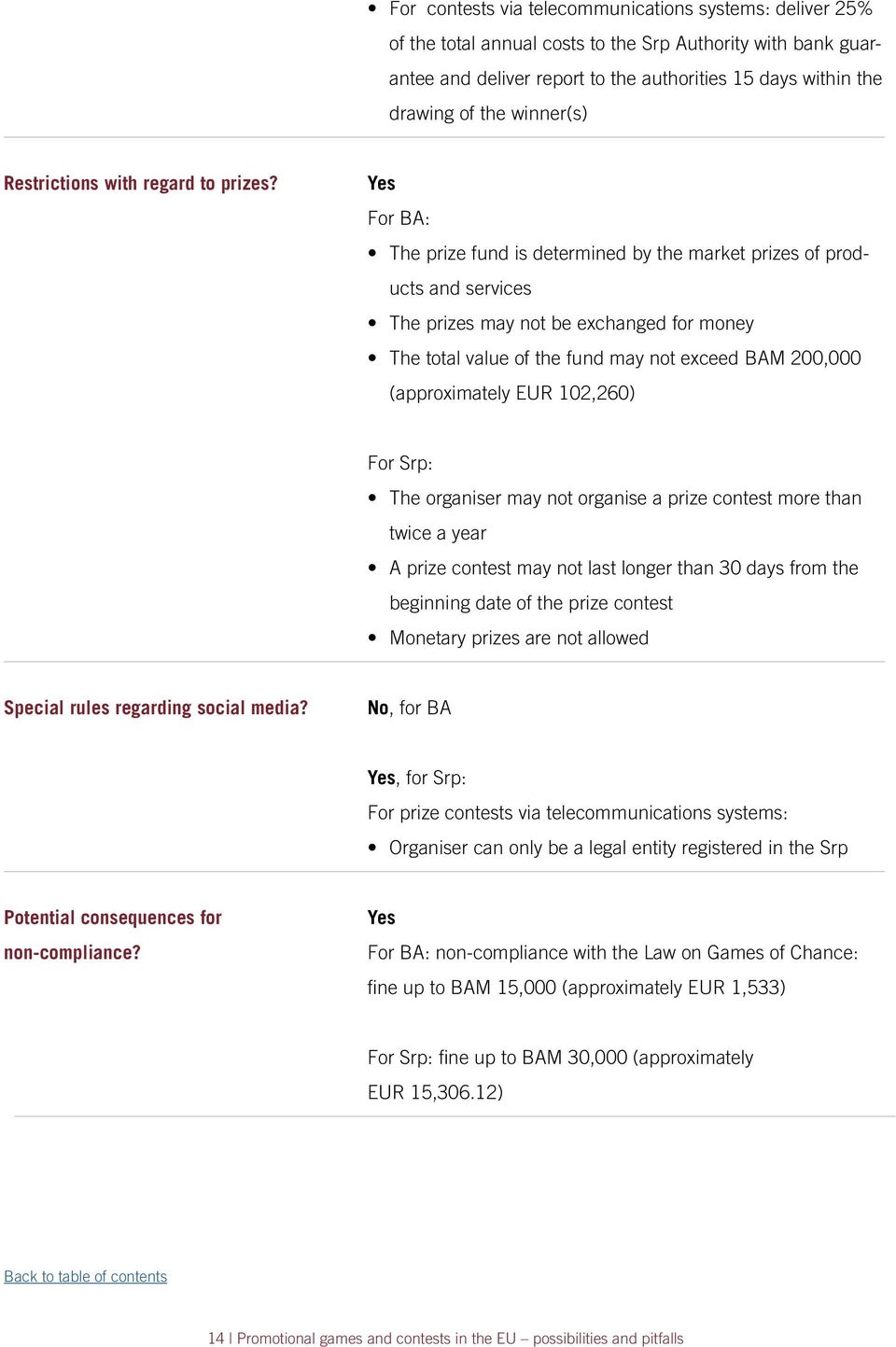
14 For contests via telecommunications systems: deliver 25% of the total annual costs to the Srp Authority with bank guarantee and deliver report to the authorities 15 days within the drawing of the winner(s) Restrictions with regard to prizes? For BA: The prize fund is determined by the market prizes of products and services The prizes may not be exchanged for money The total value of the fund may not exceed BAM 200,000 (approximately EUR 102,260) For Srp: The organiser may not organise a prize contest more than twice a year A prize contest may not last longer than 30 days from the beginning date of the prize contest Monetary prizes are not allowed Special rules regarding social media?, for BA, for Srp: For prize contests via telecommunications systems: Organiser can only be a legal entity registered in the Srp Potential consequences for non-compliance? For BA: non-compliance with the Law on Games of Chance: fine up to BAM 15,000 (approximately EUR 1,533) For Srp: fine up to BAM 30,000 (approximately EUR 15,306.12) 14 Promotional games and contests in the EU possibilities and pitfalls
15 Bulgaria Allowed? Specific requirements? General requirements? Promotional game should promote a specific good/service, product/service line of the sponsor and its commercial activities in general Promotional games should have a temporary character T&C are mandatory for bigger promotions and recommended for smaller promotions tification authority? Restrictions with regard to prizes?, only when participation is tied to the purchase of a product/ service: The value of the price may not exceed more than 100 time the price of the product/service sold The value of the price should in no case exceed the sum of 15 minimum wages (approximately EUR 2,915) Special rules regarding social media? Potential consequences for non-compliance? Fines for sponsor and organiser of up to 10% of the annual Bulgarian turnover of the preceding year 15 Promotional games and contests in the EU possibilities and pitfalls

16 Croatia Allowed? Specific requirements? Only Croatian entities can organise promotional games of chance General requirements? Promotion should promote a product, service or organisation Promotion should have a temporary character T&C are mandatory tification authority? Approval must be obtained from the Ministry of Finance Report on results of the game must be submitted to the Ministry of Finance within 8 days after the selection of the winner Restrictions with regard to prizes? Only goods and services may be awarded The total prize package of a single game may not exceed HRK 1,000,000 (approximately EUR 150,000) Special rules regarding social media? Potential consequences for non-compliance? Omission to obtain an approval from the Ministry of Finance: annulment of the game n-compliance with other requirements: fine up to EUR 70, Promotional games and contests in the EU possibilities and pitfalls

17 Czech Republic Allowed? Specific requirements? General requirements? Restrictions regarding the financial value of the prizes awarded tification authority? The organiser must notify the relevant authority at least 15 days prior to the start of the game Restrictions with regard to prizes? Prize must be non-monetary The value of each single prize may not exceed CZK 20,000 The sum of all prizes may not exceed CZK 200,000 per calendar year Special rules regarding social media? Potential consequences for non-compliance? Exceeding the maximum value of the prizes: fine up to CZK 10,000,000 notification to authority/organising prohibited games: fine up to CZK 2,000, Promotional games and contests in the EU possibilities and pitfalls

18 Denmark Allowed? Specific requirements? General requirements? Promotional games must be presented in such a way that the terms of offer are clear, unambiguous and easily available to the consumer material information may be omitted Promotional games should be comply with the Danish Marketing Act tification authority? If any of the prizes that can be won exceed DKK 200 (approximately EUR 27), the promotional games must be registered with the Danish Tax Authorities Restrictions with regard to prizes? Special rules regarding social media? Potential consequences for non-compliance? Issuance of injunction against the promotional game by court of Danish Consumer Ombudsman Issuance of a fine equal to the marketing costs of the promotional game 18 Promotional games and contests in the EU possibilities and pitfalls

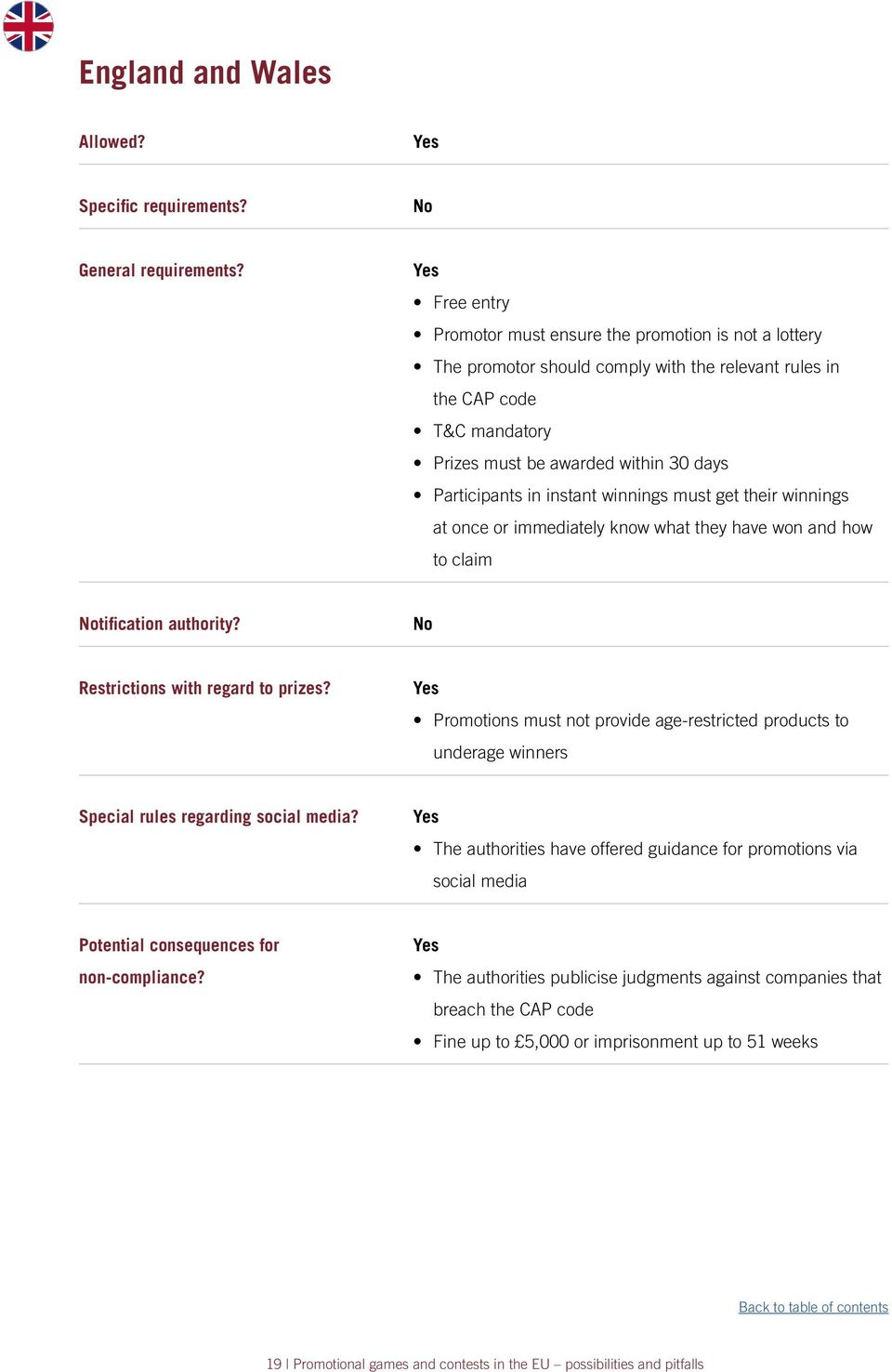
19 England and Wales Allowed? Specific requirements? General requirements? Free entry Promotor must ensure the promotion is not a lottery The promotor should comply with the relevant rules in the CAP code T&C mandatory Prizes must be awarded within 30 days Participants in instant winnings must get their winnings at once or immediately know what they have won and how to claim tification authority? Restrictions with regard to prizes? Promotions must not provide age-restricted products to underage winners Special rules regarding social media? The authorities have offered guidance for promotions via social media Potential consequences for non-compliance? The authorities publicise judgments against companies that breach the CAP code Fine up to 5,000 or imprisonment up to 51 weeks 19 Promotional games and contests in the EU possibilities and pitfalls
20 Estonia Allowed? Specific requirements? Estonian law differentiates between commercial lotteries and consumer games. If a product purchase is required to participate, the rules with regard to commercial lotteries apply. If a product purchase is not required to participate, the game is a consumer game and the rules for commercial lotteries do not apply General requirements?, for big commercial lotteries (prize pool between EUR 10,000 and EUR 100,000) Prohibited to request that a participant assumes additional monetary obligations in order to participate The game rules must be approved by the management board of the organiser For small commercial lotteries specific requirements n-binding guidelines about T&C For consumer games General advertising and consumer protection requirements tification authority?, for big commercial lotteries The organiser must submit a notice of economic activities to the Tax and Customs Board before the start of the promotion Restrictions with regard to prizes? For big commercial lotteries, the prize pool may not exceed EUR 100,000 For small commercial lotteries, the prize pool may not exceed EUR 10,000, for consumer games. 20 Promotional games and contests in the EU possibilities and pitfalls

21 Special rules regarding social media? Potential consequences for non-compliance? Violation of restrictions with regard to prize pools/ charging separate fee to participate: fine up to EUR 2,000 Violation of established game rules or deceit of a player/failure to submit game rules to a player at his request: fine up to EUR 2,600 Violation of the requirements for organising lotteries: fine of up to EUR 2,600 Violation of advertising rules: fine of up to EUR 10,000 Violation of consumer protection rules for sale of goods/ services: fine of up to EUR 2, Promotional games and contests in the EU possibilities and pitfalls
22 Finland Allowed? Specific requirements? General requirements? Promotional games of chance must comply with the general requirements of the Consumer Protection Act Promotional games of chance are permitted, unless considered a lottery under the Lotteries Act Participation in the promotional game of chance should not be subject to any payment other than purchasing a product or placing a bid T&C mandatory and must be clear, understandable and easily available Marketing material should contain specific information tification authority? Restrictions with regard to prizes? Special rules regarding social media? Potential consequences for non-compliance? The Consumer Ombudsman and Market Court may prohibit an operator from acting contrary to the Consumer Protection Act. In practice, the fines issued have ranged up to EUR 100,000 A breach of the Lotteries Act may result in administrative penalties, and at worst, criminal liability 22 Promotional games and contests in the EU possibilities and pitfalls
23 France Allowed? Specific requirements? General requirements?, but the organiser should not implement unfair commercial business purposes tification authority? Restrictions with regard to prizes? Special rules regarding social media? Potential consequences for non-compliance? Use of misleading/ aggressive commercial practice: imprisonment up to 2 years and a fine of EUR 300,000, or 10% of the annual turnover calculated on the basis of the last three years, or 50% of expenses incurred for the practice 23 Promotional games and contests in the EU possibilities and pitfalls
24 Germany Allowed? Specific requirements? General requirements? Ensure that the promotion is not a gambling activity; a gambling activity is given if participants are required to pay for participation T&C are mandatory tification authority? Restrictions with regard to prizes?, but if a prize has a very high value compared to the organiser s product or services, an offer may lead to a categorisation of the promotion as inadmissible Special rules regarding social media? Potential consequences for non-compliance? In case of non-compliance with the Law on Unfair Competition, a preliminary injunction may be granted Offering a gambling activity without the necessary license may lead to a fine or imprisonment up to two years 24 Promotional games and contests in the EU possibilities and pitfalls
25 Greece Allowed? Specific requirements? General requirements? Promotion should promote a product or service Promotion should have a temporary character T&C are mandatory and should be incorporated and signed by a notary tification authority? Data describing the game must be recorded before a notary Restrictions with regard to prizes? Restrictions may arise due to the nature of the prize per se in combination with the product/service to which the promotion refers and the characteristics of the participants Special rules regarding social media? Potential consequences for non-compliance? Administrative penalties Criminal liability claims Claims for damages/moral prejudice 25 Promotional games and contests in the EU possibilities and pitfalls
26 Hungary Allowed? Specific requirements? General requirements? Promotion must be connected to the purchase of a product or service Participation must be free Organiser must be a person who is engaged on a regular basis in the supply of goods and/or services in his/her own name Organiser must provide the customer with a ticket upon the purchase of products and/or services with certain determined value/ quantity and/or specific type tification authority? T&C must be sent in writing to the authorities at least ten days prior to the announcement of the game The organiser must prepare and submit to the authorities the final accounting of the promotional game Restrictions with regard to prizes? Only goods and/or services Cash not allowed as prize Special rules regarding social media? Potential consequences for non-compliance? Fine up to HUF 500,000 (approximately EUR 1,700) Ban organisation from organising a promotion for 5 years or indefinitely in case of breach of the provisions of the Gambling Act 26 Promotional games and contests in the EU possibilities and pitfalls
27 Iceland Allowed? Specific requirements? General requirements? tification authority? Promotions must be carried out in relation to promotion of products or trademarks participation fee Game should comply with general rules on commercial practices and marketing Costs that are associated with the promotions may not be charged when higher than three time the actual costs Restrictions with regard to prizes? Special rules regarding social media? Prizes must be in another form than money or tokens of money Potential consequences for non-compliance? Infringement of Lottery Act: fines or imprisonment up to 6 months If the infringement is extensive or repeated, imprisonment up to 1 year 27 Promotional games and contests in the EU possibilities and pitfalls
28 Ireland Allowed? Specific requirements? Only allowed to organise promotional games of chance for charitable organisations General requirements? Any direct or indirect payment for entry T&C must be maintained and easily accessible for consumers tification authority? Approval of request for lottery licence Restrictions with regard to prizes? Maximum of EUR 30,000 Special rules regarding social media? Potential consequences for non-compliance? Unlawful lottery: small fine of EUR 127 and imprisonment up to 3 months 28 Promotional games and contests in the EU possibilities and pitfalls
29 Italy Allowed? Specific requirements? n-italian companies may organise a promotion only via their Italian branch The promotion must be entirely organised and carried out within Italian territory Multi-country promotions are not allowed General requirements? Maximum duration is 1 year for a promotion The promotion may not be suspended or terminated in advance for any reason Participation must be free Promotions must not be designed to resemble a lottery or betting Prizes must be awarded within 6 months after the end of the contest tification authority? T&C must be filed with the authorities Restrictions with regard to prizes? Only goods or services; no cash prizes allowed Special rules regarding social media? If a promotion is carried out via the Internet, the server on which the website runs must be located in Italy Potential consequences for non-compliance? For non-compliance with the Presidential decree: fine up to EUR 500,000 Unfair commercial practices: fine up to EUR 5,000, Promotional games and contests in the EU possibilities and pitfalls
30 Kosovo Allowed? Specific requirements? General requirements? Promotional purpose deposit allowed additional costs allowed T&C are mandatory tification authority? T&C must be presented to the authorities at least 30 days prior to the game Restrictions with regard to prizes? Prizes may not exceed EUR 1,000 per person Payments in cash have to be made via the winner s bank account Special rules regarding social media? Potential consequences for non-compliance? If organiser fails to submit the T&C with the authorities: fine in the amount of EUR 2,000 Responsible person in the legal entity that did not submit the T&C to the authorities: fine up to EUR 2,500 Fine up to EUR 20,000 for the unauthorised person who promotes an awarding game through any media 30 Promotional games and contests in the EU possibilities and pitfalls
31 Latvia Allowed? Specific requirements? Latvia law differentiates between commercial lotteries and consumer games. If a product purchase is required to participate, the rules with regard to commercial lotteries apply. If a product purchase is not required to participate, the game is a consumer game and the rules for commercial lotteries do not apply General requirements?, for small commercial lotteries The same product must not have a commercial lottery more than 3 times per year, regardless of their amount or duration Lottery may not be organised to promote alcohol, tobacco or cigarettes And for big commercial lotteries See requirements for small commercial lotteries A lottery permit is required, for consumer games tification authority?, for small commercial lotteries Lotteries and Gambling Supervision Inspectorate must be notified 15 days prior to the opening of the lottery And for big commercial lotteries Application for lottery permit must be submitted to the authorities two months prior to the lottery, for consumer games. Restrictions with regard to prizes?, for commercial lotteries Prize pool must not exceed EUR 720, for consumer games 31 Promotional games and contests in the EU possibilities and pitfalls
32 Special rules regarding social media? Potential consequences for non-compliance?, for commercial lotteries: n-compliance with the requirements of the law may be subject to a fine up to EUR 700 If violation is committed repeatedly, the fine may be up to EUR 1, Promotional games and contests in the EU possibilities and pitfalls
33 Lithuania Allowed? Specific requirements? General requirements?, for big promotional games of chance T&C are mandatory Equity capital of organiser must be at least LTL 500,000 (EUR 144,810) Monetary prizes have to be paid within 30 calendar days after they are claimed And or small promotional games of chance T&C are mandatory Organiser must obtain a license from the authorities Equity capital of organiser must be at least LTL 50,000 (EUR 14,481) Monetary prizes have to be paid immediately after they are claimed tification authority?, for both big and small promotional games of chance Organiser must obtain a licence from the authorities Game rules must be approved by the authorities Organiser must register winners in accordance with the procedure established by the authorities Restrictions with regard to prizes?, for big promotional games of chance monetary restrictions Lottery tickets, alcohol, tobacco and other limited circulation products may not be used as a prize And for small promotional games of chance Prize pool may not exceed LTL 100,000 (EUR 28,962) Lottery tickets, alcohol, tobacco and other limited circulation products may not be used as a prize 33 Promotional games and contests in the EU possibilities and pitfalls
34 Special rules regarding social media? Potential consequences for non-compliance? Fine up to EUR 1,448 Fine up to EUR 2,896 for repeated offence 34 Promotional games and contests in the EU possibilities and pitfalls
35 Luxembourg Allowed? Specific requirements? General requirements? Only allowed when participation in the promotion is not linked to the purchase of a product T&C mandatory Entry form must be distinct from any order form for the goods and services Participation may not be subject to any financial counterpart tification authority? T&C must be filed with a bailiff Restrictions with regard to prizes? Special rules regarding social media? Potential consequences for non-compliance? An order to cease the illegal game may be issued Publication of jugdment may be ordered Fine up to EUR 120,000 Under the Criminal code, organiser of illegal lottery may also be subject to 3 months imprisonment and a fine up to EUR 30, Promotional games and contests in the EU possibilities and pitfalls
36 Macedonia Allowed? Specific requirements? A permit is required Promotion must not be aimed at participants younger than 18 Participating in games of chance organised outside the territory of Macedonia is not allowed General requirements? Promotion should promote a product or a service Promotion should have a temporary character and may not last longer than a year T&C are mandatory Organiser pays all public fees Fees in the amount of 18% of the total prize fund must be paid by the organiser, within 3 days before the issuance of the permit tification authority? Application permit must be submitted to the relevant authorities at least 15 days before the promotion starts Restrictions with regard to prizes? Special rules regarding social media? Potential consequences for non-compliance? Sanctions for organising a promotional game without a permit Fines up to EUR 325,000 Imprisonment up to 3 years Confiscation of organiser s assets Sanctions for non-compliance with the T&C of the promotion Fine up to EUR 5,000 Prohibition of performance of business activity up to 2 years 36 Promotional games and contests in the EU possibilities and pitfalls
37 Montenegro Allowed? ( promotional games of chance ) Specific requirements Relevant Montenegrin law only recognizes promotional games of chance whereas promotional games of skill and prize contests are not specifically regulated but rather fall under the scope of extensive interpretation of the Law on Commerce and the Law on Obligations General requirements? Organised by business organisation In order to advertise their products Participant must not be required to make a special payment T&C are mandatory tification authority? T&C must be approved by the competent authority and be published in a newspaper Restrictions with regard to prizes? monetary prizes allowed Only goods or services allowed Special rules regarding social media? Potential consequences for non-compliance? Fines up to 300 times the minimum wage in Montenegro 37 Promotional games and contests in the EU possibilities and pitfalls
38 rway Allowed? Specific requirements? General requirements? deposits allowed; only actual communication with a maximum of NOK 1 T&C mandatory tification authority? Restrictions with regard to prizes? Special rules regarding social media? Advertising in social media must be clearly marked as advertising Potential consequences for non-compliance? General rules with regard to tort and consumer rights apply n-compliance with requirements: fines or imprisonment up to 1 year Serious violations are punishable by fines or imprisonment up to 3 years 38 Promotional games and contests in the EU possibilities and pitfalls
39 Netherlands Allowed? Specific requirements General requirements?, for big promotional games of chance Should promote product, service or organisation Promotion must have a temporary character T&C are mandatory Complaints procedure is required deposit allowed; only actual communication costs with a maximum of EUR 0.45 And for small promotional games of chance Should promote product, service or organisation Promotion must have a temporary character T&C are not mandatory but are recommended Complaints procedure is required deposit allowed; only actual communication costs with a maximum of EUR 0.45 tification authority? Restrictions with regard to prizes?, for big promotional games of chance The total of prizes awarded may not exceed EUR 100,000 (excluding betting tax) Maximum of once per year per service, product or organization with a maximum of 20 sweepstakes And for small promotional games of chance: The total of prizes awarded may not exceed EUR 4,500 Special rules regarding social media? Potential consequences for non-compliance? Fine up to EUR 780,000 or 10% of the turnover of the financial year prior to the order) 39 Promotional games and contests in the EU possibilities and pitfalls
40 Poland Allowed? Specific requirements? In Poland, there are two games of chance: promotional lotteries and phone-or-text message lotteries. For both games, a permit is needed Phone-or-text message lotteries can only be organised by Polish entities Provision of gambling services abroad into Poland: Polish law does not deal expressly with this offering, including via internet. This is because local participation in such games is prohibited Purchase of a product must be required to participate General requirements?, for promotional lotteries Purchase of a product must be required to participate financial fee to participate Organiser may be natural persons, legal persons, or organisational units without legal personality And for phone-or text message lotteries Making a paid call Or sending text messages Organiser must be a Polish entity and either a joint stock company, public company or limited liability company tification authority? A permit is needed Restrictions with regard to prizes? Special rules regarding social media? 40 Promotional games and contests in the EU possibilities and pitfalls
41 Potential consequences for non-compliance?, for criminal offences by companies Fine up to EUR 5,000,000, but no more than 3% of annual revenues, for organising gambling games without holding a permit bullet: 100% of the revenue earned from the organized game And for persons in Poland participating in a foreign par mutual bet/in illegal gambling activity in Poland Fine or imprisonment up to 3 years 41 Promotional games and contests in the EU possibilities and pitfalls
42 Portugal Allowed? Specific requirements General requirements? Proof of bank guarantee or insurance guarantee T&C are mandatory Promotions must not lead to participants incurring higher costs than the product or services awarded Promotions must not copy format of traditional games of chance (e.g., poker, lottery, bingo) tification authority? Promotional games of chance are subject to prior authorisation of the authorities Restrictions with regard to prizes? Prize must have economic value, but money prizes are inadmissible maximum prize package or maximum number of games per year Special rules regarding social media? Potential consequences for non-compliance? Fine up to EUR 25, Promotional games and contests in the EU possibilities and pitfalls
43 Romania Allowed? ( advertising lotteries ) Specific requirements? Promotions involving the use of denomination, means or ways of awarding various winnings to participants are subject to the approval of the National Gambling Office General requirements? Participants must not be subject to direct or indirect payment to enter the promotion, except for the purchase price of the good or service and expenses for postal services/telephone Presentation of advertisements must mention nature, number and commercial value of prizes T&C are mandatory and must be available to participants tification authority? T&C must be authenticated by a public notary prior to the announcement of the promotion Restrictions with regard to prizes? Special rules regarding social media? Potential consequences for non-compliance? Fine up to RON 100,000 (approximately EUR 22,400) 43 Promotional games and contests in the EU possibilities and pitfalls
44 Scotland Allowed? Specific requirements General requirements? T&C are mandatory Free entry tification authority? Restrictions with regard to prizes? Special rules regarding social media? Potential consequences for non-compliance?, the Standing Advertising Agency may: ask the organiser to withdraw the promotion issue alerts to members and media advising them to withhold space for the promotor withdraw trading privileges request future marketing is vetted before publication name and shame promotor online disqualify the promotor from industry awards 44 Promotional games and contests in the EU possibilities and pitfalls
45 Serbia Allowed? ( Sweepstakes ) Specific requirements? General requirements? Requirement to pay to enter is not allowed Promotions are solely organised for the purpose of recreation and obtaining monetary gain or other rights that fall under the scope of the budget of Serbia 40% of assets mentioned above must be used for charity such as the Red Cross Organiser has to publish the T&C no later than 15 days prior to the commencement of the promotion in at least one daily newspaper published on the territory of Serbia tification authority? Approval is required from the Administration of games of chance Restrictions with regard to prizes? Only goods and services are allowed as prizes Money is not allowed as prize Organiser can organise a maximum of two promotions a year Promotion may not last longer than 30 days Special rules regarding social media? Potential consequences for non-compliance? Fines up to RSD 2,000, Promotional games and contests in the EU possibilities and pitfalls
46 Slovakia Allowed? Specific requirements General requirements? Only general principles of Slovak law on contract formation and content would apply tification authority? Restrictions with regard to prizes? Special rules regarding social media? Potential consequences for non-compliance? n-compliance with general rules and principles of general law: participants may claim indemnification arising from the invalid promotion Breach of rules on consumer protection: fine up to EUR 66,400 Repeated breach of rules on consumer protection: EUR 166, Promotional games and contests in the EU possibilities and pitfalls
47 Slovenia Allowed? ( Public promise of a prize ) Specific requirements? General requirements? T&C mandatory Deadline for promotion must be set tification authority? Restrictions with regard to prizes? Prize must not exceed the value of merchandise or service that the participant is required to purchase to enter the promotion The possibility of winning the prize must not be the reason that the consumer decides to purchase the product or service Special rules regarding social media? Potential consequences for non-compliance? setting a deadline for promotion: each person wishing to participate may go to court to have the court set a deadline Promise of a prize that is not given: fine up to EUR 40,000 n-compliance with the limitations on the prize value: fine up to EUR 12, giving away the prize: participant may claim prize in court proceedings Harm to an individual due to unfair competition: individual may initiate court proceedings and claim damages 47 Promotional games and contests in the EU possibilities and pitfalls
48 Spain Allowed? Specific requirements Every autonomous region has its own rules regarding taxes/ communication and information duties t aimed at participants under 18 General requirements? fee to participate T&C are mandatory tification authority? Restrictions with regard to prizes? The maximum total value must not exceed EUR 1 million Special rules regarding social media? Promotions via social media that require sharing certain content with the participants contact network and the network has not allowed this, may constitute an infringement of the prohibition on submitting unsolicited marketing materials through telematics Potential consequences for non-compliance? n-compliance with general consumer rights or tort: fine up to EUR 601, Accessory sanctions such as closing the organiser s premises Compensation for damages Breach of data protection law: fine up to EUR 600,000 Breach of E-Commerce law: fine up to EUR 600,000 Accessory sanctions such as temporary closure of the organiser s establishment 48 Promotional games and contests in the EU possibilities and pitfalls
49 Sweden Allowed? Specific requirements? General requirements? tification authority? Restrictions with regard to prizes? Special rules regarding social media? Potential consequences for non-compliance? 49 Promotional games and contests in the EU possibilities and pitfalls
50 Switzerland Allowed? Specific requirements General requirements? financial stake allowed legal commitment allowed T&C are mandatory and must be communicated to all participants misleading statements Closing date and drawing date must be communicated Drawing of prices should be public Results of drawing should be made public Distribution of prizes must not be dependent on performance/efforts of winners tification authority? Restrictions with regard to prizes? Special rules regarding social media? Potential consequences for non-compliance? Illegal lotteries/gambling: imprisonment up to three years or monetary fine Wilful non-compliance with the Unfair Competition Act: imprisonment up to three years or a monetary fine Competitors may take civil action/file a complaint with the Swiss Commission on Fairness in Commercial Trade 50 Promotional games and contests in the EU possibilities and pitfalls
51 Ukraine Allowed? Specific requirements General requirements? fee for entering the promotion Legality, accuracy, reliability and use of forms that do not cause harm to consumers undermining the confidence of society in advertising that meet the principles of fair competition In standing with good morals Take into account the sensitivity of children T&C are mandatory tification authority? Restrictions with regard to prizes? Special rules regarding social media? Potential consequences for non-compliance? Fine in the amount of the five-fold cost of the advertising materials/ products distributed Repeated violation in the period of one year: twice the amount mentioned above 51 Promotional games and contests in the EU possibilities and pitfalls
52 Promotional games of skill Promotions that provide an opportunity to compete for prizes or free gifts, to which the participant can exercise preponderant influence, e.g., because of his or her skills or knowledge 52 Promotional games and contests in the EU possibilities and pitfalls
53 IS FI NO SE EE SCT DK LT LV RU IE E&W NL PO BY ES FR BE LU CH DE IT CZ AT SI SK HU HR Srp BA RS ME KV MK AL RO BG MD UA PT GR TR Allowed Allowed, but specific requirements t allowed Registration required with authorities, before or after game information MT CY AT / Austria BY / Belarus BE / Belgium BA / Bosnia and Herzegovina BG / Bulgaria CH / Switzerland CZ / Czech Republic DE / Germany DK / Denmark EE / Estonia ES / Spain E&W / England and Wales FI / Finland FR / France GR / Greece HU / Hungary HR / Croatia IE / Ireland IS / Iceland IT / Italy KV / Kosovo LT / Lithuania LU / Luxembourg LV / Latvia ME / Montenegro MK / Macedonia NO / rway NL / Netherlands PO / Poland PT / Portugal RO / Romania RS / Serbia SCT / Scotland SE / Sweden SI / Slovenia SK / Slovakia Srp / Republic of Srpska UA / Ukraine 53 Promotional games and contests in the EU possibilities and pitfalls
54 Austria Allowed? Specific requirements? General requirements? Promotion must not be misleading T&C are mandatory Participant can exercise preponderant influence on the outcome The best participant wins element of chance tification authority? Restrictions with regard to prizes? Special rules regarding social media? Potential consequences for non-compliance? n-compliance may constitute an infringement of civil, consumer, data protection and unfair competition law 54 Promotional games and contests in the EU possibilities and pitfalls
55 Belarus Allowed? Specific requirements? Promotions may be differentiated into promotional games (the order or purchase of a product is required for participation) and contests and other analogues events (in particular, promotional actions) General requirements?, for promotional games Game must be aimed at stimulation of goods realisation Before registration the organiser must approve the game rules Game rules and results must be published in print mass media And for promotional actions: General requirements for advertising apply tification authority?, for promotional games Game must be registered with the Ministry of Trade Report on results of the game must be submitted within 30 days after the game has ended Restrictions with regard to prizes?, for promotional games the prize fund may only include Money Goods produced or purchased by organiser/ concerned party Goods that will be produced by the organiser if they have limited sell-by time Services that will be provided by a third party if they are paid in advance by the organiser/party concerned, for promotional actions. Special rules regarding social media? 55 Promotional games and contests in the EU possibilities and pitfalls
56 Potential consequences for non-compliance?, for promotional games Administrative fines for individual entrepreneur: up to approximately EUR 2,160 Administrative fines for legal entities: up to approximately EUR 5,402 And for promotional actions Administrative fine 56 Promotional games and contests in the EU possibilities and pitfalls
57 Belgium Allowed? Specific requirements? General requirements? There should be no stakes involved (if a paid version of the game exists, this will already be considered a stake) element of chance tification authority? Restrictions with regard to prizes? Special rules regarding social media? Potential consequences for non-compliance?, for the organisation of a prohibited lottery: For companies: fines up to EUR 36,000 For the establishment of a game of chance without the proper licence: For companies: fines up to EUR 1,200,000 For advertising, facilitating or recruiting players for unlawfully established games of chance: For companies: fines up to EUR 432, Promotional games and contests in the EU possibilities and pitfalls
58 Bosnia and Herzegovina (BA) and Srpska Republic (Srp) Allowed?, in the form of prize contests and prize games Specific requirements?, for Srp: For prize contests via telecommunications systems: Organiser can only be a legal entity registered in the Srp General requirements? For BA: Participation is free of charge Prizes are awarded in the form of products or services Organiser must pay 6% of the total value of the prize fund to the local humanitarian organisations (in advance) T&C are mandatory For Srp: Fee for organising a prize contest in the amount of 10% of the total value of the prize fund T&C are mandatory and must be published For prize contests via telecommunications systems: Organiser can only be a legal entity registered in the Srp Fee for organising a prize contest in the amount of 10% of the total value of the prize fund Organiser has to provide evidence of the secured payment of prizes and fees tification authority? For BA: rules of game need approval from the Federal Ministry of Finance and need to be submitted to the Ministry 30 days in advance For Srp: Each prize game needs approval from the Srp Authority for Games of Chance For contests via telecommunications systems: deliver 25% of the total annual costs to the Srp Authority with bank 58 Promotional games and contests in the EU possibilities and pitfalls
59 guarantee and deliver report to the authorities 15 days within the drawing of the winner(s) Restrictions with regard to prizes? For BA: The prize fund is determined by the market prizes of products and services The prizes may not be exchanged for money The total value of the fund may not exceed BAM 200,000 (approximately EUR 102,260) For Srp: The organiser may not organise a prize contest more than twice a year A prize contest may not last longer than 30 days from the beginning date of the prize contest Monetary prizes are not allowed Special rules regarding social media?, for BA, for Srp: For prize contests via telecommunications systems: Organiser can only be a legal entity registered in the Srp Potential consequences for non-compliance? For BA: non-compliance with the Law on Games of Chance: fine up to BAM 15,000 (approximately EUR 1,533) For Srp: fine up to BAM 30,000 (approximately EUR 15,306.12) 59 Promotional games and contests in the EU possibilities and pitfalls
60 Bulgaria Allowed? Specific requirements? General requirements? If the award offer is announced publicly, the prize must be awarded to the participant(s) who completed the task in accordance with the announced T&C Best participant wins If more than one participant performs the task in an identical way, the award should be split in equal shares between them tification authority? Restrictions with regard to prizes?, only when participation is tied to the purchase of a product/ service: The value of the price may not exceed more than 100 time the price of the product/service sold The value of the price should in no case exceed the sum of 15 minimum wages (approximately EUR 2,915) Special rules regarding social media? Potential consequences for non-compliance? Fines for sponsor and organiser of up to 10% of the annual Bulgarian turnover of the preceding year 60 Promotional games and contests in the EU possibilities and pitfalls
61 Croatia Allowed? Specific requirements? General requirements? Participant can influence the awarding of the price by conducting a certain action, showing a skill element of chance tification authority? Restrictions with regard to prizes? Special rules regarding social media? Potential consequences for non-compliance? If an award was publicly announced, the announcement is binding General rules regarding consumer rights 61 Promotional games and contests in the EU possibilities and pitfalls
62 Czech Republic Allowed? Specific requirements? General requirements? Participant can exercise significant influence Best participant element of chance tification authority? Restrictions with regard to prizes? Special rules regarding social media? Potential consequences for non-compliance?, but the rules regarding tort and consumer rights apply 62 Promotional games and contests in the EU possibilities and pitfalls
63 Denmark Allowed? Specific requirements? General requirements? element of chance Promotional games must be presented in such a way that the terms of offer are clear, unambiguous and easily available to the consumer material information may be omitted Promotional games should comply with the Danish Marketing Act tification authority? Restrictions with regard to prizes? Special rules regarding social media? Potential consequences for non-compliance? Issuance of injunction against the promotional game by court of Danish Consumer Ombudsman Issuance of a fine equal to the marketing costs for the promotion 63 Promotional games and contests in the EU possibilities and pitfalls
64 England and Wales Allowed? Specific requirements? General requirements? The promotion requires the exercise of skill or judgement or a display of knowledge The promoter must have a reasonable expectation that this requirement will either prevent a significant proportion of people who wish to participate from doing so or prevent a significant proportion of people who participate from receiving a prize Free entry Promotor must ensure the promotion is not a lottery The promotor should comply with the relevant rules in the CAP code T&C mandatory Judge or panel members must be demonstrably independent Prizes must be awarded within 30 days tification authority? Restrictions with regard to prizes? Promotions must not provide age-restricted products to underage winners Special rules regarding social media? The authorities have offered guidance for promotions via social media Potential consequences for non-compliance? The authorities publicise judgments against companies that breach the CAP code Fine up to 5,000 or imprisonment up to 51 weeks 64 Promotional games and contests in the EU possibilities and pitfalls
65 Estonia Allowed? Specific requirements? In order to avoid falling under the regulation of the Gambling Act, the game should be organised in a way that no bet (i.e. purchase) must be made to participate or in a way that the game of skill is not played by means of a mechanical or electronic device General requirements? general advertising and consumer protection requirements tification authority? Restrictions with regard to prizes? Special rules regarding social media? Potential consequences for non-compliance? Violation of advertising rules: fine of up to EUR 10,000 Violation of consumer protection rules for sale of goods/ services: fine of up to EUR 2, Promotional games and contests in the EU possibilities and pitfalls
66 Finland Allowed? Specific requirements? General requirements? tification authority? Restrictions with regard to prizes? Special rules regarding social media? Potential consequences for non-compliance? Promotional games of skill must comply with the general requirements of the Consumer Protection Act T&C mandatory and must be clear, understandable and easily available Marketing material should contain specific information The outcome must be entirely based on skill, otherwise considered a promotional game of chance The Consumer Ombudsman and Market Court may prohibit an operator from acting contrary to the Consumer Protection Act. In practice, the fines issued have ranged up to EUR 100, Promotional games and contests in the EU possibilities and pitfalls
67 France Allowed? Specific requirements? General requirements?, but the organiser should not implement unfair commercial business purposes tification authority? Restrictions with regard to prizes? Special rules regarding social media? Potential consequences for non-compliance? Use of misleading/ aggressive commercial practice: imprisonment up to 2 years and a fine of EUR 300,000, or 10% of the annual turnover calculated on the basis of the last three years, or 50% of expenses incurred for the practice 67 Promotional games and contests in the EU possibilities and pitfalls
68 Germany Allowed? Specific requirements? General requirements? Participant can exercise preponderant influence Winner must be solely designated on the basis of his/her knowledge or skills Ensure that the promotion is not a gambling activity; a gambling activity is given if participants are required to pay for participation T&C are mandatory tification authority? Restrictions with regard to prizes?, but if a prize has a very high value compared to the organiser s product or services, an offer may lead to a categorisation of the promotion as inadmissible Special rules regarding social media? Potential consequences for non-compliance? In case of non-compliance with the Law on Unfair Competition, a preliminary injunction may be granted Offering a gambling activity without the necessary license may lead to a fine or imprisonment up to two years 68 Promotional games and contests in the EU possibilities and pitfalls
69 Greece Allowed? Specific requirements? General requirements? Participant can exercise preponderant influence Best participant wins element of chance tification authority? Data describing the game must be recorded before a notary Restrictions with regard to prizes? Restrictions may arise due to the nature of the prize per se in combination with the product/service to which the promotion refers and the characteristics of the participants Special rules regarding social media? Potential consequences for non-compliance? Administrative penalties Criminal liability claims Claims for damages/moral prejudice 69 Promotional games and contests in the EU possibilities and pitfalls
70 Hungary Allowed? Specific requirements? General requirements?, but general rules regarding contract law, consumer contracts and consumer protection apply tification authority? Restrictions with regard to prizes? Special rules regarding social media? Potential consequences for non-compliance?, but general rules regarding contract law, consumer contracts and consumer protection apply 70 Promotional games and contests in the EU possibilities and pitfalls
71 Iceland Allowed? Specific requirements? General requirements? Game should comply with general rules on commercial practices and marketing Costs that are associated with the promotions may not be charged when higher than three time the actual costs tification authority? Restrictions with regard to prizes? Prizes must be in another form than money or tokens of money Special rules regarding social media? Potential consequences for non-compliance? Infringement of Lottery Act: fines or imprisonment up to 6 months If the infringement is extensive or repeated, imprisonment up to 1 year 71 Promotional games and contests in the EU possibilities and pitfalls
72 Ireland Allowed? Specific requirements? General requirements? Some level of skill must be attached to the promotional game of skill so that it is not qualified as a lottery tification authority? Restrictions with regard to prizes? Special rules regarding social media? Potential consequences for non-compliance? Unlawful lottery: small fine of EUR 127 and imprisonment up to 3 months 72 Promotional games and contests in the EU possibilities and pitfalls
73 Italy Allowed? Specific requirements? n-italian companies may organise a promotion only via their Italian branch The promotion must be entirely organised and carried out within Italian territory Multi-country promotions are not allowed General requirements? Promotion maximum duration is 1 year The promotion may not be suspended or terminated in advance for any reason Participation must be free Promotions must not be designed to resemble a lottery or betting Prizes must be awarded within 6 months after the end of the contest tification authority? T&C must be filed with the authorities Restrictions with regard to prizes? Only goods or services; no cash prizes allowed Special rules regarding social media? If a promotion is carried out via the Internet, the server on which the website runs must be located in Italy Potential consequences for non-compliance? For non-compliance with the Presidential decree: fine up to EUR 500,000 Unfair commercial practices: fine up to EUR 5,000, Promotional games and contests in the EU possibilities and pitfalls
74 Kosovo Allowed? Specific requirements? General requirements? Promotional purpose deposit allowed additional costs allowed T&C are mandatory tification authority? T&C must be presented to the authorities at least 30 days prior to the game Restrictions with regard to prizes? Prizes may not exceed EUR 1,000 per person Payments in cash have to be made via the winner s bank account Special rules regarding social media? Potential consequences for non-compliance? If organiser fails to submit the T&C with the authorities: fine in the amount of EUR 2,000 Responsible person in the legal entity that did not submit the T&C to the authorities: fine up to EUR 2,500 Fine up to EUR 20,000 for the unauthorised person who promotes an awarding game through any media 74 Promotional games and contests in the EU possibilities and pitfalls
75 Latvia Allowed? Specific requirements? Latvia law differentiates between commercial lotteries and consumer games. If a product purchase is required to participate, the rules with regard to commercial lotteries apply. If a product purchase is not required to participate, the game is a consumer game and the rules for commercial lotteries do not apply General requirements?, for small commercial lotteries The same product must not have a commercial lottery more than 3 times per year, regardless of their amount or duration Lottery may not be organised to promote alcohol, tobacco or cigarettes And for big commercial lotteries See requirements for small commercial lotteries A lottery permit is required, for consumer games tification authority?, for small commercial lotteries Lotteries and Gambling Supervision Inspectorate must be notified 15 days prior to the opening of the lottery And for big commercial lotteries Application for lottery permit must be submitted to the authorities two months prior to the lottery, for consumer games. Restrictions with regard to prizes?, for commercial lotteries Prize pool must not exceed EUR 720, for consumer games 75 Promotional games and contests in the EU possibilities and pitfalls
76 Special rules regarding social media? Potential consequences for non-compliance?, for commercial lotteries: n-compliance with the requirements of the law may be subject to a fine up to EUR 700 If violation is committed repeatedly, the fine may be up to EUR 1, Promotional games and contests in the EU possibilities and pitfalls
77 Lithuania Allowed? Specific requirements? General requirements? Best participant wins element of chance General rules regarding advertising and consumer protection tification authority? Restrictions with regard to prizes? Special rules regarding social media? Potential consequences for non-compliance?, but the general rules regarding tort and consumer rights apply 77 Promotional games and contests in the EU possibilities and pitfalls
78 Luxembourg Allowed? * Specific requirements? General requirements? The winner must not be chosen on the basis (of an element) of chance The selection of the winner must be undertaken on the basis of objective criteria The winner must be the best candidate on the basis of the objective criteria set up The skill at issue must be a skill which may be accessed by the average-skilled person tification authority? Restrictions with regard to prizes? Special rules regarding social media? Potential consequences for non-compliance?, but the general rules regarding tort and consumer rights apply Back * This to question table of contents may be subject to interpretation. Please refer to our comments on page Promotional games and contests in the EU possibilities and pitfalls
79 Macedonia Allowed? Specific requirements? General requirements? Must be organised via communication devices, i.e. telecommunications Deposit is required Best participants wins Promotion should have a temporary character and may not last longer than a year T&C are mandatory Organiser pays all public fees Fees in the amount of 18% of the total prize fund must be paid by the organiser, within 3 days before the issuance of the permit tification authority? Application permit must be submitted to the relevant authorities at least 15 days before the promotion starts Restrictions with regard to prizes? Special rules regarding social media? Potential consequences for non-compliance? Sanctions for organising a promotional game without a permit Fines up to EUR 325,000 Imprisonment up to 3 years Confiscation of organiser s assets Sanctions for non- compliance with the T&C of the promotion Fine up to EUR 5,000 Prohibition of performance of business activity up to 2 years 79 Promotional games and contests in the EU possibilities and pitfalls
80 Montenegro Allowed? Specific requirements Relevant Montenegrin law only recognizes promotional games of chance whereas promotional games of skill and prize contests are not specifically regulated but rather fall under the scope of extensive interpretation of the Law on Commerce and the Law on Obligations General requirements?, but regulated by an extensive interpretation of certain provisions of the Law on Commerce and the Law on Obligations tification authority? Restrictions with regard to prizes? Special rules regarding social media? Potential consequences for non-compliance?, but regulated by an extensive interpretation of certain provisions of the Law on Commerce and the Law on Obligations 80 Promotional games and contests in the EU possibilities and pitfalls
81 rway Allowed? Specific requirements? General requirements? The winner is determined only on the basis of skill or knowledge Best participant wins element of chance Must not rely on circumstances outside the participants control; all participants must have equal conditions/ possibility to win T&C are mandatory Questions must be: - Real questions of knowledge - Participants must answer in the same order - Participants must be given the same time to answer - multiple choice questions - Allowed to have the time spent on the questions a criterion for winning tification authority? Restrictions with regard to prizes? Special rules regarding social media? Advertising in social media must be clearly marked as advertising Potential consequences for non-compliance? General rules with regard to tort and consumer rights will apply n-compliance with requirements: fines or imprisonment up to 1 year Serious violations are punishable by fines or imprisonment up to 3 years 81 Promotional games and contests in the EU possibilities and pitfalls
82 Netherlands Allowed? Specific requirements General requirements? Participant can exercise preponderant influence Best participant wins element of chance tification authority? Restrictions with regard to prizes? Special rules regarding social media? Potential consequences for non-compliance?, but the general rules regarding tort and consumer rights apply 82 Promotional games and contests in the EU possibilities and pitfalls
83 Poland Allowed? Specific requirements? General requirements? element of chance Clear and transparent criteria for winning An element of competition T&C are mandatory tification authority? Restrictions with regard to prizes? Special rules regarding social media? Potential consequences for non-compliance?, but the general rules regarding tort, contractual liability and consumer rights will apply 83 Promotional games and contests in the EU possibilities and pitfalls
84 Portugal Allowed? Specific requirements General requirements? Proof of bank guarantee or insurance guarantee T&C are mandatory Promotions may not lead to participants incurring higher costs than the product or services awarded Promotions must not copy format of traditional games of chance (e.g. poker, lottery, bingo) tification authority? Promotional games of chance are subject to prior authorisation of the authorities Restrictions with regard to prizes? Prize must have economic value maximum prize package or maximum number of games per year Special rules regarding social media? Potential consequences for non-compliance? Fine up to EUR 25, Promotional games and contests in the EU possibilities and pitfalls
85 Romania Allowed? Specific requirements? General requirements?, not regulated by law tification authority? Restrictions with regard to prizes? Special rules regarding social media? Potential consequences for non-compliance? 85 Promotional games and contests in the EU possibilities and pitfalls
86 Scotland Allowed? Specific requirements General requirements? T&C are mandatory Free entry Success in game must be dependent to a substantial degree on the exercise of skill, knowledge or judgement tification authority? Restrictions with regard to prizes? Special rules regarding social media? Potential consequences for non-compliance?, the Standing Advertising Agency may: ask the organiser to withdraw the promotion issue alerts to members and media advising them to withhold space for the promotor withdraw trading privileges request future marketing is vetted before publication name and shame promotor online disqualify the promotor from industry awards 86 Promotional games and contests in the EU possibilities and pitfalls
87 Serbia Allowed? Specific requirements?, not regulated by law General requirements? Sales incentive Length of the game must be limited in time The amount of gifts must be defined in advance Conditions for obtaining gifts must be defined in advance tification authority? Restrictions with regard to prizes? Special rules regarding social media? Potential consequences for non-compliance? 87 Promotional games and contests in the EU possibilities and pitfalls
88 Slovakia Allowed? Specific requirements General requirements?, the organiser must state in the announcement of the game: The subject and period of the competition amounts of prizes and the other conditions of the competition Who will, within what period and based on what criteria, assess the fulfilment of the conditions of the competition and perform the evaluation tification authority? Restrictions with regard to prizes? Special rules regarding social media? Potential consequences for non-compliance? n-compliance with general rules and principles of general law: participants may claim indemnification arising from the invalid promotion Breach of rules on consumer protection: fine up to EUR 66,400 Repeated breach of rules on consumer protection: fine up to EUR 166, Promotional games and contests in the EU possibilities and pitfalls
89 Slovenia Allowed? ( Public promise of a prize ) Specific requirements? General requirements? T&C mandatory Deadline for promotion must be set tification authority? Restrictions with regard to prizes? Prize must not exceed the value of merchandise or service that the participant is required to purchase to enter the promotion The possibility of winning the prize must not be the reason that the consumer decides to purchase the product or service Special rules regarding social media? Potential consequences for non-compliance? setting a deadline for promotion: each person wishing to participate may go to court to have the court set a deadline Promise of a prize that is not given: fine up to EUR 40,000 n-compliance with the limitations on the prize value: fine up to EUR 12, giving away the prize: participant may claim prize in court proceedings Harm to an individual due to unfair competition: individual may initiate court proceedings and claim damages 89 Promotional games and contests in the EU possibilities and pitfalls
90 Spain Allowed? Specific requirements Every autonomous region has its own rules regarding taxes/ communication and information duties t aimed at participants under 18 General requirements? fee to participate T&C are mandatory The participant can exercise preponderant influence The best participant wins If prizes are assigned by a jury, the criteria for selecting winners should be as objective as possible to avoid future claims tification authority? Restrictions with regard to prizes? The maximum total value must not exceed EUR 1 million Special rules regarding social media? Promotions via social media that require sharing certain content with the participants contact network and the network has not allowed this, may constitute an infringement of the prohibition to submit unsolicited marketing materials through telematics Potential consequences for non-compliance? n-compliance with general consumer rights or tort: fine up to EUR 601, Accessory sanctions such as closing the organiser s premises Compensation for damages Breach of data protection law: fine up to EUR 600,000 Breach of E-Commerce law: fine up to EUR 600,000 Accessory sanctions such as temporary closure of the organiser s establishment 90 Promotional games and contests in the EU possibilities and pitfalls
91 Sweden Allowed? Specific requirements? General requirements? T&C are mandatory Game must be consistent with generally accepted marketing practice element of chance tification authority? Restrictions with regard to prizes? Special rules regarding social media? Potential consequences for non-compliance? Sanctions under the Lottery Act Sanctions under the Marketing Practice Act Sanctions under the Personal Data Act Injunctions/orders 91 Promotional games and contests in the EU possibilities and pitfalls
92 Switzerland Allowed? Specific requirements General requirements? financial stake allowed legal commitment allowed T&C are mandatory and must be communicated to all participants misleading statements Closing date and drawing date must be communicated Drawing of prizes should be public Results of drawing should be public Distribution of prizes must not be dependent on performance/efforts of winners element of chance Chances of winning must mainly depend on the participants skills Judging criteria must be communicated It must be communicated who is admitted and under what conditions tification authority? Restrictions with regard to prizes? Special rules regarding social media? Potential consequences for non-compliance? Illegal lotteries/gambling: imprisonment up to three years or monetary fine Wilful non-compliance with the Unfair Competition Act: imprisonment up to three years or a monetary fine Competitors may take civil action/file a complaint with the Swiss Commission on Fairness in Commercial Trade 92 Promotional games and contests in the EU possibilities and pitfalls
93 Ukraine Allowed? Specific requirements General requirements? A person that achieves the best result must be the winner The winner must be determined according to the procedure established by the organiser Results of the competition must be announced in the same procedure as the competition was announced tification authority? Restrictions with regard to prizes? Special rules regarding social media? Potential consequences for non-compliance? Fine in the amount of the five-fold cost of the advertising materials/products distributed Repeated violation in the period of one year: twice the amount mentioned above 93 Promotional games and contests in the EU possibilities and pitfalls
94
95 Prize draws Promotions that provide an opportunity to compete for prizes or free gifts, where the participant has influence on the outcome because his/her performance can be judged, like writing a text, making a picture/composition/ drawing, creating a tag line 95 Promotional games and contests in the EU possibilities and pitfalls
96 IS FI NO SE EE SCT DK LT LV RU IE E&W NL PO BY ES FR BE LU CH DE IT CZ AT SI SK HU HR Srp BA RS ME KV MK AL RO BG MD UA PT GR TR Allowed Allowed, but specific requirements t allowed Registration required with authorities, before or after game information MT CY AT / Austria BY / Belarus BE / Belgium BA / Bosnia and Herzegovina BG / Bulgaria CH / Switzerland CZ / Czech Republic DE / Germany DK / Denmark EE / Estonia ES / Spain E&W / England and Wales FI / Finland FR / France GR / Greece HU / Hungary HR / Croatia IE / Ireland IS / Iceland IT / Italy KV / Kosovo LT / Lithuania LU / Luxembourg LV / Latvia ME / Montenegro MK / Macedonia NO / rway NL / Netherlands PO / Poland PT / Portugal RO / Romania RS / Serbia SCT / Scotland SE / Sweden SI / Slovenia SK / Slovakia Srp / Republic of Srpska UA / Ukraine 96 Promotional games and contests in the EU possibilities and pitfalls
97 Austria Allowed? To the extent that the performance of the participant is marginal and a draw of the qualified participants takes place to establish the winner(s), the rules for promotional games of chance apply. To the extent that the performance of the participant qualifies as a game of skill, the rules for games of skill apply. Specific requirements? for small games of chance with any kind of participation fee (e.g. value-added phone or messaging services for participation or a higher price for the product that includes the participation option) for promotional raffles without any participation fee General requirements?, for small games of chance with any kind of participation fee: full gaming draw character Only for small amounts/values Goods via machines stakes for maximum of EUR 1 Game does not serve commercial purposes/ personal interest operator, for promotional raffles without any participation fee: Promotion must not be misleading or aggressive It must be clearly set out which prizes can be won Valid terms & conditions have to be accepted by the participant Draw of the winners must solely be based on chance, for games of skill tification authority? 97 Promotional games and contests in the EU possibilities and pitfalls
98 Restrictions with regard to prizes? for small games of chance with any kind of participation fee Capital value of game does not exceed EUR 4,000 per calendar year, for games of skill Special rules regarding social media? Potential consequences for non-compliance?, for promotional games of chance: Administrative penalties up to EUR 22,000 Administrative penalties codified in respective provisional laws Qualification as an act of unfair competition Violation of the Criminal Code, for games of skill: n-compliance may constitute an infringement of civil, consumer, data protection and unfair competition law 98 Promotional games and contests in the EU possibilities and pitfalls
99 Belarus Allowed? Specific requirements? Promotions may be differentiated into promotional games (the order or purchase of a product is required for participation) and contests and other analogues events (in particular, promotional actions) General requirements?, for promotional games Game must be aimed at stimulation of goods realisation Before registration the organiser must approve the game rules Game rules and results must be published in print mass media And for promotional actions: General requirements for advertising apply tification authority?, for promotional games Game must be registered with the Ministry of Trade Report on results of the game must be submitted within 30 days after the game has ended Restrictions with regard to prizes?, for promotional games the prize fund may only include Money Goods produced or purchased by organiser/ concerned party Goods that will be produced by the organiser if they have limited sell-by time Services that will be provided by a third party if they are paid in advance by the organiser/party concerned, for promotional actions. 99 Promotional games and contests in the EU possibilities and pitfalls
100 Special rules regarding social media? Potential consequences for non-compliance?, for promotional games Administrative fines for individual entrepreneur: up to approximately EUR 2,160 Administrative fines for legal entities: up to approximately EUR 5,402 And for promotional actions Administrative fine 100 Promotional games and contests in the EU possibilities and pitfalls
101 Belgium Allowed? Specific requirements? General requirements? There should be no stakes involved (if a paid version of the game exists, this will already be considered a stake) element of chance tification authority? Restrictions with regard to prizes? Special rules regarding social media? Potential consequences for non-compliance?, for the organisation of a prohibited lottery: For companies: fines up to EUR 36,000 For the establishment of a game of chance without the proper licence: For companies: fines up to EUR 1,200,000 For advertising, facilitating or recruiting players for unlawfully established games of chance: For companies: fines up to EUR 432, Promotional games and contests in the EU possibilities and pitfalls
102 Bosnia and Herzegovina (BA) and Srpska Republic (Srp) Allowed?, in the form of prize contests and prize games Specific requirements?, for Srp For prize contests via telecommunications systems: Organiser can only be a legal entity registered in the Srp General requirements? For BA: Participation is free of charge Prizes are awarded in the form of products or services Organiser must pay 6% of the total value of the prize fund to the local humanitarian organisations (in advance) T&C are mandatory For Srp: Fee for organising a prize contest in the amount of 10% of the total value of the prize fund T&C are mandatory and must be published For prize contests via telecommunications systems: Organiser can only be a legal entity registered in the Srp Fee for organising a prize contest in the amount of 10% of the total value of the prize fund Organiser has to provide evidence of the secured payment of prizes and fees tification authority? For BA: Rules of game need approval from the Federal Ministry of Finance and need to be submitted to the Ministry 30 days in advance For Srp: Each prize game needs approval from the Srp Authority for Games of Chance 102 Promotional games and contests in the EU possibilities and pitfalls
103 For contests via telecommunications systems: deliver 25% of the total annual costs to the Srp Authority with bank guarantee and deliver report to the authorities 15 days within the drawing of the winner(s) Restrictions with regard to prizes? For BA: The prize fund is determined by the market prizes of products and services The prizes may not be exchanged for money The total value of the fund may not exceed BAM 200,000 (approximately EUR 102,260) For Srp: The organiser may not organise a prize contest more than twice a year A prize contest may not last longer than 30 days from the beginning date of the prize contest Monetary prizes are not allowed Special rules regarding social media?, for BA, for Srp: For prize contests via telecommunications systems: Organiser can only be a legal entity registered in the Srp Potential consequences for non-compliance? For BA: non-compliance with the Law on Games of Chance: fine up to BAM 15,000 (approximately EUR 7,669) For Srp: fine up to BAM 30,000 (approximately EUR 15,306.12) 103 Promotional games and contests in the EU possibilities and pitfalls
104 Bulgaria Allowed? Specific requirements? General requirements? If the award offer is announced publicly, the prize must be awarded to the participant(s) who completed the task in accordance with the announced T&C Best participant wins If more than one participant performs the task in an identical way, the award should be split in equal shares between them tification authority? Restrictions with regard to prizes?, only when participation is tied to the purchase of a product/ service: The value of the price may not exceed more than 100 time the price of the product/service sold The value of the price should in no case exceed the sum of 15 minimum wages (approximately EUR 2,915) Special rules regarding social media? Potential consequences for non-compliance? Fines for sponsor and organiser of up to 10% of the annual Bulgarian turnover of the preceding year 104 Promotional games and contests in the EU possibilities and pitfalls
105 Croatia Allowed? Specific requirements? General requirements? Participant can influence the awarding of the price by conducting a certain action, showing a skill element of chance tification authority? Restrictions with regard to prizes? Special rules regarding social media? Potential consequences for non-compliance? If an award was publicly announced, the announcement is binding General rules regarding consumer rights 105 Promotional games and contests in the EU possibilities and pitfalls
106 Czech Republic Allowed? Specific requirements? General requirements? Participant can exercise significant influence Best participant element of chance tification authority? Restrictions with regard to prizes? Special rules regarding social media? Potential consequences for non-compliance?, but the rules regarding tort and consumer rights apply 106 Promotional games and contests in the EU possibilities and pitfalls
107 Denmark Allowed?, when an element of chance, the rules of promotional games of chance apply. When based entirely on skill, the rules of promotional games of skill apply Specific requirements? General requirements? For promotional games of chance: Promotional games must be presented in such a way that the terms of offer are clear, unambiguous and easily available to the consumer material information may be omitted Promotional games should be comply with the Danish Marketing Act For promotional games of skill: element of chance Promotional games must be presented in such a way that the terms of offer are clear, unambiguous and easily available to the consumer material information may be omitted Promotional games should be comply with the Danish Marketing Act tification authority?, for promotional games of chance If any of the prizes that can be won exceed DKK 200 (approximately EUR 27), the promotional games must be registered with the Danish Tax Authorities, for promotional games of skill Restrictions with regard to prizes?, for promotional games of chance, for promotional games of skill 107 Promotional games and contests in the EU possibilities and pitfalls
108 Special rules regarding social media?, for promotional games of chance, for promotional games of skill Potential consequences for non-compliance?, for promotional games of chance and promotional game of skill: Issuance of injunction against the promotional game by court of Danish Consumer Ombudsman Issuance of a fine equal to the marketing costs of the promotional game 108 Promotional games and contests in the EU possibilities and pitfalls
109 England and Wales Allowed? Specific requirements? General requirements? Free entry Promotor must ensure the promotion is not a lottery The promotor should comply with the relevant rules in the CAP code T&C mandatory Judge or panel members must be demonstrably independent Prizes must be awarded within 30 days tification authority? Restrictions with regard to prizes? Promotions must not provide age-restricted products to underage winners Special rules regarding social media? The authorities have offered guidance for promotions via social media Potential consequences for non-compliance? The authorities publicise judgments against companies that breach the CAP code Fine up to 5,000 or imprisonment up to 51 weeks 109 Promotional games and contests in the EU possibilities and pitfalls
110 Estonia Allowed? Specific requirements? In order to avoid falling under the Gambling Act, the game should be organised so that no bet (i.e. purchase) is required to participate or so that the game is not played by means of a mechanical or electronic device General requirements? general advertising and consumer protection requirements tification authority? Restrictions with regard to prizes? Special rules regarding social media? Potential consequences for non-compliance? Violation of advertising rules: fine of up to EUR 10,000 Violation of consumer protection rules for sale of goods/services: fine of up to EUR 2, Promotional games and contests in the EU possibilities and pitfalls
111 Finland Allowed? Specific requirements? General requirements? Prize draws must comply with the general requirements of the Consumer Protection Act Prize draws are permitted, unless considered a lottery under the Lotteries Act If dependent on chance, participation in the prize draw should not be subject to any payment other than purchasing a product or placing a bid T&C mandatory and must be clear, understandable and easily available Marketing material should contain specific information tification authority? Restrictions with regard to prizes? Special rules regarding social media? Potential consequences for non-compliance? The Consumer Ombudsman and Market Court may prohibit an operator from acting contrary to the Consumer Protection Act. In practice, the fines issued have ranged up to EUR 100,000 A breach of the Finnish Lotteries Act may result in administrative penalties, and at worst, criminal liability 111 Promotional games and contests in the EU possibilities and pitfalls
112 France Allowed? Specific requirements? General requirements?, but the organiser should not implement unfair commercial business purposes. tification authority? Restrictions with regard to prizes? Special rules regarding social media? Potential consequences for non-compliance? Use of misleading/ aggressive commercial practice: imprisonment up to 2 years and a fine of EUR 300,000, or 10% of the annual turnover calculated on the basis of the last three years, or 50% of expenses incurred for the practice 112 Promotional games and contests in the EU possibilities and pitfalls
113 Germany Allowed? Specific requirements? General requirements? Prize must be awarded for a performance of the execution of an act Performance can be judged element of chance Period of time must be set for participation Ensure that the promotion is not a gambling activity; a gambling activity is given if participants are required to pay for participation T&C are mandatory tification authority? Restrictions with regard to prizes?, but if a prize has a very high value compared to the organiser s product or services, an offer may lead to a categorisation of the promotion as inadmissible Special rules regarding social media? Potential consequences for non-compliance? In case of non-compliance with the Law on Unfair Competition, a preliminary injunction may be granted Offering a gambling activity without the necessary license may lead to a fine or imprisonment up to two years 113 Promotional games and contests in the EU possibilities and pitfalls
114 Greece Allowed? Specific requirements? General requirements? Performance can be judged element of chance tification authority? Data describing the game must be recorded before a notary Restrictions with regard to prizes? Restrictions may arise due to the nature of the prize per se in combination with the product/service to which the promotion refers and the characteristics of the participants Special rules regarding social media? Potential consequences for non-compliance? Administrative penalties Criminal liability claims Claims for damages/moral prejudice 114 Promotional games and contests in the EU possibilities and pitfalls
115 Hungary Allowed? Specific requirements? General requirements?, but general rules regarding contract law, consumer contracts and consumer protection apply tification authority? Restrictions with regard to prizes? Special rules regarding social media? Potential consequences for non-compliance?, but general rules regarding contract law, consumer contracts and consumer protection apply 115 Promotional games and contests in the EU possibilities and pitfalls
116 Iceland Allowed? Specific requirements? General requirements? Game should comply with general rules on commercial practices and marketing tification authority? Restrictions with regard to prizes? Special rules regarding social media? Potential consequences for non-compliance? Violation of the Marketing Act: fines or imprisonment up to 2 years Violations of the Media Act: fines or imprisonment up to 6 months 116 Promotional games and contests in the EU possibilities and pitfalls
117 Ireland Allowed? Specific requirements? General requirements? Performance can be judged The prize is not awarded based on pure chance direct or indirect monetary contribution to participate tification authority? Restrictions with regard to prizes? Special rules regarding social media? Potential consequences for non-compliance?, but the general rules concerning consumer rights apply 117 Promotional games and contests in the EU possibilities and pitfalls
118 Italy Allowed? Specific requirements? n-italian companies may organise a promotion only via their Italian branch The promotion must be entirely organised and carried out within Italian territory Multi-country promotions are not allowed General requirements? Lined to the purchase of a specific product or service/ certain quality of goods and/or services Promotion maximum duration is 1 year The promotion cannot be suspended or terminated in advance for any reason Participation must be free Promotions must not be designed to resemble a lottery or betting Prizes must be awarded within 6 months after the end of the contest tification authority? T&C must be filed with the authorities Restrictions with regard to prizes? Only goods or services; no cash prizes allowed Special rules regarding social media? If a promotion is carried out via the Internet, the server on which the website runs must be located in Italy Potential consequences for non-compliance? For non-compliance with the Presidential decree: fine up to EUR Unfair commercial practices: fine up to EUR 5,000, Promotional games and contests in the EU possibilities and pitfalls
119 Kosovo Allowed? Specific requirements? General requirements? Promotional purpose deposit allowed additional costs allowed T&C are mandatory tification authority? T&C must be presented to the authorities at least 30 days prior to the game Restrictions with regard to prizes? Prizes may not exceed EUR 1,000 per person Payments in cash have to be made through the winner s bank account Special rules regarding social media? Potential consequences for non-compliance? If organiser fails to submit the T&C with the authorities: fine in the amount of EUR 2,000 Responsible person in the legal entity that did not submit the T&C to the authorities: fine up to EUR 2,500 Fine up to EUR 20,000 for the unauthorised person who promotes an awarding game through any media 119 Promotional games and contests in the EU possibilities and pitfalls
120 Latvia Allowed? Specific requirements? Latvia law differentiates between commercial lotteries and consumer games. If a product purchase is required to participate, the rules with regard to commercial lotteries apply. If a product purchase is not required to participate, the game is a consumer game and the rules for commercial lotteries do not apply General requirements?, for small commercial lotteries The same product must not have a commercial lottery more than 3 times per year, regardless of their amount or duration Lottery may not be organised to promote alcohol, tobacco or cigarettes And for big commercial lotteries See requirements for small commercial lotteries A lottery permit is required, for consumer games tification authority?, for small commercial lotteries Lotteries and Gambling Supervision Inspectorate must be notified 15 days prior to the opening of the lottery And for big commercial lotteries Application for lottery permit must be submitted to the authorities two months prior to the lottery, for consumer games. Restrictions with regard to prizes?, for commercial lotteries Prize pool must not exceed EUR 720, for consumer games 120 Promotional games and contests in the EU possibilities and pitfalls
121 Special rules regarding social media? Potential consequences for non-compliance?, for commercial lotteries: n-compliance with the requirements of the law may be subject to a fine up to EUR 700 If violation is committed repeatedly, the fine may be up to EUR 1, Promotional games and contests in the EU possibilities and pitfalls
122 Lithuania Allowed? Specific requirements? General requirements? General rules regarding advertising and consumer protection tification authority? Restrictions with regard to prizes? Special rules regarding social media? Potential consequences for non-compliance?, but the general rules regarding tort and consumer rights apply 122 Promotional games and contests in the EU possibilities and pitfalls
123 Luxembourg Allowed? * Specific requirements? General requirements? The selection of the winner must be undertaken on the basis of objective criteria The winner must not be chosen on the basis (of an element) of chance The winner must be the best candidate on the basis of the objective criteria set up tification authority? Restrictions with regard to prizes? Special rules regarding social media? Potential consequences for non-compliance?, unless the game may qualify as a prohibited lottery or game of chance. General rules regarding tort, unfair competition and consumer rights however also apply. * This question may be subject to interpretation. Please refer to our comments on page Promotional games and contests in the EU possibilities and pitfalls
124 Macedonia Allowed? Specific requirements? General requirements? Create conditions for fair and impartial selection of the winner tification authority? Restrictions with regard to prizes? Special rules regarding social media? Potential consequences for non-compliance? 124 Promotional games and contests in the EU possibilities and pitfalls
125 Montenegro Allowed? Specific requirements General requirements?. Relevant Montenegrin law only recognizes promotional games of chance whereas promotional games of skill and prize contests are not specifically regulated but rather fall under the scope of extensive interpretation of the Law on Commerce and the Law on Obligations tification authority? Restrictions with regard to prizes? Special rules regarding social media? Potential consequences for non-compliance?, but regulated by an extensive interpretation of certain provisions of the Law on Commerce and the Law on Obligations 125 Promotional games and contests in the EU possibilities and pitfalls
126 rway Allowed? Specific requirements? General requirements? element of chance The performance can be judged on the basis of clear criteria determined in advance A certain amount of creative effort must be demonstrated from the participants The winner must be selected by a qualified jury The jury must make a genuine consideration of all the contributions that have entered the competition T&C are mandatory tification authority? Restrictions with regard to prizes? Special rules regarding social media? Advertising in social media must be clearly marked as advertising Potential consequences for non-compliance? General rules with regard to tort and consumer rights will apply n-compliance with requirements: fines or imprisonment up to 1 year Serious violations are punishable by fines or imprisonment up to 3 years 126 Promotional games and contests in the EU possibilities and pitfalls
127 Netherlands Allowed? Specific requirements General requirements? Performance can be judged element of chance tification authority? Restrictions with regard to prizes? Special rules regarding social media? Potential consequences for non-compliance?, but the general rules regarding tort and consumer rights apply 127 Promotional games and contests in the EU possibilities and pitfalls
128 Poland Allowed? Specific requirements? General requirements? element of chance Clear and transparent criteria for winning An element of competition T&C are mandatory tification authority? Restrictions with regard to prizes? Special rules regarding social media? Potential consequences for non-compliance?, but the general rules regarding tort, contractual liability and consumer rights apply 128 Promotional games and contests in the EU possibilities and pitfalls
129 Portugal Allowed? Specific requirements General requirements? General rules related with advertising and promotion, liability and consumer rights apply tification authority? Restrictions with regard to prizes? Special rules regarding social media? Potential consequences for non-compliance? General rules related with advertising and promotion, liability and consumer rights apply 129 Promotional games and contests in the EU possibilities and pitfalls
130 Romania Allowed? Specific requirements? General requirements?, not regulated by law tification authority? Restrictions with regard to prizes? Special rules regarding social media? Potential consequences for non-compliance? 130 Promotional games and contests in the EU possibilities and pitfalls
131 Scotland Allowed? Specific requirements An element of chance: the rules for promotional games of chance apply Based on skill: the rules for games of skill apply General requirements?, for promotional games of chance: T&C are mandatory Free entry And for games of skill: T&C are mandatory Free entry Success in game must be dependent to a substantial degree on the exercise of skill, knowledge or judgement tification authority? Restrictions with regard to prizes? Special rules regarding social media? Potential consequences for non-compliance?, for both promotional games of chance and games of skill: Standing Advertising Agency may: ask the organiser to withdraw the promotion issue alerts to members and media advising them to withhold space for the promotor withdraw trading privileges request future marketing is vetted before publication name and shame of promotor online disqualify the promotor from industry awards 131 Promotional games and contests in the EU possibilities and pitfalls
132 Serbia Allowed? Specific requirements?, not regulated by law General requirements?, but regulated by extensive interpretation of certain provisions of the Law on Obligations tification authority? Restrictions with regard to prizes? Special rules regarding social media? Potential consequences for non-compliance? 132 Promotional games and contests in the EU possibilities and pitfalls
133 Slovakia Allowed? Specific requirements General requirements?, the organiser must state in the announcement of the game: The subject and period of the competition The amounts of prizes and the other conditions of the competition Who will, within what period and based on what criteria, assess the fulfilment of the conditions of the competition and perform the evaluation tification authority? Restrictions with regard to prizes? Special rules regarding social media? Potential consequences for non-compliance? n-compliance with general rules and principles of general law: participants may claim indemnification arising from the invalid promotion Breach of rules on consumer protection: fine up to EUR 66,400 Repeated breach of rules on consumer protection: EUR 166, Promotional games and contests in the EU possibilities and pitfalls
134 Slovenia Allowed? ( Public promise of a prize ) Specific requirements? General requirements? T&C mandatory Deadline for promotion must be set tification authority? Restrictions with regard to prizes? Prize must not exceed the value of merchandise or service that the participant is required to purchase to enter the promotion The possibility of winning the prize must not be the reason that the consumer decides to purchase the product or service Special rules regarding social media? Potential consequences for non-compliance? setting a deadline for promotion: each person wishing to participate may go to court to have the court set a deadline Promise of a prize that is not given: fine up to EUR 40,000 n-compliance with the limitations on the prize value: fine up to EUR 12, n giving away the prize: participant may claim prize in court proceedings Harm to an individual due to unfair competition: individual may initiate court proceedings and claim damages 134 Promotional games and contests in the EU possibilities and pitfalls
135 Spain Allowed? Specific requirements Every autonomous region has its own rules regarding taxes/ communication and information duties t aimed at participants under 18 General requirements? fee to participate T&C are mandatory A prize in cash or in kind is awarded to contestants According to the game rules, the contestants win after completing a number of competitive, knowledge or skill-based-related tasks tification authority? Restrictions with regard to prizes? The maximum total value must not exceed EUR 1 billion Special rules regarding social media? Promotions via social media that require sharing certain content with the participants contact network and the network has not allowed this, may constitute an infringement of the prohibition to submit unsolicited marketing materials through telematics Potential consequences for non-compliance? n-compliance with general consumer rights or tort: fine up to EUR 601, Accessory sanctions such as closing the organiser s premises Compensation for damages Breach of data protection law: fine up to EUR 600,000 Breach of E-Commerce law: fine up to EUR 600,000 Accessory sanctions such as temporary closure of the organiser s establishment 135 Promotional games and contests in the EU possibilities and pitfalls
136 Sweden Allowed? Specific requirements? General requirements? T&C are mandatory Game must be consistent with generally accepted marketing practice element of chance tification authority? Restrictions with regard to prizes? Special rules regarding social media? Potential consequences for non-compliance? Sanctions under the Lottery Act Sanctions under the Marketing Practice Act Sanctions under the Personal Data Act Injunctions/orders 136 Promotional games and contests in the EU possibilities and pitfalls
137 Switzerland Allowed? Specific requirements General requirements? financial stake allowed legal commitment allowed T&C are mandatory and must be communicated to all participants misleading statements Closing date and drawing date must be communicated Drawing of prizes should be public Results of drawing should be made public Distribution of prizes must not be dependent on performance/efforts of winners element of chance Chances of winning must mainly depend on the participants skills Judging criteria must be communicated It must be communicated who is admitted and under what conditions tification authority? Restrictions with regard to prizes? Special rules regarding social media? Potential consequences for non-compliance? Illegal lotteries/gambling: imprisonment up to three years or monetary fine Wilful non-compliance with the Unfair Competition Act: imprisonment up to three years or a monetary fine Competitors may take civil action/file a complaint with the Swiss Commission on Fairness in Commercial Trade 137 Promotional games and contests in the EU possibilities and pitfalls
138 Ukraine Allowed? Specific requirements General requirements? A person that achieves the best result must be the winner The winner must be determined according to the procedure established by the organiser Results of the competition must be announced in the same procedure as the competition was announced tification authority? Restrictions with regard to prizes? Special rules regarding social media? Potential consequences for non-compliance? Fine in the amount of the five-fold cost of the advertising materials/products distributed Repeated violation in the period of one year: twice the amount mentioned above 138 Promotional games and contests in the EU possibilities and pitfalls
139 Annexes Questionnaire Promotional games (of chance) and contests 139 Promotional games and contests in the EU possibilities and pitfalls
140 Austria Schwarz Schönherr Rechtsanwälte KG Promotional games of chance 1. Can promotions be used in which the winner is designated on the basis of (an element of) chance? What is the applicable law or code?, under compliance with the legal provisions applicable, particularly the Austrian Gaming Act (Glücksspielgesetz idgf, see er= ), further ancillary provincial laws, and, as with all promotions, the Austrian Act against Unfair Competition (Bundesgesetz gegen den unlauteren Wettbewerb idgf, see wxe?abfrage=bundesnormen&gesetzesnummer= ). 2. What are the requirements that need to be met to run promotional games of chance? For the sake of completeness, the right to operate big games of chance (subject to a stake; winnings or loss depend exclusively or predominantly on chance; e.g., Poker, Black Jack, etc.) in Austria is principally reserved to the State (gambling monopoly). A concession is required to operate such big games of chance under federal control and supervision. Thus, big games of chance fall out of the scope of this questionnaire. Amongst others, if the following conditions are met, games of chance do not fall under the Austrian gambling monopoly and may be run without a concession, i.e. small games of chance : - no full gaming draw character (no professional operator, stake and winnings) and only small amounts/values or one-time disposal of a tangible object; - goods via gaming machines for stakes of max. EUR 1.00; - game of chance does not serve commercial purposes or personal interest of the operator, and the capital value of the game does not exceed EUR 4,000 per calendar year. If these conditions are not fulfilled, in any case an approval of the competent regional authorities (of the nine Austrian provinces) is required. Furthermore, it has to be examined whether provincial laws require further approvals or prohibit some (promotional) games of chance. E.g., in the province of Vienna, the following prerequisites for the approval of an application must be fulfilled: proper implementation trustworthiness of the organiser accuracy of accounting and intended use of the revenues security deposit expiry of a period of six months with respect to the last promotional games of chance organised 140 Promotional games and contests in the EU possibilities and pitfalls
141 If such games of chance are approved, the following conditions have to be met: selling of the lots within the period of one month before drawing of lots success rate of 1 percent publication of playing terms & conditions compliance with the regional event law no objections made by the supervising body (public authority agent) All lots are printed by the Austrian State Printing House, and finally, the respective tax has to be paid to the competent tax authority. The above prerequisites also apply for online promotional games of chance. However, from a practical perspective and from our experience, the following permissible kinds of promotional games of chance are the most important and most relevant for the consumer goods industries: Promotional raffles, in which the winner is chosen on the basis of chance and which do not involve a stake (i.e. no participation fee in any way; this includes e.g., value-added phone or messaging services for participation or a higher price for the product that includes the participation option) and the organiser/ operator does not obtain revenues from the promotional games of chance. The promotion must not be misleading or aggressive, it must be clearly set out which prizes can be won, the valid terms & conditions have to be accepted by the participant, and the draw of the winners must solely be based on chance. 3. What are the requirements that need to be met to run a promotion based on (an element of) chance with regard to selecting the winner? The selection of the winners of a promotion based on chance, i.e. the random draw, must take place in a way that is impartial, not subject to influence, and solely based on chance. 4. What are the restrictions, if any, with regard to prizes awarded with regard to promotional games of chance? Of course, all raffled prizes must be legal in Austria. With respect to 2. (b) iii., above, to qualify as a small game of chance, the capital value of the game may not exceed EUR 4,000 per calendar year. With respect to 2. (c) above, if the prize draw is inter alia addressed to Austrians and the value of the raffled prizes exceeds an amount of EUR 10,000 per calendar year, the Austrian prize draw tax in the amount of 5% of the value of the raffled prizes must be paid by the operator, see annex 6 below. For the 141 Promotional games and contests in the EU possibilities and pitfalls
142 sake of clarity, it is not relevant whether the raffled prizes are actually given to Austrians, it is sufficient that Austrians can win them. 5. Are there any specific administrative tasks for organisers with regard to organising a promo-tion based on (an element of) chance with regard to selecting the winner? With respect to small (promotional) games of chance, the conditions set forth in Sec. 2. (b) iii., above, have to be met (cf. the example of the province of Vienna). 6. What are the applicable taxes with regard to the prizes awarded with promotional games of chance? General gaming tax: 16% of the stakes; usually not applicable for promotional games of chance, cf. annex 2., above. Federal reduced gaming tax: 12 % of all stakes (e.g., no full gaming draw character, not-for-profit lotteries, etc., cf. 2. (b) iii., above); further regional tax provisions may apply. Austrian prize draw tax : 5% of the value of the raffled prizes if the prize draw is inter alia addressed to Austrians and the value of the raffled prizes exceeds an amount of EUR 10,000 per calendar year (cf. 2. (c), and 4, above). 7. Are there any specific rules regarding organising a promotion based on (an element of) chance with regard to selecting the winner via social media? All aforementioned conditions also apply for online promotional games of chance and raffles and for selecting the winner via social media. In addition to the general civil and consumer protection provisions, when using social media, compliance with e-commerce and data protection provisions plays an important role (e.g., consent for processing user s personal data, in particular if among others announcement of winners and/or further use of data for additional purposes is envisaged). 8. Are there any other local requirements that an organiser of a promotional game of chance should be aware of?, for examples, cf. below, and in any case, compliance with the provincial laws (of the nine Austrian provinces) should be observed (caused by the federalism of Austria): Minors: Under the age of 14 all versions of promotional games of chance are prohibited; Under the age of 18 all but small promotional games of chance are prohibited; Requirement of parental consent (for prize collection; processing of personal data, etc.); Advertising restrictions with respect to minors (from an unfair competition perspective, in particular no direct encouragement to purchase goods, etc.); 142 Promotional games and contests in the EU possibilities and pitfalls
143 in addition, some goods may not be promoted to minors under a certain age, e.g., with re-spect to different types of alcohol (strength), different provincial laws apply. From a practical perspective, participation in promotional games of chance and raffles is very often limited to persons over the age of What are the potential consequences for non-compliance with the rules mentioned above in questions 2-4? Administrative penalties pursuant to the Austrian Gaming Act (up to EUR 22,000 per offence); Administrative penalties codified in the respective provincial laws; Qualification as an act of unfair competition (cease and desist; potentially damages and publication of judgment); Infringement of the Austrian Criminal Code (in particular Art. 168). 10. Are there any suggestions you could make with regard to organising a promotional game of chance that are not included in the answers above? Limit the participation to persons over the age of 18 and arrange for a valid consent to the use of personal data in any online scenario. Promotional games of skill 11. Can promotions be based on skill ( promotional games of skill : promotions that provide an opportunity to compete for prizes or free gifts, to which the participant can exercise preponderant influence, e.g., because of his or her skills or knowledge)? What is the applicable law or code?. Such games of skill do not fall under the Austrian Gaming Act; only the general legal provisions (civil, consumer protection, unfair competition) need to be observed. 12. What are the requirements that need to be met to run a promotional game of skill? The promotion may not be misleading or aggressive; It must clearly be set out how, when and which prizes can be won, what the criteria for winning are and how the winner is chosen; The valid terms & conditions have to be accepted by the participant; The participant can exercise preponderant influence (e.g., because of skill, knowledge or strategy) on the outcome; The best participant according to the criteria set out beforehand wins; element of chance or undue influence. 143 Promotional games and contests in the EU possibilities and pitfalls
144 13. What are the restrictions, if any, with regard to prizes awarded with regards to promotions based on skill? specific restrictions. 14. Are there any specific administrative tasks for organisers with regard to organising a promotion based on skill? To enable review and compliance, among others particularly the following details are required from the organiser of a promotional game of skill: Description of the competition: it must clearly be set out how the prizes can be won (including qualification for competition), what the criteria for winning are and how the winner is chosen; Period during which prizes can be won; date(s) when the competition takes place; time when/how the prizes are awarded; Specification of the prizes (and their economic value), per position and in total. 15. What are the applicable taxes with regard to the prizes awarded with regard to promotions based on skill? If the performance of the participant qualifies as a valuable service that the prize is awarded for in return and/or the competition participation falls under the commercial activity of the winner, the prizes are taxable under Austrian income tax law. 16. Are there any specific rules regarding organising a promotional game of skill via social media? In addition to the general civil and consumer protection provisions, when using social media, compliance with e-commerce and data protection provisions plays an important role (e.g., consent for processing user s personal data, in particular if among others announcement of winners and/or further use of data for additional purposes is envisaged). 17. Are there any other local requirements that an organiser of a promotion based on skill should be aware of when organising such a promotion? See answer What are the potential consequences for non-compliance with the rules regarding organising a promotional game of skill? n-compliance may constitute an infringement of civil, consumer, data protection, unfair competition law (cease and desist; potentially damages and publication of judgment, etc.). 144 Promotional games and contests in the EU possibilities and pitfalls
145 19. Are there any suggestions you could make with regard to organising a promotional game of skill? If the performance of the participant qualifies as an IP right (e.g., sending in a photo), request confirmation of IP ownership and granting of rights by the participant. Arrange for valid consent to the use of personal data in any online scenario, and show a ranking of winners and top contestants (e.g., Top 10). Prize contests 20. Are prize contests (promotions that provide an opportunity to compete for prizes or free gifts, to which the participant has influence on outcome because his/her performance be judged) allowed? What is the applicable law or code?. To the extent that the performance of the participant is marginal (e.g., correct answer to a question of general knowledge) and a draw of the qualified participants still takes place to establish the winner(s), the legal provisions set out above apply. To the extent that the performance of the participant qualifies as a performance of skill, the legal provisions set out above apply. If all correct submissions will be awarded a prize, the provisions of the Austrian Gaming Act (as set out above) do not apply, but the general legal provisions set out under Section B above apply. 21. What are the requirements that need to be met to run a prize contest? For 20.(a) contests, see item 2 (c) above. For 20.(b) contests, see answer 12. Similarly, for 20.(c) contests, answer 12 applies, except for when there is no jury decision on the best participants but all correct submissions that fulfil the criteria win a prize. Thus, the judging criteria have to be provided (Terms & Conditions). 22. What are the restrictions, if any, with regard to prizes awarded in a prize contest? For 20.(a) contests, see answer 4. For 20.(b) and (c) contests, no specific restrictions apply. 23. Are there any specific administrative tasks for organisers of a prize contest? 145 Promotional games and contests in the EU possibilities and pitfalls
146 For 20.(a) contests, see answer 5. For 20.(b) contests, see answer 14. Similarly, for 20.(c) contests, the answer to question 14 above applies, except for when there is no jury decision but all submissions that fulfil the criteria win a prize. 24. What are the applicable taxes with regard to the prizes awarded with a prize contest? For 20.(a) contests, see answer 6 (c). For 20.(b) contests, see answer 15. For 20.(c) contests, the prize draw tax (6.c), above), does not apply; under the conditions set forth there, answer 15 may apply. 25. Are there any specific rules regarding organising a prize contest via social media? In addition to the general civil and consumer protection provisions, when using social media, compliance with e-commerce and data protection provisions plays an important role (e.g., consent for processing user s personal data, in particular if among other announcement of winners and/or further use of data for additional purposes is envisaged). 26. Are there any other local requirements that a prize contest organiser should be aware of when organising such a contest? See answer What are the potential consequences for non-compliance with the rules regarding organising a prize contest? For 20.(a) contests, see answer 9. For 20.(b) and (c) contests, see answer 18., non-compliance may constitute an infringement of civil, consumer, data protection, unfair competition law (cease and desist; potentially damages and publication of judgment, etc.). 28. Are there any suggestions you could make with regard to organising a prize contest? For 20.(a) contests, see answer 10. For 20.(b) contests, see answer 19. For 20.(c) contests, similar suggestions apply, but the wording chance or luck should be avoided. 146 Promotional games and contests in the EU possibilities and pitfalls
147 Belarus Promotional games 1. What is the applicable law or code? The main applicable law or code is Law on Advertisement 225-Z of 10 May 2007, Decree of the President of the Republic of Belarus on Holding Promotional Games 51 of 30 January 2003 and Tax Code of the Republic of Belarus. 2. What are the requirements that need to be met to run promotional games? The requirements that need to be met to run promotional games are the following: Promotional games must be aimed at stimulation of goods realisation; Promotional games must be registered in the Ministry of Trade of the Republic of Belarus (Ministry of Trade). The registration fee is 2 basic units (approx. EUR 21 as of 9 June 2015); Before registration the organiser must approve the promotional games rules which: - Contain the organiser s contact details, promotional game s name, territory, terms and name of the goods promoted; - Define participation terms and terms of prize drawing; - Define forming of the prize fund; - Include information on a promotional game commission consisting of at least five persons of the age; - Define the terms of winners notification and mass media containing the winners notification; - Contain contact details for Q&A with regard to the promotional games held. Promotional game rules must be published in print mass media. 3. What are the requirements that need to be met to run a promotion based on (an element of) chance with regard to selecting the winner? Belarus law does not establish any specific requirements that need to be met to run a promotion based on (an element of) chance with regard to selecting the winner. In general, selecting the winner must be held openly and will not be determined by the number of the participants or any other events. The organiser may not interfere in the selection process. All participants have the right to be present at the draw. The promotional game commission selects the winner in an order determined by the promotional game rules. Selection of the winner must be carried out without any software or hardware means. 147 Promotional games and contests in the EU possibilities and pitfalls
148 4. What are the restrictions, if any, with regard to prizes awarded with regard to promotional games? The restrictions with regard to prizes awarded with regard to promotional games relate to fund contents and its forming sources. The prize fund is formed either by the organiser or by a concerned party 1. The prize fund may only include: Money; Goods produced or purchased by the organiser or a concerned party; Goods that will be produced by the organiser, if they have limited sell-by time; Services that will be provided by the organiser or a concerned party; Services that will be provided by a third party, if they are paid in advance by the organiser or a concerned party. 5. Are there any specific administrative tasks for organisers with regard to organising a promotion based on (an element of) chance with regard to selecting the winner? There are no specific administrative tasks for organisers with regard to organising a promotion based on (an element of) chance with regard to selecting the winner. In general, the organiser must submit the report on a promotion result within 30 days after the promotional game has ended. The report must be submitted to the Ministry of Trade and contain the following: Date and place of the report issued; Organiser s contact details; Promotional game state registration information; Dates of promotional game; Number of participants; Results of prize drawing; Winner s name and description of his / her prize; Information about breaches during the promotional game or complaints received by the organiser; Name of print mass media where results were published. The organiser should store all documents and materials related to the promotional game for the period of 3 years after the game ends. 6. What are the applicable taxes with regard to the prizes awarded with promotional games of chance? The prizes awarded with promotional games of chance are taxed as follows. Personal income tax at 13 % rate is paid by the winners-individuals, if the prize amounts to more than BYR (approx. EUR 50 as of 9 June 2015); VAT on prizes awarded with promotional games is not paid by the organisers. 1 A concerned party is an individual or a legal entity which participates in forming of prize fund for the purpose of advertising of their goods (services) or themselves. 148 Promotional games and contests in the EU possibilities and pitfalls
149 7. Are there any specific rules regarding organising a promotion based on (an element of) chance with regard to selecting the winner via social media? There are specific rules regarding organising a promotion based on (an element of) chance with regard to selecting the winner via television channels (TV). If selecting the winner is held via TV, the organiser must: Provide sound information on name, terms of participation, costs of goods (services) promoted to be purchased by means of a promotional game: Use a crawler message complying with the values defined when providing the above information; Indicate in the crawler message additionally: - Selection of the winner terms; - Indicate warning: Payment responsible calls only or Adult calls only ; - State registration number for a promotional game, date and authority of issuance; - Contact details for Q&A with regard to the promotional games held; - Price for calls made. 8. Are there any other local requirements that an organiser of a promotional game of chance should be aware of?, promotional games are prohibited to be held in the promotion of gambling, alcohol, low-alcohol drinks, tobacco and pharmaceuticals. The promotional games are prohibited to be held in the form of Q&A or tasks that are not connected with purchase or use of goods (services). 9. What are the potential consequences for non-compliance with the rules mentioned above in questions 2-4? The organisers which held the promotional games in breach of law requirements may be subject to an administrative fine in the amount of: 10 to 200 basic units (approx. EUR 107-2,160 as of 9 June 2015) for an individual entrepreneur; 20 to 500 basic units (approx. EUR 215-5,402 as of 9 June 2015) for a legal entity. 10. Are there any suggestions you could make with regard to organising a promotional game that are not included in the answers above? The promotional games participants both during and after the promotional games are held, are subject to consumer protection law regulation. 149 Promotional games and contests in the EU possibilities and pitfalls
150 Contests and other analogous events In general, only public contests aimed at socially beneficial goals have specific regulation 2 under Belarus law. For promotional events (in particular, promotional actions) which do not require ordering, buying, using the product (works, services) or providing documents to confirm their order general requirements for advertisement are applicable. 11. What is the applicable law or code? The main applicable law or code is the Law on Advertisement 225-Z of 10 May 2007 and Tax Code of the Republic of Belarus. 12. What are the requirements that need to be met to run promotional actions? General requirements on advertisements apply. In particular, a promotional action must comply with advertisement characteristics, in particular: Contain information on asubject promoted (goods, works, services, etc.) which is not restricted for advertising; Aim at general public; Aim at attracting attention and/or marketing of the subject promoted; Be circulated by any possible means. 13. What are the requirements that need to be met to run a promotional action with regard to selecting the winner? There are no specific requirements that need to be met to run a promotional action with regard to selecting the winner. The process of selecting the winner is established by the promotional action s organiser. The process can be established by the rules of the promotional action approved by the promotional action s organiser internally. 14. What are the restrictions, if any, with regard to prizes awarded with regards to promotional actions? There are no specific restrictions with regard to prizes awarded with regard to promotional actions. The prizes awarded are usually equal goods, works, services. The prize fund may not to be formed. 15. Are there any specific administrative tasks for organisers with regard to organising a promotional action with regard to selecting the winner?. 2 Public contests are usually carried out in educational, sports or other socially beneficial purposes. Specific regulation with regard to public contests concerns, in particular, public contest notification, prize form and rendering a decision on a public contest results by the organiser. 150 Promotional games and contests in the EU possibilities and pitfalls
151 16. What are the applicable taxes with regard to the prizes awarded with promotional actions? The prizes awarded with promotional actions are taxed as follows. PIT at 13 % rate is paid by the winners-individuals, if the prize amounts to more than BYR 870,000 (approx. EUR 50 as of 9 June 2015); Please note, if the organiser does not obtain information allowing identifying a winner, PIT is not paid. VAT on prizes awarded with promotional actions is not paid by the organisers. 17. Are there any specific rules regarding organising a promotional action via social media? There are no specific rules regarding organising promotional actions via social media. General rules regarding advertising via social media must be observed. 18. Are there any other local requirements that an organiser of a promotional action should be aware of?, other local requirements that an organiser of a promotional action should be aware of concern the general restrictions on advertising under Belarus law. In particular, promotional actions are prohibited to be held in the promotion of gambling, alcohol, low-alcohol drinks, tobacco and pharmaceuticals. 19. What are the potential consequences for non-compliance with the rules mentioned above in questions 2-4? The potential consequences for non-compliance with the rules mentioned above are the same as for breach of advertisement regulation. Thus, a promotional action may be found to be improper and the organiser may be subject to an administrative fine in the amount established by law. 20. Are there any suggestions you could make with regard to organising a promotional action that are not included in the answers above?. 151 Promotional games and contests in the EU possibilities and pitfalls
152 Belgium Promotional games of chance 1. Can promotions be used in which the winner is designated on the basis of (an element of) chance? What is the applicable law or code?, unless the promotions constitute games of chance or lotteries, which are in principle prohibited under Belgian law (with a system of licensing in place as regards games of chance). However, since these notions are defined so broadly, it is often stated that there is a principled prohibition on promotional games of chance in Belgium. A game of chance is (i) a game (thus requiring some intellectual or physical effort by the participant), which entails a (ii) stake (thus excluding free games of chance from its field of application) whereby (iii) the element of chance plays a certain (even a secondary) role in the game, the designation of the winner or the determination of the size of the profit. As regards games of chance, the applicable law is the Act of 7 May 1999 on gambling, betting, gambling establishments and the protection of players (the Games of Chance Act ) ( cgi_loi/change_lg.pl?language=nl&la=n&table_name=wet&cn= ). A lottery is defined as a transaction offered to the public which aims to provide winnings by means of fortune. This definition consists of the following key elements: - There is an offer to the public: this condition is interpreted very broadly; any offer via internet or classical media will be considered public ; - There is a possibility to obtain certain winnings, yet again a very broad concept; and - The winner is determined exclusively by means of fortune, i.e. the participants cannot influence the lottery s outcome by any intellectual or physical efforts. If the participants have an active involvement (i.e. physical or intellectual effort), there is no lottery in the sense of Belgian law. It is irrelevant whether a stake is required from the participant. As a result of this, also a free lottery is considered to be a lottery (and is therefore in principle prohibited). As regards lotteries, the applicable law is the Act of 31 December 1851 on lotteries (the Lotteries Act ) ( 2. What are the requirements that need to be met to run promotional games of chance? Three hypotheses may be distinguished in this regard: Games where the parties have no active involvement (i.e. no physical or intellectual effort) are a prohibited lottery, unless: - The lottery is intended solely for pious or charitable work, promoting the industry and the arts, or for 152 Promotional games and contests in the EU possibilities and pitfalls
153 any other objective of general interest; and - Specific permission was granted by (1) the Board of Mayor and Aldermen, if the lottery does not extend outside the municipality; (2) the Permanent Delegation of the Provincial Board, if the lottery does not extend outside the province; or (3) the Government, if the lottery extends outside provincial borders; and - The organisers do not extend the lottery to territories beyond the territory for which permission was granted. Games where the parties have an active involvement and where a licence is obtained from the Belgian Gaming Commission are allowed. A licence is required both for the offline and online offering of games of chance. There are nine classes of licences and three supplementary licences (see Articles 25 et seq. Games of Chance Act, name=wet&cn= ). Please note that not all of the royal decrees necessary for the granting of all of these licences have already been written/published. Games where the parties have an active involvement and there are no stakes, i.e. participants do not pay to enter nor provide any other direct counterparts, such as purchasing goods or services at a price higher than its market rate, are allowed. Internet connection, mail and phone costs (with the exception of phone calls to numbers at a higher rate i.e or 070- numbers, premium text messages or obligations to send as many text messages as possible ) do not fall under this description. 3. What are the requirements that need to be met to run a promotion based on (an element of) chance with regard to selecting the winner? There are no specific requirements in relation to the selection of the winner(s) of prizes or free gifts. However, in order to prevent misleading practices in relation to the public and, more specifically, the consumers targeted by the promotion, it is in any case advisable to set out requirements (e.g. relating to age) in the supporting terms and conditions. 4. What are the restrictions, if any, with regard to prizes awarded with regard to promotional games of chance? Apart from the requirement to obtain a licence for games of chance, there are no restrictions: no maximum prize package and no maximum number of games per year. 5. Are there any specific administrative tasks for organisers with regard to organising a promotion based on (an element of) chance with regard to selecting the winner? Apart from the requirement to obtain a licence for games of chance, Belgian law does not provide specific administrative tasks for organisers of promotional games of chance. 153 Promotional games and contests in the EU possibilities and pitfalls
154 6. What are the applicable taxes with regard to the prizes awarded with promotional games of chance? The taxes payable on betting and gambling activities (i.e. when there are stakes involved, irrespective of the lawful or unlawful nature of the game) are governed by regional Belgian law (see Articles 43 to 75 of the Code of taxes assimilated to income taxes; for the Flemish region: document.do?method=view&id=edfaf8ed-1d7d-4e69-bfd4-70c76f7b2efa#findhighlighted; for the Brussels-Capital Region: for the Walloon Region Certain specific games, such as permitted lotteries and certain forms of popular entertainment, are tax exempt. In principle, a tax of 15% is levied on the gross amount of the sums betted. However, bets relating to horse or dog races and other sports events as well as online betting activities are taxed (i) on the actual gross margin realised in the games or bets; and (ii) at a rate of 11%. Real casino games are taxed at differing rates ranging from 3% to 50% (the rates are progressively higher per revenue level). This tax is payable by the organiser of the gaming and betting activities. Furthermore, the prize winner is taxed at a rate of 33%, if the prize exceeds EUR 2,500 (Article 90, Belgian Income Tax Code ef15b&disablehighlightning=true#findhighlighted). Prizes won via the National Lottery are tax exempt. 7. Are there any specific rules regarding organising a promotion based on (an element of) chance with regard to selecting the winner via social media?. In this regard, however, the policies of the social media platforms should be checked. For example, Facebook has strict limitations and guidelines in relation to the setting up of competitions via their platform (see Facebook Pages Terms on section III.D-E). 8. Are there any other local requirements that an organiser of a promotional game of chance should be aware of? Reference may be made to Belgian rules on misleading and unfair advertising: the call to action may not be deceptive or incomplete and may not create false expectations; It is advisable to draft the supporting terms and conditions of the promotion in Belgium s official languages; The organiser of promotional games of chance should exercise great care and restraint in offering or promoting participation in promotional games of chance to minors, especially with regard to online games. In Belgium, access to most gambling establishments as well as participation in games of chance is prohibited under the age of 21, with the exception of betting or wagers, which are prohibited under the age of 18 (see also Recommendation of the European Commission of 14 July 2014 on principles for the protection of consumers and players of online gambling services and for the prevention of minors from gambling online Promotional games and contests in the EU possibilities and pitfalls
155 9. What are the potential consequences of non-compliance with the rules mentioned above in questions 2-4? In case of the organisation of a prohibited lottery (see Articles 301 to 304 of the Belgian Criminal Code, - As regards perpetrators, administrators, agents or employees: For individuals: fines from EUR 300 to 18,000 and imprisonment of 8 days to 3 months; For companies: fines from EUR 3,000 to 36, As regards those who have distributed unlawful lottery tickets: For individuals: fines from EUR 156 to 6,000 and/or imprisonment of 8 days to 1 month; For companies: fines from EUR 3,000 to 12,000. In case of the establishment of a game of chance in the sense of the Games of Chance Act without having procured the proper license: - For individuals: fines from EUR 600 to 600,000 and/or possible imprisonment of 6 months to 5 years; - For companies: fines from EUR 18,000 to 1,200,000. In case of advertising, facilitating the operation or recruiting players for games of chance that were unlawfully established: - For individuals: fines from EUR 156 to 150,000 and/or imprisonment of 1 month to 3 years; - For companies: fines from EUR 3,000 to 432, Are there any suggestions you could make with regard to organising a promotional game of chance that are not included in the answers above? Set up a clear set of supporting terms and conditions to regulate, amongst others, who may participate (age, residence, employees of the organiser), how to participate, how the winner is designated, what happens in case of dispute and what the organiser s liability is. 155 Promotional games and contests in the EU possibilities and pitfalls
156 Promotional games of skill 11. Can promotions be based on skill ( promotional games of skill : promotions that provide an opportunity to compete for prizes or free gifts, to which the participant can exercise preponderant influence, e.g., because of his or her skills or knowledge)? What is the applicable law or code? : Games of skill are not considered to be a lottery under Belgian law, since the winner is not determined exclusively by means of fortune; and Games of skill are not considered a game of chance as defined in the Belgian Games of Chance Act ( as long as they meet the requirements as mentioned in the answer to question 12. specific rules are applicable under Belgian law. 12. What are the requirements that need to be met to run a promotional game of skill? In order for a promotional game of skill not to be considered as a game of chance (and therefore in order to be, in principle, legal under Belgian law), (i) there should be no stakes involved at all (in this regard, it is worth mentioning that the mere fact that there exists a paying version of the game will lead to the Belgian Gaming Commission deciding that stakes are involved) or (ii) there should be no element of chance present. If neither of these two conditions is fulfilled, the promotional game of skill will only be legal if the proper licence is obtained from the Belgian government (see Articles 25 et seq. Games of Chance Act, ejustice.just.fgov.be/cgi_loi/change_lg.pl?language=nl&la=n&table_name=wet&cn= ). 13. What are the restrictions, if any, with regard to prizes awarded with regard to promotions based on skill? Apart from the requirement to obtain a licence for games of skill if they are games of chance (see for the definition of games of chance the answer to question 1 above), there are no restrictions: no maximum prize package and no maximum number of games per year. 14. Are there any specific administrative tasks for organisers with regard to organising a promotion based on skill? Apart from the requirement to obtain a licence for games of skill if they are games of chance (see for the definition of games of chance the answer to question 1 above), Belgian law does not provide specific administrative tasks for organisers of promotional games of skill. 156 Promotional games and contests in the EU possibilities and pitfalls
157 15. What are the applicable taxes with regard to the prizes awarded with regard to promotions based on skill? If any stakes are present, the organiser of the promotional game of skill will be taxed according to the rules set out in the answer 6. If no stakes are present, the applicable tax shall be the income tax of the prize winner (33% if the prize exceeds EUR 2,500, see answer 6). 16. Are there any specific rules regarding organising a promotional game of skill via social media?. See as regards specific rules put in place by the social media platforms themselves above in the answer Are there any other local requirements that an organiser of a promotion based on skill should be aware of when organising such a promotion?. See answer What are the potential consequences for non-compliance with the rules regarding organising a promotional game of skill? If neither of the conditions set out in answer 12 are fulfilled and no proper licence is obtained, the criminal sanctions listed in the answer to question 9 will apply. If either or both of the conditions set out in answer 12 are fulfilled, there will be no specific consequences, as no specific rules apply. In both cases, the general rules regarding tort, privacy and consumer rights will apply. 19. Are there any suggestions you could make with regard to organising a promotional game of skill? Set up a clear set of supporting terms and conditions to regulate, amongst others, who may participate (age, residence, employees of the organiser), how to participate, how the winner is designated, what happens in case of dispute and what the organiser s liability is. In order to increase perception that the promotional game of skill is based on skills (alone): - Avoid the word chance (or something alike); - Provide judging criteria. Provide a fair and clear form of tiebreaker in case of a draw. 157 Promotional games and contests in the EU possibilities and pitfalls
158 Prize contests 20. Are prize contests (promotions that provide an opportunity to compete for prizes or free gifts, to which the participant has influence on outcome because his/her performance be judged) allowed? What is the applicable law or code? : - Prize contests are not considered to be a lottery under Belgian law, since the winner is not determined exclusively by means of fortune; and - Prize contests are not considered a game of chance as defined in the Belgian Games of Chance Act ( as long as they meet the requirements as mentioned below. specific rules are applicable under Belgian law. 21. What are the requirements that need to be met to run a prize contest? In order for a prize contest not to be considered as a game of chance (and therefore in order to be, in principle, allowed under Belgian law), (i) there should be no stakes involved at all (in this regard, it is worth mentioning that the mere fact that there exists a paying version of the game will lead to the Belgian Gaming Commission deciding that stakes are involved) or (ii) there should be no element of chance present. If neither of these two conditions is fulfilled, the prize contest will only be legal if the proper licence is obtained from the Belgian government (see Articles 25 et seq. Games of Chance Act, fgov.be/cgi_loi/change_lg.pl?language=nl&la=n&table_name=wet&cn= ). 22. What are the restrictions, if any, with regard to prizes awarded in a prize contest? Apart from the requirement to obtain a licence for prize contests if they are games of chance (see for the definition of games of chance the answer to question 1 above), there are no restrictions: no maximum prize package and no maximum number of games per year. 23. Are there any specific administrative tasks for organisers of a prize contest? Apart from the requirement to obtain a licence for prize contests if they are games of chance (see for the definition of games of chance the answer to question 1 above), Belgian law does not provide specific administrative tasks for organisers of prize contests. 24. What are the applicable taxes with regard to the prizes awarded with a prize contest? If any stakes are present, the organiser of the promotional game of skill will be taxed according to the rules set out in answer 6. If no stakes are present, the applicable tax will be the income tax of the prize winner (33% if the prize exceeds EUR 2,500, see answer 6). 158 Promotional games and contests in the EU possibilities and pitfalls
159 25. Are there any specific rules regarding organising a prize contest via social media?. See as regards specific rules put in place by the social media platforms themselves above in answer Are there any other local requirements that a prize contest organiser should be aware of when organising such a contest?. See answer What are the potential consequences for non-compliance with the rules regarding organising a prize contest? If neither of the conditions set out in answer 21 is fulfilled and no proper licence is obtained, the criminal sanctions listed in answer 9 will apply. If either or both of the conditions set out in answer 21 are fulfilled, there will be no specific consequences, as no specific rules apply. In both cases, the general rules regarding tort, privacy and consumer rights will apply. 28. Are there any suggestions you could make with regard to organising a prize contest? Set up a clear set of supporting terms and conditions, which should regulate who may participate (age, residence, employees of the organiser), how to participate, how the winner is designated, what happens in case of dispute, what the organiser s liability is In order to increase perception that the promotional game of skill is based on skills (alone) - Avoid the word chance (or something alike) - Provide judging criteria - Draw up a jury report Provide a fair and clear form of tiebreaker in case of a draw. 159 Promotional games and contests in the EU possibilities and pitfalls
160 Bosnia and Herzegovina (BA) and Srpska Republic (Srp) In Bosnia and Herzegovina 1 all kinds of promotions and/or contests are regulated at the entities level - the Federation of Bosnia and Herzegovina ( BA ) and the Republic of Srpska ( Spr ). Therefore, for the purpose of this questionnaire we prepared separate answers for both BA and Spr. Applicable laws in BA and Spr define a number of games of chance (e.g., lottery, lotto, classic tombola etc...) in which the winner is chosen on the basis of (an element of) chance. However, please note that: the organisation of some of these games of chances is reserved only for state-owned companies, such as lotteries; these games can organise only locally registered legal entities after they fulfil a number of conditions (e.g., in the case of Spr, obtain a licence/concession or in the case of BA, be registered before the court for a specific game); based on information from relevant authorities these games are in practice never organised by commercial entities such as banks, retail chains, breweries, pharmaceutical companies etc.. Having that in mind, our understanding is that these games are not under the scope of this survey. Other companies, such as your clients, may organise prize contests and prize games for promotional purposes. Our understanding is that these games fall within scope of your survey s interest. Therefore, please see our answers for both BA and Spr regarding prize contests and prize games below. Promotional games of chances 1. Can promotions be used in which the winner is designated on the basis of (an element of) chance? What is the applicable law or code?. However, these games: (i) may be in the case of BA organised only by certain companies (Lutrija Bosne i Hercegovine and locally incorporated companies as mentioned above); (ii) are generally organised by casinos, gambling houses etc... and practically never for promotion of some products or services. Other companies may organise prize contests and prize games. The terms of participating in the game and designating the winner are not regulated by law but by the rules of the game of the organiser. In BA the applicable regulations on both promotional games of chances and prize games and prize contests are: 1 Please note that BA is composed of two self-governed entities - the Federation of Bosnia and Herzegovina and the Republic of Srpska and one administrative unit Brcko Distrikt. 160 Promotional games and contests in the EU possibilities and pitfalls
161 Law on Games of Chance of BA. The unofficial revised text is available at: uploads/2014/02/zakon-o-igrama-na-srecu-bih-nesluzbeni-precisceni-tekst.pdf, whilst the law and its amendments are provided separately at the: Rulebook on Obtaining and Extending Approval for Organisation of Games of Chance, Approval of Rules of Games of Chance, Casino Work Rules and Approval for Prize Games, available at: ba/images/stories/sreca_docs/44%2002%20bos.pdf. In Spr the applicable regulation is the Law on the Games of Chance ( Srpska_ pdf). 2. What are the requirements that need to be met to run promotional games of chance? BA: Requirements for prize contests and prize games in BA are: Participation in the game is free of charge Prizes are awarded in a form of products or services Organiser must pay in advance 6% of the total value of the prize fund to local humanitarian organisations, namely: 1.5% to the organisation called Crveni krst, 1.5% to Caritas, 1.5% to MDD Merhamet and 1.5% to Dobrotvor Rules of the game are mandatory and subject to the approval of the Federal Ministry of Finance (the Ministry ) Rules of the game must be submitted to the Ministry 30 days before the organisation of the game and published in the local daily press upon obtaining the Ministry s approval, with an indication of number and date of obtaining the approval The game cannot start without obtaining the prior approval of the Ministry Rules of the game must contain: - Name and address, seat of organiser and its tax identification number; - Purpose of organising the game; - Duration of the game and manner of drawing winners, which must be public; - Fund of prizes, which consists of products or services exclusively; - Indication of value of each prize from the fund of prizes; - The way in which can be participated; - The way the winners are announced; - Place and deadline for collection of prizes; - Jurisdiction of the court in case of dispute between the participants and the organiser; - Number of jury members in charge of the supervision of a proper drawing of prizes; - The conditions under which the game may be terminated. 161 Promotional games and contests in the EU possibilities and pitfalls
162 Spr: General Requirements for classical prize contest: Obtain approval from the Spr Authority for Games of Chance ( Spr Authority ). This approval is required for each prize game; Fee for organising prize contest in the amount of 10% of the total value of prize fund (this fee should be paid on the occasion of obtaining approval of the prize contest); The rules of the prize contest are mandatory and must contain: - Name and address of organiser, ID. (if the organiser is a physical entity), Tax Number (if applicable); - Purpose of organising the prize contest - Duration of the prize contest - Winning fund, established exclusively by goods and services that the organiser cannot exchange for money; - Individual value of each prize award from the winning fund; - Conditions for participation in the prize contest; - Procedure for organszing and implementing prize contest and drawing of prizes; - Procedure for publishing the results and the winners; - The deadline for taking prizes; - The way in which participants receive prizes if they fulfilled the requirements prescribed by the rules; - Information on the competent court for resolution of potential disputes that may arise between the organiser(s) and participants of the prize contest. The organiser is obliged to publish the rules of game, for which he obtained the approval, in at least one daily newspaper available in the territory on which the game is organised and not later than 7 days before the commencement of the prize contest. Special requirements for prize contests via telecommunications systems General requirements for classical prize contest are applicable to prize contests via telecommunications systems with the following differences: Organiser may be only a legal entity with registered seat in the Spr; Fee for organising the prize contest of 15% of the total value of prize fund (this fee should be paid on the occasion of obtaining approval of the prize contest); Organiser must provide evidence on the secured payment of prizes and fees; Deliver to the Spr Authority the bank guarantee of 25% of total planned annual costs in accordance with law; The organiser must, within 15 days from the drawing of the winners, deliver to the Spr Authority the report on: (i) financial activities; (ii) operations via telecommunications operators regarding the payments of the prizes. 162 Promotional games and contests in the EU possibilities and pitfalls
163 3. What are the requirements that need to be met to run a promotion based on (an element of) chance with regard to selecting the winner? BA: t prescribed for prize contest and prize games. Spr: The law does not regulate this issue explicitly. However, it could be concluded that all requirements for selecting the winner should be in accordance with the principle of Good Faith and Honesty (general principle under the RS Law on Obligations). 4. What are the restrictions, if any, with regard to prizes awarded with regard to promotional games of chance? BA: Restrictions with regard to prizes in the prize contests/games: The prize fund is determined by the market prices of products and services. The products and services may not be exchanged for money. The total value of the fund may not exceed BAM 200,000 (approx. EUR 102,260) per prize contest/game. Spr: The monetary prizes are not allowed, but only prizes in goods and services. 5. Are there any specific administrative tasks for organisers with regards to organising a promotion based on (an element of) change with regard to selecting the winner? BA:. Spr: The law does not prescribe any other specific administrative task for organiser except those already mentioned in our answer to question 2 above. 6. What are the applicable taxes with regard to the prizes awarded with promotional games of change? BA: The applicable tax is income tax, which is paid as withholding tax at the rate of 10%. The exemption from paying income tax is provided in the following cases: For prizes awarded in prize contests and games organised by a company in promotional purposes and related exclusively to products or package of products from the company s own product range when the market value of the prize does not exceed BAM 1,000 (approx. EUR 511); For prizes for the awarded knowledge in a quiz and other similar competitions; For prizes the value of which does not exceed BAM 100 (approx. EUR 51). Spr: Prizes over BAM 1,000 (approx. EUR 511) are subject to a profit tax from games of chance of 15%. The tax should be calculated and deducted from every winning before paying the remaining part of the prize to the winner. 163 Promotional games and contests in the EU possibilities and pitfalls
164 7. Are there any specific rules regarding organising a promotion based on (an element of) chance with regard to selecting the winner via social media? BA:. Spr: except for those already mentioned in our answer 2 (Special requirements for Prize contests via telecommunication systems) 8. Are there any other local requirements that an organiser of a promotional game of chance should be aware of? BA:. Spr:. The organiser may organise prize contests not more than twice during a year and every prize contest may last no longer than 30 days from the date of beginning the prize contest. 9. What are the potential consequences for non-compliance with the rules mentioned above in questions 2-4? BA: n-compliance with the Law on Games of Chance of BA: subject to a fine up to BAM 15,000 (approx. EUR 7,669). The responsible person of the company may also be fined up to BAM 3,000 (approx. EUR 1,533). Spr: n-compliance with the rules mentioned in answers to question 2-4 above presents a violation of the Law on the Games of Chance: monetary fine in the range of: BAM 10,000 (approx. EUR 5,102.04) to BAM 30,000 (approx. EUR 15,306.12) for the legal entity; BAM 2,000 (approx. EUR 1,020.41) to BAM 6,000 (approx. EUR 3,061.22) for the representative of the legal entity; BAM 500 (approx. EUR 255.1) to BAM 1,500 (approx. EUR ) for the physical person. 10. Are there any suggestions you could make with regard to organising a promotional game of chance that are not included in the answers above? BA: Even though this is not explicitly prescribed, the rules of the game may not be deceptive or incomplete, in order to obtain the approval of the Ministry. Selection of the winner must take place in an impartial manner. Provide judging criteria if the winners are selected based on their skills or performance. Spr: Based on the information from the Spr Authority the organiser does not have to fulfil requirements elaborated on in answer 2. if he/she does not request any payment from participants in order to participate in the prize contest (e.g., if in the beer drinking competition participants are only required to submit their applications for competition, but not to pay anything in order to participate). 164 Promotional games and contests in the EU possibilities and pitfalls
165 Promotional games of skill 11. Can promotions be based on skill ( promotional games of skill : promotions that provide an opportunity to compete for prizes or free gifts, to which the participant can exercise a preponderant influence, e.g., because of his or her skills or knowledge)? What is the applicable law or code? N/A 12. What are the requirements that need to be met to run a promotional game of skill? N/A 13. What are the restrictions, if any, with regard to prizes awarded with regard to promotions based on skill? N/A 14. Are there any specific administrative tasks for organisers with regards to organising a promotion based on skill? N/A 15. What are the applicable taxes with regard to the prizes awarded with regard to promotions based on skill? N/A 16. Are there any specific rules regarding organising a promotional game of skill via social media? N/A 17. Are there any other local requirements that an organiser of a promotion based on skill should be aware of when organising such a promotion? N/A 18. What are the potential consequences for non-compliance with the rules regarding organising a promotional game of skill? N/A 19. Are there any suggestions you could make with regard to organising a promotional game of skill? N/A 165 Promotional games and contests in the EU possibilities and pitfalls
166 Prize contests 20. Are prize contests (promotions that provide an opportunity to compete for prizes or free gifts, to which the participant has an influence on the outcome because his/her performance will be judged) allowed? What is the applicable law or code? N/A 21. What are the requirements that need to be met to run a prize contest? N/A 22. Are there any specific administrative tasks for organisers of a prize contest? N/A 23. What are the applicable taxes with regard to the prizes awarded with a prize contest? N/A 24. Are there any specific rules regarding organising a prize contest via social media? N/A 25. Are there any other local requirements that a prize contest organiser should be aware of when organising such a contest? N/A 26. What are the potential consequences for non-compliance with the rules regarding organising a prize contest? N/A 27. Are there any suggestions you could make with regard to organising a prize contest? N/A 166 Promotional games and contests in the EU possibilities and pitfalls
167 Bulgaria Under Bulgarian law, any game or activity involving wagering a bet whereupon a profit could be achieved or the bet could be lost qualifies as a form of gambling, as regulated by the provisions of the Gambling Act (GA) ( The term bet is legally defined as any payment of money, directly or in any other form, for participation in a gambling game with the aim to obtain a profit. Gambling games on the territory of Bulgaria may be organised and held only with the prior permission of the State Gambling Commission (SGC), which is the national regulatory authority in the field of gambling. Promotional games of chance may formally qualify as a gambling game where enrolment mechanics involve a purchase of a product or some other type of investment in money or assets on the part of eligible customers. However, the SGC has noted that it would not regard such activities as gambling per se as long as the prizes are provided by a third party (the sponsor) and not by pooling together the bets of all participants. Based on text of the questionnaire and considering its context, we assume that the questions in this survey concern only promotional games of chance organised with the purpose of promoting the product and/or services of a particular producer and/or distributor. It is our understanding that none of the questions is related to pure gambling games, as defined under Bulgarian law, thus the application of the GA is not discussed. Promotional games of chances 1. Can promotions be used in which the winner is designated on the basis of (an element of) chance? What is the applicable law or code?, promotional games of chance are in principle permissible. In Bulgaria there is no single legal instrument dedicated to advertising and promotional activities and the regulations are dispersed between different laws. With respect to promotional games of chance, the most important rules that should be complied with come from the Protection of Competition Act ( PCA ) ( and the Consumers Protection Act ( ( CPA ). The National Ethical Standards for Advertising and Commercial Communication in Bulgaria ( issued by the National Council for Self-Regulation would also apply to the extent that the promotional games of chance include any form of commercial communication addressed to the general public. 2. What are the requirements that need to be met to run promotional games of chance? All promotional games of chance run in Bulgaria must comply with the following requirements: Should promote a specific product /service, a product/service line or the sponsor and its commercial activities in general; 167 Promotional games and contests in the EU possibilities and pitfalls
168 The promotional game should have a temporary character and the enrolment and win periods (if different) should be clearly announced; The sponsor should be clearly identified and where the activity is organised by a third party (e.g., a media agency) the latter should be identified as organiser and differentiated from the sponsor; Terms & conditions (official rules) are mandatory for bigger promotions (e.g., national, regional, city coverage, etc.) and recommended for smaller scale activities (e.g., run in a single store only) - see the answer to question 5 for more details on the recommended contents of such official rules; Where the game enrolment mechanics require the purchase of a product/service to become eligible to participate in the draw, the statutory limits on the value of prizes must be observed see the answer to question 4 for more details. 3. What are the requirements that need to be met to run a promotion based on (an element of) chance with regard to selecting the winner? There are no specific statutory requirements, but the winner(s) should be selected in an impartial manner, in order to prevent allegations of misleading advertising. 4. What are the restrictions, if any, with regard to prizes awarded with regard to promotional games of chance? The PCA imposes a limitation on the value of the prizes that may be offered in a promotional game where participation (i.e. the chance of winning a prize) is tied to the purchase of a particular product and/or service. Art. 36, Sec. 3 of the PCA in fact prohibits the sale of goods or services, if accompanied by an offer or promise of something the receipt of which depends on: resolving problems, puzzles, questions, riddles; collection of a series of coupons, etc.; games of fortune with cash or object prizes, the value of which significantly exceeds the price of the product or service sold. The Bulgarian Commission on Protection of Competition ( CPC ), the principal authority supervising the application of the PCA, has ruled that the value of the prize significantly exceeds the price of the goods or service sold where the value of the prize exceeds more than 100 times the price of the respective product or service. In any case the value of the prize should not exceed the sum of 15 (ten) minimum wages (at the moment - BGN 5,400, approx. EUR 2,760. From 1July 2015 the minimum wage is expected to be increased and the relevant sum to become BGN 5,700, approx. EUR 2,915). The existence of an alternative means of enrolment (i.e., apart from the purchase of the respective product/ service) would not exempt the game from the statutory limitations. Case law indicates that the limitations cannot be circumvented even if alternative means for participation have been provided, and irrespective of the fact that it could be proven by statistical data that the majority of participants have opted for the alternative non-purchase method. Thus every promotional game where at least one of the entry options requires purchase of a product should comply with the limitations on prizes. 168 Promotional games and contests in the EU possibilities and pitfalls
169 If the participation in a promotional game (i.e. the chance of winning a prize) is not conditional on purchasing a particular product or service, no restrictions would apply with respect to the value of the prizes. 5. Are there any specific administrative tasks for organisers with regard to organising a promotion based on (an element of) chance with regard to selecting the winner? The promotion s sponsors and/or organisers must prepare official rules of the game and make them publicly available to anyone interested during the whole period of the promotion. There is no statutory prescribed minimum content, but according to case law it is recommended that the official rules specify: Name and address of the sponsor and organiser (if different i.e. PR agency); Territorial coverage of the promotion; Period of time in which the game is open for participation; Promotional mechanics i.e. conditions for enrolment and procedure for selection of winner(s); Description of the prizes or premiums, including number and individual value; The date of draw/s; The manner of announcing/notifying the winners; Conditions for receipt of the prizes; A statement that a minor below the age of 14 years old may participate in the promotion only subject to the parent s consent (if open to minors); A statement that if the winner is between 14 and 16 years, the award may be received only with the parent s consent (if open to minors); The manner in which the official rules are made available, together with possible other information regarding the promotion; The manner in which complaints can be filed and what procedure will be followed in such an event; A data privacy notification if personal data is collected and processed by the sponsor/organiser, including information about the official registration of sponsor/organiser as a personal data controller in accordance with the provisions of the Bulgarian Protection of Personal Data Act ( PPDA ), and description of the procedure for access by participants to their personal data collected by the sponsor/ organiser and procedure for receipt of requests for correction and/or deletion of such personal data. 6. What are the applicable taxes with regard to the prizes awarded with promotional games of chance? Prizes received from participation in promotional games of chance are exempt from personal income tax (Art. 13, Sec. 1, para. 21 of the Taxes on Income of Natural Persons Act). 7. Are there any specific rules regarding organising a promotion based on (an element of) chance with regard to selecting the winner via social media?. 169 Promotional games and contests in the EU possibilities and pitfalls
170 8. Are there any other local requirements that an organiser of a promotional games of chance should be aware of?. These can be divided into the following: Requirements under the PCA: The promotion should not be organised in a way that involves non-objective comparison with the product/service of a competitor. The promotion and the way it is organised should not mislead potential and actual participants. Requirements under the CPA The promotion should not be structured in a misleading way. Misleading effect would be deemed present where in its entire factual context and taking account of all its features and circumstances, the official rules and/or other communication related to the game omit material information that the average consumer needs, according to the context, to take an informed transactional decision. Furthermore, a promotional game would be deemed misleading where it: (i) does not disclose all material information, or (ii) provides material information in an unclear or ambiguous manner, or (iii) provides such information in an untimely manner, or (iv) does not identify the commercial intent of the campaign. The game mechanics should not be aggressive. A promotional game would be deemed aggressive where, due to harassment, coercion, physical force or undue influence, it impairs or is likely to impair the freedom of choice or conduct of an average consumer with respect to their choice to buy a product or service or to enrol in the game, thereby causing a transactional decision that the consumer would not have taken otherwise. Minors: In all cases where the game is open to participation by minors greater care and restraint should be exercised. For participation of individuals 14 years old and younger, parental consent is required. Personal data should not be processed without a verified parental consent (unless it is necessary to secure parental consent to award a prize or premium). Prizes should be suitable for minors. Promotional activities should be clearly distinguishable as targeting minors. Promotional activities should not suggest that possession or use of the product promoted will provide the child with physical, psychological or social advantages over other children. Promotions for specific products (alcoholic products, tobacco, etc.): The sponsor/organiser must make sure that minors (persons younger than 18 years) cannot participate in promotions related to alcoholic beverages, tobacco products or genetically modified products. 170 Promotional games and contests in the EU possibilities and pitfalls
171 9. What are the potential consequences for non-compliance with the rules mentioned above in questions 2-4? n-compliance with the requirements of the PCA may lead to imposition of monetary sanctions in the form of fines for the sponsor and organiser (the agency responsible for general coordination of the promotional activity) of up to 10% of the annual Bulgarian turnover for the preceding financial year. In practice, the CPC usually imposes sanctions of up to 2.5% of the annual turnover. n-compliance with the requirements of the CPA may lead to imposition of monetary sanctions in the form of fines for the sponsor and organiser. The amounts vary between BGN 1,000 and BGN 30,000 (approx. EUR ,000). The Commission on Consumer Protection may also order suspension of and/or modifications in non-compliant advertising practices or materials. 10. Are there any suggestions you could make with regard to organising a promotional game of change that are not included in the answers above? Lucky draws in Bulgaria are often performed under the control of a notary public in order to ensure the general public of the complete impartiality of the random result. Promotional games of skill As mentioned above, in Bulgaria there is no single legal instrument dedicated to advertising and promotional activities and the regulations are dispersed between different laws. Most of the important requirements are set in the PCA, which does not differentiate between the various forms of promotional games (games of chance, games of skill, prize contests), so the basic requirements for non-misleading communication and limitations on the value of prizes described above are applicable to all forms of promotional games. However, some additional rules on the organisation of promotional games of skill are imposed by the Bulgarian Contracts and Obligations Act ( COA ) ( 11. Can promotions be based on skill ( promotional games of skill : promotions that provide an opportunity to compete for prizes or free gifts, to which the participant can exercise a preponderant influence, e.g., because of his or her skills or knowledge)? What is the applicable law or code?. Pursuant to the COA, promotional games of skill are considered a type of contract where one of the parties (the sponsor) publicly offers an award as consideration for performance of a specific task, thus once the task is completed the performing party acquires a right to receive the award as per the original promise. The general rules of the PCA and the CPA on game mechanics and prize limits (discussed above) are also applicable. 171 Promotional games and contests in the EU possibilities and pitfalls
172 12. What are the requirements that need to be met to run a promotional game of skill? The following requirements need to be met: If the award offer is announced publicly (via the print or electronic medias or otherwise), the prize must be awarded to the participant(s) who completed the task in accordance with the announced conditions. It should be explicitly stated that only the best participant wins. If this is not specified, the award must be divided into equal parts between all eligible participants that have completed the task, or in accordance to their contribution (if applicable). If the offer states that the best participant wins and more than one participant performs the task in the identical way or with the same result, the award should be divided into equal shares between them, unless another procedure is expressly prescribed in the original offer. 13. What are the restrictions, if any, with regard to prizes awarded with regard to promotions based on skill? The applicable restrictions are the same as those described in answers 2 and Are there any specific administrative tasks for organisers with regard to organising a promotion based on skill? The promotion s sponsors and/or organisers must prepare official rules of the game and make them publicly available to anyone interested during the whole period of the promotion. There is no statutory prescribed minimum content and it is recommended to follow the same approach as that described in question 5 above, including specific rules on: The task which participants must accomplish or the skills which they must demonstrate; The mode of assessing performance (e.g., best participant wins); The rules for resolving a tie. 15. What are the applicable taxes with regard to the prizes awarded with regard to promotions based on skill? Pursuant to Art. 35, para. 2 of the Taxes on Income of Natural Persons Act ( ldoc/ ), material or monetary benefits accruing from promotional games, which are not games of chance, are treated as additional personal income which is added to the aggregate income of the person and subject to the standard income tax in the amount of 10%. Sponsors and/or organisers are not obliged to withhold any amounts and all responsibility is vested with the winners, who are obliged to declare the prizes in value in their annual tax returns and pay all due taxes by 30 April of the following year. 16. Are there any specific rules regarding organising a promotional game of skill via social media?. 172 Promotional games and contests in the EU possibilities and pitfalls
173 17. Are there any other local requirements that an organiser of a promotion based on skill should be aware of when organising such a promotion?. Once an eligible participant provides the correct answer or performs correctly the task described in the public announcement, the sponsor cannot refuse to provide the prize or terminate the game without a good cause. Any unjustified refusal or termination will qualify as a breach of contract giving rise to sponsor s liability towards the winner, who could sue for the value of the prize plus any additional damages (if any). The requirements described in answer 8 above should also be complied with. 18. What are the potential consequences for non-compliance with the rules regarding organising a promotional game of skill? Violation of the rules of the PCA or the CPA would give rise to administrative liability and monetary sanctions, as described in answer 9 above. Unjustified refusal to provide an award publicly offered would engage the civil liability of the sponsor towards the winner(s). 19. Are there any suggestions you could make with regard to organising a promotional game of skill? Where the prize is awarded after a lucky draw between all participants who answered the quiz correctly or completed the relevant task, the promotional game would not be regarded as a game of skill, but rather as a game of chance. Prize contests 20. Are prize contests (promotions that provide an opportunity to compete for prizes or free gifts, to which the participant has an influence on the outcome because his/her performance will be judged) allowed? What is the applicable law or code? From the point of view of Bulgarian law, prize contests do not differ from games of skill and are subject to the same regulation. Therefore, the specific rules of the PCA, CPA and COA described above will apply. 21. What are the requirements that need to be met to run a prize contest? See answer What are the restrictions, if any, with regard to prizes awarded in a prize contest? See answers 2 and Are there any specific administrative tasks for organisers of a prize contest? See answers 5 and Promotional games and contests in the EU possibilities and pitfalls
174 24. What are the applicable taxes with regard to the prizes awarded with a prize contest? See answer Are there any specific rules regarding organising a prize contest via social media?. 26. Are there any other local requirements that a prize contest organiser should be aware of when organising such a contest? See answer What are the potential consequences for non-compliance with the rules regarding organising a prize contest? See answer Are there any suggestions you could make with regard to organising a prize contest? As noted in answer 19, distribution of the prize on the basis of a lucky draw between all qualifying participants would qualify the promotion as a game of chance, unless the number of participants in the final draw is severely restricted in relation to the number of the original entrants. For this reason it is advisable to: Avoid references to random distribution of prizes and the like. Describe the composition of the jury and provide a reasonable explanation of the judging criteria and voting procedures (if any). Ensure that the members of the jury have adequate and relevant experience Draw up a jury report if deliberations are not public. 174 Promotional games and contests in the EU possibilities and pitfalls
175 Croatia Promotional games of chances 1. Can promotions be used in which the winner is designated on the basis of (an element of) chance? What is the applicable law or code?. The applicable law is the Games of Chance Act ( and the Regulation on the Organisation of Prize Competitions ( 2. What are the requirements that need to be met to run promotional games of chance? The pre-requirement for organising promotional games of chance is obtaining the approval of the Croatian Ministry of Finance and publishing the approval (online or other media). The request for approval needs to be submitted at least 15 days prior to the commencement of the game. The requirements for promotional games of chance: The game should promote a product, service or organisation Promotion should have a temporary character Terms & conditions are mandatory and must contain: - The name, address and Croatian personal identification number (OIB) of the organiser; - The aim of organising the promotional game of chance; - Period of time for participation; - The total value of all prizes; - The value of each prize; - The way of participation; - The procedure of conducting the game and the way winners are designated; - The deadline for when and how winners may take prizes; - The conditions for cancellation, termination or postponing the promotional game; - The way of designating the winners if the prizes outnumber the participants; - The name of the court competent for potential disputes between the organiser and participants. 3. What are the requirements that need to be met to run a promotion based on (an element of) chance with regard to selecting the winner? The selection of the winner must take place in an impartial manner and have an aleatoric element. The Terms & Conditions need to define the time, place and manner in which the selection will be conducted. The selection needs to be supervised by a commission of at least three members, who sign the record upon the selection of the winner(s). If the total value of all prizes exceeds HRK 50,000 (approx. EUR 7,000) a notary public must be present. The organiser must inform the winner in writing within a period of 8 days from the date of selection. 175 Promotional games and contests in the EU possibilities and pitfalls
176 4. What are the restrictions, if any, with regard to prizes awarded with regard to promotional games of chance? Only goods and services may be awarded as prizes with regard to promotional games of chance. The total value of all prizes in a single promotional game of chance may not exceed HRK 1 mio (approx. EUR 150,000). 5. Are there any specific administrative tasks for organisers with regard to organising a promotion based on (an element of) chance with regard to selecting the winner?, apart from the administrative requirements mentioned above, the following data need to be recorded by the organiser of a promotional game of chance when selecting a winner: Date and time of selection of the winner(s); Class and ref. no. of the approval issued by the Ministry of Finance; Date and name of the media in which the approval has been published; Names and addresses of the members of the commission; Way of selecting the winner(s); Names and addresses of the winner(s); Name and value of each prize. This record needs to be delivered to the Ministry of Finance by the organiser within 8 days of selection of the winner(s). 6. What are the applicable taxes with regard to the prizes awarded with promotional games of change? The organiser must pay the amount of 5% of the total prize value to the Croatian Red Cross Organisation. The value of the prizes is tax deductible for the organiser. The winner of the prize is not subject to income tax or any other tax. 7. Are there any specific rules regarding organising a promotion based on (an element of) chance with regard. to selecting the winner via social media? 176 Promotional games and contests in the EU possibilities and pitfalls
177 8. Are there any other local requirements that an organiser of a promotional games of chance should be aware of?. The organiser should be aware that advertising and promotion of certain products is specially regulated (e.g., tobacco products, alcohol, pornographic content etc.). Also, in cases where the participants are minors, the organiser must secure parental/guardian s consent in order to award the prize. During the whole promotion, laws concerning advertising and consumer protection must be complied with. Only Croatian entities may organise promotional games of chance. The law does not give this right to EU entities. 9. What are the potential consequences for non-compliance with the rules mentioned above in questions 2-4? Omission to obtain an approval by the Ministry of Finance leads to the annulment of the promotional game. n-compliance with other provisions of the Games of Chance Act may lead to a fine of up to HRK 500,000 (approx. EUR 70,000). 10. Are there any suggestions you could make with regard to organising a promotional game of chance that are not included in the answers above?. As the law prohibits a monetary prize, in practice many organisers award pre-paid credit cards. Promotional games of skill 11. Can promotions be based on skill ( promotional games of skill : promotions that provide an opportunity to compete for prizes or free gifts, to which the participant can exercise a preponderant influence, e.g., because of his or her skills or knowledge)? What is the applicable law or code?. However, promotions based on skill are not considered a game of chance as defined by the Regulation on the Organisation of Prize Competitions. They are considered a public promise of an award and fall under the provisions of the Croatian Obligations Act ( 12. What are the requirements that need to be met to run a promotional game of skill? The aleatoric (chance) element must not be predominant, meaning that the participant can influence the awarding of the prize by conducting a certain action, showing a skill, etc. 13. What are the restrictions, if any, with regard to prizes awarded with regard to promotions based on skill? There are no restrictions except those related to certain categories of products (e.g., tobacco, alcohol etc.). 177 Promotional games and contests in the EU possibilities and pitfalls
178 14. Are there any specific administrative tasks for organisers with regard to organising a promotion based on skill?. The organiser must define the duration of the promotion game. The promotional game and the promised prize may not be revoked if the duration of the game was defined. 15. What are the applicable taxes with regard to the prizes awarded with regard to promotions based on skill? The organiser is obliged to pay VAT on the prize value, if applicable. Since the prize is not perceived as income, the winner is not obliged to pay income tax or any other tax. 16. Are there any specific rules regarding organising a promotional game of skill via social media?. 17. Are there any other local requirements that an organiser of a promotion based on skill should be aware of when organising such a promotion? General consumer protection provisions, particularly limitations with regard to distribution of alcohol, tobacco or other potentially harmful substances. 18. What are the potential consequences for non-compliance with the rules regarding organising a promotional game of skill? If an award was publicly announced to a person, under the condition that this person performs a certain act, achieves something, finds itself in particular situation or fulfils some other condition, this announcement is binding on the promisor. Also, general rules regarding misdemeanours and consumer rights are applicable. 19. Are there any suggestions you could make with regard to organising a promotional game of skill? Make sure to disclose all relevant information regarding the Terms and Conditions of games as well as the awards, and to comply with the information published. Prize contests 20. Are prize contests (promotions that provide an opportunity to compete for prizes or free gifts, to which the participant has an influence on the outcome because his/her performance will be judged) allowed? What is the applicable law or code?=. The Croatian Obligations Act ( applies. 21. What are the requirements that need to be met to run a prize contest? See answer Promotional games and contests in the EU possibilities and pitfalls
179 22. What are the restrictions, if any, with regard to prizes awarded in a prize contest? See answer Are there any specific administrative tasks for organisers of a prize contest? See answer What are the applicable taxes with regard to the prizes awarded with a prize contest? See answer Are there any specific rules regarding organising a prize contest via social media? See answer Are there any other local requirements that a prize contest organiser should be aware of when organising such a contest? See answer What are the potential consequences for non-compliance with the rules regarding organising a prize contest? See answer Are there any suggestions you could make with regard to organising a prize contest? See answer Promotional games and contests in the EU possibilities and pitfalls
180 Czech Republic Under Czech law there are two main types of promotional games: 1) promotional games of chance in which the winner is chosen randomly, e.g., based on a random draw from among all competitors; and 2) other games (games of skill and prize contests), in which the winner is chosen based on his or her skills, knowledge or outcome/performance. Promotional games of chance 1. Can promotions be used in which the winner is designated on the basis of (an element of) chance? What is the applicable law or code? These types of promotions are regulated and may be used only if they meet specific conditions. The applicable law is the Act on Lotteries and Other Similar Games ( 546&nr=202~2F1990~20Sb.&ft=pdf). 2. What are the requirements that need to be met to run promotional games of chance? restrictions regarding the financial value of awarded prizes (see answer 4); and an obligation to notify the tax authority (see answer 5). 3. What are the requirements that need to be met to run a promotion based on (an element of) chance with regard to selecting the winner? The selection of the winners(s) of prizes or free gifts from participants must take place in an impartial manner. 4. What are the restrictions, if any, with regard to prizes awarded with regard to promotional games of chance? The prize must be non-monetary and the value of each single prize may not exceed CZK 20,000. Moreover, the sum of the value of all prizes from one organiser may not exceed CZK 200,000 within one calendar year. Promotions with monetary prizes (money) or with prizes exceeding the above amounts are prohibited. 180 Promotional games and contests in the EU possibilities and pitfalls
181 5. Are there any specific administrative tasks for organisers with regard to organising a promotion based on (an element of) chance with regard to selecting the winner?, the organiser must notify the relevant financial/tax authority of the promotional competition at least 15 days prior to the start date. The following data must be included: Identification of the organiser; Title and description of the competition; Date(s) when the competition will take place; Specification of the financial value of the prizes; and Place, date and method of picking up/handing over the prize. 6. What are the applicable taxes with regard to the prizes awarded with promotional games of chance? The applicable tax is the income tax for the winner of a prize. 7. Are there any specific rules regarding organising a promotion based on (an element of) chance with regard to selecting the winner via social media?. 8. Are there any other local requirements that an organiser of a promotional games of chance should be aware of? Advertising / promotion of some products may be limited or prohibited (e.g., cigarettes, medicines). 9. What are the potential consequences for non-compliance with the rules mentioned above in questions 2-4? Exceeding the maximum value of prizes or breaching the notification obligation is a violation of the Lotteries Act and carries a fine of up to CZK 10,000,000. Promoting prohibited competitions or competitions that the relevant authority has not been notified of may also be a violation of the Act on Advertising and carries a fine of up to CZK 2,000, Are there any suggestions you could make with regard to organising a promotional game of chance that are not included in the answers above? It is recommended to avoid games of chance and instead use games of skill or prize contests, which are not regulated (as described below). 181 Promotional games and contests in the EU possibilities and pitfalls
182 Promotional games of skill 11. Can promotions be based on skill ( promotional games of skill : promotions that provide an opportunity to compete for prizes or free gifts, to which the participant can exercise a preponderant influence, e.g., because of his or her skills or knowledge)? What is the applicable law or code?. Games of skill are not regulated by the Act on Lotteries and Other Similar Games ( zakony/download?idbiblio=38546&nr=202~2f1990~20sb.&ft=pdf). specific rules apply. The Civil Code ( gov.cz/app/zakony/download?idbiblio=74907&nr=89~2f2012~20sb.&ft=pdf) and Act on Consumer Protection ( portal.gov.cz/app/zakony/download?idbiblio=40431&nr=634~2f1992~20sb.&ft=pdf) are applicable. 12. What are the requirements that need to be met to run a promotional game of skill? The following requirements need to be met: Participant can exercise significant influence (e.g., because of his/her skills, knowledge or strategy) Best participant wins element of chance 13. What are the restrictions, if any, with regard to prizes awarded with regard to promotions based on skill? There are no restrictions: no maximum prize package and no maximum number of games per year. 14. Are there any specific administrative tasks for organisers with regard to organising a promotion based on skill?. However, it is recommended that the organiser archive documents/information connected with the promotional competition (e.g., terms & conditions) in order to have evidence that the competition was not a game of chance. 15. What are the applicable taxes with regard to the prizes awarded with regard to promotions based on skill? The applicable tax is the income tax for the winner of a prize. 16. Are there any specific rules regarding organising a promotional game of skill via social media?. 17. Are there any other local requirements that an organiser of a promotion based on skill should be aware of when organising such a promotion?. See answer What are the potential consequences for non-compliance with the rules regarding organising a 182 Promotional games and contests in the EU possibilities and pitfalls
183 promotional game of skill? specific consequences, since no specific rules apply. The general rules regarding tort and consumer rights apply. 19. Are there any suggestions you could make with regard to organising a promotional game of skill?. Do not use the words chance or random. Prize contests 20. Are prize contests (promotions that provide an opportunity to compete for prizes or free gifts, to which the participant has an influence on the outcome because his/her performance will be judged) allowed? What is the applicable law or code?, see answer What are the requirements that need to be met to run a prize contest? The following requirements need to be met: Performance can be judged; element of chance. 22. What are the restrictions, if any, with regard to prizes awarded in a prize contest? See answer Are there any specific administrative tasks for organisers of a prize contest? See answer What are the applicable taxes with regard to the prizes awarded with a prize contest? See answer Are there any specific rules regarding organising a prize contest via social media? See answer Are there any other local requirements that a prize contest organiser should be aware of when organising such a contest?, see answer What are the potential consequences for non-compliance with the rules regarding organising a prize 183 Promotional games and contests in the EU possibilities and pitfalls
184 contest? See answer Are there any suggestions you could make with regard to organising a prize contest? : Avoid the word chance (or something similar) Provide judging criteria Draw up a jury report 184 Promotional games and contests in the EU possibilities and pitfalls
185 Denmark Promotional games of chance 1. Can promotions be used in which the winner is designated on the basis of (an element of) chance? What is the applicable law or code?. The applicable legislation is: The Danish Marketing Practices Act The Act on Gambling Duties (only Danish) 2. What are the requirements that need to be met to run promotional games of chance? Requirements for promotional games of chance: Pursuant to the Danish Marketing Practices Act a sales promotion, including by means of prize competitions, must be presented in such way that the terms of offer are clear, unambiguous and easily available to the consumer, and in general no material information may be omitted, including information on the value of any additional services likely to materially distort the economic behaviour of consumers. With prize competition it will often be relevant for the consumer to know the terms and conditions for the competition, the value of the prize, any geographical restrictions, the chance of winning, the number of prizes, when and how the winner is found, where and how the winner will be announced, the conditions for delivery or collection of the prizes, and if there are any deadlines for collecting the prizes. The Act on Gambling At least in theory the Danish Act on Gambling also applies to promotional games. Pursuant to the legislative history of the Act, free games are covered by the Act, but may be offered without a gambling licence. Most of the provisions in the Act are stated to only regard licence holders. However, there are a few provisions which according to the wording could also apply to providers of free games. Pursuant to the Act, it is not permitted to direct games at people under the age of 18 years. As the definition of games also covers free promotional games, in theory this prohibition also applies to promotional games. However, it is generally acknowledged that free promotional games may be offered to people under the age of 18. Thus, we consider it unlikely that the prohibition in practice will be applied to free promotional games. The Act contains provisions on the marketing of games which supplement the provisions in the Danish 185 Promotional games and contests in the EU possibilities and pitfalls
186 Marketing Practices Act. However, many of these supplementary provisions can be considered covered by the provisions in the Marketing Practices Act. The rest are in practice only relevant for licence holders. On this basis, we consider it unlikely that the Danish Act on Gambling in practice will be applied to free promotional games. It is our assessment that promotional games as a general rule will be legal, if they comply with the Danish Marketing Practices Act. 3. What are the requirements that need to be met to run a promotion based on (an element of) chance with regard to selecting the winner? There are no specific requirements in this regard in Danish law. However, if the selection of the winners(s) of prizes or free gifts does not take place in an impartial manner, the competition may be considered misleading or in conflict with good marketing practice. 4. What are the restrictions, if any, with regard to prizes awarded with regard to promotional games of chance? There are no general restrictions. However, the prizes must comply with other relevant legislation, e.g., the prizes may not be alcohol in a promotional game where participants can be under the age of Are there any specific administrative tasks for organisers with regard to organising a promotion based on (an element of) chance with regard to selecting the winner? There are no specific administrative tasks for organisers with regard to selecting the winner. It is, however, recommended that the organiser documents how the winners have been selected. Should any claims arise that the selection of the winners has not been fair or impartial, it will be appropriate to have documentation to reduce the risk that the game is consider misleading or in conflict with good marketing practice. 6. What are the applicable taxes with regard to the prizes awarded with promotional games of chance? Prior to starting the promotional game, it is important that the organiser registers with the Danish Tax Authorities for gambling duties, if any of the prizes that can be won has a value exceeding DKK 200 (approximately EUR 27). If the prizes are monetary, the organiser must pay a duty of 15 percent of the prize amount exceeding DKK 200. For example if a prize is DKK 500: DKK 500 minus DKK 200 = DKK percent of DKK 300 = gambling duties of DKK 45. The remaining DKK 455 may be paid to the winner. Many organisers decide to pay out the marketed prize in full, and then pay the duty themselves. In this case, the actual prize would be DKK 553. When the gambling duty has been paid there will then be DKK 500 left for the winner. 186 Promotional games and contests in the EU possibilities and pitfalls
187 If the prize is not monetary, the organiser must pay a duty of 17.5 percent of the value of the prize exceeding DKK Are there any specific rules regarding organising a promotion based on (an element of) chance with regard to selecting the winner via social media?. 8. Are there any other local requirements that an organiser of a promotional games of chance should be aware of?. We recommend that extra care is taken, if the promotional games are targeted at people under the age of 18, or if it must be considered likely that such people may participate in the games: Exercise great care and restraint in offering or promoting to participate The requirements in regard to the clarity of the terms and conditions for participating are increased Children may not be encouraged to advertise (e.g., do not ask children to like or follow your page in exchange for a benefit) Depending on the type of games, parental consent may be required Prizes should be suitable for minors t allowed to promote alcohol or medicines 9. What are the potential consequences for non-compliance with the rules mentioned above in questions 2-4? If the organiser does not comply with the Marketing Practices Act, the organiser risks having the courts or the Danish Consumer Ombudsman issue an injunction against the promotion. Further the organiser may receive a fine. As a rule of thumb, the fine is equal to the marketing costs of the promotion. If the organiser does not comply with the Act on Gambling Duties, the organiser may be fined. As the legislation is fairly new, we are not aware of any cases where a fine has been issued. Thus, the size of such fine is unknown. 10. Are there any suggestions you could make with regard to organising a promotional game of chance that are not included in the answers above? The Danish Consumer Omdbudman currently has a focus on the type of advertising which is presented as a free game, but where it is stated in the terms and conditions in fine print that the consumer by participating is signing up for a subscription to a service/product. 187 Promotional games and contests in the EU possibilities and pitfalls
188 Promotional games of skill 11. Can promotions be based on skill ( promotional games of skill : promotions that provide an opportunity to compete for prizes or free gifts, to which the participant can exercise a preponderant influence, e.g., because of his or her skills or knowledge)? What is the applicable law or code? A game the outcome of which is based solely on the players skills is a game of skill. If any form of chance is involved, the game will not be considered a game of skill, but will be treated as a game of chance. Games of skill are explicitly exempted from the Danish gambling legislation. In this case, it is explicitly stated in the gaming legislation that the Act on Gambling and the Act on Gambling Duties do not apply. The Danish Marketing Practices Act does not differentiate between games of chance and games of skill. Thus a promotional game of skill must comply with the same provisions in the Danish Marketing Practices Act, as promotional games of chance, see answer What are the requirements that need to be met to run a promotional game of skill? The Danish Marketing Practices Act s provisions on price competitions do not differentiate between games of chance and games of skill. The requirements for running a promotional game of skill are thus the same as they are for promotional games of chance. A game must be presented in such way that the terms of offer are clear, unambiguous and easily available to the consumer, and in general no material information may be omitted, including information on the value of any additional services likely to materially distort the economic behaviour of consumers. In regard to games of skill, it will often be relevant for the consumer to know the terms and conditions for the competition, the value of the prize, any geographical restrictions, the number of prizes, when and how the winner is found, where and how the winner will be announced, the conditions for delivery or collection of the prizes, and if there are any deadlines for collecting the prizes. 13. What are the restrictions, if any, with regard to prizes awarded with regard to promotions based on skill? There are no general restrictions. However, the prizes must comply with other relevant legislation, e.g., the prizes may not be alcohol in a promotional game where participants may be under the age of Are there any specific administrative tasks for organisers with regard to organising a promotion based on skill?. 188 Promotional games and contests in the EU possibilities and pitfalls
189 15. What are the applicable taxes with regard to the prizes awarded with regard to promotions based on skill? The winner must pay income tax (in Danish: B-indkomst) on the value of the prize. 16. Are there any specific rules regarding organising a promotional game of skill via social media?. 17. Are there any other local requirements that an organiser of a promotion based on skill should be aware of when organising such a promotion?. See answer What are the potential consequences for non-compliance with the rules regarding organising a promotional game of skill? If the organiser does not comply with the Danish Marketing Practices Act, the organiser risks having the courts or the Danish Consumer Ombudsman issue an injunction against the promotion. Further the organiser may receive a fine. As a general rule, the fine is equal to the marketing costs for the promotion. 19. Are there any suggestions you could make with regard to organising a promotional game of skill?. Prize contests 20. Are prize contests (promotions that provide an an opportunity to compete for prizes or free gifts, to which the participant has an influence on the outcome because his/her performance will be judged) allowed? What is the applicable law or code? There is no specific regulation for such contests. If the outcome of the contest is based entirely on skills, the contest will as a general rule be considered a game of skill. If this is the case, see answers If the outcome of the contest is based on a combination of luck and skills, the contest will as a general rule be considered the same as a game of chance. An example may be, if the number of participants in a drawing contest is so large that the outcome to a certain degree will also be based on luck, the judges cannot be expected to fairly review and compare all submissions. If this is the case, see answers What are the requirements that need to be met to run a prize contest? If the outcome of the contest is based entirely on skills, see answer 2. If the outcome of the contest is based on a combination of luck and skills, see answer Promotional games and contests in the EU possibilities and pitfalls
190 22. What are the restrictions, if any, with regard to prizes awarded in a prize contest? If the outcome of the contest is based entirely on skills, see answer 4. If the outcome of the contest is based on a combination of luck and skills, see answer Are there any specific administrative tasks for organisers of a prize contest? If the outcome of the contest is based entirely on skills, see answer 5. If the outcome of the contest is based on a combination of luck and skills, see answer What are the applicable taxes with regard to the prizes awarded with a prize contest? If the outcome of the contest is based entirely on skills, see answer 6. If the outcome of the contest is based on a combination of luck and skills, see answer Are there any specific rules regarding organising a prize contest via social media?. 26. Are there any other local requirements that a prize contest organiser should be aware of when organising such a contest?. See answer What are the potential consequences for non-compliance with the rules regarding organising a prize contest? If the outcome of the contest is based entirely on skills, see answer 9. If the outcome of the contest is based on a combination of luck and skills, see answer Are there any suggestions you could make with regard to organising a prize contest?. It may be appropriate for the organiser to ensure that the contest is considered a game of skill, as the organiser may then avoid registering with the Danish tax authorities and withholding gambling duties. To reduce the risk that a contest is considered a game of chance, we recommend that the organiser: Avoids using the word chance (or something similar) in connection with the contest Provides the judging criteria for the contest Draws up a jury report 190 Promotional games and contests in the EU possibilities and pitfalls
191 England and Wales Our responses below to each of the questions raised by the survey reflect the position under English law and are not applicable to rthern Ireland or Scotland. Our responses in addition provide only a summary of the law and regulation in this area and as such should not be relied on as legal advice. Promotional games of chance 1. Can promotions be used in which the winner is designated on the basis of (an element of) chance? What is the applicable law or code? but promoters need to be careful to ensure that such promotions are not considered to be a Lottery, Gaming, or Betting which would require a licence under the Gambling Act 2005 ( GA 2005 ). The main laws and codes applicable to promotional games of chance are: Gambling Act 2005 ( The UK Code of n-broadcast Advertising, Sales Promotion and Direct Marketing (the CAP Code ) enforced by the Advertising Standards Authority ( ASA ) ( aspx) Other relevant applicable law is listed at question 8 below. 2. What are the requirements that need to be met to run promotional games of chance? The promoter should ensure that the promotion is not a Lottery Gaming or Betting under GA 2005; operation of such a promotion without a licence would be unlawful. te that it is not possible for a commercial organisation to obtain a lottery operating licence for its own promotional purposes. The promoter should comply with the relevant provisions of the CAP Code. To avoid the promotion being classified as a lottery or betting the promoter should ensure that there is no requirement to pay to participate. Free promotional competitions would not usually be classified as gaming (playing a game of chance for a prize) as they do not involve proactively playing a game. te that the promoter can also ensure that a promotion is not classified as a lottery by ensuring it is not based wholly on chance but instead the winner is determined on the basis of skill (please refer to question 12 below for more detail on the skill requirement). 191 Promotional games and contests in the EU possibilities and pitfalls
192 requirement to pay: key points Entrants cannot be required to pay to enter the promotion, to discover whether a prize has been won or to claim his prize. If there only one entry route it must be free. If there is a paid entry route, the promoter must provide and publicise an alternative free route which can t be more expensive or less convenient than paid route (note online entry won t always satisfy the free route criteria and at least three working days should be given for online entries). Free includes any method of communication at a normal rate. Premium rate phone numbers, above normal delivery rates and paying for promotional goods at an inflated rate would all constitute payment. te also that requesting large quantities of data before entry to the promotion (particularly where the data is intended to be sold to third parties) may also constitute payment. CAP Code Requirements: key points The CAP Code and related guidance sets out the requirements for promotions and marketing communications or other material referring to promotions. All material referring to the promotion must communicate all applicable significant conditions or information about the promotion (where omission of such details is likely to mislead). This includes: How to participate (including significant conditions and costs); Clear and prominent explanation of free entry route; If applicable, start date and prominent closing date; Any proof of purchase requirements; Number and nature of prizes or gifts, if applicable; Distinguishing prizes that could be won from prizes that will be won by someone by the end of the promotional period; Whether prizes will be awarded in instalments or are to be shared among recipients; Geographical, personal or technological restrictions such as location, age or the need to access the Internet; Any need to obtain permission to enter from an adult or employer; Promoter s full name and correspondence address (unless obvious from the context or if entry into an advertised promotion is only through a dedicated website containing that information in an easily found format); Any restriction on the number of entries; Whether the promoter may substitute a cash alternative for any prize; If more than 30 days after the closing date, the date by which winners will receive their prizes; How and when winners will be notified of results; Promoters must either publish or make available on request the name and county of major winners and, 192 Promotional games and contests in the EU possibilities and pitfalls
193 if applicable, their winning entries (except in limited circumstances where promoters are subject to a legal requirement never to publish such information); Promoters must obtain consent to such publicity from all competition entrants at the time of entry; Winners must not be compromised by the publication of excessive personal information; In a competition, the criteria and mechanism for judging entries (for example, the most apt and original tiebreaker); If relevant, who owns the copyright of the entries; If applicable, how the promoter will return entries; Any intention to use winners in post-event publicity; Participants must be able to retain conditions or easily access them throughout the promotion. 3. What are the requirements that need to be met to run a promotion based on (an element of) chance with regard to selecting the winner? The system for allocating prizes must not distinguish between entrants using the paid or free route. Promoters must ensure that prizes are awarded in accordance with the laws of chance and, unless winners are selected by a computer process that produces verifiably random results, by an independent person, or under the supervision of an independent person. 4. What are the restrictions, if any, with regard to prizes awarded with regard to promotional games of chance? Promoters must award the prizes as described in their marketing communications or reasonable equivalents, normally within 30 days. Participants in instant-win promotions must get their winnings at once or must know immediately what they have won and how to claim without delay, cost or administrative barriers. Instant-win tickets, tokens or numbers must be awarded on a fair and random basis and verification must take the form of an independently audited statement that all prizes have been distributed, or made available for distribution, in that manner. Alcoholic drinks must not feature in promotions directed at under 18 s and promotions must not provide age restricted products to under age winners (e.g. cigarettes, knives, fireworks). Details of the more general laws and regulations applicable to such products is beyond the scope of this note. 5. Are there any specific administrative tasks for organisers with regards to organising a promotion based on (an element of) chance with regard to selecting the winner? Promoters must: - ensure that their promotions are conducted under proper supervision and make adequate resources available to administer them. - allow adequate time for each phase of the promotion (e.g. issuing rules, collecting entries and announcing results). 193 Promotional games and contests in the EU possibilities and pitfalls
194 Promoters are also advised to keep records demonstrating compliance with the CAP Code and demonstrating that the promotion was structured so as to avoid classification as a lottery, gaming or betting under GA What are the applicable taxes with regard to the prizes awarded with promotional games of chance? The general tax position for prizes awarded with promotional games of chance is that they are not subject to income tax or capital gains tax. A possible exception is where the participant is seen to be playing and winning regularly and systematically enough for it to be considered their profession. te that if there is a fee for participation, the proceeds will likely be considered trading receipts in the hands of the promoter. Cash prizes are outside the scope of VAT. Prizes of goods are considered business gifts for VAT purposes. If the value of the prizes given to the same recipient in the same 12 month period is less than 50 the giver of the prize does not have to account for VAT on the prizes and will be able to recover the input VAT incurred in supplying the prizes to the recipient. However, if the value of the prizes given to the same recipient within 12 months exceeds 50 the giver of the prize will have to account for the VAT and will not be able to recover the input tax. Prizes of services are outside the scope of VAT. However, where the prize is a holiday or tickets to sporting or other events, input tax is not deductible. Prizes for games of chance where the participant has to pay to participate are generally exempt from VAT and no further output tax is due on the provision of the prize, however, the input tax will not be deductible. 7. Are there any specific rules regarding organising a promotion based on (an element of) chance with regard to selecting the winner via social media? In addition to the requirements set out in question 2 above, the CAP Executive (who provide guidance to assist with interpretation of the CAP Code) has provided specific guidance on organising prize draws by social media: F or simple promotions it may be possible to include all the significant conditions in a short space such as Twitter (e.g.: Enter our prize draw on our website to win a [briefly describe prize] by 1pm DD.MM.YY over 18s only see T&Cs [shortened hyperlink]. Information could also be provided in two tweets in quick succession If time or space are very limited it may be OK to have significant conditions one click away from the social media post (note that Facebook posts are unlikely to be considered to be limited by space) If the mechanic of the social media platform means there is no record of the message or post then promoters should consider using more general trailer copy such as go to our website for all our prize draws and special offers Promoters should take particular care to ensure terms and conditions are easily accessible when consumers can enter the promotion by sharing or responding to a post instantly 194 Promotional games and contests in the EU possibilities and pitfalls
195 Promoters must include all the entrants in the draw who met the entry requirements e.g. promoters running promotions where entry is based on sharing a post (for example, Retweet to win, like to win ) or by using a hashtag will need to be able to show they had a reliable method to collect all the entries Promoters need to take care that appropriate measures are in place to ensure that the structure, or mechanic, of their promotion is not open to abuse. Promoters must take adequate steps to alert winners to the fact they have won. In social media, announcing the winner once (e.g. as a public tweet, post, message or responding on a comments feed) is unlikely to be sufficient. 8. Are there any other local requirements that an organiser of a promotional game of chance should be aware of?. These can be divided into the following: Data Protection and Privacy Laws Organisers should be aware of and comply with the provisions of: The Data Protection Act 1998 in relation to the collection and processing of the personal data of participants; and The Privacy and Electronic Communications (EC Directive) Regulations 2003 which cover a number of areas including marketing by electronic means and the use of cookies or similar technologies. Consumer Protection laws Organisers should be aware of and comply with: the Consumer Protection from Unfair Trading Regulations 2008 ( CPUT ) which apply to business to consumer transactions and prohibit unfair commercial practices and misleading and aggressive practices. te that CPUT expressly prohibits claiming to offer a competition or prize promotion without awarding the prizes described or a reasonable equivalent. the Consumer Contracts (Information, Cancellation and Additional Charges) Regulations 2013 which apply to contracts between traders and consumers; and the Electronic Commerce (EC Directive) Regulations 2002 which apply to the sale of goods or services on the internet, or by or SMS. Children Organisers should be aware that the CAP Code includes specific rules on marketing and promotions addressed to or targeted at children. Marketing communications: must not actively encourage children to make a nuisance of themselves to parents or others and must not undermine parental authority. must not include a direct exhortation to children to buy a product or persuade their parents or other adults to buy the product for them. 195 Promotional games and contests in the EU possibilities and pitfalls
196 must make clear that adult permission is required if a prize or an incentive might cause conflict between a child s desire and a parent s, or other adult s, authority. for alcoholic drinks should not be targeted at people under 18 and should not imply, condone or encourage immoderate, irresponsible or anti-social drinking. te that the above list is non-exhaustive and the details of the applicable law in each of these areas is beyond the scope of this note. 9. What are the potential consequences for non-compliance with the rules mentioned above in questions 2-4? The ASA publicises adjudications against companies that breach the CAP Code. A promoter who fails to comply with the relevant provisions of GA 2005 would be guilty of a criminal offence and on conviction would be liable to a fine of up to 5,000 and/or imprisonment for up to 51 weeks. te that if a company commits an offence under GA 2005, officers of the company (including directors, managers and secretaries) may also be prosecuted for the offence where it was committed with the consent or connivance of the officer or as a result of the relevant officer s negligence. 10. Are there any suggestions you could make with regard to organising a promotional game of chance that are not included in the answers above?. Promotional games of skill 11. Can promotions be based on skill ( promotional games of skill : promotions that provide an opportunity to compete for prizes or free gifts, to which the participant can exercise a preponderant influence, e.g. because of his or her skills or knowledge)? What is the applicable law or code? but again promoters need to be careful to ensure that such promotions are not considered to be a Lottery, Gaming, or Betting which would require a licence under the Gambling Act 2005 ( GA 2005 ). The main laws and codes applicable to promotional games of skill are: Gambling Act 2005 ( The UK Code of n-broadcast Advertising, Sales Promotion and Direct Marketing (the CAP Code ) enforced by the Advertising Standards Authority ( ASA ) ( aspx) Other relevant applicable law is listed at question 8 above. 196 Promotional games and contests in the EU possibilities and pitfalls
197 12. What are the requirements that need to be met to run a promotional game of skill? To avoid being classified as a lottery, the promoter must ensure that: The promotion requires the exercise of skill or judgment or a display of knowledge. The promoter must have a reasonable expectation that this requirement will either prevent a significant proportion of people who wish to participate from doing so or prevent a significant proportion of people who participate from receiving a prize. te that competitions that ask just one simple question, the answer to which is widely and commonly known or is blatantly obvious from the material accompanying the competition will not satisfy this requirement. The more questions or clues that have to be solved, or the more obscure or specialist the subject, the more likely it is that the skill requirement is satisfied. te that the skill requirement will not met where the answer can be found easily on the internet, is widely or commonly known by the general public, appears in the accompanying text or narrative, or is obvious within a programme. Some of the criteria the Gambling Commission will take into account are: - where a competition uses a multiple answer format, whether there are sufficient plausible alternative answers; - joke answers are only used where there are sufficient plausible alternatives; - the correct answer is not obviously given close to the question; - the number of questions asked; - the types of formats used, for example, complex logic or mathematical puzzles which are demonstrably not simple to complete; - the cost of entry and/or the value of the prize; for instance the level of skill or knowledge needed to deter potential participants from entering a competition with a high value prize is likely to be greater than in the case where the value of the prize is low. If the promotion does not meet these requirements it may be classified as a lottery, note however that such a promotion may avoid the requirement for a licence under GA 2005 by ensuring there is no requirement to pay to enter (see question 2 above for details). The promoter should ensure that the promotion complies with the requirements of the CAP Code (see answer 2 for details). 13. What are the restrictions, if any, with regard to prizes awarded with regard to promotions based on skill? Promoters must award the prizes as described in their marketing communications or reasonable equivalents, normally within 30 days (although note that participants in instant-win promotions must get their winnings at once or must know immediately what they have won and how to claim without delay, cost or administrative barriers). If the selection of a winning entry is open to subjective interpretation, an independent judge, or a panel 197 Promotional games and contests in the EU possibilities and pitfalls
198 that includes one independent member must be appointed. In either case, the judge or panel member must be demonstrably independent, especially from the competition s promoters and intermediaries and from the pool of entrants from which the eventual winner is picked. Those appointed to act as judges should be competent to judge the competition and their full names must be made available on request. te that if there is an element of chance involved in selecting the winner the promoter must ensure that thi s stage of the promotion is not classified as a lottery, this could be achieved by ensuring that there is no requirement for the participant to pay to enter the promotion, to discover whether a prize has been won or to claim his prize (see question 2 above for further detail). In this case, the system for allocating prizes must not distinguish between entrants using the paid or free route. Alcoholic drinks must not feature in promotions directed at under 18 s and promotions must not provide age restricted products to under age winners (e.g. cigarettes, knives, fireworks). Details of the more general laws and regulations applicable to such products is beyond the scope of this note. 14. Are there any specific administrative tasks for organisers with regard to organising a promotion based on skill? Promoters must: ensure that their promotions are conducted under proper supervision and make adequate resources available to administer them. allow adequate time for each phase of the promotion (e.g. issuing rules, collecting entries, judging and announcing results). Promoters are also advised to keep records demonstrating that the promotion requires the requisite level of skill to avoid classification as a lottery under GA 2005 (e.g. results of research testing types of questions with viewer or reader panels to establish if a significant proportion would be deterred from entering or would get the answer incorrect, or statistics showing results of similar previous competitions or judgment or a display of knowledge). 15. What are the applicable taxes with regard to the prizes awarded with regard to promotions based on skill? The general tax position for prizes from promotions based on skill is that they are not subject to income tax or capital gains tax. A possible exception is where the participant in the relevant game is seen to be playing and winning regularly and systematically enough for it to be considered their profession. te that if there is a fee for participation in these games, the proceeds will likely be considered trading receipts in the hands of the promoter. Cash prizes are outside the scope of VAT. Prizes of goods are considered business gifts for VAT purposes. If the value of the prizes given to the same recipient in the same 12 month period is less than 50 the giver of the prize does not have to account for VAT on the prizes and will be able to recover the input VAT incurred in supplying the prizes to the recipient. However, if the value of the prizes given to the same recipient within 12 months exceeds 198 Promotional games and contests in the EU possibilities and pitfalls
199 50 the giver of the prize will have to account for the VAT and will not be able to recover the input tax. Prizes of are outside the scope of VAT. However, where the prize is a holiday or tickets to sporting or other events, input tax is not deductible. Prizes where the participant has to pay to participate are generally exempt from VAT and no further output tax is due on the provision of the prize, however, the input tax will not be deductible. The supply of a right to play games of skill where the participant has to pay to participate is subject to the standard rate of VAT. 16. Are there any specific rules regarding organising a promotional game of skill via social media?. See answer Are there any other local requirements that an organiser of a promotion based on skill should be aware of when organising such a promotion?. See answer What are the potential consequences for non-compliance with the rules regarding organising a promotional game of skill? The ASA publicises adjudications against companies that breach the CAP code. A promoter who fails to comply with the relevant provisions of GA 2005 would be guilty of a criminal offence and on conviction would be liable to a fine of up to 5,000 and/or imprisonment for up to 51 weeks. te that if a company commits an offence under GA 2005, officers of the company (including directors, managers and secretaries) may also be prosecuted for the offence where it was committed with the consent or connivance of the officer or as a result of the relevant officer s negligence. 19. Are there any suggestions you could make with regard to organising a promotional game of skill?. Prize contests 20. Are prize contests (promotions that provide an opportunity to compete for prizes or free gifts, to which the participant has an influence on the outcome because his/her performance will be judged) allowed? What is the applicable law or code?. te that if the participant will be judged on his or her performance it is unlikely that such a promotion could be considered a lottery, gaming or betting but promoters are reminded to ensure that this is the case to avoid application of GA The CAP Code enforced by the Advertising Standards Authority will apply to such promotions. Other relevant applicable law is listed at answer Promotional games and contests in the EU possibilities and pitfalls
200 21. What are the requirements that need to be met to run a prize contest? The promoter should ensure that the promotion complies with the requirements of the CAP Code (see question 2). As selection of a winning entry will be open to subjective interpretation, an independent judge, or a panel that includes one independent member must be appointed. In either case, the judge or panel member must be demonstrably independent, especially from the competition s promoters and intermediaries and from the pool of entrants from which the eventual winner is picked. Those appointed to act as judges should be competent to judge the competition and their full names must be made available on request. 22. What are the restrictions, if any, with regard to prizes awarded in a prize contest? Promoters must award the prizes as described in their marketing communications or reasonable equivalents, normally within 30 days. Alcoholic drinks must not feature in promotions directed at under 18 s and promotions must not provide age restricted products to under age winners (e.g. cigarettes, knives, fireworks). Details of the more general laws and regulations applicable to such products is beyond the scope of this note. 23. Are there any specific administrative tasks for organisers of a prize contest? Promoters must: ensure that their promotions are conducted under proper supervision and make adequate resources available to administer them. allow adequate time for each phase of the promotion (e.g. issuing rules, collecting entries and announcing results). Promoters are also advised to keep records demonstrating compliance with the CAP Code and demonstrating that the promotion was structured so as to avoid classification as a lottery, gaming or betting under GA What are the applicable taxes with regard to the prizes awarded with a prize contest? See answer Are there any specific rules regarding organising a prize contest via social media?. See answer Are there any other local requirements that a prize contest organiser should be aware of when organising such a contest?. See answer Promotional games and contests in the EU possibilities and pitfalls
201 27. What are the potential consequences for non-compliance with the rules regarding organising a prize contest? The ASA publicises adjudications against companies that breach the CAP code. Although unlilely to apply, a promoter who fails to comply with the relevant provisions of GA 2005 would be guilty of a criminal offence and on conviction would be liable to a fine of up to 5,000 and/ or imprisonment for up to 51 weeks. te that if a company commits an offence under GA 2005, officers of the company (including directors, managers and secretaries) may also be prosecuted for the offence where it was committed with the consent or connivance of the officer or as a result of the relevant officer s negligence. 28. Are there any suggestions you could make with regard to organising a prize contest?. 201 Promotional games and contests in the EU possibilities and pitfalls
202 Estonia Estonian law differentiates between different two kinds of promotions and/or contests: commercial lotteries and consumer games. Commercial lotteries 1. Can commercial lotteries be used? What is the applicable law or code?. The applicable laws are mainly: Gambling Act ( (in Estonian); Consumer Protection Act ( (in Estonian); Advertising Act ( (in Estonian). The applicable guidelines are: Guideline on commercial lotteries with the prize pool of over EUR 10,000 ( php?id=25841) (in Estonian); Guideline on submitting a notice of economic activities for commercial lotteries with the prize pool of over EUR 10,000 ( (in Estonian); Guideline on commercial lotteries with a prize pool of below EUR 10,000 and consumer games ( tarbijakaitseamet.ee/sites/default/files/failid/dokumendid/juhised_tarbijamangude_ja_kaubanduslike_loteriide_korraldamiseks.pdf) (in Estonian); Guideline of advertising directed towards children and using children in advertisements ( tarbijakaitseamet.ee/sites/default/files/failid/dokumendid/nouded_ja_soovitused_lastele_suunatud_reklaamidele_ning_lapse_ kasutamisele_reklaamis_-_muudetud.docx_.pdf) (in Estonian). 2. What are the requirements that need to be met to run commercial lotteries? A commercial lottery is a classical lottery or an instant lottery organised by a provider of goods or services for the promotion of the sales of goods or services or for advertising themselves or the goods or services. The requirements for commercial lotteries apply if the game contains three elements bet (purchase of a product), randomness and a possibility to get a prize. If a product purchase is not required to participate, the game is a consumer game and requirements for commercial lotteries do not apply. There are different requirements for big commercial lotteries (prize pool between EUR 10,000 and EUR 100,000) and small commercial lotteries (prize pool below EUR 10,000). In addition, lotteries with the prize pool below EUR 1,000 may be organised freely and without applying the requirements of the Gambling Act even if the lottery is not a commercial lottery. Main requirements for big commercial lotteries (prize pool between EUR 10,000 and EUR 100,000): 202 Promotional games and contests in the EU possibilities and pitfalls
203 Big commercial lotteries are regulated under the Gambling Act. It is prohibited to request that a participant assumes additional monetary obligations in order to participate. rmal communications charges from which the organiser does not profit are permissible. Premium rate communication charges are also permissible under certain circumstances. The organiser must submit a notice of economic activities to the Tax and Customs Board before the launch of the commercial lottery. There is a guideline on submitting the notice (see answer 1). The game rules must contain the following information: - the business name and registry code of the organiser if the registry code exists and contact details (address, phone number, ); - the date of beginning and end of the game; - size of the prize pool; - information regarding the prizes to be distributed, including the monetary values of the prizes; - a description of the game, including the conditions of and procedure for participating in the game; - in the case of an instant lottery, the total number of tickets; - in the case of a classical lottery, the time and place of, and procedure for determination and disclosure of the results; - the probability of winning a prize or if it is impossible to express it numerically, the rules of determining the amount of the prize and the winner; - the location or means, procedure and final date of distribution of prizes; - information regarding how the winners will be notified; - information regarding how the information regarding participants will be used (publication of winners); - ways of getting additional information (webpage, phone number, shops); - the procedure and term for settlements of complaints filed by players. The game rules: - must be approved with a decision of the management board of the organiser; - may only be changed with the consent of the Tax and Customs Board; - must be visible at the place where the game takes place (shop, webpage) or must be presented immediately at the request of a player. In the case of an instant lottery, the winning tickets must be distributed randomly among the tickets and the organiser is not allowed to influence the placement of the winning tickets. There are also specific requirements regarding information that must be indicated on the lottery tickets. Main requirements for small commercial lotteries (prize pool below EUR 10,000): Requirements of the Gambling Act do not apply to small commercial lotteries. There are no specific requirements for small commercial lotteries in legal acts, except taxation rules. The prize pool of a small commercial lottery may not exceed EUR 10,000. If the prize pool exceeds EUR 10,000, requirements for big commercial lotteries apply. The Consumer Protection Board has issued non-binding guidelines regarding game rules for small 203 Promotional games and contests in the EU possibilities and pitfalls
204 commercial lotteries: - The game rules should be as precise as possible and should remain the same throughout the game. - The game rules should be accessible to everyone: e.g., on the company s website. The place where game rules can be accessed should be indicated in promotional materials. - Persons directly communicating with consumers (e.g., shop assistants) should be well informed of the rules. - It is recommended that the game rules contain the same information as is required for big commercial lotteries (brought out above). 3. What are the requirements that need to be met to run a commercial lottery with regard to selecting the winner? The organiser of the commercial lottery must ensure that winners are chosen randomly. 4. What are the restrictions, if any, with regard to prizes awarded with regard to commercial lotteries? For big commercial lotteries, the prize pool may not exceed EUR 100,000. For small commercial lotteries, the prize pool may not exceed EUR 10,000. Alcohol and tobacco products may not be used a prize. 5. Are there any specific administrative tasks for organisers with regard to organising a commercial lottery with regard to selecting the winner? If a big commercial lottery is organised, the organiser must submit a notice of economic activities to the Tax and Customs Board before the launch of the commercial lottery. 6. What are the applicable taxes with regard to the prizes awarded with commercial lotteries? The prize pool of a big commercial lottery is subject to a gambling tax of 18% (no income tax). In the case of small commercial lotteries, income tax of 20% will have to be paid on all prizes (no gambling tax). Regarding VAT there are two alternatives which apply to both big and small commercial lotteries: If input VAT is deducted then VAT (20%) must be applied to the prizes, unless the individual prize is less than EUR 10. If input VAT is not deducted then no VAT must be applied to the prizes. 7. Are there any specific rules regarding organising a commercial lottery with regard to selecting the winner via social media?. 204 Promotional games and contests in the EU possibilities and pitfalls
205 8. Are there any other local requirements that an organiser of a commercial lottery should be aware of?. Below are some of the other key local requirements. General consumer protection If the campaign is directed at the Estonian market, the game rules have to be available in Estonian. If additional charges apply to e.g., delivery of the prize, these must be clearly indicated. Advertising Misleading advertising in prohibited. For example: - If product packages contain references to promotional games that have already ended, a poster should be placed near the products in the shop where they are sold to inform consumers that the game has ended. - If the product packages contain references to foreign promotional games, a similar poster should be placed near the products if it is not obvious for consumers that the promotional game does not take place in Estonia. Publication of information regarding commercial lotteries is not regarded as advertising of gambling. Therefore the restrictions on advertising of gambling do not apply. There are specific restrictions and requirements regarding advertising of some types of products and services, (e.g., alcohol, tobacco products, gambling and financial services). Minors According to recommendatory guidelines issued by the Estonian Consumer Protection Board, it is prohibited to organise promotional games directed towards children if a purchase is required to participate in the game. Advertising directed towards children may not induce children to buy the product or service or include an appeal to children to influence their parents to buy the product or service. There are also various other restrictions regarding the content of advertising directed towards children. Advertising in schools and kindergartens is prohibited. 9. What are the potential consequences for non-compliance with the rules mentioned above in questions 2-4? The main punishments which may be applied if requirements regarding big commercial lotteries are not complied with are the following: Violation of a restriction established with regard to the prize pool or charging a separate fee for the right to participate - punishable by a fine of up to EUR 2,000. Violation of the established rules of the game or deceit of a player, as well as failure to submit the rules of the game to a player at the player s request - punishable by a fine of up to EUR 2,600. Release for circulation of non-conforming lottery tickets, hindering the randomness of a lottery prize or violation of the requirements of the Gambling Act with regard to the organisation of a lottery - punishable by a fine of up to EUR 2, Promotional games and contests in the EU possibilities and pitfalls
206 Punishments for general violations of advertising or consumer protection rules may be applied in case of both big and small commercial lotteries, for example: The placing, producing or publicising of advertising which violates the general requirements for advertising - punishable by a fine of up to EUR 10,000. Violation of requirements of the Consumer Protection Act for sale of goods or provision of services - punishable by a fine of up to EUR 2, Are there any suggestions you could make with regard to organising a commercial lottery that are not included in the answers above? By organising several commercial lotteries at the same time, it may be possible to avoid the following: applying the rules for big commercial lotteries (by keeping the prize pool of each lottery under EUR 10,000); exceeding the maximum prize pool for a big commercial lottery (by keeping the prize pool of each lottery under EUR 100,000). The separate commercial lotteries would have to be clearly distinguishable from each other (e.g., regarding the labelling of products). This is a novel approach and it is not known whether the local authorities approve of this approach. Therefore, we strongly suggest obtaining legal advice before applying this scheme. Consumer games 11. Can consumer games be used? What is the applicable law or code?. There is no specific regulation regarding consumer games. The applicable laws are mainly: Consumer Protection Act ( Advertising Act ( The applicable guidelines are: Guideline on commercial lotteries with a prize pool of below EUR 10,000 and consumer games ( tarbijakaitseamet.ee/sites/default/files/failid/dokumendid/juhised_tarbijamangude_ja_kaubanduslike_loteriide_korraldamiseks.pdf); Guideline of advertising directed towards children and using children in advertisements ( tarbijakaitseamet.ee/sites/default/files/failid/dokumendid/nouded_ja_soovitused_lastele_suunatud_reklaamidele_ning_lapse_ kasutamisele_reklaamis_-_muudetud.docx_.pdf). 206 Promotional games and contests in the EU possibilities and pitfalls
207 12. What are the requirements that need to be met to run consumer games? Consumer games are all promotional games which are not commercial lotteries. Consumer games may be very different based on skill, based on chance etc. There is no specific regulation on consumer games. However, it is important to ensure that the game would not fall under the Gambling Act, as organising of gambling (other than commercial lotteries) is only permitted for licenced gambling operators. In particular, it is important to ensure that the consumer game is not a game of skill as defined by the Gambling Act. The Gambling Act defines games of skill as games, the outcome of which depends predominantly on the physical skills or abilities or knowledge of the player, and which are played by means of a mechanical or electronic device. The person organising such games of skill must obtain a gambling activity licence and a relevant operating permit (become a gambling operator). Since organisation of gambling (including games of skill) may be the only field of activity of a gambling operator then this option is not viable for producers looking to promote their products. In order to avoid falling under the Gambling Act, the game should be organised so that no bet (i.e. purchase) is required to participate or so that the game of skill is not played by means of a mechanical or electronic device. General requirements regarding advertising and consumer protection have to be met when organising consumer games. The Consumer Protection Board has issued non-binding guidelines regarding game rules for consumer games: The game rules should be as precise as possible and should remain the same throughout the game. Persons directly communicating with consumers (e.g., shop assistants) should be well informed of the rules. The game rules should be accessible to everyone e.g. on the company s webpage. The place where game rules can be accessed should be indicated in promotional materials. It is recommended that the game rules contain the same information as is required for big promotional games of chance (see answer 2). 13. What are the requirements that need to be met to run a consumer game with regard to selecting the winner? There are no specific requirements. 14. What are the restrictions, if any, with regard to prizes awarded with regard to consumer games? Alcohol and tobacco products may not be used as a prize. 207 Promotional games and contests in the EU possibilities and pitfalls
208 15. Are there any specific administrative tasks for organisers with regard to organising a consumer game with regard to selecting the winner?. 16. What are the applicable taxes with regard to the prizes awarded with consumer games? If the promotional prize exceeds EUR 10 in value, income tax of 20% will have to be paid by the organiser of the game. Regarding VAT there are two alternatives: If input VAT is deducted then VAT (20%) must be applied on the prizes, unless the individual prize is less than EUR 10. If input VAT is not deducted then no VAT must be applied on the prizes. 17. Are there any specific rules regarding organising a consumer game with regard to selecting the winner via social media?. 18. Are there any other local requirements that an organiser of a consumer game should be aware of?. See answer What are the potential consequences for non-compliance with the rules regarding organising a consumer game? There are no specific requirements regarding consumer games and therefore also no specific punishments. Punishments for general violations of advertising or consumer protection rules may be applied, for example: The placing, producing or publicising of advertising which violates the general requirements for advertising - punishable by a fine of up to EUR 10,000. Violation of requirements of the Consumer Protection Act for sale of goods or provision of services - punishable by a fine of up to EUR 2, Are there any suggestions you could make with regard to organising a consumer game that are not included in the answers above? We recommend for the organiser of a consumer game being aware of the definition of a game of skill under the Gambling Act and organising the game so that the Gambling Act would not apply (see answer 12). 208 Promotional games and contests in the EU possibilities and pitfalls
209 Finland Finnish law does not differentiate between the defined types of promotional games and contests (in Finland, promotional prize draws and competitions ). By way of introduction, we will below give a brief overview of the relevant laws and regulations in regard to promotional prize draws and competitions. Promotional prize draws and competitions are allowed in Finland provided that they fulfill certain requirements laid down in the Finnish Consumer Protection Act (38/1978, as amended, the CPA ) and on the assumption that they are not considered lotteries under the Finnish Lotteries Act (1097/2001, as amended). The CPA contains general rules and requirements regarding marketing directed towards consumers and does not differentiate games of chance from skill-based competitions. Promotional prize draws and competitions are thus generally permitted, provided that they are not considered lotteries under the Lotteries Act. The Lotteries Act covers all activity, (i) participation in which is subject to charge, (ii) that includes prizes with monetary value and (iii) that is at least to some extent dependent on chance. A prize draw or competition that meets these three requirements is considered a lottery. The Lotteries Act provides for a system of statutory exclusive rights in which only certain monopolistic operators are allowed to organise lotteries and gambling activities in Finland. As a general rule, a a promotional prize draw or competition, partly or entirely on chance, is likely to be considered a lottery in accordance with the Lotteries Act if participation is subject to a charge, (and the charge is something else than purchasing a product or service or submitting a bid); or of the price charged for the promoted product is higher for the participants than for other customers. On the contrary, as promotional games based on skill are not dependent on chance, they are excluded from the scope of applicability of the Lotteries Act. Hence, participation in promotional games based on skill may be subject to a charge other than purchasing a product or submitting a bid Promotional games of chance 1. Can promotions be used in which the winner is designated on the basis of (an element of) chance? What is the applicable law or code?. The winner in a promotional game or competition may be chosen based on (an element of) chance, provided that the participation in the game is not subject to a charge other than purchasing a product or placing a bid. If participation in the prize draw or competition based on chance is subject to payment (i.e. other than purchasing a product or placing a bid), the prize draw is considered a lottery and thus in violation of the Lotteries Act. 209 Promotional games and contests in the EU possibilities and pitfalls
210 The applicable legislation includes the CPA as well as the Government Decree on practices in marketing and customer relationships considered unfair to the consumer (601/2008, as amended). The Consumer Ombudsman has also issued guidelines containing information on the application of the provisions regarding promotional prize draws and competitions. 2. What are the requirements that need to be met to run promotional games of chance? Pursuant to the CPA, the rules for entering a promotional prize draw or competition must be clear, understandable and easily available. The commercial purpose and on whose behalf the marketing is implemented must be evident from the marketing. The marketing material must contain all relevant information applicable to the prize draw or skill-based competition. However, if a promotional prize draw or competition is advertised in a context where the consumer cannot participate in the game outright, e.g., in television or outdoor advertising, it is sufficient that the organiser provides information of where further information can be found, e.g., by referring to a website. Prize draws and competitions may not be the focus of the marketing, i.e., the sales promotion may not be built entirely on a promotional prize draw or competition. However, if the purpose of the prize draw or competition is to improve the company s image (and not promote a certain product or service), it may be permissible to highlight the role of the prize draw or competition in marketing. Furthermore, the CPA includes general marketing rules which apply to promotional prize draws and competitions. First, marketing must not be unfair. Marketing is considered unfair if it influences consumers in their purchasing decisions in an unfair way. Second, the marketing material must not include false or misleading information. To name an example, none of the parts of the marketing should give the consumer the impression that participation in the promotional prize draw requires the consumer to purchase a product if it is also possible to participate free of charge. Third, the marketing must not involve harassment, coercion or other forms of undue influence that may lead to a situation in which a consumer makes a decision that he or she would not have made otherwise. It is always prohibited to give a consumer the impression that he or she will win or has won something if no prize exists or claiming the prize is not free. In order to meet the legal requirements for promotional games, it is advisable that the marketing material contains at least the following information: Organiser Rules of the promotional prize draw or competition Instructions for participation (how the prize draw or competition can be entered and what conditions apply) Start and end time Grounds for decision for skill-based competitions When the prize draw takes place How the winner is informed of the prize 210 Promotional games and contests in the EU possibilities and pitfalls
211 Sufficient information about the prize, including restrictions and conditions regarding use of the prize Data privacy details (e.g., publication of the winner s name) Copyright issues (e.g., if participation requires sending material to the organiser) Possible tax consequences 3. What are the requirements that need to be met to run a promotion based on (an element of) chance with regard to selecting the winner? Finnish law does not contain any specific rules concerning the process of selecting the winner. It nevertheless follows from the CPA that the organiser of the promotional prize draw or contest clearly must inform consumers of how the winner is determined. 4. What are the restrictions, if any, with regard to prizes awarded with regard to promotional games of chance? Prizes are expected to meet a certain level of appropriateness. Guns, explosives or live animals should therefore not be used as prizes for promotional games. Some products require more factuality and reliability than others, such as credit, health and medicinal products and services. E.g., the Market Court deemed in its ruling MT 2000:004 that a company s marketing promising a chance to win an eye operation was against good practice. Furthermore, the prize must also be suitable for the target group. The age of the target group must for example be taken into account. When a promotional game is directed at minors, the prize cannot consist of a product prohibited for children, such as a movie suitable only for adults. In the marketing, the organiser must provide consumers with sufficient information about the prize. If necessary due to the character of the prize, it is advisable to inform consumers about what the prize does not include (e.g., if the prize is a vacation but does not include travel expenses to the airport). 5. Are there any specific administrative tasks for organisers with regard to organising a promotion based on (an element of) chance with regard to selecting the winner?. The organising of promotional prize draws or competitions does not require any administrative tasks with regard to selecting the winner. 6. What are the applicable taxes with regard to the prizes awarded with promotional games of chance? Promotional prize draws and competitions dependent on (an element of) chance: The organiser of a promotional game of chance must pay lottery tax for each prize draw. According to the instructions given by the Finnish Tax Administration, the tax base is the value of the prize determined either by the combined amount of the prize or the purchasing price (VAT included) that the organiser has paid for the prize. The applicable tax rate is 30 percent. If the combined amount of distributed winnings is less than EUR in a calendar month, no lottery tax is due. The prize is tax-free for the winner of the prize. 211 Promotional games and contests in the EU possibilities and pitfalls
212 Skill-based promotional competitions: When a promotional game or competition is based on skills or knowledge, the prize is regarded as taxable income of the winner. When organising such competition, the organiser must clearly inform consumers that the winner will have to pay taxes on the prize. Income tax must be withheld in advance, and if the combined amount of annually distributed winnings exceeds EUR 100, the organiser must submit an annual declaration to the Finnish Tax Administration. The organiser is not liable for social security tax or other corresponding payments. 7. Are there any specific rules regarding organising a promotion based on (an element of) chance with regard to selecting the winner via social media?. However, when a promotion is organised in social media, it is of utmost importance to inform consumers and seek their approval, when necessary, of copyright, publicity and privacy related issues regarding e.g. the use of their names and/or content submitted to the organiser. 8. Are there any other local requirements that an organiser of a promotional game of chance should be aware of? The Finnish Consumer Ombudsman recommends that participation in prize draws or promotional competitions should not be dependent on the consumer providing his/her personal data for the purpose of electronic direct marketing. According to the Finnish Information Society Code (917/2014, as amended), consumers must be offered an active method (such as a check box) for indicating approval of the receipt of electronic marketing messages, and must always have the opportunity to subsequently withdraw the direct marketing authorisation. Stricter rules apply in regard to the recognisability of marketing and the organisation of promotional games when the target group is children or young people. Promotional prize draws and competitions in which a consumer can participate by buying a product should not be targeted at children. Further, if the target group of the marketing consists of children, the organiser should refrain from requesting a marketing authorization. 9. What are the potential consequences for non-compliance with the rules mentioned above in questions 2-4? Pursuant to the CPA, the Consumer Ombudsman or the Market Court may prohibit an operator from continuing actions non-compliant with the provisions of the CPA. The prohibition may be combined with a conditional fine. The Market Court decides on eventually imposing the fine. Based on the recent practice of the Market Court, the fines issued have ranged from EUR 50,000 to EUR 100,000. Furthermore, a breach of the Lotteries Act may result in administrative penalities, and at worst, criminal liability. Offering or marketing an unlicensed lottery contrary to the Lotteries Act is considered organizing an unlicensed lottery, which is a punishable offence under the Finnish ajantasa/1889/ Criminal Code (39/1889, as amended). 212 Promotional games and contests in the EU possibilities and pitfalls
213 10. Are there any suggestions you could make with regard to organising a promotional game of chance that are not included in the answers above?. Promotional games of skill 11. Can promotions be based on skill ( promotional games of skill : promotions that provide an opportunity to compete for prizes or free gifts, to which the participant can exercise a preponderant influence, e.g., because of his or her skills or knowledge)? What is the applicable law or code?, promotions can be based on skill. The CPA does not differentiate between promotional games of chance and promotional games of skill. A promotional game of skill must thus, with the exception mentioned below in question 12, comply with the same rules as promotional games of chance. 12. What are the requirements that need to be met to run a promotional game of skill? A promotional game of skill must comply with the same rules and requirements as promotional games of chance, stipulated above in question 2. However, contrary to promotional games of chance, participation in promotional games of skill may be subject to a charge, including other charges than purchasing a product or submitting a bid, as promotional games of skill are not dependent on chance and are therefore excluded from the scope of applicability of the Lotteries Act. However, in order to organize a promotional game in which participation is subject to charge, the organizer must ensure that the game is truly based on skill, and not in any sense dependent on chance. To name an example, in its ruling KKO 2008:119, the Supreme Court considered an ice fishing contest to be dependent on chance, when the winners were partly determined based on catching certain fish, which the organizer had released into the lake in advance. 13. What are the restrictions, if any, with regard to prizes awarded with regard to promotions based on skill? See above. 14. Are there any specific administrative tasks for organisers with regard to organising a promotion based on skill? See above. 15. What are the applicable taxes with regard to the prizes awarded with regard to promotions based on skill? See above. 213 Promotional games and contests in the EU possibilities and pitfalls
214 16. Are there any specific rules regarding organising a promotional game of skill via social media? See above. 17. Are there any other local requirements that an organiser of a promotion based on skill should be aware of when organising such a promotion? See above. 18. What are the potential consequences for non-compliance with the rules regarding organising a promotional game of skill? See above. 19. Are there any suggestions you could make with regard to organising a promotional game of skill? See above. Prize contests 20. Are prize contests (promotions that provide an opportunity to compete for prizes or free gifts, to which the participant has an influence on the outcome because his/her performance will be judged) allowed? What is the applicable law or code? The legal evaluation depends on whether the prize contest is considered to be entirely based on skill or dependent on (an element of) chance. If the outcome of the prize contest is entirely based on skill, please see answers above. However, if the prize contest is based on chance, or a combination of skill and chance, please see questions 1-10 above. 21. What are the requirements that need to be met to run a prize contest? See above. 22. What are the restrictions, if any, with regard to prizes awarded in a prize contest? See above. 23. Are there any specific administrative tasks for organisers of a prize contest? See above. 24. What are the applicable taxes with regard to the prizes awarded with a prize contest? See above. 214 Promotional games and contests in the EU possibilities and pitfalls
215 25. Are there any specific rules regarding organising a prize contest via social media? See above. 26. Are there any other local requirements that a prize contest organiser should be aware of when organising such a contest? See above. 27. What are the potential consequences for non-compliance with the rules regarding organising a prize contest? See above. 28. Are there any suggestions you could make with regard to organising a prize contest? See above. 215 Promotional games and contests in the EU possibilities and pitfalls
216 France Promotional games of chance 1. Can promotions be used in which the winner is designated on the basis of (an element of) chance? What is the applicable law or code?. The applicable law is Article L of the Consumer Code ( onid=e183861b61a7054b48a3d504c64075b2.tpdila22v_3?idsectionta=legiscta &cidtexte=legitext &dateTexte= ) 2. What are the requirements that need to be met to run promotional games of chance? The organiser of a promotional game of chance must not implement unfair commercial practices, meaning that the practices must not be misleading or aggressive, in particular under the directive 2005/29//EC concerning unfair business-to-consumer commercial practices. Otherwise, no legal text sets any specific requirements for promotional games of chance. However, in practice, it is recommended to mention in the game s regulation: Name and address of organiser; Period of time in which a consumer may participate; The way in which a consumer may participate; The number of prizes or premiums, with a description and the value of the prizes or premiums; The way winners are designated and the number of draws; The way the winners are announced; The date of draw and presentation of prizes or premiums A statement that parental consent will be required for a minor participating in the promotion The processing of personal data according to the Loi du 6 janvier 1978 relative à l informatique, aux fichiers et aux libertés ( dila22v_3?cidtexte=legitext &datetexte= ) The manner in which complaints can be filed and which procedure will be followed in such an event. 3. What are the requirements that need to be met to run a promotion based on (an element of) chance with regard to selecting the winner? Selection of the winners(s) of prizes or free gifts from participants must take place in an impartial manner. 216 Promotional games and contests in the EU possibilities and pitfalls
217 4. What are the restrictions, if any, with regard to prizes awarded with regard to promotional games of chance? According to Article L of the Consumer Code, commercial practices are deemed misleading when they claim to offer a competition or prize promotion without awarding the prizes described or a reasonable equivalent. 5. Are there any specific administrative tasks for organisers with regard to organising a promotion based on (an element of) chance with regard to selecting the winner?, but for more legal certainty, it is recommended to file the game s regulation with a court bailiff. 6. What are the applicable taxes with regard to the prizes awarded with promotional games of chance? In principle, prizes awarded with promotional games of chance are not subject to income tax in France ( see paragraph 400). However, gains made in special circumstances i.e. when the player is able to reduce the risk which is normally inherent to promotional games of chance and profits from illegal or illicit activities are subject to income tax (under non-commercial profits). 7. Are there any specific rules regarding organising a promotion based on (an element of) chance with regard to selecting the winner via social media?. 8. Are there any other local requirements that an organiser of a promotional game of chance should be aware of?. These can be divided into the following: Advertising & promotion: Call to action cannot be deceptive or incomplete Call to action cannot create false expectations Minors: Exercise great care and restraint in offering or promoting to participate Children may not be encouraged to advertise (e.g., do not ask children to like or follow your page in exchange for a benefit) < 18 years old -> parental consent needed: Do not process personal data without verified parental consent (unless it is necessary to secure parental consent to award a prize or premium) Prizes should be suitable for minors t allowed to promote alcohol or medicines 217 Promotional games and contests in the EU possibilities and pitfalls
218 Promotions for alcoholic products: Organiser must make sure that consumers younger than 18 uears old cannot participate in such a promotion 9. What are the potential consequences for non-compliance with the rules mentioned above in questions 2-4? The use of misleading commercial practice is punished with imprisonment of 2 years and a fine of EUR 300,000 (or 10% of the annual average turnover calculated on the basis of the turnover of the last 3 years, or 50% of expenses incurred for the practice (Article L of the Consumer Code). The use of aggressive commercial practices is punished with imprisonment of 2 years and a fine of EUR 300,000 (or 10% of the annual average turnover calculated on the basis of the turnover of the last 3 years) (Article L of the Consumer Code). Furthermore, an economic operator which would consider suffering loss as a result of such practices could bring a claim based on unfair competition. 10. Are there any suggestions you could make with regard to organising a promotional game of chance that are not included in the answers above?. Promotional games of skill and prize contests 11. Can promotions be based on skill ( promotional games of skill : promotions that provide an opportunity to compete for prizes or free gifts, to which the participant can exercise a preponderant influence, e.g., because of his or her skills or knowledge)? What is the applicable law or code?. There is no specific text. 12. What are the requirements that need to be met to run a promotional game of skill? The organiser of a promotional game of skill or prize contests must not implement unfair commercial practices, meaning that the practices must not be misleading or aggressive, in particular under the directive 2005/29//EC concerning unfair business-to-consumer commercial practices. Otherwise, no legal text sets any particular requirements for promotional games of skill or prize contests. However, in practice, it is recommended to mention in the game s regulation: Name and address of organiser; Period of time in which a consumer may participate; The way in which a consumer may participate; 218 Promotional games and contests in the EU possibilities and pitfalls
219 The number of prizes or premiums, with a description and the value of the prizes or premiums; The way winners are designated; The way the winners are announced; A statement that parental consent will be required for a minor participating in the promotion. The processing of personal data according to the Loi du 6 janvier 1978 relative à l informatique, aux fichiers et aux libertés ( dila22v_3?cidtexte=legitext &datetexte= ) The manner in which complaints can be filed and which procedure will be followed in such an event. 13. What are the restrictions, if any, with regard to prizes awarded with regard to promotions based on skill? According to Article L of the Consumer Code, commercial practices are deemed misleading when they claim to offer a competition or prize promotion without awarding the prizes described or a reasonable equivalent. 14. Are there any specific administrative tasks for organisers with regard to organising a promotion based on skill?, but for more legal certainty, it is recommended to file the game s regulation with a court bailiff. 15. What are the applicable taxes with regard to the prizes awarded with regard to promotions based on skill? There is no uniform set of rules applicable to taxing prizes awarded with regard to promotions based on skills. Nevertheless, under French case law / according to the French Tax Authorities guidelines, profits from (i) professional practice of bridge or (ii) habitual practice of poker are subject to income taxa under non-commercial profits ( see paragraph 20). 16. Are there any specific rules regarding organising a promotional game of skill via social media?. 17. Are there any other local requirements that an organiser of a promotion based on skill should be aware of when organising such a promotion?. These can be divided into the following: Advertising & promotion: Call to action may not be deceptive or incomplete Call to action may not create false expectations 219 Promotional games and contests in the EU possibilities and pitfalls
220 Minors: Exercise great care and restraint in offering or promoting to participate Children may not be encouraged to advertise (e.g., do not ask children to like or follow your page in exchange for a benefit) < 18 years old -> parental consent needed: Do not process personal data without verified parental consent (unless it is necessary to secure parental consent to award a prize or premium) Prizes should be suitable for minors t allowed to promote alcohol or medicines Promotions for alcoholic products: Organiser must make sure that any person younger than 18 years old cannot participate in such a promotion 18. What are the potential consequences for non-compliance with the rules regarding organising a promotional game of skill? The use of misleading commercial practice is punished with imprisonment of 2 years and a fine of EUR 300,000 (or 10% of the annual average turnover calculated on the basis of the turnover of the last 3 years, or 50% of expenses incurred for the practice). The use of aggressive commercial practices is punished with imprisonment of 2 years and a fine of EUR 300,000 (or 10% of the annual average turnover calculated on the basis of the turnover of the last 3 years). Furthermore, an economic operator which would consider suffering loss as a result of such practices could bring a claim based on unfair competition. 19. Are there any suggestions you could make with regard to organising a promotional game of skill?. 220 Promotional games and contests in the EU possibilities and pitfalls
221 Germany Promotional games of chance 1. Can promotions be used in which the winner is designated on the basis of (an element of) chance? What is the applicable law or code?. The applicable law is in particular the German Act against Unfair Competition ( 2. What are the requirements that need to be met to run promotional games of chance? Ensure that the promotional game of chance is not a gambling activity. A gambling activity is given if the participants are required to pay a participation fee of monetary value in order to participate (e.g., lottery). For a gambling activity, the organiser needs to obtain permission from the competent authority. Ensure that the promotional game of chance is recognisable as such. The terms and conditions for the promotional game have to be communicated clearly and unambiguously prior to the participation. They must contain: - The name and data of the organiser; - The persons eligible for participation or, if applicable, explicitly excluded from the participation (e.g., for reasons of age); - The period of the promotion; - The way in which it can be participated in the promotion (internet, telephone etc.); - If applicable, the amount of costs for the participation; - The criteria for selecting the winners, the date of draw and the form of announcement of the winners; - The way in which the prize is handed over and, if applicable, the amount of costs for claiming the prize; - Information on the value of the prize is only necessary where this affects the consumer s decision on participation. 3. What are the requirements that need to be met to run a promotion based on (an element of) chance with regard to selecting the winner? The requirements for the selection of the winners must be described clearly and unambiguously and must take place in an impartial manner (see answer 2). 4. What are the restrictions, if any, with regard to prizes awarded with regard to promotional games of chance? In general, there is no restriction on the maximum acceptable value of the prizes. However, a prize which has a very high value compared to the organiser s products or services on offer may lead to a categorisation of the promotion as inadmissible exaggerated attraction (übertriebenes Anlocken). The Regional Court 221 Promotional games and contests in the EU possibilities and pitfalls
222 of Munich for instance ruled in 2003 that a promotion directed at minors is inadmissible if consumers can participate in a promotion with a main prize of EUR 1 million against purchase of a good of EUR 5. deception regarding the value of the prizes could be a further example for general restrictions to be complied with. 5. Are there any specific administrative tasks for organisers with regard to organising a promotion based on (an element of) chance with regard to selecting the winner?. As long as the promotion is not a gambling activity, there are no such administrative tasks (see answer 2). 6. What are the applicable taxes with regard to the prizes awarded with promotional games of chance? There is no tax liability with regard to prizes awarded with regard to games of chance. 7. Are there any specific rules regarding organising a promotion based on (an element of) chance with regard to selecting the winner via social media? special legal requirements apply. However, the social media platform may provide for specific rules (see for example Facebook s rules regarding promotional games). 8. Are there any other local requirements that an organiser of a promotional game of chance should be aware of? A promotional game of chance must in particular respect the following rules: Misleading: Like any other advertising, promotional games may not be misleading. In particular, the following aspects must be complied with: The actual chance of winning does not need to be communicated to the participant. However, if the chance is communicated, it may not be misleading; The organiser may not make a false statement or create the false impression that the consumer has already won or will certainly win a prize; Offering a promotional game without awarding the prospective prizes or a reasonable equivalent is inadmissible. Data protection: Participation in a promotional game of chance does not automatically mean that the participants data may be used for promotion (e.g., newsletter); Participants consent (or parental consent in the case of minors) is necessary and should be documented; 222 Promotional games and contests in the EU possibilities and pitfalls
223 Participants must be informed about: - kind of advertising; - advertising medium; - originator of the advertisement; - right of objection against use of personal data Only if the advertisement is sent by mail, an opt-out arrangement is admissible; if it is sent by or text message, an opt-in arrangement is mandatory; A winners name or other personal data may not be published without his or her consent. Minors: Participation in promotional games of chance is generally permitted but may not aim to exploit a minor s inexperience; Prizes should be suitable for minors (e.g., no tobacco, alcohol). Promotions for pharmaceuticals: Advertising of medicinal products in the form of promotional games of chance is inadmissible. 9. What are the potential consequences for non-compliance with the rules mentioned above in questions 2-4? In the case of non-compliance with the provisions of the German Act on Unfair Competition, any competitor or consumers association may apply for a preliminary injunction against the organiser in order to prohibit the action which violates the law. Under German law, a preliminary injunction may be granted without an oral hearing and in very urgent cases even within hours. Only gambling activities are subject to punishment under criminal or regulatory law. The penalty for organising such games without the necessary licence is a fine or imprisonment of up to two years. 10. Are there any suggestions you could make with regard to organising a promotional game of chance that are not included in the answers above?. 223 Promotional games and contests in the EU possibilities and pitfalls
224 Promotional games of skill 11. Can promotions be based on skill ( promotional games of skill : promotions that provide an opportunity to compete for prizes or free gifts, to which the participant can exercise a preponderant influence, e.g., because of his or her skills or knowledge)? What is the applicable law or code?. See answer What are the requirements that need to be met to run a promotional game of skill? The following requirements need to be met: Participant can exercise a preponderant influence (e.g., because of his/her skills, knowledge or strategy); Winner must be selected solely on the basis of his/her knowledge or skills (no element of chance); In addition, the requirements described in answer 2 apply. 13. What are the restrictions, if any, with regard to prizes awarded with regard to promotions based on skill? See answer Are there any specific administrative tasks for organisers with regard to organising a promotion based on skill? See answer What are the applicable taxes with regard to the prizes awarded with regard to promotions based on skill? There is no special tax liability with regard to prizes awarded with promotional games of skill. However, if the prize awarded can be classified as a compensation for an own performance (e.g., in in the context of a tricky quiz in TV shows such as Wer wird Millionär and the like), this may entail the winner s own tax liability. 16. Are there any specific rules regarding organising a promotional game of skill via social media? See answer Are there any other local requirements that an organiser of a promotion based on skill should be aware of when organising such a promotion?. See answer What are the potential consequences for non-compliance with the rules regarding organising a promotional game of skill? See answer Promotional games and contests in the EU possibilities and pitfalls
225 19. Are there any suggestions you could make with regard to organising a promotional game of skill?. Prize contests 20. Are prize contests (promotions that provide an opportunity to compete for prizes or free gifts, to which the participant has an influence on the outcome because his/her performance will be judged) allowed? What is the applicable law or code?. See answer What are the requirements that need to be met to run a prize contest? The following requirements need to be met: Prize must be awarded for a performance or other execution of an act; Performance can be judged; element of chance; Period of time must be set for the participation; Additionally, see requirements described in answer What are the restrictions, if any, with regard to prizes awarded in a prize contest? See answer Are there any specific administrative tasks for organisers of a prize contest? See answer What are the applicable taxes with regard to the prizes awarded with a prize contest? See answer Are there any specific rules regarding organising a prize contest via social media? See answer Are there any other local requirements that a prize contest organiser should be aware of when organising such a contest? The jury s decisions are binding on the organiser and the participants. Additionally, see answer 8. Contests which involve the participants wagering a stake with monetary value are subject to permission by the competent authority. 225 Promotional games and contests in the EU possibilities and pitfalls
226 27. What are the potential consequences for non-compliance with the rules regarding organising a prize contest? See answer Are there any suggestions you could make with regard to organising a prize contest? : Avoid the word chance (or something similar) Provide judging criteria Draw up a jury report 226 Promotional games and contests in the EU possibilities and pitfalls
227 Greece Promotional games of chance 1. Can promotions be used in which the winner is designated on the basis of (an element of) chance? What is the applicable law or code?. Articles 288, of the Greek Civil Code as well as the Greek Code of Advertising & Marketing Communication Practice, which is based on the CONSOLIDATED ICC CODE OF ADVERTISING & MARKETING COMMUNICATION PRACTICE, ratified under the Greek Law 2863/2000 are applicable. 2. What are the requirements that need to be met to run promotional games of chance? Requirements for all kinds of promotional games of chance: Should promote a product or service, or a combination of these Promotion should have a temporary character. Terms & conditions are mandatory. They are always incorporated and signed by a competent notary public, who keeps the original text in his registry which is a publicly available source of information. Pursuant to the General Rules of the Greek Code of Advertising & Marketing Communication Practice, these terms & conditions must serve the principles of truth and transparency in advertising. In addition, Article 288 of the Greek Civil Code states that a debtor will be bound to perform in accordance with the requirements of good faith taking into consideration good practice in the relevant field of trade. Terms and conditions must contain: - Name and address of organiser; - Name of the product or service for which the promotion is meant; - Period of time in which a consumer can participate; - The way in which a consumer can participate; - The number of prizes or premiums, and a description and value of these; - The way winners are designated and the number of draws; - The way the winners are announced; - The date of draw and presentation of prizes or premiums - A statement that parental consent is required for a minor up to the age of 14 years old to participate in the promotion. - The way betting taxes are deducted or declared; - The manner in which the terms & conditions are available, together with any other information regarding the promotion; - The manner in which complaints can be filed and which procedure will be followed in such an event; - A statement that the organiser will act in accordance with the Greek Code of Advertising & Marketing Communication Practice - A complaints procedure 227 Promotional games and contests in the EU possibilities and pitfalls
228 3. What are the requirements that need to be met to run a promotion based on (an element of) chance with regard to selecting the winner? Selection of the winners(s) of prizes or free gifts from participants must take place in an impartial manner. 4. What are the restrictions, if any, with regard to prizes awarded with regard to promotional games of chance? Restrictions may arise due to the nature of the prize per se in combination with the product/service to which the promotion refers and the characteristics of the participants. 5. Are there any specific administrative tasks for organisers with regard to organising a promotion based on (an element of) chance with regard to selecting the winner?, the following data need to be recorded before a notary public by the organiser of a promotional game of chance: Description of the competition Date(s) when the competition takes place Period during which prizes can be won Specification of the prizes (and their economic value) Total amount of prizes available Total amount on which betting tax is due Amount of betting tax Date when betting tax is paid 6. What are the applicable taxes with regard to the prizes awarded with promotional games of chance? Tax of 20% is due on prizes the value of which exceeds EUR 1, Are there any specific rules regarding organising a promotion based on (an element of) chance with regard to selecting the winner via social media?. 8. Are there any other local requirements that an organiser of a promotional game of chance should be aware of?. These can be divided into the following: Advertising & promotion: Call to action cannot be deceptive or incomplete Call to action cannot create false expectations 228 Promotional games and contests in the EU possibilities and pitfalls
229 Minors: Exercise great care and restraint in offering or promoting to participate Children may not be encouraged to advertise (e.g., do not ask children to like or follow your page in exchange for a benefit) < 14 years old -> parental consent needed: Do not process personal data without verified parental consent (unless it is necessary to secure parental consent to award a prize or premium) Prizes should be suitable for minors t allowed to promote alcohol or medicines t allowed to organise promotions at high schools with the sole purpose of encouraging minors to immoderately use the foodstuff that is being promoted Promotions for foodstuffs (all industrially prepared, often packaged edibles and drinks) targeting minors younger than twelve years old Promotions for alcoholic and tobacco products: Organiser must make sure that person younger than 18 years old cannot participate in such a promotion. 9. What are the potential consequences for non-compliance with the rules mentioned above in questions 2-4? n-compliance may cause administrative penalties, criminal liability and claims for damages, inter alia for moral prejudice, depending on the rule that has been violated, the extent of the violation and the organiser s culpability. 10. Are there any suggestions you could make with regards to organising a promotional game of chance that are not included in the answers above? Be very careful when specifying terms and conditions to include all necessary elements provided in answer 2 above. You should also have a competent notary public who will sign the original text of the Terms & Conditions, keep it in its registry, and if needed, conduct the prize draw. You should also include disclaimers on Personal Data Protection, namely that the contest is being conducted with respect to Law 2472/1997 as amended by Law 3471/2006. Promotional games of skill 11. Can promotions be based on skill ( promotional games of skill : promotions that provide an opportunity to compete for prizes or free gifts, to which the participant can exercise a preponderant influence, e.g., because of his or her skills or knowledge)? What is the applicable law or code? See answer Promotional games and contests in the EU possibilities and pitfalls
230 12. What are the requirements that need to be met to run a promotional game of skill? The following requirements need to be met: Participant can exercise a preponderant influence (e.g., because of his/her skills, knowledge or strategy) Best participant wins element of chance 13. What are the restrictions, if any, with regard to prizes awarded with regard to promotions based on skill? Restrictions may arise due to the nature of the prize per se in combination with the product/service to which the promotion refers and the characteristics of the participants and the skill to be performed. 14. Are there any specific administrative tasks for organisers with regard to organising a promotion based on skill?, the following data need to be recorded by the organiser of a promotional game of chance: Description of the competition Date(s) when the competition takes place Period during which prizes can be won Specification of the prizes and their economic value Total amount of prizes available 15. What are the applicable taxes with regard to the prizes awarded with regard to promotions based on skill? The applicable tax is the income tax for the winner of a prize. Prizes of a value less than EUR 1,000 are tax free. 16. Are there any specific rules regarding organising a promotional game of skill via social media?. 17. Are there any other local requirements that an organiser of a promotion based on skill should be aware of when organising such a promotion? See answer What are the potential consequences for non-compliance with the rules regarding organising a promotional game of skill? n-compliance may cause administrative penalties, criminal liability and claims for damages, inter alia for moral prejudice, depending on the rule that has been violated, the extent of the violation and the organiser s culpability. 230 Promotional games and contests in the EU possibilities and pitfalls
231 19. Are there any suggestions you could make with regard to organising a promotional game of skill? Be very careful when specifying the terms and conditions to include all necessary elements provided in answer 2 above. You should also have a competent notary public who will sign the original text of the Terms & Conditions, keep it in its registry, and if needed, conduct the prize draw. You should also include disclaimers on Personal Data Protection, namely that the contest is being conducted with respect to Law 2472/1997 as amended by Law 3471/2006. Prize contests 20. Are prize contests (promotions that provide an opportunity to compete for prizes or free gifts, to which the participant has an influence on the outcome because his/her performance will be judged) allowed? What is the applicable law or code?. See answer What are the requirements that need to be met to run a prize contest? The following requirements need to be met: Performance can be judged element of chance. 22. What are the restrictions, if any, with regard to prizes awarded in a prize contest? Restrictions may arise due to the nature of the prize per se in combination with the product/service to which the promotion refers and the characteristics of the participants and the skill to be performed. 23. Are there any specific administrative tasks for organisers of a prize contest?, the following data need to be recorded by the organiser of a prize contest: Description of the competition Date(s) when the competition takes place Period during which prizes can be won Specification of the prizes and their economic value Total amount of prizes available Total amount on which betting tax is due Amount of betting tax Date when betting tax is paid 231 Promotional games and contests in the EU possibilities and pitfalls
232 24. What are the applicable taxes with regard to the prizes awarded with a prize contest?] Tax of 20% is due on prizes the value of which exceeds the amount of EUR 1, Are there any specific rules regarding organising a prize contest via social media?. 26. Are there any other local requirements that a prize contest organiser should be aware of when organising such a contest?. See answer What are the potential consequences for non-compliance with the rules regarding organising a prize contest? n-compliance may cause administrative penalties, criminal liability and claims for damages, inter alia for moral prejudice, depending on the rule that has been violated, the extent of the violation and the organiser s culpability. 28. Are there any suggestions you could make with regard to organising a prize contest?. Be very careful when specifying the terms and conditions to include all necessary elements provided in answer 2 above. You should also have a competent notary public who will sign the original text of the Terms & Conditions, keep it in its registry, and if needed, conduct the prize draw. You should also include disclaimers on Personal Data Protection, namely that the contest is being conducted with respect to Law 2472/1997 as amended by Law 3471/ Promotional games and contests in the EU possibilities and pitfalls
233 Hungary Promotional games of chance 1. Can promotions be used in which the winner is designated on the basis of (an element of) chance? What is the applicable law or code?. The applicable laws are (i) Act XXXIV of 1991 on Gambling Operations (the Gambling Act ) ( cgi?docid= tv); and (ii) Decree. 32/2005 (X. 21.) of the Minister of Finance on the Implementation of Regulations Concerning the Licensing, Organising and Supervising of Certain Games of Chance ( gen/hjegy_doc.cgi?docid=a pm). 2. What are the requirements that need to be met to run promotional games of chance? Requirements for promotional games of chance (in Hungarian: ajándéksorsolás ): promotion should be connected to a purchase of a product or service; participation in the promotional game should be free, i.e. no further payment is required in addition to the price of the product or service; organiser of the promotional game should be a person who is engaged on a regular basis in the supply of goods and/or services in his/her own name; organiser must provide the customer with a ticket upon the purchase of products and/or services with certain determined value/quantity and/or specific type; the basic terms and conditions must be sent in writing to the Gambling Supervisory Department of the National Tax and Customs Administration (the GSD ) at least 10 days prior to the announcement of the promotional game; the main information is: - data of the organiser (if the promotional game is organised by a subcontractor, the engagement agreement must also be submitted; - period of time in which to participate; - place and date of the drawing(s); - the way in which one can participate and the method of drawing(s); - the accumulated worth of the prizes along with the personal income tax to be paid; - the winning classes, description, name and value of the prizes; - other important information in connection with the promotional game. 233 Promotional games and contests in the EU possibilities and pitfalls
234 3. What are the requirements that need to be met to run a promotion based on (an element of) chance with regard to selecting the winner? Selection of the winners(s) of prizes or free gifts from participants must take place via an open (public) drawing of tickets or other physical document, i.e. invoice, bill, certificate, which was granted to the customer upon purchasing the product or service. (For example, it will not qualify as promotional game under the Gambling Act if the customer does not receive any document, but is required to register himself/ herself with the game via telephone or internet based on the code to be found on the packaging of the product.) The organiser must ensure the public nature of the drawing by making the place and date of the drawing public already at the beginning of the announcement of the promotional game. Personal presence of a notary public at the drawing is compulsory. Substitute winner may only be selected by drawing if it was originally announced in the game plan and in a way determined in the terms and conditions of the promotional game. 4. What are the restrictions, if any, with regard to prizes awarded with regard to promotional games of chance? Prizes must only be distributed to winners in the form of product or service. Cash (i.e. bank notes and coins) may not be distributed among the winning customers as a prize. 5. Are there any specific administrative tasks for organisers with regard to organising a promotion based on (an element of) chance with regard to selecting the winner? The organiser has two main administrative tasks in connection with the organisation of the promotional game of chance. One is the preliminary notification procedure at the GSD mentioned in answer 2. In addition, the organiser must prepare and submit to the GSD the final accounting of the promotional game. The final accounting must contain (a) (b) (c) (d) the number of tickets issued, sold, and entitled to participate in games; the prize pool of drawings; the sums paid by the organiser to the Hungarian state arising in connection with the gambling organising activity, broken down by title of payment; the amounts or values of wins dispensed to players after the deductions prescribed by law. The certified copy of the notarised document recorded at the drawings of the promotional game of chance must also be submitted to the GSD. 234 Promotional games and contests in the EU possibilities and pitfalls
235 6. What are the applicable taxes with regard to the prizes awarded with promotional games of chance? Promotional games that are in compliance with the rules indicated in this section are exempt from gaming tax (in Hungarian játékadó ) payment from the organiser s point of view. Nevertheless, the organiser must establish and deduct (pay) the amount of the personal income tax to be borne by the winner. 7. Are there any specific rules regarding organising a promotion based on (an element of) chance with regard to selecting the winner via social media? There are no specific rules, provided that social media is only used as a communication platform for the organiser and the other requirements detailed above are met. 8. Are there any other local requirements that an organiser of a promotional game of chance should be aware of?, the general consumer protection and unfair commercial practice rules must be observed and adhered to by the organiser. 9. What are the potential consequences for non-compliance with the rules mentioned above in questions 2-4? The GSD is entitled to impose a penalty on organisers and on the directors and executive officers of such organisers in case of their violating the rules of the Gambling Act. The fine may be between HUF 50,000 and 500,000 (approx. EUR 170 and 1,700). The GSD may also ban the organiser or its managers, and executive officers from the organising of such activity for a maximum of 5 years or until specific predetermined conditions have been met, or definitely in case of violation of the provisions of the Gambling Act. 10. Are there any suggestions you could make with regard to organising a promotional game of chance that are not included in the answers above? Certain suggestions may be considered. For example: money may not be distributed as a prize, but securities may; rules of separation in case of organising a promotional game of chance along with other promotional games, but these would require the details of the actual promotional game of chance. Promotional games of skill 11. Can promotions be based on skill ( promotional games of skill : promotions that provide an opportunity to compete for prizes or free gifts, to which the participant can exercise a preponderant influence, e.g., because of his or her skills or knowledge)? What is the applicable law or code?, promotions may be based on skill. If winning or losing in the promotional game does not depend exclusively or to a material degree on an element of chance, it will not fall under the scope of the Gambling Act. 235 Promotional games and contests in the EU possibilities and pitfalls
236 Games of skill are governed by the following main codes: (i) Act V of 2013 on the Civil Code ( (ii) Act XLVII of 2008 on the Prohibition of Unfair Commercial Practice Against Consumers ( cgi_bin/njt_doc.cgi?docid= ); (iii) Act XLVIII of 2008 on Business Advertising Activity ( 12. What are the requirements that need to be met to run a promotional game of skill? There are no specific legal requirements regarding the organisation of a promotional game of skill; however, certain general legal requirements set forth in the acts mentioned above are applicable to a game of skill, particularly the rules of general contract terms, consumer contracts and consumer protection, which must be observed. 13. What are the restrictions, if any, with regard to prizes awarded with regard to promotions based on skill? There are no restrictions: no maximum prize package and no maximum number of games per year. 14. Are there any specific administrative tasks for organisers with regard to organising a promotion based on skill?, there are no specific administrative tasks for organisers; however, it is advisable to record at least the following data in order to ensure the transparency of the game and compliance with the general principles of the Civil Code and consumer protection laws: Description of the competition; Date(s) when the competition takes place; Period during which prizes can be won; Specification of the prizes and their economic value; Total amount of prizes available. 15. What are the applicable taxes with regard to the prizes awarded with regard to promotions based on skill? The applicable tax is the same, i.e. the income tax for the winner of a prize in a promotional game of chance (only in case of a prize other than money). 16. Are there any specific rules regarding organising a promotional game of skill via social media?. 17. Are there any other local requirements that an organiser of a promotion based on skill should be aware 236 Promotional games and contests in the EU possibilities and pitfalls
237 of when organising such a promotion?. See answers 11 and What are the potential consequences for non-compliance with the rules regarding organising a promotional game of skill? specific consequences, as no specific rules apply; the general rules regarding tort and consumer rights will apply. 19. Are there any suggestions you could make with regard to organising a promotional game of skill? Since according to the Gambling Act, the GSD is entitled to decide discretionally whether a (promotional) game qualifies as a game of chance or not, it is highly advisable to ask the GSD for a preliminary opinion when it is not indisputably clear that the planned game is a game of skill. Prize contests 20. Are prize contests (promotions that provide an opportunity to compete for prizes or free gifts, to which the participant has an influence on the outcome because his/her performance will be judged) allowed? What is the applicable law or code? Prize contests are not yet regulated and accordingly, not banned by the law. If winning or losing in the prize contest does not depend exclusively or to a material degree on an element of chance, it will not fall under the scope of the Gambling Act. Prize contests are governed by the following main codes: (i) Act V of 2013 on the Civil Code ( (ii) Act XLVII of 2008 on the Prohibition of Unfair Commercial Practice Against Consumers ( cgi_bin/njt_doc.cgi?docid= ); (iii) Act XLVIII of 2008 on Business Advertising Activity ( 21. What are the requirements that need to be met to run a prize contest? There are no specific legal requirements regarding the organisation of a prize contest; however, certain general legal requirements set forth in the acts mentioned above are applicable to the prize contest, particularly the rules of general contract terms, consumer contracts and consumer protection, which must be observed. 22. What are the restrictions, if any, with regard to prizes awarded in a prize contest? There are no restrictions: no maximum prize package and no maximum number of games per year. 237 Promotional games and contests in the EU possibilities and pitfalls
238 23. Are there any specific administrative tasks for organisers of a prize contest?, there are no specific administrative tasks for organisers; however, it is advisable to record at least the most important data in order to ensure the transparency of the game and compliance with the general principles of the Civil Code and consumer protection laws. The scope of the data should be considered case by case. 24. What are the applicable taxes with regard to the prizes awarded with a prize contest? The applicable tax is the same, i.e. the income tax for the winner of a prize in a promotional game of chance (only in case of a prize other than money). 25. Are there any specific rules regarding organising a prize contest via social media?. 26. Are there any other local requirements that a prize contest organiser should be aware of when organising such a contest?. See answers 20 and What are the potential consequences for non-compliance with the rules regarding organising a prize contest? specific consequences, as no specific rules apply; the general rules regarding tort and consumer rights will apply. 28. Are there any suggestions you could make with regard to organising a prize contest? Since according to the Gambling Act, the GSD is entitled to decide discretionally whether a (promotional) game qualifies as a game of chance or not, it is highly advisable to ask the GSD for a preliminary opinion when it is not indisputably clear that the planned game is a game of skill. 238 Promotional games and contests in the EU possibilities and pitfalls
239 Iceland Promotional games of chance 1. Can promotions be used in which the winner is designated on the basis of (an element of) chance? What is the applicable law or code?. The applicable law is Act. 38/2005 on Lotteries (the Lottery Act ) ( nuna/ html), See article 10 of the Lottery Act on promotional lottery, and Regulation. 530/2006 on Licensed Lotteries (the Lottery Regulation ) which is founded on the legal basis of the Lottery Act ( Apart from those specific acts on lotteries, general rules on commercial practices and marketing can also apply to promotional games of chance. 2. What are the requirements that need to be met to run promotional games of chance? In order to maintain public order and to counter harmful effects on the public it is prohibited to operate lotteries without a licence from the District Commissioner based on the Lottery Act, unless specific exceptions apply. Promotional lotteries of chance, which are carried out in relation to promotion of products or trademarks are, however, exempted from such requirement based on Article 4 of the Lottery Regulation as long as there are no participation fees. If there are any costs associated with the participation of such lottery, for example for sending answers, it is not allowed to charge higher costs than three times the actual costs. As promotional lotteries of chance are exempted from a licence there are no additional requirements which must be met based on the Lottery Act or the Lottery Regulation. As referred to above, general rules on commercial practices and marketing can, however, apply to promotional games of chance, such as rules on advertising and marketing. 3. What are the requirements that need to be met to run a promotion based on (an element of) chance with regard to selecting the winner? The winner must be designated on the basis of chance and thereby in an impartial manner. 4. What are the restrictions, if any, with regard to prizes awarded with regard to promotional games of chance? The operation of a lottery where money or tokens of money are at stake is prohibited without a specific authorisation by law, based on article 2 of the Lottery Act. The prizes awarded in promotional lotteries must thus be in some other form. 239 Promotional games and contests in the EU possibilities and pitfalls
240 5. Are there any specific administrative tasks for organisers with regard to organising a promotion based on (an element of) chance with regard to selecting the winner?, there are no such requirements in Icelandic legislation. 6. What are the applicable taxes with regard to the prizes awarded with promotional games of chance? According to Article 7 of the Icelandic Income Tax Act. 90/2003, promotional lottery prizes in any form of monetary value are in principle part of general taxable income. However, low-value prizes in public lotteries are exempted. 7. Are there any specific rules regarding organising a promotion based on (an element of) chance with regard to selecting the winner via social media?, there are no specific rules on selecting the winner via social media based on Icelandic legislation. 8. Are there any other local requirements that an organiser of a promotional game of chance should be aware of?, the organiser of a promotional lottery must be aware of requirements that are based on general rules. Such rules can be divided into the following non-exhaustive list under Icelandic legislation; Advertising and marketing: All unfair commercial practises are prohibited - Article 5 of Act. 57/2005 on the Supervision of Commercial Practices and Marketing (the Marketing Act ) ( Examples of such practices, - it is considered deceptive to claim that a prize is up for grabs when in fact it is not, based on article 19 of Regulation. 160/2009 on commercial practices that are always considered unfair ( reglugerd.is/reglugerdir/allar/nr/ ) - it is considered intrusive to wrongfully give the impression that a customer may win a prize if he does something specific when in fact there is no prize up for grabs (article 31 of the Regulation. 160/2009). - it is considered deceptive to claim that a product may increase the likelihood of winning a prize (article 16 of the Regulation. 160/2009). Promotions must be clearly distinguishable (article 6 of the Marketing Act). Advertisements must be prepared in such a manner as to preclude any doubt concerning their nature as advertisements. These must be clearly separated from other subjects of the media (article 6 of the Marketing Act). 240 Promotional games and contests in the EU possibilities and pitfalls
241 All advertisements intended to appeal to Icelandic consumers must be in Icelandic (article 6 of the Marketing Act) Commercial communications must be readily recognisable as such and be clearly differentiated from other content in the manner best suited to the type of medium employed in each individual instance (article 37 of the Icelandic Media Act 38/2011). Minors: A person is not legally competent, competent to manage his or her personal and financial affairs, until attaining the age of 18 years old in Iceland (article 1 of the Act on Legal Competence. 71/1997). Parental consent may thus be needed for children to participate. Promotions for alcoholic products or tobacco products: Promotional lotteries cannot be used as a medium to promote alcoholic products or tobacco products as the Icelandic Tobacco Act 6/2002 and the Icelandic Alcohol Act. 75/1998 prohibit in principle all promotion of tobacco and alcohol. The Privacy Act: Collection of personal data in relation to the organisation of a promotional lottery can be subject to the requirements of the Icelandic Data Protection Act 77/ What are the potential consequences for non-compliance with the rules mentioned above in questions 2-4? Violations of the Lottery Act, such as operating or advertising a lottery without a licence, can be subject to fines or imprisonment for up to six months. If the violation is extensive or repeated, it may be subject to imprisonment for up to one year. If there is a violation within the legal party s operations, the legal party may be fined. 10. Are there any suggestions you could make with regard to organising a promotional game of chance that are not included in the answers above?, as seen from the above, Icelandic legislation gives organisers considerable leeway when it comes to promotional lotteries. 241 Promotional games and contests in the EU possibilities and pitfalls
242 Promotional games of skill 11. Can promotions be based on skill ( promotional games of skill : promotions that provide an opportunity to compete for prizes or free gifts, to which the participant can exercise a preponderant influence, e.g., because of his or her skills or knowledge)? What is the applicable law or code?. The applicable law is the Lottery Act and the Lottery Regulation. Apart from those specific acts on lotteries, general rules on commercial practices and marketing can also apply to lotteries of skill. 12. What are the requirements that need to be met to run a promotional game of skill? Lotteries of skill are also exempted from the licence obligations, referred to above, on the condition that participation fees do not exceed certain limits (if a participant is charged for sending an answer the charge may not exceed three times the actual cost of participation). As lotteries of skill are exempted from a licence, there are no additional requirements which must be met based on the Lottery Act or the Lottery Regulation. As referred to above, general rules on commercial practices and marketing can, however, apply to promotional games of skill, such as rules on advertising and marketing targeted at children. 13. What are the restrictions, if any, with regard to prizes awarded with regard to promotions based on skill? The operation of a lottery where money or tokens of money are at stake is prohibited without a specific authorisation by law, based on article 2 of the Lottery Act. The prizes awarded in promotional lotteries must thus be in some other form. 14. Are there any specific administrative tasks for organisers with regard to organising a promotion based on skill?, there are no such requirements in Icelandic legislation. 15. What are the applicable taxes with regard to the prizes awarded with regard to promotions based on skill? According to article 7 of the Icelandic Income Tax Act. 90/2003, promotional lottery prizes in any form of monetary value are in principle part of general taxable income. However, low-value prizes in public lotteries are exempted. 16. Are there any specific rules regarding organising a promotional game of skill via social media?, there are no specific rules on selecting the winner via social media based on Icelandic legislation. 242 Promotional games and contests in the EU possibilities and pitfalls
243 17. Are there any other local requirements that an organiser of a promotion based on skill should be aware of when organising such a promotion? See answer What are the potential consequences for non-compliance with the rules regarding organising a promotional game of skill? See answer Are there any suggestions you could make with regard to organising a promotional game of skill?, as seen from the above, Icelandic legislation gives organisers considerable leeway when it comes to lotteries of skill. Prize contests 20. Are prize contests (promotions that provide an opportunity to compete for prizes or free gifts, to which the participant has an influence on the outcome because his/her performance will be judged) allowed? What is the applicable law or code?, such contests are allowed. The Lottery Act and the Lottery Regulation do not cover these types of promotions but general rules would apply. 21. What are the requirements that need to be met to run a prize contest? See answer What are the restrictions, if any, with regard to prizes awarded in a prize contest? There are no restrictions. 23. Are there any specific administrative tasks for organisers of a prize contest?. 24. What are the applicable taxes with regard to the prizes awarded with a prize contest? According to article 7 of the Icelandic Income Tax Act. 90/2003, promotional lottery prizes in any form of monetary value are in principle part of general taxable income. However, low-value prizes in public lotteries are exempted. 25. Are there any specific rules regarding organising a prize contest via social media?, there are no specific rules on selecting the winner via social media based on Icelandic legislation. 243 Promotional games and contests in the EU possibilities and pitfalls
244 26. Are there any other local requirements that a prize contest organiser should be aware of when organising such a contest? See answer What are the potential consequences for non-compliance with the rules regarding organising a prize contest? Violations of the Marketing Act are punishable by fines or imprisonment for up to two years in the event of serious violations. Fines can be imposed on legal as well as natural persons. Violations of the Media Act can furthermore lead to fines or imprisonment for up to six months for the person liable for the service provider in question. 28. Are there any suggestions you could make with regard to organising a prize contest?. 244 Promotional games and contests in the EU possibilities and pitfalls
245 Ireland Promotional games of chance 1. Can promotions be used in which the winner is designated on the basis of (an element of) chance? What is the applicable law or code?. However, such promotions may constitute an unlawful lottery under the Gaming and Lotteries Act 1956 as amended (the Act ). There are exceptions in the Act which allow for charitable organisations to run lotteries. As a result, some on-pack promotions are structured by partnering with a local charity which will make the necessary court application, at the promoter s expense, for the lottery licence. 2. What are the requirements that need to be met to run promotional games of chance? If there is any direct or indirect payment for entry, then the most likely means of operating lawfully is to run a licensed lottery by partnering with a local charity. The charity will make a court application for a lottery licence under section 28 of the Act. Full terms and conditions for the competition should be maintained in an easily accessible format for the consumer. According to the Advertising Standards Authority of Ireland Code (the Code ), which is not legally binding, entry conditions should be clearly worded and should set out the following details: the closing date; any age, eligibility or geographical restrictions; any restrictions on the number of entries or prizes; any requirements for proof of purchase; any permissions required (e.g., from parent or employer); the criteria for judging entries; a full and accurate description of the prizes; any limitations imposed on acceptance of the prizes and any duties or obligations on the part of the winners (e.g., in regard to post-event publicity); whether a cash alternative can be substituted for any prize; how and when winners will be notified of the results; how and when the results will be published; where appropriate, who owns the copyright of the entries; whether and how entries will be returned. 3. What are the requirements that need to be met to run a promotion based on (an element of) chance with regard to selecting the winner? There are no statutory criteria involved in the selection of a winner; however, the Code requires that an impartial selection process be observed. 245 Promotional games and contests in the EU possibilities and pitfalls
246 4. What are the restrictions, if any, with regard to prizes awarded with regard to promotional games of chance? If a promotional game of chance is being structured as a lottery with a local charity partner, it is subject to prize limits, set out in s.28 (2)(c) of the Act, of EUR 30,000. There is some scope to aggregate that amount among different charity partners. 5. Are there any specific administrative tasks for organisers with regard to organising a promotion based on (an element of) chance with regard to selecting the winner? See answer What are the applicable taxes with regard to the prizes awarded with promotional games of chance? There is no tax to be paid by the promoter and winnings are usually tax free. 7. Are there any specific rules regarding organising a promotion based on (an element of) chance with regard to selecting the winner via social media?. 8. Are there any other local requirements that an organiser of a promotional game of chance should be aware of?. These can be divided into the following: Advertising & promotion: Marketing materials may not be deceptive or incomplete Promotions for alcoholic products: The Code requires that promoters ensure that alcohol promotions are not directed in any way at children. Data Protection: The promoter should be aware of their obligations under the Data Protection Acts 1988 and What are the potential consequences for non-compliance with the rules mentioned above in questions 2-4? n-compliance with the requirements detailed in response to question 2 could result in a promotion being deemed an unlawful lottery under the 1956 Act. Offences under the 1956 Act are generally punishable by a small fine of EUR 127 and/or three months imprisonment. We are not aware of any prison sentences in recent years for violation of the 1956 Act. Section 45 of the 1956 Act provides that where an offence is committed by a body corporate or by a person purporting to act on behalf of a body corporate or an unincorporated body of persons and is proved to have 246 Promotional games and contests in the EU possibilities and pitfalls
247 been so committed with the consent or approval of, or to have been facilitated by any default on the part of, any person being, in the case of a body corporate, a director thereof, or, in the case of an unincorporated body, a member of the committee of management or other controlling authority thereof, that person will also be guilty of the offence. 10. Are there any suggestions you could make with regard to organising a promotional game of chance that are not included in the answers above? Remove the stake (which includes any payment for entry, including price of the relevant good/service) or introduce a test of skill as the determining factor in selecting the winner. Promotional games of skill 11. Can promotions be based on skill ( promotional games of skill : promotions that provide an opportunity to compete for prizes or free gifts, to which the participant can exercise a preponderant influence, e.g., because of his or her skills or knowledge)? What is the applicable law or code?. Games of skill are considered to be outside the remit of the Gaming and Lotteries Act As a result many promotions in Ireland are structured to include a general knowledge question. 12. What are the requirements that need to be met to run a promotional game of skill? Some level of skill must be attached to the promotional game so that it is not classified as a lottery. 13. What are the restrictions, if any, with regard to prizes awarded with regard to promotions based on skill? There are no restrictions: no maximum prize package and no maximum number of games per year. 14. Are there any specific administrative tasks for organisers with regard to organising a promotion based on skill? A comprehensive set of terms and conditions should be provided. Promoters should also be conscious of their obligations under the Data Protection Acts 1988 and What are the applicable taxes with regard to the prizes awarded with regard to promotions based on skill? Winnings are usually tax free but specialist tax advice should be sought. 16. Are there any specific rules regarding organising a promotional game of skill via social media?. 247 Promotional games and contests in the EU possibilities and pitfalls
248 17. Are there any other local requirements that an organiser of a promotion based on skill should be aware of when organising such a promotion?. See answer What are the potential consequences for non-compliance with the rules regarding organising a promotional game of skill? See answer Are there any suggestions you could make with regard to organising a promotional game of skill? Ensure skill is genuine, record the decision-making process in selecting the winner, ensure T&Cs are clear and properly drafted. Prize contests 20. Are prize contests (promotions that provide an opportunity to compete for prizes or free gifts, to which the participant has an influence on the outcome because his/her performance will be judged) allowed? What is the applicable law or code?. Prize contests are not currently regulated by specific legislation. The Gaming and Lotteries Act 1956 may apply if there is any direct or indirect monetary contribution required to compete for the prize. 21. What are the requirements that need to be met to run a prize contest? The following requirements need to be met: Performance can be judged The prize is not awarded based on pure chance direct or indirect monetary contribution to participate 22. What are the restrictions, if any, with regard to prizes awarded in a prize contest? There are no restrictions: no maximum prize package and no maximum number of games per year. 23. Are there any specific administrative tasks for organisers of a prize contest? A comprehensive set of terms and conditions should be provided. Promoters should also be conscious of their obligations under the Data Protection Acts 1988 and What are the applicable taxes with regard to the prizes awarded with a prize contest? See answer Promotional games and contests in the EU possibilities and pitfalls
249 25. Are there any specific rules regarding organising a prize contest via social media?. 26. Are there any other local requirements that a prize contest organiser should be aware of when organising such a contest?. See answer What are the potential consequences for non-compliance with the rules regarding organising a prize contest? specific consequences, as no specific rules apply, however there is a risk that requiring a purchase and/ or awarding a prize based on pure chance could result in a prize contest being deemed an illegal lottery (see answer 9). The general rules concerning consumer rights will apply. 28. Are there any suggestions you could make with regard to organising a prize contest? Have the mechanics legally reviewed in advance and be careful that individual components of the prize contest do not fall foul of the 1956 Act. 249 Promotional games and contests in the EU possibilities and pitfalls
250 Italy Promotional games of chance, promotional games of skill and prize contests 1. Can promotions be used in which the winner is designated on the basis of (an element of) chance? What is the applicable law or code?. The applicable law is the Decree ( 2. What are the requirements that need to be met to run promotional games of chance? n-italian companies may organise prize contests and/or gift-awarding only through their Italian branch, if any, or through another Italian subject acting as fiscal representative and entrusted for the sole purpose of the promotion. 3. What are the requirements that need to be met to run a promotion based on (an element of) chance with regard to selecting the winner? Prizes must be drawn and awarded in the presence of an Italian public notary or of a Chamber of Commerce official. The mechanism of the drawing must guarantee the public faith, must be conducted in an impartial manner and must not be influenced by the promoter or other entities. 4. What are the restrictions, if any, with regard to prizes awarded with regard to promotional games of chance? Prize contest must be entirely organized and carried out inside the Italian territory, except for prizes packaging. Multi-country prize contests are not allowed under Italian law. If the prize contest is carried out through the Internet, the server on which the relevant website runs must be located in Italy. Prizes and gifts must be goods and/or services. Money prizes or gifts are prohibited. Prize contests maximum duration is 1 year. The contest may not be suspended or terminated in advance for any reason. The prizes must be awarded within 6 months from the end of the contest or from each relevant winner s request. Participation in prize contests must be free (except for usual post or phone costs that are necessary for participating to the contest) Prize contests may not be used for promoting any products for which advertising or promotional activities are prohibited (e.g., medicines). Prize contests must not be designed to resemble lotteries and betting (this is the reason why money prizes are prohibited). 250 Promotional games and contests in the EU possibilities and pitfalls
251 5. Are there any specific administrative tasks for organisers with regard to organising a promotion based on (an element of) chance with regard to selecting the winner?. (1) Prize contest s terms and conditions ( T&C ) must be drafted and filed in an appropriate form made available by the Ministry Economic Development ( Ministry ) and must be sent to the Ministry s competent office before the beginning of the prize contest. (2) The T&C must contain detailed indications of the rules relating to the prize contest performance, and in particular must specify: promoting subjects; duration; territory (e.g. Italy or part of Italian territory); prize contests performance s rules; type and total value of the prizes; prizes delivery time; and not-for-profit entities to which the non-awarded prizes must be donated. (3) The T&C must be made available to consumers and remain unchanged for the duration of the entire contest. (4) A security for the amount corresponding to the total value of the prizes must be granted in favour of the Ministry through a deposit of money or negotiable instruments or by means of a bank guarantee. The Ministry s competent office must be also provided with evidence of such deposit or guarantee. 6. What are the applicable taxes with regard to the prizes awarded with promotional games of chance? Prizes are subject to a withholding tax of 25% on the value of the prizes net of VAT. The tax is paid by the promoter on the winner s behalf. The promoter may request the winner to reimburse such tax. The VAT on the goods or services that are used as prizes may not be deducted by the promoter. If such goods or services are not subject to VAT, the promoter must pay a tax of 20% on their purchase price. 7. Are there any specific rules regarding organising a promotion based on (an element of) chance with regard to selecting the winner via social media?. As already mentioned above, when prize contests are carried out through the internet, the server on which the relevant website runs must be located in Italy.Therefore, prize contests carried out through social media or other third-party platforms are not allowed, unless the promoter is in the position to make sure and provide evidence that the server on which the prize contests software is run is located in Italy. It is, however, possible to advertise a prize contest on social media and to have users entering via social media (via a link) on an internet website of the promoter or managed on its behalf dedicated to the prize contest and hosted or housed on servers located in Italy. 251 Promotional games and contests in the EU possibilities and pitfalls
252 8. Are there any other local requirements that an organiser of a promotional game of chance should be aware of?. All promotional and advertising materials relating to the prize contest must at least include: the conditions for participating in the contest; the duration of the contest; the total amount of the prizes. 9. What are the potential consequences for non-compliance with the rules mentioned above in questions 2-4? n-compliance with the Decree may lead to the imposition of a fine up to EUR 500,000. Carrying out a prize contest in violation of the Decree may also represent unfair commercial practice and be fined by the Competition Authority with a fine ranging from EUR 5,000 up to EUR 5,000, Are there any suggestions you could make with regard to organising a promotional game of chance that are not included in the answers above? For prize contests we usually recommend working on the forms which remain unaffected by the Decree. In particular, the Decree is not applicable to some special forms of prize contests such as literary and artistic competitions, which can therefore be organised without any of the above limitations. 252 Promotional games and contests in the EU possibilities and pitfalls
253 Kosovo Promotional games of chance 1. Can promotions be used in which the winner is designated on the basis of (an element of) chance? What is the applicable law or code?. The applicable law is the Law no. 04/L-080 on Games of Chance ( docs/ligjet/law%20on%20games%20of%20chances.pdf; the Law ). However, under this Law, awarding games organised by legal entities for promotional purposes are not considered as games of chance. Also, they can be organised if (i) no deposit is required and (ii) there are no additional costs. 2. What are the requirements that need to be met to run promotional games of chance? Requirements for running promotional game of chance (awarding game): Rules of the game are mandatory and must contain: - name, address, location, tax number of the game organiser; - the purpose for organising the game; - the duration of the game and the manner for attracting participants, which should be public; - the prize fund which can be exclusively in products or services (as an exception the prize fund can be given in cash, but paid via a bank account); - presented value especially for each prize from the prize fund; - competition terms for the awarding game; - the manner for publishing results i.e. winners; - location and deadline for handing over the prize; - the number of commission members, which will oversee the handing over of the prize (three members, one of whom must be from TAK); - conditions under which the body may terminate the awarding game. Rules of the game must be presented to the Tax Administration of Kosovo at least 30 days prior to organisation of the game; - The Tax Administration of Kosovo must approve the Rules of the game; - Approved Rules of the game should be published in daily newspapers with the number and date of the approval; - deposit or additional costs are allowed. 3. What are the requirements that need to be met to run a promotion based on (an element of) chance with regard to selecting the winner? The law does not prescribe specific provisions with respect to requirements for selection of the winner of prize. 253 Promotional games and contests in the EU possibilities and pitfalls
254 4. What are the restrictions, if any, with regard to prizes awarded with regard to promotional games of chance? Prizes in the game can be given in products, services or in cash not exceeding the amount of EUR 1,000 per person. Payments in cash have to be made via the winner s bank account. 5. Are there any specific administrative tasks for organisers with regard to organising a promotion based on (an element of) chance with regard to selecting the winner? The law does not prescribe any specific administrative tasks with respect to the organisation of the game or the selection of the winner. 6. What are the applicable taxes with regard to the prizes awarded with promotional games of chance? Pursuant to tax legislation, only wins from games of chance, except lottery winnings, are exempted from personal income tax. Since awarding games organised by legal entities for promotional purposes are not considered as games of chance, the organiser will have to pay personal income tax. However, the tax rate for income not exceeding EUR 960 is 0%. 7. Are there any specific rules regarding organising a promotion based on (an element of) chance with regard to selecting the winner via social media? There are no specific rules regarding the possibility to organise or select the winner via social media. 8. Are there any other local requirements that an organiser of a promotional game of chance should be aware of?. The organiser should be aware of the following: all games of chance should not be linked with criminal or corrupt elements; the TAK is not obliged to approve the Rules of the game and is also authorised to suspend or revoke the given approval; it is not explicitly prescribed whether a person under the age of 18 years old is allowed to participate in promotional games of chance. To be on the safe side, the organiser should not allow participation in promotional games of chance for persons under this age; it is not allowed to advertise or promote tobacco products; there are specific rules regarding the advertising and promotion of alcohol and alcoholic drinks. 9. What are the potential consequences for non-compliance with the rules mentioned above in questions 2-4? The Law prescribes the following sanctions: a monetary fine in the amount of EUR 2,000 for the organiser who fails to submit the Rules of the game for approval to the TAK; a monetary fine ranging between EUR 250 and EUR 2,500 for the responsible person at the legal entity who did not submit the Rules of the game for approval; 254 Promotional games and contests in the EU possibilities and pitfalls
255 a monetary fine ranging between EUR 5,000 and EUR 20,000 for the unauthorised person who promotes an awarding game via any media, including virtual media; Pursuant to the Law, TAK has the authority to suspend the approval of the Rules of the game for a period of 6 months or revoke them. 10. Are there any suggestions you could make with regard to organising a promotional game of chance that are not included in the answers above? Besides the responses provided above, there are no other suggestions we can provide with respect to organising a promotional game of chance. Promotional games of skill 11. Can promotions be based on skill ( promotional games of skill : promotions that provide an opportunity to compete for prizes or free gifts, to which the participant can exercise a preponderant influence, e.g., because of his or her skills or knowledge)? What is the applicable law or code?.the law ( does not prohibit organising games of skill for the promotion of legal entities. However, this type of game is not considered a game of chance. 12. What are the requirements that need to be met to run a promotional game of skill? For running a promotional game of skill, the organiser must prescribe Rules of the game which contain the elements stated in answer 2 above. As in the case of a promotional game of chance, the Rules of the game of skill: must be presented to the Tax Administration of Kosovo at least 30 days prior to organisation of the game; must be approved by the Tax Administration of Kosovo; must be published in daily newspapers with the number and date of the approval; may not require a deposit or additional costs. 13. What are the restrictions, if any, with regard to prizes awarded with regard to promotions based on skill? Prizes in the game can be given in products, services or in cash not exceeding the amount of EUR 1,000 per person. Payment in cash must be made via the winner s bank account. 14. Are there any specific administrative tasks for organisers with regard to organising a promotion based on skill? The law does not prescribe any specific administrative tasks with respect to organisation of a promotion based on skill. 255 Promotional games and contests in the EU possibilities and pitfalls
256 15. What are the applicable taxes with regard to the prizes awarded with regard to promotions based on skill? Pursuant to tax legislation, only wins from games of chance, except lottery winnings, are exempted from personal income tax. Since promotional games of skill are not considered as games of chance, the organiser will have to pay personal income tax. However, the tax rate for income not exceeding EUR 960 is 0%. 16. Are there any specific rules regarding organising a promotional game of skill via social media? There are no specific rules regarding the possibility to organise a promotional game of skill via social media. 17. Are there any other local requirements that an organiser of a promotion based on skill should be aware of when organising such a promotion?. See answer What are the potential consequences for non-compliance with the rules regarding organising a promotional game of skill? The sanctions stated in answer 9 are also applicable to a promotional game of skill. 19. Are there any suggestions you could make with regard to organising a promotional game of skill? Besides the responses provided above, there are no other suggestions we can provide with respect organising a promotional game of skill. Prize contests 20. Are prize contests (promotions that provide an opportunity to compete for prizes or free gifts, to which the participant has an influence on the outcome because his/her performance will be judged) allowed? What is the applicable law or code?.the law ( is also applicable to organising prize contests, even though they are not considered games of chance. 21. What are the requirements that need to be met to run a prize contest? For organising a prize contest, the organiser must prescribe Rules of the game which contain the elements stated in answer 2 above. As in the case of a promotional game of chance and promotional game of skill, the Rules of the game: must be presented to the Tax Administration of Kosovo at least 30 days prior to organisation of the game; must be approved by the Tax Administration of Kosovo; 256 Promotional games and contests in the EU possibilities and pitfalls
257 must be published in daily newspapers with the number and date of the approval; may not require a deposit or additional costs. 22. What are the restrictions, if any, with regard to prizes awarded in a prize contest? Prizes in the game can be given in products, services or in cash not exceeding the amount of EUR 1,000 per person. Payment in cash must be made via the winner s bank account. 23. Are there any specific administrative tasks for organisers of a prize contest? There are no specific administrative tasks for organisers of a prize contest. General administrative tasks for tax purposes will apply. 24. What are the applicable taxes with regard to the prizes awarded with a prize contest? Pursuant to tax legislation, only wins from games of chance, except lottery winnings, are exempted from personal income tax. Since prize contests are not considered as games of chance, the organiser will have to pay personal income tax. However, the tax rate for income not exceeding EUR 960 is 0%. 25. Are there any specific rules regarding organising a prize contest via social media? There are no specific rules regarding organising a prize contest via social media. 26. Are there any other local requirements that a prize contest organiser should be aware of when organising such a contest?. See answer What are the potential consequences for non-compliance with the rules regarding organising a prize contest? Please note that the stated sanctions in our answer to question no. 9 are also applicable in case of a promotional game of skill. 28. Are there any suggestions you could make with regard to organising a prize contest? Besides the responses provided above, there are no further suggestions we can provide with respect to organising a prize contest. 257 Promotional games and contests in the EU possibilities and pitfalls
258 Latvia Latvian law differentiates between different two kinds of promotional games and/or contests: commercial lotteries (participation with a purchase of the product) and consumer games (participation without the purchase of product). The law regulates only commercial lotteries. Consumer games where prizes can be won without the purchase of the product (e.g., like winner selected by Facebook likes & shares) are completely unregulated. Therefore, for consumer games only the general regulations regarding consumer rights protection and advertising apply. Promotional commercial lotteries 1. Can promotions be used in which the winner is designated on the basis of (an element of) chance? What is the applicable law or code?. The applicable law is: The Law On Lotteries of Goods and Services ( Cabinet of Ministers Regulations 16 of 2 January 2007 on Procedures for Supervision and Control of Organising of Lotteries of Goods and Services ( Cabinet of Ministers Regulations 730 of 16 December 2003 on Procedures how the organiser notifies about the Lotteries of Goods and Services, who s prize pool does not exceed EUR 720 ( likumi.lv/ta/id/82454-kartiba-kada-komersants-pazino-par-precu-vai-pakalpojumu-loteriju-kuraslaimestu-fonds-nav-lielaks-par-500-latiem). 2. What are the requirements that need to be met to run promotional commercial lotteries? There are two different regimes for commercial lotteries: for lotteries with a prize pool lower than EUR 720 ( Small lotteries ) and for lotteries with a prize pool exceeding EUR 720 ( Big Lotteries ). Small lotteries : The prize pool may not exceed EUR 720; The same product may not have a commercial lottery more than three times per year regardless of their amount or duration; The duration of lottery may not exceed 6 months; Lottery may not be organised to promote alcoholic beverages, tobacco or cigarettes and they may also not be given as prizes; The Lotteries and Gambling Supervision Inspection must be notified 15 days prior to the opening of the lottery. The notification must include the following information: 258 Promotional games and contests in the EU possibilities and pitfalls
259 - Name, address, registration number and contact information of the organiser; - Name of the good or service that is going to be promoted with the lottery; - Name of lottery (if any); - Territory where the lottery is to be organised; - Prize pool - name of prizes, the value and number of prizes; - Number of lottery goods on the market for the number of lottery prizes (or any other indication of individual chances of winning); - Costs for participation in the lottery (e.g., what is the product to be bought); - Dates of starting and ending the lottery; - Date until which the documents that confirm participation in the lottery must be submitted; - Date and the place where the winners are determined; - Place and the date where the winners are announced; - Date until which the prizes may be claimed; - Procedure and terms of examination of complaints received. The same information must be included in the rules of the lottery that must be attached to the notification. Big lotteries : In addition to the requirements for small commercial lotteries, organising Big lotteries requires a lottery permit. The application for a lottery permit must be submitted 2 months before the start of the intended lottery. The following information/documents must be attached to this application: - information regarding the person responsible for the lottery of goods or services approved by the merchant (indicating his or her given name, surname, personal identification number, but for persons to whom a personal identification number is not granted the date, number of issue of a personal identification document and the name of issuing authority); - commercial lottery rules; - evaluation (in EUR) of goods or non-material valuables offered as prizes confirmed by accounting documents; and - a statement from the manufacturer, distributor, seller of goods or organiser of the lottery guaranteeing the payment of prizes. The lottery rules must include the following information: - Name, address, registration number and contact information of the organiser; - Name of the good or service that is going to be promoted with the lottery; - Name of lottery (if any); - Territory where the lottery is going to be organised; - Prize pool name of prizes, the value and number of prizes; 259 Promotional games and contests in the EU possibilities and pitfalls
260 - Number of lottery goods on the market for the number of lottery prizes (or any other indication of individual chances of winning); - Costs for participating in the lottery (e.g., what is the product to be bought in order to participate in the lottery); - Procedural requirements for the lottery and conditions of participation; - Dates of starting and ending the lottery; - Date until which the documents that confirm participation in the lottery must be submitted; - Date and the place where the winners are determined; - Place and the date where the winners are announced; - Date until which the prizes may be claimed, procedure and additional costs (if any); - Procedure and terms of assessment of received complaints; - Scope of persons who are precluded from participating in the lottery; - Other information, which the recipient of a lottery permit regards as necessary. 3. What are the requirements that need to be met to run commercial lotteries with regard to selecting the winner? The organiser of the commercial lottery must ensure that winners are chosen randomly and objectively. 4. What are the restrictions, if any, with regard to prizes awarded with regard to commercial lotteries? Alcoholic beverages, tobacco and cigarettes may not be used as prizes. If no lottery permit is obtained, the prize pool may not exceed EUR Are there any specific administrative tasks for organisers of commercial lotteries with regard to selecting the winner?, if the prize pool exceeds EUR 10,000, then at each selection of winners, a member of the Lotteries and Gambling Supervision Inspection must be present and a protocol with the following data needs to be recorded and signed by the organiser of the commercial lottery: - the name, legal address, registration number of the recipient of a lottery permit; - the name of the lottery; - the place and date of the determination of winners; - persons who participate in the determination of winners; - names of prizes; and - given name and surname of the winner. 6. What are the applicable taxes with regard to the prizes awarded with promotional commercial lotteries? State fee for organising the lottery with prize pool exceeding EUR 720 is 25%. For the commercial lotteries with prize pool below EUR 720, no additional taxes are applicable. The awarded prizes are not subjected to income tax. 260 Promotional games and contests in the EU possibilities and pitfalls
261 7. Are there any specific rules regarding organising a commercial lottery with regard to selecting the winner via social media?. 8. Are there any other local requirements that an organiser of a commercial lottery should be aware of?. Indicated below are some of the other key local requirements. General consumer protection: If the commercial lottery is organised in Latvia, the rules must be in the Latvian language. All charges and expenses must be clearly indicated. The prizes must comply with product safety rules. Advertising: Advertising should not be misleading, give false expectations about the chances of winning and should not negatively influence minors or give them the impression that every family can afford to participate in the lottery. Should include the lottery permit number. Should include information on where to access the rules. 9. What are the potential consequences for non-compliance with the rules mentioned above in questions 2-4? n-compliance with the requirements of law is a violation of Latvian Administrative Violations Code and may be subject to a fine up to EUR 700. If a violation is committed repeatedly within one year, then the fine may be up to EUR 1, Are there any suggestions you could make with regard to organising a promotional commercial lottery that are not included in the answers above? If a lottery of goods or services is organised as an instant lottery (i.e. a lottery participant learns immediately whether he or she has won after the purchase of goods or entering into an agreement regarding a service, as well as receives the prize he or she has won), then no protocol is necessary about determining the winner. For commercial lotteries with a prize pool below EUR 10,000, no presence of a representative of the Latvian Gambling and Lotteries Supervisory Inspection is necessary. 261 Promotional games and contests in the EU possibilities and pitfalls
262 Lithuania Promotional games of chance 1. Can promotions be used in which the winner is designated on the basis of (an element of) chance? What is the applicable law or code?. The applicable laws are mainly: The Law on Lotteries ( The Law on Lottery and Gambling Tax ( 2. What are the requirements that need to be met to run promotional games of chance? The main requirements for big promotional games of chance (prize pool over LTL 100,000, i.e. EUR 28,962): The organiser must obtain a licence from the Gaming Control Authority under the Ministry of Finance of the Republic of Lithuania. The equity capital of an organiser of big promotional games of chance must be at least LTL 500,000, i.e. EUR 144,810. The game rules must contain the following information: - the type and name of the game; - the location where the game is being conducted; - the nature of the game; - the procedure for determining game winners; - the description of a game ticket; - the price of a game ticket or the price of an identification recording in a game s computer system; - the procedure for numbering game tickets or identification recordings in a game s computer system (series and numbers of game tickets are specified); - the description of security features of a printed game ticket as coordinated with the Technological Security of State Document Service under the Ministry of Finance; - the specimen (draft) of a printed game ticket; - types of prizes, their amounts, number and the total amount of prizes; - the total prize fund in a percentage; - the intended duration of the lottery; - the procedure of distributing game tickets or identification recordings in a game s computer system; - the procedure of checking game tickets; - the procedure for receiving prizes; - the rights and duties of game players; - the procedure for submitting and examining claims; - the description of a television game and its rules (where a television game is conducted). 262 Promotional games and contests in the EU possibilities and pitfalls
263 The game rules must be approved or amended with a decision of the game organiser after being coordinated with the Gaming Control Authority under the Ministry of Finance of the Republic of Lithuania. Monetary prizes in a big promotional game of chance must be paid (or prizes in goods have to be delivered) not later than within 30 calendar days after they are claimed by the winner from the game organiser. Main requirements for small promotional games of chance (prize pool below LTL 100,000, i.e. EUR 28,962): The organiser must obtain a licence from an executive body of the municipality in the territory of which the game will be conducted. The equity capital of an organiser of small promotional games of chance has to be at least LTL 50,000, i.e. EUR 14,481. The game rules must contain the following information: - the type and name of the game; - the location where the game is being conducted; - the nature of the game; - the procedure for determining game winners; - the description of a game ticket; - the price of a game ticket or the price of an identification recording in a game s computer system; - the number of game tickets to be distributed; - the procedure for numbering game tickets or identification recordings in a game s computer system (series and numbers of game tickets are specified); - the description of security features of a printed game ticket as coordinated with the Technological Security of State Document Service under the Ministry of Finance; - the specimen (draft) of a printed game ticket; - types of prizes, their amounts, number and the total amount of prizes; - the total prize fund in a percentage; - the intended duration of the lottery; - the procedure for distributing game tickets or identification recordings in a game s computer system; - the procedure for checking game tickets; - the procedure for receiving prizes; - the rights and duties of game players; - the procedure for submitting and examining claims; - the description of a television game and its rules (where a television game is conducted). The game rules must be approved or amended with a decision of the game organiser after being coordinated with an executive body of the municipality in the territory of which games are being operated. 263 Promotional games and contests in the EU possibilities and pitfalls
264 Monetary prizes in a small promotional game of chance must be paid (or prizes in goods have to be delivered) immediately or before the event ends and after the winning ticket is presented to the game organiser. 3. What are the requirements that need to be met to run a promotion based on (an element of) chance with regard to selecting the winner? Selection of the winners(s) of prizes or free gifts from participants must take place in an impartial manner. 4. What are the restrictions, if any, with regard to prizes awarded with regards to promotional games of chance? For small promotional games of chance, the prize pool may not exceed LTL 100,000, i.e. EUR 28,962. For big promotional games of chance there are no monetary restrictions. Lottery tickets, securities, alcoholic beverages, tobacco products and other limited circulation objects may not be used as a prize. 5. Are there any specific administrative tasks for organisers with regard to organising a promotion based on (an element of) chance with regard to selecting the winner? The game organisers must register game winners in accordance with the procedure established by the Gaming Control Authority under the Ministry of Finance of the Republic of Lithuania. The game organiser must issue the winner, at his request, a certificate in the form established by the State Tax Inspectorate under the Ministry of Finance attesting to the prizes paid (delivered) to that winner. 6. What are the applicable taxes with regard to the prizes awarded with promotional games of chance? There is no specific tax regime applicable for organisers of lotteries and gambling, save for Lottery and Gambling Tax indicated under answer 1 above. Organisers of lotteries and gambling are also subject to other taxes such as corporate income tax (standard rate of 15 %), as well as payroll taxes and other taxes pursuant to the standard rules. In general prizes and gifts are subject to 15% personal income tax (PIT) in the hands of the winner, unless one of several exemptions applies. Exemptions applicable for prizes and gifts are the following: n-monetary gifts and prizes the value of which does not exceed EUR 100 and which are received not from an employer are not treated as income of the recipient. The exemption applies irrespective of how many gifts in a taxable year (calendar year) the individual receives from one person. The laws do not provide a definition of a gift or a prize, therefore, in practice they are understood relatively widely, i.e. as covering any benefits provided free-of-charge are not payments for goods/services supplied. Where the overall value of the gift exceeds EUR 100, an exemption is not applicable and thus the whole gift is considered as income in kind subject to 15% PIT. Prizes, either monetary or provided in kind, are not PIT taxable if the following conditions are met: (i) a 264 Promotional games and contests in the EU possibilities and pitfalls
265 prize is provided by a person other than employer of an individual; (ii) the value of one prize does not exceed EUR 200; and (iii) an individual receives not more than six prizes in a tax year (calendar year) from one person. If these conditions are met, prizes are considered as non-taxable income of a recipient. As to the definition of a prize, pursuant to the commentary to the Law on PIT, a benefit of an individual may be treated as a prize if this benefit is provided because of fulfilment of certain conditions or based on a criterion of success. Other gifts received from any person other than a relative of the recipient, where the total annual value of such gifts does not exceed EUR 2,500. Lottery winnings paid by entities established within the European Economic Area and paying taxes on the lottery s turnover under the respective laws (in Lithuania Law on Lottery and Gambling Tax). Please let us know in case more detailed information about the applicable exemptions is needed. 7. Are there any specific rules regarding organising a promotion based on (an element of) chance with regard to selecting the winner via social media?. 8. Are there any other local requirements that an organiser of a promotional game of chance should be aware of?. See below for some other key local requirements. General consumer protection If the campaign is directed at the Lithuanian market, the game rules have to be available in Lithuanian. If additional charges apply to e.g. delivery of the prize, these must be clearly indicated. 9. What are the potential consequences for non-compliance with the rules mentioned above in questions 2-4? n-compliance with the Law on Lotteries or other relevant legal acts: fine up to EUR 1,448 (up to EUR 2,896 for repeated offence). 10. Are there any suggestions you could make with regard to organising a promotional game of chance that are not included in the answers above?. Promotional games of skill 11. Can promotions be based on skill ( promotional games of skill : promotions that provide an opportunity to compete for prizes or free gifts, to which the participant can exercise a preponderant influence, e.g., because of his or her skills or knowledge)? What is the applicable law or code?. Games of skill are not specifically regulated in Lithuania. 265 Promotional games and contests in the EU possibilities and pitfalls
266 12. What are the requirements that need to be met to run a promotional game of skill? Promotional games of skill are not specifically regulated in Lithuanian legislation. General requirements regarding advertising and consumer protection must be met: Best participant wins; element of chance. 13. What are the restrictions, if any, with regard to prizes awarded with regard to promotions based on skill? There are no restrictions: no maximum prize package and no maximum number of games per year. 14. Are there any specific administrative tasks for organisers with regard to organising a promotion based on skill?. 15. What are the applicable taxes with regard to the prizes awarded with regard to promotions based on skill? There is no specific tax regime. See answer Are there any specific rules regarding organising a promotional game of skill via social media?. 17. Are there any other local requirements that an organiser of a promotion based on skill should be aware of when organising such a promotion?. See answer What are the potential consequences for non-compliance with the rules regarding organising a promotional game of skill? There are no specific requirements regarding promotional games of skill and therefore also no specific sanctions; the general rules regarding tort and consumer rights will apply. 19. Are there any suggestions you could make with regard to organising a promotional game of skill?. 266 Promotional games and contests in the EU possibilities and pitfalls
267 Prize contests 20. Are prize contests (promotions that provide an opportunity to compete for prizes or free gifts, to which the participant has an influence on the outcome because his/her performance will be judged) allowed? What is the applicable law or code?. Prize contests of skill are not specifically regulated in Lithuania. 21. What are the requirements that need to be met to run a prize contest? Prize contests of skill are not specifically regulated in Lithuanian legislation. General requirements regarding advertising and consumer protection must be met. 22. What are the restrictions, if any, with regard to prizes awarded in a prize contest? There are no restrictions: no maximum prize package and no maximum number of games per year. 23. Are there any specific administrative tasks for organisers of a prize contest?. 24. What are the applicable taxes with regard to the prizes awarded with a prize contest? There is no specific tax regime. See answer Are there any specific rules regarding organising a prize contest via social media?. 26. Are there any other local requirements that a prize contest organiser should be aware of when organising such a contest?. See answer What are the potential consequences for non-compliance with the rules regarding organising a prize contest? There are no specific requirements regarding prize contests and therefore also no specific sanctions; the general rules regarding tort and consumer rights will apply. 28. Are there any suggestions you could give with regards to organising a prize contest?. 267 Promotional games and contests in the EU possibilities and pitfalls
268 Luxembourg Luxembourg law provides that the organisation of promotional lotteries, promotional contests and raffles are authorised under certain conditions (article 21 of the law of 30 July 2002 on certain commercial practices and the prohibition of unfair competition as amended (the 2002 Law ). Luxembourg law does thus not make a distinction between different kinds of contests as such but the applicable legal provisions may be interpreted so as to be limited to games of chance and thus to exclude from its scope the promotional games of skill and the prize contests to the extent such games totally exclude any element of chance. Our interpretation of the legal provisions is based on the following elements: the cumulative conditions provided for by the 2002 Law regarding the organisation of promotional lotteries, promotional contests and raffles refers to the French expression tirage au sort (prize draw) which implies the designation, at random of the winner(s) (article 21 of the 2002 Law); the amended law of 20 April 1977 relating to games of chance and sport betting (the 1977 Law ) provides that the general prohibition of games of chance does not apply to promotional lotteries, promotional contests and raffles which are exclusively organised for advertising purposes (article 1 (a) of the 1977 Law); the parliamentary works of the 1977 Law, which in its original wording allowed promotional contests for the first time, provide that until 1977 only games of skill which were based exclusively on the intelligence or dexterity of participants were allowed. Although parliamentary works are not binding as such on a court, it would presumably carry some weight in the context of legal proceedings. There is, however, to the best of our knowledge, no published case law which has analysed this issue or confirmed this interpretation of the applicable legal provisions. This position could thus be challenged. Promotional games of chances 1. Can promotions be used in which the winner is designated on the basis of (an element of) chance? What is the applicable law or code?, under certain conditions. The applicable laws are the 2002 Law and the 1977 Law. (p.330) article 21 (p.529) - article Promotional games and contests in the EU possibilities and pitfalls
269 2. What are the requirements that need to be met to run promotional games of chance? The requirements are the (article 21 of the 2002 Law): the advertiser of the game must put in place, prior to any dissemination of the advertising message, rules which indicate the conditions and the procedure of the commercial operation. These rules and a copy of the documents addressed to consumers must be filed with a ministerial authority (in practice, a bailiff) who verifies its regularity. The full text of the rules must be sent free of charge by the advertiser to any person who makes such request; the advertising documents must neither cause confusion of whatever nature in the mind of the addressee nor deceive as to the number and the value of the prizes and to the conditions of allocation; the entry form must be distinct from any order form for the goods or services; the participation in the prize draw, whatever the rules or details, may not be subject to any financial counterpart of whatever nature nor to a duty to purchase; the advertiser who by the conception or the presentation of the communication gives the impression that the consumer has won a prize, is under the obligation to deliver this prize to the consumer. 3. What are the requirements that need to be met to run a promotion based on (an element of) chance with regard to selecting the winner? The selection criteria must be based on a prize draw. The conditions of allocation must be clear so as not to create any confusion nor deceive the participants. The Consumer Code qualifies as misleading or aggressive unfair competition acts the act of: giving the impression to the consumer that he already won or will win the prize or a similar benefit, following compliance with one or several formalities, as the case may be, while there is no such similar benefit or where the required formalities imply the payment of an amount of money or to bear costs (article L of the Consumer Code) ; sustaining that a contest is organised or a prize may be won without attributing the described prize or a reasonable equivalent (article L of the Consumer Code). (p. 24 & 25) 4. What are the restrictions, if any, with regard to prizes awarded with regard to promotional games of chance? The law does not provide any restriction regarding the prizes awarded other than the requirement that the participation must consist of a separate form than the order form and the rules must be clear so as not to deceive participants with regard the number and the value of the prizes. 269 Promotional games and contests in the EU possibilities and pitfalls
270 5. Are there any specific administrative tasks for organisers with regard to organising a promotion based on (an element of) chance with regard to selecting the winner? The organisers of a game of chance must first draft rules which indicate the conditions and the procedure of the commercial operation. The rules must then be reviewed and filed with a bailiff. Finally, a prize draw must be organised to select the winners. 6. What are the applicable taxes with regard to the prizes awarded with promotional games of chance? Prizes won by a participant will not be taxable as they will not be included in the tax base of the participant. Provided there is no exchange of services or goods between the participant and the organiser in the framework of the regular commercial or salaried activity, any charge in relation to the game should be tax deductible at the level of the organiser and should not be subject to any withholding taxation. 7. Are there any specific rules regarding organising a promotion based on (an element of) chance with regard to selecting the winner via social media?. 8. Are there any other local requirements that an organiser of a promotional game of chance should be aware of? Since games of chance are only allowed in the context of advertising, the legal provisions regarding advertising (for instance, prohibition of misleading advertising, etc) must be complied with. In addition, specific advertising provisions may vary depending on the field concerned. For example, as far as tobacco products are concerned, any advertising in favour of tobacco, its products and its ingredients is a priori strictly prohibited except in specific limited circumstances. In addition, the provisions regarding data protection must also be complied with by the organiser when processing personal data of the participants. 9. What are the potential consequences for non-compliance with the rules mentioned above in questions 2-4? An order to cease the illegal game may be issued. In addition, fines from EUR 251 to EUR 120,000 may be levied in case of non-compliance with applicable legal provisions. Courts can also order the publication of the judgment, for example in newspapers. More generally, the Criminal Code provides that authors, organisers, administrators or agents of an illegal lottery the term lottery being quite broadly defined by the Code as any operation made available to the public and intended to generate a gain by random draw may be subject to 8 days to 3 months imprisonment and a fine of EUR 500 to EUR 30, Promotional games and contests in the EU possibilities and pitfalls
271 10. Are there any suggestions you could make with regard to organising a promotional game of chance that are not included in the answers above?. Promotional games of skill 11. Can promotions be based on skill ( promotional games of skill : promotions that provide an opportunity to compete for prizes or free gifts, to which the participant can exercise a preponderant influence, e.g., because of his or her skills or knowledge)? What is the applicable law or code?, although such contest is not regulated at this time by any specific legal text. Two conditions apply when qualifying contests as promotional games of skill: the winner must not be chosen on the basis of (an element of) chance; the skill at issue must be a skill which may be accessed by an average-skilled person. According to case law, a game does not lose its character of games of chance if a skill can exceptionally ensure winnings to persons who are specially exercised. The skill level of the majority of players and the fact that the specific ability concern few persons must be taken into consideration (Luxembourg 13 vember 1958, paspas.17 p.390). 12. What are the requirements that need to be met to run a promotional game of skill? There are no restrictions since such contest is not regulated by any specific legal provisions. The selection of the winner must be undertaken on the basis of objective criteria. The winner must thus be the best candidate on the basis of the objective criteria set up. 13. What are the restrictions, if any, with regard to prizes awarded with regard to promotions based on skill? There are no restrictions since such contest is not regulated by any specific legal provisions. 14. Are there any specific administrative tasks for organisers with regard to organising a promotion based on skill? We would recommend that rules which indicate the conditions and the procedure of the commercial operation and the objective criteria on which basis the winner must be selected be drafted and if requested communicated to the participants. 271 Promotional games and contests in the EU possibilities and pitfalls
272 15. What are the applicable taxes with regard to the prizes awarded with regard to promotions based on skill? Prizes won by a participant will not be taxable as they will not be included in the tax base of the participant. Provided there is no exchange of services or goods between the participant and the organiser in the framework of the regular commercial or salaried activity, any charge in relation to the game should be tax deductible at the level of the organiser and should not be subject to any withholding taxation. 16. Are there any specific rules regarding organising a promotional game of skill via social media?. 17. Are there any other local requirements that an organiser of a promotion based on skill should be aware of when organising such a promotion? The legal provisions regarding advertising (for instance, prohibition of misleading advertising, etc.) must be complied with. In addition, specific advertising provisions may vary depending on the field concerned. For example, as far as tobacco products are concerned, any advertising in favour of tobacco, its products and its ingredients is a priori strictly prohibited except in specific limited circumstances. In addition, the provisions regarding data protection must also be complied with by the organiser when processing personal data of the participants. 18. What are the potential consequences for non-compliance with the rules regarding organising a promotional game of skill? specific consequences, as no specific rules apply unless the game may qualify as a prohibited lottery or game of chance (in which case the consequences referred to under question 9 may apply); In any case, the general rules regarding tort, unfair competition (in particular misleading advertising) and consumer rights will apply. 19. Are there any suggestions you could give with regard to organising a promotional game of skill?. Avoid the word chance or something similar. Prize contests 20. Are prize contests (promotions that provide an opportunity to compete for prizes or free gifts, to which the participant has an influence on the outcome because his/her performance will be judged) allowed? What is the applicable law or code?, although such contest is not regulated at this time by any specific legal text. To qualify as a promotional prize contest, the winner may not be chosen on the basis of (an element of) chance. 272 Promotional games and contests in the EU possibilities and pitfalls
273 21. What are the requirements that need to be met to run a prize contest? There are no restrictions since such contest is not regulated by any specific legal provisions. The selection of the winner must be undertaken on the basis of objective criteria. The winner must thus be the best candidate on the basis of the objective criteria set up. 22. What are the restrictions, if any, with regard to prizes awarded in a prize contest? There are no restrictions since such contest is not regulated by any specific legal provisions. 23. Are there any specific administrative tasks for organisers of a prize contest? We would recommend that rules which indicate the conditions and the procedure of the commercial operation and the objective criteria on which basis the winner must be selected be drafted and if requested communicated to the participants. 24. What are the applicable taxes with regard to the prizes awarded with a prize contest? Prizes won by a participant will not be taxable as they will not be included in the tax base of the participant. Provided there is no exchange of services or goods between the participant and the organiser in the framework of the regular commercial or salaried activity, any charge in relation to the game should be tax deductible at the level of the organiser and should not be subject to any withholding tax. 25. Are there any specific rules regarding organising a prize contest via social media?. 26. Are there any other local requirements that a prize contest organiser should be aware of when organising such a contest? The legal provisions regarding advertising (for instance, prohibition of misleading advertising, etc.) must be complied with. In addition, specific advertising provisions may vary depending on the field concerned. For example, as far as tobacco products are concerned, any advertising in favour of tobacco, its products and its ingredients is a priori strictly prohibited except in specific limited circumstances. In addition, the provisions regarding data protection must also be complied with by the organiser when processing personal data of the participants. 27. What are the potential consequences for non-compliance with the rules regarding organising a prize contest? specific consequences, as no specific rules apply unless the game may qualify as a prohibited lottery or game of chance (in which case the consequences referred to under question 9 may apply); In any case, the general rules regarding tort, unfair competition (in particular misleading advertising) and consumer rights will apply. 273 Promotional games and contests in the EU possibilities and pitfalls
274 28. Are there any suggestions you could make with regard to organising a prize contest? : Avoid the word chance or something similar Draw up a jury report 274 Promotional games and contests in the EU possibilities and pitfalls
275 Macedonia Promotional games of chance 1. Can promotions be used in which the winner is designated on the basis of (an element of) chance? What is the applicable law or code?. The applicable law is the Law on the Games of Chance and Amusement Games (Official Gazette of the Republic of Macedonia nos. 24/2011; 51/2011; 148/2011; 74/2012; 171/2012; 27/2014; 139/2014; and 61/2015; Law ) ( please note that this is an unofficial consolidated text of the Law and does not include the last two amendments and supplements to the Law). 2. What are the requirements that need to be met to run promotional games of chance? Requirements for running promotional games of chance: Should promote a product or a service. Promotion should have a temporary character, i.e. a promotional game of chance may not last more than one year. A permit for organising a promotional game of chance is required. The permit is issued for a period of up to one year and the application for the permit must be submitted at least 15 days before the start of the promotional game of chance. The permit contains information on: - The organiser; - The type of game of chance; - The validity period of the permit; - The place where the promotional game of chance will be organised; - Rights and obligations of the organiser; - The amount of the compensation for issuing the permit. Rules of the promotional game of chance ( Rules ) are mandatory and must contain: - Name and address of the organiser; - Name of the product or service for whose promotion the promotional game of chance is being organised; - Name, description and duration of the promotional game of chance; - Description and content of the certificate based on which a participant can gain a right to participate in the promotional game of chance; - Territory on which the promotional game of chance is being organised, i.e. on which the payment for participation in the promotional game of chance will be conducted; - Information about the prizes; - Data on the single value of each prize from the prize fund and the total value of the prizes fund (presented in MKD); 275 Promotional games and contests in the EU possibilities and pitfalls
276 - Conditions for participating in the promotional game of chance; - Course of the procedure on conducting the promotional game of chance; - Time, place, manner, procedure and supervision on the determination of winners and prizes; - Manner for announcing results, i.e. the winners of prizes; - Manner on payment, i.e. realisation of the prize (if it is an object, trip, etc.); - Deadline for payment, i.e. realisation of the prize (if it is an object, trip, etc.); - Manner for introducing participants to the Rules; - Period in which the participant who is not satisfied with the results can submit a complaint about the organiser; and - Ban on the organiser s employees, including their close relatives, participating in the promotional game of chance. The Rules must be approved by the Ministry of Finance and be made available to potential participants. The organiser must publish them in one daily newspaper or make them available in any other manner before the start of the game. The Law does not contain specific provisions regarding the amounts of deposits, i.e. payments for participating in the promotional game of chance. The organiser has paid all public dues. The organiser must be free of any secondary penalty that would prevent him from obtaining the permit. For organisation of the promotional game of chance the organiser pays a fee in the amount of 18% of the total value of the prizes fund. The fee should be paid before the start of the promotional game of chance, within 3 days from the permit being issued. 3. What are the requirements that need to be met to run a promotion based on (an element of) chance with regard to selecting the winner? Although the Law does not prescribe specific requirements with respect to selection of winners of prize(s), the selection should be conducted in a way that the winner will be chosen only on the basis of (an element of) chance. 4. What are the restrictions, if any, with regard to prizes awarded with regard to promotional games of chance? The relevant legislation does not prescribe any restrictions with respect to prizes awarded to winners in promotional games of chance. 5. Are there any specific administrative tasks for organisers with regard to organising a promotion based on (an element of) chance with regard to selecting the winner? The Law does not contain any specific administrative tasks for organisers regarding the selection of the winner. The Law does, however, prescribe an obligation for the organiser to: make the Rules available to potential participants by announcing them in at least one daily newspaper or on any other manner before the start of the game; 276 Promotional games and contests in the EU possibilities and pitfalls
277 announce results and winners within 3 days as of the day of selection of winners (in at least one daily newspaper or in any other manner); and pay/provide the prize within 60 days from the announcement of results; the exact deadline should be prescribed in the Rules; and issue confirmation for the prize which should be signed by the winner and the organiser. 6. What are the applicable taxes with regard to the prizes awarded with promotional games of chance? If the prize is worth more than MKD 5,000 (approx. EUR 80), the winner of the prize will be subject to personal income tax in the amount of 10% of the value of the prize. Personal income tax is not paid for prizes below MKD 5,000. Even though the winner is the taxpayer, the organiser has the obligation to calculate and pay the personal income tax, whereas the winner has the obligation only to submit an annual tax return to the Public Revenue Office for the year in which she/he won the prize. 7. Are there any specific rules regarding organising a promotion based on (an element of) chance with regard to selecting the winner via social media? There are no specific rules regarding the possibility to organise or select the winner via social media. 8. Are there any other local requirements that an organiser of a promotional game of chance should be aware of? According to the Law, it is prohibited to: participate in games of chance organised outside the territory of the Republic of Macedonia, especially if the deposits are being paid on the territory of the Republic of Macedonia; sale, advertise or present i.e. promote foreign payment tickets on the territory of the Republic of Macedonia; organise games of chance in technological industrial development zones on the territory of the Republic of Macedonia; organise games of chance that are not regulated with the Law if they provide the possibility to win a prize; participate in games of chance which are organised without a permit; allow people younger than 18 years old to participate in the game of chance. With respect to organisation of the promotional game of chance, it is not allowed to: promote cigarettes and/or alcohol (except for beer and wine); transfer the permit to another entity; once the promotional game of chance has started, temporary termination of the game is prohibited, except in cases of vis major/technical malfunction. 277 Promotional games and contests in the EU possibilities and pitfalls
278 9. What are the potential consequences for non-compliance with the rules mentioned above in questions 2-4? The Law prescribes the following sanctions for organising promotional games without a permit: monetary fine of approx. EUR 325,000 (if the organiser is a legal entity); imprisonment for at least 3 years for the responsible person at the legal entity; monetary fine ranging from EUR 9,800 to EUR 19,500, including imprisonment for at least 3 years (if the organiser is a natural person); confiscation of funds of the organiser and the means for organisation of the game. The legal entity could receive a monetary fine in the amount of EUR 5,000 if: the promotional game is not organised in accordance with the approved Rules; the Rules are not available to participants before the start of the game. Besides the monetary fine, the legal entity will be sanctioned with a prohibition on performing any business activity from 6 months to 2 years. In addition, the responsible person at the legal entity will face (i) a monetary fine of EUR 1,000 and (ii) a prohibition on performing a profession, activity or duty from 1 to 3 years. 10. Are there any suggestions you could make with regard to organising a promotional game of chance that are not included in the answers above? Besides the responses above, there are no other suggestions that we could provide with respect to the organisation of a promotional game of change. Promotional games of skill 11. Can promotions be based on skill ( promotional games of skill : promotions that provide an opportunity to compete for prizes or free gifts, to which the participant can exercise a preponderant influence, e.g., because of his or her skills or knowledge)? What is the applicable law or code?. Games of skill are considered a game of chance, as defined in the Law ( zabavni_igri-neoficijalen_precisten_tekst.pdf; as mentioned above, this is an unofficial consolidated text of the Law and does not include the last two amendments and supplements to the Law. Under the Law, games of skill are prescribed to be organised via electronic communication devices, i.e. telecommunications. Also, games of skill are not in general envisaged for promotion, but it is not prohibited to organise them for promotion of the organiser. In addition, if a promotional game of skill does not require payment of a deposit, the game is not considered a game of chance according to the Law and the Law does not apply to such games. 278 Promotional games and contests in the EU possibilities and pitfalls
279 12. What are the requirements that need to be met to run a promotional game of skill? The following requirements need to be met: Best participant wins; Promotional game of skill should have a temporary character, i.e. it cannot last more than one year; Permit for organising a promotional game of skills is required. The permit is issued for a period up to one year and the application for the permit must be submitted at least 15 days before the start of the promotional game of skill. The permit contains information on: - the organiser; - the type of game of skill; - the validity period of the permit; - the place where the promotional game of skill will be organised; - rights and obligations of the organiser; - the amount of the compensation for issuing the permit. It is mandatory to have rules of the promotional game of skill which must contain: - name and address of the organiser of the promotional game of skill; - name, description and duration of the promotional game of skill; - conditions for participation in the promotional game of skill; - place where the promotional game of skill will be organised, i.e. the area where the deposits will be paid; - amount of the deposit, i.e. single price on the telephone fee or any other form of deposit, as well as the deadline for payment of the deposits; - information about the prizes; - type and manner for determining the total value of the prize; - manner and procedure for winning the prize; - manner and deadline for payment/providing the prize; - deadline in which the participant who is not satisfied with the results can complain about the organiser; - ban on the organiser s employees as well as their close relatives participating in the game; - procedure in case of cancellation of the games of skill. The Rules of promotional games of skill must be approved by the Ministry of Finance and be made available to the participants. The Law does not contain specific provisions regarding the amounts of deposits; The organiser must be free of any secondary penalty that would prevent him from obtaining the permit; The organiser pays fees for organising a game of skill in the amount of 18% of the total value of the prizes fund. The fee must be paid before the start of the promotional game of skill, within 3 days of the permit being issued. 279 Promotional games and contests in the EU possibilities and pitfalls
280 13. What are the restrictions, if any, with regard to prizes awarded with regard to promotions based on skill? There are no restrictions with respect to prizes awarded to winners in promotional games of skill. 14. Are there any specific administrative tasks for organisers with regard to organising a promotion based on skill? The Law does not contain any specific administrative tasks for organisers regarding the selection of the winner. However, pursuant to the Law, the prize should be paid/provided within 60 days from the announcement of results; the exact deadline should be prescribed in the rules of the promotional game of skill. 15. What are the applicable taxes with regard to the prizes awarded with regard to promotions based on skill? See answer Are there any specific rules regarding organising a promotional game of skill via social media? There are no specific rules regarding the possibility to organise a promotional game of skill via social media. 17. Are there any other local requirements that an organiser of a promotion based on skill should be aware of when organising such a promotion?. See answer What are the potential consequences for non-compliance with the rules regarding organising a promotional game of skill? The Law prescribes the following sanctions for organising promotional games of skill without a permit: monetary fine of approx. EUR 325,000 (if the organiser is a legal entity); imprisonment for at least 3 years for the responsible person at the legal entity; monetary fine ranging from EUR 9,800 to EUR 19,500, including imprisonment for at least 3 years (if the organiser is a natural person); confiscation of the funds of the organiser and the means for organisation of the game. If the promotional game of skill is not organised in accordance with the approved rules of the promotional game of skill, the legal entity could (i) receive a monetary fine of EUR 5,000 and also (ii) be sanctioned with a prohibition on performing a business activity from 6 months to 2 years. In addition, the responsible person at the legal entity will face (i) a monetary fine of EUR 1,000 and (ii) prohibition on performing a profession, activity or duty for 1 to 3 years. 280 Promotional games and contests in the EU possibilities and pitfalls
281 19. Are there any suggestions you could make with regard to organising a promotional game of skill? Besides our responses above, there are no other suggestions we could provide with respect to organising a promotional game of skill. Prize contests 20. Are prize contests (promotions that provide an opportunity to compete for prizes or free gifts, to which the participant has an influence on the outcome because his/her performance will be judged) allowed? What is the applicable law or code? Even though prize contests are not prohibited, Macedonian law, including the Law, does not specifically regulate this kind of contest. 21. What are the requirements that need to be met to run a prize contest? There are no specific requirements with respect to a prize contest. However, the organiser should create conditions for fair and impartial selection of the winner. 22. What are the restrictions, if any, with regard to prizes awarded in a prize contest? There are no specific restrictions with regard to prizes awarded in a prize contest. 23. Are there any specific administrative tasks for organisers of a prize contest? There are no specific administrative tasks for organisers of a prize contest. General administrative tasks for tax purposes will apply. 24. What are the applicable taxes with regard to the prizes awarded with a prize contest? The winner will be subject of personal income tax. 25. Are there any specific rules regarding organising a prize contest via social media? There are no specific rules regarding organising a prize contest via social media. 26. Are there any other local requirements that a prize contest organiser should be aware of when organising such a contest? The prize contest should not promote cigarettes or alcohol. Also, the organiser should exercise great care with respect to any kind of involvement of minors (participating, advertising, etc.). 281 Promotional games and contests in the EU possibilities and pitfalls
282 27. What are the potential consequences for non-compliance with the rules regarding organising a prize contest? t applicable since prize contests are not regulated by law. 28. Are there any suggestions you could make with regard to organising a prize contest? Since there is no specific regulation, it is advisable when organising a prize contest to obtain an official opinion from competent authorities regarding compliance of the organisation of the prize contest with Macedonian laws. 282 Promotional games and contests in the EU possibilities and pitfalls
283 Montenegro According to current Montenegrin legislation, only promotional games of chance are specifically regulated by law, whereas promotional games of skill and prize contests are not specifically regulated by any law and are instead regulated by extensive interpretation of certain provisions of the Law on Commerce and the Law on Obligations. Promotional games of chance 1. Can promotions be used in which the winner is designated on the basis of (an element of) chance? What is the applicable law or code?. The applicable law in Montenegro is the Law on Games of Chance ( Official Gazette of the Republic of Montenegro, no. 52/04 from , Official Gazette of Montenegro, no. 13/07 from ), (the Law ). The Law distinguishes the following games of chance: Classic games of chance Specific games of chance Prize-winning competitions For the purposes of this survey, and based on the information that we have been provided with, bearing in mind that the Montenegrin legislation does not recognise the promotional games of any sort, we will presume that promotional games of chance fall under the category of prize-winning competitions. 2. What are the requirements that need to be met to run promotional games of chance? Requirements for the organisation of prize-winning competitions: Prize-winning competitions must be competitions organised by business organisations, entrepreneurs and other legal entities and natural persons, in order to advertise their products and services, where the organisers undertake to give prizes in goods and services to winners, and participants are not required to make a special payment to participate. The competition organisers must pay 5% of the established total winning fund to the budget of the Republic of Montenegro. The rules of prize-winning competitions must specify: - full name, registration number and head office address of the operator; - purpose of organising the prize-wining competition; - duration of the prize-wining competition; - the prize fund, determined exclusively in goods and services that the operator may not exchange for money, and the total value of which in market prices may not exceed EUR 100,000; 283 Promotional games and contests in the EU possibilities and pitfalls
284 - individual prices in euros of every prize from the price fund established above; - conditions for participating in the competition; - procedure for organising and conducting the competition and drawing prizes; - method of announcing the results and/or winners; - deadline for collecting the prizes; - procedure in which participants will receive the prizes, if they have met the conditions prescribed by the rules. 3. What are the requirements that need to be met to run a promotion based on (an element of) chance with regard to selecting the winner? Selection of the winners(s) of prizes or free gifts from participants needs to take place in an impartial manner. 4. What are the restrictions, if any, with regard to prizes awarded with regard to promotional games of chance? Prizes need to be in goods and services, hence monetary prizes are excluded. 5. Are there any specific administrative tasks for organisers with regard to organising a promotion based on (an element of) chance with regard to selecting the winner?. The rules of the competition in prize contests must be prescribed by the organiser, and be applied once approved by the Competent Authority and published in at least one daily newspaper. The operator must sell the winning fund exceeding EUR 500 which remains undistributed after the competition in the public auction, and the proceeds from such sale must be paid to the budget of the Republic of Montenegro within 90 days upon the expiry of the period for collecting the prizes. 6. What are the applicable taxes with regard to the prizes awarded with promotional games of chance? The applicable income tax is of 20%. 7. Are there any specific rules regarding organising a promotion based on (an element of) chance with regard to selecting the winner via social media?. 8. Are there any other local requirements that an organiser of a promotional game of chance should be aware of?. The concession fees from games of chance, as established by this Law, shall belong to the budget of the Republic of Montenegro. Out of all the proceeds 60% must be used for the funding of plans and programs for the organisations which: are engaged in social protection and humanitarian activities; 284 Promotional games and contests in the EU possibilities and pitfalls
285 deal with problems and meet the needs of disabled persons; promote the development of sport; are engaged in culture and technical culture; are engaged in non-institutional education and training of children and youth; contribute to the control of drugs and all forms of addiction. A minimum of 75% of the proceeds will be used for the funding of plans and programs of nongovernmental organisations. 9. What are the potential consequences for non-compliance with the rules mentioned above in questions 2-4? n-compliance with the rules and regulations listed within the Law on Promotional Games of Chance will be deemed as a violation by the organiser with fines mounting up to 300 times the minimum wage in the Republic of Montenegro. 10. Are there any suggestions you could make with regard to organising a promotional game of chance that are not included in the answers above?. Promotional games of skill 11. Can promotions be based on skill ( promotional games of skill : promotions that provide an opportunity to compete for prizes or free gifts, to which the participant can exercise a preponderant influence, e.g., because of his or her skills or knowledge)? What is the applicable law or code? As mentioned above, promotional games of skill are not specifically regulated by any law and are instead regulated by extensive interpretation of certain provisions of the Law on Commerce and the Law on Obligations. 12. What are the requirements that need to be met to run a promotional game of skill? N/A 13. What are the restrictions, if any, with regard to prizes awarded with regard to promotions based on skill? N/A 14. Are there any specific administrative tasks for organisers with regard to organising a promotion based on skill? N/A 285 Promotional games and contests in the EU possibilities and pitfalls
286 15. What are the applicable taxes with regard to the prizes awarded with regard to promotions based on skill? N/A 16. Are there any specific rules regarding organising a promotional game of skill via social media? N/A 17. Are there any other local requirements that an organiser of a promotion based on skill should be aware of when organising such a promotion? N/A 18. What are the potential consequences for non-compliance with the rules regarding organising a promotional game of skill? N/A 19. Are there any suggestions you could make with regard to organising a promotional game of skill? N/A Prize contests 20. Are prize contests (promotions that provide an opportunity to compete for prizes or free gifts, to which the participant has an influence on the outcome because his/her performance will be judged) allowed? What is the applicable law or code? As mentioned above, prize contests are not specifically regulated by any law and are instead regulated by extensive interpretation of certain provisions of the Law on Obligations. 21. What are the requirements that need to be met to run a prize contest? N/A 22. What are the restrictions, if any, with regard to prizes awarded in a prize contest? N/A 23. Are there any specific administrative tasks for organisers of a prize contest? N/A 24. What are the applicable taxes with regard to the prizes awarded with a prize contest? N/A 286 Promotional games and contests in the EU possibilities and pitfalls
287 25. Are there any specific rules regarding organising a prize contest via social media? N/A 26. Are there any other local requirements that a prize contest organiser should be aware of when organising such a contest? N/A 27. What are the potential consequences for non-compliance with the rules regarding organising a prize contest? N/A 28. Are there any suggestions you could make with regard to organising a prize contest? N/A 287 Promotional games and contests in the EU possibilities and pitfalls
288 Netherlands Promotional games of chance 1. Can promotions be used in which the winner is designated on the basis of (an element of) chance? What is the applicable law or code?. The applicable law is the Betting and Gaming Tax Act ( geldigheidsdatum_ ) and the Code of Conduct for Promotional Games of Chance ( rijksoverheid.nl/documenten-en-publicaties/richtlijnen/2013/12/02/gedragscode-promotionelekansspelen-2014.html) 2. What are the requirements that need to be met to run promotional games of chance? Requirements for big promotional games of chance: Should promote a product, service or organisation Promotion should have a temporary character Terms & conditions are mandatory and must contain: - Name and address of the organiser - Name of the product, service of organisation for which the promotion is meant - Period of time in which consumers can participate - The way in which consumers can participate - The amount of communication costs, with a maximum of EUR 0.45 per participation - The number of prizes or premiums, and a description and the value of these - The way winners are designated and the number of draws - The way the winners are announced - The date of draw and presentation of prizes or premiums - A statement that parental consent if required for participation by a minor under the age of 16 years old - The way betting taxes are deducted or declared - The manner in which the terms & conditions are available, together with other possible information regarding the promotion - The manner in which complaints can be filed and the procedure which will be followed in such an event - A statement that the organiser will act in accordance with the Code of Conduct for Promotional Games of Chance. A complaints procedure is required deposit allowed, only actual communication costs with a maximum of EUR Games of Chance authority may request a specification of the communication costs. 288 Promotional games and contests in the EU possibilities and pitfalls
289 Key requirements for small promotional games of chance: Should promote a product, service or organisation Promotion should have a temporary character Terms & conditions are not mandatory but are recommended A complaints procedure is required deposit allowed, only actual communication costs with a maximum of EUR Games of Chance authority may request a specification of the communication costs 3. What are the requirements that need to be met to run a promotion based on (an element of) chance with regard to selecting the winner? Selection of the winners(s) of prizes or free gifts from participants must take place in an impartial manner. 4. What are the restrictions, if any, with regard to prizes awarded with regard to promotional games of chance? The applicable code differentiates between small promotional games of chance and big promotional games of chance. For small promotional games of chance, the total of the prizes awarded may not exceed EUR 4,500 (excluding betting tax). For big promotional games of chance, the total of the prizes awarded may not exceed EUR 100,000 (excluding betting tax) and only once per year per product, service or organisation, with a maximum of 20 daws. 5. Are there any specific administrative tasks for organisers with regard to organising a promotion based on (an element of) chance with regard to selecting the winner?, the following data need to be recorded by the organiser of a promotional game of chance: Description of the competition Date(s) when the competition takes place Period during which prizes can be won Specification of the prizes and their economic value Total amount of prizes available Total amount on which betting tax is due Amount of betting tax Date when betting tax is paid 6. What are the applicable taxes with regard to the prizes awarded with promotional games of chance? Prizes over EUR 449 are subject to a betting tax of 29%. - Organiser must deduct taxes - Alternative: winner pays taxes to the organiser 289 Promotional games and contests in the EU possibilities and pitfalls
290 7. Are there any specific rules regarding organising a promotion based on (an element of) chance with regard to selecting the winner via social media?. 8. Are there any other local requirements that an organiser of a promotional game of chance should be aware of?. These can be divided into the following: Advertising & promotion: Call to action may not be deceptive or incomplete Call to action may not create false expectations Minors: Exercise great care and restraint in offering or promoting to participate Children may not be encouraged to advertise (e.g., do not ask children to like or follow your page in exchange for a benefit) < 16 years old -> parental consent required: Do not process personal data without verified parental consent (unless it is necessary to secure parental consent to reward a prize or premium) Prizes should be suitable for minors t allowed to promote alcohol or medicines t allowed to organise promotions at high schools with the sole purpose of encouraging minors to immoderately use the foodstuff that is being promoted Promotions for foodstuffs (all industrially prepared, often packaged edibles and drinks) targeting minors younger than 12 years old Promotions for alcoholic products: Organiser must make sure that persons younger than 18 are unable to participate in such a promotion 9. What are the potential consequences for non-compliance with the rules mentioned above in questions 2-4? n-compliance with the Code of Conduct for Promotional Games of Chance is a violation of the Games of Chance Act: fine up to EUR 780,000 (or 10% turnover of the financial year prior to the order) 10. Are there any suggestions you could make with regard to organising a promotional game of chance that are not included in the answers above?. 290 Promotional games and contests in the EU possibilities and pitfalls
291 Promotional games of skill 11. Can promotions be based on skill ( promotional games of skill : promotions that provide an opportunity to compete for prizes or free gifts, to which the participant can exercise a preponderant influence, e.g., because of his or her skills or knowledge)? What is the applicable law or code?. Games of skill are not considered a game of chance as defined in the Dutch Games of Chance Act ( provided they meet the requirements mentioned below. 12. What are the requirements that need to be met to run a promotional game of skill? The following requirements need to be met: Participant can exercise a preponderant influence (e.g., because of his/her skills, knowledge or strategy) Best participant wins element of chance 13. What are the restrictions, if any, with regard to prizes awarded with regard to promotions based on skill? There are no restrictions: no maximum prize package and no maximum number of games per year. 14. Are there any specific administrative tasks for organisers with regard to organising a promotion based on skill?, the following data need to be recorded by the organiser of a promotional game of chance: Description of the competition Date(s) when the competition takes place Period during which prizes can be won Specification of the prizes and their economic value Total amount of prizes available 15. What are the applicable taxes with regard to the prizes awarded with regard to promotions based on skill? The applicable tax is the income tax for the winner of a prize. 16. Are there any specific rules regarding organising a promotional game of skill via social media? 17. Are there any other local requirements that an organiser of a promotion based on skill should be aware of when organising such a promotion?. See answer Promotional games and contests in the EU possibilities and pitfalls
292 18. What are the potential consequences for non-compliance with the rules regarding organising a promotional game of skill? specific consequences, as no specific rules apply; the general rules regarding tort and consumer rights will apply. 19. Are there any suggestions you could make with regard to organising a promotional game of skill?. Show the ranking of the top contestants. Prize contests 20. Are prize contests (promotions that provide an opportunity to compete for prizes or free gifts, to which the participant has an influence on the outcome because his/her performancewill be judged) allowed? What is the applicable law or code?, Though not regulated at this time, the Betting and Gaming Act does apply ( BWBR /geldigheidsdatum_ ) 21. What are the requirements that need to be met to run a prize contest? The following requirements need to be met: Performance can be judged element of chance. 22. What are the restrictions, if any, with regard to prizes awarded in a prize contest? There are no restrictions: no maximum prize package and no maximum number of games per year. 23. Are there any specific administrative tasks for organisers of a prize contest?, the following data need to be recorded by the organiser of a prize contest: Description of the competition Date(s) when the competition takes place Period during which prizes can be won Specification of the prizes (and their economic value) Total amount of prizes available Total amount on which betting tax is due Amount of betting tax Date when betting tax is paid 292 Promotional games and contests in the EU possibilities and pitfalls
293 24. What are the applicable taxes with regards to the prizes awarded with a prize contest? Prizes over EUR 449 are subject to a betting tax of 29%. Organiser has to deduct taxes Alternative: winner pays taxes to organiser 25. Are there any specific rules regarding organising a prize contest via social media?. 26. Are there any other local requirements that a prize contest organiser should be aware of when organising such a contest?. See answer What are the potential consequences for non-compliance with the rules regarding organising a prize contest? specific consequences, as no specific rules apply; the general rules regarding tort and consumer rights will apply. 28. Are there any suggestions you could make with regard to organising a prize contest? : Avoid the word chance or something similar Provide judging criteria Draw up a jury report 293 Promotional games and contests in the EU possibilities and pitfalls
294 rway NORWAY 1. Can promotions be used in which the winner is designated on the basis of (an element of) chance? What is the applicable law or code?. Provided that the promotion does not require the participants to make any form of monetary contribution, see answer 2 below. The applicable laws are the Marketing Control Act 1 (the general rules that apply), and the Lottery Act 2. The rwegian Gaming and Foundation Authority (: Lotteri- og stiftelsestilsynet) has also made a set of guiding principles for deciding on the legality of games of chance 3 2. What are the requirements that need to be met to run promotional games of chance? deposits allowed; only actual communication costs with a maximum of NOK 1. The terms & conditions for entering the game must be clear and easily accessible to the consumers. The relevant source of law is the Marketing Control Act 4. Examples of conditions: - Time limits for the opportunity to enter the game - If purchase is required to enter the game - Age limits 3. What are the requirements that need to be met to run a promotion based on (an element of) chance with regard to selecting the winner? The competition or promotion must result in the selection of one or more actual prize draws. Promoting a competition or prize promotion without awarding the prizes described or a reasonable equivalent is prohibited. The relevant sources of law are Directive 2005/29/EC 5 Annex 1 and the Unfair Commercial Practices Regulation (the black list) Promotional games and contests in the EU possibilities and pitfalls
295 4. What are the restrictions, if any, with regard to prizes awarded with regard to promotional games of chance? There are no specific restrictions on prizes that can be awarded as long as the prizes are ordinary marketable goods or services permitted for the targeted audience (i.e. no alcoholic products or pharmaceuticals etc.) and provided that the prize is correctly described and presented according to the Marketing Control Act. 5. Are there any specific administrative tasks for organisers with regard to organising a promotion based on (an element of) chance with regard to selecting the winner? Compliance with the issues mentioned in answers 2, 7 and 8 (with regard to minors) should be properly documented. 6. What are the applicable taxes with regard to the prizes awarded with promotional games of chance? - Prizes over NOK 10,000 are subject to 27% tax - Prizes under NOK 10,000 are tax free - The winner reports and pays taxes directly The applicable law is the rwegian General Tax Act Are there any specific rules regarding organising a promotion based on (an element of) chance with regard to selecting the winner via social media? Advertising in social media must be clearly marked as advertising. See the shared opinion from the Consumer Ombudsmen of the rdic countries Are there any other local requirements that an organiser of a promotional game of chance should be aware of?, we would like to highlight certain main requirements: Advertising & promotion: Call to action/participation may not be misleading, untruthful, deceptive or incomplete. Call to action/participation may not be aggressive - Relevant sources of law: The Marketing Control Act 9 and Directive 2005/29/EC 10. Promotions for alcoholic products are not allowed. The relevant law is the Alcohol Act Promotional games and contests in the EU possibilities and pitfalls
296 Minors: Exercise great care and restraint in offering or promoting to participate to minors (< 18 years old) Exercise great caution in promoting prizes aimed at children, such as candy, animated movies, children s clothes, toys, etc., or prizes that appeal to children. Children may not be encouraged to share marketing in social media < 15 years old -> parental consent is required for gathering personal information from minors: Do not process personal data without verified parental consent. If contact information for the minor is only used for sending out the prize, parental consent may not be required, provided that: - The information is deleted after awarding the prize - The threat to personal privacy has been considered and classified as very low - The competition is suitable for the age group in question - There must be given information about which age limit is used when minors are prompted to give personal information - Organiser must be able to prove that information about what the information was to be used for was given directly before the registration, and that an informed consent has been given 12. Prizes should be suitable for minors For more information, see the guidance from the Consumer Ombudsman. 9. What are the potential consequences for non-compliance with the rules mentioned above in questions 2-4? The general rules regarding tort and consumer rights will apply, as well as rules prohibiting misleading marketing. The wilful or negligent contravention of the rule in answer 2 is punishable by fines or imprisonment for a term not exceeding 1 year. Serious contraventions are punishable by fines or imprisonment for a term not exceeding 3 years. 10. Are there any suggestions you could make with regard to organising a promotional game of chance that are not included in the answers above?. See answers 5 and Promotional games and contests in the EU possibilities and pitfalls
297 Promotional games of skill 11. Can promotions be based on skill ( promotional games of skill : promotions that provide an opportunity to compete for prizes or free gifts, to which the participant can exercise a preponderant influence, e.g., because of his or her skills or knowledge)? What is the applicable law or code?. Games of skill are not considered a game of chance as defined in the Lottery Act 13 provided they meet the requirements mentioned below. 12. What are the requirements that need to be met to run a promotional game of skill? The following requirements need to be met: The winner is determined only on the basis of skill or knowledge. Best participant wins. Absolutely no element of chance. Questions of knowledge must meet the following criteria: - Real questions of knowledge where the answer can be found by confronting sources in retrospect - The participants must answer the same questions in the same order - The participants must be given the same amount of time to answer the questions. - There can be no multiple choice questions (this implies an element of chance). - It is allowed to test the participants reactivity by making time spent on answering the questions a criterion for winning. Competitions of skill must not rely on circumstances outside the participants control. All participants must have equal conditions and equal possibility of winning. See the guidance from the rwegian Gaming and Foundation Authority 14. The terms & conditions for entering the game must be clear and easily accessible to consumers. The relevant source of law is the Marketing Control Act 15. Examples of conditions: - Time limits for the opportunity to enter the game - If purchase is required to enter the game - Age limits 13. What are the restrictions, if any, with regard to prizes awarded with regard to promotions based on skill? See answer Promotional games and contests in the EU possibilities and pitfalls
298 14. Are there any specific administrative tasks for organisers with regard to organising a promotion based on skill? Compliance with the issues mentioned in answers 12, 16 and 17 (see answer 8 with regard to minors) should be properly documented. 15. What are the applicable taxes with regard to the prizes awarded with regard to promotions based on skill? Prizes over NOK 10,000 are subject to 27% tax, provided the skill is outside of the participant s area of occupation, and the prize is not considered a compensation for the work in relation to the participation. - Such prizes below NOK 10,000 are tax free - The winner reports and pays taxes directly The applicable law is the rwegian General Tax Act Are there any specific rules regarding organising a promotional game of skill via social media? Advertising in social media must be clearly marked as advertising. See the shared opinion from the Consumer Ombudsmen of the rdic countries Are there any other local requirements that an organiser of a promotion based on skill should be aware of when organising such a promotion?. See answer to What are the potential consequences for non-compliance with the rules regarding organising a promotional game of skill? If the conditions in answer 12 are not met, the game will be considered a game of chance, and the rules of the Lottery Act apply. See answers 2 and 9 for the requirements for games of chance, and the consequences of non-compliance. Additionally, the general rules regarding tort and consumer rights will apply, as well as rules prohibiting misleading marketing. 19. Are there any suggestions you could make with regard to organising a promotional game of skill? See answers 12 and Promotional games and contests in the EU possibilities and pitfalls
299 Prize contests 20. Are prize contests (promotions that provide an opportunity to compete for prizes or free gifts, to which the participant has an influence on the outcome because his/her performance will be judged) allowed? What is the applicable law or code?. Games of skill are not considered a game of chance as defined in the Lottery Act 18 provided they meet the requirements mentioned below. 21. What are the requirements that need to be met to run a prize contest? The following requirements need to be met: element of chance. The performances are judged on the basis of clear criteria determined in advance. A certain amount of creative effort must be demonstrated from the participants (a competition to write the best joke does not require sufficient creative effort). The winner must be selected by a qualified jury. The jury must make a genuine consideration of all the contributions that have entered the competition. See the guidance from the rwegian Gaming and Foundation Authority 19. The terms & conditions for entering the game must be clear and easily accessible to consumers. The relevant source of law is the Marketing Control Act 20. Examples of conditions: - Time limits for the opportunity to enter the game - If purchase is required to enter the game - Age limits 22. What are the restrictions, if any, with regard to prizes awarded in a prize contest? See answer Are there any specific administrative tasks for organisers of a prize contest? Compliance with the issues mentioned in answers 21, 25 and 26 (see answer 8 with regard to minors) should be properly documented Promotional games and contests in the EU possibilities and pitfalls
300 24. What are the applicable taxes with regard to the prizes awarded with a prize contest? Prizes over NOK 10,000 are subject to 27% tax, provided the performance is outside of the participant s area of occupation, and the prize is not considered a compensation for the work in relation to the participation. - Such prizes below NOK 10,000 are tax free - The winner reports and pays taxes directly The applicable law is the rwegian General Tax Act Are there any specific rules regarding organising a prize contest via social media? Advertising in social media must be clearly marked as advertising. See the shared opinion from the Consumer Ombudsmen of the rdic countries Are there any other local requirements that a prize contest organiser should be aware of when organising such a contest?. See answer What are the potential consequences for non-compliance with the rules regarding organising a prize contest? If the conditions in amswer 21 are not met, the game will be considered a game of chance, and the rules of the Lottery Act apply. See answers 2 and 9 for the requirements for games of chance and the consequences of non-compliance. Additionally, the general rules regarding tort and consumer rights will apply, as well as rules prohibiting misleading marketing. 28. Are there any suggestions you could make with regard to organising a prize contest? See answers 21 and Promotional games and contests in the EU possibilities and pitfalls
301 Poland Promotional games of chance 1. Can promotions be used in which the winner is designated on the basis of (an element of) chance? What is the applicable law or code?. The applicable law is the Gambling Act of 19 vember 2009 ( DU , Ustawa o grach hazardowych). The Gambling Act prescribes the conditions for organising and the rules for operating games of chance (as well as betting and machine games). Unless the Act provides otherwise, the provisions of the Tax Ordinance Act of 29 August 1997 (Ordynacja podatkowa) apply accordingly to the proceedings regarding the matters provided for in the Act, especially to penalty payments ( The Polish Fiscal Penal Code (Kodeks karny skarbowy, (the FPC ), DU ) contains provisions penalizing certain offences related to gambling. Certain other laws, including the Civil Code ( and the Unfair Competition Law ( do have material impact on this area of business activity. 2. What are the requirements that need to be met to run promotional games of chance? 2.1. I n Poland, games of chance (gambling) are subject to detailed, restrictive legal regulation. According to the Gambling Act, games of chance include games played for cash or non-cash prizes, the results of which depend on an element of chance, and the conditions for the playing of which are prescribed in the rules. They include in particular: (1) promotion lotteries, which are entered by purchasing a product, service or other proof of participation in the game, thereby participating in the lottery free of charge, and the entity organising the lottery offers only cash or non-cash prizes; and (2) phone-or-text message lotteries, which are entered by: (a) making a paid phone call or (b) sending text messages through a public telecommunications network and the entity organising the lottery offers cash or non-cash prizes These are the typical games related to promotions. Separate regulations may apply to lotteries, cash lotteries, raffle lotteries, telebingo games, wheel games, card games (black jack, poker, and baccarat), dice, a cash bingo game and a raffle bingo game, but we assume that it is not the subject of this survey. Please also note that the operation of lotteries, cash lotteries, and telebingo games will be taken to be a state monopoly Promotion lotteries may be organised by natural persons, legal persons, or organisational units without legal personality under a permit granted. Phone-or-text message lotteries may be organised, under a permit granted, only by joint-stock companies, public companies or limited liability companies established in the Republic of Poland The permits for organising a promotion lottery or a phone-or-text message lottery are granted by the 301 Promotional games and contests in the EU possibilities and pitfalls
302 director of the Customs Chamber. The fee for a promotion lottery-operating permit or a phone-or-text message lottery-operating permit totals 10% of the pool of prizes, however, at least 50% of the Base Amount. The Base Amount in 2015 is PLN 3, Promotional lotteries and phone-or-text message lotteries may be organised on a one-off basis nationwide or locally in accordance with the approved rules (see 2.9) An application for a promotion lottery or a phone-or-text message lottery-operating permit must contain: the type of the lottery; the name and the legal status of the applicant and, in the case of commercial companies, the number in the National Court Register; personal details (first names, surnames, nationality, address, type, and number of the identification document) of persons managing and representing the applicant; the area where the lottery is to be organized; the time when the lottery is to be organized; bank guarantee of prize payment; draft rules of the lottery; documents demonstrating the lawfulness of funds allocated for the organization of the lottery; valid certificates of due payment of taxes constituting the income of the state budget and of due payment of social and health insurance contributions The applications for permits regarding promotion lotteries are examined within 2 months of their filing A promotion lottery-operating permit or a phone-or-text message lottery-operating permit contains: the name of the entity organizsng the lottery; the name of the lottery; the area where the lottery is to be organised; the time of organising the lottery; names of persons managing the entity organising the lottery; a non-extendable time limit for starting the activities. The permit is accompanied by approved rules of the games (see 2.9) The rules of a promotion lottery or a phone-or-text message lottery contain: (a) the information contained in 2.8, and also (b) detailed conditions and rules for the game, including the prizes, date, and place of the game; (c) the rights and responsibilities of participants in the game; (d) the procedure and time limits for examining complaints and the procedure and time limits for the participants in the game to make claims; (e) the value of the funds of the game intended for immediate payment of prizes; (f) the authority granting a permit; (g) the method of operating a lottery, including but not limited to the place and date of prize drawing; (h) the method of ensuring the proper operation of the lottery; (i) the method and date of announcing the results; (j) the place and date of giving prizes; (k) the procedure and time limits for handling complaints and making claims; (l) the value of the pool of prizes; (m) in the case of a promotion lottery the starting and end date of selling 302 Promotional games and contests in the EU possibilities and pitfalls
303 goods or other proof of participation in a promotion lottery. The entity organizing gambling games shall provide their participants with an opportunity to read the rules of said games. 3. What are the requirements that need to be met to run a promotion based on (an element of) chance with regard to selecting the winner? Selection of the winner(s) of prizes or free gifts from participants must take place in an impartial manner, which results from general consumer protection rules. The provisions of the Gambling Act do not provide for any specific requirements. 4. What are the restrictions, if any, with regard to prizes awarded with regard to promotional games of chance? Polish Law does not provide for any restrictions on the amount of prizes. All the general restrictions on advertising and promotion will apply. In terms of advertising, an unfair trading practice includes, in particular: (a) advertising that is contrary to legal regulations or morality, or offends human dignity; (b) advertising that by misleading customers may affect their decision to buy a product or service. t all goods can be used as prizes in games. In particular, the following items cannot be offered as prizes: alcoholic beverages, tobacco products, medicinal products. 5. Are there any specific administrative tasks for organisers with regard to organising a promotion based on (an element of) chance with regard to selecting the winner?, the provisions of the Gambling Act do not contain specific administrative tasks with regard to selecting the winner. Besides, all the requirements referred to in answer 2 will apply. Recording (logging) of all the essential elements that are required by the approved regulations are recommended, especially for evidence. 6. What are the applicable taxes with regard to the prizes awarded with promotional games of chance? The value of prizes won by natural persons in games of chance is their revenue subject to income tax in the amount of 10% of the value of the prize. However exempt from tax are winnings, inter alia, on promotional lotteries and phone-or-text message lotteries within the meaning of the Gambling Act if their one-off value does not exceed PLN 2,280. In the case of organisation of phone-or-text text message lotteries (under a permit) the organizer is subject to the betting tax in the amount of 25% of the revenue therefrom. Giving an in-kind prize is subject to VAT (provided that upon acquisition of the prize the giver was entitled to deduct VAT). 303 Promotional games and contests in the EU possibilities and pitfalls
304 7. Are there any specific rules regarding organising a promotion based on (an element of) chance with regard to selecting the winner via social media?. 8. Are there any other local requirements that an organiser of promotional games of chance should be aware of? 8.1. General notes., all games of chance should fulfill the general requirements for consumer rights, including, in particular, as to (i) the transparency of the rules (T&C) and (ii) honesty and integrity of communication with consumers, consumers cannot be misled. These are only general guidelines and each case must be analysed separately Minors. Phone-or-text message lotteries may be entered only by persons who are at least 18 years old. This restriction does not apply to promotional lotteries. Apart from that, be particularly careful when organising games addressed to minors (under the age of 18). Minors between 13 and 18 years old have only a limited capacity to legal acts. As a general rule, the consent of a child s statutory representative is required Advertising. The general restrictions on advertising of specific products apply. This applies in particular alcoholic beverages, tobacco products and medicinal products Provision of gambling services from abroad into Poland. Polish law does not deal expressly with the offering of gambling services into Poland from abroad, including through the Internet. That is because the FPC indirectly outlaws the local participation in such games: pursuant to Article FPC, it is illegal for any person to participate in the territory of Poland in a foreign game of chance or foreign parimutual bet ; pursuant to Article 109 FPC, it is generally prohibited for anyone to participate in any gambling activity which is carried out in violation of Polish law. - The offence set out in the first bullet above is subject to a fine and/or imprisonment of up to 3 years. The general offence set out in the second bullet above is subject to a lower fine only. The foregoing provisions apply territorially, i.e., to any person who commits the prohibited act while in the territory of Poland, irrespective of his/her nationality or permanent residence (Article 3 FPC). - Clearly, the foregoing prohibitions encompass all situations in which a customer in Poland enters into a gambling contract with the service provider residing abroad, also where the hardware and software organizing a game are located abroad. Consequently, Polish customers of online gambling providers would incur criminal liability in connection with their participation in online games organised by foreign providers, irrespective of whether the given provider is found to be in violation of any provision of the Gambling Act. Consequently, the local regulations effectively prevent the offering of gambling services from abroad locally without a permit of Polish authorities. 304 Promotional games and contests in the EU possibilities and pitfalls
305 9. What are the potential consequences for non-compliance with the rules mentioned above in questions 2-4? The Gambling Act. A civil penalty is imposed on the entity organising gambling games without holding a permit the amount of the civil penalty totals 100% of the revenue earned from the organised game. Criminal offences directors. FPC penalises provision of gambling services without the required permit of the competent Polish authority. The related criminal offences entail fines and imprisonment of up to three years. By their nature, criminal regulations of FPC apply solely to natural persons, irrespective of whether or not they hold managerial positions on a company offering the given games. local regulations impose criminal liability on natural persons solely by virtue of them holding corporate posts on a company operating illegal gambling. Criminal offences companies. The 2002 Law on Liability of Entities for Criminal Offences, as amended (Ustawa o odpowiedzialnosci podmiotów zbiorowych za czyny zabronione pod grozba kary) establishes criminal liability of legal persons, including commercial companies, which is ancillary and accessory to the criminal liability of the natural persons acting for the company. Should any member of the Management Board or persons representing or otherwise acting for a company violate the provisions of, among others, FPC, pertaining to gambling and be sentenced therefor, a fine in the amount of 1,000 to 5,000,000, but not more than 3% of the annual revenues may be imposed on the operating company. Also, general rules on torts and regulations protecting consumer rights will apply. 10. Are there any suggestions you could make with regard to organising a promotional game of chance that cannot be taken from the answers to the questions above?, but each case requires a separate legal analysis. Promotional games of skill 11. Can promotions be based on skill ( promotional games of skill : promotions that provide an opportunity to compete for prizes or free gifts, to which the participant can exercise a preponderant influence, e.g., because of his or her skills or knowledge)? What is the applicable law or code? Such games are fully acceptable, but please note the comments directly below. Generally, games of skill are easy to run; one needs only to prepare the game s T&C meeting the criteria of communication with consumers. It is an area that has no explicit legal regulation. To maintain relative safety it is necessary that the promotional games be effectively free from the element of chance. In each case, where elements of chance (randomness) are present, such game may be regarded as gambling, which is regulated by the Gambling Act. It must be remembered that the statutory definition of games of chance (gambling) is very broad (see answer 2). Consequently, the statutory definition of games of chance (gambling) includes all cases in which the outcome of the game is in any way dependent on chance (randomness). 305 Promotional games and contests in the EU possibilities and pitfalls
306 Based on our experience, control authorities carry out inspections in order to search for an element of chance in promotional games, even if it is doubtful. Polish Law does not regulate games of skill. However the Polish Civil Code contains provisions on what is called a public promise. In most cases, the notice of competition (game of skill) can be considered a public promise. 12. What are the requirements that need to be met to run a promotional game of skill? The following requirements need to be met: element of chance (a game of skill cannot be influenced by chance, but must rely only on the skills, knowledge or strategy of the participant); Clear and transparent criteria of winning; The element of competition should be present. On the basis of established practice, it can be assumed that the rules should regulate at least: description of the competition and competition rules; date(s) when the competition takes place; period during which prizes can be won; specification of the prizes (and their economic value). 13. What are the restrictions, if any, with regard to prizes awarded with regard to promotions based on skill? See answer Are there any specific administrative tasks for organisers with regard to organising a promotion based on skill?, but recording (logging) of all the essential elements, which are described in the contest rules (T&C) are recommended, especially for evidence. 15. What are the applicable taxes with regard to the prizes awarded with regard to promotions based on skill? The value of prizes won by natural persons in games of skill (a win depends on a participant s skills) is their revenue subject to income tax in the amount of 10% of the prize. Exempt from tax is the value of prizes won in contests and games organized and broadcasted (announced) by mass media (press, radio, television) and in science, culture, art, journalism and sports contests if a one-off value of such winnings or prizes does not exceed PLN 760. Giving of the in-kind prize is subject to VAT (provided that upon acquisition of the prize the giver was entitled to deduct VAT). 306 Promotional games and contests in the EU possibilities and pitfalls
307 16. Are there any specific rules regarding organising a promotional game of skill via social media?. 17. Are there any other local requirements that an organiser of a promotion based on skill should be aware of when organising such a promotion? See answer What are the potential consequences for non-compliance with the rules regarding organising a promotional game of skill? specific rules apply, but the general rules regarding tort, contractual liability and consumer rights will apply. 19. Are there any suggestions you could make with regard to organising a promotional game of skill? There are no strict regulations, but the announcement of results should be bright and clear. To show the ranking of the best participants is a good option. Prize contests 20. Are prize contests (promotions that provide an opportunity to compete for prizes or free gifts, to which the participant has influence on outcome because his/her performance be judged) allowed? What is the applicable law or code?, prize contests are allowed, but this area does not have a special legal regulation. Such contests may not be dependent on chance, otherwise the Gambling Act will apply. Therefore, games of skill and prize contests will be subject to similar rules (independence from chance) as opposed to games of chance (dependence on chance). 21. What are the requirements that need to be met to run a prize contest? See answer What are the restrictions, if any, with regard to prizes awarded in a prize contest? See answer Are there any specific administrative tasks for organisers of a prize contest? See answer Promotional games and contests in the EU possibilities and pitfalls
308 On the basis of established practice, it can be assumed that the rules should regulate at least: description of the competition, competition rules; method or rules of assessment (jury); date(s) when the competition takes place; period during which prizes can be won; specification of the prizes and their economic value. 24. What are the applicable taxes with regard to the prizes awarded with a prize contest? See answer Are there any specific rules regarding organising a prize contest via social media?. 26. Are there any other local requirements that a prize contest organiser should be aware of when organising such a contest? See answer What are the potential consequences for non-compliance with the rules regarding organising a prize contest? See answer Are there any suggestions you could make with regard to organising a prize contest? : Avoid the word chance (or something alike); Provide judging criteria, which should be transparent; The jury should be independent; Draw up a jury report signed by all jurors. 308 Promotional games and contests in the EU possibilities and pitfalls
309 Portugal Promotional games of chance and games of chance and skill (subject to the same regime) 1. Can promotions be used in which the winner is designated on the basis of chance, or chance and skill? What is the applicable law or code?. Promotions can provide an opportunity for the participant to compete for prizes based solely on chance or on both chance and skill. Both promotional games of skill and games of chance and skill (jointly games similar to games of chance (modalidades afins do jogo de fortuna ou azar) are subject to the same legal framework, the Gambling Act (Decree-Law no. 422/89 of 2 December, as amended) php?ficha=101&artigo_id=&nid=242&pagina=6&tabela=leis&nversao=), as well as Decree-Law no. 114/2011 of 30 vember ( and Administrative Order no. 1203/2010 of 30 vember ( 2. What are the requirements that need to be met to run promotional games? Promotional games similar to games of chance are subject to a prior authorisation issued by the General Secretary (Secretaria Geral) of the Ministry of Internal Affairs (the SGMAI ). The following information is necessary to instruct the authorisation request: Proof of bank guarantee or insurance guarantee; Terms & conditions of the contest/promotional game are mandatory and must contain: - Description of the competition - Date(s) when the competition takes place - Period during which prizes can be won - Specification of the prizes and their economic value - Winning criteria - Total amount of prizes available These games may not lead the participants to incur higher costs than the products or services awarded; These games may not copy the formats of traditional games of chance, namely, poker, roulette, bingo, lottery, as they are subject to a different regime under Portuguese law. 3. What are the requirements that need to be met to run a promotion based on chance, or chance and skill, with regard to selecting the winner? specific requirements apply. The criteria to select the winner are determined by the promoter of the game and must be authorised by the SGMAI. 309 Promotional games and contests in the EU possibilities and pitfalls
310 4. What are the restrictions, if any, with regard to prizes awarded with regard to promotional games of chance, or chance and skill? The prize must consist of a thing with economic value (coisas com valor económico). This has led to doubts concerning the admissibility of money prizes. However, in accordance with legal opinion and recent case law, money prizes are inadmissible in promotional games similar to games of chance. There are no maximum prize packages and no maximum number of games per year. 5. Are there any specific administrative tasks for organisers with regard to organising a promotion based on (an element of) chance with regard to selecting the winner?, the following data need to be recorded by the promoter of the game: The promoter of the game must make the terms and conditions of the games publicly available and, by the same means of publication, indicate the place, date and time where and when they will take place; Upon prize collection by the winner, the promoter of the game must obtain a declaration of prize collection from the winner; The promoter of the game must submit proof to the SGMAI that taxes on the prizes have been paid; If prizes go unclaimed, the promoter of the game must notify the SGMAI so the latter can designate a charitable institution to which the prize(s) can be given. 6. What are the applicable taxes with regard to the prizes awarded with promotional games of chance, or chance and skill? All prizes are subject to a 35% tax rate Stamp Duty (imposto do selo), payable by the promoter of the game. Awards in kind (em espécie) are subject to an extra charge of 10% (i.e. total of 45% tax rate). 7. Are there any specific rules regarding organising a promotion based on chance, or chance and skill, with regard to selecting the winner via social media?. 8. Are there any other local requirements that an organiser of a promotional games of chance, or chance and skill, should be aware of?. These can be divided into the following: Advertising & promotion: The general principles set forth in the Advertising Act (enacted by Decree-Law 74/93 of 10 March, as amended), stipulate that advertising may not be deceptive, dissimulated or comparative and must respect consumers rights. 310 Promotional games and contests in the EU possibilities and pitfalls
311 Minors: Particular care must be exercised, taking into account minors psychological vulnerability; The inexperience and credulity of minors may not be directly used to incite them to acquire goods or services; Minors may not be directly incited to persuade parents or third parties to acquire goods and services; The promotions must not contain elements capable of endangering the physical and moral integrity of minors, as well as their health and security; The promotions may not exploit the special trust that minors place in parents, tutors or teachers; Children can only assume a central role in promotions where a direct relationship exists between them and the product or service being promoted; < 16 years old -> parental consent required: Do not process personal data without verified parental consent (unless it is necessary to secure parental consent to reward a prize or premium) t allowed to promote, implicitly or explicitly, alcohol or be targeted by such promotions. Promotions for alcoholic products: minors may be targeted or shown consuming alcohol; Must not encourage excessive consumption; Must take non-consumers into account; Must not suggest success, social triumph or special abilities acquired as a result of consumption of alcohol; Must not suggest the existence of therapeutic, stimulating or sedative effects in alcohol; Must not associate the consumption of alcohol with physical exercise or vehicle driving; Must not be shown anytime between 7 a.m. and 10:30 p.m.; Must not associate alcohol to any of the national symbols in the Portuguese Constitution; Must not take place during events attended by minors. 9. What are the potential consequences for non-compliance with the rules mentioned above in questions 2-4? n-compliance with the Gambling Act is an administrative offence giving rise to fines of up to EUR 25, Are there any suggestions you could make with regard to organising a promotional game of chance, or chance and skill, that are not included in the answers above?. 311 Promotional games and contests in the EU possibilities and pitfalls
312 Romania Our understanding is that this survey approaches promotional games of chance (also called advertising lotteries pursuant to the applicable legislation in Romania) as well as promotional games of skill and/or contests as a marketing activity conducted by various economic operators (other than the organisers of games of chance) with the purpose of promoting their products and services, hence excluding gambling activity which is regulated by the applicable legislation (Government Emergency Ordinance no. 77/2009 on the organisation and operation of gambling activities, as subsequently amended and supplemented). Currently gambling activity is defined as any commercial activity that cumulatively fulfils the following conditions: (i) material winnings, usually in money, are granted as a result of the public offer of the organiser of a potential earning and of the acceptance of the offer by the participant, (ii) with the perception of a direct or dissimulated participation cost, (iii) the winnings being attributed, based on the game rules approved by the National Gambling Office (NGO), through the random selection of the results of the events making the object of the game, irrespective of the way they happen. Promotional games of chance 1. Can promotions be used in which the winner is designated on the basis of (an element of) chance? What is the applicable law or code?. The legislation regulating advertising lotteries is Government Ordinance no. 99/2000 regarding the commercialisation of products and services on the market, as subsequently amended and republished ( GO no. 99/2000 ). In addition, the following legislation is applicable: (i) Law no. 148/2000 on advertising; (ii) Law no. 158/2008 concerning misleading and comparative advertising; (iii) Government Ordinance no. 21/1992 on consumers protection as further amended and republished; and (iv) Law no. 363/2007 on the fight against unfair commercial practices in the trader consumer relationships and the harmonisation of current enactments with the European legislation in the field of consumer protection, as amended and republished. 2. What are the requirements that need to be met to run promotional games of chance? The requirements that need to be met to run promotional games of chance (i.e. advertising lotteries) are as follows: participants are not subject to a direct or indirect payment, in addition to the price for the acquisition of the product/service, to enter the competition (except for the expenses incurred by participants in respect of postal services as well as normal telephone costs, which are allowed); the presentation adverts must mention the nature, the number and the commercial value of the prizes as well as the following collocation: the competitions rules are available for free to any applicant (for this purpose, the presentation adverts will indicate the address or the phone number where the request can be sent / submitted); 312 Promotional games and contests in the EU possibilities and pitfalls
313 the competition rules must be authenticated by a public notary prior to the commencement of the promotional activity and must mention the obligation of the organizer of the promotion to publicly present the name of the winners and their prizes. 3. What are the requirements that need to be met to run a promotion based on (an element of) chance with regard to selecting the winner? Selection of the winners should take place in an impartial manner and the organiser of the promotion must publicly present the name of the winners and their prizes. 4. What are the restrictions, if any, with regard to prizes awarded with regard to promotional games of chance? Given that advertising communications can be considered as misleading when e.g., they advertise important prizes, when in reality the prize has a minimum or nominal value, the organiser of an advertising lottery must ensure that the prizes granted correspond with the descriptions indicated in the competition s rules, marketing presentations or in other similar documents. 5. Are there any specific administrative tasks for organisers with regard to organising a promotion based on (an element of) chance with regard to selecting the winner?. However, in practice, selecting the winner can be performed in the presence of a public notary/attorney at law for transparency purposes. 6. What are the applicable taxes with regard to the prizes awarded with promotional games of chance? The prizes granted are subject to an income tax in the amount of 16% of the prize value (which is withheld and paid by the organiser of the promotion) except for prizes below RON 600 (approx. EUR 135) which are not taxable. 7. Are there any specific rules regarding organising a promotion based on (an element of) chance with regard to selecting the winner via social media?. 8. Are there any other local requirements that an organiser of a promotional game of chance should be aware of?. The organiser of any promotional activities must observe the applicable legal provisions concerning the advertising of tobacco, alcoholic drinks, tobacco, pyrotechnic articles, medicines, etc. Also, the promotional actions involving the use of a (i) denomination, (ii) means or (iii) ways of awarding various winnings to participants, specific to games of chance, are subject to the National Gambling Office s prior approval. 313 Promotional games and contests in the EU possibilities and pitfalls
314 9. What are the potential consequences for non-compliance with the rules mentioned above in questions 2-4? Depending on the violation, the organisers of advertising lotteries can be sanctioned with a fine ranging from RON 2,000 (approx. EUR 450) to RON 100,000 (approx. EUR 22,400) (e.g., for using unfair commercial practices). 10. Are there any suggestions you could make with regard to organising a promotional game of chance that are not included in the answers above? The name of the promotional action should not give participants the idea that they are participating in a game of chance, as regulated by the applicable legislation on gambling. Also, organising promotional game of chance should not involve any dissimulated participation fee for the participants. Promotional games of skill 11. Can promotions be based on skill ( promotional games of skill : promotions that provide an opportunity to compete for prizes or free gifts, to which the participant can exercise a preponderant influence, e.g., because of his or her skills or knowledge)? What is the applicable law or code? Promotions based on skill are currently not expressly regulated by any specific legislation. Since they are, however, considered as not being a game of chance pursuant to the provisions of the gambling law, they are allowed because they are not expressly prohibited by law. 12. What are the requirements that need to be met to run a promotional game of skill? requirements are currently regulated by law. 13. What are the restrictions, if any, with regard to prizes awarded with regard to promotions based on skill? restrictions are currently regulated by law. 14. Are there any specific administrative tasks for organisers with regard to organising a promotion based on skill?. 15. What are the applicable taxes with regard to the prizes awarded with regard to promotions based on skill? See answer Are there any specific rules regarding organising a promotional game of skill via social media?. 314 Promotional games and contests in the EU possibilities and pitfalls
315 17. Are there any other local requirements that an organiser of a promotion based on skill should be aware of when organising such a promotion?. See answer What are the potential consequences for non-compliance with the rules regarding organising a promotional game of skill? There are no specific consequences, as no specific rules apply. 19. Are there any suggestions you could make with regard to organising a promotional game of skill? See answer 10. Also, the game of skill should refer to actual skills and should not dissimulate a game of chance or an advertising lottery. Prize contests 20. Are prize contests (promotions that provide an opportunity to compete for prizes or free gifts, to which the participant has an influence on the outcome because his/her performance will be judged) allowed? What is the applicable law or code? Prize contests (as defined above) are not currently regulated by any specific legislation but they are allowed since they are not expressly prohibited by law. 21. What are the requirements that need to be met to run a prize contest? requirements are currently regulated. 22. What are the restrictions, if any, with regard to prizes awarded in a prize contest? restrictions are currently regulated. 23. Are there any specific administrative tasks for organisers of a prize contest?. 24. What are the applicable taxes with regard to the prizes awarded with a prize contest? See answer Are there any specific rules regarding organising a prize contest via social media?. 315 Promotional games and contests in the EU possibilities and pitfalls
316 26. Are there any other local requirements that a prize contest organiser should be aware of when organising such a contest?. See answer What are the potential consequences for non-compliance with the rules regarding organising a prize contest? There are no specific consequences, as no specific rules apply. 28. Are there any suggestions you could make with regard to organising a prize contest? See answer 10. Also, the prize contest should refer to an actual competition and should not dissimulate a game of chance or an advertising lottery. NOTE: Privacy data aspects should also be considered. 316 Promotional games and contests in the EU possibilities and pitfalls
317 Scotland In Scotland, promotional games are treated differently only if they fall into the category of lotteries. Lotteries are regulated by the Gambling Act Lotteries involve a requirement to pay to participate e.g., an entrance fee, the allocation of prizes and the determination of winners by chance or by a series of processes, the first of which relies wholly on chance. Free prize draws which depend on chance, and prize competitions which depend on the skill of the participants, do not fall under the 2005 Act and are not lotteries. We have answered the questions below based on the rules applying to free promotional games of chance and skill. Promotional games of chance 1. Can promotions be used in which the winner is designated on the basis of (an element of) chance? What is the applicable law or code?. Free prize draws should follow the rules of best practice outlined in the UK Code of n-broadcast Advertising, Sales Promotion and Direct Marketing ( Broadcast.aspx) (the CAP code). Prize draws which are lotteries are regulated under the Gambling Act 2005 ( 2. What are the requirements that need to be met to run promotional games of chance? All promotions with prizes (regardless of if free or not) should communicate all applicable significant conditions or information where the omission of such conditions or information is likely to mislead entrants. Significant conditions or information that should be included are: how to participate; a free entry route (if possible); the start date; the closing date; if there are any applicable proof of purchase requirements; the number and nature of the prizes and gifts on offer; any restrictions on entry e.g., geographical location, age or need to access the internet; if using promotional packs to run competitions, if there is any limit on availability of the number of packs; the organiser s/promoter s name and address; any restriction on number of entries per entrant; if cash alternatives will be substituted; date by which winners will receive prizes (if more than 30 days after closing date); how and when winners will be notified of results; criteria and mechanism for judging entries; who owns the copyright of entries; 317 Promotional games and contests in the EU possibilities and pitfalls
318 if applicable, how entries will be returned; any intention to use winners in post-event publicity. Promoters must publish or make available on request the name and country of major prize winners and their entries, unless prohibited by law. Consent from winners should be obtained at time of entry. In addition, promoters must not: claim consumers have won a prize if they have not; exaggerate consumers chances of winning prizes; claim or imply consumers are luckier than they are; claim or imply a consumer has won, or will win once they have completed a certain act, if the consumer has to incur a costs to claim the prize; claim consumers must reply by certain date if they do not; use complex rules, or amend conditions of entry with extra rules (unless in exceptional circumstances). Consumers should be allowed to retain a copy of any terms and conditions. 3. What are the requirements that need to be met to run a promotion based on (an element of) chance with regard to selecting the winner? Prizes are awarded in accordance with the laws of chance and winners are either verified via a computer process which produces verifiably random results or by (or under the supervision of) an independent person. 4. What are the restrictions, if any, with regard to prizes awarded with regard to promotional games of chance? ne. 5. Are there any specific administrative tasks for organisers with regard to organising a promotion based on (an element of) chance with regard to selecting the winner? Must include significant conditions (as set out at 2) above in marketing communications and be able to support any claims with documentary evidence. Must follow general principles such as ensuring promotions are conducted equitably, promptly and efficiently and ensure unsuitable or irresponsible material does not reach customers. 6. What are the applicable taxes with regard to the prizes awarded with promotional games of change? Prize winnings in Scotland are generally regarded as non-taxable income e.g., premium bond prizes and winnings from the National Lottery. 318 Promotional games and contests in the EU possibilities and pitfalls
319 7. Are there any specific rules regarding organising a promotion based on (an element of) change with regards to selecting the winner via social media?. 8. Are there any other local requirements that an organiser of a promotional game of chance should be aware of? Free Entry The Gambling Act states competitions will not be regarded as requiring someone to pay to participate if entrants have a choice of free or paid entry, the free option is clear from the information provided and the system for picking winners does not differentiate between those who paid or entered for free. Providing an online route is not necessarily a free route as the Gambling Commission does not consider that everyone has access to the internet at home, especially if the competition is only open for a short period of time. Organisers who are in doubt should provide postal or telephone entry at normal rates. If a winner has to pay to find out how they have won, the competition will not qualify as a free competition. Holidays If holidays are the prizes offered, organisers should make clear what is and is not included e.g. holiday accommodation but not transfers to the hotel. Prizes should be described as fully as possible and any costs should be explained. Any other factors which may influence a consumers desire to enter the competition e.g. the holiday can only be taken in certain period or is unsuitable to those with disabilities, should also be made clear. Children It should be easy for children to judge the prizes offered. Adult permission should be obtained if a prize might cause conflict with parents wishes or authority. Promotions should contain a closing date and must not exaggerate chances of the child winning the prize. Promotions should not: - undermine parental authority; - ask or pressure children to buy products for entry; or - contain anything likely to result in harm e.g. do not encourage children to enter strange places. Alcohol May not imply, condone or encourage excessive consumption of alcohol. May not be directed at people under Promotional games and contests in the EU possibilities and pitfalls
320 9. What are the potential consequences for non-compliance with the rules mentioned above in questions 2-4? If the Advertising Standard Agency finds a competition or promotion does not comply with the CAP code it can: ask the organiser to withdraw or change the promotion; issue alerts to members and media advising them to withhold advertising space for promoter; withdraw trading privileges; request future marketing is vetted before publication (for max period of 2 years); name and shame the promoter online; disqualify the promoter from industry awards. 10. Are there any suggestions you could make with regard to organising a promotional game of chance that are not included in the answers above?. Promotional games of skill 11. Can promotions be based on skill ( promotional games of skill : promotions that provide an opportunity to compete for prizes or free gifts, to which the participant can exercise a preponderant influence, e.g., because of his or her skills or knowledge)? What is the applicable law or code?. See answer What are the requirements that need to be met to run a promotional game of skill? See answer 2. Same requirements for communication of information as with games of chance. The Gambling Act also requires success in such games to be dependent to a substantial degree on the exercise of skill, knowledge or judgement. Need a significant proportion of people to be prevented from taking part due to the skill/knowledge required and from those who do take part, a significant proportion to be prevented from receiving a prize. 13. What are the restrictions, if any, with regard to prizes awarded with regard to promotions based on skill? ne. 14. Are there any specific administrative tasks for organisers with regard to organising a promotion based on skill? See answer Promotional games and contests in the EU possibilities and pitfalls
321 15. What are the applicable taxes with regard to the prizes awarded with regard to promotions based on skill? See answer Are there any specific rules regarding organising a promotional game of skill via social media?. 17. Are there any other local requirements that an organiser of a promotion based on skill should be aware of when organising such a promotion?. See answer What are the potential consequences for non-compliance with the rules regarding organising a promotional game of skill? See answer Are there any suggestions you could make with regard to organising a promotional game of skill?. Prize contests We presume prize contests are treated as promotional games of skill in Scotland. 20. Are prize contests (promotions that provide an opportunity to compete for prizes or free gifts, to which the participant has an influence on the outcome because his/her performance will be judged) allowed? What is the applicable law or code? See answer What are the requirements that need to be met to run a prize contest? See answer What are the restrictions, if any, with regards to prizes awarded in a prize contest? See answer Are there any specific administrative tasks for organisers of a prize contest? See answer What are the applicable taxes with regards to the prizes awarded with a prize contest? See answer Promotional games and contests in the EU possibilities and pitfalls
322 25. Are there any specific rules regarding organising a prize contest via social media? See answer Are there any other local requirements that a prize contest organiser should be aware of when organising such a contest? See answer What are the potential consequences for non-compliance with the rules regarding organising a prize contest? See answer Are there any suggestions you could give with regards to organising a prize contest? See answer Promotional games and contests in the EU possibilities and pitfalls
323 Serbia According to current Serbian legislation, only promotional games of chance are specifically regulated by the law, whereas promotional games of skill and prize contests are not specifically regulated by any law and are instead regulated by extensive interpretation of certain provisions of the Law on Commerce and the Law on Obligations. Promotional games of chance 1. Can promotions be used in which the winner is designated on the basis of (an element of) chance? What is the applicable law or code?. The applicable law in Serbia is the Law on Games of Chance ( Official Gazette of the Republic of Serbia, no. 88/2011 and 93/2012 other Laws), (the Law ). However, please note that according to the Law, the game of chance requires prior payment or monetary participation; hence any game that does not require prior monetary participation, will not be construed as a game of chance in the sense of this Law and will be deemed as not explicitly regulated as is the case of promotional games of skill and prize contests. The Law distinguishes the following games of chance: Classic games of chance Specific games of chance Sweepstakes in goods and services For the purposes of this survey, and based on the information that we have been provided with, bearing in mind that Serbian legislation does not recognise promotional games of any sort, we will presume that the promotional games of chance fall under the category of sweepstakes in goods and services. 2. What are the requirements that need to be met to run promotional games of chance? Requirements for sweepstakes in goods and services: Should be entered into a catalogue listing various games of chance previously approved by the Ministry of Finance. Sweepstakes in goods and services are solely organised for the purposes of recreation and obtaining of monetary gain, gain in goods or services, or other rights which fall under the scope of assets within the budget of the Republic of Serbia. 40% of the assets mentioned above should be used for the financing of the Red Cross of Serbia and various other organisations, such as those representing the people with disabilities, and others aiming at treating rare diseases. Terms & conditions for organising sweepstakes in goods and services: 323 Promotional games and contests in the EU possibilities and pitfalls
324 - Organiser of sweepstakes may be a legal entity or an entrepreneur which has obtained an adequate licence and/or approval issued by the Administration of Games of Chance; - Organiser of sweepstakes may organise a maximum of two sweepstakes per year, upon obtaining prior individual licence/approval. - Each individual licence/approval will be granted following a request for consent by the organiser which must state the nature and rules of the game, the amount of the prize fund and the duration of the sweepstake. - The sweepstake may not last longer than 30 days. - Organiser of sweepstakes must publish the rules of the sweepstake no later than 15 days prior to the commencement of such sweepstake in at least one daily newspaper published on the territory of the Republic of Serbia. Additionally, along with the request for approval, which, among other things, contains information on the name and seat of the applicant and the fund gains with the specification prizes, the following documentation needs to be filed: the decision of the competent authority of the organiser of the Organisation of prize games; decision on entry in the appropriate register; The rules of the game. Based on the above, the Minister of Finance will prescribe the manner of determining the fulfilment of conditions for approval. 3. What are the requirements that need to be met to run a promotion based on (an element of) chance with regard to selecting the winner? Selection of the winners(s) of prizes or free gifts from participants needs to take place in an impartial manner. 4. What are the restrictions, if any, with regard to prizes awarded with regard to promotional games of chance? Prizes need to be in goods and services, hence monetary prizes are excluded. 5. Are there any specific administrative tasks for organisers with regard to organising a promotion based on (an element of) chance with regard to selecting the winner?. Each sweepstake must be accompanied by the rules of the game. The rules must be posted in a prominent place in the room where the game is prepared or published otherwise regulated by this law. The rules of the game may not be changed during the course of the game. 324 Promotional games and contests in the EU possibilities and pitfalls
325 The organiser must maintain a database of persons who have made gains in the manner prescribed by the Minister of Finance. Data on persons referred to above must be collected and processed in accordance with the law governing the protection of personal data. The organiser must keep all electronic records and other documents required by law for at least five years. 6. What are the applicable taxes with regard to the prizes awarded with promotional games of chance? For individual prizes of up to RSD 15,000, no taxes are payable. For all other prizes, the applicable income tax is 20%. 7. Are there any specific rules regarding organising a promotion based on (an element of) chance with regard to selecting the winner via social media?. 8. Are there any other local requirements that an organiser of a promotional game of chance should be aware of?. Sweepstakes and games of chance in general must be socially responsible and directed towards the protection of minors, the prevention of addiction in participants in games of chance and to the protection of personal data of participants in games of chance. The organisers are bound to implement the most efficient way in order to prohibit the participation of minors in any games of chance. All employees of the organisers of games of chance that have direct contact with participants in games of chance must be adequately trained in taking preventive action against any sort of addiction to the games of chance. Additionally, each organiser must display inside the building where the games of chance are being organised, or in the immediate vicinity of the front door, a highlighted poster sized 100 x 80 cm, containing the corresponding text on the prevention of substance abuse, as well as the contact details of the institution under the ministry in charge of health certified for the treatment of addiction from gambling. When the games of chance are being organised in newsstands, posters sized 50 x 40 cm must be posted on the outside of the booth. 325 Promotional games and contests in the EU possibilities and pitfalls
326 On each desk or counter where the participation in games of chance is being registered, there must be a brochure and/or flier containing the information mentioned above. 9. What are the potential consequences for non-compliance with the rules mentioned above in questions 2-4? n-compliance with the rules and regulations listed under the Law on Promotional Games of Chance will be deemed as a violation by the organiser with fines mounting to between RSD 100,000 and 2,000, Are there any suggestions you could make with regard to organising a promotional game of chance that are not included in the answers above?. Promotional games of skill 11. Can promotions be based on skill ( promotional games of skill : promotions that provide an opportunity to compete for prizes or free gifts, to which the participant can exercise a preponderant influence, e.g., because of his or her skills or knowledge)? What is the applicable law or code? As mentioned above, promotional games of skill are not specifically regulated by any law and are instead regulated by extensive interpretation of certain provisions of the Law on Commerce and the Law on Obligations. As such, and pursuant to the Law on Commerce ( Official Gazette of the Republic of Serbia, no. 53/2010 and 10/2013), it is only important to mention that if promotional games of skill are to be construed as a sales incentive, the following conditions should be fulfilled: length of the game should be limited in time, the amount of gifts awarded should be defined in advance, conditions for obtaining the gifts should also be defined in advance. The Law does not, however, prescribe any rules as to the manner in which the games are organised nor the manner of choosing the winners. 12. What are the requirements that need to be met to run a promotional game of skill? N/A 13. What are the restrictions, if any, with regard to prizes awarded with regard to promotions based on skill? N/A 14. Are there any specific administrative tasks for organisers with regard to organising a promotion based on skill? N/A 326 Promotional games and contests in the EU possibilities and pitfalls
327 15. What are the applicable taxes with regard to the prizes awarded with regard to promotions based on skill? N/A 16. Are there any specific rules regarding organising a promotional game of skill via social media? N/A 17. Are there any other local requirements that an organiser of a promotion based on skill should be aware of when organising such a promotion? N/A 18. What are the potential consequences for non-compliance with the rules regarding organising a promotional game of skill? N/A 19. Are there any suggestions you could make with regard to organising a promotional game of skill? N/A Prize contests 20. Are prize contests (promotions that provide an opportunity to compete for prizes or free gifts, to which the participant has an influence on the outcome because his/her performance will be judged) allowed? What is the applicable law or code? As mentioned above, prize contests are not specifically regulated by any law and are instead regulated by extensive interpretation of certain provisions of the Law on Obligations. 21. What are the requirements that need to be met to run a prize contest? N/A 22. What are the restrictions, if any, with regard to prizes awarded in a prize contest? N/A 23. Are there any specific administrative tasks for organisers of a prize contest? N/A 24. What are the applicable taxes with regard to the prizes awarded with a prize contest? N/A 327 Promotional games and contests in the EU possibilities and pitfalls
328 25. Are there any specific rules regarding organising a prize contest via social media? N/A 26. Are there any other local requirements that a prize contest organiser should be aware of when organising such a contest? N/A 27. What are the potential consequences for non-compliance with the rules regarding organising a prize contest? N/A 28. Are there any suggestions you could make with regard to organising a prize contest? N/A 328 Promotional games and contests in the EU possibilities and pitfalls
329 Slovakia Promotional games of chance 1. Can promotions be used in which the winner is designated on the basis of (an element of) chance? What is the applicable law or code?. Act. 171/2005 Coll. on gambling games and on the modification and amendment of certain other acts, as amended (the Gambling Games Act ), specifies that promotional games that are not a separate business activity and serve only for marketing and promotion of goods or services, are not considered gambling games and thus licences and other special requirements required for gambling games are not needed for conducting of the promotional games. The attributes of promotional games are: winner is selected by chance; the purchase of certain goods or service or conclusion of a contract or participation in a promotional event is the condition for participation. There is no other special code or law regulating promotional games of chance. Therefore, only the general rules of Act. 40/1964 Coll., the Civil Code, as amended (the Civil Code ), Act. 250/2007 Coll. on Consumer Protection, as amended (the Consumer Protection Act ), personal data protection regulation and principles of civil law shall apply. 2. What are the requirements that need to be met to run promotional games of chance? Promotional games of chance are regarded as innominate contract under Slovak law and therefore only general principles of Slovak law on contract formation and content would apply. Under the Consumer Protection Act, misleading practices are prohibited, including a claim that the seller will provide a game or a prize without that prize being actually granted or a corresponding compensation offered. Further, the seller may not act in conflict with good morals, what would be acting in conflict with traditions, discriminatory acting or acting outside the moral rules, or acting that could bring harm to the consumer. 3. What are the requirements that need to be met to run a promotion based on (an element of) chance with regard to selecting the winner? There is no explicit legal regulation. Generally, if the selection of a winner was not impartial, such a promotional game could be potentially regarded as inconsistent with good morals and thus invalid. 4. What are the restrictions, if any, with regard to prizes awarded with regard to promotional games of chance? There is no explicit legal regulation as to the prizes awarded. 329 Promotional games and contests in the EU possibilities and pitfalls
330 5. Are there any specific administrative tasks for organisers with regard to organising a promotion based on (an element of) chance with regard to selecting the winner?. 6. What are the applicable taxes with regard to the prizes awarded with promotional games of chance? Prizes over EUR 350 are subject to an income tax of: 19 % if the income tax base does not exceed times the amount of the subsistence minimum in force including [currently cca EUR 35,000]; and 25% if the income tax base exceeds times the current subsistence minimum. 7. Are there any specific rules regarding organising a promotion based on (an element of) chance with regard to selecting the winner via social media?. 8. Are there any other local requirements that an organiser of a promotional game of chance should be aware of? General rules on advertising and promotion under Act 147/2001 Coll. on advertising and change and amendment of certain other laws, as amended, shall apply. Therefore, e.g.: advertising of alcoholic drinks may not be targeted at underage persons and no person considered underage may be targeted in any connection with the consumption of alcoholic drinks in advertising; restrictions on tobacco advertising have to be observed; advertising of medications may not address exclusively or particularly minors; etc. If within the promotional game also personal data of consumers/participants are collected and processed, the rules set under the Data Protection Act (Act. 122/2013 Coll., as amended) must be followed. 9. What are the potential consequences for non-compliance with the rules mentioned above in questions 2-4? In case of non-compliance with the general rules and principles of civil law, the participants may claim the indemnification that arose in connection with the invalid promotional game. In case of breach of rules on consumer protection, the seller of goods or services organising the promotional game may be sanctioned with a fine of up to EUR 66,400 (in case of repeated breach up to EUR 166,000). 10. Are there any suggestions you could make with regard to organising a promotional game of chance that are not included in the answers above?. 330 Promotional games and contests in the EU possibilities and pitfalls
331 Promotional games of skill 11. Can promotions be based on skill ( promotional games of skill : promotions that provide an opportunity to compete for prizes or free gifts, to which the participant can exercise a preponderant influence, e.g., because of his or her skills or knowledge)? What is the applicable law or code?. The regulation of public competition contained in Sections 847 to 849 of the Civil Code will apply. 12. What are the requirements that need to be met to run a promotional game of skill? The promotional game announcer must state in the announcement: the subject and the period of the competition, the amount of the prizes and the other conditions of the competition, who will, within what period and based on what criteria, assess the fulfilment of the conditions of the competition and perform the evaluation. 13. What are the restrictions, if any, with regard to prizes awarded with regard to promotions based on skill? statutory restrictions are given as to the prizes awarded. 14. Are there any specific administrative tasks for organisers with regard to organising a promotion based on skill?. 15. What are the applicable taxes with regard to the prizes awarded with regard to promotions based on skill? See answer Are there any specific rules regarding organising a promotional game of skill via social media?. 17. Are there any other local requirements that an organiser of a promotion based on skill should be aware of when organising such a promotion?. See answer What are the potential consequences for non-compliance with the rules regarding organising a promotional game of skill? See answer Promotional games and contests in the EU possibilities and pitfalls
332 19. Are there any suggestions you could make with regard to organising a promotional game of skill?. Prize contests 20. Are prize contests (promotions that provide an opportunity to compete for prizes or free gifts, to which the participant has an influence on the outcome because his/her performance will be judged) allowed? What is the applicable law or code?. See answer What are the requirements that need to be met to run a prize contest? See answer What are the restrictions, if any, with regard to prizes awarded in a prize contest? statutory restrictions are given as to the prizes awarded. 23. Are there any specific administrative tasks for organisers of a prize contest?. 24. What are the applicable taxes with regard to the prizes awarded with a prize contest? See answer Are there any specific rules regarding organising a prize contest via social media?. 26. Are there any other local requirements that a prize contest organiser should be aware of when organising such a contest?. See answer What are the potential consequences for non-compliance with the rules regarding organising a prize contest? See answer Are there any suggestions you could make with regard to organising a prize contest?. 332 Promotional games and contests in the EU possibilities and pitfalls
333 Slovenia Under Slovenian law promotional games are defined in the Code of Obligations as a public promise of a prize. The definition includes promotional games of chance, promotional games of skill and prize contests. The same legal provisions apply to all three types of promotions and/or games. Promotional games of chance 1. Can promotions be used in which the winner is designated on the basis of (an element of) chance? What is the applicable law or code?. The applicable laws are: the Code of Obligations ( the Consumer Protection Act ( ; the Consumer Protection against Unfair Commercial Practices Act ( pregledpredpisa?id=zako5064); the Protection of Competition Act ( the Personal Income Tax Act ( and the Personal Data Protection Act ( 2. What are the requirements that need to be met to run promotional games of chance? The Code of Obligations provides that the one that promises a prize or invites to a promotional contest must set a deadline for the competition. However, the applicable legislation does not contain other provisions regulating the requirements to be met for a public promise of a prize (including promotional games of chance/skill and prize contests); therefore it is very important that the organiser clearly determines the rules of the game in the applicable terms and conditions. Though the contents of the terms and conditions are not legally defined (save for the obligation to set a deadline for the competition), it is advisable that at least the following is included: manner in which a person is able to participate in the promotion; clear description of the prizes and their values; manner in which the winners will be notified and/or announced; manner and procedure in which the winner will be chosen. The terms and conditions should also include the deadline for the competition as described above. 333 Promotional games and contests in the EU possibilities and pitfalls
334 3. What are the requirements that need to be met to run a promotion based on (an element of) chance with regard to selecting the winner? The Code of Obligations does not regulate promotional games of chance, i.e. games in which the winner of the prize is determined by way of a draw. Therefore, it is essential that the terms and conditions of the game describe in what manner the winner will be designated; in the absence of a detailed description the organiser will have to give the prize to each participant who complied with the terms of the game. Similarly, in promotional games of skill and prize contests the terms and conditions should provide that the winner will be chosen by a jury. The members of the jury should be determined in advance along with the winner selection criteria. 4. What are the restrictions, if any, with regard to prizes awarded with regard to promotional games of chance? The value of the promised or awarded prize should not substantially exceed the value of the merchandise or service that the consumer is required to purchase in order to gain the possibility of wining the prize. Moreover, the possibility of winning the prize should not be the motive why the consumer decides to purchase the product or service. 5. Are there any specific administrative tasks for organisers with regard to organising a promotion based on (an element of) chance with regard to selecting the winner?. 6. What are the applicable taxes with regard to the prizes awarded with promotional games of chance? Prizes over EUR 42 are subject to personal income tax of 25%. The organiser has to deduct the taxes. 7. Are there any specific rules regarding organising a promotion based on (an element of) chance with regard to selecting the winner via social media?. 8. Are there any other local requirements that an organiser of a promotional games of chance should be aware of?, namely the following: The organiser is required to give away the promised prize. If the organiser sets a deadline for participating in the game, the game and the promise of the prize cannot be called off. However, if no deadline is set, the game can be called off in the same manner as it was announced or by a direct message to the participants. If the organiser wishes to gain property rights over any of the materials/works that it receives through the organisation of the game, it must state so clearly in the game s terms and conditions. If the game is promoted through commercial messages, i.e. direct s with an invitation to participate, such commercial messages must contain clear and easily accessible terms and conditions of 334 Promotional games and contests in the EU possibilities and pitfalls
335 the game. Such terms and conditions must be clearly marked in the message. If the organiser is collecting participants personal data, it may only do so with their prior consent. Moreover, all other requirements in relation to data protection (e.g., maintenance of appropriate data collection records) need to be fulfilled. 9. What are the potential consequences for non-compliance with the rules mentioned above in questions 2-4? If the organiser does not set a deadline for the promotion as described under answer 2, each person wishing to participate in the promotion will have the right to demand from the court to set an appropriate deadline. A promise of a prize that is then not given is considered an unfair commercial practice for which the organiser and its responsible individual could be subject to a fine of EUR 3,000 to 40,000 and EUR 300 to 2,000, respectively. n-compliance with the limitations on prize value described in answer 4 could result in a fine of up to EUR 12, for the organiser and EUR 1, for the organiser s responsible individual. Since the promise of a prize is considered a unilateral legal transaction, the winner of the prize also has the right to demand the prize from the organiser in court proceedings. Any individual in the market who suffers harm due to unfair competition has the right to initiate court proceedings and demand a ban on future unfair competition practices as well as the destruction of items with which the act of unfair competition was committed and, if possible, restoration of the previous condition. When the act of unfair competition occurs through the use of public media or similar communication, i.e. leaflets, or the acts affected a large number of people, the harmed person will also have the right to demand that the court s judgment be published in the public media. Finally, the person who suffered harm due to acts of unfair competition will have the right to demand damages according to the Code of Obligations. 10. Are there any suggestions you could make with regard to organising a promotional game of chance that are not included in the answers above? It is advisable (in particular when the value of the prize is substantial) that the possibility to participate in the promotional game is not linked to a purchase of a good or service, but rather that anyone has the opportunity to participate regardless of making a purchase or not. This possibility should also be clearly marked in the terms and conditions of the promotion. The possibility to participate in the promotional game in a way other than through a purchase should not be only illusory. Namely, acting in this way would be considered as an unfair commercial practice which is as such prohibited. 335 Promotional games and contests in the EU possibilities and pitfalls
336 Promotional games of skill 11. Can promotions be based on skill ( promotional games of skill : promotions that provide an opportunity to compete for prizes or free gifts, to which the participant can exercise a preponderant influence, e.g., because of his or her skills or knowledge)? What is the applicable law or code? 12. What are the requirements that need to be met to run a promotional game of skill? 13. What are the restrictions, if any, with regard to prizes awarded with regard to promotions based on skill? 14. Are there any specific administrative tasks for organisers with regard to organising a promotion based on skill? 15. What are the applicable taxes with regard to the prizes awarded with regard to promotions based on skill? 16. Are there any specific rules regarding organising a promotional game of skill via social media? 17. Are there any other local requirements that an organiser of a promotion based on skill should be aware of when organising such a promotion? 18. What are the potential consequences for non-compliance with the rules regarding organising a promotional game of skill? 19. Are there any suggestions you could make with regard to organising a promotional game of skill? Prize contests 20. Are prize contests (promotions that provide an opportunity to compete for prizes or free gifts, to which the participant has an influence on the outcome because his/her performance will be judged) allowed? What is the applicable law or code? 21. What are the requirements that need to be met to run a prize contest? 22. What are the restrictions, if any, with regard to prizes awarded in a prize contest? 336 Promotional games and contests in the EU possibilities and pitfalls
337 23. Are there any specific administrative tasks for organisers of a prize contest? 24. What are the applicable taxes with regard to the prizes awarded with a prize contest? 25. Are there any specific rules regarding organising a prize contest via social media? 26. Are there any other local requirements that a prize contest organiser should be aware of when organising such a contest? 27. What are the potential consequences for non-compliance with the rules regarding organising a prize contest? 28. Are there any suggestions you could make with regard to organising a prize contest? 337 Promotional games and contests in the EU possibilities and pitfalls
338 Spain Spanish Law 13/2011 of 27 May on Gaming regulation (the Gaming Law ) provides a general regulatory framework for national-wide gaming activities in Spain (including, but not limited to, contests, online gaming, and gambling). However, the promotional games or contests that do not involve any element of chance are not included within the scope of the Gaming Law. Furthermore, article 2.2. c) of the Gaming Law expressly excludes promotional games of chance for advertising and promotional purposes from its scope of application, with the exception of that laid down in relation to the Gambling Tax. Therefore, and unlike other games, promotional games of chance do not require a licence or authorisation, or any prior notice to the Directorate General for the Regulation of Gambling provided that there is no fee 1 to participate in these games. Nevertheless, these promotional games of chance are subject to the applicable general regulations of commercial and civil law. Additionally, certain aspects of the Gaming Law are applied by analogy, especially those referring to the information that must be provided to participants before they begin playing. In addition to the above, although the Gaming Law only refers expressly to promotional games of chance, in ordinary practice the legal exclusion has extended to other contests (including promotional games and prize contests) if they have exclusively (and clearly) promotional purposes, and are provided free of charge. Therefore, in principle, those games would also be excluded. In any case, the extension of the legal exception mentioned herein must be carefully and restrictively taken into consideration, as it is important to avoid certain games that could be considered beyond the limits of the Gaming Law (such as promotional poker games, bingo or roulette) in order to protect game participants, vulnerable groups such as minors or prevent fraudulent and money laundering activities according to the controls in the Gaming Law. Bearing in mind the above, as a general rule, promotional games of chance, promotional games and prize contests linked to promotional activities in the course of trade are not subject to the Gaming Law but to the applicable general regulations of commercial and civil law. The functioning of the different promotional games implies taking into consideration certain differences, particularly regarding the selection of the winner. On a general note, almost each Spanish autonomous region has its own regulation not only regarding taxes, but also other communication or information duties that will be taken into consideration on a caseby-case basis, particularly in cases where the promotional games are limited to a local or regional scope. 1 The purchase of a promoted good, in general, does not constitute the payment of a fee. 338 Promotional games and contests in the EU possibilities and pitfalls
339 Promotional games of chance 1. Can promotions be used in which the winner is designated on the basis of (an element of) chance? What is the applicable law or code?. The applicable law is the general regulation of commercial and civil law, particularly: Royal Legislative Decree 1/2007 of 16 vember approving the General Law for the Protection of Consumers and Users and other complementary laws ( Law 7/1996 on retail trade ( Constitutional Law 15/1999 of 13 December on Personal Data Protection and Royal Decree 1720/2007 of 21 December approving the regulations relating to Constitutional Law 15/1999 of 13 December on personal data protection ( php?id=boe-a ) E-commerce law ( Additionally, certain aspects of the Gaming Law and its developing regulation (such as Order EHA 3084/2011 of 8 vember approving contests basic regulations: php?id=boe-a ) may be applied by analogy, especially those referring to the information that must be provided to participants before they start playing. 2. What are the requirements that need to be met to run promotional games of chance? As previously mentioned, promotional games of chance for advertising and promotional purposes where participation is free of charge do not require a licence or authorisation, or any prior notice to the Directorate General for the Regulation of Gambling. However, these are subject to the applicable general regulations of commercial and civil law: Royal Legislative Decree 1/2007, of 16 vember, approving the General Law for the Protection of Consumers and Users and other complementary laws applies, especially to distance and off-premises contracts. Therefore, the organiser will provide information prior to the beginning of the promotional game on the following aspects, among others: - Main characteristics of the promotional game. - Name of the owner of the company including its trade name. - Address of the owner of the company s establishment, phone number, fax and . - Specification of the prizes (and their economic value). 339 Promotional games and contests in the EU possibilities and pitfalls
340 - Gambling tax fee information. - Term of the promotional game. According to the abovementioned law, the prize will be awarded to the winners within a maximum period of 30 days as of the date on which the promotional game takes place. However, Law 7/1996 on retail trade indicates that the prizes will be awarded within the maximum term established by the legislation of each autonomous region, which will not exceed a term of three months as of the date on which the buyer meets the requirements. In any case, the most conservative approach is to stick to the 30-day period, unless for local or regional promotions, in which it would be necessary to study the enforceable regulation to the specific case. Under Constitutional Law 15/1999 of 13 December on Personal Data Protection and Royal Decree 1720/2007 of 21 December approving the regulations relating to Constitutional Law 15/1999 of 13 December on personal data protection, the organisers of the promotional games are required to: - Provide information relating to the existence and purpose of the personal data file or data processing, the recipients, the identity and address of the controller and the possibility of exercising the rights of access, rectification, cancellation and objection. - Regulate third-party processing in an agreement that must be in writing or some other form whereby the conclusion and content thereof can be verified. Such agreement must explicitly specify that the processor may only process the data in accordance with the controller s instructions, that it will not apply them to or use them for any purpose other than that laid down in the agreement. If the processor uses the data for some other purpose, discloses them or uses them in breach of the stipulations of the referred agreement, and will be held accountable for any infringements personally committed. Additionally, depending on the level of participation of the third party in the design, advertisement and execution of the promotion, third parties can be considered data controllers, together with the organizer (however, this is something that must be analyzed in a case by case basis). Advertising & promotion Advertising must be easily identified, socially responsible, and give special consideration to the protection of minors and other particularly vulnerable groups. Advertising aimed at minors or that is especially appealing to children and minors, or where minors have a significant role in the specific promotional activity must be avoided. Advertising must comply with the rights of minors in the case of broadcasting through audiovisual media as set out in article 7 of Law 7/2010 on audio-visual communication services ( boe.es/buscar/act.php?id=boe-a ). 340 Promotional games and contests in the EU possibilities and pitfalls
341 Minors According to the general rules of the Spanish Civil Code, participants in promotional games must be 18 years or older. However, depending on the nature of the promotion and the goods promoted (e.g. products addressed to teenagers) the minimum legal age could be relaxed up to 16 years old. However, this is something that must be studied on a case by case basis. <16 years old -> Parental consent needed (as a general principle). According to Royal Decree 1720/2007 of 21 December approving the regulations relating to Constitutional Act 15/1999 of 13 December on personal data protection, parental or guardian consent is required to process the data of children under the age of 14. In the case of promotions that include the transfer of image rights, minors will be able to give their express consent if they have the maturity required to guarantee their full acknowledgement and comprehension. In other cases, their consent will be provided by their parents or tutors. 3. What are the requirements that need to be met to run a promotion based on (an element of) chance with regard to selecting the winner? Winner(s) must be selected impartially by means of ensuring that the selection has not been altered. 4. What are the restrictions, if any, with regard to prizes awarded with regard to promotional games of chance? There are no regulated restrictions regarding prizes. netheless, certain aspects of the Gaming Law and its developing regulation may be applied by analogy. In this regard, the maximum total value of all the prizes that can be won by the participants in a contest is EUR 1 M. We suggest stating to this limit. Also promotional contests must be proportional to the nature of the promotion and of the goods promoted. Otherwise, promotion could incur in unfair competition acts. By means of example, disproportionate prizes to all participants in a promotion could be a practice covering an unfair competition act addressed to obtain an unfair advantage (among others, such promotions could be covering situations of sales at a loss, for example, which are strictly regulated in B to C relations). 5. Are there any specific administrative tasks for organisers with regard to organising a promotion based on (an element of) chance with regard to selecting the winner?. 6. What are the applicable taxes with regard to the prizes awarded with promotional games of chance? The authorisation, holding or organisation of contests is subject to a 10% tax or duty over the market value of the prizes awarded, which is payable by the organiser of the contest before the random combination takes place. This tax/duty does not apply to games of skill in which the winner is not randomly 341 Promotional games and contests in the EU possibilities and pitfalls
342 chosen. According to article 48 of the Gaming Law and articles 36 to 41 of Decree 3059/1966 of 1 December approving the consolidated text of tax duties, the tax must be paid in accordance with different requirements, which will depend on whether or not the contestant has purchased a product in order to be eligible to participate in the contest: When the purchase of a product is necessary in order to be eligible to participate in a contest, the must submit a tax declaration before the tax authorities in order to facilitate the assessment of the gaming tax as set out in article 48 of the Gaming Law. In this document the operator must specify the particular rules of the game and the amount of the prizes awarded (tax base). When there is no need to purchase a product to participate in a contest, the operator must submit form 685 before the tax authorities in order to self-assess its gaming tax as set out in articles 36 and the following of Decree 3059/1966. See GC17.shtml These tax considerations only apply to promotions organised at a national level. When the territorial scope of the promotion covers only a specific autonomous region, different taxes or duties apply. For instance, the applicable tax rates amount to 12% in Aragon and Andalusia, 13% in Madrid or 15% in the Basque Country. In order to organise the promotion, some autonomous regions also require a prior authorisation or declaration by the representative or director of the organiser company on the validity of the company information provided and required by law, which confirms that the company complies with all the legal requirements (declaración responsable). The prize awarded to a contestant qualifies as a capital gain according to Law 35/2006 of 28 vember on Personal Income Tax. In addition, the operator must withhold 20% tax (19% as of 2016) on account of the contestant s personal income tax when the prize exceeds EUR 300 per person (articles 101.7, and 31st additional provision of Law 35/2006 and article and the following of Royal Decree 439/2007 of 30 March on personal income tax regulations). When the prize is paid in kind, the operator must increase the acquisition value of the prize or the cost of the product by 20% in order to assess if the prize exceeds EUR Are there any specific rules regarding organising a promotion based on (an element of) chance with regard to selecting the winner via social media?. The conditions of promotional games must fulfil the terms and conditions set by social media for the organisation of contests and promotions (including, where applicable, rules regarding choosing the winner). 342 Promotional games and contests in the EU possibilities and pitfalls
343 Under E-commerce law: Sending unsolicited marketing materials to recipients by , SMS or any other equivalent form of electronic communication is prohibited unless previously requested or explicitly authorised by the recipient. Upon collection of the data and in each marketing communication by , SMS or any other equivalent form of electronic communication, the recipient must be informed of his or her right to refuse (free of charge) the use of his or her data for marketing purposes, as well as of the procedure to exercise such right. In this regard, some promotional games on social media require sharing certain content (normally promotional content) with the participant s contact network. As this network has not allowed the promoting company to submit any commercial communication, Spanish Data Protection Authority has considered that this practice may sometimes be an infringement of the prohibition to submit unsolicited marketing materials through telematics. An thus, such incentive or request to share promotional contents may very well imply a minor or a serious infringement of the E-commerce law provisions (depending on the intensity of the incentive for sharing the corresponding content and its effective diffusion). 8. Are there any other local requirements that an organiser of a promotional game of chance should be aware of?. In addition to the already mentioned specificities for promotions with regional or local scope, please note that most autonomous regions in Spain have their own regulations to prevent substance abuse, including tobacco, alcohol and drugs. Generally, these regulations forbid any promotion aimed at those under 18 year of age that could lead to alcohol consumption, but also can imply certain limits in the performance of particular promotional actions (as means of example in Catalonia, as a general rule, it is not permitted to give free alcohol samples in promotional events showing any brand or trademark, while these actions are generally permitted in Madrid). 9. What are the potential consequences for non-compliance with the rules mentioned above in questions 2-4? Regarding promotional games of chance for advertising and promotional purposes, there are no specific consequences as no specific rules apply. Therefore, the general rules regarding tort and consumer rights will apply. In this regard, the Royal Legislative Decree 1/2007 of 16 vember approving the General Law for the Protection of Consumers and Users and other complementary laws regulates sanctions with fines which amount to a maximum of EUR601, (for more serious infringements). It also establishes accessory sanctions, such as the closing of the operator s premises or the publication of the sanctions (however, we have never seen any case in which such severe sanction was adapted in relation to a promotional contest). 343 Promotional games and contests in the EU possibilities and pitfalls
344 Apart from consumer claims, compensation for damages may, where appropriate, be applicable. Moreover, in the event of the breach of the personal data protection law, both controllers and processors may be held liable and sanctioned with fines ranging from EUR 900 to EUR 600,000 depending on the seriousness of the infringement. The E-commerce law also establishes sanctions for information society service providers, which depending on the seriousness of the breach could amount to a maximum of EUR 600,000. Furthermore, other precautionary measures may be taken, such as the temporary suspension of the activity of the service provider and the temporary closure of its establishment (again, we have never seen such a severe sanction applied to promotional games). 10. Are there any suggestions you could make with regard to organising a promotional game of chance that are not included in the answers above?. Promotional games cannot in any case discriminate against the participants on the basis of their nationality (although the promotion can be addressed for marketing purposes only to Spanish residents at the moment of performing the promotion) or gender. However, some promotional games may be aimed only at men or women on a case- by-case basis (for instance, if the topic of the promotional game is intrinsically linked to women). Additionally, it would be recommendable (although not compulsory) to approve the conditions of the promotional game before a notary in the event of potential claims. If this is done, the content of the rules will be automatically included on the Electronic Archive of Competition Rules known as Abaco, which can be accessed for free on the Internet. Moreover, it is neither compulsory, but it is very advisable to perform the selection of the winner with the intervention of the notary public. In general, it is advisable that employees of the organising company (and their relatives) and employees (and their relatives) of any company that has been involved in the organisation (e.g. law firms and advertising companies) are excluded from participating in contests. Additionally, if the game requires the provision of any image of the participant, it will be necessary to provide in the legal terms of the promotion an assignment of image rights to the promoting company (including the duration and scope of this transfer, and also if it is remunerated or not). Moreover, if the participation in the contest may entail the creation or the sharing of any item subject to IP regulations (such as drawings, pictures, essays, etc.) it would be necessary to include in the legal terms of the promotion and IP rights transfer over the art work created in favour of the promoting company. 344 Promotional games and contests in the EU possibilities and pitfalls
345 Promotional games of skill 11. Can promotions be based on skill ( promotional games of skill : promotions that provide an opportunity to compete for prizes or free gifts, to which the participant can exercise a preponderant influence, e.g., because of his or her skills or knowledge)? What is the applicable law or code? If the promotional game does not involve any element of chance, it does not fall within the scope of application of the Gaming Law. See answer What are the requirements that need to be met to run a promotional game of skill? The following requirements need to be met: The participant can exercise a preponderant influence (e.g., because of his or her skills, knowledge or strategy) The best participant wins If prizes are assigned by a jury, the criteria for selecting winners should be as objective as possible to avoid potential claims. See answer 2 for further requirements. 13. What are the restrictions, if any, with regard to prizes awarded with regard to promotions based on skill? See answer Are there any specific administrative tasks for organisers with regard to organising a promotion based on skill? See answer What are the applicable taxes with regards to the prizes awarded with regards to promotions based on skill? See answer Are there any specific rules regarding organising a promotional game of skill via social media? See answer Are there any other local requirements that an organiser of a promotion based on skill should be aware of when organising such a promotion? 345 Promotional games and contests in the EU possibilities and pitfalls
346 See answer What are the potential consequences for non-compliance with the rules regarding organising a promotional game of skill? See answer Are there any suggestions you could make with regard to organising a promotional game of skill? See answer 10. Prize contests 20. Are prize contests (promotions that provide an opportunity to compete for prizes or free gifts, to which the participant has an influence on the outcome because his/her performance will be judged) allowed? What is the applicable law or code?. Even though the contests are expressly regulated in the Gaming Law, the regulation does not include contests where the contestants win after completing a number of competitive, knowledge or skillrelated tasks which are judged but do not involve any element of chance. These contests do not fall within the scope of application of the Gaming Law. In the event that the contest involves an element of chance but participation in these games is free of charge, it could also be excluded from the scope of application of the Gaming Law, except for the Gambling Tax. Therefore, see answer 1 for the applicable laws. 21. What are the requirements that need to be met to run a prize contest? The following requirements need to be met: A prize in cash or in kind is awarded to contestants. According to the rules of the game, the contestants win after completing a number of competitive, knowledge or skill-related tasks. See response to question 2 for further requirements. 22. What are the restrictions, if any, with regard to prizes awarded in a prize contest? See answer Promotional games and contests in the EU possibilities and pitfalls
347 23. Are there any specific administrative tasks for organisers of a prize contest? See answer What are the applicable taxes with regards to the prizes awarded with a prize contest? See answer Are there any specific rules regarding organising a prize contest via social media? See answer Are there any other local requirements that a prize contest organiser should be aware of when organising such a contest? See answer What are the potential consequences for non-compliance with the rules regarding organising a prize contest? See answer Are there any suggestions you could make with regard to organising a prize contest? See answer Promotional games and contests in the EU possibilities and pitfalls
348 Sweden Promotional games of chance 1. Can promotions be used in which the winner is designated on the basis of (an element of) chance? What is the applicable law or code?. In Sweden a line is drawn between lotteries and price competitions/sale promotional competitions. Lotteries are governed by the Lotteries Act (Sw. Lotterilagen). An English version of the Lotteries Act is found at: Pursuant to section 3 of the Lotteries Act, a lottery is defined as follows: Lottery shall in this Act mean an activity where one or more participants may, with or without a stake, obtain prizes of a higher value than that which each and every one of the other participants may obtain. Lottery shall include: 1. drawing of tickets, guessing, betting and similar procedures, 2. amusements at fairs and amusement parks, 3. bingo games, gaming machines, roulette games, dice games, card games, chain letter games or similar games. When assessing whether an activity constitutes a lottery, the general nature of the activity shall be taken into account and not only the greater or lesser degree of chance present in the individual case. Prizes (winnings) shall in this Act also refer to continuation of the game. Thus, a promotion through which the winner is designated/selected on the basis of chance is considered a lottery pursuant to the Lotteries Act. The arranging of lotteries is mainly a privilege for non-profit associations, horse racing associations and the national lottery. In order to safeguard those entities and in order to restrict gambling, the arrangement of lotteries regardless of the purpose of the lottery, the scope of the lottery and the value of the winnings/ prices requires a permit issued by the Swedish Gambling Authority (Sw. Lotteriinspektionen). More information concerning the Swedish Gambling Authority and the arrangement of lotteries is found at: Pursuant to long time established practice from the Gambling Authority, lottery permits are never granted to private companies for the arrangement of price competitions/sales promotional competitions. With respect to price competitions/sales promotional competitions, see answers below. 348 Promotional games and contests in the EU possibilities and pitfalls
349 2. What are the requirements that need to be met to run promotional games of chance? N/A 3. What are the requirements that need to be met to run a promotion based on (an element of) chance with regard to selecting the winner? N/A 4. What are the restrictions, if any, with regard to prizes awarded with regard to promotional games of chance? N/A 5. Are there any specific administrative tasks for organisers with regard to organising a promotion based on (an element of) chance with regard to selecting the winner? N/A 6. What are the applicable taxes with regard to the prizes awarded with promotional games of chance? N/A 7. Are there any specific rules regarding organising a promotion based on (an element of) chance with regard to selecting the winner via social media? N/A 8. Are there any other local requirements that an organiser of a promotional game of chance should be aware of? N/A 9. What are the potential consequences for non-compliance with the rules mentioned above in questions 2-4? N/A 10. Are there any suggestions you could make with regard to organising a promotional game of chance that are not included in the answers above? N/A 349 Promotional games and contests in the EU possibilities and pitfalls
350 Promotional games of skill 11. Can promotions be based on skill ( promotional games of skill : promotions that provide an opportunity to compete for prizes or free gifts, to which the participant can exercise a preponderant influence, e.g., because of his or her skills or knowledge)? What is the applicable law or code?. Promotions based on skill are allowed and are governed by the Marketing Practices Act as supplemented by marketing codes and guidelines (such as the ICC Consolidated Code of Advertising and Marketing Communications Practice); all as interpreted and enforced by Swedish courts, authorities (such as the Swedish Consumer Agency and the Consumer Ombudsman) and self-regulating bodies (such as the Swedish Advertising Ombudsman). For more information concerning the Marketing Practices Act and the entities mentioned above, see: The Marketing Act: The ICC Consolidated Code of Advertising and Marketing Communications Practice: english/consolidated_icc_code_2011.pdf The Consumer Agency and the Consumer Ombudsman: The Advertising Ombudsman: What are the requirements that need to be met to run a promotional game of skill? The Marketing Practices Act does not contain any provisions directly aimed at promotional games of skill, but instead the general provisions of marketing apply also to such activities. Hence, a promotional game of skill must be consistent with generally accepted marketing practices, it must not be misleading and it must not be unfair. All material information pertaining to the game and the participation therein must be presented. The ICC Consolidated Code of Advertising and Marketing Communications Practice which represents a codification of generally accepted marketing practices contains specific provisions concerning Sales Promotions (see, Chapter A, Articles A1 A10). The term Sales Promotions covers all forms of sales promotion, including prize promotions and incentive programmes (both of which may qualify as promotional game of skills). From Article A6 of the ICC Consolidated Code of Advertising and Marketing Communications Practice it 350 Promotional games and contests in the EU possibilities and pitfalls
351 follows that with respect to prize promotions, the below-mentioned information shall be presented to the consumers/participants. The information mentioned below largely coincides with that which the Swedish Consumer Authority prescribes must be provided when a price competition is arranged (see konsumentverket.se/vart-arbete/lagar-och-regler/marknadsforing-och-reklam/pristavlingar-i-reklam-/ ) any rules governing eligibility to participate in the prize promotion; any costs associated with participation, other than for communication at or below standard rate (mail, telephone etc.); any restriction on the number of entries; the number, value and nature of prizes to be awarded and whether a cash alternative may be substituted for a prize; in the case of a skill contest, the nature of the contest and the criteria for judging the entries; the selection procedure for the award of prizes; the closing date of the competition; when and how the results will be made available; whether the consumer may be liable to pay tax as a result of winning a prize; the time period during which prizes may be collected; where a jury is involved, the composition of the jury; any intention to use winners or winning contributions in post-event activities and the terms on which these contributions may be used. In order for a promotional game of skill not to fall into the category of a lottery (which is not allowed), it is important for the organiser or the game to ensure that the winner is not select by any element of chance. I promotional game of skill may very well contain elements of chance in the game s pre-stages (e.g., in order to wash out a reasonable number of participants), but the final stages where the winner or winners are selected may not contain elements of chance. Furthermore, in order to be able to administer the promotional game of skill, the organiser will need to collect and process personal data concerning the participants. In doing so the organiser will have to ensure that any processing of personal data is carried out in compliance with the Swedish Personal Data Act (Sw. Personuppgiftslagen). For more information on the Personal Data Act in English, see datainspektionen.se/in-english/legislation/the-personal-data-act/ 13. What are the restrictions, if any, with regard to prizes awarded with regard to promotions based on skill? There are no restrictions with regard to prizes (i.e. value). As regards taxes, see answer Promotional games and contests in the EU possibilities and pitfalls
352 14. Are there any specific administrative tasks for organisers with regard to organising a promotion based on skill? There are no specific tasks prescribed, but as mentioned above, where the arrangement of the promotion game entails processing of personal data, any requirements of the Personal Data Act need to be adhered to. Furthermore and obviously, the organiser will need to have a sufficient organisation in order to process and handle participant entries and comply with applicable market legislation and the rules of the games established by the organiser. With respect to taxes pertaining to the winners, the organiser may depending on the value of the prize need to render reports to the Swedish Tax Authority and to the winners. 15. What are the applicable taxes with regard to the prizes awarded with regard to promotions based on skill? Prizes won in promotional games of skill will be taxed as income of earnings for the winners. Depending on the value of the prize and the applicable tax bracket for the winner, the amount paid in tax will vary. Prizes of very low value may be exempt from tax. Since the winner will be taxed based on the market value of the prize, it is important that the participants are informed of the value of the prize and the fact that the winner will be taxed based on that value. Depending on the winner s tax bracket, a high valued prize may come to cost the participant quite a substantial amount of money. In such cases, organisers of promotional games of skill sometimes structure the prize/winning so that the winner is also compensated for any tax consequences of winning the game. 16. Are there any specific rules regarding organising a promotional game of skill via social media? and no. As a starting point, the general marketing and other rules apply (as mentioned above). However, in addition, the rdic Consumer Ombudsmen have issued a joint statement concerning trade and marketing on the internet, which in some aspects sharpens or lays down more detailed requirements (e.g., with respect to the obtainment of prior consent, measures taken with respect to children, etc.). Some of these provisions may encompass also promotional games of skill via social media. The joint statement can be found at: Marknadsf%c3%b6ring%20och%20reklam/standpunkt_internet_november_2009.pdf In addition, the various social media sites may have their own rules or requirements which limit the possibility to organise promotional games of skill on the applicable social media. 352 Promotional games and contests in the EU possibilities and pitfalls
353 Once again, the winner of a promotional game of skill may not be selected based on chance. Thus games on social media where the winner is selected based on most likes or equivalent actions may come to be considered as a lottery and thus be prohibited. 17. Are there any other local requirements that an organiser of a promotion based on skill should be aware of when organising such a promotion? The main obstacle under Swedish law when it comes to organising a promotional game based on skill is the requirement that the game must not qualify as a lottery. Thus, the organiser of a promotional game based on skill must always carefully arrange the game so that it does not qualify as a lottery. This is applicable regardless of in what media the game is carried out. 18. What are the potential consequences for non-compliance with the rules regarding organising a promotional game of skill? n-compliance with the rules regarding organising a promotional game of skill entails sanctions under the Lotteries Act, the Marketing Practice Act and/or the Personal Data Act (if this Act is concerned by the game in question; which it normally is). Primary sanctions would be injunctions or orders enjoining the organiser from continuing the practice or from adopting any other similar practices. More severe sanctions could in theory be levied, but would in practice most likely not be applicable (provided that the promotional game of skill is not e.g., an attempt to circumvent the lottery legislation and/or the (unlawful) marketing practices are aimed at children or set up in some deceitful manner. 19. Are there any suggestions you could make with regard to organising a promotional game of skill? Always make sure that the final step where the winner is selected consists of some kind of measure which is carried out by a human being. Any verification/selection process which is randomised or automated may come to be questioned and considered as based on chance. The most common and highly accepted method for many years is to have a jury select the winner based on some kind of personal performance, such as evaluating a slogan that the winner has written, a photograph that he or she has taken or a personal explanation as to why the participant will win. 353 Promotional games and contests in the EU possibilities and pitfalls
354 Prize contests 20. Are prize contests (promotions that provide an opportunity to compete for prizes or free gifts, to which the participant has an influence on the outcome because his/her performance will be judged) allowed? What is the applicable law or code? In Sweden, the line is drawn between lotteries and price competitions/sale promotional competitions. I.e. either the winner is selected by chance or by his or her skills/performance. In light of this, we cannot see that there is any difference between Promotional games of skill and Prize contests as set forth in this questionnaire. Hence, answers are valid also for answers What are the requirements that need to be met to run a prize contest? N/A See above. 22. What are the restrictions, if any, with regard to prizes awarded in a prize contest? N/A See above. 23. Are there any specific administrative tasks for organisers of a prize contest? N/A See above. 24. What are the applicable taxes with regard to the prizes awarded with a prize contest? N/A See above. 25. Are there any specific rules regarding organising a prize contest via social media? N/A See above. 26. Are there any other local requirements that a prize contest organiser should be aware of when organising such a contest? N/A See above. 27. What are the potential consequences for non-compliance with the rules regarding organising a prize contest? N/A See above. 28. Are there any suggestions you could make with regard to organising a prize contest? N/A See above. 354 Promotional games and contests in the EU possibilities and pitfalls
355 Switzerland Promotional games of chance 1. Can promotions be used in which the winner is designated on the basis of (an element of) chance? What is the applicable law or code?. Promotions in general are governed by the Swiss Unfair Competition Act ( Promotions in which the winner is designated on the basis of (an element of) chance are permitted under Swiss law as long as they do not qualify as lotteries or gambling. According to the Swiss Act on Lotteries and Commercial Betting ( lotteries are generally illegal, with a few specific exceptions. An event qualifies as an illegal lottery if the following preconditions are all fulfilled: The prize consists of a monetary advantage; The participation requires a financial stake or a legal commitment (e.g., entering into an agreement); The winner is chosen on the basis of (an element of) chance; and The amount, nature and drawing procedure of the prizes is clearly defined, so that the organiser of the event knows its entire financial risk in advance (e.g., if the winners are drawn from a list of winners and the prizes are clearly defined). According to the Swiss Gambling Act ( gambling is illegal and may only be offered by licensed casinos. Games which fulfill the following preconditions are qualified as illegal gambling: The price consists in a monetary advantage; The participation requires a financial stake; and The prize is determined by (an element of) chance. This means that promotions in which the winner of a monetary advantage is designated on the basis of (an element of) chance are allowed if no financial stake or other legal commitment is necessary for participating in the promotion. Also allowed are games where the winner is not determined mainly by chance but by the participants skills and/or knowledge. 2. What are the requirements that need to be met to run promotional games of chance? Promotional games of chance must not qualify as lotteries or gambling (see above). This in essence means that no financial stake may be required, be it direct or indirect. It is already considered an indirect financial 355 Promotional games and contests in the EU possibilities and pitfalls
356 stake if participants are required to send in advance a stamped reply envelope with their application. On the other hand it is permissible to ask the participants to pay the postage for sending their own application. According to Swiss unfair competition law, promotions should at least fulfil all of the following requirements: The promotion s terms and conditions have to be communicated to all participants; The promotion s terms and conditions have to be clear and unambiguous; The promotion s advertisement must be in line with unfair competition law (particularly no false or misleading statements, no statements which create false expectations); The closing date and the drawing date have to be clearly communicated; The drawing of the prizes should be public; The results of the drawing should be made public or at least be made available for inspection; Once the prizes have been drawn, it is not permissible to make their distribution dependent on further performances or efforts of the winner (e.g., paying a fee, buying something, participating in a sales event or a further promotion, etc.). 3. What are the requirements that need to be met to run a promotion based on (an element of) chance with regard to selecting the winner? The selection of the winner(s) of prizes should take place in an impartial manner and in line with the terms and conditions. 4. What are the restrictions, if any, with regard to prizes awarded with regard to promotional games of chance? There are no specific restrictions under Swiss law. However, according to unfair competition law, participants may not be misled regarding the prize s value. For instance, it is considered as misleading to promote a prize as precious if its value does not exceed CHF Are there any specific administrative tasks for organisers with regard to organising a promotion based on (an element of) chance with regard to selecting the winner?. 6. What are the applicable taxes with regard to the prizes awarded with promotional games of chance? Prizes over CHF 1,000 are subject to ordinary income tax. The tax rates vary between the different Swiss Cantons. 7. Are there any specific rules regarding organising a promotion based on (an element of) chance with regard to selecting the winner via social media?. 356 Promotional games and contests in the EU possibilities and pitfalls
357 8. Are there any other local requirements that an organiser of a promotional game of chance should be aware of?. Games of chance are prohibited for specific products, particularly for: Pharmaceutical products that may only be bought in pharmacies, according to the Swiss Ordinance on Pharmaceutical Products ( Alcoholic beverages: - Games of chance are prohibited for spirits according to the Federal Act on Distilled Spirits ( - Advertising is limited for alcoholic beverages in general according to the Food and Commodities Ordinance ( 9. What are the potential consequences for non-compliance with the rules mentioned above in questions 2-4? Illegal lotteries and illegal gambling may be punished by imprisonment of up to three years or a monetary fine. Wilful non-compliance with the Unfair Competition Act may be punished by imprisonment of up to three years or a monetary fine. Competitors may take civil actions (including injunctions and damages claims) against acts of unfair competition. Also, competitors and consumers may file a complaint with the Swiss Commission for Fairness in Commercial Trade. The Commission s decisions are not binding and enforceable in the same way as court judgments, but they may be published. 10. Are there any suggestions you could make with regard to organising a promotional game of chance that are not included in the answers above?. Promotional games of skill 11. Can promotions be based on skill ( promotional games of skill : promotions that provide an opportunity to compete for prizes or free gifts, to which the participant can exercise a preponderant influence, e.g., because of his or her skills or knowledge)? What is the applicable law or code?. The same requirements as for promotional games of chance apply. The questions below are only answered insofar as additional requirements apply. If promotional games of skill are announced publicly, in addition to the statutes discussed above for 357 Promotional games and contests in the EU possibilities and pitfalls
358 promotional games of chance (see answer 1), Article 8 of the Swiss Code of Obligations (CO) applies ( see for an English translation). 12. What are the requirements that need to be met to run a promotional game of skill? If the price is a monetary advantage and the participation requires a financial stake (e.g. a registration fee or buying a lot), the chances of winning must mainly depend on the participant s skills and not just on chance. Otherwise the promotion qualifies as gambling (see answer to question 1). In addition to the requirements described above for promotional games of chance (answer to question 2), promotional games of skill should fulfil the following criteria according to Article 8 CO: The preconditions for winning and the evaluation criteria ( judging criteria) should be communicated; It should be communicated who is admitted to the promotion and under what conditions. 13. What are the restrictions, if any, with regard to prizes awarded with regard to promotions based on skill? 14. Are there any specific administrative tasks for organisers with regard to organising a promotion based on skill? 15. What are the applicable taxes with regard to the prizes awarded with regard to promotions based on skill? Prizes awarded with regard to promotions based on skill are subject to ordinary income tax. 16. Are there any specific rules regarding organising a promotional game of skill via social media? 17. Are there any other local requirements that an organiser of a promotion based on skill should be aware of when organising such a promotion? 18. What are the potential consequences for non-compliance with the rules regarding organising a promotional game of skill? 19. Are there any suggestions you could make with regard to organising a promotional game of skill? 358 Promotional games and contests in the EU possibilities and pitfalls
359 Prize contests 20. Are prize contests (promotions that provide an opportunity to compete for prizes or free gifts, to which the participant has an influence on the outcome because his/her performance will be judged) allowed? What is the applicable law or code?. The same requirements as for promotional games of chance apply. The additional requirements for promotional games of skill also apply to prize contests. further answers are provided below. 21. What are the requirements that need to be met to run a prize contest? 22. What are the restrictions, if any, with regard to prizes awarded in a prize contest? 23. Are there any specific administrative tasks for organisers of a prize contest? 24. What are the applicable taxes with regard to the prizes awarded with a prize contest? 25. Are there any specific rules regarding organising a prize contest via social media? 26. Are there any other local requirements that a prize contest organiser should be aware of when organising such a contest? 27. What are the potential consequences for non-compliance with the rules regarding organising a prize contest? 28. Are there any suggestions you could make with regard to organising a prize contest? 359 Promotional games and contests in the EU possibilities and pitfalls
360 Ukraine Promotional games of chance 1. Can promotions be used in which the winner is designated on the basis of (an element of) chance? What is the applicable law or code? Under the Law of Ukraine On Prohibition of Gambling Business in Ukraine (the Gambling Ban Law ) dated 15 May 2009, the promotional games of chance are allowed in Ukraine and are not regarded as gambling games which are totally prohibited in Ukraine. Such promotions can take the following forms: Free of charge draws for entertaining, charity or informative purposes Free of charge draws to advertise and promote certain products, services, trademarks and service marks, names or business of the companies, commercial events when the prize is given out in the form of money or property. Taking into account peculiarities of the promotional activities as described in the survey, we believe that the latter may be regarded as falling under the exemptions provided by the Gambling Ban Law and will not be regarded as gambling game. Thus, we are of the view that such promotional activities would be allowed in Ukraine. Ukrainian legislation does not directly address issues of promotional activities. The general statutory framework of advertising and promotion includes the Gambling Ban Law ( show/ ) and Law of Ukraine on Advertising (the Advertising Law, ( show/270/96-%d0%b2%d1%80/page), Civil Code of Ukraine ( Tax Code of Ukraine ( Law of Ukraine on Protection Against Unfair Competition ( Law of Ukraine on Consumers` Rights Protection ( 2. What are the requirements that need to be met to run promotional games of chance? The main requirement for running promotional games is, however, that such promotion must be done on a free of charge basis. Furthermore, pursuant to the Advertising Law the term advertising is defined very broadly and includes any information about a person or a commodity distributed in any form and in any way and aimed at forming or maintaining the awareness of advertising consumers and the interest thereof with regard to the said persons or commodities. Therefore, promotional games and prize contests may be considered as advertising media, which are used to bring advertising to consumers. 360 Promotional games and contests in the EU possibilities and pitfalls
361 The following basic requirements must be met to run promotional games/prize contests: legality, accuracy, reliability, and use of forms and ways that do not cause harm to consumers; should not undermine the confidence of society in advertising that meet principles of fair competition; should not contain information or images that contradict ethical, humanistic and moral norms or ignore the rules of decency; should take into account specific sensitivities of children and not cause any harm to them. 3. What are the requirements that need to be met to run a promotion based on (an element of) chance with regard to selecting the winner? This issue is not directly governed by the Ukrainian legislation. Generally, selection of the winners(s) of prizes or free gifts from participants must take place in an impartial manner. 4. What are the restrictions, if any, with regard to prizes awarded with regard to promotional games of chance? There are not restrictions on prizes awarded with regard to promotional games of chance, except that such prizes must be free of charge for participants. Pursuant to the Gambling Ban Law, promotional games of chance are exemptions, unless they are fall under a general term of gambling. 5. Are there any specific administrative tasks for organisers with regard to organising a promotion based on (an element of) chance with regard to selecting the winner? Under Advertising Law any advertisement on holding competitions, lotteries, draws of the prizes and other similar promotional activities must contain information on (a) terms of the competitions and (b) the place, where it will be held, as well as (c) refer to the informational sources where detailed information on terms and place of the competitions may be found. Any changes of the terms and conditions or place of the promotional activities must be communicated by the same means as the initial information. This means that if any provisions of the terms of promotional activities are changed, these should be duly communicated to the customers. 6. What are the applicable taxes with regard to the prizes awarded with promotional games of chance? Granting free of charge goods in favour of an individual will be considered as a fringe benefit, be recognised as income of the individual and taxed with personal income tax (the PIT ). A resident entity granting a gift to an individual resident of Ukraine will be liable for the PIT of the latter (being the tax agent). According to the Tax Code, gifts are taxed with PIT at the rate of 15% (20% ). A gift, which the value of which does not exceed around EUR 30 for 2015, is not recognised as the individual s income for PIT purposes. This exemption does not apply if the gifts are granted in monetary form. Wins (prizes) are taxed with PIT irrespective of the form or value thereof at the double rate, i.e. at 30% (40%). In addition, both gifts and wins (prizes) are taxed with a military levy in the amount of 1.5%. 361 Promotional games and contests in the EU possibilities and pitfalls
362 7. Are there any specific rules regarding organising a promotion based on (an element of) chance with regard to selecting the winner via social media?. 8. Are there any other local requirements that an organiser of a promotional game of chance should be aware of? Currency of promotional (advertising) materials: All promotional (advertising) materials must indicate prices only in Ukrainian domestic currency UAH (or equivalent in UAH of USD/EUR values). Language of promotional (advertising) materials: Pursuant to the Law of Ukraine On Foundations of State Language Policy advertising messages, notices and other forms of audio and visual advertising products must be made in Ukrainian or in another language at the sole discretion of the advertiser. Children: The Advertising Law contains special rules applicable to advertisements for children, particularly, the following are prohibited: Using an image of children applying or using products for adults only or products prohibited for sale or use by the underage pursuant to the law; Providing information that may undermine the authority of parents or teachers and trust of the children to them; Urging children to buy the advertised products or approach third parties with a request to make a purchase; Using images of real or toy weapons or explosives; Depicting children in dangerous situations or in the circumstances that once reproduced in reality may cause harm to children or other persons; Causing mental or physical harm to children or providing information that may cause children to neglect situations dangerous for health and life; Pointing out the possibility of every family to buy the products destined for children irrespective of their family budgets; Creating an impression for children that owning the advertised products may give them an advantage over other children. Promotions of medicines: Advertising of medicines can be conducted only in the manner approved by the state authorities. 362 Promotional games and contests in the EU possibilities and pitfalls
363 Promotions of alcoholic and tobacco products: In general, advertising of alcoholic and tobacco products is prohibited by means of any form of promotional activities (except for specialised exhibitions). prohibited using persons under 18 years old as photo models; may not be held closer than 300 meters of direct visibility from the territory of infant, secondary general and other educational establishments for children under 18 years old; may not encourage using alcoholic beverages or tobacco products. 9. What are the potential consequences for non-compliance with the rules mentioned above in questions 2-4? The Advertising Law provides for monetary sanctions in the amount of the fivefold cost of the distributed advertising materials/products. The repeated violation of provisions of the Advertising Law within a period of one year shall entail a fine in the double amount envisaged for such violations. In particular, advertisers may be held liable for violation of advertising legislation for: ordering advertising of products, production and/or circulation of which is prohibited by law; providing advertising producers with unreliable information for production of advertising; ordering distribution of advertising prohibited by law; non-compliance with requirements established by law as to the contents of advertising; violation of the procedure for advertising distribution, if advertising is distributed by the advertiser independently. 10. Are there any suggestions you could make with regard to organising a promotional game of chance that are not included in the answers above?. Promotional games of skill 11. Can promotions be based on skill ( promotional games of skill : promotions that provide an opportunity to compete for prizes or free gifts, to which the participant can exercise a preponderant influence, e.g., because of his or her skills or knowledge)? What is the applicable law or code?. The Gambling Ban Law allows the following forms of promotional games of skill: Creativity or sport competition, irrespective whether the terms of such competition provide for money/ property prize or not; Draws in the form of competition (games, quizzes) with terms and conditions allowing a person to become a participant free of charge and receive a prize in the form of money or property if he/she wins by demonstrating better personal knowledge and skills; For more details see answer Promotional games and contests in the EU possibilities and pitfalls
364 12. What are the requirements that need to be met to run a promotional game of skill? A person that achieves the best result will be the winner. The winner must be determined according to the procedure established by the organiser. The results of the competition mustl be announced in the same procedure as the competition was announced. 13. What are the restrictions, if any, with regard to prizes awarded with regard to promotions based on skill? See answer Are there any specific administrative tasks for organisers with regard to organising a promotion based on skill? See answer What are the applicable taxes with regard to the prizes awarded with regard to promotions based on skill? See answer Are there any specific rules regarding organising a promotional game of skill via social media? See answer Are there any other local requirements that an organiser of a promotion based on skill should be aware of when organising such a promotion? See answer What are the potential consequences for non-compliance with the rules regarding organising a promotional game of skill? See answer Are there any suggestions you could make with regard to organising a promotional game of skill? See answer Promotional games and contests in the EU possibilities and pitfalls
365 Prize contests 20. Are prize contests (promotions that provide an opportunity to compete for prizes or free gifts, to which the participant has an influence on the outcome because his/her performance will be judged) allowed? What is the applicable law or code?. For details see answer What are the requirements that need to be met to run a prize contest? See answer What are the restrictions, if any, with regard to prizes awarded in a prize contest? See answer Are there any specific administrative tasks for organisers of a prize contest? See answer What are the applicable taxes with regard to the prizes awarded with a prize contest? See answer Are there any specific rules regarding organising a prize contest via social media? See answer Are there any other local requirements that a prize contest organiser should be aware of when organising such a contest? See answer What are the potential consequences for non-compliance with the rules regarding organising a prize contest? See answer Are there any suggestions you could make with regard to organising a prize contest? See answer Promotional games and contests in the EU possibilities and pitfalls
366 Participating firms 366 Promotional games and contests in the EU possibilities and pitfalls
367 Austria Schwarz Schönherr Rechtsanwälte KG Attn. Georg Schönherr Parkring 12 A-1010 Vienna Tel: +43 (1) Fax: +43 (1) Website: Belgium Eubelius Louizalaan 99 B-1050 Brussel Tel: +32 (0) Fax: +32 (0) Website: Véronique Pede [email protected] Pieter Callens [email protected] Belarus Sorainen Nemiga City Entrance 1, 7th floor ul Nemiga 40 Minsk Belarus Website: Daria Denisiuk associate [email protected] Kirill Laptev, associate [email protected] Bosnia & Herzegovina Karanovic&Nikolic, Banja Luka Đorđe Dimitrijević Gundulićeva Banja Luka Tel: Fax: knbosnia@ karanovic-nikolic.com Website: Karanovic&Nikolic, Sarajevo Ivana Vragović Fra Anđela Zvizdovića Sarajevo Tel: Fax: [email protected] Website: Bulgaria Djingov, Gouginski, Kyutchukov & Velichkov 10 Tsar Osvoboditel Blvd., 3d fl. Sofia 1000, Bulgaria Tel: +359 (0) Fax: +359 (0) [email protected] Website: Alexey Anischenko, Partner Tel: Mob.: Fax: [email protected] Kalina Tchakarova, Partner [email protected] Anton Petrov, Senior Associate [email protected] 367 Promotional games and contests in the EU possibilities and pitfalls
368 Croatia Karanovic & Nikolic Danijel Pribanić, Franka Baica, Boris Dvoršćak Radnička cesta 52/R Zagreb Tel: Fax: Website: [email protected] Czech Republic GLATZOVA & Co., s.r.o. Advokátní kancelář - Law Firm Betlémský palác, Husova Prague 1, Czech Republic Tel: Website: England and Wales Slaughter and May One Bunhill Row London EC1Y 8YY Website: David Ives, Partner Tel: +44 (0) (Direct line) [email protected] Estonia Advokaadibüroo SORAINEN AS Kawe Plaza, Pärnu mnt 15 Tel: [email protected] Website: Vladimíra Glatzová partner Tel : Marek Bednář - associate Tel : Denmark Gorrissen Federspiel Silkeborgvej Aarhus C Denmark Mihkel Miidla, Senior Associate, Head of Technology & Data Protection Tel: [email protected] Kaupo Lepasepp, Partner Tel: [email protected] [email protected] Tel: Website: Lasse Arffmann Søndergaard Christensen, Partner and head of the IP & Technology Department Tel.: E- mail: [email protected] 368 Promotional games and contests in the EU possibilities and pitfalls
369 Finland Roschier Keskuskatu 7 A FI Helsinki Tel: Fax: Website: Greece PATRINOS & KILIMIRIS 7, Hatziyianni Mexi Str. GR Athens, Greece Tel: , Fax: Website: Rainer Hilli, Managing partner [email protected] Constantinos Kilimiris, Partner [email protected] Mikael Segercrantz, Partner [email protected] France Bredin Prat 130, Rue du Faubourg Saint-Honoré F PARIS FRANCE Tel: Fax: Website: Kate Romain, Partner [email protected] Germany Hengeler Mueller Partnerschaft von Rechtsanwälten mbb Dr. Vanessa Wettner Counsel - Bockenheimer Landstraße Frankfurt am Main Tel.: +49 (0) Fax: +49 (0) Website: [email protected] Hungary Forgó, Damjanovic & Partners Law Firm 1123 Budapest, Alkotás u Tel: Fax: Website: Gábor Damjanovic - Partner [email protected] Iceland LOGOS legal services Efstaleiti Reykjavík Tel: Website: Home/ Árni Vilhjálmsson, Partner [email protected] Áslaug Björgvinsdóttir, Senior Associate [email protected] 369 Promotional games and contests in the EU possibilities and pitfalls
370 Italy BonelliErede Via Barozzi, Milan, Italy Tel: Website: Giovanni Guglielmetti Tel: [email protected] Ireland Arthur Cox Earlsfort Centre Earlsfort Terrace Dublin 2 Ireland Tel: Fax Website: Rob Corbet, Partner, Head of Technology & Innovation [email protected] Latvia ZAB SORAINEN Kr. Valdemāra iela 21, Riga, LV-1010, Latvia Tel: Fax: Website: Agris Repšs - Partner Tel.: Mob: [email protected] Lithuania Advokatų kontora SORAINEN ir partneriai Renata Beržanskienė - Partner Business centre 2000, 7th floor Jogailos 4, Vilnius LT-01116, Lithuania Tel: Mob: Fax: Website: [email protected] Luxembourg Arendt & Medernach S.A. 41A, avenue J.F. Kennedy L-2082 Luxembourg (new address as from 1rst October 2015) Website: Héloïse Bock Partner IP, Communication & Technology Tel: Fax: [email protected] Macedonia/Kosovo Karanovic & Nikolic Ana Pekevska Vasileva Bulevar Partizanski Odredi.14, AURA Business Center, App..5, 3rd floor 1000 Skopje Tel: Fax: Website: [email protected] 370 Promotional games and contests in the EU possibilities and pitfalls
371 Montenegro Karanovic & Nikolic Tamara Bubalo Serdar Jola Piletića bb, Palada Building, App.. 3, 2nd floor Podgorica Tel: Fax: Website: Netherlands De Brauw Blackstone Westbroek Claude Debussylaan MD Amsterdam The Netherlands rway BAHR Tjuvholmen allé 16, NO-0252 Oslo PO Box 1524 Vika, NO-0117 Oslo Tel: Fax: Website: Beret Sundet, Partner Tel: Kristin Isdal Selmer, Associate Tel: P.O. Box AB Amsterdam The Netherlands Tel: Fax: Website: Tobias Cohen Jehoram, Partner Poland Sołtysiński Kawecki & Szlęzak ul. Jasna Warszawa Tel.: Fax: Website: Szymon Gogulski Robert Prętki E- mail: 371 Promotional games and contests in the EU possibilities and pitfalls
372 Portugal URÍA MENÉNDEZ PROENÇA DE CARVALHO Rua Duque de Palmela, Lisbon Portugal Tel: Fax: Website: Francisco Brito e Abreu [email protected] Joana Mota [email protected] Romania Nestor Nestor Diculescu Kingston Petersen Bucharest Business Park, 1A Bucuresti-Ploiesti National Road Entrance A, 4th Floor, District 1, Bucharest Romania Tel: Fax: Website: Ana-Maria Baciu, Partner [email protected] Scotland Shepherd and Wedderburn LLP 1 Exchange Crescent Conference Square Edinburgh EH3 8UL Tel: +44 (0) Fax: +44 (0) Website: James Saunders Tel: [email protected] Serbia Karanovic & Nikolic Tamara Bubalo Resavska Belgrade Tel: Fax: Website: knserbia@ karanovic-nikolic.com Slovenia Odvetniki Šelih & partnerji, o.p., d.o.o. Helena BUTOLEN - Odvetnica/Partner / Attorneyat-Law/Partner Komenskega ulica 36, 1000 Ljubljana, Slovenija Website: Tel.: Fax: [email protected] 372 Promotional games and contests in the EU possibilities and pitfalls
373 Slovakia ČECHOVÁ & PARTNERS, s. r. o. Štúrova 4, Bratislava Slovakia Tel: Fax: [email protected] Website: Michaela Jurková [email protected] Spain Uría Menéndez Avda. Diagonal, 514 Barcelona, Spain Tel: Fax: Website: Andrea Mondini, Attorney at law, LL.M. (Georgetown) Tel: Fax: [email protected] Sweden Sandart & Partners Advokatbyrå KB P.O. Box 7131, SE Stockholm, Sweden Visiting address: rrlandsgatan 20 Tel: Fax: Website: Anders Kylhammar, Advokat, Managing Partner [email protected] Mob: Jonas Näsman, Advokat [email protected] Mob: Montiano Monteagudo, Partner Tel.: [email protected] Francisco Javier García, Senior Associate Tel: [email protected] Switzerland Schellenberg Wittmer Ltd Löwenstrasse 19 P.O. Box 1876 CH-8021 Zurich, Switzerland Website: Ukraine Aequo Law Firm Vector Business Centre 52 Bohdana Khmelnytskogo St Kyiv Ukraine Website: aequo.com.ua Pavlo Byelousov, counsel [email protected] Oleksandr Tereshchenko, associate [email protected] 373 Promotional games and contests in the EU possibilities and pitfalls
374 Amsterdam Claude Debussylaan MD Amsterdam P.O. Box AB Amsterdam The Netherlands T E [email protected] Brussels De Meeûssquare Brussels Belgium T E [email protected] London 125 Old Broad Street 17th Floor London EC2N 1AR United Kingdom T E [email protected] New York Rockefeller Center 1270 Avenue of the Americas, 18th Floor New York, NY United States of America T E [email protected] Shanghai Unit 02, 32nd Floor, Wheelock Square, 1717 Nanjing West Road, Jing an Shanghai China T E [email protected] Singapore Marina Bay Financial Centre Tower 3 12 Marina Boulevard #17-01 Singapore, T E [email protected]
Our patent and trade mark attorneys are here to help you protect and profit from your ideas, making sure they re working every bit as hard as you do.
 Our patent and trade mark attorneys are here to help you protect and profit from your ideas, making sure they re working every bit as hard as you do. Our people work with everyone from multi-nationals
SURVEY ON THE TRAINING OF GENERAL CARE NURSES IN THE EUROPEAN UNION. The current minimum training requirements for general care nurses
 SURVEY ON THE TRAINING OF GENERAL CARE NURSES IN THE EUROPEAN UNION This survey serves as a background document for the discussion of the Commission's legislative proposal to modernize the minimum requirements
European Research Council
 ERC Starting Grant Outcome: Indicative statistics Reproduction is authorised provided the source ERC is acknowledged ERCEA/JH. ERC Starting Grant: call Submitted and selected proposals by domain Submitted
European Research Council
 ERC Advanced Grants 2011 Outcome: Indicative Statistics Reproduction is authorised provided that the source ERC is acknowledged NB: In these graphs grantee refers to a candidate selected for ERC funding
ERMInE Database. Presentation by Nils Flatabø SINTEF Energy Research. ERMInE Workshop 2 - Northern Europe Oslo, 1. November 2006
 ERMInE Database Presentation by Nils Flatabø SINTEF Energy Research ERMInE Workshop 2 - Northern Europe Oslo, 1. November 26 Overview Content of the Ermine Database Electronic Questionnaire RTD&D Data
ENTERING THE EU BORDERS & VISAS THE SCHENGEN AREA OF FREE MOVEMENT. EU Schengen States. Non-Schengen EU States. Non-EU Schengen States.
 ENTERING THE EU BORDERS & VISAS THE SCHENGEN AREA OF FREE MOVEMENT An area without internal borders where EU citizens and non-eu nationals may move freely EU Schengen States Non-Schengen EU States IS Azores
INNOBAROMETER 2015 - THE INNOVATION TRENDS AT EU ENTERPRISES
 Eurobarometer INNOBAROMETER 2015 - THE INNOVATION TRENDS AT EU ENTERPRISES REPORT Fieldwork: February 2015 Publication: September 2015 This survey has been requested by the European Commission, Directorate-General
INVESTING IN INTANGIBLES: ECONOMIC ASSETS AND INNOVATION DRIVERS FOR GROWTH
 Flash Eurobarometer INVESTING IN INTANGIBLES: ECONOMIC ASSETS AND INNOVATION DRIVERS FOR GROWTH REPORT Fieldwork: January February 213 Publication: May 213 This survey has been requested by the European
THE ROLE OF PUBLIC SUPPORT IN THE COMMERCIALISATION OF INNOVATIONS
 Flash Eurobarometer THE ROLE OF PUBLIC SUPPORT IN THE COMMERCIALISATION OF INNOVATIONS REPORT Fieldwork: January February 2014 Publication: May 2014 This survey has been requested by the European Commission,
CO2 BASED MOTOR VEHICLE TAXES IN THE EU IN 2015
 CO2 BASED MOTOR VEHICLE TAXES IN THE EU IN 2015 COUNTRY AT (AUSTRIA) BE (BELGIUM) BG (BULGARIA) CO2/FUEL CONSUMPTION TAXES A fuel consumption tax (Normverbrauchsabgabe or NoVA) is levied upon the first
International transfers are not always easy to understand.
 SEPA, Page 1 of 8 International transfers are not always easy to understand. We re here to help you. International payments. SEPA, Page 2 of 8 The idea of a single European payments area. SEPA the concept.
INNOVATION IN THE PUBLIC SECTOR: ITS PERCEPTION IN AND IMPACT ON BUSINESS
 Flash Eurobarometer INNOVATION IN THE PUBLIC SECTOR: ITS PERCEPTION IN AND IMPACT ON BUSINESS REPORT Fieldwork: February-March 22 Publication: June 22 This survey has been requested by the European Commission,
72/2015-21 April 2015
 72/2015-21 April 2015 Provision of deficit and debt data for 2014 - first notification Euro area and EU28 government deficit at 2.4% and 2.9% of GDP respectively Government debt at 91.9% and 86.8% In 2014,
Dublin, March 2013. EPSO Network of Experts in the field of Personnel Selection 14th March 2013
 Dublin, March 2013 EPSO Network of Experts in the field of Personnel Selection 14th March 2013 On-going and upcoming competitions AD2012 by Citizenship AD2012 Citizenship %EU Population validated application
I have asked for asylum in the EU which country will handle my claim?
 EN I have asked for asylum in the EU which country will handle my claim? A Information about the Dublin Regulation for applicants for international protection pursuant to article 4 of Regulation (EU) No
Taxation of tobacco products in the European Union. Frank Van Driessche DG Taxation and Customs Union May 2006
 1 Taxation of tobacco products in the European Union Frank Van Driessche DG Taxation and Customs Union May 2006 2 Legislation on taxation Directive 92/79/EEC (Approximation of taxes on cigarettes) Directive
User language preferences online. Analytical report
 Flash Eurobarometer 313 The Gallup Organization Flash Eurobarometer European Commission User language preferences online Analytical report Fieldwork: January 2011 Publication: May 2011 This survey was
Implementing the cooperation mechanisms of the RES directive current status and open questions
 Implementing the cooperation mechanisms of the RES directive current status and open questions Corinna Klessmann, Ecofys Germany RE-SHAPING Workshop, Vilnius, 16.05.2011 Supported by Intelligent Energy
EUROPEAN AREA OF SKILLS AND QUALIFICATIONS
 EUROPEAN AREA OF SKILLS AND QUALIFICATIONS REPORT Fieldwork: April - May 2014 Publication: June 2014 This survey has been requested by the European Commission, Directorate-General for Education and Culture
GDP per capita, consumption per capita and comparative price levels in Europe
 Economy and finance Author: Lars SVENNEBYE Statistics in focus 2008 GDP per capita, consumption per capita and comparative price levels in Europe Final results for 2005 and preliminary results for 2006
European judicial training 2014. Justice
 European judicial training 2014 Justice Europe Direct is a service to help you find answers to your questions about the European Union. Freephone number (*): 00 800 6 7 8 9 10 11 (*) Certain mobile telephone
Comparison of annuity markets (OECD National Annuity Markets: Features and Implications, Rusconi 2008) Mercer
 May 2009 Retirement Income/Annuities Around the World What US Policy Makers Might Learn Barbara Marder, Baltimore Global Defined Contribution Consulting Leader www.mercer.com 1 Comparison of annuity markets
Study on comparison tools and third-party verification schemes
 Justice and Consumers Study on comparison tools and third-party verification schemes ECCG 25/03/2015 Julien Brugerolle JUST E6 Introduction Study objectives Explore consumer behavioural patterns in the
EUROPE 2020 TARGET: EARLY LEAVERS FROM EDUCATION AND TRAINING
 EUROPE 2020 TARGET: EARLY LEAVERS FROM EDUCATION AND TRAINING By 2020, the share of early leavers from education and training (aged 18-24) should be less than 10% Early school leaving 1 is an obstacle
SMES, RESOURCE EFFICIENCY AND GREEN MARKETS
 Eurobarometer SMES, RESOURCE EFFICIENCY AND GREEN MARKETS REPORT Fieldwork: September 2013 Publication: December 2013 This survey has been requested by the European Commission, Directorate-General for
Finnish foreign trade 2014 Figures and diagrams. 27.2.2015 FINNISH CUSTOMS Statistics 1
 Finnish foreign trade 214 Figures and diagrams 27.2.215 FINNISH CUSTOMS Statistics 1 IMPORTS, EXPORTS AND TRADE BALANCE 199-214 7 billion e 6 5 4 3 2 1-1 9 91 92 93 94 95 96 97 98 99 1 2 3 4 5 6 7 8 9
RETAILERS ATTITUDES TOWARDS CROSS- BORDER TRADE AND CONSUMER PROTECTION
 Eurobarometer RETAILERS ATTITUDES TOWARDS CROSS- BORDER TRADE AND CONSUMER PROTECTION REPORT Fieldwork: September - October 2012 Publication: June 2013 This survey has been requested by the European Commission,
SESAR. Luftfahrttechnologie - Auftaktveranstaltung zum 7. EU-Forschungsrahmenprogramm Wien, 4 Dezember 2006
 Luftfahrttechnologie - Auftaktveranstaltung zum 7. EU-Forschungsrahmenprogramm Wien, 4 Dezember 2006 SESAR Christian Pusch EUROCONTROL Experimental Centre European page 1Organisation of 22 for the Safety
EUROPEAN YOUTH: PARTICIPATION IN DEMOCRATIC LIFE
 Flash Eurobarometer EUROPEAN YOUTH: PARTICIPATION IN DEMOCRATIC LIFE REPORT Fieldwork: April 2013 Publication: May 2013 This survey has been requested by the European Commission, Directorate-General for
SMES, RESOURCE EFFICIENCY AND GREEN MARKETS
 Flash Eurobarometer 381 SMES, RESOURCE EFFICIENCY AND GREEN MARKETS SUMMARY Fieldwork: September 2013 Publication: December 2013 This survey has been requested by the European Commission, Directorate-General
Compliance Table - Guidelines
 EBA/GL/2014/12 Appendix 1 21 May 2015 Updated 31 July 2015 EBA/GL/2014/12 Appendix 1 Compliance Table - Guidelines Based on information supplied by them, the following competent authorities or intend to
Factsheet Swiss European Mobility Programme (SEMP/ex-Erasmus)
 Factsheet Swiss European Mobility Programme (SEMP/ex-Erasmus) Academic year 2016-2017 1. Institutional Information 1.1. Institutional details Name of the institution Code Institution website Online course
OVERVIEW OF PURCHASE AND TAX INCENTIVES FOR ELECTRIC VEHICLES IN THE EU
 01.04.2014 OVERVIEW OF PURCHASE AND TAX INCENTIVES FOR ELECTRIC VEHICLES IN THE EU This table provides an overview of the incentives that are granted in the Member States of the European Union for the
EU Competition Law. Article 101 and Article 102. January 2010. Contents
 EU Competition Law January 2010 Contents Article 101 The requirements of Article 101(1) Exemptions under Article 101(3) Article 102 Dominant position Abuse of a dominant position Procedural issues Competition
Social dumping and free movement: Overview of current issues from an economic point of view
 Social dumping and free movement: Overview of current issues from an economic point of view Prof. dr. Jozef Pacolet & Frederic De Wispelaere Design Charles & Ray Eames - Hang it all Vitra Statistics on
BUSINESS-TO-BUSINESS ALTERNATIVE DISPUTE RESOLUTION IN THE EU
 Flash Eurobarometer BUSINESS-TO-BUSINESS ALTERNATIVE DISPUTE RESOLUTION IN THE EU REPORT Fieldwork: March-April 22 Publication: November 22 This survey has been requested by Directorate-General for Justice
EUROPEAN CITIZENS DIGITAL HEALTH LITERACY
 Flash Eurobarometer EUROPEAN CITIZENS DIGITAL HEALTH LITERACY REPORT Fieldwork: September 2014 Publication: November 2014 This survey has been requested by the European Commission, Directorate-General
Report on the Possibility for Insurance Companies to Use Hedge Funds 1
 CEIOPS-DOC-06/05 Rev.1 Report on the Possibility for Insurance Companies to Use Hedge Funds 1 December 2005 1. Introduction The purpose of this survey is to gather information at Community level on the
ANALYSIS OF THE STAKEHOLDER CONSULTATION ON
 ANALYSIS OF THE STAKEHOLDER CONSULTATION ON Science and Technology, the key to Europe s future: guidelines for future European policy to support research COM(353)2004 DG Research, European Commission,
HOW COMPANIES INFLUENCE OUR SOCIETY: CITIZENS VIEW
 Flash Eurobarometer HOW COMPANIES INFLUENCE OUR SOCIETY: CITIZENS VIEW REPORT Fieldwork: October-November 2012 Publication: April 2013 This survey has been requested by the European Commission, Directorate-General
Public Debt and Contingent Liabilities: A Cross-Country Comparison
 Public Debt and Contingent Liabilities: A Cross-Country Comparison Melchior Vella and Gevit Duca * 1. Contingent Liabilities 1.1 What are contingent liabilities? Contingent liabilities are obligations
ERGP (12) 33 ERGP report on data collection ERGP REPORT WITH DATA ON INDICATORS ON THE POSTAL MARKET
 ERGP REPORT WITH DATA ON INDICATORS ON THE POSTAL MARKET April 2013 Contents List of Tables... 3 List of Figures... 3 Country codes... 5 Executive Summary... 6 Part 1 Background and objectives... 8 Part
EUROPE 2020 TARGETS: RESEARCH AND DEVELOPMENT
 EUROPE 2020 TARGETS: RESEARCH AND DEVELOPMENT Research, development and innovation are key policy components of the EU strategy for economic growth: Europe 2020. By fostering market take-up of new, innovative
I have asked for asylum in the EU which country will handle my claim?
 EN I have asked for asylum in the EU which country will handle my claim? A Information about the Dublin Regulation for applicants for international protection pursuant to article 4 of Regulation (EU) No
PREFERENCES OF EUROPEANS TOWARDS TOURISM
 Flash Eurobarometer 414 PREFERENCES OF EUROPEANS TOWARDS TOURISM SUMMARY Fieldwork: January 2015 Publication: March 2015 This survey has been requested by the European Commission, Directorate-General for
1. Perception of the Bancruptcy System... 2. 2. Perception of In-court Reorganisation... 4
 Bankruptcy Systems and In-court Reorganisation of Firms, 2010 Content: 1. Perception of the Bancruptcy System... 2 2. Perception of In-court Reorganisation... 4 3. Perception of Creditor Committees, Fast
How To Study The Small Ruminant Population In The European Land Animals
 1 Joint Research Centre (JRC) Economic Analysis of Electronic Identification (EID) of Small Ruminants in Member States IPSC - Institute for the Protection and Security of the Citizen Ispra - Italy http://ipsc.jrc.ec.europa.eu/
Terms and Conditions for the EU/EFTA and CEE Non-EU/EFTA Windows Server Hyper-v deployment Cash Back Promotion
 The terms and conditions listed below are to be included in the online form where the reseller submits a redemption request. The reseller must agree to the terms and conditions to be considered for redemption.
The coverage rate of social benefits. Research note 9/2013
 Research note 9/2013 SOCIAL SITUATION OBSERVATORY INCOME DISTRIBUTION AND LIVING CONDITIONS APPLICA (BE), EUROPEAN CENTRE FOR THE EUROPEAN CENTRE FOR SOCIAL WELFARE POLICY AND RESEARCH (AT), ISER UNIVERSITY
Responsible Research and Innovation (RRI), Science and Technology
 Special Eurobarometer 401 Responsible Research and Innovation (RRI), Science and Technology REPORT Fieldwork: April - May 2013 Publication: November 2013 This survey has been requested by the European
YOUNG PEOPLE AND DRUGS
 Eurobarometer YOUNG PEOPLE AND DRUGS REPORT Fieldwork: June 2014 Publication: August 2014 This survey has been requested by the European Commission, Directorate-General for Justice and co-ordinated by
Private Sector Debt Dívida do Sector Privado. dossiers. Economic Outlook Conjuntura Económica. Conjuntura Económica.
 dossiers Economic Outlook Private Sector Debt Dívida do Sector Privado Last Update Última Actualização:12/08/2015 Portugal Economy Probe (PE Probe) Prepared by PE Probe Preparado por PE Probe Copyright
PREFERENCES OF EUROPEANS TOWARDS TOURISM
 Eurobarometer PREFERENCES OF EUROPEANS TOWARDS TOURISM REPORT Fieldwork: January 2014 Publication: February 2014 This survey has been requested by the European Commission, Directorate-General for Enterprise
EUROPEAN UNION. Chapter prepared by. Marc Greven ([email protected])
 EUROPEAN UNION Chapter prepared by Marc Greven ([email protected]) ACEA Avenue des Nerviens 85 B 1040 Brussels Tel : + 32.2.732.55.50 Fax : + 32.2.738.73.10 www.acea.be TAX GUIDE 14 EU 1 MOTOR VEHICLE TAXATION:
Health financing policy: performance and response to economic crisis
 Division of Health Systems & Public Health Health financing policy: performance and response to economic crisis Tamás Evetovits Head of Office a.i., Senior Health Financing Specialist WHO Barcelona Office
ERGP (13) 31 report on QoS and end-user satisfaction ERGP REPORT 2013 ON THE QUALITY OF SERVICE AND END-USER SATISFACTION
 ERGP REPORT 2013 ON THE QUALITY OF SERVICE AND END-USER SATISFACTION 1 Content 0. Executive summary 9 1. Background 14 2. Objectives 15 3. Methodology 16 4. Current situation regarding quality of service
Voluntary health insurance and health care reforms
 Voluntary health insurance and health care reforms Sarah Thomson Senior Research Fellow, European Observatory Deputy Director, LSE Health IMF conference, Paris, 21 st June 2011 Health financing policy
ECCE Standing Committee Education & Training
 ECCE Standing Committee Education & Training Impact of the Bologna Process on Civil engineering education in Europe Prof. Iacint Manoliu 45 th ECCE meeting Bucharest, 11 May 2007 SCD Civil Engineering
EUROPEANS SATISFACTION WITH RAIL SERVICES
 Flash Eurobarometer 382a EUROPEANS SATISFACTION WITH RAIL SERVICES SUMMARY Fieldwork: September 2013 Publication: December 2013 This survey has been requested by the European Commission, Directorate-General
ERASMUS+ MASTER LOANS
 ERASMUS+ MASTER LOANS Erasmus+ Master Loan: opening up access to more affordable lending for cross-border studies The Erasmus+ programme makes it possible for students who want to take a full Masters level
COMPANIES ENGAGED IN ONLINE ACTIVITIES
 Flash Eurobarometer 413 COMPANIES ENGAGED IN ONLINE ACTIVITIES SUMMARY Fieldwork: January-February 2015 Publication: May 2015 This survey has been requested by the European Commission, Directorate-General
Teachers' and School Heads' Salaries and Allowances in Europe 2014/15
 1 Teachers' and School Heads' Salaries and Allowances in Europe 2014/15 This document is published by the Education, Audiovisual and Culture Executive Agency (EACEA, Education and Youth Policy Analysis).
Computing our Future Computer programming and coding in schools in Europe. Anja Balanskat, Senior Manager European Schoolnet
 Computing our Future Computer programming and coding in schools in Europe Anja Balanskat, Senior Manager European Schoolnet ABOUT THE SURVEY What do Ministries currently think about the topic? Curricula
ATTITUDES OF EUROPEANS TOWARDS BUILDING THE SINGLE MARKET FOR GREEN PRODUCTS
 Eurobarometer ATTITUDES OF EUROPEANS TOWARDS BUILDING THE SINGLE MARKET FOR GREEN PRODUCTS REPORT Fieldwork: December 2012 Publication: July 2013 This survey has been requested by the European Commission,
COMMUNICATION FROM THE COMMISSION
 EUROPEAN COMMISSION Brussels, 17.9.2014 C(2014) 6767 final COMMUNICATION FROM THE COMMISSION Updating of data used to calculate lump sum and penalty payments to be proposed by the Commission to the Court
Family Law. Fieldwork: June 2006 Report: October 2006
 The Gallup Organization Flash EB N o 188 Consular Protection and Family Law Flash Eurobarometer European Commission Family Law Summary Fieldwork: June 06 Report: October 06 Flash Eurobarometer 188 The
Towards a safer use of the Internet for children in the EU a parents perspective. Analytical report
 Flash Eurobarometer 248 The Gallup Organisation Analytical Report Flash EB N o 251 Public attitudes and perceptions in the euro area Flash Eurobarometer European Commission Towards a safer use of the Internet
ATTITUDES OF EUROPEANS TOWARDS BUILDING THE SINGLE MARKET FOR GREEN PRODUCTS
 Flash Eurobarometer 367 ATTITUDES OF EUROPEANS TOWARDS BUILDING THE SINGLE MARKET FOR GREEN PRODUCTS SUMMARY Fieldwork: December 2012 Publication: July 2013 This survey has been requested by the European
CCBE LAWYERS STATISTICS 2015 Total n of women lawyer members of the Bar Austria 31/12/2014 5.940 1.210 80
 Austria 31/12/2014 5.940 1.210 80 Belgium (OBFG) 01/12/2014 7.756 Pas de statistiques par sexe Belgium (OVB) 01/12/2014 10.418 (5.907 male s + 24 on B-list; 4.472 s + 15 on B-list). 4.472 s + 15 on B-list
Special Eurobarometer 398 INTERNAL MARKET REPORT
 Special Eurobarometer 398 INTERNAL MARKET REPORT Fieldwork: April - May 2013 Publication: October 2013 This survey has been requested by the European Commission, Directorate-General Internal Market and
CONSUMERS ATTITUDES TOWARDS CROSS- BORDER TRADE AND CONSUMER PROTECTION
 Eurobarometer CONSUMERS ATTITUDES TOWARDS CROSS- BORDER TRADE AND CONSUMER PROTECTION REPORT Fieldwork: September 2011 Publication: May 2012 This survey has been requested by the European Commission, Directorate-General
Special Eurobarometer 431 DATA PROTECTION REPORT
 Special Eurobarometer 431 DATA PROTECTION REPORT Fieldwork: March 2015 Publication: June 2015 This survey has been requested by the European Commission, Directorate-General for Justice and Consumers and
THE EUROPEAN EMERGENCY NUMBER 112
 Flash Eurobarometer 368 THE EUROPEAN EMERGENCY NUMBER 112 SUMMARY Fieldwork: January 2013 Publication: February 2013 This survey has been requested by the European Commission, Directorate-General for Communications
Cash machine withdrawal in the EU (+Norway and Iceland)
 Cash machine withdrawal in the EU (+Norway and Iceland) Country Is it free of charge to go to a cash machine from a different bank than consumers own to withdraw money? If withdrawal is not free of charge,
Family Law. Analytical Report
 Flash Eurobarometer European Commission Family Law Analytical Report Fieldwork: June 2006 Report: October 2006 Flash Eurobarometer 188 The Gallup Organization This survey was requested by Directorate-General
The Legal Protection Insurance Market in Europe. October 2013
 The Legal Protection Insurance Market in Europe October 2013 The Legal Protection Insurance Market in Europe October 2013 In its latest publication RIAD, the International Association of Legal Protection
INFORMATION about transfer orders incurring Extra transfer fees for transfer orders with missing or incorrect data
 INFORMATION about transfer orders incurring Extra transfer fees for transfer orders with missing or incorrect data Incorrect SWIFT / BIC Cause of error: - The SWIFT/BIC code is missing, and the name and
Technical & Trade School Lines Europe Report
 Brochure More information from http://www.researchandmarkets.com/reports/3106478/ Technical & Trade School Lines Europe Report Description: TECHNICAL & TRADE SCHOOL LINES EUROPE REPORT The Technical &
31/01/2013 S22 European Investment Bank - Service contract - Contract notice - Restricted procedure
 31/01/2013 S22 European Investment Bank - Service contract - Contract notice - Restricted procedure L-Luxembourg: EIB - Assistance to the Palestinian Water Authority (PWA) for the implementation of the
Edith Soghomonyan National Erasmus+ Office Armenia. American University of Armenia
 Edith Soghomonyan National Erasmus+ Office Armenia American University of Armenia 1 OUTLINE Erasmus Mundus Joint Master Degrees (EMJMD) General overview How to participate as an Organisation/ Selection
Special Eurobarometer 390 CYBER SECURITY REPORT
 Special Eurobarometer 390 CYBER SECURITY REPORT Fieldwork: March 2012 Publication: July 2012 This survey has been requested by the European Commission, Directorate-General Home Affairs and co-ordinated
Alcohol interlocks: towards a European approach for the fight against drinkdriving
 Ilyas Daoud Project Manager European Transport Safety Council Alcohol interlocks: towards a European approach for the fight against drinkdriving European Commission Representation in Poland Warsaw, 26
ERASMUS+ MASTER LOANS
 Ref. Ares(2015)660570-17/02/2015 ERASMUS+ MASTER LOANS Erasmus+ Master Loan: opening up access to more affordable lending for cross-border studies The Erasmus+ programme makes it possible for students
1a. Total Leaseurope Leasing Market 2011
 Annual Survey 2011 1a. Total Leaseurope Leasing Market 2011 New Production (Mio ) Outstandings (Mio ) 2011 2010 not adjusted 1 adjusted 2 2011 2010 not adjusted 1 adjusted 2 AT Verband Österreichischer
Energy prices in the EU Household electricity prices in the EU rose by 2.9% in 2014 Gas prices up by 2.0% in the EU
 92/2015-27 May 2015 Energy prices in the EU Household electricity prices in the EU rose by 2.9% in 2014 Gas prices up by 2.0% in the EU In the European Union (EU), household electricity prices 1 rose by
SURVEY OF SCHOOLS: ICT IN EDUCATION COUNTRY PROFILE: CZECH REPUBLIC
 SURVEY OF SCHOOLS: ICT IN EDUCATION COUNTRY PROFILE: CZECH REPUBLIC November 2012 This report was prepared by the Contractor: European Schoolnet and University of Liège under contract SMART 2010/0039.
Tax Card 2013 With effect from 1 January 2013 Lithuania. KPMG Baltics, UAB
 Tax Card 2013 With effect from 1 January 2013 Lithuania KPMG Baltics, UAB CORPORATE INCOME TAX Taxable profit of Lithuanian and foreign corporate taxpayers is subject to a standard (flat) rate of 15%.
Securities markets regulators in transition
 Securities markets regulators in transition Below is a list of the securities regulators, in the EBRD region with summaries of their objectives and competencies (plus links to the website): [Note: If you
CORRESPONDENT BANKS 1 st of August 2011. This edition cancels and supersedes any previous editions. Processing Centres:
 TERMS AND CONDITIONS CORRESPONDENT BANKS 1 st of August 2011 This edition cancels and supersedes any previous editions. Crédit Industriel et Commercial 6, avenue de Provence 75009 PARIS France Bank Relations
The Act imposes foreign exchange restrictions, i.e. performance of certain actions requires a relevant foreign exchange permit.
 RESPONSIBILITIES OF THE NATIONAL BANK OF POLAND RESULTING FROM THE FOREIGN EXCHANGE ACT 1. FOREIGN EXCHANGE PROVISIONS Foreign exchange regulations, which constitute part of the financial legislation,
NO PURCHASE NECESSARY TO ENTER OR WIN. A PURCHASE DOES NOT IMPROVE YOUR CHANCES OF WINNING. VOID WHERE PROHIBITED BY LAW.
 NO PURCHASE NECESSARY TO ENTER OR WIN. A PURCHASE DOES NOT IMPROVE YOUR CHANCES OF WINNING. VOID WHERE PROHIBITED BY LAW. 1. Promotion Description: The ' Libidex $500 v3.0' ("Sweepstakes") begins on 01/11/2016
A Statistical Overview of the Erasmus Programme in 2012-13
 On the way to Erasmus+ A Statistical Overview of the Erasmus Programme in 2012-13 Education and Training TABLE OF CONTENTS 3 Table of contents Acronyms used in this report...14 Disclaimer...14 Preface...15
RETAIL FINANCIAL SERVICES
 Special Eurobarometer 373 RETAIL FINANCIAL SERVICES REPORT Fieldwork: September 211 Publication: April 212 This survey has been requested by the European Commission, Directorate-General Internal Market
Schengen routing or Schengen encryption?
 Schengen routing or Schengen encryption? Secure communication and digital sovereignty in Europe Prof. Norbert Pohlmann Internet Key Figure System (IKS) act with the right key figure IKS performs continuous
Analysis of statistics 2015
 Analysis of statistics 215 January 216 ECHR Analysis of Statistics 215 Table of Contents Overview of the Court s statistics in 215... 4 A. Number of new applications... 4 B. Applications disposed of judicially
Definition of Public Interest Entities (PIEs) in Europe
 Definition of Public Interest Entities (PIEs) in Europe FEE Survey October 2014 This document has been prepared by FEE to the best of its knowledge and ability to ensure that it is accurate and complete.
RULES FOR FOREIGN PAYMENTS
 RULES FOR FOREIGN PAYMENTS The terms used in these Rules have the following meaning: 1. Bank mbank S.A., 2. Client a natural person, legal person or organisational unit without legal personality, provided