
EWF specification. Expert Witness Compression Format specification. By Joachim Metz
|
|
|
- Berenice Jefferson
- 10 years ago
- Views:
Transcription
1 EWF specification Expert Witness Compression Format specification By Joachim Metz
2 Summary EWF is short for Expert Witness Compression Format, according to [ASR02]. It is a file type used to store media images for forensic purposes. It is currently widely used in the field of computer forensics in proprietary tooling like EnCase en FTK. The original specification of the format is provided by ASRDATA, for the SMART application. The EWF format was succeeded by the Expert Witness Compression Format version 2 in EnCase 7 (EWF2-Ex01 and EWF2-Lx01). EnCase 7 also uses a different version of EWF-L01 then its predecessors. This document is intended as a working document for the EWF specification. Which should allow existing Open Source forensic tooling to be able to process this file type. page i
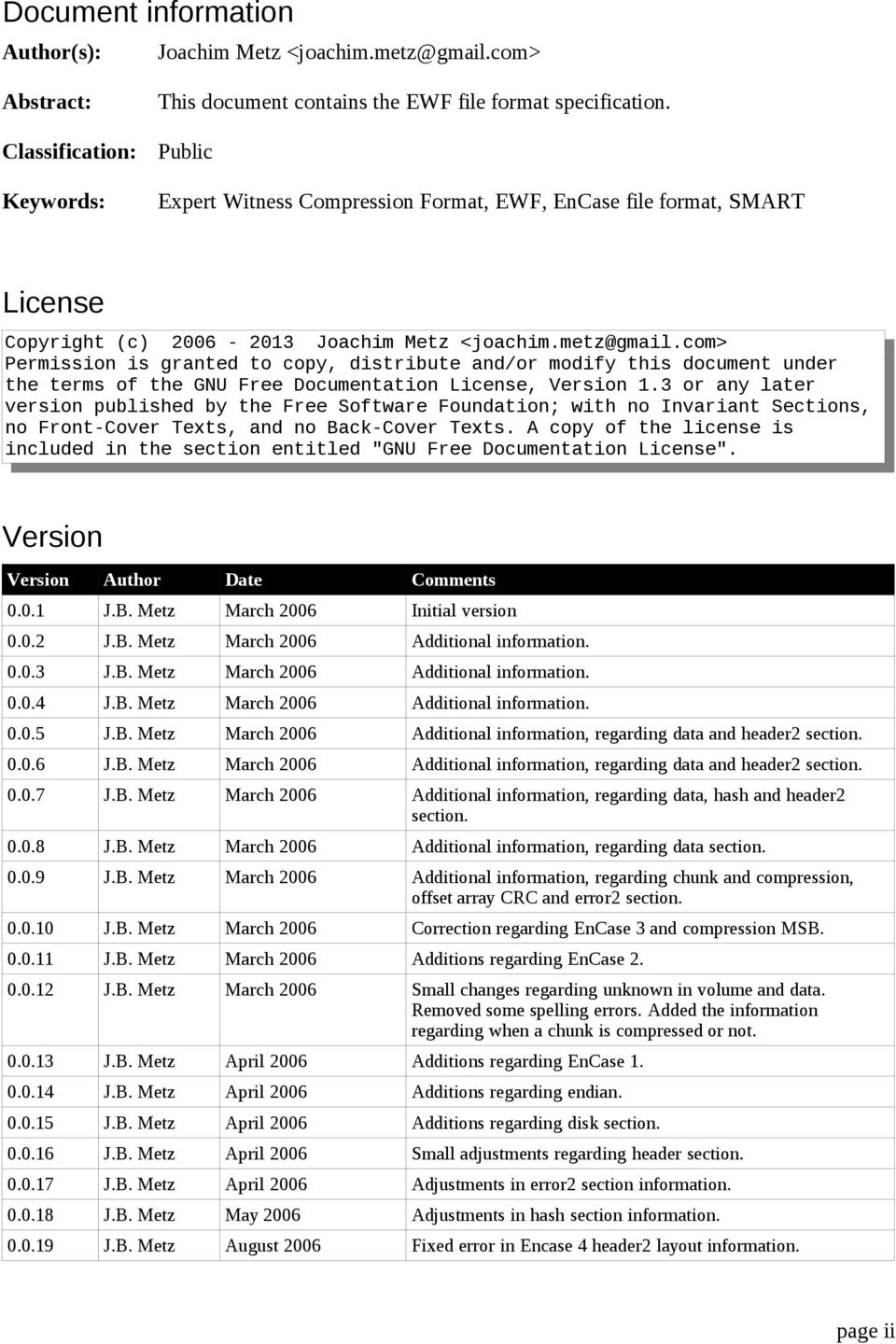
3 Document information Author(s): Joachim Metz Abstract: Classification: Keywords: This document contains the EWF file format specification. Public Expert Witness Compression Format, EWF, EnCase file format, SMART License Copyright (c) Joachim Metz Permission is granted to copy, distribute and/or modify this document under the terms of the GNU Free Documentation License, Version 1.3 or any later version published by the Free Software Foundation; with no Invariant Sections, no Front-Cover Texts, and no Back-Cover Texts. A copy of the license is included in the section entitled "GNU Free Documentation License". Version Version Author Date Comments J.B. Metz March 2006 Initial version J.B. Metz March 2006 Additional information J.B. Metz March 2006 Additional information J.B. Metz March 2006 Additional information J.B. Metz March 2006 Additional information, regarding data and header2 section J.B. Metz March 2006 Additional information, regarding data and header2 section J.B. Metz March 2006 Additional information, regarding data, hash and header2 section J.B. Metz March 2006 Additional information, regarding data section J.B. Metz March 2006 Additional information, regarding chunk and compression, offset array CRC and error2 section J.B. Metz March 2006 Correction regarding EnCase 3 and compression MSB J.B. Metz March 2006 Additions regarding EnCase J.B. Metz March 2006 Small changes regarding unknown in volume and data. Removed some spelling errors. Added the information regarding when a chunk is compressed or not J.B. Metz April 2006 Additions regarding EnCase J.B. Metz April 2006 Additions regarding endian J.B. Metz April 2006 Additions regarding disk section J.B. Metz April 2006 Small adjustments regarding header section J.B. Metz April 2006 Adjustments in error2 section information J.B. Metz May 2006 Adjustments in hash section information J.B. Metz August 2006 Fixed error in Encase 4 header2 layout information. page ii
4 Version Author Date Comments J.B. Metz August 2006 Added information regarding SMART format generated by FTK Imager. Corrected error about gzip compression in header section J.B. Metz August 2006 Added information regarding SMART format generated by FTK Imager J.B. Metz August 2006 Added information about segment file extension naming J.B. Metz September 2006 Added information about EWF-L01 (LVF) format J.B. Metz September 2006 Added information from EWF-L01 analysis J.B. Metz September 2006 Changes after comments by Guy Voncken J.B. Metz October 2006 Corrected error regarding EnCase 1 and SMART header specification J.B. Metz October 2006 Added theoretical maximum media size J.B. Metz October 2006 Additional information about section start size in EnCase (EWF-E01) next and done sections J.B. Metz November 2006 Additional information about CRC algorithm J.B. Metz November 2006 Fixed error regarding the location of the actual chunks in the EnCase 1 format, which actually is the table sections and not the sectors section J.B. Metz November 2006 Additional information about the EnCase linen 5 (EWF-E01) format J.B. Metz December 2006 Additional information about GUID J.B. Metz December 2006 Corrected error regarding header sections in EnCase 1 format J.B. Metz December 2006 Added new information regarding the table section after encountering a bug in FTK for EWF files with more than 16 * 1024 offset table entries J.B. Metz December 2006 Corrected misinterpretation of original specifications, regarding additional table sections J.B. Metz January 2007 Added information about EnCase J.B. Metz January 2007 Added information about linen J.B. Metz January 2007 Added information about EnCase6/linen6 header. Adjustments regarding media type and media flags J.B. Metz January 2007 Added information about header values J.B. Metz January 2007 Added information about EWF-X J.B. Metz August 2007 Added information about EnCase 6.7 >2Gb segment file support J.B. Metz August 2007 Added information about EnCase 6.7 >2Gb segment file support and CD/DVD image session sector J.B. Metz September 2007 Added information about EnCase 6.7 >2Gb segment file support J.B. Metz September 2007 Added page numbers J.B. Metz November 2007 Added information about session section J.B. Metz March 2008 Added information about session section J.B. Metz March 2008 Added information about EnCase 6 >2GiB segment file format J.B. Metz June 2008 Textual corrections J.B. Metz June 2008 Added information about EnCase 6.11 winen file format J.B. Metz February 2009 Added information about EnCase 6.12 SHA1 hash support and page iii

5 Version Author Date Comments header values J.B. Metz April 2009 Added information about EnCase software version header value limitation J.B. Metz April 2009 Added information about EnCase 6.13 Tableau write blocker support J.B. Metz November 2009 Small changes J.B. Metz December 2009 January 2010 Added information about ltree section J.B. Metz January 2010 Update for linen 6.12 and later J.B. Metz May 2010 Corrected amount of into number of. change J.B. Metz September 2010 Minor changes J.B. Metz September 2010 Changed CRC to checksum J.B. Metz October 2010 Additional session section information with thanks to M. Nohr Updated some tables to the newer format. Minor changes J.B. Metz November 2010 Minor changes and improvements with thanks to G. Voncken. Updated some tables to the newer format J.B. Metz December 2010 License version update Additional information about optical discs. Additional information about AD encryption J.B. Metz January 2011 Minor changes J.B. Metz February 2011 Additional audio tracks information with thanks to M. Nohr J.B. Metz May 2011 Changes to FTK imager format J.B. Metz June 2011 Updated Logical File Evidence (LVF) format flag information with thanks to B. Baron J.B. Metz September 2011 Updated Logical File Evidence (LVF) format flag information with thanks to N. Harris J.B. Metz December 2011 Small refinement in compressed vs uncompressed chunk data J.B. Metz February 2012 Added information about EnCase header values limitations thanks to G. Voncken J.B. Metz June 2012 Added information about EnCase 6.19 and 7, EWF-E01 and EWF-L01 format. change; text clean up; some corrections and additions J.B. Metz July 2012 Changes to match EWF version 2 documentation J.B. Metz July 2012 Updates regarding ltree header J.B. Metz July 2012 Updates files created by Expert Witness 1.35 (for Windows). Other small corrections J.B. Metz August 2012 Updates regarding ltree header J.B. Metz August 2012 Updates regarding incomplete section and corruption scenarios with thanks to B. Johnson for pointing out the dual image scenario J.B. Metz September 2012 Additional information regarding L01 map entry J.B. Metz January 2013 Corrected some typos, thanks to A. Bridge for pointing these out J.B. Metz March 2013 Additional information regarding Logicube created E01 files with thanks to D. Kovar and Digital Assembly LLC. page iv

6 Version Author Date Comments page v

7 Table of Contents 1. Overview Test version Segment file File header EWF, EWF-E01 and EWF-S EWF-L Segment file extensions...3 EWF-S EWF-E EWF-L The sections Section descriptor Section types Header2 section...5 EnCase EWF-E EnCase 5 to EWF-E Main...7 Sources...7 Subjects...8 EWF-L Header2 values Header section...9 EWF format...10 EnCase 1 (EWF-E01)...10 SMART (EWF-S01)...11 EnCase 2 and 3 (EWF-E01)...11 EnCase 4 to 7 (EWF-E01)...12 linen 5 to 7 (EWF-E01)...12 Main...13 Sources...14 Subjects...14 FTK Imager (EWF-E01)...15 EnCase 5 to 7 (EWF-L01)...15 Header values...15 Notes Volume section...17 EWF specification...17 SMART (EWF-S01)...18 FTK Imager, EnCase 1 to 7 and linen 5 to 7 (EWF-E01)...18 EnCase 5 to 7 (EWF-L01)...19 Media type...20 Media flags...20 Compression level Disk section Data section...21 FTK Imager, EnCase 1 to 7 and linen 5 to 7 (EWF-E01)...21 EnCase 5 to 7 (EWF-L01) Sectors section...23 page vi
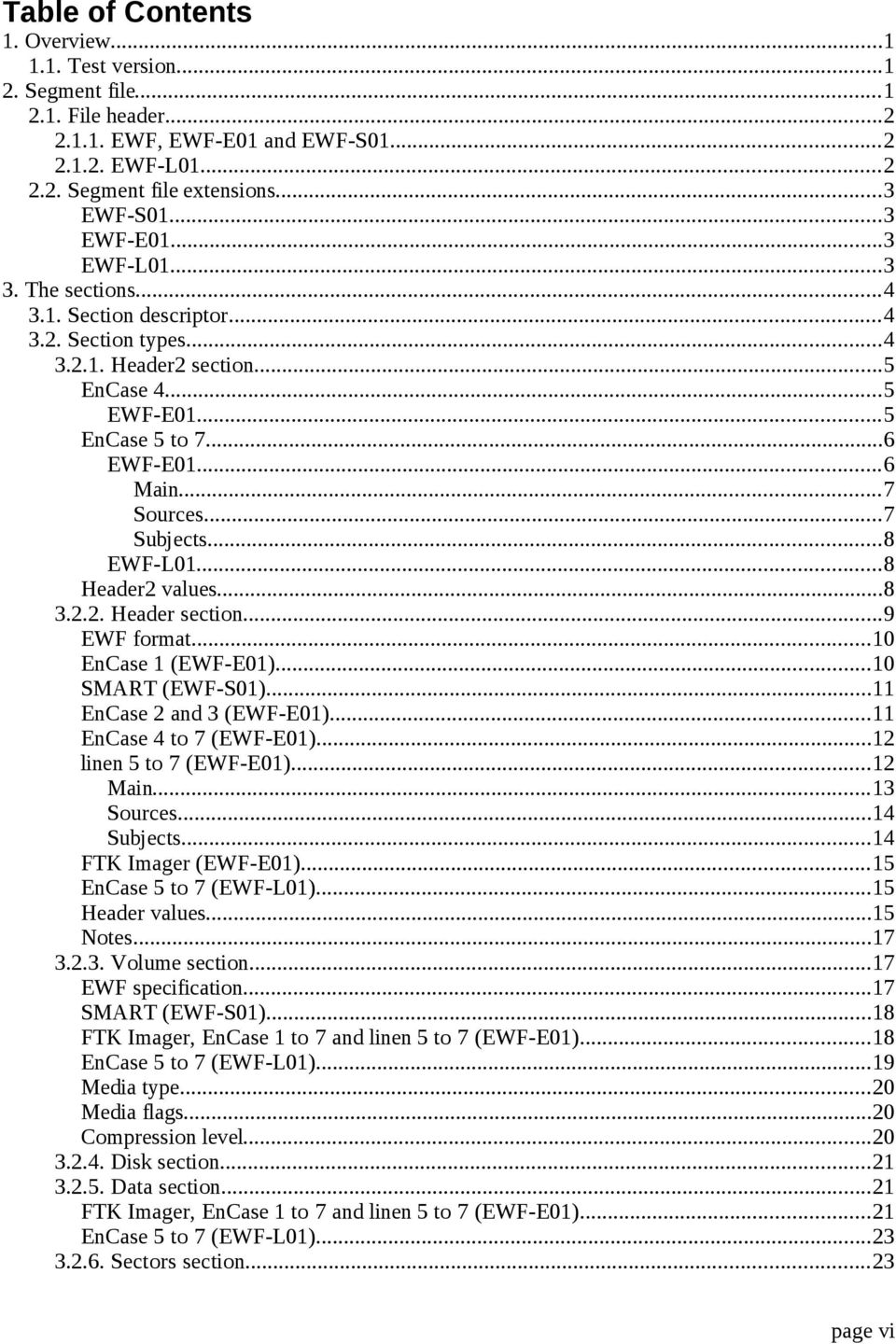
8 Data chunk...23 Optical disc images Table section...24 EWF specification...24 Table header...24 Table entry...25 Data chunk...25 SMART (EWF-S01)...25 EnCase 1 (EWF-E01)...25 Table header...26 Table entry...26 Table footer...26 Data chunk...26 FTK Imager and EnCase 2 to 5 and linen 5 (EWF-E01)...27 Table header...27 Table entry...27 Table footer...28 EnCase 6 to 7 and linen 6 to 7 (EWF-E01)...28 Table header...28 Table entry...28 Table footer...29 EnCase 6 to 7 (EWF-L01) Table2 section...29 FTK Imager and EnCase 2 to 7 and linen 5 to 7 (EWF-E01)...29 EnCase 5 to 7 (EWF-L01) Next section...29 SMART (EWF-S01)...30 FTK Imager, EnCase and linen (EWF-E01) Ltypes section Ltree section...30 Ltree header...30 Ltree data...31 Records...32 Permissions...32 Sources...32 Subjects...33 Entries...33 EnCase 5 and 6 (EWF-L01) Single file entries...35 EnCase 7 (EWF-L01) Single file entries...36 Single file entry flags Map section...37 Map string...37 Map string values...37 Map entry Session section...38 Session header...38 Session entry...38 Session flags...39 Session footer Error2 section...39 page vii
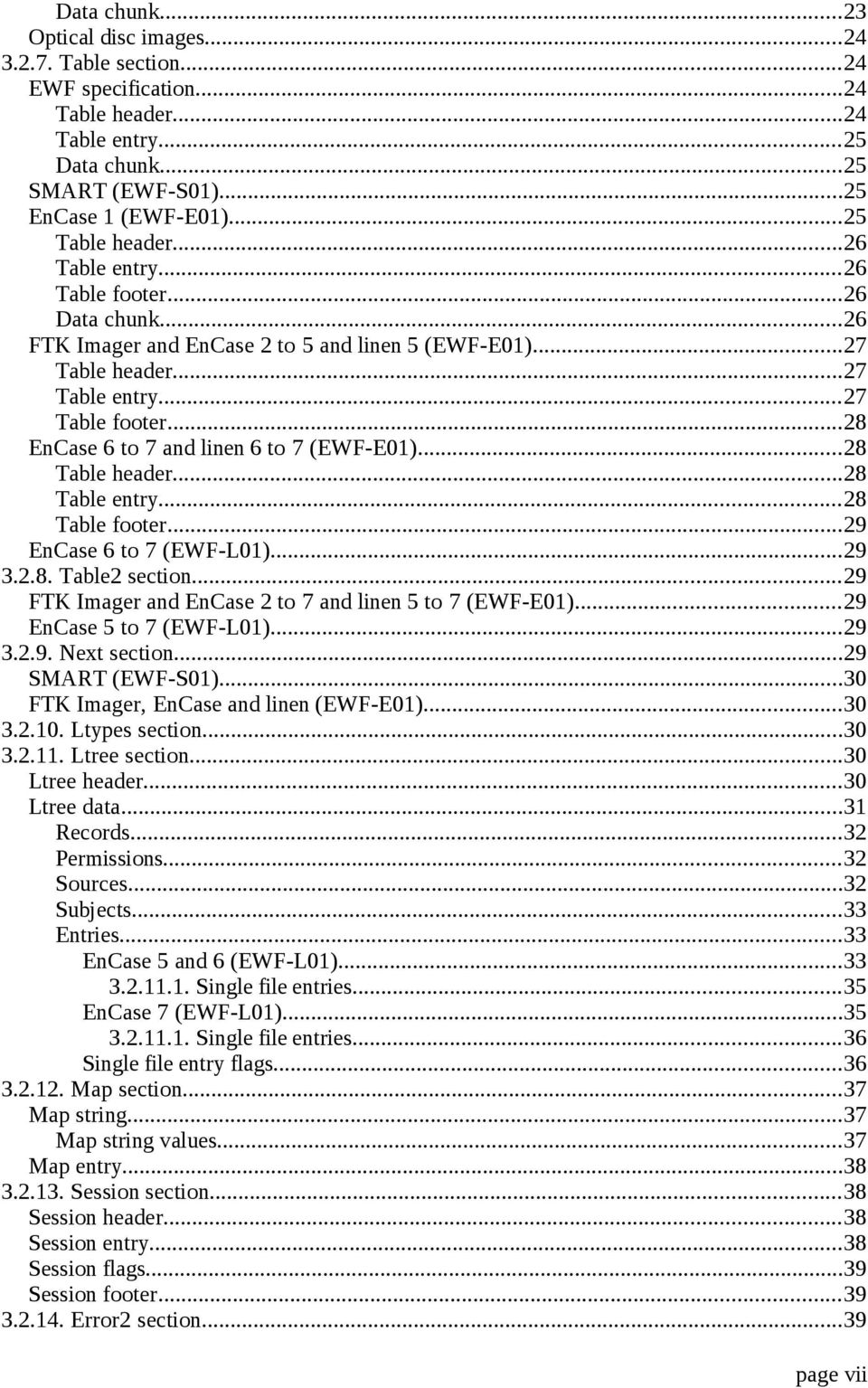
9 Error2 header...39 Error2 entry...40 Error2 footer Digest section Hash section Done section...41 SMART (EWF-S01)...41 FTK Imager, EnCase and linen (EWF-E01) Incomplete section Calculating the checksum Segment file set identifier GUID/UUID EWF-X Sections Xheader Xhash GUID Corruption scenarios Corrupt uncompressed chunk Corrupt compressed chunk Corrupt section descriptor Corrupt table section Partial segment file Missing segment file(s) Dual image: section size versus offset Table entries offset overflow Multiple incomplete segment file set identifiers Notes AD encryption Notes AD encryption Header Ltree...46 Appendix A. References...I Appendix B. GNU Free Documentation License...II page viii

10 1. Overview The Expert Witness Compression Format (EWF) is used to store media images. It allows to store disk and partition images, compressed or non-compressed. EWF can store a single image in one or more segment files. Each segment file consist of a standard header, followed by multiple sections. A single section cannot span multiple files. Sections are arranged back-to-back. Specifications In this document when referred to the EWF format it refers to the original specification by [ASR02]. The newer formats like that of EnCase are deducted from the original specification and will be referred to as the EWF-E01, because of the default file extension. Whereas the Logical File Evidence (LVF) format introduced in EnCase 5, which is also stored in the EWF format will be referred to as EWF-L01. The SMART format is viewed separately to allow for discussion if the implementation differs from the specification by [ASR02] and will be referred to as the EWF- S01, because of the default file extension. All offsets are relative to the beginning of an individual section, unless otherwise noted. EnCase allows a maximum size of a segment file to be 2000 MiB. This has to do with the size of the offset of the chunk of media data. This is a 32 bit value where the most significant bit (MSB) is used as a compression flag. Therefore the maximum offset size (31 bit) can address about 2048 MiB. In EnCase 6.7 an addition was made to the table value to provide for a base offset to allow for segment files greater than 2048 MiB. A chunk is defined as the sector size (per default 512 bytes) multiplied by the block size, the number of sectors per chunk (block) (per default 64 sectors). The data within the EWF format is stored in little-endian. The terms block and chunk are used intermittently Test version The following version of programs were used to test the information within this document: FTK Imager 2.3, 2.4, 2.51, 2.9, 3.0 (Windows) Expert Witness 1.35 (for Windows) (EnCase 1.35) EnCase 1.99l (Windows) EnCase 2.17a (DOS) EnCase 3.21b (Windows) EnCase 4.22 (Windows) EnCase 5.04a, 5.05 (Windows) EnCase 6.1, 6.7, 6.8, 6.10, 6.11, 6.12, 6.13, 6.14, 6.19 (Windows) EnCase 7.04 (Windows) Linen 5 (Linux) Linen 6.01, 6.19 (Linux) Linen 7.01 (Linux) EnCase 7 no longer provides the fast and best compression options. 2. Segment file EWF stores data in one or more segment files (or segments). Each segment file consists of: A file header. One or more sections. page 1
![Sections are arranged back-to-back. Specifications In this document when referred to the EWF format it refers to the original specification by [ASR02].](/docs-images/40/13777902/images/page_10.jpg "The newer formats like that of EnCase are deducted from the original specification and will be referred to as the EWF-E01, because of the default file extension.")
11 2.1. File header Each segment file starts with a file header. [ASR02] defines that the file header consists of 2 parts, namely: a signature part fields part EWF, EWF-E01 and EWF-S01 This is file header is defined by [ASR02] and both used by the EWF-E01 and EWF-S01 formats. The file header is 13 bytes of size and consists 0 8 Signature "EVF\x09\x0d\x0a\xff\x00" 8 1 0x01 Start of fields 9 2 Segment number Must be 1 or higher x0000 End of fields Segment number contains a number which refers to the number of the segment file, starting with 1 for the first file. Note: This means there could only be a maximum of (0xffff) files, if it is an unsigned value EWF-L01 This is file header is used by the EWF-L01 format. The file header is 13 bytes of size and consists 0 8 Signature "LVF\x09\x0d\x0a\xff\x00" 8 1 0x01 Start of fields 9 2 Segment number Must be 1 or higher x0000 End of fields Segment number contains a number which refers to the number of the segment file, starting with 1 for the first file. Note: This means there could only be a maximum of (0xffff) files, if it is an unsigned value. page 2

12 2.2. Segment file extensions Both the SMART (EWF-S01) and the EWF-E01 use a different approach for naming the segment files. EWF-S01 The EWF-S01 extension naming has two distinct parts. The first segment file has the extension '.s01'. The next segment file has the extension '.s02. This will continue up to '.s99'. After which the next segment file has the extension '.saa'. The next segment file has the extension '.sab'. This will continue up to '.saz'. The next segment file has the extension '.sba'. This will continue up to '.szz'. The next segment file has the extension '.faa'. This will continue up to '.zzz'. (verify this; and then?) It will even continue to the use the extensions '.{aa'. (not confirmed) libewf supports extensions up to.zzz EWF-E01 The EWF-E01 extension naming has two distinct parts. The first segment file has the extension '.E01'. The next segment file has the extension '.E02. This will continue up to '.E99'. After which the next segment file has the extension '.EAA'. The next segment file has the extension '.EAB'. This will continue up to '.EAZ'. The next segment file has the extension '.EBA'. This will continue up to '.EZZ'. The next segment file has the extension '.FAA'. This will continue up to '.ZZZ'. (verify this; and then?) It will even continue to the use the extensions '.[AA'. (not confirmed) libewf supports extensions up to.zzz EWF-L01 The EWF-L01 extension naming has two distinct parts. The first segment file has the extension '.L01'. The next segment file has the extension '.L02. This will continue up to '.L99'. After which the next segment file has the extension '.LAA'. The next segment file has the extension '.LAB'. This will continue up to '.LAZ'. The next segment file has the extension '.LBA'. This will continue up to '.LZZ'. The next segment file has the extension '.MAA'. page 3

13 This will continue up to '.ZZZ'. (verify this; and then?) It will even continue to the use the extensions '.[AA'. (not confirmed) libewf supports extensions up to.zzz 3. The sections The remainder of the segment file consists of sections. Every section starts with the same data this will be referred to as the section descriptor (previously referred to as section start). The section descriptor could also be referred as the section header, but this allows for unnecessary confusion with the header section Section descriptor The section descriptor consist of 76 bytes, it contains information about a specific section A string containing the section type definition. E.g. header, volume, etc Next section offset The offset is relative from the start of the segment file 24 8 Section size x00 Padding 72 4 Checksum Adler-32 of all the previous data within the section descriptor. Some sections contain additional data, refer to paragraph section types for more information. Notes: In EnCase 2 DOS version the padding itself does not contains zero byte values but data, probably the memory is not wiped. Expert Witness 1.35 (for Windows) does not set the section size Section types There are multiple section types [ASR02] defines the following: Header section Volume section Table section Next and Done section Looking at more recent EnCase file (EWF-E01) formats and [COH] additional section types were found: Header2 section Disk section Sectors section page 4

14 Table2 section Data section Errors2 section Session section Hash section Digest section Looking at the more recent EnCase file (EWF-L01) format additional section types were found: Ltree section Ltypes section Header2 section The header2 section is identified in the section data type field as header2. Some aspects of this section are: Found in EWF-E01 in EnCase 4 to 7, and EWF-L01 in EnCase 5 to 7 Found at the start of the first segment file. Not found in other segment files. The same header2 section is found twice directly after one and other. The additional data this section contains is the following Offset: number Meaning: of bytes: 76 (0x4c) (variable) Information about the acquired media. The information about the acquired media consists of zlib compressed data. It contains text in UTF16 format specifying information about the acquired media. The text multiple lines separated by an end of line character(s). The first 2 bytes of the UTF16 string are the byte order mark (BOM): 0xff 0xfe for UTF-16 litte-endian 0xfe 0xff for UTF-16 big-endian In the next paragraphs the various variants of the header2 section are described. EnCase 4 EWF-E01 In EnCase 4 the header2 information consist of 5 lines, and contains the equivalent information as the header section. Line Meaning Value number 1 The number of categories provided 1 2 The name/type of the category provided main 3 Identifiers for the values in the 4 th line 4 The data for the different identifiers in the 3 rd line 5 (an empty line) The end of line character(s) is a newline (0x0a). page 5
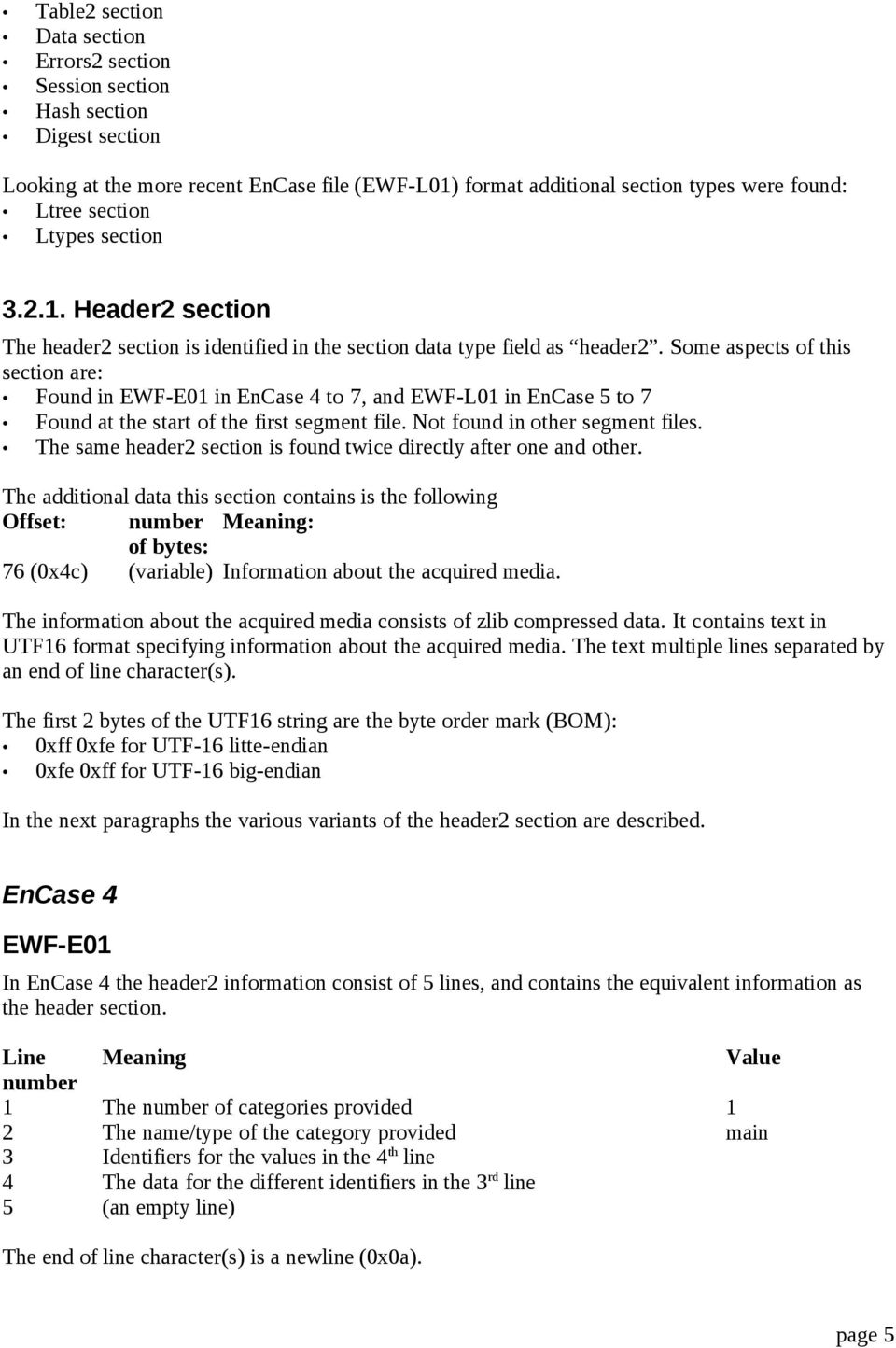
15 Note: This end of line character differs from the one used in the header section. The 3 rd and the 4 th line consist of the following tab (0x09) separated values. Identifier number Character in 3 rd line Value in 4 th line 1 a Unique description 2 c Case number 3 n Evidence number 4 e Examiner name 5 t Notes 6 av Version The EnCase version used to acquire the media 7 ov Platform The platform/operating system used to acquire the media 8 m Acquired date 9 u System date 10 p Password hash For more information see section: Header2 values Note: the hashing algorithm is the same as for the header section. EnCase 5 to 7 EWF-E01 The header2 information consist of 18 lines The remainder of the string contains the following information: Line Meaning Value number 1 The number of categories provided 3 2 The name/type of the category provided main 3 Identifier for the values in the 4 th line 4 The data for the different identifiers in the 3 rd line 5 (an empty line) 6 The name/type of the category provided srce 7 8 Identifier for the values in the category (an empty line) 12 The name/type of the category provided sub Identifier for the values in the category (an empty line) The end of line character(s) is a newline (0x0a). page 6
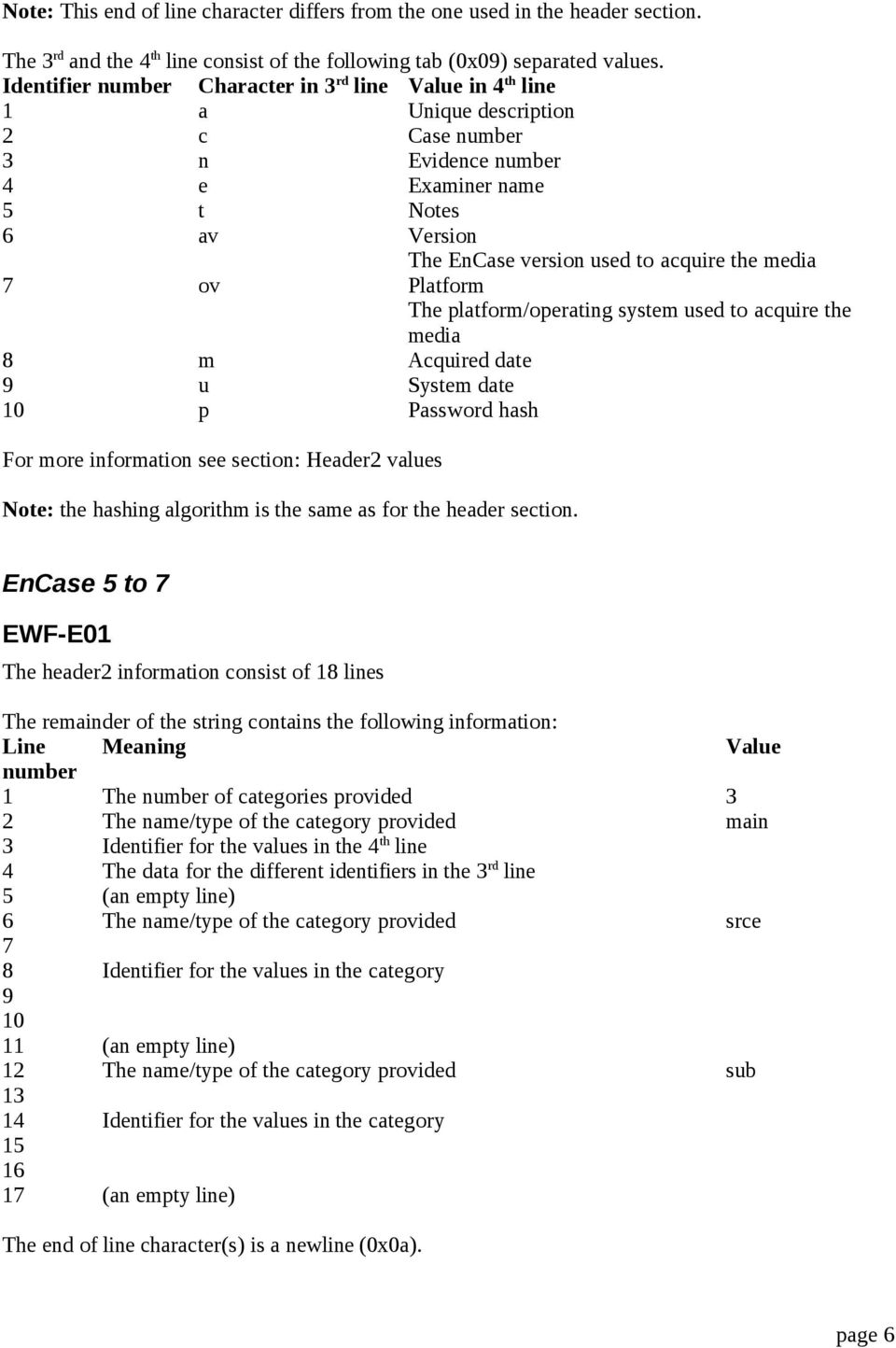
16 Main The 3 rd and the 4 th line consist of the following tab (0x09) separated values. Note that the actual values in this category are dependent on the version of EnCase 6. Identifier number Character in 3 rd line Value in 4 th line 1 a Unique description 2 c Case number 3 n Evidence number 4 e Examiner name 5 t Notes 6 md The model of the media, i.e. hard disk model (introduced in EnCase 6) 7 sn The serial number of media (introduced in EnCase 6) 8 l The device label (introduced in EnCase 6.19) 9 av Version The EnCase version used to acquire the media EnCase limits this value to 12 characters 10 ov Platform The platform/operating system used to acquire the media 11 m Acquired date 12 u System date 13 p Password hash 14 pid Process identifier The identifier of the process memory acquired (introduced in EnCase 6.12/Winen 6.11) 15 dc Unknown 16 ext Extents The extents of the process memory acquired (introduced in EnCase 6.12/Winen 6.11) Both the acquiry and system date are empty in a file created by winen. The date values in the header section (not header2) are set to: Thu Jan 1 00:00: Where the time is dependent on the time zone and daylight savings. For more information see section: Header2 values Sources Line 6 the srce category contains information about sources Line 7 consists of 2 values, namely the values are "0 1". The 8 th line consist of the following tab (0x09) separated values. Note that the actual values in this category are dependent on the version of EnCase 6. Identifier number Character in 8 th line Meaning 1 p 2 n 3 id Identifier, unique name page 7

17 Identifier number Character in 8 th line Meaning 4 ev Evidence number 5 tb Total bytes 6 lo Logical offset 7 po Physical offset 8 ah Acquire hash 9 sh Unknown (introduced in EnCase 6.19) 10 gu GUID 11 pgu Unknown (introduced in EnCase 7) 12 aq Acquire date Line 9 consists of 2 values, namely the values are "0 0". Line 10 contains the values defined by line 8. Note that the default values of some of these values has changed around EnCase Subjects Line 12 the sub category contains information about sources Line 13 consists of 2 values, namely the values are "0 1". The 14 th line consist of the following tab (0x09) separated values. Identifier number Character in 14 th line Meaning 1 p 2 n 3 id Identifier, unique name 4 nu Number 5 co Comment 6 gu GUID Line 15 consists of 2 values, namely the values are "0 0". Line 16 contains the values defined by line 14. Note that the default values of some of these values has changed around EnCase EWF-L01 The EWF-E01 header2 section specification also for the EWF-L01 format. However: both the acquired date and system date are not set Header2 values Identifier Description Notes a Unique description Free form string Note that EnCase might not respond when this value is large e.g. >= 1 MiB page 8
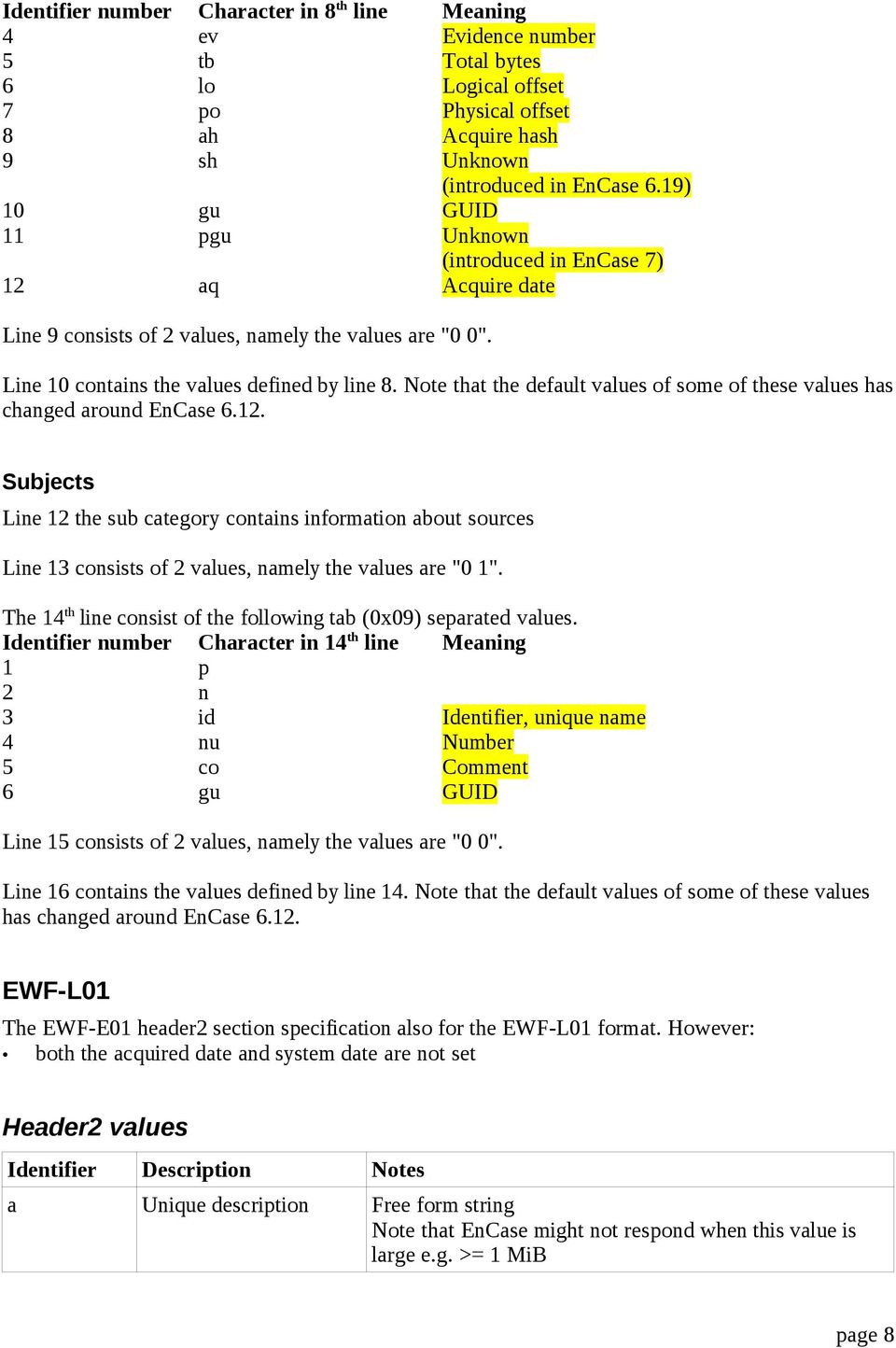
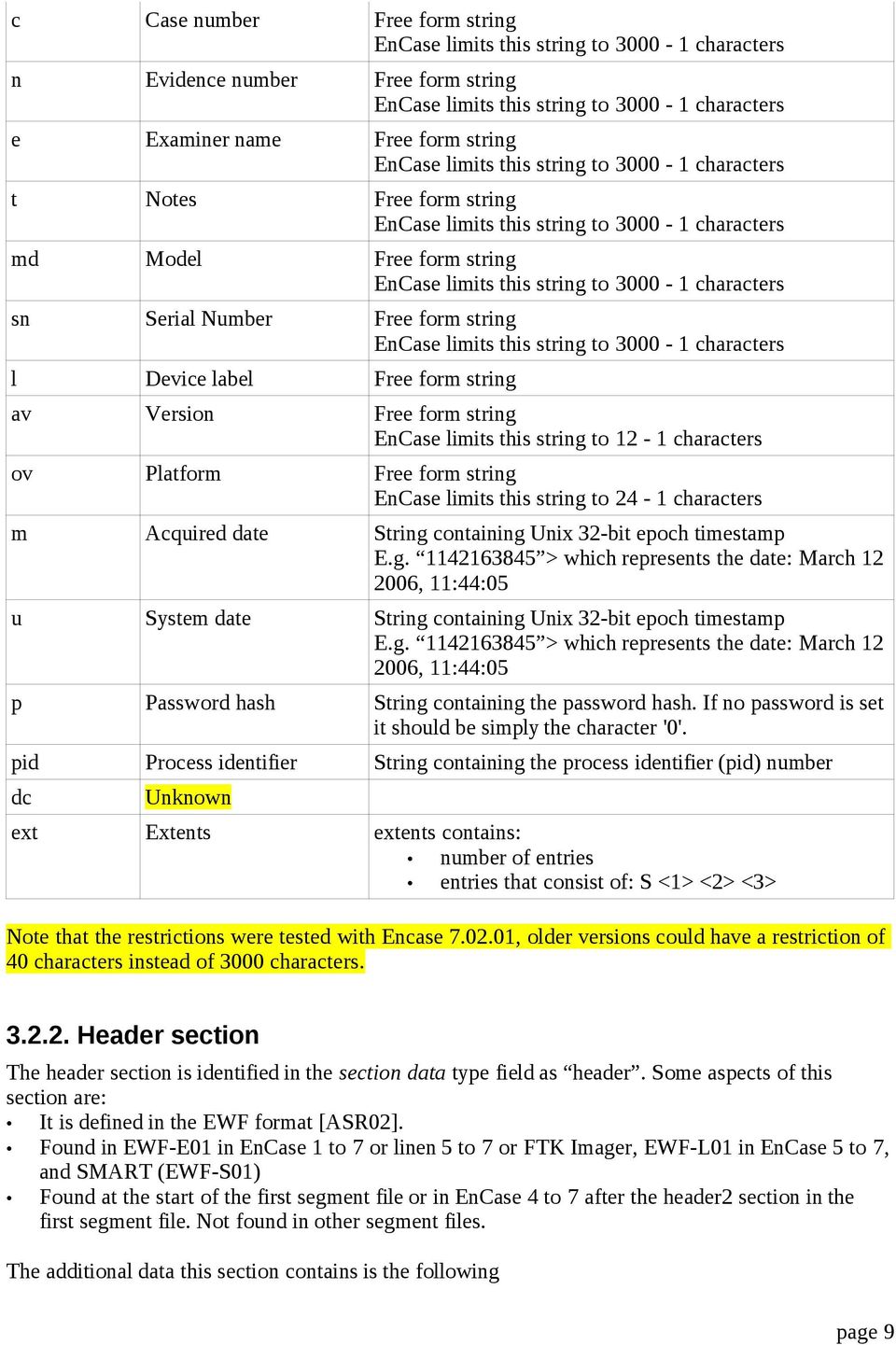
18 c Case number Free form string EnCase limits this string to characters n Evidence number Free form string EnCase limits this string to characters e Examiner name Free form string EnCase limits this string to characters t Notes Free form string EnCase limits this string to characters md Model Free form string EnCase limits this string to characters sn Serial Number Free form string EnCase limits this string to characters l Device label Free form string av Version Free form string EnCase limits this string to 12-1 characters ov Platform Free form string EnCase limits this string to 24-1 characters m Acquired date String containing Unix 32-bit epoch timestamp E.g > which represents the date: March , 11:44:05 u System date String containing Unix 32-bit epoch timestamp E.g > which represents the date: March , 11:44:05 p Password hash String containing the password hash. If no password is set it should be simply the character '0'. pid Process identifier String containing the process identifier (pid) number dc Unknown ext Extents extents contains: number of entries entries that consist of: S <1> <2> <3> Note that the restrictions were tested with Encase , older versions could have a restriction of 40 characters instead of 3000 characters Header section The header section is identified in the section data type field as header. Some aspects of this section are: It is defined in the EWF format [ASR02]. Found in EWF-E01 in EnCase 1 to 7 or linen 5 to 7 or FTK Imager, EWF-L01 in EnCase 5 to 7, and SMART (EWF-S01) Found at the start of the first segment file or in EnCase 4 to 7 after the header2 section in the first segment file. Not found in other segment files. The additional data this section contains is the following page 9
19 Offset: number Meaning: of bytes: 76 (0x4c) (variable) Information about the acquired media. The information about the acquired media consists of zlib compressed data. It contains text in ASCII format specifying information about the acquired media. The text multiple lines separated by an end of line character(s). In the next paragraphs the various variants of the header section are described. In all cases the information consists of at least the four lines: Line Meaning Value number 1 The number of categories provided 1 2 The name/type of the category provided main 3 Identifiers for the values in the 4 th line 4 The data for the different identifiers in the 3 rd line An additional 5 th line is found in FTK Imager, EnCase 1 to 7 (EWF-E01). This line is empty. Line number 5 Meaning Value EWF format Some aspects of this section are: [ASR02] specifies the end of line character(s) is a newline (0x0a). According to [ASR02] the header contains: The 3 rd and the 4 th line consist of the following tab (0x09) separated values. Identifier number Character in 3 rd line Value in 4 th line 1 c Case number 2 n Evidence number 3 a Unique description 4 e Examiner name 5 t Notes 6 m Acquired date 7 u System date 8 p Password hash 9 r Compression level For more information see section: Header values [ASR02] states that the Expert Witness Compression uses 'f', fastest compression. EnCase 1 (EWF-E01) Some aspects of this section are: The header section is defined only once. It is the first section of the first segment file. It is not found in other segment files. page 10

20 The header data itself is compressed using zlib. The end of line character(s) is a carriage return (0x0d) followed by a newline (0x0a). The header contains: The 3 rd and the 4 th line consist of the following tab (0x09) separated values. Identifier number Character in 3 rd line Value in 4 th line 1 c Case number 2 n Evidence number 3 a Unique description 4 e Examiner name 5 t Notes 6 m Acquired date 7 u System date 8 p Password hash 9 r Compression level For more information see section: Header values SMART (EWF-S01) Some aspects of this section are: The header section is defined once. It is the first section of the first segment file. It is not found in other segment files. The header data is always processed by zlib, however the same compression level is used as for the chunks. This could mean compression level 0 which is no compression. The SMART format uses the FTK Imager (EWF-E01) specification for this section. Note that this could be something FTK Imager specific. EnCase 2 and 3 (EWF-E01) Some aspects of this section are: The same header section defined twice. It is the first and second section of the first segment file. It is not found in other segment files. The header data itself is compressed using zlib. The end of line character(s) is a carriage return (0x0d) followed by a newline (0x0a). The header contains: The 3 rd and the 4 th line consist of the following tab (0x09) separated values. Identifier number Character in 3 rd line Value in 4 th line 1 c Case number 2 n Evidence number 3 a Unique description 4 e Examiner name 5 t Notes 6 av Version 7 ov Platform The platform/operating system used to acquire the media page 11

21 Identifier number Character in 3 rd line Value in 4 th line 8 m Acquired date 9 u System date 10 p Password hash 11 r Compression level For more information see section: Header values EnCase 4 to 7 (EWF-E01) Some aspects of this section are: The header is defined only once. It resides after the header2 sections of the first segment file. It is not found in other segment files. The header data itself is compressed using zlib. The end of line character(s) is a carriage return (0x0d) followed by a newline (0x0a). The header contains: The 3 rd and the 4 th line consist of the following tab (0x09) separated values. Identifier number Character in 3 rd line Value in 4 th line 1 c Case number 2 n Evidence number 3 a Unique description 4 e Examiner name 5 t Notes 6 av Version 7 ov Platform The platform/operating system used to acquire the media 8 m Acquired date 9 u System date 10 p Password hash For more information see section: Header values linen 5 to 7 (EWF-E01) Some aspects of this section are: The same header section defined twice. It is the first and second section of the first segment file. It is not found in other segment files. The header data itself is compressed using zlib. The end of line character(s) is a newline (0x0a). The header information consist of 18 lines The remainder of the string contains the following information: Line Meaning Value number 1 The number of sections provided 3 2 The name/type of the section provided main 3 Identifier for the values in the 4 th line page 12
22 Line Meaning Value number 4 The data for the different identifiers in the 3 rd line 5 (an empty line) 6 The name/type of the section provided srce 7 8 Identifier for the values in the section (an empty line) 12 The name/type of the section provided sub Identifier for the values in the section (an empty line) The end of line character(s) is a newline (0x0a). Main The 3 rd and the 4 th line consist of the following tab (0x09) separated values. Identifier number Character in 3 rd line Value in 4 th line 1 a Unique description 2 c Case number 3 n Evidence number 4 e Examiner name 5 t Notes 6 md The model of the media, i.e. hard disk model (Introduced in linen 6) 7 sn The serial number of media (Introduced in linen 6) l The device label (Introduced in linen 6.19) av ov m u p pid dc ext Version Platform The platform/operating system used to acquire the media Acquired date System date Password hash Process identifier The identifier of the process memory acquired (Introduced in linen 6.19 or earlier) Unknown (Introduced in linen 6) Extents The extents of the process memory acquired (Introduced in linen 6.19 or earlier) Note that as of linen 6.19 the acquire date (and time) is in UTC and the system date is in local time. page 13
23 Where as before both date values were in local time. For more information see section: Header values Sources Line 6 the srce category contains information about sources Line 7 consists of 2 values, namely the values are "0 1". The 8 th line consist of the following tab (0x09) separated values. Identifier number Character in 8 th line Meaning 1 p 2 n 3 id Identifier, unique name 4 ev Evidence number 5 tb Total bytes 6 lo Logical offset 7 po Physical offset 8 ah Acquire hash 9 sh Unknown (Introduced in linen 6.19 or earlier) 10 gu GUID 11 aq Acquire date Line 9 consists of 2 values, namely the values are "0 0". Line 10 contains the values defined by line 8. Note that the default values of some of these values has changed around linen 6.19 or earlier. Subjects Line 12 the sub category contains information about sources Line 13 consists of 2 values, namely the values are "0 1". The 14 th line consist of the following tab (0x09) separated values. Identifier number Character in 14 th line Meaning 1 p 2 n 3 id Identifier, unique name 4 nu Number 5 co Comment 6 gu GUID Line 15 consists of 2 values, namely the values are "0 0". Line 16 contains the values defined by line 14. Note that the default values of some of these values has changed around linen 6.19 or earlier. page 14
24 FTK Imager (EWF-E01) Some aspects of this section are: In FTK Imager (EWF-E01) the same header section defined twice. It is the first and second section of the first segment file. It is not found in other segment files. The header data itself is compressed using zlib. Note that the compression level can be none and therefore the header looks uncompressed. In FTK Imager the end of line character(s) is a newline (0x0a). In FTK Imager (EWF-E01) the header contains: The 3 rd and the 4 th line consist of the following tab (0x09) separated values. Identifier number Character in 3 rd line Value in 4 th line 1 c Case number 2 n Evidence number 3 a Unique description 4 e Examiner name 5 t Notes 6 av Version The FTK Imager version used to acquire the media 7 ov Platform The platform/operating system used to acquire the media 8 m Acquired date 9 u System date 10 p Password hash 11 r char For more information see section: Header values EnCase 5 to 7 (EWF-L01) The EWF-E01 header section specification also for the EWF-L01 format. However: In EnCase 5 both the acquired date and system date are set to 0. In EnCase 6 and 7 both the acquired date and system date are set to Jan 1, :00:00 (the time is dependent on the local timezone and daylight savings) Header values Identifier Description Notes a Unique description Free form string Note that EnCase might not respond when this value is large e.g. >= 1 MiB c Case number Free form string EnCase limits this string to characters n Evidence number Free form string EnCase limits this string to characters e Examiner name Free form string EnCase limits this string to characters page 15
25 t Notes Free form string EnCase limits this string to characters md Model Free form string EnCase limits this string to characters sn Serial Number Free form string EnCase limits this string to characters l Device label Free form string av Version Free form string EnCase limits this string to 12-1 characters ov Platform Free form string EnCase limits this string to 24-1 characters m Acquired date In EnCase: String containing a date and time value E.g , which represents March 4, :19:59. In linen: String containing Unix 32-bit epoch timestamp E.g > which represents the date: March , 11:44:05 u System date In EnCase: String containing a date and time value E.g , which represents March 4, :19:59. In linen: String containing Unix 32-bit epoch timestamp E.g > which represents the date: March , 11:44:05 p Password hash String containing the password hash. If no password is set it should be simply the character '0'. pid Process identifier String containing the process identifier (pid) number dc Unknown ext Extents extents contains: number of entries entries that consist of: S <1> <2> <3> r Compression Single character that represent the compression level Note that the restrictions were tested with Encase , older versions could have a restriction of 40 characters instead of 3000 characters. Value of char b f n Meaning Best compression is used Fastest compression is used No compression is used page 16
26 Notes Note: there should not be tab, carriage return and newline characters within the text in the 4 th line. Or is there a method to escape these characters? [ASR02] states that these characters should not be used in the free form text. Need to confirm this, the specification only speaks of a newline character. Note: currently the password has no a additional value than allow an application check it. The data itself is not protected using the password. The password hashing algorithm is unknown. Need to find out. And does the algorithm differ per EnCase version? probably not. The algorithm does not differ in EnCase 1 to 7. FTK Imager does not bother with a password Volume section The volume section is identified in the section data type field as volume. Some aspects of this section are: Defined in the EWF format [ASR02]. Found in EWF-E01 in EnCase 1 to 7 or linen 5 to 7 or FTK Imager, EWF-L01 in EnCase 5 to 7, and SMART (EWF-S01) Found after the header section of the first segment file. Not found in other segment files. In the next paragraphs the various versions of the volume section are described. EWF specification The specification according to [ASR02]. The additional volume section data is 94 bytes of size and consists of: 0 4 Reserved according to [ASR02] Contains 0x01 Reserved for what? 4 4 The chunk count Contains the number of chunks within the all segment files. 8 4 The number of sectors per chunk Contains 64 per default The number of bytes per sectors Contains 512 per default 16 4 The sectors count, the number of sectors within all segment files x00 Reserved Reserved for what? x00 Padding 85 5 Signature (Reserved) Contains the EWF file header signature 90 4 Checksum page 17
27 Adler-32 of all the previous data within the additional volume section data. The chunk count is a 32-bit value this means it maximum of addressable chunks would be: (= 2^32 1). For a chunk size of x = about 127 Tb. The maximum segment file amount is 2^16-1 = This allows for an equal number of storage if a segment file is filled to its maximum number of chunks. However libewf is restricted at segment files, due to the extension naming schema of the segment files. SMART (EWF-S01) The SMART format uses the EWF specification for this section. In SMART the signature (reverse) value is the string SMART (0x53 0x4d 0x41 0x52 0x54) instead of the file header signature. FTK Imager, EnCase 1 to 7 and linen 5 to 7 (EWF-E01) The specification for FTK Imager, EnCase 1 to 7 and linen 5 to 7. The additional volume section data is 1052 bytes of size and consists of: 0 1 Media type See section: Media type 1 3 0x00 Unknown (empty values) 4 4 The chunk count Contains the number of chunks within the all segment files. 8 4 The number of sectors per chunk (or block size) Contains 64 per default. EnCase 5 is the first version which allows this value to be different than The number of bytes per sector 16 8 The sectors count Contains the number of sectors within all segment files This value probably has been changed in EnCase 6 from a 32-bit value to a 64-bit value to support media >2TiB 24 4 The number of cylinders of the C:H:S value Most of the time this value is empty (0x00) 28 4 The number of heads of the C:H:S value page 18
28 Most of the time this value is empty (0x00) 32 4 The number of sectors of the C:H:S value Most of the time this value is empty (0x00) 36 1 Media flags See section: Media flags x00 Unknown (empty values) 40 4 PALM volume start sector x00 Unknown (padding/empty values) 48 4 SMART logs start sector Contains an offset relative from the end of media E.g. a value of 10 would refer to sector = number of sectors Compression level (Introduced in EnCase 5) See section: Compression level x00 Unknown (empty values) these values seem to be part of the compression type 56 4 The sector error granularity Contains the error block size (Introduced in EnCase 5) x00 Unknown (empty values) Segment file set identifier Contains a GUID/UUID generated on the acquiry system probably used to uniquely identify a set of segment files (Introduced in EnCase 5) Unknown (padding/empty values) Signature (Reserved) Contains 0x Checksum Adler-32 of all the previous data within the additional volume section data. A value that could be in the volume is the raid stripe size EnCase requires for media that contains no partition table that the is physical media flag is not set and vice versa. FTK checks the media data. EnCase 5 to 7 (EWF-L01) The EWF-L01 format uses the EnCase 5 (EWF-E01) volume section specification. However: page 19
29 the volume type contains 0x0e the number of chunks is 0 The number of bytes per sectors is some kind of block size value (4096), perhaps the source file system block size The sectors count, represents some other value because ( sector_size * sector_amount!= total_size ) the total size is in the ltree section Media type Value Identifier Description 0x00 A removable storage media device 0x01 A fixed storage media device 0x03 An optical disc (CD/DVD/BD) 0x0e Logical Evidence File (LEV or L01) 0x10 Physical Memory (RAM) FTK imager versions, before 2.9?, set the storage media to fixed (0x01). Media flags Value Identifier Description 0x01 0x02 0x04 0x08 Is an image file in FTK Imager, EnCase 1 to 7 this bit is always set, when not set EnCase seems to see the image file as a device Is physical device or device type 0 => a non physical device (logical) 1 => a physical device Fastbloc write blocker used Tableau write blocker used This was added in EnCase 6.13 If both the the Fastbloc and Tableau write blocker media flags are set EnCase only shows the Fastbloc. Compression level Value Identifier Description 0x00 no compression 0x01 good compression 0x02 best compression page 20
30 Disk section The disk section is identified in the section data type field as disk. Some aspects of this section are: Not defined in the EWF format [ASR02]. Not found in SMART (EWF-S01). It is found in FTK Imager, EnCase 1 to 7 and linen 5 to 7 (EWF-E01) files. According to [COH] the disk section is the same as the volume section. This was confirmed with a disk section in an FTK Imager 2.3 (EWF-E01) image. Note: the disk was found only in FTK Imager 2.3 when acquiring a physical disk not a floppy. This requires additional research. Is the disk section some old method to differentiate between a partition (volume) image or a physical disk image? Data section The data section is identified in the section data type field as data. Some aspects of this section are: It is not defined in the EWF format [ASR02]. Found in EWF-E01 in EnCase 1 to 7 or linen 5 to 7 or FTK Imager, and EWF-L01 in EnCase 5 to 7. Not found in SMART (EWF-S01). For multiple segment files it does not reside in the first segment file. For a single segment file it does. Found after the last table2 section in a single segment file or for multiple segment files at the start of the segment files, except for the first. The data section has data it should should contain the same information as the volume section. FTK Imager, EnCase 1 to 7 and linen 5 to 7 (EWF-E01) The additional data section data is 1052 bytes of size and consists of: 0 1 Media type See section: Media type 1 3 0x00 Unknown (empty values) 4 4 The chunk count Contains the number of chunks within the all segment files. 8 4 The block size (number of sectors per chunk) Contains 64 per default. EnCase 5 is the first version which allows this value to be different than The number of bytes per sector 16 8 The sectors count Contains the number of sectors within all segment files This value probably has been changed in page 21
31 EnCase 6 from a 32-bit value to a 64-bit value to support media >2TiB 24 4 The number of cylinders of the C:H:S value Most of the time this value is empty (0x00) 28 4 The number of heads of the C:H:S value Most of the time this value is empty (0x00) 32 4 The number of sectors of the C:H:S value Most of the time this value is empty (0x00) 36 1 Media flags See section: Media flags x00 Unknown (empty values) 40 4 PALM volume start sector x00 Unknown (padding/empty values) 48 4 SMART logs start sector Contains an offset relative from the end of media E.g. a value of 10 would refer to sector = number of sectors Compression level (Introduced in EnCase 5) See section: Compression level x00 Unknown (empty values) these values seem to be part of the compression type 56 4 The sector error granularity Contains the error block size (Introduced in EnCase 5) x00 Unknown (empty values) Segment file set identifier Contains a GUID/UUID generated on the acquiry system probably used to uniquely identify a set of segment files (Introduced in EnCase 5) Unknown (padding/empty values) Signature (Reserved) Contains 0x Checksum Adler-32 of all the previous data within the additional data section data. Notes: In Logicube products (Talon, Forensic dossier) the checksum is not calculated and set to 0. page 22
32 EnCase 5 to 7 (EWF-L01) The EWF-L01 format uses the EnCase 5 (EWF-E01) data section specification. However: the data type contains 0x0e the number of chunks is 0 The number of bytes per sectors is some kind of block size value (4096), perhaps the source file system block size The sectors count, represents some other value because ( sector_size * sector_amount!= total_size ) the total size is in the ltree section Sectors section The sectors section is identified in the section data type field as sectors. Some aspects of this section are: Not defined in the EWF format [ASR02]. Found in EWF-E01 in EnCase 2 to 7, or linen 5 to 7 or FTK Imager, EWF-L01 in EnCase 5 to 7. Not found in EnCase 1 (EWF-E01) or SMART (EWF-S01). The first sectors section can be found after the volume section in the first segment file or at the after the data section in other segment files. Successive sector data sections are found after the sector table2 section. The sectors section contains the actual chunks of media data. The sectors section can contain multiple chunks. The default size of a chunk is 32k byte of data (64 standard sectors, with a size of 512 bytes per sector). It is possible in EnCase 5 and 6 and linen 5 and 6 to change the number of sectors per block to 64, 128, 256, 1024, 2048, 4096, 8192, or In EnCase 7 and linen 7 this has been reduced to 64, 128, 256, When the evidence file is compressed a segment file can contain, at the same time, both compressed and uncompressed chunks. If the compressed data (with checksum) is larger than the uncompressed data (without the checksum) the chunk is left uncompressed. The first chunk is often located directly after the section descriptor, although the format does not require this. Data chunk A data chunk is variable of size and consists of: 0... Chunk data compressed chunk of the storage media data... 4 Checksum Adler-32 of the chunk data Note that a compressed chunk data the checksum actually is part of the deflate/rfc1951 data Chunk data contains either compressed or uncompressed data, the size of chunk data should not be larger then the default chunk size. page 23
33 Optical disc images For a MODE-1 CD-ROM optical disc image EnCase only seems to support 2048 bytes per sector (the data). The raw sector size of a MODE-1 CD-ROM is 2352 bytes of size and consists of: 0 16 Synchronization bytes Data Error detection Empty values Error correction TODO Mode-2 and Mode-XA Table section The table section is identified in the section data type field as table. Some aspects of this section are: Defined in the EWF format [ASR02]. Found in EWF-E01 in EnCase 1 to 7 or linen 5 to 7 or FTK Imager, EWF-L01 in EnCase 5 to 7, and SMART (EWF-S01) Note that the offsets within the section descriptor are 8 bytes (64 bits) of size while the offsets in the table entry array are 4 bytes (32 bits) of size. In the next paragraphs the various versions of the table section are described. EWF specification Some aspects of this section are: The first table section resides after the volume section in the first segment file or after the file header in other segment files. It can be found in every segment file. The table section consists of: the table header an array of table entries the data chunks Table header The table header is 24 bytes of size and consists of: 0 4 The number of entries Note that according to [ASR02] it contains 0x01 page 24
34 4 16 0x00 Padding 20 4 Checksum Adler-32 of all the previous data within the additional volume section data. According to [ASR02] the table can hold entries if more entries are required an additional table section should be created. Table entry The table entry is 4 bytes of size and consists of: 0 4 Chunk data offset The most significant bit (MSB) in the chunk data offset indicates if the chunk is compressed (1) or uncompressed (0). A chunk data offset points to the start of the chunk of media data, which resides in the same table section within the segment file. The offset contains a value relative to the start of the file. Data chunk A data chunk is variable of size and consists of: 0... Chunk data compressed chunk of the storage media data... 4 Checksum Adler-32 of the chunk data Note that a compressed chunk data the checksum actually is part of the deflate/rfc1951 data The default size of a chunk is 32k byte of data (64 standard sectors). A chunk is always processed by deflate even when no compression is required. This provides for a checksum for each chunk. Therefore the size of a chunk data can be larger than the default chunk size. This however was deducted from the behavior of FTK Imager for EWF-S01 SMART (EWF-S01) The SMART format uses the EWF specification for this section. EnCase 1 (EWF-E01) Some aspects of this section are: The table section resides after the volume section in the first segment file or after the file header page 25
35 in other segment files. It can be found in every segment file. The table section consists of: the table header an array of table entries the table footer the data chunks Table header The table header is 24 bytes of size and consists of: 0 4 The number of entries x00 Padding 20 4 Checksum Adler-32 of all the previous data within the additional volume section data. The table can hold entries if more entries are required an additional table section should be created. Table entry The table entry is 4 bytes of size and consists of: 0 4 Chunk data offset The most significant bit (MSB) in the chunk data offset indicates if the chunk is compressed (1) or uncompressed (0). A chunk data offset points to the start of the chunk of media data, which resides in the same table section within the segment file. The offset contains a value relative to the start of the file. Table footer The table footer is 4 bytes of size and consists of: 0 4 Checksum Adler-32 of the offset array Data chunk A data chunk is variable of size and consists of: 0... Chunk data page 26
36 compressed chunk of the storage media data... 4 Checksum Adler-32 of the chunk data Note that a compressed chunk data the checksum actually is part of the deflate/rfc1951 data Chunk data contains either compressed or uncompressed data, the size of chunk data should not be larger then the default chunk size. The default size of a chunk is 32k byte of data (64 standard sectors). FTK Imager and EnCase 2 to 5 and linen 5 (EWF-E01) Some aspects of this section are: The table section resides after the sectors section. It can be found in every segment file. The data chunks are no longer stored in this section but in the sectors section instead. The table2 section contains a mirror copy of the table section. In EWF-E01 it is always present. The table section consists of: the table header an array of table entries the table footer Table header The sector table header is 24 bytes of size and consists of: 0 4 The number of entries x00 Padding 20 4 Checksum Adler-32 of all the previous data within the additional volume section data. The table section can hold entries. A new table section should be created to hold more entries. Both FTK Imager and EnCase 5 can handle more than 16375, FTK 1 cannot. To contain more than chunks new sectors, table and table2 sections need to be created after the table2 section. Table entry The table entry is 4 bytes of size and consists of: 0 4 Chunk data offset The most significant bit (MSB) in the chunk data offset indicates if the chunk is compressed (1) or page 27
37 uncompressed (0). A chunk data offset points to the start of the chunk of media data, which resides in the preceding sectors section within the segment file. The offset contains a value relative to the start of the file. Table footer The table footer is 4 bytes of size and consists of: 0 4 Checksum Adler-32 of the offset array EnCase 6 to 7 and linen 6 to 7 (EWF-E01) Some aspects of this section are: Every segment file contains its own table section. It resides after the sectors section. The data chunks are no longer stored in this section but in the sectors section instead. The table2 section contains a mirror copy of the table section. In EWF-E01 it is always present. The table section consists of: the table header an array of table entries the table footer Table header The sector table header is 24 bytes of size and consists of: 0 4 The number of entries 4 4 0x00 Padding 8 8 The table base offset x00 Padding 20 4 Checksum Adler-32 of all the previous data within the additional volume section data. As of EnCase 6 the number of entries is no longer restricted to entries. The new limit seems to be Table entry The table entry is 4 bytes of size and consists of: 0 4 Chunk data offset page 28
38 The most significant bit (MSB) in the chunk data offset indicates if the chunk is compressed (1) or uncompressed (0). A chunk data offset points to the start of the chunk of media data, which resides in the preceding sectors section within the segment file. The offset contains a value relative to the start of the file. In EnCase the sectors section can be larger than 2048Mb. The table entries offsets are 31 bit values in EnCase6 the offset in a table entry value will actually use the full 32 bit if the 2048Mb has been exceeded. This behavior is no longer present in EnCase 6.8 so it is assumed to be a bug. Libewf currently assumes that the if the 31 bit value overflows the following chunks are uncompressed. This allows EnCase faulty EWF files to be converted by libewf. Table footer The table footer is 4 bytes of size and consists of: 0 4 Checksum Adler-32 of the offset array EnCase 6 to 7 (EWF-L01) The EWF-L01 format uses the EnCase 6 to 7 (EWF-E01) table section specification Table2 section The table2 section is identified in the section data type field as table2. Some aspects of this section are: Not defined in the EWF format [ASR02]. Found in EWF-E01 in EnCase 2 to 7, or linen 5 to 7 or FTK Imager, EWF-L01 in EnCase 5 to 7. Not found in EnCase 1 (EWF-E01) or SMART (EWF-S01). Uses the same format as the table section. Resides directly after the table section. FTK Imager and EnCase 2 to 7 and linen 5 to 7 (EWF-E01) The table2 section contains a mirror copy of the table section. Probably intended for recovery purposes. EnCase 5 to 7 (EWF-L01) The EWF-L01 format uses the EWF-E01 table2 section specification Next section The next section is identified in the section data type field as next. Some aspects of this section are: Defined in the EWF format [ASR02]. Found in EWF-E01 in EnCase 1 to 7 or linen 5 to 7 or FTK Imager, EWF-L01 in EnCase 5 to 7, page 29
39 and SMART (EWF-S01) The last section within a segment other than the last segment file. The offset to the next section in the section descriptor of the next section point to itself (the start of the next section). It should be the last section in a segment file, other than the last segment file. SMART (EWF-S01) It resides after the table or table2 section. FTK Imager, EnCase and linen (EWF-E01) It resides after the data section in a single segment file or for multiple segment files after the table2 section. In the EnCase (EWF-E01) format the size in the section descriptor is 0 instead of 76 (the size of the section descriptor). Note that FTK imager versions, before 2.9?, set the section size to Ltypes section The ltypes section is identifier in the section data type field as ltypes. Some aspects of this section are: Found in EWF-L01 in of EnCase 7 Found in the last segment file after table2 section before tree section. The additional ltypes section data is 6 bytes of size and consists of: 0 2 Unknown 2 2 Unknown 4 2 Unknown Ltree section The ltree section is identifier in the section data type field as ltree. Some aspects of this section are: Found in EWF-L01 in of EnCase 5 to 7 Found in the last segment file after ltypes section and before data section. The ltree section consists of: ltree header ltree data Ltree header The ltree header is 6 bytes of size and consists of: page 30
40 0 16 Integrity hash Contains the MD5 of the ltree data 16 4 Data size 20 4 Unknown (empty values) 24 4 Checksum Adler-32 of all the data within the ltree header where the checksum value itself is zeroed out Unknown (empty values) Ltree data The ltree data string consists of an UTF-16 little-endian encoded string without the UTF-16 endian byte order mark. The ltree data string contains the following information: Line Meaning Value number 1 The number of sections provided 5 2 Probably the type of information provided rec 3 Identifier for the values in the 4 th line 4 The data for the different identifiers in the 3 rd line 5 (an empty line) 6 Information about single file permissions perm 7 8 Identifier for the values in the section (an empty line) 14 Probably the type of information provided (the data source) srce Identifier for the values in the section (an empty line) 22 Probably the type of information provided sub Identifier for the values in the section (an empty line) 27 Information about single file entries entry Identifier for the values in the section 30 The entries of files and directories... (an empty line) page 31
41 Note that the actual line numbering can vary. The end of line character(s) is a newline (0x0a). Records The rec category contains information about records. The 3 rd and the 4 th line consist of the following tab (0x09) separated values. Identifier number Character in 3 rd line Value in 4 th line 1 tb Total bytes The size of the logical file data (media data) 2 cl Clusters??? 3 n Unknown (introduced in EnCase 6.19) 4 fp Unknown (introduced in EnCase 7) 5 pg Unknown (introduced in EnCase 7) 6 lg Unknown (introduced in EnCase 7) 7 ig Unknown (introduced in EnCase 7) Permissions The perm section contains information about single file permissions. Line 6 consist of perm Line 7 consists of 2 values. The 8 th line consist of the following tab (0x09) separated values. Identifier number Character in 8 th line Meaning 1 p 2 n Name 3 s NT security identifier (SID) 4 pr Property 5 nta NT permission (ACE)??? 6 nti Permission??? 7 nts Permission??? (Removed in EnCase 6) Property: (2 => allow, empty => owner, 1 => group) Sources Line 12 the srce category contains information about sources page 32
42 Line 13 consists of 2 values, namely the values are "0 1". The 14 th line consist of the following tab (0x09) separated values. Identifier number Character in 9 th line Meaning 1 p Unknown 2 n Unknown 3 id Identifier, unique name 4 ev Evidence number 5 tb Total bytes 6 lo Logical offset -1 when not set 7 po Physical offset -1 when not set 8 ah Acquire hash 9 sh Unknown (introduced in EnCase 6.19) 10 gu GUID 11 pgu Unknown (introduced in EnCase 7) 12 aq Acquire date Acquire date is in the form of: , which is a Unix epoch time stamp and represents the date: March , 11:44:05. Subjects sub probably are subjects within EnCase The 21 th line consist of the following tab (0x09) separated values. Identifier number Character in 15 th line Meaning 1 p Unknown 2 n Unknown 3 id Identifier, unique name 4 nu Number 5 co Comment 6 gu GUID Entries EnCase 5 and 6 (EWF-L01) The 29 th line consist of the following tab (0x09) separated values. Identifier number Character in 29 th line Meaning 1 p Is parent 1 => if the single file entry is a directory (null) => if single file entry is a file 2 n Name 3 id Unknown 4 opr Flags See section: Single file entry flags 5 src Possible the source identifier page 33
43 Identifier number Character in 29 th line Meaning 6 sub Possible the subject identifier 7 cid Unknown 8 jq Unknown 9 cr Creation date 10 ac Access date (precision is date only) 11 wr (File) modification (last written) date 12 mo (File system) entry modification date 13 dl Unknown 14 aq Unknown 15 ha Hash The MD5 hash of the file data 16 ls File size The file size specified in bytes If the file size is 0 the data size should be 1 17 du Duplicate data offset Relative from the start of the media data 18 lo Unknown 19 po The segment file in which the start of the data is stored, -1 for a single segment file? 20 mid Unknown (identifier?) (introduced in EnCase 6.19) 21 cfi Unknown (introduced in EnCase 6.14) 22 be Contains 3 values separated by a space: Unknown Offset Size Where: unknown always 1 (number of extents?) data offset, relative from the start of the media data data size The offset and size are specified in hexadecimal values. Contains 1 value for the first single file entry. 23 pm permissions index? -1 has a special meaning? 24 lpt Unknown (introduced in EnCase 6.19) Creation date, Access date and Last written date are in the form of: , which is a Unix epoch time stamp and represents the date: March , 11:44:05. Hash consist of a MD5 hash string. Only file entries are hashed. If the ha value contains this means the MD5 hash is not set. page 34
44 Single file entries The entries of files and directories consist of entries starting with: 0 followed by the number of sub file entries. The entries of files and directories: Line Meaning Value number 1 The root directory (empty) 2 The target drive/mount point 3 The actual single file entries EnCase 7 (EWF-L01) The 29 th line consist of the following tab (0x09) separated values. Identifier number Character in 29 th line Meaning 1 mid Unknown (identifier?) 2 ls File size The file size specified in bytes If the file size is 0 the data size should be 1 3 be Contains 3 values separated by a space: Unknown Offset Size Where: unknown always 1 (number of extents?) data offset, relative from the start of the media data data size The offset and size are specified in hexadecimal values. Contains 1 value for the first single file entry. 4 id Unknown 5 cr Creation date 6 ac Access date 7 wr (File) modification (last written) date 8 mo (File system) entry modification date 9 dl Unknown 10 sig Unknown (Introduced in EnCase 7) 11 ha Hash The MD5 hash of the file data 12 sha SHA1 hash Judging by the size this value is assumed to be the SHA1 hash of the file data, does not seem to be currently set by EnCase (Introduced in EnCase 7) 13 p Is parent 1 => if the single file entry is a directory (null) => if single file entry is a file 14 n Name page 35
45 Identifier number Character in 29 th line Meaning 15 du Duplicate data offset Relative from the start of the media data 16 lo Unknown 17 po The segment file in which the start of the data is stored, -1 for a single segment file? 18 pm permissions index? -1 has a special meaning? 19 oes Unknown (Introduced in EnCase 7) 20 opr Flags See section: Single file entry flags 21 src Possible the source identifier 22 sub Possible the subject identifier 23 cid Unknown 24 jq Unknown 25 alt Unknown (Introduced in EnCase 7) 26 ep Unknown (Introduced in EnCase 7) 27 aq Unknown 28 cfi Unknown 29 sg Unknown (Introduced in EnCase 7) 30 lpt Unknown If the ha value contains this means the MD5 hash is not set. The same applies for the sha value when it contains the SHA1 has is not set Single file entries The entries of files and directories consist of entries starting with: 26 followed by the number of sub file entries. The entries of files and directories: Line Meaning Value number 1 The root directory LogicalEntries 2 The target drive/mount point 3 The actual single file entries Single file entry flags Value Identifier Description 0x Archive 0x is file? page 36
46 Value Identifier Description 0x x x Data is sparse See remarks below. If the sparse data flag is set: the data size should be 1 and data should consist of a single byte value. the data size should be equal to the file size and data should be the same. If the duplicate data offset value is not set the single byte value in the data should be used to reconstruct the file data. E.g. if the file size is 4096 and the data contains the byte value 0x00 the resulting file should consists of 4096 x 0x00 byte values. If the duplicate data offset value is set the single byte in the data is ignored and the duplicate data offset refers to the location where the data stored Map section Some aspects of this section are: Found in EWF-L01 in of EnCase 7 (First seen in EnCase ) Found in the last segment file after data section before done section. The map consists of: map string map entries array Map string The map string consists of an UTF-16 little-endian encoded string without the UTF-16 endian byte order mark. The map string contains the following information: Line Meaning Value number 1 The number of sections provided 1 2 Probably the type of information provided r 3 Identifier for the values in the 4 th line c 4 The data for the different identifiers in the 3 rd line 5 (an empty line) Map string values Identifier number Character in 29 th line Meaning 1 C` Number of map entries (count) page 37
47 The number of map entries should match the number of single file entries in the ltree. Map entry A map entry is 24 bytes of size and consists of: 0 4 Unknown 4 4 Unknown (empty values) Or part of previous value 8 16 Unknown Session section The session section is identifier in the section data type field as session. Some aspects of this section are: It is not defined in the EWF format [ASR02]. It is not found in SMART (EWF-S01) and FTK Imager (EWF-E01). It is found in EnCase 5 and 6 (EWF-E01) files. It is only added to the last segment file for images of optical disc (CD/DVD/BD) media. It is found after the data section and before the error2 section. The session section data consists of: The session header The session entries array The session footer Session header The session header is 36 byte of size and consists of: 0 4 Number of sessions x00 Unknown (empty values) 32 4 Checksum Adler-32 of all the previous data within the additional session section data. Session entry A session entry is 32 byte of size and consists of: 0 4 Flags 4 4 First sector x00 Unknown (empty values) For a CD the first session sector is stored as 16, although the actual session starts at sector 0. Could page 38
48 this value be overloaded to indicate the size of the reserved space between the start of the session and the ISO 9660 volume descriptor. EnCase stores audio tracks as 0 byte data with a sector size of Session flags Value Identifier Description 0x If set the track is an audio track otherwise the track is a data track Session footer The session footer is 4 byte of size and consists of: 0 4 Checksum Adler-32 of all the data within the session entries array Error2 section The error2 section is identifier in the section data type field as error2. Some aspects of this section are: It is not defined in the EWF format [ASR02]. It is not found in SMART (EWF-S01). It is found in, EnCase 3 to 7 and linen 5 to 7 (EWF-E01) files. It is only added to the last segment file when errors were encountered while reading the input. Still have to test FTK Imager, Encase 1 and 2 for presence of the error2 section. It contains the sectors that have read errors. The sector where a read error occurred are filled with zero's during acquiry by EnCase. The error2 section data consists of: The error2 header The error2 entries array The error2 footer Error2 header The error2 header is 520 byte of size and consists of: 0 4 Number of entries x00 Unknown (empty values) Checksum Adler-32 of all the previous data within the page 39
49 error2 header data. Error2 entry An error2 entry is 8 byte of size and consists of: 0 4 First sector 4 4 The number of sectors Error2 footer The error2 footer is 4 byte of size and consists of: 0 4 Checksum Adler-32 of all the data within the error2 entries array Digest section The digest section is identified in the section data type field as digest. Some aspects of this section are: It is found in EnCase 6 to 7 files, as of Encase 6.12 and linen 6.12 (EWF-E01). The digest section contains a MD5 and/or SHA1 hash of the data within the chunks. The additional digest section data is 80 byte of size and consists of: 0 16 MD5 hash of the media data SHA1 hash of the media data x00 Padding 76 4 Checksum Adler-32 of all the previous data within the additional digest section data Hash section The hash section is identified in the section data type field as hash. Some aspects of this section are: It is defined in the EWF format [ASR02]. It is found in SMART (EWF-S01) and FTK Imager, EnCase 1 to 7 and linen 5 to 7 (EWF-E01) files. It is not found in EnCase 5 (EWF-L01). The hash section is optional, it does not need to be present. If it does it resides in the last segment file before the done section. page 40
50 The hash section contains a MD5 hash of the data within the chunks. The additional digest section data is 36 byte of size and consists of: 0 16 MD5 hash of the media data Unknown 32 4 Checksum Adler-32 of all the previous data within the additional hash section data. The unknown: is zero in SMART is zero in EnCase 3 and below in EnCase 4 the first 4 bytes are 0, the next 8 bytes seem random, the last 4 bytes seem fixed in EnCase 5 and 6 the first 8 bytes seem random, the last 8 bytes equal the file header signature in linen 5 the first and last set of 4 bytes seem the same, the second set of 4 bytes seem to be random, the third set of 4 bytes seem to contain a piece of the file header signature in linen 6 the first and third set of 4 bytes seem random, the second and last set of 4 bytes seem to be the same EnCase5 seems to contain a GUID of the acquired device? Test with EnCase 4 show that: The value does not equal the checksum of the media data Does not differentiate for the same media acquired within the same program session, using different formats, but differ for different media and different program sessions Done section The done section is identified in the section data type field as done. Some aspects of this section are: It is defined in the EWF format [ASR02]. It is found in SMART (EWF-S01), FTK Imager, EnCase 1 to 7 and linen 5 to 7 (EWF-E01) and EnCase 5 (EWF-L01) files. The done section is the last section within the last segment file. The offset to the next section in the section descriptor of the done section point to itself (the start of the done section). It should be the last section in the last segment file. SMART (EWF-S01) It resides after the table or table2 section. FTK Imager, EnCase and linen (EWF-E01) It resides after the data section in a single segment file or for multiple segment files after the table2 section. page 41
51 In the EnCase (EWF-E01) format the size in the section descriptor is 0 instead of 76 (the size of the section descriptor). Note that FTK imager versions, before 2.9?, set the section size to Incomplete section The incomplete section is identified in the section data type field as incomplete. This section is seen rarely. It was seen in an EnCase 6.13 (EWF-E01) file as the last last section within the last segment file. The incomplete section was preceded by a hash and digest section, although later in the set of EWF files another hash and digest section were defined. It is currently assumed that the incomplete section indicates an incomplete image created using remote imaging. The incomplete section contains data but currently there is no indication what purpose the data has Calculating the checksum The checksum algorithm provided by [ASR02], slightly altered for readability. The algorithm used is Alder-32 and [ASR02] incorrectly refers to it as a CRC. uint32_t Expert_Witness_Compression_CRC( uint8_t *buffer, size_t buffer_size, uint32_t previous_key ) { size_t buffer_iterator = 0; uint32_t lower_word = previous_key & 0xffff; uint32_t upper_word = ( previous_key >> 16 ) & 0xffff; for( buffer_iterator = 0; buffer_iterator < buffer_size; buffer_iterator++ ) { lower_word += buffer[ buffer_iterator ]; upper_word += lower_word; } if( ( buffer_iterator!= 0 ) && ( ( buffer_iterator % 0x15b0 == 0 ) ( buffer_iterator == buffer_size 1 ) ) ) { lower_word = lower_word % 0xfff1; upper_word = upper_word % 0xfff1; } } return( ( upper_word << 16 ) lower_word ); Zlib provides the function adler32 which is an optimized version of the algorithm. page 42
52 3.4. Segment file set identifier GUID/UUID linen 5 to 6 use a time and MAC address based version (1) of the GUID. EnCase 5 to 7 and linen 6 to 7 use a random based version (4) of the GUID. In linen 6 the switch from a version 1 to 4 GUID/UUID was somewhere made between version 6.01 and See RFC4122 for more information 4. EWF-X EWF-X (extended) is an experimental format to enhance the EWF format. EWF-X is based on the EWF-E01 format. EWF-X does not limit the table entries to EWF-X is not the same as version 2 of EWF Sections Additional sections provided in the EWF-X format are: xheader xhash Xheader The xheader section contains a zlib compressed string containing XML data containing the header values. <?xml version="1.0" encoding="utf-8"?> <xheader> <case_number>1</case_number> <description>description</description> <examiner_name>john D.</examiner_name> <evidence_number>1.1</evidence_number> <notes>just a floppy in my system</notes> <acquiry_operating_system>linux</acquiry_operating_system> <acquiry_date>sat Jan 20 18:32: CET</acquiry_date> <acquiry_software>ewfacquire</acquiry_software> <acquiry_software_version> </acquiry_software_version> </xheader> Xhash The xhash section contains a zlib compressed string containing XML data containing the hash values. <?xml version="1.0" encoding="utf-8"?> <xhash> <MD5>ae1ce8f5ac079d3ee93f97fe3792bda3</MD5> <SHA1>31a58f090460b92220d724b28eeb2838a1df6184</SHA1> </xhash> page 43
53 4.2. GUID EWF-X uses a random based version of the GUID 5. Corruption scenarios This chapter contains several corruption scenarios that have been encountered in the wild Corrupt uncompressed chunk TODO 5.2. Corrupt compressed chunk TODO 5.3. Corrupt section descriptor TODO libewf_section_start_read: reading section start from file IO pool entry: 1 at offset: libewf_section_start_read: type : table2 libewf_section_start_read: next offset : libewf_section_start_read: size : libewf_section_start_read: checksum : 0xf35f03e0 libewf_section_table_header_read: number of offsets : libewf_section_table_header_read: base offset : 0x libewf_section_table_header_read: checksum : 0x180d0137 libewf_section_start_read: reading section start from file IO pool entry: 1 at offset: libewf_section_start_read: type : sectors libewf_section_start_read: next offset : libewf_section_start_read: size : 0 libewf_section_start_read: checksum : 0x1ad Corrupt table section TODO, with and with out table 2 number of entries entry data 5.5. Partial segment file TODO 5.6. Missing segment file(s) TODO page 44
54 5.7. Dual image: section size versus offset The sections descriptors define both the next section offset and the size of the section. If an implementation reads only one of the two to determine the next section, a dual EWF image can be crafted that consists of two separate images including hashes. A current version of libewf will mark such an image as corrupted, but older versions only checked the section size and will show one of the two valid images Table entries offset overflow In EnCase the sectors section can be larger than 2048Mb. The table entries offsets are 31 bit values in EnCase6 the offset in a table entry value will actually use the full 32 bit if the 2048Mb has been exceeded. This behavior is no longer present in EnCase 6.8 so it is assumed to be a bug. Libewf currently assumes that the if the 31 bit value overflows the following chunks are uncompressed. This allows EnCase faulty EWF files to be converted by libewf Multiple incomplete segment file set identifiers Although rare it can occur that a set of EWF image files changes its segment file set identifier. This was seen in an image created by EnCase 6.13, presumably using remote imaging. The image contained 3 different segment file set identifiers. The first changes after an incomplete section. The second one changed without any clear indication. The corresponding data section also changed in some extent e.g. compression method and media flags, the is physical flag being dropped. The change was consistent across multiple segment files. It is unlikely that deliberate manipulation is involved. EnCase considers the image as invalid. Although with some tweaking of libewf the individual segment file sets could be read. In this case the data read from the segment file sets was heavily corrupted. For now a stock libewf does not support reading multiple segment files sets from a single image, but this might change in the future Notes TODO metadata (volume, data, headers) 6. AD encryption As of version 2.8 FTK Imager supports AD encryption. Although the output file uses the EWF extensions the file actually is a AES-256 encrypted container. The EWF can be encrypted using a pass-phrase or a certificate. 7. Notes What about: PALM volume page 45
55 the SMART logs 7.1. AD encryption The container probably consists of a 512 byte header followed by the encrypted data. 0 8 File signature ADCRYPT\x x01 Version x0200 Data offset 16 8 Unknown (0x0000ffffffffffff) x03 Unknown x02 Unknown 32 4 Unknown x10 Unknown x20 Unknown x40 Unknown Unknown key data Unknown (empty data) 7.2. Header All test headers consist of the where spaces are actually tabs separated values srce 0 1 p n id ev tb lo po ah gu aq sub 0 1 p n id nu co gu Ltree When p = 0 n contains a numeric value (the number of child entries of the following entry) When p = 1 n contains the name of the directory. When p = is empty n contains the name of the file. page 46
56 Appendix A. References [ASR02] Title: ASR Expert Witness Compression Format specification Author(s) Andrew Rosen URL: [COH] Title: Author(s) URL: [FWIKI] Title: URL: URL: PyFlag libevf source code Michael Cohen Forensic Wiki [RFC1950] Title: ZLIB Compressed Data Format Specification Version: 3.3 Author(s): P. Deutsch, J-L. Gailly Date: May 1996 URL: [RFC1951] Title: DEFLATE Compressed Data Format Specification Version: 1.3 Author(s): P. Deutsch Date: May 1996 URL: [RFC4122] Title: A Universally Unique Identifier (UUID) URN Namespace Author(s): P. Leach, M. Mealling, R. Salz Date: July 2005 URL: page I
57 Appendix B. GNU Free Documentation License Version 1.3, 3 November 2008 Copyright 2000, 2001, 2002, 2007, 2008 Free Software Foundation, Inc. < Everyone is permitted to copy and distribute verbatim copies of this license document, but changing it is not allowed. 0. PREAMBLE The purpose of this License is to make a manual, textbook, or other functional and useful document "free" in the sense of freedom: to assure everyone the effective freedom to copy and redistribute it, with or without modifying it, either commercially or noncommercially. Secondarily, this License preserves for the author and publisher a way to get credit for their work, while not being considered responsible for modifications made by others. This License is a kind of "copyleft", which means that derivative works of the document must themselves be free in the same sense. It complements the GNU General Public License, which is a copyleft license designed for free software. We have designed this License in order to use it for manuals for free software, because free software needs free documentation: a free program should come with manuals providing the same freedoms that the software does. But this License is not limited to software manuals; it can be used for any textual work, regardless of subject matter or whether it is published as a printed book. We recommend this License principally for works whose purpose is instruction or reference. 1. APPLICABILITY AND DEFINITIONS This License applies to any manual or other work, in any medium, that contains a notice placed by the copyright holder saying it can be distributed under the terms of this License. Such a notice grants a world-wide, royalty-free license, unlimited in duration, to use that work under the conditions stated herein. The "Document", below, refers to any such manual or work. Any member of the public is a licensee, and is addressed as "you". You accept the license if you copy, modify or distribute the work in a way requiring permission under copyright law. A "Modified Version" of the Document means any work containing the Document or a portion of it, either copied verbatim, or with modifications and/or translated into another language. A "Secondary Section" is a named appendix or a front-matter section of the Document that deals exclusively with the relationship of the publishers or authors of the Document to the Document's overall subject (or to related matters) and contains nothing that could fall directly within that overall subject. (Thus, if the Document is in part a textbook of mathematics, a Secondary Section may not explain any mathematics.) The relationship could be a matter of historical connection with the subject or with related matters, or of legal, commercial, philosophical, ethical or political position regarding them. The "Invariant Sections" are certain Secondary Sections whose titles are designated, as being those of Invariant Sections, in the notice that says that the Document is released under this License. If a section does not fit the above definition of Secondary then it is not allowed to be designated as Invariant. The Document may contain zero Invariant Sections. If the Document does not identify any Invariant Sections then there are none. page II
58 The "Cover Texts" are certain short passages of text that are listed, as Front-Cover Texts or Back- Cover Texts, in the notice that says that the Document is released under this License. A Front-Cover Text may be at most 5 words, and a Back-Cover Text may be at most 25 words. A "Transparent" copy of the Document means a machine-readable copy, represented in a format whose specification is available to the general public, that is suitable for revising the document straightforwardly with generic text editors or (for images composed of pixels) generic paint programs or (for drawings) some widely available drawing editor, and that is suitable for input to text formatters or for automatic translation to a variety of formats suitable for input to text formatters. A copy made in an otherwise Transparent file format whose markup, or absence of markup, has been arranged to thwart or discourage subsequent modification by readers is not Transparent. An image format is not Transparent if used for any substantial amount of text. A copy that is not "Transparent" is called "Opaque". Examples of suitable formats for Transparent copies include plain ASCII without markup, Texinfo input format, LaTeX input format, SGML or XML using a publicly available DTD, and standardconforming simple HTML, PostScript or PDF designed for human modification. Examples of transparent image formats include PNG, XCF and JPG. Opaque formats include proprietary formats that can be read and edited only by proprietary word processors, SGML or XML for which the DTD and/or processing tools are not generally available, and the machine-generated HTML, PostScript or PDF produced by some word processors for output purposes only. The "Title Page" means, for a printed book, the title page itself, plus such following pages as are needed to hold, legibly, the material this License requires to appear in the title page. For works in formats which do not have any title page as such, "Title Page" means the text near the most prominent appearance of the work's title, preceding the beginning of the body of the text. The "publisher" means any person or entity that distributes copies of the Document to the public. A section "Entitled XYZ" means a named subunit of the Document whose title either is precisely XYZ or contains XYZ in parentheses following text that translates XYZ in another language. (Here XYZ stands for a specific section name mentioned below, such as "Acknowledgements", "Dedications", "Endorsements", or "History".) To "Preserve the Title" of such a section when you modify the Document means that it remains a section "Entitled XYZ" according to this definition. The Document may include Warranty Disclaimers next to the notice which states that this License applies to the Document. These Warranty Disclaimers are considered to be included by reference in this License, but only as regards disclaiming warranties: any other implication that these Warranty Disclaimers may have is void and has no effect on the meaning of this License. 2. VERBATIM COPYING You may copy and distribute the Document in any medium, either commercially or noncommercially, provided that this License, the copyright notices, and the license notice saying this License applies to the Document are reproduced in all copies, and that you add no other conditions whatsoever to those of this License. You may not use technical measures to obstruct or control the reading or further copying of the copies you make or distribute. However, you may accept compensation in exchange for copies. If you distribute a large enough number of copies you must also follow the conditions in section 3. You may also lend copies, under the same conditions stated above, and you may publicly display copies. page III
59 3. COPYING IN QUANTITY If you publish printed copies (or copies in media that commonly have printed covers) of the Document, numbering more than 100, and the Document's license notice requires Cover Texts, you must enclose the copies in covers that carry, clearly and legibly, all these Cover Texts: Front-Cover Texts on the front cover, and Back-Cover Texts on the back cover. Both covers must also clearly and legibly identify you as the publisher of these copies. The front cover must present the full title with all words of the title equally prominent and visible. You may add other material on the covers in addition. Copying with changes limited to the covers, as long as they preserve the title of the Document and satisfy these conditions, can be treated as verbatim copying in other respects. If the required texts for either cover are too voluminous to fit legibly, you should put the first ones listed (as many as fit reasonably) on the actual cover, and continue the rest onto adjacent pages. If you publish or distribute Opaque copies of the Document numbering more than 100, you must either include a machine-readable Transparent copy along with each Opaque copy, or state in or with each Opaque copy a computer-network location from which the general network-using public has access to download using public-standard network protocols a complete Transparent copy of the Document, free of added material. If you use the latter option, you must take reasonably prudent steps, when you begin distribution of Opaque copies in quantity, to ensure that this Transparent copy will remain thus accessible at the stated location until at least one year after the last time you distribute an Opaque copy (directly or through your agents or retailers) of that edition to the public. It is requested, but not required, that you contact the authors of the Document well before redistributing any large number of copies, to give them a chance to provide you with an updated version of the Document. 4. MODIFICATIONS You may copy and distribute a Modified Version of the Document under the conditions of sections 2 and 3 above, provided that you release the Modified Version under precisely this License, with the Modified Version filling the role of the Document, thus licensing distribution and modification of the Modified Version to whoever possesses a copy of it. In addition, you must do these things in the Modified Version: A. Use in the Title Page (and on the covers, if any) a title distinct from that of the Document, and from those of previous versions (which should, if there were any, be listed in the History section of the Document). You may use the same title as a previous version if the original publisher of that version gives permission. B. List on the Title Page, as authors, one or more persons or entities responsible for authorship of the modifications in the Modified Version, together with at least five of the principal authors of the Document (all of its principal authors, if it has fewer than five), unless they release you from this requirement. C. State on the Title page the name of the publisher of the Modified Version, as the publisher. D. Preserve all the copyright notices of the Document. E. Add an appropriate copyright notice for your modifications adjacent to the other copyright notices. F. Include, immediately after the copyright notices, a license notice giving the public permission to use the Modified Version under the terms of this License, in the form shown in the Addendum below. G. Preserve in that license notice the full lists of Invariant Sections and required Cover Texts given in the Document's license notice. H. Include an unaltered copy of this License. I. Preserve the section Entitled "History", Preserve its Title, and add to it an item stating at page IV
60 least the title, year, new authors, and publisher of the Modified Version as given on the Title Page. If there is no section Entitled "History" in the Document, create one stating the title, year, authors, and publisher of the Document as given on its Title Page, then add an item describing the Modified Version as stated in the previous sentence. J. Preserve the network location, if any, given in the Document for public access to a Transparent copy of the Document, and likewise the network locations given in the Document for previous versions it was based on. These may be placed in the "History" section. You may omit a network location for a work that was published at least four years before the Document itself, or if the original publisher of the version it refers to gives permission. K. For any section Entitled "Acknowledgements" or "Dedications", Preserve the Title of the section, and preserve in the section all the substance and tone of each of the contributor acknowledgements and/or dedications given therein. L. Preserve all the Invariant Sections of the Document, unaltered in their text and in their titles. Section numbers or the equivalent are not considered part of the section titles. M. Delete any section Entitled "Endorsements". Such a section may not be included in the Modified Version. N. Do not retitle any existing section to be Entitled "Endorsements" or to conflict in title with any Invariant Section. O. Preserve any Warranty Disclaimers. If the Modified Version includes new front-matter sections or appendices that qualify as Secondary Sections and contain no material copied from the Document, you may at your option designate some or all of these sections as invariant. To do this, add their titles to the list of Invariant Sections in the Modified Version's license notice. These titles must be distinct from any other section titles. You may add a section Entitled "Endorsements", provided it contains nothing but endorsements of your Modified Version by various parties for example, statements of peer review or that the text has been approved by an organization as the authoritative definition of a standard. You may add a passage of up to five words as a Front-Cover Text, and a passage of up to 25 words as a Back-Cover Text, to the end of the list of Cover Texts in the Modified Version. Only one passage of Front-Cover Text and one of Back-Cover Text may be added by (or through arrangements made by) any one entity. If the Document already includes a cover text for the same cover, previously added by you or by arrangement made by the same entity you are acting on behalf of, you may not add another; but you may replace the old one, on explicit permission from the previous publisher that added the old one. The author(s) and publisher(s) of the Document do not by this License give permission to use their names for publicity for or to assert or imply endorsement of any Modified Version. 5. COMBINING DOCUMENTS You may combine the Document with other documents released under this License, under the terms defined in section 4 above for modified versions, provided that you include in the combination all of the Invariant Sections of all of the original documents, unmodified, and list them all as Invariant Sections of your combined work in its license notice, and that you preserve all their Warranty Disclaimers. The combined work need only contain one copy of this License, and multiple identical Invariant Sections may be replaced with a single copy. If there are multiple Invariant Sections with the same name but different contents, make the title of each such section unique by adding at the end of it, in parentheses, the name of the original author or publisher of that section if known, or else a unique page V
61 number. Make the same adjustment to the section titles in the list of Invariant Sections in the license notice of the combined work. In the combination, you must combine any sections Entitled "History" in the various original documents, forming one section Entitled "History"; likewise combine any sections Entitled "Acknowledgements", and any sections Entitled "Dedications". You must delete all sections Entitled "Endorsements". 6. COLLECTIONS OF DOCUMENTS You may make a collection consisting of the Document and other documents released under this License, and replace the individual copies of this License in the various documents with a single copy that is included in the collection, provided that you follow the rules of this License for verbatim copying of each of the documents in all other respects. You may extract a single document from such a collection, and distribute it individually under this License, provided you insert a copy of this License into the extracted document, and follow this License in all other respects regarding verbatim copying of that document. 7. AGGREGATION WITH INDEPENDENT WORKS A compilation of the Document or its derivatives with other separate and independent documents or works, in or on a volume of a storage or distribution medium, is called an "aggregate" if the copyright resulting from the compilation is not used to limit the legal rights of the compilation's users beyond what the individual works permit. When the Document is included in an aggregate, this License does not apply to the other works in the aggregate which are not themselves derivative works of the Document. If the Cover Text requirement of section 3 is applicable to these copies of the Document, then if the Document is less than one half of the entire aggregate, the Document's Cover Texts may be placed on covers that bracket the Document within the aggregate, or the electronic equivalent of covers if the Document is in electronic form. Otherwise they must appear on printed covers that bracket the whole aggregate. 8. TRANSLATION Translation is considered a kind of modification, so you may distribute translations of the Document under the terms of section 4. Replacing Invariant Sections with translations requires special permission from their copyright holders, but you may include translations of some or all Invariant Sections in addition to the original versions of these Invariant Sections. You may include a translation of this License, and all the license notices in the Document, and any Warranty Disclaimers, provided that you also include the original English version of this License and the original versions of those notices and disclaimers. In case of a disagreement between the translation and the original version of this License or a notice or disclaimer, the original version will prevail. If a section in the Document is Entitled "Acknowledgements", "Dedications", or "History", the requirement (section 4) to Preserve its Title (section 1) will typically require changing the actual title. 9. TERMINATION You may not copy, modify, sublicense, or distribute the Document except as expressly provided under this License. Any attempt otherwise to copy, modify, sublicense, or distribute it is void, and will automatically terminate your rights under this License. However, if you cease all violation of this License, then your license from a particular copyright holder is reinstated (a) provisionally, unless and until the copyright holder explicitly and finally page VI
62 terminates your license, and (b) permanently, if the copyright holder fails to notify you of the violation by some reasonable means prior to 60 days after the cessation. Moreover, your license from a particular copyright holder is reinstated permanently if the copyright holder notifies you of the violation by some reasonable means, this is the first time you have received notice of violation of this License (for any work) from that copyright holder, and you cure the violation prior to 30 days after your receipt of the notice. Termination of your rights under this section does not terminate the licenses of parties who have received copies or rights from you under this License. If your rights have been terminated and not permanently reinstated, receipt of a copy of some or all of the same material does not give you any rights to use it. 10. FUTURE REVISIONS OF THIS LICENSE The Free Software Foundation may publish new, revised versions of the GNU Free Documentation License from time to time. Such new versions will be similar in spirit to the present version, but may differ in detail to address new problems or concerns. See Each version of the License is given a distinguishing version number. If the Document specifies that a particular numbered version of this License "or any later version" applies to it, you have the option of following the terms and conditions either of that specified version or of any later version that has been published (not as a draft) by the Free Software Foundation. If the Document does not specify a version number of this License, you may choose any version ever published (not as a draft) by the Free Software Foundation. If the Document specifies that a proxy can decide which future versions of this License can be used, that proxy's public statement of acceptance of a version permanently authorizes you to choose that version for the Document. 11. RELICENSING "Massive Multiauthor Collaboration Site" (or "MMC Site") means any World Wide Web server that publishes copyrightable works and also provides prominent facilities for anybody to edit those works. A public wiki that anybody can edit is an example of such a server. A "Massive Multiauthor Collaboration" (or "MMC") contained in the site means any set of copyrightable works thus published on the MMC site. "CC-BY-SA" means the Creative Commons Attribution-Share Alike 3.0 license published by Creative Commons Corporation, a not-for-profit corporation with a principal place of business in San Francisco, California, as well as future copyleft versions of that license published by that same organization. "Incorporate" means to publish or republish a Document, in whole or in part, as part of another Document. An MMC is "eligible for relicensing" if it is licensed under this License, and if all works that were first published under this License somewhere other than this MMC, and subsequently incorporated in whole or in part into the MMC, (1) had no cover texts or invariant sections, and (2) were thus incorporated prior to November 1, The operator of an MMC Site may republish an MMC contained in the site under CC-BY-SA on the same site at any time before August 1, 2009, provided the MMC is eligible for relicensing. page VII
Survey of Disk Image Storage Formats
 Survey of Disk Image Storage Formats Version 1.0 Common Digital Evidence Storage Format Working Group Digital Forensic Research Workshop September 1, 2006 Digital data that could be used as evidence are
Xbox 360 File Specifications Reference
 Xbox 360 File Specifications Reference Introduction This reference attempts to document the specifications of the custom data formats in use by the Xbox 360 console. This data has either been discovered
Application Note. Introduction AN2471/D 3/2003. PC Master Software Communication Protocol Specification
 Application Note 3/2003 PC Master Software Communication Protocol Specification By Pavel Kania and Michal Hanak S 3 L Applications Engineerings MCSL Roznov pod Radhostem Introduction The purpose of this
Extensible Storage Engine (ESE) Database File (EDB) format specification
 Extensible Storage Engine (ESE) Database File (EDB) format specification Analysis of the Extensible Storage Engine (ESE) Database File (EDB) format By Joachim Metz Summary
File System Forensics FAT and NTFS. Copyright Priscilla Oppenheimer 1
 File System Forensics FAT and NTFS 1 FAT File Systems 2 File Allocation Table (FAT) File Systems Simple and common Primary file system for DOS and Windows 9x Can be used with Windows NT, 2000, and XP New
Caml Virtual Machine File & data formats Document version: 1.4 http://cadmium.x9c.fr
 Caml Virtual Machine File & data formats Document version: 1.4 http://cadmium.x9c.fr Copyright c 2007-2010 Xavier Clerc [email protected] Released under the LGPL version 3 February 6, 2010 Abstract: This
Extensible Storage Engine (ESE) Database File (EDB) format specification
 Extensible Storage Engine (ESE) Database File (EDB) format specification Analysis of the Extensible Storage Engine (ESE) Database File (EDB) format By Joachim Metz Summary The
AD Image Encryption. Format Version 1.2
 AD Image Encryption Format Version 1.2 17 May 2010 Table of Contents Introduction... 3 Overview... 3 Image Formats... 4 Keys... 4 Credentials... 4 Certificates... 4 Image Key encryption... 5 Appendix A
ADVANCED FORENSIC FORMAT: AN OPEN, EXTENSIBLE FORMAT FOR DISK IMAGING
 Chapter 2 ADVANCED FORENSIC FORMAT: AN OPEN, EXTENSIBLE FORMAT FOR DISK IMAGING S. Garfinkel, D. Malan, K. Dubec, C. Stevens and C. Pham Abstract This paper describes the Advanced Forensic Format (AFF),
2! Bit-stream copy. Acquisition and Tools. Planning Your Investigation. Understanding Bit-Stream Copies. Bit-stream Copies (contd.
 Acquisition and Tools COMP 2555: Principles of Computer Forensics Autumn 2014 http://www.cs.du.edu/2555 1 Planning Your Investigation! A basic investigation plan should include the following activities:!
MSc Computer Security and Forensics. Examinations for 2009-2010 / Semester 1
 MSc Computer Security and Forensics Cohort: MCSF/09B/PT Examinations for 2009-2010 / Semester 1 MODULE: COMPUTER FORENSICS & CYBERCRIME MODULE CODE: SECU5101 Duration: 2 Hours Instructions to Candidates:
Digital Forensics Tutorials Acquiring an Image with FTK Imager
 Digital Forensics Tutorials Acquiring an Image with FTK Imager Explanation Section Digital Forensics Definition The use of scientifically derived and proven methods toward the preservation, collection,
New Technologies File System (NTFS) Priscilla Oppenheimer. Copyright 2008 Priscilla Oppenheimer
 New Technologies File System (NTFS) Priscilla Oppenheimer NTFS Default file system for Windows NT, 2000, XP, and Windows Server 2003 No published spec from Microsoft that describes the on-disk layout Good
Forensic Software Testing Support Tools Test Summary Report
 NISTIR 7103-B Forensic Software Testing Support Tools Test Summary Report Serban Gavrila VDG, Inc. Elizabeth Fong Information Technology Laboratory National Institute of Standards and Technology Gaithersburg,
File System & Device Drive. Overview of Mass Storage Structure. Moving head Disk Mechanism. HDD Pictures 11/13/2014. CS341: Operating System
 CS341: Operating System Lect 36: 1 st Nov 2014 Dr. A. Sahu Dept of Comp. Sc. & Engg. Indian Institute of Technology Guwahati File System & Device Drive Mass Storage Disk Structure Disk Arm Scheduling RAID
WIZnet S2E (Serial-to-Ethernet) Device s Configuration Tool Programming Guide
 WIZnet S2E (Serial-to-Ethernet) Device s Configuration Tool Programming Guide Rev 0.2 This document describes how to make your own Configuration Tool for WIZ100SR, WIZ105SR and WIZ110SR of WIZnet. And
Secure Shell SSH provides support for secure remote login, secure file transfer, and secure TCP/IP and X11 forwarding. It can automatically encrypt,
 Secure Shell SSH provides support for secure remote login, secure file transfer, and secure TCP/IP and X11 forwarding. It can automatically encrypt, authenticate, and compress transmitted data. The main
COMPUTER FORENSICS (EFFECTIVE 2013-14) ACTIVITY/COURSE CODE: 5374 (COURSE WILL BE LISTED IN THE 2013-14 CATE STUDENT REPORTING PROCEDURES MANUAL)
 COMPUTER FORENSICS (EFFECTIVE 2013-14) ACTIVITY/COURSE CODE: 5374 (COURSE WILL BE LISTED IN THE 2013-14 CATE STUDENT REPORTING PROCEDURES MANUAL) COURSE DESCRIPTION: Computer Forensics is focused on teaching
Incident Response and Computer Forensics
 Incident Response and Computer Forensics James L. Antonakos WhiteHat Forensics Incident Response Topics Why does an organization need a CSIRT? Who s on the team? Initial Steps Detailed Project Plan Incident
EC-Council Ethical Hacking and Countermeasures
 EC-Council Ethical Hacking and Countermeasures Description This class will immerse the students into an interactive environment where they will be shown how to scan, test, hack and secure their own systems.
Forensic Decryption of FAT BitLocker Volumes
 Forensic Decryption of FAT BitLocker Volumes P. Shabana Subair, C. Balan (&), S. Dija, and K.L. Thomas Centre for Development of Advanced Computing, PO Box 6520, Vellayambalam, Thiruvananthapuram 695033,
09'Linux Plumbers Conference
 09'Linux Plumbers Conference Data de duplication Mingming Cao IBM Linux Technology Center [email protected] 2009 09 25 Current storage challenges Our world is facing data explosion. Data is growing in a amazing
winhex Disk Editor, RAM Editor PRESENTED BY: OMAR ZYADAT and LOAI HATTAR
 winhex Disk Editor, RAM Editor PRESENTED BY: OMAR ZYADAT and LOAI HATTAR Supervised by : Dr. Lo'ai Tawalbeh New York Institute of Technology (NYIT)-Jordan X-Ways Software Technology AG is a stock corporation
ENTERPRISE COMPUTER INCIDENT RESPONSE AND FORENSICS TRAINING
 ENTERPRISE COMPUTER INCIDENT RESPONSE AND FORENSICS TRAINING MODULE A INTRODUCTION TO COMPUTER FORENSICS AND NVESTIGATIONS A1.0 Explain concepts related to computer forensics. A1.1 This module is measured
This text refers to the 32bit version of Windows, unfortunately I don't have access to a 64bit development environment.
 Windows 7/2008 Event Log forensic and reversing analysis eseugutrop Reversed 2011/03/16 by ar1vr This text refers to the 32bit version of Windows, unfortunately I don't have access to a 64bit development
Chapter 6 Electronic Mail Security
 Cryptography and Network Security Chapter 6 Electronic Mail Security Lectured by Nguyễn Đức Thái Outline Pretty Good Privacy S/MIME 2 Electronic Mail Security In virtually all distributed environments,
PKZIP 6.0. Command Line for Windows Getting Started Manual
 PKZIP 6.0 Command Line for Windows Getting Started Manual Copyright 2000-2002 PKWARE, Inc. All Rights Reserved. No part of this publication may be reproduced, transmitted, transcribed, stored in a retrieval
File Systems Management and Examples
 File Systems Management and Examples Today! Efficiency, performance, recovery! Examples Next! Distributed systems Disk space management! Once decided to store a file as sequence of blocks What s the size
Volume Serial Numbers and Format Date/Time Verification
 Volume Serial Numbers and Format Date/Time Verification Written by Craig Wilson, MSc MBCS CITP Digital Detective Group October 2003 (updated June 2005) Table of Contents Table of Contents... 2 Introduction...
Defining Digital Forensic Examination and Analysis Tools Using Abstraction Layers
 Defining Digital Forensic Examination and Analysis Tools Using Abstraction Layers Brian Carrier Research Scientist @stake Abstract This paper uses the theory of abstraction layers to describe the purpose
Application Note AN0008. Data Logging Extension. For. Venus 8 GPS Receiver
 Application Note AN0008 Data Logging Extension For Venus 8 GPS Receiver Ver 1.4.17 July 25, 2014 Introduction The data logging option for the SkyTraq GPS receiver firmware allows storage of position, velocity,
Configuring and Monitoring Hitachi SAN Servers
 Configuring and Monitoring Hitachi SAN Servers eg Enterprise v5.6 Restricted Rights Legend The information contained in this document is confidential and subject to change without notice. No part of this
GPT hard Disk Drives. For HP Desktops. Abstract. Why GPT? April 2011. Table of Contents:
 GPT hard Disk Drives For HP Desktops April 2011 Table of Contents: Abstract... 1 Why GPT?... 1 GPT vs MBR... 2 Bootable vs Data Drives and UEFI BIOS... 4 OS Support... 6 Storage Driver Support... 6 Imaging
Active Directory Integration with Blue Coat
 The Web Security Authority. TM Active Directory Integration with Blue Coat NOTE: This techbrief is applicable when using NTLM under Windows 2000 Server. Introduction Windows 2000 server utilizes Active
Excerpts from EnCase Introduction to Computer Forensics
 Guidance Software, Inc. 572 East Green Street #300 Pasadena, CA 91101 Tel: (626) 229-9191 Fax: (626) 229-9199 e-mail: [email protected] web: www.guidancesoftware.com Excerpts from EnCase Introduction
Virtual Integrated Design Getting started with RS232 Hex Com Tool v6.0
 Virtual Integrated Design Getting started with RS232 Hex Com Tool v6.0 Copyright, 1999-2007 Virtual Integrated Design, All rights reserved. 1 Contents: 1. The Main Window. 2. The Port Setup Window. 3.
Tableau TD3 Forensic Imager 1.3.0. Test Results for Digital Data Acquisition Tool
 Tableau TD3 Forensic Imager 1.3.0 Test Results for Digital Data Acquisition Tool July 23, 2014 This report was prepared for the Department of Homeland Security Science and Technology Directorate Cyber
FORENSIC ANALYSIS OF USB MEDIA EVIDENCE. Jesús Alexander García. Luis Alejandro Franco. Juan David Urrea. Carlos Alfonso Torres
 FORENSIC ANALYSIS OF USB MEDIA EVIDENCE Jesús Alexander García Luis Alejandro Franco Juan David Urrea Carlos Alfonso Torres Manuel Fernando Gutiérrez UPB 2012 Content INTRODUCTION... 3 OBJECTIVE 4 EVIDENCE
Linux flash file systems JFFS2 vs UBIFS
 Linux flash file systems JFFS2 vs UBIFS Chris Simmonds 2net Limited Embedded Systems Conference UK. 2009 Copyright 2009, 2net Limited Overview Many embedded systems use raw flash chips JFFS2 has been the
Forensic Analysis of Internet Explorer Activity Files
 Forensic Analysis of Internet Explorer Activity Files by Keith J. Jones [email protected] 3/19/03 Table of Contents 1. Introduction 4 2. The Index.dat File Header 6 3. The HASH Table 10 4. The
An overview of FAT12
 An overview of FAT12 The File Allocation Table (FAT) is a table stored on a hard disk or floppy disk that indicates the status and location of all data clusters that are on the disk. The File Allocation
COEN 152 / 252 Lab Exercise 1. Imaging, Hex Editors & File Types
 COEN 152 / 252 Lab Exercise 1 Imaging, Hex Editors & File Types In this lab we will explore the concepts associated with creating a forensic image. Write-blocking will be accomplished utilizing a mounted
Computer Forensics and Investigations Duration: 5 Days Courseware: CT 0619217065
 Computer Forensics and Investigations Duration: 5 Days Courseware: CT 0619217065 Introduction The Computer Forensics and Investigation course presents methods to properly conduct a computer forensics investigation
1. Introduction to the UNIX File System: logical vision
 Unix File System 1. Introduction to the UNIX File System: logical vision Silberschatz, Galvin and Gagne 2005 Operating System Concepts 7 th Edition, Feb 6, 2005 Logical structure in each FS (System V):
TRIFORCE ANJP. THE POWER TO PROVE sm USER S GUIDE USER S GUIDE TRIFORCE ANJP VERSION 3.10
 TRIFORCE ANJP THE POWER TO PROVE sm USER S GUIDE USER S GUIDE TRIFORCE ANJP VERSION 3.10 TRIFORCE ANJP USER S GUIDE 2 Contents LET'S BEGIN... 5 SAY HELLO TO ANJP... 5 RUNNING ANJP... 6 Software Activation...
File Systems for Flash Memories. Marcela Zuluaga Sebastian Isaza Dante Rodriguez
 File Systems for Flash Memories Marcela Zuluaga Sebastian Isaza Dante Rodriguez Outline Introduction to Flash Memories Introduction to File Systems File Systems for Flash Memories YAFFS (Yet Another Flash
The programming language C. sws1 1
 The programming language C sws1 1 The programming language C invented by Dennis Ritchie in early 1970s who used it to write the first Hello World program C was used to write UNIX Standardised as K&C (Kernighan
PTK Forensics. Dario Forte, Founder and Ceo DFLabs. The Sleuth Kit and Open Source Digital Forensics Conference
 PTK Forensics Dario Forte, Founder and Ceo DFLabs The Sleuth Kit and Open Source Digital Forensics Conference What PTK is about PTK forensics is a computer forensic framework based on command line tools
David Cowen Matthew Seyer G-C Partners, LLC
 David Cowen Matthew Seyer G-C Partners, LLC Records File System Metadata Changes Optionally Can Retain More Depending on File System Options Allows File System to Return to a Clean State Allows an examiner
Notes Storage Facility (NSF) database file format
 Notes Storage Facility (NSF) database file format Analysis of the NFS database file format By Joachim Metz Summary The Notes Storage Facility (NSF) database file is used by (IBM)
Cryptography and Network Security Chapter 15
 Cryptography and Network Security Chapter 15 Fourth Edition by William Stallings Lecture slides by Lawrie Brown Chapter 15 Electronic Mail Security Despite the refusal of VADM Poindexter and LtCol North
Windows 7 Security Event Log Format
 Windows 7 ecurity vent Log Format Todd Heberlein 23 ep 2010 Windows security event log provides a rich source of information to detect and analyze a wide range of threats against computer systems. Unfortunately
CPSC 2800 Linux Hands-on Lab #7 on Linux Utilities. Project 7-1
 CPSC 2800 Linux Hands-on Lab #7 on Linux Utilities Project 7-1 In this project you use the df command to determine usage of the file systems on your hard drive. Log into user account for this and the following
Bluetooth HID Profile
 RN-WIFLYCR-UM-.01 RN-HID-UM Bluetooth HID Profile 2012 Roving Networks. All rights reserved. Version 1.0r 1/17/2012 USER MANUAL www.rovingnetworks.com 1 OVERVIEW Roving Networks Bluetooth modules support
Digital Forensics. Tom Pigg Executive Director Tennessee CSEC
 Digital Forensics Tom Pigg Executive Director Tennessee CSEC Definitions Digital forensics Involves obtaining and analyzing digital information as evidence in civil, criminal, or administrative cases Analyze
Computer Forensic Tools. Stefan Hager
 Computer Forensic Tools Stefan Hager Overview Important policies for computer forensic tools Typical Workflow for analyzing evidence Categories of Tools Demo SS 2007 Advanced Computer Networks 2 Important
Partition Alignment Dramatically Increases System Performance
 Partition Alignment Dramatically Increases System Performance Information for anyone in IT that manages large storage environments, data centers or virtual servers. Paragon Software Group Paragon Alignment
How To Send An Encrypted Email In Outlook 2000 (For A Password Protected Email) On A Pc Or Macintosh (For An Ipo) On Pc Or Ipo (For Pc Or For A Password Safemail) On An Iphone Or
 Outlook 2000 1. Open Outlook 2000 and select the Tools > Options > Security. 2. Click Change Settings. 3. Under the Certificates and Algorithms, there are two Choose buttons. The first allows you to select
Lab - Dual Boot - Vista & Windows XP
 Lab - Dual Boot - Vista & Windows XP Brought to you by RMRoberts.com After completing this lab activity, you will be able to: Install and configure a dual boot Windows XP and Vista operating systems. Explain
Raima Database Manager Version 14.0 In-memory Database Engine
 + Raima Database Manager Version 14.0 In-memory Database Engine By Jeffrey R. Parsons, Senior Engineer January 2016 Abstract Raima Database Manager (RDM) v14.0 contains an all new data storage engine optimized
Package PKI. July 28, 2015
 Version 0.1-3 Package PKI July 28, 2015 Title Public Key Infrastucture for R Based on the X.509 Standard Author Maintainer Depends R (>= 2.9.0),
DEBT COLLECTION SYSTEM ACCOUNT SUBMISSION FILE
 CAPITAL RESOLVE LTD. DEBT COLLECTION SYSTEM ACCOUNT SUBMISSION FILE (DCS-ASF1107-7a) For further technical support, please contact Clive Hudson (IT Dept.), 01386 421995 13/02/2012 Account Submission File
Network Security Essentials Chapter 7
 Network Security Essentials Chapter 7 Fourth Edition by William Stallings Lecture slides by Lawrie Brown Chapter 7 Electronic Mail Security Despite the refusal of VADM Poindexter and LtCol North to appear,
CONCEPT1 RS232 COMMUNICATION
 Concept 1 RS-232 Communication Communication with Concept 1 via RS-232 is done with simple ASCII Commands and Replies. The port settings are 19200Baud, 8bits, no parity and 1 stop bit. The physical connection
Introduction to BitLocker FVE
 Introduction to BitLocker FVE (Understanding the Steps Required to enable BitLocker) Exploration of Windows 7 Advanced Forensic Topics Day 3 What is BitLocker? BitLocker Drive Encryption is a full disk
HL7 Conformance Statement
 HL7 Conformance Statement Release VA20B (2014-03-28) ITH icoserve technology for healthcare GmbH Innrain 98, 6020 Innsbruck, Austria +43 512 89059-0 www.ith-icoserve.com Any printout or copy of this document
Database Extension 1.5 ez Publish Extension Manual
 Database Extension 1.5 ez Publish Extension Manual 1999 2012 ez Systems AS Permission is granted to copy, distribute and/or modify this document under the terms of the GNU Free Documentation License,Version
NAND Flash Memories. Using Linux MTD compatible mode. on ELNEC Universal Device Programmers. (Quick Guide)
 NAND Flash Memories Using Linux MTD compatible mode on ELNEC Universal Device Programmers (Quick Guide) Application Note April 2012 an_elnec_linux_mtd, version 1.04 Version 1.04/04.2012 Page 1 of 16 As
Credomatic Integration Resources. Browser Redirect API Documentation June 2007
 Credomatic Integration Resources Browser Redirect API Documentation June 2007 Table of Contents Methodology... 2 Browser Redirect Method (Browser to Server) FIG. 1... 2 API Authentication Parameters...
SecureDoc Disk Encryption Cryptographic Engine
 SecureDoc Disk Encryption Cryptographic Engine FIPS 140-2 Non-Proprietary Security Policy Abstract: This document specifies Security Policy enforced by SecureDoc Cryptographic Engine compliant with the
The Windows Shortcut File Format as reverse-engineered by Jesse Hager [email protected] Document Version 1.0
 Disclaimer The Windows Shortcut File Format as reverse-engineered by Jesse Hager [email protected] Document Version 1.0 This document is provided AS-IS basis, without any warranties or representations
REPORT DOCUMENTATION PAGE
 REPORT DOCUMENTATION PAGE Form Approved OMB NO. 0704-0188 The public reporting burden for this collection of information is estimated to average 1 hour per response, including the time for reviewing instructions,
PGP from: Cryptography and Network Security
 PGP from: Cryptography and Network Security Fifth Edition by William Stallings Lecture slides by Lawrie Brown (*) (*) adjusted by Fabrizio d'amore Electronic Mail Security Despite the refusal of VADM Poindexter
Consult protocol, Nissan Technical egroup, Issue 6
 Consult protocol, Nissan Technical egroup, Issue 6 1. Electrical and Signaling protocol 1.1. Consult terminal or PC communications is via three wire bus. TX, RX and Async Clock. 1.2. TX data to ECU level
Project: Simulated Encrypted File System (SEFS)
 Project: Simulated Encrypted File System (SEFS) Omar Chowdhury Fall 2015 CS526: Information Security 1 Motivation Traditionally files are stored in the disk in plaintext. If the disk gets stolen by a perpetrator,
NIST CFTT: Testing Disk Imaging Tools
 NIST CFTT: Testing Disk Imaging Tools James R. Lyle, Ph.D. Computer Scientist National Institute of Standards and Technology 1. Introduction There is a critical need in the law enforcement community to
KLV encoder / decoder library for STANAG 4609
 KLV (Key-Length-Value) is a data encoding standard used for binary data byte-packing and metadata embedding into video feeds. KLV encoder/decoder C++ library (available for both Windows and Linux) allows
CS 464/564 Introduction to Database Management System Instructor: Abdullah Mueen
 CS 464/564 Introduction to Database Management System Instructor: Abdullah Mueen LECTURE 14: DATA STORAGE AND REPRESENTATION Data Storage Memory Hierarchy Disks Fields, Records, Blocks Variable-length
Digital Forensics. Module 4 CS 996
 Digital Forensics Module 4 CS 996 Hard Drive Forensics Acquisition Bit for bit copy Write protect the evidence media EnCase for DOS Safeback (NTI: www.forensics-intl.com) Analysis EnCase FTK (www.accessdata.com)
VERITAS NetBackup 6.0 Encryption
 VERITAS NetBackup 6.0 Encryption System Administrator s Guide for UNIX, Windows, and Linux N15274C September 2005 Disclaimer The information contained in this publication is subject to change without notice.
The Linux Virtual Filesystem
 Lecture Overview Linux filesystem Linux virtual filesystem (VFS) overview Common file model Superblock, inode, file, dentry Object-oriented Ext2 filesystem Disk data structures Superblock, block group,
User Guide. Laplink Software, Inc. Laplink DiskImage 7 Professional. User Guide. UG-DiskImagePro-EN-7 (REV. 5/2013)
 1 Laplink DiskImage 7 Professional Laplink Software, Inc. Customer Service/Technical Support: Web: http://www.laplink.com/contact E-mail: [email protected] Laplink Software, Inc. 600 108th Ave.
Electronic Mail Security. Email Security. email is one of the most widely used and regarded network services currently message contents are not secure
 Electronic Mail Security CSCI 454/554 Email Security email is one of the most widely used and regarded network services currently message contents are not secure may be inspected either in transit or by
Systems I: Computer Organization and Architecture
 Systems I: Computer Organization and Architecture Lecture 2: Number Systems and Arithmetic Number Systems - Base The number system that we use is base : 734 = + 7 + 3 + 4 = x + 7x + 3x + 4x = x 3 + 7x
Legal Notes. Regarding Trademarks. Models supported by the KX printer driver. 2011 KYOCERA MITA Corporation
 Legal Notes Unauthorized reproduction of all or part of this guide is prohibited. The information in this guide is subject to change without notice. We cannot be held liable for any problems arising from
Chapter 13. Disk Storage, Basic File Structures, and Hashing
 Chapter 13 Disk Storage, Basic File Structures, and Hashing Chapter Outline Disk Storage Devices Files of Records Operations on Files Unordered Files Ordered Files Hashed Files Dynamic and Extendible Hashing
CHAPTER 17: File Management
 CHAPTER 17: File Management The Architecture of Computer Hardware, Systems Software & Networking: An Information Technology Approach 4th Edition, Irv Englander John Wiley and Sons 2010 PowerPoint slides
X-Ways Capture. The program executes the following steps unless you specify a different procedure in the configuration file:
 Executive Summary X-Ways Capture Specialized computer forensics tool for the evidence collection phase of a forensic investigation that captures Windows and Linux live systems. X-Ways Capture employs various
4K Sector Disk Drives: Transitioning to the Future with Advanced Format Technologies
 4K Sector Disk Drives: Transitioning to the Future with Advanced Format Technologies By Michael E. Fitzpatrick, Engineering Fellow, Storage Products Marketing Toshiba America Information Systems, Inc.
Dr Michael Cohen. This talk does not represent my Employer. April 2005
 RAID Reconstruction And the search for the Aardvark Dr Michael Cohen This talk does not represent my Employer April 2005 1 RAID 0: Striping What is RAID? Improves performance due to parallel disk access
Password-based encryption in ZIP files
 Password-based encryption in ZIP files Dmitri Gabbasov December 15, 2015 Abstract In this report we give an overview of the encryption schemes used in the ZIP file format. We first give an overview of
M6310 USB Flash Drive Tester/Duplicator
 NEW... USB Production Tester/ Duplicator from the Industry Leader Simple to Use Fast Reliable Versatile Features!!! High Quality Production USB Tester/Duplicator for USB Sticks USB Hard Drives MP3 Players
Tamper protection with Bankgirot HMAC Technical Specification
 Mars 2014 Tamper protection with Bankgirot HMAC Technical Specification Bankgirocentralen BGC AB 2013. All rights reserved. www.bankgirot.se Innehåll 1 General...3 2 Tamper protection with HMAC-SHA256-128...3
Computer Forensics. Securing and Analysing Digital Information
 Computer Forensics Securing and Analysing Digital Information Aims What is a computer? Where is the evidence? Why is digital forensics important? Seizing evidence Encryption Hidden files and folders Live
Determining VHD s in Windows 7 Dustin Hurlbut
 Introduction Windows 7 has the ability to create and mount virtual machines based upon launching a single file. The Virtual Hard Disk (VHD) format permits creation of virtual drives that can be used for
Modbus and ION Technology
 70072-0104-14 TECHNICAL 06/2009 Modbus and ION Technology Modicon Modbus is a communications protocol widely used in process control industries such as manufacturing. PowerLogic ION meters are compatible