
Pivotal HD Enterprise
|
|
|
- Steven Sullivan
- 10 years ago
- Views:
Transcription
1 PRODUCT DOCUMENTATION Pivotal HD Enterprise Version 1.1 Stack and Tool Reference Guide Rev: A GoPivotal, Inc.

2 Table of Contents 1 Pivotal HD 1.1 Stack - RPM Package Overview Accessing PHD Prerequisities Hadoop HDFS Hadoop HDFS RPM Packages Prerequisites: Core Package Setup HDFS Namenode Setup HDFS Datanode Setup HDFS Secondary Namenode Setup Hadoop HDFS Configuration Usage Hadoop YARN Hadoop YARN RPM Packages Prerequisites: Core Package Setup YARN ResourceManager Setup YARN NodeManager Setup Mapreduce HistoryServer Setup YARN ProxyServer Setup Configuration YARN Usage Zookeeper Zookeeper RPM Packages Zookeeper Server Setup Zookeeper Client Setup Zookeeper Configuration Usage HBase Prerequisites HBase RPM Packages HBase Master Setup HBase RegionServer Setup HBase Client Setup HBase Thrift Server Setup REST Server Setup HBase Configuration HBase Post-Installation Configuration Usage Hive Hive Components Prerequisites Hive RPM Packages 34 2 of 235

3 1.7.4 Installing Hive Hive Client Setup Hive Thrift Server Setup Hive Server2 Setup Hive MetaStore Server Setup Hive Configuration Hive Post-installation Configuration Hive Usage Hcatalog Prerequisites Hcatalog RPM Packages Hcatalog Client Setup Hcatalog Server Setup Webhcat Setup Webhcat Server Setup Hcatalog Configuration Usage Pig Prerequisites Pig RPM Packages Pig Client Setup Pig Configuration Usage Mahout Prerequisites Mahout RPM Packages Mahout Client Setup Mahout Configuration Usage Flume Prerequisites Flume RPM Packages Flume Client Setup Flume Agent Setup Flume Configuration Usage Sqoop Prerequisites Sqoop RPM Packages Sqoop Client Setup Sqoop Metastore Setup Sqoop Configuration Usage Oozie Prerequisites Oozie RPM Packages 52 3 of 235
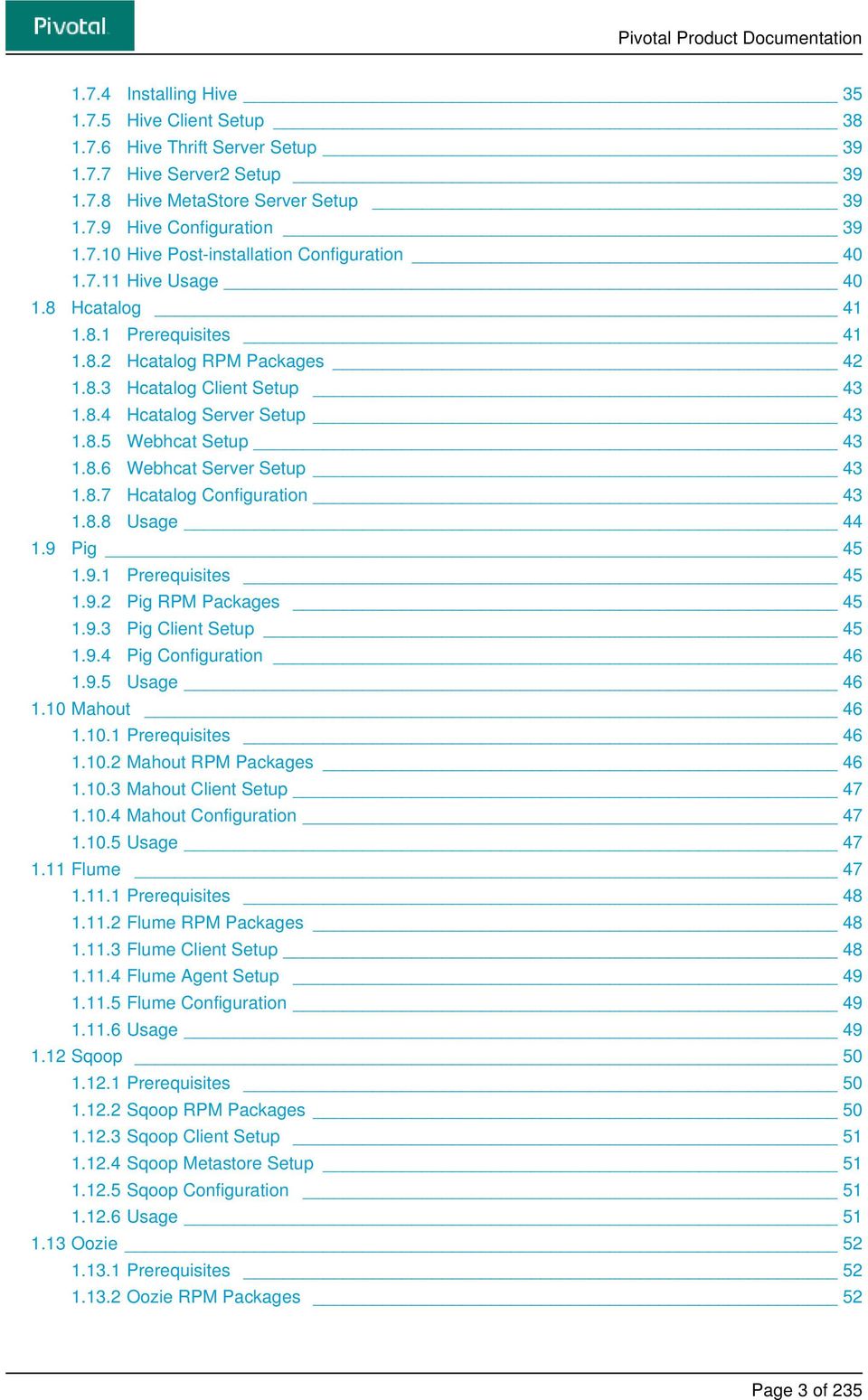
4 Oozie client Setup Oozie server Setup [Optional] Oozie Configuration Usage 53 2 Pivotal HD MR1 1.1 Stack - RPM Package Overview Accessing PHDMR Prerequisities Installation Notes Hadoop HDFS Hadoop HDFS RPM Packages Prerequisites: Core Package Setup HDFS Namenode Setup HDFS Datanode Setup HDFS Secondary Namenode Setup Hadoop HDFS Configuration Usage Hadoop MR Core Package Setup Hadoop-mr1 JobTracker Setup Hadoop-mr1 TaskTracker Setup Hadoop MR1 Configuration Usage Using Hadoop-mr Zookeeper Zookeeper RPM Packages Zookeeper Server Setup Zookeeper Client Setup Zookeeper Configuration Usage HBase Prerequisites HBase RPM Packages HBase Master Setup HBase RegionServer Setup HBase Client Setup HBase Thrift Server Setup REST Server Setup HBase Configuration HBase Post-Installation Configuration Usage Hive Hive Components Prerequisites Hive RPM Packages Installing Hive 78 4 of 235
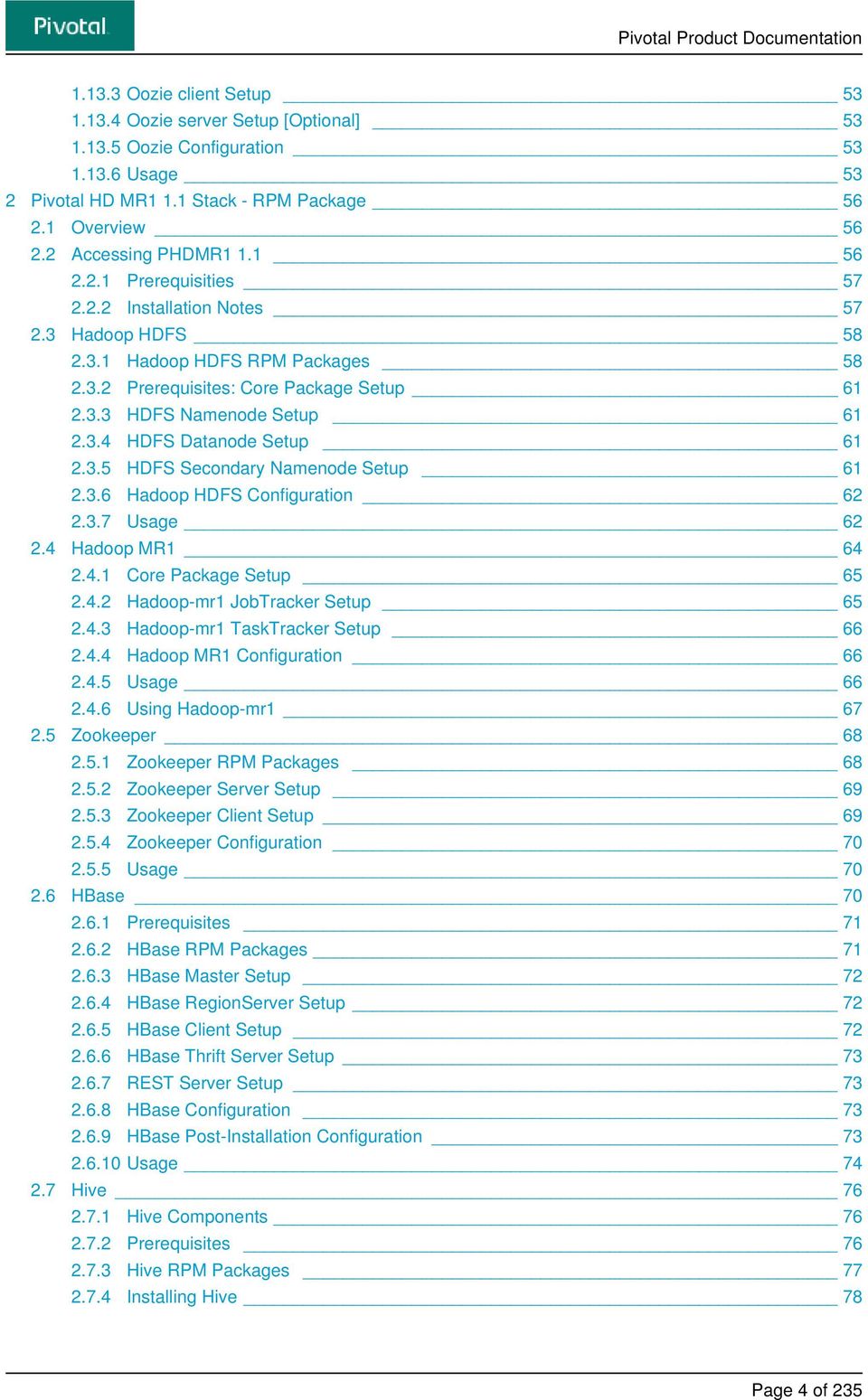
5 2.7.5 Hive Client Setup Hive Thrift Server Setup Hive Server2 Setup Hive MetaStore Server Setup Hive Configuration Hive Post-installation Configuration Hive Usage Hcatalog Prerequisites Hcatalog RPM Packages Hcatalog Client Setup Hcatalog Server Setup Webhcat Setup Webhcat Server Setup Hcatalog Configuration Usage Pig Prerequisites Pig RPM Packages Pig Client Setup Pig Configuration Usage Mahout Prerequisites Mahout RPM Packages Mahout Client Setup Mahout Configuration Usage Flume Prerequisites Flume RPM Packages Flume Client Setup Flume Agent Setup Flume Configuration Usage Sqoop Prerequisites Sqoop RPM Packages Sqoop Client Setup Sqoop Metastore Setup Sqoop Configuration Usage 93 3 Pivotal HD 1.1 Stack - Binary Package Overview Accessing PHD 1.1 Stack Binary Package Version Table 95 5 of 235
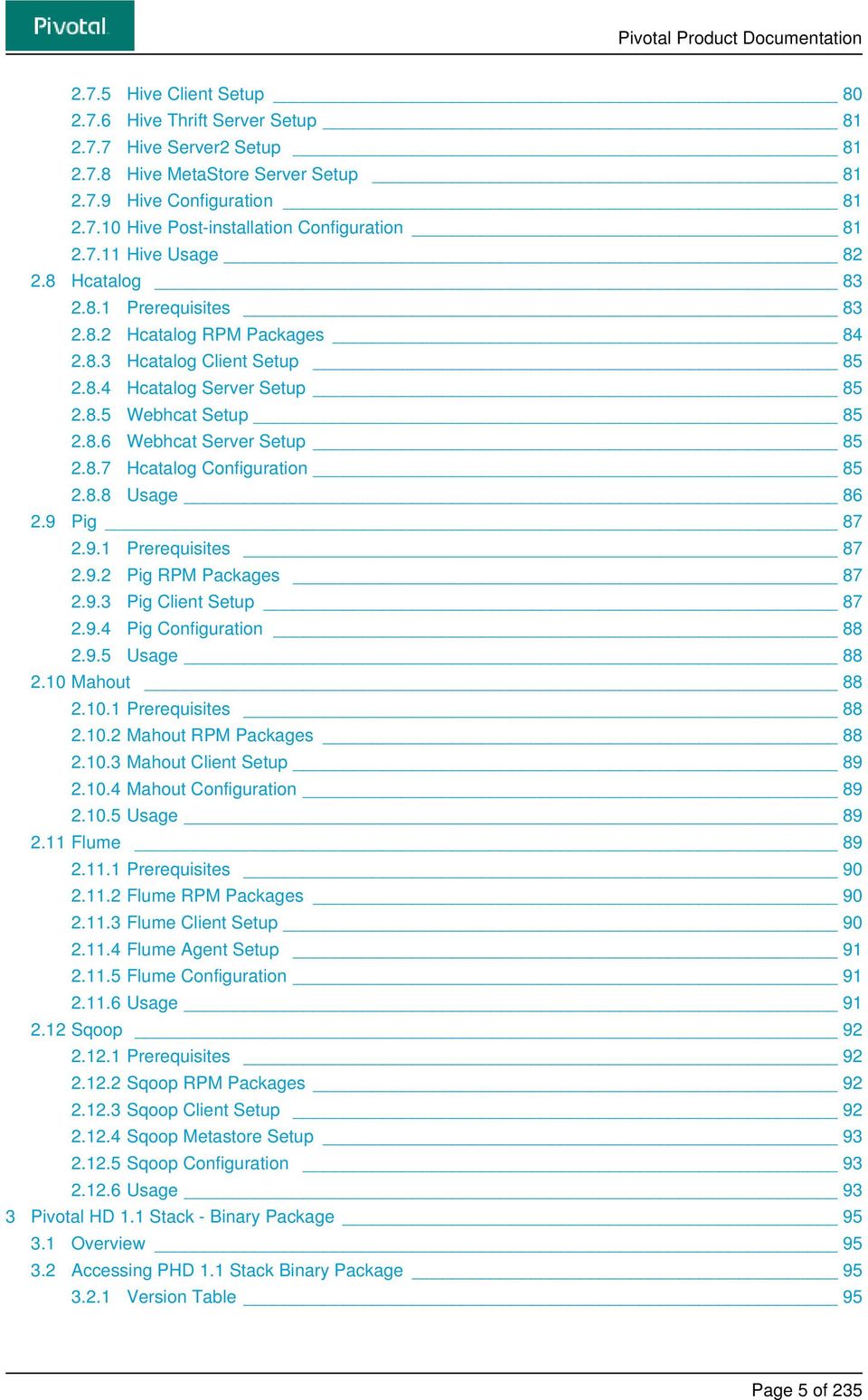
6 3.3 Installation Prerequisites Hadoop Zookeeper HBase Hive HCatalog Pig Mahout Sqoop Flume Oozie Pivotal HD MR1 1.1 Stack - Binary Package Overview Accessing PHD MR Installation Prerequisites Hadoop Zookeeper HBase Hive HCatalog Pig Mahout Sqoop Flume Pivotal HD 1.1 Stack - Other Components Overview Spring Data Installing Spring Data Hadoop Installing Spring Data Hadoop through RPM Spring Data Hadoop HDFS Rack Awareness Usage Vaidya Overview Installing Vaidya Files Enabling and Disabling Vaidya Using Vaidya to Analyze Jobs Vaidya Configuration Rules DataLoader USS Documentation - Main Overview Versions Supported Features Architecture of 235
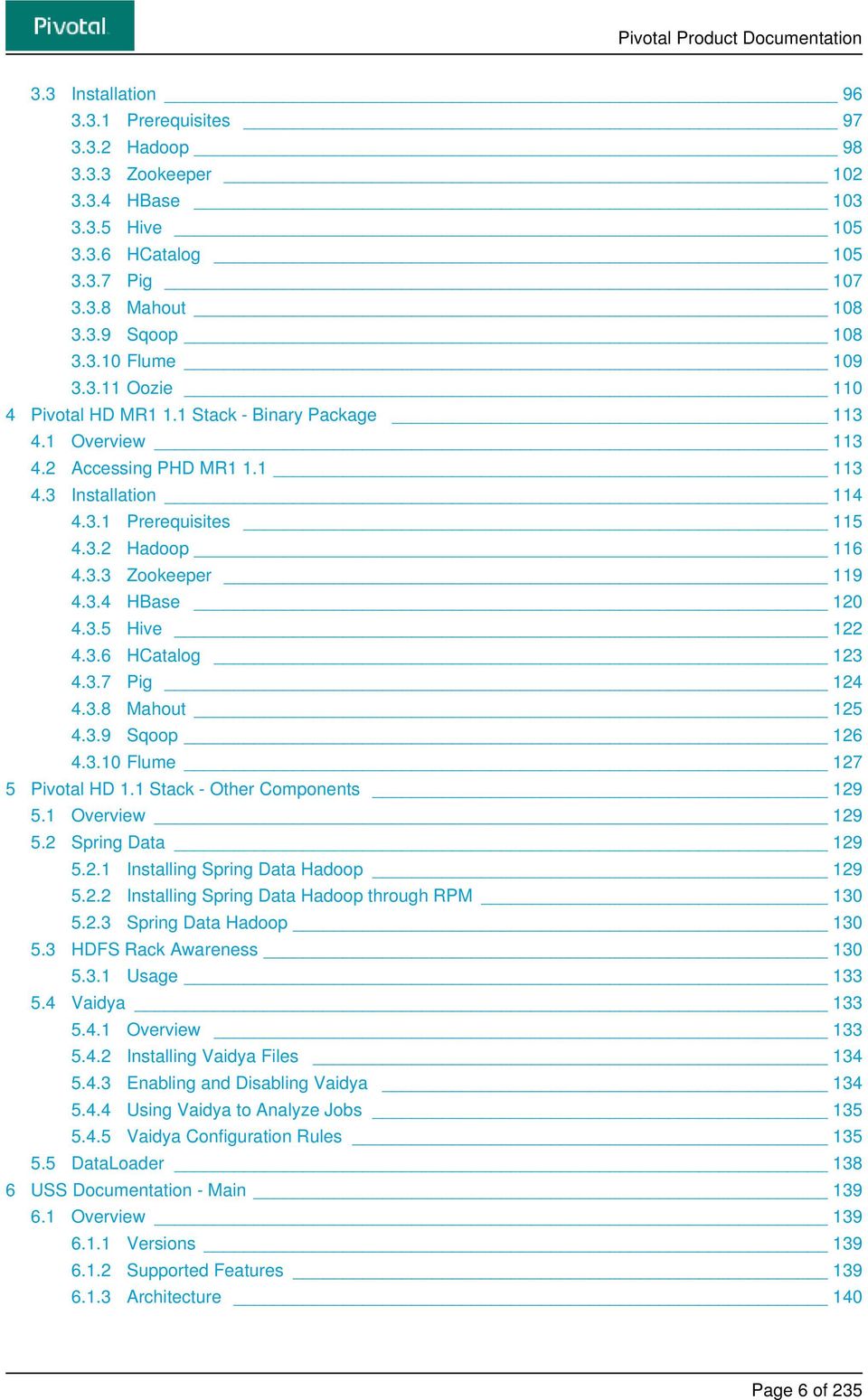
7 6.1.4 Prerequisites Getting Started USS Namenode (Server) USS Catalog USS Agent USS Client USS Gateway Package Contents Installing USS Configuring USS USS Namenode Configuration USS Client Configuration USS Catalog Configuration Using the USS Command Line Interface Features Usage USS Mountpoint Operations Initialize USS Catalog USS Classpath USS Version Protocol-Incompatible Filesystem Support Supported Protocol-Incompatible Filesystem Passphraseless Access Setup Register a Protocol-Incompatible Filesystem Adding a Mount Point Testing Access Secure HDFS support Secure HDFS and MountPoint Registration Using USS Setting up the environment Testing USS USS Namenode Service Starting the Service Stopping the Service Restarting the Service Checking the Service Status Uninstallation Troubleshooting/FAQs Terminology HVE (Hadooop Virtualization Extensions) Overview Topology Awareness Topology Awareness Configuration and Verification Elasticity Overview Function List of 235

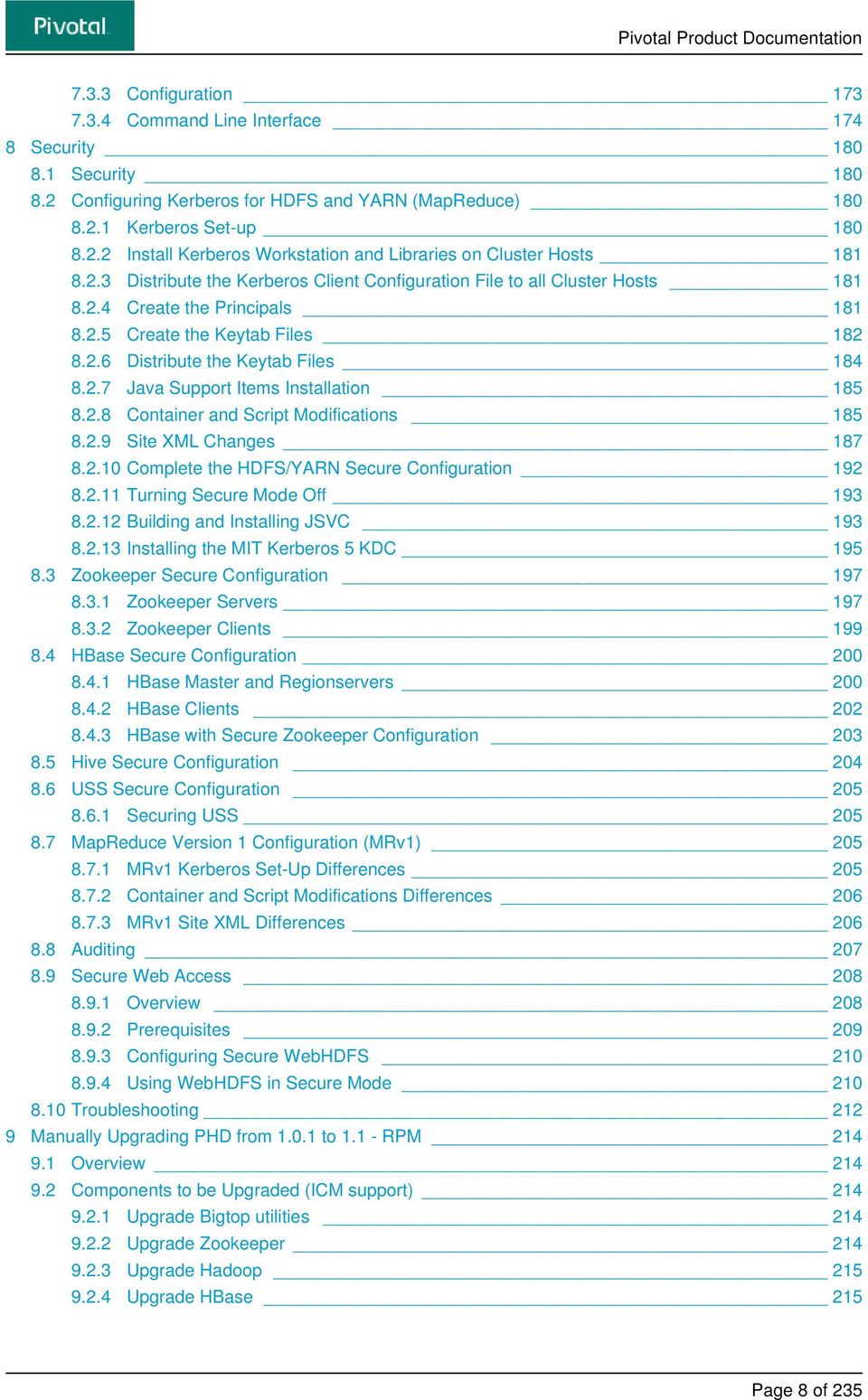
8 7.3.3 Configuration Command Line Interface Security Security Configuring Kerberos for HDFS and YARN (MapReduce) Kerberos Set-up Install Kerberos Workstation and Libraries on Cluster Hosts Distribute the Kerberos Client Configuration File to all Cluster Hosts Create the Principals Create the Keytab Files Distribute the Keytab Files Java Support Items Installation Container and Script Modifications Site XML Changes Complete the HDFS/YARN Secure Configuration Turning Secure Mode Off Building and Installing JSVC Installing the MIT Kerberos 5 KDC Zookeeper Secure Configuration Zookeeper Servers Zookeeper Clients HBase Secure Configuration HBase Master and Regionservers HBase Clients HBase with Secure Zookeeper Configuration Hive Secure Configuration USS Secure Configuration Securing USS MapReduce Version 1 Configuration (MRv1) MRv1 Kerberos Set-Up Differences Container and Script Modifications Differences MRv1 Site XML Differences Auditing Secure Web Access Overview Prerequisites Configuring Secure WebHDFS Using WebHDFS in Secure Mode Troubleshooting Manually Upgrading PHD from to RPM Overview Components to be Upgraded (ICM support) Upgrade Bigtop utilities Upgrade Zookeeper Upgrade Hadoop Upgrade HBase of 235
9 9.2.5 Upgrade Hive Upgrade Pig Upgrade Mahout Components to be Upgraded (ICM don't support) Upgrade Instructions Download and extract the new PHD 1.1 tarball Backup old configurations Upgrade Flume Upgrade Sqoop Manually Upgrading PHDMR1 from to RPM Overview Components to be upgraded Prerequisites Upgrade Instructions Download and extract the new PHDMR1 1.1 tarball Backup old configurations Upgrade Zookeeper Upgrade Bigtop Utilities Upgrade HDFS Upgrade Hadoop MR Upgrade HBase Upgrade Hive Upgrade Pig Upgrade Flume Upgrade Sqoop Upgrade Mahout Manually Upgrading PHD/PHDMR1 from to Binary Overview Components to be Upgraded Prerequisites Upgrade Zookeeper Upgrade Hadoop Upgrade HBase Upgrade Hive Upgrade Pig Upgrade Flume Upgrade Sqoop Upgrade Mahout of 235

10 Copyright 2013 GoPivotal, Inc. All rights reserved. GoPivotal, Inc. believes the information in this publication is accurate as of its publication date. The information is subject to change without notice. THE INFORMATION IN THIS PUBLICATION IS PROVIDED "AS IS." GOPIVOTAL, INC. ("Pivotal") MAKES NO REPRESENTATIONS OR WARRANTIES OF ANY KIND WITH RESPECT TO THE INFORMATION IN THIS PUBLICATION, AND SPECIFICALLY DISCLAIMS IMPLIED WARRANTIES OF MERCHANTABILITY OR FITNESS FOR A PARTICULAR PURPOSE. Use, copying, and distribution of any Pivotal software described in this publication requires an applicable software license. All trademarks used herein are the property of Pivotal or their respective owners. Use of Open Source This product may be distributed with open source code, licensed to you in accordance with the applicable open source license. If you would like a copy of any such source code, Pivotal will provide a copy of the source code that is required to be made available in accordance with the applicable open source license. Pivotal may charge reasonable shipping and handling charges for such distribution. 10 of 235

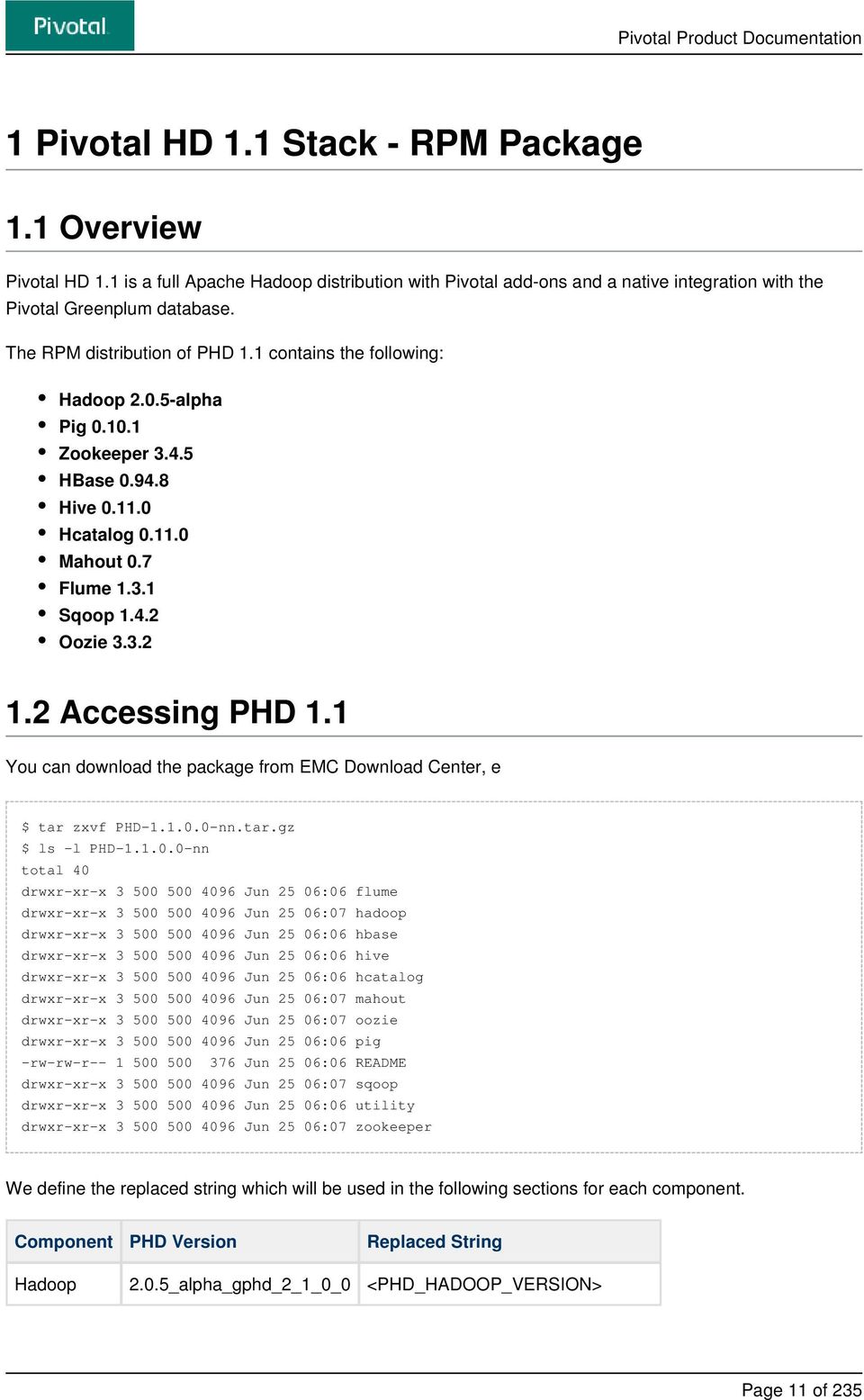
11 1 Pivotal HD 1.1 Stack - RPM Package 1.1 Overview Pivotal HD 1.1 is a full Apache Hadoop distribution with Pivotal add-ons and a native integration with the Pivotal Greenplum database. The RPM distribution of PHD 1.1 contains the following: Hadoop alpha Pig Zookeeper HBase Hive Hcatalog Mahout 0.7 Flume Sqoop Oozie Accessing PHD 1.1 You can download the package from EMC Download Center, e $ tar zxvf PHD nn.tar.gz $ ls -l PHD nn total 40 drwxr-xr-x Jun 25 06:06 flume drwxr-xr-x Jun 25 06:07 hadoop drwxr-xr-x Jun 25 06:06 hbase drwxr-xr-x Jun 25 06:06 hive drwxr-xr-x Jun 25 06:06 hcatalog drwxr-xr-x Jun 25 06:07 mahout drwxr-xr-x Jun 25 06:07 oozie drwxr-xr-x Jun 25 06:06 pig -rw-rw-r Jun 25 06:06 README drwxr-xr-x Jun 25 06:07 sqoop drwxr-xr-x Jun 25 06:06 utility drwxr-xr-x Jun 25 06:07 zookeeper We define the replaced string which will be used in the following sections for each component. Component PHD Version Replaced String Hadoop 2.0.5_alpha_gphd_2_1_0_0 <PHD_HADOOP_VERSION> 11 of 235
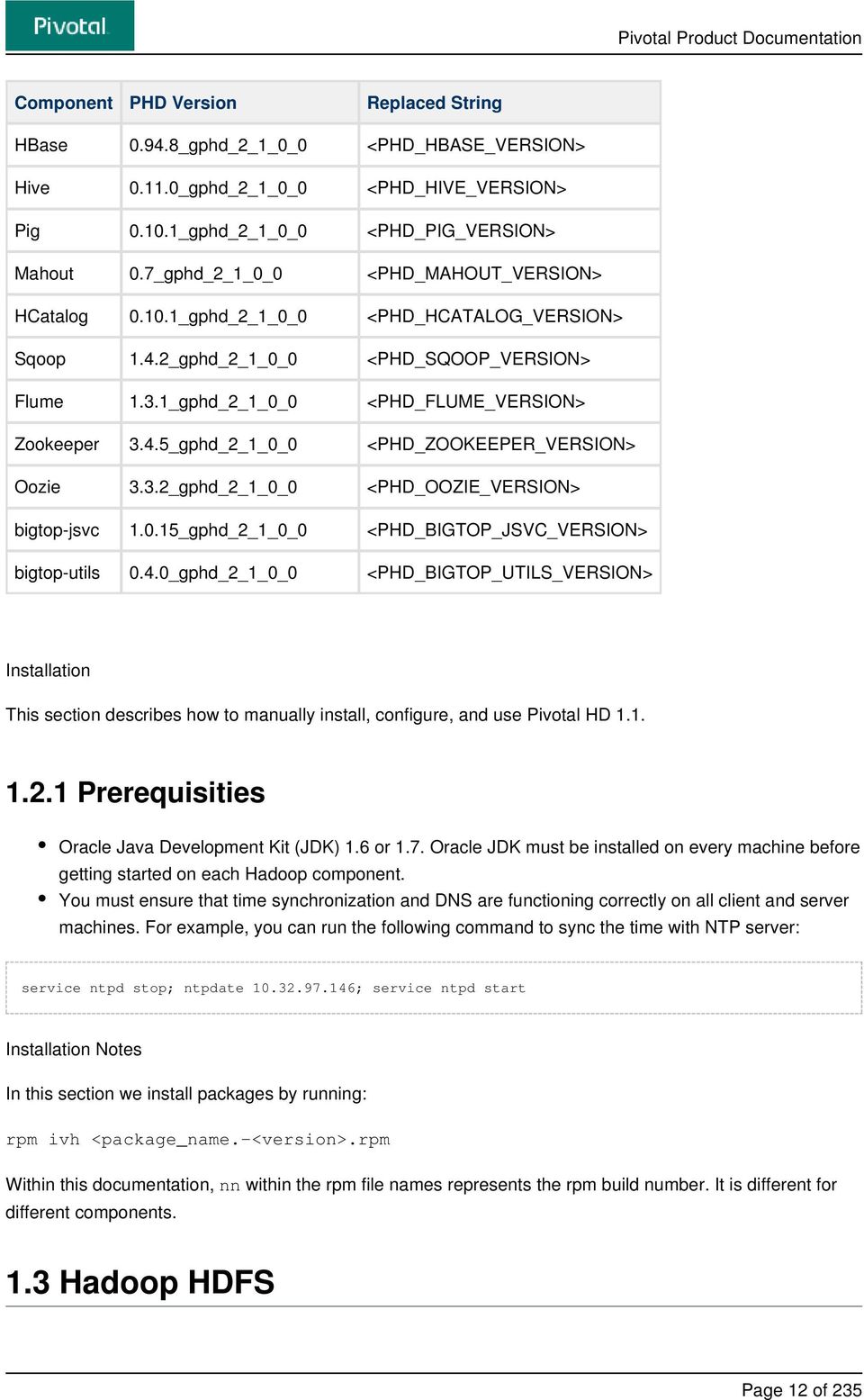
12 Component PHD Version Replaced String HBase _gphd_2_1_0_0 <PHD_HBASE_VERSION> Hive _gphd_2_1_0_0 <PHD_HIVE_VERSION> Pig _gphd_2_1_0_0 <PHD_PIG_VERSION> Mahout 0.7_gphd_2_1_0_0 <PHD_MAHOUT_VERSION> HCatalog _gphd_2_1_0_0 <PHD_HCATALOG_VERSION> Sqoop 1.4.2_gphd_2_1_0_0 <PHD_SQOOP_VERSION> Flume 1.3.1_gphd_2_1_0_0 <PHD_FLUME_VERSION> Zookeeper 3.4.5_gphd_2_1_0_0 <PHD_ZOOKEEPER_VERSION> Oozie 3.3.2_gphd_2_1_0_0 <PHD_OOZIE_VERSION> bigtop-jsvc _gphd_2_1_0_0 <PHD_BIGTOP_JSVC_VERSION> bigtop-utils 0.4.0_gphd_2_1_0_0 <PHD_BIGTOP_UTILS_VERSION> Installation This section describes how to manually install, configure, and use Pivotal HD Prerequisities Oracle Java Development Kit (JDK) 1.6 or 1.7. Oracle JDK must be installed on every machine before getting started on each Hadoop component. You must ensure that time synchronization and DNS are functioning correctly on all client and server machines. For example, you can run the following command to sync the time with NTP server: service ntpd stop; ntpdate ; service ntpd start Installation Notes In this section we install packages by running: rpm ivh <package_name.-<version>.rpm Within this documentation, nn within the rpm file names represents the rpm build number. It is different for different components. 1.3 Hadoop HDFS 12 of 235
13 This section provides instructions for installing each of the following core Hadoop RPMs: HDFS Namenode Setup HDFS Datanode Setup HDFS Secondary Namenode Setup Hadoop HDFS RPM Packages Pivotal provides the following RPMs as part of this release. The core packages provide all executables, libraries, configurations, and documentation for Hadoop and is required on every node in the Hadoop cluster as well as the client workstation that will access the Hadoop service. The daemon packages provide a convenient way to manage Hadoop HDFS daemons as Linux services, which rely on the core package. hadoop-<phd_hadoop_version>-nn.x86_64.rpm Type Requires Description Install on Nodes Core bigtop-utils, zookeeper-core Hadoop core packages provides the common core packages for running Hadoop Every node in the Hadoop cluster and the client workstation that will access the Hadoop service. hadoop-hdfs-<phd_hadoop_version>-nn.x86_64.rpm Type Requires Description Install on Nodes Core hadoop, bigtop-jsvc Hadoop HDFS core packages provides the common files for running HFS. Every node in the HDFS cluster and the client workstation that will access the HDFS. hadoop-hdfs-namenode-<phd_hadoop_version>-nn.x86_64.rpm Type Requires Description Install on Nodes Daemon hadoop-hdfs Daemon scripts package for Hadoop Namenode, which provides a convenient method to manage Namenode start/stop as a Linux service. Only on HDFS Namenode server. hadoop-hdfs-datanode-<phd_hadoop_version>-nn.x86_64.rpm Type Daemon 13 of 235

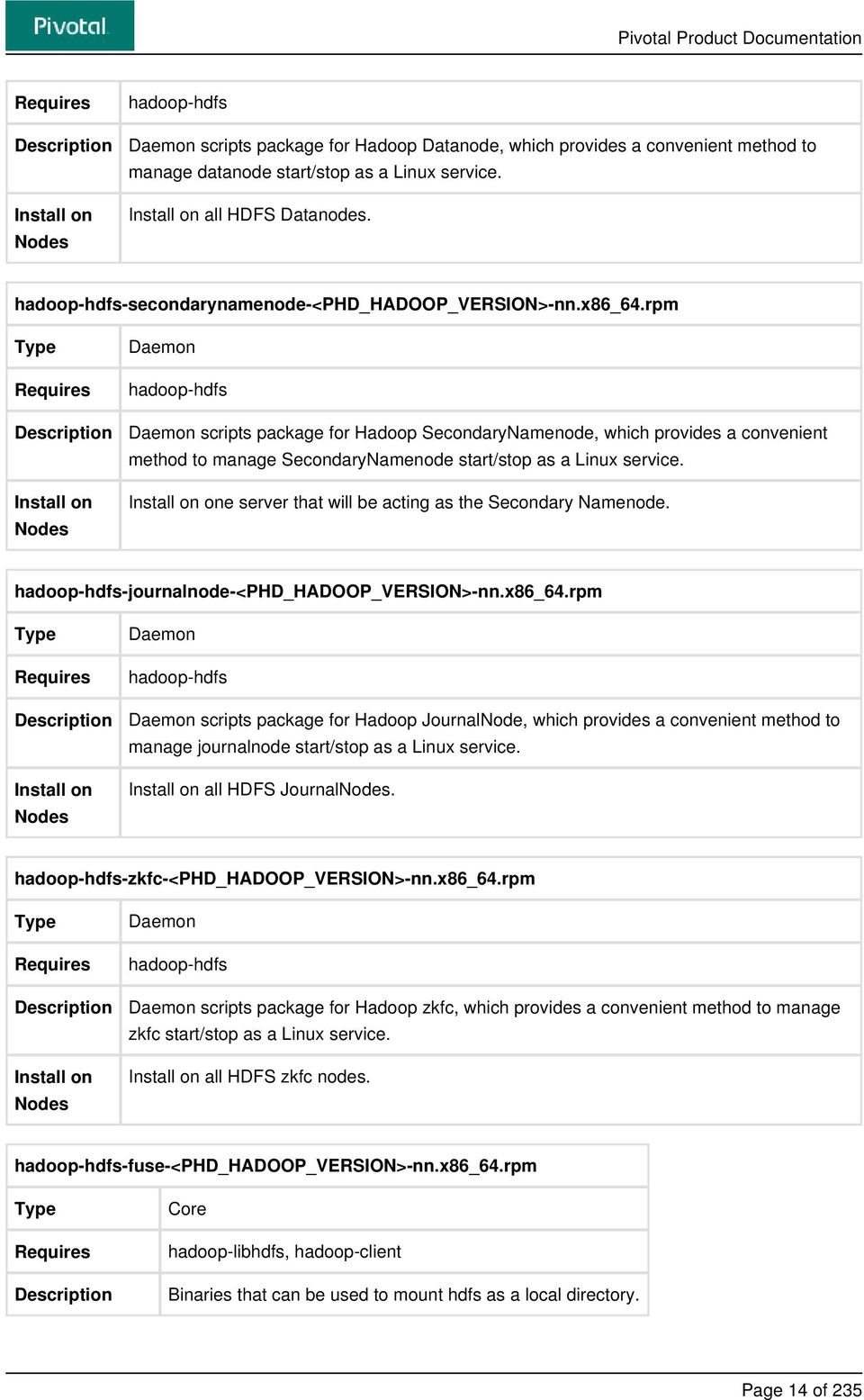
14 Requires Description Install on Nodes hadoop-hdfs Daemon scripts package for Hadoop Datanode, which provides a convenient method to manage datanode start/stop as a Linux service. Install on all HDFS Datanodes. hadoop-hdfs-secondarynamenode-<phd_hadoop_version>-nn.x86_64.rpm Type Requires Description Install on Nodes Daemon hadoop-hdfs Daemon scripts package for Hadoop SecondaryNamenode, which provides a convenient method to manage SecondaryNamenode start/stop as a Linux service. Install on one server that will be acting as the Secondary Namenode. hadoop-hdfs-journalnode-<phd_hadoop_version>-nn.x86_64.rpm Type Requires Description Install on Nodes Daemon hadoop-hdfs Daemon scripts package for Hadoop JournalNode, which provides a convenient method to manage journalnode start/stop as a Linux service. Install on all HDFS JournalNodes. hadoop-hdfs-zkfc-<phd_hadoop_version>-nn.x86_64.rpm Type Requires Description Install on Nodes Daemon hadoop-hdfs Daemon scripts package for Hadoop zkfc, which provides a convenient method to manage zkfc start/stop as a Linux service. Install on all HDFS zkfc nodes. hadoop-hdfs-fuse-<phd_hadoop_version>-nn.x86_64.rpm Type Requires Description Core hadoop-libhdfs, hadoop-client Binaries that can be used to mount hdfs as a local directory. 14 of 235
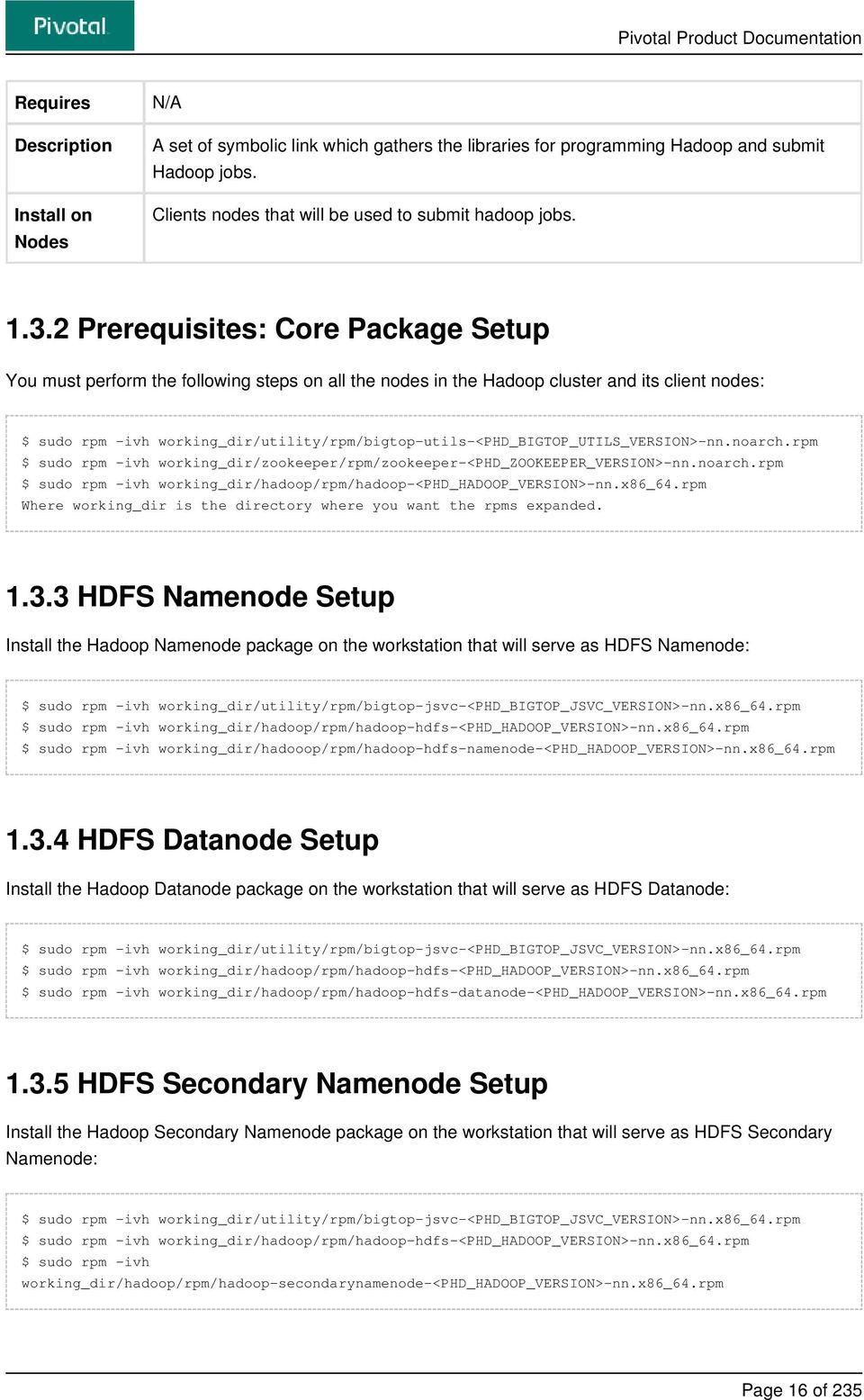
15 Install on Nodes Install on the servers that want to mount the HDFS. hadoop-libhdfs-<phd_hadoop_version>-nn.x86_64.rpm Type Requires Description Install on Nodes Core hadoop-hdfs Native implementation of the HDFS. Install on servers that you want to run native hdfs. hadoop-httpfs-<phd_hadoop_version>-nn.x86_64.rpm Type Requires Description Install on Nodes Core bigtop-tomcat, hadoop, hadoop-hdfs HttpFS is a server that provides a REST HTTP gateway supporting all HDFS File System operations (read and write). Install on servers that will be serving REST HDFS service hadoop-doc-<phd_hadoop_version>-nn.x86_64.rpm Type Requires Description Install on Nodes Doc N/A Document package provides the Hadoop document. Install on whichever host that user want to read hadoop documentation. hadoop-conf-pseudo-<phd_hadoop_version>-nn.x86_64.rpm Type Requires Description Install on Nodes Configuration hadoop-hdfs-datanode, hadoop-hdfs-secondarynamenode, hadoop-yarn-resourcemanager, hadoop-hdfs-namenode, hadoop-yarn-nodemanager, hadoop-mapreduce-historyserver A set of configuration files for running Hadoop in pseudo-distributed mode on one single server. Install on the pseudo--distributed host. hadoop-client-<phd_hadoop_version>-nn.x86_64.rpm Type Library 15 of 235

16 Requires Description Install on Nodes N/A A set of symbolic link which gathers the libraries for programming Hadoop and submit Hadoop jobs. Clients nodes that will be used to submit hadoop jobs Prerequisites: Core Package Setup You must perform the following steps on all the nodes in the Hadoop cluster and its client nodes: $ sudo rpm -ivh working_dir/utility/rpm/bigtop-utils-<phd_bigtop_utils_version>-nn.noarch.rpm $ sudo rpm -ivh working_dir/zookeeper/rpm/zookeeper-<phd_zookeeper_version>-nn.noarch.rpm $ sudo rpm -ivh working_dir/hadoop/rpm/hadoop-<phd_hadoop_version>-nn.x86_64.rpm Where working_dir is the directory where you want the rpms expanded HDFS Namenode Setup Install the Hadoop Namenode package on the workstation that will serve as HDFS Namenode: $ sudo rpm -ivh working_dir/utility/rpm/bigtop-jsvc-<phd_bigtop_jsvc_version>-nn.x86_64.rpm $ sudo rpm -ivh working_dir/hadoop/rpm/hadoop-hdfs-<phd_hadoop_version>-nn.x86_64.rpm $ sudo rpm -ivh working_dir/hadooop/rpm/hadoop-hdfs-namenode-<phd_hadoop_version>-nn.x86_64.rpm HDFS Datanode Setup Install the Hadoop Datanode package on the workstation that will serve as HDFS Datanode: $ sudo rpm -ivh working_dir/utility/rpm/bigtop-jsvc-<phd_bigtop_jsvc_version>-nn.x86_64.rpm $ sudo rpm -ivh working_dir/hadoop/rpm/hadoop-hdfs-<phd_hadoop_version>-nn.x86_64.rpm $ sudo rpm -ivh working_dir/hadoop/rpm/hadoop-hdfs-datanode-<phd_hadoop_version>-nn.x86_64.rpm HDFS Secondary Namenode Setup Install the Hadoop Secondary Namenode package on the workstation that will serve as HDFS Secondary Namenode: $ sudo rpm -ivh working_dir/utility/rpm/bigtop-jsvc-<phd_bigtop_jsvc_version>-nn.x86_64.rpm $ sudo rpm -ivh working_dir/hadoop/rpm/hadoop-hdfs-<phd_hadoop_version>-nn.x86_64.rpm $ sudo rpm -ivh working_dir/hadoop/rpm/hadoop-secondarynamenode-<phd_hadoop_version>-nn.x86_64.rpm 16 of 235
17 1.3.6 Hadoop HDFS Configuration The configuration files for Hadoop are located here: /etc/gphd/hadoop/conf/ Out of the box by default it is a symbolic link to /etc/gphd/hadoop-version/conf.empty template directory. You can make modifications to these configuration templates or create your own configuration set. If you want to use a different configuration folder, edit the /etc/gphd/hadoop/conf symbolic link to point to the folder you want to utilize at runtime. If you want to run Hadoop 2.0 in one host in pseudo-distributed mode on one single host, you can make sure all the dependent packages of hadoop-conf-pseudo have been installed on your host and then install the hadoop-conf-pseudo package: $ sudo rpm -ivh working_dir/hadoop/rpm/hadoop-conf-pseudo-<phd_hadoop_version>-nn.x86_64.rpm Refer to Apache Hadoop alpha documentation for how to configure Hadoop in distributed mode. This documentation describes how to use Hadoop in a pseudo-distributed mode Usage After installing the daemon package for Hadoop, you can start the daemons. Starting HDFS HDFS includes three main components: Namenode, Datanode, Secondary Namenode. To start the Namenode daemon: You need to format the Namenode before starting it, as follows: $ sudo -u hdfs hdfs namenode -format Note: You only have to do this once. But if you have changed the hadoop namenode configuration, you may need to run this again. Then start the Namenode by running Either: $ sudo service hadoop-hdfs-namenode start or: 17 of 235

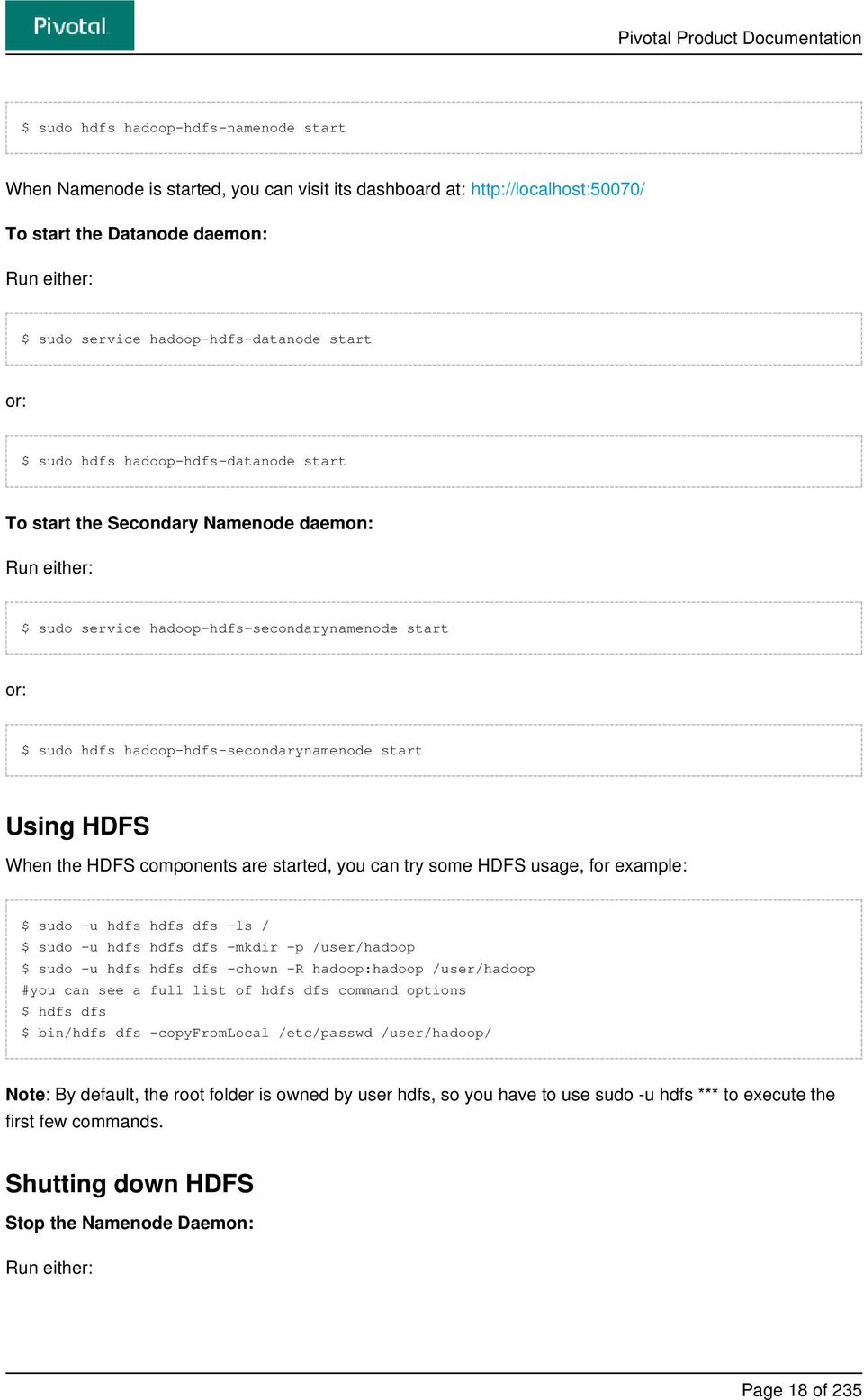
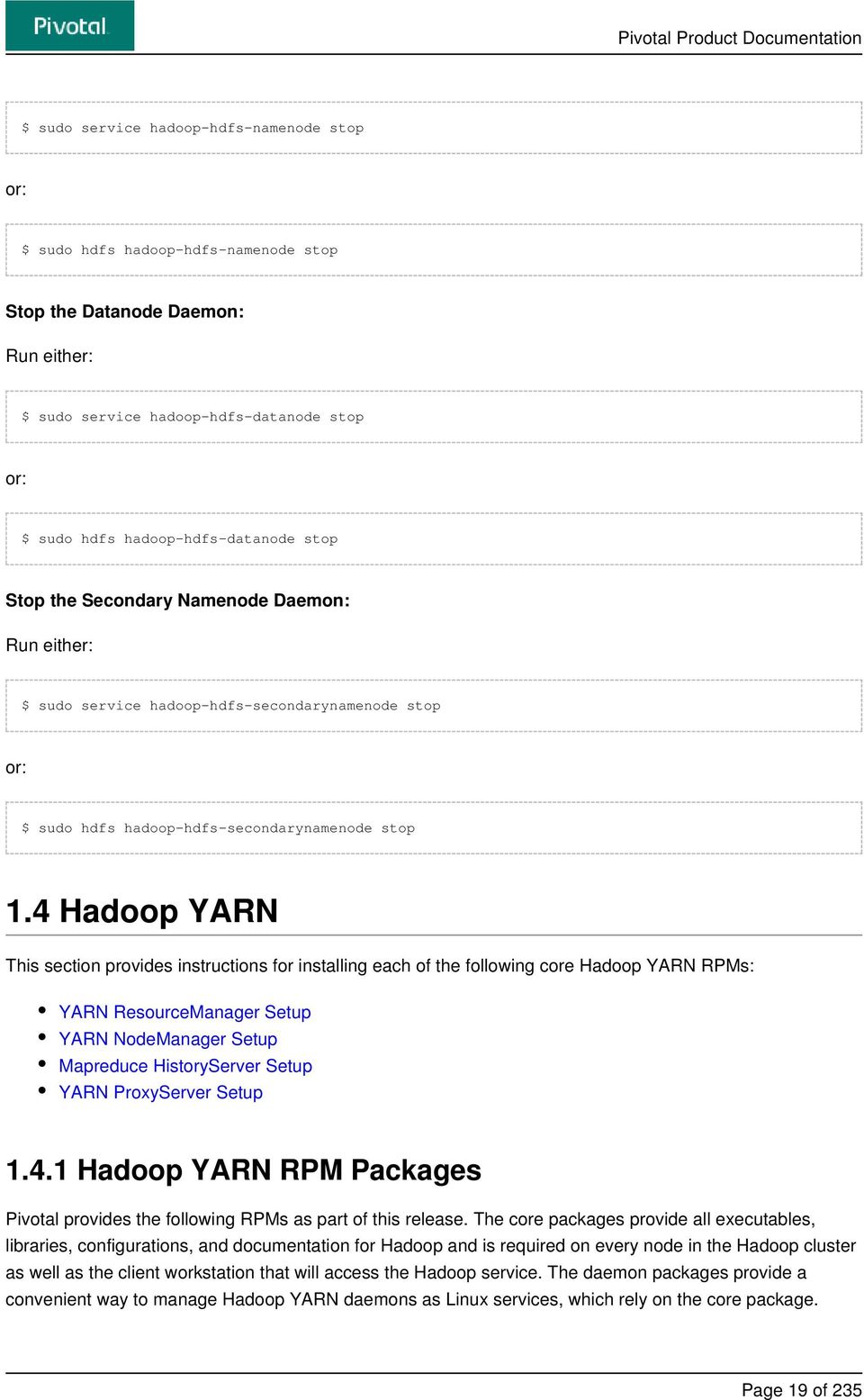
18 $ sudo hdfs hadoop-hdfs-namenode start When Namenode is started, you can visit its dashboard at: To start the Datanode daemon: Run either: $ sudo service hadoop-hdfs-datanode start or: $ sudo hdfs hadoop-hdfs-datanode start To start the Secondary Namenode daemon: Run either: $ sudo service hadoop-hdfs-secondarynamenode start or: $ sudo hdfs hadoop-hdfs-secondarynamenode start Using HDFS When the HDFS components are started, you can try some HDFS usage, for example: $ sudo -u hdfs hdfs dfs -ls / $ sudo -u hdfs hdfs dfs -mkdir -p /user/hadoop $ sudo -u hdfs hdfs dfs -chown -R hadoop:hadoop /user/hadoop #you can see a full list of hdfs dfs command options $ hdfs dfs $ bin/hdfs dfs -copyfromlocal /etc/passwd /user/hadoop/ Note: By default, the root folder is owned by user hdfs, so you have to use sudo -u hdfs *** to execute the first few commands. Shutting down HDFS Stop the Namenode Daemon: Run either: 18 of 235
19 $ sudo service hadoop-hdfs-namenode stop or: $ sudo hdfs hadoop-hdfs-namenode stop Stop the Datanode Daemon: Run either: $ sudo service hadoop-hdfs-datanode stop or: $ sudo hdfs hadoop-hdfs-datanode stop Stop the Secondary Namenode Daemon: Run either: $ sudo service hadoop-hdfs-secondarynamenode stop or: $ sudo hdfs hadoop-hdfs-secondarynamenode stop 1.4 Hadoop YARN This section provides instructions for installing each of the following core Hadoop YARN RPMs: YARN ResourceManager Setup YARN NodeManager Setup Mapreduce HistoryServer Setup YARN ProxyServer Setup Hadoop YARN RPM Packages Pivotal provides the following RPMs as part of this release. The core packages provide all executables, libraries, configurations, and documentation for Hadoop and is required on every node in the Hadoop cluster as well as the client workstation that will access the Hadoop service. The daemon packages provide a convenient way to manage Hadoop YARN daemons as Linux services, which rely on the core package. 19 of 235
20 hadoop-<phd_hadoop_version>-nn.x86_64.rpm Type Requires Description Install on Nodes Core bigtop-utils, zookeeper-core Hadoop core packages provides the common core packages for running Hadoop. Every node in the Hadoop cluster and the client workstation that will access the Hadoop service. hadoop-yarn-<phd_hadoop_version>-nn.x86_64.rpm Type Requires Description Install on Nodes Core hadoop Hadoop YARN core packages provides common files for running YARN. Install on all YARN nodes. hadoop-yarn-resourcemanager-<phd_hadoop_version>-nn.x86_64.rpm Type Requires Description Install on Nodes Daemon hadoop-yarn Daemon scripts package for Hadoop YARN ResourceManager, which provides a convenient method to manage ResourceManager start/stop as a Linux service. Install on the Resource Manager node. hadoop-yarn-nodemanager-<phd_hadoop_version>-nn.x86_64.rpm Type Requires Description Install on Nodes Daemon hadoop-yarn Daemon scripts package for Hadoop YARN NodeManager, which provides a convenient method to manage NodeManager start/stop as a Linux service. Install on all the Node Manager nodes. hadoop-yarn-proxyserver-<phd_hadoop_version>-nn.x86_64.rpm Type Requires Daemon hadoop-yarn 20 of 235
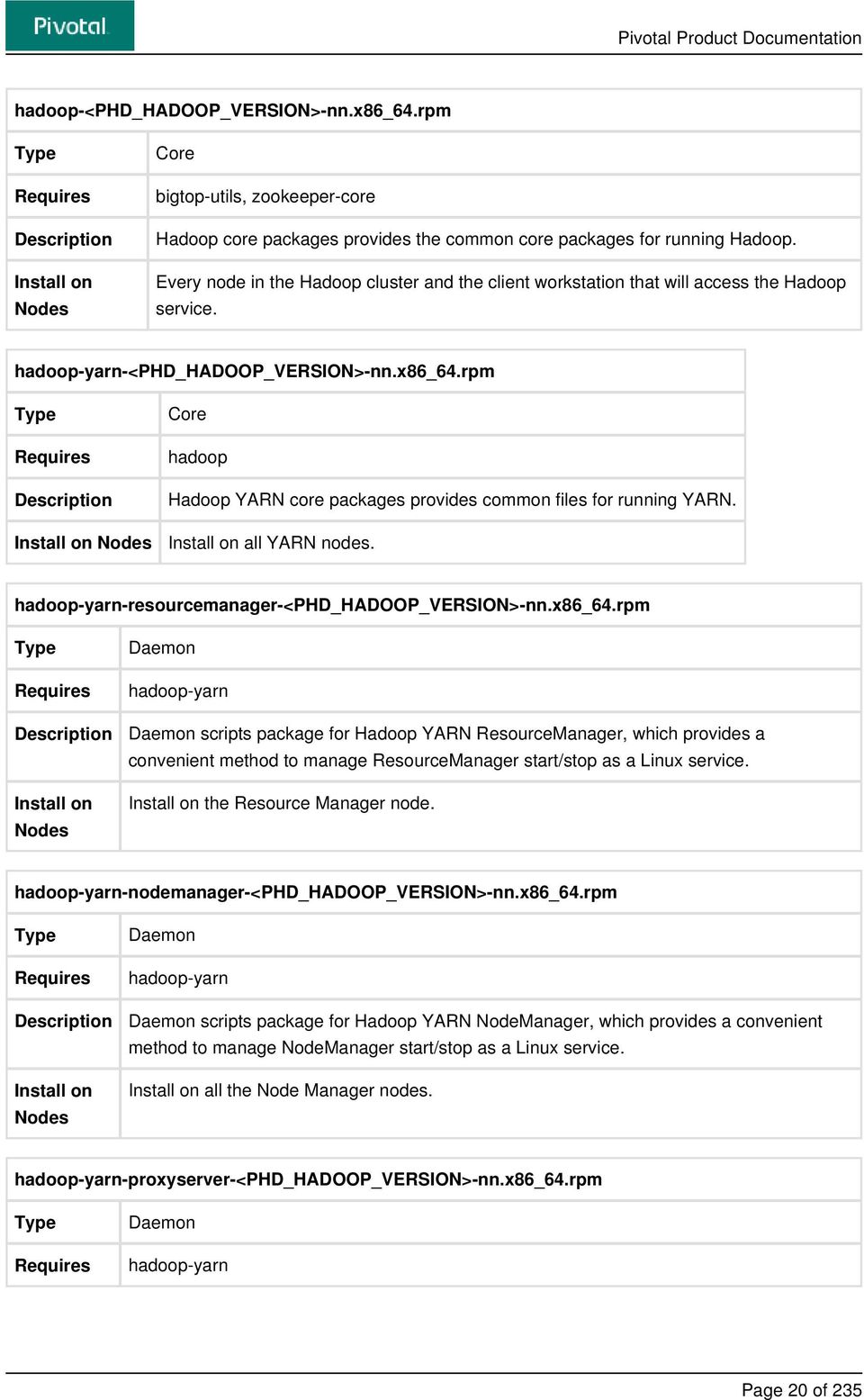
21 Description Install on Nodes Daemon scripts package for Hadoop YARN ProxyServer, which provides a convenient method to manage ProxyServer start/stop as a Linux service. Install on the node that will act as a proxy server from the user to applicationmaster hadoop-mapreduce-<phd_hadoop_version>-nn.x86_64.rpm Type Requires Description Install on Nodes Core hadoop-yarn Hadoop Mapreduce core libraries. Install on all ResourceManager and NodeManager nodes. hadoop-mapreduce-historyserver-<phd_hadoop_version>-nn.x86_64.rpm Type Requires Description Install on Nodes Daemon hadoop, hadoop-mapreduce Daemon scripts package for Hadoop MapReduce HistoryServer, which provides a convenient method to manage MapReduce HistoryServer start/stop as a Linux service. Install on the host that will be acting as the MapReduce History Server. hadoop-doc-<phd_hadoop_version>-nn.x86_64.rpm Type Requires Description Install on Nodes Doc N/A Document package provides the Hadoop documentation. Install on whichever host that user want to read hadoop doc. hadoop-conf-pseudo-<phd_hadoop_version>-nn.x86_64.rpm Type Requires Description Install on Nodes Configuration hadoop-hdfs-datanode, hadoop-hdfs-secondarynamenode, hadoop-yarn-resourcemanager, hadoop-hdfs-namenode hadoop-yarn-nodemanager, hadoop-mapreduce-historyserver A set of configuration files for running Hadoop in pseudo-distributed mode on one single server. Install on the pseudu-distributed host. 21 of 235
22 hadoop-client-<phd_hadoop_version>-nn.x86_64.rpm Type Requires Description Install on Nodes Library hadoop, hadoop-hdfs, hadoop-yarn, hadoop-mapreduce A set of symbolic link which gathers the libraries for programming Hadoop and submit Hadoop jobs. Clients nodes that will be used to submit hadoop jobs Prerequisites: Core Package Setup You must perform the following steps on all the nodes in the Hadoop cluster and its client nodes: $ sudo rpm -ivh working_dir/utility/rpm/bigtop-utils-<phd_bigtop_utils_version>-nn.noarch.rpm $ sudo rpm -ivh working_dir/zookeeper/rpm/zookeeper-<phd_zookeeper_version>-nn.noarch.rpm $ sudo rpm -ivh working_dir/hadoop/rpm/hadoop-<phd_hadoop_version>-nn.x86_64.rpm Where working_dir is the directory where you want the rpms expanded YARN ResourceManager Setup Install the YARN ResourceManager package on the workstation that will serve as YARN ResourceManager: $ sudo rpm -ivh working_dir/hadoop/rpm/hadoop-yarn-<phd_hadoop_version>-nn.x86_64.rpm $ sudo rpm -ivh working_dir/hadoop/rpm/hadoop-yarn-resourcemanager-<phd_hadoop_version>-nn.x86_64.rpm YARN NodeManager Setup Install the YARN NodeManager package on the workstation that will serve as YARN nodes: $ sudo rpm -ivh working_dir/hadoop/rpm/hadoop-yarn-<phd_hadoop_version>-nn.x86_64.rpm $ sudo rpm -ivh working_dir/hadoop/rpm/hadoop-yarn-nodemanager-<phd_hadoop_version>-nn.x86_64.rpm Mapreduce HistoryServer Setup Install the YARN Mapreduce History Manager package and its dependency packages on the workstation that will serve as the MapReduce History Server: 22 of 235
23 $ sudo rpm -ivh working_dir/hadoop/rpm/hadoop-yarn-<phd_hadoop_version>-nn.x86_64.rpm $ sudo rpm -ivh working_dir/hadoop/rpm/hadoop-mapreduce-<phd_hadoop_version>-nn.x86_64.rpm $ sudo rpm -ivh working_dir/hadoop/rpm/hadoop-mapreduce-historyserver-<phd_hadoop_version>-nn.x86_64.rpm YARN ProxyServer Setup Install the YARN Proxy Server package and its dependency packages on the workstation that will serve as the YARN Proxy Server. $ sudo rpm -ivh working_dir/hadoop/rpm/hadoop-yarn-<phd_hadoop_version>-nn.x86_64.rpm $ sudo rpm -ivh working_dir/hadoop/rpm/hadoop-yarn-proxyserver-<phd_hadoop_version>-nn.x86_64.rpm Configuration The configuration files for Hadoop are located here: /etc/gphd/hadoop/conf/ Out of the box by default it is a symbolic link to /etc/gphd/hadoop-version/conf.empty template. You can make modifications to these configuration templates or create your own configuration set. If you want to use a different configuration folder, adjust the /etc/gphd/hadoop/conf symbolic link to point to the folder you want to utilize at runtime. If you want to run Hadoop 2.0 in one host in pseudo-distributed mode on one single host, you can go through all the above setup steps on your host and then install the hadoop-conf-pseudo package, as follows: $ sudo rpm -ivh working_dir/hadoop/rpm/hadoop-conf-pseudo-<phd_hadoop_version>-nn.x86_64.rpm Refer to Apache Hadoop alpha documentation for how to configure Hadoop in distributed mode. This document describes how to use Hadoop in a pseudo-distributed mode YARN Usage Starting YARN YARN includes three services: ResourceManager (RM), NodeManager (NM), MapReduce HistoryManager (MRHM). RM and NM are required, MRHM is optional. Before you start these services, you need to create some working directories on HDFS, as follows: Create working directories on HDFS: 23 of 235
24 $ sudo -u hdfs hdfs dfs -mkdir /tmp $ sudo -u hdfs hdfs dfs -chmod 777 /tmp $ sudo -u hdfs hdfs dfs -mkdir -p /var/log/gphd/hadoop-yarn $ sudo -u hdfs hdfs dfs -chown yarn:hadoop /var/log/gphd/hadoop-yarn $ sudo -u hdfs hdfs dfs -mkdir -p /user/history $ sudo -u hdfs hdfs dfs -chown mapred:hadoop /user/history $ sudo -u hdfs hdfs dfs -chmod -R 777 /user/history $ sudo -u hdfs hdfs dfs -mkdir -p /user/hadoop $ sudo -u hdfs hdfs dfs -chown hadoop:hadoop /user/hadoop Starting ResourceManager RM daemon need to be started only on the master node. Run either: $ sudo service hadoop-yarn-resourcemanager start or: $ sudo yarn hadoop-yarn-resourcemanager start When RM is started, you can visit its dashboard at: Starting NodeManager NM daemon needs to be started on all hosts that will be used as working nodes. Run either: $ sudo service hadoop-yarn-nodemanager start or: $ sudo yarn hadoop-yarn-nodemanager start Start MapReduce HistoryServer MapReduce HistoryServer only needs to be run on the server that is meant to be the history server. It is an optional service and should only be enabled if you want to keep track of the MapReduce jobs that have been run. Run: 24 of 235
25 $ sudo service hadoop-mapreduce-historyserver start When the MR HistoryServer is started, you can visit its dashboard at: Using YARN After RM and NM are started, you can now submit YARN applications. For simplicity, we assume you are running Hadoop in pseudo-distributed mode using the default pseudo configuration. Note: Make sure HDFS daemons are running. Here is an example MapReduce job: $ hadoop jar /usr/lib/gphd/hadoop-mapreduce/hadoop-mapreduce-examples-*.jar pi This will run the PI generation example. You can track the progress of this job at the RM dashboard: You can also run other MapReduce examples, the following command will print a list of available examples: $ hadoop jar /usr/lib/gphd/hadoop-mapreduce/hadoop-mapreduce-examples-*.jar Stopping YARN You can stop the YARN daemons manually by using the following commands. To stop the MapReduce HistoryServer Daemon: Run: $ sudo service hadoop-mapreduce-historyserver stop To stop the NodeManager Daemon: Run: $ sudo service hadoop-yarn-nodemanager stop To stop the ResourceManager Daemon: Run: $ sudo service hadoop-yarn-resourcemanager stop 25 of 235
26 1.5 Zookeeper The base version of ZooKeeper is Apache ZooKeeper ZooKeeper is a high-performance coordination service for distributed applications. This section describes how to install, configure, and use Zookeeper Zookeeper RPM Packages Pivotal HD provides the following RPMs as part of this release. The core package provides all executable, libraries, configurations, and documentation for Zookeeper and is required on every node in the Zookeeper cluster as well as the client workstation that will access the Zookeeper service. The daemon packages provide a convenient way to manage Zookeeper daemons as Linux services, which rely on the core package. Note: Zookeeper doesn't require Hadoop Core Packages. zookeeper-<phd_zookeeper_version>-nn.noarch.rpm Type Requires Description Install on Nodes Core N/A Zookeeper core package which provides the executable, libraries, configuration files and documentations. Every node in the ZooKeeper cluster, and the client workstations which will access the ZooKeeper service. zookeeper-server-<phd_zookeeper_version>-nn.noarch.rpm Type Requires Description Install on Nodes Deamon ZooKeeper Core Package Daemon scripts package for Zookeeper server, which provides a convenient method to manage Zookeeper server start/stop as a Linux service. N/A zookeeper-doc-<phd_zookeeper_version>-nn.noarch.rpm Type Requires Documentation N/A 26 of 235
27 Description Install on Nodes Zookeeper documentation. N/A Zookeeper Server Setup Install the Zookeeper core package and the Zookeeper server daemon package on the workstation that will serve as the zookeeper server, as follows: $ sudo rpm -ivh working_dir/zookeeper/rpm/zookeeper-<phd_zookeeper_version>-nn.noarch.rpm $ sudo rpm -ivh working_dir/zookeeper/rpm/zookeeper-server-<phd_zookeeper_version>-nn.noarch.rpm Where working_dir is the directory where you want the rpms expanded Zookeeper Client Setup Install the Zookeeper core package on the client workstation to access the Zookeeper service, as follows: $ sudo rpm -ivh working_dir/zookeeper/rpm/zookeeper-<phd_zookeeper_version>-nn.noarch.rpm Zookeeper Configuration Zookeeper configuration files are in the following location: /etc/gphd/zookeeper/conf This is the default configuration for quick reference and modification. It is a symbolic link to /etc/gphd/zookeeper-version/conf.dist template set. You can make modifications to these configuration templates or create your own configuration set. If you want to use a different configuration folders, adjust the symbolic link /etc/gphd/zookeeper to point to the folder you want to utilize at runtime Usage Starting the Zookeeper Daemon After installing the daemon package for Zookeeper, the Zookeeper server daemon will start automatically at system startup by default. You can start the daemons manually by using the following commands. Run: 27 of 235
28 $ sudo service zookeeper-server start Accessing the Zookeeper service To access the Zookeeper service on a client machine, use the command zookeeper-client directly in shell: $ zookeeper-client In the ZK shell: > ls > create /zk_test my_data > get /zk_test > quit You can get a list of available commands by inputting "?" in the zookeeper shell. Stopping the Zookeeper Daemon You can stop the Zookeeper server daemon manually using the following commands: 1.6 HBase The base version of HBase changed to Apache HBase HBase is a scalable, distributed database that supports structured data storage for large tables. This section specifies how to install, configure, and use HBase Prerequisites As HBase is built on top of Hadoop and Zookeeper, the Hadoop and Zookeeper core packages must be installed for HBase to operate correctly HBase RPM Packages Pivotal HD provides the following RPMs as part of this release. The core package provides all executables, libraries, configurations and documentation for HBase and is required on every node in HBase cluster as well as the client workstation that wants to access the HBase service. The daemon packages provide a convenient way to manage HBase daemons as Linux services, which rely on the core package. hbase-<phd_hbase_version>-nn.noarch.rpm 28 of 235
29 Type Requires Description Core Hadoop HDFS Packages and ZooKeeper Core Package HBase core package provides all executables, libraries, configuration files and documentations. hbase-master-<phd_hbase_version>-nn.noarch.rpm Type Requires Description Daemon HBase Core Package Daemon scripts package for HMaster, which provides a convenient method to manage HBase HMaster server start/stop as a Linux service. hbase-regionserver-<phd_hbase_version>-nn.noarch.rpm Type Requires Description Daemon HBase Core Package Daemon scripts package for HRegionServer, which provides a convenient method to manage HBase HRegionServer start/stop as a Linux service. hbase-thrift-<phd_hbase_version>-nn.noarch.rpm Type Requires Description Daemon (thrift service) HBase Core Package Daemon scripts package to provide HBase service through thrift. hbase-rest-<phd_hbase_version>-nn.noarch.rpm Type Requires Description Daemon (Restful service) HBase Core Package Daemon scripts package to provide HBase service through REST. hbase-doc-<phd_hbase_version>-nn.noarch.rpm Type Requires Description Documentation HBase Core Package HBase documentation. 29 of 235
30 1.6.3 HBase Master Setup Install the HBase core package and the HBase master daemon package on the workstation that will serve as the HMaster: $ sudo rpm -ivh working_dir/hbase/rpm/hbase-<phd_hbase_version>-nn.noarch.rpm $ sudo rpm -ivh working_dir/hbase/rpm/hbase-master-<phd_hbase_version>-nn.noarch.rpm HBase RegionServer Setup Install the HBase core package and the HBase regionserver daemon package on the workstation that will serve as the HRegionServer: $ sudo rpm -ivh working_dir/hbase/rpm/hbase-<phd_hbase_version>-nn.noarch.rpm $ sudo rpm -ivh working_dir/hbase/rpm/hbase-regionserver-<phd_hbase_version>-nn.noarch.rpm HBase Client Setup Install the HBase core package on the client workstation that will access the HBase service: $ sudo rpm -ivh working_dir/hbase/rpm/hbase-<phd_hbase_version>-nn.noarch.rpm HBase Thrift Server Setup [OPTIONAL] Install the HBase core package and the HBase thrift daemon package to provide HBase service through Apache Thrift: $ sudo rpm -ivh working_dir/hbase/rpm/hbase-<phd_hbase_version>-nn.noarch.rpm $ sudo rpm -ivh working_dir/hbase/rpm/hbase-thrift-<phd_hbase_version>-nn.noarch.rpm REST Server Setup [OPTIONAL] Install the HBase core package and the HBase rest daemon package to provide HBase service through Restful interface: $ sudo rpm -ivh working_dir/hbase/rpm/hbase-<phd_hbase_version>-nn.noarch.rpm $ sudo rpm -ivh working_dir/hbase/rpm/hbase-rest-<phd_hbase_version>-nn.noarch.rpm 30 of 235
31 1.6.8 HBase Configuration The configuration files for HBase are located here: /etc/gphd/hbase/conf/ This is the default configuration for quick reference and modification. /etc/gphd/hbase is a symbolic link to /etc/gphd/hbase-version/; and the conf folder is a symbolic link to the exact configuration directory. You can make modifications to these configuration templates or create your own configuration set. If you want to use a different configuration folders, adjust the symbolic link /etc/gphd/hbase/conf to point to the folder you want to utilize at runtime HBase Post-Installation Configuration Login to one of the cluster nodes. Create the hbase.rootdir $ sudo -u hdfs hdfs dfs -mkdir -p /hbase 3. Set permissions for the hbase.rootdir $ sudo -u hdfs hdfs dfs -chown hbase:hadoop /hbase 4. Set the ownership for hbase.rootdir $ sudo -u hdfs hadoop fs -chown hbase:hadoop /hbase 5. Add hbase user to the hadoop group if not already present using $ usermod -G hadoop hbase Usage Starting the HBase Daemon After installing the daemon package for HBase, the HBase server daemons will start automatically at system startup by default. You can start the daemons manually by using the following commands: Run: 31 of 235
32 $ sudo service hbase-master start Starting the HRegionServer daemon You can start the daemons manually by using the following commands: Run: $ sudo service hbase-regionserver start Starting the Hbase Thrift server daemon [OPTIONAL] You can start the daemons manually by using the following commands: Run: $ sudo service hbase-thrift start Starting the Hbase Rest server daemon [OPTIONAL] You can start the daemons manually by using the following commands: Run: $ sudo service hbase-rest start Accessing the HBase service To access the HBase service on a client machine, use the command hbase directly in shell: $ hbase Or you can use this command to enter the hbase console: $ hbase shell In the HBase shell, you can run some test commands, for example: 32 of 235
33 hbase(main):003:0> create 'test', 'cf' hbase(main):003:0> list 'test' hbase(main):004:0> put 'test', 'row1', 'cf:a', 'value1' hbase(main):005:0> put 'test', 'row2', 'cf:b', 'value2' hbase(main):006:0> put 'test', 'row3', 'cf:c', 'value3' hbase(main):007:0> scan 'test' hbase(main):008:0> get 'test', 'row1' hbase(main):012:0> disable 'test' hbase(main):013:0> drop 'test' hbase(main):014:0> quit Type help to get help for the HBase shell. Stopping the HBase daemon You can stop the daemons manually by using the following commands: Run: $ sudo service hbase-master stop Stopping the HRegionServer daemon You can stop the daemons manually by using the following commands: Run: $ sudo service hbase-regionserver stop Stopping the Hbase Thrift server daemon [OPTIONAL] You can stop the daemons manually by using the following commands: Run: $ sudo service hbase-thrift stop Stopping the Hbase Rest server daemon [OPTIONAL] You can stop the daemons manually by using the following commands: Run: 33 of 235
34 $ sudo service hbase-rest stop 1.7 Hive The base version of Hive is Apache Hive Hive is a data warehouse infrastructure that provides data summarization and ad hoc querying. This section specifies how to install, configure, and use Hive Hive Components A Hive installation consists of the following components: hive-server hive-metastore hive-dbserver Prerequisites As Hive is built on top of Hadoop, HBase and Zookeeper, the Hadoop, HBase and Zookeeper core packages must be installed for Hive to operate correctly. The following prerequisites must be also met before installing Hive: PostgresSQL Server Hive Metastore backed by a DB Server. hive/gphd/warehouse hive.metastore.local = false Hive RPM Packages Hive consists of one core package and a thrift sever daemon package that provides Hive service through thrift. hive-<phd_hive_version>-nn.noarch.rpm Type Requires Description Core Hadoop, HBase Core Packages Hive core package provides the executables, libraries, configuration files and documentations. 34 of 235
35 Install on Nodes Hive Client workstation hive-server-<phd_hive_version>-nn.noarch.rpm Type Requires Description Install on Nodes Daemon (thrift server) Hive Core Package Daemon scripts package to provide Hive service through thrift Hive Thrift server node hive-metastore-<phd_hive_version>-nn.noarch.rpm Type Requires Description Install on Nodes Deamon (Metastore server) Hive Core Package Daemon scripts package to provide Hive metadata information through metastore server. Hive Metastore server node hive-server2-<phd_hive_version>-nn.noarch.rpm Type Requires Description Install on Nodes Daemon (hive server2) Hive Core Package Daemon scripts package to provide Hive Server2. Hive Thrift server node Installing Hive Set up PostgreSQL on the HIVE_METASTORE Node Choose one of the cluster nodes to be the HIVE_METASTORE. Login to the nominated HIVE_METASTORE node as root. Execute the following commands $ sudo yum install postgresql-server 35 of 235
36 4. Initialize the database: $ service postgresql initdb 5. Open the /var/lib/pgsql/data/postgresql.conf file and set the following values: listen_addresses = '*' standard_conforming_strings = off 6. Open the /var/lib/pgsql/data/pg_hba.conf file and comment out all the lines starting with host and local by adding # to start of the line. Add following lines: local all all trust host all all trust 7. Create /etc/sysconfig/pgsql/postgresql file and add: PGPORT= Start the database: $ service postgresql start 9. Create the user, database: $ sudo -u postgres createuser -U postgres -p a hive $ sudo -u postgres createdb -U postgres -p metastore Set up the HIVE_METASTORE 1. Install Hive metastore using: $ sudo yum install postgresql-jdbc $ sudo rpm -ivh working_dir/hive/rpm/hive-<phd_hive_version>-nn.noarch.rpm $ sudo rpm -ivh working_dir/hive/rpm/hive-metastore-<phd_hive_version>-nn.noarch.rpm 36 of 235
37 2. Open the /etc/gphd/hive/conf/hive-site.xml and change it to following: <configuration> <name>javax.jdo.option.connectionpassword</name> <value>hive</value> <name>hive.metastore.uris</name> <value>thrift://<change_to HIVE_METASTORE_ADDRESS{_}>:9083</value> <name>javax.jdo.option.connectionurl</name> <value>jdbc:postgresql://<change_to_hive_metastore_address>:10432/metastore</value> <name>hive.metastore.warehouse.dir</name> <value>/hive/gphd/warehouse</value> <name>hive.hwi.war.file</name> <value>/usr/lib/gphd/hive/lib/hive-hwi gphd war</value> <name>javax.jdo.option.connectiondrivername</name> <value>org.postgresql.driver</value> <name>datanucleus.autocreateschema</name> <value>false</value> <name>hive.metastore.local</name> <value>false</value> <name>javax.jdo.option.connectionusername</name> <value>hive</value> <name>hive.metastore.execute.setugi</name> <value>true</value> </configuration> Note : Replace <CHANGE_TO_HIVE_METASTORE_ADDRESS> in above file. 37 of 235
38 3. Create file /etc/gphd/hive/conf/hive-env.sh and add the following: export HADOOP_HOME="/usr/lib/gphd/hadoop" export HADOOP_CONF_DIR="/etc/gphd/hadoop/conf" export HADOOP_MAPRED_HOME="/usr/lib/gphd/hadoop-mapreduce" export HIVE_CONF_DIR="/etc/gphd/hive/conf" Make it executable using: chmod +x /etc/gphd/hive/conf/hive-env.sh 4. Edit file /etc/gphd/hadoop/conf/hadoop-env.sh and add the following before export HADOOP_CLASSPATH: export HIVELIB_HOME=$GPHD_HOME/hive/lib export HADOOP_CLASSPATH=$HADOOP_CLASSPATH:\ $HIVELIB_HOME/hive-service-*.jar:\ $HIVELIB_HOME/libthrift jar:\ $HIVELIB_HOME/hive-metastore-*.jar:\ $HIVELIB_HOME/libfb jar:\ $HIVELIB_HOME/hive-common-*.jar:\ $HIVELIB_HOME/hive-exec-*.jar:\ $HIVELIB_HOME/postgresql-jdbc.jar 5. Link postgresql jar: $ ln -s /usr/share/java/postgresql-jdbc.jar /usr/lib/gphd/hive/lib/postgresql-jdbc.jar 6. Create the schema: $ sudo -u postgres psql -U hive -d metastore -p f /usr/lib/gphd/hive-0.9.1_gphd_2_0_2_0/scripts/metastore/upgrade/postgres/hive-schema postgres.sql 7. Start the hive-metastore: $ service hive-metastore start : Note: MySQL is no longer supported. Please migrate from MySQL to PostgreSQL Hive Client Setup Hive is a Hadoop client-side library. Install the Hive core package on the client workstation: 38 of 235
39 $ sudo rpm -ivh working_dir/hive/rpm/hive-<phd_hive_version>-nn.noarch.rpm Hive Thrift Server Setup [OPTIONAL] Install the Hive core package and Hive thrift daemon package to provide Hive service through thrift. $ sudo rpm -ivh working_dir/hive/rpm/hive-<phd_hive_version>-nn.noarch.rpm $ sudo rpm -ivh working_dir/hive/rpm/hive-server-<phd_hive_version>-nn.noarch.rpm Hive Server2 Setup [OPTIONAL] Install the Hive core package and Hive thrift daemon package to provide Hive service through thrift. $ sudo rpm -ivh working_dir/hive/rpm/hive-<phd_hive_version>-nn.noarch.rpm $ sudo rpm -ivh working_dir/hive/rpm/hive-server2-<phd_hive_version>-nn.noarch.rpm Hive MetaStore Server Setup [OPTIONAL] Install the Hive core package and Hive Metastore daemon package to provide Hive metadata information through centralized Metastore service: $ sudo rpm -ivh working_dir/hive/rpm/hive-<phd_hive_version>-nn.noarch.rpm $ sudo rpm -ivh working_dir/hive/rpm/hive-metastore-<phd_hive_version>-nn.noarch.rpm Hive Configuration The configuration files for Hive are located here: /etc/gphd/hive/conf/ This is the default configuration for quick reference and modification. It is a symbolic link to /etc/gphd/hive-version/conf You can make modifications to this configuration template or create your own. If you want to use a different configuration folder, adjust the symbolic link /etc/gphd/hive/conf to point to the folder you want to utilize at runtime. 39 of 235
40 Hive Post-installation Configuration Login to one of the cluster nodes as root. Create the hive.warehouse.dir $ sudo -u hdfs hadoop fs -mkdir -p /hive/gphd/warehouse 3. Set permissions for the hive.warehouse.dir $ sudo -u hdfs hadoop fs -chmod 775 /hive/gphd/warehouse 4. Set the ownership for the hive.warehouse.dir $ sudo -u hdfs hadoop fs -chown hadoop:hadoop /hive/gphd/warehouse 5. Add hive user to hadoop group if not already present using $ usermod -G hadoop hive Hive Usage Start Hive Client To run Hive on a client machine, use the hive command directly in shell: $ hive You can check the Hive command usage by: $ hive -help Start Beeline Client HiveServer2 supports a new command shell Beeline that works with HiveServer2: $ beeline Start/Stop Hive Thrift Server [Optional] 40 of 235
41 You can start/stop Hive thrift server daemon as follows: Run: $ sudo service hive-server start $ sudo service hive-server stop Start/Stop Hive Server2 [Optional] You can start/stop Hive server2 daemon as follows: Run: $ sudo service hive-server2 start $ sudo service hive-server2 stop Start/Stop Hive Metastore Server [Optional] You can start/stop Hive Metastore server daemon as follows: Run: $ sudo service hive-metastore start $ sudo service hive-metastore stop Configuring a Secure Hive Cluster If you are running Hive in a standalone mode using a local or embedded MetaStore you do not need to make any modifications. The Hive MetaStore supports Kerberos authentication for Thrift clients. Follow the instructions provided in the Security section to configure Hive for a security-enabled HD cluster. 1.8 Hcatalog The base version of Hcatalog is Apache Hcatalog HCatalog is a metadata and table management system. This section specifies how to install, configure, and use Hcatalog Prerequisites 41 of 235
42 Hcatalog is built on top of Hadoop, HBase, Hive and Zookeeper, so the Hadoop, HBase, Hive and Zookeeper core packages must be installed for Hcatalog to operate correctly Hcatalog RPM Packages Hcatalog consists of one core package and a thrift sever daemon package that provides Hive service through thrift. hcatalog-<phd_hcatalog_version>-nn.noarch.rpm Type Requires Description Install on Nodes Core Hadoop, HBase and Hive Core Packages. Hcatalog core package provides the executables, libraries, configuration files and documentations. Hcatalog Client workstation. hcatalog-server-<phd_hcatalog_version>-nn.noarch.rpm Type Requires Description Install on Nodes Daemon (hcatalog server). Hcatalog Core Package. Daemon scripts package to provide Hive service through thrift. Hcatalog server node. webhcat-<phd_hcatalog_version>-nn.noarch.rpm Type Requires Description Install on Nodes Libraries. Hcatalog Core Package. Daemon scripts package to provide Hive metadata information through metastore server. Webhcat server node. webhcat-server-<phd_hcatalog_version>-nn.noarch.rpm Type Requires Description Daemon(webhcata server). Hcatalog and Webhcat Core Package. Daemon scripts package to provide Webhcat Server. 42 of 235
43 Install on Nodes Webhcat server node Hcatalog Client Setup Hcatalog is a Hadoop client-side library. Install the Hcatalog core package on the client workstation. $ sudo rpm -ivh working_dir/hive/rpm/hcatalog-<phd_hcatalog_version>-nn.noarch.rpm Hcatalog Server Setup [OPTIONAL] Install the Hcatalog core package and Hcatalog thrift daemon package to provide Hcatalog service. $ sudo rpm -ivh working_dir/hcatalog/rpm/hcatalog-<phd_hcatalog_version>-nn.noarch.rpm $ sudo rpm -ivh working_dir/hcatalog/rpm/hcatalog-server-<phd_hcatalog_version>-nn.noarch.rpm Webhcat Setup [OPTIONAL] Install the Hcatalog core package and Webhcat package to provide Webhcat libraries. $ sudo rpm -ivh working_dir/hcatalog/rpm/hcatalog-<phd_hcatalog_version>-nn.noarch.rpm $ sudo rpm -ivh working_dir/hcatalog/rpm/webhcat-<phd_hcatalog_version>-nn.noarch.rpm Webhcat Server Setup [OPTIONAL] Install the Hcatalog core package and Hive Metastore daemon package to provide Hive metadata information through centralized Metastore service. $ sudo rpm -ivh working_dir/hcatalog/rpm/hcatalog-<phd_hcatalog_version>-nn.noarch.rpm $ sudo rpm -ivh working_dir/hcatalog/rpm/webhcat-<phd_hcatalog_version>-nn.noarch.rpm $ sudo rpm -ivh working_dir/hcatalog/rpm/webhcat-server-<phd_hcatalog_version>-nn.noarch.rpm Hcatalog Configuration The configuration files for Hcatalog are located here: /etc/gphd/hive/conf/ 43 of 235
44 This is the default configuration for quick reference and modification. It is a symbolic link to /etc/gphd/hive-version/conf You can make modifications to this configuration template or create your own. If you want to use a different configuration folder, adjust the symbolic link /etc/gphd/hive/conf to point to the folder you want to utilize at runtime Usage Start Hcatalog Client To run Hcatalog on a client machine, use the hive command directly in shell: $ hcat You can check the hive command usage by running: $ hcat -help Start/Stop Hcatalog Server You can start/stop Hcatalog server daemon as follows: Either: $ sudo service hcatalog-server start $ sudo service hcatalog-server stop or: $ sudo /etc/init.d/hcatalog-server start $ sudo /etc/init.d/hcatalog-server stop Start/Stop Webhcat Server You can start/stop Webhcat server daemon as follows: Either: $ sudo service webhcat-server start $ sudo service webhcat-server stop or: 44 of 235
45 $ sudo /etc/init.d/webhcat-server start $ sudo /etc/init.d/webhcat-server stop 1.9 Pig The base version of Pig is Apache Pig Pig is a high-level data-flow language and execution framework for parallel computation. This section specifies how to install, configure, and use Pig Prerequisites As Pig is built on top of Hadoop the Hadoop package must be installed to run Pig correctly Pig RPM Packages Pig has only one core package. pig-<phd_pig_version>-nn.noarch.rpm Type Requires Description Install on Nodes Core Hadoop Core Packages Pig core package provides executable, libraries, configuration files and documentation. Pig client workstation pig-doc-<phd_pig_version>-nn.noarch.rpm Type Requires Description Install on Nodes Documentation N/A Pig documentation. N/A Pig Client Setup Pig is a Hadoop client-side library. Install the Pig package on the client workstation: 45 of 235
46 $ sudo rpm -ivh working_dir/pig/rpm/pig-<phd_pig_version>-nn.noarch.rpm Pig Configuration The configuration files for Pig are located here: /etc/gphd/pig/conf/ This is the default configuration templates for quick reference and modification. You can modify these configuration templates or create your own configuration set. If you want to use a different configuration folder, adjust the symbolic link conf under /etc/gphd/pig/ to point to the folder you want to utilize at runtime Usage To run Pig scripts on a client machine, use the command pig directly in shell: $ pig COMMAND You can check the pig command usage by: $ pig -help 1.10 Mahout The base version of Mahout is Apache Mahout 0.7. Mahout is a scalable machine learning and data mining library. This section specifies how to install, configure, and use Mahout Prerequisites Mahout is built on top of Hadoop, so the Hadoop package must be installed to get Mahout running Mahout RPM Packages Mahout has only one core package. 46 of 235
47 mahout-<phd_mahout_version>-nn.noarch.rpm Type Requires Description Install on Nodes Core Hadoop Core Packages Mahout core package provides executable, libraries, configuration files and documentations. Mahout clie.nt workstation Mahout Client Setup Mahout is a Hadoop client-side library. Install the Mahout package on the client workstation: $ sudo rpm -ivh working_dir/mahout/rpm/mahout-<phd_mahout_version>-nn.noarch.rpm Mahout Configuration You can find the configuration files for Mahout in the following location: /etc/gphd/mahout/conf/ This is the default configuration templates for quick reference and modification. You can modify these configuration templates or create your own configuration set. If you want to use a different configuration folder, adjust the symbolic link conf under /etc/gphd/mahout/ to point to the folder you want to utilize at runtime Usage To run Mahout scripts on a client machine, use the command mahout directly in shell: $ mahout PROGRAM You can check the full list of mahout programs by running: $ mahout 1.11 Flume The base version of Flume is Apache Flume of 235
48 Flume is a distributed, reliable, and available service for efficiently collecting, aggregating, and moving large amounts of log data. It has a simple and flexible architecture based on streaming data flows. It is robust and fault tolerant with tunable reliability mechanisms and many failover and recovery mechanisms. It uses a simple extensible data model that allows for online analytic application. For more info, please refer to the Apache Flume page : h ttp://flume.apache.org/ This section specifies how to install, configure, and use Flume Prerequisites As Flume is built on top of Hadoop, the Hadoop package must be installed to get Flume running correctly. (Hadoop core and hadoop hdfs should be installed) Flume RPM Packages Flume consists of one core package and a flume-agent sever daemon package. flume-<phd_flume_version>-nn.noarch.rpm Type Requires Description Install on Nodes Core Hadoop Core Packages Flume core package provides executable, libraries, configuration files and documentations. Flume client workstation. flume-agent-<phd_flume_version>-nn.noarch.rpm Type Requires Description Install on Nodes Daemon (Flume Agent server) Flume core Package Daemon scripts package to provide Flume service for generating, processing, and delivering data. Flume agent server node Flume Client Setup Flume is a Hadoop client-side library. Install the Flume package on the client workstation: $ sudo rpm -ivh working_dir/flume/rpm/flume-<phd_flume_version>-nn.noarch.rpm 48 of 235
49 Note: User flume and group flume should be created with correct configuration, including uid, gid, home_dir and shell. Check in following paths: /etc/passwd, /etc/group Flume Agent Setup [Optional] Install the Flume core package and Flume agent daemon package to provide Flume service for generating, processing, and delivering data: $ sudo rpm -ivh working_dir/flume/rpm/flume-<phd_flume_version>-nn.noarch.rpm $ sudo rpm -ivh working_dir/flume/rpm/flume-agent-<phd_flume_version>-nn.noarch.rpm Flume Configuration The configuration files for Flume are located here: /etc/gphd/flume/conf/ This is the default configuration templates for quick reference and modification. You can modify these configuration templates or create your own configuration set. If you want to use a different configuration folder, adjust the symbolic link conf under /etc/gphd/flume/ to point to the folder you want to utilize at runtime Usage Starting Flume Client To run Flume scripts on a client machine, use the command flume-ng directly in shell: $ flume-ng You can check the flume-ng command usage by running: $ flume-ng --help Starting/Stopping Flume Agent Server You can start/stop Flume agent server daemon as follows: Run: 49 of 235
50 $ sudo service flume-agent start $ sudo service flume-agent stop $ sudo service flume-agent status 1.12 Sqoop The base version of Sqoop is Apache Sqoop Sqoop is a tool designed for efficiently transferring bulk data between Apache Hadoop and structured datastores such as relational databases. For more details, please refer to the Apache Sqoop page: h ttp://sqoop.apache.org/ This section specifies how to install, configure, and use Sqoop Prerequisites As Sqoop is built on top of Hadoop and HBase, the Hadoop and HBase package must be installed to get Flume running correctly Sqoop RPM Packages Flume consists of one core package and a sqoop-metastore sever daemon package. sqoop-<phd_sqoop_version>-nn.noarch.rpm Type Requires Description Install on Nodes Core Hadoop, HBase Core Packages Sqoop core package provides executable, libraries, configuration files and documentations. Sqoop. client workstation sqoop-metastore-<phd_sqoop_version>-nn.noarch.rpm Type Requires Description Install on Nodes Daemon (Sqoop Metastore server) Sqoop core Package Daemon scripts package to provide shared metadata repository for Sqoop. Sqoop metastore server node 50 of 235
51 Sqoop Client Setup Sqoop is a Hadoop client-side library. Install the Sqoop package on the client workstation: $ sudo rpm -ivh working_dir/sqoop/rpm/sqoop-<phd_sqoop_version>-nn.noarch.rpm Note: User sqoop and group sqoop should be created with correct configuration: sqoop, homedir /home/sqoop, shell /sbin/nologin. Check in following path: and /etc/group. uid sqoop, gid /etc/passwd Sqoop Metastore Setup [Optional] Install the Sqoop core package and Sqoop agent daemon package to provide shared metadata repository for Sqoop. sqoop-metastore has the dependency with sqoop-core package: $ sudo rpm -ivh working_dir/sqoop/rpm/sqoop-<phd_sqoop_version>-nn.noarch.rpm $ sudo rpm -ivh working_dir/sqoop/rpm/sqoop-metastore-<phd_sqoop_version>-nn.noarch.rpm Sqoop Configuration The configuration files for Flume are located here: /etc/gphd/sqoop/conf/ This is the default configuration templates for quick reference and modification. You can modify these configuration templates or create your own configuration set. If you want to use a different configuration folder, adjust the symbolic link conf under /etc/gphd/sqoop/ to point to the folder you want to utilize at runtime Usage Starting Sqoop Client To run Sqoop scripts on a client machine, use the command sqoop directly in shell: $ sqoop You can check the sqoop command usage by running: $ sqoop help 51 of 235
52 Starting/Stopping Sqoop Metastore Server You can start/stop Sqoop metastore server daemon as follows: Run: $ sudo service sqoop-metastore start $ sudo service sqoop-metastore stop $ sudo service sqoop-metastore status 1.13 Oozie This section specifies how to install, configure, and use Oozie Prerequisites Oozie is built on top of Hadoop, so Hadoop packages must be installed to get Oozie running. See Hadoop section for Hadoop installation instructions, Oozie can manipulate hive job and pig job in the workflow. So if you want to use hive job or pig job in your workflow, the Hive and Pig packages must be installed. See Hive section and Pig section for the installation instructions Oozie RPM Packages Oozie consists of a oozie-client rpm package and a oozie package. Oozie package depends on oozie-client package. Table 10 Oozie RPM package Package Name Type Requires Description Install on Nodes oozie-client-<phd_oozie_version>-nn.noarch.rpm oozie client bigtop-util Oozie client package provides oozie library and client binray to connect to Oozie service. Oozie server node and Oozie client node 52 of 235
53 oozie-<phd_oozie_version>-nn.noarch.rpm Daemon(Oozie bigtop-tomcat, Daemon Oozie server) hadoop-client, package to server oozie-client; provide node hive(optional) Oozie service. pig(optional) Oozie client Setup Install oozie-client package on the client host which submits workflows to Oozie service. $ sudo rpm -ivh working_dir/oozie/rpm/oozie-client-<phd_oozie_version> -nn.noarch.rpm NOTE: User "oozie" and group "oozie" are to be created with correct configuration: uid oozie, gid oozie. It is a non-login user Oozie server Setup [Optional] Install the oozie-client package and oozie package to provide Oozie service. oozie has the dependency with oozie-client package. $ sudo rpm -ivh working_dir/oozie/rpm/oozie-client-<phd_oozie_version> -nn.noarch.rpm$ sudo rpm -ivh working_dir/oozie/rpm/oozie-<phd_oozie_version> -nn.noarch.rpm Oozie Configuration You can find the configuration files for oozie in the following location: /etc/gphd/oozie/conf/ This is the default configuration templates for quick reference and modification. You can modify these configuration templates or create your own configuration set. If you want to use a different configuration folder, adjust the symbolic link conf under /etc/gphd/oozie/ to point to the folder you want to utilize at runtime Usage Start Sqoop Client To run Oozie scripts on a client machine, use the command oozie with the sub-command directly in shell. Each sub-command may have different arguments. 53 of 235
54 $ oozie [sub-command] You can check the oozie command usage by: $ oozie help Setup Oozie server Before starting Oozie service, follow these steps to initialize Oozie server. 1. add the following conf to hadoop configuration core-site.xml. Restart HDFS and Yarn <name>hadoop.proxyuser.oozie.hosts</name> <value>*</value> <name>hadoop.proxyuser.oozie.groups</name> <value>*</value> 2. mkdir for user oozie on HDFS $ sudo -u hdfs hdfs dfs -mkdir -p /user/oozie$ sudo -u hdfs hdfs dfs -chown oozie:oozie /user/oozie 3. create oozie database. $ sudo service oozie init 4. setup oozie tomcat war file $ sudo -u oozie oozie-setup prepare-war -hadoop 2.x /usr/lib/gphd/hadoop -extjs /tmp/ext-2.2/ 5. setup sharelib for oozie service. Replace namenode-host with your name node hostname, and replace namenode-port with your name node port. $ sudo -u oozie oozie-setup sharelib create -fs hdfs: //${namenode-host}:${namdenode-port} -locallib /usr/lib/gphd/oozie/oozie-sharelib.tar.gz Start/Stop Oozie Server [Optional] You can start/stop Sqoop metastore server daemon as follows: Either: $ sudo service oozie start$ sudo service oozie stop$ sudo service oozie status or: 54 of 235
55 $ sudo /etc/init.d/oozie start$ sudo /etc/init.d/oozie stop$ sudo /etc/init.d/oozie status 55 of 235
56 2 Pivotal HD MR1 1.1 Stack - RPM Package 2.1 Overview Pivotal HD 1.1 is a full Apached Hadoop distribution with Pivotal add-ons and a native integration with the Pivotal Greenplum database. The RPM distribution of PHDMR1 1.1 contains the following: HDFS alpha Hadoop MR Pig Zookeeper HBase Hive Hcatalog Mahout 0.7 Flume Sqoop Accessing PHDMR1 1.1 You can download the package from EMC Download Center, expand the package in your working_dir: $ tar zxvf PHDMR nn.tar.gz $ ls -l PHDMR nn total 44 drwxr-xr-x 3 hadoop hadoop 4096 Jun 26 04:38 flume drwxr-xr-x 3 hadoop hadoop 4096 Jun 26 04:38 hadoop drwxr-xr-x 3 hadoop hadoop 4096 Jun 26 04:38 hadoop-mr1 drwxr-xr-x 3 hadoop hadoop 4096 Jun 26 04:38 hbase drwxr-xr-x 3 hadoop hadoop 4096 Jun 26 04:38 hive drwxr-xr-x 3 hadoop hadoop 4096 Jun 26 04:38 hcatalog drwxr-xr-x 3 hadoop hadoop 4096 Jun 26 04:38 mahout drwxr-xr-x 3 hadoop hadoop 4096 Jun 26 04:38 pig -rw-rw-r-- 1 hadoop hadoop 406 Jun 26 04:38 README drwxr-xr-x 3 hadoop hadoop 4096 Jun 26 04:38 sqoop drwxr-xr-x 3 hadoop hadoop 4096 Jun 26 04:38 utility drwxr-xr-x 3 hadoop hadoop 4096 Jun 26 04:38 zookeeper We define the replaced string which will be used in the following sections for each component. Component PHD Version Replaced String Hadoop 2.0.5_alpha_gphd_2_1_0_0 <PHD_HADOOP_VERSION> 56 of 235
57 Component PHD Version Replaced String MR _gphd_2_1_0_0 <PHD_MR1_VERSION> HBase _gphd_2_1_0_0 <PHD_HBASE_VERSION> Hive _gphd_2_1_0_0 <PHD_HIVE_VERSION> Pig _gphd_2_1_0_0 <PHD_PIG_VERSION> Mahout 0.7_gphd_2_1_0_0 <PHD_MAHOUT_VERSION> HCatalog _gphd_2_1_0_0 <PHD_HCATALOG_VERSION> Sqoop 1.4.2_gphd_2_1_0_0 <PHD_SQOOP_VERSION> Flume 1.3.1_gphd_2_1_0_0 <PHD_FLUME_VERSION> Zookeeper 3.4.5_gphd_2_1_0_0 <PHD_ZOOKEEPER_VERSION> bigtop-jsvc _gphd_2_1_0_0 <PHD_BIGTOP_JSVC_VERSION> bigtop-utils 0.4.0_gphd_2_1_0_0 <PHD_BIGTOP_UTILS_VERSION> Installation This section describes how to manually install, configure, and use Pivotal HD Prerequisities Oracle Java Development Kit (JDK) 1.7. Oracle JDK must be installed on every machine before getting started on each Hadoop component. You must ensure that time synchronization and DNS are functioning correctly on all client and server machines. For example, you can run the following command to sync the time with NTP server: service ntpd stop; ntpdate ; service ntpd start Installation Notes In this section we install packages by running: rpm ivh <package_name.-<version>.rpm Within this documentation, nn within the rpm file names represents the rpm build number. It is different for different components. 57 of 235
58 2.3 Hadoop HDFS This section provides instructions for installing each of the following core Hadoop RPMs: HDFS Namenode Setup HDFS Datanode Setup HDFS Secondary Namenode Setup Hadoop HDFS RPM Packages Pivotal provides the following RPMs as part of this release. The core packages provide all executables, libraries, configurations, and documentation for Hadoop and is required on every node in the Hadoop cluster as well as the client workstation that will access the Hadoop service. The daemon packages provide a convenient way to manage Hadoop HDFS daemons as Linux services, which rely on the core package. hadoop-<phd_hadoop_version>-nn.x86_64.rpm Type Requires Description Install on Nodes Core bigtop-utils, zookeeper-core Hadoop core packages provides the common core packages for running Hadoop Every node in the Hadoop cluster and the client workstation that will access the Hadoop service. hadoop-hdfs-<phd_hadoop_version>-nn.x86_64.rpm Type Requires Description Install on Nodes Core hadoop, bigtop-jsvc Hadoop HDFS core packages provides the common files for running HFS. Every node in the HDFS cluster and the client workstation that will access the HDFS. hadoop-hdfs-namenode-<phd_hadoop_version>-nn.x86_64.rpm Type Requires Description Install on Nodes Daemon hadoop-hdfs Daemon scripts package for Hadoop Namenode, which provides a convenient method to manage Namenode start/stop as a Linux service. Only on HDFS Namenode server. 58 of 235
59 hadoop-hdfs-datanode-<phd_hadoop_version>-nn.x86_64.rpm Type Requires Description Install on Nodes Daemon hadoop-hdfs Daemon scripts package for Hadoop Datanode, which provides a convenient method to manage datanode start/stop as a Linux service. Install on all HDFS Datanodes. hadoop-hdfs-secondarynamenode-<phd_hadoop_version>-nn.x86_64.rpm Type Requires Description Install on Nodes Daemon hadoop-hdfs Daemon scripts package for Hadoop SecondaryNamenode, which provides a convenient method to manage SecondaryNamenode start/stop as a Linux service. Install on one server that will be acting as the Secondary Namenode. hadoop-hdfs-journalnode-<phd_hadoop_version>-nn.x86_64.rpm Type Requires Description Install on Nodes Daemon hadoop-hdfs Daemon scripts package for Hadoop JournalNode, which provides a convenient method to manage journalnode start/stop as a Linux service. Install on all HDFS JournalNodes. hadoop-hdfs-zkfc-<phd_hadoop_version>-nn.x86_64.rpm Type Requires Description Install on Nodes Daemon hadoop-hdfs Daemon scripts package for Hadoop zkfc, which provides a convenient method to manage zkfc start/stop as a Linux service. Install on all HDFS zkfc nodes. hadoop-hdfs-fuse-<phd_hadoop_version>-nn.x86_64.rpm 59 of 235
60 Type Requires Description Install on Nodes Core hadoop-libhdfs, hadoop-client Binaries that can be used to mount hdfs as a local directory. Install on the servers that want to mount the HDFS. hadoop-libhdfs-<phd_hadoop_version>-nn.x86_64.rpm Type Requires Description Install on Nodes Core hadoop-hdfs Native implementation of the HDFS. Install on servers that you want to run native hdfs. hadoop-httpfs-<phd_hadoop_version>-nn.x86_64.rpm Type Requires Description Install on Nodes Core bigtop-tomcat, hadoop, hadoop-hdfs HttpFS is a server that provides a REST HTTP gateway supporting all HDFS File System operations (read and write). Install on servers that will be serving REST HDFS service hadoop-doc-<phd_hadoop_version>-nn.x86_64.rpm Type Requires Description Install on Nodes Doc N/A Document package provides the Hadoop document. Install on whichever host that user want to read hadoop documentation. hadoop-conf-pseudo-<phd_hadoop_version>-nn.x86_64.rpm Type Requires Description Install on Nodes Configuration hadoop-hdfs-datanode, hadoop-hdfs-secondarynamenode, hadoop-yarn-resourcemanager, hadoop-hdfs-namenode, hadoop-yarn-nodemanager, hadoop-mapreduce-historyserver A set of configuration files for running Hadoop in pseudo-distributed mode on one single server. Install on the pseudo--distributed host. 60 of 235
61 hadoop-client-<phd_hadoop_version>-nn.x86_64.rpm Type Requires Description Install on Nodes Library N/A A set of symbolic link which gathers the libraries for programming Hadoop and submit Hadoop jobs. Clients nodes that will be used to submit hadoop jobs Prerequisites: Core Package Setup You must perform the following steps on all the nodes in the Hadoop cluster and its client nodes: $ sudo rpm -ivh working_dir/utility/rpm/bigtop-utils-<phd_bigtop_utils_version>-nn.noarch.rpm $ sudo rpm -ivh working_dir/zookeeper/rpm/zookeeper-<phd_zookeeper_version>-nn.noarch.rpm $ sudo rpm -ivh working_dir/hadoop/rpm/hadoop-<phd_hadoop_version>-nn.x86_64.rpm Where working_dir is the directory where you want the rpms expanded HDFS Namenode Setup Install the Hadoop Namenode package on the workstation that will serve as HDFS Namenode: $ sudo rpm -ivh working_dir/utility/rpm/bigtop-jsvc-<phd_bigtop_jsvc_version>-nn.x86_64.rpm $ sudo rpm -ivh working_dir/hadoop/rpm/hadoop-hdfs-<phd_hadoop_version>-nn.x86_64.rpm $ sudo rpm -ivh working_dir/hadooop/rpm/hadoop-hdfs-namenode-<phd_hadoop_version>-nn.x86_64.rpm HDFS Datanode Setup Install the Hadoop Datanode package on the workstation that will serve as HDFS Datanode: $ sudo rpm -ivh working_dir/utility/rpm/bigtop-jsvc-<phd_bigtop_jsvc_version>-nn.x86_64.rpm $ sudo rpm -ivh working_dir/hadoop/rpm/hadoop-hdfs-<phd_hadoop_version>-nn.x86_64.rpm $ sudo rpm -ivh working_dir/hadoop/rpm/hadoop-hdfs-datanode-<phd_hadoop_version>-nn.x86_64.rpm HDFS Secondary Namenode Setup Install the Hadoop Secondary Namenode package on the workstation that will serve as HDFS Secondary Namenode: 61 of 235
62 $ sudo rpm -ivh working_dir/utility/rpm/bigtop-jsvc-<phd_bigtop_jsvc_version>-nn.x86_64.rpm $ sudo rpm -ivh working_dir/hadoop/rpm/hadoop-hdfs-<phd_hadoop_version>-nn.x86_64.rpm $ sudo rpm -ivh working_dir/hadoop/rpm/hadoop-secondarynamenode-2.0.5_gphd_2_0_3_0-nn.x86_64.rpm Hadoop HDFS Configuration The configuration files for Hadoop are located here: /etc/gphd/hadoop/conf/ Out of the box by default it is a symbolic link to /etc/gphd/hadoop-version/conf.empty template directory. You can make modifications to these configuration templates or create your own configuration set. If you want to use a different configuration folder, edit the /etc/gphd/hadoop/conf symbolic link to point to the folder you want to utilize at runtime. If you want to run Hadoop 2.0 in one host in pseudo-distributed mode on one single host, you can make sure all the dependent packages of hadoop-conf-pseudo have been installed on your host and then install the hadoop-conf-pseudo package: $ sudo rpm -ivh working_dir/hadoop/rpm/hadoop-conf-pseudo-<phd_hadoop_version>-nn.x86_64.rpm Refer to Apache Hadoop alpha documentation for how to configure Hadoop in distributed mode. This documentation describes how to use Hadoop in a pseudo-distributed mode Usage After installing the daemon package for Hadoop, you can start the daemons. Starting HDFS HDFS includes three main components: Namenode, Datanode, Secondary Namenode. To start the Namenode daemon: You need to format the Namenode before starting it, as follows: $ sudo -u hdfs hdfs namenode -format Note: You only have to do this once. But if you have changed the hadoop namenode configuration, you may need to run this again. Then start the Namenode by running Either: $ sudo service hadoop-hdfs-namenode start 62 of 235
63 or: $ sudo hdfs hadoop-hdfs-namenode start When Namenode is started, you can visit its dashboard at: To start the Datanode daemon: Run either: $ sudo service hadoop-hdfs-datanode start or: $ sudo hdfs hadoop-hdfs-datanode start To start the Secondary Namenode daemon: Run either: $ sudo service hadoop-hdfs-secondarynamenode start or: $ sudo hdfs hadoop-hdfs-secondarynamenode start Using HDFS When the HDFS components are started, you can try some HDFS usage, for example: $ sudo -u hdfs hdfs dfs -ls / $ sudo -u hdfs hdfs dfs -mkdir -p /user/hadoop $ sudo -u hdfs hdfs dfs -chown -R hadoop:hadoop /user/hadoop #you can see a full list of hdfs dfs command options $ hdfs dfs $ bin/hdfs dfs -copyfromlocal /etc/passwd /user/hadoop/ Note: By default, the root folder is owned by user hdfs, so you have to use sudo -u hdfs *** to execute the first few commands. Shutting down HDFS Stop the Namenode Daemon: Run either: 63 of 235
64 $ sudo service hadoop-hdfs-namenode stop or: $ sudo hdfs hadoop-hdfs-namenode stop Stop the Datanode Daemon: Run either: $ sudo service hadoop-hdfs-datanode stop or: $ sudo hdfs hadoop-hdfs-datanode stop Stop the Secondary Namenode Daemon: Run either: $ sudo service hadoop-hdfs-secondarynamenode stop or: $ sudo hdfs hadoop-hdfs-secondarynamenode stop 2.4 Hadoop MR1 This section provides instructions for installing each of the following core Hadoop MR1 RPMs: Hadoop MR1 RPM Packages hadoop-mr1-<phd_mr1_version>-nn.x86_64.rpm Type Requires Description Install on nodes Core bigtop-utils, hdfs core Hadoop core packages provides the common core packages for running Hadoop Every node in the Hadoop cluster and the client workstation that will access the Hadoop service. 64 of 235
65 hadoop-mr1-jobtracker-<phd_mr1_version>-nn.x86_64.rpm Type Requires Description Install on nodes Daemon hadoop-mr1 Hadoop YARN core packages provides common files for running YARN. Install on the JobTracker node. hadoop-mr1-tasktracker-<phd_mr1_version>-nn.x86_64.rpm Type Requires Description Install on nodes Daemon hadoop-mr1 Daemon scripts package for Hadoop YARN ResourceManager, which provides a convenient method to manage ResourceManager start/stop as a Linux service. Install on the TaskTracker node. hadoop-mr1-conf-pseudo-<phd_mr1_version>-nn.x86_64.rpm Type Requires Description Install on nodes Configuration hadoop-mr1, hadoop-mr1-jobtracker, hadoop-mr1-tasktracker, hadoop-hdfs-datanode, hadoop-hdfs-secondarynamenode, hadoop-yarn-resourcemanager, hadoop-hdfs-namenode A set of configuration files for running Hadoop in pseudo-distributed mode on one single server. Install on the pseudo-distributed host Core Package Setup You must perform the following steps on all the nodes in the Hadoop cluster and its client nodes: $ sudo rpm -ivh working_dir/utility/rpm/bigtop-utils-<phd_bigtop_utils_version>-nn.noarch.rpm $ sudo rpm -ivh working_dir/zookeeper/rpm/zookeeper-<phd_zookeeper_version>-nn.noarch.rpm $ sudo rpm -ivh working_dir/hadoop/rpm/hadoop-<phd_hadoop_version>-nn.x86_64.rpm $ sudo rpm -ivh working_dir/hadoop/rpm/hadoop-hdfs-<phd_hadoop_version> -nn.x86_64.rpm Hadoop-mr1 JobTracker Setup 65 of 235
66 Install the Hadoop-mr1 JobTracker package on the workstation that will serve as the Hadoop-mr1 JobTracker: $ sudo rpm -ivh working_dir/hadoop-mr1/rpm/hadoop-mr1-jobtracker-<phd_mr1_version>-nn.x86_64.rpm Hadoop-mr1 TaskTracker Setup Install the Hadoop-mr1 TaskTracker package on the workstation that will serve as the Hadoop-mr1 TaskTracker: $ sudo rpm -ivh working_dir/hadoop-mr1/rpm/hadoop-mr1-tasktracker-<phd_mr1_version>-nn.x86_64.rpm Hadoop MR1 Configuration The configuration files for Hadoop MR1 are located here: /etc/gphd/hadoop/conf/ Out of the box by default it is a symbolic link to /etc/gphd/hadoop-version/conf.empty template directory. You can make modifications to these configuration templates or create your own configuration set. If you want to use a different configuration folders, adjust the /etc/gphd/hadoop/conf symbolic link to point to the folder you want to utilize at runtime. If you want to run Hadoop MR1 in one host in pseudo-distributed mode on one single host, you can go through all the above setup steps on your host and then install the hadoop-mr1-conf-pseudo package: $ sudo rpm -ivh working_dir/hadoop-mr1/rpm/hadoop-mr1-conf-pseudo-<phd_mr1_version>-nn.x86_64.rpm Usage Starting Hadoop-MR1 Before you start Hadoop, you need to create some working directories on HDFS, as follows: // create mapred.system.dir # sudo -u hdfs hdfs dfs -mkdir -p /mapred/system # sudo -u hdfs hdfs dfs -chown -R mapred:hadoop /mapred // create mapreduce.jobtracker.staging.root.dir staging directory # sudo -u hdfs hdfs dfs -mkdir -p /user 66 of 235
67 Starting Hadoop-mr1 JobTracker To start the hadoop-mr1 jobtracker daemon: Either: $ sudo service hadoop-mr1-jobtracker start or: $ sudo /etc/init.d/hadoop-mr1-jobtracker start Starting Hadoop-mr1 TaskTracker To start the hadoop-mr1 tasktracker daemon: Either: $ sudo service hadoop-mr1-tasktracker start or: $ sudo /etc/init.d/hadoop-mr1-tasktracker start Using Hadoop-mr1 After JobTracker and TaskTracker are started, you can now submit MapReduce Jobs. Note: Make sure HDFS daemons are running, and create the home directory /user/${user.name} for each MapReduce user on hdfs. In these examples we use the user hadoop. sudo -u hdfs hdfs dfs -mkdir -p /user/hadoop sudo -u hdfs hdfs dfs -chown hadoop:hadoop /user/hadoop Here is an example MapReduce job: su - hadoop $ hadoop-mr1 jar /usr/lib/gphd/hadoop-mr1-<phd_mr1_version>/hadoop-examples-*.jar pi This will run the PI generation example. You can track the progress of this job at the JobTracker dashboard: Stop Hadoop-mr1 67 of 235
68 Stop Hadoop-mr1 JobTracker To stop the hadoop-mr1 jobtracker daemon: Either: $ sudo service hadoop-mr1-jobtracker stop or: $ sudo /etc/init.d/hadoop-mr1-jobtracker stop Stop Hadoop-mr1 TaskTracker To stop the hadoop-mr1 tasktracker daemon: Either: $ sudo service hadoop-mr1-tasktracker stop or: $ sudo /etc/init.d/hadoop-mr1-tasktracker stop 2.5 Zookeeper The base version of ZooKeeper is Apache ZooKeeper ZooKeeper is a high-performance coordination service for distributed applications. This section describes how to install, configure, and use Zookeeper Zookeeper RPM Packages Pivotal HD provides the following RPMs as part of this release. The core package provides all executable, libraries, configurations, and documentation for Zookeeper and is required on every node in the Zookeeper cluster as well as the client workstation that will access the Zookeeper service. The daemon packages provide a convenient way to manage Zookeeper daemons as Linux services, which rely on the core package. Note: Zookeeper doesn't require Hadoop Core Packages. zookeeper-<phd_zookeeper_version>-nn.noarch.rpm Type Requires Core N/A 68 of 235
69 Description Install on Nodes Zookeeper core package which provides the executable, libraries, configuration files and documentations. Every node in the ZooKeeper cluster, and the client workstations which will access the ZooKeeper service. zookeeper-server-<phd_zookeeper_version>-nn.noarch.rpm Type Requires Description Install on Nodes Deamon ZooKeeper Core Package Daemon scripts package for Zookeeper server, which provides a convenient method to manage Zookeeper server start/stop as a Linux service. N/A zookeeper-doc-<phd_zookeeper_version>-nn.noarch.rpm Type Requires Description Install on Nodes Documentation N/A Zookeeper documentation. N/A Zookeeper Server Setup Install the Zookeeper core package and the Zookeeper server daemon package on the workstation that will serve as the zookeeper server, as follows: $ sudo rpm -ivh working_dir/zookeeper/rpm/zookeeper-<phd_zookeeper_version>-nn.noarch.rpm $ sudo rpm -ivh working_dir/zookeeper/rpm/zookeeper-server-<phd_zookeeper_version>-nn.noarch.rpm Where working_dir is the directory where you want the rpms expanded Zookeeper Client Setup Install the Zookeeper core package on the client workstation to access the Zookeeper service, as follows: $ sudo rpm -ivh working_dir/zookeeper/rpm/zookeeper-<phd_zookeeper_version>-nn.noarch.rpm 69 of 235
70 2.5.4 Zookeeper Configuration Zookeeper configuration files are in the following location: /etc/gphd/zookeeper/conf This is the default configuration for quick reference and modification. It is a symbolic link to /etc/gphd/zookeeper-version/conf.dist template set. You can make modifications to these configuration templates or create your own configuration set. If you want to use a different configuration folders, adjust the symbolic link /etc/gphd/zookeeper to point to the folder you want to utilize at runtime Usage Starting the Zookeeper Daemon After installing the daemon package for Zookeeper, the Zookeeper server daemon will start automatically at system startup by default. You can start the daemons manually by using the following commands. Run: $ sudo service zookeeper-server start Accessing the Zookeeper service To access the Zookeeper service on a client machine, use the command zookeeper-client directly in shell: $ zookeeper-client In the ZK shell: > ls > create /zk_test my_data > get /zk_test > quit You can get a list of available commands by inputting "?" in the zookeeper shell. Stopping the Zookeeper Daemon You can stop the Zookeeper server daemon manually using the following commands: 2.6 HBase 70 of 235
71 The base version of HBase changed to Apache HBase HBase is a scalable, distributed database that supports structured data storage for large tables. This section specifies how to install, configure, and use HBase Prerequisites As HBase is built on top of Hadoop and Zookeeper, the Hadoop and Zookeeper core packages must be installed for HBase to operate correctly HBase RPM Packages Pivotal HD provides the following RPMs as part of this release. The core package provides all executables, libraries, configurations and documentation for HBase and is required on every node in HBase cluster as well as the client workstation that wants to access the HBase service. The daemon packages provide a convenient way to manage HBase daemons as Linux services, which rely on the core package. hbase-<phd_hbase_version>-nn.noarch.rpm Type Requires Description Core Hadoop HDFS Packages and ZooKeeper Core Package HBase core package provides all executables, libraries, configuration files and documentations. hbase-master-<phd_hbase_version>-nn.noarch.rpm Type Requires Description Daemon HBase Core Package Daemon scripts package for HMaster, which provides a convenient method to manage HBase HMaster server start/stop as a Linux service. hbase-regionserver-<phd_hbase_version>-nn.noarch.rpm Type Requires Description Daemon HBase Core Package Daemon scripts package for HRegionServer, which provides a convenient method to manage HBase HRegionServer start/stop as a Linux service. hbase-thrift-<phd_hbase_version>-nn.noarch.rpm Type Daemon (thrift service) 71 of 235
72 Requires Description HBase Core Package Daemon scripts package to provide HBase service through thrift. hbase-rest-<phd_hbase_version>-nn.noarch.rpm Type Requires Description Daemon (Restful service) HBase Core Package Daemon scripts package to provide HBase service through REST. hbase-doc-<phd_hbase_version>-nn.noarch.rpm Type Requires Description Documentation HBase Core Package HBase documentation HBase Master Setup Install the HBase core package and the HBase master daemon package on the workstation that will serve as the HMaster: $ sudo rpm -ivh working_dir/hbase/rpm/hbase-<phd_hbase_version>-nn.noarch.rpm $ sudo rpm -ivh working_dir/hbase/rpm/hbase-master-<phd_hbase_version>-nn.noarch.rpm HBase RegionServer Setup Install the HBase core package and the HBase regionserver daemon package on the workstation that will serve as the HRegionServer: $ sudo rpm -ivh working_dir/hbase/rpm/hbase-<phd_hbase_version>-nn.noarch.rpm $ sudo rpm -ivh working_dir/hbase/rpm/hbase-regionserver-<phd_hbase_version>-nn.noarch.rpm HBase Client Setup Install the HBase core package on the client workstation that will access the HBase service: $ sudo rpm -ivh working_dir/hbase/rpm/hbase-<phd_hbase_version>-nn.noarch.rpm 72 of 235
73 2.6.6 HBase Thrift Server Setup [OPTIONAL] Install the HBase core package and the HBase thrift daemon package to provide HBase service through Apache Thrift: $ sudo rpm -ivh working_dir/hbase/rpm/hbase-<phd_hbase_version>-nn.noarch.rpm $ sudo rpm -ivh working_dir/hbase/rpm/hbase-thrift-<phd_hbase_version>-nn.noarch.rpm REST Server Setup [OPTIONAL] Install the HBase core package and the HBase rest daemon package to provide HBase service through Restful interface: $ sudo rpm -ivh working_dir/hbase/rpm/hbase-<phd_hbase_version>-nn.noarch.rpm $ sudo rpm -ivh working_dir/hbase/rpm/hbase-rest-<phd_hbase_version>-nn.noarch.rpm HBase Configuration The configuration files for HBase are located here: /etc/gphd/hbase/conf/ This is the default configuration for quick reference and modification. /etc/gphd/hbase is a symbolic link to /etc/gphd/hbase-version/; and the conf folder is a symbolic link to the exact configuration directory. You can make modifications to these configuration templates or create your own configuration set. If you want to use a different configuration folders, adjust the symbolic link /etc/gphd/hbase/conf to point to the folder you want to utilize at runtime HBase Post-Installation Configuration Login to one of the cluster nodes. Create the hbase.rootdir $ sudo -u hdfs hdfs dfs -mkdir -p /hbase 3. Set permissions for the hbase.rootdir $ sudo -u hdfs hdfs dfs -chown hbase:hadoop /hbase 73 of 235
74 3. Pivotal Product Documentation 4. Set the ownership for hbase.rootdir $ sudo -u hdfs hadoop fs -chown hbase:hadoop /hbase 5. Add hbase user to the hadoop group if not already present using $ usermod -G hadoop hbase Usage Starting the HBase Daemon After installing the daemon package for HBase, the HBase server daemons will start automatically at system startup by default. You can start the daemons manually by using the following commands: Run: $ sudo service hbase-master start Starting the HRegionServer daemon You can start the daemons manually by using the following commands: Run: $ sudo service hbase-regionserver start Starting the Hbase Thrift server daemon [OPTIONAL] You can start the daemons manually by using the following commands: Run: $ sudo service hbase-thrift start Starting the Hbase Rest server daemon [OPTIONAL] You can start the daemons manually by using the following commands: 74 of 235
75 Run: $ sudo service hbase-rest start Accessing the HBase service To access the HBase service on a client machine, use the command hbase directly in shell: $ hbase Or you can use this command to enter the hbase console: $ hbase shell In the HBase shell, you can run some test commands, for example: hbase(main):003:0> create 'test', 'cf' hbase(main):003:0> list 'test' hbase(main):004:0> put 'test', 'row1', 'cf:a', 'value1' hbase(main):005:0> put 'test', 'row2', 'cf:b', 'value2' hbase(main):006:0> put 'test', 'row3', 'cf:c', 'value3' hbase(main):007:0> scan 'test' hbase(main):008:0> get 'test', 'row1' hbase(main):012:0> disable 'test' hbase(main):013:0> drop 'test' hbase(main):014:0> quit Type help to get help for the HBase shell. Stopping the HBase daemon You can stop the daemons manually by using the following commands: Run: $ sudo service hbase-master stop Stopping the HRegionServer daemon You can stop the daemons manually by using the following commands: Run: $ sudo service hbase-regionserver stop 75 of 235
76 Stopping the Hbase Thrift server daemon [OPTIONAL] You can stop the daemons manually by using the following commands: Run: $ sudo service hbase-thrift stop Stopping the Hbase Rest server daemon [OPTIONAL] You can stop the daemons manually by using the following commands: Run: $ sudo service hbase-rest stop 2.7 Hive The base version of Hive is Apache Hive Hive is a data warehouse infrastructure that provides data summarization and ad hoc querying. This section specifies how to install, configure, and use Hive Hive Components A Hive installation consists of the following components: hive-server hive-metastore hive-dbserver Prerequisites As Hive is built on top of Hadoop, HBase and Zookeeper, the Hadoop, HBase and Zookeeper core packages must be installed for Hive to operate correctly. The following prerequisites must be also met before installing Hive: PostgresSQL Server Hive Metastore backed by a DB Server. 76 of 235
77 hive/gphd/warehouse hive.metastore.local = false Hive RPM Packages Hive consists of one core package and a thrift sever daemon package that provides Hive service through thrift. hive-<phd_hive_version>-nn.noarch.rpm Type Requires Description Install on Nodes Core Hadoop, HBase Core Packages Hive core package provides the executables, libraries, configuration files and documentations. Hive Client workstation hive-server-<phd_hive_version>-nn.noarch.rpm Type Requires Description Install on Nodes Daemon (thrift server) Hive Core Package Daemon scripts package to provide Hive service through thrift Hive Thrift server node hive-metastore-<phd_hive_version>-nn.noarch.rpm Type Requires Description Install on Nodes Deamon (Metastore server) Hive Core Package Daemon scripts package to provide Hive metadata information through metastore server. Hive Metastore server node hive-server2-<phd_hive_version>-nn.noarch.rpm Type Requires Description Daemon (hive server2) Hive Core Package Daemon scripts package to provide Hive Server2. 77 of 235
78 Install on Nodes Hive Thrift server node Installing Hive Set up PostgreSQL on the HIVE_METASTORE Node Choose one of the cluster nodes to be the HIVE_METASTORE. Login to the nominated HIVE_METASTORE node as root. Execute the following commands $ yum install postgresql-server 4. Initialize the database: $ service postgresql initdb 5. Open the /var/lib/pgsql/data/postgresql.conf file and set the following values: listen_addresses = '*' standard_conforming_strings = off 6. Open the /var/lib/pgsql/data/pg_hba.conf file and comment out all the lines starting with host and local by adding # to start of the line. Add following lines: local all all trust host all all trust 7. Create /etc/sysconfig/pgsql/postgresql file and add: PGPORT= Start the database: $ service postgresql start 9. Create the user, database: $ sudo -u postgres createuser -U postgres -p a hive $ sudo -u postgres createdb -U postgres -p metastore 78 of 235
79 Set up the HIVE_METASTORE 1. Install Hive metastore using: $ yum install postgresql-jdbc $ sudo rpm -ivh working_dir/hive/rpm/hive-<phd_hive_version>-nn.noarch.rpm $ sudo rpm -ivh working_dir/hive/rpm/hive-metastore-<phd_hive_version>-nn.noarch.rpm 2. Open the /etc/gphd/hive/conf/hive-site.xml and change it to following: <configuration> <name>javax.jdo.option.connectionpassword</name> <value>hive</value> <name>hive.metastore.uris</name> <value>thrift://<change_to HIVE_METASTORE_ADDRESS{_}>:9083</value> <name>javax.jdo.option.connectionurl</name> <value>jdbc:postgresql://<change_to_hive_metastore_address>:10432/metastore</value> <name>hive.metastore.warehouse.dir</name> <value>/hive/gphd/warehouse</value> <name>hive.hwi.war.file</name> <value>/usr/lib/gphd/hive/lib/hive-hwi gphd war</value> <name>javax.jdo.option.connectiondrivername</name> <value>org.postgresql.driver</value> <name>datanucleus.autocreateschema</name> <value>false</value> <name>hive.metastore.local</name> <value>false</value> <name>javax.jdo.option.connectionusername</name> <value>hive</value> <name>hive.metastore.execute.setugi</name> <value>true</value> </configuration> 79 of 235
80 3. Note : Replace <CHANGE_TO_HIVE_METASTORE_ADDRESS> in above file. Create file /etc/gphd/hive/conf/hive-env.sh and add the following: export HADOOP_HOME="/usr/lib/gphd/hadoop" export HADOOP_CONF_DIR="/etc/gphd/hadoop/conf" export HADOOP_MAPRED_HOME="/usr/lib/gphd/hadoop-mapreduce" export HIVE_CONF_DIR="/etc/gphd/hive/conf" Make it executable using: chmod +x /etc/gphd/hive/conf/hive-env.sh 4. Edit file /etc/gphd/hadoop/conf/hadoop-env.sh and add the following before export HADOOP_CLASSPATH: export HIVELIB_HOME=$GPHD_HOME/hive/lib export HADOOP_CLASSPATH=$HADOOP_CLASSPATH:\ $HIVELIB_HOME/hive-service gphd jar:\ $HIVELIB_HOME/libthrift jar:\ $HIVELIB_HOME/hive-metastore gphd jar:\ $HIVELIB_HOME/libfb jar:\ $HIVELIB_HOME/hive-common gphd jar:\ $HIVELIB_HOME/hive-exec gphd jar:\ $HIVELIB_HOME/postgresql-jdbc.jar 5. Link postgresql jar: $ ln -s /usr/share/java/postgresql-jdbc.jar /usr/lib/gphd/hive/lib/postgresql-jdbc.jar 6. Create the schema: $ sudo -u postgres psql -U hive -d metastore -p f /usr/lib/gphd/hive-0.9.1_gphd_2_0_2_0/scripts/metastore/upgrade/postgres/hive-schema postgres.sql 7. Start the hive-metastore: $ service hive-metastore start : Note: MySQL is no longer supported. Please migrate from MySQL to PostgreSQL Hive Client Setup Hive is a Hadoop client-side library. Install the Hive core package on the client workstation: 80 of 235
81 $ sudo rpm -ivh working_dir/hive/rpm/hive-<phd_hive_version>-nn.noarch.rpm Hive Thrift Server Setup [OPTIONAL] Install the Hive core package and Hive thrift daemon package to provide Hive service through thrift. $ sudo rpm -ivh working_dir/hive/rpm/hive-<phd_hive_version>-nn.noarch.rpm $ sudo rpm -ivh working_dir/hive/rpm/hive-server-<phd_hive_version>-nn.noarch.rpm Hive Server2 Setup [OPTIONAL] Install the Hive core package and Hive thrift daemon package to provide Hive service through thrift. $ sudo rpm -ivh working_dir/hive/rpm/hive-<phd_hive_version>-nn.noarch.rpm $ sudo rpm -ivh working_dir/hive/rpm/hive-server2-<phd_hive_version>-nn.noarch.rpm Hive MetaStore Server Setup [OPTIONAL] Install the Hive core package and Hive Metastore daemon package to provide Hive metadata information through centralized Metastore service: $ sudo rpm -ivh working_dir/hive/rpm/hive-<phd_hive_version>-nn.noarch.rpm $ sudo rpm -ivh working_dir/hive/rpm/hive-metastore-<phd_hive_version>-nn.noarch.rpm Hive Configuration The configuration files for Hive are located here: /etc/gphd/hive/conf/ This is the default configuration for quick reference and modification. It is a symbolic link to /etc/gphd/hive-version/conf You can make modifications to this configuration template or create your own. If you want to use a different configuration folder, adjust the symbolic link /etc/gphd/hive/conf to point to the folder you want to utilize at runtime Hive Post-installation Configuration 81 of 235
82 1. 2. Login to one of the cluster nodes as root. Create the hive.warehouse.dir $ sudo -u hdfs hadoop fs -mkdir -p /hive/gphd/warehouse 3. Set permissions for the hive.warehouse.dir $ sudo -u hdfs hadoop fs -chmod 775 /hive/gphd/warehouse 4. Set the ownership for the hive.warehouse.dir $ sudo -u hdfs hadoop fs -chown hadoop:hadoop /hive/gphd/warehouse 5. Add hive user to hadoop group if not already present using $ usermod -G hadoop hive Hive Usage Start Hive Client To run Hive on a client machine, use the hive command directly in shell: $ hive You can check the Hive command usage by: $ hive -help Start Beeline Client HiveServer2 supports a new command shell Beeline that works with HiveServer2: $ beeline Start/Stop Hive Thrift Server [Optional] You can start/stop Hive thrift server daemon as follows: 82 of 235
83 Run: $ sudo service hive-server start $ sudo service hive-server stop Start/Stop Hive Server2 [Optional] You can start/stop Hive server2 daemon as follows: Run: $ sudo service hive-server2 start $ sudo service hive-server2 stop Start/Stop Hive Metastore Server [Optional] You can start/stop Hive Metastore server daemon as follows: Run: $ sudo service hive-metastore start $ sudo service hive-metastore stop Configuring a Secure Hive Cluster If you are running Hive in a standalone mode using a local or embedded MetaStore you do not need to make any modifications. The Hive MetaStore supports Kerberos authentication for Thrift clients. Follow the instructions provided in the Security section to configure Hive for a security-enabled HD cluster. 2.8 Hcatalog The base version of Hcatalog is Apache Hcatalog HCatalog is a metadata and table management system. This section specifies how to install, configure, and use Hcatalog Prerequisites 83 of 235
84 Hcatalog is built on top of Hadoop, HBase, Hive and Zookeeper, so the Hadoop, HBase, Hive and Zookeeper core packages must be installed for Hcatalog to operate correctly Hcatalog RPM Packages Hcatalog consists of one core package and a thrift sever daemon package that provides Hive service through thrift. hcatalog-<phd_hcatalog_version>-nn.noarch.rpm Type Requires Description Install on Nodes Core Hadoop, HBase and Hive Core Packages. Hcatalog core package provides the executables, libraries, configuration files and documentations. Hcatalog Client workstation. hcatalog-server-<phd_hcatalog_version>-nn.noarch.rpm Type Requires Description Install on Nodes Daemon (hcatalog server). Hcatalog Core Package. Daemon scripts package to provide Hive service through thrift. Hcatalog server node. webhcat-<phd_hcatalog_version>-nn.noarch.rpm Type Requires Description Install on Nodes Libraries. Hcatalog Core Package. Daemon scripts package to provide Hive metadata information through metastore server. Webhcat server node. webhcat-server-<phd_hcatalog_version>-nn.noarch.rpm Type Requires Description Daemon(webhcata server). Hcatalog and Webhcat Core Package. Daemon scripts package to provide Webhcat Server. 84 of 235
85 Install on Nodes Webhcat server node Hcatalog Client Setup Hcatalog is a Hadoop client-side library. Install the Hcatalog core package on the client workstation. $ sudo rpm -ivh working_dir/hive/rpm/hcatalog-<phd_hcatalog_version>-nn.noarch.rpm Hcatalog Server Setup [OPTIONAL] Install the Hcatalog core package and Hcatalog thrift daemon package to provide Hcatalog service. $ sudo rpm -ivh working_dir/hcatalog/rpm/hcatalog-<phd_hcatalog_version>-nn.noarch.rpm $ sudo rpm -ivh working_dir/hcatalog/rpm/hcatalog-server-<phd_hcatalog_version>-nn.noarch.rpm Webhcat Setup [OPTIONAL] Install the Hcatalog core package and Webhcat package to provide Webhcat libraries. $ sudo rpm -ivh working_dir/hcatalog/rpm/hcatalog-<phd_hcatalog_version>-nn.noarch.rpm $ sudo rpm -ivh working_dir/hcatalog/rpm/webhcat-<phd_hcatalog_version>-nn.noarch.rpm Webhcat Server Setup [OPTIONAL] Install the Hcatalog core package and Hive Metastore daemon package to provide Hive metadata information through centralized Metastore service. $ sudo rpm -ivh working_dir/hcatalog/rpm/hcatalog-<phd_hcatalog_version>-nn.noarch.rpm $ sudo rpm -ivh working_dir/hcatalog/rpm/webhcat-<phd_hcatalog_version>-nn.noarch.rpm $ sudo rpm -ivh working_dir/hcatalog/rpm/webhcat-server-<phd_hcatalog_version>-nn.noarch.rpm Hcatalog Configuration The configuration files for Hcatalog are located here: /etc/gphd/hive/conf/ 85 of 235
86 This is the default configuration for quick reference and modification. It is a symbolic link to /etc/gphd/hive-version/conf You can make modifications to this configuration template or create your own. If you want to use a different configuration folder, adjust the symbolic link /etc/gphd/hive/conf to point to the folder you want to utilize at runtime Usage Start Hcatalog Client To run Hcatalog on a client machine, use the hive command directly in shell: $ hcat You can check the hive command usage by running: $ hcat -help Start/Stop Hcatalog Server You can start/stop Hcatalog server daemon as follows: Either: $ sudo service hcatalog-server start $ sudo service hcatalog-server stop or: $ sudo /etc/init.d/hcatalog-server start $ sudo /etc/init.d/hcatalog-server stop Start/Stop Webhcat Server You can start/stop Webhcat server daemon as follows: Either: $ sudo service webhcat-server start $ sudo service webhcat-server stop or: 86 of 235
87 $ sudo /etc/init.d/webhcat-server start $ sudo /etc/init.d/webhcat-server stop 2.9 Pig The base version of Pig is Apache Pig Pig is a high-level data-flow language and execution framework for parallel computation. This section specifies how to install, configure, and use Pig Prerequisites As Pig is built on top of Hadoop the Hadoop package must be installed to run Pig correctly Pig RPM Packages Pig has only one core package. pig-<phd_pig_version>-nn.noarch.rpm Type Requires Description Install on Nodes Core Hadoop Core Packages Pig core package provides executable, libraries, configuration files and documentation. Pig client workstation pig-doc-<phd_pig_version>-nn.noarch.rpm Type Requires Description Install on Nodes Documentation N/A Pig documentation. N/A Pig Client Setup Pig is a Hadoop client-side library. Install the Pig package on the client workstation: $ sudo rpm -ivh working_dir/pig/rpm/pig-<phd_pig_version>-nn.noarch.rpm 87 of 235
88 2.9.4 Pig Configuration The configuration files for Pig are located here: /etc/gphd/pig/conf/ This is the default configuration templates for quick reference and modification. You can modify these configuration templates or create your own configuration set. If you want to use a different configuration folder, adjust the symbolic link conf under /etc/gphd/pig/ to point to the folder you want to utilize at runtime Usage To run Pig scripts on a client machine, use the command pig directly in shell: $ pig COMMAND You can check the pig command usage by: $ pig -help 2.10 Mahout The base version of Mahout is Apache Mahout 0.7. Mahout is a scalable machine learning and data mining library. This section specifies how to install, configure, and use Mahout Prerequisites Mahout is built on top of Hadoop, so the Hadoop package must be installed to get Mahout running Mahout RPM Packages Mahout has only one core package. mahout-<phd_mahout_version>-nn.noarch.rpm Type Requires Core Hadoop Core Packages 88 of 235
89 Description Install on Nodes Mahout core package provides executable, libraries, configuration files and documentations. Mahout clie.nt workstation Mahout Client Setup Mahout is a Hadoop client-side library. Install the Mahout package on the client workstation: $ sudo rpm -ivh working_dir/mahout/rpm/mahout-<phd_mahout_version>-nn.noarch.rpm Mahout Configuration You can find the configuration files for Mahout in the following location: /etc/gphd/mahout/conf/ This is the default configuration templates for quick reference and modification. You can modify these configuration templates or create your own configuration set. If you want to use a different configuration folder, adjust the symbolic link conf under /etc/gphd/mahout/ to point to the folder you want to utilize at runtime Usage To run Mahout scripts on a client machine, use the command mahout directly in shell: $ mahout PROGRAM You can check the full list of mahout programs by running: $ mahout 2.11 Flume The base version of Flume is Apache Flume Flume is a distributed, reliable, and available service for efficiently collecting, aggregating, and moving large amounts of log data. It has a simple and flexible architecture based on streaming data flows. It is robust and fault tolerant with tunable reliability mechanisms and many failover and recovery mechanisms. It uses a simple extensible data model that allows for online analytic application. For more info, please refer to the Apache Flume page : h ttp://flume.apache.org/ 89 of 235
90 This section specifies how to install, configure, and use Flume Prerequisites As Flume is built on top of Hadoop, the Hadoop package must be installed to get Flume running correctly. (Hadoop core and hadoop hdfs should be installed) Flume RPM Packages Flume consists of one core package and a flume-agent sever daemon package. flume-<phd_flume_version>-nn.noarch.rpm Type Requires Description Install on Nodes Core Hadoop Core Packages Flume core package provides executable, libraries, configuration files and documentations. Flume client workstation. flume-agent-<phd_flume_version>-nn.noarch.rpm Type Requires Description Install on Nodes Daemon (Flume Agent server) Flume core Package Daemon scripts package to provide Flume service for generating, processing, and delivering data. Flume agent server node Flume Client Setup Flume is a Hadoop client-side library. Install the Flume package on the client workstation: $ sudo rpm -ivh working_dir/flume/rpm/flume-<phd_flume_version>-nn.noarch.rpm Note: User flume and group flume should be created with correct configuration, including uid, gid, home_dir and shell. Check in following paths: /etc/passwd, /etc/group 90 of 235
91 Flume Agent Setup [Optional] Install the Flume core package and Flume agent daemon package to provide Flume service for generating, processing, and delivering data: $ sudo rpm -ivh working_dir/flume/rpm/flume-<phd_flume_version>-nn.noarch.rpm $ sudo rpm -ivh working_dir/flume/rpm/flume-agent-<phd_flume_version>-nn.noarch.rpm Flume Configuration The configuration files for Flume are located here: /etc/gphd/flume/conf/ This is the default configuration templates for quick reference and modification. You can modify these configuration templates or create your own configuration set. If you want to use a different configuration folder, adjust the symbolic link conf under /etc/gphd/flume/ to point to the folder you want to utilize at runtime Usage Starting Flume Client To run Flume scripts on a client machine, use the command flume-ng directly in shell: $ flume-ng You can check the flume-ng command usage by running: $ flume-ng --help Starting/Stopping Flume Agent Server You can start/stop Flume agent server daemon as follows: Run: $ sudo service flume-agent start $ sudo service flume-agent stop $ sudo service flume-agent status 91 of 235
92 2.12 Sqoop The base version of Sqoop is Apache Sqoop Sqoop is a tool designed for efficiently transferring bulk data between Apache Hadoop and structured datastores such as relational databases. For more details, please refer to the Apache Sqoop page: h ttp://sqoop.apache.org/ This section specifies how to install, configure, and use Sqoop Prerequisites As Sqoop is built on top of Hadoop and HBase, the Hadoop and HBase package must be installed to get Flume running correctly Sqoop RPM Packages Flume consists of one core package and a sqoop-metastore sever daemon package. sqoop-<phd_sqoop_version>-nn.noarch.rpm Type Requires Description Install on Nodes Core Hadoop, HBase Core Packages Sqoop core package provides executable, libraries, configuration files and documentations. Sqoop. client workstation sqoop-metastore-<phd_sqoop_version>-nn.noarch.rpm Type Requires Description Install on Nodes Daemon (Sqoop Metastore server) Sqoop core Package Daemon scripts package to provide shared metadata repository for Sqoop. Sqoop metastore server node Sqoop Client Setup Sqoop is a Hadoop client-side library. Install the Sqoop package on the client workstation: $ sudo rpm -ivh working_dir/sqoop/rpm/sqoop-<phd_sqoop_version>-nn.noarch.rpm 92 of 235
93 Note: User sqoop and group sqoop should be created with correct configuration: sqoop, homedir /home/sqoop, shell /sbin/nologin. Check in following path: and /etc/group. uid sqoop, gid /etc/passwd Sqoop Metastore Setup [Optional] Install the Sqoop core package and Sqoop agent daemon package to provide shared metadata repository for Sqoop. sqoop-metastore has the dependency with sqoop-core package: $ sudo rpm -ivh working_dir/sqoop/rpm/sqoop-<phd_sqoop_version>-nn.noarch.rpm $ sudo rpm -ivh working_dir/sqoop/rpm/sqoop-metastore-<phd_sqoop_version>-nn.noarch.rpm Sqoop Configuration The configuration files for Flume are located here: /etc/gphd/sqoop/conf/ This is the default configuration templates for quick reference and modification. You can modify these configuration templates or create your own configuration set. If you want to use a different configuration folder, adjust the symbolic link conf under /etc/gphd/sqoop/ to point to the folder you want to utilize at runtime Usage Starting Sqoop Client To run Sqoop scripts on a client machine, use the command sqoop directly in shell: $ sqoop You can check the sqoop command usage by running: $ sqoop help Starting/Stopping Sqoop Metastore Server You can start/stop Sqoop metastore server daemon as follows: Run: 93 of 235
94 $ sudo service sqoop-metastore start $ sudo service sqoop-metastore stop $ sudo service sqoop-metastore status 94 of 235
95 3 Pivotal HD 1.1 Stack - Binary Package 3.1 Overview Pivotal HD 1.1 is a full Apache Hadoop distribution with Pivotal add-ons and a native integration with the Pivotal Greenplum database. PHD 1.1 Stack supports YARN (MR2) resource manager. You can submit Map-Reduce job via the new MapReduce interface. The RPM distribution of PHD 1.1 contains the following: HDFS alpha Pig Zookeeper HBase Hive Hcatalog Mahout 0.7 Flume Sqoop Accessing PHD 1.1 Stack Binary Package You can download the PHD 1.1 Stack Binary Packages from EMC Download Center. This is a single tar.gz file containing all the components: PHD-1.1.x.0-bin-xx.tar.gz. ( Here "x" denotes a digital number ) The content of this tar file looks like this: PHD bin-25/zookeeper/tar/zookeeper gphd tar.gz PHD bin-25/oozie/tar/oozie gphd distro.tar.gz PHD bin-25/hive/tar/hive gphd tar.gz PHD bin-25/flume/tar/apache-flume gphd bin.tar.gz PHD bin-25/pig/tar/pig gphd tar.gz PHD bin-25/hadoop/tar/hadoop alpha-gphd tar.gz PHD bin-25/mahout/tar/mahout-distribution-0.7-gphd tar.gz PHD bin-25/sqoop/tar/sqoop gphd bin hadoop alpha-gphd tar.gzphd b Note: md5 files are not listed here Version Table 95 of 235
96 Here's the PHD version number for each components in this package: gphd Component PHD Version Version Placeholder ZooKeeper gphd <PHD_ZOOKEEPER_VERSI Hadoop alpha-gphd <PHD_HADOOP_VERSION> HBase gphd <PHD_HBASE_VERSION> Hive gphd <PHD_HIVE_VERSION> HCatalog gphd <PHD_HCATALOG_VERSIO Pig gphd <PHD_PIG_VERSION> Mahout 0.7-gphd <PHD_MAHOUT_VERSION> Flume gphd <PHD_FLUME_VERSION> Sqoop gphd bin hadoop alpha-gphd <PHD_SQOOP_VERSION> Oozie gphd <PHD_OOZIE_VERSION> In the sections below, we will use the values in the "Version Placeholder" to replace the actual PHD Version. When installing, please replace it back to the actual version value. 3.3 Installation This section provides instructions for installing and running the Pivotal HD 1.1 components from the downloaded binary tarball files. 96 of 235
97 The installation instructions provided here are intended only as a Quick Start guide that will start the services on one single host. Refer to Apache Hadoop documentation for information about other installation configurations PHD should not be installed on the same cluster. All packages used during this process should come from same PHD distribution tarball, do not mix using package from different tarballs Prerequisites Follow the instructions below to install the Hadoop components (cluster install): If not created already, add a new user hadoop and switch to that user. All packages should be installed by user hadoop. $ useradd hadoop $ passwd hadoop $ su - hadoop Make sure Oracle Java Run-time (JRE) 1.7 is installed on the system and set environment variable JAVA_HOME to point to the directory where JRE is installed. Appending the following script snippet to the file ~/.bashrc: ~/.bashrc export JAVA_HOME=/usr/java/default Make sure the ~/.bashrc file take effect: $ source ~/.bashrc SSH (both client and server) command is required. Set up password-less SSH login according to the following commands. Password-less SSH login is required to be setup on HDFS name node to each HDFS data node, also on YARN resource manager to each YARN node manager. Because we are setting up a single node cluster, which means the only machine is the HDFS name node, YARN resource manager, and the only HDFS data node YARN node manager. So the setup is easier. 97 of 235
98 # Assume you already log into the single node with user hadoop $ ssh-keygen -t rsa -P '' -f ~/.ssh/id_rsa $ cat ~/.ssh/id_rsa.pub >> ~/.ssh/authorized_keys # Set the permissions on the file on each slave host $ chmod 0600 ~/.ssh/authorized_keys On a real cluster (distributed), use the following scripts, to setup password-less SSH login, it need to be executed twice, once on HDFS name node, another once on YARN resource manager node, unless you setup HDFS name node and YARN resource manager on same machine. (For your reference only, not needed for this single node cluster installation) # First login to the master host (YARN resource mananger or HDFS name node). # Replace master@host-master with the real user name and host name of your master host. $ ssh master@host-master $ ssh-keygen -t rsa -P '' -f ~/.ssh/id_rsa $ cat ~/.ssh/id_rsa.pub >> ~/.ssh/authorized_keys # copy authorized_keys to each slave hosts (YARN node mananger or HDFS data node) in the cluster using scp # Replace slave@host-slave with the real user name and host name of your slave host, and do it for each of your slave host. # NOTE: if an authorized_keys file already exists for# the user, rename your file authorized_keys2 $ scp ~/.ssh/authorized_keys slave@host-slave:~/.ssh/ # Set the permissions on the file on each slave host # Replace slave@host-slave with the real user name and host name of your slave host, and do it for each of your slave host. $ ssh slave@host-slave $ chmod 0600 ~/.ssh/authorized_keys Hadoop 1. Unpack the Hadoop tarball file $ tar zxf hadoop-<phd_hadoop_version>.tar.gz 2. Edit file ~/.bashrc to update environment HADOOP_HOME and HADOOP_HDFS_HOME to be the directory where tarball file is extracted, and add hadoop to file search path. ~/.bashrc # export HADOOP_HOME, HADOOP_HDFS_HOME export HADOOP_HOME=/path/to/hadoop 98 of 235
99 export HADOOP_HDFS_HOME=/path/to/hadoop export PATH=$HADOOP_HOME/bin:$PATH 3. And make sure the ~/.bashrc file take effect: $ source ~/.bashrc 4. In the sections below, all the shell commands, unless explicitly specified, are run from this $HADOOP_HOME. HDFS setup 1. Modify the file configuration section $HADOOP_HOME/etc/hadoop/core-site.xml, add the following to the $HADOOP_HOME/etc/hadoop/core-site.xml <name>fs.defaultfs</name> <value>hdfs://localhost:8020/</value> 2. Modify the file configuration section: $HADOOP_HOME/etc/hadoop/hdfs-site.xml, add the following to the $HADOOP_HOME/etc/hadoop/hdfs-site.xml <name>dfs.replication</name> <value>1</value> 3. Format the HDFS name node directory using default configurations: $ $HADOOP_HDFS_HOME/bin/hdfs namenode -format The default location for storing the name node data is: /tmp/hadoop-hadoop/dfs/name/ 4. Start name node service: $ $HADOOP_HDFS_HOME/sbin/hadoop-daemon.sh start namenode 5. Start each data node service: 99 of 235
100 5. Pivotal Product Documentation $ $HADOOP_HDFS_HOME/sbin/hadoop-daemon.sh start datanode 6. After the name node and data node services are started, you can access the HDFS dashboard at if you are on using name node machine.if you using browser to open that dashboard from another machine, replace localhost in the URL with the full host name of your name node machine. You can also do some test with the command line: $ $HADOOP_HDFS_HOME/bin/hdfs dfs -ls / $ $HADOOP_HDFS_HOME/bin/hdfs dfs -mkdir -p /user/hadoop #you can see a full list of hdfs dfs command options $ $HADOOP_HDFS_HOME/bin/hdfs dfs #put a local file to hdfs $ $HADOOP_HDFS_HOME/bin/hdfs dfs -copyfromlocal /etc/passwd /user/hadoop/ 7. To stop data node service: $ $HADOOP_HDFS_HOME/sbin/hadoop-daemon.sh stop datanode 8. To stop name node service: $ $HADOOP_HDFS_HOME/sbin/hadoop-daemon.sh stop namenode HDFS data node and name node services are required to be started for running the examples below. YARN setup and run YARN setup 1. Modify the configuration file the configuration section: $HADOOP_HOME/etc/hadoop/yarn-site.xml, add the following to $HADOOP_HOME/etc/hadoop/yarn-site.xml <name>yarn.nodemanager.aux-services</name> <value>mapreduce.shuffle</value> <name>yarn.nodemanager.aux-services.mapreduce.shuffle.class</name> <value>org.apache.hadoop.mapred.shufflehandler</value> 100 of 235
101 <description>classpath for typical applications.</description> <name>yarn.application.classpath</name> <value>$hadoop_conf_dir,$hadoop_common_home/share/hadoop/common/*,$hadoop_common_home/share/hadoop/commo 2. Create basic directory on HDFS system for YARN usage: $ $HADOOP_HDFS_HOME/bin/hdfs dfs -mkdir /tmp $ $HADOOP_HDFS_HOME/bin/hdfs dfs -chmod -R 1777 /tmp $ $HADOOP_HDFS_HOME/bin/hdfs dfs -mkdir -p /user/hadoop $ $HADOOP_HDFS_HOME/bin/hdfs dfs -mkdir -p /user/history $ $HADOOP_HDFS_HOME/bin/hdfs dfs -chmod -R 1777 /user/history 3. Start YARN resource manager service: $ $HADOOP_HOME/sbin/yarn-daemon.sh start resourcemanager You can access the Resource Manager dashboard at: Replace the localhost in the URL for the full name of your resource manager host if you open that dashboard from another machine. Start YARN node manager service: $ $HADOOP_HOME/sbin/yarn-daemon.sh start nodemanager You can access the node manager dashboard at: Replace the localhost in the URL for the full name of your node manager host if you open that dashboard from another machine. At this time, you can do something with the YARN now. If you want to stop YARN services now: $ $HADOOP_HOME/sbin/yarn-daemon.sh stop nodemanager $ $HADOOP_HOME/sbin/yarn-daemon.sh stop resourcemanager YARN resource manager and node manager services are required to be started for running the following Map/Reduce examples. YARN to run Map/Reduce 1. Modify the file $HADOOP_HOME/etc/hadoop/mapred-site.xml (you may copy it from $HADOOP_HOME/etc/hadoop/mapred-site.xml.template), add the following to the configuration section: 101 of 235
102 1. Pivotal Product Documentation $HADOOP_HOME/etc/hadoop/mapred-site.xml <name>mapreduce.framework.name</name> <value>yarn</value> Make sure YARN resource manager and node manager services are started (if not, refer to the "YARN Setup" step 2, 3). If you want to track the mapreduce history, you can start the Map/Reduce history server service: $ $HADOOP_HOME/sbin/mr-jobhistory-daemon.sh start historyserver You can access the server dashboard at: Run Map/Reduce example: $ cd $HADOOP_HOME $ bin/hadoop jar share/hadoop/mapreduce/hadoop-mapreduce-examples-<phd_hadoop_version>.jar pi This command will submit the Map/Reduce job to calculate the PI value. For more example, you can run: $ bin/hadoop jar share/hadoop/mapreduce/hadoop-mapreduce-examples-<phd_hadoop_version>.jar It will show you a list of example programs you can run. When the job is running, you can view the application progress at the resource manager dashboard Zookeeper 1. Unpack the Zookeeper tarball zookeeper-<phd_zookeeper_version>.tar.gz and add the ZK_HOME environment variable by appending the following to ~/.bashrc: ~/.bashrc # Add ZK_HOME to the path export ZK_HOME=/path/to/zookeeper PATH=$PATH:$ZK_HOME/bin 2. And make sure the ~/.bashrc file take effect: ~/.bashrc $ source ~/.bashrc 102 of 235
103 3. Go to the folder $ZK_HOME/conf, $ cd $ZK_HOME/conf $ cp zoo_sample.cfg zoo.cfg 4. Since you are running Zookeeper on a single node, no need to change the configuration file. Start Zookeeper server service: $ cd $ZK_HOME $ bin/zkserver.sh start 5. Confirm that Zookeeper is running properly by running the following test: $ cd $ZK_HOME $ bin/zkcli.sh > create /zk_test my_data > get /zk_test > quit 6. To stop the Zookeeper server service: $ cd $ZK_HOME $ bin/zkserver.sh stop HBase Following is an example of installing an instance of HBase that is running in pseudo-distributed mode. There is also an option to install a standalone or fully distributed HBase. Refer to Apache HBase documentation for information about other installation configurations Unpack the HBase tar file hbase-<phd_hbase_version>.tar.gz, the extracted folder is referred as $HBASE_HOME, edit file $HBASE_HOME/conf/hbase-site.xml to add the following properties $HBASE_HOME/conf/hbase-site.xml <configuration> <name>hbase.rootdir</name> <value>hdfs://localhost:8020/hbase</value> <name>hbase.cluster.distributed</name> <value>true</value> <description>mode: fully distributed, not to manage zookeeper</description> <name>hbase.zookeeper.quorum</name> 103 of 235
104 <value>localhost</value> </configuration> 2. Edit $HBASE_HOME/conf/hbase-env.sh to turn off the HBase management. $HBASE_HOME/conf/hbase-env.sh HBASE_MANAGES_ZK=false HBase has the hadoop jars in the $HBASE_HOME/lib dir. If you are already have <PHD_HADOOP_VERSION> version of Hadoop jar libraries in that directory, you can omit this step. Otherwise, you need: Delete the $HBASE_HOME/lib/hadoop-*.jar files. Start HBase: Copy the $HADOOP_HOME/*/hadoop-.jar files to $HBASE_HOME/lib/. Before starting HBase, please make sure Zookeeper server is running. $ $HBASE_HOME/bin/start-hbase.sh You can check the status of HBase at the following location: If you using browser to open that dashboard from another machine, replace localhost in the URL with the full host name of your HBase master machine. Confirm that HBase is installed and running properly by conducting the following test $ cd $HBASE_HOME $ bin/hbase shell hbase(main):003:0> create 'test', 'cf' hbase(main):003:0> list 'test' hbase(main):004:0> put 'test', 'row1', 'cf:a', 'value1' hbase(main):005:0> put 'test', 'row2', 'cf:b', 'value2' hbase(main):006:0> put 'test', 'row3', 'cf:c', 'value3' hbase(main):007:0> scan 'test' hbase(main):008:0> get 'test', 'row1' hbase(main):012:0> disable 'test' hbase(main):013:0> drop 'test' hbase(main):014:0> exit 7. To stop HBase: $ $HBASE_HOME/bin/stop-hbase.sh 104 of 235
105 3.3.5 Hive 1. Unpack the Hive tarball hive-<phd_hive_version>.tar.gz and append the following environment variables to ~/.bashrc: ~/.bashrc export HIVE_HOME=/path/to/hive export PATH=$HIVE_HOME/bin:$PATH export CLASSPATH=$HIVE_HOME/lib:$CLASSPATH 2. Make sure the ~/.bashrc file take effect: $ source ~/.bashrc 3. Create /user/hive/warehouse (aka hive.metastore.warehouse.dir) and set them group write access in HDFS $ $HADOOP_HOME/bin/hadoop fs -mkdir /user/hive/warehouse $ $HADOOP_HOME/bin/hadoop fs -chmod g+w /user/hive/warehouse 4. Test $ cd $HIVE_HOME $ bin/hive hive> CREATE TABLE pokes (foo INT, bar STRING); hive> LOAD DATA LOCAL INPATH './examples/files/kv1.txt' OVERWRITE INTO TABLE pokes; hive> SELECT a.* FROM pokes a where foo=400; hive> DROP TABLE pokes; hive> quit; HCatalog 1. HCatalog is contained in the same tarball as Hive. After you extracted tarball hive-<phd_hive_version>.tar.gz, append the following environment variables to ~/.bashrc: ~/.bashrc export HCAT_HOME=$HIVE_HOME/hcatalog export HCAT_PREFIX=$HCAT_HOME export HIVE_CONF_DIR=$HIVE_HOME/conf export HADOOP_LIBEXEC_DIR=$HADOOP_HOME/libexec 2. Make sure the ~/.bashrc file take effect: 105 of 235
106 2. Pivotal Product Documentation bash $ source ~/.bashrc 3. Now you can run some HCatalog commands to verify your setup is OK. You should see similar output as shown below. Some trivial output is omitted for better illustration: bash $ cd $HCAT_HOME $ bin/hcat -e "create table pokes (foo int, bar string)" OK Time taken: seconds $ bin/hcat -e "show tables" OK pokes Time taken: seconds $ bin/hcat -e "describe pokes" OK foo int None bar string None Time taken: seconds $ bin/hcat -e "alter table pokes add columns (new_col int)" OK Time taken: seconds $ bin/hcat -e "describe pokes" OK foo int None bar string None new_col int None Time taken: seconds $ bin/hcat -e "drop table pokes" OK Time taken: 9.78 seconds $ exit WebCatalog (Optional) 1. After you installed HCatalog, manually copy the configure file: $ cp $HCAT_HOME/etc/webhcat/webhcat-default.xml $HIVE_CONF_DIR/webhcat-site.xml 2. Then edit the file you just copied: webhcat-site.xml <name>templeton.exec.envs</name> <value>...,hive_conf_dir,hadoop_libexec_dir</value> <description>the environment variables passed through to exec.</description> 106 of 235
107 3. Please be noted the "..." in above script-let means the original value of the property. You need to append two more variable name to value of this property. Start WebCatalog service: $ cd $HCAT_HOME $ sbin/webhcat_server.sh start 4. Note that starting WebCatalog service will write something under current directory, so ensure current user has permission to write in current directory. Now you can run test: $ curl 5. Stop WebCatalog service: bash $ cd $HCAT_HOME $ sbin/webhcat_server.sh stop Pig 1. Unpack the Hive tarball pig-<phd_pig_version>.tar.gz and append the following environment variables to ~/.bashrc: export PIG_HOME=/path/to/pig export PATH=$PIG_HOME/bin:$PATH export CLASSPATH=$PIG_HOME/lib:$CLASSPATH 2. Make sure the ~/.bashrc file take effect: $ source ~/.bashrc 3. Test [hadoop@localhost ~]$ hadoop fs -put /etc/passwd passwd [hadoop@localhost ~]$ pig grunt> A = load 'passwd' using PigStorage(':'); grunt> B = foreach A generate $0 as id; grunt> dump B; (root) (bin) (daemon)... (flume) 107 of 235
108 (sqoop) (oozie) grunt> quit; The output in the above commands are omitted, after the dump B command, a Map/Reduce job should be started, and you should find users defined in your /etc/passwd file is listed in the output Mahout 1. Unpack the Mahout mahout-distribution-<phd_mahout_version>.tar.gz and append the following environment variables to ~/.bashrc: ~/.bashrc export MAHOUT_HOME=/path/to/mahout export PATH=$MAHOUT_HOME/bin:$PATH export CLASSPATH=$MAHOUT_HOME/lib:$CLASSPATH 2. Make sure the ~/.bashrc file take effect: $ source ~/.bashrc 3. Test (make sure HDFS and Map/Reduce service are running) $ wget $ $HADOOP_HDFS_HOME/bin/hdfs dfs -mkdir -p /user/hadoop/testdata $ $HADOOP_HDFS_HOME/bin/hdfs dfs -put synthetic_control.data testdata $ $MAHOUT_HOME/bin/mahout org.apache.mahout.clustering.syntheticcontrol.kmeans.job $ $HADOOP_HDFS_HOME/bin/hdfs dfs -ls -R output Sqoop Install and Deploy MySQL Unpack the Sqoop sqoop-<phd_sqoop_version>.tar.gz and append the following environment variables to ~/.bashrc: ~/.bashrc export SQOOP_HOME=/path/to/sqoop export PATH=$SQOOP_HOME/bin:$PATH export CLASSPATH=$SQOOP_HOME/lib:$CLASSPATH 3. Make sure the ~/.bashrc file take effect: 108 of 235
109 3. Pivotal Product Documentation $ source ~/.bashrc 4. Move file mysql-connector-java.jar to directory /usr/share/java/ and make a symbolic link point to it at sqoop's lib folder $ ln -sf /usr/share/java/mysql-connector-java.jar $SQOOP_HOME/lib/mysql-connector-java.jar 5. Create user hadoop in MySQL system, and grant all privileges to the user. $ mysql -u root [-p] mysql> insert into mysql.user(host,user,password) values("%","hadoop",password("hadoop")); mysql> GRANT ALL PRIVILEGES ON *.* TO 'hadoop'@'%' identified by 'hadoop'; mysql> flush privileges; 6. Start MySQL service $ service mysqld start 7. Now do some test, first, create a table student in MySQL system: $ mysql mysql> use test CREATE TABLE student (id INT PRIMARY KEY, name VARCHAR(100)); insert into student (id, name) values (1, "Elena"); insert into student (id, name) values (2, "Stephan"); insert into student (id, name) values (3, "Damon"); exit Create a user home folder in HDFS, you are using user hadoop, create directory /user/hadoop in HDFS. With user hadoop to execute: [hadoop@localhost]$ sqoop import --connect jdbc:mysql://localhost/test --table student --username hadoop --target-dir hdfs://localhost/tmp/sqoop_output" If you installed MySQL on another machine, replace the localhost part in the jdbc url with the real MySQL server name in the command. You should see a Map/Reduce job started to import data from the MySQL table to HDFS Flume 109 of 235
110 1. Unpack the Flume apache-flume-<phd_flume_version>-bin.tar.gz and append the following environment variables to ~/.bashrc: ~/.bashrc export FLUME_HOME=/path/to/flume 2. Make sure the ~/.bashrc file take effect: $ source ~/.bashrc 3. Create a Flume configuration file under $FLUME_HOME (assume you name it as example.conf), which you probably copy from the following example: $FLUME_HOME/conf/flume-conf.properties.template, according to example.conf # example.conf: A single-node Flume configuration # Name the components on this agent a1.sources = r1 a1.sinks = k1 a1.channels = c1 # Describe/configure the source a1.sources.r1.type = netcat a1.sources.r1.bind = localhost a1.sources.r1.port = # Describe the sink a1.sinks.k1.type = logger # Use a channel which buffers events in memory a1.channels.c1.type = memory a1.channels.c1.capacity = 1000 a1.channels.c1.transactioncapacity = 100 # Bind the source and sink to the channel a1.sources.r1.channels = c1 a1.sinks.k1.channel = c1 4. Run example use the example configuration to verify Flume is working properly. $ cd $FLUME_HOME $ bin/flume-ng agent --conf-file example.conf --name a1 -Dflume.root.logger=INFO,console (note: on the above command, "a1" refers to the agent name set in file example.conf) Oozie 110 of 235
111 Download and unpack Apache Tomcat package Download Ext JS 2.2 package from and extract it to /tmp Unpack the Oozie oozie-<phd_oozie_version>-distro.tar.gz and append the following environment variables to ~/.bashrc: ~/.bashrc export CATALINA_HOME=/path/to/tomcat export OOZIE_HOME=/path/to/oozie 4. Make sure the ~/.bashrc file take effect: $ source ~/.bashrc 5. Add the following configuration in Hadoop's configuration file $HADOOP_HOME/etc/core-site.xml and restart Hadoop. Replace ${username} as your real user name which you use to start Oozie service (Probably user hadoop). core-site.xml <!-- OOZIE --> <name>hadoop.proxyuser.${username}.hosts</name> <value>*</value> <name>hadoop.proxyuser.${username}.groups</name> <value>*</value> 6. Make a copy of Hadoop configuration file for Oozie $ cp $HADOOP_HOME/etc/hadoop/* $OOZIE_HOME/conf/hadoop-conf 7. Initialize Oozie database $ $OOZIE_HOME/bin/ooziedb.sh create -sqlfile oozie.sql -run 8. Setup Oozie $ $OOZIE_HOME/bin/oozie-setup.sh prepare-war -hadoop 2.x $HADOOP_HOME -extjs /tmp/ext of 235
112 9. Setup Oozie share library. Replace namenode-hostname and namenode-port according to your Hadoop configurations $ $OOZIE_HOME/bin/oozie-setup.sh sharelib create -fs hdfs://${namenode-hostname}:${namenode-port} -locallib $OOZIE_HOME/oozie-sharelib.tar.gz 10. Start Oozie service $ $OOZIE_HOME/bin/oozied.sh start 11. Run Oozie example. Replace ${username} with your real user name when running the following commands $ cd $OOZIE_HOME $ tar xvf oozie-examples.tar.gz $ sed -e 's/jobtracker=localhost:8021/jobtracker=localhost:8032/' examples/apps/map-reduce/job.properties > temp; cp temp examples/apps/map-reduce/job.properties $ hdfs dfs -mkdir -p /user/${username} $ hdfs dfs -put examples/ /user/${username} $./bin/oozie job -oozie -config examples/apps/ssh/job.properties -run $./bin/oozie job -oozie -config examples/apps/map-reduce/job.properties -run 112 of 235
113 4 Pivotal HD MR1 1.1 Stack - Binary Package 4.1 Overview Pivotal HD MapReduce V1 (MR1) 1.1 is a full Apache Hadoop distribution with Pivotal add-ons and a native integration with the Pivotal Greenplum database. The binary distribution of PHD MR1 1.1 contains the following: HDFS alpha MapReduce Pig Zookeeper HBase Hive Hcatalog Mahout 0.7 Flume Sqoop Accessing PHD MR1 1.1 You can download the MR1 package PHDMR1-1.1.x.0-bin-xx.tar.gz from EMC Download Center, expand the package in your working_dir: $ tar zxvf PHDMR bin-xx.tar.gz $ ls -l PHDMR bin-xx total 44 drwxr-xr-x 3 hadoop hadoop 4096 Jun 26 04:38 flume drwxr-xr-x 3 hadoop hadoop 4096 Jun 26 04:38 hadoop drwxr-xr-x 3 hadoop hadoop 4096 Jun 26 04:38 hadoop-mr1 drwxr-xr-x 3 hadoop hadoop 4096 Jun 26 04:38 hbase drwxr-xr-x 3 hadoop hadoop 4096 Jun 26 04:38 hive drwxr-xr-x 3 hadoop hadoop 4096 Jun 26 04:38 hcatalog drwxr-xr-x 3 hadoop hadoop 4096 Jun 26 04:38 mahout drwxr-xr-x 3 hadoop hadoop 4096 Jun 26 04:38 pig -rw-rw-r-- 1 hadoop hadoop 406 Jun 26 04:38 README drwxr-xr-x 3 hadoop hadoop 4096 Jun 26 04:38 sqoop drwxr-xr-x 3 hadoop hadoop 4096 Jun 26 04:38 utility drwxr-xr-x 3 hadoop hadoop 4096 Jun 26 04:38 zookeeper We define the replaced string which will be used in the following sections for each component. 113 of 235
114 Component PHD Version Replaced String Hadoop 2.0.5_alpha_gphd_2_1_0_0 <PHD_HADOOP_VERSION> MR1 mr _gphd_2_1_0_0 <PHD_MR1_VERSION> HBase _gphd_2_1_0_0 <PHD_HBASE_VERSION> Hive _gphd_2_1_0_0 <PHD_HIVE_VERSION> Pig _gphd_2_1_0_0 <PHD_PIG_VERSION> Mahout 0.7_gphd_2_1_0_0 <PHD_MAHOUT_VERSION> HCatalog _gphd_2_1_0_0 <PHD_HCATALOG_VERSION> Sqoop 1.4.2_gphd_2_1_0_0 <PHD_SQOOP_VERSION> Flume 1.3.1_gphd_2_1_0_0 <PHD_FLUME_VERSION> Zookeeper 3.4.5_gphd_2_1_0_0 <PHD_ZOOKEEPER_VERSION> Oozie 3.3.2_gphd_2_1_0_0 <PHD_OOZIE_VERSION> bigtop-jsvc _gphd_2_1_0_0 <PHD_BIGTOP_JSVC_VERSION> bigtop-utils 0.4.0_gphd_2_1_0_0 <PHD_BIGTOP_UTILS_VERSION> All component packages should come from same package (PHDMR1) 4.3 Installation This section provides instructions for installing and running the Pivotal HD MR components from the downloaded binary tarball files. The installation instructions provided here are intended only as a Quick Start guide that will start the services on one single host. Refer to Apache Hadoop documentation for information about other installation configurations PHDMR1 should not be installed on the same cluster. 2. All packages used during this process should come from same distribution tarball, do not mix using package from different tarballs. 114 of 235
115 4.3.1 Prerequisites Follow the instructions below to install the Hadoop components (cluster install): If not created already, add a new user hadoop and switch to that user. All packages should be installed by user hadoop. $ useradd hadoop $ passwd hadoop $ su - hadoop Make sure Oracle Java Run-time (JRE) 1.7 is installed on the system and set environment variable JAVA_HOME to point to the directory where JRE is installed. Appending the following script snippet to the file ~/.bashrc: ~/.bashrc export JAVA_HOME=/usr/java/default Make sure the ~/.bashrc file take effect: $ source ~/.bashrc SSH (both client and server) command is required. Set up password-less SSH login according to the following commands. Password-less SSH login is required to be setup on HDFS name node to each HDFS data node, also on YARN resource manager to each YARN node manager. Because we are setting up a single node cluster, which means the only machine is the HDFS name node, YARN resource manager, and the only HDFS data node YARN node manager. So the setup is easier. # Assume you already log into the single node with user hadoop $ ssh-keygen -t rsa -P '' -f ~/.ssh/id_rsa $ cat ~/.ssh/id_rsa.pub >> ~/.ssh/authorized_keys # Set the permissions on the file on each slave host $ chmod 0600 ~/.ssh/authorized_keys On a real cluster (distributed), use the following scripts, to setup password-less SSH login, it need to be executed twice, once on HDFS name node, another once on YARN resource manager node, unless you setup HDFS name node and YARN resource manager on same machine. (For your reference only, not needed for this single node cluster installation) 115 of 235
116 # First login to the master host (YARN resource mananger or HDFS name node). # Replace master@host-master with the real user name and host name of your master host. $ ssh master@host-master $ ssh-keygen -t rsa -P '' -f ~/.ssh/id_rsa $ cat ~/.ssh/id_rsa.pub >> ~/.ssh/authorized_keys # copy authorized_keys to each slave hosts (YARN node mananger or HDFS data node) in the cluster using scp # Replace slave@host-slave with the real user name and host name of your slave host, and do it for each of your slave host. # NOTE: if an authorized_keys file already exists for# the user, rename your file authorized_keys2 $ scp ~/.ssh/authorized_keys slave@host-slave:~/.ssh/ # Set the permissions on the file on each slave host # Replace slave@host-slave with the real user name and host name of your slave host, and do it for each of your slave host. $ ssh slave@host-slave $ chmod 0600 ~/.ssh/authorized_keys Hadoop 1. Unpack the Hadoop tarball file $ tar zxf hadoop-<phd_hadoop_version>.tar.gz 2. Edit file ~/.bashrc to update environment HADOOP_HOME and HADOOP_HDFS_HOME to be the directory where tarball file is extracted, and add hadoop to file search path. ~/.bashrc # export HADOOP_HOME, HADOOP_HDFS_HOME export HADOOP_HOME=/path/to/hadoop export HADOOP_HDFS_HOME=/path/to/hadoop export PATH=$HADOOP_HOME/bin:$PATH 3. And make sure the ~/.bashrc file take effect: $ source ~/.bashrc 4. In the sections below, all the shell commands, unless explicitly specified, are run from this $HADOOP_HOME. 116 of 235
117 HDFS setup 1. Modify the file configuration section $HADOOP_HOME/etc/hadoop/core-site.xml, add the following to the $HADOOP_HOME/etc/hadoop/core-site.xml <name>fs.defaultfs</name> <value>hdfs://localhost:8020/</value> 2. Modify the file configuration section: $HADOOP_HOME/etc/hadoop/hdfs-site.xml, add the following to the $HADOOP_HOME/etc/hadoop/hdfs-site.xml <name>dfs.replication</name> <value>1</value> 3. Format the HDFS name node directory using default configurations: $ $HADOOP_HDFS_HOME/bin/hdfs namenode -format The default location for storing the name node data is: /tmp/hadoop-hadoop/dfs/name/ 4. Start name node service: $ $HADOOP_HDFS_HOME/sbin/hadoop-daemon.sh start namenode 5. Start each data node service: $ $HADOOP_HDFS_HOME/sbin/hadoop-daemon.sh start datanode 6. After the name node and data node services are started, you can access the HDFS dashboard at if you are on using name node machine.if you using browser to open that dashboard from another machine, replace localhost in the URL with the full host name of your name node machine. You can also do some test with the command line: 117 of 235
118 $ $HADOOP_HDFS_HOME/bin/hdfs dfs -ls / $ $HADOOP_HDFS_HOME/bin/hdfs dfs -mkdir -p /user/hadoop #you can see a full list of hdfs dfs command options $ $HADOOP_HDFS_HOME/bin/hdfs dfs #put a local file to hdfs $ $HADOOP_HDFS_HOME/bin/hdfs dfs -copyfromlocal /etc/passwd /user/hadoop/ 7. To stop data node service: $ $HADOOP_HDFS_HOME/sbin/hadoop-daemon.sh stop datanode 8. To stop name node service: $ $HADOOP_HDFS_HOME/sbin/hadoop-daemon.sh stop namenode HDFS data node and name node services are required to be started for running the examples below. MapReduce v1 (MR1) Setup and Run 1. Unpack the MR1 tarball hadoop-<phd_mr1_version>.tar.gz and modify the HADOOP_HOME environment variable by appending the following to file ~/.bashrc: ~/.bashrc # Add HADOOP_HOME to the path export HADOOP_HOME=/path/to/hadoop-mr1 PATH=$HADOOP_HOME/bin:$PATH When you trying to start HDFS service, you need to specify the full path of hadoop-daemon.sh like $HOME_HDFS_HOME/sbin/hadoop-daemon.sh Edit the files under hadoop-mr1/tar/hadoop-<phd_mr1_version>/conf/ directory and setup HDFS according to section Prerequsite and HDFS Setup. Modify the file $HADOOP_HOME/conf/mapred-site.xml conf/mapred-site.xml <configuration> <name>mapred.job.tracker</name> <value>localhost:8021</value> 118 of 235
119 <name>mapred.system.dir</name> <value>/mapred/system</value> <final>true</final> <name>mapreduce.jobtracker.staging.root.dir</name> <value>/user</value> </configuration> Ensure you have already started HDFS services by checking you can access the HDFS dashboard: if you are on using name node machine.if you using browser to open that dashboard from another machine, replace localhost in the URL with the full host name of your name node machine. If you cannot access the dashboard, refer to HDFS Setup section to start the services. Create basic directory on HDFS: bash $ $HADOOP_HDFS_HOME/bin/hdfs dfs -mkdir /tmp $ $HADOOP_HDFS_HOME/bin/hdfs dfs -chmod -R 1777 /tmp $ $HADOOP_HDFS_HOME/bin/hdfs dfs -mkdir -p /user/hadoop $ $HADOOP_HDFS_HOME/bin/hdfs dfs -mkdir -p /mapred/system 6. Start job tracker and task tracker services: bash $ $HADOOP_HOME/bin/hadoop-daemon.sh start jobtracker $ $HADOOP_HOME/bin/hadoop-daemon.sh start tasktracker Accessing map/reduce administration page at If you using browser to open that dashboard from another machine, replace localhost in the URL with the full host name of your job tracker machine. Now run an example Map/Reduce job to check MR1 is working bash $ cd $HADOOP_HOME $ bin/hadoop jar hadoop-examples-*.jar pi <you should see job succeeded> $ exit 9. If you can see the job is finished succeeded, you have setup PHDMR1 successfully, otherwise, check your configuration files and ensure all HDFS services, job tracker and task tracker all started successfully Zookeeper 119 of 235
120 1. Unpack the Zookeeper tarball zookeeper-<phd_zookeeper_version>.tar.gz and add the ZK_HOME environment variable by appending the following to ~/.bashrc: ~/.bashrc # Add ZK_HOME to the path export ZK_HOME=/path/to/zookeeper PATH=$PATH:$ZK_HOME/bin 2. And make sure the ~/.bashrc file take effect: ~/.bashrc $ source ~/.bashrc 3. Go to the folder $ZK_HOME/conf, $ cd $ZK_HOME/conf $ cp zoo_sample.cfg zoo.cfg 4. Since you are running Zookeeper on a single node, no need to change the configuration file. Start Zookeeper server service: $ cd $ZK_HOME $ bin/zkserver.sh start 5. Confirm that Zookeeper is running properly by running the following test: $ cd $ZK_HOME $ bin/zkcli.sh > create /zk_test my_data > get /zk_test > quit 6. To stop the Zookeeper server service: $ cd $ZK_HOME $ bin/zkserver.sh stop HBase Following is an example of installing an instance of HBase that is running in pseudo-distributed mode. There is also an option to install a standalone or fully distributed HBase. Refer to Apache HBase documentation for information about other installation configurations of 235
121 1. Unpack the HBase tar file hbase-<phd_hbase_version>.tar.gz, the extracted folder is referred as $HBASE_HOME, edit file $HBASE_HOME/conf/hbase-site.xml to add the following properties $HBASE_HOME/conf/hbase-site.xml <configuration> <name>hbase.rootdir</name> <value>hdfs://localhost:8020/hbase</value> <name>hbase.cluster.distributed</name> <value>true</value> <description>mode: fully distributed, not to manage zookeeper</description> <name>hbase.zookeeper.quorum</name> <value>localhost</value> </configuration> 2. Edit $HBASE_HOME/conf/hbase-env.sh to turn off the HBase management. $HBASE_HOME/conf/hbase-env.sh HBASE_MANAGES_ZK=false HBase has the hadoop jars in the $HBASE_HOME/lib dir. If you are already have <PHD_HADOOP_VERSION> version of Hadoop jar libraries in that directory, you can omit this step. Otherwise, you need: Delete the $HBASE_HOME/lib/hadoop-*.jar files. Start HBase: Copy the $HADOOP_HOME/*/hadoop-.jar files to $HBASE_HOME/lib/. Before starting HBase, please make sure Zookeeper server is running. $ $HBASE_HOME/bin/start-hbase.sh You can check the status of HBase at the following location: If you using browser to open that dashboard from another machine, replace localhost in the URL with the full host name of your HBase master machine. Confirm that HBase is installed and running properly by conducting the following test $ cd $HBASE_HOME $ bin/hbase shell hbase(main):003:0> create 'test', 'cf' hbase(main):003:0> list 'test' 121 of 235
122 hbase(main):004:0> put 'test', 'row1', 'cf:a', 'value1' hbase(main):005:0> put 'test', 'row2', 'cf:b', 'value2' hbase(main):006:0> put 'test', 'row3', 'cf:c', 'value3' hbase(main):007:0> scan 'test' hbase(main):008:0> get 'test', 'row1' hbase(main):012:0> disable 'test' hbase(main):013:0> drop 'test' hbase(main):014:0> exit 7. To stop HBase: $ $HBASE_HOME/bin/stop-hbase.sh Hive 1. Unpack the Hive tarball hive-<phd_hive_version>.tar.gz and append the following environment variables to ~/.bashrc: ~/.bashrc export HIVE_HOME=/path/to/hive export PATH=$HIVE_HOME/bin:$PATH export CLASSPATH=$HIVE_HOME/lib:$CLASSPATH 2. Make sure the ~/.bashrc file take effect: $ source ~/.bashrc 3. Create /user/hive/warehouse (aka hive.metastore.warehouse.dir) and set them group write access in HDFS $ $HADOOP_HOME/bin/hadoop fs -mkdir /user/hive/warehouse $ $HADOOP_HOME/bin/hadoop fs -chmod g+w /user/hive/warehouse 4. Test $ cd $HIVE_HOME $ bin/hive hive> CREATE TABLE pokes (foo INT, bar STRING); hive> LOAD DATA LOCAL INPATH './examples/files/kv1.txt' OVERWRITE INTO TABLE pokes; hive> SELECT a.* FROM pokes a where foo=400; hive> DROP TABLE pokes; hive> quit; 122 of 235
123 4.3.6 HCatalog 1. HCatalog is contained in the same tarball as Hive. After you extracted tarball hive-<phd_hive_version>.tar.gz, append the following environment variables to ~/.bashrc: ~/.bashrc export HCAT_HOME=$HIVE_HOME/hcatalog export HCAT_PREFIX=$HCAT_HOME export HIVE_CONF_DIR=$HIVE_HOME/conf export HADOOP_LIBEXEC_DIR=$HADOOP_HOME/libexec 2. Make sure the ~/.bashrc file take effect: bash $ source ~/.bashrc 3. Now you can run some HCatalog commands to verify your setup is OK. You should see similar output as shown below. Some trivial output is omitted for better illustration: bash $ cd $HCAT_HOME $ bin/hcat -e "create table pokes (foo int, bar string)" OK Time taken: seconds $ bin/hcat -e "show tables" OK pokes Time taken: seconds $ bin/hcat -e "describe pokes" OK foo int None bar string None Time taken: seconds $ bin/hcat -e "alter table pokes add columns (new_col int)" OK Time taken: seconds $ bin/hcat -e "describe pokes" OK foo int None bar string None new_col int None Time taken: seconds $ bin/hcat -e "drop table pokes" OK Time taken: 9.78 seconds $ exit WebCatalog (Optional) 123 of 235
124 1. After you installed HCatalog, manually copy the configure file: $ cp $HCAT_HOME/etc/webhcat/webhcat-default.xml $HIVE_CONF_DIR/webhcat-site.xml 2. Then edit the file you just copied: webhcat-site.xml <name>templeton.exec.envs</name> <value>...,hive_conf_dir,hadoop_libexec_dir</value> <description>the environment variables passed through to exec.</description> 3. Please be noted the "..." in above script-let means the original value of the property. You need to append two more variable name to value of this property. Start WebCatalog service: $ cd $HCAT_HOME $ sbin/webhcat_server.sh start 4. Note that starting WebCatalog service will write something under current directory, so ensure current user has permission to write in current directory. Now you can run test: $ curl 5. Stop WebCatalog service: bash $ cd $HCAT_HOME $ sbin/webhcat_server.sh stop Pig 1. Unpack the Hive tarball pig-<phd_pig_version>.tar.gz and append the following environment variables to ~/.bashrc: export PIG_HOME=/path/to/pig export PATH=$PIG_HOME/bin:$PATH export CLASSPATH=$PIG_HOME/lib:$CLASSPATH 2. Make sure the ~/.bashrc file take effect: 124 of 235
125 2. Pivotal Product Documentation $ source ~/.bashrc 3. Test [hadoop@localhost ~]$ hadoop fs -put /etc/passwd passwd [hadoop@localhost ~]$ pig grunt> A = load 'passwd' using PigStorage(':'); grunt> B = foreach A generate $0 as id; grunt> dump B; (root) (bin) (daemon)... (flume) (sqoop) (oozie) grunt> quit; The output in the above commands are omitted, after the dump B command, a Map/Reduce job should be started, and you should find users defined in your /etc/passwd file is listed in the output Mahout 1. Unpack the Mahout mahout-distribution-<phd_mahout_version>.tar.gz and append the following environment variables to ~/.bashrc: ~/.bashrc export MAHOUT_HOME=/path/to/mahout export PATH=$MAHOUT_HOME/bin:$PATH export CLASSPATH=$MAHOUT_HOME/lib:$CLASSPATH 2. Make sure the ~/.bashrc file take effect: $ source ~/.bashrc 3. Test (make sure HDFS and Map/Reduce service are running) $ wget $ $HADOOP_HDFS_HOME/bin/hdfs dfs -mkdir -p /user/hadoop/testdata $ $HADOOP_HDFS_HOME/bin/hdfs dfs -put synthetic_control.data testdata $ $MAHOUT_HOME/bin/mahout org.apache.mahout.clustering.syntheticcontrol.kmeans.job $ $HADOOP_HDFS_HOME/bin/hdfs dfs -ls -R output 125 of 235
126 4.3.9 Sqoop Install and Deploy MySQL Unpack the Sqoop sqoop-<phd_sqoop_version>.bin hadoop-<phd_hadoop_version>.tar.gz and append the following environment variables to ~/.bashrc: ~/.bashrc export SQOOP_HOME=/path/to/sqoop export PATH=$SQOOP_HOME/bin:$PATH export CLASSPATH=$SQOOP_HOME/lib:$CLASSPATH 3. Make sure the ~/.bashrc file take effect: $ source ~/.bashrc 4. Move file mysql-connector-java.jar to directory /usr/share/java/ and make a symbolic link point to it at sqoop's lib folder $ ln -sf /usr/share/java/mysql-connector-java.jar $SQOOP_HOME/lib/mysql-connector-java.jar 5. Create user hadoop in MySQL system, and grant all privileges to the user. $ mysql -u root [-p] mysql> insert into mysql.user(host,user,password) values("%","hadoop",password("hadoop")); mysql> GRANT ALL PRIVILEGES ON *.* TO 'hadoop'@'%' identified by 'hadoop'; mysql> flush privileges; 6. Start MySQL service $ service mysqld start 7. Now do some test, first, create a table student in MySQL system: $ mysql mysql> use test CREATE TABLE student (id INT PRIMARY KEY, name VARCHAR(100)); insert into student (id, name) values (1, "Elena"); insert into student (id, name) values (2, "Stephan"); insert into student (id, name) values (3, "Damon"); exit of 235
127 8. 9. Create a user home folder in HDFS, you are using user hadoop, create directory /user/hadoop in HDFS. With user hadoop to execute: [hadoop@localhost]$ sqoop import --connect jdbc:mysql://localhost/test --table student --username hadoop --target-dir hdfs://localhost/tmp/sqoop_output" If you installed MySQL on another machine, replace the localhost part in the jdbc url with the real MySQL server name in the command. You should see a Map/Reduce job started to import data from the MySQL table to HDFS Flume 1. Unpack the Mahout apache-flume-<phd_flume_version>-bin.tar.gz and append the following environment variables to ~/.bashrc: ~/.bashrc export FLUME_HOME=/path/to/flume 2. Make sure the ~/.bashrc file take effect: $ source ~/.bashrc 3. Create a Flume configuration file under $FLUME_HOME (assume you name it as example.conf), which you probably copy from the following example: $FLUME_HOME/conf/flume-conf.properties.template, according to example.conf # example.conf: A single-node Flume configuration # Name the components on this agent a1.sources = r1 a1.sinks = k1 a1.channels = c1 # Describe/configure the source a1.sources.r1.type = netcat a1.sources.r1.bind = localhost a1.sources.r1.port = # Describe the sink a1.sinks.k1.type = logger 127 of 235
128 # Use a channel which buffers events in memory a1.channels.c1.type = memory a1.channels.c1.capacity = 1000 a1.channels.c1.transactioncapacity = 100 # Bind the source and sink to the channel a1.sources.r1.channels = c1 a1.sinks.k1.channel = c1 4. Run example use the example configuration to verify Flume is working properly. $ cd $FLUME_HOME $ bin/flume-ng agent --conf-file example.conf --name a1 -Dflume.root.logger=INFO,console (note: on the above command, "a1" refers to the agent name set in file example.conf) 128 of 235
129 5 Pivotal HD 1.1 Stack - Other Components 5.1 Overview Pivotal HD 1.1 is a full Apache Hadoop distribution with Pivotal add-ons and a native integration with the Pivotal Greenplum database. This section includes information about the following: Spring Data HVE (Hadoop Virtualization Extensions) HDFS Rack Awareness Vaidya DataLoader For information about the installation, configuration, and use of the USS component is provided in the USS Documentation section. 5.2 Spring Data Spring for Apache Hadoop provides support for writing Apache Hadoop applications that benefit from the features of Spring, Spring Batch, and Spring Integration. For more information, please refer to the Spring Data official page: h ttp:// Installing Spring Data Hadoop 1. Download and copy Pivotal HD Tools Tarball to /home/gpadmin/. Make sure the tarball has read permission for user gpadmin. To extract the PHDTools tarball execute the following command: [root@hdp2-w17 gpadmin]# chown gpadmin:gpadmin PHDTools-version.tar.gz [root@hdp2-w17 gpadmin]# ls lrt PHDToolsversion.tar.gz rw-rr- 1 gpadmin gpadmin Mar 20 20:12 PHDTools-version.tar.gz [root@hdp2-w17 gpadmin]# sudo su - gpadmin [gpadmin@hdp2-w17 ~]$ tar xzvf PHDTools-version.tar.gz [gpadmin@hdp2-w17 ~]$ ls -lrt GPHD* drwxrwxr-x 5 gpadmin gpadmin 4096 Mar 20 00:35 PHDTools-version rw-rr- 1 gpadmin gpadmin Mar 20 20:12 PHDTools-version.tar.gz [gpadmin@hdp2-w17 ~]$ cd PHDTools-version/spring-data-hadoop/rpm/ [gpadmin@hdp2-w17 rpm]$ ls -lrt total 1580 rw-rw-r- 1 gpadmin gpadmin Mar 20 00:04 spring-data-hadoop rc1-3.noarch.rpm 129 of 235
130 rw-rw-r- 1 gpadmin gpadmin 76 Mar 20 00:44 spring-data-hadoop rc1-3.noarch.rpm.md Installing Spring Data Hadoop through RPM To install Spring Data Hadoop through RPM execute the following command: [gpadmin@hdp2-w17 rpm]$ pwd /home/gpadmin/phdtools-version/spring-data-hadoop/rpm [gpadmin@hdp2-w17 rpm]$ sudo rpm -ivh spring-data-hadoop rc1-3.noarch.rpm Preparing... ########################################### [100%] 1:spring-data-hadoop ########################################### [100%] [gpadmin@hdp2-w17 rpm]$ sudo rpm -qa grep spring spring-data-hadoop rc1-3.noarch Spring Data Hadoop By default, Spring Data Hadoop is installed to /usr/local/gphd/ directory. The following documentation is installed: [gpadmin@hdp2-w17 ~]$ cd /usr/local/gphd/spring-data-hadoop rc1 [gpadmin@hdp2-w17 spring-data-hadoop rc1]$ ls -lrt total 36 rw-rr- 1 root root 861 Oct 11 01:32 readme.txt rw-rr- 1 root root Oct 11 01:32 license.txt rw-rr- 1 root root 1151 Mar 4 06:19 notice.txt drwxr-xr-x 2 root root 4096 Mar 20 20:49 dist drwxr-xr-x 4 root root 4096 Mar 20 20:49 docs drwxr-xr-x 3 root root 4096 Mar 20 20:49 schema drwxr-xr-x 2 root root 4096 Mar 20 20:49 samples Please refer to the readme.txt and files within the docs/ directory to start using Spring Data Hadoop. 5.3 HDFS Rack Awareness HDFS rack awareness is a key feature to achieve localized I/O (locality). With respect to read and write separately, HDFS has: BlockPlacementPolicy for write locality: namenode will look up network topology and construct a list of chosen nodes (pipeline) for a requesting a block to locate, based on algorithms provided by a BlockPlacementPolicy. 130 of 235
131 Block pseudo distance sort for read locality: when reading a block, after obtaining all the located blocks, namenode sorts these located blocks based on their topological distance with client. The closer nodes get higher priority for read. Both operations need to reference network topology, which is managed by the rack awareness feature. The rack awareness feature includes: A topology resolving framework: when datanodes register themselves on a namenode, that namenode will resolve their network location using their host name or ip, using DNSToSwitchMapping. This is a pluggable component that allows users to define their own topology based on their network layout. The most commonly used DNSToSwitchMapping is ScriptBasedMapping, which calls a shell script. An in-memory topology tree: all registered datanodes' network locations are kept in a topology tree. Problem: Ignored off-cluster clients The problem of the current implementation is that it do not support off-cluster clients. The figure below is an example of off-cluster clients: In that figure, node dn1 is a datanode and its network location is /d1/r1, and so on for dn2 and dn3. Node client0 is an off-cluster node, which means there is no datanode deployed on client0. In this case, client0 has no chance to register itself in the topology tree of the namenode. Therefore both read and write operations select random nodes even though dn1 is closer (more preferable) than either dn2 or dn3.this problem will cause performance issues in the following cases: When a mapreduce cluster is not exactly co-located: some mapreduce clusters share the same hdfs cluster with other mapreduce clusters, or in some cases a mapreduce cluster will cover several hdfs clusters. In those cases, a big portion of I/O will be off-cluster client operations which can not benefit from localized I/O. When a physical cluster is not dedicated to hadoop: a physical cluster may not be dedicated to hadoop and other supporting systems such as data loading tools may share the same cluster. In that case, the data loading tool can not benefit from localized I/O, even if the tool and hdfs shares the same rack/data center. The problem may even more common in virtualized environment. Solution: Design 131 of 235
132 To tackle this problem, we changed the logic in block placement policy and block pseudo distance sort. We also resolved the network location of the client. Resolving client location Resolving the client location: we reused the framework that resolves datanodes. However, since we did not add client network locations into topology tree (as explained below), we have to cache client locations to avoid unnecessary resolve operations. As a result, we introduced two LRU caches: A black list for those clients who have no valid location or whose locations do not share the same rack with any datanode. A white list opposite to the black list, for those clients who are not datanodes but share the same rack with at least one datanode. Referring to the diagram of ignored off-cluster clients, the table below lists some examples of location cache. Location Cache Examples HostName Location Cache client1 d1/r1 white list client2 d2/r1 black list client4 null black lis The size of LRU cache is configurable so you can limit the memory usage of namenode. Block placement policy The tables below demonstrate how the BlockPlacementPolicy has been changed to support non-datanode clients. Former block placement algorithm Replica Rule 1 Client Local 2 Random node whose rack is different from replica 1 3 Random node who share the same rack with replica 2 >=4 Random node Changed block placement algorithm Replica Rule 1 Client Local if client is datanode, or random node who shares the same rack with client if client is not a datanode 132 of 235
133 2 Random node whose rack is different from replica 1 3 Random node who shares the same rack with replica 2 >=4 Random node Usage The client rack aware feature is disabled by default. To enable, add the following to the hdfs-site.xml file: <properties> <name>dfs.rackawareness.with.client</name> <value>true</value> </properties> <properties> <name>dfs.rackawareness.with.client.blacklist.size</name> <description>black list size of client cache, 5000 by default.</description> <value>5000</value> </properties> <properties> <name>dfs.rackawareness.with.client.cache.size</name> <description>white list size of client cache, best set it equals the size of cluster by default.</description> <value>2000</value> </properties> Note that you need to restart DFS after changing the configuration. 5.4 Vaidya Overview Vaidya is a diagnostic tool installed with PHD for Map/Reduce jobs. After a job is executed successfully, it uses a job history log and job configuration information to identify any performance or scalability problems with the job. Upon execution, it provides a job analysis report indicating specific problems with the job along with the remedy to correct them. The report element includes, "rule title", "rule description", "rule importance", "rule severity", "reference details" and "remedy/prescription" to rectify the problem. The "rule severity", is a product of rule impact and the rule importance. 133 of 235
134 Note: The Vaidya tool does not analyze failed jobs either for performance or scalability problems nor for the reasons of failure. The Vaidya tool includes diagnostic rules (also referred to as "tests") where each rule analyzes a specific problem with the M/R job. Diagnostic rule is written as a Java class and captures the logic of how to detect a specific problem condition with the M/R job. Each diagnostic rule takes job history log and job configuration information provided to it using a standard structured interface. The standard interface allows administrators and developers to independently add more diagnostic rules in the Vaidya tool. Note that Vaidya is installed together with PHD and is by default enabled. No additional installation and configuration needed. Note that Vaidya is not available if you are deploying a MR1-based cluster Installing Vaidya Files By default, Vaidya files are installed at: The Vaidya JAR library is installed into /usr/lib/gphd/hadoop-mapreduce/ The Vaidya default test configuration file is installed into /etc/gphd/hadoop/conf/ Enabling and Disabling Vaidya By default, Vaidya is enabled after installation, there is normally no need to enable it manually. Enabling Vaidya In cases where Vaidya is not enabled and you want to enable it explicitly: On the job tracker node, go to the PHD configuration folder (by default, /etc/gphd/hadoop/conf), and add the following lines into the file mapred-site.xml. mapred-site.xml <name>mapreduce.vaidya.enabled</name> <value>true</value> <name>mapreduce.vaidya.jarfiles</name> <value>/usr/lib/gphd/hadoop-mapreduce/hadoop-vaidya-default.jar</value> <name>mapreduce.vaidya.testconf.file</name> <value>/etc/gphd/hadoop/conf/postex_diagnosis_tests.xml</value> Disabling Vaidya 134 of 235
135 To disable Vaidya: Set the property mapreduce.vaidya.enabled value to be false, or remove these lines from mapred-site.xml. The value of property mapreduce.vaidya.enabled should be changed to point to the correct jar file you installed. By default, this is /usr/lib/gphd/hadoop/contrib/vaidya/hadoop-vaidya-<hadoop_phd_version>.jar or /usr/lib/gphd/hadoop-mapreduce/hadoop-vaidya-<hadoop_phd_version>.jar. Once you edit the xml file, restart the job history server service to ensure the change takes effect Using Vaidya to Analyze Jobs To use Vaidya with PHD 1.1 and to ensure your job history server service is running: Successfully run a map-reduce job for Vaidya to analyze. Refer to Pivotal HD Enterprise 1.1 Installation and Administrator Guide for instructions about how to run map-reduce job with PHD. Ensure your job history server service is running. Open the following URL in a web browser: Where: <historyserver_host> refers to the host name or IP address of the machine where you run job history server service. <historyserver_port> refers to the HTTP port job history server web where the UI listens. By default, this value is Your browser should show you the job history server UI page. You will see a list of jobs that have run, including the most recent job. Click the job id of any job in this list, and you should see the detailed information of the job. On the left side of the navigation area, there should be a link called Vaidya report under the navigation item Job. Click the Vaidya report link and Vaidya will analyze the job for you and show a report Vaidya Configuration Rules After you installed Vaidya with PHD, rules configuration is installed as a postex_diagnosis_tests.xml XML file, here: /etc/gphd/hadoop/conf You can find all rules to be run on a selected job in that XML file, where each rule is defined as an XML PostExPerformanceDiagnosisTests/DiagnosticTest element, for example: A rule in postex_diagnosis_tests.xml <DiagnosticTest> <Title><![CDATA[Balanced Reduce Partitioning]]></Title> <ClassName> <![CDATA[org.apache.hadoop.vaidya.postexdiagnosis.tests.BalancedReducePartitioning]]></ClassName> <Description><![CDATA[This rule tests as to how well the input to reduce tasks is 135 of 235
136 balanced]]></description> <Importance><![CDATA[High]]></Importance> <SuccessThreshold><![CDATA[0.40]]></SuccessThreshold> <Prescription><![CDATA[advice]]></Prescription> <InputElement> <PercentReduceRecords><![CDATA[85]]></PercentReduceRecords> </InputElement> </DiagnosticTest> The Title and Description elements provide a brief summary about what this rule is doing. By editing Notes: postex_diagnosis_tests.xml, you can configure the rules. Remember to backup original configuration file before editing the configuration file, invalid xml config file may cause Vaidya behavior incorrectly. Before you start editing rules, you should have background knowledge about XML syntax and how XML represents data (for example, what the CDATA element represents). Disabling a Rule Comment out or remove the whole DiagnosticTest element. Changing the Importance of a Rule Importance indicates how relatively important a rule is, relative to other rules in the same set. You can change the importance value by editing Importance element in the XML file. A level served as a factor which is multiplied to impact value returned by each rule. There are three values valid for this attribute: Low, Medium and High; their corresponding values are: 0.33, 0.66 and In the displayed Vaidya report, there is a value named Severity for each rule. A severity level is the result of multiplying the impact value (returned by rule) and the importance factor (defined in XML file). For example, a rule returns impact of 0.5, its importance is marked as Medium, then its severity is 0.5 * 0.66 = Changing Success Threshold Each rule calculates a value between 0 and 1 (inclusively) to indicate how healthy a job is according to the given rule, this value is called impact. The smaller the impact is (that is, closer to 0), the healthier the job is. To give a more straight forward result, you can set a threshold for each rule, therefore a rule whose impact value is larger than the threshold will be marked as "failed", otherwise, it is marked as "passed". Note that threshold is compared with impact value, rather than severity (which means make a rule less important will not make a failed rule succeed). You can change the threshold value by editing the SuccessThreshold element in the XML file. 136 of 235
137 Changing Input Parameters Some rules may need additional input parameters to complete their logic. You can specify additional parameters by editing/adding elements under the InputElement element of each rule. Other For a full explanation and instruction about the meaning of each XML element and how to change them, refer the Apache's Official Vaidya Guide for more information. Adding a New Rule A Vaidya rule consists of the following two parts: A java class that consists of the logic of the rule A paragraph of XML in the configuration file Creating a Java Binary for a New Rule Important: This section assumes a working knowledge of how to write, compile, and package Java code From where you installed PHD, download the correct hadoop-vaidya-<hadoop_phd_version>.jar file (which you specified in mapred-site.xml) to your development machine, if you plan on writing Java code on another machine than the one where you installed PHD (This is a typical case). Create a java file with an IDE or editor, which defines a class that extends the org.apache.hadoop.vaidya.diagnostictest class: myrule.java package com.greenplum.vaidya.rules; import org.apache.hadoop.vaidya.diagnostictest; import org.apache.hadoop.vaidya.statistics.job.jobstatistics; public class MyRule extends DiagnosticTest public String getreferencedetails() { return ""; public String getprescription() { return ""; public double evaluate(jobstatistics jobstatistics) { return 0.5; } } of 235
138 3. 4. Edit the three methods getreferencedetails, getprescription and evaluate to construct the logic.evaluate method should return a double value between 0.0 and 1.0 and represents the impact as the analysis result. getprescription method should return some text providing user suggestions/remedies about how to optimize your Map/Reduce configuration accordingly. getreferencedetails method should return some text indicating the meaningful counters and their values which can help you to diagnose your Map/Reduce configuration accordingly. Compile the java class and package compiled class to a jar file, e.g., myrule.jar. Note that you need to put the Vaidya jar file you just downloaded into your class path to make your code compile. Creating XML Configuration For a New Rule Add a DiagnosticTest element into the postex_diagnosis_tests.xml file (the file you set in mapred-site.xml file), according to the sample given in the configuration part. Ensure the value of ClassName element is set to be the full class name of the java rule class you just created. Deploying files Upload the packaged jar file ( myrule.jar for example) to the node where you installed PHD job tracker, and store it in a folder where hadoop service has the permission to read and load it. We recommend you place it under /usr/lib/gphd/hadoop-mapreduce/lib/ Edit mapred-site.xml, append the jar file you just uploaded to the mapred.vaidya.jar.file or mapreduce.vaidya.jarfiles property value, for example: mapred-site.xml <name>mapreduce.vaidya.jarfiles</name> <value>/usr/lib/gphd/hadoop-mapreduce/hadoop-vaidya alpha-gphd jar:/usr/lib/gphd/hadoop-m Important: Do not remove the default Vaidya jar file from this property, Vaidya needs this property to load basic Vaidya classes to make it run. Multiple jar files are separated by different separator characters on different platforms. On the Linux/Unix platform, the ":" character should be used. You can look at thefile.pathseparator attribute of your java platform to ensure it. To make your settings take affect, restart job history server service. 5.5 DataLoader See the Pivotal DataLoader Installation and User Guide for detailed information 138 of 235
139 6 USS Documentation - Main 6.1 Overview USS is a service on Pivotal HD that provides a unified namespace view of data across multiple filesystems. USS enables users to access data across multiple filesystems, without copying the data to and from HDFS. It is the underlying technology for enabling Data Tiering/Retention and Migration from one Hadoop distribution to another. USS is implemented as a 'pseudo Hadoop File System' that delegates File System operations directed at it to other filesystems in a HDFS-like way. It mounts multiple filesystems and maintains a centralized view of the mount points, which are accessible through the URI scheme of uss://. It relies on a catalog service for managing metdata about mount points and delegated filesystems Versions This section contains information about USS version 0.5.0, which is compatible with Pivotal HD and above (Hadoop version 2.0.x). USS ships with Pivotal HD Supported Features USS supports the following features: Feature Compatibility Supported File Systems Support Pivotal HD and above (Hadoop 2.0.x) HDFS 2.x (Pivotal HD and Pivotal HD 1.1) Cloudera CDH 4.4 Isilon (OneFS) LocalFS (Mount point target paths assumed to be present on all datanodes/nodemanagers) NFS (Mounted on all datanodes/nodemanagers) FTP (with known issues) Modes of access/interfaces HDFS (hadoop fs) CLI Native Java Map-Reduce Jobs Hadoop Streaming Pig 139 of 235
140 Feature Support Hive (External tables) Installation/Configuration Catalog Security Protocol-incompatible Filesystem support Fully managed through Pivotal HD Manager or above Postgres database With version 0.4.0, USS added support for secure HDFS clusters (using kerberos). With version 0.5.0, USS includes support for protocol incompatible Filesystems. Users can now access Filesystems with incompatible HDFS protocols through USS. As a first usecase for this feature, users can access (read and write) CDH4.4 clusters from Pivotal HD 1.1 clusters using USS Architecture 140 of 235
141 USS is implemented as a 'pseudo Hadoop FileSystem' that: Accepts Hadoop File System requests containing Extracts USS Mount Points from USS URIs USS URIs Resolves USS Mount Points to their Actual Paths on supported Delegate File Systems Delegates the File System requests to the Delegate File Systems Refer to Terminology for a description of these terms Prerequisites 141 of 235
142 Platform RHEL 6.3/6.4 64Bit or CentOS 6.3/6.4 64Bit Pivotal HD Hadoop or above Pivotal HD is available through via the EMC Download Center (paid version) or the Pivotal HD product page (Community Edition). Please contact your local Pivotal HD Support if you need help downloading Pivotal HD. For USS to support a storage system, it must either be a Hadoop File System, or it must have a Hadoop File System compatible implementation. Installation/Setup/Configuration/Maintenance of delegate file systems is beyond the purview of USS. USS assumes that these file systems are available for serving requests. Oracle Java 1.7 JDK (jdk7u15) needs to be installed in all USS nodes in the cluster. Use RPM install to setup necessary paths for JDK on the machine. Download and execute self-executing RPM binary (for example: jdk-6u43-linux-x64-rpm.bin) from the Oracle site after accepting the license. 6.2 Getting Started USS (v0.5.0) is part of Pivotal HD 1.1. USS is distributed as a set of three RPM packages that are part of the PHDTools-version tarball. You can download the PHDTools tarball from the EMC Download Center (paid version) or the Pivotal HD product page (Community Edition). Architecturally, USS has the following four components: USS Namenode (Server) The USS Namenode is a stateless server-side component. It is implemented as a Hadoop RPC server, that is capable of interacting with a catalog system to delegate file system calls to appropriate underlying file systems. It is expected to run on a dedicated server. In this alpha version, this runs as a single server, with no HA and failover. It is designed to be the central place where all file system calls converge, before they are delegated to a multitude of underlying file systems. It abstracts datasets on underlying file systems as mount-points. It stores the mapping between mount-points and the directories that they point to in the USS catalog. The USS Namenode does not store any state, its state is contained within the USS Catalog USS Catalog The USS Catalog is a metadata store for the USS Namenode. In this version, the USS catalog is contained in a postgres database. USS ships scripts that can help users manage the USS Catalog. The USS RPMs do not install the postgres database to be used as the USS catalog. It is expected that users have a postgres database ready. However, if users use Pivotal Command Center to deploy USS, it can deploy a postgres database as the USS Catalog. 142 of 235
143 6.2.3 USS Agent The USS Agent is the FileSystem driver that is expected to be present on all Pivotal HD cluster nodes. This is the USS client-side library that accepts a FileSystem request (containing a mount-point), maps the request to the appropriate File System and path, by making an RPC request to the USS Namenode USS Client The USS Client hosts allow administrators to update the USS Catalog using the USS CLI. Pivotal HD Manager installs this role on all Namenode or the USS Catalog host as the client node. Client Hosts in your cluster configuration. Users can also use the USS USS Gateway USS uses a Gateway to enable access to protocol-incompatible filesystems. It is a host that acts as a bridge between a PHD cluster and a protocol-incompatible cluster by delegating the filesystem request to the target remote filesystem. This host is expected to have access to the wire-incompatible cluster that you wish to access using USS. The Pivotal HD Manager does not install this component, since it requires some information about the wire-incompatible cluster. More information about setting up this component can be found later in this document in the Setting up USS Gateway section. USS Directory Contents The contents of USS within the PHDTools- version tarball are located here: $ tree PHDTools /uss/ PHDTools /uss/ rpm uss noarch.rpm uss noarch.rpm.md5 uss_catalog noarch.rpm uss_catalog noarch.rpm.md5 uss_namenode noarch.rpm uss_namenode noarch.rpm.md5 1 directory, 6 files RPM Package Name Description Dependencies Hosts to install on uss noarch.rpm This is the base Pivotal HD hadoop All hosts using USS package. It installs the USS library and package (version alpha-gphd and above) USS (agent, namenode, client and catalog hosts) 143 of 235
144 RPM Package Name Description Dependencies Hosts to install on required configuration files. uss_catalog noarch.rpm This package uss (version >= 0.5.0) USS Client installs the scripts hosts. and configuration Installed on the files USS required to Namenode host interact with and by default as administer the the USS Catalog. uss_namenode RPM package has a dependency on it. uss_namenode noarch.rpm This is the USS uss_catalog USS Namenode package. It installs the USS package (version >= 0.5.0). Namenode host namenode service daemon and its runtime configuration Package Contents uss noarch.rpm Files/Directories Description /usr/lib/gphd/uss/uss jar /usr/lib/gphd/uss/uss-javadoc jar /etc/gphd/uss/conf/commons-logging.properties and /etc/gphd/uss/log4j.properties /etc/gphd/uss/conf/uss-client-site.xml /etc/gphd/uss/conf/uss-nn-site.xml The USS library The USS javadocs USS log configuration files USS client side configuration file USS Namenode configuration file 144 of 235
145 Files/Directories /etc/gphd/uss/conf/uss-catalog.xml /etc/gphd/uss/conf/uss-env.sh /etc/gphd/uss/conf/uss.properties /etc/gphd/uss/conf/uss-fs-metadata.xml /etc/default/uss /usr/lib/gphd/uss/libexec /usr/lib/gphd/uss/libexec/uss-remote-proxy-launcher.sh /usr/lib/gphd/uss/libexec/uss-utils /var/log/gphd/uss /var/run/gphd/uss /usr/lib/gphd/uss/docs Description USS Catalog configuration file USS Client side environment setup script USS Catalog database connection properties Sample Filesystem Registration configuration file for USS. This is a sample of the file that can be used to register a filesystem with USS using the USS CLI USS runtime configuration script. Exports environment variables that USS processes use. Contains USS utility scripts. Script used to launch the USS Remote Proxy Server for accessing protocol-incompatible Filesystems (like Hadoop 1.x based HDFS) Unix utilities for USS processes USS log directory. Currently contains log files for the USS Remote Proxy Process Directory for storing runtime files like pid files, lock files for USS processes The USS documentation directory. Contains README, Changelog, Notice and License files uss_catalog noarch.rpm 145 of 235
146 Files/Directories /usr/bin/uss /usr/lib/gphd/uss/migration /usr/lib/gphd/uss/lib Description This is the USS CLI to help admins/users to interact with the USS catalog. Contains utilities for migrating the USS catalog database. Contains the java libraries required to access the USS catalog. uss_namenode noarch.rpm File /usr/sbin/uss-namenode-daemon /etc/rc.d/init.d/uss-namenode /var/log/gphd/uss-namenode Description The USS Namenode daemon script. USS Namenode service script. Log directory for USS Namenode 6.3 Installing USS With Pivotal HD and above users can install USS on their clusters using Pivotal HD Manager. This is the recommended way to install USS. For more information on installing USS using Pivotal HD Manager, please refer to the Pivotal HD Manager 1.0 Installation and Administrator Guide for details. 6.4 Configuring USS The following sections describe the USS configurations in Pivotal HD and above. Pivotal HD Manager sets up all these configurations and no user action is necessary. Enabling USS on your Pivotal HD Cluster To enable USS, the following properties are set in /etc/gphd/hadoop/conf/core-site.xml. /etc/gphd/hadoop/conf/core-site.xml <?xml version="1.0"?> <?xml-stylesheet type="text/xsl" href="configuration.xsl"?> <!-- Put site-specific property overrides in this file. --> <configuration> <name>fs.uss.impl</name> <value>com.greenplum.hd.uss.ussprotocoltranslator</value> 146 of 235
147 <description>the FileSystem for uss: uris.</description> </configuration> Where: Property Description fs.uss.impl USS is implemented as a pseudo hadoop file system. USS URI's use the scheme uss. Hadoop compatible file systems set the property fs.<scheme>.impl to the class that implements the file system. The class that implements the USS com.greenplum.hd.uss.ussprotocoltranslator. pseudo file system is USS Namenode Configuration These are the server-side configurations for USS. The location of this configuration is /etc/gphd/uss/conf/uss-nn-site.xml. /etc/gphd/uss/conf/uss-nn-site.xml <?xml version="1.0"?> <?xml-stylesheet type="text/xsl" href="configuration.xsl"?> <configuration> <name>uss.namenode.address</name> <value>uss://uss_namenode_host:16040</value> <description>uri for USS Namenode.</description> <name>uss.catalog.type</name> <value>db</value> <description>type of catalog to use.</description> <name>uss.db.name</name> <value>dbapplicationcontext.xml</value> <description>settings for postgres catalog.</description> <name>uss.remote.proxy.rmi.name</name> <value>remotefilesystem</value> <description>rmi Name for USS Remote Proxy</description> <name>uss.remote.proxy.timeout</name> <value>10000</value> <description>timeout for USS Remote Proxy</description> <name>uss.remote.proxy.port</name> <value>1099</value> <description>port that the remote proxy listens to</description> 147 of 235
148 <name>uss.remote.proxy.launcher.script.path</name> <value>/usr/lib/gphd/uss/libexec/uss-remote-proxy-launcher.sh</value> <description>path to the script to launch the USS Remote Proxy</description> <name>uss.remote.proxy.classpath.prefix</name> <value>/etc/gphd/uss/conf:/usr/lib/gphd/uss/*</value> <description>uss Classpath which pre-pended to the classpath of the remote proxy process as provided by users while registering filesystems.</description> </configuration> Where: Property uss.namenode.address uss.catalog.type uss.db.name uss.remote.proxy.rmi.name uss.remote.proxy.timeout Description The fully-qualified URI of the USS Namenode. Specifies the hostname and port on which the USS Namenode listens for requests. Type of catalog to use. Defaults to db. We do not recommend changing this property. Settings for postgres catalog. Defaults to dbapplicationcontext.xml. We do not recommend changing this property. Name of the RMI endpoint that the Remote Proxy Server on the USS Gateway starts up with. We do not recommend changing this property. Timeout for the USS Remote Proxy startup. uss.remote.proxy.port Port that the remote proxy listens to. We do not recommend changing this property. uss.remote.proxy.launcher.script.path Path to the script to launch the USS Remote Proxy. We do not recommend changing this property. uss.remote.proxy.classpath.prefix USS Classpath which is pre-pended to the classpath of the remote proxy process as provided by users while registering filesystems. We do not recommend changing this property USS Client Configuration 148 of 235
149 These are the client-side configurations for USS. uss-client-site.xml <?xml version="1.0"?> <?xml-stylesheet type="text/xsl" href="configuration.xsl"?> <name>fs.uss.name</name> <value>uss://uss_namenode_host:16040</value> <description>fully qualified URI of the USS Namenode</description> <name>uss.tmp.fs</name> <value>hdfs://namenode_host:9000</value> <description>filesystem that hosts the temporary directory for map-reduce jobs.</description> </configuration> Where: Property fs.uss.name uss.tmp.fs Description This property specifies the hostname and port of the USS Namenode on the client side. By default, it is set to uss://localhost:16040/. If the client is a non-uss Namenode host, then this property can be used to specify the hostname and port of the USS Namenode on the client. This property indicates the location that USS uses to store temporary data. All Hadoop-compatible file systems require a location to store temporary. Hadoop uses this location for creating the staging area for map-reduce jobs (.staging directory) as well as to store the.trash directory. As USS is implemented as a pseudo Hadoop file system, it also requires a location for storing temporary data. However, as there is no storage/file system tied to USS, USS stores temporary data on the file system specified against this parameter. Users could choose to set this to a filesystem of their choice, as long as the file system is compatible with Hadoop (i.e. it has an HDFS implementation available). This file system should be available for USS to store temporary data. It could either be one of the underlying file systems, or a dedicated file system for storing temporary data USS Catalog Configuration The USS Namenode as well as the USS CLI uses the configuration file /etc/gphd/uss/conf/uss.properties to read connection properties for the USS Catalog. If you wish to modify the USS Catalog Database URI, please update the property uss.db.url from this file. The value for this property is of the form: 149 of 235
150 uss.properties - uss.db.url uss.db.url=jdbc:postgresql://[uss_catalog_db_host]:[uss_catalog_db_port]/usscatalog We recommend that users only make sure that the host and port of the postgres server designated to be the USS Catalog is correct. Do not modify any other property from this file. See Security for information about USS Secure Configuration. 6.5 Using the USS Command Line Interface USS provides a Command Line Interface for administrators to manage the USS catalog from the USS Client hosts. The purpose of this tool is to provide a central/consistent way to manage the USS Catalog. The USS Catalog resides in a postgres database and contains all the metadata related to registered filesystems and mount points Features The USS Command Line Interface is accessed via the command: uss. This is a script located at /usr/bin/uss All nodes part of the PHD Client role have this command available to them. It is a part of the uss_catalog RPM package. This utility is also availble on the USS Namenode and the USS Catalog hosts (node on which the postgres database is installed). These nodes need to have network reachability to the USS Catalog host Usage This section describes the usage of the USS Shell/CLI. Usage: uss COMMAND where COMMAND is one of: fs run USS client commands to add/update filesystem metadata mp run USS client commands to add/update mount points version print the version classpath prints the class path used by USS commands admin run USS admin commands The USS CLI, is divided to two levels of operations, one pertaining to Filesystem actions and one dealing with Mountpoint actions. Apart from these operations, the USS CLI also provides utilities that display version information and classpath for USS processes. Prepare Filesystem Configuration -> Register Filesystem -> Add Mountpoint(s) -> Verify Mountpoints USS Filesystem Operations 150 of 235
151 Usage: uss fs [-list] [-add <fsconfig>] [-get <fsname>] [-delete <fsname>] [-help] Prepare Filesystem Configuration You can find a sample configuration template at /etc/gphd/uss/conf/uss-fs-metadata.xml. You can copy this template to a custom directory and customize that based on your filesystem. Sample filesystem configuration <configuration> <!-- Short string to describe the filesystem --> <name>uss.fs.name</name> <value>phd_fs1</value> <!-- Scheme, hostname and port used to access the filesystem --> <name>uss.fs.baseuri</name> <value>hdfs://namenode_host1:8020</value> <!-- Security type (simple or kerberos) --> <name>uss.fs.security</name> <value>simple</value> <!-- Primary Server Principal for Kerberos --> <name>uss.fs.primaryserverprincipal</name> <value></value> <!-- Secondary Server Principal for Kerberos --> <name>uss.fs.secondaryserverprincipal</name> <value></value> <!-- Filesystem access type (native or remote) --> <name>uss.fs.access</name> <value>native</value> <!-- Gateway hosts to access remote filesystems --> <name>uss.fs.gatewayhosts</name> <value></value> <!-- Classpath on the gatewayhosts to access remote filesystems --> 151 of 235
152 <name>uss.fs.accessclasspath</name> <value></value> </configuration> If you wish to use a protocol incompatible filesystem, see section Main-Protocol-IncompatibleFilesystemSupport If you wish to use a secure filesystem, see section Main-SecureHDFSsupport Add a Filesystem The following command is to register a filesystem. Once the filesystem configuration is prepared, it is submitted to the USS catalog using the following command. If the filesystem name already exists in the catalog, a warning is shown. Note : Please use the absolute path for the fsconfig. Usage: uss fs -add <fsconfig> $ uss fs -add uss-fs-metadata.xml Filesystem 'PHD_FS1' registered successfully. List Filesystems Lists all the registered filesystem names and base URIs. $ uss fs -list PHD_FS1 (1) > hdfs://namenode_host1:8020 PHD_FS2 (2) > hdfs://namenode_host2:8020 List a Filesystem Details of a particular filesystem can be listed using: Usage: uss fs -list <fsname> $ uss fs -list PHD_FS1 uss.fs.name - PHD_FS1 uss.fs.baseuri - hdfs://namenode_host1:8020 uss.fs.security - simple uss.fs.access - native Delete Filesystem 152 of 235
153 Filesystem can be deleted by providing a name to the following command. Deleting a filesystem will delete all mount points associated with that filesystem. Usage: uss fs -delete <fsname> $ uss fs -delete PHD_FS USS Mountpoint Operations Usage: uss mp [-list] [-add <mpname> <fsname> <fspath>] [-delete <mpname>] [-help] Add a Mount Point A mount point can be added to a registered filesystem using the following command. If the filesystem is not registered, the CLI errors out. Usage: uss mp -add <mpname> <fsname> <fspath> $ uss mp -add click_data PHD_FS1 /data/clicks List Mount Points List command now outputs the mount point name, the filesystem it sits on and the path on that filesystem. The change is that, the base URI is not very prominent as before. $ uss mp -list click_data (1) > hdfs://namenode_host1:8020/data/click revenue_data (2) > hdfs://namenode_host2:8020/data/revenue $ uss mp -list click_data click_data (1) > hdfs://namenode_host1:8020/data/click Delete a Mount Point Deleting a mount point will not delete its filesystem. Usage: uss mp -delete <mpname> $ uss mp -delete click_data 153 of 235
154 6.5.4 Initialize USS Catalog Creates the usscatalog database on the host which has the postgres installation to use as the USS Catalog Database Creates the usscatalog database owner Creates the usscatalog database DDL Adds default data to the database Pivotal HD Manager initializes the USS catalog database using this command automatically during cluster deployment. USS uses flyway to manage schema versioning and migration. $ uss admin --initialize USS Classpath Utility to view the java classpath used by USS. $ uss classpath USS Version Displays version information for the installed USS build. $ uss version USS Version SCM ssh://[email protected]:2222/phd/uss.git -r f5e51910fe816290fa6434b31a424ebb79c724ca Compiled by jenkins on T01:06Z From source with checksum dec405d789c2d68d6a2f6ed Protocol-Incompatible Filesystem Support In an environment where multiple Hadoop filesystems (of differing Hadoop versions) coexist, all filesystems might not be accessible via Pivotal HD s Hadoop client. This is because the protocol versions of the Hadoop Client and HDFS might not always be compatible. 154 of 235
155 6.6.1 Supported Protocol-Incompatible Filesystem USS version supports access to Cloudera s CDH 4.4 distribution (Hadoop cdh4.4.0). Gateway Setup The Gateway node needs certain libraries and configurations from the protocol-incompatible filesystems. These need to be copied to a staging directory on the Gateway host. The staging directory needs to be specified in the uss.fs.accessclasspath (colon separated) during filesystem registration into the USS Catalog. Detailed steps to do this are as follows: Locate the hadoop client libraries of the protocol-incompatible filesystem. For Cloudera's CDH 4.4, they are usually found in a location like /opt/cloudera/parcels/cdh/lib/hadoop/client on all CDH cluster nodes. We recommend that you copy the libraries to /home/uss/gateway/client directory of the Gateway Node. scp CDH_NODE:/opt/cloudera/parcels/CDH/lib/hadoop/client/* GATEWAY_NODE:/home/uss/gateway/client Ensure all libraries in /home/uss/gateway/client have read permission for user uss. $ ls -ltrh /home/uss/gateway/client -rwxr-xr-x 1 uss uss 1.3M Oct 12 22:50 zookeeper cdh4.4.0.jar -rwxr-xr-x 1 uss uss 4.4M Oct 12 22:50 hadoop-hdfs cdh4.4.0.jar... Locate the client configurations of the protocol-incompatible filesystem. For Cloudera's CDH 4.4, they are usually found in a location like /etc/hadoop/conf of the target filesystem. We recommend that you copy the libraries to /tmp/uss/gateway/conf directory of the Gateway. scp CDH_NODE:/etc/hadoop/conf/* GATEWAY_NODE:/home/uss/gateway/conf Ensure all the configuration files in /home/uss/gateway/conf have read permission for user uss. $ ls -ltrh /home/uss/gateway/conf -rw-r--r-- 1 uss uss 1.1K Oct 12 22:50 core-site.xml -rw-r--r-- 1 uss uss 1.5K Oct 12 22:50 hdfs-site.xml... Ensure that the fs.defaultfs in /home/uss/gateway/conf/core-site.xml points to a reachable IP address or hostname of the target filesystem s namenode. 155 of 235
156 Note: This command can be used to test reachability nc -z <CDH_NAMENODE> <CDH_NAMENODE_PORT> Currently only a single Gateway host is supported for a registered filesystem Passphraseless Access Setup The Gateway process is started by the USS NameNode. This requires passphrase-less SSH access from the USS NameNode Host to the Gateway Host (for user uss ). Firstly, login as user ' uss' into the USS NameNode. $ sudo -u uss Create your public/private keys: ssh-keygen -t dsa -P '' -f ~/.ssh/id_dsa Copy the public key from the USS NameNode to the ~/.ssh/authorized_keys of Gateway Node cat ~/.ssh/id_dsa.pub ssh uss@<gateway_host> "cat >>.ssh/authorized_keys" Note Ensure the permissions of ~/.ssh directory is 700 Ensure the permissions of ~/.ssh/authorized_keys file is 640 To confirm password-less access, try to ssh to Gateway from the USSNameNode and you should not be prompted for a password Register a Protocol-Incompatible Filesystem A protocol-incompatible filesystem is registered via the USS CLI. Details about registering filesystems in USS are available in the section Main-PrepareFilesystemConfiguration Note: Make a copy of /etc/gphd/uss/conf/uss-fs-metadata.xml before editing the original. The 4 important pieces of metadata about the protocol-incompatible filesystem are: 1. Base URI: This is specified in the uss.fs.baseuri element of the uss-fs-metadata.xml. This field identifies the filesystem URI of the protocol-incompatible HDFS. The URI usually is 156 of 235
157 1. Pivotal Product Documentation hdfs://<namenode_host>:<namenode_port>/. Ensure that the NAMENODE_HOST is reachable from the Gateway node. This is especially important if the protocol-incompatible is on a different backplane. Filesystem Access Type: This is specified in the uss.fs.access element of the uss-fs-metadata.xml. Setting uss.fs.access to remote tells USS that this is a protocol-incompatible filesystem. Its default value is native for protocol-compatible Filesystems. Gateway Host: This is specified in the uss.fs.gatewayhosts element of the uss-fs-metadata.xml. This element specifies a single hostname or IP address of the Pivotal HD node which is designated as a Gateway to access the protocol-incompatible filesystem Note: Ensure that the hostname or the IP used in this field is reachable from the Pivotal Hadoop Clients. Only one host can be specified as the gateway Access Classpath: This is specified in the uss.fs.accessclasspath element of the uss-fs-metadata.xml. Based on the recommendation in the GatewaySetup section, the uss.fs.accessclasspath element would look like the following. Note: Notice the asterisk after the client directory (/home/uss/gateway/client/*) and none after the conf directory ( /home/uss/gateway/conf). Sample uss-fs-metadata.xml for protocol-incompatible filesystems <configuration> <!-- Short string to describe the filesystem --> <name>uss.fs.name</name> <value>cdh_4.4_filesystem</value> <!-- Scheme, hostname and port used to access the filesystem --> <name>uss.fs.baseuri</name> <value>hdfs://cdh_namenode:8020</value> <!-- Security type (simple or kerberos) --> <name>uss.fs.security</name> <value>simple</value> <!-- Primary Server Principal for Kerberos --> <name>uss.fs.primaryserverprincipal</name> <value></value> <!-- Secondary Server Principal for Kerberos --> <name>uss.fs.secondaryserverprincipal</name> <value></value> <!-- Filesystem access type (native or remote) --> <name>uss.fs.access</name> <value>remote</value> <!-- Gateway hosts to access remote filesystems --> 157 of 235
158 <name>uss.fs.gatewayhosts</name> <value>gateway_hostname</value> <!-- Classpath on the gatewayhosts to access remote filesystems --> <name>uss.fs.accessclasspath</name> <value>/home/uss/gateway/conf:/home/uss/gateway/client/*</value> </configuration> Adding a Mount Point Once the filesystem is registered successfully in the USS Catalog, add a USS Mount Point on that filesystem as usual (uss mp -add <mountpoint> <filesystem> <directory>). See section Add a mount point Testing Access After the above steps are complete, the protocol-incompatible filesystem should be accessible via Hadoop Command Line, Java Map Reduce jobs, Hive, Pig...etc. Refer to Testing USS section for more example. A mount point on a protocol-incompatible filesystem can be accessed just like a native mountpoint. A simple test would be to list the contents of the mount point: $ hadoop fs -ls uss://<uss_nn_host>:<uss_nn_port>/<mountpoint> 6.7 Secure HDFS support To access a secure HDFS cluster through USS, add the security configuration for the cluster to the USS catalog while registering the filesystem with USS using the USS Command Line Interface (CLI) described earlier in this document Secure HDFS and MountPoint Registration Secure HDFS is registered via the USS CLI by providing three additional important pieces of metadata about the secure HDFS cluster: Security Type: This is specified in the uss.fs.security element of the uss-fs-metadata.xml. Setting uss.fs.security to kerberos tells USS that this is a secure HDFS cluster. Its default value is simple for non-secure Filesystems. Primary Server Principal: This is specified in the uss.fs.primaryserverprincipal element of the uss-fs-metadata.xml. This element specifies the kerberos principal of the secure HDFS cluster's Namenode. Its value is specified by the property dfs.namenode.kerberos.principal in the hdfs-site.xml of the secure cluster. 158 of 235
159 Secondary Server Principal: This is specified in the element of the uss.fs.secondaryserverprincipal uss-fs-metadata.xml. This element specifies the kerberos principal of the secure HDFS cluster's Secondary Namenode. Its value is specified by the property dfs.secondary.namenode.kerberos.principal in the hdfs-site.xml of the secure cluster. 6.8 Using USS Setting up the environment Once USS is configured, you can access it by using the Hadoop Filesystem CLI or Map-reduce jobs. However, clients also need to set some environment variables prior to using USS. These variables make the USS library available in the classpath for hadoop commands. Pivotal HD Manager adds these variables to /etc/gphd/hadoop/conf/hadoop-env.sh by default, so users don't have to add them manually. These environment settings are: USS Environment Settings $ export HADOOP_CLASSPATH=/usr/lib/gphd/uss/uss jar:/etc/gphd/uss/conf/ $ export HADOOP_USER_CLASSPATH_FIRST=true Using USS Paths in map-reduce jobs If you wish to use USS paths in map-reduce jobs, you need to make one more configuration step. When the nodemanagers try to access USS paths, they need the USS library to resolve these paths. As a result, you need to add the same settings mentioned above in the /etc/gphd/hadoop/conf/hadoop-env.sh script and then restart the nodemanager on all nodes. To do this, add the following lines to /etc/gphd/hadoop/conf/hadoop-env.sh on all nodemanager nodes: /etc/gphd/hadoop/conf/hadoop-env.sh export HADOOP_CLASSPATH=/usr/lib/gphd/uss/uss jar:/etc/gphd/uss/conf/ export HADOOP_USER_CLASSPATH_FIRST=true The yarn configuration file also needs to be updated, as follows: In /etc/gphd/hadoop/conf/yarn-site.xml append the following string to the yarn.application.classpath property's value: /usr/lib/gphd/uss/*:/etc/gphd/uss/conf Testing USS To test USS, you can execute some hadoop filesystem CLI commands, mapreduce jobs, hadoop streaming jobs, pig scripts or hive scripts using mount-points defined in the catalog. 159 of 235
160 USS URIs A USS URI is a URI that USS can understand and resolve. It does not point to a 'real' location on a FileSystem, but contains an index into a Catalog that can be used to lookup for the actual URI on an underlying 'Delegate FileSystem'. A USS URI has the form: uss://<ussnamenode Host>:<USSNameNode Port>/<Mount-Point>/<Sub-path under the mount-point> Examples using USS URIs in Hadoop Filesystem CLI Hadoop CLI examples with USS # Prepare input directory hadoop fs -mkdir /tmp/test_uss_input # Copy data from /etc/passwd hadoop fs -copyfromlocal /etc/passwd /tmp/test_uss_input # Add mount-point for input. Do this on the uss-admin/uss-namenode/uss-catalog host $ uss admin --add --mount-point-name input_mount_point --mount-point-target hdfs://namenode_host:8020/tmp/test_uss_input # Add mount-point for output. Do this on the uss-admin/uss-namenode/uss-catalog host $ uss admin --add --mount-point-name output_mount_point --mount-point-target hdfs://namenode_host:8020/tmp/test_uss_output # List contents of the input directory using USS $ hadoop fs -ls uss://uss_namenode:16040/input_mount_point Found 1 items -rw-r--r-- 1 user wheel :08 hdfs://namenode_host:8020/tmp/test_uss_input/passwd Examples using USS URIs in Mapreduce jobs Java Map Reduce example with USS $ hadoop jar /usr/lib/gphd/hadoop-mapreduce/hadoop-mapreduce-examples.jar wordcount uss://uss_namenode_host:16040/input_mount_point uss://uss_namenode_host:16040/output_mount_point/uss_mr_output Examples using USS URIs in Pig Scripts Pig example with USS \# pig script $ cat uss.pig A = load 'uss://uss_namenode_host:16040/input_mount_point'; B = foreach A generate flatten(tokenize((chararray)$0, ':')) as word; C = filter B by word matches 'w+'; D = group C by word; E = foreach D generate COUNT(C), group; 160 of 235
161 STORE E into 'uss://uss_namenode_host:16040/output_mount_point/uss_pig_output'; $ pig -Dpig.additional.jars=/usr/lib/gphd/uss/uss jar uss.pig // Execute pig script, by adding the uss jar as an additional jar to include. Examples using USS URIs in Hive Scripts Hive example with USS $ cat uss-hive.sql -- creates an external table with location pointed to by a USS URI. DROP TABLE test_uss_external; CREATE EXTERNAL TABLE test_uss_external (testcol1 STRING, testcol2 STRING) ROW FORMAT DELIMITED FIELDS TERMINATED BY ':' LINES TERMINATED BY '\n' STORED AS TEXTFILE LOCATION 'uss://uss_namenode_host:16040/input_mount_point'; SELECT * FROM test_uss_external; $ hive uss-hive.sql Examples using USS URIs in Streaming jobs Hadoop Streaming example with USS \# streaming mapper $ cat uss-streaming-mapper.py #!/usr/bin/env python import sys # input comes from STDIN (standard input) for line in sys.stdin: # remove leading and trailing whitespace line = line.strip() # split the line into words words = line.split() # increase counters for word in words: # write the results to STDOUT (standard output); # what we output here will be the input for the # Reduce step, i.e. the input for USSStreamingReducer.py # print '%s\t%s' % (word, 1) \# streaming reducer $ cat uss-streaming-reducer.py #!/usr/bin/env python 161 of 235
162 from operator import itemgetter import sys current_word = None current_count = 0 word = None # input comes from STDIN for line in sys.stdin: # remove leading and trailing whitespace line = line.strip() # parse the input we got from mapper.py word, count = line.split('\t', 1) # convert count (currently a string) to int try: count = int(count) except ValueError: # count was not a number, so silently ignore/discard this line continue # this IF-switch only works because Hadoop sorts map output by key # (here: word) before it is passed to the reducer if current_word == word: current_count += count else: if current_word: # write result to STDOUT print '%s\t%s' % (current_word, current_count) current_count = count current_word = word # do not forget to output the last word if needed! if current_word == word: print '%s\t%s' % (current_word, current_count) \# run $ hadoop jar /usr/lib/gphd/hadoop/share/hadoop/tools/lib/hadoop-streaming.jar \ -input uss://uss_namenode_host:16040/input_mount_point \ -output uss://uss_namenode_host:16040/output_mount_point/uss_streaming_output \ -mapper uss-streaming-mapper.py -reducer uss-streaming-reducer.py Accessing USS URIs in Java programs, Map-Reduce jobs Users can access the Filesystem in Java programs or Map Reduce jobs. To use USS URIs in such applications, please use the following API to access the FileSystem - FileSystem fs = FileSystem.get("uss://USS_NAMENODE:16040/", conf); The alternative FileSystem.get(conf) API provides access to the default FileSystem (most likely HDFS). USS URIs do not work with this FileSystem handles obtained using this API. 162 of 235
163 6.9 USS Namenode Service USS exposes the USS Namenode service. This service listens for Hadoop RPC requests from clients at a specific port (configurable via uss.namenode.address in uss-nn-site.xml on the USS Namenode host). This service can be started using service script /etc/rc.d/init.d/uss-namenode Starting the Service $ service uss-namenode start Stopping the Service $ service uss-namenode stop Restarting the Service service uss-namenode restart Checking the Service Status service uss-namenode status This service internally uses the USS daemon script installed at /usr/sbin/uss-namenode-daemon to perform the desired function. It uses the following runtime files: File /var/run/uss-namenode.pid /var/lock/subsys/uss-namenode /var/log//gphd/uss-namenode/uss-namenode.log Description USS Namenode service pid file. USS Namenode service lock file. USS Namenode log file 6.10 Uninstallation 163 of 235
164 We recommend using Pivotal HD Manager to uninstall USS from your cluster. You can also uninstall USS by erasing the USS RPM packages from the hosts on which it was installed. $ yum erase uss_namenode -y $ yum erase uss_catalog -y $ yum erase uss -y 6.11 Troubleshooting/FAQs I am trying to access a file system through USS. However, I keep getting errors like 'ipc.client: Retrying connect to server: <USS Namenode Hostname>/<USS Namenode ip address>:<uss Namenode port>. Already tried 1 time(s).' Please check if the USS Namenode is running on the host and port specified in configuration against the uss.namenode.address property. Unexpected SQL error occurred Please check if the USS Catalog is running and initialized correctly. I am trying to access a file system through USS. However, I keep getting errors like 'No FileSystem for scheme: uss' Make sure fs.uss.impl is set to com.greenplum.hd.uss.ussprotocoltranslator in /etc/gphd/hadoop/conf/core-site.xml Where do I specify the address of the USS Namenode and why? The address of the USS Namenode can be specified on client and USS namenode hosts. Client Side:On the client host, the USS Namenode address can be specified by the property uss.fs.name in the file /etc/gphd/uss/conf/uss-client-site.xml. By default, on the client host, the USS Namenode address is set to localhost: If users have set up the USS Namenode on a different host:port location, they can use this property to set the address of the USS Namenode. USS Namenode Side: The USS Namenode starts at localhost:16040 by default. If clients wish to change the port, they can specify the new port by setting the property uss.namenode.address on the USS Namenode host at the location /etc/gphd/uss/conf/uss-nn-site.xml. How do I configure USS as the default filesystem? The cluster wide default file system can be over ridden to use USS by default. This implies that all files default to the file system URI scheme of uss:// as opposed to hdfs://. This can be done by setting fs.default.name in /etc/gphd/hadoop/conf/core-site.xml to uss://uss-namenode-host:uss-namenode-port on all nodes in the cluster (datanodes, 164 of 235
165 nodemanager, client hosts). The advantage of setting this in configuration is that you can use the USS mount-point only, to access a USS Path, as opposed to using the fully qualified USS URI. An example of this is: $ hadoop fs -ls / Found 1 items drwxr-xr-x - root supergroup :20 /fs-test-mp $ hadoop fs -ls /fs-test-mp Found 1 items -rw-r--r-- 3 root supergroup :20 /user/testuser/fstest/readme.txt When using USS as the default FileSystem for mapreduce jobs, however, you need to set fs.defaultfs to uss://<uss_namenode>:<uss_port> in the /etc/gphd/hadoop/conf/core-site.xml on all nodemanager hosts. Also add /etc/gphd/uss/conf/uss-client-site.xml into HADOOP_CLASSPATH in /etc/gphd/hadoop/conf/hadoop-env.sh (or /etc/default/hadoop) Why do I see the exception below when I run a mapreduce job using USS Paths for input/output directories? INFO mapred.jobclient: Task Id : attempt_ _0001_m_000004_0, Status : FAILED java.lang.runtimeexception: java.lang.classnotfoundexception: com.greenplum.hd.uss.ussprotocoltranslator at org.apache.hadoop.conf.configuration.getclass(configuration.java:867) at org.apache.hadoop.fs.filesystem.createfilesystem(filesystem.java:1380) at org.apache.hadoop.fs.filesystem.access$200(filesystem.java:66) at org.apache.hadoop.fs.filesystem$cache.get(filesystem.java:1404) at org.apache.hadoop.fs.filesystem.get(filesystem.java:254) at org.apache.hadoop.fs.filesystem.get(filesystem.java:123) at org.apache.hadoop.mapred.child$4.run(child.java:254) at java.security.accesscontroller.doprivileged(native Method) at javax.security.auth.subject.doas(subject.java:416) at org.apache.hadoop.security.usergroupinformation.doas(usergroupinformation.java:1121) at org.apache.hadoop.mapred.child.main(child.java:249) Caused by: java.lang.classnotfoundexception: com.greenplum.hd.uss.ussprotocoltranslator at java.net.urlclassloader$1.run(urlclassloader.java:217) at java.security.accesscontroller.doprivileged(native Method) at java.net.urlclassloader.findclass(urlclassloader.java:205) at java.lang.classloader.loadclass(classloader.java:321) at sun.misc.launcher$appclassloader.loadclass(launcher.java:294) at java.lang.classloader.loadclass(classloader.java:266) at java.lang.class.forname0(native Method) at java.lang.class.forname(class.java:264) at org.apache.hadoop.conf.configuration.getclassbyname(configuration.java:820) at org.apache.hadoop.conf.configuration.getclass(configuration.java:865) more This is because the nodemanagers cannot find the USS library to resolve USS Paths at runtime. To fix this, add the following lines to /etc/gphd/hadoop/conf/hadoop-env.sh and restart nodemanager on all nodes using service hadoop-yarn-nodemanager restart. /etc/gphd/hadoop/conf/hadoop-env.sh 165 of 235
166 export HADOOP_CLASSPATH=/usr/lib/gphd/uss/uss jar:/etc/gphd/uss/conf/ export HADOOP_USER_CLASSPATH_FIRST=true How do I list all the mount-points defined in the catalog? hadoop fs -ls'/' $ hadoop fs -ls uss://ussnn.mycompany.com:16040/ Found 1 items drwxr-xr-x - root supergroup :20 uss://ussnn.mycompany.com:16040/fs-test-mp drwxr-xr-x - root supergroup :20 uss://ussnn.mycompany.com:16040/wc-input drwxr-xr-x - root supergroup :20 uss://ussnn.mycompany.com:16040/wc-output uss mp -list $ uss mp -list click_data (1) > hdfs://namenode1.mycompany.com:8020/data/website/clicks conv_data (2) > hdfs://namenode2.mycompany.com:8020/data/website/conversions view_data (3) > file:///data/website/views What hadoop services are dependent on USS? In other words, which services need the USS library in their classpath at runtime? In order to use USS for map-reduce, NodeManagers need to have the USS library in their classpath. To add the USS library to the classpath, which can be done by source uss-env.sh(or set HADOOP_CLASSPATH to the path of the USS jar, and set HADOOP_USER_CLASSPATH_FIRST=true). However, when you export these settings in the environment and run service hadoop-yarn-nodemanager restart, the /etc/init.d/hadoop-yarn-nodemanager script does a sudo -u mapred hadoop-daemon.sh. Because of the sudo -u mapred, a new shell gets spawned, and the environment variables do not propagate. As a result, even if you set these variables in your shell before starting the nodemanager, the nodemanager still does not have the USS jar in the classpath. Instead, list the 2 settings here in /etc/gphd/hadoop/conf/hadoop-env.sh on all nodemanager nodes. This script is sourced in the bin/hadoop script, which is the last script executed while starting services (as a result, these environment settings will be present in the same shell). If a map-reduce job does file-system CRUD operations for exmple, it does a FileSystem.open() on a USS Path, then does any other service require USS? In this case, the datanodes may need to have the uss.jar library available at runtime as well. Use the same technique described in the above answer to add the USS jar to the classpath of the datanode processes. If a USS configuration parameter value changes, what services need to be restarted for the new setting to take effect? 166 of 235
167 As of now, no USS setting is used by any of the hadoop services. /etc/gphd/uss/conf/uss-client-site.xml contains settings that are entirely used by the hadoop filesystem client. /etc/gphd/uss/conf/uss-nn-site.xml contains settings that are entirely used by the USS Namenode. Currently, we do not have any settings that may require us to restart hadoop services like namenode, secondary namenode, datanode, resourcemanager or nodemanager. I have configured USS to access HDFS running on a independent set of hosts, whose namenode is identified by the URI hdfs://hdfs-nn.mydomain.com:8020/. However, when I execute some Hadoop CLI commands using USS paths, I keep seeing Connection Refused errors. The errors seem to indicate that a connection attempt is being made to an HDFS Namenode on a different host/ip from my HDFS namenode host. Please check the setting uss.tmp.fs in /etc/gphd/uss/conf/uss-client-site.xml. This setting is described in Configuring USS. Ensure that it is set to a location that is available to serve Hadoop Filesystem requests. USS uses it to store temporary data. When I run a pig script using USS, I see errors like ClassNotFoundException: com.greenplum.hd.uss.ussprotocoltranslator Pig needs to include the USS library. You can achieve this by running your pig script as $. pig -Dpig.additional.jars=/usr/lib/gphd/uss/uss jar <pig_script_using_uss_paths> Why do I get an error relation "mount_point" does not exist when I try to add a mount-point using uss mp -add? This error indicates that the table mount_point does not exist in the uss-catalog database. Please check that you have initialized the uss-catalog database using uss admin --initialize. Failed on local exception: java.net.socketexception: Host is down (or) Failed on connection exception: java.net.connectexception: Connection refused uss.fs.baseuri configured in the filesystem configuration Namenode/datanode is not reachable, or is not started. Remote proxy server failed to start uss.fs.baseuri configured incorrectly in the filesystem configuration Remote proxy server failed to start - ssh: Could not resolve hostname localhosts: nodename nor servname provided, or not known uss.fs.gatewayhosts configured incorrectly in filesystem configuration. Only one host can be configured here. Also make sure that the USS Namenode has passphraseless access to the Gatweay Node, see section Main-PassphraselessAccessSetup Wrong FS: hdfs:// NAMENODE:8020, expected: hdfs://namenode_other: of 235
168 Value of fs.defaultfs in core-site.xml on the gateway node's client side staging directory is not consistent with uss.fs.baseuri configured in the filesystem configuration Also make sure the same gateway node is not used for accessing another remote filesystem Wrong FS: hdfs://namenode:8020/filepath, expected: file:/// Missing remote filesystem client configuration in the staging directory on the gateway node. Make sure that you have included the conf/ directory in the Also make sure the directory exists on the gateway host uss.fs.accessclasspath in filesystem configuration. Remote proxy server failed to start - Exception in thread "main" java.lang.noclassdeffounderror: Missing remote filesystem client library jars in the staging directory on the gateway node. Make sure that you have included the client library directory in the uss.fs.accessclasspath in filesystem configuration. Also make sure the directory exists on the gateway host along with all the client jar's of the remote filesystem Failed on local exception: com.google.protobuf.invalidprotocolbufferexception: Message missing required fields Make sure the client jar's in the staging directory on the gateway host is compatible with the remote cluster Terminology Term USS URI Mount Point Catalog Resolved URI Description A USS URI is a URI that USS can understand and resolve. It does not point to a 'real' location on a FileSystem, but contains an entry into a Catalog that can be used to lookup for the actual URI on an underlying 'Delegate FileSystem'. A USS URI has the form - 'uss://<ussnamenode Host>:<USSNameNode Port>/<Mount-Point>/<Sub-path under the mount-point> USS URI's are of the form 'uss://[authority]/[mount Point]/[Subdirectory]'. The mount point is an index in a 'mount-table' like Catalog system that USSNameNode can access. This Catalog could reside in Configuration or it could be part of the Centralized Catalog Service at a later stage. Given a USS URI, it is the responsibility of the USSNameNode to lookup the Catalog Service for the mount-point and return the 'Resolved URI' on a 'Delegate FileSystem'. The Catalog is the metadata store that the USS Namenode uses to look up mount points and resolve USS URIs to their actual URIs on Delegate File Systems. USS URI's are of the form 'uss://[authority]/[mount Point]/[Subdirectory]'. This URI does not point to a 'real' FileSystem, but is just an index into a Catalog. It is the responsibility of the USSNameNode to lookup the Catalog for the USS URI and resolve it to the correct location on an 168 of 235
169 Term Description underlying 'Delegate FileSystem'. The 'real' URI returned after looking up the Catalog System is referred to in this document as a 'Resolved URI'. The 'Resolved URI' points to a real location on the 'Delegate FileSystem' Delegate FileSystem Client Protocol-compatible Filesystem Protocol-incompatible Filesystem Gateway Filesystem Configuration USSProtocolTranslator provides an abstraction over a range of FileSystems in USS. All URIs in USS look like 'uss://[authority]/[mount Point]/[Subdirectory]'. Every time a URI lookup is desired, the call goes to USSProtocolTranslator which calls the USSNameNode to figure out the actual location of the URI, which resides on some underlying FileSystem (S3, HDFS, Isilon, Atmos, FTP, etc). The FileSystem call is then 'delegated' to this underlying FileSystem. This underlying FileSystem is referred to in this document as 'Delegate FileSystem'. A client is the entity that sends requests to USS. A client could be a user using FsShell (Hadoop command line) to request access to a USS URI, a Java program that uses the Hadoop FileSystem API or a Map-Reduce program that uses the JobClient to setup a map-reduce job. For a Pivotal HD HDFS cluster say cluster1, a protocol-compatible Filesystem is one with which cluster1's HDFS clients can communicate over Hadoop RPC. Multiple versions of HDFS may be protocol-compatible with each other. Any such cluster's HDFS Client can communicate with any other such HDFS cluster. In USS, to access such a filesystem, users do not need to configure a Gateway. For a Pivotal HD HDFS cluster say cluster1, a protocol-incompatible Filesystem is one with which cluster1's HDFS clients can not communicate over Hadoop RPC. This is because cluster1's Hadoop RPC protocol is incompatible with the other filesystem Hadoop RPC protocol version. In USS, to access such a filesystem, users need to configure a Gateway. A Gateway host on a Pivotal HD cluster enables users to access a protocol-incompatible HDFS cluster using USS. A Gateway is essentially a pseudo-client for the target protocol-incompatible filesystem. It runs with the context (configuration, libraries) of the protocol-incompatible filesystem and helps resolve protocol-incompatibility. Every registered filesystem has a corresponding filesystem configuration that contains metadata about the filesystem. 169 of 235
170 7 HVE (Hadooop Virtualization Extensions) 7.1 Overview Hadoop was first designed for typically running on commodity hardware and native OS. Hadoop Virtualization Extensions were developed to enhance Hadoop running in cloud and virtualization environments. 7.2 Topology Awareness Hadoop Virtualization Extensions (HVE) allow Hadoop clusters implemented on virtualized infrastructure full awareness of the topology on which they are running, thus enhancing the reliability and performance of these clusters. HVE should be enabled in the following situations: When there is more than one Hadoop VM per physical host in virtualized environments When Datanodes and TaskTrackers exist in separate virtual machines in virtualized environments, so as to achieve graceful scaling of the compute component of the Hadoop cluster. When there is a topology layer between host and rack (e.g. chassis), which can affect the failure/locality group between hosts, in non-virtualized environments Topology Awareness Configuration and Verification Sample Setup This setup has 2 logical racks, 2 physical hosts (install ESXi and managed by vcenter) per rack, and 2 DN/CN (VM in ESXi) nodes per host. There is also one NameNode/Jobtracker and a client node that can be used to start jobs. In this setup, each DN/CN node has 4 vcpus, 16G memory and 200G (Non-SSD) disks. The NameNode and JobTracker are installed on another dedicated VM with 4vCPU, 4G Memory and 100G disks. Node Distribution on Hosts: Rack 1 Host 1 NameNode and JobTracker DN1 Host 2 DN2 NN3 Rack 2 Host 3 DN4 DN5 Host 4 DN6 DN7 170 of 235
171 Enable topology awareness (Hadoop V2) 1. Add the following line to core-site.xml: <name>topology.script.file.name</name> <value>/hadoop/hadoop-smoke/etc/hadoop/topology.sh</value<!-- point to topology.sh location.--> <name>net.topology.impl</name> <value>org.apache.hadoop.net.networktopologywithnodegroup</value> <description> The default implementation of NetworkTopology which is classic three layer one. </description> <name>net.topology.nodegroup.aware</name> <value>true</value> <description> By default, network topology is not aware of nodegroup layer. </description> <name>dfs.block.replicator.classname</name> <value>org.apache.hadoop.hdfs.server.blockmanagement.blockplacementpolicywithnodegroup</value> <description> The default implementation of ReplicationTargetChooser. </description> 2. Add the following line to yarn-site.xml: <description>the class to use as scheduled requests.</description> <name>yarn.resourcemanager.scheduled.requests.class</name> <value>org.apache.hadoop.mapreduce.v2.app.rm.scheduledrequestswithnodegroup</value> <description> The boolean value to identify if the cluster is deployed on an environment which needs an additional layer (node group) between node and rack for network topology. </description> <name>net.topology.with.nodegroup</name> <value>true</value> <description>the class to use as AbstractSchedulerElementsFactory in RM scheduler.</description> <name>yarn.resourcemanager.scheduler.elements.factory.impl</name> <value>org.apache.hadoop.yarn.server.resourcemanager.scheduler.schedulerelementsfactorywithnodegroup</va Topology.data sample 171 of 235
172 enable]# cat topology.data (VM IP) /Rack1/NodeGroup /Rack1/NodeGroup /Rack1/NodeGroup /Rack2/NodeGroup /Rack2/NodeGroup /Rack2/NodeGroup /Rack2/NodeGroup2 Topology.sh sample: enable]# cat topology.sh #! /bin/bash HADOOP_CONF=/hadoop/hadoop-smoke/etc/hadoop # this is the location of topology.data while [ $# -gt 0 ] ; do nodearg=$1 exec< ${HADOOP_CONF}/topology.data result="" while read line ; do ar=( $line ) if [ "${ar[0]}" = "$nodearg" ] ; then result="${ar[1]}" fi done shift if [ -z "$result" ] ; then echo -n "/default/rack " else echo -n "$result " fi done 3. Verify HVE is enabled:run the TestDFSIO script: The output is as follows: 1)HVE enabled: Job Counters Launched map tasks=100 Launched reduce tasks=1 Data-local map tasks=26 NODEGROUP_LOCAL_MAPS=49 Rack-local map tasks=25 2)HVE disabled: Job Counters Launched map tasks=100 Launched reduce tasks=1 Data-local map tasks=20 Rack-local map tasks= of 235
173 7.3 Elasticity HVE Elastic Resource Extension enables the adaption of MapReduce tasks to changing resources on nodes/clusters where Hadoop clusters are deployed on virtualization by sharing resource with VMs from other clusters or applications Overview Currently, the Hadoop resource model is static at the node level, assuming the node resources are not changed while the cluster is running. This design and implementation are based on an assumption that all cluster resources are dedicated for Hadoop MapReduce jobs, so they are fully available at all times. This assumption does not hold when users want to deploy multiple applications on the same cluster, e.g. deploying HBase and MapReduce on the same HDFS cluster. In particular, in an era of cloud computing, it is common for Hadoop clusters to be deployed on virtualization by sharing resource with VMs from other clusters or applications. The HVE elastic resource feature addresses scenarios in which nodes' resources are possibly changed, so that scheduling of MapReduce tasks on these nodes can adapted to changing resources, as represented in the figure below. With this feature, APIs (CLI and JMX interface) and script tools are provided to get/set map and reduce task slots on Hadoop cluster nodes for MR jobs Function List Below are functionalities included in this elastic feature: Function List Function Configuration List nodes' status Set map/reduce slot on specific node Set map/reduce slot on nodes in batch mode Description Enable/disable elastic resource feature on Hadoop cluster by specifying a configuration property when starting MR cluster. List the status of all the nodes or nodes specified by user, including its tracker_name, hostname, health status, slot number, etc. Set map/reduce slot number to a node specified by user via CLI or JMX interface. Set map/reduce slot number on nodes specified by a node-slot mapping file Configuration 173 of 235
174 Elastic resource feature is disabled by default. To enable elastic resource, make the following changes to the Hadoop configuration. In mapred-site.xml, add the following property to enable the elastic resource feature: <name>mapreduce.dynamic.resource.enabled</name> <value>true</value> Also, specifying the node's map and reduce slot number in mapred-site.xml will also be the upper limit of node's slot resource. Any slot number update, if greater than this value, will be replaced with the value specified here. In following example, the maximum map slot number is 5 and maximum reduce slot number is 2. Map: <name>mapred.map.tasks</name> <value>5</value> Reduce: <name>mapred.reduce.tasks</name> <value>2</value> Command Line Interface List all CLIs of MRAdmin hadoop mradmin [-refreshserviceacl] [-refreshqueues] [-refreshusertogroupsmappings] [-refreshsuperusergroupsconfiguration] [-refreshnodes] [-listnodes] [-nodestatus <tracker name>] 174 of 235
175 [-setslot <tracker name> <map reduce> <slot number>] [-setslotbyhost <hosname> <map reduce> <slot number>] [-help [cmd]] List Nodes hadoop mradmin -listnodes Get Node Status hadoop mradmin -nodestatus <TRACKER-NAME>\ Set Slot Number with Tracker_Name Map: hadoop mradmin -setslot <TRACKER_NAME> map <NUM> Reduce: hadoop mradmin -setslot <TRACKER_NAME> reduce <NUM> Set Slot Number with Hostname Map: hadoop mradmin -setslotbyhost <HOSTNAME> map <NUM> Reduce: hadoop mradmin -setslotbyhost <HOSTNAME> reduce <NUM> Updating Slots in Batch mode Batch Updating Slots Script Location: ${HADOOP_HOME}/bin/update-slots.sh The script will apply the slot updating operation in batch mode on nodes by resolving a slot description file. Slot Description File Location: ${HADOOP_HOME}/conf/slots 175 of 235
176 Also, you can also specify the location of this file in running this script tool: Usage: update-slots.sh PATH_TO_SLOT_ FILE The slot description file format is as following: hostname1 map_slots reduce_slots hostname2 map_slots reduce_slots hostname3 map_slots reduce_slots... Below is an example: $ cat ${HADOOP_HOME}/conf/slots Hadoop Hadoop Example The setup of cluster with 3 nodes is as following: Hostname NameNode Hadoop-01 Hadoop-02 Role JobTracker / NameNode TaskTracker / DataNode TaskTracker / DataNode 1. CLI 1. listnodes: hadoop@namenode:~$ hadoop mradmin -listnodes TaskTracker Health UsedMap MaxMap UsedReduce MaxReduce tracker_hadoop-02:localhost.localdomain/ :35722 OK tracker_hadoop-01:localhost.localdomain/ :48516 OK nodestatus: hadoop@namenode:~$ hadoop mradmin -nodestatus tracker_hadoop-01:localhost.localdomain/ :48516 { "failures" : 0, "slots" : { 176 of 235
177 "map_slots" : 1, "reduce_slots" : 1, "reduce_slots_used" : 0, "map_slots_used" : 0 }, "tracker_name" : "tracker_hadoop-01:localhost.localdomain/ :48516", "hostname" : "Hadoop-01", "health" : "OK", "last_seen" : } hadoop@namenode:~$ hadoop mradmin -nodestatus tracker_hadoop-02:localhost.localdomain/ :35722 { "failures" : 0, "slots" : { "map_slots" : 2, "reduce_slots" : 2, "reduce_slots_used" : 0, "map_slots_used" : 0 }, "tracker_name" : "tracker_hadoop-02:localhost.localdomain/ :35722", "hostname" : "Hadoop-02", "health" : "OK", "last_seen" : } 3. setslot (map): hadoop@namenode:~$ hadoop mradmin -setslot tracker_hadoop-02:localhost.localdomain/ :35722 map 1 Set map slot of tracker_hadoop-02:localhost.localdomain/ :35722 successfully. hadoop@namenode:~$ hadoop mradmin -listnodes TaskTracker Health UsedMap MaxMap UsedReduce MaxReduce tracker_hadoop-02:localhost.localdomain/ :35722 OK tracker_hadoop-01:localhost.localdomain/ :48516 OK setslot (reduce): hadoop@namenode:~$ hadoop mradmin -setslot tracker_hadoop-02:localhost.localdomain/ :35722 reduce 1 Set reduce slot of tracker_hadoop-02:localhost.localdomain/ :35722 successfully. hadoop@namenode:~$ hadoop mradmin -listnodes TaskTracker Health UsedMap MaxMap UsedReduce MaxReduce 177 of 235
178 tracker_hadoop-02:localhost.localdomain/ :35722 OK tracker_hadoop-01:localhost.localdomain/ :48516 OK setslotbyhost (map): hadoop@namenode:~$ hadoop mradmin -setslotbyhost Hadoop-01 map 1 Set map slot of tracker_hadoop-01:localhost.localdomain/ :48516 successfully. hadoop@namenode:~$ hadoop mradmin -listnodes TaskTracker Health UsedMap MaxMap UsedReduce MaxReduce tracker_hadoop-02:localhost.localdomain/ :35722 OK tracker_hadoop-01:localhost.localdomain/ :48516 OK setslot (reduce): hadoop@namenode:~$ hadoop mradmin -setslotbyhost Hadoop-01 reduce 1 Set reduce slot of tracker_hadoop-01:localhost.localdomain/ :48516 successfully. hadoop@namenode:~$ hadoop mradmin -listnodes TaskTracker Health UsedMap MaxMap UsedReduce MaxReduce tracker_hadoop-02:localhost.localdomain/ :35722 OK tracker_hadoop-01:localhost.localdomain/ :48516 OK Batch Updating Slots 1. Use the slot description file by default: hadoop@namenode:~/hadoop-1.2.0$ bin/update-slots.sh Set map slot of tracker_hadoop-01:localhost.localdomain/ :48516 successfully. Set reduce slot of tracker_hadoop-01:localhost.localdomain/ :48516 successfully. Set map slot of tracker_hadoop-02:localhost.localdomain/ :35722 successfully. Set reduce slot of tracker_hadoop-02:localhost.localdomain/ :35722 successfully. hadoop@namenode:~/hadoop-1.2.0$ hadoop mradmin -listnodes TaskTracker 178 of 235
179 Health UsedMap MaxMap UsedReduce MaxReduce tracker_hadoop-02:localhost.localdomain/ :35722 OK tracker_hadoop-01:localhost.localdomain/ :48516 OK Specify the slot description file: hadoop@namenode:~/hadoop-1.2.0$ bin/update-slots.sh slot_desc_file Set map slot of tracker_hadoop-01:localhost.localdomain/ :48516 successfully. Set reduce slot of tracker_hadoop-01:localhost.localdomain/ :48516 successfully. Set map slot of tracker_hadoop-02:localhost.localdomain/ :35722 successfully. Set reduce slot of tracker_hadoop-02:localhost.localdomain/ :35722 successfully. hadoop@namenode:~/hadoop-1.2.0$ hadoop mradmin -listnodes TaskTracker Health UsedMap MaxMap UsedReduce MaxReduce tracker_hadoop-02:localhost.localdomain/ :35722 OK tracker_hadoop-01:localhost.localdomain/ :48516 OK of 235
180 8 Security 8.1 Security You must install and configure Kerberos to enable security in Pivotal HD 1.0.x. Kerberos is a network authentication protocol that provides strong authentication for client/server applications using secret-key cryptography. HDFS, Mapreduce, Yarn, and Hive, and Pivotal HAWQ can be enabled for Kerberos. Note: HAWQ does not currently work if HDFS is configured to use Kerberos. This chapter contains the following: Configuring Kerberos for HDFS and YARN (MapReduce) Zookeeper Secure Configuration HBase Secure Configuration Hive Secure Configuration MapReduce Version 1 Configuration (MRv1) Auditing Secure Web Access Troubleshooting 8.2 Configuring Kerberos for HDFS and YARN (MapReduce) At a minimum Kerberos provides protection against user and service spoofing attacks, and allows for enforcement of user HDFS access permissions. The installation is not difficult, but requires very specific instructions with many steps, and suffers from the same difficulties as any system requiring distributed configuration. Pivotal is working to automate the process to make it simple for users to enable/disable secure PHD clusters. Until then these instructions are intended to provide a step by step process for getting a cluster up and running in secure mode. Note that after the initial HDFS/YARN configuration other services that need to be set-up to run on secure HDFS (for example, HBase) or that you want to also secure (for example, Zookeeper) need to configured. Important: Save your command history, it will help in checking for errors when troubleshooting Kerberos Set-up 180 of 235
181 Install the KDC If you do not have a pre-existing KDC see Installing the MIT Kerberos 5 KDC. Note: CentOS and RedHat use AES-256 as the default encryption strength. If you want to use AES-256 you will need to install the JCE security policy file (described below) on all cluster hosts. If not disable this encryption type in the KDC configuration. To disable AES-256 on an MIT kerberos 5 KDC remove aes256-cts:normal from the supported_enctypes parameter in kdc.conf. Integrating Cluster Security with an Organizational KDC If your organization runs Active Directory or other Kerberos KDC it is not recommended this be used for cluster security. Instead install an MIT Kerberos KDC and realm for the cluster(s) and create all the service principals in this realm as per the instructions below. This KDC will be minimally used for service principals whilst Active Directory (or your organizations's MIT KDC) will be used for cluster users. Next configure one-way cross-realm trust from this realm to the Active Directory or corporate KDC realm. Important: This is strongly recommended as a large PHD cluster requires large numbers of service principals be created by the IT manager for your organizations' Active Directory or organizational MIT KDC. For example a 100 node PHD cluster requires 200+ service principals. In addition when a large cluster starts up it may impact the performance of your organizations' IT systems as all the service principals make requests of the AD or MIT Kerberos KDC at once Install Kerberos Workstation and Libraries on Cluster Hosts If you are using MIT krb5 run: yum install krb5-libs krb5-workstation Distribute the Kerberos Client Configuration File to all Cluster Hosts If you are using Kerberos 5 MIT that is /etc/krb5.conf. This file must exist on all cluster hosts. For PHD you can use massh to push the files, and then to copy them to the proper place Create the Principals These instructions are for MIT Kerberos 5, command syntax for other Kerberos versions may be different. Principals (Kerberos users) are of the form: name/role@realm. For our purposes the name will be a PHD service name (for example, hdfs) and the role will be a DNS resolvable fully qualified hostname ( host_fqdn); one you could use to connect to the host in question. 181 of 235
182 Important: Replace REALM with the KDC realm you are using for your PHD cluster where it appears. The host names used MUST be resolvable to an address on all the cluster hosts and MUST be of the form host.domain as some Hadoop components require at least one "." part in the host names used for principals. The names of the principals seem to matter as some processes may throw exceptions if you change them. Hence it is safest to use the specified Hadoop principal names. Hadoop supports an _HOST tag in the site XML that is interpreted as the host_fqdn but this must be used properly. See Using _HOST in Site XML. For the HDFS services you will need to create an hdfs/host_fqdn principal for each host running an HDFS service (name node, secondary name node, data node). For YARN services you will need to create a yarn/host_fqdn principal for each host running a YARN service (resource manager, node manager). For MapReduce services you need to create a principal mapred/host_fqdn for the Job History Server. To create the required secure HD principals (using krb5 command syntax): For each cluster host (excepting client-only hosts) run: addprinc -randkey HTTP/host_fqdn@REALM HDFS (name node, data nodes), for each HDFS service host run: addprinc -randkey hdfs/host_fqdn@realm YARN (resource manager, node managers), for each YARN service host run: addprinc -randkey yarn/host_fqdn@realm MAPRED (job history server): for each JHS service host run: addprinc -randkey mapred/host_fqdn@realm Important: If you have 1000 cluster hosts running HDFS and YARN you will need 2000 HDFS and YARN principals, and need to distribute their keytab files. It is recommended you use a cluster-local KDC for this purpose and configure cross-realm trust to your organizational Active Directory or other Kerberos KDC Create the Keytab Files Important : You MUST use kadmin.local (or the equivalent in your KDC) for this step on the KDC as kadmin does not support -norandkey 182 of 235
183 Important: You can put the keytab files anywhere during this step, in this document we are creating a directory /etc/security/keytab/ and using that on cluster hosts, and so for consistency are placing them in a similarly named directory on the KDC. If the node you are on already has files in /etc/security/keytab/ it may be best to create a separate, empty, directory for this step. Each service's keytab file for a given host will have the service principal for that host and the HTTP principal for that host in the file. HDFS key tabs For each host having an HDFS process (resource manager or node manager) run: kadmin.local: ktadd -norandkey -k /etc/security/keytab/hdfs-hostid.service.keytab hdfs/host_fqdn@realm HTTP/host_fqdn@REALM Where hosteid is just a short name for the host, for example, vm1, vm2, etc. This is to differentiate the files by host. You can use the hostname if desired. For example for a three node cluster (one node name node, two data nodes): kadmin.local: ktadd -norandkey -k /etc/security/keytab/hdfs-vm2.service.keytab hdfs/[email protected] HTTP/[email protected] kadmin.local: ktadd -norandkey -k /etc/security/keytab/hdfs-vm3.service.keytab hdfs/[email protected] HTTP/[email protected] kadmin.local: ktadd -norandkey -k /etc/security/keytab/hdfs-vm4.service.keytab hdfs/[email protected] HTTP/[email protected] YARN keytabs For each host having a YARN process (resource manager or node manager) run: kadmin.local: ktadd -norandkey -k /etc/security/keytab/yarn-hostid.service.keytab yarn/host_fqdn@realm HTTP/hostname@REALM For example, for a three node cluster (one node resource manager; two node managers): kadmin.local: ktadd -norandkey -k /etc/security/keytab/yarn-vm2.service.keytab yarn/[email protected] HTTP/[email protected] kadmin.local: ktadd -norandkey -k /etc/security/keytab/yarn-vm3.service.keytab yarn/[email protected] HTTP/[email protected] kadmin.local: ktadd -norandkey -k /etc/security/keytab/yarn-vm4.service.keytab yarn/[email protected] HTTP/[email protected] MAPRED keytabs For each host having a MapReduce job history server run: 183 of 235
184 kadmin.local: ktadd -norandkey -k /etc/security/keytab/mapred-hostid.service.keytab For example: kadmin.local: ktadd -norandkey -k /etc/security/keytab/mapred-vm2.service.keytab Distribute the Keytab Files On each cluster node create the directory for the keytab files; here we are using /etc/security/keytab. Move all the keytab files for a given host to the keytab directory on that host. For example: hdfs-vm2.service.keytab, yarn-vm2.service.keytab and mapred-vm2.service.keytab go to host vm2 On each host: Change the permissions on all key tabs to read-write by owner only: chmod 400 *.keytab Change the group on all keytab files to hadoop: chgrp hadoop * Change the owner of each keytab to the relevant principal name. For example, for yarn-vm2.service.keytab run: chown yarn yarn-vm2.service.keytab Create links to the files of the form principalname.service.keytab. For example, for yarn-vm2.service.keytab run: ln -s yarn-vm2.service.keytab yarn.service.keytab Important: The last step above allows you to maintain clear identification of each keytab file while also allowing you to have common site xml files across cluster hosts. This is an example keytab directory for a cluster control node (namenode, resource manager, JHS): lrwxrwxrwx 1 root root 23 Jun 10 23:50 hdfs.service.keytab -> hdfs-vm2.service.keytab -rw hdfs hadoop 954 Jun 10 23:44 hdfs-vm2.service.keytab lrwxrwxrwx 1 root root 25 Jun 10 23:51 mapred.service.keytab -> mapred-vm2.service.keytab -rw mapred hadoop 966 Jun 10 23:44 mapred-vm2.service.keytab lrwxrwxrwx 1 root root 23 Jun 10 23:51 yarn.service.keytab -> yarn-vm2.service.keytab -rw yarn hadoop 954 Jun 10 23:44 yarn-vm2.service.keytab This is an example keytab directory for a cluster node (datanode, node manager): 184 of 235
185 lrwxrwxrwx 1 root root 23 Jun 11 01:58 hdfs.service.keytab -> hdfs-vm3.service.keytab -rw hdfs hadoop 954 Jun 10 23:45 hdfs-vm3.service.keytab lrwxrwxrwx 1 root root 23 Jun 11 01:58 yarn.service.keytab -> yarn-vm3.service.keytab -rw yarn hadoop 954 Jun 10 23:45 yarn-vm3.service.keytab Java Support Items Installation Install JCE on all Cluster Hosts Important: This step is only if you are using AES-256 Note: These files will already exist in your environment and look the same, but are the encryption files, you must replace them with the unlimited strength files to use AES-256 limited strength Download and unzip the JCE file for your JDK version (Java Cryptography Extension (JCE) Unlimited Strength Jurisdiction Policy Files 7 for JDK 7 and Java Cryptography Extension (JCE) Unlimited Strength Jurisdiction Policy Files 6 for JDK6). Place the local_policy.jar and US_export_policy.jar files in the /usr/java/default/jre/lib/security/ directory on all cluster hosts. Check JSVC on all Datanodes JSVC allows a Java process to start as root and then switch to a less privileged user, and is required for the datanode process to start in secure mode. Your distribution comes with a pre-built JSVC; you need to verify it can find a JVM as follows: Run: /usr/libexec/bigtop-utils/jsvc -help Look under the printed -jvm item in the output and you should see something like: use a specific Java Virtual Machine. Available JVMs: 'server' If you do not see the server line this jsvc will not work for your platform so try the following: Install JSVC using yum and run the check again; if it fails try the next step. Build from source and install manually (see Building and Installing JSVC). If you have datanode start-up problems and no other errors are obvious it might be a JSVC problem and you may need to do step 2 above. JSVC is very picky about platform and JDK matching, so use the Building and Installing JSVC instructions for your system OS and JDK Container and Script Modifications Configure the Linux Container 1. Edit the /usr/lib/gphd/hadoop-yarn/etc/hadoop/container-executor.cfg as follows: 185 of 235
186 1. Pivotal Product Documentation # NOTE: these next two should be set to the same values they have in yarn-site.xml yarn.nodemanager.local-dirs=/data/1/yarn/nm-local-dir yarn.nodemanager.log-dirs=/data/1/yarn/userlogs # configured value of yarn.nodemanager.linux-container-executor.group yarn.nodemanager.linux-container-executor.group=yarn # comma separated list of users who can not run applications banned.users=hdfs,yarn,mapred,bin # Prevent other super-users min.user.id= Note: The min.user.id varies by Linux dist; for CentOS it is 500, RedHat is Check the permissions on should look like: /usr/lib/gphd/hadoop-yarn/bin/container-executor. They ---Sr-s--- 1 root yarn 364 Jun 11 00:08 container-executor If they do not then set the owner, group and permissions as: chown root:yarn container-executor chmod 050 container-executor chmod u+s container-executor chmod g+s container-executor 3. Check the permissions on /usr/lib/gphd/hadoop-yarn/etc/hadoop/container-executor.cfg. They should look like: -rw-r--r-- 1 root root 363 Jul 4 00:29 /usr/lib/gphd/hadoop-yarn/etc/hadoop/container-executor.cfg If they do not then set them as follows: chown root:root container-executor.cfg chmod 644 container-executor.cfg Edit the Environment on the Datanodes Important: At this point you should STOP the cluster if it is running You only need to do the steps below on the data nodes 1. Uncomment the lines at the bottom of /etc/default/hadoop-hdfs-datanode: # secure operation stuff export HADOOP_SECURE_DN_USER=hdfs 186 of 235
187 1. Pivotal Product Documentation export HADOOP_SECURE_DN_LOG_DIR=${HADOOP_LOG_DIR}/hdfs export HADOOP_PID_DIR=/var/run/gphd/hadoop-hdfs/ export HADOOP_SECURE_DN_PID_DIR=${HADOOP_PID_DIR} 2. Set the JSVC variable: If you are using the included jsvc the JSVC_HOME variable in /etc/default/hadoop should already be properly set: export JSVC_HOME=/usr/libexec/bigtop-utils If however you built or hand-installed JSVC your JSVC_HOME will be /usr/bin so you must set it appropriately, so modify /etc/default/hadoop and set the proper JSVC_HOME: export JSVC_HOME=/usr/bin Important : Make sure JSVC_HOME points to the correct jsvc binary. WARNING : As long as HADOOP_SECURE_DN_USER is set the datanode will try and start in secure mode Site XML Changes Using _HOST in Site XML You may maintain consistent site XML by using the _HOST keyword for the host_fqdn part in the site XML if: Your cluster nodes where identified with fully qualified domain names when configuring the cluster. hostname -f on all nodes yields the proper fully qualified hostname (same as the one used when creating the principals). You cannot use constructs like _HOST.domain; these will be interpreted literally. You can only use _HOST in the site XML, files such as jaas.conf needed for Zookeeper and HBase must use actual FQDN's for hosts. Edit the Site XML Finally we are ready to edit the site XML to turn on secure mode. Before getting into this it is good to understand who needs to talk to whom. By "talk" we mean using authenticated kerberos to initiate establishment of a communication channel. Doing this requires that you know your own principal to identify yourself and know the principal of the service you want to talk to. To be able to use its principal a service needs to be able to login to Kerberos without a password using a keytab file. Each service needs to know its own principal name, of course Each running service on a node needs a service/host specific keytab file to start up 187 of 235
188 Each data node needs to talk to the name node Each node manager needs to talk to the resource manager and the job history server Each client/gateway node needs to talk to the name node, resource manager, and job history server Important: Redundant keytab files on some hosts do no harm and it makes management easier to have constant files. Remember though that the host_fqdn MUST be correct for each entry. Remembering this helps when setting up and troubleshooting the site xml files. Before making changes backup the current site xml files so that you can return to non-secure operation if needed. Most of the changes can be consistent throughout the cluster site XML, but unfortunately since data node and node manager principals are host name dependent (or more correctly the role for the yarn principal is set to the host_fqdn), the yarn-site.xml for data node and node manager principals will differ across the cluster. 1. Edit /usr/lib/gphd/hadoop/etc/hadoop/core-site.xml as follows: <name>hadoop.security.authentication</name> <value>kerberos</value> <name>hadoop.security.authorization</name> <value>true</value> <!-- THE PROPERTY BELOW IS OPTIONAL: IT ENABLES ON WIRE RPC ENCRYPTION --> <name>hadoop.rpc.protection</name> <value>privacy</value> 2. Edit /usr/lib/gphd/hadoop/etc/hadoop/hdfs-site.xml as follows: <!-- WARNING: do not create duplicate entries: check for existing entries and modify if they exist! --> <name>dfs.block.access.token.enable</name> <value>true</value> <!-- short circuit reads do not work when security is enabled --> <name>dfs.client.read.shortcircuit</name> <value>false</value> 188 of 235
189 <!-- name node secure configuration info --> <name>dfs.namenode.keytab.file</name> <value>/etc/security/keytab/hdfs.service.keytab</value> <name>dfs.namenode.kerberos.principal</name> <name>dfs.namenode.kerberos.http.principal</name> <name>dfs.namenode.kerberos.internal.spnego.principal</name> <!-- (optional) secondary name node secure configuration info --> <name>dfs.secondary.namenode.keytab.file</name> <value>/etc/security/keytab/hdfs.service.keytab</value> <name>dfs.secondary.namenode.kerberos.principal</name> <name>dfs.secondary.namenode.kerberos.http.principal</name> <name>dfs.secondary.namenode.kerberos.internal.spnego.principal</name> <!-- data node secure configuration info --> <name>dfs.datanode.data.dir.perm</name> <value>700</value> <!-- these ports must be set < 1024 for secure operation --> <!-- conversely they must be set back to > 1024 for non-secure operation --> <name>dfs.datanode.address</name> <value> :1004</value> 189 of 235
190 <name>dfs.datanode.http.address</name> <value> :1006</value> <!-- remember the principal for the datanode is the principal this hdfs-site.xml file is on --> <!-- these (next three) need only be set on data nodes --> <name>dfs.datanode.kerberos.principal</name> <name>dfs.datanode.kerberos.http.principal</name> <name>dfs.datanode.keytab.file</name> <value>/etc/security/keytab/hdfs.service.keytab</value> <!-- OPTIONAL - set these to enable secure WebHDSF --> <!-- on all HDFS cluster nodes (namenode, secondary namenode, datanode's) --> <name>dfs.webhdfs.enabled</name> <value>true</value> <name>dfs.web.authentication.kerberos.principal</name> <value>http/this-datanodes-host_fqdn@realm</value> <!-- since we included the HTTP principal all keytabs we can use it here --> <name>dfs.web.authentication.kerberos.keytab</name> <value>/etc/security/keytab/hdfs.service.keytab</value> <!-- THE PROPERTIES BELOW ARE OPTIONAL AND REQUIRE RPC PRIVACY (core-site): THEY ENABLE ON WIRE HDFS BLOCK ENCRYPTION --> <name>dfs.encrypt.data.transfer</name> <value>true</value> <name>dfs.encrypt.data.transfer.algorithm</name> 190 of 235
191 <value>rc4</value> <description>may be "rc4" or "3des" - 3des has a significant performance impact</description> 3. Edit /usr/lib/gphd/hadoop/etc/hadoop/yarn-site.xml as follows: <!-- resource manager secure configuration info --> <name>yarn.resourcemanager.principal</name> <value>yarn/resourcemgr-host_fqdn@realm</value> <name>yarn.resourcemanager.keytab</name> <value>/etc/security/keytab/yarn.service.keytab</value> <!-- remember the principal for the node manager is the principal for the host this yarn-site.xml file is on --> <!-- these (next four) need only be set on node manager nodes --> <name>yarn.nodemanager.principal</name> <value>yarn/this-nodemgrs-host_fqdn@realm</value> <name>yarn.nodemanager.keytab</name> <value>/etc/security/keytab/yarn.service.keytab</value> <name>yarn.nodemanager.container-executor.class</name> <value>org.apache.hadoop.yarn.server.nodemanager.linuxcontainerexecutor</value> <name>yarn.nodemanager.linux-container-executor.group</name> <value>yarn</value> 4. Edit /usr/lib/gphd/hadoop/etc/hadoop/mapred-site.xml as follows: <!-- job history server secure configuration info --> <name>mapreduce.jobhistory.keytab</name> <value>/etc/security/keytab/mapred.service.keytab</value> 191 of 235
192 <name>mapreduce.jobhistory.principal</name> Complete the HDFS/YARN Secure Configuration 1. Start the cluster: icm_client start Check that all the processes start up. If not go to the appendix on troubleshooting. Control processes: namenode, resourcemanager, historyserver should all be running. Cluster worker prcoesses: datanode and namenode should be running. Note: Until you do HBase security configuration, HBase will not start up on a secure cluster Create a principal for a standard user (user must exist as a Linux user on all cluster hosts): kadmin: addprinc testuser Set the password when prompted Login as that user on a client box (or any cluster box if you do not have specific client purposed systems). Get your kerberos TGT by running kinit and entering the password: kinit testuser 6. Test simple HDFS file list and directory create: hadoop fs -ls hadoop fs -mkdir testdir 7. If these do not work go to the Troubleshooting section. [optional] Set the sticky bit on the /tmp directory (prevents non-super users from moving or deleting other users files in /tmp): Login as gpadmin on any HDFS service node (namenode, datanode) Execute the following: sudo -u hdfs kinit -k -t /etc/security/keytab/hdfs.service.keytab hdfs/this-host_fqdn@realm 3. Execute the following: sudo -u hdfs hadoop fs -chmod 1777 /tmp 192 of 235
193 4. Run a simple MapReduce job such as the Pi example: hadoop jar /usr/lib/gphd/hadoop-mapreduce/hadoop-mapreduce-examples alpha-gphd jar pi If this all works then you are ready to configure other services, if not see the Troubleshooting section Turning Secure Mode Off To turn off secure mode: 1. Stop the cluster: icm_client stop Comment out HADOOP_SECURE_DN_USER in hadoop-env.sh and /etc/init.d/hadoop-hdfs-datanode on all data nodes. Either: If you made backups as suggested above: Restore the original site xml files or: If you do not have backups, then edit the site xml as follows: Set Linux container executable to org.apache.hadoop.yarn.server.nodemanager.defaultcontainerexecutor on all data nodes Set dfs.block.access.token.enable to false on all data nodes Return the datanode ports modified above so they are > 1024 again Set hadoop.security.authentication to simple and hadoop.security.authorization to false in core-site.xml on all cluster nodes Start the cluster Building and Installing JSVC In order for the data nodes to start as root to get secure ports and then switch back to the hdfs user jsvc must be installed ( If the packaged jsvc binary is not working we recommend building jscv from source for your platform. You only need to do the make on one node, then the binary can be distributed to the others (assuming all systems are the same basic image): of 235
194 1. Install gcc and make (you can remove them after this process if desired): yum install gcc make Download the Apache commons daemon. For example, commons-daemon src.zip was tested. The demon is available here: scp it to one of your data node cluster systems. Uncompress it. Change to the install directory: cd commons-daemon src/src/native/unix 6. If you are on a 64 bit machine and using a 64 bit JVM run these exports before configure/make: export CFLAGS=-m64 export LDFLAGS=-m64 7. Configure and make it:./configure --with-java=/usr/java/default make 8. Manually install it to the following location: mv./jsvc /usr/bin/jsvc 9. Check that the correct jsvc found by running: which jsvc The correct output is: /usr/bin/jsvc 10. Run: jsvc -help Look under the printed -jvm item and you should see something like: 194 of 235
195 use a specific Java Virtual Machine. Available JVMs: 'server' If the line under Available JVMs (where server is above) is blank there is a problem as it cannot find the JVM; check that the JDK is installed properly in /usr/java/default Installing the MIT Kerberos 5 KDC This section outlines a simple krb5 KDC set-up, mainly for test and developer purposes. These instructions were largely derived from Kerberos: The Definitive Guide by James Garman, O'Reilly, pages Install the Kerberos packages krb5-libs, krb5-workstation, and krb5-server on the KDC host. Define your REALM in /etc/krb5.conf For testing you can just use the EXAMPLE.COM REALM if you want. Set the kdc and admin_server variables to the resolvable hostname of the KDC host. Set the default_domain to your REALM. In the following example, REALM was changed to BIGDATA.COM and the KDC host is centos62-1.localdomain: [logging] default = FILE:/var/log/krb5libs.log kdc = FILE:/var/log/krb5kdc.log admin_server = FILE:/var/log/kadmind.log [libdefaults] default_realm = BIGDATA.COM dns_lookup_realm = false dns_lookup_kdc = false ticket_lifetime = 24h renew_lifetime = 7d forwardable = true [realms] BIGDATA.COM = { kdc = centos62-1.localdomain:88 admin_server = centos62-1.localdomain:749 default_domain = BIGDATA.COM } [domain_realm].bigdata.com = BIGDATA.COM bigdata.com = BIGDATA.COM 3. Set up /var/kerberos/krb5kdc/kdc.conf If you want to use AES-256, uncomment the master_key_type line If you do not want to use AES-256, remove it from the supported_enctypes line Add a key_stash_file entry: /var/kerberos/krb5kdc/.k5.realm 195 of 235
196 3. Pivotal Product Documentation Add the kadmind_port entry: kadmind_port = 749 Important: The stash file lets the KDC server start up for root without a password being entered. The result (using AES-256) for the above REALM is: [kdcdefaults] kdc_ports = 88 kdc_tcp_ports = 88 [realms] BIGDATA.COM = { master_key_type = aes256-cts acl_file = /var/kerberos/krb5kdc/kadm5.acl dict_file = /usr/share/dict/words admin_keytab = /var/kerberos/krb5kdc/kadm5.keytab key_stash_file = /var/kerberos/krb5kdc/.k5.bigdata.com kadmind_port = 749 supported_enctypes = aes256-cts:normal aes128-cts:normal des3-hmac-sha1:normal arcfour-hmac:normal des-hmac-sha1:normal des-cbc-md5:normal des-cbc-crc:normal } Create the KDC master password Run: kdb5_util create -s DO NOT forget your password as this is the root KDC password This typically runs quickly but may take 5-10 minutes if the code has trouble getting the random bytes it needs Add an administrator account as username/admin@realm Run the kadmin.local application from the command line kadmin.local: addprinc username/admin@realm Type quit to exit kadmin.local Important: The KDC does not need to be running to add a principal. Start the KDC by running: /etc/init.d/krb5kdc start You should get an [OK] indication if it started without error. Edit /var/kerberos/krb5kdc/kadm5.acl and change the admin permissions username from * to your admin. You can add other admins with specific permissions if you want ( man kadmind) This is a sample ACL file: joeit/[email protected] * 8. Use kadmin.local on the KDC to enable the administrator(s) remote access: kadmin.local: ktadd -k /var/kerberos/krb5kdc/kadm5.keytab kadmin/admin kadmin/changepw Important : kadmin.local is a KDC host only version of kadmin that can do things remote kadmin cannot (such as use the -norandkey option in ktadd) of 235
197 9. Start kadmind: /etc/init.d/kadmin start The KDC should now be done and ready to use, but you need to set up your clients first. Install krb5-libs and krb5-workstation on all cluster hosts, including any client/gateway hosts. Push your KDC /etc/krb5.conf to all workstation hosts. Do a simple test, as follows: Login as the admin you created: kinit username/admin run kadmin and make sure you can login If you get the message kinit: Cannot contact any KDC for realm 'REALM' while getting initial credentials, then the KDC is not running or the KDC host information in /etc/kdc.conf is incorrect. You should now have a KDC that is functional for PHD secure cluster operations. 8.3 Zookeeper Secure Configuration Zookeeper secure configuration for server is recommended for HBase. Important: STOP cluster services before doing this configuration Zookeeper Servers Create the Zookeeper Principals Create a principal for each Zookeeper Quorum Server host: kadmin: addprinc -randkey zookeeper/host_fqdn@realm Create the Zookeeper Keytab Files For each Zookeeper server host: ktadd -norandkey -k /etc/security/keytab/zookeeper-hostid.service.keytab zookeeper/host_fqdn@realm Distribute the Zookeeper Keytab Files For each Zookeeper server host: 197 of 235
198 Move the appropriate keytab file for each host to that hosts /etc/security/keytab directory, then run the following: chgrp hadoop zookeeper-hostid.service.keytab chown zookeeper zookeeper-hostid.service.keytab chmod 400 zookeeper-hostid.service.keytab ln -s zookeeper-hostid.service.keytab zookeeper.service.keytab Edit the Zookeeper Configuration 1. Add the following lines to /etc/gphd/zookeeper/conf/zoo.cfg: authprovider.1=org.apache.zookeeper.server.auth.saslauthenticationprovider jaasloginrenew= Create a file in /etc/gphd/zookeeper/conf/jaas.conf and add to it: Server { com.sun.security.auth.module.krb5loginmodule required usekeytab=true keytab="/etc/security/keytab/zookeeper-hostid.service.keytab" storekey=true useticketcache=false principal="zookeeper/host_fqdn@realm"; }; 3. Add the following line to /etc/gphd/zookeeper/conf/java.env (create the file if it does not exist): export JVMFLAGS="-Djava.security.auth.login.config=/etc/gphd/zookeeper/conf/jaas.conf" Verify the Zookeeper Configuration Start up the cluster and connect using a client. Note: You do not need to set up clients to use Kerberos but if you want this functionality see Zookeeper Clients. Connect as: zookeeper-client -server hostname:port Note : The port is defined in /etc/gphd/zookeeper/conf/zoo.cfg and is typically 2181 Create a protected znode: create /testznode testznodedata sasl:zkcli@realm:cdwra of 235
199 4. Verify the znode: getacl /testznode: You should see something like this: : cdrwa Zookeeper Clients Optional. 1. Add a principal for the client on the client host: kadmin.local: addprinc -randkey zclient/host_fqdn@realm 2. Add the keytab: kadmin.local: ktadd -norandkey -k /etc/security/keytab/zclient-hostid.client.keytab zclient/host_fqdn@realm 3. Move the file to the /etc/security/keytab directory on the host and change the owner and group appropriately so that only users of the client can access the file: chmod 400 /etc/security/keytab/zclient-hostid.client.keytab 4. Create a link: ln -s zclient-hostid.client.keytab zclient.client.keytab 5. Add the following to the file /etc/gphd/zookeeper/conf/jaas.conf (creating the file if required): Client { com.sun.security.auth.module.krb5loginmodule required usekeytab=true keytab="/etc/security/keytab/zclient.client.keytab" storekey=true useticketcache=false principal="zclient/host_fqdn@realm"; }; 199 of 235
200 If you get a failure message indicating a name lookup failure that indicates you should add a name service setting, add or edit the following line to /etc/gphd/zookeeper/conf/java.env (create the file if it does not exist) to be: export JVMFLAGS="-Djava.security.auth.login.config=/etc/gphd/zookeeper/conf/jaas.conf -Dsun.net.spi.nameservice.provider.1=dns,sun" Important: You cannot do this on a server node as the -Dsun.net.spi.nameservice.provider.1=dns, sun, line may cause the server to fail to start. You should now be able to establish a secure session with zookeeper-client. Test this by starting zookeeper-client and insuring no errors occur while connecting. You may have issues with addressing or be forced to use the actual server IP address with the -server option for zookeeper-client to handle incompatibilities between the settings needed to make the Kerberos lookups work (-Dsun.net.spi.nameservice.provider.1=dns,sun) and what makes the Java host resolution work. This problem also may be encountered in trying to set up HBase to communicate with a secure Zookeeper, where it is more difficult to resolve. 8.4 HBase Secure Configuration If you are running secure HBase you should also also run a secure Zookeeper (see Zookeeper Configuration above). You can, however, set the HBase master and region servers up to use Kerberos and test that they start without a secure Zookeeper. This section covers the basics of how to get HBase up and running in secure mode; for further information see the HBase documentation ( HBase Master and Regionservers Create the HBase Principals For the HBase master and each region server host run: kadmin.local: addprinc -randkey hbase/host_fqdn@realm Where host_fqdn refers to the service principal (master, regionserver) host. Create the HBase Keytab files For the HBase master and each region server host run: 200 of 235
201 kadmin.local: ktadd -norandkey -k /etc/security/keytab/hbase-hostid.service.keytab Distribute the HBase Keytab Files For each host: Move the appropriate keytab file for each host to that hosts /etc/security/keytab directory, then run: chown hbase:hadoop hbase-hostid.service.keytab chmod 400 hbase-hostid.service.keytab ln -s hbase-hostid.service.keytab hbase.service.keytab Edit the HBase Site XML For each master and region server host add to /etc/gphd/hbase/conf/hbase-site.xml: <name>hbase.security.authentication</name> <value>kerberos</value> <name>hbase.security.authorization</name> <value>true</value> <name>hbase.coprocessor.region.classes</name> <value>org.apache.hadoop.hbase.security.token.tokenprovider</value> <!-- HBase secure region server configuration --> <name>hbase.regionserver.kerberos.principal</name> <name>hbase.regionserver.keytab.file</name> <value>/etc/security/keytab/hbase.service.keytab</value> <!-- HBase secure master configuration --> <name>hbase.master.kerberos.principal</name> <name>hbase.master.keytab.file</name> 201 of 235
202 <value>/etc/security/keytab/hbase.service.keytab</value> Test HBase Start-Up You can now test HBase start-up. Start the cluster services and check that the HBase Master and Regionservers start properly. If they do not look at the.log file in the /var/log/gphd/hbase/ directory for hints as to why. Make sure HDFS came up properly. As you fix issues you can run /etc/init.d/hbase-master start or /etc/init.d/hbase-regionserver start to check that the issue is resolved HBase Clients Add to the hbase-site.xml file on every client host: <name>hbase.security.authentication</name> <value>kerberos</value> Enable Encrypted Communication Optional If you are running secure HBase you can enable encryption from clients to server, to do so add to hbase-site.xml on all clients: <name>hbase.rpc.protection</name> <value>privacy</value> This can also be set on a per-connection basis. Set it in the configuration supplied to HTable: Configuration conf = HBaseConfiguration.create(); conf.set("hbase.rpc.protection", "privacy"); HTable table = new HTable(conf, tablename); The Apache HBase documentation indicates to expect a ~10% performance penalty when encryption is enabled. Access Control 202 of 235
203 The version of HBase distributed with PHD supports access control. See the HBase documentation here: for instructions on configuring access controls. REST Gateway You can set up the REST Gateway to use Kerberos to authenticate itself as a principal to HBase. Note that all client access will use the REST Gateway's credentials set below, and have this user's privileges. For every REST Gateway add the following to hbase-site.xml file: <name>hbase.rest.keytab.file</name> <value>path-to-rest-users-keytab</value> <name>hbase.rest.kerberos.principal</name> <value>rest-users-principal-name</value> You must also give the REST principal access privileges. Do this by adding the rest-principal-name to the acl table in HBase. Adding the permissions below are sufficient per HBase documentation: grant 'rest-principal-name', 'RWCA' Thrift Client Configuration See the HBase documentation here: configuring Thrift clients. for instructions on HBase with Secure Zookeeper Configuration For secure HBase you should also run a secure Zookeeper (see Zookeeper Configuration above). If you do so you will need to execute the steps in this section. These steps must be done on the HBase master and all region servers. 1. Create a file /etc/gphd/hbase/conf/jaas.conf and the following: Client { com.sun.security.auth.module.krb5loginmodule required usekeytab=true useticketcache=false keytab="/etc/security/keytab/hbase.service.keytab" principal="hbase/host_fqdn@realm"; }; 203 of 235
204 2. Important: Make sure to replace with the host_fqdn of the server and the correct REALM. Add the following near at the bottom of /etc/gphd/hbase/conf/hbase-env.sh: export HBASE_OPTS="$HBASE_OPTS -Djava.security.auth.login.config=/etc/gphd/hbase/conf/jaas.conf" export HBASE_MANAGES_ZK=false 3. Edit the site XML and add: <name>hbase.zookeeper.quorum</name> <value>comma-separated-list-of-zookeeper-hosts</value> <name>hbase.cluster.distributed</name> <value>true</value> 4. Edit /etc/gphd/zookeeper/conf/zoo.cfg and add: kerberos.removehostfromprincipal=true kerberos.removerealmfromprincipal=true 8.5 Hive Secure Configuration The Hive MetaStore supports Kerberos authentication for Thrift clients. You can configure a standalone Hive MetaStoreServer instance to force clients to authenticate with Kerberos by setting the property hive.metastore.sasl.enabled property in the hive-default.xml configuration file to true, as shown in the example below. Add the Kerberos principals and their locations to the hive-default.xml or hive-site.xml (if you are user). For example: <name>hive.metastore.sasl.enabled</name> <value>true</value> <description>if true, the metastore thrift interface will be secured with SASL. Clients must authenticate with Kerberos.</description> <name>hive.metastore.kerberos.keytab.file</name> <value>/etc/*****/hive.keytab</value> <description>the path to the Kerberos Keytab file containing the metastore thrift server's service principal.</description> 204 of 235
205 <name>hive.metastore.kerberos.principal</name> <description>the service principal for the metastore thrift server. The special string _HOST will be replaced automatically with the correct host name.</description> 8.6 USS Secure Configuration USS adds support for secure Hadoop clusters. To work on a secure HDFS cluster, users have to add additional metadata about their cluster's security parameters to the USS catalog. In version 0.5.0, the metadata can be added using the USS CLI described later in this document. See USS documentation for information about Accessing A secure HDFS Cluster through USS Securing USS To configure security in USS using Kerberos, add the following properties to the USS configuration files. After doing so, restart the USS namenode. uss-client-site.xml and uss-nn-site.xml Property uss.security.authentication uss.namenode.principal Description This property indicates the authentication that USS must use. It is set to kerberos for secure hadoop clusters. For non-secure clusters, this property defaults to simple. This property is set to the kerberos principal of the USS Namenode. The secure tools can generate the principal and set this property. 8.7 MapReduce Version 1 Configuration (MRv1) To configure MRv1 follow the same steps as for HDFS and YARN except for the following differences: MRv1 Kerberos Set-Up Differences For MRv1 do not create the yarn principals. Instead create the mapred principal for all task tracker and job tracker hosts. 205 of 235
206 MAPRED (JobTrackers, TaskTrackers): For each service host you need to run: addprinc -randkey You will not need to create and distribute yarn keytab files, but you will instead have to create and distribute the mapred keytab files for the JobTracker and TaskTracker hosts Container and Script Modifications Differences 1. Instead of editing the /usr/lib/gphd/hadoop-yarn/etc/hadoop/container-executor.cfg file, edit the /usr/lib/gphd/hadoop-mr1/etc/hadoop/task-controller.cfg file to be: # NOTE: the "hadoop.log.dir" should be the same value as what the Hadoop daemons are using hadoop.log.dir=/var/log/gphd/hadoop-mr1 mapreduce.tasktracker.group=mapred banned.users=mapred,hdfs,bin min.user.id= Note : The min.user.id varies by Linux dist; for CentOS it is 500, RedHat is Check the permissions on look like: /usr/lib/gphd/hadoop-mr1/bin/task-controller. They should ----Sr-s--- 1 root mapred 286 Jun 18 00:08 task-controller If they do not then set the owner, group, and permissions as: chown root:mapred task-controller chmod 050 task-controller chmod u+s task-controller chmod g+s task-controller MRv1 Site XML Differences For MRv1 you do not edit the yarn-site.xml file. Instead add the following to the mapred-site.xml file: <!-- JobTracker configuration info --> <!-- JobTracker principal must be known to all cluster hosts --> <name>mapreduce.jobtracker.kerberos.principal</name> <value>mapred/jobtracker-host_fqdn@realm</value> <!-- keytab only needs to be know to the JobTracker host --> <name>mapreduce.jobtracker.keytab.file</name> 206 of 235
207 <value>/var/local/hadoop/mapred.service.keytab</value> <!-- TaskTracker configuration info --> <!-- TaskTracker principal must be known to all cluster hosts --> <name>mapreduce.tasktracker.kerberos.principal</name> <name>mapreduce.tasktracker.keytab.file</name> <value>/var/local/hadoop/mapred.service.keytab</value> <!-- TaskController configuration info --> <name>mapred.task.tracker.task-controller</name> <value>org.apache.hadoop.mapred.linuxtaskcontroller</value> <name>mapreduce.tasktracker.group</name> <value>mapred</value> 8.8 Auditing You can enable auditing before deployment or re-configuration of a cluster. To enable auditing: Locate your templates directory (by default ClusterConfigDir, this is created during initial installation, see Pivotal HD Enterprise 1.1 Installation and Administrator Guide for details). For HDFS and MapReduce, locate the hdfs subdirectory and edit the log4j.properties file as follows: For HDFS change line: hdfs.audit.logger=info,nullappender to: hdfs.audit.logger=info,rfaaudit For MapReduce change line: mapred.audit.logger=info,nullappender 207 of 235
208 to: mapred.audit.logger=info,rfaaudit For other components, locate the component sub-directory in the template and its corresponding log4j.properties file and make similar edits. To specify auditing output location: By default, log files and other auditing information is output to /var/log/gphd/hadoop/. To set up logging to go to syslog, define the following: # Configure syslog appender log4j.appender.syslog=org.apache.log4j.net.syslogappender log4j.appender.syslog.sysloghost=loghost log4j.appender.syslog.layout=org.apache.log4j.patternlayout log4j.appender.syslog.layout.conversionpattern=%d{iso8601} %p %c: %m%n log4j.appender.syslog.facility=local1 You can now log audit information to syslog, for example: hdfs.audit.logger=info,syslog You can also log to file and syslog, for example: hdfs.audit.logger=info,rfaaudit,syslog Note that these changes only go into effect after deployment or re-configuration. 8.9 Secure Web Access This section describes how to configure WebHDFS on a secure PHD cluster Overview WebHDFS is a REST API that allows a user to perform various HDFS operations. More details about these APIs are here: WebHDFS REST API On an insecure cluster, the user can run any webhdfs command as any user, including as root, for example: $ curl -i " 208 of 235
209 Note : Where <HOST>:<PORT> is the HTTP address of the namenode (the value of dfs.http.address in the hdfs-site.xml). By default, the port number is The client receives a JSON response that looks like this: HTTP/ OK Content-Type: application/json Content-Length: 427 { } "FileStatuses": { "FileStatus": [ { "accesstime" : , "blocksize" : , "group" : "supergroup", "length" : 24930, "modificationtime": , "owner" : "webuser", "pathsuffix" : "a.patch", "permission" : "644", "replication" : 1, "type" : "FILE" }, { "accesstime" : 0, "blocksize" : 0, "group" : "supergroup", "length" : 0, "modificationtime": , "owner" : "szetszwo", "pathsuffix" : "bar", "permission" : "711", "replication" : 0, "type" : "DIRECTORY" },... ] } Prerequisites Secure Cluster Before accessing WebHDFS in secure mode, you need to secure the underlying Hadoop cluster, as described earlier in this chapter, starting with Configuring Kerberos for HDFS and YARN (MapReduce). 209 of 235
210 Note that as part of the procedure to secure your cluster, you will edit the site.xml file. The dfs.webhdfs.enabled and dfs.web.authentication.kerberos.principal properties in this file that must be set correctly to enable secure WebHDFS. After security is enabled, all WebHDFS operations will fail with a 401 error until you use WebHDFS in secure mode Configuring Secure WebHDFS Once the cluster is secured, perform the following steps: Create a Principal To access WebHDFS in secure mode, a new Kerberos user (or Principal) must be created in Kerberos. To do this, use the kadmin.local command on the host where Kerberos is installed, and then run the addprinc <username> command. For example: # kadmin.local Authenticating as principal root/[email protected] with password. kadmin.local: addprinc testuser WARNING: no policy specified for [email protected]; defaulting to no policy Enter password for principal "[email protected]": Re-enter password for principal "[email protected]": Principal "[email protected]" created. Add to Groups Optional Group information is accessed on the Namenode. If you need the Principal you just created ( testuser, in our example above) to reside in specific groups (for example if you need permission to run a GETCONTENTSUMMARY command), you need to create an OS user on the Namenode that belongs to the groups you need, for example, hadoop. To add a regular user on the NameNode, run the useradd command, as follows: adduser -N -g hadoop testuser Using WebHDFS in Secure Mode To verify WebHDFS works in secure mode, perform the following steps: Authenticate 210 of 235
211 You must authenticate yourself as a valid Kerberos user. You do this by running kinit command with your user name, here testuser: $ kinit testuser Password for [email protected]: Verify your Authentication Optional If kinit is successful, you will be able to validate that you have a valid Kerberos ticket using the klist command, as follows: $ klist Ticket cache: FILE:/tmp/krb5cc_0 Default principal: [email protected] Valid starting Expires Service principal 09/19/13 01:36:40 09/20/13 01:36:40 krbtgt/[email protected] renew until 09/26/13 01:36:40 Verify Curl supports Kerberos Negotiate Your version of curl must support Keberos's GSS-Negotiate feature; you can verify this by running the following: $ curl -V curl (x86_64-apple-darwin12.0) libcurl/ OpenSSL/0.9.8x zlib/1.2.5 Protocols: dict file ftp ftps gopher http https imap imaps ldap ldaps pop3 pop3s rtsp smtp smtps telnet tftp Features: AsynchDNS GSS-Negotiate IPv6 Largefile NTLM NTLM_WB SSL libz Run Secure WebHDFS You can now run a secure WebHDFS command. Note the --negotiate parameter in curl, which turns on Kerberos negotiate. curl -i --negotiate -u testuser " You should see a response like this: Enter host password for user 'testuser': HTTP/ Date: Thu, 19 Sep :45:55 GMT Pragma: no-cache Date: Thu, 19 Sep :45:55 GMT 211 of 235
212 Pragma: no-cache WWW-Authenticate: Negotiate Set-Cookie: hadoop.auth=;path=/;expires=thu, 01-Jan :00:00 GMT Content-Type: text/html;charset=iso Cache-Control: must-revalidate,no-cache,no-store Content-Length: 1358 Server: Jetty( v ) HTTP/ OK Date: Thu, 19 Sep :45:55 GMT Pragma: no-cache Cache-Control: no-cache Date: Thu, 19 Sep :45:55 GMT Pragma: no-cache Set-Cookie: Thu, 01 Jan :00:00 GMT Content-Type: application/json Transfer-Encoding: chunked Server: Jetty( v ) {"ContentSummary":{"directoryCount":29,"fileCount":9,"length":3156,"quota": ,"spaceConsumed":9468,"sp This response verifies that you are accessing WebHDFS in secure mode. Note the initial 401 response above, followed by the 200 response. This is a result of the curl Kerberos negotiation Troubleshooting Log Files A good first step is to look for exceptions that may give you a hint in the logs (where "hostname" is the host the log is on): namenode: /var/log/gphd/hadoop/hadoop-hdfs-namenode-hostname.log resourcemanager: /var/log/gphd/hadoop-yarn/yarn-yarn-resourcemanager-hostname.log historyserver: /var/log/gphd/hadoop-mapreduce/mapred-mapred-historyserver-hostname.log datanode: /var/log/gphd/hadoop-hdfs/hdfs/hadoop-hdfs-datanode-hostname.log nodemanager: /var/log/gphd//hadoop-yarn/yarn-yarn-nodemanager-hostname.log You can enable debug level logging for the Java Kerberos classes by editing /etc/default/hadoop and setting: HADOOP_OPTS="$HADOOP_OPTS -Dsun.security.krb5.debug=true" Data node will not start: 212 of 235
213 if you are getting a message about data node requiring privileged resources to start check your port are < 1024 in yarn-site.xml Make sure you only changed the ports indicated in the instructions to be < 1024 Make sure core-site.xml is configured to use kerberos Check keytab and principal entries in site xml, keytab directory owner/group is correct To inspect keytab files run: klist -e -k -t pathtokeytab Check that you modified hadoop-env.sh and /etc/init.d/hadoop-hdfs-datanode properly If these are correct, run /etc/init.d/hadoop-hdfs-datanode start and look at the output If there are no printed errors or it complains that no VM can be found it is a JSVC problem, see Installing JSVC Cannot find principal: Check keytab and principal entries in site xml, keytab dir perms Cannot get password for username: check keytab and principal entries in site xml, keytab dir perms if these all look OK then do a kinit -k -t /etc/security/keytab/servicename.service.keytab ; you should get no errors (just a prompt back). If there is an error check that the principal and keytab are correct. Check to make sure you used -norandkey when creating keytab files. Node manager will not start: Login failure due to policy error exceptions in logs (typically seen as a remote exception to node manager for resource manager): check /usr/lib/gphd/hadoop/etc/hadoop/hadoop-policy.xml and replace any occurrences of ${HADOOP_HDFS_USER} with hdfs and ${HADOOP_YARN_USER} with yarn. 213 of 235
214 9 Manually Upgrading PHD from to RPM 9.1 Overview PHD support only stack level upgrade, don't support component level upgrade. All PHD component should come from same release package and all PHD components need to upgrade to same release version. For each component upgrade, the following step need to be followed: Stop Service Backup Configuration RPM upgrade Restore Configuration Start Service 9.2 Components to be Upgraded (ICM support) Zookeeper Bigtop utilities HDFS Yarn HBase Hive Pig Mahout The above component upgrade is supported by ICM. Mannual RPM upgrade is risky and upgrade by ICM is strongly recommended Upgrade Bigtop utilities RPM Upgrade Bigtop Utilies Upgrade Zookeeper 1. Stop the zookeeper-server service. 2. RPM Upgrade Zookeeper 3. Restore configuration from original installed directory and make sure configuration is compatible with new installed version. 4. Restart the zookeeper-server service on Zookeeper server. 214 of 235
215 9.2.3 Upgrade Hadoop Stop Hadoop services. RPM upgrade hadoop. Restore configuration from original installed directory and make sure configuration is compatible with new installed version. Restart Hadoop services Upgrade HBase Stop HBase master/region/thrift/restful service. RPM upgrade Hbase. Restore configuration from original installed directory and make sure configuration is compatible with new installed version. Restart HBase master/region/thrift/restful service Upgrade Hive Stop Hive/metastore services. RPM upgrade Hive Restore configuration from original installed directory and make sure configuration is compatible with new installed version. Restart Hive/metastore services Upgrade Pig Restore configuration from original installed directory and make sure configuration is compatible with new installed version. Restore any customized UDF jars to lib directory Upgrade Mahout 1. Restore configuration from original installed directory and make sure configuration is compatible with new installed version. 9.3 Components to be Upgraded (ICM don't support) Sqoop Flume 215 of 235
216 These instructions assume that the following components were already upgraded to PHD stack and worked correctly: Hadoop Hbase RPM upgrade requires root privileges on the nodes to be upgraded. Unless specified, all the following operations should be run by user root. 9.4 Upgrade Instructions Download and extract the new PHD 1.1 tarball Download the version of PHD release tarball package, the file name is: PHD <build number>.tar.gz. Extract it to some place, the extracted file structure looks like the following: $> tar xzf PHD <build number>.tar.gz $> cd PHD <build number> $> ls README hadoop hcatalog mahout pig utility flume hbase hive oozie sqoop zookeeper You need to do this on every node in your cluster Backup old configurations Backup your existing configuration files before you upgrade. The easiest way to backup the configuration is to copy the whole /etc/gphd/ folder on each node. However, to avoid invalid symbol links after backing up, we suggest copy the configuration files component by component. We also require you back up the external jar files used to connect with database for Sqoop: $> cp -r /etc/gphd/flume/conf <where to save Flume configuration> $> cp -r /etc/gphd/sqoop/conf <where to save Sqoop configuration> $> cp -r /usr/lib/gphd/sqoop/lib <where to save external jar files> Upgrade Flume 1. Stop Flume Agent Service Before you begin the upgrade, stop the flume-agent service: 216 of 235
217 1. Pivotal Product Documentation $> sudo service flume-agent stop stopping flume-agent [ OK ] 2. Upgrade the Flume Client $> cd PHD <build number>/flume/rpm $> rpm -U flume-1.3.1_gphd_2_1_0_0-69.noarch.rpm <output omitted here> $> rpm -qa grep flume flume-1.3.1_gphd_2_1_0_0-69.noarch 3. Upgrade the Flume Agent $> cd PHD <build number>/flume/rpm $> rpm -U flume-1.3.1_gphd_2_1_0_0-69.noarch.rpm flume-agent-1.3.1_gphd_2_1_0_0-69.noarch.rpm <output omitted here> $> rpm -qa grep flume flume-1.3.1_gphd_2_1_0_0-69.noarch flume-agent-1.3.1_gphd_2_1_0_0-69.noarch Restore the old configurations After upgrading all Flume packages, you need to restore your configuration files in /etc/gphd/flume/conf, especially the flume.conf. Check your previous backup configuration files, and manually add any change you made back to your upgraded configuration files. Restart Flume Agent Service $> sudo service flume-agent start starting flume-agent, logging to /var/log/gphd/flume/flume-agent.log [ OK Upgrade Sqoop 1. Stop Sqoop Metastore Service Before you run the upgrade, first stop the sqoop-metastore service: $> sudo service sqoop-metastore stop stopping sqoop-metastore [ OK ] 2. Upgrade Sqoop Client 217 of 235
218 2. Pivotal Product Documentation $> cd PHD <build number>/sqoop/rpm $> rpm -U sqoop-1.4.2_gphd_2_1_0_0-69.noarch.rpm <output omitted here> $> rpm -qa grep sqoop sqoop-1.4.2_gphd_2_1_0_0-69.noarch 3. Upgrade Sqoop Metastore $> cd PHD <build number>/sqoop/rpm $> rpm -U sqoop-1.4.2_gphd_2_1_0_0-69.noarch.rpm sqoop-metastore-1.4.2_gphd_2_1_0_0-69.noarch.rpm <output omitted here> $> rpm -qa grep sqoop sqoop-1.4.2_gphd_2_1_0_0-69.noarch sqoop-metastore-1.4.2_gphd_2_1_0_0-69.noarch.rpm Restore old configurations After upgrading all Sqoop packages, you need to restore your configuration files in /etc/gphd/sqoop/conf, especially the sqoop-site.xml. Check your previous backup configuration files, and manually add any change you made back to your upgraded configuration files. You also need to restore your external jar files to /usr/lib/gphd/sqoop/lib. Restart Sqoop Metastore service $> sudo service sqoop-metastore start starting sqoop-metastore, logging to /var/log/gphd/sqoop/sqoop-metastore-sqoop-centos62-5.log [ OK ] 218 of 235
219 10 Manually Upgrading PHDMR1 from to RPM 10.1 Overview PHD support only stack level upgrade, don't support component level upgrade. All PHD component should come from same release package and all PHD components need to upgrade to same release version. For each component upgrade, the following step need to be followed: Stop Service Backup Configuration RPM upgrade Restore Configuration Start Service 10.2 Components to be upgraded Zookeeper Bigtop utilities HDFS Hadoop MR1 HBase Hive Pig Flume Sqoop Mahout 10.3 Prerequisites These instructions assume that the you already have set up a cluster with PHDMR stack installed, and working correctly. This cluster should contain nodes (machines) installed different packages to perform different operations. The upgrade needs to be performed on each node, the steps are similar for different kind of nodes, with slight differences according to the different packages installed. Keep a list of the nodes in the cluster and the packages installed on each node, perform correct upgrading operations according to the node function. 219 of 235
220 RPM upgrade requires root privileges on the nodes to be upgraded. Unless specified, all the following operations should be run by user root Upgrade Instructions The file names, commands and outputs listed in this section are for your reference only. Due to environment differences, they will be similar to, but not exactly the same as what you will get when you perform the upgrade process in your own environment Download and extract the new PHDMR1 1.1 tarball Download the 1.1 version of PHDMR1 release tarball package, the file name should be: PHDMR tar.gz. Extract it to some place, the extracted file structure looks like the following: $> tar xzf PHDMR tar.gz $> cd PHDMR $> ls flume hadoop-mr1 hcatalog mahout README utility hadoop hbase hive pig sqoop zookeeper You need to do this on every node in your cluster Backup old configurations Backup your existing configuration files before you upgrade. The easiest way to backup the configuration is to copy the whole /etc/gphd/ folder on each node. However, to avoid invalid symbol links after backing up, we suggest copy the configuration files component by component. We recommend you create folders for each component's backup configuration, in the following code snippet, we assume you put the configurations in folder ~/phdmr1_backup/, and create sub-folders for each component under it. Adjust the target path according to your actual environment. $> cp -r /etc/gphd/hadoop/conf/* ~/phdmr1_backup/hadoop/conf/ $> cp -r /etc/gphd/zookeeper/conf/* ~/phdmr1_backup/zookeeper/conf/ $> cp -r /etc/gphd/hbase/conf/* ~/phdmr1_backup/hbase/conf/ $> cp -r /etc/gphd/hive/conf/* ~/phdmr1_backup/hive/conf/ $> cp -r /etc/gphd/pig/conf/* ~/phdmr1_backup/pig/conf/ $> cp -r /etc/gphd/flume/conf/* ~/phdmr1_backup/flume/conf/ $> cp -r /etc/gphd/sqoop/conf/* ~/phdmr1_backup/sqoop/conf/ $> cp -r /etc/gphd/mahout/conf/* ~/phdmr1_backup/mahout/conf/ 220 of 235
221 Upgrade Zookeeper 1. Stop service Before you begin the upgrade, stop the zookeeper-server service. $> service zookeeper-server stop stopping, logging to /var/log/gphd/zookeeper/zookeeper.out JMX enabled by default Using config: /etc/gphd/zookeeper/conf/zoo.cfg Stopping zookeeper... STOPPED [ OK ] 2. Upgrade Zookeeper 1. On Zookeeper Server: Go to the directory where you extracted PHDMR1 1.1, navigate to the Zookeeper RPMs directory. $> cd PHDMR /zookeeper/rpm $> rpm -U zookeeper-3.4.5_gphd_2_1_0_0-67.noarch.rpm zookeeper-server-3.4.5_gphd_2_1_0_0-67.noarch.rpm../../utility/rpm/bigtop-utils-0.4.0_gphd_2_1_0_0-69.noarch.rpm 2. Repeat the above steps on each node installed Zookeeper server. On Zookeeper Client: If you have only Zookeeper client installed (on non-zookeeper server nodes), only one package need to be upgraded. $> cd PHDMR /zookeeper/rpm $> rpm -U zookeeper-3.4.5_gphd_2_1_0_0-67.noarch.rpm Repeat the above steps on each node installed Zookeeper client. Restore old configurations After upgrading Zookeeper, you need to restore your configuration files in /etc/gphd/zookeeper/conf, especially the file zoo.cfg, on all Zookeeper server and clients nodes. Check your previous backup configuration files, and manually add any change you made back to your upgraded configuration files. Restart Zookeeper service Restart the zookeeper-server service on Zookeeper server. $> service zookeeper-server start starting zookeeper-server, logging to /var/log/gphd/zookeeper/zookeeper.out JMX enabled by default 221 of 235
222 Using config: /etc/gphd/zookeeper/conf/zoo.cfg Starting zookeeper... STARTED [ OK ] Upgrade Bigtop Utilities Bigtop utilities are needed by many other packages, therefore it's good practice to upgrade them before you upgrade HDFS and Hadoop MR1 components. 1. Identify packages to update Not every node in your cluster has all Bigtop utility packages installed. You should only upgrade those packages you previously had installed. To identify which packages are installed: One each node of your cluster, run: $> rpm -qa grep bigtop bigtop-jsvc _gphd_2_0_1_0-43.x86_64 bigtop-utils-0.4.0_gphd_2_0_1_0-43.noarch 2. Each line in the output of this command means a Bigtop utility package you need to upgrade, if no output is return, you don't need to upgrade Bigtop utilities on this node. Upgrade Bigtop On a node you where Bigtop utilities were installed, run: $> cd PHDMR /utility/rpm $> rpm -U bigtop-jsvc _gphd_2_1_0_0-69.x86_64.rpm bigtop-utils-0.4.0_gphd_2_1_0_0-69.noarch.rpm You need to ensure the names of the rpm packages listed in the above command match the packages you identified in last step, that is, if you only have bigtop-jsvc package installed, you should only list bigtop-jsvc _gphd_2_1_0_0-69.x86_64.rpm in the above command, if you only have bigtop-utils package installed, you should only list bigtop-utils-0.4.0_gphd_2_1_0_0-69.noarch.rpm in the above command, if you have both installed, list both. Repeat the above steps on every node you have Bigtop utilities installed Upgrade HDFS Upgrade HDFS means upgrade HDFS packages on name node, secondary name node (if any) and each data nodes. 1. Stop Services Before you begin the upgrade, stop the corresponding HDFS services on each node. 1. On the NameNode 222 of 235
223 1. 1. Pivotal Product Documentation $> service hadoop-hdfs-namenode stop stopping namenode [ OK ] 2. On Secondary NameNode $> service hadoop-hdfs-secondarynamenode stop stopping secondarynamenode [ OK ] 3. On each Data Node $> service hadoop-hdfs-datanode stop stopping datanode [ OK ] 2. Upgrade HDFS 1. On the NameNode: Because HDFS depends on hadoop package, which depends on bigtop utilities; you should upgrade hadoop packages, bigtop utility packages together with HDFS packages. $> cd PHDMR /hadoop/rpm $> rpm -U hadoop-2.0.5_alpha_gphd_2_1_0_0-68.x86_64.rpm hadoop-hdfs-2.0.5_alpha_gphd_2_1_0_0-68.x86_64.rpm hadoop-hdfs-namenode-2.0.5_alpha_gphd_2_1_0_0-68.x86_64.rpm 2. On Secondary NameNode: Similar to NamNode, you need to upgrade hadoop package, bigtop utility packages and HDFS secondary name node package. $> cd PHDMR /hadoop/rpm $> rpm -U hadoop-2.0.5_alpha_gphd_2_1_0_0-68.x86_64.rpm hadoop-hdfs-2.0.5_alpha_gphd_2_1_0_0-68.x86_64.rpm hadoop-hdfs-secondarynamenode-2.0.5_alpha_gphd_2_1_0_0-68.x86_64.rpm 3. On DataNode: Similar to name node, you need to upgrade hadoop package, bigtop utility packages and HDFS data node package $> cd PHDMR /hadoop/rpm $> rpm -U hadoop-2.0.5_alpha_gphd_2_1_0_0-68.x86_64.rpm hadoop-hdfs-2.0.5_alpha_gphd_2_1_0_0-68.x86_64.rpm hadoop-hdfs-datanode-2.0.5_alpha_gphd_2_1_0_0-68.x86_64.rpm 3. Restore old configurations 223 of 235
224 3. After upgrading all HDFS packages, you will need to restore your configuration files in /etc/gphd/hadoop/conf, especially the core-site.xml and hdfs-site.xml. Pivotal Product Documentation Check your previous backup configuration files, and manually add any change you made back to your upgraded configuration files. You need to do this on NameNode, secondary NameNode and each DataNode. Due to configuration files containing many user customized information and being version dependent, the backup and restore process cannot be completed automated so far, thus manually work is required to update these files. 4. Restart services Please ensure you have already upgraded all HDFS nodes (name node, secondary name node, all data nodes) using the same version of PHDMR1 package and restored correct configurations on all of them before restarting service. Otherwise, HDFS may not function properly. 1. On NameNode $> service hadoop-hdfs-namenode start starting namenode, logging to /var/log/gphd/hadoop-hdfs/hadoop-hdfs-namenode-hdsh175.out [ OK ] 2. On Secondary NameNode: $> service hadoop-hdfs-secondarynamenode start starting secondarynamenode, logging to /var/log/gphd/hadoop-hdfs/hadoop-hdfs-secondarynamenode-hdsh176.out [ OK ] 3. On each DataNode: $> service hadoop-hdfs-datanode start starting datanode, logging to /var/log/gphd/hadoop-hdfs/hadoop-hdfs-datanode-hdsh177.out [ OK ] Upgrade Hadoop MR1 224 of 235
225 Upgrade Hadoop MR1 means upgrade Hadoop MR1 job tracker node and each Hadoop MR1 task tracker node. 1. Stop services 1. On the job tracker node: $> service hadoop-mr1-jobtracker stop stopping jobtracker [ OK ] 2. On each task tracker node: $> service hadoop-mr1-tasktracker stop stopping tasktracker [ OK ] 2. Upgrade Hadoop MR1 1. On the job tracker node: $> cd PHDMR /hadoop-mr1/rpm $> rpm -U hadoop-mr _gphd_2_1_0_0-11.x86_64.rpm hadoop-mr1-jobtracker-1.0.3_gphd_2_1_0_0-11.x86_64.rpm 2. On the task tracker node: $> cd PHDMR /hadoop-mr1/rpm $> rpm -U hadoop-mr _gphd_2_1_0_0-11.x86_64.rpm hadoop-mr1-tasktracker-1.0.3_gphd_2_1_0_0-11.x86_64.rpm 3. Restore old configurations After upgrading, you need to restore your configuration files in /etc/gphd/hadoop/conf, especially the file mapred-site.xml on the job tracker node and eash task tracker node. Check your previous backup configuration files, and manually add any change you made back to your upgraded configuration files. 4. Restart Services 1. On the job tracker node: $> service hadoop-mr1-jobtracker start starting jobtracker, logging to /var/log/gphd/hadoop-mr1/hadoop-mapred-jobtracker-hdsh176.out [ OK ] 2. On task tracker node: 225 of 235
226 2. Pivotal Product Documentation $> service hadoop-mr1-tasktracker start starting tasktracker, logging to /var/log/gphd/hadoop-mr1/hadoop-mapred-tasktracker-hdsh177.out [ OK ] Upgrade HBase 1. Stop services 1. On HBase master server: $> service hbase-master stop stopping master. [ OK ] 2. On HBase region server: $> service hbase-regionserver stop stopping regionserver. [ OK ] 3. On HBase Thrift server: $> service hbase-thrift stop stopping thrift. [ OK ] 4. On HBase Restful server: $> service hbase-rest stop stopping rest. [ OK ] 2. Upgrade HBase 1. On HBase master server: $> cd PHDMR /hbase/rpm $> rpm -U hbase _gphd_2_1_0_0-11.noarch.rpm hbase-master _gphd_2_1_0_0-11.noarch.rpm 2. On HBase region server: $> cd PHDMR /hbase/rpm $> rpm -U hbase _gphd_2_1_0_0-11.noarch.rpm hbase-regionserver _gphd_2_1_0_0-11.noarch.rpm 226 of 235
227 3. On HBase Thrift server: $> cd PHDMR /hbase/rpm $> rpm -U hbase-thrift _gphd_2_1_0_0-11.noarch.rpm hbase _gphd_2_1_0_0-11.noarch.rpm 4. On HBase Restful server: $> cd PHDMR /hbase/rpm $> rpm -U hbase _gphd_2_1_0_0-11.noarch.rpm hbase-rest _gphd_2_1_0_0-11.noarch.rpm 3. Restore old configurations After upgrading HBase packages on all your HBase nodes (all master servers, region servers, Thrift server and Restful servers), on each node, check the configuration files in /etc/gphd/hbase/conf, especially the file hbase-site.xml, contains the correct configuration change you made before upgrading. If not correct, manually fix them from your previous backup copy of configuration files. 4. Restart services After upgrading all HBase nodes, and restore configurations on each node, restart all the services: 1. On HBase master server: $> service hbase-master start starting master, logging to /var/log/gphd/hbase/hbase-hbase-master-hdsh175.out [ OK ] 2. On HBase region server: $> service hbase-regionserver start starting regionserver, logging to /var/log/gphd/hbase/hbase-hbase-regionserver-hdsh177.out [ OK ] 3. On HBase Thrift server: $> service hbase-thrift start starting thrift, logging to /var/log/gphd/hbase/hbase-hbase-thrift-hdsh176.out [ OK ] 4. On HBase Restful server: $> service hbase-rest start starting rest, logging to /var/log/gphd/hbase/hbase-hbase-rest-hdsh176.out [ OK ] 227 of 235
228 Upgrade Hive 1. Stop services 1. On Hive server: $> service hive-server stop stopping hive-server [ OK ] 2. On Hive metastore server: $> service hive-metastore stop stopping hive-metastore [ OK ] 2. Upgrade Hive 1. On Hive server: $> cd PHDMR /hive/rpm $> rpm -U hive _gphd_2_1_0_0-11.noarch.rpm hive-server _gphd_2_1_0_0-11.noarch.rpm In PHDMR1 1.1 version, there is a new package called hive-server2, which intends to replace old hive-server package. This fact provides you another choice besides upgrading hive-server, that is, you can uninstall hive-server then install hive-server2. However, running hive-server and hive-server2 at same time on the same machine may cause errors and malfunctions. Though by carefully configuration it's possible to make them work together on the same machine, we recommend avoid doing so. 2. On Hive metastore server: $> cd PHDMR /hive/rpm $> rpm -U hive _gphd_2_1_0_0-11.noarch.rpm hive-metastore _gphd_2_1_0_0-11.noarch.rpm 3. Restore old configurations After you upgraded all your Hive nodes, on each node, check the configuration files in /etc/gphd/hive/conf, especially the file hive-site.xml, contains the correct configuration change you made before upgrading. If not correct, manually fix them from your previous backup copy of configuration files. 4. Restart services 1. On Hive server: 228 of 235
229 4. 1. Pivotal Product Documentation $> service hive-server start starting hive-server, logging to /var/log/gphd/hive/hive-server.log [ OK ] 2. On Hive metastore server: $> service hive-metastore start starting hive-metastore, logging to /var/log/gphd/hive/hive-metastore.log [ OK ] Upgrade Pig 1. Upgrade Pig On a machine installed pig: $> cd PHDMR /pig/rpm $> rpm -U pig _gphd_2_1_0_0-11.noarch.rpm 2. Restore old configurations After you upgraded pig, check the configuration files in /etc/gphd/pig/conf, especially the file pig.properties, contains the correct configuration change you made before upgrading. If not correct, manually fix them from your previous backup copy of configuration files Upgrade Flume 1. Stop Flume Agent Service [Optional] Before you upgrade, first stop the flume-agent service: $> sudo service flume-agent stop stopping flume-agent [ OK ] 2. Upgrade Flume client $> cd PHDMR /flume/rpm $> rpm -U flume-1.3.1_gphd_2_1_0_0-69.noarch.rpm 3. Upgrade Flume Agent [Optional] 229 of 235
230 3. Pivotal Product Documentation $> cd PHDMR /flume/rpm $> rpm -U flume-1.3.1_gphd_2_1_0_0-69.noarch.rpm flume-agent-1.3.1_gphd_2_1_0_0-69.noarch.rpm Restore old configurations After upgrading all Flume packages, you will need to restore your configuration files in /etc/gphd/flume/conf, especially the flume.conf. Check your previous backup configuration files, and manually add any change you made back to your upgraded configuration files. Restart Flume agent service [Optional] $> sudo service flume-agent start starting flume-agent, logging to /var/log/gphd/flume/flume-agent.log [ OK ] Upgrade Sqoop 1. Stop Sqoop Metastore Service [Optional] Before you upgrade, first stop the sqoop-metastore service: $> sudo service sqoop-metastore stop stopping sqoop-metastore [ OK ] 2. Upgrade Sqoop client $> cd PHDMR /sqoop/rpm $> rpm -U sqoop-1.4.2_gphd_2_1_0_0-69.noarch.rpm 3. Upgrade Sqoop metastore [Optional] $> cd PHDMR /sqoop/rpm $> rpm -U sqoop-1.4.2_gphd_2_1_0_0-69.noarch.rpm sqoop-metastore-1.4.2_gphd_2_1_0_0-69.noarch.rpm 4. Restore old configurations After upgrading all Sqoop packages, you will need to restore your configuration files in /etc/gphd/sqoop/conf, especially the 5. Restart Sqoop metastore service [Optional] sqoop-site.xml. Check your previous backup configuration files, and manually add any change you made back to your upgraded configuration files. 230 of 235
231 5. Pivotal Product Documentation $> sudo service sqoop-metastore start starting sqoop-metastore, logging to /var/log/gphd/sqoop/sqoop-metastore-sqoop-centos62-5.log [ OK ] Upgrade Mahout 1. Upgrade Mahout On the machine installed mahout: $> cd PHDMR /mahout/rpm $> rpm -U mahout-0.7_gphd_2_1_0_0-11.noarch.rpm 2. Restore old configurations After you upgraded Mahout packages, check the configuration files in /etc/gphd/mahout/conf, check each.props file contains the correct configuration change you made before upgrading. If not correct, manually fix them from your previous backup copy of configuration files. 231 of 235
232 11 Manually Upgrading PHD/PHDMR1 from to Binary 11.1 Overview PHD supports stack level upgrade and does not support component level upgrade. All PHD component should come from same package and all PHD components need to upgrade to same version. Note: This section includes upgrade instructions for both Yarn-based clusters and MR1-based clusters. For each component upgrade, the following steps need to follow: Stop Service Backup Configuration Binary Upgrade Restore Configuration Restart Service 11.2 Components to be Upgraded Zookeeper HDFS Hadoop Yarn Hadoop MR1 HBase Hive Pig Flume Sqoop Mahout 11.3 Prerequisites You should have already set up a cluster-installed PHD/PHDMR1 stack version 1.0.1, and it should be working properly Upgrade Zookeeper You can perform a rolling upgrade for a Zookeeper cluster. For each node, follow the steps below to upgrade zookeeper service. Make sure the new upgraded node has joined the quorum, before starting to upgrade the next node. 232 of 235
233 Stop the zookeeper-server service. Unpack the Zookeeper tarball zookeeper gphd tar.gz Restore configuration from original installed directory and make sure configuration is compatible with new installed version. Update environment variables including ZK_HOME according to new directory and make sure environment variables take effect. Restart the zookeeper-server service on Zookeeper server Upgrade Hadoop Stop Yarn (for Yarn) or Mapreduce (for MR1) services. Stop HDFS services. Unpack Hadoop tar file hadoop alpha-gphd tar.gz to new directory on each node. Restore configuration from original installed directory and make sure configuration is compatible with new installed version. Update environment variables including HADOOP_HOME, HADOOP_COMMON_HOME, HADOOP_HDFS_HOME, HADOOP_MAPRED_HOME according to new directory and make sure environment variables take effect. Restart HDFS services. Restart Yarn (Yarn) or Mapreduce (MR1) services Upgrade HBase Stop HBase master/region/thrift/restful service. Unpack HBase tar file hbase gphd tar.gz to new directory. Restore configuration from original installed directory and make sure configuration is compatible with new installed version. Update environment variables including HBASE_HOME according to new directory and make sure environment variables take effect. Restart HBase master/region/thrift/restful service Upgrade Hive 1. Stop Hive/metastore services. 2. Unpack the Hive tarball hive gphd tar.gz to new directory. 3. Restore configuration from original installed directory and make sure configuration is compatible with new installed version. 4. Update environment variables including HIVE_HOME according to new directory and make sure environment variables take effect. 5. Restart Hive/metastore services. 233 of 235
234 11.8 Upgrade Pig Unpack the Hive tarball pig gphd tar.gz Restore configuration from original installed directory and make sure configuration is compatible with new installed version. Update environment variables including PIG_HOME according to new directory and make sure environment variables take effect. Restore any customized UDF jars to lib directory Upgrade Flume Stop Flume agent service. Unpack the Flume tarball flume gphd bin.tar.gz Restore configuration from original installed directory and make sure configuration is compatible with new installed version. Update environment variables including FLUME_HOME according to new directory and make sure environment variables take effect. Restore configuration from original installed directory and make sure configuration is compatible with new installed version. Restart flume agent service Upgrade Sqoop Stop the sqoop-metastore service. Unpack the Sqoop sqoop gphd bin hadoop alpha-gphd tar.gz Restore configuration from original installed directory and make sure configuration is compatible with new installed version. Update environment variables including SQOOP_HOME according to new directory and make sure environment variables take effect. Restore configuration from original installed directory and make sure configuration is compatible with new installed version. Restart the sqoop-metastore service Upgrade Mahout 1. Unpack Mahout mahout-distribution-0.7-gphd tar.gz 2. Restore configuration from original installed directory and make sure configuration is compatible with new installed version. 3. Update environment variables including MAHOUT_HOME according to new directory and make sure environment variables take effect of 235
235 4. Restore configuration from original installed directory and make sure configuration is compatible with new installed version. 235 of 235
Pivotal HD Enterprise 1.0 Stack and Tool Reference Guide. Rev: A03
 Pivotal HD Enterprise 1.0 Stack and Tool Reference Guide Rev: A03 Use of Open Source This product may be distributed with open source code, licensed to you in accordance with the applicable open source
Pivotal HD Enterprise
 PRODUCT DOCUMENTATION Pivotal HD Enterprise Version 1.1.1 Release Notes Rev: A02 2014 GoPivotal, Inc. Table of Contents 1 Welcome to Pivotal HD Enterprise 4 2 PHD Components 5 2.1 Core Apache Stack 5 2.2
CDH 5 Quick Start Guide
 CDH 5 Quick Start Guide Important Notice (c) 2010-2015 Cloudera, Inc. All rights reserved. Cloudera, the Cloudera logo, Cloudera Impala, and any other product or service names or slogans contained in this
docs.hortonworks.com
 docs.hortonworks.com Hortonworks Data Platform: Upgrading HDP Manually Copyright 2012-2015 Hortonworks, Inc. Some rights reserved. The Hortonworks Data Platform, powered by Apache Hadoop, is a massively
Important Notice. (c) 2010-2016 Cloudera, Inc. All rights reserved.
 Cloudera QuickStart Important Notice (c) 2010-2016 Cloudera, Inc. All rights reserved. Cloudera, the Cloudera logo, Cloudera Impala, and any other product or service names or slogans contained in this
Pivotal HD Enterprise
 PRODUCT DOCUMENTATION Pivotal HD Enterprise Version 2.0 Installation and Administrator Guide Rev: A05 September 3, 2014 2014 Pivotal Software, Inc. Copyright Copyright 2014 GoPivotal, Inc. All Rights reserved.
PHD Enterprise 2.1.0 Release Notes
 PHD Enterprise 2.1.0 Release Notes Rev: A03 Published: September 15, 2014 Updated: February 10, 2015 Contents PHD Components Core Apache Stack Pivotal and Other Components Software Requirements Java Operating
Lecture 2 (08/31, 09/02, 09/09): Hadoop. Decisions, Operations & Information Technologies Robert H. Smith School of Business Fall, 2015
 Lecture 2 (08/31, 09/02, 09/09): Hadoop Decisions, Operations & Information Technologies Robert H. Smith School of Business Fall, 2015 K. Zhang BUDT 758 What we ll cover Overview Architecture o Hadoop
How to Install and Configure EBF15328 for MapR 4.0.1 or 4.0.2 with MapReduce v1
 How to Install and Configure EBF15328 for MapR 4.0.1 or 4.0.2 with MapReduce v1 1993-2015 Informatica Corporation. No part of this document may be reproduced or transmitted in any form, by any means (electronic,
docs.hortonworks.com
 docs.hortonworks.com Hortonworks Data Platform : Installing HDP Manually Copyright 2012-2014 Hortonworks, Inc. Some rights reserved. The Hortonworks Data Platform, powered by Apache Hadoop, is a massively
Ankush Cluster Manager - Hadoop2 Technology User Guide
 Ankush Cluster Manager - Hadoop2 Technology User Guide Ankush User Manual 1.5 Ankush User s Guide for Hadoop2, Version 1.5 This manual, and the accompanying software and other documentation, is protected
Complete Java Classes Hadoop Syllabus Contact No: 8888022204
 1) Introduction to BigData & Hadoop What is Big Data? Why all industries are talking about Big Data? What are the issues in Big Data? Storage What are the challenges for storing big data? Processing What
Qsoft Inc www.qsoft-inc.com
 Big Data & Hadoop Qsoft Inc www.qsoft-inc.com Course Topics 1 2 3 4 5 6 Week 1: Introduction to Big Data, Hadoop Architecture and HDFS Week 2: Setting up Hadoop Cluster Week 3: MapReduce Part 1 Week 4:
The Greenplum Analytics Workbench
 The Greenplum Analytics Workbench External Overview 1 The Greenplum Analytics Workbench Definition Is a 1000-node Hadoop Cluster. Pre-configured with publicly available data sets. Contains the entire Hadoop
docs.hortonworks.com
 docs.hortonworks.com Hortonworks Data Platform : Reference Copyright 2012-2014 Hortonworks, Inc. Some rights reserved. The Hortonworks Data Platform, powered by Apache Hadoop, is a massively scalable and
Hadoop Training Hands On Exercise
 Hadoop Training Hands On Exercise 1. Getting started: Step 1: Download and Install the Vmware player - Download the VMware- player- 5.0.1-894247.zip and unzip it on your windows machine - Click the exe
CactoScale Guide User Guide. Athanasios Tsitsipas (UULM), Papazachos Zafeirios (QUB), Sakil Barbhuiya (QUB)
 CactoScale Guide User Guide Athanasios Tsitsipas (UULM), Papazachos Zafeirios (QUB), Sakil Barbhuiya (QUB) Version History Version Date Change Author 0.1 12/10/2014 Initial version Athanasios Tsitsipas(UULM)
Hadoop. Apache Hadoop is an open-source software framework for storage and large scale processing of data-sets on clusters of commodity hardware.
 Hadoop Source Alessandro Rezzani, Big Data - Architettura, tecnologie e metodi per l utilizzo di grandi basi di dati, Apogeo Education, ottobre 2013 wikipedia Hadoop Apache Hadoop is an open-source software
Deploying Hadoop with Manager
 Deploying Hadoop with Manager SUSE Big Data Made Easier Peter Linnell / Sales Engineer [email protected] Alejandro Bonilla / Sales Engineer [email protected] 2 Hadoop Core Components 3 Typical Hadoop Distribution
Overview. Big Data in Apache Hadoop. - HDFS - MapReduce in Hadoop - YARN. https://hadoop.apache.org. Big Data Management and Analytics
 Overview Big Data in Apache Hadoop - HDFS - MapReduce in Hadoop - YARN https://hadoop.apache.org 138 Apache Hadoop - Historical Background - 2003: Google publishes its cluster architecture & DFS (GFS)
Apache Hadoop 2.0 Installation and Single Node Cluster Configuration on Ubuntu A guide to install and setup Single-Node Apache Hadoop 2.
 EDUREKA Apache Hadoop 2.0 Installation and Single Node Cluster Configuration on Ubuntu A guide to install and setup Single-Node Apache Hadoop 2.0 Cluster edureka! 11/12/2013 A guide to Install and Configure
E6893 Big Data Analytics: Demo Session for HW I. Ruichi Yu, Shuguan Yang, Jen-Chieh Huang Meng-Yi Hsu, Weizhen Wang, Lin Haung.
 E6893 Big Data Analytics: Demo Session for HW I Ruichi Yu, Shuguan Yang, Jen-Chieh Huang Meng-Yi Hsu, Weizhen Wang, Lin Haung 1 Oct 2, 2014 2 Part I: Pig installation and Demo Pig is a platform for analyzing
CDH 5 High Availability Guide
 CDH 5 High Availability Guide Important Notice (c) 2010-2015 Cloudera, Inc. All rights reserved. Cloudera, the Cloudera logo, Cloudera Impala, and any other product or service names or slogans contained
Introduction to Hadoop. New York Oracle User Group Vikas Sawhney
 Introduction to Hadoop New York Oracle User Group Vikas Sawhney GENERAL AGENDA Driving Factors behind BIG-DATA NOSQL Database 2014 Database Landscape Hadoop Architecture Map/Reduce Hadoop Eco-system Hadoop
Chase Wu New Jersey Ins0tute of Technology
 CS 698: Special Topics in Big Data Chapter 4. Big Data Analytics Platforms Chase Wu New Jersey Ins0tute of Technology Some of the slides have been provided through the courtesy of Dr. Ching-Yung Lin at
Обработка больших данных: Map Reduce (Python) + Hadoop (Streaming) Максим Щербаков ВолгГТУ 8/10/2014
 Обработка больших данных: Map Reduce (Python) + Hadoop (Streaming) Максим Щербаков ВолгГТУ 8/10/2014 1 Содержание Бигдайта: распределенные вычисления и тренды MapReduce: концепция и примеры реализации
Tableau Spark SQL Setup Instructions
 Tableau Spark SQL Setup Instructions 1. Prerequisites 2. Configuring Hive 3. Configuring Spark & Hive 4. Starting the Spark Service and the Spark Thrift Server 5. Connecting Tableau to Spark SQL 5A. Install
Getting Hadoop, Hive and HBase up and running in less than 15 mins
 Getting Hadoop, Hive and HBase up and running in less than 15 mins ApacheCon NA 2013 Mark Grover @mark_grover, Cloudera Inc. www.github.com/markgrover/ apachecon-bigtop About me Contributor to Apache Bigtop
CDH 5 High Availability Guide
 CDH 5 High Availability Guide Important Notice (c) 2010-2015 Cloudera, Inc. All rights reserved. Cloudera, the Cloudera logo, Cloudera Impala, and any other product or service names or slogans contained
Integrating SAP BusinessObjects with Hadoop. Using a multi-node Hadoop Cluster
 Integrating SAP BusinessObjects with Hadoop Using a multi-node Hadoop Cluster May 17, 2013 SAP BO HADOOP INTEGRATION Contents 1. Installing a Single Node Hadoop Server... 2 2. Configuring a Multi-Node
Big Data Analytics(Hadoop) Prepared By : Manoj Kumar Joshi & Vikas Sawhney
 Big Data Analytics(Hadoop) Prepared By : Manoj Kumar Joshi & Vikas Sawhney General Agenda Understanding Big Data and Big Data Analytics Getting familiar with Hadoop Technology Hadoop release and upgrades
docs.hortonworks.com
 docs.hortonworks.com : Security Administration Tools Guide Copyright 2012-2014 Hortonworks, Inc. Some rights reserved. The, powered by Apache Hadoop, is a massively scalable and 100% open source platform
How To Install Hadoop 1.2.1.1 From Apa Hadoop 1.3.2 To 1.4.2 (Hadoop)
 Contents Download and install Java JDK... 1 Download the Hadoop tar ball... 1 Update $HOME/.bashrc... 3 Configuration of Hadoop in Pseudo Distributed Mode... 4 Format the newly created cluster to create
Peers Techno log ies Pv t. L td. HADOOP
 Page 1 Peers Techno log ies Pv t. L td. Course Brochure Overview Hadoop is a Open Source from Apache, which provides reliable storage and faster process by using the Hadoop distibution file system and
HADOOP MOCK TEST HADOOP MOCK TEST II
 http://www.tutorialspoint.com HADOOP MOCK TEST Copyright tutorialspoint.com This section presents you various set of Mock Tests related to Hadoop Framework. You can download these sample mock tests at
Kognitio Technote Kognitio v8.x Hadoop Connector Setup
 Kognitio Technote Kognitio v8.x Hadoop Connector Setup For External Release Kognitio Document No Authors Reviewed By Authorised By Document Version Stuart Watt Date Table Of Contents Document Control...
Cloudera Enterprise Reference Architecture for Google Cloud Platform Deployments
 Cloudera Enterprise Reference Architecture for Google Cloud Platform Deployments Important Notice 2010-2015 Cloudera, Inc. All rights reserved. Cloudera, the Cloudera logo, Cloudera Impala, Impala, and
VMware vsphere Big Data Extensions Administrator's and User's Guide
 VMware vsphere Big Data Extensions Administrator's and User's Guide vsphere Big Data Extensions 1.0 This document supports the version of each product listed and supports all subsequent versions until
Document Type: Best Practice
 Global Architecture and Technology Enablement Practice Hadoop with Kerberos Deployment Considerations Document Type: Best Practice Note: The content of this paper refers exclusively to the second maintenance
Spectrum Scale HDFS Transparency Guide
 Spectrum Scale Guide Spectrum Scale BDA 2016-1-5 Contents 1. Overview... 3 2. Supported Spectrum Scale storage mode... 4 2.1. Local Storage mode... 4 2.2. Shared Storage Mode... 4 3. Hadoop cluster planning...
Pivotal Command Center 2.0 Installation and User Guide. Rev: A03
 Pivotal Command Center 2.0 Installation and User Guide Rev: A03 Use of Open Source This product may be distributed with open source code, licensed to you in accordance with the applicable open source license.
HADOOP ADMINISTATION AND DEVELOPMENT TRAINING CURRICULUM
 HADOOP ADMINISTATION AND DEVELOPMENT TRAINING CURRICULUM 1. Introduction 1.1 Big Data Introduction What is Big Data Data Analytics Bigdata Challenges Technologies supported by big data 1.2 Hadoop Introduction
docs.hortonworks.com
 docs.hortonworks.com Hortonworks Data Platform : Hadoop Security Guide Copyright 2012-2015 Hortonworks, Inc. Some rights reserved. The Hortonworks Data Platform, powered by Apache Hadoop, is a massively
docs.hortonworks.com
 docs.hortonworks.com Hortonworks Data Platform : Hadoop Security Guide Copyright 2012-2014 Hortonworks, Inc. Some rights reserved. The Hortonworks Data Platform, powered by Apache Hadoop, is a massively
Hadoop Lab - Setting a 3 node Cluster. http://hadoop.apache.org/releases.html. Java - http://wiki.apache.org/hadoop/hadoopjavaversions
 Hadoop Lab - Setting a 3 node Cluster Packages Hadoop Packages can be downloaded from: http://hadoop.apache.org/releases.html Java - http://wiki.apache.org/hadoop/hadoopjavaversions Note: I have tested
Certified Big Data and Apache Hadoop Developer VS-1221
 Certified Big Data and Apache Hadoop Developer VS-1221 Certified Big Data and Apache Hadoop Developer Certification Code VS-1221 Vskills certification for Big Data and Apache Hadoop Developer Certification
This handout describes how to start Hadoop in distributed mode, not the pseudo distributed mode which Hadoop comes preconfigured in as on download.
 AWS Starting Hadoop in Distributed Mode This handout describes how to start Hadoop in distributed mode, not the pseudo distributed mode which Hadoop comes preconfigured in as on download. 1) Start up 3
docs.hortonworks.com
 docs.hortonworks.com : Ambari Views Guide Copyright 2012-2015 Hortonworks, Inc. All rights reserved. The, powered by Apache Hadoop, is a massively scalable and 100% open source platform for storing, processing
Revolution R Enterprise 7 Hadoop Configuration Guide
 Revolution R Enterprise 7 Hadoop Configuration Guide The correct bibliographic citation for this manual is as follows: Revolution Analytics, Inc. 2014. Revolution R Enterprise 7 Hadoop Configuration Guide.
Infomatics. Big-Data and Hadoop Developer Training with Oracle WDP
 Big-Data and Hadoop Developer Training with Oracle WDP What is this course about? Big Data is a collection of large and complex data sets that cannot be processed using regular database management tools
Hadoop 2.2.0 MultiNode Cluster Setup
 Hadoop 2.2.0 MultiNode Cluster Setup Sunil Raiyani Jayam Modi June 7, 2014 Sunil Raiyani Jayam Modi Hadoop 2.2.0 MultiNode Cluster Setup June 7, 2014 1 / 14 Outline 4 Starting Daemons 1 Pre-Requisites
HADOOP. Revised 10/19/2015
 HADOOP Revised 10/19/2015 This Page Intentionally Left Blank Table of Contents Hortonworks HDP Developer: Java... 1 Hortonworks HDP Developer: Apache Pig and Hive... 2 Hortonworks HDP Developer: Windows...
Single Node Setup. Table of contents
 Table of contents 1 Purpose... 2 2 Prerequisites...2 2.1 Supported Platforms...2 2.2 Required Software... 2 2.3 Installing Software...2 3 Download...2 4 Prepare to Start the Hadoop Cluster... 3 5 Standalone
Installing Hadoop. You need a *nix system (Linux, Mac OS X, ) with a working installation of Java 1.7, either OpenJDK or the Oracle JDK. See, e.g.
 Big Data Computing Instructor: Prof. Irene Finocchi Master's Degree in Computer Science Academic Year 2013-2014, spring semester Installing Hadoop Emanuele Fusco ([email protected]) Prerequisites You
ITG Software Engineering
 Introduction to Apache Hadoop Course ID: Page 1 Last Updated 12/15/2014 Introduction to Apache Hadoop Course Overview: This 5 day course introduces the student to the Hadoop architecture, file system,
Apache Sentry. Prasad Mujumdar [email protected] [email protected]
 Apache Sentry Prasad Mujumdar [email protected] [email protected] Agenda Various aspects of data security Apache Sentry for authorization Key concepts of Apache Sentry Sentry features Sentry architecture
CURSO: ADMINISTRADOR PARA APACHE HADOOP
 CURSO: ADMINISTRADOR PARA APACHE HADOOP TEST DE EJEMPLO DEL EXÁMEN DE CERTIFICACIÓN www.formacionhadoop.com 1 Question: 1 A developer has submitted a long running MapReduce job with wrong data sets. You
Cloudera Manager Health Checks
 Cloudera, Inc. 1001 Page Mill Road Palo Alto, CA 94304-1008 [email protected] US: 1-888-789-1488 Intl: 1-650-362-0488 www.cloudera.com Cloudera Manager Health Checks Important Notice 2010-2013 Cloudera,
Workshop on Hadoop with Big Data
 Workshop on Hadoop with Big Data Hadoop? Apache Hadoop is an open source framework for distributed storage and processing of large sets of data on commodity hardware. Hadoop enables businesses to quickly
Prepared By : Manoj Kumar Joshi & Vikas Sawhney
 Prepared By : Manoj Kumar Joshi & Vikas Sawhney General Agenda Introduction to Hadoop Architecture Acknowledgement Thanks to all the authors who left their selfexplanatory images on the internet. Thanks
How to Hadoop Without the Worry: Protecting Big Data at Scale
 How to Hadoop Without the Worry: Protecting Big Data at Scale SESSION ID: CDS-W06 Davi Ottenheimer Senior Director of Trust EMC Corporation @daviottenheimer Big Data Trust. Redefined Transparency Relevance
docs.hortonworks.com
 docs.hortonworks.com : Ambari User's Guide Copyright 2012-2015 Hortonworks, Inc. Some rights reserved. The, powered by Apache Hadoop, is a massively scalable and 100% open source platform for storing,
Hadoop Ecosystem Overview. CMSC 491 Hadoop-Based Distributed Computing Spring 2015 Adam Shook
 Hadoop Ecosystem Overview CMSC 491 Hadoop-Based Distributed Computing Spring 2015 Adam Shook Agenda Introduce Hadoop projects to prepare you for your group work Intimate detail will be provided in future
Hadoop Installation Guide
 Hadoop Installation Guide Hadoop Installation Guide (for Ubuntu- Trusty) v1.0, 25 Nov 2014 Naveen Subramani Hadoop Installation Guide (for Ubuntu - Trusty) v1.0, 25 Nov 2014 Hadoop and the Hadoop Logo
研 發 專 案 原 始 程 式 碼 安 裝 及 操 作 手 冊. Version 0.1
 102 年 度 國 科 會 雲 端 計 算 與 資 訊 安 全 技 術 研 發 專 案 原 始 程 式 碼 安 裝 及 操 作 手 冊 Version 0.1 總 計 畫 名 稱 : 行 動 雲 端 環 境 動 態 群 組 服 務 研 究 與 創 新 應 用 子 計 畫 一 : 行 動 雲 端 群 組 服 務 架 構 與 動 態 群 組 管 理 (NSC 102-2218-E-259-003) 計
HDFS Users Guide. Table of contents
 Table of contents 1 Purpose...2 2 Overview...2 3 Prerequisites...3 4 Web Interface...3 5 Shell Commands... 3 5.1 DFSAdmin Command...4 6 Secondary NameNode...4 7 Checkpoint Node...5 8 Backup Node...6 9
Test-King.CCA-500.68Q.A. Cloudera CCA-500 Cloudera Certified Administrator for Apache Hadoop (CCAH)
 Test-King.CCA-500.68Q.A Number: Cloudera CCA-500 Passing Score: 800 Time Limit: 120 min File Version: 5.1 http://www.gratisexam.com/ Cloudera CCA-500 Cloudera Certified Administrator for Apache Hadoop
Cloudera Manager Health Checks
 Cloudera, Inc. 220 Portage Avenue Palo Alto, CA 94306 [email protected] US: 1-888-789-1488 Intl: 1-650-362-0488 www.cloudera.com Cloudera Manager Health Checks Important Notice 2010-2013 Cloudera, Inc.
Pro Apache Hadoop. Second Edition. Sameer Wadkar. Madhu Siddalingaiah
 Pro Apache Hadoop Second Edition Sameer Wadkar Madhu Siddalingaiah Contents J About the Authors About the Technical Reviewer Acknowledgments Introduction xix xxi xxiii xxv Chapter 1: Motivation for Big
HSearch Installation
 To configure HSearch you need to install Hadoop, Hbase, Zookeeper, HSearch and Tomcat. 1. Add the machines ip address in the /etc/hosts to access all the servers using name as shown below. 2. Allow all
Set JAVA PATH in Linux Environment. Edit.bashrc and add below 2 lines $vi.bashrc export JAVA_HOME=/usr/lib/jvm/java-7-oracle/
 Download the Hadoop tar. Download the Java from Oracle - Unpack the Comparisons -- $tar -zxvf hadoop-2.6.0.tar.gz $tar -zxf jdk1.7.0_60.tar.gz Set JAVA PATH in Linux Environment. Edit.bashrc and add below
Introduction to Hadoop HDFS and Ecosystems. Slides credits: Cloudera Academic Partners Program & Prof. De Liu, MSBA 6330 Harvesting Big Data
 Introduction to Hadoop HDFS and Ecosystems ANSHUL MITTAL Slides credits: Cloudera Academic Partners Program & Prof. De Liu, MSBA 6330 Harvesting Big Data Topics The goal of this presentation is to give
Installation and Configuration Documentation
 Installation and Configuration Documentation Release 1.0.1 Oshin Prem October 08, 2015 Contents 1 HADOOP INSTALLATION 3 1.1 SINGLE-NODE INSTALLATION................................... 3 1.2 MULTI-NODE
Distributed Filesystems
 Distributed Filesystems Amir H. Payberah Swedish Institute of Computer Science [email protected] April 8, 2014 Amir H. Payberah (SICS) Distributed Filesystems April 8, 2014 1 / 32 What is Filesystem? Controls
Introduction to HDFS. Prasanth Kothuri, CERN
 Prasanth Kothuri, CERN 2 What s HDFS HDFS is a distributed file system that is fault tolerant, scalable and extremely easy to expand. HDFS is the primary distributed storage for Hadoop applications. HDFS
Deploy and Manage Hadoop with SUSE Manager. A Detailed Technical Guide. Guide. Technical Guide Management. www.suse.com
 Deploy and Manage Hadoop with SUSE Manager A Detailed Technical Guide Guide Technical Guide Management Table of Contents page Executive Summary.... 2 Setup... 3 Networking... 4 Step 1 Configure SUSE Manager...6
Cloudera Enterprise Reference Architecture for Google Cloud Platform Deployments
 Cloudera Enterprise Reference Architecture for Google Cloud Platform Deployments Important Notice 2010-2016 Cloudera, Inc. All rights reserved. Cloudera, the Cloudera logo, Cloudera Impala, Impala, and
Pivotal Command Center
 Product Documentation Pivotal Command Center Version 2.3 Rev: A03 2014 Pivotal Software, Inc. Copyright Notice Copyright Copyright 2014 Pivotal Software, Inc. All rights reserved. Pivotal Software, Inc.
Cloudera Manager Installation Guide
 Cloudera Manager Installation Guide Important Notice (c) 2010-2015 Cloudera, Inc. All rights reserved. Cloudera, the Cloudera logo, Cloudera Impala, and any other product or service names or slogans contained
Cloudera Manager Training: Hands-On Exercises
 201408 Cloudera Manager Training: Hands-On Exercises General Notes... 2 In- Class Preparation: Accessing Your Cluster... 3 Self- Study Preparation: Creating Your Cluster... 4 Hands- On Exercise: Working
BIG DATA & HADOOP DEVELOPER TRAINING & CERTIFICATION
 FACT SHEET BIG DATA & HADOOP DEVELOPER TRAINING & CERTIFICATION BIGDATA & HADOOP CLASS ROOM SESSION GreyCampus provides Classroom sessions for Big Data & Hadoop Developer Certification. This course will
CS380 Final Project Evaluating the Scalability of Hadoop in a Real and Virtual Environment
 CS380 Final Project Evaluating the Scalability of Hadoop in a Real and Virtual Environment James Devine December 15, 2008 Abstract Mapreduce has been a very successful computational technique that has
Single Node Hadoop Cluster Setup
 Single Node Hadoop Cluster Setup This document describes how to create Hadoop Single Node cluster in just 30 Minutes on Amazon EC2 cloud. You will learn following topics. Click Here to watch these steps
Cloudera Distributed Hadoop (CDH) Installation and Configuration on Virtual Box
 Cloudera Distributed Hadoop (CDH) Installation and Configuration on Virtual Box By Kavya Mugadur W1014808 1 Table of contents 1.What is CDH? 2. Hadoop Basics 3. Ways to install CDH 4. Installation and
t] open source Hadoop Beginner's Guide ij$ data avalanche Garry Turkington Learn how to crunch big data to extract meaning from
![t] open source Hadoop Beginner's Guide ij$ data avalanche Garry Turkington Learn how to crunch big data to extract meaning from](/thumbs/26/7239192.jpg "t] open source Hadoop Beginner's Guide ij$ data avalanche Garry Turkington Learn how to crunch big data to extract meaning from") Hadoop Beginner's Guide Learn how to crunch big data to extract meaning from data avalanche Garry Turkington [ PUBLISHING t] open source I I community experience distilled ftu\ ij$ BIRMINGHAMMUMBAI ')
Hadoop Beginner's Guide Learn how to crunch big data to extract meaning from data avalanche Garry Turkington [ PUBLISHING t] open source I I community experience distilled ftu\ ij$ BIRMINGHAMMUMBAI ')
The objective of this lab is to learn how to set up an environment for running distributed Hadoop applications.
 Lab 9: Hadoop Development The objective of this lab is to learn how to set up an environment for running distributed Hadoop applications. Introduction Hadoop can be run in one of three modes: Standalone
COURSE CONTENT Big Data and Hadoop Training
 COURSE CONTENT Big Data and Hadoop Training 1. Meet Hadoop Data! Data Storage and Analysis Comparison with Other Systems RDBMS Grid Computing Volunteer Computing A Brief History of Hadoop Apache Hadoop
Hadoop Multi-node Cluster Installation on Centos6.6
 Hadoop Multi-node Cluster Installation on Centos6.6 Created: 01-12-2015 Author: Hyun Kim Last Updated: 01-12-2015 Version Number: 0.1 Contact info: [email protected] [email protected] Hadoop Multi
Big Data Operations Guide for Cloudera Manager v5.x Hadoop
 Big Data Operations Guide for Cloudera Manager v5.x Hadoop Logging into the Enterprise Cloudera Manager 1. On the server where you have installed 'Cloudera Manager', make sure that the server is running,
MarkLogic Server. Installation Guide for All Platforms. MarkLogic 8 February, 2015. Copyright 2015 MarkLogic Corporation. All rights reserved.
 Installation Guide for All Platforms 1 MarkLogic 8 February, 2015 Last Revised: 8.0-4, November, 2015 Copyright 2015 MarkLogic Corporation. All rights reserved. Table of Contents Table of Contents Installation
Hadoop 只 支 援 用 Java 開 發 嘛? Is Hadoop only support Java? 總 不 能 全 部 都 重 新 設 計 吧? 如 何 與 舊 系 統 相 容? Can Hadoop work with existing software?
 Hadoop 只 支 援 用 Java 開 發 嘛? Is Hadoop only support Java? 總 不 能 全 部 都 重 新 設 計 吧? 如 何 與 舊 系 統 相 容? Can Hadoop work with existing software? 可 以 跟 資 料 庫 結 合 嘛? Can Hadoop work with Databases? 開 發 者 們 有 聽 到
and Hadoop Technology
 SAS and Hadoop Technology Overview SAS Documentation The correct bibliographic citation for this manual is as follows: SAS Institute Inc. 2015. SAS and Hadoop Technology: Overview. Cary, NC: SAS Institute
Hadoop Ecosystem B Y R A H I M A.
 Hadoop Ecosystem B Y R A H I M A. History of Hadoop Hadoop was created by Doug Cutting, the creator of Apache Lucene, the widely used text search library. Hadoop has its origins in Apache Nutch, an open
Hadoop Deployment Manual
 Bright Cluster Manager 7.1 Hadoop Deployment Manual Revision: 6649 Date: Fri, 09 Oct 2015 2015 Bright Computing, Inc. All Rights Reserved. This manual or parts thereof may not be reproduced in any form
Introduction to Big data. Why Big data? Case Studies. Introduction to Hadoop. Understanding Features of Hadoop. Hadoop Architecture.
 Big Data Hadoop Administration and Developer Course This course is designed to understand and implement the concepts of Big data and Hadoop. This will cover right from setting up Hadoop environment in
E6893 Big Data Analytics Lecture 2: Big Data Analytics Platforms
 E6893 Big Data Analytics Lecture 2: Big Data Analytics Platforms Ching-Yung Lin, Ph.D. Adjunct Professor, Dept. of Electrical Engineering and Computer Science Mgr., Dept. of Network Science and Big Data
Data Analytics. CloudSuite1.0 Benchmark Suite Copyright (c) 2011, Parallel Systems Architecture Lab, EPFL. All rights reserved.
 Data Analytics CloudSuite1.0 Benchmark Suite Copyright (c) 2011, Parallel Systems Architecture Lab, EPFL All rights reserved. The data analytics benchmark relies on using the Hadoop MapReduce framework