
Statement on Monetary Policy
|
|
|
- Baldric Tucker
- 10 years ago
- Views:
Transcription
1 Statement on Monetary Policy FEBRUARY 1 Contents Overview 1 1. International Economic Developments Box A: The Effects of Changes in Iron Ore Prices 1. International and Foreign Exchange Markets 17 Box B: The Decline in Bond Yields and Inflation Expectations. Domestic Economic Conditions 7 Box C: The Effects of the Fall in Oil Prices. Domestic Financial Markets 9 Box D: The Impact of Recent Commodity Price Movements on Resource Companies. Price and Wage Developments. Economic Outlook 9 Box E: Unemployment Rate Forecasts and Confidence Intervals 77

2 The material in this Statement on Monetary Policy was finalised on February 1. The next Statement is due for release on 8 May 1. The Statement on Monetary Policy is published quarterly in February, May, August and November each year. All the Statements are available at when released. Expected release dates are advised ahead of time on the website. For copyright and disclaimer notices relating to data in the Statement, see the Bank s website. Some graphs in this publication were generated using Mathematica. Statement on Monetary Policy Enquiries Information Department Tel: Fax: [email protected] ISSN 18 1 (Print) ISSN (Online)

3 Overview Growth of Australia s major trading partners (MTPs) was around its long-run average in 1. The US economy continued to strengthen, growing above its trend pace over the second half of 1. In China, economic growth eased a little but was still very close to the authorities target for 1. Growth of investment and industrial production in China which contribute significantly to the demand for commodities, including iron ore have moderated over the past year or so, partly because of weak conditions in the residential property market. In Japan, economic activity has been weaker than expected since the increase in the consumption tax in April last year, but growth looks to have resumed in the December quarter. In the rest of east Asia, the pace of growth slowed a little over 1. Economic activity in the euro area remains subdued. Australia s MTP growth is expected to continue at around its pace of recent years in 1 as a number of effects offset each other. Growth in China is expected to be a little lower in 1, while growth in the US economy is expected to pick up further. The significant fall in oil prices, which has largely reflected an increase in global production, represents a sizeable positive supply shock for the global economy and is expected to provide a stimulus to growth for Australia s MTPs. The fall in oil prices is also putting downward pressure on global prices of goods and services. Other commodity prices have also declined in the past three months, though by much less than oil prices. This includes iron ore and, to a lesser extent, base metals prices. Prices of Australia s liquefied natural gas (LNG) exports are generally linked to the price of oil and are expected to fall in the period ahead. The Australian terms of trade are expected to be lower as a result of these price developments, notwithstanding the benefit from the lower price of oil, of which Australia is a net importer. Central bank actions were the main focus of financial markets over the past few months. The European Central Bank announced its intention to ease monetary policy further to prevent inflation from remaining below target for a prolonged period, by increasing both the size and scope of its asset purchase program to include government bonds. Several other central banks have eased policy and financial markets have pushed back their expectations for policy tightening by the Federal Reserve and other central banks. As a result of these actions, and some concerns about global growth and the risk of declining inflation, sovereign bond yields in the major markets have fallen significantly, particularly at longer maturities, although the size of the decline in yields is difficult to explain. The increasingly divergent paths of monetary policy among the major advanced economies have led to some sizeable movements in exchange rates. Most notably, the Swiss franc has appreciated by around 1 per cent against the euro since the Swiss National Bank abandoned its exchange rate ceiling against the euro at an unscheduled meeting in January. While the US dollar has depreciated against the Swiss franc, it has appreciated further against most other currencies, notably the euro, and is around 1 per cent higher on a trade-weighted basis than it was in mid 1. Nevertheless, in real terms the STATEMENT ON MONETARY POLICY FEBRUARY 1 1

4 US trade-weighted exchange rate remains below its long-term average. Australian financial conditions remain very accommodative. Lending rates on the outstanding stock of housing and business loans have continued to edge lower, and yields on Australian government bonds have fallen considerably. The Australian dollar has depreciated by around 9 per cent against the US dollar since the previous Statement. On a tradeweighted basis it has depreciated by 7 per cent over the same period, and is currently per cent below its early 1 levels, although commodity prices have fallen by considerably more since then. Available data since the previous Statement suggest that the domestic economy continued to grow at a below-trend pace over the second half of 1. Resource exports and dwelling investment have grown strongly. Consumption growth remains a bit below average. Growth of private non-mining business investment and public demand remain subdued, while mining investment has fallen further. Export volumes continued to grow strongly over the second half of 1, driven by resource exports. Australian production of coal and iron ore is expected to remain at high levels, despite the large fall in prices over the past year. The production capacity for LNG is expected to rise over 1. Service exports, including education and tourism, have increased a little over the past two years or so and are expected to rise further in response to the exchange rate depreciation. Mining investment continued to decline as some current projects reached completion and very few new projects were commenced. This is expected to continue for some time. Non-mining business investment has been subdued over recent years and the recent data suggest that it will remain so into the first part of 1. Activity and prices in the housing market continue to be supported by the very low level of interest rates and strong population growth. Dwelling investment has grown strongly since mid 1 and a range of indicators point to further growth in the near term. Housing price inflation has eased from the very rapid rates seen in late 1, although it remains relatively high, particularly in Sydney and Melbourne. Growth of owner-occupier housing credit has remained at around per cent, but investor credit continues to grow at a noticeably faster rate. Household consumption growth has picked up since early 1, but is still below average. Consumption is being supported by very low interest rates, rising wealth, the decision by households to reduce their saving ratio gradually and, more recently, the decline in petrol prices. These factors have been offset to an extent by weak growth in labour income, reflecting subdued conditions in the labour market. Consumption growth is still expected to be a little faster than income growth, which implies a further gradual decline in the household saving ratio. Although the most recent data on the labour market have been more positive, including stronger employment growth, measures of spare capacity have increased over the past year, consistent with a continuation of below-trend growth in economic activity. In particular, the unemployment rate increased gradually over 1, continuing its trend of the past few years, and the participation rate and average hours worked remain below their levels of a few years ago. While leading indicators of labour demand have picked up since late 1, at this stage they point to only modest employment growth and a slight rise in the unemployment rate in the near term. Meanwhile, labour cost pressures remain subdued. Wage growth remains low and unit labour costs have been little changed for more than two years. CPI inflation declined to 1.7 per cent over the year to the December quarter, partly reflecting the direct effect of the large fall in oil prices and the repeal of the carbon price. The various measures of underlying inflation declined in year-ended terms to around ¼ per cent. Prices of tradable items (excluding volatile items and tobacco) were little changed in the December quarter and over the year, following RESERVE BANK OF AUSTRALIA

5 a period of some years in which they had been in decline. The pass-through of the depreciation of the Australian dollar is expected to place upward pressure on the prices of tradable items for some time, but liaison reports suggest that retailers are currently finding it difficult to pass on the costs of higher import prices because of the highly competitive retail environment. Non-tradables inflation (excluding utility prices) was unchanged in the December quarter and continues to reflect the offsetting effects of weak domestic cost and margin pressures, and ongoing strength in the growth of new dwelling costs. GDP growth is forecast to remain a bit below trend over the course of this year, before picking up to an above-trend pace in the latter part of the forecast period as consumption growth improves, non-mining business investment lifts and LNG exports increase. While the key forces shaping the outlook are much as they were at the time of the November Statement, the forecast for GDP growth has been revised a little lower in the near term. Notwithstanding the recent falls in oil prices, new information suggests that consumption growth and non-mining business investment are likely to pick up later than previously had been expected, and that LNG production is likely to ramp up a bit more gradually than earlier expected. Lower export prices are expected to dampen the growth of incomes and activity. In time, however, the recent further depreciation of the exchange rate and lower interest rates are expected to provide support to demand. As a result, GDP growth is expected to be above trend in the latter part of the forecast period. The slightly weaker outlook for GDP growth in the near term implies that the unemployment rate is likely to rise a bit further and peak a bit later than earlier expected, before declining as growth picks up to an above-trend pace. The outlook for consumer price inflation has been revised lower since the previous Statement, reflecting the effects of the fall in oil prices and the weaker outlook for labour and product markets. These have more than offset the upward pressure on prices anticipated to result from the further exchange rate depreciation. Headline inflation is expected to remain low for a time, before picking up a bit to be consistent with the inflation target at the end of the forecast period. Underlying inflation is expected to remain well contained and consistent with the target throughout the forecast period. Overall, the risks to the global economic outlook appear to be broadly balanced. Weakness in the Chinese property market is an ongoing source of uncertainty for the growth in China s demand, including for some of Australia s key commodities. Chinese authorities have taken measures to support residential construction activity but, to date, housing market conditions remain subdued. Economic conditions in the United States could strengthen by more than forecast in response to still very stimulatory monetary policy and the decline in oil prices. More generally, the extent of the stimulus to global economic activity from the decline in oil prices is a source of uncertainty. Moreover, the outlook for commodity prices is a key source of uncertainty for both the global and the domestic economies. The outlook for prices will depend on a number of factors, including the responsiveness of future supply to the decline in commodity prices seen to date. The outlook for the exchange rate is also an important consideration for the forecasts for the domestic economy. Most estimates suggest that the Australian dollar remains above its fundamental value, given the substantial decline in commodity prices over the past year. Increasingly divergent monetary policies in the major economies are likely to continue to have an important bearing on exchange rate developments. There is considerable uncertainty about the combined effect of the fall in oil prices and the depreciation of the exchange rate on domestic economic activity and inflation. Lower oil prices will provide support to household demand and benefit businesses (outside the oil and gas sectors). The lower exchange rate will help to switch demand STATEMENT ON MONETARY POLICY FEBRUARY 1

6 to domestic sources of production as it pushes up import prices and improves the competitiveness of firms in the traded sector. The magnitude and timing of these effects are, as always, uncertain. The same is true of the extent to which the exchange rate depreciation passes through to consumer prices; this could be slower or faster than historical relationships suggest. The timing and extent of the expected decline in mining investment and the anticipated recovery in non-mining activity remain key uncertainties for the domestic outlook. While this transition has been unfolding for some time, assisted by the very low level of interest rates, there is a risk that the recent run of moderate growth in household consumption could persist. However, the potential for ongoing strength in housing price inflation across the country could be associated with stronger-than-expected growth in consumption. Given the large increases in housing prices in some regions and ongoing strength in lending to investors in housing assets, housing market developments will need to be watched carefully. The Bank is working with other regulators to assess and contain economic risks that may arise from the housing market. The timing and speed of the anticipated recovery in non-mining business investment remains uncertain. While the recent data suggest that the anticipated pick-up will occur later than had earlier been expected, the fundamental factors supporting investment remain in place, including very low interest rates, strong population growth and a period of weak investment over the past few years. If the appetite for businesses to take on risk improves, the eventual pick-up in non-mining business investment could be stronger than currently forecast. Prior to the February Board meeting, the cash rate had been at the same level since August 1. Interest rates faced by households and firms had declined a little over this period. Very low interest rates have contributed to a pick-up in the growth of non-mining activity. The recent large fall in oil prices, if sustained, will also help to bolster domestic demand. However, over recent months there have been fewer indications of a near-term strengthening in growth than previous forecasts would have implied. Hence, growth overall is now forecast to remain at a belowtrend pace somewhat longer than had earlier been expected. Accordingly, the economy is expected to be operating with a degree of spare capacity for some time yet, and domestic cost pressures are likely to remain subdued and inflation well contained. In addition, while the exchange rate has depreciated, it remains above most estimates of its fundamental value, particularly given the significant falls in key commodity prices, and so is providing less assistance in delivering balanced growth in the economy than it could. Given this assessment, and informed by a set of forecasts based on an unchanged cash rate, the Board judged at its February meeting that a further basis point reduction in the cash rate was appropriate. This decision is expected to provide some additional support to demand, thus fostering sustainable growth and inflation outcomes consistent with the inflation target. R RESERVE BANK OF AUSTRALIA

7 1. International Economic Developments Overall, growth of Australia s major trading partners (MTPs) was around its long-run average in 1. Global PMIs have moderated a little recently, but still point to MTP growth continuing at around its average pace in the near term (Graph 1.1). Prices of a range of commodities have fallen over the past six months. This largely reflects an increase in global supply, in response to commodity prices having risen to historically high levels over more than a decade. However, in recent months, weaker-than-expected growth in global demand for some commodities is also likely to have been a factor. Most notably, there has been a gradual easing in the growth of demand for commodities in China, which accounts for a large share of internationally traded commodities and of Australia s resource exports. A decline in the growth in Chinese steel production has contributed to falling iron ore prices, which are particularly relevant to the current conjuncture and forecasts of the Australian economy (see Box A: The Effects of Changes in Iron Ore Prices ). Growth in the rest of east Asia has also eased a little while the Japanese economy has been weaker than expected. Growth in the euro area has been modest but the US economy has been growing at an above-trend pace over recent quarters. The sharp fall in oil prices since September 1 is expected to provide additional support to growth in most of Australia s major trading partners given that they are net energy importers (see Box C: The Effects of the Fall in Oil Prices ). Lower oil prices are also putting downward pressure on global inflation (Graph 1.). 1-1 Graph 1.1 Global Economic Activity MTP GDP growth* (quarterly) Global Manufacturing PMI** (monthly) * Aggregated using Australia s export shares; RBA estimate for December quarter 1 ** PMI rescaled to match MTP GDP growth Sources: ABS; CEIC Data; Markit Economics; RBA; Thomson Reuters 9 Advanced economies* US Graph 1. Global Inflation Year-ended Emerging economies* Advanced economies core** Euro area - Japan*** * PPP-weighted; sum of emerging and advanced economies accounts for over 8 per cent of world GDP ** Excluding food and energy prices *** Excluding the effects of the April 1 consumption tax increase Sources: Bank of Japan; CEIC Data; IMF; RBA; Thomson Reuters STATEMENT ON MONETARY POLICY FEBRUARY 1

8 ppt 1 Asia-Pacific In China, economic growth has eased a little but was still very close to the authorities target for 1. GDP increased by 1. per cent in the December quarter, to be 7. per cent higher in 1 (Graph 1.). Consumption expenditure has accounted for around half of this growth in the past year, consistent with the resilient growth of retail sales (Graph 1.). Growth of real fixed asset investment which contributes significantly to the demand for commodities moderated in 1, particularly for manufacturing and real estate investment. In contrast, infrastructure investment growth has remained elevated, and the authorities have signalled that this type of investment will continue to be strong in 1, particularly in utilities, clean energy, oil and gas pipelines, and healthcare infrastructure. Growth of industrial production has also moderated over the past year. Weak conditions in the property market have affected the output of constructionrelated industrial products; growth of crude steel and cement production, in particular, look to have slowed noticeably in 1. Conditions in the Chinese residential property market remain subdued. Prices and sales volumes have continued to fall in recent months, although the rate of decline has moderated following the easing of house purchase restrictions and the introduction Graph 1. China Contributions to GDP Growth* Annual GDP growth (per cent) Investment ppt 1 Graph 1. China Activity Indicators Industrial production* Industrial products level = 1 Crude steel 1 Cement Real fixed asset investment* Real retail sales* * Year-ended growth Sources: CEIC Data; RBA 1 1 of measures to support the market (Graph 1.). There is evidence that part of the earlier reduction in the floor on mortgage rates has been passed through to the majority of home buyers, and some jurisdictions have introduced additional measures to encourage property sales. Growth of real estate investment has weakened in recent months but the level is likely to be supported by further construction of social housing; the government has announced a target of.8 million completions in 1, which is comparable to the target for 1. The flow of total social financing has increased in recent months, with increases in both bank loans and other financing. While non-bank and off-balance 1 Graph 1. China Residential Property Market Price index growth Year-ended 1 Floor space sold* Log scale index M(m²) 1 Consumption Monthly Net exports * Lighter shades represent RBA estimates Sources: CEIC Data; RBA * Seasonally adjusted by RBA Sources: CEIC Data; RBA RESERVE BANK OF AUSTRALIA

9 sheet financing increased in the December quarter, they have moderated over the past year, which is consistent with policy changes designed to reduce their share in overall financing activity (Graph 1.). Growth of trust loans and bank accepted bills which have contributed significantly to growth in non-bank and off-balance sheet financing in recent years has slowed noticeably over the past 1 months. 1 8 Graph 1. China Total Social Financing Quarterly flows, per cent of annual GDP* Bank loans Other 1 8 The People s Bank of China (PBC) cut benchmark interest rates in November and injected liquidity through a range of lending facilities. In early February, the PBC cut the reserve requirement ratio by basis points, with additional cuts for institutions focused on lending to the agricultural sector and smaller firms. This is likely to provide some offset to the effects of modestly higher real interest rates (which have come about via lower inflation) and restrictions on the growth of non-bank and off-balance sheet financing activity. The move is also likely to provide some offset to the reduced pace of reserve accumulation in recent months (see the International and Foreign Exchange Markets chapter). index * Seasonally adjusted by RBA Sources: CEIC Data; RBA Graph 1.7 China Merchandise Trade* Quarterly Volume average = 1 Exports Iron ore imports Total Mt 1 Chinese exports increased substantially in 1, although growth eased towards the end of the year (Graph 1.7). Growth in imports has also moderated, consistent with slower growth of investment. Following a sharp increase in iron ore imports over the year to June 1 (much of which was sourced from Australia), iron ore imports have been little changed over the past six months. Inflationary pressures in China remain weak. CPI inflation was well below the authorities target of. per cent in 1 (Graph 1.8). Non food inflation has eased in recent months. Producer prices have been falling in year-ended terms for almost three years, consistent with widespread reports of manufacturing overcapacity and declining commodity prices. To date, the impact of lower oil prices has been more pronounced for producer prices than consumer prices. This reflects the much smaller weight of petrol prices in the CPI, as well as administrative controls on retail petrol prices and several increases in the fuel consumption tax since November Imports 1 1 * Seasonally adjusted by RBA Sources: CEIC Data; RBA Graph 1.8 China Inflation Year-ended From Australia Sources: CEIC Data; RBA CPI PPI STATEMENT ON MONETARY POLICY FEBRUARY 1 7

10 index In Japan, economic activity has been weaker than expected since the increase in the consumption tax in April last year. Growth looks to have resumed in the December quarter, following significant declines in output in the previous two quarters. Industrial production and consumption indicators picked up in the December quarter, and increases in machinery orders over the past six months suggest that business investment is likely to increase in the December quarter (Graph 1.9). Export volumes also picked up in the December quarter, following little growth over the previous 1 months. Japan s recently re-elected government has delayed the second increase in the consumption tax until April 17 and announced additional temporary fiscal stimulus measures in response to weaker-thanexpected economic activity. Graph 1.9 Japan Economic Indicators 1 average = 1 Consumption* GDP 1 1 Business investment Core domestic machinery orders National accounts index * The Cabinet Office s monthly measure of real private consumption Sources: CEIC Data; Thomson Reuters Inflation in Japan picked up in mid 1, largely as a result of higher import prices following the earlier depreciation of the yen from late 1. But as the effects of the earlier depreciation have faded and oil prices have fallen, inflation has eased over the past few months (Graph 1.1). Market measures of medium- and long-term inflation expectations have eased back to around 1 per cent. Meanwhile, the Japanese labour market remains tight. The unemployment rate is around its lowest - - Graph 1.1 Japan Inflation and Unemployment Inflation* Year-ended Headline Core 8 1 Unemployment rate Graph 1.11 East Asia GDP Growth 8 1 * Excluding the effects of the April 1 consumption tax increase Sources: Bank of Japan; RBA; Thomson Reuters level in 17 years, and the ratio of job vacancies to applicants is high. Reflecting this tightness, wages have recently picked up a little, although they have not kept pace with the increase in prices over 1. The government recently announced that it will lower the corporate tax rate over the next few years, and that it anticipates this will give companies scope to increase wages. In the rest of east Asia, the pace of growth over 1 was a little slower than in recent years (Graph 1.11). Growth in the December quarter slowed in Korea, picked up in Taiwan and remained relatively strong in the Philippines. Overall, the region is a net importer of oil, so activity will benefit from the decline in oil prices (see Box C: The Effects of the Fall in Oil Prices ). 8 - Year-ended Quarterly Sources: CEIC Data; IMF; RBA 8-8 RESERVE BANK OF AUSTRALIA
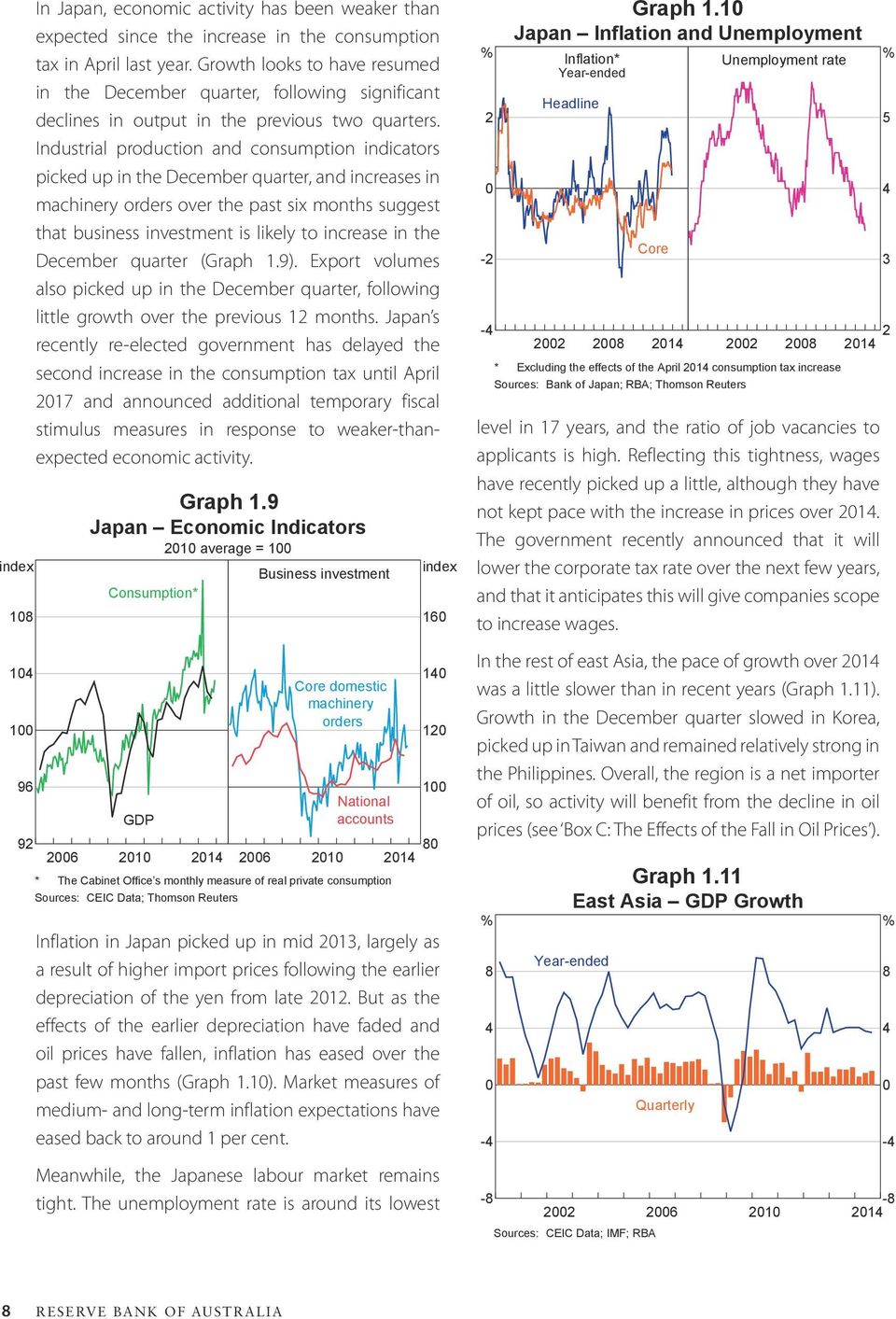
11 In general, falling global oil prices have led to declines in headline inflation across the region (Graph 1.1). The exceptions are Indonesia and Malaysia where consumer prices have risen in response to reductions in government fuel subsidies. These actions will ease pressure on both governments budgets and leave them less exposed to future increases in world oil prices. Core Graph 1.1 East Asia Inflation Year-ended East Asia* Headline Indonesia Malaysia * Excluding Indonesia and Malaysia Sources: CEIC Data; IMF; RBA; Thomson Reuters In India, economic growth has picked up over the past couple of years. Revisions to national accounts data point to more of an improvement than had been implied by earlier estimates (Graph 1.1). Investment growth has been quite volatile for some time, but in recent months a number of new investment projects have been announced by both the government and the private sector. There is some evidence that the government is beginning to make progress on a range of reform initiatives. Areas of focus include introducing a national goods and services tax, raising foreign investment limits in the insurance sector, making it easier to purchase land and improving transport and energy infrastructure. Meanwhile, inflation has continued to moderate in recent months, largely due to lower food and oil prices, although underlying inflation has also eased. The rate of consumer price inflation in December was well below the Reserve Bank of India s goal, prompting it to ease policy in mid January, although inflation is expected to rise somewhat in year-ended terms given the low outcomes in early 1. New Zealand s economy has experienced strong growth of domestic demand, particularly private investment, which has been supported by rebuilding following the Canterbury earthquakes of 1 and 11. The Reserve Bank of New Zealand has responded by raising the cash rate by 1 basis points over 1. Labour market conditions have strengthened in recent quarters, although wage and price inflation remain subdued. Despite the fall in New Zealand s commodity export prices, the New Zealand dollar exchange rate has remained elevated. United States Graph 1.1 India Output and Inflation Gross value added* Year-average growth 1 Revised Inflation CPI** (year-ended) 1 CPI** (monthly) * At basic prices ** Reserve Bank of India estimates prior to 1 Sources: CEIC Data; RBA; Reserve Bank of India The US economy has strengthened recently, with output growing above its trend pace over the second half of 1. Growth of consumer and business spending have led the pick-up, while public expenditure increased modestly over 1, after detracting from GDP growth since 1 (Graph 1.1). Residential investment remains very low as a share of GDP. Falling energy prices have lowered headline inflation in the United States and boosted real household incomes (Graph 1.1). The Federal Reserve has STATEMENT ON MONETARY POLICY FEBRUARY 1 9
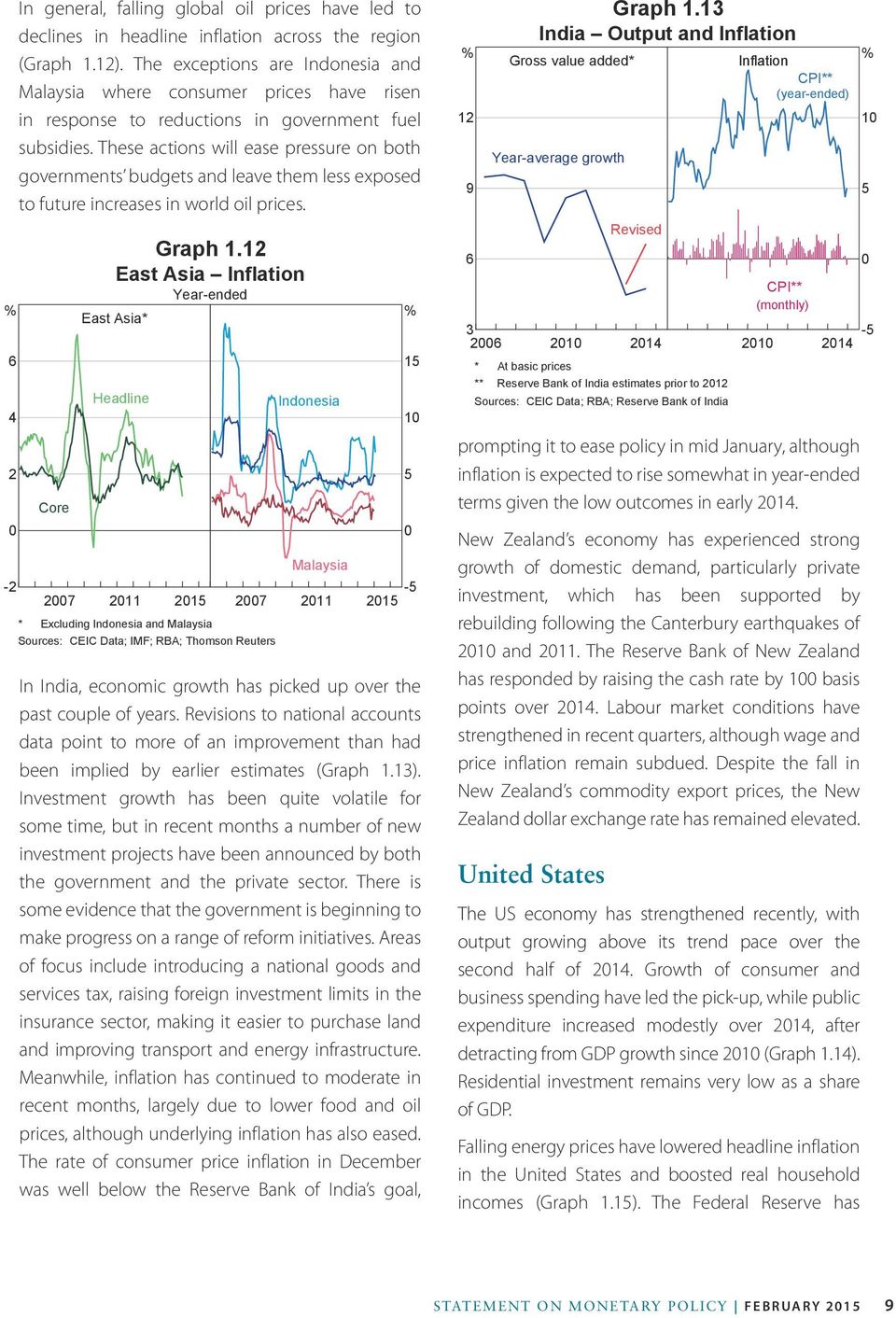
12 - Graph 1.1 United States GDP and Demand Quarterly GDP growth Year-ended Business investment Consumption - Public expenditure Source: Thomson Reuters 1-1 Graph 1.1 United States Inflation and Sentiment Personal consumption expenditures inflation Core (monthly) Headline (year-ended) Core (year-ended) Source: Thomson Reuters 1-1 Demand growth Year-ended Consumer sentiment average = 1-1 indicated that it will look through oil-related falls in headline inflation; core inflation over the year to December 1 was 1. per cent. Lower gasoline prices and ongoing strength in labour market outcomes appear to have contributed to a sharp rise in consumer sentiment over the past few months, following an increasing trend over the past few years. The pace of job creation has picked up further and the unemployment rate declined to. per cent in December. Wage growth, as measured by the employment cost index, has picked up to be slightly below its long-run average since the middle of last year. Survey-based measures of business activity improved over most of 1 and remain above 1 index average, despite declining a little around the turn of the year. In line with this, growth of industrial production has picked up in recent months and over 1 recorded its fastest pace in four years. Europe In the euro area, economic activity continues to recover slowly. GDP grew for six consecutive quarters to the September quarter 1, but the cumulative expansion over this period was only 1. per cent. Timely indicators, including the PMIs, have softened a little over the past couple of months but are still consistent with modest growth. The unemployment rate has declined by around ½ percentage point from its peak of 1 per cent in late 1 (Graph 1.1). Some of that decline has been associated with declining participation rates in most economies in the region. Nevertheless, in some economies particularly Spain, Portugal and Ireland GDP growth has been above trend and employment growth has lifted, so they have seen more marked declines in their unemployment rates, albeit from high levels. 1 Graph 1.1 Euro Area Unemployment Rates Germany Euro area France 1 1 Source: Thomson Reuters Ireland Spain Portugal Italy Consumer prices declined over the year to January (Graph 1.17). This was partly the result of falling oil prices, although core inflation of. per cent is also well below the European Central Bank s (ECB s) target. Long-term inflation expectations have declined by around ½ percentage point over the past six months. The ECB responded to low inflation and declining 1 RESERVE BANK OF AUSTRALIA
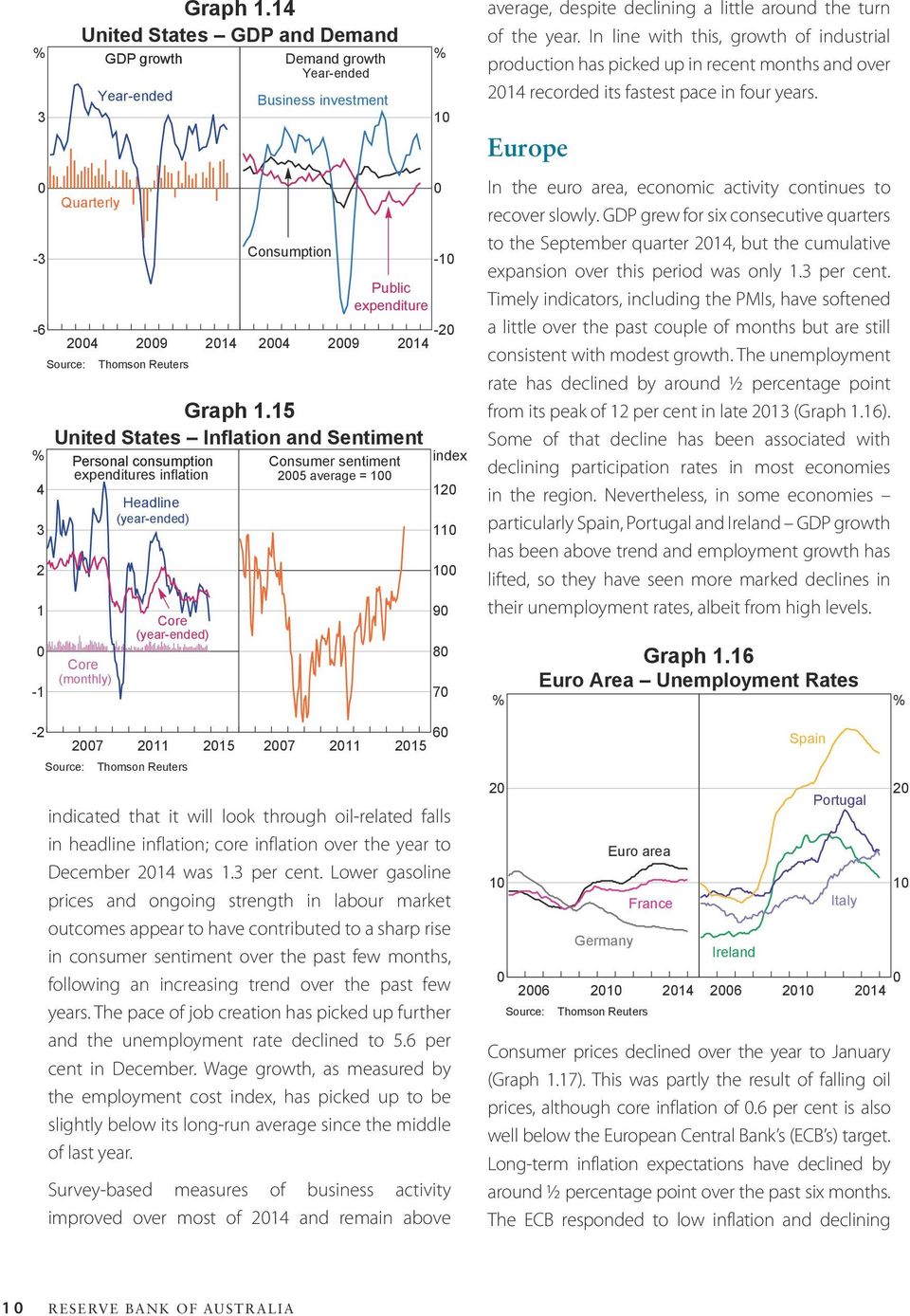
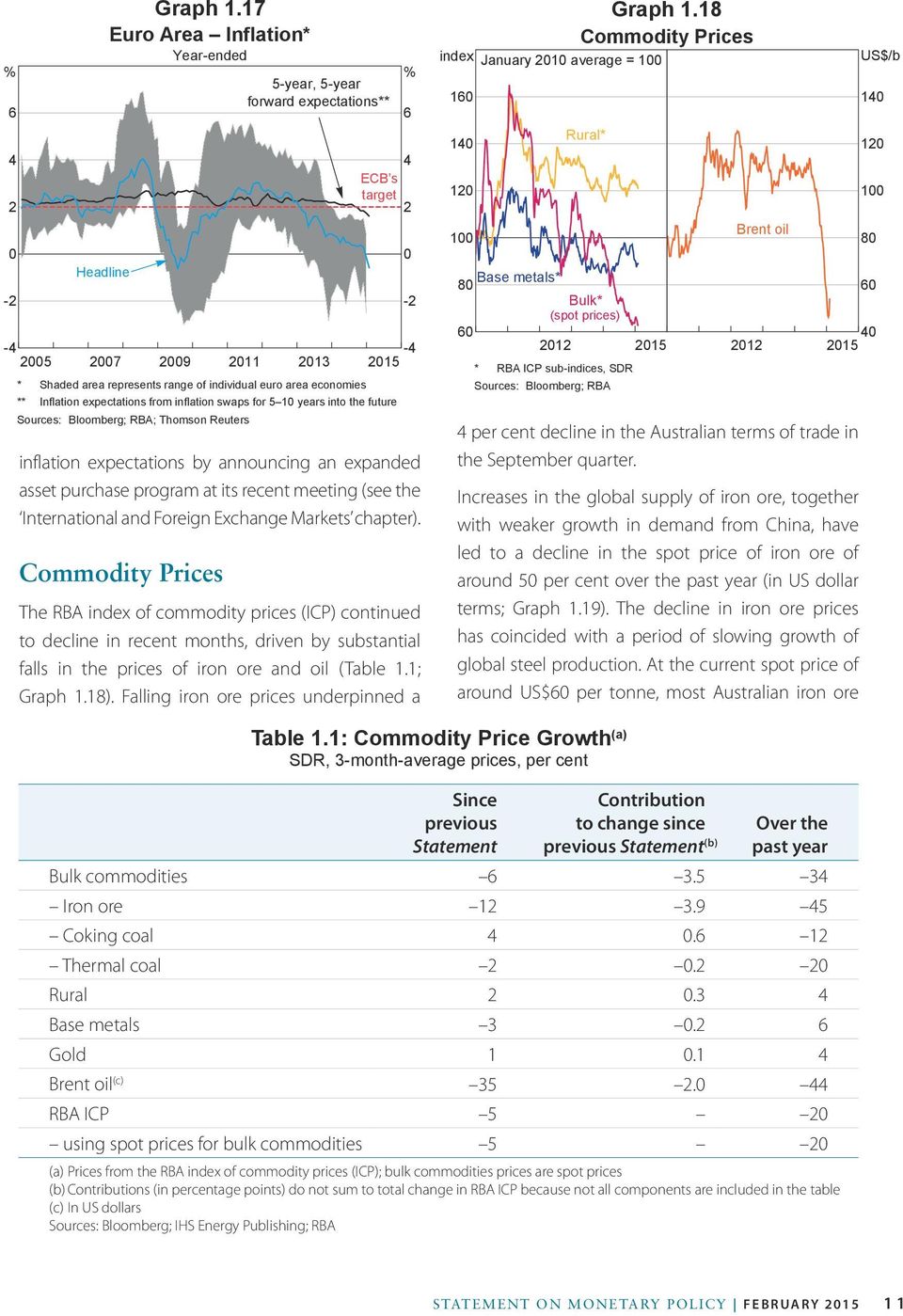
13 - Headline Graph 1.17 Graph 1.18 Euro Area Inflation* Commodity Prices Year-ended -year, -year forward expectations** ECB s target * Shaded area represents range of individual euro area economies ** Inflation expectations from inflation swaps for 1 years into the future Sources: Bloomberg; RBA; Thomson Reuters inflation expectations by announcing an expanded asset purchase program at its recent meeting (see the International and Foreign Exchange Markets chapter). Commodity Prices The RBA index of commodity prices (ICP) continued to decline in recent months, driven by substantial falls in the prices of iron ore and oil (Table 1.1; Graph 1.18). Falling iron ore prices underpinned a - index January 1 average = Rural* Base metals* 8 Bulk* (spot prices) 1 1 * RBA ICP sub-indices, SDR Sources: Bloomberg; RBA Table 1.1: Commodity Price Growth (a) SDR, -month-average prices, per cent Since previous Statement Contribution to change since previous Statement (b) Brent oil per cent decline in the Australian terms of trade in the September quarter. Increases in the global supply of iron ore, together with weaker growth in demand from China, have led to a decline in the spot price of iron ore of around per cent over the past year (in US dollar terms; Graph 1.19). The decline in iron ore prices has coincided with a period of slowing growth of global steel production. At the current spot price of around US$ per tonne, most Australian iron ore Over the past year Bulk commodities. Iron ore 1.9 Coking coal. 1 Thermal coal. Rural. Base metals. Gold 1.1 Brent oil (c). RBA ICP using spot prices for bulk commodities (a) Prices from the RBA index of commodity prices (ICP); bulk commodities prices are spot prices (b) Contributions (in percentage points) do not sum to total change in RBA ICP because not all components are included in the table (c) In US dollars Sources: Bloomberg; IHS Energy Publishing; RBA US$/b STATEMENT ON MONETARY POLICY FEBRUARY 1 11
14 US$/t Graph 1.19 Graph 1. Chinese Steel and Iron Ore Spot Prices Coal Spot Prices US$/t Free on board basis Chinese steel* (RHS) 8 $/t Thermal coal Hard coking coal $/t 1 A$ 1 Iron ore** (LHS, fines) * Average of hot rolled steel sheet and steel rebar prices ** Free on board basis Sources: Bloomberg; RBA production is estimated to be profitable. Indeed, some of the impact of declining prices on mining company margins has been offset by the recent depreciation of the exchange rate (see Box A: The Effects of Changes in Iron Ore Prices ). In addition, the declining oil price has helped to reduce the cost of extracting and shipping iron ore. To date, there has only been a limited response of global supply to lower prices, despite estimates suggesting that a significant share of global production is unprofitable at current prices. In China, data suggest that there has been a modest decline in iron ore production in recent months. The spot price of coking coal has been little changed over recent months and remains around its lowest level since 7 (Graph 1.). In contrast, thermal coal prices have continued to drift lower. The decline in thermal coal prices over the past year largely reflects new capacity expansions, together with weaker demand growth. At current prices, a substantial share of global coal production is likely to be unprofitable. In response, some companies have opted to close mines (including several coal mines in North America and some smaller, higher-cost mines in Australia) or reduce production. In addition, a number of potential projects have been delayed. As with iron ore, the depreciation of the Australian 1 1 US$ Sources: Bloomberg; Citigroup; IHS Energy Publishing; Macquarie Bank; RBA dollar will offset some of the impact of declining prices for Australian producers. Bank liaison suggests that mining companies are increasingly focused on reducing costs, including through lowering labour costs and increasing productivity. The Brent oil price has now fallen to a bit above US$ per barrel, and is around its lowest level since early 9. Strong growth in unconventional oil supply from the United States and resilient OPEC production have pushed down prices (see Box C: The Effects of the Fall in Oil Prices ). At current prices, higher-cost oil producers, particularly some of those using unconventional sources in North America, are likely to be unprofitable. Weaker-than-expected growth of demand has also contributed to the decline in oil prices. The sharp fall in crude oil prices is expected, in time, to feed through to the prices received by Australian liquefied natural gas (LNG) producers, given that most LNG contracts are linked to the price of oil. Base metal prices have decreased on average in the past three months, reflecting revisions to prospects for global economic growth, notably for China. Prices have declined particularly sharply for copper and nickel. R 1 1 RESERVE BANK OF AUSTRALIA

15 Box A The Effects of Changes in Iron Ore Prices The US dollar spot price for iron ore has fallen by around per cent over the past year and by over per cent since its peak in early 11 (Graph A1). This follows a very large increase in prices over the s as the growth in global demand for iron ore, particularly from China, exceeded the growth in global supply. In time, this led to a substantial expansion of global iron ore capacity and production, including in Australia. While the iron ore price was expected to decline as additional supply came on line, the size of the fall has been larger than most forecasters anticipated. This reflects larger-than-expected increases in lower-cost supply over the past few years and, more recently, a smaller-than-expected reduction in supply from higher-cost producers and some unexpected slowing in the growth of Chinese demand. As a result of the rapid expansion of investment and production in Australia, iron ore now accounts for close to one-fifth of the value of Australia s total exports. This means that the large falls in iron ore prices have driven a significant decline in Australia s terms of trade. The impact of this on the domestic economy has been offset to some extent by a depreciation of the Australian dollar. One way of gauging the effects of changes in the terms of trade on the domestic economy is to compare different measures of economic activity. Changes in the terms of trade represent changes in relative prices, so will not directly affect the most commonly used measure of real output (real GDP). However, changes in the terms of trade directly affect the purchasing power of domestic income. This effect is commonly measured by comparing the change in real GDP with the change in real gross domestic income (real GDI), which deflates nominal exports by import prices rather than export prices. US$/t index index Graph A1 Iron Ore Prices and the Terms of Trade Iron ore prices* Average export price Terms of trade average = 1 Output and income** average = 1 Real GDI Real GDP Spot price Real NNDI Real GDI grew at a faster pace than real GDP over most of the s, consistent with a rise in Australian living standards in response to the sharp increase in the terms of trade. However, this measure overstates the increase in purchasing power of national income over this period as some of the benefit from the rising terms of trade accrued to foreign investors (e.g. through dividend payments to non-resident owners of resource companies operating in Australia), and a greater share of gross income was used to offset depreciation of the mining capital stock as it increased in size. Real net national disposable income (real NNDI) attempts to adjust real GDI for US$/t * Free on board basis ** ABS trend measure Sources: ABS; Bloomberg; RBA index index STATEMENT ON MONETARY POLICY FEBRUARY 1 1

16 these effects. While it is difficult to gauge the share of foreign ownership of the iron ore industry, it is estimated to be fairly high. This suggests that a sizeable portion of iron ore profits over this period flowed to foreign investors. The fall in the iron ore price over recent years has weighed on real GDI and (indirectly) real GDP, and is expected to continue to do so over the forecast period. This reflects the unwinding of the effects that operated when the terms of trade increased over the decade to In particular, the fall in iron ore prices has placed downward pressure on national income, which has weighed on consumption and government revenue. To the extent that some of the fall in iron ore prices reflected weaker-than-expected demand, it would also have detracted from mining investment. The magnitude and timing of these effects depend on a number of factors, including changes in the exchange rate, the responses of monetary and fiscal policies and the extent to which households and businesses respond to the changes in relative prices they face. A depreciation of the exchange rate mitigates the size of the change in prices in Australian dollar terms and offsets some of the economic effects of the decline in the terms of trade by stimulating demand in other trade-exposed sectors of the economy, such as manufacturing, tourism and education. The trade-weighted exchange rate has depreciated by 1 per cent since the peak in iron ore prices in 11 and by 7 per cent over the past year. Monetary policy has also responded to the balance of these, and other, forces; the current accommodative stance is providing support to demand as the economy adjusts to a large decline in mining investment and the exchange rate remains above most estimates of its fundamental value. Falling iron ore prices can reduce household income, and therefore household expenditure, through 1 See Downes P, K Hanslow and P Tulip (1), The Effect of the Mining Boom on the Australian Economy, RBA Research Discussion Paper No 1-8. several different channels. Lower resource equity prices and/or dividend payments reduce household wealth and income, although this effect is mitigated to some degree by the high level of foreign ownership of iron ore companies. A lower tax base from falling royalties and company tax receipts could lead to lower transfer payments to households, higher taxes and/or lower public expenditure if governments choose not to allow their budget position to deteriorate (see below). A decline in mining investment reduces demand for labour and exerts downward pressure on wages. The impact of falling household disposable income on real GDP depends on how households respond. To the extent that the saving ratio increased over the decade to 1 because households viewed at least some of the increase in the terms of trade as temporary, as suggested by Downes, Hanslow and Tulip (1), this would imply that the saving ratio will fall somewhat in response to the decline in the terms of trade. This would support consumption growth relative to a scenario in which the earlier rise in the saving ratio was driven by more permanent factors. The bulk of Australian iron ore producers are at the lower end of the global iron ore cost curve, which means that most Australian production remains profitable at current iron ore prices (Graph A). Producers have responded to the decline in their profitability by reducing costs, such as labour. Producers have also reduced their expenditure on sustaining the existing capital stock and on exploration. To date, there has been a negligible response of export volumes to the fall in iron ore prices; in fact, the major producers are still planning to expand production a little further. Typically, new mining investment would also be expected to decline in response to lower prices; however, with the exception of planned capacity increases from major producers, existing commitments for major new projects were already limited. 1 RESERVE BANK OF AUSTRALIA
17 US$/t 9 Australia Graph A Global Iron Ore Production Costs 1, cost and freight (CFR) to China Brazil Other countries China* Cumulative annual production (Mt) * Includes freight costs within China Sources: AME Group; RBA US$/t 9 The fall in the iron ore price over recent years has reduced royalties for the Western Australian Government and company tax receipts for the Australian Government. During the mining boom, governments responded to the increase in the tax base by lowering the average tax rate for households, and increasing expenditure and transfer payments. As the iron ore price has fallen from its peak, governments have chosen to offset lower tax and royalty receipts partly through fiscal restraint on current expenditures, such as transfer payments to households, and partly by increasing borrowing over the next few years. R STATEMENT ON MONETARY POLICY FEBRUARY 1 1

18 1 RESERVE BANK OF AUSTRALIA

19 . International and Foreign Exchange Markets Diverging central bank policies and sharp falls in the price of oil have resulted in a number of large moves in international financial markets over recent months and an associated increase in volatility from the very low levels reached in mid 1. Recent additional policy stimulus announced by both the European Central Bank (ECB) and the Bank of Japan (BoJ) has contributed to pronounced declines in bond yields in those economies with German and Japanese government bond yields reaching historic lows and sizeable depreciations of the euro and yen. In contrast, expectations that the US Federal Reserve will raise policy rates some time later this year have underpinned the broad-based appreciation of the US dollar. The widening divergence in the paths for central bank policy was also cited as a key reason for the Swiss National Bank s (SNB s) unexpected decision to abandon its policy of capping the franc-euro exchange rate, which resulted in a sharp appreciation of the Swiss franc. Despite the expectations for Federal Reserve policy tightening, long-term US Treasury yields have fallen to historically low levels alongside declines in oil prices. The decline in oil prices has also weighed heavily on the currencies of a range of oil exporters, with the depreciation of the Russian rouble most pronounced. The Australian dollar has also depreciated further since the previous Statement amid broader declines in commodity prices, most notably iron ore. Central Bank Policy The ECB decided at its January meeting to significantly expand and broaden its existing asset purchase programs to include euro area sovereign bonds. The decision followed its assessment that current policy measures would not be sufficient to adequately address the heightened risk of a prolonged period of below-target inflation. In March, ECB asset purchases will increase from the current pace of about 1 billion per month to billion per month. Purchases will continue until the ECB assesses that inflation has increased in a sustainable manner, with the intention that this will persist until at least September 1. Accordingly, the ECB will purchase at least 1.1 trillion in securities, such that its balance sheet will exceed its previous peak of.1 trillion. The scale of the ECB s monthly purchases is equivalent to around 8 per cent of the maximum rate of purchases undertaken by the Fed during 1, but is equivalent to around 7½ per cent of euro area GDP. This compares with per cent of US GDP for the Fed s purchases and 1 per cent of Japanese GDP for the BoJ s purchases. The scope of ECB purchases was widened from covered bonds and asset-backed securities to include securities issued by euro area governments, agencies and European institutions. The ECB s asset purchases will be confined to investment-grade bonds but can also include securities issued by sovereigns rated below investment grade if the country is under a European Union/International Monetary Fund assistance program (subject to additional conditions). Purchases of eligible securities issued by euro area governments and agencies will be in proportion to their share in the ECB s capital, subject to holding limits of per cent of any issue (and per cent on issuers, which is relevant for Greece given existing holdings of Greek debt). The STATEMENT ON MONETARY POLICY FEBRUARY 1 17

20 b 1 ECB also departed from its standard practice of mutualising the risk among national central banks, deciding instead that gains or losses on securities will largely remain with each national central bank. The ECB had started to reverse the contraction in its balance sheet prior to the announcement of sovereign bond purchases, with total assets currently almost billion higher than the mid September trough (Graph.1). Most of this increase is due to lending to banks, as the ECB extended 8 billion and 1 billion in new lending under its September and December targeted longterm refinancing operations (TLTROs), more than offsetting 17 billion in repayment of -year LTROs issued in late 11 and early 1. The 11 offering of -year LTRO funds matured in late January, with around billion still outstanding, and was largely replaced by new -month and shorter-term loans; a further 1 billion of -year LTROs will mature at the end of February. The ECB s holdings of securities have also increased by more than billion due to covered bond purchases, while acquisitions of assetbacked securities have been minimal to date. Graph.1 European Central Bank Balance Sheet Selected assets Total Lending to banks Holdings of securities Source: European Central Bank 1 9 German and Italian banks appear to have been the main borrowers of funds extended as part of the September and December TLTROs. Outstanding ECB lending to these countries has increased by billion and billion, respectively, since b August. Italian and Spanish banks are still the largest borrowers from ECB facilities, with 19 billion and 1 billion in outstanding loans, respectively. Short term lending to Greek banks also increased by almost 1 billion over December, with total borrowing from the ECB rising to billion, and is believed to have risen further in January as depositors withdrew funds on concerns about the implications of the recent change in government (see section on Sovereign Debt Markets ). However, the ECB subsequently announced that it will no longer accept Greek government debt as collateral, effective from 11 February. The decision followed its assessment that it is not possible to presume Greece will remain in an assistance program. Greek banks will now have to provide alternative collateral or borrow via the Emergency Liquidity Assistance facility, which has looser collateral requirements but requires ECB approval. At an unscheduled January meeting, the SNB abandoned its commitment to ensure the Swiss franc did not appreciate beyond CHF1. per euro that had been in place since September 11 (see section on Foreign Exchange ). To ameliorate the expected tightening in financial conditions, it simultaneously lowered the rate on most additional deposits held at the SNB (in excess of a threshold) by basis points to.7 per cent, having previously lowered it from zero to. per cent in December. Interbank rates have fallen sharply in response, with the -month Swiss franc LIBOR now trading close to 1 per cent (Graph.). The Danish central bank also lowered the rate it pays on deposits held at the central bank three times in January, in response to appreciation pressure on its exchange rate which is fixed to the euro. The cumulative reduction amounted to basis points, leaving this rate at. per cent. The BoJ s balance sheet expanded by 7 trillion over 1, and the BoJ is targeting an increase of around 8 trillion in 1 following its late October decision to increase the scale of its government bond purchases (Graph.). The BoJ has lowered 18 RESERVE BANK OF AUSTRALIA

21 Graph. Swiss -month LIBOR Target Band -month LIBOR Source: Thomson Reuters Graph. Japanese Money Base* tr tr (Graph.). The Norwegian central bank similarly lowered its policy rate by basis points in December, attributing its decision to expected weakness in the broad economy as a result of falling oil prices, and flagged that it may reduce its rate further if these trends continue. Among oil-importing nations, the Reserve Bank of India lowered its policy rate by basis points in January, having previously raised it by 7 basis points between August 1 and January 1, as inflation slowed more rapidly than previously anticipated. The Turkish central bank also continued to unwind part of the sharp monetary tightening it implemented last January, in response to a more benign inflation outlook as oil prices have fallen, while the Monetary Authority of Singapore announced that, for the same reason, it will slow the pace of appreciation in the country s nominal effective exchange rate. 1 1 Graph. Market Implied Policy Rate Expectations UK Canada End August * Projection for 1 is the BoJ s money base target Source: Bank of Japan 1. Current NZ Euro area its near-term forecast for inflation, now expecting that it will remain around 1 per cent in the fiscal year beginning April, given the disinflationary impact of falling oil prices. However, it remains confident that it will achieve its per cent inflation target during the fiscal year beginning April 1. Falling oil prices have contributed to policy rate reductions by central banks of both oil exporters and importers. The Bank of Canada lowered its policy rate by basis points in January, noting that the fall in oil prices is expected to see investment in its oil industry fall by per cent and the terms of trade decline, leading to a sizeable reduction in its forecasts for economic activity (Table.1). Market pricing implies a further reduction in its policy rate Sources: Bloomberg; RBA Market-implied expectations for future interest rates in other advanced economies have declined materially over the past six months. Markets are no longer pricing in a rate rise by the Bank of England this year and expect it will increase its policy rate only twice over the subsequent two years, while the Reserve Bank of New Zealand is now expected to lower its policy rate over the next two years. In contrast, the US Federal Reserve continues to signal that it expects to raise policy rates sometime around the middle of this year, and that the pace STATEMENT ON MONETARY POLICY FEBRUARY 1 19
22 Table.1: Monetary Policy Policy rate Per cent Most recent change Cumulative change in current phase (a) Basis points Euro area. Sep 1 1 Japan (b) na na United States (c).1 Dec 8 1. Australia. Feb 1 Brazil 1. Jan 1 Canada.7 Jan 1 Chile. Oct 1 China (b) na na India 7.7 Jan 1 Indonesia 7.7 Nov 1 Israel. Aug 1 Malaysia. Jul 1 1 Mexico. Jun 1 New Zealand. Jul 1 1 Norway 1. Dec 1 1 Russia 1. Jan 1 South Africa.7 Jul 1 7 South Korea. Oct 1 1 Sweden. Oct 1 Switzerland (c).7 Jan 1 Taiwan 1.87 Jun 11. Thailand. Mar 1 1 Turkey 7.7 Jan 1 United Kingdom. Mar 9 (a) Current rate relative to most recent trough or peak (b) The Bank of Japan s main operating target is currently the money base; China does not have an official policy rate (c) Midpoint of target range Sources: Central Banks; RBA; Thomson Reuters at which rates rise thereafter will likely be gradual. Futures markets are pricing in both a later start to the tightening cycle and a more gradual increase than predicted by members of the Federal Open Markets Committee (FOMC; Graph.). The market-implied path has flattened significantly over recent months as investors judged that subdued inflation in large part due to declining oil prices and risks to the global economy will cause the Fed to maintain low interest rates for longer than previously expected. 1 Graph. US Policy Rate Expectations FOMC median projection (December 1) End August 1 1 Several other central banks have tightened policy over recent months. The Russian central bank raised its policy rate by 7 basis points in December, Current Sources: Bloomberg; Board of Governors of the Federal Reserve System RESERVE BANK OF AUSTRALIA
23 though unwound basis points of this in January, leaving its rate at 1 per cent compared with. per cent at the start of last year. The increase occurred in an attempt to stem the sharp depreciation of the rouble (see section on Foreign Exchange ). The Ukrainian central bank raised rates by a further 1 basis points in November, following basis points of tightening earlier in 1, to stem deposit outflow and stabilise its currency. The Brazilian central bank has also continued to tighten policy in response to elevated inflation, raising its policy rate by a further basis points in both December and January, while Bank Indonesia increased its policy rate by basis points in November to counter upward pressure on inflation expectations from a cut in government subsidies for fuel. In China, money market rates have, on average, been a little higher over recent months than those prevailing throughout most of 1. This has occurred despite the People s Bank of China (PBC) reportedly undertaking a number of direct liquidity injections to specific banks over this time. The PBC injected liquidity via a basis point cut to the reserve requirement ratio in February. One likely reason for these injections is to provide some offset to the net sale of foreign currency reserves (see section on Foreign Exchange ). The PBC also announced a reduction in most benchmark lending rates by basis points from November (Graph.). Benchmark lending rates are no longer binding on Chinese banks but still tend to guide their pricing; accordingly, average lending rates have fallen slightly. The PBC simultaneously lowered most benchmark deposit rates by basis points. These rates are still binding on banks, but the reduction in benchmark rates was accompanied by a widening of the permissible margin that banks can utilise, from 1 per cent above the benchmark to per cent, leaving the ceiling on deposit rates largely unchanged and allowing banks to maintain existing pricing. Authorities have continued to take steps towards deregulating deposit rates, including announcing a deposit insurance scheme expected to commence this year. Graph. China Interest Rates 1-year benchmark lending 1-year benchmark deposit Source: CEIC Data While these steps by themselves would contribute to a slight easing in the policy stance, regulatory decisions over 1 may have more than offset these, leading to a tightening in overall financial conditions. In early 1, the China Banking Regulatory Commission (CBRC) also proposed a draft regulation that could significantly constrain entrusted lending, which accounted for around 1 per cent of growth in total social financing last year. Entrusted lending typically involves lending by one company to another, with banks purportedly just acting as agents, but authorities have been concerned that a sizeable portion of such lending has been funded by bank credit and has been structured to evade regulatory constraints on direct bank lending. To prevent this, the regulations prohibit entrusted loans from being funded by debt (bank credit, bonds or wealth management products) or invested in most financial instruments, and banks will be prohibited from taking on any credit risk. Slightly offsetting this, the PBC announced regulatory reforms to the calculation of banks loan-to-deposit ratios, which should relax constraints stemming from the 7 per cent cap a little. In particular, it expanded the definition of both loans and deposits included in this calculation to incorporate (among other things) interbank transactions with non-bank financial institutions, to which banks are net receivers of funds in aggregate. STATEMENT ON MONETARY POLICY FEBRUARY 1 1
24 Sovereign Debt Markets Yields on major market 1-year sovereign bonds declined significantly over 1, with yields on US Treasuries down by 9 basis points, those on German Bunds down by 1 basis points and those on Japanese government bonds (JGBs) down by basis points (Graph.7). Bond yields have continued to fall in 1, particularly those on US Treasuries which are basis points lower than at the end of last year. These declines have seen yields on Bunds and JGBs reach new record lows, while those on Treasuries are back around the levels recorded prior to the Fed first signalling its expectation of scaling back its asset purchases in mid 1. Yields on Swiss government bonds have also fallen by more than 1 basis points since the start of 1, with much of this occurring prior to the SNB s decision to abandon its exchange rate ceiling. Swiss 1-year bonds now yield less than zero per cent. This is the first time ever that a 1-year bond has traded with a negative yield. Graph.7 1-year Government Bond Yields US Germany Japan Source: Bloomberg Bond yields have generally fallen across the maturity spectrum over this period, and bonds with maturities of several years have recently traded with yields no more than zero per cent in several countries, including Japan, core euro area economies and several other European nations. However, declines in bond yields have been most pronounced at the long end of the maturity spectrum, leading to a marked flattening of the yield curve in major markets and a sizeable decline in term premiums, which now provide investors with minimal or no compensation for holding longer-term bonds (Graph.8). bps US - 1y y y Source: Bloomberg Graph.8 Changes in Yield Curves Since end 1 Germany y 1y Japan bps y y y - While the magnitude of these falls are hard to explain, a number of factors have contributed, including: heightened concerns about global growth and the possibility of deflation over the next few years as oil prices have fallen; expectations of the January announcement of sovereign bond purchases by the ECB; and ongoing purchases of JGBs by the BoJ. It also reflects a reduction in the supply of new bonds, tightening the demand/supply balance, as budget deficits have generally narrowed, resulting in lower net issuance. These factors have been associated with a larger fall in yields on nominal bonds than on inflation-indexed bonds, leading to a marked reduction in the compensation that owners of nominal bonds receive for inflation, as discussed in Box B: The Decline in Bond Yields and Inflation Expectations. Japanese residents have partially unwound their earlier accumulation of foreign bonds over recent months, but their holdings remain almost 1 trillion higher than in March (Graph.9). Japanese residents have been heavy buyers of US Treasuries and euro area bonds (other than Bunds) over this period. Japanese RESERVE BANK OF AUSTRALIA
25 tr Graph.9 Graph.1 Japanese Purchases of Foreign Bonds Euro Area 1-year Government Bond Spreads Cumulative since January 11 All countries* EU (excl Germany) tr 1 bps To German Bunds Greece* (RHS) bps 1 US Australia Spain (LHS) Germany * Balance of payments data to November 1; provisional thereafter Sources: Japanese Ministry of Finance; RBA purchases of Australian dollar-denominated bonds amounted to around 1½ trillion (A$1 billion) over this time. Spreads on bonds issued by the Greek Government (over German Bunds) have widened markedly of late, to be more than basis points higher since mid September, with the move particularly pronounced in December (Graph.1). The widening of spreads reflected mounting concerns about the potential for a default or restructuring of government debt by the newly elected SYRIZA party, which had signalled its intention to seek both a writedown of government debt and a moratorium on repayments, while also raising pension rates and the minimum wage by per cent. Any rescheduling of debt repayments would need to be negotiated with European governments, who hold around two-thirds of Greek debt, mainly via the European Financial Stability Facility (EFSF). However, near-term repayments are to the International Monetary Fund and bondholders, since debt owed to the EFSF has very long maturities and no upcoming repayments. Concerns about the possibility that the government will default on outstanding debt have seen foreigners refrain from buying bills recently issued by the government. The Greek Government currently has around 1 billion of cash on hand, and is due to receive a billion instalment from the EFSF this Italy (LHS) * Data from 1 March 1 are yields on Greek bonds post first private sector debt swap Source: Bloomberg month (subject to European Union agreement). It had also budgeted to post a primary budget surplus of. billion in 1, though this could disappear if SYRIZA raises the minimum wage and pensions as planned. These funds should be sufficient to meet the ½ billion of principal and interest payments due this month, but will not cover the additional 8 billion needed for such payments over the remainder of 1. In contrast to when Greek debt concerns were last prominent in 1 1, there has so far been little effect on bonds issued by other euro area governments. Spreads on government bonds issued by Italy and Spain, in particular, continued to narrow in anticipation of the ECB s January decision to purchase these securities. Yields on local currency bonds issued by emerging market governments have tended to decline over recent months, in line with those on US Treasuries. Yields have fallen in several countries where monetary policy has been eased, such as in India, Korea, China and Turkey, with the fall in Turkish yields particularly pronounced due to expectations that the decline in oil prices will reduce its current account deficit (Graph.11). The key exception has been yields on Russian bonds, which have risen by more than basis points since September in response 1 STATEMENT ON MONETARY POLICY FEBRUARY 1
26 1 Graph.11 1-year Government Bond Yields Local currency-denominated Russia Mexico bps Investment grade* LHS Graph.1 Corporate Bond Spreads To equivalent government bonds Financials LHS Non-investment grade RHS bps Brazil India Turkey 1 1 Sources: Bloomberg; Thomson Reuters South Korea China 1 1 to the depreciation of the rouble and associated tightening of monetary policy. Yields on US dollardenominated Ukrainian government bonds have also risen sharply as it became increasingly clear that the government will require additional fiscal support. Yields on US dollar bonds issued by some oil-exporting nations perceived to be vulnerable to default such as Venezuela and Nigeria have also increased sharply. Credit Markets Spreads on bonds issued by US corporations have widened since the middle of last year, with a particularly large increase for non-investment grade bonds (Graph.1). Spreads on these bonds have increased by more than basis points since late June, with around two-thirds of this attributable to a basis point rise in spreads on energy and related bonds; much of the remainder followed midyear comments by Federal Reserve Chair Yellen that spreads on such bonds appeared unduly narrow (Graph.1). Around half of the basis point widening in spreads on US investment grade bonds is also due to securities issued by energy producers, while spreads on financial bonds have widened only modestly. Despite these moves, yields on investment grade bonds remain well below their historical average, while non-investment grade bonds are back around historical norms. 1 US$ Euro area US * Non-financial corporations Sources: Bank of America Merrill Lynch; Bloomberg; RBA 1 Graph.1 US High-yield Bond Spreads and Oil Price 8 West texas intermediate crude (LHS) High-yield index (RHS, inverted scale) High-yield energy index (RHS, inverted scale) M J S D M 1 1 Sources: Bank of America Merrill Lynch; Thomson Reuters In contrast, spreads on investment grade bonds issued by European corporations, including financials, have been broadly stable over recent months. This, along with the marked fall in sovereign bond yields, has seen yields on medium-term bonds issued by some highly rated corporations trade with negative yields. Spreads on European non-investment grade bonds, however, have widened considerably since mid 1, reflecting an expected increase in defaults as the European economy has weakened rather than concerns about oil producers debt-servicing ability. Gross bond issuance by advanced economy corporations increased modestly in 1 9 bps 8 1 RESERVE BANK OF AUSTRALIA
27 (Graph.1). In the United States and euro area, the increase over 1 came despite issuance by noninvestment grade corporations slowing noticeably over the second half, alongside the widening in spreads on such bonds. Net bond issuance by US corporations was little changed in 1, while net issuance by European corporations was less negative than in 1 due to developments in bond issuance by corporations in the periphery economies. Both gross and net bond issuance by corporations in emerging markets was sharply higher in 1, driven by new bond financing by Chinese corporations. index Graph.1 Major Share Price Indices 1 January 7 = 1 S&P Nikkei Euro STOXX index US$b 1 Graph.1 Gross Corporate Bond Issuance Non-financial Financial US US$b US$b 1 1 Euro area US$b Source: Bloomberg Table.: Changes in International Share Prices Per cent Total net issuance Sources: Dealogic; RBA Equities Equity markets in advanced economies generally posted modest returns in 1 (Graph.1; Table.). Markets in the United States and Japan outperformed others, rising by 11 and 7 per cent, respectively, with much of this underpinned by higher company earnings. In contrast, European share prices rose only slightly, as earnings were little changed and banking stocks fell due to concerns about possible exposures to Greek and Russian debt. Advanced economy share prices have, overall, subsequently increased slightly in 1. European share prices have outperformed amid the announcement by the ECB of its sovereign bond purchase program, notwithstanding a sharp fall in Greek share prices over January as banking stocks fell by almost per cent. Share prices in Over 1 Year to date United States S&P 11 Euro area STOXX 9 United Kingdom FTSE Japan Nikkei 7 1 Canada TSE 7 Australia ASX 1 7 China MSCI All China 8 MSCI indices Emerging Asia Latin America Emerging Europe 8 7 World 7 1 Source: Bloomberg other advanced economies have generally been little changed, alongside an increase in volatility to historically average levels, with concerns about global growth, the possibility of a Greek debt default and, particularly for the United States, falling oil prices weighing on markets. The latter has seen the share prices of energy companies which account for around 8 per cent of the S&P fall by more than per cent since mid last year, more than STATEMENT ON MONETARY POLICY FEBRUARY 1
28 outweighing a modest rise in the prices of transport and consumer discretionary stocks that should benefit from lower oil prices. Swiss equity prices have also fallen sharply since the SNB s decision to abandon its exchange rate cap, with prices down by 9 per cent on the day. Graph.1 Changes in Emerging Market Share Price Indices Over 1 Aggregate profits for the six largest US banks fell by around per cent in 1, reflecting US$ billion of fines imposed during the year and a decline in underlying profits in the December quarter, compared with both the prior quarter and a year earlier. The fall in December quarter underlying profits was driven by a fairly broad-based decline in revenue from trading activity. The largest US banks all reported supplementary leverage ratios that meet the per cent requirement that will take effect in 18. Share prices in a number of emerging markets increased strongly over 1, with prices rising by around per cent in India, China and Turkey, and by around per cent in a number of other Asian economies (Graph.1). However, share prices in several emerging markets have fallen since late November. The recent declines have been most pronounced in oil-producing nations such as Brazil, Malaysia and Mexico. The rise in Chinese equities over 1 was underpinned by a sharp rise in stocks listed on mainland exchanges, which have increased by almost per cent since mid July. This rally has been underpinned by increased participation of retail investors and associated with a large rise in leverage, despite some softening in economic growth (see International Economic Developments chapter). Furthermore, the rise in mainland stock prices (A shares) has not been matched by increased prices for the same companies Hong Kong-listed stock (H shares), with the former now trading more than per cent higher than the latter on average (Graph.17). The rise in prices has seen the priceearnings ratios for Chinese stocks increase toward historical norms. 1-1 index index India China Turkey Philippines Indonesia Thailand South Africa Chile Hong Kong Mexico Poland Brazil South Korea Malaysia Russia Source: Bloomberg Graph.17 Dual-listed Chinese Share Prices January 11 = 1 A-share index H-share index Average A-share premium* Parity = * Relative to H shares Source: Bloomberg Trading links between Hong Kong and the mainland were strengthened in November with the opening of the Shanghai-Hong Kong Stock Connect. This scheme allows foreign investors to purchase Shanghai A shares and institutional and wealthy Chinese investors to buy shares listed in Hong Kong, subject to both daily caps on purchases and a quota on overall holdings. Foreign investors have used around per cent of the northbound quota to date and current trends suggest it will be fully 1-1 index index RESERVE BANK OF AUSTRALIA
29 US$b used by July, but Chinese investors have shown little interest in increasing their exposure to stocks listed in Hong Kong. Hedge Funds Global hedge funds recorded an asset-weighted return on investments of around per cent over 1, underperforming the total return from a balanced portfolio of global bonds and equities. Hedge funds focused on Russia and eastern Europe weighed on overall performance, while macro funds, which trade according to views on broad economic developments, outperformed other categories. Data on the performance of hedge funds in January are as yet unavailable, but a number of funds are known to have suffered considerable losses from the sharp appreciation of the Swiss franc. Hedge funds continue to receive net investor inflows, despite decisions by some large institutional investors over recent months to reduce their allocation to or cease investing in such funds (Graph.18). Graph.18 Global Hedge Funds US$b US$tr US$tr Accordingly, volatility in the main developed market currency pairs has continued to increase from the very low levels reached in mid 1 (Graph.19). The Swiss franc has appreciated by 1 per cent against the euro (and by 1 per cent against the US dollar) since the SNB surprised markets by ceasing its minimum exchange rate policy for the euro against the Swiss franc in mid January (Graph.). The decision occurred alongside a reduction in the interest rate on sight deposit balances (discussed above). The decision to abandon the policy which had imposed a ceiling of 1. francs per euro since September 11 led to significant volatility and ppt Graph.19 Volatility in Developed Market Currencies* 1 Implied by one-month options, annualised ppt 1 7 Total funds under management (RHS) * EUR/USD, USD/JPY, GBP/USD, AUD/USD, USD/CAD, USD/CHF, EUR/JPY, EUR/GBP, EUR/CHF weighted by turnover Source: Bloomberg - Net investor flows* (LHS) * Annualised for 1 data Sources: Hedge Fund Research, Inc.; RBA Returns* (LHS) M J S D 1 index 17 1 Franc per euro (RHS, inverted scale) Graph. Swiss Franc Ceiling (RHS) franc Foreign Exchange The increasingly divergent paths for monetary policy in the United States and other major advanced economies have led to some sizeable movements in exchange rates over recent months, with the sharp declines in global oil prices also contributing. 1 1 TWI* (LHS) * 9 average = 1 Sources: BIS; Bloomberg; RBA STATEMENT ON MONETARY POLICY FEBRUARY 1 7
30 franc.9 1. illiquid trading conditions for the franc, which appreciated by as much as per cent against the euro on an intraday basis shortly after the announcement (Graph.1). The disorderly market conditions saw a number of retail foreign exchange trading firms sustain losses which, in some cases, has resulted in insolvencies. Many of the affected retail brokers had agreements in place to automatically close out their clients positions at a pre-specified level of the exchange rate and/or as soon as their clients margins had been eroded. However, the withdrawal of liquidity meant that some retail brokers were unable to execute these trades at or even close to the price needed to avoid losses. The losses were magnified by the high degree of leverage typically offered by these retail firms to their clients. Graph.1 Swiss Franc per Euro -minute intervals,* inverted scale franc.9 1. the euro was no longer justified. Nevertheless, the SNB has stated that it will remain active in the foreign exchange market to influence monetary conditions if necessary. Preliminary data suggest that the SNB has intervened in the foreign exchange market since the announcement. The euro has depreciated further over recent months, to be 1 per cent lower on a trade-weighted basis and 18 per cent lower against the US dollar since early May 1 (Graph.). The depreciation has primarily reflected growing market expectations subsequently realised that the ECB would introduce additional monetary stimulus at its January meeting (discussed above). The euro is currently around its lowest level against the US dollar since late and on a real trade-weighted basis is a little below its average since the introduction of the single currency in index 1 Graph. Nominal Trade-weighted Indices average = 1 US dollar Japanese yen index l l l l 1. 1 Jan 1 Jan 1 Jan 19 Jan Jan * Trading days only Source: EBS Prior to the announcement, the franc had been trading very close to its ceiling against the euro, with growing market expectations that the ECB would introduce further monetary stimulus and safe-haven demand related to ongoing geopolitical tensions in Russia creating appreciation pressure. In response, the SNB began purchasing additional foreign currency reserves in December in an effort to preserve the exchange rate ceiling, before ultimately concluding that the increasing divergences between the monetary policies of the major currency areas meant that maintaining the franc s ceiling against 1. 8 Euro Sources: BIS; Bloomberg; Board of Governors of the Federal Reserve System The US dollar has continued to appreciate against most other currencies over recent months, to be 11 per cent higher on a trade-weighted basis since mid 1 and around per cent higher than its trough in July 11 (Table.). Notwithstanding its recent appreciation and higher inflation in the United States relative to a number of its trading partners the US dollar remains a little below its longer-term average on a real trade-weighted basis (Graph.). 8 8 RESERVE BANK OF AUSTRALIA
31 index Table.: Changes in the US Dollar against Selected Currencies Per cent Over 1 Since end 1 Russian rouble 7 17 Canadian dollar 9 8 European euro 1 Swedish krona 1 New Zealand dollar Australian dollar 9 Brazilian real 1 Malaysian ringgit 7 UK pound sterling Indonesian rupiah Singapore dollar Norwegian krone Chinese renminbi 1 Mexican peso 1 South Korean won 1 Thai baht 1 1 South African rand 1 1 Japanese yen 1 Indian rupee Swiss franc 11 7 TWI 9 1 Sources: Bloomberg; Board of Governors of the Federal Reserve System Graph. US Dollar Real Trade-weighted Index average = 1 index Sources: Bloomberg; Board of Governors of the Federal Reserve System 9 The Japanese yen has depreciated by per cent on a trade-weighted basis and by 7 per cent against the US dollar since late October, when the Bank of Japan unexpectedly increased its monthly asset purchases. In real trade-weighted terms, the yen is around per cent below its average over the past years. A number of other developed market currencies have also experienced sizeable depreciations against the US dollar over recent months. In particular, the sharp declines in global oil prices have contributed to the Canadian dollar and Norwegian krone depreciating by 1 and per cent, respectively, since late June (Graph.). index M Graph. Developed Market Currencies Against the US dollar, January 1 = 1 New Zealand dollar Canadian dollar Source: Bloomberg Euro Australian dollar Japanese yen Norwegian krone J S D M 1 1 The Chinese renminbi (RMB) has depreciated by around per cent against the US dollar since late October, returning to the bottom of its +/ per cent trading band against the US dollar. More broadly, over the past year the RMB has exhibited greater two-way variation around its daily fixing rate against the US dollar, with the daily fixing rate remaining broadly unchanged since early 1. On a nominal trade-weighted basis, the RMB has continued to appreciate over recent months to be around 7 per cent higher since the end of 1, primarily reflecting appreciation against the Japanese yen and the euro (Graph.). index STATEMENT ON MONETARY POLICY FEBRUARY 1 9
32 yuan.1.. Graph. Chinese Renminbi Yuan per US$, inverted scale Spot rate Fixing rate yuan index Renminbi against major trading partners* index 1 Euro Japanese yen 1 1 (19) (1) TWI 1 1 Korean won (8) * Indexed to 11 average = 1; figures in parentheses represent currencies weights in the trade-weighted index; the weight of the US dollar is 19 per cent Sources: BIS; Bloomberg The stock of Chinese foreign currency reserves decreased by US$ billion (or around 1 per cent) over the December quarter, to be US$1 billion (around per cent) lower than its peak at the end of June 1. The decline in reserves over the second half of 1 appears to have been due both to foreign exchange valuation effects and to sales of foreign currency by the PBC in the December quarter (Graph.). The PBC s modest net sales of foreign currency over the latter half of 1 indicate that net private capital outflows from China broadly offset China s current account surplus over this period. The Chinese authorities have continued to take steps towards internationalising the RMB. In November, the Reserve Bank signed a Memorandum of Understanding (MoU) with the PBC to establish official RMB clearing arrangements in Australia. The arrangements are designed to facilitate RMBdenominated payments between Australian and Chinese entities by providing local banks with more direct access to China s domestic payments system than was previously available. The Chinese authorities also granted Australia an RMB billion quota under the RMB Qualified Foreign Institutional Investor (RQFII) program, which allows approved Australian-domiciled financial institutions to invest in China s domestic bond and equity markets using RMB. The PBC also recently signed MoUs to establish Graph. Chinese Foreign Currency Reserves Net quarterly transactions, per cent of GDP Purchases Sales Sources: Bloomberg; CEIC Data official RMB clearing arrangements in Canada, Malaysia, Switzerland and Thailand. In addition, Canada and Switzerland were both granted RQFII quotas of RMB billion, and the PBC signed (new or renewed) bilateral local currency swap agreements with the Bank of Canada and the Bank of Thailand. Most other Asian and emerging market currencies have depreciated further against the US dollar over recent months, continuing a trend that has been evident since mid 1. The depreciations have tended to be more pronounced for Eastern European currencies, as well as for those of oil and other commodity exporters in Latin America and Asia (Graph.7). Volatility in emerging market currencies has generally increased, though remains around its post-9 average. The Russian rouble has depreciated by more than per cent against the US dollar since the end of September, with the depreciation pressure particularly acute in early December (Graph.8). The main drivers of the depreciation have been the sharp declines in global oil prices and ongoing geopolitical tensions, with the latter related to sanctions which have limited Russian firms access to international capital markets. In addition to the 7 basis point increase in its policy rate in December (which was partly unwound in January; discussed above) the Russian central bank has taken a number 1 1 RESERVE BANK OF AUSTRALIA
33 index Graph.7 Asian and Emerging Market Currencies Against the US dollar, January 11 = 1 Singapore South Korea Malaysia Poland Mexico Turkey 7 7 Indonesia India Brazil South Africa Source: Bloomberg rouble Graph.8 Russian Exchange Rate and Reserves Rouble per US$ (LHS, inverted scale) Gross foreign currency reserves* (RHS) index US$b US$b Purchases Monthly FX intervention** US$b Sales * Weekly data to January 1 ** Intervention data are available from August 8; excludes intervention conducted on behalf of the Russian Federal Treasury Sources: Bloomberg; IMF; RBA; The Central Bank of the Russian Federation of steps to counter the depreciation pressure. These include: sales of a further US$1 billion worth of its foreign currency reserves in early December (taking cumulative foreign currency sales in 1 to US$88 billion); an increase in the frequency and size of foreign exchange repo auctions; and the introduction of a foreign currency loan facility for Russian financial institutions. The Russian central bank also sold US$ billion worth of foreign exchange on behalf of the Russian Treasury in January. Russia s gross foreign currency reserves have declined by per cent (US$8 billion) since the end of September and by per cent since the end of 1 to US$17 billion (or 1 per cent of GDP). However, Russia s gross reserves include up to US$17 billion worth of assets that are managed on behalf of Russia s two sovereign wealth funds, rather than by the central bank itself. Nevertheless, Russian authorities have announced that they will make a portion of the foreign exchange in these sovereign wealth funds available to the market via the central bank over coming months. Other Eastern European currencies, including the Polish zloty and Hungarian forint, have depreciated by 9 1 per cent against the US dollar since the end of September, but have been little changed against the euro. The zloty and some other Eastern European currencies depreciated further against the US dollar following the SNB s decision to remove the Swiss franc s ceiling against the euro, amid some concerns about their banking sectors exposures to Swiss franc-denominated mortgages. The declines in global oil prices have continued to weigh on the currencies of oil exporters, with the Malaysian ringgit and Mexican peso depreciating by 11 1 per cent against the US dollar since mid 1. In response to increased foreign exchange market volatility, the Mexican central bank reintroduced a foreign exchange market intervention program. Broader declines in commodity prices have also contributed to ongoing depreciation of the Brazilian real, which is almost per cent lower against the US dollar since mid 1. More broadly, the gross foreign currency reserves of most Asian and other emerging market economies have declined modestly or been little changed since the end of September, with a few notable exceptions (Table.). Aside from Russia, these include Ukraine where reserve holdings were used to meet interest payments on government-guaranteed debt securities and to pay for natural gas imports and Argentina, where gross reserve holdings increased largely as a result of the acquisition of foreign currency under an FX swap agreement with China. STATEMENT ON MONETARY POLICY FEBRUARY 1 1
34 Table.: Gross Foreign Currency Reserves (a) Percentage change since: Level End End US$ equivalent December 1 September 1 (billions) China Taiwan (b) 1 19 Brazil South Korea 1 Russia 17 Hong Kong 1 India Mexico 9 18 Thailand 18 Turkey 1 19 Indonesia Malaysia Argentina 1 Ukraine 7 (a) Data to end December for China, Hong Kong, Indonesia, Mexico, Taiwan, Thailand and Ukraine; to 1 January for Malaysia; to January for India, Russia and Turkey; to end January for South Korea; and to February for Argentina and Brazil (b) Foreign exchange reserves (includes foreign currency and other reserve assets) Sources: Bloomberg; CEIC Data; IMF; RBA 9 7 Australian Dollar Since the previous Statement, the Australian dollar has depreciated by 7 per cent on a trade-weighted basis and by 9 per cent against the US dollar (Graph.9; Table.). In addition to the broadbased appreciation of the US dollar and further declines in key commodity prices, changes in market index, yen Yen per A$ (LHS) 11 Graph.9 Australian Dollar US$ per A$ (RHS) Euro per A$ (RHS) TWI (LHS) US$, euro Sources: Bloomberg; RBA Table.: Changes in the Australian Dollar against Selected Currencies Per cent Over 1 Since end 1 Canadian dollar European euro 1 New Zealand dollar Malaysian ringgit UK pound sterling Indonesian rupiah 7 Singapore dollar Chinese renminbi US dollar 8 South Korean won Thai baht 8 South African rand 1 Japanese yen 7 Indian rupee 7 Swiss franc 1 TWI Sources: Bloomberg; RBA RESERVE BANK OF AUSTRALIA
35 participants expectations for the domestic cash rate also contributed to the depreciation (see the Domestic Financial Markets chapter). On a tradeweighted basis, the Australian dollar is around per cent below its early 1 levels notwithstanding significant falls in commodity prices since then. Over 1, depreciations against the US dollar and RMB were partly offset by appreciations against the yen and euro. 1 Graph. Australian Capital Flows Net inflows, per cent of GDP Annual Quarterly Public sector* Net capital flows Capital Flows Net capital inflows to the Australian economy increased to. per cent of GDP in the September quarter, with net inflows directed primarily to the public sector. There was also a small net inflow to the private sector as a whole, with sizeable net inflows to the private non-financial sector offsetting continued net outflows from the financial sector (Graph.). The net inflow to the public sector in the September quarter was largely the result of continued foreign purchases of Commonwealth Government securities (CGS). However, the rate of CGS issuance outpaced foreign purchases such that the foreign ownership share of CGS declined by percentage points over the quarter to per cent. In contrast, there was a small net outflow from the state and local government sector, which saw the foreign ownership share of state government securities decline by a further 1 percentage point over the quarter to 7 per cent. In the September quarter the net inflow to the private non-financial sector was primarily due to an increase in foreign investment in the mining sector. In contrast, there was a continued net outflow from the private financial sector, largely reflecting net debt outflows from the banking sector. There was also a net capital outflow from the other financials sector (which includes superannuation and other types of investment funds) albeit noticeably smaller than in previous quarters as Australian funds reduced their net purchases of foreign assets in the quarter. Private non-financial sector Private financial sector** * Excludes official reserves and other RBA flows ** Adjusted for US dollar swap facility in 8 and 9 Sources: ABS; RBA Notwithstanding the increase in net capital inflows, Australia s (seasonally adjusted) net income deficit narrowed further in the September quarter to per cent of GDP its lowest share of GDP since 198 (Graph.1). The narrowing of the net income deficit was driven by portfolio equity income flows, which recorded a rare net inflow. This, in turn, reflected the fact that the income received on Australia s portfolio equity assets rose to exceed the income paid on Australia s portfolio equity liabilities. R 1 Net direct equity Graph.1 Net Income Deficit* Per cent of GDP Total Net debt Net portfolio equity * Excluding compensation of employees and secondary income Sources: ABS; RBA - 1 STATEMENT ON MONETARY POLICY FEBRUARY 1
36 Box B The Decline in Bond Yields and Inflation Expectations Yields on bonds issued by governments of developed economies have declined significantly over recent months across the whole yield curve. As a result, securities issued by a number of governments among them Japan, most core euro area economies, as well as Sweden and Switzerland have recently traded at negative yields for maturities up to five years (Graph B1). In total, around US$7. trillion, or almost one-quarter of developed markets sovereign debt, has recently traded with yields at or below zero. This includes almost half of Japanese sovereign debt and about two-thirds of German sovereign debt (Graph B). While the magnitude of these falls in sovereign bond yields is difficult to explain, the declines reflect developments in both supply and demand for such securities. On the supply side, government debt issuance in major economies (with the exception of Japan) has decreased over recent years as budget deficits have narrowed. For example, the German Government plans to issue only billion of new debt in 1, compared with billion five years ago, while the supply of new US Treasury paper is expected to be less than half what it was five years earlier. On the demand side, yields over shorter maturities are heavily influenced by expectations for central bank policy, and European yields have declined as the European Central Bank (ECB) has lowered its policy rate to zero. Yields on medium-term bonds in Europe and other economies have also been depressed by growing expectations that policy rates in these economies will remain close to zero for an extended period. At longer maturities, demand for sovereign bonds has increased due to direct purchases of such bonds by the Bank of Japan and US Federal Reserve, and 1 Spain Graph B1 -year Sovereign Bond Yields Euro area Italy France Other Europe Sweden UK Netherlands Switzerland Germany -1 M J S D M M J S D M M Source: Bloomberg US$tr 9 Other -1 J S D M 1 1 expectations of such actions by the ECB. Partly reflecting this, term premiums the compensation that investors receive for holding long-maturity bonds, rather than holding a series of equivalent shortmaturity securities have declined to around zero. US Canada Japan Graph B Central Government Bonds Outstanding US Japan By country Debt outstanding Share of debt with negative yields Italy UK France Germany * Belgium, the Netherlands and Luxembourg Sources: Bloomberg; RBA Spain Benelux* Switzerland 1 US$tr 9 RESERVE BANK OF AUSTRALIA
37 ... These influences have also depressed yields on inflation-linked bonds, which have turned negative in most developed economies. However, the declines in yields on nominal bonds have been larger, particularly in the United States and euro area. Accordingly, the compensation that owners of nominal bonds receive for inflation has fallen sharply since mid 1. This is even true when considering long-term measures of inflation compensation, such as those calculated for a five-year period beginning five years from today (Graph B). Indeed, the compensation that owners of long-term bonds now receive for inflation is lower than the relevant central banks inflation target in some cases. 1 These falls in long-term inflation compensation have coincided with a sharp fall in the price of oil and a number of other commodities over the second half of last year, although this appears to explain only some of the recent falls in inflation compensation. Graph B Long-term Inflation Expectations Implied from inflation bonds and swaps* US UK... Inflation compensation is commonly used as a measure of inflation expectations. However, the fall in inflation compensation is at odds with survey-based measures of long-term inflation expectations for the United States, euro area and the United Kingdom, based on responses from market participants as well as economists and households, which have been relatively stable (Graph B). A possible reconciliation comes from the fact that measures of inflation compensation derived from bond markets reflect both expectations of future inflation and a premium to compensate investors for the risk that realised inflation may deviate from these expectations. Given this, it is possible that the fall in inflation compensation implied by bond yields largely reflects a fall in the premium investors demand for exposing themselves to any given level of inflation risk, rather than a fall in these investors central expectation for inflation. Unfortunately, it is not possible to accurately disentangle these two components with available data and so it is not entirely clear why bond yields have fallen to the extent they have. R Graph B Survey Measures of Inflation Expectations. Expected annual inflation US Europe.. 1. Euro area * -year, -year forward break-even inflation rates; US rate implied from bonds, while euro area and UK rates implied from swaps Sources: Bloomberg; Federal Reserve Bank of St. Louis; RBA 1 In the United States, inflation-linked bonds reference the consumer price index (CPI), which tends to grow by around half a percentage point faster than the personal consumption expenditure deflator that the Fed uses for its per cent inflation target. In the United Kingdom, swaps reference the retail price index, which the Bank of England forecasts to grow around 1¼ per cent per annum faster than the CPI, the measure for its per cent inflation target Households** Economists* Market participants** UK** (Households) Euro area*** (Economists) * Over next ten years ** Five years from survey date *** Over next five years Sources: Bank of England; European Central Bank; Federal Reserve Bank of New York; Federal Reserve Bank of Philadelphia; University of Michigan Inflation expectations in Japan have been rising, though measures of inflation compensation have still declined recently.... STATEMENT ON MONETARY POLICY FEBRUARY 1
38 RESERVE BANK OF AUSTRALIA
39 . Domestic Economic Conditions The Australian economy has grown at around ½ per cent on average in the past two years (Graph.1). Declining mining investment has continued to weigh on activity, though growth of mining activity overall has remained firm, supported by an increase in resource exports. Over the past year, non-mining activity has picked up slightly (Graph.). Dwelling investment has strengthened relative to a year ago, supported by low interest rates and rising housing prices, and consumption growth has picked up from its lows in 1, although it remains below average (Table.1). While non-mining business investment remains subdued, conditions are in place to support growth. Growth of economic activity appears to have been a bit below average in the second half of 1. A range of indicators suggest that consumer spending increased at a moderate pace in the December quarter, while indicators of dwelling investment remain at high levels. Mining investment is expected to have declined further, while exports continued to expand. Survey measures suggest that business conditions and capacity utilisation have remained around average. The decline in commodity prices will have reduced resource sector profits and growth of labour income is likely to have remained weak. A number of indicators suggest that conditions remained soft in the labour market, consistent with a continuation of below-trend growth in economic activity. Although employment growth picked up, spare capacity continued to increase over 1. In particular, the unemployment rate increased gradually, continuing its trend of the past few years. Leading indicators of labour demand have picked up a little since late 1, but still point to only modest employment growth over coming quarters. 7 Graph.1 GDP Growth and Unemployment GDP growth Year-ended Quarterly Unemployment rate 1 1 Quarterly Source: ABS 1 Graph. Mining and Non-mining Activity* Year-ended growth Mining** Net mining investment Net resource exports Non-mining * Mining and non-mining activity estimated by RBA ** Components are contributions Net to year-ended resource mining exports activity growth; contribution of changes in mining inventories omitted Sources: ABS; RBA 1 STATEMENT ON MONETARY POLICY FEBRUARY 1 7
40 Table.1: Demand and Output Growth Per cent September quarter 1 June quarter 1 Year to September quarter 1 GDP...7 Consumption..8. Dwelling investment Mining investment (a) Non-mining investment (a)..8.1 Public demand Exports Imports.9..8 Nominal GDP.1..7 Real gross domestic income...8 (a) RBA estimates Sources: ABS; RBA 1 Household Sector Household consumption growth has picked up from its lows in early 1, but remains below its long-run average pace (Graph.). Slow growth of labour income has constrained growth of consumption, which remains moderate despite the effect of very low interest rates. Nevertheless, consumption has been growing faster than household incomes, with the saving ratio declining gradually over the past couple of years. Graph. Household Income and Consumption* Year-ended growth Real consumption Real disposable income Saving ratio * Household sector includes unincorporated enterprises; disposable income is after tax and interest payments; income level smoothed with a two-quarter moving average between March quarter and March quarter ; saving ratio is net of depreciation Sources: ABS; RBA 1 This is not surprising given the sizeable increases in housing prices, which have helped to boost wealth. Indeed, consumption growth has been fastest in New South Wales and Victoria, which have experienced the strongest housing markets and, relatedly, have had less direct exposure to the contraction in mining investment that has dampened growth in Queensland and Western Australia (Graph.). Recent indicators suggest that growth of household consumption may have picked up a little in the December quarter (Graph.). Retail sales volumes increased by 1. per cent in the quarter, supported by discretionary spending on items such as durable goods. Liaison with retailers suggests that sales growth continued around this pace in January. The recent declines in oil prices are likely to have had a positive effect on consumption growth in the December quarter (through higher real household incomes); the bulk of the effect on fuel prices, however, is expected to occur in the March quarter (see Box C: The Effects of the Fall in Oil Prices ). Motor vehicle sales have been little changed recently, although they are at high levels. Measures of consumer sentiment are at or below average levels, and consumers unemployment expectations remain elevated. 8 RESERVE BANK OF AUSTRALIA
41 1 8 Graph. Consumption and Housing Price Growth Year-ended, by state Graph. Consumption Indicators Retail sales growth Volume Year-ended Quarterly index 7 Consumer 9 sentiment index Average since 198 = ANZ-Roy Morgan* 1 8 Consumption Other states and territories* New South Wales Housing prices Victoria * The other consumption series has been chain-linked by the RBA Sources: ABS; Australian Property Monitors; RBA Westpac and Melbourne Institute * Rescaled to have the same average as the W-MI index since 199 Sources: ABS; ANZ-Roy Morgan; RBA; Westpac and Melbourne Institute The pace of national housing price growth slowed noticeably in early 1 but, looking through the volatility, appears to have changed little since then. Notwithstanding this, growth of housing prices remained strong over recent months, particularly in Melbourne and Sydney (Graph.). At around 8 per cent, housing price growth remains well above the growth rate of household incomes. Survey measures of housing price expectations declined in the December quarter and remain below the levels reached in late 1. Most non-price indicators of housing market activity remain consistent with strong conditions in the established market, which should provide further support to consumption in the near term (Graph.7). $ 7 Sydney Melbourne Brisbane Graph. Housing Prices Log scale Perth Canberra Australia Adelaide Regional* * Excludes apartments; measured as areas outside of capital cities in mainland states Sources: CoreLogic RP Data; RBA 8 days 7 Graph.7 Housing Market Indicators Auction clearance rates* Average since Days on market*** Turnover rate** Vendor discount*** * Average of Melbourne and Sydney ** Share of dwelling stock, annualised *** Capital city dwelling stock weighted median, private treaty sales only Sources: Australian Property Monitors; CoreLogic RP Data; RBA; Real Estate Institute of Victoria The nationwide rental vacancy rate has been gradually drifting up since the mid s. Accordingly, rental price inflation has slowed, which, combined with strong housing price growth, has resulted in rental yields continuing to fall. Consistent with the strong growth in housing prices, low interest rates and above-average population growth, there has been considerable growth in $ STATEMENT ON MONETARY POLICY FEBRUARY 1 9
42 dwelling investment, which increased by 7 per cent over the year to the September quarter. Timely leading indicators point to further growth in dwelling investment in the December and March quarters. Dwelling approvals, particularly those for higher density homes, have stayed at a high level recently (Graph.8). Loan approvals for new dwellings increased by per cent over the year to November and the number of first home owner grants paid for new dwellings has continued to trend higher, increasing by per cent over the past year. Graph.8 Private Dwelling Approvals Monthly Detached Total* Higher-density* * Smoothed lines are ABS trend measures Source: ABS Business Sector Private business investment overall fell slightly in the September quarter and by per cent over the year (Graph.9). In year-ended terms, a sharp fall in mining investment was only partially offset by a small increase in non-mining business investment. The decline in mining investment since its peak in mid 1 reflects the completion or winding down of large-scale iron ore, coal and liquefied natural gas (LNG) projects. The decline in mining investment is expected to continue over the next few years, as current projects are completed and very few new mining investment projects are likely to go ahead, particularly given the decline in commodity prices. The latest estimate derived from the ABS capital expenditure (Capex) survey suggests that nominal $b Graph.9 Private Business Investment* Chain volume** Total Building Components Engineering Machinery & equipment Intellectual property * Adjusted for second-hand asset transfers between the private and other sectors; excluding cultivated biological resources ** Reference year is 1/1 Sources: ABS; RBA mining investment could decline by over 1 per cent in 1/1, although there is considerable uncertainty around this estimate and the Bank s liaison information points to an even larger fall (Graph.1). Mining sector profits fell by 8 per cent over the year to the September quarter, with the sharp decline in commodity prices partially offset by the lower Australian dollar exchange rate and costcutting measures; further declines in commodity $b 1 1 Graph.1 Measures of Private Business Investment Mining 9 National accounts* Nominal $b $b 1 1 Upper and lower error bands*** Non-mining Capex survey Estimates** / 8 / 9 1 / 1 / 8 / 9 1 / 1 * Adjusted for second-hand asset transfers between the private and other sectors; excluding cultivated biological resources ** Estimates are firms expected capital expenditure, adjusted for the past average difference between expected and realised spending *** Error bands are based on the root mean square error of each adjusted estimate compared with the final outcome for investment in each year Sources: ABS; RBA $b 1 8 $b RESERVE BANK OF AUSTRALIA
43 ppt 1 prices since then are likely to continue to reduce mining sector profits in the near term. There has been a little growth in non-mining business investment over recent years and recent data suggest that it will remain subdued for a time. The latest Capex survey implies that nominal nonmining investment may increase by around per cent in 1/1. The Capex survey suggests that investment will pick up in the rental, hiring & real estate, construction and retail trade industries, with some offset from a further decline in manufacturing and utilities investment. Survey measures of business conditions are around long-run average levels. The surveys also suggest that capacity utilisation is around its long-run average. Meanwhile, non-mining profits have increased steadily over the year. Given this, and with strong population growth and finance readily available at low cost, many of the conditions associated with stronger investment are in place (Graph.11). Even so, non-residential building approvals remain at a low level. This is consistent with weak underlying conditions in the commercial property market, with the national CBD office vacancy rate at its highest level since In time, the further exchange rate depreciation seen recently is expected to spur business investment via additional support to demand for domestic firms Graph.11 Non-mining Business Indicators Business conditions Net balance* Capacity utilisation* ppt producing tradable goods and services. This effect will be offset to some extent by the higher cost of imported inputs. The sharp decline in oil prices over the second half of 1 is likely to provide some support to firms that use fuel as an input in production or indirectly via the boost it will provide to household consumption. The mining sector is itself a big user of fuel, which accounts for around one-fifth of the costs associated with iron ore and coal production and is also a substantial part of the cost of transport for bulk commodities. External Sector Export volumes grew strongly over the year to the September quarter, driven by resource exports. Iron ore export volumes rose by around per cent, reflecting expansions to production and infrastructure capacity (Graph.1). Coking and thermal coal exports also rose over the year. Given the remaining commitments to expand capacity, exports of iron ore and, to a lesser extent, coal are expected to continue to increase over the next couple of years. Over 1, LNG exports are expected to increase as a number of LNG projects that are currently under construction begin production. Graph.1 GDP Growth Year-ended -1 - Profits Non-residential approvals 1 Per cent of GDP Per cent of GDP * Investment share weighted; deviation from average since 1989; three-month moving average Sources: ABS; NAB; RBA 1 Coal exports* 1 Iron ore exports* * Contribution to GDP growth; percentage points Sources: ABS; RBA STATEMENT ON MONETARY POLICY FEBRUARY 1 1
44 $b Services exports grew by per cent over the year to the September quarter. This was led by growth in both education and tourism exports. Manufactured export volumes have been little changed over the past four years and are well below their level in mid 8 (Graph.1). The depreciation of the exchange rate since mid 1 should provide a boost to services and manufactured export volumes. While manufacturing exports have not responded (to date) as much to exchange rate movements as might be expected based on historical experience, there is tentative evidence that service exports are benefiting from the lower exchange rate. LNG Graph.1 Export Volumes* Log scale, quarterly Iron ore Coal 9 1 * Reference year is 1/1 Sources: ABS; Department of Industry; RBA Services Other resources Manufacturing Rural $b Import volumes have declined a little over the year to the September quarter, reflecting a sharp fall in mining investment and the exchange rate depreciation, which has made imports relatively more expensive. Much of the decline in imports owes to capital goods, which have fallen sharply over the year, while imports of consumption goods have grown modestly. Farm Sector The Australian Bureau of Agricultural and Resource Economics and Sciences latest forecast is for farm production to fall by per cent in 1/1, which would more than unwind the increase in production in 1/1. The fall is expected to be driven by a 8 decrease in crop production, reflecting drier-thanaverage seasonal conditions over winter and spring in 1, which reduced the winter crop production and created unfavourable planting conditions for the summer crop (Graph.1). Livestock production is expected to increase slightly in 1/1. Mt 1 Graph.1 Australian Crop Production* Winter crop / 1 7 / 8 1 / 1 * ABARES forecast for 1/1 Source: ABARES Government Sector - - Summer crop / 1 7 / 8 1 / 1. The Australian Government s Mid-Year Economic and Fiscal Outlook, together with recent state budget updates, suggest there will be ongoing fiscal consolidation over coming years (Graph.1). Graph.1 Consolidated Budget Balance* Underlying cash balance, per cent of GDP Forward estimates RBA grant / 8 87 / 88 9 / 9 99 / / 11 / 1 17 / 18 * Combined budget balances of Australian federal, state and territory governments, based on 1/1 budgets or midyear reviews as available Sources: Australian Treasury; State and Territory Treasuries Mt RESERVE BANK OF AUSTRALIA
45 However, the sharp falls in commodity prices and weaker growth of incomes have lowered revenue projections compared with those made in mid 1, while governments have generally chosen to maintain existing expenditure plans. Consequently, the consolidated budget deficit in 1/1 is now expected to be around per cent of GDP, ½ percentage point higher than was previously expected, and the consolidated budget is not expected to return to surplus before 18. Labour Market A number of indicators suggest that, while employment growth has picked up over the past year, spare capacity in the labour market increased further over that period, consistent with belowtrend growth in the economy. Looking through the variation from month to month, there has been a continuation of the gradual upward trend of the unemployment rate, which has risen on average by.1 percentage points each quarter over the past two and half years (Graph.1). The total number of hours worked per month is little changed from its level in late 11 (Graph.17). Nevertheless, growth in employment appears to have strengthened a little, with the number of people employed 1. per cent higher over the year to the December quarter. In addition, the participation rate appears to have stabilised somewhat through 1, after declining over the preceding few years. Spare capacity in the labour market is evident in a broad range of measures. The unemployment rate was.1 per cent in December, around its highest level since the early s, and above the rate that statistical estimates suggest would be consistent with stable domestic inflationary pressures. 1 At the same time, both the participation rate and average hours worked remain lower than a few years ago. Underemployment rates have also risen, suggesting that a greater proportion of those who are 1 More detail is contained in Ballantyne A, D De Voss and D Jacobs (1), Unemployment and Spare Capacity in the Labour Market, RBA Bulletin, September, pp 7. 1 Graph.1 Labour Market Quarterly Year-ended employment growth Unemployment rate.. Participation rate Source: ABS index Graph.17 Employment and Hours Worked* 7 average = 1 Total hours worked Employment employed would like to work more hours. The rise in unemployment has largely been accounted for by the medium-term unemployed (those who have been unemployed for between and weeks), though the number of those unemployed for a long term (i.e. more than a year) has also increased. Other labour market indicators also suggest that conditions remain subdued. As a share of the labour force, the number of people collecting unemployment benefits remains elevated after having increased over the preceding three years, although the jobseeker rate which captures unemployment benefit recipients subject to a job Average hours worked * Smoothed lines are 1-period Henderson trends Sources: ABS; RBA index STATEMENT ON MONETARY POLICY FEBRUARY 1
46 search requirement has been stable since mid 1 (Graph.18). In addition, the Bank s liaison suggests that firms generally face little difficulty in finding suitable labour. Graph.18 Unemployment Benefit Recipients Per cent of labour force Graph.19 Youth Labour Force Outcomes* Persons aged 1 years Employed LHS Unemployed RHS Not in the labour force 1 9 RHS In FT education 7 Total* 1 Not in FT education 1 1 Jobseekers** * 1-month moving average of non-seasonally adjusted data; FT denotes full-time Sources: ABS; RBA * Seasonally adjusted by RBA; break-adjusted for policy changes ** Seasonally adjusted by RBA; jobseekers are unemployment benefit recipients subject to a job search requirement Sources: ABS; Department of Social Services; RBA Consistent with this evidence of spare capacity, the cyclically sensitive components of unemployment were elevated over the past year. Youth unemployment, which tends to be particularly sensitive to the business cycle, has increased notably; 7 people aged between 1 and years are now unemployed, more than a year ago. Much of the increase in youth unemployment over the past few years, and in 1 in particular, has been accounted for by those in full-time education who are searching for work (Graph.19). More generally, a higher incidence of full-time education has accompanied the reduction in the size of the youth labour force. However, there is also evidence that it is becoming harder to find a job on completion of tertiary education. As a result, a rising portion of young jobseekers are yet to find their first job and the average duration of unemployment among to year olds has increased. Across industries, recent employment outcomes have reflected the changing composition of economic activity away from the resources sector. Over the course of 1, a large portion of employment growth was in household-focused industries, such as education, accommodation & food services, and retail trade (Graph.). Also, declines in construction employment in the resources sector appear to have been more than offset by increases in other forms of construction employment, including in residential construction. Accordingly, overall construction employment rose over the course of 1, with much of this concentrated in New South Wales. Business services 1 Graph. Employment Growth by Industry Cumulative change since February 11 Household services Mining Construction Business services Public administration 1 Other* Wholesale Retail trade trade Manufacturing * Includes agriculture, forestry & fishing; transport, postal & warehousing; and electricity, gas, water & waste services Source: ABS RESERVE BANK OF AUSTRALIA
47 employment has remained little changed in recent quarters after recovering noticeably over the first half of 1. In contrast, employment has declined in mining, manufacturing and public administration. Recent trends in aggregate labour market outcomes have been observed in most states. A number of forward-looking indicators of labour demand, such as job advertisements, vacancies and business survey measures of hiring intentions picked up a little throughout 1 (Graph.1). However, they remain at fairly low levels and currently suggest only modest employment growth in the coming quarters. R Graph.1 Labour Market Indicators Per cent of labour force Advertisements (Department of Employment survey) Vacancies (ABS survey)* 1. Advertisements (ANZ survey). 1 1 Deviation from average Employment intentions (NAB survey)** ppt * This survey was suspended between May 8 and November 9 ** Net balance of employment intentions for the following quarter; deviation from average since 1989 Sources: ABS; ANZ; Department of Employment; NAB; RBA STATEMENT ON MONETARY POLICY FEBRUARY 1
48 Box C The Effects of the Fall in Oil Prices US$/b Oil prices have fallen significantly over the past six months. Since the August Statement, the Brent crude oil price has fallen by more than per cent to be a bit above US$ per barrel (Graph C1). The price decline largely reflects the strength of supply, most notably an increase in the production of unconventional oil from the United States and Canada and resilient supply from OPEC. More recently, some softening in the outlook for growth of global demand for oil is also likely to have contributed. The decline in price has been a little less in Australian dollar terms given that the Australian dollar has depreciated against the US dollar over the period. Prices of other energy commodities have also declined significantly. In the case of thermal coal, the decline in prices preceded that of oil and has mainly been the result of rapidly rising coal production over recent years; for other energy commodities, such as liquefied natural gas (LNG), prices have been moving in response to the oil price. 1 Graph C1 Brent Crude Oil Prices Monthly average A$ (RHS) A$/b 1 Impact on the Global Economy A fall in the oil price as a result of an increase in oil supply is expected to increase global growth overall, as would be expected for any positive supply shock. Recent estimates from the International Monetary Fund suggest that the increase in global growth from the recent fall is likely to be substantial. 1 However, the effects of a decline in the price of oil vary across economies, largely as a result of differences in the patterns of trade in oil-related products and in the oil intensity of production. For net importers of oil, which account for a significantly larger share of global GDP than net exporters, a falling oil price is expected to lead to an increase in the terms of trade, an increase in the purchasing power of households and lower input costs for businesses. For net exporters of oil, the terms of trade are likely to decline, although this will be offset to a greater or lesser degree by the effects on household purchasing power and lower input costs for businesses. More generally, to the extent that the prices of other energy commodities move with oil prices, these effects will depend on whether economies are net importers or exporters of energy. The majority of Australia s major trading partners are likely to benefit substantially from lower oil prices because they are net oil (and net energy) importers (Table C1). Lower input costs are likely to boost output and lower manufactured export prices in many of our trading partners, including China, which uses energy relatively intensively in production. US$ (LHS) Sources: RBA; Thomson Reuters 1 See Arezki R and O Blanchard (1), Seven Questions about the Recent Oil Price Slump, imfdirect, December. Available at < blog-imfdirect.imf.org/1/1//seven-questions-about-therecent-oil-price-slump/>. In 1, 7 per cent of the world s countries were net oil importers, and they made up 8 per cent of world GDP. RESERVE BANK OF AUSTRALIA
49 Table C1: World Energy Trade Balances and Energy Use (a) Net Oil Imports (b) Oil intensity of GDP (c) Net Energy Imports (d) Energy intensity of GDP (d) Share of oil Consumption PPP-weighted Share of energy Consumption PPP-weighted Per cent Index, world average =1 Per cent Index, world average =1 United States Euro area High-income Asian economies (e) Middle-income Asian economies (f ) China India Major trading partners (g) 1 19 Australia (a) The consumption and intensity measures capture oil or energy used as an input into the production of goods and services (including fuel used by households); they do not include exports of raw energy materials (b) Volume of net imports of crude and refined oil products as a share of petroleum consumption; monthly 1 data for the United States (to November), annual 1 data for other OECD countries and annual 1 data otherwise (c) 1 data (d) 1 data for Australia and the United States, 11 data otherwise (e) Hong Kong, Japan, Singapore and South Korea (f ) Indonesia, Malaysia, Philippines and Thailand (g) Aggregated using Australia s export shares Sources: ABS; EIA; IMF; RBA; World Bank Impact on the Australian Economy The decline in oil prices is expected to have a positive effect on overall growth of the Australian economy. As a net importer of oil, a falling oil price would be expected to lead to an increase in Australia s terms of trade and in the purchasing power of national income (Table C). This is expected to be offset to some extent by falling prices for LNG, which are linked to the oil price, albeit with a lag. This offsetting effect is small in the near term but is expected to grow as Australian LNG exports increase in importance. The prices for some other energy exports, such as thermal coal, do not appear to be moving as closely with oil prices as they have in previous episodes, suggesting that this potential linkage is not likely to lead to a further decline in Australia s terms of trade. Although the oil intensity of production has been declining in Australia for many decades (and in most other advanced economies), oil is still an important input into the production of many goods and services, particularly in industries such as mining, transportation and some parts of manufacturing; lower oil prices will lead to lower costs of production in these industries. Oil is also an important part of the household sector s consumption basket. Petrol prices have fallen by around per cent since July 1, which suggests that most of the price decline has been passed through to final prices (given that oil accounts for around per cent of the final price of fuel). Assuming no change in the quantity of fuel consumed, the fall in the price of petrol and other automotive fuel is estimated to have increased real household disposable income by ¼ per cent STATEMENT ON MONETARY POLICY FEBRUARY 1 7
50 Table C: Australia s Energy Trade Balance Per cent of nominal GDP September quarter 1 Oil exports Oil imports Net oil position Coal exports Gas exports Net energy position Source: ABS over the six months to the December quarter, and is expected to increase real income by a further ½ per cent in the March quarter. These effects will be partly offset by the loss of income to Australian residents from the lower prices received for production of energy products. Other effects on income and output are likely to be small at this stage. The fall in the oil price is expected to reduce oil and gas exploration activity, although this accounts for less than per cent of total investment activity. Recent company announcements have also identified the potential for sizeable cuts to capital expenditure by oil and gas producers, although the spending on large-scale LNG projects already underway is likely to continue largely as planned. Any effects on the consolidated fiscal balance are also likely to be relatively minor because the fuel excise is based on the quantity of petrol sold rather than its value, and revenue from oil and LNG production is currently a small share of total revenue. Moreover, this is likely to be offset to some extent by revenue from higher profits made by businesses that use oil as an input into production. The effects on the consolidated fiscal balance, however, are expected to be larger in the future as LNG production ramps up. The main effect on inflation of the decline in the oil price will occur through reductions in the price of automotive fuel. Automotive fuel s weight in the CPI basket is around ½ per cent, so the decline in its price has reduced headline CPI inflation by around ¼ percentage point over the six months to the December quarter, and is likely to subtract another ½ percentage point from inflation in the March quarter based on current oil prices. In addition, changes in oil prices may have an indirect effect on a broader range of consumer prices through their effects on the cost of production. The size and timing of these indirect effects are difficult to determine. Input-output tables suggest that oil accounts for between and per cent of the prices of non-fuel items in the CPI, which implies that the indirect effect on the level of the CPI of the recent oil price movements could be as large as 1 per cent if it was fully passed through to all of these prices. In practice, however, movements in oil prices are partly absorbed into margins and any pass-through tends to occur over a very long period. Working in the other direction, the boost to real incomes will tend to increase aggregate demand and place upward pressure on prices. Partly because of these issues, econometric estimates of the effect of oil on measures of underlying inflation have been found to be quite imprecise. R See Norman D and A Richards (1), Modelling Inflation in Australia, RBA Research Discussion Paper No RESERVE BANK OF AUSTRALIA
51 . Domestic Financial Markets Following a reduction in the cash rate target at the February Board Meeting, money market rates imply that the cash rate is expected to be lowered further over the year ahead. Yields on Australian and state government bonds have fallen to historic lows. While spreads on corporate bonds remain relatively low, bond issuance has been subdued, mainly reflecting very low issuance by resource companies. Interest rates on the stock of housing and business loans are continuing to edge down, reflecting both the refinancing of existing loans at lower interest rates and, more recently, the pass-through of the cash rate reduction. Growth in housing lending has continued to rise, driven by lending to investors, and lending to businesses has picked up over the year. Australian equity prices have been affected by weakness in the resources sector. Money Markets and Bond Yields The Reserve Bank Board reduced the target for the cash rate from. per cent to. per cent at its February meeting. Yields on money market instruments indicate expectations of a further easing in monetary policy, with rates on overnight indexed swaps (OIS) implying that the cash rate will be lowered to per cent in the months ahead (Graph.1). After rising over most of 1, rates on bank bills and certificates of deposit have declined since the previous Statement (Graph.). The earlier widening in the spread between -month bills and OIS in part reflects the introduction of the Liquidity Coverage 7 Graph.1 Cash Rate* * Data from March 1 onwards are expectations derived from interbank cash rate futures Sources: ASX; Bloomberg..7.. Graph. Australian Dollar Interest Rates -month maturity Bank bills FX forwards OIS.. M J S D M J S D M Source: RBA STATEMENT ON MONETARY POLICY FEBRUARY 1 9
52 Ratio (LCR), as well as the increased cost of Australian dollars in the forward foreign exchange market, and does not reflect rising concerns over the credit quality of the Australian banks. 1 The LCR generates an incentive for banks to issue securities with longer maturities, so spreads on bank bills at the longer terms have widened following increased issuance of these tenors. In addition, the higher cost of Australian dollars in the forward foreign exchange market has encouraged domestic banks to raise more of their short-term funding in the domestic bank bill market. Graph. Commonwealth Government Bond Yields.. February November 1.. February 1.. Yields on long-term Commonwealth Government securities (CGS) have steadily declined over the past year, with the yield curve flattening considerably (Graph.). Since the previous Statement, 1 year yields have fallen by around 8 basis points, following the decline in global bond yields and the cut in the cash rate, recently reaching an historic low of around. per cent (Graph.). Reflecting the rally in global bond markets, the spread between 1 year CGS and US Treasuries has declined by basis points since the previous Statement to be around basis points Term to maturity (years) Source: RBA Graph. Australian 1-year Government Bond Yield Inflation-linked bond yields have declined by less than nominal bond yields, resulting in break-even inflation rates falling to their lowest levels since 9. Ten year break-even inflation rates are now around per cent; inflation swaps (an indicator of inflation expectations that is less affected by fluctuations in market liquidity than index-linked securities) currently imply that inflation over the next 1 years will average around ½ per cent. The Australian Office of Financial Management (AOFM) announced a revised CGS issuance program for the 1/1 financial year following the Mid Year Economic and Fiscal Outlook (MYEFO). Net issuance is projected to be $8 billion over the year, an increase of $ billion compared with the forecast in the 1/1 budget. The total amount of CGS on issue is expected to reach almost $7 billion by the end of June 1. 1 For more details, see Debelle G (1), Liquidity, Speech at the 7th Australasian Finance and Banking Conference, Sydney, 1 December Source: RBA Spreads between debt issued by the state borrowing authorities ( semis ) and CGS have been little changed since the previous Statement, and yields on semis are around their lowest levels on record (Graph.). New South Wales Treasury Corporation issued a small one-year RMB-denominated bond, the first issue of RMB-denominated government bonds in Australia. The states have issued $½ billion of semis since the previous Statement which, after taking account of maturities, has left the outstanding stock of semis largely unchanged. In a continuation of the trend towards floating rate issuance, per cent of new issuance since the previous Statement has been in 9 RESERVE BANK OF AUSTRALIA
53 . Graph. State Government Debt -year Yield Spread to CGS bps 17 $b Graph. Bond Issuance by States and Territories Monthly Fixed rate issuance (LHS) Floating rate issuance (LHS) years... Queensland Weighted average residual tenor of bonds outstanding (RHS) Western Australia Victoria Sources: RBA; Yieldbroker Sources: RBA; State Treasury Corporations. the form of floating rate notes (Graph.). The share of floating rate notes in the outstanding stock of semis is now 1 per cent, significantly higher than the per cent share at the end of 1. This is partly in response to the introduction of the LCR, which requires banks to hold high-quality liquid assets such as semis, and the preference of banks for floating rate debt. The weighted average residual maturity of semis outstanding has continued to decline, consistent with the preference of banks to hold shorter-tenor debt. The states and territories have raised a total of $19 billion in term funding since the beginning of the 1/1 financial year, which is around 7 per cent of their aggregate target for the financial year (Table.1). Mid year borrowing updates indicate that planned issuance for New South Wales and Queensland has been revised down. Domestic bond issuance by non-resident entities ( Kangaroo issuance) has totalled around $11 billion since the previous Statement, taking issuance over 1 to its highest level on record. Consistent with prior years, around half of all Kangaroo issuance in 1 was raised by banks; sovereigns and supranationals accounted for another per cent, while the remaining 1 per cent was issued by non-bank financials and corporations. The share of issuance by non-aaa rated entities increased Table.1: Long-term Bond Issuance by the State Treasury Corporations (a) Issuer Outstanding as at December 1 1/1 issuance 1/1 issuance to January 1 1/1 indicative target $ billion $ billion $ billion $ billion New South Wales 1 Queensland South Australia 1 Tasmania 1 1 Victoria 9 1 Western Australia 11 9 Total (b) 19 9 (a) Securities with an original term to maturity of greater than one year; figures are rounded to the nearest whole number; projections are based on the latest funding program forecasts for gross term issuance less prior year surplus funding (b) Includes ACT and NT bonds Sources: RBA; State Treasury Corporations STATEMENT ON MONETARY POLICY FEBRUARY 1 1
54 from around per cent in 1 to around per cent in 1. Secondary market spreads for Kangaroo bonds have narrowed by 1 basis points for European issuers and by basis points for non- European issuers since the previous Statement and remain around the lowest levels seen since mid 7. Financial Intermediaries The funding composition of banks was little changed over 1, after several years of an increasing deposit share and decreasing wholesale funding share (Graph.7). With the rate of growth in bank balance sheets rising a little and conditions in wholesale funding markets improving, average wholesale funding grew by 8 per cent over the year, having declined by per cent over the preceding few years. Graph.7 Funding Composition of Banks in Australia* 1 Long-term debt Share of total funding Domestic deposits Short-term debt** Equity Securitisation * Adjusted for movements in foreign exchange rates; tenor of debt is estimated on a residual maturity basis ** Includes deposits and intragroup funding from non-residents Sources: APRA; RBA; Standard & Poor s The major banks average funding costs declined over the year, largely driven by banks reducing their term and at-call deposit rates as competition for deposits has eased. Over the past three months, some of the major banks have reduced interest rates on bonus saver accounts by up to basis points (prior to the February cash rate reduction). Despite these reductions in at-call deposit rates, households at-call deposits have continued to grow faster than 1 term deposits as the interest rates on term deposits continue to be less attractive than those on bonus saver accounts (Graph.8). Spreads on the major banks bonds relative to CGS were little changed for most of 1 before picking up later in the year. Nevertheless, spreads remain around their lowest levels since late 7, and yields are at historically low levels (Graph.9). Spreads on unsecured bonds have increased by around 1 basis points since the previous Statement, while spreads on covered bonds have risen by 18 basis points. Once the cost of hedging foreign currency issuance back into Australian dollars is taken into account, the 7 $b 1 Graph.8 Household Deposits Average rates of the major banks* -month term deposit specials Bonus saver accounts Quarterly change Transaction and at-call savings deposits 7 $b Term deposits * Prior to the February cash rate reduction Sources: APRA; Canstar; RBA 7 Graph.9 Major Banks Bond Pricing year residual maturity; Australian dollar bonds Yields Unsecured CGS Spread to CGS Covered* * Covered bond pricing interpolated to a target tenor of years using bonds with a residual maturity between and 1 years Sources: Bloomberg; UBS AG, Australia Branch 1 bps 1 RESERVE BANK OF AUSTRALIA
55 pricing of recent issuance across major currencies is broadly consistent with the cost of domestic issuance. Net bond issuance by the Australian banks was $1 billion in 1, compared with the $1 billion decline in outstanding bank debt in 1. Australian banks raised around per cent of their funds in US dollars, while the share of bank bonds issued in Australian dollars fell slightly to one-third. Covered bond issuance totalled $17 billion in 1, down slightly from the $19 billion issued in 1. Australian banks have issued around $8 billion in bonds since the previous Statement, mostly in the form of senior unsecured bonds. Around 7 per cent of the issuance has been in the offshore market, with a higher-than-typical proportion of euro-denominated issuance (Graph.1). The stock of outstanding bonds has decreased by around $1 billion since the previous Statement. Australian securitised issuance reached $ billion in 1, an increase of $ billion from 1 and the highest level since 7. Around $9 billion in securitisations have been issued since the previous Statement, with around 8 per cent in the form of residential mortgage-backed securities (RMBS) (Graph.11). One major bank issued a $. billion RMBS, while smaller banks accounted for about $ billion of RMBS issuance. Mortgage originators have raised around $1 billion in securitisations, with around half of that backed by non-conforming mortgages. These typically involve borrowers with a history of credit impairment, higher loan-tovaluation ratios or less income documentation. Two securitisations backed by assets other than residential mortgages (mainly vehicle and equipment leases) have also been issued, raising a total of $1. billion; issuance of such securities has remained low in 1. Issuance spreads on senior RMBS tranches have been little changed over 1, remaining at their lowest levels since late 7, but still well above their pre-crisis levels. $b - Graph.1 Australian Banks Bond Issuance* A$ equivalent Unsecured offshore Unsecured domestic Net issuance Covered offshore Covered domestic Maturities Buybacks * Latest quarter gross issuance and net issuance are quarter to date Source: RBA $b 1 bps Non-conforming deals Graph.11 Australian RMBS Issuance, quarterly* Major banks Other banks Non-banks Primary market pricing, monthly** Non-bank conforming deals 1 Bank conforming deals * Latest observation is quarter to date ** Face-value weighted monthly average of the primary market spread to bank bill rate Source: RBA S&P downgraded 1 AA- rated mezzanine tranches of Australian and New Zealand RMBS that are dependent on lenders mortgage insurance from Genworth Financial Mortgage Insurance, following a rating downgrade of the insurer. No AAA rated tranches were downgraded. S&P also announced changes to its ratings methodology that will reduce the credit it gives to lenders mortgage insurance when rating RMBS. The changes will become effective from February and are expected to result $b - $b 1 bps 1 STATEMENT ON MONETARY POLICY FEBRUARY 1
56 in downgrades to 18 per cent of the number of rated Australian RMBS tranches, though this will predominantly affect mezzanine tranches. Moody s made similar changes to its rating methodology in 1. Financial Aggregates Total credit grew by per cent over 1, reflecting faster growth in both housing and business credit (Graph.1). Growth in credit remained below growth in broad money, which was 7½ per cent over the year (Table.). Graph.1 Credit Growth by Sector Year-ended Housing Business Household Financing Housing credit grew by 7 per cent over the year, with growth in credit extended to investors increasing to 1 per cent, while owner-occupier credit growth remained more moderate at around ½ per cent. Housing credit growth is likely to remain around its current rate in coming months, reflecting continued solid growth in housing loan approvals over the second half of 1 (Graph.1). The increase in housing loan approvals has been driven by investor approvals and should contribute to continued strong investor credit growth. Owner-occupier housing loan approvals have been steady, consistent 1. Graph.1 Housing Loans Per cent of housing credit outstanding Approvals Owner-occupiers* Total approvals 1 Total* * Includes housing, personal and business credit Sources: ABS; APRA; RBA. Investors. 9 1 * Net of refinancing Sources: ABS; RBA Growth in housing credit Table.: Financial Aggregates Percentage change (a) Three-month ended Year-ended September 1 December 1 December 1 Total credit Housing Owner-occupier Investor Personal..1.9 Business Broad money (a) Growth rates are break adjusted and seasonally adjusted Sources: ABS; APRA; RBA RESERVE BANK OF AUSTRALIA
57 with credit growth remaining around its current pace. Some borrowers are using low interest rates to pay down their mortgages at a faster rate, with mortgage prepayments remaining at a high level. Growth in personal credit has remained relatively subdued in recent months, with growth largely reflecting an increase in credit card balances outstanding. The average interest rate on outstanding housing loans has continued to edge down over recent months (prior to the February cash rate reduction; Table. and Graph.1). The decline has been driven by the replacement of more expensive fixed-rate loans from previous years, particularly loans written prior to 1. Over the year, there have been reductions in advertised interest rates on fixed- and variable-rate loans; most notable has been the decrease in the major banks five-year fixed rates. Competition for lending remains strong, with interest rate discounting and broker commissions rising over the past year. 8 7 Graph.1 Interest Rates Cash rate Housing* * RBA estimate; outstanding rate; prior to the February cash rate reduction Sources: ABS; APRA; Perpetual; RBA 8 7 Table.: Intermediaries Fixed and Variable Lending Rates Prior to the February cash rate reduction Level at February 1 Change over 1 Per cent Basis points Housing loans Standard variable rate (a).9 Package variable rate (b).8 Fixed rate (c).8 Average outstanding rate (d). 1 Personal loans Variable rate (d),(e) 11.7 Small business Term loans variable rate (f ) 7.1 Overdraft variable rate (f ) 7.97 Fixed rate (c),(f ).78 Average outstanding rate (d).18 8 Large business Average outstanding rate (d) (variable rate and bill funding).9 17 (a) Average of the major banks standard variable rates (b) Average of the major banks discounted package rates on new, $ full-doc loans (c) Average of the major banks -year fixed rates (d) RBA estimate (e) Weighted average of variable rate products (f ) Residentially secured, average of the major banks advertised rates Sources: ABS; APRA; Canstar; RBA STATEMENT ON MONETARY POLICY FEBRUARY 1
58 Business Financing Growth in external business funding steadied in the December quarter, to per cent of GDP (Graph.1). Equity raisings and business credit both rose in the quarter, while non-intermediated debt fell. Total issuance of Australian non-financial corporate bonds in 1 was $1 billion, which was the lowest since 8. This was partly due to the absence of issuance by the large diversified mining companies that dominated corporate issuance in prior years (Graph.1). Around $½ billion of corporate bonds have been issued since the previous Statement, mainly in the domestic market. Secondary market spreads over CGS for Australian dollar A and BBB rated corporate bonds remain around their lowest levels since 7, despite increasing a little in the second half of 1, while yields are at historically low levels (Graph.17). Spreads have increased by 8 basis points since the previous Statement. Hybrid issuance over 1 was particularly strong with a record $1. billion raised, mainly by the larger banks. Since the previous Statement, six financial entities have raised a total of around $. billion of hybrid debt. This included the first two RMB denominated Tier hybrid debt issues by Australian banks. Australian corporate entities credit ratings were relatively stable throughout 1. More recently, however, a number of financial sector entities were placed on positive credit watch, while two nondiversified resource companies were downgraded owing to commodity price declines. Business credit growth picked up over 1, driven by lending to private non-financial corporations and unincorporated (typically smaller) businesses (Graph.18). In recent months, growth in foreigncurrency denominated business credit has been boosted by valuation effects associated with the depreciation of the Australian dollar. While commercial loan approvals increased strongly over 1 compared with 1, they have fallen back in Graph.1 Business External Funding Net change as a share of GDP Non-intermediated debt Business credit Equity Total Sources: ABS; APRA; ASX; RBA $b - Graph.1 Australian Corporate Bond Issuance Annual Large diversified miners Other corporations Maturities * Year to date Source: RBA 1 8 Graph.17 Australian Corporate Bond Pricing 1 year residual maturity; Australian dollar bonds CGS Yields 9 1 Sources: RBA; UBS AG, Australia Branch Spread to CGS BBB rated corporations * $b - bps 1 A rated corporations 9 1 RESERVE BANK OF AUSTRALIA
59 Graph.18 Business Credit by Borrower Six-month annualised growth* Private non-financial corporations (7) 1 Graph.19 Australian Business Lending Rates* Average interest rate on outstanding lending Small business 8-1 Unincorporated businesses () -1 Large business * Excludes securitised loans Sources: APRA; RBA * RBA estimates; prior to the February cash rate reduction Sources: APRA; RBA recent months, partly reflecting lower loan approvals for mining and related transport industries. Activity in the syndicated lending market was stronger over 1, with the total value of approvals over one-third higher than in the previous year. After a large increase in syndicated loan approvals in the September quarter, activity fell back slightly in the December quarter, although it remains at a high level. Falls in loan approvals for acquisitions, and capital and general corporate expenditure, were partly offset by a strong increase in refinancingrelated approvals. Average interest rates on outstanding bank loans to both small and large businesses have declined since the previous Statement, largely driven by the replacement of fixed rate loans at lower interest rates (prior to the February cash rate reduction; Graph.19). Net equity raisings by listed non-financial corporations (including real estate companies) rose to $ billion in 1. The increase was primarily driven by initial public offerings (IPOs), which were at their highest level since The healthcare and consumer sectors accounted for a large portion of the IPOs. In the December quarter, net equity raisings by listed non-financial corporations decreased slightly to $ billion. The high volume of equity raisings from new listings was partly offset by lower net raisings by already listed companies, most notably Telstra engaging in a $1 billion share buyback (Graph.). The financial sector also experienced a significant pick-up in new listing activity through the privatisation of Medibank Private, which raised $.7 billion in the largest Australian equity market IPO since the 1997 Telstra float. Over 1, mergers and acquisitions (M&A) activity increased to $ billion, which was the highest level since 11. M&A activity has picked up considerably since the previous Statement, with around $ billion in deals announced by listed companies. The pick up $b $b 1 1 Graph. Listed Corporations Equity Raisings* IPOs Raisings by already listed corporations $b $b 1 1 $b Buybacks by already listed corporations $b Resources Real estate Infrastructure Other * Excludes financial corporations other than real estate; excludes privatisations and hybrid conversions Sources: ASX; RBA STATEMENT ON MONETARY POLICY FEBRUARY 1 7
60 in activity was concentrated in the energy sector and included large LNG-related deals by Woodside Petroleum and APA Group. index Graph.1 Share Price Indices End December 8 = 1 index Equity Markets In aggregate, Australian equity prices were little changed over 1, driven by substantial declines in the resources sector. The market underperformed global equity markets, although this was offset to some extent by the generally higher dividends paid by Australian companies (Table.; Graph.1). Since the start of 1, Australian equity prices have increased by 7 per cent, with resource sector equity prices partially recovering and financials equity prices increasing strongly. Resource sector share prices fell by 19 per cent over 1 in response to lower commodity prices, with most of this fall occurring since the previous Statement (Graph.). The share prices of the major diversified miners broadly tracked iron ore price movements over the second half of 1, while share price declines among the smaller producers who tend to have higher production costs were larger. Energy sector share prices fell sharply alongside lower oil prices, particularly following the November OPEC meeting. The share prices of companies developing large liquefied natural gas (LNG) projects came under the most pressure due to concerns that the contract prices for LNG, which tend to be linked to oil prices, may be lower than previously expected, resulting in a reduction in expected earnings (see Box D: The Impact of Recent Commodity Price Movements on Resource Companies ). Table.: Equity Markets Percentage change to date Australia (ASX ) Resources Financials.. 8. Other United States (S&P ) Sources: Bloomberg; Thomson Reuters ASX S&P MSCI World excluding US Sources: Bloomberg; Thomson Reuters index Graph. Australian Share Prices Indices End December = 1 Resources Financials All other sectors Sources: Bloomberg; RBA Over 1, financial sector share prices rose by per cent, with banking stocks gaining per cent and real estate sector share prices rising substantially. Since the start of 1, financials share prices have increased by 8 per cent index RESERVE BANK OF AUSTRALIA
61 Share prices outside the resources and financial sectors increased by per cent over 1. Defensive sectors, such as healthcare and telecommunications, tended to outperform the broader market. On the other hand, share prices in the consumer sector underperformed amid continued market concerns about weak retail sales growth. Similar to other international markets, Australian equity market volatility has remained relatively low since the previous Statement, albeit above the levels observed in mid 1. Volatility in commodities prices and continued uncertainty around global economic growth and the future path of monetary policy in the larger economies has contributed to the pick-up in volatility in recent months, especially in the resources sector. In aggregate, analysts earnings expectations for 1/1 and 1/1 have been revised lower since the previous Statement. Reflecting the decline in commodities prices, expected earnings in the resources sector have been revised down significantly, although the fall has been limited by a number of recently announced cost reduction measures. Outside the resources sector, expected earnings in the financial sector have been upwardly revised. Valuations of Australian equities, as measured by forward price-earnings ratios, have increased since the previous Statement to be above their decade averages for all sectors (Graph.). Valuations have increased in the resources sector as the downward revisions to earnings expectations were larger than the share price declines. Valuations also increased in the other sectors. R ratio 1 1 Graph. Australian Forward Price-earnings Ratios Resources ASX Financials Other Sources: RBA; Thomson Reuters 9 1 ASX Average since 9 1 ratio 1 1 STATEMENT ON MONETARY POLICY FEBRUARY 1 9
62 Box D The Impact of Recent Commodity Price Movements on Resource Companies Share prices of companies in Australia s resources sector fell markedly over recent months following declines in iron ore and oil prices, which have led to downward revisions to expected earnings for the sector. Despite substantial capital expenditure over recent years, leverage in the sector remains relatively low, although there is some variability across companies. There has been only a limited increase in spreads on most Australian resource companies bonds, suggesting that investors view the resources sector in aggregate as being reasonably well placed to cope with the fall in commodity prices. However, some small to mid-sized companies have experienced downgrades. Resource sector share prices fell sharply over the second half of 1. 1 More recently, share prices have partially recovered, with materials sector share prices per cent below their mid 1 level, while energy sector share prices remain around per cent lower (Graph D1). These developments reflect movements in the prices of key commodities such as iron ore and oil. While the iron ore price has been declining since late 1, analysts expectations for iron ore prices were slow to respond. However, further falls in the iron ore price in the second half of 1 have led to downward revisions to expectations for future iron ore prices and a decline in the share prices of iron ore miners. Smaller iron ore miners have generally experienced larger share price falls than their larger, more diversified counterparts. 1 The resources sector comprises around 1 per cent of the ASX by market capitalisation. Some companies that are closely linked to the sector such as mining services firms have also experienced share price falls. index Graph D1 Resource Sector Share Prices End December = 1 ASX Energy Materials Sources: Bloomberg; RBA; Thomson Reuters The decline in the oil price, which began around the middle of 1, accelerated into the end of the year following the November OPEC meeting. Long-term liquefied natural gas (LNG) contracts in Australia are typically linked to oil prices and, with a number of large LNG projects due to commence production over the next couple of years, the falls in expectations for future oil prices have led to falls in energy sector share prices. The falls in iron ore and oil prices would be expected to erode profit margins in the resources sector. Indeed, the prevailing iron ore price appears to be below the previously estimated cost of production for some iron ore miners (See Box A: The Effects of Changes in Iron Ore Prices ). However, companies have announced a range of measures to reduce their production costs and/or capital expenditure. Other factors such as the depreciation of the Australian dollar and lower fuel prices have also reduced the impact on companies margins. index RESERVE BANK OF AUSTRALIA
63 With market analysts viewing these cost-reduction measures and other mitigating factors as unlikely to fully offset the fall in commodity prices, earnings expectations for the materials sector in both 1/1 and 1/1 have been revised down by almost per cent since the middle of last year (Graph D). Expectations for energy sector earnings in 1/1 have been revised down by per cent. Notwithstanding the substantial capital expenditure undertaken by companies on iron ore and LNG projects over recent years, the aggregate gearing ratio of resource companies remains below that of all listed companies and below its average over the past 1 years (Graph D). This can be explained by the greater tendency for resource companies to fund their expansion through internal sources or equity raisings rather than debt. With several large projects due to commence production in coming years, many resource companies have scope to reduce capital expenditure from current levels and redirect cash flows to pay down debt. Nonetheless, there is some variability in gearing in the resources sector, with companies that have undertaken debt-funded expansion tending to have higher gearing ratios. Credit markets have reacted to the falls in commodity prices. Several smaller resource companies have had their credit ratings downgraded or have been placed on a negative outlook or negative credit watch, indicating possible future credit ratings downgrades. The average credit rating of the materials sector remains unchanged since mid 1 at A- while the average credit rating of the energy sector has declined by one notch to BBB. Credit spreads Earnings expectations for 1/1 in the energy sector have been little changed. The delayed effect on energy sector earnings reflects that a number of LNG projects have not yet begun production, as well as the likely lags between changes in spot prices and realised prices due to existing supply contracts. See Arsov I, B Shanahan and T Williams (1), Funding the Australian Resources Investment Boom, RBA Bulletin, March, pp 1 1. These credit ratings are calculated as the average S&P rating of the sector, weighted by companies total outstanding debt. Unrated companies are excluded from the calculation. $b $b 9/1 8/9 7 Graph D Analysts Forecast Earnings ASX indices Materials Energy sector 1/1 1/1 1/1 11/1 Materials sector Graph D Gearing Ratios* Listed companies Energy Gross Net 1/1 1/17 1/11 /7 7/ Sources: RBA; Thomson Reuters Listed companies * Excludes foreign-domiciled companies listed on the ASX Sources: Bloomberg; Morningstar; RBA on resource companies bonds have generally increased by more than those for other non-financial companies since mid 1. The market pricing of the bonds of several companies indicates that the market views their creditworthiness less favourably than the credit ratings agencies. Notwithstanding this, bond market pricing suggests that investors view the larger resource companies in both the materials and energy subsectors to be reasonably well placed to cope with the observed fall in commodity prices. R $b $b 7 STATEMENT ON MONETARY POLICY FEBRUARY 1 1
64 RESERVE BANK OF AUSTRALIA
65 . Price and Wage Developments Recent Developments in Inflation Consumer price inflation slowed over 1, reflecting downward pressure on wage growth from spare capacity in the labour market, a large fall in oil prices and the repeal of the carbon price. These factors more than offset the effects of the earlier depreciation of the exchange rate and inflation of new dwelling costs. The consumer price index increased by. per cent in the December quarter (in seasonally adjusted terms) and by 1.7 per cent over the year (Table.1; Graph.1). In quarterly terms, this was a little higher than the September quarter outcome, which incorporated the direct effect of the repeal of the carbon price Graph.1 Consumer Price Inflation Quarterly (seasonally adjusted) Source: ABS Table.1: Measures of Consumer Price Inflation Per cent 1 Year-ended 1-1 December quarter 1 Quarterly (a) Year-ended (b) September quarter 1 December quarter 1 September quarter 1 Consumer Price Index Seasonally adjusted CPI..1 Tradables...7. Tradables (excl volatile items and tobacco) (c).... Non-tradables.7... Non-tradables (excl utilities) Selected underlying measures Trimmed mean.7... Weighted median.7... CPI excl volatile items (c) (a) Except for the headline CPI, quarterly changes are based on seasonally adjusted data; those not published by the ABS are calculated by the RBA using seasonal factors published by the ABS (b) Year-ended changes are based on non-seasonally adjusted data, except for the trimmed mean and weighted median (c) Volatile items are fruit, vegetables and automotive fuel Sources: ABS; RBA STATEMENT ON MONETARY POLICY FEBRUARY 1
66 1 on utility prices. The recent large fall in crude oil prices resulted in a per cent fall in automotive fuel prices in the quarter, which subtracted a little less than. percentage points from headline inflation (Graph.). Fruit and vegetable prices also fell in the quarter, while tobacco prices rose as a result of the increase in the tobacco excise in September. Graph. Fuel and Oil Prices Year-ended percentage change CPI automotive fuel (LHS) 1 Graph. Measures of Underlying Inflation Year-ended Weighted median Trimmed mean Trimmed mean (quarterly) Source: ABS Tapis oil price* (RHS) * Australian dollars per barrel; quarter average; dotted line represents March quarter forecast Sources: ABS; Bloomberg; RBA - - Various measures suggest that the pace of underlying inflation in the December quarter was.7 per cent, around the rates recorded in the first half of 1, following an unusually low outcome in the September quarter (Graph.). Underlying inflation slowed over the course of 1 to around ¼ per cent. The removal of the carbon price may have dampened inflation in a wide range of consumer prices in the September and December quarters, to the extent that it affected costs for businesses. However, it is difficult to ascertain the size of such an effect amid the usual variation in consumer prices driven by other factors. The large fall in crude oil prices, if sustained, can also be expected to have some downward influence on business costs and so underlying inflation outcomes. This is expected to take some time to work its way through the supply chain, so it is likely to have had a negligible impact on the recent outcomes for underlying inflation (see Economic Outlook chapter and Box C: The Effects of the Fall in Oil Prices for further details). Overall, domestic inflationary pressures remain moderate compared with their average over the inflation-targeting period. Non-tradables inflation picked up to.7 per cent in the December quarter, following a low outcome in the September quarter owing to the effects of the repeal of the carbon price (Graph.). Excluding utility prices, non-tradables inflation in the quarter was unchanged, and yearended inflation eased to. per cent a slow pace relative to history. Graph. Non-tradables and Tradables Inflation* Non-tradables** Excluding utilities 1998 Tradables*** 1 1 Year-ended Quarterly (seasonally adjusted) * Adjusted for the tax changes of 1999 ** Excluding interest charges prior to the September quarter 1998 and deposit & loan facilities to June quarter 11 *** Excluding volatile items (fruit, vegetables and automotive fuel) and tobacco Sources: ABS; RBA RESERVE BANK OF AUSTRALIA
67 Slow growth in labour costs over the past few years has helped to contain non-tradables inflation. This is most apparent for the prices of market services, which have a relatively high labour content, are somewhat sheltered from international competition and include few administered price components. While market services inflation picked up in the December quarter, over the year it was around 1 per cent its lowest in the past two decades (Graph.). Graph. Market Services Inflation Year-ended Domestic market services* (LHS) 7. Graph. Housing Cost Inflation New dwellings Year-ended 9 Rents Quarterly (seasonally adjusted) Utilities 1 1 Other1 housing* * Includes maintenance & repairs to dwellings and property rates & charges Sources: ABS; RBA 9.. Graph.7 New Dwelling Inflation and Building Costs Building approvals* (RHS, private detached) 1. Unit labour cost growth** (RHS) * Excludes deposit & loan facilities to June quarter 11 and housing ** Moved forward by four quarters, non-farm (Quarterly, seasonally adjusted) Sources: ABS; RBA Construction wages (RHS, year-ended growth) New dwelling cost inflation (LHS, year-ended) Inflation in the housing-related components of the CPI remained moderate overall in the December quarter (Graph.). Inflation in the price of new dwellings remained above the average of recent years, consistent with strong residential building activity (Graph.7). The Bank s liaison suggests that the upswing in residential construction activity has allowed some builders to increase margins over the past year or so. Combined with an increase in the cost of building materials, this has contributed to higher inflation in the prices for new dwellings. In contrast, rents inflation remained slow in the quarter, consistent with the increase in vacancy rates over recent years. Utility prices increased slightly, after falling in the September quarter due to the repeal of the carbon price. - Building materials inflation (LHS, year-ended) 1 1 * Three-month rolling sum Sources: ABS; RBA The prices of tradable items (excluding volatile items and tobacco) were little changed overall in the December quarter and over the year, which is in contrast to the declines in these prices seen from 1 to 1. The prices of these items tend to be heavily influenced by movements in the exchange rate, as they are either imported or more exposed to international competition than non-tradable items (particularly for consumer durables) (Graph.8). Accordingly, the exchange rate depreciation since early 1 has led to higher prices of imported items across the docks. STATEMENT ON MONETARY POLICY FEBRUARY 1
68 Graph.8 Graph.9 Consumer Prices and the Exchange Rate Wage Growth Year-ended percentage change Year-ended 1 CPI consumer durables* (LHS) Wage price index Exchange rate** (RHS, inverted) * Retail items (excluding food and alcohol) and motor vehicles and parts ** Import-weighted index, quarter average Sources: ABS; RBA However, recent outcomes suggest somewhat less of an increase in the final prices of tradable items than might normally be expected given the historical relationship with the exchange rate. Consumer durables prices fell for the third consecutive quarter, with large declines in the prices of appliances and electronic equipment offsetting price rises for clothing & footwear and several household goods. Liaison suggests that retailers have been constrained in passing on price increases due to the strength of competitive pressures and subdued demand. Nevertheless, looking ahead, it is expected that the exchange rate depreciation will exert gradual upward pressure on prices faced by consumers for several years (see Economic Outlook chapter). Labour Costs Growth of labour costs remains subdued. Wage growth appears to have stabilised at a low rate; the wage price index (WPI) increased by. per cent in the September quarter, and by. per cent over the year, its slowest pace since the index was first published in the late 199s (Graph.9). A range of other measures of wage growth, which have a longer history, also indicate that the current pace of wage growth is subdued, albeit not as low as it was during the early 199s recession Average earnings per hour 8 Average weekly ordinary time earnings* * Quarterly data to May 1; biannual since November 1 Sources: ABS; RBA Low wage growth has been broad based. Growth of both the private and public sector WPI remained low over the year to September, at. per cent and.7 per cent, respectively. Year-ended wage growth has slowed significantly across all states and territories, and has stabilised at around per cent in most industries, well below decade averages (Graph.1). This is consistent with evidence from business liaison, which suggests that, while wage growth has slowed, many firms are reluctant to offer wage increases below the expected rate of inflation. These subdued wage outcomes are largely consistent with other indicators of spare capacity in the labour market (see the Domestic Economic Conditions chapter). However, the extent of the slowing in wage growth has been a little more pronounced than would have been expected based on its historical relationship with the unemployment rate (Graph.11). A number of possible factors may have contributed to the extent of slowing in wage growth. Compared with earlier episodes, increased labour market flexibility may afford 8 RESERVE BANK OF AUSTRALIA
69 Arts & recreation Education & training Utilities Health care Finance & insurance Manufacturing Accommodation & food Mining Transport Construction Media & telecommunications Rental, hiring & real estate Administrative & support. Graph.1 Wage Growth by Industry* Wholesale trade Public administration & safety Retail trade Professional services Other services 1 * Wage price index Sources: ABS; RBA Year to September quarter 1 Graph.11 Wage Growth and Unemployment Unemployment rate (RHS, quarter average, inverted) Decade average the unemployment rate does not fully reflect the increase in spare capacity in the labour market; for example, in terms of shorter working hours or additional discouraged workers who would like to work but have given up searching for a job. In addition, firms have remained under pressure to contain costs and increase efficiency in response to subdued domestic demand and the still-elevated level of the real exchange rate. Australia s unit labour costs have been broadly stable for more than two years, as labour productivity has grown at around the same pace as average earnings (Graph.1). This relatively slow growth in unit labour costs, as well as the depreciation of the nominal exchange rate since early 1, is improving Australia s international cost competitiveness. Graph.1 Unit Labour Costs Year-ended growth, non-farm Unit labour costs.... Wage price index (LHS, year-ended growth) 7 8 Average earnings per hour Sources: ABS; RBA firms greater scope to adjust wages in response to a given change in demand for their goods and services, allowing them to employ more staff than would otherwise be the case. This is consistent with business liaison that suggests employees appear to be willing to trade lower wage growth for greater job security. Moreover, consumers and unions inflation expectations have declined somewhat over the past few years, implying that employees may have been more willing to accept lower nominal wage increases. It is also possible that the recent rise in Labour productivity per hour Sources: ABS; RBA Labour productivity growth has been higher over recent years than over much of the previous decade (Graph.1). Recent improvements partly reflect the transition of the resources sector to a phase of strong growth in output, which is much less labour intensive than the earlier period of significant investment. Growth rates of labour productivity and multifactor productivity in most other industries are also higher than the average pace recorded through much of the s. STATEMENT ON MONETARY POLICY FEBRUARY 1 7
70 index 1 8 Total. pa 1.8 pa Graph.1 Labour Productivity* 9/1 average = 1, log scale. pa. pa Excluding mining and utilities * Figures represent trend growth during the period shown Sources: ABS; RBA Inflation Expectations.9 pa 1. pa.1 pa 1.8 pa index 1 Various measures of inflation expectations have declined a little further and are now a bit below their long-run average levels (Table.; Graph.1). The large declines in oil prices are likely to have lowered inflation expectations over recent months. Financial market measures of inflation expectations have declined since November, reflecting lower expected inflation in the next few years rather than in the long term, to be a bit below their historical averages. These measures have not declined to the same extent 8 seen in other major economies in recent months (see International and Foreign Exchange Markets chapter). Since the November Statement, market economists and union officials have revised lower their forecasts for inflation over 1 and 1. The Melbourne Institute measure of consumer inflation expectations, which has historically responded to large fuel price changes, has also declined, but this is a very volatile series and it remains within the range of recent years. R 8 7 Graph.1 Indicators of Inflation Expectations Consumer survey* Indexed bond measure** 1 1 Inflation swaps measure*** * Trimmed mean expectation of inflation over the next year ** Break-even 1-year inflation rate on indexed bonds; interpolation used to match exact maturity *** Expectations of average annual inflation over the next 1 years Sources: Bloomberg; Melbourne Institute of Applied Economic and Social Research; RBA 8 7 Table.: Median Inflation Expectations Per cent Year to December 1 Year to December 1 August November February November February Market economists Union officials..... Sources: Employment Research Australia; RBA 8 RESERVE BANK OF AUSTRALIA
71 . Economic Outlook The International Economy Overall, growth of Australia s major trading partners (MTPs) is expected to be around its long-run average pace in 1 and 1 (Graph.1). This forecast is little changed relative to the November Statement. Commodity prices have fallen in the past three months. These price declines, particularly for oil, largely reflect supply-side factors, although weakerthan-expected growth of global demand for commodities has contributed. Most of Australia s MTPs are likely to benefit from lower oil prices because they are net oil and energy importers. However, this positive effect has been largely offset by other factors, most notably slower growth in China. In China, the authorities are widely expected to revise down their growth target in 1. GDP growth in 1 is projected to be at or slightly below Graph.1 Australia s Trading Partner Growth* Year-average RBA forecast * Aggregated using total export shares Sources: ABS; CEIC Data; RBA; Thomson Reuters 7 per cent. This represents a modest downward revision to the previous projection, and largely reflects a weaker-than-expected quarterly growth rate for the December quarter 1. In the near term, weakness in the property market and parts of the manufacturing industry are likely to dampen growth, although the rollout of new infrastructure investment projects and the positive impact of lower oil prices should provide some offsetting support for demand. GDP growth is expected to moderate further in 1, consistent with developments in supply-side factors (such as the declining workingage population) and policymakers willingness to accommodate slower growth to prevent an unsustainable build-up in leverage. In Japan, growth appears to have resumed towards the end of 1. Growth is expected to be stronger in 1 than previously expected because of the postponement of a further planned consumption tax increase to April 17, additional temporary fiscal stimulus and the positive effects of lower oil prices. In the rest of east Asia, the economic outlook is little changed and growth is expected to remain at around its decade average. Growth in the US economy in 1 is expected to be stronger than forecast three months ago, reflecting the boost to consumer spending resulting from lower energy prices. The recovery in the euro area is still expected to be modest. In aggregate, developments in commodity markets have lowered the outlook for Australia s terms of trade (Graph.). This largely reflects the net effect of lower prices for iron ore and oil. The Bank s forecast STATEMENT ON MONETARY POLICY FEBRUARY 1 9
72 index 1 8 for the iron ore price is a little below the Consensus Economics forecast over the next two and a half years. The Bank s forecast assumes that reductions in supply from higher-cost iron ore producers globally will be limited, partly because there has been little meaningful response from these producers to date, but also because the decline in oil prices will reduce the costs of extracting and transporting iron ore. The direct effect of lower oil prices is to raise the terms of trade given that Australia is a net oil importer. This is estimated to be offset in part by the fact that lower oil prices will lead to a decline in prices for liquefied natural gas (LNG), given that Australia s export prices for LNG are linked to oil prices. Graph. Terms of Trade 1/1 average = 1 Forecast Sources: ABS; RBA index 1 The downward revisions to the terms of trade would normally be expected to lead to lower growth of real economic activity. However, falling iron ore and oil prices operate through different channels, so an estimate of the net effect on GDP, or on specific elements of GDP, needs to consider each factor separately. Domestic Activity In preparing the domestic forecasts, a number of technical assumptions have been employed. The forecasts are conditioned on the assumption that the cash rate moves broadly in line with market pricing as at the time of writing. This assumption 8 does not represent a commitment by the Board to any particular path for policy. The exchange rate is assumed to remain at its current level over the forecast period (TWI at and A$ at US$.78). The TWI is around 7 per cent lower than the assumption underlying the forecasts in the November Statement. The forecasts are based on the price of Brent oil remaining at US$9 per barrel, which is more than per cent lower than the assumption used in November. This is in line with near-term futures pricing. Similar to the previous Statement, the working-age population is assumed to grow by 1.8 per cent over each year, drawing on forecasts by the Department of Immigration and Border Protection. The starting point for the forecasts is that over the second half of 1 the Australian economy grew at a bit below its average rate. Falls in mining investment detracted significantly from overall growth, although this was offset by a strong increase in resource exports. While growth in non-mining activity has picked up a little over the past two years, all components except dwelling investment look to have grown at a belowaverage pace over the past year. While the key forces shaping the forecasts remain much as they were, the forecasts for GDP growth over the coming quarters are a bit lower than those presented in the November Statement (Table.1). GDP growth is now expected to remain below trend over the course of this year and then to pick up to an above-trend pace in the latter part of the forecast period, in response to rapid growth in LNG exports and the lower exchange rate and interest rates. The revisions to GDP growth in the near term take account of the net effect of a number of recent developments, which suggest that consumption will continue to grow at a below-average pace for a time and non-mining investment will remain subdued until at least mid 1. LNG exports are also expected to increase less rapidly in the near term. These revisions have been offset to some extent by the net positive effect on growth of lower commodity prices and the depreciation of the exchange rate, which together 7 RESERVE BANK OF AUSTRALIA
73 Table.1: Output Growth and Inflation Forecasts (a) Per cent Dec 1 June 1 Year-ended Dec 1 June 1 Dec 1 June 17 GDP growth ½ ¼ ¼ ¼ ¾ ¾ ½ Non-farm GDP growth ¾ ¼ ¼ ¼ ¾ ¾ ½ CPI inflation (b) 1.7 1¼ ¼ ¼ ¼ ¼ ¼ ¼ Underlying inflation (b) ¼ ¼ Year-average 1 1/1 1 1/1 1 1/17 GDP growth ¾ ¼ 1¾ ¾ ½ ½ ¾ ¾ ¾ ¼ (a) Technical assumptions include A$ at US$.78, TWI at and Brent crude oil price at US$9 per barrel (b) Based on current legislation Sources: ABS; RBA with low interest rates are expected to impart a sustained stimulus to the economy over the forecast period. The lower level of interest rates than was assumed in the November Statement and strong population growth will support household demand. The lower oil prices seen to date can be expected to boost consumption by contributing about ¾ percentage point to real disposable income. However, this effect is expected to be offset by somewhat lower growth of labour incomes than had been expected. Consumption growth is still expected to pick up over the forecast period. The saving ratio is forecast to decline gradually, continuing its trend of the past couple of years. Leading indicators suggest that dwelling investment will continue to contribute to GDP growth over coming quarters. The Bank s forecast is for dwelling investment growth to ease gradually from the end of 1. In time, growth of household demand and the impetus to domestic production provided by the exchange rate depreciation since early 1 are expected to increase capacity utilisation and spur non-mining business investment (although this will be offset to some extent by the higher cost of imported investment goods). However, the expected recovery in non-mining investment has been pushed out to later in 1, reflecting new information from a number of leading indicators. In particular, the ABS capital expenditure (Capex) survey suggests that there will be only very modest growth in non-mining investment in 1/1, and survey measures of business conditions and capacity utilisation (which both tend to lead investment by up to a few quarters) were little changed in the December quarter at close to long-run average levels. Non-residential building approvals remain relatively low in trend terms and demand for commercial property remains relatively weak. The pace of the recovery in non-mining business investment is forecast to be around the average pace of growth in previous expansions, as a lower exchange rate and very accommodative monetary conditions help to support the recovery. Mining investment is expected to fall sharply over the next two years as a number of large-scale projects come to completion and few new projects are expected to start. The lack of a pipeline of new projects has been factored into the outlook for some time and predates the recent declines in commodity prices. Given this, the additional effect of lower commodity prices on near-term mining investment is likely to be modest. There have been indications that some capital expenditure to maintain the existing mining capital stock has been deferred and that there will be less spending on exploration activity. This has led to a marginal downward revision STATEMENT ON MONETARY POLICY FEBRUARY 1 71
74 to the outlook for mining investment. As a result, the main channel through which lower bulk commodity prices are expected to affect activity is via lower returns to domestic shareholders and lower tax revenues, although the recent depreciation is likely to dampen this effect somewhat. In contrast to mining investment, export growth is expected to continue to make a sizeable contribution to GDP growth, particularly towards the end of the forecast period, when LNG exports are expected to be growing strongly and to contribute ¾ percentage point to GDP growth over 1/17. While the ramp up in LNG production is expected to proceed a little more slowly than had previously been expected, the effect of this on exports is expected to be offset by the modest boost to manufactured and service exports provided by the depreciation of the exchange rate. Iron ore exports are expected to continue to rise as more production comes on line. Reflecting the depreciation of the Australian dollar and a downward revision to domestic demand, import volumes are expected to be lower in the near term than previously forecast. Growth in imports related to the non-mining sector are expected to pick up in line with non-mining activity, while imports related to mining activity are expected to continue falling over the next couple of years. Public demand is still expected to grow at a belowaverage pace over much of the forecast period. Growth has been revised down a little from the November Statement, largely reflecting weakerthan-expected growth in the September quarter. Large falls in commodity prices have not affected the forecast extent of fiscal consolidation materially, since governments have generally chosen not to respond to the most recent reduction in tax and royalty revenue implied by lower commodity prices, and have left spending plans unchanged. The exception is Western Australia, where expenditure has been cut noticeably, although this makes only a small difference to aggregate public expenditure. While employment growth picked up a bit over the past year, a number of indicators suggest that spare capacity in the labour market has increased, consistent with below-trend growth in the economy. The labour market forecasts have been revised to be a little weaker than in the previous Statement, owing to the softer outlook for activity in the near term. The unemployment rate is now expected to rise a little further and peak a little later than earlier anticipated, although there is a degree of uncertainty around this forecast (see Box E: Unemployment Rate Forecasts and Confidence Intervals ). This is in line with forward-looking indicators of labour demand, which suggest only modest employment growth in the near term, below the rate of growth in the working-age population. The unemployment rate is expected to decline towards the latter part of the forecast period, once growth picks up to an abovetrend pace. Consistent with subdued labour market conditions, wage growth remains weak. According to the Bank s business liaison, many firms expect to see a period of low and stable wage growth ahead. Wage growth is not expected to decline further, although pressure on public and private sector employers to contain costs means that wage growth is likely to remain low for some time and pick up only gradually towards the end of the forecast period. Meanwhile, labour productivity growth is expected to remain a little above its pace of much of the past decade. Combined, these forces imply that unit labour costs will remain well contained, helping to improve the competitiveness of Australian producers. Inflation The inflation forecast has been revised down a little since the previous Statement, reflecting the fall in oil prices and the slightly weaker near-term outlook for product and labour markets, which more than offset the upward price pressures from further exchange rate depreciation. 7 RESERVE BANK OF AUSTRALIA
75 Headline inflation has declined over the past year. In part, this reflects the repeal of the carbon price mid last year, which lowered utility prices, as well as the initial effects of lower automotive fuel prices. Headline inflation was. per cent (in seasonally adjusted terms) in the December quarter and 1.7 per cent over the year. Headline inflation is expected to remain below the to per cent target in yearended terms over much of 1, before picking up a bit to be consistent with the inflation target. The measures of underlying inflation were around.7 per cent in the December quarter, after an unusually low reading in the previous quarter. In year-ended terms, the underlying measures have declined to around ¼ per cent. Underlying inflation is expected to remain well contained and consistent with the inflation target throughout the forecast period. The fall in automotive fuel prices, as a result of lower oil prices, subtracted around ¼ percentage point from headline inflation in the September and December quarters combined. It is expected to subtract a further ½ percentage point in the March quarter. By contributing to lower input costs for a range of businesses, lower oil prices will also have some effect on the prices of other goods and services. This indirect effect will take some time to pass through to consumer prices and is more difficult to gauge. While estimates are quite uncertain, the central forecast assumes that this indirect effect will subtract a little less than ¼ percentage point per year from underlying inflation over most of the forecast period. The depreciation of the exchange rate since early 1 has led to increases in import prices. Final consumer prices for tradable items (excluding automotive fuel) are likely to increase over the next few years, reflecting the pass-through of these higher import prices. Altogether, the direct effects of the exchange rate depreciation since early 1 are expected to add a little under ½ percentage point to underlying inflation over each year of the forecast period. Domestic inflationary pressures are expected to remain moderate. In particular, spare capacity in the labour market is expected to contain labour costs, spare capacity in product markets is likely to constrain firms ability to expand margins, and inflation expectations remain anchored. As a result, inflation for many non-tradable items, whose prices are primarily determined by domestic factors, is expected to remain low. An exception to this is the new dwelling price component of the CPI, which has continued to record higher inflation for the past year or so, reflecting strong conditions in the housing sector, and this dynamic is likely to continue. Government policy measures that have affected inflation of late will continue to do so over the forecast period. The further staged increase in tobacco excise in 1 and 1 is expected to contribute around ¼ percentage point each year to the rate of headline inflation, but to have little effect on underlying inflation. The effect of the recent increase in the fuel excise is expected to be small compared with the effect of lower crude oil prices. Uncertainties The forecasts are based on a range of assumptions about the evolution of important variables, such as the exchange rate, and judgements about how developments in one part of the economy will affect others. One way of demonstrating the uncertainty surrounding the central forecasts is to present confidence intervals based on historical forecast errors (Graph. and Graph.). Uncertainty about the effects of changes in global macroeconomic policy is a key consideration. For example, forecasts for growth in Japan and the euro area depend crucially on assumptions about how effective monetary policy easing announced by the Bank of Japan and the European Central Bank will be in reviving growth in these regions. It is also worth considering the consequences that different assumptions and judgements might have on the forecasts and to consider the possibility of events occurring that are not part of the central STATEMENT ON MONETARY POLICY FEBRUARY 1 7
76 1 forecast. Some considerations that are likely to have an important bearing on whether events unfold as forecast include uncertainty about: the implications of weakness in Chinese property markets; the outlook for commodity prices and their effects on global and domestic growth as well as the assumption of no change in the exchange rate; the extent to which households are likely to save or consume any increases in their real disposable income or wealth; and the timing and speed of the recovery in nonmining investment. Graph. GDP Growth Forecast* Year-ended 9 per cent interval 7 per cent interval * Confidence intervals reflect RBA forecast errors since 199 Sources: ABS; RBA Graph. Trimmed Mean Inflation Forecast* Year-ended 9 per cent interval 7 per cent interval * Confidence intervals reflect RBA forecast errors since 199 Sources: ABS; RBA 1 Chinese property market Weakness in the Chinese property market represents an ongoing source of uncertainty for the prospects for growth in overall demand in China and for its demand for commodities. While the authorities have taken measures to support residential real estate activity, property prices have continued to decline (albeit at a slower rate than was the case earlier) and growth of investment has fallen. Real estate developers remain highly leveraged and it may take some time before existing inventories held by developers can be sold off. Slower growth of residential construction is likely to exert downward pressure on the growth of activity and profits in a range of industries that supply inputs to construction, including the steel industry. The related slowing in land price growth and, in some cases, actual falls in land prices also has the potential to weaken the revenue streams of local governments that rely heavily on land sales to raise funds. In some areas, this could slow local implementation of recently announced infrastructure investment plans and make it harder for policymakers to support overall economic activity without an acceleration of bank and non-bank financing. However, policymakers do have the scope to provide stimulus to the economy via fiscal and monetary policies, should they deem it necessary. Commodity prices and the exchange rate The large falls in both iron ore and oil prices over the past year largely reflect additional supply coming on line, although weaker-than-expected growth in demand for these commodities is also pushing down prices. The outlook for commodity prices is sensitive to assumptions about the responsiveness of supply to the decline in prices seen to date. The current forecasts assume that oil prices remain unchanged around current levels, with growth in supply and demand roughly in balance over the forecast period, and only a limited reduction in supply from highercost producers. However, it is possible that there is a more substantial response of supply to the sharp 7 RESERVE BANK OF AUSTRALIA
77 fall in prices, particularly from unconventional oil production. The potential for a sizeable decline in higher-cost production of bulk commodities also provides some upside risk to commodity prices more generally. There is also uncertainty around the extent to which lower oil prices will boost global economic activity. A positive global supply shock such as this is unambiguously positive for global growth, but the size of this stimulus will depend on factors such as the persistence of the positive oil supply shock and the extent and speed of its pass-through to broader economic activity. The importance of the stimulus will also vary across economies, making it hard to assess the aggregate boost to growth of Australia s MTPs. As usual, the path of the exchange rate remains a key source of uncertainty for the forecasts. Most estimates suggest that the exchange rate remains above its fundamental value, given the substantial decline in commodity prices over the past year. This raises the possibility of further depreciation, which by itself represents an upside risk to the forecasts for growth and inflation. The increasingly divergent monetary policies in the major economies also have uncertain implications for capital flows, exchange rates and financial markets more broadly. There is considerable uncertainty about the combined effects of the fall in oil prices and the depreciation of the exchange rate on domestic inflation and inflation expectations. The lower oil price reduces firms costs of production, whereas the depreciation of the exchange rate increases the costs of imported inputs. The forecasts assume that the degree of pass-through of these price changes is consistent with historical relationships, although the speed of pass-through could be slower or faster than expected depending on the strength of trading conditions. Large changes in oil prices may have an effect on inflation expectations. Automotive fuel prices are a particularly salient price for many households, despite fuel s relatively small share of the overall consumption basket. The large fall in these prices, as well as the prospect of modest overall inflation outcomes, could have a long-lived feedback effect through inflation expectations. However, inflation expectations have remained well anchored in the face of significant relative price adjustments, including large exchange rate movements, over the inflation-targeting period. Household sector The forecasts for consumption assume that wealth effects continue to operate as they have done in the past and that there will be a further gradual decline in the household saving ratio. Consumption growth could be stronger than anticipated if conditions in housing markets strengthen, particularly in parts of the country that have seen less growth in house prices of late. If this is associated with a significant increase in leverage or a decline in lending standards, it could pose some risk to macroeconomic stability. However, another possibility is that ongoing buoyant conditions in housing markets will have less of an effect on consumption than previously. In particular, in recent years fewer households appear to have been utilising the increase in the value of their dwelling to increase their leverage or trade up. This possibility would imply that the saving ratio will be higher and consumption growth a little lower than expected based on historical experience. In addition, there is significant uncertainty around the size of the effect that the large changes in commodity prices, particularly oil prices, will have on household saving and consumption behaviour. Business investment Total business investment is expected to fall over the next two years as the large decline in mining investment offsets a recovery in non-mining investment. As has been noted previously, there is uncertainty about the timing and pace of the expected decline in mining investment. Given the size of the decline in mining investment already factored STATEMENT ON MONETARY POLICY FEBRUARY 1 7
78 into the updated forecasts, it has been assessed that the most recent step-down in commodity prices will not lead to a significant additional fall. However, mining investment would be weaker than expected if this is not the case and/ or if commodity prices decline much further. The timing of the recovery in non-mining business investment has been pushed out until later in 1 partly because there has not yet been convincing evidence of a turning point in the forward-looking indicators. There continues to be significant uncertainty around the timing and strength of the expected pick-up in non-mining business investment growth. However, many of the preconditions are in place for a recovery in non-mining investment and the longer investment remains weak, the more potential there is for the eventual recovery to be stronger than expected. R 7 RESERVE BANK OF AUSTRALIA
79 Box E Unemployment Rate Forecasts and Confidence Intervals The unemployment rate is a key indicator of activity, spare capacity and inflationary pressures in the economy. 1 The black line in Graph E1 presents the Bank s expectation of the central, or most likely, path of the unemployment rate over the next couple of years consistent with the evolution of other macroeconomic variables, such as output growth and inflation, discussed in the Economic Outlook chapter. As growth in economic activity is forecast to remain below trend in the near term, the unemployment rate is likely to rise a little further over coming quarters. It is expected to decline towards the latter part of the forecast period, once growth picks up to an above-trend pace. However, many other outcomes for the unemployment rate are possible because these forecasts are conditional on a range of assumptions about macroeconomic variables, such as the path of the exchange rate, and the relationships between them. Some of the reasons that unemployment outcomes could differ from the central forecast are discussed under Uncertainties in the Economic Outlook chapter. A range of possible outcomes can be estimated by generating the distribution of past forecast errors and confidence intervals around the central forecast. Graph E1 shows 7 per cent and 9 per cent confidence intervals around the central unemployment rate forecast, based on the methodology in Tulip and Wallace (1) and using the Bank s forecast errors since 199. These estimates 1 For more details on estimates of spare capacity see Ballantyne A, D De Voss and D Jacobs (1), Unemployment and Spare Capacity in the Labour Market, RBA Bulletin, September, pp 7. See Tulip P and S Wallace (1), Estimates of Uncertainty around the RBA s Forecasts, RBA Research Discussion Paper No Graph E1 Unemployment Rate Forecast* Quarterly 9 per cent interval 7 per cent interval * Confidence intervals reflect RBA forecast errors since 199 Sources: ABS; RBA assume that the intervals are symmetric around the central forecast although, on average, outcomes for the unemployment rate have tended to be below the forecasts over the sample period. This reflects a number of factors specific to this period, including predictions of rising unemployment that were not fully realised at the time of the Asian financial crisis, the global slowdown of the early s and the global financial crisis. Moreover, the forecasts were conditional on a number of macroeconomic variables, such as productivity growth, that did not evolve as expected. The estimated confidence intervals suggest that, if the Bank makes similar-sized forecast errors to those made in the past, then there is a 7 per cent probability that the unemployment rate in the June quarter 17 will fall within a ¼ percentage point range around the central forecast and a 9 per cent probability of falling within a ¼ percentage point range. The size of these ranges indicates that there is 9 STATEMENT ON MONETARY POLICY FEBRUARY 1 77
80 always substantial uncertainty about the economic outlook. This is not an unusual result: high levels of uncertainty have also been found in other countries, for other macroeconomic variables and for both private and public sector forecasts. R 78 RESERVE BANK OF AUSTRALIA
6. Economic Outlook. The International Economy. Graph 6.2 Terms of Trade Log scale, 2012/13 average = 100
 6. Economic Outlook The International Economy Growth of Australia s major trading partners is expected to be around its long-run average in 015 and 016 (Graph 6.1). Forecasts for 015 have been revised
Domestic Activity. Graph 6.2 Terms of Trade Log scale, 2013/14 average = 100
 6. Economic Outlook 6 The International Economy The outlook for GDP growth of Australia s major trading partners (MTPs) is unchanged from the November Statement. Over the next few years, growth is expected
Statement on Monetary Policy
 Statement on Monetary Policy MAY 15 Contents Overview 1 1. International Economic Developments 5 Box A: The Effect of Oil Price Movements on the Terms of Trade 1. International and Foreign Exchange Markets
5. Price and Wage Developments
 . Price and Wage Developments Recent Developments in Inflation Inflation rose in the December quarter, following a low September quarter outcome (Table.; Graph.). Indicators of underlying inflation increased
Statement on Monetary Policy
 Statement on Monetary Policy AUGUST Contents Overview. International Economic Developments. International and Foreign Exchange Markets Box A: The Recent Decline in Chinese Equity Prices 8. Domestic Economic
Project LINK Meeting New York, 20-22 October 2010. Country Report: Australia
 Project LINK Meeting New York, - October 1 Country Report: Australia Prepared by Peter Brain: National Institute of Economic and Industry Research, and Duncan Ironmonger: Department of Economics, University
percentage points to the overall CPI outcome. Goods price inflation increased to 4,6
 South African Reserve Bank Press Statement Embargo on Delivery 28 January 2016 Statement of the Monetary Policy Committee Issued by Lesetja Kganyago, Governor of the South African Reserve Bank Since the
Table 1: Resource Exports Per cent of total nominal exports; selected years
 Australia and the Global market for Bulk Commodities Introduction The share of Australia s export earnings derived from bulk commodities coking coal, thermal coal and iron ore has increased over recent
COMMODITY PRICES AND THE TERMS OF TRADE
 COMMODITY PRICES AND THE TERMS OF TRADE Introduction The global economic upswing since 2003 has spurred a sharp increase in world prices for resource commodities. Higher prices from recent contract negotiations
X. INTERNATIONAL ECONOMIC DEVELOPMENT 1/
 1/ X. INTERNATIONAL ECONOMIC DEVELOPMENT 1/ 10.1 Overview of World Economy Latest indicators are increasingly suggesting that the significant contraction in economic activity has come to an end, notably
Monetary policy assessment of 13 September 2007 SNB aiming to calm the money market
 Communications P.O. Box, CH-8022 Zurich Telephone +41 44 631 31 11 Fax +41 44 631 39 10 Zurich, 13 September 2007 Monetary policy assessment of 13 September 2007 SNB aiming to calm the money market The
INFLATION REPORT PRESS CONFERENCE. Thursday 4 th February 2016. Opening remarks by the Governor
 INFLATION REPORT PRESS CONFERENCE Thursday 4 th February 2016 Opening remarks by the Governor Good afternoon. At its meeting yesterday, the Monetary Policy Committee (MPC) voted 9-0 to maintain Bank Rate
Statement to Parliamentary Committee
 Statement to Parliamentary Committee Opening Remarks by Mr Glenn Stevens, Governor, in testimony to the House of Representatives Standing Committee on Economics, Sydney, 14 August 2009. The Bank s Statement
India s Services Exports
 Markus Hyvonen and Hao Wang* Exports of services are an important source of demand for the Indian economy and account for a larger share of output than in most major economies. The importance of India
The global economy Banco de Portugal Lisbon, 24 September 2013 Mr. Pier Carlo Padoan OECD Deputy Secretary-General and Chief Economist
 The global economy Banco de Portugal Lisbon, 24 September 213 Mr. Pier Carlo Padoan OECD Deputy Secretary-General and Chief Economist Summary of presentation Global economy slowly exiting recession but
South African Reserve Bank. Statement of the Monetary Policy Committee. Issued by Lesetja Kganyago, Governor of the South African Reserve Bank
 South African Reserve Bank PRESS STATEMENT EMBARGO DELIVERY 17 March 2016 Statement of the Monetary Policy Committee Issued by Lesetja Kganyago, Governor of the South African Reserve Bank Since the previous
Statement by. Janet L. Yellen. Chair. Board of Governors of the Federal Reserve System. before the. Committee on Financial Services
 For release at 8:30 a.m. EST February 10, 2016 Statement by Janet L. Yellen Chair Board of Governors of the Federal Reserve System before the Committee on Financial Services U.S. House of Representatives
BANK OF ISRAEL Office of the Spokesperson and Economic Information. Report to the public on the Bank of Israel s discussions prior to deciding on the
 BANK OF ISRAEL Office of the Spokesperson and Economic Information September 7, 2015 Report to the public on the Bank of Israel s discussions prior to deciding on the General interest rate for September
Agents summary of business conditions
 Agents summary of business conditions February Consumer demand had continued to grow at a moderate pace. Housing market activity had remained subdued relative to levels in H. Investment intentions for
Explanation beyond exchange rates: trends in UK trade since 2007
 Explanation beyond exchange rates: trends in UK trade since 2007 Author Name(s): Michael Hardie, Andrew Jowett, Tim Marshall & Philip Wales, Office for National Statistics Abstract The UK s trade performance
South African Reserve Bank. Statement of the Monetary Policy Committee. Issued by Lesetja Kganyago, Governor of the South African Reserve Bank
 South African Reserve Bank Press Statement Embargo Delivery 21 July 2016 Statement of the Monetary Policy Committee Issued by Lesetja Kganyago, Governor of the South African Reserve Bank The UK vote to
TREASURY AND FEDERAL RESERVE FOREIGN EXCHANGE OPERATIONS
 EMBARGOED: FOR RELEASE AT 4:00 P.M. EST, THURSDAY, FEBRUARY 10, 2011 TREASURY AND FEDERAL RESERVE FOREIGN EXCHANGE OPERATIONS October December 2010 During the fourth quarter of 2010, the U.S. dollar s
Meeting with Analysts
 CNB s New Forecast (Inflation Report II/2015) Meeting with Analysts Petr Král Prague, 11 May, 2015 1 Outline Assumptions of the forecast The new macroeconomic forecast Comparison with the previous forecast
FEDERAL RESERVE BULLETIN
 FEDERAL RESERVE BULLETIN VOLUME 38 May 1952 NUMBER 5 Business expenditures for new plant and equipment and for inventory reached a new record level in 1951 together, they exceeded the previous year's total
Report to the public on the Bank of Israel s discussions prior to deciding on. the interest rate for January 2015
 BANK OF ISRAEL Office of the Spokesperson and Economic Information January 12, 2015 Report to the public on the Bank of Israel s discussions prior to deciding on General the interest rate for January 2015
Main Economic & Financial Indicators Russian Federation
 Main Economic & Financial Indicators Russian Federation 02 NOVEMBER 201 NAOKO ISHIHARA ECONOMIST ECONOMIC RESEARCH OFFICE (LONDON) T +44-(0)20-777-2179 E [email protected] Overview The Bank of
EUROSYSTEM STAFF MACROECONOMIC PROJECTIONS FOR THE EURO AREA
 EUROSYSTEM STAFF MACROECONOMIC PROJECTIONS FOR THE EURO AREA On the basis of the information available up to 22 May 2009, Eurosystem staff have prepared projections for macroeconomic developments in the
Agents summary of business conditions
 Agents summary of business conditions April Consumer demand had continued to grow moderately. Housing market transactions had picked up modestly since the start of the year, but were lower than a year
Svein Gjedrem: Prospects for the Norwegian economy
 Svein Gjedrem: Prospects for the Norwegian economy Speech by Mr Svein Gjedrem, Governor of Norges Bank (Central Bank of Norway), at Sparebank 1 SR-Bank Stavanger, Stavanger, 26 March 2010. The text below
Economic Review, April 2012
 Economic Review, April 2012 Author Name(s): Malindi Myers, Office for National Statistics Abstract This note provides some wider economic analysis to support the Statistical Bulletin relating to the latest
MACROECONOMIC OVERVIEW
 MACROECONOMIC OVERVIEW MAY 20 Koç Holding CONTENTS Global Economy... 3 Global Financial Markets... 3 Global Economic Growth Forecasts... 3 Turkey Macroeconomic Indicators... Economic Growth... Industrial
Current account deficit -10. Private sector Other public* Official reserve assets
 Australian Capital Flows and the financial Crisis Introduction For many years, Australia s high level of investment relative to savings has been supported by net foreign capital inflow. This net capital
Recent Developments in Small Business Finance
 Reserve Bank of Australia Bulletin February Recent Developments in Small Business Finance This article focuses on recent trends in small business financing, including the interest rates and fees and charges
Foreign Currency Exposure and Hedging in Australia
 Foreign Currency Exposure and Hedging in Australia Anthony Rush, Dena Sadeghian and Michelle Wright* The 213 Australian Bureau of Statistics (ABS) Foreign Currency Exposure survey confirms that Australian
March 2016 ECB staff macroeconomic projections for the euro area 1
 March 2016 ECB staff macroeconomic projections for the euro area 1 1 Euro area outlook: overview and key features The economic recovery in the euro area is expected to continue, albeit with less momentum
Recent U.S. Economic Growth In Charts MAY 2012
 Recent U.S. Economic Growth In Charts MAY 212 GROWTH SINCE 29 The Growth Story Since 29 Despite the worst financial crisis since the Great Depression and a series of shocks in its aftermath, the economy
We also assign a D- bank financial strength rating (BFSR) to the bank. The rationale for this rating mirrors that for the BCA.
 Moody s Investors Service Ltd CREDIT OPINION MORTGAGE AND LAND BANK OF LATVIA Summary Rating Rationale In accordance with Moody s rating methodology for government-related issuers (GRIs), we assign A2/Prime-1
PROJECTION OF THE FISCAL BALANCE AND PUBLIC DEBT (2012 2027) - SUMMARY
 PROJECTION OF THE FISCAL BALANCE AND PUBLIC DEBT (2012 2027) - SUMMARY PUBLIC FINANCE REVIEW February 2013 SUMMARY Key messages The purpose of our analysis is to highlight the risks that fiscal policy
Background. Key points
 Background Employment forecasts over the three years to March 2018 1 are presented in this report. These employment forecasts will inform the Ministry s advice relating to immigration priorities, and priority
2013 global economic outlook: Are promising growth trends sustainable? Timothy Hopper, Ph.D., Chief Economist, TIAA-CREF January 24, 2013
 2013 global economic outlook: Are promising growth trends sustainable? Timothy Hopper, Ph.D., Chief Economist, TIAA-CREF January 24, 2013 U.S. stock market performance in 2012 * +12.59% total return +6.35%
OVERVIEW. A cyclical upswing is underway favoured by several temporary tailwinds
 OVERVIEW A cyclical upswing is underway favoured by several temporary tailwinds whose strength underpins an upward revision to the growth forecast this year The outlook for economic growth in the EU has
1 Fiscal strategy and outlook
 1 Fiscal strategy and outlook Features The 2015-16 Budget delivers the Government s election commitments, with key measures to revitalise the State economy and frontline service delivery, especially in
(April 1, 2015 June 30, 2015)
 Financial Results Summary of Consolidated Financial Results For the Three-month Period Ended June 30, 2015 (IFRS basis) (April 1, 2015 June 30, 2015) *This document is an English translation of materials
Caucasus and Central Asia: Oil Price Decline and Regional Spillovers Darken the Outlook
 Caucasus and Central Asia: Oil Price Decline and Regional Spillovers Darken the Outlook Economic activity in the Caucasus and Central Asia (CCA) will continue to decelerate in 215 mainly as a consequence
Forecasting Chinese Economy for the Years 2013-2014
 Forecasting Chinese Economy for the Years 2013-2014 Xuesong Li Professor of Economics Deputy Director of Institute of Quantitative & Technical Economics Chinese Academy of Social Sciences Email: [email protected]
Assessing China s Merchandise Trade Data Using Mirror Statistics
 Assessing China s Merchandise Trade Data Using Mirror Statistics Iris Day* Given their timeliness, Chinese trade data have the potential to provide a useful early read on conditions in the Australian and
Monetary Policy Report
 Monetary Policy Report February 15 S V E R I G E S R I K S B A N K Correction 15--13 Two figures on page 3 were switched around in the previous version of the report. This meant that references to Figures
Euro Zone s Economic Outlook and What it Means for the United States
 WELCOME TO THE WEBINAR WEBINAR LINK: HTTP://FRBATL.ADOBECONNECT.COM/ECONOMY/ DIAL-IN NUMBER (MUST USE FOR AUDIO): 855-377-2663 ACCESS CODE: 71032685 Euro Zone s Economic Outlook and What it Means for the
2013 2014e 2015f. www.economics.gov.nl.ca. Real GDP Growth (%)
 The global economy recorded modest growth in 2014. Real GDP rose by 3.4%, however, economic performance varied by country and region (see table). Several regions turned in a lackluster performance. The
Outlook for Australian Property Markets 2010-2012. Perth
 Outlook for Australian Property Markets 2010-2012 Perth Outlook for Australian Property Markets 2010-2012 Perth residential Population growth expected to remain at above average levels through to 2012
Quarterly Credit Conditions Survey Report
 Quarterly Credit Conditions Survey Report Contents March 2014 Quarter Prepared by the Monetary Analysis & Programming Department Research & Economic Programming Division List of Tables and Charts 2 Background
Monetary Policy Matters
 Monetary Policy Matters February 26, 2015 by Mark Mobius of Franklin Templeton Investments This year we expect the divergence in monetary policy among the world s central banks to be a key theme and a
MBA Forecast Commentary Joel Kan, [email protected]
 MBA Forecast Commentary Joel Kan, [email protected] Weak First Quarter, But Growth Expected to Recover MBA Economic and Mortgage Finance Commentary: May 2015 Broad economic growth in the US got off to a slow
US Dollar Debt of Emerging Market Firms
 US Dollar Debt of Emerging Market Firms Sasha Kofanova, Aaron Walker and Eden Hatzvi* US dollar-denominated borrowings by emerging market (EM) corporations have increased rapidly in recent years, raising
Naturally, these difficult external conditions have affected the Mexican economy. I would stress in particular three developments in this regard:
 REMARKS BY MR. JAVIER GUZMÁN CALAFELL, DEPUTY GOVERNOR AT THE BANCO DE MÉXICO, ON THE MEXICAN ECONOMY IN AN ADVERSE EXTERNAL ENVIRONMENT: CHALLENGES AND POLICY RESPONSE, SANTANDER MEXICO DAY 2016, Mexico
Outlook for Economic Activity and Prices
 Not to be released until : p.m. Japan Standard Time on Saturday, January 3, 16. January 3, 16 Bank of Japan Outlook for Economic Activity and Prices January 16 (English translation prepared by the Bank's
The Effects of Funding Costs and Risk on Banks Lending Rates
 The Effects of Funding Costs and Risk on Banks Lending Rates Daniel Fabbro and Mark Hack* After falling for over a decade, the major banks net interest margins appear to have stabilised in a relatively
LEE BUSI N ESS SCHOOL UNITED STATES QUARTERLY ECONOMIC FORECAST. U.S. Economic Growth to Accelerate. Chart 1. Growth Rate of U.S.
 CENTER FOR BUSINESS & ECONOMIC RESEARCH LEE BUSI N ESS SCHOOL UNITED STATES QUARTERLY ECONOMIC FORECAST O U.S. Economic Growth to Accelerate ver the past few years, U.S. economic activity has remained
THE RETURN OF CAPITAL EXPENDITURE OR CAPEX CYCLE IN MALAYSIA
 PUBLIC BANK BERHAD ECONOMICS DIVISION MENARA PUBLIC BANK 146 JALAN AMPANG 50450 KUALA LUMPUR TEL : 03 2176 6000/666 FAX : 03 2163 9929 Public Bank Economic Review is published bi monthly by Economics Division,
Global Markets Update Signature Global Advisors
 SIGNATURE GLOBAL ADVISORS MARKETS UPDATE AUGUST 3, 2011 The following comments come from an internal interview with Chief Investment Officer, Eric Bushell. They represent Signature s current market views
Box 3.1: Business Costs of Singapore s Manufacturing and Services Sectors
 Economic Survey of Singapore 213 Box 3.1: Business Costs of Singapore s Manufacturing and Services Sectors Business costs in the manufacturing and services sectors have increased after a period of decline
Main Indicators for the Finnish Economy
 BANK OF FINLAND Monetary Policy and Research - Financial Markets and Statistics Main Indicators for the Finnish Economy 1/11 January 1 January 11 Monetary Policy and Research - Financial Markets and Statistics
Bond Market Momentum, Valuation and Risks
 Bond Market Momentum, Valuation and Risks New Zealand Fixed Income Monthly Commentary August 1 [email protected] + 89 Global bond yields stabilised in July, as markets weighed up two opposing
Economic Outlook for Europe and Finland
 Economic Outlook for Europe and Finland Finnish-British Chamber of Commerce 15 March 213 Seppo Honkapohja Member of the Board Bank of Finland 1 World economy: World industrial output improved, but international
Main Indicators for the Finnish Economy
 BANK OF FINLAND Monetary Policy and Research - Financial Markets and Statistics Main Indicators for the Finnish Economy 3/11 17 March 11 Main Indicators for the Finnish Economy is produced jointly by the
UK Economic Forecast Q1 2015
 UK Economic Forecast Q1 2015 David Kern, Chief Economist at the BCC The main purpose of the BCC Economic Forecast is to articulate a BCC view on economic topics that are relevant to our members, and to
Monetary Policy Outlook in a Negative Rates Environment Mr. Javier Guzmán Calafell, Deputy Governor, Banco de México J.P. Morgan Investor Seminar
 Mr. Javier Guzmán Calafell, Deputy Governor, Banco de México J.P. Morgan Investor Seminar Washington, DC, 15 April 2016 Outline 1 External Conditions 2 Macroeconomic Policy in Mexico 3 Evolution and Outlook
 The Credit Card Report May 4 The Credit Card Report May 4 Contents Visa makes no representations or warranties about the accuracy or suitability of the information or advice provided. You use the information
Defining Housing Equity Withdrawal
 Housing Reserve Equity Bank of Australia Bulletin February 23 Housing Equity The increase in housing prices in recent years has contributed to rising household wealth and has helped to underpin continued
Strategy Document 1/03
 Strategy Document / Monetary policy in the period 5 March to 5 June Discussed by the Executive Board at its meeting of 5 February. Approved by the Executive Board at its meeting of 5 March Background Norges
PERSONAL RETIREMENT SAVINGS ACCOUNT INVESTMENT REPORT
 PENSIONS INVESTMENTS LIFE INSURANCE PERSONAL RETIREMENT SAVINGS ACCOUNT INVESTMENT REPORT FOR PERSONAL RETIREMENT SAVINGS ACCOUNT () PRODUCTS WITH AN ANNUAL FUND MANAGEMENT CHARGE OF 1% - JULY 201 Thank
Interest Rate Forecast
 Interest Rate Forecast Economics December Highlights Fed normalization begins More policy moves in China Canada s uneven economy BoC on hold, lower CAD Per cent 6 4 3 2 1 U.S. Federal Funds Rate A continuation
Monetary Policy Summary and minutes of the Monetary Policy Committee meeting ending on 3 February 2016
 Monetary Policy Summary and minutes of the Monetary Policy Committee meeting ending on 3 February 2016 Publication date: 4 February 2016 These are the minutes of the Monetary Policy Committee meeting ending
Main Indicators for the Finnish Economy
 BANK OF FINLAND Monetary Policy and Research - Financial Markets and Statistics Main Indicators for the Finnish Economy /1 13 April 1 13 April 1 Monetary Policy and Research - Financial Markets and Statistics
Global Financials Update April 13, 2012
 Global Financials Update April 13, 2012 Global Market Update After posting a fairly strong and consistent rally over much of the last six months, the global equity markets have changed course over the